Page 893

View from The Hill: Coal push from Nationals is a challenge for Scott Morrison

Source: The Conversation (Au and NZ) – By Michelle Grattan, Professorial Fellow, University of Canberra

Nationals who attend Thursday’s memorial service in Tweed Heads for Doug Anthony, who died last month aged 90, may muse on the contrast between the state of their party when he led it and now.

Anthony took over the then Country party from the legendary John McEwen in 1971; he served as deputy prime minister under John Gorton (briefly), William McMahon, and throughout the Fraser government.

He held the powerful trade portfolio, now out of the Nationals’ hands.

Most importantly, the junior Coalition partner in those days had not just a strong leader effective at juggling his party’s interests with those of the joint team, but an extremely forceful troika – including heavy hitters Ian Sinclair and Peter Nixon – in the upper reaches of government. The party was also united.

Today the Nationals have an embattled leader and a fractured party. They are tolerated rather than respected by the Liberals. For Scott Morrison they are more problem than asset.

As has been on show this week, which has seen sprays from former leader Barnaby Joyce and a renewed push for government support for new coal-fired power.

Joyce, who was forced to quit the leadership in early 2018 in a blaze of bad publicity over his personal life, wrote in The Australian on Wednesday that “the Coalition has devolved into a marriage of convenience that diminishes the electoral prospects of the whole Coalition”.

Amomg his complaints is that the Liberals “allocate the substantial portfolios and [committee] chairs exclusively to themselves”.

“Would the Nationals’ doyen, John ‘Black Jack’ McEwen, have accepted this? This needs to be corrected prior to an election, which I presume will be at the end of this year.”

Joyce pointed to symbolism as well as substance. “In question time to the right of the dispatch box, where the Prime Minister sits, is no longer the Deputy Prime Minister, leader of the Nationals, but the Treasurer. He moved into the picture recently with the COVID pandemic and it does not look like he is for moving out of the frame.”

Joyce’s reference to McEwen is a less-than-subtle crack at Michael McCormack. Joyce and his supporters are deeply frustrated not just with McCormack’s leadership but also by the fact they haven’t been able to get rid of him, which is not for want of trying.

One of Morrison’s periodic challenges is to prop up the position of his deputy prime minister. For example, in considering a legal issue last year, Morrison overrode the preference of Attorney-General Christian Porter to side with strident Nationals, fearing to do otherwise could undermine McCormack.

Morrison has wanted to avoid the disruption in government ranks that would come with the overthrow of McCormack.

Also, what dissidents Nationals see as a negative – McCormack’s pliancy – is for Morrison a positive. Basically, McCormack doesn’t kick up within the Coalition.

He does, however, stuff up from time to time. Like when he was recently acting PM and sparked controversy with his comments about the insurrection in Washington, comparing “the events at the Capitol Hill” “to those race riots that we saw around the country last year.”


Read more: Why is it so offensive to say ‘all lives matter’?


With the usual provisos about the uncertainties of politics, McCormack is expected to lead into the election. The heir is not Joyce, despite his aspirations, but the party’s deputy leader, Agriculture minister David Littleproud – and it’s in Littleproud’s interests to wait.

But it is telling that Nationals sources (not from the dissidents) say McCormack’s position would not be guaranteed post election even if the party held its seats.

At the start of a year when Morrison will be under international and domestic pressure over climate policy, the Nationals’ backbench manufacturing committee is hyping up the coal debate. The committee is chaired by former resources minister Matt Canavan, close ally of Joyce and an outspoken rebel.

The committee’s policy paper says: “Australia needs to build modern coal fired power stations to help manufacturing industries. That is why the Nationals Party backs the delivery of a coal fired power station at Collinsville in North Queensland.

“But more will need to be built. Given that the NSW Government has recently announced plans to shut 8520 megawatts of coal fired power (representing 70 per cent of the electricity of NSW), the Government should also support a new coal fired power station in the Hunter Valley.

“This would use the world’s best and cleanest thermal coal. It would be better for the environment for more Australian coal to be used to manufacture goods in Australia, instead of Australians importing manufactured goods from countries that use lower quality coals.”

While the federal government has a feasibility study underway for a possible coal-fired plant at Collinsville, it does not expect there will be a viable case made out for the project.

As for the Hunter region, Morrison’s energy pitch is all about gas, not coal.

The battle on the conservative side of politics over climate and energy issues is nothing like as feral as in Malcolm Turnbull’s time. But Morrison still has to watch potential dissenters – and at present the most unmanageable voices seem to be in the Nationals rather than in the Liberals.

ref. View from The Hill: Coal push from Nationals is a challenge for Scott Morrison – https://theconversation.com/view-from-the-hill-coal-push-from-nationals-is-a-challenge-for-scott-morrison-154078

It’s bee season. To avoid getting stung, just stay calm and don’t swat

Source: The Conversation (Au and NZ) – By Caitlyn Forster, PhD Candidate, School of Life and Environmental Sciences, University of Sydney

This summer’s wetter conditions have created great conditions for flowering plants. Flowers provide sweet nectar and protein-rich pollen, attracting many insects, including bees.

Commercial honey bees are also thriving: the New South Wales population has reportedly bounced back after the drought and bushfires

While you may have seen a lot of bees around lately, there’s no reason to be afraid. Most bees are only aggressive when provoked, and some don’t sting at all. And some bee-like insects are actually flies.

We are experts on honey bee and other insect behaviour. So let’s look at which bees to watch out for, and how to avoid being stung this summer.

Blue banded bee
Most bees, like this native blue banded bee, are not very interested in people. Shutterstock

Is it a bee, or a wanna-bee?

Bees in Australia comprise both introduced and native species.

Invasive bees found in Australia, all of which can sting, include the widespread European honeybees, bumble bees in Tasmania, and Asian honey bees in Queensland.


Read more: The mystery of the blue flower: nature’s rare colour owes its existence to bee vision


Australia is also home to about 2,000 native bees, including 11 stingless species.

Stingless bees live in colonies and produce honey. Other native species, such as blue banded bees and leaf cutter bees, are capable of stinging but are rarely aggressive.

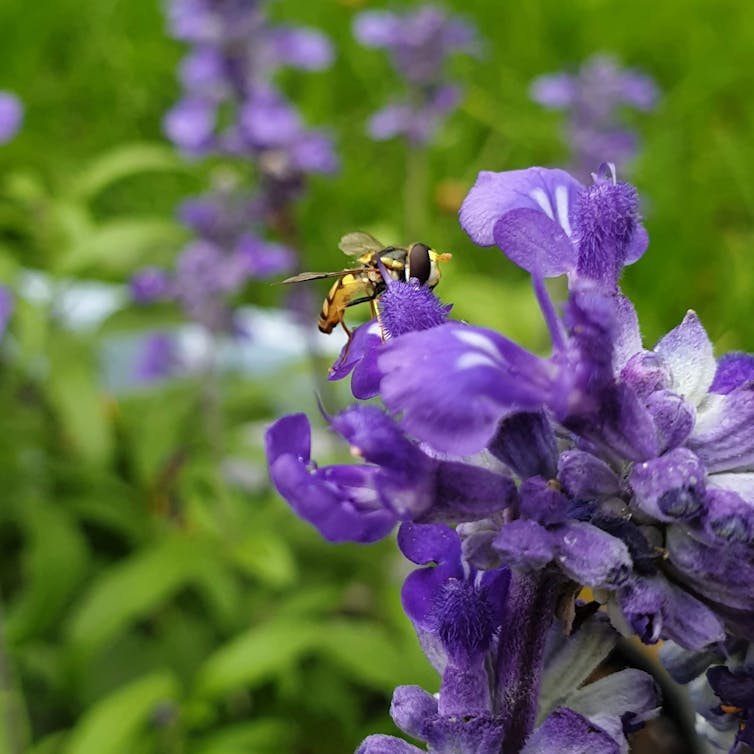
Some insects we see around flowers are actually harmless hoverflies. But their yellow and black stripes mean they are often mistaken for bees.

A hoverfly
Hoverflies have similar colouring to honeybees. Caitlyn Forster

Bees out and about

Bees on flowers are usually more interested in the food they’re collecting than the people around them. However, if you’re concerned about encountering one on your morning walk or in the garden, there are simple ways to mitigate the risk.

Bees sting when they feel threatened. So when you see one, move slowly and keep your distance. If bees fly close to you, avoid sudden movements such as swatting them away.

And wear closed shoes where bees might fly close to the ground, such as around clover or fallen jacaranda flowers.

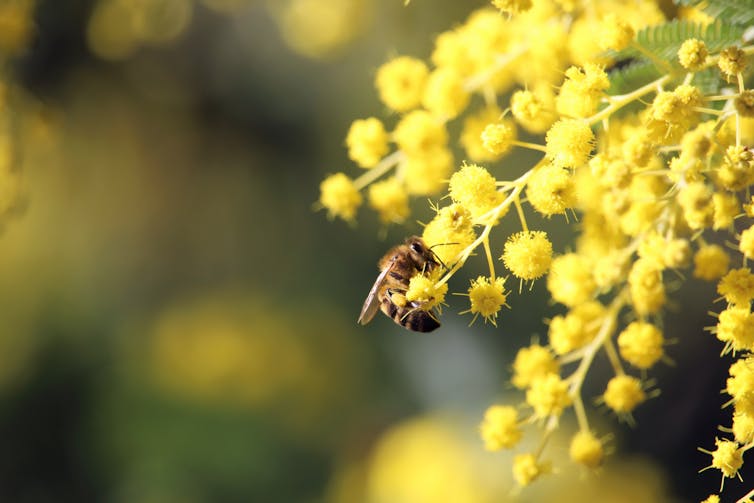
Bee approaching wattle flower
If you see a bee in the garden, avoid sudden movements. Shutterstock

What if I see a swarm?

In spring and into summer, healthy honeybee colonies may reproduce by dividing into two. One part of the colony stays at the hive and the other goes looking for a new home.

Worker bees and the queen bee leave the hive in a swarm and find a spot to stay temporarily while scout bees find a new home. That’s when you might see a swarm on a tree, vehicle or building.

Once scout bees find a new home, they return to the swarm and communicate the location via the “waggle dance”. Once a sufficient number of scouts agree on a new nest site, the swarm lifts into the air and flies to its new home.


Read more: Curious Kids: how do bees make honey?


Don’t panic if you encounter a stationary swarm of bees. The bees will sting only if threatened. But keep your distance.

Moving swarms can pose a higher sting risk, and should be avoided. If you encounter one, move a safe distance away, or indoors if possible. When moving away, avoid fast movements or swatting.

Swarms are usually present for a few hours or days before they move to a permanent location. If the bees are in a risky location (for example, near a footpath or other busy areas), call a beekeeper to safely remove them.

Stingless native bees swarm for two reasons: mating and fighting.

Mating swarms involve males congregating outside a hive to mate with the queen. Fighting swarms occur when a colony of stingless bees attempts to invade another colony. They do not usually pose a risk to humans.

Native bees capable of stinging are solitary, so don’t swarm. However, male solitary bees are known to group together on branches in the evening.

Bee swarm on a fence during a 2018 cricket match
Bee swarms, such as this on a fence during a 2018 cricket match, usually move on in a few days. Brendon Thorne

When a bee sting happens

Death and serious injury from bee stings is rare. But in Australia, bees are responsible for more hospital visits than snakes or spiders. European honeybees are also responsible for more allergic reactions than any other insect.

Only female bees can sting. Honeybees can only sting once, and die shortly after. This is because their stinger is barbed – once it stings something, the bee can’t pull the stinger out. Instead the stinger pulls free from the bee’s abdomen and the bee dies.

Other species can sting multiple times because their stingers are not barbed.

When a bee’s stinger enters your skin, it injects venom from a sac on its abdomen. When this happens, you’re likely to experience temporary swelling and redness.

For most people, reactions to bee venom are shortlived. To limit the amount of venom injected by the bee, quickly remove the sting using the edge of your fingernail or credit card.

In some cases, stings can lead to severe allergic reactions, including anaphylaxis. If you think you may have an allergy to bee stings, speak to your doctor.

And seek medical advice if you are stung in the face or neck, if significant swelling occurs or if you develop symptoms such as wheezing, light-headedness or dizziness.

Person squeezing bee sting on arm
Many people develop swelling and redness after a bee sting. Shutterstock

Learning to like bees

Bees and other insects play an important role in our food production, by moving pollen from one plant to another. They do a similar job in your garden, helping flowers and fruits to flourish.

But worldwide, bees and other pollinators face many threats, including climate change, misuse of pesticides and habitat loss. We must do what we can to keep pollinator populations healthy.

So if you’re out and about and see a bee, or even a swarm, try not to panic. The bees are probably focused on the job at hand, and not interested in you at all.


Read more: ‘Jewel of nature’: scientists fight to save a glittering green bee after the summer fires


ref. It’s bee season. To avoid getting stung, just stay calm and don’t swat – https://theconversation.com/its-bee-season-to-avoid-getting-stung-just-stay-calm-and-dont-swat-153625

More than half a billion years ago, the first shell-crushing predators ground up their prey between their legs

Source: The Conversation (Au and NZ) – By Russell Dean Christopher Bicknell, Post-doctoral researcher in Palaeobiology , University of New England

Shell-crushing predation was already in full swing half a billion years ago, as our new research published in the Proceedings of the Royal Society B reveals.

A hyena devouring an antelope carcass, a bonnethead shark feasting on hard-shelled crabs, a dog chewing on a bone: these are all examples of “durophagy”, which basically means “to eat hard parts”.

Durophagy typically involves crushing or chewing and is one of the most effective ways to consume a prey’s hard internal or external skeleton, including shells. While today this feeding style is most common among apex predators such as crocodiles, it can be seen right across the animal kingdom.

An age-old appetite for destruction

Durophagy extends far back in time. More than 500 million years ago, during the Cambrian period, an array of creepy and curious organisms were swimming, crawling and floating through Earth’s oceans.

Evidence of durophagy in the Cambrian usually comes in the form of shell injuries, and sometimes as fossilised poo containing shell fragments. Buy rarely in the fossil record can we identify the suspects responsible for this carnage.

Enter the arthropods — animals with exoskeletons and jointed legs. Modern examples include insects, spiders and crustaceans. During Cambrian times, there was one particular group of arthropod that dominated the oceans: the trilobites.

These now-extinct creatures had exoskeletons made entirely of “calcite”, which is effectively nature’s version of having a suit of armour made out of rock.

Looking like enlarged woodlice, some trilobite species after the Cambrian grew to be more than 90 centimetres in length. Most would have walked along the seafloor in search of their next meal.


Read more: A giant species of trilobite inhabited Australian waters half a billion years ago


A cannibal with an axe to grind

Lucky for us, some Cambrian trilobites are so well preserved we can study their non-calcite anatomy, including their appendages. What’s particularly interesting about these arthropods is they didn’t have jaws or other structures in the mouth to chew.

Instead, they used spines on their many pairs of legs to grind up or shred prey in a similar fashion to modern-day horseshoe crabs.

One of the largest known Cambrian trilobites, Redlichia rex, was found in South Australia. This species could reach up to 25cm in length and had large, spiny legs. Russell Bicknell

But despite being aware of this spectacular anatomical detail, nobody had ever tested whether trilobite species could potentially crush, or “chew”, shells with their spiny legs. We set out to find the answer.

Using advanced modelling techniques, we compared the legs of two Cambrian trilobite species, Olenoides serratus and Redlichia rex, to the legs of the modern horseshoe crab (Limulus polyphemus), which is a known clam eater.

We also compared them to another Cambrian arthropod, Sidneyia inexpectans, which is known to have been durophagous due to shell fragments found in its gut.

3D leg reconstructions of the modern horseshoe crab (top), Redlichia rex (middle) and Olenoides serratus (bottom). The spines used for shredding or crushing are visible on the inner part of the appendage, in green. Russell Bicknell, Katrina Kenny

Our modelling confirmed Sidneyia inexpectans was indeed capable of crushing shells, as indicated by its fossilised gut contents. However, it could not do this very effectively.

On the other hand Redlichia rex — Australia’s most menacing Cambrian trilobite, spanning 25cm and armed with bulky legs — was effectively built like a tank. As such, it was probably highly capable of shell-crushing destruction.

Separate to our modelling, past research has suggested Redlichia rex also ate other trilobites, including its own kind. Thus, this species represents one of the oldest known cannibals.

Long spines mean soft food only

Meanwhile, trilobite species Olenoides serratus had a very different leg shape to Redlichia rex, with more elaborate spines. This presented an unexpected outcome.

We found Olenoides serratus would have been unable to crush very much at all due to its very long, and therefore less powerful, leg spines. We concluded this particular trilobite was strictly on a soft seafood diet.

Biomechanical models of examined arthropod legs. On the left is the modern horseshoe crab and on the right is Sidneyia inexpectans (top), Redlichia rex (middle) and Olenoides serratus (bottom). Warmer colours represent areas of higher strain. Russell Bicknell

By showing which ancient arthropods were equipped for shell-crushing, our research paints a more vibrant picture of life underwater more than half a billion years ago.

During the dawn of animals, the emergence of this feeding style would have placed immense pressure on prey species with shells and skeletons — forcing them into an evolutionary ultimatum: become the tougher “nut to crack” or face extinction.


Read more: Freaky ‘frankenprawns’: ancient deep sea monsters called radiodonts had incredible vision that likely drove an evolutionary arms race


ref. More than half a billion years ago, the first shell-crushing predators ground up their prey between their legs – https://theconversation.com/more-than-half-a-billion-years-ago-the-first-shell-crushing-predators-ground-up-their-prey-between-their-legs-153381

COVID-19: Northland case is a reminder NZ’s ‘dumb good luck’ may run out

Source: The Conversation (Au and NZ) – By David Welch, Senior Lecturer, University of Auckland

When a COVID-19 case was found in Northland last Sunday, Aotearoa’s second-longest period with no detected community case came to an end.

ESR scientists worked late into Sunday night to obtain a whole genome sequence and reported Monday morning it was one of the “variants of concern” we have heard so much about since mid-December.

So far, close contacts of the infected woman have tested negative. But this is the ninth community incursion detected since August. With a makeshift managed isolation and quarantine (MIQ) system using hotels in the country’s biggest city, rather than purpose-built facilities, further community cases have been expected.

And the increasing prevalence of the new variants worldwide meant it was inevitable we’d eventually see one in the community. Unless there are major improvements at the border, we can expect more cases.

Ashley Bloomfield and Chris Hipkins walking in parliament corridor
Director-General of Health Ashley Bloomfield and Minister for COVID-19 Response Chris Hipkins prepare to announce a probable case of COVID-19 in the Northland community, January 24. GettyImages

How concerned should we be?

Briefly, there are three variants that all share a common mutation known as 501Y in the region of the genome that codes for the spike protein — the part of the virus that binds to our cells and establishes infection.

The three variants are most simply known as 501Y-V1 (or B.1.1.7, first detected in the UK), 501Y-V2 (B.1.351, detected in South Africa) and 501Y-V3 (P1 or B.1.1.28.1, first detected in Brazil).


Read more: If border restrictions increase to combat new COVID-19 strains, what rights do returning New Zealanders have?


While the 501Y mutation has been seen multiple times in several countries, what makes these three variants of particular interest is that they are all accompanied by multiple other mutations that are not seen together elsewhere.

It is thought the combined effect of these mutations helps the virus spread more quickly and potentially helps it evade parts of our immune response. Very early and incomplete evidence suggests they may pose a slightly greater risk of death than the original virus.

Risk of increased transmission

Trying to establish whether one variant spreads faster than any other is very difficult. A huge range of factors influence viral spread and there is a lot of random chance involved.

Before December, there was only evidence that one variant — with spike protein mutation 614G — might have a higher rate of transmission. This is now the dominant strain worldwide.

But it might have achieved its current dominance by simple luck as it spread to new and fertile grounds for transmission. Scientists spent much of the last year batting down suggestions that new mutations were changing the dynamics of the pandemic.

Reports from the UK of 501Y-V1, the first variant of concern, changed that. Here was a variant competing with many others in the same location — and it seemed to be growing much more quickly.

Winter plays a role

We can think of viral transmission as a tree, new infections being branches budding off and current cases the tips of those branches. If we see 100 branches, 50 of one variant and 50 of another, grow into 200 branches, we’d expect to end up with roughly 100 of each variant.

Whole genome sequences of viral cases sampled across the UK let researchers construct the family tree of the virus and watch it grow. What they observed was 501Y-V1 outgrowing other variants: the split was more like 115 501Y-V1 branches and 85 of the other type.


Read more: The big barriers to global vaccination: patent rights, national self-interest and the wealth gap


Of course, chance may also be involved here. The big factors that influence transmission are how we respond as a society through preventive measures. Seasonal influences are increasingly being recognised, too.

As the UK variant spread, cases rose as winter set in and students returned to education. Growth in case numbers was no surprise.

But the higher growth rate for 501Y-V1 has now been observed repeatedly. Estimates typically put it around 30-70% more transmissible.

Rapid growth has also been observed in 501Y-V2 in South Africa, and genetic similarities suggest 501Y-V3 may also share this trait.

The known unknowns

We should be cautious about transferring these numbers to other environments. The UK was at a fairly high alert level, which reduced the reproduction number (or R number — the average number of people each infected person is expected to infect) to about 0.9 for the standard strain.

The R number for 501Y-V1 was above 1, at around 1.2 to 1.5, hence the claim it was up to 70% worse. It is not yet clear, though, whether the effect is multiplicative (meaning we multiply the observed R number by 170%), or additive (we simply add the difference between the higher and lower R numbers to make the adjustment, so up to 0.6 based on the UK data).

If there was an undetected outbreak in New Zealand right now, given we have very few restrictions and it is summer, R for the standard virus might be around 2. A multiplicative effect of 70% would increase R to 3.4, while an additive effect would just add the same amount — 0.6 — seen in the restricted UK environment, putting R at 2.6.

The difference between 2, 2.6 and 3.4 may seem small. But after four weeks of spread starting from one case it could be the difference between 30, 120 and 450 new cases.


Read more: With COVID-19 mutating and surging, NZ urgently needs to tighten border controls


What can NZ do now?

As New Zealand moves into the cooler weather of autumn and winter, the background R number will creep up.

So far we have been somewhat lucky with the community cases detected since the first wave. With the notable exception of the Auckland outbreak in August, the index case has always been quickly identified, linked to the border, and has not been a super-spreader.

While many of the individual cases involved have done everything right in getting tested early, at some point our “dumb good luck” may run out, with a case triggering a super-spreading event.

It has been estimated that around 15-20% of cases are super-spreaders and these cause 70-90% of infections. Seeing one major outbreak from nine border incursions tallies with these estimates.

The most obvious and cheapest way to reduce the risk of a rapid outbreak would be to reduce the number of people returning from high-risk countries (though not necessarily the number of people overall).

We can also reduce the chance of super-spreading events by adding extra post-quarantine testing requirements and having those leaving quarantine severely limit their contacts for the first week in the community.

ref. COVID-19: Northland case is a reminder NZ’s ‘dumb good luck’ may run out – https://theconversation.com/covid-19-northland-case-is-a-reminder-nzs-dumb-good-luck-may-run-out-153963

Do men really take longer to poo?

Source: The Conversation (Au and NZ) – By Vincent Ho, Senior Lecturer and clinical academic gastroenterologist, Western Sydney University

There’s a common assumption men take longer than women to poo. People say so on Twitter, in memes, and elsewhere online. But is that right? What could explain it? And if some people are really taking longer, is that a problem?

As we sift through the evidence, it’s important to remember pooing may involve time spent sitting on the toilet and the defaecation process itself.

And there may be differences between men and women in these separate aspects of going to the toilet. But the evidence for these differences isn’t always as strong as we’d like.


Read more: Do we have to poo every day? We asked five experts


Men may spend longer sitting on the toilet

Men do appear to spend more time sitting on the toilet. An online survey by a bathroom retailer suggested men spend up to 14 minutes a day compared with women, who spend almost eight minutes a day. But this survey doesn’t have the rigour of a well-designed scientific study.

Would there be any physiological reason to explain why men spend longer on the toilet? Well, the evidence actually suggests the opposite.

We know it takes longer for food to travel through the intestines in women than in men. Women are also more likely to suffer from constipation related to irritable bowel syndrome than men. So, you’d expect women to take longer to defaecate, from the start of the bowel motion to expulsion.

But this is not the case even if you take into account differences in fibre intake between men and women.


Read more: Explainer: what is irritable bowel syndrome and what can I do about it?


Instead, how long it takes someone to poo (the defaecation time) is heavily influenced by the mucus lining the large bowel. This mucus makes the bowel slippery and easier for the stools to be expelled. But there’s no evidence this mucus lining is different in men and women.

One thing we do know, however, is mammals from elephants to mice have a similar defaecation time, around 12 seconds.

For humans, it’s slightly longer, but still quick. In one study it took healthy adults an average two minutes when sitting, but only 51 seconds when squatting. Again, there were no differences in defaecation time between men and women, whether sitting or squatting.

If there’s no strong evidence one way or the other to explain any gender differences in how long it takes to poo, what’s going on? For that, we need to look at the total time spent on the toilet.


Read more: What’s the best way to go to the toilet – squatting or sitting?


Why do people spend so long on the toilet?

What I call the “toilet sitting time” is the time of defaecation itself and the time allocated to other activities sitting on the toilet. For most people, the time spent just sitting, aside from defaecating, accounts for most of their time there.

So what are people doing? Mainly reading. And it seems men are more likely to read on the toilet than women.

For instance, a study of almost 500 adults in Israel found almost two-thirds (64%) of men regularly read on the toilet compared with 41% of women. The longer people spent on the toilet, the more likely they were to be reading. However, in the decade or more since this study was conducted, you’d expect adults would be more likely to be reading or playing games on their mobile phones rather than reading paper books.

People might also be sitting longer on the toilet for some temporary relief from the stresses of life.

Meme about men avoiding parenting responsibilities by sitting on the toilet for longer
Sometimes, people just need time to themselves. Ramblin Mama

One poll found 56% of people find sitting on the toilet relaxing, and 39% a good opportunity to have “some time alone”. Another online survey revealed one in six people reported going to the toilet for “peace and quiet”. Although these are not scientific studies, they offer useful insights into a social phenomenon.

Then there can be medical reasons for a prolonged defaecation time, and consequently a lengthier time sitting on the toilet.

An anal fissure (a tear or crack in the lining of the anus) can make defaecation a painful and lengthy process. These fissures are just as common in men as in women.

And obstructive defaecation, where people cannot empty the rectum properly, is a common cause of chronic constipation. This is more common in middle-aged women.

Are there any harms from spending too long on the loo?

In a Turkish study, spending more than five minutes on the toilet was associated with haemorrhoids and anal fissures. Another study from Italy noted the longer the time people spent on the toilet, the more severe their haemorrhoids.

One theory behind this is prolonged sitting increases pressure inside the abdomen. This leads to less blood flow into the veins of the rectum when passing a bowel motion, and ultimately to blood pooling in the vascular cushions of the anus. This makes haemorrhoids more likely to develop.


Read more: Explainer: why do people get haemorrhoids and how do you get rid of them?


What can we do about this?

In addition to the usual advice about increasing the amount of fibre in your diet and ensuring you drink enough water, it would be sensible to limit the amount of time spent on the toilet.

Different researchers recommend a different upper limit. But I and others recommend the SEN approach:

  • Six minute toilet sitting time maximum

  • Enough fibre (eating more fruit and vegetables, and eating wholegrains)

  • No straining during defaecation.


Read more: Health Check: what causes constipation?


ref. Do men really take longer to poo? – https://theconversation.com/do-men-really-take-longer-to-poo-152233

State-sanctioned racism against West Papuans ‘shows Jakarta’s true agenda’

Pacific Media Watch newsdesk

More leading Indonesian figures have made racial slurs against Natalius Pigai, former chair of the National Human Rights Commission (Komnas HAM) – and all West Papuans, says United Liberation Movement of West Papua (ULMWP) interim president Benny Wenda.

“Since the illegal Indonesian invasion in 1963, Indonesian elites have made clear their racist plans to destroy Melanesian West Papuans as a distinct people,” said Wenda in a statement.

Last month retired General Hendropriyono, former head of the Indonesian intelligence agency (BIN) and special forces (Kopassus) general, claimed that two million West Papuans should be separated from their Melanesian brothers and sisters in the Pacific and moved to the island of Manado in Indonesia.

“This is racial ethnic cleansing, a genocidal fantasy at the highest levels of the Indonesian state,” Wenda said.

Last week, one of President Jokowi’s most prominent supporters called a leading West Papuan human rights defender a “monkey”, the same racial slur that sparked the 2019 West Papua Uprising.

Ambronicus Nababan, chair of the Pro Jokowi-Amin Volunteers (Projamin), made the racial comment about Natalius Pigai, former head of Indonesia’s leading human rights group.

“These remarks stand in a long tradition. When Indonesia invaded our land, General Ali Moertopo said the Papuan people should be transferred to the moon,” Wenda said in the statement.

‘Obstacle to development’
“In 2016, General Luhut Panjaitan said the Papuans should be transferred to the Pacific. Indonesia’s rulers have always seen us as sub-human, as an obstacle to ‘development’ that needs to be ethnically cleansed and killed.

“My people rose up against this racism and colonisation in 2019. Thousands of students returned from the rest of Indonesia in an exodus from racism, dozens were killed by Indonesia, and hundreds arrested.

“The Indonesian state punished those who spoke out with over 100 years of collective prison time. The killers and racists in the army, police and state-backed militias were allowed to go free.”

These are not just statements from Indonesian officials, Wenda’s statement said.

They were linked to the military operations that had displaced more than 60,000 people since December 2018. The racist attitudes “justify treating us as second-class citizens, torturing and imprisoning us for exercising our rights to free expression under international law”.

Indonesia’s settler colonial project in West Papua had been built on racism.

Wenda said this was why the ULMWP provisional government was formed on December 1 last year.

‘We are no longer accepting Indonesian law’
“We are no longer accepting any Indonesian law, policy or proposal. We will not bow down to Indonesian rule any more. The provisional government is issuing the following four points:

  1. We reject all forms of Indonesian law enforced in West Papua;
  2. We support the 83 countries demanding Indonesia allow the UN High Commissioner for Human Rights into West Papua;
  3. The solution to West Papuan suffering is an independence referendum; and
  4. All West Papuans must unite behind the provisional government.

“It is time to end this: no more torture, no more displacement, no more killing, no more discrimination. To all my people, those who are working in the Indonesian government, in the civil service, professionals, exiles, lawyers, those inside, in the highlands, coasts, islands and towns – we are no longer Indonesian citizens.

“We are forming our own Melanesian nation. Come behind the provisional government, and we will peacefully reclaim our country and refuse Indonesia’s illegal occupation of our territory.”

Print Friendly, PDF & Email

Article by AsiaPacificReport.nz

We are the 1% – the wealth of many Australians puts them in an elite club wrecking the planet

ANALYSIS: By Alex Baumann, Western Sydney University and Samuel Alexander, University of Melbourne

Among the many hard truths exposed by covid-19 is the huge disparity between the world’s rich and poor. As economies went into freefall, the world’s billionaires increased their already huge fortunes by 27.5 percent.

And as many ordinary people lost their jobs and fell into poverty, The Guardian reported “the 1 percent are coping” by taking private jets to their luxury retreats.

Such perverse affluence further fuelled criticism of the so-called 1 percent, which has long been the standard rhetoric of the political Left.

In 2011, Occupy Wall Street protesters called out growing economic inequality by proclaiming: “We are the 99 percent!”. And an Oxfam report in September last year lamented how the richest 1 percent of the world’s population are responsible for more than twice as much carbon pollution as the poorest half of humanity.

But you might be surprised to find this 1 percent doesn’t just comprise the super-rich. It may include you, or people you know. And this fact has big implications for social justice and planetary survival.

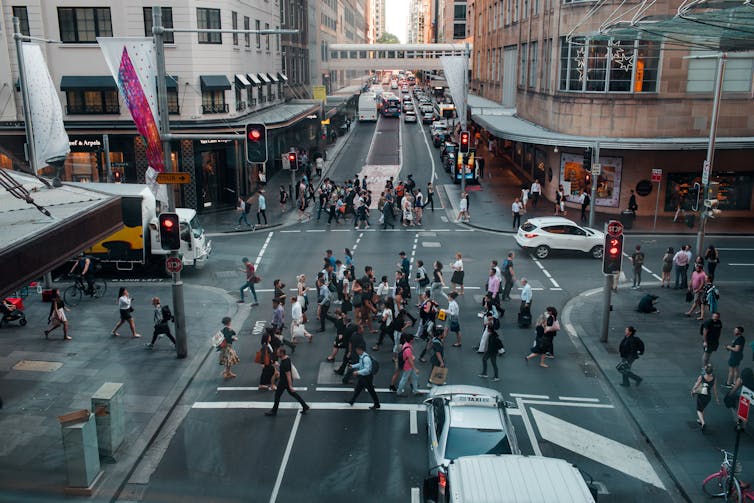
People crossing the street in Sydney
Many everyday Australians have a net worth that puts them in the world’s richest 1 percent. Image: The Conversation/Shutterstock

Look in the mirror
When you hear references to the 1 percent, you might think of billionaires such as Amazon’s Jeff Bezos or Tesla founder Elon Musk. However, as of October last year there were 2189 billionaires worldwide — a minuscule proportion of the 7.8 billion people on Earth.

So obviously, you don’t have to be a billionaire to join this global elite.

So how rich do you have to be? Well, Credit Suisse’s Global Wealth Report in October last year showed an individual net worth of US$1 million (A$1,295,825) – combined income, investments and personal assets — will make you among the world’s 1 percent richest people.

The latest official data shows Australia’s richest 20 percent of households have an average net worth of A$3.2 million. The average Australian household has a net worth of A$1,022,200, putting them just outside the world’s richest 1 percent.

Aerial view of suburban Australian homes
The net worth of many Australians puts them in the global elite. Image: The Conversation/Shutterstock

If you’ve just done the sums and fall outside the 1 percent, don’t feel too sorry for yourself. A net wealth of US$109,430 (A$147,038) puts you among the world’s richest 10 percent. Most Australians fit into this category; half of us have a net worth of A$558,900 or more.

What does all this mean for the planet?
It’s true the per capita emissions of the super-rich are likely to be far greater than others in the top 1 percent. But this doesn’t negate the uncomfortable fact Australians are among a fraction of the global population monopolising global wealth. This group causes the vast bulk of the world’s climate damage.

A 2020 Oxfam report shows the world’s richest 10 percent produce a staggering 52 percent of total carbon emissions. Consistent with this, a 2020 University of Leeds study found richer households around the world tend to spend their extra money on energy-intensive products, such as package holidays and car fuel. The UN’s 2020 Emission Gap Report further confirmed this, finding the top 10 percent use around 75 percent of all aviation energy and 45 percent of all land transport energy.

It’s clear that wealth, and its consequent energy privilege, is neither socially just nor ecologically sustainable.

Man with one shiny shoe and one scruffy shoe
Global wealth disparity is not just or sustainable. Image: The Conversation/Shutterstock

A potential solution
Much attention and headlines are devoted to the unethical wealth of billionaires. And while the criticism is justified, it distracts from a broader wealth problem — including our own.

We should note here, one can have an income that’s large compared to the global average, and still experience significant economic hardship. For instance in Australia, the housing costs of more than one million households exceed 30 percent of total income – the commonly used benchmark for housing affordability.

Here lies a central challenge. Even if we wanted to reduce our wealth, the enormous cost of keeping a roof over our head prevents us from doing so. Servicing a mortgage or paying rent is one of our biggest financial obligations, and a key driver in the pursuit of wealth.

But as we’ve shown above, as personal wealth grows, so too does environmental devastation. The rule even applies to the lowest paid, who are working just to pay the rent. The industries they rely on, such as retail, tourism and hospitality, are themselves associated with environmental damage.

Existing economic and social structures mean stepping off this wealth-creating treadmill is almost impossible. However as we’ve written before, people can be liberated from their reliance on economic growth when land – the very foundation of our security – is not commodified.

For social justice and ecological survival, we must urgently experiment with new land and housing strategies, to make possible a lifestyle of reduced wealth and consumption and increased self-sufficiency.

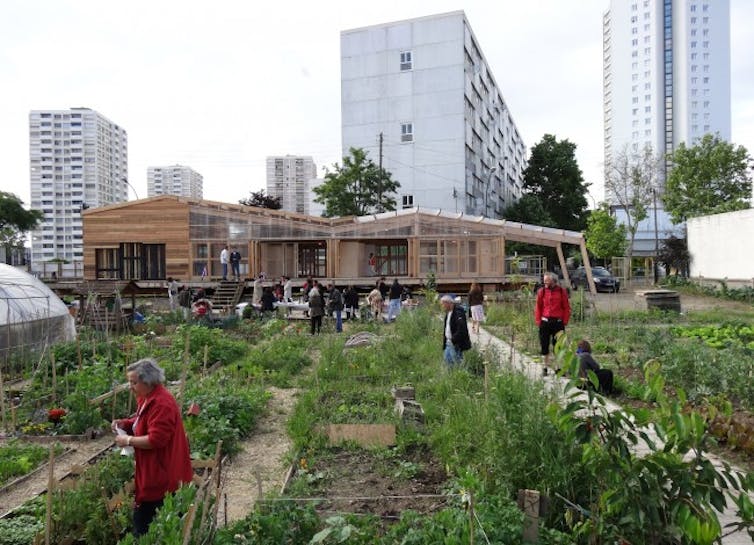
This might include urban commons, such as the R-Urban project in Paris, where several hundred people co-manage land that includes a small farm for collective use, a recycling plant and cooperative eco-housing.

The R-Urban project in Paris
The R-Urban project in Paris, which includes a small farm. Image: The Conversation/Flickr

Under a new land strategy, other ways of conserving resources could be deployed. One such example, developed by Australian academic Ted Trainer, involves cutting our earnings sharply – with paid work for only two days in a week. For the rest of the working week, we would tend to community food gardens, network and share many things we currently consume individually.

Such a way of living could help us re-evaluate the amount of wealth we need to live well.

The social and ecological challenges the world faces cannot be exaggerated. New thinking and creativity is needed. And the first step in this journey is taking an honest look at whether our own wealth and consumption habits are contributing to the problem.
The Conversation


Dr Alex Baumann is a casual academic, School of Social Sciences & Psychology, Western Sydney University and Samuel Alexander, Research fellow, Melbourne Sustainable Society Institute, University of Melbourne. This article is republished from The Conversation under a Creative Commons licence. Read the original article.

Print Friendly, PDF & Email

Article by AsiaPacificReport.nz

If border restrictions increase to combat new COVID-19 strains, what rights do returning New Zealanders have?

Source: The Conversation (Au and NZ) – By Kris Gledhill, Professor of Law, Auckland University of Technology

As we know, getting into New Zealand during the COVID-19 pandemic is difficult. There are practicalities, such as high airfare and managed isolation costs. And there are legal requirements, including pre-flight testing, mandatory quarantine and visa restrictions.

Even so, concern about new strains of the virus have led to calls to “turn down the tap”, particularly for those coming from places such as Britain, where spectacular political incompetence has created the conditions for these new COVID variants to evolve.

Such a move would make an already difficult process even more so. Since quarantine has to be pre-booked and there are limits on availability, there have been inevitable delays and disappointment. This has led to complaints about it being too difficult to “come home”.

Also inevitably, there has been much talk of the “right” to return. While the government has granted special visas for entertainers, sportspeople, essential workers and students, those with citizenship or residency status expect to be allowed home.

Rights aren’t always absolute

However, rights are rarely a trump card. With very few exceptions — most obviously the right not to be tortured or treated in an inhuman or degrading way — rights are not absolute.

Rather, they represent an important value that must be weighed in the balance and respected unless there are good countervailing arguments. Depending on the strength of those arguments, a right may be delayed, only partly respected, or outweighed completely.


Read more: Why the COVID-19 variants are so dangerous and how to stop them spreading


For example, there is a right to privacy, but a criminal conviction cannot be kept private from people who need to know about it. There is a right to freedom of expression, but not to the extent of defamation or inciting discrimination.

So it is with the right of New Zealanders to come into New Zealand when they have exercised another right, namely the right to leave the country.

No arbitrary denial of rights

The modern human rights regime begins with the Universal Declaration of Human Rights (1948), which New Zealand had an important role in drafting. Its article 13 sets out a right to move within state borders, to leave any country and to return to one’s home country.

But article 29 notes there are duties to the community and that rights can be limited for good reasons.

The declaration was put into a binding treaty, the 1966 International Covenant on Civil and Political Rights (ICCPR), which New Zealand ratified in 1978. Article 12 of this significant treaty refers to people not being “arbitrarily” prevented from entering their own country.


Read more: The big barriers to global vaccination: patent rights, national self-interest and the wealth gap


The ICCPR is part of the reason we have the New Zealand Bill of Rights Act 1990. Under its section 18, all citizens have the right to enter New Zealand. However, under section 5, limitations are allowed if they are clearly justified in a democratic society.

This goes to the heart of what “arbitrarily” means in practice. Basically, limits on the right to return have to be based on a competing interest. Those limits have to support the competing interest, and the balance has to make sense.

The government’s duty

There are many competing interests, most fairly obvious, starting with protecting people’s lives, particularly those most vulnerable.

COVID-19 is objectively dangerous and protecting people in New Zealand is a government’s duty. In short, we have a right to life. Protecting this is rationally connected to an effective quarantine process. In turn, this can justify all manner of conditions, including limits on numbers.

Secondly, there is the more general health of people, which will be compromised if healthcare systems are overwhelmed, as has happened in other parts of the world. This undermines the right to health.

Thirdly, there are rights that flow from having a robust economy, including the right to an adequate standard of living. The government’s approach of protecting these interests by cutting off international tourism and limiting some other sectors to protect the rest of the economy is certainly not arbitrary.


Read more: With COVID-19 mutating and surging, NZ urgently needs to tighten border controls


Whose rights should prevail?

There is another side to this, of course. All these rights also belong to New Zealanders abroad. Their right to return includes the right to be in a safer and better environment. This is not lost by being overseas when a pandemic strikes.

However, the government can give extra weight to protecting people already here, particularly as fair notice was given that significant restrictions were being imposed to eliminate COVID-19 in the community, rather than merely manage it.

As the overseas experience suggests, the latter approach would have led to more deaths, compromised health care, and might well have undermined the economy to a greater degree.

So, yes, there is a right to return — but it is a right that can be delayed to protect those already here.

ref. If border restrictions increase to combat new COVID-19 strains, what rights do returning New Zealanders have? – https://theconversation.com/if-border-restrictions-increase-to-combat-new-covid-19-strains-what-rights-do-returning-new-zealanders-have-153962

Could the Biden administration pressure Australia to adopt more humane refugee policies?

Source: The Conversation (Au and NZ) – By Claire Higgins, Senior Research Fellow, Kaldor Centre for International Refugee Law, UNSW

As a presidential candidate, Joe Biden promised the US would demonstrate “global leadership on refugees”. Once elected, he pledged to vastly increase refugee resettlement in the US.

If history is any guide, the new president’s forward-thinking approach could help drive Australia’s commitments to refugee protection, as well.

Over the past four decades, the United States and Australia have contributed to international refugee resettlement through planned annual admission programs.

The annual US Refugee Admissions Program (USRAP) has traditionally operated on a much larger scale than any other country, with tens of thousands of places per year. Since 1980, the program has enabled more than 3 million people to find safety and build new lives in the US.

Under former President Donald Trump, however, the program was cut to historic lows of just 15,000 places for the year beginning in October 2020.

A rally against Trump’s refugee policy in October. Steve Helber/AP

Less dramatically, Australia’s quota for the admission of refugees and others in humanitarian need was similarly reduced from 18,750 in 2019-20 to 13,750 in 2020-21, a cut attributed to travel restrictions imposed due to COVID-19.

Biden pledging to increase US refugee intake

Revitalising the US refugee program is one of the many tasks facing the newly installed Biden administration, in addition to revising US asylum policy for those seeking protection at the borders.

Biden has committed to an annual refugee intake of up to 125,000 people, echoing the goals of the Obama administration in its final year, when it set an intake of up to 110,000 refugees.

At that time, resettlement was valued as a “foreign policy priority” for the US, with President Barack Obama joining UN Secretary-General Ban Ki-Moon in hosting a Leaders’ Summit on Refugees in 2016 to address record levels of global displacement, including from Syria.

The Australian government participated in that initiative and pledged to increase its annual humanitarian intake to 19,000 by 2018. The summit demonstrated how leadership by the US can have direct impact and influence on the actions of other states.


Read more: With our borders shut, this is the ideal time to overhaul our asylum seeker policies


Australia has similarly tried to boost its reputation

By increasing the US resettlement numbers now, Biden is looking to rebuild America’s image abroad.

This is a tried and tested tool, evident in the Ford and Carter administration’s large-scale admission of Vietnamese refugees in the aftermath of the disastrous war in Vietnam.

Previous Australian governments have also sought to improve the country’s image through the rosy glow of resettlement contributions.

In September 2015, for example, just five days after The New York Times published a scathing assessment of Australia’s offshore detention system, the Abbott government announced Australia would resettle an additional 12,000 Iraqi and Syrian refugees.

Abbott claimed Australia was demonstrating good international citizenry.

However, the optics did not prevent the UN High Commissioner for Human Rights from decrying a week later the lack of transparency around offshore detention in Australia and the inability of asylum seekers to access medical care and independent legal advice.

Most recently, the Australian government this month cited the country’s “generous” humanitarian program in its formal response to UN concerns about the treatment of asylum seekers here.

Refugees housed on Manus Island have long faced dangerous and unhealthy conditions. Matthew Abbott/PR Handout Image/GetUp

US and Australia policies have long echoed one another

Whether the Biden administration could influence Australia’s treatment of asylum seekers is hard to gauge.

The US has been a model for Australia’s harsh asylum policies over the years. The US Coast Guard, for instance, was interdicting asylum seeker boats under the Reagan administration, years before the Howard government adopted the practice in 2001.

And in the early 1990s, the Bush and Clinton administrations authorised the detention of Haitian refugees at the Guantanamo Bay naval base — a practice later adopted by Australia on Manus Island and Nauru.


Read more: Yes, the US border policy is harsh – but Australia’s treatment of refugee children has also been deplorable


And at times, Australia has influenced the US. In a phone call with Trump following his inauguration in January 2017, then-Prime Minister Malcolm Turnbull expressed support for Trump’s promotion of hard-line immigration control, and claimed that Australia had “inform[ed] your approach”. Turnbull said,

We have, as you know, taken a very strong line on national security and border protection here […] We are very much of the same mind.

In their phone call, Trump said he liked Australia’s tough approach to refugees. Shawn Thew/EPA

Could the Biden administration lean on Canberra now?

If Biden follows through on his pledge to reinstate America’s “historic role in protecting the vulnerable”, he may prove to be a very different kind of leader.

The Obama era could provide some clues to the Biden approach. In 2015, the head of the Department of State’s refugee bureau encouraged Australia to

be with us again in really being leaders in humanitarian response to migrants and refugees in the region.

The Obama administration urged the Australian government to change its hard-line insistence on detaining asylum seekers offshore.

Unsuccessful in this effort, the Obama administration did what it could, signing a resettlement deal with the Turnbull government in 2016 to get refugees off Manus and Nauru and grant them entry to the United States.

Protests in support of relocating refugees from Manus and Nauru have been a familiar sight on Australian streets. Wayne Taylor/AAP

The deal was loudly criticised but reluctantly upheld by the Trump administration (even though Trump struggled to understand what he called Australia’s “thing with boats”).

Importantly, the deal was reportedly predicated on Australia “doing more” for refugees elsewhere in the world. Signs of this effort were evident in Australia’s increased refugee admission quotas of recent years.


Read more: Hotels are no ‘luxury’ place to detain people seeking asylum in Australia


If the Biden administration leans on Canberra in a similar way, we may see Australia return to a higher resettlement quota.

Perhaps we will also see humane solutions for those who came by boat seeking Australia’s protection and are still being detained in hotels and remote detention facilities — including young children.

There are glimmers of hope. In recent days, for instance, the Australia government released dozens of refugees and asylum seekers from detention.

However, these men have been given short-term visas, which means they will continue to face an uncertain future — a product of current government policy that affects many thousands of refugees living in Australia today.

It is clear that leadership by the US, Australia’s major ally, is needed now more than ever.

ref. Could the Biden administration pressure Australia to adopt more humane refugee policies? – https://theconversation.com/could-the-biden-administration-pressure-australia-to-adopt-more-humane-refugee-policies-153718

Domestic violence soars after natural disasters. Preventing it needs to be part of the emergency response

Source: The Conversation (Au and NZ) – By Jennifer Boddy, Associate Professor and Deputy Head of School (Learning and Teaching), Griffith University

Domestic and family violence soars in the months and years following natural disasters. It usually involves physical and psychological violence perpetrated by men against women and children, but it can also include an escalation in sexual, financial and emotional abuse.

Following the 2009 Victorian Black Saturday bushfires, more than half of women in one study reported experiencing domestic and family violence. Many had never experienced it before.

Recent research found significant differences in reports of violence amongst women in high, medium and low bushfire affected regions in Victoria three years after the Black Saturday bushfires. There was an overrepresentation of women experiencing violence in high bushfire affected areas.

And according to Australian frontline workers, while reports of violence might decrease during a disaster, it soon escalates.

Australia is not alone. Overseas literature suggests demand for women’s shelters goes up after disasters, police reports of violence increase, and violence remains elevated even years after disasters, with women experiencing significant psychological and physical abuse.


Read more: Domestic violence will spike in the bushfire aftermath, and governments can no longer ignore it


Disasters and violence

Disasters are becoming more frequent, with an average of about 200 million people affected globally each year.

Natural disasters on their own are not the root cause of family violence. Many men feel society expects them to live up to characteristics commonly associated with masculinity. For many, their identity as “providers and protectors” is threatened when disaster makes this an impossible standard to meet.

The frequency and severity of violence against women is exacerbated by tensions arising from natural disasters, including:

A man drinks while his wife and child sit in the room.
The frequency and severity of violence against women is exacerbated by tensions arising from natural disasters, including increased alcohol and drug use. Shutterstock

Disasters hit vulnerable groups hardest, entrenching disadvantage

Disasters can have disproportionate effects across socioeconomic groups. We have known for some time disasters of similar nature and magnitude have dramatically different consequences for people in different places.

Families where income has fallen after a disaster are at higher risk of women experiencing violence.

The 2016 Personal Safety Survey found both financial stress and unemployment were associated with women experiencing domestic and family violence.

Worse, research shows disasters are more likely to occur in low socioeconomic areas.

In Australia, about one quarter of women have experienced an incident of violence from an intimate partner.

Violence prevention should be part of our emergency response

As disasters are expected to increase, Australia should further consider how to incorporate domestic violence mitigation into our emergency responses.

First responders need training in how to identify risks of violence and respond appropriately.

In the face of displacement and trauma, it’s important volunteers and workers do not excuse violence. Instead, they should provide care that promotes victims’ safety, and respects their privacy and dignity. Access and referral to appropriate health and community services should be assured.

We need permanent shelters that stay cool during heatwaves and offer protection from flooding. Public buildings need to be well set up for women and children experiencing disasters and, during COVID-19, allow for families to maintain a safe physical distance.

Local community-based domestic and family violence services must ensure their organisations are disaster-ready and can operate when disaster strikes.

Longer term investment to boost community resilience

Australian governments must invest in domestic violence hotlines, refuges and women’s centres — especially in low socioeconomic, disaster-prone areas.

Programs supporting perpetrators of violence to change their behaviours also need investment.

Australia currently relies on perpetrator intervention programs involving therapeutic groupwork as part of what’s called an “integrated service system response” (where government, non-government services and other community organisations coordinate).

But we also need new ways of working directly with men, informed by the experiences of women. Such approaches should seek to intervene early and involve women and children in their design.

As a society we must seek to address the underlying causes of domestic and family violence, and move beyond outdated ideas about masculinity that hold men to an impossible standard and put women at risk.

Many people don’t actually know what domestic violence looks like. We need community education about coercive and controlling behaviours and about the fact that the risk of family violence spikes after disasters.

Such training should be used to challenge social and cultural norms that condone violence, while also letting people know how to report violence, find services, and get to safety.

We all have a role to play in addressing domestic and family violence. Our efforts grow only more important as we face more frequent and severe disasters in Australia.


Read more: Forceful and dominant: men with sexist ideas of masculinity are more likely to abuse women


If this article has raised issues for you, or if you’re concerned about someone you know, call the 1800 Respect national helpline on 1800 737 732 or Lifeline on 13 11 14. This story is part of a series The Conversation is running on the nexus between disaster, disadvantage and resilience. You can read the rest of the stories here.

ref. Domestic violence soars after natural disasters. Preventing it needs to be part of the emergency response – https://theconversation.com/domestic-violence-soars-after-natural-disasters-preventing-it-needs-to-be-part-of-the-emergency-response-151838

We are the 1%: the wealth of many Australians puts them in an elite club wrecking the planet

Source: The Conversation (Au and NZ) – By Alex Baumann, Casual Academic, School of Social Sciences & Psychology, Western Sydney University

Among the many hard truths exposed by COVID-19 is the huge disparity between the world’s rich and poor. As economies went into freefall, the world’s billionaires increased their already huge fortunes by 27.5%. And as many ordinary people lost their jobs and fell into poverty, The Guardian reported “the 1% are coping” by taking private jets to their luxury retreats.

Such perverse affluence further fuelled criticism of the so-called 1%, which has long been the standard rhetoric of the political Left.

In 2011, Occupy Wall Street protesters called out growing economic inequality by proclaiming: “We are the 99%!”. And an Oxfam report in September last year lamented how the richest 1% of the world’s population are responsible for more than twice as much carbon pollution as the poorest half of humanity.

But you might be surprised to find this 1% doesn’t just comprise the super-rich. It may include you, or people you know. And this fact has big implications for social justice and planetary survival.

People crossing the street in Sydney
Many everyday Australians have a net worth that puts them in the world’s richest 1%. Shutterstock

Look in the mirror

When you hear references to the 1%, you might think of billionaires such as Amazon’s Jeff Bezos or Tesla founder Elon Musk. However, as of October last year there were 2,189 billionaires worldwide — a minuscule proportion of the 7.8 billion people on Earth. So obviously, you don’t have to be a billionaire to join this global elite.

So how rich do you have to be? Well, Credit Suisse’s Global Wealth Report in October last year showed an individual net worth of US$1 million (A$1,295,825) – combined income, investments and personal assets — will make you among the world’s 1% richest people.


Read more: Five ways coronavirus is deepening global inequality


The latest official data shows Australia’s richest 20% of households have an average net worth of A$3.2 million. The average Australian household has a net worth of A$1,022,200, putting them just outside the world’s richest 1%.

If you’ve just done the sums and fall outside the 1%, don’t feel too sorry for yourself. A net wealth of US$109,430 (A$147,038) puts you among the world’s richest 10%. Most Australians fit into this category; half of us have a net worth of A$558,900 or more.

Aerial view of suburban Australian homes
The net worth of many Australians puts them in the global elite. Shutterstock

What does all this mean for the planet?

It’s true the per capita emissions of the super-rich are likely to be far greater than others in the top 1%. But this doesn’t negate the uncomfortable fact Australians are among a fraction of the global population monopolising global wealth. This group causes the vast bulk of the world’s climate damage.

A 2020 Oxfam report shows the world’s richest 10% produce a staggering 52% of total carbon emissions. Consistent with this, a 2020 University of Leeds study found richer households around the world tend to spend their extra money on energy-intensive products, such as package holidays and car fuel. The UN’s 2020 Emission Gap Report further confirmed this, finding the top 10% use around 75% of all aviation energy and 45% of all land transport energy.

It’s clear that wealth, and its consequent energy privilege, is neither socially just nor ecologically sustainable.

Man with one shiny shoe and one scruffy shoe
Global wealth disparity is not just or sustainable. Shutterstock

A potential solution

Much attention and headlines are devoted to the unethical wealth of billionaires. And while the criticism is justified, it distracts from a broader wealth problem — including our own.

We should note here, one can have an income that’s large compared to the global average, and still experience significant economic hardship. For instance in Australia, the housing costs of more than one million households exceed 30% of total income – the commonly used benchmark for housing affordability.

Here lies a central challenge. Even if we wanted to reduce our wealth, the enormous cost of keeping a roof over our head prevents us from doing so. Servicing a mortgage or paying rent is one of our biggest financial obligations, and a key driver in the pursuit of wealth.

But as we’ve shown above, as personal wealth grows, so too does environmental devastation. The rule even applies to the lowest paid, who are working just to pay the rent. The industries they rely on, such as retail, tourism and hospitality, are themselves associated with environmental damage.


Read more: Coronavirus shows housing costs leave many insecure. Tackling that can help solve an even bigger crisis


Existing economic and social structures mean stepping off this wealth-creating treadmill is almost impossible. However as we’ve written before, people can be liberated from their reliance on economic growth when land – the very foundation of our security – is not commodified.

For social justice and ecological survival, we must urgently experiment with new land and housing strategies, to make possible a lifestyle of reduced wealth and consumption and increased self-sufficiency.

This might include urban commons, such as the R-Urban project in Paris, where several hundred people co-manage land that includes a small farm for collective use, a recycling plant and cooperative eco-housing.

The R-Urban project in Paris, which includes a small farm. Flickr

Under a new land strategy, other ways of conserving resources could be deployed. One such example, developed by Australian academic Ted Trainer, involves cutting our earnings sharply – with paid work for only two days in a week. For the rest of the working week, we would tend to community food gardens, network and share many things we currently consume individually.

Such a way of living could help us re-evaluate the amount of wealth we need to live well.

The social and ecological challenges the world faces cannot be exaggerated. New thinking and creativity is needed. And the first step in this journey is taking an honest look at whether our own wealth and consumption habits are contributing to the problem.


Read more: The ‘simple life’ manifesto and how it could save us


ref. We are the 1%: the wealth of many Australians puts them in an elite club wrecking the planet – https://theconversation.com/we-are-the-1-the-wealth-of-many-australians-puts-them-in-an-elite-club-wrecking-the-planet-151208

It’s not just about the rise in anti-Semitism: why we need real stories for better Holocaust education in Australia

Source: The Conversation (Au and NZ) – By Jan Lanicek, Senior Lecturer in Modern European History and Jewish History, UNSW

On January 27 communities worldwide commemorate the liberation of Auschwitz — the largest complex of concentration camps and extermination centres during the Holocaust. This is the first year the International Holocaust Remembrance Day will be marked nationally in Australia.

Prime Minister Scott Morrison and Treasurer Josh Frydenberg will address the event, which demonstrates the importance the government ascribes to Holocaust commemoration.

In October 2019, after two cases of serious anti-Semitism in schools (one where a Jewish student was forced to kiss the feet of another student) Josh Frydenberg urged schools to deliver more history lessons about the Holocaust. He said:

If they [bullies] understood and comprehended the atrocities of the Holocaust, they would be as insulted as anybody, including me, about these recent attacks.

Federal and state governments have provided funding to Holocaust museums, and Holocaust education is mandatory in years 9 and 10 in NSW and Victoria. It is also part of the history curriculum nationally.

Although the Holocaust is a universal symbol of evil, there is some feeling among Australians it has no direct historical relevance here. In 2016, the Australian War Memorial in Canberra unveiled a small exhibition with several stories connecting Australia to the Holocaust. But there was some opposition.

The Memorial director Brendan Nelson, commented that

One regular visitor to the Memorial told me emphatically that she was opposed to this exhibition. “This has nothing to do with Australia and the Australian War Memorial”, she said. She told me that she would never walk through it.

With the passing of most of the last survivors, it seems the horrors of the event are being lost with the younger generations. Surveys conducted by the Claims conference (an international organisation that aims to bring justice to Holocaust survivors) in 2018, showed 31% of Americans (41% of millenials) believe substantially fewer than 6 million Jews were killed (two million or fewer) during the Holocaust.


Read more: Many young people still lack basic knowledge of the Holocaust


And almost half of Americans couldn’t name a single concentration camp during the Holocaust, despite the fact there were possibly more than 40,000 at the time.

Teachers need to consider new ways how to make Holocaust history relevant to new generations globally, and in Australia.

How the Holocaust is relevant to Australia

My historical research has brought to light personal stories connecting Australia and Europe during the second world war.

Between 7,000 and 10,000 Jewish refugees reached Australia shortly before the war. Most of them left behind relatives, often elderly parents, sisters, cousins, aunts, uncles and friends, who perished in the Holocaust.

In 1939 Mayloch Ruda from Warsaw, Poland migrated to Australia with his two daughters — leaving his wife Chana and three other children, Pola, Frania and Guta behind. This was a typical migration strategy, when the breadwinner left first to establish a new home overseas.

Mayloch applied for Australia to admit his family, but it was too late. The war closed almost all emigration routes from Europe. His wife and three daughters were soon imprisoned in the largest Nazi ghetto in Warsaw.

Mayloch and his two daughters remained in an intermittent contact with their family through the International Red Cross. The last message they received from Pola in November 1942 was delayed by almost six months:

We are in dire material conditions. Mother lost her sight. We plead for any help, as soon as possible. We all live together. We are waiting for help and the news.

Mayloch contacted Jewish humanitarian agencies to send his family food parcels, but it is doubtful they ever arrived. Most of the Jews from Warsaw, very likely including the Ruda family, were murdered in Treblinka.

After the war, the Rudas and others tried to locate their relatives, and if they survived, bring them over to Australia.

Another surviror, Max Heitlinger, who arrived in Australia in 1939 from Vienna, expressed these feelings in his memoirs.

I knew it was the end for all of them. I still wake up at night and cry in desperation and self-accusation.

Despite the immense interest in the history of the Holocaust in Australia their efforts and strategies have remained largely unknown.

The Holocaust is about human rights more generally

The idea Holocaust education could help combat rising anti-Semitism is not new. Surveys conducted in the past 15 years, however, suggest “Europe is experiencing rising levels of antisemitism […] alongside a growth in Holocaust education”.

The authors of the surveys write that for Holocaust education to be effective, the curriculum should also consider “the pre-existing cultural capital of students and the specific history of Jewish communities, anti-Semitism, and the Holocaust in the country […] where the subject is being taught”.


Read more: New research shows religious discrimination is on the rise around the world, including in Australia


UNESCO recommends education about the Holocaust include elements such as a fostering critical thinking, education about global citizenship and an integration of gender perspectives to help unmask bias.

Stories like the above, of migrants in Australia separated from family, offer possible avenues for teachers to present the Holocaust as part of our history.

Using these stories is also crucial for understanding the diverse experiences in Australian multicultural society.

Photos of Holocaust victims and survivors from the Holocaust Memorial Museum in Washington.
Up to 10,000 Jewish refugees came to Australia before the war. Many left behind relatives. (Photos of Holocaust victims and survivors taken from the Holocaust Memorial Museum in Washington) Shutterstock

Stories of separated families still happen today. Sadam Abudusalam, an Australian citizen, was separated for three years from his Uyghur wife Nadila and their child, who were left behind in China. The Chinese persecution of the Muslim Uyghurs was recently characterised by the Trump administration and the president-elect Joe Biden’s team as a case of genocide. Thankfully, Sadam was reunited with Nadila and their child in December 2020.

The study of the Holocaust offers immense opportunities to educators at all levels, but proper training is necessary for those who teach the subject.

But while the Australian government has mandated Holocaust education, the recent fee shake-up in universities — where fees for most humanities courses have risen – will unfortunately put learning about it in-depth out of reach for some students. And this includes prospective school teachers.

Australia must make it easier for students to learn about the history of our world so they can better teach it to school students.

The study of the Holocaust, as the ultimate example of genocide, allows teachers to raise the universal message of human rights abuses and mass violence. If we relate the Holocaust to our past and present context, we can facilitate a better understanding of the Australian place in the world and its relation to gross human rights violations around the globe.

ref. It’s not just about the rise in anti-Semitism: why we need real stories for better Holocaust education in Australia – https://theconversation.com/its-not-just-about-the-rise-in-anti-semitism-why-we-need-real-stories-for-better-holocaust-education-in-australia-153645

Dressed for success – as workers return to the office, men might finally shed their suits and ties

Source: The Conversation (Au and NZ) – By Lorinda Cramer, Postdoctoral Research Associate, Australian Catholic University

The summer break is over, marking a return to the office. For some, this ends almost a year of working from home in lockdown. Some analysts are predicting it might also mark an enduring shift in how we dress for success.

It’s not the first time in Australia’s history the return to “normal” life after times of turmoil has prompted calls for more comfortable dress. The suit — quintessential men’s business dress for more than a century — has sat at the heart of these debates.

What we dress in speaks of our occupation as much as it shapes how we work: a collar that is blue or white, a singlet or a suit. The history of the suit is also tied to ideas of masculinity, class, modernity and fashionable consumption.

Is it time men swapped the suit for something more relaxed?

The birth of the business suit

Young men moved away from formal professional attire of top hats and frock coats — cut with hems that fell to the knee — around the 1870s. Instead they wore “business fashion”, pairing tailored jackets, trousers and sometimes patterned waistcoats with white shirts. Stylish neckwear and bowler hats completed the look.

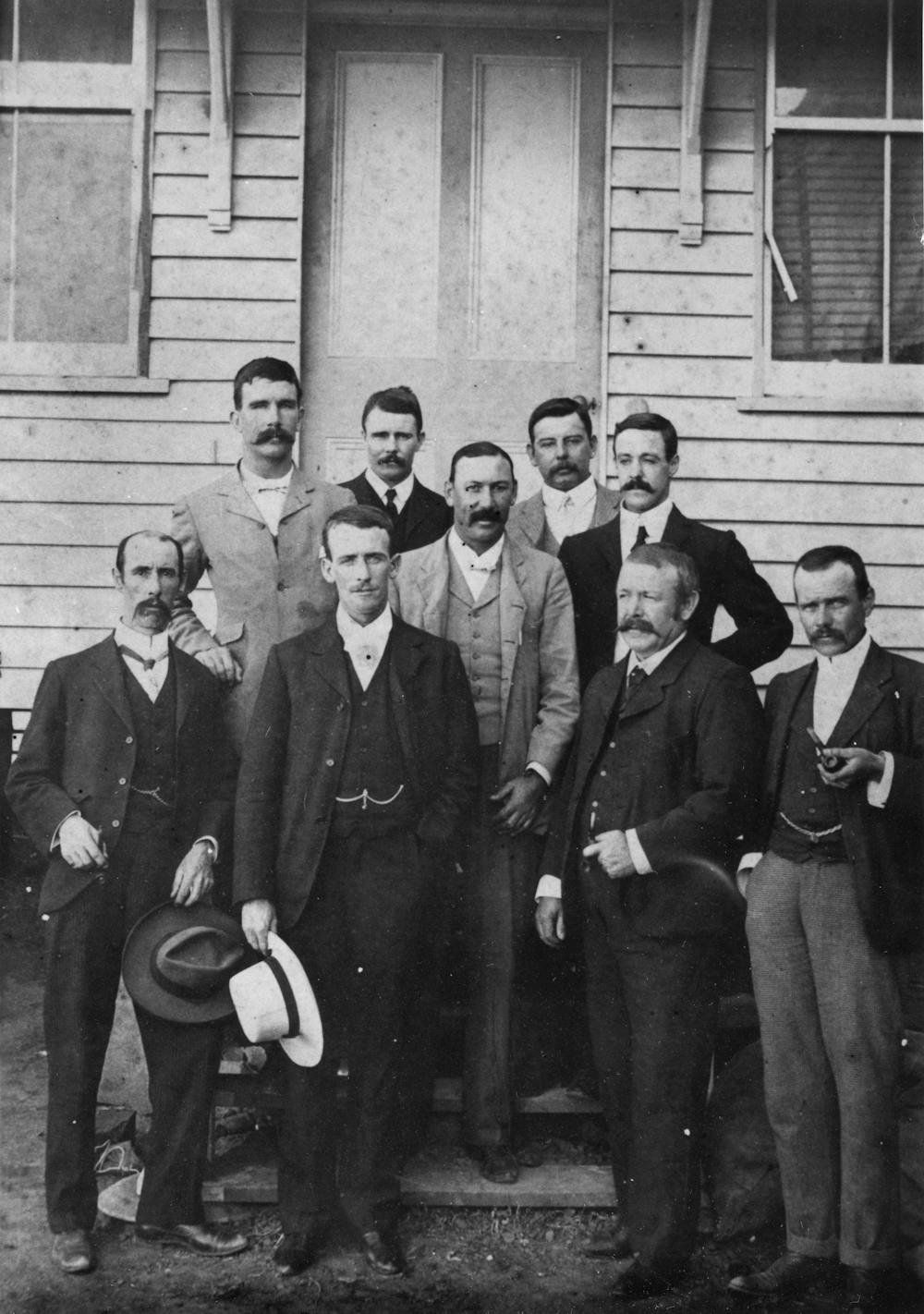
Men in suits circa 1900
Group of bank managers, stock and station agents dressed for work but not the weather, circa 1900. State Library Queensland

By the turn of the century, three-piece suits cut from the same dark-coloured woollen cloth were worn for work. These became known as “business suits”. They are strikingly similar to what we see businessmen wear today, though our contemporaries no longer wear them with stiff, detachable collars or watch chains.

As business suits became ubiquitous for city wear and office workers across Australia, working-men’s attire became increasingly practical. Those labouring in the sun or in roles demanding movement stripped back to shirts with their sleeves rolled up, or down to undershirts.

Women working in offices or shops donned lightweight blouses teamed with long, dark skirts. The fascinating history of their transforming workwear deserves a piece of its own.

Many men lamented that suits and ties were hot and stuffy by comparison, particularly in Australia’s summer months.

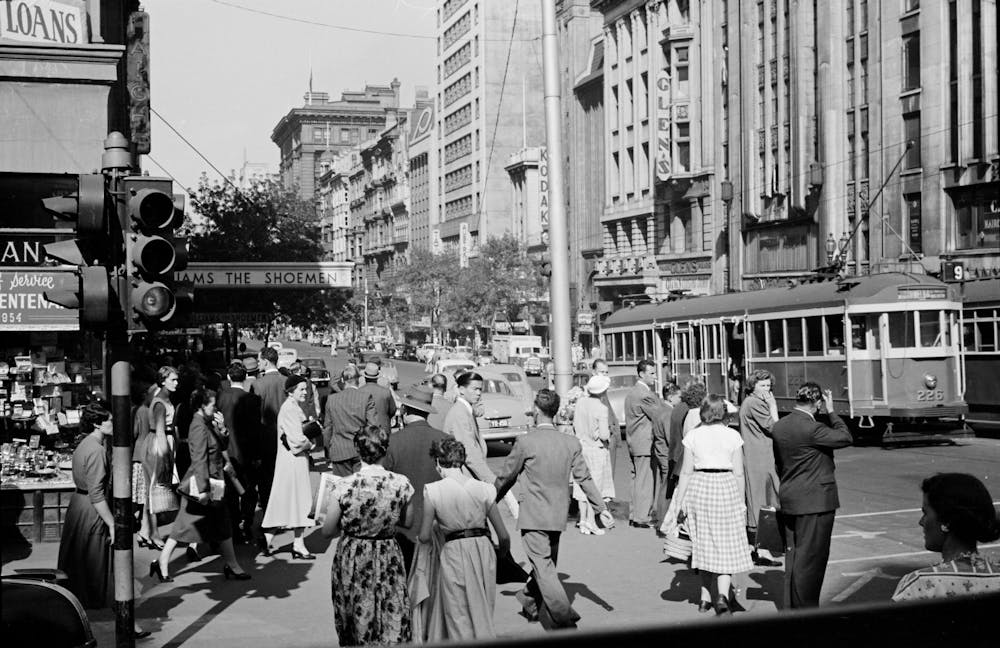
Street crowd in Melbourne 1950s
To the office via Collins Street in 1954. Mark Strizic/State Library of Victoria

Read more: The story of … the men’s white shirt


Rethinking men’s dress

There were calls for men’s “dress reform” from the early 20th century. Dress reform movements were not new at the time, nor were they confined to Australia or to men’s dress.

But war was a catalyst for change, when reformers emphasised health and hygiene over conservative, heavy suits and constrictive, tight collars. The aesthetics of men’s dress — dubbed drab, austere and colourless — also came under question.

As men returned to Australia from the first world war, commentators debated new ideas around colour, comfort and clothing that was better suited to Australia’s climate. Reformers advocated for different cuts to men’s clothing or swapping certain garments: jackets with knitted jumpers, for example, or stiff collars for looser versions that freed the neck to move.

But men in the city remained hesitant. Going without jackets and ties was undoubtedly more comfortable, but unprofessional against the dress codes of the day. As one young city worker expressed in late 1922, it made a man look “as if he were going to a picnic”.
When discussions around dress reform flourished in the aftermath of the second world war, they responded to shortages as much as to dressing for the heat. “Civvy suits” issued to returning servicemen from 1943 were in short supply. These suits were lampooned and despised when they looked cheap and badly made, but wool mills were stretched to their limits and tailors struggled to keep up with demand.

Two men in suits in 1947.
Dress reform aimed for comfort and style, exemplified by these chaps photographed for Pix magazine in 1947. Laurie Shea/Mitchell Library, State Library NSW and Courtesy ACP Magazines Ltd

Into this void, some suggested men adopt sportswear for their return to the office — a more comfortable alternative men deserved after long years of war and austerity. This form of sportswear referred to jackets and trousers sold as separates and worn in different colour combinations, or woollen cardigans and jumpers.

An example was photographed in 1947 for Pix magazine. It captured two young men breezily strolling along Sydney’s Martin Place in open-neck shirts and loose or safari-style jackets. The photograph’s caption noted that they looked “cool, smart and comfortable” unlike “conservative” men in suits left to “swelter in the heat”.

Though suits continued to be worn by many office workers, this set in place the move towards more casual dress that would resonate across decades to come.

People in suits in modern boardroom.
The idea of a room full of suits, standing so close together, seems dated post-lockdown. Shutterstock

Read more: Fashioning blue-collars: chambray shirts and indigo-dyed workwear


Post-pandemic office wear

Lockdown has again transformed our dress as we’ve tested new combinations of comfortable clothes while working from home — variously labelled “slob chic” and the “lockdown look”, with fancy dress days to keep things interesting.

Sales of athleisure and activewear brands spiked in 2020 thanks to massive sales of tracksuits and the like. The trade in locally made sheepskin boots also reportedly boomed.

Man at home with laptop, suit and slippers on. Feet on desk.
Working from home stretched the limits of what could be called business attire. Shutterstock

Read more: COVID-19 could have a lasting, positive impact on workplace culture


Some forecast our penchant for relaxed clothing will ripple through office dress protocols this year in a move to something akin to casual Fridays.

While it’s unlikely the tracksuit will replace the suit just yet, looser styles, freer tailoring and lighter fabrics would be another step along the path suggested by dress reformers a century ago.

ref. Dressed for success – as workers return to the office, men might finally shed their suits and ties – https://theconversation.com/dressed-for-success-as-workers-return-to-the-office-men-might-finally-shed-their-suits-and-ties-153455

With the US now calling China’s treatment of the Uyghurs ‘genocide’, how should NZ respond?

Source: The Conversation (Au and NZ) – By Alexander Gillespie, Professor of Law, University of Waikato

New Zealand has a strong history of protecting and promoting human rights at home and internationally, and prides itself on being an outspoken critic and global leader in this area. So, when the most serious accusation of human rights abuse — genocide — is made of one of its friends, how to respond?

This is precisely the situation now regarding China.

One of the final acts of the Trump administration was to bequest to incoming president Joe Biden the formal assertion that China had committed genocide against the predominantly Muslim Uyghurs and other ethnic and religious minorities in the Xinjiang region.

This would be a difficult position to reverse for Biden, even if he wanted to, although it appears the new administration has no such intention. Biden’s nominee as Secretary of State, Anthony Blinken, is also calling China’s Uyghur policy “genocide”.

In response to the Trump initiative, China sanctioned 28 “lying and cheating” Trump officials, labelling the accusation a “bold faced lie”.

But for now, the US has taken the lead on the issue. Canada came close but backed away from any formal finding of genocide. Britain, while also expressing concern, avoided labelling the “utterly abhorrent” treatment of the Uyghurs as genocide.


Read more: China is building a global coalition of human rights violators to defend its record in Xinjiang – what is its endgame?


Australia is also avoiding the description, but is leaving the door open to introducing penalties for Australian companies that source products made using forced labour in Xinjiang.

Defining genocide

New Zealand is now under pressure to make a stand and to endorse the use of the term genocide to describe China’s treatment of the Uyghurs.

But there is good reason why nations are cautious when it comes to such accusations. In law, genocide is strictly defined as the “intent to destroy, in whole or in part, a national, ethnical, racial or religious group”.

This can involve killing members of the group, causing serious bodily or mental harm to its members, or deliberately inflicting conditions of life calculated to bring about its total or partial physical destruction.

Genocide can also be committed by imposing measures intended to prevent births within a group, and/or forcibly transferring children to another group.

The crime is specifically prohibited by the Genocide Convention, framed after the horrors of the Holocaust during WWII. It later became one of the core crimes the International Criminal Court (ICC) would focus on.

While China is accused of actions that would seem to meet the definition, the problem is gathering the evidence.

The burden of proof

Despite the assertions of the outgoing Trump administration, the situation in China is complicated by the lack of reputable, non-partisan, independent verification of human rights violations.

Furthermore, independent verification is easier said than done, especially given China’s footwork in international law, and the reluctance of other countries to criticise its human rights record.

That support for China has included allowing friendly countries to visit the disputed areas and report back reassuringly that there is no Uyghur problem.

In October last year, those countries also helped elect China for a new term on the UN Human Rights Council — effectively allowing Beijing to block the likeliest avenue for challenging its Uyghur policies.


Read more: Explainer: who are the Uyghurs and why is the Chinese government detaining them?


The second possible route, via the ICC, has also come to nothing because the court has refused to entertain the charge, on the grounds the alleged acts happened in China, which is not a signatory to the ICC.

Thirdly, the International Court of Justice is unlikely to resolve the dispute under the Genocide Convention; although China is a signatory, it has registered a “reservation” and “does not consider itself bound” by the relevant article.

An alternative strategy

Given these obstacles, what should New Zealand do? Rather than making pronouncements about genocide, the most effective response would involve trying to establish the substance of the US assertions, at the same time as giving China a chance to make its case and clear its name.

A pathway to achieve this emerged in June last year when 50 UN independent experts, driven by multiple human rights concerns, called for decisive measures to protect fundamental freedoms in China. Echoed by 321 civil society groups, they recommended an independent international mechanism to focus on China’s alleged human rights violations.

The independent experts pointed out that, unlike more than 120 other states, the Chinese government (which has signed most of the key human rights treaties) has not issued a standing invitation to independent UN experts to conduct official visits.


Read more: China must not shape the future of human rights at the UN


Rather, despite many requests over the past decade, China has permitted only five visits to investigate rights involving food, discrimination against women and girls, foreign debt, extreme poverty and older people.

New Zealand should strongly support, publicly and diplomatically, and help in any way it can, China becoming more transparent and improving its credibility on human rights. This would involve inviting independent observers with the status and mandate to monitor civil and political rights, roam freely and speak to anyone, and report what they find.

China may find such proposals challenging, but they are better than being accused of genocide. Not to accept a compromise will only amplify diplomatic, economic and military tensions with the US and its Five Eyes security allies.

Only independent assessment by mandated experts can prove China is compliant with its existing international commitments to protect the human rights of all its citizens — and, if so, whether the US assertion of genocide is wrong or right.

ref. With the US now calling China’s treatment of the Uyghurs ‘genocide’, how should NZ respond? – https://theconversation.com/with-the-us-now-calling-chinas-treatment-of-the-uyghurs-genocide-how-should-nz-respond-153717

My favourite detective: Jules Maigret, the Paris detective with a pipe but no pretence

Source: The Conversation (Au and NZ) – By Véronique Duché, A.R. Chisholm Professor of French, University of Melbourne

In this series, writers pay tribute to fictional detectives on the page and on screen.


When I first heard that Rowan Atkinson was to put on Maigret’s velvet-collared overcoat, I wondered if it was une farce. Johnny English in the role of Paris’s best-known detective, a bulky, stocky and rather taciturn policeman! What a terrible miscast, I thought.

When I watched the film, I was expecting at any time for Mr Bean to take over – sticking out his tongue or exploding his pipe.

Penguin

I grew up with Maigret, Georges Simenon’s character. I was introduced to him via television, with actors such as Jean Richard or Bruno Cremer. Then I hungrily read his books. Not all of them – the writing of the Maigret saga extends over more than 40 years, presenting the commissaire in 103 novels and short stories, swiftly translated into 41 languages.

Prolific and ambitious

A prolific writer, Simenon published on average six novels per year. He could write a book in 11 days: eight days for the composition and three for the correction. (Simenon, prolific in more ways than one, claimed to have slept with more than 10,000 women.)

Simenon wrote accessible texts, with short sentences and simple vocabulary. He explained in a 1975 interview:

It is better to use as few words as possible and especially as few abstract words as possible.

Man with pipe
French author Georges Simenon in 1965. Jac. de Nijs/Nationaal Archief/Wikimedia Commons, CC BY-SA

He employed a classic trick to catch the reader: stopping a chapter in the middle of the action, to keep them reading the following chapter.

Born in 1903, Simenon died more than 30 years ago, but his books are still selling. He started as a journalist in 1930s Belgium and wrote pulp fiction. Then the Maigret books became a bridge between popular potboilers and the more serious books he aspired to write, what he called his romans durs, or hard novels.

He was mentored by French author and trailblazer Colette. André Gide was a lifelong fan, as were William Faulkner and Muriel Spark. All up, he wrote nearly 200 novels, over 150 novellas, autobiographical works, articles, in addition to his early pulp fiction under pseudonyms. Roughly 550 million copies of his works have been printed.


Read more: Friday essay: the meaning of food in crime fiction


An intuitive investigator

Comprendre et ne pas juger” (understand and judge not), was said to be Simenon’s motto. Accordingly, he built his oeuvre around psychological investigations. The motto can be applied as well to his detective hero. Biographer Lucille Becker notes Simenon writes “impressionistic notations of subtle psychological states, sensory impressions, and minute details of everyday life”.

Sucking on his pipe, Maigret observes from a distance, inhaling the soul of people and places. Then he slowly closes in. He does not use forensic science and is more intuitive than procedural — to the disappointment of a Scotland Yard detective wanting to study “Maigret’s methods”.

Je pense si peu vous savez,” he confesses, meaning “I think so little”.

When he is ready to confront the killer, he invites them to his office at the Police judiciaire, 36 quai des Orfèvres and prepares six pipes which he aligns on his desk in preparation for a long exposition.

While Penguin Classics just finished the six-year project to reissue the Maigret series in its entirety — all fresh new translations — radio plays and comics continue to promote the investigations of the legendary sleuth.

No sign of Mr Bean in Rowan Atkinson’s Maigret.

The movie industry from the start was interested — with directors such as Jean Renoir or Claude Autant-Lara, and actors such as Jean Gabin and Brigitte Bardot involved. But it is in television that Maigret gives the best of himself, in a “happy alliance between genre and medium” writes academic Barbara Stone.

In France as well as in UK, Italy or Germany, and Japan, the Maigret series are successful. Actors Jean Richard (92 episodes), Bruno Cremer (54 episodes), Michael Gambon (12 episodes), Rupert Davies (52 episodes), Jan Teulings (12 episodes), Gino Cervi (16 episodes), Kinya Aikawa (25 episodes), and even Rowan Atkinson (4 episodes) have introduced the audience to the guilty secrets of Paris and small-town France.


Read more: My favourite detective: why Vera is so much more than a hat, mac and attitude


So Frenchy, so simple

Screen adaptations rarely modernise the setting. Apart from the French director Claude Barma who translated Maigret in the contemporary 1970s, they offer period pieces of picturesque nostalgia set in the 1950s.

Simenon’s world “of second-class hotels and third-class railway carriages, of drifters, bargemen, tarts and luckless creditors” is rendered in a misty and gloomy atmosphere where ambiguity reigns.

Penguin

Maigret shifts chameleon-like between a broad range of social groups. A defender of bourgeois values, he acts as a mediator and arbitrator between conflicting social classes.

Social criticism however is limited to individual cases and Maigret demonstrates a real empathy for the victim and for the petites gens (small people). That’s why Maigret is still relevant today.

Writer and critic Ian Thomson positions him as the “archetypal fictional detective of the 20th century and a template for Inspector Morse, Kurt Wallander and any pensive sloggers on the beat”.


Read more: My favourite detective: Kurt Wallander — too grumpy to like, relatable enough to get under your skin


Maigret has an avuncular role as patron to his underlings, is a good husband to Madame Maigret and enjoys a beer with his preferred meal, veal stew, at the Brasserie Dauphine. Nothing flamboyant or exuberant about him. Maigret, the French detective.

ref. My favourite detective: Jules Maigret, the Paris detective with a pipe but no pretence – https://theconversation.com/my-favourite-detective-jules-maigret-the-paris-detective-with-a-pipe-but-no-pretence-150747

Bryan Kramer: How many PNG police chiefs have had a degree? None

COMMENT: By Bryan Kramer, PNG’s Minister of Police who has defended Commissioner Manning’s appointment today in The National

My last article, announcing that I intend to make a submission to the National Executive Council (NEC) to amend the Public Service regulation to no longer require the Commissioner of Police to hold a tertiary degree, prompted a number of readers to suggest this would be an act nepotism, corruption and self-interest.

While I found these claims rather amusing, they are also disturbing as it shows some people are either genuinely ignorant of the issues, or just plain stupid.

What is the regulation that stipulates a person must obtain a tertiary degree to qualify for the appointment of Departmental Head (Secretary of Department)?

In 2003, the NEC approved a regulation called the Public Service (Management) Minimum Person Specification and Competence & Regulations for Selection and Appointment of Departmental Heads and Provincial Administrators.

This regulation provided that any person applying for a position of Departmental Head or Provincial Administrator must meet a number of minimum requirements to be considered for the appointment. These requirements number more than 18 and include everything from minimim tertiary education, over age of 35, management experience and skills to health and fitness.

So there is no confusion, this regulation was proposed by the Department of Personnel Management as the agency responsible for Public Service through the Minister of Public Service for NEC’s approval.

While Acts of Parliament (laws) are subject to approval by Parliament, regulations are approved by NEC.

Regulations like bylaws
Regulations are like bylaws to an Act of Parliament and are intended to provide more detailed processes and procedures when implementing provisions or sections of an Act (law).

When NEC introduced the regulation specifying the minimum requirements for persons to be appointed to be Departmental Head and Provincial Administrators, did it intend the regulation to apply to the Commissioner of Police?

The National 250120
Yesterday’s The National front page reporting on the reformist police chief’s post being “in limbo”. Image: APR screenshot of The National

Short answer, in my respectful view, is No.

My evidence to support this view is that NEC appoints the Commissioner of Police and, if it intended the Commissioner of Police to be subject to the regulation, then it would have applied it to every Commissioner of Police appointed since 2003.

The same can be said about the Department of Personnel Management which proposed the regulation in the first place and would have otherwise applied it in the shortlisting of candidates for the position.

Since the introduction of the regulation, how many Commissioners of Police have had a tertiary qualification?

Short answer is none.

PNG police chiefs
Papua New Guinea’s police commissioners since 1976. Graphic: The National

Six post-regulation appointments
Since the introduction of the regulation by NEC there have been six appointments to Commissioner of Police. Not one has possessed a tertiary degree.

In fact, since 1945 more than 23 people have served as Commissioner of Police and only one of them possessed a tertiary education – Peter Aigolo, 1997-1999.

It is the role of Members of Parliament to pass legislation, NEC to pass regulation and the court to interpret and uphold law consistent with its intended meaning, purpose and Constitutional law.

The Supreme Court has held in numerous of its judgements over the years that, when interpreting laws passed by Parliament, it is important to understand and consider the intent of the legislature when they introduced the law.

In this case, the question is did the NEC intend the regulation to be applied to the appointment of Commissioner of Police?

Based on the above evidence, my respectful view is No.

I don’t believe this evidence or argument was raised before the National Court to assist the Court in arriving at its decision. Perhaps it was the case of those drafting the regulation failing to make it clear.

The decision of the National Court is not final, as the Commissioner of Police may exercise his right to appeal the decision to the Supreme Court for a three-man bench to review the decision.

NEC may also exercise its Constitutional powers to correct any confusion in the application of the regulation to make it consistent with its intended purpose.

The decision to introduce regulation, rescind, amend or correct it, including in the appointment of the Commissioner of Police, lies with NEC.

Republished from Police Minister Bryan Kramer’s personal blog. The original headline on this article was: “Where did minimum requirements for Chief of Police come from?” Asia Pacific Report often republishes Minister Kramer’s articles.

Print Friendly, PDF & Email

Article by AsiaPacificReport.nz

NZ covid: 14 close contacts of Northland case test negative

New Zealand’s Covid-19 Response Minister Chris Hipkins has revealed that 14 close contacts of the Northland community case have returned negative test results.

Yesterday he announced two close contacts – her husband and hair dresser – were negative.

In his tweet, Hipkins described the news as “encouraging”.

However, New Zealand should be ready to move alert levels if there is an outbreak of the new covid-19 South African variant, says a leading modeller of the pandemic.

Auckland University professor Shaun Hendy said more data on the Northland community case was expected soon.

He compared the Northland community case with the Auckland August cluster but said the new covid variants were more transmissible meaning if an infected person could infect two more last year, this year they might infect three.

Accummulating evidence
There was accumulating evidence that the new variant spread far more easily, he said.

On 12 August 2020, Auckland moved to alert level 3, while the rest of the country moved to level 2.

“That just means the sort of restrictions we used last year in August in Auckland wouldn’t be as effective in containing the outbreak.”

However, Dr Hendy said with this case it was “highly unlikely” the country would need to move alert levels the same way; partly because the source of last year’s transmission was not identified.

The positive case of the Northland woman can be traced back to the MIQ facility.

“The chances of there being a large number of cases at this stage that we don’t know about or that we’re unable to track are quite slim.”

He said it was not inevitable that there would be leaks at the border.

‘We need to be prepared’
“We need to be prepared for another Auckland August situation.”

Dr Hendy suggested another test five days after a person left an MIQ facility.

Australia suspended quarantine-free travel for New Zealanders for at least 72 hours after confirmation yesterday New Zealand has a case of the South African variant of covid-19.

PM Jacinda Ardern said she had advised her Australian counterpart Scott Morrison that this country had confidence in its systems and processes.

However, she said it was Australia’s decision as to how it managed its borders.

This article is republished under a community partnership agreement with RNZ.

Article by AsiaPacificReport.nz

RSF condemns Google for dropping Australian media searches in ‘tests’

Pacific Media Watch newsdesk

Reporters Without Borders (RSF) has condemned the arbitrary and opaque experiments that Google is conducting with its search engine in Australia, with the consequence that many national news websites are no longer appearing in the search results seen by some users.

The Australian, ABC, Australian Financial Review, The Age, The Guardian Australia and The Sydney Morning Herald are among the media outlets that have not appeared in the search results of around 1 percent of Australian users since January 13, the date on which Google admits that it began its “experiments”.

The experiments are supposedly intended to measure the correlation between media and Google search and are due to end at the start of February.

Neither the media outlets nor Google search users were notified in advance of the consequences of the experiments, namely that they would be deprived of their usual access to many news sources.

“The platforms must stop playing sorcerer’s apprentice in a completely opaque manner,” said Iris de Villars, the head of RSF’s Tech Desk.

“Most Australians use Google to find and access online news, and these experiments confirm the scale of the power that platforms like Google exercise over access to online journalistic content, and their ability to abuse this power to the detriment of the public’s access to information.

“They have a duty to be transparent and to inform their users, a duty that is all the greater in the light of the impact that the current and future experiments can have on journalistic pluralism.”

Thousands of tests every year
Google conducts tens of thousands of tests on its search engine every year.

The experiments that Google and other platforms carry out usually test design changes, algorithmic modifications or new functionalities on some of their users in order to study how they behave and to guide future changes.

This is not the first time one of these experiments has impacted on journalistic pluralism.

Facebook, for example, tested a new functionality called “Explore” in six countries – Bolivia, Cambodia, Guatemala, Serbia, Slovakia and Sri Lanka – from October 2017 to March 2018.

This experiment, in which independent news content was quarantined in a not-very-accessible secondary location, had a disastrous impact on journalistic pluralism in these countries, with traffic to local media outlets falling dramatically.

In Cambodia, many citizen-journalists lost a large chunk of their readers, with the result they had to pay to restore traffic to their sites.

Google’s experiments in Australia have come at a time of tension between the platforms and the Australian government, which has a proposed new law, called the News Media Bargaining Code, under which platforms such as Google and Facebook would have to share advertising money with media companies.

The two tech giants have reacted to the proposal with hostility. Facebook has said it would prevent Australian media outlets and users from sharing journalistic content on its Facebook and Instagram platforms, while Google has added a pop-up message to its search results warning Australian users that “your search experience will be hurt by new regulation”.

When asked about the details of these experiments, their purpose and about transparency towards media outlets and users, Google just referred RSF to an existing, general press release.

Pacific Media Watch collaborates with Reporters Without Borders.

Print Friendly, PDF & Email

Article by AsiaPacificReport.nz

A new 3D koala genome will aid efforts to defend the threatened species

Source: The Conversation (Au and NZ) – By Parwinder Kaur, Associate Professor | Director, DNA Zoo Australia, University of Western Australia

Koalas are unique in the animal kingdom, living on a eucalyptus diet that would kill other creatures and drinking so little their name comes from the Dharug word gula, meaning “no water”. Today, many koala populations across Australia are in decline, due to habitat destruction caused by agriculture, urbanisation, droughts and bushfires intensified by climate change, and diseases such as chlamydia and koala retrovirus.

Genetic information can play a key role in the effort to conserve koalas and other species. A detailed map of the koala genome is vital to understanding their susceptibility to disease, their genetic diversity, and how they may respond to new environmental pressures.

We have created a new “chromosome-length” sequence of the koala genome, which will allow researchers to study its three-dimensional structure and understand its evolution.


Read more: Drones, detection dogs, poo spotting: what’s the best way to conduct Australia’s Great Koala Count?


A koala sits in a bucket.
Genetic information can play a key role in the effort to conserve koalas and other species. AAP Image/Joel Carrett

A unique creature under threat

The modern koala is the only living representative of the marsupial family Phascolarctidae, a family that once included several genera and species. During the Oligocene and Miocene epochs (from 34 to 5 million years ago), the ancestors of modern koalas lived in rainforests and didn’t eat only leaves.

During the Miocene, the Australian continent began drying out, leading to the decline of rainforests and the spread of open eucalyptus woodlands. Koalas evolved several adaptations that allowed them to live on a specialised eucalyptus diet. This specialisation makes them picky eaters, so they’re very prone to habitat loss.

Koalas are listed as a vulnerable species by the International Union for Conservation of Nature. It was hunted heavily in the early 20th century for its fur, and large-scale cullings in Queensland resulted in public outcry, initiating a movement to protect the species. Sanctuaries were established, and koalas whose habitat was disappearing were relocated.

Koalas are particularly vulnerable to bushfires; they are slow moving and eucalypt trees are very flammable. They instinctively seeks refuge in higher branches, exposing them to intense heat and flames. Bushfires also fragment the animal’s habitat, which restricts their movement and leads to population decline and loss of genetic diversity.

Piecing together the puzzle

The koala genome was first sequenced in 2013. This was only the first step in understanding koala genetics — akin to finding all the pieces of the puzzle, but being unsure how to put them all together into the meaningful patterns of genes and chromosomes.

Our new chromosome-length assembly follows the work of others, especially the Koala Genome Consortium and the Koala Genome Project led by Australian geneticist Rebecca Johnson. It is based on a draft by the Earlham Institute in the UK.

We used big-data sequencing methods such as Hi-C, 3D-DNA and Juicebox Assembly Tools courtesy of DNA Zoo labs to create our chromosome-length assembly.

We organised the genome into 16 chromosomes, a great improvement on the draft of 1,907 fragments we began with.

Vital for conservation

A high-quality genome sequence is essential if we want to bring genetic insights to conservation management initiatives. Some 200 Australian vertebrate species currently have species recovery plans, and 80% of those plans include genome-based actions. However, only 15% of those species have any genomic data available.

Our chromosome-length koala genome assembly enables a highly detailed 3D view of the genome architecture for koala. It is easier to use than earlier genomes, and means conservation management initiatives will have fast, cost-effective and reliable analysis options available.

This will give us insights into koalas’ genetic susceptibility to diseases like koala retrovirus (KoRV) and chlamydia. It may also form a basis for innovative vaccines. What’s more, it can be used in new conservation management strategies that aim to diversify the koala gene pool.


Read more: To save koalas from fire, we need to start putting their genetic material on ice


ref. A new 3D koala genome will aid efforts to defend the threatened species – https://theconversation.com/a-new-3d-koala-genome-will-aid-efforts-to-defend-the-threatened-species-153873

Burnt ancient nutshells reveal the story of climate change at Kakadu — now drier than ever before

Source: The Conversation (Au and NZ) – By S. Anna Florin, Research fellow, University of Wollongong

Archaeological research provides a long-term perspective on how humans survived various environmental conditions over tens of thousands of years.

In a paper published today in Nature Ecology and Evolution, we’ve tracked rainfall in northern Australia’s Kakadu region over the past 65,000 years. We wanted to know how major changes in rainfall may have affected the region’s Aboriginal communities through time.

Our findings suggest the Kakadu region wasn’t as prone to dry spells as surrounding areas — and it likely functioned as a place of refuge for early Australians as they struggled through harsh and arid conditions.

Learning lessons from leftovers

To generate a rainfall record spanning 65,000 years, we used ancient food waste left behind by the First Australians living at Madjedbebe, a rock shelter on Mirarr country in the Kakadu region.

This site boasts the earliest known evidence of humans living in Australia. It also boasts plenty of Pandanus spiralis, a native plant commonly called “pandanus” or “screw pine”.

This plant, known as “anyakngarra” to the Mirarr people — the Traditional Owners of Madjedbebe — is very important to them.

Anyakngarra fruit grows on a tree.
Anyakngarra (Pandanus spiralis) fruit. The tree is native to northern Australia and ubiquitous around the Top End’s waterholes and floodplains. Author provided

Its leaves are used for weaving, its trunk to create dye, its fruit flesh is used in a drink and its nuts (the seed kernels within the fruit) are consumed as a rich source of fat and protein.

Anyakngarra’s nuts were also eaten by the First Australians 65,000 years ago. Discarded nut shells have been preserved as burned fragments, disposed of in fireplaces over time.

These small remnants have proven hugely useful for our research team, which includes archaeologists, environmental scientists and Traditional Owners.


Read more: 65,000-year-old plant remains show the earliest Australians spent plenty of time cooking


In a nutshell

By analysing the isotopic composition in ancient anyakngarra nutshells, we could track rainfall at Madjedbebe. Specifically, we detected how much water (and therefore rainfall) was available to anyakngarra plants in the past.

This analysis is possible due to photosynthesis – the process by which plants convert carbon dioxide in the air into sugars. Anyakngarra plants absorb two isotopes of carbon from the atmosphere: ¹²C and ¹³C. Isotopes are different types of atoms within a chemical element that have the same number of protons but a different number of neutrons. Chemically, the isotopes of carbon are the same, but each has a different atomic “weight”.


Read more: Explainer: what is an isotope?


When environmental conditions are favourable, an anyakngarra plant will preferentially absorb more ¹²C than ¹³C. But if a plant is stressed by its environment, such as when it’s waterlogged due to seasonal flooding, it begins to absorb more ¹³C.

The isotopic composition (the ratio of ¹²C to ¹³C) is recorded in the sugars used by the plant for new tissue growth, including for the seasonal growth of nuts.

A higher proportion of ¹³C in a nutshell indicates that the plant it came from was waterlogged during its growth season. From this, we can conclude it likely experienced higher levels of rainfall.

Anyakngarra fruit.
Pictured is the anyakngarra fruit, which has a fleshy section (now dried and fibrous) a hard nutshell and multiple white seeds (or nuts) inside. Author provided

Like an oasis in a desert

Over the past 72,000 years, humans have lived through an ice age in which there were two particularly cold periods called “stadials”. During stadials, glaciers extended to cover parts of North America, northern Europe, northern Asia and Patagonia (in South America).

The height of the second stadial in this ice age was called the Last Glacial Maximum. While this occurred 22,000 to 18,000 years ago, intense cold and dry conditions in Australia started as early as 30,000 years ago.

During this time, water availability was the main challenge in arid northern Australia (rather than low temperatures). The country’s arid zone expanded dramatically and parts of central Australia may have been temporarily abandoned by Aboriginal people.

Yet the “palaeoclimatic” record we generated for Madjedbebe indicates that, although glacial stages did lead to less rainfall, the Kakadu region remained relatively well-watered during these periods.

Our records show that for as long as people have been around, rainfall at Madjedbebe is unlikely to have dropped below current levels. Thus, this area would have helped early Australians survive during long dry spells and may have also attracted others from surrounding areas.

A site at the Madjedbebe is rock shelter in the Northern Territory.
This is our research site, the Madjedbebe rock shelter in the Alligator Rivers region of the Northern Territory. Dominic O’Brien/Gundjeihmi Aboriginal Corporation, Author provided

Changing with the seasons

Our findings are supported by other archaeological evidence from Madjedbebe. For instance, our research has revealed more stone tools were left at this site during the glacial periods. This implies more people gathered there at these times.

Also, because the Kakadu region was still drier during glacial periods as compared to inter-glacial periods, people had to travel further for food and other important resources.


Read more: Buried tools and pigments tell a new history of humans in Australia for 65,000 years


This is supported by evidence of an increased number of tools being brought to the site from further away. This points to increased mobility and new social arrangements being made as people adjusted to life in a harsher environment.

The challenge moving forward

Notably, over the past 65,000 years the driest time in the Kakadu region was not during the Last Glacial Maximum. It is today.

Rather than being the result of less rainfall occurring, this is likely due to higher evaporation caused by warmer inter-glacial temperatures. Aboriginal communities currently living in the Kakadu region are experiencing unprecedented aridity.

These difficult conditions are exacerbated by the threat of invasive plants and animals and disruption to cultural practices of landscape management, such as vegetation burning.

While the people of Kakadu have spent thousands of years adapting to environmental change, the scale and intensity of today’s anthropogenic impacts on regional climates and local landscapes poses an altogether different challenge.

ref. Burnt ancient nutshells reveal the story of climate change at Kakadu — now drier than ever before – https://theconversation.com/burnt-ancient-nutshells-reveal-the-story-of-climate-change-at-kakadu-now-drier-than-ever-before-152760

Auf Wiedersehen, ‘Mutti’: How Angela Merkel’s centrist politics shaped Germany and Europe

Besuch Bundeskanzlerin Angela Merkel im Rathaus Köln

Source: The Conversation (Au and NZ) – By Binoy Kampmark, Senior Lecturer in Global Studies, Social Science & Planning, RMIT University

Besuch Bundeskanzlerin Angela Merkel im Rathaus Köln

Since 2005, Germany’s Chancellor Angela Merkel has been one of the most stable and enduring of political forces, both in Europe and on the global stage. During her 16 years as leader, she has won four elections for her conservative Christian Democratic Party (CDU), faced the European refugee crisis, the global coronavirus pandemic, the threat of European populism, and challenging leaders such as US President Donald Trump and Russia’s Vladimir Putin.

In September 2021, when the German elections will be held, one of the longest serving leaders of postwar Europe will leave office. She does so having steered Germany from being a “sick man of Europe” to becoming the world’s fourth largest economy.

She leaves her country and Europe with her own singular brand of “Merkelism”: the pragmatic politics of the centre marked by managing alliances and eliminating rivals; a considered pro-Europeanism and a belief in transatlantic relations; and a specific form of at times indecisive incrementalism.


Read more: How Angela Merkel has become – and remains – one of the world’s most successful political leaders


She ‘waits and waits’

For sociologist Wolfgang Streeck, Merkel is

a postmodern politician with a premodern, Machiavellian contempt for both causes and people.

Educated in the communist former East Germany (DDR), she mastered the art, claimed biographer and Der Spiegel deputy editor-in-chief Dirk Kurbjuweit, of governing by silence, being cautious, and at times inscrutable, with her words:

She waits and waits to see where the train is going and then she jumps on the train.

In 2003, she pushed her conservative party into the choppy waters of deregulation and neo-liberal economics, a move that almost lost her the election to the Social Democrat Gerhard Schröder, another market “reformer” who arguably set the conditions she would thrive in. After becoming chancellor, she proceeded to clean the party stables of neo-liberals and become a key centrist, with the assistance of the Grand Coalition comprising the remains of the Social Democratic Party (SDP).

In domestic policy, she abolished military conscription, accepted, after initial reservation, single-sex marriage, and supported the introduction of a minimum wage in 2015. In approaching COVID-19, she demonstrated enviable skills in crisis management, leading to approval ratings of 72%.

Crisis management also marked her European policy, notably in saving the euro during the global financial crisis of 2009. But this came with its costs, with Merkel devoted to balancing the books and maintaining tight budgets to preserve the monetary union. Indebted countries such as Greece risked bankruptcy and a possible exit from the Eurozone.

Merkel, through her stern Finance Minister Wolfgang Schäuble, insisted on austerity measures in bailout negotiations. Greece would eventually be aided at the expense of its financial sovereignty.

Merkel’s ability to morph has served her well

Throughout her chancellorship, Merkel has been able to change course abruptly to suit the political mood. Having convinced the Bundestag that phasing out nuclear energy born from the Red-Green coalition of 2001 was bad (an extension of operating times by eight to 14 years was proposed), Merkel proceeded, in the aftermath of the 2011 Fukushima Daiichi nuclear disaster, to order the closure of eight of the country’s 17 nuclear plants with a despot’s urgency.

This became the prelude to the policy of Energiewende, the “energy transition” aimed at phasing out all nuclear power plants by 2022 and a sharp shift towards decarbonising the economy.

Merkel the shape-changer was again on show during Europe’s refugee crisis. She showed much initial enthusiasm in 2015 for new arrivals, ignoring both German and EU law mandating registration in the first country of entry into the EU before seeking resettlement within the zone. Refugees gathered in Budapest were invited into Germany as part of “showing a friendly face in an emergency”.

Merkel’s ‘friendly face’ towards refugees in 2015 did not last long. AAP/EPA/Sebastian Kahnert

This friendly face did not last long. A riot marked by rampant sexual assault at Cologne Central Station on New Year’s Eve in 2015, a good deal of it captured on smart phones, served to harden her approach to the new arrivals. She promised more deportations and reining in family reunification rules.

Germany’s place in the world

In various areas of foreign policy, Merkel has also left her centrist, and at times inconsistent, mark. Russia’s annexation of Crimea in 2014 led to her persuading the EU to impose sanctions on Moscow. She has also been a critic of Putin’s human rights record, notably towards dissident and opposition figures. But such human rights criticism comes with limits. The controversial Nord Stream 2 gas pipeline, which will increase German dependence on Russian energy, has not been stopped.


Read more: Germany’s (not so) grand coalition may cause ripple effects on European refugee policy


Towards China, the chancellor has also taken divergent, at times eyebrow-raising approaches. The security risks of Chinese 5G telecommunications have been rebuffed, with Germany making an agreement with Huawei to build 5G networks in the country subject to safeguards. Merkel was also instrumental in pushing through an EU-China investment deal, despite criticism of Beijing’s human rights record towards Hong Kong protestors and the long-suffering Uighur minority. As Judy Dempsey observes,

Merkel’s support for human rights and the rule of law doesn’t square with her policy towards China.

Like Merkel’s mentor Helmut Kohl was to discover, staying power is never eternal. Kohl lasted eight years as chancellor of West Germany before leading a united Germany for another eight. It is worth recalling who laid the final, cleansing blow to Kohl’s leadership in the wake of the anonymous donations scandal known as the Schwarzgeldaffäre: a certain Angela Merkel’s December 1999 contribution to the Frankfurter Allgemeine Zeitung calling for her former patron’s resignation and political banishment. “I brought my killer,” reflected Kohl ruefully. “I put the snake on my arm.”

An undated photo of Merkel, then women and youth minister, beside Chancellor Helmut Kohl. AAP/AP

Merkel has also found that power, in time, wears out those who wield it. Critics, such as Friedrich Merz, former leader of the chancellor’s parliamentary caucus, and Roland Koch, former minister president of Hesse, became bolder. Interior Minister Horst Seehofer was particularly critical of Merkel’s refugee policies.

The far-right Alternative für Deutschland (AfD) now has a foothold in all 16 regional parliaments. The Greens have been polling strongly, while the Left Party and Free Democrats have doggedly maintained their presence. The day after the poor showing in the state elections in Hesse, Merkel announced she would not be seeking re-election as leader of the Christian Democrats. Nor would she be running again as chancellor in 2021.

Now, the CDU has another leader, Armin Laschet, who is very much committed to the centrist brand of politics Merkel made famous. Whether he becomes the next chancellor is far from assured. Markus Söder, the Bavarian premier, is far more popular.

However, Laschet’s presence suggests that Merkelism, despite the departure of the leader many Germans call Mutti (mother), will continue in some form.

ref. Auf Wiedersehen, ‘Mutti’: How Angela Merkel’s centrist politics shaped Germany and Europe – https://theconversation.com/auf-wiedersehen-mutti-how-angela-merkels-centrist-politics-shaped-germany-and-europe-153447

An unexpected consequence of climate change: heatwaves kill plant pests and save our favourite giant trees

Source: The Conversation (Au and NZ) – By Gregory Moore, Doctor of Botany, University of Melbourne

Australia is sweltering through another heatwave, and there will be more in the near future as climate change brings hotter, drier weather. In some parts of Australia, the number of days above 40℃ will double by 2090, and with it the tragedy of more heat-related deaths.

In the complex world of plant ecology, however, heatwaves aren’t always a bad thing. Rolling days of scorching temperatures can kill off plant pests, such as elm beetles and mistletoe, and even keep their numbers down for years.

This is what we saw after the 2009 heatwave that reached a record 46.4℃ in Melbourne and culminated in the catastrophic Black Saturday bushfires. Years later, the trees under threat from the pest species were thriving. Here are a few of our observations.

Saving red gums from mistletoe

In the days following Black Saturday, botanists, horticulturists and arborists noticed a curious heatwave side-effect: the foliage of native Australian mistletoes (Amyema miquelii and A. pendula species) growing on river red gums lost their green colour and turned grey.

The two species of mistletoe are important in the ecology of plant communities and to native bird and insect species. But infestation on older trees can lead to their deaths, particularly in drought years.

Australian mistletoe is not related to the northern hemisphere mistletoes of Christmas kissing fame. They are water and nutrient parasites on their host tree and can kill host tissues through excessive water loss.

A eucalyptus tree trunk covered in leaves on a dried brown grass
The native mistletoe, Amyema miquelii, strangles this eucalyptus coolabah in the Burke River floodplain. John Robert McPherson/Wikimedia, CC BY-SA

Often mistletoes go largely unnoticed, only becoming obvious when they flower. This is because many have evolved foliage with a superficial resemblance to the host species, a phenomenon known as host mimicry or “crypsis”.

During the Black Saturday heatwave, many mistletoes growing on river red gums died. The gums not only survived, but when record rains came in 2010, they thrived. A decade on, the mistletoe numbers are gradually increasing, but they’re still not high enough to threaten the survival of older, significant red gums.


Read more: The world endured 2 extra heatwave days per decade since 1950 – but the worst is yet to come


We want both mistletoes and red gums to persist. But often the old red gums are last survivors of larger populations that have been cleared — a seed source for future regeneration.

Under-appreciated elms

In many parts of Australia, the exotic English and Dutch elms are important parts of the landscapes of cities and regional towns. Elms provide great shade, are resilient and often low-maintenance. They also provide important environmental services, such as nesting sites for native mammals and birds.

Indeed, as Dutch elm disease decimates elm populations across North America and Europe, Australia can claim to have many of the largest elms and the grandest elm avenues and boulevards in the world, which we often under-appreciate.

A street lined by tall elms
Australia is home to some of the most beautiful elm avenues in the world. denisbin/Flickr, CC BY-ND

But sadly, over the past 30 years the grazing of the elm leaf beetle, Xanthogaleruca luteola, has threatened the grandeur of our elms. These beetles can strip leaves to mere skeletons, and while the damage doesn’t usually kill the tree, it can make them look unsightly.

On Black Saturday, tens of thousands of elm leaf beetles fell from trees after prolonged exposure to high temperature. So many died, they formed what looked like a shadow under the tree canopies. Beetle numbers remained low for at least five years after that.


Read more: Why there’s a lot more to love about jacarandas than just their purple flowers


Control programs, which often involve spraying chemical pesticides, were not required in that five year period. This was good for the environment as the chemicals can affect non-target sites and species. And we calculated that this saved well over A$2 million for Melbourne alone, money that could be better spent on parks and gardens (and of course, the elms looked splendid!).

Our iconic Moreton Bay figs

Then there are our magnificent, iconic Moreton Bay figs (Ficus macrophylla). Their large, glossy leaves, huge trunks, veils of aerial roots and massive canopies spread for more than 40 metres, and make them an Australian favourite.

Moreton Bay figs are prone to insect infestations of the psyllid, Mycopsylla fici, which can seriously defoliate trees under certain conditions. The fallen leaves can also stick to the shoes of pedestrians, causing a slipping hazard.

In Melbourne, psyllid numbers that were high before Black Saturday fell to undetectable levels in the following month.

Once again, a heatwave and hot windy weather had done an unexpected service. The incidence of psyllids has remained low for a decade or more now and, as with elm leaf beetles, control measures proved unnecessary and money was saved.

An enromous Moreton Bay fig trunk in a park
Moreton Bay figs are prone to insect infestations. Shutterstock

Winners and losers

Many urban trees are renowned for their resilience to stress, both natural and human-caused. Climate change is proving a significant stress to be overcome, but we’ve observed how the stress can affect pests and disease species more than their hosts.

This gives the species growing in very tough urban conditions, where they lack space and are often deprived of water and good soils, a slight advantage, which may be the difference between living and dying under climate change.


Read more: Tree ferns are older than dinosaurs. And that’s not even the most interesting thing about them


Climate change is bringing far more losses than gains. But, occasionally, there will be wins, and those managing pests in our urban forests must take advantage when they present.

If insect pest numbers fall we can direct resources to establishing more trees and ensuring our trees are healthier. The best way to avoid pests and diseases attacking trees is by providing the best possible growing conditions. That way we avoid problems before they arise rather than treating symptoms.

So as you swelter during this heatwave, remember it may not be all bad news for our urban and natural environments. Sometimes, positive outcomes arise when and where we least expect them.


Read more: As heatwaves become more extreme, which jobs are riskiest?


ref. An unexpected consequence of climate change: heatwaves kill plant pests and save our favourite giant trees – https://theconversation.com/an-unexpected-consequence-of-climate-change-heatwaves-kill-plant-pests-and-save-our-favourite-giant-trees-148919

My favourite detective: Jules Maigret, the Paris detective with a pipe but no pretense

Source: The Conversation (Au and NZ) – By Véronique Duché, A.R. Chisholm Professor of French, University of Melbourne

In this series, writers pay tribute to fictional detectives on the page and on screen.


When I first heard that Rowan Atkinson was to put on Maigret’s velvet-collared overcoat, I wondered if it was une farce. Johnny English in the role of Paris’s best-known detective, a bulky, stocky and rather taciturn policeman! What a terrible miscast, I thought.

When I watched the film, I was expecting at any time for Mr Bean to take over – sticking out his tongue or exploding his pipe.

Penguin

I grew up with Maigret, Georges Simenon’s character. I was introduced to him via television, with actors such as Jean Richard or Bruno Cremer. Then I hungrily read his books. Not all of them – the writing of the Maigret saga extends over more than 40 years, presenting the commissaire in 103 novels and short stories, swiftly translated into 41 languages.

Prolific and ambitious

A prolific writer, Simenon published on average six novels per year. He could write a book in 11 days: eight days for the composition and three for the correction. (Simenon, prolific in more ways than one, claimed to have slept with more than 10,000 women.)

Simenon wrote accessible texts, with short sentences and simple vocabulary. He explained in a 1975 interview:

It is better to use as few words as possible and especially as few abstract words as possible.

Man with pipe
French author Georges Simenon in 1965. Jac. de Nijs/Nationaal Archief/Wikimedia Commons, CC BY-SA

He employed a classic trick to catch the reader: stopping a chapter in the middle of the action, to keep them reading the following chapter.

Born in 1903, Simenon died more than 30 years ago, but his books are still selling. He started as a journalist in 1930s Belgium and wrote pulp fiction. Then the Maigret books became a bridge between popular potboilers and the more serious books he aspired to write, what he called his romans durs, or hard novels.

He was mentored by French author and trailblazer Colette. André Gide was a lifelong fan, as were William Faulkner and Muriel Spark. All up, he wrote nearly 200 novels, over 150 novellas, autobiographical works, articles, in addition to his early pulp fiction under pseudonyms. Roughly 550 million copies of his works have been printed.


Read more: Friday essay: the meaning of food in crime fiction


An intuitive investigator

Comprendre et ne pas juger” (understand and judge not), was said to be Simenon’s motto. Accordingly, he built his oeuvre around psychological investigations. The motto can be applied as well to his detective hero. Biographer Lucille Becker notes Simenon writes “impressionistic notations of subtle psychological states, sensory impressions, and minute details of everyday life”.

Sucking on his pipe, Maigret observes from a distance, inhaling the soul of people and places. Then he slowly closes in. He does not use forensic science and is more intuitive than procedural — to the disappointment of a Scotland Yard detective wanting to study “Maigret’s methods”.

Je pense si peu vous savez,” he confesses, meaning “I think so little”.

When he is ready to confront the killer, he invites them to his office at the Police judiciaire, 36 quai des Orfèvres and prepares six pipes which he aligns on his desk in preparation for a long exposition.

While Penguin Classics just finished the six-year project to reissue the Maigret series in its entirety — all fresh new translations — radio plays and comics continue to promote the investigations of the legendary sleuth.

No sign of Mr Bean in Rowan Atkinson’s Maigret.

The movie industry from the start was interested — with directors such as Jean Renoir or Claude Autant-Lara, and actors such as Jean Gabin and Brigitte Bardot involved. But it is in television that Maigret gives the best of himself, in a “happy alliance between genre and medium” writes academic Barbara Stone.

In France as well as in UK, Italy or Germany, and Japan, the Maigret series are successful. Actors Jean Richard (92 episodes), Bruno Cremer (54 episodes), Michael Gambon (12 episodes), Rupert Davies (52 episodes), Jan Teulings (12 episodes), Gino Cervi (16 episodes), Kinya Aikawa (25 episodes), and even Rowan Atkinson (4 episodes) have introduced the audience to the guilty secrets of Paris and small-town France.


Read more: My favourite detective: why Vera is so much more than a hat, mac and attitude


So Frenchy, so simple

Screen adaptations rarely modernise the setting. Apart from the French director Claude Barma who translated Maigret in the contemporary 1970s, they offer period pieces of picturesque nostalgia set in the 1950s.

Simenon’s world “of second-class hotels and third-class railway carriages, of drifters, bargemen, tarts and luckless creditors” is rendered in a misty and gloomy atmosphere where ambiguity reigns.

Penguin

Maigret shifts chameleon-like between a broad range of social groups. A defender of bourgeois values, he acts as a mediator and arbitrator between conflicting social classes.

Social criticism however is limited to individual cases and Maigret demonstrates a real empathy for the victim and for the petites gens (small people). That’s why Maigret is still relevant today.

Writer and critic Ian Thomson positions him as the “archetypal fictional detective of the 20th century and a template for Inspector Morse, Kurt Wallander and any pensive sloggers on the beat”.


Read more: My favourite detective: Kurt Wallander — too grumpy to like, relatable enough to get under your skin


Maigret has an avuncular role as patron to his underlings, is a good husband to Madame Maigret and enjoys a beer with his preferred meal, veal stew, at the Brasserie Dauphine. Nothing flamboyant or exuberant about him. Maigret, the French detective.

ref. My favourite detective: Jules Maigret, the Paris detective with a pipe but no pretense – https://theconversation.com/my-favourite-detective-jules-maigret-the-paris-detective-with-a-pipe-but-no-pretense-150747

Laws making social media firms expose major COVID myths could help Australia’s vaccine rollout

Source: The Conversation (Au and NZ) – By Tauel Harper, Lecturer, Media and Communication, UWA, University of Western Australia

With a vaccine rollout impending, key groups have backed calls for the Australian government to force social media platforms to share details about popular coronavirus misinformation.

An open letter was put forth by independent group Reset Australia. It was endorsed by the Doherty Institute, Immunisation Coalition and Immunisation Foundation of Australia, along with the research group I’m working with, Coronavax — which reports community concerns about the COVID-19 vaccination program to government and health workers.

The issue of coronavirus and vaccine-related misinformation should not be understated. That said, big tech companies need to be engaged the right way to help the Australian public avoid what could potentially be a lifetime of health problems.

A leaderboard for COVID myths

We’re living in a dangerous time for both journalism and public education. We don’t have the legal infrastructure or public forums required to address the spread of coronavirus misinformation. Reset’s proposal intends to address these shortcomings, to better regulate this content in Australia.

It states there should be a mandate given to internet service providers to provide more details on the highest trending online posts spreading misinformation about COVID.

These “live lists” would be updated in real time and would let politicians, researchers, medical experts, journalists and the public keep track of who is spreading coronavirus and vaccine-related lies and what the major stories are.

The proposal suggests the eSafety commissioner should determine how the information is shared publicly to help prevent the potential victimisation of particular individuals.

Conspiracies can slip through the cracks

Many people rely on news (or what they think is news) presented on social media. Unlike traditional journalism, this isn’t fact-checked and has no editorial oversight to ensure accuracy. Moreover, the vast scale of this misinformation extends beyond platforms’ best efforts to curb it.

Since last year, a host of fake coronavirus cures have circulated and been sold illegally on the dark web. Among these was one hoax ‘cure’ in the form of ‘blood’ from supposedly recovered coronavirus patients. Shutterstock

While social media analytic sites such as CrowdTangle provide some insight for researchers, it’s not enough.

For example, the data CrowdTangle shares from Facebook is limited to public posts in large public pages and groups. We can see engagement for these posts (numbers of likes and comments) but not reach (how many people have seen a particular post).

Reset’s open letter recommends extending access provision to data across the entire social networking site, including (in Facebook’s case) posts on people’s personal profiles (not to be confused with private conversations via Facebook Messenger).

While this does raise privacy concerns, the system would be set up so personal identifiers are removed. Instead of paying social media platforms in exchange for data, we would be putting pressure on them via the law and, at base, their “social license to operate”.

Taking down extremists isn’t the goal

Far-right conspiracy group QAnon has managed to entrench itself in certain pockets in Australia. Its believers claim there is a “deep state” plot against former US President Donald Trump.

This group’s conspiracies have extended to include the bogus claim that COVID is an invention of political elites to ensure compliance from the people and usher in oppressive rules. As the theory goes, the vaccine itself is also a tool for indoctrination and/or population control.


Read more: Why QAnon is attracting so many followers in Australia — and how it can be countered


Public figures have further amplified the conspiracies, with celebrity chef Pete Evans seemingly spearheading the celebrity faction of the QAnon “cause” in Australia.

The real value of Reset’s policy recommendation, however, is not in trying to change these peoples’ views. Rather, what researchers require are more details on trends and levels of engagement with certain types of content.

One focus would be to identify groups of people exposed to misinformation who could potentially be swayed in the direction of conspiracies.

If we can figure out which particular demographics are be more involved in the spreading of misinformation, or perhaps more vulnerable to it, this would help with efforts to engage with these communities.

We already know young people are generally less confident about receiving a COVID vaccine than people over 65, but we’ve less insight on what their concerns are, or whether there are particular rumours circulating online that are making them wary of vaccinations.

Once these are identified, they can be prioritised in the minds of health workers and policy makers, such as by creating educational content in a group’s specific language to help dispel any myths.


Read more: Why social media platforms banning Trump won’t stop — or even slow down — his cause


Pressure on platforms is mounting

There is the argument that sharing links to online misinformation could help spread it further. We’ve already seen unscrupulous journalists repeat popular terms from online conspiracists (such as “Dictator Dan”, in reference to Victoria Premier Daniel Andrews) in their own coverage to engage a particular audience.

But ultimately, the information being highlighted is already out there, so it’s better for us to take it on openly and honestly. It’s also not just a matter of monitoring misinformation, but also monitoring legitimate public concern about any vaccine side effects.

The increased visibility of the public’s concerns will force government, researchers, journalists and health professionals to engage more directly with those concerns.

Pfizer vaccine's on conveyor belt
The Therapeutic Goods Administration has granted provisional approval for Pfizer’s coronavirus vaccine to be rolled out in Australia. It’s the first receive regulatory approval. Shutterstock

The goal now is to invite Facebook, Twitter and Google to help us develop a tool that highlights public issues while also protecting users’ privacy.

Compelled by Australian law, the platforms will likely be concerned about their legal liabilities for any data passed into the public domain. This is understandable, considering the Cambridge Analytica debacle happened because Facebook was too open with users’ data.

Then again, Facebook already has CrowdTangle and Twitter has also been relatively amendable in the fight against COVID misinformation. There are good reasons to suggest these platforms will continue to invest in fighting misinformation, even if just to protect their reputation and profits.

Like it or not, social media has changed the way we discuss issues of public importance — and have certainly changed the game for public communication. What Reset Australia is proposing is an important step in addressing the spread and influence of COVID misinformation in our communities.

ref. Laws making social media firms expose major COVID myths could help Australia’s vaccine rollout – https://theconversation.com/laws-making-social-media-firms-expose-major-covid-myths-could-help-australias-vaccine-rollout-153887

Not sure about the Pfizer vaccine, now it’s been approved in Australia? You can scratch these 4 concerns straight off your list

Image by CDC/ Alissa Eckert, MS; Dan Higgins, MAM - https://phil.cdc.gov/Details.aspx?pid=23312.

Source: The Conversation (Au and NZ) – By Archa Fox, Associate Professor and ARC Future Fellow, University of Western Australia

The Therapeutic Goods Administration (TGA) has today provisionally approved Australia’s first COVID vaccine, the Pfizer vaccine, paving the way for its rollout to begin in mid-to-late February among high-risk groups.

Two doses will be required, at least three weeks apart. The vaccine can be given to people 16 years and older.

The Pfizer vaccine is based on mRNA technology, a way of giving the body the genetic instructions it needs to make the coronavirus spike protein. The idea is to prime your immune system to mount a protective immune response if you encounter the SARS-CoV-2 virus.

As this is the first mRNA vaccine to be approved for humans, some people have taken to social media to voice their concern. But you can strike these four myths about mRNA vaccines straight off your list.

Myth 1: they enter your DNA and change your genome

Our genome is the complete set of instructions for making all the molecules our cells need to function. Our genome is made of DNA, a different type of molecule to the RNA in the mRNA vaccines. It’s generally not possible for RNA to become part of our genome.

The myth of mRNA vaccines modifying genomes may have surfaced as some types of RNA retroviruses, such as HIV, contain genes that make a protein called “reverse transcriptase”.

A retrovirus is a type of virus that inserts a copy of its RNA genome into the DNA of a host cell it invades, therefore altering the genome of that cell. Taking the example of HIV, reverse transcriptase can convert the HIV RNA into DNA, so the HIV genes can enter our genome.

But SARS-CoV-2 is not a retrovirus and the COVID-19 mRNA vaccines don’t make reverse transcriptase. They only contain one gene: the gene for the SARS-CoV-2 viral spike protein.


Read more: Explainer: what is RNA?


So, the only way the COVID-19 vaccine mRNA might enter your DNA is if you were unlucky enough to be infected at precisely the same time with HIV, or another kind of retrovirus, and this virus was active for the few short hours the vaccine mRNA was present in your cells. The chances of this happening are vanishingly small.

Unlike DNA, mRNA doesn’t last long in our cells. The mRNA lasts just long enough to instruct the cell to make viral spike protein, but will then break down, like all the other thousands of mRNA molecules our cells make all the time.

Myth 2: they connect you to the internet

The Pfizer mRNA vaccine contains a piece of mRNA which is coated in a lipid (fatty) droplet. The lipid helps the vaccine enter our cells, as the membrane holding our cells together is also made mostly of lipid. The vaccine and the membrane can fuse easily, depositing the mRNA inside the cell.

Some other companies, developing different mRNA vaccines, are exploring mixing their vaccines with materials called “hydrogels”. The hydrogels might help disperse the vaccine slowly into our cells.

A health-care worker receives the Pfizer vaccine in Hungary.

Many countries have already begun rolling out the Pfizer vaccine. Marton Monus/AP

Bioengineers have used similar hydrogels for many years in different ways. For instance, they’ve used them to help stem cells survive after being put inside our bodies.

The use of hydrogels for these stem cell (and other) implants has created a myth they’re needed for electronic implants, which can be linked to the internet. Conspiracy theorists have jumped from implants to hydrogels to mRNA vaccines based on no evidence.

Since Pfizer’s COVID mRNA vaccines don’t include hydrogels as a component (nor do Moderna’s), this is not a concern. Though this wouldn’t be a valid concern even if these vaccines did use hydrogels.


Read more: How mRNA vaccines from Pfizer and Moderna work, why they’re a breakthrough and why they need to be kept so cold


Myth 3: they cause autoimmune disease

Autoimmune diseases, such as arthritis and multiple sclerosis, are chronic (long-term) illnesses where our immune systems attack our own cells.

It’s not entirely clear where this belief has come from, but we don’t have any evidence to suggest mRNA vaccines can cause autoimmune diseases.

The fact mRNA is very short-lived inside our cells indicates this is highly unlikely, because you would usually need a long-lived foreign agent to trigger a chronic autoimmune response.

Interestingly, mRNA vaccines are now being designed and delivered to treat autoimmune diseases, such as multiple sclerosis. However, these are still at the early stage of development.

Myth 4: they make you infertile

Recent discussions on Twitter suggested antibodies against the SARS-CoV-2 spike protein might “cross-react” and also target a protein in the placenta. If the immune system attacks the placenta, as the argument goes, that could make women infertile.

The basis for this idea is that coronavirus spike proteins, including that of SARS-CoV-2, have a very short region of similarity to a protein called syncitin-1 found in human placenta.

That amounts to a short stretch of five or six amino acids, where three or four amino acids are identical between coronavirus spike proteins and syncitin-1. Proteins as long as the spike protein will always share tiny regions of similarity with other human proteins. Our immune system is trained to ignore this.

The chances of making antibodies that cross-react with syncitin-1 are very small.

There’s no evidence antibodies against any coronavirus cause infertility. If coronavirus spike proteins did lead the immune system to attack the placenta, we’d see widespread infertility after common cold seasons, which are caused by a range of viruses, including coronaviruses.

It’s true pregnant women were not included in the clinical trials for the Pfizer vaccine. Excluding this group from clinical trials is standard practice, but many have argued more COVID vaccine trials should include pregnant women.


Read more: Australia’s vaccine rollout will now start next month. Here’s what we’ll need


All technologies were new once

Of all the vaccine technologies being explored against COVID-19, mRNA vaccines have proved the most efficient in reducing the incidence of severe COVID disease.

However, we still don’t fully understand their long-term safety, as with all new medicines.

The TGA’s approval is valid for two years and it will continue to monitor the vaccine’s safety both in Australia and overseas.

ref. Not sure about the Pfizer vaccine, now it’s been approved in Australia? You can scratch these 4 concerns straight off your list – https://theconversation.com/not-sure-about-the-pfizer-vaccine-now-its-been-approved-in-australia-you-can-scratch-these-4-concerns-straight-off-your-list-153719

COVID has brought Auslan into the spotlight, but it would be wrong to treat the language as a hobby or fad

Source: The Conversation (Au and NZ) – By Jessica Kirkness, Postdoctoral research fellow, Macquarie University

As government COVID updates have become a daily part of our lives over the past 12 months, so too has the sight of sign language interpreters on our screens.

This has understandably had a huge impact on the lives of Deaf Australians — it means they have access to critical health and safety information in their first language, Australian Sign Language, or Auslan.


Read more: Explainer: what is sign language?


But this upswing in accessibility has had other unexpected impacts.

The Deaf Society and Deaf Services reports enrolments in Auslan courses have risen by more than 400% since the pandemic began. They attribute this directly to COVID and the increased visibility of signing on the national stage.

But we need to make sure the increased focus on Auslan is more than a mere curiosity or trend. We should use the opportunity to see Auslan recognised as an official language.

The personal and the political

My grandparents are deaf. I grew up signing as a child but stopped during my early school years. Though proud of their Deaf culture, my grandparents felt signing in public drew attention to their difference. It made them targets for ridicule.

Dan Andrews and interpreter at a press conference
Auslan interpreters have become a regular feature at COVID and emergency press conferences. James Ross/ AAP

During my childhood, I heard people use the word “spastic” to describe their movements. Now, when I sign in public or talk about my grandparents, people sit upright. They mention the interpreters they’ve seen on the news or in viral videos. Some exclaim about the beauty of the language and liken it to a dance.

They’re not wrong. But there is an alarming tokenism to some people’s interest. Some interpreters have gained a cult-like following as a result of their regular appearances at press conferences. One Melbourne interpreter was recently dubbed a “quiet Adonis” after he attracted the attention of admirers online.

But Auslan is more than a faddish hobby, like crocheting or baking sourdough. It is a vital means of communication and a point of cultural pride.

Deaf people have long felt the double-edged sword of other people’s intrigue. When interpreters appear in concerts and live performances, their videos go viral. The unintended but uncomfortable truth here is that while sign is thrust to the fore, Deaf people often remain in the background.

Still not a national language

About 30,000 deaf people use Auslan to communicate. But widespread Auslan coverage is a relatively new phenomenon. Though in many states, interpreters have appeared in emergency broadcasts since 2011, others have only recently adopted the practice. There is no legislation that mandates Auslan interpreting in news programs.

While this is exclusionary, it is not unsurprising, given Auslan is still not a national language. The Australian government recognised it as a “community language” in 1987, and it will be counted in the 2021 Census as a language option, but the deaf community continues to lobby for greater recognition.

Full status for Auslan as an official language — like in New Zealand — would provide both legal safeguards and important recognition for Deaf Australians.

Auslan’s fraught history

The fact Australia lags behind in this regard speaks to the the fraught and overlooked history of Deaf people in our nation. For most of the 19th and 20th centuries, signing was banned in schools for deaf children.

For more than 200 years, deaf people were seen as “unfortunates” in need of cure and were forced to rely on speech, lip-reading, and auditory training — where children were taught to listen using the little hearing they had. This is because sign language was deemed primitive and deaf people were told to put their hands away.

Auslan is the first language of many Deaf Australians and while captions and lip-reading are handy tools, they’re no substitute for sign, especially since captions are often riddled with errors.

What does it mean to be an ally?

For members of the Australian Deaf community, this is a critical time. Advocates continue to lobby MPs and broadcasters for interpreting to be included in all press conferences, emergency broadcasts and breaking news, so Deaf Australians can access vital information. They also want to see wider recognition and use of sign language.

Prime Minister Scott Morrison, Labor leader Anthony Albanese and Greens senator Larissa Waters are among MPs who have made videos in Auslan in support of International Day of Sign Languages.

The Wiggles: Say the Dance, Do the Dance in Auslan.

Emma Wiggle is also a high profile supporter of the Deaf community, regularly including Auslan in her programs and performances.

Participation of this kind provides great opportunity, but equally, raises the difficult question of what it means to be an ally. More than learning a few phrases, it’s crucial that we support the campaign for meaningful recognition of Auslan.

Recognise deaf people, not just their language

In addressing the new-found interest in Auslan, The Deaf Society stresses the importance of showing respect to Deaf people and their language. This means if you are learning Auslan, signing up with a registered training organisation where Deaf history is part of the course.

But even more important is that Deaf people’s lives and their stories are recognised in the public eye — not just their language.

The Deaf community is mourning the shock loss of Deaf Society and Deaf Services executive manager Leonie Jackson, who died earlier this month. Leonie was a tireless advocate for the community. Recently, she explained to me the importance of properly recognising Deaf Australians:

For a long time, Deaf people’s voices have not been heard. It is important that we raise the profile of everyday Deaf people, so that everyone knows that Deaf people can achieve and lead extraordinary lives.

ref. COVID has brought Auslan into the spotlight, but it would be wrong to treat the language as a hobby or fad – https://theconversation.com/covid-has-brought-auslan-into-the-spotlight-but-it-would-be-wrong-to-treat-the-language-as-a-hobby-or-fad-151667

Is news worth a lot or a little? Google and Facebook want to have it both ways

Source: The Conversation (Au and NZ) – By Tim Dwyer, Associate Professor, Department of Media and Communications, University of Sydney

Executives from Google and Facebook have told a Senate committee they are prepared to take drastic action if Australia’s news media bargaining code, which would force the internet giants to pay news publishers for linking to their sites, comes into force.

Google would have “no real choice” but to cut Australian users off entirely from its flagship search engine, the company’s Australian managing director Mel Silva told the committee. Facebook representatives in turn said they would remove links to news articles from the newsfeed of Australian users if the code came into effect as it currently stands.


Read more: Expect delays and power plays: Google and Facebook brace as news media bargaining code is set to become law


In response, the Australian government shows no sign of backing down, with Prime Minister Scott Morrison and Treasurer Josh Frydenberg both saying they won’t respond to threats.

So what’s going on here? Are Google and Facebook really prepared to pull services from their Australian users rather than hand over some money to publishers under the bargaining code?

Is news valuable to Facebook and Google?

Facebook claims news is of little real value to its business. It doesn’t make money from news directly, and claims that for an average Australian user less than 5% of their newsfeed is made up of links to Australian news.

But this is hard to square with other information. In 2020, the University of Canberra’s Digital News Report found some 52% of Australians get news via social media, and the number is growing. Facebook also boasts of its investments in news via deals with publishers and new products such as Facebook News.

Facebook executive Simon Milner appears before the Senate committee via video link. Mick Tsikas / AAP

Google likewise says it makes little money from news, while at the same time investing heavily in news products like News Showcase.

So while links to news may not be direct advertising money-spinners for Facebook or Google, both see the presence of news as an important aspect of audience engagement with their products.

On their own terms

While both companies are prepared to give some money to news publishers, they want to make deals on their own terms. But Google and Facebook are two of the largest and most profitable companies in history – and each holds far more bargaining power than any news publisher. The news media bargaining code sets out to undo this imbalance.

What’s more, Google and Facebook don’t appear to want to accept the unique social role of news, and public interest journalism in particular. Nor do they recognise they might be involved somehow in the decline of the news business over the past decade or two, instead pointing the finger at impersonal shifts in advertising technology.

The media bargaining code being introduced is far too systematic for them to want to accept it. They would rather pick and choose commercial agreements with “genuine commercial consideration”, and not be bound by a one-size-fits-all set of arbitration rules.


Read more: Changing the rules to control monopolies could see the end of Facebook domination


A history of US monopolies

Google and Facebook dominate web search and social media, respectively, in ways that echo the great US monopolies of the past: rail in the 19th century, then oil and later telecommunications in the 20th. All these industries became fundamental forms of capitalist infrastructure for economic and social development. And all these monopolies required legislation to break them up in the public interest.

It’s unsurprising that the giant ad-tech media platforms don’t want to follow the rules, but they must acknowledge that their great wealth and power come with a moral responsibility to society. Making them face up to that responsibility will require government intervention.

Online pioneers Vint Cerf (now VP and Chief Internet Evangelist at Google) and Tim Berners-Lee (“inventor of the World Wide Web”) have also made submissions to the Senate committee advocating on behalf of the corporations. They made high-minded claims that the code will break the “free and open” internet.


Read more: Web’s inventor says news media bargaining code could break the internet. He’s right — but there’s a fix


But today’s internet is hardly free and open: for most users “the internet” is huge corporate platforms like Google and Facebook. And those corporations don’t want Australian senators interfering with their business model.

Independent senator Rex Patrick hit the nail on the head when he asked why Google wouldn’t admit the fundamental issue was about revenue, rather than technical detail or questions of principle.

How seriously should we take threats to leave the Australian market?

Google and Facebook are prepared to go along with the Senate committee’s processes, so long as they can modify the arrangement. The don’t want to be seen as uncooperative.

The threat to leave (or as Facebook’s Simon Milner put it, the “explanation” of why they would be forced to do so) is their worst-case scenario. It seems likely they would risk losing significant numbers of users if they did so, or at least having them much less engaged – and hence producing less advertising revenue.

Google has already run small-scale experiments to test removing Australian news from search. This may be a demonstration that the threat to withdraw from Australia is serious, or at least, serious brinkmanship.

People know news is important, that it shapes their interactions with the world – and provides meaning and helps them navigate their lives. So who would Australians blame if Google and Facebook really do follow through? The government or the friendly tech giants they see every day? That’s harder to know.


For transparency, please note The Conversation has also made a submission to the Senate inquiry regarding the News Media and Digital Platforms Mandatory Bargaining Code.

ref. Is news worth a lot or a little? Google and Facebook want to have it both ways – https://theconversation.com/is-news-worth-a-lot-or-a-little-google-and-facebook-want-to-have-it-both-ways-153787

It gets better with age: a brie(f) history of cheese in Australia

Source: The Conversation (Au and NZ) – By Morag Kobez, Associate lecturer, Queensland University of Technology

In this series, our writers explore how food shaped Australian history – and who we are today.

The history of cheese in Australia has, until recent decades, been a rather tasteless affair. Not so long ago our choice was either “vintage” or “tasty”.

We associate Italy with salty wedges of Parmigiano-Reggiano. France is synonymous with pillowy-soft triple bries and intensely aromatic Roquefort. Paneer is the cheese of Indian curries. Queso Oaxaca is quintessentially Mexican, while the humble cheddar is named for the English village in which it was first produced.

Cheer cheese packaging
Cheer cheese, the new name for Australian cheese brand Coon. AAP Image/Supplied by Saputo Dairy

Australia’s most well-known cheese, on the other hand, is not recognised for its remarkable flavour or texture but rather its brand name, which was recently changed to Cheer following campaigning of many years against its racist connotations.

Great cuisines — and their cheeses — have arisen from peasant societies. As the historian Keith Hancock wrote in 1930, Australia “has not inherited a village civilisation nor love of the soil, but she has inherited factories and factory farms”.

Early provisions

Cheese is listed among the provisions aboard the First Fleet. Even convicts received a weekly cheese ration — albeit, less than that of officers and seamen.

Ensuring access to cheese upon arrival also seems to have been a priority for the white settlers, acquiring seven cows on the fleet’s final stop in The Cape of Good Hope. However, the plan to begin cheesemaking was thwarted when the cows escaped soon after they arrived in what they called New South Wales.

It took a further eight years for another herd to be assembled, and the first dairy was built in Rose Hill in 1796, near the banks of the Parramatta River. The fledgling industry expanded with the foundation of Van Diemen’s Land in 1804. By 1820 the weekly produce market was offering cheese for sale at two shillings a pound.

Black and white photograph of a cattle yard.
The Briarwood dairy, property of S. Blanchard in Brogo, NSW, photographed in 1885. State Library of New South Wales

Given that cheddar was by far the most common cheese being produced in England at the time this cheese was most likely a rudimentary cheddar.

Australia’s first commercial cheese factory — the Van Diemen’s Land Company — was established in Tasmania in the 1820s. Not long after, farmers from the NSW district of Illawarra began to send their cheese and butter to Sydney by sea. As more ports opened, dairying extended all the way down to Bega in southern NSW.

Industrialisation

Henry Harding arrived in Bodalla on the south coast of New South Wales from England in 1853. The son of the “father of Cheddar cheese”, Joseph Harding, Henry shared his father’s dictum that: “cheese is not made in the field, nor in the byre [cowshed], nor even in the cow, it is made in the dairy”.

This began a long era of commercialisation and industrialisation in which consistency, ease of storage and distribution and longevity were foremost considerations. The blue and yellow boxes of Kraft processed cheddar which travelled so well became a fixture of our cheese landscape.

I choose good wholesome food like ... kraft cheese!
An advertisement for Kraft Cheese in the The Australian Woman’s Mirror, 1935. Trove

Before the 1980s, most of the cheese made in Australia were cheddars from big factories. But in that decade we begin to see some European varieties introduced — though virtually all white-mould cheeses sold in Australia until the mid 1980s were tinned camemberts and bries, mass produced in Europe and stabilised to survive long periods in transit.


Read more: An ode to mac and cheese, the poster child for processed food


This cheese bore very little resemblance to those available in Europe, and stand in stark contrast to the vast range of artisan cheeses on offer in Australia today: delicate, hand-tied pouches of cow’s milk mozzarella with their oozy filling of stracciatella made by Vannella Cheese; nutty, aged French-style washed-rind from Holy Goat made with organic goat milk or biodynamic quark and feta from Mungalli Creek Dairy produced without fertilisers or pesticides.

To what then, can we attribute the rise of this vibrant cheese industry?

Broadly speaking, there was a cultural and political shift towards more ethical practices in food production and a backlash against industrial food systems.

The values and meaning we associate with mass-produced food have changed.

Food cultures

Perhaps it started with the tree-change hippies in the 1970s. A small, decaying dairy in Nimbin was resurrected following the counter-cultural Aquarius Festival of 1973, bringing with it an ethos of sustainability, community, resilience and simplicity.


Read more: Nimbin before and after: local voices on how the 1973 Aquarius Festival changed a town forever


Then there is the slow food movement founded in Italy in 1989. It espouses ideals of good-quality flavoursome food, clean production that does not harm the environment, fair accessible prices for consumers and fair conditions and pay for producers.

More recently, we’ve seen an “artisanal turn” with its critical focus on the industrialisation of food. The proliferation of food media, celebrity-driven television cooking shows and social media have taught us good food is small-scale, artisan, local, connected – and the antitheses of factory-produced sliced cheddar.

A tasting platter and wine flight.
Australia’s tastes in cheese has developed alongside our taste in other artisan foods, too. Chelsea Pridham/Unsplash

Three decades ago, low cost cheddar accounted for around 70% of the cheese we consumed. These days, we eat a diversity of fresh, mouldy, semi-hard and stretched cheese — almost half of the cheese we consumed in 2019.

We may not have a national cheese but we have certainly developed a distinctly Australian food culture. Central to this culture is the emphasis on quality over quantity. There is certainly something to cheer in that.

ref. It gets better with age: a brie(f) history of cheese in Australia – https://theconversation.com/it-gets-better-with-age-a-brie-f-history-of-cheese-in-australia-153377

As heatwaves become more extreme, which jobs are riskiest?

Source: The Conversation (Au and NZ) – By Thomas Longden, Fellow, Crawford School of Public Policy, Australian National University

Heat is more dangerous than the cold in most Australian regions. About 2% of deaths in Australia between 2006 and 2017 were associated with the heat, and the estimate increases to more than 4% in the northern and central parts of the country.

In fact, Australian death records underestimate the association between heat and mortality at least 50-fold and chronic heat stress is also under-reported.

The risk is higher in some regions but where you live is not the only factor that matters. When it comes to heat, some jobs are much more dangerous, and put workers at higher risk of injury.


Read more: Heat kills. We need consistency in the way we measure these deaths


Who is most at risk?

One study compared workers’ compensation claims in Adelaide from 2003 to 2013. It found workers at higher risk during extremely hot temperatures included:

  • animal and horticultural workers
  • cleaners
  • food service workers
  • metal workers
  • warehouse workers.

The authors noted hot weather “poses a greater problem than cold weather. This is of particular concern as the number of hot days is projected to increase”.

When it comes to heat, some jobs are much more dangerous than others, and put workers at higher risk of injury. Shutterstock

Another study involving many of the same researchers looked at the impact of heatwaves on work-related injuries and illnesses in Melbourne, Perth and Brisbane. It found vulnerable groups included:

  • males
  • workers aged under 34 years
  • apprentice/trainee workers
  • labour hire workers
  • those employed in medium and heavy strength occupations, and
  • workers from outdoor and indoor industrial sectors.

A study of work-related injuries in Melbourne between 2002 and 2012 found

Young workers, male workers and workers engaged in heavy physical work are at increased risk of injury on hot days, and a wider range of worker subgroups are vulnerable to injury following a warm night. In light of climate change projections, this information is important for informing injury prevention strategies.

A study using data for Adelaide between 2001 and 2010 concluded male workers and young workers aged under 24 were at high risk of work-related injuries in hot environments. The link between temperature and daily injury claims was strong for labourers, tradespeople and intermediate production and transport workers (who do jobs such as operating plant, machinery, vehicles and other equipment to transport passengers and goods).

Industries with greater risk were agriculture, forestry and fishing, construction, as well as electricity, gas and water.

Farm workers toil in the sun.
Animal and horticultural workers are at risk during heatwaves. Shutterstock

A systematic review and meta-analysis of 24 studies on the links between heat exposure and occupational injuries found

Young workers (age < 35 years), male workers and workers in agriculture, forestry or fishing, construction and manufacturing industries were at high risk of occupational injuries during hot temperatures. Further young workers (age < 35 years), male workers and those working in electricity, gas and water and manufacturing industries were found to be at high risk of occupational injuries during heatwaves.

The fact that apprentices or trainees had greater heat-related injuries in the workplace may surprise many, as heat tolerance deteriorates with age. Exposure to labour intensive work, less experience in managing heat stress, and a propensity to avoid acknowledging they’re affected by heat may contribute to the higher risk for younger workers.

Other factors that increase risk

A growing body of international research shows extreme heat can cause severe health issues.

Other factors that increase vulnerability to heat include age (especially being older or very young), low-socioeconomic status, and homelessness. Regions also matter; there are differences between climate zones and increased heat-related morbidity in rural settings.

Underlying health conditions increase the risk of heat-related illness and death. These health conditions include

  • diabetes
  • high blood pressure
  • chronic kidney disease
  • heart conditions and
  • respiratory conditions.

Chronic heat exposure is dangerous and has been linked to serious health problems, including chronic and irreversible kidney injury. A range of studies have linked higher temperatures with increases in suicide rates, emergency department visits for mental illness, and poor mental health.

An apprentice talks with his mentor
Younger workers and apprentices may be at greater risk of heat-related injuries in the workplace. Shutterstock

We need to better understand the problem

Most of the studies mentioned here focused on worker’s compensation claims. That data includes only those injuries for which compensation claims were actually made. In reality, the problem is likely more widespread.

The Australian studies primarily focused on the milder climatic regions of Australia, but the rate of injuries and ill health is greater in hot and humid regions. And the dangers may be worse in regional and remote areas, particularly when and where workforces are transient.

We also need more research on the relationship between the length of exposure to higher temperatures (in hours or days) and worker health.

National studies or studies in other regions should assess whether rates of injury differ by occupation, climate zone and remoteness. Capturing data on all types and severity of workplace injuries (not just those that led to a compensation claim) is crucial to understanding the true extent of the problem.

As the climate changes and heatwaves become more frequent and severe, it’s vital we do more to understand who is most vulnerable and how we can reduce their risk.


Read more: Caravan communities: older, underinsured and overexposed to cyclones, storms and disasters


This story is part of a series The Conversation is running on the nexus between disaster, disadvantage and resilience. You can read the rest of the stories here.

ref. As heatwaves become more extreme, which jobs are riskiest? – https://theconversation.com/as-heatwaves-become-more-extreme-which-jobs-are-riskiest-151841

The mystery of the blue flower: nature’s rare colour owes its existence to bee vision

Source: The Conversation (Au and NZ) – By Adrian Dyer, Associate Professor, RMIT University

At a dinner party, or in the schoolyard, the question of favourite colour frequently results in an answer of “blue”. Why is it that humans are so fond of blue? And why does it seem to be so rare in the world of plants and animals?

We studied these questions and concluded blue pigment is rare at least in part because it’s often difficult for plants to produce. They may only have evolved to do so when it brings them a real benefit: specifically, attracting bees or other pollinating insects.

We also discovered that the scarcity of blue flowers is partly due to the limits of our own eyes. From a bee’s perspective, attractive bluish flowers are much more common.

A history of fascination

The gold and blue funerary mask of the ancient Egyptian pharaoh Tutankhamun.
The ancient mask of the pharaoh Tutankhamun is decorated with lapis lazuli and turquoise. Roland Unger / Wikimedia, CC BY-SA

The ancient Egyptians were fascinated with blue flowers such as the blue lotus, and went to great trouble to decorate objects in blue. They used an entrancing synthetic pigment (now known as Egyptian blue) to colour vases and jewellery, and semi-precious blue gemstones such as lapis lazuli and turquoise to decorate important artefacts including the Mask of Tutankhamun.


Read more: Feeling blue? Get acquainted with the history of a colour


Blue dye for fabric is now common, but its roots lie in ancient Peru, where an indigoid dye was used to colour cotton fabric about 6000 years ago. Indigo blue dyes reached Europe from India in the 16th century, and the dyes and the plants that produced them became important commodities. Their influence on human fashion and culture are still felt today, perhaps most obviously in blue jeans and shirts.

Renaissance painters in Europe used ground lapis lazuli to produce dazzling works that captivated audiences.

A painting of a woman in a vivid blue robe and white hood, with bowed head and clasped hands.
The Virgin in Prayer by the Italian painter Sassoferrato, circa 1650, highlights the vivid blue colour made with ground lapis lazuli.

Today many blues are created with modern synthetic pigments or optical effects. The famous blue/gold dress photograph that went viral in 2015 not only shows that blue can still fascinate — it also highlights that colour is just as much a product of our perception as it is of certain wavelengths of light.

Why do humans like blue so much?

Colour preferences in humans are often influenced by important environmental factors in our lives. An ecological explanation for humans’ common preference for blue is that it is the colour of clear sky and bodies of clean water, which are signs of good conditions. Besides the sky and water, blue is relatively rare in nature.

What about blue flowers?

We used a new online plant database to survey the the relative frequencies of blue flowers compared to other colours.

Among flowers which are pollinated without the intervention of bees or other insects (known as abiotic pollination), none were blue.

But when we looked at flowers that need to attract bees and other insects to move their pollen around, we started to see some blue.

This shows blue flowers evolved for enabling efficient pollination. Even then, blue flowers remain relatively rare, which suggests it is difficult for plants to produce such colours and may be a valuable marker of plant-pollinator fitness in an environment.

Global flower colour frequency for human visual perception (A) shows when considering animal pollinated species less than 10% are blue (B), and for wind pollinated flowers almost none are observed to be blue (C). Dyer et al., Author provided

We perceive colour due to how our eyes and brain work. Our visual system typically has three types of cone photoreceptors that each capture light of different wavelengths (red, green and blue) from the visible spectrum. Our brains then compare information from these receptors to create a perception of colour.

For the flowers pollinated by insects, especially bees, it is interesting to consider that they have different colour vision to humans.


Read more: Inside the colourful world of animal vision


Bees have photoreceptors that are sensitive to ultraviolet, blue and green wavelengths, and they also show a preference for “bluish” colours. The reason why bees have a preference for bluish flowers remains an open field of research.

Various blue flowers from our study.

Why understanding blue flowers is important

About one-third of our food depends on insect pollination. However, world populations of bees and other insects are in decline, potentially due to climate change, habitat fragmentation, agricultural practices and other human-caused factors.

The capacity of flowering plants to produce blue colours is linked to land use intensity including human-induced factors like artificial fertilisation, grazing, and mowing that reduce the frequency of blue flowers. In contrast, more stressful environments appear to have relatively more blue floral colours to provide resilience.

For example, despite the apparent rarity of blue flower colours in nature, we observed that in harsh conditions such as in the mountains of the Himalaya, blue flowers were more common than expected. This shows that in tough environments plants may have to invest a lot to attract the few available and essential bee pollinators. Blue flowers thus appear to exist to best advertise to bee pollinators when competition for pollination services is high.

Knowing more about blue flowers helps protect bees

Urban environments are also important habitats for pollinating insects including bees. Having bee friendly gardens with flowers, including blue flowers that both we and bees really appreciate, is a convenient, pleasurable and potentially important contribution to enabling a sustainable future. Basically, plant and maintain a good variety of flowers, and the pollinating insects will come.


Read more: Our ‘bee-eye camera’ helps us support bees, grow food and protect the environment


ref. The mystery of the blue flower: nature’s rare colour owes its existence to bee vision – https://theconversation.com/the-mystery-of-the-blue-flower-natures-rare-colour-owes-its-existence-to-bee-vision-153646

Toxicity swirls around January 26, but we can change the nation with a Voice to parliament

Source: The Conversation (Au and NZ) – By Megan Davis, Pro Vice-Chancellor Indigenous UNSW and Professor of Law, UNSW

We are on the eve of the nation’s annual ritual of celebrating the arrivals, while not formally recognising the ancient peoples who were dispossessed.

Each year the tensions spill over, rendering Australia Day/Invasion Day/Survival Day a protest as much as a celebration.

But there is a quiet process underway, aimed at achieving substantive recognition of the First Nations that has so far eluded Australia.

A new report on an Indigenous Voice

This process of constitutional recognition is now in its second decade — yes, it has been ten years since the process began. In early January, to kick off the second decade, Minister for Indigenous Australians Ken Wyatt released the Indigenous Voice Co-design Process Interim Report.

It runs to almost 300 pages and offers First Nations peoples about three months to provide a response.

Minister for Indigenous Australians Ken Wyatt
Minister for Indigenous Australians Ken Wyatt has just released a paper on an Indigenous Voice. David Mariuz/AAP

The genesis for the Voice lies in the historic 2017 Uluru Statement from the Heart and First Nations’ preference for a constitutionally enshrined Voice.

The report is a solid first run at designing a Voice. It brings Australia a step closer to realising the Uluru Statement. But it falls short of the Voice to parliament sought by those consulted in the lead up to the Uluru Statement and the statement itself.

A Voice for the voiceless

Previously, I have set out the lengthy and complex process that has led us to this point.

I have also explained why First Nations people chose a constitutionally protected Voice as both symbolic and substantive recognition — and why a legislated voice is not able to deliver the transformative change communities so desperately need.

Young Indigenous woman holds her fist to the sky.
The process of constitutional recognition for First Nations peoples is now in its second decade. Mick Tsikas/AAP

The push for a Voice came from the voiceless — those less likely to be afforded a seat at the table in Indigenous affairs — because the regional dialogues privileged their participation.

It was their view that those who filled the leadership vacuum left by the Aboriginal and Torres Strait Islander Commission (abolished in 2005) were unrepresentative. This includes ever-present and overbearing Commonwealth bureaucracy on Indigenous affairs and other organisations who purport to represent community but are not accountable back to community.

In 2018, the joint parliamentary committee on the Recognition of Aboriginal and Torres Strait Island Peoples — chaired by Labor’s Pat Dodson and Liberal MP Julian Leeser — found the Voice was the only viable constitutional option. But it also found the concept required more meat on the bones before Australians could vote at a referendum. It said this should be done through “co-design” with First Nations peoples.

The 2019 budget saw $7.3 million for a co-design process for the Voice and $160 million for a future referendum once a model is determined. The Coalition’s 2019 election policy also reflected the two-step approach:

A referendum will be held once a model has been settled, consistent with the recommendations of the [Dodson/Leeser] Committee.

The interim Voice report is the settling of that model.

A Voice to government only?

Wyatt has been clear in the past he is only designing a “Voice to government”, which aligns with his worldview as a career public servant.

However, the Voice interim report expressly sets out two components for comment: a Voice to government and a Voice to parliament.


Read more: Ken Wyatt’s proposed ‘voice to government’ marks another failure to hear Indigenous voices


The Voice to government component is one for First Nations communities to contemplate.

Only First Nations people on the ground can tell the inquiry whether the various local and regional mechanisms function in the way the report suggests they do. Only they can tell the government whether they feel their voices are represented effectively by the structures and entities that exist. This is why their input is so crucial to this report.

It is important to note that at the regional dialogues that led to the Uluru Statement, there was not a single existing entity that communities identified as representing their voices. National peak bodies and constituent organisations, were expressly singled out in regional dialogues as not representing grassroots voices.


Read more: Constitutional recognition for Indigenous Australians must involve structural change, not mere symbolism


They were also criticised for being unaccountable and not reporting back to communities about what they say and do in Canberra.

Even so, the interim report has some alignment with the Uluru dialogue’s deliberative method , this includes the proposed transitional arrangements for local and regional entities, allowing communities to conceive of and design new entities.

However, it is difficult to gauge whether this can give voice to the voiceless.

Voice to parliament falls short

The Voice to parliament component of the interim report opens the door to submissions on a constitutional Voice. There is no other way to assess the efficacy of the legislated approach, which unsurprisingly falls short of the voice sought by delegates at the regional dialogues, the national constitutional convention and in the Uluru Statement.

This is because the Uluru Statement sought a mandated place at the table with the force of law. The interim report falls short of this by studiously avoiding power.

While the proposal suggests there is an “obligation to consult” on race power matters and “expectation to consult” on broader matters, there is no power that animates an actual obligation.

Invasion Day protesters
January 26 is as much about protest as it is about BBQs and a public holiday. James Ross/AAP

After all, it is based on legislation that can be overridden by subsequent legislation, which is par for the course in Indigenous affairs. Media reports talk of the “obligation to consult” on race power as if it is hard law, but this Voice is mediated by the government of the day and therefore the antithesis of what people sought.

It carefully crafts a process that still renders the voice supine to government. This is both in terms of reporting to a parliamentary committee and the transparency mechanisms, where inevitably, the government becomes the Indigenous Voice to parliament.


Read more: Australia Day, Invasion Day, Survival Day: a long history of celebration and contestation


The most prominent misalignment with the dialogues was they wanted a voice protected by the Constitution via a referendum, so it could survive successive governments and avoid being subject to the whim of the government of the day.

This would give our communities the certainty and security they need to make long-term plans for the future. First Nations peoples understand our affairs are a political football. And that our working and community lives are subject to a three-year cycle of one government to the next. It is a driver of disadvantage.

This is why so many Indigenous organisations are expressing disappointment at this proposal. The “anything is better than nothing” approach does not apply when the change is akin to the status quo; it just looks more officious with more squiggly flow charts.

A path to friendship

This is now an opportunity for Australians and First Nations peoples to make their views clearly heard. It is only an interim report, and it requires the feedback of many.

All Australians want to find a way through the annual debates about Captain Cook, the First Fleet and national identity, to a more inclusive and nuanced narrative of who we are.


Read more: An Indigenous ‘Voice’ must be enshrined in our Constitution. Here’s why


Survey research shows a clear majority of Australians want to recognise a First Nations Voice in the Constitution.

As we approach yet another national day replete with swirling toxicity, the path to friendship offered by the Uluru Statement — an expression of peace — provides a roadmap for Australia.

This is not about changing the date, but changing the nation.

ref. Toxicity swirls around January 26, but we can change the nation with a Voice to parliament – https://theconversation.com/toxicity-swirls-around-january-26-but-we-can-change-the-nation-with-a-voice-to-parliament-153623

Will Australia legalise ecstasy and magic mushrooms to treat mental illness? Here’s why it’s still too soon

Source: The Conversation (Au and NZ) – By Stephen Bright, Senior Lecturer of Addiction, Edith Cowan University

While the public focus remains on COVID vaccines, the Therapeutic Goods Administration (TGA) continues to evaluate a range of proposals around the provision of medical treatments in Australia.

The regulatory body is currently considering whether psychiatrists should be allowed to prescribe MDMA and psilocybin to treat mental illness. The TGA will announce its interim decision on February 3, and will make a final ruling on April 22.

Psychedelic drugs for the treatment of mental illness represent a promising area. And any new treatment which could help people suffering — particularly in the wake of the pandemic — may seem like a good thing.

But until Australia engages in further research into the therapeutic potential of these drugs, we believe it’s too soon to make them available as medicines.

The application

Increasing research evidence suggests MDMA, commonly known as ecstasy, could be an effective adjunct to psychotherapy for people with post-traumatic stress disorder (PSTD).

Meanwhile, clinical trials of psilocybin, the psychoactive component of magic mushrooms, show it could assist psychotherapy in the treatment of anxiety and depression, addiction, and a range of other mood disorders.

On this basis, in July 2020, an organisation called Mind Medicine Australia made an application to the TGA requesting MDMA and psilocybin be classified as Schedule 8 controlled medicines.

Magic mushrooms.
Psilocybin, the psychoactive component of magic mushrooms, has shown promise as a treatment for a range of mood disorders. Jonathon Carmichael, Author provided

MDMA and psilocybin are currently classified as Schedule 9 prohibited drugs. Other examples of Schedule 9 drugs include heroin and methamphetamine.

As Schedule 8 controlled medicines, MDMA and psilocybin would sit alongside drugs like dexamphetamine, morphine and some forms of medical cannabis. Some of these and other Schedule 8 drugs such as ketamine and cocaine are used recreationally.

If the TGA reclassifies MDMA and psilocybin, Australia would be the first country in the world to recognise these drugs as legitimate medicines.


Read more: Psychedelics to treat mental illness? Australian researchers are giving it a go


Is Australia ready?

Early research suggesting psychedelics had therapeutic potential lapsed after 1971, when the drugs were made illegal around the world. But it resumed early in the 2000s, manifesting into an international renaissance in psychedelic science.

Australia was a little later to get involved than some countries, but in the past 18 months we’ve succeeded in initiating clinical research locally.

Edith Cowan University, Monash University, the University of Melbourne, and St Vincent’s hospitals in Melbourne and Sydney all have research on psychedelic-assisted therapies either in the pipeline or already underway. The trial at St Vincent’s hospital in Melbourne is the first to have started recruiting participants.

These trials aim both to contribute to the research happening globally, and to demonstrate that Australia has the regulatory processes, people and infrastructure to provide these treatments safely and effectively.


Read more: Weekly Dose: ecstasy, the party drug that could be used to treat PTSD


But we’re not there yet

There are three key reasons why Australia is not yet ready for MDMA and psilocybin to be rescheduled as medicines by the TGA.

1. No accredited training

Australia has very few health-care professionals trained to provide psychedelic-assisted psychotherapy. These drugs produce powerful changes in consciousness that could lead to psychological harm, rather than healing, when given to unsuitable patients, or by health-care workers without the necessary training.

2. Prohibitive costs

Medical cannabis is only legally available in pharmaceutical formulations — the actual plant is not available as a medicine. This makes medical cannabis expensive. Only 3.9% of Australians using cannabis for medical reasons access it legally. We expect pharmaceutical-grade MDMA and psilocybin will also be expensive to access.

3. Going underground

Like medical cannabis, we’re concerned that lack of access and prohibitive costs will mean more people will access existing unregulated MDMA and psilocybin treatment services. This puts people at risk, since there’s no quality control of either the drugs or the therapists.

Should these issues arise, our efforts over recent years to finally establish psychedelic medicine in Australia could be undone.

What will the TGA decide?

Given these concerns, we believe it’s highly unlikely the TGA will decide to reschedule MDMA and psilocybin as medicines at this stage.

And while emerging evidence is continuing to suggest these drugs can be effective adjuncts to psychotherapy, we believe the application was made without sufficient regard to the universally accepted process of new drug approval.

We need to see Phase 3 clinical trials completed before any informed decisions can be made (the trials in Australia have not yet reached Phase 3). This approval process is important so we know the drugs are effective and safe, including understanding any side effects.

By way of comparison, we know Pfizer wouldn’t apply for TGA approval for a new antidepressant before completing Phase 3 research. Even the COVID-19 vaccines Pfizer, AstraZeneca and Moderna are fast-tracking internationally have been required to complete stringent, widely scrutinised Phase 3 trials.


Read more: How will COVID-19 vaccines be approved for use in Australia?


Where to from here?

Current and future Australian research in this space will offer a crucial pathway for therapists to learn how to provide psychedelic-assisted psychotherapy. This is an important step before Australia is ready for MDMA and psilocybin to be approved as medicines.

Moving forward, we anticipate Australian health-care professional registration boards will come to acknowledge psychedelic-assisted psychotherapy as a speciality area of training, and will need to develop accredited training programs to meet the demand for appropriately qualified therapists.

Notably, none of the current research into psychedelic-assisted treatments for mental illness in Australia is receiving government funding. Government support will be important to extend this research beyond the early-phase trials, and ultimately will be crucial for the widespread rollout of this treatment.

Finally, to ensure equitable access, psychedelic-assisted therapies will need to be embedded within the public health-care system and supported by the Pharmaceutical Benefits Scheme.

Our submission to the TGA, along with others, will be made public on February 3, when the TGA announces its interim decision on the rescheduling of psilocybin and MDMA.

ref. Will Australia legalise ecstasy and magic mushrooms to treat mental illness? Here’s why it’s still too soon – https://theconversation.com/will-australia-legalise-ecstasy-and-magic-mushrooms-to-treat-mental-illness-heres-why-its-still-too-soon-150448

‘I can’t save money for potential emergencies’: COVID lockdowns drove older Australians into energy poverty

Source: The Conversation (Au and NZ) – By Sara Wilkinson, Professor, School of the Built Environment, University of Technology Sydney

Many of us who endured lockdowns in Australia are familiar with the surge in energy bills at home. But for older Australians who depend on the Age Pension for income, lockdowns drove many deeper into “energy poverty”. Some faced up to 50% higher bills than in 2019, as a result of COVID.

Energy poverty involves low-income households restricting their energy consumption by avoiding certain activities like showering, spending high proportions of their income on energy and, sometimes, being unable to pay bills.

A 2015 report from the Brotherhood of St Laurence found an estimated 28% of Australian households experience energy poverty on at least one measure. A third of this was made up of older households (headed by someone aged 65 or older) on the measure of income versus energy spending.

For our ongoing qualitative research, we interviewed 22 older (65 plus) low-income Australians in NSW and Victoria and analysed their bills, before and during COVID lockdowns. They present a heartbreaking picture of energy poverty and the loneliness that comes with it. It remains a neglected consequence of the pandemic.

The consequences of energy poverty

Prior to COVID, energy costs were a major concern for older Australians with many having to use a substantial proportion of their income to remain connected.

During COVID, many older Australians spent almost all their time at home. Our research, which is not yet published, found lockdowns caused their energy consumption and bills to swell 15-50% higher than in 2019, making a bad situation even tougher for already vulnerable community members.

Lockdowns led to 15-50% higher bills than in 2019 for older people on the Age Pension in Australia. Shutterstock

Energy poverty has serious consequences for quality of life. To compensate for potentially higher bills, people changed their behaviour and cut consumption of other essential, and non-essential items.

For example, COVID severely curtailed their social activities through the closure of community centres, which intensified their feelings of loneliness and social exclusion.

Iris, aged 78, said prior to COVID she kept her bills low by spending time at her community centre.

I try to go out so that I don’t need to use energy […] If I don’t stay [at home], and then I don’t use it. If I become too hot, I go to common room [with] the air conditioner.

In response to COVID, the community centre closed. Iris has health issues and is reluctant to go out. Her energy bill increased by A$50 to $60 per quarter. She told us:

Before COVID, I used to be extremely social. I’d be outside my home every day. Now I think the increase in my energy costs are being compensated by not going out anymore and not socialising, as I’m still afraid of exposing myself to the virus.

I’m old you know. I can’t [afford to] get sick. But even though I’m saving some money by not socialising, I can’t save money for potential emergencies as before. With the higher electricity bills and the new medical expenses, my capacity to save [has] reduced a lot.

People may also reduce their heater use in winter, and fan or air-conditioning use in summer. This is major problem during extreme weather events such as heatwaves or storms, which can have serious health consequences for older people at home. In turn, public health infrastructure is tested as more people need to see their GP or require emergency treatment.

Another overlooked problem is the connection between energy poverty and food insecurity. With a limited Age Pension income, vulnerable households may have to choose between heating or eating healthily.


Read more: Too many Australians have to choose between heating or eating this winter


We identified three reasons why. First, they try to buy the cheapest, usually unhealthy, food. Second, they purchase food that is easily prepared, which is usually more processed, to avoid using electricity or gas in cooking. And third is the need to get food from charities and food banks which, in many cases, is food that’s unwanted by others.

‘Since COVID has come in, everything has gone up, up, up’

Many of those we interviewed between February and December 2020 confirmed their bills had increased during COVID lockdowns. This included Vania, 67, who had difficulty linking her higher bills to increased consumption.

This issue of energy literacy and ability to engage with the energy market recurred in the interviews. She told us:

I think since COVID has come in, everything has gone up, up, up. I don’t understand what the bill [says]. Why are they [the energy bills], you know, going up so high? Doesn’t make sense to me.

Anthony, 69, changed his lifestyle dramatically in response to COVID.

I went from eating out, every hot meal was eating out. And then from March onwards, every hot meal was eating in […] I was out of the house one hour a week in March, April, May and June. I was home 167 hours a week.

His energy consumption increased significantly, despite trying to minimise usage. For instance, to compensate for a 15-50% increase in energy usage on heating, cooling and cooking, Anthony reduced hot water consumption by around 12%, by showering less.

His remarkably accurate records in the graphs below show consumption for different uses (he had separate meters) before and during COVID in summer, autumn and winter.


A good quality of life for pensioners

Energy poverty is a complex, multifaceted problem with no single, easy solution.

We need to advocate for increased government pensions that ensure a good quality of life for pensioners, one that guarantees pensioners aren’t living below the poverty line after housing and energy costs are deducted.

Government schemes to retrofit existing houses with better energy efficiency are also urgently needed. This could be through installing solar panels or retrofitting secondary glazing for insulation.


Read more: As power prices soar, we need a concerted effort to tackle energy poverty


There are also many ways to reduce energy costs for older people who may be spending unnecessary amounts.

First, reducing confusing paperwork so older low-income households can access rebates on domestic appliance replacements. The range of appliances should include portable heaters and coolers.

Second, a low and fair single rate for low-income households across all energy retailers should be established, to ensure they’re on the best possible energy scheme. It should not depend on an individual’s energy literacy.

And finally, energy literacy training online and offline among older low-income households through community centre events and organisations, such as Council on the Ageing (COTA) NSW would be beneficial.


Read more: If you need a PhD to read your power bill, buying wisely is all but impossible


ref. ‘I can’t save money for potential emergencies’: COVID lockdowns drove older Australians into energy poverty – https://theconversation.com/i-cant-save-money-for-potential-emergencies-covid-lockdowns-drove-older-australians-into-energy-poverty-153096

Curb population growth to tackle climate change: now that’s a tough ask

Source: The Conversation (Au and NZ) – By Michael P. Cameron, Associate Professor in Economics, University of Waikato

Population growth plays a role in environmental damage and climate change.

But addressing climate change through either reducing or reversing growth in population raises difficult moral questions that most people would prefer to avoid having to answer.

The English political economist Thomas Robert Malthus laid out a compelling argument against overpopulation in his famous 1798 book, An Essay on the Principle of Population.

He argued that increases in food production improved human wellbeing only temporarily. The population would respond to greater wellbeing by having more children, increasing population growth and eventually over-running the food supply, leading to famine.

But his essay could not have been timed worse, coming near the beginning of the longest period of sustained global population growth in history. This was driven in part by vast improvements in agricultural productivity over time.


Read more: Worried about Earth’s future? Well, the outlook is worse than even scientists can grasp


This idea of hard environmental limits to population growth was resurrected in the 20th century in publications such as The Population Bomb, a 1968 book by Stanford biologist Paul Ehrlich, and The Limits to Growth, a 1972 publication commissioned by the Club of Rome think-tank.

The implication of these treatises on the perils of population growth suggest population control is an important measure to limit carbon dioxide (CO₂) emissions and global climate change.

Four key drivers of global emissions

Population growth is not the only driver of global CO₂ emissions and climate change.

The Kaya identity, an equation introduced by the Japanese energy economist Yoichi Kaya in the 1990s, relates the total emissions of CO₂ to four factors:

  1. total population
  2. GDP per person
  3. energy use per unit of GDP
  4. CO₂ emissions per unit of energy.

CO₂ emissions can be addressed by reducing any one (or more) of those four factors, provided the other factors are not growing even faster than those reductions.

Not all of the factors are equally easy to affect though. That explains why to date, most countries have concentrated on reducing energy intensity (such as with home insulation to increase the efficiency of energy consumption) and reducing carbon intensity (such as with wind and solar as greener energy production methods).

But the rate of progress in slowing global CO₂ emissions has not been sufficient as yet to achieve agreed targets.

Restricting economic growth

Many people have argued we should target lower economic growth to curb environmental damage.

Globally, the trend is for GDP per person to increase generally over time. Reducing this growth, or moving into managed economic decline, would contribute to reducing CO₂ emissions.

But achieving reductions in CO₂ emissions through reducing economic growth comes with unavoidable distributional consequences, both within and between countries.

Not all countries have shared equally in past economic growth. Low-income countries could persuasively argue it is unfair for their current low level of development to be locked in by reducing their ability to continue to grow their economies.

The moral dilemma of population control

That leaves population control, but the issues here are no less challenging. Government-led population control presents serious moral questions for democratic countries.

That’s why the only country to have undertaken a (moderately) successful form of population control is China, through the One Child Policy that ran from 1979 to 2015. Over that period, the total fertility rate in China roughly halved.

But an unintended consequence of the policy is an accelerated rate of population ageing in China, which now has one of the oldest populations in Asia.

The most challenging aspect of using population control to reduce CO₂ emissions is ethical.

If our concern about climate change arises because we want to ensure a liveable future world for our grandchildren, is it ethical to ensure that pathway is achieved by preventing some grandchildren from ever seeing that world because they are never born?

That is a very difficult question to answer.

Population declines in some countries

Public policy initiatives to control population growth are probably not even necessary.

All high-income countries currently already have below-replacement fertility, with fewer children being born than are necessary to maintain a constant population.

In the year to June 2020, New Zealand experienced its lowest total fertility rate ever, with 1.63 births per woman (replacement fertility needs at least 2.1 births per woman).

Other countries are also seeing their populations decreasing. For example, the population of Japan peaked in 2010 and has declined by more than 1.4 million people over the past decade.

Future population growth is projected by the United Nations to peak at around 11 billion in 2100 and then to slip into slow decline after that.

So if we can get through this century without catastrophic environmental effects, then population may start to decline as a contributor to climate change.

Of course, there is a lot of uncertainty about future population growth, so only time will tell whether the UN’s predictions hold true.

Other solutions

There are many ways to tackle climate change, and not all focus on emissions. We could attempt to mitigate its impacts, or adapt to environmental changes, or use technology to remove CO₂ directly from the atmosphere.


Read more: Net-zero, carbon-neutral, carbon-negative … confused by all the carbon jargon? Then read this


On the emissions side, we could look to reduce further the energy intensity or carbon intensity of the economy (the final two factors in the Kaya Identity).

Innovations in any of these areas are likely to be the most fruitful avenues for dealing with climate change, in large part because they avoid the most difficult moral questions.

But if we are unwilling or unable to make those changes work, and soon, then managing population and economic growth may become our only recourse. At that point, humanity will have to confront increasingly difficult moral questions.

ref. Curb population growth to tackle climate change: now that’s a tough ask – https://theconversation.com/curb-population-growth-to-tackle-climate-change-now-thats-a-tough-ask-153382

Victoria and NSW are funding extra tutors to help struggling students. Here’s what parents need to know about the schemes

Source: The Conversation (Au and NZ) – By Julie Sonnemann, Fellow, School Education, Grattan Institute

School is back for 2021, and some students will get extra help this year. Students who fell behind in their learning during the COVID-19 lockdowns of 2020 will be eligible for extra tutoring in Victoria and New South Wales.

Governments have invested more than half a billion dollars in our two biggest states to help kids bounce back. Data released late last year showed after almost two months of learning from home, NSW students had fallen, on average, three to four months behind in year 3 reading, and two to three months behind in year 5 reading and numeracy. Year 9 students were up to four months behind in numeracy.

Disadvantaged students are likely to have been hardest hit. A Grattan Institute report estimated the achievement gap between disadvantaged students and the rest widens three times more quickly during remote schooling.

Here’s what we know about these new tutoring schemes.

Evidence shows tutoring works

A lot of money has been invested in the new schemes: $250 million in Victoria and $337 million in NSW. They will be rolled out in both primary and secondary schools, and are expected to reach about 200,000 students in Victoria and 290,000 in NSW.

The new programs should be worth it. Evidence from the UK and US suggests a good tutoring program can provide students with around four months of additional learning over one to two school terms.


Read more: Kids shouldn’t have to repeat a year of school because of coronavirus. There are much better options


And they can help to close the pre-existing achievement gap for disadvantaged students, which is much greater than the gap caused from the losses during COVID-19 disruptions. In Australia, disadvantaged students from families where parents’ education is low are, on average, about three years behind their more privileged peers by Year 9.

How the new schemes will work

All government schools — and a small number of non-government schools — have been given funding for tutoring, with more money going to disadvantaged schools with many students from low socioeconomic backgrounds.

About one in five students — targeted to those who need it most — will get tutoring.

Small groups of up to five students will work with tutors each week at school. Schools will determine whether sessions are run either in or outside of class time, and in NSW we understand there is a possibility of after-school sessions as well.

Teachers will select the students, which means parents don’t need to think about whether their child needs the tutoring or not.

If parents have concerns about their child either missing out or not wanting to participate, they should discuss this with their school.

How to get the most out of the tutoring program

Teachers will need to accurately identify which students have been struggling and why. They will need to make judgements using a range of assessments, including student tests, classroom observations or student interviews.

Even though teachers make these assessments every day in regular teaching, it is hard to do well. Some teachers will need extra support to do this, such as guidance from expert teachers or assessment specialists. It is a key step to get right.

Next, rigorous selection of tutors, and good training for them, will be key.

Evidence shows intensive tutoring will work best, with short (for example 30 minutes) but regular sessions (between 3-to-5 times a week), over a sustained period (between 10-to-20 weeks).

Close working relationships between tutors and teachers will help ensure students get the support they need.

A group of five young kids learning.
Small groups of up to five students will work with tutors each week at school. Shutterstock

And perhaps most importantly, the quality of the teaching by the teacher and tutor will be critical. Teachers are likely to be swamped this year, and education departments should provide extra support to help teachers guide tutors as needed.

Guidance could include information on structured literacy and numeracy programs to help teachers and tutors adopt good practice, especially for students who have complex learning needs.

Programs include well-specified training, materials and teaching approaches. For literacy, for example, these programs can provide extra support on proven ways of teaching oral language skills or certain aspects of reading.


Read more: Victoria’s money for tutors is necessary, but there are 5 things it needs to do to ensure they’re successful


Education departments will need to keep an eye on the quality of candidates coming forward for tutoring roles, given a big workforce is being recruited fast with tight constraints on who can apply. If the pool of tutor candidates needs to be made bigger, evidence shows university graduates from a range of fields, not just education, can be good tutors too.

Schools will also need to take care to ensure students do not feel stigma about being identified for tutoring. Teachers will need to pay attention to student confidence, and avoid negative messaging or separating students on an ongoing basis, which can have negative impacts (also known as streaming).

Parents can explain to their child that extra tutoring support will help them catch up and feel more confident at school.

The tutoring schemes are an opportunity for governments to learn

The NSW and Victorian governments have taken on a mammoth task. Almost 10,000 tutors will be mobilised at short notice. And there are still many aspects of the tutoring program design where the evidence is not clear, such as around the exact nature of tutoring training.

It will not be a failure if some of the programs don’t work well. But it will be a problem if we don’t learn why.


Read more: From WW2 to Ebola: what we know about the long-term effects of school closures


Australia now has an opportunity to trial a promising initiative and to understand how it can work best. The tutoring schemes of the 2021 school year should be rigorously evaluated. Where possible, education departments should also run small-scale trials which test different tutoring approaches.

South Australia has also announced a small ($3.6 million) maths tutoring program, which provides a good opportunity for teachers to compare the tuition approaches in different states.

ref. Victoria and NSW are funding extra tutors to help struggling students. Here’s what parents need to know about the schemes – https://theconversation.com/victoria-and-nsw-are-funding-extra-tutors-to-help-struggling-students-heres-what-parents-need-to-know-about-the-schemes-153450

It’s not just cricket: Australia Day isn’t the commercial winner it used to be

Source: The Conversation (Au and NZ) – By Sarah Duffy, Lecturer, School of Business, Western Sydney University

Australia Day used to be an obvious and uncontroversial occasion for brands to endear themselves to Australian consumers. No longer.

There has been a decided shift over the past decade in commercial attitudes to January 26, acknowledging the problematic nature of the date’s choice as our day of national celebration to our First Nations.

Nothing demonstrates this more conclusively than Cricket Australia dropping references to Australia Day in its promotions of Big Bash League fixtures.

It’s a significant step. The BBL doesn’t need to appease inner-urban lefties. Its customer base is as middle-Australia as you can get. Nor can this be dismissed as corporate timidity, running for cover lest woke activists on social media make a fuss. Indeed the decision has likely excited more controversy than would have business as usual.

“Well, it’s not cricket,” declared Prime Minister Scott Morrison when asked about the move. “I think Australian cricket fans would like to see Cricket Australia focus a lot more cricket and a lot less on politics.”

News Corp’s outrage machine has been running even hotter. “The greatest betrayal of this country by a sporting body,” fumed Sky News host Chris Smith.

Both Morrison and News Corp know something about appealing to core audiences. In this case, Cricket Australia’s attunement to its stakeholders is probably a better barometer of national feeling.

Identity commerce

Brands have never been shy about using national holidays for commercial gain.

Take Anzac Day – a date (on April 25) far less controversial than Australia Day, but one still fraught with sensitivities.

The Australian Football League has leveraged the “Anzac spirit” since 1995 through its Anzac Day match betweeen Collingwood and Essendon. Though not without its critics, the league has mostly managed to avoiding running afoul of community sentiments in balancing commodification with commemoration.

Fresh in our memories.

Other brands have not been so artful. Woolworths, for example. In 2015 the “Fresh Food People” ran an Anzac Day campaign involving an image generator by which people could upload a photo of a relative who served in World War I “or a more recent war” to create a social media profile picture – overlaid with the phrase “Fresh in our Memories” and a Woolworths logo.

Woolworths executives were shocked to discover many people thought this distasteful, and quickly dropped the promotion.

But it generally takes a lot for brands to back away from commercialisation opportunities. Carlton & United Breweries also copped criticism in 2015 over its Victoria Bitter beer brand’s “Raise a Glass” campaign (running since 2009) but was unapologetic.

It defended its association with Anzac Day – citing a photo of Australian soldiers serving in Egypt during World War II who made a “VB” made out of Victoria Bitter beer bottles, and the money it contributed to the Returned & Services League and Legacy.

A Victoria Bitter 'Raise a Glass' campaign advert.
A Victoria Bitter ‘Raise a Glass’ campaign advert. CUB, CC BY-SA

It did, however, drop the campaign in 2016. And now, of course, CUB is owned by Japanese conglomerate Asahi, which makes such promotions somewhat awkward.


Read more: Should we be consuming more than just patriotism on national days?


Cashing in on Australia Day

This may explain why VB has clung to its Australia Day promotions.

It used January 25 in 2018 to launch “Knock Off Times” campaign. Last year it marketed VB-branded thongs – the “ultimate fashion accessory for the Australia Day long weekend”.

Mercedes Benz's 2018 Australia Day advert.
Mercedes Benz’s 2018 Australia Day advert. www.bestadsontv.com, CC BY-ND

The reason is simple: it’s a sales opportunity.

The national public holiday is a day to have a party with family and friends. Barbecues are popular. It’s a useful date for alcohol brands and others to time promotional campaigns that position themselves as dinky-di.

Coopers, now the largest Australian-owned brewery, has also used the day to promote its true-blue credentials. In 2017 it ran a national billboard campaign with the slogan: “Australia Day. Australian-owned. Perfect.”

Even brands with tenuous connections to barbecues (or Australia) have gotten in on the act. A Mercedes-Benz promotion in 2018 featured sausages on a grill in the style of the German luxury car brand’s three-pointed badge

Shifting sentiments

But for brands attuned to middle Australia, waving the flag around Australia Day is losing its explicit appeal as community attitudes change.

Let’s not forget the date has never been universally embraced. Marking the date of arrival of the First Fleet at Port Jackson in 1788, January 26 was only nationally adopted as Australia Day in the mid-1930s. Given the date’s association with colonisation and dispossession, Indigenous Australians have lamented the choice ever since. In 1938 the first Aboriginal Day of Mourning and Protest was held in Sydney. Counter-commemorations of the day as Survival Day and Invasion Day are hardly new.

The first Aboriginal Day of Mourning, in Sydney in 1938.
The first Aboriginal Day of Mourning, in Sydney in 1938. AIATSIS, CC BY-ND

Follow the lamb

To appreciate how attitudes have shifted, think about lamb.

No advertiser has leveraged Australia Day more adroitly than Meat and Livestock Australia. It has pegged its advertising campaign promoting lamb as the “national meat” to the holiday for two decades, with former AFL player and “lambassador” Sam Kekovich fronting the campaign from 2005 to 2014.

The longevity of the campaign’s timing with January 26 indicates the strategy’s success.

The campaigns have been consistently irreverent, appealing to the larrikan sense of humour. But in recent years they’ve also become far less “politically incorrect”. Gone are explicit appeals to nationalism and skewering of easy targets such as vegans. Instead their messages are about sharing and togetherness.

This year’s campaign, “Make lamb, not walls”, is a comical take on border closures. Notably it makes no mention of Australia Day.

Australian Lamb: Make Lamb, Not Walls.

Waning attachment

Last week pollster Essential Research, which has been surveying Australians annually since 2015 about their feelings of Australia Day – and celebrating it on January 26 – published data showing 53% of Australians regard it as just another public holiday (compared with 40% in January 2015).

Opposition to moving Australia Day to another day is still quite significant (35%) but, tellingly, just 17% of those aged 18-35 are opposed, compared with 55% of those 55 or older. Even among Coalition voters, more support a separate day than oppose it (49% to 45%).

The waning attachment of market-sensitive mainstream brands such as MLA to the day may be just as telling, in the same way betting markets are a useful adjunct to polls to accurately measure the popular mood.


Read more: New research reveals our complex attitudes to Australia Day


Reading the room

Cricket Australia’s detachment may be the most significant of all barometers. It’s hard to think of a brand more acutely aligned with Australian identity.

True, not all the BBL’s franchise teams are on board. The commercial and marketing manager of the two Melbourne teams, Nick Cummins, is batting on with promoting this year’s January 26 fixtures at the MCG as Australia Day matches. It was, he said “a complex issue that needs time and extensive engagement”.

But the writing is on the wall. As Indigenous cricketer Dan Christian put it, there comes a time to “to read the room”.

ref. It’s not just cricket: Australia Day isn’t the commercial winner it used to be – https://theconversation.com/its-not-just-cricket-australia-day-isnt-the-commercial-winner-it-used-to-be-153633

Why weren’t there any great women artists? In gratitude to Linda Nochlin

Source: The Conversation (Au and NZ) – By Joanna Mendelssohn, Principal Fellow (Hon), Victorian College of the Arts, University of Melbourne. Editor in Chief, Design and Art of Australia Online, University of Melbourne

In January 1971, Art News published Linda Nochlin’s Why have there been no great women artists?

Her essay was both a clarion call for a new generation of women and a signal to change the institutions that shape the understanding of art.

Nochlin was not writing from the perspective of an artist, frustrated at the lack of recognition, nor was she simply claiming that past women geniuses had seen their work relegated to the attic.

Rather, as one of the great authorities on 19th century European art, she gave a scathing and detailed analysis of how and why white bourgeois men were “great” while women and people of colour were not.

She wrote:

… the question of women’s equality — in art as in any other realm — devolves not upon the relative benevolence or ill-will of individual men, nor the self-confidence or abjectness of individual women, but rather on the very nature of our institutional structures themselves and the view of reality which they impose on the human beings who are part of them.

Instead of falling into the popular trap of claiming that minor women artists in the canon of art history should simply be reclassified as major, Nochlin deftly gave an account of the circumstances under which art was made, and artists taught.

Until the 19th century gave us the romantic cult of the individual, art came from studios with masters, apprentices and assistants. Women weren’t artists for the same reason we weren’t carpenters. As with other trades, skills were passed down through generations.

Some women worked in their fathers’ studios. The Italian painter, Orazio Gentileschi, actively supported the career of his daughter Artemisia Gentileschi, so she became known as an artist.

A woman stands looking at the viewer, her hand draped over a piano.
Self-portrait, painted by Marietta Robusti, c. 1590s. Galleria degli Uffizi/Wikimedia Commons

Others preferred to keep their daughters in the background. This is perhaps why Tintoretto insisted his studio assistant daughter, Marietta Robusti, not leave his household in his lifetime. After she died in childbirth his prodigious output was somewhat diminished in both quantity and quality.

By the late 19th century, most art students were women, so in theory a barrier had been broken. However, as Nochlin points out, professional artists need a studio, materials and models. Women students were not allowed access to nude models. Rosa Boneheur, the daughter of a drawing master, avoided the issue by painting animals.

The horse market in Paris, and the dome of La Salpêtrière is visible in the background
The Horse Fair, painted by Rosa Bonheur c. 1852-55. The Metropolitan Museum of Art

Training for ‘good wives’

1973, when I first read Nochlin’s essay, was the year the Art Gallery of New South Wales organised the first major exhibition of the Australian modernist painter Grace Cossington Smith.

For many years the Australian art establishment had rejected modernism — which may be why so many modernist artists were women, making art that was rejected for its style, not the gender of the artist. Although it was good to see her so honoured in her 81st year, younger women were not so lucky.

A bright painting of the Sydney Harbour Bridge
The curve of the bridge, by Grace Cossington Smith c. 1928-29. AGNSW © Estate of Grace Cossington Smith

In the same year the same gallery and the same curator presented Recent Australian Art, a major contemporary survey, “an attempt to show us the reality of the world”. There was only one work by a woman: Ewa Pachucka’s crocheted Landscape and Bodies.


Read more: How our art museums finally opened their eyes to Australian women artists


The men who ran the art schools, who gave the opportunities, who ran the exhibiting galleries and wrote the exhibition reviews did not see the many women art students as future artists. Some were told their presence at art school would make them “good wives” to future artists and architects. Others saw them as future patrons of their own art.

Nochlin reminds her readers of Betty Friedan’s The Feminine Mystique (1963) and how most women absorbed the message their “real” work was to serve their family, seeing their proper place as subordinate.

An abstract art work, evoking rainbow steps leading up to a golden sun.
Hilma af Klint’s Altarpiece, No. 1, Group X, Altarpieces, c. 1907. Albin Dahlström/Moderna Museet via Wikimedia Commons

This social conditioning is now known as the Pygmalion Effect, where numerous research studies have shown that people are inclined to become what others see them to be. In pointing out the artificiality of this syndrome Nochlin enabled all those who do not fit the norm of “pale, male and stale” to consider that they too might reach for the stars.

She proclaimed:

Disadvantage may indeed be an excuse; it is not, however, an intellectual position.

It was time to change.

The work continues

50 years later, there have been transformations in the structures that govern fame.

Women are in leadership positions in some major art galleries and museums. We head several art schools and otherwise hold positions of power. It is no longer a novelty to see a woman art critic. Women artists are no longer invisible.

Black intersecting lines on a black background.
Emily Kame Kngwarreye’s Untitled (Yam) 1995. AAP Image/Private Collection

Australia’s Indigenous artists are now very much in the public eye. In 2016, the Ken Family Collaborative, five sisters from the Anangu Pitjantjatjara Yankunytjatjara Lands, were awarded the Wynne Prize, a signal that great art is sometimes a group enterprise.

In 2008, Elvis Richardson founded the Countess Report, a running statistical record of how Australian institutions treat women artists — and a tool in calling them to account.

Its 2019 report showed that, while there was a 10%-20% increase of women’s work being exhibited across all publicly available venues, there was a decrease of 36.9% to 33.9% in state run art museums from 2016-2019. The National Gallery of Australia’s 2020 Know My Name initiative should progress those figures, but we still have a long way to go.

Nochlin didn’t so much write an essay as a battle plan.


Read more: Beauty and audacity: Know My Name presents a new, female story of Australian art


ref. Why weren’t there any great women artists? In gratitude to Linda Nochlin – https://theconversation.com/why-werent-there-any-great-women-artists-in-gratitude-to-linda-nochlin-153099