New Zealand’s Waitangi Tribunal has heard the voices of Māori women have been marginalised for far too long and the impact of colonisation has caused the negation of rights over their bodies, minds, and beliefs.
The Mana Wāhine Inquiry is underway in Kerikeri – it is the first of the pre-hearings – which are exploring the tikanga of mana wāhine and the pre-colonial understanding of wāhine in te ao Māori; of which will set the context for the inquiry.
The inquiry includes a number of wāhine-related claims – but the original claim was made in 1993 by 16 leaders – Dame Areta Koopu, Dame Whina Cooper, Dame Mira Szaszy, Ripeka Evans, Dr Erihapeti Murchie, Dame Georgina Kirby, Dame June Mariu, Violet Pou, Hine Potaka, Dame Aroha Reriti-Crofts, Dr Papaarangi Reid, Donna Awatere-Huata, Lady Rose Henare, Katerina Hoterene, Te Para (Mabel) Waititi, and Kare Cooper-Tate.
Lawyer for the original claim Natalie Coates had said the wāhine had much support behind them from others at the time it was presented in person 28 years ago.
The claim was triggered by the removal of Dame Mira Szaszy from the shortlist of appointees to the Treaty of Waitangi Fisheries Commission.
The inquiry will examine the inherent mana and iho of ngā wāhine Māori; the systemic discrimination, deprivation and inequities experienced by wāhine Māori; and the extent to which the Crown’s conduct in this respect had been, and is, Treaty non-compliant.
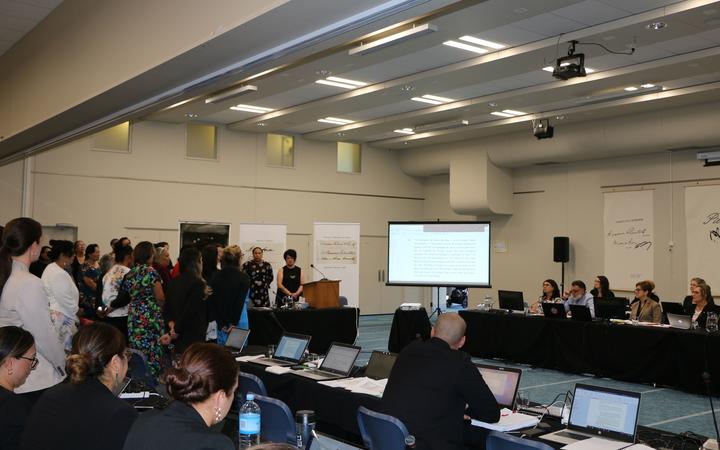
Hineahuone was truly present at Turner centre in Kerikeri as claimants, their lawyers, and whānau packed into the room to begin the first pre-hearing of the inquiry.
First to give evidence One of the original claimants, Ripeka Evans, who also put in a claim on behalf of the hapū and iwi of Te Tai Tokerau alongside Dr Papaarangi Reid, was first to give evidence yesterday.
Fighting back tears, she urged the tribunal to complete the claim in her lifetime – something that some of the original claimants were unable to witness. She said it would be remiss of her to not acknowledge how special this moment was.
After many joined her in acknowledging the significance of the beginning of these hearings, Evans told the tribunal and a packed public gallery – it was “time for business”.
She emphasised the inherent power, authority and status of wāhine in te ao Māori and the role of her tīpuna who signed the Treaty of Waitangi, who she called the founding mothers.
The Mana Wāhine Inquiry in Kerikeri … traditional roles of men and women as essential parts of the collective whole. Image: RNZ
She described the traditional roles of men and women as essential parts of the collective whole, both forming part of the whakapapa that linked Māori to the beginning of the world and women in particular played a key role in linking the past with the present and the future.
Evans provided the historic context of the impact of colonisation.
“The colonial frame in which the colonising culture that looked to men as leaders and chiefs – this caused the negation of wāhine Māori mana motuhake and rangatiratanga over their whenua, taonga, mātauranga, hearts, bodies, minds and beliefs.”
Power, authority and status the bottom lines She hoped that the inquiry would look at the power, authority and status as the three bottom lines that claimants were there to address at these tūāpapa hearings, to not just talk about, but find solutions for the future.
When asked by the tribunal to go back to what triggered the original claim and the role of the Crown in removing Dame Mira from the shortlist, she talked to the wider context of the Crown’s role in being silence on these particular.
Evans said, although the Crown had provided funding for the inquiry, this was not enough to show they had learnt a lesson after 28 years.
“The fact that we are here today, I have to call it out, the Crown funding for this claim is for the Crown to bring it – not for me – not for the claimants to come and tell their stories.
“It beggars belief that the lesson of the last 28 years his that the Crown has not woken up yet about mana wāhine and about the opportunities that that presents for those big issues.”
“And we are still looking to the tribunal as our ray of hope – we don’t have deep pockets.”
The hearing is set down until Thursday and will hear from more original claimants and other notable wāhine Māori leaders.
This article is republished under a community partnership agreement with RNZ.
A frustrated Scott Morrison has been forced to publicly slap down Craig Kelly, after the Liberal backbencher got into a spectacular spat with Labor frontbencher Tanya Plibersek in Parliament House’s press gallery.
Wednesday morning’s corridor confrontation, in front of the cameras, and Kelly’s continued media blitz defending his advocacy of discredited or unproven alternative COVID treatments, were the last straw for Morrison, who feared Kelly’s behaviour could undermine the vital vaccine rollout due to start within weeks.
Plibersek had been attacking Kelly as a in comments to reporters, when he loomed up behind her.
In their subsequent heated exchange, she told him her mother lived in his electorate of Hughes and “and I don’t want her exposed to people who are not going to be vaccinated because of these crazy conspiracy theories that you’re spreading”.
Morrison had thought Kelly had agreed, when they spoke by phone on Tuesday, to avoid further provocative comments, which have centred in particular on his promotion of hydroxychloroquine and Ivermectin.
Kelly was immediately hauled in for what the Prime Minister’s Office described as a dressing down.
This led to his issuing a statement saying, “The Prime Minister reinforced the importance of public confidence in the government’s vaccine strategy.
“I agreed to support the government’s vaccine rollout which has been endorsed by the medical experts.
“I have always sought to support the success of our nation’s public health response during the pandemic.
“I believe the spread of misinformation can damage the success of our public health response during the pandemic.”
In Wednesday’s question time, the opposition’s attempt to pursue the Kelly issue was again frustrated by being ruled out of order.
This meant Morrison did not have a readymade opportunity to distance himself from Kelly, as he had decided he needed to do – after avoiding doing so earlier in the week.
Following question time Morrison made a statement to the House “on indulgence”, declaring he disagreed with Kelly.
“A key principle of our government’s successful response to the pandemic … has been respect for the expert advice, the expert medical advice … and the institutions, those who have the responsibility under our system for providing that advice.”
He said it was true that Kelly’s views “do not align with my views or the views of the advice that has been provided to me by the Chief Medical Officer”.
Morrison said he had made his view very clear to Kelly in their discussion.
The vaccination program was the government’s primary responsibility this year, he said.
The Therapeutic Goods Administration was the authoritative body and it was respected around the world.
“So I can say to Australians – indeed, for the same reason that I and members of this place will take our own children, our own parents, to get that all-important vaccine – that our Therapeutic Goods Administration and the medical advice that guides my government’s policy on the pandemic … is the best in the world”
Reserve Bank governor Philip Lowe’s message to the nation today through the National Press Club today is that he means it.
He isn’t intending to push up interest rates – he most probably isn’t intending to even think about pushing up interest rates – until 2024, at the earliest.
That’s a full three years from now, at a time when, maybe, inflation will be strong enough to be “sustainably within” the Reserve Bank’s target band.
That’s the new benchmark, adopted by the bank in November.
It replaced an earlier loophole-ridden benchmark of “progress towards” an inflation rate of 2% to 3%, something that could have meant almost anything.
The bank will now need to see actual, sustainable, inflation of 2% to 3%, something those of us wanting some inflation haven’t seen for almost a decade.
Ultra-low rates til unemployment hits 4.5%
After the event I asked him what sort of unemployment rate we would need to see for that to happen. Was it still the 4.5% the bank has identified in the past, or had COVID pushed it up? Might less ambitious progress on unemployment do the trick?
He told he thought not. While it is impossible to be sure, something seemed to have changed internationally over the past ten years meaning it has become much harder to create inflation than it used to be. He doubted whether an unemployment rate above 4.5% could do the trick.
Lowe told the press club that while unemployment had come down far more quickly than the bank expected when it produced its previous set of forecasts in November, its new forecasts had unemployment slipping only from 6.6% to 6% over the course of this year, and then taking another 18 months to reach 5.25%
An unemployment rate below 5% is beyond the bank’s forecasting horizon.
That’s why it has undertaken to buy as many government bonds as are needed to keep the three-year bond rate at the bank’s current cash rate target of 0.10%, to make it clear that the cash rate will “be where it is for the next three years”.
‘Creating money electronically’
And there’s another reason for buying government bonds – to restrain the Australian dollar. On Tuesday Lowe announced plans to use a separate program to buy an additional A$100 billion of bonds between April and September.
Combined, the two bond-buying programs will depress Australian long-term interest rates and make foreigners less likely to buy Australian dollars to take advantage of higher rates here than overseas.
Asked directly whether the bank was printing money in order to buy government bonds, Lowe said it was, with the caveat that the modern way of doing things means the bank “creates the money electronically”.
While Lowe accepts that the JobKeeper wage subsidy will end at the end of March (“the government made it clear this was a temporary program”) he is extremely keen for governments at all levels to keep spending on infrastructure, saying if weren’t for public projects, non-mining investment would be bad indeed.
While the economy is recovering, and the bank is forecasting slightly stronger economic growth than The Conversation forecasting panel of 3.5% this year and the next, the economy is unlikely to return to the trajectory it was on before the crisis, perhaps ever.
Reserve Bank GDP forecasts, February 2021 and February 2020
The bank is envisaging an economy being 4% smaller than it would have been. As Lowe put it: “it’s a big number, there’s a big gap there”.
The governor isn’t worried by a likely “blip” in unemployment when JobKeeper comes off in March, but he is worried about what will happen to employment beyond that. The unemployment rate is “higher today than it has been for almost two decades and many people can’t get the hours of work they want”.
Even when the unemployment rate was low (in NSW it got “as it was in 1973” before the crisis) wage growth was weak.
JobSeeker a”fairness issue”
It would help to permanently lift the rate of the JobSeeker unemployment benefit on which a million Australians rely and which is due to return to the poverty-line level of $40 per day in April, although Lowe sees that not so much as an economic question but as a “fairness issue”.
“Different people legitimately have different views on the level of support stopping – my own view is that some increase is justifiable,” he told the press.
The levers he can control, interest rates, will say low for as long as is necessary.
He isn’t “guaranteeing” to keep them low until 2024 or beyond, but he is guaranteeing to keep them low until inflation is sustainably near 3%, something he doesn’t think will happen until unemployment touches 4.5%, something he thinks is most unlikely to happen before 2024.
“I’m not pledging”, he told the national press, “but I am giving you my best guess”.
If R nought was the number on your lips last year, then the statistic du jour this year will be the daily number of vaccinations administered.
This is the key number that will determine when we can stop living under the shadow of COVID, the ongoing sporadic seeding events from hotel quarantine, and the necessary but disruptive lockdowns that inevitably follow.
The federal government’s COVID vaccine rollout is due to start in late February with a target of vaccinating all Australian adults by October. Vaccinating some 20 million adult Australians with two doses each in around eight months is an immense logistical challenge.
Based on our preliminary analysis, uploaded today as a preprint manuscript and still awaiting peer review, it will require the health system to rapidly get up to speed to deliver around 200,000 jabs a day, and to maintain this rate for several months.
200,000 vaccinations a day is a truly furious pace. It’s possible, but will require dedicated large-scale vaccination sites capable of delivering thousands of doses a week in addition to the enthusiastic participation of general practices and community pharmacies countrywide.
A slower rollout will result in a longer and larger epidemic
The opening act of the government’s rollout strategy will be to vaccinate the highest priority groups, including border workers, front line health-care staff, and aged-care staff and residents with the Pfizer/BioNTech vaccine. Because the Pfizer vaccine needs to be stored at below -70℃, this phase will be delivered through hospital hubs with the necessary ultra-cold-chain storage facilities.
Prime Minister Scott Morrison has suggested the rollout capacity will start at around 80,000 doses per week and increase from there. That’s 16,000 a day (over five-day weeks), well short of the required 200,000 a day. The planned peak capacity hasn’t been announced, but even back-of-the-beer-mat calculation would suggest a minimum of 167,000 vaccines per day to give two doses each to 20 million Australians in the eight months between March and October 2021. The longer it takes to reach such capacity, the higher that daily number will get — or we will not reach the target vaccination percentage this year.
There are huge benefits to getting the job done quickly as statistical modelling suggests even 50,000 doses a day in NSW will result in a longer and larger epidemic than 120,000 or more doses a day.
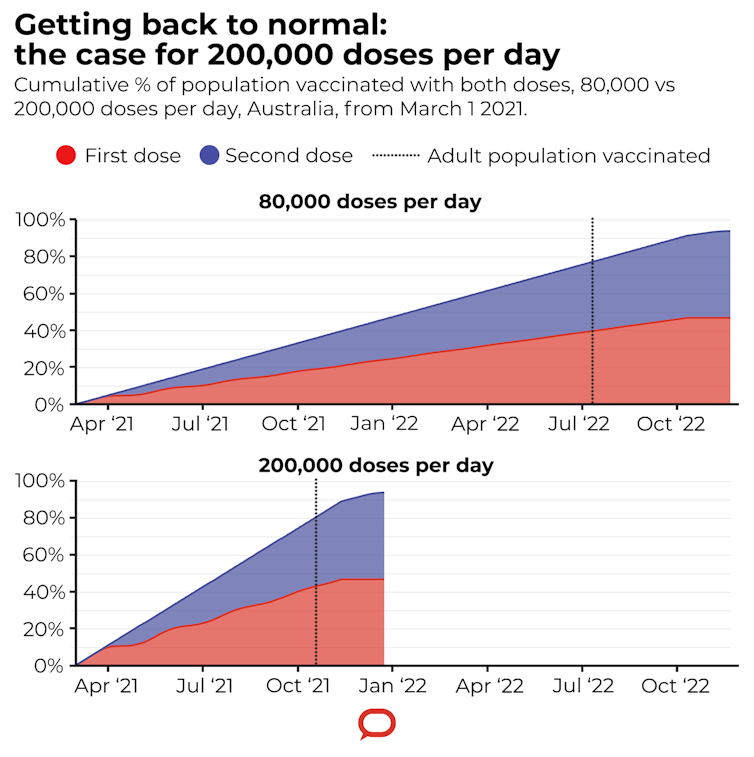
We ran a series of projections to estimate how long it would take to vaccinate the Australian population.
Our estimates used varied assumptions about the rate of vaccinations, the timing of the second dose, and the proportion of the population that would refuse to take a vaccine.
Author provided modelling/The Conversation, CC BY-ND
Our analysis finds 200,000 daily vaccinations from March would comfortably meet the October 2021 deadline. On the other hand, a rate of 80,000 per day — still seven times the PM’s starting point — would see the rollout drag on until mid-2022.
Is it feasible to administer 200,000 vaccinations a day?
As a useful point of comparison, we can look at countries where the vaccination rollout is already underway. To make it easier to compare across countries, we can standardise by population size. On this scale, our 200,000 vaccinations per day translates to around 7,700 doses per million population per day.
This rate exceeds the best efforts of the majority of countries to date, including the United Kingdom and the United States, where the rate of vaccine administration has peaked at around 5,800 and 4,000 daily doses per million population respectively.
The outlier is Israel, where between 7,000 and 20,000 vaccinations per million population have been delivered daily throughout January, and one third of its population is now vaccinated. Several factors may have contributed to this success, including a young, largely urbanised population and a strong public health infrastructure.
Returning to Australia, applications to recruit 1,000 GPs and an as-yet-unknown number of community pharmacies to join the vaccination rollout effort are currently underway.
Even if half of the 5,800 pharmacies across Australia joined with the targeted 1,000 GPs, each location would still need to administer an average of 50 doses per day, seven days a week, for about six months. Taking into account the necessary screening and record-keeping involved in addition to their usual workload, this may be quite a stretch for all but the largest practices and pharmacies.
It seems clear that to deliver at the scale needed to meet government targets won’t be possible through GPs and pharmacies alone. What’s needed are mass vaccination sites as proposed in the 2018 NSW Health Influenza Pandemic Plan. In a dedicated centre, trained nurses could vaccinate at a rate of between 80-100 people per hour. A similar approach in the UK has seen conference centres, sports stadiums, churches and mosques all co-opted as mass vaccination hubs, to great effect.
A complementary approach would be to set up drive-through vaccine clinics similar to the model of drive-through testing sites.
In the interest of openness and reproducibility, the program code base for our analysis is freely available here under an open source license.
Federal Health Minister Greg Hunt recently ruled out GP patients having to pay for bandages and dressings, despite a major Medicare review recommending it.
We won’t be putting in place extra charges for patients. I am ruling that out.
Hunt was commenting on a recommendation from the Medicare Benefits Schedule Review Taskforce to charge bulk-billed patients for bandages and dressings. The idea was to save patients some money at the pharmacy, where such products can be expensive. The recommendation also addressed some GPs’ concerns they were out of pocket by supplying these items. However, some people had called the recommendation to charge patients a “band-aid tax”.
Rather than charging patients, Hunt said he’d discuss “alternative sources of government support” for general practices and doctors to supply these items. Here are some options and what they could mean for you.
A thin end of the wedge?
Since 2015, the taskforce has been reviewing about 5,700 items on the Medicare Benefits Schedule to see which services you receive at your GP or specialist align with current evidence and practice, are safe and might benefit you.
Of its 1,400 or more recommendations, this one initially seems to be the thin end of the wedge. What would GPs charge you for next? Using equipment to take your blood pressure? The paper your bill is printed on? Luckily, separate charges for such items are illegal.
GPs can already choose to charge any amount for a consultation. And you would presume all GPs’ costs — including rent for their premises, equipment, office chairs, as well as consumables such as bandages and dressings — are considered when they decide on the level of fee to charge, or whether to bulk-bill. If the costs of supplies are increasing, then GPs can simply increase the consultation fee.
The recommendation also seemed inconsistent with the objectives of the review. This included trying to simplify the Medicare Benefits Schedule (not making it more complicated). The recommendation also seemed inconsistent with strong recommendations aimed at reducing patients’ out-of-pocket costs and making health care more affordable.
What was the taskforce thinking?
The taskforce argued people with chronic wounds, such as venous leg ulcers, often paid a lot for wound dressings they used at home.
Though GPs and practice nurses help dress wounds, patients still need to regularly manage and dress wounds themselves at home. So the taskforce was arguing these costs should be subsidised.
The recommendation to allow GPs to charge patients was where the consultation was bulk-billed. This seemed to assume this would be cheaper for patients rather than them buying their own dressings from pharmacies and supermarkets. So the intention was to reduce out-of-pocket costs overall.
However, this recommendation relies on GPs charging patients less than what pharmacies or supermarkets may charge and GPs would not try to profit from selling dressings to patients. However, the taskforce presented no evidence or data to show this would be the case, even though its recommendations are supposed to be evidence-based.
The taskforce thought patients could save money by going to their GP for their dressings rather than buying them at the pharmacy or supermarket.www.shutterstock.com
Managing wounds well has both health and economic benefits
Inadequate wound care can have debilitating effects and adversely influence people’s mobility and quality of life. Like any health-care treatment, keeping out-of-pocket costs low for patients can help improve access to health care and improve health outcomes. The issue is how to do this.
Treatment is also highly cost-effective. For instance, providing compression therapy products, such as compression bandages for leg ulcers, would cost the health system an additional A$270 million over five years. But it would save about $1.4 billion over the same period.
So it seems to make sense for new policies to try and reduce the costs GP practices and patients face for these supplies.
How do we reduce the costs?
Centralise purchasing
GP practices and pharmacies buy their supplies on the open market, and small GP practices may not be able to get good deals.
So the taskforce also recommended a Commonwealth-funded wound consumables scheme to centralise purchasing and price negotiation, as is done for medical devices and pharmaceuticals at the Commonwealth level. The idea is to keep prices low.
Offer discounts
Certain patients with chronic wounds could also be eligible for heavily discounted dressings from their pharmacy, though this may be difficult for less-mobile patients. GPs could “prescribe” which dressings are needed and for how long, and the pharmacies could “dispense” these for patients from the wound consumables scheme.
Rethink dispensing
GPs could also dispense these dressings themselves. For eligible patients who are not mobile and cannot easily visit pharmacies, GPs could provide and apply dressings for chronic wounds in the practice (or through practice nurses visiting patients at home). GPs could also provide dressings for patients to apply at home. Providing dressings at home or in the GP practice would require additional payments to general practices from Medicare.
This payment would need to provide incentives for GPs to manage the wounds more effectively and to buy high-quality, low-cost dressings, perhaps purchased via the wound consumables scheme.
What needs to happen?
For patients with chronic wounds that need long-term care (not just people wanting a band-aid), reducing the costs of bandages and dressings is likely to improve access and improve outcomes.
Examining the regulation of these markets could be a first step to ensure prices are as low as possible. This could include considering more centralised purchasing, followed by considering additional funding to subsidise these very cost-effective treatments.
Today’s provisional approval of the Pfizer/BioNTech vaccine means New Zealand could start rolling out its COVID-19 immunisation programme as early as next month.
In announcing the approval, Prime Minister Jacinda Ardern said border workers and the people they live with, cleaners and nurses working at quarantine facilities, security and airline staff and hotel workers would be among the first to get the vaccine.
I have said 2021 is the year of the vaccine. It’s a full-year programme we have only just begun. We’re not in a race to be first, but to ensure safe and timely access to vaccines for all New Zealanders.
Unlike in other countries, the approval is not an emergency authorisation. Medsafe, the regulatory body for all therapeutic products in New Zealand, does not have the ability to grant emergency use authorisation.
Since the emergence of more easily transmittable variants of the coronavirus, the government has been under pressure to bring the vaccination programme forward.
But with no uncontained community transmission, the country is in a fortunate position to be able to establish a complex national programme carefully.
New Zealand’s vaccine portfolio
The Pfizer/BioNTech vaccine is one of four COVID-19 vaccines for which New Zealand has negotiated purchase agreements. The other vaccines, from AstraZeneca, Janssen and Novavax, have yet to complete the Medsafe evaluation process.
Collectively the four vaccines provide a mix of different technologies, manufacturing locations and supply chains.
The goal of this “diverse portfolio” approach is to provide some confidence that effective vaccines will be available to deliver a national vaccination programme in New Zealand and to purchase enough doses for neighbouring Pacific countries. The latter include New Zealand realm countries, Tokelau, Niue and the Cook Islands, as well as Tonga, Samoa and Tuvalu.
Managing the portfolio will be complex. Decisions will need to be made about how to deliver multiple vaccines that become available at different stages of the programme. Each vaccine has its own characteristics, including dosing schedule, storage conditions and efficacy data from clinical trials.
Needless to say, effective communication about details of the programme to health professionals and the New Zealand public will be vital to achieve sufficiently high population coverage.
The current plan is to sequence delivery to prioritise protection for those at highest risk of acquiring COVID-19 or those at greatest risk of poor outcomes from the disease. This plan is based on three scenarios, depending on the presence or level of COVID-19 community transmission.
New Zealand’s current situation, with two active cases in the community but no further community transmission, means frontline staff would be vaccinated first. This includes people working at the border and managed isolation and quarantine facilities, health care workers at highest risk of exposure to COVID-19, and the household contacts of these workers.
The next tier would include high-risk health, public sector and emergency service workers, and then the most vulnerable groups in the community, including older people and those with underlying medical conditions.
The current expectation is to start vaccination of higher-risk groups in March, with mass public vaccination starting later in the year. The aim is to complete the programme by the end of 2021.
The approvals process
The Pfizer/BioNTech vaccine uses new mRNA technology, which hasn’t previously been used in human vaccines. Clinical trials have shown the vaccine to be safe and 95% efficacious in preventing COVID-19.
Mild and short-lived reactions, such as pain at the injection site or headaches, have occurred in less than 20% of people who have received the vaccine. Allergic reactions were rare and usually occurred in people with a past history of allergies.
Medsafe’s approval process ensures that all COVID-19 vaccines comply with both international standards and local requirements for quality, safety and efficacy, as well as being of the highest manufacturing quality.
Although Medsafe provides an independent evaluation process, it has close links with medicines regulatory bodies in other countries, such as the US Food and Drug Administration and European Medicines Agency.
New Zealand benefits from the sharing of information among regulatory authorities, and we can learn from the experiences of countries that are ahead in rolling out their vaccination programmes.
Seeing the roll out of COVID-19 vaccines in many other countries from late last year, often under emergency authorisation, has raised our expectations for New Zealand. Although there is strong motivation to start the roll out as soon as possible, we also need to have a system in place to complete the vaccination programme successfully.
The big question is when international borders may reopen. This remains difficult to predict and depends on many factors beyond the successful completion of a vaccination programme in New Zealand. Controlling COVID-19 is a global challenge, and for our borders to open we need to be sure that both New Zealanders and visitors are protected.
One of the most difficult problems in finance right now is figuring out the fundamental economic value of cryptocurrencies. And the past week has complicated this further.
For many cryptocurrency investors, the value of Bitcoin is based on the fact it is artificially scarce. A hard cap on “minting” new coins means there will only ever be 21 million Bitcoin in existence. And unlike national currencies such as the Australian dollar, the rate of release for new Bitcoin is slowing down over time.
Dogecoin, a cryptocurrency that takes its name and logo from a Shiba Inu meme that was popular several years ago, doesn’t have a cap. Launched in 2013, there are now 100 billion Dogecoin in existence, with as many as five billion new coins minted each year.
But how can a currency with a seemingly unlimited supply have any value at all? And why did Dogecoin’s price suddenly surge more than 800% in 24 hours on January 29?
At the time of publication, the “memecoin” was worth about A$5.6 billion on the stockmarket.
A long-running joke brought to life
Dogecoin is one of the original “altcoins”: cryptocurrencies released in the few years after the pseudonymous Satoshi Nakamoto first released Bitcoin into the wild.
From a technical perspective, Dogecoin isn’t very innovative. Like many early altcoins, it’s based on the original source code of Bitcoin.
Or more technically, it’s based on Litecoin, which in turn was based on Bitcoin — but with some small modifications such as faster transactions and the removal of the supply cap. But Dogecoin is much more interesting when seen through a cultural lens.
The cryptocurrency was created by software engineers Billy Markus and Jackson Palmer — although Palmer, an Australian, has since walked away from the project. They branded it with the Doge meme partly to be funny, but also to distance it from Bitcoin’s then questionable reputation as a currency for illicit transactions.
Now, Dogecoin has outlasted almost all the early derivative altcoins and has a thriving community of investors. In 2014, Dogecoin holders sponsored the Jamaican Bobsled Team. Soon after, they sponsored a NASCAR driver.
This toy matchbox car was purchased at a cryptoparty auction. It’s modelled after Dogecar ‘#98 Moonrocket’, driven in the Talladega Superspeedway NASCAR races.Ellie Rennie, Author provided
Elon Musk, the world’s richest man, is among the cryptocurrency’s high-profile advocates. In December last year, a tweet from Musk sent Dogecoin’s price soaring.
Collectivism leads to creativity
Reddit threads proclaim Dogecoin’s value as a new global currency. Musk himself shared a similar sentiment a few days ago. Speaking on the app Clubhouse, he said:
Dogecoin was made as a joke to make fun of cryptocurrencies, but fate loves irony. The most ironic outcome would be that Dogecoin becomes the currency of Earth in the future.
But Dogecoin is best thought of as a cultural product, rather than a financial asset. The reality is few cryptocurrency users hold it as a serious investment or to use in regular transactions. Instead, to own Dogecoin is to participate in a culture.
People buy it because it’s fun to have, is inherently amusing and comes with a welcoming and enjoyable community experience.
If we start thinking of the cryptocurrency as a cultural product, last week’s sudden jump in Dogecoin’s price makes sense. The boost came just after a meme-centric community managed to drive the share price of videogame retailer GameStop from US$20 to US$350 in mere days.
This swarm behaviour was unlike anything seen before — and it frightened global financial markets.
One particularly interesting aspect of the Reddit forum r/WallStreetBets — which coordinated the attack on the hedge fund that had effectively bet on GameStop’s share price falling — was how many users were having fun.
It’s no surprise activity surrounding Dogecoin has a similar vibe; it was designed to be fun right from the start.
There’s no shortage of memes and pop culture references on the r/WallStreetBets subreddit.Screenshot/Reddit
Doge: icon of the internet
Some people participate in financial markets as a form of consumption — meaning for entertainment, leisure and to experience community — just as much as they do for investment.
Cultural assets such as Dogecoin are hard to systematically value when compared to financial assets, a bit like how we don’t have a fundamental theorem for pricing art.
Almost by definition, the demand for a memecoin will fluctuate as wildly as internet culture itself does, turning cultural bubbles into financial bubbles. RMIT professor and crypto-ethnographer Ellie Rennie calls these “playful infrastructures”.
By inspecting Dogecoin closely, we can learn a lot about the interplay of technology, culture and economics.
Moreover, cryptocurrencies are extraordinarily diverse. Some are built for small payments or to be resilient holders of value. Others protect financial privacy or act as an internal token to manage smart contracts, supply chains or electricity networks.
Under the hood, Bitcoin and Dogecoin look almost exactly the same. Their code differs in only a few parameters. But their economic functions are almost entirely opposite.
Bitcoin is a kind of “digital gold” adopted as a secure hedge against political and economic uncertainty. Dogecoin, on the other hand, is a meme people add to their digital wallet because they think it’s funny.
But in an open digital economy, memes move markets.
New Zealand’s Climate Change Commission this week released its long-anticipated advice to the government on how to reshape the economy to meet the country’s domestic and international climate change obligations.
The document sets out three emissions budgets, covering 15 years to 2035 in five-yearly plans. It also provides advice on the direction policy should take to achieve the country’s 2050 net-zero goal.
As one of New Zealand’s six climate change commissioners I have been part of the process of making a clear case to government that we must take “immediate and decisive action on climate change” across all sectors.
The commission’s priorities include a rapid shift to electric transport, accelerated renewable energy generation, climate-friendly farming practices and more permanent forests, predominantly in native trees.
It also says New Zealand must raise its pledge under the Paris Agreement, known as the Nationally Determined Contribution (NDC), because its current commitment is not compatible with the goal of limiting warming to 1.5℃ above pre-industrial levels.
Ambitious but realistic carbon budgets The good news is the draft carbon budgets are achievable, with technologies that already exist.
The commission’s advice is built around 17 recommendations that cover many sectors of the economy. One of the key messages is that Aotearoa New Zealand cannot plant its way out of trouble but needs to make real cuts in emissions and eliminate the use of fossil fuels.
Most of the solutions are well known. We need to reduce emissions from transport, from energy and industry, from agriculture and from waste.
Breaking: New Zealand roadmap to net zero unveiled. Here’s what it means for you.https://t.co/5oLgapQdDC
Recommendations for the transport sector include electrification of the vehicle fleet, improved public transport networks and better integration of active transport (walking and cycling).
A rapid increase in electric cars would reduce emissions from private and commercial transport, while supporting low-carbon fuels like “green” hydrogen and biofuels would help the freight sector (including heavy trucks, shipping and aircraft).
Part of the transport story is urban planning — changing how people and goods move around. The commission recommends limiting urban sprawl, making walking and cycling safer and easier and shifting more freight from road to rail or shipping.
The commission also calls for rapid decarbonisation of electricity generation, and energy generally, to phase out the use of coal. Between now and 2035, it estimates New Zealand could cut transport emissions by 47 percent and those coming from heat and electricity generation by 45 percent.
I can’t stress this enough. We’re heading for economic change, to decarbonise the country. There’ll be winners and losers. Who they are depends on decisions by govts, informed by advice out a week from today by the Climate Change Commission. Have your say! https://t.co/pAs5PLeaKo
Emissions from agriculture Methane accounts for 43.5 percent of New Zealand’s greenhouse gas emissions, and more than 80 percent of total methane comes from cud-chewing farm animals. But the short-lived nature of methane in the atmosphere means we do not need to reduce methane emissions so fast.
The Zero Carbon Act calls for a 24-47 percent reduction in methane emissions by 2050, compared to net-zero for carbon dioxide.
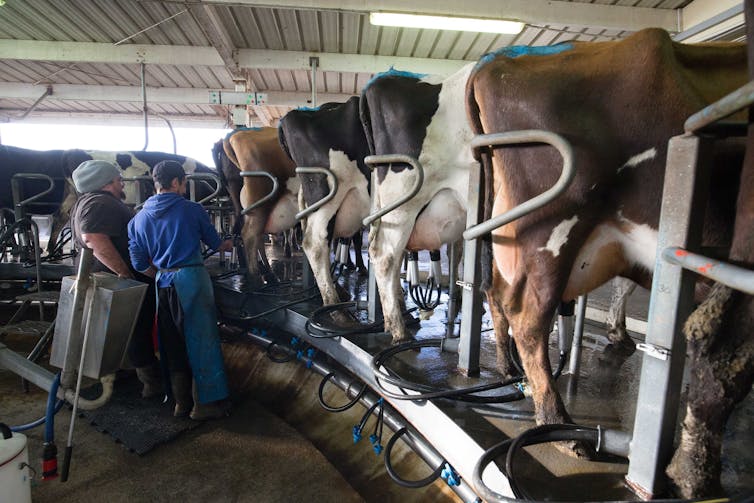
Emissions from farm animals account for more than 80% of New Zealand’s methane emissions. Image: Brendon O’Hagan/Bloomberg via Getty Images
The commission’s advice is that biogenic methane emissions can be reduced by 19 percent by 2035 while further improving productivity in the sector through better feed, fewer but more productive animals and continued research into emission-reducing technologies.
The commission calls for real cuts in emissions rather than offsets through tree planting, but argues forestry should continue to play an important role in the long-term storage of carbon, for example if timber is used in buildings or furniture and to provide bioenergy.
It recommends a shift towards more permanent native forests to improve long-term carbon storage, biodiversity and soil retention.
Waste is another sector with significant potential to cut emissions. Per head of population, New Zealanders throw away roughly twice what an average OECD citizen does. The commission recommends moving towards a circular economy, where resources are valued and reused.
In terms of greenhouse gas emissions, the main issue in the waste sector is methane release from decomposing solid waste. Capturing that gas at source could reduce methane emissions by 14 percent by 2035.
Cost of a fair transition The commission’s draft budgets recommend an overall reduction in total greenhouse gas emissions of 36 percent by 2035, starting with 2 percent by 2025 and 17 percent by 2030. It estimates the cost of achieving this is less than 1 percent of projected GDP, much lower than was initially thought.
The payoffs for public health, for our environment and biodiversity make this a good investment, let alone the huge avoided costs from unchecked climate change.
The commission’s recommendations will go through a public consultation process until March 14, and the government has until the end of the year to decide which parts of the advice it takes on board.
An important aspect of the advice is inclusiveness and support for all sectors of society as we move to a low-emissions future. The commission takes a te ao Māori (Māori world view) approach, making it clear that Aotearoa must have an equitable and fair transition.
Before COVID-19 hit New Zealand’s shores last year, most people’s understanding of defending a border would have come from watching TV reality show Border Patrol.
It is easy to understand — on the maps, our country is surrounded by an ocean moat, a natural border. This makes controlling risks arriving from overseas relatively easy as there are limited points at which they can enter New Zealand.
Since February 2, 2020, when a travel ban on non-citizens who had travelled through China was introduced, borders have been very much in the news.
Most recently, Northland iwi announced Te Tai Tokerau Border Control would be introducing check points in the region in response to a community case of COVID-19.
Those actions have been controversial, with the police subsequently closing down the check points on grounds of safety, even though they supported the same checkpoints in August 2020 during the Auckland community outbreak.
Community checkpoints in Te Tai Tokerau have been shut down by police who say they risked public safety and people’s right to travel freely.
This raises the question of what sort of border is Te Tai Tokerau trying to control, and is it a border at all?
There are three important things to realise about borders — humans create them, they don’t just occur at the external edge of a state, and not all borders involve the government.
You may find the first idea challenging. We did not make up our physical geography. The ocean border is real. But humans did create the map that depicts our country.
New Zealand already has several human-defined borders such as the administrative divisions.Monika Hunackova Shutterstock
We know from our history that the state of New Zealand originated from British colonisation, that its name is now often referred to as Aotearoa New Zealand, reflecting Te Tiriti o Waitangi.
The Realm of New Zealand includes other states and dependencies — Niue, Cook Islands, Tokelau and the Ross Dependency in Antarctica.
From this, we see that even our description of New Zealand can vary, depending on where we stand. By extension, our description of New Zealand’s border will vary.
We can now start to see that borders are more than lines on the map. Borders create spaces that can be used for different purposes, such as security or safety, with associated processes.
Borders define ‘us’ and ‘them’
Borders also have many effects, one of which is on our identity. For example, gated communities are bordered spaces, fenced and patrolled business premises are bordered spaces.
If we are inside a gated community, we will identify with that community and its desire for safety and privacy. Outside the gate is everyone else and, potentially, risk and insecurity.
Gated communities also define borders between ‘us’ and ‘them’.Shutterstock/Johnny Habell
To get inside the gated community, particular processes are needed such as membership of the community through ownership of property, or access to a gate key. The means of containment, the border, creates an “us” and “them”.
When we apply this thinking to the external border, our society is bordered by the controls at gateway sea ports and airports. Before foreign visitors pass through these controls, they are “them”.
After they enter New Zealand, we might not know them, but societally they become part of “us”, albeit temporarily.
Managing the COVID-19 threat has involved creating types of borders not familiar to New Zealanders, from societal lockdowns to the creation of specifically bordered spaces — for example, the Managed Isolation and Quarantine facilities (MIQs) and the land borders during the Auckland community outbreak in August.
Most significantly for the many people prevented from travelling internationally, government policy has bordered our lives by keeping us confined to our own island nation.
All these borders have had effects on New Zealand society.
One important effect has been to change whom we identify with — whom we see as “us” and “them”.
Achieving a COVID-free New Zealand has involved creating a range of borders that differentiate, and in some cases separate, the safe “us” from the risky “them”.
Even close family members can temporarily become “them”. We see this in reports of MIQ staff being isolated by their friends, family and business contacts when they are off duty.
The iwi borders
Let us now return to those iwi borders. What are they exactly?
Their stated purpose is to protect the iwi population, many of whom are at high risk from COVID-19, as well as provide a community service by preventing the virus spreading.
The former is certainly identifying with their tribal group and the particular needs and vulnerabilities of that group, but they are also identifying with the COVID-free New Zealand — the so-called team of five million.
This type of border raises a further question about who has, or should have, control of different types of borders.
It is hard to argue against Te Tai Tokerau’s case, but in New Zealand law they have no authority to limit the free movement of people. Only agencies of state have that.
Multiple borders have always existed in Aotearoa New Zealand. We just haven’t been aware of them before.
These examples start to reveal them. For some people, these new borders are restrictions, for others they provide a certain freedom — maybe not freedom from fear but freedom to move about within different sized bubbles in relative safety.
Seeing them as a part of New Zealand’s border landscape makes evident issues such as human rights, security, legal authority and equity. A bigger discussion about New Zealand’s borders is clearly needed.
The independent review of Australia’s main environment law, released last week, provided a sobering but accurate appraisal of a dire situation.
The review was led by Professor Graeme Samuel and involved consultation with scientists, legal experts, industry and conservation organisations. Samuel’s report concluded Australia’s biodiversity is in decline and the law (the EPBC Act) “is not fit for current or future environmental challenges”.
The findings are no surprise to us. As ecologists, we’ve seen first hand how Australia’s nature laws and governance failure have permitted environmental degradation and destruction to the point that species face extinction. Even then, continued damage is routinely permitted.
And the findings aren’t news to many other Australians, who have watched wildlife and iconic places such as Kakadu and Kosciuszko national parks, and the Great Barrier Reef, decline at rates that have only accelerated since the act was introduced in 1999. Even globally recognisable wildlife, such as the platypus, now face a future that’s far from certain.
For example, the original distribution of the endangered southern black-throated finch of southern and central Queensland has shrunk to less than 10% due to land clearing and habitat degradation. Yet, further clearing was approved for coal mines, housing developments and sugar cane farms.
Biodiversity offsets, which aim to compensate for environmental damage by improving nature elsewhere, have for the most part been dreadfully ineffective. Instead they have been a tool to facilitate biodiversity loss.
Land clearing and cattle grazing are among the threats black-throated finches face.Stephanie Todd, Author provided
The centre piece of Samuel’s report are proposed new National Environmental Standards. These would provide clear grounds for drawing a line in the sand on environmental damage.
Legal, rigorous enforcement of these standards could turn around Australia’s centuries-long record of destroying its natural heritage, and curb Australia’s appalling extinction rate — while also providing clarity and certainty for business.
Vital features of the standards Samuel recommends include:
avoiding impacts on the critical habitat of threatened species
avoiding impacts that could reduce the abundance of threatened species with already small and declining populations
no net reduction in the population size of critically endangered and endangered species
cumulative impacts must be explicitly considered for threatened species and communities
offsets can only be used as a last resort, not as a routine part of business like they are at the moment.
Under the proposed National Environmental Standards, any new developments would need to be in places where environmental damage is avoided from the outset, with offsets only available if they’re ecologically feasible and effective.
2. Greater government accountability
The federal environment minister can make decisions with little requirement to publicly justify them.
In 2014, then environment minister Greg Hunt controversially approved an exemption to the EPBC Act for Western Australia’s shark cull. This was despite evidence the cull wouldn’t make people safer, would harm threatened species and would degrade marine ecosystems. Hunt could shirk the evidence, deny the impacts and make a politically expedient decision, with no mechanisms in place to call him to account.
Tiger sharks and white sharks were targeted in the WA cull.Shutterstock
Samuel’s report states the minister can make decisions that aren’t consistent with the National Environmental Standards — but only as a “rare exception”. He says these exceptions must be “demonstrably justified in the public interest”, and this justification must be published.
We think this epitomises democracy. Ministers can make decisions, but they must be open to public and robust scrutiny and explain how their decisions might affect environments and species.
Improved accountability will be one of the many benefits of Samuel’s proposed independent Environment Assurance Commissioner, which would be backed up by an Office of Compliance and Enforcement. Samuel says these must be free from political interference.
These are absolutely critical aspects of the reforms. Standards that aren’t audited or enforced are as worthless as an unfunded recovery plan.
3. Decent funding
Samuel urges improved resourcing because to date, funding to protect species and the environment has been grossly inadequate. For example, experts recently concluded up to 11 reptile species are at risk of extinction in the next 50 years in Australia, and limited funding is a key barrier to taking action.
Victoria’s grassland earless dragon (Tympanocryptis pinguicolla) is one of 11 reptile species identified as at risk of extinction.Michael Mulvaney/Wikimedia, CC BY-SA
And it has been proven time and again that lack of action due to under-resourcing leads to extinction. The recent extinction of the Christmas Island forest skink, the Christmas Island pipistrelle, and the Bramble Cay melomys were all attributable, in large part, to limited funding, both in the administration of the threatened species listing process, and in delivering urgent on-ground action.
Engaging experts is key to achieving Samuel’s long-overdue proposed reforms. He calls for the immediate creation of expert committees on sustainable development, Indigenous participation, conservation science, heritage, and water resources. This will help support the best available data collection to underpin important decisions.
Ultimately, though, much more investment in building ecological knowledge is required.
Greater gliders are an iconic Australian possum, and are undergoing significant decline.AAP Image/Supplied by Matt Wright
Australia has more than 1,900 listed threatened species and ecological communities, and most don’t even have active recovery plans. Ecologists will need to collect, analyse and interpret new, up-to-date data to make biodiversity conservation laws operational for most threatened species.
For example, while we know logging and fires threaten greater gliders, there’s still no recovery plan for this iconic forest possum. And recent research suggests there are actually three — not simply one — species of greater glider. Suspected interactions between climate change, fire and logging, and unexplained severe population declines, means significant new effort must be invested to set out a clear plan for their recovery.
Samuel recommends Regional Recovery Plans be adequately funded to help develop some knowledge. But we suggest substantial new environmental capacity is needed, including new ecological research positions, increased environmental monitoring infrastructure, and appropriate funding of recovery plans, to ensure enough knowledge supports decision making.
Cherry picking recommendations condemns our species
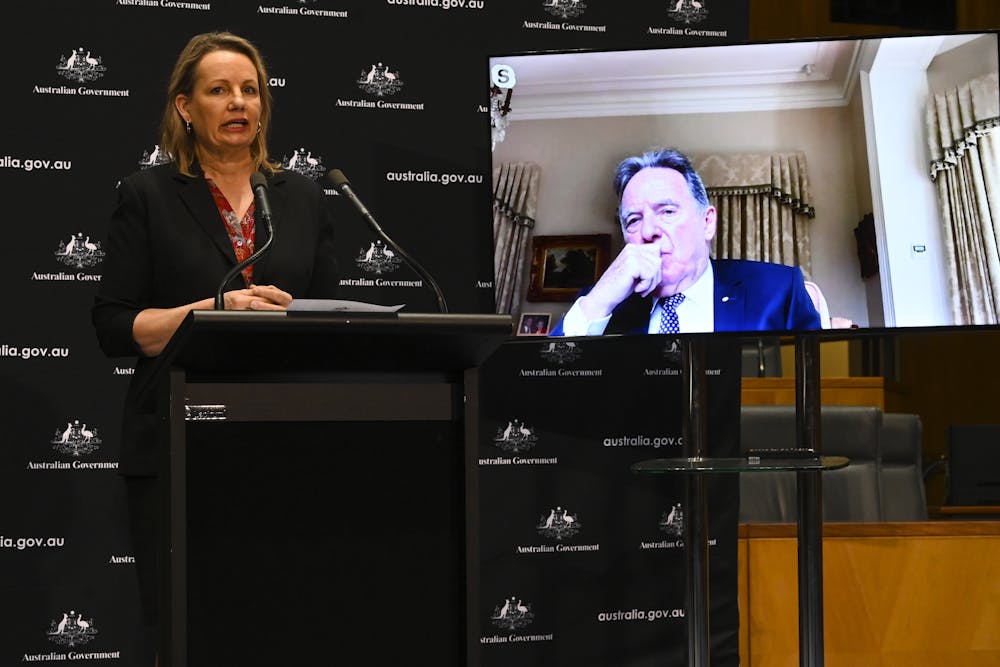
Sussan Ley’s response to Professor Graeme Samuel’s (on screen) review doesn’t bring confidence.AAP Image/Lukas Coch
Samuel’s report has provided a path forward that could make a substantial difference to Australia’s shocking track record of biodiversity conservation and land stewardship.
But Environment Minister Sussan Ley’s response so far suggests the Morrison government plans to cherry pick from Samuel’s recommendations, and rush through changes without appropriate safeguards.
If the changes we outlined above aren’t implemented as a package, our precious natural heritage will continue to decline.
Source: The Conversation (Au and NZ) – By Karin Hammarberg, Senior Research Fellow, Global and Women’s Health, School of Public Health & Preventive Medicine, Monash University
People who want a baby and struggle to conceive often resort to in vitro fertilisation (IVF). While IVF has helped countless people have children, it’s expensive and comes with some risks.
But research shows some people with so-called “unexplained infertility” have a 30-40% chance of conceiving without treatment if they just keep trying for a bit longer.
So, how long should you wait before starting fertility treatment? This depends on a range of factors that might increase or decrease your chance of conceiving naturally, as well as your personal preferences for seeking treatment or not.
A new online guide can estimate your chance of conceiving with and without treatment. The free tool collects information based on what we understand to be the main factors affecting a woman’s chance of falling pregnant, with a view to informing decisions around fertility treatment.
Sometimes there’s no clear explanation
It’s recommended women who have tried unsuccessfully for a baby for 12 months, or six months if they’re over 35, seek medical advice. This is so the doctor can arrange for tests to determine whether there’s a reason for infertility.
If these tests show the woman’s fallopian tubes are blocked, or that the male partner has a very low sperm count, it’s best to go straight to IVF. In most cases, that’s the only way the couple will be able to get pregnant.
If your doctor finds no obvious problem, you have what’s called “unexplained” or “idiopathic” infertility.
It’s worth seeing a doctor if you’ve tried unsuccessfully to conceive for 12 months, or six months if you’re over 35.Shutterstock
Weighing up your options
It can be very frustrating to be told there’s nothing wrong, when month after month goes by without pregnancy happening.
Although IVF might seem like the fastest option, it can be expensive, costing most people thousands of dollars. And like any medical procedure, IVF carries risks, particularly for women.
If your tests come back normal, it might be worth considering giving nature a bit more time, or trying a simpler form of infertility treatment, such as intrauterine insemination (IUI). IUI involves insertion of the male partner’s (or a donor’s) sperm into a woman’s uterus at or just before ovulation.
So which path is right for you? This is where the new online guide can help.
Research tracking thousands of people with unexplained infertility has found many go on to have healthy babies naturally, or with the help of simple fertility treatment. In one study of more than 1,200 couples with unexplained infertility, 25% conceived naturally within 12 months.
Of course, for some women conception will be more likely, and for some women it will be less likely.
Experts used the data from this research to develop the online guide. The personalised calculations are based on four factors that evidence indicates are most likely to affect the chance of pregnancy.
The most important factor that affects a woman’s chance of having a baby — naturally or with IVF — is her age. So what’s labelled unexplained infertility may in fact be age-related. While pregnancy can still happen, by age 40 a woman’s fertility is about half the level it was when she was 30.
Other factors include how long she has been trying for a baby (the likelihood of conception decreases with the duration of trying), whether she’s been pregnant before (women who have never conceived before have a lower probability of achieving a pregnancy), and what proportion of the male partner’s sperm move normally (called “progressive motility” on a semen analysis report).
The guide is designed for heterosexual couples and for women who are trying to get pregnant with a known sperm donor, where:
the woman has regular menstrual cycles
the woman has at least one open fallopian tube
the woman is 42 or younger
the man has had a sperm test.
This new online tool aims to inform your decisions around fertility treatment.Shutterstock
Four questions ask about the four factors most likely to affect a woman’s chance of conception, described above.
The responses are then fed into the algorithm, which estimates the chance of pregnancy over the next 12 months in three different scenarios:
you just keep trying
you have six cycles of IUI
you have two cycles of IVF.
This information can help people consider their options and decide about next steps.
If your estimated chance of spontaneous pregnancy in the next 12 months is 30% or more, you have a good chance of avoiding the need for expensive fertility treatments. But if you’re not pregnant after six months, the guide suggests seeking advice from a fertility specialist about the next steps.
If your estimated chance without treatment is less than 30%, it’s best to see a fertility specialist as soon as possible.
A word of caution
While the guide can help you explore your options and consider next steps, the estimates it gives are based on averages of data from large studies of people with unexplained infertility.
This means it shouldn’t replace advice from a fertility specialist, who will hopefully use the available evidence to recommend the best way forward for you, considering your personal circumstances and preferences.
Most academics regularly submit papers and compete for grants and promotions. These endeavours are necessary for their success but often end in rejection.
Responses to rejection in academia have typically been individually focused. Most discussions of the topic describe what academics themselves can do to cope with rejection.
For example, in a watershed tweet in 2017, Nick Hopwood posted a picture of his office wall papered with rejection letters. Academics were encouraged to celebrate rather than commiserate rejection, spawning the #NormaliseRejection hashtag.
But, as we explored in our recent paper, persistent rejection is problematic, and focusing on the individual academic is not the whole solution.
Just how toxic is the rejection culture?
Academics’ careers are strongly linked to their success in publishing and funding applications. Unfortunately, rejection rates are high, ranging from 50% in general journals to 92% in prestigious outlets like Nature. The Conversation, too, rejects most submissions.
Such high levels of rejection have three adverse consequences.
First, it squanders a valuable opportunity for professional learning and development. Learning sciences show clearly described success criteria and constructive, task-specific feedback promote effective learning and development. Yet these are lacking in many decisions on publication or grant submissions.
In our teaching of students, we adopt this nuanced, incremental and developmental approach because it improves learning. In contrast, academic publication or funding decisions can be binary: submissions are rejected or accepted, with little or nothing in between. What’s missed in the process is a powerful learning and developmental opportunity for the academics whose work has presumably been assessed and evaluated.
Second, it wastes an inordinate amount of academics’ time, contributing to their well-documented excessive workload. One study showed that for one round of a funding scheme in Australia researchers altogether spent more than 500 years of their time preparing proposals. Most of their proposals did not get funded.
Third, rejection culture on top of excessive workloads contributes to stress and anxiety among academics. Mental health issues have significant impacts on their work satisfaction, productivity and general well-being.
Most papers on academic rejection focus on how the individual can improve their response – the so-called “suck it up” response. We argue, in contrast, that systemic or institutional responses can reduce the toxicity of the culture. Our recommendations for change fall into three main categories.
First, make success criteria clear prior to applications and provide timely and targeted feedback afterwards. The opportunity costs of applying for grants, funding and publications – time and effort that could have been invested in something else – would then be minimised.
This approach could involve pre-submission quality assessments. This can involve communities of academics assessing the quality of manuscripts before they are submitted for publication; journal editors would then only expend resources on the ones most likely to succeed. This would ensure academics pursue only submissions that are most likely to succeed.
When funders and editors approach researchers directly and “commission” proposals, that greatly reduces the opportunity costs. The MacArthur Foundation, for example, now commonly does this.
Second, the process of publication can be improved in several ways. For a start, editors can reduce the number of submissions forwarded for peer review.
Researchers have studied the benefits of providing authors with prompt decisions and specific feedback aimed at improving chances of future publication. When the submissions review history is included too, it ensures the incremental improvements from feedback are not wasted. Future reviewers also appreciate this as it avoids the problem of different reviewers rejecting for conflicting reasons.
Third, prioritising the mental health of academics at an institutional level will lessen the impacts of the rejection culture. Institutions can and should provide awards that recognise performance in writing and research – independent of publication metrics – ideally without any time-consuming application process.
Some journals have already successfully adopted initiatives that involve the recruitment of peer mentors to journal editorial teams who, like peer reviewers, volunteer their time to work collaboratively with authors to improve their manuscripts for publication.
To maximise the benefits to society from the academy’s pursuit and dissemination of new knowledge, academics need to function at their best. The current culture of rejection doesn’t help them do this.
There is little point in relying on academics to just suck it up or celebrate their failure – institutions need to play their part. A cultural problem requires a cultural solution.
I saw that dynamic first-hand when I lived through Hurricane Katrina in New Orleans. Much of my work in its aftermath focused on finding new ways to allow the city to better absorb water, reducing flood risk and easing pressure on drainage systems.
How? By designing parks, open space and public infrastructure to hold excess water when flood strikes. That means better control of where floodwater ends up, reducing the risk to lives and property.
Hurricane Katrina left me with a very different way of looking at disasters; increasingly, I focused on where the disaster actually sits. For instance, the disaster was not Hurricane Katrina itself but the catastrophic failure of the New Orleans levee system.
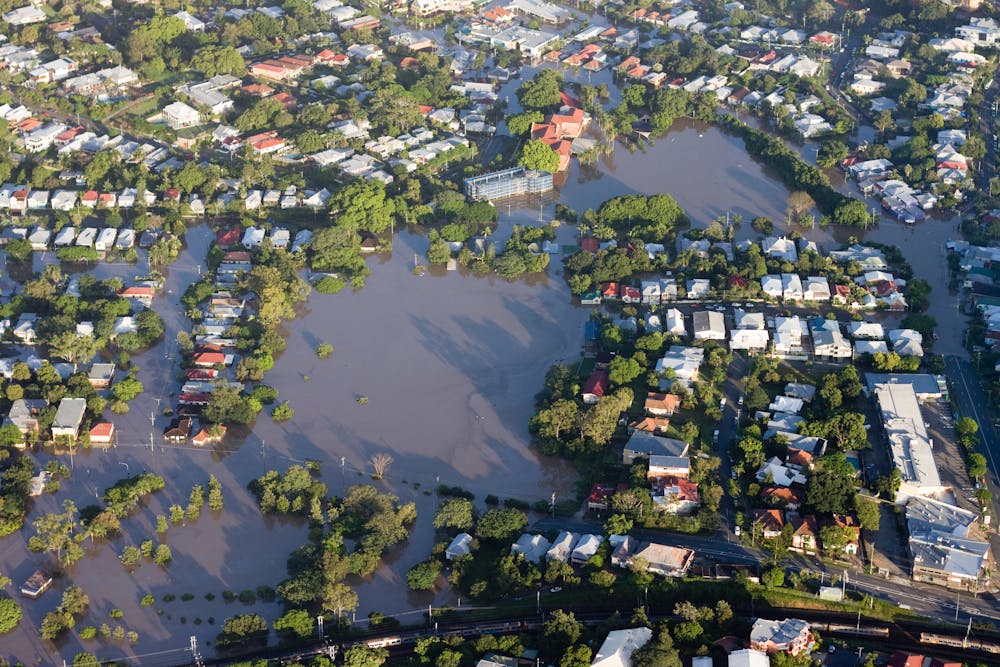
When southeast Queensland and northern NSW floods, the problem isn’t just the greater frequency and intensity of storms. It’s that floodwater ends up in people’s houses and neighbourhoods because of changes we have made to drainage catchments.
So why is that happening — and what can we do to reduce it?
When a surface is hard or impermeable, water cannot be absorbed; it runs off quickly and collects in large quantities in inconvenient places.Shutterstock
Slow rain, fast rain
In an undeveloped, naturally vegetated area, rain moves slowly; canopies and the naturally porous ground surface deflect and absorb the water.
When the surface is hard or impermeable, however, water cannot be absorbed; it runs off quickly and collects in large quantities downstream. That’s how water ends up in people’s homes and streets. It’s what happens when you clear and develop river and stream catchments and cover land with buildings, footpaths and concrete.
Our traditional approach has been to collect rainwater in gutters and move it quickly and efficiently downstream. But this deprives plants, animals and soil of much-needed water that would otherwise be absorbed.
When flooding overwhelms the system, the consequences can be dangerous and costly.Shutterstock
It also raises the question: how do we dispose of large volumes of water when they collect in inconvenient places?
As these problems compound, we have to design larger and larger systems to try to dispose of the water. And when flooding overwhelms the system, the consequences can be deadly.
Traditionally, we have tried to armour rivers and waterfronts with levees, barriers and sea walls to keep all floodwaters out. Increasingly, however, planners, designers and engineers are looking to new approaches.
Instead of trying to keep all floodwaters out, we can design landscapes to accommodate the water without damaging cities or farmland.
The project (which encompasses the Rhine, the Meuse, the Waal and the IJssel) redesigns the river and floodplain by moving dikes further out and lowering floodplains and groynes. It creates “green rivers” (channels that allow floodwater to branch off from the main river) and removes obstacles from the channel so recurring floodwaters can spread out without causing damage.
A similar approach has been adopted in other places, such as the US state of Vermont.
Designing water into cities
Using a similar approach at a smaller scale, we can design cities to accommodate floods. When the Victoria Park neighbourhood in the Sydney suburb of Zetland was developed in the late 1990s, all its public spaces, streets and open space were designed with an integrated water management system in mind.
All park spaces were lowered to hold water after storms. Special vegetated channels called swales were constructed to slow down and absorb water.
Under the area’s central park (Joynton Park) is a water storage basin. Rainwater flowing into this underground basin has been filtered through the plants and soil of the swales, and is then re-used in local water features and for irrigation.
All these adjustments mean the area can flood in a way that causes minor inconvenience rather than disruption. By controlling where floodwater collects, we can reduce the damage.
There are many examples around the world of buildings and landscapes where flooding is “designed in”. Here are three examples I know well, through the involvement of my firm Spackman Mossop Michaels.
For Sydney’s Moore Park Bus Interchange, we suggested large areas of paving be designed to let water through into a massive gravel bed underneath, where rainwater is stored before percolating into the area’s groundwater. This allows floodwater to be directed into and absorbed by the earth, rather than simply rushed into stormwater systems that can overflow.
In New Orleans, where land subsidence left the city below sea level and unable to drain naturally, the Rosa Keller Library was severely flooded when levees broke after Hurricane Katrina. Its redevelopment included a rain garden of native irises to store and hold stormwater before releasing it slowly into the stormwater system.
Through clever design interventions like these, we can keep stormwater out of the drainage system for as long as possible, effectively increasing its capacity.
This story is part of a series The Conversation is running on the nexus between disaster, disadvantage and resilience. You can read the rest of the stories here.
You may have had heard of Vanessa Sierra, the Instagram model and reality TV contestant who adeptly used her time quarantining with boyfriend Australian tennis player Bernard Tomic to build her public profile.
Sierra is just one of the hundreds of thousands of “content creators” – most commonly young women – monetising content produced on social media platforms. She has been using these platforms to promote “subscription-only” content. Most “social influencers”, however, have a more traditional business model, using their position to promote brands.
Among Australia’s influencer megastars are fitness influencer Tammy Hembrow (11.9 million Instagram followers), who can reportedly charge as much as A$55,000 for a single post, and Kayla Itsines (12.7 million Instagram followers), whose workout app and deals with brands such as Apple and Adidas placed her 27th on the Australian Financial Review’s 2020 Young Rich List (estimated worth: A$209 million).
Tammy Hembrow and Kayla Itsines, two of Australia’s most successful social influencers. Both have more than 10 million Instagram followers.Instagram
One report estimates there are more than 830,000 influencers on Instagram alone. It’s the wild west of marketing. Surreptitious and dubious practices have flourished. So too has the exploitation of overt sexual representation.
The new code of ethics for Australian advertisers, which came into effect on February 1, addresses one of these problems – lack of transparency in disclosing financial deals. It does a less adequate job with the other.
It has much improved on guidelines for gender representations in traditional advertising. It acknowledges, for the first time, advertisers’ responsibility to avoid harm to consumers and society. But it leaves a big loophole for commercialising sexualised imagery through social influencers.
What is the code of ethics
The Australian Association of National Advertisers’ code of ethics is a central part of the self-regulatory model that governs advertising standards in Australia.
It sets guidelines for “all advertising or marketing communication under the reasonable control of the advertiser”. It is used to adjudicate complaints about advertising (by AdStandards, formerly known as the Advertising Standards Bureau).
The new code makes a number of welcome improvements, replacing a code much criticised for its laxity in allowing adverts that reinforced gender stereotypes and exploited sexualised imagery for commercial gain.
One key change is prohibiting harmful gender stereotypes suggesting “skills, interests, roles or characteristics” uniquely associated with women or men.
Now messages such as the “Put time back in your day” advert for leading cleaning brand Pine O Cleen (owned by British multinational Reckitt Benckiser) will be contrary to the code, because they allude to alleviating the domestic load only of women.
Overtly sexual imagery
Another important change is prohibiting the use of “overtly sexual” images in outdoor advertising or shopfront windows, and in any other advertising medium when “not relevant to the product or service being advertised”.
Accompanying the new code is a guide specifying what may be considered overtly sexual, including suggestive undressing or depictions in sheer clothing or lingerie that expose private body parts.
This mean brands such as automotive repair company Ultra Tune, long subject to public complaints, can no longer use overtly sexualised representations of women to advertise their services.
Ultra Tune’s ‘Get into rubber’ campaign was the second most complained about ad in 2016.Ultra Tune/Collective Shout
Research has consistently found exposure to such images are directly associated with a range of negative consequences, including higher levels of body dissatisfaction, greater support of sexist beliefs and greater tolerance of sexual violence toward women.
But what about influencer culture?
The new code’s approach to sexist stereotypes better reflects contemporary society and signals a move away from a “sex sells” mentality in advertising.
What it doesn’t really address, however, is the rise of influencer culture, where a highly sexualised aesthetic that borrows from pornographic imagery is the norm.
Across influencer culture there’s a rigid standard of idealised femininity known as the “Instagram face” – doe eyes, arched brows, high cheekbones, smooth skin and pouty lips. It is a look that sets unrealistic beauty standards for girls and women, manufactured through cosmetic enhancements and photo editing applications.
Skye Wheatley and Shani Grimmond, two of Australia’s Instagram models/influencers. Both often wear much less clothing in their photos.Instagram
Advertising budgets
The proportion of corporate marketing budgets going to influencers is growing rapidly. In 2019 the advertising spend on influencers globally was an estimated US$8 billion. By next year it is predicted to be US$15 billion.
That spend reflects the growing value of influencers to marketers, who are seen as effective promoters of products to large, dedicated and highly engaged audiences likely to make purchases based on influencer recommendations.
But, significantly, the code’s standards (including for overtly sexual imagery) don’t apply to user-generated content “not within an advertiser’s reasonable control even if brands or products are featured”.
That’s a big loophole for advertisers. Influencers tend to make almost all creative decisions in crafting sponsored content. Indeed, a survey commissioned by influencer marketing platform Takumi in 2020 found influencers’ top concern when working with brands was retaining creative control. This includes choices about location, staging, lighting, posing, wardrobe, makeup, scripting and directing.
This leaves open various challenges to what can be seen to constitute “reasonable control” for advertisers.
The new code’s vision of advertising and the norms of influencer culture are therefore likely to remain worlds apart.
In an ever-evolving media landscape, ensuring advertising standards keep pace is an ongoing challenge. The new code is catching up with community expectations for “mainstream” advertising.
But this progress won’t count for much unless advertisers are also held to account for how corporate money helps to sustain sexist and sexualised stereotypes perpetuated through the influencer market.
It seems safe to assume a musical “masterpiece” would show compositional magnificence and garner universal acclaim — yet Maurice Ravel’s Boléro (1928) is conspicuously lacking in the first.
Writing to a friend shortly after finishing the work, Ravel described it as having “no form in the true sense of the word, no development, and hardly any modulation”. And to the Swiss composer Arthur Honegger, he confided, “I’ve written only one masterpiece – Boléro. Unfortunately, there’s no music in it”.
Despite these misgivings, Boléro’s instant success was a delightful surprise for the composer. A few years later, on entering the casino at Monte Carlo, he was asked if he would like to gamble. He declined by saying, “I wrote Boléro and won — I’ll let it go at that”.
The piece arose out of a commission for a new ballet from Ida Rubinstein, a prominent dancer formerly with Diaghilev’s Ballets Russes. Originally, Ravel had planned to respond with an orchestration of Spanish composer Isaac Albeniz’s Iberia (1905–1908), but when copyright issues proved insurmountable, he decided to write his own Spanish-themed work.
The Spanish influence is not surprising in a work by France’s then-most-famous composer, as his mother was Basques. Nor are the obvious inflections of jazz, as the style was popular in many of the bars of Paris frequented by Ravel, and his four-month tour of the United States early in 1928 had heightened the attraction.
What is truly surprising is the singular premise on which Boléro is based: an experimental orchestral crescendo lasting a quarter of an hour, based exclusively on a two-bar rhythm repeated a staggering 169 times.
A rat-a-tat drum percussion begins.Supplied, Author provided (No reuse)
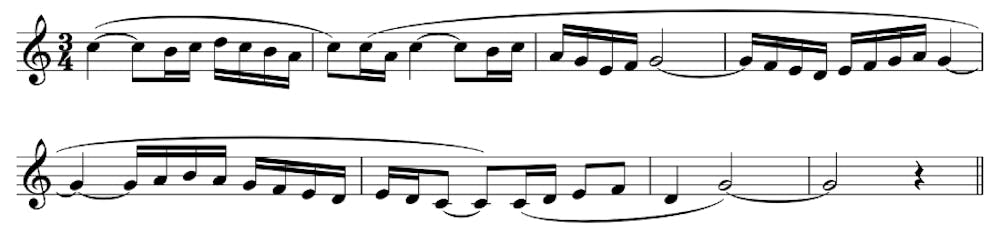
There are but two melodic ideas in the piece, each heard twice before alternating, and always given to a new instrument or group of instruments.
Indeed, for a composer famous for his orchestration — both in his own compositions and in his arrangement of works by others — it is a marvel of orchestral assignment, writing for each instrument (and instrumental group) in ways that highlight particular aspects unique to them.
It is amusing to imagine Ravel, a self-confessed “dandy”, who once played the melody on piano for a friend, dressed in a yellow dressing down and scarlet head cap. “Don’t you think this theme has an insistent quality?” he reportedly asked.
An insistent theme.Supplied, Author provided (No reuse)
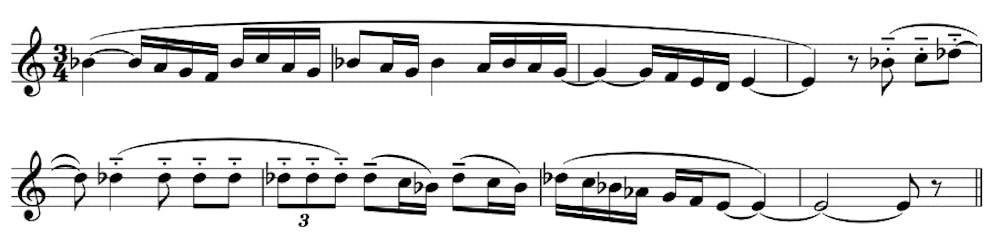
The second melody contrasts with evocative repeated notes that have a flattened quality to them, these blue-note intonations no doubt contributing to what Ravel’s friend, Hélène Jourdan-Morhange, believed were “obsessive, musico-sexual” underpinnings in the work.
The second melody contributes to Ravel’s ‘musico-sexual’ score.Supplied, Author provided (No reuse)
The gamble pays off
Almost immediately, the work found success in the concert hall, with recordings by luminary conductors like Sergei Koussevitzky and Willem Mengelberg. The popularity of the work in the United States was aided through performances led by Arturo Toscanini. Ravel, however, did not hide his scorn for the conductor’s interpretation: at around 13 minutes long, Ravel believed that it was played too fast. The composer’s own recording lasts over 16 minutes.
Toscanini believed that the work needed “saving”, yet it is arguable that, at the slower speed requested by the composer, audiences are beguiled into a state of complete enthralment. The more moderate tempo also fits better with our understanding of the composer, who had a lifelong fascination with mechanical devices.
Indeed, Ravel’s original scenario for the ballet built on this mechanistic idea, with the action to have taken place within a factory. In Alexandre Benois’s designs for the first production, however, the ballet was set in a Spanish tavern.
The combination of sinuous melody, mesmeric rhythm, and slowly building orchestral crescendo has inspired the imagination of Hollywood. In 1934, a film starring George Raft and Carole Lombard titled Bolero made much of the simmering tension underpinning the work.
In 1979, the music was similarly used to illustrate Dudley Moore’s attraction to Bo Derek in 10.
And to universal acclaim, gold medal-winning ice-skating duo, Torvill and Dean, danced to a (considerably shortened) recording of the piece at the 1984 Sarajevo Winter Olympics.
For many, the score immediately brings champion ice skaters Torvil and Dean to mind.
Detractors
Yet there is no escaping that the singular premise of Boléro fuels the claim it is a composition with little content. According to the composer’s brother Edouard, this criticism was evident at a first performance, where an old lady was heard shouting “Rubbish! Rubbish!” above the applause. On being informed of this, the composer responded sagely, saying, “That old lady got the message”.
Sarcastic remarks on Ravel’s works were made by the British composer, Constant Lambert. He claimed that in some of the composer’s pieces the repeated rhythms eventually grew tiresome. This was even more of a problem with Boléro, he stated, as it occurs “shortly after the beginning”.
Perhaps the funniest response to the work is Patrice Leconte’s short film, Le batteur do Boléro, first shown at the Cannes Film Festival in 1992. After the conductor walks to the stage and the orchestra begins, the camera pans to the back of the stage, the focus landing on the percussionist tasked with playing the incessantly repetitive rhythm. The facial movements of the drummer as he endures this undertaking amount to a farcical study of the difficulties of maintaining attention, and is endlessly amusing.
A study in concentration.
The ending
Sadly, the work was one of the composer’s last, an accident in a Paris taxi exacerbating what was possibly a latent neurological condition which drew his life to an end within a decade, incapacitated mentally and in pain.
While the work has proven easy to criticise, there is an element that nevertheless marks Boléro as deserving of lasting attention. Given the repetitive rhythm and the restricted melodic material, it would have been foremost in Ravel’s mind that monotony would be an issue, even with his carefully expanding orchestration. Especially in terms of its harmony, the piece is utterly welded to the key of C major.
Yet with a master’s understanding of the intricacies of timing, Ravel rachets the ending in two ways.
Firstly, he curtails the double statements of the two themes to single playings. And then, without warning, he moves the entire piece to the key of E major, a harmonically “distant” key with little relation to the home key of C major. And then, after eight glorious bars of peeling forth in this previously unimaginable harmonic region, he just as suddenly moves the music back again.
Given the unceasing momentum of all that has gone before, the momentary harmonic shift serves to satisfy our need for change, seemingly in an instant. And with this simple roll of the dice, Ravel likely guaranteed the lasting success of this masterpiece “without any music in it”.
Russian opposition activist Alexei Navalny was today sentenced to two years, eight months in a prison colony for violating the probation terms of a suspended sentence on a 2014 conviction, which he claims was politically motivated.
This comes on the heels of a second weekend of unauthorised protests in which thousands of Russians took to the streets in support of Navalny.
This is an important moment for Russia. Now that Navalny faces a lengthy prison term, he could become a potent symbol of a lawless regime that is afraid of its people — and further energise the opposition.
To counter this, the Kremlin will seek to paint Navalny as a dangerous symbol of Western meddling in Russian politics.
The success of these competing messages will play a critical role in determining whether the opposition will be able to maintain its momentum moving forward.
Police surround protesters rallying against the jailing of opposition leader Alexei Navalny in St. Petersburg.Dmitri Lovetsky/AP
A growing crackdown
For many years, Russia has been an unusual place for opposition politics. Despite dominating the messaging on traditional TV and (most) print media, the Kremlin has allowed a degree of free speech online. Navalny has taken advantage of this freedom, exposing high-level corruption first as a blogger and now as head of Russia’s leading anti-corruption organisation.
He and his team have produced voluminous reports and slickly produced viral videos detailing corruption at the highest levels of Russian politics. These videos have generated millions of clicks.
But last year it appeared this uneasy truce between the Kremlin and its online opponents was breaking down. Putin’s approval ratings fell to historic lows amid a stagnating economy and the government’s dysfunctional response to COVID.
Voters approved constitutional changes last year allowing Mr Putin to run for two more terms, but Navalny called the vote illegitimate.Mikhail Klimentyev/Sputnik/Kremlin/Pool
In response, the Kremlin launched a large, stage-managed constitutional reform process aimed at projecting the image of strongman governance as the only way to avoid growing threats from a hostile Europe and United States.
In addition, the Kremlin has ramped up its targeting of government critics and human rights groups by pushing its claims they are “foreign agents” and restricting their operations. Navalny and his Anti-Corruption Foundation have also faced growing harassment.
Then, in August, Navalny was poisoned while visiting regional Russia to promote his “smart voting” system, which helps Russians vote tactically for opposition candidates, depriving the ruling United Russia party of votes and weakening its monopoly on power.
Perhaps anticipating his arrest after returning from Russia from his convalescence in Germany, Navalny personally appeared on YouTube describing a highly detailed report of a US$1.3 billion dollar palace allegedly built for Putin on the Black Sea.
Western agent or symbol of a new form of politics?
With Navalny now facing a lengthy prison time, two competing narratives are likely to emerge.
The government will seek to downplay his symbolic importance. For his part, Putin still refuses to call Navalny by name and has recently referred to him as “the Berlin patient”.
And to the extent the official state media do mention Navalny, the Kremlin has increasingly tried to characterise him as a Western agent intent on weakening Russia and unleashing revolutionary chaos.
This image of Navalny fits with the Kremlin’s overall narrative that Russia is under threat from a hostile West seeking to undermine its stable development. This message has ironically been strengthened by European Union and US threats to impose additional sanctions on Russia for jailing Navalny.
Tens of thousands of Russians took to the streets following Navanly’s arrest in mid-January.MAXIM SHIPENKOV/EPA
The long-term success of this narrative in Russia, however, remains unclear. In contrast with Europe and the US, where Navalny is rapidly assuming the unambiguous status of “oppressed Russian dissident”, Russians have mixed views on Navalny. Many are uncertain whether they would vote for him if he could run for president. Others worry about his nationalist background.
But the protests suggest Navalny could come to symbolise something far more problematic for the Kremlin.
His jailing could galvanise Russians who want a form of politics no longer characterised by post-imperial nostalgia and a paranoid, siege mentality that constantly fears Western interference. Instead, they want to live in a country focused on building better schools, infrastructure and health care.
The protests show this narrative is particularly popular among young people, who ignore state media and instead get their news from social media posts that combine dark humour with criticism of the regime.
Some of these videos have sampled songs by activist musicians, such as IC3Peak’s Death No More, which mixes hard-core electronica and images of the singers pouring kerosene on themselves in front of government buildings and eating raw meat outside Vladimir Lenin’s tomb.
Further, the recent protests show this narrative is also gaining traction in regional cities in Siberia and the Far East, which have suffered from the Putin regime’s centralisation of power and money in Moscow over the last 20 years.
Finally, this narrative is popular among women. Navalny’s organisation is cultivating a new generation of female leaders and supporters, many of whom want to break away from the macho, strongman politics of the Putin era.
As Navalny (and many of his team) sit in jail, he is a reminder of the hypocrisy of many of the Russian political elite, who claim to be protecting Russian sovereignty, but own vast amounts of property in Europe.
If the Kremlin successfully paints Navalny as a foreign agent who will only bring instability to Russia, the jailed activist may retreat from public view. If he does, the opposition will once again fail to place serious political pressure on the Kremlin.
But if Navalny comes to symbolise unjust oppression in the face of an increasingly corrupt, unaccountable and incompetent political elite, popular pressure will only increase on the Russian government.
It could take years for this narrative to gather steam. But if it does, Navalny will likely be correct when he stated in a recent court hearing,
right now brute force is on the state’s side, but that will not last forever.
Recent accusations of harassment and coercion by leading figures in Aotearoa New Zealand’s music industry were shocking, but not surprising.
Last year, we released the Amplify Aotearoa report that revealed serious issues with gender diversity in the local music industry. Two main findings emerged:
more than 70% of women reported experiencing gender discrimination, disadvantage and bias
nearly half of women reported they had felt unsafe in places where music is made and/or performed.
The recent revelations of abusive behaviour in the industry remind us that, beyond its career-limiting potential, discrimination involves a significant emotional cost to victims. This was a major motivation for our Amplify Aotearoa research.
Empowering the next generation
As curriculum developers and university educators in a music degree, we felt obligated to better understand the industry our students were entering. In the process, the project identified even more obligations.
It is not enough for the tertiary sector to “call out” the problems the music industry is facing. Rather, we must also reckon with the role music education should play in breaking down obstacles and empowering the next generation of Aotearoa’s music makers to lead cultural change.
In recent years, many tertiary music providers have shifted their focus toward producing “real world” outcomes for their graduates. Music degrees have evolved with the goal of equipping students with proficiency across a variety of industry contexts. Work-integrated and project-based learning is prioritised, seeking to develop skills for career success and employability.
What, then, should a “realistic” attitude entail, given the industry’s well-documented history of marginalisation, exploitation and harassment of women and gender-diverse people?
Training students for the reality of working in an industry in which they can expect to be targets of mistreatment risks complacency towards existing cycles of discrimination.
Encouraging students to develop “realistic” career intentions should mean empowering them not just to understand existing industry practices, but to have the tools to change them.
Part of the answer lies in what and how we teach. Critical theories that underpin our understanding of issues such as race, gender and sexuality allow us to engage with the ways music carries and constructs meaning in our society. In doing so, they provide us with the tools to understand the lived experiences of music industry workers.
But such approaches are at risk within the tertiary sector internationally. In Australia, staff and funding cuts have jeopardised courses that teach the critical skills essential to bring about cultural change.
Addressing the gender imbalance
Further urgent issues facing the tertiary music sector are barriers to access, and the lack of diversity in our student cohorts. Who are we training and graduating into the industry?
Tertiary Education Commission TEC data show music cohorts in Aotearoa are largely populated by young Pākehā men from high-decile school backgrounds. Women make up around 40% of enrolments in university music programs and courses. Women are also under-represented as staff across the sector.
This disparity is further amplified in the industry, with women representing 24.1% of APRA-AMCOS NZ members. That the imbalance we see in the industry is evident in university recruitment figures suggests problems with pre-tertiary education too. It seems fewer women than men see music as a viable pathway for study.
Educational institutions are also not immune to issues of sexual abuse and coercion, as recent allegations have shown. The tertiary sector must do more to foster diverse and inclusive cohorts and curriculums, and hold abuses of power to account.
For music educators, this means advocating for critical approaches to understanding music, even when this may not always align with institutional definitions of employability.
It also means leading by example in setting standards for respectful and inclusive behaviour, responsibly talking with our students about the epidemic of harassment in creative fields, and addressing disparities in recruitment through a better understanding of the social and economic factors that produce inequalities in student cohorts.
As researchers and educators, our aim is to forge a fairer and more inclusive environment for people to make and share music. But this comes with the immediate obligation of addressing how the wider tertiary sector must effectively engage staff and students in what it means to be a responsible member of a music community.
It is the responsibility of music education to empower students to challenge industry practices and organisations, rather than simply place students within them.
It has always been positive, at times very positive.
Ten years ago it was 4.75%. Then, as now, it was used to help set every other rate.
But there’s no reason why it couldn’t be negative. Borrowing (accepting deposits) entails costs. If the banks offered funds are offered more than they need, they’ll charge for accepting them.
Overseas, bond rates in Germany, Switzerland, Netherlands, Slovakia, Denmark, Austria, Finland, Belgium, France, Ireland, Slovenia and Lithuania are negative. In Germany it means that someone lending the German government 105 euros agrees to get back only 100 euros when the loan expires ten years later.
In at least three countries, Japan, Denmark and Switzerland cash rates are also negative, at rates of -0.10%, -0.60% and -0.75%.
Calculations I carried out with colleague Timothy Anderson suggest that if Australia’s Reserve Bank acted in accordance with its previous behaviour, it would have turned Australia’s cash rate briefly negative in the second half of last year.
There’s a case for negative cash rate here
Our model, that accurately describes previous Reserve Bank behaviour, is that the bank has a view about the “neutral” cash rate, one that will leave the economy neither “too hot” (too much inflation) nor “too cold” (too much unemployment). If inflation remains too low (and/or unemployment too high) at the neutral rate it moves the cash rate below neutral until inflation climbs back up.
In August 2020 when the Bank was forecasting a dire outlook with unemployment peaking at 10% and inflation well below target our model suggests that if the bank was following previous practice it would have cut the cash rate to around -0.25%.
By November 2020 when the bank’s forecasts were more positive, our model suggests a positive, but still extraordinarily low cash rate, of about the 0.10% it adopted.
Australia’s Reserve Bank has been remarkably reluctant to take rates negative, seeing a cut into negative territory as fundamentally different to a cut that leaves rates positive.
Economic studies suggest that the neutral rate has been heading downwards for decades and possibly centuries. If the trend continues, negative rates will eventually become widespread.
To not match negative rates elsewhere would be to invite an influx of “hot money” chasing higher rates in Australia than were available elsewhere, pushing the Australian dollar uncomfortably high.
Today it extended announced a decision to buy an additional A$100 billion of bonds when the current bond purchase program expires in mid April.
Lowe will explain more in a televised address to the National Press Club on Wednesday.
Should things worsen here or overseas he might have to go further and overcome his reluctance to push the cash rate negative.
We don’t quite know what would happen
How a negative cash rate would play out depends on how the banks respond.
There are three possibilities.
First, the banks could adjust neither their deposit nor lending rates, meaning the negative cash rate had little effect.
Second, the banks adjust down both their deposit and loan interest rates, but this would mean charging depositors for placing funds with them, something banks haven’t done in other countries that have zero rates for fear of losing customers.
Third, banks could lower lending interest rates only. This might avoid unpopularity among customers but would erode interest margins. Over time banks might become less keen to lend.
It’s not clear what bank customers would do. In 2015 a survey conducted for ING Bank asked what savers would do if the deposit interest rate fell to minus 0.5%.
Only 10% said they would spend more. 14% said that they would save even more. 42% said they would switch some or most of their savings to somewhere like the stock market. 21% would move it to “a safe place”.
Just before Tuesday’s House of Representatives question time, Scott Morrison rang Liberal maverick Craig Kelly. The PM wanted to be sure Kelly wasn’t an anti-vaxxer.
Kelly said no – his outspoken campaign on hydroxychloroquine and Ivermectin was for additional treatment, not as an alternative to vaccination.
Kelly has had his neck saved by two prime ministers: Malcolm Turnbull before the 2016 election and Scott Morrison prior to the last one.
They had their political reasons at the time, but Kelly doesn’t deal in gratitude. In the climate wars, he worked for the demise of Turnbull, and now he’s embarrassing Morrison with his freelancing on COVID.
Kelly is a zealot over the usefulness of the two drugs in treating COVID, despite public health officials dismissing the case. He’s tangled with Chief Medical Officer Paul Kelly.
He posted in January: “The claim that there’s is ‘no evidence’ that HCQ and Ivermectin reduce Covid infections, minimise hospitalisations and reduce death is one the most costly and most deadliest lies in history. … And those that have acted to deny sick people access to this medicine need to be held accountable.”
He was back on his hobby horse at Tuesday’s Coalition parties meeting. He quoted a review of the literature by immunologist Robert Clancy (emeritus professor at the University of Newcastle), complained again about state restrictions on the availability of these drugs and linked the issue to Liberal values.
No one responded in the meeting. Colleagues, and especially Morrison, don’t want to give him any more than the considerable oxygen he takes up.
Kelly’s posts on Facebook (where he has more than 90,000 followers) are highly provocative, and suddenly Morrison is finding himself put on the spot about what his backbencher is saying.
At the National Press Club on Monday, the prime minister was asked about his failure to “rein in” government MPs “who are spreading disinformation about both the virus and the vaccines on social media”.
Morrison said people should get their information from official government sites, not Facebook.
When a journalist chipped in with Kelly’s name, Morrison said, “He’s not my doctor and he’s not yours. But he does a great job in [his electorate of] Hughes.”
On Tuesday, the first day of this parliamentary sitting, Labor homed in on Kelly, moving (unsuccessfully) a motion noting his “repeated use of social media to spread damaging mistruths about COVID-19” and his comments about vaccinations “which have the potential to undermine public confidence in the upcoming rollout”.
It called on Morrison to condemn Kelly’s “irresponsible and dangerous comments”.
Labor’s health spokesman Mark Butler called Kelly “a dangerous menace” to the national Covid response.
Realistically, it’s unlikely Kelly would have much influence with the public. Despite his Facebook following, most people wouldn’t have heard of him, let alone be looking to him for guidance.
The government is using experts in its advertising about the vaccine for good reason – the public have faith in them in the time of COVID.
Essential found 68% were confident the rollout would be done efficiency and 72% believed it would be done safely.
At another level, the potential of Kelly to do damage to the Coalition government has declined compared to those months of minority government last term (although with a narrow majority, the Liberals wouldn’t want him jumping to the crossbench).
If he lost preselection and ran as an independent, he would not pose a threat in the seat.
Morrison would calculate his best course is to avoid a shouting match with Kelly (if he can) and let a preselection spell the end of his Liberal troublemaker.
Critics will say this is a cop out, but it is a politically effective one.
Hughes local Kent Johns, a councillor in the Sutherland Shire (Morrison territory), a former local mayor and a former president of the NSW Liberal party, was hunting Kelly before the previous two elections, though the prime ministerial interventions meant there were not preselection ballots.
Johns, who is ex-Labor and an industrial chemist with a committed position on climate change, was considered to have had the support to win ballots if they’d been held. He is expected to run again, and it is presumed the numbers haven’t changed. Even if Johns didn’t run, the “anybody but Kelly” feeling among the local Liberals would mobilise.
And this time, there’s no likely prime ministerial protection (apart from the standard letter of support for an incumbent).
Last weekend, the local Liberals in the Victorian seat of Menzies decided it was time to move on former minister Kevin Andrews. The prospect is strong the Hughes Liberals will move Kelly on.
Over the past few weeks, Google and Facebook have engaged in desperate attempts to avoid regulation under the Australian government’s proposed mandatory news media bargaining code.
Facebook chief executive Mark Zuckerberg evenappealed to Treasurer Josh Frydenberg and Communications Minister Paul Fletcher personally last week, hoping to shift the government’s hard stance.
Both platforms’ strategies have involved a mixture of user-focused advertising, political lobbying, and even threats to pull services from Australia.
But what may initially seem like a confident stance reveals itself, upon closer inspection, as a panicked approach — one spurred by a lack of earlier action.
A delayed reaction comes with a price
The government has largely ignored the threats and is pushing ahead with reform — with a determination that underlines Google’s and Facebook’s ongoing inability to make inroads in Canberra.
Both tech giants have sought to stop the implementation of the mandatory code, which would force them to pay Australian news companies for content that appears on their platforms.
It also requires they abide by certain minimum standards, including informing media companies about the type of data collected through users’ interactions with news, and providing advance notice of any algorithmic changes that affect news content.
Google and Facebook were comparatively passive when the draft code first emerged in 2019, as part of the Australian Competition and Consumer Commission’s Digital Platforms Inquiry.
But they intensified their efforts in recent months, upon realising the government wouldn’t yield. Both have threatened to remove Australian news from their platforms if the code is introduced in its proposed form.
Facebook has publicly considered withholding the launch of the official Facebook News service in Australia. This news tab feature is already available in the United Kingdom and will be rolled out to more countries over the next year.
Google’s goal to appeal to you
But perhaps the most noteworthy response was when Google threatened to withdraw Google Search from Australia.
Adding to this, the company’s national public relations campaign involved publishing an “open letter” to Australian users, through the Google homepage.
Google’s prompts to users initially caused confusion among many, as they were unaccustomed to receiving this type of messaging from the tech giant.Screenshot
Perhaps Google was trying to leverage its significant Australian audience, or capitalise on a general mistrust in Australian media. But any attempt to establish itself as a trusted company seems doomed since Australians are also distrustful of Google.
The open letter was followed by on-site pop-ups and an ad featuring Google Australia’s managing director, Mel Silva.
Threatening to pull Australian content from its services was a logical step for Google. In the past it happily withdrew Google News from Spain and decided to not deliver content from certain German publishers that sued it over intellectual property rights.
That said, the heavy-handed approach this time around suggests Google and Facebook recognise Australia’s planned reforms as a turning point for platform regulation, which could embolden other governments to make their own costly demands.
The inventor of the World Wide Web, Tim Berners-Lee, raised concerns the code could fundamentally ‘break’ the internet as we know it, and Google was quick to adopt this message in its campaign.Shutterstock
Facebook has been less active than Google on the public relations front, but has joined its lobbying efforts — going as far as hiring experienced lobbyists who know Prime Minister Scott Morrison personally.
The chief executive of Alphabet (which owns Google), Sundar Pichai, along with other high-level executives, have also spoken with Morrison.
These last-ditch efforts suggest the platforms are clutching at straws, particularly as they have so far failed to make significant inroads into Australia’s political sphere.
There are multiple reasons for this. The first is their opponent is the Australian media. While politicians and the media have a testy relationship at times, the two institutions are still connected through the Canberra bubble.
The relationship between political leaders and media executives can be especially close, as shown by the appearance of Morrison and Frydenberg at News Corp co-chairman Lachlan Murdoch’s 2019 Christmas party.
There’s no conspiracy between the Australian government and media, but they do have a shared history and are in regular contact.
Moreover, while Google and Facebook have invested sizeable sums in political lobbying overseas, crucially they have not done this here. Each year they spend millions of dollars on political lobbying in the UnitedStates.
They’ve even transformed politics in the European Union. Google, Facebook, Amazon, Apple and Microsoft collectively injected €19 million (more than A$30,000,000) into liaisons with the European Commission and European Parliament during the first half of 2020, the New York Times reported.
Meanwhile in Australia, the companies indirectly contributed just A$34,700 (Google) and A$16,500 (Facebook) to the Labor Party over the past five financial years.
These donations were under the disclosure threshold (which ranged from A$12,800 to A$14,000) and voluntarily reported by Labor. The Liberal Party may have received similar contributions it wasn’t required to disclose them.
These sums are tiny compared with what has been spent in the US and Europe. They point to an overall lack of attention on Australia, despite the threat of the bargaining code.
Not enough of a foothold
Even though Google and Facebook opened Australian offices relatively early (Google in 2003 and Facebook in 2009), they are unashamedly US companies, obsessed with US politics. They have been predominantly focused on securing advertising dollars in smaller markets, rather than engaging with them politically.
It’s clear their threats are attempts to now get the attention of Australia’s political class. And if the platforms follow through with the threats, younger news consumers — who get most of their news from social media — may be significantly impacted.
Perhaps some of this could have been avoided if Google and Facebook had dedicated more time and energy to smaller countries, now emboldened by the prospect of reform.
For transparency, it should be noted The Conversation made a submission to the Senate inquiry regarding the News Media and Digital Platforms Mandatory Bargaining Code.
Here’s a newspaper headline from May 27, 2020: “Worker at Melbourne quarantine hotel tests positive for COVID-19”. And here’s one from yesterday: “Coronavirus lockdown announced for Perth and South West after quarantine hotel worker tests positive.”
Melbourne, Sydney, Adelaide, Brisbane and now Perth have all seen the coronavirus escape from quarantine. Why does this keep happening, especially given the harsh lessons learned from Melbourne’s outbreak? The short answer is there is no national standard, and a stubborn resistance to taking aerosol transmission seriously.
In Melbourne back in May, several more hotel staff and security guards tested positive at two hotels over the ensuing days, triggering Victoria’s severe second coronavirus wave. The hotel quarantine system was cancelled on June 30 as the number of new cases accelerated, peaking at almost 700 per day. Genomic testing showed that 99% of Victoria’s second wave of COVID-19 cases in the community came from transmission events related to returned travellers infecting people working at the two hotels.
Much media attention focused on why poorly trained and supervised private security guards were employed at hotels hosting recently arrived overseas travellers. On July 2, the Victorian government announced a judicial inquiry into the state’s hotel quarantine system, headed by Judge Jennifer Coate. An interim report was published in early November with recommendations to guide the planning of a new system, and a final report was issued in late December.
The inquiry noted that if the recommendations of a 2009 federal review of the H1N1 influenza epidemic had been followed, there would already have been a set of guiding principles and a framework for the COVID hotel quarantine program, avoiding the need to set it up on a hasty, ad hoc basis.
Crucially, the report also concluded that casually employed security guards were not appropriate for quarantine hotels, which should instead be staffed by dedicated, appropriately remunerated staff who should not work at more than one location.
Groundhog Day
Fast forward to February 2021. Over the past three months, we have seen breaches of hotel quarantine in Adelaide, Sydney, Brisbane and now Perth. Short, hard lockdowns stopped the spread of the virus in Adelaide and Brisbane, although Sydney’s clusters continued for a month, with a total of around 180 cases. Perth has entered a circuit-breaker lockdown, prompted by a guard who was infected at a CBD quarantine hotel and then visited well over a dozen locations across the city, reportedly including other casual security gigs.
It seems hard to believe that private security guards are still employed on casual contracts in quarantine hotels.
Perth’s circuit-breaker lockdown was triggered by a security guard who was infected while working at a quarantine hotel.Richard Wainwright/AAP
Lessons have not been learned, neither from Victoria’s extensive inquiries nor from the subsequent national review of hotel quarantine led by former Department of Health chief Jane Halton.
Given the very low number of community-transmitted COVID cases in Australia, our number-one priority should be the quality of our border health security system, and crucially our quarantine arrangements. This is more vital than ever now that more dangerous variants of the virus that originated in the UK and South Africa have arrived in Australia.
What’s more, although National Cabinet authorised daily testing of quarantine hotel and transport staff on January 8, it was not implemented in Western Australia until January 29, so the infected hotel security guard was not tested until at least four days after he was infected.
It’s time for a coordinated, standardised national hotel quarantine strategy. This should be based on the recommendations in the two reports previously cited as well as lessons learned — both positive and negative — from the current systems in states and territories. Victoria had the benefit of designing a new system from scratch, which is often an easier task than modifying an old system.
The key elements of the Victorian system that could inform national standards include:
a high level of attention to the ventilation systems in hotels and transport vehicles
all staff are employed by a central government agency and are prohibited from having second jobs
all staff who have close contact with an infected guest or anyone who may be infected must wear adequate PPE, including a respiratory mask
all staff are tested daily using a PCR test
hotel guests cannot leave their room for any reason.
It’s not yet clear exactly how the Perth security guard became infected. He worked on the same floor as quarantine guests but reportedly did not enter their rooms.
But regardless of the specific details of this case, attention to ventilation and adequate PPE is more important than ever, given the growing body of evidence the coronavirus can spread via small particles (aerosols).
The security guard in Adelaide and the hotel cleaner in Brisbane were almost certainly infected via aerosols, as was likely the case for the driver of a Sydney shuttle bus for flight crew. Moreover, when the virus was imported from Sydney’s Northern Beaches to suburban Melbourne, the initial cluster of cases in a Thai restaurant were probably infected via aerosols.
Quarantine protocols need to take account of the fact that aerosols can travel further than larger droplets, and should ensure proper PPE precautions are taken. Ventilation ducts should also not be positioned in a way that allows contaminated air to flow through indoor public areas such as corridors or lobbies.
As we await the vaccine rollout, our primary line of defence against a resurgence of infections is the quarantine system for international arrivals. This needs to be urgently raised to the highest level of federal and state and territory decision-makers, and implemented on a consistent basis nationwide, based on Victoria’s new best-practice standards. Otherwise there will be more groundhog days.
The Climate Change Commission’s draft advice on how to decarbonise New Zealand’s economy is refreshing, particularly as it calls on the government to start phasing out fossil fuels instead of relying on offsets and carbon trading.
Until now, New Zealand has relied heavily on its Emissions Trading Scheme, but the evidence is clear that it has failed to reduce emissions. The commission’s package includes carbon budgets out to 2035 and detailed pathways to achieve them across all sectors of the economy.
For the transport sector, which is responsible for half of New Zealand’s energy-related emissions, the commission suggests a sweeping set of changes to electrify the country’s car fleet and to replace imported fuels with local renewable electricity.
It’s exciting to see a national-level plan that actually cuts emissions. But it raises two questions: is it feasible, and is it the best or only option?
Transforming the transport sector
Land transport was always going to be squarely in the commission’s sights. Its emissions have doubled since 1990, and, unlike agriculture, it’s not a protected export industry.
The commission calls for cuts in transport emissions of 47% by 2035, achieved by:
a rapid shift to electric vehicles, with the market share for light vehicles rising from 2% today to 50% in 2027
an end to imports of pure petrol or diesel cars by 2032, and a similar but later transition for trucks
the development of an integrated national transport network that reduces travel by private car
changes to urban planning leading to 7% less travel per person
the development of policies to increase walking, cycling, and public transport by 25%, 95% and 120% respectively by 2030
scaling up low-carbon fuels, such as biofuels, to 3% of all liquid fuels by 2035
some decarbonisation of the rail network, lifting rail’s share of freight from 16% to 20%, and more coastal shipping.
To achieve this rapid electrification, New Zealand would need to produce more renewable electricity. Only one large wind farm, the 840 GWh/year Turitea wind farm near Palmerston North, is currently under construction.
New Zealand would need to build more wind farms and scale up renewable electricity generation.Brendon O’Hagan/Bloomberg via Getty Images
In the commission’s proposed scenarios, New Zealand would need another renewable electricity plant like this every year from now on. At the moment, New Zealand has only 690 MW of wind turbines, and no utility-scale solar generation. The industry would need to scale up considerably.
Other live issues are the planned 2024 closure of the Tiwai Point aluminium smelter, which would make a lot of renewable electricity available, and the NZ Battery pumped-hydro project.
The proposed shift away from fossil fuels is clearly feasible technically, but would need a quick and radical change in policy. Unfortunately, New Zealand doesn’t have a good track record of carrying out the sweeping regulatory changes that will be needed.
Apart from the proposed import ban on petrol cars from 2032, the EV plan involves a system of subsidies and fuel efficiency standards. Last week, the government introduced a refreshed fuel efficiency standard, with a target of 105 gCO₂/km by 2025.
But the car industry appears to have won several concessions, including a halving of penalties (to NZ$50 per vehicle per gram of CO₂ over the target), a delay in the standard’s introduction until 2023 and a separate target for utes.
The EU did not begin to see rapid EV uptake until 2020, when a new 95 gCO₂/km target kicked in, along with fines of €100/gCO₂/km and generous incentives. Achieving the Norway-like transformation of the car fleet the commission envisages will likely require more incentives and stronger oversight of the market.
Is this the only way?
The commission’s plan doesn’t question the overall structure of the transport system. In the view of some critics, the present system is inequitable and disadvantages people who can’t or don’t want to drive, including children, older people and people living with disabilities.
It has contributed to poor health and safety outcomes, traffic congestion and car-dominated city streets. At an annual cost of NZ$17,000 per household (not counting greenhouse gas emissions), it is also expensive.
The commission’s technical advisory panel included representatives from the car importing industry and other road transport groups, but no experts on walking, cycling, public transport, public health or urban planning.
The massive road-building programme undertaken by both National and Labour governments, set to continue far into the future, is not mentioned, despite considerable evidence that it increases transport demand, sprawl and emissions.
There is no requirement to reduce parking, a topic currently contested in urban forums and already being studied by the government. Nor are there any plans for passenger rail or improvements to inter-city public transport.
Changing the way cities grow
New Zealand’s housing crisis has already prompted a rewrite of urban plans throughout the country to enable higher densities, especially near transport hubs. The commission recommends that, before 2025, all levels of government should embed links between urban planning, design and transport so that communities have integrated and accessible transport options, including safe cycleways.
The commission wants to see policies that increase cycling by 95% by 2030.Shutterstock/ChameleonsEye
walking and cycling receive 20% of the transport capital expenditure
every local authority must develop a high-quality cycling policy, review road use and increase the number of children walking and cycling to school
new public transport infrastructure must receive twice the funding of any new roads
surburban and commuter rail is to be enhanced across the country, including high-speed intercity links.
You don’t need a complicated model to accept that these steps are more in tune with the required emission reductions.
Those who argue that infinite growth is not possible on a finite planet will not find much to agree with in the commission’s report. Other perspectives, such as those outlined in the recent book A Societal Transformation Scenario for Staying Below 1.5ºC critique the growth and technology biases in most climate scenarios.
Another model of the future could involve less energy, less travel and less consumption overall, but an equivalent or higher standard of living.
It has always been positive, at times very positive.
Ten years ago it was 4.75%. Then, as now, it was used to help set every other rate.
But there’s no reason why it couldn’t be negative. Borrowing (accepting deposits) entails costs. If the banks offered funds are offered more than they need, they’ll charge for accepting them.
Overseas, bond rates in Germany, Switzerland, Netherlands, Slovakia, Denmark, Austria, Finland, Belgium, France, Ireland, Slovenia and Lithuania are negative. In Germany it means that someone lending the German government 105 euros agrees to get back only 100 euros when the loan expires ten years later.
In at least three countries, Japan, Denmark and Switzerland cash rates are also negative, at rates of -0.10%, -0.60% and -0.75%.
Calculations I carried out with colleague Timothy Anderson suggest that if Australia’s Reserve Bank acted in accordance with its previous behaviour, it would have turned Australia’s cash rate briefly negative in the second half of last year.
There’s a case for negative cash rate here
Our model, that accurately describes previous Reserve Bank behaviour, is that the bank has a view about the “neutral” cash rate, one that will leave the economy neither “too hot” (too much inflation) nor “too cold” (too much unemployment). If inflation remains too low (and/or unemployment too high) at the neutral rate it moves the cash rate below neutral until inflation climbs back up.
In August 2020 when the Bank was forecasting a dire outlook with unemployment peaking at 10% and inflation well below target our model suggests that if the bank was following previous practice it would have cut the cash rate to around -0.25%.
By November 2020 when the bank’s forecasts were more positive, our model suggests a positive, but still extraordinarily low cash rate, of about the 0.10% it adopted.
Australia’s Reserve Bank has been remarkably reluctant to take rates negative, seeing a cut into negative territory as fundamentally different to a cut that leaves rates positive.
Economic studies suggest that the neutral rate has been heading downwards for decades and possibly centuries. If the trend continues, negative rates will eventually become widespread.
To not match negative rates elsewhere would be to invite an influx of “hot money” chasing higher rates in Australia than were available elsewhere, pushing the Australian dollar uncomfortably high.
Today it extended announced a decision to buy an additional A$100 billion of bonds when the current bond purchase program expires in mid April.
Lowe will explain more in a televised address to the National Press Club on Wednesday.
Should things worsen here or overseas he might have to go further and overcome his reluctance to push the cash rate negative.
We don’t quite know what would happen
How a negative cash rate would play out depends on how the banks respond.
There are three possibilities.
First, the banks could adjust neither their deposit nor lending rates, meaning the negative cash rate had little effect.
Second, the banks adjust down both their deposit and loan interest rates, but this would mean charging depositors for placing funds with them, something banks haven’t done in other countries that have zero rates for fear of losing customers.
Third, banks could lower lending interest rates only. This might avoid unpopularity among customers but would erode interest margins. Over time banks might become less keen to lend.
It’s not clear how bank customers would respond. In 2015 a survey conducted for ING Bank asked how savers would respond if the deposit interest rate fell to negative 0.5%.
Only 10% said they would spend more. 14% said that they would save even more. 42% said they would switch some or most of their savings to somewhere like the stock market. 21% would move it to “a safe place”.
This means any individual can lodge a complaint against Australia, arguing it has violated its human rights obligations towards them.
But even though this is free and legal representation is optional (albeit recommended), there are a number of other challenges.
Two big hurdles
Firstly, there is a procedural hurdle.
A person can only lodge a complaint with the committee if they have already exhausted all domestic remedies. That means they must have first gone through the Australian courts.
The committee can waive this requirement, but only if it is clear the local process cannot provide an effective remedy, or if proceedings have been unreasonably prolonged.
The UN’s Human Rights Committee is made up of 18 experts.www.shutterstock.com
Secondly, the merits of the case are not quite as clear-cut as Robertson suggests.
There is no absolute right for a citizen to enter Australia — their entitlement is not to be “arbitrarily” deprived of that right. This means the right may be subject to brief, temporary restrictions that are necessary, reasonable, and based on clear legal criteria — such as protecting the general public from the risks of COVID-19.
What about the #AusOpen?
Even so, it may well be possible for individuals to argue their right to return home is being unlawfully denied. Australia’s travel caps are only justifiable under human rights law if there are no other, less restrictive measures that can be taken to safeguard public health.
So, the federal government needs to show why the caps remain necessary – especially when 1,200 tennis players and their entourage were recently allowed to fly to Australia.
Indeed, a Senate inquiry suggested late last year that the federal government consider expanding Commonwealth-funded quarantine facilities to help stranded Australians get home, especially given its constitutional responsibilities for quarantine.
Two more hurdles
A third challenge is that even if the Human Rights Committee did find Australia had violated its international human rights obligations, Australia couldn’t be compelled to bring people home.
The UN human rights system relies on countries acknowledging and rectifying their breaches, but it can’t force their hand.
Australians stuck overseas have spoken about the distress and hardship of not being able to return home.www.shutterstock.com
Australia has a pretty consistent track record of disagreeing with the committee’s findings and refusing to follow its recommendations, especially concerning our treatment of asylum seekers.
A fourth challenge concerns the important issue of timing.
Even if a complaint were lodged today, it would take years before the committee could even consider its merits. As a matter of process, Australia would be given six months just to respond to the initial claim.
A glimmer of hope
There is one small window that could offer an earlier reprieve.
If a person could show that not being able to return to Australia would cause them “irreparable harm”, the committee might recommend “interim measures”.
This is not a finding of a violation, but an urgent measure to avoid potential harm. Interim measures are commonly granted to restrain a country from doing something — for example, to halt the deportation of someone who fears they will be tortured or killed.
The journey home has been made even harder for Australians by cancelled flights and exorbitant ticket prices.James Gourley/AAP
It is an open question whether the committee would consider interim measures as a means of getting citizens home. If it did, they would apply only to people who could show a risk of irreparable harm, such as separated children, those whose visa is about to expire, those without employment or a place to live, or those who have underlying health concerns or other compassionate reasons for returning.
And Australia could still ignore the committee’s request — although this would be a very bad look on the world stage.
Why it is still worth lodging a complaint
Still, what a case like this could achieve is a detailed elaboration of what the right to return to one’s country actually entails, and the kinds of circumstances in which it can be lawfully restricted.
The committee’s views on these matters would provide a valuable and authoritative contribution to the international human rights jurisprudence. This could have a powerful influence on how countries treat their nationals in the future.
If Australia was found to have violated its human rights obligations, then the committee’s opinion would also provide some vindication for those who have been stuck abroad.
Unfortunately, for those stranded now, though, it wouldn’t be the golden ticket home.
In a nation such as Papua New Guinea where oral storytelling is central to the intergenerational transfer of knowledge and wisdom, playwright Andrew Kuliniasi has taken things to a whole different level by embedding historical accounts and capturing snapshots of a society in transition in a Western art form.
In 2015, Kuliniasi wrote Meisoga, a play based on life of Sine Kepu, the matriarch of her grandmother’s clan. It tells of a young woman forced into leadership by a series of unfortunate events.
His new creation, He Is Victor, is an attempt to capture a moment in time in modern Papua New Guinea society where HIV, TB and discrimination are issues families have to contend with.
Andrew Kuliniasi … “The story is a contemporary PNG tragedy.” Image: My Land, My Country
Andrew Kuliniasi writes:
“He Is Victor follows the story of a young ‘gun for hire’ journalist named Tolilaga (which means a person who always wants to know) as she tries to uncover the mysterious death of her cousin brother Victor.
“The family hasn’t told her anything and has been keeping Tolilaga out of the loop. Meanwhile Tolilaga struggles with her motivations for finding the truth as she needs one big story for her to get a new job and promotion.
“At the closing of Victor’s hauskrai, she finds Victor’s journal that chronicles the moments leading up to his death.
“This story is a contemporary PNG tragedy.
“It deals with very hard hitting issues that a lot of Papua New Guineans are afraid to talk about.
“The main character, Tolilaga, delves into the issues and exploits the narrative. She’s a sensationalist but that doesn’t mean her stories don’t have merit.
“What Tolilaga tries to do is show the truth, the ugly truth. But the truth in PNG, the land where we live, the unspoken is very controversial.
“This play deals with issues of discrimination against people with HIV, tuberculosis and how these diseases are contracted. The play also questions our culture, in conversations we have about sex and sexuality, gender roles and family bonds.
“This show is going to get people talking and I’m expecting a lot of conversation. Is this show controversial? It maybe depending on individual audience members.
“But the one thing I can say is there will be a lot of crying. So if you’re coming to watch the show, bring a box of tissues.
The play is set for April 9-10 and 15-17 in Port Moresby.
Asia Pacific Report republishes articles from Lae-based Papua New Guinean television journalist Scott Waide’s blog, My Land, My Country, with permission.
Jakarta Indonesian Doctor’s Association (IDI) chairperson Slamet Budiarto has challenged a statement by President Joko “Jokowi” Widodo who has claimed that the Indonesian government has succeeded in bringing the coronavirus pandemic under control.
Budiarto said he was confused about what parameters Widodo was using in making such a statement.
“I don’t understand why Pak [Mr] Jokowi made such a statement. Perhaps in terms of the economy, I don’t know what the economy is like. What I do know is in terms of health,” Budiarto told Kompas.com.
Budiarto asserted that in terms of health, the pandemic was clearly “out of control”. This could be seen from the first parameter – the high death rate.
According to the Johns Hopkins University world covid-19 map, Indonesia’s total number of deaths today is 30,277.
“Our death rate is the highest – number 1 among Asean countries – both in terms of percentage and number. I expect that by the end of the year there will be 100,000 deaths, by December 2021,” said Budiarto.
The second parameter used by the IDI, meanwhile, is the rate of new daily infections. On the day of the interview, there were an additional 13,094 new cases.
More than 1 million cases Today the accumulative number of covid-19 cases in Indonesia is 1,089,308.
The deputy chairperson of the IDI confessed that he did not understand the parameters being used by Jokowi when he said the pandemic was under control.
“Yes, well perhaps the President has another parameter. For us at the IDI the parameters are the death and infection rate,” said Budiarto.
Regardless of the parameters being used, Budiarto is asking the government to focus on dealing with the pandemic in terms of health so the death rate can be brought down.
He said he had already proposed to Health Minister Budi Gunadi Sadikin that covid-19 patients with minor symptoms be treated at home under the care of general practitioners.
“One doctor can monitor 10 people. Later they could be given incentives,” said Budiarto.
In this way, hospitals will not be full and treatment rooms in hospitals can be used to focus on patients with medium and serious symptoms.
‘Death rate rising’ “Right now the death rate is rising because hospitals are overloaded”, he said.
President Widodo said recently that in 2020 and entering 2021 Indonesia had faced a number of difficult challenges. One of these was the covid-19 pandemic which had resulted in a health and economic crisis.
Widodo, however, also claimed that Indonesia has been able to control both crises well.
“We are grateful. Indonesia is among the countries that is controlling these two [health and economic] crises well,” said Widodo during a full working assembly session of the Indonesian Communion of Churches (PGI) through the PGI Yakoma YouTube channel last week.
Source: Council on Hemispheric Affairs – Analysis-Reportage
By Patricio Zamorano From Washington, DC
“That is not who we are,” insists the U.S. political class after the grave events of January 6 when a mob of Trump supporters brutally invaded the Capitol here in Washington, DC, leading to the loss of five lives. An entire nation, if not the whole world, has been traumatized, unable to believe that these images came from a developed country in North America.
The key questions are simple, “Why” and “How?” The answer is visible in the raw emotions on the demonstrators’ faces, strategically veiled in the concept of “American Exceptionalism” that has done so much damage throughout the history of the country’s democracy. The rest of the world is also astounded to see the U.S. trip up in its strategic economic, political, and ideological trajectory. But the dozens of countries that have historically been subjected to sanctions (most of them unilateral and therefore illegal under international law) had already seen through the veil.
Institutional control over the people
The destructive intent in the mostly white faces of Trump supporters has been part of U.S. society since the country was founded. The phrase “that is not who we are” fails to acknowledge how someone as unbalanced as Trump was so easily able to assume the most powerful position on earth.
I propose and will analyze how this is because the United States has a sort of co-opted democracy, with a deep-seated history of plans to filter, redirect, frame, and control the cultural, popular, political, and electoral expressions of its citizens. All the intricacies of government institutions help explain this framework. This is why Trump was able to quickly make vast inroads towards controlling the base of the Republican Party, and obtain more than 70 million votes on November 3—more than any previous Republican candidate. A history of citizens’ inadequate democratic access to power and hatred for government are partially responsible for unleashing the events of January 6. Trump successfully manipulated these sentiments and used them for his own personal benefit.
US Congress, surrounded by heavy security (Photo-credit: Patricio Zamorano)
Congress is able to overturn the Electoral College vote
It all starts with the Electoral College. The general public is not aware that in addition to the fact that the system does not allow voters to select their president directly, Electoral College votes determined by the popular vote in each state can be nullified, changed, or excluded by Congress.
What the Senate was doing on January 6, certifying the votes submitted by each state in the Union, in modern times had become no more than an act of protocol. However, Trump was exerting maximum pressure to exploit the legal framework underlying those proceedings: the ability to thwart the will of the people by overturning the results in the states he had lost, as had been done in a few occasions in the country’s history.
But there is more. The Electoral College rules indicate that if Congress rejects the votes submitted by some states and no candidate reaches the required 270 votes, CONGRESS DECIDES WHO BECOMES PRESIDENT AND VICE-PRESIDENT. Excuse the all caps, but I want to clarify the academic (and dramatic) reasons that U.S. democracy is simply a system of tutelage over the popular vote.
In addition, the “electors” elected by each state are not legally bound to cast their Electoral College vote for the candidate that won the popular vote in their state. Technically, they are allowed to change that vote. In modern times this has not happened because of a de facto sense of “honor” to respect the will of the people, and some state laws have tried to ensure that the vote submitted to Congress faithfully reflects the popular vote. But the law is clearly designed to not necessarily respect the votes of average citizens.
The mere fact that the Electoral College has awarded the presidency to people who did not win the popular vote is in itself an aberration from democracy that the American people passively accept. We know that Trump received 3 million votes fewer than Hillary Clinton. Al Gore received more votes than George Bush. And yet, the Republican was the one who gained power in these cases.
One of the positive aspects often mentioned about the Electoral College is that it allows small states to remain relevant. The idea behind this is that candidates must pay attention to those small states, visit them, and campaign in them. But the math of modern elections negates that reasoning. The system is so closed and controlled that elections are now decided by a small number of swing states that have become kingmakers, such that elections are not decided on the basis of 150 million votes, but rather a few thousand. This comes down to the micro level of counties: Trump actually won in 2016 because he was able to win some key counties in those swing states. In other words, he won by a factor of tens of thousands of votes, not millions.
Voting had been a privilege of class, race and gender
But the main reason the Electoral College exists is because the colonists who founded the nation and drafted the Constitution did not believe in the people’s capacity to correctly choose their own destiny. The young republics in post-independence Latin America suffered from the same phenomenon. All the countries of the Americas took at least 150 years to let the “uneducated masses,” as they called them, vote in free elections. Winning the right to vote was a long process laden with abuse, which used arbitrary means to limit suffrage based on educational, financial, social status, race, and gender requirements. Women’s right to vote was shamefully only granted little over a half century ago! Similar to the situation of African Americans.
U.S. democracy negates the existence of other parties. The entire system in the U.S. is designed to limit people’s choices to finite limits. The Supreme Court is a branch of government that dominates the lives of over 300 million souls with its lifetime appointments of justices that are not elected by anyone, except a handful of senators and the President.
The U.S. electoral system uses the full force and money of the judicial system to keep independent political parties from being an option to staff Congress, not to say the White House. For example, the Democratic Party spends millions of dollars on each election to keep the Green Party off the ballot. The Republican Party has buried the Tea Party and the Libertarians to keep them out of the running, except to rally behind the GOP candidate.
Donald Trump and much of what he represents is an anomaly for the Republican Party, given its political and religious values. The only reason he ran for the party’s nomination was to have a shot at the presidency; he had previously been a Democrat and supported Bill Clinton. Similarly, Bernie Sanders is an anomaly within the Democratic Party, with his socialist values that do not fit with the centrist line of Obama’s party. But Sanders, like Trump, had no other option. In any other country these candidates would have founded their own party, created strategic alliances with a variety of forces, and been competitive. According to all the data, it is quite possible that either Trump or Sanders alone could have garnered a significant percentage of the vote. Through alliances in a multi-party system, the US could have a truly democratic alternation of power, instead of the two-party Democrat/Republican dictatorship.
Violence has been part of the recipe for change
Once again, the phrase “that is not who we are” in response to the brutal violence exhibited on January 6 is also divorced from U.S. reality. All popular movements demanding far-reaching change have gone through a trial by fire. And the country’s two movements for true social revolution were shaped by savage violence. The first was for the abolition of slavery and it cost 600,000 U.S. lives through a cruel and vicious civil war. It was so brutal that the pro-slavery Confederate flag continues to be a source of pride and pain for millions of Southerners, some of whom led the siege of Congress this January.
The second movement for social revolution was the civil rights struggle of the mid-20thcentury, viciously repressed in streets throughout the country, particularly the South. Many of its leaders and some politicians who supported them were assassinated, including Martin Luther King, whom we celebrate this week, along with Malcolm X, John F. Kennedy, Robert Kennedy, Louis Allen, Willie Brewster, Benjamin Brown, Johnnie Mae Chappel, James Chaney, Addie Mae Collins, and more than 100 others, many of whom are unknown to younger generations. It is a massacre that has been obliterated from modern memory.
State-perpetrated violence under Lincoln’s presidency during the Civil War so profoundly traumatized Southerners that stubbornly defended the aberration that was slavery, that this left them with a permanent, visceral, and irrational hatred for what the government symbolizes. Its legacy is today’s armed civilian militias, a cult of firearms, and an almost religious devotion to the Second Amendment.
Many of the January 6th insurrectionists were educated people
The most radical segment of white culture (and other races, too) in the U.S. revolves around the role of government as an enemy that oppresses Americans in their private lives. The anti-imperialist outlook the world’s peoples have gained after suffering military actions or covert U.S. intelligence operations, is translated ideologically by white supremacist militias into distrust of the “deep state.” In this sense, what we witnessed on January 6 was not the actions of an uneducated, vicious mob. While much of Trump’s base is made up of rural people with lower levels of education, higher rates of poverty, and more precarious employment, as the surveys indicate, the mob that attacked Congress included state legislators, college professors and academics, corporate managers, attorneys, police officers, high- and low-ranking members of the military, firefighters, physicians, and nurses. And although Trump was impeached on very clear grounds of inciting insurrection against a branch of government, 197 Republican members of Congress voted against it, and 82% of Republicans do not believe Trump is responsible for the attack on the Capitol. Very revealing statistics indeed.
Government is the enemy, even if it provides social assistance
It is clear as day. Claims of “that is not who we are” have no grounding in the actual social psychology of the country. The distrust and disdain a large number of people hold for their government is so profound that these impoverished and conservative white people would rather reject the free medical care the government offers than accept what they view as a “socialist” threat. Let’s examine this point: the repudiation of socialism is not necessarily against the social welfare model (for better or worse, the US has some socialist infrastructure, although it does not call it that). What people on the Right fear is social control; they perceive threats from a government that will impose its decisions on their lifestyle, values, and private space just like it did in the 19thcentury during the Civil War.
This sentiment is so strong that they would rather die of preventable diseases than accept free health care from the government. They would rather give free reign to the gun worshippers than limit firearm sales after the massacre of twenty innocent children at Sandy Hook Elementary. After that tragedy, not a single significant piece of gun control legislation was passed because all efforts were rabidly rebuffed by the gun lobby.
Military truck blocking a street in Downtown DC, just a few blocks from Capitol Hill (Photo-credit: Patricio Zamorano)
Trump is a megaphone
The “accident” of Trump’s election simply gave voice from the White House, perhaps for the first time, to a large number of conservatives who had been harboring a mixture of contained rage and fear of two hundred years of political and institutional oppression. The Republican Party is not a comfortable home for the extreme values that have come to be called “Trumpism.” Its leaders in Congress and the Republican National Committee defend the current institutional framework, formal structures of power, and law and order. For this reason, dozens of Republican officials have received death threats by those who invaded Congress. Based on the polls and the still strong support enjoyed by Trump, maybe hundreds of thousands agree with the insurrectionists from their own homes far from the seat of power in Washington, DC.
Violence is the public manifestation of the country’s profound need for democratic reform. Progressive groups agree on the need for reform, but push for a democratic opening primarily through legal efforts to break the authoritarian siege, and try to mobilize people in the streets to build power out of civil society (unions, professional guilds, the media, grassroots movements, and activism). But operating at that level leaves people trapped by the system; they will always be left out of electoral politics and the power to effect real change through Congress, the White House, and the Supreme Court.
A multiparty system and direct election of the president. What’s not to like?
This nation that imposes its hegemony on the rest of the planet in the name of democracy, is at its ideological core a repressor of political pluralism that refuses to allow the people to elect their presidents directly. This is a country that cannot agree to depose a head of state who has openly committed insurrection (and other far more serious crimes) due to technicalities imposed by the Constitution to thwart any change to this model of tutelage democracy. Meanwhile there is a Supreme Court of justices made omnipotent by their life terms who cannot be changed without overwhelming majorities. The legal and electoral system attacks any new parties that try to bring the country’s diverse voices into the game.
Donald Trump’s unhinged show of the past four delirious years has, ironically, pulled back a few inches the veil that was protecting a system with profoundly undemocratic roots. The political class would do well to make an example of Trumpism by trying to quickly bury it. The risk is that the need to reform institutions, that would return part of the political capital and the right to real access to formal power to the American people, would also be neutralized for decades. That would constitute a political and social crime against future generations.
Patricio Zamorano is a political scientist and academic living in Washington DC. He is Co-Director of COHA. Twitter: @Zamoranoinfo
Source: Council on Hemispheric Affairs – Analysis-Reportage
ByLucy Pagoada-Quesada From New York
Mr. President Joe Biden,
As a Honduran-US citizen, I am writing to urge you to change course in U.S. policy towards Honduras so that my country recuperates its democracy. You were Vice President when in 2009, the government of your party led by President Barack Obama and Secretary of State Hillary Clinton, supported the military coup in Honduras against our Constitutional President Manuel Zelaya Rosales. This led to a series of events that undermined our democracy and forced thousands to abandon their homes for refuge in the United States.
In 2010, the US government imposed on us Porfirio Lobo-Sosa, whose son Fabio Lobo is imprisoned in the U.S. for cocaine trafficking. In 2013, they also imposed on us the narco dictator Juan Orlando Hernández whose brother Antonio (Tony) Hernández is imprisoned in New York for trafficking tons of cocaine and weapons to the United States. In 2017, the United States also imposed Hernández on us for the second time, and in an illegal reelection clearly fraudulent as the Organization of American States (OAS) also recognized.
It was from the moment that this violent narco-dictatorship of the National Party was imposed on us that our country, Honduras, plunged into the worst social, economic, and political crisis in our history. It is for this reason and in the face of despair that the Honduran people flee in the massive exodus of displaced human beings called caravans. They do not come in search of the American dream but rather they flee from the nightmare that this country, the United States, has imposed on them.
The Trump administration signed agreements with the countries of Guatemala and Mexico so that their security forces would be deployed to prevent the passage of the displaced victims in route to the U.S. border, thereby denying the right of those seeking asylum and refuge to emigrate.
So, President Biden, the caravans are the result of the failed policies of the “savage capitalist” system, as Pope John Paul II said, which the U.S. imposes on the Latin American region and the world. And if you and your government want the immigration “problem” to end, then we ask for a halt to U.S. intervention in the internal affairs of Honduras. The neoliberal economic model that the United States imposes on other countries in the region, including Honduras, has not worked. On the contrary, it has produced and deepened extreme inequality, poverty, violence, and the massive and inhumane exodus of entire displaced families.
You have been elected at a time of profound racial division, inequity, and the economic and health crisis due to COVID-19. Therefore, you must understand how difficult it is to prepare and hold an electoral process under those circumstances.
Like you and the US people, we in Honduras are fighting to recover our democracy, justice, and peace, which was destroyed by the 2009 coup d’état. And this coming November 2021, we are going to hold presidential elections for the third time after that terrible historical moment that changed our lives. Therefore, the only thing we demand from your government is to allow us to cast our ballots without foreign interference and that our sovereign decision as a people be respected. I assure you, that, in this way, your government will not have to face the massive exodus of brothers and sisters who are fleeing from Honduras in search of what was unjustly taken away from them.
With all due respect and hoping that the purposes of your administration are fulfilled for the good of the people.
Lucy Pagoada-Quesada, U.S.-Honduran citizen, is a teacher from NY.
[Photo credit: Flirck, open license. 2009 coup d’état in Honduras]
Source: Council on Hemispheric Affairs – Analysis-Reportage
Op-Ed By Frederick Mills and William Camacaro From Washington DC and New York
Venezuela is a nation of people who fight battles even though they have no weapons, who triumph despite setbacks, who organize themselves in disasters, who exalt in the face of terror, who are offended by feigned or real clemency, and for whom there is no chance that their purpose can be twisted or diluted, because they do not lend themselves to anything other than the triumph of the revolution as they want it: absolute and radical.
Juan Crisóstomo Falcón, Agua Clara, 1861 (Cited inVenezuela Violentaby Orlando Araujo, 1968)
InvitingCarlos Vecchio, the emissary of self-proclaimed “president” of Venezuela, Juan Guaidó, to the inauguration of the Biden-Harris administration, seems to indicate a continuation of Washington’s failed policy of trying to force regime change on this South American nation through economic warfare, threats of direct military intervention, and the financing of an unelected shadow government. Moreover, Joe Biden’s nominee for Secretary of State,Anthony Blinken, endorsed the basic argument of Republican Senator Marco Rubio’s hard line on Venezuela during his confirmation hearing in the Senate. Continued support for Guaidó and the imposition of crippling sanctions during a pandemic, however, have become politically and economically untenable. It is time for Washington to change course and begin the process of rapprochement with Venezuela.
The Guaidó option is exhausted
In January 2019, a little known Venezuelan legislator, Juan Guaidó, was made the self-proclaimed leader of a shadow government that has, in large part, been funded byUSAID. Yet, he has never run for president, and as of January 5, 2021 he no longer holds political office. What started out as a coalition of some 50 countries recognizing Guaidó is now disintegrating. TheEuropean Unionno longer recognizes him as interim president of Venezuela. And even some of hisformer right wing allieshave parted ways and are presently calling for an investigation of his mismanagement of tens of millions of dollars in Venezuelan assets confiscated by U.S. authorities. Meanwhile, the more moderate opposition parties have realized there is no political future for those who have been lobbying foreign powers to deploy ever more deadly economic warfare against their own country.
Despite a slick public relations and social media campaign waged on behalf of theauto-proclamado(self-proclaimed “president”), it is the constitutional President, Nicolás Maduro, who occupies the Venezuelan seat at the United Nations and the office of the President in Miraflores Palace. And after backing failed coup attempts, paramilitary attacks, and ever more punishing U.S. sanctions against his own country, Guaidó has become a widely despised figure inside Venezuela where the majority insist on their national independence.
Sanctions kill
Sanctions kill, and they kill the most vulnerable Venezuelans who are often unable to obtain urgently needed medicines, fuel, food, and other vital goods made scarce by the U.S. blockade. A paper by the Center for Economic and Policy Research (CEPR) found that“the impact of these sanctions has not been on the government but on the civilian population.”Alfred de Zayas,former United Nations Independent Expert on the Promotion of a Democratic and Equitable International Order, has argued that U.S. sanctions “constitute a crime against humanity, especially because they are intentional, sadistic, their objective being to create suffering.”
The Maduro government has tried to ameliorate the hardship through a community food distribution program(called CLAP)and by importingfuelfrom Iran. But the difficulties have been multiplied by the pandemic.This is obviously a time when international cooperation, not economic warfare, is a universal and urgent moral imperative.As the president of Venezuela’s National Assembly,Jorge Rodríguez, points out, sanctions are now preventing the import of vaccines: “Venezuela requested the release of funds frozen abroad and Guaidó has prevented the release of funds to pay for 3.6 million doses of COVID-19 vaccines. With all the funds they have blocked, we could buy all the vaccines needed for the country.”
It is no surprise then, thatpolls in Venezuelaconducted by the social research firmHinterlaces, show that the large majority of Venezuelans, regardless of political orientation, oppose economic warfare against their country as well as foreign military intervention, and support a U.S.-Venezuela dialogue. This helps explain why, instead of backing Guaidó, most of the major opposition parties which participated in last December’s legislative elections in Venezuela campaigned on a platform opposed to sanctions and foreign intervention and, despite their antipathy for Chavismo, in favor of dialogue with the government.
Maduro extends olive branch to the Biden administration
President Madurohas made it clear that Venezuela is ready to increase foreign investment as part of the strategy for dealing with the economic crisis, and that the door is open for rapprochement with the United States. OnJanuary 23, as thousands celebrated in the streets of Caracas the 63rd anniversary of a popular uprising against the dictatorship of Marco Pérez Jiménez (1958), Maduro reached out to the Biden administration,stating: “the Bolivarian government and the Bolivarian forces of Venezuela are ready to pursue a new path of relations with the government of President Joe Biden, on the basis of mutual respect, dialogue, communication and understanding on topics of interest to both nations.”
The Biden administration ought to take up Maduro’s overture as an opportunity to reset U.S. relations with Venezuela. This change of course can start immediately by ending the economic war and using the tools of diplomacy, rather than coercion, to engage with the Bolivarian Republic. This would be consistent with Biden’sfirst national security directivewhich includes a provision to address the negative impact of U.S. sanctions during times of pandemic. It could also mark the beginning of a shift away from application of the obsolete Monroe Doctrine and pivot to a post colonial foreign policy.
Translations from Spanish to English are by the authors and are unofficial.
Frederick Mills is Professor of Philosophy at Bowie State University and Co-Director of the Council on Hemispheric Affairs. William Camacaro is Senior Analyst at the Council on Hemispheric Affairs and WBAI Radio (New York) Producer.
Source: Council on Hemispheric Affairs – Analysis-Reportage
By COHA Editorial Board From Washington DC
The Council on Hemispheric Affairs (COHA) is pleased to announce its formal nomination of the Henry Reeve Brigade for the Nobel Peace Prize, in a formal submission delivered today January 22 to the Nobel Peace Prize Committee in Stockholm, Sweden. For more than 40 years COHA has provided critical-ethical analysis of US-Latin American relations and has studied the culture, politics, and social programs of Cuba.
Since its inception, theHenry Reeve International Medical Brigade, sponsored by the government of Cuba, has delivered high quality health care services and medical supplies to hundreds of thousands of underprivileged and underserved populations throughout the world. These services include prevention as well as treatment. Its message is one of human solidarity and peace, building bridges of understanding between different countries, regardless of ideology and cultural background. In that sense, the Henry Reeve Brigade represents the best of international cooperation for the good of humanity.
Established in 2005 to offer Cuba’s medical help to those who suffered the impact of hurricane Katrina in the United States, since the start of the COVID-19 pandemic, the Brigade has distinguished itself as a true leader in both the global North and South, offering emergency assistance. Consequently,COHA believes the nomination is quite timely. Twenty-three countries in Europe, Africa, the United Arab Emirates, Latin America, and the Caribbean requested help amidst this global crisis, and more than 1,500 Cuban health professionals–doctors, specialists, and nurses–have answered the call. Other requests for cooperation are underway, as the Reeve Brigade is today recognized as the only international medical contingent providing a scientific and humanitarian response to the pandemic on a global scale.
COHA also acknowledges the historic role of the Reeve Brigade in taking up the challenge to fight disease under very challenging circumstances, instilling hope in seemingly hopeless situations. Examples include the medical cooperation provided to Pakistan and Haiti after their devastating earthquakes in 2005 and 2010. The Brigade’s brave role in containing the Ebola epidemic in Liberia and Sierra Leone in 2014-2015 was recognized in 2016 by US ambassador to the United Nations Samantha Power, who mentioned it as an example of the positive outcome that cooperation and engagement between Cuba and the United States can bring to the world.
These operations were successful thanks to the outstanding medical-scientific training of the Cuban health professionals, their organizational skills in confronting natural disasters and health emergencies, and strongly held values of altruism, solidarity, and advancing the common good. The Henry Reeve Brigade has spread a message of hope throughout the world.
“Its 7,400 volunteer health professionals have treated more than 3.5 million people in 21 countries in the face of the worst disasters and epidemics of the last decade,” said the World Health Organization when it presented the Dr Lee Jong-wook Public Health Award at a ceremony for them in Geneva in May 2017 during the 70th World Health Assembly.
Since early 2020, the Brigade has done even more to promote a message of peace. A Nobel Prize for the Henry Reeve Brigade is not only well-deserved, it would raise the profile of this life saving work and perhaps inspire more such efforts in the future.
Signed by COHA members:
Fred Mills, Co-Director Patricio Zamorano, Co-Director Jill Clark-Gollub, Assistant Editor/Translator Danny Shaw, Senior Research Fellow Arturo López-Levy, Senior Research Fellow Alina Duarte, Senior Research Fellow William Camacaro, Senior Analyst Dan Kovalik, Senior Research Fellow
The COVID pandemic has shown us that disruptions to the way we move around, complete daily activities and interact with each other can shatter our wellbeing.
This doesn’t apply only to humans. Wildlife across the globe find themselves in this situation every day, irrespective of a global pandemic.
Our latest research published today in Nature Ecology and Evolution has, for the first time, quantified the repercussions of logging, pollution, hunting, and other human disturbances, on the movements of a wide range of animal species.
Our findings were eye-opening. We found human disturbances, on average, restricted an animal’s movements by 37%, or increased it by 70%. That’s like needing to travel an extra 11 km to get to work each day (Australia’s average is 16 km).
Disruptions cascade through the ecosystem
The ability to travel is essential to animal survival because it allows animals to find mates, food and shelter, escape predators and competitors, and avoid disturbances and threats.
And because animal movement is linked to many important ecological processes — such as pollination, seed dispersal and soil turnover — disruptions to movement can cascade through ecosystems.
Our study involved analysing published data on changes in animal movement in response to different types of disturbance or habitat modification by humans. This included agriculture, logging, grazing, recreation, hunting, and pollution, amongst others.
All up, we looked at 719 records of animal movement, spanning 208 studies and 167 species of birds, mammals, reptiles, fish, insects and amphibians. The size of the species we studied ranged from the sleepy orange butterfly to the white shark.
Species included in our study, clockwise from top-left: sleepy orange butterfly, southern leopard frog, tawny owl, white shark, diademed sifaka and red-eared slider turtle.Photos adapted from Flickr under Creative Commons license CC BY 2.0. Clockwise from top-left: Anne Toal; Trish Hartmann; Les Pickstock; Elias Levy; John Crane; USFWS Midwest Region.
What we found
We found changes in movement are very common, with two-thirds of the 719 cases comprising an increase or decrease in movement of 20% or more. More than one-third of cases changed by 50% or more.
Whether an animal increases or decreases its movement in response to disturbance from humans depends on the situation.
Animals may run away from humans, or move further in search of food and nesting sites. For example, a 2020 study on koalas found their movements were longer and more directed in areas where habitats weren’t well connected, because they had to travel further to reach food patches.
Likewise, the daily movement distances of mountain brushtail possums in central Victoria were 57% higher in remnant bushland along roadsides, compared to large forest areas.
Land clearing can cause animals to move through risky areas in search of suitable habitat.Tim Doherty, Author provided
Decreases in movement can occur where animals encounter barriers (such as highways), if they need to shelter from a disturbance, or can’t move as efficiently through altered habitats. In the United States, for example, researchers played a recording of humans talking and found it caused a 34% decrease in the speed that mountain lions move.
On the other hand, some decreases in movement occur where an animal actually benefits from habitat changes. A wide range of animals — including storks, vultures, crows, foxes, mongooses, hyenas and monitor lizards — have shorter movements around garbage dumps because they don’t have to move very far to get the food they need.
Huge changes in movement make animals vulnerable
Overall, we found the average increase in animal movement was +70% and the average decrease was -37%, which are substantial changes.
Imagine having to increase the distance you travel to work, the shops and to see family and friends, by 70%. You would spend a lot more time and energy travelling and have less time to rest or do fun things. And if you live in Melbourne, you know what substantial reductions in movement are like due to COVID-related lockdowns.
Examples of what a 70% increase (bottom left) and a 37% decrease (bottom right) in your normal home range (top) might look life if you lived in Melbourne.
In addition to greater energy expenditure, increased movements can mean animals need to move through risky areas where they are more vulnerable to predation.
And decreases in movement can be harmful if animals can’t find adequate food or disperse to find mates, or if ecological processes such as seed dispersal are disrupted.
For example, flightless rails, birds native to New Zealand, are important for dispersing seeds. But research showed birds in areas of high human activity (campgrounds) moved 35–41% shorter distances than birds away from campgrounds. This could limit the population growth of plants if their seeds are not being dispersed as far.
When disturbances are unpredictable
We compared the effects of different disturbance types on animals by splitting them into two categories: human activities (such as hunting, military procedures and recreation like tourism) and habitat modification (such as agriculture and logging).
Both disturbance types can have severe impacts, ranging from a 90% decrease to 1,800% increase in movement for human activities, and a 97% decrease to a 3,300% increase for habitat modifications.
Changes in animal movement distances in response to different types of disturbance. Positive values mean movement was higher in disturbed compared to undisturbed areas.
But we found human activities caused much stronger increases in animal movement distances (averaging +35%) than habitat modifications (averaging +12%).
This might be because human activities are more episodic in nature. In other words, animals are more likely to run away from these unpredictable disturbances.
For example, military manoeuvres in Norway led to 84% increase in the home range of moose. And when moose in Sweden were exposed to back-country skiers, their movement speed increased 33-fold.
In contrast, habitat modifications like logging generally represent more persistent changes to the environment, which animals can sometimes adapt to over time.
Human activities can lead to huge changes in the movement of animals, such as moose.Shutterstock
Reducing harms on wildlife
To reduce the harms we inflict on wildlife, we must protect habitats in relatively intact sea and landscapes from getting degraded or transformed. This could include establishing and managing new national parks and marine protected areas.
Where ecosystems are already modified, improving the connections between habitats and the availability of resources (food and water) can help animals move more easily and populations persist.
And with regards to human activities, which generally caused stronger increases in movement, better managing disturbances such as hunting, recreation and tourism can help to minimise or avoid impacts on animal movement. This could include, for example, establishing a no-take zone in a marine protected area, or enforcing restrictions to activities during breeding periods.
The day a muddled mob stormed the US Capitol building, a team of American researchers published a paper in Nature that signified a landmark in gene therapy.
The head of the US National Institutes of Health, Francis Collins had joined forces with Harvard University professor David Liu and others to tackle progeria, a genetic disorder that causes children to age rapidly.
The achievement, successfully tested in mice, was made possible by Liu’s invention of a second-generation CRISPR gene-editing technology called “base editing”. With this, researchers may eventually be able to correct lifelong genetic diseases, including progeria, in humans.
A rare but devastating disease
Francis Collins, former leader of the Human Genome Project, had worked on progeria for many years before the breakthrough.
Children carrying the mutation for progeria have normal intelligence but show early signs of general ageing, including hair loss and hearing loss. By their teenage years they appear very old. Few live past the age of 13.
An estimated 400 children around the world live with progeria. The disease’s official name is Hutchinson-Gilford syndrome.Wes Stafford/AP
In 2003, Collins’s lab discovered progeria is caused by a mutation (which you can think of as a “misspelling”) in a gene that encodes a protein called Lamin A. Lamin A has a structural role in the cell’s nucleus.
Many of us carry mutations in various genes. But as we typically have two copies of genes (one from our mother and one from our father), we tend to have at least one good copy and that’s usually enough.
But the progeria mutation in Lamin A is different. While there may be a good copy present, the mutant copy generates a poisonous product that messes things up, like a spanner in the works. This type of mutation is called a “dominant negative mutation”.
The solution, ideally, would be to specifically correct the mutant copy using CRISPR. With this gene-editing tool, scientists can direct a pair of molecular “scissors” to any part of the genome (DNA). Unfortunately, first-generation CRISPR technologies — while good at cutting genes — do not have the level of surgical precision or efficiency needed to correct the Lamin A mutation.
CRISPR scissors are good at finding their target and cutting, but the reconstructive surgery that comes after is left to the cell — and isn’t guaranteed to happen in every cell.
In the lab, researchers can usually manage by just correcting a few cells before growing them in a petri dish for further research.
But in humans we need to accurately correct most, if not all, cells. It would be pointless to correct the progeria mutation in five cells in a patient’s finger, while leaving the rest of the body unrepaired.
This is where David Liu’s work on “base editors” is critical. Liu identified the limitations of CRISPR technology very early and began developing molecular machines that could do more than operate only as targeted molecular scissors.
He started with naturally occurring enzymes, which can change one type of chemical base of the genetic code into another; for example, enzymes that can convert an A (adenine) to a G (guanine), or a C (cytosine) to a T (thymine).
The double helix shape of DNA is supported by an alternating sugar-phsophate backbone (the sides). Attached to each sugar on the backbone is one of four chemical bases: adenine (A), thymine (T), guanine (G) and cytosine (C). The order of these bases is what determines an organism’s genetic code.Shutterstock
Liu then modified the enzymes to make them more precise and fused them to CRISPR to create fusion proteins called “base editors”. Since CRISPR technology is good at reading DNA and finding a target, it can effectively deliver the editors to the gene that needs to be changed.
It’s important to highlight Liu deliberately developed base editors so that they change letters, but no longer sever DNA like CRISPR scissors. This is crucial, as cutting DNA increases the risk of larger chromosomal deletions, which can potentially damage cells.
Collins, Liu and their colleagues knew they would have to get base editors into all (or at least most) of the cells of a mouse with progeria to cure it. For this, they relied on using hollowed-out viruses as delivery vectors.
They used a vector based on the Adeno Associated Virus, or AAV. As students, we joked AAV stood for “almost a virus”, as it’s one of the smallest viruses and doesn’t cause any known disease.
Collins and Liu packaged the AAV virus particles with genes encoding the relevant base-editing enzyme and delivered them into the mice. The treated mice essentially avoided the disease and became indistinguishable from healthy mice.
In this video, Collins and Lui discuss their work involving treating progeria in mice.
But, of course, this all happened in mice — and humans are bigger. We don’t know how difficult it will be to upscale this gene-editing machinery to work reliably in humans. But in any case, Collins and Liu have taken an inspiring first step by showing it’s possible in mice.
Base-editing CRISPR tools are a dream come true for experts committed to gene therapy and for families afflicted by conditions such as progeria. Work on this front is just beginning. But in these dark pandemic times, it provides much-needed new hope.
The findings are a welcome addition to the dearth of information about the quality of aged care in Australia. It’s unacceptable that it’s taken a Royal Commission in 2021 to uncover simple information about hospitalisation rates.
The report highlights key metrics about the sector’s performance. It points to the next stages in the journey where information about the performance of individual residential aged care facilities is published, and where further investigation is undertaken locally about improving the interaction between residential aged care, general practice, and hospitals.
Aged care in Australia suffers the same accountability deficit as other aspects of human services, but that is slowly changing.
The report found about 3.4% of residents were admitted to hospital for a pressure injury, about 2% for weight loss, and 0.5% for an adverse medication event in the same time period. These rates are just the tip of the iceberg, as they represent those who were serious enough to be hospitalised and don’t include people who were treated in the nursing home and didn’t require hospital admission.
Importantly, the report says there are many facilities which are outliers on one or more of these measures. There are some facilities where the residents have significantly higher rates of hospital admissions for pressure injuries, weight loss, or adverse medication events than others. The report does not identify these but, in the medium term, the public has a right to know which residential aged care facilities are of concern and which are managing these quality risks well.
The report also found 10.5% of residents were admitted to hospital in 2018-19 because of a fall, up from 8.5% in 2014-15, and 5.4% for a fracture.
The Royal Commission into Aged Care Quality and Safety will release its final report by February 26.Kelly Barnes/AAP
The data can’t tell us everything
But we need to be cautious about these findings. We cannot use the rate of falls and other injuries as the only indicator of quality care.
One way residential aged care facilities can minimise the risk of falls leading to hospitals admission is by better care and assessment of residents. And on the other hand, facilities should resist the urge to overreact by stripping residents of their autonomy and not letting them move around, nor letting them take any risks at all. Quality care also means treating residents with dignity.
Another risk of these data is they’re very health-oriented. The health sector, and especially hospitals, have lots of good data and so it’s easy to develop measures relating to hospitalisations. As good as the published data are, the risk is that decision-makers will focus on what’s measurable, rather than what’s important.
Reform in the aged care sector must have a rights basis, as we at the Grattan Institute pointed out in our 2020 report on rethinking aged care. The full range of residents’ rights needs to be promoted and protected.
What now? The public needs access to aged care facility peformance
This report was prepared for the Royal Commission, so it mostly highlights issues and demonstrates what can be done. The next step is for the aged care regulator to pick up where the Royal Commission has left off.
Now these data have been collected and shown to be relevant, it’s now unethical for the regulator to withhold this information from the public, especially when the rhetoric about aged care is about promoting choice in a market where people choose their residential facility. Although providers are asked to report against quality standards to the regulator, very little of this information is passed on to the consumer.
The aged care regulator should set a target of publicising performance metrics for the December quarter 2021, and do so on an ongoing basis.
Performance metrics should also go beyond hospitalisation rates, and include information about staffing numbers and ratios as is done in the United States with its star rating system. They should also include the number of complaints and assaults — information which is currently unavailable to older Australians needing care.
For many businesses, climate change is an existential threat. Extreme weather can disrupt operations and supply chains, spelling disaster for both small vendors and global corporations. It also leaves investment firms dangerously exposed.
Businesses increasingly recognise climate change as a significant financial risk. Awareness of nature-related financial risks, such as biodiversity loss, is still emerging.
My work examines the growth of private sector investment in biodiversity and natural capital. I believe now is a good time to consider questions such as: what are businesses doing, and not doing, about climate change and environmental destruction? And what role should government play?
Research clearly shows humanity is severely damaging Earth’s ability to support life. But there is hope, including a change in government in the United States, which has brought new momentum to tackling the world’s environmental problems.
Now’s a good time to talk about how humans are wrecking the planet.Daniel Mariuz/AAP
Poisoning the well
An expert report released last week warned Australia must cut emissions by 50% or more in the next decade if it’s to meet the Paris Agreement goals. Meeting this challenge will require everyone to do their bit.
Climate change is a major threat to Australia’s financial security, and businesses must be among those leading on emissions reduction. Unfortunately, that’s often not the case.
The finance sector, for example, contributes substantially to climate change and biodiversity loss. It does this by providing loans, insurance or investment for business activities that produce greenhouse gas emissions or otherwise harm nature.
In fact, a report last year found Australia’s big four banks loaned A$7 billion to 33 fossil fuel projects in the three years to 2019.
Australia’s big banks have been criticised for investing in fossil fuels.Dean Sewell/Greenpeace
A pushback for nature
Promisingly, there’s a growing push from some businesses, including in the finance sector, to protect the climate and nature.
Late last year, Australian banks and insurers published the nation’s first comprehensive climate change reporting framework. And the recently launched Climate League 2030 initiative, representing 17 of Australia’s institutional investors with A$890 billion in combined assets, aims to act on deeper emissions reductions.
Some companies are starting to put serious money on the table. In August last year, global financial services giant HSBC and climate change advisory firm Pollination announced a joint asset management venture focused on “natural capital”. The venture aims to raise up to A$1 billion for its first fund.
Globally too, investors are starting to wake up to the cost of nature loss. Last month, investors representing US$2.4 trillion (A$3.14 trillion) in assets asked HSBC to set emissions reduction targets in line with the Paris Agreement. And in September last year, investor groups worth over $US103 trillion (A$135 trillion) issued a global call for companies to accurately disclose climate risks in financial reporting.
HSBC’s investors are pushing for stronger climate action.Shutterstock
Climate change is not the only threat to global financial security. Nature loss – the destruction of plants, animals and ecosystems – poses another existential threat. Last year, the World Economic Forum reported more than half of the global economy relies on goods and services nature provides such as pollination, water and disease control.
Efforts by the finance sector to address the risks associated with biodiversity loss are in their infancy, but will benefit from work already done on understanding climate risk
Of course, acknowledging and disclosing climate- and nature-related financial risks is just one step. Substantial action is also needed.
Businesses can merely “greenwash” their image – presenting to the public as environmentally responsible while acting otherwise. For example, a report showed in 2019, many major global banks that pledged action on climate change and biodiversity loss were also investing in activities harmful to biodiversity.
The global economy depends on the goods and services nature provides.Shutterstock
Getting it right
In the financial sector and beyond, there are risks to consider as the private sector takes a larger role in environmental action.
Many of these projects can help to restore biodiversity, sequester carbon and deliver benefits for local communities. But it’s crucial to remember that private sector investment is motivated, at least in part, by the expectation of a positive financial return.
Projects that are highly risky or slow to mature, such as restoring highly threatened species or ecosystems, might struggle to attract finance. For example, the federal government’s Threatened Species prospectus reportedly attracted little private sector interest.
That means governments and philanthropic donors still have a crucial role in the funding of research and pilot projects.
Governments must also better align policies to improve business and investor confidence. It is nonsensical that various Australian governments send competing signals about whether, say, forests should be cleared or restored. And at the federal level, biodiversity loss and climate change come under separate portfolios, despite the issues being inextricably linked.
Private-sector investment could deliver huge benefits for the environment, but these outcomes must be real and clearly demonstrated. Investors want the benefits measured and reported, but good data is often lacking.
Finally, as the private sector becomes more aware of nature and climate-related risks, a range of approaches to addressing this will proliferate. But efforts must be harmonised to minimise confusion and complexity in the marketplace. Governments must provide leadership to make this a smooth process.
Threatened species habitat restoration may struggle to attract private sector funding.Eric Woehler
The power to change
Last week, a major report was released highlighting grave failures in Australia’s environmental laws. The government’s response suggested it is not taking the threat seriously.
Businesses and governments hold disproportionate power that can be used to either delay or accelerate transformative change.
And although many businesses wield undue influence on government decisions, it doesn’t have to be this way.
By working together and seizing the many opportunities that present, business and government can help arrest climate change and nature loss, and contribute to a safer, more liveable planet for all.
The speed with which the COVID-19 virus infected the world and the dramatic nature of its fallout is without parallel. Individually and collectively we have struggled to understand and process it. Early on in the pandemic, journalists looked to historians to help make sense of what was happening and to read from the past the possible impacts of this moment on the future. Experts on past pandemics tried to shed light on how we might recover, and on the prospective local and global consequences of this COVID-19 catastrophe.
Historians find remnants of the past in libraries and archives, in objects, monuments and buildings, in fields and forests, in music and art and images, in memories and stories. This is where we find the roads not taken, the possibilities foreclosed, the thinking that shapes a culture, the choices made that, sometimes through the slow accretion of time and action and sometimes suddenly and dramatically, change outcomes and “make history”.
The sense that a generation carries a distinct identity is forged by sharing the “experience of profound and destabilising events”. Those events have their greatest impact if people experience them young, typically in their late teens and early 20s.
Generational consciousness is shaped by the sharing of those dramatic events, their subsequent remembering and the recognition, often by older generations, of the distinctiveness of a generational experience or mode of self-representation.
What might the past offer us at this moment, and how will future generations reflect on this year? How will this present become the future’s past?
The COVID generation
The generation currently in their late teens and early 20s — the COVID generation — already had cause to be worried about their future.
In 2018 and 2019, hundreds of thousands of them had filled city streets to call for action on climate change and for an end to our dependence on fossil fuels.
Young people all over the world were already worried about their future before COVID struck.ALBA VIGARAY/AAP
In 2020, those young people found themselves stuck at home with remote learning, their rites of passage cancelled, their plans upended, their casual labour no longer required, their collective protests in city streets ruled illegal, their sense of agency curtailed by a microscopic virus with its origins in the ecological breakdown they fear.
Many joined the long unemployment queues snaking outside Centrelink offices.
While they are in the age bracket least likely to suffer serious health effects from the coronavirus, they are the generation most likely to struggle to find employment in the post-pandemic world, and the ones who, along with their younger siblings, will be carrying the debt burden of the government’s relief measures for the longest.
The fragility of their future is suddenly even more immediately apparent. Not since their great-grandparents were young has an Australian generation lived with such uncertainty, such a profound sense that the future is out of its control.
Collective memory
“Collective memory” is a term historians use to refer to the ways the public “remembers” an event or a period of time. It is the version that gets publicly told, endorsed and reworked through films and history books, commemorative activities, monuments and school curricula.
The further back in time an event occurred, the more abstracted the collective memory of it becomes.
Think Anzac, now one of our most carefully curated memories. In the immediate post-World War I period, understandings of what the war had meant for the nation were highly contested. Defeat at Gallipoli, 60,000 lives lost (the highest death rate among the Allied forces), a divided and grieving home-front community and an economy in shreds were not obvious raw materials from which to build a narrative about heroic manhood and the founding of the nation.
Historians played a key role in creating that narrative. C.E.W. Bean crafted it carefully, selecting the stories that would best illustrate the history he wanted to tell, and then campaigning for a monument and museum that would house and celebrate that story — the Australian War Memorial.
Anzac provided a healing narrative that gave solace to grieving families and the nation alike. It helped make sense of unimaginable loss.
The Australian War Memorial housed the collective ANZAC narrative. It helped make sense of unimaginable loss.Shutterstock
For the COVID generation, the return of overwhelming uncertainty cuts deeply in a cohort for whom anxiety and depression were already being described as a pandemic and in a context where mental health was a growing source of national disquiet. They might remember that feeling in their future — or it might not be mere memory.
In 50 years’ time, living with anxiety and uncertainty may be a normal part of the human experience, a consequence of the disruption and havoc of environmental degradation.
Which stories will the COVID generation remember from 2020 — 20, 30, 50 years from now?
An X-ray of inequality
They might remember their mothers. One of the fault lines of the pandemic has been gender. More jobs have been lost in female-dominated sectors than in male-dominated ones. Gender inequality is being further entrentched. While men’s participation in childcare has increased slightly with working-from-home arrangements, women have continued to carry the major load, as well as the bulk of the housework. The juggle of working while home-schooling their children has taken its toll on women.
The COVID generation might also remember living in families where precarity and uncertainty were daily realities. The pandemic has functioned as an X-ray of inequality, revealing the cracks in our social fabric.
Will the image of Melbourne’s public housing towers — in which, as the Victorian premier admitted, some of the state’s most vulnerable communities lived — locked down and encircled by police, or the anxious face of a young child gazing from an upper-floor window, become part of the city’s collective memory?
Today’s young people are the generation most likely to struggle to find employment in the post-pandemic world.STEFAN POSTLES/AAP
Let them remember, too, alongside all the failures of our systems that have been exposed by the pandemic, the many examples of community strength and collective endeavour. For more than eight months, five million Victorians sacrificed personal freedoms to protect those most vulnerable to the virus.
Many thousands also acted with generosity and selflessness to support and care for those in need. Australians around the country made similar sacrifices.
The stories we tell ourselves matter
Historians know the stories a nation tells itself matter; collective memory can suppress competing versions of the past, while individual and family stories might hold conflicting memories. Our work has been crucial in shaping and dismantling, telling and retelling the narratives through which we have come to think of ourselves as a nation.
We have colluded in the silences of colonial dispossession, the erasure of women’s voices and the celebration of environmental-wreckage-as-progress, as much as we have, “in alliances with communities of action”, found voices that have challenged the racist and sexist hierarchies on which such histories were founded.
It’s important to note, however, that many of those stories have not been framed as “national”, but rather as histories of specific groups of people. Their essence has not been abstracted to a national stage and inflected with the power to carry us forward as Australians in periods of existential crisis.
It is time to bring these marginalised group stories into the national story so we all learn from them as a nation: understand their morals and enact their lessons.
Such an embrace would provide the opportunity for a more honest reckoning with our past — including Indigenous histories — a more authentic reflection of our collective present and richer traditions from which to draw as we face an uncertain future.
The survivors from generations who lived through the Great Depression or World War II, many of them subsequently Australia’s postwar migrants, are among the COVID casualties from our aged-care facilities. They are the generation that helped create our contemporary world.
The survivors from the generations who lived through the Great Depression or the first world war have been the most vulnerable to the coronavirus.DANIEL POCKETT/AAP
Daily obituaries in The Age told their stories, their experiences of mass unemployment, war, widespread rationing, poverty and few social services, and presented illuminating stories of hardship, endurance and the importance of community.
But beyond the COVID-19 case count, the exposure of an economic system contingent on precarity and inequality, and the incriminating tally of aged-care deaths, what memories might linger and take shape in the generations who live to look back on this watershed year?
An obituary to neoliberalism
It is far too early to predict where this particular historical tide will settle and how this moment of crisis will be recalled. We are still living this story, still captured by the drama of its unfolding, navigating our way along a shoreline none of us has walked before.
If 2020 does prove to be a rupture in our previous trajectory, that contingency will entirely depend on what happens next, be that further pandemics and climate catastrophes or a radical rewind of our carbon emissions and a restructuring of our economy.
Either way, the memories we take forward from this time will be a mix of stories. They will be drawn from individuals and families and gradually coalesce into a broader cultural narrative, one in turn shaped by more powerful forces seeking to draw national significance and meaning from the disaster.
The COVID generation will bring their own distinct memories to shape the national story.
For more than eight months, five million Victorians sacrificed personal freedoms to protect those most vulnerable to the virus.Asanka Brendon Ratnayake/AAP
The national stories we tell at this time are crucial. We need stories of adaptation and survival, of resilience and sacrifice, of rebuilding lives shattered by world events, of campaigning for justice, of hope and possibilities.
Too many obituaries have already been written as a result of this pandemic. But I hope for one more. I hope for an obituary to neoliberalism. When the COVID generation remember 2020 and the time that came just after, may they remember the power of community action, collective responsibility and the strength of our diverse body politic.
May they remember the way the passion for change that they carried onto the streets in 2018 and 2019 gradually infected us all, countering the poison of complacency and the power of the fossil-fuel industry alike.
May they recall a government that, as in the postwar period, invested heavily in employment schemes, in the welfare state, in social housing and higher education; a government willing to make the connections between the droughts, fires and floods that have ravaged our land in the past three years and the pandemic that has ruptured our world, and to act in response — belatedly but definitively — to protect the future.
And may they celebrate and commemorate a community whose vision, sharpened by these unprecedented times, determined that the history they made and bequeathed would be infused with the values of care, stewardship and justice.
Shared mobility devices such as bicycles and electric scooters have experienced significant growth across the globe and Australia is no exception. In cities with such offerings, users are able to get around in more convenient and flexible ways.
Not long after announcing CityCycle’s demise in late 2020, Brisbane City Council proposed its replacement with shared dockless e-bikes and the topic startedtrending. The question is: why will the e-bike scheme succeed where its predecessors in Brisbane and other Australian cities failed? (See below for a summary of the evolution of shared mobility schemes in Australia.)
Evolution of micromobility sharing services in major Australian cities.Compiled by Dr Abraham Leung and Madison Bland, Griffith University
Mobility is being offered more and more as a service. The uptake of share travel across Australian cities has undergone a transition from docked bikes to dockless e-mobility, aided largely by advances in technology and the proliferation of mobile devices. Sharing is being considered as an attractive alternative to owning a bike or car thanks to new ways to bundle mobility services into packages, in much the same way as we use entertainment streaming services instead of buying movies or records.
E-bikes are pedal-assisted bicycles offering users electric motor assistance up to speeds of 25km/h. A shared bike scheme with self-locking and smartphone connectivity offers an extremely flexible riding experience.
It isn’t yet clear how e-bikes will be deployed in Brisbane. What we do know is the scheme will be privately operated under a short-term tender. As with CityCycle, 2,000 bikes will be provided across Brisbane, similar to how e-scooters are managed.
The e-bikes can improve on both e-scooters and CityCycle’s docked bikes in several ways.
Trip flexibility: GPS tracking and smart lock technology remove the need to locate set docking stations. Users can start and end trips at places of their own choosing. This means they avoid the frustrations caused by docking stations reaching maximum capacity, especially in popular destinations such as the CBD.
Wider appeal:unlike e-scooters and their younger target market, e-bikes can attract a wider demographic more familiar with riding bikes. They also offer greater load-carrying capacity and are permitted for use on roads whereas e-scooters are restricted to footpaths or bikeways in Brisbane. In New South Wales and Victoria, e-scooters are banned altogether – though changes could be on the way for Victoria.
Assisted riding: electrically assisted bikes can make cycling easier and accessible for more people. For those who struggle to ride at the best of times, e-bikes can help overcome fitness issues, especially in Brisbane’s hot climate and hilly terrain.
Cycling becomes a more attractive option for a broad range of people when e-bikes are available.Dean Lewins/AAP
CityCycle was launched in 2010 under a 20-year single-operator contract. The scheme failed to achieve ambitious patronage targets and the goal of paying for itself. Despite usage growing until 2018, a shifting market has since resulted in significant declines.
The reasons for the lack of use are clear:
CityCycle was delivered through a monopolised model lacking market competition, with the shared bike scheme a secondary focus for operator JCDecaux Group’s advertising juggernaut, and this once-novel model became dated when dockless bikes emerged.
a cumbersome payment system made renting bikes difficult, with only smartcards accepted at first, and while uptake increased once credit card payments were introduced, e-scooters’ mobile-based payment options are more convenient for walk-up users.
the arrival of e-scooter schemes in 2018 attracted many CityCycle users, as the chart below shows (click to enlarge), and the 2020 coronavirus pandemic wrote off the scheme when the city became deserted during the lockdown.
Patronage of Brisbane’s CityCycle scheme from 2010 to 2020.Data: Brisbane City Council, JCDecaux. Adapted by Dr A. Leung
As Brisbane moves towards a dockless e-bike scheme, its ability to outperform its predecessor will ultimately rest with decision-makers delivering a safe and convenient rider experience. This involves several key considerations.
Pricing and payment: the scheme will have to be competitive with current modes (particularly e-scooters), where registration and payment are integrated with existing systems. The rise of mobility as a service (MaaS) platforms can incorporate the service within shared mobility apps and bundle offers (packaging public transport and shared mobility services).
Availability: the dockless model, while more flexible, will require operators to actively manage bike distribution and avoid cluttering. The blocking of access ways and even dumping of bikes have been sources of public opposition to other bike-share schemes. Though repositioning bikes (using service vehicles) will take up significant time and money, it is crucial in maintaining a balanced and orderly network that maximises bike availability.
Initial launch: the scheme’s roll-out will be important, as positive perceptions are best achieved by people riding, rather than bikes sitting idle. Importantly, a winter launch should be avoided – as Melbourne found – when bike trips are at yearly lows.
Cycle infrastructure: As with cycling in general, providing safe and connected bicycle networks is paramount for increasing participation rates. For Australian cities, the historic lack of funding for cycle infrastructure has limited ridership growth. Much work remains to be done, though Brisbane City Council has committed to trial improvements to its CBD on-road bike lanes.
Ultimately, dockless shared e-bikes can deliver a more flexible mobility option as operators maximise user convenience and governments develop urban cycling infrastructure.
The gleeful manipulation of GameStop’s share price is not the first time amateur investors have created a legitimacy crisis on Wall Street.
In the late 19th century, so-called “bucket shops” allowed the American public to gamble small amounts on the movement of stocks and commodities on the New York and Chicago exchanges.
In most cases, a bucket shop client wouldn’t own the stock they wagered on: the shop acted more like a bookmaker than a broker, with clients betting against the house that a certain stock would rise.
Historian David Hochfelder describes bucket shops as a “shadow market”. For American Studies scholar Peter Knight, they were a “financial netherworld”. Some bucket shops were outright confidence tricks. The house could manipulate the telegraphic feed of stock prices or arrange “wash sales” to tank heavily-favoured stocks.
Nonetheless, bucket shops were immensely popular.
By 1889, the volume of shares wagered in bucket shops was seven times larger than the volume of shares traded on the New York Stock Exchange. Bucket shops drew many more Americans — including women — into the thrill-ride of speculation.
In 1892, The Sun reported on one of Chicago’s women-only bucket shops, filled mostly with:
elderly maidens and widows, with an occasional married woman who dabbles in stocks without the knowledge of any one but her broker.
Two women involved in bucket shop raids in Chicago in 1906 exit a police van.Chicago Daily News, Inc/Chicago History Museum
This was the beginning of the American middle class’s real and imaginative investment in high finance.
Between the sanctioned and the shadows
Bucket shops mimicked the operations of the club-like bastions of American finance. Increasingly backed by big money and arranged in national chains, their interiors were often fitted with plush furniture and seductive technologies such as stock tickers and telephones.
This mimicry threatened the legitimacy of stock speculation. Glorified gambling dens that resembled legitimate brokerages created a dangerous slippage between the sanctified activities of stock speculators and the shadowy activities of card sharps and confidence men.
Crowd outside a bucket shop raid, Chicago 1905.Chicago Daily News, Inc/Chicago History Museum
Reddit and Robinhood create similarly dangerous slippages today, forcing the finance industry to distinguish between gamified market manipulation and the supposedly legitimate activities of hedge funds and short sellers.
Writing on GameStop for the Washington Post, Sebastian Mallaby made the distinction between “rational investors” who work to stabilise the market and keep prices realistic and “honest”, and the “crazies” whose frenzied activity creates irrational prices.
We saw similar language used by the finance industry of a century ago, asserting the superior masculine equipoise and rationality of trained financial professionals compared to the “hysteria” of bucket shop amateurs.
The Sun, for instance, suggested amateur women traders become “oblivious to sentiment and careless of personal appearance, and absurdly superstitious”.
Dangerous allures
Just as hedge fund researcher Paul Rowady said the “frictionless and highly gamified environments” of the Robinhood app “ignite the basest instincts of human nature”, early 20th century commentators argued amateur traders were vulnerable to the dangerous allure of the telegraphic stock ticker, which began to replace Wall Street messenger boys in the 1870s.
Stock tickers would receive information about stock movements via telegraph, and print the details onto ticker tape.National Museum of American History
Tickers transmitted stock information over telegraph lines, and were available for anyone to purchase. One pro-Wall Street journalist described the ticker as a “narcotic”, while a doctor writing for the Medical Times described the illness of “tickeritis”:
I have long held the theory that the constant ticking of the instruments in the broker’s office throws the majority of traders into a state of self-hypnosis.
Through trade journals, financial newspapers and guidebooks the finance industry argued professional brokers were immune to the ticker’s allure.
The professional brokers and trained tape readers who interpreted the stock market fluctuations were said to be silent, private, studious and affectless.
which travels smoothly and steadily along the roadbed of the tape, acquiring direction and speed from the market engine, and being influenced by nothing whatever.
The NYSE itself helped to propagate the image of the ticker reader as a rational actor in an efficient marketplace. An official illustrated history published in 1919, writes historian Julia Ott, presented “photographs of empty, tidy trading floors and small groups of neatly attired clerks calmly operating pneumatic tubes, tickers, and telephones”.
The New York Stock Exchange, secretly shot with a camera hidden in the photographer’s sleeve, 1907.Library of Congress
In tandem, the NYSE challenged cultural representations of stock trading as a collective frenzy.
A 1914 film adaptation of Frank Norris’s The Pit (1903) was threatened with a libel suit for depicting the psychological dissolution of a power-mad commodities dealer in the eponymous pit at the Chicago Board of Trade.
Changes to the film were secured after the legal threat was issued.
Over 100 years ago, the NYSE established a false though rhetorically seductive dichotomy: the gambler, the amateur, the crowd and the hysteric stood in opposition to the professional broker, whose part-mechanical subjectivity is cool, self-regulating and immune to panic.
Today, both sides of the GameStop struggle are likewise invested in mythmaking and false dichotomies: Robinhood vs The Man; the Rational vs the Rabble.
But it is clear that both sides are more similar and more entangled than they would care to admit. This poses difficult questions for the finance industry as it tries to shut out the rabble while maintaining the status quo.