Page 880

Galup theatrical walking tour recalls the dancing and violence of the colonial encounter

Source: The Conversation (Au and NZ) – By Jonathan W. Marshall, Postgraduate Research Coordinator, Western Australian Academy of Performing Arts, Edith Cowan University

Review: Galup, by Ian Wilkes and Poppy van Oorde-Grainger, Perth Festival with Same Drum and Performing Lines.

Galup is a “theatricalised” walking tour created by Ian Wilkes and Poppy van Oorde-Grainger. The artists’ aim is truth-telling, to restore memories of the First Australians and their early contact with white settlers beside Lake Monger, Perth.

Tales of hunting, of spear throwing, of Noongar warrior Yagan, and of visitors from distant Aboriginal lands have been told before, but are not well known.

The Noongar name for the lake is Galup, or place of the fires. It was used as a campsite, with ready food and fresh water. Today it is a popular reserve.

At the core of Wilkes’ one-man guided tour is the 1833 meeting between local Noongar (including Yagan) and two Aboriginal men — Gyallipert and Manyat — who had undertaken an epic journey by tall ship from the southern coast to visit their northern peers.

Yagan attended the meeting, despite the fact he’d recently been declared an Imperial outlaw for his defence of Noongar sovereignty. Not long afterwards, he was murdered by white shepherds further up the Swan River.

Yagan’s death is an especially grotesque colonial incident. His head was souvenired for display in the United Kingdom. His remains were repatriated in 1997. Wilkes was one of those who welcomed Yagan back to Noongar boodja (land) through dance.


Read more: Part escape room, part choose-your-own adventure, the whodunit Whistleblower has the audience at its heart


A rarely told massacre

One story about Lake Galup is rarely told. It is about the massacre that began when mounted troopers rode into a Noongar camp and opened fire. Those who could ran to the lake and hid, slipping away at night. The closing sequence of Galup features Noongar elder Doolann Leisha Eatts telling this story by the campfire.
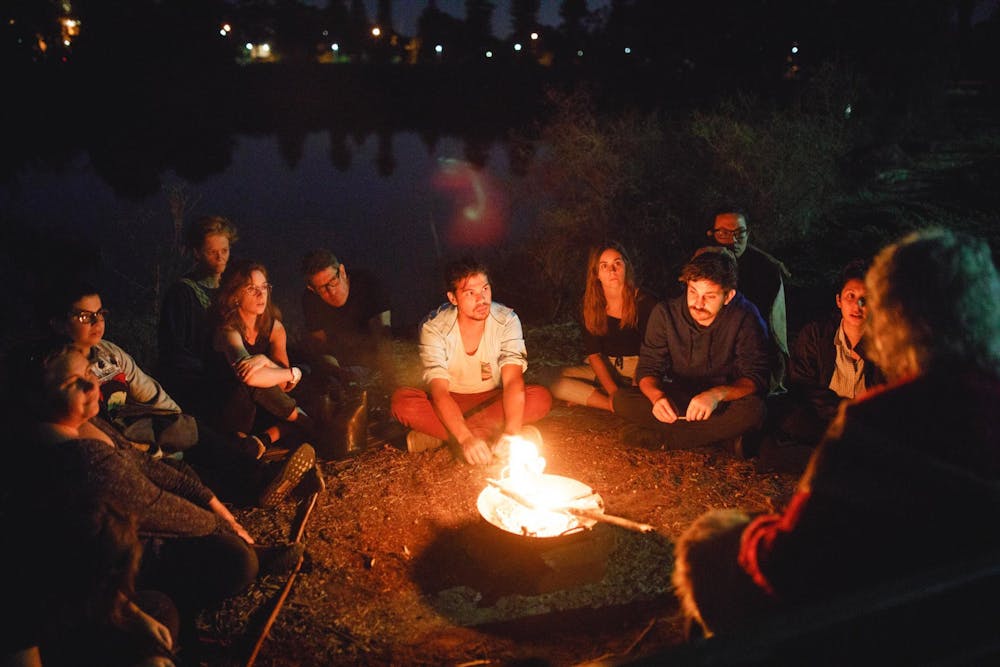
people sitting around campfire
The story of a massacre is told around the campfire, at the site where it happened. Dan Grant

The Lake Monger massacre is not listed on the Newcastle University Colonial Frontier Massacre map, though two comparable attacks have been recorded that were launched to demonstrate colonial military superiority and as reprisals for killing sheep.

Galup is restricted to 15 spectators per night, giving it an intimate social ambience that begins convivially. Wilkes tells us we are moving into a dual time. The artists are explicit in their goal for this as an activist work; they hope to erect a memorial in the future. One must not therefore get lost in the past. One must hold these experiences in the present.

Wilkes introduces one of the many characters he plays, both white and Black, as the son of a white settler and a Noongar woman. The settler hid the woman from pursuers at his hut, and came to love her — or so the son hopes.

Wilkes takes on these and other roles with a light grace. He gently alters his bearing and intonation — these are not the deep alterations of “method actors” like Marlon Brando, Dustin Hoffman and company. Gestures lie upon the body, rather than transforming it. The boundary between Wilkes playing various characters or being an anonymous guide are therefore fluid.

Wilkes delivers much of his speech in Noongar. Spectators may not retain the utterances themselves, but Wilkes makes the performance an act of affective gifting. Understandings are shared even if the precise grammar is not unpacked.


Read more: ‘Articulation of women’s rage’: Slow Burn, Together and its haunting of women dancers


Give and take

Gyallipert and Manyat reportedly attended a dinner where the civil commissioner’s wife played piano for them. They were said to have reciprocated with song and dance.

Wilkes teaches those on the tour a Noongar song of walking. Later we come across a piano, and like Gyallipert and Manyat, Wilkes teaches us dances including that of the rainbow serpent (waugul) whose snaking journeys above and below the ground produced Lake Galup and its underground water sources.
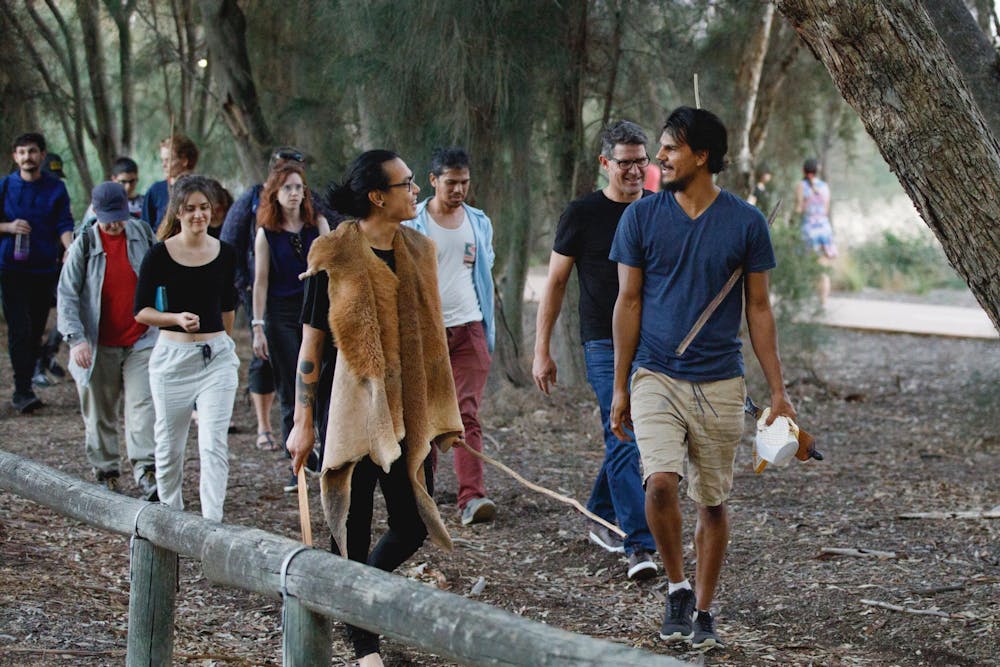
people walking outside together and smiling
The tone of the show is intimate and social. Dan Grant

Read more: Black Drop Effect review: infusing the present moment with layers of the past


We try our hand at spear throwing, and Wilkes elects me to play Gyallipert. It is, for me as a wadjela or white man, an embarrassing honour to be dressed in his gorgeous kangaroo skin cloak. Unlike Gyallipert, I have no cloak or weapons to gift back.

Snippets of language and history are offered throughout, sometimes with audience participation. We receive biscuit rations as the Noongar did. Now, as then, the portions are meagre.

Wilkes mourns on behalf of his ancestors, “What are we Noongar to do, now all our birdiya, all our leaders, are dead?”

Yet, there is grace here. The dominant characteristic of the performance is one of openness. There is space to ponder. Listening to the dual narrative of survival and dispossession, I was struck by how encroached-upon the reserve is today. At one point Wilkes moves through a pair of poplar trees. Unlike the thin line of gums earlier on the trail, these trees are signs of colonial conquest.

Where we throw spears, I notice barely perceptible marks where someone has illegally driven a vehicle. Lake Galup is hemmed in by neat suburban housing. It is far from “wild”, though its waters still sustain game.


Read more: ‘Where are you really from?’ The harsh realities of Afro-Aussie life are brought to stage in Black Brass


Beginning a full accounting

Survival and resistance in these circumstances is fraught. Social conditions and the high value placed by nearby householders on neatly maintained lawns — irrigated by underground water we steal from the waugal below — work against the development of an improved relationship with Noongar boodja and its peoples.
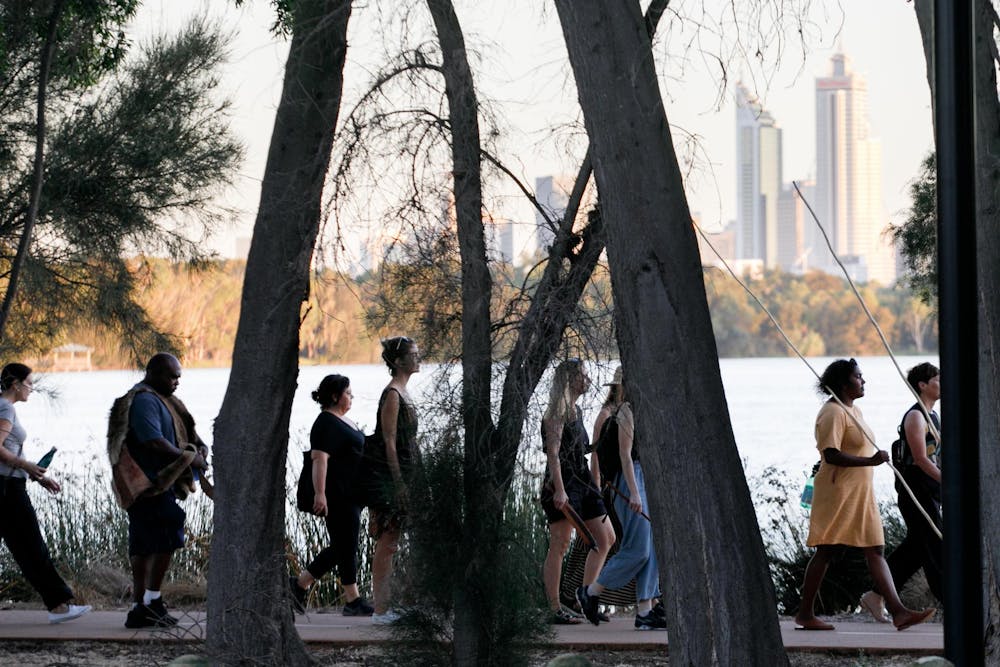
People walk alongside lake, city buildings
Lake Galup is far from ‘wild’, surrounded by urban housing and facing the city buildings. Dan Grant

The episodic structure of Galup renders it a thoughtful if uneven experience. The massacre story does not develop out of preceding action, and it is a jarring conclusion for a work that doesn’t seem to be aiming for tragedy.

A full accounting of the histories of contact between First Nations people and white settlers, of singing together at the piano, of dancing, as well as violence and murder, has yet to become central to our national memory. Galup and works like it may change this.

Galup is part of the Perth Festival, running until March 20.

ref. Galup theatrical walking tour recalls the dancing and violence of the colonial encounter – https://theconversation.com/galup-theatrical-walking-tour-recalls-the-dancing-and-violence-of-the-colonial-encounter-155120

Sexism, harassment, bullying: just like federal MPs, women standing for local government cop it all

Source: The Conversation (Au and NZ) – By Gosia Mikolajczak, Research fellow, School of Social and Political Sciences, The University of Melbourne

In her departing speech this week, federal Liberal politician Nicolle Flint slammed the sexist abuse and harassment she endured in the lead-up to the 2019 election. Together with Brittany Higgins’ rape claim and other female political staffers’ stories of gendered violence and harassment, she has exposed the toxic workplace culture in Australia’s parliament and political life.

While the disturbing experiences of women working in federal parliament received much media attention and roused tens of thousands of Australians to action in the March4Justice rallies, we know little about the workplace culture in other political jurisdictions.

Our latest research into the experiences of Victorian local government councillors sheds light on this question at the grassroots level. And it paints a similarly horrific picture of gender abuse and harassment.

While local government generally garners less media attention, and exercises less political power than other tiers of government, it is an important sphere for female political participation. It is also a critical entry point for women starting a political career.

As a record number of women were elected at the October 2020 Victorian council elections – bringing representation to 43.8% (273 women) – one could be forgiven for thinking their workplace culture is less toxic for female politicians.

Read more: Women are (rightly) angry. Now they need a plan


Our research finds this assumption to be fanciful.

Our first survey of 728 local government candidates found women with previous council experience reported more frequent negative experiences on the job than men. About one in four women (23%) compared to only 3% of men had “very often” experienced negative behaviours that affected them personally. Amazingly, some of these women, despite their experiences of abuse, were still prepared to run again for council.

What is unknown is how many councillors decided not to recontest the election because of gender-related abuse. In partnership with the Victorian Local Governance Association (VLGA,) we are investigating this question as part of a four-year Australian Research Council-funded project.

What we do know from our elected councillors’ responses is that women were more likely than men to identify other councillors as being behind these negative workplace experiences. They reported being met with hostile attitudes, sexist comments and bullying by male counterparts.

Women councillors said these negative experiences had taken an emotional and mental toll on them. This in turn was made worse by their observation – much like their federal counterparts – that internal complaints processes do not deal adequately with abusers.

In our follow-up survey after the election (in December 2020) of 235 (out of 623) newly elected Victorian councillors (110 men and 125 women), just under half of the surveyed elected women (44%, compared to 23% of men) reported experiencing repeated condescending behaviours during the campaign.
Half the female councillors (49%, compared to 35% of men) reported receiving e-mails, text messages or social media posts with offensive content at least “a couple of times” during their term. More than a third (38%, compared to 10% of men) reported someone making demeaning, rude or derogatory remarks about their gender during the election.


Derogatory comments included:

  • questioning their ability to perform in the role of councillor
  • comments on a pregnancy or their motherhood status
  • their age
  • appearance
  • explicit, sexual references.

A range of people, including other candidates, constituents and local journalists, made the comments.

The findings highlight a terrible start for many women in their roles as elected public representatives. Our further studies will seek to understand if these experiences are linked to female attrition in politics.

Early signs suggest a connection. For example, one female councillor described how such hostility discouraged her from participating in politics. She said:

This is probably the biggest challenge I face – having to deal with the bullying and harassment, which is pretty constant and felt particularly extreme this time under lockdown. I think it also puts off other women from running.


Read more: Could the Morrison government’s response to sexual assault claims cost it the next election?


A damning Victoria auditor-general report late last year found more than a quarter of local government workers experienced sexual harassment on the job. Sadly, our research finds gender abuse is also prevalent for elected women in local government. As one female councillor told us:

People say, ‘it goes with the territory’, ‘you have to have a thick skin’, ‘rise above it’ […] really? Why is behaviour that would see someone disciplined or fired in any other workplace excused in politics?

Our research suggests the prominence of gender-based adverse experiences for women interested in representing their communities is having a “chilling effect” on women running for council. This has serious consequences for achieving gender parity in local government.

Until this problem is addressed, the Victorian government’s commendable target of achieving equal representation in local government by 2025 is unlikely to be met.

ref. Sexism, harassment, bullying: just like federal MPs, women standing for local government cop it all – https://theconversation.com/sexism-harassment-bullying-just-like-federal-mps-women-standing-for-local-government-cop-it-all-157396

Australia is sending 8,000 vaccine doses to PNG – but without reliable electricity, how will they be kept cold?

Source: The Conversation (Au and NZ) – By Tony Heynen, Program Coordinator, Sustainable Energy, The University of Queensland

Australia’s nearest neighbour, Papua New Guinea, is battling an unfolding COVID crisis. The Morrison government is urgently deploying 8,000 vaccine doses to the nation’s health workers – but poor electricity access means there are serious questions over PNG’s broader vaccine roll-out.

Vaccine supplies must be stored at cold or ultra-cold temperatures along the supply chain. Importantly, when the vaccines reach hospitals and medical centres in PNG, stable electricity will be needed to power refrigerators to store the doses before they’re administered to patients.

Currently only about 13% of Papua New Guinea’s eight million people have reliable access to electricity. This is not an isolated problem. In 2019, about 770 million people globally lived in “energy poverty”, without access to electricity – and the problem has grown worse due to COVID.

Australia is working to provide one million doses for wider distribution in PNG. But the pandemic only truly ends when the vaccines are rolled out globally. Countries and communities without electricity access present a major barrier to this goal.

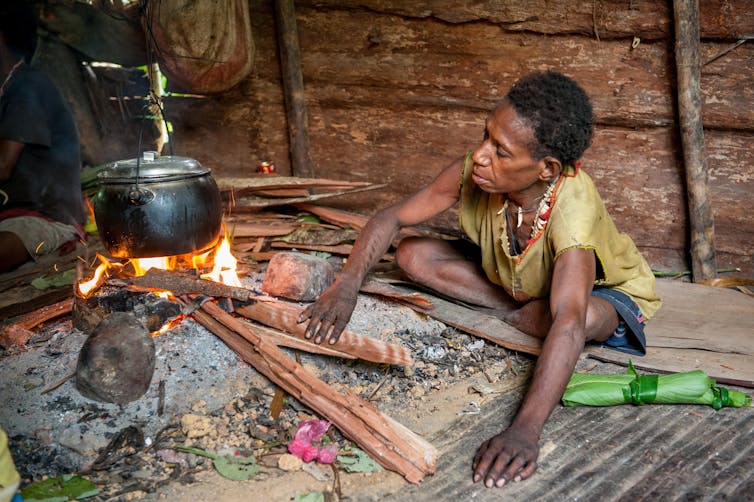
A PNG resident cooks over a fire
Just 13% of PNG’s population has reliable electricity access. Shutterstock

Energy poverty matters

Australia enjoys a relatively reliable electricity network, even in remote parts of the country. There are also systems in place to keep vaccines cold in the event of a power outage, such as backup power.

But around the world, even in our Pacific neighbourhood, energy poverty is widespread and persistent. And COVID-19 has created a vicious circle for these nations. The pandemic has forced governments to shift priorities, leading to less funding for electricity infrastructure. In some countries, progress in electricity access has reversed for the first time in many years.

The International Energy Agency (IEA) says this reversal is being worst felt in Sub-Saharan Africa.

There, 580 million people lack access to electricity – three quarters of the world’s total. The IEA estimates this number grew by 6% in 2020.

It cites Uganda, where public subsidies for an electricity access program have been put on hold, and South Africa where funds to expand rural electrification were redirected to health and welfare programs.

PNG wants 70% of the country connected to electricity by 2030. This will require large scale investment in new generation capacity, and transmission and distribution lines to connect people to the grid. But the nation has long suffered economic instability, and the pandemic has only added to this.

Making matters worse, the true extent and trajectory of COVID-19 may be uncertain in nations suffering energy poverty. For example, there is growing evidence of under-testing in Africa and under-reporting of cases and deaths in PNG.


Read more: ‘A dam has been breached’: a COVID crisis on our doorstep shows how little we pay attention to PNG


Medical staff gather around a table
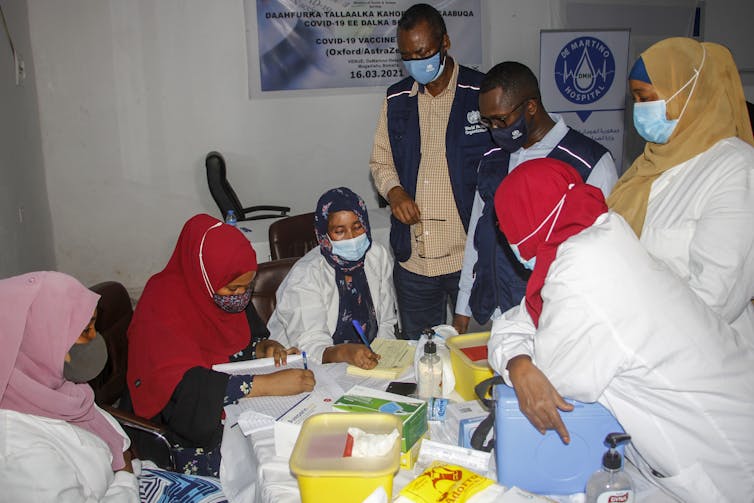
The COVID threat in some developing nations is under-reported. Farah Abdi Warsameh/AP

Vaccine refrigeration is key

As experts have noted, efforts to end the pandemic have largely focused on developing, testing and manufacturing an effective vaccine. Less attention has been paid to distributing it rapidly at scale.

There are exceptions. The Lancet has identified local deployment as one of four key dimensions for an effective global vaccination roll-out.

More than 390 million vaccine doses have already been administered, mostly in high- and middle-income countries with effective financial and planning resources.

But in countries where electricity access is poor, refrigeration of vaccines during transport and storage may prove very difficult. Some countries may not be able to vaccinate large parts of their population.

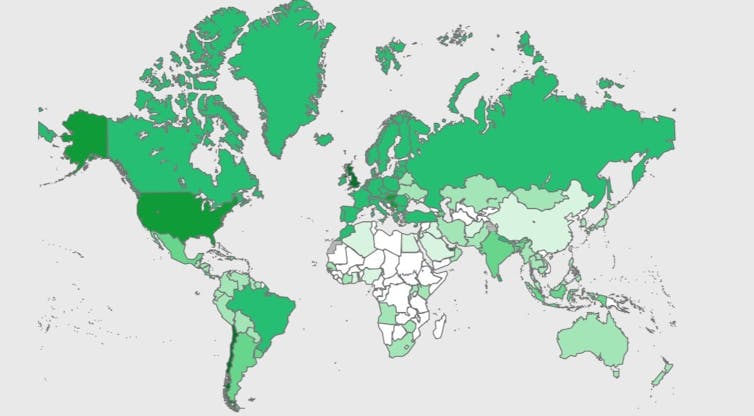
Country-level vaccine distribution – colour intensity indicates doses per capita. WHO Coronavirus Dashboard

The Pfizer vaccine must be frozen at around -70℃. The AstraZeneca vaccine must be kept at between 2℃ and 8℃.

Ultra-cold supply chains were established for the deployment of the Ebola vaccine in Africa in 2013–14. However, the scale required for COVID is enormous, and would be prohibitively expensive.

As reported in the Lancet, as of 2018, 74 of 194 member states of the World Health Organisation had no adult vaccination program for any disease. Fewer than 11% of countries in Africa and South Asia reported having such a program. This was thought to be partly due to a lack of systems for storage and delivery.

Alarmingly, a recent study suggested more than 85 less-developed countries will not have widespread access to COVID vaccines until 2023.

Many are relying on the World Health Organisation’s COVAX initiative, which aims to secure six billion doses of vaccine for less developed countries. Similarly, the Quad regional grouping – Australia, the US, Japan, and India – recently pledged to boost vaccine production and distribution for Asian and Pacific island countries.

But without access to reliable electricity, the roll-out of these vaccines will be hampered. This is particularly an issue in countries with remote and dispersed populations. There, keeping the vaccine cold over the “last mile” of distribution and storage may prove impossible.


Read more: How mRNA vaccines from Pfizer and Moderna work, why they’re a breakthrough and why they need to be kept so cold


Somalian woman receives vaccine dose
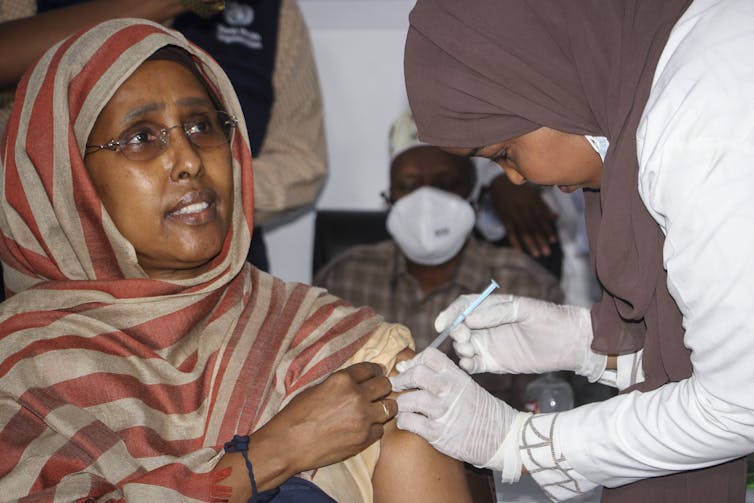
Many poor nations are relying on the World Health Organisation to access vaccines. Farah Abdi Warsameh/AP

Energy access is key to ending the pandemic

Communities experiencing energy poverty, such as in PNG, face other setbacks when it comes to managing the pandemic. Those populations are more likely to use solid fuels, such as wood, for cooking. This leads to indoor air pollution which can cause severe respiratory illnesses and more severe COVID-19 symptoms.

Without electricity access, such communities are unlikely to provide appropriate COVID-19 health responses, leading to a higher burden of disease.

In PNG, an “Electrification Partnership”, of which Australia is a key partner, appears on track. For instance, at a virtual summit at the height of the pandemic last August, Australia committed to financing a large-scale solar plant in Morobe Province. It would be one of the largest solar plants in the Pacific.

But as immunisation emerges as the world’s primary weapon to combat COVID-19, much more work is needed to improve electricity access to those who desperately need it. Indeed, ending the global pandemic may demand it.


Read more: A catastrophe looms with PNG’s COVID crisis. Australia needs to respond urgently


ref. Australia is sending 8,000 vaccine doses to PNG – but without reliable electricity, how will they be kept cold? – https://theconversation.com/australia-is-sending-8-000-vaccine-doses-to-png-but-without-reliable-electricity-how-will-they-be-kept-cold-156798

Israel shows how to do vaccinations right. It’s a race, and we’re behind

Source: The Conversation (Au and NZ) – By Richard Holden, Professor of Economics, UNSW

Australia’s policy performance on COVID-19 in 2020 was world-leading in terms of both public health and economics. Sadly, our vaccine roll-out strategy has been anything but.

I’ve spent plenty of time highlighting this in recent months. But perhaps the most instructive thing to do is compare and contrast Australia’s back-of-the-pack performance with Israel’s – which is truly world-class.

Israel has shown a sense of urgency with its vaccine strategy and roll-out.

The country has gone from having a large infection rate – including from highly contagious variants of COVID-19 – to having herd immunity within its reach. This, in turn, has allowed it to open up the economy with all the benefits that flow from that.

Australia has a lot to learn.

Israel’s roll-out

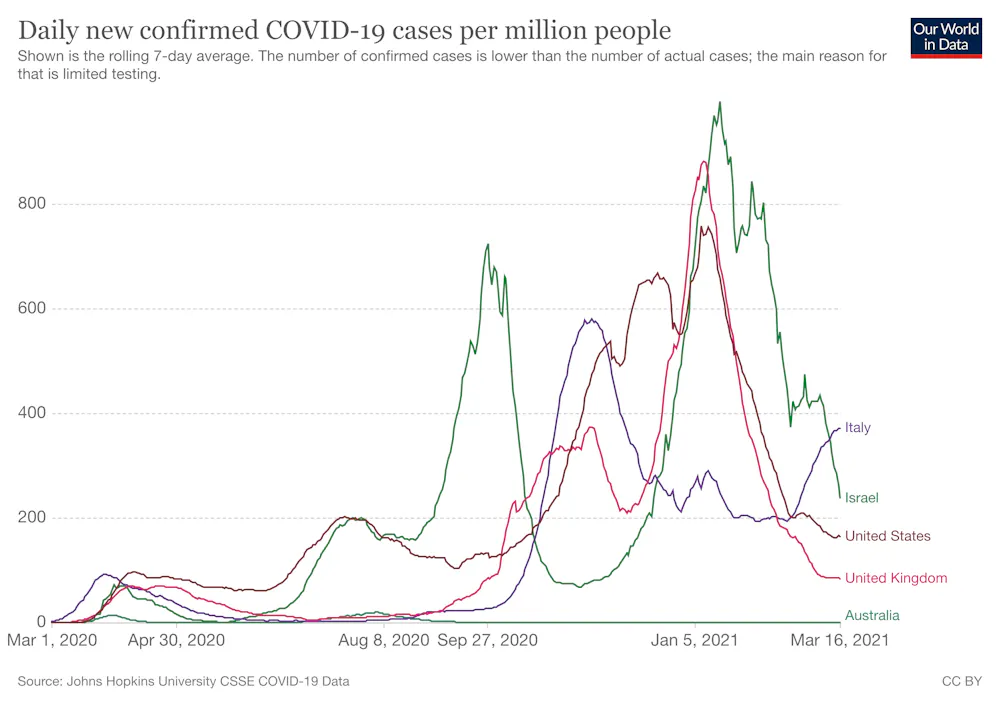
Just a few months ago, in mid-January, Israel had the highest per capita COVID-19 infection rate in the world.

Now, as the following chart shows, the number of infections is less than a quarter the level recorded on January 17.


Daily new confirmed COVID-19 cases per million people for Israel, US, UK, Italy and Australia.
CC BY-ND

This is clearly due to Israel’s vaccination program, which began on December 19, 2020 – just ten days after the first Pfizer doses arrived in the country.

Israel was well ahead of most countries in signing a purchase agreement for Moderna’s high-efficacy mRNA vaccine in June 2020. Later in 2020 it made more deals with Pfizer (which also produces a very high-efficacy vaccine) and AstraZeneca.

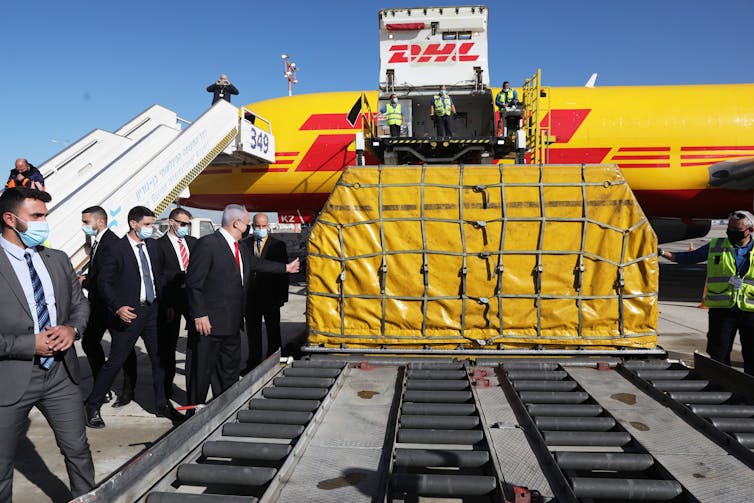
Israel's Prime Minister Benjamin Netanyahu attends the arrival of more than 100,000 doses Pfizer vaccines at Ben Gurion Airport on December 9 2020.
Israel’s Prime Minister Benjamin Netanyahu attends the arrival of more than 100,000 doses of Pfizer vaccines at Ben Gurion Airport on December 9 2020. Abir Sultan/EPA

About 57% of Israel’s population of 9 million have now received at least one dose of the vaccine. More than 48% are fully vaccinated. Life is getting back to normal. People are going to concerts and congregating in coffee shops.

How are we doing here in Australia?

We’re at 0.72% of the population having received even one dose. Only some senior politicians and perhaps the odd aged-care resident being used for a photo-op have received the two doses.

Factor in Israel’s success

So how did Israel do this?

First, Israel has a well-run universal health-care system. But so does Australia.

Second, Israel is a geographically small country. That helps with transporting and storing vaccines – particularly those requiring being kept a very cold temperatures (between -80ºC and -60ºC for the Pfizer vaccine).

Australia, by contrast, is a geographically huge country. However, we do have a highly concentrated urban population, with the five largest metropolitan cities (Sydney, Melbourne, Brisbane, Perth, Adelaide) accounting for 64% of Australia’s total population (about 16 million of the total population of 25.5 million).

Third, Israel’s approach emphasises being fast rather than sticking strictly to a priority order of who gets the vaccine first. Family members of high-priority people thus have often been able to get vaccinated at the same time. Australia’s approach, by contrast, is less urgent and more concerned with rules.

Finally, Israel has the political will. Prime Minister Benjamin Netanyahu has made vaccination a top priority. Sure, he’s also facing serious corruption charges, so maybe this is all motivated by trying to stay out of prison. But who cares? He’s getting the job done.

The ‘green passport’

Israel has also introduced a “green passport” – a phone app that certifies the owner has been fully immunised or is presumed immune as a result of having previously had COVID-19.

The “green pass” (as it has become known) permits holders – and only holders – access to gyms, swimming pools, cultural events, weddings and other gatherings.

The Israeli government has been explicit about, and made no apology for the fact it is using both carrots and sticks to return life, and the economy, to normal.

Israeli musician Ivri Lider performs at a football stadium in Tel Aviv on March 5 2021. Concert goers were required to show their 'green passport' to be be admitted, and also wear a mask.
Israeli musician Ivri Lider performs at a football stadium in Tel Aviv on March 5 2021. Concert goers were required to show their ‘green passport’ to be admitted, and to also wear a mask. Oded Balilty/AP

Australia’s path forward

It’s not too late for Australia to repair our vaccine strategy, though we will never make up for the months lost.

It’s time for the federal government to get serious about the roll-out. No senior politician or health bureaucrat should ever again say “this is not a race” or “we’re not in a hurry”. It is a race. We should be in a hurry.

Every day we are sluggish about the roll-out is another day before the economy can open up properly. It is another day where there could be a hotel-quarantine outbreak – now with more contagious and likely deadlier COVID-19 variants –– potentially leading to further lockdowns and undermining people’s ability to travel or socialise normally.

The roll-out is a race. We need to run. Any government that doesn’t get that will pay a serious price at the ballot box.

ref. Israel shows how to do vaccinations right. It’s a race, and we’re behind – https://theconversation.com/israel-shows-how-to-do-vaccinations-right-its-a-race-and-were-behind-157242

Curious Kids: how do freezers work?

Source: The Conversation (Au and NZ) – By Stephen G Bosi, Senior Lecturer in Physics, University of New England

How does the freezer work? — Leon, aged 4

Hi Leon,

That’s a great question! But freezers are a bit tricky to explain, so we’ll need to talk about a few other things first.

Everything you can touch and feel (like air, water, rocks and mice) is made of tiny balls called atoms. When atoms join up into small groups moving around together, they are called molecules. Atoms and molecules are too small to see without very powerful microscopes.

Solids, liquids and gases

Most things come in three phases: solid, liquid or gas. Think of ice, water and steam. If a gas is not too hot, we can also call it vapour. (There are other phases too, but let’s ignore them for today.)

In solids (like ice), atoms or molecules are tightly stuck together and can barely move. They are usually lined up in neat rows called crystals. In liquids (like water) atoms or molecules are loosely stuck close together, but can move around. In a gas (like steam), atoms or molecules are far apart and free to float away from each other.

Most gases, including air, are made of small molecules. Some gases (like the helium inside floating party balloons) are made of single atoms moving around on their own.

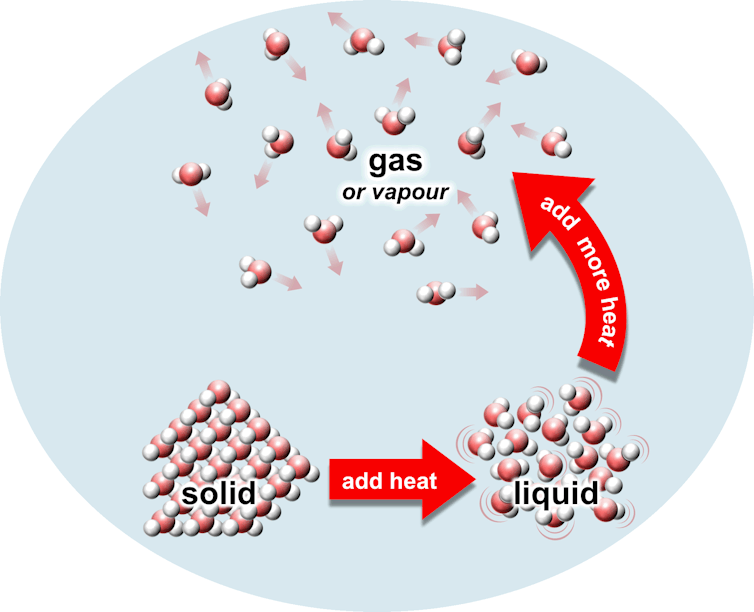
A solid melts into a liquid then evaporates into a gas (or vapour) Stephen G Bosi

If I heat up a solid, the atoms or molecules start to bounce a little bit, but they still stay stuck in their neat rows. Now, if I add an extra burst of heat, the solid turns into liquid. This means the atoms and molecules bounce around so hard they start to move around, breaking up those neat rows. Although the atoms can now flow around, they still stay very close together. This is what’s happening if you put an ice block in a bowl and watch it slowly melt into water.

To turn a liquid into a gas (or vapour), the atoms and molecules must break away completely from their neighbours. This takes another extra burst of heat to give the atoms and molecules a kick to rip them away from their sticky neighbours and float away. (Scientists call this extra burst of heat latent heat.)

This is what happens when you put water into a kettle, turn on the heat, and watch the steam floating out of the spout.

These atoms or molecules carry that extra burst of heat away with them when they float away. This is why your face feels cooler if the wind turns your sweat into vapour and floats away from your face.


Read more: Curious Kids: Why can some cups go in the microwave and some not?


OK. Now let’s try it backwards. If you take enough heat out of a vapour (like steam), it will turn back into a liquid (like water). Whenever this happens, the vapour brings the extra burst of heat back into the liquid.

Now, finally, I can explain how your freezer works.

How the freezer works… at last!

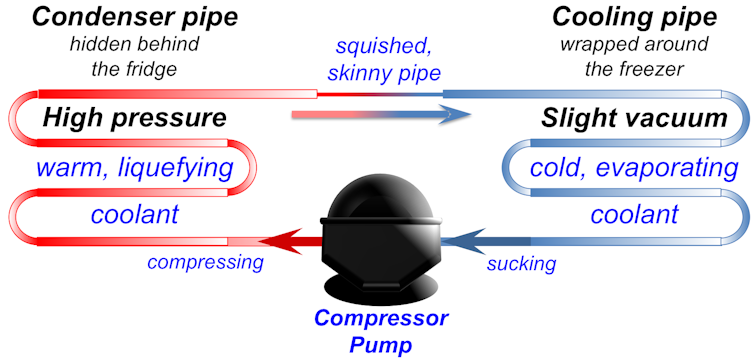
Hidden inside the walls of your freezer is a curly metal tube called a cooling pipe. It is full of a special liquid that evaporates easily.

The cooling pipe is connected to a pump that sucks in vapour from the cooling pipe. The sucking makes more liquid turn to vapour, and when that happens it takes some heat out of the freezer. Just like sweat floating away cools your face down, this vapour floating away makes the inside of the freezer cool down.

The cooling system inside a freezer. Stephen G Bosi

Next, the pump takes vapour from the cooling pipe and squeezes it into another curly pipe on the outside of the back of the fridge. When the pump squeezes the vapour, it pushes the molecules closer together so they start to stick together and turn into a liquid again.

When the gas turns back into a liquid, it gives off the latent heat energy it took from the freezer. So the pipe on the back of the fridge gets warm, and the heat escapes into the air in your kitchen.


Read more: Curious Kids: how does heat travel through space if space is a vacuum?


In other words, the pump moves heat from inside your freezer and lets it go into your kitchen, making the freezer colder and your kitchen warmer. If you feel the back and sides of your fridge, they should feel a bit warm. That’s the heat that used to be inside your freezer!

After releasing its heat energy, the liquid leaks through a little skinny pipe back into the cooling pipe where it started. Then the sucking from the pump turns it into gas again, and the whole cycle repeats over and over. And that’s what keeps your freezer cold.


Hello, curious kids! Do you have a question you’d like an expert to answer? Ask an adult to send your question to curiouskids@theconversation.edu.au

ref. Curious Kids: how do freezers work? – https://theconversation.com/curious-kids-how-do-freezers-work-144566

‘Got no friends? Sit on the buddy bench.’ Untested anti-bullying programs may be missing the mark

Source: The Conversation (Au and NZ) – By Karyn Healy, Researcher, QIMR Berghofer Medical Research Institute

Around 15% of Australian school students experience bullying in a school year. Being bullied increases the risk for ongoing depression and anxiety.

All Australian states have policies to address school bullying. And many schools also run educational programs aimed at preventing bullying.

Efforts to reduce bullying are commendable. However, schools need to be aware of the possibility some bullying programs may inadvertently harm victims. One example is the “buddy bench”, where students who have few friends or are bullied can come to sit and be supported by peers.

While the idea is nice in theory, it could have some very negative effects.

How do programs affect victims?

School programs to reduce bullying are often based on theory. Very few of the programs offered to Australian schools have been scientifically evaluated for effectiveness.

International research shows bullying prevention programs can reduce victimisation at school level by up to 16%. But programs that reduce whole-school bullying may still lead to worse outcomes for individual victims.


Read more: Not every school’s anti-bullying program works – some may actually make bullying worse


KiVa is a Finnish program used in many countries. Like many Australian programs, KiVa provides teachers with lessons and activities to teach students how to relate to each other, including how to help if they notice bullying. There is also training for teachers and newsletters for parents.

KiVa has been found to reduce bullying at the school level in primary schools. But a Dutch study compared schools that had adopted KiVa with schools that worked off their usual bullying policies (the control group). Researchers found schools with the program in place did reduce bullying overall. But the kids in those schools who remained bullied, or became new victims of bullying, were more depressed and had lower self-esteem compared to bullying victims in the control schools.

Sad schoolboy sitting on the ground with head in hands.
Students can be further stigmatised if their issues with peers are made apparent. Shutterstock

Researchers theorised that if fewer students were bullied, those who remained bullied were more visible to peers, leading to rejection. This same theory suggests elements in school programs that make a student’s victim status more visible to peers can also lead to increased stigmatisation.

Buddy benches

Many schools in Australia have installed buddy benches, or friendship benches. These playground benches are intended to provide a safe place in the playground where a student can go when bullied or when they have no one to play with.

The idea is that other children or teachers will notice the student on the bench and offer assistance. Despite the positive intent, there is no evidence this approach works, and there are many things that could go wrong.

The colourful bench will effectively highlight those students who have problems getting on with peers. Students will notice who is at the bench most often, and who is left waiting the longest. They will notice which students require teachers’ help due to lack of peer interest.


Read more: ‘I don’t want to be teased’ – why bullied children are reluctant to seek help from teachers


Increased visibility of these students’ difficulties could damage their peer status and make them less attractive for real friendships, which would serve to protect them from bullying.

The bench could also signal vulnerability to a broader group of students who bully but had not previously noticed these kids, such as if they didn’t share classes.

There are other problems, such as if children come to the aid of someone sitting at the bench to impress teachers or because they have been told to. This is not necessarily the same as help that comes through genuine care and friendship.

Kids playing jump rope with teacher watching.
Helping a peer to impress a teacher isn’t the same as genuine care and friendship. Shutterstock

One program that taught children to intervene in bullying was shown to increase the self-esteem of the helpers. But experiments from social psychology show that help that benefits helpers can undermine the self-esteem of recipients who cannot return the favour (for instance due to low social status).

So, what should schools do?

Examples of Australian programs that have been scientifically evaluated include Friendly Schools, Friendly Classrooms and Positive Behaviour for Learning. Both involve creating clear expectations of behaviour throughout the school, teaching and encouraging positive behaviour, and improving supervision and addressing of incidents.

Both of these programs have been found to reduce bullying at school level in primary schools. But we still don’t know the impact on students who remain victims after the programs have been implemented. Even when using programs that reduce bullying at school level, it is important to monitor outcomes for victims. Schools should follow up carefully with individual cases of bullying until they have been successfully resolved.


Read more: ‘I wish you were murdered’: some students don’t know the difference between bullying and banter


The main purpose of anti-bullying initiatives is to protect the most vulnerable students. When offered a new idea to address bullying, schools should consider how it will affect the social standing of the students who are bullied the most.

ref. ‘Got no friends? Sit on the buddy bench.’ Untested anti-bullying programs may be missing the mark – https://theconversation.com/got-no-friends-sit-on-the-buddy-bench-untested-anti-bullying-programs-may-be-missing-the-mark-156391

Is temporary the new permanent? COVID street experiments open our eyes to creating better cities

Source: The Conversation (Au and NZ) – By Helen Rowe, PhD Candidate, Centre for Urban Research, RMIT University

Over the past year, many of us have enjoyed outdoor dining in spaces that would otherwise have been car parks or part of the road. These spaces are one example of the temporary projects that popped up to help cities in Australia and around the world adapt to COVID. These quickly installed projects have met our changing needs for space for walking, cycling, public space and, of course, dining to help businesses to stay afloat.

While these temporary projects were driven by the necessity for short-term fixes, we can draw deeper lessons from these experiences. They have been, intentionally or not, a large-scale experience with experimentation in cities, and short-and long-term impacts should flow. In the short term, some of these experiments can be become permanent. In the long term, wider-scale urban experiments can become a permanent feature of how we shape cities.

Experiments can help us navigate change in cities. They can also make us braver by allowing us to test out ideas that might fail or that not everyone seems to like. If the past year has made us more comfortable and confident with experimenting, all the better to help our cities meet the challenges ahead.


Read more: 4 ways our streets can rescue restaurants, bars and cafes after coronavirus


Opening our eyes to new possibilities

At their simplest, of course, experiments test things. The projects that popped up during COVID have helped meet our short-term needs (well, we hoped they would be short-term) for different ways to live and get around, like pop-up bike lanes.

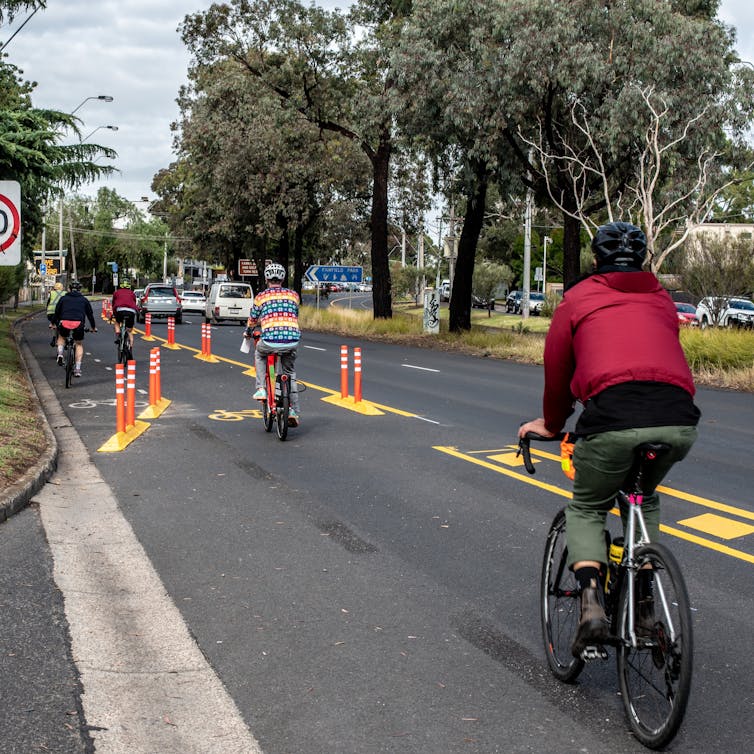
pop-up bike lane alongside a busy road
A pop-up bike lane created along Heidelberg Road in inner Melbourne. Author provided

In making these short-term changes, we tried something new and perhaps we’ve found we like the results.

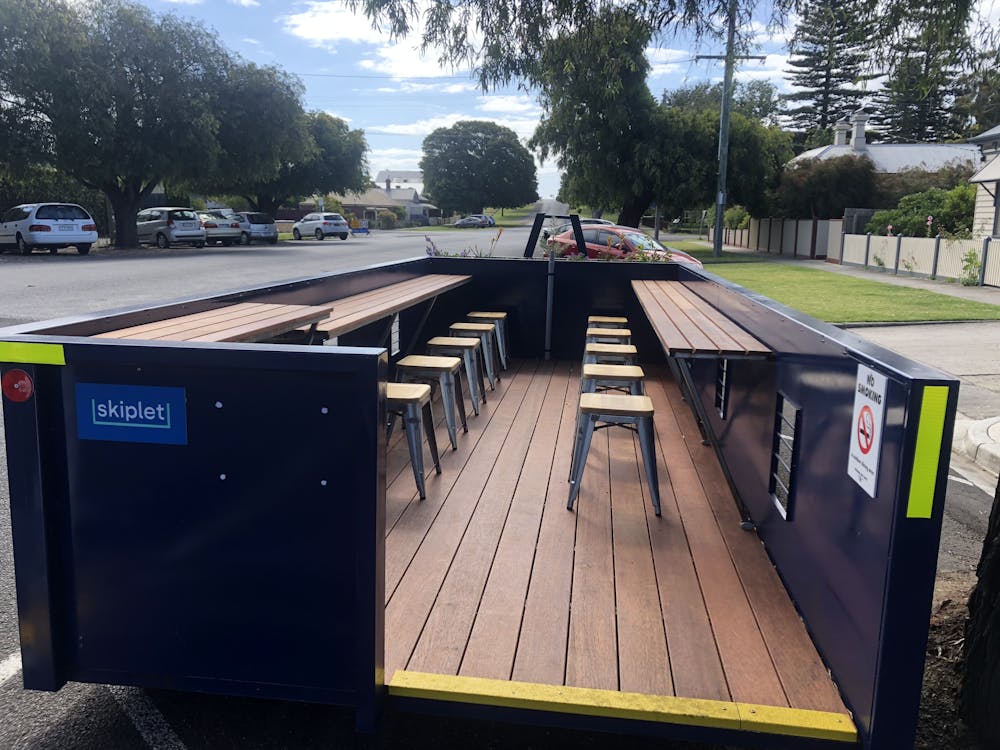
During COVID, I meandered down Lygon Street, Carlton, full of new al fresco dining areas making the street feel even more European. Along the Victorian coast, I sipped coffee in Skiplets. It could always be this nice, I thought.

These projects are already sparking debate about the future use of streets and bringing the trade-offs into focus. One example is the trade-off between parking revenue and outdoor dining.

tables and chairs in a pop-up 'skiplet' set up in a parking space
Skiplets were installed in parking spaces as pop-up eating places in the Victorian towns of Queenscliff and Point Lonsdale. Helen Rowe, Author provided

What more can we gain from ‘tactical ubanism’?

Well before COVID, cities started using temporary projects to test changes. From New York to Yarraville, cities used experiments to test out risky ideas and balance competing street uses. This is often referred to as tactical urbanism .


Read more: We can’t let coronavirus kill our cities. Here’s how we can save urban life


Benefits gleaned from these experiences show we have much to gain from more experimenting beyond COVID. City experiments get things moving and let us figure out if an idea is a good one.

New York City has remade its streets, seeking a better balance by providing more space for walking, biking and transit services.

In the aptly titled book Street Fight, former New York City transport commissioner Janette Sadik-Khan describes turning the tangled intersection at Times Square into a pedestrian plaza. It began as a temporary experiment. A lower-cost, temporary version meant getting the project on the ground right away, rather than spending years convincing everyone to build it permanently. The added advantage was collecting data during the trial to prove it actually worked.

Overcoming suspicion of change

Experiments help navigate change, which we don’t always like. Based on my own research, street experiments help cities work with, not against, some people’s tendency to dislike change.

People’s hackles can go up in response to change. They prefer to stick with what’s familiar over something new. This is the type of status quo bias Nobel laureate Daniel Kahneman discusses in Thinking Fast and Slow.

A temporary experiment can help disarm this response. As one of my interviewees put it:

“If change is worrisome, then it’s not that big a deal if we can come back to where we are today.”

Through experimenting, people allow themselves to try it. Often they also get to see their fears aren’t realised.


Read more: Don’t forget the footpath – it’s vital public space


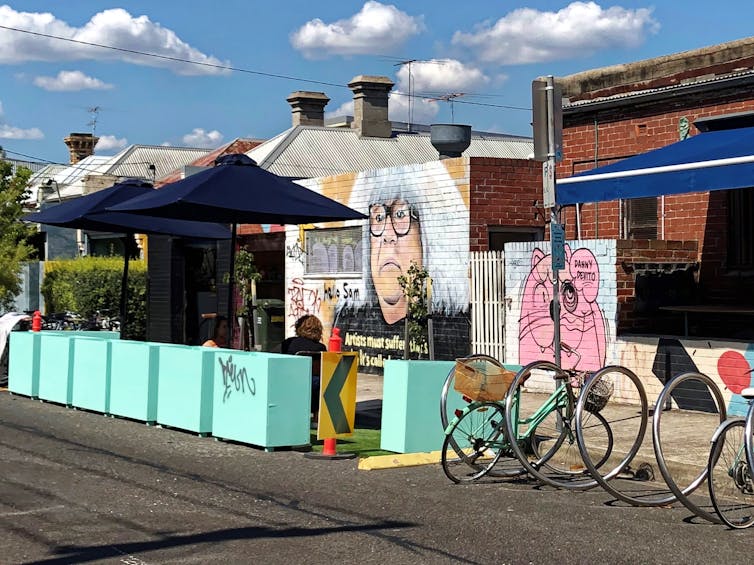
pop-up eating space with shade umbrellas and bike stand outside a cafe
Parking space becomes a pop-up eating area in Brunswick, an inner Melbourne suburb. Helen Rowe, Author provided

Experiments let us tweak projects to get them right. In 2008, Copenhagen rolled out a bold experiment on Nørrebrogade, providing wider bike lanes and bus-only sections painted with huge red dots. Experimenting, they found, helped them have a better conversation with the community. They were able to tweak the design in response to community feedback and evaluation.


Read more: A time to embrace the edge spaces that make our neighbourhoods tick


Experiments also do the imagining for us. My current research (as yet unpublished) looks at ways city transport planners try to effect change.

One barrier to change planners discussed is that people often struggle to imagine how things could be different. Without this, they tend to happy to stick with the status quo. Experiments show us how streets can be different.

streetside pop-up parklet with artificial grass, potted plants, tables and chairs
A pop-up parklet transforms the street in the inner Melbourne suburb of Ascot Vale. Helen Rowe, Author provided

Read more: People love parklets, and businesses can help make them happen


What stands in the way of more street experiments?

My research suggests many city planners are striving to find new and better ways to explore change and help cities adapt to challenges. Many are starting to experiment with temporary projects, but it’s not always easy.

A number of transport planners I’ve talked with say doing temporary projects can be hard. That’s not because they are difficult to build but because the rules about what can be done on streets are set up for building things permanently. This can be a barrier to temporary experimenting.

However, after delivering many temporary projects during the pandemic, cities should now be well placed to embed processes that make street experiments easier.

Given COVID is just one of the many looming challenges facing our cities, being braver and adaptable is going to be more important that ever. Experimenting can help pave the way.


The impact of temporary projects is the focus of the MPavilion event, Is Temporary the New Permanent?, on March 22.

ref. Is temporary the new permanent? COVID street experiments open our eyes to creating better cities – https://theconversation.com/is-temporary-the-new-permanent-covid-street-experiments-open-our-eyes-to-creating-better-cities-156591

Friday essay: I looked at 100 ads for menstrual products spanning 100 years — shame and secrecy prevailed

Source: The Conversation (Au and NZ) – By Dr Jane Connory, Lecturer in Communication Design, Swinburne University of Technology

I analysed 100 magazine advertisements for menstrual products published between 1920 and 2020 to see how they have contributed to feelings of shame and secrecy around women’s periods. I found the period taboo has been promoted by advertisers in Australian woman’s magazines for much of the past 100 years.

Periods are a healthy sign your body’s reproductive system is ready to procreate. Yet “pad ads” from 1920 until the 1940’s played on the idea that period products were a treatment for a medical problem. Rather than a natural occurrence, menstruation was framed as an illness.

For decades, ads also shied away from depicting blood or even mentioning menstruation. Indeed, among the ads I looked at, it wasn’t until 1974 that the word “period” was actually used. Menstruation was variously described as “nature’s handicap” (for instance, in a 1932 pad ad) and the source of “accidents”.

Old black and white Kotex newspaper advertisement, picturing the heads to two young women
Period secrecy was often modelled around conversations between young women, as in this ad from the Australian Women’s Mirror, 1939. Newspapers Collection, State Library Victoria.

Read more: Explainer: why do women menstruate?


A brief history

Johnson & Johnson filed the first patent for a “sanitary napkin” in Australia on December 11, 1929. The application, now catalogued online, contains a simple drawing of cardboard fibres wrapped in crepe paper and gauze.

Before this time, Australian women often used home-made solutions such as reusable rags and throwaway bandages. If they could afford to, they bought local, mass produced brands such as Kleinert, Southall’s and Denyer Brothers, which sold “dainty wears”, “protective necessities”, “surgical appliances” and “hygienic towels”.

The first Australian patents for tampons appeared as early as 1908; the next in 1925. Fourteen patents for tampons were listed between 1940 to 1950. The first appearance of a tampon ad I came across, for Meds, was published shortly after.

Brands like Meds gave the impression their names were short for “medical” or “medicine”. Some packaging adopted symbols such as the cross used to denote hospitals and, of course, the Red Cross.

Old black and white Kotex newspaper advertisement.
This 1926 Kotex ad from The Bulletin, shows a cross on the packaging and describes the pad as a ‘surgical product’. Newspapers Collection, State Library Victoria.

During the second world war, Australia had to tighten its belt to support the war effort. Brands like Johnston & Johnston concentrated their resources on producing surgical supplies for the armed forces, leaving pads in short supply. One of their ads was apologetic in tone: “We trust you will bear with us, should you … find that your chemist or store has no stocks of … Modess Sanitary Napkins.”

Johnston & Johnston were clear most of their 800 strong workforce was “filling the demands of the Australian Forces” — thus positioning the general well-being of many women as inferior to the war effort. By going without these basic necessities, women were sacrificing for the war. To speak up and demand otherwise would have been seen as unsupportive of the brave men on the front lines.

After the war, certain ads continued to use nurses and scientists to promote menstrual products: from a Meds tampon ad in a 1953 edition of the Australian Women’s Mirror to a Carefree tampon ad in the Australian Women’s Weekly in 1982.

Fortifying the taboo

By censoring images of period blood, pad ads established it as taboo — an embarrassing and “unhygienic” problem. Instead of red, there was a lot of blue in these ads until the 1970s: from the fashions worn by models to ocean waves used as backdrops.


Read more: The ongoing taboo of menstruation in Australia


Even as recently as the 1980’s, scientific diagrams showing how to insert tampons were blue. A Sure & Natural ad from 1983 compared the inefficient absorbency of a conventional pad with the quick dispersion of liquid in a “Maxishield” using royal blue liquids. Further graphics demonstrating layers of absorbency in pads used blue arrows and blue ink to demonstrate their effectiveness.

White also commonly featured in pad ads — a colour symbolising purity and an idealised feminine state for women. In 1973, a brand called Dr White’s appeared. Its ads featured young women dressed in white bikinis, white pant suits, white lingerie or white dresses.

Woman in white underwear, in soft lighting in bedroom advertises Stayfree pads.
Women were commonly dressed in white as shown in this 1975 Stayfree ad from the Australian Women’s Weekly. Author’s own photograph.

Academic Ira Torresi has described the “moral imperative of cleanliness” historically required of women — an imperative reflected in the persistent use of the colour white in these ads. Periods were often viewed as dirty, thus the description of pads and tampons as “sanitary”.

Private spaces like bedrooms and bathrooms featured heavily in pad ads, indicating a need to keep periods out of the public eye.

High fashion drove many campaigns — reinforcing the need for women to constantly be on show. Women in these ads were depicted in low paid careers that typically involved caring — teacher (1944), secretary (1980), air hostess (1983) or mother (1994). Ironically the names of many brands (Carefree, Stayfree) promoted notions of freedom.

Even during the 1970 and 1980’s, sexist and over sexualised images of young women were used to sell period products. One Tampax ad featured a prepubescent girl in a barely there bikini top more appropriate for an adult.

Magazine advertisement for tampons that pictures a prepubescent girl in a bikini top.
This double-page spread from a 1983 edition of the Australian Women’s Weekly sexualises a prepubescent girl to sell tampons. Author’s own photograph.

Research has shown such sexualisation and objectification causes society to view women as “less capable and less intelligent”. Rather than empowering women, this image and others I found, set unrealistic expectations as to how a menstruating girl should look and feel.


Read more: Sexualised girls are seen as less intelligent and less worthy of help than their peers


Modelling secrecy

The idea of secrecy is shown in both the image and text of this 1946 Modess ad from The Australian Women’s Mirror. Newspapers Collection, State Library Victoria.

Ads in my survey also propagated the idea periods should be talked about in secret — and mostly woman to woman. Teenagers gossiping in private spaces were pictured in ads from 1939 to 1995.

In 2019, however, the Victorian Woman’s Trust published a book drawing on intensive research, which found women want to be more open about their periods. It showed that talking about periods publicly could help end taboos around menstruation, encouraging informed conversations in schools and workplaces.

If women were pictured with men in any of the pad ads I examined, secrecy was pertinent to the image. Men in social settings were always shown to be happily oblivious to menstruating women, as were boys in school settings.

One ad promotes a brand called Whisper — a clear nod to secretive behaviour.

A cartoon school aged girl and boy sit in a classroom imaging a conversation in this pad ad.
This Dolly ad from 1994 shows how secrecy is also modelled between young women and men. Author’s own photograph.

Headlines such as “She must remain a mystery” and “What are you going to say?” also urged mothers to frame discussions around menstruation as private and secretive.

Ads for Kleinet’s, Modess and Kotex from the 1920’s to 1940’s were even accompanied by coupons enabling mothers to send away for booklets containing advice for dealing with this “source of embarrassment”.

“Discrete” and “plain” packaging was often designed to hide the actual function of period products, enhancing the idea they needed to be kept secret. Similarly, floral motifs are still used on packaging, symbolising anything from new beginnings and fresh fragrances to love and femininity. Again, an idealised view of womanhood masks the realities.

More enlightened times

Pad ads have undoubtedly improved over time. A Lunette menstrual cup ad from Girlfriend magazine in 2020, uses the word vagina boldly in the headline. There is no shame associated with touching the product — it is held aloft by fingers sporting dark, red nail polish.


Read more: Does anyone have a pad? TV is finally dismantling the period taboo


Lunette mensural cup advertisement.
Contemporary period product advertising is not afraid to use the word vagina and the colour red, like this ad from Girlfriend Magazine, 2020. Author’s own photograph.

Similarly a 2019 Cottons ad, also from Girlfriend magazine, features the headline: “Be a natural period pro in no time…” The person in the ad is somewhat androgynous-looking, perhaps as a nod to the diversity of people who experience periods.

However, advertising spaces have changed as magazine circulation has shrunk. Consumer attention is shifting away from glossy pages towards influencers on social media and pop up ads on the internet.

These platforms are now perfectly placed to reject old ideas of secrecy and shame associated with periods, speaking in more honest tones.

Dr Jane Connory has curated an exhibition of pad ads from Australian women’s magazines called Sanitary Secrets. It can be viewed at the BSIDE Gallery (Level 1, 121 Brunswick St, Fitzroy) from Saturday March 27 – Sunday April 5, during Melbourne’s Design Week.

ref. Friday essay: I looked at 100 ads for menstrual products spanning 100 years — shame and secrecy prevailed – https://theconversation.com/friday-essay-i-looked-at-100-ads-for-menstrual-products-spanning-100-years-shame-and-secrecy-prevailed-152685

Amnesty blasts ‘woeful’ Australia, NZ aid for PNG covid surge, seeks action

Asia Pacific Report newsdesk

Australia and New Zealand – plus other key donors – need to urgently step up and provide assistance to Papuan New Guinea as a covid surge continues to grow, says the human rights watchdog Amnesty International.

Both Australia and New Zealand “continue to fail to support calls by around 100 countries”,  mainly in the global south for a temporary waiver of intellectual property rights that would enable increased production, affordability and accessibility of vaccines, Amnesty has declared in a statement.

Responding to reports that Papua New Guinean Prime Minister James Marape has declared a critical “red stage” in the country due to a current surge in covid-19 cases, Amnesty International’s Pacific researcher Kate Schuetze said: “Papua New Guinea’s health crisis has now reached the level we feared it would reach a year ago with a surge in cases.

“A combination of an ailing health system and inadequate living conditions has created a perfect storm for covid-19 to thrive in the country’s overcrowded informal settlements.”

Schuetze said Amnesty International had received reports of inadequate amounts of personal protective equipment for health workers, and that some hospitals were full or threatening to be closed to new admissions.

“Misinformation within the community and online about the illness is also rife, with some suggesting [it] is a government conspiracy theory. This has also been fuelled by the government at times publishing inaccurate information on the number of confirmed cases.

“There is an absence of an effective public information campaign by the government to dispel the misinformation.”

Pledges of assistance
While Australia and New Zealand had made pledges of assistance to Papua New Guinea in response to the pandemic, they were “woefully inadequate”.

Australia had sent a team of medical experts tom PNG this week and had pledged monetary support, but this would not provide immediate relief.

“Basic health infrastructure is urgently needed in Papua New Guinea to help immediately on the diagnostic and treatment level, as well as for the distribution of vaccines once they are approved by the national authorities.”

Schuetze said there was little prospect of vaccines coming this month in the context of a deeply unequal global rollout.

The consequences of this meant that many poorer countries such as PNG would continue to be at the back of the queue for limited supplies of vaccines.

Background
According to the World Health Organisation (WHO) and the Queensland government, between 30 and 50 percent of test results in Papua New Guinea have been returning a positive result in early March 2021.

As of 16 March 2021, the government had reported 26 confirmed deaths and 2269 confirmed cases. The WHO has noted that severe undertesting means these numbers were likely to be significantly underestimated/under reported and that at least two provinces had widespread community transmission.

Papua New Guinea is part of the United Nations COVAX scheme, which aims to fairly and equitably deliver vaccines to all countries.

However, COVAX has to date not been resourced enough to ensure poorer countries are getting access to vaccines. The scheme is being severely undermined by wealthy countries buying up more vaccines than they need, significantly impacting on the ability to secure vaccines for other nations.

Print Friendly, PDF & Email

Article by AsiaPacificReport.nz

Fiji draft bill cops boot – PM’s move on proposed police law puzzles critics

By Wanshika Kumar in Suva

Reports that Prime Minister Voreqe Bainimarama has pulled the plug on Fiji’s draft Police Bill 2020 has raised more questions than answers and left critics puzzled.

What, when, where, why, and how were pressing questions people asked as they tried to unravel how the bill was thrust into the public sphere for discussion without the government’s knowledge.

National Federation Party president Pio Tikoduadua said the prime minister’s statement came two weeks after Defence Minister Inia Seruiratu was photographed at the launch of consultations on the bill.

Fiji Times 180321
The Fiji Times front page today, 18 March 2021. Image: FT screenshot

He claimed everybody knew that everything happened in the government on the Prime Minister or the Attorney-General’s command.

Former PM Sitiveni Rabuka said Bainimarama’s comments that the Fiji Police Force had acted unilaterally and government had not been consulted before consultations began was “puzzling”.

Fiji Women’s Crisis Centre co-ordinator Shamima Ali said the government or the Prime Minister’s Office needed to issue an official statement regarding its stand on the draft bill because the only information people had was from two media platforms and social media sites.

Wanshika Kumar is a Fiji Times reporter.

Print Friendly, PDF & Email

Article by AsiaPacificReport.nz

Tahitian academic says Paris must pay for impacts of French nuclear tests

RNZ Pacific

A Tahitian academic living in Auckland whose family and home island of Mangareva were impacted on by three decades of French nuclear weapons tests says Paris must pay for the full extent of health and other damage caused.

Ena Manuireva is a doctoral candidate at Auckland University of Technology.

He responds to RNZ’s Koroi Hawkins about the recent revelations by the Moruroa Files investigation and a new book, Toxique, that the impact of the the 193 nuclear tests in Polynesia was far worse than previously admitted by French authorities.

Ena Manuireva
Ena Manuireva … doctoral research on the nuclear testing impact on the Gambiers.

Transcript
On a more personal level a Tahitian whose family and home island was impacted by French nuclear weapons tests says Paris must pay for the full extent of the fallout.

Maururu Ena, thanks for joining us on the show. So you were born in Mangareva in 1967 just one year after the French started testing nuclear weapons in French Polynesia?

This article is republished under a community partnership agreement with RNZ.

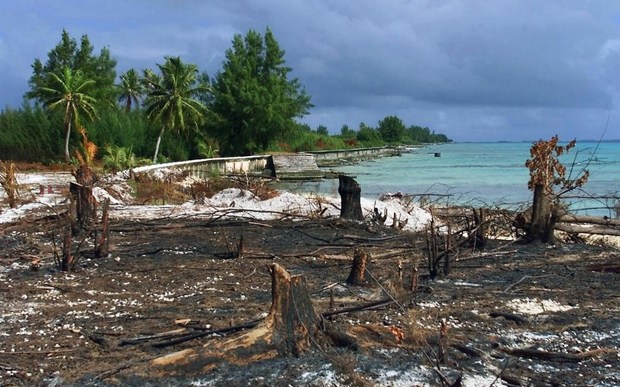
Moruroa atoll 6 June 2000
Part of Moruroa atoll four years after the French nuclear testing was halted in 1996. Almost all the installations that sheltered up to 3000 people for 30 years have been dismantled , giving the natural vegetation a chance to grow again. Image: Eric Feferberg/AFP/RNZ
Print Friendly, PDF & Email

Article by AsiaPacificReport.nz

Pioneering Polynesian Panther indigenous rights activist farewelled

A pioneering indigenous activist is being farewelled today after losing a short battle with cancer.

Miriama Rauhihi Ness was a member of the Polynesian Panthers and Ngā Tamatoa movements, fighting for both Māori and Pasifika rights in New Zealand.

Will ‘Ilolahia, a founding member of the Polynesian Panthers, said Rauhihi Ness was always on the frontlines of indigenous activism.

“She was our Minister of Culture and our first full-time community worker when we existed back in the 70s,” he said.

“Her fierce, strong, no-muck-around attitude has done a lot of things that a lot of people don’t really acknowledge.”

Rauhihi Ness (Ngāti Whakatere/Ngāti Taki Hiki) helped lodge the Māori Language Petition of 1972, led the 1975 Land March and was part of the Patu Squad that protested against the 1985 Springbok tour.

“The Patu Squad that [South African] President Nelson Mandela came to New Zealand to say thank you – she was a member of that squad.”

Rauhihi Ness was also married to Niuean singer and activist Tigilau Ness and their son was renowned musician, Che Fu.

Love for her whānau
Will ‘Ilolahia said her love for her whānau also seemed to give her strength in her final days.

“She was suffering from cancer from after Waitangi Day,” he said.

“She went up there and then came back and she was sick. But she held on until Tigilau and Che Fu had their performance last Saturday for the [Auckland] Arts Festival and then she passed away.”

‘Ilolahia said for the 69-year-old to be able to endure pain and hold on until after her son performed his major gig of the year was remarkable.

“That’s a wahine toa.”

Nō reira e te rangatira, moe mai, moe mai, moe mai rā.

This article is republished under a community partnership agreement with RNZ.

Article by AsiaPacificReport.nz

Grattan on Friday: The gender wars become yet another partisan battlefield

Source: The Conversation (Au and NZ) – By Michelle Grattan, Professorial Fellow, University of Canberra

Despite hopes it might be otherwise, the new round of the gender wars has become as rugged and nasty as their cousins, the culture and history wars.

Triggered by two separate rape allegations, and culminating in Monday’s national march, there’s little doubt the roar from so many Australian women will have an impact. The form and extent of that impact, however, is the as-yet-unanswerable question.

The politicians do know things will change, reluctant as some might be to accept it.

Suddenly, bad behaviour can’t be swept under the carpet.

On Wednesday there was a telling example of the contrast between “then” and “now”.

Tasmanian Greens leader Cassy O’Connor, speaking at 6pm, told the state parliament that in 2019 Andrew Hudgson, a staffer of the then premier, Will Hodgman, had called her a “meth-head c***”. Her media adviser had heard the profanity, and a formal complaint was made to Hodgman’s office.

Hodgman subsequently informed O’Connor an investigation had found the claim was “not substantiated”.

Hudgson later became media adviser to federal Assistant Treasurer Michael Sukkar. After O’Connor’s speech, Hudgson was instantly turfed out of his job. It didn’t require any inquiry.

A spokesperson for Sukkar said: “The government was unaware of any allegations raised about the alleged behaviour of the staff member during their previous employment. After several historical allegations surfaced, the staff member has ceased employment with the office.”

You could drive the proverbial large truck through this defence.

Hudgson had been in a high-profile state political office; moreover, the story had been reported (though his name not used) in the local Mercury newspaper.

The federal Coalition has a “star chamber” process to vet prospective staff. How could the “star chamber” not properly check someone’s past? How could it be “unaware of any allegations”?

So what’s changed? It’s not so much knowledge about the staffer – which was available if those scrutinising appointments wanted to ask – as the politics around his employment.

From now on, any staffers (or parliamentarians) with skeletons in their cupboards should be very fearful. They face a high risk of being called out under parliamentary privilege.

Even before the march, the stoking of the gender wars after Brittany Higgins’ claim she was raped in a minister’s office had the positive result of forcing the Morrison government to set up an inquiry, by Sex Discrimination Commissioner Kate Jenkins, into the parliament house workplace.

But we’ve also seen the issues about the treatment of women become increasingly partisanised.

As Labor has tried to exploit the crisis around Attorney-General Christian Porter, accused of raping a girl when he was 17 (which he strenuously denies), Scott Morrison has pointed back at the opposition.

There was plenty to mine – not just the police investigation into a historical rape allegation against Bill Shorten (which resulted in no charges), but a Facebook group where former and current Labor staffers have posted a litany of graphic complaints of misconduct.


Read more: Shorten outs himself as Labor figure in rape investigation


South Australian Liberal MP Nicolle Flint became a lightning rod as the partisanship escalated.

Flint, who is on the right of the party, was the object of particularly horrific harassment (stalking, trolling, defacement of her electorate office) before the 2019 election, which she has previously highlighted. She recently announced she would not run again.

On Tuesday she returned to her experiences, in a parliamentary speech that laid into Anthony Albanese and Labor women.

Channelling Julia Gillard’s famous misogyny speech against Tony Abbott, Flint declared: “I say to the leader of the opposition: I will not be lectured by you. I will not be lectured by your side of politics about the treatment of women in this place.”

She accused senior Labor women of failing to support her when she was under attack.

Morrison went out of his way at a news conference the following day to take a question on Flint, describing her as “incredibly brave”. The prime minister drove home a political jibe. “I just am amazed [that] the Labor Party and the unions and GetUp just stood by and let that happen. They were aware. They saw it. They were happy to be advantaged by it.”

On Thursday Flint told parliament she’d had a barrage of online abuse in response to her speech.

As Morrison struggles on this new political front, his minister for women, Marise Payne, isn’t providing much visible help.

Having the women’s portfolio lumped with Payne’s foreign ministry responsibilities is a bad mix to start with. She doesn’t have enough time or energy to devote to it.

Moreover, Payne hates having to do media appearances, usually finding ways of avoiding them.

In the current climate, Morrison needs her to be crafting effective policy responses, as well as being a convincing voice out in the public marketplace.

Payne, a Liberal moderate who years ago was not so reticent publicly, is said to have strong views on the issues. She should be in Morrison’s ear about substance and language (his, that is). She made a major mistake in not insisting she go out to Monday’s demonstration.

Liberal backbencher Russell Broadbent, a moderate from Victoria, on Thursday came up with suggestions for a way forward. They were modest but they were constructive.

Broadbent told parliament he’d written to Morrison saying he should do two things immediately.

“The first is to convene a national gathering of women that represent women’s peak organisations and every local government area to recommend to parliament the pathway to real and lasting change in our homes, our workplaces, and on the streets,” Broadbent said.

He’s also asked Morrison “to introduce a gender impact statement for all cabinet submissions, new policies and legislation”.

Broadbent said that, as a parliamentarian and a man, he acknowledged “the disregard for women that has led to this fork in our road”.

“Women will drive this change. I hope more men will join them. Politicians need to be quiet, listen and learn. Actions, not words, count.”

But defining and achieving that action promises to be a controversial, tough and often divisive process.


Read more: View from The Hill: Christian Porter finds a target, and so does Brittany Higgins


ref. Grattan on Friday: The gender wars become yet another partisan battlefield – https://theconversation.com/grattan-on-friday-the-gender-wars-become-yet-another-partisan-battlefield-157435

Politics with Michelle Grattan: Zali Steggall on Monday’s march and Scott Morrison’s response

Source: The Conversation (Au and NZ) – By Michelle Grattan, Professorial Fellow, University of Canberra

On Monday, women across the nation marched, demanding justice, safety and equality. But the government’s response was lacklustre, with Scott Morrisona and the Minister for Women Marise Payne refusing to go outside to the crowd.

Morrison later chose his words badly when he said: “Not far from here, such marches, even now are being met with bullets, but not here in this country”.

Independent MP Zali Steggall described Morrison’s comments as “incredibly sad” and “just stunning”.

A former lawyer and olympian, Steggall is currently championing two private member’s bills – a proposal for a national climate change framework, and an amendment to the sex discrimination act which would allow judges, MPs, and statutory appointees to be prosecuted for sexual harassment.

Steggall is disappointed in the government’s response to the strong push for women’s rights. “I’ve been quite baffled to understand the Prime Minister’s response to this situation and the [rape] allegations.”

And she doesn’t believe Payne has been much better. “I’ve been absolutely, really disappointed with the minister for women’s response.”

She is somewhat more encouraged by the government’s changing attitude towards climate change, noting Morrison’s language has changed “dramatically” in the last 12 months. But simply saying he wants to get to net zero “as soon as possible” is not good enough, she says.

“That’s not the certainty that business and the private sector are looking for. They are looking for it to be legislated, and with a clear pathway.”

Listen on Apple Podcasts

Stitcher Listen on TuneIn

Listen on RadioPublic

Additional audio

A List of Ways to Die, Lee Rosevere, from Free Music Archive.

ref. Politics with Michelle Grattan: Zali Steggall on Monday’s march and Scott Morrison’s response – https://theconversation.com/politics-with-michelle-grattan-zali-steggall-on-mondays-march-and-scott-morrisons-response-157427

As Australia’s COVID vaccine rollout splutters, we need transparency about when international borders might reopen

Source: The Conversation (Au and NZ) – By Stephen Duckett, Director, Health Program, Grattan Institute

The Australian government’s offer of half-price airfares to encourage domestic tourism highlights another item of unfinished COVID policy business: when will Australia’s international borders be reopened?

The border questions, such as when to remove exit controls and lift hotel quarantine for arrivals, have profound implications for the economy.

Border closures have been key to Australia escaping the worst ravages of the pandemic and successfully pursuing an elimination strategy on COVID-19.

Widespread vaccinations will eventually enable Australia to reopen its borders. The question is when.

The federal government should be explicit about what proportion of the population it judges will need to be vaccinated to warrant border reopening. Australians could then measure progress towards that goal.

The vaccination program is off to a slow start

Australia’s vaccine program has been much-trumpeted, but troubled. Key elements of a successful mass vaccination program have not been in place including:

Federal Health Minister Greg Hunt’s announcement today of more than 100 new vaccination clinics is a step in the right direction, but it alone isn’t enough to fix the botched rollout.

No deadlines for the rollout have yet been met, and the target end date appears to have already slipped, from October 2021 to January 2022.


Read more: Australia’s COVID vaccine rollout is well behind schedule — but don’t panic


The rollout for the first groups (phase 1A), including quarantine and front-line health workers and aged-care residents, has proceeded slowly.

So far, it appears that low vaccination rates are not primarily due to problems of overseas supply as only a fraction of the doses that have arrived from overseas have been used.

The second stage of the rollout (phase 1B) started badly, with a botched booking system leading to GPs being overwhelmed by callers but with practices having no idea when they would get vaccines nor how many.

The vaccination rollout involved what Greg Hunt described as “one of the largest logistical exercises in Australia’s history”. Unfortunately, it hasn’t gone smoothly so far, with inadequate notice, messed-up deliveries and cancellations.

Australia will be less reliant on international supplies from March 22, when domestically produced vaccines will begin rolling off the CSL production line.

What’s the target?

Once the teething problems are fixed, the federal government should tell us what proportion of the population will need to be fully vaccinated before it reopens the external borders.

Once borders are reopened and hotel quarantine is no longer universally required, the risk of COVID infection will increase. Australians’ principal protection against that risk will be through vaccine-derived herd immunity. Assuming the vaccine protects against transmission, fewer people will get infected because there will be fewer unprotected people.

The level of vaccination required to achieve herd immunity is affected by how infectious the virus is, and this is changing with new variants. But it’s estimated we’ll need to vaccinate between 65% and 90% of the whole population. If the necessary figure proves to be at the high end of that range, Australia may never achieve herd immunity, given the extent of vaccine hesitancy and the reality that the Pfizer vaccine has only been approved for people aged 16 and over and AstraZeneca for people 18 and over.

According to various surveys, somewhere between 15% and 30% are hesitant about getting the vaccine, with possibly up to 20% potentially refusing the vaccine.

But it’s not a new phenomenon and there are ways to increase vaccine uptake. For example, if uptake isn’t reaching the necessary levels, airlines or governments could mandate proof of vaccination for air travel. Or, as proposed in the United States, governments could relax restrictions on masks or gatherings for vaccinated people. In that context, the government could consider restricting its half-price airlines package to people who have been vaccinated.

The threshold for herd immunity is a scientific question, and the answer may not be known for many months. But the important question remains: given what we know about the virus today, what level of vaccination means the risks to people and the economy of opening borders is commensurate with the benefits?

This is a question for national cabinet, or if consensus cannot be achieved there, for the federal government. The government has constitutional power over quarantine. Federal responsibilities also include international trade, including tourism and international students, and the fate of Australians stranded overseas.

And if we achieve herd immunity?

Once the threshold of herd immunity is achieved, states can abandon their trigger-happy use of lockdowns, and rely more on traditional public health approaches to infection control. These include ensuring their testing, tracing and isolation systems are up to scratch. Each state should learn from the best aspects of other states’ systems.

The federal government is in charge of vaccinating the general community, but it should invite the states to assist so they contribute more to the national vaccination effort. The states could help overcome the backlog, speed up the vaccination rate and help establish mass vaccination centres.

Reopening the external borders will be a key step along the path back to something approaching normality. The federal government should specify the criteria for reopening, to give Australians some certainty about what their travel future will look like.

ref. As Australia’s COVID vaccine rollout splutters, we need transparency about when international borders might reopen – https://theconversation.com/as-australias-covid-vaccine-rollout-splutters-we-need-transparency-about-when-international-borders-might-reopen-157399

How the Oscars finally made it less lonely for women at the top of their game

Source: The Conversation (Au and NZ) – By Julia Erhart, Senior Lecturer, Department of Screen and Media, Flinders University, Flinders University

This year, with the nomination of both Chloé Zhao and Emerald Fennell in the Academy Awards’ Best Director category — and their films in Best Picture — it seems at last the Oscars powerbrokers have learned to count, putting more than one woman in the category for the first time. Women have been nominated for awards in the past, but it’s been lonely at the top.

When Lina Wertmuller was nominated for Seven Beauties in 1977, her co-nominees were all male; fast forward to Kathryn Bigelow 33 years later when she became the first and only woman to win Best Director, and the same rules applied. Women, it seems, take up such space in the cultural psyche, perhaps two can’t fit. This affects the field in two ways.

On the one hand, as we’ve seen with Bigelow and the Oscars, and Jane Campion as the only woman ever to win the Palme d’Or at Cannes (in 1993 for The Piano), being the singular nominee of your gender, makes these women “exceptional” and “iconoclastic”. They are mould smashers and rule breakers whose talent appears to strike out of nowhere and is singularly responsible for their individual success.

While there is no disputing the “talent” part, the blinding light generated by Bigelow or Campion on these occasions hides the tall barriers women face in the resource-intensive world of commercial filmmaking. When viewed as singular successes, Campion and Bigelow are subjects of excellence and objects of isolation.

Now two women have received Oscars nods for directing in the award’s 93rd year, and it’s noteworthy — both in terms of behind-the-scenes factors and the films they’ve created: Nomadland and Promising Young Woman.

Head shots for five film directors
This year’s Oscar nominations for Best Director (from left): Lee Isaac Chung for Minari, Emerald Fennell for Promising Young Woman, David Fincher for Mank, Thomas Vinterberg for Another Round and Chloé Zhao for Nomadland. AP

Read more: The lowdown on Lina Wertmüller – the rule-breaking, nonagenarian female director finally awarded an Oscar


Changing the rules

Several factors have been credited for diversification of the Oscars and other award events this year, including subtle shifts in membership and eligibility criteria to unfold over the next few years and the holding off of some larger budget productions due to pandemic cinema closures.

The contribution of big streamers like Netflix is also a matter of debate. The needle-moving role of each of these factors may not be known for a little while; after all, some changes aren’t due to bear fruit until 2025 or later.

Regardless of the cause, there is no doubt this year the door has opened to more nominations for women and people of colour across all categories in all major ceremonies (the BAFTAs, Golden Globes, and Oscars).

A number of things unite the female-helmed Best Picture and Best Director nominees this year: both Nomandland and Promising Young Woman centre their stories around a female protagonist; both are low-budget, independent films, with flashes of innovation in cinematic style.

‘I’m not homeless, I’m houseless. Not the same thing, right?’ Frances McDormand in Nomadland.

Both are about the dashing of dreams, due (in Nomadland) to the economic collapse experienced by itinerant workers in Trump’s America, or (in Promising Young Woman) to the scourge of sexual violence against women and the persistently unfair rules that privilege young male professionals over their female counterparts.


Read more: This award-winning Lesotho film also has social justice at heart


Films that speak to their times

Along with a third female-directed film many believe should have been nominated — Kitty Green’s remarkable The Assistant — all these movies are uncannily topical. Green’s film depicts, in micro-detail, the demoralising experiences of a young female entertainment industry worker under a boss seemingly based on sexual predator Harvey Weinstein.

The Amazon warehouse work that Nomadland protagonist Fern must resort to anticipates the unionising struggles of real-life Amazon workers in current-day Alabama.

The sexual assault at the centre of Fennell’s movie, that takes place at a medical school party, could just as easily have come to pass among students at esteemed Australian schools and universities or, indeed, in the corridors of political and industrial power.

Meticulously depicting disenfranchisement and gendered violence from the inside, these female-led films make a pitch for group solidarity. In Nomadland, the occasional visits Fern enjoys with fellow nomads bring welcome, though temporary, solace.

‘Every week a nice guy comes over to see if I’m okay. Are you?’

In Promising Young Woman, Carrie’s difficulty with processing the rape and subsequent death of her best friend Nina, the eponymous woman of the film’s title, are compounded by the fact Carrie is isolated and, audiences are repeatedly told, “has no friends”.

The film’s opening shots of masses of men’s bodies (gyrating on the dance floor) contrast sharply with the subsequent framing of Carrie on her own and vulnerable. In the logic of this movie, boys go out in groups and girls do not. This is considered a bad thing, whether you’re a student in med school or law school or, perhaps until now, a film director.

There is no doubt Promising Young Woman contains a message for men. In the post-#MeToo era, phrases like “educate your sons” remind us that women’s safety is men’s responsibility and has nothing to do with women’s dress or behaviour. But the film has further insight to offer: women are stronger when we’re together. This year’s Oscars will give women at the top of their filmmaking game their first chance to live that message.


Read more: ‘Rape-revenge’ films are changing: they now focus on the women, instead of their dads


ref. How the Oscars finally made it less lonely for women at the top of their game – https://theconversation.com/how-the-oscars-finally-made-it-less-lonely-for-women-at-the-top-of-their-game-157240

Teeth contain detailed records of lead contamination in humans and other primates

Source: The Conversation (Au and NZ) – By Tanya M. Smith, Professor in the Australian Research Centre for Human Evolution & Griffith Centre for Social and Cultural Research, Griffith University

Lead is a powerful toxin. It can affect almost every organ and system in the body, and babies are extremely vulnerable to its harmful effects. Infants’ brains grow rapidly during the first year of life, and even low levels of lead exposure have been associated with brain development deficits.

It’s also more common than you might think. Many popular baby foods and infant formulas available in the US were recently found to contain elevated levels of lead and other heavy metals.

Few studies have examined Australian-sourced infant formulas and foods, and those that have show lead levels are generally low. However, more than half of the products sold in Australia are imported — so international problems are still a concern.

Lead leaves traces in growing teeth. In a new study published in BioEssays, we used a very sensitive technique called laser-ablation mapping to analyse the teeth of young macaque monkeys. We found traces of lead from both commercial infant formula and the milk of their own mothers. This provided clues of events that happened years, or even decades, earlier.


Read more: How safe is your baby food?


Diagram showing the process of laser-ablation mapping of teeth.
How laser-ablation mapping works: a) the tooth is sliced open; b) a small sample is vaporised by laser; c) the levels of different elements over the span of tooth growth is determined with a mass spectrometer. Arora et al. (2017), Nature Communications

The stories teeth tell

The development of teeth records each day of our childhoods, including birth, as well as the chemistry of the food and water we consume. Public health specialists in Australia and the US have worked out how to measure infants’ metal intake using the concentrations of different elements and growth lines in teeth.

Our team honed this analytical model through a 2013 study of human, monkey, and Neanderthal nursing histories. We tracked changes in the trace element barium, which is stored in bones and teeth, and concentrated in calcium-rich milk. While barium is toxic in large amounts or certain compounds, small amounts in milk and foods like Brazil nuts do not seem to be particularly harmful.


Read more: Got milk? Our breastfeeding habits are older than you think


Changes in the concentrations of different elements may indicate milk intake following birth (blue to orange), the end of exclusive suckling (orange to green), and the cessation of milk intake (green to blue) in primate teeth. The neonatal line (marked NL) marks birth, and identifying microscopic daily growth increments allows precise age estimates of childhood dietary changes, health challenges, and lead exposure. Smith et al. BioEssays (2021).

In our new study we were able to show a precise correspondence between the onset of suckling and elevated lead levels, which disappeared when the macaque infants stopped consuming Enfamil formula or mothers’ milk. Captive monkey mothers may be exposed to lead from water pipes or old paint, as lead was once a widely used paint additive that has a pleasant sweet taste.

How barium and lead get into teeth

Milk is an important source of calcium for infant growth, but it may also contain other less helpful ingredients. Barium and lead are known as bone-seeking elements: when abundant they can transfer to the bloodstream and substitute for calcium in the hard mineral that strengthens our growing bones and teeth.

We’ve also discovered that when young monkeys become very sick, they may tap their skeletal stores of calcium to maintain metabolic balance, also inadvertently releasing lead and barium from bones back into the bloodstream and ultimately locking them into growing teeth. This form of elemental recycling means that we can also explore health histories after individuals stop nursing.

Monkey molar showing formation timing on the microscope image (left) and lead concentrations (normalized to calcium on the right). Lead in the enamel drops markedly with the cessation of formula (Enfamil) intake at 112 days of age (red arrows), which is even more apparent in the underlying dentine. A second macaque infant provided Enfamil in 1976–77 also implicates this commercial source, consistent with reports of metal contamination of various human infant formulas. Image credit: Smith et al. (2021) BioEssays.

The origin of lead found in humans’ teeth is more difficult to pin down than it is for captive monkeys. Likely factors range from environmental pollution and drinking water to soils used to grow food. Public health crises such as the water contamination in Flint, Michigan in 2014–2015 are currently under investigation to better understand the timing and degree of lead exposure in children from that region.

Our new study also revealed wild primates can be exposed to lead in their natural environments. We found lead bands in the teeth of baboons that grew up in Ethiopia and orangutans from Borneo and Sumatra. While human industrial activity may explain some of these cases, we recently uncovered lead intake in Neanderthal children roughly 250,000 years ago.

In that instance the lead was likely derived from geological deposits in southeast France, a region that has since been commercially mined. The two Neanderthals likely ate or drank something contaminated with lead, although we couldn’t rule out the possibility they may have inhaled lead released into the air through combustion during the winter and early spring.


Read more: What teeth can tell about the lives and environments of ancient humans and Neanderthals


Studies of nonhuman primates and ancient hominins help us to better understand our own physiology, including the sensitive recording systems inside our own bodies. They point to complex environmental problems as well as the dangers of the natural world.

Our study adds to the evidence that lead exposure is common around the world. To safeguard our health, we need better regulation of food, water, and air quality.

ref. Teeth contain detailed records of lead contamination in humans and other primates – https://theconversation.com/teeth-contain-detailed-records-of-lead-contamination-in-humans-and-other-primates-156121

‘A dam has been breached’: a COVID crisis on our doorstep shows how little we pay attention to PNG

Source: The Conversation (Au and NZ) – By Ian Kemish, Former Ambassador and Adjunct Professor, School of Historical and Philosophical Inquiry, The University of Queensland

Until this week, it did not occur to most Australians to ask themselves how our nearest neighbours in Papua New Guinea were faring with coronavirus.

Our minds and screens have been full with what is happening at home and in countries like the United States and United Kingdom. In this and other ways, the current crisis on our doorstep highlights some perennial themes in the relationship between Australia and PNG.

Even for those who were paying attention, the apparently sudden spike in cases has come as a surprise. It had been difficult since the start of the pandemic to work out the real extent of COVID’s spread in PNG, given low testing rates and the inaccessibility of so much of the country.

But antibody analysis and testing of resource industry workforces employed by Australian and other international companies suggested that while the virus was present throughout the country, Papua New Guineans didn’t seem to be dying in the way that people in other countries were.

The apparently low rates of serious illness and death seemed to reflect the fact that three-quarters of the population is under the age of 35, and average life expectancy is only 64. Just a small proportion of the country’s inhabitants seemed to be in the main risk category — very elderly people.

But now it’s like a dam has been breached. Health facilities are close to being overwhelmed in Port Moresby, medical staff are being struck down and 50% of one batch of PNG swabs tested in Brisbane last week were positive.


Read more: A catastrophe looms with PNG’s COVID crisis. Australia needs to respond urgently


Australians working in PNG

The crisis brings to mind a paradox in the Australia-PNG relationship. Despite our “blind spot” when it comes to our northern neighbour, there are thousands of Australians who have very strong PNG connections.

About 20,000 Australians call PNG home. They are heavily engaged in work there as teachers, miners, diplomats, aid workers and government advisers.

These people have known for some time how the pandemic has aggravated existing challenges in the country. It has strained the country’s fragile health system, put a squeeze on people’s incomes and encouraged a growing debt problem.


Read more: Destitution on Australia’s hardening border with PNG – and the need for a better aid strategy


Many Australians, too, have been working on COVID’s front line there.

While the rest of us have been hunkered down safely behind closed borders, Australian women and men working in the resource industry have continued to come and go – doing quarantine at both ends, spending longer periods away from home and family.

They are managers and technical specialists, and they have been working with their PNG colleagues to implement world-class testing and treatment protocols in their mines and LNG production sites. This has helped keep thousands employed and some revenue flowing to the cash-strapped nation.

The better companies have also been working “outside the gate” to help local authorities manage the impact of the pandemic on their communities and combat widespread misinformation about the disease and vaccinations that will come.

The tough new restrictions on travel between Australia and PNG are undoubtedly a prudent move, but this has left many Australian resource industry workers and others feeling stranded.

Resource companies operating in PNG, from Newcrest to Oilsearch, need to brief the Australian health authorities on the stringent protocols they are enacting for their workers when they are in PNG. These arrangements, they argue, make their employees a safer bet to travel for work than Australian citizens coming home from many other parts of the world.

Helping PNG is in both our interests

In the past week, mainstream Australian media have finally found a reason to draw broader national attention to what is happening next door.

Self-interest is an important motivator of public attention, and there is now legitimate concern about the disease spreading across the Torres Strait into northern Australia.

We don’t know how bad the problem is in PNG’s western province, less than four kilometres from Queensland’s northernmost islands. But we do know that several positive cases had led the Ok Tedi mine there to cease charter flights to Cairns well before the Australian government suspended travel from PNG yesterday.

We’ve seen a range of official responses from the Australian authorities over the past few days.

Scott Morrison said of PNG yesterday: ‘They’re our family, they’re our friends, they’re our neighbours’. Lukas Coch/AAP

Queensland Premier Annastacia Palaszczuk has announced the vulnerable Torres Strait communities are being prioritised for vaccinations. Canberra has moved to bring forward its vaccination support to PNG, contributing 8,000 doses immediately to protect frontline workers and asking the European Union to divert one million of its AstraZeneca order to PNG.

Some will criticise all this as a knee-jerk response. But to be fair, it builds on a substantial existing program of Australian COVID-related support to PNG.


Read more: China’s push into PNG has been surprisingly slow and ineffective. Why has Beijing found the going so tough?


And I know from my own time representing Australia as the high commissioner in PNG that the pace of assistance is often determined by the host government. PNG is a sovereign country, and they need to request help.

There are also those who will accuse Australia of acting purely in its own self-interest. Any such commentary reflects another basic and longstanding misunderstanding of how Australian and PNG interests intersect.

Our neighbour’s stability and prosperity is in our interests. Surely, there can be no better example of this than the current crisis: what is good for PNG is also good for Australia.

A better reflection of the self-interest at play is how most of us, in the general public, have only just realised there’s a problem.

ref. ‘A dam has been breached’: a COVID crisis on our doorstep shows how little we pay attention to PNG – https://theconversation.com/a-dam-has-been-breached-a-covid-crisis-on-our-doorstep-shows-how-little-we-pay-attention-to-png-157323

What is Mycoplasma genitalium, the common STI you’ve probably never heard of

Source: The Conversation (Au and NZ) – By Catriona Bradshaw, Professor, Head of Research Translation and Head of the Genital Mycoplasma and Microbiota Group, Monash University

Mycoplasma genitalium (MG) is a sexually transmitted infection (STI) with many of the hallmarks of its better-known counterpart, chlamydia.

You can have MG without knowing it, or have symptoms; it can affect men and women, and it can be treated with antibiotics.

However, unlike chlamydia, we only have a limited number of antibiotics to treat it, due to a quirk in its cellular structure and the growing threat of antibiotic resistance. The antibiotics we need to use with resistant MG can also, uncommonly, have serious side-effects.

Here’s what you need to know about this common STI.

What is it? How do I get it? How common is it?

MG can affect both men and women, and is passed from person to person via their body fluids when they have sex. That can be via penile-vaginal sex or via penile-anal sex. Transmission via oral sex isn’t thought to be a big factor.

Several studies tell us MG is common, perhaps as common as chlamydia.

UK and US data show 1-2% of the adult population have it (making it about as common as chlamydia), and it is as common in men as in women.

In research yet to be published, when we tested women who walked through the door of our sexual health service in Melbourne, 6% had MG, which was as common as chlamydia (7%) in women in the same study. Of women with MG, roughly the same number had symptoms compared to no symptoms. When we tested gay men without symptoms who attended our service, 10% had MG.

However, we’re not entirely sure how many people are infected with MG throughout Australia. That’s because Australia has yet to set up a formal surveillance network (we’re in the middle of setting that up at the moment). MG is also not a notifiable disease yet. That means doctors or laboratories don’t have to tell health authorities when they have a case.

Mycoplasma genitalium, as 3D rendered image
Mycoplasma genitalium is a sexually transmitted infection that affects men and women. from www.shutterstock.com

How do I know if I have it?

If you do have symptoms, these can resemble those of chlamydia. So the best thing is to go to your GP or sexual health clinic for a checkup, as the treatments are different.

If you’re a man with symptoms, they can vary from mild to moderate and include:

  • mild irritation, an itch, or a burning sensation when urinating

  • a penile discharge, which may be clear or more like pus.

For women, symptoms may include:

For men or women who have anal sex, symptoms may include:

  • an itch or pain inside the anus, anal discharge and sometimes anal bleeding.

Your doctor will take a urine sample for men and a vaginal swab for women. For men or women who have anal sex, they will take a rectal swab, or you will be instructed how to take it yourself. Samples will then be sent for laboratory testing.

How is it treated?

Once diagnosed, you’ll be treated with a course of oral antibiotics for about two weeks. Unfortunately, you may need several courses to cure the infection due to increasing antibiotic resistance. And some of these antibiotics can have side-effects. Occasional, but serious, side-effects include an abnormal heart rhythm, rupture of tendons and nerve damage.


Read more: Health Check: I’m taking antibiotics – when will they start working?


What happens if I leave it untreated?

If the infection is left untreated in women, it can cause similar complications to chlamydia. Some women go on to develop pelvic inflammatory disease, although less commonly than with chlamydia. Pelvic inflammatory disease could, in turn, lead to infertility. If you’re pregnant, it can, uncommonly, lead to premature birth or miscarriage.

If left untreated in men there are no apparent complications but the main risk is men can infect new partners and reinfect treated partners. And for gay men, there’s some data to suggest a link between MG and HIV, although further studies are needed.


Read more: How to make your next sexual health check less, erm … awkward


Can I still be tested even if I don’t have symptoms?

Current guidelines both in Australia and internationally recommend testing people with symptoms, or sexual contacts of known cases. They don’t recommend doctors screen people without symptoms.

When you screen, you have to be confident you have access to highly effective treatments, the treatments do not cause more harm than the condition itself and you have a good understanding of how often the condition progresses to cause complications.

For MG that balance is against screening currently. That’s because there are often no symptoms and we don’t yet fully understand how often the infection progresses to cause harm, although it seems to do so less often than chlamydia. The microorganism has also rapidly become so resistant to antibiotics we are having to use stronger and stronger ones, and multiple courses, to cure. This contrasts to chlamydia, which is easy to cure.

Not only do many antibiotics have side-effects, they affect the bacteria in people’s gut. These bacteria are important to keep us healthy, and if we bombard them with antibiotics it can affect our health and also lead to antibiotic resistance in a whole range of other bacteria, not just MG.


Read more: We know _why_ bacteria become resistant to antibiotics, but _how_ does this actually happen?


ref. What is Mycoplasma genitalium, the common STI you’ve probably never heard of – https://theconversation.com/what-is-mycoplasma-genitalium-the-common-sti-youve-probably-never-heard-of-157318

PODCAST: Buchanan + Manning: Ethical Trade and China + Myanmar’s Descent into Military Rule

A View form Afar, March 18, 2021.
A View from Afar
A View from Afar
PODCAST: Buchanan + Manning: Ethical Trade and China + Myanmar’s Descent into Military Rule
Loading
/

A View from Afar: Political scientist and former Pentagon analysis Paul G. Buchanan and investigative journalist Selwyn Manning and debate security, intelligence, and foreign policy trends and issues.

This week’s episode: Paul Buchanan and host Selwyn Manning discuss this week’s revelations by Paula Penfold and the Stuff Circuit team that a New Zealand tech company (with New Zealand Government investment) has been in business with iFlytec – a Chinese company alleged to be involved with surveillance of China’s oppressed Uyghur people.

Does this example underscore the perils facing New Zealand companies that enter into joint-ventures with Chinese interests in the surveillance and state control sector?

And should New Zealand Government front-up and provide answers as to how it invested in the New Zealand company that got into business with iFlytec?

ALSO MYANMAR, Buchanan and Manning discuss the latest disturbing events occurring in Myanmar. What has caused Myanmar’s military to once again overthrow a government and establish deadly totalitarian rule? So join Paul and Selwyn live, to comment, questions and interact in this debate.

COMMENT ON THIS DISCUSSION:

You can interact with the programme by clicking on one of these social media channels. Here are the links:

If you miss the LIVE Episode, you can see it as video-on-demand, and earlier episodes too, by checking out EveningReport.nz or, subscribe to the Evening Report podcast here.

Researchers have grown ‘human embryos’ from skin cells. What does that mean, and is it ethical?

Source: The Conversation (Au and NZ) – By Megan Munsie, Deputy Director – Centre for Stem Cell Systems and Head of Engagements, Ethics & Policy Program, Stem Cells Australia, The University of Melbourne

Researchers have successfully grown model versions of early human embryos by “reprogramming” cells from human skin. The breakthrough potentially opens up new ways to study the earliest phases of human development, learn more about developmental disorders, infertility and genetic diseases, and perhaps even improve the success of IVF treatment.

In a study published in Nature today, a team led by our colleague Jose Polo discovered that when skin cells are treated in a particular way, 3D structures similar to early human embryos form. A US-Chinese research group led by Jun Wu also reported a similar feat, creating structures that resemble a very early stage of the embryo called a “blastocyst”.

While this is an exciting scientific advance, it will also be vital to consider the ethics behind this and other emerging approaches to modelling human development.

Growing ‘human organs’ in a dish

Over the past 50 years, research has revealed a lot about how the different organs of our bodies are formed, and what happens at a cellular level during disease and illness.

Many of these insights came from recent breakthroughs in stem cell research, in which scientists can effectively create 3D models, or miniature organs from human tissue, that resemble the structure and function of particular organs in the body.

These structures, known as organoids, have been used to understand how kidneys form, learn what happens to the developing brain during a Zika infection, and to test an array of therapies to find the best ways to halt the progression of bowel or pancreatic cancers.

These advances rely on the innate ability of stem cells to organise themselves into characteristic anatomical and functional features when given the right conditions. Researchers can use stem cells taken from a patient’s own tissue to create 3D models of the organ from which those cells were taken. Many, but not all, organs have their own specific stem cells.

Other approaches use a more basic type of stem cell, called “pluripotent stem cells”, obtained from human embryos or created in the lab from a skin or blood cell through a process called reprogramming. This approach means researchers can create stem cells then coax them to mimic how a particular organ forms. While these 3D structures are often referred to as mini-organs, they usually only replicate certain aspects of the organ’s architecture and function.

Exploring the developmental ‘black box’

While stem cells can reveal much about how organs form, research so far has provided little insight into the complex interplay between the developing embryo and the lining of the womb required to establish and maintain a pregnancy.

This period, covering the first few weeks after implantation, is sometimes referred to as the “black box” of development, as it is extremely difficult to access reproductive material at this early stage.

What’s more, even in countries that allow research on donated IVF embryos, studies are usually limited to just the first 14 days after fertilisation, and alternative animal models are of little value in revealing the unique process of human embryo implantation.


Read more: Destroying research embryos within 14 days limits chance of medical breakthroughs


With miscarriages affecting 1 in 6 pregnancies, and high rates of infertility due to failure of embryos to implant, we need better ways to understand and address these devastating outcomes.

Creating 3D models could provide answers

Human pluripotent stem cells have been used to create structures that replicate specific aspects of development, but not the entire embryo, at and immediately after implantation.

The new discoveries reported today offer another way to explore development around the time of implantation. Unlike animal studies, in which the 3D model embryo is compiled by assembling cells from pre-established stem cell lines, this approach relied on adapting the technology used to create induced pluripotent stem cells.

In the approach taken by Polo’s group, skin cells from adult donors were first treated to “reprogram” them over several weeks, effectively resetting their development back to an earlier, less specialised state.

The researchers then grew these cells in 3D clusters for six days, after which some of them formed structures very similar to “blastocysts” — the final stage of embryonic development before implantation. These lab-grown structures are dubbed “iBlastoids”.

Graphic of human and lab-grown blastocysts and iBlastoids
Growth process for human blastocysts (top) and iBlastoids grown in the lab from human skin cells (bottom). Monash Biomedicine Discovery Institute

The second group cultured human pluripotent stem cell lines – both embryonic stem cell lines and those created through reprogramming – in a slightly different two-step process to encourage 3D clusters to form. They called their structures “blastoids”.

While iBlastoids and blastoids both seem to be structurally and functionally similar to real blastocysts, it is not yet clear exactly how closely they resemble true embryos formed by a sperm and an egg. While the models were shown to share gene patterns and respond in culture in ways characteristic of actual embryos, researchers also saw significant anomalies, such as unsynchronised growth and cells that are not usually present in an embryo.

Ethical issues

It can be hard to decide where we should draw the ethical line between using stem cells to grow “model embryos”, and research on real human embryos created by IVF.

Some people may see no ethical distinction between these two processes at all. Others might support the creation of models but only for specific types of research, such as to understand the origins of infertility or genetic disease. Those people may draw the line at attempts to use these models to test gene-editing techniques to correct genetic diseases rather than simply study them.

When considering these ethical issues, we need to address three important questions:

  • what are the likely benefits?

  • can the scientific goals be met by other means?

  • what is the appropriate oversight process?

While 3D models are not human embryos, existing national laws around the creation and use of IVF embryos may provide useful guidance and oversight. Many countries have specialised review committees to provide independent advice to researchers and ensure ethical transparency.

Above all, we need to approach this issue carefully. The science is complex, and likely to trigger many of the same concerns raised 25 years ago by breakthroughs in cloning technology. One thing seems clear, just as it was back then: this new technology should only be used for laboratory research. Any attempt to use it to establish pregnancies in humans or animals must be strictly prohibited.


Read more: Dolly the Sheep and the human cloning debate – twenty years later


The International Society for Stem Cell Research will soon release a new set of guidelines that are likely to provide more explicit recommendations for research in human embryo modelling. As it has done in the past for other ethically charged issues, this global approach is essential. There is too much at stake to ignore the complexities.

ref. Researchers have grown ‘human embryos’ from skin cells. What does that mean, and is it ethical? – https://theconversation.com/researchers-have-grown-human-embryos-from-skin-cells-what-does-that-mean-and-is-it-ethical-157228

From ‘snapback’ to ‘comeback’: policy gridlock as Morrison government puts slogans over substance

Source: The Conversation (Au and NZ) – By Frank Bongiorno, Professor of History, ANU College of Arts and Social Sciences, Australian National University

You don’t hear much about snapback these days. Back in the early months of the COVID-19 pandemic, snapback was what passed for the Morrison government’s vision of where it wanted the country to land after a massive government stimulus had done its work. JobKeeper, JobSeeker and all of the other measures would be quietly retired once normality returned.

As marketing – and this is a government that takes marketing rather seriously – snapback had its problems. There’s something rather violent about the image. If something doesn’t snap back, it might just snap off. People who lose their temper just snap.

Snapback is an image of reaction and reversion: it implies a return to some former state. Modern governments like to imagine they are “moving forward”, as Julia Gillard said 24 times in five minutes while announcing the 2010 election.

As snapback wandered off into the sunset, we began to hear about comeback. This one apparently came from professional marketers, so voters can be pleased as punch their tax dollars have been hard at work.

Comeback relies on sporting analogy. Comeback is what Carlton used to do in the good old days, when it came from 44 points behind to win the 1970 AFL grand final against Collingwood. Comeback is what Scott Morrison did in the 2019 election. Comeback is about getting behind but coming out in front.

Snapback was defensive politics. There was a subtext: we might be spending billions of dollars, paying people to stay home, doubling the unemployment benefit and leaving a massive debt for future generations to pay back. And we are practising the kind of profligacy we normally attribute to the Labor Party and the Greens. But never mind. Once it’s over, Superman will become Clark Kent again, and the Incredible Hulk will revert to Bruce Banner.

The spirit of the Morrison government, in so far as it can be discerned beyond its incessant marketing and its quagmire of scandal, is better captured by snapback than comeback. This is a government that has resisted every opportunity offered by the greatest crisis faced by an Australian government since the second world war to break the policy gridlock of a generation.

The forgiving would point to its success in helping to steer Australia through the pandemic. To expect policy innovation in such an environment of crisis is to ask too much. The government has had difficulties of quite sufficient scale and complexity to keep it fully busy. There will be time for policy adventures later, when we are safely vaccinated and feeling more secure.

There is a long list of stalled policy challenges that would fit this narrative.

The running on China policy is being left to sinophobic and shouty backbenchers rather than being subjected to the disciplines of a government process concerned with the national interest.

Religious freedom – deemed so urgent and significant just a year or so ago that one might have imagined that Australia’s pagans were already marinating the nation’s Christians for a hungry lion’s dinner – is barely heard of these days.


Read more: Grattan on Friday: Pandemic kills Indigenous referendum, delivers likely mortal blow to religious discrimination legislation


Morrison abandoned his supposedly essential union-busting integrity bill back in the days when he saw some political capital to be gained by getting all chummy with the ACTU.

Climate change policy is as big a mess now as it was when Morrison was holidaying in Hawaii during last summer’s bushfires.

Climate change is one of the many areas of policy inertia. Dan Peled/AAP

A proper anti-corruption watchdog – never regarded as urgent or desirable by Canberra’s politicians and mandarins – seems as distant as ever.

The piquancy of the recent exposures of the abusive nature of Parliament House for women is increased by the fact the government did almost nothing to respond to the recommendations of a report on sexual harassment in the workplace delivered by the Sex Discrimination Commissioner early in the pandemic.

Crises sometimes do strangle policy. The outbreak of the first world war led to the suspension of the British Liberal government’s implementation of home rule for Ireland. The outbreak of the second world war in Australia killed off the efforts of the government of the day to set up a system of contributory social insurance. In each case, a crisis came that allowed a government to drop a policy that was difficult and divisive.

The technique is familiar enough in the Morrison government. Its religious freedom draft bill pleased neither opponents nor supporters of such legislation and seemed likely to unleash a world of troubles for the government. The pandemic meant it could be put on hold.

The draft bill for an anti-corruption watchdog is widely regarded by experts as likely to create a body better designed to cover up than to expose corruption. It, too, is on hold.

The need to shift rapidly to renewable energy is on hold while gas industry representatives are brought into the heart of government.

It’s a cliché to call a crisis an opportunity, but that doesn’t meant it’s untrue. Government ministers are fond of elevating their own sense of importance and self-worth by comparing their predicament to that of governments that faced crises in the past. They are particularly attached to war rhetoric and analogy because so many of them fancy themselves as their country’s Winston Churchill – a kind of occupational hazard of the modern male politician who will fight them on the beaches and landing grounds as soon as he’s finished building the girls a cubby-house.

Many male politicians are fond of viewing themselves as their country’s Winston Churchill in leading through a crisis. But few have the policy chops to match. Rick Findler/EPA/AAP

But there’s another problem with the wartime analogy. Australian governments in the two world wars, whatever their political complexion, understood that they needed to articulate a national vision. They saw in crisis and emergency an opportunity for policy creativity and breakthrough, even for something of a paradigm shift.

By way of contrast, it’s hard to recall a government less able than Morrison’s to articulate a national vision, one less cultured and less interested in changing anything unless it’s another of those workplace relations bills that this time – we promise – will unleash the animal spirits of Australian capitalism.

It’s hard to escape the suspicion that Morrison and his government have become captives of the manner in which they achieved their last election victory. Their approach might even help them to win another.

But there are already signs that there is a price to be paid – not just by citizens, but by those who claim the privilege of governing them – for leaving to the future everything too confronting to grapple with in the present.

ref. From ‘snapback’ to ‘comeback’: policy gridlock as Morrison government puts slogans over substance – https://theconversation.com/from-snapback-to-comeback-policy-gridlock-as-morrison-government-puts-slogans-over-substance-157049

Flu vaccines are updated every year. We can learn from this process as we respond to COVID variants

Source: The Conversation (Au and NZ) – By Sheena G. Sullivan, Epidemiologist, WHO Collaborating Centre for Reference and Research on Influenza

While the future of the pandemic remains uncertain, we’ll probably have to live with COVID-19 for some time.

We face a range of possible scenarios. At the most optimistic end of the spectrum, new vaccines will protect against all current and future variants of concern. At the other extreme, we’ll see the frequent emergence and spread of new variants, against which existing vaccines will have limited effect.

It’s likely we’ll land somewhere in the middle.

Notably, although new variants do threaten the effectiveness of COVID-19 vaccines, decades of experience updating influenza vaccines can inform our global response.

Evolving variants

We’re still learning about how new viral variants affect vaccine effectiveness.

The B.1.1.7 variant, which emerged in the United Kingdom in late 2020, is more infectious and deadlier than the original strain of SARS-CoV-2 (the virus that causes COVID-19). Fortunately, though, preliminary data indicates COVID vaccines still work well against it (although this research hasn’t yet been peer-reviewed).

Meanwhile, a study published yesterday found the Oxford/AstraZeneca vaccine is ineffective against mild or moderate COVID-19 caused by the B.1.351 variant. This study was done in South Africa, where this variant emerged and is currently dominant.

Results of clinical trials of the Novavax and Johnson & Johnson vaccines indicated about 60% overall effectiveness in South Africa, according to the vaccine manufacturers. This is lower than the 70-90% reported in the United States and the UK.


Read more: Why do we need booster shots, and could we mix and match different COVID vaccines?


Notwithstanding differences in each country’s health systems and health status of their populations, which may explain some of the differences, this is a concerning trend.

Reassuringly, Johnson & Johnson reported 85% effectiveness against severe disease, regardless of country or variant. This suggests while some existing vaccines may not entirely prevent infection and mild illness caused by certain variants, they may still protect from severe illness and reduce the load on hospitals.

But if new variants continue to emerge, COVID vaccines may need to be reformulated regularly.

Several manufacturers have announced they’re already working on boosters designed to be more effective against the B.1.351 variant, which has now been detected in 48 countries.

An illustration of SARS-CoV-2, the virus that causes COVID-19.
New variants of SARS-CoV-2 pose a threat to vaccine effectiveness. Shutterstock

Understanding the global spread of new variants

To develop updated vaccines that best respond to new variants, we need to understand the spread of the variants around the world. This is a big challenge.

To know which variant a person is infected with we need to sequence the viral genome (the genetic material of the virus), which can be expensive and time-consuming. While global access to diagnostic tests is improving, huge disparities in access to sequencing technology remain.

These disparities are reflected in information we have about currently circulating variants. Another variant of concern, P.1, shares some of the key mutations present in the B.1.351 variant. So it may present similar problems with vaccine effectiveness, although clinical trial data are lacking.

The P.1 variant was first identified in Tokyo in travellers from Brazil in January 2021. However, we now understand it’s been circulating in Brazil since early December 2020.

Around the world there have only been about 700 shared P.1 sequences, compared with more than 150,000 sequences of the B.1.1.7 variant. There are certainly far more than 700 cases of P.1, but resource constraints mean we’re not getting the full picture of how different variants are spreading.


Read more: What’s the difference between mutations, variants and strains? A guide to COVID terminology


Further, while sequencing capacity has been massively scaled up during the pandemic, it cannot determine whether a mutation will change how the SARS-CoV-2 virus interacts with our immune system. This requires more lab work, called “antigenic characterisation”, with limited global capacity to undertake this specialised testing.

Patchy understanding of the nature and spread of new variants may lead manufacturers to focus on modifying their vaccines towards better-known variants, which at the moment are those found in more developed countries. These vaccines may be less effective in developing countries where less well-understood variants may predominate.

So we need ongoing, coordinated and global sharing of sequencing information and virus samples to track virus evolution and vaccine effectiveness.

Lessons from influenza surveillance

We’ve encountered similar challenges in the development of influenza vaccines, which are updated annually to ensure they remain effective against new strains.

Existing ‘flu surveillance has already been adapted to some degree for COVID. The Global Initiative on Sharing All Influenza Data, an online platform set up in 2008, has become the main tool used to share SARS-CoV-2 sequences.

In the case of influenza, we’ve seen a coordinated global response. The Global Influenza Surveillance and Response System, established in 1952, includes more than 140 laboratories across 114 countries. These labs share information on influenza viruses with five WHO Collaborating Centres, including genomic sequences, antigenic characterisation, and epidemiological data.

The WHO collaborating centres are then responsible for conducting further analysis to guide vaccine composition, inform regular global updates on circulating strains, and provide training and support to national laboratories.

Twice a year, WHO makes recommendations on vaccine composition for the following influenza season. These recommendations are not binding, but national regulatory agencies and manufacturers have consistently used them to develop ‘flu vaccines for more than 40 years.

A health-care worker dressed in PPE draws up a vaccine.
COVID vaccines are now rolling out around the world. Shutterstock

A similar approach may prove useful for COVID-19. So far, manufacturers have made decisions about COVID-19 vaccine composition in consultation with national regulatory agencies. Developing a global framework to identify variants that warrant a vaccine update will allow manufacturers to focus on the technical aspects of vaccine development.

In turn, this will facilitate more rapid rollout of vaccines — and importantly, vaccines that are effective against variants circulating around the world, rather than only those affecting developed countries.

Some positives

Despite these challenges, current COVID-19 vaccines appear to provide strong protection against moderate to severe illness caused by most variants, and are likely to provide at least reasonable protection against others.

Also, SARS-CoV-2 mutates more slowly than influenza, meaning vaccines may need to be updated less frequently.

And finally, it will be easier and faster to modify new mRNA and vectored SARS-CoV-2 vaccines than traditional influenza vaccines.


Read more: Australia’s COVID vaccine rollout is well behind schedule — but don’t panic


ref. Flu vaccines are updated every year. We can learn from this process as we respond to COVID variants – https://theconversation.com/flu-vaccines-are-updated-every-year-we-can-learn-from-this-process-as-we-respond-to-covid-variants-156580

Mangroves from space: 30 years of satellite images are helping us understand how climate change threatens these valuable forests

Source: The Conversation (Au and NZ) – By Nicolás Younes Cárdenas, Postdoctoral research fellow, James Cook University

Australia is home to around 2% of the world’s mangrove forests and is the fifth most mangrove-forested country on Earth. Mangroves play a crucial role in the ecosystem thanks to the dizzying array of plants, animals and birds they feed, house and protect.

Mangrove forests help protect coastal communities from cyclones and storms by absorbing the brunt of a storm’s energy. They help our fight against climate change by storing vast amounts of carbon that would otherwise be released as greenhouse gases.

In other words, mangroves are some of our most precious ecosystems. Despite their importance, there is much we don’t know about these complex wetland forests. For example, when does their growing season start? And, how long does it last?

Usually, answering these types of questions requires frequent data collection in the field, but that can be costly and time-consuming. An alternative is to use satellite images. In the future, this will allow us to track the impacts of climate change on mangroves and other forests.

Mangroves flowering and fruiting in Townsville, QLD.
Mangroves play a crucial role in the ecosystem thanks to the dizzying array of plants, animals and birds they feed, house and protect. Nicolas Younes

What is phenology?

Our research used satellite images to study the life cycles of mangrove forests in the Northern Territory, Queensland, and New South Wales. We compared the satellite images with field data collected in the 1980s, 1990s and 2000s, and found a surprising degree of variation in mangrove life cycles.

We’re using the phrase life cycle, but the scientific term is “phenology”. Phenology is the study of periodic events in the life cycles of plants and animals. For example, some plants flower and fruit during the spring and summer, and some lose their leaves in autumn and winter.

Phenology is important because when plants are growing, they absorb carbon from the atmosphere and store it in their leaves, trunks, roots, and in the soil. As phenology is often affected by environmental conditions, studying phenology helps us understand how climate change is affecting Australian ecosystems such as mangrove forests.

So how can we learn a lot in a short amount of time about mangrove phenology? That’s where satellite imagery comes in.

How we use satellites to study mangrove phenology

Satellites are an excellent tool to study changes in forest health, area, and phenology. Some satellites have been taking images of Earth for decades, giving us the chance to look back at the state of mangrove forests from 30 years ago or more.

You can think of satellite images much like the photo gallery in your smartphone: you can see many of your family members in a single image, and you can see how everyone grows and “blooms” over time. In the case of mangroves, we can see different regions and species in a single satellite image, and we can use past images to study the life cycles of mangrove forests.

For example, satellite images depicted below, which use data from the Australian government’s National Maps website, show how mangroves forests have changed in the Kimberley region of Western Australia between 1990 and 2019. You can see how the mangrove forest has reduced in some areas, but expanded in others. Overall, this mangrove forest seems to be doing pretty well thanks in large part to the fact this area has a reasonably small human population.

Images: NationalMap/Data61

Our study of satellite images of mangrove forests in the Northern Territory, Queensland, and New South Wales – and how they compared with data collected on the ground – found not all mangroves have the same life cycles.

For instance, many mangrove species grow new leaves only once per year, while other species grow new leaves twice a year. These subtle, but important differences will allow us to track the impacts of climate change on mangroves and other forests.

Mangroves at different growth stages in Bushland Beach, QLD
Satellite images of mangrove forests reveal not all mangroves have the same life cycles. Here we see mangroves at different growth stages. Nicolas Younes

How climate change affects mangrove phenology

Climate change is changing the phenology of many forests, causing them to flower and fruit earlier than expected.

Science cannot yet tell us exactly how mangrove phenology will be affected by climate change but the results could be catastrophic. If mangroves flower or fruit earlier than expected, pollinators such as bats, bees and birds may starve or move to a different forests. Without pollinators, mangroves may not reproduce and can die.

The next step in our research is to figure out how climate change is affecting the life cycles of mangroves. To do this, we will use satellite images of mangroves across Australia and factor in data on temperature and rainfall.

We think rising temperatures are causing longer periods of leaf growth, a theory we plan to test by studying data from now with satellite images from the 80s and 90s.

A mangrove forest.
The next step in our research is to figure out how climate change is affecting the life cycles of mangroves. Shutterstock

Satellite monitoring can’t do it all

Satellites can tell us a lot about how a mangrove forest is faring. For example, satellite images captured a dieback event (depicted below, using data from the Australian government’s National Maps website) that happened between 2015 and 2016, when around 7,400 hectares of mangroves died in the Gulf of Carpentaria due to drought and unusually high air and sea temperatures.

Images: NationalMap/Data61

But satellite monitoring is not enough on its own and cannot capture the detail you can get on the ground. For example, satellites cannot capture the flowering or fruiting of mangroves because flowers are often too small and fruits are often camouflaged. Also, satellites cannot capture what happens under the canopy.

It is also important to recognise the work of researchers on the ground. Ground data allows us to validate or confirm the information we see in satellite images. When we noted some mangrove forests were growing leaves twice per year, we validated this observation with field data, and confirmed with experts in mangrove ecosystems. Field data is crucial to understand the life cycles of ecosystems worldwide and how forests are responding to changes in the climate.

A bird in a wetlands.
Wetlands, including mangroves, are some of our most precious ecosystems. Shutterstock

ref. Mangroves from space: 30 years of satellite images are helping us understand how climate change threatens these valuable forests – https://theconversation.com/mangroves-from-space-30-years-of-satellite-images-are-helping-us-understand-how-climate-change-threatens-these-valuable-forests-156040

Australian universities may be at a turning point in the rankings chase. So what next?

Source: The Conversation (Au and NZ) – By Gwilym Croucher, Senior Lecturer, Melbourne Centre for the Study of Higher Education, The University of Melbourne

Australian universities, for better or worse, have embraced international rankings, especially those published each year such as the Times Higher Education World University Rankings, Academic Ranking of World Universities 2020 (the Shanghai Ranking) and the QS World University Rankings released this month. But there are now signs the influence of rankings on Australian higher education is on the wane.

Critics have argued rankings have been a distraction for universities and distort the decisions they make. It is not hard to understand where this comes from. There is certainly evidence that Australian universities have invested and changed what they do in response to rankings. Getting a better rank has been reflected in some universities’ strategic plans.


Read more: New global ranking system shows Australian universities are ahead of the pack


Federal Education Minister Alan Tudge recently indicated he believes universities should shift their focus from chasing rankings. That’s a change from only a few years ago when the then federal treasurer, Joe Hockey, favoured this as a goal while delivering the budget.

Recently retired ACU vice-chancellor Greg Craven also suggested last month universities should stop pursuing ranking positions.

What drove the pursuit of rankings?

At times the pursuit of rankings success is portrayed as vanity — everybody wants to be recognised as achieving — but this is a superficial explanation. Rather, the enthusiastic rankings chase comes about because a high position in the league tables is seen to attract international students.

Australia has been an attractive destination for a significant proportion of all students who leave their home countries each year to study higher education overseas.

At the recent peak — probably somewhere between 2015 and 2019 — Australia had nearly 7% of the world’s overseas students. By some estimates Australia was in line to be second after the US. Not bad for a nation of 25 million people.

Success in the international market created a “virtuous circle”. High rankings brought in students, who were willing to pay fees, which in turn funded university operations and especially research, which brought higher rankings. So the cycle went.


Read more: $7.6 billion and 11% of researchers: our estimate of how much Australian university research stands to lose by 2024


When the circle is broken

This cycle has fallen victim to the global pandemic. Closed borders mean international students have little prospect in the near future of setting foot in Australia. They have been asked to accept online courses as a temporary substitute, but it is unclear if demand can remain strong with borders shut.

If international students go elsewhere, the attractiveness of pursuing a high ranking diminishes.


Read more: 2021 is the year Australia’s international student crisis really bites


Tudge has a point when he says:

“[T]he focus on international rankings has led to a relentless drive for international students to fund the larger research volumes that are required to drive up the rankings.”

But this is only part of the story. Even if universities dismiss rankings, it will not change the fact that the “virtuous circle” has changed how Australia funds its university system.

Rankings have been a means not an end. They helped attract international students whose fees cross-subsidised research but also all the other activities, including — yes — some of the full cost of educating domestic students. Australian universities have a structural funding problem.

Which is perhaps one reason why Tudge argues:

“COVID presents us with an opportunity to reassess the impact our universities can have, and to refocus on the main purpose of public universities: to educate Australians and produce knowledge that contributes to our country and humanity.”

Minister speaking in parliament
Education Minister Alan Tudge: ‘COVID presents us with an opportunity … to refocus on the main purpose of public universities.’ Lukas Coch/AAP

Identifying the problem is one thing, finding workable solutions is another. It is a worthy aspiration that the minister wants “academics to become entrepreneurs, taking their ideas from the lab to the market”, especially when they are “properly rewarded for their breakthroughs and their engagement with business”.

What is not clear is if this can be more than an aspiration and if it can help address the structural change in the revenue base for Australia’s universities; one that has allowed them to do a lot of things, including supporting academics to be entrepreneurs.


Read more: As universities face losing 1 in 10 staff, COVID-driven cuts create 4 key risks


An ‘unranked’ future

The question now is what is Australia to do next if the virtuous circle is not remade?

Australia needs to be careful in its answer to this challenge. Universities will probably need to be more modest affairs.

We need a public conversation about how they downsize. Universities have become too reliant on casual labour, which now accounts for about a quarter of the academic workforce (in full-time equivalent terms). This imbalance is having real consequences for the future academic workforce with implications for the quality of education.


Read more: COVID hit casual academics hard. Here are 5 ways to produce a better deal for unis and staff


Universities are going to be more reliant on public funds than in recent decades. This means greater public trust in universities needs to be built quickly.

If universities continue to be a low priority for the public at the ballot box, they might be further victim of political expediency. Governments might be tempted to focus on other pressing issues and hope the international students return and the issue resolves itself.

Australian universities may have now passed “peak ranking”. That forces us to contend with the reason rankings were so popular in the first place.

ref. Australian universities may be at a turning point in the rankings chase. So what next? – https://theconversation.com/australian-universities-may-be-at-a-turning-point-in-the-rankings-chase-so-what-next-156282

Federal Court rules insurance companies must behave decently. That’s a big deal

Source: The Conversation (Au and NZ) – By Benjamin Koh, Honorary Associate, Faculty of Business, School of Management, University of Technology Sydney

It almost reads like a John Grisham novel.

Self-employed woman contracts cancer. Claims under her income-protection insurance policy. Insurer cancels the policy after investigation reveals omission of unrelated health condition (depression) on her original application. She is accused of acting in bad faith and threatened with having to repay the money (A$24,000) already received. Her story comes to national attention. A dramatic court battle ensues. Justice is finally served.

Last week just such a narrative concluded in the Federal Court, when chief justice James Allsop found TAL Life, one of Australia’s biggest life insurers, had breached its duty to act with “utmost good faith” by cancelling a sick woman’s income-protection policy through the questionable practice of “retrospective underwriting”.

The Federal Court case was initiated by the Australian Securities and Investments Commission in December 2019. This followed evidence from the banking royal commission in 2018 showing the lengths TAL went to in seeking to void insurance policies.

Justice Allsop ruled TAL’s actions – including not informing the claimant she was under investigation, reaching a wrong conclusion, failing to give her a chance to respond, and threatening to pursue her for money – lacked “decency and fairness”.

However, he did not agree with the corporate regulator that TAL’s actions amounted to false or misleading conduct. Guilt on that charge would have meant a fine.

The ruling carries no financial penalty, apart from TAL having to keep its end of the contract. The judgment is nonetheless significant. It puts insurance companies on notice about the use of retrospective underwriting, scrutinising insurance applications only when a claim is made, and covertly trawling through applicants’ medical and financial records to find any excuse to void the policy.

What is underwriting

Let’s briefly recap what insurance underwriting means.

It is the process of assessing an applicant’s risk and pricing a life insurance policy (which includes a policy such as income protection) accordingly.

If you have, for example, a history of hypertension, you have a higher risk of stroke. This is something an underwriter wants to know, to accurately assess your actuarial risk. They may increase the premium you pay, or exclude from the policy claims for strokes, or decline cover altogether.

Insurance application forms typically require you to declare “yes” or “no” to a list of the most common medical conditions or circumstances, with an open-ended question about other “relevant” conditions.

Usually the underwriting process is straightforward. Insurers accept declarations in good faith, and approve applications (and collect the premiums) as quickly as possible.

Rubber-stamping documents does not happen literally, of course, but it is a powerful visual metaphor for the process of approving an application with insufficient due diligence.
Rubber-stamping documents does not happen literally, of course, but it is a powerful visual metaphor for the process of approving an application with insufficient due diligence. Shutterstock

Retrospective underwriting

But that changes when you make a claim.

Then insurers are unwilling to accept anything in good faith. They typically require you to authorise access to your financial and medical records, including records you may not have seen – such as your doctor’s notes.

A doctor might note observations about a patient seeming depressed. It’s not an explicit diagnosis. But an insurer may retrospectively consider this undisclosed evidence of “depression”.

Finding “relevant” information not declared in the original application gives the insurer an excuse to “retrospectively underwrite” the policy – determining what policy it would have offered (if at all) had that information been known.

Retrospective underwriting usually favours insurers as it is done with the knowledge of an existing claim. The federal Insurance Contracts Act allows insurers, under certain conditions, to cancel policies within three years of inception due to relevant non-disclosures or misrepresentations in applications.


Read more: Very risky business: the pros and cons of insurance companies embracing artificial intelligence


TAL at the royal commission

Appearing before the banking royal commission in September 2018, TAL senior executive Loraine van Eeden agreed the company’s approach had lacked empathy. She acknowledged it was wrong to not tell the claimant she was being investigated, and wrong to not give her a chance to respond to the reason for the retrospective underwriting.

TAL senior executive Loraine van Eeden after appearing before the royal commission into misconduct in the financial services sector on September 13 2018.
TAL senior executive Loraine van Eeden after appearing before the royal commission into misconduct in the financial services sector on September 13 2018. James Ross/AAP

TAL had approved the woman’s income protection insurance in October 2013, asking detailed medical questions, including those of mental health. In mid-December she was diagnosed with cervical cancer. She lodged her policy claim on January 3 2014.

TAL accepted the claim on 7 January and made monthly payments until May. In June it cancelled the policy, on the basis her medical records revealed undisclosed mental health issues it said would have changed the initial underwriting. Perhaps, one suspects, not offer cover. TAL did not suggest she was dishonest.

Practical implications

In our experiences it is not unusual for insurers to use a claims process to retrospectively underwrite. Often claimants only become aware of this when they’re told there is information giving the insurer the right to cancel the policy.

Under the life insurance industry’s voluntary Code of Practice, insurers are meant to explain why they’re requesting information relevant to a claim.

The corporate regulator and consumer advocates have long held concerns the three-year window to cancel policies encourages insurers to go on “fishing expeditions”.

No more spying

Since January 1 the rules giving insurers three years to cancel a policy have been tightened – one of the 27 of 76 recommendations from the banking royal commission the federal government has implemented.

Insurers now may only “avoid a contract of life insurance on the basis of non-disclosure or misrepresentation if it can show that it would not have entered into a contract on any terms”.


Read more: Ideology triumphs over evidence: Morrison government drops the ball on banking reform


The Federal Court ruling puts life insurers on further notice. It clarifies what the “duty of utmost good faith” required by the Insurance Contracts Act means.

They don’t need to behave dishonestly to breach that duty. Not meeting community expectations of decency and fairness is enough. That doesn’t leave much room for lesser signs of excessive suspicion, let alone “deep-dive” operations to dig for dirt. That’s all but been declared illegal.

ref. Federal Court rules insurance companies must behave decently. That’s a big deal – https://theconversation.com/federal-court-rules-insurance-companies-must-behave-decently-thats-a-big-deal-157057

Has a gap in old-school handwriting and spelling tuition contributed to NZ’s declining literacy scores?

Source: The Conversation (Au and NZ) – By Christine Braid, Professional Learning and Development Facilitator in Literacy Education, Massey University

The recently reported decline in student performance in international tests for literacy, science and maths confirmed a view in some quarters that New Zealand’s curriculum is in need of an overhaul.

Notably, the New Zealand Principals’ Federation called for increased leadership and direction from the Ministry of Education. Federation president Perry Rush said:

We need more clarity when it comes to the knowledge that teachers and principals use when they’re engaged in teaching and learning, so that’s about what is in the curriculum.

This is a complex debate, but one area where greater direction might help is the teaching of the seemingly basic but vital skills of handwriting and spelling.

Children require time to develop the necessary capability in these complex foundation skills. Without them, they will struggle with the higher-order skills of constructing paragraphs and composing texts.

But teaching handwriting and spelling is often marginalised. Many schools question the value of spending time on the formal teaching of these skills. Compared with other areas of literacy, teachers have struggled to find direction.

The importance of handwriting

It is common these days to hear handwriting will soon be unnecessary; digital technology is rendering it redundant and most people rarely put pen to paper anymore.

But handwriting is still used for many everyday tasks, as well as in most test and exam situations. More importantly, studies show the brain activates differently when writing by hand than when writing on a keyboard.

The importance of this brain activity is seen in the way learning correct letter formation is involved in embedding letter knowledge. Teachers notice older children who struggle with writing composition often also have a problem with handwriting.


Read more: Test or invest? NZ’s sliding international student assessment rankings are all about choices


Efficient letter formation affects the amount and quality of writing output. One study of beginning writers reported up to 30% of the difference in writing achievement was attributed to capability in handwriting and spelling.

Mastering handwriting involves learning various techniques and needs focus over a number of years. However, it can be difficult for teachers to justify a place for teaching letter formation in the busy school day.

Young girl using laptop computer
Studies show the brain activates differently when writing by hand than when writing on a keyboard. www.shutterstock.com

Spelling is the basis of writing

The teaching of spelling has been undervalued, too. Teachers have been guided to help children work out spelling rules but the complex code of English spellings needs explicit teaching.

As with handwriting, spelling may seem unimportant in an age of digital spellcheckers. But spelling ability reflects what children know about words, including word meanings. Children I speak to report that difficulty with spelling puts them off wanting to write at all.

This is a real problem. The easier it is to put words on a page, the more it frees the writer to compose ideas into sentences and paragraphs.


Read more: In an age of digital disinformation, dropping level 1 media studies in NZ high schools is a big mistake


It is easy to undervalue the foundation skills of handwriting and spelling — they can seem less important than producing a complete written composition. The focus of assessment is on the written “product” rather than progress in the foundation skills.

But mastering those skills is big and important work for beginning readers and writers. Any decline in their ability could be a canary in the education coal mine.

Teachers and learners deserve better

There are, however, some hopeful signs. A more explicit approach to teaching spelling, in part derived from strategies for helping with literacy difficulties, is gaining ground.

New early reading books that follow a clear sequence of word patterns are due to arrive in schools at the end of March. These resources have been eagerly awaited by schools keen to make a difference to their students’ learning.


Read more: Young New Zealanders are turning off reading in record numbers – we need a new approach to teaching literacy


At the same time, teacher training will need to include the tools required for such systematic teaching. As one New Zealand study has shown, teacher knowledge about important literacy concepts has generally been lacking.

The fact there is a lack of consistent training for teachers in such an important area should be cause for real concern. While many schools are making important teaching and system changes to ensure success for all their learners, they cannot do it alone.

Guidelines for teacher training, school curriculums and professional development need to be clear and consistent. We can liken this to a GPS system, but for teaching. Good directions in education are vital to ensure all children arrive at the right destination at the right time.

Learners and teachers deserve nothing less. They need much more.

ref. Has a gap in old-school handwriting and spelling tuition contributed to NZ’s declining literacy scores? – https://theconversation.com/has-a-gap-in-old-school-handwriting-and-spelling-tuition-contributed-to-nzs-declining-literacy-scores-155371

ASIO to avoid ‘left’, ‘right’ and ‘Islamic’ in an overhaul of its descriptions of extremism

Source: The Conversation (Au and NZ) – By Michelle Grattan, Professorial Fellow, University of Canberra

ASIO is changing the language it uses to describe violent threats, because it says the current labels are “no longer fit for purpose.”

This means terms including “left”, “right”, and “Islamic extremism” will be avoided.

Announcing the update in his annual threat assessment, the security organisation’s head, Mike Burgess, said it would now employ two categories: “religiously motivated violent extremism”and “ideologically motivated violent extremism”.

Burgess said the terms in use now did not “adequately describe the phenomena we’re seeing”.

It was unhelpful to categorise the many violent groups of various political ideologies as simply “extreme left wing” and “extreme right wing”.

“ASIO does not investigate people solely because of their political views, so labels like ‘left’ and ‘right’ often distract from the real nature of the threat,” Burgess said.

“While the views advocated by many extremist groups are appalling, as a security service, ASIO’s focus is on the threat of violence.

“In the same way, we don’t investigate people because of their religious views – again, it’s violence that is relevant to our powers – but that’s not always clear when we use the term ‘Islamic extremism’.”

He said some Muslim groups understandably saw the term as “damaging and misrepresentative of Islam”, and stigmatising them “by encouraging stereotyping and stoking division”.

Language was needed that matched the evolving threat environment and could accommodate groups outside traditional categories.

An increasing number of individuals and groups didn’t fit on a left-right spectrum, Burgess said. Rather, “they’re motivated by a fear of societal collapse or a specific social or economic grievance or conspiracy.”

He instanced the violent misogynists who followed “incel” (involuntary celibate) ideology.

Burgess said many of Australia’s Five Eyes partners had updated their language.

But he inserted the qualification that the new labels were umbrella terms and in certain cases ASIO might “need to call out a specific threat that sits beneath them”.

Burgess said ideological extremists “are now more reactive to world events, such as COVID, the Black Lives Matter movement, and the recent American Presidential election”.

COVID had reinforced extremist beliefs about the collapse of society and race war.

“As a consequence, we are seeing extremists seeking to acquire weapons for self-defence, as well as stockpiling ammunition and provisions.”

Australia faced threats from both religiously motivated violent extremists and “a growing assortment of individuals with ideological grievances”.

Burgess said that last year he had called out “so-called right-wing extremism”.

“Since then, ideological extremism investigations have grown from around one-third of our priority counter-terrorism caseload, to around 40%. This reflects a growing international trend, as well as our decision to dedicate more resources to the emerging domestic threat.

“The face of the threat is also evolving, and this poses challenges as we seek to identify and monitor it.

“People often think we’re talking about skinheads with swastika tattoos and jackboots roaming the backstreets like extras from Romper Stomper, but it’s no longer that obvious.

“Today’s ideological extremist is more likely to be motivated by a social or economic grievance than national socialism. More often than not, they are young, well-educated, articulate, and middle class – and not easily identified.

“The average age of these investigative subjects is 25, and I’m particularly concerned by the number of 15 and 16 year olds who are being radicalised. They are overwhelmingly male.”

He said “compared with other forms of extremism”, ideological extremism “is more widely dispersed across the country, including in regional and rural areas”.

“ASIO anticipates that the threat from this form of extremism will not diminish any time soon – and may well grow.”

Burgess noted that in his first threat assessment, delivered last year, he had warned adversaries that ASIO would hunt those conducting espionage or foreign interference against Australia.

It had made good on this promise. “We have dealt with multiple attempts – from multiple countries – to steal Australia’s secrets and undermine its sovereignty.”

Last year ASIO investigated a “nest of spies, from a foreign intelligence service, that was operating in Australia.

“The spies developed targeted relationships with current and former politicians, a foreign embassy and a state police service.

“They monitored their country’s diaspora community.

“They tried to obtain classified information about Australia’s trade relationships.

“They asked a public servant to provide information on security protocols at a major airport.

“They successfully cultivated and recruited an Australian Government security clearance holder who had access to sensitive details of defence technology.”

ASIO confronted the spies “and quietly and professionally removed them front Australia”.

He said the foreign intelligence service in question was not from a country in Australia’s region.

Burgess warned that as we came out of the pandemic crisis, “some of our adversaries are seeking to undermine and exploit Australia’s recovery. We have already seen extremists trying to stoke social divisions, and foreign intelligence services wanting intelligence about Australia’s key export, technology and research industries.”

ref. ASIO to avoid ‘left’, ‘right’ and ‘Islamic’ in an overhaul of its descriptions of extremism – https://theconversation.com/asio-to-avoid-left-right-and-islamic-in-an-overhaul-of-its-descriptions-of-extremism-157345

Scott Waide: Grand Chief Somare and the wisdom he left for everyone

I  stayed away from the livestream that we in EMTV produced out of Port Moresby. I did watch parts of it. But it has been hard to watch a full session without becoming emotional and emotion is  something that has been in abundance over the last 16 days.

There are a thousand and one narratives embedded in the life of  the man we call Michael Somare.

How could I do justice to all of it?

Do I write about the history? Do I write about the stories people are telling about him? Do I write about his band of brothers who helped him in the early years?

Narratives embedded
There are a thousand and one narratives embedded in the life of the man we call Michael Somare.

Sir Michael was, himself,  a storyteller.

Narratives woven into relationships
He didn’t just tell stories with words.  The narratives were woven into his existence and in the relationships he built throughout his life.  From them, came  the stories that have been given new life with his passing.

I went to speak to Sir Pita Lus, his closest friend and the man who, in Papua New Guinean terms, carried the spear ahead of the Chief.  He encouraged Michael Somare to run for office.

Sir Pita Lus
Speaking to Sir Pita Lus, Somare’s closest friend and the man who, in Papua New Guinean terms, carried the spear ahead of the Chief. Image: Scott Waide

He told me about the old days about how he had told his very reluctant friend that he would be Prime Minister.  In Drekikir,  Sir Pita Lus told his constituents that his friend Michael Somare would run for East Sepik Regional.

Sir Pita Lus and his relationship with Sir Michael is a chapter that hasn’t yet been written.  It needs to be written.  It is up to some young proud Papua New Guinean to write about this colorful old fella.

Sir Michael Somare
Sir Michael Somare (1936-2021) farewells a nation … a livestreamed tribute by EMTV News. Image: EMTV News screenshot APR

A chief builds alliances. But what are alliances? They are relationships. How are they transmitted? Through stories.  Sir Michael built alliances from which stories were told.

When I went to the  provincial haus krai in Wewak, there were  huge piles of food. I have never seen so much food in my life.  Island communities of Mushu, Kadowar and Wewak brought bananas, saksak and pigs in honor of the grand chief.  They also have their stories to tell about Sir Michael.

The Mapriks came. Ambunti-Drekikir brought huge yams, pigs and two large crocodiles.  The Morobeans, the Manus, the Tolais, West Sepik, the Centrals.

In Port Moresby, people came from the 22 provinces …  From  Bougainville, the Highlands, West Sepik and West Papua.

In Fiji, Prime Minister, Voreqe Bainimarama sent his condolences as he read a eulogy. In Vanuatu, Melanesian Spearhead Group (MSG) members held a special service in honour of Sir Michael.  In Australia, parliamentarians stood in honour of Sir Michael Somare.

Followed to his resting place
Our people followed the Grand Chief to his resting place. The Madangs came on a boat. Others walked for days just to get to Wewak in time for the burial.

How did one man do that?  How did he unite 800 nations?  Because that is what we are. Each with our own language and our own system of government that existed for 60,000 years.

Here was a man who said, “this is how we should go now and we need to unite and move forward”.

In generations past, what have our people looked for? How is one deemed worthy of a chieftaincy?

I said to someone today that the value of a chief lies in his ability to fight for his people, to maintain peace and to unite everyone. In many of our cultures, a chief has to demonstrate a set of skills above and beyond the rest.

He must be willing to sacrifice his life and dedicate himself to that  calling of leadership. He must have patience and the ability to forgive.

The value of the chief is seen both during his life and upon his passing when people come from all over to pay tribute.

For me, Sir Michael Somare, leaves wisdom and guidance – A part of it written into the Constitution and the National Goals and Directive Principles. For the other part, he showed us where to look.  It is found in our languages and in the wisdom of our ancestors held by our elders.

Asia Pacific Report republishes articles from Lae-based Papua New Guinean television journalist Scott Waide’s blog, My Land, My Country, with permission.

Article by AsiaPacificReport.nz

What is seitan? The vegan protein alternative going viral online

Source: The Conversation (Au and NZ) – By Kerith Duncanson, Senior Research Fellow, School of Medicine and Public Health, University of Newcastle

The trend towards vegetarian and vegan diets means more people are looking for meat-free protein alternatives.

Enter seitan (pronounced say-tan), the latest food trend that’s going viral online.

Seitan can be made by washing the starch off flour, so what you are left with is mainly gluten. Wheat gluten has been used as a substitute for meat in Asian countries for centuries, particularly among Buddhists who prefer not to eat meat. George Ohsawa, Japanese advocate for the “macrobiotic” diet, coined the term seitan for wheat gluten in the early 1960s.

Seitan’s versatility and “meatiness”, combined with the need for tasty, vegan protein options have contributed to its huge increase in popularity world-wide in recent years.

It’s high in protein and iron

As well as being flavoursome and reminiscent of meat, seitan is relatively high in protein and non-haem iron compared to other vegetarian protein foods.

One serving around the size of the palm of your hand contains about 75 grams of protein, enough for most adults for a day. Gram for gram, that’s about three times as much protein as beef or lamb.

With about 5 milligrams of iron per 100 grams, seitan has as much iron as kangaroo meat or beef. But as for other plant-based foods, the non-haem iron in seitan is not as readily absorbed as the haem iron in meats.

A small serve of seitan (100 grams) contains about 14 grams of carbs, which is about the same as one slice of bread.

Seitan doesn’t contain any soy, unlike tofu or tempeh. So it’s a good option for people with a soy allergy.

You can make it at home

You can make seitan just from flour and water, but it does take about an hour from start to finished product.

To prepare seitan, combine flour with a little salt and water to form a soft dough. Then keep kneading the dough under cold running water (to remove the starch) until it becomes a very stiff and stretchy dough.


If you’re in a hurry, you can cheat by mixing commercially available “vital wheat gluten” with water.

Either way, once you’ve got the gluten dough, flavour it with spices or sauces and then pan fry or boil it.

You can serve it as a steak substitute, sliced and stir-fried, “pulled” like pork, or crumbed and made into a vegan schnitzel. Seitan meals have been known to be mistaken as meat by some fairly serious carnivores!

It might be worth taste testing ready-made seitan from a shop to check whether you like it before making it yourself, but this often contains added salt as a preservative. Make sure the sodium content is under 400 milligrams per 100 grams. It’s a good idea to limit your sodium intake, and the Heart Foundation recommends no more than 2,000 milligrams per day.

So what’s the downside?

Well, it’s definitely not suitable for people diagnosed with coeliac disease or with a known adverse reaction to the gluten proteins in wheat.


Read more: Why do people decide to go gluten- or wheat-free?


If that’s you, then tofu and legumes are suitable meat substitutes. Another sustainable, gluten-free option is Quorn, a protein-rich food made by fungi.

If you get a bloated tummy or gut pain after eating bread or pasta, but definitely don’t have coeliac disease, it would be interesting to know whether you tolerate seitan. If you do, it could be you don’t tolerate the carbohydrate part of wheat, but can tolerate gluten. A research team at the University of Newcastle, of which I am a part, is investigating whether people who report gut pain after eating wheat are sensitive to the gluten or to the fermentable carbohydrates (FODMAPs) in wheat.

For everyone else who wants to decrease or avoid meat, seitan is versatile and one of the closest in texture and flavour to meat of any vegetarian protein options — so break out the mixing bowls and get kneading.


Read more: The FODMAP diet is everywhere, but researchers warn it’s not for weight loss


ref. What is seitan? The vegan protein alternative going viral online – https://theconversation.com/what-is-seitan-the-vegan-protein-alternative-going-viral-online-157231

How local content rules on streamers could seriously backfire

Source: The Conversation (Au and NZ) – By Amanda Lotz, Professor of Media Studies, Queensland University of Technology

This week, actors such as Simon Baker, Bryan Brown and Marta Dusseldorp were in Canberra. Their aim was to convince parliament to introduce rules requiring streaming services such as Netflix and Disney+ to spend 20% of their local revenue on new Australian drama, documentary and children’s content.

Many of Australia’s film and television organisations see local content rules as a key way of tackling significant changes that have disrupted business norms and revenue streams. The federal government has indicated it supports quotas for some services at least.

Requirements on global services seem an easy answer — and who doesn’t want more Australian TV? — but this call ignores complex realities of how the TV business and its funding have changed.

Before exploring the key differences of 21st century television, let’s consider why pursuing content requirements on streaming services is a high risk, low reward campaign.

Nathalie Morris and Carlos Sanson Jr. in Bump, one of Stan’s new original Australian programs. idmb

1. Global streamers could leave Australia

Aggressively pursuing local content expenditure or special “taxes” may lead global streamers to cease Australian operation, risking a replay of last month’s Facebook fiasco in response to the overreach of the mandatory bargaining code.


Read more: Facebook’s news blockade in Australia shows how tech giants are swallowing the web


Global streamers are precisely that: services making a business of circulating content globally, not producing it for all countries with subscribers.

Netflix, for instance, is now in roughly 60% of Australian homes. Yet those 6 million subscribers amount to less than 3% of its total subscriber base. At some point, the cost of producing content for such a small part of a service’s subscriber base becomes unfeasible from a business perspective.

2. New services might not come to Australia

Australia has consistently been one of the first markets entered by new streaming services — our low adoption of cable TV means we are hungry for more video options.

Although much attention focuses on Netflix and Disney+, several smaller global services such as Acorn, Britbox, and Discovery+ are also available here. Many of these offer a particular kind of programming, drama and mysteries in the case of Acorn, and British series for Britbox.

Creating Australian content is contrary to the business of these services. Rules requiring local content will discourage the next stage of streamers offering more specialised services from launching here, leaving Australians with less choice — VPNs notwithstanding.

3. Netflix could become more like Stan, reducing Stan’s key value proposition

A curious part of the plan for local content requirements on streamers proposed in the federal government’s media reform green paper is that Australian content requirements would apply to global streamers but not Stan.

Stan reported 2.2 million subscribers in 2020, roughly 22% of Australian households. Stan offers more Australian content than any other streamer. Last year, 7.38% of its library was Australian programs – although this is a decline on 2019 when the figure was 9%.

Offering a substantial amount of Australian content makes sense for a domestic service and distinguishes Stan from global providers. According to the government’s Media Content Consumption Survey, commissioned in November 2020, Stan is the second most subscribed service in Australia behind Netflix.

The trailer for I Am Woman, a Stan Original.

However, if global streamers are forced to make Australian content, they become more direct competitors, potentially eroding Stan’s point of difference.

Recent data from Ampere Analysis shows the percentage of Australian titles in Australia’s six most subscribed services (plus newcomer Binge). Stan leads, followed by Foxtel Now (just under 5%), Binge, Amazon Prime, Netflix and Disney+.

Unsurprisingly, Australian services have more Australian content than global ones, but less than domestic services in other countries. Most of the titles included here were originally created for television or cinemas so only account for new production activity in a few cases. Stan’s library includes 20 Australian commissions, less than 1% of its offerings.

Percentage of Australian Content in Australian Streaming Libraries, January 2021. Data from Ampere Analysis

Still, it makes no sense to exempt Stan from local content requirements. As an Australia-only service, 100% of Stan’s reason for being is to provide content for the Australian market, while for the global services, providing content for Australians is 3% or less of their business.

4. Global streamers are likely to make programs in Australia but not about Australia

Global streamers aren’t likely to make content that is very Australian. They need stories with universal legibility.

Consider the Australian titles produced to date by Netflix such as Tidelands and children’s drama The New Legends of Monkey. Was Tidelands, with its story of mythical part-human, part siren Tidelanders, one that resonated with the fabric of Australian culture?

Charlotte Best in Tidelands (2018), which could have been set anywhere. Hoodlum Entertainment

Despite the rhetoric of Australian stories, this industry campaign is chiefly about jobs. It is about securing new sources of funding for Australian productions in response to commercial broadcasters struggling with diminished advertiser spending. Industry subsidies in the face of such change may be warranted, but effective policy solutions must deal separately with the issues of sector support and cultural policy — such as the need to tell Australian stories.

Let us be very clear, we care a lot about the future of Australian stories. We are deeply concerned with the many policy developments of the last two decades that have allowed industry priorities to subordinate the cultural goals of ensuring Australians see themselves and their lives reflected on screen.


Read more: $400 million in government funding for Hollywood, but only scraps for Australian film


But Australia needs 21st century policy solutions that reflect the contemporary media landscape.

Complex realities

Streamers aren’t broadcasters. They are paid for by subscribers, not advertisers. They do not use public spectrum, which is a basis of local content requirements on broadcasters. A more direct analogue with streamers is the video rental store, which never faced requirements to offer Australian content.


Read more: TV has changed, so must the way we support local content


Global streamers are a part of the marketplace viewers find valuable enough to pay for, but they aren’t the cause of the faltering Australian TV industry. The problem there — much like for print journalism — is that advertisers have found more effective ways to reach potential consumers.

Netflix reports that it accounts for 10% of viewing in the US, that’s far from dominance or crowding out others. The new video marketplace is complicated and offers Australians more choice — but global streamers can’t save Australian television.

ref. How local content rules on streamers could seriously backfire – https://theconversation.com/how-local-content-rules-on-streamers-could-seriously-backfire-157233

Why is kids’ video game Roblox worth $38 billion and what do parents need to know?

Source: The Conversation (Au and NZ) – By Marcus Carter, Senior Lecturer in Digital Cultures, SOAR Fellow., University of Sydney

When the children’s digital game Roblox launched on the New York Stock Exchange last week, the company’s share price rapidly took off. By the end of the day, it was valued at US$38 billion.

How can a game for kids be worth so much?

What is Roblox?

Roblox has been around since 2004, but it’s often overshadowed by the more popular and easily understandable game Minecraft. Bought by Microsoft in 2014 for a comparatively paltry US$2.5 billion, Minecraft players create and explore pixelated worlds and share them with friends. In Roblox, players can create and share entire games — or play any of the millions of games created by others in the community.

Some of the most popular games are My Restaurant, which lets you build and run your own restaurant, Theme Park Tycoon 2, a play on the Rollercoaster Tycoon Series, or Tower Defence Simulator, which lets you fight waves of enemies with your friends.

In 2020, Roblox had 32.6 million daily active users, playing for an average of 2.6 hours per day across PCs, gaming consoles and mobile devices. For comparison, the popular and widely discussed game Fortnite has only around 25 million active daily users.

What is the reason for this success?

Not just a game, but a game design playground

Roblox is ultimately a playground for designing games.

Using Roblox Studio, anyone can create virtual worlds and games that can then be easily released on the Roblox platform, instantly becoming available to millions of players.

This user-created content can then be played by other players. Roblox has an embedded system for making small purchases within the platform, and creators receive 30% of the revenue. In 2020, Roblox paid out US$328.7 million this way.

Last year, rapper Lil Nas X used the Roblox platform to host a virtual concert which attracted more than 30 million visitors. Roblox

Some creators earn as much as US$50,000 per month. According to Roblox, there were more than 300 creators who earned over US$100,000 in 2020.

Roblox’s optimistic market valuation is based on the sheer number of creators developing on its platform: as many as 20 million a year. While most games can quickly go in and out of fashion, Roblox’s community of developers will keep pumping out fresh content. This is great for Roblox, which benefits from what games scholar Julian Kucklich calls the “precarious playbour” of the creators.

What parents need to know

So, if you have an eight-year-old at home badgering you about joining their friends online in Roblox, what do you need to know?

For children interested in programming, Roblox can be a great way to get started. With its relatively simple code editor, even kids as young as eight or nine can learn how to develop their own games, with numerous courses available for kids, parents and teachers.

However, the openness and interactivity that has made Roblox so successful means that there is a chance your child could encounter troubling content. There have been reports of sexually explicit games, and games with themes that parents might not want children exposed to.


Read more: Curious Kids: Why do adults think video games are bad?


There are also contact risks: adults can “friend” children in-game and then message them privately or on third-party apps such as Discord. And as in all online spaces, cyberbullying is also a risk.

However, Roblox has been proactive in addressing safety issues. It has joined the Australian eSafety Commissioner’s Tier 1 social media scheme, meaning the commission can more promptly remove reported content. Roblox has also employed a “Director of Digital Civility” and partnered with university researchers to work out how best to make the platform a safe space for children to play.

Roblox also has been assessed as complying with the US Children’s Online Privacy Protection Act regulations regarding privacy and collection of data. Broader changes are afoot too, with children’s rights online now officially recognised by the United Nations.

What parents can do at home

There are also things parents can do at home to create a safe online play environment. Roblox provides information on its website about how to limit chat functions and report problems. Parents should also know certain games allow trading of in-game items, including ones purchased with real money. The eSafety office has some great resources too.

Many Roblox games (including the popular Royale High, shown above) allow in-game purchases. Real money can be used to buy in-game currency for purchases. Roblox, Author provided

Roblox and its game developers make money through in-game microtransactions, which are a common source of friction for families. These mostly optional purchases — using the in-game currency Robux — allow children to express themselves by customising their avatar or to buy items that help them progress in games.

Paying $5 to have a cool set of wings in a digital game might seem silly to parents, but it may still be important to children. The best approach is to have a conversation about what they want to spend their money on and why, and set budgets so children can learn how to balance their purchasing decisions against other options. Having controls on in-app purchases on devices is also a good idea when kids are using them for playing games.


Read more: Child’s play in the time of COVID: screen games are still ‘real’ play


It’s also important to remember that digital play is still play, and can be an important part of a healthy childhood.

Joining your children in these virtual worlds is a great way to understand the appeal of Roblox, and a neat opportunity for some quality bonding time too. Or if that’s not your (or your kids’) idea of a good time, ask questions about what they like; what happened in a recent play session; and note the huge variety in what is possible in the complex virtual world of Roblox.

ref. Why is kids’ video game Roblox worth $38 billion and what do parents need to know? – https://theconversation.com/why-is-kids-video-game-roblox-worth-38-billion-and-what-do-parents-need-to-know-157133

VIDEO: Buchanan + Manning: Ethical Trade and China + Myanmar’s Descent into Military Rule

A View from Afar: Political scientist and former Pentagon analysis Paul G. Buchanan and investigative journalist Selwyn Manning and debate security, intelligence, and foreign policy trends and issues.

This week’s episode: Paul Buchanan and host Selwyn Manning discuss this week’s revelations by Paula Penfold and the Stuff Circuit team that a New Zealand tech company (with New Zealand Government investment) has been in business with iFlytec – a Chinese company alleged to be involved with surveillance of China’s oppressed Uyghur people.

Does this example underscore the perils facing New Zealand companies that enter into joint-ventures with Chinese interests in the surveillance and state control sector?

And should New Zealand Government front-up and provide answers as to how it invested in the New Zealand company that got into business with iFlytec?

ALSO MYANMAR, Buchanan and Manning discuss the latest disturbing events occurring in Myanmar. What has caused Myanmar’s military to once again overthrow a government and establish deadly totalitarian rule? So join Paul and Selwyn live, to comment, questions and interact in this debate.

COMMENT ON THIS DISCUSSION:

You can interact with the programme by clicking on one of these social media channels. Here are the links:

If you miss the LIVE Episode, you can see it as video-on-demand, and earlier episodes too, by checking out EveningReport.nz or, subscribe to the Evening Report podcast here.

Journalists and security agencies don’t need to be friends. But can they at least talk to each other?

Source: The Conversation (Au and NZ) – By Peter Greste, Professor of Journalism and Communications, The University of Queensland

Like dogs and cats, snakes and rats, journalists and the government are not supposed to be friends.

It is always going to be a fractious, difficult relationship. We, the voters and taxpayers, grant politicians enormous power and resources to run the government on our behalf. The media’s job is to make sure they do it responsibly and ethically.

As the American newspaper baron William Randolph Hearst reportedly once said, “news is whatever someone doesn’t want printed; all else is advertising”.

The natural order of things requires there to be a necessary tension between those two institutions. But mutual hostility isn’t necessarily always a good thing.

Why the media’s role is vital

A toothy media is particularly important when it comes to monitoring the instruments of government power.

Over the years, our state and federal governments have amassed an awesome array of tools ostensibly designed to keep us safe from those who would do us harm. There are the usual agencies, such as the Australian Federal Police, ASIO and the Australian Defence Forces.

But there are many more that work largely out of public view, with yawn-inducing names like the Office of National Intelligence (responsible for collating and assessing intelligence reports from abroad), AUSTRAC (which monitors our financial system for clues about organised crime), the Australian Signals Directorate (which eavesdrops on electronic communications), and the Australian Geospatial-Intelligence Organisation (another of our international spy agencies).


Read more: Australia has enacted 82 anti-terror laws since 2001. But tough laws alone can’t eliminate terrorism


Nobody is denying the need to give our security services the means to track and stop people like terrorists, criminals and foreign agents, but even the most disciplined agencies can abuse that power.

While there are institutional checks and balances designed to keep them under control, painful recent history tells us they don’t always work. That is why the whistle of last resort — the one most directly engaged with the public — is the media.

Recent examples of journalist arrests

In 2019, the AFP infamously raided journalists from two news organisations over their reporting of two separate stories that exposed abuses or potential abuses of power.

Dan Oakes and Sam Clark from the ABC had been covering allegations of war crimes by Australian Special Forces in Afghanistan, while News Corp’s Annika Smethurst had revealed quiet government plans to expand the ASD’s authority, allowing it to snoop on the domestic communications of ordinary Australians.

While both stories involved sensitive, classified documents, they also revealed things that every Australian ought to have been concerned about. Put simply, they were fine examples of journalists doing their jobs. (The AFP has since dropped the cases against all three journalists.)


Read more: Australian governments have long been hostile to media freedom. That’s unlikely to change any time soon


Most recently, Victorian police arrested two journalists from the Herald Sun — a reporter and a photographer — who were covering an anti-vaccination protest in Melbourne.

They were initially told they would be fined for failing to comply with the state government’s lockdown policies, but the police later apologised and confirmed they would not be. While this was not a national security issue, it is an example of the type of misunderstanding that is becoming more prevalent between the media and police.

A Herald Sun photographer and journalist are arrested during the anti-vaccination rally in Melbourne. Erik Anderson/AAP

A new working group to bridge the divide

To be clear, while there is an undeniable risk that journalists will either deliberately or inadvertently damage national security with their reporting, there are very few (if any) examples in recent Australian history.

The AFP raids and Melbourne arrests expose a critical problem — a deep and widening gulf in trust and communication between the agencies and the media that can – and clearly have – boiled over in ways that damage both institutions. In the process, it also undermines our democracy.

The raids, in particular, undermined public confidence in the integrity of the police, while sending a deeply threatening message to other journalists and whistleblowers involved in similar public interest stories.

Protesters calling for greater protection of press freedom following the AFP raids in 2019. Biance de Marchi/AAP

Legislation is important. The Alliance for Journalists’ Freedom, which I helped set up and now represent as a spokesman, believes Australia needs a Media Freedom Act to entrench press freedom in law.

But we also believe another mechanism is necessary — something that creates lines of communication between the media and security agencies. The idea is to protect the media’s freedom and independence, while helping the two sides understand one another — and avoid either damaging reporting or unnecessary police action.

The best way to do that is a working group of senior news editors and officials from the security agencies. They should not be the agency heads or editors-in-chief, but their senior deputies, who have the authority to represent their organisations without getting bogged down in formalities.

By meeting and discussing issues regularly, the working group should be able to develop both trust and lines of informal communication to head off any potential problems before they erupt.


Read more: To protect press freedom, we need more public outrage – and an overhaul of our laws


Discussions without the threat of investigation

The Parliamentary Joint Committee on Intelligence and Security appears to agree with the AJF.

In the wake of the AFP raids, it held an inquiry into press freedom and national security and came up with an undeveloped recommendation remarkably similar to what the AJF has been proposing:

the formulation of a mechanism to allow for journalists and media organisations, in the act of public interest journalism, to consult with the originating agency of national security classified information without the threat of investigation or prosecution.

That last phrase is key. News organisations doing their jobs will often uncover classified information. They should be allowed to discuss it with the relevant agencies, “without the threat of investigation or prosecution”, so they can flag stories to avoid exposing damaging information. Similarly, the security agencies should be allowed to raise issues of concern to them.

One of the reasons Australia’s democracy is among the safest and most prosperous in the world is because we have had a vigorous, independent free press capable of holding the system to account. If in trying to keep us safe, the security agencies end up undermining one of the key pillars of that system, national security is ultimately undermined.

The AJF’s idea for a National Working Group is designed to help maintain the integrity of Australia’s security, while protecting press freedom.

ref. Journalists and security agencies don’t need to be friends. But can they at least talk to each other? – https://theconversation.com/journalists-and-security-agencies-dont-need-to-be-friends-but-can-they-at-least-talk-to-each-other-156751

Australia sends 8,000 vaccine doses to help Papua New Guinea’s pandemic crisis

Source: The Conversation (Au and NZ) – By Michelle Grattan, Professorial Fellow, University of Canberra

The Morrison government is gifting 8,000 doses of COVID-19 vaccines to Papua New Guinea, and demanding AstraZeneca and European authorities urgently provide one million doses of Australia’s contracted supplies to help the country deal with its escalating pandemic crisis.

In an effort to prevent transmission of the virus to Australia, the government is also suspending passenger flights from PNG into Cairns from midnight for at least a fortnight.

Prime Minister Scott Morrison announced a raft of measures at a news conference on Wednesday morning, aimed at both supporting PNG and protecting Australians.

Charter flights from PNG are also being suspended (with limited exemptions for medevac and the like) and the passenger caps on flights from Port Moresby to Brisbane are being cut by a quarter.

Outbound travel exemptions for Australians to go to PNG will be suspended – except for critical workers – including for fly-in-fly-out workers. “You FI or you FO,” Morrison said. “If you’re there, you stay. If you’re here, you stay. We cannot risk more people going into those areas and then coming back to Australia.”

The government will boost the medical support it is providing to PNG. It will gift one million surgical masks, 200,000 P295 respirator masks, 100,000 gowns, 100,000 goggles, 100,000 pairs of gloves, 100,000 bottles of sanitiser, 20,000 face shields, and 200 non-invasive ventilators.

The 8,000 vaccine doses will be used for frontline health workers from next week.

Morrison said the doses Australia was seeking to assist this “developing country in desperate need of these vaccines” had been contracted for by Australia.

“We’ve paid for them and we want to see these vaccines come here so we can support our nearest neighbour, PNG, to deal with their urgent needs. And we’ll be seeking the support of the European Union and AstraZeneca to achieve that as soon as possible.”

A critical planning AUSMAT team of health specialists will be sent to PNG next week. They will work with PNG authorities on infection control, triage and emergency management, and public health measures. They will also prepare for further Australian assistance and deployment of a clinical team.

Vaccinations are particularly important for those in the Torres Strait Protected Zone, where people on both sides of the strait form one community. The Queensland government has already begun this rollout, and the federal government will work with the PNG government, as well as with Queensland.

Chief Medical Officer Paul Kelly said the PNG situation had changed very rapidly in the last couple of weeks and there was now “a major pandemic in the community”. He said mass testing had been done at the Ok Tedi Mine and almost half the results were positive. Australia has already suspended flights from the mine.

“They are finding the same when people are being admitted into hospital in Port Moresby – half of the women who are coming in due to pregnancy are positive.”

According to the latest numbers on Tuesday, there were 82 new cases in the previous 24 hours. This brought the total official number of cases to 2,351, including 26 deaths.

Morrison said of PNG: “They’re our family. They’re our neighbours. They’re our partners. They have always stood with us and we will always stand with them.”

PNG Prime Minister James Marape said this week his country was now “in the critical red stage” of COVID-19.

“We are possibly having an infection rate about one to three or four in our country.”

He said “the status of our public health system is that what we have in our country is not adequate to sustain a full-blown outbreak, that is of pandemic nature”.

ref. Australia sends 8,000 vaccine doses to help Papua New Guinea’s pandemic crisis – https://theconversation.com/australia-sends-8-000-vaccine-doses-to-help-papua-new-guineas-pandemic-crisis-157310

Six questions about Mathias Cormann, newly appointed Secretary General of the OECD

Source: The Conversation (Au and NZ) – By Adrian Blundell-Wignall, Adjunct Professor, School of Economics, University of Sydney

Australia’s longest-serving finance minister Mathias Cormann has been appointed Secretary General of the Paris-based Organisation for Economic Co-operation and Development.

Australian Adrian Blundell-Wignall is a former senior official of the OECD, serving for nine years as deputy director and then director in the OECD Directorate for Financial and Enterprise Affairs.

He talked to Economics Editor Peter Martin about Cormann’s new role.


Peter Martin: Is the OECD Secretary General thought of as a policy change agent or more as an administrator in your view?

Adrian Blundell-Wignall: That will depend in part on the skills, energy and character of the particular Secretary General of course.

History shows that a Secretary General who can get key countries behind him to use the OECD as a vehicle for change can have a huge impact.

Recent examples include bank secrecy and the automatic exchange of information, tax reform, bribery and corruption, responsible business conduct and the OECD’s Programme for International Student Assessment (PISA) that measures 15-year-olds’ ability to use their reading, mathematics and science knowledge and skills to meet real-life challenges in 79 countries.

And behind the scenes, the OECD has played important roles in the G20 and the Paris climate talks.

PM: Does Mathias Cormann have the skills and character needed to carry on where his predecessor of 15 years Ángel Gurría left off?

ABW: Gurría will always be a hard act to follow. I do not know Cormann personally, but his background should serve him well.

Take global tax as an example. Work on base erosion and profit shifting and taxing internet-based firms is well under way at the OECD. But it remains a challenge because countries are always tempted to serve their perceived national interests rather than the collective interest.


Read more: Mathias Cormann wants to lead the OECD. The choice will be pivotal


Legal frameworks remain problematic. Franchise-based companies (such as coffee shops and fast food outlets) have hundreds of perfectly-legal affiliates including entities based in the Cayman Islands. They still pay little tax.

There is general acceptance of the need for a framework to tax digital businesses with no tangible presence in the countries in which they make money, but we are a long way from implementation.

Major member countries are motivated to complete reforms in these areas. Garnering their support to promote workable solutions would be a huge feather in Cormann’s cap.

Mathias Cormann spent seven yeas as Australia’s finance minister. LUKAS COCH/AAP

As finance minister Cormann was a key member of the Australian government economic team and its leader in the Senate.

In those roles he demonstrated strong leadership on corporate tax issues (despite his department not running tax administration in Australia) and impressive negotiating skills. They will serve him well in completing Gurria’s agenda.

PM: Can the OECD assist with global economic coordination following the pandemic?

ABW: The OECD does not have executive functions such as lending for crisis management or regulating financial institutions. As always, this will always limit its role. On the other hand, it can play a key supportive role developing ideas with governments using its expertise in international linkage effects and forecasting

These roles become particularly important during global crises, as was so after 2008, when the G20 really did try to work for better collective outcomes.

PM: Will Mathias Cormann play a leadership role in climate decisions?

ABW: The answer is a solid “yes”.

Climate change is important for the OECD

The OECD houses the International Energy Agency and has its own environment directorate and both groups work together in many areas.

More than that, the OECD has leadership amongst international organisations on pension issues, where risks of stranded assets and fiduciary duty issues abound. The OECD was a key player with France in the Paris COP21 climate agreement.

Since then, extreme climate outcomes have been speeding up. The Biden people will be very strong on climate targets, and support from this quarter (missing in recent years) will be a great opportunity for Cormann to expand the OECD’s role.

PM: What could the OECD become as an organisation with the right approach?

ABW: You will have noticed that the world has become increasingly aware that China has no intention of moving down the path of more accountability and openness. Instead, it has positioned itself as a strategic competitor to the West, with the stated aim of building an alternative platform for economic cooperation and development.

The Asia-Pacific region is in play as to what model is best for sustainable economic and social development. This is a challenge about “Ideas”. The OECD represents the “Idea” of democratic and accountable processes, openness and a rules-based level playing field in the global economy.

OCED Secretary General Ángel Gurría who Mathias Cormann will replace on June 1. NIKKI SHORT/AAP

Most of its instruments that promote these objectives are sitting there looking for more political and financial support.

The OECD does best when other international organisations can’t provide the required leadership. It should not be lost on anyone that those organisations that contain China and the main Belt and Road countries may not be receptive to ideas of accountability and a rules-based global openness platform.

This is a challenge and an opportunity for the OECD.

PM: To what extent will Mathias Cormann represent Australia, and will he do as well as Gurría in serving multiple terms?

ABW: The OECD Secretary General cannot be seen to be representing the interests of his own country. Of course, the OECD will respond to Australian requests for help, just as it did for Mexico under Gurría — but always within the limits of proportionality.

Cormann will need to be looking at the big global issues. Getting countries like Brazil and some South East Asian countries into the OECD would be a great indicator of success.

ref. Six questions about Mathias Cormann, newly appointed Secretary General of the OECD – https://theconversation.com/six-questions-about-mathias-cormann-newly-appointed-secretary-general-of-the-oecd-157305

COVID is forcing millions of girls out of school in South-east Asia and the Pacific

Source: The Conversation (Au and NZ) – By Katrina Lee-Koo, Associate professor of International Relations, Monash University

In response to reports of surging COVID cases in Papua New Guinea, the Australian government will provide greater emergency support to deliver vaccines, increased testing capacity and clinical advice to our near neighbours.

This is part of a broader program to deliver vaccines and medical support to Australia’s partners throughout Asia and the Pacific with Fiji, Cambodia, Indonesia and the Philippines so far receiving doses.

While these are welcome efforts, more needs to be done to understand and respond to the long-term implications of this pandemic on countries in our region — particularly for girls, who have often been overlooked in crisis recovery planning.

At the heart of understanding this are the barriers and opportunities to girls’ access to education.

Prior to the pandemic, there had been significant improvements in girls’ enrolments in school in South-east Asia and the Pacific. But the pandemic threatens those gains, with more girls leaving the classroom due to caring responsibilities, financial constraints, family violence and child marriage.

A new report by Plan International shows between January and June 2020, 24,000 applications for underage marriage had been lodged with Indonesia’s district and regional courts. According to the report, this is more than two and a half times the total number for the whole of 2012.

Like rates of education, this represents a reversal in a previously positive trend, in this case of decreasing cases of child marriages.


Read more: Why raising the minimum age for marriage is not enough for Indonesia to put an end to child brides


Girls dropping out of school

UNICEF reported the last two decades saw a halving of the number of girls out of school from 30 million to 15 million. But UNESCO now estimates 1.2 million additional girls in the region could drop out of school due to the effects of COVID-19.

While the data varies from country to country, the overall picture suggests the pandemic will exacerbate existing gender inequalities and have long-term implications for girls and their communities.

Across the region girls drop out of school because their care responsibilities at home have dramatically increased as family members fall victim to the virus or return home because the pandemic has stalled migratory work.

Girl in Indonesia wearing mask and reaching for food in a market stall.
Women and girls are unfairly impacted by the coronavirus. Dita Alangkara/AAP

Before the pandemic, women and girls in the Pacific in particular faced some of the highest rates of gender-based violence in the world. This has dramatically increased in 2020.

For example, in Fiji calls to the national domestic violence helpline during the lockdown period — between February and April 2020 — increased by over seven times.

UNESCAP similarly documented heightened calls to helplines in Singapore, Malaysia, India and Samoa, and increased pressures on violence shelters and women’s organisations in Indonesia, Myanmar, Sri Lanka, Bangladesh, Australia, Tonga and China. Violence at home is a major barrier to girls’ participation in education.

Prior to the pandemic, the cost of school fees was also identified as a barrier to girls’ education in the region. The economic hardship brought on by the pandemic — combined with pre-existing attitudes that devalue girls’ education — will likely see girls taken out of school permanently.

Crisis also brings about increases in child, early and forced marriage. Save the Children has estimated the pandemic will cause an additional 2.5 million child marriages worldwide, with an estimated 200,000 more girls experiencing child marriage in South Asia in 2020.


Read more: In parts of the world, bride price encourages parents to educate daughters


This increase is in response to poverty and economic hardship, crowding in homes, and as a result of sexual violence. Girls who are married and experience early pregnancy almost never return to school.

Why does this matter for pandemic recovery?

The benefits of ensuring girls’ access to education is not just for women and girls’ rights; it will be seen throughout the community.

Where girls have access to education, they are more likely to earn more, marry and have children later, make better informed decisions about their health and well-being, and are more able to exercise independent decision making.

Across the region it has been demonstrated that where there is greater gender equality and women and girls are able to access their rights, societies are stronger, more peaceful and prosperous.


Read more: Why schools become battlegrounds during conflict


Building resilient communities is essential, as COVID sits among climate change, political instability, regional forced migration and other crises that will continue to challenge the region. Women and girls will be at the forefront of addressing all of these crises.

Girl reading newspaper in a crowded train in Balgladesh.
Increasing access to education for girls should be part of the recovery effort. MONIRUL ALAM/AAP

Australia’s long-term strategy for supporting COVID recovery in the region focuses on the three pillars of health security, stability and economic recovery. While there is a commitment to “protecting the most vulnerable, especially women and girls”, this pledge has been made against the backdrop of nearly a decade of decreasing aid.

Australia’s contributions to the Global Partnership for Education — an effort to strengthen education systems in developing countries — has fallen dramatically since 2014 when it pledged US$151 million. In 2020 Australia pledged close to US$35 million, while Canada, France, Germany and the United States pledged between US$88-90 million each.

This needs to be reversed if we are to address the complex insecurities facing girls and their communities in the aftermath of COVID. Access to education for all children needs to be prioritised, with particular recognition of the unique barriers for girls.

ref. COVID is forcing millions of girls out of school in South-east Asia and the Pacific – https://theconversation.com/covid-is-forcing-millions-of-girls-out-of-school-in-south-east-asia-and-the-pacific-157230

A green tax on long-haul flights favours rich tourists. NZ needs a fairer strategy

Source: The Conversation (Au and NZ) – By Michael Lueck, Professor of Tourism, Auckland University of Technology

International tourism has clearly been hit hard by COVID-19. But despite the desperation of the travel and airline industries, people are already questioning whether it should ever return to pre-pandemic levels.

One who thinks not is Air New Zealand’s chief environmental adviser, Sir Jonathon Porritt. Increasing the price of long-haul flights to pay for greenhouse gas emissions, he said recently, would help end “thoughtless, heedless” tourism.

Porritt was responding to the latest report from Parliamentary Commissioner for the Environment Simon Upton. Titled “Not 100% – but four steps closer to sustainable tourism”, one of its four main recommendations was for the introduction of a departure tax to offset the carbon emissions from international air travel.

At the same time, the tourism minister was calling for New Zealand to concentrate on “high-value” visitors and to reduce the industry’s reliance on backpackers and freedom campers.

All of which raises a key question: what is the best way to factor in the cost of emissions while encouraging the preferred kind of tourism?

Targeting ‘high-value’ tourists not the answer

Upton proposed a distance-based departure tax, ranging from NZ$25 for an economy flight to Australia, to $155 for an economy flight to the United Kingdom.

It is estimated such a tax would raise around $400 million each year. This could then be used to fund environmental and climate change projects and infrastructure.

Backpacker hostel
Backpackers stay longer and support local businesses. www.shutterstock.com

These proposals certainly have potential. But targeting a certain type of “high-value” traveller is unrealistic, and basing a tax solely on the distance travelled is not the best way forward.

Backpackers may spend less per day, but they commonly spend more overall because they stay longer. They also tend to spend more with local businesses, rather than on the products and services of large international corporations.

As such, backpackers can be of more value to the country than high-end, short-stay visitors. There is also evidence these lower-budget travellers are valuable word-of-mouth ambassadors who often return when they are older, booking upmarket accommodation, attractions and tours.

Tax based on length of stay

Rather than calculating a tax on distance alone, then, it would make more sense to add a length-of-stay component. This could be staggered: the longer the visit, the lower the departure tax.

Long-haul air travel produces vastly more emissions per passenger than other modes of travel such as train, bus or car. Due to Aotearoa New Zealand’s remoteness, the vast majority of international visitors (other than Australians) arrive on long-haul flights.

A much higher proportion of energy consumption and emissions is attributable to the flights to and from a destination like Aotearoa than to activity within the country. Spread across an entire holiday, the per-day consumption decreases as the length of stay increases.


Read more: NZ tourism can use the disruption of COVID-19 to drive sustainable change — and be more competitive


A staggered tax would be relatively simple to calculate. Incoming temporary visitors need to hold a return ticket; open ticket and outbound one-way ticket holders could be charged a flat fee.

Given long-haul tourists have already paid relatively high airfares, a reasonable tax shouldn’t be a burden. If they know the money is targeted at environmental and climate change initiatives, they might even welcome it. The impact on demand will likely be negligible.

Sustainable tourism for everyone

New Zealand already charges a $35 per head international conservation and tourism levy (IVL). It’s collected when a visitor applies for a visa or New Zealand Electronic Travel Authority (NZeTA).

While the IVL does not apply to permanent residents and citizens, the proposed departure tax would. It would be a shame if visitors saw those charges as gouging, so it is important a departure tax and the IVL work in tandem and are charged together in a fair and transparent way.


Read more: Pacific tourism is desperate for a vaccine and travel freedoms, but the industry must learn from this crisis


A combined IVL and departure tax, based on distance and length of stay, would create a much fairer system than charging based on distance alone.

This is especially important if we don’t want Aotearoa New Zealand to be perceived as a country for the rich only, rather than a destination that offers opportunities for all types of visitors.

But requiring those responsible for the highest per-day emissions to pay the highest price might help discourage some of the “thoughtless, heedless” tourism we have witnessed in the past.

ref. A green tax on long-haul flights favours rich tourists. NZ needs a fairer strategy – https://theconversation.com/a-green-tax-on-long-haul-flights-favours-rich-tourists-nz-needs-a-fairer-strategy-156847