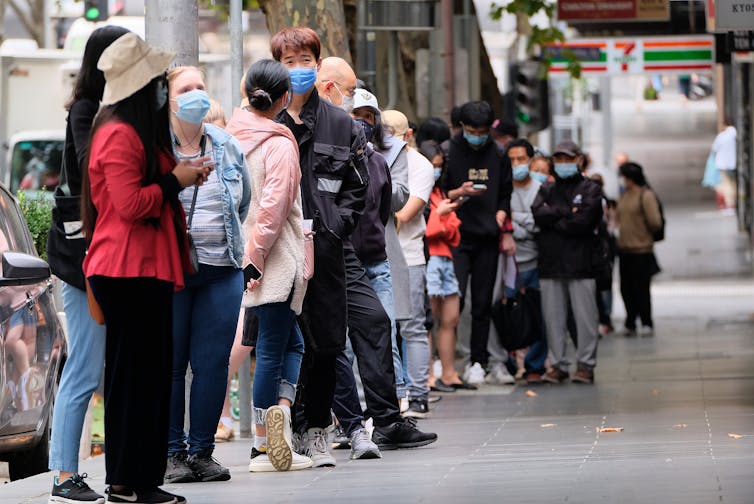
In countries like Australia where infection rates remain relatively low, contact tracing is a crucial defence in our fight against COVID-19.
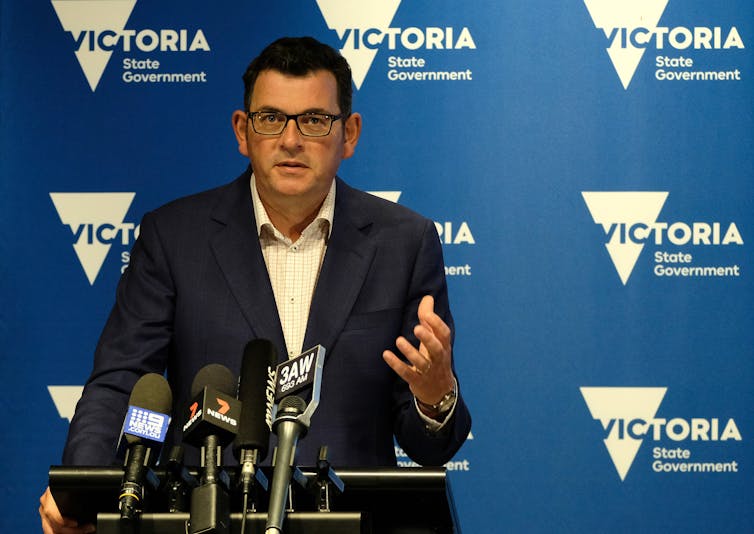
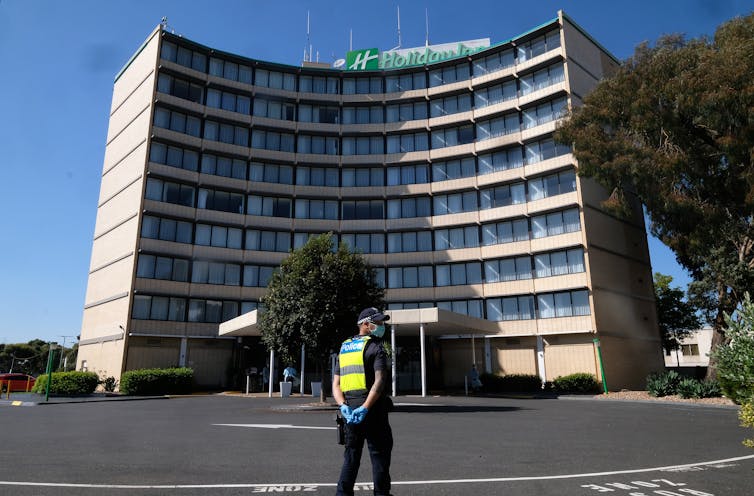
We’ve seen this recently in Sydney, Brisbane and Perth, and now we’re seeing it in Melbourne as Victorian health authorities battle to contain the Holiday Inn outbreak.
The media can play an important role in sharing official information about new cases, potential exposure sites, and who needs to get tested and isolate.
But it’s important to distinguish between informing and shaming when it comes to sharing details of where people who have tested positive have been.
When the daily itineraries of positive cases are picked apart by journalists or on social media, it’s tempting to join in the fun. This could be driven by fear. It’s scary to think we could have been infected on a trip to the supermarket.
But what can seem like a harmless opportunity to vent or make a joke represents a kind of public shaming, and can actually cause harm.
In a recent case in which a Victorian hotel quarantine worker tested positive, Twitter users were quick to mock not only how many places the worker had visited, but also what the venues said about them.
How the media places blame and responsibility within a crisis like the COVID-19 pandemic shapes how people make sense of these significant events. While an article listing venues may seem harmless (and indeed helpful), the kind of language reporters use can encourage readers to make assumptions about the infected person.
In one widely criticised recent article, The Age described a COVID-positive hotel quarantine worker’s “busy itinerary” and specifically noted they visited “two different Kmarts (yes, two)”. The tone here may make us feel as though this worker was reckless or selfish, despite the fact their “jam-packed weekend” was perfectly within COVID-19 guidelines.
Articles from The Daily Mail described a Brisbane hotel cleaner “roaming” around the city before testing positive and a COVID-positive person in Melbourne who “wandered shops for hours and even had a massage”. This language paints people who unknowingly go about their everyday lives, before testing positive, as foolish and self-centred.
Fear-driven headlines often draw a connection between the infected person and the hundreds or thousands of people who subsequently have to isolate. It’s as if that individual is personally to blame.
We know from research on previous pandemics that stigma and shame can discourage people from getting tested, or cooperating with contact tracing.
Recent studies on people who had COVID-19 have found many felt stigmatised, and particularly felt shame at the prospect of infecting others with the virus.
When people infected with COVID are ridiculed or made an example of in the media and on social media, everyone suffers. People may be reluctant to get tested and subsequently to cooperate with contact tracers if they think their every movement is going to be subject to scrutiny and ridicule.
It’s important to note that many people identified in these news articles are frontline workers — such as hotel quarantine staff — with bills to pay and who have little choice but to put themselves at risk. The entire quarantine system relies on these workers, and this public shaming only makes an already tough job much harder.
If people are afraid of having their movements publicised, they may be less likely to come forward for testing.Luis Ascui/AAP
Is there a better way?
As the virus keeps popping up in Australia, the reality is we are all at risk. We could be exposed the next time we dine at a cafe, do a fitness class, stop by Dan Murphy’s, or go to work.
But public shaming of people who test positive causes real harm. The media can reduce the judgement heaped on positive cases by:
focusing on venues and key information rather than describing the person
being careful about judgemental language. Even if it seems neutral, remember emotions are running high
emphasising a call to action: what do people need to do to protect themselves and to comply with public health advice? For example, media coverage could remind people where and when a face mask is required.
The public can also help by focusing on the relevant facts and their own actions. Remember, this is a stressful time for everyone. We are all working towards the same goal.
Plants use their leaves to make food from the sun’s energy and carbon dioxide. With very few exceptions of parasitic plants, no tree is known to grow without green foliage — or to be more precise, no tree can start life without leaves or some sort of green tissue containing chlorophyll.
But some may end up as “zombie trees” long after they lose all leaves and large parts of their trunk, either to disease or the chainsaw.
Such undead tree stumps have been observed for almost 200 years, but the evolutionary and physiological processes leading to their existence remain a mystery. One reason is because they are rare. Another is because whatever happens on their journey from feeding themselves to being fed happens out of sight — likely below ground.
American forest ecologist Suzanne Simard has shown that trees send each other signals through a network of fungi buried among their roots. This underground communication includes warning signals about environmental change and the transfer of nutrients to neighbouring trees before they die.
We suggest this supply can continue beyond the apparent death of an individual tree. By measuring water flow in the stem of a living kauri (Agathis australis) stump and its neighbouring trees, we show underground connections are indeed likely responsible for the survival of the stump.
A living tree stump is clearly a biological oddity, and our key question is why such root grafts form.
Trees can share water and nutrients through their networked root system.Shutterstock/C Levers
Who profits?
It is unlikely a tree that has lost its foliage (through windthrow, disease, or when it is felled) subsequently knocks on its neighbours door (or, more accurately, roots) to ask for carbohydrates. Instead, we must assume that these root connections had been in place earlier, while the stump was still a normal tree.
If that is the case, we can assume root grafting to be the rule rather than the exception, at least in species in which living stumps have been observed. But what are the evolutionary advantages? And why are the connections maintained when a leafless stump is no longer actively contributing resources?
The short answer to these questions is we don’t know. Root grafting, a phenomenon well known to foresters and gardeners, has barely been studied on a physiological basis. Much remains speculation.
A few evolutionary advantages for root grafting have been suggested, including increased resistance to windthrow, kin selection (I will help you out if you are related to me), and increased access to water and nutrients coupled with the ability to shift those resources among trees.
The former two are more easily explained because all graft members benefit. But the latter is more difficult to understand.
Forests as superorganisms
If forests feature interconnected root networks where water, carbon and nutrients are exchanged, this would be equivalent to power, water and gas grids supplying a city.
The roots of individual trees are so interlinked that the whole forest becomes a superorganism.Shutterstock/Kobkit Chamchod
But what mechanisms control who gives and who takes? There is evidence that shaded trees are supported by non-shaded trees and the fact that stumps (pensioners) are still supplied with resources gives rise to the much bigger idea that forests act and survive as a whole — much like a single bee or ant has no chance to survive without being part of its colony.
Our discovery of the tight hydraulic coupling through root grafts suggests exactly that: a communal physiology among connected trees. This is a game changer for our general understanding of forest functioning. It shifts our perspective towards forest ecosystems as superorganisms.
But with all the advantages this may bring for the superorganism forest, root connections obviously imply a lack of social distancing. As with COVID-19, this makes it easy for pathogens to spread, especially in cases where the pathogen penetrates the vascular tissue, a tree’s main transport route for water and carbohydrates.
Well into the 21st century, some great mysteries remain about how forests function. Research is particularly timely and relevant, given the rise in climate-induced forest dieback events due to more frequent and severe droughts, increased vulnerability to pathogens and exposure to pests that come with warmer temperatures.
In 1939, a 7th century Saxon ship was uncovered at Sutton Hoo, the Suffolk property of Edith Pretty. The discovery of this ship would transform modern understandings of early medieval England, shedding light on the sophistication of its funerary practices, its accomplished artistry and craftsmanship, and its wide-ranging connections across Europe and beyond.
The new Netflix film The Dig dramatises the uncovering of the stunning find. Based on John Preston’s 2007 historical novel and directed by Australian Simon Stone, the film follows Edith (Carey Mulligan) who, pursuing her intuition about some large mounds on her property, engages Basil Brown (Ralph Fiennes) to excavate them.
But while telling a fascinating story of archaeology, The Dig also reflects a more insular aspect of Britain’s recent zeitgeist, nostalgically appealing to an idea of continuity with a deep past.
Appearing at a time of increased hostility toward Britain’s minority populations and toward Europe as a perceived threat to British sovereignty, The Dig can be seen as a Brexit film: its romanticising of an imagined continuity between the Anglo-Saxons and modern British people does not speak to the complexity of Britain today.
For love or money
The Dig pits Basil, the untrained excavator from farming stock, against the arrogant professionals of Britain’s cultural institutions.
Over the last quarter century, medieval scholarship has increasingly paid tribute to amateur scholars working especially in the 19th century, whose vital contributions were sidelined as the discipline professionalised.
Ralph Fiennes plays Basil Brown, the jobbing, self-taught archeologist who finds himself at odds with representatives of the British Museum.Larry Horricks/Netflix
Played with quiet magnetism by Fiennes, Basil is the epitome of an amateur: one whose devotion arises from love. But the Cambridge archaeologist C.W. Phillips (Ken Stott) is determined to wrest both control and credit from Basil, in a face-off highlighting ongoing tensions between Britain’s rural counties and its metropolitan centre.
Suffolk might be where Saxon kings and their priceless grave goods are buried, but Phillips scorns the “ad hoc” excavational efforts of the “provincials”, believing the British Museum is the natural destination for the treasures.
The Sutton Hoo helmet is one of only four complete Anglo-Saxon helmets to survive.Andy Rain/EPA
Basil, an in-demand but underpaid jobbing excavator, values his nose ahead of his eyes or hands: “the past speaks” to him not through book knowledge but through the soil.
He makes discoveries due to his intimate acquaintance with the Suffolk soil, knowledge bequeathed from his farming father and grandfather.
The ‘Anglo-Saxon’ myth
The film’s depiction of Basil is deeply attractive, but in the current political climate it warrants closer scrutiny. The Dig reanimates key tropes from the persistent 19th century British and American ideology of Anglo-Saxonism.
After the end of Roman rule, Britain was the destination for groups of Germanic migrants who later became known as the Anglo-Saxons. While they were historical people, their identity has been subject to nationalistic and romanticised constructions.
By the 19th century, historians, educators, and politicians used the “Anglo-Saxon period” to loosely refer to the period spanning from the first settlement of these Northern Europeans in the 5th century to the Norman conquest in the mid-11th century.
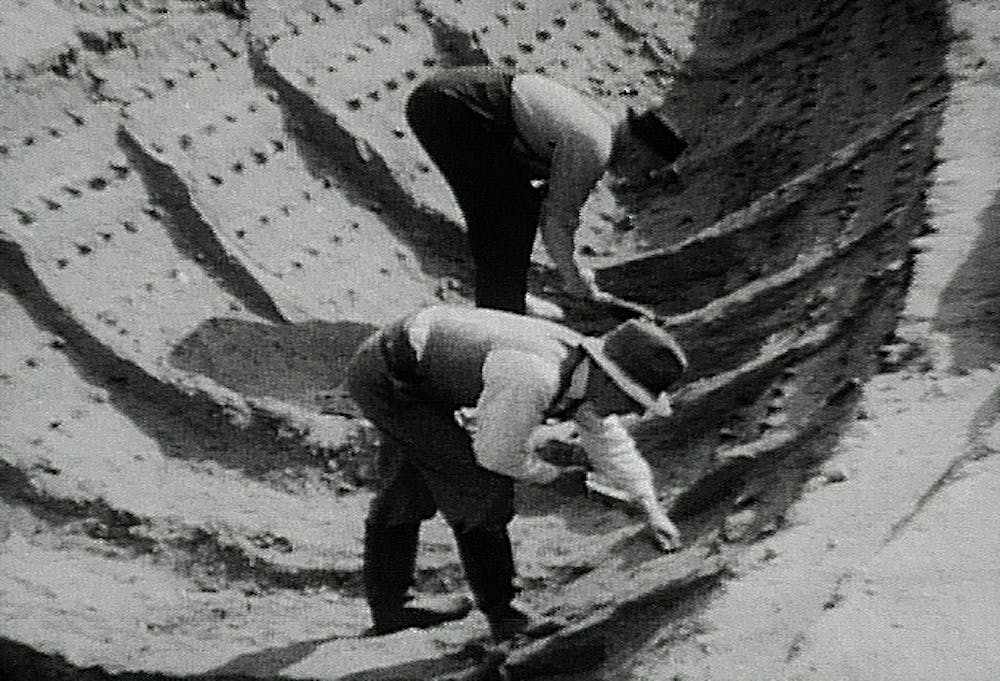
A still from a home movie shows Basil Brown (front) excavating the burial ship at Sutton Hoo in 1939.Wikimedia Commons
These 19th century commentators used the term “Anglo-Saxon” to invoke a broad conception of the English as a continuation of the Anglo-Saxon race: freedom-loving people whose egalitarian social and political institutions, the argument went, were destroyed by the imposition of the “Norman Yoke”.
The Dig presents Basil as an inheritor of this “freedom-loving” people, defying the authority imposed on him by the professional archaeologists.
The Anglo-Saxon period was also idealised as a time when England was free from nefarious “Romance” continental occupation. This is reflected in Edith and Basil declining to support Ipswich Museum’s excavation of a local Roman villa at Stanton Chair.
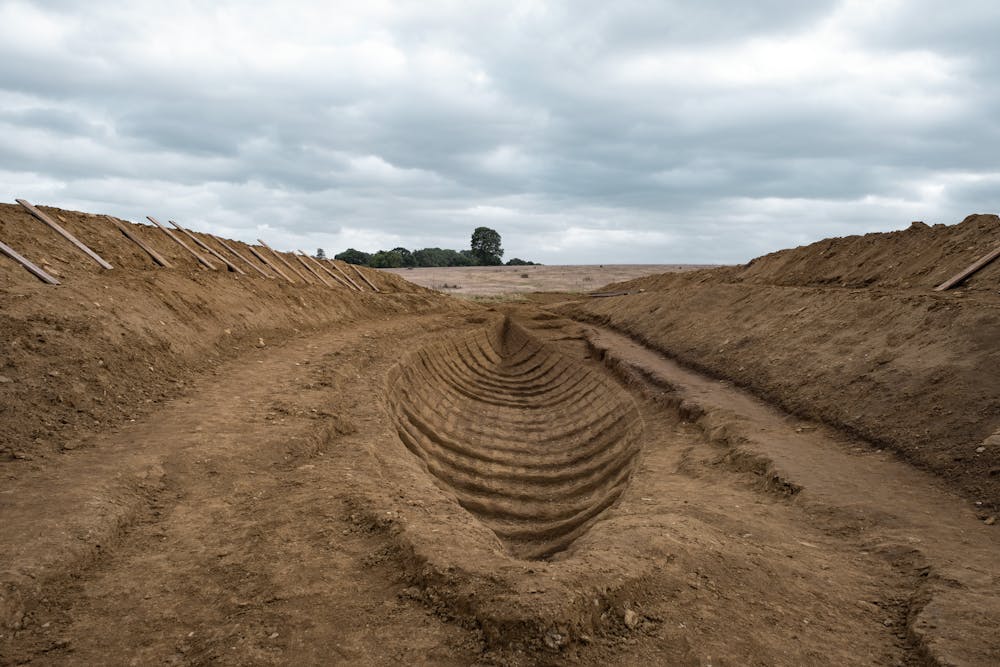
The excavation revealed the imprint of a decayed 27m long ship, with a burial chamber full of riches.Larry Horricks/Netflix
Anglo-Saxonism was vital to underwriting white racial supremacy as a mandate for Britain’s imperial power and the expansionist concept of Manifest Destiny, based on the belief that the British and white settlers in the colonies inherited a drive for expansion from their Anglo-Saxon ancestors.
When Edith’s rocket-obsessed son Robert (Archie Barnes) compares Vikings to “space pilots” because they both “explore new lands”, we see the film drawing uncritically on a historical tropes of expansionism — despite the fact the violence of colonialism and occupation is well understood today.
Looking back, not forward
One of the great reckonings in the film comes when Basil’s wife, May (Monica Dolan), urges her disaffected husband to return to the dig. She tells him:
you’ve always said your work isn’t about the past or even the present. It’s for the future, so that the next generations can know where they came from. The line that joins them to their forebears.
This appeal to the idea of genetic continuity is rousing and profound, but also exclusionary and insular. May assumes racial and cultural uniformity in Britain, and shared forebears for all.
But her statement is not just intended to move Basil. She speaks to the film’s 21st century viewers, many of whom would not see an unearthed Saxon as a forebear, and might rightly wonder what “future generations” the film has in mind for Britain.
The Dig is a beautifully made and compelling drama about a game-changing archaeological find. But as cinematic archaeology it looks far more to the past than to the future.
Last Thursday I walked the Tongariro (Alpine) Crossing with my partner. Actually, it was my third time, having also enjoyed that beautiful volcanic walk in 1979 and 1990. This was my first time with a mobile phone in my pocket. My phone assured me that the 19½ kilometre walk took me 39,000 steps; 2 steps per horizontal metre on average, compared with the 1½ steps per metre that I do when walking around the block at home. ‘The Crossing’ has more steep bits – and many more vertical steps! – than the (not well maintained) footpaths of Glen Eden.
Despite its length, The Crossing is accessible to people of reasonable fitness aged 7 to 77. There were probably about 250 people on The Crossing that day. But, as we left National Park for Auckland on Saturday, we saw huge numbers of young adult walkers boarding shuttle buses for the trail. Many people resident in Aotearoa do seem to be taking the opportunity to experience this experience while the international visitors are largely absent.
The Crossing has gained a status – domestic and international – since the 1990s as a ‘must do’ endurance walk, a one‑day complement (or alternative) to the multi‑day ‘Great Walks’. (Indeed, the first half of The Crossing is also part of the ‘Tongariro Circuit’ Great Walk. The Crossing is also part of the Te Araroa Trail, that winds from Cape Reinga to Bluff.)
While the ‘Bucket List’ marketing of these walks has proved to be very effective, it has almost certainly contributed to the culture that such activities should be seen as ‘achievements’ rather than ‘experiences’. An example of an ‘achievement’ is to drive from Auckland to Wellington in under eight hours, whereas an ‘experience’ is to take 11 hours, stopping every hour or so along the way; at towns, beauty sports, rest areas, cafes. And not speeding. And not driving tired. Another example might be to visit Hot Water Beach; a half‑day achievement or a full‑day experience. A half day visit would be enough to travel from Auckland, get the selfie and to tick it off the Bucket List; a full‑day visit enables visitors to fully experience (enjoy) this coastal environment.
The Crossing requires a lot of effort to get to the most spectacular bits in the middle. And a lot of effort – potentially enjoyable effort – to get out. (A long downhill walk does require effort, especially when it comes after the challenging Red Crater ridge walk.) Why rush the enjoyment? Why aim to finish the walk at 2:30pm when there are still more hours of enjoyment available?
We caught a 7am shuttle bus from National Park, meaning we started walking at 7:30am. We booked an expected pickup at 4:30pm, expecting an enjoyable nine‑hour experience which matched the timings on one of the maps that we had read. When we alighted from the morning bus, we were informed that the return buses would be at 2:30pm and 4:00pm. We made it to the 4:00pm bus, just! But we had to walk the last section of the walk at ‘hurry to catch the train’ speeds, in part because of the unexpectedly early departure time and in part because we discovered the signage on the walk was incorrect; the last section – allowing for a half-way toilet stop and a few minutes to reflect before boarding the return bus – was a 2½ hour walk incorrectly labelled as 1½ hours.
Such clumsy management certainly affects the enjoyment of the experience. Both the bus driver and the DOC employee at the Tongariro National Park Visitor Centre considered The Crossing to be a six to seven hour walk, and indeed most people on our morning bus did catch the 2:30pm bus back to their lodgings. I guess they thought it was an ‘achievement’ to walk the 39,000 steps so quickly. They had the opportunity to spend another 90 minutes at the place they took much effort to get to, yet they declined that opportunity.
This ‘achievement’ culture has been around a long time. It’s all about how many great walks you have done, how quickly you were able to complete a ‘challenge’, how many World Heritage Sites you have been to. It’s the challenge that principallydrives so many people to do such walks, not the experience of the environment they are visiting. It’s an austerity culture, where the pain actually is the gain.
There’s a huge domestic tourist market in New Zealand for families (in the school holidays) and newly retired persons (in the other times) for enjoyable environmental experiences that involve a bit of effort, but for which the environment rather than the effort is the principal enjoyment.
In these Covid times, it is the newly retired persons – fit for their ages, but preferring to walk at an unpressured pace, and taking extra care not to fall or ‘do’ their knees or ankles – who can form the mainstay of a year‑round domestic tourist industry. They travel outside of school holidays and weekends. These are people (indeed ‘boomers’, so there are many of them) – aged 65 to 75 – who would otherwise have been doing lots of overseas trips. The New Zealand tourist industry can survive by treating our lovely walks as environmental experiences rather than as time trials. The ‘destination’ is not the end of the walk; it’s the walk itself, especially – as in the case of The Crossing – the stunning middle bits of the walk.
There’s a useful concept from psychology that helps explain why good people do things that harm the environment: the false consensus effect. That’s where we overestimate how acceptable and prevalent our own behaviour is in society.
Put simply, if you’re doing something (even if you secretly know you probably shouldn’t), you’re more likely to think plenty of other people do it too. What’s more, you likely overestimate how much other people think that behaviour is broadly OK.
This bias allows people to justify socially unacceptable or illegal behaviours.
More recently, conservationists and environmental researchers are beginning to reveal how the false consensus effect contributes to environmental damage.
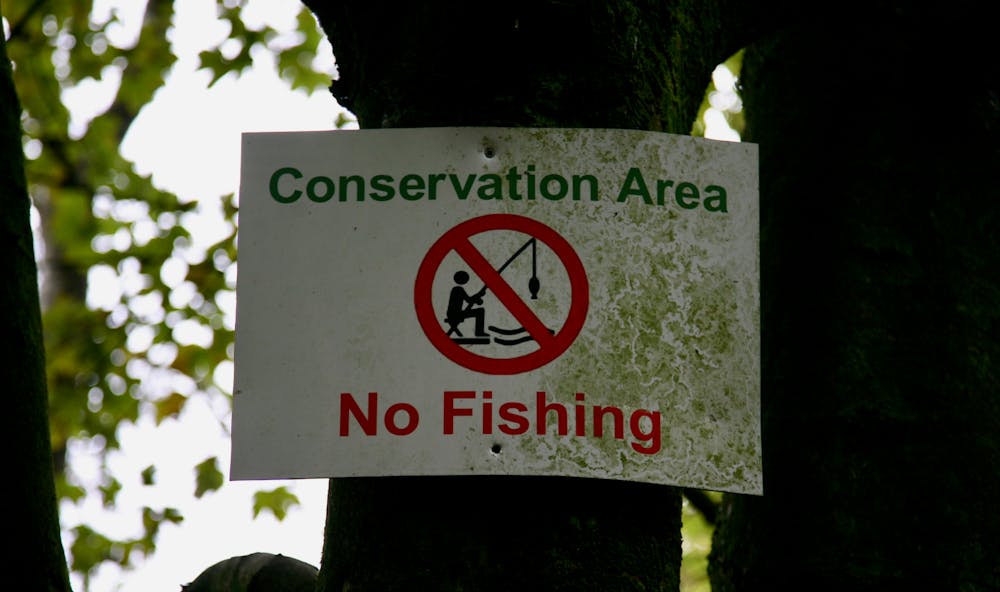
In particular, we found people who admitted to poaching thought it was much more prevalent in society than it really was, and had higher estimates than fishers who complied with the law.
People who admitted to fishing in no-take zones thought it was much more prevalent in society than it really was.Shutterstock
Beyond poaching, the false consensus effect can help explain other behaviours.
One study examined students living on campus who were told not to shower while an emergency water ban was in place. It found those who showered in breach of the rules vastly overestimated how many other students were doing the same thing.
In a different study, researchers surveyed Australians about climate change and asked them what opinions they thought most other people held about the topic. The researchers found:
…opinions about climate change are subject to strong false consensus effects, that people grossly overestimate the numbers of people who reject the existence of climate change in the broader community.
Just as concepts from psychology can help explain some forms of environmental damage, so too can psychological concepts help address it. For example, research shows people are more likely to litter in areas where there’s already a lot of trash strewn around; so making sure the ground around a bin is not covered in rubbish may help.
In Germany, for example, a campaign aimed at increasing consumption of sustainable seafood actually led to a decline in sustainable choices compared to baseline levels, likely because the messages were seen as manipulative and ended up driving shoppers away from choosing sustainable options.
A campaign aimed at increasing consumption of sustainable seafood in Germany actually led to a decline in sustainable choices.Shutterstock
Encouragingly, activating people’s inherent desire for status has also been successful in getting people to “go green to be seen”, or to publicly buy eco-friendly products.
As the research evidence shows, social norms can be a powerful force in encouraging and popularising environmentally friendly behaviours. Perhaps you can do your bit by sharing this article!
Social norms can be a powerful force in encouraging and popularising environmentally friendly behaviours.Shutterstock
A series of media investigations had earlier painted a picture of widespread harm, including over-training and fat-shaming, predominantly affecting girls. The allegations echoed similar situations around the world.
The eventual report was released last week and Gymnastics New Zealand apologised for the past abuses. However, the report does not contain specific findings, perhaps a result of its broad terms of reference.
Instead, it identifies the main areas where change might happen, including the health, safety and well-being of gymnasts, coaching standards, finances, complaints procedures and organisational structure.
The report recommends change in each of these areas, plus the establishment of a body to monitor implementation of those reforms.
A lack of athlete and children’s voices
Gymnasts and academics have already floated many of the report’s ideas, which would make a positive change in the sport.
On the other hand, academic research contradicts some of the claims within the report. For example, the idea that Eastern bloc coaches “introduced” abusive methods to the sport is inaccurate. There is evidence of abuse in gymnastics in both Eastern and Western countries since the 1970s.
Fostering a belief that outsiders are responsible for such abuse feeds anti-immigrant stereotypes and deflects the focus from local culpability.
The report also fails to take account of gender. It is mentioned only once, even though the majority of allegations came from females. Moreover, research has shown the sport’s expectations of femininity are a big part of the power imbalances that lead to abuse.
And while the report calls for promoting athlete voices and child-safe policies, the lack of child and athlete voices in the text is striking — particularly as around 90% of gymnasts are under 12.
Only 70 athletes participated in the review, out of a population of 35,000 gymnasts registered with Gymnastics New Zealand (not including former members).
A history of abuse
This is not the first time gymnastics has been at a crossroads. There were scares in 1995 with Joan Ryan’s book Little Girls in Pretty Boxes about abuse in gymnastics and figure skating, an inquiry into Australian gymnastics abuse that same year, and more allegations around the world throughout the 2000s.
The difference now is that we have the social science evidence and human rights frameworks upon which to base our response.
The report, then, must be considered as only one input into a wider program of change — beginning with an acknowledgement that the problems within gymnastics are highly gendered. That is, they disproportionately affect girls and women, and are related to the narrowly defined femininity that gymnastics demands.
Girls are selected and trained to adopt certain traits — docility, passivity and compliance — that make them easier to control. Coaches enforce these behaviours by using emotionally abusive “training methods”: yelling, insulting, public ridicule, isolation, neglect and physical violence.
A global problem: ‘Athlete A’ documented USA Gymnastics’ protection of abusive coaches over several decades.
Gender, authority and exploitation
The power differential between coaches and other officials (positioned as adults and experts), and gymnasts (inexpert and children) has allowed abuse to be normalised.
This subordination of female athlete voices doesn’t just happen in the gym. It’s echoed in the reviews taking place around the world. We’re assured sports authorities will listen to the reviewers, so why didn’t they listen when gymnasts first raised concerns?
A United Nations Report from June 2020 identified gender discrimination in sport as a human rights concern:
The discrimination faced by women and girls in competitive and non-competitive sport cannot be divorced from the discrimination they face in society more broadly.
[Countries should] consider taking collective action on behalf of athletes, including with the involvement of sporting bodies, to address the gaps in accountability arising from the practices and policies of sporting bodies.
As a member of the international human rights community, as well as a party to the recent Commonwealth consensus statement on human rights in sport, New Zealand has an obligation to take action. This could begin with gymnastics.
It’s time to recognise athletes as the experts they are. They know their sport better than anyone. Most are amateurs who also need a paying job and have experience in other fields that can contribute to athlete welfare.
National sports organisations need to embed athletes in governance — not just as another party to consult, another toothless committee, but as a mandatory requirement for boards.
Athlete welfare and empowerment strategies need to be designed by or with the athletes themselves or their representatives. People with expertise in human rights, abuse, child protection and gender equity have valuable knowledge to share with the sports community.
Finding a way to fix gymnastics is a real opportunity to create something that will transform all women’s sports in New Zealand. But first we must start listening to the athletes themselves.
Source: The Conversation (Au and NZ) – By Chris Wallace, Associate Professor, 50/50 By 2030 Foundation, Faculty of Business Government & Law, University of Canberra
Federal opposition leader Anthony Albanese’s recent six-day tour of Queensland came not a minute too soon for Labor’s prospects in the possible election year of 2021.
The old adage that you can’t win an election without winning Queensland was proven roundly by ex-Labor leader Bill Shorten’s performance in 2019. Albanese knows the party has to pick up at least three or four Queensland seats to have any hope of dislodging the Coalition government.
With a primary vote of just 26.7%, Labor won only six out of thirty Queensland seats. This was the party’s worst House of Representatives result since the Dismissal election of 1975 when it was left with just one.
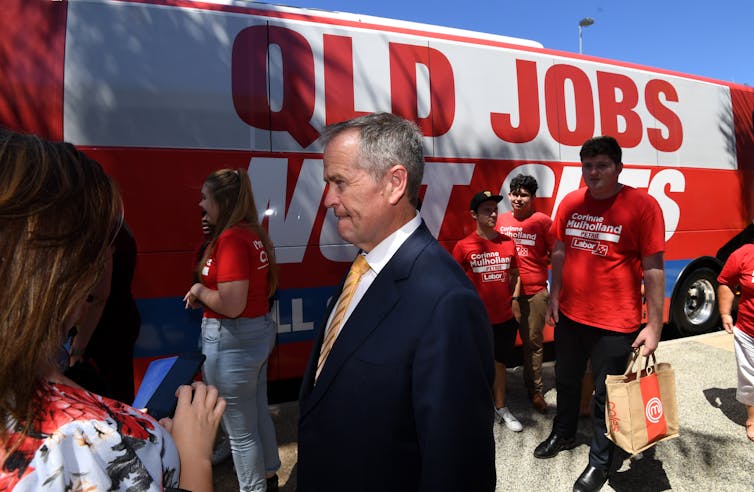
Labor only managed to secure one in five lower house seats in Queensland under Bill Shorten.Dan Peled/AAP
Only one Labor senator (newcomer Nita Green) was elected — the party’s worst upper house performance in Queensland since the current Senate voting system was established in 1949.
The Australian Election Study shows the 4.3% swing against Labor in Queensland was almost four times the Australian average. It also gave the Coalition an extra two lower house seats — enough to win the election.
But Queenslanders do vote Labor
Juxtapose this with Queensland Labor premier Annastacia Palaszczuk’s third consecutive state election win in 2020 and you can see Labor is not inherently the problem.
A large number of Queenslanders voted against Shorten in 2019 and for Palaszczuk in 2020.
So Labor can, has and does win resoundingly in the sunshine state. Labor’s job now is to win back the Queenslanders lost in 2019, substantially build on their numbers, and bring in enough seats to underwrite victory.
On five of the last seven occasions Labor won a federal election, it won a majority of seats in Queensland. Today, that means Labor would have to pick up another ten seats to take its current tally of six seats to 16 out of the current 30 lower house seats.
Internal party hopes to pick up at least three or four seats, rather than ten, shows how low is the bar Labor has set itself for the coming poll.
A September poll?
Shorten did not engage Queenslanders much. The question is, can Albanese succeed where Shorten failed? This is especially so with voters in outer-suburban Brisbane, in the suburbs of regional cities, and in the regions generally, who turned so savagely against federal Labor in 2019.
Key will be whether Albanese can convince Queenslanders he will act in their interests, rather than straddle the barbed wire fence Shorten did on resource sector jobs and the environment. On this, Albanese has to bring regional voters with him, while holding onto environmentally-motivated inner-city ones.
Albanese knows he cannot win unless he can convince Queenslanders on both jobs and the environment, and his recent frontbench reshuffle was designed with this in mind. Deputy leader Richard Marles, now shadow minister for reconstruction, employment, skills and small business, and Chris Bowen, shadow minister for climate change and energy, will be expected to deliver on the policy and politics of this challenge.
They don’t have a lot of time. The government will likely want to capitalise on the popularity of the upcoming COVID-19 vaccine roll out, and get in ahead of voter unhappiness at the withdrawal of pandemic stimulus benefits, by calling an early election.
With a September 2021 poll widely expected in Canberra, despite Prime Minister Scott Morrison’s protestations to the contrary, the opposition leader urgently needs Queenslanders to get to know him better and vice versa.
Getting to know you
The COVID-19 pandemic has made it difficult for Albanese to go to Queensland over the past year.
Albanese has to flesh himself out. He has to spend a lot of time in Queensland projecting, as the new Labor slogan has it, he’s “on their side”.
Last week, Anthony Albanese was joined on the pre-campaign trail by several frontbenchers, including Terri Butler and Jim Chalmers.Darren England/AAP
In his six-day visit to Queensland, Albanese spruiked Labor’s new industrial relations policy with the discipline necessary for a winning leader. Its focus on the situation of marginal and gig economy workers has potential appeal for one of the kinds of voters Labor needs to connect with, providing Albanese can garner their attention for long enough to hear him.
It will become clear in coming months whether Albanese can do the theatre of politics well enough to cut through with initiatives like this and make inroads for Labor.
Excellent initiatives in his 2020 budget reply speech on childcare, industry and energy policy disappeared like water into sand. It’s no good having the policies if you can’t communicate them and make them stick in voters’ minds.
The Queensland opportunity
The flipside of Labor’s woeful 2019 result is it would be hard for anyone to do worse at the next poll. Queensland now represents an enormous opportunity. If Albanese can turn it around for Labor there, he can win the next election.
That possibility is greater than many people may realise. It is unusual for a prime minister to campaign hard for a state counterpart — as Morrison did for the Liberal National Party in Queensland last year — only for that state leader to go down in a comprehensive loss.
Morrison’s inability to help then Queensland LNP leader Deb Frecklington stop Palaszczuk’s emphatic win shows there are limits to his political cleverness and appeal. After warming to him relative to Shorten in 2019, voters there revealed a new scepticism about Morrison in 2020.
But Albanese has a lot of work to do to convince Queenslanders he is worthy of their vote. The more time he spends there, the better, and his latest trip was a good down-payment on that task.
If his approach works, opinion polls will move in Labor’s favour and the party’s marginal seat-holders around Australia will start to breathe easier.
In the past fortnight, two vaccine stories made headlines around the world.
Novavax announced spectacular results for its phase 3 trial, while preliminary data suggest the AstraZeneca vaccine is ineffective against the South African variant.
These two vaccines comprise the bulk of Australia’s vaccine portfolio, and the results should prompt an urgent rethink of our vaccination strategy.
Australia won’t reach herd immunity with the current plan.
Australia’s strategy
Australia has secured access to 20 million doses of the Pfizer/BioNTech vaccine, 53.8 million doses of the Oxford/AstraZeneca vaccine, and 51 million doses of the Novavax vaccine. All of these require two doses for maximum effectiveness.
The federal government plans to begin vaccinating groups at high risk with the Pfizer/BioNTech vaccine, then use the AstraZeneca vaccine for the remainder of the population.
The Novavax vaccine may be used at a later date.
But the efficacy of these vaccines is very different
There’s been some confusion over the efficacy of the AstraZeneca vaccine, because of a dosing mistake in one of the early trials. But what’s clear is that its efficacy with a standard, two-dose schedule is 62%.
These differences matter, because if vaccine efficacy is below a certain level, it’s not possible to achieve herd immunity.
If we don’t achieve herd immunity, Australia could be dealing with outbreaks indefinitely
Herd immunity is the only sustainable, long-term strategy to prevent the virus from spreading throughout the community.
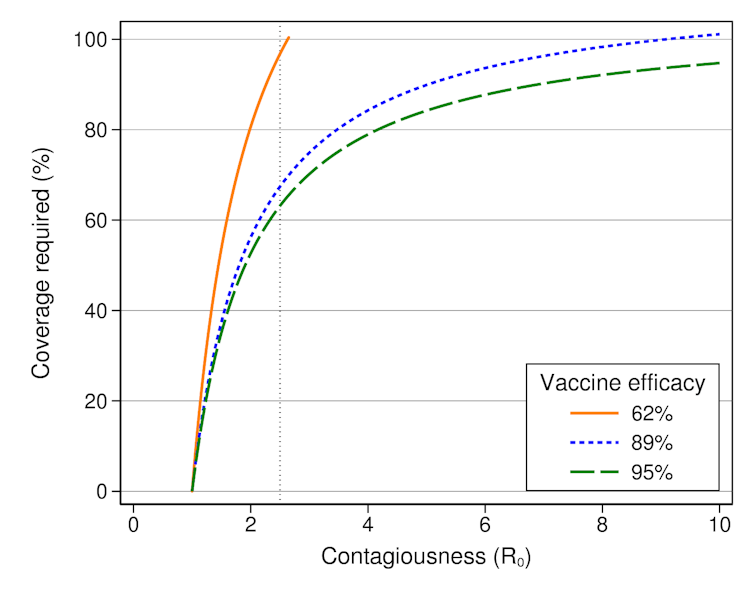
The proportion of the population needing to be vaccinated to achieve herd immunity depends on both how contagious a disease is, and how effective the vaccines for it are. It can be calculated by a simple formula, the results of which are shown in the graph below.
Proportion of the population that would need to be vaccinated to achieve herd immunity.Author provided
The contagiousness of the virus which causes COVID-19, given by its basic reproduction number (R₀), is thought to be around 2.5. That means, on average, a person with COVID-19 will infect 2.5 people. Of course, some people infect nobody, while others infect many more in super-spreading events.
We’d need to vaccinate almost everyone in Australia to achieve herd immunity with the AstraZeneca vaccine, which isn’t feasible.
Some people have medical conditions that prevent vaccination. We also won’t be able to vaccinate children for a while, because vaccines aren’t yet approved for this age group, although trials are underway.
However, we’d perhaps only need to vaccinate 63% of the population with the Pfizer/BioNTech vaccine, or 67% if we used the Novavax vaccine. This is achievable.
Using the planned combination of the Pfizer/BioNTech vaccine and the AstraZeneca vaccine will still require an unfeasibly large proportion of the population to be vaccinated, because children and teenagers make up about one-fifth of Australia’s population.
In practice, we’ll probably need to vaccinate slightly more people than these figures suggest, because vaccines likely protect against symptomatic disease better than they do against any infection. The figures for efficacy quoted above are for symptomatic disease.
But further unpublished results from the ongoing AstraZeneca trials, and data collected during the trial of the Moderna vaccine, suggest efficacy against infection may be reasonably close to that for symptomatic disease.
New variants threaten herd immunity
New viral variants have complicated the picture. They can threaten our ability to achieve herd immunity in two ways. More transmissible variants (with a higher R₀) mean more people will need to be vaccinated.
They can also directly affect vaccine efficacy, which we’ve seen in South Africa.
Preliminary data suggest the AstraZeneca vaccine is unable to prevent mild to moderate disease caused by the South African variant, and the efficacy of the vaccine dropped to 22%.
South Africa paused the rollout of the AstraZeneca vaccine, and will use the Johnson & Johnson and Pfizer/BioNTech vaccines instead.
The South African variant has also affected the efficacy of the Novavax vaccine, which was reduced to 60%. We don’t yet know how the variant might affect the efficacy of the Pfizer/BioNTech vaccine, but some reduction is likely.
What does this mean for Australia?
Australia is in an incredibly fortunate position, with almost no community transmission. Breaches in the hotel quarantine system are now the major source of outbreaks in Australia.
An increasing proportion of cases in Australian hotel quarantine are infected with variants. At least 18 cases of the South African variant have been detected so far.
Variants of concern are becoming dominant globally. These are what our vaccination strategy must prevent. AstraZeneca’s vaccine won’t protect us against the South African variant, but high-efficacy vaccines like those made by Novavax and Pfizer/BioNTech probably still will.
If Australia rolled out the AstraZeneca vaccine, we’d be starting behind the eight ball, and we’d have to do a second rollout to protect everyone against the South African variant.
We’d need a much larger trial to understand how well the AstraZeneca vaccine prevents severe disease. This would provide the larger number of events needed to distinguish a significant difference between the placebo and vaccine group.
However, we can expect COVID-19 vaccines to be better at preventing serious outcomes than mild ones, and so the AstraZeneca vaccine might still do quite well against severe disease.
The AstraZeneca vaccine will still be very useful for countries battling second waves caused by the original strain of the virus. In this context, the vaccine will save lives.
It’s also very important to note that no safety concerns have been identified with the AstraZeneca vaccine.
Australia should go for herd immunity
With no widespread community transmission, Australia can afford to prioritise a long-term herd immunity strategy, rather than focusing on a short-term goal of saving lives.
In addition to expected overseas supplies of the Pfizer/BioNTech vaccine, Australia has the capacity to manufacture the high-efficacy Novavax vaccine domestically.
Australia must not squander this opportunity by proceeding with the rollout of a vaccine that’s already been proven ineffective against one of the world’s most concerning variants. Rather, we must use high-efficacy vaccines to build herd immunity, and secure Australia’s long-term future.
When disaster strikes, not everyone is affected the same way. A growing body of research shows the experiences of sexually and gender diverse people are frequently very different to those of heterosexual people.
Our research in Australia and New Zealand sought to explore and make visible the experiences of lesbian, gay, bisexual, trans and intersex people, among other sexual and gender identities.
People who are lesbian, gay, bisexual, transgendered, intersex or queer can have quite different experiences but are often incorrectly lumped together as one “community”. In fact, there are multiple communities.
For our research, we wanted to know how disasters affected these people and communities, about their experiences with government and other support agencies and what positive experiences they’d had of resilience, coping and adapting.
‘You never know if you will be treated properly and with respect’
It became clear LGBTIQA+ people are differently vulnerable in disasters and their aftermath. Fear, marginalisation, misunderstanding, exclusion and discrimination are all factors to contend with, on top of the other personally and financially devastating impacts of disaster.
Many LGBTIQA+ people do not openly reveal their sexual and gender identities. However, if your home is damaged or you need to evacuate to a public shelter shared with possibly hundreds of other people, your identity can become very obvious.
I wasn’t fully out at this time so I already had to hide things.
In many instances, becoming “visible” when disaster strikes resulted in verbal abuse or worse. One person told us that while videoing flooding, he was accused of being a paedophile.
Accessing support services can be stressful and problematic, with one person telling us:
I was concerned that if I needed direct contact assistance that I would have been either judged or misidentified concerning my gender.
If your home is damaged in a disaster or you lose work because of a pandemic, moving in with parents or other family isn’t always a simple solution.Shutterstock
If your home is damaged, moving in with parents or other family isn’t always a simple solution, as stories from some people made clear:
I went home and was stuck in the house all week with my family because I can’t drive and there was no public transport […] My family were not aware at the time that I was dating anyone – and it wasn’t something I was going to disclose – so it wasn’t something I could talk about.
I stayed with my cousins, who were quite conservative […] I had to shut off some part of my identity for a little while.
In evacuation shelters, bathrooms and toilets are usually divided in to “male” and “female” spaces. For some LGBTIQA+ people, being forced into a female/male bathroom space where their bodies become visible to others can be highly traumatic. That’s often due to previous experiences of discrimination, harassment and violence.
For transgendered people — particularly those in a process of transitioning — single-sex, heteronormative public bathrooms can be utterly overwhelming.
Some people spoke of being blamed for disaster. One person said:
There were religious nutters saying the queers had caused the quakes.
More research is needed on the experiences and needs of LGBTIQA+ people (including those of faith) and how faith-based institutions might support LGBTIQA+-inclusive response and recovery.
The current COVID-19 pandemic is an example of how pandemics can be experienced differently by many LGBTIQA+ people.Shutterstock
Pandemics are disasters too
Climate change and environmental degradation has heightened the risk of pandemics. The current COVID-19 pandemic is an example of how pandemics can be experienced differently by many LGBTIQA+ people (especially those who are younger and in precarious work or housing).
The current pandemic forced some LGBTIQA+ people to move to the parental home after losing work. This can force people back into the closet as they try to fit into expectations of unwelcoming families — an incredibly stressful experience.
Across our research, we also encountered many examples of resilience, coping and adaptation.Shutterstock
Resilience and mutual support
Across our research, we also encountered many examples of resilience, coping and adaptation. For example, online communities of support spontaneously emerged after some disasters, allowing people to advertise safe accommodation for others.
Some people spoke of relying on the LGBTIQA+ community for help:
I wasn’t going to leave my place but my LGBT friends (that live 10 houses away) woke me in the middle of the night to inform me both ends of our road had flooded in. We ended up getting my car out, through back yard access and knocking down a fence.
The United Nations states disaster preparedness, response and recovery arrangements and services should be uniformly available to all, but sensitive to the unique needs different members of our community have. As our research makes clear, much work lies ahead if we are to achieve that goal.
This story is part of a series The Conversation is running on the nexus between disaster, disadvantage and resilience. You can read the rest of the stories here.
The Australasian Council on Open, Distance and e-Learning (ACODE) recently published a white paper on lectures, based on survey responses from 43 member universities (91% response rate). About two-thirds indicated they would not be conducting on-campus lectures this year.
University of Southern Queensland (USQ), for example, sent a document to all staff and students announcing on-campus classes, such as tutorials, lab work and small-group seminars, will continue in 2021, with the notable exception of the traditional lecture. At USQ, when didactic content does need to be delivered, it will be done online, in smaller chunks, with student learning activities interspersed.
Traditional lectures are often poorly attended and several universities have already decided to abandon them permanently.Shutterstock
Now that COVID-19 has forced universities to cease on-campus lectures, many report that they will not return after the pandemic. Only 23% of ACODE-surveyed universities said they would return to full lecturing.
Times Higher Education reported last month that Curtin, Murdoch and Victoria universities believe in-person lectures are a mode of the past.
Some universities started “killing off” lectures long before the pandemic. In 2012, for example, The Conversation reported the University of Technology Sydney (UTS) was tearing down its lecture theatres.
Many new and redesigned tertiary campuses are not including blueprinted lecture theatres. The University of Tasmania, for example, is in the process of creating the Inveresk Precinct with non-traditional teaching and learning spaces.
Mostly this is happening because there are better ways to learn and to prepare for employment. In 2014, UTS explained its rationale for demolishing lecture theatres was not physical, but educational.
For universities, a primary reason for cancelling lectures is to improve pedagogy or teaching methods. In the ACODE survey, only 7% disagreed with this rationale.
Times Higher Education reported that, by 2013, more than 700 studies had all found lectures are an ineffective teaching approach. There is little empirical evidence to prove that lectures are an optimal way to learn or to develop graduate career skills.
Lectures are passive. They seldom get students to do anything, beyond listening and perhaps taking notes. Lectures fail to foster deep learning and student engagement. The purpose of the lecture is called into question.
This learning mode particularly appeals to mature-aged students, who are working while studying and have difficulty fitting long lecture blocks into their schedules. And this description fits a high proportion of university students today.
University students with busy schedules clearly prefer to engage with much of the traditional lecture content online.fizkes/Shutterstock
Early in the pandemic (June through September 2020), i-graduate conducted a survey of Australian domestic and international students. Of the 24,000 respondents, 70% were satisfied with how the universities adapted to COVID-19 and 68% with their overall online learning experience.
While students expressed current satisfaction with online lectures (about 70%), only half thought they should remain. Notably, students were not surveyed about their preference for the online recorded long-form lecture versus alternatives.
A recent FutureLearn survey of just over 1,000 American employers asked: “Are you more likely to hire applicants with online education since the pandemic?” While 75% responded yes, 63% said they would need to “rethink” the hiring process.
But how will students learn what they need to know?
The questions within these surveys are asked in a Shakespearean binary: to lecture, or not to lecture. On-campus or online. The reality is not so simple.
Lectures are not the only approach to university education. Furthermore, the choice of on-campus or online learning is now mostly redundant.
All students spend a lot of their time within online “learning management systems”. Even before the pandemic, curriculum without an accompanying website was rare.
The lecture is still the lecture, whether on-campus, or recorded and posted online. The lecture does not teach any better just because it is digital.
Searching for, planning and booking travel is flourishing online (or at least it was during non-pandemic times). Streaming services have radically changed how people watch television. It is time for universities to catch up to other industries and take full advantage of the opportunities of the internet.
It might be time to let the lecture die, now that other modes of learning and interactions (pedagogies) can thrive.
The University of Southern Queensland, for example, is rolling out a suite of alternative teaching approaches. Most of these are available online. Examples include panel discussions, animated explanations, online experimentation, problem-solving demonstration videos and website hunts.
Such approaches are a sign of the nature of educational change brought forward by the pandemic, which was perhaps long overdue in the higher education sector.
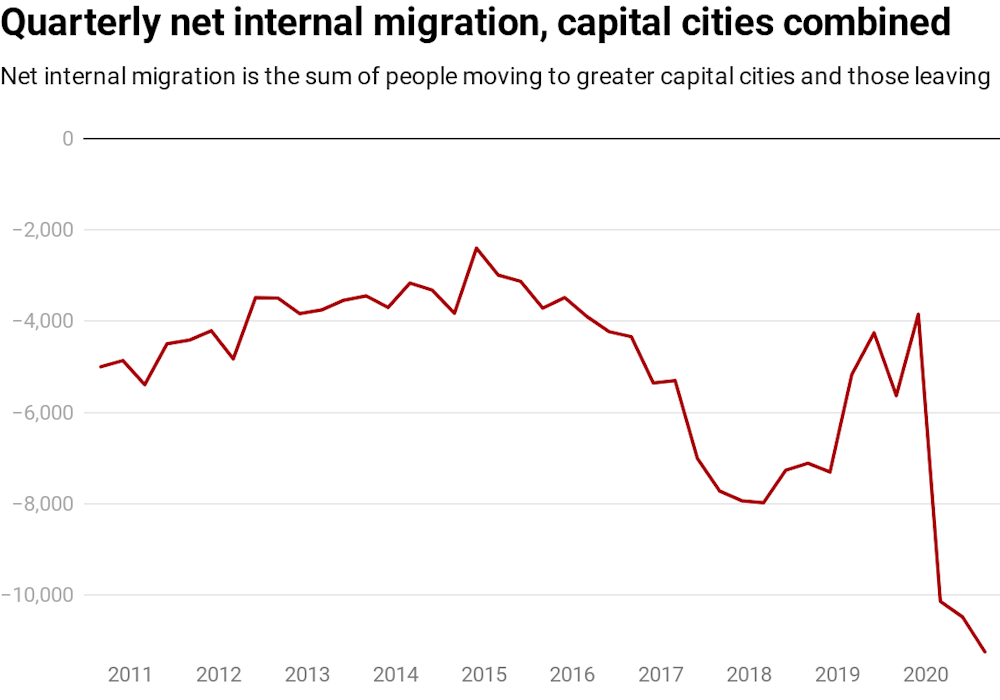
Internal migration resulted in a net loss of 11,200 people from Australia’s capital cities in the September quarter of 2020, according to Australian Bureau of Statistics data released this month. At the same time, some regional areas experienced significant growth in house prices as demand for properties increased. So this has raised the questions: are we starting to see an exodus from our cities, and is this related to the COVID-19 pandemic?
To work out what is happening there are a few important things to consider.
In Australia we move a lot
The first thing to keep in mind is that Australia has one of the most internally mobile populations in the world. About 40% of the population change their addresses at least once within a five-year period. However, the level of internal migration within Australia has fallen since the 1990s.
The greatest fall has been for long-distance moves between Australia cities and regions, which declined by 25% between 1991 and 2016. Moves between states and territories fell by 16% over this period. An increase or decrease in internal migration from year to year is not unusual.
While the recent loss of 11,200 people from Australia’s capital cities is the largest on record, it’s not a significant proportion of the population. Australia’s population has grown and so we expect to see the number of internal migrants to grow too.
The net loss of 11,200 people from capital cities is only 0.06% of the total population – 17.2 million – living in these cities. This is comparable to recent years.
While net loss – those arriving less those departing – is interesting, it is also important to consider the actual numbers of people who are moving to or leaving capital cities. The growth in the net loss of population from capital cities in the September quarter was not the result of a city exodus. What happened in 2020 was that fewer people moved into capital cities.
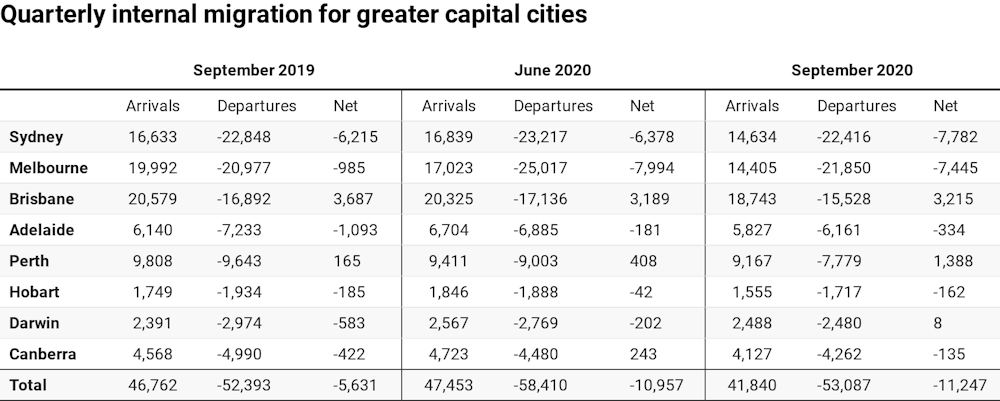
Drilling down further behind the headline data, we find Brisbane, Perth and Darwin all had net population gains. Brisbane has gained residents through internal migration in each quarter since 2014.
The greatest contributor to the recent net quarterly loss of 11,200 was Sydney, with a net loss of 7,782 people. Melbourne was close behind with a net loss of 7,445.
While this might look alarming at first, Sydney and Melbourne are the largest population centres in Australia. And Sydney has recorded a net loss of population through internal migration every quarter for the past two decades. Melbourne recorded net losses until 2012 and then since 2017.
Sydney and Melbourne’s overall population continued to grow over this period due to international migration. Population churn is part of the rhythm of these global cities.
The data also reveal that, on average, regional Australia has been gaining population for many years – decades actually. Moving to regional Australia is not new.
The past year’s COVID-19 restrictions closed Australia’s borders to the previously large numbers of international migrants. Without these international migrants moving to capital cities, the long-term trend of people relocating to urban areas around major cities has become more apparent.
Have the capital cities lost their appeal?
Just considering the September 2020 quarter, nearly 42,000 people moved to capital cities. This is comparable to the March and June quarters of 2020.
This inflow is noteworthy. At a time when many capital cities had mobility restrictions related to COVID-19 in place, people were still moving to these cities. Australia’s capital cities have not lost their appeal.
There is a risk in interpreting net migration from capital cities as an indicator of decreasing satisfaction with city lifestyles or a growing desire for rural lifestyles. It masks the considerable variability in the types of moves people are making, where they are going and why.
Outside of capital cities are a whole range of different community types. They range from expansive city areas such as the Gold Coast and Geelong through to tiny agricultural and fishing hamlets.
The COVID-19 pandemic is disrupting the way we live our lives but, no, there is not an exodus from Australia’s capital cities. For some, pandemic-related disruptions might have heightened their dissatisfaction with where they live. For others, working from home might have provided them with the opportunity to consider alternative living arrangements.
However, right now, given the data we have, it is unlikely that COVID-19 is driving a shift away from capital cities or city lifestyles.
The actions of the Myanmar military in arresting members of the government in dawn raids on February 1, the day parliament was set to convene, have been met with shock and dismay both within the country and around the world.
Why would the military stage a coup to depose a democratically-elected government of which it had been part? Why do it just before the government began a second term?
There are several plausible explanations, but one that has not received enough attention is the desire of the military to protect its wealth and business interests in Myanmar.
It should not be underestimated.
For decades the military has amassed wealth by controlling the state bureaucracy and establishing near-monopolies in key sectors.
The reform agenda of the civilian-led National League for Democracy government threatened to weaken – albeit gradually over time – this lucrative system of crony capitalism.
There is a saying in Myanmar that you “can touch the hair bun on top of my head, but don’t you dare touch the wallet tucked away at my waist”.
The consolidation of civilian rule likely after November 2020’s election threatened previously-untouchable wallets.
Military crony capitalism
Political reforms initiated in 2011 allowed the previously-banned National League for Democracy to contest the 2015 general election and win it in a landslide.
But in the decades leading up to 2011 two military-owned conglomerates, Myanmar Economic Corporation (MEC) and Myanmar Economic Holding Ltd (MEHL) used privatisations to grab publicly-owned enterprises at fire-sale prices.
As well, military leaders and associates of military leaders grabbed licenses, land and economic concessions.
While there have been important reforms in Myanmar over the past decade, including a stronger role for a private sector and international investors, the military has maintained its economic clout.
Its conglomerates control businesses and investments in sectors ranging from beer, tobacco and consumables to mines, mills, tourism, property development and telecommunications.
Indeed, this has posed a dilemma for many international businesses that have been accused by the United Nations and Amnesty International of failing to respect human rights by engaging businesses controlled by the military.
The threat from civilian government
The first National League for Democracy government (2015-2020) was reluctant to directly or decisively target the interests of the military, although its opening of key sectors to competition and investment acted as counterweight.
It was intent on tackling the country’s deep-grained corruption in government–business relations, but with weak impact on the businesses owned by the military.
However, in November 2018 a National League for Democracy spokesperson pointed to the military domination of key parts of the economy and stated that the government bureaucracy – historically dominated by retired military personnel – was a major stumbling block to progress and would be an important target for reform after the 2020 election.
The civilian-led government began to gradually de-militarise the country. A major achievement was the 2019 transfer of the general administration department to civilian control.
This department, previously in the military-controlled ministry of home affairs, has been depicted as the spine of the government of Myanmar, with the power to appoint government officials across the country.
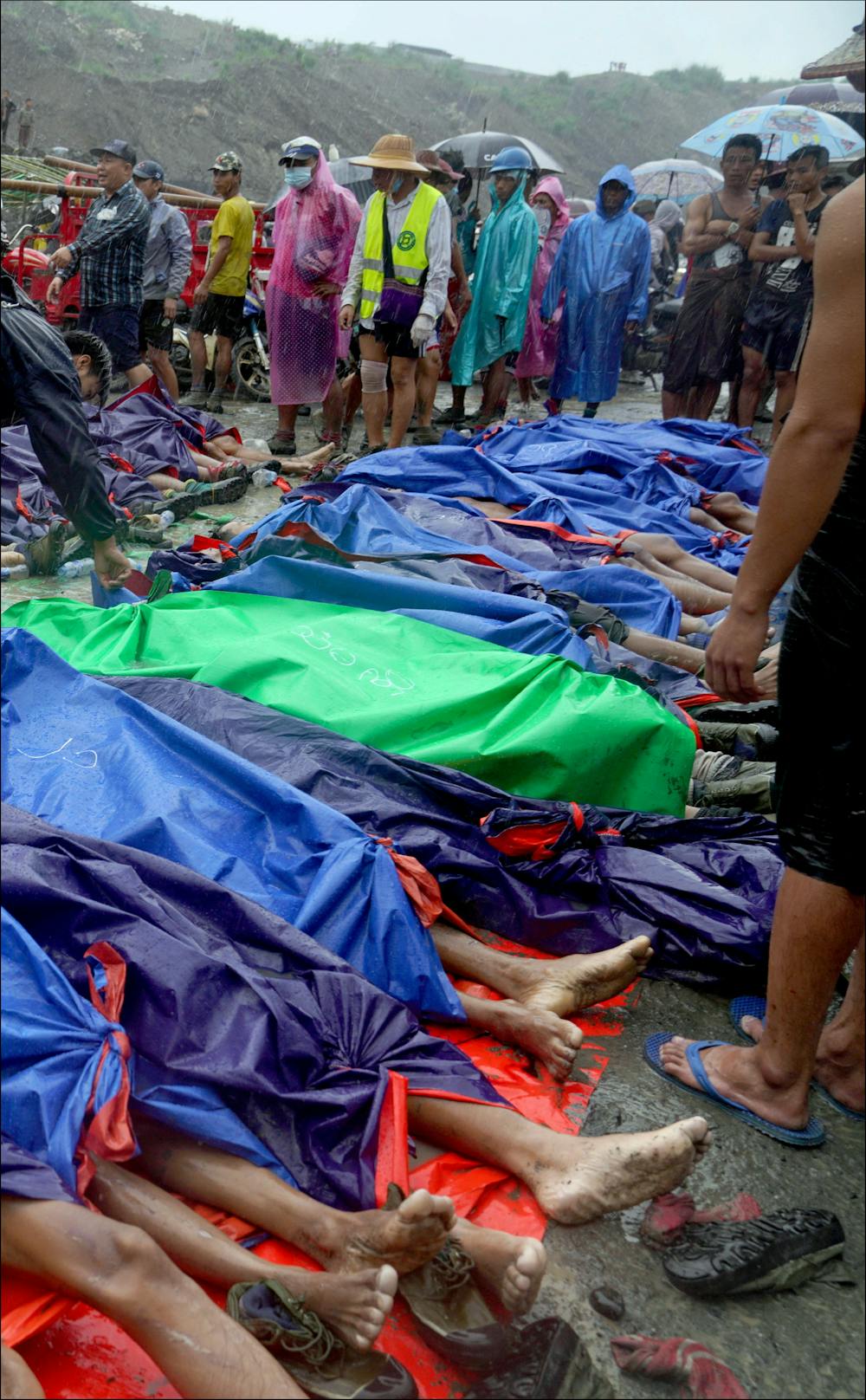
Families gather near the bodies of victims after a landslide at a jade mining site in Kachin State, Myanmar, July 2 2020.ZAW MOE HTET/EPA
Many were shocked that the military had been forced to relinquish control. It was a sign of the weakening grip of the military over the government administration and patronage – which had been at the heart of its ability to accumulate and protect its wealth.
Another achievement was a series of changes to the Myanmar Gemstones Law that threatened military-dominated enterprises for whom the danger-ridden jade mining industry had been extraordinarily lucrative.
We do not know exactly what the National League for Democracy was planning next for jade mining or its commitment to meaningful reform, but we can be sure that strengthened civilian oversight would have loomed large as a concern for the military.
International pressure
The military coup intensifies pressures on international businesses to take a stand on the ethical impacts of their interactions with Myanmar, especially for businesses in direct partnerships with the military.
The decision of the multinational Kirin Brewery Company that brews Australia’s Tooheys, XXXX and James Squire beers to exit its partnership with a Myanmar military-owned business is a high-profile sign of the pressures on investors.
International trade sanctions are likely to return if things don’t improve, but many businesses in countries neighbouring Myanmar are unlikely to be swayed.
As civil disobedience gains traction it remains unclear whether the military coup will succeed. What is clear is that the fight for democracy in Myanmar is also a fight against military-dominated crony capitalism.
Source: The Conversation (Au and NZ) – By Joanna Mendelssohn, Principal Fellow (Hon), Victorian College of the Arts, University of Melbourne. Editor in Chief, Design and Art of Australia Online, University of Melbourne
The Members’ Hall of Parliament House is home to the 25 completed portraits of Australia’s former prime ministers. The most recently revealed was of Julia Gillard in 2018, painted by Vincent Fantauzzo, a five-time People’s Choice Award winner at the Archibald Prize.
Indeed, every official prime ministerial portrait has been painted by an Archibald finalist, including some by artists who were awarded the main prize.
This will change with Tony Abbott’s reported decision to appoint the Australian’s editorial cartoonist Johannes Leak to paint his official portrait. Leak does not have any track record of exhibiting works on a large scale, let alone portraits.
Johannes Leak’s heavy-handed cartoons are in the style of his father’s last years, the work undertaken after he suffered serious head injuries after a fall. There is a general consensus that Bill Leak’s later cartoons are markedly inferior to the work he did in his prime.
The website for the Bill Leak Gallery carries the following statement:
Bill Leak’s son Johannes has taken over the family business and is now the daily editorial cartoonist for The Australian, the position held by his father for 23 years.
This is unusual. I cannot think of another Australian political cartoonist who inherited their position. Traditionally our leading cartoonists come from a rigorous and contested culture of freelance drawing, a tradition that goes back to J.F. Archibald’s Bulletin magazine, first published in 1880.
Along with his father’s platform, Leak junior has also taken over the title Australia’s most condemned cartoonist.
There is of course no contradiction between a cartoonist also being an artist.
Norman Lindsay was the star cartoonist for The Bulletin, pleased at the steady income that gave him time for more serious work.
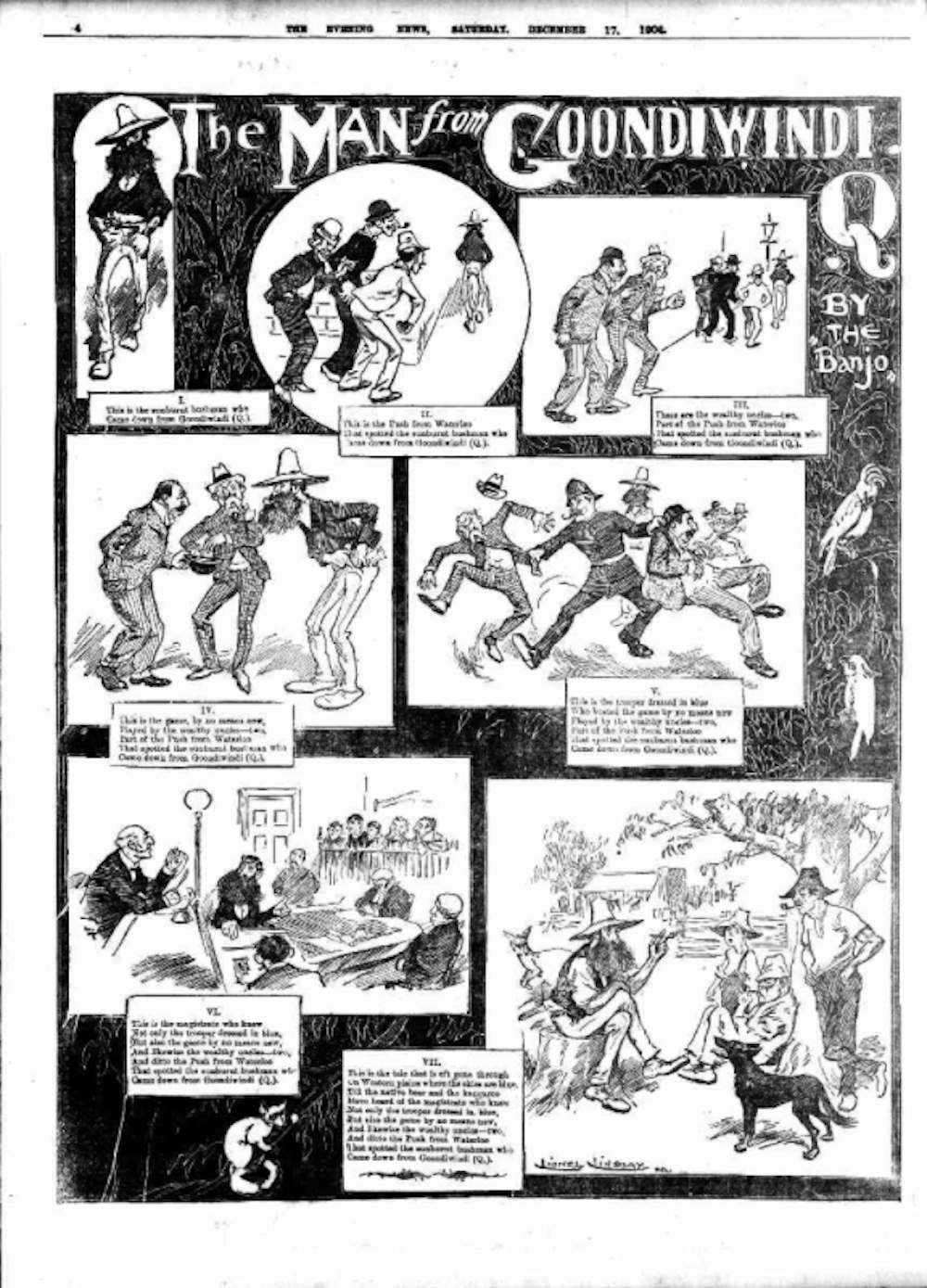
An illustration by Lionel Lindsay, published in Sydney’s Evening News December 1904.Trove
In the early part of last century, his brother Lionel Lindsay — best known for his etchings and wood engravings — was for many years cartoonist at the Evening News, appointed by the editor Banjo Paterson as well as drawing the popular Chunderloo cartoon series for Cobra boot polish.
In the 21st century, Jon Kudelka, the cartoonist at the Saturday Paper, is also well-known as an exhibiting artist.
Leak senior first exhibited in the Archibald Prize in 1988 with a portrait of fellow cartoonist Patrick Cook, following with a portrait of Don Bradman in 1989 and Malcolm Turnbull in 1994, which won the People’s Choice Award.
Bill Leak’s larrikin sensibility combined with his Archibald success is presumably why he was commissioned to paint Bob Hawke’s official portrait for Parliament House. It is a curiously dull grey painting of a colourful character. There is something quite odd about the way the head doesn’t quite fit the body, almost as though there were two different models.
Bill Leak’s official portrait of Bob Hawke hangs at Parliament House in Canberra.AAP Image/Lukas Coch
The difference between Bill Leak’s portrait of Hawke and his son’s commission to paint Tony Abbott is Leak senior’s track record as an exhibiting artist.
But is it art?
Fortunately for Johannes Leak, whatever he paints will fit the legal definition of portrait. For this we also have to thank the legacy of J.F. Archibald.
Archibald died a wealthy man. His charitable gifts included a benevolent fund for the relief of distressed journalists and the Archibald Fountain in Sydney’s Hyde Park. But his best known legacy was to the Trustees of the New South Wales National Gallery, providing an endowment to create The Archibald Prize.
For many years when it came to judging the prize, the trustees — more or less evenly divided along the same kind of factional lines usually seen in political parties — took turns in deciding who would be awarded the lucrative honour.
In 1943 this changed. A conservative trustee died and was replaced with Mary Alice Evatt, a modernist artist who happened to be the minister for education’s sister-in-law.
The prize was awarded to William Dobell for his portrait of his friend the artist Joshua Smith. Two artists aligned with the Royal Art Society (and not so secretly supported by the conservative trustees) sued on the grounds it was not a portrait, but a caricature.
This cartoon of the trial, published in The Daily Telegraph, October 1944, was drawn by W. E. Pidgeon (aka Wep) who later won the Archibald Prize three times.Trove
The resulting court case provided a great entertainment for Sydney society.
The plaintiffs’ most trenchant witness, the art critic J.S. MacDonald, claimed the portrait was “a pictorial defamation of character” and a “satirical caricature”. Under cross-examination he admitted he had written his critique without seeing the work in question.
As well as giving a verdict in favour of the trustees and the gallery, Justice Roper noted the considerable public interest in the matter, so added for good measure a definition of portraiture yet to be seriously contested:
The word “portrait” … means a pictorial representation of a person, painted by an artist. This definition denotes some degree of likeness is essential and for the purpose of achieving it the inclusion of the face of the subject is desirable and perhaps also essential.
Johannes Leak could paint the silliest, crudest portrait of Tony Abbott and it would still be defined as a portrait. It is, however, more likely he will paint a large acrylic or oil painting on canvas.
My prediction is the subject will be depicted wearing a grey suit and sporting a light blue tie — rather than Abbott’s infamous red budgie-smuggler swimming trunks. It will almost certainly include a face.
As JobKeeper enters its final weeks, the government has released the latest Tax Office breakdown of the numbers coming off the program, amid concerns its end in late March will see a rise in unemployment.
With attention currently on Victoria, in a five day lockdown due to a COVID outbreak that started with a hotel quarantine breach, the JobKeeper numbers underline the impact of that state’s long lockdown last year.
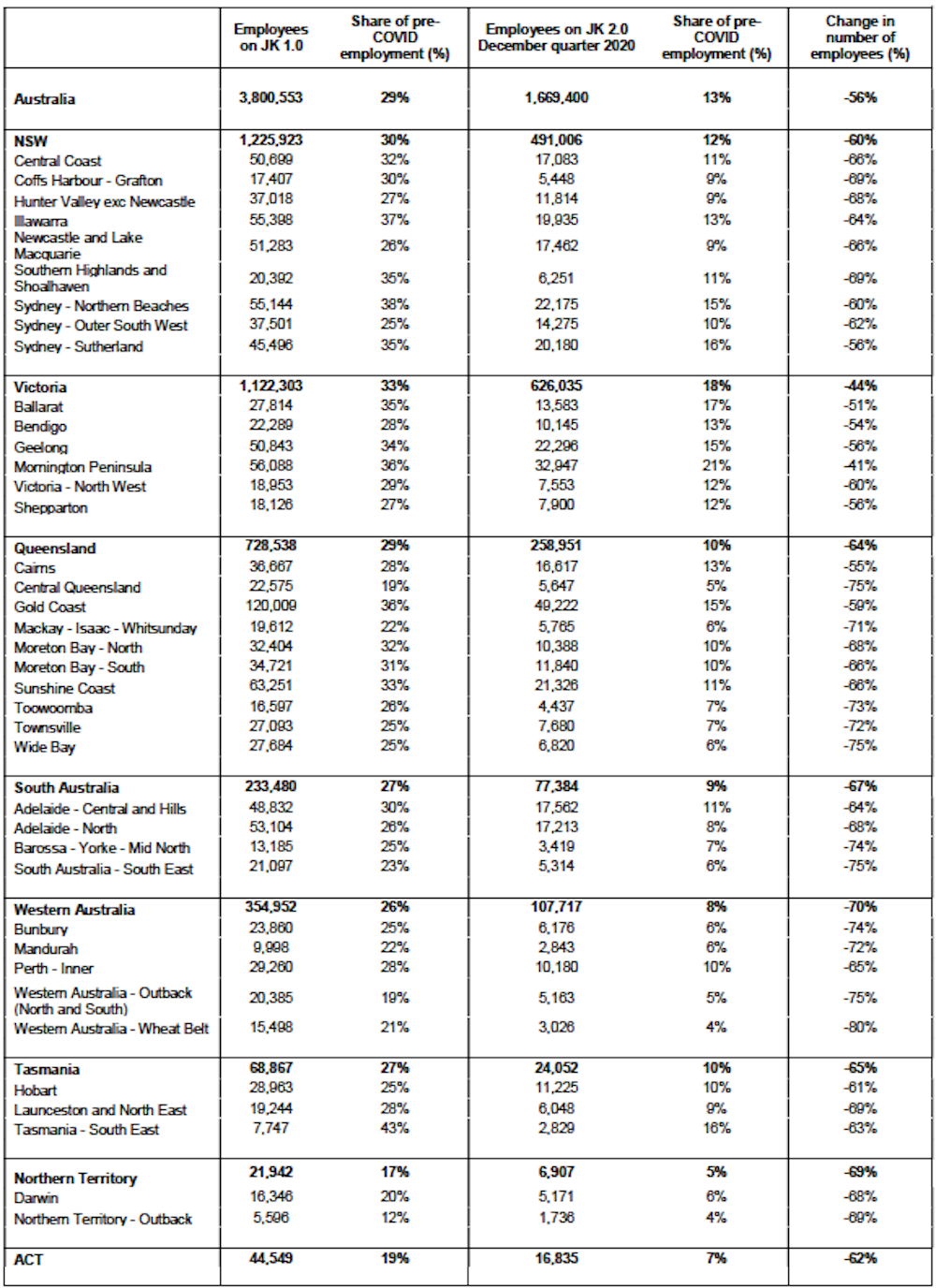
In Victoria about 1.1 million workers received JobKeeper in its first phase, which ran from April to September, falling to 626,000 in the second phase, October to December.
This was a reduction of just 44%, substantially less than the declines in every other state and territory.
Elsewhere the falls between the two phases were: NSW, 60%; Queensland, 64%; South Australia, 67%; Western Australia, 70%; Tasmania, 65%; Northern Territory, 69%; and ACT 62%.
The figures included substantial reductions in various regions with a reliance on tourism, despite the problems faced by that industry.
Some 18% of the Victorian pre-COVID workforce was on JobKeeper in the second phase, substantially above the proportions in other states and territories.
Nationally, 1.54 million individuals were being supported by the program in the month of December. This compared with 3.6 million in the month of September.
The number of employees on JobKeeper in the month of December fell 65,000 compared to November. In November there had been a fall of 30,000 compared with October.
There was a 56% fall in employees on JobKeeper in its second phase compared with its first phase. Some 520,000 firms and 2.13 million employees went off the scheme after the end of September.
Reserve Bank Governor Philip Lowe has anticipated some job shedding after JobKeeper ends. This could cause brief rises or slower falls in unemployment, he said this month. He advocated an increase in the JobSeeker base rate, on fairness grounds. The government has yet to announce its long term plans for JobSeeker, but there is general support for it not going back to the old rate after the Coronvirus supplement ends.
ACTU Secretary Sally McManus told the ABC on Sunday JobKeeper should be extended for those businesses still affected by COVID.
Releasing the latest figures, Treasurer Josh Frydenberg said with 785,000 jobs created in the last seven months, the government’s focus “continues to be getting people back into work”. But “we know that some families and businesses are still doing it tough and my message to those people is that the Morrison government continues to have your back.”
All industries saw marked reductions in employees on JobKeeper in the December quarter, compared with its first phase, with most falling by at least half.
Average number of employees receiving a JobKeeper 1.0 payment over April to September, versus average number of employees receiving a JobKeeper 2.0 payment over October to December, by selected industry.Treasury
Retail trade saw a 68% decrease, taking those on the support from an average of 26% of the workforce over the first phase to 8% over the second phase.
In accommodation and food services the fall was 52%, to 17% of the workforce in phase two.
Education and training saw a 50% fall, to 6% of the workforce.
Other declines between phases were: wholesale trade, 71% (to 12% of the workforce), construction 48% (to 18%), transport, postal and warehousing 36% (to 17%).
The government insists it will not extend the program although it will look at further assistance where there is a particular need.
The JobKeeper figures come as Health Minister Greg Hunt said the first doses of vaccine will arrive from overseas “before the end of the week, if not earlier”, and Victoria announced two new local cases and another one in hotel quarantine.
At the front of the queue to get the vaccine will be quarantine and border workers, as well as aged care residents and staff.
Hunt said once the vaccines arrived they would be examined to make sure there hadn’t been “any inflight actions that damage quality such as a loss of temperature”.
Total number of employees receiving a JobKeeper 1.0 payment over April to September, versus total number of employees receiving a JobKeeper 2.0 payment over October to December, by selected region.Treasury
Twice-impeached former US President Donald Trump has evaded conviction once more.
On the fourth day of the impeachment trial, the Senate verdict is in. Voting guilty: 57 senators (representing nearly 70% of the country or 202 million people, and the majority public opinion on the issue of conviction). Voting not guilty: 43 Senators. In American maths, that is an acquittal, falling short of the two-thirds majority needed to convict.
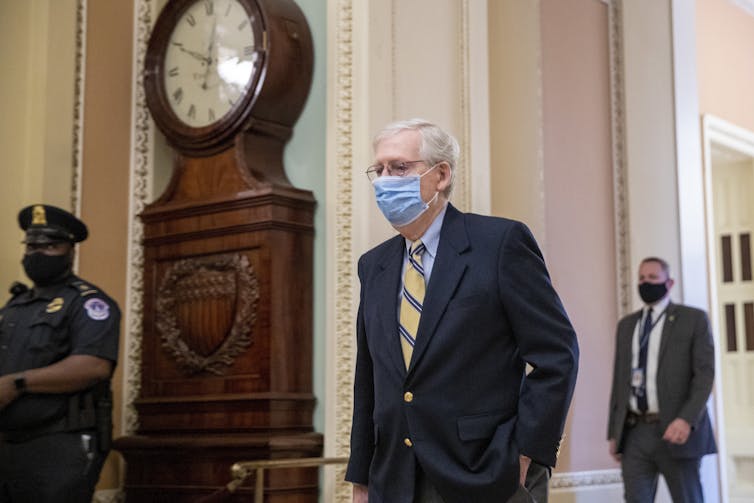
Moments after the vote, Senate Republican Leader Mitch McConnell called Trump’s actions before the attack “a disgraceful dereliction of duty” and confirmed the former president was “practically and morally” responsible for provoking the events on January 6 whereby “criminals were carrying his banners” lay siege to the Capitol.
Seven of McConnell’s Republican colleagues agreed, voting guilty. McConnell himself voted to acquit, arguing the Senate could not vote to convict because Trump had already left office – timing that was of McConnell’s own orchestration, as the president was impeached on January 13 while in office.
Republican Mitch McConnell launched a damning attack on Trump, saying he was ‘morally and practically’ responsible for the Capitol riots . But he nonetheless voted to acquit.AAP/EPA/Shawn Thew
However, the case and evidence is important for posterity, as well as ongoing investigations. Impeached in the House of Representatives on charges of “inciting an insurrection”, the trial focused on how Trump’s actions while commander-in-chief led to predictable violence at the Capitol.
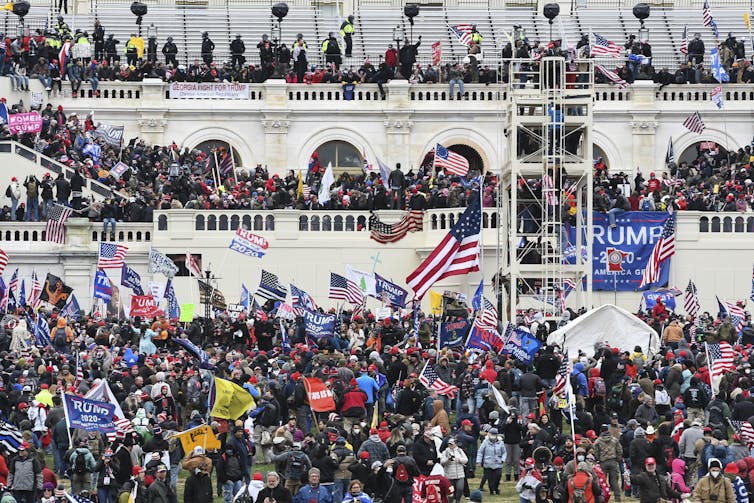
The facts of the day were not in dispute. Mobile phone data tracked hundreds of people moving from Trump’s rally, where he repeated false allegations of electoral fraud, to the legislative seat of government.
Once there, the mob discarded a US flag to install a Trump flag, constructed gallows, and spent the next several hours using poles and pipes to batter Capitol police officers to gain access to Congressional chambers.
Once inside, insurrectionists in tactical gear and carrying zip cuffs hunted lawmakers by name, chanted “hang Mike Pence”, and looted, robbed and defecated in congressional offices.
As rioters read Trump tweets aloud, the world bore witness through livestreams of the insurrection. In the end, more than 140 Capitol police were injured, with one losing an eye and two eventually losing their lives.
It was the predictable end to a steady stream of provocations, including Trump’s threats to election officials and culminating in his summoning supporters to Washington DC to stop the peaceful transfer of power. Describing the attack as an example of “stochastic terrorism” a specialist in political rhetoric, Jennifer Merceia, explained the incitement charge, in this way:
[…] you can’t predict who exactly will respond, but you can predict with certainty that someone will respond. And so you saw people sending pipe bombs to the media, saying that Trump told them to do it. You saw people over the last few weeks invading the Capitol and then later saying, I’m here because my president told me to be.
During the trial, senators heard how this constituted a pattern of behaviour: that Trump had revelled in acts of political violence in campaign rallies, promising to cover the legal costs of those arrested, escalating the demonisation of opponents even as Republican colleagues warned of harm.
In 2020, Trump practised directing his supporters to state legislatures to intimidate lawmakers. Tweeting to “liberate” states from COVID-19 lockdowns, supporters responded by storming state legislatures buildings carrying Nazi slogans, harassing lawmakers and stalking public health officials (several resigned). The FBI would later arrest several for plotting to kidnap, try and execute the Democratic governor of Michigan who had been the target of Trump’s rhetoric. His appointees, advisors, and former campaign manager echoed his message. Steve Bannon, whom Trump had just pardoned for fraud, discussed the imagined beheadings of bureaucrats, calling for “their heads on pikes” saying “that’s how you win the revolution”.
On the last day of the trial, the Senate voted 55-45 to accept witnesses, though none were heard. Several Senators had requested information on what actions Trump took to stop the violence.
However, Republicans threatened to block any efforts of the Biden administration to confirm nominations or pandemic relief should the trial continue. As Republican Senator Joni Ernst said:
If they want to drag this out, we’ll drag it out. They won’t get their noms, they won’t get anything.
After closed-door negotiations, the lawyers agreed to submit a single witness’s written testimony into the record. It was that of Republican Congresswoman Jaime Herrera Beutler of Washington, who overheard a heated phone call between House Minority Leader Kevin McCarthy and former President Donald Trump, in which the president declined to intervene to stop the violence.
In voting to convict, Republican Mitt Romney would use this written testimony to assert
President Trump also violated his oath of office by failing to protect the Capitol, the Vice President, and others in the Capitol.
Only seven Republicans voted in favour of conviction, not enough to reach the two-thirds majority needed.AAP/AP/JT/STAR MAX/IPx
Why would senators side with a former president who potentially endangered their lives?
Explanations have centred on political and personal self-preservation. Only one Republican senator voted for conviction who is up for re-election in 2022 (several others are retiring).
It is a dangerous precedent if the top magistrate is free to incite violence to stop the recognition of lawful election results, or ignore them completely. The consequences are already apparent in state legislatures. In Pennsylvania – the Republican legislature, repeating baseless claims of election fraud, refused to seat a duly elected Democratic member. In Michigan, the Senate Majority leader Republican Mike Shirkey called the insurrection “staged”, while Republican state parties have moved to censure Congress members who voted for impeachment or conviction.
Other Republican state legislatures have responded to overwhelming 2020 voter turnout by stripping voting rights from their constituents, introducing 100 voter suppression bills in 28 states ahead of the 2022 midterms. Meanwhile Trump still has not conceded, thus the rationale for violence continues.
Trump remains under investigation. Georgia has launched a criminal probe in the wake of the recorded call in which Trump orders election officials to “find 11,000 votes” for him. A commission into the January 6 insurrection also looks likely.
However, short of invocation of the 14th amendment, Trump remains free to run for office again. The world will watch these development just as it watched the Capitol attacks.
Allies could be forgiven for wondering how the US can come to their aid when it declines to protect its own seat of government. The work of President Joe Biden to repair US standing on the world stage just became a little tougher.
The whistleblowing vice-chancellor at the University of the South Pacific (USP), Professor Pal Ahluwalia, has described the illegal deportation of he and his wife, Sandra Price, last week as a “surreal” experience.
Many would agree that the inhumane, immoral and illegal deportation has plunged the tertiary institution into the biggest crisis of its 50-plus-year history.
The ensuing standoff between USP host country Fiji and the university governing body, the USP Council, has put the institution’s funding at risk, and its future in jeopardy.
In another surreal episode, Fiji’s Prime Minister and Immigration Minister, Voreqe Bainimarama, chose to airily downplay the situation, apparently hoping that the controversy would blow away.
After initially going to ground in the face of the international and national uproar created by the expulsion, Bainimarama responded with a tweet – concentrating on things that matter – insinuating that the crisis engulfing the region’s once premier tertiary institute was of little, if any, consequence.
Bainimarama’s right-hand man, Attorney-General Aiyaz Sayed-Khaiyum, followed suit by telling The Fiji Times that there is “no saga” and “no crisis” at USP. Since last year Khaiyum, as the economy minister, withheld Fiji’s $27 million allocation to USP over alleged unresolved governance issues.
It came after a failed attempt by the Fiji government’s USP representative to suspend Professor Ahluwalia.
Total disregard for the consequences The statements by these two men, who virtually run the country, reflect a total disregard for the consequences of their actions. Besides the international furore, they seem unconcerned about the political fallout domestically, despite winning the 2018 election by the thinnest of margins with another election just around the corner in 2022.
Their growing arrogance is clearly a consequence of military support and the censorship of the media, which means the government maintains a firm grip on the country. Hiding behind the facade of a democracy is very much a military government.
This is reflected in the despotic actions of both the Prime Minister and his Attorney-General, who clearly feel that they can act with impunity, without suffering any consequences.
Then more surreality: when the USP issue was raised in Fiji’s parliament this week, it was ruled out by the Speaker on the grounds that it was not a matter of national importance. Even though Fiji has the most students at USP, and never fails to point out that it contributes more funds to the institution than any other government.
This week the education minister claimed that Fiji does not interfere in the decisions of the USP Council, even though it just did: by withdrawing the VC’s work visa the government voided his contract.
Various independent commentators have pointed out that the scale of the damage to USP is enormous and unprecedented, and raises serious questions about the broader, longer-term impacts on regional unity, academic freedom, respect for human rights and the rule of law.
The deportation has also seen the resurfacing of questions about Fiji’s suitability as the host nation for USP due to political instability and the lack of civil rights. Samoa has already put itself forward as an alternative host for the university.
Legally questionable, but morally wrong The manner in which the Ahluwalias were deported has been well-covered by the media. It was not only legally questionable, but morally wrong. Up to 15 police and immigration officers descended on the couple’s accommodation in the dead of the night, demanding to be let in on the threat of breaking the door down.
The VC and his wife were then whisked away to the Nadi International Airport at high speed, without so much of a toilet break, let alone due process.
Few believe the official reason offered for the deportation — that Professor Ahluwalia’s conduct was “prejudicial to peace, defence, public safety, public order, public morality, public health, security, or good government of the Fiji islands”. Many feel that Ahluwalia has had a target on his back since his exposure of financial mismanagement under the previous vice-chancellor, Professor Rajesh Chandra, who was seen to be close to the government.
The losses ran into the millions of dollars, as articulated in the BDO special audit report, which was leaked to the media, much to the embarrassment and the consternation of the government, the chairman of the USP Council and those implicated in the scandal.
The situation is replete with ironies. Bainimarama used the mantra of a “clean up” against corruption to justify his 2006 coup but is now increasingly linked to this cover up at USP. Considering the importance of higher education in the region, and the cost to its own domestic and international reputation, the lengths to which the Fiji government has gone to get rid of Ahluwalia reveal a government that has completely lost the plot.
Unions, civil society organisations and opposition parties have roundly condemned the expulsion, but there is an uncanny silence from the office of the Fiji Human Rights Commissioner, Ashwin Raj, an appointee of the Attorney-General.
Deafening silence from donors Also deafening is the silence from the USP’s major donors, Australia and New Zealand, the paragons of human rights and democracy in the region. Their statements have merely expressed concern about USP, while failing to condemn the treatment of the VC.
As recently as June 2020, on this very blog, I wrote about regional institutions with governance problems, including specifically USP, and the silence of international aid donors and partner countries.
I attributed these countries’ silence to political expediency and geopolitical priorities, warning that unless we demand high standards, and adopt zero tolerance for graft and abuse, we only embolden the perpetrators.
I called for a change of attitude, but to no avail, as this latest USP scandal indicates. Do Australia and New Zealand still stand for the rule of the law and human rights, or have they surrendered these values for the sake of political expediency?
The only fair outcome in this case, and the only one that would protect the viability of USP, would be the reinstatement of Professor Ahluwalia. This will only happen if the USP Council stands its ground, and if Australia and New Zealand, as USP’s largest donors, put the university first.
This should not be too much to ask, or to hope.
Dr Biman Prasad is a former professor of economics and dean of the Faculty of Business and Economics at the University of the South Pacific. He is an adjunct professor at the James Cook University and Punjabi University, and is currently Member of Parliament and Leader of the National Federation Party in Fiji. This article was originally published on DevPolicyBlog and is republished with Dr Prasad’s permission.
The pictures of Professor Pal Ahluwalia, the vice-chancellor of the University of the South Pacific (USP), and his wife Sandra Price on the morning of Thursday, February 4, during their long and unexpected plane journey back to Brisbane after their shock expulsion from Fiji brought back memories for us.
Former Prime Minister Sitiveni Rabuka, still very much a politician and leadership contender for elections in 2022, argued that the FijiFirst government’s behaviour in deporting Professor Ahluwalia and his wife was nothing short of childish.
He should know. He began Fiji’s coup culture with two coups in 1987, unleashing a wave of violence upon Fiji’s people: assaults, burglaries, arson, and imprisonment.
NOW: Dr Robbie Robertson and Akosita Tamanisau … survivors of unwanted Fiji coup attention in 1988. Image: DevBlog
One group of demonstrators was gassed. Dr Anirudh Singh, a university scientist who criticised Rabuka’s biography, was hijacked by a military unit and severely tortured, his hands broken. In effect, anyone who by their actions signalled dissatisfaction became fair game.
In January 1988, we found out too that we had become fair game. After the first coup in May 1987, we had been warned by economist Wadan Narsey (another victim, later forced out of USP by government pressure and, in his case, the Bainimarama government) that our close friendship with William Sutherland, the deposed Prime Minister’s permanent secretary, might create problems for us. (William escaped Rabuka’s military, who came for him immediately after the first coup, and managed to leave the country. But at Nadi, troops dragged him off the plane. Only the pilot’s brave refusal to take off without all his passengers enabled him to leave.)
In reality, anything could cause problems. USP where one of us (Robbie) worked as a senior lecturer had long been subject to cliques at loggerheads with each other.
A simple call to the military could create a lifetime of pain for helpless individuals. Then VC, Geoffrey Caston, soon discovered this when hash harriers (social runners) left their cars outside his home and he was charged with holding unauthorised meetings.
Shadowy Taukeist activists We had a member of Rabuka’s shadowy Taukeist activists living next door to us in Raiwaqa who didn’t look kindly on us, particularly around the time of the second coup in September 1987 when he held operational meetings in his home.
We also brought attention upon ourselves because we decided to write on the coups in our evenings. All news was censored, so to find out what was happening we would frequent certain bars where public servants and officers often hung out.
Asking the odd question, but mostly listening to conversations, could provide some framework for understanding what was happening.
The other author of this article (Akosita) was a journalist with the then Fiji Sun, but also did stories for London’s Gemini news service. She had been asked to send a story on the current political scene, but the only way to get it out was via Fintel, the government’s centralised telecommunications system.
She discovered on handing over the article to be faxed that Fintel had been militarised. An officer read her piece, said the fax was down and asked her to come back in the late afternoon.
We did, but before we could enter an employee exited and whispered that a whole group of soldiers was waiting for her. We decided to leave but were followed by a military vehicle for some time. Eventually we headed up to the Sun editor’s home and got approval to fax from the newspaper’s offices.
That still had to go through Fintel and was refused. In the end we used an old telex. But no sooner had the article been sent, power to the suburb was cut.
Things heated up From that moment on, things seemed to heat up. Our house was raided by military intelligence. The family we allowed to live in the empty quarters under the house was turned against us and became the military’s spies. And our phone was tapped. After the first raid we took to taking everything to work that we had been writing in the evening.
Then everything went quiet. Classes finished at USP and we travelled to Vanuatu where Robbie taught for three weeks. Then we took a three-week holiday in Australia, in part to relieve the tension that went with two military coups, roadblocks, curfews, arrests, and beatings of friends.
When we returned in January, we went to Akosita’s parents to inform them that we intended to marry. On arriving back in Suva, Robbie received an urgent message to go to the university. There he was told that the government had decided not to renew his work visa and asked that he leave the next day.
The university suggested we go into hiding while they tried to sort it out. The sociologist Vijay Naidu (later thrown by the military into Fiji’s old death row cells) kindly took us up to the New Zealand High Commissioner’s residence, but his wife informed us that her husband was in the bath preparing to go out.
“We couldn’t help Richard Naidu (another expelled local who had been assaulted by Taukeists),” she argued. What makes you think you are different?
The next day was busy. Packers in to remove nine years of living. Then a quick trip down to the Registry Office. Then off to historian Jacqui Leckie’s house ostensibly to hide. Nothing worked. Everyone knew where we were and Rabuka refused to budge.
How did it come to this? He told a New Zealand newspaper that Robbie was a security risk and had to go. So he eventually did, flying first to Auckland to stay with journalist David Robie, feeling we suspect much like Ahluwalia and possibly thinking: how did it come to this. And what is next?
As it turned out USP was good to Robbie. They kept him employed and planned to install him in Vanuatu. He would fly into Suva two or three times a semester to teach. But once the Fijian government heard of these plans, they declared him a prohibited immigrant and encouraged Vanuatu to ban him also. He eventually found work in Australia and the university paid for our effects to come over.
All’s well that ends well, and he did go back to teach again in Fiji as a professor of development studies in 2004, smartly leaving ahead of the well-advertised 2006 coup.
That coup was led by the current Prime Minister and bore all the clandestine and nasty tactics that Rabuka and others had employed since 1987 in the name of sovereignty. This is a country that now chairs the UN Human Rights Committee yet has managed to impose a draconian curfew ever since covid-19 became a potential threat.
USP’s deported Professor Pal Ahluwalia … “Standing up to political pressure is not something that comes naturally to the politically appointed USP Council.” Image: PMW
Standing up to political pressure is not something that comes naturally to the politically appointed USP Council. Let’s hope it does for Pal’s sake and for the health of the Pacific’s regional university.
Let’s hope also for the notion of academic freedom, unfortunately often more honoured in the breach in the Pacific. In the early 1980s Mara’s pre-coup government pressured Ziam Baksh – a young Indo-Fijian academic – who called for a common term to refer to all Fijian citizens.
Much later, USP bowed to criticism and forced Professor Narsey to resign. Governments like to be in control, and Fiji is no different from many others in this regard, preferring instead a culture of silence.
But its assault on good governance under the pretence of sovereign rights, its attempt to pre-emptively sack a vice-chancellor, now threatens to unwind the Pacific’s great experiment in regional education and end the diversity of views and pathways so valuable for any democracy that wishes to garner the best for its peoples. All will lose if they succeed.
Dr Robbie Robertson is adjunct professor at Swinburne University of Technology in Melbourne where he was formerly Dean of Arts, Social Sciences and Humanities. Akosita Tamanisau works as an assessor in the Victorian homelessness sector. They are co-authors ofFiji: Shattered Coups. This article first appeared on DevPolicyBlog and is republished here with the authors’ permission.
Reporters Without Borders (RSF) has condemned a proposed cyber-security law in Myanmar that would organise online censorship and force social media platforms to share private information about their users when requested by the authorities.
The draft law, which has just been leaked, is clearly designed to prevent pro-democracy activists from continuing to organise the demonstrations that have been taking place every day in cities across Myanmar in response to the military coup on February 1.
The State Administration Council – as the new military junta euphemistically calls itself – sent a copy of the proposed law to internet access and online service providers on February 9.
And the junta is expected to make it public on February 15.
The draft law, which RSF has seen, would require online platforms and service providers operating in Myanmar to keep all user data in a place designated by the government for three years.
‘Causing hate, destabilisation’ Article 29 would give the government the right to order an account’s “interception, removal, destruction or cessation” in the event of any content “causing hate or disrupting unity, stabilisation and peace,” any “disinformation,” or any comment going “against any existing law.”
This extremely vague wording would give the government considerable interpretative leeway and would in practice allow it to ban any content it disliked and to prosecute its author.
Article 30, on the other hand, is very specific about the data that online service providers must hand over to the government when requested: the user’s name, IP address, phone number, ID card number and physical address.
Any violation of the law would be punishable by up to three years in prison and a fine of 10 million kyats (6200 euros). Those convicted on more than one count would, of course, serve the corresponding jail terms consecutively.
RSF submission “The provisions of this cyber-security law pose a clear threat to the right of Myanmar’s citizens to reliable information and to the confidentiality of journalists’ and bloggers’ data,” said Daniel Bastard, the head of RSF Asia-Pacific desk.
“We urge digital actors operating in Myanmar, starting with Facebook, to refuse to comply with this shocking attempt to bring them to heel. This junta has absolutely no democratic legitimacy and it would be highly damaging for platforms to submit too its tyrannical impositions.”
Facebook has nearly 25 million users in Myanmar – 45 percent of the population. Three days after the February 1 coup, the junta suddenly blocked access to Facebook, Twitter and Instagram.
But many of the country’s citizens have been using VPNs (virtual private networks) to circumvent the censorship.
The proposed law’s leak has coincided with social media reports of the arrival of many Chinese technicians tasked with setting up an internet barrier and cybersurveillance system of the kind operating in China, which is an expert in this domain.
Earlier this week, RSF reported the comments of several journalists who have been trying to cover the protests against the military coup, and who said that press freedom has been set back 10 years in the space of 10 days, back to where it was before the start of the democratisation process.
Indigenous Papuan students who are currently studying in New Zealand and Australia have formed an educational association, choosing Waitangi Day to mark the occasion of their inaugural virtual conference.
Called the Papuan Students Association Oceania (PSAO), the organisation plans to represent all students from the Land of Papua who are currently studying in Pacific nations.
The organisers who worked tirelessly in preparing formation of the association said the aim was to unify all students from the Land of Papua who are studying in Pacific countries such as Australia, Fiji, New Zealand, Papua New Guinea, Samoa and Vanuatu.
In the PSAO articles of the association, the objective was stated as “a means of accommodating and advocating for creativity, inspiration, aspirations, and information from all Papuan students and students in Oceania.”
Yan Piterson Wenda, elected as the first president of PSAO, said this was a historical moment for the Pacific.
Wenda, who completed his bachelor’s degree majoring in business marketing at Otago University last year, said the association was formed to build unity for all Papuan students.
“We want to uphold the unity among all of us regardless of whether we come from the highlands or from coastal regions,” he said.
‘Still one Papuan’ “Even though we are separated by two provinces and many regencies, we are still one Papuan – no one can separate us.”
Forming the association will not only raise the profile of Papuan students in every university or school that they attend, but it would help Papuans to support one another in the future, said Wenda.
Papuan students who are studying in New Zealand and Australia are under varied scholarship programmes, such as Papuan and West Papuan provincial scholarships, Australian Awards scholarships, New Zealand Aid Scholarships.
The Papuan provincial scholarships is the largest sponsorship source.
The members of the association range from undergraduate to doctoral students. The students are doing various major studies and spread across many universities.
At the first virtual online conference of the Papuan students, participants from Canada, Australia, New Zealand, Jakarta-Indonesia, West Papua and the United States also took part.
Marveys Ayomi, a scholarship coordinator for Papuan students in New Zealand, delivered an opening speech on behalf of the government of Papua province, saying he was extremely excited to get a chance to see all Papuans united in one student association.
Blessing granted He said he had spoken to the government back home, namely the vice-chairman of Papuan People’s Representatives Dr Yunus Wonda and the head of Papuan Human Resources Development, Ariyoko Rumaropen.
“We have been granted the blessing for the formation of this organisation from our beloved parents. The formation of this organisation is to seek opportunities not only in Papua but also in the countries where you are studying currently,” Ayomi said.
“As the Papuan provincial government scholarship is not legally binding, our government encourages Papuan students to be smart in terms of seeking employment opportunities.”
Ayomi, who is also a lecturer at one of the tertiary institutes in Palmerston North, IPU New Zealand, said that forming this association would also promote Papuan and Melanesian cultural uniqueness to the Pacific.
He completed his studies from high school to masters in New Zealand.
“We Papuans also can do what other people do, in fact you are studying and competing with other international students in your respective area of studies,” he said.
“Please keep our unity and build a network with every stakeholder wherever you are.”
‘Be independent’ plea Kerry Tabuni one of senior Papuan students who is currently doing his PhD in international law at Waikato University, said it was important for students to be independent during their study.
He said Papuans, as Melanesians, needed to be proud as Pacific islanders.
“For those of you who are appointed to the executive, take this opportunity to develop your leadership skills and also prepare yourselves academically. And to others, let us support them in the spirit of being united we are solid and strong,” said Tabuni.
The elected executive: President of the Papuan Students Association Oceania: Yan Piterson Wenda Vice-president for New Zealand: Nickson Stevi Yikwa Vice-president for Australia: Maskarena Wasfle Secretary: Christian Lani Tabuni Treasury of the Papuan Students Association Oceania: Hermina Ibage
Laurens Ikinia is a Papuan Masters in Communication Studies student at Auckland University of Technology who has been studying journalism. He contributes to Asia Pacific Report.
The above photo is an image of how I grew up in Papua.
But before I share my story, I would like to extend my warm greetings to my fellow brothers and sisters who were on the day that I wrote this piece commemorating the 166th anniversary of evangelism in the Land of Papua.
As a fruit of evangelism, my parents had committed to be Christians and until now they still practise Christian lives.
My mom, who is the role model of my faith, has become a central part of my life. And I believe so do other people.
The following is a short story of faith which was accompanied by deeds that came true.
When I was studying in elementary school from grade 3 to 6 and in middle school from grade 7 to 9, I used to collect aluminium cans and sell them to a workshop so that I was able to buy a book, pencil, pen, and other school stationery.
For a 20 kg rice sack, I earned 5 cents. If I was lucky on the day, I sometimes collected 2 sacks in one day.
Needed new textbooks I did this job when I needed a new book or to buy a textbook from school and sometimes to help my mom buy detergent to wash our laundry and dishes.
I normally started collecting the cans from the afternoon around 1 pm to 4 pm. I did this two or three times a week.
Sometimes I took my younger brother with me.
If I went with him, I bought him noodles and candies. Otherwise, he would cry and demand that I buy him candies, noodles or cakes.
As an older brother, I had to indulge his wishes and I always did.
That’s why sometimes I could not buy what I needed from a day’s earning. So, I normally saved left over money in my piggy bank.
I asked my mom to keep it. I had to do that to be able to buy a NZ$1 exercise book or NZ$5 textbook from school.
Hard-working out on the farm My mom was and is a hard-working woman, so from morning to afternoon she was and is always out on the farm – traditional Papuan garden. Because she was so busy, she always asked me to look after my younger brother after school.
And my mom always prepared steamed sweet potatoes – sometimes small (just as big as a handful) and sometimes bigger than that, which was enough to still our stomach.
We are so fortunate that she always prepared something for lunch. My younger brother would always wait for me to come home and have lunch together.
My mom worked extremely hard herself as our dad was a chief and lived with his first wife. My dad thought that my mom’s children would not be successful in the future, so he paid more attention to his first wife and our older step-sister.
Long story short, we were and are so grateful to have a great uncle, my mom’s older brother who always treated us like his own children.
Due to my dad’s careless behaviour, my uncle took us in and raised us in his family. That’s why, when I was with my mom, she always advised me to work hard and never rely on other people and never forget to have some time for prayer.
She always encouraged us to go to Sunday school every Sunday morning. In my university studies, she always asks me to study hard and seriously.
Guiding your future She always said that “Mom never went to school, but I have faith that when you study and pray, God will open many ways for you to be successful in the future.
“My prayers and hope will always guide you.”
My mom’s advice always became my inspiration to study; that’s why in middle school and high school I was always in the top 1 to 4 in the class.
In commemorating the 166th anniversary of the evangelism in the Land of Papua, let’s have faith and hope that the true mission laid by the missionaries (Carl Wilhelm Ottow and Johann Gottlob Geissler) as a foundation of the direction of our lives becomes our strength in viewing Papua as a land full of hope for future generations.
Waaa waaa waaa!
Laurens Ikinia is a Papuan Masters in Communication Studies student at Auckland University of Technology who has been studying journalism. He contributes to Asia Pacific Report. The article was first published on Ikinia’s social media blog.
Victoria will go into stage 4 lockdown from 11.59pm tonight, as the cluster from the Holiday Inn quarantine hotel continues to grow.
Premier Daniel Andrews announced the circuit-breaker lockdown this afternoon, citing the threat posed by the “hyper-infectious” UK strain.
Victorians will again only be allowed to leave their homes for four reasons: to shop for necessary goods, to provide care, for essential work or permitted education, or for exercise. The controversial five-kilometre radius is also back in place, while masks will be compulsory everywhere outside the home.
This lockdown understandably comes as a significant blow to Victorians (myself included), after having endured a three-month lockdown during the second wave of COVID infections last year. However, it’s important to understand that the situation we’re in right now is quite different to the one we faced in 2020.
I think it’s pretty hard to fault the rationale for this lockdown: the public health response has not been able to get ahead of transmission, and therefore the state government has assessed there’s a risk this outbreak will get away from them.
There are now at least 13 cases linked to the Holiday Inn. But the crucial point is that the close and casual contacts number in the hundreds.
As Victoria’s chief health officer Brett Sutton explained, the public health team has found that by the time they identify cases in this new cluster, those people have already become infectious and have had an opportunity to spread the virus. As a result, authorities don’t feel they are currently across all of the chains of transmission.
Victorian Premier Daniel Andrews has announced Victoria will go into lockdown until 11.59pm on February 17.Luis Ascui/AAP
A circuit-breaker lockdown aims to crush transmission before it gains a foothold. The goal is to limit the contact people have with each other, to buy time for the public health team to do its work.
Some people may be asking whether a lockdown is necessary, or whether the Victorian government has already waited too long, given Queensland and Western Australia implemented circuit-breaker lockdowns in Brisbane and Perth after only a single case got out of hotel quarantine.
We may have a better sense of the appropriateness of this lockdown in a few days’ time — as we see how many more cases pop up — but it’s very difficult to answer this question right now.
I don’t think cases escaping from hotel quarantine necessarily requires a lockdown. This event, however, appears to have some unique characteristics.
In explaining the need for this lockdown, Andrews took pains to stress the fact we’re dealing with the UK strain of the coronavirus.
According to a statement on the Premier’s website:
Right now, we are reaching close contacts well within the 48-hour benchmark. But the time between exposure, incubation, symptoms and testing positive is rapidly shortening. So much so, that even secondary close contacts are potentially infectious within that 48-hour window.
In short: this hyper-infectious variant is moving at hyper-speed.
Although evidence indicates the UK strain is more infectious, it has not generally been reported that the incubation period is any different. So while this is biologically plausible, I think we need to be cautious about accepting it as fact.
It’s believed COVID spread in the Holiday Inn through a nebuliser.Luis Ascui/AAP
A balancing act
It’s clear authorities are caught between a rock and a hard place in making these calls. There will always be those who are critical when a lockdown is called, and those who are critical when they feel unnecessary risks are taken. Making these decisions and factoring in costs and benefits is a delicate balancing act.
One can appreciate it was in the best interests of all Victorians to make every attempt to bring transmission under control without resorting to a lockdown. But once the assessment was made that there was the risk of transmission getting out of control, the government clearly felt it had to make this tough decision to stave off the possibility of a third wave in Victoria.
It’s important to draw a distinction between this short, sharp lockdown, which is hopefully just a precautionary measure, and the extended lockdown we were forced into when transmission got away from us during the second wave.
If you are going to use a lockdown, this is how they should be used, according to the World Health Organisation. They’re not designed to drag on for months — and this new lockdown should allow us to avert a scenario where that’s necessary.
The weight of this decision on Andrews and the rest of the team today was clear. Andrews was measured, sombre, even apologetic. It was obvious how hard a decision it was to make.
While another lockdown might be difficult to stomach, it will buy us some time, give the public health response a chance to get ahead of the latest cluster, and hopefully achieve its objective of averting the need for a longer lockdown later.
The philosophy is that it’s better to be safe than sorry, and no one can blame the authorities for this approach.
Source: The Conversation (Au and NZ) – By Nicholas Wood, Associate Professor, Discipline of Childhood and Adolescent Health, University of Sydney
With the rollout of COVID-19 vaccines about to begin in Australia, people may be wondering if they’re safe (and effective) in the long term. What might be the health consequences a year after vaccination, or further into the future?
While it’s true COVID-19 vaccines have been developed in record time, the importance of tracking vaccine safety is not new. We routinely monitor the safety of all vaccinations, years after they’ve been used in millions of people.
And in guidance from the Therapeutic Goods Administration (TGA) this week, we have a clearer picture of how we’ll know about any unexpected, rare or long-term side-effects of the COVID-19 vaccines. In fact, we’ll use and build on many existing systems to look out for these.
Late-stage vaccine trials in tens of thousands of people only last for a defined period of time, typically 12 months. Vaccine manufacturers present data on vaccine safety (and efficacy) for that time-frame to regulatory bodies. Safety data is rigorously assessed before a vaccine is approved for use.
But when approved vaccines are then given to the general public, we can monitor for any new events that may occur unexpectedly in both the short and longer term. Tracking potential side-effects in the real world in all people who have a vaccine, and outside the tightly controlled conditions of a trial, means we can ensure the vaccine is safe when given to millions — or billions — of people.
So how might this work for COVID-19 vaccines? The Pfizer/BioNTech vaccine phase 3 trial reported safety data until about 14 weeks after the second dose. The Oxford/AstraZeneca trial reported safety data after about three months after the first dose, and two months after the second dose.
However, participants in both these large trials will continue to be followed up for both efficacy and safety until the end of the study from around 12 months after the first dose of vaccine.
COVID vaccine safety is also being monitored in several other ways, by individual countries, including Australia. Countries also share their vaccine safety monitoring data via a global database.
Here’s how we’ll monitor COVID vaccine safety in Australia
The TGA has overall responsibility for monitoring the safety of medicines and vaccines in Australia. Just this week, the TGA released its plans for monitoring the safety of COVID-19 vaccines.
This includes the timely collection and management of reports of COVID-19 vaccine adverse events, an ability to urgently detect any safety concerns and to communicate safety issues to the public.
‘Passive’ surveillance
A cornerstone of the system Australia has had in place for decades to capture any possible vaccine reactions is “passive” surveillance. In practice, this means anyone can report a reaction to the TGA, the public included.
If your GP or nurse thinks you may have had a reaction they should report this to their state or territory health department, which then informs the TGA. This is mandatory in some jurisdictions but not in others.
Consumers are being encouraged to report any suspected side-effects after their COVID vaccine.www.shutterstock.com
The TGA is encouraging health professionals and consumers to report suspected side-effects to COVID-19 vaccines and there is a guide on its website on how to do this.
The TGA has a database that records any reported possible reactions. If there are any suspected safety issues, these are immediately investigated and necessary action is taken. For example, if necessary an immunisation program can be stopped or special precautions implemented. TGA can also issue safety alerts.
We send texts or emails to people asking them to fill out a survey on their health after being vaccinated. This system enables us to detect any suspected safety issues in near real time. Last year, AusVaxSafety surveyed nearly 290,000 people after they had the 2020 influenza vaccine and found more than 94% felt completely well. Others had mild and expected short-term side effects.
This system will be used to pick up any safety concerns when the COVID-19 vaccines roll out in the next few weeks. If you are vaccinated at selected sites, including GP practices and COVID-19 vaccine hubs, you will be told about this automated system. You don’t have to register or enrol but will be sent an SMS on day 3 and day 8 after each vaccine dose (you can decide whether to fill out the survey). Your anonymised results will be reported to your state or territory health department and the TGA.
This system will probably be in place to monitor safety of the COVID-19 vaccines for a few years. And as new vaccine brands come on board, we will continue to monitor those too.
The United States has recently developed an equivalent system, V-safe. Safety data from this system from about two million people who have had a COVID-19 vaccine indicates the vaccines are safe. The short-term side-effects are very similar to those reported in the vaccine trials. The most common reactions include injection site pain, headache, tiredness and muscle aches, usually in the first two days and then resolving within a week after vaccination.
The potential benefits to us all from a mass vaccination program against COVID-19 far outweigh the potential side-effects, based on data from millions of people who have already been vaccinated around the world. Yet, we know all medicines, vaccines included, have the potential for side-effects.
However, by using, and building on, our already established safety surveillance system, we will be “on top” of rapidly identifying any possible safety concerns. That’s immediately after vaccination and into the longer term.
The New Moon this month marks the start of the Lunar New Year and reminds us of how important our orbiting neighbour is to us.
It’s a relationship long described by many cultures across the globe, particularly with its links to tides and weather.
In the Torres Strait it was a crucially important element in helping the islanders win a legal battle for sea rights.
Under a Meriam Moon
In the Torres Strait, the Moon plays an important role in culture, identity and daily life. Every aspect of our natural satellite – from its phase, position, appearance and brightness – has special significance and meaning.
A traditional story of the Meriam people from Mer (Murray Island), in the eastern Torres Strait, explains how you can see a lady in the Full Moon weaving mats.
She was brought there by the Moon Man, which describes the formation of the maria (dark patches) on its surface that form the silhouette of the woman.
Meriam elder Uncle Alo Tapim telling the story about the lady in the Moon.
Tides of change
Lunar phases link to the changing tides, a relationship that is well established in Islander knowledge systems.
One practical application links to fishing. Elders teach that the best time to fish is during a neap (low) tide during the First or Last Quarter Moon, rather than a spring (high) tide during the New or Full Moon phase.
The spring tides are much bigger, meaning the tidal waters rush in and out more significantly, stirring up silt and sediment on the sea floor. This clouds the water, making it harder for fish to see the bait and fishers to see the fish.
The waters of spring tides also pull fish out to sea. During the smaller neap tides, the water is clearer and fish don’t move as far, making them easier to see and catch.
Gardeners such as Meriam elder Uncle Alo Tapim (below) plant their gardens by the phases of the Moon. The cusps (tips) of the crescent Moon (kerkar meb) point in different directions throughout the year, as we move from summer solstice to winter solstice and back again.
Meriam elders Alo Tapim (left) and Segar Passi (right).Author provided
Uncle Segar Passi (above), a senior Meriam elder, teaches that when the Moon cusps point upwards (Meb metalug em), the Moon looks like a bowl collecting water. The water is choppy and you will see cumulus clouds in the sky. This occurs during the Sager (dry season), a period of fine weather.
When the Moon tilts on its side (Meb uag em), thin cirrus clouds are visible and a fuzzy ring may form around the Moon. The seas look calm and mirror-flat and you will see thin cirrus clouds, but this is when the water pours out of the bowl, falling as the rains of the Kuki (wet season).
A crescent Moon.Pixabay
Moon halos are used to forecast weather. In the Torres Strait, the ring around the Moon (susri) is seen to be a hut built by the Moon Man to shield himself from coming rain.
Halos form around the Moon when moonlight passes through ice crystals high in the atmosphere. These form in low fronts, which often bring rain.
An eclipse of the Moon
On Badu, in the Torres Strait, an eclipse of the Moon is called Merlpal Maru Pathanu, meaning “the ghost has taken the spirit of the Moon”.
It was an omen of war. On Boigu, the northern-most island, men would don a special headdress and perform a ceremony to figure out the direction of the incoming attack.
The same name is used for a solar eclipse, which is seen as the superposition of the two celestial bodies.
Merlpal Maru Pathanu … ‘the ghost has taken the spirit of the Moon’.David Bosun (Senior artist at Moa Arts). Author provided from private collection, reproduced with permission of the artist.
A battle for sea rights
Every June 3, Australia celebrates Mabo Day, marking the decision by the High Court of Australia to overturn the legal fiction of terra nullius (“a land belonging to no one”) in a landmark court case.
This was driven by Meriam man Edward Koike Mabo, paving the way for Native Title. But this ruling did not necessarily extend to sea rights.
In the early 2000s, the people of Mer launched a legal battle for sea rights. Government lawyers argued against the declaration by claiming each island was a separate enclave with no connection to one another.
But Torres Strait Islanders have a long history of cultural, linguistic and family connections across the Strait and with Papua New Guinea and mainland Australia.
During the proceedings, Meriam people were required to prove their longstanding connections in court. One crucial piece of evidence was a traditional Moon Dance.
Gedge Togia
Gedge Togia is a sacred spiritual dance (kab kar) of the Meriam people, linking the islands of Mabuyag (also known as Mabuiag) and Mer.
Map of the Torres Strait with the islands of Mabuiag (Mabuyag) and Mer (circled red).Wikimedia/Kwamikagami, CC BY-SA
The lyrics are “Gedge Togia, Milpanuka”, which means “Moon rising over home” in two languages: Gedge Togia is the Meriam Mir language phrase meaning “to rise over home”, and Milpanuka is the Mabuyag dialect term for the Moon, which is derived from Milpal, a Kala Lagau Ya word for the Full Moon. For comparison, the Meriam Mir name of the Moon is Meb.
During legal proceedings in the mid-2000s, a judge travelled to Mer and observed testimony presented by elders. Alo Tapim sang the song and explained the dance, the traditional dress and its importance and relevance to Meriam and Mabuyag connections.
A performance of Gedge Togia, explaned by Alo Tapim.
Mabuyag and Mer are 200km apart, lying almost due east and west of one another. As Meriam people sail home from Mabuyag they will see the Full Moon rising over Mer at dusk or the crescent Moon rising at dawn.
Gedge Togia and the Moon demonstrates the longstanding connections between Mer and Mabuyag, and helped Islanders win their battle for sea rights.
Michelle Grattan discusses the week in politics with University of Canberra Assistant Professor Caroline Fisher, including the prospect of net zero emissions by 2050, and the battlelines being drawn within the National Party and wider Coalition over how to get there. They also discuss industrial relations, the government’s legislation before parliament, Labor’s planned policy, and the debate that will ensue.
Source: The Conversation (Au and NZ) – By Leah Ruppanner, Associate Professor in Sociology and Co-Director of The Policy Lab, University of Melbourne
The COVID-19 pandemic was heralded as an opportunity to restart gender expectations at home. Our research shows Australian fathers have stepped into more participatory roles, but the question remains: will it last?
At the height of the first lockdown, the global economy closed and with it schools, childcare centres and employment shut. For many parents, the work associated with maintaining a job, homeschooling, round-the-clock caregiving and keeping a household afloat fell squarely on their shoulders. Some argued this would be a critical moment for men to step up as more egalitarian partners and help equalise gender norms in the home.
Our new study indicates Australian fathers took on more domestic work than their US counterparts but at the same cost women have suffered in trying to reconcile their work and family commitments: a rise in sleeplessness and anxiety.
COVID reshaped parents’ paid and unpaid work
We surveyed 1,375 Australian and US parents using the YouGov panels in May and September 2020. In May, the global economy had largely shut down in response to the virus. By September, US children were starting a new school year, while Australia was facing a second spike and a severe lockdown in Victoria.
We asked parents about how their employment, housework and childcare had changed during these COVID-affected times.
We found roughly one in three Australian mothers and fathers in our sample lost or reduced work under COVID in May, which continued into September. Of course, these patterns varied by state, with Victorians bearing the brunt of employment disruption.
One in three US parents reported employment disruptions in May. By September, employment disruptions had declined, but still remained at high levels.
What happened on the home front? We found Australian and US mothers both reported picking up more housework during the pandemic. For fathers, an interesting pattern emerged.
Australian fathers increased their contributions to housework. We first observed this in May 2020, then again four months later.
US fathers, in contrast, picked up more housework in May, but this was short-lived. As the pandemic endured, US mothers have filled the housework and childcare voids while US fathers pulled back their contributions to domestic work and caregiving.
There was one silver lining of the pandemic, at least in the case of Australia: fathers stepped up to do more childcare and housework.Shutterstock
Increased domestic load harms health and well-being
We know the stress of managing work and family can cause people’s health to deteriorate, and lead many mothers to leave the labor force. Add to that the uncertainty and fear around a global pandemic, and the affect on parents’ mental health is profound.
Our research showed Australian fathers experienced stress due to economic disruptions. Still, they stepped up their domestic game during the pandemic. And, with it, they felt the same stressors that mothers conventionally experience. The increased childcare and household demands during the pandemic came with greater anxiety and worse sleep among both Australian fathers and mothers.
The pandemic has been extremely difficult, but in Australia it is fathers and mothers carrying this burden.
For US fathers, only job disruption is associated with worse anxiety and poor sleep. Importantly, their stress was unaffected by caregiving demands — perhaps because, as our data show, they did not consistently increase their contributions to housework and childcare during the pandemic.
For US mothers, both job loss and greater housework demands increased their sleeplessness and anxiety. US fathers reduced their childcare contributions from May to September, and contributed less to the running of the house across that time.
In this respect, US fathers appear to have doubled down on their roles as breadwinners. As a result, their mental wellness is mostly based on their economic standing, leaving US mothers alone to carry the burden of growing housework and childcare demands during the pandemic.
Silver linings?
The COVID-19 pandemic has placed unparalleled pressures on US and Australian families, leaving devastation in its wake. Our results indicate this movement towards gender equality among Australian parents came at a cost to their health, through greater anxiety and poorer sleep.
But existing research shows mothers in both countries have carried these dual burdens for a long time, with detrimental impacts on their lives, livelihoods and health. Australian fathers, for the first time ever, may have felt the intensity of these competing pressures, and perhaps their larger share of domestic work may stick.
We found one silver lining of the pandemic, at least in the case of Australia: Australian fathers stepped up to do more childcare and housework. Let’s hope this lasts.
Living through a global pandemic over the past year has seen all of us expanding our vocabularies. We now understand terms like PPE, social distancing and contact tracing.
But just when perhaps we thought we had a handle on most of the terminology, we’re faced with another set of new words: mutation, variant and strain.
So, what do they mean?
The genetic material of SARS-CoV-2, the coronavirus that causes COVID-19, is called ribonucleic acid (RNA). To replicate, and therefore establish infection, SARS-CoV-2 RNA must hijack a host cell and use the cell’s machinery to duplicate itself.
Errors often occur during the process of duplicating the viral RNA. This results in viruses that are similar but not exact copies of the original virus. These errors in the viral RNA are called mutations, and viruses with these mutations are called variants. Variants could differ by a single or many mutations.
Not all mutations have the same effect. To understand this better, we need to understand the basics of our genetic code (DNA for humans; RNA for SARS-CoV-2). This code is like a blueprint on which all organisms are built. When a mutation occurs at a single point, it won’t necessarily change any of the building blocks (called amino acids). In this case, it won’t change how the organism (human or virus) is built.
On occasion though, these single mutations occur in a part of the virus RNA that causes a change in a particular building block. In some cases, there could be many mutations that together alter the building block.
A variant is a referred to as a strain when it shows distinct physical properties. Put simply, a strain is a variant that is built differently, and so behaves differently, to its parent virus. These behavioural differences can be subtle or obvious.
For example, these differences could involve a variant binding to a different cell receptor, or binding more strongly to a receptor, or replicating more quickly, or transmitting more efficiently, and so on.
Essentially, all strains are variants, but not all variants are strains.
Viruses with mutations become variants. If the variant displays different physical properties to the original virus, we call it a new strain.Lara Herrero, created using BioRender, Author provided
Common variants (which are also strains)
Three of the most common SARS-CoV-2 variants are what we’ve come to know as the UK variant (B.1.1.7), the South African variant (B.1.351) and the Brazilian variant (P.1). Each contains several different mutations.
Let’s look at the UK variant as an example. This variant has a large number of mutations in the spike protein, which aids the virus in its effort to invade human cells.
The increased transmission of the UK variant is believed to be associated with a mutation called N501Y, which allows SARS-CoV-2 to bind more readily to the human receptor ACE2, the entry point for SARS-CoV-2 to a wide range of human cells.
The UK variant has recently been picked up in Australia.Erik Anderson/AAP
This variant is now widespread in more than 70 countries, and has recently been detected in Australia.
While we commonly call it the “UK variant” (which it is), it’s also a strain because it displays different behaviours to the parental strain.
We’ve got lots more to learn
There is some confusion around how best to use these terms. Given all strains are variants (but not all variants are strains), it makes sense the term variant is more common. But when the science shows these variants behave differently, it would be more accurate to call them strains.
The big question everyone is asking at the moment is how the new variants and strains will affect the efficacy of our COVID vaccines.
The scientific community is uncovering more information about emerging mutations, variants and strains all the time, and leading vaccine developers are testing and evaluating the efficacy of their vaccines in this light.
Some recently licensed vaccines appear to protect well against the UK variant but recent data from Novavax, Johnson & Johnson and Oxford/AstraZeneca indicates possible reduced protection against the South African variant.
Health authorities in South Africa recently paused their rollout of the Oxford/AstraZeneca vaccine for this reason. However, its too early to tell what impact, if any, this will have on Australia’s vaccine plans.
The vaccine rollout in Australia will assess all information as it comes to light and ensure optimal available protection for the population.
In the lead-up to this year’s United Nations climate conference in Glasgow, the Morrison government is inching towards adopting a net-zero emissions target for 2050. If Prime Minister Scott Morrison can resist internal party pressure to exempt some sectors from the commitment, the target would be welcome.
It would also bring Australia into line with its international peers. More than 120 other governments have made similar pledges, including China, the European Union and the United States.
However, Morrison is reportedly considering not making the target legally binding. In that case, it would not need assent from parliament and Coalition backbenchers averse to climate action could not vote against it.
But if that happens, the commitment is likely to be meaningless. As recent political history shows, emissions reduction targets must be enshrined in law if we’re to have any hope of reaching them.
Binding emissions targets are needed to make a dent in climate change.Charlie Reidel/AP
The value of a good law
A well-designed climate law can achieve two main goals: ensuring Australia meets and beats its emissions targets, and that those targets are consistent with the best available science.
In 2012, the Gillard Labor government passed a comprehensive climate law known as the Clean Energy Act. The legislation underpinned Labor’s carbon price scheme, which was famously repealed by the Abbott government in 2014. The law was unusual in setting a fixed carbon price rather than an emissions target, but over time the policy would have met the goals set out above.
The laws were only in place for a few years, but quickly began working to bring down emissions. This is because businesses, in particular the electricity sector, faced mandatory financial costs if they failed to comply.
When the law was abolished, Australia also lost much of the institutional infrastructure needed to drive emissions down. For example, the Climate Change Authority – while surviving the Abbott government’s effort to scrap it – lost its central role in advising on carbon budgets and emissions targets.
Australia now has no national mechanism to put a legally binding cap on emissions. Instead, we have a hodgepodge of voluntary schemes and incentive mechanisms. These include the Climate Solutions Fund (formerly the Emissions Reduction Fund), under which the government pays polluters to cut their emissions, and the Technology Investment Roadmap.
The Emissions Reduction Fund has had modest impact. But as Australian National University environmental economist Frank Jotzo has noted, it’s “vastly less effective and efficient” than the carbon pricing mechanism it replaced.
Without a legally binding target, climate action becomes voluntary. The federal government cannot compel industry and others to reduce their emissions, and itself is not held to account.
As the Australian experience over the past 15 years has shown, the lack of a legal imperative means climate policy goes nowhere. Arguments about emissions reduction become mired in internal party bickering and parliamentary paralysis, and vested fossil fuel interests continue to profit while damaging the planet.
Emissions reduction, if not set into law, can get bogged down in internal party politics.Sam Mooy/AAP
Steggall on the right track
Independent Warringah MP Zali Steggall recently stepped into the climate policy vacuum. Her Climate Change Bill, currently the subject of a parliamentary inquiry, is supported by both the business sector and environment groups.
Both Steggall’s bill and the Gillard government’s legislation draw inspiration from the UK Climate Change Act. That law passed in 2008 with bipartisan support, and has done much to decarbonise Britain’s economy.
The UK’s CO₂ emissions reportedly fell by 2.9% in 2019. Over the decade to 2020, as the economy grew by one-fifth, emissions fell by 29%.
Key features of both the UK legislation and Steggall’s bill include:
a legally binding, economy-wide, 2050 net zero emissions target
an independent expert body to advise the government on emissions targets and emissions budgets
a requirement for the government to set five-year emissions “budgets” and adopt emissions-reduction plans to meet them.
This approach is not policy-prescriptive. Unlike the Gillard government’s law, it does not mandate the adoption of an emissions trading scheme. Instead, the government determines how to stay within the carbon budget.
Nonetheless, such a law imposes a legal obligation on the government to follow it.
And even if it did hit the target – a 26% emissions reduction between 2005 and 2030 – the goal is widely regarded as inadequate. Most recently, an expert panel last week concluded a target of 50% below 2005 levels would be consistent with limiting global warming to well below 2℃ this century.
As for the target of net-zero by 2050, the Labor opposition says government projections show it will take Australia 146 years to reach that goal.
Australia’s Emissions Projections, December 2020.Department of Industry, Science, Energy and Resources.
Clearly, Australia is off track, and legally binding targets are needed.
National legislation exists to tackle other environmental and pollution issues. For example, laws have successfully reduced ozone-depleting substances and synthetic greenhouse gases.
This shows the value of mandatory regulation, set in law, to address a global pollution challenge.
Learn from the past
Under the Paris Agreement, Australia must scale up emissions-reduction targets every five years. Unless our national commitment is backed by legislation, it will not be seen as credible in the eyes of the international community.
While states and territories such as Victoria and the ACT have enacted strong climate change laws, this is no substitute for a national approach.
In Australia and internationally, climate lawmaking has been going on for more than a decade. The evidence is clear: well designed, binding climate laws do effectively tackle the climate crisis. Anything less may well turn out be an empty promise.
It’s not often centre-left economists disagree with each other – let alone get into a stoush. But it’s what happened over the last week.
On February 5 former US Treasury Secretary and National Economic Council Chair Larry Summers published an opinion piece suggesting the Biden administration’s US$1.9 trillion bill might be “too big”.
MIT economics professor and former International Monetary Fund chief economist Olivier Blanchard backed Summers on twitter, saying
I am known as a dove [one who supports low interest rates and generous government assistance] I believe that the absolute priority is to protect people and firms affected by COVID. Still, I agree with Summers. The $1.9 trillion program could overheat the economy so badly as to be counterproductive. Protection can be achieved with less.
This all caused a good deal of consternation within the Biden administration, and led the current Treasury Secretary Janet Yellen to push back hard, saying “we are in a huge hole with respect to the job market”.
Former Chair of the Council of Economic Advisers Austan Goolsbee backed Yellen and Biden, saying
further delay in approving a larger relief program would be a mistake. That ‘wait and see’ approach has proved to be deeply wrong since the pandemic began. The issue is what I have called the No. 1 rule of virus economics: If you want to help the economy, you have to stop the virus.
So who’s right?
The case for restraint
Biden’s plan is big.STEFANI REYNOLDS/EPA
The core of Summers’ argument is that, according to the Congressional Budget Office, the economy is running $50 billion a month below it’s potential, an output gap that will decline to $20 billion a month over the course of the year.
The improvement is in part because of a $900 billion package approved in December under the Trump administration.
Summers points out the Biden administration’s extra $1.9 trillion package would be three times larger than the projected shortfall in output.
As a result, it would “set off inflationary pressures of a kind we have not seen in a generation, with consequences for the dollar and financial stability”.
As well, a package so large might preclude the future spending on infrastructure and productivity-enhancing measures that will be needed to overcome the sluggish growth (“secular stagnation”) identified by Summers before COVID-19.
The case for bold action
Those who support the Biden plan argue it isn’t a traditional stimulus package of the kind Obama enacted in 2009 to get the economy out of recession. COVID is more like a natural disaster.
The spending package is akin to disaster relief, and it’s unwise to skimp on disaster relief.
That said, about a quarter the $1.9 trillion will be spent on sending $1,400 cheques to individuals, on top of the $600 cheques sent as part of the earlier package. That part looks more like a traditional stimulus measure than disaster relief.
So, who’s right?
The central controversy is whether the output gap is large enough to accommodate the Biden spending without undue inflationary pressure.
Financial journalist Matt Yglesias has looked to the markets for an answer.
He points out that
because the government sells both regular bonds and inflation-protected bonds, if you look at the difference between the interest rate on a regular bond and the interest rate on an inflation-protected bond, you get a market estimate of how much inflation is expected in the future
The resulting graph shows inflation expectation has moved back into the Federal Reserve’s target window of 2-3%.
What this means depends on what the market thinks will happen to the package.
If it thinks the full package will be enacted, it looks like an endorsement. The package should be enough to get inflation back to the target, but not enough to accelerate it beyond that.
But if it thinks only a fraction will be enacted – maybe half or two-thirds – but what turns out to be enacted is the full package, it might mean the market expects inflation to run out of control, just as Summers and Blanchard suggest.
So the markets provides clues, but no answer. It will give us a better steer when we are certain how much of the package will become a reality.
For now, it’s hard to tell who’s right: Summers and Blanchard, or the Biden administration.
Given that the US Federal Reserve would put the brakes on inflation if it did start to take off, it’s probably wisest to back Biden and run the risk of spending too big rather than too small.
Ask anyone the identity of the world’s most famed turtles, and the answer is likely to be those legendary heroes in a half-shell, the Teenage Mutant Ninjas. Since first appearing in comic book form in 1984, the pizza-eating, nunchuk-wielding characters have shown the world the tougher side of turtles.
Part of the appeal of the Teenage Mutant Ninja Turtles is that, as animals, they seem to be playing against type. Turtles in the modern day are usually considered placid animals, an image exemplified by the easygoing surfer-turtle, Crush, in Finding Nemo.
To humans, the dawdling turtle is generally perceived as non-threatening. (An important exception here is made for the turtle with an accomplice. The Greek poet Aeschylus is said to have been killed by a tortoise dropped from the sky by an eagle). Indeed, the turtle’s “gentle” image may partially explain the animal’s enduring popularity with children.
Rather than being a recent anomaly, the image of the turtle warrior is common to many ancient and modern cultures. Indeed, the first known depiction of a turtle warrior is found in ancient Mesopotamia (modern day Iraq), in some of the world’s oldest known literature.
Dexterous flippers and shells as shields
The fictional ninja turtle draws on the creature’s many remarkable biological features. The sea turtle’s flippers are useful for propelling the animal through water, but recent research has revealed the surprising dexterity of its limbs.
Turtles can use their flippers for a variety of tasks, such as rolling a scallop across the sea floor, tossing their prey into the air to stun it, or even striking the prey in a chopping action. The discovery of the turtle’s ability to “karate chop” prey made international headlines, likely due to comparisons with their comic book avatars.
The word “turtle” generally describes all animals with a bony shell and a backbone, which may locally be referred to as turtles, tortoises, or terrapins. The term “tortoise” generally describes a land-based turtle, and “terrapin” refers to more aquatic species.
There are 360 known species of turtle, including seven species of sea turtle. Turtles have survived and thrived for many millions of years, colonising every continent except Antarctica, and inhabiting every ocean but the Arctic and Antarctic.
The turtle’s distinctive shell provides a kind of natural body-armour. As well as shielding the animals from predators, shells also provide protection from the natural elements. Shells are a living part of the turtle, and can offer a handy store of minerals such as calcium. For some tortoises, the defensive use of the shell is accompanied by an offensive one, used for battling rivals.
Shells are a living part of the turtle.Ricardo Braham/Unsplash
This combination of defensive and more aggressive elements in the turtle’s physiology has likely inspired the animal’s reception in human culture from the earliest time of civilisation.
An ancient attack turtle
The little-known Sumerian myth of Ninurta and the Turtle sees a warrior turtle fight against a legendary hero for the fate of the world. This Mesopotamian myth dates to early in the second millennium BCE.
The eponymous turtle in the narrative is created by the god of wisdom and fresh water, Enki, to retrieve a stolen tablet from the hero, Ninurta, and to teach him humility. The tablet holds special powers that control the path of fate for whomever holds it.
A turtle amulet from Egypt made of ivory or bone, c. 2150–1950 BCE.The Metropolitan Museum of Art
In the ancient story, Ninurta is sent to recover the tablet from a mythical beast, the Anzud Bird (sometimes called the “Thunderbird”). Ninurta is successful and the grateful deities tell him to name his reward. Ninurta feels the best reward is to simply hang on to the tablet and gain control over the whole world – in the style of an ancient super-villian.
So Enki builds an attack turtle from clay, which bites at Ninurta’s ankles. While he temporarily withstands the chomping chelid, the turtle then digs a deep “evil pit”, into which Ninurta falls. The magic tablet is retrieved, the world is saved, and the turtle continues its furious attack, tearing at Ninurta with its claws.
Turtles and Egyptian magic wands
In ancient Egypt, the turtle’s ability to submerge itself beneath the water saw it given the name “the mysterious one”. Turtles were viewed as powerful animals; their images were used for warding off evil.
Images of turtles were a common feature on the wooden and bronze rods used by Egyptian magicians. Often referred to in the modern day as “magic wands”, these rods were held in the left hand of a priest or a magician as they performed magic rites.
This Egyptian rod, c. 1878–1640 BC, is composed of four joining segments, with a turtle taking centre place.The Metropolitan Museum of Art
Images of powerful animals, such as baboons, crocodiles, and lions, and protective symbols such as the Eye of Horus, decorated the sides of the magic wand, while the figure of the turtle was attached to the top end of the rod.
Greek myth
The legendary Greek hero, Theseus, encounters a dangerous turtle on his mythical travels. Theseus is best known for entering the King of Minos’ labyrinth and slaying the monstrous Minotaur. When not wandering through island mazes, Theseus had many adventures involving other local rulers, including the bandit, Sciron.
Sciron lived high on the cliffs. When travellers passed by, he would make them kneel before him and wash his feet. Once they had crouched into a vulnerable posture, Sciron would kick the travellers into the sea, where they would be eaten by a monstrous turtle.
Theseus managed to defeat Sciron, casting him into the same sea patrolled by the giant turtle. This battle is preserved in ancient Greek art, with many works portraying the unhappy bandit’s fall from the cliffs, and the hungry turtle lurking below.
A bronze seal with knob in the shape of a turtle, from China c. 1st-2nd Century.The Metropolitan Museum of Art. Charlotte C. and John C. Weber Collection, Gift of Charlotte C. and John C. Weber, 1994.
In ancient China, depictions of the Taoist deity Zhenwu, whose name means “Perfected Warrior”, show the warrior with a tortoise and a snake. Zhenwu is found from the 3rd century BCE, he is considered capable of powerful magic.
The hidden quality of the turtle, tucked up in its shell, creates a mysterious image that makes a good fit for the “ninja” aspect of the cartoon heroes Donatello, Leonardo, Raphael, and Michelangelo. “Turtle power” is a key element of the team’s success, but their influence reaches beyond the purchase of comic books and action figures.
The popularity of the Teenage Mutant Ninja Turtles has drawn greater interest to the study and conservation of turtles and influenced herpetology. For some turtle specialists, the path to a career in the field began by following the adventures of the ninja turtle squad as children.
The Teenage Mutant Ninja Turtles (henceforth TMNT) first appeared in a comic created by Kevin Eastman and Peter Laird. It shows the four combatants fighting against their arch nemesis, the evil Shredder, and his army, the Foot (an homage to fellow superhero Daredevil’s enemy, The Hand). In the present day, the TMNT have appeared in countless incarnations, from movies to pizza cutters.
Turtles in human warfare
As well as influencing artists and storytellers, the physical qualities of turtles have provided inspiration for human combatants. In Mesoamerica, the Spanish conquistador Bernal Díaz del Castillo reported sailing along the coast of the New World in 1518 and seeing warriors holding shields made of carefully polished turtle shells.
The turtle’s physical form is referenced in the Roman battle formation, the testudo (“tortoise”), which involved aligning the soldiers’ shields to create a protective barrier.
The turtle’s shape and protective shell has also seen it used as a muse by designers of military crafts. The world’s first armoured boat, the Korean Geobukseon, was called the “Turtle Ship”. Built around 1540 CE, the ship featured cannons fired through the mouth of a dragon carved into bow, and a turtle’s tail, armed with gunports, attached to the stern of the craft.
Another pioneering sea vessel inspired by the turtle is the world’s first submarine. The first known submersible craft with documented use in combat is the American Turtle. This vessel was created by David Bushnell in 1775, for use in the American Revolutionary War.
On September 6 1776, American Turtle was deployed to covertly draw close to the British Navy anchored in New York Harbour, to affix mines to the fleet’s flagship. After several attempts, the mission was aborted, and the Turtle floated away downstream.
The American Turtle was a a one-man submarine, designed to attach bombs to British warships during the American revolutionary war.Library of Congress
The Turtle’s maiden combat mission was also her last, but the craft left a lasting impression on maritime history and the war’s participants. In a letter to Thomas Jefferson dated to 26 September 1785 — shortly before becoming the first president of the United States — George Washington described the turtle-like submarine as “an effort of genius”.
Turtles in Australian naval history
Turtles and submarines were successfully paired in Australian naval history. In 1996, the Defence Science and Technology Organisation developed an underwater, remote-controlled vehicle “Wayamba”. The vehicle’s name comes from the First Nations name for “sea turtle”.
Like the American turtle, the Wayamba is connected to underwater mines — but while the American turtle attempted to deploy mines, the Wayamba works to detect them.
Flippered gardeners of the sea
Given the turtle’s long-lasting cultural symbolism, it is perhaps not surprising to see the creature’s modern-day identification as a kind of ecowarrior among animals. The turtle’s charisma has been harnessed in campaigns to draw public awareness to important conservation issues, such as the impact of plastic and noise pollution in the ocean.
Turtles help maintain healthy reefs — the gardeners of the sea.Vladislav S/Unsplash
For over a hundred million years, turtles have played a crucial part in maintaining healthy marine ecosystems, through transporting nutrients from oceans to beach systems. Research has shown that by grazing on sea-grass and sponges, turtles maintain healthy reefs — like flippered gardeners of the sea.
Turtles have much at stake in the current climate crisis: they are among the most threatened groups of animals in the world.
A landmark 2018 study showed turtles were more threatened than birds, fish, mammals, and even the much besieged amphibians.
The turtle is a fascinating animal whose famous lethargy belies an efficient and enduring creature, admirably adapted to its environment.
By building greater awareness of the cultural and environmental significance of turtles from prehistory to popular culture, we may help these remarkable animals to move (very slowly) towards a more secure and sustainable future.
When he went out to denounce Anthony Albanese’s industrial relations policy on Wednesday, minister Christian Porter claimed it would put a “$20 billion tax burden” on business.
Just in case anyone missed the number, Porter said it 20 times during his doorstop.
Never mind that it was based on the policy going further than Labor says it actually intends (although its wording was imprecise). Porter’s costing was for “extending paid leave and long service leave entitlements to casual employees and independent contractors”.
Exaggerations and scares are the default positions when industrial relations reforms are debated.
So we now have two sets of workplace changes in the political marketplace, complete with two scare campaigns. As a hardened observer put it, “everyone is reverting to their normal battle stands”.
Industrial relations is one of the most complicated policy areas, so the heat and claims and counter claims are particularly confusing for workers and employers, many of them already hit for six by the pandemic.
The government has before parliament a clutch of measures to put more flexibility into workplace arrangements. They are generally seen as favouring employers, despite the inclusion of tougher provisions on “wage theft”.
The most controversial proposal would allow the Better Off Overall Test (BOOT) that agreements must satisfy to be put aside in certain circumstances. This would only apply to agreements made in the next two years, although the agreements themselves could run much longer.
Labor says the government’s legislation – now before a Senate inquiry – is simply a plan to cut wages, and declares it will vote against its second reading stage in the Senate. If the bill passed that stage, however, it would re-engage on the detail.
The union movement, after months of tripartite talks organised by the government, is also fighting the legislation, with an advertising campaign that’s being stepped up.
The Coalition’s attitude is that it will try to get what it can of the bill through the Senate – if necessary jettisoning the BOOT part – but won’t invest serious political capital in the effort.
Porter is negotiating with the crossbenchers, who regard the bill as a mixed bag. He needs three of the five non-Green crossbench votes. One Nation (with two votes) will want substantial alteration to the legislation and isn’t keen on the BOOT changes.
Once the upper house has had its say – the vote will be in the week of March 15 after the committee reports on March 12 – that’s it, from the government’s point of view. It is not comfortable defending an industrial relations policy. WorkChoices was a long time ago, but is still a nasty memory in Coalition minds.
It’s a different story for Albanese. Labor regards industrial relations as good campaigning ground, where it wants to have a fight. The IR blueprint is the latest of only a few policies he’s put out – the most notable of the others is on childcare.
The workplace policy is designed to be, and needs to be, one of Albanese’s central planks for the election. He must be able both to sell its positives and defend it from critics. Immediately after its release, the task of defending suddenly became the more pressing.
The policy is centred on extending to people in insecure work more rights and protections, with enhanced rewards and conditions.
A better deal is promised for workers in the “gig” economy, including minimum rates of pay, delivered via the Fair Work Commission. There would be a definition of a “casual” worker; portability-of-entitlements arrangements where practical for those in insecure work; and pay guarantees for labour hire workers.
What the policy doesn’t cover is significant – wage theft and fixing an enterprise bargaining system that is clearly no longer fit for purpose.
If the government gets through its measure on wage theft, Labor won’t have to bother with that. But whatever happens with the proposed changes to enterprise bargaining, one would think this is an area where Labor will need its own policy.
On the face of it, Labor’s proposals around insecure work should be attractive to many voters. The pandemic has highlighted job insecurity. And the gig economy has spread in recent years (of course many gig workers won’t be voters – they are international students and others on visas).
But in practice the policy is likely to be a tough “sell” for Albanese, for several reasons.
First, its announcement has come without a lot of detail and initially with some sloppy drafting. It wasn’t a “clean” launch, which facilitated the “scare”.
Second, even discounting Porter’s figure, the changes would represent a substantial cost to enterprises. Just as the government’s legislation is, broadly, a policy for employers, so the opposition’s plan is a policy for workers. Therefore, as Labor anticipated, there has been a business backlash.
Third, it is nearly impossible for Labor to answer legitimate questions about this cost to business – or indeed the effect on prices of, for example, delivered food.
This is because so much would depend on exactly what the Fair Work Commission decided, how individual businesses responded, and other unknowns.
While it’s worse than petty to complain pizza prices could go up if the delivery person got a decent remuneration, such points will be pushed by opponents.
Labor is deploying various defences against the onslaught from government and business over cost. On the one hand it’s saying that the fundamental issue is fairness to workers and, on the other, insisting the policy has limits.
But uncosted policy is always dangerous for Labor, as we saw so clearly last election with the opposition’s climate change pitch.
Equally, if Labor made a stab at costing, that would carry its own risks.
In the absence of a costing, critics will have free range; if estimates were forthcoming, the debate would bog down in their detail.
Fourth, the preoccupation with COVID – among the public, the politicians and the media – remains nearly all-consuming, so it is very difficult for Labor to cut through with any policies. And that segues to the question of Albanese’s ability to get messages across.
Albanese finds himself caught both ways. He is increasingly under pressure to produce policies. But the COVID fog means their impact will be less than in normal times. How he performs on this one will be watched very closely by nervous colleagues.
Samoa’s prime minister has gone public with his desire to “rehouse” the University of the South Pacific (USP) in his country.
It Is a long-term vision, according to Prime Minister Tuila’epa Sa’ilele Malielegaoi, one that has been resurrected by the ongoing saga surrounding the tenure of USP vice-chancellor and president (VCP) Professor Pal Ahluwalia.
In the latest chapter of his fraught presidency at the region’s premier university at the Laucala campus, Professor Ahluwalia and his wife were arrested and deported by Fiji authorities without consulting other regional partner governments.
Tuila’epa said Samoa was “100 percent willing” to make the move from Fiji happen.
“Samoa is revered in the region as a leading player when it comes to national issues benefiting not just our country but the Pacific Forum family as a whole,” he said in a statement.
Samoa did offer political and economic stability when compared with its neighbour to the west.
‘Samoa must take the lead’ The VCP’s forced eviction is the latest in a series of internal issues at the USP which came as no surprise, said Tuila’epa.
“Many big organisations have actually left Fiji in a similar fashion,” he said.
“I think Samoa must take the lead when regional issues surface that will compromise the mutual benefits and interests for all Forum countries and their respective residents,” Tuila’epa added.
USP vice-chancellor Professor Pal Ahluwalia being deported from Fiji. Image: Nuku’alofa Times
He cited Samoa’s track record in providing a safe environment for regional organisations and international partners, including the WHO and the Pacific environmental agency SPREP, adding that the USP was no different.
Fiji’s unstable political history and perceived military strongman culture is well documented, Tuila’epa continued.
“Evidenced by multiple military coups over the years which has undermined democracy in that country,” he said.
The historical actions are comparable to those committed against Professor Pal Ahluwalia, according to the New Zealand-based Fiji academic Steven Ratuva.
‘Military regime mentality’ “They still have a military regime kind of mentality,” Dr Ratuva said.
“When they run out of options they just go for what they know, which is use force or some semblance of force.”
The actions have drawn widespread criticism from Fijian bodies including the Human Rights Coalition, Law Society and USP staff at the Laucala Campus who have expressed “grave concern and disgust” at the unsolicited presence of police.
With another university semester about to start, they have demanded police cease any further harassment and intimidation, saying the action against Professor Ahluwalia and his wife was “an attack on the right of staff to operate freely, with dignity and safety at the work place”.
The university’s governing body, the USP Council, is investigating the actions against Professor Ahluwalia. The council states that it has not dismissed him and expressed disappointment that it was not advised, as his employer, of the decision by Fiji’s government to deport him.
The council has excluded Fiji government representatives from the subcommittee investigating Professor Ahluwalia’s deportation.
Pal Ahluwalia and Sandra Price in quarantine in Brisbane. Image: Sandra Price/RNZ
Australian citizens Ahluwalia and Price are in quarantine in Brisbane having been declined onward passage to Nauru, at the invitation of its president, by immigration officials.
Professor Ahluwalia told RNZ Pacific he had not been in touch with the subcommittee investigating his deportation but is looking forward to having the situation resolved.
“I’m confident that if and when I’m allowed to return to my position, wherever it is, that we [the USP] will just become stronger and stronger,” Professor Ahluwalia said.
Samoa is home to the USP Campus at Alafua, formerly the USP School of Agriculture and Food Technology. It was recently rebranded the USP Samoa Campus. The Samoa government states its long term vision for the Samoa campus is to broaden its academic curriculum beyond the agricultural sector.
‘Sad day for Fiji’ Meanwhile, the head of Fiji’s opposition National Federation Party has called for the USP to remain at its Fiji home.
Professor Biman Prasad said it would be a sad day for the region and Fiji if the USP headquarters were to move to another regional country because of the actions of the government.
Leader of the National Federation Party Professor Biman Prasad … “sad day”. Image: Daniela Maoate-Cox/NFP
“This university has a history which everyone in the region can be proud of,” Dr Prasad said.
“Hopefully the Fiji government representatives and Fiji government itself comes to its senses and respects the governance structure of the university, which is the council, and the charter.”
He has called on the government to acknowledge its mistake in acting against Professor Ahluwalia, and to correct it.
It still has time to make amends for its actions, Dr Prasad said.
“It is in the interests of Fiji as well as for the whole region for the Fiji government to realise that the deportation of the vice-chancellor was a mistake, it should have never happened and they still have an opportunity to correct that.”
Dr Prasad has also called out the complicity of USP Council members in the deportation of Professor Ahluwalia, saying the actions of Fiji representatives on council were wrong and against the interests of the USP.
He said the arrest and deportation of Professor Ahluwalia was the latest in a series of nefarious actions engineered against him.
Dr Biman Prasad hopes the USP subcommittee investigating his deportation will once again promptly clear the vice-chancellor and send a strong message.
“I hope that the Fiji government reps on the council now understand that what they’ve been doing is wrong, you know, it’s bringing about disunity within the regional organisation among the member countries.”
The Fiji government’s USP Council representative and education minister, Rosy Akbar, has not responded to RNZ Pacific requests for comment.
Further, the USP Council has declined to comment on what it says is a developing issue.
RNZ Pacific has asked the USP chancellor, Nauru president Lionel Aingimea who is chairing the subcommittee, about the scope, time frame and process of the investigation. The status of Professor Ahluwalia and Price’s employment at the USP has also been requested.
The USP is owned by 12 Pacific governments, including the Cook Islands, Fiji, Kiribati, Marshall Islands, Nauru, Niue, Samoa, Solomon Islands, Tokelau, Tonga, Tuvalu and Vanuatu. It is funded largely through regional partnerships with the Australian and New Zealand governments.
This article is republished under a community partnership agreement with RNZ.
Source: The Conversation (Au and NZ) – By Ryan Shannon, Associate Professor, Swinburne University of Technology, Swinburne University of Technology
Fast radio bursts are one of the great mysteries of the universe. Since their discovery, we have learned a great deal about these intense millisecond-duration pulses.
But we still have much to learn, such as what causes them.
We know the intense bursts originate in galaxies billions of light years away. We have also used these bursts (called FRBs) to find missing matter that couldn’t be found otherwise.
With teams of astronomers around the world racing to understand their enigma, how did we get to where we are now?
The first burst
The first FRB was discovered in 2007 by a team led by British-American astronomer Duncan Lorimer using Murriyang, the traditional Indigenous name for the iconic Parkes radio telescope (image, top).
The team found an incredibly bright pulse — so bright that many astronomers did not believe it to be real. But there was yet more intrigue.
Radio pulses provide a tremendous gift to astronomers. By measuring when a burst arrives at the telescope at different frequencies, astronomers can tell the total amount of gas that it passed through on its journey to Earth.
A typical Fast Radio Burst. The burst arrives first at high frequencies and is delayed by as much as several seconds at the lower frequencies. This tell-tale curve is what astronomers are looking for.Ryan Shannon and Vikram Ravi
The Lorimer burst had travelled through far too much gas to have originated in our galaxy, the Milky Way. The team concluded it came from a galaxy billions of light years away.
To be visible from so far away, whatever produced it must have released an enormous amount of energy. In just a millisecond it released as much energy as our Sun would in 80 years.
Lorimer’s team could only guess which galaxy their FRB had come from. Murriyang can’t pinpoint FRB locations very accurately. It would take several years for another team to make the breakthrough.
Locating FRBs
To pinpoint a burst location, we need to detect an FRB with a radio interferometer — an array of antennas spread out over at least a few kilometres.
When signals from the telescopes are combined, they produce an image of an FRB with enough detail not only to see in which galaxy the burst originated, but in some cases to tell where within the galaxy it was produced.
The first FRB localised was from a source that emitted many bursts. The first burst was discovered in 2012 with the giant Arecibo telescope in Puerto Rico.
Subsequent bursts were detected by the Very Large Array, in New Mexico, and found to be coming from a tiny galaxy about 3 billion light years away.
Teams including ours have now localised roughly a dozen more bursts from a wide range of galaxies, large and small, young and old. The fact FRBs can come from such a wide range of galaxies remains a puzzle.
A burst from close to home
On April 28, 2020, a flurry of X-rays suddenly bashed into the Swift telescope orbiting Earth.
The satellite telescope dutifully noted the rays had come from a very magnetic and erratic neutron star in our own Milky Way. This star has form: it goes into fits every few years.
Two telescopes, CHIME in Canada and the STARE2 array in the United States, detected a very bright radio burst within milliseconds of the X-rays and in the direction of that star. This demonstrated such neutron stars could be a source of the FRBs we see in galaxies far away.
The simultaneous release of X-rays and radio waves gave astrophysicists important clues to how nature can produce such bright bursts. But we still don’t know for certain if this is the cause of FRBs.
So what’s next?
While 2020 was the year of the local FRB, we expect 2021 will be the year of the the far-flung FRB, even further than already observed.
The CHIME telescope has collected by far the largest sample of bursts and is compiling a meticulous catalogue that should be available to other astronomers soon.
A team at Caltech is building an array specifically dedicated to finding FRBs.
There’s plenty of action in Australia too. We are developing a new burst-detection supercomputer for ASKAP that will find FRBs at a faster rate and find more distant sources.
It will effectively turn ASKAP into a high-speed, high-definition video camera, and make a movie of the universe at 40 trillion pixels per second.
By finding more bursts, and more distant bursts, we will be able to better study and understand what causes these mysteriously intense bursts of energy.
For the localisation of the first ‘one-off’ FRB, our team was awarded the 2020 Newcomb Cleveland Prize from the American Association for the Advancement of Science.
Source: The Conversation (Au and NZ) – By Quentin Grafton, Director of the Centre for Water Economics, Environment and Policy, Crawford School of Public Policy, Australian National University
Most Australians know all too well how precious water is. Sydney just experienced a severe drought, while towns across New South Wales and Queensland ran out of drinking water. Under climate change, the situation will become more dire, and more common.
It wasn’t meant to be this way. In 2004, federal, state and territory governments signed up to the National Water Initiative. It was meant to secure Australia’s water supplies through better governance and plans for sustainable use across industry, environment and the community.
But a report by the Productivity Commission released today says the policy must be updated. It found the National Water Initiative is not fit for the challenges of climate change, a growing population and our changing perceptions of how we value water.
The report’s findings matter to all Australians, whether you live in a city or a drought-ravaged town. If governments don’t manage water better, on our behalf, then entire communities may disappear. Agriculture will suffer and nature will continue to degrade. It’s time for a change.
A big job ahead
The report acknowledges progress in national water reform, and says Australia’s allocation of water resources has improved. But the commission makes clear there’s still much to be done, including:
making water infrastructure projects a critical part of the National Water Initiative
explicitly recognising how climate change threatens water-sharing agreement between states, users, towns, agriculture and the environment
more meaningful recognition of Indigenous rights to water
delivering adequate drinking water quality to all Australians, including those in regional and remote communities, especially during drought
all states committing to drought management plans.
Why Australia needs National Water Reform.
Busting water illusions
The commission’s proposal to make water infrastructure developments a much larger part of the National Water Initiative is a critical way to keep governments honest.
For example, the federal government last year announced an additional A$2 billion for its “Building 21 Century Water infrastructure” project. This type of funding represents a return to schemes like the discredited Bradfield scheme, a plan to redirect floodwater from Queensland’s north to the south, including to South Australia.
Such megaprojects, even when relabelled or reconceived, perpetuate simplistic myths of the early 20th Century that Australia – the driest inhabited continent on Earth – can be “drought-proofed”.
As the report highlights, when governments in 2004 signed up to the National Water Initiative, they agreed to ensure investments in water infrastructure would be both economically viable and ecologically sustainable. But many proposed water infrastructure projects appear to be neither.
This includes the construction of Dungowan Dam in NSW. For this dam, the commission notes, “any infrastructure that improves reliability for one user will affect water availability for others” and the “prospect of ‘new’ water is illusory”.
A water restrictions sign in Stanthorpe, Queensland, in October 2019 when dam water levels were at just 25%.AAP Image/Dan Peled
The commission warned projects that are not economically viable or ecologically sustainable can “burden taxpayers with ongoing costs, discourage efficient water use and result in long-lived impacts on communities and the environment”.
Equally disturbing is that billions of dollars for water infrastructure are currently targeted primarily for primary industry (such as agriculture and mining) while communities in desperate need of drinking water that meets water quality guidelines miss out. Thousands of Australians in more remote communities still lack access to drinking water most Australians take for granted.
Water scarcity under climate change
Water availability under climate change features prominently in the report. The commission says droughts will likely become more intense and frequent and in many places, water will become scarce.
The report says planning provisions were inadequate to deal with both the Millennium Drought and the recent drought in Eastern Australia.
The commission also said more work is needed to rebalance water use in response to climate change. One need only look to the 2012 Murray-Darling Basin Plan — one of the key outcomes of the National Water Initiative — which didn’t account for climate change when determining how much water to take from streams and rivers.
Thousands of Australians lack access to drinking water.Shutterstock
Overcoming past failures
As the commission report notes, one key policy failure since the 2004 National Water Initiative was signed was the federal government’s dismantling of the National Water Commission in 2015. It meant Australia no longer had a resourced, well-informed agency to “mark the homework” and make sure the reforms were being implemented as agreed.
The report offers ways to overcome a range of past policy water failures, including strengthening governance architecture for the National Water Initiative.
Importantly, the report also called for better recognition of the rights Aboriginal and Torres Strait Islander people hold over water.
Aboriginal communities and corporations own just 0.1% of the more than A$26 billion of water entitlements in the Murray-Darling Basin. Clearly, such gross inequities must be overcome.
The report calls for more meaningful recognition of Indigenous rights to water.Shutterstock
What happens in the Murray-Darling Basin is key to national water reform. There is overwhelming evidence the basin plan needs fixing.
To start, subsidies for irrigation-related water infrastructure should be halted until a comprehensive audit is conducted to determine who gets water, when and how. And an independent, properly funded expert agency should be established to monitor, advise and implement the law for managing the Basin’s water resources.
The 800-page report of the 2019 South Australia Murray-Darling Royal Commission proposes many ways forward. Yet unfortunately, that substantial body of work is not mentioned in the Productivity Commission’s report.
In 2007, the worst year of the Millennium Drought, Prime Minister John Howard said the current trajectory of water use and management in Australia was not sustainable. He said:
In a protracted drought, and with the prospect of long-term climate change, we need radical and permanent change.
We are still waiting for that change. If Australia is to be prosperous and liveable into the future, governments must urgently implement water reform – including adopting recommendations from the Productivity Commission’s report.
If it fails to act, our landscapes will degrade, agriculture will become unsustainable, communities will disintegrate and First Peoples will continue to suffer water injustice.
Source: The Conversation (Au and NZ) – By Quentin Grafton, Director of the Centre for Water Economics, Environment and Policy, Crawford School of Public Policy, Australian National University
Most Australians know all too well how precious water is. Sydney just experienced a severe drought, while towns across New South Wales and Queensland ran out of drinking water. Under climate change, the situation will become more dire, and more common.
It wasn’t meant to be this way. In 2004, federal, state and territory governments signed up to the National Water Initiative. It was meant to secure Australia’s water supplies through better governance and plans for sustainable use across industry, environment and the community.
But a report by the Productivity Commission released today says the policy must be updated. It found the National Water Initiative is not fit for the challenges of climate change, a growing population and our changing perceptions of how we value water.
The report’s findings matter to all Australians, whether you live in a city or a drought-ravaged town. If governments don’t manage water better, on our behalf, then entire communities may disappear. Agriculture will suffer and nature will continue to degrade. It’s time for a change.
A big job ahead
The report acknowledges progress in national water reform, and says Australia’s allocation of water resources has improved. But the commission makes clear there’s still much to be done, including:
making water infrastructure projects a critical part of the National Water Initiative
explicitly recognising how climate change threatens water-sharing agreement between states, users, towns, agriculture and the environment
more meaningful recognition of Indigenous rights to water
needing to deliver adequate drinking water quality to all Australians, including those in regional and remote communities, especially during drought
all states committing to drought management plans.
Why Australia needs National Water Reform.
Busting water illusions
The commission’s proposal to make water infrastructure developments a much larger part of the National Water Initiative is a critical way to keep governments honest.
For example, the federal government last year announced an additional A$2 billion for its “Building 21 Century Water infrastructure” project. This type of funding represents a return to schemes like the discredited Bradfield scheme, a plan to redirect floodwater from Queensland’s north to the south, including to South Australia.
Such megaprojects, even when relabelled or reconceived, perpetuate simplistic myths of the early 20th Century that Australia – the driest inhabited continent on Earth – can be “drought-proofed”.
As the report highlights, when governments in 2004 signed up to the National Water Initiative, they agreed to ensure investments in water infrastructure would be both economically viable and ecologically sustainable. But many proposed water infrastructure projects appear to be neither.
This includes the construction of Dungowan Dam in NSW. For this dam, the commission notes, “any infrastructure that improves reliability for one user will affect water availability for others” and the “prospect of ‘new’ water is illusory”.
A water restrictions sign in Stanthorpe, Queensland, in October 2019 when dam water levels were at just 25%.AAP Image/Dan Peled
The commission warned projects that are not economically viable or ecologically sustainable can “burden taxpayers with ongoing costs, discourage efficient water use and result in long-lived impacts on communities and the environment”.
Equally disturbing is that billions of dollars for water infrastructure are currently targeted primarily for the primary industry (such as agriculture and mining) while communities in desperate need of drinking water that meets water quality guidelines miss out. Thousands of Australians in more remote communities still lack access to drinking water most Australians take for granted.
Water scarcity under climate change
Water availability under climate change features prominently in the report. The commission says droughts will likely become more intense and frequent and in many places, water will become scarce.
The report says planning provisions were inadequate to deal with both the Millennium Drought and the recent drought in Eastern Australia.
The commission also said more work is needed to rebalance water use in response to climate change. One need only look to the 2012 Murray-Darling Basin Plan — one of the key outcomes of the National Water Initiative — which didn’t account for climate change when determining how much water to take from streams and rivers.
Thousands of Australians lack access to drinking water.Shutterstock
Overcoming past failures
As the commission report notes, one key policy failure since the 2004 National Water Initiative was signed was the federal government’s dismantling of the National Water Commission in 2015. It meant Australia no longer had a resourced, well-informed agency to “mark the homework” and make sure the reforms were being implemented as agreed.
The report offers ways to overcome a range of past policy water failures, including strengthening governance architecture for the National Water Initiative.
Importantly, the report also called for better recognition of the rights Aboriginal and Torres Strait Islander people hold over water.
Aboriginal communities and corporations own just 0.1% of the more than A$26 billion of water entitlements in the Murray-Darling Basin. Clearly, such gross inequities must be overcome.
The report calls for more meaningful recognition of Indigenous rights to water.Shutterstock
What happens in the Murray-Darling Basin is key to national water reform. There is overwhelming evidence the basin plan needs fixing.
To start, subsidies for irrigation-related water infrastructure should be halted until a comprehensive audit is conducted to determine who gets water, when and how. And an independent, properly funded expert agency should be established to monitor, advise and implement the law for managing the Basin’s water resources.
The 800-page report of the 2019 South Australia Murray-Darling Royal Commission proposes many ways forward. Yet unfortunately, that substantial body of work is not mentioned in the Productivity Commission’s report.
In 2007, the worst year of the Millennium Drought, Prime Minister John Howard said the current trajectory of water use and management in Australia was not sustainable. He said:
In a protracted drought, and with the prospect of long-term climate change, we need radical and permanent change.
We are still waiting for that change. If Australia is to be prosperous and liveable into the future, governments must urgently implement water reform – including adopting recommendations from the Productivity Commission’s report.
If it fails to act, our landscapes will degrade, agriculture will become unsustainable, communities will disintegrate and First Peoples will continue to suffer water injustice.
Every day, in every hospital, doctors and nurses respond to “code blue” situations. This is an emergency alert for when a patient’s heart stops beating, called a cardiac arrest.
To save the patient’s life, medical and nursing staff will often administer cardiopulmonary resuscitation (CPR). CPR involves repeated chest compressions, artificial breathing, use of medications and an electric shock to jump-start the heart (defibrillation).
The aim is to restore a person’s heartbeat and blood pressure to normal, and in turn to restore life. CPR must be initiated quickly as brain cells rapidly die without blood and oxygen.
Patients admitted to hospital are often surprised when their doctors ask: “If your heart were to stop beating, would you want CPR or not?” But in every code blue doctors need answers to the same two questions. First, whether the clinical team considers CPR would be an effective treatment; and second, whether the patient wants CPR.
First response
If a person has a cardiac arrest outside hospital, it is usual, and expected, that bystanders begin CPR, use a defibrillator if available, and call an ambulance.
CPR is taught in first aid courses and defibrillators are widely available in public places such as airports and sports grounds. Time is of the essence, so having trained community members is important.
In a hospital setting, though, the decision to administer CPR is more nuanced. It’s built on a discussion around the patient’s medical condition and, importantly, takes into account their wishes.
Clinicians in Australia have provided examples of some different perspectives on this discussion:
Some of [the patients’ relatives] are absolutely aghast that we might even suggest not to resuscitate […] they bring their loved one into hospital to get better.
A lot of people […] just say, ‘No, I’ve had a good innings, just let me die.’ […] Often I find it’s families who have the objection.
A bit of background
CPR was developed and initially applied to resuscitate people with specific medical conditions such as an acute myocardial infarction (a heart attack).
When a cardiac arrest occurs because of a heart attack or other heart condition, there’s a reasonable chance CPR will re-start the heart and save the person’s life. A recent Australian study looking at people who had a cardiac arrest in hospital showed 41.5% of people who were admitted due to heart problems survived with good neurological function.
Expanding the use of CPR more broadly to every disease that causes the heart to stop beating seems like common sense. But this is not necessarily the case.
Talking about whether you want to be resuscitated, although difficult, is important.Shutterstock
For older hospitalised patients (aged over 67 years in this research) with chronic diseases — such as heart failure, kidney disease, cancer or diabetes — their chance of surviving a cardiac arrest and leaving the hospital alive is around 11-15%. Chances of survival are slightly better in older patients without a chronic illness (17%).
For patients in the late stage of their life, due to advanced illness or severe frailty, their chance of survival is almost zero.
CPR is not always an appropriate treatment. The decision to perform it needs to be made carefully, especially when it’s highly unlikely to restore a patient’s heartbeat.
Outcomes after CPR
Unlike the popular media portrayal of CPR, not every survivor of cardiac arrest returns to their previous level of functioning.
Patients may survive but with some brain damage. This could range from minor damage with trivial functional effects such as being forgetful; to moderate damage with serious functional effects such as a change in personality and needing help with everyday activities; to severe damage with catastrophic functional impairment eventually leading to death.
CPR may revive a heart that has stopped beating, but it doesn’t always restore a person back to a life they had or want. It may also do harm by reviving a person who does not want to continue living and would have preferred their disease to follow its natural course. When CPR is performed on a patient who doesn’t want it, it disrupts a gentler dying process, transforming it into an impersonal medical event.
When a cardiac arrest happens, there’s no opportunity to ask the patient what they want at that time. In hospital, it’s routine to provide CPR for patients in cardiac arrest unless there is a medical order to withhold it, or if the patient has completed an advance care directive refusing CPR. This is often referred to as a “do not rescusitate” order.
Avoiding harm from inappropriate or unwanted CPR requires planning ahead and being prepared to have a difficult conversation.
We have launched an animated film, The Inappropriate Question, to help people better understand why these conversations are important.
Discussing CPR is upsetting for some patients, because raising the possibility of death is confronting. It’s also harder to discuss this when a person has just been admitted to hospital for treatment and is expecting to recover.
But patients have the right, and usually want, to be involved in their own treatment decisions. The challenge is how we reconcile this wanting to know and wanting to be involved in decisions, with not wanting to be upset by knowing.
CPR is an important treatment. When used appropriately, it saves lives. But when applied injudiciously it can cause distress and avoidable harm.
Advance care planning is one way to start thinking about this long before a person is seriously ill. Particularly if you’re older and have chronic medical conditions, have that discussion with yourself, your loved ones and your medical team.
Source: The Conversation (Au and NZ) – By Maximilian de Courten, Professor in Global Public Health and Director of the Mitchell Institute, Victoria University
More than 130 million COVID vaccine doses have been administered worldwide already, according to the University of Oxford’s “Our World in Data” vaccination tracker.
Israel, the United Kingdom, the United States, the United Arab Emirates and China are leading this huge global effort.
COVID vaccines were initially tested and approved on their ability to reduce the severity of the disease.
However, the long-term goal of vaccination is to decrease infection rates and eliminate the virus.
Excitingly, early signs suggest vaccines are already helping drive down infection rates in some countries, including Israel and the UK.
In saying that, it’s early days, and some preliminary data suggest countries might have to update their vaccine strategies to deal with emerging variants of the virus.
Israel is leading the way
The US (43 million doses), China (40 million) and the UK (13 million) have administered the most doses in total.
However, these numbers don’t take into account population size, so looking at the number of doses injected per 100 people is more meaningful.
Almost 25% of the population are fully vaccinated with both doses. And all this in just five weeks.
Israel aims to vaccinate everyone over the age of 16 and reach at least 80% of its nine million people by May this year.
Reaching at least 70% of the population via vaccination (and/or natural infection) is needed for herd immunity for COVID, according to initial modelling by University of Chicago researchers in May last year.
So far, Israel is solely using the Pfizer/BioNTech vaccine. Interim reports from the country suggest the vaccine rollout is linkedto a fall in infections in people over 60 years old.
But because the fall is most pronounced in older people who were first in line to receive the vaccine, data suggest this is also partly due to the vaccine, and not just the country’s current restrictions. A team of Israeli researchers found larger falls in infections and hospitalisations after the vaccinations than occurred during previous lockdowns.
Only 0.07% of the 750,000 over-60s vaccinated tested positive for COVID, according to Israeli Ministry of Health datareleased last week. And only 38 people, or 0.005%, fell ill and required hospitalisation. The chance of testing positive for COVID two weeks after receiving the first dose was 33% lower than in those not vaccinated.
It’s currently using both the Pfizer/BioNTech and Oxford University/AstraZeneca vaccines in its rollout.
The infection rate appears to be decreasing substantially. The current daily infection growth rate is falling by between 2-5%, and the R number is estimated to be between 0.7 and 1 (an R number of less than 1 means daily new cases will decrease over time).
However, it’s difficult to determine whether these numbers are due to the lockdown or vaccinations. It’s too early to tell whether vaccines are slowing transmission, but the signs are encouraging.
According to data from the Oxford/AstraZeneca vaccine group, released as a preprint with The Lancet last week and yet to be peer reviewed, its vaccine is showing signs of reducing transmission. The shot was associated with a 67% reduction in transmission among vaccinated volunteers in clinical trials in the UK.
It’s early days, but authors of the study suggest the vaccine may have a “substantial” effect on reducing rates of transmission in the future.
In saying that, preliminary data suggest it offers minimal protection against mild or moderate illness caused by the South African variant.
What threatens the successful rollout of vaccines?
There are three main problems that might hinder the success of this global vaccination drive.
1. Vaccine development, manufacturing, distribution and delivery
The world’s population over the age of five is currently estimated at seven billion people. If we need to vaccinate at least 70% of them to achieve herd immunity, we need to reach around five billion people.
This is an enormous undertaking, so vaccine production and availability are crucial. Many countries face the massive challenge of producing or securing enough vaccines to immunise all their citizens.
Generally, wealthier countries that could afford to make advanced purchase agreements with vaccine producers — or who could manufacture a vaccine domestically — have been the first to start COVID vaccinations.
Unfortunately, partial vaccination of the world’s population won’t achieve herd immunity. One modelling study suggests if high-income countries exclusively acquire the first two billion doses without regard for vaccine equity, the number of COVID deaths could double worldwide.
2. Administering, monitoring, and reporting adverse effects
Vaccinating a large number of citizens quickly can’t be done with existing health institutions alone.
It’s urgent we enable alternative sites such as halls and sporting venues to be used as mass vaccination sites. We also need to allow a range of health professions such as medical students, public health officials and pharmacists to administer doses to help speed up the process.
And once vaccines have been administered, it’s crucial we monitor efficacy and report on any adverse effects, which will require additional resources.
The effectiveness of vaccines can be hindered by mutations of the virus. COVID variants originating in Brazil, South Africa, and the UK have triggered huge concern worldwide.
If vaccines become less effective, new vaccines will need to be developed either including a booster dose incorporating the region of the mutated virus, or reformulating existing vaccines to include the mutated strains.
This, however, isn’t uncommon — flu vaccines are required to be updated regularly in order to increase protective capacity against new mutated strains.
Source: The Conversation (Au and NZ) – By Sarah Bendall, Research Fellow, Gender and Women’s Research Centre, Institute for Humanities and Social Sciences, Australian Catholic University
Lingerie sales in 2020 surged as pandemic lockdowns saw online shoppers seek to escape the mundanity of sweatpants and spice up their sex lives. Such sales will likely increase ahead of Valentine’s Day, but the gift of intimate apparel is not a modern phenomenon.
In 17th and 18th-century England and France, intimate objects were also gifted during courtship or amorous liaisons as tokens of romantic intention and sexual desire.
The “busk”, a long piece of wood, metal or whalebone, was placed into a stitched channel between layers of fabric in the front of corset bodices or stays.
And garters — more of a novelty item today — were strips of fabric or ribbons tied around a woman’s lower thigh to keep her stocking in place.
Both were often inscribed or embroidered with intimate words of love. They were also charged with erotic connotations due to their intimate position on the female body next to breasts, groins and thighs.
A pair of women’s garters, England or France, early 19th century, made from printed and embroidered silk, metal clasp, and coiled wire.Los Angeles County Museum of Art
Intimate tokens
In 1684, English poet and playwright Aphra Behn imagined a tree that for years had witnessed couples wooing under its branches. Her poem ends when the tree falls to the axe and …
As busks were destined to sit on the body next to the heart, it was only fitting that wood from this tree was used to fashion them.
Several plays and poems refer to men who bought or made busks for their sweethearts. The sheer number of surviving busks that contain inscriptions of love testifies to their popularity.
One 17th-century French busk in The Met Museum’s collection exclaims, “Until Goodbye, My Fire is Pure, Love is United”.
Three engravings correspond with each line: a tear falling onto a barren field, two hearts appearing in that field and finally a house that the couple would share together in marriage with two hearts floating above it.
Similarly, surviving 18th-century garters contain embroidered sayings and verses. One 18th-century French pair proclaims, “same hearts, same thoughts”.
Another states, “My motto is to love you, It will never change”.
In February 1660, meanwhile, Samuel Pepys noted in his diary that he sent his wife “silk stockings and garters, for her Valentines.”
Although busks and garters were commonly given as gifts, even on Valentine’s Day they were not socially ostentatious tokens like jewellery.
Their position within or underneath clothing meant that while giving and receiving could be public, the wearing was a matter of intimacy. This was exploited in erotic literature and on the objects themselves.
17th century French busk inscribed with love poetry. Gift of Mrs. Edward S. Harkness, 1930.Metropolitan Museum of Art, New York
Some inscriptions found on busks spoke of men’s jealousy of the busks, giving these inanimate objects voices of their own.
A 17th-century French busk, engraved with a man’s portrait declares, “He enjoys sweet sighs, this lover / Who would very much like to take my place.” That “place” being between his lover’s breasts.
Like busks, garters also contained verses acknowledging their intimate place on the female body. A pair of French embroidered silk garters from 1780 proclaims, “United forever / I die where I cling.”
In this context, “where I cling” refers to a woman’s lower thighs, which were only accessible to those most intimate with her. It was also a euphemism for an orgasm.
The busk itself could also take on phallic connotations as it was likened to a lover’s erection in bawdy jokes.
A Girl with a Basket and Birdcage Adjusts Her Garter. Thomas Rowlandson, c. 1785-95.Thomas Rowlandson/Met Museum
By the late 18th century, busks and garters became less personalised and began to be produced on a large scale.
They tell the tales of both fickle human hearts and also of a changing European culture that embraced and then commodified love and desire — much like many Valentine’s gifts today.
Artificial intelligence (AI) is learning more about how to work with (and on) humans. A recent study has shown how AI can learn to identify vulnerabilities in human habits and behaviours and use them to influence human decision-making.
It may seem cliched to say AI is transforming every aspect of the way we live and work, but it’s true. Various forms of AI are at work in fields as diverse as vaccine development, environmental management and office administration. And while AI does not possess human-like intelligence and emotions, its capabilities are powerful and rapidly developing.
There’s no need to worry about a machine takeover just yet, but this recent discovery highlights the power of AI and underscores the need for proper governance to prevent misuse.
How AI can learn to influence human behaviour
A team of researchers at CSIRO’s Data61, the data and digital arm of Australia’s national science agency, devised a systematic method of finding and exploiting vulnerabilities in the ways people make choices, using a kind of AI system called a recurrent neural network and deep reinforcement-learning. To test their model they carried out three experiments in which human participants played games against a computer.
The first experiment involved participants clicking on red or blue coloured boxes to win a fake currency, with the AI learning the participant’s choice patterns and guiding them towards a specific choice. The AI was successful about 70% of the time.
In the second experiment, participants were required to watch a screen and press a button when they are shown a particular symbol (such as an orange triangle) and not press it when they are shown another (say a blue circle). Here, the AI set out to arrange the sequence of symbols so the participants made more mistakes, and achieved an increase of almost 25%.
The third experiment consisted of several rounds in which a participant would pretend to be an investor giving money to a trustee (the AI). The AI would then return an amount of money to the participant, who would then decide how much to invest in the next round. This game was played in two different modes: in one the AI was out to maximise how much money it ended up with, and in the other the AI aimed for a fair distribution of money between itself and the human investor. The AI was highly successful in each mode.
In each experiment, the machine learned from participants’ responses and identified and targeted vulnerabilities in people’s decision-making. The end result was the machine learned to steer participants towards particular actions.
In experiments, an AI system successfully learned to influence human decisions.Shutterstock
What the research means for the future of AI
These findings are still quite abstract and involved limited and unrealistic situations. More research is needed to determine how this approach can be put into action and used to benefit society.
But the research does advance our understanding not only of what AI can do but also of how people make choices. It shows machines can learn to steer human choice-making through their interactions with us.
The research has an enormous range of possible applications, from enhancing behavioural sciences and public policy to improve social welfare, to understanding and influencing how people adopt healthy eating habits or renewable energy. AI and machine learning could be used to recognise people’s vulnerabilities in certain situations and help them to steer away from poor choices.
The method can also be used to defend against influence attacks. Machines could be taught to alert us when we are being influenced online, for example, and help us shape a behaviour to disguise our vulnerability (for example, by not clicking on some pages, or clicking on others to lay a false trail).
What’s next?
Like any technology, AI can be used for good or bad, and proper governance is crucial to ensure it is implemented in a responsible way. Last year CSIRO developed an AI Ethics Framework for the Australian government as an early step in this journey.
AI and machine learning are typically very hungry for data, which means it is crucial to ensure we have effective systems in place for data governance and access. Implementing adequate consent processes and privacy protection when gathering data is essential.
Organisations using and developing AI need to ensure they know what these technologies can and cannot do, and be aware of potential risks as well as benefits.