Page 869

New evidence shows half of Australians have ditched social media at some point, but millennials lag behind

Source: The Conversation (Au and NZ) – By Roger Patulny, Associate Professor of Sociology, University of Wollongong

A recent nationally representative survey has shown Australians are willing and able to pull the plug on social media.

But it turns out the generation you were born in, as well as your level of education, will likely have a bearing on whether you do. This is important, as recent events have set the precedent for tech giants to pull or change content at any time.

Short-lived as it was, Facebook’s removal of Australian news raised interesting questions about our dependence on social media and whether we can do without it.


Read more: Google is leading a vast, covert human experiment. You may be one of the guinea pigs


Growing frustration with platforms

Facebook’s actions (coupled with Google’s earlier threat to pull its Search function from Australia) prompted widespread criticism.

Twitter users got #deletefacebook trending, while news columns called on Australians to consider distancing themselves from the platform. But it’s difficult to know exactly how many did.

The Australian Survey of Social Attitudes (AUSSA) is one of few studies uniquely placed to provide a balanced view on Australians’ social media use.

The randomised, nationally representative sample of the Australian population captures those who have never used social media, those who have curbed their use and those who have never stopped or reduced their use.

Results from the 2019–20 survey show many Australians have either cut back on social media, or quit it altogether. Half the respondents had reduced their use at some point.

Reasons for disconnecting

People disconnect from social media for various reasons. These include concerns over privacy, an “always on” digital culture, pressure from being on display to the public and pressure from comparing oneself to others.

Others hold practical concerns such as wasting time, being too busy to use social media, losing interest or being bored. The majority (52%) of AUSSA respondents cited “boredom” and “time wasting” as the main reasons for limiting social media use.

Considering this, Facebook’s threat to become news-free may have constituted self-sabotage; it would have made the platform a blander, less informative and more disposable space.


Read more: If Facebook really pulls news from its Australian sites, we’ll have a much less compelling product


Australians registered other concerns too, but in lower numbers. For instance, 18% cited frustration with online personas (such as excessive social comparisons and inauthenticity) as their main reason for disconnecting, while 15% cited privacy concerns.

Meanwhile, 14% of respondents had never used social media and 36% continued to use it consistently.

Breakdown by education

Past research has raised concerns over “internet addiction”, which refers to becoming so embedded in social media it becomes difficult to exit.

And the AUSSA survey reveals some of us seem more likely (and possibly more able) than others to disconnect from digital life.

Education was an important predictor of social media use and disconnection. Of those who hadn’t completed high school, 45% had reduced their social media use.

This rose to 51% among those with a high-school or post-school certificate — and to 56% among degree holders.

The link between higher education and social media use speaks to a certain “privilege of disconnection”, whereby the choice to disengage is easier for those with certain resources.

For example, when tertiary-educated people give up social media, they may be better placed to replace the networks and information lost with other sources of connection and capital.

Generational gaps

There were also notable differences in social media use between generations, although usage generally increased as generations became younger.

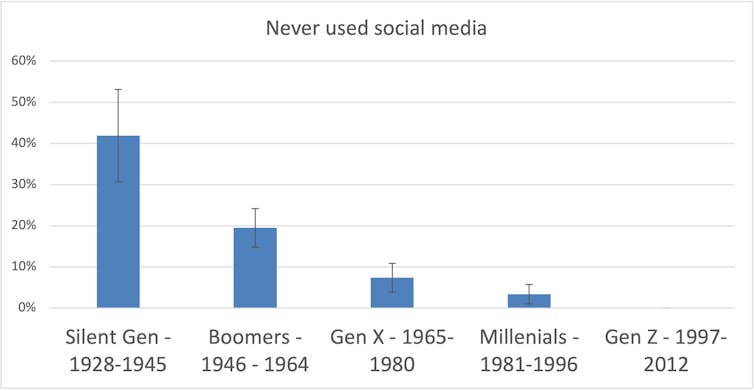
Of the Silent Generation (currently 76-93 years old), 40% had never used social media. This dropped to 0% among Gen Z (9-24 years old).

This graph shows the proportion of respondents from each generation who’d never used social media platforms. Roger Patulny

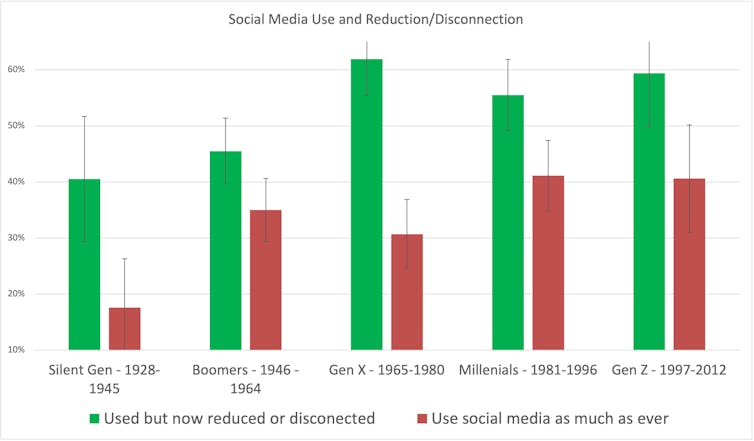
At 62%, Gen X (41-56 years old) led the way in social media reduction and disconnection. They were significantly more likely to have used and disconnected than baby boomers (57-75 years old).

But the rates of reduction and disconnection among millennials (25-40 years old) decreased, before increasing again for Gen Z. Millennials were also much more likely than Gen X to have never reduced their social media use at any point.
The proportion of each generation which either reduced or ceased social media usage. Roger Patulny

The relatively lower disconnection rate and higher usage rate among millennials is perhaps concerning.

This group may simply not have found a good reason to disconnect. However, since millennials were raised with social media strongly integrated into their teenage and adult lives, it may harder for them to kick the habit when needed.

The slight increase in disconnection among Gen Z is telling here, as it suggests the generation to follow may have developed a little more critical awareness of the downsides of making social media omnipresent in one’s life.

Young people studying together.
It’s often assumed school-aged kids are the most obsessed with social media. But while they might use it often, this happens alongside a growing awareness of the potential harms of excessive use. Shutterstock

Managing a challenging relationship

The survey findings suggest social media use is indeed ubiquitous among young people.

But they also suggest claims of a widespread rise in “internet addiction” are excessive, since the majority of respondents from Gen X onward had either reduced or halted their social media use.

This is good news. Tech platforms at times have shown an ethically questionable willingness to sacrifice our privacy and agency for personal gain, with both Facebook and Google guilty of covertly experimenting on users in the past.

These survey findings suggest we have some agency of our own. Tech giants can’t rely on user loyalty, or inertia and certainly not addiction.

Users may happily switch platforms — or switch off altogether — if they continue to be treated like bargaining chips in business deals. Big tech, take note.

ref. New evidence shows half of Australians have ditched social media at some point, but millennials lag behind – https://theconversation.com/new-evidence-shows-half-of-australians-have-ditched-social-media-at-some-point-but-millennials-lag-behind-156128

RSV is a common winter illness in children. Why did it see a summer surge in Australia this year?

Source: The Conversation (Au and NZ) – By Daniel Yeoh, Paediatrician and Infectious Diseases Physician, The University of Melbourne

Winter typically brings a surge in respiratory viral infections, when we see many children running around with runny noses and phlegmy coughs.

But the 2020 Australian winter was very different. Public health measures in place to control the spread of COVID-19 saw a major shift in the typical seasonal pattern of other respiratory viruses.

This has perhaps been most notable with respiratory syncytial virus (RSV), a very common cause of hospitalisation in young children over winter months in many parts of the world, including Australia.

But following an abnormal winter that saw a significant drop in rates of RSV — we found there were 98% fewer winter cases in Western Australian children — paediatric hospitals around Australia have seen unexpectedly large numbers of children presenting with RSV over summer.

So, what is RSV, and why are these changing trends important?

A winter lurgy

RSV typically circulates during winter in temperate climates, much like influenza.

It’s the major cause of lung infections in children, commonly causing bronchiolitis. Symptoms of RSV include a runny nose, cough, reduced feeding and fever. Complications include wheezing and difficulty breathing, which can develop into pneumonia.

Severe cases occasionally lead to death, predominantly in very young infants.

Almost all children have had an RSV infection by age two, but infants in their first year of life are more likely to experience severe infections requiring hospitalisation, because their airways are smaller. Babies have also not built up immunity to RSV from previous years (we call this being RSV-naïve).

RSV is spread through respiratory secretions, when an infected person sneezes or coughs. In this way it’s similar to COVID-19. But in contrast to the coronavirus, children are more vulnerable to RSV infection than adults. As a result, RSV is readily spread among children, especially at daycare, kindergarten and school.


Read more: Is it really the flu? The other viruses making you ill in winter


How is RSV treated?

Most children will recover without needing specialist care in hospital, and children with mild infection can be treated with rest at home.

However, many children, particularly young infants, those born prematurely, and children with underlying health issues, are admitted to paediatric wards with severe RSV every year.

Treatment for RSV is focused on helping children with their breathing (for example, giving them oxygen) and feeding (for example, administering fluids through a drip).

There’s no licensed vaccine for RSV, but the World Health Organization considers this a priority, and a number of vaccines are currently in development.

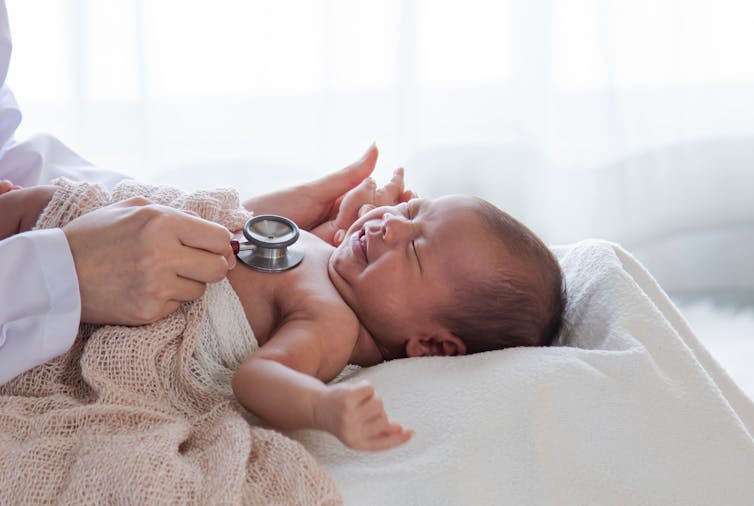
A doctor holds a stethoscope to a baby's chest.
Infants under one are more vulnerable to a serious case of RSV. Shutterstock

What happened to RSV in 2020?

The stay-at-home orders across Australia from late March 2020, and the implementation of quarantine for international arrivals, coincided with the start of the usual RSV and influenza season in Australia.

With these measures in place, RSV and influenza cases dropped dramatically and remained very low throughout winter.

In Western Australia, despite a relaxation of COVID-related restrictions, including schools reopening from May 2020, there was still a dramatic reduction in RSV cases through winter. This suggests border closures were important in reducing transmission from arriving overseas travellers.

RSV cases remained low until late spring, when a large surge was observed in New South Wales and WA.

The speed and magnitude of this increase was greater than the usual winter peak of RSV.

More recently, other states including Victoria and Queensland have seen a similar unseasonal rise in RSV cases.


Read more: Why do kids tend to have milder COVID? This new study gives us a clue


It’s likely reductions in COVID-19 restrictions have opened the door for increased RSV spread. Reduced immunity to RSV may also have contributed through both an increase in number of RSV-naïve children and possibly waning RSV immunity in older children related to the delayed season.

Studies seeking to understand exactly why we’ve seen a rise in RSV cases are ongoing.

Why might the Australian surge be important elsewhere?

Australia’s experience may carry important lessons for Northern Hemisphere countries, including the United States and the United Kingdom, which saw similar reductions in RSV cases during their winter.

Relaxing of COVID restrictions, which is beginning in many Northern Hemisphere countries now, may provide an opportunity for rapid spread of RSV. Our experience should serve as a warning for paediatric hospitals in the Northern Hemisphere to ensure adequate staffing and available resources to meet the possible increased need.

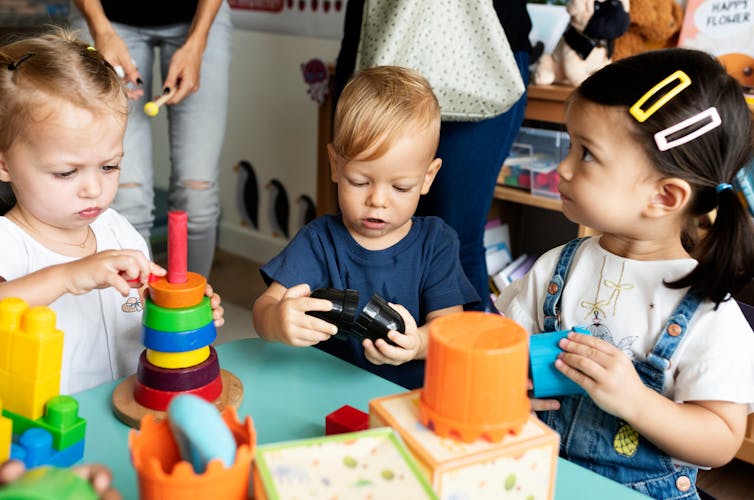
Three young children playing with various toys.
Children mixing less as a result of COVID-19 restrictions likely contributed to the drop in RSV cases during winter. Shutterstock

Our RSV experience may also be applicable to influenza, which still remains at very low levels globally. Reduced immunity to influenza due to the skipped 2020 season may result in a very severe season when influenza returns. Seasonal influenza vaccines could be particularly important in 2021 to protect against a possible large resurgence.

Let’s hold on to our good COVID habits

The COVID-19 pandemic has shown us the spread of respiratory viruses can be reduced by physical distancing and increased hygiene measures.

While we are (hopefully) unlikely to see prolonged stay-at-home orders again in Australia, ongoing basic measures including hand washing, cough etiquette and keeping snotty children at home can all help reduce the spread of RSV and influenza moving forward.

As we approach the 2021 Australian winter, by doing these simple things, as well as getting our flu vaccines, we can all help protect children, including those most vulnerable, from these important respiratory viruses.


Read more: Kids are more vulnerable to the flu – here’s what to look out for this winter


ref. RSV is a common winter illness in children. Why did it see a summer surge in Australia this year? – https://theconversation.com/rsv-is-a-common-winter-illness-in-children-why-did-it-see-a-summer-surge-in-australia-this-year-156492

From veggie gardening to op-shopping, migrants are the quiet environmentalists

Source: The Conversation (Au and NZ) – By Sukhmani Khorana, Senior Research Fellow, Western Sydney University

The organised environmental movement is largely a white, middle-class space. But our research shows migrants care for nature in other ways – including living sustainably in their everyday lives.

This is most obvious on the domestic front. From repurposing goods to keeping vegetable gardens and being careful with electricity use, migrants are highly likely to practise sustainable living – sometimes without even realising it.

In the debate about environmental issues, migrants are often blamed for making the problem worse, such as by adding to congestion. It’s important to break this circuit and recognise migrants’ positive contribution to environmental protection.

Migrants can successfully be harnessed to help with environmental causes. Doing this will require both learning from migrants, and helping them feel welcome in the green movement.

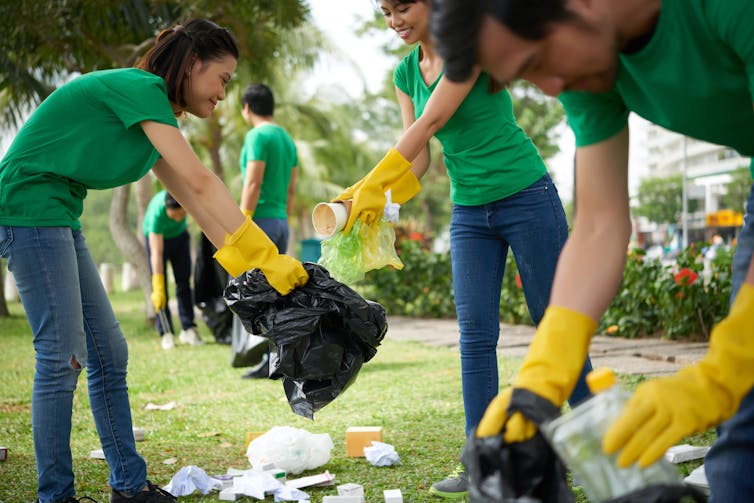
Young Asian people collect rubbish
Migrants are keen to help with environmental initiatives, if given the chance. Shutterstock

Busting migrant myths

Our qualitative pilot study sought to provide an in-depth picture of young first- and second-generation Australian migrants who care about the environment.

Research shows ethnic minorities are often under-represented in the urban environmental movement.

This can lead to suggestions migrants do not actively care for the environment – either due to apathy, or because they are preoccupied with climbing social and economic ladders in their new country.

But my research found first- and second-generation migrants in Australia care for the environment in particular ways, largely focused on the domestic front.


Read more: 4 assumptions about gender that distort how we think about climate change (and 3 ways to do better)


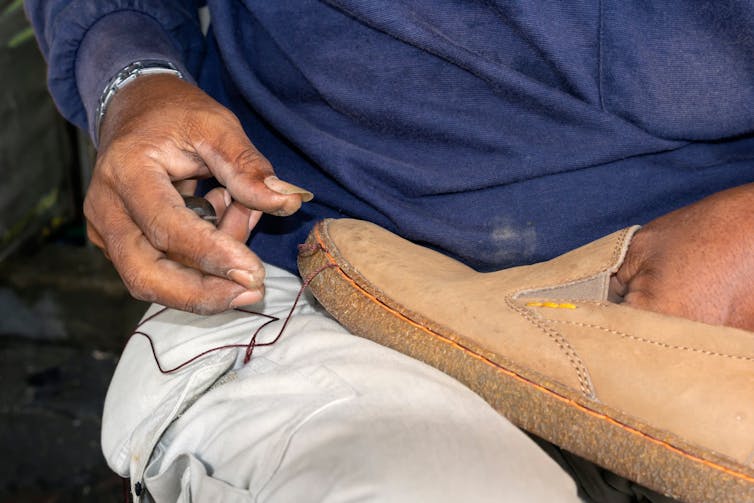
Man fixes shoe
Migrants, especially those from poor backgrounds, will often fix or repurpose an item rather than dispose of it. Shutterstock

What we found

My research team interviewed eight first-generation migrants and nine second- generation migrants in Sydney, aged between 18 and 40 years. The group comprised seven women and ten men, roughly half of whom were parents.

We found the participants actively and consciously carried out environmental care practices, mostly in the domestic sphere. From a young age, first- and second-generation participants continued austerity and waste-consciousness inherited from their parents. These included:

  • recycling and repurposing consumable items
  • careful water and electricity use
  • home vegetable gardens and composting
  • ethical purchase and consumption.

Some second-generation migrants said their parents were “accidentally” environmentally friendly. For example, some parents who had experienced financial hardship were frugal with money and goods. Others from an agricultural background remained connected to the land through gardening.

As one second-generation participant from Vietnam observed:

Migrants are often the most environmentally conscious people I know. They’re not purposefully being conscious, but they know about the scarcity of resources and its ingrained into them so it’s part of their lifestyle.

The participant learned sustainable practices from her mother who didn’t have a lot of money. The family’s clothes and homewares came from second-hand stores. Car travel was kept to a minimum and her mother planted many vegetables in her backyard.


Read more: ‘Biodegradable’ plastic will soon be banned in Australia. That’s a big win for the environment


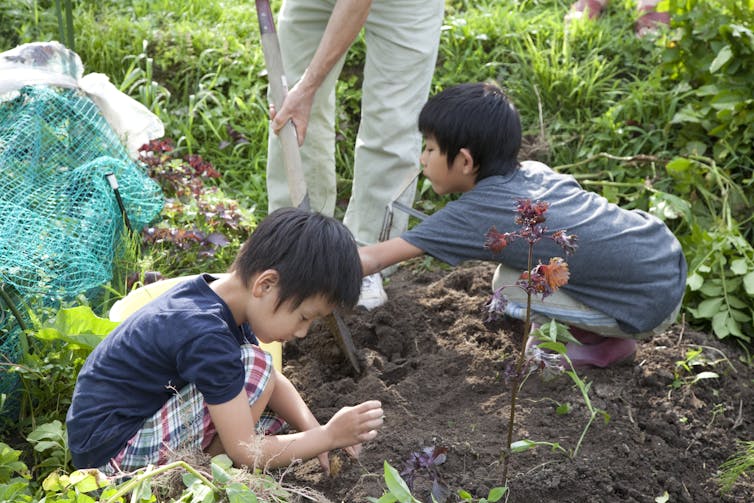
Young boys helping in garden
Migrants often pass sustainable practices to their children. Shutterstock

Outside the home

Second-generation migrants were much more likely to make the environmentally-motivated choice to become vegan and/or vegetarian. Of the 17 interview participants, five were vegan or vegetarian; all but one were second-generation migrants.

The second-generation migrants were slightly, but not significantly, more engaged with outward forms of environmental activism such as attending protests and marches.

Second-generation migrants said the first generation often eschewed public activism. Reasons for this included language barriers, alternative priorities that come with navigating a foreign country and fears of racism.

Second-generation migrants born in Australia were better equipped to overcome these barriers and felt more comfortable participating in the political sphere. However this group was still ambivalent about, or didn’t prioritise, organised environmental protection.


Read more: ‘Everyone else does it, so I can too’: how the false consensus effect drives environmental damage


Participants – particularly parents – cited the recent Black Summer bushfires as a traumatic reminder of climate change. The tragedy motivated them to practice environmental care such as water conservation.

Just two interviewees, both women, were involved in environmental groups. The others preferred to donate money to environmental causes or sign petitions, usually due to a lack of time.

Other participants sought to influence their family and peers through conversation, work initiatives or buying “green” products. Only three reported being engaged with environmental initiatives of their local councils.

As one first-generation migrant said:

In my council meetings, I’m one of the few migrants … They’re not confident yet about how much information they know and how much they’re missing out on. Even if they want to raise their voice they’re hesitant and worried that they’re saying something wrong.

Two women read a document
Migrants should be supported to understand council initiatives. Shutterstock

Next steps

Migrants are already highly engaged with environmentally friendly behaviour at home. The next step is to help them engage with environmental issues more broadly. We suggest the following measures:

  • train first-generation migrants to confidently get involved with local council sustainability measures. Councils should also raise awareness of environmental care programs and provide migrants with volunteering opportunities

  • raise awareness in the broader community about how migrants can be part of the solution to environmental problems through their daily domestic practices

  • use interactive digital tools to engage time-poor migrants

  • leverage second-generation migrants to both pass on, and change, their parents’ environmental practices

  • identify “community champions” to act as agents of change in migrant communities.

Our findings suggest migrants are interested in finding new ways to protect the environment. The green movement must help migrants achieve this, by making environmental initiatives safe, welcoming and accessible to them.


The author would like to acknowledge Claudia Sirdah and Nukte Ogun, who helped compile the research upon which this article is based.

ref. From veggie gardening to op-shopping, migrants are the quiet environmentalists – https://theconversation.com/from-veggie-gardening-to-op-shopping-migrants-are-the-quiet-environmentalists-155473

Young people are hungry for good sex education. I found a program in Mexico that gets it right

Source: The Conversation (Au and NZ) – By Shelly Makleff, Research Fellow, Global and Women’s Health, Monash University

More than 30,000 people have signed a petition, launched by ex-Sydney school girl Chanel Contos, demanding for consent to be at the forefront of sexual education in schools. The text in the petition states:

Those who have signed this petition have done so because they are sad and angry that they did not receive an adequate education regarding what amounts to sexual assault and what to do when it happens.

The petition encouraged a growing number of harrowing testimonies from young women throughout Australia about their experiences of sexual assault at parties.

School principals, particularly in all-boys schools, have responded by acknowledging the need for a cultural shift. Some schools have gathered students for sessions about consent, others addressed the topic in the classroom, some have asked parents to engage their children in discussions about sexual consent and social norms.

But studies show one-off conversations or education sessions about consent and rape are unlikely to influence long-term change. Interventions need to systematically and gradually address the harmful social norms that underpin a host of interrelated issues including rape culture, intimate partner violence and homophobic bullying.

I evaluated a sexuality education program in Mexico City. My evaluation highlighted a number of factors that can help shift harmful beliefs and behaviours related to gender, sexuality and relationships.

Engaging students in discussions

Evidence from around the globe suggests that to transform the harmful gender norms that contribute to violence and sexual assault, programs should promote critical reflections about gender, relationships and sexuality. Evidence also shows such reflection takes time.


Read more: Let’s make it mandatory to teach respectful relationships in every Australian school


A community-based organisation providing sexual and reproductive health services throughout Mexico adapted their sexuality course in 2016. It was a 20 hour course, delivered weekly over one semester to 185 students in one school. Each group of 20 participants aged 14 to 17 had one facilitator.

The facilitators in the course were young people (under 30 years of age). They were trained as professional health educators, and to facilitate activities that promote critical reflection among students about entrenched beliefs and social norms.

Students in classroom talking.
Students can be encouraged to discuss lived experiences, and debate them in class. Shutterstock

Such conversations can be about things like the nature of love and behaviours that are good and bad in a relationship.

In the program, students engaged in debates about romantic jealousy, and whether it was a sign of love. One student told me:

they told us […] about what is love and what is not love. I told my boyfriend, “they told us that jealousy is bad”, and he replied, “that’s right, because it means a lack of trust”, and in this way, we sometimes talked about the course.

Vignettes that were relevant to the students’ lived experiences stimulated debates about gender roles and social norms. For example, student said:

One of the things my classmate said stayed with me. He said that the man has to work and the woman should stay in the house. It made me, like, think. I think that a woman doesn’t need to always be at home […] as if it were a prison. I think you need to give freedom to both people in a relationship.

These group conversations can be challenging. They may also be upsetting to participants, and could even provoke verbal harassment or violence.

One facilitator described bullying and violence during some sessions of the course.

The group started to verbally attack each other, and it was one corner of the room against the other.

This means facilitators need training not only on the concepts of gender, sexuality and relationships, but also on how best to directly address comments that may reinforce harmful gender norms or other types of violence in the classroom and use those as teaching moments to highlight the consequences of harmful social norms.

Was the program successful?

I saw the students become more comfortable talking about relationships and sexuality as the course progressed. One young man said:

before the course, it made us a bit embarrassed to talk about sexual and reproductive health. But afterwards we understood, with the course, that it was, like, very natural to talk about it. It’s like any other thing, and so I now feel fine talking about it.

As a result of the program, some students said they directly addressed negative behaviours in their own relationships. And some even left controlling relationships.

One student said:

You know the information they told us about relationships? I was thinking about that, and then I decided to talk to my girlfriend about her controlling behaviour.

The students also developed trust in the course facilitators over time. One young man said:

As time passed, they gave me confidence that if at any moment I need something I can ask them for help, it won’t be a problem.

The facilitators made referrals to health care, provided advice and support, and in one case accompanied a participant to obtain care.

What needs to happen in Australia

In Australia, the quality and extent of implementation of sexual education is often left up to individual teachers or schools. But many teachers called on to deliver sexuality education feel unprepared to go beyond factual biological instruction.

A government mandate — as seen in a handful of countries such as the United Kingdom, Germany and the Netherlands — is needed to ensure high quality sexuality education is delivered to all young people in Australia.


Read more: Relationships and sex education is now mandatory in English schools – Australia should do the same


But even when mandated, implementation at a national scale is challenging. To effectively deliver such programs, resources should be put towards developing a large cohort of health educators who are trained and supported to deliver quality sexual education.

A nation-wide program could be implemented through a partnership between national and state governments and community-based organisations already experienced with sexuality education.

Parents can get involved too

As shown in the quotes above, the young people in the Mexico City course discussed topics from their sexuality course with peers, partners and parents.

This suggests that, even if parents feel unprepared to educate their children about sexual health, sexuality education can provide a bridge to open and reflective conversations. These can be a two-way exchange so parents need not serve as the educator, and can themselves benefit along with their children.


Read more: Not as simple as ‘no means no’: what young people need to know about consent


My research on prevention programming, as well as reviews of school-based interventions more broadly, reinforces the centrality of schools, both as settings in which violence is perpetrated, and as a site for its prevention.

Schools are often heteronormative institutions and can perpetuate toxic masculinity and rape culture. Investing in good quality sexual education can prevent the “upstream” effects we are seeing now in the testimonials about sexual assault in schools and in the national parliament.

ref. Young people are hungry for good sex education. I found a program in Mexico that gets it right – https://theconversation.com/young-people-are-hungry-for-good-sex-education-i-found-a-program-in-mexico-that-gets-it-right-156742

How the America’s Cup was transformed from a remote race to a spectator event on Auckland’s harbour

Source: The Conversation (Au and NZ) – By Diane Brand, Dean of Creative Arts & Industry, University of Auckland

Every good race needs an avid audience of dedicated fans to spur the competitors along and the 36th America’s Cup, which starts today, is no exception.

But current protocols are a far cry from the event’s rarefied and remote origins in Britain. For most of the cup’s history, the race was sailed on offshore courses away from the viewing public, under the auspices of elite yacht clubs.

Times have changed. Team New Zealand CEO Grant Dalton specifically sited the opportunity of racing in the enclosed waters of Auckland’s Waitematā Harbour as a way to maximise the public’s ability to view the event from land.

“This America’s Cup is for everyone,” says Team New Zealand’s Ray Davies.

This has been the way Aucklanders have watched regattas since the early colonial days when two of New Zealand’s favourite diversions, gambling and sailing, collided.


Read more: Why we should release New Zealand’s strangled rivers to lessen the impact of future floods


The Waitematā provides a series of perfect outdoor arenas for both local regattas and the courses set by the America’s Cup Race Committee.

And the new AC75 class chosen for the current America’s Cup are purpose built — large foiling yachts that sail like rockets, adding scale, acceleration and vivid visual spectacle to the drama of match racing.

The two yacht at speed race across the harbour route.
Italy’s Luna Rossa (front, left) beating American Magic on Auckland’s Waitematā Harbour during the challenger series for the 36th America’s Cup. Shutterstock/Steve Todd

A race offshore, out of sight

Founded in Britain in 1851, the America’s Cup quickly became dominated by the New York Yacht Club. The US held the cup for 128 years until it was won by Australia in 1983.

A win by New Zealand in 1995 firmly embedded Southern Hemisphere locations in the race circuit. And it was there that real public engagement began. Syndicate bases became visible or accessible, first in Fremantle in 1986 and then in San Diego in 1995.

Three yachts racing in the waters off San Diego, US.
People got to see more of the racing in places such as San Diego, US. Flickr/Port of San Diego, CC BY

In Auckland’s Viaduct Harbour, the cup facilities were integrated into a new mixed-use urban extension of the city for the 2000 and 2003 challenges. But the racing was still well away from public view in the Hauraki Gulf.

Then-Team New Zealand boss Sir Peter Blake’s vision for the 2000 America’s Cup was to have a venue where the syndicate bases were integrated into a vibrant waterfront neighbourhood.

Auckland was ripe for this kind of development. The result was the establishment of the city’s first waterfront precinct and the unlocking of urban coastal space from its 19th century industrial origins.

From London to Buenos Aires and beyond, industrialised waterfronts had undergone revitalisation for several decades. The America’s Cup helped Auckland join the trend.

Yachts and crowds in the Auckland harbour waterfront
The Viaduct Harbour gave people a chance to get up close to the yachts from the America’s Cup. Flickr/Yasuhiro Chatani, CC BY

The construction of the Viaduct Harbour provided an opportunity for high-quality public space to evolve at the centre of Auckland. The new precinct and its flagship event added valuable waterfront real estate and boosted the city economy.

The development became a benchmark for future urban design initiatives in the city, such as the Wynyard Quarter and Tank Farm, with the former now housing the America’s Cup race village.

Valencia in Spain tried the same formula but struggled to maintain an accessible public space in the wake of international terrorism and aggressive security measures.

The idea behind all these developments was to engage a wider audience for these largely elitist events. The trouble was, the public in the cup village settings only witnessed the yachts leave and return to base — albeit in style and with fanfare.

Broadcasting races with computer graphic enhancements on outdoor and home screens significantly enhanced the global audience for sailing. But the racing itself was remote.

An urban maritime arena

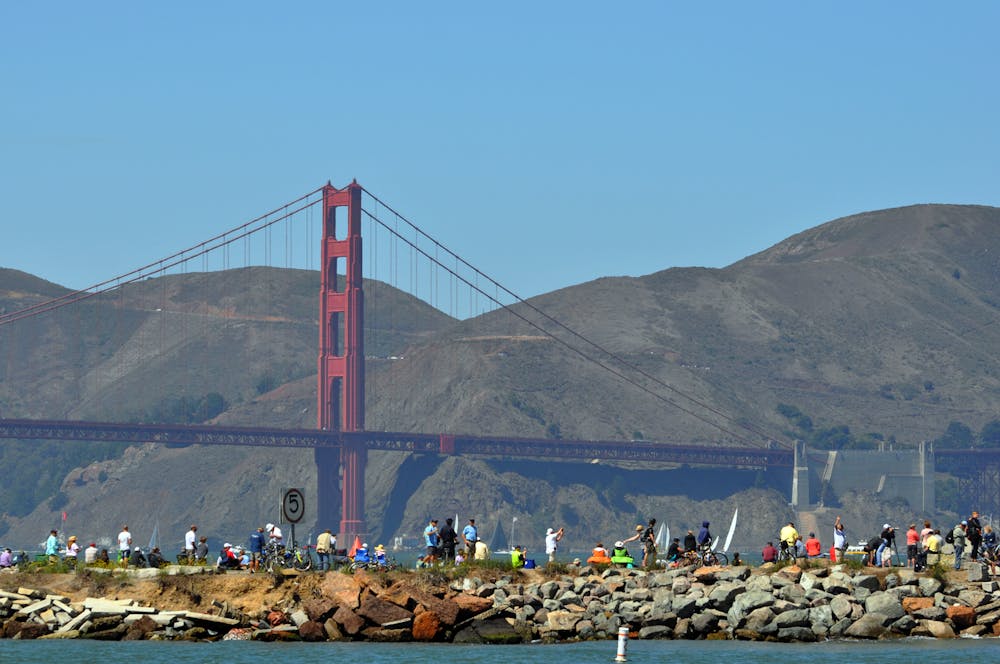
The spectator environment changed for the San Francisco challenge in 2013 where the natural environment allowed race viewing within the land-captured waterways of the Bay Area.

People lined up on the water's edge with the Golden Gate Bridge in the background.
San Fransisco’s bare area gave crowds an opportunity to watch the racing. Flickr/duluoz cats, CC BY-NC-ND

This created the perfect observation platform and the experience was replicated on the Great Sound in Bermuda in 2017.

It was a logical move for the New Zealand organisers to configure the race courses to allow people to line the coastal promontories, or to watch from vessels anchored on the race-course boundaries as the new nautical flying machines cut up and down the harbour at astronomical speeds.

With a choice of inshore and offshore courses, it has also been possible to avoid public gatherings during COVID-19 lockdowns by opting for the more remote course. This happened in the latter stages of the Prada Cup challenger series in February when Auckland was at alert level 2.

The spectacle works because of the large scale (26.5 metre masts) and airborne demeanour of these semi-flying machines, which reach speeds of more then 50 knots (90+kmh) as they foil around the course.

By comparison, the average sailing speed for a pleasure yacht is 6-12 knots (11-22kmh).


Read more: Freedom camping needs new regulations and foreign tourists aren’t the only villains


The AC75 yachts can be easily seen from an elevated vantage point, against a backdrop of wind-ruffled water, as they tack and gybe up and down a course.

On the waterfront

The America’s Cup challenges have been key to Auckland reclaiming its waterfront for public use and exploiting its natural coastal setting for spectator advantage.

People taking photos at America's Cup sign on Auckland's waterfront.
Auckland’s harbour setting helps pulls in the crowds to watch the America’s Cup. Shutterstock/Emagnetic

An urban harbour arena such as the Waitematā is the perfect venue, as it maximises sport, spectacle, super-scaled and super-funded vessels, land enclosure, security, public participation and controversy.

The race village has become the onshore site for entertainment and celebration. It is a formula future organisers would do well to emulate if they can capitalise on the right urban infrastructure and captivating landscapes.

ref. How the America’s Cup was transformed from a remote race to a spectator event on Auckland’s harbour – https://theconversation.com/how-the-americas-cup-was-transformed-from-a-remote-race-to-a-spectator-event-on-aucklands-harbour-155954

How Fiji could help resolve the Pal Ahluwalia and USP crisis

ANALYSIS: By Tony Fala

The arrest, detention, and deportation of University of the South Pacific vice-chancellor Pal Ahluwalia and his wife are significant issues for Fiji and the “Sea of Islands”.

As a son of the Pacific committed to Oceania, I am dismayed by recent events at USP. I write in support of all the peoples of Fiji. Moreover, I uphold the mana of the many artistic and intellectual ancestors USP has provided for the education of younger generations of Pacific people across Oceania.

I acknowledge USP’s educational leadership for all peoples in Oceania with humility and respect. I extend solidarity to all USP staff and students from Fiji and around the Moana.

I do not arrogate the right to tell USP staff or students how they might resolve their issues. We Pasifika in Aotearoa are not qualified to lecture our brothers and sisters at USP about conflict resolution. USP has the collective culture, history, people, and protocols to resolve some of the issues about the expulsion of their vice-chancellor, Professor Pal Ahluwalia.

But I wish to provide some humble suggestions to empower those seeking to resolve the issues that USP in Fiji confronts today.

Speaking as a Pasifika activist, I acknowledge that the only resolutions will be holistic ones involving all parties. But I think the Fiji government can perform an important role in resolving all issues. In broader terms, I feel the Fiji government could perform an important leadership role in allowing USP to heal and move forward in a spirit of Moana unity.

Ramifications for Fiji, region
The Fiji government’s expulsion of Professor Pal Ahluwalia and his wife from Fiji has had tremendous ramifications for Fiji and the region.

Academic organisations, activists, legal organisations, NGOs, journalists, Fiji members of Parliament, regional politicians, and USP alumni, staff, and students have all clarified relevant issues about the Fiji government’s unilateral decision to expel Ahluwalia and his wife.

In summary, some of these issues are:

  1. The rule of law and the right of due process;
  2. Protection of human rights;
  3. The protection of the right to dissent;
  4. Academic freedom;
  5. Unilateral government intervention into the affairs of USP;
  6. Protection of USP staff from unfair dismissal,
  7. Safety and the wellbeing of USP staff, students at USP in Fiji, including safe from arrest or detention;
  8. Claims of corruption at USP;
  9. Allegations against Pal Ahluwalia;
  10. Claims of punitive action against Ahluwalia by the Fiji government and Fiji members of the USP Council;
  11. Issues of staff remuneration;
  12. The health of relationships between Fiji and other member states who co-own USP;
  13. Distinctions between state and civil society, i.e. the distinctions between the Fiji government and the regional university campus in Fiji; and
  14. Calls for a relocation of the office of USP’s vice-chancellor from Fiji to other member nations, such as Samoa or Vanuatu.

Helpful resolutions
The Fiji government could help resolve these matters by engaging in a number of actions, discussions and processes. It could:

  • Invite Professor Pal Ahluwalia and his wife back into the country so the issues could be resolved in Fiji.
  • Clarify precisely what part of the law Ahluwalia his wife are alleged to have breached.
  • Recommit to protecting the human rights of all in Fiji. More specifically, the government could ensure that all USP employees’ human rights are guaranteed so academic freedom can be exercised responsibly.
  • Acknowledge that Pal Ahluwalia and his wife’s human rights have been breached. Moreover, the government could act to ensure this does not happen again to any other USP employee.
  • Take precautions not to directly intervene in the affairs of USP again by expelling employees of the university. Moreover, Fiji government representatives on the USP Council could work to ensure this is never carried out again at the university.
  • Release the funding the Fiji government owes USP without strings attached.
  • Work closely with USP’s member nations to work out collective resolutions to enhancing the regional nature and character of the institution. This could be achieved through the creation of innovative policies that ease current immigration restrictions on the recruitment and retention of staff particularly from the region, and, further, by helping to facilitate an easing of inter-country movement of USP staff and students among member countries.
  • Uphold the sanctity of USP as a learning space and strongly discourage police and military units from entering any USP grounds in Fiji and elsewhere.
  • Respect the autonomy of USP’s staff and student organisations.
  • Ensure the University Council-commissioned 2019 BDO Report, which independently investigated all allegations of corruption, is officially released to all stakeholders including staff and students. The only way to investigate criticisms of Ahluwalia is for independent people to assess the truth of these allegations. Similarly, only independent voices can consider the truth of claims made on Ahluwalia’s behalf. The government agrees to accept the outcomes of such investigations. The search for truth and fact are being politicised because of the Fiji government’s interference in university matters. Truth can only prevail if it is not weaponised for political purposes.
  • Ensure all concerns regarding staff remuneration are scrutinised fully and fairly by investigators acting independently of both the Fiji government and USP. The government could respect the independence of investigator’s findings. Moreover, the issue of remuneration for those staff who have served the region selflessly over long years could be examined with sensitivity and respect by investigators.
  • Allow USP staff and students privacy to work through issues raised by Professor Ahluwalia’s deportation. The government could step back and encourage USP’s people on all sides of this issue to engage in toktok or talanoa in order to heal and move forward in unity. This might encourage people not to settle scores with one another via government and/or university politics.
  • Articulate and clarify the lines of autonomy existing between the spheres of the Fijian state – and USP as part of Moana civil society. Then healthy lines of intersection between state and civil society might be established. If such lines are not clearly established, the Fiji government could be accused of trying to absorb USP in Fiji into an apparatus of the state.
  • Seek assistance from Pacific neighbours to help sort out issues. Pacific unity is perhaps best demonstrated when we support one another. Working with Pacific Island friends ensures USP’s vision of re-shaping the future in Oceania continues. Moreover, working in partnership with other Pacific Island peoples ensures USP’s mission of empowering Moana peoples in the region continues for the foreseeable future.

Tony Fala is an activist, volunteer community worker and researcher living in Auckland, Aotearoa. He has Tokelau ancestry. According to genealogies held by family elders, Fala also has ancestors from Aotearoa, Samoa, Tonga, and other island groups in Oceania. He works as a volunteer for the Community Services Connect Trust rescuing food and distributing this to families in need. Fala is currently producing a small Pan-Pacific research project, and is also helping organise an Auckland anti-racist conference.

Print Friendly, PDF & Email

Article by AsiaPacificReport.nz

PNG warned 680,000 covid vaccine doses needed to ‘save health system’

By Lulu Mark and Miriam Zarriga in Port Moresby

A medical academic has warned the Papua New Guinea government to immediately bring in more than 680,000 doses of covid-19 vaccines because urban health services will collapse if the spike in cases continues.

Professor Glen Mola, who correctly predicted last July that the country should brace for a spike in cases in the ensuing months, said the priority was to “slow the epidemic” as much as possible.

He is head of obstetrics and gynaecology at the University of PNG’s School of Medicine and Health Science, and the Port Moresby General Hospital (PMGH).

“We hope that we can slow the epidemic as much as possible,” Professor Mola said yesterday.

“But if there are too many sick people with respiratory symptoms presenting on any given day, then clearly they cannot all be just allowed to pile into the emergency department of the PMGH and the outpatients of the urban clinics.

“If there are just too many for the nurses and doctors to deal with, what are they to do?

“I want to see the vaccine here as soon as possible because the earlier we get the vaccine, the more lives (especially of older people and those with co-morbidities) will be saved.

‘Take notice of health advice’
“Everyone should start taking notice of health advice because by ignoring it, you are risking your own life and the lives of those around you – especially your seniors.”

Professor Mola told The National that the 684,000 doses of the Oxford AstraZeneca covid-19 vaccine were urgently needed in the country to protect the health system.

He said the number of doses mentioned would cover the front-line health workers and older people with co-morbidities. He suggested that some MPs might want to be in front of the queue as well to show “leadership”.

He said that with the spike, the lives of elderly citizens and those with co-morbidities were at a very high risk of succumbing to covid-19.

He called on young people to not wander around the entire day because their chances of picking up the virus and spreading it to older family members were high.

Meanwhile, the PMGH is prioritising its clinical services over the next two weeks due to the covid-19 spike.

Hospital chief executive officer Dr Paki Molumi said the action had to be taken because of the increasing number of workers testing positive.

“The main objective is to mobilise staff into areas greatly affected as a result of staff [being] quarantined and [in] isolation,” he said.

Action at a glance
Services to be affected include:

  • CONSULTATION clinic will be closed, with only urgent matters to be attended to;
  • ONLY emergency surgeries will be performed while elective surgeries put on hold;
  • EMERGENCIES with category 1-3 and referrals will be attended at the emergency department and children’s outpatient. People are advised to go to the nearest clinic and health facility in the city; and
  • GYNAECOLOGY clinic will be closed and bookings rescheduled.

The antenatal clinic, TB clinic, pharmacy, dental clinic, medical and imaging services will remain open but there will be certain limitations and strict control.

National Pandemic Response Controller David Manning said that a “lockdown was [still] an option”.

“Only after we make sure we take everything into consideration including what it will do to Port Moresby and the businesses,” he said.

“I expect all individuals, communities, businesses and organisations to adhere to the protocols.”

Asia Pacific Report publishes The National articles with permission.

Print Friendly, PDF & Email

Article by AsiaPacificReport.nz

Health Minister Greg Hunt goes to hospital with infection but says don’t blame the jab

Source: The Conversation (Au and NZ) – By Michelle Grattan, Professorial Fellow, University of Canberra

Health Minister Greg Hunt was admitted to hospital on Tuesday with “a suspected infection”.

In a statement on Tuesday evening his office said “he is being kept overnight for observation and is being administered antibiotics and fluid.” It said Hunt “is expected to make a full recovery.”

The condition of Hunt – who together with former prime minister Julia Gillard received the AstraZeneca vaccine at the weekend – “is not considered to be related to the vaccine,” the statement said.

But his hospitalisation is unhelpful when political figures are seeking to promote confidence by getting their shots early.

The announcement about Hunt came hours after Victorian Premier Danial Andrews was admitted to intensive care following a fall on slippery stairs, which resulted in several broken ribs and vertebrae damage.

It is not known when Hunt will be back at work.

Meanwhile pressure continued on Scott Morrison over Attorney-General Christian Porter, who is on mental health leave after being accused of historical rape, which he strongly denies.

Morrison told reporters he had spoken to Porter but he had not said when he would be returning to work.

The Prime Minister confirmed Porter won’t be there when parliament meets next week. “But he’ll give me further updates as we go through the course of this week,” he said.

As Morrison tries to switch attention to the economy, with announcements this week of post-JobKeeper measures, he continues to be dogged by the issues around Porter and Defence Minister Linda Reynolds.

Parliament on Monday heads into its final fortnight before the budget session, with the House of Representatives meeting for two weeks and the Senate for one week followed by Senate estimates hearings.

Reynolds, on medical leave, will miss both weeks. If Porter also misses the whole fortnight, the first time the two ministers would be subjected to parliamentary questioning would be budget week in May. Their return could be a distraction for the government, which would want all attention on the budget.

Morrison, who has spoken to Reynolds’ doctor, said on Tuesday her health issues – she has an underlying heart condition – were “quite serious”.

Reynolds became unwell when she was under fire over her former staffer Brittany Higgins’ allegation she was raped in 2019 by a colleague in Reynolds’ office and was not given enough support.

Morrison, who criticised Reynolds for not telling him of the incident, has not yet released the results of an inquiry by his departmental secretary, Phil Gaetjens, into who in his own office knew of the matter.

The Prime Minister was questioned again on Tuesday about his failure to read the dossier containing the allegations against Porter. He said the formal documents had been provided to his office on a Friday afternoon, when he was in Sydney.

“And so those documents were immediately provided to the Federal Police. So I was not in the same place as those documents.”

Morrison continues to resist calls for an independent inquiry into the allegation against Porter, and said he had not spoken to the Solicitor-General about the allegation “because there is not a separate legal process that applies to the Attorney-General or anyone else”.

On the economic front, in an address to the Australian Financial Review’s business summit, Morrison said Australia was “leading the world out of the global pandemic and the global recession it caused”.

But he expressed frustration that, despite unemployment still being high, many jobs can’t be filled, in the absence of workers coming from abroad.

“Despite targeted measures to incentivise Australian JobSeeker recipients to relocate to where the jobs are – $6,000 to move there and take those jobs – unemployed Australians are simply and regrettably not filling these jobs,” he said.

“Right now there are 54,000 jobs going in regional Australia.

“And every day we hear the stories of employers, especially in regional areas, unable to fill positions.”

In response, the government was strengthening the mutual obligation requirements for those getting JobSeeker.

“We must also re-look at the role the temporary visa holders play in meeting our economy’s workforce requirements, where Australians do not fill these jobs.

“Of course we want Australians to fill these jobs.

But “we need to see that, rather than taking Australians’ jobs, we need to instead appreciate how filling critical workforce shortages with temporary visa holders can actually create jobs elsewhere in the economy and, in particular, sustain growth and services in our regional economies”. That way, Australians got a net benefit, Morrison said.

“This issue will not go away when the pandemic ends. It’s a thorny issue for us to deal with and we must.”

ref. Health Minister Greg Hunt goes to hospital with infection but says don’t blame the jab – https://theconversation.com/health-minister-greg-hunt-goes-to-hospital-with-infection-but-says-dont-blame-the-jab-156763

If Princess Diana needed a legacy statement, she’s got it in Harry and Meghan

Source: The Conversation (Au and NZ) – By Catharine Lumby, Professor of Media, Department of Media, Macquarie University

Harry and Meghan. They left the royal family.

What a shock. Who saw this coming? Harry’s mum Princess Diana definitely would have.

She was, after all, the woman who was ridiculed by a lot of the mainstream media for being too emotional. Her trembling lower juxtaposed against Charles’s stiff upper lip.

Well guess what, if Diana needed a legacy statement her son Harry has made it by marrying a very smart and powerful woman who will not sit in the corner and be told to behave.

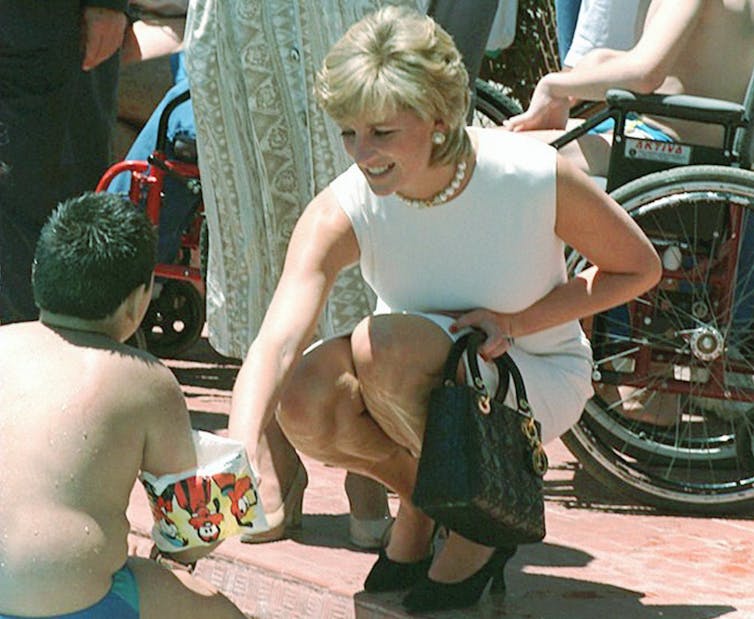
Diana famously offered her ungloved hand to an AIDS patient. It was significant because part of the protocol of royalty is that ordinary people are not meant to touch the royals. Anyone remember the “Lizard of Oz” scandal when Paul Keating put his hand on the Queen’s back?

In stark contrast to Queen Elizabeth, Diana frequently kissed and hugged people. Unlike her husband she made a point of showing physical affection to her children in public.

Princess Diana frequently hugged and touched people, and was referred to as the ‘Queen of hearts’. AAP/AP/Alejandro Pagni

The Meghan and Harry story and the current debates about whether they should have done an interview with Oprah Winfrey sent me back to when I was writing my PhD thesis on why tabloid media matters. Later, I published it as a book titled Gotcha: Life in a Tabloid World.


Read more: The royal family can’t keep ignoring its colonialist past and racist present


I wrote about Oprah and why talk shows like hers matter. It’s because they let us hear the voices of people we don’t hear in the mainstream media. We hear more from black people, people from disadvantaged backgrounds and more from women. And sometimes those people get emotional. What a shock.

Emotion and empathy are very clearly lacking in our public debates these days. And thank goodness interviewers like Oprah bring that to the table.

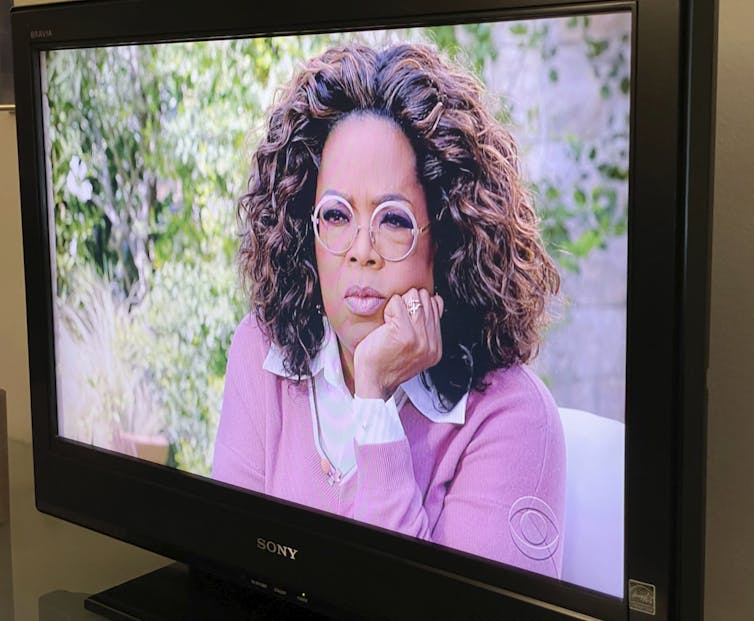
Oprah Winfrey brought her trademark empathy and emotion to her interview with the royal couple. AAP/AP/STRF/STAR MAX/IPx

The symbolic aspect of Diana’s persona aligned her with religious figures like Mother Theresa. And that’s part of why she was seen in the mainstream media as a bit of a spiritual nut-job.

But the perception that many others had was that she channelled empathy and humanity through the way she connected with people. And that’s why she was and is still called “the Queen of hearts”.

Back to Harry and his wife.

Meghan has clearly been targeted by the tabloid media, in an undeniably racist way, and she and her husband made a sensible decision to get out. But their dilemma raises a far bigger issue for all of us.

We are living through a time where the limits of free speech – the boundaries of what it is acceptable to say – are unclear. And we equally live in a time where anyone can post anything on social media and effectively become a publisher.

Twenty years ago, I was optimistic about the tabloid media and talks shows balancing out the elitism of the so-called “fourth estate”. Now I’m not so sure.

When I bother to check my Twitter feed or my email account I, like many of us, am increasingly alarmed by the trolling that goes on. I assume Meghan has someone to deal with that for her. The rest of us are only just working out how to manage it.


Read more: Meghan and Harry’s Oprah interview: why British media coverage could backfire


ref. If Princess Diana needed a legacy statement, she’s got it in Harry and Meghan – https://theconversation.com/if-princess-diana-needed-a-legacy-statement-shes-got-it-in-harry-and-meghan-156745

Evidence shows mental illness isn’t a reason to doubt women survivors

Source: The Conversation (Au and NZ) – By Emma Tseris, Senior Lecturer in Social Work and Policy Studies, University of Sydney

This article discusses sexual assault, gendered violence and mental distress.

Over the past week, some media commentary on the rape allegations against federal Attorney-General Christian Porter have used the alleged victim’s history of mental health difficulties to undermine and raise questions about the truth of her claims.

Christian Porter denies the allegations, and he has a right to the presumption of innocence.

What’s not acceptable is the use of a woman’s struggles with mental health to discredit her account of an alleged sexual assault.

This is because exposure to trauma is one of the most significant predictors a person will seek support from mental health services. Gendered violence and mental distress often go hand in hand.

The links between gendered violence and mental health

Research, including our own findings, reveals many women survivors demonstrate resilience after violence and abuse.

However, others report struggling with mental health and seek support for feelings of shame, fear, sadness, flashbacks, panic attacks, low self-worth and other painful experiences.

The mental distress associated with gendered violence is often made worse by disappointing system responses, victim-blaming, and other negative social impacts such as difficulties gaining and maintaining employment.


Read more: I’m a sexual assault counsellor. Here’s why it’s so hard for survivors to come forward, and what happens when they do


Mental illness stereotypes

There’s a pervasive idea that accounts from people with a mental illness are unreliable. Long-standing stereotypes link mental illness with unpredictability and untrustworthiness.

These stereotypes are more marked for women because of similarly long-standing historical tropes that connect femininity with irrationality.

However, undermining women’s accounts of abuse on the basis of mental illness is problematic. Research demonstrates disclosures of violence made by people accessing mental health services are reliable over long periods of time. False allegations are marginal.

Women who experience mental anguish after violence are not “irrational”. Their mental distress is an understandable response to overwhelming events.

There’s an idea that people with certain psychiatric diagnoses are more susceptible to “false memories” of abuse than other groups. The notion of “false memory syndrome” was used in the 1990s to undermine the credibility of rising reports of child sexual abuse. It was largely applied to the childhood sexual abuse of girls within their families, rather than adult rape. The notion of spurious memories arising in the context of dissociative states has featured across media and social media in recent weeks, including in one widely maligned article published by Crikey.

While memory is complex, the idea that people with certain psychiatric diagnoses are more prone to making up reports of sexual abuse and rape is simply not supported by evidence.


Read more: Dissociative identity disorder exists and is the result of childhood trauma


Gendered violence is under-detected

Research interviews reveal many women who access mental health services never disclose their experiences of gendered violence. Often, mental health workers fail to ask women about their personal histories of abuse and violence.

A mental health history can also act as a barrier to the disclosure of violence. This is often because women fear their diagnosis will make them unreliable witnesses in the eyes of practitioners and others in the community.

Women experiencing mental health difficulties report they want gender-sensitive mental health support. This means responding to their specific needs as women, including improving the detection of gendered violence and its impacts. Through this more holistic approach, mental health workers will be better equipped to address the root causes of women’s distress.

Mental illness increases the likelihood of exposure to violence

It’s particularly problematic to dismiss disclosures of gendered violence from women with mental health difficulties because this group is at significantly higher risk of violence, precisely as a consequence of reduced mental health and well-being.

Some domestic violence perpetrators use a woman’s psychiatric diagnosis as a tool of abuse. For example, as a form of gaslighting to reduce her sense of self-worth or to convince her she won’t be believed if she discloses the abuse.

Recent research has also revealed sexual harassment and assault is experienced by women within mental health inpatient units.

What should be done?

Rates of reporting gendered violence in Australia are very low. It’s important prejudicial ideas about mental illness are not mobilised against women to further prevent their disclosures from being heard and taken seriously.

When the media uses a woman’s mental health history to cast doubt on her allegations, other women will be deterred from speaking out about their experiences.

Women with mental health difficulties who disclose violence should be provided with options and resources. Their disclosures should be taken seriously, their feelings should be validated and supported, and they should be presented with a range of pathways for support and justice.


If this article has raised issues for you, or if you’re concerned about someone you know, please call 1800RESPECT on 1800 737 732 or Lifeline on 13 11 14.

ref. Evidence shows mental illness isn’t a reason to doubt women survivors – https://theconversation.com/evidence-shows-mental-illness-isnt-a-reason-to-doubt-women-survivors-156581

The Oprah interview is a royal PR nightmare, but republicans shouldn’t get their hopes up just yet

Source: The Conversation (Au and NZ) – By Luke Mansillo, PhD Candidate in Government & International Relations, University of Sydney

In 1992, Texan millionaire John Bryan was caught sucking the toes of Sarah Ferguson, the Duchess of York. It made front page news and saw Australians’ support for a republic surge from 36% in 1991 to 57% in 1992.

Despite this, and the unedifying spectacle of Charles and Diana’s divorce (and a slew of other royal scandals), in the 1999 republic referendum, Australia still clung to the monarchy.

This should serve as a timely reminder as the uproar grows over the public relations disaster of Meghan and Harry’s interview with Oprah Winfrey — and renewed calls for an Australian republic.

If Fergie couldn’t bring down Australia’s monarchy, it’s unlikely Oprah can.

The interview

The interview, which is making headlines around the world, is arguably far more nuanced situation than the royal scandals of the 1990s.

The claims the palace is racist, that toxic tabloid culture invaded their lives, Meghan’s mental health was severely neglected and the couple were not supported by their family are horrible and harrowing.

But they must also be seen in the context of an escalating war between Buckingham Palace and the Sussexes. Also at play is the fact Meghan and Harry are desperately trying to make money – and build a brand – to support their new life in California.

From a political communications perspective, the TV interview also does not have the visual imagery needed to shock otherwise disinterested voters (again, think back to the toe episode).

Most Australians want to keep the queen

It is also fair to say the republic is not a top priority for Australians.

For the first time since the 1990s, in 2019, the Australian Election Study showed a majority of Australians (51%) wished to retain the queen as our head of state.


Read more: Meghan and Harry’s Oprah interview: why ‘royal confessionals’ threaten the monarchy


Public opinion has also held in the wake of last year’s palace Letters revelations and the Prince Andrew/ Jeffrey Epstein scandal. In January 2021, an Ipsos poll indicated only 34% of Australians wanted a republic.

This presents republican activists with a much harder task than at any point in the past three decades. The need to make a huge dent in public opinion to achieve the double majority support required nationally and in at least four states for the dissolution of the Australian monarchy.

Interestingly, younger people — who tend to me more politically progressive — are also strong supporters of the monarchy.

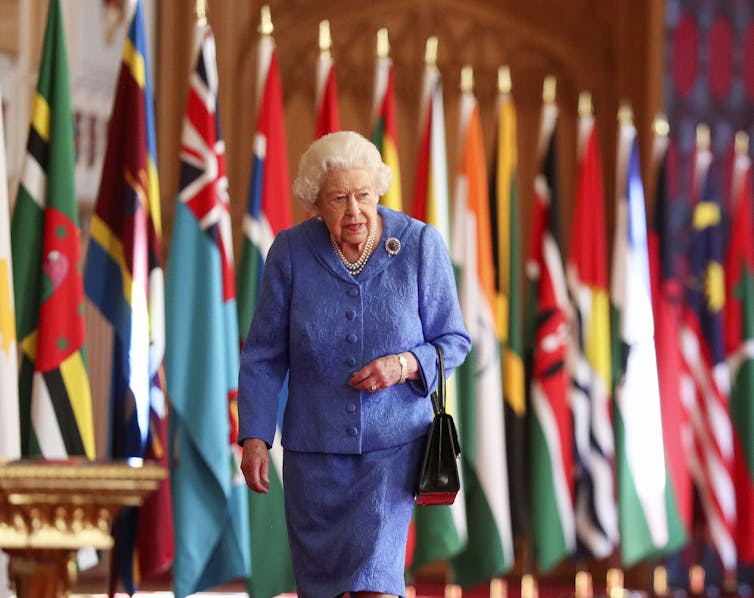
The Queen walking past Commonwealth flags at Windsor Castle.
Most Australians want to hang on to the monarchy. Steve Parsons/ AP/AAP

For every birth year cohort born after 1975 (with no memory of the Whitlam Dismissal and less memory of the ‘90s), at least 51% want Australia to keep its constitutional links with the House of Windsor. Older Australians (those over the age of 70) also want to keep the queen.

Support for a republic is strongest among baby boomers, with about 65% wanting a revised constitution.


Read more: The royal family can’t keep ignoring its colonialist past and racist present


Explaining the poll results from earlier this year, Ipsos director Jessica Elgood said there was “no sense of momentum” towards a republic, while monarchists pointed to the popularity of the royals among younger people.

It’s also worth noting that in the two decades after the referendum, there have been relatively few scandals from the royals (until recently).

Republicans should not be celebrating

So, republicans should not see the Oprah interview as a major boost to their cause — there are hard yards to be done.

Beyond the odd account on Twitter, there is no significant campaign in place to take advantage of the political opportunity this scandal presents.


Read more: Prince Harry’s decision to ‘step back’ from the monarchy is a gift to republicans


The Australian Republic Movement have a website, a well-known chair in Peter FitzSimons and many eminent supporters, including historical biographer Jenny Hocking and mental health expert Patrick McGorry. They also highlight a 19% increase in membership in 2020.

But it is hard to argue the group has a high profile in the broader community.

Compared to same-sex marriage, for example, there is not the campaign infrastructure or political communication tools. What cut-through is a republic push going to have amid the ongoing sexual assault claims emerging from Canberra? Or outrage over standards in aged care? Or the push for Australians to get vaccinated?

Other constitutional priorities

There are also arguably far more important constitutional issues that require our nation’s attention.

Constitutional change is a hard and difficult project in Australia at the best of times – and at the moment, the republic sits down the list of priorities. It would be a hard case to argue the republic should be dealt with before First Nations’ Recognition or skewed tax arrangements between the federal and state governments, as we emerge from the COVID economic catastrophe.

A further complicating factor is we still don’t have a clear idea about what our republic would look like.

In 1999, 55% of Australians wanted a republic with a president elected by the people. Only 21% preferred the model offered in the referendum of a president appointed by parliament. And we are still no closer to arriving at a preferred model.

The interview is a terrible look for the monarchy — and uncomfortable questions must follow. But it is hard to see it having an impact on the republican cause in Australia.

ref. The Oprah interview is a royal PR nightmare, but republicans shouldn’t get their hopes up just yet – https://theconversation.com/the-oprah-interview-is-a-royal-pr-nightmare-but-republicans-shouldnt-get-their-hopes-up-just-yet-156744

Victoria’s truth-telling commission: to move forward, we need to answer for the legacies of colonisation

Source: The Conversation (Au and NZ) – By Harry Hobbs, Lecturer, University of Technology Sydney

Last year, the Victorian government announced it would establish a Truth and Justice process to “recognise historic wrongs and address ongoing injustices for Aboriginal Victorians”.

Since then, the government has worked in partnership with the First Peoples’ Assembly to figure out how that process would operate.

Today, the government and the First Peoples’ Assembly co-chairs announced the process would be run by the Yoo-rrook Justice Commission (named for the Wemba Wemba/Wamba Wamba word for “truth”). The commission will be led by five commissioners and, importantly, will be invested with the powers of a royal commission.

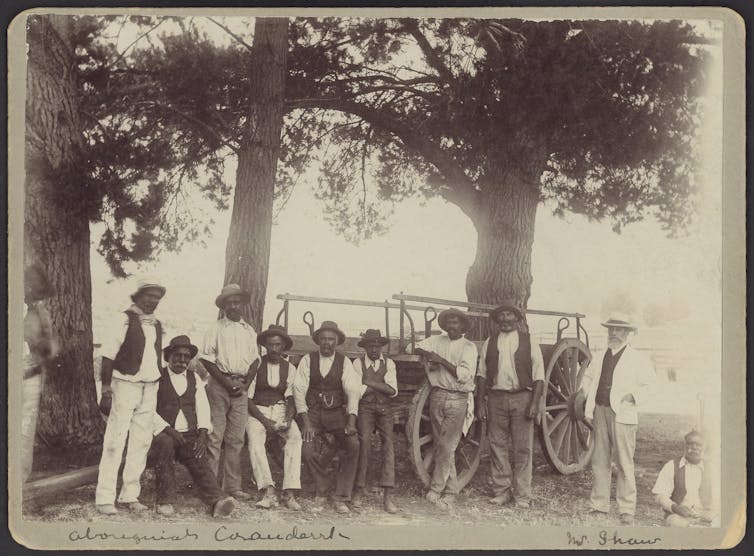
The announcement was made at Coranderrk, a former Aboriginal reserve outside Melbourne. The site is significant. Dispossessed from their country, a group of Aboriginal people were allowed in the 1860s to settle on a small parcel of land deemed unsuitable for agriculture.

Rebuilding their community, the group farmed and sold produce into Melbourne. Their success caused resentment among non-Indigenous farmers and the Aboriginal Protection Board.

In 1886, after many years of increasing pressure from the board, residents issued the Coranderrk Petition to the Victorian government, protesting the heavy restrictions that had been placed on their lives. Their petition went unanswered. Residents were evicted, and the land was eventually reclaimed by the government.

The Coranderrk Petition is one example of how Aboriginal and Torres Strait Islander communities actively resisted colonisation. It also shows governments can — and often do — act in ways that caused deep injustices. It is these, and many other events, that have motivated calls for truth in the present day.

The Aboriginal resistance in Coranderrk is considered one of the first Indigenous campaigns for land rights and self-determination in the country. State Library of Victoria

What are truth commissions?

Truth commissions reflect the idea that there can be “no justice without truth”.

Aboriginal and Torres Strait Islander peoples have often made this connection. For example, in the Adelaide Regional Dialogue, which preceded the First Nations Constitutional Convention (and the Uluru Statement from the Heart) in 2017, participants agreed

we want the history of Aboriginal people taught in schools, including the truth about murders and the theft of land, Maralinga, and the Stolen Generations, as well the story of all the Aboriginal fighters for reform. Healing can only begin when this true history is taught.

Truth commissions have been set up in many countries around the world as a means to investigate and redress past human rights abuses. Since the first commission began in 1974, at least 40 national truth commissions have been established.


Read more: Truth telling and giving back: how settler colonials are coming to terms with painful family histories


The most prominent truth commission is the South African Truth and Reconciliation Commission. Set up to investigate human rights abuses committed under apartheid, the commission’s hearings were broadcast live to a captivated nation. Controversially, however, the commission could grant amnesty to perpetrators who confessed to their crimes.

Another example comes from Canada. In 2008, the Canadian Truth and Reconciliation Commission began documenting the history and legacy of the country’s notorious residential schools system, which operated from 1878–1996.

Under this system, First Nations children were forcibly removed from their homes and families and put into boarding schools run by the government and churches. Similar to the Stolen Generations in Australia, the government had a mission “to kill the Indian in the child”, according to a national apology by then-Prime Minister Stephen Harper in 2008.

Concluding in 2015, the commission issued 94 “calls to action” to redress the legacies of the school system and advance the process of Canadian reconciliation.

Why an Australian truth commission is unique

The South African and Canadian truth commissions are valuable examples, but the process in Victoria will need to be designed differently. Thankfully, the government has acknowledged this.

Two points stand out. First, truth commissions are often set up by a new government to investigate human rights abuses under a previous regime.

However, this isn’t comparable to the abuses suffered by Aboriginal and Torres Strait Islander peoples. Although the invasion and massacres happened many years ago, the consequences of colonisation continue to this day. This fact was recognised by the Royal Commission into Aboriginal Deaths in Custody in 1991, which said,

so much of the Aboriginal people’s current circumstances, and the patterns of interactions between Aboriginal and non-Aboriginal society, are a direct consequence of their experience of colonialism and, indeed, of the recent past.

In Australia, a truth-telling process should not simply document history and investigate “historic abuses”. Rather, it should serve as a bridge to “draw history into the present”.

The legacy of colonisation continues to be felt — and contested — across Australia today. Darren England/AAP

Second, truth commissions often focus on individual human rights violations.

This also might not be appropriate in Australia, where many perpetrators of violence are likely to have died. More importantly, Indigenous peoples see little distinction between individual acts of violence, such as massacres, and the broader structural forces behind the laws, policies and attitudes that gave rise to and encouraged such violence.

A truth-telling process can help to identify those connections for non-Indigenous Australians.


Read more: Friday essay: it’s time for a new museum dedicated to the fighters of the frontier wars


How Victoria’s inquiry can be a model for the nation

The Victorian announcement places more pressure on the Commonwealth government to implement the Uluru Statement. After all, the call for truth and justice is made by all Aboriginal and Torres Strait Islander peoples, not just those in Victoria.

The Uluru Statement called for three steps to empower Aboriginal and Torres Strait Islander peoples:

  • putting a First Nations Voice in the Australian Constitution

  • the establishment of a Makarrata Commission that would oversee a process of agreement-making and then a process of truth-telling.

Voice. Treaty. Truth.


Read more: Lidia Thorpe wants to shift course on Indigenous recognition. Here’s why we must respect the Uluru Statement


The Victorian government shows this sequenced reform process can work. The First Peoples’ Assembly in the state worked with the government to develop the Yoo-rrook Justice Commission. That commission and the truth-telling process will guide the push for treaties between Aboriginal communities and the state.

The Commonwealth government initially rejected the call for a First Nations Voice. Although its opposition has softened, it remains reluctant to put the Voice in the constitution.

This is concerning. Without constitutional entrenchment, the Voice is likely to struggle to be effective and a national process of treaty making and truth-telling may not occur. Further, a national First Nations Voice will be unable to protect important developments at the state level, like those in Victoria.

Challenges remain, but the announcement today is significant. As First Peoples’ Assembly co-chair Marcus Stewart noted,

never before have we seen a truth-telling process in this country or state.

ref. Victoria’s truth-telling commission: to move forward, we need to answer for the legacies of colonisation – https://theconversation.com/victorias-truth-telling-commission-to-move-forward-we-need-to-answer-for-the-legacies-of-colonisation-156746

The royal family can’t keep ignoring its colonialist past and racist present

Source: The Conversation (Au and NZ) – By Benjamin T. Jones, Lecturer in History, CQUniversity Australia

The most explosive element of the Sussexes highly anticipated interview with Oprah Winfrey was the claim that someone within the royal household had “concerns” over how dark-skinned the couple’s son Archie might be.

While Winfrey later clarified neither the Queen nor the Duke of Edinburgh were behind the remark, Meghan also suggested their son was denied the title of prince because of his mixed race.

The interview points to a larger issue of racism in the British monarchy, both contemporary and historical.

When the couple began dating, some hoped it would usher in a period of royal renewal. Meghan, who has an African-American mother and a white father, was presented as a symbol of the modern, inclusive monarchy. These hopes were gradually dashed with consistently negative media coverage, including unfavourable comparisons with Meghan’s sister-in-law, Kate Middleton, the Duchess of Cambridge.

Meghan revealed to Winfrey that the pressure to perform official duties in the face of mounting criticism led to depression and suicidal thoughts. The couple lamented the lack of support they received from the royal family.

It is a tragic story at an individual level but it also points to a history of structural racism within the monarchy. Harry noted that the press attacks on his wife had “colonial undertones”, which the royal family refused to address. These are part of a longer history of colonialism and racism in which the Windsors are entangled.


Read more: Meghan and Harry’s Oprah interview: why British media coverage could backfire


The slave trade

Elizabeth I: The Pelican Portrait by Nicholas Hilliard, circa 1575. Wikimedia Commons

The Queen’s distant ancestor, Elizabeth I, was integral to establishing the British slave trade. One of the founders of the trade in the 16th century, Sir John Hawkins, impressed Elizabeth by capturing 300 Africans. His biographer Harry Kelsey calls him “Queen Elizabeth’s Slave Trader” and notes that she contributed her ship, Jesus of Lubeck to his next voyage in 1564.

In 2018, Prince Charles denounced Britain’s role in the slave trade as an “atrocity” but there have been calls for the Queen also to apologise on behalf of the monarchy.

Republican campaigner Graham Smith has led the charge noting that the current royals “are sitting on a hugely significant amount which was acquired from slavery and empire”.

A colonial mindset

The British empire contracted after the World Wars and eventually dissolved in 1960s. Nevertheless, a colonial mindset has persisted. This has been regularly demonstrated by the casual racism of Prince Philip. Visiting Australia in 2002, he asked an Aboriginal Australian if they were “still throwing spears”.

Queen Elizabeth II and Prince Philip watch as Warren Clements of the Tjapakai Aboriginal Dance Group makes fire by rubbing sticks in Cairns in March 2002. Brian Cassey/AP

In 1999, he mused that an old-fashioned fuse box must have been “put in by an Indian”. In 1986, he warned British students in China that they would become “slitty-eyed” if they stayed too long. Australia, China, and India, are just three of dozens of countries touched by British colonisation.

While the Prince’s comments — and many others — are often dismissed as “gaffes” or poor jokes, they tie into a culture war, suggesting colonialism was ultimately a net good and Britain was spreading civilisation throughout the world.

Journalist Peter Tatchell has argued that the institution of monarchy is itself inherently racist as there have only been, and likely will only ever be, white monarchs. He notes,

A non-white person is […] excluded from holding the title of head of state, at least for the foreseeable future. This is institutional racism.

While this could change, of course, the treatment of Meghan and the alleged concerns over her son’s skin colour suggest the privileging of whiteness is deeply ingrained.

Being seventh in line to the throne, there was never a realistic chance Archie would become king. The notion that his mere proximity to the throne has sparked concerns, and the failure to defend Meghan from racist attacks, again points to a structural issue.

The marriage of Harry and Meghan in 2018 by charismatic African-American Bishop Michael Curry, serenaded by a gospel choir, was a public relations coup for the royals. The Sussexes exit from royal life after such a short period, and the reasons why, is highly damaging.


Read more: Prince Harry’s decision to ‘step back’ from the monarchy is a gift to republicans


Royal silence

The monarchy has remained largely silent on the history of racism in Britain and how the royal family has benefited from racism and colonialism.

Sets of shackles used in the transportation of slaves, on display at the International Slavery Museum in Liverpool, England. Dave Thompson/AP

After the death of George Floyd sparked the Black Lives Matter movement, thousands across Britain were quick to show their support and solidarity. So strongly did the movement resonate, in 2020 the English Premier League had the words Black Lives Matter printed on players’ shirts, opening matches with players taking a symbolic knee.


Read more: Statues are just the start – the UK is peppered with slavery heritage


The royal family said nothing. By protocol, the monarchy does not comment on political issues but its role is to offer moral leadership. Without explicitly endorsing Black Lives Matter, the Windsors could have contributed to the zeitgeist by offering statements condemning all forms of racism and visibly championing anti-racism charities.

As a society, Britain is having a difficult national conversation about its imperial past. Statues of slave owners are being torn down and attempts to decolonise the curriculum are gathering pace.

If the royal family is not able to make similar attempts to confront the racism in its past and present, it risks falling ever further out of touch with the people it is supposed to represent.

ref. The royal family can’t keep ignoring its colonialist past and racist present – https://theconversation.com/the-royal-family-cant-keep-ignoring-its-colonialist-past-and-racist-present-156749

Botticelli to Van Gogh: from luminous, lyrical beauty to the spoils of empire

Source: The Conversation (Au and NZ) – By Joanna Mendelssohn, Principal Fellow (Hon), Victorian College of the Arts, University of Melbourne. Editor in Chief, Design and Art of Australia Online, The University of Melbourne

Review: Botticelli to Van Gogh: Masterpieces from the National Gallery, London, National Gallery of Australia, Canberra

In London, Covid-19 has closed the British National Gallery. Meanwhile in Canberra, Australia’s National Gallery has opened its doors to an elegant selection of works from Britain’s collection. The two events are not connected, but they do signal how times have changed.

Since 1963, when the Mona Lisa was sent to Washington, asset rich but income poor art museums have relished the combination of kudos and cash that can come with a international tour of collection highlights. Some exhibitions originate when the home institution is closed for redevelopment, others are finely honed exercises in art diplomacy.

Sandro Botticelli. Four scenes from the Early Life of Saint Zenobius. c. 1500. © The National Gallery, London. Mond Bequest, 1924.

In 1975, New York’s Museum of Modern Art sent Manet to Matisse to Australia, an exhibition organised following the election of the Whitlam government. Visitors queued for hours to see that abundance of treasure from the USA. Botticelli to Van Gogh: Masterpieces from the National Gallery, London is the result of a similar diplomatic imperative. This time Japan is the target, and Australia is the fringe beneficiary.

For many years the British government resisted requests for the UK’s National Gallery to tour its collection, one of the greatest in the world. Cultural diplomacy and the 2020 Tokyo Olympics — where the exhibition was headed — led to a policy change.

Joseph Mallord William Turner. Ulysses deriding Polyphemus – Homer’s Odyssey. 1829. © The National Gallery, London. Turner Bequest, 1856.

Because of the importance of the Olympics, the exhibition was able to include Vincent van Gogh’s Sunflowers, a work so luminous in its pure gold yellows that no colour reproduction can ever do it justice, as well as Monet’s The Water-lily Pond of 1899, one of his most lyrically beautiful paintings.


Read more: What does an ‘unforgettable, multi-sensory experience’ have to do with Vincent van Gogh?


The British gallery’s director, Dr Gabriele Finaldi, saw this exhibition as one that would both show the range of the collection, and create a narrative about the impact of Britain on western culture.

The economics of touring art meant it was necessary to offer the exhibition to another venue outside of Japan. Canberra took the slot but the arrival of Covid in early 2020 changed all plans. The Olympics were postponed. The exhibition arrived in Tokyo just before all was locked down.

It eventually opened in June, without the Olympics but to a very appreciative audience. One visitor wrote: “What a comfort. What a joy! I could almost cry.”

Jacopo Tintoretto. The Origin of the Milky Way. c. 1575. © The National Gallery, London.

The NGA was able to use the extra time to renovate its temporary exhibitions wing, shaping it to suit the narrative of the exhibition, which Finaldi describes as “the history of picture-making in Western Europe”.

While that assessment is most accurately described as hyperbole (there are, for instance, no works by women) there is a chronological progression and each room is devoted to a different aspect of western art and a different time frame.

Surprising pleasures

There are some surprising pleasures. Paolo Uccello is not represented by one of his standard set-piece battles on horseback, but St George and the Dragon with its saint on horseback. A reproduction of this painting, with its evocation of a magical world, led me to fall in love with art when I was a child.

Paolo Uccello. Saint George and the dragon. c. 1470. © The National Gallery, London.

The Botticelli, Four scenes from the Early Life of Saint Zenobius, comes from the later years of the artist’s life, after he became a disciple of Savonarola and renounced the life of the flesh.

Visitors to London see rooms crowded with Dutch art, a reflection of the common Protestant tradition of the two countries. This exhibition however only shows eight paintings from 17th century Holland, sparsely hung in one great room to give visitors a chance to properly focus on Rembrandt’s masterpiece, Self Portrait at the Age of 34.

It also includes the work I would most like to steal, Vermeer’s A Young Woman Seated at a Virginal. As with all of Vermeer’s paintings each shape, tone and colour works in perfect harmony. Every detail — from the painting hanging in the background to the young musician’s dress — implies a narrative we yearn to know.

Johannes Vermeer. A Young Woman seated at a Virginal. c. 1670–72. © The National Gallery, London. Salting Bequest, 1910.

The much vaunted English landscape tradition owes a great deal to the Dutch, but the exhibition includes a truly original Turner and also that master of nature beauty, John Constable. His Cenotaph to the Memory of Joshua Reynolds, all dappled light with a deer, is devised by the artist to place himself within Reynolds’ academic fold.

Spain was “discovered” by the English after the defeat of Napoleon, which is perhaps why the room devoted to it includes a decidedly restrained portrait of Wellington by Goya.

Velázquez’s beautifully realised Kitchen Scene in the house of Martha and Mary, is a reminder of this artist’s intelligent composition as much as his brilliant execution, while El Greco’s Christ Driving the Traders from the Temple has all the passion of the Counter-Reformation.

While the exhibition culminates with a celebration of 19th century modernists — Van Gogh, Cézanne, Monet, Degas, Renoir — whose works glow like jewels on the muted walls, its core is elsewhere.

Paul Cézanne. Hillside in Provence. c. 1890–92. © The National Gallery, London. © The National Gallery, London.

The busiest room at the NGA show consists of 17th and 18th century British portraits, a parade of aristocrats painted by Van Dyke, Reynolds, Gainsborough, Lawrence et al.

They represent the powerful empire that sent its young on Grand Tours of Europe to return with plunder to fill their country houses. Centuries later these works, often bequeathed in lieu of death duties, entered the national collection.

Installation view: Anthony van Dyck. Lady Elizabeth Thimbelby and her Sister. c. 1635. © The National Gallery, London.

Covid-19 has reshaped the way we see the world. After some decades of cheap international travel, access to distant places is again exotically unobtainable. Even when the widespread use of vaccines open up the skies again, people are likely to proceed with caution and costs are predicted to be out of reach for many.

Travelling exhibitions may once again be the only way most people will be able to access great art from outside their country of origin.

Paul Gauguin. A Vase of Flowers. 1896. © The National Gallery, London. © The National Gallery, London.

Perhaps the success of this small selection of masterpieces from London, as well as the economic realities of Brexit, may persuade the British Government to permit more art to travel.

Perhaps next time we could see Seurat’s Bathers at Asnières, Gainsborough’s Mr and Mrs Andrews, or even Cézanne’s Bathers. We can only hope.

Botticelli to Van Gogh: Masterpieces from the National Gallery, London is at the NGA Canberra until June 14.

ref. Botticelli to Van Gogh: from luminous, lyrical beauty to the spoils of empire – https://theconversation.com/botticelli-to-van-gogh-from-luminous-lyrical-beauty-to-the-spoils-of-empire-155963

Why Pope Francis’s historic trip to Iraq was a mission of peace over politics

Source: The Conversation (Au and NZ) – By Milad Milani, Senior Lecturer in Religious Studies, Western Sydney University

Pope Francis’s historic trip to Iraq, including visits to the war-torn north, has been deeply significant. It is one that needs to be seen in the context of peace rather than politics.

The pope, as a de facto religious “father” recognised around the world, offers consolation for all people, not just Christians. His visit brought the triple significance of hope, courage and peace to those in need.

It comes at a time when the world continues to face the dual threat of terrorism and the COVID pandemic. Entering Iraq — where COVID is still rampant and there was the risk of attack by Islamic State — was powerfully symbolic.

Iraq is home to an ancient Christian community that is still thriving today. The country’s Christian population, however, has been in steady decline since the 2003 US-led military intervention. It is no coincidence that Pope Francis chose Iraq to deliver this message of peace. As he said:

This blessed place brings us back to our origins, to the sources of God’s work, to the birth of our religions.

Iraq is the ancestral home of the monotheistic religions, Judaism, Christianity and Islam, because the so-called “father of faith”, Abraham, was from the ancient city of Ur (southern Iraq). And it is from Ur that Abraham is traditionally believed to have set out in faith for peace.


Read more: Pope Francis and the Catholic church continue to look towards science, and that can only be a good thing


Pope Francis is the first pontiff to visit Iraq. But the trip was also significant because he is foregrounding the historical by going back to a place resonant with the promise of peace between different faiths. In his speech at Ur he said:

Today we, Jews, Christians and Muslims, together with our brothers and sisters of other religions, honour our father Abraham by doing as he did: we look up to heaven and we journey on earth.

The pope is not a political figure. He is the symbolic representation of the highest religious value. His visit is a reminder of the place of faith at the core of human life, regardless of whether a person is religious or not. The value of the pope’s visit is in what it represents.

This momentous occasion is about the long-term impact for positive change that religion can and should bring to the world stage. The pontiff’s address was a direct appeal to the global community, for the problems that some are now facing are ultimately shared.

Pope Francis’s visit and his message reminded me of the labour of love by Father Jacques Mourad, a priest and monk of the Syriac Catholic Church. Together with the Italian Jesuit, Father Paolo Dall’golio, they re-established the community of Mar Musa monastery in Qaryatayn, Syria, in 1991.

Theirs represented a unique group of Christians that, in their own words, had “fallen in love with Islam”, initiating and for years remaining dedicated to Christian-Muslim dialogue. In 2015 Islamic State took Father Jacques hostage. He survived the encounter, and nonetheless brought back a message of hope:

Ultimately, they are normal people like us. But their insane idea is a reaction against the injustice and evil we experience in this world.

The pope’s visit was both a reminder and recognition of the neglected and desperate need for restoration of the human spirit afflicted by politicised religious violence.


Read more: Pope’s upcoming visit brings attention to the dwindling population of Christians in Iraq


ref. Why Pope Francis’s historic trip to Iraq was a mission of peace over politics – https://theconversation.com/why-pope-franciss-historic-trip-to-iraq-was-a-mission-of-peace-over-politics-156647

For this Filipina journalist, every day is a battle with fear – and defying silence

Women journalists, feminists, activists, and human rights defenders around the world are facing virtual harassment. In this series, global civil society alliance CIVICUS highlights the gendered nature of virtual harassment through the stories of women working to defend our democratic freedoms. Today’s testimony on International Women’s Day is published here through a partnership between CIVICUS and Global Voices.


By CIVICUS in Manila

There has been a hostile environment for civil society in the Philippines since President Rodrigo Duterte took power in 2016. Killings, arrests, threats, and intimidation of activists and government critics are often perpetrated with impunity.

According to the United Nations, the vilification of dissent is being “increasingly institutionalised and normalised in ways that will be very difficult to reverse.”

There has also been a relentless crackdown against independent media and journalists.

Threats and attacks against journalists, as well as the deployment of armies of trolls and online bots, especially during the covid-19 pandemic, have contributed to self-censorship—this has had a chilling effect within the media industry and among the wider public.

One tactic increasingly used by the government to target activists and journalists is to label them as “terrorists” or “communist fronts,” particularly those who have been critical of Duterte’s deadly “war on drugs” that has killed thousands.

Known as “red-tagging” in the Philippines, this process often puts activists at grave risk of being targeted by the state and pro-government militias.

In some cases, those who have been red-tagged were later killed. Others have received death threats or sexually abusive comments in private messages or on social media.

Rampant impunity means that accountability for attacks against activists and journalists is virtually non-existent. Courts in the Philippines have failed to provide justice and civil society has been calling for an independent investigation to address the grave violations.

Filipina journalist Inday Espina-Varona tells her story:
‘Silence would be a surrender to tyranny’

The sound of Tibetan chimes and flowing water transformed into a giant hiss the night dozens of worried friends passed on a Facebook post with my face and a headline that screamed I’d been passing information to communist guerrillas.

Old hag, menopausal bitch, a person “of confused sexuality”—I’ve been called all that on social media. Trolls routinely call for my arrest as a communist.

But the attack on 4 June 2020 was different. The anonymous right-wing Facebook page charged me with terrorism, of using access and coverage to pass sensitive, confidential military information to rebels.

That night, dinner stopped at two spoonsful. My stomach felt like a sack with a dozen stones churning around a malignant current. All my collection of Zen music, hours of staring at the stars, and no amount of calming oil could bring sleep.

Strangers came heckling the next day on Messenger. One asked how it felt to be “the muse of terrorists”. Another said, “Maghanda ka na bruha na terorista” (“Get ready, you terrorist witch”).

A third said in vulgar vernacular that I should be the first shot in the vagina, a reference to what President Rodrigo Duterte once told soldiers to do to women rebels.

I’m 57 years old, a cancer survivor with a chronic bad back. I don’t sneak around at night. I don’t do countryside treks. I don’t even cover the military.

Like shooting range target
But for weeks, I felt like a target mark in a shooting range. As a passenger on vehicles, I replaced mobile web surfing with peering into side mirrors, checking out motorcycles carrying two passengers—often mentioned in reports on killings.

I recognised a scaled-up threat. This attack didn’t target ideas or words. The charge involved actions penalised with jail time or worse. Some military officials were sharing it.

Not surprising; the current government doesn’t bother with factual niceties. It uses “communist” as a catch-all phrase for everything that bedevils the Philippines.

Anonymous teams have killed close to 300 dissenters and these attacks usually followed red-tagging campaigns. Nineteen journalists have also been murdered since Duterte assumed office in 2016.

Journalists, lawmakers, civil liberties advocates, and netizens called out the lie. Dozens reported the post. I did. We all received an automated response: It did not violate Facebook’s community standards.

It feels foolish to argue with an automated system but I did gather the evidence before getting in touch with Facebook executives. My normal response to abusive engagement on Facebook or Twitter is a laughing emoji and a block. Threats are a different matter.

We tracked down, “Let’s see how brave you are when we get to the street where you live,” to a Filipino criminology graduate working in a Japanese bar. He apologised and took it down.

Threat against ‘my daughter’
After I fact-checked Duterte for blaming rape on drug use in general, someone said my “defending addicts” should be punished with the rape of my daughter.

“That should teach you,” said the message from an account that had no sign of life. Another said he’d come to rape me.

Both accounts shared the same traits. They linked to similar accounts. Facebook took these down and did the same to the journalist-acting-as-rebel-intel post and page.

The public pressure to cull products of troll farms has lessened the incidence of hate messages. But there’s still a growth in anonymous pages focused on red-tagging, with police and military officials and official accounts spreading their posts.

Some officers were actually exposed as the masterminds of these pages. When Facebook recently scrapped several accounts linked to the armed forces, government officials erupted in rage, hurling false claims about “attacks on free expression.”

This reaction shows the nexus between unofficial and official acts and platforms in our country. It can start with social media disinformation and then get picked up by the government, or it leads with an official pronouncement blown up and given additional spin on social media.

Official complaints
We’ve officially filed complaints against some government officials, including those involved with the top anti-insurgency task force. But justice works slowly. In the meantime, I practise deep breathing and try to take precautions.

Officials dismiss any “chilling effect” from these non-stop attacks because Filipinos in general, and journalists in particular, remain outspoken. But braving dangers to exercise our right to press freedom and free expression isn’t the same as having the government respect these rights.

Two years ago, journalist Patricia Evangelista of Rappler asked a small group of colleagues what it could take for us to fall silent.

“Nothing,” was everyone’s response.

And so every day I battle fear. I have to because silence would be a surrender to tyranny. That’s not happening on my watch.

Inday Espina-Varona is an award-winning journalist from the Philippines and contributing editor for ABS-CBNNews and the Catholic news agency LiCASNews. She is a former chair of the National Union of Journalists of the Philippines (NUJP) and the first journalist from the country to receive the Reporters Without Borders (RSF) Prize for Independence.

Print Friendly, PDF & Email

Article by AsiaPacificReport.nz

It’s not just doorways that make us forget what we came for in the next room

Source: The Conversation (Au and NZ) – By Oliver Bauman, Assistant Professor, School of Psychology, Bond University

Imagine you’re in the middle of watching a riveting episode of your favourite TV show. You decide the situation calls for popcorn, so you get up and head to the kitchen.

But when you arrive in the kitchen you suddenly stop and think to yourself:

Why did I come in here?

Perplexed, you walk back into the living room. As soon as you sit down, you remember you wanted to make popcorn. You go back into the kitchen, this time with a newfound determination.

The doorway effect

We’ve all experienced a situation like this. Although these lapses in memory might seem entirely random, some researchers have identified the culprit as the actual doorways.

Many studies have investigated how memory might be affected by passing through doorways.

Astoundingly, these studies show doorways cause forgetting, and this effect is so consistent it has come to be known as the “doorway effect”.


Read more: Curious Kids: why do I sometimes forget what I was just going to say?


When we move from one room to another, the doorway represents the boundary between one context (such as the living room) and another (the kitchen). We use boundaries to help segment our experience into separate events, so we can more easily remember them later.

These “event boundaries” also help define what might be important in one situation from what might be important in another. Hence, when a new event begins, we essentially flush out the information from the previous event because it might not be relevant anymore.

In other words, our desire for popcorn is connected with the event in the living room (the TV show) and that connection is disrupted once we arrive in the kitchen.

Let’s put this to the test

If the doorway effect is so powerful, why are these memory lapses at home actually quite rare? We decided to look into this effect more closely.

We had 29 people wear a virtual reality headset and move through different rooms in a 3D virtual environment (see image below).

Screenshots of the 3D rooms and objects people could see through their headsets.
Screenshots of the virtual environment showing the rooms and various objects. Jessica McFadyen, CC BY-SA

The task was to memorise objects (a yellow cross, a blue cone, and so on) on tables within each room and then move from one table to the next. Crucially, sometimes the next table was in the same room, and at other times people had to move through an automatic sliding door into another room.

To our surprise, we found the doorways had no effect on memory. That is, people very rarely forgot the objects, whether they went through a doorway or not.

Let’s make the memory test harder

We decided to repeat the experiment, but this time we had 45 people perform a difficult counting task at the same time, to increase the pressure on the task.

Under these more difficult conditions, this time we confirmed the doorway effect. That is, passing through doorways impaired people’s memory of the various objects. Specifically, people were more likely to mistake a similar object for the one they were supposed to have memorised.

Essentially, the counting task overloaded people’s memory, making it more susceptible to the interference caused by the doorway.

This finding more closely resembles everyday experience, where we most often forget what we came into a room to do when we are distracted and thinking about something else.

Is the doorway to blame?

Why is our result so different to the powerful doorway effect reported by previous studies?

We believe it’s because we designed the rooms to be visually identical. There was no change in context, and there was no surprise by how the next room looked. This means it’s not so much the doorway by itself that causes forgetting, but more about the change of environment.

Imagine you are in a shopping centre. Taking the lift from the car park to a retail level should lead to more forgetting than taking the lift simply to move between two retail levels.

So how might we improve our ability to remember what we’re doing as we move about from room to room?

Our results suggest the more we multitask, the more likely our memory will be flushed out by doorways.

We can only hold a certain amount of information in mind at a time. When we’re distracted by thoughts about other things, our working memory can more easily become overloaded.

Also, it’s not only doorways. Our brain engages in “event segmentation” in all facets of life, whether it’s in physical space or in a more abstract sense.

So what can we do?

In most cases, our tendency to segment our lives into distinct events is actually advantageous. Our information capacity is limited so we can’t remember too much information in one go.


Read more: Here’s why memories come flooding back when you visit places from your past


Thus, it’s more efficient for us only to retrieve information about the current situation, rather than remembering all the information from everything we’ve recently experienced.

But if we want to escape the enchantment of the doorway, our best chance is to keep a focused mind. So keep thinking about popcorn the next time you want to get some to eat while watching your favourite TV show.

ref. It’s not just doorways that make us forget what we came for in the next room – https://theconversation.com/its-not-just-doorways-that-make-us-forget-what-we-came-for-in-the-next-room-156030

You can’t fix the economy if you can’t see it: how the ABS became our secret weapon

Source: The Conversation (Au and NZ) – By Peter Martin, Visiting Fellow, Crawford School of Public Policy, Australian National University

If we survive this economic crisis (and it is looking increasingly like we will, although the end of JobKeeper at the end of the month will be a setback) it will in large measure be because this time we’ve had real-time updates on what’s been going on.

Last time, we were flying blind.

In what must have been one of the worst-timed decisions of an incoming government ever, in 2008 the newly-installed Rudd government slashed the budget of the Australian Bureau of Statistics ahead of the global financial crisis.

In its first budget it hacked A$28 million off ABS budget, and told it to work out what to cut.

The ABS lopped off its job vacancies survey, closing it down in May, just months before the collapse of Lehman Brothers in September.

Then in July it cut the size of its employment survey from 54,400 people to 41,100, making the results less accurate just as accuracy began to really matter.

Rudd and his staff had to navigate partially blindfolded.

David Gruen, partly flying blind in 2008.

It was, as the then head of the treasury’s macroeconomic group David Gruen said at the time, as if the Titanic was sailing into iceberg-infested waters while those with the requisite skills were hard at work “in a windowless cabin”.

Twelve years on — astoundingly — David Gruen has found himself on the other side of the cabin wall as head of the ABS.

He took up the job on December 11, 2019, just days after the first Wuhan resident fell sick with what turned out to be coronavirus.

By the end of February he had “this feeling I last had in the middle of 2008”.

Not much coronavirus had spread to Australia by that point, but as Gruen recounted to the Canberra branch of the Economic Society, it felt like “something big was coming”.

Something big was coming

Gruen called a brainstorming session and asked senior staff what data they could produce quickly — far more quickly than usual — that would tell people what was happening in near real-time.

The business conditions unit said it could run a survey of 1,200 businesses, but that it would cost money — $20,000. Gruen told them to spend it. The survey began on March 16, ran for three days and was published on March 26, a record-quick ten days after the first questions were asked.

That first survey asked how COVID was hurting each business, what it expected. Then requests started coming in for further questions about cash on hand, revenue and employees. Month by month the survey evolved as the crisis evolved.


Read more: Australia’s first service-sector recession unlike those that went before it


Then the household survey unit realised it could do one. It repurposed a panel it had assembled for a different survey and went back to the same households month after month for real-time insights into things such as the changing precautions they were taking, their comfort with social gatherings, their use of stimulus payments and the state of their finances.

Spending in shops was convulsing, literally down 17.7% one month (on lockdowns), then up 17% the next (on panic buying).

Delays unacceptable

Yet the retail figures had always been presented with a delay — four to five weeks after the month to which they referred — while the bureau waited for all of the retailers it was surveying to report, making the insights anything but current.

Gruen got the bureau to release “preliminary” numbers two or three weeks earlier than usual, as soon as 80% of the businesses surveyed had responded.

Information about deaths (rather useful in a health crisis) was even worse.

Not information about COVID deaths, which heath authorities were totting up daily, but deaths from all causes, which the bureau traditionally released once a year once all the reports from coroners had come in, every September, almost an entire year after the year to which the deaths took place. Some of the deaths were the best part of two years old.

Preliminary now, final later

Gruen suggested that rather than wait until every coroner’s report was finalised, the bureau release “provisional mortality statistics” based on only doctor-certified deaths (80-85% of all deaths) monthly.

What it showed was startling. Rather than having more deaths than normal from non-COVID causes, as had much of the world, Australia had fewer.


Read more: Up to 204,691 extra deaths in the US so far in this pandemic year


The excess deaths in other countries might have been either COVID deaths not classified as COVID deaths, or deaths inadvertently caused by measures designed to fight COVID.

In net terms Australia has had neither. The bureau’s figures show we’ve been less likely than normal to die of heart disease and strokes, and far less likely to die from flu, probably because social distancing has made it harder to catch.


ABS Provisional Mortality Statistics

As incredibly useful as these innovations have been, none has been as valuable as the bureau’s inspired decision to obtain and publish near real-time payroll data.

What took months is now near-instant

The Tax Office is phasing in a requirement for businesses to report where they send their payroll instantly using a system it calls single-touch payroll. 99% of big and medium firms (20 or more employees) are doing it, and 75% of small firms.

It is data on 10 million jobs updated weekly, broken down by gender, age, industry and location — near-instant data of the kind Australia has never seen.

The treasury has been able to use it to fine tune (and change) its programs as the crisis was unfolding.

Detail like never before

And there’s more. The bureau is going to use single-touch payroll to come up with a near-instant monthly measure of earnings. It is going to use business activity statements provide an near-instant measure of business turnover.

And it has got the big four banks to hand over aggregated consumer spending data far more comprehensive than the subset that finds its way into the retail trade survey.

It is also experimenting with using anonymised electricity smart meter data to work out the extent to which people are staying at home, and using deidentified data from mobile devices to work out the extent to which we are moving about.


Read more: GDP is V-shaped, but not yet good. These three graphs tell the story


If the government has got most things right in the economic management of the crisis, it is largely because it has known more about the granular detail of what’s been happening than any government before it.

With one forecast suggesting hundred of thousands of Australians could lose their jobs when JobKeeper ends on March 28, and the impact of the extra measures the government will unveil this week uncertain, it’ll keep needing to know.

ref. You can’t fix the economy if you can’t see it: how the ABS became our secret weapon – https://theconversation.com/you-cant-fix-the-economy-if-you-cant-see-it-how-the-abs-became-our-secret-weapon-156637

Meet BreadTube, the YouTube activists trying to beat the far-right at their own game

Source: The Conversation (Au and NZ) – By Alexander Mitchell Lee, PhD Candidate, Crawford School of Public Policy, Australian National University

YouTube has gained a reputation for facilitating far-right radicalisation and spreading antisocial ideas.

However, in an interesting twist, the same subversive, comedic, satiric and ironic tactics used by far-right internet figures are now being countered by a group of leftwing YouTubers known as “BreadTube”.

By making videos on the same topics as the far-right, BreadTube videos essentially hijack Youtube’s algorithm by getting recommended to viewers who consume far-right content. BreadTubers want to pop YouTube’s political bubbles to create space for deradicalisation.

The subreddit devoted to BreadTube content desribes it as being like ‘YouTube, but good’.

Pivot to the (political) left

The name “BreadTube” has its origin in anarcho-socialist book The Conquest of Bread, by Peter Kropotkin. The name emerged organically as a more comedic alternative to the name “LeftTube”, and captures the dissident leftwing nature of the creators it encompasses.

The movement has no clear origin, but many BreadTube channels started in opposition to “anti-SJW” (social justice warrior) content that gained traction in the mid-2010s.

The main figures associated with BreadTube are Natalie Wynn, creator of ContraPoints; Abigail Thorn, creator of Philosophy Tube; Harris Brewis, creator of Hbomberguy; and Lindsay Ellis, creator of a channel named after herself. Originally the label was imposed on these creators, and while they all identify with it to varying degrees, there remains a vibrant debate as to who is part of the movement.

YouTuber Natalie Wynn’s ContraPoints is among the leading channels for BreadTube content.

BreadTubers are united only by a shared interest in combating the far-right online and a willingness to engage with challenging social and political issues. These creators infuse politics with their other interests such as films, video games, popular culture, histories and philosophy.

The current most popular Breadtuber, Wynn, has described her channel as a “long theatrical response to fascism” — and a part of “the left’s immune system”. In an interview with the New Yorker, Wynn said she wants to create better propaganda than the far-right, with the aim of winning people over rather than just criticising.

Euphemisms, memes and “inside” internet language are also used in a way that traditional media struggle to replicate. The Southern Poverty Law Centre has referenced BreadTubers to help unpack how memes spread among far-right groups, and the difficulty in identifying the line between “trolling” and genuine use of far-right symbols.

BreadTubers use the same titles, descriptions and tags as far-right YouTube personalities, so their content is recommended to the same viewers. In their recent journal article on BreadTube, researchers Dmitry Kuznetsov and Milan Ismangil summed up the strategy thus:

The first layer involves use of search algorithms by BreadTubers to disseminate their videos. The second layer – a kind of affective hijacking – revolves around using a variety of theatrical and didactical styles to convey leftist thought.

What are the results?

The success of Breadtubers has been hard to quantify, although they seem to be gaining significant traction. They receive tens of millions of views a month and have been increasingly referenced in media and academia as a case study in deradicalisation.

For example, The New York Times has reported deeply on the journey of individuals from the far-right to deradicalisation via BreadTube. Further, the r/Breadtube section of Reddit and videos from all BreadTube creators are littered with users describing how they broke away from the far-right.

These anecdotal journeys, while individually unremarkable, collectively demonstrate the success of the movement.

YouTube’s algorithms are a problem

The claim that YouTube helps promote far-right content is both widely accepted and contested.

The central problem in trying to understand which is true is that YouTube’s algorithm is secret. YouTube’s fixation with maximising watch time has meant users are recommended content designed to keep them hooked.


Read more: YouTube’s algorithms might radicalise people – but the real problem is we’ve no idea how they work


Critics say YouTube has historically had a tendency to recommend increasingly extreme content to the site’s rightwing users. Until recently, mainstream conservatives had a limited presence on YouTube and thus the extreme right was over-represented in rightwing political and social commentary.

At its worst, the YouTube algorithm can allegedly create a personalised radicalisation bubble, recommending only far-right content and even introducing the viewer to content that pushes them further in that direction.

YouTube is aware of these concerns and does tinker with its algorithm. But how effectively it does this has been questioned.

Limitations

Ultimately, BreadTubers identify and discuss, but don’t have the answer to, many of the structural causes of alienation that may be driving far-right recruitment.

Economic inequality, lack of existential purpose, distrust in modern media and frustration at politicians are just some of the problems that may have a part to play.

Still, BreadTube may yet be one piece of the puzzle in addressing the problem of far-right content online. Having popular voices that are tuned into internet culture —and which aim to respond to extremist content using the same tone of voice — could be invaluable in turning the tide of far-right radicalisation.

ref. Meet BreadTube, the YouTube activists trying to beat the far-right at their own game – https://theconversation.com/meet-breadtube-the-youtube-activists-trying-to-beat-the-far-right-at-their-own-game-156125

Meet Mark McGowan: the WA leader with a staggering 88% personal approval rating

Source: The Conversation (Au and NZ) – By John Phillimore, Executive Director, John Curtin Institute of Public Policy, Curtin University

Last March, Western Australian Premier Mark McGowan donned an AC/DC t-shirt to pay tribute to Bon Scott, the late lead singer of the legendary band.

He joined some 150,000 fans who gathered along Perth’s Canning Highway to hear bands covering “Highway to Hell” and other AC/DC classics.

In the 12 months since, the world has certainly been to hell and back. Politically, however, for McGowan the year may feel more like a stairway to heaven. With the state election due on March 13, polls suggest he will win easily, and even increase Labor’s already record majority. His personal approval rating sits at a staggering 88%.


Read more: Whopping lead for Labor ahead of WA election, but federal Newspoll deadlocked at 50-50


But polling is one thing, celebrity status is another. And McGowan’s popularity is bordering on rock star status in some quarters.

In recent weeks, a voter has willingly tattooed a likeness of McGowan’s face on their body, a local comedian has written a song of devotion to him, a wedding party hauled him on stage to speak to 300 cheering guests, and a video of the Premier’s dance moves at the Perth Fringe has gone viral on TikTok.

Who is McGowan, and why is the 53-year-old enjoying such a huge poll lead? And what lies in store on the other side of the election?

From the navy to state politics

Originally from regional New South Wales, McGowan joined the navy as a lawyer. In 1991 he was posted to HMAS Stirling near Rockingham, 50 kilometres south of Perth. In 1995, he won a bravery commendation for rescuing a man from a burning car.

WA Premier Mark McGowan and his wife Sarah casting their votes at a pre-polling booth.
WA Premier Mark McGowan and his wife Sarah cast their votes last week at a pre-polling booth. Richard Wainwright/ AAP

He has been Rockingham’s local MP since 1996 — the second longest-serving MP in state parliament. He entered Geoff Gallop’s cabinet in 2005 and is seen to have chalked up solid achievements in environment, education and perhaps most notably in loosening regulations to encourage small bars.

With Labor in opposition, he took over as leader in 2012, only to see his party go backwards at the 2013 election. He then resisted a far-fetched leadership challenge from former federal minister Stephen Smith before finally winning a record victory in 2017 against Colin Barnett and the Liberal Party.

The WA factor

Most Australian political leaders saw their popularity grow during COVID-19, with trust in governments rising as Australia performed well, minimising health and economic impacts.

But WA provides particularly fertile ground for a leader. The state has always had a strongly independent streak, distant from “the eastern states”. It also firmly believes its mining and gas resources are the basis for Australia’s economic prosperity and that the proceeds have not — until a recent GST deal — flowed back to the state.

McGowan played this situation adroitly, declaring in early April 2020 that WA would become an “island within an island” by closing its borders. He took a firm line on international cruise ships. His public image was ubiquitous with daily media briefings, and softened by his spontaneous response to a media query about buying a kebab, of all things, which also went viral.

He successfully fended off a High Court challenge to WA’s hard border from businessman Clive Palmer as well as the mining magnate’s claim the state owes him A$30 billion.


Read more: Clive Palmer just lost his WA border challenge — but the legality of state closures is still uncertain


Meanwhile, McGowan worked with the mining industry to keep production going by transferring interstate fly-in fly-out workers to WA. He was rewarded as iron ore prices skyrocketed and the state’s finances grew. Regional tourism has revived and the state’s economy recovered more quickly than interstate counterparts.

Since mid-2020 daily life in WA has been largely normal again, despite a blip in January when a short lockdown was imposed, due to a hotel quarantine breach.

Of course, it’s not all bouquets. The Western Australian Council of Social Service has called on the McGowan government to do more to address child poverty, improve housing affordability and reduce the over-representation of Aboriginal young people in out-of-home care and juvenile justice. Critics have described his government’s efforts to hold the fossil fuel industry accountable for its greenhouse gas emissions as “limp”. Plenty outside the state have condemned some of the WA government’s snap decisions on COVID border closures.

Despite all that, McGowan’s government remains enormously popular where it counts: among WA voters.

What’s next?

Assuming he wins — and wins big — on 13 March, what are the challenges and opportunities facing McGowan and his government?

Economically, WA appears in a strong position, and Labor’s election campaign has focused on more job creation. But the state is always subject to international commodity cycles, while tensions in Australia’s relationship with China — the main customer of WA iron ore — add a new element of risk.

Portraits of Zak Kirkup and Mark McGowan.
Liberal leader Zak Kirkup has already conceded he cannot win the election. Richard Wainwright/ AAP

Socially, dealing with homelessness and rising house prices and rents will be on the agenda, after several years of relative stagnation in the property market.

Politically, despite Liberal warnings of Labor gaining “total control” of parliament, it is highly unlikely McGowan can secure an outright majority in the upper house, given the high levels of rural malapportionment. But there is a chance that Labor and the Greens combined could win an upper house majority for the first time.

This could put pressure around issues such as carbon emission reductions, where WA Labor has generally been happy to let Canberra take the lead. More prosaically, the prospect of a big win means McGowan will have to find ways of managing a large backbench that will inevitably include restive MPs with thwarted cabinet ambitions.


Read more: The Liberals face electoral wipeout in WA, but have 3 good reasons to keep campaigning


However, the prime concern will be to avoid complacency and overreach, especially if the opposition is weak. WA governments tend to win two terms. A big win for McGowan may make a third term seem inevitable, but upsets like the Liberal National Party’s 2015 loss in Queensland show elections can’t be taken for granted.

But for now, the WA Liberals, under leader Zak Kirkup, appear to be on a road to nowhere. For Mark McGowan, it’s been a long way to the top. He is in no hurry to come down.

ref. Meet Mark McGowan: the WA leader with a staggering 88% personal approval rating – https://theconversation.com/meet-mark-mcgowan-the-wa-leader-with-a-staggering-88-personal-approval-rating-156293

5 ways to spot if someone is trying to mislead you when it comes to science

Source: The Conversation (Au and NZ) – By Hassan Vally, Associate Professor, La Trobe University

It’s not a new thing for people to try to mislead you when it comes to science. But in the age of COVID-19 — when we’re being bombarded with even more information than usual, when there’s increased uncertainty, and when we may be feeling overwhelmed and fearful — we’re perhaps even more susceptible to being deceived.

The challenge is to be able to identify when this may be happening. Sometimes it’s easy, as often even the most basic fact-checking and logic can be potent weapons against misinformation.

But often, it can be hard. People who are trying either to make you believe something that isn’t true, or to doubt something that is true, use a variety of strategies that can manipulate you very effectively.

Here are five to look out for.

1. The ‘us versus them’ narrative

This is one of the most common tactics used to mislead. It taps into our intrinsic distrust of authority and paints those with evidence-based views as part of some other group that’s not be trusted. This other group — whether people or an institution — is supposedly working together against the common good, and may even want to harm us.

Recently we’ve seen federal MP Craig Kelly use this device. He has repeatedly referred to “big goverment” being behind a conspiracy to withhold hydroxychloroquine and ivermectin from the public (these drugs currently don’t have proven benefits against COVID-19). Kelly is suggesting there are forces working to prevent doctors from prescribing these drugs to treat COVID-19, and that he’s on our side.

His assertion is designed to distract from, or completely dismiss, what the scientific evidence is telling us. It’s targeted at people who feel disenfranchised and are predisposed to believing these types of claims.

Although this is one of the least sophisticated strategies used to mislead, and easy to spot, it can be very effective.


Read more: Bushfires, bots and arson claims: Australia flung in the global disinformation spotlight


2. ‘I’m not a scientist, but…’

People tend to use the phrase “I’m not a scientist, but…” as a sort of universal disclaimer which they feel allows them to say whatever they want, regardless of scientific accuracy.

A phrase with similar intent is “I know what the science says, but I’m keeping an open mind”. People who want to disregard what the evidence is showing, but at the same time want to appear reasonable and credible, often use these phrases.

A woman wearing a mask looks at her smartphone.
Misinformation has become a significant issue during COVID-19. Shutterstock

Politicians are among the most frequent offenders. On an episode of Q&A in 2020, Senator Jim Molan indicated he was not “relying on the evidence” to form his conclusions about whether climate change was caused by humans. He was keeping an open mind, he said.

If you hear any statements that sound faintly like these ones, particularly from a politician, alarm bells should ring very loudly.

3. Reference to ‘the science not being settled’

This is perhaps one of the most powerful strategies used to mislead.

There are of course times when the science is not settled, and when this is the case, scientists openly argue different points of view based on the evidence available.

Currently, experts are having an important debate around the role of tiny airborne particles called aerosols in the transmission of COVID-19. As for most things COVID-related, we’re working with limited and uncertain evidence, and the landscape is in constant flux. This type of debate is healthy.


Read more: How to deal with the Craig Kelly in your life: a guide to tackling coronavirus contrarians


But people might suggest the science isn’t settled in a mischievous way, to overstate the degree of uncertainty in an area. This strategy exploits the broader community’s limited understanding of the scientific process, including the fact all scientific findings are associated with a degree of uncertainty.

It’s well documented the tobacco industry designed the playbook on this to dismiss the evidence that smoking causes lung cancer.

The goal here is to raise doubt, create confusion and undermine the science. The power in this strategy lies in the fact it’s relatively easy to employ — particularly in today’s digital age.

4. Overly simplistic explanations

Oversimplifications and generalisations are where many conspiracy theories are born.

Science is often messy, complex and full of nuance. The truth can be much harder to explain, and can sometimes sound less plausible, than a simple but incorrect explanation.

We’re naturally drawn to simple explanations. And if they tap into our fears and exploit our cognitive biases — systematic errors we make when we interpret information — they can be extremely seductive.

Conspiracy theories, such as the one suggesting 5G is the cause of COVID-19, take off because they offer a simple explanation for something frightening and complex. This particular claim also feeds into concerns some people may have about new technologies.

As a general rule, when something appears too good or too bad to be true, it usually is.

A group of three people working on a desktop computer.
Some tactics may be easier to spot than others. Shutterstock

5. Cherry-picking

People who use this approach treat scientific studies like individual chocolates in a gift box, where you can choose the ones you like and disregard the ones you don’t. Of course, this isn’t how science works.

It’s important to understand not all studies are equal; some provide much stronger evidence than others. You can’t just conveniently put all your faith in the studies that align with your views, and ignore those that don’t.

When scientists evaluate evidence, they go through a systematic process to assess the whole body of evidence. This is a crucial task that requires expertise.

The cherry-picking tactic can be hard to counter because unless you’re across all the evidence, you’re not likely to know whether the studies being presented have been deliberately curated to mislead you.

This is yet another reason to rely on the experts who understand the full breadth of the evidence and can interpret it sensibly.


Read more: No, 5G radiation doesn’t cause or spread the coronavirus. Saying it does is destructive


The pandemic has highlighted the speed at which misinformation can travel, and how dangerous this can be. Regardless of how sensible or educated we think we are, we can all be taken in by people trying to mislead us.

The key to preventing this is to understand some of the common tactics used to mislead, so we’ll be better placed to spot them, and this may prompt us to seek out more reliable sources of information.

ref. 5 ways to spot if someone is trying to mislead you when it comes to science – https://theconversation.com/5-ways-to-spot-if-someone-is-trying-to-mislead-you-when-it-comes-to-science-138814

‘Biodegradable’ plastic will soon be banned in Australia. That’s a big win for the environment

Source: The Conversation (Au and NZ) – By Jenni Downes, Research Fellow, BehaviourWorks Australia (Monash Sustainable Development Institute), Monash University

To start dealing with Australia’s mounting plastic crisis, the federal government last week launched its first National Plastics Plan.

The plan will fight plastic on various fronts, such as banning plastic on beaches, ending polystyrene packaging for takeaway containers, and phasing in microplastic filters in washing machines. But we’re particularly pleased to see a main form of biodegradable plastic will also be phased out.

Biodegradable plastic promises a plastic that breaks down into natural components when it’s no longer wanted for its original purpose. The idea of a plastic that literally disappears once in the ocean, littered on land or in landfill is tantalising — but also (at this stage) a pipe dream.

Why ‘biodegradable’ ain’t that great

“Biodegradable” suggests an item is made from plant-based materials. But this isn’t always the case.

A major problem with “biodegradable” plastic is the lack of regulations or standards around how the term should be used. This means it could, and is, being used to refer to all manner of things, many of which aren’t great for the environment.

Many plastics labelled biodegradable are actually traditional fossil-fuel plastics that are simply degradable (as all plastic is) or even “oxo-degradable” — where chemical additives make the fossil-fuel plastic fragment into microplastics. The fragments are usually so small they’re invisible to the naked eye, but still exist in our landfills, water ways and soils.


Read more: We composted ‘biodegradable’ balloons. Here’s what we found after 16 weeks


The National Plastics Plan aims to work with industry to phase out this problematic “fragmentable” plastic by July, 2022.

Some biodegradable plastics are made from plant-based materials. But it’s often unknown what type of environment they’ll break down in and how long that would take.

Those items may end up existing for decades, if not centuries, in landfill, litter or ocean as many plant-based plastics actually don’t break down any quicker than traditional plastics. This is because not all plant-based plastics are necessarily compostable, as the way some plant-based polymers form can make them incredibly durable.

Plastic cutlery with 'biodegradable' written on it
There’s no evidence to suggest anything labelled as ‘biodegradable’ is better for the environment. Shutterstock

So it’s best to avoid all plastic labelled as biodegradable. Even after the ban eliminates fragmentation — the worst of these — there’s still no evidence remaining types of biodegradable plastics are better for the environment.

Compostable plastics aren’t much better

Compostable plastic is another label you may have come across that’s meant to be better for the environment. It’s specifically designed to break down into natural, non-toxic components in certain conditions.

Unlike biodegradable plastics, there are certification standards for compostable plastics, so it’s important to check for one the below labels. If an item doesn’t have a certification label, there’s nothing to say it isn’t some form of mislabelled “biodegradable” plastic.

Home compost label. Australasian Bioplastics Association (ABA)

But most certified compostable plastics are only for industrial composts, which reach very high temperatures. This means they’re unlikely to break down sufficiently in home composts. Even those certified as “home compostable” are assessed under perfect lab conditions, which aren’t easily achieved in the backyard.

And while certified compostable plastics are increasing, the number of industrial composting facilities that actually accept them isn’t yet keeping up.

Nor are collection systems to get your plastics to these facilities. The vast majority of kerbside organics recycling bins don’t currently accept compostable plastics and other packaging. This means placing compostable plastics in these bins is considered contamination.

Industrial compost label. Australasian Bioplastics Association (ABA)

Even if you can get your certified compostable plastics to an appropriate facility, composting plastics actually reduces their economic value as they can no longer be used in packaging and products. Instead, they’re only valuable for returning nutrients to soil and, potentially, capturing a fraction of the energy used to produce them.

Finally, if you don’t have an appropriate collection system and your compostable plastic ends up in landfill, that might actually be worse than traditional plastic. Compostable plastics could release methane — a much more potent greenhouse gas than carbon dioxide — in landfill, in the same way food waste does.

So, you should only consider compostable plastics when you have a facility that will take them, and a way to get them there.

And while the National Plastics Plan and National Packaging Targets are aiming for at least 70% of plastics to be recovered by 2025 (including through composting), nothing yet has been said about how collection systems will be supported to achieve this.


Read more: Why compostable plastics may be no better for the environment


Is recycling helpful?

Only an estimated 9% of plastics worldwide (and 18% in Australia) are actually recycled. The majority ends up in landfill, and can leak into our oceans and natural environments.

In Australia, systems for recycling the most common types of plastic packaging are well established and in many cases operate adequately. However, there are still major issues.

Compostable cup of coffee
Compostable plastics aren’t usually made for your backyard compost bin. Shutterstock

For example, many plastic items can’t be recycled in our kerbside bins (including soft and flexible plastics such as bags and cling films, and small items like bottle lids, plastic cutlery and straws). Placing these items in your kerbside recycling bin can contaminate other recycling and even damage sorting machines.


Read more: Think all your plastic is being recycled? New research shows it can end up in the ocean


What’s more, much of the plastic collected for recycling doesn’t have high value “end markets”. Only two types of plastic — PET (think water or soft drink bottles and some detergent containers) and HDPE (milk bottles, shampoo/conditioner/detergent containers) — are easily turned back into new plastic containers.

The rest end up in a stream called “mixed plastics”, much of which we have traditionally exported overseas for recycling due to low demand here. The new waste export ban may help fix this in the future.

A brief guide to help you responsibly dispose of your plastic. University Technology Sydney, Author provided

So what do you do about plastic?

The obvious answer then, is to eliminate problematic plastic altogether, as the National Plastics Plan is attempting to do, and replace single-use plastics with reusable alternatives.

Little actions such as bringing your reusable water bottle, coffee cup and cutlery, can add up to big changes, if adequately supported by businesses and government to create a widespread culture shift. So too, could a swing away from insidious coffee capsules, cling wrap and cotton buds so many of us depend on.

Opting too, for plastic items made from recycled materials can make a big impact on the feasibility of plastic recycling.

If you do end up with plastic on your hands, take a quick glance at the graphic above, or read the University Technology Sydney’s Detailed Decision Guide to Disposing of Plastics.


Read more: How to break up with plastics (using behavioural science)


ref. ‘Biodegradable’ plastic will soon be banned in Australia. That’s a big win for the environment – https://theconversation.com/biodegradable-plastic-will-soon-be-banned-in-australia-thats-a-big-win-for-the-environment-156566

Senior maths and science are super popular with Islamic-school students, but that could limit their career options

Source: The Conversation (Au and NZ) – By Mahmood Nathie, Lecturer and researcher, University of South Australia

More Islamic-school students in years 11 to 12 are enrolled in science and maths than other students in Australia.

In our study of Islamic-school students’ career aspirations, about 28% of our sample were enrolled in science compared to the national enrolment rate of about 18%. Maths enrolment rates were at around 26% for the Islamic senior students in our sample, a little higher than the national average of about 25%.

But the difference was higher for Islamic-school girls, 27% of whom were enrolled in maths (compared to about 25% of male students).

We also found while courses in Arabic and Islamic studies are fundamental to the ethos of Islamic schools, the majority of students we surveyed didn’t take these subjects. Enrolment rates in Arabic and Islamic studies were about 2% and 6% respectively.

Our study drew attention to the general lack of vocational courses offered in Islamic schools, while confirming anecdotal evidence the courses on offer are heavily weighted to science and maths.

Islamic-school students need more course options and alternative career pathways (such as vocational education and training). The currently traditional pathways on offer may restrict their future prospects.

Maths and science the most popular courses

There are around 46 Islamic schools in Australia, with 38,300 students.

We collected data from nine schools in South Australia, Victoria and NSW as these are the states with the highest concentration of Islamic schools. A total of 146 year 11 and 12 students responded to our questionnaire about the courses they took and career aspirations — 68 girls and 78 boys.

While this number of students may seem low, if we exclude primary schools, this equates to a participation rate of around 20% senior school students in Islamic Schools across Australia.

We also collected data from The Australian Curriculum, Assessment and Reporting Authority to calculate the subject participation rates among senior school students nationally.


Read more: Students are more than a number: why a learner profile makes more sense than the ATAR


Like other Australian schools, Islamic-school students can choose a combination of courses from eight core learning areas prescribed in the Australian curriculum: English; mathematics; science; humanities and social sciences; arts; health and physical education; technologies; and languages.

In our survey, more Islamic-school students were enrolled in maths and science than any other course.


But only about 4% students in our sample were enrolled in information and communications technology compared to 12% nationally.

And fewer than 1% were enrolled in art — versus almost 10% of students nationally. More Islamic-school females were enrolled in art and Arabic (languages), which align with national trends. None of the males in our sample took an art subject.


Read more: Fewer Australians are taking advanced maths in Year 12. We can learn from countries doing it better


In relation to humanities and social sciences — which includes business, accounting and legal studies — female participation (more than 26%) was almost equal to male participation (27%) in our sample.

More males in our sample were studying accounting (about 4% in comparison to about 1% of famales) and business management (about 6% versus 4%).

Enrolment rates in physical education among the Islamic-school girls (more than 6%) were more than double those of boys (3%). This finding was somewhat surprising.

What they want to study at uni

Most students who filled out our questionnaire wanted to study medicine, followed by business, engineering, law, teaching and other — in that order.


Interest in medicine was about 35% among females compared to about 28% among males. Desire for engineering among males (more than 16%) was almost three times that of females (about 6%).

Most Islamic schools in Australia are located in middle- to lower-socioeconomic areas with varying levels of educational advantages and disadvantage.

Because courses like medicine and law are costly and competitive, only a minority of these students will get into their desired courses and many will need to plan for alternative options. This may include doing a vocational education and training (VET) course.


Read more: Most young people who do VET after school are in full-time work by the age of 25


Islamic schools need to offer courses that take into account the preferences of their students as well as the realities of university entry. Students need alternative pathways to courses that straddle their fields of interest — such as nursing, childhood education, electrotechnology and building design.

ref. Senior maths and science are super popular with Islamic-school students, but that could limit their career options – https://theconversation.com/senior-maths-and-science-are-super-popular-with-islamic-school-students-but-that-could-limit-their-career-options-156387

Reduce, re-use, recycle: how the new relaxed Olympic rules make Brisbane’s 2032 bid affordable

Source: The Conversation (Au and NZ) – By Judith Mair, Associate Professor, The University of Queensland

Brisbane is in pole position to win the rights to stage the Olympic and Paralympic Games in 2032, after being named as the preferred candidate city last month. The excitement is building, but the hard economic realities of staging a mega-event can’t be ignored.

Previous Olympic and Paralympic Games have mixed legacies. There have been stories of venues lying abandoned and host cities left with crippling debts that have taken years to pay off. So will things be different for Brisbane?

The International Olympic Committee (IOC) is well aware of the risks for host cities. In 2018, it introduced the “New Norm” for candidate cities bidding to host the Olympics from 2024 onwards, with 118 reforms to “re-imagine” how they deliver the event.

The key takeaway is the need to cut costs and risks for host cities by introducing more flexibility and efficiency. The aim of the New Norm is to produce a more sustainable legacy for host cities. But how will it work in practice?

Reduce, re-use and recycle

An example of how the New Norm will reduce costs is the relaxation of the IOC demand that each sport/sporting federation needs its own venue. From now on, venues can be used for multiple sports. This means less new infrastructure is needed.


Read more: Breakdancing in the Olympics? The Games have a long history of taking chances, from pesapallo (yes, it’s a sport) to kite flying


Another example is the idea that athletes will be able to fly in, compete in their events, then fly home. In previous Games, athletes were accommodated for the full duration of the Games.

This means we will be able to construct a smaller athletes’ village with multiple occupancies over the Games period. The village will become commercial/retail premises following the Olympics.

The IOC will now allow the use of temporary venues for the Olympics. Previously, everything was purpose-built. Now we will be able to construct venues that can be dismantled after the event, or temporarily adapt existing venues. This will keep the costs of building new venues to a minimum.

The economic implications

The New Norm means the costs of staging Olympic and Paralympic Games have been substantially reduced. But there is still big cash involved.

Australian Olympic Committee (AOC) president John Coates has said the operational budget for the 2032 Games will be A$4.5 billion.

Queensland Premier Annastacia Palaszczuk and AOC President John Coates.
Queensland Premier Annastacia Palaszczuk (left) and AOC President John Coates (right) speak about the bid to host the 2032 Olympics in Brisbane. Darren England/AAP

Coates is also optimistic the Games will be delivered as near to cost-neutral as possible. He said:

[O]n a budget of A$4.5 billion, the IOC is putting in $2.5 billion […] then you get approximately $1 billion from national sponsorship and $1 billion from the ticketing.

That’s enough then to pay for both the Olympics and Paralympic Games without any call on the state, or federal or local governments.

But it is not strictly accurate to say the Games will end up costing Brisbane nothing. “Operating costs” for the Olympic and Paralympic Games basically means the cost of putting on the event. Nothing more, nothing less.

To be ready for the event, both the state and federal governments will need to invest significant sums in building venues and the athletes’ village and upgrading roads and public transport. These are capital costs, which will be taxpayer money along with private investment.

The tourism sweetener

So what might be the lasting benefits of hosting the Olympics that make it a cost worth bearing?

Based on studies of previous Olympics, three significant positive outcomes are worth highlighting.

Firstly, Brisbane and Queensland will be in the global limelight – we couldn’t afford to pay for that kind of publicity. This global attention is likely to result in increased tourism, trade and investment.

Crowds of people in one of London's busy streets, Olympic banners on buildings and signs,
The UK government says there were record-breaking figures for tourism and spending in London during the 2012 Olympic Games. UK Department for Digital, Culture, Media and Sport/Flickr, CC BY-NC

In London, more than 800,000 international visitors attended a 2012 Olympic event, delivering a boost of almost £600 million “excluding ticket sales”.

While tourism is almost certain to increase in the short term following the event, evidence for long-term increases in tourism after hosting a mega-event is mixed.

Secondly, there are many intangible benefits to the residents of host cities, including increased civic pride and social cohesion as well as community health and well-being benefits.

Thirdly, it can be argued that hosting a mega-event like this can be the catalyst to bring forward many improvements in public transport, roads and services that might otherwise have taken decades to deliver.

Not everyone stands to benefit

Although there should be an ongoing positive legacy from new roads and sporting infrastructure, there will be opportunity costs – maybe a school extension that gets delayed, or a new hospital that gets postponed.


Read more: Celebrate ’88: the World Expo reshaped Brisbane because no one wanted the party to end


Also, it is very likely any positive social impacts will not be dispersed equally. Those living in rural and regional Queensland and in already disadvantaged or marginalised communities might not see how the Games help them at all.

The IOC’s New Norm has allowed Brisbane to bid to host the Olympics at a much lower cost than previous host cities have had to bear. But we need to make sure that hosting the Games maximises the potential benefits and minimises the impacts of the negatives.

Green lights illuminate the Brisbane sign at Southbank with the city scape in the background.
It’s important that more than just Brisbane benefits from bringing the Olympics to Queensland. bpaties/Flickr, CC BY

ref. Reduce, re-use, recycle: how the new relaxed Olympic rules make Brisbane’s 2032 bid affordable – https://theconversation.com/reduce-re-use-recycle-how-the-new-relaxed-olympic-rules-make-brisbanes-2032-bid-affordable-156100

My favourite detective: Martin Hewitt, the cheery yet gritty antidote to Sherlock Holmes

Source: The Conversation (Au and NZ) – By Stephen Knight, Honorary Research Professor, The University of Melbourne

In this series, writers pay tribute to fictional detectives on the page and on screen.


Arthur Morrison’s detective Martin Hewitt first appeared in The Strand magazine in March 1894. It was four months after Conan Doyle had published The Final Problem, reporting the death of Sherlock Holmes, in the magazine. Hewitt was Morrison’s replacement for, and conscious opposite to, the “great detective”. Hewitt is unassuming, practical, democratic — and admirably realistic.

Morrison, also famous for the Tales of Mean Streets (1894) and the novel A Child of the Jago (1896), wrote tough East End realism — drawing on his own place of origin. He objected to the improbabilities of Holmesian detection. Both investigators watch people in detail, but Hewitt never offers the operatic deductions and insights that made Holmes mythically famous: he simply follows up the implications of what he has carefully observed.


Read more: My favourite detective: Jules Maigret, the Paris detective with a pipe but no pretence


Looking for clues

Goodreads

Hewitt’s base is humble: his office is up a “dingy staircase” where a “dusty ground-glass upper panel” on its door simply reads “Hewitt”. He does, like Holmes, have a narrator-friend. Named Brett, he is a fairly inactive bachelor lawyer-turned-journalist and the two are simply acquaintances, not in a lord-and-master relationship like Holmes and Watson.

In personal terms Hewitt is unlike the hyper-heroic Holmes, being a “stoutish, clean-shaven man, of middle height, and of a cheerful, round countenance”, with a “cheery, chaffing good nature”.

The major difference between Hewitt and Holmes though is their method of detection: Brett notes Hewitt:

… had always as little of the aspect of the conventional detective as may be imagined. Nobody could appear more cordial or less observant in manner, although there was to be seen a certain sharpness of the eye.

Holmes has both rich historical recall and remarkable, even improbable, powers of deduction. Hewitt possesses “no system beyond a judicious use of ordinary faculties”. While Holmes shows only contempt for the police, Hewitt welcomes their cooperation. The American scholar E. F. Bleiler, editor of The Best Martin Hewitt Stories (1976), saw Morrison’s detective as “deliberately low-key”.

Hewitt’s background also bestows him with some radically non-Holmesian powers — in one story a grim crime is solved through his ability to speak the Gypsy language. Elsewhere he shows a fluent command of London criminal slang, with explanatory footnotes. But it is Hewitt’s realistic, commonsense method that is the two characters’ main separation.

In one early story a house has seen three thefts of small jewels. Access to the rooms is impossible. In each case a used match is found near the missing object’s location — yet nighttime robbery is also ruled out. Hewitt studies the matches closely, then checks everyone linked to the house. One of them, as he expected, has a parrot. The bird has been trained to fly in through slightly open windows, drop the beak-marked match (held there on command to stop it squawking), and bring a jewel to its cunning owner.


Read more: My favourite detective: Kurt Wallander — too grumpy to like, relatable enough to get under your skin


Taking notice

Hewitt’s observation can be brisker. In another case a man is distressed by the loss of his plans for a very valuable torpedo. The detective watches as two staff search the office: suddenly a cross man appears, waving his hat and stick, demanding to see the designer. After they send him away, Hewitt settles them all down in the inner office — and produces the missing plans.

Storytel

He explains he noticed that on arrival the hyperactive man had carefully placed a walking-stick in the umbrella-stand — and taken one away as he hurried off. The remaining stick, Hewitt found, was a metal tube with a wooden cover, and a screw-cap: the plans were rolled up inside. The man had copied and returned them, helped by a young assistant who confesses to the theft.

Hewitt continued his calm observation and meticulous detection for ten years and 24 stories. In later tales he travels more and, like Holmes, becomes involved in espionage matters, but also in interesting crimes based on anarchism, and even hypnotism.

After The Red Triangle (1903) there were no more Hewitt-focused narratives.


Read more: My favourite detective: why Vera is so much more than a hat, mac and attitude


Less hero, more detection

Morrison was a restless and inventive spirit, as well as a realist who could turn his writing skills to varied genres and subjects. Before his Hewitt stories he had published a set of ghost stories (1891), then an illustrated series about animals called Zig-Zags at the Zoo (1892).

man in black and white photo in living room
Author Arthur Morrison at home. Wikimedia Commons/The Bookman

Alongside Hewitt, he published The Dorrington Deed-Box (1897), six stories about a “respected but deeply corrupt private detective”. Dorrington’s activities are “of a more than questionable sort”, including getting tangled up in murder. In a final development Morrison, who lived till 1945, became an expert on Japanese art.

Hewitt was the first and sharpest of the many Holmes variations and responses in busy 1890s London, as detective stories really took off. Another notable creation was Loveday Brooke, the lively female detective produced by Catherine Pirkis in 1894.

Hewitt is a memorable, admirable critique of the pomposity of Sherlock Holmes. The latter’s romantic heroism remains less credible than the observant achievements of Martin Hewitt, Arthur Morrison’s plain-man detective.

ref. My favourite detective: Martin Hewitt, the cheery yet gritty antidote to Sherlock Holmes – https://theconversation.com/my-favourite-detective-martin-hewitt-the-cheery-yet-gritty-antidote-to-sherlock-holmes-152482

Another $1.2 billion for apprentices’ subsidy, with post-JobKeeper targeted package imminent

Source: The Conversation (Au and NZ) – By Michelle Grattan, Professorial Fellow, University of Canberra

Scott Morrison will announce on Tuesday a $1.2 billion extension of the government’s wage subsidy for businesses taking on apprentices, as the government starts to roll out targeted assistance for the post-JobKeeper economy.

The Boosting Apprenticeship Commencements’ wage subsidy program will become “demand driven” and in its new stage is expected to generate some 70,000 new apprentice and trainees places.

The apprentices have to be signed up before the end of September, and the subsidy will run for 12 months from the date the person starts with their employer.

The program, announced last year to help the economic recovery from COVID, provided for a subsidy of 50% of wages paid to an apprentice between October 5 2020 and September 30 2021. The maximum subsidy was $7,000 a quarter. The cost of the first stage was also $1.2 billion.

The subsidy rate will remain the same under the extension.

The initial phase of the program is fully subscribed, helping create some 100,000 apprenticeships. So far the program has assisted nearly 40,000 businesses take on a new apprentice or trainee.

On Monday, Treasurer Josh Frydenberg flagged a package of assistance measures for the post-JobKeeper transition will be unveiled within days.

Speaking in Cairns, which has been hard hit from the drying up of international tourists, Frydenberg pointed to aviation as one sector needing support.

He said the government wanted “to back businesses that back themselves”.

JobKeeper ends late this month. The government has always insisted it will not extend it, but it is also anxious to prevent its end causing setbacks in sectors that are still struggling.

Shadow treasurer Jim Chalmers said JobKeeper should be extended for the Cairns area.

Also visiting Cairns he said, “There are 8,096 workers and 2,631 small businesses in this local economy which face devastation because of Josh Frydenberg’s cuts to JobKeeper.

“Nobody is saying that JobKeeper needs to go on forever. What we are saying is that the JobKeeper program needs to be tailored to what’s actually going on, on the ground in local communities and local economies like this one.”

Chalmers said any support for the local economy would be welcome, “but there’s no substitute for JobKeeper”.

ref. Another $1.2 billion for apprentices’ subsidy, with post-JobKeeper targeted package imminent – https://theconversation.com/another-1-2-billion-for-apprentices-subsidy-with-post-jobkeeper-targeted-package-imminent-156666

Murray Horton: Reflections on Owen Wilkes, iconic peace researcher, adventurer and ‘bird watcher’

COMMENTARY: By Murray Horton in Christchurch

Owen Wilkes, an internationally renowned peace researcher and Campaign Against Foreign Control of Aotearoa (CAFCA) founder, died in 2005, aged 65 (see my obituary in Watchdog 109, August 2005). And yet, 16 years later, I’m still learning more about him and gaining insights into his life and character.

In late 2020 I was contacted, out of the blue, by an octogenarian Kiwi expat in Oslo, who had been a good friend of Owen’s in Scandinavia in the 1970s and 1980s and then for most of the rest of Owen’s life.

In 1978, I and my then partner (Christine Bird, a fellow CAFCINZ founder and first chairperson of CAFCA) accompanied Owen on a “spy trip” through Norway’s northernmost province, the one bordering the former Soviet Union, which gave me my first glimpse of the sort of domes with which I’ve become so familiar at the Waihopai spy base during the last 30 plus years.

We met this expat Kiwi while in Oslo. Although we were strangers, he immediately recognised us as New Zealanders the second we stepped off the train at his station.

Why? Because of the distinctive shabbiness of our dress. I hadn’t heard from him in decades. In 2020, he went to the trouble of contacting an NZ national news website to get my email address.

He told me that he had a small collection of Owen’s letters and other material about him, and as he was decluttering and couldn’t think of any Scandinavian home for them, would I like them?

I was happy to do so. Reading them brought back vivid memories from more than 40 years ago, none more so than in connection with that “spy trip”.

Thrived in Scandinavia
Owen thrived in Scandinavia, and particularly loved his 18 months in Norway, paying Norwegians the highest accolade of being “good jokers”. All up, he lived six years in Scandinavia, most of it in Sweden, where he worked for the world-famous Stockholm International Peace Research Institute (SIPRI).

He applied his unique talents to researching in both countries e.g., he identified the entire security police staff by the simple expedient of ringing every block of particular extension numbers.

In 1978, Christine Bird and I did our Big OE, part of which included crossing the former Soviet Union on the Trans-Siberian Express from the Pacific coast and staying with Owen in his Stockholm apartment.

In this most sophisticated of northern European cities, he still dressed and acted like The Wild Man of Borneo (when I inquired about toilet paper, he told me that he used the phonebook). It was quite a sight to visit the SIPRI office full of oh, so proper Swedes and there was Owen working away at his desk, naked except for shorts.

Owen Wilkes 2
Owen Wilkes … New Zealand peace researcher, 1940-2005. Image: File

We met up with him for a reason, which was to accompany him on a “spy” trip through Norway’s northernmost Finnmark province, which was chokka with North Atlantic Treaty Organisation (NATO) military bases and lots of Waihopai-like spy bases, the first time I ever saw those distinctive domes.

Norway was then one of only two NATO members with a land border with the Soviet Union (the other being Turkey).

Mad Norwegian adventure
Off we went, the three of us, on this mad adventure, travelling by boat, train, bus and hitchhiking. We slept in a tent wherever we could pitch it.

Bird and I went by bus right up to the Soviet border; Owen got the deeply suspicious driver to drop off him beforehand so that he could walk up and check out a spy base in the border zone (photography was strictly forbidden near any of these bases, even at Oslo Airport, because it was also an Air Force base). From memory, he told the bus driver that he was a bird watcher (he had his ever-present binoculars to prove it).

He told us that if he hadn’t rejoined us within a couple of days, it would mean that he had been arrested and to ring the office in Oslo to let them know. Right on time he turned up.

We duly delivered the rolls of film back to the International Peace Research Institute in Oslo (PRIO) and they were used in a book co-authored by Owen and Nils Petter Gleditsch, the PRIO Director. The book, Uncle Sam’s Rabbits (a pun on the rabbit ear aerials used at some of the listening post spy bases) caused such a sensation in Norway that both authors were charged, tried, convicted and fined for offences under the Official Secrets Act.

Much more excitement was to come, not long after, in Sweden. Security agents swooped on Owen as he was returning from a bike trip around islands between Sweden and Finland, he was held incommunicado for several days amid sensational headlines about a Soviet spy being arrested (this was the sort of stuff that gave his poor old Mum palpitations back in Christchurch).

He was eventually released and charged with offences under Sweden’s Official Secrets Act (after his death, NZ media coverage mistakenly said that he was convicted of espionage offences. That means spying for a foreign country. He wasn’t charged with any such offence, let alone convicted).

Forded Arctic river in shorts to covertly enter Soviet Union
This was at the height of the Cold War, when neutral Sweden was being particularly paranoid about Soviet spies (not helped when a Soviet Whiskey class submarine got embarrassingly stuck in Stockholm Harbour, the famous “Whiskey On The Rocks” episode).

Owen’s trial was very high profile, attracting international media attention. At first, he was convicted and sentenced to six months’ prison. He never served a day of that, because he appealed, and the sentence was suspended but he was fined heavily and ordered expelled from Sweden for 10 years (he used to joke that he should have appealed for it to be increased to 20 years).

The 2020 package of material from Oslo added one vital detail I didn’t know about that “spy trip” we did with him. The Kiwi expat wrote to a work mate of Owen’s, after his death: “He once even crossed the Norwegian-Soviet border in the high north, wading across an icy river in his shorts and was there several hours – only a few people know about this.

It doesn’t bear thinking about what could have happened to him, or so-called international relations, if he’d been jumped on by the vodka-sodden Soviet frontier guards. As unshaven as Owen. He would have managed though …

No wonder that bus driver was so suspicious of him. There is great irony in the fact that both the Norwegian and Swedish security agencies suspected Owen of being some sort of a Soviet spy and both prosecuted him; yet if he’d been caught on his covert visit to the Soviet Union, he would have doubtless been presented to the world as a Western spy.

A 1981 letter that Owen wrote to his Oslo mate shed some light on his arrest and detention for several days by the Swedish Security Service (SAPO).

“Overall, it wasn’t such bad fun. I had a clear conscience all along and I wasn’t scared that SAPO would try and plant evidence or anything like that… So, I slept well at night, found the interrogations intellectually stimulating, read several novels. Getting out was fun too…”

I can personally testify as to how much Owen enjoyed being locked up. We were among a group of people arrested inside the US military transport base at Christchurch Airport during a 1988 protest (the base is still there). This is from my 2005 Watchdog obituary of Owen, cited above:

“It was a weekend, so we were bailed after a few hours to appear later in the week”.

“But that didn’t suit Owen, he had things to do and didn’t want to be mucking around with inconvenient court appearances. So, he refused bail and opted to stay locked up for 24 hours so that the cops had to produce him at the next day’s court hearing (which was more convenient for him), where he duly got bail.

“He told me that he’d found some old Reader’s Digests in the cells and had had a wonderful uninterrupted time reading their Rightwing conspiracy theories about how the KGB was behind the 1981 assassination attempt on Pope John Paul 11. In the meantime, I was left to deal with his then partner, who was frantic about how come he’d ended up in custody, as that hadn’t been part of their South Island holiday plans. In the end, we fought the good fight in court, were convicted and got a small fine each”.

Getting to read his Swedish security file
A letter to his Oslo mate at the turn of the century says that he learned that Swedish police files on him would be among those now available to the people who were the subjects of them. He wrote, from New Zealand, asking for access to their files on him from 1978-81.

He got a reply saying he could have access to 1025 pages and that he had two months to do so. Owen had been planning a Scandinavian trip with his partner, May Bass, and this was the icing on the cake for him (“she is going to find something else to do while I am poring through the archives in Stockholm”).

When I last saw Owen, in 2002, he told that me that the file showed that the Swedish authorities were absolutely convinced that he was a Soviet spy and there was circumstantial evidence of which he had been unaware – for instance, he had been monitoring a whole lot of radio frequencies broadcasting from the Soviet Union, and in the case of one, he had apparently stumbled onto the means of communication between the KGB (former Soviet spy agency) and their agent in Sweden.

He had no idea but this reinforced the Swedish spooks’ idea that he was a Soviet spy, rather than an insatiably curious peace researcher.

By contrast, to this day, the NZ Security Intelligence Service has refused to release anything but a fraction of its file on him (see my “Owen Wilkes’ SIS File. A bit more feleased, a decade after first smidgen”, in Watchdog 150, April 2019).

The SIS says it holds six volumes on Owen. It still deems the great majority of that too sensitive to be released, even to his one remaining blood relative – his younger brother.

In 1982, after six years of high drama in Scandinavia, he returned home in a blaze of publicity and CAFCINZ (as CAFCA was then) sent him around the country on an extremely successful speaking tour.

Christchurch academic, Professor Bill Willmott, nominated him for the 1982 Nobel Peace Prize (funnily enough, he didn’t win it. It was never likely that the Scandinavians would ever award their homegrown prize to a peace activist who had been convicted for “spying” on them).

A copy of Willmott’s nomination letter is among the material I was sent. After his involuntary return, Owen never lived overseas again, but he continued to be of ongoing interest to Scandinavian media.

A 1983 Norwegian article reported on Owen from where he was living in the Karamea district. It was titled: “’Spy’ yesterday, farmer today”.

Extreme adventurer, renouncing Peace Movement
Owen wasn’t a big fan of Sweden but he absolutely loved Norway. It gave him full scope for the extreme adventures that he loved, whether on foot, in the water, on skis or on a bike.

His letters describing some of his adventures are wonderful examples of travel writing, although not for the fainthearted reader. This is his description of what happened when he boarded a coastal ferry after one such jaunt through days of unrelenting rain:

“.. I noticed the people were looking rather strangely at me, which I assumed was just because of the way I went squilch-squelch when I walked, and the way a little rivulet would wend its way out from under my chair when I sat down. Then I chanced to look in a mirror, and discovered that my skin had gone all soft and wrinkly and puffy, so that I looked like a cadaver that had been simmered in caustic soda solution”.

He would have fitted right in to any movie about the zombie apocalypse.

His letters shed light on various fascinating aspects of his life and personality. In the 1990s he basically and publicly renounced the Peace Movement (I refer you to my 2005 Watchdog obituary, cited above. See the subheadings “Leaving the Peace Movement” and “Writer of crank letters”). A 1993 letter to his Oslo mate gives a small taste of this.

It lists his disagreements with “Greenpeas [not a typo. MH] …on quite a few issues. Some of their campaigns are just great, but some of them are pretty bloody stupid, I reckon. And it is only recently that they’ve started going screwy” (he then details six areas of disagreement).

“Grumble, grumble, it’s no wonder I am getting offside with the peace movement around these parts, is it… Anyway, I am sort of getting out of the peace movement”.

Another 1993 letter to Oslo (the only handwritten one) is a fascinating, hilarious and white-knuckle account of how – after the unexpected death of his father in Christchurch – he and his brother tried to get their bedridden mother moved by small plane from Christchurch to the brother’s district of Karamea.

A classic Canterbury norwester put paid to that and they had to land at a rural airstrip (after the sheep had been chased off it). The journey had to be finished by ambulance and took 26 hours. Owen’s parents died within a few months of each other, in 1993. I knew both of them and Becky and I attended both funerals.

Owen was a depressive, which played a role in his 2005 suicide. That same 1993 handwritten letter concluded with this: “There’s an election coming up in 3 weeks, but I feel quite detached. Basically, I think we’re all totally doomed + the civilisation is into its final orgy of environmental destruction before the end. Rather than trying to improve the future by changing the present, I plan on documenting the past, just in case civilisation is re-established in some distant future + its people are in a mood to learn from our past. Hence my archaeology. It’s a choice between archaeology or alcoholism, I reckon”.

Pleasure and sadness
Owen Wilkes was a fascinating and simultaneously infuriating man. He has been dead for 16 years and this quite unexpected package of material goes back more than 40 years. But that passage only reinforces for me what a loss he is, both to the progressive movement nationally and globally, but also as a person, an indomitable adventurer, and as a friend and colleague.

It was with both pleasure and sadness that I read through this material. It brought back so many memories.

As for the Oslo expat, he and I went on to have an extensive correspondence in late 2020 and on into 2021. And not just about Owen but about many other people and topics. He has permanently lived outside NZ since the 1960s but we still have people in common.

For example, in 1960s Christchurch he was involved with the Monthly Review and knew Wolfgang Rosenberg. I sent him my Watchdog obituary of Wolf (114, May 2007). The upshot of all this was that he insisted on sending CAFCA a donation.

Thank you, Owen, you’re the gift that keeps on giving.

Murray Horton is a political activist, advocate and researcher. He is organiser of the Campaign Against Foreign Control of Aotearoa (CAFCA) and has been an advocate of a range of progressive causes for the past five decades.

Print Friendly, PDF & Email

Article by AsiaPacificReport.nz

WA election could be historical Labor landslide, but party with less than 1% vote may win upper house seat

Source: The Conversation (Au and NZ) – By Adrian Beaumont, Honorary Associate, School of Mathematics and Statistics, The University of Melbourne

The Western Australian election will be held on Saturday, March 13. Polls close at 9pm AEDT. I am not aware of any WA polling conducted since the blowout 68-32 lead for Labor in a Newspoll that I covered two weeks ago.


Read more: Whopping lead for Labor ahead of WA election, but federal Newspoll deadlocked at 50-50


If replicated at the election, a 68-32 two party result would be over ten points better for Labor than at the November 2018 Victorian election, which was regarded as a Labor landslide.

In recent Australian electoral history, Labor was crushed at the March 2011 NSW election, and at the March 2012 Queensland election. In NSW 2011, the Coalition under Barry O’Farrell won the two party vote by 64.2-35.8, and Labor won just 20 of the 93 lower house seats.

A more extreme seat wipeout occurred in Queensland 2012, despite a slightly narrower two party margin. Labor was reduced to just seven of the 89 seats on a two party result of 62.8-37.2 to the LNP under Campbell Newman.

The fortunes of Queensland and NSW Labor have diverged since these elections. Queensland Labor won the 2015 election, and has held office since with wins in 2017 and 2020. In NSW, the Coalition decisively won both the 2015 and 2019 elections.

In February 2001, Queensland Labor under Peter Beattie reduced the Coalition parties to 15 of the 89 seats on primary votes of 48.9% Labor to 28.5% for the Coalition. At the December 1974 Queensland election, Labor won just 11 of the 82 seats; that election was in the Joh Bjelke-Petersen era.

The most recent Newspoll gave WA Labor a primary vote of 59%. Once the two major parties would win over 90% of the primary vote between them, but the rise of the Greens, One Nation and other small parties has seen the major party share decline.

It appears the last time a party came close to 59% of the primary vote was at the 1978 NSW election, when Neville Wran led Labor to 57.8%. At the 1974 Queensland election, the combined vote for the Nationals and Liberals was 59.0%.

A 68-32 two party result with a Labor primary vote of 59% would be a historical result in Australia.

Group voting tickets could see micro-party elected to upper house

Analyst Kevin Bonham has conducted simulations using the ABC’s upper house group voting ticket calculators. He says the biggest danger of a micro-party winning is in the conservative Agricultural region, which spans four lower house electorates – Central Wheatbelt, Geraldton, Moore and Roe.

As I covered previously, the WA upper house has six regions that each return six members. Three of those regions are in Perth, so that Perth has just half the upper house seats on almost 80% of the state’s population. The Agricultural region only has 6% of enrolled voters, but will elect one-sixth of the upper house.

In Bonham’s scenario, Bass Tadros, the lead candidate of Health Australia Party in Agricultural region who has put forward debunked theories about a linke between 5G and vaccines, could win through a preference snowball on as little as 0.2% of the vote. Tadros Greens’ preferences are going to Tadros ahead of Labor in that region, so they will be partly responsible if he wins and costs Labor a seat.

This is a very conservative region, and the Greens have no chance of winning a seat themselves. It would be better for Greens voters in that region to vote Labor than risk electing Tadros and costing the left a seat that could see Labor and the Greens fail to win an upper house majority.

SA poll: 51-49 to Liberals

About a year before the next South Australian election, a YouGov poll has given the Liberals a 51-49 lead, a two-point gain for Labor since September. Primary votes were 43% Liberals (down three), 36% Labor (up one), 10% Greens (steady) and 6% SA Best (up one).

Incumbent premier Steven Marshall led Labor’s Peter Malinauskas by 50-30 as better premier (54-26 in September). This poll was conducted February 24 to March 1 from a sample of 843. Figures from The Poll Bludger.

Tasmanian poll: Liberals over 50%

A Tasmanian EMRS poll, conducted February 15-23 from a sample of 1,000, gave the Liberals 52% (steady since November), Labor 27% (up two) and the Greens 14% (up one). Incumbent Peter Gutwein led Labor’s Rebecca White as preferred premier by 61-26, unchanged since November.

The next Tasmanian election is likely to be held in early 2022. Tasmania uses a proportional system with five electorates each returning five members that are elected using the Hare-Clark method. With a majority of the vote, the Liberals would easily win a majority of seats.

The EMRS polling suggests a big COVID boost for the Liberals, from 43% in March 2020 to a peak of 54% in August.

ref. WA election could be historical Labor landslide, but party with less than 1% vote may win upper house seat – https://theconversation.com/wa-election-could-be-historical-labor-landslide-but-party-with-less-than-1-vote-may-win-upper-house-seat-156202

WA election could be historical Labor landslide, but party with less that 1% vote may win upper house seat

Source: The Conversation (Au and NZ) – By Adrian Beaumont, Honorary Associate, School of Mathematics and Statistics, The University of Melbourne

The Western Australian election will be held on Saturday, March 13. Polls close at 9pm AEDT. I am not aware of any WA polling conducted since the blowout 68-32 lead for Labor in a Newspoll that I covered two weeks ago.


Read more: Whopping lead for Labor ahead of WA election, but federal Newspoll deadlocked at 50-50


If replicated at the election, a 68-32 two party result would be over ten points better for Labor than at the November 2018 Victorian election, which was regarded as a Labor landslide.

In recent Australian electoral history, Labor was crushed at the March 2011 NSW election, and at the March 2012 Queensland election. In NSW 2011, the Coalition under Barry O’Farrell won the two party vote by 64.2-35.8, and Labor won just 20 of the 93 lower house seats.

A more extreme seat wipeout occurred in Queensland 2012, despite a slightly narrower two party margin. Labor was reduced to just seven of the 89 seats on a two party result of 62.8-37.2 to the LNP under Campbell Newman.

The fortunes of Queensland and NSW Labor have diverged since these elections. Queensland Labor won the 2015 election, and has held office since with wins in 2017 and 2020. In NSW, the Coalition decisively won both the 2015 and 2019 elections.

In February 2001, Queensland Labor under Peter Beattie reduced the Coalition parties to 15 of the 89 seats on primary votes of 48.9% Labor to 28.5% for the Coalition. At the December 1974 Queensland election, Labor won just 11 of the 82 seats; that election was in the Joh Bjelke-Petersen era.

The most recent Newspoll gave WA Labor a primary vote of 59%. Once the two major parties would win over 90% of the primary vote between them, but the rise of the Greens, One Nation and other small parties has seen the major party share decline.

It appears the last time a party came close to 59% of the primary vote was at the 1978 NSW election, when Neville Wran led Labor to 57.8%. At the 1974 Queensland election, the combined vote for the Nationals and Liberals was 59.0%.

A 68-32 two party result with a Labor primary vote of 59% would be a historical result in Australia.

Group voting tickets could see micro-party elected to upper house

Analyst Kevin Bonham has conducted simulations using the ABC’s upper house group voting ticket calculators. He says the biggest danger of a micro-party winning is in the conservative Agricultural region, which spans four lower house electorates – Central Wheatbelt, Geraldton, Moore and Roe.

As I covered previously, the WA upper house has six regions that each return six members. Three of those regions are in Perth, so that Perth has just half the upper house seats on almost 80% of the state’s population. The Agricultural region only has 6% of enrolled voters, but will elect one-sixth of the upper house.

In Bonham’s scenario, Bass Tadros, the lead candidate of Health Australia Party in Agricultural region who has put forward debunked theories about a linke between 5G and vaccines, could win through a preference snowball on as little as 0.2% of the vote. Tadros Greens’ preferences are going to Tadros ahead of Labor in that region, so they will be partly responsible if he wins and costs Labor a seat.

This is a very conservative region, and the Greens have no chance of winning a seat themselves. It would be better for Greens voters in that region to vote Labor than risk electing Tadros and costing the left a seat that could see Labor and the Greens fail to win an upper house majority.

SA poll: 51-49 to Liberals

About a year before the next South Australian election, a YouGov poll has given the Liberals a 51-49 lead, a two-point gain for Labor since September. Primary votes were 43% Liberals (down three), 36% Labor (up one), 10% Greens (steady) and 6% SA Best (up one).

Incumbent premier Steven Marshall led Labor’s Peter Malinauskas by 50-30 as better premier (54-26 in September). This poll was conducted February 24 to March 1 from a sample of 843. Figures from The Poll Bludger.

Tasmanian poll: Liberals over 50%

A Tasmanian EMRS poll, conducted February 15-23 from a sample of 1,000, gave the Liberals 52% (steady since November), Labor 27% (up two) and the Greens 14% (up one). Incumbent Peter Gutwein led Labor’s Rebecca White as preferred premier by 61-26, unchanged since November.

The next Tasmanian election is likely to be held in early 2022. Tasmania uses a proportional system with five electorates each returning five members that are elected using the Hare-Clark method. With a majority of the vote, the Liberals would easily win a majority of seats.

The EMRS polling suggests a big COVID boost for the Liberals, from 43% in March 2020 to a peak of 54% in August.

ref. WA election could be historical Labor landslide, but party with less that 1% vote may win upper house seat – https://theconversation.com/wa-election-could-be-historical-labor-landslide-but-party-with-less-that-1-vote-may-win-upper-house-seat-156202

Diplomat says NZ didn’t draft draconian Fiji police bill

By Michael Field of The Pacific Newsroom

New Zealand’s High Commissioner in Fiji, Jonathan Curr, has taken to social media to counter claims that Wellington drafted a bill to give greatly increased powers to Fiji’s often corrupt police force.

The Police Bill, tabled in Parliament last week, has been labelled draconian by critics while social media has been merciless over the friendship between prime ministers Voreqe Bainimarama and Jacinda Ardern.

She signed off on the deal in Suva in February 2020.

New Zealand is spending $11 million over four years to improve the Fiji Police Force which, since the 2006 Bainimarama coup, has been under military control.

Amid intense criticism on Facebook, Curr took to Twitter: “NZ is engaged in a 4 year strengthening programme with @fijipoliceforce, partnering with @UNDP_Pacific & @nzpolice to improve policing, and support Fiji to meet international human rights obligations.”

In a second tweet, Curr said a component of the aid programme was to support public consultations on the Draft Police Bill 2020, led by Ministry of Defence and National Security
He added: “NZ has not been involved in drafting or developing the Bill.”

And in a third tweet said: “Such an important piece of legislation needs to be consulted with Fiji’s citizens. This is an opportunity for the community to influence the final shape of the Bill, and to express concerns & provide feedback.”

NZ push for consultation ‘useful’
Fiji lawyer and politician, Tupou Draunidalo, went on Facebook to support Curr, suggesting New Zealand’s insistence on consultations was useful.

“If NZ did not sponsor the consultations, we would get the bill in its raw form through s.51 standing orders (as is normal) with one hour debate.”

She added: “So what the NZ government is sponsoring (to allow every Fijian a say in the Bill, not even just the parliamentarians) is highly commendable for current and future governance infrastructure.”

New Zealand, Australia and the UN Development Programme were rebuilding what the opposition and their allies destroyed over decades, Draunidalo said.

“If we really prefer no consultations, just write to the (New Zealand High Commission) so that they don’t waste their money on the doomed.”

The consultation process was formally launched last week with some odd optics. Police Minister Inia Seruiratu joined with UNDP representative Nanise Saune-Qaloewai and Curr to grasp a large military sword to cut an over-iced yellow cake.

The significance was not explained.

Target audience
The consultation New Zealand is paying for involves online surveys and face-to-face interviews. The “target audience” for consultation was five to 10,000 people by the end of April.

Social media critics have been outspoken. One asked how long Curr had been in the country: “Do you not know that the public consultation process is a facade and the (FijiFirst Party) government will do whatever they want regardless of what the public’s views are?”

Another said it was “clearly unacceptable unless NZ foreign policy now supports draconian legislation overseas.”

One comment said it would have been better to train police because most of them “don’t even know what they are doing.”

Another writer said the consultation process was an excuse by the government which could then use parliamentary orders to claim ”it has received public scrutiny—therefore allowing this bill to pass through with limited debate on the floor of Parliament.”

Curr had earlier said New Zealand was working on enhancing investigative skills, providing early access to justice and promoting gender equality.

“This is critical to supporting the work of other components of the criminal justice system, and it is an important plank in the efforts of New Zealand and Fiji to combat shared threats such as trans-national organised crime,” he said.

Communications powers
Under the bill, Fiji police take new powers to monitor communications and forcefully enter premises to place tracking devices. Police will have the powers to secretly or forcefully enter any premises to place tracking devices, states the draft law.

Police can also secretly monitor and record “communications” of persons about to commit a crime or have committed a crime if the draft law is passed in its current form.

The law also allows police to recruit an “informer” who is described as “any person who, whether formally recruited by police or otherwise, provides information in relation to anything sought by police for any lawful purpose”.

Police officers will not be allowed to join a union, states the draft law and it will be unlawful for them to go on strike or to take any industrial action.

Ardern announced the aid package just before covid-19 ended overseas travel.

“In the same way we cooperate on issues that affect the whole Pacific like climate change, Fiji and New Zealand will work together to combat transnational crime and drug trafficking, which are having an increasingly negative impact across the region,” she said

“The more we can do to prevent countries like Fiji being used as a transit point for trafficking, the more we can stop drugs arriving on New Zealand’s borders.

“This police partnership programme highlights the deepening of relations between New Zealand and Fiji and is an important step in the strengthening of a key institution in Fiji.”

Michael Field is a co-convenor of The Pacific Newsroom. This article is republished with permission.

Print Friendly, PDF & Email

Article by AsiaPacificReport.nz

Fiji must commit political will over crimes against women, girls, says Ali

By Talebula Kate in Suva

While International Women’s Day is an opportunity to celebrate the achievements of women, Fiji must not lose sight of the struggles ahead, says Fiji Women’s Crisis Centre coordinator Shamima Ali.

She stressed this in a statement as Fiji marked International Women’s Day today, March 8, saying that while the country’s progress towards gender equality was still lagging, public services needed to be scaled up to meet women’s rights and increase women’s participation.

Ali said Fiji must continue the collective action to demand for accountability for crimes against women and girls in the country.

“Inequality, climate emergency, covid-19 and the rise of exclusionary politics have further exacerbated our vulnerability as a nation to address the serious violations of women’s human rights,” Ali said.

She said violence against women and girls continued to increase and anecdotal evidence showed this was because of the patriarchal society that Fiji lived in.

“We have a very patriarchal society that’s underpinned by religious and cultural attitudes towards women and their place in our communities,” she said.

“This is further exacerbated by lack of political will on part of government to commit to the issue of eliminating violence against women and girls. We have poor law enforcement, particularly around the area of gender-based violence.”

Laws not well implemented
She said that while Fiji had good legislation and protection orders in place, it was not doing well at implementation level.

“Gender neutral laws and programmes that are not rights based often act as a backlash for women,” Ali said.

“Programmes that are not rights based do not address the root cause of violence against women which is gender inequality.”

Ali said Fiji needed to continue to advocate for more women leaders in government, Parliament, on statutory boards and in leadership positions.

“We have the general elections next year and more women need to contest the polls. We need to challenge the status quo and demand for inclusion, create an enabling environment, address inequalities, educate our women and girls and amplify their voices,” she said.

“We have many women leaders in the world, in the Pacific and in Fiji. From my experience, effective women leaders are feminists who do not just accept the status quo.

“Feminist leadership challenges patriarchy, is fearless, is compassionate and leads with humanity, kindness and firmness.”

Fiji Times articles are republished with permission.

Print Friendly, PDF & Email

Article by AsiaPacificReport.nz

Keith Rankin Essay – Friday’s Tsunami Messaging: Why Not Tauranga and Auckland?

Locations of the three large earthquakes off the New Zealand and Kermadec Islands, March 5 2021.

Essay by Keith Rankin.

Keith Rankin.

On Friday at 6am I woke up in Covid Level 3 Auckland to news of a big earthquake around 100km east of East Cape, at about 2:30am. While many people in Auckland had apparently felt it, many more had uninterrupted sleep. Descriptions on Radio New Zealand’s Morning Reportsuggested that this was an earthquake similar to one that I had felt from the Kapiti Coast in 1968; the Inangahua (Buller Gorge) Earthquake. Certainly, it was a quake that suggested danger, but at a sufficient distance for coastal dwellers to evacuate from without panic. Certainly, an earthquake itself is the best message of a possible tsunami. (Though many of the worst tsunamis in natural history did not arise from earthquakes.)

By 7:30am I was eating breakfast in front of The AM Show – as I do – when breaking news came through of an entirely new earthquake, near the Kermadec Islands (of which Raoul Island is the largest). I knew these islands to be 1,000 km to the northeast of the North Island. But I suspect not too many other people knew that, and media coverage of the new event was both slow and confused. Over an hour later, while doing the laundry, I heard about the magnitude 8+ earthquake, also near Raoul Island.

By now I was quite alarmed. The 11 March 2011 earthquakes off northeast Japan were initially reported as magnitude 7 followed by magnitude 8. (The big one off Japan was later upgraded to magnitude 9.) And I think we all remember the carnage created in Japan – ten years ago this week. New Zealand is not immune from such an event, nor is Australia.

The events were enough for the television and radio media to abandon their schedules, giving wall to wall coverage of the tsunami threat, but only focussing on the areas covered by the New Zealand Civil Defence alert. The alert barely changed as a result of the huge Kermadec quakes; quakes which probably nobody on the planet actually felt. The area for evacuation remained basically the same (Matata in the Bay of Plenty, to Tolaga Bay on the East Coast), though a fraction of the Northland east coast was added (with Aupouri Peninsular somewhat later again). And Great Barrier Island. The alerts continued to emphasise the importance of feeling earthquakes as primary civil defence alerts, and continued to give the impression that these three earthquakes were part of a cluster off East Cape. (Indeed, see this report Tsunami warning for Australia following New Zealand earthquake from Nine News in Australia, which shows only the east of East Cape location on its main graphic.)

Still worried this could be a serious event, I looked for information about what people on the Bay of Plenty coast between Great Barrier and Matata should do (and people north of Great Barrier but south of Whangarei). Anybody with Google Maps on their phone should have been locating the Kermadec Islands, and seeing their orientation towards New Zealand. There was no guidance to these people, and all the reporters seems to be at the places that were on the evacuation list. The undermentioned eastern Coromandel and western Bay of Plenty districts look distinctly vulnerable from the Kermadecs. This includes Tauranga, a city of 150,000 people.

Were people in Tauranga evacuating? Don’t know, the New Zealand media phone was off the hook. I saw a man in Tauranga reporting for Al Jazeera, but he was really only relaying news from the New Zealand media; news more focussed on Whatatane and Whangarei. There was no sense that Tauranga itself might be in danger. I did hear – however – that many people in Mangawhai did evacuate, despite their town not being in the notified evacuation zone. And, I hope that the people of Pukehina Beach also evacuated, despite being west of Matata. It would have a long walk to higher ground for those without cars; though Aucklanders with baches there were supposed to be in Auckland.

I looked up the Pacific Warning Centre (based in Hawaii). While there were warnings throughout the south and west Pacific – including South America – the only warnings I saw predicting a wave over one metre high were for New Caledonia and Vanuatu. (The second time I looked, at about 11:30am, New Caledonia had been downgraded.)

Today I did a couple of Google searches to see what the chatter was in Brisbane; after all, a tsunami hitting New Caledonia from Raoul would be expected to continue on to the long Queensland Coast (though a category 5 hurricane – tropical cyclone Niran – was in the way). I found a story – Tsunami Warning Sends People to High Ground in French Polynesia – about people heading for the hills in French Polynesia. And I saw this – The Informer: A tsunami warning, a review and an apology – just another Friday in 2021 – claiming all three earthquakes were at the Kermadec Islands (“our neighbours”), and while there was no threat to Australia a 64cm wave was recorded on Norfolk Island. Looking at the map, Norfolk Island is in the middle of a straight line from Raoul Island to Brisbane (at 23 degrees latitude).

Overall, the Australian coverage seems to have been complacent to the extreme.

For those not on the hills, most of the rest of us – whether at Covid19 emergency level Two, or Three – settled excitedly, to watch the notified government press conference from the Beehive bunker. We love to hear the stage-managed ‘word’ from the top. Then, just as Kiri Allan was starting to speak, Aucklanders got the mobile phone alert. On my phone I press OK to make the noise go away, and the messages disappear as well. Possibly not ideal!? On my partner’s phone, the message remained, so I read it there.

These NZ Herald articles give the general tone: Earthquakes trigger tsunami warning: Government update on threat to coastal New Zealand, and ‘I just want to give her a big hug’: How New Zealand’s tsunami scare unfolded.

Three points to note about the Auckland message. First, it looked like a message mainly for the west coast beaches, such as Piha. That’s the only bit I saw before unintentionally erasing the message. Then, while the message itself only indicated action from those on the beaches or in boats, it gave little guidance about what people not on the beaches or boats should do. Twenty minutes after the alert, relatives living on low ground but not living at a coastal address, turned up – to my surprise – at our front door. It was nice to see them, and certainly the tsunami alert provided socialising opportunities for otherwise locked-down Aucklanders. Apparently, some the roads in suburban Auckland at 11:45am were much busier than normal for a city in pandemic lockdown, despite no evacuation notice given. The third point was that the message ended with a request to ‘pass this message on’. But, even on my partner’s phone, the message could neither be forwarded nor copied and pasted into an email.

I would hate to think of how wrong things would have gone in Auckland and Tauranga had an event on the scale of Samoa in 2009, let alone the scale of Japan in 2011, eventuated. (Further, it was high tide.) If Aucklanders and Taurangans were to face a major tsunami without fatalities, the evacuation should have begun within half an hour of the magnitude 8+ earthquake (ie around 9am, in this instance). (The people on eastern Australia would have had more time – Brisbane is the same distance from the Kermadecs as is French Polynesia.) I do not mention Australia in jest; after all, in 2004 nearly 300 people in Somalia died as a result of the Indonesian tsunami that Boxing Day. Distance is not necessarily a measure of risk. The Kermadec seismic zone is potentially capable of generating similar size waves. Indeed Southeast Queensland faces one-in-five chance of a tsunami in the next 50 years, according to an article published in the Brisbane Courier on 16 November 2017.

Re Auckland, I heard mayor Phil Goff saying that Great Barrier Island (Aotea) is not called ‘Great Barrier’ for nothing, implying that Aotea shelters Auckland from tsunamis. However, this Newshub (21 November 2016) story Mega-tsunami: Would Auckland survive? suggests caution. “One of the great urban myths in Auckland is that the two main islands adjacent to the city would protect most sea-side suburbs and the CBD from significant tsunami damage. Dr Nandasena [tsunami expert] believes Waiheke and Rangitoto could actually amplify tsunami waves coming into Waitemata Harbour.” Presumably this is true of Aotea as well as Waiheke and Rangitoto.

Some context about why the general tone of scientific messages was somewhat unconcerned, came through only towards the end of Friday. In Earthquake swarm: NZ just tasted a ‘regional source’ tsunami: What are they? (NZ Herald, 5 March), Dr Jose Borrero, of Raglan-based marine consultancy eCoast Ltd said “Anything that happens along the Kermadec Trench affects us less and less the further north it is – and this morning’s earthquake was about 1000km north of us. … Energy from the tsunami goes out perpendicularly to the fault line. The fault line runs north to south, so the energy goes east to west – and we’re to the south.” I wish we had had a good explanation much earlier as to why the people of Tauranga and Auckland were in no danger.

So, re the Kermadecs, humanity may be uniquely lucky. Firstly, the quakes there are usually just not quite big enough to unleash really dangerous waves. Second, the directions that are perpendicular to the huge faultline lead either to ’empty’ parts of the Pacific Ocean (to the east-southeast), or towards New Caledonia (which is aligned to minimise damage from the Kermadecs) and from there towards the Great Barrier Reef (west-northwest) of Raoul Island where the geography probably favours a dissipation of large waves before they reach the north Queensland coast or the island of New Guinea.

New Zealand’s tsunami risk remains mostly from local events on the East Coast of the North Island, south of East Cape. Less likely but potentially lethal events that could hit Auckland or Tauranga would be major undersea volcanic eruptions in the Hauraki Gulf or Pacific Ocean, or an underwater landslide from Hawaii. Indeed, there is evidence of an ancient 100 metre tsunami on the cliffs near Wollongong, Australia. That tsunami probably hit Auckland and Tauranga too.

————

Keith Rankin, trained as an economic historian, is a retired lecturer in Economics and Statistics. He lives in Auckland.

contact: keith at rankin.nz

Forget the ideal worker myth. Unis need to become more inclusive for all women (men will benefit too)

Source: The Conversation (Au and NZ) – By Leisa Sargent, Senior Deputy Dean, UNSW Business School, Co-DVC Equity, Diversity and Inclusion, UNSW

Movements like #metoo and #blacklivesmatter have increased voice and visibility of gender and race disparities in society and, in particular, workplaces. That includes universities. As we recover from the pandemic, we need innovative approaches to reshaping workplace rituals, rules and routines to advance gender equality and ensure safe workplaces.

Universities, where we prepare professionals and leaders of tomorrow, should be demonstrating and leading these changes. It’s time to:

  • embed an inclusive leadership approach

  • move more quickly towards gender equality

  • challenge the barriers to greater diversity

  • acknowledge the unequal power relations that exist in universities.


Read more: No change at the top for university leaders as men outnumber women 3 to 1


Stop assuming the ideal worker exists: the myth is busted. Chaining people to their desks or labs for every available productive hour is not responsible or effective. Nor does it create a sense of autonomy, wellness or active connections to the workplace or community.

Finding better ways of working

Treating people with dignity and respect can achieve more meaningful ways of working. In particular, universities need to broaden the range of flexible work options. These options include:

  • being adaptable about where work is done

  • changing start and finish times

  • a shorter week

  • adapting role types and leave arrangements

  • ensuring meeting times allow for community and family commitments.

More innovative approaches include vertical job share. For example, in an 80/20 split of time between two staff the division of role responsibility rests with the senior job share partner. Innovation calls for a work mindset shift from “no way” to “it starts with yes” when it comes to flexibility.

Women are traditionally seen as needing flexibility due to caring responsibilities. However, increasing flexibility for men is an often neglected but necessary part of change. It’s an obvious way to increase options for men to share family and community involvement.


Read more: Helping men get work-life balance can help everyone


When Australian universities have introduced more flexible and progressive arrangements the results have been positive. For example, “rules” on who gets a car park (such as accessibility based on caring responsibilities), promotion and lecture start times have been rewritten. Increased participation and productivity are among the many benefits that flow from more meaningful work and opportunities for women (and men) across the hierarchy.

smiling women takes notes as she chats with colleagues online
Workplaces that are adaptable about where work is done have seen increases in participation and productivity. Shutterstock

Creating leadership pathways

However, universities need to go further. Academic and professional promotion and reward structures need to measure and recognise the impacts of all the work academics and professionals do beyond traditional measures. Measures of social, environmental, cultural and economic impacts on communities, industries, government and media are vital to ensure we are contributing to equity in society. One innovative example of such impacts is tax clinics that advise to lower-income taxpayers and small businesses while also providing practical experience for accounting/tax students.

Athena Swan has exposed the dearth of data in universities on workforce diversity such as LGBTQI+, Indigenous and migrant women. Acting on this will mean higher education encompasses a broader range of women’s diverse lives. This includes their experiences of cultural identities, disability and sexual orientation.

The HR data are meaningless unless the information adds value to the people it describes. And that requires a critical conversation about how to collect new types of data and willingness to provide it.

Universities, governments and countries cannot thrive without including all members of society. Women, especially those from diverse backgrounds, still have fewer pathways and more barriers to leadership.


Read more: 5 ways higher education can be seen as hostile to women of color


Universities have enormous opportunities to be at the forefront of ensuring more gender-diverse women, more women of colour, more women with disability and more LGBTQI+ women reach senior leadership positions. Indeed, they have a moral obligation to show the way.

Creating these pathways for diverse women will also challenge how universities operate in terms of visibility, dominant cultures and beliefs. Underrepresented women (such as of colour) have not benefited from anti-discrimination legislation or equity policies in the same way white women have.

Helping students become better citizens

Academics have a duty to create transformational educational experiences and ways of learning in partnership with our students. In particular, they need a better understanding of the nature of privilege.

Universities must work to ensure the educational experience helps students develop their competencies in active, critical, empathetic and committed citizenship. These are essential aspects of 21st-century higher education.

In practice, this means continuing to create better pathways of access and participation for underrepresented students. Tutorials, labs and studios must become inclusive learning environments.


Read more: 5 tips on how unis can do more to design online learning that works for all students


All these measures will help improve opportunities for students from educationally disadvantaged backgrounds and for women in professions and disciplines where they are underrepresented.

Diversity and inclusion underpin vitality

A fundamental challenge universities face as we recover from the pandemic is to create and sustain organisational strategies that support and celebrate the investments of energy by women (and men) of diverse backgrounds. This applies both to their own careers and to realising the university’s mission.

At the core of the strategy is a deep understanding of the connection between gender and other identities for staff and students. We need to hear women’s voices from diverse backgrounds and experiences. In this way we can educate ourselves and improve our policies, practices and ways of leading.

This process of transformation is essential for universities to be safe, vital and innovative places of learning, work and research for all. Rising to this challenge means we will be well prepared for a more sustainable, equitable and just society.

ref. Forget the ideal worker myth. Unis need to become more inclusive for all women (men will benefit too) – https://theconversation.com/forget-the-ideal-worker-myth-unis-need-to-become-more-inclusive-for-all-women-men-will-benefit-too-156107

More than 1 in 3 New Zealanders remain hesitant or sceptical about COVID-19 vaccines. Here’s how to reach them

Source: The Conversation (Au and NZ) – By Jagadish Thaker, Senior Lecturer, School of Communication, Journalism and Marketing, Massey University

As Aotearoa New Zealand begins the third week of COVID-19 vaccinations, the focus turns from the 12,000-strong border workforce to their families and household contacts.

Frontline health and emergency staff will be next in line, followed by the general population. While we can expect border, health and emergency workers to be largely supportive of vaccination, the views among the general public vary significantly.

Drawing on national survey data based on 1040 participants, we identified four distinct groups: vaccine enthusiasts (36%), supporters (28%), hesitants (24%) and sceptics (12%).

Graphic showing how different groups consider COVID-19 vaccines, with 36% enthusiastic, 28% supportive, 26% hesitant and 12% sceptical.
Surveys identified four distinct groups of how people respond to to COVID-19 vaccines.

Our finding is similar to surveys commissioned by the Ministry of Health which found a quarter (24%) of respondents unwilling and another 16% unlikely to accept a “well-tested and approved” COVID-19 vaccine, with a slight increase in vaccine hesitancy between surveys. An online Spinoff poll conducted in May last year and again in February this year also found an increase in vaccine hesitancy.

The COVID-19 immunisation roll-out is New Zealand’s largest vaccination campaign and effective health communication will be important to its success. A key principle is to understand the different public segments, their vaccination intentions and the information sources they trust.

This can help health authorities and local advocacy groups better communicate the most important and useful information through channels most likely to reach their target public(s).

A nurse administering a COVID-19 vaccination
A manager at the Jet Park managed quarantine facility receiving his vaccination. Ministry of Health, CC BY-ND

How people receive information they trust

COVID-19 vaccine enthusiasts represent the largest segment of the New Zealand public. Almost all in this group “strongly agree” (98%) to taking a vaccine, strongly support restrictions against individuals who refuse to vaccinate, and have high trust in information sources. They are likely to be male, older, rich, highly educated, and are less likely to be Māori.

COVID-19 vaccine supporters represent a group in which most people say they “somewhat agree” (74%) to taking a vaccine. They are more likely to be male, young or middle aged, moderately educated with at least a certification or diploma, and of Asian ethnicity. This group may require a little nudge from their trusted sources of information such as health experts and mass media.

COVID-19 vaccine hesitants are divided about getting a vaccine. This group represents those who are most likely to choose “neutral” to getting the vaccine (79%) or putting their name on a list to get a vaccine (74%). This group is “sitting on the fence” and could be swayed either way.


Read more: COVID-19: four ways to respond to vaccine sceptics – and maybe even convince them


About 15% in this group have previously refused vaccination and a small minority (5%) have refused vaccination of their child. They are more likely to be female, young or middle aged, with low to moderate education levels, poor and Māori.

COVID-19 vaccine sceptics represent individuals who overwhelmingly say “no” to getting a vaccine (99%). About a third (35%) have previously refused vaccination and 18% have refused vaccination of their child. They strongly oppose any restrictions against individuals who refuse a COVID-19 vaccine if it were made mandatory. This group is likely to be female, older, poor, less educated, Māori and Pasifika.

Reaching vaccine hesistants and sceptics

Vaccine hesistants are the most important target group for a COVID-19 vaccination campaign as they are critical for “herd immunity”.

This group trusts information on social media, but has low levels of trust in mass media and health experts, thereby limiting the effectiveness of a mass media campaign to reach them.

Their key concerns include the rapid development and approval of the new vaccines, vaccine safety and effectiveness, and whether vaccination is actually needed at all. A social media campaign with information that addresses these concerns is likely to convince this group.

While vaccine sceptics make up only a small proportion of the population (12%), they are more likely to be from at-risk communities such as Māori and Pasifika. Our inability to convince members in this segment will not only hamper public health outcomes but further exacerbate historical health inequities, including a disproportional disease burden.


Read more: Research shows Māori are more likely to die from COVID-19 than other New Zealanders


The vaccine sceptics are more likely to trust information from family and friends. They are less likely to trust other sources of information, including mass media, social media and health experts. They report low trust in information on social media about COVID-19 and are more likely to describe it as fake.

A more localised communication campaign, through their trusted network of family and friends, is likely to be effective in reaching sceptics.

New Zealand has been a world leader in public health communication during the COVID-19 outbreak, ensuring the public understood and largely supported restrictions and adopted behaviours to prevent the spread of the virus.

An unprecedented scientific endeavour has resulted in the development and approval of a number of COVID-19 vaccines in a remarkably short time, within a year of the start of the pandemic. But this brings a new public health challenge — reaching that substantial proportion of the population that remains hesitant or sceptical about the safety and benefits of vaccination against COVID-19.

ref. More than 1 in 3 New Zealanders remain hesitant or sceptical about COVID-19 vaccines. Here’s how to reach them – https://theconversation.com/more-than-1-in-3-new-zealanders-remain-hesitant-or-sceptical-about-covid-19-vaccines-heres-how-to-reach-them-156489

For children, it’s not just about getting enough sleep. Bed time matters, too

Source: The Conversation (Au and NZ) – By Yaqoot Fatima, Senior Research Fellow, James Cook University

Adequate sleep is key to good health, well-being and proper functioning across all life stages but is especially critical for children. Poor sleep can inhibit rapid growth and development in early childhood.

And it’s not just about sleep duration; the time one goes to bed also plays an important role in the physical, emotional, and cognitive development of children.

A consistent early bedtime is especially important for young children transitioning from biphasic sleep (where children still nap during the day) to monophasic sleep (where sleep happens at night).

Late sleepers don’t always get the recommended amount of sleep but evidence also suggests late bedtime is associated with sleep quality problems and difficulty falling asleep.

All this can add up to concentration, memory, and behaviour issues in children.

An early bedtime is good for physical health, too

One study of low income preschool-aged children found not getting enough sleep was associated with a higher risk of obesity. A review of academic literature on the question found

Poor sleep is increasingly common in children and associations between short sleep duration in early childhood and obesity are consistently found.

A woman reads to a child in bed.
Adequate sleep is key to good health. Shutterstock

It’s worth noting that most of the studies on this question are cross-sectional, which means they look at data from a population at one specific point in time. That has major limitations that make it hard to say poor sleep habits cause the higher obesity risk.

To know more, we need more longitudinal studies that examine change over time.

That said, emerging evidence from longitudinal studies supports the idea an early bedtime may be worth the battle. One longitudinal study found:

Preschool-aged children with early weekday bedtimes were half as likely as children with late bedtimes to be obese as adolescents. Bedtimes are a modifiable routine that may help to prevent obesity.

My own research, published last year with colleagues in the journal Acta Paediatrica, analysed four years of data from 1,250 Aboriginal and Torres Strait Islander children aged five to eight years old.

The results highlight that even after controlling sociodemographic and lifestyle factors, children who had consistently late bedtimes (after 9.30pm) were on average 1.5kg to 2.5kg heavier at follow up three years later than children who go to bed early (at around 7pm).

Nobody can yet say for sure what the exact relationship is between bedtime and obesity risk. Maybe it’s that staying up late provides more opportunities for eating junk food or drinking caffeinated drinks.

Or there could be more complex physiological factors. The body’s internal clock, which regulates sleep, also plays a crucial role in hormone secretion, glucose metabolism and energy balance.

A man and a child read a book in bed.
Try to stick to the same bedtime. Shutterstock

How late is late?

Sleep habits are shaped by a range of biological and cultural factors. When parents set their child’s bedtime, they’re influenced by cultural norms, lifestyle and what they know about the importance of sleep.

There are clear guidelines for sleep duration for each age group, but the time a child should go to bed isn’t always as clearly defined. For a pre-schooler, I’d recommend a consistent bedtime between 7pm and 8pm to ensure adequate sleep (recognising, of course, that work and caring responsibilities can make this really difficult for some parents).

Develop an early bedtime routine for your child and try to stick to it, even when it’s “not a school night”. Irregular bedtimes disrupt natural body rhythms and, as many parents know from direct experience, can lead to behavioural challenges in children.

Early childhood is a critical time in which the foundations of life-long habits are built. Developing healthy sleep habits can set children on the right path for better future health and well-being.

ref. For children, it’s not just about getting enough sleep. Bed time matters, too – https://theconversation.com/for-children-its-not-just-about-getting-enough-sleep-bed-time-matters-too-153301

When climate change and other emergencies threaten where we live, how will we manage our retreat?

Source: The Conversation (Au and NZ) – By Christina Hanna, Lecturer, Environmental Planning, University of Waikato

Despite living in dynamic environments and facing an uncertain future due to climate change, New Zealanders generally expect their land and property rights will endure indefinitely.

But little stays the same. As last week’s offshore earthquakes and tsunami alerts reminded us, our coasts and the people who live near them are vulnerable to a range of hazards. Such risks will only increase as sea level rises due to climate change.

The government has announced that the Resource Management Act will be replaced by three new laws, including a Managed Retreat and Climate Change Adaptation Act. The writing is on the wall: planners and communities need to prepare for change.

For those living in highly exposed places, managed retreat may be necessary to save lives and secure public safety.

These “managed retreats” — from low-lying shorelines vulnerable to rising sea level, areas that flood regularly and unstable or exposed land — may be a bitter pill to swallow. Especially so in the midst of a national housing crisis and a global pandemic.

But the impacts of climate change are already being felt, and will compound natural hazard risks well into the future. Some existing developments are already proving untenable, exposing people and the things they cherish to severe harm.

So it’s imperative to include the option of managed retreat in adaptation planning for the most at-risk communities.

Empty and overgrown road and fields
Once a suburban hinterland, Christchurch’s earthquake ‘red zone’ now lies empty and abandoned. Author provided

What are managed retreats?

Basically, managed retreats involve the strategic relocation of people, assets and activities to reduce risk.

For obvious reasons, retreats require difficult sacrifices for individuals, families and communities. The process can involve a range of mechanisms, including providing risk maps, official notices on land information memorandums (LIMs), development restrictions and financial incentives to relocate.

Planners and academics have been calling for a national managed retreat strategy, and the law change provides a unique opportunity.


Read more: NZ’s Climate Change Commission needs to account for the huge potential health benefits of reducing emissions


Aside from compulsory acquisition powers used to deliver public works, Aotearoa New Zealand may be the first country to develop specific legislation for managed retreats. The world will be watching with interest.

Managing retreats that are sensitive to the dislocation of people from their homes, livelihoods, landscapes and culture is challenging. Developing the new legislation will involve difficult decisions about why, when, how and where retreats take place — and at whose cost.

Putting people first

Just how these retreats will be managed, however, is yet to be determined. Our latest research examines who manages retreats and how. It’s a timely cue to examine the broad policy options and planning implications.

The proposed legislation presents an opportunity to transform land use patterns in Aotearoa New Zealand. But as we have seen in Canterbury, Matatā and elsewhere, the way managed retreats are handled matters greatly to the people affected.

At present, local managed retreat interventions are risky – professionally, politically, financially, culturally and socially. The necessary planning frameworks and resources are seldom available to support effective and equitable outcomes.

Some communities exposed to hazards and climate perils also face the risk of maladaptation — paradoxically, their vulnerability is increased by inaction or misguided efforts.


Read more: Why we should release New Zealand’s strangled rivers to lessen the impact of future floods


Who manages retreats and how?

Our research distinguishes three approaches to making policy for a spectrum of possible retreats. Broadly speaking, these are:

  1. government control: using legislation, standards, policies and regulations, central or local government may restrict certain developments or compulsorily acquire property to enforce retreat

  2. co-operative managed retreats: collaborative decision-making and negotiation between government agencies and affected parties, using instruments such as opt-in buyouts, relocation subsidies or land swaps

  3. unmanaged retreats: individual choices influenced by factors such as loss of insurance cover and other market changes, decisions not to invest more in a property or to sell it (potentially at a loss), or to remain in place and face the risk.

Using our framework, we consider the risks and implications of each form of retreat. We draw on decades of lessons from international practice in disaster resettlement and planned relocation.

Getting the law right

Fundamentally, we argue that facilitating co-operative managed retreats is preferable. This means people and communities are embedded in the retreat strategy design, decision-making and delivery.

Necessarily then, flexible, collaborative and fit-for-purpose policies and practices are important. To manage expectations around at-risk, transient and marginal land, regulation of new development or land use is also required (such as placing time limits on consents).


Read more: New Zealand’s COVID-19 stimulus is a ‘lost opportunity’ to move towards a low-emissions economy


Managed, co-operative and unmanaged retreats each have a role to play. But their associated practices and policy interventions must be strategically planned. To promote public safety, justice and equity, co-operation must be a central focus when managing the relocation of people.

Aotearoa New Zealand has an opportunity to foster long-term resilience in the face of climate change and many other land use challenges. Determining who manages retreats, how, and who pays is important work.

The shape of the new legislation — the processes and outcomes it encourages — will influence the lives and well-being of current and future generations.

ref. When climate change and other emergencies threaten where we live, how will we manage our retreat? – https://theconversation.com/when-climate-change-and-other-emergencies-threaten-where-we-live-how-will-we-manage-our-retreat-156035