Page 857

What is the Moderna COVID vaccine? Does it work, and is it safe?

Source: The Conversation (Au and NZ) – By Adam Taylor, Early Career Research Leader, Emerging Viruses, Inflammation and Therapeutics Group, Menzies Health Institute Queensland, Griffith University

Overnight, Boston-based pharmaceutical company Moderna announced a new supply agreement with Australia for 25 million doses of its COVID-19 vaccine.

The deal includes ten million doses against the original strain of the coronavirus to be delivered this year.

This vaccine has been widely used in countries such as Canada, United States and the United Kingdom under emergency use authorisations granted by these countries and the World Health Organization.

Moderna’s deal with Australia also includes 15 million doses of its updated variant booster vaccine candidate, estimated to be delivered in 2022.

The agreement is subject to approval by Australia’s drug regulator, the Therapeutic Goods Administration (TGA), for both the original vaccine and the booster. Moderna expects to submit an application to the TGA “shortly”.

How does Moderna’s vaccine work?

Moderna’s vaccine against the original strain is given as two doses.

Both this vaccine, and the updated booster, are mRNA vaccines (like the Pfizer vaccine). The vaccine contains genetic instructions for our cells to make the coronavirus’ “spike protein”. The mRNA is wrapped in an oily shell that protects it from being immediately degraded by the body, and ensures it’s delivered into cells after injection.

Once in the cell, the mRNA is converted into spike protein that can be recognised by the immune system. Our immune system then builds an immune response against the spike protein, and learns how to fight off the coronavirus if we encounter it in future.

Moderna’s vaccine remains stable at -20°C, the temperature of a household freezer, for up to six months. It can remain refrigerated at 4°C for up to 30 days.

As most pharmaceutical logistic companies are capable of storing and transporting products at -20°C, it’s relatively easy to store and distribute this vaccine. By contrast, Pfizer’s mRNA COVID-19 vaccine needs to be stored long-term below -60°C, though unopened vials can be stored at freezer temperatures for up to two weeks.


Read more: The world is hungry for mRNA COVID vaccines like Pfizer’s. But we’re short of vital components


Is it safe and effective?

Phase 3 clinical trials of the vaccine, with over 30,000 participants, showed 94.1% efficacy at preventing COVID-19 as well as complete protection against severe forms of the disease.

Researchers did not identify safety concerns, with the most common side effects being transient pain at the injection site, and headache or tiredness that typically lasted for up to three days.

These clinical trials, however, largely occurred prior to the emergence of SARS-CoV-2 variants of concern. These include B.1.1.7, which emerged from the United Kingdom, and B.1.351, first detected in South Africa.


Read more: UK, South African, Brazilian: a virologist explains each COVID variant and what they mean for the pandemic


Can it protect against variants?

Subsequent studies have investigated the potential for these variants to escape the protection offered by Moderna’s vaccine. Preliminary studies have identified slight, although not significant, reductions in the protection it offers against the B.1.351 variant, originating in South Africa.

In response to this data, Moderna updated its mRNA vaccine formulation to account for the changes in the spike protein present in the B.1.351 variant. In March this year, it started phase 1 and 2 clinical trials to investigate the safety and ability of its variant vaccine to provoke an immune response.

Preliminary, preclinical studies suggest vaccination with the variant vaccine was effective at increasing neutralising antibodies against the B.1.351 variant.

Preclinical studies also suggest a vaccine containing an equal mix of its original vaccine, and the B.1.351 vaccine, was most effective at providing broad cross-variant protection, including against the P.1 variant that originated in Brazil.

In people already fully vaccinated against the original strain, clinical studies demonstrated a booster dose of Moderna’s variant vaccine achieved a higher number of neutralising antibodies against the B.1.351 variant, than simply giving a booster dose of Moderna’s original strain vaccine.

Moderna’s vaccines can be rapidly reformulated to target emerging variants. This is largely thanks to the splendour of the mRNA technology, simply requiring the genetic sequence of the virus.

It’s possible Moderna will be able to update its vaccine to cover future variants of the coronavirus so we can quickly provide people with protection to emerging strains.


Read more: 3 doses, then 1 each year: why Pfizer, not AstraZeneca, is the best bet for the long haul


Moderna revealed it’s in discussions with the federal government about manufacturing its vaccines onshore in Australia. This follows news that both Victoria and New South Wales have committed money towards developing mRNA vaccine manufacturing capability.

This is a move that would not only further secure Australia’s supply of COVID-19 vaccines, but kick start the development of an industry within Australia that has the potential to impact multiple diseases.

ref. What is the Moderna COVID vaccine? Does it work, and is it safe? – https://theconversation.com/what-is-the-moderna-covid-vaccine-does-it-work-and-is-it-safe-160859
What is repetitive transcranial magnetic stimulation and how does it actually work?

Source: The Conversation (Au and NZ) – By Paul Fitzgerald, Professor of Psychiatry, Monash University

A line in this week’s federal budget allocating A$288.5 million to repetitive transcranial magnetic stimulation (rTMS) therapy might pass most people by.

This is a brain stimulation technique that’s been used to treat conditions such as depression for almost ten years in Australia, but which has not been funded through Medicare and so has had very limited availability.

Soon, it will be available on the Medicare Benefits Schedule for people with depression that hasn’t responded to other treatments, funding I’ve led applications for since 2012, and treatment I provide.

While we know rTMS can work, and is generally safe, we’re not entirely sure how it works. Here’s what the evidence says so far.

What is it?

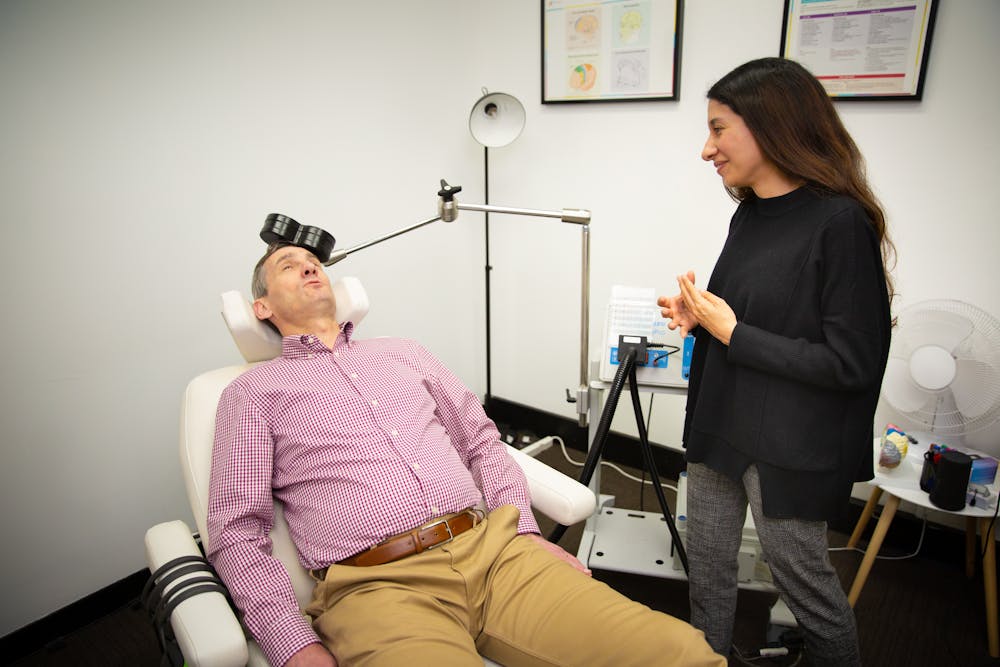
In rTMS, a machine produces and applies a highly targeted, pulsed magnetic field to a specific area of the brain, towards the front, known as the prefrontal cortex. This is an area we believe isn’t working normally in people with depression.

During treatment, an electrical current passes through an electromagnetic coil held near the scalp to stimulate the nerve cells.

The person sits in a comfortable chair, awake and alert during treatment. It’s quite different from electroconvulsive therapy (ECT, the modern version of shock treatment). Unlike ECT, rTMS does not involve producing a seizure and does not require the person to be asleep and under an anaesthetic.

Man receiving treatment, lying down with magnetic coil on head
People are awake and alert during rTMS treatment. Author provided

How does it work?

We know repeated rTMS stimulation, over the course of weeks, increases nerve activity in the area under the coil. It also changes the strength of connections between different areas of the brain. This is thought to help restore the normal interaction between brain regions, although these ideas are still theoretical and definitely not proven.

Antidepressant medications may act in similar ways, but less directly. The chemicals they affect can influence brain function quite widely: tuning activity or connectivity in brain circuits up or down. rTMS probably does this more directly. By directly making nerve cells fire we can directly change their activity levels. These more direct actions could possibly explain why rTMS may work in some people who have not responded to medication.

Trials show rTMS treatments result in a gradual improvement in depression. A person’s mood will slowly lift, usually over the course of several weeks, they will become more interested in things, sleep better, be more motivated and have more energy.

In people who respond, depression can go away for several months up to many years. If depression returns, most people will get better again with further treatment.


Read more: A bigger budget for mental health services won’t necessarily improve Australia’s mental health


Does it work? Is it safe?

Evidence collected over the past 25 years and collated shows rTMS is a safe and effective treatment for people with treatment-resistant depression. These are the 30-40% of people diagnosed with depression who have tried antidepressant medications, usually two or more, and haven’t seen any or sufficient relief. They have persistent, ongoing depression with major effects on their ability to function, work and lead normal family lives.

The treatment is usually well-tolerated. Although some people experience a strong tapping sensation on the scalp, scalp pain during treatment, or a headache afterwards.

Some 25 years of research have failed to identify any long-term negative consequences. People are much more likely to experience significant side-effects with antidepressant medications than with rTMS.


Read more: Electrical stimulation of the brain is a safe treatment for depression


Studies have also compared the effectiveness of rTMS with other treatments, such as different medications. This study, written by authors from the pharmaceutical industry, only reports the benefits of medications in the study abstract but rTMS was clearly the superior intervention on outcomes across the full analysis.

Finally, research including more than 5,000 people having the treatment shows it provides meaningful and valuable clinical benefits in the real world, outside clinical trials.

This treatment isn’t perfect

Like many medical treatments, rTMS is not perfect. We are trying to develop ways to improve outcomes by better individualising the treatment. For example, we are trying to better understand the exact spot to target in the brain and how to match the frequency of stimulation to an individual person’s pattern of brain activity.

We’re also trying to get around one of the biggest issues: its relative inefficiency.

A course of rTMS typically involves going to a clinic for a 30-minute treatment session, five days a week, for up to six weeks, which is time-consuming and requires a significant commitment. We are working to make the application less time-consuming and potentially shorten the duration of therapy.

One of the most significant implications of the government funding of rTMS therapy through Medicare is that it will become more widely available, including in outer suburban and rural areas.

The funding will take some months to be implemented but once available will be accessible by a referral from a GP or psychiatrist.


If this article has raised issues for you, or if you’re concerned about someone you know, call Lifeline on 13 11 14.

ref. What is repetitive transcranial magnetic stimulation and how does it actually work? – https://theconversation.com/what-is-repetitive-transcranial-magnetic-stimulation-and-how-does-it-actually-work-160771

No vaccine ‘targets’, but Australians could still be vaccinated by end of year

Source: The Conversation (Au and NZ) – By Driss Ait Ouakrim, Research Fellow, Population Interventions Unit, Centre for Epidemiology and Biostatistics, Melbourne School of Population and Global Health, The University of Melbourne

This week’s budget assumes Australians will be fully vaccinated against COVID-19 by the end of the year, despite Prime Minister Scott Morrison saying the government has no vaccination targets, modelling or forecasts.
Australians are eagerly watching the pace of the rollout, given this underpins a further budget assumption: international borders could re-open from mid-2022.

So are all Australians likely to be offered two COVID-19 doses by the end of the year?

Previous targets

In January, the government was aiming to vaccinate 80,000 people per week. It wanted 4 million Australians vaccinated by the end of March and the entire adult population vaccinated by October.

So far, we have only delivered 2.83 million doses.

The initial vaccination road map was derailed in part due to poor logistics, but more so due to lack of supply and sheer bad luck. Prioritising the AstraZeneca vaccine, with its local manufacturing capacity, seemed like a good bet but this was derailed by the rare — but real — possibility of blood clots.


Read more: What is thrombocytopenia, the rare blood condition possibly linked to the AstraZeneca vaccine?


The announcement overnight of 10 million doses of Moderna mRNA vaccine this year, and 15 million next year, suggests we will see AstraZeneca quietly shuffled off stage and replaced with Moderna. However, it is unlikely to impact the current timeline.

The AstraZeneca vaccine is recommended only for over-50s. AAP/Luis Ascui

Could we meet an end-of-year target?

In theory, yes.

Studies suggest around three-quarters of Australians are willing to have a COVID-19 vaccine. If we aim to have 75% of adults fully vaccinated with two doses this year, around 15 million Australians will need to receive 30 million doses over the next seven months.

About half of these people are 50+ or priority populations, and the other half are under 50. So that means 15 million doses before September 30 (assuming we continue using AstraZeneca), and 15 million doses from October 1, when greater stocks of the Pfizer and Moderna vaccine become available in the fourth quarter of the year.


Read more: I’m over 50 and can now get my COVID vaccine. Is the AstraZeneca vaccine safe? Does it work? What else do I need to know?


From now until September 30, we have 100 weekdays left to deliver 12.2 million vaccine doses, or 122,000 per day.

This is twice as many doses per day as we achieved in the past week. But it’s doable if we ramp up our vaccination capacity.

From October 1 to December 24, we have about 15 million doses to administer to vaccinate 75% of all remaining adults. This will mean 250,000 vaccinations per weekday, so doubling the daily number again in the “sprint”.

Again, this is doable if we get all our mass vaccination hubs well-oiled and efficient before then. And probably use weekends, too.

Mass vaccination hubs will need to be working efficiently in the final quarter of the year. AAP/James Gourley

Where it gets more challenging is if many people 50 and over elect to wait for Pfizer or Moderna, meaning an even bigger “sprint”. That would require an extremely reliable supply of these two vaccines before Christmas, well-oiled delivery systems and mass vaccination sites to deliver in excess of 300,000 doses per weekday.

This implied goal of offering vaccines to all adults by the end of 2021 is ambitious, but not impossible.

So when could we open borders?

Australia will still not have COVID-19 resilience (or “herd immunity”, or something approaching it) by the end of 2021.


Read more: We may never achieve long-term global herd immunity for COVID. But if we’re all vaccinated, we’ll be safe from the worst


If 25% of Australian adults are unvaccinated, plus 100% of children, some 40% to 45% of the population will remain unvaccinated, which is likely too low to achieve herd immunity.

Wholesale opening of our borders then is not possible – the virus would still spread with substantial disease and death.

To meet a mid-2022 target for substantially loosening border restrictions, we will need children to be vaccinated and further vaccination of adults hesitant in 2021.

ref. No vaccine ‘targets’, but Australians could still be vaccinated by end of year – https://theconversation.com/no-vaccine-targets-but-australians-could-still-be-vaccinated-by-end-of-year-160786

The budget should have been a road to Australia’s low-emissions future. Instead, it’s a flight of fancy

Source: The Conversation (Au and NZ) – By John Quiggin, Professor, School of Economics, The University of Queensland

Looking at other nations around the world, the path to cutting greenhouse gas emissions seems clear.

First, develop wind and solar energy and battery storage to replace coal- and gas-fired electricity. Then, replace petrol and diesel cars with electric vehicles running off carbon-free sources. Finally, replace traditionally made steel, cement and other industries with low-carbon alternatives.

In this global context, the climate policies announced in Tuesday’s federal budget are a long-odds bet on a radically different approach. In place of the approaches adopted elsewhere, the Morrison government is betting heavily on alternatives that have failed previous tests, such as carbon capture and storage. And it’s blatantly ignoring internationally proven technology, such as electric vehicles.

The government could have followed the lead of our international peers and backed Australia’s clean energy sector to create jobs and stimulate the post-pandemic economy. Instead, it’s sending the nation on a fool’s errand.

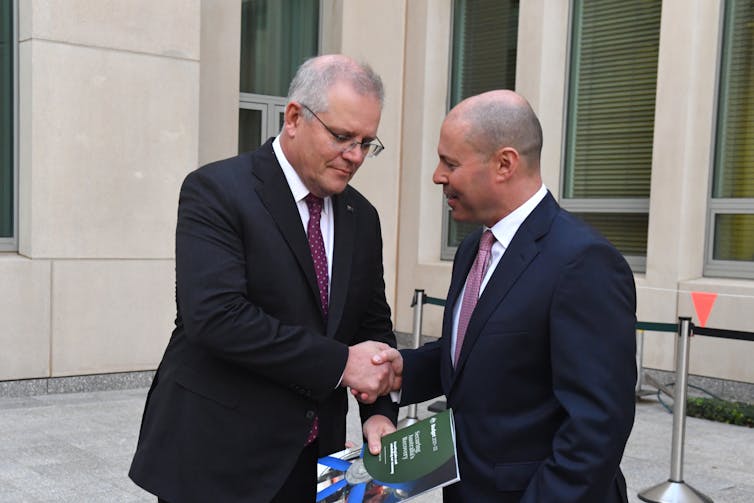
Prime Minister Scott Morrison, left, and Treasurer Josh Frydenberg shake hands
Prime Minister Scott Morrison, left, and Treasurer Josh Frydenberg should have used the budget to create jobs in the clean economy. Mick Tsikas/AAP

Carbon-capture folly

The Morrison government is taking a “technology, not taxes” approach to emissions reduction. Rather than adopt a policy such as a carbon price – broadly considered the most effective and efficient way to cut emissions – the government has instead pinned its hopes on a low-emissions technology plan.

That means increased public spending on research and development, to accelerate the commercialisation of low emissions technologies. The problems with this approach are most obvious in relation to carbon capture and storage (CCS).

The budget contains A$263.7 million to fund new carbon capture and storage projects. This technology promises to capture some – but to date, not all – carbon dioxide at the point of emission, and then inject it underground. It would allow continued fossil fuel use with fewer emissions, but the process is complex and expensive.

In fact, recent research found of 39 carbon-capture projects examined in the United States, more than 80% ended in failure.


Read more: The 1.5℃ global warming limit is not impossible – but without political action it soon will be


The government’s CCS funding is focused on capturing CO₂ from gas projects. This is despite the disappointing experience of Australia’s only CCS project so far, Chevron’s Gorgon gas field off Western Australia.

Some 80% of emissions from the operation were meant to be captured from 2016. But the process was delayed for three years, allowing millions of tonnes of CO₂ to enter the atmosphere. As of January this year, the project was still facing technical issues.

CCS from gas will be expensive even if it can be made to work. Santos, which has proposed a CCS project at its Moomba gas plant in South Australia, suggests a cost of $A30 per tonne of CO₂ captured.

This money would need to come from the government’s Climate Solutions Fund, currently allocated about A$2 billion over four years. If Moomba’s projected emissions reduction of 20 million tonnes a year were realised, this project alone would exhaust the fund.

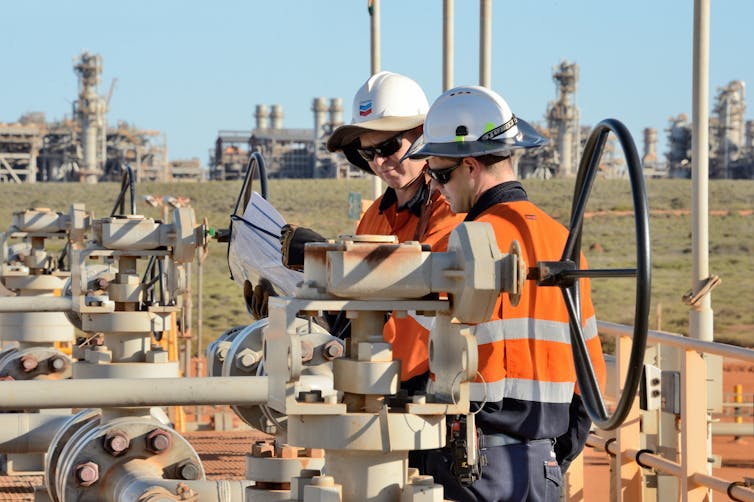
two men stand over equipment
Plans to capture carbon from Chevron’s Gorgon gas project have not gone to plan. Chevron Australia

What about electric vehicles?

There is a striking contrast between the Morrison government’s enthusiasm for carbon capture, and its neglect of electric vehicles.

It ought to be obvious that if Australia is to achieve a target of net-zero emissions by 2050 – which Treasurer Josh Frydenberg this week reiterated was his government’s preference – the road transport sector must be decarbonised by then.

The average age of Australian cars is about 10 years. This implies, given fairly steady sales, an average lifespan of 20 years. This in turn implies most petrol or diesel vehicles sold after 2030 will have to be taken off the road before the end of their useful life.

In any case, such vehicles will probably be very difficult to buy within 15 years. Manufacturers including General Motors and Volvo have announced plans to stop selling petrol and diesel vehicles by 2035 or earlier.

But the Morrison government has ruled out consumer incentives to encourage electric vehicle uptake – a policy at odds with many other nations, including the US.


Read more: The US jumps on board the electric vehicle revolution, leaving Australia in the dust


Despite the “technology, not taxes” mantra, this week’s federal budget ignored electric vehicles. This includes a A$10 billion infrastructure spend which did not include charging stations as part of highway upgrades.

Unless the government takes action soon, Australian motorists will be faced with the choice between a limited range of second-rate petrol and diesel vehicles, or electric vehicles for which key infrastructure is missing.

It’s hard to work out why the government is so resistant to doing anything to help electric vehicles. Public support appears strong. There are no domestic carmakers left to protect.

The car retail industry is generally unenthusiastic about electric vehicles. Its business model is built on combining competitive sticker prices with a high-margin service and repair business, and electric vehicles don’t fit this model.

At the moment (although not for much longer), electric vehicles are more expensive than traditional cars to buy upfront. But they are cheaper to run and service.

There are fears of job losses in car maintenance as electric vehicle uptake increases. However, car dealers have adjusted to change in the past, and can do so in future.

electric vehicle on charge
The budget ignored electric vehicles. Shutterstock

Wishful thinking

The Morrison government is still edging towards announcing a 2050 net-zero target in time for the United Nations Climate Change Conference in Glasgow this November. But as Prime Minister Scott Morrison himself has emphasised, there’s no point having a target without a strategy to get there.

Yet at this stage, the government’ emissions reduction strategy looks more like wishful thinking than a road map.


Read more: Australia’s states are forging ahead with ambitious emissions reductions. Imagine if they worked together


ref. The budget should have been a road to Australia’s low-emissions future. Instead, it’s a flight of fancy – https://theconversation.com/the-budget-should-have-been-a-road-to-australias-low-emissions-future-instead-its-a-flight-of-fancy-160775

The Mitchells vs The Machines shows ‘smart’ tech might be less of a threat to family bonds than we fear

Source: The Conversation (Au and NZ) – By Deborah Lupton, SHARP Professor, leader of the Vitalities Lab, Centre for Social Research in Health and Social Policy Centre, UNSW Sydney, and leader of the UNSW Node of the ARC Centre of Excellence for Automated Decison-Making and Society, UNSW

Robots have fascinated cinema-goers ever since Fritz Lang’s 1927 expressionist silent film Metropolis. The German dystopia film portrays a near future where a female robot (a “gynoid”) is built as an evil twin of Maria, a woman trying to unionise the workforce. The robot Maria wreaks havoc, turning the workers against each other, inciting murder and the destruction of the machines powering the city.

The portrayal of robots in popular culture has always captured the technological hopes and fears of the day, veering between hyperbolic promises and dystopian nightmares.

Black and white photo of sci fi robot
The original evil robot from Metropolis. IMDB

This millennium, Pixar’s animated WALL-E (2008) gave us warm fuzzies for a friendly and lonely garbage-cleaning robot. Comedy-drama Robot & Frank (2012) showed a close relationship developing between an older man and his care robot.

The psychological thriller Ex Machina (2014) featured Ava, another beautiful gynoid who attracts and then attacks her human creators. British sci-fi television series Humans (2015-18) picked up where Steven Spielberg’s A.I. (2001) left off, exploring the blurred lines when humanoid robot servants join households.

Now we have Netflix’s The Mitchells vs. the Machines, where the very ordinary Mitchell family — mother Linda (Maya Rudolph), father Rick (Danny McBride), teenage daughter Katie (Abbi Jacobson) and younger son Aaron (Mike Rianda) — are forced to unite against menacing robots out to rid the Earth of humans.

‘We’re the Mitchells … the only people who can save the world. Sorry about that.’

The film presents a nuanced portrayal of our relationship with machines. It makes fun of the hype and idolatry pervading digital technology, responds to our anxieties about new technology, and reminds us old tech is sometimes better than over-designed, unnecessarily “smart” devices.

Eyes down

While films such as Metropolis expressed fears about intelligent machines gaining control over humans, The Mitchells vs. the Machines taps into our fears of technology interfering with our relationships.

At family dinner, Rick begs the others to look up from their phones and make eye contact just for once.

Katie has gained entry to film school, and feels her father doesn’t understand her obsession with her phone and digital film-making. Rick longs to resume the kind of close relationships he had with Katie when she was a little girl. He proudly drives a battered, “non-smart” car and wants to teach his children old-fashioned survival skills.

Production still reads 'Accept Katie Mitchell'
Katie loves using technology to make movies, and gets herself accepted into film school. Netflix ©2021 SPAI. All Rights Reserved.

Directors Mike Rianda and Jeff Rowe populate The Mitchells vs. the Machines with modern household technology gone bad, until the Mitchells find themselves battling killer androids unleashed by a smartphone voice assistant named PAL (Olivia Colman) — a nod to the malicious HAL of 2001: A Space Odyssey (1968).

At first glance, PAL is not fancy. She is a simple face emoticon on a smartphone display with a female voice. However, she holds hidden depths.

Like the robots Will Smith battles in I, Robot (2004), PAL displays human feelings and autonomy. Rejected by the tech entrepreneur who created her in favour of a new line of domestic robots, PAL reprograms all robots to be killing machines, hunting down humans and sending them into space.


Read more: From HAL 9000 to Westworld’s Dolores: the pop culture robots that influenced smart voice assistants


One of the scariest moments is when the Mitchells and some robot allies find themselves in a shopping mall, attacked by any machine with a chip linked to the PAL network. Smart toasters, vacuum cleaners, fridges, vending machines, kettles, washing machines — and even an army of Furby toys — form a relentless robot battalion.

But the family’s human inventiveness and analogue survival skills help them live to fight another day.

Animated film still
Attack of the killer Furby. IMDB

Ghosts in the machines

Neither humans nor their devices are free of faults in this film.

The humans have become dependent on their smartphones, social media and other digital devices: aspects of our everyday lives have become digitised for no apparent benefit.

But unlike previous portrayals — such as in The Social Dilemma (2020) — this dependence is not seen as permanent or pathological. Here, the boundaries between “good” and “bad” technologies are blurred, as is the line between “human” and “nonhuman”. We see both human and machine ingenuity, and human and machine hubris.

Human action is the initiator of the robot Armageddon, when an arrogant tech mogul, Dr. Mark Bowman (Eric Andre), treats PAL badly. Bowman displays little human feeling; PAL displays all the hurt of a jilted human lover.


Read more: Will robots make good friends? Scientists are already starting to find out


When the first audiences watched Metropolis almost a century ago, robots were the frightening stuff of future technologies not yet invented. As computer technologies began to enter homes and workplaces, films increasingly showed robots as slaves (The Stepford Wives), companions (Star Wars) and domestic helpers (Bicentennial Man) — or in worlds unto themselves (Robots).

In this era of the Internet of Things, Australians own 21.6 million smart phones, and 32.7% of houses have smart devices.

The Mitchells vs the Machines suggests there is a new give and take between humans and machines. Digital devices can be fun and useful, and are less of threat to our relationships than we might fear.

Indeed, these technologies can be more vulnerable and much less resilient than even the most dysfunctional human family.


Read more: Robots were dreamt up 100 years ago – why haven’t our fears about them changed since?


ref. The Mitchells vs The Machines shows ‘smart’ tech might be less of a threat to family bonds than we fear – https://theconversation.com/the-mitchells-vs-the-machines-shows-smart-tech-might-be-less-of-a-threat-to-family-bonds-than-we-fear-160442

Money for telescopes and vaccines is great, but the budget’s lack of basic science funding risks leaving Australia behind

Source: The Conversation (Au and NZ) – By John Shine, President, Australian Academy of Science; Laboratory Head, Garvan Institute

The story of the past year has been the pandemic: from the first outbreaks in early 2020, the identification of the SARS-CoV-2 virus and methods to detect it, through to lockdown and quarantine measures, vaccine development, testing and finally distribution. The pandemic is not over, but the recovery has started.

At each stage, it has been scientists and researchers at the forefront of a rapid and successful national and global response to the pandemic. A nation’s capacity to respond to threats like a pandemic does not exist in a vacuum. It depends on scientists. You can’t research a solution without researchers.

In Australia, the higher education sector performs the vast bulk of research, including basic foundational research. This sector has been hit extremely hard by the pandemic, losing billions in revenue leading to the loss of research capacity — the very capacity we need to continue to respond to the pandemic and recover.

For this reason, the lack of recognition for science and scientists in the federal budget, and in particular for the foundational capacity in basic discovery science, is perplexing indeed. Such science capability underpins Australia’s resilience, not just against pandemics but also against natural disasters, economic shocks, technology disruption, the needs of an ageing population, and cyber warfare – many of the government’s stated priority areas.

There is some new funding in the budget, which is welcome. Initiatives such as support for the Square Kilometre Array radiotelescope, supporting women in STEM, climate adaptation, clean energy and government digital resources are essential additions to the Australian scientific landscape. The proposed patent box system promises to stimulate investment in Australian science in medical technologies and clean energy.


Read more: Cuts, spending, debt: what you need to know about the budget at a glance


Much of this funding is for incremental, short-term, focused technology programs. But such mission-directed science, while worthy, does not substitute for discovery science. If the government wants these missions to be effective, it must invest in basic science too.

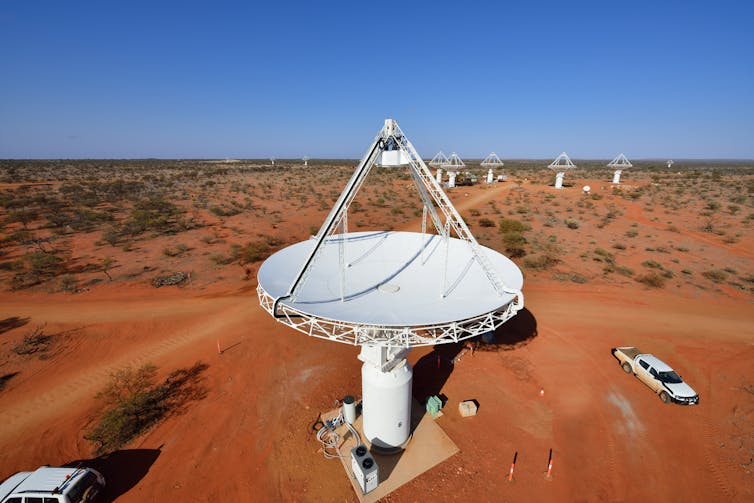
SKA Pathfinder telescope
The SKA Pathfinder telescope in the Western Australian outback is a precursor to the full-scale Square Kilometre Array. CSIRO/Dragonfly Media

If universities are being asked to pivot away from over-reliance on international student income, and towards research commercialisation, there must be a basic science pool to help fuel this translation of research findings into commercial outcomes. At the risk of mixing metaphors, the pivot will be ineffective without a pipeline.

More importantly, the budget does nothing to stem the loss of university science jobs. Failure to act on university funding before the start of the 2022 academic year will mean more university job losses – and it is clear from the decisions already taken at ANU (in science and medicine), Melbourne, Macquarie and Murdoch that these cuts will come from science research.

Medical manufacturing capability

While the government has not revealed in the budget how much money it has committed to onshore mRNA vaccine manufacturing, it is welcome news that there is commitment to developing this capability that will serve the nation well for decades.

The Australian Academy of Science is pleased the government has heeded our advice to future-proof Australia by developing this capability. It will allow Australia to build resilience against future pandemics and potential biosecurity threats that require us to have the onshore capacity to mass-produce vaccines.

Australia will require significant capability development alongside a manufacturing facility. A pipeline of knowledge will need to be developed, from fundamental to applied research related to mRNA vaccines and therapeutics. Australia will need a nationwide consortium of multidisciplinary expertise, in everything from data science to materials engineering, to become a world leader in this new technology.

Building our research capability in this area will allow us to continue solving existing challenges with mRNA vaccines. That’s why the science sector must be included in the scoping and investment in this new capability.


Read more: Did someone drop a zero? Australia’s digital economy budget spend should be 10 times bigger


When I was appointed president of the Australian Academy of Science in 2018, I spoke about how it can take decades to translate the outcomes of basic research into something of real value for the community. This remains the case. It has always been the case.

Often, our political leaders want instant answers to the big questions. Australia’s science and research community delivered when it came to COVID-19, but it must be supported and funded to continue making fundamental discoveries if it is to deliver again. The future prosperity of our nation depends on it.

ref. Money for telescopes and vaccines is great, but the budget’s lack of basic science funding risks leaving Australia behind – https://theconversation.com/money-for-telescopes-and-vaccines-is-great-but-the-budgets-lack-of-basic-science-funding-risks-leaving-australia-behind-160780

How snake fangs evolved to perfectly fit their food

Source: The Conversation (Au and NZ) – By Silke Cleuren, PhD candidate, Monash University

Few structures in nature inspire more fear and fascination than the fangs of venomous snakes.

These needle-like teeth are used by snakes to pierce their prey and inject deadly venom. With more than 3000 species of snake inhabiting our world, we wondered: are all their fangs the same? Or are their fangs differently shaped depending on what they eat, as we find in other animal groups?

To uncover the answer, we examined the three-dimensional shape of snake fangs in 81 species and found that fangs have indeed evolved to suit the snake’s preferred prey, from hard-shelled crabs to furry mammals. Our results are published in the journal Evolution.

Differences across snake families

Venomous snakes are found all over the world and belong to five big families: vipers, atractaspidids, elapids, colubrids and homalopsids. Throughout evolution, each of these families independently “designed” their fangs and venom delivery systems, which led to slight differences.

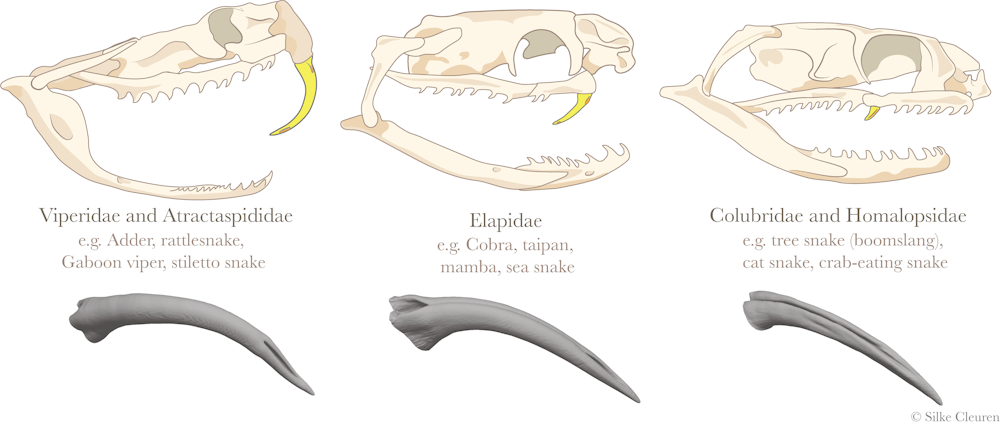
Overview of the skulls across the different venomous snake families
Overview of the skulls across the five venomous snake families. Note the difference in the position of the fang inside the mouth, the size difference and the size of the (maxillary) bone the fang is attached to. Silke Cleuren

Vipers and atractaspidids have long tubular fangs that flip out when they strike, elapid snakes have short tubular fangs that are fixed to the jaw, and colubrids and homalopsids have grooved fangs all the way at the back of their mouths.

Teeth are adapted to diet across the animal kingdom

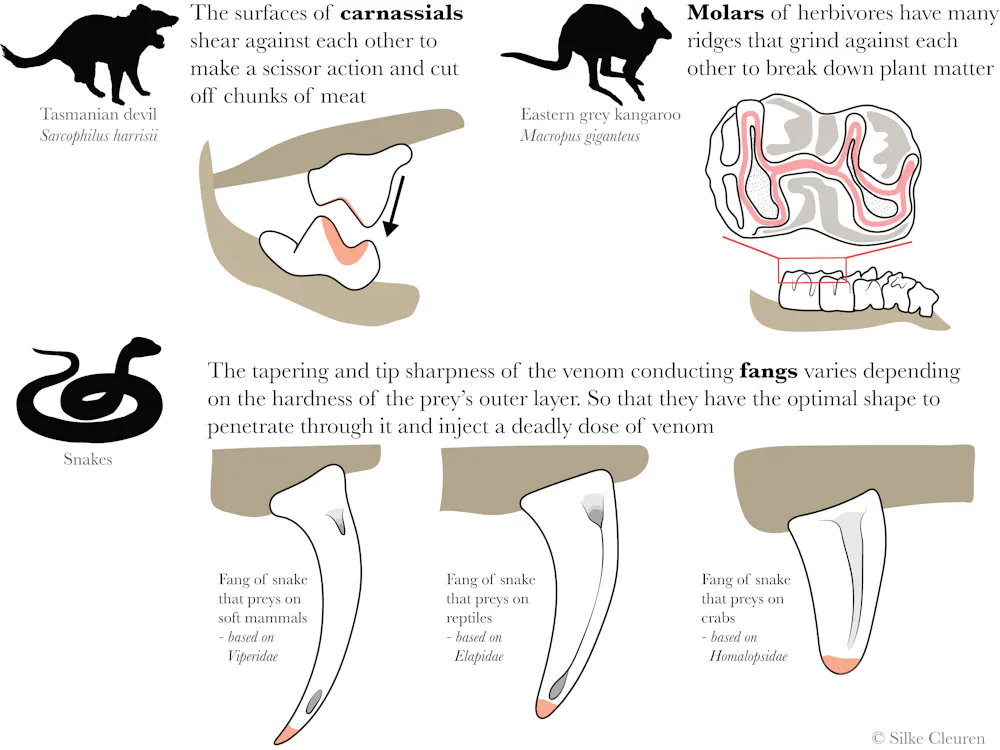
Variations in tooth shape according to diet are common in the mammal kingdom. Carnivores often have bladed cheek teeth to tear flesh, and herbivores have ridged molars to grind down leaves, roots, and other plant matter.


Read more: What teeth can tell about the lives and environments of ancient humans and Neanderthals


Venomous snakes vary in the types of prey they target. Some specialise in small mammals such as mice, some go for fish, shrimps or crabs, and some hunt reptiles and even other snakes. There are also generalists, which almost anything they can fit in their mouths.

Variation of tooth shapes across the animal kingdom
Variation of tooth shapes across the animal kingdom. This illustration shows that depending on the food you eat different optimal tooth shapes have evolved that are good at coping with the preferred food source of the animal. Silke Cleuren

Linking fang shape to diet

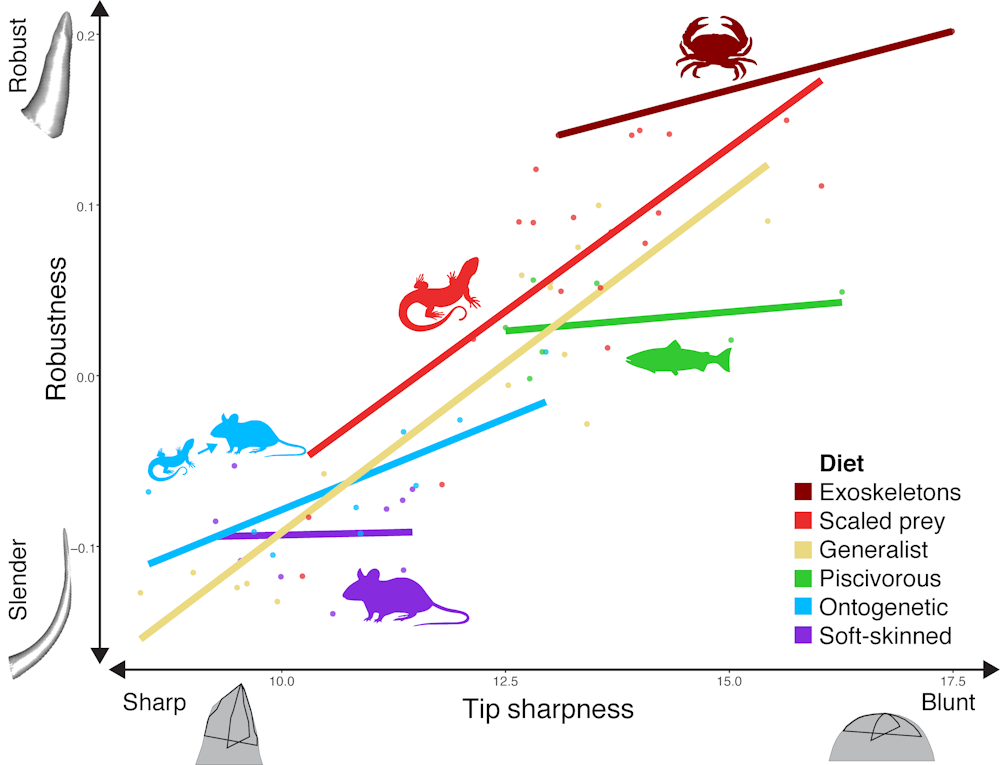
We examined the three-dimensional shape of fangs from 81 snake species belonging to four families, with the exception of the rare atractaspidids. By measuring differences in the strength and sharpness of the fangs, we were able to show how fang shape is closely tied to prey preference.

Graph showing variation in fang robustness and tip sharpness across snake diets
Variation in fang tip sharpness (x-axis) and robustness (y-axis) for each of the different diet categories found in snakes. The fang shapes found in snakes with a specific diet are represented by the coloured lines. Silke Cleuren

Fangs are more robust and blunt in species that target tougher prey, such as lizards and crabs, and more slender and sharp-tipped in species that target prey with softer skins, such as mice. Additionally, we found fang shape demonstrated “evolutionary convergence”: the fangs of distantly related species with the same diet are more similar than those of closely related species with different diets.

Predicting the diet of rare and fossil snakes

Knowing more about the foods each type of snake likes can be valuable for the future success of both snakes and their prey. In Australia, most threatened snake species are affected by loss of habitat, which likely also results in the inability to catch their preferred prey.

By investigating their fangs we can now predict the group of prey it most likely prefers. If we were to relocate snakes, we could use this information to choose a suitable habitat that contains its favourite meal.


Read more: Like a jackal in wolf’s clothing: the Tasmanian tiger was no wolfish predator — it hunted small prey


This knowledge can also be used in the other direction, for the conservation of threatened prey species, by protecting them against snakes that are a threat to them.

Silke Cleuren

Investigating the fangs from fossils of ancient snakes can shed light on which prey they likely targeted and how their habitat might have looked. Knowing the fang shapes of fossil snakes can help explain the wide variation in fangs we see today and how this variation ensured the continued success of some of nature’s most specialised predators.

Can we use this to improve protective clothing?

Given the threat snakes can pose to humans, understanding how fang shape varies can also help us to design better protective clothing. By testing how easily different fangs penetrate fabrics and other materials, we can make better choices of materials that actually protect against snake bites.

This could result in the improvement of clothing like hiking pants or shoes that will keep us safe if we accidentally get too close to a grumpy snake while trekking through their habitat.

Protective clothing – snake gaiters. Snakeprotex

ref. How snake fangs evolved to perfectly fit their food – https://theconversation.com/how-snake-fangs-evolved-to-perfectly-fit-their-food-159932

How can the world help India — and where does that help need to go?

Source: The Conversation (Au and NZ) – By Dileep Mavalankar, Vice President western region, Public Health Foundation of India

India is in the grip of an unprecedented second wave of COVID-19.

Official data suggests new cases have crossed 400,000 per day, and the daily death count is around 4,200. But the actual numbers may be significantly higher.

We know the hospital system is stretched beyond its limits and there are dire shortages in the country’s expanded vaccine drive.

Clearly, India is in need of help from beyond its borders. What can other countries do?

Help already pledged

In this moment of crisis, the international community has already stepped in to provide some help.


Read more: ‘Each burning pyre is an unspeakable, screeching horror’ – one researcher on the frontline of India’s COVID crisis


Several countries including the United States, United Kingdom, United Arab Emirates, Russia, Germany, and France have already sent aid such as oxygen and related equipment,, ventilators, medicines and ICU equipment. The US has also said it will provide vaccine help, and critical drugs.

Australia has announced it will sent ventilators, surgical masks and other personal protective equipment.

How should this help be used?

This aid is all critical. But given the size of India’s population — almost 1.4 billion — more will be needed and even this will not be enough.

Given this, we need to make best use of the incoming aid. India needs to conduct a quick national and state-level needs assessment exercise. Where is help most needed? And where can it be most useful?

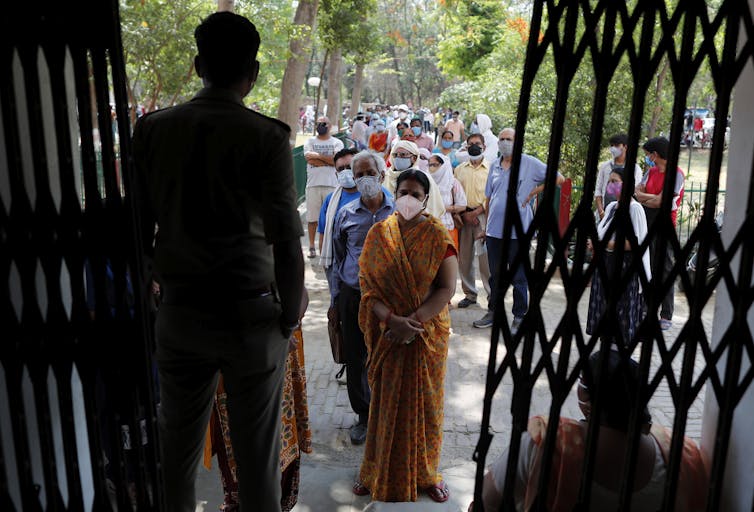
Indians in Prayagraj line up for a COVID vaccine.
India’s vaccine program has begun but has been hit by shortages. Rajesh Kumar Singh/AP/AAP

This should include an assessment of capacities for care and utilisation by each major city and rural area. For instance, there’s a need to evaluate diagnostic and testing capacities and their distribution across the country. An important measure missing at this point is high capacity testing systems which can help increase testing.

The review would also help answer: what are the strengths of the private and NGO sectors and how can they be harnessed? Where exactly are the most vulnerable, and how best can we reach them? Such a review would also help in ensuring that sophisticated machines such as ventilators are not sent to places where they cannot be operated or maintained.

At the same time, there’s a need to look for available internal funds and services that can strengthen India’s efforts.

The importance of vaccines

Given the emerging shortage of vaccines, they will, of course, be the most helpful gift in the long run. Many countries have booked more than they need. Such excess vaccine doses can be offered to India, as it will need millions of doses of imported vaccine to cover its population rapidly.

Besides the very visible gaps in emergency and critical care — such as oxygen and ventilators — technical expertise in epidemiology, biostatistics, data sciences and modelling as well as diagnostic technology would be very useful.


Read more: COVID crisis in India: why its public health strategy failed


We need help in conducting expert analysis of the situation, prediction modelling by each state and city, and assistance on how to improve systems to record and analyse the huge amount of data that is streaming in.

Sharing knowledge and collaboration in areas such as understanding mutations via gene sequencing, identification of variants of concern, and studying their virulence and transmissibility will also help.

Such efforts are intangible and would fall in the realm of “knowledge aid”, and hence, governments may not be keen to prioritise this. But foreign support could also come in the form of specific funds and grants.

Help must come with no strings attached

In this process, the countries offering the support should not put any conditions or delay the process. Immediate assistance is needed as the peak of the current wave seems to be only a few weeks away.

This support should reach where the most vulnerable get COVID services: public hospitals, healthcare centres run by non-government organisations, and community COVID care centers. The technical help in epidemiology and data sciences should be given to state health departments and major research centres located in cities.

Most importantly, foreign support should strengthen the health system and not be a burden on it.

Only if we are in it together, can we all hope to defeat the virus.

ref. How can the world help India — and where does that help need to go? – https://theconversation.com/how-can-the-world-help-india-and-where-does-that-help-need-to-go-160174

NZ Budget 2021: we need the arts to live, but artists need to earn a living

Source: The Conversation (Au and NZ) – By Mark Harvey, Senior Lecturer in Creative Arts, University of Auckland

It seems unlikely the arts will be a priority in the government’s May 20 budget. With housing affordability, climate change and child poverty all urgent issues, arts funding might not be seen as equally important.

I argue it is — for two main reasons: it makes economic sense, and it is also essential to our health and well-being in myriad ways. The two are, of course, interrelated.

Despite the wider arts sector accounting for up to 7% of the total workforce, it receives a disproportionately small proportion of overall government spending.

Last year, arts, culture and heritage were given just 0.33% of the total 2020 Budget and COVID-19 Recovery package (NZ$374 million out of $112.1 billion). This was an increase on previous years, but still miniscule compared with other sectors.

And yet the performing arts alone contributed $2.3 billion to the economy in 2018. According to the Ministry for Culture and Heritage, the sector “matched or outpaced other sectors of the economy in terms of income, employment and value added”.

Furthermore, New Zealanders participate in cultural activities at least as much as in sports and other recreations. For Māori, arts and culture overshadow sports and other leisure activities.

The myth of suffering for your art

Still, the arts struggle to secure continued long-term funding. For example, a scheme such as the Pathway to Arts and Culture, removed in 2011 by the National-led government, has not been reintroduced. But this could secure a liveable income for many working in the creative arts.

According to a 2019 survey by Creative New Zealand, the average annual income of freelance creative artists was just $15,000. Without greater support and investment, artists will continue to be some of the country’s lowest earners.


Read more: If New Zealand can radically reform its health system, why not do the same for welfare?


Some people will be unsympathetic. There are persistent myths about the creative arts – that it is not “real work” and that artists must “suffer for their art” – that contribute to negative perceptions of the sector.

But these notions are just that – myths. There is no evidence creativity requires practitioners to suffer, that it is part and parcel of being creative. We know the arts can improve mental health, but working in poverty as an artist can do quite the opposite.

Understanding the place of art in society

In my role as a parent, educator and arts practitioner, however, I often hear those myths expressed — that those working in the sector are not contributing to society in any meaningful or useful way, that they should “get a real job”.

These views are reinforced in many ways. The creative arts are not compulsory at all secondary schools, and anecdotal evidence suggests guidance counsellors often steer students away from careers in the arts.

All this suggests overly narrow definitions are at work. I define the creative arts as including any discipline – from writing to fine arts to film and television production – that exists in community, educational and professional contexts.


Read more: Has the government rescued the arts in this budget? There are some winners but not much has changed


If our appetites for Netflix and Spotify are anything to go by, we turn to the creative arts every day. They are a fundamental part of our lives, identities and ways of seeing the world.

We could learn from Te Ao Māori (the Māori world) where everything is interconnected and the creative arts are integral, not just “cultural relief” to ease our daily toils as workers or part of a temporary COVID recovery package.

In Te Ao Māori the arts help communicate who we are, our spirituality, our well-being and our whakapapa. They are an essential part of our tikanga that we use to navigate existing together as whanau, communities, iwi and hapū.

Jacinda Ardern meeting the cast of Mary Poppins on stage
The arts are integral: Prime Minister and Associate Arts Minister Jacinda Ardern meets the cast of Mary Poppins in Auckland during the 2020 election campaign. GettyImages

We need the arts more than ever

It’s not that the government doesn’t acknowledge the role of the arts in the nation’s health and well-being. Prime Minister and Associate Minister for Arts Jacinda Ardern has spoken and written publicly about this on several occasions.

The government has also used temporary support packages to help arts organisations and professionals through the pandemic. However, there have been no significant long-term funding increases for arts practitioners, nor for arts education, and most COVID grants are limited to building commercial capacity.

What to do? The government needs to consult with practitioners, researchers and experts across all genres of arts practice to determine how and where to invest for the best returns, and how to build a sustainable life as an artist.


Read more: Artists’ welfare: why it’s time to act


For too long arts practitioners have been told what they need by central and local government and arts managers, or asked repeatedly to prove the value of what they do. As my colleague Molly Mullen has argued:

What is needed in Aotearoa is not another blunt impact assessment tool, but an informed, critical conversation about what resources, support, tools and knowledge are needed.

With current existential crises such as COVID-19, climate change, growing inequality, housing security and populist politics, we need the creative arts more than ever to make sense of the world and how to live in it.

Now is the time for our government to show the value it places on that vital function.

ref. NZ Budget 2021: we need the arts to live, but artists need to earn a living – https://theconversation.com/nz-budget-2021-we-need-the-arts-to-live-but-artists-need-to-earn-a-living-160761

‘Top down’ disaster resilience doesn’t work. The National Recovery and Resilience Agency must have community at its heart

Source: The Conversation (Au and NZ) – By Mark Duckworth, Senior Research Fellow, Centre for Resilient and Inclusive Societies, Alfred Deakin Institute for Citizenship and Globalisation, Deakin University, Deakin University

In the past ten years we have seen several major reports and announcements seeking to improve and transform the way emergency management works in Australia.

The National Recovery and Resilience Agency, announced last week and funded in Tuesday’s budget, is the latest.

After the 2009 Bushfires and the 2010-11 Queensland floods, the Council of Australian Governments endorsed the 2011 National Strategy for Disaster Resilience, which identified a need

[…] to develop and embed new ways of doing things […] to improve disaster resilience and prevent complacency setting in once the memory of a recent disaster has subsided.

Now, the new National Recovery and Resilience Agency will

[…] provide support to local communities during the relief and recovery phases following major disasters” along with hundreds of millions of dollars “invested in a new program of disaster preparation and mitigation.

This will certainly improve the way Australia prepares for and recovers from the increasing number of natural disasters we face. But will this new agency deliver the change we need?


Read more: The government has pledged over $800m to fight natural disasters. It could be revolutionary — if done right


A focus on resilience

A decade ago, few people in emergency management were embedding resilience into their thinking.

But more recently, the 2020 Royal Commission into National Natural Disaster Arrangements, established in the wake of the catastrophic fires of last summer, contained more than 300 references to resilience.

“Resilience” is part of the new agency’s title, as it is also with Resilience NSW, the name of that state’s lead on disaster management.

Communities are now at the centre of emergency management policies. Organisations such as Bushfire Recovery Victoria state:

Recovery can’t be about government telling communities how it’s going to be. It must be about listening, working together, and ensuring that rebuilding and recovery are both locally driven and delivered.

Will the new agency further this change?

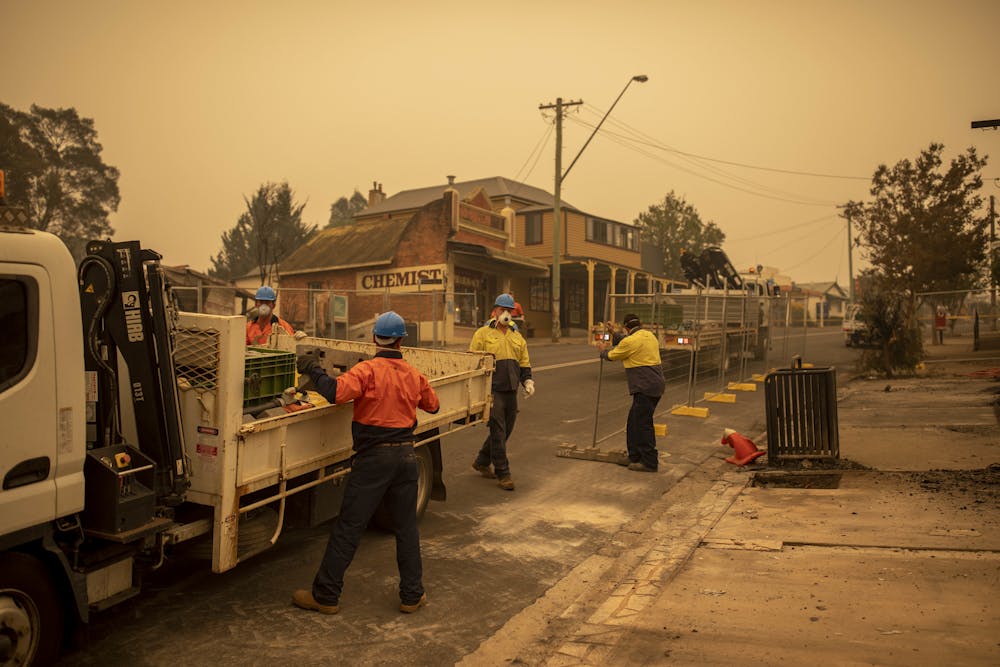
People help erect fences in a bushfire-affected town.
Effective recovery is planned in advance and is embedded in the initial disaster response. AAP Image/Sean Davey

Changing the relationships between communities and government

While superb emergency response is clearly vital, the new National Recovery and Resilience Agency can build on the reforms of the past decade. It needs to further the shift to a much broader community-centred approach.

We must remember “disaster resilience” is not just some buzzword or brand name for grants or disaster-themed programs. It is about changing the relationships between communities and government.

This means recognising a community’s existing knowledge, skills, structures and networks, and using them to co-design programs and projects.

Resilient communities:

  • function reliably and well under stress
  • successfully adapt
  • are self-reliant
  • have high levels of social support, social cohesion, and social capacity.

Governments are moving away from the model in which officials plan and deliver a service after community consultation. Co-designing local initiatives involves the community and government joining up to design and deliver a program. It is more than just improving community consultation.

This approach helps strengthen communities and their resilience — but it takes time and money. And that time and money must be invested before disaster strikes.

Members of a flood-affected community clean up.
Resilient communities have high levels of social support, social cohesion, and social capacity. AAP Image/Dan Peled

Hope — but warning signs, too

The Royal Commission into National Natural Disaster Arrangements recommended in its final report last year that an agency such as this be created, dedicated to

[…] championing resilience across the nation[…] Its remit should be to think broadly about all of the measures necessary to make the country resilient to natural disasters, and plan and respond accordingly.

Will the National Recovery and Resilience Agency be this champion? There is hope with the new agency’s guiding principle of “locally led recovery”. But there are also some warning signs.

Australia already has the roadmap for this change in the National Strategy for Disaster Resilience and the 2018 National Disaster Risk Reduction Framework.

In carrying out its role of providing policy advice to government, the new agency must focus on fulfilling the vision of the existing key strategies and not reinvent them.


Read more: More than a decade after the Black Saturday fires, it’s time we got serious about long-term disaster recovery planning


There is some real money (A$600 million) for disaster preparation and mitigation. It is not a lot compared to the billions of dollars lost through natural disasters, but it’s a start. This type of investment must become core funding.

Welcome, too, is the funding for disaster recovery scenario training and two pilot Resilience Hubs. The pilot resilience hubs will coordinate regional training and capability development across all levels of government.

However, this does not replace the loss of a dedicated centre like the former Australian Emergency Management Institute (AEMI), which closed after cuts announced as part of the 2014-15 federal budget.

It is a good move to have a dedicated agency to provide support to local communities during the relief and recovery phases following major disasters, and to focus on long-term recovery.

We know effective recovery is planned in advance and is embedded in the initial disaster response. This is why resources must be invested in advance, and not just after disasters.

A woman looks at her flood-damaged house
Post-disaster recovery happens over the long term. AAP Image/Dan Peled

There are also some potentially complex governance, and intergovernmental, issues. How will the new agency relate to the work of Emergency Management Australia and to state recovery agencies?

Locally led recovery is crucial

Will the new National Recovery and Resilience Agency be able to lead the emergency management sector to the next phase in which communities are provided with resources to develop their own plans and tailor actions to local needs?

Or will it be another top-down government agency doing things to people rather than doing things with them?

Although policies now talk about being community centred, many communities still see themselves as being left out of emergency planning and recovery. Government agencies often lack local knowledge.


Read more: ‘We know our community better than they do’: why local knowledge is key to disaster recovery in Gippsland


Also, as disaster research expert Lisa Gibbs points out in another article on The Conversation:

We must allow people to recover at their own pace, in their own way and have long-term support in place to do that.

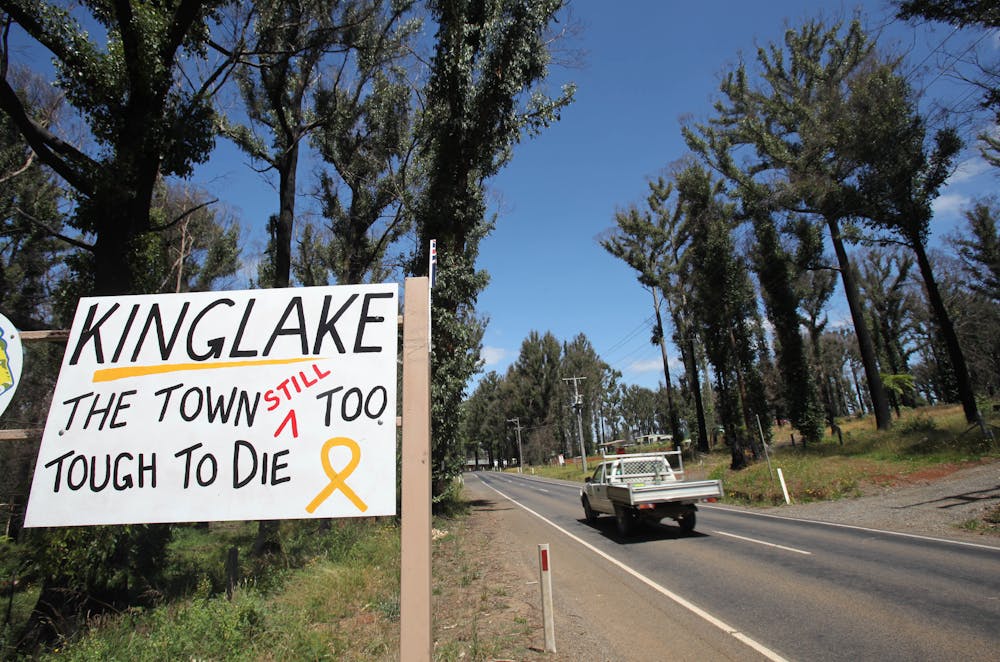
A sign outside a fire affected town says 'Kinglake, the town still too tough to die'.
Resilient communities function reliably and well under stress. AAP Image/David Crosling

Disaster resilience is not built through increased centralisation. Indeed, the core of resilience building is to let local communities develop customised approaches based on their own understanding of the risks with which they live. Doing this well requires trust and building relationships of trust require time.

Will initiatives be co-created with communities, based on existing community strengths, and reflecting the local context?

How will the success of the new agency be measured? It must be more than just delivering a certain number of grants and programs.

The real success of the National Recovery and Resilience Agency will be not only in what it does, but in how it carries out its work, in the relationships it forges, and in the trust it gains.


This story is part of a series The Conversation is running on the nexus between disaster, disadvantage and resilience. You can read the rest of the stories here.

ref. ‘Top down’ disaster resilience doesn’t work. The National Recovery and Resilience Agency must have community at its heart – https://theconversation.com/top-down-disaster-resilience-doesnt-work-the-national-recovery-and-resilience-agency-must-have-community-at-its-heart-160363

Hold the celebrations — the budget’s supposed focus on women is no game-changer

Source: The Conversation (Au and NZ) – By Elizabeth Hill, Associate professor, University of Sydney

One of the major planks of the budget was a pitch to women.

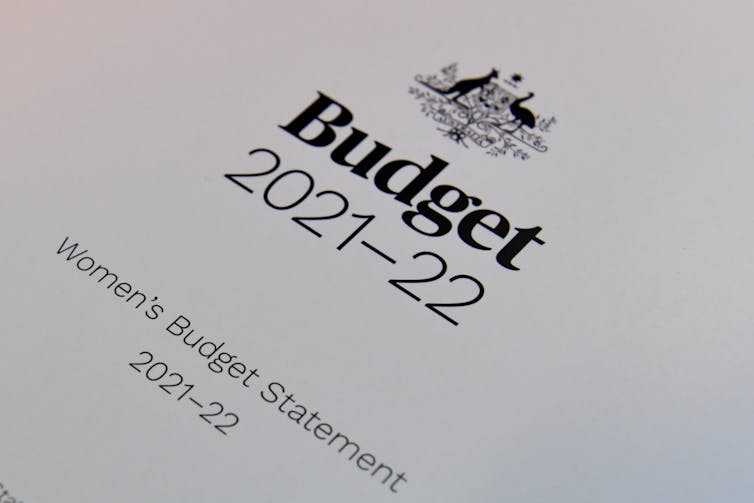
This included an 80-plus page women’s budget statement — the first since 2013 — with an overall figure of A$3.4 billion for women’s safety, economic security and health.

After the “hard hat” budget in October 2020 that was criticised for its “blokey” focus, the government was under pressure to deliver more for women.

This also comes as polling data show support for the Coalition among female voters is slipping, following months of scandals about the treatment of women in politics.

Now we have the detail, is this budget as “women friendly” as the Morrison government would like us to believe?

The short answer

This budget is not a game-changer for women’s economic security.

Treasurer Josh Frydenberg included a section on women in his budget speech, but the highly targeted and modest nature of the relevant initiatives, combined with a lack of action in critical gender equality policy areas, has left women’s opportunities for economic security largely unchanged.

Let’s examine some of the specific policy areas.

The childcare subsidy

The $1.7 billion in extra funding for childcare subsidies was announced pre-budget and is a modest addition to the more than $10 billion spent each year on early childhood education and care. The new money is spread over three years and is tightly targeted, aimed at reducing the out of pocket expenses of families with two or more children under six years in approved services.

Children playing at a Canberra daycare centre.
Extra funding for childcare makes up about half of the spending in the women’s budget statement. Mick Tsikas/AAP

The government estimates the change will benefit around 250,000 or one quarter of families who use early childhood services, and is expected to have only a modest impact on women’s labour supply. Families with one child in a service are not eligible for the reduction.

Removal of the annual $10,560 cap on the total subsidy available to higher income families is forecast to benefit around 18,000 families and reduce the disincentive for women in these households to work an extra day or two.

These changes will be good for those who qualify, but they inexplicably don’t apply until July 2022. They also make an already complex system even more complex.


Read more: ‘Insulting’ and ‘degrading’: budget funding for childcare may help families but educators are still being paid pennies


The highly-targeted measures do not move Australia closer to the universal system of low-cost or free high-quality childcare that will deliver maximum benefit to children, women’s labour force supply and economic prosperity.

There is also no change to the work test and the reduction in subsidised access for children from vulnerable families. Both of these are unfortunate features of the existing scheme and disadvantage children who need early learning and care the most.

Superannuation

Another key measure was the abolition of the $450 per month income threshold under which employers do not have to pay the superannuation guarantee. This is estimated to affect around 200,000 women, especially those holding multiple short hours and low paid jobs.

But while payment of the superannuation guarantee will boost retirement savings, it won’t make a substantial difference to women’s retirement income and security.


Read more: Politics with Michelle Grattan: what should the budget do for women? Jennifer Westacott (BCA) and Michele O’Neil (ACTU)


Superannuation is a workplace entitlement that directly reflects women’s employment history.

Women’s disproportionate employment in part-time, low wage and insecure work, compared with men, means the most direct way to fix inequalities in superannuation balances is to support men and women to share care responsibilities for young children, the ill, disabled and elderly family, while also bolstering the quality of essential care services.

This will reduce the time women spend out of the labour market doing unpaid care. Improving wages in feminised sectors and closing the gender pay gap across the economy is also critical to growing women’s retirement incomes.

Missed opportunities

What is not in a budget can be as important as what is.

Failure to improve the national paid parental leave system — now ten years old — is a significant missed opportunity. Women’s economic security depends upon a robust system of properly funded, gender neutral paid parental leave. My recent research shows young Australian men want to share the care of children with their partner and value gender equality at home.

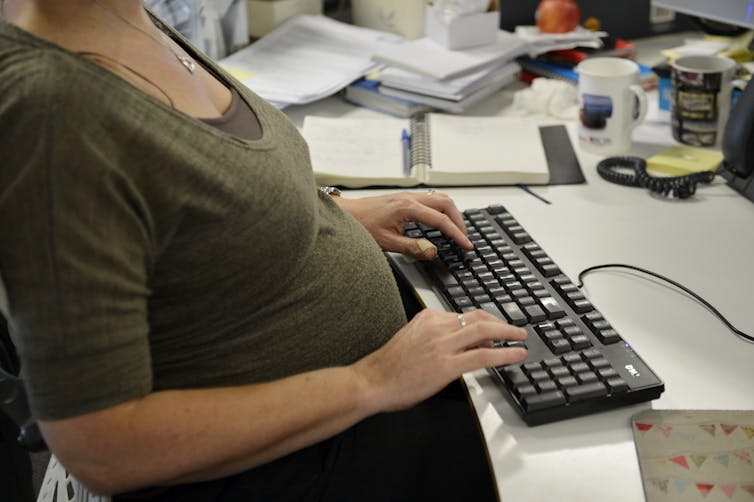
Pregnant woman sitting at her desk.
Women’s advocates have been lobbying for years for an increase in paid parental leave provisions. Tracey Nearmy/AAP

The current national system entitles the primary carer to 18 weeks of paid parental leave at the minimum wage. This needs to be expanded to at least 26 weeks, with the ability to share it easily between parents, paid at a rate closer to wage-replacement and include superannuation. This will support gender equality in the home and the workplace, and substantially improve women’s economic security in both the short and long term.

Lack of attention to improving wages for the mostly female care workforce is another missed opportunity.


Read more: Fewer hard hats, more soft hearts: budget pivots to women and care


The $17.7 billion allocated to the aged care sector includes money for workforce training and expansion. However, there are no measures to address the very low wages and insecure employment conditions of the predominantly women who work in the care economy. Until wages and conditions in the care sector are addressed, economic security for many Australian women will remain out of reach.

This isn’t the reform we need

The persistent gender inequalities embedded in Australia’s labour market, tax system and social policies were never going to be resolved in a single budget. And this budget is better than what was on offer last year.

But recognising women and providing a number of modest, worthy initiatives isn’t the same as delivering the structural reform in childcare, paid parental leave and insecure and low paid work that is urgently required to shift the dial on the gender pay gap and women’s economic security.

There is much work to be done to promote women’s economic security and deliver a prosperous and inclusive economy. We can’t afford to keep missing opportunities for change.

ref. Hold the celebrations — the budget’s supposed focus on women is no game-changer – https://theconversation.com/hold-the-celebrations-the-budgets-supposed-focus-on-women-is-no-game-changer-160768

How much can the budget’s $1.1 billion for women’s safety really achieve? Two experts give their verdict

Source: The Conversation (Au and NZ) – By Kate Fitz-Gibbon, Director, Monash Gender and Family Violence Prevention Centre; Associate Professor of Criminology, Faculty of Arts, Monash University

One of the headline figures in Tuesday’s federal budget was a A$1.1 billion dollar investment in women’s safety.

This came as part of a special women’s budget statement, which pitched the budget as helping provide women with “respect, dignity, choice, equality of opportunity and justice”.

It also comes amid a national crisis in domestic violence. On average, one woman is killed every week in Australia by a male current or former partner.

So does the budget deliver on its promise to prioritise women’s safety and equality at home and at work? Does it do enough?

How does this compare with other investments?

By way of comparison, the federal government announced a $150 million package for domestic and family violence support as part of the COVID response in March last year. The headline figure on Tuesday night is a marked increase on this.

The budget papers note violence against women is estimated to cost Australia $26 billion annually. In part, this reflects the major health impacts of violence against women, with victim survivors at an increased risk of chronic illness, pain, and reproductive health problems.

The 2021-22 women's budget statement
The budget featured a separate women’s statement this year. Mick Tsikas/AAP

When compared to state and territory level contributions, it is also worth noting that since the 2015 Victorian Royal Commission into Family Violence, the state government has committed more than $3 billion to reform responses to and the prevention of family violence.

The comparison is useful to demonstrate what level of funding may be needed to support whole-of-system change.

The promising news

There are some noteworthy new initiatives included in the budget papers.

The government has announced $31.6 million over five years for a new Aboriginal and Torres Strait Islander personal safety survey. This is an important commitment and a first step towards truly understanding the prevalence of domestic, family and sexual violence in Indigenous communities. We cannot address what we do not know.

The survey must capture data in a culturally safe and sensitive way. It must lead to meaningful knowledge and community-controlled solutions. These must be adequately funded by governments and actually meet the needs of local communities.

The budget also funds the establishment of a new national women’s alliance for women with disability, to start work in June this year.

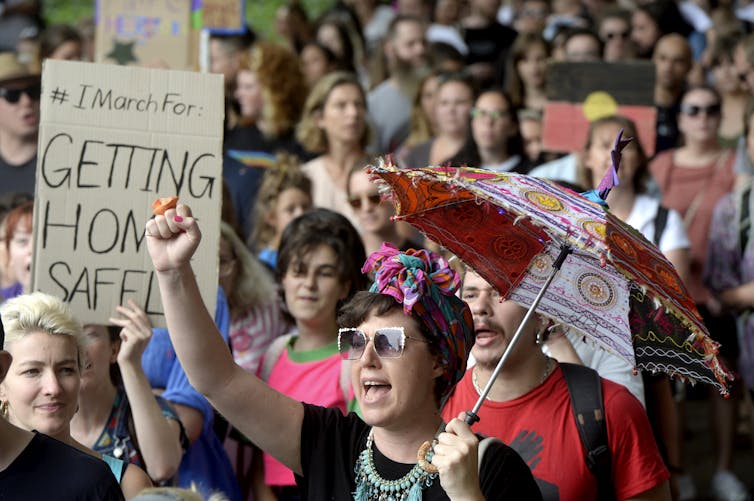
Women at a women's safety rally in 2019.
There has been growing pressure on the federal government to do more to prevent violence against women. Jeremy Piper/AAP

Women with disability are at greater risk of family, domestic and sexual violence and experience heightened barriers to reporting and seeking help. Approximately 20% of Australian women live with disability. Further, about two in five workers with disability in Australia report they have been sexually harassed in the past five years.

The alliance is a significant acknowledgement of the need to ensure the voices of women with disability are heard and inform the development of policy and practice.

Other aspects of the budget include $164.8 million in financial support for women who escape domestic violence and an extra $12.6 million for crisis accommodation. While this is a start, we note peak bodies have already signalled concerns around the inadequacy of funds for safe and affordable housing.

The disappointing news

The budget reflects a long-held tradition of failing to meaningfully invest in some critical areas. These include children as victims of domestic and family violence in their own right, working with men to change behaviours and working with First Nations communities and community leaders.

Children continue to be seen as an extension of their parents’ needs. Without child-centred responses to domestic and family violence, intergenerational transmission of this national public health issue will continue.


Read more: How intimate partner violence affects children’s health


Similarly, $35 million for primary prevention — with most focused on changing public attitudes and only partly focused on education for children and young people — is an under-investment in strategies that have the capacity to help reduce violence.

Further, a mere $9 million for perpetrator-focused responses is also a notable under-investment. While we acknowledge some of this work is funded by the states, more federal investment is needed to support a wide range of evidence-based interventions.

Lastly, we note the $26 million investment in Family Violence Prevention Legal Services to improve support services for First Nations women. This fails acknowledge the need for a national, culturally sensitive approach to domestic and family violence that addresses the lasting effects of colonisation on First Nations women, men and children.

Our verdict: is it enough?

The women’s budget statement describes the government’s commitment to reducing and preventing all forms of domestic, family and sexual violence as “steadfast”.

Our assessment is the 2021 budget is an improvement on previous years, but it does not yet reflect the level of investment so desperately needed to address, interrupt and ultimately prevent what is a national crisis.


Read more: ‘See What You Made Me Do’ will change the way we think about domestic violence. Here’s what needs to happen now


Tackling this national emergency will require transformational leadership and unprecedented funding. This budget is a step forward for this government, but it falls short of promising the change we need.

While we recognise funding is only part of the picture, it is nevertheless an essential part. The budget was an opportunity for the Morrison government to demonstrate — in measurable ways — its commitment to do what’s required to ensure women’s equality at home, in public, at work and online.

ref. How much can the budget’s $1.1 billion for women’s safety really achieve? Two experts give their verdict – https://theconversation.com/how-much-can-the-budgets-1-1-billion-for-womens-safety-really-achieve-two-experts-give-their-verdict-160764

The pressure is on for Australia to accept the coronavirus really can spread in the air we breathe

Source: The Conversation (Au and NZ) – By C Raina MacIntyre, Professor of Global Biosecurity, NHMRC Principal Research Fellow, Head, Biosecurity Program, Kirby Institute, UNSW

More than a year into the pandemic, the World Health Organization (WHO) and US Centers for Disease Control finally changed their guidance to acknowledge SARS-CoV-2, the virus that causes COVID-19, can be transmitted through the air we breathe.

In Australia, we’ve just had the latest leak from hotel quarantine, this time in South Australia. Investigations are under way to find out whether a man may have caught the virus from someone in the hotel room next to his, before travelling to Victoria, and whether airborne transmission played a role.

These examples are further fuelling calls for Australia to officially recognise the role of airborne transmission of SARS-CoV-2. Such recognition would have widespread implications for how health-care workers are protected, how hotel quarantine is managed, not to mention public health advice more broadly.

Indeed, we’re waiting to hear whether official Australian guidelines will acknowledge the latest evidence on airborne transmission, and amend its advice about how best to protect front-line workers.

The evidence has changed and so must our advice

At the beginning of the pandemic, in the absence of any scientific studies, the WHO said the virus was spread by “large droplets” and promoted handwashing. Authorities around the world even discouraged us from wearing masks.

A false narrative dominated public discussion for over a year. This resulted in hygiene theatre — scrubbing of hands and surfaces for little gain — while the pandemic wreaked mass destruction on the world.

But handwashing did not mitigate the most catastrophic pandemic of our lifetime. And the airborne deniers have continually shifted the goalposts of the burden of proof of airborne spread as the evidence has accrued.


Read more: Catching COVID from surfaces is very unlikely. So perhaps we can ease up on the disinfecting


What does the evidence say?

SARS-CoV-2 is a respiratory virus that multiplies in the respiratory tract. So it is spread by the respiratory route — via breathing, speaking, singing, coughing or sneezing.

Two other coronaviruses — the ones that cause MERS (Middle Eastern respiratory sydrome) and SARS (severe acute respiratory syndrome) — are also spread this way. Both are accepted as being airborne.

In fact, experimental studies show SARS-CoV-2 is as airborne as these other coronaviruses, if not more so, and can be found in the air 16 hours after being aerosolised.

Several hospital studies have also found viable virus in the air on a COVID-19 ward.

Established criteria for whether a pathogen is airborne scores SARS-CoV-2 highly for airborne spread, in the same range as tuberculosis, which is universally accepted as airborne.

A group of experts has also recently outlined the top ten reasons why SARS-CoV-2 is airborne.

So why has airborne denialism persisted for so long?

The role of airborne transmission has been denied for so long partly because expert groups that advise government have not included engineers, aerosol scientists, occupational hygienists and multidisciplinary environmental health experts.

Partly it is because the role of airborne transmission for other respiratory viruses has been denied for decades, accompanied by a long history of denial of adequate respiratory protection for health workers. For example, during the SARS outbreak in Canada in 2003, denial of protection against airborne spread for health workers in Toronto resulted in a fatal outbreak.

Even influenza is airborne, but this has been denied by infection control committees.


Read more: Here’s the proof we need. Many more health workers than we ever thought are catching COVID-19 on the job


What’s the difference between aerosols and droplets?

The distinction between aerosols and droplets is largely artificial and driven by infection control dogma, not science.

This dogma says large droplets (defined by WHO as larger than 5 micrometres across) settle to the ground and are emitted within 2 metres of an infected person. Meanwhile, fine particles under 5 micrometres across can become airborne and exist further away.

There is in fact no scientific basis for this belief. Most studies that looked at how far large droplets travelled found the horizontal distance is greater than 2 metres. And the size threshold that dictates whether droplets fall or float is actually 100 micrometres, not 5 micrometres. In other words, larger droplets travel further than what we’ve been led to believe.

Leading aerosol scientists explain the historical basis of these false beliefs, which go back nearly a century.

And in further evidence the droplet theory is false, we showed that even for infections believed to be spread by droplets, a N95 respirator protects better than a surgical mask. In fact airborne precautions are needed for most respiratory infections.

Why does this difference matter?

Accepting how SARS-CoV-2 spreads means we can better prevent transmission and protect people, using the right types of masks and better ventilation.

Breathing and speaking generate aerosols. So an infected person in a closed indoor space without good ventilation will generate an accumulation of aerosols over time, just like cigarette smoke accumulates.

A church outbreak in Australia saw spread indoors up to 15 metres from the sick person, without any close contact.

Masks work, both by preventing sick people from emitting infected aerosols, and by preventing well people from getting infected. A study in Hong Kong found most transmission occurred when masks weren’t worn inside, such as at home and in restaurants.


Read more: This video shows just how easily COVID-19 could spread when people sing together


Coughing generates more aerosols

The old dogma of droplet infection includes a belief that only “aerosol generating procedures” — such as inserting a tube into someone’s throat and windpipe to help them breathe — pose a risk of airborne transmission. But research shows a coughing patient generates more aerosols than one of these procedures.

Yet we do not provide health workers treating coughing COVID-19 patients with N95 respirators under current guidelines.

At the Royal Melbourne Hospital, where many health worker infections occurred in 2020, understanding airflow in the COVID ward helped explain how health workers got infected.

Think about it. Airborne deniers tell us infection occurs after a ballistic strike by a single large droplet hitting the eye, nose or mouth. The statistical probability of this is much lower than simply breathing in accumulated, contaminated air.

The ballistic strike theory has driven an industry in plastic barriers and face shields, which offer no protection against airborne spread. In Switzerland, only hospitality workers using just a face shield got infected and those wearing masks were protected.


Read more: Many of our buildings are poorly ventilated, and that adds to COVID risks


In hotel quarantine, denial of airborne transmission stops us from fixing repeated breaches, which are likely due to airborne transmission.

We need to select quarantine venues based on adequacy of ventilation, test ventilation and mitigate areas of poor ventilation. Opening a window, drawing in fresh air or using air purifiers dramatically reduce virus in the air.


Read more: As international travellers return to Melbourne, will it be third time lucky for Victoria’s controversial hotel quarantine system?


We need to provide N95 respirators to health, aged-care and quarantine workers who are at risk of high-dose exposure, and not place them in poorly ventilated areas.

It’s time to accept the evidence and tighten protection accordingly, to keep Australia safe from SARS-CoV-2 and more dangerous variants of concern, some of which are vaccine resistant.

ref. The pressure is on for Australia to accept the coronavirus really can spread in the air we breathe – https://theconversation.com/the-pressure-is-on-for-australia-to-accept-the-coronavirus-really-can-spread-in-the-air-we-breathe-160641

The 50 beautiful Australian plants at greatest risk of extinction — and how to save them

Source: The Conversation (Au and NZ) – By Jennifer Silcock, Post-doctoral research fellow, The University of Queensland

As far as odds go, things don’t look promising for the slender-nerved acacia (Acacia leptoneura), a spiky plant with classic yellow-ball wattle flowers. With most of its habitat in Western Australia’s wheat belt cleared for agriculture, it was considered extinct for more than 160 years.

Now, just two plants are known in the world, and they’re not even in the same place. This species is among many Australian plants that have come perilously close to extinction.

To help prevent the loss of any native plant species, we’ve assembled a massive evidence base for more than 750 plants listed as critically endangered or endangered. Of these, we’ve identified the 50 at greatest risk of extinction.

The good news is for most of these imperilled plants, we already have the knowledge and techniques needed to conserve them. We’ve devised an action plan that’s relatively easy to implement, but requires long-term funding and commitment.

What’s driving the loss?

There are 1,384 plant species and subspecies listed as threatened at a national level. Twelve Australian plant species are considered probably extinct and a further 21 species possibly extinct, while 206 are officially listed as critically endangered.

Yellow wattle
Two known plants of slender nerved acacia (Acacia leptoneura) remain, about 1 kilometre apart. Propagation attempts have been unsuccessful and the genetic diversity is probably very low. Joel Collins, Author provided

Australian plants were used, managed and celebrated by Australia’s First Nations people for at least 60,000 years, but since European colonisation, they’ve been beset by a range of threats.

Land clearing, the introduction of alien plants, animals, diseases, and interruptions to ecological processes such as fire patterns and flooding have taken a heavy toll on many species. This is particularly the case in the more densely populated eastern and southern parts of the continent.

Close-up of yellow flower
Ironstone pixie mop (Petrophile latericola) occurs on a soil type that’s been heavily cleared for agriculture, and is suspected to be susceptible to an introduced root-rot fungus. In 2020 fewer than 200 plants remained, in poor condition. Andrew Crawford, Author provided

Things aren’t improving. Scientists recently compiled long-term monitoring of more than 100 threatened plant species at 600 sites nationally. And they found populations had declined on average by 72% between 1995 and 2017.

This is a very steep rate of decline, much greater than for threatened mammal or bird populations.


Read more: Australia-first research reveals staggering loss of threatened plants over 20 years


On the brink

Many species listed as threatened aren’t receiving targeted conservation action or even baseline monitoring, so an important first step in preventing extinctions was identifying the species at greatest risk.

To find the top 50, we looked at the evidence: all available published and unpublished information and expert surveys of over 120 botanists and land managers. They’re targeted by our Action Plan for Australia’s Imperilled Plants.

Action Plan for Australia’s Imperilled Plants.

Thirty of the species in the plan have fewer than 50 mature individual plants remaining.

And 33 are known only from a single location, such as the Grampians pincushion-lily (Borya mirabilis), which occurs on one rocky outcrop in Victoria. This means the entire population could be destroyed by a single event, such as a major bushfire.

A dead-looking gum tree on agricultural land
About 2,000 Morrisby’s gums were growing in the early 1990s, but by 2016 fewer than 50 remained. Climate change and damage from insects and animals threaten those left. Protecting trees with fencing has led to new seedlings. Magali Wright, Author provided
Fewer than 10 lax leek-orchids (Prasophyllum laxum) remain. Declines are ongoing due to drought and wildfire, and the South Australian species only occurs on private property not managed for conservation. Proposed recovery actions include habitat protection and establishing the orchid and its mycorrhizal fungi in conservation reserves. Shane Graves, Author provided
Fewer than 15 woods well spyridium (Spyridium fontis-woodii) shrubs remain on a single roadside in South Australia. Research into threats and germination requirements is urgently needed, plus translocation to conservation reserves. Daniel Duval/South Australian Seed Conservation Centre, Author provided

So how can we protect them?

Some of the common management actions we’ve proposed include:

  • preventing further loss of species’ habitat. This is the most important action required at a national scale

  • regularly monitoring populations to better understand how species respond to threats and management actions

  • safely trialling appropriate fire management regimes, such as burning in areas where fires have been suppressed

  • investing in disease research and management, to combat the threat of phytophthora (root-rot fungus) and myrtle rust, which damages leaves

  • propagating and moving species to establish plants at new sites, to boost the size of wild populations, or to increase genetic diversity

  • protecting plants from grazing and browsing animals, such as feral goats and rabbits, and sometimes from native animals such as kangaroos.

Once common, the dwarf spider-orchid (Caladenia pumila) wasn’t seen for over 80 years until two individual plants were found. Despite intensive management, no natural recruitment has occurred. Propagation attempts have successfully produced 100 seedlings and 11 mature plants from seed. This photo shows botanist Marc Freestone hand-pollinating dwarf spider-orchids. Marc Freestone, Author provided
Only 21 mature plants of Gillingarra grevillea (Grevillea sp. Gillingarra) remain on a disturbed, weedy rail reserve in southwestern WA. Half the population was destroyed in 2011 due to railway maintenance and flooding. Habitat protection and restoration, and translocations to conservation reserves are needed to ensure its survival. Andrew Crawford, Author provided

Another common issue is lack of recruitment, meaning there’s no young plants coming up to replace the old ones when they die. Sometimes this is because the processes that triggered these plants to flower, release seed or germinate are no longer occurring. This can include things like fire of a particular intensity or the right season.

Unfortunately, for some plants we don’t yet know what triggers are required, and further research is essential to establish this.

Now we need the political will

Our plan is for anyone involved in threatened flora management, including federal, state, territory and local government groups, First Nations, environment and community conservation groups, and anyone with one of these plants on their land.

The Border Ranges lined fern (Antrophyum austroqueenslandicum) and its habitat are exceedingly rare. It’s threatened by drought and climate change, and fewer than 50 plants remain in NSW. If the threat of illegal collection can be controlled, the species would benefit from re-introduction to Queensland’s Lamington National Park. Lui Weber, Author provided

Plants make Australian landscapes unique — over 90% of our plant species are found nowhere else in the world. They’re also the backbone of our ecosystems, creating the rich and varied habitats for our iconic fauna to live in. Plants underpin and enrich our lives every day.

Now we have an effective plan to conserve the Australian plants at the greatest risk of extinction. What’s needed is the political will and resourcing to act in time.


Read more: Undocumented plant extinctions are a big problem in Australia – here’s why they go unnoticed


ref. The 50 beautiful Australian plants at greatest risk of extinction — and how to save them – https://theconversation.com/the-50-beautiful-australian-plants-at-greatest-risk-of-extinction-and-how-to-save-them-160362

Despite major conservation efforts, populations of New Zealand’s iconic kiwi are more vulnerable than people realise

Source: The Conversation (Au and NZ) – By Isabel Castro, Associate Professor in Ecology and Zoology, Massey University

Kiwi chick
Kiwi are moved between populations to lower the risk of inbreeding. Maungatautari Ecological Island Trust, CC BY-SA

Like many endangered species, Aotearoa’s flightless and nocturnal kiwi survive only in small, fragmented and isolated populations. This leads to inbreeding and, eventually, inbreeding depression — reduced survival and fertility of offspring.

Mixing kiwi from different populations seems a good idea to prevent such a fate. But translocating kiwi in an effort to mate birds that are not closely related can come with the opposite risk of outbreeding. This happens when genetically distant birds breed but produce chicks with lower fitness than either parent.

Translocations have been part of the kiwi conservation effort for decades. We also have many genetic studies of the five species of kiwi in New Zealand.

But our research, which synthesised available genetic studies, shows we don’t yet have enough genetic information to predict translocation outcomes and manage genetic diversity to achieve safe and sustainable conservation practices.

Kiwi are cherished by all cultures in New Zealand as a symbol of a unique natural heritage. For Māori, kiwi are a taonga (treasure) and of vital importance to hapū (sub-tribal groups) and iwi (tribes) across Aotearoa.

Our research is the culmination of more than two decades of close collaboration and inclusion of mātauranga Māori (traditional knowledge) to improve conservation outcomes — for mana tangata (people with authority over land), for kiwi and for other species across the globe.


Read more: ‘Revolutionary change’ needed to stop unprecedented global extinction crisis


Kiwi whakapapa under threat

Before humans arrived in Aotearoa, kiwi populations numbered around 12 million. They were dispersed across most of the country.

In the early 20th century, there were still millions of kiwi roaming the bush. But Pākehā settlers accelerated the destruction of New Zealand’s forests and introduced invasive predators, including stoats and ship rats, which are now a major threat, particularly to kiwi chicks.

The remains of a kiwi
Introduced predators, including stoats and rats, are a major threat to kiwi. Shutterstock/Lakeview Images

Today there are fewer than 70,000 kiwi in the wild, and populations are declining in areas without predator control. The forests, wetlands and pastures where kiwi once lived have been milled, drained and ravaged by introduced browsers such as goats and deer.

Kiwi are also not immune to climate change, with worrying mortality events during recent severe droughts. In these new and changing conditions, kiwi face many challenges: new predators, new diseases, new seasonal events, new foods.


Read more: Forensics and ship logs solve a 200-year mystery about where the first kiwi specimen was collected


Genetic diversity provides a buffer against such challenges and better chances of survival for a species. One way to maintain genetic diversity is through mating between individuals that are not closely related.

But most kiwi live in groups of fewer than 100 birds. We have confined them to pockets of favourable habitat. As a result of well-meant conservation management to protect the birds from mammalian predators, we have moved them to safe havens on offshore islands or patches of remnant forests that effectively function as “mainland islands”, cut off from other habitat.

Conservation workers holding a kiwi chick
Kiwi being released on an offshore island sanctuary. Shutterstock/Naska Raspopina

Call for more genetic research

One way to avoid inbreeding depression is to mix individuals from distant populations that have different genes and could provide the basis for genetic rescue. But some are opposed to such mixing because it raises the risk of outbreeding depression, which is particularly high if the parental populations differ in their adaptations to their respective environments.

Kiwi populations have evolved to adapt to local conditions on timescales of tens of thousands of years. This means one population of the same species may have adapted in different ways to another. For example, populations of North Island brown kiwi (Apteryx mantelli) are found from the warm lowlands of Te Tai Tokerau/Northland to the sub-apline volcanic plateau near Mount Ruapehu.

bbb
kiwi Shaun lee. Flickr/Shaun Lee, CC BY-SA

For decades the Department of Conservation (DOC) and community groups have been translocating kiwi all over Aotearoa. We need more gene sequencing research of such populations to investigate the effects of inbreeding and outbreeding.

Decision making in the absence of sufficient genetic information risks leading to management strategies that are inadequate or even harmful for future population sustainability.

Working with Māori

Māori, the Indigenous people of Aotearoa, are kaitiaki (guardians) of the kiwi. Whakapapa, a key concept of relatedness in te ao Māori (Māori world view), means Māori culture has a deep understanding of ideas described in western science as genetic diversity, inbreeding and hybridisation.

But hapū and iwi are not always consulted about conservation interventions, even though their role as co-managers of taonga species is well established in Te Tiriti o Waitangi.

In 2013, my research group teamed up with two hapū (Te Patukeha and Ngāti Kuta) to develop a management plan for the North Island brown kiwi in their area. A century of well-intentioned but somewhat random mixing of different North Island brown kiwi populations during translocations has effectively produced both “randomised experimental” and “control” groups.

Our team is now comparing the precise genetics of mixed-background birds currently thriving on Ponui Island in the Hauraki Gulf with the control populations in Te Tai Tokerau and Taranaki, from which the Ponui Island kiwi have been drawn.

We have also recruited support from other hapū and iwi in Tai Tokerau and have now started to analyse genetic information from several sites, using the latest techniques to investigate the genetic make-up of the birds. This research will shed new light on the effects of years of breeding in populations that started with kiwi from a single source versus those that started with mix-provenance birds.

We need to save North Island brown kiwi, but we need to do it properly. And when conservation efforts succeed, it would be far better if we knew why they worked. If we do this research right, the conservation management of other species will benefit, across Aotearoa and the world, at a time of an accelerating extinction crisis.

ref. Despite major conservation efforts, populations of New Zealand’s iconic kiwi are more vulnerable than people realise – https://theconversation.com/despite-major-conservation-efforts-populations-of-new-zealands-iconic-kiwi-are-more-vulnerable-than-people-realise-160433

How China has been transforming international education to become a leading host of students

Source: The Conversation (Au and NZ) – By Jing Qi, Lecturer, School of Global, Urban and Social Sciences, RMIT University

When Australians think of international education and China, they typically consider the country as a source of international students — Australia’s largest. But China is now one of the leading host countries of international students in the world.

China’s level of international education policymaking over the past decade, backed up by strategic priorities, has been unprecedented.

My recently published research shows Chinese universities are learning to reconcile the different forces of local, national and global demands. They aim to:

  • calibrate to the Chinese government’s grand scheme of national rejuvenation

  • expand their global reach and market influence

  • enhance their professional impact and managerial efficiency

  • respond to the community repercussions of growing numbers of international students.

A top study destination in the making

China was on the way to becoming a top destination for studying abroad well before the COVID-19 pandemic.

By 2018, 492,185 international students from 196 countries studied in mainland China. They were enrolled in 1,004 higher education institutions.

International student numbers had doubled since 2009, when 238,184 were enrolled. Back in 1978 the total was a mere 1,236.


Read more: The rise of China: a threat or opportunity for Australian universities?


The Study in China Initiative, Liuxue zhongguo jihua, first appeared in 2010 in the National Outline for Mid- and Long-Term Education Planning and Development.

The growth of the initiative over the past decade echoes across China’s laws, five-year plans, guidelines and action plans, and government decisions, opinions, regulations, notices and explanations.

2010 was a turning point

Between 2007 and 2009, the Chinese Ministry of Education had signalled against reckless pursuit of international student enrolments at the expense of quality education. This was a fleeting period of slight uncertainty for the sector.

In 2010, state policymaking re-endorsed mass international education in China. Study in China was to be built into a global education brand.

The plan specified annual enrolment targets, culminating in 500,000 students in 2020. This included 150,000 degree-seeking students. Yearly targets were set to develop exemplary sites, programs and courses for international education.

The overall goal was to make China the largest study abroad destination in Asia by the end of the decade. This was achieved in 2017-2018.

Subsequent state policies focused on legal, financial and administrative improvements. Increasing funding was made available through national, local, government and corporate scholarships and stipends for international students.

Education’s place in a broader global strategy

The mid-2010s defined the orientation of international education in China. The Study in China Initiative was subsumed under the new global strategy, the Belt and Road Initiative (BRI). It is a “road map” for China’s higher education to step onto the world stage.


Read more: Why is there so much furore over China’s Belt and Road Initiative?


Study in China is part of the core political discourse of national rejuvenation.

We can see this in the official 2019 Study in China Guide. The guide depicts the BRI as a core strength and essential knowledge about China. It powerfully demonstrates China’s market aspirations and appeal to international students.

A page from the Study in China Guide showing the place of international education in the Belt and Road Initiative
The official Study in China Guide makes it clear international education is part of the Belt and Road Initiative. Study in China Guide

The Chinese government’s Silk Road Scholarship Program sponsors 10,000 new international students a year from countries participating in the Belt and Road Initiative. Universities can apply for state funding to run a BRI talent development site for large cohorts of these students.

Research grant schemes fund studies that improve the quality of international education, while supporting BRI work in infrastructure, trade, culture and diplomacy.

The Belt and Road Initiative is central to China’s rapid shift from major importer to rising exporter of international education. In 2017, 317,200 international students came from BRI countries, 64.85% of the total.

Focus shifts to quality assurance

Quality improvement was not new in the policy discourse on Study in China. However, substantive progress has been made since 2017.

Compared to its 2000 version, the 2017 Administrative Measures for the Enrolment and Development of International Students by Universities and Schools (Order 42) emphasised systematic quality enhancement in four areas:

  • development of relevant university regulations

  • rigorous assessments for admissions and scholarships

  • systematic planning of teaching and staff development

  • development of quality control mechanisms.

The 2018 Quality Assurance Standards for Higher Education of International Students is the first of its kind in China. The 2019 Quality Accreditation Rules for International Higher Education established China’s first external qualification accreditation and assurance system for international education.

One quality indicator concerns the composition of international students. Degree-seeking students became the majority (52.44%) of international students in China for the first time in 2018. Their numbers had increased by more than 350% from 36,387 in 2006 to 178,271 in 2018. They include bachelor, master and doctoral students who study abroad for at least one year.

university graduates in academic gowns seen from the back
International students enrolled for degrees in China increased in number by more than 350% from 2006 to 2018. Shutterstock

A balancing act for Chinese universities

Chinese universities have benefited from the escalating scale and influence of the Study in China Initiative.

However, my research shows they are under the stress of having to respond to multiple, often competing pressures.

An example of this is academic language and associated ideological tension. English is the dominant language in the academic world and in global trade. Most international students in Chinese universities study in English-taught programs.

But shifting political and community perceptions of the English language have stepped up internal pressures on Chinese universities. The legitimacy of English as the lingua nullius of global knowledge production is under challenge.


Read more: Beyond the black hole of global university rankings: rediscovering the true value of knowledge and ideas


Another clear policy shift encourages convergent management of domestic and international students. There is pressure to integrate international students into the regular operations of Chinese universities. The rise in international student numbers has created a need to increase managerial efficiency.

This shift is also a response to community perception. International students benefit from more flexible testing arrangements and greater access to elite universities and scholarships, compared to domestic students. International students are spared the gruelling competition of Gaokao, the national college entrance examination.

In addition, breaches of rules and regulations by international students have often gone unaddressed.

Chinese universities are having to weigh up competing considerations of state aspiration, market appeal, corporate consolidation, professional enhancement and community pressures.

ref. How China has been transforming international education to become a leading host of students – https://theconversation.com/how-china-has-been-transforming-international-education-to-become-a-leading-host-of-students-157241

Soaring housing costs are pushing retirees into areas where disaster risks are high

Source: The Conversation (Au and NZ) – By Lois Towart, Lecturer in Property Economics, University of Technology Sydney

The impacts of a closed border and recent floods have highlighted the challenges facing older Australians who live permanently in caravan parks and manufactured home estates. These properties have long provided affordable housing for retirees, particularly those who rely on the age pension and have limited assets or housing equity. Residents typically own their caravan or mobile home and pay a regular site rental.

Two trends are emerging as problems for these residents:

  1. caravan parks and manufactured home estates are undergoing “gentrification” as they transform into high-end domestic tourism (with border closures boosting demand) and lifestyle estates

  2. many properties that house older Australians are increasingly exposed to natural hazards such as fire and floods.

The interrelated issues of a shortage of affordable housing, development in hazard-affected locations and gentrification are funnelling the most disadvantaged Australians into the most problematic locations. Recent fieldwork in the Hastings and Manning river regions of New South Wales identified a number of caravan parks and manufactured home estates close to or even next to rivers that had been flooded. The most flood-affected properties tended to be those with the most affordable housing.

aerial view of flooded caravans, cabins and houses
Dunbogan Caravan Park in northern New South Wales during the March 2021 floods. Image: David Wainwright, Author provided

Read more: What are manufactured home estates and why are they so problematic for retirees?


Why are properties being gentrified?

The sector is far from homogenous. Properties range from expensive upmarket holiday parks and lifestyle estates to permanent residents in caravan parks and older manufactured home estates.

Large caravan park operators, such as Big 4 Holiday Parks and Discovery Parks, provide an upmarket holiday option. These feature manicured lawns and offer cabins, glamping and powered sites. On-site management provides regularly cleaned communal cooking facilities and ablution blocks.

Many feature panoramic views of oceans and waterways, which add to the upmarket offering. Operators focus on properties where maximum value can be extracted from holidaymakers. These have come a long way from the cheap caravan parks with dry grass, a few trees and rundown amenities.

The industry has also benefited from international border closures resulting in a boom in Australians holidaying at home.

But these trends leaves little room for permanent residents – especially low-income residents – as tourists are unlikely to pay premium prices to stay in parks with retirees in second-hand caravans. Operators usually partition permanent residents from the holidaymakers or, increasingly, remove permanent residents altogether.


Read more: Older and poorer: Retirement Income Review can’t ignore the changing role of home


Manufactured home estates are also gentrifying. They are increasingly branded as over-50s estates, with resort-style facilities including community centres and swimming pools. The operators include listed organisations Ingenia, Stockland and Lifestyle Communities, and private organisations Hampshire Villages and National Lifestyle Villages.

Manufactured home estate living is advertised as being affordable, as relocatable homes are exempt from stamp duty, land tax and council rates. But advertised prices for relocatable homes in lifestyle estates can be over $700,000 and are anything but affordable for people on lower incomes.

By requiring incoming residents to buy new and used homes through them, operators can achieve profit margins and agency fees. The more expensive the relocatable home, the higher the margins and fees. This is why operators have moved relentlessly upmarket.

Many lifestyle estate operators have embarked on significant expansion programs. They are actively buying up and redeveloping caravan parks and manufactured home estates. This leaves a shrinking pool of properties, owned by smaller operators, that still offer affordable housing.


Read more: Retiree home ownership is about to plummet. Soon little more than half will own where they live


Why are hazard risks higher at affordable sites?

Caravan parks and manufactured home estates are not classed as permanent housing. This means they can be developed on a wider range of sites, including hazard-affected land.

Sites close to beaches and waterways have long been popular as they provide recreational amenity to holidaymakers and residents. The flip side is that these locations are more prone to natural hazards such as storms and flooding.

Large operators have selectively bought up caravan parks and manufactured home estates to create more upmarket offerings. As they spend money upgrading communal facilities and ablution blocks, their preference has been for properties that are not hazard-affected.

As a result, many of the caravan parks and manufactured home estates that remain affordable housing are in the most hazard-affected locations.

caravans under trees in a caravan park
Dunbogan Caravan Park, pictured after the flood, remains affordable but that comes with a risk for residents. Lois Towart, Author provided

What happens when disaster strikes?

During the recent floods in the Port Macquarie, Old Bar and Hawkesbury regions of NSW, it was permanent residents in caravan parks and non-lifestyle manufactured home estates who were most badly affected.

For many of these residents, the caravan or relocatable home (and its contents) was their major asset. While some may initially float, the water-damaged dwelling is usually uninhabitable. There is often little left to salvage.

Local governments, in addition to the cost of repairing damaged infrastructure, now have to deal with increasing numbers of homeless people. Many have to rely on the generosity of the local community.


Read more: Thousands of flood-stricken people are sheltering in schools, clubs and halls – but we can do better


All is not lost. There are creative solutions.

housing on stilts in a residential village
A creative solution, putting housing on stilts, in in Riverside Residential Village, Port Macquarie. Image: Lois Towart, Author provided

For example, a manufactured home estate in Port Macquarie, Riverside Residential Village, is on a flood-prone site. The solution is relocatable dwellings on stilts. The space underneath can then be used for car parking and storage. However, some older people might find the stairs a bit of a problem.


This story is part of a series The Conversation is running on the nexus between disaster, disadvantage and resilience. You can read the rest of the stories here.

ref. Soaring housing costs are pushing retirees into areas where disaster risks are high – https://theconversation.com/soaring-housing-costs-are-pushing-retirees-into-areas-where-disaster-risks-are-high-158216

Guide to the Classics: Montesquieu’s Persian Letters at 300 — an Enlightenment story that resonates in a time of culture wars

Source: The Conversation (Au and NZ) – By Knox Peden, Senior Lecturer in European Enlightenment Studies, The University of Queensland

We have recently seen a spate of books defending the Enlightenment, that period of efflorescence, in 18th-century Europe, which helped shape the modern world.

At the vanguard has been the Harvard psychologist Steven Pinker, who titled his most recent monument to scientific progress Enlightenment Now. The book earned Bill Gates’s endorsement but was widely criticised by historians since it was not an assessment of the Enlightenment at all, but a compilation of data showing us why life was now better than ever.

Other advocates have been more subtle, stressing that what set the Enlightenment apart from preceding eras was less its confidence in reason per se, than its focus on the secular (as opposed to the sacred) as the space in which happiness ought to be pursued and quite possibly achieved.

Readers might wonder: who could be against this? But Pinker and his allies are pushing back on a tendency to see in the overweening self-confidence of the Enlightenment a blueprint for the horrors of the 20th century. The view is not without merit. The Enlightenment may have given us a new way to think about rights, but it also gave us the atom bomb.

Moreover, its conviction the same naturalistic perspective that led to scientific innovation could be applied to populations has given rise to social engineering in multiple, often sinister forms.

This year marks the 300th anniversary of the publication of a book that contemporaries saw as inaugurating the Enlightenment in France: Montesquieu’s Persian Letters.

Given its exalted status, one would expect to find in Persian Letters an ode to human ingenuity and a confident projection of progress. But its contents are much more surprising — and relevant — than that.

The book’s author, Charles-Louis de Secondat, Baron de La Brède et de Montesquieu — Montesquieu, for short — was an odd sort, an aristocrat with a sympathy for republics and a voracious intellectual appetite.

Born in 1689, he came of age at a time of French predominance in Europe. A lawyer by training, he began writing during the “Regency”, a period of social dynamism that followed the death in 1715 of Louis XIV, the Sun King, when his great-grandson Louis XV was too young to rule on his own.

A new kind of fiction

In 1721 Montesquieu introduced France to a new kind of fiction, a novel composed entirely of letters, mainly authored by Usbek and Rica, two Persians who have travelled to Paris and delight in reporting their bemusement at its customs. The device allows Montesquieu to make the more familiar features of European life appear idiosyncratic.

An anonymous painting of Charles de Secondat, Baron de Montesquieu. Wikimedia Commons

The nature of the work also gives Montesquieu ample space to deal with subjects that still divide us: the varieties of government, the extravagances of metaphysical speculation, and the dilemmas of tolerance.

In this regard, we can see Persian Letters as a set of working notes for the book that earned Montesquieu his place among the giants of modern political thought: The Spirit of the Laws, published in 1748. With its case for a “separation of powers” as crucial to a well-functioning republic, this volume inspired Thomas Jefferson and the authors of the US constitution.

Providing a typology of regimes — republics, monarchies, despotisms — and tracing their relationship to material factors from climate to geography, The Spirit of the Laws more or less launched the discipline of political sociology. More prophetic still was the book’s concern for how despotism lies in wait for any regime that sees a loss of civic virtue.

All of this material is dealt with ironically in Persian Letters. The worry about despotism is signalled through what passes for a plot in the book. As Usbek becomes accustomed to Parisian society, he becomes distant from his seraglio (or harem) in Persia.

Persian miniature by Hossein Behzad. Iranian National Museum.

A revolt ensues in which the women, corrupted by having to live in a degraded state and no longer fearful of their absent authority, stage a bloody uprising. The story ends with a letter from Usbek’s favourite wife Roxane, who is committing suicide, pen in hand.

Constant vigilance

This ghastly conclusion makes for an instructive contrast with the playful tone otherwise permeating the book. Throughout the letters, there is much mirth at Frenchmen who distract themselves with philosophical rumination while their society becomes mired in conflict and sedition.

The irony is to the point; political stability is a matter of constant vigilance, irrespective of the nature of the regime in question.

With his portrayal of the seraglio, a question insists: is Montesquieu indulging in Orientalism, a projection of his Western prejudices on to figures from the East?

Perhaps. And yet Montesquieu never loses sight of the fictional nature of his construction. To see Europe through the eyes of another is to imagine yourself in the position of the other, not to occupy it.

Not coincidentally, this relationship between how we present ourselves and who we are is one of the key themes of the work.

In one of the early letters, Rica recounts the wonder he aroused walking the streets of Paris.

I therefore resolved to set aside my Persian clothing and dress instead as a European, to see whether anything in my appearance would still astonish. From this test, I learnt my true worth: stripped of my exotic finery, I found myself appraised at my real value, and I had good reason to complain of my tailor, through whom I’d lost, in an instant, the attention and esteem of the public.

In reflecting on whether the clothes make the man, Rica suggests the social nature of our identities. In effect, we are as we are seen. But recognising this fact only increases Rica’s desire for public approval.

Elsewhere Usbek remarks that in order to remain powerful a monarch must supply not only necessities, but luxuries. And yet the obsession with luxury — both as a pleasurable experience and opulent display — affects or indeed infects everything, even religion, which is mercilessly pilloried throughout Persian Letters.

Louis XV in Coronation Robes, Hyacinthe Rigaud, 1730. Wikimedia Commons

The society Montesquieu satirises is one in which moral debates fail to find resolution because agreement is hardly the goal; vindication is. The need for social vindication breeds conflict. We seek out peers who advance what we take to be our interests rather than working with others to discover sites of common interest.

In this aspect, the paint on Usbek and Rica’s portrait of modern life hardly seems dry.

“The reader is urged to note,” Montesquieu wrote in a later edition of Persian Letters, “that the entire charm of the work resides in the constantly recurring contrast between actual reality and the singular, naïve, or strange manner in which reality is perceived”.

The mirror Montesquieu presents to society is one in which its vanities appear in all their absurdity.

With earnestness an increasingly dominant virtue in today’s culture wars, we’d likewise do well to rediscover the charm, indeed the humility, in appreciating the inevitably partial nature of our views.

More than celebrations of science or promises of progress — both of which tend to a self-righteousness foreign to Persian Letters — this seems to be a form of enlightenment we could use, for now.

ref. Guide to the Classics: Montesquieu’s Persian Letters at 300 — an Enlightenment story that resonates in a time of culture wars – https://theconversation.com/guide-to-the-classics-montesquieus-persian-letters-at-300-an-enlightenment-story-that-resonates-in-a-time-of-culture-wars-160176

Albanese promises support for young entrepreneurs to develop startups

Source: The Conversation (Au and NZ) – By Michelle Grattan, Professorial Fellow, University of Canberra

A Labor government would provide support for aspiring young entrepreneurs to spend a business-focused year working with a university or private sector incubator to develop their startup enterprise or idea.

The Startup Year proposal, in Anthony Albanese’s Thursday night budget reply, would offer places for up to 2000 students. The scheme would run for a year, with the opportunity to scale up

Labor’s industry spokesman Ed Husic said the goal would be “to increase the number and scale of new high-growth firms that are creating economic growth, innovation, and good quality jobs for the future”.

Incubators and accelerators exist in a range of universities as well as in the private sector to help entrepreneurs with their startups. The students would be able to get mentoring on commercialisation, financing and business management.

Deakin University says of its program: “For those teams who are ready to take their startups to the next level, SPARK Deakin’s Accelerator Program provides funding, co-working space, connections, mentorship and expertise to accelerate the enterprise. We create an outlet for creative talent to collaborate together and take ideas to market.”

Labor’s Startup Year student loans would be delivered through the existing HELP scheme, and would be designed to cover costs associated with participating in the program. The money could be used for professional development and the manufacturing of prototypes.

The current maximum amount of the relevant loan band is $11,300.

Labor points out that in the Global Innovation Index, Australia has fallen four places to 23 since 2013.

The opposition says the startup sector is a big generator of jobs in the United States and Europe. But, it says, Australia is languishing with one of the lowest startup formation rates in the world.

“It is Australian startups in areas like manufacturing, medicine, IT and clean energy that will build the Australian industries of tomorrow,” Albanese said.

Tuesday’s big spending budget – which some commentators have noted could have been comfortably delivered by a Labor government – has made Albanese’s task difficult in pitching his Thursday reply.

Albanese will home in on the forecasts of continued low wage growth, in a speech set to contain, on the policy front, one major announcement as well as smaller ones.

Despite speculation the budget might signal an election this year, Scott Morrison on Wednesday repeated that it will be next year. The election must be held by May 2022.

Asked on the ABC about the election timing, Morrison said, “The contest I’m focused on is fighting this pandemic to ensure we can protect the lives and livelihoods of Australians.

“I will leave the politics to others. As I’ve said, the election is next year. I can’t foresee all the circumstances that can contribute to things like that in this country. But my focus isn’t on that.”

He used similar forms of words in other interviews.

ref. Albanese promises support for young entrepreneurs to develop startups – https://theconversation.com/albanese-promises-support-for-young-entrepreneurs-to-develop-startups-160822

Politics with Michelle Grattan: Simon Birmingham and Jim Chalmers on a big spending budget

Source: The Conversation (Au and NZ) – By Michelle Grattan, Professorial Fellow, University of Canberra

This year’s budget, handed down on Tuesday, boasts plenty of winners and minimal direct losers. Spending is lavish, with the government doing its utmost to avoid offending voters.

The big spending commitments include:

  • $17.7 billion for aged care over five years
  • $2.3 billion for mental health
  • $1.7 billion in changes to childcare
  • $1.1 billion for women’s safety
  • $1.9 billion for the rollout of the COVID vaccine
  • $20.7 billion in support for business through tax breaks
  • $2.7 billion in new apprenticeships
  • $15 billion over a decade for infrastructure
  • $1.2 billion for the promotion of a digital economy.

Simon Birmingham, finance minister, and Jim Chalmers, shadow treasurer, are our post-budget guests on the podcast.

This is Birmingham’s first budget as finance minister. Usually, it’s the finance minister’s unpopular task to find spending cuts – but this time, these are minimal.
Birmingham’s message to critics on the right of politics, who are claiming the government has given up the debt fight, is:

“You don’t manage to achieve budget sustainability and ultimately balanced budgets some time down the track without actually maintaining and having a strong economy that has strong jobs growth. And so this time, where we have an uncertain international environment [and] fragility in terms of confidence, because of those global uncertainties, we need to make sure we maintain the COVID recovery.”

And he notes, “debt is actually forecast to be lower over each of the next 10 years than was the case in last year’s budget.”

The budget includes assumptions that the international border will open around mid-2022, and that the Australian population would be fully vaccinated by the end of this year. Asked how “solid” these assumptions are, Birmingham says:

“We have used best assumptions that we think are cautious assumptions and realistic ones. But we equally acknowledge with honesty that these are challenging times, uncertain times.

“And so they are just that – assumptions.”

On the issue of debt, Chalmers says it’s not just the level of the debt that matters, “it’s the quality of the spending”.

He says the budget is “riddled with rorts” and “weighed down with waste”.

“There are new slush funds in last night’s budget, and that means we’re not getting the bang for buck that we need to be getting in terms of jobs and other other important objectives.”

Labor has homed in on flat wages, arguing working Australia’s are “copping a cut in their real wages”.

Ultimately, the budget has failed working people, says Chalmers.

“If the government is prepared to intervene in the economy as they have been and spray around what is an extraordinary amount of money, then you’d think that working people would actually get a slice of the recovery.”

“It’s a pretty extraordinary admission of failure.”

Listen on Apple Podcasts

Stitcher Listen on TuneIn

Listen on RadioPublic

Additional audio

A List of Ways to Die, Lee Rosevere, from Free Music Archive.

ref. Politics with Michelle Grattan: Simon Birmingham and Jim Chalmers on a big spending budget – https://theconversation.com/politics-with-michelle-grattan-simon-birmingham-and-jim-chalmers-on-a-big-spending-budget-160784

NZ Parliament ejects Māori Party co-leader Rawiri Waititi over haka

RNZ News

Māori Party co-leader Rawiri Waititi has been ejected from New Zealand’s Parliament for doing a haka in protest against questions by the Opposition about race-based policy.

Opposition conservative National Party leader Judith Collins was asking Prime Minister Jacinda Ardern about her views of the He Puapua report, which provides recommendations to the government about how it can give effect to Māori self-sovereignty under the 1840 Treaty of Waitangi.

Waititi called on the Speaker of the House Trevor Mallard to intervene on what he called “racist propaganda” against Māori in the House.

Mallard ruled the views expressed in the House did not reach an inappropriate standard.

He warned Waititi when he raised another point of order that relitigation would put him at risk of expulsion from the House.

Waititi said views on indigenous rights should only be determined by the indigenous tangata whenua – which he followed up with a haka.

He was expelled from the House.

Green MPs Marama Davidson (co-leader) and Ricardo Menéndez backed Waititi’s action with Davidson tweeting support for the “calling out [of] the absolute ongoing racist comments” by Collins.

This article is republished under a community partnership agreement with RNZ.

Print Friendly, PDF & Email

Article by AsiaPacificReport.nz

Pay dirt: $200 million plan for Australia’s degraded soil is a crucial turning point

Source: The Conversation (Au and NZ) – By Vanessa Wong, Associate professor, Monash University

The food we eat, the clothes we wear, the air we breathe, the water we drink – it’s all underpinned by healthy and productive soils. Since Europeans arrived in Australia, the continent’s soil has steadily been degraded. Yet, until now, we’ve lacked an integrated national approach to managing this valuable and finite resource.

That changed in last night’s federal budget, when Treasurer Josh Frydenberg announced almost A$200 million for a National Soils Strategy. The 20-year plan recognises the vital role of soils for environmental and human health, the economy, food security, biodiversity and climate resilience.

Our soils face a range of threats, including the loss of prime agricultural land, erosion, acidification, salt accumulation, contamination and carbon loss. Climate change also puts pressure on our soils through through droughts, storms, bushfires and floods.

We contributed expertise as the soil policy was being developed, and believe the final strategy represents a long-needed turning point for this crucial natural asset.

farm in dust storm
Australia’s soils have been degrading since European settlement. Shutterstock

Why soil matters

Soil contains organic matter, minerals, gases, water and living organisms. It is slow to form – the average rate of soil production globally is around 114 millimetres per 1,000 years – and is considered a non-renewable resource.

Soil underpins a myriad of economic activities. In Australia, it directly contributes about A$63 billion each year to the economy through agriculture production alone.

Healthy soil is necessary for:

  • food and fibre production

  • filtering water and retaining sediment to ensure healthy landscapes

  • maintaining air quality by preventing dust storms

  • carbon storage to help mitigate climate change

  • environmental functions such as plant growth

  • human nutrition (soil provides nutrients to plants and animals which are transferred to humans once consumed)

  • many drugs and vaccines upon which humans rely, such as penicillin

  • safe infrastructure (acid sulfate soils and salinity can damage structures such as housing, bridges and roads)

  • resilience to natural disasters such as storms, bushfires, floods and droughts.

However, land degradation, climate change and poor management practices threaten our soil resources.


Read more: Even after the rains, Australia’s environment scores a 3 out of 10. These regions are struggling the most


An overly saline mustard field
Soil salinity can ruin crops. Shutterstock

What lies beneath?

Until now, Australia has lacked a nationally consistent approach to monitor soil health, nor a readily accessible means of storing that data. That means at a national level, our understanding of soil condition, and how it’s changed, has been limited.

Soil monitoring has largely been conducted through various regional, state and federal programs. These often operate in isolation and have differing aims and objectives. And overall investment has not been large or quick enough to create broad improvements in soil health.

In comparison, well-established standardised national systems exist to monitor terrestrial ecosystems, weather, climate and water. These allow an assessment of longer trends and changes to baseline conditions.

The need for a national soil assessment was recognised as far back as 2008. And there have long been calls for long-term monitoring, consistent information and baseline data collection.

hand holding dirt
The funding will help farmers monitor the health of their soil. Shutterstock

Change from the ground up

Importantly, the strategy takes a long term view of sustainable soil management. It also considers soil beyond its traditional role in agricultural production and explicitly identifies criteria to measure progress.

The strategy has three arms:

1. Prioritise soil health

This goal takes a “soils first” approach in that sustainable soil management is the primary consideration in policy development and management strategies. This recognises how environmental and agricultural problems can start with poor soil management and create further challenges. For example, soil acidification can lead to declines in terrestrial biodiversity, and soil constraints must be addressed first to arrest this.

2. Empower soil stewards and innovation

This approach gives incentives to farmers and other land managers, such as rebates for sampling to determine the soil carbon levels. Carbon is an important measure of soil condition. Gathering such information will help land managers arrest the decline in soil condition, enhancing productivity and soil health.

3. Secure soil science

This approach aims to increase soil knowledge through standardised data collection, management and storage. It will allow for more informed decisions using reliable, up-to-date, accessible information.

Part of this aim involves strengthening training and accreditation programs, and integrating soils into the national school curriculum. This will help create a new generation of soil experts to replace the current crop which is trending to retirement.


Read more: We need more carbon in our soil to help Australian farmers through the drought


young woman conducting soil testing
The strategy aims to train a new generation of soil experts. Shutterstock

On solid ground

Overall, the National Soils Strategy aims to deliver coordinated on-ground action and improve research, education and monitoring. The strategy broadly aligns with the needs of those who had input into its development, including governments, industry, academia, Landcare groups and non-government organisations.

However, while the importance of Indigenous land management practices is clearly acknowledged, the integration and incorporation of these practices should be more clearly defined.

The monitoring program encourages farmers to test their soil and incorporate the de-identified results in to the national database. Care should be taken to ensure sampling is done appropriately for the data to be useful.

The time frame for the initial phase of the strategy is short – pilot programs need to be delivered between two and four years. This will be challenging to deliver.

Separate to the strategy, the budget allocated A$59.6 million to soil carbon initiatives. There is increasing recognition of how improved land use and management can help boost soil carbon stores, which is key to tackling climate change. But storing carbon permanently in soils comes with a number of challenges. This funding may be appropriate only if directed to address those areas where knowledge gaps exist.

But overall, the strategy fills a vital gap – providing a national vision and shared goals for managing precious soils across Australia.


Read more: The Morrison government wants to suck CO₂ out of the atmosphere. Here are 7 ways to do it


ref. Pay dirt: $200 million plan for Australia’s degraded soil is a crucial turning point – https://theconversation.com/pay-dirt-200-million-plan-for-australias-degraded-soil-is-a-crucial-turning-point-160704

A bigger budget for mental health services won’t necessarily improve Australia’s mental health

Source: The Conversation (Au and NZ) – By Anthony Jorm, Professor emeritus, The University of Melbourne

The federal budget’s allocation of A$2.3 billion in mental health and suicide prevention funding will be welcome news for the mental health services sector and for people who have struggled to find adequate support.

The recent Productivity Commission and Victorian Royal Commission reports into mental health have emphasised the major effect of mental ill health on Australian society, as well as the public’s concerns about the inadequacies of existing service provision.

The big expenditure items announced in the budget for mental health largely involve increasing treatment services, including:

  • A$487 million to establish a national network of adult mental health centres

  • A$278 million for the expansion of Headspace youth services

  • A$288 million for repetitive transcranial magnetic stimulation (rTMS), a treatment for depression

  • more than A$100 million each for digital mental health services and group therapy, supporting the participation of family and carers.

Although in time these pledges are likely to make it easier for many people to access mental health services, it’s important to understand this won’t necessarily translate to improved mental health in Australia.


Read more: Cuts, spending, debt: what you need to know about the budget at a glance


Will more services mean better mental health?

It’s a logical assumption that greater expenditure on mental health treatment services will improve mental health. But it’s an uncomfortable truth that neither Australia, nor any other comparable country, has managed to improve the mental health of its population by increasing the provision of mental health services.

Australia has seen significant increases in mental health services over the past 20 years, with many more people receiving GP, psychological and allied health services funded through Medicare. We have also had a major expansion of youth services through Headspace.

However, over this period, the Australian Bureau of Statistics has been tracking our national mental health — and it hasn’t improved at all. For young people, if anything there’s been a worsening in recent years. Further, the suicide rate has been trending up.

Federal treasurer Josh Frydenberg speaking in parliament.
Treasurer Josh Frydenberg has handed down the 2021-2022 federal budget, and it includes A$2.3 billion for mental health. Mick Tsikas/AAP

Not necessarily the right services for the right people

There is plenty of evidence from randomised controlled trials showing treatments can work. For example, a range of psychological treatments can be effective for depression and anxiety disorders. Also, antidepressants can be helpful for people with more severe depression or anxiety.

However, what people get in practice is not necessarily what’s evaluated in trials, nor is it generally consistent with the standards experts set in clinical practice guidelines.

For example, people typically receive far fewer sessions of psychological therapy than recommended despite the increasing availability of services. Similarly, GPs often prescribe antidepressant medications for people with milder problems who are unlikely to benefit from this type of treatment.

We need greater quality of services

In the past, we’ve seen that increasing services leads to progressively more people receiving services that are too thinly spread or poorly targeted to make a real difference. What we need is to improve the quality of services for people with more severe problems and increase the availability of self-help options for people with milder problems as an alternative to specialist mental health services.

We don’t know whether the additional services funded in the budget will make a difference. It’s important we focus on the longer-term benefits of these services to mental health rather than on the immediate increases in services the money will buy.

Pleasingly, the budget does allocate A$117 million to establish a national database on service delivery, performance and outcomes across the mental health system. This will help pave the way to a greater focus on whether the services are making a difference to national mental health.


Read more: Youth anxiety and depression are at record levels. Mental health hubs could be the answer


Some much-needed attention to prevention

Another reason past government expenditure has not improved national mental health is that prevention has been neglected.

This budget takes some small steps in the right direction in this regard, with some focus on childhood, where mental health problems often begin. There’s A$46 million allocated to parenting education and support, and A$54 million to establish child mental health and well-being hubs.

A young girl sits on a couch, appears to be talking with a therapist.
Establishing child mental health and well-being hubs is a positive step in terms of preventing mental ill-health. Shutterstock

There is also expenditure in other areas that will reduce risk factors for mental health problems, including sexual abuse, family violence, homelessness and unemployment. However, the balance of mental health spending is still very much on treatment rather than prevention.

The long haul: fulfilling the Productivity Commission’s vision

The Productivity Commission’s final report on mental health, released in November last year, set out a grand vision for major reform. It recognised that improving mental health required action across many areas of government, not just treatment services.

The danger was always that the Commission’s recommendations would be cherry picked in budgets and election promises, and the grand vision lost. While this latest federal budget has some promising offerings for mental health, the grand vision remains to be fulfilled.


Read more: We can’t ignore mental illness prevention in a COVID-19 world


ref. A bigger budget for mental health services won’t necessarily improve Australia’s mental health – https://theconversation.com/a-bigger-budget-for-mental-health-services-wont-necessarily-improve-australias-mental-health-160767

Has the government rescued the arts in this budget? There are some winners but not much has changed

Source: The Conversation (Au and NZ) – By Jo Caust, Associate Professor and Principal Fellow (Hon), School of Culture and Communication, The University of Melbourne

The arts were in free fall this time last year. COVID-19 restrictions had shut everything down and artists and arts organisations were reeling from a dramatic loss of income, as well as the prospect of a bleak future. Somewhat belatedly, the federal government offered various forms of assistance from late June onwards.

Given the continuing challenges, has the government brought the arts in from the cold in Tuesday‘s budget? The budget statement notes the effects of the pandemic on the creative and cultural sector “have been severe” and the sector “continues to feel the effects of COVID‑19 as social restrictions are eased.”

The budget delivered around $300 million to “help activate and support the successful re‑opening of Australia’s creative and cultural sector”.

It is encouraging the government has admitted to the challenges facing the sector. But has it really come to the rescue with new money, or is it playing with the figures? There are some winners here, but sadly, overall, not a huge amount has changed.

There will be more for the film industry and the Australian Children’s Television Foundation; the Australia Council will receive an extra $5 million on last year’s budget, but this had already been allocated for regional touring of performing arts shows.

National entities

At the same time, important national entities, such as the National Archives, are ignored. The ABC (funded triennially) will receive an increase of $4.7 million (0.45% of its budget), but will then see its budget decline by 0.85% in 2022-23. Is the government trying to slowly erode the ABC in the longer term?

The Australian Film and Television School will also lose $2.3 million (9.3% of its budget), a sizeable amount for a relatively small operation. Screen Australia, however, receives an increase of $17.6 million (19.5% of its budget). SBS also gets an increase of $13 million (4.4%). However, this SBS funding is also expected to decline after 2021-22.


Read more: Our history up in flames? Why the crisis at the National Archives must be urgently addressed


Old announcements

Many initiatives in this $300 million have already been announced. The extra $125 million for the arts COVID package RISE was announced in March and we were told on the weekend about an extra $79.9 million for Australia’s national collecting institutions.

There is a new Regional Arts Fund of $3 million for local museums, galleries and historical societies and another fund of $11.4 million for other regional arts activity. In April, Arts Minister Paul Fletcher spoke of a desire to re-allocate arts funding from the city to the regional areas.

A further $10 million has been provided to Support Act, to help musicians and road crew with financial or health problems. They were given $10 million in April 2020 for the same purpose.

Bluesfest was cancelled at the eleventh hour this year due to Covid. Jason O’Brien/AAP

The extra money for national collecting institutions breaks down to

  • $7.4 million for the Australian National Maritime Museum

  • $7.1 million for the Bundanon Trust

  • $11.3 million for the Museum of Australian Democracy at Old Parliament House

  • $2 million for the National Film and Sound Archive

  • $34.6 million for the National Gallery of Australia

  • $9.9 million for the National Library of Australia

  • $6 million for the National Museum of Australia

  • $1.6 million for the National Portrait Gallery of Australia.

While $32.4 million of this will go towards delivery of public services and programs, a further $47.5 million is provided for capital works.

The Museum of Australian Democracy at Old Parliament House is a winner here. So too is the Bundanon Trust, which thrives under this government. Perhaps it helps to be located in a marginal seat.

The increase for the National Gallery of Australia is particularly welcome, given in 2020-21 its funding was cut by $7.8 million (or over 9% of its budget). However, out of $34.6 million, most of this ($28.6 million) is for capital maintenance.

Visitors admire Sunflowers by Vincent Van Gogh at the National Gallery of Australia in Canberra earlier this year. Mick Tsikas/AAP

The film sector has received more targeted support; much already announced. In March, we learned $20 million would support independent cinemas across Australia. In April, another $50.8 million was allocated to extend the Temporary Interruption Fund to help restart film production put on hold in 2020. A further $75 million will reinstate the producer offset rate for film, which provides a tax rebate for producers of up to 40% .

An extra $11.9 million will also be given to the Australian Children’s Television Foundation, spread over four years from 2021-22.

What about individual artists?

In 2021-22, the Australia Council will receive almost $219.8 million, an increase of around $5 million (or around 2%) on 2020-21 funding. It is described in the budget papers as representing “indexation, net of the applicable annual efficiency dividend, and $3.6 million to provide a non-recurring uplift to the Playing Australia program”.

The RISE Scheme has now had three rounds of funding allocations. By May 2021, $100 million had been allocated (leaving a balance of $100 million to the end of this year). Most funding ($83.4 million) has gone to the performing arts (theatre, music and dance), with $12.6 million for the visual arts, $2.4 million to literature and $1.5 million to film. $25.5 million out of this has been allocated to activities in regional areas.

Individual artists, most disadvantaged by COVID, have continued to receive the least additional support. Sadly, it will be some time before normal arts activity resumes in Australia, especially music concerts or festivals.

Midnight Oil toured in January this year but many musicians and artists have struggled at this time. Dan Himbcrechts/AAP

While it is encouraging to see the government mention the arts in its budget, given its “disappearing” of the arts over the past two years, it needs to address the whole complex ecosystem of the arts, rather than one or two aspects of it. It also needs to increase funding to the Australia Council so individual artists and small organisations get adequate support.

ref. Has the government rescued the arts in this budget? There are some winners but not much has changed – https://theconversation.com/has-the-government-rescued-the-arts-in-this-budget-there-are-some-winners-but-not-much-has-changed-160195

Should we vaccinate all returned travellers in hotel quarantine? It’s no magic fix but it could reduce risks

Source: The Conversation (Au and NZ) – By Catherine Bennett, Chair in Epidemiology, Deakin University

This week, a returned traveller who was quarantining in South Australia seems to have been infected with the virus during his stay, before testing positive once returning to Melbourne. It’s the latest in a long line of hotel quarantine leaks in Australia.

And in this week’s federal budget, the government has committed to welcoming back over 17,000 Australians stranded overseas over the next year, which will likely place more pressure on our hotel quarantine system.

In light of the seemingly continued spillover of hotel quarantine infections into the community, one researcher raised an intriguing possibility online: should we vaccinate all arrivals on day one of their stay in hotel quarantine?

There may be reasonably high vaccination rates among our arrivals already. But, if not, it’s definitely something worth thinking about.

In my view, overseas travellers should be considered equivalent to frontline workers, as they traverse the routes into Australia and cross through border quarantine. Therefore, they could be included in phase 1a of the vaccine rollout alongside these frontline workers.

It’s complex and there’s a lot to take into account, and vaccinating all arrivals won’t be the magic fix to our hotel quarantine troubles. But it might take the edge off some of the transmission risks.

You only have to prevent one case, which could have otherwise led to community spread and lockdown, for such a scheme to pay for itself many times over.

Here’s how it could work.

Vaccinating all arrivals could reduce infection risk

There are a number of potential ways this strategy could reduce infection risk, by:

  • preventing severe illness in people already infected

  • reducing the chance returnees will pass the virus on if they are infected, or become infected

  • protecting them from infection should they be exposed to the virus while in quarantine.

A Public Health England study found that a case who has had a single dose of either the Pfizer or AstraZeneca vaccine is up to 50% less likely to pass the virus on to their close household contacts.

However, when the researchers looked more closely at the timing, they found the full 40-50% reduction in transmission risk only occurred when the case received their first dose five or six weeks before becoming infected. In fact Pfizer didn’t reduce the transmission risk cases posed to others unless the first dose was given at least 14 days before the case became infected. In other words, giving returned travellers a dose of Pfizer while in quarantine might be too late to protect others.


Read more: Here we go again — Perth’s snap lockdown raises familiar hotel quarantine questions


In saying that, the same study shows AstraZeneca’s vaccine does appear to at least partly reduce the transmission potential of cases even when the dose is given on the same day that person was infected.

In those who’ve received the AstraZeneca vaccine on day zero of their infection, the chance of them transmitting the virus to their close contacts over the ten days or so they’re infectious was on average roughly 20% lower than positive cases who weren’t vaccinated.

Getting the AstraZeneca vaccine when exposed to the virus, or soon after, might therefore marginally protect the wider population if, for example, a traveller contracts the virus late in quarantine and it isn’t picked up in day 12 testing and is released from quarantine.

Both Pfizer and AstraZeneca do provide partial protection from infection within 12 days of the first dose. While this is too late for those already infected, it might still provide some protection from infection for those exposed to the virus in the later stages of their stay in quarantine.

Both vaccines also appear to reduce the risk of subsequently dying from COVID-19 with an 80% reduction in deaths reported in the UK. Some in this study were infected within seven days of their first vaccine dose, but we do not know how this effectiveness against deaths changes with time since vaccination from this report.

Nevertheless, there might be some additional value in offering vaccines to both slightly reduce transmission rates and mitigate against serious illness and death in people who do become infected.

A nurse vaccinating a person with the AstraZeneca COVID-19 vaccine
Both Australia’s current COVID vaccines offer some protection within 12 days of the first dose. This might give some protection to people who pick up the virus inside hotel quarantine. Richard Wainwright/AAP

One challenge is that AstraZeneca has more to offer in reducing transmission risk in the first critical two weeks after receiving the first jab, but Australia currently doesn’t advise it for people under 50. Pfizer is in limited supply and our vaccine rollout phase 1a and 1b recipients haven’t all been fully vaccinated yet. The relative risks and benefits of reallocating some of our vaccine supply and delivery must be carefully thought through.

Many of those arriving in Australia will likely have opted for vaccination before travel, if available to them, even if just to increase their chances of testing negative and being allowed to board their flights home. Many are arriving from countries that began their vaccination programs months before Australia.

How many returnees are already vaccinated?

The number of positive cases in hotel quarantine has grown month on month, from 160 in February to 469 in April.

New South Wales provides the most detailed information on returned travellers. Its latest surveillance report on about 21,000 returnees shows 180, or 0.8%, tested positive to COVID-19. About 75% of these positive cases tested positive by day two, suggesting they were exposed before arriving in Australia or in transit.


Read more: More than a dozen COVID leaks in 6 months: to protect Australians, it’s time to move quarantine out of city hotels


The report does include information on how many arrivals have been vaccinated since March 1. Of the 302 positive cases reported to the start of May, 20 had been vaccinated, with six fully vaccinated (two doses at least two weeks prior) and 14 partially vaccinated. Although, those considered “fully vaccinated” might not have been two weeks post-vaccine at the time they actually contracted the virus.

We haven’t been provided the overall vaccination rates for returnees across Australian hotel quarantine, so we can’t yet work out what percentage of arrivals are vaccinated. But if this is quite low, it strengthens the argument for offering vaccines to travellers on arrival.

ref. Should we vaccinate all returned travellers in hotel quarantine? It’s no magic fix but it could reduce risks – https://theconversation.com/should-we-vaccinate-all-returned-travellers-in-hotel-quarantine-its-no-magic-fix-but-it-could-reduce-risks-160711

How China used the media to spread its COVID narrative — and win friends around the world

Source: The Conversation (Au and NZ) – By Julia Bergin, Researcher, The University of Melbourne

At the height of the COVID-19 pandemic, Chinese President Xi Jinping enjoyed prime real estate in the centre of Serbia’s capital, Belgrade: his face plastered across a billboard with the words “Thank you brother Xi”.

The sign, courtesy of the pro-government tabloid Informer, was in response to China sending COVID-19 medical supplies to Serbia. It joined a long list of pro-China offerings of thanks from nations around the world during the pandemic in the form of overt propaganda or more subtle media messages.

A new report being published today by the International Federation of Journalists (IFJ), which I co-authored with Louisa Lim of the University of Melbourne and Johan Lidberg of Monash University, has found Beijing’s global image has benefited from the pandemic, despite its origin in the Chinese city of Wuhan.

Over half of the 50 nations surveyed at the end of 2020 reported coverage of China had become more positive in their national media since the onset of the pandemic, while less than a quarter reported it had become increasingly negative.

The change was most favourable in Europe, which scored 6.3 on a scale of one to ten, where one is the most negative and ten is the most positive. China’s image plummeted in North America, coming in at 3.5.

The overall increase in positivity coincided with an uptick in Chinese outreach. Three-quarters of the journalists we surveyed said China had a visible presence in their national media, compared to 64% in a previous survey we conducted for IFJ in 2019.

Spreading propaganda through content-sharing agreements

China has long attempted to seed positive narratives of itself in foreign media, while blocking unfavourable coverage and redirecting the world’s attention onto Western failures.

To do so, Beijing taps into foreign media ecosystems with tailored offers of access and resources. It exports its propaganda to foreign media organisations through content-sharing agreements and memoranda of understanding with state-sponsored media outlets like Xinhua and China Daily.


Read more: How China is controlling the COVID origins narrative — silencing critics and locking up dissenters


For example, Italy’s state-run news agency ANSA now publishes 50 Xinhua stories a day on its news wire, with Xinhua taking editorial responsibility for the content.

Beijing has also offered all-expenses paid tours to global journalists.

The desired outcome is for international media to amplify Chinese messages in their own languages in the pages of their own news outlets.

In this, COVID-19 acted as a catalyst. China activated its media dissemination channels overseas, inundating foreign outlets with domestic and international news offerings in local languages in a bid to seed positive stories about its management of the pandemic.

It also updated its toolkit with new tactics such as disinformation and misinformation, while clamping down on foreign reporting inside China through visa denials and journalist expulsions.

This vacuum in coverage of China by the foreign media created demand for stories from Chinese state channels. And this is being filled with state-sponsored content already available through content-sharing agreements.

Sinopharm vaccines arriving in Syria.
China’s ambassador to Syria, Fing Biao, poses with Syrian officials as a planeload of Sinopharm vaccines arrives in Damascus. YOUSSEF BADAWI/EPA

New disinformation campaigns

As one of the first countries struck by the pandemic last year, Italy was the target of an aggressive Chinese disinformation campaign.

State-sponsored disinformation blamed Italy, not China, for instance, as the site of the initial outbreak of the new coronavirus.

Chinese foreign ministry spokesmen and ambassadors also shared on social media footage purporting to show Italians on their balconies applauding Chinese COVID aid as the Chinese national anthem was sung in the background. The footage was doctored from scenes that originally showed Italians clapping for their own medical workers.

As one Italian journalist commented during an IFJ roundtable discussion,

This fake news arrives even more rapidly than the virus.

More than 80% of the countries we surveyed expressed concern about disinformation in their national media. Respondents blamed China at about the same rate as Russia and the US. However, almost 60% of countries were unsure who was responsible for disseminating the false and misleading content.


Read more: Behind China’s newly aggressive diplomacy: ‘wolf warriors’ ready to fight back


Since the start of the pandemic, Chinese disinformation efforts have become a new part of the Chinese Communist Party’s propaganda tactics. State actors nicknamed “wolf warrior diplomats” took to social media platforms banned inside China, such as Twitter, to pump out a succession of conspiracy theories. These were then amplified by an army of Chinese ambassadors, foreign ministry spokesmen, and paid trolls.

This coordinated campaign to shift the COVID narrative across Western tech platforms has also been deployed to discredit democratic institutions, including the 2020 US presidential elections and the BBC’s reporting on China’s treatment of the Uyghur minority in Xinjiang.

How propaganda seeps into mainstream media

In Serbia, the Digital Forensic Center identified 30,000 tweets originating from Serbian accounts containing the keywords “Kina” (China) and “Srbija” (Serbia). These tweets praised Chinese aid and lambasted the European Union for its lack of assistance during the pandemic.

More than 70% of the content was produced by a huge pro-Serbian government network of bot accounts. During an IFJ roundtable discussion, one Serbian journalist said the government of President Aleksandar Vučić “does the work for China”.

Throughout the pandemic, Chinese medical aid was touted through mainstream Serbian media as “gifts”, despite the Serbian government’s refusal to reveal whether it had paid for the aid. Such coverage has a clear, positive impact on China’s image.

Billboard in Serbia promoting Chinese friendship.
An office building in Belgrade with a billboard showing Serbian and Chinese flags reading, ‘Iron friends, together in good and evil!’ Darko Vojinovic/AP

One study by the Institute for European Affairs found as many as 40% of Serbian citizens believed China to be the country’s largest donor of medical aid. Only 17% correctly named the EU.

Our report for the IFJ also found nations receiving China’s COVID-19 vaccine were more likely to cover China’s handling of the pandemic in a positive light.

Two-thirds of recipient nations reported coverage had become more positive over the past year. The dominant narrative in their national media, they said, was “China’s fast action against COVID-19 has helped other countries, as has its medical diplomacy”.


Read more: China enters 2021 a stronger, more influential power — and Australia may feel the squeeze even more


Despite this, most respondents cited Chinese attempts to control their national media as clumsy and ineffective.

In Italy, journalists talked about how the country has “the necessary antibodies” to identify fake news, while in Tunisia, they said China has “no impact on journalistic content”. And in Serbia, Chinese propaganda was deemed irrelevant.

But China’s efforts are making a real difference in many countries around the world, slowly but steadily redrawing the narrative landscape one story at a time.

ref. How China used the media to spread its COVID narrative — and win friends around the world – https://theconversation.com/how-china-used-the-media-to-spread-its-covid-narrative-and-win-friends-around-the-world-160694

Did someone drop a zero? Australia’s digital economy budget spend should be 10 times bigger

Source: The Conversation (Au and NZ) – By Marek Kowalkiewicz, Professor and Founding Director of QUT Centre for the Digital Economy, Queensland University of Technology

The federal budget for 2021-22 promises A$1.2 billion over the next six years to support the Digital Economy Strategy, a plan to make Australia “a leading digital economy and society by 2030”.

The Digital Economy Strategy proclaims

We are well placed to be a leading digital economy and have strong foundations, but many countries are investing heavily in their digital futures.

This may sound like a lot, but a closer look at the strategy and funding announcements, compared with what other countries are doing, shows we may not be so well placed after all.

Countries such as France and Singapore have implemented similar initiatives, with one key difference: they are spending about ten times as much money as Australia.


Read more: Cuts, spending, debt: what you need to know about the budget at a glance


The world picture

To see how Australia compares worldwide, we can look to the most comprehensive global analysis of the digital evolution of nations, the Digital Intelligence Index produced by researchers at Tufts University in the United States.

This index looks at many factors, such as digital payment and logistics infrastructure, internet usage, regulations and research, to give each country scores for the current state of its digital economy and also how fast the digital economy is developing.

In the 2020 edition, Australia ranked as the 17th digital economy in the world — behind Sweden, Taiwan, New Zealand, and the leading nation, Singapore. In 2017 Australia came 11th, so we are already dropping down the rankings.

Just to maintain our position, we need to improve at least as rapidly as those behind us. Prime Minister Scott Morrison has acknowledged this, noting “we must keep our foot on the digital accelerator to secure our economic recovery from COVID-19”.

However, the Digital Intelligence Index ranks Australia 88th of the 90 countries analysed when it comes to our speed of improvement. The only two countries slower than Australia are Hungary and Nigeria, and there are 87 digital economies developing faster than us.

Since 2017, countries such as Slovenia, Egypt, Greece and Pakistan, which used to grow more slowly, are moving faster, increasing the pressure from the back of the pack.

Denmark and Sweden, two countries ahead of us in the Digital Evolution ranking above, used to grow slower, giving us a chance to overtake them. Not anymore. They have now picked up speed, and are increasing the gap we need to cover even to catch up with them.

The right ideas, but not enough funding

The Digital Economy Strategy package, announced in the budget, covers a broad range of initiatives. They are grouped into eight priorities, covering education, support for small and medium enterprises (SMEs), cyber security, artificial intelligence (AI), drone technologies, data sharing, support of government services, and tax incentives.

It is promising to see government’s dedicated investment, particularly in securing future skills and building Australia’s AI capability. But it is concerning to see the spending on some priorities fails to reflect the importance of these topics.

The federal government recognised the need for upskilling Australians. According to the Australia’s Digital Pulse report compiled by Deloitte and the Australian Computing Society, we will need 60,000 new technology workers every year for the next five years, just to meet the growing demand. Yet only 7,000 students graduated with IT degrees in Australia in 2019.

The new budget will support graduate and cadet programs, including through additional funding assigned to AI. Unfortunately, the government’s new programs will barely put a dent in our projected skills shortage of about 50,000 workers annually. The new programs will provide scholarships for only up to 468 graduates over a six-year period.

Artificial intelligence is another key topic. AI is upturning industries globally, and creating opportunities for emerging and transforming businesses. The federal government allocated $124.2 million to this priority, distributed among initiatives lasting between four and six years.

Compare this with France, which has allocated €1.5 billion (A$2.3 billion) to AI initiatives running between 2018 and 2022. Given France’s economy is roughly twice the size of Australia’s, an equivalent commitment from Australia would be slightly over A$1 billion — almost 10 times the promised A$124.2 million.

Not enough funding for private enterprise

A huge chunk of the $1.2 billion promised in the budget will be spent on the Enhancing Government Services Delivery priority. Aside from two small expenses of $13.2 million, it consists of just two large initiatives.

The first will deliver an enhanced version of the government’s online service platform, myGov. The second is for digital health, funding My Health Record and Australian Digital Health Agency activities. Together, they will consume more than half of the entire Digital Economy Strategy budget.

Made with Flourish

This seems grossly unbalanced and skewed toward digital transformation of the public sector, rather than supporting Australia’s digital economy holistically.

Are we really keeping our foot on the digital accelerator, or just pretending to?

We need to do better

Australia’s budget spending on the Digital Economy Strategy for 2021-22 is planned to be just shy of $500 million (with the remainder of the announced $1.2 billion to be spent over the following five years). That’s less than 0.1% of Australia’s entire projected budget spending. How does it compare to leading digital economies?

In Singapore (the world’s top digital economy), a single initiative to support organisations in adopting digital solutions and technologies received S$1 billion (A$960 million) in funding this year. That’s just shy of 1% of Singapore’s entire budget in 2021. Again, the commitment is around ten times higher than Australia’s investment.

To stop sliding down the rankings, Australia needs to put its (our) money where its mouth is. Countries ahead of us (Singapore) and behind us (France) are investing ten times as much as we do in digital economy initiatives.

Are we really well placed to be a leading digital economy? Like so much in life, you get what you pay for.


Read more: To change our economy we need to change our thinking


ref. Did someone drop a zero? Australia’s digital economy budget spend should be 10 times bigger – https://theconversation.com/did-someone-drop-a-zero-australias-digital-economy-budget-spend-should-be-10-times-bigger-160626

Budget package doesn’t guarantee aged-care residents will get better care

Source: The Conversation (Au and NZ) – By Stephen Duckett, Director, Health Program, Grattan Institute

The big investment in aged care announced in last night’s federal budget – an extra A$17.7 billion over five years – is a welcome response to the Royal Commission into Aged Care Quality and Safety. But even an investment of this scale does not meet the level of ambition set by the royal commission.

The government has committed A$6.5 billion for more home-care packages (about A$2.5 billion more for home care per year when fully implemented), and A$7.1 billion for residential-care staffing and services (about $2.4 billion more for residential care per year when fully implemented).

But the government has failed to outline a clear vision of what older Australians should expect of their aged-care system.


Read more: Fewer hard hats, more soft hearts: budget pivots to women and care


Immediate fixes with no guarantees

The budget includes funding for 80,000 extra home-care packages over two years. The current home-care packages program has numerous problems, including nearly a 100,000-strong waiting list.

But the government has not explicitly promised to clear the waiting list and bring waiting times down to 30 days, as the royal commission called for.

The budget has some good news for people in residential aged care. The Basic Daily Fee (for services including food) will be increased by A$10 per resident per day, as called for by the royal commission.

And there’s more funding for better staffing, with mandates for an average of at least 200 minutes of care for every resident every day (40 minutes of which must be by a nurse) by 2023.

This is a good start, given nearly 60% of residents presently get less than this. But residents will have to wait two years – not one, as recommended by the royal commission – before they get more care hours.


Read more: If we have the guts to give older people a fair go, this is how we fix aged care in Australia


The budget also provides additional funding to improve the aged-care workforce. The government will subsidise the training of new and existing aged-care workers, including 33,800 places to attain Certificate III.

But the government has not gone far enough in supporting the workforce. It stopped short of guaranteeing that every staff member providing care for older Australians will be trained to a minimum Certificate III level, and that all residential aged-care facilities will have a registered nurse on site 24 hours a day.

The budget commitments appear to be a once-off, with workforce funding plummeting to only A$86.5 million in 2024-25, compared to A$293.3 million in 2022-23. And there is no commitment to lift carers’ wages.

Residents won’t have access to a registered nurse 24 hours a day. Shutterstock

Small steps towards a better system

The royal commission made it clear the aged-care system needed to be reformed from top to bottom. The government’s announcements foreshadow a shake-up of the system over five years. But the extent of reform is yet to be determined.

The budget papers show funding will be up by about A$5.5 billion per year once most reforms are in (see the chart below). That’s not enough to create a needs-driven, rights-based system, called for by the royal commission and the Grattan Institute.

Federal budget paper 2

The government has committed to a new Aged Care Act, to be legislated by mid-2023, though the details are yet to be filled in. This Act must put the rights of older Australians at its heart.

The government has also committed to designing a new home care program and will provide a single assessment process for both home care and residential care.

More home-care packages will be available but there won’t be enough for all those currently on the wait list. Shutterstock

A local network of health department staff will be embedded in the regions, and there will be a network of 500 “care finders” to help older Australians get the support they need.

But the biggest risk to achieving real structural change is governance and transparency. Here, the government has fallen short.


Read more: 4 key takeaways from the aged care royal commission’s final report


The government does not support the establishment of an independent aged care commission. Most disappointingly, it is pumping A$260 million into the Aged Care Quality and Safety Commission, which the royal commission found had demonstrably failed.

While some transparency will be provided through public reporting of staffing hours and star ratings to compare provider performance, clear transparency measures will be needed to ensure the additional billions don’t end up boosting providers’ profits.

The good news from budget 2021 is that the journey has begun. The government has made a substantial down payment to allow development of a new aged-care system. We must hope that more will follow, so the neglect ends and every older Australian can get the care and support they need.

ref. Budget package doesn’t guarantee aged-care residents will get better care – https://theconversation.com/budget-package-doesnt-guarantee-aged-care-residents-will-get-better-care-160611

‘Insulting’ and ‘degrading’: budget funding for childcare may help families but educators are still being paid pennies

Source: The Conversation (Au and NZ) – By Tamara Cumming, Senior Lecturer, Charles Sturt University

The government has committed an additional A$1.7 billion over five years to reduce the cost of childcare for around 250,000 families with more than one child. Another $1.6 billion is going into ensuring each four-year-old child gets 15 hours of preschool a week.

But these budget announcements, framed in part as being a boost for women’s participation in the workforce, hold no good news for the early childhood workforce — 95% of whom are women.

The increase in families using early childhood education and care relies on the stability of the workforce. At the moment, however, an increasing number of educators are leaving the profession due to low pay, feeling undervalued and too much time spent on paperwork.

Problems for early childhood educators

More than 150,000 educators and teachers work in the early childhood education and care sector. Most of the sector’s workforce are certificate III and diploma qualified educators, but an increasing proportion are degree-trained teachers.

In 2019, workforce projections for the five years to May 2024 suggested the sector would need an additional 30,000 educators (a 20% increase) and 7,000 teachers (a 16% increase).

These projections do not take account the impact of COVID-19 and may not reflect the current conditions. The beginning of the pandemic — when parents started taking their children out of early childhood education — saw an exodus of educators. This was especially the case for casuals who weren’t eligible for JobKeeper.

Prior to the pandemic, the sector suffered from a turnover rate of up to 30% per year. This is compared to an average turnover of around 18% in the general workforce.


Read more: Early childhood educators are leaving in droves. Here are 3 ways to keep them, and attract more


The majority of early childhood educators earn less than the national average of $1,460 per week. The average annual salary for an educator is $49,556 per year.

Our research with more than 70 Australian early childhood educators found 60% feel emotional exhaustion at least once a month, and 20% at least once a week.

Child's hands in front of a painted rainbow.
The early childhood education and care sector needs an estimated additional 30,000 educators and 7,000 teachers by 2024. Shutterstock

We also found the rates of physical injuries, including stress on the body and falls and slips, were higher among early childhood educators than the national average.

Psychologically and physically unhealthy work environments, and a lack of policy support, play a key role in why childcare educators are leaving the sector.

What we need to do

These are all not new problems.

But responses to our recent online survey show the additional pressures of COVID-19 have pushed the early childhood workforce to breaking point. One participant wrote:

Being deemed essential during COVID, yet completely dismissed in terms of our own needs has been incredibly demeaning. The fact that this country relies on childcare to keep everyone working, yet doing nothing to keep educators safe or financially compensated has been insulting and degrading […] This is a systemic problem and it is wearing us down.

Another said:

The well-being of early childhood educators during the COVID crisis didn’t even reach the lowest rung on the priority ladder. It highlighted for me how undervalued we are in society and has been an integral factor in my decision to leave the sector.

The International Labour Organization, which brings together governments, workers and employers to set labour standards, notes early childhood educators are central to realising universal provision of quality childhood education and care.

Making the early childhood workforce strong and sustainable must be seen as essential to the national interest.

Workforce well-being is one of the focus areas of the proposed early childhood education and care National Workforce Strategy. But the strategy only stresses increased supports once educators’ well-being is compromised, rather than helping to prevent it.

The strategy recognises service providers and management have clear responsibilities for educators’ well-being. But this also means every organisation must adhere to a consistent set of accountability measures.

To ensure all early childhood education workplaces support educators’ well-being, specific standards could be included in our existing National Quality Framework for early childhood education and care. The quality of childcare centres themselves have improved due to having to meet certain standards in the framework. Educators’ well-being can be included as part of this overall quality.


Read more: One-third of all preschool centres could be without a trained teacher in four years, if we do nothing


Making the work environment safer might also decrease the alarmingly high rates of injury in the sector. This could lead to lower workers’ compensation premiums for businesses.

Schemes could be established so savings are shared between employers and employees in the form of increased wages. At the end of the day, early childhood education is a public good, so governments need to play a bigger role in finding solutions to these problems.

Implementing policy options such as these might mean cracks that are getting deeper might mend instead of completely giving way. If we really care about investing in the quality of early childhood education, we also need to invest in those who do the educating and caring.

ref. ‘Insulting’ and ‘degrading’: budget funding for childcare may help families but educators are still being paid pennies – https://theconversation.com/insulting-and-degrading-budget-funding-for-childcare-may-help-families-but-educators-are-still-being-paid-pennies-160610

Israel-Palestinian violence: why East Jerusalem has become a flashpoint in a decades-old conflict

Source: The Conversation (Au and NZ) – By Tristan Dunning, Sessional Lecturer, The University of Queensland

Weeks of tensions between Palestinian protesters and Israeli security forces in East Jerusalem have boiled over in recent days, unleashing some of the worst violence between Israel and the Palestinians in years.

Israeli airstrikes in Gaza have left 30 Palestinians dead, including ten children, with Israeli Prime Minister Benjamin Netanyahu promising not to ease up anytime soon. Palestinians militants, meanwhile, have launched hundreds of missiles into Israel, killing three people.

Ostensibly, the rocket launches by Hamas were a response to Israeli police storming the al-Aqsa mosque compound in East Jerusalem on Laylat al-Qadr, the Night of Power, one of the holiest nights of the year for Muslims. The incident injured hundreds over the weekend.

Hamas then issued an ultimatum demanding Israeli forces withdraw from the compound — the third holiest site in Islam, part of which comprises the Wailing Wall — by a specific deadline. When Israel refused, Hamas’s military wing followed through on its threat by firing rockets toward Jerusalem, forcing Israeli lawmakers to flee parliament.

An Israeli airstrike on Gaza.
Palestinian health officials say more than 200 people have been wounded in the Israeli airstrikes on Gaza. MOHAMMED SABER/EPA

Jerusalem divided

Beyond the mosque confrontation, though, there are broader historical and political factors at work.

Monday’s airstrikes fell on Jerusalem Day, when Israeli Jews celebrate the “reunification” of Jerusalem following the Six Day War of 1967. As the ongoing unrest demonstrates, the city is far from unified.

Adding to the tensions, thousands of Jewish ultra-nationalists had planned to march through Palestinian-dominated East Jerusalem on Jerusalem Day as a demonstration of Jewish sovereignty over the entire city.


Read more: Palestinians will never be convinced a deal with Israel is worth making if annexation is packaged as peace


Israeli police changed the route at the last moment, partly due to the increasingly violent clashes between security forces and Palestinian demonstrators during Ramadan.

There were also concerns of unrest if the Israeli Supreme Court handed down its decision on whether four Palestinian families should be evicted from their homes in the Shiekh Jarrah neighbourhood of East Jerusalem, to be replaced by Jewish settlers. This is the culmination of a decades-long legal battle dismissed as “a real estate dispute” by Israeli officials.

Palestinian protester is arrested.
Israeli police arrest a Palestinian demonstrator during a protest in support of Palestinian families facing eviction from their homes at Sheikh Jarrah. ATEF SAFADI/EPA

This case is emblematic of the systematic appropriation of Palestinian homes and land in East Jerusalem since 1967. The seizure of Palestinian property is so common here, an Israeli settler was captured on video recently telling a Palestinian,

If I don’t steal your home, someone else will steal it.

The recent evictions in Shiekh Jarrah have been described by Hamas officials — and Palestinian supporters elsewhere — as a form of ethnic cleansing.

The Biden administration has also said it is “deeply concerned” about the potential evictions, while urging leaders across the spectrum to “denounce all violent acts”.

Decades of dispossession

Israeli settlement building and expansion, especially in and around East Jerusalem, is a deliberate strategy. This is not only being done to appropriate Palestinian land, but to alter the demographics of the area and prevent the establishment of a sovereign Palestine with East Jerusalem as its capital.

Israel exclusively claims Jerusalem – home of the ancient Temple Mount, the holiest site in Judaism – as its eternal undivided capital.

The dispossession of Palestinians in East Jerusalem and elsewhere in the West Bank is not new. Indeed, the expulsion of Palestinians in the areas now largely recognised as the official borders of the self-defined Jewish state of Israel was required to establish a Jewish majority.

Palestinian protest against evictions.
Palestinians sing during a protest against evictions in the Sheikh Jarrah neighbourhood. Maya Alleruzzo/AP

On May 14, 1948, Zionist leaders unilaterally declared the independence of the state of Israel, sparking the first Arab-Israeli War. During the war, over 400 Palestinian villages and towns were depopulated and obliterated to make way for modern Jewish towns and cities.

This Saturday marks al-Nakba, or the “Catastrophe”, for Palestinians. It is the day of mourning for the loss of historical Palestine and the expulsion of over 700,000 Palestinians from their ancestral homeland.


Read more: Israel’s proposed annexation of the West Bank could bring a ‘diplomatic tsunami’


This process has continued throughout East Jerusalem and the West Bank since their occupation in 1967. There are now more than 5 million Palestinian refugees registered with the UN, nearly a third of whom live in refugee camps.

The plight of Palestinian refugees remains a particularly contentious issue for the two sides. A UN General Assembly resolution in 1948 asserted the right of refugees to return to the areas captured by Israel in 1948-49.

And in 1967, a UN Security Council resolution demanded Israeli forces withdraw from territories captured during the Six Day War.

International law and internal brawls

The Israeli annexation of East Jerusalem and its ongoing settler activities in the West Bank contravene international humanitarian law. They are also not recognised by the vast majority of the international community, with the notable exception of the US under the Trump administration.

Yet, Palestinian dispossession continues today with over 600,000 Israeli settlers now living across the West Bank and East Jerusalem.

A clash in the West Bank city of Hebron.
Palestinian protesters clash with Israeli troops in the West Bank city of Hebron. ABED AL HASHLAMOUN/EPA

The continued Israeli occupation of these territories, coupled with the appropriation of Palestinian land, are among the primary causes of conflict between the two sides.

But there are also domestic political factors at play. Hamas is a resistance organisation, which is also responsible for administering the Gaza Strip. Its legitimacy largely rests on its resistance credentials, which means the movement routinely feels obligated to demonstrate its capacity to confront perceived Israeli aggression.

This is in stark contrast to the inaction of the Hamas’ rival party, Fatah, and its leader, Palestinian President Mahmoud Abbas, who has remained largely silent in recent weeks despite the loss of Palestinian lives.


Read more: Israel elections: Netanyahu may hold on to power, but political paralysis will remain


Israel’s political system is also in crisis, with no party able to form a stable government after four inconclusive elections in the past two years (and now a fifth potentially in the offing).

With the government in flux, pro-settler parties – namely Naftali Bennett’s New Right Party – have become the kingmakers in the Knesset. Any aspiring government will likely need their backing to form a majority, which requires the support of pro-settler policies.

With all of this in mind, we can expect more violence, regardless of who eventually wins power in Israel. Unless the international community — in particular, the Biden administration — intervenes to find a meaningful solution to the conflict.

ref. Israel-Palestinian violence: why East Jerusalem has become a flashpoint in a decades-old conflict – https://theconversation.com/israel-palestinian-violence-why-east-jerusalem-has-become-a-flashpoint-in-a-decades-old-conflict-160697

How much can I spend on my home renovation? A personal finance expert explains

Source: The Conversation (Au and NZ) – By Gregory Mowle, Lecturer in Finance, University of Canberra

Home renovation has long been something of a national sport for many Australians, but community demand for home fix-ups has reached fever pitch since the pandemic.

If you’re lucky enough to own a house — and able to afford a renovation — chances are you’ve found yourself wishing for a better work-from-home area. Or perhaps you’ve thought, “If I can’t travel and am to spend all this time at home, I may as well make it more pleasant around here.”

Add to that the HomeBuilder grant and you get a market where builders are in high demand, architects are run off their feet and the cost of renovating is going up.

How, then, to decide how much you can afford to spend?

There are no easy answers, and a lot depends on property market conditions where you live, how much financial risk you’re willing to tolerate and how much you’re prepared to forgo luxuries in other parts of life.

But as an ex-financial counsellor and former consumer credit educator for the Australian Securities and Investments Commission (ASIC), here are the questions I’d encourage you to ask yourself to help you decide how much to spend.


Read more: What adds value to your house? How to decide between renovating and selling


How much extra would it cost me each month, even if interest rates went up?

Start with thinking what you want to do and getting a good idea of how much it’s going to cost. Then, factor in extra for unexpected surprises along the way.

Once you have a rough idea of how much you want to borrow to fund your renovation, plug it into a loan calculator with your current lender or on the MoneySmart website. Add on a couple of percentage points to account for the assumption interest rates might not stay at current historic lows.

It’s a good idea to see if you could afford the monthly repayments even if mortgage interest rates increase quite a bit in years to come.

Can I drive down other household costs?

At this point — although this is a good thing to do at any time — look for ways to reduce household costs.

Are you getting the best possible interest rate from your lender? If you are on a variable rate, you can tell them, “I am thinking of borrowing more but I notice the rate you have on my loan on is higher than others are offering.” Often they will knock something off your interest rate straight away. If you are on a fixed rate, you could change to another lender but remember to account for break fees.

Ask yourself: what expenses are coming up in the next few years? Shutterstock

Can you reduce other costs by getting a better deal on car insurance, health insurance, phone and electricity bills? Often you can get better prices just by calling your providers and pointing out their competitors have a better deal.

Think about your upcoming spending and income

What expenses are coming up in the next few years? Will you likely need a replacement car soon? Are schooling costs or childcare fees on the horizon? If you went all in on a renovation and could no longer afford holidays, nights out, entertainment spending — would you be comfortable with that?

Think also about income. If someone in the household couldn’t work due to illness, or wanted to or had to work part-time, how would that affect monthly payments?

If something goes wrong or you have an unexpected medical cost, could you afford it even with the extra debt that comes with the renovation?

As yourself: if there was a drop in my income or a wage freeze, could I sustain payments to the mortgage?

What’s the return on investment?

This is where the sheer craziness of the Australian real estate market comes into play. Even very conservative financial commentators like me are forced to admit that the property market shows no sign of slowing or stalling. It’s quite likely a renovation would drive up the resale value of your house but unfortunately there’s no easy way to find out by how much.

Much depends on where you live. If you are in a regional area where prices have not grown as stratospherically, you might need to plan for a more moderate growth in the value of your house.

If you are fortunate enough to have property in a major capital city, your house value is likely to appreciate even if you don’t renovate. So if your only concern is increasing the resale value, the market may take care of that anyway without the stress of renovation.

There is still a shortage of property in Australia and demand wasn’t even particularly dented by the pandemic.

But past performance isn’t always a reliable predictor of future outcomes. So you need to think about how you’d manage if there was a big shock to the economy or to your household.

Plan for shocks

Ask yourself: how likely is it that I lose my job? If I did, could I reliably get another? How long could I maintain payments if I was unemployed?

Think carefully about job trends in your industry and what you’d do if, years from now, you were made redundant.

There are no easy answers on this one. Each person has to make a judgement call about how well they can tolerate risk.

Are you getting the best possible interest rate from your lender? Phone them and ask for a lower rate. Shutterstock

Decide what matters to you

Ultimately, it’s up to each person to decide what life you want to have over the next decade or more.

It’s all well and good having an improved home but if you can’t afford to travel anywhere or ever have a night out again, you need to factor that in.

If you can afford to see an independent financial adviser, it is not a bad idea before you launch into a big financial decision. You could also consider seeing a free financial counsellor who is independent of any lenders. They can be contacted on 1800 007 007 or through the National Debt Helpline.


Read more: Mortgage deferral, rent relief and bankruptcy: what you need to know if you have coronavirus money problems


ref. How much can I spend on my home renovation? A personal finance expert explains – https://theconversation.com/how-much-can-i-spend-on-my-home-renovation-a-personal-finance-expert-explains-160696

Indonesia condemns Israeli attack on Al Aqsa mosque – call for strong NZ stand

Asia Pacific Report newsdesk

Indonesian President Joko Widodo has condemned the Israeli police violence against Palestinians at the Al-Aqsa Mosque in the holy city of Jerusalem, reports Anadolu News.

Widodo emphasised that the expulsion of Palestinian civilians from their homes and the use of force against them at the Al Aqsa Mosque must not be ignored.

“Indonesia condemns such acts and urges the UN Security Council to take measures on the repeated violations carried out by Israel,” Widodo posted on his official Twitter handle.

Widodo added Indonesia would continue to stand with the people of Palestine.

Israeli police on Monday stormed the Al Aqsa Mosque in occupied East Jerusalem and attacked the Palestinians who were on guard to prevent raids by extremist Jews.

Al Jazeera reports that the Israeli military has continued its bombardment of the besieged Gaza Strip, targeting several areas after rockets were fired from the enclave.

Health authorities in Gaza said at least 32 Palestinians – including 10 children – were killed in Israeli air strikes on the Strip since late on Monday, after Hamas launched rockets from the coastal territory towards Israel.

Gaza ultimatum
The rocket fire came after Hamas, which rules Gaza, issued an ultimatum demanding Israel stand down its security forces from the Al Aqsa Mosque compound in occupied East Jerusalem after days of violence against Palestinians.

Meanwhile, the Palestinian Red Crescent said some of its employees were prevented from entering the Al Aqsa Mosque compound.

Thousands of Palestinians staged protests in the Al Aqsa Mosque complex, located in the old city of Jerusalem, after performing the dawn prayers on Monday. They stayed inside to guard the mosque from the raids of extremist Jews.

Setting up barricades at some points of Haram al-Sharif, the main building of Al Aqsa, they chanted slogans and said they would not leave there.

Extremist Jews had announced to storm Al Aqsa Mosque to celebrate the anniversary of the Six-Day War of 1967, when Israel occupied East Jerusalem, as “Jerusalem Day” according to the Hebrew calendar.

Extremist Jewish organisations had called for raids on Al Aqsa Mosque on Sunday and Monday to mark Jerusalem Day, to celebrate occupation anniversary according to the Hebrew calendar.

Police raided mosque
The Israeli police then raided the mosque, using tear gas shells, rubber bullets, and stun grenades in clashes with the Palestinians, who responded by throwing stones.

Palestinian resistance group Hamas has said that Israel was waging a “religious war against Palestinian worshippers” in the occupied city of Jerusalem.

“What is happening in the Al Aqsa Mosque at the time of storming and assaulting worshippers is proof of the brutality of the Zionist occupation,” Muhammad Hamadeh, the movement’s spokesman for the city of Jerusalem said.

He called on the Palestinians to “remain steadfast”.

Golriz Ghahraman & Marama Davidson
Green MPs Golriz Ghahraman and Marama Davidson (co-leader) mark World Keffiyeh Day. Image: Golriz Ghahraman FB

The Hamas spokesman held Israel responsible for its “incursion into the Al Aqsa Mosque,” saying: “The occupation will pay a heavy price.”

In New Zealand, yesterday — World Keffiyeh Day — was marked by Green MPs in solidarity.

“We celebrate Palestinian culture, humanity, and life, as we continue to call for an end to the terrifying violence suffered right now in Palestine at the hands of Israeli forces and settlers. Our [government] must speak!” Golriz Ghahraman said in a social media posting.

Don’t be ‘complicit’, says PSNA
Palestine Solidarity Network Aotearoa (PSNA) national chair John Minto has called on the New Zealand government to make a strong statement, not be “complicit” with ethnic cleansing by remaining silent. The statement said:

“The Palestinian people deserve the New Zealand government’s voice on their side rather than our ‘complicity through silence’ which usually accompanies Israeli racism and systematic brutality against Palestinians.

“In speaking out we urge you not to use anaemic language such as ‘calling for calm’ or ‘urging restraint on both sides’ because those statements in effect mean New Zealand siding with Israel’s racist, ethnic cleansing policies.

Posted by Kia Ora Gaza on Sunday, May 9, 2021

“Please intervene with a strong, clear voice which condemns both Israel’s ethnic cleansing of the indigenous people of Palestine and the brutality meted out against them by the Israeli police and armed forces. New Zealand should be demanding equal rights and equal treatment for all people living under Israeli occupation and control.”

Print Friendly, PDF & Email

Article by AsiaPacificReport.nz

Call for calm as 12 new community covid cases reported in Fiji

Asia Pacific Report newsdesk

Fijians have been advised to remain calm as “ample notice” will be given should a situation in Fiji warrant a total lockdown of Viti Levu, reports The Fiji Times.

Health Secretary Dr James Fong issued this assurance last night as he announced 12 new covid-19 cases.

RNZ News reports that all 12 cases were from two households.

RNZ’s correspondent in Suva, Lice Movono, said: “That tells us that people are still moving in and out of each other’s homes, people are not maintaining any sort of bubble.”

Movements of the 12 cases in the past few days included trips to supermarkets in Suva’s central city more than 30 minutes drive away from their suburb.

Fiji now has 48 active cases, 35 of them locally transmitted, and seven in border quarantine, while the source of six cases is under investigation.

“Remain calm” said the banner headline in The Fiji Times today.

Struggling families
In an editorial titled “Reflections”, the newspaper said:

Let’s reflect on some things we probably take for granted.

Not too many people realise the impact of the covid-19 pandemic on Fijians until they see things for themselves.

It’s difficult to appreciate this when you are far removed from the hardship thousands of Fijians are forced to live with.

Now take for instance the fact that there are no jobs for carrier drivers in Nadi Town. It’s probably not going to ruffle feathers so to speak, unless you are one of those directly or indirectly impacted.

Fiji Times 120521
Today’s Fiji Times “Remain calm” front page. Image: Fiji Times screenshot

The assistant secretary of the carrier stand in Nadi, Mohammed Naseeb said the situation “is really bad”.

To drive his point through, he points out there are 167 carrier drivers who operate out of the base.

There are now only 20 to 30 drivers turning up every day, scratching around for jobs. It’s a nightmare!

Mr Naseeb returned to the base after three weeks.

Now consider the fact a lot of these drivers took out loans to buy their vehicles.

Now slap in the fact there is no business, and they are left with a massive burden on their shoulders.

Now throw in the need for them to put food on their table, mouths to feed, rent or mortgage to pay, and medical expenses to meet, and you are left with an unpleasant scenario.

The Mulomulo, Nadi man said most of their customers were farmers coming from the interiors such as Nanoko, Natawa, Nagado, however, those farmers were no longer selling their produce at the market. Now consider that segment of impacted people!

A little over 21km away, in Lautoka, a non-governmental organisation (NGO) Grog Masters distributed grocery packs to at least 200 families in Lautoka during the lockdown phase.

Its president, Amol Kumar said it was important to fight this battle together and struggling families should not be abandoned at this time.

Now, by this morning, [the Fiji] government had paid out $4.3 million through the $90 assistance programme to more than 48,000 households.

Print Friendly, PDF & Email

Article by AsiaPacificReport.nz

Fatal Solomon Is blast highlights key threat in country littered with bombs

By Dominic Godfrey, RNZ Pacific journalist

A deadly explosion in the Solomon Islands capital has caused fear and confusion about the ongoing threat posed by hidden munitions left over from World War II.

A central Honiara residential area was rocked on Sunday by the detonation of a buried howitzer shell which left one person dead and three others injured, two seriously.

The 101mm cannon round exploded in the Lengakiki area where four youth members of the Kukum Seventh Day Adventist Church had been holding a fund-raising barbecue.

An elder from the church, Lloyd Tahani, said the open fire they were cooking on was directly above the shell.

“Maybe, because they had been cooking a long time, it triggered the bomb to explode,” said Tahani.

He said the young man who was killed, who he identified as Raziv Hilly, “was hit directly” as he was cooking beneath a mango tree while the other three injured people were standing nearby.

The incident has left the people in Honiara shocked and scared, said Tahani.

‘Fear to the residents’
“It brought fear to the residents in Honiara because, you know, Honiara is where the battle between Japan and the USA finishes,” he said referring to the 1942-43 Guadalcanal campaign.

“You just don’t have a comfortable environment when such things happen. People just feel that we don’t know whether a bomb is still sitting under your house or somewhere where you’re staying.”

Raziv Hilly was a leader in the Kukum SDA Church’s youth ministry, according to Tahani, who will be sadly missed.

Peter Kenilorea Jr (centre)
MP Peter Kenilorea Jr (centre) … Hilly “was a very promising leader here in the Solomon Islands”. Image: Twitter/@kenilorea

He was one of the country’s future leaders, according to a member of the Solomon Islands Parliament.

Peter Kenilorea Jr, who knew Hilly and his family, said he was a much respected youth leader.

“He was a very promising leader here in the Solomon Islands. He had a lot of respect,” said Kenilorea.

“He was one that had a lot of potential for us in the Solomons so it’s just sad to see him go this way. So the family is grieving at the moment and we send our love and our condolences.”

Hilly was also one of the country’s top aviation engineers whose loss is being mourned by his colleagues at the Ministry of Aviation and Communication, according to the Solomon Star.

The other three injured members of the church remain in hospital with one having received surgery on Monday for her serious injuries.

Munitions recovery ongoing
With Solomon Islands seeing some of the most intense conflict in WWII, the country remains littered with bombs, with hidden munitions an ongoing threat across the country.

The head of the police’s explosive ordnance disposal team, Clifford Tunuki, said they had responded to a number of unexploded ordnance (UXO) reports over the years in the capital.

Shrapnel from the blast that killed Raziv Hilly.
Shrapnel from the blast that killed Raziv Hilly. It was found 300-400m away. Image: RSIPF

“We keep a data base of the response we conducted and we have checked the history of that area,” said Tunuki, referring to Lengakiki.

“Our research indicates that it is no more contaminated with UXO than other parts of the capital.”

The last one was a mortar shell discovered in 2016, said Tunuki.

“Unfortunately citizens of Honiara can find a UXO anywhere and at any time of the year,” he added.

Norwegian deaths
Last September, two members of a Norwegian NGO working on munitions recovery and disposal were killed when they removed ordnance into Honiara where they had been staying.

Tunuki said he could not comment on that case as the investigation into their deaths was still under way.

The United States, which along with Japan is responsible for most of the country’s UXO’s, said in a statement through its embassy in Papua New Guinea that it is “deeply saddened to hear of the tragic incident in Honiara this past weekend and mourn[s] the loss of life.”

“The United States government, through our Department of Defense, will continue to support efforts to remove unexploded ordnance from Solomon Islands.

“Among these efforts is our ongoing partnership with Norwegian People’s Aid, which has worked in Solomon Islands since 2019 to identify and dispose of unexploded ordnance.”

But work by the Norwegian People’s Aid (NPA) was suspended last year following the deaths of the Australian and British team members in Honiara, according to Tunuki.

Previously, the Australian and New Zealand military had removed more than 1000 World War II era munitions as part of Operation Render Safe.

Scanning for UXO's at the Lengakiki site.
Scanning for UXOs at the Lengakiki site. Image: RSIPF

Told to hire cleaning company
Meanwhile, the owners of the site of Sunday’s blast have been told to hire a clearing company because there are not enough police resources to check their land.

Tunuki said the scene had been secured and no other threats were detected.

But he said the landowners have been told to hire a private clearing company to check surrounding grounds.

“The problem for us to clear populated areas, then we would need more manpower and resources than we currently have.

“Until then, we can only respond to the community reports that they have located UXO and then we attend to [them].”

Tunuki said there were more recruits being trained for that purpose.

More knowledge needed
But more knowledge and awareness about the potential for UXO’s beneath existing structures and in established neighbourhoods may be needed, according to Peter Kenilorea Jr.

New commercial developments were cleared of munitions but people were not likely to expect them in the yards of existing homes, he added.

“I guess an increase of awareness needs to be done by authorities to alert people on the certain steps that they might need to take, even in an already established area, involving fires and then such,” said Kenilorea.

“I think such awareness needs to come back much more prominent in our discourse here in Honiara and Solomon Islands in general.”

This article is republished under a community partnership agreement with RNZ.

Print Friendly, PDF & Email

Article by AsiaPacificReport.nz

Marilyn Garson: Nakba is an event in the present tense – in Jerusalem and in Gaza

COMMENTARY: By Marilyn Garson

I woke up to the news and fear cut into me for my family in Israel.  Where are they right now?  I felt one moment of the fear that Palestinians live with.

No false equivalence: nothing about this is equal.

In video, Israeli police are heavily armed and armoured, backed by courts of ethnic law.

Palestinians stand their ground wearing T-shirts.  An armed charge into an unarmed crowd is not a “clash”, it is an assault.

Israeli soldiers have been vaccinated and most Palestinians have not. To hell with Israel’s legal responsibility. They knew that no state would hold them to it, and no state has.

But look — Palestinians are changing the script before our eyes.  They are taking authorship.

On May 8, 80,000 Palestinians came to Al Aqsa Mosque. Israeli police had violated their holy place and they came to reclaim it. They overwhelmed the roadblocks and the paramilitary police and faced them down with their bodies and their prayers.

Unstitching the Green Line
Palestinians protested in Ramallah and Jaffa, in Gaza and in Haifa.  They are unstitching the Green Line.  Palestinians and their allies are protesting around the world.

Thousands of Israelis have been filmed dancing this morning, delirious at the sight of fire in the Al Aqsa Mosque.

In 2014, Israelis sat on the hillsides of Sderot to watch the bombardment of Gaza.  I think their desensitised madness has spread; the soullessness that comes from wielding overwhelming violence with impunity.

Wait, look again. In Gaza there is danger of a different magnitude.

Gazan fighters fired rockets to join the uprising, to protest the forced expulsion of Palestinian families from their homes in Sheikh Jarrah.

I am not fond of rockets, but having seen both rockets and bombs in action, I would prefer to stand near a rocket than a one-ton bomb.  A rocket makes a hole in the ground, while the airborne bombs of the Israeli military (IDF) make the earth tremble.

Israel conducted airstrikes in Gaza on Monday evening, following rocket fire from Gaza that caused damage to one Israeli vehicle, and ‘lightly injured’ one Israeli civilian, according to an Israeli army statement.”

Israeli bombs killed 21 Gazans
Israeli bombs killed 21 Gazans overnight. They killed nine children, and injured scores of people. Let that attest to the relative value placed on one Israeli vehicle and 21 Gazan lives.

International governments condemned the rockets and elided the rest.

Israel, still drunk on its Trump licence, may believe it can bomb Gaza with impunity.  Gazans, with clarity and unfathomable endurance, with covid rampant behind a blockade wall, may feel they have less and less to lose.

This is a formula for catastrophe. We must not let it play out again. Gazans are no symbols to be held up as proof after the fact.  They are human beings under assault right now, and they need our protection.

Do not tut-tut them all to step back equally, because the inequality of the status quo ante was the cause:  a regime of dispossession, apartheid, blockade, ethnically determined lives and life prospects.

We need to respond to the cause and the crimes. We need to demand that our governments uphold the laws they sign in our names to clear the way forward – not back. Intervene, protect, invoke the law, end the Nakba.

Saturday may be Nakba Day, but Nakba is an event in the present tense until we – yes we, calling on law and justice with every means available – bring it to an end.

Marilyn Garson writes about Palestinian and Jewish dissent. This article was first published by Sh’ma Koleinu – Alternative Jewish Voices and is republished with permission. The original article can be read here.

Osraeli bombs strike Gaza
“This is a formula for catastrophe. We must not let it play out again. Gazans are no symbols to be held up as proof after the fact. They are human beings under assault right now, and they need our protection.” Image: APR screenshot Al Jazeera
Print Friendly, PDF & Email

Article by AsiaPacificReport.nz

Free Victor Yeimo now, says exiled Papuan leader Benny Wenda

Asia Pacific Report newsdesk

An exiled West Papuan leader has demanded the immediate release of arrested campaigner Victor Yeimo, saying that his detention was a “sign to the world” that the Indonesian government was using its terrorist designation as a smokescreen to further repress Papuans.

Indonesian police arrested Yeimo, one of the most prominent leaders inside West Papua, on allegations of makar – treason, on Sunday.

Yeimo is spokesperson of the West Papua National Committee (Komite Nasional Papua Barat, KNPB), regarded as peaceful civil society disobedience organisation active within Papua.

“Any West Papuans who speak out about injustice – church leaders, local politicians, journalists – are now at risk of being labelled a ‘criminal’ or ‘terrorist’ and arrested or killed,” said Benny Wenda, interim president of the United Liberation Movement of West Papua (ULMWP) in a statement.

“What is Victor Yeimo’s crime? To resist the Indonesian occupation through peacefully mobilising the people to defend their right to self-determination,” he said.

“He is accused of ‘masterminding’ the 2019 West Papua Uprising, which was started by Indonesian racism and violence, and ended in a bloodbath caused by Indonesian troops.

“Indonesia constantly creates violence and uses propaganda – and the fact that international journalists continue to be barred from entering – to blame it on West Papuans.

Many labels to ‘deligitimise’ resistance
“Jakarta has used many labels to try and delegitimise resistance to its genocidal project: ‘armed criminal group’ (KKB), ‘wild terrorist gang’, ‘separatist’.

“Indonesia has lost the political, moral and legal argument, and has nothing left but brute force and stigmatising labels.”

Wenda said that Indonesia was trying to distract attention from the huge military operations it is launching in Nduga, Intan Jaya and Puncak Jaya.

Around 700 people from 19 villages have already been displaced over the past two weeks.

“Indonesia is using its ‘Satan Troops’, trained in the genocide in East Timor, to attempt to wipe out the entire Indigenous population. From the 1965 military operations to the 1977 Operasi Koteka, we carry the trauma of Indonesian military operations.

“What is beginning now is a 21st century version of this. Jakarta has no interest in pursuing a peaceful solution to this crisis.”

Wenda called on President Joko “Jokowi” Widodo and the Indonesian police to release Yeimo immediately.

“International governments and organisations must put immediate pressure on the Indonesian authorities to halt this sham prosecution,” he said.

“We have our Provisional Government, constitution, and newly formed cabinet. We must come together and show the Indonesian government and the world that we are ready to take over the administration of our country.”

‘Mastermind’ accusation
The Jakarta Post reports that the police accuse Yeimo of being the “mastermind” behind the civil unrest and of committing treason, as well as inciting violence and social unrest, insulting the national flag and anthem, and carrying weapons without a permit.

Emanuel Gobay, one of a group of Papuan lawyers representing Yeimo, said his client had not yet been officially charged. Treason can carry a sentence of life in jail.

Protests convulsed Indonesia’s provinces of Papua and West Papua, widely collectively known as West Papua, for several weeks in August/September 2019.

The sometimes violent unrest erupted after a mob taunted Papuan students in Surabaya, Indonesia’s second city on the island of Java, with racial epithets, calling them “monkeys”, over accusations they had desecrated a national flag.

Print Friendly, PDF & Email

Article by AsiaPacificReport.nz

‘We were really terrified,’ says Dunedin supermarket stabbing witness

RNZ News

A man who was at the Countdown supermarket in New Zealand’s South Island city of Dunedin when four people were stabbed has described the incident as terrifying.

The attack happened at the Cumberland Street supermarket just before 2.30pm yesterday.

Police said three of the people injured in the stabbing were in a serious but stable condition in hospital after undergoing surgery, while a fourth person was in a moderate condition.

Countdown general manager of corporate affairs Kiri Hannafin said the two injured staff members were now stable in intensive care units.

The suspect received treatment in hospital for a minor injury and was under police guard.

Customers and staff in the store disarmed and detained the attacker before police arrived.

An eyewitness to the attack, who asked not to be named, said he could not believe such a thing would happen in Dunedin.

‘I heard screaming’
“I heard screaming. At first I just ignored it, I thought it was just kids playing around,” he said.

“Then I heard these shelves falling down. Then we saw this woman, she was walking.

“Blood, full of blood on her face. I think she was stabbed on her forehead or something,” he said.

Not knowing what to do in the moment, he sheltered in a back room for safety.

“We wanted to help this woman who was bleeding, but at the same time we were really terrified and scared. And this man, I think he ran away and he stabbed another two or three people.

“Then I saw around five or six people on the floor, I saw just blood everywhere,” he said.

Police yesterday said the investigation was still in its early stages and they believed it was a random attack.

Compiling witness information
Police are working to compile witness information and collect CCTV footage.

Forensic investigators were back at the Cumberland Street supermarket today and it will remain closed.

People with information, including video footage, were encouraged to contact police on 105 and quote event number P046456846.

Police said three of the people injured in the stabbing were in a serious but stable condition in hospital after undergoing surgery, while a fourth person was in a moderate condition.

A 42-year-old man has been charged with four counts of attempted murder following the stabbing.

He was due to appear in court today.

This article is republished under a community partnership agreement with RNZ.

Print Friendly, PDF & Email

Article by AsiaPacificReport.nz