Page 844

Why is accountability for alleged war crimes so hard to achieve in the Israel-Palestinian conflict?

Source: The Conversation (Au and NZ) – By Amy Maguire, Associate Professor in Human Rights and International Law, University of Newcastle

The latest outbreak of conflict in Gaza and Israel is escalating rapidly. At the time of writing, at least 192 Palestinians are reported dead, including 58 children. Ten Israelis are reported dead, including two children.

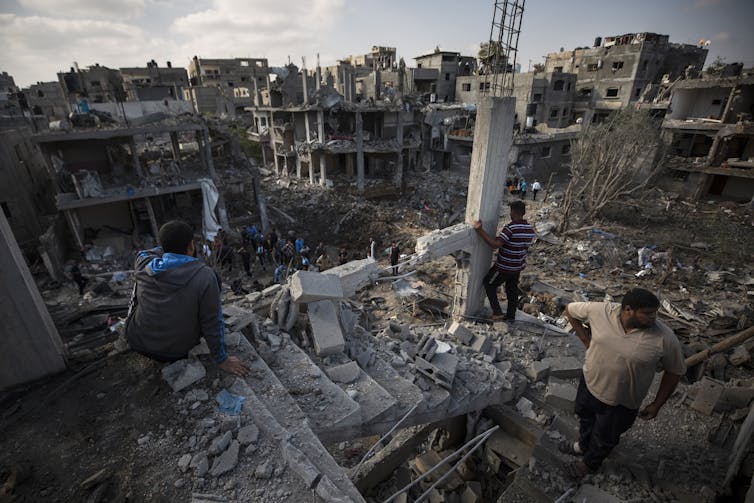
Hamas is firing rockets into Israel from Gaza. Some cause casualties, while many are intercepted by Israeli anti-missile systems or fall short of the border. Israel is conducting aerial and artillery bombardment of Palestinian targets. In recent days, it has destroyed a building that housed the Associated Press and Al Jazeera offices in Gaza, and levelled multiple Palestinian homes.

The conflict is the most intense outbreak of violence since the 2014 Israel-Gaza war. Prime Minister Benjamin Netanyahu said Israel will do “whatever it takes to restore order and quiet” and this could take some time.

The question of Palestinian statehood and the enduring Israeli-Palestinian conflict is the perennial dilemma of the international legal system. The failure of the international community to bring about a resolution in the decades-long conflict reflects the highly politicised nature of international law.

Even though the International Criminal Court’s chief prosecutor opened an investigation into alleged war crimes in the conflict two months ago — and is closely watching the current violence for potential crimes — legal accountability will likely remain elusive.

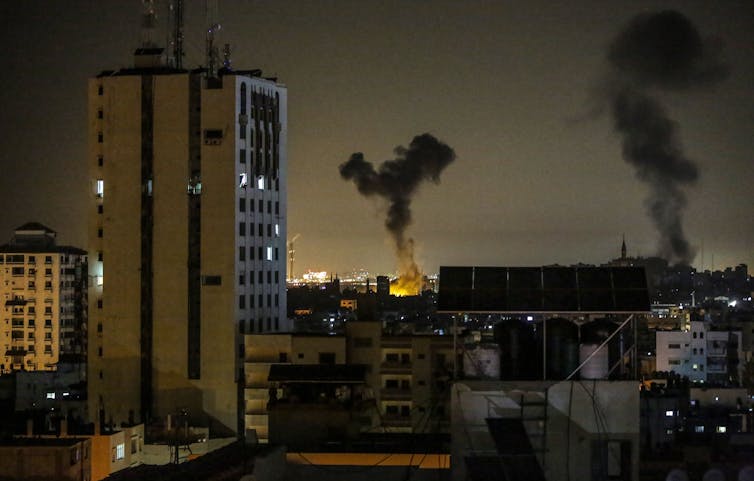
An Israeli airstrike in Gaza.
Smoke rises from an Israeli airstrike in Gaza. MOHAMMED SABER/EPA

Palestine’s status in the international community

Statehood is the preeminent status of an entity under international law. It grants the fullest range of rights and carries key assumptions, including freedom from interference with territorial integrity.

Israel declared statehood in 1948 and was admitted as a UN member state in 1949. Its statehood — combined with its abiding US alliance — has given it significant protection from external intervention.

Palestine, in contrast, claims a right to statehood but lacks effective statehood. The international legal position is clear — the Palestinian people are entitled to self-determination and statehood but they have been living under Israel’s occupation since 1967.

On this basis, in 2012, Palestine’s UN standing was upgraded to the special status of “non-member observer state”. Although the majority of UN General Assembly members expressed their hope this would lead to actual statehood for Palestine, a two-state solution to the conflict appears less likely as time goes on.

Rocket heading toward Israel
A rocket fired from Gaza heads toward Israel. MOHAMMED SABER/EPA

UN Security Council response

The UN Security Council is charged with promoting and preserving international peace and security. It has frequently addressed the conflict involving Israel and Palestine in the past.

The Security Council met in an emergency session on Sunday, with UN Secretary-General António Guterres calling for an immediate ceasefire and warning of “an uncontainable security and humanitarian crisis”. Over 38,000 Palestinians are internally displaced in the Gaza Strip following the recent surge in hostilities.

Jordanian Foreign Minister Ayman Safadi argued Israeli settlement activities violate international law and stand in the way of peace. Palestinian Foreign Minister Riyad al-Maliki accused Israel of committing war crimes and crimes against humanity, and pursuing a policy of apartheid.

Israel’s UN ambassador, Gilad Erdan, meanwhile, accused Hamas of targeting civilians as a power play against the Palestinian Authority.

Gilad Erdan addressing the Security Council.
Israeli ambassador Gilad Erdan virtually addresses the UN Security Council. JASON SZENES/EPA

The council took no action in this special session. The US, one of five permanent members with veto power, has a track record of resisting action in relation to Israel. China’s Foreign Minister Wang Yi said it was regrettable the US was blocking the council from making a statement with “one voice”.

US officials are maintaining their position that Israel is exercising its right to self-defence against Hamas terror attacks.


Read more: With diplomacy all but abandoned, Israel and the Palestinians are teetering on another war


Investigating alleged war crimes

This conflict comes in the wake of a significant development in international criminal law. In 2015, Palestine acceded to the Rome Statute that established the International Criminal Court (ICC). Palestine also accepted ICC jurisdiction over alleged crimes committed in its territory since June 2014.

In February, the ICC determined its jurisdiction extended to the Occupied Palestinian Territories. Its office of the prosecutor then initiated an investigation into the “situation in Palestine”. Prosecutor Fatou Bensouda said her office would seek justice for crimes committed against Palestinian and Israeli victims.


Read more: What admitting Palestine to the International Criminal Court means


The ICC exists to prosecute the gravest crimes against humanity and war crimes. Israel has been accused of war crimes in Palestine, including wilful unlawful killings and disproportionate military attacks causing unnecessary civilian casualties.

Human Rights Watch alleges Israel is also engaged in crimes against humanity in the form of apartheid and persecution.

The ICC probe will likely encompass the 2014 war, border clashes in 2018, and Israeli settlement activities in the West Bank. It will also examine whether Hamas and other groups in Gaza have committed war crimes by firing rockets at Israel.

Obstacles to accountability

Accountability for international crimes is complicated for non-state actors like Hamas. Indiscriminate attacks on civilian targets undoubtedly violate the laws of war. Yet, Hamas is not acting on behalf of a Palestinian state, nor does the Palestinian Authority have the capacity to halt its actions.

As for Israel, the American alliance has been a constant obstacle to accountability. However, some important trends are emerging within American Jewish communities and the Democratic Party.


Read more: As the Palestinian minority takes to the streets, Israel is having its own Black Lives Matter moment


Many American Jews are showing increasing scepticism about Netanyahu’s unflinching prosecution of Israel’s conflict with Hamas. Liberal Jewish lobbyists are challenging the Biden administration to oppose Israeli efforts to evict Palestinians in East Jerusalem.

Some prominent Democratic politicians now publicly oppose the position that Israel’s right to self-defence must be asserted by the US, regardless of whether its military actions are proportionate. Senator Bernie Sanders wrote this week:

the fact of the matter is that Israel remains the one sovereign authority in the land of Israel and Palestine, and rather than preparing for peace and justice, it has been entrenching its unequal and undemocratic control.

Prominent progressive congresswoman Alexandria Ocasio-Cortez also asked why the US could not stand up to Israel, which she called an “apartheid state”.

The ICC investigation certainly opens a new and legally intriguing avenue. But previous efforts at truth and peace-building indicate little cause for hope.

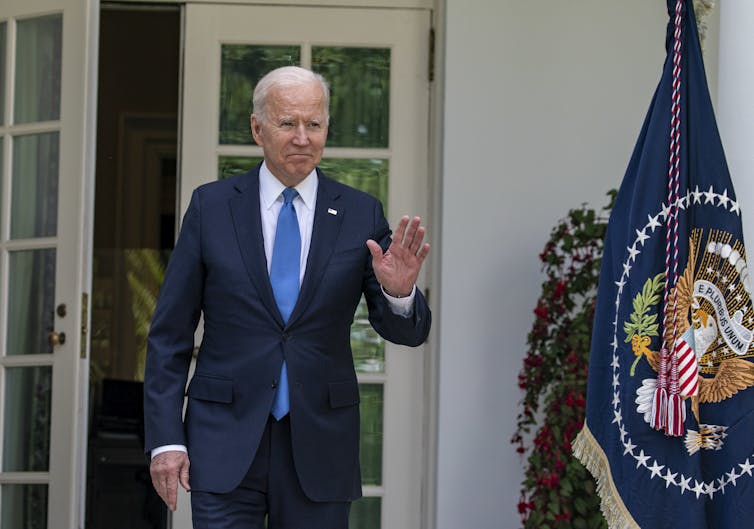
President Joe Biden, for one, has a long-established position in favour of Israel’s right to defend itself.

Israel is also not a member of the ICC and rejects the court’s jurisdiction over its territory and nationals.

The long war persists. International law — hamstrung by its own institutions, entrenched power relations and politicisation — offers no clear or quick solution.

ref. Why is accountability for alleged war crimes so hard to achieve in the Israel-Palestinian conflict? – https://theconversation.com/why-is-accountability-for-alleged-war-crimes-so-hard-to-achieve-in-the-israel-palestinian-conflict-160864

Children, teens and COVID vaccines: where is the evidence at, and when will kids in Australia be eligible?

Source: The Conversation (Au and NZ) – By Christopher Blyth, Paediatrician, Infectious Diseases Physician and Clinical Microbiologist, Telethon Kids Institute, The University of Western Australia

Adolescents in North America are beginning to roll up their sleeves for the Pfizer-BioNTech vaccine after it was approved for 12-15-year-olds this month.

The Canadian drug and therapeutic regulator Health Canada approved Pfizer-BioNTech’s mRNA vaccine for children aged 12-15 on May 5, and the United States Food and Drug Administration (FDA) expanded its emergency use authorisation to include this age group last week. The European Medicines Agency is reviewing similar applications.

COVID vaccines are currently not registered for use in children younger than 16 in Australia, but this prospect is getting closer.

Research has demonstrated the Pfizer-BioNTech COVID-19 vaccine is effective and well-tolerated in adolescents. Research into younger children is ongoing.

Do children need to be vaccinated?

Children rarely develop severe forms of COVID-19, and death from the disease is even rarer.

But children and especially teenagers can spread SARS-CoV-2, the virus that causes COVID-19.

There’s increasing evidence the vaccines impede transmission of SARS-CoV-2, so vaccinating children is expected to benefit the wider community, even though children themselves are at lower risk of COVID-19 complications.

The emergence of rapidly spreading variants makes it even more important to have as many people vaccinated and protected as possible.


Read more: Worried about your child getting coronavirus? Here’s what you need to know


Are COVID vaccines effective for kids?

Pfizer-BioNTech reported phase 3 clinical trial data involving 2,260 adolescents aged 12-15 years, in which half received two doses of the Pfizer vaccine and half received a placebo.

There were 18 cases of COVID-19 reported among those who received the placebo, and none reported in the group which received the vaccine. So the efficacy of the vaccine was 100% in this study.

The immune responses one month after the second dose, which the researchers measured by looking at antibody levels, were very good in this age group (and actually higher than those seen in the 16-25 year age group).

Other clinical trials involving adolescents are in the pipeline, including for the Moderna vaccine, the other mRNA vaccine Australia has recently signed up for.

Meanwhile, Pfizer-BioNTech and Moderna vaccines are now being trialled in children as young as six months. Other pharmaceutical companies have either commenced or are planning paediatric studies too. We expect to start receiving results of these studies in younger children in the second half of this year.

Are vaccines for children different?

The approval of any vaccine for use in children and adolescents involves the same stringent processes as the approval process for adults, if not to a greater extent. The vaccine must successfully pass through all clinical trial phases and meet important safety, efficacy and quality standards prior to regulatory approval.

One aspect of vaccine trials in children is deciding on the right dose and schedule. This is particularly important given differences in body size and immune responses to vaccines between children and adults.

Most of the time, vaccines in children and adults will use the same dose and the same schedule. For most vaccines, administering the same dose is safe, effective and logistically much easier. But sometimes, like in the case of the pertussis (whooping cough) and hepatitis B vaccine, the dose needs to be different for children and adults to produce the best results.


Read more: We asked children around the world what they knew about COVID. This is what they said


In the case of the Pfizer-BioNTech vaccine, the dose and the schedule (three to six weeks between the first and second doses) indicated for adolescents is the same as for adults.

The ongoing trials of COVID vaccines in younger children are trialling different doses to see what will be most suitable.

Are they safe?

Pfizer-BioNTech has reported side effects in adolescents similar to what we see in young adults aged 16-25 years. Injection site pain, headache, fever, chills and fatigue are most common. The side effects should be brief, lasting about 24-48 hours.

The participants in Pfizer’s trial will be followed up for two years to understand long-term protection and safety.

Once the vaccine is rolled out, we continue to assess vaccine safety. Active surveillance for adverse events following immunisation is ongoing in Australia.

The Therapeutic Goods Administration (TGA) monitors rare or serious side effects, to ensure any additional safety concerns not picked up in clinical trials are identified and investigated.

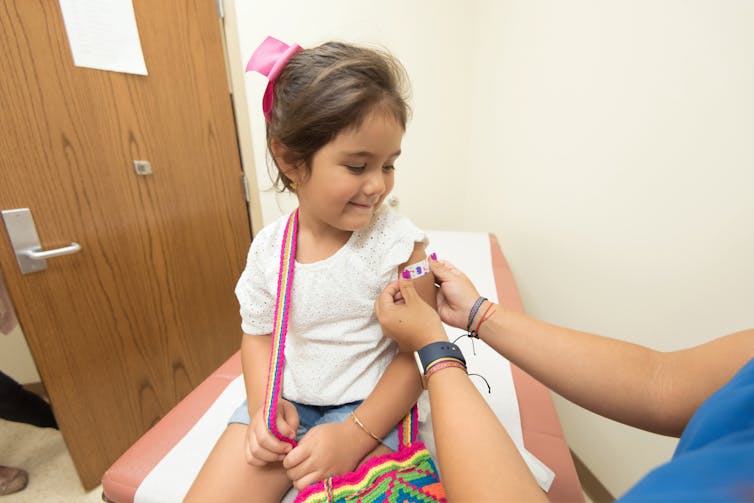
A young girl has a bandaid placed on her upper arm.
Clinical trials looking at the safety and efficacy of COVID vaccines for younger children are ongoing. Unsplash/CDC

When will children get vaccinated in Australia?

Authorisation of the Pfizer-BioNTech vaccine for adolescents in North America signals vaccination programs will extend to children. Although there are no licensed COVID-19 vaccines for use in this age group in Australia at this stage, we anticipate applications to the TGA in the coming months.

Children under 16 have been considered in Australia’s COVID-19 vaccination rollout strategy, and will constitute phase 3.

But adult priority populations are currently being targeted given their greater risk of developing severe disease, risk of exposure and critical role in society’s functioning.

It’s unlikely Australian children will be asked to roll up their sleeves for many months to come. But when they are, parents and caregivers can be assured the evidence indicates COVID-19 vaccines in children are safe and work well.

Access to a safe and effective vaccine for children and adolescents will be important in enhancing community immunity and reducing the overall impact of the global pandemic.


Read more: How do we actually investigate rare COVID-19 vaccine side-effects?


ref. Children, teens and COVID vaccines: where is the evidence at, and when will kids in Australia be eligible? – https://theconversation.com/children-teens-and-covid-vaccines-where-is-the-evidence-at-and-when-will-kids-in-australia-be-eligible-160625

We found a secret history of megadroughts written in tree rings. The wheatbelt’s future may be drier than we think

Source: The Conversation (Au and NZ) – By Alison O’Donnell, Research Fellow in Dendroclimatology, The University of Western Australia

Drought over the last two decades has dealt a heavy blow to the wheatbelt of Western Australia, the country’s most productive grain-growing region. Since 2000, winter rainfall has plummeted by almost 20% and shifted grain-growing areas towards the coast.

Our recent research, however, found these dry conditions are nothing out of the ordinary for the region.

In fact, after analysing rings in centuries-old tree trunks, we found the region has seen far worse “megadroughts” over the last 700 years. Australia’s instrumental climate records only cover the last 120 or so years (at best), which means these historic droughts may not have previously been known to science.

Our research also found the 20th century was the wettest of the last seven centuries in the wheatbelt. This is important, because it means scientists have likely been underestimating the actual risk of drought – and this will be exacerbated by climate change.

What we can learn from ancient trees

We estimate the risk of extreme climate events, such as droughts, cyclones and floods, based on what we know from instrumental climate records from weather stations. Extending climate records by hundreds or even thousands of years means scientists would be able to get a much better understanding of climate variability and the risk of extreme events.

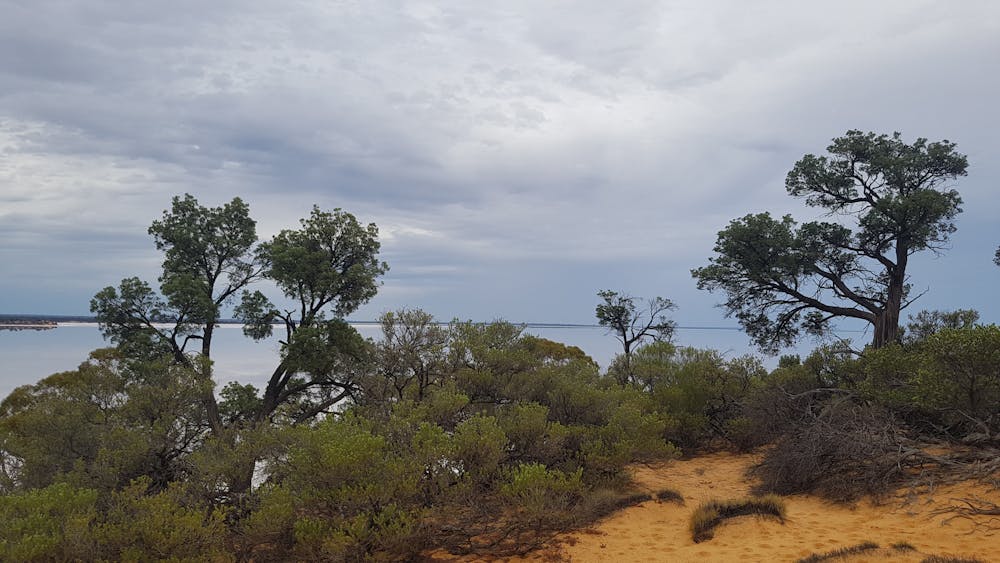
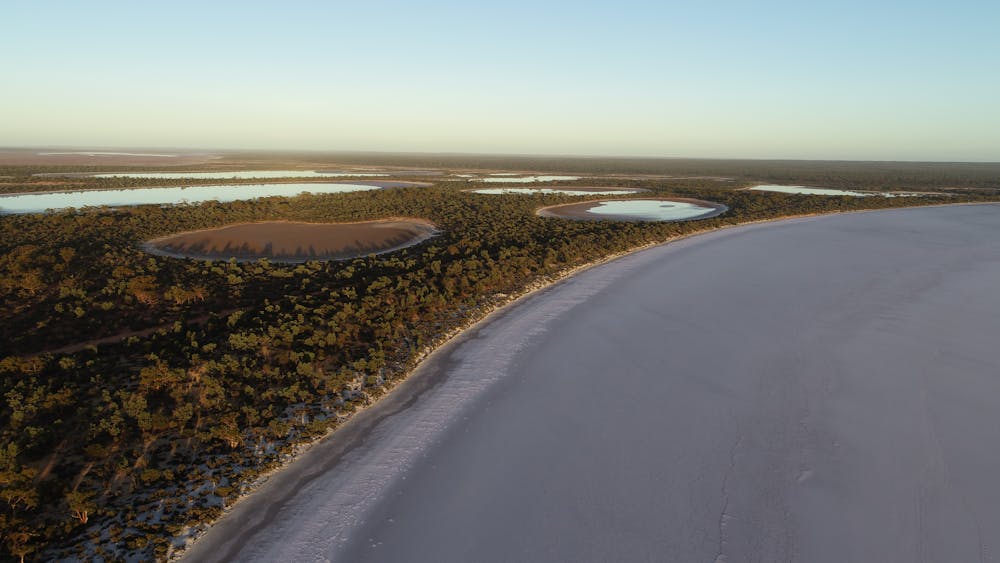
_Callitris_ trees overlooking a salt lake
Callitris trees overlooking a salt lake. We pulled a column of wood from these tree trunks to investigate past climate changes in the region. Alison O’Donnell, Author provided

Thankfully we can do just that in many parts of the world using proxy records — things like tree rings, corals, stalagmites and ice cores in Antarctica. These record evidence of past climate conditions as they grow.

For example, trees typically create a new layer of growth (“growth ring”) around their trunks, just beneath the bark, each year. The amount of growth generally depends on how much rain falls in the year. The more it rains, the more growth and the wider the ring.

Tree rings of Callitris columellaris. Alison O’Donnell, Author provided

We used growth rings of native cypress trees (Callitris columellaris) near a large salt lake at the eastern edge the wheatbelt region. These trees can live for up to 1,000 years, perhaps even longer.

We can examine the growth rings of living trees without cutting them down by carefully drilling a small hole into the trunk and extracting a column (“core”) of wood about the size of a drinking straw. By measuring the ring widths, we developed a timeline of tree growth and used this to work out how much rain fell in each year of a tree’s life.

This method allowed us to reconstruct the last 668 years of autumn-winter rainfall in the wheatbelt.

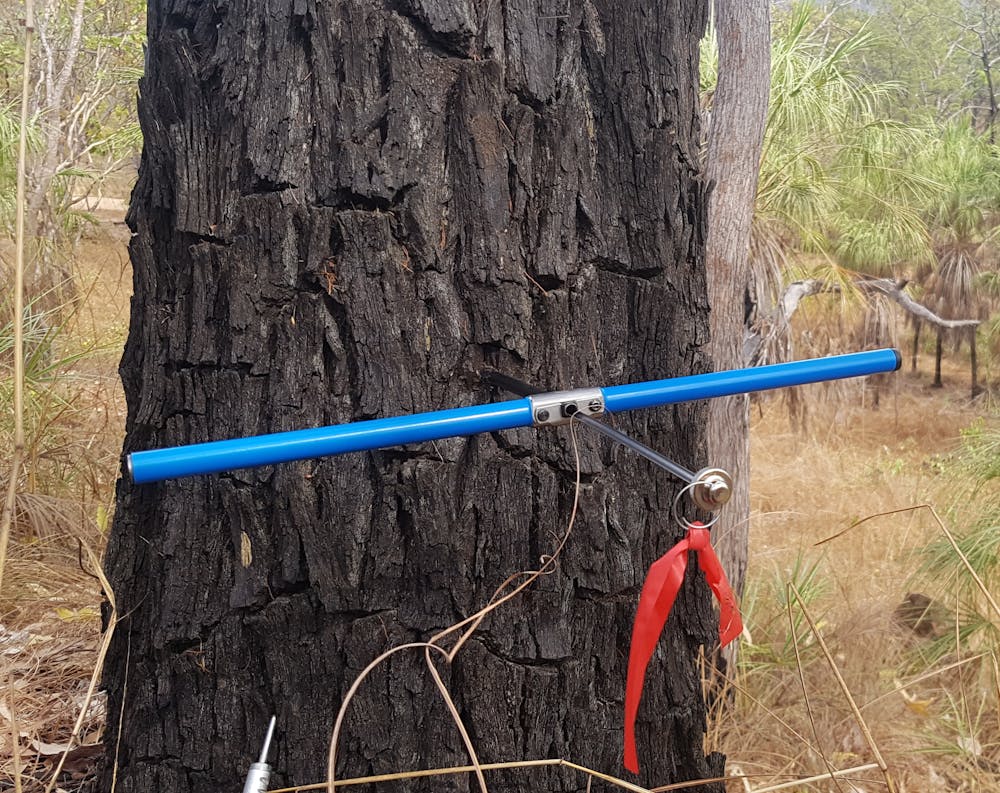
A tree trunk with a blue scientific instrument attached
A tree borer – a hollow drill used to extract ‘cores’ of wood from tree trunks. Alison O’Donnell, Author provided

A history of megadroughts

One of the most pressing questions for the wheatbelt is whether the decline in autumn-winter rainfall observed in recent decades is unusual or extreme. Our extended record of rainfall lets us answer this question.

Yes, rainfall since 2000 was below the 668-year average — but it was not extremely low.

The last two decades may seem particularly bad because our expectations of rainfall in the wheatbelt are likely based on memories of higher rainfall. But this frequent wet weather has actually been the anomaly. Our tree rings revealed the 20th century was wetter than any other in the last 700 years, with 12% more rain in the autumn-winter seasons on average than the 19th century.


Read more: 500 years of drought and flood: trees and corals reveal Australia’s climate history


Before the 20th century, the wheatbelt saw five droughts that were longer and more severe than any we’ve experienced in living memory, or have recorded in instrumental records. This includes two dry periods in the late 18th and 19th centuries that persisted for more than 30 years, making them “megadroughts”.

While the most recent dry period has persisted for almost two decades so far, rainfall during this period is at least 10% higher than it was in the two historical megadroughts.

This suggests prolonged droughts are a natural and relatively common feature of the wheatbelt’s climate.

An aerial view of the tree-ring site, home to trees that can live up to 1,000 years. Hannah Etchells, Author provided

So how does human-caused climate change play into this?

It’s likely both natural climate variability and human-caused climate change contributed to the wheatbelt’s recent decline in rainfall. Unfortunately, it’s also likely their combined influence will lead to even less rainfall in the near future.

What happens now?

Our findings have important implications for assessing the risk of drought. It’s now clear we need to look beyond these instrumental records to more accurately estimate the risk of droughts for the wheatbelt.

But currently, proxy climate records like tree rings aren’t generally used in drought risk models, as there aren’t many of them in the regions scientists want to research.

Improving risk estimates leads to better informed decisions around preparing for and managing the effects of droughts and future natural disasters.


Read more: To help drought-affected farmers, we need to support them in good times as well as bad


Our findings are a confronting prospect for the future of farming in the wheatbelt.

Australian farmers have shown tremendous innovation in their ability to adapt in the face of drought, with many shifting from livestock to crops. This resilience will be critical as farmers face a drier, more difficult future.

ref. We found a secret history of megadroughts written in tree rings. The wheatbelt’s future may be drier than we think – https://theconversation.com/we-found-a-secret-history-of-megadroughts-written-in-tree-rings-the-wheatbelts-future-may-be-drier-than-we-think-160526

Book publishing sidelined in the game of university measurement and rankings

Source: The Conversation (Au and NZ) – By Agata Mrva-Montoya, Honorary Associate, Department of Media and Communication, University of Sydney

Academic book publishing is under threat. Global university rankings and competition for funding and international student enrolments are reshaping the research landscape. Academics are under more pressure to win grant funding and publish journal articles, rather than books, and be more strategic in their publishing.

With universities losing billions in revenue due to the impacts of COVID-19, these pressures are only going to increase.

Traditionally, a monograph published with a prestigious publisher has been a key medium to create and disseminate research in the humanities and social sciences. It has also been important for building scholarly careers and reputations. However, our research shows publishing pressures, incentives and rewards are changing.

A shift from quantity to quality

The Australian government’s approach to funding research has had a strong impact on what types of publications have been encouraged.

Australian universities first began reporting details of academics’ research outputs to the government in the 1990s as part of the formula for distributing research funding. The funds allocated for publication were significant. By 2001, a peer-reviewed journal article was “worth” more than A$3,000 to the university. A book was “worth” $15,000.

These rewards applied regardless of where the research was published. “Publish or perish” had well and truly taken over. Without appropriate measures to account for quality and impact, the system had the unintended consequence of encouraging academics to publish low-quality research with low-quality journals and publishers just to meet performance targets. The use of quantitative measures alone also increases the possibility for gaming and manipulation.


Read more: Publish or perish culture encourages scientists to cut corners


Publication data were eventually removed from the Higher Education Research Data Collection (HERDC) specifications in 2016. Since then, no government funding based on quantity (or quality) of research outputs has been distributed.

Australia’s current national research assessment exercise, Excellence in Research for Australia (ERA), began in 2010. The ERA system is designed to identify and improve quality of research through international benchmarking.

As a result, all universities expect “quality” publications from their staff. This is invariably understood as publishing with international and prestigious publishers and in high-ranking journals.

As universities compete against each other, they have a strong incentive to lift their research profile and to design internal reward schemes based on how ERA defines quality.

Academics are now fundraisers

Our research project looked at the publishing strategies and behaviours of academics in the humanities and social sciences. We found the pressures for quantity appear to have subsided (for some at least). However, there is now a greater push for quality, competitive grant funding and real-world impact.

While universities are still interested in quality publications, the changing funding rules mean universities that receive competitive funding get additional research funds through HERDC. This translates to greater pressure on academics to apply for and secure funding. Academic production appears to have shifted from publication as an outcome in itself to funding as the main measure of performance.

women weighs up books in one hand against piggybank in the other
Academics must now weigh up the expectation that they attract funding against other performance criteria. Shutterstock

Funding bodies, in turn, are increasingly looking to researchers to show their research has quantifiable, real-world impacts. And ideally they should publish in open access publications.


Read more: 2020 locked in shift to open access publishing, but Australia is lagging


Juggling publication quality and research impact

Academics are caught in the middle between the pressure to publish in quality outlets versus the need to demonstrate impact in the broader society. This creates a conundrum for academics in the humanities and social sciences in particular.

A number of participants in our research described the ways in which their university’s performance evaluations are aligned to publishing practices in science, technology and medicine. Citation metrics are commonly used as a proxy for quality in these fields. Books are generally not available or poorly represented in citation databases.

Many respondents felt their institutions devalued book publishing in favour of journal articles and collaborative authorship.

The emphasis on international publication means some subject areas are rated higher than others. For example, academics in Australian studies told us they felt their institutions undervalued their work.

We also observed an increase in the number of journal ranking lists or recommended publisher lists, created internally by universities. These are intended to make “quality” explicit by identifying where academics are advised to publish.

However, these lists discourage academics from publishing with local, niche, emerging or open-access book publishers and journals. These outlets might actually be a better fit for their target audiences and so lead to greater impact.


Read more: Who cares about university research? The answer depends on its impacts


Distorting the value of academic inquiry

The different expectations of various stakeholders mean academics receive conflicting advice about publishing strategically. Academics are encouraged to engage with the Australian context and communities. At the same time, they are told to produce research that prestigious international journals and publishers will accept.

These pressures lead researchers to publish in ways that reflect how they are being measured. This appears, in turn, to influence their research agendas. The current research landscape seems to be more a reflection of what is being measured, rather than what is needed by society or would advance knowledge.

Academics, especially early career researchers, have no choice but to remain open to changing priorities, be they institutional or governmental. They must balance the contradictions and tensions in academia. In spite of the rhetoric of academic freedom, university performance expectations mean academics are increasingly required to construct their research agendas and publishing strategies to be attractive to grant funders and international publishers.

Apart from affecting individual academics’ careers, these practices have broad social and intellectual costs. For the humanities and social sciences, in particular, these trends could affect the future and relevance of these disciplines in Australia.

ref. Book publishing sidelined in the game of university measurement and rankings – https://theconversation.com/book-publishing-sidelined-in-the-game-of-university-measurement-and-rankings-157885

Jacinda Ardern calls for ‘ethical algorithms’ to combat online extremism. What this means

Source: The Conversation (Au and NZ) – By Nathalie Collins, Academic Director (National Programs), Edith Cowan University

New Zealand’s prime minister Jacinda Ardern has called for “ethical algorithms” to help stop online radicalisation.

She made her call on the weekend at the second summit of the “Christchurch Call” for action to eliminate terrorist and violent extremist content online.

The first Christchurch Call summit was convened by Ardern and French president Emmanuel Macron in May 2019. It took place two months after New Zealand’s first and worst mass shooting in decades, the Christchurch mosque shootings, in which a 28-year-old Australian gunman killed 51 men, women and children.

The Christchurch Call is a voluntary compact between governments and technology companies. So far 55 nations have signed on – with the most notable new signatory being the United States, which refused to join under Donald Trump.

Google (which owns YouTube), Facebook, Twitter, Microsoft and Amazon have also signed on, as well as Japanese messaging app LINE, French search engine Qwant and video-sharing sites Daily Motion and JeuxVideo.

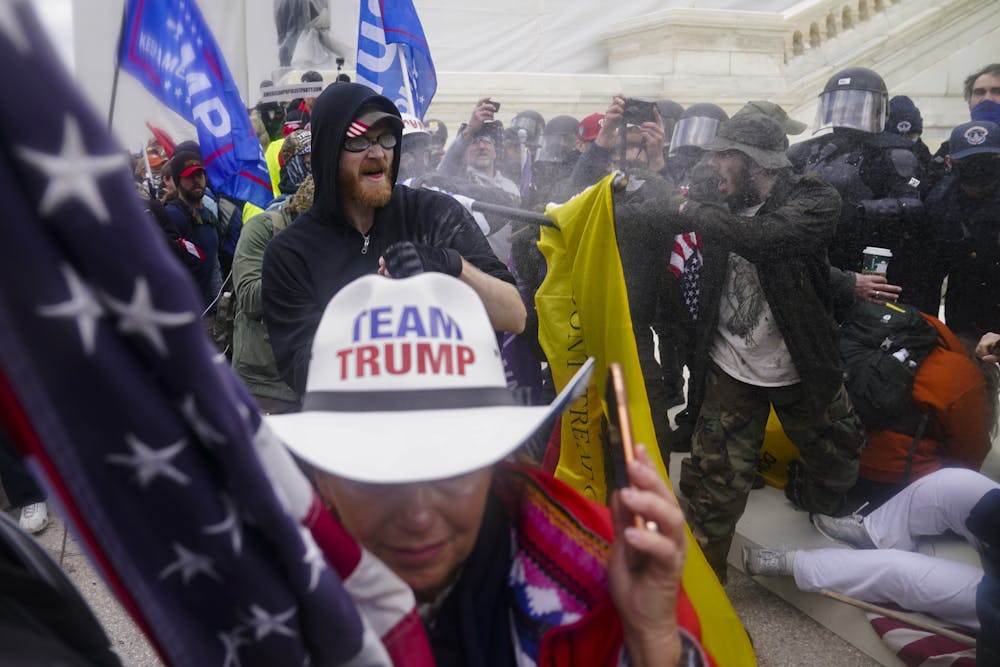
Trump supporters, believing false claims a election was stolen, try to break through a police barrier at the US Capitol in on January 6 2021.
Trump supporters, believing false claims a election was stolen, try to break through a police barrier at the US Capitol in on January 6 2021. John Minchillo/AP

In light of clear examples of extremist behaviour still being fomented online – the storming of the US Capitol in January being a case in point – one might question how much has been achieved.


Read more: Two years on from the Christchurch terror attack, how much has really changed?


On the weekend Arden, while noting the progress made in areas such as the platforms’ protocols for moderating and removing extremist content, singled out the need for ethical algorithms. Here’s why.

How social media platforms serve content

Imagine a large, vast restaurant. Service here works in an interesting way.

The waiters dash around the restaurant to bring diners as much food as they can eat. They don’t take orders but effectively direct you to what you will eat by putting that food in front of you.

The restaurant owner has designed it this way, to keep you eating as much as possible.

How do the waiters know what you like? They have a record of what you ate last time. They listen in on your table conversation. You mention you feel like French fries? They will bring you buckets of fries over and over.

At first you think: “Isn’t this wonderful, these waiters know just what I like.”

But the waiters don’t care about what you like. They just want you to keep eating. Even if the food is unhealthy and increases your risk of disease or death. No matter. They’ll keep bringing it as long as you keep eating.

If these waiters were ethical, if they cared about your well-being, they might bring you healthy alternatives. They might put a salad before you. If the restaurant owner was ethical, the service would not be designed to encourage overeating. It would seek to interest you in something else.

But then you might stop eating. You might leave the restaurant. That would hurt profits.

Algorithms are designed to decide what we see

Social media algorithms work the same as the service in our metaphorical restaurant. Algorithms are tech companies’ secret recipes to keep users on their platforms.

The easiest way to do that is serve you content you like – perhaps with even more salt, sugar and fat.

On YouTube it’s more of the same type of content you’ve been watching. Like videos of stray dogs being rescued? You’ll get more of those recommended to you. If it’s videos about governments hiding alien technology, you’ll get more of those.

Facebook works a little bit differently. It will recommend groups for you to join based on your interests. If you’ve joined a group about native birds, or ascending to the fifth dimension, more such groups will be recommended to you. Those groups enable you to interact with and make “friends’ with others who share your interests and beliefs.


Read more: Why Facebook created its own ‘supreme court’ for judging content – 6 questions answered


Repetition and normalisation

These strategies reinforce and normalise our interests and views. They are crucial reasons for the viral-like spread of extremism.

An idea, no matter how absurd or extreme, becomes more acceptable if repeated over and over again. Advertisers know this. So do propagandists. The more we view videos and posts pushing the same ideas, and connect with people who share the same views, the more we feel we’re normal and it’s those who disagree with us who are deluded.

This radicalisation is a social phenomenon. It is also a business.

Those pushing or holding radical ideas often think they are opposing Big Tech and other corporate interests. They couldn’t be more wrong. Extremist content is a lucrative market segment. Keeping your eyes on a page, enthralling you and reinforcing your views is a way for content creators, social influencers and the platforms themselves to make bank, boost their ego and spread their message. Which, in turn, legitimises their message.

Remember the fundamental business model: for Big Tech it is about about selling your attention to advertisers, no matter the message.


Read more: Reddit removes millions of pro-Trump posts. But advertisers, not values, rule the day


New Zealand Prime Minister Jacinda Ardern, third right, at the Christchurch Call summit on May 15 2021, discussing how to combat violent extremism being spread online.
New Zealand Prime Minister Jacinda Ardern, third right, at the Christchurch Call summit on May 15 2021, discussing how to combat violent extremism being spread online. Christchurch Call/AP

Can math be made ethical?

Arden’s call is for algorithms designed with intent – the intent to reduce the promotion of content which can harm you, kill you or – given the right conditions – someone else.

An ethical algorithm would encourage a more balanced diet, even if it meant you would stop consuming.

Limiting what the waiters can serve you doesn’t completely avoid the need for important discussions. For example, then who should decide what healthy means? But this would be a less contentious, more productive debate than a stale argument about free expression versus censorship. Especially when the real discussion is the promotion and convenience of “junk” thinking.

Limiting consumption by making things harder to find, not delivered on a platter, is preferable to any outright ban.

ref. Jacinda Ardern calls for ‘ethical algorithms’ to combat online extremism. What this means – https://theconversation.com/jacinda-ardern-calls-for-ethical-algorithms-to-combat-online-extremism-what-this-means-160986

Who are you? What the standard questions about birth and background don’t tell us

Source: The Conversation (Au and NZ) – By Dimitria Groutsis, Associate professor, University of Sydney

Have you ever had to fill out a form asking about your cultural background or ethnicity or race, only to be stumped because the question or the answer options don’t reflect how you see yourself?

Our research shows you are not alone. In fact, our findings suggest Australia has a serious problem in the way it collects and reports data on cultural diversity, with many organisations doing neither, and many more doing neither well.

Australia is extraordinarily rich in cultural diversity — nearly half of us were born overseas or had one or both parents born overseas. We speak more than 300 languages in our homes, and identify with more than 300 ancestries.

Yet there’s little understanding of how this looks within workplaces.

Often we are asked only about where we were born, or asked to fit into US and UK-based categories such as “African, Asian, Hispanic, Pacific Islander or White”.

African, Asian, Hispanic, Islander or White?

In Australia, such categories render invisible the lives of second and third generation Australians with strong bonds to other cultures.

To address this oversight we have developed a single standardised approach for defining, measuring, and reporting on workforce diversity.

Collecting more meaningful information is important not only for understanding ourselves, but is also for corporations, which have been found to benefit from diverse boards, leadership and workforces.

Doing it better means acknowledging cultural identity has many dimensions, among them cultural/ethnic background, language(s), national origin, race, colour, faith and global experience.

And recognising that what matters is evolving.

Some want more focus on colour

Many people we spoke with called for Australian organisations to turn away from the sanitised language of “cultural diversity” in preference for race-based language that acknowledges colour.

They valued terms used in the United States, such as BIPOC (Black, Indigenous, People of Colour), BAME (Black, Asian and Minority Ethnic) used in the United Kingdom, or “Visible Minority”, used in Canada, as they make it clear skin colour (“whiteness”) is linked to privilege.

But for others, colour is too limiting

Strikingly, just as many other people thought terms such as “cultural diversity” were better and viewed race-based terms disparagingly. In particular, they noted

• there was no generally accepted definition or understanding of who was and was not a person of colour and/or black in Australia

• who is and is not a minority in Australia depends very much on the context – some people might be minority in one workplace but a majority in another

• terms such as “culturally diverse” and “culturally and linguistically diverse” recognise that race and colour are not the only cultural determinants of workplace exclusion. Other things, such as accent, name, dress and religious practices and length of time in the country, can matter as well.


Read more: How racism and a lack of diversity can harm our workplaces


Practical ways to track Australia’s true diversity

Over the past two years we have drawn on multiple sources, including an international document review, a survey of 300 human resource and diversity and inclusion practitioners, a pilot survey of 1200 employees, focus groups with 90 participants from 34 organisations and regular consultations with an expert panel immersed in the field of cultural diversity.

The result, unveiled today, is an Australian first: a practical guide book for organisations on how to use five evidence-based measures to count culture in their workforce, leadership suite and customer base.

The five measures include three which we recommend as the minimum:

  • cultural background

  • language

  • country of birth

plus two additional measures that can be used to gain a deeper understanding of customers’ and employees backgrounds:

  • religion

  • global experience

We acknowledge that these five questions won’t suit everyone. But our hope is that by providing a nationally standardised approach, we will see more organisations mapping and benchmarking the breadth and depth of the cultural diversity in their workplace and gaining meaningful evidence.

Such evidence will spark a conversation on how we can build more inclusive practices.

We also hope that the next time you’re asked about your background, you’ll find the questions more meaningful.


Counting Culture: Towards A Standardised Approach To Measuring And Reporting On Workforce Cultural Diversity In Australia is now available.

ref. Who are you? What the standard questions about birth and background don’t tell us – https://theconversation.com/who-are-you-what-the-standard-questions-about-birth-and-background-dont-tell-us-160088

Guide to the classics: Shakespeare’s sonnets — an honest account of love and a surprising portal to the man himself

Source: The Conversation (Au and NZ) – By Dr Jamie Q Roberts, Lecturer in Politics and International Relations, University of Sydney

Most of us are familiar with Shakespeare’s plays. Even if we aren’t Shakespeare geeks, chances are we’ve waded through five or six in school, seen several movie adaptations and been to an “in the park” production.

And then there is the constant background of Shakespearean quotations and references colouring our lives, from recognisable lines like “let slip the dogs of war”, to the oh, I didn’t know Shakespeare wrote that cliches, such as “one fell swoop” or “wear my heart upon my sleeve”.

However, apart from a few hits, Shakespeare’s sonnets are less known.

goodreads

Fortified with a familiarity with the plays, a virgin journey into the sonnets is as good a literary adventure as anyone could hope for. It is both unsettling and beguiling.

The Shakespeare of the plays is god-like: he is everywhere in his creations as a masterful and unifying presence, and yet he is aloof. If I had to take a punt, I’d say he was wise, wry — the kind of person who knew how to do life right.

Thus it is a shock to meet the Shakespeare of the sonnets. This Shakespeare is frail (sonnets 29 and 145), obsessed (28), judgmental (130), fickle (110) and self-pitying (72). And so we are drawn in. We begin to ponder how much of himself Shakespeare reveals in the sonnets, and, if he is in there, how one of the most remarkable humans could be so like the rest of us.

What is a sonnet?

A sonnet is a short poem, traditionally about love. The “English” or “Shakespearean” sonnet has a standard form. There are 14 lines, each with five “beats”.

Each beat has two syllables, with the second being stressed. This is known as “iambic pentameter”. Try it out with the most famous line from the sonnets: “Shall I compare thee to a summer’s day?” (18)

The sonnet has three “quatrains” — stanzas with four lines — and a final rhyming couplet — two lines that rhyme. The couplet packs a certain punch that turns the sonnet on its head or provides the key to the sonnet or something similar.


Read more: Explainer: poetic metre


A brief overview

When we talk about Shakespeare’s sonnets, we are usually referring to the 154 sonnets published in 1609 when Shakespeare was about 45. The sonnets were likely written and revised throughout Shakespeare’s adult life (though there is debate).

Keeping to the tradition, Shakespeare’s sonnets are about love. But they take us into love’s maelstrom. The sonnets speak, often in the most raw fashion, of jealousy (61), fear (48), infidelity (120) and love triangles (41, 42), but also of the simple happiness that love can bring (25). Because of this, according to poet and essayist Anthony Hecht, young lovers make up the most substantial readership of the sonnets.

The bulk of the sonnets (1-126) are addressed to a young man, often referred to as the “fair youth”.

The dedication to the sonnets. Author provided

The last 28 are mostly addressed to or about a woman: “the dark lady”. The real-life identities of both figures are not known. However, the dedication to the sonnets, which some consider to be a code, may contain the youth’s identity (see this article by amateur Shakespeare scholar, John Rollett).

Within these two broad sets there are smaller groupings. Sonnets 1 to 17 are known as the “procreation sonnets”, while 78 to 86, which reveal that another poet is drawing inspiration from the fair youth, are referred to as the “rival poet” sequence.

And throughout, two and sometimes three sonnets are directly linked as if they were a longer poem (for instance 66, 67 and 68 — look out here for the objection to the silly wigs everyone wore).


Read more: Friday essay: 50 shades of Shakespeare – how the Bard sexed things up


The fair youth sequence

There are several recurring themes here.

A number of sonnets address the pain of being apart (such as 44 and 45). And in 49 we see the persona’s anxiety about parting permanently when he imagines the time “when thou [the fair youth] shalt strangely pass, / And scarcely greet me with that sun, thine eye.”

But we also witness the persona drawing on his love for the youth to fortify himself against unhappy memories. The well known 30 begins with:

When to the sessions of sweet silent thought / I summon up remembrance of things past, / I sigh the lack of many a thing I sought, / And with old woes new wail my dear time’s waste.

It finishes with the lines, “But if the while I think on thee, dear friend, / All losses are restor’d, and sorrows end.”

There are also the themes of time’s destruction of beauty and the horror of death. And hand-in-hand with these, we see the persona searching for ways for the youth to achieve immortality.

In 12, one of the “procreation sonnets”, the youth is encouraged to seek immortality by having children. It finishes with: “And nothing ‘gainst Time’s scythe can make defence, / Save breed, to brave him, when he takes thee hence.”

However, even more poignant are the persona’s many explicit attempts to preserve the youth through his poetry — a quixotic enterprise that, remarkably, has worked. This is best exemplified in 18. We read:

Nor shall Death brag thou wander’st in his shade, / When in eternal lines to time thou growest. / So long as men can breathe, or eyes can see, / So long lives this, and this gives life to thee.

Portrait by John Taylor, thought to be of Shakespeare. Wikimedia Commons

A common discussion is whether the fair youth sequence reveals that Shakespeare was gay or bisexual. Unless the sonnets are a wild fabrication, Shakespeare certainly wasn’t straight.

However, we should, as scholar Dennis Kay reminds us, be cautious of “applying a modern understanding of, and attitudes toward, homosexuality to early modern culture.” Read 20 and see what you think.

Not all the sonnets in the fair youth sequence are addressed to the youth. An exception is another of the evergreen sonnets: 116. This ode to the eternal nature of love begins with:

Let me not to the marriage of true minds / Admit impediments. Love is not love / Which alters when it alteration finds, / Or bends with the remover to remove: / O, no! it is an ever-fixed mark.

Returning to sonnet 66 (my favourite), although the final couplet addresses love, the sonnet stands out because its focus is not love, but the corruptions of the world.

In it, the persona objects to “folly (doctor-like) controlling skill” and “art made tongue-tied by authority.” Here we are reminded of the battles many who are capable and spirited must fight against soulless bureaucracies and the censorious.

The dark lady sequence

The “dark lady” is “dark” because when she is introduced in 127, her complexion and eyes are described as black:

In the old age black was not counted fair, / Or if it were, it bore not beauty’s name; / But now is black beauty’s successive heir, / And beauty slander’d with a bastard shame.

And later in the sonnet we read: “my mistress’ eyes are raven black.”

In the dark lady sequence, the persona suffers familiar torments. But there are also several instances of humor — the fair youth sequence is almost humorless.

In sonnet 135 and 136 the persona puns bawdily and relentlessly on the world “will”: “Wilt thou, whose will is large and spacious, / Not once vouchsafe to hide my will in thine?”

But the stand-out is 130. Here the persona pointedly declines to use tired comparisons to praise the attributes of his mistress.

We read: “My mistresses’ eyes are nothing like the sun”, and, “And in some perfumes is there more delight / Than in the breath that from my mistress reeks.”

Then come the glorious lines: “I grant I never saw a goddess go; / My mistress when she walks, treads on the ground.”

Their reception

The sonnets were not much read for nearly 200 years after their publication, but since then they have only grown in popularity. This was, perhaps, assisted by Wordsworth’s own sonnet: “Scorn Not the Sonnet”. (I know, it’s hard not to laugh.)

Today, lines from the sonnets turn up from time to time in popular culture. Naturally, in “Dead Poets Society” sonnet 18 is recited.

So what do the sonnets mean for us today? Many things. Most commonly, they have come to stand for perfect love, but this is likely because few readers make it past two of them: sonnets 18 and 116.

For those who do read further, the sonnets provide a more honest account of love, while exploring other substantial themes such as fear of death and the search for immortality.

The sonnets can also be enlisted to support social and political causes, from freedom to sexuality. And then there is the possible portal they provide into Shakespeare the man.

Ultimately though, we read on because of Shakespeare’s inimitable commingling of beauty and truth — if the two can be separated. And because each reading reveals that we are still only splashing about in the shallows of an immeasurable ocean.

ref. Guide to the classics: Shakespeare’s sonnets — an honest account of love and a surprising portal to the man himself – https://theconversation.com/guide-to-the-classics-shakespeares-sonnets-an-honest-account-of-love-and-a-surprising-portal-to-the-man-himself-156964

What is drink spiking? How can you know if it’s happened to you, and how can it be prevented?

Source: The Conversation (Au and NZ) – By Nicole Lee, Professor at the National Drug Research Institute (Melbourne), Curtin University

Recent media reports suggest drink spiking at pubs and clubs may be on the rise.

“Drink spiking” is when someone puts alcohol or other drugs into another person’s drink without their knowledge.

It can include:

  • putting alcohol into a non-alcoholic drink

  • adding extra alcohol to an alcoholic drink

  • slipping prescription or illegal drugs into an alcoholic or non-alcholic drink.

Alcohol is actually the drug most commonly used in drink spiking.

The use of other drugs, such as benzodiazepines (like Rohypnol), GHB or ketamine is relatively rare.

These drugs are colourless and odourless so they are less easily detected. They cause drowsiness, and can cause “blackouts” and memory loss at high doses.

Perpetrators may spike victims’ drinks to commit sexual assault. But according to the data, the most common type of drink spiking is to “prank” someone or some other non-criminal motive.

So how can you know if your drink has been spiked, and as a society, how can we prevent it?


Read more: Weekly Dose: GHB, a party drug that’s easy to overdose on but was once used in childbirth


How often does it happen?

We don’t have very good data on how often drink spiking occurs. It’s often not reported to police because victims can’t remember what has happened.

If a perpetrator sexually assaults someone after spiking their drink, there are many complex reasons why victims may not want to report to police.


Read more: Almost 90% of sexual assault victims do not go to police — this is how we can achieve justice for survivors


One study, published in 2004, estimated there were about 3,000 to 4,000 suspected drink spiking incidents a year in Australia. It estimated less than 15% of incidents were reported to police.

It found four out of five victims were women. About half were under 24 years old and around one-third aged 25-34. Two-thirds of the suspected incidents occurred in licensed venues like pubs and clubs.

According to an Australian study from 2006, around 3% of adult sexual assault cases occurred after perpetrators intentionally drugged victims outside of their knowledge.

It’s crucial to note that sexual assault is a moral and legal violation, whether or not the victim was intoxicated and whether or not the victim became intoxicated voluntarily.

How can you know if it’s happened to you?

Some of the warning signs your drink might have been spiked include:

  • feeling lightheaded, or like you might faint

  • feeling quite sick or very tired

  • feeling drunk despite only having a very small amount of alcohol

  • passing out

  • feeling uncomfortable and confused when you wake up, with blanks in your memory about what happened the previous night.

If you think your drink has been spiked, you should ask someone you trust to get you to a safe place, or talk to venue staff or security if you’re at a licensed venue. If you feel very unwell you should seek medical attention.

If you believe your drink has been spiked or you have been sexually assaulted, seeking prompt medical attention can assist in subsequent criminal prosecution. Medical staff can perform a blood test for traces of drugs in your system.

How can drink spiking be prevented?

Most drink spiking occurs at licensed venues like pubs and clubs. Licensees and people who serve alcohol have a responsibility to provide a safe environment for patrons, and have an important role to play in preventing drink spiking.

This includes having clear procedures in place to ensure staff understand the signs of drink spiking, including with alcohol.

Preventing drink spiking is a collective responsibility, not something to be shouldered by potential victims.

Licensees can take responsible steps including:

  • removing unattended glasses

  • reporting suspicious behaviour

  • declining customer requests to add extra alcohol to a person’s drink

  • supplying water taps instead of large water jugs

  • promoting responsible consumption of alcohol, including discouraging rapid drinking

  • being aware of “red flag” drink requests, such as repeated shots, or double or triple shots, or adding vodka to beer or wine.

Bartender pouring drinks
Bartenders should be wary of ‘red flag’ drinks requests like people asking for double or triple shots. Shutterstock

A few simple precautions everyone can take to reduce the risk of drink spiking include:

  • have your drink close to you, keep an eye on it and don’t leave it unattended

  • avoid sharing beverages with other people

  • purchase or pour your drinks yourself

  • if you’re offered a drink by someone you don’t know well, go to the bar with them and watch the bartender pour your drink

  • if you think your drink tastes weird, pour it out

  • keep an eye on your friends and their beverages too.

What are the consequences for drink spiking in Australia?

It’s a criminal offence to spike someone’s drink with alcohol or other drugs without their consent in all states and territories.

In some jurisdictions, there are specific drink and food spiking laws. For example, in Victoria, the punishment is up to two years imprisonment.

In other jurisdictions, such as Tasmania, drink spiking comes under broader offences such as “administering any poison or other noxious thing with intent to injure or annoy”.

Spiking someone’s drink with an intent to commit a serious criminal offence, such as sexual assault, usually comes with very severe penalties. For example, this carries a penalty of up to 14 years imprisonment in Queensland.

There are some ambiguities in the criminal law. For example, some laws aren’t clear about whether drink spiking with alcohol is an offence.

However, in all states and territories, if someone is substantially intoxicated with alcohol or other drugs it’s good evidence they aren’t able to give consent to sex. Sex with a substantially intoxicated person who’s unable to consent may constitute rape or another sexual assault offence.


Getting help

In an emergency, call triple zero (000) or the nearest police station.

For information about sexual assault, or for counselling or referral, call 1800RESPECT (1800 737 732).

If you’ve been a victim of drink spiking and want to talk to someone, the following confidential services can help:

– Beyond Blue: 1300 22 4636

– Kids Helpline (5-25 year olds): 1800 55 1800

– National Alcohol and other Drug Hotline: 1800 250 015.

ref. What is drink spiking? How can you know if it’s happened to you, and how can it be prevented? – https://theconversation.com/what-is-drink-spiking-how-can-you-know-if-its-happened-to-you-and-how-can-it-be-prevented-160538

Tesla’s Bitcoin about-face is a warning for cryptocurrencies that ignore climate change

Source: The Conversation (Au and NZ) – By John Hawkins, Senior Lecturer, Canberra School of Politics, Economics and Society and NATSEM, University of Canberra

Over the weekend, Tesla chief executive Elon Musk suggested his company could sell off its Bitcoin holdings, sending the cryptocurrency plummeting.

It followed Musk’s announcement earlier this month that his company would no longer accept Bitcoin in payment for its electric cars, due to the fossil fuels needed to create the digital currency.

Bitcoin is created via high-powered computers solving complex mathematical equations. These computers use a lot of electricity, which is often generated by fossil fuels. Tesla’s about-face is a blow to Bitcoin, the value of which jumped when Tesla got on board.

Tesla’s stance is a big winner for both the climate, and the company’s “green” reputation. The development has also shone the spotlight further onto the carbon footprint of cryptocurrency – an issue that will not go away soon.

Elon Must giving thumbs up
Tesla CEO Elon Musk has turned his back on Bitcoin. Britta Pedersen/AP

‘Great cost to the environment’

In announcing Tesla’s U-turn on Bitcoin, Musk said:

Cryptocurrency is a good idea on many levels and we believe it has a promising future, but this cannot come at great cost to the environment.

Musk should be congratulated for the principled stance – particularly as the decision caused the Bitcoin price to fall, reducing its value on the Tesla balance sheet.

So how, exactly, is Bitcoin – and many other cryptocurrencies – bad for the environment?

It all comes down to the energy used to create it. Before a Bitcoin transaction takes place, the person spending the coin must be verified as the valid owner. And once the transaction is complete it must be digitally recorded in a database known as a “blockchain” ledger.


Read more: Why is Bitcoin’s price at an all-time high? And how is its value determined?


Unlike a traditional bank where transactions are centrally verified and recorded, Bitcoin’s ledger comprises a distributed database of users. They verify transactions by running complex mathematical problems through high-powered computers. The first user to solve the calculation and add it to the blockchain is rewarded with Bitcoin. The process is termed “mining”.

Over time, the Bitcoin system increases the complexity of the problems as more computing power is applied to them. In the early days mining could be done by geeks in their bedrooms using home computers. Now it mostly done using vast rooms full of very expensive specialised equipment, which only companies can afford.

The process uses a lot of energy. The University of Cambridge recently estimated Bitcoin used more electricity each year than the entire economies of Argentina or Sweden.

Some of this electricity comes from renewables. But analyses suggest most Bitcoin mining occurs in China, and the main power source is coal. A recent study in Nature concluded Bitcoin operations in China are on track to produce 130 million tonnes of greenhouse gas emissions in 2024 – more than the entire economy of the Czech Republic.

fingers hold bitcoin in front of smokestacks
Bitcoin’s annual emissions exceed that of some entire nations. AP

Bumps in the Bitcoin road

If Bitcoin became more popular, its carbon footprint would only increase. But even before Musk’s announcement, Bitcoin was struggling to become a widely used online payment system.

This is partly because the scale of cryptocurrencies cannot keep up with global transaction demand and their value fluctuates widely. The new focus on Bitcoin’s environmental costs make it even more likely the currency will remain an outlier.

Tesla’s move puts pressure on other companies to stop (or not start) accepting Bitcoin or risk damage to their brand. Research shows most consumers are less willing to buy from a company that doesn’t take its environmental responsibilities seriously.

A company accepting Bitcoin may also risk being shunned by investors. Questions have been raised about whether Bitcoin exposure is compatible with ethical investment.

Already some central banks and private funds managers are including climate change risks when making investment decisions. And banks are increasingly reluctant to lend to companies not acting on climate change.

The attention on Bitcoin’s carbon footprint will benefit “greener” cryptocurrencies. For example, Chia uses less processing power than Bitcoin and so produces fewer greenhouse gas emissions.

In the longer term, there’s a bigger challenge to Bitcoin’s aspirations. Some central banks such as the People’s Bank of China are developing their own digital currencies. These will offer a cheap and efficient payment system without the volatile price and large carbon footprint of Bitcoin.


Read more: New Chia cryptocurrency promises to be greener than Bitcoin, but may drive up hard drive prices


Man holds smartphone in front of computer screen
Cryptocurrency investors may start to demand a lower carbon footprint. Shutterstock

Cleaning up cryptocurrency

So where to now for energy-intensive digital currencies such as Bitcoin?

Some environmental concerns could potentially be addressed by moving to greener electricity sources for computer processing. According to one suggestion, this could involve creating a registry to track provenance, so climate-aware investors could choose to buy Bitcoin made from, say, Icelandic hydroelectric power rather than coal.

But such a measure would probably have to be voluntary. Regulating Bitcoin would be difficult due to its decentralised nature; there’s no company to “fine” for breaking the rules.

Any attempt to clean up Bitcoin by changing its coding would be problematic. Past attempts to change the code to improve efficiency just resulted in “forks” – the emergence of new cryptocurrenices such as Bitcoin Gold and Bitcoin Cash.

As with climate policy in general, the best way to reduce greenhouse gas emissions is for governments to apply a carbon price to companies that mine cryptocurrency. This would financially penalise those that don’t switch to renewable energy.


Read more: Bitcoin isn’t getting greener: four environmental myths about cryptocurrency debunked


ref. Tesla’s Bitcoin about-face is a warning for cryptocurrencies that ignore climate change – https://theconversation.com/teslas-bitcoin-about-face-is-a-warning-for-cryptocurrencies-that-ignore-climate-change-160928

Downloading our thoughts to the mainframe may be the stuff of science fiction — but humans have been imagining it for centuries

Source: The Conversation (Au and NZ) – By Henry-James Meiring, PhD Candidate, The University of Queensland

Modern transhumanism is the belief that, in the future, science and technology will enable us to transcend our bodily confines. Scientific advances will transform humans and, in the process, eliminate ageing, disease, unnecessary suffering, and our earthbound status.

Artistic representations of humans uploading their minds to cybernetic devices or existing independently of their bodies abound.

In Altered Carbon (2018-2020) we are introduced to a future where human consciousness can be downloaded onto devices called “cortical stacks”. This technology reduces physical bodies to temporary vehicles or “sleeves” for these storage devices which are implanted and swapped between various bodies.

The Matrix (1999, 2003) depicts humans living in a digital simulation while their bodies remain inactive in liquid-filled pods. The artist Stelarc explores our transhuman future in “monstrous” creations examining the boundaries between human and machine.

But these speculations are not limited to art and science fiction.

The public intellectual Sam Harris and world-renowned physicist David Deutsch imagine a future where we are able to download conscious states and live in matrix-like virtual simulations. The historian Yuval Noah Harari suggests, in the not too distant future, these technological advancements will transform us into new godlike immortal species.

Some thinkers, like the philosopher Nick Bostrom, believe we might already be living in a computer simulation. Elon Musk is developing brain-machine interfaces to connect humans to computers.


Read more: Curious Kids: could our entire reality be part of a simulation created by some other beings?


These imaginings of our transhumanist future take many divergent forms, but they share the idea science will enable us to free our minds from bodily constraints.

But these ideas aren’t modern. In fact, the desire to transcend our nature is a continuation of the Enlightenment ideal of human perfectibility: today’s ideas of transhumanism can be directly traced back to two 18th century thinkers.

Marquis de Condorcet: life will have ‘no assignable limit’

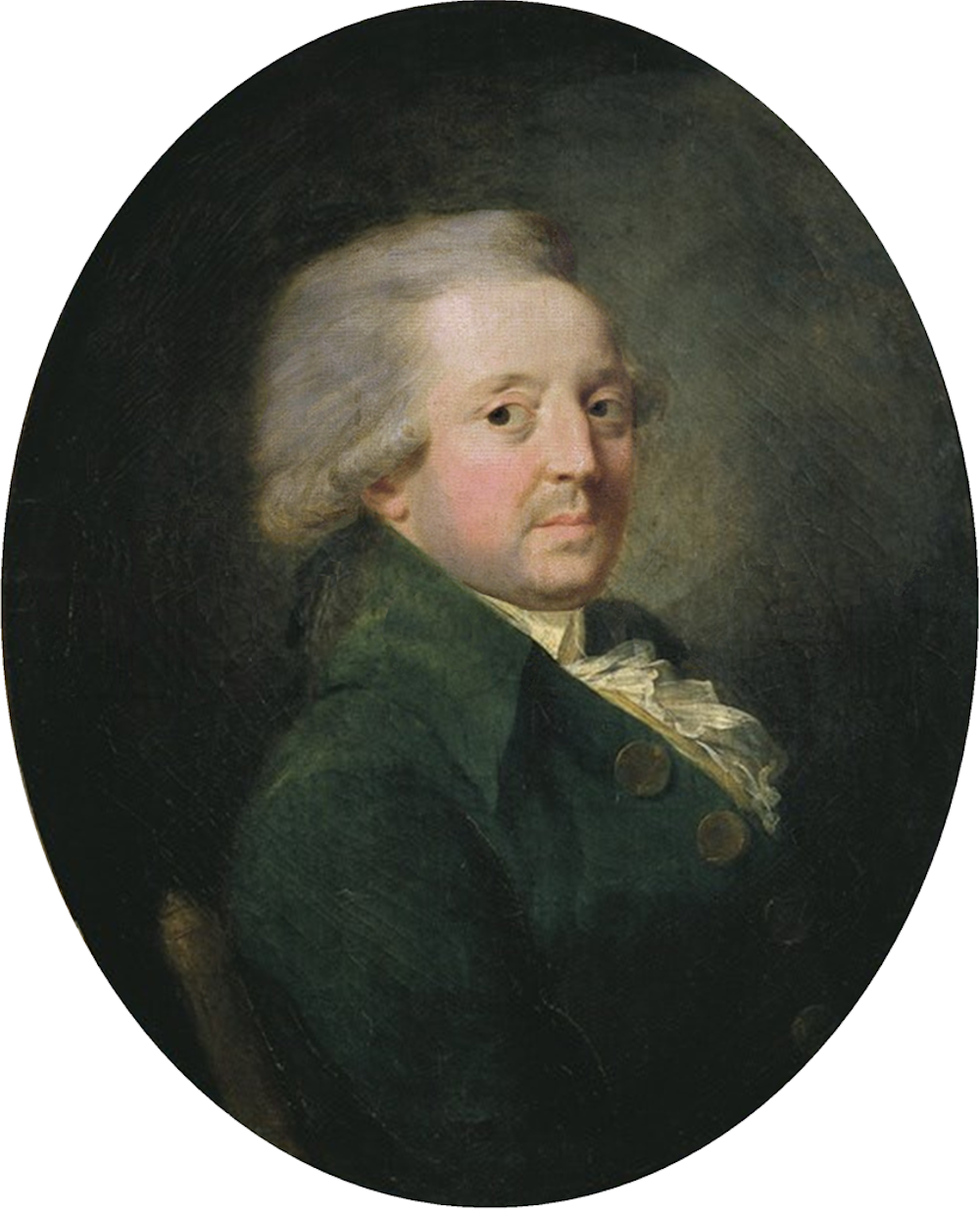
Marquis de Condorcet (1743-1794) was a French revolutionary who believed science would bring about unprecedented progress.

Oil painting of an old man.
Marquis de Condorcet, painted between 1789-1794. Wikimedia Commons

Condorcet was a mathematician who aimed to apply a scientific model to the social and political dimensions of society. He thought improvement in education would produce more knowledge, which in turn would further improve education — creating an ever upward spiral of progress.

His reception speech to the French Academy in 1782 captured the optimistic spirit of the age. He declared: “the human mind will seem to grow and its limits to recede” with the advancement of science.

In Outlines of an Historical View (1795) he wrote:

Would it even be absurd to suppose […] a period must one day arrive when death will be nothing more than the effect either of extraordinary accidents, or of the flow and gradual decay of the vital powers; and that the duration of the middle space, of the interval between the birth of man and this decay, will itself have no assignable limit?

Condorcet imagined science would lead to humans transcending their bodies and, in the process, attaining immortality.

William Godwin: the extinction of anguish, and passion

Enlightenment thinker William Godwin (1756-1836) was convinced science would lead to human perfectibility.

Oil painting. A younger man.
William Godwin painted by James Northcote in 1802. Wikimedia Commons

Godwin was a political radical whose sympathies lay with contemporary French revolutionaries like Condorcet. He believed an expansion in knowledge would lead to improvements in our understanding, and thereby increase our control over matter.

Godwin outlined this vision in his book Enquiry Concerning Political Justice and its Influence on Morals and Happiness (1793).

He wrote that human passions and desires would become extinct along with disease, anguish, melancholy and resentment. This was a future in which people no longer had sex nor reproduced. The Earth instead would be populated by disembodied humans who have achieved immortality.

“There will be no war”, wrote Godwin, “no crimes, no administration of justice as it is called, and no government”. Scientific progress for Godwin not only meant we would be rid of ailments plaguing the physical body, but also those affecting society.

For Godwin, like Condorcet, human perfectibility was unlimited and, more importantly, achievable.

Godwin’s daughter, Mary Shelley, went on to write one of the earliest literary works to depict transhumanism, Frankenstein (1818). Her vision of a scientific future was much less rosy.


Read more: Frankenstein at 200 and why Mary Shelley was far more than the sum of her monster’s parts


Science fact or science fiction?

Godwin and Condorcet imagined humans progressing towards perfect harmony, transcending bodily existence and achieving immortality without desires nor suffering.

Like their modern transhumanist descendants, they believed these radical transitions would occur in their own lifetime. Critics thought their work to be fantastical; more fiction than fact.

As we now know, the critics were right: neither Godwin’s nor Condorcet’s extraordinary visions came to fruition. It has been more than 200 years, and we are still waiting for science to deliver us from our bodies.


Read more: Neuralink’s monkey can play Pong with its mind. Imagine what humans could do with the same technology


This does not seem to deter transhumanist punters. Will we become the immortal human-machine gods, as Yuval Noah Harari predicts? Or will we still be waiting to transcend our fleshy bodies in the 23rd century?

Only time will tell. But, for those of us who prefer to hold on to our bodies for a little while longer, the fate of Godwin and Condorcet’s visions should be good news.

ref. Downloading our thoughts to the mainframe may be the stuff of science fiction — but humans have been imagining it for centuries – https://theconversation.com/downloading-our-thoughts-to-the-mainframe-may-be-the-stuff-of-science-fiction-but-humans-have-been-imagining-it-for-centuries-154082

Little change in post-budget Newspoll; Liberals win Tasmanian majority

Source: The Conversation (Au and NZ) – By Adrian Beaumont, Honorary Associate, School of Mathematics and Statistics, The University of Melbourne

This week’s Newspoll, conducted May 13-16 from a sample of 1,506, gave Labor a 51-49 lead, unchanged from the last Newspoll published three weeks ago. Primary votes were 41% Coalition (steady), 36% Labor (down two), 12% Greens (up two) and 2% One Nation (down one). Figures are from The Poll Bludger.

58% were satisfied with Scott Morrison’s performance (down one), and 38% were dissatisfied (up one), for a net approval of +20. Anthony Albanese’s net approval was down four points to -7, his worst ever net approval. Morrison led Albanese as better PM by 55-30 (56-30 three weeks ago).

Newspoll has asked three questions after every budget: whether the budget was good for the economy, good for you personally, and whether the opposition would have delivered a better budget. Results for this last question are yet to appear, and it would be disappointing if that question has been cancelled.

44% thought last Tuesday’s budget was good for the economy and 15% bad, for a net rating of +29. On personal finances, 19% thought it would be good and 19% bad, for a net zero rating. Voters have consistently been better disposed to budgets on the economy than the personal.

The Poll Bludger says this budget is the eighth best on personal finance and the sixth best on the economy since Newspoll started asking these questions, which I believe was in 1988. Analyst Kevin Bonham says this budget has the best net score on the economy since 2007’s +48. However, the Coalition under John Howard lost the 2007 election after that budget.

Most budgets have little impact on voting intentions, and this is confirmed by voting intentions remaining unchanged on two party preferred in this Newspoll. Exceptions were the very unpopular 1993 and 2014 budgets. After both those budgets, the government lost much support.

The drop in Labor’s support, and the rise for the Greens, is probably due to left-wing voters who are unhappy with Albanese. Morrison’s consistently big lead over Albanese as better PM likely encourages some voters to perceive Labor would do better if led by someone more left-wing than Albanese. I posted about the flaws in this logic in my last Newspoll report.

In an additional Newspoll question, 73% thought Australia’s borders should remain closed until at least mid-2022, or the pandemic is under control globally. Just 21% thought borders should open as soon as all Australians who want to be are vaccinated.

In last week’s Essential poll, taken before the budget, Morrison’s net approval surged to +26 from +17 in mid-April. With women, his net approval rose 17 points to +21; with men, it was up two points to +31. While there is still a gender gap, many women appear to have forgotten or forgiven the sexual misbehaviour in March.

Liberals win Tasmanian majority as sex-compromised Liberal wins, then resigns

At the May 1 Tasmanian election, the Liberals won 13 of the 25 lower house seats (steady since the 2018 election), Labor nine (down one), the Greens two (steady) and Independent Kristie Johnston won the last seat. Vote shares were 48.7% Liberal (down 1.5%), 28.2% Labor (down 4.5%), 12.4% Greens (up 2.1%) and 6.2% for independents.

In party terms, there were two electorates where the result appeared uncertain in my post-election article: Clark and Bass. With five seats per electorate, a quota is one-sixth of the vote, or 16.7%. In the Hare-Clark system, candidates compete against other candidates in the same party, as well as other parties’ candidates.

In Clark, there was some doubt on election night as to whether the Liberals would win a second seat. But former Labor MP Madeleine Ogilvie, who had sat as an independent in the last parliament, and joined the Liberals at this election, won the second Liberal seat in Clark.

Ogilvie was 342 votes or 0.03 quotas ahead of fellow Liberal Simon Behrakis at the second last count. At Behrakis’ exclusion, final standings were Ogilvie 0.95 quotas, Johnston 0.93 and Independent Sue Hickey 0.82. Ogilvie and Johnston were elected to the final two seats.

In Bass, Labor benefited from leakage of Premier Peter Gutwein’s surplus and preferences from other sources. Labor easily defeated the Greens and Liberals for the final seat for a three Liberal, two Labor result.

The day before the election, Liberal Braddon candidate Adam Brooks was accused of impersonating to enter a sexual relationship using a fake driver’s license. Tasmania still requires early voters to complete a declaration that they cannot vote on election day, so most votes were cast on election day.

Brooks was still elected after a close race with two other Liberals in Braddon. With the final two seats to be filled, Jaensch finished on 0.934 quotas, Brooks 0.931 and Ellis 0.904, with Ellis missing out. Brooks had been 0.046 quotas ahead of Ellis after Liberal exclusions and surpluses, with his lead reduced by sources outside the Liberals.


Read more: Has a backlash against political correctness made sexual misbehaviour more acceptable?


The Braddon result was finalised Thursday. On Friday, Brooks resigned his seat after Queensland police charged him with firearms offences. Brooks’ seat will definitely go to a Libera on a countback (not a byelection), likely Ellis. The Liberals will be relieved at not requiring Brooks’ vote to maintain a majority.

In the upper house, the Liberals gained Windermere from a retiring conservative independent, while Labor held Derwent. In Windermere, the Liberals defeated Labor by 54.1-45.9, from primary votes of 37.8% Liberal, 27.0% Labor and 21.3% for an independent. In Derwent, Labor defeated the Liberals by 55.7-44.3, from primary votes of 49.1% Labor, 40.9% Liberal and 10.0% Animal Justice.

The Tasmanian upper house has 15 single-member electorates with two or three up for election every May for six-year terms. Current standings are five Labor, four Liberals, four left independents and two centre-right independents.

Poll gives Nationals 51-49 lead for Saturday’s Upper Hunter (NSW) byelection

A byelection will occur in the NSW Nationals-held state seat of Upper Hunter this Saturday. This seat has been Nationals-held since 1932, but at the 2019 NSW election, the Nationals had their lowest primary vote of 34.0%. Labor had 28.7%, the Shooters 22.0% and the Greens 4.8%.

Excluding exhausting preferences, the Nationals defeated Labor by 52.6-47.4, with 24.2% of total votes exhausting under NSW’s optional preferential system.

A YouGov poll for The Daily Telegraph gave the Nationals a 51-49 lead over Labor in Upper Hunter based on respondent preferences. Primary votes were 25% Nationals, 23% Labor, 16% Shooters, 11% One Nation, 6% Greens and 10% combined for two independents. The poll was conducted May 11-13 from a sample of just 400.

ref. Little change in post-budget Newspoll; Liberals win Tasmanian majority – https://theconversation.com/little-change-in-post-budget-newspoll-liberals-win-tasmanian-majority-160618

Despite a veneer of democracy, Samoa is sliding into autocracy

Source: The Conversation (Au and NZ) – By Patricia A. O’Brien, Visiting Fellow, School of History, Australian National University, and Adjunct Professor, Asian Studies Program, Georgetown University

The fragility of democracy in Samoa has been on full display in the past month. On April 9, voters used the national election to deliver a powerful rebuke to the Human Rights Protection Party (HRPP), which has ruled their Pacific nation for four decades as a virtual one-party state.

Initially, the HRPP was locked in a dead heat (25 seats each) with the Fa’atuatua I Le Atua Samoa Ua Tasi (FAST) party, with one independent candidate, Tuala Tevaga Iosefo Ponifasio, deciding the victor.

FAST was formed in protest against the government rushing three bills into law in 2020 that fundamentally altered Samoa’s constitutional, judicial and customary frameworks. The stunning election results registered the depth of anger about this legislation and the desire for change.

But on the eve of Tuala’s announcement he would join FAST and launch a new political era, troubling events began. On April 20, Samoa’s Election Commissioner announced via social media that a new 52nd parliamentary seat had been created and signed into law by the head of state, Afioga Tuimalealiifano Vaaletoa Sualauvi. An HRPP candidate was installed in the seat. This announcement denied FAST (headed by a former deputy prime minister, Fiame Naomi Mata’afa) its one-seat majority and victory.

On May 4, when the Supreme Court of Samoa questioned the 52nd-seat manoeuvre, the head of state (who was appointed by the government) declared the April 9 election results void and that a new snap election would be held on May 21. He also questioned the impartiality of Samoa’s highest court.


Read more: Samoa’s stunning election result: on the verge of a new ruling party for the first time in 40 years


Caretaker Prime Minister Tuilaepa Sailele Malielegaoi, who has held that office since 1998, declared himself “shocked” by the head of state’s announcement, but thought an electoral rerun would make the people’s will more “clear”. He also asserted he was appointed to rule Samoa by the highest authority of all: God.

On May 17, the Supreme Court declared the 52nd seat unconstitutional, giving FAST back its one member majority. The Supreme Court will soon decide on the voided election too – it is unlikely to be in favour.

But the HRPP has sown the seeds for a direct confrontation between the head of state and the judiciary. The HRPP is likely to continue the push for the second election, having denounced the courts, the Samoan diaspora, Facebook, protesters and Samoa’s leading newspaper, which strongly opposes Tuilaepa’s actions.

The people of Samoa have saved democracy in their country before – they may now have to do so again. Shutterstock

Scepticism abounds about how orderly a rerun election will be, given the extraordinary events since April 9. Despite a veneer of democracy, Samoa is ominously facing an autocratic future.

Samoa has struggled with autocracy and democracy before. The 1920s were a tempestuous time for the nation, which was reeling from the devastation of the influenza epidemic that killed more than one in five of its people. (Due to closed borders Samoa has been almost free of COVID-19, but the economic, social and political impacts of eligible voters being unable to return home to cast ballots have been considerable.)

The 1918 pandemic aftershocks resulted in a mass civil disobedience campaign known as the Mau (stance) Movement. It laid the blame for the calamity solely at the feet of New Zealand, which took over the German colonial regime in its first action of the first world war. So intense was the public’s anger, the new administrator brought in to quell the situation likened ruling Samoa to sitting on top of a “volcano”.

One of the Mau leaders was Ta’isi O.F. Nelson. He relentlessly fought New Zealand’s autocractic rule, likening the administrator’s powers to that of a “dictator”. He was singled out by New Zealand as the “cause of all the trouble”. Ta’isi was exiled from Samoa for ten years, imprisoned and financially ruined for the peaceful, multifaceted, international campaign he led.

Samoan protests intensified especially when New Zealand attempted to alter the functioning of Samoan customs. With the endorsement of Britain and the League of Nations (Samoa was one of the league’s mandated territories from 1920), New Zealand met the peaceful protests with military force. This led to the infamous 1929 Black Saturday Massacre, which killed nine protesters including Mau leader Tupua Tamasese Lea’lofi. The ongoing Mau campaign succeeded in Samoa becoming the Pacific’s first independent nation in 1962 and its most “stable democracy”.

This history is detailed in my book, Tautai (navigator). In 2021, the history of Samoans’ passionate fight against autocratic rule should be well remembered, as there are many echoes of it in the present crisis.

Widespread anger against the three 2020 laws, attacks on censorious press and even Tuilaepa’s singling out of Ta’isi’s grandson, who was both a former prime minister and head of state, as the “mastermind” behind FAST’s campaign strategy, are some of the most apparent similiarities.


Read more: Devastated by disease in the past, Samoa is on high alert after recent coronavirus scares


The corrosion of democracy in Samoa is part of a global trend. China’s growing influence in Samoa under Tuilaepa shadows current events. But, in the coming days, democracy’s endurance will be tested and, hopefully, saved by Samoa’s people and institutions.

ref. Despite a veneer of democracy, Samoa is sliding into autocracy – https://theconversation.com/despite-a-veneer-of-democracy-samoa-is-sliding-into-autocracy-160701

The Treasurer says his ‘patent box’ will boost innovation. The evidence says it won’t

Source: The Conversation (Au and NZ) – By Isaac Gross, Lecturer in Economics, Monash University

On budget night federal Treasurer Josh Frydenberg announced Australia is getting its own “patent box”.

What is a patent box?

Despite its odd name, it is a relatively straightforward concept. It means lowering the tax rate on all income derived from patents registered in a nation. About half the members of the European Union, Britain and China are among those to adopt patent boxes in some form.

Australia’s patent box scheme will initially be limited to medical and biotechnology patents, but with scope to expand it down the track.

If a company has a drug patent, for example, the profit from selling that drug will be taxed at a rate of 17%, instead of the usual company tax rate (now 25% for companies with an annual turnover less than A$50 million and 30% for those with more).

In his budget speech Frydenberg cited world-leading Australian innovations such as Wi-Fi, the Cochlear bionic ear and a vaccine for cervical cancer. “We want to see more innovation commercialised in Australia,” he said.

Will the patent box help? The evidence from overseas is not promising.

Another race to the bottom

A 2015 European Commission report examined the effect of patent boxes on 2,000 companies in 12 countries from 2000 to 2011. It found the patent boxes benefited companies financially but had limited effect on increasing local research & development.

To take advantage of the lower tax rate, multinational companies filed more patents in these countries with patent boxes than previously. But they didn’t change the location of their research teams.

The European Commission report noted fears about patent boxes sparing another “race to the bottom” in corporate taxation, with nations competing to be more attractive to foreign companies. If one country had more preferential tax rates, it would attract more patent filings. If other nations followed suit, the only real beneficiaries would be the multinational corporations using the schemes to reduce their tax obligations “without a change in real research activity”

Its results, the report concluded, “confirm these fears”.


Read more: How to get the most out of research when universities and industry team up


Australian warnings

This all should be known to the Australian government.

A 2015 report from Australia’s Office of the Chief Economist came to a similar conclusion to the European Commission study.

Introducing a patent box might lead to more patents being filed in Australia, it said, but they would mostly be ones derived from research and development done overseas. It warned:

The most important cost associated with the implementation of a patent box regime is a fall in tax revenues collected from innovative companies. Since the fall is likely to exceed revenues collected from (re)allocation of IP income to Australia, the overall return of a patent box regime is likely to be negative.

IP Australia, the federal agency administering intellectual property rights, detailed the poor record of patent boxes in its submission to the federal parliament’s Inquiry into Australia’s Future in Research and Innovation in 2016. It said the literature on such schemes found little if any benefit for actual innovation, at great cost to taxpayers.


Read more: Money for telescopes and vaccines is great, but the budget’s lack of basic science funding risks leaving Australia behind


Bad plan, bad design

On top of all this, Frydenberg’s proposed patent box is poorly targeted.

Ideally the subsidy should only apply to new patents – or better yet, new inventions. But the scheme will allow the lower tax rate on all patents, even if they were granted many years ago or are no longer owned by their original inventor.

This means in its first year alone the patent box is set to deliver a $100 million gift to companies sitting on old patents without any actual new innovation.

Even if you want to subsidise innovation, it makes zero sense to subsidise old patents. Other countries have avoided this pitfall by limiting the subsidy to new ones.

In short, a patent box is good in theory but bad in practice; and the design of the Australian government’s patent box is particularly bad. It will likely end up being just another way multinational companies can avoid paying tax.

ref. The Treasurer says his ‘patent box’ will boost innovation. The evidence says it won’t – https://theconversation.com/the-treasurer-says-his-patent-box-will-boost-innovation-the-evidence-says-it-wont-160861

Social plants: in the wild, staghorn ferns grow in colonies to improve water storage for all members

Source: The Conversation (Au and NZ) – By Kevin Burns, Professor, Te Herenga Waka — Victoria University of Wellington

Social colonies are nothing new in the animal kingdom. We know bees, ants and termites live in large colonies, divide labour and co-operate to take care of offspring produced by a single queen.

This behaviour, known as eusociality, has evolved independently in insects, crustaceans (certain species of shrimp) and even some mammals (naked mole rats), but it has never been observed in plants. This suggested plants were somehow less complex than animals.

Our study, published this week, turns our understanding of the evolution of biological complexity on its head. It documents the life history of a remarkable species of fern that grows in the tops of rainforest trees on Lord Howe Island, a small volcanic island in the north Tasman Sea.

Rather than growing as individual ferns in the treetops, the staghorn fern (Platycerium bifurcatum) lives in colonies, in an adaptation to its harsh habitat high above the water and nutrients stored in the soil below.

Individuals differ markedly in size, shape and texture. But they always grow side-by-side within colonies, fitting together like puzzle pieces to form a bucket-like store of water and nutrients available to all colony members.

Many individuals forgo reproduction and instead focus on capturing or storing water to the benefit of other colony members.


Read more: We found the genes that allowed plants to colonise land 500 million years ago


Life in the tree tops

Staghorn ferns belong to a group of tree-dwelling plants known as epiphytes. Tree canopies are a challenging environment for plants to grow. Without access to soil, epiphytes are regularly exposed to severe water and nutrient stress.

Epiphytes have evolved several ways to mediate the lack of access to water and nutrients. Bromeliads grow cup-shaped leaves, while orchids have specialised root tissues. But staghorn ferns have developed a colony lifestyle to overcome the problem.

Panorama taken on Lord Howe Island
On Lord Howe Island, staghorn ferns grow in colonies. Author provided

Staghorn ferns can be bought at many garden stores and will grow like any other pot plant. But in the wild on Lord Howe Island, we discovered individual plants collaborate, specialising in different tasks in the construction of the communal water and nutrient store, often at the cost of their own reproduction — just like social insects.

This radically changes our understanding of biological complexity. It suggests major evolutionary transitions towards eusociality can occur in both plants and animals. Plants and beehives aren’t as different as they might seem.

For decades, scientists interested in eusociality argued for a strict definition — many felt the term should be reserved for only a select group of highly co-operative insects.

This perspective led to widespread scepticism about its occurrence in the natural world. Perhaps this is why it was overlooked for so long in one of horticulture’s most popular pot plants.

Evolution of biological complexity

Four billion years ago, life began as simple, self-replicating molecules. Today’s diversity arose from these simple origins towards increasingly complex organisms.

Evolutionary biologists think that biological complexity developed in abrupt, major evolutionary transitions, rather than slow and continuous changes. Such transitions occur when independent entities begin to collaborate, forming new, more complex life forms — such as, for example, when single-celled organisms evolved into multi-cellular organisms.

A microcopic image of one of the first complex multi-cellular plants, algae known as Volvox
Early in the evolution of plants, single-celled algae joined to form more complex structures. Shutterstock/Lebendkulturen.de

Another example is the transition from unspecialised bacterial (prokaryotic) cells to cells with an enclosed nucleus and specialised organelles that perform particular functions, known as eukaryotic cells.

Co-operation underpins the evolutionary origins of organelles — they likely evolved from free-living ancestors that gave up their independence to live safely within the walls of another cell.


Read more: The social animals that are inspiring new behaviours for robot swarms


There are eight commonly recognised major evolutionary transitions — and eusociality is the most recent. Eusocial animals differ from others in three fundamental ways:

  • they live in colonies comprised of different generations of adults
  • they subdivide labour into reproductive and non-reproductive groups
  • they care for offspring co-operatively.

Our observations over the past two years on Lord Howe Island found staghorn ferns meet these criteria.

In highly eusocial species, caste membership is permanent and unchanging. But in primitively eusocial species, individuals can alter their behaviour to suit many roles required by the colony. Staghorn ferns probably fit under the latter category.

Our ongoing research will determine the staghorn’s position along this continuum of eusociality. But, for now, we know plants and animals share a similar evolutionary pathway towards greater biological complexity.

ref. Social plants: in the wild, staghorn ferns grow in colonies to improve water storage for all members – https://theconversation.com/social-plants-in-the-wild-staghorn-ferns-grow-in-colonies-to-improve-water-storage-for-all-members-156377

A View from Afar podcast Nominated as a Top  Defence Security Podcast by Threat.Technology

A View from Afar host Selwyn Manning and political scientist Paul G. Buchanan.

Evening Report.

The MIL Network’s podcast A View from Afar was Nominated as a Top  Defence Security Podcast by Threat.Technology – a London-based cyber security news publication.

Threat.Technology placed A View from Afar at 9th in its 20 Best Defence Security Podcasts of 2021 category.

Janes’ The World of Intelligence was placed in the top number one position, Canadian Global Affairs Institute was ranked number two, and King’s College London’s War Studies podcast was ranked number three.

A View from Afar was ranked ahead of Politics on Point by Austrian Institute for European and Security Policy (AIES); SAGE International Australia (SIA); Laughton Naval History Unit, Kings College London; Cambridge University’s Iraq – A Decade of New Governance; UNSW Defence Research Institute, and others.

Producers of A View from Afar Dr Paul G. Buchanan (of 36th-Parallel Assessments) and Selwyn Manning (of the MIL Network) were pleased their podcast has been ranked among some of the world’s top productions in this space.

A View from Afar examines and analyses geopolitics, defence, intelligence and security issues and applies a cause, effect, solutions methodology when going deep in their weekly programme.

A View from Afar is recorded live, and social media audiences are invited to participate by lodging comments, questions and queries. Moderated interaction is then included in the programme.

You can follow and subscribe to A View from Afar via these channels:

And via:

Listen on Apple Podcasts


Palestinians in NZ stage rallies protesting against Israeli ‘brutality’

Pacific Media Watch newsdesk

About 4000 protesters took part in demonstrations across New Zealand at the weekend calling on the government to take action over the Israel-Palestine conflict, and close the Israeli embassy.

The rallies marked what Palestinians call Nakba Day, or “Catastrophe” – recalling the loss of their homeland in 1948, when Israel was created.

More than 2000 protesters, including many Palestinians, migrants, children, Pacific people and Māori, took part in the Auckland march protesting against Israeli “brutality”, “atrocities”, “ethnic cleansing” and “genocide”.

More than 170 Palestinians, including at least 41 children, have been killed in the Gaza Strip in the past week. More than 1000 others have been wounded.

In the occupied West Bank, Israeli forces have killed at least 13 Palestinians.

Israel has reported 10 dead, including two children.

The conflict has sparked calls for a ceasefire from the United Nations and a visit from a United States envoy as thousands of innocent people suffer the consequences of the worst violence since 2014.

Livestreamed protest
Protests were held at centres around New Zealand with at least one, in Christchurch, being livestreamed to friends and family in Gaza.

A Christchurch-based woman spoken to be Television New Zealand News said it was difficult to contact family back in Israel, saying that “communication is monitored”.

"Israel ... stop playing the victim card"
“Israel … stop playing the victim card”. Image: David Robie/APR

Maha Elmadani has a cousin in Bethlehem, a Palestinian town south of Jerusalem in the West Bank.

“It’s been a little bit difficult when I communicate with him because phones are communicated over there and monitored and I feel that I can’t speak too much about it for fear that they might, I don’t know, get arrested,” she said.

“I have to be careful what I say and how I treat the situation.

“It’s difficult knowing that they have to deal with this and I am outside of the equation and I’m safe and they have to go through this every day.”

Elmadani said the New Zealand Prime Minister, Jacinda Ardern, needed to “come out and say that what is happening is wrong”.

‘Same as fighting for Māori in NZ’
“In the same way we fight for other ethnic minorities and for the rights of the Māori in New Zealand, we need to stand up and the government needs to stand up and say that what’s happening in Palestine under Israeli occupation is wrong.

“People should be able to return to their homes and live peacefully,” she says.

In Auckland, Green Party MP Golriz Ghahraman also urged Prime Minister Ardern to make a strong statement and denounce the “genocide”.

She asked where was the “kindness and compassion” that characterised the government last year during the covid pandemic.

In Wellington, blogger Marilyn Garson, speaking for Alternative Jewish Voices, told protesters: “I plead with our government to act. Jacinda Ardern, Nanaia Mahuta, where are you? Gaza is in great danger – we need you to stand up and help them. Occupied people are legally protected people and we need you to enforce the laws of protection.

“To our fellow Jews we say, surely this is not the Israel you had in mind. So please join us. Standing here, together, you can see the future. This madness will end when we admit what we have done, when we listen, restore, return – then we can begin to transform this mess together. We who hold the power, we start by saying: ‘Our lives have equal value. Jewish supremacy is not our Judaism. I will not have it done in my name.’

“Occupation is not our Judaism – not in my name. Apartheid is not our Judaism – not in my name. Bomb a million children behind blockade walls – never, never in my name. That is not our Judaism.”

MP Golriz Ghahraman
Green MP Golriz Ghahraman speaking at the Auckland Nakba rally on Saturday … seeks a stronger stance by the NZ government. Image: David Robie/APR
Print Friendly, PDF & Email

Article by AsiaPacificReport.nz

Arrest of Papuan activist Victor Yeimo reported to UN rights commission

Asia Pacific Report newsdesk

Human rights lawyer and Papua advocate Veronica Koman has formally reported the arrest of West Papua National Committee (KNPB) spokesperson Victor Yeimo to the United Nations Human Rights Commission.

The report was made by the UK based human rights organisation TAPOL with Koman as Yeimo’s lawyer.

“An urgent call in the name of West Papua pro-independence leader Victor Yeimo has been sent by the human rights organisation TAPOL and lawyer Veronica Koman through the Special Procedures mechanism of the UN Human Rights Commission,” said a TAPOL media release.

Koman, as Yeimo’s lawyer, said that there were indications that Papua regional police chief Inspector General Mathius Fakhiri would include additional charges against Yeimo.

“Papua regional police chief Mathius Fakhiri has indicated to the police that additional charges may perhaps be laid against Victor Yeimo so that he grows old in jail,” said Koman.

Based on this claim, TAPOL and Koman will be communicating with the UN over developments in Yeimo’s case.

“Because of this, we will be in close communication with UN officials in order to inform them of each and every development including if there is additional questioning or bad treatment,” she said.

Papua riots role ‘suspected’
Earlier, Nemangkawi Task Force head Senior Commissioner Iqbal Alqudusy had confirmed that Yeimo was arrested on May 9.

According to Alqudusy, Yeimo was included on the wanted persons list (DPO) in 2019 on suspicion of committing makar (treason, subversion, rebellion) and broadcasting a report or releasing information which could give rise to public unrest.

Yeimo has been declared a suspect for being the actor behind the 2019 riots in Papua based on witness testimony which cited him as the leader of a demonstration where he spoke about Papuan independence and allegedly incited the public to damage public facilities.

Translated by James Balowski for IndoLeft News. The original title of the article was “Penangkapan Victor Yeimo Dilaporkan ke Dewan HAM PBB”.

Print Friendly, PDF & Email

Article by AsiaPacificReport.nz

Israel-Palestine conflict: ‘I can’t breathe’

Always happiest with a pencil in his hand, Malcolm Evans has been a professional cartoonist since the 60s and is one of the best in New Zealand. Approaching that milestone himself now, he tells everyone he’s twenty eight and often behaves like someone half that age. His cartoons are featured in The Daily Blog, Asia Pacific Report, Pacific Journalism Review and many publications.

Article by AsiaPacificReport.nz

Remember, Apple AirTags and ‘Find My’ app only work because of a vast, largely covert tracking network

Source: The Conversation (Au and NZ) – By Paul Haskell-Dowland, Associate Dean (Computing and Security), Edith Cowan University

Apple recently launched the latest version of its operating system, iOS 14.5, which features the much-anticipated app tracking transparency function, bolstering the tech giant’s privacy credentials.

But iOS 14.5 also introduced support for the new Apple AirTag, which risks doing the opposite.

For the uninitiated, an AirTag is a small device (similar to a Tile) that can be attached to personal items such as keys, wallets or luggage. The tag periodically sends messages that can be used to track its location, letting you find any lost or missing items with the help of an app.

While clearly useful, AirTags can also potentially be misused. Concerns have been raised they might facilitate stalking, for example.

And there’s also a more fundamental issue with this technology. Its euphemistic description as a “crowdsourced” way to recover lost items belies the reality of how these items are tracked.

What you won’t find highlighted in the polished marketing statements is the fact that AirTags can only work by tapping into an Apple-operated surveillance network in which millions of us are unwitting participants.

So, how exactly do AirTags work?

AirTags are small, circular metal discs, slightly larger and thicker than an Australian one-dollar coin. Once paired with your Apple ID, the tag’s location will be shown in the “Find My” app, whenever location data are available.

Apple airtag
Apple airtag. Apple newsroom

Each tag transmits a unique identifier using Bluetooth. Any compatible Apple device within range (up to 100 metres in ideal conditions) will then relay that identifier to Apple’s servers, along with its own location data. The tag’s owner can then log onto the Find My app and access those location details, and bingo — you now have a pretty good idea of where your lost bag is.

The AirTags themselves have no positional location capability – they do not contain GPS technology. Rather, they merely “ping” the nearest Bluetooth-enabled device and let that device’s location data do the rest.

Besides Bluetooth, AirTags also use a relatively new technology called Ultra Wideband. This new feature is supported only by recent Apple devices such as iPhone 11 and 12, and allows for much more precise location tracking.

This precision extends to directional finding – now, your phone can literally point you towards the missing tag.

Apple iphone precision finding
Apple iphone precision finding. Apple newsroom

While the actual nature of the data transmitted is not too concerning (tag ID and location), what makes it worrying is the sheer scale and number of devices involved. By using an AirTag, you are effectively availing yourself of a global monitoring network containing millions and millions of devices.

Everyone’s iPhone (assuming Bluetooth is enabled) is listening for AirTags. When it “hears” one, it uploads details of that tag’s identifier and the phone’s location to Apple’s servers.

Besides any privacy concerns, this also likely uses small amounts of your data allowance. That’s probably fine most of the time, but if you are travelling internationally you might be hit with unexpected charges if you’ve forgotten to disable data roaming.

Stalking technology?

Apple says it has implemented a range of safeguards to detect and prevent attempts to use AirTags for stalking, including an alert triggered when an AirTag seems to be accompanying someone who’s not its owner. The alert can appear on the victim’s phone (if they use an iPhone) but can also raise an audible alert on the tag itself. But these measures are relatively easy to circumvent.

One experiment showed a tag can be placed on a person and would not trigger any of the safeguards if reconnected to the stalker’s device regularly enough. This could be done by the victim returning home or within range of their stalker within a three-day window.

More concerningly, the alerts can be turned off – which a victim of domestic violence may be coerced into doing by their aggressor. What’s more, as AirTags and similar devices become more common, we will inevitably encounter more warnings of tags appearing around us. Just like other commonly encountered alerts, many users will tire of seeing them, and dismiss the prompts.

It is also presumably only a matter of time until these devices are hacked and put to other nefarious purposes.

Apple isn’t the only technology company drawing unwitting users into large networks. Amazon’s SideWalk creates a network that allows your neighbours’ doorbell to connect through your Echo device (if their WiFi doesn’t extend to the front door), effectively sharing your internet connection!

All of this functionality (and the inherent privacy risks) are covered in the standard terms and conditions. That lengthy, legalese document we never read allows tech companies to hide behind the claim that we have willingly opted into all this.


Read more: How not to agree to clean public toilets when you accept any online terms and conditions


Can we opt out?

A simple option to avoid your device acting as a cog in Apple’s machine is to turn off Bluetooth and location services. With Bluetooth disabled, your device won’t “see” the beacons coming from AirTags, and without location services you can’t report the proximity of the tag.

Of course, turning off this functionality means losing useful capabilities such as hands-free kits, Bluetooth speakers and satellite navigation, and of course makes it harder to find your phone if you lose it.

Ultimately, if we want to benefit from the ability to locate missing keys, wallets and luggage through AirTags, we have to accept that this is only possible through a global network of sensors – even if those sensors are our own phones.

ref. Remember, Apple AirTags and ‘Find My’ app only work because of a vast, largely covert tracking network – https://theconversation.com/remember-apple-airtags-and-find-my-app-only-work-because-of-a-vast-largely-covert-tracking-network-160781

Many questions, few answers, as conflict deepens between Israelis and Palestinians

Source: The Conversation (Au and NZ) – By Tony Walker, Vice-chancellor’s fellow, La Trobe University

What’s next in the latest Middle East convulsion? Will a ceasefire between the Hamas militant group in Gaza and Israel be brokered by Arab mediators in coordination with western powers, or will the situation continue to deteriorate?

Are we witnessing the beginning of an intensifying conflict in which Israelis find themselves enveloped in a bloody confrontation with Palestinians across the occupied territories and, more threateningly, inside Israel itself?

Will Israel become enmeshed in widespread communal unrest on its own territory in Arab towns and villages?

In short, are we witnessing the early stages of a third intifada, in which casualties mount on both sides until the participants exhaust themselves?

We’ve seen all this before – in 1987 and 2000. Then, as now, violence spread from territories occupied in the 1967 war into Israel itself.

There are no simple answers to these questions as the crisis enters its second week, with casualties mounting on both sides.

In part, the next stage depends on the level of violence Israel is prepared to inflict on Hamas. It is also conditional on Hamas’s tolerance of Israeli airstrikes and artillery fire.


Read more: With diplomacy all but abandoned, Israel and the Palestinians are teetering on another war


It will also rely on the extent to which Israel feels its interests continue to be served by courting widespread international opprobrium for its offensive against Hamas, as the militant group’s leadership is embedded in a densely packed civilian population in Gaza.

This is far from a cost-free exercise for Israel, despite the bravado from its leadership, embroiled in a lingering internal crisis over the country’s inability to elect majority government.

Political paralysis is not the least of Israel’s problems.

As always, the issue is not whether Israel has a right to defend itself against rocket attacks on its own territory. The question is whether its response is proportionate, and whether its chronic failure to propagate a genuine peace process is fuelling Palestinian resentment.

Palestinians inspect the remains of their houses in Beit Hanoun, Gaza Strip. AAP/AP/Khalil Hamra

The short answer is “yes”, whatever legitimate criticisms might be made of a feckless Palestinian leadership divided between its two wings: the Fatah mainstream in Ramallah and Hamas in Gaza.

Israel’s continued provocative construction of settlements in the West Bank, and the daily humiliations it inflicts on a disenfranchised Palestinian population in Arab East Jerusalem, contribute to enormous frustration and anger among people living under occupation.

If nothing else, the latest upsurge of violence between Israelis and Palestinians should persuade the international community that occupation and subjugation of one population by another is a dead-end street.

Further complicating things for the Israeli leadership are the circumstances that led to the latest conflagration. This has lessened international sympathy for the extreme measures Israel is using, aiming to bomb the Hamas leadership into submission.

Israeli authorities’ attempts to evict Palestinian families in East Jerusalem from homes they had occupied for 70 years, accompanied by highly provocative demonstrations by extremist Jewish settlers chanting “death to Arabs”, has contributed to a sharp deterioration in relations.


Read more: Fifty years on from the Six Day War, the prospects for Middle East peace remain dim


This was followed by a heavy-handed Israeli police response to Palestinian demonstrations in and around Al-Aqsa mosque, Islam’s third-holiest shrine. In turn, this prompted Hamas rocket strikes into Israel itself from Gaza.

A protest against Israeli airstrikes outside the Al-Aqsa mosque compound. AAP/AP/Mahmoud Illean

The International Crisis Group has identified the issue that should be most concerning to Israel and its supporters:

This occasion is the first since the September 2000 intifada where Palestinians have responded simultaneously and on such a massive scale throughout much of the combined territory of Israel-Palestine to the cumulative impact of military occupation, repression, dispossession and systemic discrimination.

In a global propaganda war over Israel’s continued occupation of five million Palestinians in the West Bank and Gaza Strip, the issue of who started this latest convulsion is relevant.

So, too, are questions surrounding Israeli Prime Minister Benjamin Netanyahu’s attempts to cling to power as a corruption trial wends its way through the Israeli court system.

Collateral damage to Israel’s reputation is an unavoidable consequence of the use of a heavy bombardment against Hamas targets in one of the world’s most densely populated areas.

There are two million Palestinians in Gaza, a narrow strip of land between Israeli territory and the Mediterranean Sea. Many are living in refugee camps their families have occupied since they fled Israel in 1948, in what Palestinians refer to as the nakba, or catastrophe.

The deaths of an extended Palestinian family at the weekend whose three-storey home was demolished by an Israeli airstrike is a grating reminder of fallout from the use of weapons of war in civilian areas.

This is the reality of a population held hostage to an unresolved – and possibly unresolvable – conflict involving Palestinians living under occupation.

So far, international reaction has been muted. The United States and its allies have gone through the motions in condemning the violence.

US President Joe Biden, in a phone call with Netanyahu, seemed to endorse Israel’s heavy hand. Biden’s conciliatory tone has drawn widespread criticism in view of the shocking images emanating from Gaza. These include live footage of a building housing foreign media being destroyed by an Israeli airstrike.
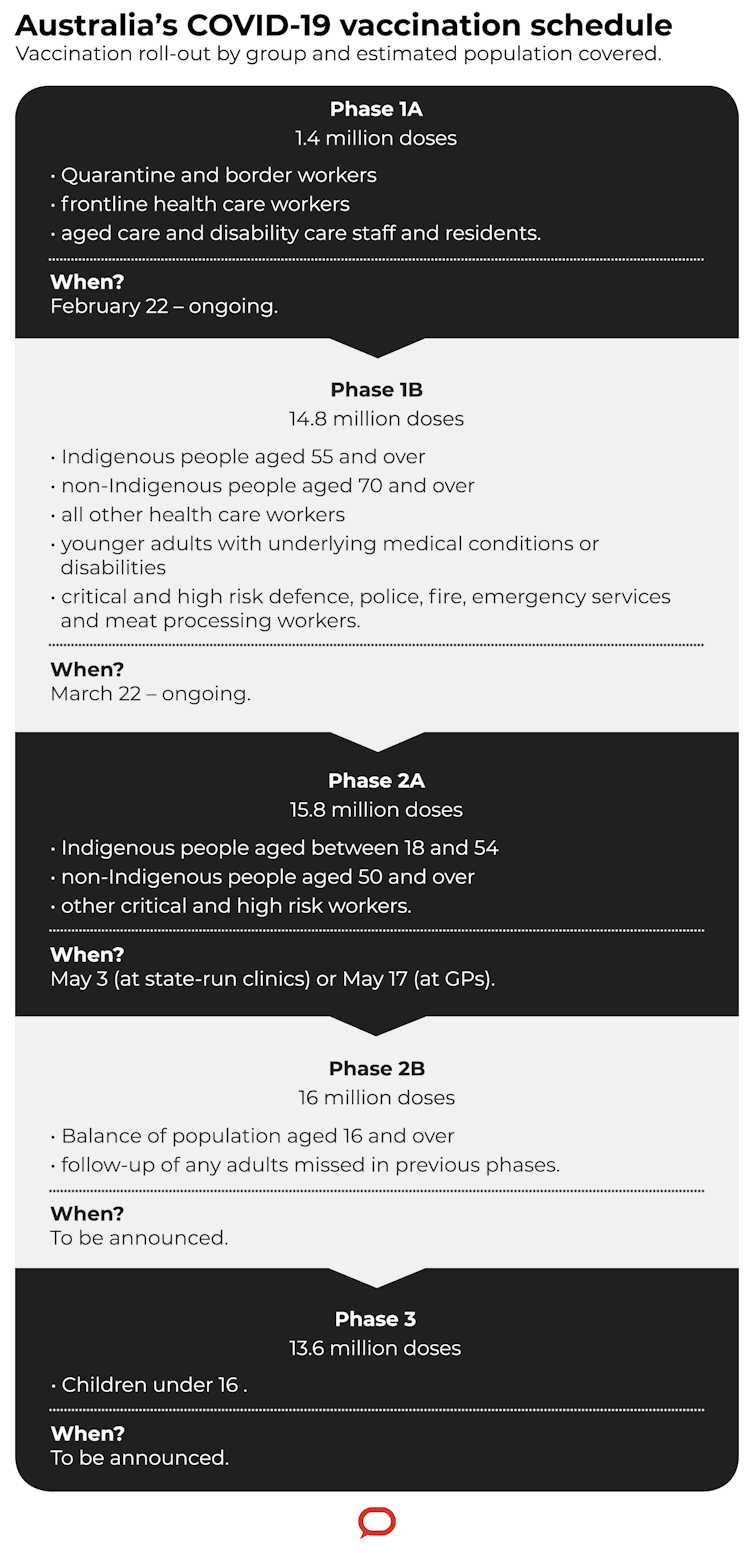
US President Joe Biden has so far appeared to endorse Israel’s heavy hand. AAP/EPA/Tasos Katopodis

Belatedy, the US has sent an envoy to the region.

In Australia, politicians from both sides have called for a de-escalation.

Regionally, Arab states have expressed their support for the Palestinian cause, but remarks by their leaders have been restrained.

However, circumstances leading to the outbreak of violence, notably Israeli policing of demonstrations in places sacred to Muslims, have left Arab leaderships no choice but to condemn Israel’s actions.

A hitherto limp US response reflects the Biden administration’s hope that the Israel-Palestine issue would not be allowed to intrude on Washington’s wider Middle East foreign policy efforts. Biden is trying to entice Iran back to the negotiating table to re-energise the nuclear peace deal ripped up by former President Donald Trump.

Part of this strategy has been to calm Israel’s concerns about renewed US efforts to re-engage Iran. Those efforts have been complicated by the violence of recent days.

Washington has been reminded, if that was necessary, that the toxic Palestinian issue could not simply be shoved aside, however much the US and its moderate Arab allies would like it to go away. This was always an unrealistic expectation.


Read more: Trump’s Middle East ‘vision’ is a disaster that will only make things worse


Israeli violence against Palestinians in retaliation for rocket attacks on its territory is an embarrassment for Arab states that had established diplomatic relations with Israel under pressure from the Trump administration.

The so-called Abraham Accords, involving an exchange of ambassadors between Israel and the United Arab Emirates, is at risk of being discredited in the eyes of the Arab world by the latest conflagration.

Other Arab states that established diplomatic relations with Israel, brokered by Trump officials, include Bahrain, Sudan and Morocco. Sporadic demonstrations in support of the Palestinians have occurred in the latter two countries.

Finally, this latest conflict between Israelis and Palestinians exposes the failure of various parties to advance a peace agreement based on a two-state solution.

That prospect appears further away than ever, and may even be dead given Israel’s declared intention to annex territory in the West Bank. Such action would end any possibility of compromise based on land swaps to accommodate Israeli settlements in areas contiguous with Israel itself.

These are bleak moments for those who might have believed at the time of the Oslo Declaration in 1993, and subsequent establishment of relations between Israel and the leadership of the Palestinian national movement, that peace might be possible at last.

We are now a very long way indeed from Oslo.


Read more: Twenty-five years after the Oslo Accords, the prospect of peace in the Middle East remains bleak


ref. Many questions, few answers, as conflict deepens between Israelis and Palestinians – https://theconversation.com/many-questions-few-answers-as-conflict-deepens-between-israelis-and-palestinians-160921

Australia risks becoming a hermit nation. Here’s a five-step road-map to reopen our borders safely

Source: The Conversation (Au and NZ) – By Tim Soutphommasane, Professor of Practice (Sociology and Political Theory) Director, Culture Strategy, University of Sydney

National capability — and you might also say, national character — can be revealed in a crisis. So, what has COVID-19 taught us about Australia?

It has taught us, amid many examples of failed leadership across the world, that Australia possesses a strong capacity for effective action in times of need.

Our leaders and people have been able to act with bipartisan unity. Our expert institutions, including our public health bodies, have proved generally up to the task of protecting our people.

And government has been prepared to take significant measures to avoid a catastrophic economic downturn.

A return to isolation and protectionism

As for the national character, the picture is more mixed.

The pandemic has certainly illustrated the limits of any mythological notion of “Australianness”.

Despite our celebration of larrikinism, the pandemic has demonstrated we are a compliant people when it comes to taking orders from authorities – though this has arguably helped in ensuring high levels of adherence to public health orders.

Nor has the pandemic demonstrated a clear triumph of Australian egalitarianism and the fair go. There were times when we’ve resembled an individualistic rabble, what with the widespread hoarding of supplies in the early stages of the pandemic. A fair go wasn’t necessarily extended to Asian Australians, who have experienced a significant spike in racism during this pandemic.

One historic aspect of the national character, though, has indisputably come to the fore. We’ve seen a return of a “Fortress Australia” mentality. This sees Australia as an island nation forever beset by threats from outside, whether it’s people or pathogens.

For many Australians, there is nothing bad at all with having national borders closed indefinitely. We shouldn’t rush to re-engage with the world, not when there’s a deadly virus in circulation.

National isolation is seen as a fair price to ensure the country stays “safe”. People who journey beyond our shores to be with their loved ones as they die or reunite with their partners and children are castigated for putting us all at risk.


Read more: ‘Fortress Australia’: what are the costs of closing ourselves off to the world?


Moving away from fear towards recovery

That’s one way to look at COVID-19. But, for the past six months, as part of a collaborative taskforce examining how Australia should respond to COVID-19, we have been exploring an alternative to Fortress Australia.

There should be no false choice between remaining closed or open: modern Australia simply can’t exist in parochial isolation. Our economy depends on trade and immigration. Our society and culture are deeply connected to the rest of the world. The majority of Australians were either born overseas or have a parent who was.

However, this version of Australia is now being put at risk by the prospect of an indefinite extension of our closed borders, and by some national politicians who revel in the protectionism it invites.

Some 40,000 Australians are stuck overseas and want to return home. Dave Hunt/AAP

We believe the urgency Australia showed in initially suppressing and then locally eliminating COVID-19 now needs to be shown towards preparing the country to reopen to the rest of the world.

If Australia isn’t ready to reopen effectively when the world recovers from the worst of the pandemic, we will face enormous social dislocation and prolonged economic pain. We need to move from fear and anxiety to a more confident stance of national recovery. Otherwise, we will be left behind as a hermit nation.


Read more: ‘Garbage’ and ‘cash cows’: temporary migrants describe anguish of exclusion and racism during COVID-19


Indeed, we can’t do as some suggest — only open up when zero COVID transmissions can be guaranteed. The reason is simple, and it’s based on the science. The virus causing COVID-19 (SARS CoV-2) will not disappear from the world. We need to acknowledge and respond to this reality.

Here’s a more realistic and sensible option: we need a plan to re-open Australia to the world in a controlled, risk-weighted and staged manner. This would prevent any large outbreaks associated with an excessive burden on the health care system or loss of life.

In some respects, Australia has already proven it can do this. Since the emergence of COVID-19, some 250,000 people (citizens, permanent residents and short-term visitors) have arrived on our shores. And cases have been kept to a minimum, despite the creakiness of hotel quarantine.

A five-step roadmap for reopening

We provide the following roadmap for Australia to reopen to the world. Australia needs to pursue:

  1. a comprehensive and successful vaccination program

  2. pilot programs for re-opening prior to the conclusion of the vaccination program to support industries critical to Australia’s economy, including tourism and the creative industries, horticultural farming and international education

  3. a certification scheme, across these programs, which permits only those with documented vaccination and/or SARS CoV-2 immunity to enter Australia or travel overseas

  4. improved border protection measures involving rapid testing on arrival

  5. a new range of new risk-weighted quarantine measures, complementing the maintenance of hotel quarantine for those who come from high-risk countries, refuse testing or test positive on arrival.


Read more: Should we vaccinate all returned travellers in hotel quarantine? It’s no magic fix but it could reduce risks


If Australia were to pursue this, it would be in a strong position to restore its immigration program to its pre-COVID levels by 2022-23, assuming the continuing suppression of the virus.

This challenge is a long way from the comforts of a retreat to Fortress Australia. But it’s necessary – at least if we want to remain a country that is engaged with the world.

One thing, though, is clear. Reopening requires not only building a path towards rapid large-scale vaccination of the Australian population and changes to our quarantine system, it requires the urgent building of a “psychological runway” for reopening. We need Australians to be mentally ready for re-engagement.

Yes, we can take pride in how Australia has been winning the “war” against COVID-19. But it’s time now for us to start thinking about winning the “peace”.

ref. Australia risks becoming a hermit nation. Here’s a five-step road-map to reopen our borders safely – https://theconversation.com/australia-risks-becoming-a-hermit-nation-heres-a-five-step-road-map-to-reopen-our-borders-safely-160865

I’m over 50 and can now get my COVID vaccine. Can I talk to the GP first? Do I need a painkiller? What else do I need to know?

Source: The Conversation (Au and NZ) – By Natasha Yates, Assistant Professor, General Practice, Bond University

People aged 50 and over are now officially eligible to receive the AstraZeneca COVID-19 vaccine from selected GPs.

Although some practices have had permission to provide the vaccine early if they had excess stock, this marks a major step forward in Australia’s vaccination program.

People over 50 now have a choice of where to get vaccinated: their own GP (if taking part in the vaccination rollout), another GP practice (if their own GP is not), or respiratory clinics and mass vaccination hubs in some states.

Here are some practical things to think about when booking an appointment.

Can I speak to the GP first?

As a GP, I have been recommending patients access a vaccine from wherever is the most convenient for them. This may be from a mass vaccination hub or respiratory clinic, and not actually from a GP. However, some patients are hesitant and/or still have questions. If so, they do need to speak to a GP before they book for a vaccine.

The time to raise questions is not when you have turned up for your injection; most facilities allocate around 3-5 minutes for the doctor or nurse to spend with each patient. This does not allow time for prolonged discussion.

Instead, in the days before your vaccine, discuss concerns with your regular GP (if you have one). They know you and your medical history so are better placed to tailor advice to your individual situation.


Read more: I’m over 50 and can now get my COVID vaccine. Is the AstraZeneca vaccine safe? Does it work? What else do I need to know?


If your GP is not one of the practices administering the vaccine, or if you don’t have a regular GP, you may want to book an appointment with a GP at the practice where you plan to get it, with the sole purpose of discussing your concerns.

Even if you book your vaccine through a GP clinic, it may not be a GP administering the vaccine. It may be a practice nurse, who is experienced at giving a range of vaccines and will have taken the same mandatory training as a GP in administering COVID-19 vaccines.


Read more: I have asthma, diabetes or another illness — can I get my COVID vaccine yet?


Department of Health/The Conversation, CC BY-ND

What’s the best time to have my vaccine?

The best time to get vaccinated against COVID-19 is as soon as possible, once you have had all your questions answered. However, there are a few things you may need to consider.

If you feel unwell

If you feel very unwell on the day, especially if you have a high fever (over 38℃), you need to postpone your vaccine. This is partly because your immune system may not respond optimally to the vaccine, and partly so symptoms after the vaccine aren’t confused with symptoms from an underlying illness.

If you want the flu vaccine too

It’s best to leave at least 14 days between your influenza and COVID-19 vaccines. It’s likely safe to have them both together, however this is still being tested. Also, if you happen to get a reaction to one of them, you will know which one you have reacted to.

If it’s time for your mammogram

As the vaccine can cause a temporary swelling of the lymph nodes in the armpit, women are advised to either have a mammogram first, or delay it until six weeks after vaccination. This advice is particularly relevant as we start to vaccinate women 50 and over, the key target group for Australia’s breast cancer screening program.

If you can, book before a scheduled day off

About 20% of people report missing work, study or routine duties for a short period after their first AstraZeneca vaccine. So have your vaccine the day before a scheduled day off work if possible.

Should I take a painkiller directly before or after my vaccine?

Unless you take common painkillers such as paracetamol, ibuprofen or aspirin to regularly to treat an underlying illness, do not take medications that control pain and/or fevers before your vaccine.

You may use them after the shot but only if you need to treat symptoms that are worrying you. Overall it is best to avoid taking them at all as they may curb your immune response.

Person taking painkillers with glass of water
Taking common over-the-counter painkillers can curb your immune response. from www.shutterstock.com

Both paracetamol and ibuprofen can reduce the immune response to other vaccines, particularly in children, although we’re not certain how much this affects their overall immunity to that disease.

One study showed taking aspirin, paracetamol or ibuprofen resulted in suppression of part of our immune response to viruses. And another study, this time in mice, revealed anti-inflammatory medications can impair production of some immune molecules after COVID-19 infection.

While none of this is strong evidence against taking these medications around a COVID-19 vaccine, the take-home message is not to take them if you don’t need to.

What about exercise before and after the vaccine?

Being physically fit can help you fight off upper respiratory tract infections. However does that translate to exercise also helping your immune response to vaccines? In other words, if you exercise before or after a vaccination will it work better?

There is evidence exercise can help improve the response to some vaccines, particularly the influenza ones, but this does not apply to all vaccines.

While the jury is still out on whether your COVID-19 vaccine will work better if you exercise around the time of having it, here is my suggestion: don’t exercise more than you usually do in the days before or after your shot.

Muscle pain and fatigue are two of the commonest side-effects from the COVID-19 vaccine, and are also normal responses to increasing your exercise. Avoid complicating the picture by maintaining your usual fitness regimen, and give yourself some leeway in the days after the vaccination where you may be feeling the side-effects from it.

The US Centers for Disease Control recommends using or exercising your arm after the shot to help reduce pain and discomfort (although not to help the vaccine work better).


Use the government’s vaccine eligibility checker to see if you’re next in line for the COVID-19 vaccine, and where you can get vaccinated.

ref. I’m over 50 and can now get my COVID vaccine. Can I talk to the GP first? Do I need a painkiller? What else do I need to know? – https://theconversation.com/im-over-50-and-can-now-get-my-covid-vaccine-can-i-talk-to-the-gp-first-do-i-need-a-painkiller-what-else-do-i-need-to-know-160357

A Victorian logging company just won a controversial court appeal. Here’s what it means for forest wildlife

Source: The Conversation (Au and NZ) – By Brendan Wintle, Professor in Conservation Ecology, School of BioSciences, The University of Melbourne

Australia’s forest-dwelling wildlife is in greater peril after last week’s court ruling that logging — even if it breaches state requirements — is exempt from the federal law that protects threatened species.

The Federal Court upheld an appeal by VicForests, Victoria’s state timber corporation, after a previous ruling in May 2020 found it razed critical habitat without taking the precautionary measures required by law.

The ruling means logging is set to resume, despite the threats it poses to wildlife. At particular risk are the Leadbeater’s possum and greater glider — mammals highly vulnerable to extinction that call the forests home.

So let’s take a look at the dramatic implications for wildlife and the law in more detail.

Why is this ruling so significant?

The Federal Court agreed VicForest’s logging failed to meet its environmental legal requirements. In fact, the Federal Court dismissed every single ground of appeal but one. And it takes only one to win.

The ground that won the case was that the federal environmental law designed to protect threatened species — the Environment Protection and Biodiversity Conservation (EPBC) Act — did not apply to the logging operations due to a forestry exemption.

To understand the significance of these issues, it’s important to know a bit about the context.

In the 1980s and ‘90s, forestry was passed to the states to regulate. So-called regional forest agreements (RFAs) were struck between federal and state governments. The idea was that forestry would be conducted under these state-led RFAs, avoiding federal scrutiny.

This was meant to streamline procedures, and offer a compromise between sometimes conflicting objectives: conservation and commercially profitable forestry.

However, states weren’t necessarily meant to have absolute control, and a check-and-balance system was put in place. If a logging operation doesn’t follow the RFA requirements, then the federal law is called in.

That way, states have control, but there’s a backup safety net for threatened species (which the federal government has an obligation to protect under international law).

This backup safety net is what the original case was testing. Friends of the Leadbeater’s Possum sued VicForests, arguing the logging operations breached the Victorian RFA, and the organisation won the case.

Bridget McKenzie
Bridget McKenzie introduced a bill seeking to strengthen logging’s exemption from federal scrutiny. AAP Image/Lukas Coch

In response to the original decision against VicForests, Nationals Senator Bridget McKenzie introduced a private members bill, seeking to strengthen logging’s exemption from federal scrutiny.

If passed, the bill would make forestry activities within RFA areas exempt from scrutiny under the EPBC Act, regardless of whether they follow RFA rules.


Read more: The Leadbeater’s possum finally had its day in court. It may change the future of logging in Australia


Both the court decision and the bill respond to a need for industry certainty and seek to minimise opportunities for legal action against logging under the EPBC Act. But they remove any certainty for environmental protection.

What does this mean for wildlife?

RFAs were established with the best of intentions. But unfortunately, they haven’t been working to protect wildlife — a point made clear in the EPBC Act’s recent ten-year independent review.

As former competition watchdog chair Professor Graeme Samuel, who led the review, said in his final report:

there are fundamental shortcomings in the interactions between RFAs and the EPBC Act.

The RFAs haven’t been updated as they were meant to be, despite dramatic changes in the environment, such as from mega-fires, and the warming and drying climate. These factors totally change the game for forestry and forest-dependent wildlife, such Leadbeater’s possum and the greater glider, which are declining dramatically.

Leadbeater's possum on a branch
Leadbeater’s possums rely on old tree hollows. AAP Image/ Australian National University, Tim Bawden

We are currently experiencing a global mass extinction event, and Australia is a global extinction leader. Australia is responsible for 35% of all modern mammal extinctions globally and has seen an average decline of 50% in threatened bird populations since 1985.

Cutting down trees may seem insignificant to some, in the scheme of things. But small effects can accumulate into dramatic declines, like a death by a thousand cuts.

Both Leadbeater’s possum and the greater glider depend on large old trees with hollows (that take more than 100 years to develop) for shelter. Without many of these trees, they cannot survive.


Read more: Comic explainer: forest giants house thousands of animals (so why do we keep cutting them down?)


Logging in Victoria has led to a dramatic decline in the number and extent of these particular trees, and reduces future large tree numbers. This makes the animals more vulnerable.

To avoid extinctions, we can’t afford to lose more ground by continuing practices that damage or remove habitat.

The writing is on the wall

But things could be changing soon. The Victorian government plans to ban native timber harvesting from 2030. This happens to be the same year a decades-old contract with a wood pulp and paper company expires, currently binding the state to provide pulp logs by a legislated supply agreement.

After 2030, paper, pulp, and timber products would be logged from plantations rather than native forests. The writing is already on the wall.

Protesters in a forest
An anti-logging protest in Toolangi State Forest in response to VicForests winning their appeal in the federal court. Kira Whittaker

Whether it’s the federal or state governments in charge, forest management needs to be scientifically robust, with strong compliance, enforcement and governance. Otherwise, as we’ve seen, there’s a significant risk of slippage and loss of trust.

Even before the mega-fires of 2019-20, most Australians didn’t support native forest logging. After the fires, their worries increased, with a majority expressing concerns that Australia’s unique environment might never be the same.

And as a result of rising community expectations on how the environment is treated, some businesses have pivoted.


Read more: Logged native forests mostly end up in landfill, not in buildings and furniture


Many companies now see being associated with environmentally poor outcomes as risky. Bunnings, for example, has already banned VicForests’ native timber. The World Economic Forum places biodiversity loss in the top five risks to the global economy. And a global taskforce is being established that could eventually see environmental disclosures as a new norm.

It’s clear the status quo has led to an alarming rate of species decline. This decline will only be locked in further if legal exemptions make it impossible to hold law-breakers to account.

ref. A Victorian logging company just won a controversial court appeal. Here’s what it means for forest wildlife – https://theconversation.com/a-victorian-logging-company-just-won-a-controversial-court-appeal-heres-what-it-means-for-forest-wildlife-160103

Rise of transport megaprojects adds to Australian taxpayers’ risk of paying too much

Source: The Conversation (Au and NZ) – By Owain Emslie, Senior Associate, Grattan Institute

When governments decide to build a new road, bridge or train line, their first concern should be getting it at the cheapest possible long-term price for a given quality standard. But our new report, Megabang for Megabucks, shows cost management is rarely top of mind for governments. And, with the trend towards ever-larger projects, the risk that a lack of competition for contracts will push up prices is very real.

Australia is an expensive place to build large transport projects. An international study of rail projects found costs in Australia are in the top quarter of 27 OECD countries. Our costs are much higher than in many other rich countries: 26% higher than in Canada, 29% higher than in Japan, and more than three times as high as in Spain.

Chart showing average costs per kilometre of railway infrastructure by country
Notes: includes all OECD countries in the study. Costs converted to US dollars on a purchasing power parity basis. Data source: Transit Costs Project, Levy (2020), Author provided

Of course, international comparisons are fraught. The cost of any particular project depends on local factors such as geology, location and the extent of the existing network.


Read more: Missing evidence base for big calls on infrastructure costs us all


But competition among construction firms is crucial if taxpayers are going to get the best price. Robust competition encourages firms to bid as low as they can and to innovate. If there is a field of potential bidders on megaproject contracts and the market is open to new entrants, there is also less opportunity for firms to collude by market-sharing, bid-rigging or price-fixing.

Bigger contracts reduce competition

Megaprojects – projects costing more than A$1 billion – are typically broken up into a handful of contracts. For the smaller contracts – worth A$500 million or less – there are few concerns about competition: many firms can bid for and win these contracts. But the larger the contract, the thinner the potential field of construction firms gets.

Australia’s “big three” or “tier one” firms – CPB, John Holland and Acciona – win the vast majority of contracts over $1 billion, either independently or in a joint venture with other firms, as the chart below shows.

Chart showing number of contracts over $1 billion awarded to firms of different sizes since 2006
Notes: We classify John Holland, CIMIC Group firms CPB Contractors (formerly Leighton Holdings) and Thiess, Lendlease, Bilfinger Berger (including. Valemus firms Abigroup and Baulderstone), and Acciona as tier one firms. Acciona is included as a tier one firm for all past projects, even though it only became a tier one with the acquisition of Lendlease Engineering in 2020. All construction contracts considered by the procuring agency as a major contract or work package are included, for projects over $1 billion since 2006. Does not include rolling-stock contracts. Grattan Institute, Author provided

For the largest contracts, even the tier one firms don’t usually go it alone. A joint venture involving two of the big three has won eight out of 11 contracts larger than $3 billion. When two of these firms form a joint venture, local firms have very little opportunity to compete: even a bid involving the other tier one firm is unlikely to be successful.

An extreme case is the Rozelle Interchange as part of the WestConnex motorway project in New South Wales. At first it attracted only one bid – from a joint venture between all three tier one firms. The state government rejected this offer and re-tendered the job, redesigning the contract in an attempt to entice more bidders.


Read more: WestConnex audit offers another $17b lesson in how not to fund infrastructure


The Victorian government is clearly aware of the risk of limited competition when tier one firms form joint ventures. It banned joint ventures of two or more tier one firms from bidding for the North East Link freeway. The government preferred to encourage bids by international firms or mid-tier Australian firms.

And what’s really concerning is that these megacontracts are becoming the norm. Contracts above $3 billion in value were a rarity before 2014. In the seven years since, there have been ten, as the chart below shows.

Chart showing distribution of projects worth over $1 billion signed from 2006 onwards
Notes: includes only construction contracts for megaprojects (projects over $1 billion) where the first contract was signed during or after 2006. Does not include rolling-stock contracts. Grattan Institute, Author provided

Read more: The PM wants to fast-track mega-projects for pandemic recovery. Here’s why that’s a bad idea


What can governments do about this?

Governments can take a couple of important steps to ensure there’s enough competition for contracts.

First, ensure international firms can freely enter the Australian market and bid on government contracts.

When two tier one firms form a joint venture to bid on very large contracts, the only avenue for competition is to involve international construction giants. So it’s crucial that Australian governments don’t give undue priority to domestic experience and cut the internationals out.

Governments should publish weighted criteria for bid selection. This ensures the international firms can be confident they’re not wasting resources bidding, only for governments to stick with the safe option of favouring local firms.

government ministers in high-viz vests and hard hats inspect work on construction project
The Victorian government barred joint ventures by tier one firms and sought bids from overseas firms to increase competition for the North East Link contract. Erik Anderson/AAP

Read more: Spectacular cost blowouts show need to keep governments honest on transport


Second, avoid bundling work into bigger contracts than necessary. Governments have an incentive to enact fewer and larger contracts to make contract management simpler and minimise interface risks. These are the risks arising from interactions between multiple contractors, for example relating to site access. But bigger contracts mean fewer firms can bid for the work, particularly when different types of work are bundled together into a single package.

Governments should develop and use a systematic, consistent and transparent process to bundle up packages of work within a project. Examples would be splitting a highway upgrade into a number of smaller sections, or separating the design and construction tasks on a new rail line.

Megaprojects are making up an ever-bigger portion of transport infrastructure projects. Governments must focus on keeping the long-term cost as low as possible for the preferred quality standard. Otherwise, taxpayers will be at risk of paying over the odds.


Read more: We may live to regret open-slather construction stimulus


ref. Rise of transport megaprojects adds to Australian taxpayers’ risk of paying too much – https://theconversation.com/rise-of-transport-megaprojects-adds-to-australian-taxpayers-risk-of-paying-too-much-160459

From Mickey to Moana — Disney treasures at ACMI tell the story of animation’s evolution over almost a century

Source: The Conversation (Au and NZ) – By Dan Torre, Senior Lecturer in the School of Design, RMIT University

Review: Disney: The Magic of Animation at ACMI.

Disney is one of the longest running animation studios in the world. As a result, the studio’s nearly 100 year legacy also provides a substantial insight into the history of the animated film.

Disney: The Magic of Animation features 500 items — original sketches, drawings, paintings, concept art and models. They have been carefully curated from the 65 million artworks at the Walt Disney Animation Research Library in Los Angeles.

The first feature exhibition at Australia’s national museum of screen culture since its major redevelopment, it showcases Disney’s legacy, and the process and artistry at work.

Moving pictures

When you first enter the exhibition space you are greeted with an array of large scale zoetropes — spinning cylinders with flickering images inside. They display the animated characters of Mickey Mouse, Pluto and Donald Duck.

These pre-cinematic animation devices provide a neat summation of the animation process, in which a quick succession of individual drawings, each one slightly different than the previous, can create a moving image. The zoetropes remind us animation has existed for many decades (if not centuries) prior to the invention of cinema.

‘They worked in shifts, night and day, to create this unique experiment in entertainment.’

Also on display are artworks from some of the studio’s earliest and most iconic animated shorts, such as Mickey Mouse’s Steamboat Willie and Plane Crazy. Equally impressive are the extensive artefacts from more than 25 feature films, ranging from Snow White and the Seven Dwarfs to this year’s Raya and the Last Dragon.

Man draws cartoon mouse on chalkboard
Walt Disney and his Mickey creation. AAP

Australia has also played a little known but substantive role in the Disney animation story. Between 1988 and 2006 Walt Disney Animation Australia operated in Sydney, and employed hundreds of extremely talented Australian animators, artists and technicians.

They worked on dozens of animated sequels to big name Disney features, including The Lion King II: Simba’s Pride, Pocahontas II: Journey to a New World, The Little Mermaid 2: Return to the Sea, Lady and the Tramp II: Scamp’s Adventure, and Peter Pan: Return to Neverland.


Read more: Shrek at 20: celebrating the film’s unique brand of animated anarchy and sardonic irreverence


Artistry on display

Exhibition curators have chosen a remarkable selection of highly dynamic animation drawings for display. Even as still images, these pencil drawings express incredible life and movement.

There are also a number of concept drawings created by American artist Mary Blair, whose designs informed Disney’s Cinderella, Alice in Wonderland and Peter Pan. She was also known for her children’s book illustrations (I Can Fly) and murals (including Disneyland’s It’s a Small World attraction). Her drawings and paintings use just a few strokes and splashes of contrasting colour to convey brilliant vibrancy and expression.

Also remarkable to behold are the series of background paintings from 1959’s Sleeping Beauty. Created by artist Eyvind Earle, the works show angular shapes and exquisite detail. Eyvind Earle’s sister, Yvonne Perrin, was also an animation background painter, who spent much of her life in Australia, working at the Eric Porter Animation Studio in Sydney and later illustrative children’s books with bush themes.

Walt Disney was a fan of Mary Blair as an artist within the studio and beyond.

Read more: Explainer: what is storyboarding for film?


Mechanical to digital

It’s not just two-dimensional art on display. Model cars made of wood and metal from the production of 101 Dalmatians provide insight into the technical aspects of making the film.

Painted black and white, the cars were moved by hand and filmed in real time, using high-contrast film-stock. The resulting footage was then enlarged and transferred, frame-by-frame onto cels and incorporated into the rest of the animated scene.

The result was fluid motion on screen and accurately depicted vehicles which, despite appearing to careen around corners and collide with each other, maintained their precise dimensions. The approach, to some degree, anticipated the use of 3D digital models that would be incorporated into the studio’s later animated films.

Disney warrior Raya
Modern Disney warrior princesses are a tougher breed than their dainty predecessors. Raya and the Last Dragon/IMDB

Because Disney’s more recent films like Frozen and Moana were created almost entirely in the digital realm, the displays devoted to them tend to highlight concept art, rather than production materials. But it is still fascinating to see the concept artwork which guided these films through their early development. We gain a greater understanding of how the artists conveyed atmosophere, adventure and enchantment to create fantasy worlds.

As technology has evolved, so have Disney’s characters and narratives. This is notable as the exhibition reacquaints visitors with classic and dainty Disney princesses through to today’s more contemporary warriors like Moana and Raya.

Disney: The Magic of Animation celebrates each frame and component behind some of audiences’ favourite films of the last century. In doing so, the exhibition not only provides an illuminating peek into the animation process — but also gives us the opportunity to admire the artistry and complexity of what went into making every second of these works of art.

snow white
Snow White, 1937, a tempera on celluloid from the collection of political cartoonist J. Arthur Wood Jr. AP Photo/Library of Congress

Read more: Disney’s Mulan tells women to know their place


Disney: The Magic of Animation is on at ACMI until 17 October.

ref. From Mickey to Moana — Disney treasures at ACMI tell the story of animation’s evolution over almost a century – https://theconversation.com/from-mickey-to-moana-disney-treasures-at-acmi-tell-the-story-of-animations-evolution-over-almost-a-century-160770

No ‘bounce’ for government from big-spend budget: Newspoll

Source: The Conversation (Au and NZ) – By Michelle Grattan, Professorial Fellow, University of Canberra

The government has failed to get any electoral “bounce” from last week’s budget, despite it being widely seen as good for the economy, according to Newspoll.

Labor retains a two-party lead of 51-49%, although there was a 2 point fall in its primary vote, to 36%. The fall was matched by a 2 point rise in support for the Greens, to 12%.

The Coalition was stable on 41% primary vote.

Publishing the results, The Australian reported it was the most well-received budget since the Howard-Costello days, with 44% saying it would be good for the economy, and only 15% believing it would be bad. This was the largest margin since 2007.

But voters found it harder to get a clear fix on what it would mean for them personally. They were evenly divided, with 19% each side, on whether they would be personally better or worse off financially from the budget.

A record 62% could not say whether they would be better or worse off.

While the budget contained tax cuts for low and middle income earners and a child care package, much of the big spending was directed to particular areas, such as aged care and mental health, rather than affecting the financial position of people more widely.

Both leaders’ personal approval ratings worsened somewhat in the poll, although Anthony Albanese took more of a hit than Scott Morrison.

Dissatisfaction with Albanese increased 3 points to 46%, while his satisfaction rating decreased a point to 39%. His net rating is minus 7.

Satisfaction with Morrison fell a point to 58%, and dissatisfaction increased a point to 38% His net approval is plus 20.

Morrison led Albanese as better prime minister 55% (down a point) to 30% (stable).

In Queensland selling the budget, Morrison said on Sunday: “The recovery cannot be taken for granted. The recovery can be lost. The hard won gains of Australians, particularly over these last 18 months, can be lost unless we keep doing what’s working. And this is working.”

Also in Queensland, Albanese said: “Quite clearly, Scott Morrison has a plan to just get through the next election and then we’ll see cuts, because we know from this government, just like we saw in 2014 when it first came to office, that they will make cuts, they will return to type.”

ref. No ‘bounce’ for government from big-spend budget: Newspoll – https://theconversation.com/no-bounce-for-government-from-big-spend-budget-newspoll-160979

Indonesia pressures PNG over militant video by West Papuan supporters

By Gorethy Kenneth in Port Moresby

Indonesia is pressuring Papua New Guinea over an illegal group East Sepik claiming to form an army unit to help West Papuan pro-independence rebels fighting against Indonesian forces across the border.

Calling such armed groups as “terrorists”, Indonesia’s Ambassador to PNG, Andriana Supandy, said his country respected the sovereignty of its neighbour, PNG, and called on the PNG authorities to act over the threat.

A video of a group dressed in military fatigues and brandishing automatic rifles has gone viral on social media, prompting the Indonesian response.

The men in the video, speaking in PNG “tok pisin”, claim to be from East Sepik. They say they stand with the West Papuan rebels and are ready to cross the border to support the West Papuan cause for independence.

Supandy said the Indonesian Embassy had been informed that PNG government officials were in Wewak to investigate the viral video on the social media post.

“The Indonesian government honour[s] the PNG government as a sovereign nation and leave the response to the alleged militants to the relevant authorities in PNG,” Supandy said.

“Both governments have the same understanding about the challenge and opportunity in managing the formal relations through the spirit of friendship and mutual respect.”

Gratitude over safety
Supandy said that despite the video causing uneasiness, the Indonesian Embassy would like to convey its gratitude to the government and the people of PNG for “ensuring the safety and wellbeing of Indonesians” working and living in PNG.

The embassy said the Indonesian government and people were reciprocating the gesture for PNG citizens living in Indonesia.

Supandy said the video of a vigilante group would not affect the strong relations between Indonesia and PNG.

“These armed groups in Papua and West Papua have resorted to acts, methods and practices of terrorism aiming at destruction of human rights, fundamental freedoms and democracy while also threatening the territorial integrity and security of the Republic of Indonesia,” he claimed.

Right to ‘reliable information’
Supandy said Papua New Guineans had the right to “reliable information” relating to this issue.

He said Indonesia was committed to taking measures aimed at “addressing the root causes” of the situation in Papua and West Papua provinces.

He said in this context, Indonesia advocated humane, prosperous and inclusive development approach, including:

  • Respecting the basic rights of the people in Papua and West Papua provinces;
  • Establishment of good governance in Papua; and
  • Opportunities for Papuans to shape and direct local development strategies and regional policies.

SBS News reporting on the West Papua conflict.

Print Friendly, PDF & Email

Article by AsiaPacificReport.nz

Samoa court test case ruling on fresh elections due Monday

RNZ News

Samoa is to hear on Monday whether fresh elections will go ahead next week.

The Supreme Court heard challenges yesterday to the new ballot called last week by the Head of State, Tuimaleali’ifano Va’aletoa Sualauvi II.

Chief Justice Satiu Simativa Perese said the hearing would test the extent of the powers held by the Head of State – O le Ao o le Malo.

Tuimaleali’ifano called the vote on the advice of the caretaker Human Rights Protection Party (HRPP) Prime Minister Tuila’epa Sa’ilele Malielegaoi, purportedly to break the 26-seat each deadlock with the newcomer Fa’atuatua i le Atua Samoa ua Tasi (FAST) party.

FAST challenged the new ballot, contending Tuila’epa’s advice meant the Head of State decreed a course of action which deviated from a process set out in the constitution.

FAST’s co-counsel at the court hearing, Taulapapa Brenda Heather-Latu, said it was “a substantive hearing of the constitutional challenge… and a decision will be given at 3 o’clock on Monday afternoon”.

Also on Monday, the court will hear a separate FAST party challenge to the validity of the electoral office’s awarding of an extra women’s seat to the HRPP, which created the current deadlock.

Additional seat at issue
If both decisions find in favour of FAST, according to Taulapapa, a former Attorney-General, the additional seat would then be removed.

“Which means they [FAST] can go to the clerk and the Head of State and ask the Parliament to be convened, and they have the majority to form government,” she said.

However, if the court finds against FAST in the electoral matter but in their favour in the case of the additional women’s seat “then we’re actually back at 26-25 for FAST” noted Taulapapa.

“And I guess we’ll have to have another election next Friday.”

However the snap-election in that situation would become the subject of a further challenge, she added.

“Because it does not meet any of the normal requirements for a general election.”

Taulapapa contended that a snap-election being called when legal challenges had not yet been heard and exhausted “disallowed the votes of 89,000 Samoan people”.

Unlawful, say submissions
“In the submissions that we made before the court today that was unlawful,” she said.

“And it effectively pre-empted the ability of parliament and all those elected representatives to sit down and find out if there was someone that had the majority who could form government and become our new prime minister.”

Samoa’s constitution prescribes a process to be followed after election results are called and Taulapapa said this had been forsaken.

“The forming of government is a function of the elected representatives. It’s not a function of a Head of State and it’s not a function of an un-elected official.”

Meanwhile, the caretaker HRPP government has made Thursday and Friday public holidays in anticipation of the new ballot. Pre-polling is set to begin on Wednesday.

This article is republished under a community partnership agreement with RNZ.

Print Friendly, PDF & Email

Article by AsiaPacificReport.nz

Tahitian community groups try to save endangered sacred mountain

Asia Pacific Report newsdesk

A collective of community groups in Tahiti trying to preserve a historical-cultural icon at Tautira have condemned the Tahitian government for “deliberately trying to destroy our heritage”.

The iconic Tahua-Reva is the community’s sacred mountain on the southeastern tip of Tahiti-Iti, the smaller section adjoining the main island of Tahiti.

The community groups have appealed for help in their campaign to save the mountainside.

“All the government sees is [that] the mountainʻs cliff must be secured to protect against tumbling rocks, and they came up with no alternative other than dynamite [it] because they say itʻs a cheaper solution,” wrote Vaihei Paepaetaata, a voice of the community groups trying to save the mountainside, in a letter today to Asia Pacific Report.

Tautira on Tahiti-Iti
Tautira on Tahiti-Iti. Image: Google Maps

“Their experts say the danger arises from three stones, 50 tonnes each, which threaten to
collapse on the road at the foot of  Tahua-Reva mountain. But for us the danger is the
loss of our heritage, the loss of our history and identity.”

Cultural educator and linguist Paepaetaata said that was why she was seeking help in relaying information “as widely as possible” on behalf of her community of Tautira.

“It is absolutely unacceptable for us that such a decision be taken without any consultation with the population. This cultural site is of capital importance for Polynesian heritage in so far as its history is intimately linked to the marae Tapu-Tapu-Tea, which is registered as a UNESCO World Heritage Site.

“These three stones carry a story and have a powerful energy. They are a resting place for
the departing souls before they rise to the firmament called Rauhotu No’ano’a.

“Tahua-Reva is a place of collective memory but unfortunately it is not registered, so no
law can protect her from being damaged by humans.

“Tahua-Reva allows me and everyone in my community from Tautira to claim our
affiliation to the land and to say:

I have a mountain, its name is TAHUA-REVA
E MOU’A TŌ’U, ‘O TAHUA-REVA
I have a water, it is called VAIT -PIHA
E VAI TŌ’U, ‘O VAIT PIHA
I have a piece of land, it is called FATUTIRA-I-TE-TAI-PA’A’INA
E FENUA TŌ’U, ‘O FATUTIRA-I-TE-TAI-PA’A’INA

“This chant is taught to young children from preschool. What will we show to our children if
our mountain is destroyed?

“What meaning will we give to this desecration? What legacy will we leave for them tomorrow?”

Paepaetaata has appealed to Pacific journalists to take up the issue and report their concerns.

Tahua-Reva ... sacred rocks.
Tahua-Reva … sacred rocks. Image: #ProtectTahuaReva
Tahua-Reva ... the sacred mountain
Tahua-Reva … the sacred mountain in Tahiti-Iti. Image: #ProtectTahuaReva

#ProtectTahuaReva

Print Friendly, PDF & Email

Article by AsiaPacificReport.nz

HRW demands police drop treason charges against Papuan activist Yeimo

Asia Pacific Report newsdesk

Human Rights Watch (HRW) is calling on the Indonesian police to drop politically motivated treason charges against West Papua National Committee (KNPB) spokesperson Victor Yeimo.

Yeimo was arrested for calling for an independence referendum for Papua which he expressed in 2019 during the anti-racism protests and riots in Papua and West Papua province.

Human Rights Watch said that the Indonesian government had discriminated against indigenous Melanesians in Papua and West Papua for decades.

President Joko “Jokowi” Widodo is being asked to publicly direct security forces involved in operations in Papua to act in accordance with international law to be held to account for violence there.

“Indonesian police should investigate the deadly violence and arson attacks in Papua in 2019 but not use that as a pretext to crack down on peaceful activists,” said HRW Asia director Brad Adams in a statement.

In August 2019, Papuans held protests in at least 30 cities across Indonesia in response to a racist attack against Papuans at a student dormitory in the East Java provincial capital of Surabaya.

Videos show soldiers shouting words such as “monkeys” at the students. Police also fired teargas into the dormitory and arrested scores of students.

Triggered riots
The polemic over this triggered riots in the form of attacks, looting and the torching of public facilities in Jayapura, Manokwari, Sorong and Wamena.

In the aftermath of this, HRW noted that at least 43 protest Papuan protest leaders and KNPB activists were charged with treason and sentenced despite the fact that they were not involved in violence.

HRW said that it takes no position on Papuan claims to self-determination, but supports everyone’s right, including independence supporters, to express their political views peacefully without fear of arrest or other forms of reprisal.

“The Indonesian authorities should ensure that all security force operations in Papua are carried out in accordance with the law and that peaceful activists and other civilians are not targeted,” added Adams.

Separately, lawyers from the Coalition for Upholding the Law and Human Rights in Papua said that Yeimo’s arrest on Saturday, May 9, was not in accordance with arrest procedures under Law Number 8/1981 on the Criminal Procedural Code.

This is because the arrest was made on that day while the warrant was received by Coalition lawyers more than a week later on May 19 at 6 pm at the Mobile Brigade Command Headquarters (Mako Brimob) investigators office in Kotaraja, Abepura, Jayapura.

“The coalition could not assist or directly accompany Victor F. Yeimo yet he is not just being charged under Article 106 of the Criminal Code (KUHP) or the articles on makar [treason, subversion, rebellion] but he is also charged under Article 170 Paragraph (1) of the KUHP where in the process lawyers can sit alongside their client,” said the Coalition’s litigation coordinator Emanuel Gobay.

Prevented from helping
Gobay also stated that they were prevented from assisting Yeimo because they were unable to directly accompany him. Yeimo was then transferred from the Papua regional police to the Mako Brimob without the Coalition’s knowledge.

At the Mako Brimob, meanwhile, Yeimo is said to have been placed in a cell far away from any sources of fresh air and is said to have asked prison guards to move him to a more comfortable cell.

Furthermore, Gobay revealed that his client also asked police why only he had been arrested if the pretext for the arrest was because he gave a speech during an anti-racism protest on August 19, 2019.

“Many other people also gave speeches (during the action) such as women figures, religious figures, youth figures and so forth. Aside from this [the action] was also attuned by the Papuan provincial governor, the speaker of the MPR [Papua People’s Council], members of the DPRP [Papuan Regional House of Representatives], several SKPD [Regional Administrative Work Unit] members as well as OAP [indigenous Papuans] and non-OAP. But why am I the only one that has been arrested and charged while the others haven’t,” said Yeimo as conveyed by Gobay.

Yeimo was a fugitive from the law who had been on the police wanted persons list (DPO) since 2019.

He is alleged to have committed crimes against state security and makar and or broadcasting reports or issued statements which could give rise to public unrest and or broadcasting news which is unreliable or news which is excessive or incomplete.

He is also alleged to have insulted the Indonesian national flag, language and state symbols as well as the national anthem and or incitement to commit a crime.

Koman named as lawyer
In London, Pelagio Doutel of the Indonesian human rights advocacy group TAPOL said UN rapporteurs should call for Yeimo’s immediate and unconditional release.

An urgent appeal on behalf of Yeimo has been submitted by TAPOL and lawyer Veronica Koman to the UN Special Procedures mechanisms of the Human Rights Council.

Yeimo had been living in exile in Papua New Guinea since the crackdown against the so-called Papuan Uprising and had recently returned to his homeland.

“Lawyers have been prevented from accompanying Mr Yeimo during interrogations,” said Pelagio Doutel.

“No family member or anyone else has been able to pay him a visit. He is practically in solitary confinement and currently arbitrarily detained at the Police’s Mobile Brigade Headquarters (Mako Brimob) in Abepura. He was moved there without prior notice to his lawyers.”

Veronica Koman reported that “Papua’s police chief Mathius Fakhiri has publicly indicated that extra charges will likely be put against Victor Yeimo until he ‘gets old’ in prison.

‘History of torture’
“Victor Yeimo has a history of being subjected to torture. Therefore we will be in close communication with UN officials to update them on developments including additional interrogation and maltreatment.”

To support his lawyers on the ground, Yeimo has appointed Koman as his international lawyer.

Veronica Koman is the international advocacy coordinator of the Jayapura-based Association of Human Rights Lawyers for Papua (PAHAM Papua).

Translated by James Balowski for IndoLeft News. The original title of the article was “HRW Minta Polisi Cabut Tuduhan Makar Jubir KNPB Victor Yeimo”. The Human Rights Watch statement in English is here.

Print Friendly, PDF & Email

Article by AsiaPacificReport.nz

Palestine: Hold Israel accountable for crimes against journalists, says IFJ

Media offices have been bombed and Palestinian and international journalists arrested, beaten and threatened by Israeli forces amid escalating violence in Gaza, reports the International Federation of Journalists.

The IFJ has declared in a statement that it stands in solidarity with the Palestinian Journalists Syndicate (PJS) and all Palestinian and foreign media workers that have been targeted.

It demands immediate international action to hold Israel accountable for its deliberate targeting of journalists and the media.

On the night of May 11, the Israeli military bombed the Al-Jawhara tower, located in Gaza, which hosts the offices of 13 media institutions and NGOs. The PJS said the attack was deliberate and targeted.

There were no injuries as journalists evacuated their offices after the Israeli army warned some of the media that the building would be bombed.

However, media organisations lost their equipment. The IFJ said the Israeli government must compensate the media for their financial losses.

The offices of the media organisations – the National Information Agency, Palestine newspaper, Al-Arabi Channel, Al-Ittijah TV, Al-Nujaba TV, the Syrian TV, Al-Kufiya Channel, Al Mamalaka channel, APA Agency, Sabq Agency 24, Bawaba 24, the Palestinian Media Forum, the Palestinian Forum for Democratic Dialogue and Development – were completely destroyed.

The offices of Al Jazeera TV, adjacent to the targeted building, were also damaged

Spanish news agency EFE’s correspondent in Jerusalem said on Twitter that their correspondent in Gaza had to flee its office at Al Jawhara tower after a warning message from the Israeli military.

In addition to the targeted attacks against media organisations in Gaza, the PJS reported that the Israeli forces arrested photojournalist Hazem Nasser in the West Bank on May 12.

Since the beginning of the clashes in Jerusalem, the Israeli authorities have arrested at least 27 media workers in what the PJS and other press groups denounced as a clear attempt to silence media reporting on the ground.

The PJS said in a statement: “The PJS calls on all the guarantors of freedom of journalistic work, especially the United Nations and its organisations and the Red Cross to provide urgent field protection for journalists, and to activate Security Council Resolution 2222 so to obligate the occupation to implement and respect it.”

IFJ general secretary Anthony Bellanger said: “We stand in solidarity with all the Palestinian journalists and the PJS during these hard moments. The international community cannot turn a blind eye to the systematic violations of human rights and the deliberate targeting of media and journalists. Urgent actions must be taken to hold those responsible for these crimes internationally accountable”.

In December 2020 the IFJ submitted two complaints to the UN Special Rapporteurs over Israel’s systematic targeting of journalists working in Palestine and its failure to properly investigate killings of media workers.

The complaint stated that this was “a violation of the right to life, freedom of expression and in breach of international law and may amount to war crimes”.

Article by AsiaPacificReport.nz

NZ Greens condemn Israeli violence against Palestinian communities

Asia Pacific Report newsdesk

New Zealand’s Green Party has condemned the violent and forced displacement of the Palestinian Sheikh Jarrah community of East Jerusalem by Israeli forces and settlers.

“We further condemn the recent indiscriminate bombing of the Gaza Strip causing the deaths of [113 Palestinian civilians, including 31 children], we call on both the IDF and Hamas to abide by international human rights and humanitarian law”, said Green Party spokesperson on human rights and foreign affairs Golriz Ghahraman.

“We note that the forcible displacement of Palestinians is an atrocity crime in international law, and in these circumstances can amount to ethnic cleansing.

“Israel’s ongoing and continued occupation of Palestinian territories, and siege on Gaza since 2009, constitute serious breaches of international law and have caused an unsustainable humanitarian crisis, exasperated by the current covid-19 crisis.

“The people of Gaza are trapped with little access to humanitarian aid, adequate healthcare or education.

“The Green Party promotes and supports the principle of self-determination of peoples everywhere, including Palestine.

“We support a two state solution that would ensure an independent state of Palestine alongside the state of Israel.”

The Green Party has called on the UN Security Council – due to meet this weekend on the Israel-Palestine crisis – to:

  • Strongly condemns the violence committed by Israeli forces in East Jerusalem and its indiscriminate bombing of civilian community in Gaza; and
  • Calls on both Hamas and [the Israeli military] IDF to abide by international humanitarian law, with clear primary responsibility as the occupying power, on Israel.
Print Friendly, PDF & Email

Article by AsiaPacificReport.nz

COHA Webinar | Pedro Castillo Advances A New Progressive Agenda to Win the Presidency in Peru

Source: Council on Hemispheric Affairs – Analysis-Reportage

Print Friendly, PDF & Email

With congressman Guillermo Bermejo, member of Pedro Castillo’s Presidential Campaign

Join the Council on Hemispheric Affairs (COHA) to analyze the decisive presidential election taking place this June 6 in Perú.

COHA Director Patricio Zamorano, COHA Senior Research Fellow Alina Duarte and COHA Senior Analyst William Camacaro will interview Guillermo Bermejo about the presidential election in Perú, a country in permanent political crisis, which has gone through three presidents in 2020. The second round of the presidential election on June 6 will pit progressive candidate Pedro Castillo against conservative leader Keiko Fujimori, daughter of former president, Alberto Fujimori, who was convicted of crimes related to human rights abuses. With such radically different views of good governance at stake, the outcome of this election will  have a decisive impact on the future of the Andean nation.

Guillermo Bermejo was recently elected to serve in Congress representing the “Perú Free” party. He is a political analyst,  expert on geopolitics and drug trafficking, and also advisor to Peruvian farmer communities. 

This conference will be conducted in both English and Spanish

Thursday May 20, 2021
8pm EST |  5pm PST
Zoom and Facebook Live
ZOOM Registration: https://zoom.us/webinar/register/WN_BfKoOIMhSMauQt0KIyuOsA

The Women’s Budget Statement was more like a first step than a revolution

Source: The Conversation (Au and NZ) – By Helen Hodgson, Professor, Curtin Law School and Curtin Business School, Curtin University

We’re told that this budget, more than most, delivered for women.

Commonwealth Treasury

Certainly for the first time in years it was accompanied by a Women’s Budget Statement printed as part of the budget papers rather than as an add-on glossy brochure.

The statement reported on the effect of the COVID pandemic on women and on government measures in the fields of women’s safety, women’s economic security and women’s health and wellbeing.

While welcome, and an advance on what’s gone before, it remained a long way short of true gender-responsive budgeting, which is about the entire budget process and everything the government does.

When Australia led the way in the 1980s, the analysis took place within each government department.

At times it modified or stopped decisions before they left departments.

The process was hardwired into the budget cycle so that no spending proposals could advance unless they were accompanied by a clear statement setting out their gender implications and effects on equality.


Read more: Each budget used to have a gender impact statement. We need it back


The approach applied to all measures, whether explicitly gender-focussed or not.

Not yet what it could become

The 2021-22 women’s statement identified A$3.4 billion of spending related to women and gender equity — a mere fraction of 1% of total budget expenditure.

Much of it was piecemeal, or too small to have much impact.

The $200,000 funding for working women’ centres, “to support the continued delivery of free information, advocacy, support and advice on work-related matters including workplace sexual harassment” is unlikely to be enough to keep open the doors of the current centres, let alone revive those that have been forced to shut down.


Read more: Modelling finds investing in childcare and aged care almost pays for itself


While such measures will help, they don’t address the root causes of labour market segregation and women’s partial exclusion from higher paid, male-dominated sectors such as science, technology, engineering and mathematics.

The extra funding for childcare and for aged care in response to the royal commission will help employment in female-dominated sectors, but it was accompanied by little that would increase pay in those sectors.


Read more: Two experts on how much the $1.1 billion for women’s safety can achieve


Modelling commissioned by the National Foundation for Australian Women found that boosting pay in those sectors would provide an economic boost big enough to almost pay for itself.

The boost to funding for violence against women is welcome, especially the new funding for legal services for women escaping violence, which has been slashed over recent decades.
It is welcome too that the proposal to allow women eat into their superannuation when fleeing violence has been replaced by a grant of up to $5,000.

Strategy missing

What’s missing from this first re-booted Women’s Budget Statement is a strategic approach to the drivers of inequality.

Since 2014, when the Abbott Government stopped publishing a women’s policy statement, the National Foundation for Australian Women has stepped in to conduct an independent expert analysis.

This years’ analysis is likely to find the budget didn’t do anything like enough to close gender equality gaps, to reduce caring gaps or deal effectively with violence.


Read more: Fewer hard hats, more soft hearts: budget pivots to women and care


But non-government organisations can only ever provide an external view: the government holds the data and is the organisation responsible for constructing an evidence-based budget strategy that moves towards gender equality.

It has done it before in the 1980s, using a whole-of-government approach.

This year’s statement can be thought of as a down payment on next steps, but the government needs to begin those steps now. The next budget, regardless of who delivers it, must lay out a roadmap to gender equality.

ref. The Women’s Budget Statement was more like a first step than a revolution – https://theconversation.com/the-womens-budget-statement-was-more-like-a-first-step-than-a-revolution-160787

Keith Rankin Chart Analysis – Covid-19: Covid19 League Charts for the 2nd Week of May

Maldives: Covid19 as well as space debris and terrorist bombing.

Analysis by Keith Rankin.

Maldives: Covid19 as well as space debris and terrorist bombing.

It’s been a big month, so far, for the Maldive Islands. Further, some of New Zealand’s leading cricketers (including captain Kane Williamson) are manuhiri in the Maldives. Indian Ocean neighbour – the Seychelles – has even more reported new cases per capita than the Maldives. I guess that neither country did nearly as well as New Zealand at keeping out visitors from Mumbai and New Delhi.

Otherwise, we continue to see quite a mix of countries from all over the world getting caught up in the present outbreak of Covid19. The second chart excludes countries with fewer than 500,000 people.

New Zealand should not be too smug. The latest Covid19 league tables include a number of island countries: as well as those mentioned there are Bahrain, Cabo Verde, Cyrus, Trinidad, and Guadeloupe. And French Guiana, while not technically an island, has the geopolitical characteristics of one.

Also of note is that the two small Latin American countries which New Zealanders feel particularly comfortable staying in – Uruguay and Costa Rica – are right up there in the top 10. So are all three of the Benelux countries, and France, and Sweden.

In Asia, of particular note is that Nepal is now suffering worse than India, and that Mongolia now presents a significant threat to China. (Presumably Mongolia got it from Russia.) Japan is also a worry; while it doesn’t have sufficient cases yet to make it onto the above league chart, in the last week it reported more cases per capita than the United Kingdom (though less than the United States).

In North America, Canada shows up on the second chart as having by no means gotten rid of Covid19.

Deaths: South America and Eastern Europe worst; Croatia and Greece now worst in EU.

Re deaths, it is still South America and Eastern Europe which prevail. While many of these countries are improving, their recorded deaths are still much worse than India’s. While it is almost certainly true that neither India nor Mexico show up on these death charts due to undercounting, we cannot claim that India’s actual death rate is worse than that of, say, Bulgaria (12th on the list). And Nepal, which is on the death charts, clearly has Covid19 worse than India (though some parts of India – eg Goa and the parts bordering Nepal, and still New Delhi – will have more deaths per capita than Nepal, though not necessarily more deaths per capita than Kathmandu).

In Europe, Greece in particular is a concern. This is one of the ‘western’ countries which suffered much less from covid than the usual mercantilist suspects in the north and west of Europe. We also notice the Baltic States; all three – Estonia, Latvia and Lithuania – appear on one or other of these charts. Europe – the main culprit in the global spread of Covid19 – remains unable to shake it off.

Could the AstraZeneca vaccine cause Guillain-Barré syndrome? We don’t know yet — but there’s minimal cause for concern

Source: The Conversation (Au and NZ) – By Nathan Bartlett, Associate Professor, School of Biomedical Sciences and Pharmacy, University of Newcastle

The Therapeutic Goods Administration (TGA) yesterday revealed there have been six reports of Guillain-Barré syndrome in Australia following the AstraZeneca COVID vaccine.

This is an autoimmune disorder, which causes muscle weakness, numbness and tingling. It can be life threatening if it involves the respiratory muscles.

But at this stage, there isn’t cause for serious concern. The six reports are out of 1.8 million doses of the AstraZeneca vaccine administered in Australia so far. This means the syndrome has affected about one in 300,000, which is less than the rate at which it occurs in the population normally; in adults, we see about 2–3 cases per 100,000 people every year.

Neither the TGA nor any other country have confirmed there’s a link between the AstraZeneca vaccine and Guillain-Barré syndrome. So these cases may have occurred by chance. At the same time, it is possible there’s a connection.

What is Guillain-Barré syndrome?

Guillain-Barré syndrome occurs when the immune system attacks healthy nerve cells. In about two-thirds of cases, it follows a viral or bacterial infection.

The most common infection linked to the syndrome is the bacteria Campylobacter jejuni, which infects the gastrointestinal tract and commonly causes diarrhoea.

We’ve also seen it occur after infection with viruses such as Zika virus and the human immunodeficiency virus (HIV). It has been linked to COVID-19 too, but we don’t have much data on this yet.

In people with Guillain-Barré syndrome, the immune system attacks healthy nerve cells. Shutterstock

The reason for the link between Guillain-Barré syndrome and infections is complex, but essentially scientists believe it’s caused by something called “molecular mimicry”.

This occurs when the structures on the surface of pathogens resemble (or mimic) structures on your cells. For Guillain-Barré syndrome, this relates to sugar structures (glycans) on the myelin sheath (the insulating covering on neurons that enables them to transmit nerve impulses).

For people with Guillain-Barré syndrome, these sugar structures on their nerve cells appear similar to sugar-containing molecules on the surface of some bacteria or viruses. As a result, antibodies generated to target the infection also attack nerve cells (autoantibodies), destroying the myelin sheath nerves need to conduct signals, which stops muscles from working properly.


Read more: Explainer: what is Guillain-Barré syndrome and is it caused by the Zika virus?


The syndrome can affect different muscles, meaning the weakness can be felt in different places. For example, it might affect speech, breathing or bladder control.

It can be treated with antibodies from healthy donors (immunoglobulin therapy) which inhibits the autoantibodies causing damage. Another option is to filter the autoantibodies out of the blood (plasma exchange). In time, most people will recover with treatment; the condition is very rarely fatal.

The syndrome is more common in people 50 and older, which is a concern as this is the age group receiving the AstraZeneca vaccine in Australia. But it’s still vanishingly rare, and this risk — if indeed there is a link — doesn’t come close to outweighing the benefit of the vaccine for this age group.

So, how could Guillain-Barré syndrome be linked with the AstraZeneca vaccine?

Along with the TGA, the European Medicines Agency is reportedly assessing reports of Guillain-Barré syndrome in a small number of people who have received the AstraZeneca vaccine.

There is a possible explanation — though it’s important to stress that in the absence of empirical evidence, this is currently only speculation. The adenovirus — that’s the viral vector used in the AstraZeneca vaccine — like many viruses, contains proteins linked to sugar structures (glycoproteins).

So one potential mechanism is that some of the antibodies generated against the vector following vaccination recognise these glycoproteins and cross-react with sugar structures on nerve cells. This is similar to the process I described above in terms of how Guillain-Barré syndrome could be linked to infection.

A woman walks past a sign which says 'NSW Health Vaccination Centre'.
The AstraZeneca vaccine is one of two vaccines currently part of Australia’s vaccination program. Joel Carrett/AAP

Notably, the blood clots linked to the AstraZeneca vaccine are also thought to be an autoimmune driven illness. This has opened up the possibility autoimmune reactions can be triggered by the AstraZeneca vaccine.

Still, the numbers of either event are very low and currently the data is lacking to definitively show that these adverse events are being caused by autoimmunity induced by the adenovirus vector. We need more research.


Read more: How do we actually investigate rare COVID-19 vaccine side-effects?


In very rare cases, we’ve seen Guillain-Barré syndrome in the days and weeks after flu vaccination.

As the flu vaccine is different from year to year, this only happens sometimes. But when scientists have observed an increased risk, it’s been only 1–2 additional cases per million flu vaccines. You’d be at greater risk of contracting Guillain-Barré syndrome after getting the flu than after getting the flu shot.

The same is very likely to be true of COVID.

What now?

The TGA has called Guillain-Barré syndrome an “adverse event of special interest”. This means it’s still not clear if there’s a causal relationship. From here, the TGA will continue to monitor the situation and collate the data as it comes in, until it can get a clearer picture.

But there’s no need to panic, or to feel discouraged from receiving the AstraZeneca vaccine; this remains an important part of Australia’s vaccination strategy.

For those over 50, you’re still at much greater risk of any of adverse outcomes — Guillain-Barré syndrome, blood clots or otherwise — if you contract COVID-19, than from the vaccine.

The risk of COVID remains significant and for those eligible, the AstraZeneca vaccine remains a sensible option to protect yourself and the wider community.


Read more: Rare neurological disorder, Guillain-Barre Syndrome, linked to COVID-19


ref. Could the AstraZeneca vaccine cause Guillain-Barré syndrome? We don’t know yet — but there’s minimal cause for concern – https://theconversation.com/could-the-astrazeneca-vaccine-cause-guillain-barre-syndrome-we-dont-know-yet-but-theres-minimal-cause-for-concern-160923

First Nations families need support to stay together, before we create another Stolen Generation

Source: The Conversation (Au and NZ) – By Catherine Chamberlain, Associate Professor Indigenous Health Equity, La Trobe University

Aboriginal and Torres Strait Islander (First Nations) children are increasingly being removed from their families and placed into out-of-home care, raising concerns of another Stolen Generation.

One of the main reasons is reporting to child protection services before a child is born, with separation of infants from their parents shortly after birth. This is a national crisis reflecting systemic failures, discrimination, impacts of colonisation and harmful policies, including the Stolen Generations.

We must take meaningful steps to enshrine the full intent of the Secretariat of National Aboriginal and Islander Child Care’s Aboriginal and Torres Strait Islander Child Placement Principle in legislation and implementation in practice.

Another Stolen Generation

In 2018-19, one in five First Nations children removed into out-of-home care was less than one year old. The same year, First Nations infants were removed at a rate of 44.1 per 1,000 – nine times that of non-Indigenous infants.

This represents failed progress towards the Closing the Gap target to reduce over-representation of First Nations children in out-of-home care by 45% by 2031. Rather, the gap is widening and urgent reforms are needed.

Professor Megan Davis questions whether Australia is meeting its obligations as a United Nations member and signatory to the UN Convention on the Rights of the Child. As she wrote,

Maintaining the best interests of the child and the integrity of Indigenous families and communities should be primary considerations in development, social families and health and education programmes.

Children hold an Indigenous flag at a Black deaths in custody rally.
The safety, love and nurturing of First Nations children is paramount. Mick Tsikas/ AAP Images

Fear of child protection services

Child protection “risk assessment” guidelines are driving increased notifications from health services. These can be triggered by parental homelessness, previous involvement with child protection services (as a child or adult), mental ill-health, young parenthood, cognitive impairment, substance use or family violence.

Prenatal child protection notifications are made to ensure families get support. However, fear of child protection services is a barrier to this support. Many “risk factors” are directly related to socio-economic deprivation, inadequate access to the social aspects of health, and systemic discrimination.

Child protection responses are often punitive, removing an infant if the mother cannot comply with directives.

For example, identifying family violence is crucial, but notifications can be used as an additional threat against mothers by their perpertrators in coercive relationships. Child protection involvement is then experienced as further (systemic) violence, rather than care.

Increasing fear of losing a baby is likely to discourage women from disclosing domestic violence to welfare workers, putting lives at greater risk. Responses to threats (for example, fight, flight or freeze) can also negatively affect maternal and fetal health and behaviour.


Read more: Victoria’s truth-telling commission: to move forward, we need to answer for the legacies of colonisation


Lack of culturally safe support for families

In a survey of perinatal health care workers, 98% reported that trauma, stress and grief significantly impacted First Nations parents – yet only 43% were not satisfied their service could address these issues.

Other issues that need to be addressed include:

  • a lack of culturally safe support for mothers before or after they are separated from their child. Some babies are removed shortly after birth without the mother even being told this was being considered

  • a lack of transparency, accountability and documentation by child protection services.

These systemic failures lead to immeasurable pain for First Nations families. They can also exacerbate intergenerational trauma.

Outcomes for children admitted to out-of-home care in Australia are poor. A study of young people leaving this mode of care reported nearly 50% attempted suicide within four years.

Children removed from their parents often also experience:

  • lifelong interactions with child protection and justice systems

  • entrenched disadvantage and institutionalisation

  • disconnection from culture, community and family.

The high costs of out-of-home care could be better invested in preventing family disruption.

Protesters rally.
Children removed from their parents often experience entrenched disadvantage. Dan Himbrechts/AAP Photos

A better way forward

Becoming a parent is a time of optimism and hope, offering an opportunity to transform vicious cycles of intergenerational trauma into reinforcing cycles of nurturing, love and healing.

This relates to parental brain development fostering “connectedness”, which is central to the social and emotional wellbeing of First Nations people.

Health care services specialise in complex physical health issues (for example, caring for pre-term babies). Yet, complex social and emotional health issues are classified as “risk factors” and parents are referred to child protection services for “support”, despite mental health and other expertise being available.

According to the World Health Organisation, health is

a state of complete physical, mental and social wellbeing and not merely the absence of disease or infirmity.

Health care services must develop expertise and resource capacity to address social and emotional complexity – including cultural expertise and ways of talking about sensitive issues. This might include yarning, storytelling and deep listening, or dadirri.

Child protection notifications should only be made when concerns remain about risks to the child after support is provided. Child protection support should then be provided in partnership with health care services. Decisions must be transparent, with professional review, research and evaluation to foster expertise.

Principles to follow

The Aboriginal and Torres Strait Islander Child Placement Principle provides an organising framework to coordinate efforts, ensuring a comprehensive response with First Nations children and families at the centre.

Examples under the placement principle could include

  • prevention: enabling universal access to culturally safe care

  • partnership: a community-driven co-design of an appropriate model

  • placement: ensuring all families requiring support can access alternative options to removal (such as full-time childcare support and supported family accommodation)

  • participation: honest, transparent interactions with parents — no baby should be removed without prior authentic discussions

  • connection: if child safety concerns still remain, efforts must be made to preserve connections to family, community, culture and Country.

These connections are essential elements for First Nations people’s cultural, social and emotional wellbeing. The welfare of parents must also be considered. Too often parents are left alone, without support, following the removal of their baby.


Read more: Indigenous children are leaving out-of-home care to uncertain futures. This is the support they need


Child protection services must be culturally safe and responsive to the First Nations children and families they serve. Grounded on these foundations, the Family Matters Building Blocks provide an evidence-informed framework, emphasising all families enjoy access to high quality, culturally safe universal and targeted family supports.

This is aimed at ensuring children can thrive, and are best developed and delivered by First Nations communities themselves.

In this SNAICC Family Matters National Week of Action, we argue over-representation of First Nations children in out-of-home care is not accidental, and we are calling for change to support families to stay together from the start.

We can do this better – and we must.


Those interested in joining the Family Matters campaign can find more information here.

ref. First Nations families need support to stay together, before we create another Stolen Generation – https://theconversation.com/first-nations-families-need-support-to-stay-together-before-we-create-another-stolen-generation-159131