As the Glasgow climate summits gets underway, New Zealand’s government has announced a revised pledge, with a headline figure of a 50 percent reduction on gross 2005 emissions by the end of this decade.
This looks good on the surface, but the substance of this new commitment, known as a Nationally Determined Contribution (NDC), is best assessed in emissions across decades.
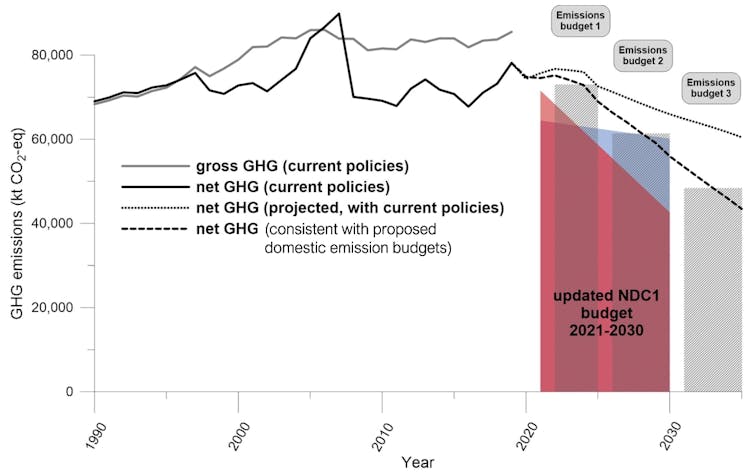
New Zealand’s actual emissions in the 2010s were 701 million tonnes (Mt) of carbon dioxide equivalent. The carbon budget for the 2020s is 675Mt. The old pledge for the 2020s was 623Mt.
The Climate Change Commission’s advice was for “much less than” 593Mt, and the new NDC is 571Mt. So yes, the new pledge meets the commission’s advice and is a step up on the old, but it does not meet our fairshare under the Paris Agreement.
It is also a stretch to call the new NDC consistent with the goal of keeping global temperature rise under 1.5℃.
True 1.5℃ compliance would require halving fossil fuel burning over the next decade, while the current plan is for cuts of a quarter.
The dark dashed line shows New Zealand’s domestic climate goal – its carbon budget. The blue area shows a possible pathway under the old climate pledge, and the red area represents the newly announced pledge. Graph: Office of the Minister of Climate Change, CC BY-ND
Emissions need to halve this decade Countries’ climate pledges are at the heart of the Paris Agreement. The initial round of pledges in 2016 added up to global warming of 3.5℃, but it was always intended they would be ratcheted up over time.
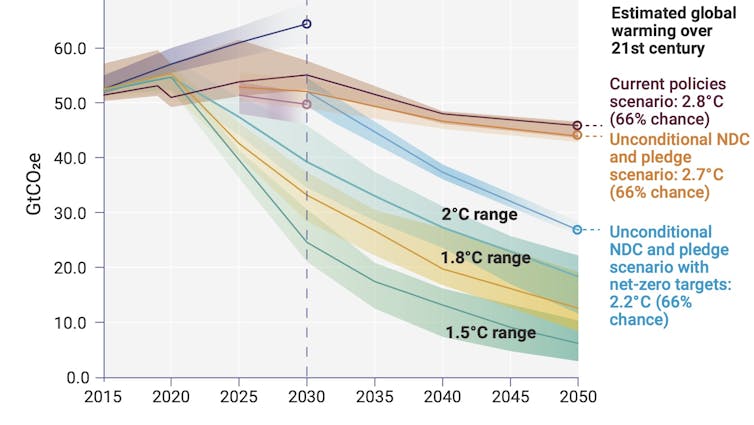
In the run-up to COP26, a flurry of new announcements brought that figure down to 2.7℃ — better, but still a significant miss on 1.5℃.
As this graph from the UN’s Emissions Gap Report 2021 shows, the world will need to halve emissions this decade to keep on track for 1.5℃.
This graph shows that new and existing pledges under the Paris Agreement leave the world on track for 2.7ºC of warming. If recent net-zero pledges are realised, they will take us to 2.2ºC. Graph: UNEP, CC BY-ND
New Zealand’s first NDC, for net 2030 emissions to be 30 percent below gross 2005 emissions, was widely seen as inadequate. An update, reflecting the ambition of the 2019 Zero Carbon Act to keep warming below 1.5℃, has been awaited eagerly.
But several factors have combined to make a truly ambitious NDC particularly difficult.
First, New Zealand’s old climate strategy was based on tree planting and the purchase of offshore carbon credits. The tree planting came to and end in the early 2010s and is only now resuming, while the Emissions Trading Scheme was closed to international markets in 2015. The Paris Agreement was intended to allow a restart of international carbon trading, but this has not yet been possible.
Second, New Zealand has a terrible record in cutting emissions so far. Burning of fossil fuels actually increased by 9 percent from 2016 to 2019. It’s a challenge to turn around our high-emissions economy.
Third, our new climate strategy, involving carbon budgets and pathways under advice from the Climate Change Commission, is only just kicking in. The government has made an in-principle agreement on carbon budgets out to 2030, and has begun consultation on how to meet them. The full emissions-reduction plan will not be ready until May 2022.
Regarding a revised NDC, the government passed the buck and asked the commission for advice. The commission declined to give specific recommendations, but advised:
We recommend that to make the NDC more likely to be compatible with contributing to global efforts under the Paris Agreement to limit warming to 1.5℃ above pre-industrial levels, the contribution Aotearoa makes over the NDC period should reflect a reduction to net emissions of much more than 36 percent below 2005 gross levels by 2030, with the likelihood of compatibility increasing as the NDC is strengthened further.
The government then received advice on what would be a fair target for New Zealand. However, any consideration of historic or economic responsibility points to vastly increased cuts, essentially leading to net-zero emissions by 2030.
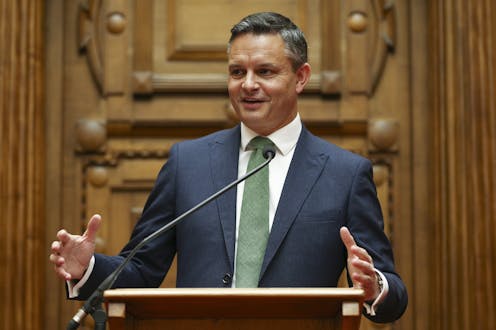
Announcing the new NDC, Climate Change Minister James Shaw admitted it wasn’t enough, saying:
I think we should be doing a whole lot more. But, the alternative is committing to something that we can’t deliver on.
What proper climate action could look like Only about a third of New Zealand’s pledged emissions cuts will come from within the country. The rest will have to be purchased as carbon credits from offshore mitigation.
That’s the same amount (100Mt) that Japan, with an economy 25 times larger than New Zealand’s, is planning to include in its NDC. There is no system for doing this yet, or for ensuring these cuts are genuine. And there’s a price tag, possibly running into many billions of dollars.
New Zealand has an impressive climate framework in place. Unfortunately, just as its institutions are beginning to bite, they are starting to falter against the scale of the challenge.
The commission’s advice to the minister was disappointing. It’s being challenged in court by Lawyers For Climate Action New Zealand, whose judicial review in relation to both the NDC and the domestic emissions budgets will be heard in February 2022.
With only two months to go until 2022 and the official start of the carbon budgets, there is no plan how to meet them. The suggestions in the consultation document add up to only half the cuts needed for the first budget period.
Thinking in the transport area is the furthest advanced, with a solid approach to fuel efficiency already approved, and an acknowledgement total driving must decrease, active and public transport must increase, and new roads may not be compatible with climate targets.
But industry needs to step up massively. The proposed 2037 end date for coal burning is far too late, while the milk cooperative Fonterra — poised to announce a record payout to farmers — intends to begin phasing out natural gas for milk drying only after that date.
The potentially most far-reaching suggestion is to set a renewable energy target. A clear path to 100 percent renewable energy would provide a significant counterweight to the endless debates about trees and agricultural emissions, but it is still barely on the radar.
Perhaps one outcome of the new NDC will be that, faced with the prospect of a NZ$5 billion bill for offshore mitigation, we might decide to spend the money on emissions cuts in Aotearoa instead.
Prime Minister Jacinda Ardern says the New Zealand government wants to lift vaccination rates and wants to remove anything that is a barrier to getting as many people vaccinated as quickly as possible.
Ardern and Māori-Crown Relations Minister Kelvin Davis, who is also the MP for Te Tai Tokerau, are in Northland viewing the rollout of vaccinations.
Ardern spoke to media this afternoon until she was continuously interrupted by a conspiracy theorist in the crowd. She then decided to shut down and move the conference.
In other developments today:
Low vax rates not government’s fault In today’s media conference, Ardern said the low vaccination rates in Northland were not a failure of the government.
She said the government wanted to lift vaccination rates, and wanted to remove anything that was a barrier to getting as many people vaccinated as quickly as possible.
“I asked one provider, what are you hearing when you’re out vaccinating … they described it as covid not necessarily feeling close enough to the community yet, that even when there have been cases in Northland it might be seen as a valley over, not at the front door,” she said.
“We will do everything we can to keep it isolated, but we need everyone to be vaccinated.”
She said decisions were made based on public health advice.
Watch the media conference:
Prime Minister Jacinda Ardern and Māori-Crown Relations Minister Kelvin Davis speak about vaccination in Northland. Video: RNZ News
In the conference, Ardern said the low vaccination rates in Northland are not a failure of the government.
She said the government wants to lift vaccination rates, and wants to remove anything that is a barrier to getting as many people vaccinated as quickly as possible.
“I asked one provider, what are you hearing when you’re out vaccinating … they described it as Covid not necessarily feeling close enough to the community yet, that even when there have been cases in Northland it might be seen as a valley over, not at the front door.”
“We will do everything we can to keep it isolated, but we need everyone to be vaccinated.”
She said decisions were made based on public health advice.
She would rather people were getting vaccinated regardless of alert level, because it was the right thing to do, she said.
Asked about the ruling ordering the ministry of health to reconsider its stance of withholding Māori vaccination data on the basis of privacy, Ardern said it was an issue about what data had been available or able to be shared, and she would allow the health team to work through that.
Raise concerns with professionals She said people should be able to raise concerns about the vaccine, and if they had questions or concerns they should be able to come forward to talk to health professionals, or someone they trusted, to make the right decision.
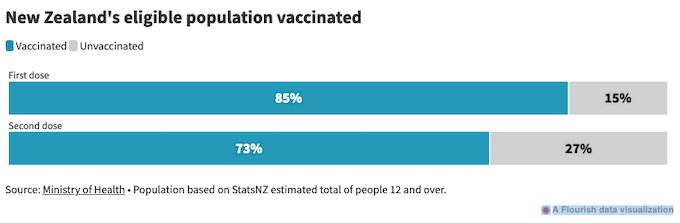
She said the number of people who “would be described as … anti-vaccination” was relatively small in New Zealand. She said she absolutely believed the 90 percent double vaccinated rate the government was aiming for could be achieved.
She said young people in particular could be exposed to misinformation online, so there was more work ahead.
Ardern said despite best efforts, cases had come out of Auckland “and so we do need people to be vaccinated”.
Minister Davis said Te Tai Tokerau had not been forgotten.
“I have weekly meetings with all iwi leaders, so there’s a lot of work going into protecting our people, and as we’ve said there’s extra $4m going into the north today. We’re doing everything we can to make sure that our people are protected and people get vaccinated.”
Ardern said the approach from the government had been to ask Māori providers to focus on older kaumātua and kuia, and to take a whānau-based approach.
‘They think they’re smarter than the virus’ Davis was asked about protesters.
“That’s the first protest I’ve seen, there were two people. Obviously, they think they’re smarter than the virus… I don’t think it helps what we’re trying to do here, to protect whānau, to protect whakapapa.
“And to have people think that what’s going on is not reality? I think that they’re just living in a strange world.
“Our focus is on making sure that as many people as possible get vaccinated to protect their whānau, to protect their whakapapa, and that sort of stuff just doesn’t help at all.”
Ardern said misinformation existed everywhere but it was a minority voice.
It is also the region that needs the largest number of first doses to reach 90 percent of the eligible population, with more than 17,000 doses required to reach that milestone.
The government’s proposed traffic light system would see restrictions across New Zealand reduced, and lockdowns ended, once every DHB in the country reaches 90 percent double dosed.
Northland also has a high percentage Māori population. Māori have accounted for about 40 to 50 percent of cases in the delta outbreak in recent weeks, and have lower vaccination rates than the rest of the population.
A New Zealand Pasifika climate activist has told the UN climate meeting that young Pacific people are not victims of climate change but beacons of hope.
The first day of the Leaders Summit is wrapping up at COP26 in Glasgow.
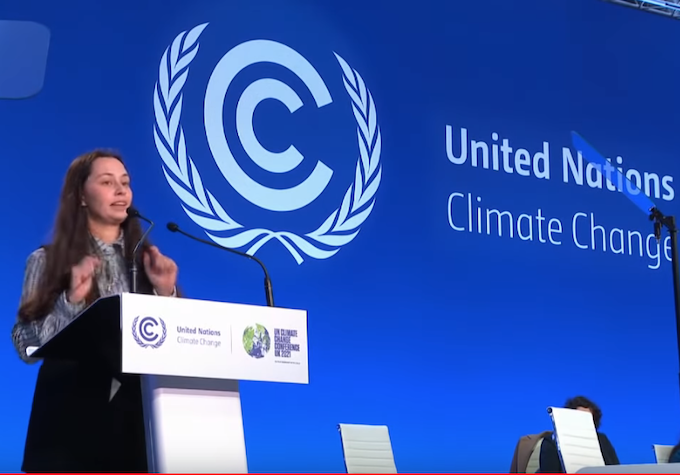
Environmental advocate for Samoa Brianna Fruean said Pacific people were not just victims of the climate crisis, but were beacons of hope.
If the world leaders at COP failed, the people will step up, she said.
“I believe that COP is like a compass, that we are all in collective canoe and if we’re able to get COP right we can be pointed in the right direction.
“But at the end of the day, my ancestors travelled the oceans without compasses. So if COP doesn’t work, the people will.
Demonstrators gathered in Port Moresby yesterday for a march to Parliament in protest over the covid-19 vaccines, which they claimed wrongly to be mandatory, a day after Papua New Guinean police warned such gatherings were illegal.
The protest was a result of a post circulating on social media about a “peaceful protest march” planned for the day against mandatory vaccination.
Despite assurances from Controller of the Pandemic Response and Police Commissioner David Manning that the notice circulated was false and misleading because vaccination was not mandatory and still remained a personal choice, the protesters gathered for the rally.
The anti-vaccine crowd disobeyed advice from the police to disperse. Instead, they took to the Gordon bus stop, gained momentum from others who joined them and attempted to march through a residential street towards the Wardstrip Primary School and on to Parliament.
However, police thwarted their their attempts by blocked the route and spoke to the crowd who disregarded social distancing and masks.
The NCD/Central Assistant Commissioner of Police (ACP), Anthony Wagambie Jnr, addressed the crowd. He said their concerns had already been heard.
It was not clear who the organisers of the march were.
Endangering public safety ACP Wagambie explained that the march had to be stopped by police to prevent disorder stemmed that would endanger the safety of others in Port Moresby.
The anti-vaxxers carried a banner with messages condemning “666” and “artificial intelligence”.
Misinformation about the covid-19 vaccines is currently swamping genuine information available to Papua New Guineans and is allowing fear and confusion to gain momentum.
Asia Pacific Report reports only 1.2 percent of the nine million Papua New Guineans are vaccinated against covid-19.
According to the John Hopkins University covid dashboard, 29,715 cases of covid and 370 deaths have been reported on Papua New Guinea but health officials fear the real toll is far higher because of limited testing and records.
The Philippine Court of Appeals (CA) has finally granted overseas travel to Rappler CEO and Nobel Laureate Maria Ressa, who will be in the United States for the entire month of November to deliver a series of lectures at the Harvard Kennedy School in Boston.
Ressa filed the request on October 5, three days before the Nobel announcement was made.
The CA promulgated its decision in favour of Ressa on October 18, 10 days after the journalist was named one of the two joint winners of the 2021 Nobel Peace Prize.
Unlike past travel requests, the CA Eighth Division said the Harvard lectures were proven to be urgent and necessary.
In August 2020, the CA denied Ressa’s travel request saying that to accept the 2020 International Press Freedom Award from the National Press Club was not necessary and urgent.
In December 2020, the CA also denied a travel request from Ressa to visit her 76-year-old mother in Florida who had just been diagnosed with breast cancer two months prior to the request. The CA said then that it was also not considered a necessary and urgent travel.
For this request, the CA said Harvard’s “invitation letter shows that Ressa’s participation in the programme requires her physical presence” and that “in fact, the Harvard Kennedy School explained that the programme involves an in-person 30-day residency.”
Wish to visit her parents Ressa also indicated in her request her wish to visit her parents in Florida within November which will coincide with the American Thanksgiving holiday, saying she had not seen them in two years.
The CA said “humanitarian reasons support Ressa’s intended travel,” adding that “certainly, one’s legitimate intention to be reunited with her/his parents cannot be doubted”.
Generally, a person under trial for bailable offences in the Philippines are easily granted their travel requests. The other courts handling Ressa’s tax and securities charges have granted her requests.
It’s the CA, which is handling her appeal for her cyber libel conviction, that’s the hardest to hurdle as conviction further restricts one’s right to travel.
“While Ressa’s conviction changes her situation and warrants the exercise of greater caution in allowing her to leave the Philippines, her undisputed compliance with the conditions imposed by the court a quo on her previous travels shows that she is not a flight risk,” said the CA, the decision penned by Associate Justice Geraldine Fiel-Macaraig, with concurrences from Associate Justices Elihu Ybañez and Angelene Mary Quimpo-Sale.
Ressa is scheduled to fly home to the Philippines in early December. To attend the Nobel awarding in Oslo on December 10, she would have to file another batch of travel requests before all the courts handling the seven cases.
The Office of the Solicitor General (OSG) tried to contest this travel grant, citing among others Ressa’s alleged flight risk, but the CA did not agree.
“We cannot sustain the OSG’s opposition grounded on Ressa’s dual citizenship and alleged lack of respect for the Philippine judicial system because the same is speculative as of now,” the CA said in its October 29 denial of OSG’s motion for reconsideration.
Ressa has strong economic ties in the Philippines as she is the CEO of Rappler, an online media platform based in the country.”
Lian Buan covers justice and corruption for Rappler. This article is republished with permission.
The Reserve Bank of Australia had a Cup Day surprise in store for the country, announcing it was abandoning its policy of “yield curve control”, meaning it was no longer going to defend any particular interest rate for borrowing over any particular duration.
Until today it had a formal target for the three-year bond yield of 0.10%, enabling banks to provide three-year fixed mortgages very cheaply, and indicating the cash rate wouldn’t climb above 0.10% until the most recent three-year bond expires in April 2024.
But it has now abandoned the target, a full two years early.
Why control the yield curve in the first place?
When COVID hit last year, the bank announced it would buy enough government bonds to keep the yield on the three-year bond at 0.25%, as good as guaranteeing money would be cheap for years to come.
Later, it cut the target for three-year bond yields (and the target for its cash rate) to a near-zero 0.10%, further lowering the cost of borrowing.
Responding to an improving economy, the bank decided at its July 2021 meeting not to extend the program bond target beyond April 2024.
The decision created a reasonable expectation the cash rate would remain close to zero until 2024.
What did yield curve control achieve?
Yield curve control achieved a lot. It took the bank just 11 days and A$27 billion dollars of bond purchases to achieve its first target, establishing ultra-low interest rates for years into the future.
After that, it didn’t need to spend much. The new three-year rate became the new norm. Markets believed it would do whatever was needed to defend it.
Over the next 18 months it intervened in the market only occasionally, and only in small amounts. That all changed last week.
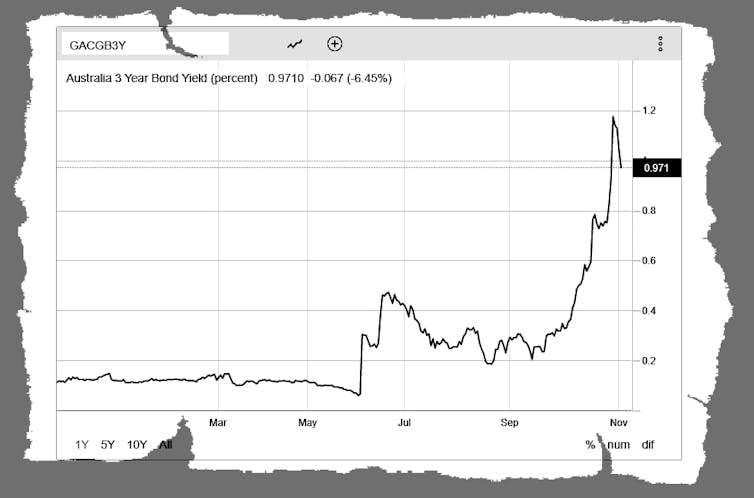
On October 15, the three-year bond rate started to climb above the bank’s target of 0.10%. It initially bought enough bonds to defend the rate and then, without warning, capitulated last Thursday, as good as withdrawing from the market and allowing the rate to climb to a high of 0.70%.
By Monday the rate had climbed to more than 1.00%, more than ten times the Reserve Bank’s target.
Today’s announcement merely made formal what was apparent on Thursday: the bank is no longer going to spend public funds defending a line that might eventually be crossed.
Bond traders thought the improving economic outlook meant the bank would have to lift its record low cash rate sooner that it had said it would. It lost the will to disagree.
In a 4pm press conference Governor Philip Lowe said that to maintain the target would have been untenable. Eventually the bank would have owned all the three-year bonds on offer.
What will this do to the housing market?
Today’s decision is a sure sign interest rates are going to start to rise. Not today, or even for the rest of this year, but sooner was previously expected.
For what it is worth, Lowe said the latest data and forecasts did “not warrant an increase in interest rates in 2022”.
For now, sub-2% fixed-rate mortgages are a thing of the past. The last were withdrawn this week.
Reserve Bank Governor Philip Lowe press conference, Tuesday November 2.
The decision means the booming housing market will start to crest. Low interest rates sparked the boom as renters flocked to become first-homebuyers and investors jumped in to catch rising prices.
The prospect of higher mortgage payments is going to dent this enthusiasm, perhaps quickly.
Home prices are set to stabilise, before potentially edging, or sliding down .
We don’t yet know how quickly variable interest rates will start to rise, but given the Reserve Bank has walked away from a battle to defend yield curve control, we do know it’ll be a long time before it even considers doing it again.
Isaac Gross does not work for, consult, own shares in or receive funding from any company or organisation that would benefit from this article, and has disclosed no relevant affiliations beyond their academic appointment.
But the real issue is not whether they eat too many expensive cafe breakfasts. Young Australians today face an uncertain job market, rising university fees and astronomical house prices. Unfortunately, debt is also an inevitable part of their lives.
This comes amid a huge rise in the number of “buy now, pay later” apps, such as AfterPay, and payday loan apps, such as Nimble. It is possible to make purchases online with the the tap of a button, even if you don’t have the money in your account or on your credit card. It is also possible the able to borrow money within minutes.
To better understand how young people negotiate debt, we interviewed 31 people aged between 18 and 29 in the Newcastle and Hunter Valley area in 2020 and 2021. We asked them how they access credit and their views on different kinds of debt.
Our study
Our participants saw debt as a necessity if they are going to have an acceptable life in the present and plan for the future. As Steph, a 22-year-old university student, said:
Large debts like the mortgage, the HECS debt […] things like that I suppose in a sense it’s useful debt. It makes sense and it gets you further by doing it because there’s still an equity in what you’re doing … It follows you not nearly as badly as some other debts.
Young people also made distinctions about the way debt feels and how approachable it is. They acknowledged short-term consumer debts may not be “good”, but felt they were also part of being able to buy the things and have the experiences associated with being young.
Those we interviewed talked about AfterPay (where you pay off the debt in four installments) as an everyday part of life. As Alexa, a 23-year-old university student, told us:
AfterPay is for just those little wants that I don’t want to pay for up front.
They also described it as a low-risk and almost friendly way to buy things. This was particularly when compared to a bank. Alice, a 21-year-old sales assistant, put it this way:
AfterPay is like, ‘Oh, just pay this off in four quick things and you can have your item. We’ll send it out.’ But then banks are like, ‘If you don’t pay this back, you’re going to get so much interest and it’s going to suck, and you’ll have the sheriffs roll up at your house and you’re going to be sad.’
Like ordering a pizza
Interviewees attributed some of this friendliness to the process of accessing the money or goods. Mia, a 21-year-old paralegal, described applying for a small loan on the Nimble app:
When you apply for the money […] you can track at any point on it. The Nimble app is so similar to ordering a Domino’s pizza […] Whereas a credit card through a banking app, it’s nothing like that […] They send me letters and even opening the mail terrifies me, nothing good comes via snail mail ever.
The online, easy nature of these loan services closely relates to how young people engage with information more generally in their lives. In this sense, there is a familiarity and comfort to the way they work.
As Mia continues:
[It’s] positive, it’s not daunting, it’s informative, it’s instantaneous. The second the money comes out, I get a thank you email and a notification on the app. It’s like, ‘you have this many payments left, this is how much you’ve paid, this is how much you have left to pay, you will still be paid in full by this date’. I don’t have any of that with my credit card.
Familiar tactics
Inteviewees also spoke of how services like AfterPay and short-term loan apps used similar tactics to social media platforms to encourage increased engagement and make the experience feel informal and even social.
Applying for a loan via an app does not involve ‘scary’ paperwork, according to interviewees. www.shutterstock.com
These include “on this day” reminders (such as, “this time last year, you bought this pair of shoes”) and waiting time indicators. There are also game elements, including “rewards” for early repayments.
Interviewees were aware this was manipulative. Lilian (26) works at a chain clothing store and was “rewarded ” for paying off a purchase early.
I got this thing the other day saying that my first payment [on a new purchase] is actually going to come out [later] now. Of course, I’ve been rewarded for paying everything off early [before] […] Yeah it’s like it’s delaying it, it’s not an issue now, but it’s going to be an issue in two weeks’ time.
What next?
Our interviewees may see debt as a necessity, but they are also aware they have (some) choices within this. So they prefer to go with providers or platforms that feel less threatening, especially as using “buy now, pay later” services sometimes does not feel like being in debt.
Young people see debt as an inevitable part of life, according to new research. www.shutterstock.com
There is a need for greater regulation of the ways these products are promoted. It should always be made clear that this is a form of debt, not just a way to pay.
Beyond, this, instead of “blaming” young people for their spending habits, we need a better understanding of the economy and society they are living and working in. And how debt it is all but inevitable for people on low wages, with poor job security and insecure housing.
Steven Threadgold also talks about how buy now, pay later apps influence young people’s spending on the Seriously Social podcast by the Academy of the Social Sciences in Australia.
The research in this article was funded by the University of Newcastle, Faculty of Education and Arts, Research Program Pilot Scheme, 2020-21.
The research in this article was funded by the University of Newcastle, Faculty of Education and Arts, Research Program Pilot Scheme, 2020-21.
Kate Senior receives funding from The Australian Research Council
David Farrugia, Julia Cook, and Kate Davies do not work for, consult, own shares in or receive funding from any company or organisation that would benefit from this article, and have disclosed no relevant affiliations beyond their academic appointment.
Ten years ago, in the lead-up to Australia’s short-lived carbon price or “carbon tax” (either description is valid), the deepest fear on the part of businesses was that they would lose out to untaxed firms overseas.
Instead of buying Australian carbon-taxed products, Australian and export customers would buy untaxed (possibly dirtier) products from somewhere else.
It would give late-movers (countries that hadn’t yet adopted a carbon tax) a “free kick” in industries from coal and steel to aluminium to liquefied natural gas to cement, to wine, to meat and dairy products, even to copy paper.
It’s why the Gillard government handed out free permits to so-called trade-exposed industries, so they wouldn’t face unfair competition.
As a band-aid, it sort of worked. The firms with the most to lose were bought off.
But it was hardly a solution. What if every country had done it? Then, wherever there was a carbon tax (and wherever there wasn’t), trade-exposed industries would be exempt. The tax wouldn’t do enough to bring down emissions.
We are about to face carbon tariffs
The European Union has cottoned on to the imperfect workarounds introduced by countries such as Australia, and is about to tackle things from the other direction.
Instead of treating foreign and local producers the same by letting them both off the hook, it’s going to place both on the hook.
It’s about to make sure producers in higher-emitting countries such as China (and Australia) can’t undercut producers who pay carbon prices.
Unless foreign producers pay a carbon price like the one in Europe, the EU will impose a carbon price on their goods as they come in — a so-called Carbon Border Adjustment Mechanism, or “carbon tariff”.
Australia’s Energy Minister Angus Taylor says he is “dead against” carbon tariffs, a stance that isn’t likely to carry much weight in France or any of the other 26 EU nations.
Australia is familiar with the arguments for them
From 2026, Europe will apply the tariff to direct emissions from imported iron, steel, cement, fertiliser, aluminium and electricity, with other products (and possibly indirect emissions) to be added later.
That is, unless they come from a country with a carbon price.
Their arguments line up with those heard in Australia in the lead-up to our carbon price: that unless there’s some sort of adjustment, a local carbon tax will push local employers towards “pollution havens” where emissions are untaxed.
In practice, there’s little Australia can do to stop Europe and others imposing carbon tariffs.
As Australia discovered when China blocked its exports of wine and barley, there’s little a free trade agreement, or even the World Trade Organisation, can do. The WTO was neutered when former US President Donald Trump blocked every appointment to its appellate body, leaving it unstaffed, a stance Biden hasn’t reversed.
Even so, the EU believes such action would be allowed under trade rules, pointing to a precedent established by Australia, among other countries.
Legality isn’t the point
When Australia introduced the Goods and Services Tax in 2000, it passed laws allowing it to tax imports in the same way as locally produced products, a move it has recently extended to small parcels and services purchased online.
Trade expert and Nobel Prizewinning economist Paul Krugman says he is prepared to argue the toss with politicians such as Australia’s trade minister about what’s legal and whether carbon tariffs would be “protectionist”.
But he says that’s beside the point:
Yes, protectionism has costs, but these costs are often exaggerated, and they’re trivial compared with the risks of runaway climate change. I mean, the Pacific Northwest — the Pacific Northwest! — has been baking under triple-digit temperatures, and we’re going to worry about the interpretation of Article III of the General Agreement on Tariffs and Trade?
And some form of international sanctions against countries that don’t take steps to limit emissions is essential if we’re going to do anything about an existential environmental threat.
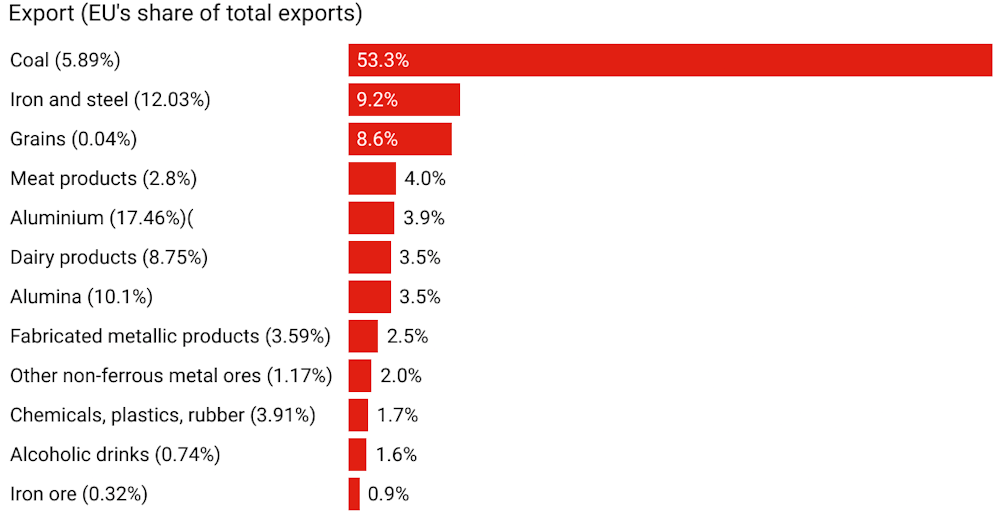
Victoria University calculations suggest Europe’s carbon tariffs will push up the price of imported Australian iron, steel and grains by about 9%, and drive up the price of every other Australian import by less, apart from coal whose imported price would soar by 53%.
The tariffs would be collected by Europe rather than Australia. They could be escaped if Australian makers of iron, steel and other products can find ways to cut emissions.
Increase in price of exports to EU under carbon border adjustment mechanism
Assumes an EU carbon price of 60 euro per tonne, which is roughly today’s price; assumes the CBAM covers CO2 emissions including fugitive emissions involved in production other than direct combustion emissions that are priced already by the EU Emissions Trading Scheme.
The tariffs could also be avoided if Australia were to introduce a carbon price or something similar, and collected the money itself.
This makes a compelling case for another look at an Australian carbon price. If Australian emissions are on the way down anyway, as Prime Minister Scott Morrison contends, it needn’t be set particularly high. If he is wrong, it would need to be set higher.
One thing the sad story of Australia’s on-again, off-again, now on-again (through carbon tariffs) history of carbon pricing has shown is that politicians aren’t the best people to set the rates.
In 2011, Prime Minister Julia Gillard set up an independent, Reserve Bank-like Climate Change Authority to advise on the carbon price and emissions targets, initially chaired by a former governor of the Reserve Bank.
Astoundingly, despite attempts to abolish it, it still exists. It might yet have work to do.
Peter Martin does not work for, consult, own shares in or receive funding from any company or organisation that would benefit from this article, and has disclosed no relevant affiliations beyond their academic appointment.
One of the four main goals of the COP26 climate talks in Glasgow is how the world adapts to protect communities and habitats. And in Prime Minister Scott Morrison’s policy hand luggage is a new adaptation plan for Australia.
Adaptation is about how we prepare for the impacts of climate change. It can range from building flood defences to setting up early warning systems for cyclones and switching to drought-resistant crops.
Resilience refers to our ability to contend with and emerge stronger from climate-related effects such as natural disasters. It is less tangible than adaptation and tends to refer to investment in strengthening communities or systems like the health system or ecosystems.
Australia’s first National Climate Resilience and Adaptation Strategy, released in 2015, was nice sentiment which largely gathered dust as the world roared on.
The new version promises more concrete gains – in particular, through national leadership and regular check-ins on how we’re progressing. But there is much detail still to be ironed out and it is unclear if there will be funding for real-world action.
I was among many researchers and stakeholders consulted in developing the strategy. While some will feel it doesn’t go far enough, I believe it’s a good start.
The new strategy lists three objectives. Each speak to the role the federal government sees itself playing:
1. Drive investment and action through collaboration
In the past decade, Australia’s states and territories have produced many of their own adaptation policies, plans and legislation. But many observers felt national leadership was missing.
This time, there’s a concrete proposal to deliver national leadership and collaboration via a newly established National Adaptation Policy Office. The office will coordinate work on climate resilience and adaptation across all governments and provide a central point of contact for businesses and communities.
It will also oversee the strategy’s implementation and report on Australia’s adaptation progress.
How would it work in practice? There is not much detail to go on, yet, but hopefully, this new office would:
drive well-funded actions and investment
broker relationships between research and action
provide a well-tuned ear to local governments, land managers and businesses contending with the real world impacts of climate change.
The less generous prospect is it could be yet more bureaucracy. It’s too soon to say.
The clear lesson from the 2019-20 bushfires – invest before risks unfold – has hit home. Shutterstock
The funding listed in this objective leans heavily toward climate science. But more funding is also needed for research related to other aspects of climate change adaptation.
This includes which plant and animal species to invest more in conserving, how to protect coastlines and how to make difficult decisions on what to save as the climate changes – and what to let go.
3. Assess progress and improve over time
The strategy’s third objective brings, in my view, the real substance. Under this objective, the federal government promises to conduct five-yearly assessments of national climate impacts and adaptation progress.
This assessment will be co-designed and delivered in consultation with governments, business, professional groups and researchers.
It would bring Australia closer to the approach commonly adopted in other jurisdictions, where regular cycles of risk assessment, action and monitoring take place.
Australian states and territories already have either state-wide or regional risk assessments, offering a foundation on which the Australian government can build.
It needn’t be a lengthy process. New Zealand took nine months to complete their risk assessment. We can afford that time to get all of Australia on the same page.
Measuring progress highlights where risk persists so we can effectively direct investment.
Simple progress indicators might include things such as:
measuring areas of green space that cool urban areas
evaluating how many houses in flood risk areas have been retrofitted with flood protection measures
monitoring changes in demand for irrigation.
What’s missing from the strategy?
So far so good, but there are a couple of notable omissions. The first is enshrining the strategy in legislation.
The United Kingdom has a legislative obligation to undertake assessment and monitoring of adaptation. Other jurisdictions also have legislation ensuring risk assessments and action plans.
Australia’s adaptation strategy can still succeed without legislative muscle. But any policy not enshrined in law can easily be overturned if there is a change of government.
The second notable absence is a sufficiently detailed commitment to an action plan. This is a much greater concern. The policy is a high-level document. The desire to see commitment to concrete action was clear in the consultation sessions leading to the plan. There will be a keen interest to see what details come from the National Adaptation Policy Office as it starts up.
So far, federal adaptation funding is allocated to providing research and information, but nothing else. But national action and investment is crucial. The challenge of sea level rise, for example, is bigger than what individual councils or communities can handle on their own.
Also, the strategy is not clear on the role of Indigenous people in building and monitoring adaptation and resilience. Australia’s First Nations people should be meaningfully engaged in framing how a well-adapted Australia could look.
This was central to the New Zealand approach and could be an early priority for the new adaptation agency.
Adaptation is crucial
A clear lesson from the devastating 2019-20 bushfires was to invest in reducing and avoiding risks before disaster unfolds.
It makes good social and fiscal sense to avoid leaving the fate of people and lives to chance, and facing expensive recovery operations, when climate-related disasters occur.
Adaptation is as important as reducing emissions. The new strategy outlines part of the plan needed to get us there – but some opportunities have been missed.
If research, policy and practice continue to work together, I believe we can build an Australia that can survive climate change.
Sarah Boulter receives funding from the Australian Government under the National Environmental Science Program. Sarah was one of a number of researchers consulted in the development of the National Climate Resilience and Adaptation Strategy.
Source: The Conversation (Au and NZ) – By Patrick O’Leary, Professor, Co-Lead of the Disrupting Violence Beacon and Director of Violence Research and Prevention Program, Griffith Criminology Institute and School of Health Sciences and Social Work, Griffith University
Felipe Dana/AP
Months after the Taliban’s return in Afghanistan, there are grave concerns about the state of the country, and in particular, the lives of children.
With western media attention on the country waning, we are urging the international community not to forget the plight of Afghanistan’s children, especially in the precarious months ahead.
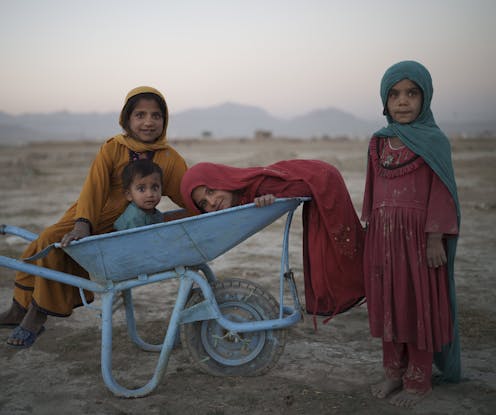
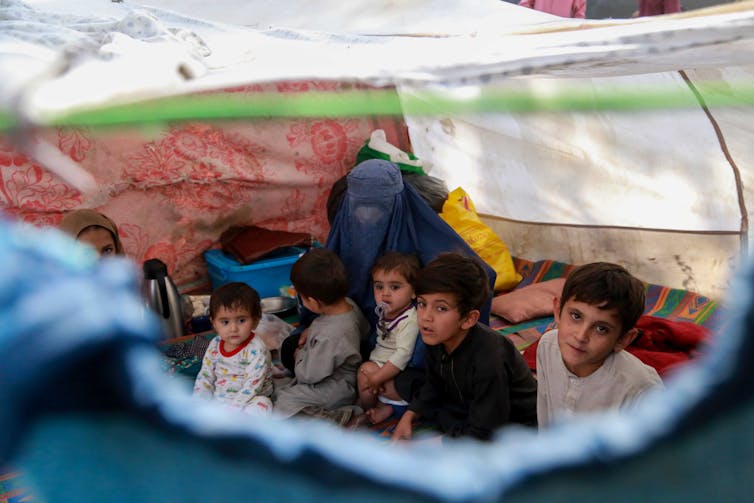
Afghan children play at a camp for internally displaced people this month. Felipe Dana/AP
While girls have been targeted in relation to accessing education, boys have been
recruited to armed groups, such as the Taliban, in high numbers. Recent pictures of children with weapons in a demonstration against the Taliban shows just how perilous their safety is at the moment.
Many children also lost their parents to violence during the long years of conflict. In response, orphanages play an important role in Afghanistan. However, the care these institutions provide is now compromised due to a lack of external and domestic funding. Some orphanages are even reducing the amount of food they can give children.
The last two decades of western military intervention have delivered mixed results for young people in Afghanistan. Children witnessed horrific scenes of violence, causing fear, anxiety, trauma and other mental health issues.
At the same time, the UN and other international humanitarian agencies were able to access vast stretches of the country and expose violations of children’s rights. Importantly, they were able to work to promote the rights of girls.
Despite the enormity of the task of improving children’s safety, the last few years have brought glimmers of hope that change is possible. For example, programs promoting peace and challenging community norms led to reductions in corporal punishment in schools and the home in the years preceding the Taliban’s return.
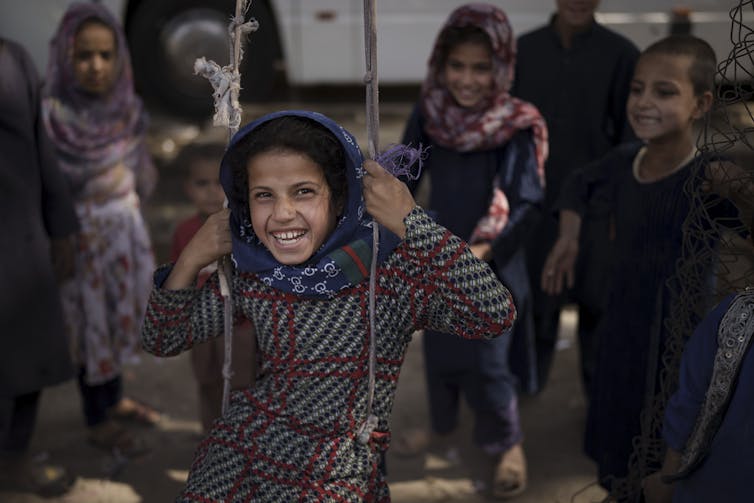
Afghan children who were displaced from other parts of the country live in temporary shelters at a camp in Kabul. Stringer/EPA
According to recent research, Afghan parents readily reported using physical violence against their children at home, but many considered some non-violent and positive forms of discipline to be more effective. At a personal level, some parents had discomfort with their use of violence because of their own experiences of trauma as children.
But support for societal change can be challenging. For example, research has found some religious and community leaders recognised their key roles in preventing family violence, yet were reluctant to speak out. This highlights the need for a whole-of-community response where parents feel supported to change the way they care for children.
From 2018-19, we evaluated the “Tsapar Project”, operated by the Swiss-based INGO Terre des Hommes group, which supports child rights and well-being. The program involved providing social work services and vocational training to children and women who were in conflict with the law as a way of re-integrating them back into society. These children and women were often from very poor families and had experienced violence.
The children who took part in the programs reported lower levels of abuse and neglect afterwards. Parent-child relationships were also improved. And vocational training resulted in a higher level of self-efficacy and improved mental health.
Overall, the children left the programs with a good sense of hope. For the women, however, the lack of formal employment often limited their options after they left and forced them to the margins of society.
The return of the Taliban will likely continue this trend, with further restrictions on women’s liberties and freedoms to pursue education and employment.
With the Taliban back in power now and many international humanitarian agencies no longer operating in the country, how can these small gains be preserved? How can parents, teachers, community and religious leaders, and the new government authorities act in the best interests of children?
First, all stakeholders (including the Taliban) need to respect the history, culture, and diversity of Muslim communities in Afghanistan. The Taliban, in particular, needs to be aware of universal children’s rights and have a baseline respect for children’s rights to life, food security, and safety.
The Afghan people have shown an incredible capacity for resilience in the face of seemingly insurmountable odds. This means there is still hope under Taliban rule, but it will require the international community to find the right balance of working with the new rulers and applying the right amount of pressure.
Patrick O’Leary received funding from Terre des hommes Foundation Lausanne.
Jianqiang Liang no recibe salario, ni ejerce labores de consultoría, ni posee acciones, ni recibe financiación de ninguna compañía u organización que pueda obtener beneficio de este artículo, y ha declarado carecer de vínculos relevantes más allá del cargo académico citado.
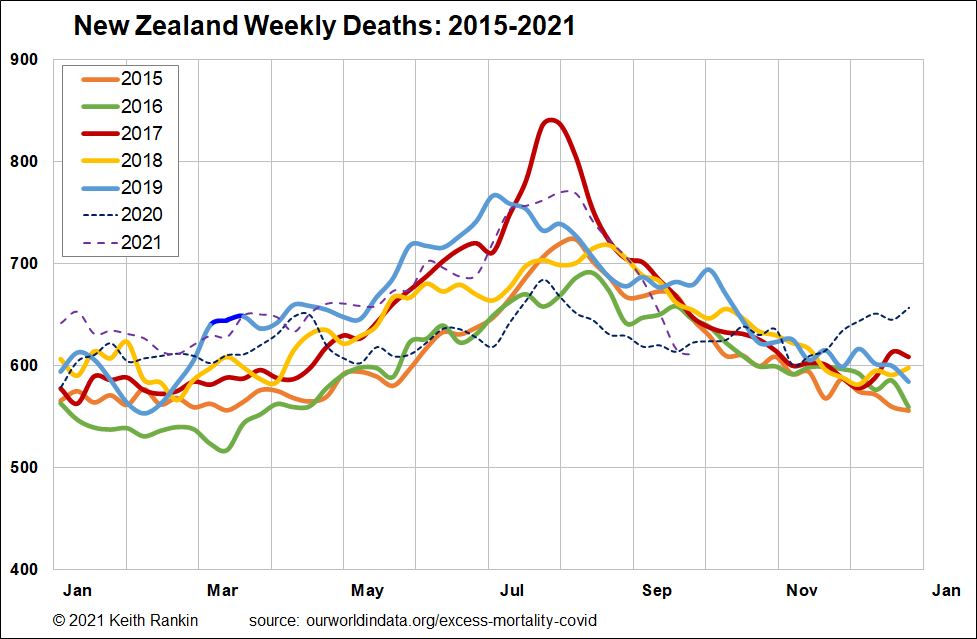
Influenza et.al.; charting normal to see Covid19 in context
Analysis by Keith Rankin.
So much of our analysis of the public health impact of Covid19 has been taken out of context. The officially reported case data are incomplete, and take little account of how these health impacts deviate from normal, or even what ‘normal’ is. Re deaths, many people who deaths were attributed to Covid19 in fact died from a mix of causes of which covid was but one. (A prominent recent example was the former United States Secretary of State, Colin Powell, who died recently as a result of a mix of cancer, covid, and what might previously have been called ‘old age’.) We all die sometime, and most of us die when we are old. (Because age at death is negatively skewed, well over half of us die at above the mean age of death.)
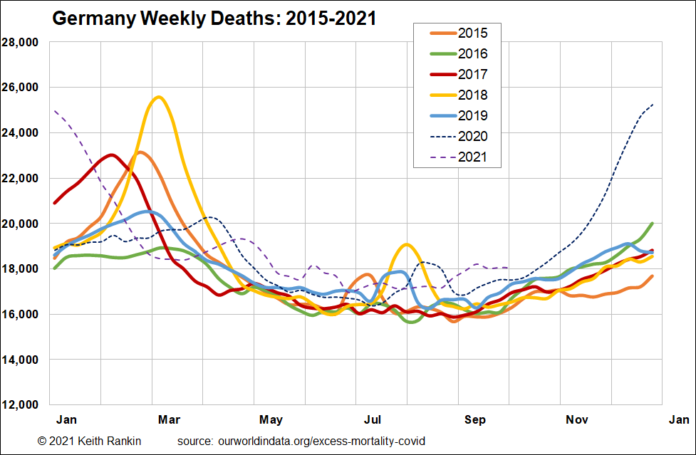
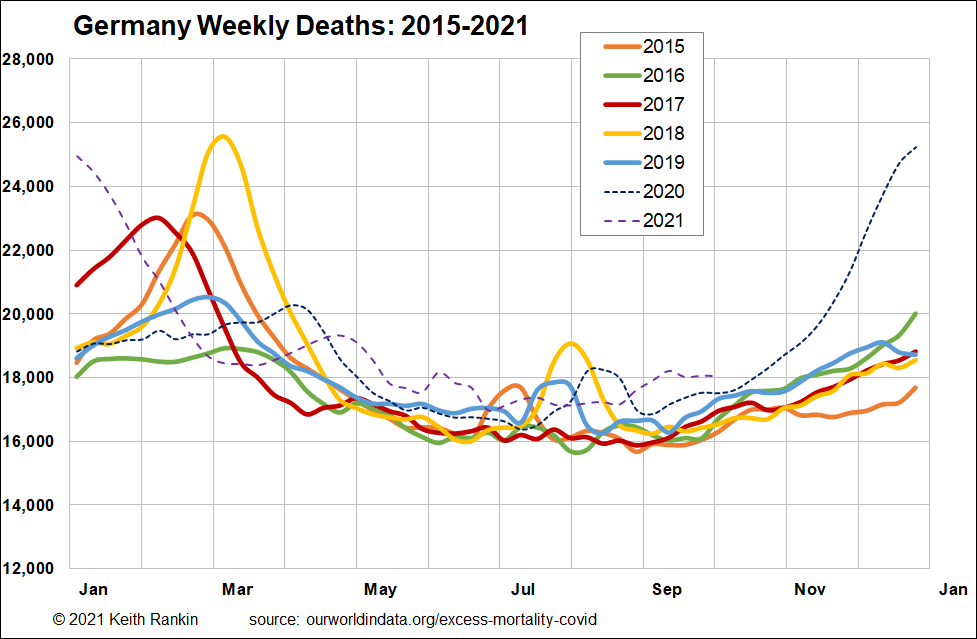
The charts below attempt to reveal, for six more countries, mortality ‘normal’, with the usual messy-ness that applies to human lives. In addition, I have already posted seasonal mortality charts for New Zealand and for Germany; and charts with essentially the same data can be found on Our World in Data.
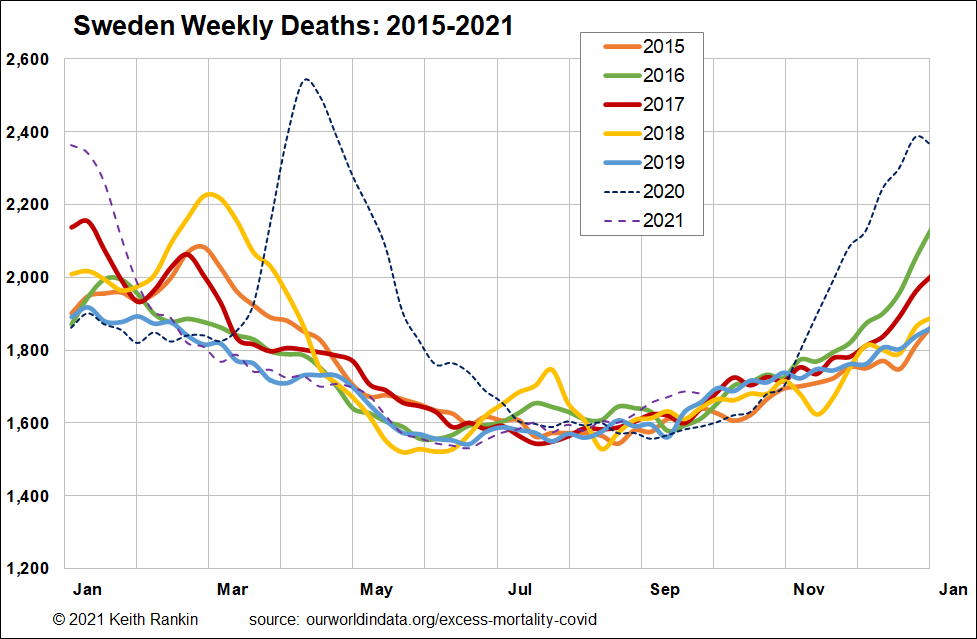
Sweden
Chart by Keith Rankin.
Sweden provides us with a statistical baseline, for an economically developed high latitude northern hemisphere country with a rule-abiding and trusting population. Sweden differs from most other such countries, because it introduced no public health mandates, and its covid vaccination rates are about average for such countries. Sweden is also a useful benchmark, in that it’s population is growing slowly, and that, as a neutral country, World War 2 had a relatively small impact on the age structure of its people.
To find normal, we look at the coloured plots on the chart.
We see that from December to March, there was much variety in Sweden’s experience of mortality. Also, July. The reason for this variation is quite straightforward; December to March are the main months when people die of ‘old age’, and ‘old age’ remains the most significant predictor of mortality. (This is true, whether we think of ‘old age’ as being in one’s nineties, as in Sweden; or one’s seventies, as in, say, Russia.)
The main determinant of when – ie which month – older people die is seasonal respiratory viruses, the most potent of which is influenza. Each year’s ‘influenza season’ is different, making it hard to establish a ‘normal level of mortality’ during the influenza season (December to March in Sweden). Difficultly is establishing normal makes it difficult to determine what constitutes ‘excess’, ie what constitutes ‘above normal’.
Nevertheless, charting the five years – 2015, 2016, 2017, 2018, 2019 – separately gives a vivid picture of approximate seasonal norms. Every year more people die in the winter ‘flu season’.
It is tempting to call 2019 a ‘good year’ in Sweden, but it should really be called a ‘low flu’ year. It means that many Swedes who might normally have died that year, did not (meaning that therefore they would die in another year). A similar low flu year was 2016, although Sweden clearly had a ‘normal’ bout of flu (or something similar) in January 2016, and clearly had a more substantial outbreak at the end of that year.
The most prominent flu bulges are in February (2015, 2017, 2018). 2020 started out like 2019, as another low flu year. For the second February in a row, there were no outbreak flu deaths in Sweden. Thus, there was an unusually large number of older people alive in Sweden in early March 2020; people who in many other years would have already died from influenza complications.
When Covid19 hit Sweden, in late February 2020, it killed many people aged over 85; many of these people were only alive as a result of two low flu winters. Thus, Sweden’s high covid mortality in the spring of 2020 can be substantially attributed to those two low flu winters. We saw something very similar in Germany; the main difference is that Germany responded much more aggressively towards defending itself from the Covid19 outbreak in Italy and The Alps. So, Germany’s mortality that spring was much less than Sweden’s. (This will not only be due to Germany’s restrictions; it’s also because Germany, unlike Sweden, had a normal year in 2019.)
Germany has mortality blips in its summers, that look like infectious disease because the timing is different each summer. And Germany also has a covid blip in its first covid summer. The reason for the summer blips would appear to be the high level of human mobility in summer. Germany’s August 2020 covid-blip most likely reflects a more vulnerable population; vulnerable as a result of its spring’s covid-restrictions, with some older people in Germany dying who would otherwise have died earlier that year.
Sweden’s second wave in the winter of 2020/21 almost exactly parallels that in Germany. So, if we look back from March 2021, Germany’s public health policy looks to have been preferrable to Sweden’s. While both countries shared the winter mortality wave, Sweden’s overall toll looks greater. Germany was seen to have provided best practice in Europe, while Sweden was condemned for worst practice.
After March 2021 is a different story. Arguably the most important bit of the Sweden chart is the 2021 line after March. Sweden’s mortality experience has reverted to ‘absolutely normal’, though with a small Delta hiccough in September 2021. Germany is quite different, with 2021 mortality consistently above normal since March 2021.
What we see is a classic debt profile, with Sweden (as ‘lender’) taking an initial hit in 2020, and with Germany (as ‘borrower’) avoiding the 2020 hit, but, from March 2021, servicing its ‘immunity debt’. (Covid-Delta in Germany appears to have a higher ‘R-value’ [reproductive value] than it does in Sweden.) This is despite higher vaccination rates in Germany; on 1 June Germany had a vaccination rate of 31.5% [half-weight for ‘one dose only’], and Sweden was 26%. We also note that Sweden started vaccinating before Germany, so, when Delta hit Europe in June 2021, Germany’s rate of recently vaccinated people was significantly higher than Sweden’s. (Also, we should note that AstraZeneca is an Anglo-Swedish company; hence Sweden’s relatively early vaccine rollout.) Vaccinations can be understood as reducing the interest rate on a country’s immunity debt.
My sense is that, while Sweden may have an immunity credit with respect to Covid19, and probably coronaviruses in general, it may be becoming quite vulnerable to influenza, having had minimal influenza since 2018.
To better establish the context within which Covid19 pandemic mortality should be understood, the following charts are provided:
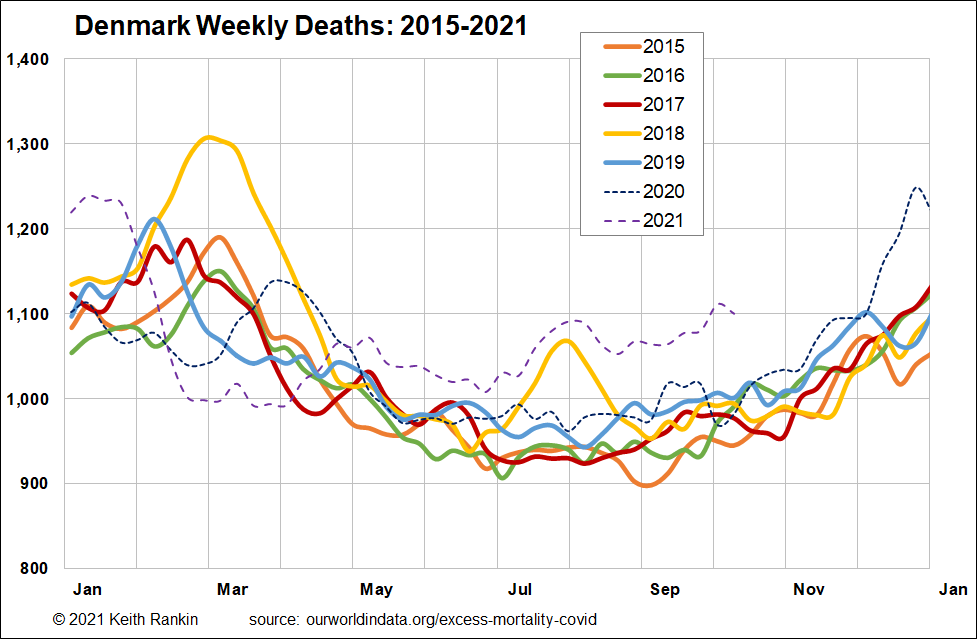
Denmark
Chart by Keith Rankin.
Denmark’s experience is much closer to that of Germany than Sweden. Denmark had a substantial flu season early in 2019, and, therefore had a less vulnerable population than Sweden (ie fewer people whose deaths had been deferred on account of ‘low flu’ seasons) in March 2020. As in Sweden and Germany, there was minimal flu around in early 2020. The result was, and largely as a result of public health measures, that Denmark’s late winter mortality peak (covid in 2020, flu in other years) was lower in 2020 than in any of the previous five years.
Denmark clearly shows the same ‘immunity debt’ profile after March 2021 that Germany shows, but that Sweden does not show. Denmark is also interesting in that, even the huge 2020/21 covid mortality peak is less than the 2018 influenza peak.
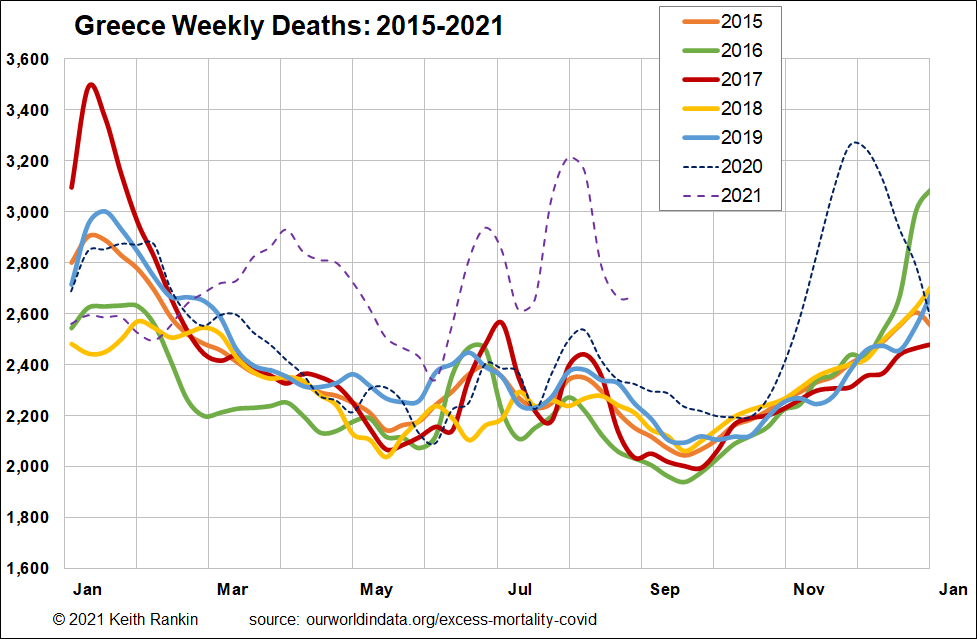
Greece
Chart by Keith Rankin.
Greece is interesting in that it was barely mentioned in 2020 in relation to Covid19.
Greece clearly has had its flu seasons, but the years differ from those of the northern countries show. Also, it has bigger summer viral outbreaks, reflecting the role of tourism in Greece.
Of particular note is that Greece had substantial flu death episodes in January 2019 and January 2020. The result is that nothing out of the ordinary shows up in Greece until July 2020. Winter ‘flu’ seems to have trumped spring covid. (See my 8 April Covid-19 and the Common Cold, and the BBC story How the common cold can boot out Covid referred to.)
Greece’s July 2020 experience reflects much of Europe, and seems in particular to be related to Americans bring Covid19 back to Europe, with tourist hotspots disproportionately affected. Greece then follows Europe’s general ‘second [autumn] wave’ for which mortality peaked in November and December. Then, throughout 2021 so far, Greece appears to have suffered substantially from an immunity debt. (Greece, at 27.5%, was slightly more vaccinated than Sweden on 1 June, and ‘delta’ arrived later, in July 2021 rather than June. Currently Greece is vaccinated at 62%, compared to 67% in Germany, 70% in Sweden, 71% in New Zealand, and 76% in Denmark.) Greece’s peak mortality, for any outbreak of covid, has yet to reach its flu peak of January 2017.
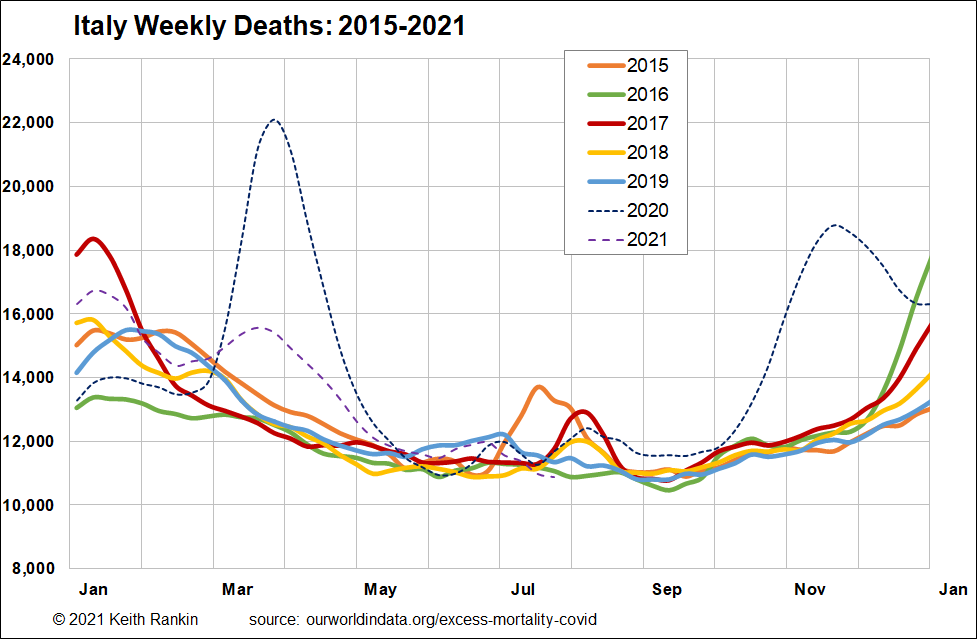
Italy
Chart by Keith Rankin.
Italy had ‘normal’ flu winters in 2018 and 2019, but, as with all others mentioned except Greece, a very light flu winter in 2020. Thus it was largely unprepared for a late-winter novel respiratory viral outbreak, and its March and April 2020 mortality experience shows. Further, Italy – along with Spain – were Europe’s introductory cases; Italy had least time to decide on policy responses and least ‘runway’ to consider proactive rather than reactive policy.
Italy then got the Europe-wide second wave, and – like Greece – the ‘alpha-variant’ third wave in March 2021. After that, Italy looks normal; ie with no sign of an immunity debt. But it’s too early to say; Italy’s 2021 mortality data is slow to be published. Of note for future reference are the big flu winter outbreaks in 2016/17 and 2017/18, and the summer outbreak of 2017. (It turns out that these outbreaks were parts of a global influenza epidemic, that was a pandemic in all but name; noting that most pandemics in history were never declared ‘pandemics’ by a global bureaucracy.)
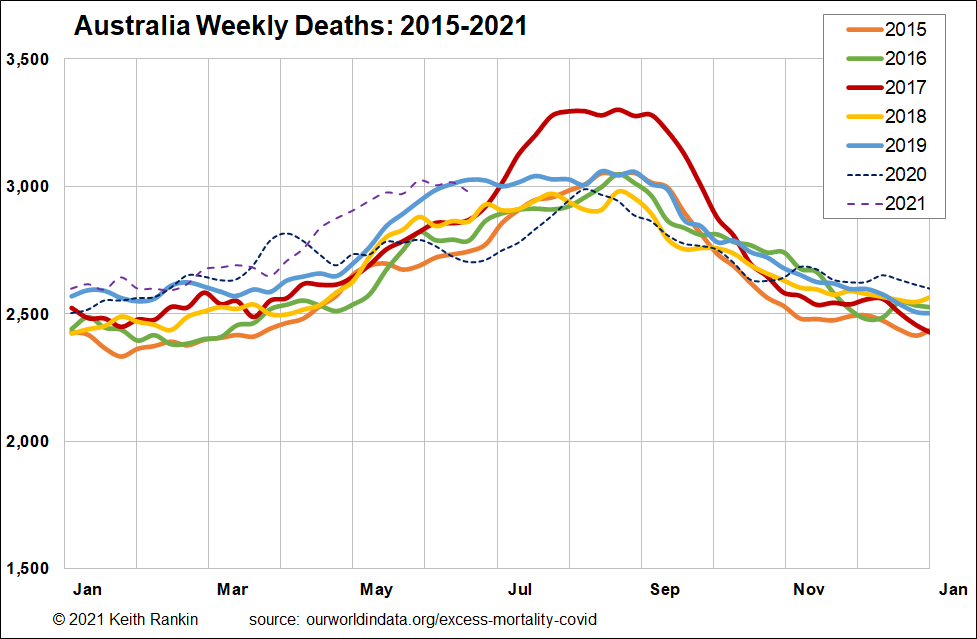
Australia
Chart by Keith Rankin.
Australia, with a faster growing population than Europe, has higher death numbers in more recent years as well as a clear seasonal mortality pattern. And, like Italy, Australia is slow to release its mortality data. 2019 was by no means a low flu mortality year, in contrast to Sweden. Winter 2017 was clearly a particularly high mortality flu season. It looks as though the highly virulent 2017 flu strain came into Australia via Greece. (And, while New Zealand got it from Australia, and it was nasty in New Zealand, it didn’t last for nearly as long in New Zealand as Australia.)
Unlike Europe, Australia did not cop Covid19 at the end of the winter flu season. So there is no ‘flu context’ ahead of Australia’s March 2020 covid mortality peak. Since then, in 2020, and with comparatively few public health restrictions, except a closed international border that almost certainly kept influenza out, Australia had a low mortality winter.
The summer though, of 2020/21, and the subsequent autumn, were months of relatively high mortality, though. There are definite signs of immunity debt-servicing in Australia in early 2021. And we know that the spring of 2021 will be ugly, by Australian norms.
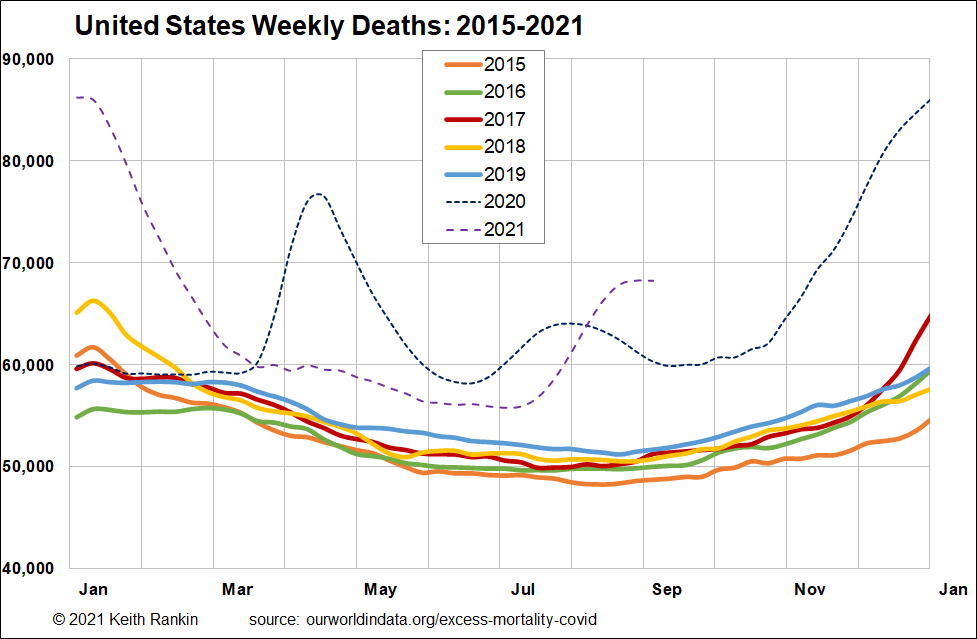
United States of America
Chart by Keith Rankin.
It’s only in the United States that Covid19 is persistently prominent, relative to 2015-19 norms. The norms in USA clearly show the pattern of a country with a rising population, unlike Europe.
We also note that, in USA, both early 2019 and early 2020 represented ‘low flu’ seasons. So the United States was clearly epidemiologically vulnerable in the spring of 2020.
We also note that the 2017 influenza ‘pandemic’ hit USA late, in 2017/18; indeed that wave of influenza – in taking more Americans than usual – paved the way for a light mortality season in 2019.
While early covid mortality in the United States is comparable to that of Sweden, the United States – mainly through its states – took many reactive public health measures that Sweden did not take (especially facemask-mandating, which in many states was more mandatory in USA than in Europe, and became more politicised). These measures could be called ‘ad hoc’, unlike those in another federal country, Germany.
The result was that, despite these measures, Covid19 stayed around in USA at much higher levels in June 2020 than in Europe. And summer mobility in the United States created both a new covid wave there, and transmitted Covid19 to Europe, creating Europe’s devastating second wave. Then, in the winter of 2020/21, a combination of political activity and early winter festivities that are central to the American psyche created a huge wave of Covid19 that paralleled the European wave.
From March 2021, we can see that the United States is servicing a particularly large immunity debt. The immunity debt service rate – analogous to the interest rate for a financial debt – is clearly higher in the United States than in western Europe, presumably due to lower vaccination rates in America.
Conclusion
The developed western world is now servicing its immunity debt incurred in 2020. The debt-servicing ‘interest rates’ markedly differ between countries, with Sweden and Italy coming out best (so far) since March 2021.
The Covid19 outcomes in the developed world are interconnected with the outbreaks of seasonal influenza. The global influenza epidemic of 2017 – an undeclared pandemic – clearly needs more analytical attention. Coming soon.
Keith Rankin (keith at rankin dot nz), trained as an economic historian, is a retired lecturer in Economics and Statistics. He lives in Auckland, New Zealand.
New Zealand Parliament Buildings, Wellington, New Zealand.
Editor’s Note: Here below is a list of the main issues currently under discussion in New Zealand and links to media coverage. You can sign up to NZ Politics Daily as well as New Zealand Political Roundup columns for free here.
The Melbourne Cup is supposed to be the “race that stops a nation”.
But among increasing community concern about gambling and animal welfare, does it stop us for the right reasons? As Cup Day dawns at Flemington, how is our relationship to the Cup changing?
Gambling in Australia
Gambling is a significant part of Australian culture. Helped by the fact we have pokies in clubs and pubs, we lose more money on gambling than any other nation. Per capita, our gambling losses are more than double those in the United States.
Australians spent more than A$220 million on the Melbourne Cup in 2020. Dan Himbrechts/AAP
But research shows gambling participation is dropping. A recently released study, led by Nerilee Hing at CQUniversity, and funded by Gambling Research Australia, was the first national gambling prevalence study since 2010-11. It included a telephone survey of 15,000 Australian adults in 2019, giving an insight into the nature and extent of gambling in Australia.
According to this report, 56.9% of those surveyed had gambled in the previous 12 months, compared with 64.3% the decade before. Participation on every gambling form has declined, apart from forms that were not available ten years ago, such as betting on e-sports and gambling within video games. Race betting has dropped from 22.4% to 16.8%.
What do people think of gambling?
Despite this decline, total race betting turnover continues to climb, up by about A$4 billion in today’s dollars from A$22.9 billion in 2010-11 to A$26.9 billion in 2018-19.
This may be in part due to the rise in online gambling, which has doubled over the past decade. Race betting is certainly more accessible than ever, with a lot of promotions ready to entice you to place a bet, or bet more than you intended.
Survey research shows the number of Australian adults who gamble is dropping. Dan Himbrechts/AAP
For many, however, a bet on the Melbourne Cup will be the only race bet they place each year. The decline in race betting prevalence, despite an increase in turnover, suggests it is these less-engaged punters who are not betting anymore.
There certainly appears to be a growing concern about gambling in the community. A 2019 state government gambling survey of more than 10,000 adults in New South Wales included a question about whether gambling has done more harm than good for the community. Of those surveyed, 46% strongly agreed gambling has done more harm than good, and a further 32% agreed. Only 8% disagreed or strongly disagreed.
Animal welfare
In 2020, the horse Anthony Van Dyck became the sixth horse to die in the Melbourne Cup, and the seventh to die in a race on Cup day, since 2013.
These deaths have been met with mounting concern about the racing industry. A 2019 report examining stewards’ documents from August 2018 to July 2019 found 122 horses died on race tracks in Australia. In 2019, the ABC’s 7.30 program aired an expose on cruelty, with former racehorses being sent to slaughterhouses, despite animal welfare guarantees.
Earlier this year, Racing Victoria announced it was implementing new measures to reduce risk to horses. Many of these appear to revolve around the Melbourne Cup in particular, especially international horses, given deaths in recent years have all been foreign runners. But for horses in the thousands of other races across Australia, the risks remain as real as ever.
Changing attitudes
The increasing visibility of the impact on animals has soured the Cup. A 2019 analysis of Melbourne Cup tweets found that #nuptothecup was the third most popular hashtag associated with #melbournecup. The hashtags #horseracingkills and #animalcruelty also appeared in the top ten.
The hashtag #youbettheydie was also associated with #nuptothecup. These findings suggest the animal welfare issue is a strong driver of anti-Cup sentiment.
Increasing public awareness of how the Cup (like other major sporting events) is accompanied by a spike in domestic violence has also tarnished the “feelgood” atmosphere.
Beyond the Cup, public opinion around horse racing is not reliably supportive. In 2018, the barrier draw for another prestige race, The Everest, was projected onto the Opera House sails. This was met with significant public outcry, despite the sails previously being used for projections about sport, including the Wallabies and the Ashes, and even for Samsung mobile phones. Protesters cited concerns about animal welfare and gambling.
What next?
This is not to suggest the race is going anywhere.
For many, the Melbourne Cup isn’t really about gambling, or even horses. It’s a reason to dress up and have a few (or more) drinks with friends. Or enjoy a sweep and some nibbles in the office. It’s also a welcome public holiday for Victorians.
But there is also a growing realisation this party day has real costs to others.
In the last 5 years, Alex Russell has received funding from Victorian Responsible Gambling Foundation; New South Wales Office of Responsible Gambling; South Australian Government; Gambling Research Australia; New Zealand Ministry of Health; Australian Communications and Media Authority and the Alberta Gambling Research Institute. Travel expenses have been paid by the Victorian Responsible Gambling Foundation, PsychMed and the Hawthorn Hawks Football Club Players Association, for research presentations. He has received an honorarium from Movember for assessing applications for funding. He is a member of the International Gambling Think Tank.
Unvaccinated Victorians have a grace period of about three weeks to go on a shopping spree before they’re no longer permitted to enter non-essential retail from November 24, according to the state’s roadmap out of restrictions.
The roadmap says all retail is now open to everyone after Victoria hit the 80% double-dose milestone last week. However, when it hits the 90% milestone, those who aren’t yet vaccinated won’t be allowed into non-essential retail, and stores will be responsible for policing this.
Premier Daniel Andrews warned unvaccinated Victorians could continue to be locked out “for the entirety of 2022”. By contrast, New South Wales is set to allow non-essential retail for unvaccinated people from December 1.
Ethically, the situation in Victoria is a problem, especially when the state’s vaccination rates are so high.
Vaccination clearly the right thing to do
There’s little doubt vaccination against COVID is a proportionate and morally good thing to do. The most important reason for this is the vaccines have proven effective in reducing severe illness and death.
This has two consequences. First, if you’re vaccinated, even if you do contract the virus, you’re at much lower risk of severe disease and hospitalisation.
Second, if you only have a mild infection, you don’t end up needing costly, intensive and potentially long-term treatment. This alleviates the burden on the health system, making more resources available for people with other serious conditions.
Despite the clear reasons for why one ought to get vaccinated, it’s conceivable a person has other objections to vaccination (apart from medical reasons that would make vaccination a bad idea for them).
So, the question arises about what kinds of force, especially by states, are morally acceptable. When do the limitations on a person’s freedom of movement or association go too far, morally speaking?
The answer can be a movable feast because it depends on what we know about the virus and vaccines as much as on ethical reasoning.
In the current circumstances, however, it would seem excluding unvaccinated people from non-essential retail is not morally justifiable.
First, there’s the obvious contradiction in allowing unvaccinated people to access retail at 80% vaccination rate and not at 90%. Then one needs to consider the actual risk to vaccinated people and to the health system that allowing unvaccinated people access to non-essential retail would entail.
While vaccines reduce the risk of infection and more importantly the risk of severe illness, Delta transmission can still occur even among a vaccinated population.
A recent Dutch pre-print, which is yet to be independently verified, found 12-13% of household members of a fully vaccinated person, who tested positive for COVID during a time of Delta dominance, also tested positive for the virus regardless of whether the contacts were vaccinated or not. This is about half of what the UK study reported, which is a discrepancy that arises from differing methodologies.
The point, however, is clear. In a shop where everyone is vaccinated, if one of those vaccinated people has the virus, these two studies suggest they’re just as likely to infect vaccinated people as they are to infect unvaccinated people.
The Dutch study also showed only 11% of vaccinated household contacts were infected from an unvaccinated index case. This means vaccinated people in a retail space don’t seem to be more at risk of contracting the virus from unvaccinated customers if they themselves are fully vaccinated.
It’s worth noting, though, these studies measured spread of the virus within households, and it’s not entirely clear how this would play out in retail spaces. One would expect, however, that because households tend to include longer and closer exposure, the rates of transmission would be lower still in retail spaces.
Nevertheless, these studies suggest that the risk of contracting the virus is primarily borne by the unvaccinated person. According to the Dutch study, the unvaccinated person is twice as likely as a vaccinated person to contract the disease from another unvaccinated person, than from a vaccinated person. And, as has been well-established, unvaccinated people are at higher risk of severe disease or death.
In other words, vaccinated people in a restaurant or shop don’t seem to have anything more to fear from an unvaccinated person than a vaccinated person.
The unvaccinated person, by contrast, should be wary of contact with anyone.
It’s unvaccinated people who carry the risk
What becomes relevant from an ethical point of view in the situation Victoria finds itself in is an estimate of what the likely burden will be on the health-care system of very sick, unvaccinated people.
It would be interesting if someone were able to conduct a prospective study to see whether there’s a significant increase in severe disease amongst unvaccinated people in the next three weeks since the 80% target was hit and retail is open to all.
With high vaccination rates the emphasis should still be on communicating the benefits of vaccination, both for the individual and for others. This continues to appropriately respect individual autonomy. It’s morally acceptable to require vaccination in high-risk settings, such as for health and aged-care workers.
However, blocking access to retail or restaurants for unvaccinated people goes too far given the risk primarily carried in the current situation seems to be their own. If vaccination rates were very low, or the disease more deadly, such measures could be necessary. But this seems unnecessary at a rate of 90% vaccination expected soon in Victoria.
That said, those who choose not to get vaccinated still have a moral obligation to take other precautions against contracting or transmitting the virus, such as wearing masks, social distancing, checking in, staying home if they’re unwell, and getting tested.
To not do so would be to act in a morally irresponsible way.
The Queensland Bioethics Centre receives funding from the Roman Catholic Archdiocese of Brisbane, the Roman Catholic Bishops of Queensland, and several Catholic health and aged care agencies. The views in this article are the author’s own and do not reflect the views of any of these agencies.
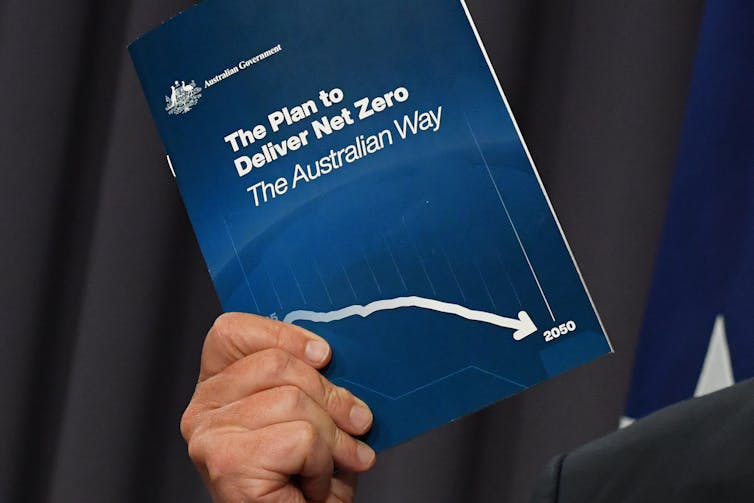
Released last week, the plan promises to deliver deep cuts to Australia’s greenhouse-gas emissions by relying on new technology, while eschewing taxes and mandates. As the Grattan Institute warned this week, this will fail unless the government rolls out other market-based policies too, including better plans to use already existing low-emissions technology for vehicles and energy.
The priority technologies identified in the plan include clean hydrogen, ultra low-cost solar, energy storage, low-emissions steel and aluminium, and carbon capture and storage.
But the plan is scant on detail and long-term thinking. It provides support for technology only in the early stages of research and development, not sustained support throughout the commercialisation process.
Many of these technologies are heavily tied to progress on renewable electricity generation, with the plan relying on 91-97% emissions reduction occurring in the electricity grid by 2050.
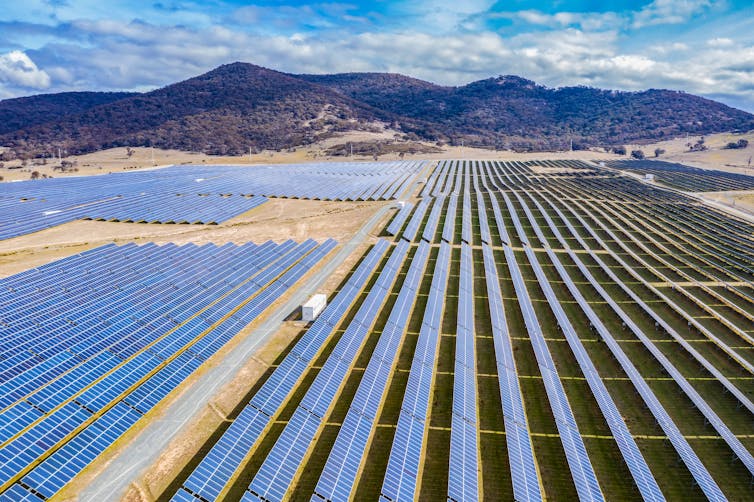
Australia needs to massively scale up renewable electricity generation to reach net zero, but the renewables sector is handicapped by competing in a system originally designed for fossil fuels.
In 2020, only 24% of Australia’s electricity came from renewable sources, despite Australia’s massive potential as a global leader in the sector thanks to our abundance of sunshine, wind and space.
Here are four ways the current electricity system favours existing, higher-emitting technologies. These must be overcome to rapidly cut Australia’s emissions and help the world avert catastrophic impacts of climate change.
1. Framing renewables as a ‘problem’
Fossil-fuel energy is entrenched in Australia, and resists efforts to shift. Meanwhile, renewables are often framed as a problem that needs controlling, with the Australian Energy Market Operator identifying renewable generation and rooftop solar as challenges to the stability of the electricity grid.
Even the government’s net-zero plan emphasises the need for coal and gas for grid stability, despite including goals to boost emissions-free storage technologies, such as batteries and pumped hydro, that could likewise support this stability.
This is an example of the entrenched system at work – a transition to renewable energy will require the grid to be reimagined. This is technologically feasible, and should be viewed as an opportunity rather than a problem.
Indeed, the existing electricity grid is rife with problems that aren’t fully acknowledged in the strategy. For example, coal and gas can pollute for free, with consequences falling on society at large rather than on those paid for coal-fired electricity.
A transition to renewable energy will require the grid to be reimagined. Shutterstock
2. Securing long-term investors
Renewable generation is expensive to install upfront, but has no fuel costs and so is extremely cheap to run, once built. For investors in renewable generation, being able to plan for long-range sales over the course of the generating plant’s life is crucial.
In a 2020 study, a researcher from Switzerland interviewed 40 renewable energy investors in the UK, Germany, and Spain. They indicated investment was riskier when they relied on variable spot market prices rather than on fixed prices agreed on at the time of construction.
In Australia, spot market energy prices are extremely volatile and change every 30 minutes. Prices can go as high as A$14,500 per megawatt hour and, when there’s an oversupply of electricity, can go as low as A$1,000 below zero per megawatt hour.
But the net-zero plan includes no mechanisms for providing stability to renewables investors regarding return on investment. However, there are many examples of this type of mechanism worldwide, even locally in Australia.
The Australian Capital Territory, for instance, has a “reverse-auction renewable feed-in tariff”. This promises a fixed price per unit of electricity for 20 years, produced by contracted renewable energy investors (around A$80 per megawatt hour for recent wind investments).
Spot market energy prices are extremely volatile in Australia. Shutterstock
3. No real plan for energy storage
Solar and wind are “non-dispatchable” technologies, meaning they can’t be turned on when needed. This is an issue because the electricity grid relies on a real-time balance of electricity supply and demand, and has very little storage capacity.
Without sufficient storage in the grid, renewable generation may need to be curtailed at times when there’s too much supply, adding to the financial risk for renewable energy investors and introducing financing challenges.
More storage is key to fixing this issue, and the plan rightly names storage as a priority technology to develop. However the plan’s focus on early-stage development can only be the first step. Australia also needs a plan to commercialise and deploy storage technology, but the plan is light on details.
The two key examples it gives for this are co-investment in the Neoen Hornsdale Power Reserve battery storage program in South Australia, and the Victorian Big Battery.
Neither project represents any new action or commitment. The Neoen project was completed in September 2020, and the Big Battery was committed to in February this year – both well before the plan was released.
4. Little imperative without legislation
The plan states “Australia will not legislate its net-zero by 2050 target”. Without legislation behind the target, there will be less imperative to dig deep to mobilise sufficient resources (funding, time, effort) to meet it.
The plan flags five-yearly reviews of progress towards emissions targets. The low level of detail in the plan means doing these reviews well, and acting on their findings, will be crucial to achieving actual progress on emissions reduction.
However, the plan doesn’t specify what these reviews will look like, or what will happen if reviews show progress is falling short. Without legislating its target, the Australian government has promised no consequences for failing to meet the net-zero plan.
Lee White receives funding from the Zero-Carbon Energy for the Asia-Pacific Grand Challenge, funded by the ANU. She has also received grants to support research on energy transition, including a grant from Energy Consumers Australia (for the project “How can we involve renters in the renewable energy transition in Australia?”), and a grant from the Icon Water and ActewAGL Endowment Fund (for the project “Maximising consumer ability to manage electricity demand”).
As the Glasgow climate summits gets underway, New Zealand’s government has announced a revised pledge, with a headline figure of a 50% reduction on gross 2005 emissions by the end of this decade.
This looks good on the surface, but the substance of this new commitment, known as a Nationally Determined Contribution (NDC), is best assessed in emissions across decades.
New Zealand’s actual emissions in the 2010s were 701 million tonnes (Mt) of carbon dioxide equivalent. The carbon budget for the 2020s is 675Mt. The old pledge for the 2020s was 623Mt.
The Climate Change Commission’s advice was for “much less than” 593Mt, and the new NDC is 571Mt. So yes, the new pledge meets the commission’s advice and is a step up on the old, but it does not meet our fairshare under the Paris Agreement.
The dark dashed line shows New Zealand’s domestic climate goal – its carbon budget. The blue area shows a possible pathway under the old climate pledge, and the red area represents the newly announced pledge. Office of the Minister of Climate Change, CC BY-ND
It is also a stretch to call the new NDC consistent with the goal of keeping global temperature rise under 1.5℃.
True 1.5℃ compliance would require halving fossil fuel burning over the next decade, while the current plan is for cuts of a quarter.
Emissions need to half this decade
Countries’ climate pledges are at the heart of the Paris Agreement. The initial round of pledges in 2016 added up to global warming of 3.5℃, but it was always intended they would be ratcheted up over time. In the run-up to COP26, a flurry of new announcements brought that figure down to 2.7℃ — better, but still a significant miss on 1.5℃.
As this graph from the UN’s Emissions Gap Report 2021 shows, the world will need to halve emissions this decade to keep on track for 1.5℃.
This graph shows that new and existing pledges under the Paris Agreement leave the world on track for 2.7ºC of warming. If recent net-zero pledges are realised, they will take us to 2.2ºC. UNEP, CC BY-ND
New Zealand’s first NDC, for net 2030 emissions to be 30% below gross 2005 emissions, was widely seen as inadequate. An update, reflecting the ambition of the 2019 Zero Carbon Act to keep warming below 1.5℃, has been awaited eagerly.
But several factors have combined to make a truly ambitious NDC particularly difficult.
First, New Zealand’s old climate strategy was based on tree planting and the purchase of offshore carbon credits. The tree planting came to and end in the early 2010s and is only now resuming, while the Emissions Trading Scheme was closed to international markets in 2015. The Paris Agreement was intended to allow a restart of international carbon trading, but this has not yet been possible.
Second, New Zealand has a terrible record in cutting emissions so far. Burning of fossil fuels actually increased by 9% from 2016 to 2019. It’s a challenge to turn around our high-emissions economy.
Third, our new climate strategy, involving carbon budgets and pathways under advice from the Climate Change Commission, is only just kicking in. The government has made an in-principle agreement on carbon budgets out to 2030, and has begun consultation on how to meet them. The full emissions-reduction plan will not be ready until May 2022.
Regarding a revised NDC, the government passed the buck and asked the commission for advice. The commission declined to give specific recommendations, but advised:
We recommend that to make the NDC more likely to be compatible with contributing to global efforts under the Paris Agreement to limit warming to 1.5℃ above pre-industrial levels, the contribution Aotearoa makes over the NDC period should reflect a reduction to net emissions of much more than 36% below 2005 gross levels by 2030, with the likelihood of compatibility increasing as the NDC is strengthened further.
The government then received advice on what would be a fair target for New Zealand. However, any consideration of historic or economic responsibility points to vastly increased cuts, essentially leading to net-zero emissions by 2030.
Announcing the new NDC, Climate Change Minister James Shaw admitted it wasn’t enough, saying:
I think we should be doing a whole lot more. But, the alternative is committing to something that we can’t deliver on.
What proper climate action could look like
Only about a third of New Zealand’s pledged emissions cuts will come from within the country. The rest will have to be purchased as carbon credits from offshore mitigation.
That’s the same amount (100Mt) that Japan, with an economy 25 times larger than New Zealand’s, is planning to include in its NDC. There is no system for doing this yet, or for ensuring these cuts are genuine. And there’s a price tag, possibly running into many billions of dollars.
New Zealand has an impressive climate framework in place. Unfortunately, just as its institutions are beginning to bite, they are starting to falter against the scale of the challenge.
The commission’s advice to the minister was disappointing. It’s being challenged in court by Lawyers For Climate Action New Zealand, whose judicial review in relation to both the NDC and the domestic emissions budgets will be heard in February 2022.
With only two months to go until 2022 and the official start of the carbon budgets, there is no plan how to meet them. The suggestions in the consultation document add up to only half the cuts needed for the first budget period.
Thinking in the transport area is the furthest advanced, with a solid approach to fuel efficiency already approved, and an acknowledgement total driving must decrease, active and public transport must increase, and new roads may not be compatible with climate targets.
But industry needs to step up massively. The proposed 2037 end date for coal burning is far too late, while the milk cooperative Fonterra — poised to announce a record payout to farmers — intends to begin phasing out natural gas for milk drying only after that date.
The potentially most far-reaching suggestion is to set a renewable energy target. A clear path to 100% renewable energy would provide a significant counterweight to the endless debates about trees and agricultural emissions, but it is still barely on the radar.
Perhaps one outcome of the new NDC will be that, faced with the prospect of a NZ$5 billion bill for offshore mitigation, we might decide to spend the money on emissions cuts in Aotearoa instead.
Robert McLachlan does not work for, consult, own shares in or receive funding from any company or organisation that would benefit from this article, and has disclosed no relevant affiliations beyond their academic appointment.
In the wake of a jump in the proportion of workers quitting jobs in the United States – dubbed the “Great Resignation” – Australia’s media has been warning of a surge in resignations here.
Over much of 2021, Klotz’s predictions appear to be borne out in the US, with the monthly quit rate climbing from about 2.4% in 2019 to 2.9% in August – the highest rate ever recorded.
And there’s little to suggest the trend will come to a stop there any time soon.
Writing in the New York Times, Nobel Prizewinning economist Paul Krugman suggests America is witnessing a new form of worker revolt in the wake of years of substandard conditions. Workers are using growing job openings to look for better or less demanding jobs, or are simply retiring early.
In Australia, resignation rates are falling
Data collected each year by the Australian Bureau of Statistics suggests that in the 12 months to February 2021 almost 1.1 million Australians left their jobs.
That’s not unusual. In most years more than a million Australians leave their jobs.
Leaving and changing jobs is a sign of a healthy, well-functioning labour market.
If Australia has had a problem, it is with fewer and fewer quitting, something Treasury officials have identified as a contributor to low growth in both wages and productivity.
In the year to February 2021 the proportion of Australian workers switching jobs fell to an all-time low: 7.6% of employed Australians changed jobs that year, down from a peak of 19.5% in 1988-89.
Of course, it is possible Australia’s labour market will change direction and ape the US labour market. But a few caveats are worth noting.
First, although quit rates in the US have increased significantly over the past decade, the increase was largely about playing catchup after the recession that accompanied the global financial crisis of 2008-09. Monthly US quit rates in 2019 were little different to rates 20 years earlier.
Second, the increase in US quit rates has been uneven across sectors. There has been no increase in the finance, information and government services sectors. But in leisure and hospitality, monthly quit rates have jumped from 4.4% to 6.4%.
Even in the US, only some resignation rates are climbing
Our assessment is that the trends in the US result from two forces.
One is the usual pattern associated with economic cycles – when jobs become more plentiful, quit rates rise.
The other is that in jobs exposed to the public an ongoing fear of COVID-19 and increased requirements imposed by employers, including vaccination mandates, has made employment less attractive.
What does this all mean for Australia? The first thing to say is that a rise in quit rates would be far from undesirable.
Australia should welcome more resignations
Also, if job opportunities improve as the economy opens and competition for workers increases, quit rates should increase as more workers seek to move to jobs providing better wages and opportunities. But we repeat: there would be nothing unusual or undesirable about this.
More job switching would be no bad thing. Mark Deibert Productions
Third, as in the US, COVID-19 will likely continue to weigh on decisions. Fear might lead some workers to exit the workforce, especially older workers close to retirement age and those with underlying health conditions.
Nevertheless, with vaccination rates rising rapidly and predicted to exceed 90% very soon, we do not expect this to play a big role in Australia.
Possibly more important will be how employers manage workers who became accustomed to working from home during the pandemic.
As in the US many of them might be reluctant to return to the office.
As other researchers have shown, there are good reasons to expect working from home to stick and for workers to have a stronger preference for mixed arrangements than many managers might like.
The issue here is not so much a Great Resignation, but how to deal with a Great Resistance to the idea of returning to the office, and the daily commute.
Mark Wooden has received funding from the Australian Research Council and is currently receiving from the US National Institutes of Health.
Peter Gahan has previously received funding from the Australian Research Council and the Commonwealth Government.
Arika Waulu (Koolyn, Gunnai, Djap Wurrung, Peek Wurrung, Dhauwurd Wurrung), Yuccan Noolert (Mother Possum) 2021. Wood, red ochre, yellow ochre, charcoal, acrylic, ink, melaleuca bark, crushed granite, koolor (lava stone). Dimensions variable. Installation view, WILAM BIIK, TarraWarra Museum of Art, 2021Courtesy of the artist. Photo: Andrew Curtis
Review: Wilam Biik (Home Country), TarraWarra Museum of Art
Wilam Biik (Home Country) is a multi-layered conversation between Country, people and ancestors that surges with the power of Aboriginal connectivity.
The first major exhibition curated by Wurundjeri and Dja Dja Wurrung woman Stacie Piper in her role as Tarawarra’s 2019 Yalingwa Curator, it is a generous offer to see Wurundjeri biik (Country) the way Wurundjeri see it — not as a “natural resource” to be exploited, but a life-sustaining force interconnected with all things.
It is an important call to those who live on Wurundjeri biik to uphold Wurundjeri people’s principles of relationality: to live in reciprocity with all life, including land, animals, water, sky and people.
The exhibition embodies the Wurundjeri concept of layers of biik: country extends from below the ground to above in the sky, all interconnected through water country.
Piper gathered artists by following the “waterlines” and “bushlines” which connect Wurundjeri to the 38 Aboriginal groups throughout south east Australia.
These artists offer a different way to look at Country. Not by the roads we travel, but by the relationships embedded in it.
Care for Country
Piper developed her curatorial practice at Bunjilaka Aboriginal Cultural Centre after working for many years with her Elders at Wurundjeri Woi Wurrung Cultural Heritage Aboriginal Corporation.
Kim Wandin (Wurundjeri/Woi-wurrung). Jemima Burns Wandin Dunolly, Robert Wandoon, Annie Borate, William Barak, Wrapped in Country 2021. Digitally reproduced historic photographs, rescued Victorian Mountain Ash wood frame, woven natural fibres 56 x 45.5 cm each. Installation view, WILAM BIIK, TarraWarra Museum of Art, 2021. Courtesy of the artist, Aunty Joy Murphy Wandin and the State Library of Victoria Collection Photo: Andrew Curtis
The vision for Wilam Biik came from Piper’s sovereign responsibility to care for Country, and her despair at the unsustainable logging of old growth forest in the Warburton ranges not far from Tarrawarra on Wurundjeri biik.
Climate trauma and relationship to country was the starting point for Stacie’s curatorial vision. Wilam biik embodies the rich knowledge of Country that holds the answers to recovering from this trauma.
The exhibition is grounded in land and ancestors. Audiences are welcomed by a wall-sized historical photograph of Wurundjeri biik and baluk (people) at Corranderrk.
“Ancestor tools”, such as Barak’s carved parrying shield, a boomerang and basket – on loan from Melbourne Museum – are displayed in the way they would be held: close to the people.
Djirri Djirri Wurundjeri Women’s Dance Group (Dancers include Wurundjeri, Dja Dja wurrung, Ngurai illum-wurrung) Wominjeka 2018–20. Video projection on phototex wallpaper duration 00:02:26. Filmed by Ryan Tews. Installation view, WILAM BIIK, TarraWarra Museum of Art, 2021. Courtesy of the artists Photo: Andrew Curtis
Eel trap by Wurundjeri Elder Kim Wandin underlines the continuing connection between generations.
In conversation with the sepia image of their ancestors, their living descendants — the Djirri Djirri dancers — are projected dancing on Wurundjeri country in the upper reaches of the Birrarung.
Ceremony (c1895) by Wurundjeri painter Ngurungaeta Wiliam Barak has been brought to wilam biik by Wurundjeri people for the first time since they were made. The painting details ceremonial adornment, as referenced by the Djirri Djirris today.
William Barak (Wurundjeri Ngurungaeta, Head Man), Ceremony c. 1895. Ochre, watercolour and pencil on paper 56.3 x 78.7 cm (irregular). Art Gallery of Ballarat Collection Gift of Mrs Anne Fraser Bon, 1934
Following the water sources that start in Country shared with Gunnai and Taungurung Peoples, Gunnai and Gunditjmara artist Arika Waulu’s matriarchal Digging Sticks are carved wood adorned in gold, set against a wallpaper showing layers of country and the cycle of plant life. In this, Waulu speaks of women’s interconnectivity with Country.
Of the Earth, an installation by Taungurung artist Steven Rhall, places a photograph of a boulder on a sound platform, animating the image in a contemplation of the deep time written into Taungurung Country, or in what Alexis Wright has called the ancient library.
Steven Rhall (Taungurung) Of the Earth 202. Inkjet print, steel, audio, amplifier, subwoofer, granite, table, light, architectural intervention, framed and wrapped inkjet prints. Dimensions variable. Installation view, WILAM BIIK, TarraWarra Museum of Art, 2021. Courtesy of the artist. Photo: Andrew Curtis
The water connection flows through Dhunghula (Murray River) to Yorta Yorta, Waddi Waddi, Wemba Wemba, and all the way to Ngarrindjeri Country as well as into Kolety (Edwards River) and the Baaka (Darling River).
In Drag Net, a woven net incorporating river mussel shell, Waddi Waddi, Yorta Yorta and Ngarrindjeri artist Glenda Nicholls evokes this connection to the river and “water country”.
Glenda Nicholls (Waddi Waddi, Ngarrindjeri and Yorta Yorta) Drag Net 2021 (detail). Jute, wood, river clay, native river mussel shell. 200 x 100 cm. Installation view, WILAM BIIK, TarraWarra Museum of Art, 2021. Courtesy of the artist Photo: Andrew Curtis
In Wemba Wemba and Gunditjmara artist Paola Balla’s intergenerational work, Murrup Weaving in Rosie Kuka Lar with Rosie Tang, Balla builds a camp house made from cloth imbued with bush dyes in the landscape of her grandmother’s painting of country. Through these bush dyes, Balla brings the smell of “on ground country” directly into the gallery.
Paola Balla (Wemba Wemba, Gunditjmara), Murrup (Ghost) Weaving in Rosie Kuka Lar (Grandmother’s Camp), 2021, with Rosie Tang, Untitled Wallpaper, image c. 1978, reproduced 2021. Installation view, WILAM BIIK, TarraWarra Museum of Art, 2021. Courtesy of Paola Balla. Photo: Andrew Curt
Barkindji artist Kent Morris’ Barkindji Blue Sky – Ancestral Connections is a stunning photographic series, embodying water connections to the Baaka as well as “sky country”.
Many varied relationships
Waterlines like the Birrarung and the Werribee River, marking connections and boundaries with the Boonwurrrung, Wathaurong and Tyereelore, are mapped with kelp baskets by Nannette Shaw and paintings by Deanne Gilson.
These artists reference the transition from freshwater to saltwater and the relationships that exist amongst the Kulin, across to Tasmania and all life forms within Country.
Deanne Gilson (Wadawurrung) As I Walk on Country, Passing the Manna Gum and the Banksia Tree, I Remember the Past and Work Towards a Brighter Future 2021. White ceremonial ochre, wattle tree sap, red ochre, pink ochre, acrylic on canvas. Diptych: 90 x 110 cm each. Courtesy of the artist Photo: Andrew Curtis
Wilam Biik speaks of the powerful connections between artists, Peoples and Country. It is also a testament to the power of Aboriginal knowledge in Aboriginal hands, and the centring of south east artists and curators as the experts of their knowledges, practices and Country.
Importantly, it is also a call to learn how to live in good relationship with Wurundjeri biik and baluk.
Wilam Biik (Home Country) is at TarraWarra Museum until 21 November.
Kim Kruger is a member of Creative Victoria’s First Peoples’ Directions Circle.
Māori climate activist India Logan-Riley speaking on the indigenous challenge to the “colonial project” at the COP26 opening … “In the US and Canada alone, indigenous resistance has stopped or delayed greenhouse gas pollution equivalent to at least one quarter of annual emissions. What we do works.” Image: COP26 screenshot APR (at 1:00.26)
A young Māori activist has told delegates at a massive UN summit in Scotland the world’s climate crisis has its roots in colonialism and that the solution lies in abandoning modern-day forms of it.
India Logan-Riley was asked at the last minute to speak at today’s opening session of the COP26 summit in Glasgow.
They said indigenous resistance to resource exploitation, corporate greed and the promotion of justice had led the way in offering real solutions to climate chaos.
Addressing delegates today, the young activist fearlessly linked imperialism’s lust for resources and its destruction of indigenous cultures centuries ago, to modern-day enablement by governments of corporate giants seeking profit from fossil fuels at any cost.
Logan-Riley said the roots of the climate crisis began with imperialist expansion by Western nations and reminded Britain’s leader Boris Johnson of the colonial crimes committed against subject peoples, including those in Aotearoa.
Māori and other indigenous people had been forced off the land so resources could be extracted, Logan-Riley said.
“Two-hundred-fifty-two years ago invading forces sent by the ancestors of this presidency arrived at my ancestors’ territories, heralding an age of violence, murder and destruction enabled by documents, like the Document of Discovery, formulated in Europe.
Land ‘stolen by British Crown’ “Land in my region was stolen by the British Crown in order to extract oil and suck the land of all its nutrients while seeking to displace people.”
Logan-Riley said the same historic forces continued to be at play in Aotearoa, citing the example of the government’s “theft of the foreshore and seabed” and subsequent corporate drive to extract fossil fuels.
They expressed frustration that after being lauded at the Paris talks five years ago for relaying climate warnings of wildfires, biodiversity loss and sea-level rises, nothing since had changed.
“The global north colonial governments and corporations fudge with the future,” they added.
India Logan-Riley … world leaders need to listen to indigenous people. Image: COP26 screenshot APR
Logan-Riley said world leaders needed to listen to indigenous people as they had many of the answers to the climate crisis. Their acts of resistance had already played a part in keeping emissions down, they added.
“We’re keeping fossil fuels in the ground and stopping fossil fuel expansion. We’re halting infrastructure that would increase emissions and saying no to false solutions,” they said.
“In the US and Canada alone indigenous resistance has stopped or delayed greenhouse gas pollution equivalent to at least one quarter of annual emissions. What we do works.”
‘Complicit’ in death and destruction Failure to support such indigenous challenges to the “colonial project” and acceptance instead of mediocre leaders means you too are complicit in death and destruction across the globe, Logan-Riley warned.
The comments come as other climate activists have criticised the G20 summit on climate action ahead of the COP26 meeting.
Italian Prime Minister Mario Draghi, who chaired the G20 gathering in Rome, today hailed the final accord, saying that for the first time all G20 states had agreed on the importance of capping global warming at the 1.5C level that scientists say is vital to avoid disaster.
As it stands, the world is heading towards 2.7C.
G20 pledged to stop financing coal power overseas, they set no timetable for phasing it out at home, and watered down the wording on a promise to reduce emissions of methane — another potent greenhouse gas.
The final G20 statement includes a pledge to halt financing of overseas coal-fired power generation by the end of this year, but set no date for phasing out coal power, promising only to do so “as soon as possible”.
This replaced a goal set in a previous draft of the final statement to achieve this by the end of the 2030s, showing the strong resistance from some coal-dependent countries.
G20 set no ‘phasing out’ date The G20 also set no date for phasing out fossil fuel subsidies, saying they will aim to do so “over the medium term”.
On methane, which has a more potent but less lasting impact than carbon dioxide on global warming, leaders diluted their wording from a previous draft that pledged to “strive to reduce our collective methane emissions significantly”.
The final statement just recognises that reducing methane emissions is “one of the quickest, most feasible and most cost-effective ways to limit climate change”.
“I just wanted to really convey that the negotiations are the same age as me and admissions are still going up and that needs to stop right now,” they said.
Logan-Riley had opened their address in te reo Māori before telling delegates they resided on Aotearoa’s east coast, where the sun had turned red in February last year because of smoke from wildfires in eastern Australia.
The activist relayed a story about supporting their brother in hospital being told by the doctor there staff were seeing higher numbers of people presenting with breathing problems because of the smoke.
“In that moment our health was bound to the struggle of the land and people in another country. In the effects of climate change are fates intertwined, as our the historic forces that have brought us here today,” they said.
This article is republished under a community partnership agreement with RNZ.
New Zealand’s cabinet has decided to ease restrictions for some, Prime Minister Jacinda Ardern says cases may peak this month at 200 a day, and Tonga will enter a snap lockdown at midnight.
Restrictions are set to ease slightly in both Waikato and Tāmaki Makaurau, albeit at different times.
Prime Minister Ardern announced at today’s post-cabinet briefing that Waikato would move down to alert level 3 step 2 from midnight Tuesday.
In Auckland, fewer than 5000 first doses remain before reaching 90 percent single-dose vaccination, and for Auckland as a whole 80 percent has had two doses.
“And that’s incredible,” said Ardern, praising Aucklanders for their progress.
“Case numbers, while growing, remain within some of our expectations as modelled and the public health assessment of the impact of changes like opening up retail include that this activity is generally not responsible for marked increases of new cases.”
Meanwhile, cabinet has decided in principle to move Tāmaki Makaurau to alert level 3 step 2 next Tuesday at 11.59pm.
Covid-19 Response Minister Chris Hipkins said potentially slightly easing restrictions in Auckland was a pragmatic move.
Hipkins told RNZ Checkpoint tonight the in-principle decision was based on public health advice.
Covid-19 modeller Professor Michael Plank earlier warned that relaxing restrictions in Auckland and parts of Waikato would accelerate case numbers.
The lockdown will stay in place until next Sunday.
The positive case arrived in Nuku’alofa on a repatriation flight from Christchurch and while he is asymptomatic, he is being cared for alone in a special quarantine facility in Mu’a.
Tonga’s Ministry of Health Chief Executive Dr Siale Akau’ola said the remaining 214 passengers were in MIQ at the Tanoa Hotel while about 80 frontline workers who met the flight are also in MIQ at the Kupesi Hotel.
“In terms of gatherings this is the most significant part of the lockdown. No schools, all schools are closed, no church gathering, no kava club, no entertainment or any kind of gathering,” RNZ Pacific’s correspondent in Tonga, Kalafi Moala, said.
Safety fears as supplement sales soar Sales of natural health supplements have risen since covid-19 arrived in New Zealand, but some products can have adverse effects such as anaphylaxis or death.
Supplements, however, are largely unregulated in New Zealand, with the Ministry of Health saying the pandemic has delayed new legislation.
Ten years of Medsafe data shows two people died from complementary and alternative medicine, or CAM, and that 30 percent of suspected reactions are life-threatening or cause disability.
About eighty percent of New Zealanders have taken natural health supplements, and Nielsen data shows sales in supermarkets alone rose by nearly 14 percent in the past two years, reflecting worldwide trends.
Progress in New Zealand vaccination levels of eligible population. 01112021. Source: Ministry of Health
Police said one of the people has been found and returned to MIQ. He was found during a vehicle stop in west Auckland.
The whereabouts of a woman who also skipped MIQ on Saturday is known to police but public health officials said she did not need to return.
Police said a decision around any charges would be made soon.
Meanwhile, police said a 36-year-old man had been arrested and charged with Failing to Comply with Order (Covid-19) in relation to attending a gathering at the Auckland Domain and subsequent march through Newmarket on Saturday.
Ronapreve covid-19 treatment A covid-19 treatment the government is purchasing can help reduce the number of people dying from the virus, says an expert from the University of Otago.
Pharmac revealed yesterday it is set to subsidise Ronapreve, also known as Regeneron or REGEN-COV, which is used for people in danger of becoming severely unwell.
Australia’s union for journalists says Australian journalism is in crisis after years of disruption, undermining and neglect, and swift action is needed to halt the decline.
A new study pointing to the crisis in public interest journalism demands urgent government action to safeguard democracy.
The Media, Entertainment and Arts Alliance (MEAA) commissioned the Centre for Future Work at The Australia Institute to prepare the report, The Future of Work in Journalism, to examine the state of Australian journalism and to develop recommendations that could be used to address the serious decline in public interest journalism that has taken place over the past decade.
The report says journalism is a “public good” that can only be sustained by a dramatic renovation of government supports, including:
• a new $250 million fund to sustain journalism; • expanded funding for public media organisations; • rebates (refundable tax credits) for the employment of journalists; • tax concessions for consumers of news media; and • a stronger Mandatory News Bargaining Code with dedicated funding for small and new media.
MEAA media federal president Marcus Strom said: “It’s abundantly clear that the slow erosion of Australia’s media industry over many years has taken its toll on public interest journalism.
“As this study shows, failure to take dramatic steps now places our democracy at risk.”
Disappearance of dozens of outlets He said the crisis was most stark in the disappearance of dozens of outlets and hundreds of jobs from regional, rural and community media in the past few years.
The Australia Institute’s study reveals that the number of journalists has fallen dramatically over the past decade; that decline will continue without effective policy and regulatory changes.
Efforts to support journalism have, to date, been inadequate and poorly targeted.
Media workers have delivered massive productivity gains in an environment of ongoing cost-cutting, but have been “rewarded” by stagnant wages, and ongoing restructuring and shifts into freelance and casual work, which now make up about one-third of the media workforce.
A significant and unacceptable gender pay gap persists above the national industry average.
The report highlights the upheaval caused to the Australian media ecosystem by the arrival and rise of digital platforms.
The government’s response, the News Media and Digital Platforms Bargaining Code, has not achieved the rebalance needed to promote public interest journalism.
Call to disclose Bargaining Code ‘deals’ The report recommends that the deals struck under the code be disclosed and that dedicated funding be provided to the small-to-medium media sector, which has been “treated with contempt” by the major digital players.
Among the other remedies recommended in the report, MEAA supports calls for certainty around and restoration of the funding of public media including the national broadcasters ABC and SBS; and expansion of the government’s existing Public Interest News Gathering programme to include all classes of journalism, including freelancers, and media content production.
The amount of support needed has been estimated at $250 million a year.
“This storm has been coming for many years,” Strom said.
“The media industry has been savaged. Thousands of journalism jobs have been lost. Print and broadcast media have all been hurt: mastheads have closed, networks have been cut back.
“Local community and regional reporting has, in many places, disappeared altogether. The number of media players have been reduced to a handful of very powerful players, and that power concentrated in the hands of a few reduces the variety of voices and choices for Australians.
‘Cynically avoided regulation’ “The News Media Bargaining Code offers a partial remedy to the revenue losses by Australian media, but the big digital platforms have cynically avoided regulation under the code by promising to do ‘just enough’.
“Outside the code they are showing their ‘just enough’ is wholly inadequate with not only small publishers missing out, but SBS and The Conversation being excluded.
“Public interest journalism is a public good. It informs and entertains Australians, ensures the public’s right to know and holds the powerful to account.
“If we want that to continue, then there is no time to waste to address the many challenges facing those working in journalism and the entire media industry.”
In other media developments today, the videoYour ABC vs Their IPA, funded by ABC Alumni and the ABC Friends, was released on YouTube in response to an attack by the rightwing Institute of Public Affairs (IPI) on the ABC. The ABC itself is not involved in any way, but the presenter is former ABC Media Watch presenter Jonathan Holmes who says that “the mainstream thinks that the ABC is the most trustworthy source of news in Australia”.
Scott Morrison weighed whether to go to the G20 and COP26. The political hard heads will be thinking maybe it would have been wiser to have stayed at home.
Important as it is internationally, the Glasgow conference is billed as a harm-minimisation assignment for the prime minister. And the G20 wasn’t expected to yield much that was useful for him.
Everyone knew that after the submarine contract cancellation an awkward encounter with France’s Emmanuel Macron was possible at one of these meetings.
But it’s safe to say no one expected the French president would call pants-on-fire when asked about the PM.
Morrison had been claiming the fractured Australian-French relationship was starting to recover, albeit slowly.
He tried to underline the progress by approaching Macron in an off-stage moment at the G20, which was captured by his official photographer.
Morrison later told reporters: “He was having a chat with someone. I went up and just put my arm on his shoulder, I said, g’day Emmanuel and look forward to catching up over the next couple of days.
“And he was happy to exchange those greetings, and we’ve known each other for a while. But you know, it’s just the process of being on the road back.”
But the picture told another story – the look in Macron’s eye was anything but friendly.
Macron was having none of the Morrison spin. When asked a day later by the Australian media whether he thought the PM had lied to him over the cancellation of the submarine contract, he said “I don’t think, I know”.
The French were furious at the time by the sudden announcement of AUKUS and the way the subs contract was quashed without notice, and, although their ambassador is now back in Canberra (and at the National Press Club on Wednesday) the anger obviously remains strong.
In a phone conversation just as Morrison was about to leave for Rome Macron told him it was up to the Australian government “to propose tangible actions” to redefine the bilateral relationship.
Morrison tends to speak of the French rather as if they are children deprived of a valued toy who are naturally “disappointed” but just need time to get over their tantrum.
Admitting error or showing contrition are not part of Morrison’s political repertoire. Instead, when caught or cornered, he denies, spins, blusters, changes the subject.
The French president’s forthrightness has made these tactics more difficult to deploy. But Morrison always has excuses.
Macron blindsided? The PM argues the president should have realised, from their mid-year conversation in Paris, that the contract was likely to become history.
“I was very clear that what was going to be provided to us was not going to meet our strategic interests,” he said at the weekend. Did he indicate he’d break the submarine deal? No but, “We all understood what the gates in the contract were and what then needed to be decided.”
The French kept in the dark about the Australian move to new partners and nuclear subs? Morrison says they couldn’t be brought into the secrecy surrounding AUKUS.
Joe Biden (who has again apologised to Macron for the lack of communication) saying he hadn’t known the French weren’t in the loop much earlier? Apparently all the fault of the US officials not passing information up to the president.
Morrison denied Macron’s claim he’d lied – “it’s not true” – and defaulted to his line that “I’ll always stand up for Australia’s interests”.
The French will be further riled by the intervention by acting PM Barnaby Joyce, who tried to minimise the whole affair.
“We didn’t steal an island. We didn’t deface the Eiffel Tower – it was a contract. And contracts have terms and conditions, and one of those terms and conditions and propositions is that you might get out of the contract.”
Asked whether things could have been handled better, Joyce said, “With hindsight – you know tomorrow the Melbourne Cup’s on? If only I could put a bet on last year’s one, geez, I’d make some money.”
Another line the government is running is that the French have an election coming up. Defence Minister Peter Dutton raised this last week. Whether or not this is a factor in Macron’s reaction, it just adds to the diplomatic rift to pull out that card.
How much will all this matter politically for Morrison?
Internationally, it is very bad for his reputation and that of Australia.
And indirectly, it has brought back questions about the AUKUS submarine deal, which will deliver no boats until about 2040, which is increasingly looking a very concerning timeframe.
Domestically, Labor has seized on the liar line to reinforce its argument that Morrison misleads and worse.
Morrison surely will (and should be) be embarrassed by what’s happened. But he’ll be more intent on asking what the voters think, and he’ll probably be reckoning that on the home front he can neutralise Macron’s allegation.
And that’s by invoking “national interest”, which sits besides “national security.
“I’m not going to put that [relationship with France] interest higher than Australia’s national interest, and I don’t think any Australian would expect me […] to surrender that interest for the sake of another,” he said.
He’ll be betting that in the focus groups, while this might be seen as fresh government untidiness, they won’t be on Macron’s side.
And that’s where Morrison’s attention is centred, as he currently looks at everything through next year’s election prism.
Michelle Grattan does not work for, consult, own shares in or receive funding from any company or organisation that would benefit from this article, and has disclosed no relevant affiliations beyond their academic appointment.
French President Emmanuel Macron has called Australia’s Prime Minister Scott Morrison a liar on the world stage.
In an extraordinary doorstop interview with Australian reporters at the G20 in Rome, Macron was asked if he thought Morrison lied to him over the cancellation of a submarine contract in September. The French President’s reply was damning:
I don’t think, I know.
For his part, Morrison says he did not lie (and gave Macron a heads-up in June about the contract). Nevertheless, the comments show a diplomatic relationship in deep trouble.
What is this about?
Macron’s comments come off the back of Australia’s abrupt strategic breakup with France as part of the AUKUS partnership. In September, Australia announced this new alliance, which meant it would end a multibillion-dollar submarine deal with France.
This sudden decision greatly angered the French, who have likened it to a “stab in the back”.
As a result, France cut off diplomatic communication. This only resumed on October 28 with a frosty phonecall between Macron and Morrison. The recently concluded G20 meeting in Rome was their first meeting in person since the tensions emerged.
What happened in Rome
As the tensions swirled, Morrison approached the French President unannounced at the Rome summit, while Macron was talking to others. Morrison put his arm on the President’s shoulder and reportedly said “g’day”. Images were then released by Morrison’s office as proof of the functional relationship between the two leaders.
The next day, Macron answered Australian reporters’ questions as he was leaving a press conference. Macron’s informal comments, at such a highly choreographed diplomatic event, show how he went out of his way to show he and Morrison are not mates on “g’day” terms.
Macron also took these further steps to ensure his message did not get lost in translation:
He made the comments in English. The French President speaks English but usually uses French, the language of the republic he represents. Using English was a way of speaking to Australians directly, rather than having a voiceover doing a translation from the French.
He spoke to the media of a foreign country – usually a world leader would not engage informally with media from other countries. This is done formally, at joint press conferences.
He did not use “diplo-speak”. Macron is a highly educated, polished politician who knows how to choose his words and send subtle messages. This message was deliberately blunt.
Why this is serious
Since the September fallout, France recalled its ambassador from Canberra to “re-evaluate” its relationship with Australia. In French diplomatic language, “re-evaluate” is a powerful euphemism. All forms of cooperation (military, political, educational, cultural) are at a standstill.
As of January 2022, France will take on the presidency of the Council of the European Union for six months. The timing could not be worse for Australia as it tries to negotiate a major trade deal with the EU. Negotiations have already been paused for a month as a result of the failed submarine deal. The economic implications are serious for Australia, which has a lot more at stake than Europe here. The EU is Australia’s third-largest market but Australia is only the EU’s 19th-largest trading partner.
Indeed, Australia is a sensible target for France to send signals to any other allies that may be tempted to act against French interests. As a middle power, Canberra can be treated as a naughty child in a way that more powerful allies, such as the United States, cannot.
What happens now?
Macron has made it clear he respects Australia, its people, and its shared values with France.
But his comments also show it will be very hard to properly repair the bilateral relationship while the two men are in power. Fundamentally, Macron says he does not trust the current Australian prime minister.
What is urgently needed is for French and Australian diplomats and high-level officials to start talking again, because so much more is at stake than submarines. If they do, this will mean the infrastructure is there at the working level, when leaders are able to engage properly again. Regrettably, this may not happen for a while.
Romain Fathi does not work for, consult, own shares in or receive funding from any company or organization that would benefit from this article, and has disclosed no relevant affiliations beyond their academic appointment.
As the Glasgow climate conference begins, and the time we have to avert a climate crisis narrows, it is time to revisit successful First Nations campaigns against the fossil fuel industry.
Like the current fight to avert a climate catastrophe, these battles are good, old-fashioned, come-from-behind, David-versus-Goliath examples we can all learn from. The Jabiluka campaign is a good example.
In the late 1990s, a mining company, Energy Resources of Australia, was planning to expand its Kakadu uranium mine into Jabiluka, land belonging to Mirarr Traditional Owners in the Northern Territory. The adjacent Ranger Uranium mine had been operating for 20 years without Traditional Owners’ consent and against their wishes, causing long-term cultural and environmental destruction.
But the expansion of the mine ultimately failed, thanks to an extraordinary campaign by the Traditional Owners, led by Yvonne Maragula and a relative, the lead author of this article, Jacqui Katona (a Djok woman).
In recognition of our work, we shared the 1999 Goldman Environmental Prize, one of the most prestigious international grassroots environmental awards.
Yvonne Maragula and Jacqui Katona after accepting the Goldman Environmental Prize for grassroots activism, Island Nations 1998. Provided by author.
The campaign included a huge on-site protest camp, shareholder action and significant overseas support (including from the European Parliament, US Congress and an expert committee to UNESCO). It also included a blockade of the mine site – one of the biggest blockades Australia had ever seen.
These are valuable lessons for those wanting to take decisive action against the fossil fuel industry. Here are six ways to learn from our experience:
1. Put pressure on the financial sector
Continuous pressure on companies in the financial sector (such as banks), which are complicit in the success of fossil fuel companies, can have an impact. This can be done by exposing their involvement with fossil fuels and pressuring them to be held accountable for these partnerships.
One of the most successful actions of the Jabiluka campaign was the coordination of protests at Westpac, which financed the mine’s owner, Energy Resources of Australia. Not only did protesters raise awareness about Westpac’s investment at local branches, they created bureaucratic chaos by opening and closing bank accounts.
This resulted in a corporate shift in Westpac towards better accountability on issues affecting First Nations people. Coordinated protests like this are an effective way to empower people to participate in positive action for change.
First Nations campaigns against mining and other fossil fuel companies show the single most important factor in successful protests is leadership by politically powerful organisations or alliances.
In the Jabiluka campaign, Katona and Margarula were successful in large part because of their insistence on a Mirrar-led campaign forming strong alliances with powerful unions, environmental groups and other national and international organisations.
Shareholders were then able to have some influence over corporate responsibility and accountability, including the appointment of a sustainable development manager. While the government ultimately amended the Corporations Act to make such actions more difficult, this nevertheless shows that creative direct action can be successful in holding corporations accountable.
4. Win over the right people
When Rio Tinto detonated 46,000-year-old rock shelters at Juukan Gorge on the traditional land of the Puutu Kunti Kurrama and Pinikura peoples last year, it was not only public outcry that led to the resignation of three senior executives, including the chief executive.
Katona led the Jabiluka campaign while a mother to two small children, juggling local work with international activism. She was jailed for trespassing on Aboriginal land. She was hospitalised with complications from lupus, which required a long recovery.
Be strategic about your participation in high-energy campaigns and find ways to support the efforts of key activists. But also know the fight against the fossil fuel industry takes more effort than just changing your social media profile picture.
There is no perfect time, or single solution, to campaigning for a better future. The power of people is a resource which often delivers inspiration to disrupt and needs to be nurtured.
6. Believe you can win
Aboriginal and Torres Strait Islander communities have faced hundreds of years of colonisation, industrial desecration of their sacred lands, and destruction of their Country. However in many cases, they have won battles against the odds.
The Mirrar faced a discriminatory system which sidelined their interests in Kakadu for more than 20 years. But they continued their fight to protect Country, and ultimately succeeded in preventing Jabiluka’s expansion.
So take heart and don’t give up. This is a fight that can be won.
Lily O’Neill is a Research Fellow on the Zero-Carbon Energy for the Asia-Pacific Grand Challenge Project, funded by the Australian National University.
Jacqui Katona does not work for, consult, own shares in or receive funding from any company or organisation that would benefit from this article, and has disclosed no relevant affiliations beyond their academic appointment.
It is a remarkable coincidence that both New Zealand black comedy Creamerie and American post-apocalyptic drama Y: The Last Man have arrived on our screens in the middle of a global pandemic. Both are shows about the aftermath of plagues that kill off the male population.
Both were well into production by the time COVID-19 hit, the latter adapting a critically acclaimed DC Comics series by Brian K. Vaughn and Pia Guerra. Both are led and entirely directed by women – a strong statement in a significantly male-dominated industry.
And as dystopian narratives, they also tap into some significant areas of current social and political interest. These include anxieties about gender roles, and how we deal with loss and grief at a global scale.
Dystopian stories are very effective at exploring the fractures and inequities in our everyday lives by throwing up scenarios in which dreams of a better world have become nightmarish. They take present conditions and challenges and extrapolate them into a society that is deeply recognisable, but more extreme than our own.
Whether they are horrific or comedic, they expose and often satirise the real-world conditions, such as political trends or environmental inaction, that already facilitate oppression and destruction. They act as both thought experiment and warning.
Apocalyptic narratives, too, foreground the best and the worst of us. Although the “end of the world” might be triggered by a sudden calamity – plague, war, a supernatural event – these stories are more concerned with what happens next.
They ask: what happens when the things that structure our everyday lives are stripped away? How can we learn to live in these new conditions? And are we as much of a threat to one another as the catastrophe itself?
Both TV shows engage with these questions, although to different ends and with very different tones.
Divisions and the ‘double shift’
The sudden death of all mammals with a Y chromosome in Y: The Last Man is only the first in a series of rolling disasters – not least the logistical problem of dealing with the physical remains of half the population.
The series is very interested in the ripple effects of gender inequality, especially in the workplace. This exposes how much our societies remain structured along roughly binary lines, despite significant attempts to move towards a more equitable and egalitarian society.
Olivia Thirlby as Hero Brown in Y: The Last Man, which tells the apocalyptic narrative of a world after the sudden death of all mammals with a Y chromosome. IMdB
In early episodes the former Congresswoman and newly minted President Jennifer Brown (Diane Lane) struggles to govern. The United States’ critical infrastructure, which was staffed almost entirely by men, has collapsed.
Without water, power or food, people are beginning to riot, but there aren’t enough police or military personnel to keep the peace. Because men still dominate decision-making roles, a skeleton crew of female politicians and civil servants is left to salvage civil society.
In a moving scene, Brown tries to persuade one of the only remaining female nuclear engineers to help restore the power grid. Brown reminds her how hard it has been to always be the only woman in the room – and the burden that she now bears because of this.
The cover of an issue of graphic novel version Y: The Last Man, created by Brian K. Vaughan and published by Vertigo, later DC Comics. Wikimedia Commons, CC BY
But power struggles swiftly emerge. The overnight erasure of gender privilege only exacerbates other sources of inequity, such as race and class. There is also an ideological clash between Brown and more politically conservative women, notably the Machiavellian former First Daughter Kimberley, played by Amber Tamblyn.
Their insidious emphasis upon the importance of traditional gender roles and so-called “family values” sits uncomfortably against scenes, pre- and post-disaster, where women struggle to deal with their domestic and professional roles. We are reminded that social inequity is deeply tied to child-bearing and rearing.
Far from critiquing women’s professional ambitions and reproductive choices, the series’ domestic scenes illustrate powerfully the damaging “double shift”: the large amount of invisible, underappreciated and unpaid domestic labour undertaken by women.
This is a problem not just for women, but society at large – made worse when the survival of the species relies on sperm banks and willing mothers.
Reproduction is also central to Creamerie’s satirical project. Eight years after the emergence of the virus – illustrated through a gory, slo-mo montage set ironically to a dreamy cover of What A Wonderful World – we seem to be in a feminist utopia.
The new society is overseen by blonde, charismatic Lane (Tandi Wright), leader of a hyperfeminine, Goop-like organisation. Education and healthcare are free, and menstruation leave is mandatory. Thanks to the survival of sperm banks, women enter a lottery to be artificially inseminated so they may re-populate the world with their daughters.
Rebel Alex (Ally Xue), grieving mother Jamie (JJ Fong), and perky rule-follower Pip (Perlina Lau) live together on an organic dairy farm. Crisis hits when Pip accidentally runs over a man – potentially the last man alive. He believes there are other survivors, which would upend this new way of life.
In New Zealand comedy Creamerie, the new world sans men is run by the leader of a hyperfeminine, goop-like organisation. SBS on Demand
The premise inverts many of the tropes laid bare in the reproductive horrors of The Handmaid’s Tale and its many imitators, which similarly foreground natalist policies.
Instead, Creamerie is wickedly funny and playful. Its bougie wellness cult operates with silken voices, performative kindness, and what appears to be the veneration of female collectivity.
However, we soon witness the classist, racist, heteronormative, and individualistic tendencies at the heart of this new society, which satirises the predatory nature of the wellness industry.
We are also faced with difficult questions about the fate of those men who might remain – how they too might be objectified and commodified for their reproductive potential.
Although they differ considerably in tone, both shows are united in their exploration of loss and trauma. This reflects the rising number of recent series, films, books and games that feature inexplicable mass casualty events and ecological cataclysm.
In a world grappling with a climate disaster, and now a brutal pandemic, it is natural to turn to art to explore how we might live when our lives are braided with inconsolable grief.
Ultimately Creamerie and Y: The Last Man ask us how we suffer losses that are too great for words, and whether we cope with tears, connection, or gallows humour.
Creamerie is available to stream on SBS on Demand, and Y: The Last Man is currently streaming on Binge.
Erin Harrington does not work for, consult, own shares in or receive funding from any company or organisation that would benefit from this article, and has disclosed no relevant affiliations beyond their academic appointment.
Source: The Conversation (Au and NZ) – By Soheil Mohseni, Postdoctoral Research Fellow in Sustainable Energy Systems, Te Herenga Waka — Victoria University of Wellington
Thierry Monasse/Getty Images
The transport sector accounts for 47% of New Zealand’s carbon dioxide emissions. It will be a focus for decarbonisation to meet the country’s new climate pledge to cut emissions by half by 2030.
Most (90%) transport emissions come from road transport, which is also the fastest-growing sector. Battery-driven electric vehicles have been highlighted as the sole pathway to a net-zero transport sector. But a life-cycle approach suggests we should consider more than one option.
Advances in hydrogen fuel cell technologies suggest a multi-pronged strategy is a more sensible approach to decarbonisation. It also aligns well with the aim of building resilient transport systems.
We argue a single solution will not be adequate to decarbonise road transport.
Hydrogen fuel cells versus batteries
Electric vehicles with hydrogen-powered fuel cells have the edge on battery-driven cars in three important ways: longer range, shorter refuelling time and greater payload.
Hydrogen contains nearly three times the energy density of diesel and petrol. This makes it attractive for use in heavy commercial vehicles. Hydrogen’s light but energy-dense properties allow heavy-duty and long-haul trucks to couple hefty payloads and long ranges while offering refuelling times comparable to conventional combustion-engine vehicles.
But while hydrogen is lighter than batteries, efficiency losses are significant. Producing green hydrogen by splitting water using renewable electricity in a state-of-the-art electrolyser results in an energy loss of about 35%.
Of the remaining 65% of the original energy, another 55% is lost during compression, distribution and conversion back to electricity in the fuel cell to drive the electric motor. This results in an overall efficiency of around 35% with existing technologies.
In contrast, the overall electrical loss (from plant to plug) in centralised electricity networks is only up to 8%. This includes transmission and distribution losses, as well as the efficiency of grid-scale storage. This represents the worst-case scenario in light of the recent developments in smart local energy systems.
Comparison of losses across each step of the chain for battery electric and hydrogen fuel cell electric vehicle technologies. CC BY-ND
Battery vehicles have a battery-to-wheel efficiency of 75-87%, resulting in a well-to-wheel efficiency of 70-80%, depending on the model. But batteries (particularly lithium-ion batteries) have a substantially lower energy density than hydrogen.
This means the range of a battery-driven electric vehicle can only be increased by adding weight and cost. This tips the hydrogen fuel cell to be the most promising future of heavy-duty road transport.
The environmental cost of producing batteries or fuel cells is another important factor to consider when evaluating the sustainability of future carbon-neutral fleets.
Technology improvements and economies of scale have pushed down the cost of lithium-ion batteries substantially. But the so-called “green conflict” highlights humanitarian controversies in communities where mining battery metals (mainly cobalt, but also lithium, nickel and copper) takes place.
This is a major challenge for the battery electric vehicle industry. Costly and energy-intensive processes are now available to recycle depleted batteries. The green transportation industry is also considering “second-life options” to reuse batteries elsewhere before recycling the raw materials.
However, moving to a hydrogen-powered fleet would also drive up demand for nickel, platinum and other rare minerals, given the significant losses in efficiency.
As part of the initiative, eight hydrogen filling stations tailored to heavy-duty fuel-cell trucks and buses will be installed across the country.
Map of planned hydrogen refuelling station developments in Aotearoa-New Zealand. Provided by Soheil Mohseni
The network is expected to service heavy-duty freight routes in the North Island and South Island, at 95% and 82% of current capacity, respectively. Hiringa has also signed a vehicle-supply agreement with Hyzon Motors to deliver up to 1,500 fuel-cell electric trucks, assembled at its site in the Netherlands, by 2026.
Startup hydrogen-powered truck maker Hyzon Motors has pledged to deliver up to 1,500 trucks to Hiringa Energy by 2026. Hiringa Energy, CC BY-ND
When it comes to the electrification of transport, most advocates fall into one of two camps: battery electric or hydrogen fuel cell. The two are nearly always perceived as opponents. Few organisations or companies promote an optimal mix of the two technologies.
But recent research suggests the cheapest and environmentally and socially most acceptable approach is to combine complementary characteristics of these technologies. It also contributes to the goal of a 100% renewable electric grid.
We believe battery and hydrogen vehicles will coexist for different applications, as each finds its niche in the future zero-carbon economy.
Alan Brent and Soheil Mohseni do not work for, consult, own shares in or receive funding from any company or organisation that would benefit from this article, and have disclosed no relevant affiliations beyond their academic appointment.
The G20 summit in Rome concluded over the weekend with a disappointing outcome for Earth’s climate.
Leaders of the world’s wealthiest countries, including Australia’s Prime Minister Scott Morrison, failed to reach a commitment to phase out fossil fuels. And the meeting’s final communique did not include a commitment to achieving net-zero carbon emissions by 2050.
G20 leaders made significant strides to tackle the COVID-19 pandemic, especially on global vaccine targets. They also struck an agreement that will mean profits of large multinational companies pay more tax.
But breakthrough leadership on climate change was missing. This outcome does not bode well for the Glasgow talks – the world’s last hope for keeping the 1.5℃ global warming limit within reach.
G20 leaders, including Australia’s Scott Morrison and the UK’s Boris Johnson, failed to reach a commitment to phase out fossil fuels. AP
No timeline for coal exit
The G20 meeting was seen as a crucial precursor to the COP26 negotiations. But while world leaders agreed substantial action was needed to stay within 1.5℃ of global warming, they made few real commitments to meeting that target.
Going into the G20, Morrison was under pressure, after US President Joe Biden on Saturday described Australia’s handling of the cancelled French submarine deal as “clumsy”. And in the months leading to the talks, both the US and United Kingdom had called on Australia to up its climate ambition.
Days before leaving to attend the summit, Morrison struck a deal with the Nationals for Australia to adopt a target of net-zero emissions by 2050.
The Rome talks, however, failed to set a concrete 2050 target for all G20 nations – instead underlining the importance of reaching the target by or around the middle of the century. This phrasing meets the positions of China and Saudi Arabia, which don’t plan to reach net zero until 2060.
China has pledged to reach net-zero emissions until 2060. Shutterstock
Morrison’s commitment to net-zero emissions by 2050 was welcomed by some, and scrutinised by others, particularly for lack of detail.
UK Climate Change Committee chair John Gummer said international pressure “squeezed out” a net-zero pledge from Morrison, and the plan lacked the action necessary to meet the target.
Major global news outlets have labelled Morrison’s plan “hollow” and “hard to believe”. CNN called Australia “the rich world’s weakest link at COP26”.
In his closing statement at the G20, Morrison talked up the nation’s record on emissions reduction and sought to justify his government’s “technology not taxes” approach to climate action.
He promoted the case for emerging technologies, saying many existed now. He conceded some technologies were not yet invented, but likened the challenge to development of the COVID-19 vaccine which “didn’t exist two years ago”.
Morrison’s focus on technology appeared to resonate. G20 leaders agreed to “cooperate on the deployment and dissemination of zero or low carbon emission and renewable technologies, including sustainable bioenergy, to enable a transition towards low-emission power systems”.
United Nations Secretary General Antonio Guterres had called on G20 leaders to strike a deal on coal, saying wealthy countries should phase out coal-fired power by 2030 while developing nations should do so by 2040.
But he was left disappointed. The G20’s final communique failed to put a timeline on the phase-out, instead saying it should be done “as soon as possible”.
Unsurprisingly, Australia pushed back on coal phase-outs, alongside India and China.
However, small steps towards phasing out coal were achieved. Leaders accepted the G7 position to end international public finance for “new unabated coal power generation abroad by the end of 2021”. But this commitment does not address existing coal plants, and it means coal can still be burned with carbon capture and storage technology.
Now to COP26
Australia’s overall contribution to the G20 was low-key. In a defiant statement about climate policy issued last week, Morrison declared the nation “won’t be lectured by others who do not understand Australia”. On this, Morrison may regard the G20 as a success, for it required few concessions to Australia’s position on climate.
Morrison enjoyed some positive moments at the G20, including a bilateral meeting with Indonesian President Joko Widodo. This resulted in a joint statement on cooperation on the green economy and energy transition – an important move that advances the bilateral relationship while recognising the significance of Indonesia’s forthcoming G20 presidency.
But that high note was overshadowed when French President Emmanuel Macron claimed Morrison lied to him about cancelling the major French submarine contract.
The comments deepen the rift between Australia and France. Heading into COP26, this could cause Australia issues with coalitions such as the G7, the OECD and the European Union, where France is a major player.
Of course, there’s still room for diplomatic pressure and progress on climate action in Glasgow.
There, attention will turn towards national pledges for emissions reduction by 2030 and the action required to meet them. Australia’s 2030 target lags almost all developed countries, and we are one of very few rich nations not to ramp up its 2030 target since the Paris Agreement six years ago.
Macron has declared “2030 is the new 2050”. On that score, Australia is likely to feel the heat.
LED face masks are the latest device promoted on social media as a marriage of technology and beauty.
A range of celebrities have endorsed portable versions of the product that was previously offered in beauty salons. Actress Olivia Munn carries hers with her at all times. Julia Roberts, Victoria Beckham and Chrissy Tiegen are also reportedly fans. The trend has even achieved the social media holy grail – a Kardashian Instagram post.
But regardless of whether they’ll help make your skin glow, our understanding of circadian rhythms suggests they have the potential to disrupt users’ sleep-wake cycles.
The human body has its own internal clock which, among other things, helps to control our sleep-wake patterns. This internal clock is influenced by several factors, the most potent being light exposure directly into the eyes. More specifically, short-wavelength “blue light” influences this system the most.
Exposure to this type of light at night has been shown interrupt the production of melatonin – also known as “the sleep hormone”. Melatonin is produced by the pineal gland in the brain and released within 2 hours of your habitual bedtime – preparing the body for sleep. But bright blue light exposure may interrupt this process.
There are a range of sources for blue light – including our beloved phones, electronic devices and also the room lighting in our homes. While it has become a common recommendation to avoid using electronic devices close to bedtime, in the context of blue light exposure, our phones and tablets do not seem to be bright enough to impact sleep. In fact, home lighting appears to have a greater influence – likely due to the transition to energy-efficient LED, “blue light” wavelength light.
Last year, Monash University researchers examined sleep and light exposure in 57 participants, finding that nearly half of them had LED lighting that suppressed melatonin by 50%. The study also found those with greater evening light exposure had increased wakefulness after bedtime.
Insufficient sleep has been shown to increase the likelihood of poor health outcomes, including cardiovascular disease.
Room LED lighting may be a bigger issue than phones and devices when it comes to sleep disruption. Shutterstock
LED mask manufacturers say they are the “future of skin care”, with masks emitting light at different wavelengths to target particular skin-related outcomes.
Several devices are FDA-approved in the United States, and claim to target acne with “blue light” modes – the precise wavelength range that may impact melatonin production.
To date, no experimental research studies have examined the impact of these devices, and their blue light settings, on sleep or the human body clock. But given the device’s proximity to users’ eyes and the intensity of LED light bulbs, it is reasonable to flag concerns about their possible impact on our body clock.
Sean Cain, a leading scientist on the impact of light exposure on human health, coined an analogy to provide perspective to the sources of artificial light. The light we receive from electronic devices can be thought of as like a glass of water being poured over your head, while home LED lighting is more like a bucket of water. In keeping with this analogy, could LED masks be something on the scale of a bathtub or swimming pool? Further research could quantify their effect.
You can still make like a Kardashian … in the daytime
These concerns, based on well-established circadian principles, do not rule out the use of these devices entirely. However, it is important for people who use them to avoid doing so at night – especially on the blue light settings.
Ideally, use of the masks should be during daylight hours, to avoid potential sleep disturbances and/or shifts in the human body clock. Future research could clarify any negative outcomes associated with these devices and potentially prompt manufacturers to provide recommendations on the timing of their use.
Dean J. Miller’s position at CQUniversity is funded by WHOOP inc .
Right wing Queensland Liberal senator Gerard Rennick has told Scott Morrison he will withhold his vote from the Coalition until various issues relating to COVID are resolved.
Rennick says there should be a “fit and proper” compensation scheme for victims of “vaccine adverse events”, and the right upheld for people who have had an adverse event to refuse a second shot.
Also, no one should lose their job because they won’t be vaccinated, Rennick says in his letter.
The Senator says domestic travel restrictions relating to COVID should be scrapped. and says children do not need to take the vaccine.
The government has a scheme to cover the costs of injuries above A$5,000 resulting from “a proven adverse reaction to a COVID-19 vaccination”.
The program is funded by the Commonwealth to provide compensation for the small number of people who have significant adverse reactions, giving them an alternative to legal action.
Rennick wants the scheme enhanced including by providing compensation “from the first dollar of expenses incurred”.
“In the last two weeks I have become aware of severe and undiagnosed injuries to people as a result of the Covid vaccines. Many of these are not being acknowledged by the very medical authorities who should be helping them. Those who have suffered injuries from vaccines need help urgently,” he writes.
In the letter to Prime Minister Scott Morrison he says “you need to stop vaccine mandates regardless of if they are mandated by the employer or State Governments.
“If as you say that the Commonwealth doesn’t support mandatory vaccinations, then why are we paying for and indemnifying vaccines being mandated by the State”.
“I have been inundated from many Australians who are stressed about losing their jobs or having mandatory vaccinations for their children.”
Facebook has put information alerts on many of the controversial senator’s postings about COVID and vaccines.
Recently Rennick in the Coalition parties room reportedly threatened to withhold his vote on critical legislation unless the government challenged Queensland’s border restrictions.
Michelle Grattan does not work for, consult, own shares in or receive funding from any company or organisation that would benefit from this article, and has disclosed no relevant affiliations beyond their academic appointment.
Japan’s ruling conservative nationalist Liberal Democratic Party (LDP) will remain comfortably in power under its new prime minister Fumio Kishida, after the weekend’s national election.
This comes after a historically short 12-day campaign.
According to projections by public broadcaster NHK, the LDP will still keep a majority in the 465-seat house of representatives (or Diet). It looks like losing 15 seats to 261, supported by 32 seats held by its coalition partner Komeito, which gained three seats.
The main opposition, the centrist Constitutional Democratic Party, lost 13 seats, to end up with 96. Other smaller opposition parties only shifted slightly, with the Japanese Communist Party dropping two to ten, and the centre-right Democratic Party for the People gaining three to reach 11. The biggest gains were made by the populist Japan Innovation Party (JIP), which boosted its numbers from 11 to 41 seats.
Voter turnout was 55.33%, a slight increase from 53.68% in the last election in 2017.
Frustrated voters
Kishida is new to the job, only winning the LDP leadership last month. He is gratified by the election result, stating he will “really listen to people” for “a bright future for Japan”.
Since gaining the leadership, he deliberately lowered expectations for the election, setting a goal for the LDP of securing a bare majority. With 261-plus seats, the coalition can retain control of Diet committees and keep its tight control of the parliamentary agenda.
The decline in the LDP’s vote reflects the electorate’s frustration over its erratic handling of the economy and coronavirus pandemic under former prime ministers Shinzo Abe and Yoshihide Suga, particularly the decision to go ahead with the Tokyo Olympics despite the spike in delta cases.
The progressive opposition parties tried to increase their chances with an agreement not to run against each other in more than 200 electorates. However, many disgruntled voters in Japan’s second-largest city of Osaka completely swung to the JIP, based in the central-west Kansai region, which promotes more neoliberal economic policies.
‘New capitalism’ for Japan
Kishida now has the challenge of delivering a “new capitalism” – reducing the income inequality that worsened under the previous nine years of “Abenomics”. The LDP will now prepare a draft supplementary budget with “tens of trillions of yen” to stimulate a post-pandemic recovery, which may include tax breaks for firms that raise wages, and increases to wages for public-sector workers
Prime Minister Fumio Kishida has been re-elected to the job he has only held since October 2021. Behrouz Mehri/EPA/AAP
Having only made a virtual appearance at the G20 Rome summit, Kishida will immediately set off for the COP26 summit in Glasgow.
Suga committed Japan to net zero by 2050, a policy Kishida has pledged to pursue by restarting Japan’s idled nuclear power plants. His cabinet’s plan, released before election campaign, has a target for carbon neutrality by 2050, and to cut emissions by 46% from 2013 levels by 2030, an improvement on the previous target of 26%.
Renewable energy is aimed to reach 36-38%, and fossil fuel-generated power 41% by 2030, leaving nuclear power at 20-22% of energy generation. This is likely to continue the gradual decline of coal and gas imports from Australia, potentially to be replaced by hydrogen.
More defence spending, security fears
During the election campaign, Kishida interrupted his campaigning to address North Korea’s latest illegal missile tests and attend virtual meetings of the ASEAN-Japan and East Asia summits. He again indirectly criticised China for its human rights abuses in Hong Kong and Xinjiang, pledged support for Taiwan, and reaffirmed Japan’s opposition to any change to the rules-based maritime order in the region.
Kishida is also set to continue the LDP’s policy of increased defence spending, ensuring Japan’s participation in the escalating regional arms race. Developing an overseas strike capacity, including hypersonic missiles, will further push the boundaries on constitutional limits to operations by the Japanese Self-Defence Forces. Japan may even eventually join the AUKUS security pact.
Equality for women?
Various social issues confront Kishida’s returned government, particularly gender equality, where Japan is 120th in the rankings of the World Economic Forum. Fewer than 18% of candidates in the election were women, no better than 2017.
Kishida will also be confronted with a lack of progress on gender equality in Japan. Frank Robichon/EPA/AAP
The media frenzy over the delayed marriage of Japan’s Princess Mako last week highlighted how gender inequality even threatens the future viability of the imperial family. Kishida has so far been against changing the law to allow female succession, despite widespread public support for this reform.
Most Japanese similarly wish to see laws changed to allow women to keep their family names after marriage, and to allow same-sex marriage, but these are also resisted by LDP conservatives.
Another election ahead
The loss of LDP seats puts Kishida on notice. If his approval ratings continue to fall below 50%, he remains vulnerable to pressure from discontented Diet members and rival LDP faction leaders.
There will be increasingly nervousness about further setbacks in an the election scheduled for the middle of next year, for half the seats in the upper house. If the LDP-Komeito lose its majority in the upper house, this could turn Kishida into a lame duck, and see him follow his predecessors Abe and Suga into an early departure.
Craig Mark does not work for, consult, own shares in or receive funding from any company or organisation that would benefit from this article, and has disclosed no relevant affiliations beyond their academic appointment.
Global climate talks have started in Glasgow, Scotland, but most Pacific leaders cannot get there.
While the leaders of four Pacific nations are attending the United Nations’ COP26 summit, covid travel restrictions are preventing the leaders of 10 Pacific nations from attending with their delegates.
Cook Islands Prime Minister Mark Brown is one, and he said it was verging on hypocrisy that Pacific countries are denied a voice unless they attend in person.
“I would have been committed to go to Glasgow as one of the climate change champions for finance for the Pacific, but the situation, of course, with the outbreak in New Zealand – the travel restrictions meant that I could possibly be locked out of my own country for a period of time that wasn’t acceptable,” he said.
Brown said COP26 organisers should allow virtual voting.
“We’ve come through two years of attending virtual meetings with the covid situation, the inability to travel.”
Brown said the Cook Islands’ Europe-based representative would go to COP26 while he and his team would be pushing their climate messages hard from home.
Four Pacific leaders attending Leaders from Papua New Guinea, Fiji, Tuvalu and Palau are attending the summit.
But covid-19 travel restrictions have grounded the leaders of 10 Pacific nations — the Cook Islands, Federated States of Micronesia, Kiribati, Solomon Islands, Vanuatu, Tonga, Samoa, Nauru, Marshall Islands, and Niue.
Meanwhile, travellers heading to Glasgow have been left stranded by major rail disruption caused by “intense storms”.
Hundreds of people were left waiting at London’s Euston station after fallen trees caused all trains to be suspended.
At the G20 summit in Rome, which would up on Monday morning, the leaders of the world’s richest economies have agreed to pursue efforts to limit global warming with “meaningful and effective actions”.
But the agreement made few concrete commitments, disappointing activists.
‘Little sense of urgency’ Oscar Soria, of the activist network Avaaz, said there was “little sense of urgency” coming from the group, adding: “There is no more time for vague wish-lists, we need concrete commitments and action.”
Host nation Italy had hoped that firm targets would be set before COP26.
British Prime Minister Boris Johnson said leaders’ promises without action were “starting to sound hollow”.
“These commitments… are drops in a rapidly warming ocean,” Johnson said.
The G20 group, made up of 19 countries and the European Union, accounts for 80 percent of the world’s emissions.
The communiqué, or official statement released by the leaders, also makes no reference to achieving net zero by 2050.
Net zero means reducing greenhouse gas emissions until a country is absorbing the same amount of emissions from the atmosphere that it is putting out.
Italian Prime Minister Mario Draghi did, however, say in his closing statement that all of the G20 countries are committed to reaching the target by the mid-century.
Scientists have said this must be achieved by 2050 to avoid a climate catastrophe, and most countries have agreed to this.
This article is republished under a community partnership agreement with RNZ.
And of course, Australia’s scientists have long, long, long been demanding urgent climate action. Here is one of the billion or so expert calls for the Australian federal government to act responsibly on climate: https://t.co/k4XY01E9uV
The Australia West Papua Association has protested over the “lack of any concern” by Canberra over worsening clashes in the Indonesian military crackdown on pro-independence groups in West Papua.
Joe Collins of AWPA said in a statement today that the harsh “behaviour” of the Indonesian forces would lead to the instability that the Australian government fears.
He said there was a risk that Indonesian soldiers might breach the Papua New Guinean border in pursuit of rebels.
Collins said there have been a number of clashes between the Indonesian forces and the pro-independence Papuan rebel force TPNPB in the town of Sugapa, Intan Jaya Regency.
Media reports have said that in one incident, on October 26, a two-year-old infant, Nopelinus Sondegau was killed and a six-year old, Yoakim Majau, was wounded by Indonesian forces although the police have denied this.
The TPNPB alleged the children were shot because the military “lost control” after one of their personal was shot by the TPNPB, said the statement.
At one stage the pro-independence OPM took control of Bilogai Airport in Sugapa subdistrict, leading to the suspension of civil flights.
The commander of the Nemangkawi Law Enforcement Task Force said that a generator, house, kiosk, and two motor vehicles, including an ambulance had been set on fire.
Senior Commissioner Faizal Rahmadan said that they would station two platoons of personnel in Intan Jaya to reinforce security.
“It’s hard to understand the lack of any concern from Canberra to what is going on in West Papua,” Collins said in the statement.
“It’s in the interest of Canberra to have a stable region to our north, yet it’s the behaviour of the Indonesian security forces that will lead to the very instability Canberra fears.
“West Papuans have fled across the border into PNG and there is always the possibility that one day the Indonesian security forces could follow.
Collins said AWPA would write again to Australian Foreign Minister Marise Payne expressing concern about the crackdown.
Prime Minister Voreqe Bainimarama was briefed yesterday on Fiji’s priority areas ahead of the 26th Conference of Parties (COP26) which includes keeping 1.5 degrees alive, scaling up support for adaptation and loss and damage, oceans climate nexus, increased climate finance and finalising the Paris Agreement rule book.
Bainimarama is adamant that Fiji must stand its ground on keeping the 1.5 degrees target alive alongside its Pacific Island neighbours — a stand if not enforced would mean disaster for the Small Islands Developing States (SIDS).
At COP26, Fiji and SIDS must push for greater climate ambition from all G20 members — regardless of their development status — as low-lying nations in the Pacific are likely to become completely uninhabitable under the current emissions settings by 2050.
The COP26 is starting today in Glasgow where Bainimarama alongside other world leaders will deliver a national statement at the World Leaders Summit among other climate-related engagements.
Convened by the United Kingdom, the World Leaders Summit signifies the importance for world leaders to deliver concrete action and credible plans aimed at achieving successful COP goals and coordinated action to tackle climate change.
The Summit is also a vital opportunity for Bainimarama in his capacity as chair of the Pacific Island Forum (PIFs) to provide a voice not only for Fiji but for Pacific Island countries, particularly those which are unable to attend in person because of lockdown and challenges caused by covid-19.
The COP26 meeting is held this year with in-person attendance by leaders. No leader will attend virtually.
Bainimarama will also be meeting other heads of government to discuss issues of mutual concern along the margins of COP26.
Talebula Kateis a Fiji Times journalist. Republished with permission.
New Zealand Parliament Buildings, Wellington, New Zealand.
Editor’s Note: Here below is a list of the main issues currently under discussion in New Zealand and links to media coverage. You can sign up to NZ Politics Daily as well as New Zealand Political Roundup columns for free here.
Physicists searching for evidence of a “light sterile neutrino”, a hypothetical particle that could give clues to cosmic puzzles such as the nature of dark matter and why the Universe is made of matter at all, have announced their hunt has come back empty-handed.
The MicroBooNE experiment at Fermilab was designed to follow up on earlier hints of neutrinos behaving oddly, but the negative result deals a blow to the idea of such a new elementary particle.
Neutrinos are lightweight, elusive subatomic particles, and current theories recognise three different types. In 1995, however, the Liquid Scintillator Neutrino Detector (LSND) experiment in Los Alamos detected more of one type than anyone expected.
Most attempts to explain the anomaly proposed the existence of a fourth kind of neutrino that barely interacts with normal matter at all: a so-called “sterile” neutrino.
Morerecentexperiments have also reported results broadly consistent with the sterile neutrino hypothesis, but the MicroBooNE result casts the whole idea into doubt.
What is a sterile neutrino?
Neutrinos are subatomic particles postulated by Austrian physicist Wolfgang Pauli in 1930 to explain how some radioactive atoms fire out electrons.
Their existence wasn’t confirmed until 1956, when Americans Clyde Cowan and Frederick Reines observed tiny flashes of light made by neutrinos crashing into the atoms in a tank of water.
Today, neutrinos are an integral part of the “Standard Model of particle physics”. This is our best theory of the Universe’s particles, describing the 17 known elementary particles and how they interact via three fundamental forces (electromagnetism and the strong and weak forces).
The Standard Model divides the 17 particles into two basic groups: 12 fermions, which make up matter, and five bosons, which carry the forces.
Not all fermions interact with all the forces. For example, neutrinos are only affected by the weak force (and gravity, which doesn’t fit into the Standard Model).
The fermions are split into three families, each of which has a neutrino: the electron, muon, and tau neutrinos.
The 17 particles of the Standard Model. The 12 fermions on the left make up matter, while the 5 bosons on the right carry forces. The three known neutrinos are on the bottom row. MissMJ / Wikimedia, CC BY
All of these neutrinos are “left-handed” with respect to the weak force. It’s hard to explain simply what that means, but suffice to say left- and right-handed particles are mirror images of one another, and they are affected differently by the weak force.
All other known fermions come in both left- and right-handed versions. This encourages us to think that right-handed neutrinos should also exist in nature.
Being right-handed, these hypothetical neutrinos are blind even to the weak force and are in this sense “sterile”.
But like all known particles, they should still feel gravity. Sterile neutrinos are also predicted by “grand unified theories” that try to combine the three forces into one.
Hunting for sterile neutrinos
If sterile neutrinos exist, how would we find them? One way is to use a process called “neutrino oscillation”, in which the three known kinds of neutrinos can transform into one another.
Experiments measuring these oscillations usually look at either how many of a given kind of neutrino appear in some situation, or how many disappear.
The LSND experiment which originally inspired the sterile neutrino hypothesis was an “appearance” experiment, as are MicroBooNE (which produced the new negative result) and its predecessor MiniBooNE.
Results from the MiniBooNE experiment hinted at the possible existence of a light sterile neutrino. Fred Ullrich / Fermilab, CC BY
They fire a beam of muon-neutrinos over a relatively short distance (between 30 and 500 metres) and measure how many electron-neutrinos are detected at the other end.
At LSND and MiniBooNE, they saw more electron-neutrinos than expected. We know from other experiments that muon-neutrinos cannot oscillate directly into electron-neutrinos over these distances.
But if some of muon-neutrinos turn into very light sterile neutrinos and then into electron-neutrinos, it could explain how those extra electron-neutrinos appeared.
This is the sterile neutrino hypothesis.
What if there are sterile neutrinos?
If experiments did confirm the existence of a light sterile neutrino, there would be a good chance that heavier sterile neutrinos exist as well.
These heavier cousins could answer several major puzzles in particle physics, such as the nature of the “dark matter” that seems to make up most of the Universe, why neutrinos have any mass at all, and why the Universe contains so much more matter than antimatter.
There is but one problem. The light sterile neutrino we started with is a headache for cosmologists.
If it exists, we should be able to observe traces of sterile neutrinos formed just after the Big Bang.
If sterile neutrinos exist, they should have left traces in the cosmic microwave background, a faint afterglow of radiation from the dawn of the Universe that pervades the sky. ESA / Planck Collaboration
However, no recent surveys of the cosmic microwave background radiation or the distribution of galaxies and light elements in between them show any sign these sterile neutrinos existed.
This could mean the sterile neutrino hypothesis is incorrect. But it is also possible that something else in our understanding of the Universe is amiss.
MicroBooNE and the global picture
MicroBooNE analysed its results in four different ways, and none of them turned up signs of extra electron-neutrinos. This is disappointing for the researchers behind the LSND and MiniBooNE collaborations, and for proponents of the sterile neutrino hypothesis.
It also raises the question of exactly what caused the results observed by the earlier experiments. Further analysis of the MicroBooNE data may help unravel this mystery.
The IceCube experiment in Antarctica has found no evidence in favour of sterile neutrinos. Emanuel Jacobi / IceCube / NSF
Globally, however, MicroBooNE’s latest result is in line with the findings of two large “disappearance” experiments, MINOS+ and IceCube. Neither of these saw evidence of disappearing muon-neutrinos as the sterile neutrino hypothesis predicts.
Elsewhere, there have been claims of disappearing neutrinos in nuclear reactor experiments. However, calculating how many neutrinos a nuclear reactor will emit is notoriously difficult, so these claims are best taken with a grain of salt.
Future searches
The MicroBooNE collaboration has so far analysed only half of its collected data.
Some have also questioned whether no excess of electron-neutrinos necessarily means no neutrino oscillations, given the measurement has been made at only one distance. Technically, we need measurements at two distances or more to definitively establish oscillations or otherwise.
These measurements are likely to come in the next few years, when Fermilab switches on two more detectors as part of the Fermilab Short Baseline Neutrino program. The trio of detectors will test for disappearance of muon-neutrinos and appearance of electron-neutrinos using a single beam of source neutrinos.
The prospects for a final verdict on light sterile neutrinos in the next decade are therefore good.
Yvonne Wong receives funding from the Australian Research Council.
Michael Schmidt receives funding from the Australian Research Council.
For a brief moment in 2020, it appeared the COVID pandemic might be the catalyst for a new era in Australian federal relations.
The national cabinet, comprising the prime minister and state and territory leaders, was established in March 2020 in response to the pandemic. Following the first meeting, Prime Minister Scott Morrison praised the forum’s “very strong spirit of unity and co-operation”.
Soon after, in May 2020, the Council of Australian Governments (COAG) was abolished. The national cabinet took its place as the nation’s peak intergovernmental forum.
The national cabinet did not just represent a new, more direct line of communication between political leaders. It promised reform of a federal system that is widely agreed to be inefficient and inadequate.
According to the prime minister, the defining mission of the new intergovernmental infrastructure was “to create jobs”. This would be achieved through “a congestion-busting process” of centralising decision-making in the national cabinet and Council of Federal Financial Relations (a forum of treasurers).
While the national cabinet enjoyed early achievements such as the JobKeeper scheme of wage subsidies and increased hospital funding, optimism about a new era of co-operative federalism has waned.
Cracks that appeared last year over hotel quarantine arrangements and border closures have widened in 2021. The Commonwealth has been accused of favouring New South Wales in the provision of financial assistance and vaccines.
The status and power of state and territory leaders have continued to rise through the pandemic, and there has been condemnation of the Commonwealth’s attempt to subject the national cabinet to the same secrecy provisions that apply to the federal cabinet.
When Queensland’s Annastacia Palaszczuk and Western Australia’s Mark McGowan indicated they would set their own targets for reopening in defiance of the national plan, Deputy Prime Minister Barnaby Joyce quipped Australia had gone
from a federation […] back to little colonies again […] I was waiting for Queensland to get their own air force and Western Australia to get their own navy.
Joyce’s derision of the popular support for state premiers’ action was likely an attempt to deflect attention from adverse polling on Commonwealth leadership during the pandemic. Evidently, many regard a weakening of federal government power over their state as no bad thing.
One might think that emboldened states threaten national cabinet. On the other hand, a national co-ordinating body in which there is (relatively) more parity between participants, inducing measured negotiation that leads to consensual decisions, might provide the circuit breaker to end the bitter partisan deadlocks that have plagued major policy decisions for decades.
As Australia re-opens, can national cabinet serve such purposes and fulfil its early promise as a vehicle for much-needed reform?
The answer to the first question is manifest: though the Australian Constitution is silent on the issue, the nature of our federal system of government, with overlapping jurisdictional responsibilities and complex funding arrangements, means some form of intergovernmental forum is vital.
For the first 91 years after Federation on January 1 1901, this forum was known as the Premiers’ Conference. The first meeting between the prime minister and premiers was held in November 1901.
In the following decades, premiers’ conferences were sometimes held once, twice, even three times a year. Occasionally, two or three years passed with no conferences. By the early 1960s, under the Menzies government, premiers’ conferences had settled into a mostly regular schedule of twice-yearly meetings.
The meeting of the first premiers’ conference in 1916. State Library of Victoria
In 1992 the Council of Australian Governments (COAG) superseded the Premiers’ Conference. The recently commissioned Conran Review claimed COAG “was a slow, bottom-up framework for intergovernmental cooperation that too often resulted in lowest common denominator outcomes”. But this seems an overly crude characterisation.
As constituted by Paul Keating, COAG enjoyed the administrative support of the prime minister’s department and the credibility that came with the leader’s imprimatur. COAG met with early success in dealing with pressing national issues of native title and competition policy.
Morrison’s criticisms of COAG’s overly bureaucratic nature ignore the fact that it was John Howard’s Coalition government that decentralised COAG’s health expenditure negotiations to ministerial councils.
A 2013 COAG meeting during the Gillard government. The nature of our Commonwealth is such that a regular meeting between federal and state leaders is essential. Alan Porritt/AAP
The proliferation of ministerial councils, with secretariats, was one of the factors that led Conran and others rightly to conclude that COAG had become unwieldy and inefficient.
But little attention was paid to the COAG Reform Council, established in 2010. Initially, under the Rudd and Gillard Labor governments, the council looked set to address such problems and continue promoting expert input into the policy deliberation.
Thereafter, Coalition impatience with “bureaucratic” process diminished that momentum.
National cabinet, initially attentive to health experts and epidemiologists, enjoyed success at the onset of the COVID crisis. It effectively addressed a pressing national issue about which it was able to achieve bipartisan consensus, in much the same way as COAG achieved with native title and competition policy. Since then, national cabinet has looked less exceptional and more like its now-maligned predecessor.
The issue, then, is not whether the national cabinet will survive when Australia re-opens. Rather, the issue is how well it will work.
The “job-making agenda” that Morrison assigns to national cabinet seems a thin foundation on which to build an intergovernmental forum. It smacks of sloganeering and politicking. Jobs are vital, but so are other complex issues of economic, energy, climate and social policy.
The efficacy of premiers’ conferences, COAG and national cabinet is not determined by nomenclature or tweaks in process. It lies ultimately in the willingness and capacity of the prime minister to provide dynamic and sensitive leadership, prioritise policy reform over political spin and negotiate outcomes with all levels of government.
The premiers’ moment in the political sun may seem temporary. But when the national government fails to lead on portentous issues, as it continues to do in regard to climate policy, state premiers have shown themselves ready to act.
Australia needs a prime minister who is willing to deal with the range of pressing challenges we face as a nation, and is capable of orchestrating all parties necessary to their solution.
If Scott Morrison proves unwilling or incapable of providing the strong leadership and consensus-building that an effective intergovernmental forum requires, his failure may well see national cabinet fatally diminished. But successors will surely then create another such forum. Will they learn from what has gone before?
Carolyn Holbrook receives funding from the Australian Research Council.
James Walter does not work for, consult, own shares in or receive funding from any company or organization that would benefit from this article, and has disclosed no relevant affiliations beyond their academic appointment.
The term “toxic positivity” has received a good deal of attention lately. Coming off the back of the “positivity movement” we are beginning to recognise while feeling happy is a good thing, overemphasising the importance of a positive attitude can backfire, ironically leading to more unhappiness.
Yes, research shows happier people tend to live longer, be healthier and enjoy more successful lives. And “very happy people” have more of these benefits relative to only averagely happy people. But pursued in certain ways, happiness or positivity can become toxic.
Our research, published in The Journal of Positive Psychology and involving almost 500 people, was inspired by these apparently inconsistent findings – pursuing happiness may be both good and bad for our well-being. We aimed to uncover a key ingredient that turns positivity toxic.
Some studies have shown that when people place a high value on their own happiness it can lead to less happiness, especially in contexts where they most expect to feel happy.
This tendency to expect happiness and then to feel disappointed or to blame oneself for not feeling happy enough, has been linked to greater depressive symptoms and deficits in well-being.
As the line to a cartoon by Randy Glasbergen depicting a patient confessing to his psychologist puts it:
I am very, very happy. But I want to be very, very, very happy, and that is why I’m miserable.
However, researchers have also observed when people prioritise behaviours that maximise the likelihood of their future happiness – rather than attempting to directly increase their levels of happiness “in the moment” – they are more likely to experience improvements (rather than deficits) in their levels of well-being.
This may mean engaging in activities that provide a sense of achievement or purpose, such as volunteering time or completing difficult tasks, or constructing daily routines that support well-being.
This work suggests pursuing happiness indirectly, rather than making it the main focus, could turn our search for positivity from toxic to tonic.
We wanted to find out what it was about making happiness a focal goal that backfires.
To gain a better understanding, we measured these two approaches to finding happiness: valuing happiness versus prioritising positivity.
People who valued happiness agreed with statements such as “I am concerned about my happiness even when I feel happy” or “If I don’t feel happy, maybe there is something wrong with me”.
People who prioritised positivity agreed with statements such as “I structure my day to maximise my happiness” or “I look for and nurture my positive emotions”.
We also included a measure of the extent to which people feel uncomfortable with their negative emotional experiences. To do this, we asked for responses to statements like: “I see myself as failing in life when feeling depressed or anxious” or “I like myself less when I feel depressed or anxious”.
People who expected to feel happy (scoring high on valuing happiness), also tended to see their negative emotional states as a sign of failure in life and lacked acceptance of these emotional experiences. This discomfort with negative emotions partly explained why they had lower levels of well-being.
On the other hand, people who pursued happiness indirectly (scoring high on prioritising positivity), did not see their negative emotional states this way. They were more accepting of low feelings and did not see them as a sign they were failing in life.
What this shows is when people believe they need to maintain high levels of positivity or happiness all the time to make their lives worthwhile, or to be valued by others, they react poorly to their negative emotions. They struggle with these feelings or try to avoid them, rather than accept them as a normal part of life.
Pursuing happiness indirectly does not lead to this same reaction. Feeling down or stressed is not inconsistent with finding happiness.
So, it appears the key ingredient in toxic positivity is not positivity itself, after all. Rather, it is how a person’s attitude to happiness leads them to respond to negative experiences in life.
The prospect of experiencing pain, failure, loss, or disappointment in life is unavoidable. There are times we are going to feel depressed, anxious, fearful, or lonely. This is a fact. What matters is how we respond to these experiences. Do we lean into them and accept them for what they are, or do we try to avoid and escape from them?
If we are aiming to be happy all the time then we might feel tough times are interrupting our goal. But if we simply put a priority on positivity, we are less concerned by these feelings – we see them as an ingredient in the good life and part of the overall journey.
Rather than always trying to “turn a frown upside down”, we are more willing to sit with our low or uncomfortable emotions and understand that doing so will, in the long run, make us happy.
Learning to respond rather than react to these emotions is a key enabler of our happiness.
Our reaction to discomfort is often to get away and to reduce the pain. This might mean we employ ineffective emotion regulation strategies such as avoiding or suppressing unpleasant feelings.
If we do, we fail to engage with the insights an unpleasant experiences bring. Responding well to these experiences means getting “discomfortable” – being comfortable with our discomfort. Then we can be willing to feel what we feel and get curious about why those feeling are there. Taking this response allows us to increase our understanding, see our choices, and make better decisions.
As the saying goes: “Pain is inevitable. Suffering is optional”.
Brock Bastian works for the University of Melbourne and consults to organisations on issues of culture, ethics, and wellbeing for Psychological Safety Australia. He receives funding from the Australian Research Council.
Ashley Humphrey does not work for, consult, own shares in or receive funding from any company or organization that would benefit from this article, and has disclosed no relevant affiliations beyond their academic appointment.
Source: The Conversation (Au and NZ) – By Frank Jotzo, Professor, Crawford School of Public Policy and Head of Energy, Institute for Climate Energy and Disaster Solutions, Australian National University
Prime Minister Scott Morrison arrives at today’s opening of the United Nations climate summit with a 2050 net-zero emissions target born from a painful political process.
Friendly nations will breathe a sigh of relief, freed from the awkward task of calling out Australia on that basic climate pledge. But the target won’t afford Australia much cover in Glasgow.
This nation still doesn’t have a 2030 emissions-reduction target that passes international muster. Nor does it have policies to achieve greater near-term emissions cuts, or a strategy for the economic and social transition.
The paucity of process around Australia’s climate policy must end. We need a proper long-term emissions strategy – one that’s transparent, inclusive and informed by the best available knowledge.
Australia still does not have a 2030 target that passes international muster. EPA
Does the net-zero target matter?
Net-zero targets or pledges have now been proclaimed by almost all developed countries and many industrialising countries – including China, Russia and Saudia Arabia, which all came in before Australia.
Targets for the middle of the century can be cynically regarded as an attempt to kick the can down the road. But they’re important signposts – an affirmation of commitment to the long-term goals of the Paris Agreement.
And importantly, a long-term commitment implies the need for action in the meantime.
Net-zero targets are likely to be increasingly influential in future policy-making. And they matter for investment decisions.
In Australia, the net-zero target could serve yet another function. The fact it was adopted by a conservative government previously opposed to substantial climate action could help end the political “climate wars” which have raged in Australia since 2009.
Net-zero will likely be a durable bipartisan cornerstone – giving the political contest a chance to move beyond whether to do it, to how to do it.
Net-zero emissions targets signal a commitment to the Paris Agreement. Shutterstock
What about the 2030 target?
That said, mid-century net-zero targets will be mostly taken for granted at Glasgow. High-level political talks will be focused on stronger emissions targets for 2030 – and almost all developed countries have 2030 targets far more ambitious than Australia’s.
Australia will aim for a 26-28% emissions reduction by 2030, based on 2005 levels. The key point of comparison is the United States, which has committed to a 50-52% reduction in the same time period.
Other important reference points include the United Kingdom and European Union, which respectively aim for emissions reductions of 68% and 55% on 1990 levels. Japan has pledged to cut emissions by 46% based on 2013 levels.
Australia’s 2030 ambition, put forward at the Paris climate talks in 2015, was relatively weak even back then. Six years on, it’s not even in the ballpark of what’s acceptable internationally. And Australia will be just about alone among developed countries in not having updated its target since Paris.
The majority of the 26% target has already been fulfilled, through reductions in emissions from land-use change and forestry, which occurred mostly during 2005 to 2012. In fact, the latest official figures project Australia’s emissions will decline by 30-38% by 2030, without new policy efforts beyond technology support.
The government’s tactic is to argue that Australia over-achieves on its targets. But the purpose of setting targets is to define an ambition, and let that ambition drive policy action.
Other nations will rightly argue the projections show Australia should take on a target far more ambitious than 38%, let alone the current 26-28%.
The existing target is also inadequate to guide the transition to a low carbon economy. The Business Council of Australia is now calling for a 46-50% emissions reduction by 2030.
We need a national plan
The document accompanying the federal government’s net-zero announcement last week was heavy on politics and light on analysis. The government called it a “plan”, but in reality it was little more than a statement of aspiration.
First, it assumes technological innovation will take Australia most of the way to net-zero. But much of the technology we need already exists. This includes but is not limited to sectors such as:
electricity (renewable energy, energy storage and decentralised power supply)
transport (electric vehicles, clean hydrogen in heavy transport)
industry (electricity for heat and processes, hydrogen for specific uses)
agriculture (lower-carbon practices and products).
Policies can be tailored to specific applications, including market and regulatory reform, R&D support, and broad-based and specific incentives and regulations. They can also help with the economic transition in particular regions and industries.
A carbon price is a key part of a sensible policy mix. Carbon pricing is the most cost-effective mechanism to shift to low-emissions production. Australia’s political class must overcome its hang-ups about carbon pricing. Over 20% of global emissions are now subject to emissions trading or a carbon tax, and for good reason.
Much of the technology Australia needs for it’s low-carbon transition already exists. Shutterstock
Where are the costs?
But there’s no escaping the fact Australia’s fossil fuel industries will bear most of the economic cost of a global shift to net-zero, as demand for fossil fuels declines and eventually dries up. This is out of the government’s hands.
Governments can help, though – not by propping up old industries, but by investing in infrastructure and economic diversification, worker retraining and social programs.
And there’s a huge upside to the transition. Australia’s comparative advantage in renewable energy means such industries could become very large, if we’re smart about it.
A proper national conversation
Quite inexplicably, the modelling underpinning the government’s net-zero plan has not been released. It’s but one small illustration of the paucity of process around climate policy in Australia.
Governments dropping glossy brochures brimming with political messaging, produced behind closed doors, is not the way to deal with a complex long term national issue.
Brochures brimming with political messaging are not a way to to address a national problem. AAP
Australia needs a proper long-term emissions strategy that fully maps out how to position the nation for success in a low-carbon world. It should be developed openly, draw from the best available knowledge and bring major stakeholders to the table.
Out of that, a shared understanding can be forged between industry, federal and state governments, the unions, civil society and communities. Universities can bring research and analysis to the table.
Many other countries have prepared long-term emissions strategies of this kind, often led by independent statutory agencies like Australia’s Climate Change Authority.
Perhaps our prime minister will return from Glasgow with a few good ideas for how to start a real conversation.
The make-or-break United Nations climate talks in Glasgow have begun. Much attention so far has rightly focused on the emissions reduction ambition each nation is taking to the negotiations. But another key goal of the talks is to dramatically scale up so-called “climate finance” for developing nations.
Climate finance is money paid by wealthy countries (which are responsible for most of the historic emissions) to developing countries to help them pay for emissions reduction measures and adaptation. Climate finance should be in addition to standard development aid.
At the 2009 Copenhagen climate talks, wealthy nations promised US$100 billion a year in climate finance to developing nations by 2020. But that goal has not been met.
A new climate finance plan, developed by Germany and Canada, has been proposed. Reports suggest it will propose meeting the US$100 billion annual target by taking an average of the finance provided from 2020 to 2025, instead of in single years.
The renewed focus on the plan is welcome. But it must be robust enough to tackle the mammoth task ahead, not just an exercise in shuffling figures. Time is running out – if developing nations can’t afford to reduce emissions, we won’t hit global climate goals and everyone will suffer.
The cost for inaction on climate change is high and livelihoods are at stake. Shutterstock
Failing to commit enough climate finance puts us all at risk
At COP26, intense pressure will be applied to developed countries to provide adequate climate finance.
The promised US$100 billion a year is not nearly enough. The IPCC estimates US$2.4 trillion is needed annually for the energy sector alone until 2035 to limit global warming below 1.5℃ to prevent catastrophic consequences.
The cost for inaction is high and livelihoods are at stake. Crop failures, water shortages, and poor health outcomes due to pollution in major cities are all on the cards.
Wealthy nations such as Australia are also affected by such issues – but they often have a far greater capacity to prepare and respond than developing nations.
Australia’s pledges lag behind others
Australia’s current pledge for climate finance under the Paris agreement is A$300 million a year by 2025. So far, there are no signs this will change.
Compared to many countries, Australia is lagging. Even New Zealand, with its much smaller economy, has increased its pledge to NZ$1.3 billion over four years 2025.
The European Union is pledging an additional €4.7 billion until 2027 and the US is doubling its commitment to over US$11 billion annually by 2024.
The EU remains a world leader in climate action and pledges commitments fully in line with the goals of the Paris Agreement. Its impressive set of actions includes:
COP26 will also likely see “Article 6” of the Paris Agreement come into effect, and produce more detail on how this would work in practice.
This article establishes a market mechanism which would encourage emission reductions by means of carbon trading. It could mean companies have to buy allowances to continue emitting CO₂.
This carbon trading will provide a funding stream for climate finance. In an ideal world, it generates climate cash that poor countries can use to reduce emissions and adapt.
Another topic expected to be fiercely negotiated at COP26 is the so-called “third pillar” of climate change action: loss and damage caused by human-induced climate change.
Loss and damage can be, for example, slow onset events such as sea level rise or prolonged droughts. It could be extreme weather events such as floods and cyclones.
Other impacts include economic damage to livelihoods and personal “non-economic losses” such as cultural heritage or loss of loved ones. Loss and damage goes beyond what we consider “normal weather”.
Increased human migration and displacement also fall under “loss and damage” if caused by climate change impacts. Between 2008 and 2014 and average of 22.5 million people were displaced because of extreme weather and climate-related disasters. This figure does not include migration due to sea level rise, desertification or environmental degradation.
Loss and damage has been a highly sensitive topic in international negotiations. Wealthy countries fear being made liable and opening themselves up to compensation claims from poorer countries due to climate inaction, human rights violations because of forced migration or other issues related to climate injustices.
After several previous attempts to include loss and damage in convention text, it was finally recognised under Article 8 in the Paris Agreement in 2015.
However, the document’s fine print ensured Article 8 does not provide any basis for liability or compensation. Finance to address loss and damage was also not identified.
The Alliance of Small Island Developing States, the Least Developed Countries and the Africa Group make up over half the world’s nations and currently take the brunt of climate damage. These groups have banded together and are expected to negotiate hard on loss and damage at COP26.
Failing on climate finance means failing the planet
The risk of legal consequences from climate inaction is increasing. Court cases against fossil fuel companies are on the rise.
Governments are no longer immune either. In 2015, an environmental group called the Urgenda Foundation joined with 900 citizens to sue the Dutch government for not doing enough to prevent climate change.
The law suit was successful. The court found the Dutch government’s commitment to reduce greenhhouse gas emissions was insufficient.
In the US, 21 young Americans recently sued the government for violating their constitutional rights by exacerbating climate change. While unsuccessful, the Biden administration agreed to symbolic settlement talks.
And only last month, Vanuatu asked the International Court of Justice to weigh in on what rights current and future generations may have to be protected from climate change.
If developing countries do not receive financial assistance to reduce emissions, it is unlikely we will meet the commitment of the Paris Agreement to limit global warming to 1.5℃.
Clearly, helping developing nations pay for the expensive work of emissions reduction and adaptation benefits everyone on the planet.
Melanie Pill does not work for, consult, own shares in or receive funding from any company or organization that would benefit from this article, and has disclosed no relevant affiliations beyond their academic appointment.
The federal government has finally committed to achieving net-zero emissions by 2050 – a target Prime Minister Scott Morrison will take to this week’s crucial United Nations climate summit in Glasgow.
Though unlegislated, the target represents a rare moment of bipartisanship in Australia’s climate wars, and brings the federal government into line with the states’ and territories’ own net-zero targets.
Yet the target is much closer to a ceasefire than a peace treaty. Without changes to how climate policy gets done in Australia, there will be many more skirmishes about how we should get to net zero, and how much carbon we emit along the way.
Australia can’t afford further delay: governments need to act now to avoiding locking in emissions, or there will be little chance of reaching net zero by 2050.
Australian governments typically have a single minister for climate change or emissions reduction, who often has responsibility for the energy or environment portfolios too. But to reach net zero will take policies that span energy, industry, transport, agriculture, land use, even trade. Climate change is a whole-of-government issue. It’s every minister’s problem.
Now all governments are committed to net zero by 2050 or earlier, they need to ensure their policies are consistent with this target. Every government decision on planning, infrastructure, resource extraction, forests, national parks, and land management potentially locks in future emissions.
At a minimum, governments should stop subsidising further expansion of fossil fuel production – taxpayers should not be on the hook for industry handouts such as the A$217 million in federal funding for gas industry road upgrades in the Northern Territory or the Queensland government’s royalty holiday for the proposed Carmichael coal mine.
And governments should not weaken existing land-clearing laws, given the contribution avoided land-clearing is expected to make to future emissions reductions.
Climate policy should also be harmonised across tiers of government. Currently, there is a mess of divergent, sometimes contradictory policies. In the electricity sector, for example, the federal and state governments have repeatedly failed to implement any national emissions policy.
Federal and state energy ministers used to meet and discuss reforms through the COAG Energy Council. But during the COVID-19 pandemic, the council was replaced by the clumsily-titled Energy National Cabinet Reform Committee.
State and federal governments should re-establish the co-operative co-ordination structures formerly dealt with through the energy council, and create similar structures for climate policy and programs.
Climate change and the global transition to net zero will batter government revenues and create greater calls for government spending. All governments need to start planning how to replace the revenue they current derive from fossil fuels.
Up to this point, Australia has asked itself: what progress are we making in decarbonising the economy? What emissions target should we therefore set? And what is the emissions budget to meet this target?
Our near-term target should be set with respect to staying within this budget. And then policies should be set to achieve this target, and adjusted if they are failing.
To reach net zero will take policies that span energy, industry, transport, agriculture, land use, even trade. Shutterstock
Setting a carbon budget also allows businesses to reach their own conclusions about how fast they might be required to reduce or offset emissions in the future. Once we have a carbon budget, the annual emissions projections become critical information about the future direction of the economy. They need to be developed, released, and treated with the same seriousness and commitment to rigour and independence as other economic data.
An emissions budget will determine the direction of economic policy for decades, so it requires bipartisan support. Evaluating policy effectiveness can be subject to politicisation, because there is always an incentive for governments to find fault with their predecessor’s policies, and seek praise for their own.
Luckily, as we note in our latest Grattan Institute report, Australia already has an institution tailor-made to provide independent, rigorous advice on issues like carbon budgets, emissions projections, and policy reviews. The Climate Change Authority, reinvigorated, could do all this, and could also advise governments on interim targets to keep Australia on the pathway to net zero.
Adopting the target is only the first step
Investing in new technology is one part of the puzzle, but these technologies won’t deliver emissions reductions until the 2030s or 2040s – and many of them may turn out to be dead-ends or failures.
There’s plenty governments could do now, through market-based policy approaches and technologies that already exist, to push emissions down.
Grattan Institute began with contributions to its endowment of $15 million from each of the Federal and Victorian Governments, $4 million from BHP Billiton, and $1 million from NAB. In order to safeguard its independence, Grattan Institute’s board controls this endowment. The funds are invested and contribute to funding Grattan Institute’s activities. Grattan Institute also receives funding from corporates, foundations, and individuals to support its general activities as disclosed on its website.
Alison Reeve was previously general manager of project delivery at the Australian Renewable Energy Agency. She led development of Australia’s National Hydrogen Strategy in 2019, as well as Commonwealth policy for offshore wind, energy innovation, energy efficiency, and structural adjustment.