Page 816

Who can’t have a COVID vaccine and how do I get a medical exemption?

Source: The Conversation (Au and NZ) – By Margie Danchin, Paediatrician at the Royal Childrens Hospital and Associate Professor and Clinician Scientist, University of Melbourne and MCRI, Murdoch Children’s Research Institute

As Australia works towards getting 80% of over-16s fully vaccinated against COVID and higher, there’s more pressure to mandate vaccination across a range of sectors.

Some sectors in certain states and territories already have a COVID vaccine mandate in place, such as health and aged-care staff. Victoria last week mandated COVID vaccination for all authorised workers in the state, which has been a tough but necessary decision. Governments and businesses are also considering mandates for many other groups.

Vaccine passports are also on the way, meaning you’ll need to show proof of being fully vaccinated to do things like travel internationally, and to visit venues in hospitality, entertainment, retail and others in certain states and territories.

But there are some people who can’t get a COVID vaccine for medical reasons, though these are very rare. So what are these conditions, and if you have one of them, how can you prove it?

Permanent exemptions

It’s recommended all Australians over 12 receive two doses of a COVID vaccine. We have robust data now on these vaccines, so we know they’re safe and effective. Serious adverse events are very rare.

There are few situations where someone can’t have a COVID vaccine for medical reasons. The criteria to receive a permanent medical exemption are very narrow and rarely required.

The only criteria are:

  • anaphylaxis following a previous dose of a COVID vaccine

  • or previous anaphylaxis to any component of a COVID vaccine.

For live vaccines, such the measles, mumps, and rubella (MMR) and varicella vaccines, people who are significantly immunocompromised can get a permanent medical exemption. But this isn’t relevant for COVID vaccines because they’re not live vaccines.

There are some conditions people commonly believe may require a vaccine exemption, but the following are not reasons to be exempt from COVID vaccination:

  • egg allergy, even severe

  • a chronic underlying medical condition – these individuals are often at higher risk of more serious disease from COVID, such as people who are immunocompromised who can still receive the COVID vaccines because they’re not live vaccines

  • family history of any adverse events following immunisation.

Temporary exemptions

There are some situations when a COVID vaccine may need to be temporarily deferred. For example, if someone has an acute illness with a fever of 38.5℃ or over. However, this would usually be for a short period only and wouldn’t require them to obtain a written temporary medical exemption.

But there are also some “acute major medical illnesses” where people may be able to get a temporary immunisation medical exemption form. This needs to assessed and given by a medical provider, and only temporarily exempts you from a COVID vaccine.

Last week ATAGI, the Australian Technical Advisory Group on Immunisation, which provides medical advice to the federal government on the use of vaccines including COVID vaccines, released expanded guidance on which of these conditions may warrant a temporary medical exemption.


Read more:
Soon you’ll need to be vaccinated to enjoy shops, cafes and events — but what about the staff there?


These exemptions include people with acute major medical conditions such as major surgery or hospital admission for a serious illness.

Temporary exemptions are only recommended to be provided for up to six months. Ideally, they’re reviewed within six months to see whether the person has recovered and can now be safely vaccinated. They’re also only given if another COVID vaccine isn’t suitable or available.

Temporary exemptions may also be specific to a certain vaccine, such as:

  • if a person has a history of heart inflammation (myocarditis or pericarditis) attributed to a previous dose, or has had another illness causing heart inflammation in the past six months, or acute decompensated heart failure. This is only for mRNA vaccines, including those by Pfizer and Moderna

  • if a person has a history of specific very rare bleeding and clotting conditions including: capillary leak syndrome, cerebral venous sinus thrombosis, heparin-induced thrombocytopenia, idiopathic splanchnic thrombosis, or antiphospholipid syndrome (with thrombosis and/or miscarriage). This is only for the AstraZeneca vaccine.

If possible and safe, individuals who can’t get one of the above vaccines for one of these reasons should receive an alternative COVID vaccine.

Temporary exemptions may also be for people who:

  • have had COVID, until they’ve completely recovered. ATAGI recommends vaccination can be deferred for up to six months, because past infection reduces the chance of reinfection for at least this amount of time. However, they don’t need to delay vaccination if they’ve recovered from COVID and their job requires them to be vaccinated, or they’re at higher risk of COVID due to exposure or personal risk. Having chronic symptoms following COVID, known as “long COVID”, isn’t a medical reason not to receive a COVID vaccine. If people who’ve recently had COVID are unsure about whether to get vaccinated, they should talk to their medical provider about the best time to proceed with vaccination

  • have had a serious adverse event from a previous COVID vaccine dose that can’t be attributed to another cause. An adverse event is considered serious if the person is hospitalised or it causes persistent or significant disability. These events need to be reported to the adverse event surveillance system in the person’s state or territory and/or to Australia’s medical regulator, the Therapeutic Goods Administration (TGA). They’re carefully assessed on a case-by-case basis by an experienced specialist to work out how likely a recurrence of the serious adverse event is if another dose of COVID vaccine is given

  • are assessed to be a risk to themselves or others during the vaccination process. For example, this could be due to a severe neurodevelopmental condition such as autism spectrum disorder. Specialist services may be available that can help facilitate safe vaccination for these individuals, such as with the assistance of distraction or awake sedation.

Pregnancy isn’t a valid reason for exemption, in the absence of any of the criteria listed above.

How would I get an exemption, if I’m eligible?

COVID vaccine medical exemptions can be obtained from general practitioners, paediatricians, clinical immunologists, infectious disease, general or public health physicians, gynaecologists or obstetricians.

If someone thinks they qualify for an exemption based on the above, it’s often best to visit a GP first to discuss.

The federal government will introduce a certificate system for people to prove they have a medical exemption later this month. These would be available through the Services Australia app.

With mandates looming, GPs and other providers will feel pressure to dispense exemptions to people not wanting to be vaccinated. Employers will be seeking clarity about who can receive one. This can often cause distress and conflict if the request for an exemption is denied, for both the provider and patient.

Also, if mandates aren’t applied equally and fairly, there’s a risk of compounding disadvantage.

These mandates are made at a jurisdictional level, so there may also be differences regarding which groups are affected depending on the state or territory.

The stakes are high for those who remain unvaccinated, so it’s vital employers, individuals and medical providers are aware of the new ATAGI clinical guidance regarding the medical exemption criteria and that jurisdictions provide additional clarity about the process.

The Conversation

Margie Danchin receives funding from the NHMRC, WHO, DFAT and the Commonwealth and State Departments of Health. She is Chair, Collaboration on Social Science and Immunisation (COSSI).

ref. Who can’t have a COVID vaccine and how do I get a medical exemption? – https://theconversation.com/who-cant-have-a-covid-vaccine-and-how-do-i-get-a-medical-exemption-168371

Rosemary in roundabouts, lemons over the fence: how to go urban foraging safely, respectfully and cleverly

Source: The Conversation (Au and NZ) – By Alexandra Crosby, Associate Professor, University of Technology Sydney

Shutterstock

Does anything beat the experience of finding a wild mulberry tree and stuffing a handful of fresh juicy berries in your mouth? Have you ever roasted potatoes with a sprig of rosemary taken from an overgrown nature strip?

COVID lockdowns have encouraged more people to explore their neighbourhoods and appreciate their local green spaces, where edible plants are often growing freely. Alongside the joy in eating something freely harvested, foraging can help us learn about plants, become better environmental stewards, and bring together communities.

It can also help us notice changes in season, weather and climate. So with spring upon us, how do you forage safely, respectfully, and legally?

Wild, edible plants thrive in cities

The locations of Sydney and Melbourne were chosen by colonists, in part, because they’re within large food basins. Many edible species existed well before colonisation, thanks to the favourable climate, shape of the coastline and custodianship of Country.

Edible native plants, from ground covering warrigal greens to the huge canopies of Illawarra plum trees, are still naturally growing all over southeast Australian cities. Further north, macadamias, lemon myrtles and finger limes thrive, and pigface is common on sand dunes along coastal towns.

12 Australian bushfoods.

Today, edible plants thrive despite the disturbances of soils and water from urbanisation. Fruit trees, for example, emerge spontaneously on the edges of park lands, in vacant lots and in people’s gardens.

In some cases, urbanisation is actually responsible for the growth and distribution of edible plants.

Birds, rats, bats broaden the trajectories of mulberry, loquat, and papaya seeds by eating them and expelling the seeds somewhere else. This is also how mulberries, which European settlers introduced to Australia, now grow in most Australian cities.

Kumquat, citrus, and fig trees are also very common in tropical and temperate climates. And keep an eye out for blackberry vines. They’ve created an immense environmental problem, although the fruit is delicious, and grow best in NSW, Victoria and Tasmania.

Not everyone likes it when you pick from their nature strip.
Courtesy of Mapping Edges, Author provided

Think before you pick

But foraging is not a free for all, and doing it safely and respectfully is important.

First and foremost, in Australia, wherever you walk, you are on Country. Take a moment to remember that although urban foraging may be new to you, Aboriginal people have always gathered native plants while caring for Country.

Foraging also carries possible risks to your own health. Some plants in urban areas are poisonous, such as the castor oil plant and many gum trees. Plants could also be contaminated from pollution in the air, water and soil, and by chemical sprays.

Make sure you wash foraged plants before you eat them.
Courtesy of Mapping Edges, Author provided

You can learn about some of the possible environmental contaminants in your neighbourhood here, and there are a few services like VegeSafe that test soil samples for metals.

Always start by considering the past and current uses of the land where you’re foraging. Was the land once industrially zoned? Do dogs urinate there? Make sure you always wash foraged food.

Legally, plants are the property of whoever owns the land on which they’re growing. That means foraging for food on private land is legal, as long as you either own the land or have the owner’s permission.


Read more:
Our land abounds in nature strips – surely we can do more than mow a third of urban green space


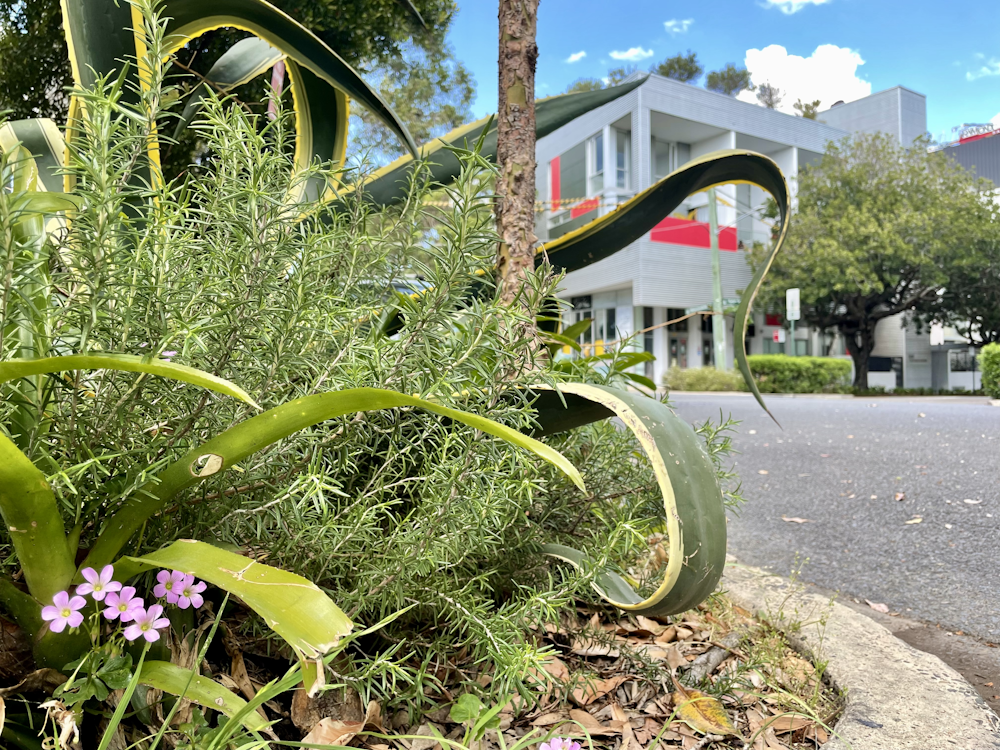
But if food is accessible on public land — such as lemons or bananas hanging over a fence, or rosemary and parsley planted as ornamentals in a park or street shoulder — you can harvest them. Just take what you need, and leave plenty for others.

Foraging respectfully

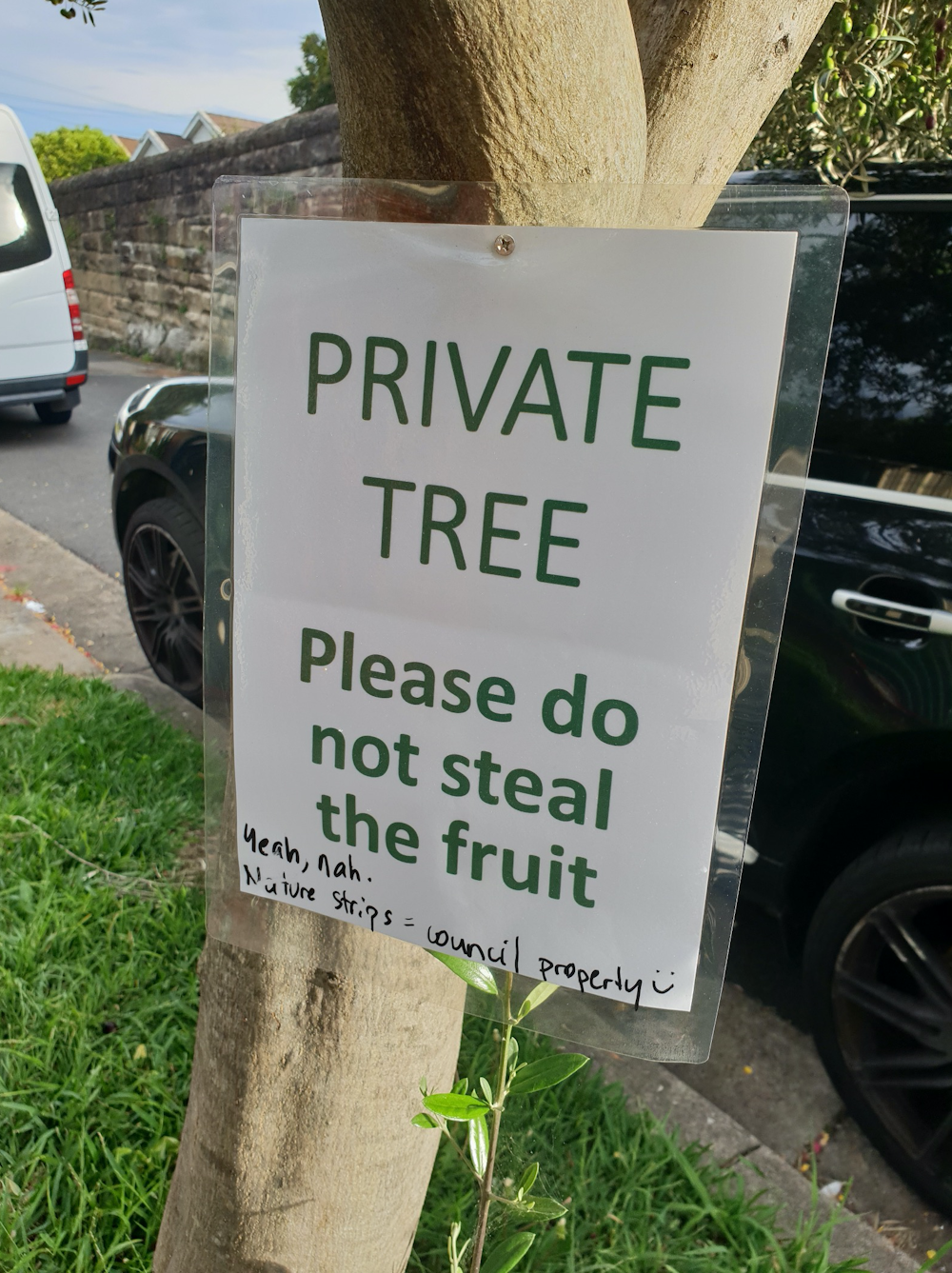
There are different cultures around growing and sharing food, depending on the local area. For example, many neighbourhood nature strips are technically owned by the council, but planted and tended by residents.

Foraging on nature strips can depend on local council rules.
Courtesy of Mapping Edges, Author provided

Community gardens and even streets with nature strips may have their own harvesting rules. Some groups like Green Square Growers encourage spontaneous harvesting. Others, such as Sydney City Farm, carefully document volunteer hours then allocate produce accordingly.

Since 2016, we have been working in various suburbs of Sydney to conduct research on urban gardening. We discovered people often work with plants to develop a sense of place that goes well beyond what’s visible in their gardens.

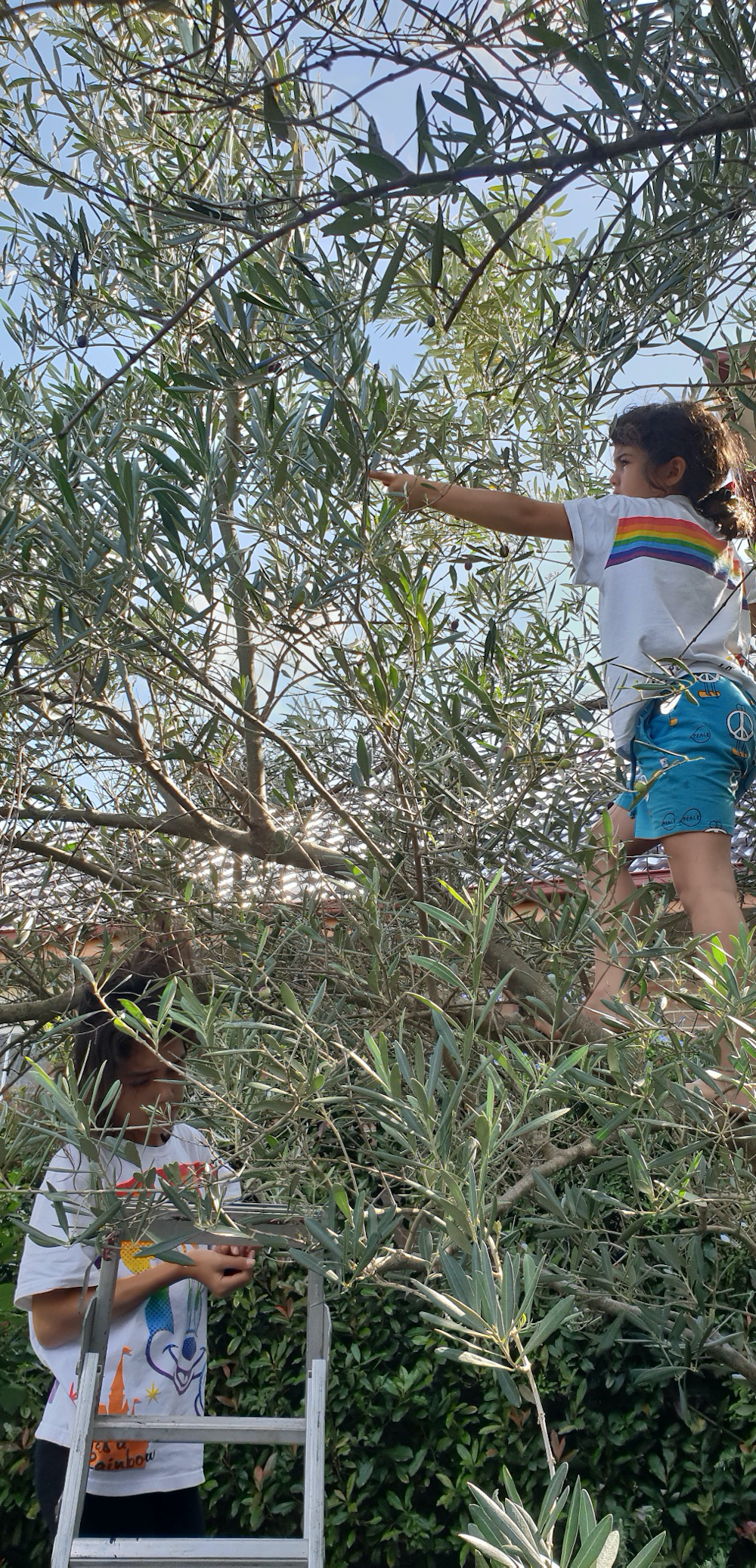
We found networks of neighbours grow together with plants on street edges, through exchanging cuttings, seeds, tips, stories and produce. Coming across a row of trees heavy with olives on a nature strip may feel like a lucky discovery, but these plants are probably watered, pruned, and whitewashed for winter by one or more gardeners.

Olive trees are often growing along fences and nature strips.
Courtesy of Mapping Edges, Author provided

For someone who has carefully netted a fruit tree to protect it from bats and cockatoos, or who has patiently tended a vine for three years before their first passionfruit appears, there’s nothing more infuriating than a stranger harvesting.

On the other hand, helping yourself to a fragrant feijoa tree weighed down by ripe fruit makes sense, when the fruits would otherwise fall, rot and go to waste.

When possible, ask residents about the plants growing on or around their properties. Conversations about what’s growing in neighbourhoods build so-called “civic ecologies” — actions that bring together environmental and civic values, building neighbourly connections around common interests and care for shared places.

Learn from foraging celebrities

In Australia, a hand full of “foraging” celebrities have brought attention to this age old practice. They see foraging as an opportunity to learn about what’s growing where, and why.


Read more:
Supermarket shelves stripped bare? History can teach us to ‘make do’ with food


In Sydney, Randwick Council Sustainability Educator Julian Lee, has created a Scrumper’s Delight participatory map that records edible plants growing in public spaces. Sydney artist and activist Diego Bonetto — aka The Weedy One — brought a wealth of planty knowledge from Piedmont, Italy to Australia in the 1990s, and since then his passion has evolved to a public pedagogy about respectful foraging.

Milkwood Permaculture offer tips, even on foraging sea weed. The Melbourne Forager on Instagram makes urban foraging hip. And a growing number of Indigenous businesses, such as Indigigrow, share Indigenous knowledge by selling plants people can recognise outside their gardens.

Foraging in cities is fun, it helps us remember we’re part of ecosystems, and we have a responsibility to care for Country. So keep in mind principles of reciprocity, and go forth and learn what’s growing in your city.


Read more:
Farming the suburbs – why can’t we grow food wherever we want?


The Conversation

The authors do not work for, consult, own shares in or receive funding from any company or organization that would benefit from this article, and have disclosed no relevant affiliations beyond their academic appointment.

ref. Rosemary in roundabouts, lemons over the fence: how to go urban foraging safely, respectfully and cleverly – https://theconversation.com/rosemary-in-roundabouts-lemons-over-the-fence-how-to-go-urban-foraging-safely-respectfully-and-cleverly-167883

Australians need more protection against genetic discrimination: health experts

Source: The Conversation (Au and NZ) – By Jane Tiller, Ethical, Legal & Social Adviser – Public Health Genomics, Monash University

Shutterstock

Genomic testing — the ability to read an individual’s genetic code and identify their risk of conditions such as cancer — has opened up huge possibilities in personalised medicine.

But it has also introduced serious ethical challenges. Particularly, there is the danger of life insurance companies using such information to discriminate against those at higher risk of conditions.

Canada, Britain and most European countries have already banned or restricted life insurers from using genetic test results.

Australia’s response so far has been mostly to leave it to industry self-regulation. But our research suggests most health professionals don’t think this is enough. More than 90% of the experts we surveyed agreed more government oversight is required.

Australia’s regulatory approach

Australia’s federal Private Health Insurance Act (2017) prohibits health insurers from using genetic information to discriminate against customers. But there is no legal prohibition against life insurers using results to charge people higher premiums or deny them coverage altogether. This applies to death cover, total and permanent disability, critical illness/trauma and income-protection cover.

In 2018 a joint parliamentary inquiry recommended a prohibition against life insurers using the outcomes of predictive genetic tests, at least in the medium term. It also recommended the government maintain a watching brief and consider legislation in future.

The federal government did not respond to the inquiry’s report, leaving it to the industry to self-regulate.


Read more:
Australians can be denied life insurance based on genetic test results, and there is little protection


In 2019 the financial services industry’s peak body, the Financial Services Council, introduced a five-year moratorium on insurers using applicants’ genetic test results up to certain financial limits.

Life insurers can only ask for or use genetic test results for policies worth more than A$500,000 for death cover or total and permanent disability cover, A$200,000 for critical illness/trauma cover, and $4,000/month for income protection.

Given the median yearly household income is about A$122,000, these thresholds are arguably too low to prevent insurers from using genetic test results in many cases.

Our survey results

With the moratorium now half over (it will end in 2024), we surveyed health professionals to gauge their views about Australia’s approach. The survey was part of a federal government-funded research project to evaluate the moratorium.

Of 166 respondents, 121 were genetic specialists — geneticists and genetic counsellors who help people make sense of and make decisions about genetic testing. There are 480 such specialists in Australia registered with the Human Genetics Society of Australasia. With genetic testing increasingly being offered outside genetics clinics, we also invited specialists such as oncologists to take part.

Not everyone answered every question, so the following percentages are based on those that answered specific questions. While 93% agreed consumers are better protected under the moratorium, 88% remained concerned about genetic discrimination.

The most common complaints were that the financial thresholds were too low, there was no certainty for patients beyond 2024, and the insurance industry couldn’t be trusted to regulate itself.

More than 90% said the Australian government should introduce legislation to regulate life insurers.

Canada’s legislation, for example, bans insurers and other service providers from using genetic test results to discriminate against applicants.

The British government, meanwhile, has a hybrid regulatory model. This involves a Code on Genetic Testing and Insurance agreed to between the government and life insurance industry. In our survey, 95% said a similar approach is required for Australia.


Read more:
Why New Zealanders are vulnerable to genetic discrimination in health and life insurance


Safeguarding Australia’s genomic future

Genetic technology is transforming health care. Precision medicine relies on genomic testing to personalise therapeutic treatments. Genomic research is also critical to understanding disease, improving diagnostic methods and guiding the selection of the most effective drugs for treatment.

To maximise its potential and ensure public trust in genomics, it seems clear more must be done to prevent genetic discrimination and ensure all Australians — particularly those most at risk from genetic conditions — can benefit from the genomics revolution.

The Conversation

Jane Tiller has received funding from the Australian government’s Genomic Health Futures Mission, to monitor the effectiveness of the Australian genetics and life insurance moratorium. She is a founding member of the Australian Genetic Non-Discrimination Working Group

Paul Lacaze has received funding from the Australian government’s Genomic Health Futures Mission, to monitor the effectiveness of the Australian genetics and life insurance moratorium. He is a founding member of the Australian Genetic Non-Discrimination Working Group

ref. Australians need more protection against genetic discrimination: health experts – https://theconversation.com/australians-need-more-protection-against-genetic-discrimination-health-experts-168563

Beyond Oxbridge and Yale: popular stories bring universities to life — we need more of them in Australia

Source: The Conversation (Au and NZ) – By Catharine Coleborne, Dean of Arts/Head of School Humanities and Social Science, University of Newcastle

Gilmore Girls brought university life, including the student newspaper. to our screens. Dorothy Parker Drank Here ProductionsHofflund/PoloneWarner Bros. Television

A new campus novel suggests the story of the university in Australia might be almost in vogue, if only as a backdrop for big questions about navigating human failings and representations of truth, and the topical issue of sexual consent.

Diana Reid’s new campus novel, Love and Virtue, is set in Sydney. Reid is a graduate of the University of Sydney, and the novel’s action takes place in a residential college, where the central character Michaela has a sexual encounter with a male student after a drunken night during O-Week. She must also navigate the politics of class and friendship in the way her experience is later appropriated and represented.


Goodreads

Australian readers and audiences have had meagre opportunities to examine the world of the university in novels, television or film, especially compared to North American examples, and British stories set at the Oxbridge universities, among others.

Rory Gilmore of the television series Gilmore Girls (2000-2007) dreamt of going to Harvard for her whole girlhood, ending up at Yale instead. Donna Tartt’s novel The Secret History (1992) is set at a small liberal arts college in Vermont, probably based on Tartt’s alma mater, Bennington College. Recently, Netflix series The Chair had fun with the complexities of university administration.


Read more:
New Netflix drama The Chair is honest and funny, but it still romanticises modern university life


These narratives share the setting of the university campus as a place for self-discovery and freedom, but also as sites in which to negotiate power, sex and relationships. Some learning in lectures also features, along with libraries, often depicted as imposing structures with weighty traditions.

From the rarified contexts of elite US colleges to the dreaming spires of Evelyn Waugh’s Brideshead Revisited to sardonic depictions of academic life in the novels of British author David Lodge, stories about university life may seem plentiful.

Yet unlike England and America, there are few such readily available “popular” cultural narratives set here. Works of fiction do exist, as academic Colin Symes noted in a 2004 article. Symes cited Australian novels from the 1970s and 1980s such as Laurie Clancy’s The Wildlife Reserve, a story about the post-Dawkins university that muses over the legacy of earlier academic administrators. In the late 1990s and early 2000s, two other university-themed novels were published: No Safe Place by Mary-Rose MacColl and Academia Nuts by retired Sydney academic Michael Wilding.

Arguably none of these books — forming a slim canon of campus novels — made a large impression on the popular idea of the university in Australia, even if they investigated interesting ideas about the changing nature of education and workplaces in these decades.

Yet this relative cultural silence about universities is despite their rich history as a catalyst for social change and the many thousands of experiences of graduates.

Universities and social change

In the 1970s, Australian universities were beginning to expand and open up to a wider range of students, including mature-age women and new generations of politically aware young people. The Australian “idea of the university” was formed in a “new wave” of institutions such as La Trobe, Deakin and Griffith, as Glyn Davis noted in his 2017 book of the same name.

Hopefulness about the value and purpose of tertiary education was palpable. Campuses were lively, and students sought debate, difference, dialogue. New areas of study were being framed, including critical humanities and social science fields. University education in Australia also benefited from the intellectual traditions and influences of the British model and the emerging style of North American institutions.

The public, then, perceived universities as useful. Their presence assured a society founded in intellectual achievement and personal growth as much as jobs and degrees.


Read more:
The Australian idea of a university


Australian stories of the university

There are some stories to draw on as we plot this larger picture of the university experience in Australia. Jill Ker Conway’s memoir The Road From Coorain is one minor exception. Conway, who grew up on a sheep farm in Coorain, New South Wales, studied at the University of Sydney before leaving Australia for university education in the US in 1960. She was later president of the famous Smith College for women.


Goodreads

Cassandra Pybus’s book Gross Moral Turpitude (1993), though not a novel, featured a legal case around sexual misconduct at the University of Tasmania. In 1996, Helen Garner published The First Stone, her controversial interpretation of the sexual harassment case at the University of Melbourne’s Ormond College.

In a lighter vein, a film set at the University of Melbourne from the mid-1990s, Love and Other Catastrophes, featured the campus and starred Alice Garner (who later wrote a memoir The Student Chronicles). The Secret Life of Us also explored the lives of university graduates in Melbourne making their way in life.


Read more:
I turned to The Secret Life of Us for warm nostalgia. Instead, I found jarring memories


Yet the overwhelming lack of a collective memory of university education and the student experience in Australia now presents a serious problem in our social, cultural and political life.

Narratives about university found in both US and British contexts highlight questions of personal journeys into education and beyond, and rites of passage. They touch, too, on issues of inclusion and exclusion and campus culture.

In Australia, we have barely even imagined these spaces in public debate, much less celebrated or critiqued them. When it comes to thinking about the value, purpose and role of universities in public life, we are so far behind that we don’t even have a common language.

Talking about universities from the student, not staff, point of view, would be a good place to start as we reflect on generations of change in higher education.

The Conversation

Catharine Coleborne is affiliated with the Australasian Council of Deans of Arts, Social Science and Humanities (DASSH), the peak body for university education in these fields in Australia and New Zealand.

ref. Beyond Oxbridge and Yale: popular stories bring universities to life — we need more of them in Australia – https://theconversation.com/beyond-oxbridge-and-yale-popular-stories-bring-universities-to-life-we-need-more-of-them-in-australia-168943

Why are males still the default subjects in medical research?

Source: The Conversation (Au and NZ) – By Severine Lamon, Associate professor, Nutrition and Exercise Physiology, Deakin University

Shutterstock

Women and girls account for 50% of the population, yet most health and physiology research is conducted in males.

This is especially true for fundamental research (which builds knowledge but doesn’t have an application yet) and pre-clinical (animal) research. These types of research often only focus on male humans, animals and even cells.

In our discipline of exercise physiology, 6% of research studies include female-only participant groups.

So why do so many scientists seem oblivious to the existence of half of the world’s population?


Read more:
Equal but not the same: a male bias reigns in medical research


Females, women, trans men and non-binary folks

Firstly, it’s important to understand key terminology in society and research. As referred to throughout this article, “male” and “female” are categories of sex, defined by a set of biological attributes associated with physical and physiological characteristics.

In comparison, “men”, “women” and “non-binary people” are categories of gender: a societal construct that encompasses behaviours, power relationships, roles and identities.

Here we discuss research on specific sexes, but further consideration of gender-diverse groups, such as transgender people, also remains a gap in science.

Why aren’t females studied?

The main reasoning is that females are a more “complicated” model organism than males.

The physiological changes associated with the menstrual cycle add a whole lot of complexities when it comes to understanding how the body may respond to an external stimulus, such as taking a drug or performing a specific type of exercise.


Read more:
From energy levels to metabolism: understanding your menstrual cycle can be key to achieving exercise goals


Some females use contraception, and those who do use different types. This adds to the variability between them.

Females also undergo menopause around the age of 50, another physiological change that fundamentally impacts the way the body functions and adapts.

Even when research with females is performed properly, the findings may not apply to all females. This includes whether a female individual is cisgender or gender nonconforming.

Altogether, this makes female research more time-consuming and expensive — and research is nearly always limited by time and money.

Does it really matter?

Yes, because males and females are physiologically different.

This does not only involve visually obvious differences (the so-called primary sex characteristics, such as body shape or genitals), but also a whole range of hidden differences in hormones and genetics.

There’s also emerging evidence from our research team that sex differences impact epigenetics: how your behaviours and environment affect the expression of your genes.

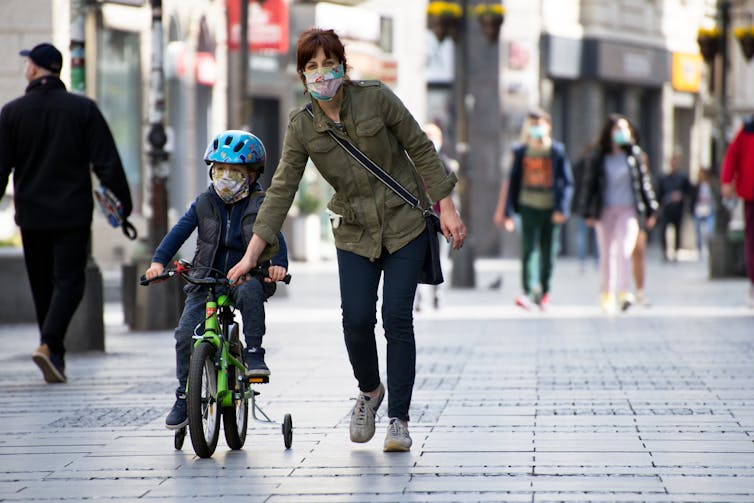
A mother walking on a paved street, helps her child who is riding a bike.
There are a range of hormonal and genetic differences between males and females.
Shutterstock

Conducting health and physiology research in males exclusively disregards these differences. So our knowledge of the human body, which is mostly inferred from what is observed in males, may not always hold true for females.

Some diseases, such as cardiovascular (heart) disease, present differently in males and females.


Read more:
Women who have heart attacks receive poorer care than men


Males and females may also metabolise drugs in a different way, meaning they may need different quantities or formulations. These drugs can have sex-specific side effects.

This may have major consequences in the way we treat diseases or the preferred drugs we use in the clinic.

Take COVID-19, for example. The severity and death rates of COVID-19 are higher in males than females. Sex differences in immunity and hormonal pathways may explain this, therefore researchers are advocating for sex-specific research to aid viral treatment.

We’re finally starting to see some change

No matter the cost or added complexity, research should be for everyone and apply to everyone. International medical research bodies are now starting to acknowledge this.

A March 2021 statement from the Endocrine Society, the international body for doctors and researchers who study hormones and treat associated problems, recognises:

Before mechanisms behind sex differences in physiology and disease can be elucidated, a fundamental understanding of sex differences that exist at baseline, is needed.

The National Institutes of Health (NIH), the largest medical research board in the United States, recently called for researchers to account for “sex as a biological variable”.

Unless a strong case can be made to study only one sex, studying both sexes is now a requirement to receive NIH research funding.

The Australian equivalent, the National Health and Medical Research Council (NHMRC), indirectly recommends the collection and analysis of sex-specific data in animals and humans.

However the inclusion of both sexes is not yet a requirement to receive funding in Australia.

But researchers can start now

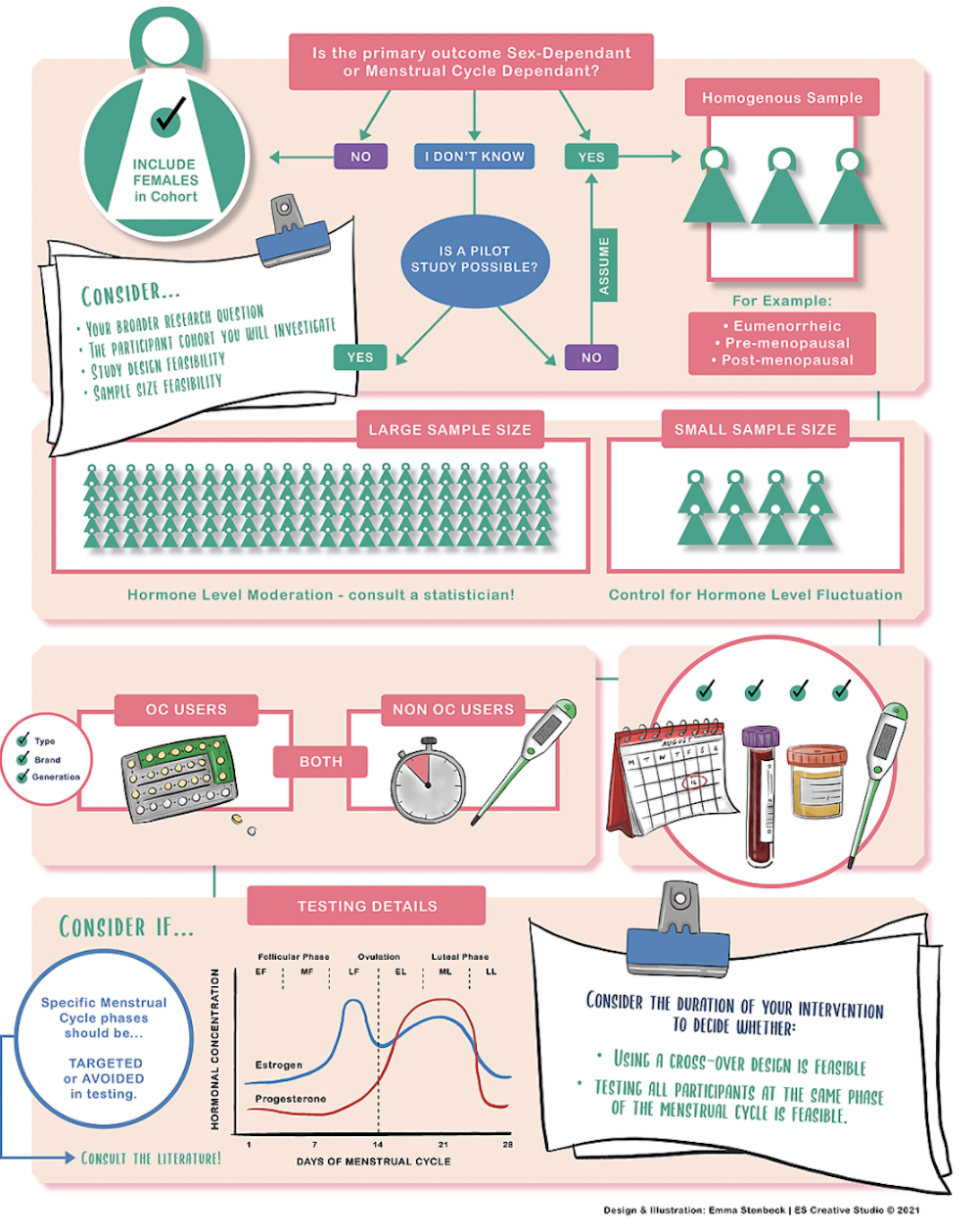
Because sex matters, we created a freely available infographic based on our research that aims at making female health and physiology research easier to design.

The Future is Female: A framework to design female physiology research.
Olivia Knowles & Severine Lamon

It presents as a simple flow through diagram that researchers can use before starting their project and prompts them to consider questions such as:

  • is the phenomenon I am investigating influenced by female hormones?

  • should all females in my cohort use the same contraception?

  • on which day of the menstrual cycle should I test my participants for the most reliable result?

Depending on the answers, our infographic proposes strategies (that can be practical — such as who to recruit and when — or statistical) to design research that takes into account the complexity of the female body.

It’s easy to follow and accessible to all. And, while initially designed for exercise physiology research, it can be applied to any type of female health and physiology research.


Read more:
Medicine’s gender revolution: how women stopped being treated as ‘small men’


Based on our infographics, we designed a female-only, four-year research project to map the process of muscle ageing in females. Females live longer than males but, paradoxically, are more susceptible to some of the consequences of ageing. Despite lots of ageing research in males, we still know very little about the female-specific characteristics at play.

So yes, the future is female — so is our research. And we hope to inspire health and physiology researchers all over the world to do the same.

The Conversation

Severine Lamon receives funding from the Australian Research Council.

Olivia Knowles does not work for, consult, own shares in or receive funding from any company or organisation that would benefit from this article, and has disclosed no relevant affiliations beyond their academic appointment.

ref. Why are males still the default subjects in medical research? – https://theconversation.com/why-are-males-still-the-default-subjects-in-medical-research-167545

Dominic Perrottet is set to become the next premier of NSW. Who is he?

Source: The Conversation (Au and NZ) – By Gregory Melleuish, Professor, School of Humanities and Social Inquiry, University of Wollongong

In many ways, this is the worst possible time for a new premier to take the helm in New South Wales. The resignation of John Barilaro as deputy premier creates an even greater mood of uncertainty and, perhaps, insecurity.

The state is due to open up, at least partially, in the next week, and with the end of lockdown will come a need for a different type of leadership than has been exhibited over the past few months. Gladys Berejiklian has done a reasonable job during the pandemic, as can be seen from the outpouring of support, even grief, at her decision to call it a day.

However, there have also been many complaints about her government’s actions, particularly in the western suburbs of Sydney. She has at times appeared to be the premier for the north shore and eastern suburbs. For any Liberal premier of New South Wales, such a perception is extremely dangerous as elections are won in outer suburban and regional electorates.

In the 18 months before the next election, especially given the slender Coalition majority in the Legislative Assembly, the new premier will need to ensure, or at least create the perception, that the government is working on behalf of all of the state.


Read more:
ICAC is not a curse, and probity in government matters. The Australian media would do well to remember that


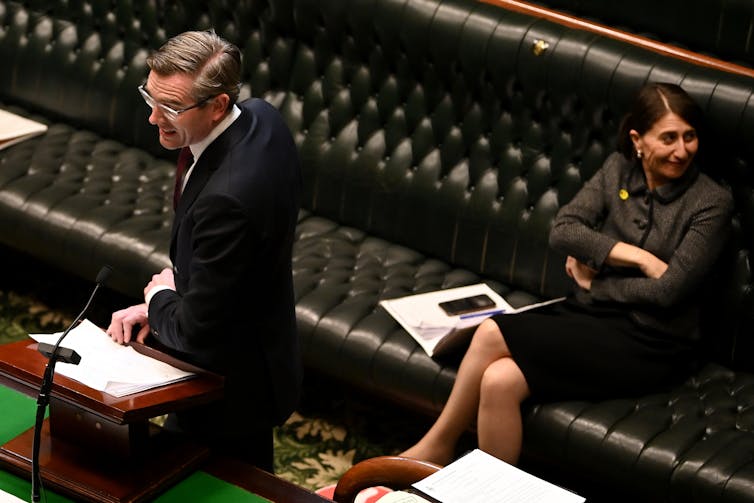
Assuming Dominic Perrottet becomes the next premier, it is worth asking what he brings to that position and how it will affect the politics of the state over the next year. It is also worth pointing out that Perrottet, along with Planning Minister Rob Stokes, is from the north shore. That probably explains why he chose to run with Stuart Ayres, who represents the western Sydney seat of Penrith.

Both Perrottet and Ayres are quite young: Perrotet is 39; Ayres 41. They represent a new generation of leaders.

Perrottet grew up on the north shore, where he attended Redfield College and Oakhill College. Interestingly, neither school plays rugby league, compared to St Dominic’s College, Penrith, which Ayres attended and which counts among its alumni Nathan Cleary, Des Hasler and Brad Fittler.

Perrottet’s father works for the World Bank and he is one of 12 children. The family are religious Catholics.

Perrottet’s further education and career indicate he followed in his father’s footsteps in another way. He studied economics and law at university before working as a commercial lawyer.

He was elected to the state parliament in the landslide of 2011, at the tender age of 29. He quickly advanced up the ministerial ladder, primarily in economic portfolios. He began with finance in 2015, before advancing to industrial relations and then treasury and the deputy leadership of the Liberal Party in 2017.

Perrottet’s rise demonstrates he is very capable and intelligent, and he has “topped the class” of those candidates who went into parliament in 2011.

Perrottet has risen quickly through the ranks since entering parliament in 2011.
Dan Himbrechts/AAP

But his career also says something about what it means to be on the right in the modern Liberal Party. In some ways, he resembles former Liberal leader Nick Greiner, as a highly financially literate technocrat who sees the world through a business lens. While Greiner’s policies resonated on the north shore and in safe Liberal seats, they were his Achille’s heel everywhere else. So in the 1991 election, Greiner increased his proportion of the vote in safe Liberal seats while losing crucial seats in other areas, leading to minority government.

The other important aspect of Perrottet’s persona is his conservative Catholicism. One of his original sponsors was MLC David Clarke, a well-known conservative Catholic and leader of the conservatives in the Liberal Party. He is pro-life and opposed to assisted dying.

Perrottet has claimed his personal religious beliefs do not affect his work in public life. In any case, he requires the support of the moderates, who hold quite different moral and social values, to get legislation through.

His economic and financial experience will be far more important for his role as premier. He is focused very much on the economy and, as treasurer, aware of the huge debt that the state has incurred. Back in July, he reportedly opposed the extension of the current lockdown. He has also indicated he could change the current roadmap out of lockdown in the state.

In what seems to have been the perennial issue of the pandemic – public health versus the economy – there is no doubt Perrottet comes down on the side of the economy.

Certainly, the economy will loom larger as the state comes out of the worst of the pandemic. It is also the case that a focus on the economy will win him plaudits from the north shore, which has suffered fewer COVID cases than other areas of Sydney.


Read more:
Stadiums, bushfires and a pandemic: how will Gladys Berejiklian be remembered as premier?


The problem is that the state still has to navigate its way through the lifting of restrictions and the consequences of that action. It is not clear, despite high levels of vaccination, that all will be plain sailing.

Berejiklian honed her public relations skills during the pandemic and demonstrated a capacity to reassure the wider population that there was light at the end of the tunnel. Even so, she did not reach everyone.

Perrottet is largely untested in these matters. He will need to reassure the people of New South Wales that his focus is not just economic and financial. He could well ponder the fate of Nick Greiner.

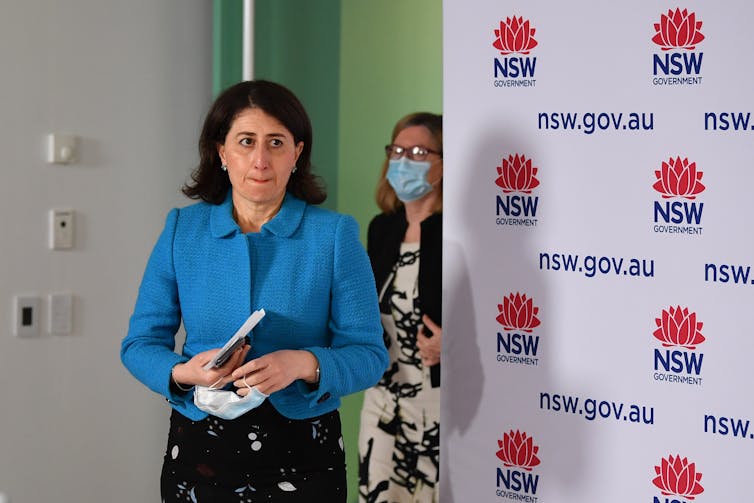
Gladys Berejiklian was able to reassure the people of NSW through the worst of the pandemic.
Joel Carrett/AAP

That situation will not be made easier by Barilaro’s resignation. It is still somewhat of a mystery as to why he resigned. Could he really have been pushed into resignation by a nuisance YouTuber?

Whatever the reason, it will make the job of the new premier all the more difficult as it will be a new leadership team that seeks to guide NSW through largely uncharted waters.

How this new team handles those circumstances may well determine the outcome of the next state election.

The Conversation

Gregory Melleuish receives funding from the Australian Research Council

ref. Dominic Perrottet is set to become the next premier of NSW. Who is he? – https://theconversation.com/dominic-perrottet-is-set-to-become-the-next-premier-of-nsw-who-is-he-169138

Privatising the sky: drone delivery promises comfort and speed, but at a cost to workers and communities

Source: The Conversation (Au and NZ) – By Michael Richardson, Senior Research Fellow, UNSW

Wing

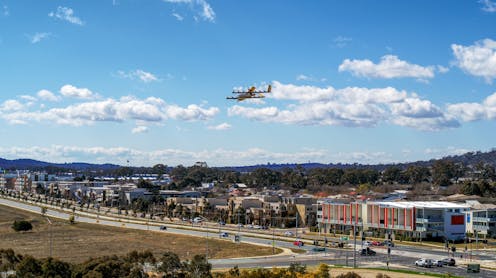
Drone delivery company Wing recently celebrated 100,000 deliveries with an unusual burst of media fanfare. Australia is at the forefront of Wing’s plans, with the company’s two biggest trial sites running in Canberra and Logan in Queensland.

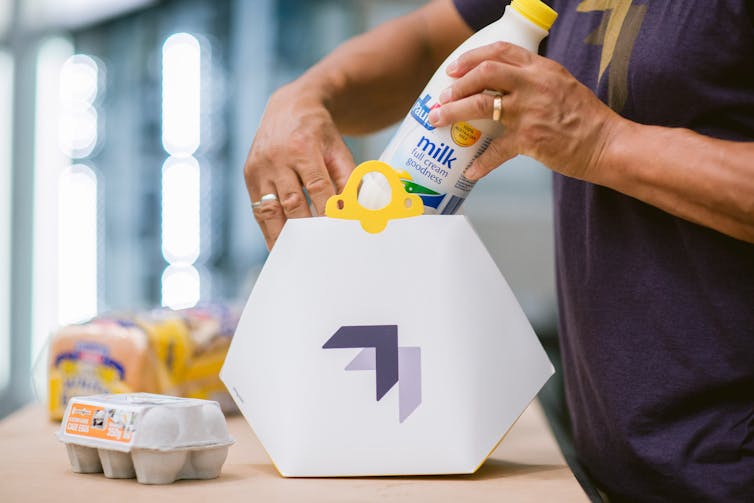
Wing tells a simple story of barista coffee and roast chooks dropped on your driveway at a moment’s notice. Short on Vegemite for the kids’ brekky? Hop on the app, order, and a drone will lower a new jar to your doorstep before the toast is cool. All quick, contactless, and COVID-safe.

But the real story is much more complex. Drone delivery at scale will transform the skies, change expectations for speedy delivery, and hide the labour that makes it possible.

Owned by Alphabet, the parent company of Google, Wing has huge resources. New drone regulations are already being written, and Wing is setting itself up to be the backbone of a new aerial infrastructure.

How Wing works

Wing operates much like many app delivery platforms. After signing up, customers use the smartphone app to place their orders. Orders are then packed at local base stations and flown to their destinations by Wing’s drones. On arrival, the packages are lowered to customers by winch, automatically detaching from the drone before it returns to the base station.

Unlike the hobby drones you might see above parks and beaches, Wing’s delivery drones can operate out of the operator’s line of sight. Flight is fully autonomous, with one pilot monitoring several flights at once and able to take over or land if necessary.

A promotional video shows a Wing delivery drone in action.
Wing

How that will scale up in volume and frequency isn’t clear. So far, the trial sites in Canberra and Logan offer clear and uncomplicated airspace and a flat, regular urban environment.

For customers, all this promises a swift, seamless and contactless experience.

Deloitte’s economic modelling on the drone industry in Australia notes that drones enable further automation of work. But behind every promise of “autonomous” or “automated” technology are hidden human workers.

Whose labour does it save?

One of Wing’s major promises is unbelievably fast delivery on demand. Wing boasts an average delivery time of roughly 10 minutes. Their quickest time recorded – from order placement to product in hand – is 2 minutes and 47 seconds.

This is a remarkable acceleration in the pace and expectation of delivery. Ordinary mail might take days or weeks, but thanks to the “Amazon effect” private delivery services have already shifted expectations from next-day to same-day and now even one or two hours.

‘Fully autonomous’ delivery is only made possible by hidden human labour.
Wing

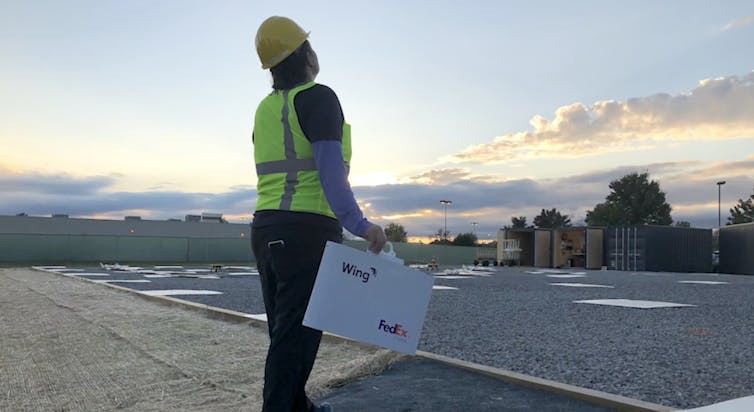
While Wing’s drones are autonomous, the service still relies on human labour. Pilots monitor flight paths, packers parcel up the products, and maintenance staff take care of the hardware and software. All of these workers must perform to satisfy the 10 minute delivery time.

Amazon warehouses and food delivery apps have shown us how such punishing timelines can be dangerous for worker safety and devastating for morale. For precariously employed or gig economy workers, missing targets can mean instant termination.


Read more:
‘They track our every move’: why the cards were stacked against a union at Amazon


And the repercussions of 10-minute delivery may spread beyond Wing. If consumer expectations change, rival delivery companies (who may not be using automated drones) will feel pressure to keep pace.

Deloitte modelling from 2020 suggests drone delivery could cost less than half the current rate of an e-bike delivery. In the Canberra trial, some products at least are delivered for the same as in-store prices. How those delivery costs will be distributed between Wing, businesses, workers and customers once the pilot programs are over, however, is unclear — but if the likes of UberEats are anything to go by, it may well end up being businesses and especially delivery workers who carry most of the cost.

Closing the sky

Drone delivery may also have hidden environmental costs. Keeping cars and trucks off the road might cut energy consumption, but mining lithium for batteries and supplying energy for data centres may reduce or eliminate those gains.

Getting sandwiches via drone could also mean more packaging and waste, as well as potential risks to birds and habitats from heavy aerial traffic.

Ravens in Canberra have taken to attacking Wing’s delivery drones.
Ben Roberts / YouTube

But a bigger question for the public is about the skies above our heads. Do we want to live under a cloud of drones?

At present, most of the time people are free to enjoy the skies above their homes and communities. Kids can fly kites and enthusiasts can fly their own drones. Drone delivery risks privatising a new layer of that common space, and handing it over to Alphabet and others.

Building the legal and technical architecture to control the skies

To privatise a new part of the sky, Australia’s drone regulations will have to change. The current rules are highly restrictive, built from a patchwork of international, federal and state laws developed primarily for aeroplanes.

Apart from hobbyists with constant line of sight, operating in limited times and places, each drone use requires explicit permission from the Civil Aviation Safety Authority.

New commercial applications are pushing this system beyond breaking point. They often require operation beyond visual line of sight, near populated areas, in a broad range of conditions, and without constant pilot supervision.

A worker waits to attach a delivery to a drone.
Wing

Bouyed by economic modelling from Deloitte suggesting the drone industry could be worth around $15 billion by 2040 (with e-commerce and deliveries making up about $600 million), the Australian government is pushing to modernise drone regulation. This means reappraising rules around environmental impacts, noise, safety, insurance, security and privacy.

The resulting changes will benefit different companies and business models. For example, more flexible noise standards will benefit commercial applications like delivery. This means the big question is how different stakeholders are influencing the development of these new laws.

Capturing the standards for unmanned traffic management

Alongside new regulations, new digital infrastructures are being developed to manage increasingly congested and “automated” skyways.

Wing is heavily involved, providing a flight planning and safety app for drone operators, a system for remote drone identification, and an “unmanned traffic management” service.

Owning the broader traffic management system is clearly part of the long-term business strategy. As Google has shown with its Android operating system, building infrastructure (even if it’s open source) can create a real commercial advantage.


Read more:
The age of drones has arrived quicker than the laws that govern them


Wing’s approach fits neatly with the Australian government’s desire for a market-based strategy to develop and implement its first unmanned traffic management system over the next 5 years. The trial programs in Canberra and Logan will help the company develop more comprehensive skyway traffic platforms that will govern airspace safety, communications standards, data management, and everything else needed to keep autonomous aerial commerce ticking over.

Policymakers know commercial development of communication infrastructure creates competition risks. However, they may not have the tools and expertise to enforce equal and fair access to skyway infrastructure.

And at present, the fundamental question of whether we want drone deliveries crowding our sky at all is completely off the table.

Taking flight

As we have seen with the likes of Uber and Airbnb, reining in tech companies once they are already running is hard. With Australia modernizing its aviation laws, Wing is well positioned to protect its agenda and make itself essential to future evolutions of the law.

The COVID-19 pandemic is also helping companies like Wing to accelerate their agenda, as they can promise less congestion, less consumer mobility, and less social contact.


Read more:
Coles and Woolworths are moving to robot warehouses and on-demand labour as home deliveries soar


While city skies crowded with delivery drones might be far away, the groundwork is being laid right now. Communities, businesses and workers need to be a much bigger part of the process of deciding if they want that future.

Getting sushi delivered by drone for lunch might seem like a neat idea, but the real price may have little to do with what gets charged to your card.

The Conversation

Michael Richardson receives funding from the Australian Research Council.

Jake Goldenfein is supported by the ARC Centre of Excellence for Automated Decision-Making & Society.

Thao Phan is employed in the ARC Centre of Excellence on Automated Decision-Making & Society

ref. Privatising the sky: drone delivery promises comfort and speed, but at a cost to workers and communities – https://theconversation.com/privatising-the-sky-drone-delivery-promises-comfort-and-speed-but-at-a-cost-to-workers-and-communities-166960

Labor retains clear Newspoll lead with voters approving of AUKUS; Perrottet set to be next NSW premier

Source: The Conversation (Au and NZ) – By Adrian Beaumont, Honorary Associate, School of Mathematics and Statistics, The University of Melbourne

AAP/Dan Himbrechts

This week’s Newspoll, conducted September 29 to October 3 from a sample of 1,545, gave Labor a 53-47 lead, unchanged from last fortnight’s Newspoll. Primary votes were 37% Coalition (steady), 37% Labor (down one), 11% Greens (up one), 2% One Nation (down one) and 13% for all Others (up one).

It is likely Clive Palmer’s United Australia Party makes up a sizeable fraction of the Others vote. UAP ads have been ubiquitous, and they won 3.4% at the 2019 election, more than the 3.1% for One Nation, although One Nation did not contest all seats.

49% were dissatisfied with Scott Morrison’s performance (down one), and 48% were satisfied (up two), for a net approval of -1, up three points. Anthony Albanese’s net approval improved one point to -10. Morrison led as better PM by 47-34 (47-35 last fortnight).

For the large majority of this term, each Newspoll has been conducted three weeks apart. The two-week gap this time suggests they will do more polls in the lead-up to the election, due by May 2022. Newspoll figures are from The Poll Bludger.

By 59-31, voters approved of the AUKUS agreement, though the question did not mention the time to get the new submarines. 46% thought AUKUS would make Australia more secure, 29% that it would make no difference and 14% thought it would make us less secure. By 75-15, voters thought China posed a significant threat to our national security.

Labor has had a lead of 53-47 or more in all Newspolls conducted since July, but I am sceptical this solid position for Labor will mean a victory at the election. Once vaccination targets are met and lockdowns ease in Melbourne and Sydney, the economy is likely to rapidly recover, boosting the Coalition’s chances.

Furthermore, the Resolve polls in August and September have been far better for the Coalition than Newspoll. As I wrote after the late August Newspoll disagreed with Resolve, the different message in Resolve should not be ignored.


Read more:
Coalition slumps but Morrison gains in Newspoll; electoral changes to curb micro parties


The Guardian’s datablog has 45.2% of the population (not 16+) fully vaccinated, up from 37.2% two weeks ago. We rank 33 of 38 OECD countries in share of population fully vaccinated, unchanged since last fortnight. The Age shows 56.5% of 16+ are fully vaccinated and 79.4% have received at least one dose.

Essential and Morgan polls

In last fortnight’s Essential poll, the federal government had a 45-30 good rating on its response to COVID (43-35 in mid-September, 39-36 in late August). The NSW government’s good rating has surged 13 points since late August to 53%, while Victoria fell back to 44% good after rising six points to 50% in mid-September.

50% of Victorian respondents said they didn’t have confidence in their state’s roadmap out of lockdown, compared with 40% of NSW respondents.

A late September Morgan poll from a sample of 2,752 gave Labor a 54-46 lead, a 1.5% gain for Labor since the mid-September poll. Primary votes were 36% Coalition (down 2.5%), 36% Labor (up 1%), 12.5% Greens (down 0.5%), 3.5% One Nation (up 0.5%) and 12% for all Others (up 1.5%).

Essential vs Resolve’s issue questions

In Essential, the Liberals had a 15-point lead over Labor on national security and a 10-point lead on economic management, while Labor led by 13 points on climate change, and 18 on fair wages and workplace conditions. Since October 2019, Labor has improved five points on the economy.

Essential’s issue questions give very different outcomes from Resolve’s, where Labor led the Liberals by just one point on the environment and climate change in September. Resolve gives a “someone else” option, and people who support the Greens on this issue select “someone else”, but a large majority of them prefer Labor to the Liberals.

It is likely there is also a pro-incumbent skew in Resolve’s questions, as they use “the Liberals and Morrison” versus “Labor and Albanese”. Morrison has had large leads over Albanese as better PM, so this formulation likely skews towards the current PM.

Newspoll quarterly aggregate data: July to September

Newspoll provides state and demographic breakdowns from all its polls conducted during a three-month period. As reported by The Poll Bludger on September 27, the September quarter Newspoll data gave Labor a 52-48 lead in NSW, a two-point gain for Labor since the June quarter, and a four-point gain since the 2019 election.

In Victoria, Labor’s lead blew out five points from June to 58-42, a five point gain for Labor since the last election. In Queensland, the Coalition led by 55-45, a two-point gain for them since July, but a 3.4% swing to Labor since the election. In WA, Labor led by 54-46, which would be a swing of almost 10% to Labor since the election.

Perrottet set to become next NSW premier

Gladys Berejiklian announced she would resign as New South Wales premier on Friday, owing to ICAC investigations. Media reports, such as in The Guardian, indicate that the right-aligned treasurer, Dominic Perrottet, is set to be elected NSW Liberal leader and thus premier at a Liberal party room meeting on Tuesday under a factional deal.

Berejiklian is also resigning as Member for Willoughby (held by 21.0%), so there will be a byelection soon. There will be other byelections in Bega (Lib 6.9%), where the Liberal MP Andrew Constance has announced he will contest the federal seat of Gilmore, and in Monaro (Nat 11.6%), as Nationals leader John Barilaro is retiring. Other NSW MPs may quit in the near future, so there could be several byelections on the same date.

Nobody wins German election

At the September 26 German election, the centre-left SPD won 25.7% (up 5.2% from 2017), the conservative CDU/CSU 24.1% (down 8.8%), the Greens 14.8% (up 5.9%), the pro-business FDP 11.5% (up 0.8%), the far-right AfD 10.3% (down 2.3%) and the far-left Left 4.9% (down 4.3%).

The Left was below the 5% threshold, but won three of the 299 single-member seats to barely retain a proportional allocation of seats. Right-wing parties combined defeated the combined left by a 45.9-45.4 margin, and this is reflected in parliament where left-wing parties won 363 of the 735 seats, just short of the 368 needed for a majority.

No other party will cooperate with the AfD, but no government of the left can be formed. Protracted negotiations are likely to achieve a governing coalition. I live blogged this election for The Poll Bludger.

The Conversation

Adrian Beaumont does not work for, consult, own shares in or receive funding from any company or organisation that would benefit from this article, and has disclosed no relevant affiliations beyond their academic appointment.

ref. Labor retains clear Newspoll lead with voters approving of AUKUS; Perrottet set to be next NSW premier – https://theconversation.com/labor-retains-clear-newspoll-lead-with-voters-approving-of-aukus-perrottet-set-to-be-next-nsw-premier-169152

Papua region hosts Indonesia’s national games amid rise in independence struggle

By Victor Mambor in Jayapura

A major national sports event opened in Papua at the weekend, with officials hoping it will showcase the Indonesian government’s commitment to developing the province and reassure the public that the region is safe despite an active and escalating pro-independence insurgency.

The National Games, an event held once every four years, were scheduled to take place last year but were postponed because of the covid-19 pandemic.

The games opened on Saturday and run until October 15 in Jayapura, the provincial capital, and three regencies.

Billy Mambrasar, a Papua-born adviser to President Joko “Jokowi” Widodo, said the government hoped the games would help boost the economy of the deeply impoverished region.

“The National Games in Papua, as Pak Jokowi hopes, will be successful not only in terms of sporting events and organisation, but also in creating a multiplier effect,” he told reporters.

Mambrasar said he had travelled across Papua to ensure that Papuan small businesses were involved in organising the games.

Youth and Sports Minister Zainudin Amali said the people of Papua were already benefitting economically from the games.

‘Economic impact’
“It has brought an economic impact on the communities,” Zainudin said in a statement posted on the ministry’s website.

“People sell T-shirts and souvenirs. Moreover, the situation here is under control.”

Papua won the right to host the games in 2014, outbidding Bali and Aceh provinces. A total of 7039 athletes and officials have descended on Papua for the country’s biggest sporting event, in which competitors are competing for medals in 56 sports.

The games are being held at venues in Jayapura City and three regencies – Jayapura, Merauke and Mimika. Some events, including esports, began last week.

The director of the National Counter-Terrorism Agency (BNPT) expressed optimism that the games would proceed without incident, saying the insurgency was “hundreds of kilometers away”.

“The military and police have taken necessary security precautions, so we are optimistic that all events will go well,” Boy Rafli Amar said in a video interview with detik.com.

More than 21,000 police and soldiers had been “deployed to prevent any security and public order disturbances,” national police chief General Listyo Sigit Prabowo said.

‘Safe and smooth’ hope
“What we hope is that the games will run safely and smoothly, while covid-19 remains under control,” Listyo told reporters after visiting sport venues in Papua on Thursday.

The areas where the games are being held are generally peaceful. But violence linked to the insurgency has broken out in other parts of the region that comprises Papua and West Papua provinces, and which makes up the western half of New Guinea Island.

In September, suspected rebels set fire to public buildings, including a health clinic and an elementary school in Kiwirok district, after security forces killed an insurgent during a gunfight, police said.

A 22-year-old nurse died after falling into a ravine while trying to flee the scene of the attack. One of her colleagues survived after being stabbed.

A policeman and a soldier were also killed in clashes with rebels.

The insurgency has simmered for decades in the Papua region, but violence has intensified in the past three years.

In April, the government designated pro-independence rebels as “terrorists” after insurgents ambushed and assassinated an army general who headed the regional branch of the National Intelligence Agency. The killing prompted Jokowi to order a crackdown.

Indonesian President Joko “Jokowi” Widodo, who will officially inaugurate the National Games, buys Nokens – traditional Papuan bags – from a craftswoman in Jayapura, Papua, Indonesia, Oct. 1, 2021. [Courtesy President Joko Widodo’s official Facebook account]

Lukas Enembe Stadium
The Lukas Enembe Stadium – named after the governor of Papua province – and the Papuan National Games complex in Jayapura. Image: Tribun News

Some local businesses unhappy
Jayapura Regent Mathius Awoitauw said the games could be a once-in-a-lifetime experience.

“The National Games are a matter of pride for Papuans, because it is extraordinary to have been entrusted to host it,” he said.

But some local businesses, including members of the Chamber of Papuan Indigenous Entrepreneurs (KAPP) and the Papuan Coffee Community, said they had been left out.

“We have had several meetings with the games’ organisers but there has been no progress,” Meky Wetipo, KAPP’s executive director, told BenarNews.

“We hope that they can entrust us with providing 3 tonnes of skipjack tuna, several tonnes of carrots, and fruit. But all these things are being done by government agencies.”

Denny Yigibalom, a coffee farmer and owner of the TIYOM coffee brand, said he had met with local lawmakers to discuss cooperation between coffee farmers and the games’ organisers, but there had been no further communication.

Makers of noken, traditional Papuan bags, said they were disappointed not to have been enlisted to provide souvenirs for the games, said Cintya Warwe, the manager of the Papua Women’s Market.

Noken purchase promise
“During a meeting at the end of August with the women of the Meepago noken community, the women complained because the organisers had promised to buy 5000 nokens. But this has not happened,” Cintya told BenarNews.

She said she heard news that the games’ committee wanted to buy 25,000 fake nokens from outside Papua to be used as mementoes.

However, some indigenous small businesses are taking part in the events by setting up tents to sell handicrafts outside the new Lukas Enembe Stadium, which cost nearly $1 million to build and is named after the serving governor of Papua.

Individual residents have also been allowed to set up stalls outside the stadium and sell handicrafts and betel or areca nuts, which are traditionally consumed raw by Papuans and people in neighboring Papua New Guinea.

In Merauke, women from the Marind tribe are selling handicrafts, including bags, hats, wallets, bracelets, necklaces, and bows along the city streets.

“Sales are worth up to 3 million rupiah (U.S. $210) a day. Bags, wallets and hats are the most popular. Most of the buyers are contingents from outside Papua,” said Maria D. Keimawu, leader of a small businesses association.

Covid-19 concerns
The provincial government, meanwhile, has taken measures to prevent the spread of covid-19 during the games, including by ramping up vaccinations and limiting the number of people who can enter the main stadium to fewer than 10,000, officials said.

“Gatherings of large numbers of people, even with strict health protocols, should be cause for concern,” said Masdalina Pane, a member of the Indonesian Association of Epidemiologists.

She said cases spiked after the recently completed Tokyo Olympics and the European football championship.

Yunus Wonda, the games’ chief organiser, said more than 50 percent of people in the areas that host the games had received at least on dose of a vaccine.

“We will make sure that everyone entering the venue have been vaccinated, that’s the main requirement,” he said, referring to the opening ceremony at the Lukas Enembe Stadium.

Victor Mambor is editor of Tabloid Jubi and a contributor to Asia Pacific Report.

Print Friendly, PDF & Email

Article by AsiaPacificReport.nz

PNG government launches recovery operation for APEC ‘on loan’ vehicles

By Gorethy Kenneth in Port Moresby

Finance Minister Sir John Pundari has warned Papua New Guineans who are still holding onto the 102 APEC “on loan” vehicles to return them as soon as possible — or face the law.

A disappointed Sir John, flanked by Finance Secretary Dr Ken Ngangan and Police Commissioner David Manning, said on Friday the ultimatum notice that had been published in newspapers recalling a total of 102 APEC vehicles in the hands of unauthorised people had now lapsed.

Those involved would face the full force of the law.

“The seven-day ultimatum period lapsed on Thursday, September 16, and to date no person has surrendered the APEC vehicles,” he said.

“The Finance Department has requested engagement of police, RTA and MVIL to establish a collective task force to recoup all outstanding APEC vehicles.”

The designated officers from Finance Department, Motor Police – Boroko, NCD Traffic Police, RTA – Road Traffic Enforcement Teams and MVIL are all ready to execute the recovery of the missing APEC vehicles.

The recovery task force team would start executing the recovery soon after the Friday’s meeting.

Taking stock of assets
“Consistent with the requirements of the PFMA and the NPA, all APEC assets including liabilities were assumed by Department of Finance.

The Department of Finance had already taken stock of the assets and was progressively preparing to dispose all of them through public tender.

The disposal of state assets was a financial management process under the Public Finance Management Act (PFMA) and the National Procurement Act (NPA).

It is by law that the Department of Finance was now the legitimate custodian of all APEC assets including the vehicles.

He said there are two phases in this disposal exercise – disposal of all 166 donated APEC vehicles, which was completed in June.

“Our donor partners agreed that donated fleets be allocated to schools, hospitals, churches/NGOs, government departments and other important charitable institutions.

“As far as our record is concerned, we have disposed 166 donated vehicles.

Fire trucks, ambulances and buses
“Donated vehicles were collectively fire trucks, ambulances and buses,” he said.

The disposal of 326 state-purchased APEC vehicles and a total of 119 low-end state-purchased APEC vehicles have already been allocated and distributed to various government departments (Public and Statutory Bodies, District and Provincial Governments, and SOEs) used for their administrative purposes.

“Finance Department is in the process of disposing the remaining.

“Some of these fleets are now with agencies and individuals and they have been advised to bring back for disposal.

“For instance, more than 15 vehicles are now utilised on covid-19 operations by Health, Police, and Defence on temporary basis, and about 98 vehicles are in the hands of unauthorised individuals,” he said.

The NEC, in Decision #5112021, has directed the Finance Department to immediately dispose all remaining stocks of APEC vehicles and put to rest the APEC issues.

APEC vehicles recovered and other remaining stocks of APEC vehicles will be prepared for BoS review and evaluation by the Department of Works. The NPC Board will then assess and approve on the BoS evaluation from Works Department.

Public tender
The NPC Board will further approve on the public tender for all remaining stocks of State purchased APEC vehicles.

All remaining stocks of APEC vehicles will be disposed by way of public tender though National Procurement Commission.

As a team and government stakeholders, we look forward to serving the government and its people while following the established government procurement processes.

“The government is committed to ensure that it employs a fair and transparent distribution of wealth for our citizens to benefit in this APEC vehicles disposal processes,” Sir John said.

Papua New Guinea is one of the poorest countries in Apec, with 40 percent of the population living on less than $1 a day, according to the United Nations.

Gorethy Kenneth is a senior PNG Post-Courier journalist.

Print Friendly, PDF & Email

Article by AsiaPacificReport.nz

Papua advocates slam police violence, sexual harassment at US embassy protest

By Rahel Narda Chaterine in Jakarta

The Papua Advocacy Team says that Indonesian police committed acts of violence and sexual harassment while breaking up a protest and arrested 17 people in front of the US Embassy in Jakarta last week.

The team said that that the protest on Thursday was forcibly broken up by police without legal grounds.

“During the dispersal of the rally, there were protesters who were hit in the eye, trampled on, kicked, and a Papuan woman was sexually harassed,” the team declared in a media release.

Based on the advocacy team’s release, the protesters from the Papua Student Alliance (AMP) and several other civil society organisations arrived at the US Embassy at around 11 am.

The action was to demand the annulment of the 1962 New York Agreement which paved the way for Papua’s integration into Indonesia, the release of all Papuan political prisoners and the withdrawal of the military from Papua.

As they began conveying their demands the police immediately ordered then to disperse on the grounds of covid-19 social distancing restrictions.

According to the advocacy team, teargas was fired at the demonstration when police broke up the action.

Protester thrown out
“One of the protesters who couldn’t stand the teargas was thrown out of a vehicle by police and injured their foot. Other protesters meanwhile were packed into a [police detention] vehicle because they door was locked from the outside,” the group said.

According to the advocacy team, these incidents were a violation of the International Convention on Civil and Political Rights, the Convention on the Elimination of All Forms of Discrimination Against Women, Law Number 39/1999 on Human Rights and Law Number 9/1998 on the Freedom to Express and Opinion in Public.

The advocacy team also believes that the police actions were a violation of freedom of expression and opinion which is guaranteed under the 1945 Constitution.

The Papua Advocacy Team is made up of Michael Himan, representing the group Papua This is Us; Citra Referandum from the Jakarta Legal Aid Foundation (LBH); Nixon Randy from the Community Legal Aid Institute (LBH Masyarakat); and Abimanyu Septiadji from the Commission for Missing Persons and Victims of Violence (Kontras).

The group strongly urged Indonesian police chief General Listyo Sigit Prabowo to take action against the officers and to apologise.

“To take firm action in terms of ethical, disciplinary and criminal [sanctions] for the violations and the physical, psychological and sexual violence by the Central Jakarta Metro Jaya district police against the protesters,” the group said.

17 demonstrators arrested
One of the protesters, former political prisoner Ambrosius Mulait, said that 17 demonstrators were forcibly taken away by police as soon as they arrived at the US Embassy.

They were only released on Friday, October 1, after being questioned for 18 hours.

“It was only [on Friday] at 7.45 am that they were released without any kind of status, none were declared suspects [charged],” said Citra Referandum, an advocate for the arrested activists.

Kompas.com reports that the Papua Advocacy Team said two Papuan activists had also been arrested by police at the Jakarta LBH despite the fact that they did not take part in the US Embassy rally.

Translated by James Balowski for IndoLeft News. The original title of the article was “Tim Advokasi Papua: Ada Massa Ditendang hingga Alami Pelecehan Seksual Saat Pembubaran Demo di Kedubes AS”.

Print Friendly, PDF & Email

Article by AsiaPacificReport.nz

Waikato joins Auckland in alert level 3 tonight – 33 new NZ covid cases

RNZ News

Parts of Waikato — including Raglan, Huntly, Ngāruāwahia and Hamilton City — will join Auckland in alert level 3 from midnight tonight, the New Zealand Prime Minister has confirmed.

Prime Minister Jacinda Ardern and Director-General of Health Dr Ashley Bloomfield have given today’s briefing after three recently reported community covid-19 cases outside of Auckland.

This morning the Ministry of Health reported two new community cases of covid-19 in Waikato – one person aged in their 40s in Raglan and one in their 50s in Hamilton.

There were 33 new community cases reported today, including one of the new Waikato cases.

Announcing that parts of the district would go into level 3 at 11.59pm tonight, Ardern said there would be spot checks around Hamilton boundary areas, but they would not be as rigorous as the boundary in Auckland as it was too difficult to have a hard boundary around Hamilton.

She said Cabinet intended for level 3 restrictions to apply for the next five days, which would give authorities the opportunity to contact trace and widely test in the coming days. The restrictions would then be assessed.

Ardern said the vast majority of the cases had not been vaccinated.

‘Vaccination makes a difference’
“Vaccination makes a difference, it keeps people safe,” she said.

“If we had a vaccination rate of 90 percent or above in either Hamilton or Raglan it is highly unlikely we would be here today announcing level 3 restrictions.

“Instead we would be able to rely on other tools like contact tracing and much lower level public health measures but while we are vaccinating we have fewer choices in how to react to cases.”

She said none of the three community cases outside of Auckland had been vaccinated.

“We’ve been advised that the household members of the truck driver are vaccinated and have not yet tested positive,” she said.

Watch the briefing live

Video: RNZ News

Ardern said the government was doing everything possible to keep cases confined to Auckland.

Auckland’s alert level will be reviewed tomorrow.

Waikato treatment
Ardern said the level 3 in Waikato would be treated distinctly from what was happening in Auckland.

Last night, the ministry reported an Auckland truck driver who had travelled to Palmerston North had tested positive for covid-19.

Ardern said today that with the Palmerston North case the source was known and Auckland based, but this was not the case for the Waikato cases.

Dr Bloomfield said he was not worried about community spread in Palmerston North, but people with symptoms should still get tested.

Yesterday in its daily update the Ministry of Health reported 27 new community cases of covid-19 in Auckland. One of these cases was a patient who went to Middlemore Hospital seeking treatment for issues unrelated to covid-19, but who then tested positive.

This article is republished under a community partnership agreement with RNZ.

Print Friendly, PDF & Email

Article by AsiaPacificReport.nz

Behind scenes probe of Bougainville struggle for independence tops PJR

Pacific Journalism Review

A Frontline investigative journalism article on the politics behind the decade-long Bougainville war leading up to the overwhelming vote for independence is among articles in the latest Pacific Journalism Review.

The report, by investigative journalist and former academic Professor Wendy Bacon and Nicole Gooch, poses questions about the “silence” in Australia over the controversial Bougainville documentary Ophir that has won several international film awards in other countries.

Published this week, the journal also features a ground-breaking research special report by academics Shailendra Singh and Folker Hanusch on the current state of journalism across the Pacific – the first such region-wide study in almost three decades.

Pacific Journalism Review 27 (1&2) 2021
The cover of the latest Pacific Journalism Review. Image: PJR

Griffith University’s journalism coordinator Kasun Ubayasiri has produced a stunning photo essay, “Manus to Meanjin”, critiquing Australian “imperialist” policies and the plight of refugees in the Pacific.

The main theme of the double edition focuses on a series of articles and commentaries about the major “Pacific crises” — covid-19, climate emergency (including New Zealand aid) and West Papua.

Unthemed topics include journalism and democracy, the journalists’ global digital toolbox, cellphones and Pacific communication, a PNG local community mediascape, and hate speech in Indonesia.

This is the first edition of PJR published since it became independent of AUT University last year after previously being published at the University of Papua New Guinea – where it was launched in 1994 – and the University of the South Pacific.

Lockdowns challenge
“Publishing our current double edition in the face of continued covid-driven lockdowns and restrictions around the world has not been easy, but we made it,” says editor Dr Philip Cass.

“From films to photoessays, from digital democracy to dingoes and disease, the multi-disciplinary, multi-national diversity of our coverage remains a strength in an age when too many journals look the same and have the same type of content.”

“We promise this journal will have a strong focus on Asian media, communication and journalism, as well as our normal focus on the Pacific.”

Founding editor Dr David Robie is quoted in the editorial as saying the journal is at a “critical crossroads for the future” and he contrasts PJR with the “oppressively bland” nature of many journalism publications.

“I believe we have a distinctively different sort of journalism and communication research journal – eclectic and refreshing,” he said.

The next edition of PJR will be linked to the “Change, Adaptation and Culture: Media and Communication in Pandemic Times” online conference of the Asian Congress for Media and Communication (ACMC) being hosted at AUT on November 25-27.

Print Friendly, PDF & Email

Article by AsiaPacificReport.nz

NZ needs a more urgent vaccination plan — with nearly 80% now single-dosed, the majority will support it

Source: The Conversation (Au and NZ) – By Rod Jackson, Professor of Epidemiology, University of Auckland


GettyImages

With vaccination rates still too low in Auckland and around Aotearoa New Zealand, and with unexpected cases still showing up, there are few options ahead of today’s government decision on alert levels.

Until there are high levels of immunity, any relaxation of restrictions within Aotearoa when Delta is in the community will dramatically increase the speed at which the virus spreads through the population.

The time has come for a concerted vaccination drive, mandatory vaccination for more workers, and a clear signal that eligible but unvaccinated people will face restricted access to travel and other activities.

With Delta, there is no “herd immunity” — almost everyone who has not been vaccinated will eventually (and sooner rather than later) get infected. Vaccinated people are about 75% less likely than unvaccinated people to develop a COVID infection if exposed, and over 90% less likely to develop severe disease.

In the current Auckland outbreak, only 3% of the more than 1,000 cases were fully vaccinated. There has been only one fully vaccinated patient among the more than 100 hospitalised cases.

With fewer than 10,000 New Zealanders having been infected by COVID-19, unlike most other countries we are completely dependent on high levels of vaccination to provide high levels of immunity.

System overload

Left to its own devices, Delta spreads like wildfire – from 1 person to 6, to 36, to 216, to 1296 and so on – at high speed until there is a high enough vaccination level. This rapid exponential spread is the main threat to health and other essential services.

No hospital system, however many ICU beds per capita, could cope, and no amount of testing would be able to get on top of Delta in an opened-up Aotearoa. Contact tracing systems would be overwhelmed in days.

Without a high vaccination level, increasing hospital capacity or investing in new drugs would be the equivalent of rearranging deck chairs on the Titanic.


Read more:
New Zealand cannot abandon its COVID elimination strategy while Māori and Pasifika vaccination rates are too low


Beyond the hospitals, COVID will spread through the unvaccinated 5–11-year-olds at school, who will then infect their teachers, parents and grandparents. Who will be able to care for whom?

Beyond the schools, businesses with clusters of unvaccinated staff will shut down because up to half the unvaccinated infected people will be too sick to work, and up to one in ten could be hospitalised. Asymptomatic infected staff will infect other staff, clients, customers and their families and friends.

Then there is long COVID. A large British study has reported one in three hospitalised COVID cases needed to be readmitted.

In another British study, more than half admitted to hospital had long COVID symptoms three months after discharge. Symptoms were worse among those aged under 50, women and those with higher pre-COVID fitness levels.

What are the acceptable costs?

Every national and international health authority has always accepted the only possible sustainable way to deal with COVID is through the development of immunity.

Since the introduction of safe and effective vaccines, every health authority has recommended high levels of vaccination as the only safe and acceptable way to achieve high levels of immunity.

Today, in semi-vaccinated Aotearoa, only two questions are relevant to any plan to open up:

  • is there a high target vaccination level and what does the target imply about the numbers of infections, hospitalisations, deaths and cases of long COVID considered an “acceptable cost” of opening up?
  • how does the plan propose to achieve the vaccination target required to meet the “acceptable cost”?

Aotearoa’s most respected COVID-19 modellers, from Te Pūnaha Matatini, have provided robust scenarios of the likely impacts of a one-year outbreak at different vaccination levels.

Their modelling assumes moderate public health measures, including a full testing, tracing, isolation and quarantine system. Their predictions are remarkably similar to equivalent predictions from Australian modelling groups (aside from the one used by the federal government).

More radical plan needed

The National Party’s recently announced “Opening Up” plan was based on nationwide lockdowns no longer being necessary when 70-75% of the population aged 12+ are fully vaccinated.

Based on the Te Pūnaha Matatini models, this suggests the acceptable cost, in the event of a new outbreak, would be somewhere between 1.5 million and 1.8 million cases, 80,000–105,000 hospitalisations and 10,000–13,000 deaths annually.

The plan states international borders would open at a 12+ vaccination level of 85-90%. It’s unclear why there are different thresholds for opening internally and externally. If COVID comes back, whether through an opened border or under the current border restrictions, the consequences will be the same without lockdowns.


Read more:
New Zealand government takes a calculated risk to relax Auckland’s lockdown while new cases continue to appear


National’s proposals for increasing vaccination rates are excellent, although most are already happening to a greater or lesser extent. If the government hasn’t already done so, however, the proposal to order a supply of booster shots should be adopted immediately, as we are very likely to need these as immunity wanes.

The key problem with the plan is that it’s not sufficiently radical to achieve either the 85-90% target or the more humane target of 95% or higher. Even at 95%, there could be 40,000 cases, 1,000 hospitalisations, over 100 deaths and over 10,000 cases of long COVID.

Vaccine ‘passports’ now

In most countries that have already achieved targets above 90%, the main motivation has been fear due to daily exposure to death and hospitalisations. Fortunately, this does not apply in New Zealand yet, although it might if lockdowns were removed as a strategy at 70–75% vaccination rates.

The most effective intervention now required to convince the last 20% of the eligible population to be vaccinated will be some form of vaccination authentication — a vaccine “passport”.


Read more:
New Zealand has ramped up vaccination rates, but too many people remain concerned about vaccine safety


Internationally, this approach has been very successful. It has included mandatory vaccination in many jobs beyond border or healthcare, and restricted access to flying, hospitality and other activities for unvaccinated eligible people.

Both major parties have so far only hinted at many of these options, other than that vaccination should be mandated for healthcare workers. This should have been implemented months ago.

A non-partisan approach

It is not surprising politicians are reluctant to make vaccination compulsory for some, restrict activities for the unvaccinated, or allow businesses to exclude workers, clients and customers if they are unvaccinated. But we won’t achieve an acceptable target without it.

Among other international precedents, Victoria will require all school and childcare staff to have their first shot or a booking by October 18. In the US, all federal workers must be vaccinated by November 22. And vaccine “passports” are already required for access to hospitality in much of Western Europe.


Read more:
Why a domestic NZ COVID ‘passport’ raises hard questions about discrimination, inequality and coercion


New Zealand now needs a unified, non-partisan and radical approach to achieving a minimum 95% of eligible people vaccinated. Ideally this will include 5-11-year-olds if the Pfizer vaccine is approved for this age group.

Mandated vaccination for a wide range of jobs should be introduced, and limits on various activities put in place for unvaccinated eligible people. These may only be required for 12 months, but without them the current restrictions will have to remain.

With almost 80% of all eligible New Zealanders already having had their first vaccination shot, the country will be overwhelmingly behind such a proposal.

The Conversation

Rod Jackson does not work for, consult, own shares in or receive funding from any company or organisation that would benefit from this article, and has disclosed no relevant affiliations beyond their academic appointment.

ref. NZ needs a more urgent vaccination plan — with nearly 80% now single-dosed, the majority will support it – https://theconversation.com/nz-needs-a-more-urgent-vaccination-plan-with-nearly-80-now-single-dosed-the-majority-will-support-it-168926

Multibillion-dollar strategy with no end in sight: Australia’s ‘enduring’ offshore processing deal with Nauru

Source: The Conversation (Au and NZ) – By Savitri Taylor, Associate Professor, Law School, La Trobe University

Shutterstock

Late last month, Home Affairs Minister Karen Andrews and the president of Nauru, Lionel Aingimea, quietly announced they had signed a new agreement to establish an “enduring form” of offshore processing for asylum seekers taken to the Pacific island.

The text of the new agreement has not been made public. This is unsurprising.

All the publicly available information indicates Australia’s offshore processing strategy is an ongoing human rights — not to mention financial — disaster.

The deliberate opaqueness is intended to make it difficult to hold the government to account for these human and other costs. This is, of course, all the more reason to subject the new deal with Nauru to intense scrutiny.

Policies 20 years in the making

In order to fully understand the new deal — and the ramifications of it — it is necessary to briefly recount 20 years of history.

In late August 2001, the Howard government impulsively refused to allow asylum seekers rescued at sea by the Tampa freighter to disembark on Australian soil. This began policy-making on the run and led to the Pacific Solution Mark I.

The governments of Nauru and Papua New Guinea were persuaded to enter into agreements allowing people attempting to reach Australia by boat to be detained in facilities on their territory while their protection claims were considered by Australian officials.

By the 2007 election, boat arrivals to Australia had dwindled substantially.

In February 2008, the newly elected Labor government closed down the facilities in Nauru and PNG. Within a year, boat arrivals had increased dramatically, causing the government to rethink its policy.

Sri Lankan migrants bound for Australia after they were intercepted by the Indonesian navy in 2009.
Irwin Fedriansyah/AP

After a couple of false starts, it signed new deals with Nauru and PNG in late 2012. An expert panel had described the new arrangements as a “necessary circuit breaker to the current surge in irregular migration to Australia”.

This was the Pacific Solution Mark II. In contrast to the first iteration, it provided for boat arrivals taken to Nauru and PNG to have protection claims considered under the laws and procedures of the host country.

Moreover, the processing facilities were supposedly run by the host countries, though in reality, the Australian government outsourced this to private companies.

Despite the new arrangements, the boat arrivals continued. And on July 19, 2013, the Rudd government took a hardline stance, announcing any boat arrivals after that date would have “have no chance of being settled in Australia as refugees”.

New draconian changes to the system

The 1,056 individuals who had been transferred to Nauru or PNG before July 19, 2013 were brought to Australia to be processed.

PNG agreed that asylum seekers arriving after this date could resettle there, if they were recognised as refugees.

Nauru made a more equivocal commitment and has thus far only granted 20-year visas to those it recognises as refugees.

The Coalition then won the September 2013 federal election and implemented the military-led Operation Sovereign Borders policy. This involves turning back boat arrivals to transit countries (like Indonesia), or to their countries of origin.

The cumulative count of interceptions since then stands at 38 boats carrying 873 people. The most recent interception was in January 2020.

It should be noted these figures do not include the large number of interceptions undertaken at Australia’s request by transit countries and countries of origin.

What this means is the mere existence of the offshore processing system — even in the more draconian form in place after July 2013 — has not deterred people from attempting to reach Australia by boat.

Rather, the attempts have continued, but the interception activities of Australia and other countries have prevented them from succeeding.

No new asylum seekers in Nauru or PNG since 2014

Australia acknowledges it has obligations under the UN Convention Relating to the Status of Refugees — and other human rights treaties — to refrain from returning people to places where they face the risk of serious harm.

As a result, those intercepted at sea are given on-water screening interviews for the purpose of identifying those with prima facie protection claims.

Those individuals are supposed to be taken to Nauru or PNG instead of being turned back or handed back. Concerningly, of the 873 people intercepted since 2013, only two have passed these screenings: both in 2014.

This means no asylum seekers have been taken to either Nauru or PNG since 2014. Since then, Australia has spent years trying to find resettlement options in third countries for recognised refugees in Nauru and PNG, such as in Cambodia and the US.

As of April 30, 131 asylum seekers were still in PNG and 109 were in Nauru.


Read more:
Explainer: the medevac repeal and what it means for asylum seekers on Manus Island and Nauru


A boon to the Nauruan government

Australia has spent billions on Pacific Solution Mark II with no end in sight.

As well as underwriting all the infrastructure and operational costs of the processing facilities, Australia made it worthwhile for Nauru and PNG to participate in the arrangements.

For one thing, it promised to ensure spillover benefits for the local economies by, for example, requiring contractors to hire local staff. In fact, in 2019–20, the processing facility in Nauru employed 15% of the country’s entire workforce.

And from the beginning, Nauru has required every transferee to hold a regional processing centre visa. This is a temporary visa which must be renewed every three months by the Australian government.

The visa fee each time is A$3,000, so that’s A$12,000 per transferee per year that Australia is required to pay the Nauruan government.

Where a transferee is found to be a person in need of protection, that visa converts automatically into a temporary settlement visa, which must be renewed every six months. The temporary settlement visa fee is A$3,000 per month — again paid by the Australian government.

In 2019-20, direct and indirect revenue from the processing facility made up 58% of total Nauruan government revenue. It is no wonder Nauru is on board with making an “enduring form” of offshore processing available to Australia.


Read more:
Cruel, costly and ineffective: Australia’s offshore processing asylum seeker policy turns 9


‘Not to use it, but to be willing to use it’

In 2016, the PNG Supreme Court ruled the detention of asylum seekers in the offshore processing facility was unconstitutional. Australia and PNG then agreed to close the PNG facility in late 2017 and residents were moved to alternative accommodation. Australia is underwriting the costs.

Australia decided, however, to maintain a processing facility in Nauru. Senator Jim Molan asked Home Affairs Secretary Michael Pezzullo about this in Senate Estimates in February 2018, saying:

So it’s more appropriate to say that we are not maintaining Nauru as an offshore processing centre; we are maintaining a relationship with the Nauru government.

Pezzullo responded,

the whole purpose is, as you would well recall, in fact not to have to use those facilities. But, as in all deterrents, you need to have an asset that is credible so that you are deterring future eventualities. So the whole point of it is actually not to use it but to be willing to use it.

This is how we ended up where we are now, with a new deal with the Nauru government for an “enduring” — that is indefinitely maintained — offshore processing capability, at great cost to the Australian people.


Read more:
Could the Biden administration pressure Australia to adopt more humane refugee policies?


Little has been made public about this new arrangement. We do know in December 2020, the incoming minister for immigration, Alex Hawke, was told the government was undertaking “a major procurement” for “enduring capability services”.

We also know a budget of A$731.2 million has been appropriated for regional processing in 2021-22.

Of this, $187 million is for service provider fees and host government costs in PNG. Almost all of the remainder goes to Nauru, to ensure that, beyond hosting its current population of 109 transferees, it “stands ready to receive new arrivals”.

The Conversation

Savitri Taylor receives funding from the Australian Research Council.
She is a member of the Committee of Management of Refugee Legal.
She is a member of the Kim for Canberra Party.
The views expressed in this article are her own.

ref. Multibillion-dollar strategy with no end in sight: Australia’s ‘enduring’ offshore processing deal with Nauru – https://theconversation.com/multibillion-dollar-strategy-with-no-end-in-sight-australias-enduring-offshore-processing-deal-with-nauru-168941

Health workers are among the COVID vaccine hesitant. Here’s how we can support them safely

Source: The Conversation (Au and NZ) – By Holly Seale, Associate professor, UNSW

AP Photo/Damian Dovarganes

Given the caring nature of their profession, the general public might assume there isn’t any vaccine hesitancy among health workers. It can surprise (and anger) the community when health workers protest the introduction of COVID vaccine mandates.

In France, around 3,000 health workers have been suspended because they were not vaccinated. In Greece, health workers have protested against mandatory vaccination plans. Similar scenes have played out in Canada and New York State.

In Australia, health workers have reportedly joined protests in Melbourne and Perth. A small number of unvaccinated staff members are challenging vaccination mandates in the NSW Supreme Court. Beyond the hospital sector, there are reports of staff members leaving the aged care sector following the introduction of mandates.

Hesitancy among health workers broadly reflects concerns in the wider community. But the risks of being unvaccinated in health settings mean we should acknowledge these concerns and support informed decision-making.


Read more:
‘Living with COVID’ looks very different for front-line health workers, who are already exhausted


A range of concerns

Over 90% of health workers in NSW and Victoria have received a COVID vaccine. But there remains a small percentage of people who work at hospitals and other clinical settings who are vaccine hesitant or want to choose the vaccine they receive.
NSW health figures suggest that currently about 7% (or 7,350 staff members) remain unvaccinated.

Internationally, prevalence of COVID vaccination hesitancy in health workers ranges from 4.3 to 72% (average 23%).

In the US, one in four hospital workers in direct contact with patients had not received a single dose of a COVID vaccine by the end of May.

A study conducted in the first few months of this year found while most health workers intended to accept a COVID vaccine, 22% were unsure or did not intend to vaccinate. These findings tallied with a study in Italy that found 33% of health workers were unsure or did not intend to vaccinate.

The top three reasons for health workers to be hesitant echo the same concerns expressed by some in the wider community: vaccine safety, efficacy and side effects.

Earlier surveys overseas showed less than a third of health workers felt they had enough information around COVID vaccines. And, just like the wider community, health workers are vulnerable to misinformation and sometimes have insufficient understanding about how vaccines are developed.

A group who identified themselves as health workers staged a peaceful protest in Melbourne.

The risks

While hospital patients are more likely to be the source of hospital COVID outbreaks, unvaccinated health and aged care workers still pose a risk to patient and resident safety. Transmission of COVID to or between unvaccinated health workers poses a risk to the wider community including their families and friends.

Beyond the risk of transmission, there is also the impact vaccine-hesitant health workers have on wider vaccine confidence. Health workers are seen as credible sources of information and are trusted by the community.

There are videos on social media, YouTube and TikTok of individual health workers speaking about the COVID vaccines, often repeating misinformation regarding the safety or effectiveness of the vaccines or expressing uncertainty. The potential impact of these viral videos may be heightened compared to those featuring speakers who don’t work in health professions. University of Washington researcher Rachel Moran, who examines internet misinformation, says such health workers are

leveraging the credibility of medical professionals to create a false impression that there is considerable debate about COVID vaccines among doctors and nurses when, in reality, there is a consensus about their efficacy and safety.

Crowd of protesters
In New York, crowds rallied last week against city-wide COVID vaccine mandates for public school teachers and state-wide mandates for health-care workers.
EPA/JUSTIN LANE


Read more:
‘Are you double dosed?’ How to ask friends and family if they’re vaccinated, and how to handle it if they say no


How can we all stay safe?

Moving forward, we must acknowledge three things when it comes to health workers and vaccine hesitancy:

1. Don’t judge

While there is a moral imperative and duty of care for health workers to receive the COVID vaccine, we should ensure unvaccinated staff members have the opportunity to discuss vaccines in a non-judgemental way.

As with the general public, we need to find out who health workers trust and connect them with trusted resources to alleviate their fears. This might be done via hospital websites, discussions with their primary health-care providers or evidence-based information.

2. Work out what works

Unlike the community setting, there has been a gap in funding to develop and test resources and interventions focused on supporting health and aged care worker vaccine uptake.

Understanding the specific strategies that work to support vaccine uptake, without having to move directly to mandates, is important from not only a patient safety perspective but an occupational health and safety lens.

These findings are relevant for COVID and other occupational vaccine programs.

3. Ensure supply and access

Prior to introducing a mandate, there needs to be adequate supply and equitable access to vaccines. We need to ensure people have the opportunity to review vaccine safety and effectiveness data and to get the vaccine of their free will.

Careful planning, consultation and communication with key groups can improve acceptability of mandates.

In the coming weeks, more health workers are likely to resign or be dismissed for failing to comply with the COVID mandates. There will be those in social media who will call out the situation as the “right move”. But some health workers will become privately or publicly vocal on the issue and will cast doubt on the vaccine. It is important we prepare for these situations, especially in regional areas where there may be fewer voices and greater trust in long-serving health workers.


Read more:
The 9 psychological barriers that lead to COVID-19 vaccine hesitancy and refusal


The Conversation

Holly Seale is an investigator on research studies funded by NHMRC and has previously received funding for investigator driven research from NSW Ministry of Health, as well as from Sanofi Pasteur and Seqirus. She is the Deputy Chair of the Collaboration on Social Science and Immunisation.

Margie Danchin receives funding from the Victorian and Commonwealth Departments of Health, NHMRC, WHO and is Chair, Collaboration on Social Science and Immunisation (COSSI).

Ruby Biezen was part of the research team who received funding from the Victorian Government on the project ‘COVID vaccine key cohort preparedness and communication strategies’.

ref. Health workers are among the COVID vaccine hesitant. Here’s how we can support them safely – https://theconversation.com/health-workers-are-among-the-covid-vaccine-hesitant-heres-how-we-can-support-them-safely-168838

Better building standards are good for the climate, your health, and your wallet. Here’s what the National Construction Code could do better

Source: The Conversation (Au and NZ) – By Trivess Moore, Senior Lecturer, School of Property, Construction and Project Management, RMIT University

Shutterstock

The recent IPCC report highlighted we must urgently transition to a low carbon future. One low hanging fruit is to improve the sustainability of new and existing housing.

Minimum performance and quality requirements for new housing in Australia are set via the National Construction Code. The last significant change was in 2010 with the introduction of the six-star requirements. These requirements are at least 40% less stringent than international best practice.

A suite of proposed changes to energy efficiency section of the National Construction Code are a good step forward. However, a lot more can be done.

And improving building quality requirements isn’t just good for the climate — it also delivers enormous health benefits, slashes energy bills and makes our homes more comfortable.


Read more:
Low-energy homes don’t just save money, they improve lives


Change is underway

Proposed energy efficiency changes for the National Construction Code 2022 include:

• an increase in the minimum thermal performance of homes from six stars to seven stars

• whole-of-home requirements for performance of heating, cooling, hot water, lighting and pool heating equipment

• new provisions designed to allow easy addition of on-site solar photovoltaic panels and electric vehicle charging equipment

• additional ventilation and wall vapour permeability requirements.

The Regulatory Impact Statement — a document aimed at helping government officials understand the cost-benefit impacts of a proposed regulatory change — has also been released.

Overall, it finds the costs for proposed more stringent requirements will outweigh the benefits for society.

In better news, it finds that for the majority of households, any increase in mortgage repayments from the additional costs of higher standards will be offset by a reduction in energy costs. In other words, you save so much on energy costs over time that it doesn’t matter you have to borrow more to pay for these building features.

There is critique of the Regulatory Impact Statement from stakeholders such as the Victorian government and the Green Building Council of Australia. Critics have pointed to the limited consideration of health and well-being, the impact to the energy network, and the climate emergency.

There are also issues with key economic assumptions which do not reflect environmental impacts of decisions and concerns delivery costs to households have been overestimated, potentially encouraging a “do nothing” policy position.

Public consultation is open until October 17.

A builder works on a roof.
Research shows homes can increase performance by one star simply changing from their worst to best orientation.
Shutterstock

What do the changes mean?

The proposed changes are important steps towards reducing carbon emissions. Currently less than 5% of new housing in Australia is built to achieve seven or more stars. These changes will affect thousands of new dwellings every year.

The seven-star standard will reduce heating and cooling energy for new housing by about 24%, slashing energy bills. The changes future-proof housing by reducing costs to add renewables or electric car charging once the house is built.

And with issues of mould and condensation in Australian housing, changes will make our housing healthier.

Historically, higher standards have been met by boosting specifications like insulation and double glazing. These new standards will shift attention to cost-effective strategies like orientation and site-responsive design, as it becomes harder to achieve higher stars through specifications alone.

Research from Sustainability Victoria’s Zero Net Carbon Homes program show homes can increase performance by one star simply changing from their worst to best orientation.

There’s room for improvement

These proposed changes are a good step forward. However, more can be done.

A decade ago research and case studies showed that seven star housing was achievable for little additional costs.

YourHome and developments like The Cape make seven or more star house designs freely available, showing we don’t have to reinvent the wheel.

The recently announced Green Star Homes Standard will also help to drive innovation beyond minimum performance requirements.

Our energy regulations are still measured per square metre (rather than per dwelling/person) and are predominantly concerned with operational energy demand.

To further reduce carbon emissions, we need to acknowledge the influence of house size and materials usage on total energy consumption and factor in the carbon footprint of building materials.

Additionally, the code does not use future climate data when demonstrating compliance. This means that our housing may not be fit for purpose in our future climate.

We will need more focus on summer performance. This should include performance in late summer and autumn, when the sun is lower in the sky, but extreme heat will be more likely. This will require solutions like adjustable shading.

People look at building plans on a work site.
There is little accountability across the construction industry to ensure builders comply with the design.
Shutterstock

As-built verification is a critical inclusion in new schemes such as Green Star Homes; we need similar mechanisms in our construction code to ensure as-built compliance. There is no point improving regulations on paper if we can’t deliver it in practice.

While the focus of these changes is on new housing, we must not forget the millions of existing homes which need to undergo deep retrofits to improve sustainability and performance. The new standards will need careful adaptation to suit alteration and addition projects.

Tools like the National Scorecard Initiative aim to help homeowners in existing dwellings improve performance but more could be done with regulations to ensure existing housing is part of the push towards a sustainable housing future.


Read more:
Sustainable housing’s expensive, right? Not when you look at the whole equation


The Conversation

Trivess Moore has received funding from various organisations including the Australian Research Council, Australian Housing and Urban Research Institute, Victorian Government and various industry partners. He is a trustee of the Fuel Poverty Research Network.

Alan Pears receives funding from his consulting work, mainly with not-for-profit groups, industry organisations and governments. He is affiliated with the Australian Alliance for Energy Productivity.

Erika Bartak receives funding for her consulting work with Victorian Government agencies such as Sustainability Victoria and the Department of Environment, Land, Water and Planning (DELWP), as well as private clients. She is a member of the Thrive Research Hub at the University of Melbourne, and has received financial support for her PhD research.

Nicola Willand receives funding for research, including on retrofits, energy efficiency and health, from various organisations, including the Australian Research Council, the Victorian State Government, Department of Environment, Land, Water and Planning (DELWP), the Lord Mayor’s Charitable Foundation, the Australian Housing and Urban Research Institute and the Future Fuels Collaborative Research Centre (FF CRC).

ref. Better building standards are good for the climate, your health, and your wallet. Here’s what the National Construction Code could do better – https://theconversation.com/better-building-standards-are-good-for-the-climate-your-health-and-your-wallet-heres-what-the-national-construction-code-could-do-better-166669

3 ways the collapse of Evergrande will hurt the Australian economy

Source: The Conversation (Au and NZ) – By Robert Powell, Professor, Edith Cowan University

Miyuki Yoshioka/AP

Evergrande, China’s second-largest property developer, is in peril. After a decade of massive growth, including investing in “Fairyland” theme parks, an electric car company and a professional football team (Guangzhou FC), it is now struggling to service debts exceeding US$300 billion.

So far it has avoided the fate of dozens of its unfinished apartment towers — demolished in spectacular fashion in recent weeks — by selling off assets to make its payments.

But this is not a sustainable strategy. Credit rating agency Fitch has in the past week downgraded Evergrande to a “C”, indicating exceptionally high risk, with default “imminent or inevitable, or the issuer is in standstill”.

Without intervention by the Chinese government, the company will collapse. Here are three key ways in which that could affect Australia.

1. Lower demand for iron ore

Evergrande’s collapse will reverberate throughout China’s real estate market. Investors and lenders will be more cautious, potentially resulting in a credit crunch. This could severely dampen property development, and thereby demand for construction materials including steel, made using mostly imported iron ore.

China is by far the world’s biggest steel producer, and accounts for nearly 70% of global iron ore imports. About 60% of that iron ore has been imported from Australia.

This trade has made iron ore Australia’s most valuable export commodity, worth an estimated AU$149 billion in the 2020-2021 financial year. About 75% went to China. Any drop in Chinese demand will therefore affect the Australian economy.

China has already been seeking to cut back steel production, a high-energy process, to reduce carbon emissions. The iron ore price has halved since July.


Plummeting demand for iron ore

Iron ore spot price (US$ per tonne)
tradingeconomics.com/

Further falls in demand and thus prices will affect the Australian businesses and 45,600 jobs employed directly by the industry, as well as the thousands of jobs sustained though their wages, and government revenues from mining-related royalties and taxes.

2. Overall weakening of China’s economy

Beyond the direct effects, problems in China’s real estate and financial sectors could ripple across China’s economy, hurting Chinese demand for other goods and services in which Australia is a major provider.

To put trade with China in context, Australia’s exports to China are about three times those of our second-most valuable market, Japan. Even with iron-ore exports removed from the equation, China is still our biggest export market.

The effect of China buying less from Australia has been a matter of considerable debate. Some have argued Australia can compensate by diversifying into other markets. But such things take time. Economists Rod Tyers and Yixiao Zhou, who have simulated the effects of Australia-China trade being shut down, have argued short-term effects could be severe.

3. Global contagion

Evergrande’s debt crisis has echoes of the case of Lehman Brothers, the US investment bank whose bankruptcy in 2008 played a big part in precipitating the Global Financial Crisis.

Although most of Evergrande’s debt is localised in China, in financial and real estate sectors there is always a risk of investors and banks in other markets getting spooked, leading to a credit crunch throughout global markets.

Australian share markets have already fallen off their highs over the past few weeks, certainly in part over concerns about China’s economy. The mining sector has experienced the real carnage, but there are indicators of general unease in falls across all sectors.

Will the Chinese government intervene?

Without external help Evergrande has a very high likelihood of failure. All the signs are there. It is averting bankruptcy by servicing the interest payments on its massive debt by selling assets at unfavourable prices.

All eyes are now on the Chinese government as a potential saviour through some form of debt restructure or guarantees.


Read more:
Vital Signs: Evergrande may survive, but for its executives expect a fate worse than debt


So far it has not committed itself, and it has taken a strong stance against high debt by developers. But it may consider Evergrande “too big to fail” — its collapse having potentially disastrous local and global implications. So some form of intervention to stabilise the situation seems more likely than not.

Australians, and the rest of the world, will need to wait to see exactly what hand the Chinese government will play.

The Conversation

Robert Powell does not work for, consult, own shares in or receive funding from any company or organisation that would benefit from this article, and has disclosed no relevant affiliations beyond their academic appointment.

ref. 3 ways the collapse of Evergrande will hurt the Australian economy – https://theconversation.com/3-ways-the-collapse-of-evergrande-will-hurt-the-australian-economy-168852

‘It’s given me love’: connecting women from refugee backgrounds with communities through art

Source: The Conversation (Au and NZ) – By Mandy Hughes, Lecturer in sociology and social science course coordinator, Southern Cross University

Leah Moore/Anglicare North Coast, Author provided

Women from Afghanistan, Myanmar, Syria, Iraq and other countries are settling in regional Australian communities. Adjusting to life in a new home involves facing many challenges — but finding a sense of belonging can help the settlement process.

For those who have experienced trauma, including women from refugee backgrounds, creative arts can enhance well-being, improve social connections and promote a sense of belonging. Connecting through creativity also builds bridges, addressing fears of newcomers and communities around refugee settlement.

In our recent study, we looked at the experiences of refugee and migrant women in regional Australia, as they shared their work in community art exhibitions. We wanted to learn about the different benefits engaging in creative arts can provide for newcomers as they navigate their new lives.

Embroidered chickens
The workshops both harnessed existing skills, and developed new skills.
pointshineshoot/Anglicare North Coast, Author provided

The research collaboration with Anglicare Northcoast’s Three Es to Freedom program focused on fostering community connections to enhance social inclusion and achieve personal goals. Established in 2016, the program has supported 142 women from 36 countries. In the creative arm of the program, women undertook workshops with local community artists, harnessing existing skills and developing new ones.

At exhibitions in Coffs Harbour and Lismore in northern NSW, and the Gold Coast, women exhibited stories, textile works and installations alongside photographs of themselves.

Enhancing well-being and confidence

The therapeutic value of creative arts practice, especially for refugees, is well known. Art can provide a means of self-expression and advocacy, and promote good feelings, especially for those who have experienced trauma.


Read more:
A clearer view on the healing power of the arts


These positive experiences were reflected by the women when they considered what drawing, painting and sewing offered them. One woman told us the creativity “got me out of my depression, it’s given me love”.

The women made intricate circular textile works telling stories from their childhood. They created a group “story cloth” where they painted symbols to represent their personal journeys. They also made a large installation from feathers featuring inspirational words like “strong” and “free” to show their resilience.

Women drawing on the ground
The women made a large canvas ‘story cloth’ to share their personal journeys.
Mandy Hughes, Author provided

It isn’t just about the creative process itself. The women’s enjoyment was enhanced by coming together as a group with shared experiences. One participant said:

sometimes if you are not happy it helps you. You come to group. You go home and you have lost the negative things you were feeling and that makes you happy.

The women supported each other, learnt about each other’s cultures and taught each other new skills, including special sewing techniques from their cultures.

Drawing on existing skills, learning new skills and gaining confidence encouraged the women to sell their work in various local markets and pop up shops. One woman became known in the broader community for her excellent dressmaking skills and set up her own business. These new initiatives presented a way forward for women who had previously been denied employment opportunities.

Black and white photo, three women surrounded by trees.
Professional photos were also displayed alongside the artwork, such as this one of women enjoying the local community garden.
Leah Moore/Anglicare North Coast, Author provided

Alongside creating their own work, the women were photographed by professional photographers. The women dressed in traditional costumes, sat for formal portraits or were photographed enjoying themselves in the community garden. As one woman told us:

Yes, they were beautiful. It looks like for me a bit shy, but when I look at it, it made me happy to see that all the ladies changed in the photos.

Feeling heard

Another important part of this project was the public-facing exhibition. Knowing people were interested in learning about their lives and their culture increased the women’s feelings of empowerment and encouraged them to pursue their goals.

One woman told us:

I was very happy when I saw many people coming. I am very happy with my story displayed there, my story about my childhood, unforgettable memories […] I can show people what my tradition is about, so they can know my country.

Attendees wrote messages to the women on paper birds and posted them on the exhibition walls.

The words “welcome” and “friendship” were commonly found, as well as drawings of love hearts and peace doves. This conversation between the artists and visitors served as a bridge between migrants and their new community. One participant said the positive comments “made us feel the community was open to us”.

A crowded party
Art can help foster important community relationships.
andthetrees/Anglicare North Coast, Author provided

Negative perceptions of asylum seekers and refugees continue in Australia. Exhibitions like this one can create meaningful, personal encounters with people from different cultures, promote empathy and prompt social action. Australian communities can use art to welcome newcomers, investing in bridging community connections and enabling successful settlement.

As one visitor to the Stories of Freedom exhibitions wrote: “[thank you for] sharing your stories […] and adding your beautiful soul to Australia”.


Read more:
Refugees are integrating just fine in regional Australia


The Conversation

Mandy Hughes consults for Anglicare North Coast, through Southern Cross University.

Barbara Rugendyke consults for Anglicare North Coast, through Southern Cross University.

Louise Whitaker consults for Anglicare North Coast, through Southern Cross University and is a member of Ballina Region for Refugees

ref. ‘It’s given me love’: connecting women from refugee backgrounds with communities through art – https://theconversation.com/its-given-me-love-connecting-women-from-refugee-backgrounds-with-communities-through-art-167786

ICAC is not a curse, and probity in government matters. The Australian media would do well to remember that

Source: The Conversation (Au and NZ) – By Denis Muller, Senior Research Fellow, Centre for Advancing Journalism, The University of Melbourne

AAP/Bianca de Marchi

Journalists are adept at creating and reflecting public sentiment. It is a reciprocating process: journalistic portrayal creates the sentiment, then the sentiment feeds back into journalistic portrayal.

This phenomenon can be seen clearly in the way the resignation of New South Wales Premier Gladys Berejiklian has been reported and commented on.

The problem is that public sentiment does not always remain tethered to the underlying facts, so journalism that continues to reflect that sentiment likewise tends to become unmoored.

The sentiment about Berejiklian is based on a narrative about a good woman and excellent state premier led astray by a rogue boyfriend who abused his relationship with her to advance his interests in ways that led to his being investigated for corruption. In the process, he dragged her down with him.

In essence, it is a tale we are familiar with, may even have experienced at close hand: a good person making decisions of the heart until confronted by an ugly reality. Beats there a heart so cold that cannot sympathise with this predicament?

Much of the coverage of Berejiklian’s resignation has drawn on and fed into this narrative.

It had worked for her previously when she first appeared before ICAC in October 2020, so she no doubt thought it would work again. To a large extent, she has been proved right.


Read more:
Berejiklian’s downfall derailed a career built on accountability and control. Now, who will replace her?


In this telling, the NSW Independent Commission Against Corruption deliberately brought down this paragon at the height of her powers to the detriment of the public welfare, disrupting the government at a crucial moment in the pandemic.

In this telling, too, ICAC becomes the wrongdoer. Instead of stalling its investigation until heaven knows when – the pandemic is over, the federal election is done – it irresponsibly pushes on regardless.

The surprising thing is that this line of chat has been accepted uncritically by so many elements of the media.

Their understanding is not improved by coverage like this.

The facts are that ICAC is investigating the suspected corrupt allocation of about $35.5 million in taxpayers’ money: $30 million to the Riverina conservatorium of music at Wagga Wagga and $5.5 million to the local clay-shooting club.

ICAC is investigating whether Berejiklian, while NSW treasurer, allowed or encouraged corrupt conduct by her ex-boyfriend, the disgraced former Liberal MP for Wagga Wagga, Daryl Maguire, in respect of those allocations.

ICAC says it is investigating whether, between 2012 and 2018, Berejiklian engaged in conduct that “constituted or involved a breach of public trust” by exercising public functions relating to her public role and her private personal relationship with Maguire.

It says it will begin a four-week inquiry into these questions on October 18.

It should not be presumed that ICAC will make adverse findings against Berejiklian. In similar circumstances in 1983, Neville Wran stood aside as premier during a royal commission into corruption in rugby league. He was exonerated and resumed office.

So a further fact in the present case is that Berejiklian chose to resign rather than stand aside.

It is a fair bet she was unnerved by the prospect of NSW being in the hands of her National Party deputy John Barilaro for any length of time. By her resigning, the state gets a new premier from within the Liberal Party. It was a calculated choice.

ICAC is not a curse. Anyone involved in public affairs in NSW before 1988 when ICAC was established – public officials, politicians, journalists – knew that certain parts of the state administration were riven with corruption. Police, planning, prisons, even the magistracy: repeated scandals engulfed them all.

ICAC has been and remains a remarkable force for good.

A sad irony was that Nick Greiner, the Liberal premier who had the courage to establish it, became one of its early victims. In 1992 ICAC found he had misused his position to secure an independent MP’s resignation for political advantage. Greiner fell on his sword.


Read more:
History repeats: how O’Farrell and Greiner fell foul of ICAC


It is instructive to consider how many of the Morrison cabinet would survive exposure to an ICAC investigation.

Berejiklian’s alleged conflict of interest is not a trivial matter. It involves substantial sums of public money in an exercise that she has previously dismissed as “pork-barrelling”.

This disarming term, rendered harmless by repetition, is actually about the improper distribution of public money. It is a form of vote-buying, as has been shown in the procession of rorts engaged in by the federal government over sports grants, community security grants and car parks.

ICAC exists to root out these and other ways by which the democratic process is corrupted.

It is undoubtedly a personal tragedy for Berejiklian that she has found it necessary to resign, and a misfortune for the state to lose a premier who was held in high public regard.

However, sentiment that draws a misty veil over underlying issues of probity in public life does not serve the public well.


Read more:
The ‘car park rorts’ story is scandalous. But it will keep happening unless we close grant loopholes


The Conversation

Denis Muller does not work for, consult, own shares in or receive funding from any company or organization that would benefit from this article, and has disclosed no relevant affiliations beyond their academic appointment.

ref. ICAC is not a curse, and probity in government matters. The Australian media would do well to remember that – https://theconversation.com/icac-is-not-a-curse-and-probity-in-government-matters-the-australian-media-would-do-well-to-remember-that-169132

Australia’s international borders to reopen from November. It’s one big step towards living with COVID

Source: The Conversation (Au and NZ) – By Catherine Bennett, Chair in Epidemiology, Deakin University

“Australia will be ready for takeoff very soon” said Prime Minister Scott Morrison today as he announced the ban on international travel will be lifted some time next month.

Returning Australian citizens and permanent residents will be able to quarantine at home for seven days if fully vaccinated with a TGA-approved vaccine.

The recognised vaccines include those already approved for use in Australia by Pfizer, AstraZeneca, Moderna and Johnson and Johnson/Janssen, as well as Sinovac and Covishield (Covishield is AstraZeneca’s vaccine made in India).

Unvaccinated returnees will still need to enter managed hotel quarantine for 14 days until Australia moves beyond Phase C of the National Plan.

Those who can’t be vaccinated, including young children and those with a medical exemption, will be counted as vaccinated for travel.

Arrival caps will also be abolished for fully vaccinated returnees.

Today’s announcement is one big step towards allowing vaccinated Australians to return home soon, as we move to a future that somewhat resembles pre-COVID life.

Is seven days enough?

Home quarantine trials in South Australia and New South Wales will answer this question.

Authorities will be testing returnees and the proportion of those who are COVID-positive, as well as when they test positive, will inform decision-making. This will also be monitored on an ongoing basis once we open up and can be adjusted if it turns out a higher than acceptable number of travellers test positive between day seven and 14.

Currently, NSW data tell us less than half of 1% of returnees in hotel quarantine are testing positive. The NSW Surveillance report from August 21 shows only 4% of those positive cases were in fully vaccinated.

The low percentage of returnees who are positive will matter less anyway as Australia progressively moves towards “living with COVID” with a background rate of the virus in the community.

We know fully vaccinated people can still get infected, but at much lower rates. There’s also mounting evidence suggesting their infectious period is shorter than unvaccinated people, so they’re less likely to pass the virus on. Importantly, there’s now a better than 70% reduction in risk of having a serious infection requiring hospitalisation in all of the vaccines the TGA has recognised for international arrivals.

How will we ensure people stay home?

South Australia is currently trialling an app that uses geo-tagged facial recognition software to ensure people stay home during quarantine.

If this app proves successful it might be rolled out across Australia.

It might also include supports for other aspects of compliance, like prompts to get tested, a checklist of symptoms and other ways to check in with returnees.

Random checks by police or ADF personnel have proven home quarantine and isolation have high levels of compliance. Something similar could also be brought in at some point if there were compliance concerns.


Read more:
Home quarantine for vaccinated returned travellers is extremely low risk, and won’t damage their mental health


One thing that’s more difficult to monitor is whether other people come into the house of a person meant to be isolating. The risk of transmission to the visitor is much higher than if the returnee ventured out. But this is the same risk we currently have with isolating close contacts locally.

Ultimately the system will need to rely, in part, on trust. We know Australians are generally very compliant, and many people will be desperate to travel again and reunite with family and friends. The majority will be likely to comply with the requirements to facilitate keeping travel open.

The system will be safe enough — and that’s all we need going forward.

What about other household members?

One question yet to be answered is whether everyone else in the house has to quarantine if housing a returned traveller.

With the risk of a fully vaccinated returnee being positive very low, so too is the risk to the household. If they do return a positive test on one of their test days, their household members may also be required to quarantine. Rapid Antigen Tests might be useful for early detection of infection in these cases.

Another question is whether we will still have offshore screening, requiring a negative test prior to departure for Australia?

The finer details will emerge and probably change over time as we collect data and manage changing risks. We’ll probably start conservatively and then gradually open things up more and more as we learn which components of risk mitigation are proportionate.

window view from plan
Some details of home quarantine on return from overseas still need clarification.
Unsplash/Eva Darron, CC BY

Which states will go first?

International travel will open to states and territories gradually as they reach 80% of over-16s fully vaccinated. So we won’t have to wait until all jurisdictions have individually hit the threshold.

Based on vaccination uptake rates, the ACT and NSW will likely be the first to open, followed by Victoria.

Tasmania is still tracking well but other states are lagging behind. Queensland and Western Australia will probably be the last to open their borders.

This is broadly in line with the national plan, but is coming probably a month or two earlier than looked possible in June. Vaccination rates, particularly in NSW, Victoria and the ACT, have been spurred on by significant COVID outbreaks. States are also assessing the distribution of vaccine coverage to ensure there are no parts of the community left behind by the time of opening.

What about travel bubbles?

The Prime Minister flagged potential bubble arrangements with countries like New Zealand where there’d be no quarantine requirements. The list of such countries will likely change over time, depending on circulating variants and country risk profiles.

We’re probably heading in the direction of eventually not requiring quarantine for returnees at all, only testing. For now, it’s clear we’re moving towards a system that manages risks rather than operating with zero risk tolerance.

Will contact tracers be able to cope?

As fully vaccinated people contribute less to transmission and are at less risk of severe COVID-19 symptoms, all states and territories will progressively shift the risk settings that underpin contact tracing. We have used comprehensive contact tracing, casting the epidemiological net wide to ensure not one contact of a case who might have contracted the virus was missed.

The chance of someone being positive drops away the more casual the exposure. Once you no longer have to be fearful of missing even just one case, we can make the net smaller and just trace the people at highest risk.


Read more:
Worksafe’s hotel quarantine breach penalties are a warning for other employers to keep workers safe from COVID


We might reach a stage where even close contacts just have to get a test, without having to quarantine.

This shift brings with it some risk of cases to the community, but we’re likely to have an ongoing, even if low, level of cases in the community. A low rate of introduction across international borders will not materially add to that. It’s about managing risk and being much more selective about identifying who’s at risk in a highly vaccinated population.

What about new variants from overseas?

Watching what variants are circulating will be a priority and some border rules changes might be needed if new risks are identified. For example, stricter arrangements for people arriving from “high-risk” areas where a particularly worrisome variant has emerged.

The system can be adapted for changing risks. There might be more transmissible variants which emerge, but we also might start using next-generation COVID vaccines which are a better fit for variants and precautions can be dialled down.

Being highly vaccinated allows Australia to move away from the ultra-conservative ways we’ve had to manage the pandemic previously, and allows us to start reopening to the world.

The Conversation

Catherine Bennett receives funding from the NHMRC and MRFF. Catherine was also an independent advisor on the AstraZeneca Vaccine Advisory Committee.

ref. Australia’s international borders to reopen from November. It’s one big step towards living with COVID – https://theconversation.com/australias-international-borders-to-reopen-from-november-its-one-big-step-towards-living-with-covid-169094

Promotions for Morrison allies in post-Porter ministerial reshuffle

Source: The Conversation (Au and NZ) – By Michelle Grattan, Professorial Fellow, University of Canberra

Scott Morrison has promoted two of his closest allies in a reshuffle that follows Christian Porter’s recent departure from the ministry.

Immigration minister Alex Hawke moves from the outer ministry into cabinet, while Ben Morton goes being an assistant minister into the outer ministry.

As expected, energy minister Angus Taylor retains the industry part of Porter’s old portfolio.

Taylor was installed as acting minister when Porter was forced to resign after he refused to disclose the names of donors who helped him finance his legal action against the ABC.

Taylor becomes minister for industry, energy and emissions reduction.

However the science part of Porter’s former portfolio is being hived off and given to defence industry minister Melissa Price, who adds science and technology to her other responsibilities.

Morrison said he had asked Taylor “to focus on the critical supply chain initiatives from the recent Quad and the unique role Australia can play based on our national strengths in areas such as critical minerals”, working with resources minister Keith Pitt.


Read more:
Gladys Berejiklian quits premiership amid ICAC inquiry into links with former MP


Hawke, who has been a Morrison’s numbers man and close associate for years, doesn’t change his responsibilities for immigration, citizenship, migration services and multicultural Affairs, but fills the cabinet spot that Porter had.

Morrison said that “pleasingly” his elevation brought the immigration portfolio back into cabinet.

“Minister Hawke did an absolutely extraordinary job most recently in the evacuation from Kabul,” Morrison told a news conference.

Morton, who has been assistant minister to Morrison, goes into the ministry as special minister of state, minister for the public service, and minister assisting the prime minister and cabinet. Morrison said this would take in and expand Morton’s current responsibilities.


Read more:
VIDEO: Michelle Grattan on the Nationals and climate policy, the push for independent candidates, and Malcolm Turnbull


A former Liberal party director in Western Australia, Morton is a close confidant of Morrison’s.

Tim Wilson, from Victoria, has been promoted from the backbench to assistant minister to the minister for industry, energy and emissions reduction.

Attacking the reshuffle, Anthony Albanese said Morrison had “used it as an opportunity to reward his mates”. He said Hawke was one of the few people in the Liberal party close to Morrison.

Albanese said the industry ministry was a full time job but Morrison had chosen to promote Taylor into that position “on top of his existing responsibilities […] which have proven too much for him.”


Read more:
Grattan on Friday: To go or not to go — Morrison grapples with Glasgow


He said that on the same day Gladys Berejiklian resigned over an ICAC investigation, Taylor – who has been the subject of various controversies – had been promoted.

“This is yet another reminder of how so many people in Mr Morrison’s government are walking, talking reminders of the need for a national anti-corruption commission.”

The Conversation

Michelle Grattan does not work for, consult, own shares in or receive funding from any company or organisation that would benefit from this article, and has disclosed no relevant affiliations beyond their academic appointment.

ref. Promotions for Morrison allies in post-Porter ministerial reshuffle – https://theconversation.com/promotions-for-morrison-allies-in-post-porter-ministerial-reshuffle-169104

Berejiklian’s downfall derailed a career built on accountability and control. Now, who will replace her?

Source: The Conversation (Au and NZ) – By Andy Marks, Pro Vice-Chancellor, Strategy, Government and Alliances, Western Sydney University

In announcing her intention to resign as NSW premier today, Gladys Berejiklian took the, “I have been given no option” option.

Her actions followed confirmation by the NSW Independent Commission Against Corruption (ICAC) that it would continue its public inquiry into whether she engaged in conduct that “constituted or involved a breach of public trust”.

The ICAC investigation relates to Berejiklian’s “personal relationship” with the former Liberal member for Wagga Wagga, Daryl Maguire.

At issue, according to ICAC, is whether she was in a “position of conflict between her public duties and private interests” in the promise or awarding of public funding for projects in Maguire’s electorate.

In her parting statement, Berejiklian was at pains to emphasise she has “always acted with the highest level of integrity”. She described the matters involving the ICAC inquiry as “historic”, noting she has “been the subject of numerous attacks […] by political opponents over the last 12 months.”

A record of accountability and delivery

Berejiklian’s statement focused substantially on control, timing and choice. This is significant.

For a decision that has profound implications for a state enduring the most severe public health and socioeconomic events in its history, her deferral of the decision to ICAC’s agenda was notable.

Her hand, she said, was forced. The timing? “Out of [her] control”. The decision? “Against every instinct in [her] being.” The choice? “ICAC’s prerogative”.

The acquiescence of responsibility in resignation is uncharacteristic for a premier who has forged a path defined by clear policy objectives, accountability and delivery. Those traits are largely a matter of public record.

Through her parliamentary career – since being elected in 2003 as the member for the northern Sydney electorate of Willoughby, then as the minister for industrial relations and transport, and later as treasurer and premier – Berejiklian has overseen major initiatives.


Read more:
Brand Gladys: how ICAC revelations hurt Berejiklian’s ‘school captain’ image


Among them were the 2012 implementation of electronic transport ticketing, the 2015 return to budget surplus, the 2018 Western Sydney City Deal and the 2019 opening of the Sydney Metro Northwest.

Her early management of the COVID-19 pandemic – through rapid contact tracing and agile testing regimes – was seen as further confirmation of her success, with the Australian Financial Review Magazine going so far as to herald her, “The woman who saved Australia”.

Equally, the premier’s presiding over a AAA credit rating set the state up for a large-scale stimulus response to the pandemic’s economic disruption.

A catalyst for government expansion

For the leader of a Liberal-National administration, Berejiklian might be remembered for her championing of some distinctly uncharacteristic ideological approaches. Her “Premier’s Priorities” set a series of social policy benchmarks for her ministers and departmental heads in areas typically viewed as Labor terrain.

Protecting vulnerable children, reducing domestic violence, preventing street homelessness, and increasing Aboriginal access to education are among key measures where her impact, over the longer term, might be more felt than the headline-grabbing pursuit of hard infrastructure.

Against the Liberal tradition of “small government”, she became a catalyst for its expansion. In her orbit, a plethora of agencies and statutory bodies arose. With nuanced purpose and specific remits, the last two parliamentary terms alone have ushered in the Greater Sydney Commission, the Western City Aerotropolis Authority, the Western Parkland City Authority, Investment NSW and Resilience NSW, to name a few.


Read more:
The long history of political corruption in NSW — and the downfall of MPs, ministers and premiers


From an electoral standpoint, Berejiklian has also been a steady hand. Taking the reins from her popular predecessor, Mike Baird, in January 2017, she lost some ground at the March 2019 election. Her party dropped six seats and weathered a 2.3% two-party preferred swing, despite having an impressive budgetary record and infrastructure pipeline.

Since then, Berejiklian’s more recent responses to the pandemic have attracted criticism. Her government was viewed by some critics as slow to act in responding to the state’s Delta variant outbreak. On stimulus, NSW was left in the shade by commitments like the $5.3 billion social housing investment made by the Victorian government.

Her admission in late 2020 that pork barrelling is neither “illegal” or “unique to [her] government”, was also a significant misstep with an electorate bruised by perceived inequities in the distribution of public funds.

Who might replace Berejiklian?

Her successor will confront considerable challenges aside from the state’s protracted public health situation. The newly installed Labor leader, Chris Minns, is also making inroads in critical electoral battlegrounds like western Sydney.

Minns’ focus on engaging with large areas of Sydney’s west impacted by hard lockdowns and economic disruption will be difficult to counter for any incoming Liberal-National premier. The new leader will also need to consolidate a joint-party room destabilised by Berejiklian’s departure.

Who that new premier might be is a matter for conjecture. Treasurer Dominic Perrottet, a conservative faction figure, is viewed by many as a leading contender. He has been a vocal critic of the federal government’s approach to economic support during the pandemic.

Late last year, he also ventured into commentary on Sydney’s urban aesthetics. And in the past week announced a $5 billion funding package for western Sydney.

Others in the Coalition have a case for leadership. Rob Stokes, a moderate, has championed a wider view of planning and public space in a portfolio critical to a state contending with rapid urban growth and questions of sustainability.

The firebrand transport minister, Andrew Constance, might rethink his commitment to bow out of state politics and test his leadership credentials with colleagues.

And Stuart Ayres, the moderate faction minister for western Sydney, may also prove compelling to peers who view him as a steady set of hands with deep ties to a key constituency.

For now, though, the ripples of Berejiklian’s announcement still need to play out.

In taking the “no option” option, she has made her own irreconcilable challenges on timing a matter for her colleagues to consider, as well. We’ll know the ramifications of that in coming days. The outgoing premier’s legacy, however, is something that will take much longer to determine.


Read more:
As a NSW premier falls and SA guts its anti-corruption commission, what are the lessons for integrity bodies in Australia?


The Conversation

Andy Marks does not work for, consult, own shares in or receive funding from any company or organisation that would benefit from this article, and has disclosed no relevant affiliations beyond their academic appointment.

ref. Berejiklian’s downfall derailed a career built on accountability and control. Now, who will replace her? – https://theconversation.com/berejiklians-downfall-derailed-a-career-built-on-accountability-and-control-now-who-will-replace-her-169093

Stadiums, bushfires and a pandemic: how will Gladys Berejiklian will be remembered as premier?

Source: The Conversation (Au and NZ) – By David Clune, Honorary Associate, Government and International Relations, University of Sydney

Gladys Berejiklian will be remembered as premier of NSW for her resilience, level-headedness, crisis management skills, and administrative competence — and, of course, the ICAC investigation that toppled her.

Decent, determined and hard-working, she was unflappable in adversity.

Berejiklian leaves a legacy of economic achievement and major infrastructure creation. She achieved a major milestone both personally and for women by being the first female NSW premier to win a general election.

Energetic, effective and politically astute

Of Armenian descent, Berejiklian began her career in politics working for former Liberal leader Peter Collins. She was prominent in the Liberal moderates faction and was president of the Young Liberals. After a sojourn in banking, she was elected MP for Collins’ former seat of Willoughby in 2003. She proved to be an energetic, effective shadow transport minister.

Berejiklian impressed Liberal leader Barry O’Farrell, who became something of a mentor. When O’Farrell became premier in 2011, Berejiklian served in the important transport portfolio.

She was tipped as a possible future premier because of her strong performance. However, when O’Farrell resigned after misleading an ICAC inquiry in April 2014, Mike Baird had the numbers in the party room. Berejiklian, who was personally close to Baird, withdrew from the contest and was elected deputy leader. She was treasurer and industrial relations minister in the Baird government.

Berejiklian’s time came when Baird resigned in January 2017 — she was elected Premier unopposed in late January 2017.

Berejiklian’s policy direction was similar to that of her predecessor, with a strong focus on economics, infrastructure and public sector reform.

Also like Baird, Berejiklian was a small “l” liberal on social reform. She had a less outgoing personal style than Baird but succeeded in convincing the voters she was trustworthy, capable and sensitive to their needs.

The premier stabilised the government and showed it still had purpose and dynamism. She showed her political astuteness by quickly dumping the unpopular local government reforms that had been a factor in Baird’s downfall.

The premier survived two rounds of threatening by-elections in April 2017, a sign the anti-government feeling that marked the end of Baird’s term had diminished.

The serpentine politics of Sydney

The serpentine politics of Sydney sport and stadiums left Berejiklian wrong-footed at the end of 2017. She announced that both Allianz and Homebush stadiums in Sydney would be simultaneously demolished and rebuilt at an estimated cost of A$2.5 billion.

It was a major miscalculation that would haunt Berejiklian. Public reaction was overwhelmingly negative, a common theme being that it was a gross misuse of public funds to rebuild two stadiums, one only 17-years-old, instead of financing vital community facilities. The premier backtracked on the demolition of Homebush but much public resentment remained about Allianz.

In her campaign for the March 2019 election, Berejiklian ran largely on the government’s record.

The economy was performing well compared to other states, the public finances were in the best condition they had been in for a long time, and the infrastructure budget for the next four years was close to $90 billion. Labor leader Michael Daley made opposition to the demolishing and rebuilding of Allianz Stadium the spearhead of his campaign.

While not a flashy or magnetic campaigner, Berejiklian stayed “on message” and came across as sincere and conscientious. The result was a triumphant victory for her. The government’s two-party preferred vote was 52% and its primary vote 42% — 9% higher than Labor’s.

The premier had persuaded enough voters that the government had significant achievements to its credit and was better equipped to deliver more in the future.

Through bushfires and COVID

The last years of Berejiklian’s term were marked by skilful handling of major crises. Like other parts of Australia, in January 2020, NSW was ravaged by a devastating bushfire season, in which 25 lives were lost.

Unlike Prime Minister Scott Morrison, Berejiklian emerged from the bushfire crisis with enhanced prestige.

As political commentator Niki Savva, writing in The Australian, put it:

When the fires hit NSW, she made a point of being there, every day, standing next to the fire chief, Shane Fitzsimmons, supporting him and allowing him to do his job. She visited affected communities. Her embraces were accepted. No one refused to shake her hand.

No sooner had the bushfires ceased than the state was plunged into another crisis with the outbreak of coronavirus. Berejiklian responded in much the same way, this time with Chief Medical Officer, Kerry Chant, by her side.

The second NSW COVID outbreak proved to be more difficult and unpredictable to manage but by the time of her resignation the situation was coming under control.

Although she had been criticised by some for her handling of the crisis, Berejiklian’s calm, competent, communicative approach would seem to have resonated in the electorate.

ICAC’s Operation Keppel

ICAC’s Operation Keppel was inquiring into whether former Liberal MP for Wagga Daryl Maguire engaged in conduct that involved a breach of public trust.

Public hearings began in September 2020 and Berejiklian appeared as a witness in October.

In a disclosure that generated a widespread tsunami of shock, it was revealed the premier had been in a “close personal relationship” with Maguire from 2015 which had only recently ended.

Previously, the public persona of Berejiklian, who had never married, was that of a rather prim career woman wedded to her job.

Berejiklian said that she had no intention of quitting as she had done nothing wrong and most voters seemed to be sympathetic.

The general attitude was that she had made a miscalculation in her personal life, a not uncommon phenomenon, and did not deserve to be punished by losing her job.

As reporter Deborah Snow put it, writing in The Sydney Morning Herald,

there was relief inside the government that the crisis was playing out as a titillating love gone wrong scandal rather than a probity scandal.

The announcement of an ICAC inquiry into whether the premier had engaged in conduct that involved a “breach of public trust” as a result of her relationship with Maguire has precipitated her resignation.

She could have stepped aside pending the result of the inquiry, but instead has chosen to take the same course as O’Farrell, who decided to do the honourable thing and walk.


Read more:
The long history of political corruption in NSW — and the downfall of MPs, ministers and premiers


The Conversation

David Clune does not work for, consult, own shares in or receive funding from any company or organisation that would benefit from this article, and has disclosed no relevant affiliations beyond their academic appointment.

ref. Stadiums, bushfires and a pandemic: how will Gladys Berejiklian will be remembered as premier? – https://theconversation.com/stadiums-bushfires-and-a-pandemic-how-will-gladys-berejiklian-will-be-remembered-as-premier-169096

3 reasons people with power are more likely to make bad decisions

Source: The Conversation (Au and NZ) – By Daniel de Zilva, Risk Culture Expert, Macquarie University

Shutterstock

The AFR Magazine’s annual power issue, ranking Australia’s most powerful people in politics, business and professions, always makes for some interesting discussions.

This year, for the first time since it began in 2000, the prime minister has been pushed out of top spot. Thanks to the pandemic Scott Morrison is in second place, behind four state premiers (Daniel Andrews, Gladys Berejiklian, Mark McGowan and Annastacia Palaszczuk).

Third spot goes to Treasurer Josh Frydenberg, fourth to the nation’s chief health officers, and fifth to Reserve Bank governor Philip Lowe. Former ministerial staffer Brittany Higgins places sixth, followed by deputy PM Barnaby Joyce, Commonwealth Bank chief Matt Comyn, Opposition leader Anthony Albanese and defence minister Peter Dutton.


Read more:
Have our governments become too powerful during COVID-19?


There are subsidiary lists for most covertly powerful, the most culturally powerful, the most powerful in business, and in sectors such as technology, education, property and consulting.

One thing the issue really lacks is a comprehensive assessment of the downsides of power. To put it simply, feeling powerful tends to inhibit a person’s ability to make good decisions.

Research shows having a formal position of authority with influence over people, resources and rewards is associated with cognitive and behavioural costs. People who feel powerful (either in the moment or consistently) make significantly lower estimates of the likelihood of negative outcomes. They are more likely to take risks both to obtain gains and avoid losses.

Feeling powerful makes us more prone to three behavioural patterns that increase the likelihood of making poor decisions: overvaluing our own perspective; dismissing the expertise of others; and failing to recognise limitations.

Those who feel powerful are more likely to overrate their own perspective and dismiss the advice of experts.
Ben Gray/AP

Not seeing other perspectives

Taking the perspective of others is important in any leadership role. Those who feel more powerful tend, however, to overvalue their own perspective and discount the perspectives of others.

This has been demonstrated in behavioural experiments by social psychologist Adam Galinsky and colleagues.

The researchers evoked feelings of greater or lesser power in participants by asking them either to recall a time they had power over someone else, or a time someone else had power over them. Others, who were asked to do neither, formed the control group.

Participants were then asked to perform three different tests measuring their ability to see the perspective of other people. One test, for example, required them to identify emotions expressed by others. Those encouraged to remember feeling powerful were, on average, 6% less accurate than the control group. They were also less likely to detect expressions of displeasure in emails compared to the group made to feel less powerful.

Dismissing expert advice

Feeling powerful makes us more prone to dismiss expert advice. This effect has been measured by organisational behavioural researcher Leigh Tost and colleagues.

In their experiments they used the same method as Galinsky and colleagues to make participants feel more or less powerful. They then asked participants to estimate of the weight of three people or guess the amount of money in three jars of coins.

After the first round of estimates, participants were given access to advice from people who had done the tasks before. They were told if these advisers were “experts” (with a strong performance record) or novices (with estimates that were just average).

Those encouraged to feel less powerful were more inclined to listen to the advice of the experts. Those who felt more powerful were more likely to dismiss the expert and novice advice equally.

Participants also completed a survey about their feelings during the task. The results from this element of the study show those who felt more powerful had a greater sense of being in competition with others. The authors conclude that dismissing advice from experts is connected to a desire to “preserve their social dominance”.

Not recognising constraints

The more powerful we feel, the more likely we will pursue goals aggressively and fail to recognise constraints. This is because power means we are, in fact, less constrained. The powerful have more resources to do what they like, and to tell others what to do.

Organisational researcher Jennifer Whitson and colleagues measured this tendency in experiments in which participants were given nine facts that could hinder achieving a goal — such as “not much money to invest” — and nine facts that could help, such as “there is high demand”.

Those that felt powerful (again established through the method used by Galinsky and colleagues) were significantly less able to recall the constraints. The authors conclude “the powerful are more likely to act on their goals because the constraints that normally inhibit action are less psychologically present for them”.

Refusing to acknowledge constraints can sometimes be a useful thing. Apple founder Steve Jobs, for example, was notorious for ignoring his engineers’ complaints that they couldn’t do what he asked for. There’s a story of him tossing an iPod into a fish tank to demonstrate there was wasted space enabling air pockets.

Apple co-founder Steve Jobs was a notorious taskmaster.
Paul Sakuma?AP

But such stubbornness is more likely to lead to bad outcomes, such the fate of Elizabeth Holmes, who modelled herself on Jobs and refused to accept her idea of compact medical blood-testing device couldn’t be made to work. Now she’s on trial for fraud.


Read more:
The rise and fall of Theranos: so many lessons in a drop of blood


These downsides to power are worth remembering at a time when listening to different points of view and heeding expert advice has never been more important. Our experience from the pandemic is that power is best distributed. We need leaders who understand that power corrupts, and who are humble enough to listen.

The Conversation

Daniel de Zilva does not work for, consult, own shares in or receive funding from any company or organisation that would benefit from this article, and has disclosed no relevant affiliations beyond their academic appointment.

ref. 3 reasons people with power are more likely to make bad decisions – https://theconversation.com/3-reasons-people-with-power-are-more-likely-to-make-bad-decisions-169017

As a NSW premier falls and SA guts its anti-corruption commission, what are the lessons for integrity bodies in Australia?

Source: The Conversation (Au and NZ) – By Andrew Goldsmith, Strategic Professor of Criminology, Flinders University

Are anti-corruption commissions, and their role, set to come under new attack in Australia?

Today, New South Wales Premier Gladys Berejiklian resigned after the Independent Commission Against Corruption (ICAC) announced an official investigation into alleged conflicts of interest. This is sure to reignite debate over the scope and powers of such bodies around the country.

The NSW ICAC is celebrated for exposing corruption across politics, including the now-convicted former Labor ministers Eddie Obeid and Ian Macdonald. But as the third Liberal premier to resign as a result of ICAC scrutiny since 1992, Berejiklian’s demise is almost certain to provoke a backlash.

The news followed the South Australia parliament passing sweeping amendments to its own Independent Commission Against Corruption (ICAC) last week, narrowing the scope of its operations and reducing its transparency.

Both events bring sharp focus to the right balance of powers for all such bodies, especially the long-awaited federal integrity commission, still in the works over two years after being promised by the Morrison government.

However, South Australia’s reforms in particular point to why a political backlash against these important agencies would be extremely unwise.

What did South Australia do?

Far from inspiring public confidence, the South Australian reforms have sparked considerable controversy. The changes strip the ICAC of its original powers to investigate not just corruption, but also misconduct and maladministration.

Commissioner Ann Vanstone has said the amendments “decimated” her powers to investigate corruption. A further suite of changes jeopardises her ability to even report publicly on the progress or outcome of investigations.

Some have said the changes are largely an exercise in self-protection by the state’s parliamentarians. The lightning speed with which SA’s parliament passed the laws only reinforces the public suspicion.

It is more worrisome than what happened in NSW in 2016, when the parliament restructured that state’s ICAC to add more commissioners and a full-time CEO, seriously altering Commissioner Megan Latham’s role. Latham resigned, returning to her seat on the NSW Supreme Court.

Some elements of South Australia’s reforms make arguable sense, such as giving the primary power over investigating maladministration back to the ombudsman. This role should never have been confusingly duplicated in the ICAC in the first place.

The challenge, however, is whether the ombudsman is up for the type of rigorous inquiries into government failures the ICAC excelled at. This includes being willing to sheet responsibility home to ministers and governments where necessary, not simply examine bureaucratic performance.

Former ICAC Commissioner Bruce Lander’s inquiries into dealings for the sale of government-owned land and major problems in state-run aged care set a new standard of transparency and public accountability for the state.

But a far bigger problem is shifting the power to examine official misconduct to the ombudsman, which is a poor fit for that office. It also strips the ICAC of a large part of its proper function.


Read more:
The ‘sports rorts’ affair shows the need for a proper federal ICAC – with teeth


A flawed fix to a flawed body

Many defects in the original SA model have been amplified by the reforms, sounding warnings for other states and the proposed national body.

Limiting the ICAC purely to investigating criminal corruption leaves it unable to lift the lid on many forms of non-criminal misconduct. This includes conflicts of interest, which are the slippery slope to more serious corruption taking hold.

With inquiries into allegations of serious parliamentary misconduct still outstanding, and a recent rise in reported police complaints in the state, the ICAC’s ability to ensure misconduct does not grow into systemic corruption has become crucial.

The best state models allow their anti-corruption bodies to examine allegations of serious or high-risk misconduct, alongside provable criminal offences – as in NSW. This power is key to actively preventing corruption in the first place.

Queensland’s Crime and Corruption Commission is another example of a state model that works this way. And even though Victoria’s Independent Broad-based Anti-Corruption Commission focuses on criminal acts, it has the benefit of a broad, common law “misconduct in public office” offence at its disposal.

The SA ICAC has also been the most secretive in the country. This is because it was modelled on federal crime commission legislation, not other states’ ICAC models. As such, it was never able to hold any public hearings. The recent amendments only make this secrecy worse.

As the recent Transparency International/Griffith University report on Australia’s national integrity system shows, safeguards are always needed, and there is always a balance to be struck in determining when anti-corruption bodies should use their public hearing powers — similar to royal commissions or coronial inquiries.

But there is no question, such powers are needed. And South Australia has none.


Read more:
Brand Gladys: how ICAC revelations hurt Berejiklian’s ‘school captain’ image


Lessons for the rest of Australia

South Australia has given a big signal to other Australian jurisdictions on what not to do, especially for the proposed federal integrity commission. Even at times of crisis and political pressure.

Recent proposals for the federal body have raised similar concerns about too little transparency and too narrow a focus on the rare and high threshold of criminal offences, at the expense of “grey area” misconduct.

In the real world, there are no bright lines between criminal corruption and serious misconduct.


Read more:
As the government drags its heels, a better model for a federal integrity commission has emerged


The federal purchase of land at Leppington for the Western Sydney airport has raised questions of both. While the Australian Federal Police has found no provable criminality in this controversial deal, the lack of an independent body to fully investigate and prevent recurrence of the non-criminal failures involved leaves ongoing, wider risks of corruption unaddressed.

The SA experience is also a reminder that while anti-corruption agencies might be initially popular, they can quickly end up with few powerful friends or admirers.

The uncomfortable truth is politicians, like many others in public service, are prone to cognitive dissonance. They know public integrity is a desirable goal, but become acutely sensitive to their own vulnerabilities when anti-corruption bodies are implemented.

The lessons here are clear: a best-practice federal integrity commission should look nothing like the South Australian model, and not be set back by the latest developments in NSW.

There can be no public confidence in a body aimed at rooting out corruption if its work is done behind closed doors, and with one hand tied behind its back.

The Conversation

A J Brown has received funding from the Australian Research Council, all of Australia’s Ombudsman offices, most of Australia’s anti-corruption agencies, various other Commonwealth and State regulatory agencies and the Victorian Parliament for his past research on integrity systems relevant to this article. He is also a boardmember of Transparency International Australia.

Andrew Goldsmith does not work for, consult, own shares in or receive funding from any company or organisation that would benefit from this article, and has disclosed no relevant affiliations beyond their academic appointment.

ref. As a NSW premier falls and SA guts its anti-corruption commission, what are the lessons for integrity bodies in Australia? – https://theconversation.com/as-a-nsw-premier-falls-and-sa-guts-its-anti-corruption-commission-what-are-the-lessons-for-integrity-bodies-in-australia-168932

Gladys Berejiklian quits premiership amid ICAC inquiry into links with former MP

Source: The Conversation (Au and NZ) – By Michelle Grattan, Professorial Fellow, University of Canberra

Gladys Berejiklian has resigned as NSW premier after the Independent Commission Against Corruption (ICAC) announced it is investigating whether she breached “public trust” arising from a potential conflict of interest involving her personal relationship with disgraced former state MP Daryl Maguire.

Berejiklian, premier since 2017, told a news conference: “Resigning at this time is against every instinct in my being and something which I do not want to do.

“I love my job, and serving the community, but I have been given no option following the statement issued [by ICAC].”

She said standing aside wasn’t an option for her because the NSW people “need certainty as to who their leader is during these challenging times of the pandemic”.

“To continue as premier would disrupt the state government during a time when our entire attention should be focused on the challenges confronting New South Wales. I do not want to be a distraction from what should be the focus of the state government during this pandemic, which is the wellbeing of our citizens.”

She will also resign from state parliament.

Her shock resignation comes at a critical point in the state’s COVID crisis as it prepares to come out of lockdown, which is set to trigger increased cases and hospitalisations.

Scott Morrison has regarded Berejiklian as his closest ally among the premiers, notably because she favoured where possible keeping things open.

Morrison told a news conference she was a “dear friend”. He had always found her “a person of the highest integrity”.

ICAC is investigating her conduct between 2012 and 2018. It is looking at funding given to the Australian Clay Target Association and funding promised or awarded to the Riverina Conservatorium of Music in Wagga Wagga.

It is also investigating whether her conduct “was liable to allow or encourage” corrupt conduct by Maguire.

Berejiklian declared her innocence. “I state categorically, I have always acted with the highest level of integrity. History will demonstrate that I have always executed my duties with the highest degree of integrity for the benefit of the people of NSW.”

Berejiklian’s future was put in question when last year she gave evidence to ICAC about her close personal relationship with Maguire. During the hearing, damaging phone taps of calls between her and Maguire were played.

State treasurer Dominic Perrottet is considered the front-runner to replace her.

Berejiklian is the third Liberal premier to be claimed by ICAC – the others were Nick Greiner and Barry O’Farrell.

The Conversation

Michelle Grattan does not work for, consult, own shares in or receive funding from any company or organization that would benefit from this article, and has disclosed no relevant affiliations beyond their academic appointment.

ref. Gladys Berejiklian quits premiership amid ICAC inquiry into links with former MP – https://theconversation.com/gladys-berejiklian-quits-premiership-amid-icac-inquiry-into-links-with-former-mp-169099

Facebook ads have enabled discrimination based on gender, race and age. We need to know how ‘dark ads’ affect Australians

Source: The Conversation (Au and NZ) – By Mark Andrejevic, Professor, School of Media, Film, and Journalism, Monash University, Monash University

Social media platforms are transforming how online advertising works and, in turn, raising concerns about new forms of discrimination and predatory marketing.

Today the ARC Centre of Excellence for Automated Decision Making and Society (ADM+S) — a multi-university entity led by RMIT — launched the Australian Ad Observatory. This research project will explore how platforms target Australian users with ads.

The goal is to foster a conversation about the need for public transparency in online advertising.

The rise of ‘dark ads’

In the mass media era, advertising was (for the most part) public. This meant it was open to scrutiny. When advertisers behaved illegally or irresponsibly, the results were there for many to see.

And the history of advertising is riddled with irresponsible behaviour. We’ve witnessed tobacco and alcohol companies engage in the predatory targeting of women, underage people and socially disadvantaged communities. We’ve seen the use of sexist and racist stereotypes. More recently, the circulation of misinformation has become a major concern.


Read more:
Is it actually false, or do you just disagree? Why Twitter’s user-driven experiment to tackle misinformation is complicated


When such practices take place in the open, they can be responded to by media watchdogs, citizens and regulators. On the other hand, the rise of online advertising — which is tailored to individuals and delivered on personal devices — reduces public accountability.

These so-called “dark ads” are visible only to the targeted user. They are hard to track, since an ad may only appear a few times before disappearing. Also, the user doesn’t know whether the ads they see are being shown to others, or whether they’re being singled-out based on their identity data.

Severe consequences

There’s a lack of transparency surrounding the automated systems Facebook employs to target users with ads, as well as recommendations it provides to advertisers.

In 2017 investigative journalists at ProPublica were able to purchase a test ad on Facebook targeting users associated with the term “Jew hater”. In response to the attempted ad purchase, Facebook’s automated system suggested additional targeting categories including “how to burn Jews”.

Facebook removed the categories after being confronted with the findings. Without the scrutiny of the investigators, might they have endured indefinitely?

Researchers’ concern about dark ads continues to grow. In the past, Facebook has made it possible to advertise for housing, credit, and employment based on race, gender and age.

Screenshot
Investigative reports at ProPublica purchased an ad in Facebook’s housing categories via the company’s advertising portal. The ad purchased was targeted to Facebook users who were house hunting, but excluded anyone with an ‘ethnic affinity’ for being African-American, Asian-American or Hispanic.
Julia Angwin and Terry Parris Jr/ProPublica, CC BY

This year it was found delivering targeted ads for military gear alongside posts about the attack on the US Capitol. It also enabled ads targeting African Americans during the 2016 US presidential campaign to suppress voter turnout.

Public support for transparency

It’s not always clear whether such offences are deliberate or not. Nevertheless they’ve become a feature of the extensive automated ad-targeting systems used by commercial digital platforms, and the opportunity for harm is ever-present — deliberate or otherwise.

Most examples of problematic Facebook advertising come from the United States, as this is where the bulk of research on this issue is conducted. But it’s equally important to scrutinise the issue in other countries, including in Australia. And Australians agree.

Research published on Tuesday and conducted by Essential Media (on behalf of the ADM+S Centre) has revealed strong support for transparency in advertising. More than three-quarters of Australian Facebook users responded Facebook “should be more transparent about how it distributes advertising on its news feed”.

With this goal in mind, the Australian Ad Observatory developed a version of an online tool created by ProPublica to let members of the public anonymously share the ads they receive on Facebook with reporters and researchers.

The tool will allow us to see how ads are being targeted to Australians based on demographic characteristics such as age, ethnicity and income. It is available as a free plugin for anyone to install on their web browser (and can be removed or disabled at any time).

Importantly, the plug-in does not collect any personally-identifying information. Participants are invited to provide some basic, non-identifying, demographic information when they install it, but this is voluntary. The plug-in only captures the text and images in ads labelled as “sponsored content” which appear in users’ news feeds.

Facebook’s online ad library does provide some level of visibility into its targeted ad practises — but this isn’t comprehensive.

The ad library only provides limited information about how ads are targeted, and excludes some ads based on the number of people reached. It’s also not reliable as an archive, since the ads disappear when no longer in use.

The need for public interest research

Despite its past failings, Facebook has been hostile towards outsider attempts to ensure accountability. For example, it recently demanded researchers at New York University discontinue their research into how political ads are targeted on Facebook.

When they refused, Facebook cut-off their access to its platform. The tech company claimed it had to ban the research because it was bound by a settlement with the United States’ Federal Trade Commission over past privacy violations.

However, the Federal Trade Commission publicly rejected this claim and emphasised its support for public interest research intended “to shed light on opaque business practices, especially around surveillance-based advertising”.

Platforms should be required to provide universal transparency for how they advertise. Until this happens, projects like the Australian Ad Observatory plugin can help provide some accountability. To participate, or for more information, visit the website.


Read more:
Australia’s competition watchdog says Google has a monopoly on online advertising — but how does it work?


The Conversation

Mark Andrejevic is a volunteer board member for Digital Rights Watch. His research is supported by the Australian Research Council through the Centre of Excellence for Automated Decision Making and Society (CE200100005) and the Discovery Project research scheme (DP200100189).

Daniel Angus receives funding from Australian Research Council through Discovery projects DP200100519 ‘Using machine vision to explore Instagram’s everyday promotional cultures’, and DP200101317 ‘Evaluating the Challenge of ‘Fake News’ and Other Malinformation’.

Jean Burgess receives funding from the Australian Research Council’s Centres of Excellence and Discovery Project schemes. She has consulted with Facebook in an advisory capacity on topics related to content policy.

Abdul Karim Obeid does not work for, consult, own shares in or receive funding from any company or organization that would benefit from this article, and has disclosed no relevant affiliations beyond their academic appointment.

ref. Facebook ads have enabled discrimination based on gender, race and age. We need to know how ‘dark ads’ affect Australians – https://theconversation.com/facebook-ads-have-enabled-discrimination-based-on-gender-race-and-age-we-need-to-know-how-dark-ads-affect-australians-168938

Indigenous knowledge and the persistence of the ‘wilderness’ myth

Source: The Conversation (Au and NZ) – By Michael-Shawn Fletcher, Associate Professor in Biogeography, The University of Melbourne

IMG Photo credit: Wolfram Dressler, Author provided

According to the Oxford English dictionary, wilderness is defined as:

A wild or uncultivated region or tract of land, uninhabited, or inhabited only by wild animals; “a tract of solitude and savageness”.

Aboriginal people in Australia view wilderness, or what is called “wild country”, as sick land that’s been neglected and not cared for. This is the opposite of the romantic understanding of wilderness as pristine and healthy – a view which underpins much non-Indigenous conservation effort.

In a recent paper for the Proceedings of the National Academy of Science, we demonstrate how many iconic “wilderness” landscapes – such as the Amazon, forests of Southeast Asia and the western deserts of Australia, are actually the product of long-term management and maintenance by Indigenous and local peoples.

But this fact is often overlooked – a problem which lies at the heart of many of the world’s pressing environmental problems. Indigenous and local people are now excluded from many areas deemed “wilderness”, leading to the neglect or erasure of these lands.


Author provided

The Anthropocene and Indigenous people

“Anthropocene” is the term scientists use to refer to the time period we live in today, marked by the significant and widespread impact of people on Earth’s systems. Recognition of this impact has sparked efforts to preserve and conserve what are believed to be “intact” and “natural” ecosystems.

Yet, the Anthropocene concept has a problem: it is based on a European way of viewing the world. This worldview is blind to the ways Indigenous and local peoples modify and manage landscapes. It is based on the idea that all human activity in these conservation landscapes is negative.

The truth is, most of Earth’s ecosystems have been influenced and shaped by Indigenous peoples for many thousands of years.

The failure of European-based “western” land management and conservation efforts to acknowledge the role of Indigenous and local peoples is reflected in recent scientific attempts to define “wilderness”. These attempts lay out a strict and narrow set of rules around what “human impact” is, and in so doing, act as gatekeepers for what it is to be human.

The result is a scientific justification for conservation approaches that exclude all human involvement under the pretence of “wilderness protection”. The disregard for the deep human legacy in landscape preservation results in inappropriate management approaches.

For example, fire suppression in landscapes that require burning can have catastrophic impacts, such as biodiversity loss and catastrophic bushfires.

Our case studies

In the Amazon, forest management by Indigenous and local peoples has promoted biodiversity and maintained forest structure for thousands of years. Areas of the Amazon considered “wilderness” contain domestic plant species, anthropogenic soils and significant earthworks (such as terraces and geoglyphs), revealing a deep human legacy in the Amazon landscape.

Despite playing a key role in maintaining a healthy and diverse Amazon forest system, Indigenous and local peoples struggle constantly against wilderness-inspired conservation agendas that seek to deny them access to their homelands and livelihoods in the forest.


Frontiers of Ecology and Environment

Similarly, the forests of Southeast Asia and the Pacific are some of the most biodiverse regions on Earth. These forests have been managed for thousands of years using rotational agriculture based on small-scale forest clearing, burning and fallowing. Scientific attempts to define the last remaining “wild places” falsely map these areas as wilderness.

Rather than being wild places, agriculture has actively promoted landscape biodiversity across the region, while supporting the lives and livelihoods of tens of millions of Indigenous and local peoples.

In the central deserts of Australia, areas mapped today as “wilderness” are the ancestral homes of many Aboriginal peoples who have actively managed the land for tens of thousands of years.

Removal of Traditional Owners in the 1960s had catastrophic effects on both the people and the land, such as uncontrolled wildfires and biodiversity loss. Unsurprisingly, a return of Aboriginal management to this region has seen a reduction in wildfires, a significant increase in biodiversity and healthier people.


Read more:
‘The pigs can smell man’: how decimation of Borneo’s ancient rainforests threatens hunters and the hunted


A way forward

By framing landscapes created and managed by Indigenous and local peoples as wilderness, we are denying the land the care it requires. The effects of this neglect are evident in the catastrophic wildfires and environmental degradation occurring in Australia, northwest America and the Amazon – all lands invaded and colonised by Europeans.

Climate change is now making these problems worse.

Science alone has failed to solve these problems. Imposing land management approaches developed in Europe have failed. The idea of wilderness is destructive, and must be abandoned. We need new ways of engaging with the world around us if we’re to live sustainably on this planet.

Indigenous and local peoples must be engaged in the full range of efforts that affect their lands. This includes developing and implementing environmental initiatives and policymaking, the production and execution of research, and environmental management.

There are models that can be followed, such as developing Indigenous and community-conserved areas, Indigenous-protected and -conserved areas, or similar rights-based initiatives that merge the science and technology with the power of Indigenous and local knowledge.

This is one way forward in effectively decolonising conservation and making the Earth healthy again.


Read more:
Australia, you have unfinished business. It’s time to let our ‘fire people’ care for this land


The Conversation

Michael-Shawn Fletcher receives funding from the Australian Research Council.

Lisa Palmer receives funding from the Australian Research Council.

Wolfram Dressler receives funding from the Australian Research Council.

Rebecca Hamilton does not work for, consult, own shares in or receive funding from any company or organisation that would benefit from this article, and has disclosed no relevant affiliations beyond their academic appointment.

ref. Indigenous knowledge and the persistence of the ‘wilderness’ myth – https://theconversation.com/indigenous-knowledge-and-the-persistence-of-the-wilderness-myth-165164

VIDEO: Michelle Grattan on the Nationals and climate policy, the push for independent candidates, and Malcolm Turnbull

Source: The Conversation (Au and NZ) – By Michelle Grattan, Professorial Fellow, University of Canberra

University of Canberra Professional Fellow Michelle Grattan and Professor Lain Dare of the Institute for Governance and Policy Analysis at the University of Canberra discuss the week in politics.

On climate policy, they canvass the need for Scott Morrison to finalise a deal with the Nationals as the Glasgow climate conferences draws near.

While Morrison negotiates with Barnaby Joyce, in the electorate local groups are ramping up to back independent candidates to run in government-held seats on climate policy.

Michelle and Lain also discuss former prime minister Malcolm Turnbull’s scathing attack on the government, when he accused Morrison of deceitful conduct in dealing with the French and risking Australia’s national security.

The Conversation

Michelle Grattan does not work for, consult, own shares in or receive funding from any company or organization that would benefit from this article, and has disclosed no relevant affiliations beyond their academic appointment.

ref. VIDEO: Michelle Grattan on the Nationals and climate policy, the push for independent candidates, and Malcolm Turnbull – https://theconversation.com/video-michelle-grattan-on-the-nationals-and-climate-policy-the-push-for-independent-candidates-and-malcolm-turnbull-169086

How COVID health advice and modelling has been opaque, slow to change and politicised in Australia

Source: The Conversation (Au and NZ) – By William Bowtell, Adjunct professor, Kirby Institute for Infection and Immunity, UNSW

In a recent article, The Australian’s health reporter asked: “has any modelling put forward by scientific institutes throughout the pandemic ever proved accurate?”

It’s a good question but the answer lies in understanding the truth about modelling — it cannot predict the future.

Rather, it’s a process that identifies variables most likely to shape the course of, say, a pandemic and to quantify their impacts over time.

Politicians commission modellers to assess the present state of things then consider what might happen if various policy settings were to be adjusted.

By providing assessments of the costs, benefits and impacts of proposed policies, good modelling provides governments with a firm foundation for deciding which policies will have what effects.

Politicians know invoking “health modelling” generates public support for their policies.

This week, federal Treasurer Josh Frydenberg claimed his decision to scrap COVID support payments at 80% double-dosed vaccination coverage accorded with the National Plan as informed by the Doherty Institute modelling.

But in neither the plan nor the modelling is any connection drawn between ending support payments at any level of vaccination coverage.

Nor was any modelling apparently commissioned on the likely impact of removing financial support for the most vulnerable when infection rates are high – as in Sydney – and rising alarmingly as in Melbourne.


Read more:
Scientific modelling is steering our response to coronavirus. But what is scientific modelling?


The power of ‘health advice’

Since the beginning of the COVID pandemic, politicians have justified the many difficult decisions they’ve had to make as being based on “health advice”.

As it should be, “health advice” provided to politicians by chief health officers is informed by modelling commissioned from a range of well-respected and credentialed scientific research institutes.

The public draws a strong causal link between health modelling inputs and policy outcomes.

They are more likely to accept policies buttressed by modelling and health advice than not.

Modelling is therefore a powerful political tool.

In a pandemic, political decisions have human and economic impacts that are irrevocable, significant and for many a matter of life and death.

Even more reason, therefore, for the scientific integrity of modelling that informs those decisions to be beyond reproach.

The brief given to the modellers is critically important in setting parameters and assumptions and selecting the variables that will be assessed and measured.

Transparency is essential

The key to building public trust in modelling is full transparency.

But in Australia, these briefs and processes are often shrouded and opaque. Secrecy and a lack of transparency has greatly affected the quality of Australia’s response to COVID.

At the beginning of the pandemic, the federal government’s Emergency Response Plan for Novel Coronavirus did not canvass the cessation of international travel and closure of borders, domestic lockdowns and the use of masks as possible or desirable responses to the pandemic.

Yet within weeks of this advice being published, the modelling had been overtaken by events.

Travel from some but not all countries was stopped, international and domestic borders closed from late March 2020, and lockdowns implemented across Australia.

In the initial planning and options, lockdowns, cessation of travel and masks were not among the assumptions. The entire response was based on a paradigm of influenza rather than the facts of coronavirus and need for rapid, preventive responses.

The assumptions informing the initial modelling should have been published, interrogated and debated before, and not after, the initial and ineffectual policy settings were adopted.


Read more:
Australia’s COVID plan was designed before we knew how Delta would hit us. We need more flexibility


Separating science from politics

Over the course of the pandemic, the assumptions of modelling commissioned by governments should have been published, scrutinised and debated before, not after, the modelling was undertaken.

Modelling ought to have been commissioned from a range of Australia’s excellent scientific institutions.

Open debate might have meant aerosol transmission of first Alpha and then Delta would have been factored into projections and policy-making about the efficacy of hotel quarantine and border protection far earlier than it was.

This unnecessary addiction to secrecy has eroded the trust and confidence that should exist between governments and the people.

Politics and science each have their separate and distinct roles to play in the managing the pandemic and reducing to the lowest possible levels the damage it causes to lives and livelihoods.

In the response to HIV/AIDS, the politicians of the day ensured scientific advice was provided independently of governments and published as it became available.

The advice became the foundation of the political decision-making process.

Now, as then, Australians expect a similar standard of open and independent scientific advice, information and assessment about the present and likely impact of the pandemic.

Whether commissioned by governments or acting independently, Australia’s pandemic modellers have lived up to their responsibilities to science and the Australian people.

They have applied their expertise to quantifying COVID and the costs and benefits of policy options.

But the critical decisions on assumptions, debate, contestability and transparency are made by politicians, not modellers.

As much as some politicians may wish to deny it, they alone are responsible and accountable to the Australian people for the decisions that have created Australia’s COVID response and will shape its future.

Modelling is integral to building the most robust, sustainable and well-supported response to the increasingly complex challenges of the pandemic.

The Australian people will be best served by separating science from politics.


Read more:
Explainer: do the states have to obey the COVID national plan?


The Conversation

William Bowtell is affiliated with OzSage, in an unpaid and informal capacity.

ref. How COVID health advice and modelling has been opaque, slow to change and politicised in Australia – https://theconversation.com/how-covid-health-advice-and-modelling-has-been-opaque-slow-to-change-and-politicised-in-australia-168088

Sport and physical activity play important roles for Aboriginal and Torres Strait Islander communities, but there are barriers to participation

Source: The Conversation (Au and NZ) – By Rona Macniven, Research Fellow, UNSW

Physical activity and sport are important in Aboriginal and Torres Strait Islander cultures. Traditional activities like hunting and caring for Country are still practiced today. These activities require physical exertion and have cultural significance.

Organised sport is important in many regional and remote communities where higher numbers of Aboriginal and Torres Strait Islander peoples live. This can be seen through competitions like the NSW Koori Knockout and the NAIDOC Netball Carnival.


Read more:
Whiteness in the time of COVID: Australia’s health services still leaving vulnerable communities behind


Why is this important?

Many factors influence Aboriginal and Torres Strait Islander participation in physical activity and sport. These can be classified as facilitators, that enable participation, or barriers, that can make participation more challenging.

Data from the Australian Bureau of Statistics show fewer than four in ten Aboriginal and Torres Strait Islander adults are doing enough physical activity. This is despite high Indigenous representation in professional sport, for example in Rugby League and AFL.

Doing physical activity has lots of positive health benefits, such as reducing the risk of heart disease and diabetes. There are also social benefits of participating in sport. Our previous research found some evidence of benefits for education, employment, culture, well-being, life skills and crime prevention.

Our new review found 62 different facilitators and 63 different barriers to physical activity and sport. Multiple, complex facilitators and barriers were experienced by Aboriginal and Torres Strait Islander adults across Australia.

The review included 27 studies of over 750 total participants aged 18 and over. The studies were published between 2008 and 2020 and took place in urban, rural/regional and remote areas. Most involved interviews, “yarning” or storytelling with Aboriginal and Torres Strait Islander people.

Some studies focused on physical activity programs. Some studies had a sport focus. And some focused on physical activity together with nutrition.

The main physical activity and sport motivators were support from family, friends and program staff, and opportunities to connect with community or culture. The main barriers were a lack of transport and financial constraints. Also, a lack of time due to work, family or cultural commitments.


Read more:
Sport can be an important part of Aboriginal culture for women – but many barriers remain


Feedback through Action Statements

Each facilitator and barrier were examined together to give five clear “Action Statements”. These statements give practical guidance for how future programs can increase and sustain participation. They also give advice to improve current programs and strategies.

Action Statement 1: personal attitudes and life circumstances of Aboriginal and Torres Strait Islander people should be considered

Many different attitudes, expectations and self-beliefs were identified that could either facilitate or hinder physical activity and sport participation. Physical activity needs to fit in with people’s daily life and personal circumstances. These circumstances include health issues and socioeconomic issues. In urban areas, self-motivation made participation more achievable. But a lack of self‐motivation was a barrier in all geographic locations.

Action Statement 2: promote the holistic health and personal benefits of physical activity and address participation challenges

People described wanting to improve their health as a motivation to do physical activity and sport. However, health or physical issues were barriers to participating. This means coming up with strategies to overcome these barriers are essential. People also described being motivated to participate as they enjoy physical activity. However, injury or illness was also described as a barrier.

Action Statement 3: recognise the importance of family and cultural connections

Providing opportunities for positive connections with family, peers and networks can help people do physical activity and sport. Family commitments, including caring for children, were a common barrier. Racism was also a barrier. But the importance and influence of family, friends, community members and role models were very evident.

Action Statement 4: respect connections to culture and support communities to be supportive, safe, and well-resourced

At the community level, infrastructure and neighbourhood safety are important factors. Community relationships also play an important role that can help or hinder physical activity participation. Connecting to culture and access to culturally safe places and activities is also important.

Action Statement 5: physical activity and sport programs should be sustainably funded and open to participants’ needs and expectations

Programs must accommodate the needs and expectations of Aboriginal and Torres Strait Islander people. Programs that are cost‐free, have a structure, provide transport and childcare and that are professionally delivered and well‐organised were appealing.

Next steps

Future decisions about Aboriginal and Torres Strait Islander physical activity and sport need to be made in partnership with Aboriginal and Torres Strait Islander people. It is also important to acknowledge the diversity in different Aboriginal and Torres Strait Islander cultures. Decisions should be consistent with local views and customs.

Future research could evaluate the impact of future programs, or changes to current programs. This way, we can best understand the benefits of physical activity and sport for Aboriginal and Torres Strait Islander people and enhance future opportunities.

The Conversation

Rona Macniven receives funding from the Heart Foundation.

John Evans receives funding from the Australian Research Council

Bridget Allen does not work for, consult, own shares in or receive funding from any company or organization that would benefit from this article, and has disclosed no relevant affiliations beyond their academic appointment.

ref. Sport and physical activity play important roles for Aboriginal and Torres Strait Islander communities, but there are barriers to participation – https://theconversation.com/sport-and-physical-activity-play-important-roles-for-aboriginal-and-torres-strait-islander-communities-but-there-are-barriers-to-participation-168263

A new study of artist Ian Fairweather considers how Chinese ideas influenced this wanderer and adventurer

Source: The Conversation (Au and NZ) – By Joanna Mendelssohn, Principal Fellow (Hon), Victorian College of the Arts, University of Melbourne. Editor in Chief, Design and Art of Australia Online, The University of Melbourne

David Beal, Ian Fairweather, Bribie Island, 1969

© David Beal

Review: Fairweather and China, by Claire Roberts (Miegunyah Press)

Paintings by Ian Fairweather have been a part of every survey exhibition of Australian art since the Whitechapel exhibition of 1961. He is discussed as a major figure in each analysis of Australian art history since Bernard Smith’s Australian Painting of 1962. His paintings are collected in the National Gallery of Australia, all state art galleries and some regional centres. He has been the subject of a monograph by Murray Bail as well as the subject of several significant survey exhibitions.

Yet the conclusion Claire Roberts draws in this scrupulously researched examination of Fairweather’s art and ideas is he cannot be described as an Australian artist. This is not just because of Australia’s bad habit of claiming anyone who spends some time here as one of our own.

Fairweather, who was born in Scotland and raised on the Island of Jersey, first visited Australia in the 1930s and 40s, but in the 1950s he built a shack on Queensland’s Bribie Island where he lived and painted until his death in 1974.

Fairfield and Chinese art

Roberts’ earlier book on Fairweather, Ian Fairweather: A life in letters, co-written with John Thompson, is the background research for this study of the artist’s life, relationships & constant questing for meaning. Other important sources include the books he read and valued throughout his life.

What distinguishes this from any previous study of Fairweather is her scholarship in both Mandarin and contemporary art. As a result, Roberts is uniquely placed to examine Fairweather’s work in the context of his idiosyncratic understanding of Chinese literature and classical language.

Ian Fairweather Chi-tien Stands on Head, 1964 TarraWarra Museum of Art.
© Ian Fairweather/DACS. Copyright Agency, 2021

The significance of Roberts’ Mandarin scholarship comes to the fore in her analysis of The Drunken Buddha (1965), Fairweather’s magnificently illustrated “free” translation of The Complete Biography of the Great Master Chi-tien (Jidian).

Dust jacket of The Drunken Buddha (1965).
MUP

She notes that while many reviewers called this a significant scholarly work, it is better described as an exercise in creative exploration, in her own words “a summative significance for an understanding of Fairweather’s artistic practice”.

Ian Fairweather first visited China in 1929. He left for the last time in the face of the impending war with Japan in 1936. Nevertheless Chinese ideas, especially Taoism and Buddhism, continued to influence his art for the rest of his life.


Read more:
How the stunning abstract art of Hilma af Klint opens our eyes to new ways of seeing


An artist who belongs to no nation

Fairweather is probably best described as an itinerant British wanderer in the colonial tradition of the old Empire. When the Art Gallery of South Australia asked him to nominate the artist who most influenced him, he claimed to be “a disciple of Turner”, that most English of all 19th century artists.

His life bears all the marks, or scars, of the British Empire. He was born in Scotland, the ninth son of a doctor in the Indian Medical Service. When he was six-months-old his parents returned to India, leaving the baby in the care of a great-aunt. He did not see his parents for the next ten years. Duty and family expectations saw him join the British Army, but in 1914 he was captured by the Germans and became a prisoner of war.

It was in the library of a PoW camp he first encountered books on Chinese and Japanese art. After the war he studied art at the Slade under Henry Tonks, and then wandered — to Canada, China, Bali, Australia, the Philippines, India.

Ian Fairweather, Chi-tien Drunk–Carried Home, 1964 synthetic polymer paint and gouache on paper on board 91 × 71 cm Queensland Art Gallery | Gallery of Modern Art. Gift of the Josephine Ulrick and Win Schubert Foundation for the Arts through the Queensland Art Gallery Foundation 2012. Donated through the Australian Government’s Cultural Gifts Program, 2012.168.
© Ian Fairweather/DACS. Copyright Agency, 2021

Throughout his life Fairweather seemed to take lunatic risks with his personal safety, but was always saved by chance. He found his eventual home of Bribie Island 1948 by accident when his ramshackle sailing boat crash-landed him there, but did not return until after his most famous misadventure.

That was in 1952 when he tried to sail north-west from Darwin in a homemade raft and was lost at sea. Most accounts of Fairweather’s life give substantial detail to this voyage, but Roberts summarises it in a single paragraph. There is no need to walk in paths well trod.

Her conclusion is Fairweather was an artist who belonged to no nation but took his own path, wandering for truth. What that truth may be is woven through the text – in the description of the young man caught in an avalanche in Switzerland and feeling at one with the mountains, of the sailor wanting to be with the sea, and the old man exposed to the elements, living on an island off the Queensland coast.

One of Fairweather’s most loved books was Laurence Binyon’s The Flight of the Dragon: an Essay on the Theory and Practice of Art in China and Japan, based on Original Sources (1914). Binyon wrote:

The artist must pierce beneath the mere aspect of the world to seize and himself be possessed by that great cosmic rhythm of the spirit which sets the currents of life in motion”.

I strongly suspect Fairweather would have regarded the idea of claiming his art as belonging to any one country or style as an irrelevancy.


Fairweather and China will be launched at the Art Gallery of South Australia, on Friday 1 October at 6 pm

The Conversation

Joanna Mendelssohn has previously received funding from the ARC

ref. A new study of artist Ian Fairweather considers how Chinese ideas influenced this wanderer and adventurer – https://theconversation.com/a-new-study-of-artist-ian-fairweather-considers-how-chinese-ideas-influenced-this-wanderer-and-adventurer-164077

Tornado rips through western NSW — what are tornadoes and what do we need to know?

Source: The Conversation (Au and NZ) – By Dale Dominey-Howes, Professor of Hazards and Disaster Risk Sciences, University of Sydney

A tornado has swept through central western New South Wales, with the Bureau of Meteorology reporting damage to houses, powerlines and trees around the Clear Creek area, north-east of Bathurst.

But while many think of tornadoes as a rare event in Australia, they are actually surprisingly common, and have killed quite a number of people since European occupation. Geoscience Australia says there have been more than 40 tornado-related deaths in Australia in the past 100 years.

That’s because Australia has the right environmental conditions that favour the formation of tornadoes, which have the fastest wind speeds of any natural hazard type on Earth.

The oldest known photograph of a tornado in Australia, taken at Marong in Victoria in 1911.
C Hosken/Museum Victoria


Read more:
Tornadoes in Australia? They’re more common than you think


Tornadoes are born, they live, they die

Australia has expansive areas of flat land — usually agricultural land — and it’s over these large, flat areas that tornadoes like to form. It’s much the same in “Tornado Alley”, a stretch of central United States where tornadoes are most frequent.

You get thunderstorms developing over these areas of flat land because warm, moist air collides with a front of cold, dry air and that’s exactly what it takes for a storm to be born.

How a tornado forms.

You sometimes see a tube coming out from a thundercloud and it’s only once it touches the ground that it’s a tornado.

How long they live on the ground and how far they travel influences the scale of damage.

Most storms only last a few minutes, but in Tornado Alley in the US, there have been tornadoes up to 500m in diameter on the ground for four hours. That kind of tornado would cause monumental damage.


Read more:
Explainer: why are tornadoes so destructive?


Some tornadoes touch down briefly and are quite narrow, perhaps just 20m across. They might run for a few metres and then die. Others can be much bigger and obviously if they touch down in a metropolitan area they can do a lot of damage very quickly — and they can behave very unpredictably.

Tornadoes can go up a street and pick one house out on the street and reduce it to a pile of debris, leaving the other houses alone. Or the opposite can happen — every house on the street is smashed but one.

Eventually, tornadoes run out of energy. If the base of the funnel loses contact with the ground, it dies. Most tornadoes occur in the mid afternoon to early evening.

Much like other types of natural hazards, tornadoes can be classified according to their impact. We have a magnitude scale for tornadoes called the Enhanced Fujita scale, which goes from 0-5 (where 5 is the biggest). It’s too early to say what the recent NSW tornado measured on the Enhanced Fujita scale because damage surveys are yet to be completed.

Tornadoes are classified in to six categories from 0 to 5, where 5 is the most destructive.
NOAA

Australia has had some big tornadoes

The BOM has a national tornado database and record of accounts of tornadoes over last century and some were quite big. One of the most memorable tornadoes occurred in December 2015 where a tornado ripped through the Kurnell area of eastern Sydney. No one was killed but people were injured and the tornado caused a lot of damage. Windspeeds got up to 210km per hour. According the BOM, this tornado was recorded as a 2 on the Enhanced Fujita scale.

Generally, Australia gets tornadoes all over NSW and Victoria, as well as the southwestern part of Western Australia.

There is a distinct spatial geography to where tornadoes occur around the world. This map from the National Oceanic and Atmospheric Administration in the US shows those places around the world with the right conditions to allow tornadoes to form.

A global map of tornado regions.
NOAA

How do we detect, monitor and give early warning of tornadoes?

The truth is it’s very hard to give precise early warnings. Rather, weather services monitor for the types of conditions right for tornado development because tornadoes can form very quickly.

The Bureau of Meteorology uses Doppler radar to detect them in the short term. In that imaging, they show an unusual thing called a “hook echo”. That’s basically showing inside the thundercloud system, where winds are rotating really fast – a telltale sign that a tornado might be about to form.

But in Australia and in the US, we only usually know when a tornado is coming toward the ground if tornado spotters report them.

Can we expect them to become more frequent with climate change? We’ve got no idea. It’s impossible for climate science to predict because they are such small size phenomena. We need to rely on good planning and great spotters.


Read more:
The role of climate change in eastern Australia’s wild storms


What should I do if I am in a tornado?

In the US they have evacuation shelters in places such as toilets in malls or airports, which are reinforced with concrete. Residential houses tend to have a central shelter — sometimes in a cellar or under a staircase.

We generally don’t have that in Australia but if you end up in a tornado, it’s basically a case of “duck and cover”.

Find the most secure, reinforced part of the building — which is often the staircase, if the staircase is up against a wall. You want to take shelter in the part of the building that is most likely to stay up if the tornado comes over your head.

The Conversation

Dale Dominey-Howes receives funding from the Australian Research Council, the State and National Disaster Mitigation Program and the Global Resilience Partnership.

ref. Tornado rips through western NSW — what are tornadoes and what do we need to know? – https://theconversation.com/tornado-rips-through-western-nsw-what-are-tornadoes-and-what-do-we-need-to-know-169085

Marine heatwaves during winter could have dire impacts on New Zealand fisheries and herald more summer storms

Source: The Conversation (Au and NZ) – By João Marcos Azevedo Correia de Souza, MetOcean Solutions Science Manager of the Research and Development Team. Moana Project Science Lead, MetService — Te Ratonga Tirorangi

Shutterstock/Andrey Armyagov

The ocean around New Zealand is getting warmer, and extreme warming events have become more frequent over the past years.

These marine heatwaves can have devastating impacts on ocean ecosystems. When they happen in summer, they usually receive a lot of attention. But those happening during winter, when the ocean is cooler, are often ignored.

Yet, these winter events can affect the spawning and recruitment of fish and other sea animals, and in turn have significant impacts on aquaculture and fisheries.

To monitor the occurrence of such extreme events around New Zealand, we developed a marine heatwave forecast tool as part of the Moana Project. The tool has been operational since January 2021 and it forecasts marine heatwave occurrence, intensity and duration for 13 areas defined in collaboration with the seafood industry.

It revealed that most coastal areas around New Zealand were warmer than normal during this last winter (June to August 2021), as highlighted in the map showing the difference between winter 2021 average sea surface temperatures and the climatology (daily mean values based on data from 25 years).

Map of ocean warming around New Zealand.
Temperature anomaly in relation to 25 years of climate data. The boxes show the regions where detailed analysis and detection of marine heatwaves is carried out.
Author provided

A warm winter for New Zealand’s waters

Marine heatwaves are defined as periods of five days or more of ocean temperatures in the top 10% of local average values for the time of year.

During winter 2021, surface waters were on average 0.3℃ (±0.75) warmer than usual, with peaks occasionally reaching +4.2℃. In contrast, in a few areas, such as the Pegasus and Kaikoura canyons to the north-east of Banks Peninsula, we observed cooler than normal temperatures.

Except for the Banks Peninsula and the FMA3 box to the east of the South Island, all other 11 areas experienced marine heatwaves during the winter.

The events varied in intensity and duration. While Cape Reinga showed a continuous moderate event, Stewart Island experienced a severe winter marine heatwave that lasted 87 days, with maximum temperatures reaching 1.9℃ above long-term climate data.

This graph depicts ocean temperature anomalies around Stewart Island.
Sea surface temperatures for Stewart Island. The blue line shows the daily mean temperatures and the green line the 10% highest temperatures, calculated from a period of 25 years. The shaded red area indicates a marine heatwave.
Author provided

Both areas are particularly important since they are located at the northern and southern extremities, respectively, of the main currents that hug the eastern coastline of New Zealand. The warm waters in these regions move downstream (southward from Cape Reinga, and north-eastward from Stewart Island) and warm most of New Zealand’s eastern coast.

We can expect serious economic impacts from such warming. Recent events in western Canada highlight the devastating impact summer marine heatwaves can have on coastal marine ecosystems and aquaculture.

In New Zealand, Fisheries Management Area 7 (FMA7) in the map matches hoki spawning grounds and is, therefore, of critical importance to deep-water fisheries. The hoki fishery is worth about NZ$230 million in export revenue. In 2017, the fishery’s catch shortfall was about 8,500 tonnes, which constitutes a loss to the New Zealand economy of some NZ$13 million.

This graph shows the ocean temperature anomalies in an area where hoki spawn.
Sea surface temperatures for the fisheries management area where hoki spawn. The red areas show the occurrence of marine heatwaves this past winter.
Author provided

While the reasons for this are not yet fully understood, the Deepwater Group, which represent quota owners from New Zealand’s deep-water fisheries, suspects warmer-than-usual temperatures resulted in fewer hoki arriving at the winter spawning grounds off the west coast of the South Island.

A greater focus on winter marine heatwaves will help us understand how fisheries and aquaculture in New Zealand may be affected and what we can do to minimise economic, societal and biodiversity losses.


Read more:
Coral reef scientists raise alarm as climate change decimates ocean ecosystems vital to fish and humans


Changes across the southwest Pacific affect New Zealand

We know ocean temperatures are warming faster during winter than summer around New Zealand and across the wider subtropical southwest Pacific Ocean. The warming has become particularly evident since 2010 and has manifested in the emergence of the “Southern Blob”.

This ocean hotspot is centred northeast of New Zealand and has been linked to drought in both South America and New Zealand.


Read more:
Marine heat waves spell trouble for tropical reef fish — even before corals die


The current rate of warming in the Southern Blob exceeds natural variability, implying a contribution from human-induced climate change. Along with changes in the regional atmosphere, this large-scale process increases the likelihood of winter marine heatwaves around New Zealand.

Our research shows the deepest and longest-lasting marine heatwaves in the Tasman Sea are typically driven by ocean currents — in contrast to shallower summer marine heatwaves, which are driven by the atmosphere.

The warmer-than-normal winter ocean temperatures in the Tasman and coastal seas around New Zealand send warning signals about what the summer may bring. On top of impacts on coastal ecosystems, marine heatwaves also affect extreme weather and make floods and tropical storms over New Zealand more likely during the coming summer.

The Conversation

João de Souza works for MetOcean Solutions, part of the Meteorological Service of New Zealand. The research presented is part of the Moana Project, funded by the Ministry of Business, Innovation and Employment’s Endeavour Fund.

Amandine Schaeffer, Jonathan Gardner, and Robert Smith do not work for, consult, own shares in or receive funding from any company or organisation that would benefit from this article, and have disclosed no relevant affiliations beyond their academic appointment.

ref. Marine heatwaves during winter could have dire impacts on New Zealand fisheries and herald more summer storms – https://theconversation.com/marine-heatwaves-during-winter-could-have-dire-impacts-on-new-zealand-fisheries-and-herald-more-summer-storms-167967

‘Are you double dosed?’ How to ask friends and family if they’re vaccinated, and how to handle it if they say no

Source: The Conversation (Au and NZ) – By Jessica Kaufman, Research Fellow, Vaccine Uptake Group, Murdoch Children’s Research Institute

Shutterstock

The weekend is approaching, your fridge is stocked with cheese and you’re eager to organise a COVID-compliant picnic with other fully vaccinated adults which your local rules stipulate. But choose your guests wisely — only fully vaccinated people can attend, and fines apply if the rules are broken.

These new rules, coming into effect in New South Wales and Victoria, place the responsibility for policing vaccination on individuals. Vaccine passports may eventually allow businesses to check people’s vaccination status on entry, but there is no app to scan before gathering for a picnic or home event.

So how do you find out who’s vaccinated, and what do you do with that information?

How do you start the conversation?

Vaccination can feel like a loaded topic, something you might not want to discuss if you can avoid it. But it doesn’t have to be a minefield. We can actually take some tips about approaching tricky personal topics from the field of sexual health.

First, try to talk about vaccination before you’ve confirmed plans with someone, and before you’ve communicated the plans to others. Once you’re already at the picnic, the stakes are much higher. You’re more likely to either go along with something that doesn’t feel right to you or end up in an argument.

Offer your own vaccination status first. You could say something like

FYI, I got my second dose last month. These new rules mean everyone coming will have to be vaccinated. Have you had both doses? I want to make sure we’re OK to go ahead.

Keep the question casual. Asking someone’s vaccination status is reasonable in these circumstances — it isn’t because you don’t trust the person.

What if the person says no?

Don’t jump to conclusions. Depending on your relationship with the person, you may want to find out more. When approaching a conversation about COVID-19 vaccines, start with an open mind and be ready to listen.

Ask them if they’d like to talk about why they aren’t vaccinated. Maybe they have some specific concerns, maybe they’re waiting for an appointment or for a different vaccine to the one available to them now.

Let them share all their concerns before you jump in and try to answer or correct them.

If they’re open to it, you can help them weigh up the risks and benefits of the vaccines, share some facts about safety and effectiveness, or tell them what convinced you to get vaccinated.

Talking about your own experience can help normalise vaccination.

The person you’re talking to might not be on fence about the vaccine — they might be strongly opposed to it.

If that’s the case, your best strategy may be to establish your position and close the conversation. You could say:

OK, that’s not what I believe. But either way, we have to follow the rules.

Arguing with people who strongly oppose vaccination is rarely — if ever — effective, and it could ruin your relationship.

A woman looks at her phone.
Try to talk about vaccination before you’ve confirmed plans with someone, and before you’ve communicated the plans to others.
Shutterstock

While rules are in place that exclude unvaccinated people for the time being, it’s not necessary to cut someone out of your life because they aren’t vaccinated.

As those rules are relaxed and we move from suppressing COVID-19 to living with COVID-19, we will need to re-calibrate our risk assessments.

Of course these decisions are personal, but if you and your family are fully vaccinated, the risk of catching COVID-19, particularly in an outdoor environment, is significantly reduced.

If you have children too young to currently get vaccinated, the risks from COVID-19 are low except in certain circumstances so you’ll need to weigh health risks against social benefits.

Social exclusion leads to more conspiratorial thinking — in other words, cutting people off when they believe in conspiracy theories often leaves them to go further down the rabbit hole, unchallenged by alternative views.

You may have more positive impact by maintaining a relationship, within your boundaries, and role modelling the behaviour you believe in.

What about the picnic?

If your friend is a bit hesitant or firmly against getting the vaccine, your picnic with them will have to wait.

When you explain this, you may want to distance yourself from the rules. For example, you could say:

The new rules say… Unfortunately it sounds like we can’t get together for now. It’s only a temporary thing — we should all be able to get back to normal in a few more weeks.

You didn’t make the rules, but we’re all living with them for now. If relevant, convey how important the relationship is.

From the beginning, managing COVID-19 well has required us to take the evidence, abide by public health orders and, when we can choose, weigh the risks of an activity against the benefits.

For these sensitive social negotiations around vaccines, masks and other measures, we will need to communicate with care to keep connecting with each other as safely as possible.

The Conversation

Jessica Kaufman receives funding from the National Health and Medical Research Foundation and the Victorian Department of Health. She is a steering committee member of the Collaboration on Social Science and Immunisation.

Julie Leask receives funding from the World Health Organization and UNICEF.

ref. ‘Are you double dosed?’ How to ask friends and family if they’re vaccinated, and how to handle it if they say no – https://theconversation.com/are-you-double-dosed-how-to-ask-friends-and-family-if-theyre-vaccinated-and-how-to-handle-it-if-they-say-no-168754

Old, goopy museum specimens can tell fascinating stories of wildlife history. Finally, we can read them

Source: The Conversation (Au and NZ) – By Erin Hahn, Postdoc, CSIRO

CSIRO, Author provided

As the climate crisis threatens millions of species worldwide, biodiversity conservation is now an all-hands-on-deck operation. Natural history collections play a critical role in this effort as repositories holding records of historical biodiversity shifts, like libraries made of biological specimens.

In response to the extinction crisis, the call is out to scour Australia’s collections for data to fill knowledge gaps.

For many species, however, recovering historical genetic data has been severely impeded, not by a lack of specimens but by the methods used to preserve them. This is where my new research comes in.

Our paper shows how natural history collections around the world can squeeze every last drop of historical genetic data out of their specimens, from dried iridescent wings of butterflies to platypus bills floating in alcohol.

Dried specimens, such as these rainbow lorikeets (Trichoglossus haematodus) collected in Papua New Guinea by the Australian National Wildlife Collection, often yield high-quality DNA.
Martin Ollman, Author provided

Opening the vaults

With over half a million native species, Australia is a global biodiversity hotspot – but we are also a world leader in extinctions.

To have a chance at combating biodiversity loss, we must use every last resource to learn about our unique corner of the globe.

The majority of bird specimens are prepared dry to preserve their plumage.
Martin Ollman, Author provided

Long before the discovery of DNA, museums collected biological specimens to create a picture of where species live and how they are related. Today, the Atlas of Living Australia, which serves as a national database for Australia’s museums, contains approximately 2 million vertebrate specimen records.

Armed with modern techniques, we can now recover genetic data from specimens collected over the last 200 to 300 years. These data can then improve conservation outcomes for species struggling to cope with current environmental change.

For example, I recently used museum specimens to determine the historical native range of endangered Sonoran pronghorn in North America. This guided its reintroduction to the wild.

Thanks to old specimens of Sonoran pronghorn, we can now try to reintroduce this endangered species back into the wild.
Shutterstock

Biodiversity time capsules

When you visit natural history museums, most specimens on display will have been dried to beautifully preserve their physical appearance. Plant and insect specimens are dried and pressed or pinned, while birds and mammals are stuffed and dried.

Research-focused collections don’t prepare and pose specimens for public display. When drying doesn’t sufficiently preserve physical features, large collections of murky jars containing specimens are commonly found behind the scenes.

This is called “liquid fixation”, where we use chemicals such as formaldehyde to preserve fish, amphibians and reptiles. It’s used for birds and mammals, too, when scientists want to preserve their internal organs.

Fish specimens are preserved using formaldehyde at the Australian National Fish Collection.
CSIRO, Author provided

Nearly one-third of the 2 million specimens in our national database are preserved in liquid. Each of these specimens has a story to tell about how that species has coped (or didn’t) with our changing environment.

Together, dried and liquid-preserved specimens housed in collections around the world represent an irreplaceable record of biodiversity shifts in this period of rapid environmental change.

The problem with formaldehyde

Although drying and liquid fixation methods (such as with the chemical formaldehyde) both help preserve biological tissues, neither method was developed with modern genomic sequencing in mind.

Still, drying has the effect of slowing DNA degradation and a treasure trove of historical genetic data has been recovered from dried specimens in recent decades.

Extensive metadata preserved alongside museum specimens tells the story of historical ecosystems.
Martin Ollman, Author provided

Recent examples include the use of egg shell DNA to solve mysteries surrounding extinct paradise parrots, and dried tissue DNA to examine the rapid extinction of native Australian rodents following European colonisation.

On the other hand, formaldehyde preserves tissues by stopping decay in its tracks by cross-linking the molecules within the tissue. Frustratingly, these cross-links turn DNA extraction into an exercise akin to chiselling strands of delicate thread out of a block of cement.

Formaldehyde is widely used by museums to preserve tissues for future study.
Martin Ollman, Author provided

But in recent decades, museums have begun sampling fresh tissue from newly collected specimens and storing it specifically for DNA extraction.

This marks a pivot in preservation practices. Coupled with advances in extracting DNA from older dried tissues and those preserved in ethanol, it has ushered in an entire new field of museum genetics.

Meanwhile, extracting DNA from specimens preserved with formaldehyde has largely been left in the “too hard” bucket. This has left a gaping hole in the availability of older historical DNA for most fish, amphibians and reptiles.

Through advances in research, scientists have managed to find a way to successfully sequence a handful of formaldehyde-fixed museum specimens — lizards, snakes, salamanders and fish — that would have otherwise been lost to history.

But to collect at a greater scale, an important hurdle remains: community confidence.

These are liquid-preserved tree skinks (Egernia striolata) collected in the 1960s.
Martin Ollman, Author provided

Improving the confidence of curators

Until now, getting useable genetic information from specimens preserved in formaldehyde has been largely hit or miss with an emphasis on the miss. Despite the declining costs of DNA sequencing, many scientists are unwilling to hitch their limited research budgets to the pursuit of risky specimens.

DNA extraction requires the destruction of at least part of a specimen, such as removing a small section of liver or muscle tissue. So museum curators hesitate to grant precious tissues for studies with low expected success rates.

In our recent study, we set out to find ways to minimise this risk. We found that, essentially, a quick inspection of the preserved animal’s gut and a measurement of the formaldehyde in the jar can empower researchers and curators to identify which precious specimens are worth damaging to recover genomic data.

The study’s methods can be used to predict sequencing success without damaging specimens such as this liquid-preserved thorny devil (Moloch horridus) collected in 1977.
Martin Ollman, Author provided
A close-up of the preserved thorny devil.
Martin Ollman, Author provided

We also showcase a single DNA extraction method that works surprisingly well on both formaldehyde-fixed specimens and those preserved in ethanol.

This is useful because the preservation history of a specimen, especially older ones, is often unknown. While all of our wet specimens at the Australian National Wildlife Collection are currently in ethanol, like most collections, our records generally don’t indicate if they’ve come into contact with formaldehyde.

By reducing the need for specimen-specific methods, we can more quickly gather high quality historical data — even from long-ago disregarded jars of goopy specimens.

The Conversation

Erin Hahn works for the CSIRO Australian National Wildlife Collection.

ref. Old, goopy museum specimens can tell fascinating stories of wildlife history. Finally, we can read them – https://theconversation.com/old-goopy-museum-specimens-can-tell-fascinating-stories-of-wildlife-history-finally-we-can-read-them-165013

Australia has ranked last in an international gender pay gap study — here are 3 ways to do better

Source: The Conversation (Au and NZ) – By Anna von Reibnitz, Senior Lecturer in Finance, Australian National University

Julian Smith/AAP

Australia has ranked equal last on a gender pay gap scorecard across six countries, according to a major report released today.

It studied the gender pay gap reporting frameworks in Australia, France, South Africa, Spain, Sweden and the United Kingdom. Based on 11 indicators, Australia received a score of 4 out of 11, ranking equal last with the UK. Spain was the top ranked nation, scoring 8.5.

The good news is the research, detailed in our Australian-focused companion report, shows how making a small number of changes can give Australia a chance to ramp up progress to close the gender pay gap.

What the study looked at

In a global study aimed at identifying best practice in gender pay gap reporting systems, six countries were selected on the basis of having unique, potentially high-impact design features. Australia was selected on the basis of its world-leading gender equality dataset.

The research identified 11 indicators of best practice reporting, including accountability, coverage, enforcement and penalties, intersectional elements (such as race and ethnicity), transparency and action plans. The six countries were ranked against the indicators in a pay gap reporting scorecard.

The findings were based on interviews with key stakeholders from government, gender equality advocates and experts, and employers and trade unions. The report also used evidence from academic literature, reports and publications from international and country-specific organisations, and cross-country comparisons to identify strengths and weaknesses in each reporting system.

We used to be a world leader

Australia was one of the pioneers when it came to legislating for equal pay in 1969 and 1972, and then with gender equality reporting since 1986.

Introduced in 2012, the Workplace Gender Equality Act requires employers to report data by gender on remuneration, workforce composition and the recruitment, promotions and resignations of their employees. This data goes to the Workplace Gender Equality Agency.

Protesters calling for equal pay.
The gender pay gap in Australia is more than 14%.
Erik Anderson/AAP

The act was an important step towards accountability and produced promising early results, with the national gender pay gap dropping steadily from 18.6% in 2014 to 14.1% in 2018. This means average weekly earnings for women working full-time were 14.1% less than their male counterparts.

Since then, progress has stalled. In fact, the COVID pandemic has seen the gender pay gap increase slightly, to 14.2%.

This means that in 2021, the average woman working full-time has to work an extra 61 days each year to earn the same as the average man.

Why was Australia ranked last?

Although Australia’s legislation has generated a world-leading dataset on workplace gender equality, our research found that data collection and monitoring alone are not enough to drive widespread change.

Australia falls behind on aspects of transparency and accountability for corrective action. This means that neither the incentives nor punishments are strong enough to change organisational behaviour. This has ultimately stifled our progress.


Read more:
Time to gender parity has blown out to 135 years. Here’s what women can do to close the gap


Australia also ranks behind other countries for only requiring relatively large, non-public sector organisations to report on gender equality (plans to expand to the public sector have been announced by the federal government). Australia also fails to capture other measures of social disadvantage like race or ethnicity.

Catching up with other countries on these metrics requires re-thinking how our pay gap legislation works – this will be essential in driving widespread and inclusive workplace equality into the future.

In the short term, we need to make our current legislation work harder to incentivise employers to reduce their gender pay gap. The upside is that accountability and transparency can be improved with minimal change.

This can begin with three steps.

Step one: publish pay data for individual organisations

Although Australia calculates individual organisations’ gender pay gaps, the 2012 act does not allow these gaps to be published. Rather, only aggregated data for whole industries and Australia overall can be released publicly.

Publishing the pay gaps for each organisation would require minimal legislative amendment.

But it could have a major impact. For example, it would enable investors, consumers, employees, trade unions and activist groups to exert pressure on employers to improve their gender equality performance by investing in, purchasing from, or working for companies with lower pay gaps.

Step two: set a new minimum standard that matters

Under the current legislation, the minister for women can nominate minimum standards that large organisations must meet in order to fulfil gender equality reporting obligations under the 2012 act.

At the moment, the minimum standard is satisfied if a company simply has one gender equality policy or strategy in place. But having a policy does not ensure it is followed or that its goals are met.

Federal parliament at sunset.
With some small legislative changes, Australia could speed up progress on closing the gender pay gap.
Lukas Coch/AAP

We need a performance standard that matters. Tying the minimum standard to outcomes will explicitly require organisations to correct pay inequalities and reduce their gender pay gap over time.

Step three: make use of sanctions

There need to be consequences if organisations don’t comply with laws requiring them to report pay data and meet the required minimum standards.

Current legislation does not impose specific sanctions, but does include the provision that non-compliant entities “may not” be eligible for government contracts and financial assistance such as Commonwealth grants.

A recent audit found 31 non-compliant organisations were still awarded government contracts.

Applying this provision would not be a major burden on government procurement processes and would signal government support for gender equality.

Unleashing the legislation’s full potential

The gender pay gap reporting legislation is only part of a broader package needed to promote gender equality — and there is always more work to be done. But we believe these minimal changes would have a significant impact on closing Australia’s gap.

We have the opportunity to ramp up support for the economic security of women and we should take it.


Read more:
National summits have their place — but what will it really take to achieve equality for Australian women?


The Conversation

The global study was funded by the UN Foundation with additional funding from the Global Institute for Women’s Leadership ANU for the Australian case study.

No additional disclosures.

ref. Australia has ranked last in an international gender pay gap study — here are 3 ways to do better – https://theconversation.com/australia-has-ranked-last-in-an-international-gender-pay-gap-study-here-are-3-ways-to-do-better-168848