Page 808

Old wine in new bottles – why the NZ-UK free trade agreement fails to confront the challenges of a post-COVID world

Source: The Conversation (Au and NZ) – By Jane Kelsey, Professor of Law, University of Auckland

Shutterstock

When the sales pitch for a free trade agreement is that “British consumers will enjoy more affordable Marlborough sauvignon blanc, mānuka honey and kiwifruit, while Kiwis enjoy the benefit from cheaper gin, chocolate, clothing and buses”, you know this is hardly the deal of the century.

Indeed, the New Zealand-United Kingdom Free Trade Agreement (FTA) announced last Thursday would cause barely a blip on the radar of either country’s GDP – in New Zealand’s case, using the most optimistic projections, less than 0.3% of GDP in 15 years’ time.

Of course, there is more to it than that. Notably, it will impose significant longer-term regulatory constraints on future governments. Yet these barely rate a mention in the Agreement in Principle that summarises agreed outcomes and provides neither the full text nor politically inconvenient details.

These kinds of “trade agreements” have become Trojan horses for reaching ever further into countries’ domestic policy and regulatory processes and choices.

What Britain really wants

The most extensive to date is the Trans-Pacific Partnership Agreement (TPPA), which became the Comprehensive and Progressive Agreement for Trans-Pacific Partnership (CPTPP) in 2017, after the US withdrew and some of the most controversial items the US had insisted on were suspended (but not removed).

Britain now wants to join the CPTPP and needs New Zealand’s consent to do so. New Zealand’s price was a range of quotas and removal of tariffs on primary products, phased in over 15 years. In return, it would not seek more in Britain’s accession to CPTPP.


Read more:
There’s a lot we don’t know about the UK trade agreement we are about to sign


That also meant the CPTPP was the starting point for the rules in the new FTA. This brought one clear plus. As it tried to do when renegotiating the TPPA, the New Zealand government insisted it would not accept investor-state dispute settlement (ISDS), whereby foreign investors can sue the government in pro-corporate offshore tribunals and seek huge damages for alleged breaches of broadly worded investor protections.

Readers will remember the Philip Morris plain packaging dispute that cost the Australian government many millions of dollars to win. The exclusion of ISDS is a victory for campaigners who highlighted the fiscal and policy risk of arming foreign investors with such tools.

However, those investor protections will remain available to enforcement at a country level under the NZ-UK FTA.

Patent monopolies still a problem

The Agreement in Principle says neither country will need to change its CPTPP-compatible patent laws. That allows British-based pharmaceutical firms like AstraZeneca, Johnson & Johnson and Pfizer to invoke their patent monopolies to reap massive profits from life-saving COVID-19 vaccines and other health resources, often funded by public subsidies. It’s something a post-COVID agreement could and should have changed.

Likewise, more extensive commitments on government procurement and labour mobility appear to contradict the government’s post-COVID commitments to build local resilience through domestic production, and to train and employ New Zealand’s own workforce.


Read more:
What New Zealand should win from its trade agreement with post-Brexit Britain


Some rules go further than the CPTPP, reinstating US demands that were suspended from the TPPA. The clearest example is extension of the copyright term to the author’s life plus 70 years.

That’s a gain for British media, entertainment and publishing firms and potentially a hit for our libraries, education system and theatres, depending on the exact terms. The agreement has an exception for the creative arts, but that does not apply to the intellectual property chapter. There is no explicit protection for Māori cultural or physical taonga.

The vaunted clause on the Ngāti Toa haka Ka Mate (famously used by the All Blacks before Test matches) merely promises to “co-operate to identify ways” to advance its recognition and protection.

Big Tech a winner

In several other areas the FTA adopts texts that are subject to controversial negotiations at the WTO and build on and extend the TPPA. Most notably, the digital trade chapter protects the rights of Big Tech to mine data and relocate it to wherever best facilitates its exploitation with minimal regulatory constraints, and to entrench its dominance over the digital domain.

Unlike the TPPA/CPTPP, the FTA includes similar rights over financial data in the hands of the UK’s massive financial services industry.


Read more:
New Zealand is overdue for an open and honest debate about 21st-century trade relations


The Agreement in Principle is suspiciously silent about prohibitions on the right of governments to require the disclosure of source codes and algorithms. This power is often essential to identify the nature and causes of digital harms and to prosecute them.

Nor does it address a crucial concern for Māori to protect their sovereignty over data and systems of digital governance to prevent foreign control of their whakapapa, the essence of Māori collective identity and being. Exceptions to these rules are limited, ambiguous and highly contestable.

Light-handed regulation

Other chapters might appear more benign, but are potentially as ominous. Two chapters deliberately lock in the failed neoliberal regulatory regime of the past 40 years.

The chapter on Good Regulatory Practice extends the CPTPP chapter on Regulatory Coherence, despite the latter becoming muted and unenforceable after vigorous pushback from developing countries’ negotiators.

It seems the FTA will require governments to maintain the current OECD-style regime that presumes light-handed pro-market regulation, supported by regulatory impact assessments and rights of affected commercial interests to pressure governments not to adopt measures they don’t support.

The complementary Domestic Regulation chapter imposes pro-market “disciplines” on licensing and technical standards (such as zoning, construction standards and water-testing requirements) and their administration across the whole economy.


Read more:
The UK wants to join a Pacific trade deal – why that might not be a risk worth taking


A new paradigm is needed

This comes at a time when New Zealand’s domestic regulatory regime urgently needs reform. The past four decades have seen multiple avoidable regulatory failures – often costing lives – in mining, forestry, ports, aged-care homes and warranting of unsafe motor vehicles.

Other failures have caused significant financial losses and distress, including leaky buildings and finance company collapses.

Of course, trade officials point to various exceptions and exclusions they say protect everything about which people might be concerned. But the governments’ refusal to release the FTA text until it is signed is a tacit acknowledgement that it won’t stand up to close scrutiny.

The price of allowing this FTA to proceed without open public and media debate is just too high. Another TPPA-style agreement will lock us into the failed neoliberal project of the 20th century at a time when we desperately need to discuss and develop a new paradigm that will confront the realities of a 21st century already beset with multiple, potentially existential crises.

The Conversation

Jane Kelsey is a Professor of Law at the University of Auckland. She has previously received funding from the Marsden Fund.

ref. Old wine in new bottles – why the NZ-UK free trade agreement fails to confront the challenges of a post-COVID world – https://theconversation.com/old-wine-in-new-bottles-why-the-nz-uk-free-trade-agreement-fails-to-confront-the-challenges-of-a-post-covid-world-170621


View from The Hill: Morrison’s net-zero plan is built more on politics than detailed policy

Source: The Conversation (Au and NZ) – By Michelle Grattan, Professorial Fellow, University of Canberra

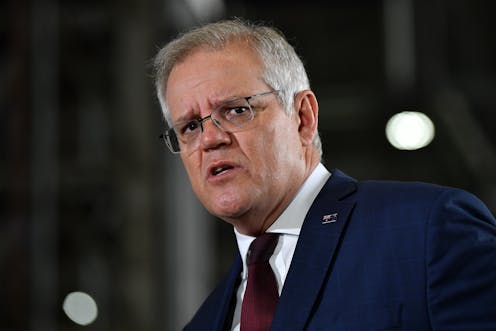
Boris Johnson enthused about the Morrison government’s belated embrace of the 2050 net-zero target. “They’ve done a heroic thing, the Australians, in getting to that commitment,” Johnson said.

“[It] was actually very difficult for Australia to do … because Australia is very heavily dependent on coal and on lots of carbon-producing industries.”

Scott Morrison relished the British PM’s praise. “Heroic” could, however, be applied to the plan he and energy minister Angus Taylor released on Tuesday in a less gushing sense.

That plan relies on many “heroic” assumptions which may or may not turn out to be reasonable.

Of course given the three-decade timeframe, any roadmap must be open to question, because it is impossible to accurately predict that far ahead. But the fine detail of the plan’s assumptions is important, and the government has yet to release the modelling.

The plan, which doesn’t contain new policy, is constructed on a narrative which can be more easily and immediately judged, and that narrative is false.

Morrison’s claim the plan is based on “technology not taxes” is sophistry, designed for political warfare rather than policy truth-telling.

The “technology” side is correct enough, but “taxes” are very much there. The government boasts of the multi-billions it is investing to drive the technology. This involves taxpayer funds.

Indeed in its reaction to the plan, the Carbon Market Institute lamented that “the taxpayer rather than business will remain the main driver with $20 billion earmarked to underwrite the transition”.


Read more:
Morrison’s climate plan has 35% 2030 emissions reduction ‘projection’ but modelling underpinning 2050 target yet to be released


Morrison also likes to give the impression this massive transformation to a cleaner economy can be a relatively painless exercise. But this too is misleading.

We obviously must make the change to a low emissions future, for environmental and economic reasons, and there will be many opportunities, in the form of new industries and jobs, produced by it. But there will be costs – for industries, businesses and individuals.

There’s a useful comparison with Australia’s slashing of tariffs in the 1980s and early 1990s.

As is happening with net-zero, the world was the whip hand, forcing Australia to open and reform. The resulting structural changes brought lasting benefits for the economy and for households.

But in the process, certain industries faded, businesses failed and workers lost jobs. Some people retrained; others never got back on their feet. Inevitably, big economic restructurings have winners and losers, the old story of pain as well as gain.

Morrison doesn’t focus publicly on the losers but the Nationals do. Climate change denialism drives the attitudes of some Nationals, but they are also deeply worried about the reaction of their base in mining areas in particular.

After noisily pursuing a package of safeguards and trade offs, what the Nationals have obtained remains unclear.


Read more:
View from The Hill: Will Barnaby Joyce be less ‘on board’ with net zero when he’s in the backblocks?


There will be a Productivity Commission review of the plan’s progress every five years. And the minor Coalition party has obtained an extra seat in cabinet.

Beyond that, Nationals sources selling the agreement point to two things. The first is that the plan is not to be legislated, and does not envisage government action to shut down coal or any other resource industry. The fate of those industries is left to the market.

Secondly, they say a number of specific measures are in the pipeline for later announcement.

Delaying these announcements does seem an odd tactic after the Nationals made so much of needing visible safeguards. It’s not really explained by the line that there are cabinet processes to be gone through.

The messy spectacle of nailing down Nationals’ agreement to the plan has delivered a hit to Barnaby Joyce, who becomes acting PM after Morrison leaves for the G20 and Glasgow late Thursday.

Joyce’s angst is obvious, as he’s painfully caught between his past vocal rejection of net-zero and his current forced public acceptance of it.

He struggled, with the prime minister and with his colleagues, during the Coalition negotiations. He struggles in question time. And he will struggle as he campaigns to hold Nationals seats in Queensland.

Boris Johnson’s effusiveness about Australia suggests he is easing the way for Morrison at Glasgow next week. Australia’s 2030 position – taking an updated “projection” rather than an updated “target” – may attract some negativity, because 2030 has become the main focus of COP26. On the other hand, Australia is a bit player.


Read more:
Coalition drops in Newspoll; Australia “not doing enough” response on climate change falls


Now that the government’s plan, inadequate as it might be, is out, attention will turn to Labor.

Anthony Albanese has understandably waited until after Glasgow to release the opposition’s policy. He can’t credibly avoid the moment much longer.

In general, Labor doesn’t have much policy in the public arena. If it is as serious about the climate issue as it claims, it needs to get an alternative out before Christmas.

Labor can easily promise to legislate targets. Beyond that, for Albanese the challenge is to position the opposition’s policy so it is distinct from the Coalition’s – which means being more ambitious – but not so radical that it makes Labor a dangerously big target.

Finding that sweet spot will be tricky for Albanese, especially if there are some internal differences about precisely where it is.

The Conversation

Michelle Grattan does not work for, consult, own shares in or receive funding from any company or organisation that would benefit from this article, and has disclosed no relevant affiliations beyond their academic appointment.

ref. View from The Hill: Morrison’s net-zero plan is built more on politics than detailed policy – https://theconversation.com/view-from-the-hill-morrisons-net-zero-plan-is-built-more-on-politics-than-detailed-policy-170669

Politics with Michelle Grattan: Scott Morrison’s (thin) climate plan for Glasgow

Source: The Conversation (Au and NZ) – By Michelle Grattan, Professorial Fellow, University of Canberra

As well as Michelle Grattan’s usual interviews with experts and politicians about the news of the day, Politics with Michelle Grattan now includes “Word from The Hill”, where all things political will be discussed with members of The Conversation’s politics team.

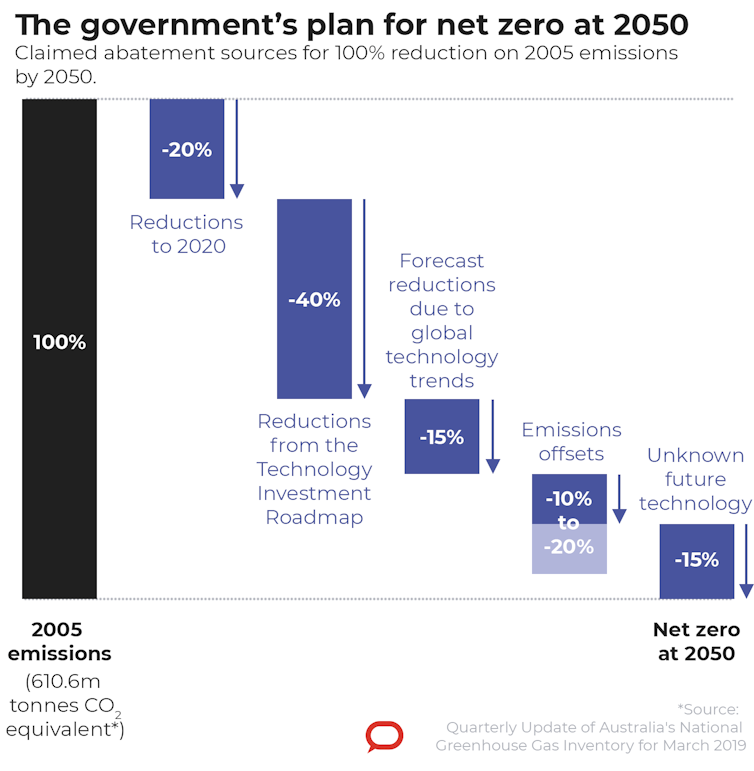
In this week’s episode, they canvass the government’s plan, released on Tuesday, to get to net-zero emissions reduction by 2050. It relies overwhelmingly on technology, some of which is yet to be developed. Scott Morrison’s mantra is “technology not taxes” but his plan spends a lot of taxpayer money to drive his technology journey.

The experts are already sceptical about the plan’s thinness, and the detailed modelling is still to come. Meanwhile, after all that Coalition agonising, the safeguards the Nationals obtained remain mostly under wraps.

The Conversation

Michelle Grattan does not work for, consult, own shares in or receive funding from any company or organisation that would benefit from this article, and has disclosed no relevant affiliations beyond their academic appointment.

ref. Politics with Michelle Grattan: Scott Morrison’s (thin) climate plan for Glasgow – https://theconversation.com/politics-with-michelle-grattan-scott-morrisons-thin-climate-plan-for-glasgow-170652

Word from The Hill: Scott Morrison’s (thin) climate plan for Glasgow

Source: The Conversation (Au and NZ) – By Michelle Grattan, Professorial Fellow, University of Canberra

As well as Michelle Grattan’s usual interviews with experts and politicians about the news of the day, Politics with Michelle Grattan now includes “Word from The Hill”, where all things political will be discussed with members of The Conversation’s politics team.

In this week’s episode, they canvass the government’s plan, released on Tuesday, to get to net-zero emissions reduction by 2050. It relies overwhelmingly on technology, some of which is yet to be developed. Scott Morrison’s mantra is “technology not taxes” but his plan spends a lot of taxpayer money to drive his technology journey.

The experts are already sceptical about the plan’s thinness, and the detailed modelling is still to come. Meanwhile, after all that Coalition agonising, the safeguards the Nationals obtained remain mostly under wraps.

The Conversation

Michelle Grattan does not work for, consult, own shares in or receive funding from any company or organisation that would benefit from this article, and has disclosed no relevant affiliations beyond their academic appointment.

ref. Word from The Hill: Scott Morrison’s (thin) climate plan for Glasgow – https://theconversation.com/word-from-the-hill-scott-morrisons-thin-climate-plan-for-glasgow-170652

‘Illegal, dishonest, unethical and exploitative’ – but Crown Resorts keeps its Melbourne casino licence

Source: The Conversation (Au and NZ) – By Charles Livingstone, Associate Professor, School of Public Health and Preventive Medicine, Monash University

Shutterstock

The report of Victoria’s Royal Commission into Melbourne’s casino has been made public. It has found the behaviour of the casino’s operator, Crown Resorts to be “disgraceful”, with practices that have been “variously illegal, dishonest, unethical and exploitative”.

But royal commissioner Ray Finkelstein has also decided the economic effects of Crown losing its licence, the impact on innocent parties, and the company’s belated attempts at rehabilitation mean it should keep its casino licence – at least for now.

The Victorian government has accepted this recommendation. It will appoint a “special manager” – Stephen O’Bryan QC, a former commissioner with the state’s anti-corruption commission – to oversee the casino’s operations over the next two years.

After two years O’Bryan will prepare a report for the new gambling regulator the Victorian government will establish in response to the deficiencies identified with the Victorian Commission for Gambling and Liquor Regulation. The new beefed-up regulator, to be known as the Victorian Gambling and Casino Control Commission, will then decide if Crown keeps its licence.

The government has also announced it will repeal provisions enabling Crown to be compensated for any regulatory changes affecting its business. It will also increase the maximum penalty for breaches of the Casino Control Act from A$1 million to A$100 million.

This is all good. But all these things should, of course, have been in place far earlier.

It is the failure of regulation, and the politics that sit behind it, that made the Crown Melbourne debacle possible, and perhaps inevitable.

As with other gambling businesses, Crown’s political influence has been significant, and a key feature of its business model.

Politically and socially well connected directors and staff were recruited, clearly with an eye to their ability to influence governments. Their aim, it seems, was to make Crown too big to be regulated. They seem to have succeeded.


Read more:
Crown Resorts is not too big to fail. It has failed already


Recommendations kicked down the road

Beyond the government’s headline announcements, some of Commissioner Finkelstein’s key recommendations have been kicked down the road – until next year, at least. These include those addressing money laundering, and changes to the operator’s structure. The latter relate to reductions in maximum shareholdings, and the independence of the board and senior management.

Also deferred is any response to the recommendations focused on gambling harm prevention and minimisation. Many in favour of gambling reform will be encouraged by Finkelstein’s focus on these. The government says it accepts all his recommendations, but exactly how it will act on them requires “further detailed analysis and consultation”.

Finkelstein focused on the harms of gambling, finding that:

Crown Melbourne had for years held itself out as having a world’s best approach to problem gambling. Nothing can be further from the truth.

His recommendations to improve Crown’s paltry “responsible gambling” program are far reaching and significant. They include implementing a comprehensive pre-commitment system, requiring gamblers to establish accounts and set limits of time and money. This would establish an effective self-exclusion system for the first time, in which those struggling with gambling would be able to ban themselves from gambling without the possibility of easily revoking that arrangement.

Australia’s Productivity Commission recommended a pre-commitment system in its 2010 report on gambling. The Gillard government was set to implement that recommendation, but ClubsNSW spearheaded a successful campaign to sink the plan.

The gambling lobby will no doubt be keenly interested in how the Victorian government responds to Finkelstein’s recommendation, which goes further than the Productivity Commission by recommending a default loss limit and regulated breaks in use.

Reversing the ‘responsible gambling’ discourse

Finkelstein’s report recommends the casino also have “a duty to take all reasonable steps to prevent and minimise harm from gambling”. This effectively reverses the “responsible gambling” discourse which puts the onus on gamblers – and arguably blames them for harming themselves. Such a change, if well implemented, has the potential to finally make harm prevention a high priority in gaming regulation.

The report also recommends that casino data be made available for proper research purposes. It points out the importance, and difficulty, of obtaining such data. Without it, evaluating the casino’s personal and social impacts is virtually impossible. This too would be a big step forward in harm prevention and reduction efforts. It could also help with anti money-laundering endeavours.


Read more:
Responsible gambling – a bright shining lie Crown Resorts and others can no longer hide behind


A blueprint for wider regulation

Assuming its board and executives have the nous to clean up the business to the necessary standard, Crown Resorts will get to keep its Melbourne casino. This will shock many, given what has transpired.

Political will is needed. The outcome may be that a powerful and harmful gambling business is cleaned up. Or the situation may revert to business as usual – the default position for gambling regulation. This depends on what the Victorian government does with the recommendations on which it has postponed action.


Read more:
The Crown allegations show the repeated failures of our gambling regulators


Most of the money Victorians (and Australians) gamble away is through poker machines in local clubs and pubs. The Finkelstein royal commission has provided an important blueprint to tackle that gambling harm, too. The Victorian government could lead the way by extending Finkelstein’s recommendations to all gambling businesses. No business, or sector, should be too big to be regulated.

The Conversation

Charles Livingstone has received funding from the Victorian Responsible Gambling Foundation, the (former) Victorian Gambling Research Panel, and the South Australian Independent Gambling Authority (the funds for which were derived from hypothecation of gambling tax revenue to research purposes), from the Australian and New Zealand School of Government and the Foundation for Alcohol Research and Education, and from non-government organisations for research into multiple aspects of poker machine gambling, including regulatory reform, existing harm minimisation practices, and technical characteristics of gambling forms. He has received travel and co-operation grants from the Alberta Problem Gambling Research Institute, the Finnish Institute for Public Health, the Finnish Alcohol Research Foundation, the Ontario Problem Gambling Research Committee, and the Problem Gambling Foundation of New Zealand. He was a Chief Investigator on an Australian Research Council funded project researching mechanisms of influence on government by the tobacco, alcohol and gambling industries. He has undertaken consultancy research for local governments and non-government organisations in Australia and the UK seeking to restrict or reduce the concentration of poker machines and gambling impacts, and was a member of the Australian government’s Ministerial Expert Advisory Group on Gambling in 2010-11. He is a member of the Australian Greens.

ref. ‘Illegal, dishonest, unethical and exploitative’ – but Crown Resorts keeps its Melbourne casino licence – https://theconversation.com/illegal-dishonest-unethical-and-exploitative-but-crown-resorts-keeps-its-melbourne-casino-licence-170625

Between the lines, Morrison’s plan has coal on the way out, with the future bright

Source: The Conversation (Au and NZ) – By John Quiggin, Professor, School of Economics, The University of Queensland

Masmikha/Shutterstock

The most striking feature of Prime Minister Scott Morrison’s long-term emissions reduction plan outlined on Tuesday is not the long-telegraphed commitment to net-zero emissions by 2050, or the promise of a A$20 billion clean energy program (around 0.2% of national income annually).

It is the announcement of a technology target which is entirely outside the government’s control: solar photovoltaic electricity at a cost of A$15 a megawatt-hour ($/MWh).

That price translates to 1.5 cents per kilowatt hour (c/kWh), a tiny fraction of the 20 to 30 (c/kWh) currently being paid by Australian households. Most of the price households pay consists of charges for transmission, distribution and retail services.

The Australian government cannot deliver (or even significantly obstruct) this target, any more than Australia, acting alone, can much effect the global climate.

But it’s easy to see Mr Morrison is on safe ground in setting ultra-cheap solar photovoltaic electricity as his goal.

That’s because the world is almost there.

Long-term solar power supply contracts in many countries are being settled at prices of less than A$0.02 c/kWh and prices are continuing to fall.

Reductions in the cost of solar modules, inverters and the like are being driven by a massive global industry, with an annual turnover of more than $A200 billion a year, and correspondingly huge research and development budgets.


Read more:
Morrison’s climate plan has 35% 2030 emissions reduction ‘projection’ but modelling underpinning 2050 target yet to be released


The programs announced today might help to accelerate progress a little, but they are part of a massive global effort.

Equally critical, and less subject to government control, is the global decline in long-term real interest rates which are now zero or negative, even over terms of 30 years, more than the expected life of a solar plant.

A zero real interest rate, combined with near-zero operating costs means a solar plant only needs to generate enough electricity over its lifetime to pay for its initial installation cost.

Solar electricity now costs very little

Utility-scale solar can now be installed at a cost of less than $A1/watt or $A1,000/kWh.

In favourable locations, such as those in most parts of Australia, solar cells can deliver the 2,000 hours of full power per year, over a lifetime of 25 years. That’s 50,000 kWh, implying a cost of A$0.02 c/kWh.

We can expect to see such prices appearing in contracts very soon, as the ultra-low cost of capital is factored into calculations of returns. Technological progress will get us the rest of the way to Morrison’s target.

This remains about as true even when we take account of the need for energy storage, to ensure electricity generated at the midday supply peak can be shifted to meet the demand peak in the early evening and to meet the much lower night-time need (sometimes called “baseload”). The costs of batteries are declining in the same way as solar cells.


Read more:
Australia’s stumbling, last-minute dash for climate respectability doesn’t negate a decade of abject failure


What are the implications for the Australian coal industry? It’s already clear new coal-fired power is uneconomic in competition with solar and wind power, and most countries have stopped commissioning new generators.

The exceptions, including those in China, reflect the desire of provincial governments to keep capital investment going, rather than a calculation of costs and benefits.

But as the price of solar falls, even the existing paid-for plants will become uneconomic, unless the price of coal falls drastically.

Brutal arithmetic

The arithmetic is brutal. One tonne of high-grade thermal coal is sufficient to generate 2-3 MWh of electricity.

In a market where the price is set by competition from solar at A$15/MWh, that would yield revenue A$30-45/tonne, out of which has to come the costs of maintaining and operating an ageing coal-power plant, as well as the cost of mining and shipping the coal.

At the moment thermal coal costs in excess of US$180 per tonne.

Steel will one day be produced without coal.
Shestakov Dmytro/Shutterstock

Add to that the fact China is in the process of introducing a carbon price, and it’s clear the achievement of Morrison’s solar electricity price target will spell the end of thermal coal. A similar analysis applies to gas.

“Green” hydrogen, produced by cheap electrolysis, could do the same for coking coal, as well as undercutting “blue” hydrogen produced from gas.

That won’t happen immediately. In the very short term in places such as China, growth in electricity demand is outpacing installations of solar and wind, pushing coal prices high.

And carbon-free steel is some way off.

When the global demand for coal does declines, it will be higher-cost and lower-quality producers such as those in Indonesia that will feel it before Australia’s.

But the idea Australia will still be exporting significant quantities of coal in 2040 — let alone 2050 — is a fantasy.

The broader story delivered by Morrison (and the right one) is a story of optimism.

Coal on way out, future bright

Instead of the alarmist scenarios of $100 roasts and economic catastrophe still being pushed by opponents of action, we are at a point where we can safely predict we will have more than enough ultra-cheap, pollution-free electricity to power homes, vehicles and most kinds of industry.

All that’s needed is the courage to embrace it.

It will require more than we have seen from our leaders so far.


Read more:
The Nationals finally agree to a 2050 net-zero target, but the real decisions on Australia’s emissions are happening elsewhere


We need to accelerate the transition away from coal-fired electricity and internal combustion vehicles, starting immediately.

The internal politics of the LNP might have stopped Morrison from announcing a serious target for emissions reductions by 2030, but there is no reason we couldn’t reduce emissions by 50% or more, while setting a course for a more prosperous and sustainable future.

The Conversation

John Quiggin is a former Member of the Climate Change Authority

ref. Between the lines, Morrison’s plan has coal on the way out, with the future bright – https://theconversation.com/between-the-lines-morrisons-plan-has-coal-on-the-way-out-with-the-future-bright-170643

The government wants to expand the ‘digital identity’ system that lets Australians access services. There are many potential pitfalls

Source: The Conversation (Au and NZ) – By Kelsie Nabben, Researcher / PhD Candidate, RMIT Blockchain Innovation Hub / Digital Ethnography Research Centre, RMIT University

Rodion Kutsaev/Unsplash, CC BY-SA

The federal government has been asking the public for feedback on proposed legislation to create a “trusted digital identity” system. The aim is for Australians to use it to prove their identity when accessing public services.

I first found out about the draft Trusted Digital Identity Bill not through my research at the intersection of society and technology, but through my mother-in-law. She found out about it in private social media channels, and her local women’s group was seeking support to craft their feedback, which emphasises concern for privacy and civil liberties in Australia.

After asking around among major stakeholders, it seems this piece of legislation has largely slipped under the radar since it was unveiled on October 1.

But what will a national digital identity system actually involve, who will it serve, and if we need it, how should it be implemented?


Read more:
Australia’s National Digital ID is here, but the government’s not talking about it


What does ‘digital identity’ mean?

The government’s proposed Digital Identity system promises a “safe, secure and convenient way to prove who you are online every time you access government services”. In other words, it aims to streamline your experience by avoiding the need to repeatedly identify yourself when accessing a range of government services.

Currently, you can create a digital identity using a “myGovID” to access 80 government services. This allows you to link your data across services such as Medicare, Centrelink and the Australian Tax Office. The new legislation proposes an expansion of powers to outsource the process of identity verification to approved Australian businesses. Presumably, this could lead to an expansion of acceptance of the digital ID system so it can be used more widely than just to access government services.

This would be done by linking your MyGov account on the MyGovID smartphone app, and providing an existing identity document (such as a passport, driver’s licence or birth certificate), to an identity provider. Under the proposal, any Australian business can apply to join the “Trusted Digital Identity Framework” to become an identity accreditor. The legislation would establish an agency to oversee these accreditations, and to govern how data will be handled in the scheme. The technical standards of the proposed scheme have not yet been published.

But this goes against all the standard advice about not linking all of your personal information, such as tax history and medical history, as it can lead to mass analytics, behaviour profiling, targeted advertising, and more (as we saw in the Cambridge Analytica scandal).

The proposal also comes amid the ongoing “datafication” of the population, which has been turbocharged by the COVID pandemic. Digital rights advocacy groups have already voiced alarm at the mass collection, collation and storage of personal data, often on a mandatory basis, using hastily implemented platforms such as contact-tracing apps.

Without a careful and measured approach, the digital identity proposal risks repeating the same mistakes.

The government says the proposed digital identity system will be entirely voluntary, and that the system is not designed to replace identification documents such as your birth certificate, visa, driver’s licence or passport.

It also says the system will not be used to access or record COVID vaccinations, and that the information collected will not be used for purposes such as consumer profiling or marketing.

Of course, Australians who opt to use the system are being asked to put their trust in the government to share their data with “verified” identity providers.

Ironically enough, there are quite a few issues that still need to be resolved before Australians can place their trust in the government’s plan to issue them with a “trusted digital identity”.

Potential pitfalls

I have several concerns about the government’s digital identity legislation in its current form.

  • It is opaque on details, particularly with regard to the proposed use of new technologies such as biometric matching (using biological characteristics to identity an individual) and automated decision-making.

  • It potentially creates a “honeypot” of personal data stored in a centralised database that would offer a tempting target for cyber criminals or hostile nations. The government has promised the data will be “private and secure and protected by strict security protocols”. But government databases have suffered numerous previous hacks, such as the “cybersecurity incident” last year that led to the Australian Defence Force’s recruitment records being offline for ten days.

  • It’s not clear how the trustworthiness of third-party identity verification providers who store these data will be verified and guaranteed, or what recourse would be available in the event of a breach.

  • There is a potential lack of accountability for third-party access, onselling, and monetisation of data – precisely the problem that has blighted our relationship with Big Tech over the past few years.

  • The establishment of a centralised “oversight authority” is an archaic approach that disempowers individuals from owning their personal information.

Australians can’t simply disengage from digitisation. But rather than blithely hand over our data, we should think carefully and collectively about the long-term effects of creating national, centralised databases of sensitive personal information.

The digital infrastructure to own and control access to our own digital identity already exists. Blockchain communities have built it; it’s time we used it.


Read more:
The COVIDSafe app was just one contact tracing option. These alternatives guarantee more privacy


Hope for alternatives

Senator Andrew Bragg last week tabled the final report of the Senate Select Committee on Australia as a Technology and Financial Centre. It recommends Australia embrace technologies such as blockchain and decentralised computing, in a bid to become an international hub for financial technology.

Despite this, there is still no apparent appetite to use this technology to encrypt the data stored by our domestic public services. Contrast that with Estonia, an international leader in digitisation, which maintains an immutable blockchain-based record of who in government has accessed medical health records.


Read more:
What Australia can learn about e-government from Estonia


Leaving aside the question of whether a digital identity system is even necessary or desirable, perhaps the biggest disappointment about the current legislation is the lack of creativity about data governance to determine how the system could be more safely implemented.

I’m not saying “don’t trust the government with your data”. What I am saying is that the digital identity data should be regarded as critical national infrastructure, and protected as such by giving people the ability to own their identity.

The broader context here is not one of legislation or technological architecture. It is a social question of collectively defining what a digital Australia should look like in the long term, and making it one that serves the public interest. Citizens should be able to own and govern their personal information with confidence, both now and into the future.


The opportunity for individuals and organisations to respond to the Digital Identity Bill closes on October 27.

The Conversation

Kelsie Nabben receives funding from RMIT University as a PhD student. She is a Board member of industry association Blockchain Australia.

ref. The government wants to expand the ‘digital identity’ system that lets Australians access services. There are many potential pitfalls – https://theconversation.com/the-government-wants-to-expand-the-digital-identity-system-that-lets-australians-access-services-there-are-many-potential-pitfalls-170550

Victoria’s draft pandemic law misses one critical element – stronger oversight of the government’s decisions

Source: The Conversation (Au and NZ) – By William Partlett, Associate Professor, The University of Melbourne

The Victorian government is introducing a pandemic management bill that will structure its ongoing and future response to pandemics.

According to a draft dated October 23, the bill gives the executive wide powers in the time of a pandemic, including detention powers and the possibility of two years in prison for failing to comply with a pandemic order.

But drawing on the practice in other jurisdictions such as NSW and NZ, it also seeks to create safeguards on these powers. Perhaps the best example is the transfer of decision-making power from the unelected chief health officer to the health minister, who is responsible to parliament.

In one critical way, however, the bill rejects a key parliamentary safeguard that is used in NSW and NZ. Instead of creating a dedicated cross-party parliamentary committee to oversee the exercise of these broad public health powers, it creates an executive-appointed oversight committee for this purpose.

The use of an appointed committee to oversee these powers is a problematic departure from the usual role of parliamentary committees in the scrutiny of executive governance. To ensure a fuller set of safeguards, dedicated parliamentary oversight should be created alongside that of an appointed committee.


Read more:
As Melbourne cautiously opens up today, what lies ahead?


What the bill would do

Victoria’s draft bill comes at an important time. It is the first fit-for-purpose law in Australia seeking permanently to structure the way a state or territory government should respond to a pandemic.

It provides the Victorian premier with extraordinary power to make pandemic declarations and extend them for “three months at a time, with no outer limit on the total duration of a declaration”. Once in place, the health minister has broad powers to issue “pandemic orders”; failure to comply could lead to two years in prison.

Some of the bill’s provisions respond to the need to balance democratic accountability with an emergency pandemic response. This is particularly so with those creating protections on people’s privacy when checking in with QR codes, and ensuring more transparency in the government’s decision-making process.

But the bill breaks significantly with Australian democratic tradition in one key way. It gives the health minister the power to reinstate a pandemic order that has been disallowed by a key parliamentary committee. Moreover, it gives oversight of these pandemic powers to an appointed non-parliamentary committee.

The creation of this kind of specialised committee (made up of public health and human rights experts) is a good idea. But it should not replace oversight by a dedicated cross-party parliamentary committee. The makeup, powers, and funding of parliamentary scrutiny bodies are well established in Australia, having been part of our parliamentary governance for more than a century.

By contrast, the specialised committee created in this bill is largely advisory. It is fully appointed by the Victorian government and, according to the draft legislation, has no statutory powers to ensure its oversight role (such as guaranteed funding or the power to compel testimony).

This appointed committee should not replace specialised parliamentary scrutiny. In fact, the Human Rights Law Centre actually recommended establishing an independent committee of this type alongside a “dedicated cross-party parliamentary committee” in a recent report.


Read more:
Explainer: why is the Victorian government extending the state of emergency, and is it justified?


The importance of parliamentary checks and balances

Unlike many other liberal democracies, such as the United States or Germany, which have constitutional bills of rights, Australia does not have strong judicial checks on government overreach.

Instead, Australia’s liberal democracy relies heavily on political checks and balances contained within parliamentary oversight of the executive branch.

The elected upper houses of parliaments have emerged as key institutions in this oversight, developing cross-party committees at both the national and state level that oversee the executive branch’s implementation of the law.

The pandemic has undermined this parliamentary oversight at all levels of Australian government. This has been particularly noticeable at the state level, where premiers and health officials have used broad emergency powers to close state borders and issue stay-at-home orders.

These powers have often been issued with minimal parliamentary scrutiny. For instance, at times, parliaments have been suspended for health reasons.

How NSW and New Zealand have established oversight

This shift toward executive governance at the state level is understandable on a short-term basis, as the pandemic requires rapid and flexible policymaking that is simply not possible through parliamentary process.

But some jurisdictions have recently figured out ways of ensuring parliamentary scrutiny even during a pandemic state of emergency.

In response to pressure from opposition parties (particularly the Greens) in NSW, for example, the upper house of parliament created a permanent oversight committee of the executive’s pandemic response. This body live-streams and records its oversight hearings on YouTube.

New Zealand, with a similar tradition of parliamentary checks on executive overreach, also created a specialised parliamentary oversight body at the beginning of the pandemic. This was led by the leader of the opposition and live-streamed its hearings.

These bodies are underpinned by the idea that when operating at such speed, mistakes are sometimes made.

To date, Victoria has not yet followed this trend toward specialised parliamentary oversight of the government’s pandemic response. Instead, it has taken the route of external, independent review. The best example is the judicial inquiry into the staffing of quarantine hotels prior to Victoria’s devastating second wave in 2020.


Read more:
Expanding Victoria’s police powers without robust, independent oversight is a dangerous idea


Where to from here?

As the proposed bill is debated in parliament, the government must answer a key question: why depart from this practice of emergency parliamentary oversight and instead choose review by a wholly appointed and weak independent committee?

Given the vast powers given here, there appears to be little justification. The bill should therefore be amended to include cross-parliamentary oversight alongside independent oversight.

This will not only better accord with Australia’s democratic traditions, it will also better preserve trust between government and the people – a critical resource in any pandemic response.

The Conversation

William Partlett does not work for, consult, own shares in or receive funding from any company or organisation that would benefit from this article, and has disclosed no relevant affiliations beyond their academic appointment.

ref. Victoria’s draft pandemic law misses one critical element – stronger oversight of the government’s decisions – https://theconversation.com/victorias-draft-pandemic-law-misses-one-critical-element-stronger-oversight-of-the-governments-decisions-170623

What makes a good literary hoax? A political point, for starters

Source: The Conversation (Au and NZ) – By Camilla Nelson, Associate Professor in Media, University of Notre Dame Australia

Spanish authors (from left), Agustin Martinez, Jorge Diaz and Antonio Mercero, who have been writing bestsellers as Carmen Mola. Quique Garcia/EPA

Literary hoaxes thrive on exposure. At best, they are politically transgressive. They strip away anything smug, pretentious or hypocritical to reveal an uglier reality underneath.

Hoaxes may use ethically questionable methods. But when they work, they tell us something about the relationship of art to life and politics. It’s the literary equivalent of Banksy shredding an artwork at Sotheby’s as the hammer came down.

If they don’t, then we should question if they deserve to be called a hoax at all.

Recently, hoaxes were in the headlines when three men leapt onto a Barcelona stage to accept a million euro literary prize awarded by the publishing house, Planeta – “unmasking” themselves as the Spanish writer, Carmen Mola in the process. “Mola”, a bestselling crime author, won the Euro prize for La Bestia – The Beast – a thriller about a serial killer stalking Madrid in the midst of a cholera epidemic.

Cue global shock, followed by shrugs from authors, publishers and critics. So far, the fury has centred on who is allowed to write what, and why. However author Margaret Atwood crisply and correctly called the unveiling a “a great publicity stunt”. This hoax was embarrassing and high profile. But it was also unoriginal and apolitical.

The men behind Mola said they were tired of lying. But might claiming a lucrative, prestigious prize – and a bit of ego – also have been a factor in unmasking themselves?

Margaret Atwood: described the invention of Carmen Nola as a publicity stunt.
Jordan Strauss/AP

Pen name politics

The Mola hoax infuriated many because the authors, who wrote a trilogy of ultra-violent novels starring a female detective, Inspector Elena Blanco, had generated a backstory that was more than a pseudonym. It was an identity. It was also stereotypically gendered.

Mola, which roughly translates as “Carmen the cool” in English, claimed she was an academic who kept her writing career a secret because she was bashful about the allegedly transgressive subject matter.

“I didn’t want my colleagues at the office, my sisters-in-law or my mother to know that I wrote a book where someone kills a woman by getting larva worms into her skull,” Mola said in an emailed interview. Email and claims of reclusiveness are the modus operandi for managing publicity arrangements for a problematic identity.

Lawyer and former director of the Women’s Institute in Spain, Beatriz Gimeno, tweeted that the authors had propagated the persona of a woman through email interviews for years, for financial gain. Another commenter called it gender bending “catfishing”.

According to Spanish journalist, Maria Ramirez, a Madrid feminist bookstore is now refusing to sell the Mola books on principle that “men don’t take all the space”. Historically female authors have been forced to use male pseudonyms to be published to fight for this space.


Read more:
Reclaim Her Name: why we should free Australia’s female novelists from their male pseudonyms


Did the authors see themselves as taking a poke at the history of women’s writing or gender oppression? No. They reportedly said they chose the name by chance and for fun and there was no politics associated with their choice of a woman. “Choosing a woman’s name was not a thought out thing, we don’t want to send any message. We could have put R2-D2 on it,” they said.

In Australia, in the 1940s, Dymphna Cusack and Florence James used the male pseudonym, Sydney Wyborne, to win a newspaper competition for an unpublished manuscript. They make an interesting comparison to the Mola case. Sadly, once unmasked, the prize was withdrawn. They didn’t get the money or the publishing contract.

Their book wasn’t published until 1951, under the new name Come in Spinner, by another publisher. According to Cusack, the delay was complicated by obscenity laws at the time, and editors’ resistance to publishing the women under their two real names.

Asking questions

A true hoax provokes. It questions cultural biases, shatters conventions, leaving fragments for discussion that linger for years, if not centuries.

Daniel Defoe’s Robinson Crusoe, for instance, is widely credited as the first realist English novel but it was initially read as a “true history” when published in 1719, under Crusoe’s name. The first novel, or one of the first fake memoir hoaxes? This is a conversation that continues.

Fast forward to 2006, when the Australian newspaper launched a “sting” on Australian publishers. The article was titled, “Would a manuscript from the 1973 Nobel laureate pass muster today?” A chapter of Patrick White’s Nobel prize winning novel, The Eye of the Storm, was sent to publishers under a pen name that was an anagram of Patrick White: Wraith Picket. The idea was copied from a similar sting by The Times of London, using writing by V.S. Naipaul.

Furious publishers who rejected White’s manuscript said they were not given enough of the book to make a decision and it was sloppily presented. This simple hoax was in the tradition of the fictional Australian poet from the 1940s Ern Malley. It made a cultural point – much of the book world is driven by rank commercialism and passing fads. An editorial eye is hit and miss.

Less salubrious – and more obvious – are the cultural commentary hoaxes on the saleability of sex romps, from a 1970s satire of the writing of Harold Robbins to a more recent parody of the writing style of 50 Shades of Grey.

Intercultural thefts are a separate matter. They aren’t hoaxes. They are harmful appropriations. Most commonly, such theft is committed by a dominant culture and the victim is the literary heritage of an oppressed minority.

This sorry history includes the so called “Virago Vicar”; an Anglican vicar named Toby Forward who published a collection of stories with the British feminist publishing house Virago under the pseudonym Rahila Khan.

Identity theft involving non-fiction forms or memoir is beyond this category – it belongs in the realm of fake news and “alternative facts”.

One interesting theft that keeps everybody talking – and may well endure – is the case of writer “Jeremiah Terminator Leroy”; a New York based television writer named Laura Albert who adopted the persona of a queer male sex worker from West Virginia, whose novels gave rise to a cult following. Albert convinced her sister-in-law Savannah Knoop to play the part of the reclusive author at book and other celebrity events.

The Mola men’s best defence might be that collaborations are rarely rewarded in the publishing world and they aimed to explode that status quo. But they have made little of this, other than mentioning how they “combined their talents” to write their crime trilogy along with this new novel.

Planeta, meanwhile, are expected to honour both the publishing deal for La Bestia and the lucrative associated TV adaptation of the Blanco trilogy under the Carmen Mola name. Filming starts in January.

The Conversation

The authors do not work for, consult, own shares in or receive funding from any company or organization that would benefit from this article, and have disclosed no relevant affiliations beyond their academic appointment.

ref. What makes a good literary hoax? A political point, for starters – https://theconversation.com/what-makes-a-good-literary-hoax-a-political-point-for-starters-170538

How much do marine heatwaves cost? The economic losses amount to billions and billions of dollars

Source: The Conversation (Au and NZ) – By Alistair Hobday, Senior Principal Research Scientist – Oceans and Atmosphere, CSIRO

Shutterstock

Marine heatwaves are catastrophic impacts of climate change many of us are already familiar with. But how much do they cost society?

During marine heatwaves, ocean temperatures can become so high that many species become stressed, or die. Critical coastal habitats, such as seagrass meadows, corals and kelp forests, can die out, limiting their natural capacity to store carbon dioxide and disrupting fisheries and tourism.

Until now, we’ve not understood how much society loses during marine heatwaves. This is what our new research, published in Science, sought to find out.

We looked at 34 marine heatwaves worldwide, and found one event in 2016 in southern Chile cost more than US$800 million (A$1.07 billion) in direct losses to aquaculture (cultivating aquatic plants and animals for food). Another heatwave in Shark Bay, Western Australia, resulted in US$3.1 billion (A$4.14 billion) per year in indirect losses, as a result of lost carbon storage when seagrass beds were impacted.

As world leaders prepare to meet for COP26 in Glasgow, they must keep these intensifying marine heatwaves front of mind. They are not only a stress test for the ocean’s ecosystems, but also for millions of people who rely on them – and who are already suffering.

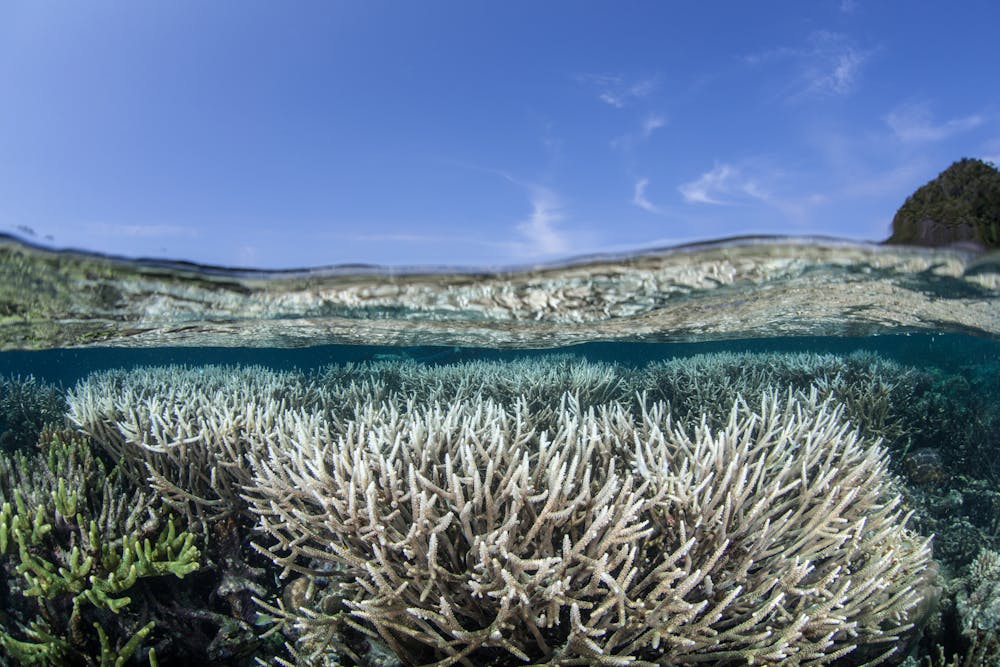
Coral is a ‘foundation’ species. Losing coral means the entire ecosystem is under threat.
Shutterstock

Marine heatwaves can strike anywhere

Marine heatwaves are defined as prolonged periods of very warm surface water temperatures that commonly last for weeks to months. Climate change has caused surface waters to warm at an average rate of 0.15℃ per decade over the past 40 years, leading to longer and more frequent heatwaves. Eight of the ten most severe events ever recorded took place in the past decade alone.

They can occur in any ocean for two reasons: heat entering the ocean via the atmosphere, or via ocean currents that bring warmer waters. When both processes occur together, they lead to heatwaves with even higher temperatures.

Heatwaves lead to major economic losses because they modify the ocean’s “ecosystem services” – the range of benefits healthy marine ecosystems provide to humans.


Read more:
Marine heatwaves during winter could have dire impacts on New Zealand fisheries and herald more summer storms


For example, fishers, aquaculturalists, and tourism operators all rely on “foundation” species – such as corals, kelps and seagrasses – because they provide habitat for a range of creatures.

When a marine heatwave destroys a foundation species, like we’ve seen in the recent, back-to-back coral bleaching events in Australia’s Great Barrier Reef, then the whole ecosystem suffers, and the knock-on socio-economic consequences can run into billions of dollars.

Coral bleaching can occur as a result of marine heatwaves.
Thomas Wernberg
Foundation species such as seagrass, kelp and corals are negatively impacted by marine heatwaves.
Thomas Wernberg

Billions of dollars of damage

Fortunately, extreme events occur rarely in any single location. This, however, means learning about them can be slow.

So to gain insight into these increasingly frequent disasters, we collated information on 34 marine heatwaves across all major ocean basins over the past 25 years. We found most resulted in declines in fish catch, the destruction of kelp forests or seagrass meadows, or led to mass deaths of wildlife.

The longest-lived marine heatwave in the North Pacific, known as “the Blob”, persisted for over one year in 2015 and 2016, and raised average water temperatures along the United States west coast by 2-4℃.


Read more:
Five years after largest marine heatwave on record hit northern California coast, many warm–water species have stuck around


It led to declines in fish catch, killed thousands of seabirds and marine mammals, and saw new species move toward the pole where the water was uncharacteristically warm. Harmful algal blooms led to the closure of the Dungess Crab Fishery – a US$97 million (A$130 million) loss for fishers.

Heatwaves also limit ecosystem services relating to carbon sequestration. Seagrass, kelp, coral and other habitat-forming species store carbon dioxide in the same way forests do on land. When they die, this carbon is released.

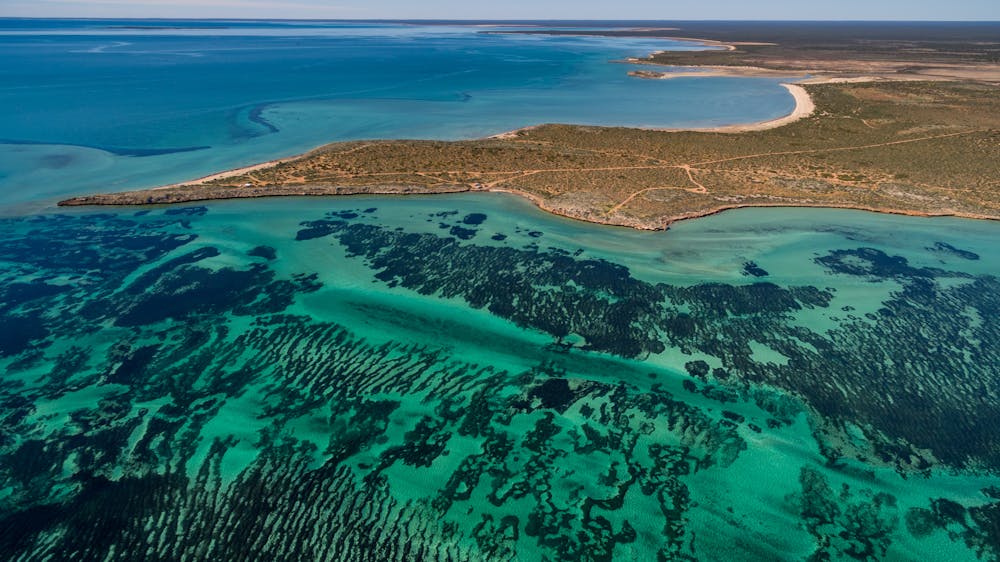
Seagrass meadows in Shark Bay were wiped out in 2011.
Shutterstock

Shark Bay in Western Australia is home to one of the world’s largest seagrass meadows, at 4,000 square kilometres. In 2011, 34% of this seagrass died after a marine heatwave struck, releasing between 2 and 9  billion tonnes of CO₂ into the atmosphere over the following three years. The indirect economic loss from this event was estimated to be US$3.1 billion (A$4.14 billion) per year, based on the ecosystem service value of the seagrass’ capacity to store carbon.

This heatwave also wiped out kelp habitats along 100km of WA’s coast. Abalone, scallop and swimmer crab fisheries were forced to close, and fish species that relied on the kelp declined. Local businesses that supported fishers also lost revenue.


Read more:
A marine heatwave has wiped out a swathe of WA’s undersea kelp forest


While most impacts have been negative, we did note some short-term positive benefits from dramatically warmer waters. This is mainly due to new species following the warmer water to a region, resulting in more fishing opportunities.

For example, a 2012 marine heatwave in the Gulf of Maine, US, resulted in a US$38 million loss in a lobster fishery. This was due to an unexpected influx of lobsters that created a glut of product, and a rapid drop in the price lobster fishers received for their catches.

However, a second marine heatwave in 2016 saw the same lobster fishery earn an extra US$103 million, as a result of experience gained since the first, which allowed them to capitalise on the higher lobster catch rates.

We must learn to cope

Our research makes conservative estimates – the true costs of marine heatwaves are likely to be much greater, because many socioeconomic effects likely remain unknown and under reported. This is particularly true for regions with limited scientific capacity, and where marine heatwaves have not been widely studied, such as in the Indian Ocean.

Marine tourism businesses can lose income when marine heatwaves degrade coral or kelp habitats.
Thomas Wernberg

As with every climate-related threat, reducing greenhouse gases and a commitment to the Paris Agreement is the best, long-term solution. However, given we’ve already seen a 50% increase in marine heatwave days since 1925, we will undoubtedly see heatwaves intensify further, even if the world succeeds in holding average global warming to between 1.5 and 2℃.

So, we must find a way to prepare for more frequent and intense marine heatwaves to cope better when they hit.

Our current efforts are in forecasting extreme events. Currently, scientists who forecast these events can give only less than a week’s notice for when a heatwave is likely to strike.


Read more:
We just spent two weeks surveying the Great Barrier Reef. What we saw was an utter tragedy


Hopefully, with enough notice, fishers may relocate or prepare for harvesting new species, aquaculture businesses can harvest early, and conservation managers may prepare for an influx of hungry animals. And perhaps, in future, coral reef managers may to deploy new technologies to shade and cool critical reefs.

Developing responses like these to help us live with marine heatwaves must be supported by awareness of current events. If climate change mitigation is slow and the planet heats beyond the crucial 2℃ temperature rise, adaptation will be even more important.

The Conversation

Alistair Hobday receives funding from a range of sources, including the Australian Fisheries Management Authority, the Fisheries Research and Development Corporation

Dan Smale receives funding from Natural Environment Research Council (NERC-UK) and UK Research and Innovation (UKRI)

Thomas Wernberg receives funding from The Australian Research Council, The Schmidt Marine Technology Partners and the Institute of Marine Research

Kathryn Smith does not work for, consult, own shares in or receive funding from any company or organisation that would benefit from this article, and has disclosed no relevant affiliations beyond their academic appointment.

ref. How much do marine heatwaves cost? The economic losses amount to billions and billions of dollars – https://theconversation.com/how-much-do-marine-heatwaves-cost-the-economic-losses-amount-to-billions-and-billions-of-dollars-170008

Now it’s Liberals telling us we are going to have to cut the capital gains tax concession if we want to get Australians into homes

Source: The Conversation (Au and NZ) – By Peter Martin, Visiting Fellow, Crawford School of Public Policy, Australian National University

NSW is doing what Labor’s Bill Shorten could not – explaining why Australia’s capital gains tax concession is knocking first home buyers out of homes.

Shorten went to the 2016 and 2019 elections with a plan – Labor would halve the capital gains tax concession used by landlords who buy and sell properties.

In much the same way as he was unable to sell his (now modest by international standards) plan to
make half of all new car sales electric by 2030, he was pilloried by Morrision and before him Malcolm Turnbull for a policy they said would smash house prices.

Shorten had similar trouble selling his (now modest by international standards) plan to
make half of all new car sales electric by 2030 – it was going to “end the weekend”. He was pilloried by Morrison and his predecessor Malcolm Turnbull for negative gearing changes they said would smash house prices.

All Shorten was proposing was to wind back the capital gains tax exemption (which exempts from tax half of each profit made from buying and sell real estate and other assets) for future transactions only. The exemption would stay in place for everything already bought.

In the face of an overblown debate about whether or not it would smash house prices (Morrison’s department had quietly warned such claims were “not consistent with our advice”) the Labor leader found himself defending modelling about prices rather than outlining what his policy would actually do.

And he lost, twice.

Now, as we prepare for yet another election, the NSW Coalition government has done what Australia’s Labor opposition could not – make a cogent argument for winding back the capital gains tax concession, saying it “pushes first home buyers out of the market”.

Elbowing first home buyers aside

In a submission placed quietly on the federal government’s housing inquiry website late last week the NSW government argued that if the concession was cut, housing would be used “more for accommodation needs than investment needs”.

Here’s the line of thinking it set out, the line Shorten was never able to get across.

The income made from capital gains – from buying something, holding it, then selling it at a profit – is taxed differently from the income made from work or running a business. Only half of it is taxed.

Prime Minister John Howard and his treasurer Peter Costello were responsible for the change, introduced in 1999 in the leadup to the introduction of the goods and services tax in 2000, but with less fanfare.


Read more:
Home prices are climbing alright, but not for the reason you might think


Before then capital gains were taxed in the same way as other income (what they are subject to is income tax, there is no such thing as a separate capital gains tax).

But before then only the portion of each gain over and above the rate of inflation was taxed, so that people weren’t taxed on a profit that would have no real value.

Prime Minister John Howard halved the headline rate of capital gains tax.
Brendon Thorne/AAP

The change, introduced after an inquiry that found it would “encourage a greater level of investment, particularly in innovative, high-growth companies” was to instead tax only half of each capital gain.

It was sold as a small change. A few years earlier, inflation had been big, around 8% per year, meaning that after five or so years only half of each profit would have been taxed in any event.

But inflation had since dived to a barely-noticeable 2%, where it has stayed for most of the past 20 years, making a guaranteed exemption from tax of half of each capital gain made trading property away over the odds.

It was, as economist Rory Robertson told his clients at the time, “almost as though the Australian tax system has been screaming at taxpayers to gear up to earn increased capital gains rather than to work harder to earn increased wages”.

Instead of pouring into high-growth companies, as Howard’s inquiry said it expected, the money flooded into housing, which was easier to borrow for.

Rushing into real estate rather than shares

As Reserve Bank assistant governor Luci Ellis told a parliamentary inquiry, it was
“more profitable to negatively gear property, because you can gear it more”.

To buy properties quickly, real estate investors needed to buy properties that would have otherwise been bought to live in.

It pushed up prices, but that wasn’t all it did.

As the NSW submission to the current housing inquiry says, the most significant impact was “the displacement of owner occupiers (including first home buyers) from home ownership by tax-advantaged investors, predominantly those already on higher incomes”.

In its words

by encouraging investors to buy and hold property, the 50% capital gains discount increases investor demand for housing and pushes first home buyers out of the market

Before capital gains tax was halved and Australians dived into becoming landlords,
more than 70% of Australian households owned the home in which they lived and one quarter rented.

At the latest count (itself four years old) only two thirds owned the place in which they lived and one third rented.

Labor has new friends

And properties are less well used. Because income from rent is no longer the chief motivation for holding property (these days most rental properties make a rental loss whereas before the capital gains tax change most made a profit) the NSW government believes more are remaining empty.

Now, when the capital gains from holding properties can be measured in hundreds of dollars per day, it would be an ideal time to wind back the capital gains tax discount. Its absence wouldn’t much hurt.


Read more:
As home prices soar beyond reach, we have a government inquiry almost designed not to tell us why


And it’s easy to forget that wasn’t what Labor was proposing. Shorten (twice) put forward something far more modest – leaving the tax discount for existing investments untouched and halving the discount for future investors.

It’s no longer Labor policy, but it was backed by the head of the Coalition’s Commission of Audit and the head of its financial system inquiry.

And it was of interest to the Business Council of Australia which pointed out that the discount “can distort investor behaviour, particularly at a time of rapid capital gains, such as in a housing or equity boom”.

Morrison’s opposition to it was hard to justify at the time. It’s harder now.

The Conversation

Peter Martin does not work for, consult, own shares in or receive funding from any company or organization that would benefit from this article, and has disclosed no relevant affiliations beyond their academic appointment.

ref. Now it’s Liberals telling us we are going to have to cut the capital gains tax concession if we want to get Australians into homes – https://theconversation.com/now-its-liberals-telling-us-we-are-going-to-have-to-cut-the-capital-gains-tax-concession-if-we-want-to-get-australians-into-homes-170555

PNG’s Pangu Pati entangled in new legal row over female president

By Jeffrey Enapa in Port Moresby

Papua New Guinea’s ruling Pangu Pati is entangled in another internal dispute just six months before the issue of writs for the 2022 general election.

This time, the former president of the party, Patrick Pundao, has gone to the National Court to dispute the recent election of the first female party president, Erigere Singin.

The Pangu Pati only recently recovered from similar party infighting.

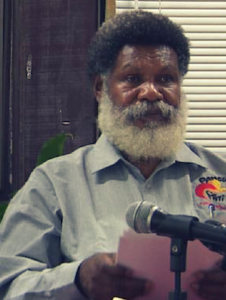
Former Pangu Pati president Patrick Pundao
Former Pangu Pati president Patrick Pundao … challenging election of party’s first woman president. Image: Loop PNG

That fighting resulted in prolonged court battles between the parliamentary wing and the party executives that led to then party leader Sam Basil breaking away to form the United Labour Party.

He left behind a small parliamentary team led by deputy party leader and Morobe Governor Ginson Saonu, who then handed over the leadership to current Prime Minister James Marape at the height of the 2019 political impasse.

Punda claimed that the clauses in the party constitution were breached when conducting the national convention that led to the election of Singin as national president in August this year.

Within two months after the election of the national president in August, the Pangu party executive tussle has resurfaced and gone to court.

A court injunction
While it is not related, deputy party leader and Morobe Governor Saonu has also taken out a court injunction against his own Pangu Pati-led government on the Wafi Golpu mining exploration project, an issue that can also create instability in the party and the government as they prepare for the election.

Meanwhile, Pundao in his notice of motion, claimed that the Pangu Pati convention in Port Moresby at the Hilton Hotel on August 27 had breached clauses 18, 20.1 and 20.2 of the party constitution.

Clause 18 relates to the composition of the national convention, which should consist of the members of the council, the parliamentary members, two delegates for a branch and another, as determined by the committee.

According to the party constitution, clause 20.1 related to the procedures that require an eight week notice to be given by the secretary general of the party detailing the time and the venue of the national convention while clause 20.2 states that the chair of the national convention should be the national president but he was not given the opportunity to chair convention as required by law.

He said he was sidelined and the master of ceremony took control of the meeting.

Pundao, in his notice of motion, sought orders to:

  • Restrain Singin from holding office as the national president of the Pangu Pati Inc;
  • Restrain the Pangu Pati general secretary Morris Tovbae from issuing any Pangu Pati meeting; and
  • Stop the office of the Registrar of Political Parties and Candidates Commission from distributing any the constitutional grants to the party.

Justice Ambeng Kandakasi, who presided over the notice of motion, ordered that:

  • The pending motion and substantive proceedings are adjourned to November 9, 2021, at 9.30am, for hearing of the motion and directions hearing;
  • All parties are required to cooperate and resolve the issues presented in the proceedings within seven days from or by October 26, 2021;
  • For the purpose of the meeting under the last preceding order, only those who are qualified by the Pangu Pati Inc constitution shall participate;
  • The general secretary of the party shall, if need be, give notice for the special general meeting by October 27, 2021; and
  • Time for the entry of these orders is abridged

Pundao said the second order directing parties to meet was expected to be carried out today.

Jeffrey Enapa is a PNG Post-Courier reporter.

Print Friendly, PDF & Email

Article by AsiaPacificReport.nz

79 new community covid cases in NZ – 75 in Auckland

RNZ News

New Zealand has reported 79 new community cases of covid-19 today.

Of the new cases, 75 are in Auckland and four are in Waikato. Forty six of these cases are linked, including 24 household contacts, and 33 remain unlinked.

There is also one new case at the border.

There was no 1pm conference today, and the Ministry of Health released information in a statement. There will be a 4pm press conference today.

There are 37 people in hospital – eight in North Shore, 17 in Auckland and 12 in Middlemore.

In the last 24 hours, 14,430 tests have been processed.

There were 109 cases announced yesterday, with 103 of those in Auckland.

The total number of community cases in the current outbreak is 2759.

There are 5462 confirmed cases in total since the pandemic began.

This article is republished under a community partnership agreement with RNZ.

Print Friendly, PDF & Email

Article by AsiaPacificReport.nz

Two covid cases arrive from New Caledonia at border in Vanuatu

RNZ Pacific

The Vanuatu covid task force has confirmed that two arrivals from New Caleldonia have covid-19.

But the organisation says Vanuatu remains free of any community transmission of the virus.

Health officials are endeavouring to trace contacts from the airport to the Ramada Hotel where the two positive ni-Vanuatu nationals are now currently being quarantined.

They were part of a group of 18 ni-Vanuatu who were repatriated from New Caledonia last Friday.

Of the 18, eight had already contracted the virus in New Caledonia, but had been treated and the task force says are no longer presenting any symptoms.

All 18 remain in isolation at the Ramada Hotel in Port Vila.

Prime Minister Bob Loughman has called on the people to get vaccinated to protect themselves and their families.

He also asked people not to disseminate incorrect information through social media, because of the panic it would cause within Vanuatu communities.

This article is republished under a community partnership agreement with RNZ.

Print Friendly, PDF & Email

Article by AsiaPacificReport.nz

Morrison’s climate plan has 35% 2030 emissions reduction ‘projection’ but modelling underpinning 2050 target yet to be released

Source: The Conversation (Au and NZ) – By Michelle Grattan, Professorial Fellow, University of Canberra

The government claims Australians would be nearly $2000 better off on average under its plan to reach net zero by 2050 compared with taking no action.

According to the modelling – which the government has yet to release – gross national income would be 1.6% higher, and 62,000 new regional mining and heavy industry jobs would be created under the plan.

Scott Morrison and energy minister Angus Taylor released the plan and a “projection” of up to 35% for emissions reduction by 2035. The prime minister will take the plan to the Glasgow climate conference next week.

Morrison reiterated Australia would not make this a “target”, but would stick with its present 2030 target of reducing emissions by 26-28% on 2005 levels by 2030.

The expected overshoot is being driven by three factors: the rapid uptake of renewables, especially solar; business and household energy efficiency using new and emerging technology, and changes in land use.

Morrison said the target had been an election commitment, while also saying Australia “may even achieve better” than the 35% reduction. He ruled out promising a bigger medium term figure before the election.

But, unexpectedly, the government has not accompany the plan’s release with a list of what the Nationals won in their agreement to sign up to the 2050 target. The only measure announced was that the Productivity Commission would review progress every five years, starting in 2023, looking at the socioeconomic impacts.

The government says existing priority technologies enabled by the plan would get Australia 85% of the way to net zero by 2050. The gap would be closed by emerging technologies.

The breakdown of the sources of abatement in the plan is: reductions already made up to 2020, 20%; the technology investment roadmap, 40%; global technology trends, 15%; international and domestic offsets, 10-20%; and further technology breakthroughs, 15%.

The government’s plan for net zero at 2050.

Asked about the total cost of the plan, Morrison avoided the question. He said the government would release the modelling underpinning the policy “soon”.

He stressed the economic side of the plan, acknowledging but placing less emphasis on the environmental need to get to net zero by 2050.

The plan was “uniquely Australian”, Morrison said. “It is an energy, trade, an economic plan, not just an environmental plan. It’s about delivering results through technology, not taxes.”

It worked by “enabling” rather than legislating or mandating.

The plan would “not shut down our coal or gas production or exports.

“It will not impact households, businesses or the broader economy with new
costs or taxes imposed by the initiatives that we are undertaking.

“It will not cost jobs, not in farming, mining or gas, because what we are
doing in this plan is positive things, enabling things. It will not increase energy bills.

“it is not a revolution but a careful evolution.”

Morrison said the plan was removing any blockage to investment in technologies, saying, “We are going to do this. If you want to do this thing with us then we are the place you want to do it.”

He said Australians “understand and they support the need to take action on climate change. So do I. So does our government.”

Morrison indicated he will spruik Australia’s record at Glasgow. “There will be lots of words in Glasgow but I will be able to point to the actions of Australia and the achievements of Australia.”

He argued other countries could learn from Australia. “The Australian way shows a way for other countries to follow. The challenges that we face here in Australia, particularly with the nature of our economy are not that dissimilar to those being faced in Indonesia or in Vietnam or in India or places like that or indeed China.

Opposition leader Anthony Albanese said Morrison had announced “a vibe rather than a target”.

Labor’s climate spokesman Chris Bowen said “I’ve seen more detail on fortune cookies than on the documents released by the government”.

The Conversation

Michelle Grattan does not work for, consult, own shares in or receive funding from any company or organisation that would benefit from this article, and has disclosed no relevant affiliations beyond their academic appointment.

ref. Morrison’s climate plan has 35% 2030 emissions reduction ‘projection’ but modelling underpinning 2050 target yet to be released – https://theconversation.com/morrisons-climate-plan-has-35-2030-emissions-reduction-projection-but-modelling-underpinning-2050-target-yet-to-be-released-170635

Victoria Police may soon be able to issue final intervention orders on the spot, but will this help victim-survivors?

Source: The Conversation (Au and NZ) – By Ellen Reeves, Postdoctoral fellow, Monash University

Police responses to family violence have long been the subject of scrutiny. Effective policing can play a key role in protecting victim-survivors and holding perpetrators accountable. Most recently across Australia, there has been heated debate about the criminalisation of coercive control.

Advocates argue that creating specific laws for patterns of abusive behaviours will better protect victim-survivors. Others argue such laws will disproportionately affect women from marginalised backgrounds, including First Nations women. It is these women who may be at an increased risk of negative police outcomes, including being misidentified as the predominant aggressor.

Policing was a prominent focus of the 2016 Victorian royal commission that recommended 227 reforms to transform the state’s response to family violence.


Read more:
How Victoria’s family violence system fails some victims – by assuming they’re perpetrators


Recommendation 59 of the royal commission

Recommendation 59 advised that in 2021 Victoria consider giving police the power to grant on-the-spot family violence intervention orders (FVIOs). These orders could last up to 12 months. This would extend the current powers of family violence safety notices (FVSNs), which are temporary orders issued by police. These orders can be in place for up to 14 days and serve as an application to the court for a final order.

Police argue that such orders are victim-focused and will prevent perpetrators from manipulating the system. In contrast, others have warned that police-issued intervention orders could bolster perpetrators’ efforts to utilise the system as a weapon against victim-survivors.

Where do these expanded policing powers already exist?

Various Australian inquiries into system responses to family violence have supported temporary notices such as Victoria’s. However, significant caution has been expressed over giving police the power to grant on-the-spot final orders.

Tasmania is the only Australian jurisdiction where police have these powers. Police family violence orders (PFVOs) were introduced as part of the state’s sweeping 2004 reforms. There is minimal research on their use in Tasmania.

However, in 2015, the Tasmanian Sentencing Advisory Council highlighted that police-issued orders are more frequently used than court-issued intervention orders and come with a higher breach rate. The council attributed this to the orders not being specifically tailored to the needs of the victim-survivor. It also cited respondents misunderstanding the conditions due to these not being explained with the level of detail that a court would give.

The council recommended police should no longer have the power to grant PFVOs. Its findings mirrored concerns raised in submissions to other Australian inquiries. These concerns include the critical importance of judicial oversight and the potential for the orders to increase the risk of misidentification of women as predominant aggressors.


Read more:
10 things Australia can do to prevent violence against women and children


Misidentification and police family violence orders

Misidentification occurs when police incorrectly list the victim-survivor as the predominant aggressor. This can have significant effects on that individual including financial loss, reduced trust in police, visa implications, loss of reputation and access to services, and child custody implications.

Where misidentification occurs, police fail the very category of people they ought to protect. In 2018, Women’s Legal Services Victoria found that 10% of family violence intervention order applications involve misidentification. Research has shown women from disadvantaged and marginalised backgrounds are at higher risk of misidentification.

When a PFVO is made, the respondent has the option to challenge the order in court. However, research shows family violence victim-survivors often seek to avoid court at all costs. Court is often expensive, extremely stressful and retraumatising. Yet, when a victim-survivor has been misidentified, court is the only opportunity they will have to seek redress.

When victim-survivors are misidentified on intervention orders, they often consent to the order, viewing it as the lesser of two evils – they just want the court process to end. When a victim-survivor consents to an order, the perpetrator can then use it as a weapon. For example, they may lure them into breaching the order and then report them to the police.

When PFVOs were introduced in Tasmania, it was argued the orders do not give police unnecessary and unchecked power, given the respondent’s ability to challenge it in court. But this argument misses the nuances of misidentification in family violence matters.

It assumes victim-survivors will willingly go to court to have the mistake rectified. It also assumes victim-survivors will have sufficient knowledge of the legal system to make an informed decision about whether or not they should challenge the order. And this happens, paradoxically, before they go to court where they are linked up with key support services and legal advice.


Read more:
LGBTQ+ people are being ignored in the national discussion on family and sexual violence


Beware the unintended impacts

Recommendation 59 is to be considered based on stakeholder and victim-survivor consultations earlier this year. The purpose of these consultations was to determine if Victoria Police responses to family violence have improved enough in the five years since the royal commission to enable them to appropriately use this new power.

Police responses have likely improved, but shortcomings undoubtedly remain. Victim-survivors are still being misidentified as predominant aggressors. If police are given this new power, their power over at-risk populations will be extended, with fewer checks and balances operating to provide redress for victim-survivors incorrectly labelled as perpetrators.

This is not a step that should be taken lightly and without extensive consideration of the potential unintended impacts on victim-survivors.

The Conversation

Ellen Reeves is a postdoctoral research fellow at Monash University. She has previously received funding from the Australian Government’s Research Training Program.

Kate Fitz-Gibbon is Director of the Monash Gender and Family Violence Prevention Centre. Kate currently receives funding for family violence related research from the Australian Research Council, Australian Institute of Criminology, Australia’s National Research Organisation for Women’s Safety and the Department of Social Services. Kate is a Chair of Respect Victoria.

ref. Victoria Police may soon be able to issue final intervention orders on the spot, but will this help victim-survivors? – https://theconversation.com/victoria-police-may-soon-be-able-to-issue-final-intervention-orders-on-the-spot-but-will-this-help-victim-survivors-170359

New Zealanders are super-connected. When restrictions lift in Auckland, it won’t take much to amplify Delta’s spread

Source: The Conversation (Au and NZ) – By Dion O’Neale, Lecturer – Department of Physics, University of Auckland; Principal Investigator – Te Pūnaha Matatini, University of Auckland

Hannah Peters/Getty Images

As Aotearoa New Zealand moves from elimination to suppression, we need to understand how this could change the nature of transmission from Auckland’s Delta outbreak to the rest of New Zealand.

Aucklanders can expect a three-step easing of restrictions, followed by the new traffic light COVID-19 protection framework, once 90% of those eligible are vaccinated.

The lifting of restrictions will come as a relief for many who are missing friends and family and are struggling with social isolation. But as additional transmission pathways open, simple changes in a network can result in complex outcomes.

A common phenomenon within complex networks is called the “percolation effect” — the addition of new connections results in a “phase transition” where a once poorly connected network can quickly turn into a highly connected one.

For Auckland, this means the gradual addition of just one or two new connections between families could result in a vastly more connected city. The whole country could become far more connected than initially assumed.

As part of our work to simulate viral transmission under the new conditions, we have created a synthetic version of Aotearoa using the Populated Aotearoa Interaction Network (PAIN).

This is a synthetic network representing Aotearoa New Zealand, where every person has an age, sex, ethnicity, and place of employment or education. These individuals are treated as nodes in a network and interact through community contexts, much like those we will experience when we begin interacting with family members and friends as restrictions ease.

With the PAIN, we can model transmission to more accurately reflect the experiences of individuals, compared to less complex models that average interaction patterns.

This has allowed us to model the potential trajectory of COVID-19 outbreaks and predict how changes in alert level policy, vaccination rates and increased social connection might affect the spread of the virus.

Simple changes, complex outcomes

One important feature of an interaction network is the “largest connected component” (LCC), which tells us the approximate number of people COVID-19 could theoretically spread to, based on the connections people share.

In a scenario like the strictest alert level 4, where most community connections are removed, we see the interaction network for Aotearoa broken up into many small disconnected sections. In this case, the largest connected component through households and community interactions would contain around 90,000 linked individuals.

But for a level of intervention like alert level 3, potential community interactions increase through families extending their bubbles. We see the largest connected component increase by a factor of almost 15, to around 1.4 million connected individuals.


Read more:
‘If you want summer, get vaccinated’ – Jacinda Ardern sets the target for re-opening New Zealand


These numbers are based on the optimistic assumption we can neglect interactions in workplaces on the basis that masking and good ventilation reduce transmission significantly.

This clearly demonstrates New Zealand is a highly connected society and most New Zealanders will be connected to each other through interactions we share. We argue this makes mitigation strategies — vaccination, masking, distancing — even more important.

Given ongoing community transmission and a rising number of unlinked cases, the three-step roadmap, even with people only meeting up in pairs, moves us to a situation where Auckland is essentially reconnected, from a contagion point of view.

Equity in a ‘pandemic of the unvaccinated’

The move away from elimination comes at a point when some communities still have low vaccination rates, in particular Māori and younger people. The average age of Māori in Auckland is 26; most of this younger cohort (Group 4) has only been eligible for vaccination since September 1.

The return of children to early childhood centres, with bubbles of up to ten, is concerning since infants and toddlers cannot currently be vaccinated. High rates of respiratory illness among New Zealand children further compounds the risk of serious illness from COVID-19.

Our models clearly show only a small number of additional connections are necessary to sufficiently connect existing bubbles such that a large percentage of the population would be reachable if there is uncontrolled spread. The evidence from the current Delta outbreak shows the virus is finding unvaccinated people.


Read more:
New Zealand cannot abandon its COVID elimination strategy while Māori and Pasifika vaccination rates are too low


Most of us don’t have any influence on decisions the government makes. What we can control is the decisions we make ourselves. The best we can do right now is manage our own risk, making sure the virus can’t spread when connections are made.

There are several steps we can take to ensure connections do not turn into uncontrolled clusters of COVID-19. With the exception of those now required to go back to work, we should think of new freedoms as options, not targets.

Reducing transmission

Even if we’re vaccinated, we should continue to act like we have the virus, thinking about our new contacts as potentially connected to cases of COVID-19 that haven’t been detected yet.

If you reconnect with family or friends, keep the total number of new connections to a minimum. If meeting people from other households, take every precaution to keep each other safe, stay outside and always wear a well fitted mask.

Make a note of all your connections, in the app or a diary. Remember to record the name and phone numbers to make contact tracing as fast and easy as possible, should you come into contact with the virus.

Creating large chains by connecting with lots of different bubbles will very quickly result in one large connected network, increasing the risk of spread and making contact tracing more difficult. It falls upon all of us to take every step we can to make sure we protect our loved ones, and our community.


We would like to acknowledge the contribution of Kylie Stewart, a member of the team at Te Pūnaha Matatini and the HRC-funded project Te Matatini o te Horapa — a population based contagion network for Aotearoa NZ.

The Conversation

Dion O’Neale receives funding from the Health Research Council and the Department of Prime Minister and Cabinet to provide research and advice on the spread of COVID-19 in Aotearoa, including the equity impacts of contagion.
He is a Principal Investigator in Te Pūnaha Matatini.

Emily Harvey works at Market Economics, and is a Principal Investigator in Te Pūnaha Matatini. She currently receives funding from the Health Research Council and the Department of Prime Minister and Cabinet to provide research and advice on the spread of COVID-19 in Aotearoa, including the equity impacts of the contagion spread.

James Gilmour receives funding from the Department of Prime Minister and Cabinet to research the spread of COVID-19 in Aotearoa, including the equity impacts of contagion. He is a Research Fellow in Te Pūnaha Matatini.

Steven Turnbull receives funding from the Health Research Council and the Department of Prime Minister and Cabinet to provide research and advice on the spread of COVID-19 in Aotearoa, including the equity impacts of contagion. He is a Research Fellow in Te Pūnaha Matatini.

ref. New Zealanders are super-connected. When restrictions lift in Auckland, it won’t take much to amplify Delta’s spread – https://theconversation.com/new-zealanders-are-super-connected-when-restrictions-lift-in-auckland-it-wont-take-much-to-amplify-deltas-spread-170542

10 things every politician should know about history

Source: The Conversation (Au and NZ) – By Anna Clark, Australian Research Council Future Fellow in Public History, University of Technology Sydney

The federal Education Minister, Alan Tudge, has announced a major edit of the draft history curriculum by the Australian Curriculum, Assessment and Reporting Authority (ACARA) as part of an effort to lift educational standards. “Ultimately, students should leave school with a love of country and a sense of optimism and hope that we live in the greatest country on Earth and that the future is bright,” he said.

But is that really the purpose and function of a history curriculum? Here’s a quick primer for the minister.


Read more:
Proposed new curriculum acknowledges First Nations’ view of British ‘invasion’ and a multicultural Australia


1. “History” is not the same as “the past”.

History is a way of thinking about and studying the past. Teaching students to memorise a list of important facts without understanding what they mean isn’t history; neither is teaching how Australian students should “feel” about the past without any contextual knowledge.

A sound history education gives students the skills to find evidence, analyse sources and present their own interpretations based on their research. It also gives them the confidence to distinguish uneducated opinion and polemic from well-informed historical analysis.

2. Not all historians agree.

Because history is based on interpretation as well as evidence, historians often disagree on “what happened”.

Interpretation is inherently subjective. History education should teach students how to deal with diverse and contrasting interpretations by historians, as well as over time. (For example, that could include a unit on the contrasting interpretations of Australian history by education ministers over the past 30 years.)

3. History is contested (see above).

You know how members of your family might disagree over what happened? (Like that Christmas lunch in 1974 when Grandpa stormed out before the pudding? Or the discovery of a horrible family secret?)

History is the same. Sometimes, disagreements over the past create significant political debate and even violent confrontations in or between communities. Such contest shows that history matters.

The heated nature of some historical debates doesn’t mean they should be avoided in school, however. Far from it. Teaching about history’s contestability helps students learn to navigate and assess different perspectives in a liberal democracy.

4. History teachers are trained professionals.

History teachers are trained in instruction, pedagogy and the skills of history. They teach because they want to make Australia a better place. Trust them.

5. Practising critical history doesn’t mean you “hate” Australia.

Critical analysis is a vital historical skill. It enables historians to interrogate historical evidence, allowing us to ask: what is this source? Where did it come from? Is it reliable? Who is the author? Does it tell the whole story?

Being “critical” doesn’t mean you’re negative — just that you’re curious and rigorous.


Read more:
Teaching a ‘hatred’ of Australia? No, minister, here’s why a democracy has critical curriculum content


6. The current history curriculum draft does not diminish the legacy of Western civilisation.

The curriculum draft simply acknowledges that other knowledges and civilisations (e.g. Eastern and Indigenous) have worldviews and cultures worth knowing. It asks students to think about their own place in time and in the world, as well as asking them to think about what is unique about being Australian.

What’s more, studying history in its disciplinary form is testament to the ongoing influence of Western civilisation and liberalism in our education system. As well as including culturally diverse historical perspectives and approaches in recent years, historical practice also draws on a long tradition that includes the methods of 19th-century scientific historians, histories from the Enlightenment, and ancient Greek chronicles.

7. Historical views change over time.

Each generation asks its own questions of the past and interprets the past according to prevailing values of the day. Think about the relatively recent inclusion of the “Stolen Generations” in our curriculum, for example, or the acknowledgement of the women’s suffrage movement in the story of Australia’s democracy. While their presence reveals our contemporary historical priorities, such topics haven’t always been included in Australian histories.

Teaching students to understand changing historical approaches is an important part of a good history education.

The significance of the women’s suffrage movement in the story of Australia’s democracy hasn’t always been acknowledged in history education.
National Library of Australia


Read more:
Captain Cook ‘discovered’ Australia, and other myths from old school text books


8. Historical revision is not a dirty word.

Every generation of historians, from Thucydides to Geoffrey Blainey to Clare Wright, revises history. They even say so explicitly.

9. School students are not “blank slates”.

Filling them up with idealised images of Australia’s past won’t wash. It’s boring, as well as being bad history.

In fact, “Anzac” is such a successful topic to teach because it allows students to imagine their way into the past, to empathise and use their skills of critical analysis. Sources, such as diaries from the front line, war propaganda, letters from the home front and newsreel footage, are accessible and gripping documents of the past.

Students can see how this event changed the world as well as affecting their own families and communities. They can also see how Anzac has been remembered over time. Trust them.

10. The national benefit of history education comes from students learning to be active, questioning, thoughtful citizens.

Teaching that “we live in the greatest country on Earth” is not history. It’s jingoistic nationalism. Ironically, it’s also an approach more aligned with the standards for history education in the Chinese national curriculum than the histories being taught and discussed in Australian classrooms as we speak.

Sometimes history asks difficult questions and requires hard answers. That’s OK. It makes Australia better.

The Conversation

Anna Clark receives funding from the Australian Research Council.

ref. 10 things every politician should know about history – https://theconversation.com/10-things-every-politician-should-know-about-history-170626

Grenada: 38 Years after a Triple Assassination, the Short-Lived Revolution still Inspires

Source: Council on Hemispheric Affairs – Analysis-Reportage

Print Friendly, PDF & Email

By Danny Shaw
From NY

On October 25th, 1983, 7,300 U.S. troops, accompanied by U.S.-trained soldiers of CARICOM countries calling themselves “The Caribbean Peace Force,” invaded the tiny island of Grenada. This October marks the 38th anniversary of the U.S. invasion of the land of Julien Fedon, Jacqueline Creft, Maurice Bishop and the 110,000 people of Grenada. What lessons can we learn from the four-and-a half-year revolution? In a hemisphere on fire, with chronic social unrest and anti-imperialism on full display from the streets of Medellin to Mexico City, where does Grenada line up in the Global Class Struggle in the 21st century?

The Revo

On March 13th 1979, the leaders of the New Jewel Movement overthrew Eric Gairy, widely seen as being pro-imperialist, setting in motion one of the great revolutionary experiments in Caribbean history. Those who lived through the 1979 to 1983 Grenadian Revolution were forever transformed.

Grenadian Professor of Political Science Wendy Grenade from the University of West Indies charts some of the gains made during the short period: “Raising levels of social consciousness; building a national ethos that encouraged a sense of community; organising agrarian reform to benefit small farmers and farm workers; promoting literacy and adult education; fostering child and youth development; enacting legislation to promote gender justice; constructing low income housing and launching house repair programmes; improving physical infrastructure and in particular the construction of an international airport; providing an environment that encouraged popular democracy through Parish and Zonal Councils etc.”[1] Slogans and billboards emblazoned the country’s landscape: “Never Too Old to Learn,” “Education is Production Too,” “Every Worker a Learner,” and “Women, Committed to Economic Construction.”[2]

Angela Davis captured what “the revo” meant to the Black nation within the U.S.: “The experiences that I’ve had here in Grenada have confirmed in a very powerful way where we are headed, what the future of the entire planet ought to look like – this beautiful, powerful militant revolution.”[3] The chief spokesperson of the revolution, Maurice Bishop, famously came to New York City in June 1983 inspiring a crowd of thousands of African-Americans and anti-imperialists as he detailed his people’s achievements.[4]

Glen “Pharoah” Samuel was a middle-school pupil at the time and was part of a crowd of students who raced to save Maurice Bishop, Jacqueline Creft and other revolutionary leaders from execution at Fort George.[5] Sitting down in a neighborhood bodega, he explained Grenada’s role in the global class struggle known as “The Cold War:”

“As a Black, English-speaking country very close to America, imagine America has a population of over 42 million Afro Black Americans; obviously they understand our swag because we are all Black people, African people. So Ronald Reagan feared the situation and we had just finished our international airport which was sponsored by Cuba and the Soviet Union.”

Internationalist educator Chris Searle’s book Grenada Morning: A Memoir of the “Revo” details the accomplishments of the revolution in overcoming a history of colonial and neocolonial servitude and degradation. Gerhard Dilger of the Rosa Luxemburg Foundation studied the revolutionary contributions of poets and calypso singers from 1979 to 1983.[6] Dr. Horace Campbell’s Rasta and Resistance highlights the participation of the Rastafari community, long oppressed under the Gairy dictatorship, in the Revolutionary People’s Government and Army.

All of Grenada was ablaze with the flames of revolutionary optimism, unity and growth.

Dr. Terence Marryshow remembers the Grenadian and Cuban resisters and martyrs of the 1983 U.S. invasion (Photo Credit: Danny Shaw/COHA)

The Invasion: An Attempt to Kill Hope

Alarmed at the existence of another workers’ state in Washington’s “backyard,” Ronald Reagan and the U.S. foreign policy establishment were hellbent on overthrowing the four-and-a-half-year revolution.

Internationalist scholar Carlos Martínez artfully captures the U.S. campaign of psychological warfare and saber rattling. In 1981, Reagan mobilized over 120,000 troops, 250 warships and 1,000 aircraft to Vieques, an island that is part of Puerto Rico, for a mock invasion.[7] They code-named the operation “Amber and the Amberines” because Grenada’s official name is Grenada and the Grenadines, as it includes the two smaller islands of Carriacou and Petit Martinique. U.S. intelligence worked overtime to monitor the cracks in the revolutionary leadership and create divisions in order to exploit them, ultimately leading to the assasination of the revolution’s top leadership. Eighteen civilians were killed when the U.S. Navy bombed a hospital for patients with mental challenges. 24 Cuban construction workers were murdered.[8]

It was David vs Goliath but David stood up to the invasion. Maurice Bishop sounded the battle cry: “This land is ours, every square inch of its soil is ours, every grain of sand is ours, every nutmeg pod is ours, every beautiful young Pioneer who walks on this land is ours. It is our responsibility and ours alone, to fight to defend our homeland.”[9] The break in the top leadership of the New Jewel Movement and Reagan’s accusation that 600 American medical students were in danger, provided the humanitarian cover for the illegal assault on a people’s democracy.

The U.S. military project then helped prop up a pro-U.S. power structure that sought to dismantle the very memory of the revolution. Artist Suelin Low Chew Tung writes that “images of the revolution[ary] years were deliberately erased from the landscape … Three decades later, as far as local visual art records are concerned, it is as if the Grenada Revolution never happened.”[10] It was apparent that this generation feels disconnected from Grenada’s definitive break with neo-colonialism. To many youth, it appeared this was ancient history. How many Grenadians born after 1983 fully comprehended that their small homeland inspired the world?

The Washington Examiner, owned by right-wing billionaire Philip Anschutz, captures how U.S. ruling circles viewed military action against Grenada as a strategic, easy victory after defeat in Vietnam and Iran. In an editorial on September 12, 2021, Michael Rubin of the American Enterprise Institute advocated for a Grenada-like invasion to shore up respect for America after the humiliating defeat of the U.S. in Afghanistan: “Where and under what circumstances might a future commander in chief send troops to draw a new red line for America’s enemies?”[11] He ominously ends the article warning: “There will be a new Grenada; the question to ponder is where and when.”

The Blackout: Liquidating Memory

On August 26th 2021, this writer sat down with Dr. Terence Marryshow, Captain of the People’s Revolutionary Army responsible for the personal security of Maurice Bishop and NJM leadership, former political leader of the Maurice Bishop Patriotic Movement (MBPM) and grandson of T.A. Marryshow, the father of the West Indian Federation. He elaborated on Pan-Caribbeanism in Grenada today.[12] “Caribbean leaders today are not pursuing this goal as vigorously as they ought to in the interests of the people of the Caribbean. The problem is many of them are not willing to give up that lofty position that they hold. During the period of the revolution there was certainly a great effort with the People’s Revolutionary Government led by Maurice Bishop to forge that kind of Caribbean integration. But with his demise there is no real voice out there [in Grenada] championing that cause. Today leaders are hardly concerned with that. Yes we do have CARICOM which in the final analysis is really a talk shop because nothing like concrete decisions and progress for the people  comes out of it.”

In an extensive interview, the Cuban-trained physician stated that “concerning teaching on the revolution in the schools there is a  complete blackout. There is a concerted effort not to speak about it except for groups like The Maurice Bishop and October 19th Martyrs Foundation, the Grenadian Cuba Friendship Society and the Maurice Bishop Patriotic Movement. But there is no space on the [mainstream school] curriculum today for teaching anything about that revolutionary period.”

A soldier of the People’s Revolutionary Army, nicknamed Salt, who chose to remain anonymous and only wanted his nickname published, remembered what it meant to stand up to the hegemon of the north. He remembered the Center for Popular Education, his own exposure to critical Marxist texts and the day the call came from his superior officers to prepare to defend the country. Speaking on censorship today, Salt explained: “The educators are not documenting anything and are not teaching our young people about the progress the revolution made.”

To add insult to injury, the invaders and new rulers of Grenada disappeared the bodies of the key New Jewel Movement leaders. Local community leaders showed me where the invaders and their underlings disappeared Maurice’s Bishop’s body.[13] Bishop’s mother Alimenta captured the horror of not knowing where her son’s body was.[14] Having already lived through her husband’s murder at the hands of Eric Gairy and the same U.S.-backed state machinery, she stated that, “I could go to the grave and say this is the spot where my husband is buried, but I can’t say that for my son.” This was what Grenadians remember as the triple assassination of their revolution.

Which Way Forward?

In 2019, the Venezuela government published a bilingual tribute to Maurice Bishop and the October martyrs in the Correo del Alba. Unpublished testimonies of dozens of cadres and combatants of the revolutionary process express how it brought Grenada closer to Africa and all oppressed nations, and set Grenada on a path to defiant participation in CELAC, ALBA, and PetroCaribe.[15] Today Grenada is charting a path of friendly relations both with imperialism and the blockaded Bolivarian nations attempting to emerge from centuries of colonialism and decades of U.S. hybrid war. What is clear is that the Grenadian Revolution was an example for the world that the colonized can stand up, organize and win.

Danny Shaw is Senior Research Fellow at COHA and an academic at City University of New York.

Editor’s Note: The writer recently visited Grenada and the preceding is his analysis. A previous version of this article was published in Toward Freedom.


Sources

[1] Invent the Future. “The Legacy of the Grenadian Revolution Lives On.” March 13, 2014.

The Legacy of the Grenadian Revolution Lives On

[2] ESPIONART. ”The Billboard Art of Revolutionary Grenada.” October 30, 2018. https://espionart.com/2018/10/30/the-billboard-art-of-revolutionary-grenada/

[3] Black Perspectives. “The House on Coco Road”: A New Film on Family, Race, and U.S. Intervention in Grenada.” May 2, 2017.

https://www.aaihs.org/the-house-on-coco-road-a-new-film-on-family-race-and-u-s-intervention-in-grenada/

[4] YouTube. Maurice Bishop Speaks. March 7th, 2017. https://www.youtube.com/watch?v=X7MtydR-fiI&t=1586s

[5] August 24th, 2021. https://twitter.com/dannyshawcuny/status/1430142177997475854?s=20

[6] Gerhard Dilger. Ibero-Amerikanisches Institut. August 14, 2019. “WE DOIN WE OWN TING!” REVOLUTION AND LITERATURE IN GRENADA.” https://publications.iai.spk-berlin.de/servlets/MCRFileNodeServlet/Document_derivate_00002178/BIA_046_217_244.pdf;jsessionid=085580D208A5C7146C9B1FF715BC9470

[7] Invent the Future. “The Legacy of the Grenadian Revolution Lives On.” March 13, 2014.

The Legacy of the Grenadian Revolution Lives On

[8] NPR. ”Grenada’s Nobody’s Backyard.”January 29, 2021. https://www.npr.org/transcripts/1021236625

[9] Maurice Bishop. MAURICE BISHOP SPEAKS. The Grenada Revolution and Its Overthrow, 1979–83. Pathfinder Press.

[10] Suelin Low Chew Tung. Social and Economic Studies. “Painting the Grenada Revolution.” September-December 2013. https://www.jstor.org/stable/24384484

[11] Michael Rubin. Washington Examiner. “After the humiliation of Afghanistan, where and when will we see a new Grenada?” September 12, 2021

https://www.washingtonexaminer.com/opinion/after-the-humiliation-of-afghanistan-where-and-when-will-we-see-a-new-grenada

[12] Interview with the author. August 30, 2021. https://www.instagram.com/tv/CTOJoC2onSM/?utm_medium=copy_link

[13] Interview with the author. August 22, 2021. https://twitter.com/dannyshawcuny/status/1429589886349238273?s=21

[14] Now Grenada. “Alimenta Bishop Is To Be Honoured By Government”

August 27, 2013. https://www.nowgrenada.com/2013/08/alimenta-bishop-is-to-be-honoured-by-government/

[15] Correo del Alba. May 29, 2020. https://twitter.com/correodelalba/status/1266405415459393538?s=20

Intersex children in New Zealand are routinely undergoing unnecessary surgery – that needs to change

Source: The Conversation (Au and NZ) – By Claire Breen, Professor of Law, University of Waikato

Shutterstock

Until very recently, people with intersex variations have often been unseen, stigmatised and routinely discriminated against. Intersex Awareness Day today (October 26) is therefore an opportunity to examine how much progress has been made and how far we still have to go.

It’s estimated 1.7 to 4% of people globally are intersex – meaning they don’t fit within typical female or male norms.

In particular, the rights of children with intersex variations are coming under scrutiny.

With surgery in infancy or early childhood still considered an option,
questions are now being asked about how to ensure no child is subjected to unnecessary procedures or treatment, and that the child’s consent is obtained for necessary interventions.

Surgery can be delayed

Intersex people have variations in sex characteristics that can occur naturally at the level of chromosomes, hormones and/or anatomy.

There is a wide range of variations. Hypospadias, where the urethral opening appears on the underside of the penis, is most common. Although not a health problem, surgery to alter the hypospadic appearance is “routine” in many places, including Aotearoa New Zealand.

The latest Ministry of Health data shows that in 2017-18, 265 people aged under 15 were diagnosed with hypospadias, with 206 surgical operations performed – 85% of those operations performed on children aged under five.

These surgeries could be delayed until the children are older and able to give or refuse consent. There is no clear biomedical basis for such surgery, it is not lifesaving and it puts the child at risk (as surgery inevitably does).


Read more:
Surgery to make intersex children ‘normal’ should be banned


While there are some gonadal variations (affecting the development of ovaries or testes) that can be life-threatening and require surgical treatment, few variations in sex characteristics are life-threatening in infancy.

Surgery on children with genital variations might appear to promote wellbeing but research highlights the harmful effects of any surgery intended to produce a more “male” or more “female” genital appearance.

Like their overseas counterparts, Aotearoa New Zealand intersex people who have spoken publicly have opposed the interventions they underwent as children.

Who gives consent?

The issue of genital surgery has implications for the legal rights of New Zealanders with variations in sex characteristics, including their right to refuse medical treatment, and the rules around informed consent.

The young age at which most surgeries are carried out means consent is provided by parents, who have the right and responsibility to decide on important matters affecting the child, including non-routine medical treatment.

With such decisions, the best interests and welfare of the child in their particular circumstances must be the paramount consideration. The right to be fully informed is contained in the Code of Health and Disability Services Rights.


Read more:
Choosing children’s sex is an exercise in sexism


In essence, every New Zealander has a right to an explanation of their condition and an explanation of the options available, including risks, side effects, costs and benefits of each option, and honest and accurate answers to questions, including the results of research.

But intersex advocates in Aotearoa New Zealand argue that they and their families have been isolated from sources of information and from others in similar situations.

And there is the added complexity of current responses to intersex variations being insensitive to cultural contexts, reflecting as they do binary Western constructions of gender that categorise individuals as either male or female.

International progress

The issue of genital surgery is gaining traction in international law. For example, the right to be protected from degrading treatment was extended to health-care settings in 2013, with the call from a UN special rapporteur for states to repeal any law allowing genital-normalising surgery when “enforced or administered without the free and informed consent of the person concerned.”

Overall, the right to health is violated when states fail to take steps to prevent young children from undergoing medically unnecessary, irreversible and involuntary surgery and treatment.

In 2016, the UN Committee on the Rights of the Child recommended Aotearoa New Zealand develop and implement a healthcare protocol for intersex children, based on children’s rights, setting the procedures and steps to be followed by health teams.


Read more:
Beyond the binary: how teaching children about gender could help reduce sexism


This followed a submission to the committee from Aotearoa New Zealand’s Human Rights Commission. The UN committee called on the country to ensure no one is subjected to unnecessary medical or surgical treatment during infancy or childhood, and to guarantee the child’s right to bodily integrity, autonomy and self-determination.

In response to the recommendations of the UN committee, as well as domestic advocacy, the Ministry of Health directed the Paediatric Society to set up an intersex working group to develop guidelines for infants born intersex.

But this has so far failed to make significant changes to the practice of surgical intervention on children’s genitalia.


Read more:
What are gender pronouns and why is it important to use the right ones?


Aotearoa New Zealand can do better

Meanwhile, advocates continue to call for legislation to defer interventions until children themselves are capable of consenting or expressing their own views.

Central to any policy, legislative or medical development must be the child’s right to be free from discrimination.

Children have the right to have their voices heard. This means, with the exception of life-saving treatment, any interventions should be postponed until a child is competent to decide.

Where necessary, a skilled, independent advocate should be appointed to represent the child’s interests. Current medical practice in Aotearoa New Zealand falls well short of those goals.


The authors are grateful to the contribution of researchers Craig Dempster and Sam Johnston, and to members of the Intersex Health and Well-Being Working Group (Incentive), who gave feedback on an earlier draft.

The Conversation

The authors do not work for, consult, own shares in or receive funding from any company or organisation that would benefit from this article, and have disclosed no relevant affiliations beyond their academic appointment.

ref. Intersex children in New Zealand are routinely undergoing unnecessary surgery – that needs to change – https://theconversation.com/intersex-children-in-new-zealand-are-routinely-undergoing-unnecessary-surgery-that-needs-to-change-168936

A mysterious signal looked like a sign of alien technology — but it turned out to be radio interference

Source: The Conversation (Au and NZ) – By Danny C Price, Senior research fellow, Curtin University

CSIRO, Author provided

In December last year, the media reported an intriguing signal we at the Breakthrough Listen project found in our radio telescope data. Dubbed BLC1, the signal didn’t appear to be the result of any recognisable astrophysical activity or any familiar Earth-based interference.

The trouble was, we weren’t ready to discuss it. When you’re searching for signs of extraterrestrial life, you want to be very careful about getting it right before you make any announcements. Last year we had only just started secondary verification tests, and there were too many unanswered questions.


Read more:
We asked astronomers: are we alone in the Universe? The answer was surprisingly consistent


Today we are ready to report that BLC1 is, sadly, not a signal from intelligent life beyond Earth. Rather, it is radio interference that closely mimics the type of signal we’ve been looking for. Our results are reported in two papers in Nature Astronomy.

Searching for solar flares and signs of life

The story of BLC1 starts in April 2019, when Andrew Zic, who at the time was a PhD student at the University of Sydney, began observing the nearby star Proxima Centauri with multiple telescopes to search for flare activity. At 4.22 light years away, Proxima Centauri is our nearest stellar neighbour, but it is too faint to see with the naked eye.

Flares from stars are bursts of energy and hot plasma that may impact (and likely destroy) the atmosphere of any planets in their path. Though the Sun produces flares, they are not strong or frequent enough to disrupt life on Earth. Understanding how and when a star flares teaches us a lot about whether those planets might be suitable for life.

Proxima Centauri hosts an Earth-sized exoplanet called Proxima Centauri b, and Andrew’s observations suggested the planet is buffeted by fierce “space weather”. While bad space weather doesn’t rule out life existing in the Proxima Centauri system, it does mean the planet’s surface is likely to be inhospitable.


Read more:
Bad space weather may make life impossible near Proxima Centauri


Still, as our nearest neighbour, Proxima Centauri b remains a compelling target for the search for extraterrestrial intelligence (or SETI). Proxima Centauri is one of the only stars we could potentially ever visit in our lifetime.

At the speed of light, a two-way trip would take 8.4 light years. We can’t send a spaceship that fast, but there is hope that a tiny camera on a light sail could reach there in 50 years and beam back pictures.

Because of this, we joined forces with Andrew Zic and his collaborators, and used CSIRO’s Parkes telescope (also known as Murriyang in the Wiradjuri language) to run SETI observations in parallel with the flare activity search.


Read more:
Observing the universe with a camera traveling near the speed of light


An intriguing summer project

The BLC1 signal. Each panel in the plot is an observation toward Proxima Centauri (‘on source’), or toward a reference source (‘off source’). BLC1 is the yellow drifting line, and is only present when the telescope is pointed at Proxima Centauri.
Smith et al., Nature Astronomy, Author provided

We thought searching these observations would be an excellent project for a summer student. In 2020, Shane Smith, an undergraduate student from Hillsdale College in Michigan, United States, joined the Berkeley SETI Research Experience for Undergraduates program and began sifting through the data. Toward the end of his project, BLC1 popped out.

The Breakthrough Listen team quickly became intrigued by BLC1. However, the burden of proof to claim a detection of life beyond Earth is exceedingly high, so we don’t let ourselves get too excited until we’ve applied every test we can think of. The analysis of BLC1 was spearheaded by Sofia Sheikh, at the time a PhD student at Penn State, who ran an exhaustive set of tests, many of which were new.

There was plenty of evidence pointing toward BLC1 being a genuine sign of extraterrestrial technology (or “technosignature”). BLC1 has many characteristics we expect from a technosignature:

  • we only saw BLC1 when we were looking toward Proxima Centauri, and didn’t see it in when we looked elsewhere (in “off-source” observations). Interfering signals are commonly seen in all directions, as they “leak” into the telescope receiver

  • the signal only occupies one narrow band of frequencies, whereas signals from stars or other astrophysical sources occur over a much wider range

  • the signal slowly drifted in frequency over a 5-hour period. A frequency drift is expected for any transmitter not fixed to Earth’s surface, as its movement relative to us will cause a Doppler effect

  • the BLC1 signal persisted for several hours, making it unlike other interference from artificial satellites or aircraft that we have observed before.

Nevertheless, Sofia’s analysis led us to conclude BLC1 is most likely radio interference from right here on Earth. Sofia was able to show this by searching across the entire frequency range of the Parkes receiver and finding “lookalike” signals, whose characteristics are mathematically related to BLC1.

Unlike BLC1, the lookalikes do appear in off-source observations. As such, BLC1 is guilty by association of being radio interference.

Not the technosignature we were looking for

We don’t know exactly where BLC1 was coming from, or why it wasn’t detected in off-source observations like the lookalike signals. Our best guess is that BLC1 and the lookalikes are generated by a process called intermodulation, where two frequencies mix together to create new interference.

If you’ve listened to blues or rock guitar, you are probably familiar with intermodulation. When a guitar amp is deliberately overdriven (when you turn it up to 11), intermodulation adds a pleasant-sounding distortion to the clean guitar signal. So BLC1 is – perhaps – just an unpleasant distortion from a device with an overdriven radio frequency amplifier.


Read more:
Seti: why extraterrestrial intelligence is more likely to be artificial than biological


Regardless of what caused BLC1, it was not the technosignature we were looking for. It did, however, make for an excellent case study, and showed that our detection pipelines are working and picking up unusual signals.

Proxima Centauri is only one of many hundreds of billions of stars in the Milky Way. To search them all, we need to keep our momentum, to continue to improve our tools and verification tests, and to train the next generation of astronomers, like Shane and Sofia, who can continue the search with the next generation of telescopes.

The Conversation

In previous roles, Danny C Price has received funding from Breakthrough Listen.

ref. A mysterious signal looked like a sign of alien technology — but it turned out to be radio interference – https://theconversation.com/a-mysterious-signal-looked-like-a-sign-of-alien-technology-but-it-turned-out-to-be-radio-interference-170548

China is accused of exporting authoritarian technology. But the west has done so, too, more covertly

Source: The Conversation (Au and NZ) – By Ausma Bernot, PhD Candidate, Griffith University

Ng Han Guan/AP

China’s 5G technology has now been banned in many countries, including Australia, New Zealand, the US and many in the European Union. In 2019, a NATO Cyber Defence Centre report identified Huawei’s 5G technology as a security risk.

Since September, telecommunications providers in the US have been able to apply for compensation through a US$1.9 billion program designed to “rip and replace” Huawei and ZTE equipment, due to perceived risks to national security.

But fears over China’s attempts to export its digital and surveillance technologies go far beyond just Huawei and 5G. China has been accused of exporting “digital authoritarianism” and spreading “techno-authoritarianism globally”. It’s been declared a danger to the rest of the world.

A visitor has her face scanned by a face recognition system during a technology exhibition in Beijing.
Song Fan/AP

In my research, I argue the story of digital authoritarianism is not that straightforward.

Technologies that help authoritarian leaders collect information and control their populations have been exported with few restrictions for decades. Although China does export ready-made surveillance systems to governments deemed as oppressive, countries in Europe and North America have also done so2, albeit more covertly.


Read more:
China’s ‘surveillance creep’: how big data COVID monitoring could be used to control people post-pandemic


China supports surveillance exports, regardless of the destination

China falls in the direct line of fire for criticism on this front.

First, the country follows an authoritarian system. In a compilation of speeches by President Xi Jinping from 2012-18, he critiqued western political systems and called for greater “South-South collaboration” between China and countries in the developing world.

These views have since been incorporated as part of a new national ideology and China’s influential Belt and Road Initiative.

Chinese President Xi Jinping, right, walks with South African President Cyril Ramaphosa during a 2018 China-Africa summit.
Lintao Zhang/AP

Second, both Chinese companies and the Chinese government have firmly maintained that countries are free to decide what they want to do with the technologies they purchase from China. They are neutral actors selling neutral technologies to other countries.

China is the largest exporter of telecommunications equipment, computers, and telephones in the world, with the US as its biggest destination. It has also exported digital infrastructure to more than 60 mostly developing countries through its Belt and Road Initiative.


Read more:
Keep calm, but don’t just carry on: how to deal with China’s mass surveillance of thousands of Australians


Some of the most problematic exports of Chinese surveillance technologies include:

  • CloudWalk’s facial recognition database in Zimbabwe, which opponents say may be used to monitor government critics

  • technicians from Huawei engaging in political espionage in Uganda and Zambia

  • the development of a controversial new “fatherland card” to monitor civilian activities in Venezuela

  • the sale of smart video surveillance technologies to the previous authoritarian government of Ecuador.

The ‘tech neutrality’ cloak for western companies

However, Chinese companies are not the only actors in the global trade arena that benefit from the argument of “technological neutrality”.

Companies from Europe and North America jumped at the first chance they got to sell surveillance systems to China in the early 2000s. Many of those technologies strengthened China’s online censorship system.

In a watershed report in 2001, an independent researcher, Greg Walton, showed that international companies started marketing their products to Chinese public security agencies as early as 2000 during a large security expo in Beijing. The same expo continued to attract international companies until the COVID-19 travel disruptions in 2020.

In 2006, Cisco was investigated by a US House subcommittee for selling surveillance technologies to China. The company defended itself by stressing its right to international trade and technological neutrality.

A couple of years later, Cisco again defended its right to sell to China in a meeting with the US Senate Judiciary Subcommittee on Human Rights. A representative of the company argued:

One thing tech companies cannot do, in my opinion, is involve themselves in politics of a country.

Earlier this year, investigative journalist Mara Hvistendahl also reported that Oracle (the same company that won the bid to co-host TikTok’s data in the US) had pitched its predictive policing analytics to public security agencies in China.

And in 2019, the UK was found to have exported telecommunications interception equipment to multiple countries, including Saudi Arabia and the United Arab Emirates.

A political science researcher at the University of Cape Town, Mandira Bagwandeen, argues it’s easy to point fingers to China, diverting attention from other countries.

Let’s face it, if the US was really serious about restricting the spread of so-called ‘authoritarian technology’, then it should also impose comprehensive measures and restrictions on both democratic and autocratic producers.

We need better monitoring of the surveillance tech trade

The fact is surveillance technologies with the capability to gather and analyse information about people are inherently political.

Princeton University Professor Xu Xu argues that digital surveillance resolves the “information problem” in authoritarian countries by allowing dictators to more easily identify those with anti-regime beliefs.


Read more:
Police access to COVID check-in data is an affront to our privacy. We need stronger and more consistent rules in place


But regulating new technologies is difficult even in democratic countries. Australia is seeing this play out with the unregulated use of number plate recognition technologies by the police to monitor lockdown compliance.

The police have also tried to use COVID QR code check-in data numerous times as part of criminal investigations.

Unlike other electronics goods, surveillance technologies have the capability to shape and restrict people’s lives, rights and freedoms. This is why it is important they are regulated.

While it may be difficult to enact a unified set of rules internationally given the current tensions between China and the west, better monitoring and regulations at the domestic level could be the way forward.

One large initiative is a multi-year project run by the Australian Strategic Policy Institute to map the international expansion of Chinese technology companies.

This is helping to monitor the activities of Chinese surveillance tech companies and providing data for government policy briefs. When iFlytek, a Chinese artificial intelligence technology company tied to surveillance of Uyghurs in Xinjiang, marketed its products in New Zealand, the media relied on ASPI’s findings to pressure a New Zealand company to cease its collaborations with the company.

And the European Parliament commissioned and published an extensive report on artificial intelligence in June 2021, which recommended establishing a security commission and new research centre devoted to AI issues. It remains to be seen whether the report has any teeth, but it is the kind of start we need.

The Conversation

Ausma Bernot does not work for, consult, own shares in or receive funding from any company or organisation that would benefit from this article, and has disclosed no relevant affiliations beyond their academic appointment.

ref. China is accused of exporting authoritarian technology. But the west has done so, too, more covertly – https://theconversation.com/china-is-accused-of-exporting-authoritarian-technology-but-the-west-has-done-so-too-more-covertly-168190

Anatomy texts should show sex as a spectrum to include intersex people

Source: The Conversation (Au and NZ) – By Theresa Larkin, Senior Lecturer Medical Sciences, University of Wollongong

Shutterstock

Scientists are learning more and more about human biological variation, including of sex characteristics. But images of the human body in anatomy remain mostly muscular, white, and male with limited diversity, including of sex.

Intersex people represent just under 2% of the population – a comparable percentage to people born with red hair. Yet anatomy textbooks used in Australian medical schools almost completely stick to the male-female sex binary. In our earlier research we found intersex was included in only five of 6,004 images across 17 texts. This marginalises intersex people, who have been persistently discriminated against within the health-care system.

The intersex community is the often forgotten “I” in LGBTQI+. Intersex Human Rights Australia highlights the need for increased visibility and to prevent unnecessary surgeries. Now there are fresh calls for health and medical students to learn about sex characteristics as a continuum rather than as male or female.


Read more:
Marriage equality was momentous, but there is still much to do to progress LGBTI+ rights in Australia


Development of sex in utero

Sex development in utero is complex, involving at least 70 different genes.

Our sex is defined by our genes (Y or X chromosome), gonads (ovaries or testes), reproductive tract, and external genitalia.

Whether a foetus develops female, intersex or male characteristics is determined by four key elements. These are the Y chromosome and its sex-determining gene (SRY gene), and two hormones (anti-Mullerian hormone and testosterone).

A foetus with all four elements will develop male sex characteristics.

At 6–7 weeks gestation, the SRY gene on the Y chromosome signals the gonads to develop into testes. About 2–3 weeks later, secretion of two hormones by the testes directs further sex development. Anti-Mullerian hormone stops female sex characteristic development. Testosterone stimulates development of the male reproductive tract and external genitalia.

When all four elements are absent, female sex characteristics develop.

Without a Y chromosome and its SRY gene, the gonads develop into ovaries. Without anti-Mullerian hormone or testosterone production, the female reproductive tract and external genitalia develop.

The presence of some but not all of these elements results in the development of intersex characteristics.

The spectrum of sex variation

Intersex can include both or a combination of male and female sex characteristics, depending on variations in chromosomes, genes or hormones. This represents the continuum of the sex spectrum between the male and female binaries.

Known variations in the Y and X chromosomes include XY (genetic male), XXY (Klinefelter syndrome), X (Turner syndrome), XX (genetic female). Variations in the gonads include the presence of both ovaries and testes, or only partial development of either. Other intersex variations include a combination of male and female genitalia, and external genitalia that differs in sex to the genetic sex.

Intersex traits are not always visible at birth. Individuals may not realise they are intersex until puberty, or only if they undergo assessment for infertility or genetic testing.

‘When I first went through puberty, a lot of things went a little different to what most people expect …’

Lingering stigma

There is a tragic history of irreversible surgical interventions in intersex infants and children. This was often without their consent, or with parents coerced to consent.

These surgeries have been to “normalise” external genitalia to a male or female binary. The impact of these procedures may violate human rights. They can be devastating for intersex people’s lifelong physical and mental well-being.

The UN Office of the High Commissioner for Human Rights description of intersex is having sex characteristics that “do not fit typical binary notions of male or female bodies”. But even this pathologises intersex by indicating that intersex people “do not fit”.

Normalisation of sex variation and increased visual representation of intersex in anatomy is necessary to reduce stigma.

The minimal visual representation of intersex people in anatomy textbooks can affect students’ attitudes towards this. We have previously found viewing gender-biased images of anatomy is associated with higher implicit gender bias. Today’s students are our next generation of doctors and health-care workers.


Read more:
What are gender pronouns and why is it important to use the right ones?


Teaching the continuum

Teaching sex characteristics based on a male-female binary is inaccurate and outdated. We’ve also shown it negatively influences the healthcare of intersex individuals.

Both the University of Wollongong and the University of New South Wales are developing inclusive anatomy curricula within their medicine and health degrees. Harvard Medical School and University of British Columbia are also developing online, accessible resources to promote inclusive anatomical representation in medical education.

Inclusive teaching and knowledge of sex variation can be transformative beyond anatomy.

Teaching sex characteristics as a continuum will increase the visibility and understanding of intersex. Removing the stigma associated with sex (and other) variations in anatomy, and medical and health education is essential for optimal health, well-being, belonging and connection for everyone.

An international group – that includes people of different academic disciplines and generations, seeks to address anatomical representation bias.

The Conversation

The authors do not work for, consult, own shares in or receive funding from any company or organization that would benefit from this article, and have disclosed no relevant affiliations beyond their academic appointment.

ref. Anatomy texts should show sex as a spectrum to include intersex people – https://theconversation.com/anatomy-texts-should-show-sex-as-a-spectrum-to-include-intersex-people-170205

Why the international education crisis will linger long after students return to Australia

Source: The Conversation (Au and NZ) – By Peter Hurley, Policy Fellow, Mitchell Institute, Victoria University

Shutterstock

A series of recent announcements about Australia’s borders reopening mean there is hope of an end to the crisis in our international education sector.

But there is still a long way to go. Over 145,000 international student visa holders are stuck overseas. It is still unclear when and how these students may be able to enter Australia.

Even if they do arrive in time for the start of the 2022 academic year, this won’t overcome the issue of the “pipeline” effect. Disruptions to the flow of new students over the past two years will have a long-term impact.

International students normally study for two to four years. It can take some time for enrolments to return to previous levels as missed or reduced intakes work their way through the system.


Read more:
As international students start trickling back, the new year will be crunch time


Where are we now?

Since March 2020, the number of international student visa holders has fallen by 205,854, or 33.5%, according to the most recent government data.

Complicating this picture is that many international students will be studying offshore because of the closed borders.

The chart below shows the number of international student visa holders in Australia and outside for every week since March 2020.

By October 2021, the number of international student visa holders in Australia was down to 266,000. In October 2019, before the pandemic, 578,000 international student visa holders were living in Australia.

This is a reduction of over 300,000 international students living in Australia, or about 54%.


Read more:
Australia’s international education market share is shrinking fast. Recovery depends on unis offering students a better deal


What impacts is this having?

The halving of the number of students living in Australia will be having profound effects on those who rely on the international education sector. About 60% of the economic value of international education is a result of spending in the broader economy.

We can see this impact in the latest Australian Bureau of Statistics (ABS) data. The chart below shows the quarterly value of international education since June 2019. It also includes the value of students studying online.

According to the ABS, the value of the onshore international education sector was A$5.5 billion in the June 2021 quarter, compared to $9.1 billion in the June 2019 quarter. While the growth in online learning has partly offset the losses, it is not enough to make up for the overall fall in international student revenue.


Read more:
COVID to halve international student numbers in Australia by mid-2021 – it’s not just unis that will feel their loss


What about the pipeline effect?

The stock of students is constantly changing as students finish their courses and new ones begin their studies.

One of the biggest challenges facing the sector is the impact of the pipeline effect – a disruption to the flow of new students takes some time to work its way through the pipeline.

International students often progress from pathway courses, such as an English language or preparatory course, to studying a diploma or a degree at an education institution.

For instance, in 2020, about 62% of Chinese international students completed a pathway course before enrolling in higher education for the first time.


Read more:
Australia’s multilingual identity is an asset for selling our English-language teaching to the world


This partly explains why year-to-date enrolments of Chinese students at universities have fallen only 8% in 2021 compared to 2019, while the number of Chinese international students holding higher education visas has fallen by about 30%.

Many of the students now starting higher education courses were already working their way through the pipeline when borders closed. They have progressed from a pathway course to a higher education course.

If new international students enrol once borders reopen, many of them will again need to progress through this pipeline.

And will the flow of new international students make up for the currently enrolled students who are finishing their courses? If not, total student numbers will continue to fall.

Illustration of students on a conveyer belt taking them into university that turns out graduates
A two-year disruption of the flow of international students will take time to overcome.
Shutterstock

Why is this important anyway?

Revenue from international education has been an important part of how Australia resources its tertiary education system for 30 years.

International students generally pay higher fees than local students. This enables universities to supplement the income they receive from local students.


Read more:
Our unis do need international students and must choose between the high and low roads


As international students return to Australia, there is a case for a more managed policy environment.

For instance, international students are highly concentrated in certain courses and institutions. In 2020, Group of Eight universities received over 50% of the $9 billion the university sector collected in international student revenue.

In the vocational education and training sector, only 4.7% of international VET students enrol at public providers. This means TAFE institutions miss out on important revenue streams. Domestic students at TAFEs also miss out on the benefits of interacting with international students.

The complex link between the migration and education system can also mean some students cycle through cheap courses to maintain their visa status.

The prospect of growth is returning to the international education sector. Now is the time to plan how to manage that growth. It needs to be done in a way that is sustainable and protects everyone’s investment in the sector, especially the investment international students make.

The Conversation

Peter Hurley does not work for, consult, own shares in or receive funding from any company or organization that would benefit from this article, and has disclosed no relevant affiliations beyond their academic appointment.

ref. Why the international education crisis will linger long after students return to Australia – https://theconversation.com/why-the-international-education-crisis-will-linger-long-after-students-return-to-australia-170360

Liked Netflix’s The Chair? Here are 4 moving, funny novels set in English departments

Source: The Conversation (Au and NZ) – By Lucas Thompson, Lecturer, Department of English, University of Sydney

BLB Media, Netflix Studios, Netflix

English departments are strange places. Even to those of us who spend our working lives inside them, they can seem utterly mysterious. Those looking in from outside must find them even more baffling. What exactly do lecturers do all day? They teach and interact with students, but what happens the rest of the time?

Literary scholars everywhere, writes Terry Eagleton, “live in a state of dread – a dread that one day, someone … will suddenly get wise to the fact that we draw salaries for reading poems and novels.” This fact, say Eagleton, “is as scandalous as being paid for sunbathing [or] eating chocolate.”

He has a point.

Harvard professor Deidre Shauna Lynch says even more bluntly that what English academics get up to simply “does not look like work” to those on the outside. Those of us writing on literature, she suggests, must make our peace with this fact. We must resign ourselves to being largely unknown to the broader culture, living in quiet obscurity.

And yet, as Netflix’s The Chair makes clear, life within an English department can actually look a lot like life in any other workplace. At the fictional Pembroke University, there are familiar office politics and dramas, as well as the usual mixture of ambition, resentment, and status-seeking that exist elsewhere. Professor Ji-Yoon Kim (Sandra Oh) steers a team of colleagues who have eccentric literary quirks but are recognisable figures in many workplaces.


Read more:
New Netflix drama The Chair is honest and funny, but it still romanticises modern university life


If you enjoyed this series, I’d recommend checking out these four novels, all of which offer compelling depictions of English departments. Forget the Campus Novel – the English Department Novel is a more interesting sub-genre.

1. Richard Russo, Straight Man (1997)


goodreads

Russo’s comic novel shares many similarities with The Chair. It centres on the madcap adventures of William Henry Devereaux, Jr., who chairs an English department similar in size to that of Pembroke. Furious about recent financial cuts, Devereaux takes matters into his own hands. He uses a local television network to publicise his cause, threatening to kill one goose from the university pond every day until his department’s budget is reinstated.

Russo emphasises the slapstick, farcical side of departmental politics. Straight Man is a glorious send up of self-serious academics, the politics of literary theory, and intellectual ambition.

It also offers a perfect gloss on the old adage that academic politics are so vicious precisely because the stakes are so low. I strongly suspect that the writers of The Chair had Devereaux in mind while creating the similarly hapless Bill Dobson (Jay Duplass).

2. John Williams, Stoner (1965)


goodreads

John Williams may well have written the most moving novel ever to be set in an English department.

In understated, elegiac prose, Williams gives us the tragic life story of William Stoner, an obscure English professor at the University of Missouri, who enters as an agriculture student but develops a lifelong passion for literature. He lives his entire life against the backdrop of the university, and all of his significant relationships are found within the English department.

While Stoner’s contributions to the field seem middling to his colleagues, he inspires generations of students with his generous and rigorous teaching. His personal life may well be a kind of tragedy, but he finds redemption in his teaching and research, and a true home in the department.

Williams gives us an example of the English department novel at its most existential and weighty, one beloved of readers inside and outside the academy.

3. Mary McCarthy, The Groves of Academe (1952)


goodreads

McCarthy’s novel takes us back to comedy once again, mining the same territory as The Chair and Straight Man but written well in advance of either. Drawing on her own experiences at Bard College and elsewhere, McCarthy gives us a farce with a serious political edge. Set at the fictional Jocelyn College, the novel centres on Henry Mulcahy, an expert on James Joyce who learns he has been let go, seemingly without cause.

As he fights to save his position, McCarthy shows us the subtle and shifting nature of allegiances within the English departments she knew firsthand, as well as the petty disputes and lurid scandals they can harbour. She pulls no punches, laying bare the gossip, naked careerism, and backstabbing that even seemingly mild-mannered English academics are capable of.

The novel also gives us a classic bait-and-switch. The central character, Mulcahy, whom we initially see as sympathetic and unfairly mistreated, slowly comes into focus as manipulative and profoundly unlikable. As we begin to see the central events from the perspective of once minor characters, the truth is revealed, and McCarthy skillfully shows us the mistakes of our earlier judgments.

4. Wallace Stegner, Crossing to Safety (1987)


goodreads

This wise and moving novel explores the lifelong friendship between two couples, Larry and Sally Morgan and Sid and Charity Lang. Sid and Larry are English professors in Madison, Wisconsin, and the novel follows them as they chase literary ambitions while also managing substantial teaching duties.

Both are striving for tenure and are forced to negotiate complicated faculty politics. Ultimately, this is a novel about “quiet lives,” as the narrator tells us. Its great themes are friendship, marriage, and the nature of love.

And while the English department often fades into the background as Stegner explores other aspects of his characters’ lives, its politics are never far away. Sid and Larry are often concerned with the petty machinations of their academic colleagues, and Crossing to Safety includes many details that still resonate with life at a university today. Stegner’s novel also offers a fascinating glimpse into the evolution of literary studies from the 1930s to the 1970s.

Of course, there are many other novels within this sub-genre, including David Lodge’s beloved campus trilogy, as well as novels by Vladimir Nabokov, J.M. Coetzee, and others. While eating chocolate and sunbathing wouldn’t necessarily make for interesting fiction, life in an English department, it seems, certainly does.

The Conversation

Lucas Thompson does not work for, consult, own shares in or receive funding from any company or organisation that would benefit from this article, and has disclosed no relevant affiliations beyond their academic appointment.

ref. Liked Netflix’s The Chair? Here are 4 moving, funny novels set in English departments – https://theconversation.com/liked-netflixs-the-chair-here-are-4-moving-funny-novels-set-in-english-departments-170110

View from The Hill: Will Barnaby Joyce be less ‘on board’ with net zero when he’s in the backblocks?

Source: The Conversation (Au and NZ) – By Michelle Grattan, Professorial Fellow, University of Canberra

Barnaby Joyce is finding the taste of his success in landing the net zero deal rather more bitter than sweet.

The deputy prime minister has delivered for Scott Morrison. The Nationals have signed up to the 2050 climate target. But in the process Joyce has had to turn himself inside out, which will confuse and disillusion many of his supporters, and is probably doing his own head in.

Joyce clinched the agreement with Morrison, and then took it to the Nationals party room, the forum he always said would make the decision on it. In Sunday’s party discussion he saw the numbers go the deal’s way, as he expected. When he spoke at the end of the debate, with the result clear, he said he read the sense of the room as support, adding “I would have been a no”.

So did this amount to his being “rolled”, as some suggested? It depends how you look at it.

While by his own words he declared himself on the losing side, if the agreement with Morrison had been scuttled, that would have been seen as a major defeat for Joyce. Joyce achieved what he knew he had to, however reluctantly.

On Monday, Joyce told the ABC, “The party room has made the decision. I abide by the party room. I am one hundred per cent on board with the goal of reaching net zero by 2050.”

Some cynics argue the result allows him to give the PM what he needed and then to say in the Nationals’ Queensland seats – where he is worried about votes flaking off to the right – that it was a matter of the numbers in the party room rather than his personal view.

This might be seen as an idiosyncratic brew of pragmatism and purity, but it looks more like a muddled message.


Read more:
Nationals win extra cabinet position as they sign up to net zero deal


The Nationals are getting a lot of blowback from their base in Queensland, and some Nationals sources fear the pitch that the party has achieved “safeguards” will be lost on hard core sceptical voters there.

We have to wait for the policy announcement on Tuesday – cabinet ticked off on it late Monday – to judge how much the Nationals extracted for all their agonising and haggling.

In theory Morrison could have given them no concessions, because he said he intended to go to Glasgow with the net zero target regardless. In practice, politics dictated he was required to buy peace with the junior Coalition partner.

On Monday Morrison formally put out one element of the multifaceted agreement – the restoration of resources minister Keith Pitt to cabinet.

The twists of the Pitt story are as extraordinary as those in the Joyce one.

When he became leader Joyce demoted Pitt to the outer ministry, only for him now to be promoted back again as part of the agreement.


Read more:
The Nationals finally agree to a 2050 net-zero target, but the real decisions on Australia’s emissions are happening elsewhere


But in the party room’s consideration of the deal, Pitt was on the “no” side.

Former leader Michael McCormack – deposed by Joyce – said Pitt’s return to cabinet rectified what had been a “foolhardy” decision.

“To think the leadership thought it reasonable to take resources out of cabinet was completely insane,” McCormack said after the PM’s announcement. He said he couldn’t believe former resources minister, and Joyce loyalist, Queensland senator Matt Canavan had been silent on this.

Canavan, who has a high profile on Sky, intends to continue to publicly fight against net zero, now that Joyce is (presumably) constrained by cabinet solidarity.

On Monday Canavan was looking well ahead. “We can’t bind future party rooms or parliaments. The National Party supported an emissions trading scheme at the 2007 election and a few years later they came out against a carbon price and a carbon tax,” he told The Australian.

The ructions in a divided party are far from over.

The Conversation

Michelle Grattan does not work for, consult, own shares in or receive funding from any company or organisation that would benefit from this article, and has disclosed no relevant affiliations beyond their academic appointment.

ref. View from The Hill: Will Barnaby Joyce be less ‘on board’ with net zero when he’s in the backblocks? – https://theconversation.com/view-from-the-hill-will-barnaby-joyce-be-less-on-board-with-net-zero-when-hes-in-the-backblocks-170572

PANG condemns Australia policy for ‘abandoning’ Pacific nuclear-free pact

Asia Pacific Report newsdesk

Australia needs to be put on notice by Pacific Islands Forum (PIF) leaders over abandoning its commitments under the South Pacific’s nuclear free accord — the Treaty of Rarotonga — by signing up to the controversial security pact, AUKUS, says the Pacific Network on Globalisation (PANG).

The deal by the Australian, the United Kingdom, and the United States governments is “highly problematic” and “heightens risks for nuclear proliferation” in the region, PANG coordinator Maureen Penjueli said.

“Security and defence pacts today are about the Pacific Ocean — which is our home — but it has never been with Pacific people, let alone our governments,” she said.

AUKUS is promoted as a trilateral partnership between the three allies to enable Australia to boost its military capacity by acquiring nuclear-powered submarines for its navy.

However, Australia, was a key part of PIF and also a party to the Rarotonga Treaty, the region’s principal nuclear non-proliferation and disarmament agreement, Penjueli said.

The accord legally binds member states “not to manufacture, possess, acquire or have control of nuclear weapons (Article 3)”, as well as “to prevent nuclear testing in their territories (Article 6)”. The treaty further places an emphasis on keeping the region free from radioactive wastes.

Penjueli said that Pacific people had had first-hand experience of the threats of nuclear weapons testing, and continued to live with the sideeffects of historical nuclear catastrophes to this day.

Long list of nuclear threats
“We see AUKUS as just one in a long list of nuclear threats and issues that the region as a whole has been confronted with,” she said.

“We see Australia playing a key, often unilateral role, taking decisions around peace and security which is not aligned with Pacific peoples’ immediate priorities around security, in particular human security.

“AUKUS raises serious concerns over Australia’s intentions for its island neighbours.”

Pacific Island governments and civil society had been at the forefront in advocating for a nuclear free and independent Pacific.

They have expressed strong opposition to AUKUS since it was announced in September, which experts say undermines regional solidarity on the issue of a nuclear free Pacific.

Australuan foreign policy analyst Dr Greg Fry said that the more immediate threat to the South Pacific nuclear-free zone lay not in the nuclear submarines, which were not due until 2040 and beyond, “but in the fundamental shift in Australian-US defence arrangements which were announced alongside AUKUS”.

According to Dr Fry, these arrangements included the possible home-basing of American submarines, surface vessels, and bombers, in Australia, as well stockpiling of munitions.

Home basing threat
“Home basing would require the presence of nuclear weapons in Australia. This raises questions for article 5 of the Rarotonga Treaty which bans the stationing of nuclear weapons in the treaty zone.

“It would, therefore, require Australia to notify the Secretary-General of the PIFS under article 9 of the treaty.”

Dr Fry said Australia’s assurances that the nuclear reactors powering the submarines would not be in danger of accidently releasing radioactive material into the Pacific Ocean needed to be examined against the history of accidents involving nuclear submarines.

“There has already been a serious accident in the Pacific. In 2005, the US nuclear attack submarine USS San Francisco ran into a sea mount near the Caroline Islands in the Federated States of Micronesia.

“Although the nuclear reactor was undamaged, it was reported as ‘remarkable’ that it was not given the extensive damage to the submarine,” he said.

“Aside from the obvious nuclear concerns, the partnership is also widely noted to be an effort by the Australia-UK-US governments to counter the growing influence of China in the Pacific.

“It [AUKUS] also means Australia is even more fully integrated with US forces in a new cold war with China right now,” said Dr Fry.

Major policy shift
He added that “this is a major shift in policy from one where we pretended we were friends to both China and US”.

Penjueli said that several Pacific countries have had long diplomatic relations with China and the Asian superpower was not considered a problem.

“Our countries have taken much more nuanced policies with China. It is time that Australia is put on notice at the Forum. It is clearly part of our neighbourhood but it is acting outside of the norms of Pacific Islands Forum.”

She said that while AUKUS had taken the limelight, it was not the only cause for nuclear anxiety for the region.

The revelation by a Japanese utility company about plans to release nuclear waste from the Fukushima nuclear power plant — one of the world’s worst atomic disasters — into the Pacific Ocean had also set the alarm bells ringing.

“Japan is also a partner to the forum and the announcement has infuriated regional governments and activist groups,” Penjueli said.

“Our governments have opposed nuclear testing, they have opposed the movement of nuclear shipments of radioactive waste and they have strongly opposed the announcement by Japan to dump radioactive water into the Pacific Ocean.

“The Pacific Ocean is not a dumping ground for nuclear materials, nor is it a highway for nuclear submarines.”

Print Friendly, PDF & Email

Article by AsiaPacificReport.nz

NZ reports 109 new community covid cases – another rise

RNZ News

New Zealand reported 109 community cases of covid-19 today.

Of the new cases 103 are in Auckland, four are in Waikato and there are two new cases in Northland.

As at 10am, 47 of these cases were linked and 62 remain unlinked, the Ministry of Health said in a statement.

There are 35 people in hospital– down from 50 yesterday.

Of those in hospital, seven are in North Shore, 13 in Middlemore, 14 in Auckland, and one in Waikato.

In the last 24 hours, 24,343 tests have been processed.

Eighty community cases of covid-19 were reported in New Zealand yesterday – 77 in Auckland, two in Waikato and one in Northland.

There were also five cases reported in managed isolation.

This article is republished under a community partnership agreement with RNZ.

Print Friendly, PDF & Email

Article by AsiaPacificReport.nz

Red Cross gives emergency supplies to Tanna volcano refugee eviction victims

By Glenda Willie in Port Vila

The Vanuatu Red Cross Society (VRCS) is one of the first humanitarian organisations to intervene and support the volcano internal refugees who were victims of eviction order at MCI on the road to Blacksand last week.

Emma Mesao, senior branch officer of SHEFA Red Cross, said the organisation dealt with the lives of people, and they responded to natural disasters.

While the eviction was not a natural disaster, people’s living and welfare had been affected.

On Thursday, a team was deployed to the area to assess the situation and identified two priority needs, including shelter and water.

The Red Cross distributed two tarpaulins and two jerry cans to each household. More than 60 households received their share of emergency supplies.

Mesao confirmed that when distributing the supplies, they had also encouraged the people to boil water before drinking to avoid other health issues.

Relocated to other settlements
Most of the families have relocated to other settlements.

Many of them went to Blandiniere Stage Three, and Crystal Blue Area.

Others went to other areas within the peri-urban areas of Port Vila, including Blacksand and Erangorango.

The Red Cross team visited all the areas to distribute the water containers and tarpaulins.

Speaking on behalf of the families at MCI, Lai Sakita, thanked the Red Cross for providing the families with the tarpaulins and jerry cans.

These emergency supplies would allow the people to set up temporary shelters while they resettled.

SHEFA Provincial Government Council, through its National Disaster Management Office officer supported VRCS in the logistics, during the distribution rollout.

He said these families were victims of the ash-fall from Tanna’s Yasur volcano.

Print Friendly, PDF & Email

Article by AsiaPacificReport.nz

Student protests in Indonesia slam 7th year of Jokowi’s administration

Asia Pacific Report newsdesk

Protesting students have held demonstrations in several cities around Indonesia to mark seven years of President Joko “Jokowi” Widodo’s administration, reports CNN Indonesia.

The protests came as President Widodo left Jakarta to officiate at the opening of a palm oil processing factory owned by the PT Jhonlin Group in South Kalimantan.

The largest demonstration was held in Jakarta on Thursday where protesters led by the National Association of University Student Executive Bodies (BEM SI) marched from the National Library to the State Palace in Central Jakarta.

The protesters were stopped at the Horse Statue because of a police blockade. However, there was no physical confrontation and the student took turns in giving speeches in front of the police blockade.

“Today, we are not here for existence, but to bring a clear substance,” said Boy, a representative from the Tanjung Karang Polytechnic during the action near the Horse Statue.

The demonstrators read out 12 demands after being prevented from approaching the State Palace.

One of the demands was that a regulation in lieu of law (Perppu) be issued to annul the revisions to the Corruption Eradication Commission (KPK) Law.

A similar action was also held in the South Sulawesi provincial capital of Makassar.

The difference was that the students in Makassar blockaded Jalan Sultan Alauddin street, detained two trucks and set fire to used tyres.

The field coordinator of the student action in Makassar, Razak Usman, criticised the government’s alleged bias in development and demanded that President Widodo make pro-people policies.

“We demand the upholding of legal supremacy, reject amendments to the constitution, reject the Omnibus Law, want Law Number 19/2019 revoked, reject simultaneous regional elections, reject the removal of fuel subsidies and urge Jokowi to resolve the handling of Covid-19,” said Usman.

Students in the Central Java provincial capital of Semarang held a long-march from the Old City area to the office of the Central Java Governor, Ganjar Pranowo.

Upon arriving at the governor’s office they took turns in giving speeches. A number of different issues were taken up, including resolving past human rights violations, the Omnibus Law on Job Creation and the weakening of the KPK.

“What has resulted from Jokowi so far? Where are his promises?,” asked action coordinator Fajar Sodiq.

“Resolving past human rights violations are not heard, the Omnibus Law oppresses the ordinary people, and now we are witnessing efforts to weaken the KPK. Where [are the results of] Jokowi’s work?”

As the students were protesting, President Widodo was visiting South Kalimantan where he officiated at the opening of a biodiesel factory, a bridge and monitored covid-19 vaccinations.

The biodiesel factory, which is located in Tanah Bumbu, is managed by the PT Jhonlin Group owned by Samsudin Andi Arsyad alias Haji Isam.

President Widodo said he appreciated the processing of palm oil into biodiesel and said he hoped that other countries would follow Jhonlin’s example in processing palm oil into biofuel.

“Downstreaming, industrialisation, must be done and we must force ourselves to do it. Because of this, I greatly respect what is being done by the PT Jhonlin Group in building a biodiesel factory”, said Widodo.

Meanwhile, Greenpeace Indonesia has published a damning new report about Indonesia’s palm oil industry and the devastation of rainforests.

Translated by James Balowski for Indoleft News. The original title of the article was “Demo di Sejumlah Kota, Jokowi Resmikan Pabrik di Kalsel”.

Print Friendly, PDF & Email

Article by AsiaPacificReport.nz

NZ reports 80 community covid cases – a drop over previous 3 days

RNZ News

Eighty community cases of covid-19 were reported in New Zealand today – 77 in Auckland, two in Waikato and one in Northland.

There were also five cases reported in managed isolation.

There was no media conference today. In a statement, the Health Ministry said 46 of today’s cases were unlinked.

There are now 287 unlinked cases from the past 14 days.

There are 50 people in hospital, including four people in intensive care. The ministry said the average age of those in hospital is 44.

Yesterday the Ministry of Health reported 104 community cases of covid-19 — the second highest number in the current delta variant outbreak.

The two new cases in Waikato — one in Te Awamutu and one in Hamilton — remain unlinked, along with five other cases in the region.

Waikato region testing
The ministry said the Waikato District Health Board (DHB) was continuing to carry out testing throughout the region to help determine any undetected community spread of covid-19.

“We are urging anyone in Waikato — in particular, people in Te Awamutu — to get tested if they have any symptoms that could be covid-19.”

One of yesterday’s cases was in Blenheim. The person tested positive after arriving on a flight from Rotorua via Wellington.

This is the first community case of covid-19 in the South Island in a year.

The ministry said today that the covid-19 positive case in Blenheim was unvaccinated, but that two household contacts had returned negative results.

The ministry is still asking residents in Marlborough, Nelson and Tasman with symptoms — no matter how mild — to get tested, even if they are vaccinated.

The new Northland case reported today is linked to the four cases already confirmed in the region.

“This individual was tested as a close contact of the previous cases confirmed yesterday.”

Triple figures for three days
Until today the number of community covid-19 cases reported has been in triple figures for three days running, with 129 cases reported on Friday and 102 cases on Thursday.

There have now been 2572 cases in the current outbreak, and 5278 since the pandemic began.

There were 42,482 vaccinations given yesterday — 11,777 first doses and 30,705 second doses.

“It remains our number one protection against covid-19,” said the ministry.

“The Pfizer vaccine is safe, will help stop you getting seriously ill, and could save your life.”

The next media conference will be held on Tuesday.

This article is republished under a community partnership agreement with RNZ.

Print Friendly, PDF & Email

Article by AsiaPacificReport.nz

Fiji vaccination of teens going strong after adult rollout success

RNZ Pacific

With most of its eligible adult population covered, Fiji’s covid-19 vaccine rollout for teenagers is gaining pace.

The Health Ministry said 28,965 children aged 15 to 17 had received a first vaccine dose — and 3892 teenagers had received a second.

The rollout was recently extended to this age bracket after vaccination rates covered almost all of Fiji’s eligible adult population aged 18 and over — 95.9 percent of them have received their first vaccine dose, and 84.4 percent have had a second.

Daily reports on new cases of covid-19 in Fiji continue to show numbers are well down on the peak from late July.

The Health Ministry on Thursday reported 25 new covid cases, taking the total number of cases to date to almost 52,000.

Health Secretary Dr James Fong said in the past seven days, 285 cases had been reported, around two-thirds of which were in the central division.

But the rolling daily average is in the dozens, well down on the peak of late July when hundreds and sometimes over a thousand cases were reported.

Dr Fong said there had been 663 deaths due to covid, all but two of them in the outbreak that started in April.

This article is republished under a community partnership agreement with RNZ.

Print Friendly, PDF & Email

Article by AsiaPacificReport.nz

Billionaires taking action on climate change are part of a long tradition

Source: The Conversation (Au and NZ) – By David Tuffley, Senior Lecturer in Applied Ethics & CyberSecurity, Griffith University

If governments won’t act quickly enough on climate change, who will?

Enter the new breed of (mostly young) billionaire philanthropists. Their goal is to use their influence and money to push the boundaries of science and technology for society’s benefit.

One example is Mike Cannon-Brookes, billionaire co-founder of software developer Atlassian and his partner Annie Cannon-Brooke who this month pledged A$1.5 billion to invest in climate projects by 2030.

$1 billion will be in financial investments and $500 million in philanthropic and advocacy work, with the aim of keeping global warming to 1.5 degrees. He wants other executives to follow suit.

In the US the world’s largest funds manager Blackrock has injected funds into billionaire Bill Gates’ Breakthrough Energy, which is using philanthropic money to accelerate investments in new technologies.

Breakthrough has reportedly secured US$1 billion in investments from Microsoft, General Motors, American Airlines, Boston Consulting Group, Bank of America and ArcelorMittal.

In India, in Denmark, in Australia

In India, its richest citizen Mukesh Ambani has pledged to take his energy giant net-zero by 2035, an undertaking he will fulfil by switching to renewable sources and converting carbon dioxide emissions into useful products and chemicals.

Australia’s Andrew Forrest has established Fortescue Future Industries as part of Fortescue Metals with a mandate to invest billions in Green Hydrogen projects in Queensland and NSW and to take the whole group carbon-neutral by 2030.


Read more:
The AFR’s 2021 Rich List shows we’re not all in this together


Elsewhere a Danish sceptic on carbon pricing Bjørn Lomborg has made a case for innovation in energy research in energy research as the way to limit carbon emissions, citing a parallel from the 1860’s when whales were hunted to near extinction for oil that was used to light homes.

He says the solution was not to tax whales, it was the invention of kerosene that undercut the cost of whale oil.

What’s happening isn’t new

In 1919 businessman Raymond Orteig offered US$25,000 for the first person to fly non-stop from New York to Paris.

The prize was won by an unknown 25-year-old US Army Reserve officer, Charles Lindberg, spurring enormous advances in aviation.

Le Journals’ coverage of Charles A. Lindbergh’s 33 hour flight from New York to Pariswhich won him US$25,000 in prize money.

Today, the X Prize Foundation and the Musk Foundation are offering a US$100 million X Prize for Carbon Removal funded by billionaire Elon Musk.

The prize will go to the team from anywhere on the planet who can invent a machine that extracts carbon dioxide from the atmosphere or oceans at gigatonne-scale.

Previous X Prizes have been awarded for the application of artificial intelligence to global issues, turning carbon dioxide into useful products, developing cheaper methods of mass testing for COVID, and creating water from thin air.

Horses for courses

There is a sound argument that important pledges and projects should be the responsibility of governments rather than individuals.

Billionaires often get where they are by acting on self-interest, so it isn’t reasonable to expect them to act in the interest of the entire public.


Read more:
Bill and Melinda Gates: philanthropy caught in the crosshairs of society’s obsession with celebrity


On the other hand, some problems are too important and time sensitive to leave in the hands of governments that can’t act with agility.

If an individual loses their money, it’s their loss. If the government loses the money, its the taxpayer’s loss. So governments have to be cautious.

It’s probably not a matter of one or the other. Governments shouldn’t abandon their responsibility to act in the public interest. On the other hand, wealthy philanthropists throughout history have been prepared to help.

The Conversation

David Tuffley does not work for, consult, own shares in or receive funding from any company or organisation that would benefit from this article, and has disclosed no relevant affiliations beyond their academic appointment.

ref. Billionaires taking action on climate change are part of a long tradition – https://theconversation.com/billionaires-taking-action-on-climate-change-are-part-of-a-long-tradition-170463

We get there in the end: Return to the Dirt pulls back the curtain on life and death in a funeral home

Source: The Conversation (Au and NZ) – By Sally Breen, Senior Lecturer in Writing and Publishing, Griffith University

David Kelly

Review: Return to the Dirt, written by Steve Pirie and directed by Lee Lewis, Queensland Theatre

I head to the world premiere of Return to the Dirt by Steve Pirie without reading the press materials. I like to go in uninfluenced, and that’s hard these days, to avoid the trickle down effects of hype even for a play at the Queensland Theatre Company in the Netflix age.

I’d gleaned Return to the Dirt was about men and depression and suicide. Inside, the looping voice-overs advising of blackouts, swearing and references to suicide set the tone. It’s opening night and the speeches happen before the show — artistic director Lee Lewis telling us with lots of enthusiastic arm movements that Return to the Dirt had been selected for the tenth staged winner of the Queensland Premier’s Drama Award because it asked the big questions. We’re told that boys should come and see it.

By the time I head inside expectations are high. I’m ready to get gut punched. Bring on the death. In this regard the first act is like a lukewarm bath — not until the second do I get incinerated.

Return to the Dirt is about a guy in his early twenties, Steve (Mitchell Bourke), desperate for cash to fund his wedding, who lands a job at a funeral home. Not prepared for what he’s getting into, he’s taken under the wing of veteran Deb, played with exquisite timing and verve by Jeanette Cronin — and shown the ropes. Not surprisingly the ropes prove to be confronting.

Steve Pirie and Miyuki Lotz in Return to the Dirt.
David Kelly

In a meta move, the playwright is also a character on stage watching Bourke playing a younger version of himself — because as he says, we might have wanted a nicer jawline to look at.

This is Pirie’s real life story, and he operates within it as conductor, stagehand, active player — a concentric motif, represented by a revolving stage and a roll call of ensemble characters played by all except the two Steve’s. The characters slide in and out, as do the dead bodies.

Dying is not a nine to five business

The issue with the first half is that it is dedicated largely to ratcheting up the tension between Steve’s home and professional life in unsubtle ways. His fiancée Claire (Sophie Cox) is obsessed with the wedding and Steve is over-stretched by the on call demands of his job. Dying is not a nine to five business.

The rather twee domestic scenes are not helped by the one note characterisation of Claire who bounces around the stage like a bubbly teenager. If I was Steve, I’d want to run too, and they don’t appear to talk to each other as much as they do middle distances, the chemistry falling flat.

Mitchell Bourke and Sophie Cox.
David Kelly

The spectre of Steve’s mental illness and acts of self-harm comes out of left field in the second act — not a fault of Bourke who does well with the material — the set up just falls short in terms of messaging. This is not because it isn’t there, there are projections of keywords above our heads to make sure we don’t miss the point. But because the direction (in decisions like these) and the depiction of the relationship are somewhat dated, the effect on us lacks gravitas.

The scenes pulling back the curtain on funeral home procedures are the most enthralling, notably when we’re taken through the machinations of 21st century embalming.

The body is represented on stage by a giant model of the board game Operation — all the bits of us flat packed and on display — a huge neon puff erupting when the gases are released — the audience laughing and squirming around in the knowledge of their own barely contained juices.

The scenes exploring the procedures of the funeral home are the most successful.
David Kelly

Pirie is at his best when illustrating how in death we’re all reduced to garish cartoons, until we’re made palatable and a version of our best selves again. So too when he’s ripping the white sheets off the corpses, exposing the things we don’t want to see, and laying into the corporatisation of grief in Western secular societies — a role undertaken with just the right amount of villainous, clipboard rationale by Chris Baz.


Read more:
Fake news and propaganda machines: new theatre production pulls Animal Farm into the now


The bare facts of mortality

This all ramps up in the second half where Bourke and Cox are also given more range — scenes where Steve is repetitively stabbing his legs and falling apart, and Claire’s having to think about his breakdown more than flowers — are confronting.

Everything starts to spin faster on that revolving stage and we’re getting down and dirty and into the heart of it — dead babies and grieving kids and bodies hanging off of ropes — Pirie liberating himself from providing too much context and telling us how he really feels.

And suddenly I’ve got tears in my eyes and I’m not thinking about my chair or the free drinks outside I’m thinking about my father long gone, and myself on a slab. I’m thinking about my mother, and brother and everyone I love.

And in essence that’s what this play does — connects us to the bare facts of our mortality and the extraordinary people who, if we’re lucky, take care of our last hurrahs.

The Conversation

Sally Breen does not work for, consult, own shares in or receive funding from any company or organisation that would benefit from this article, and has disclosed no relevant affiliations beyond their academic appointment.

ref. We get there in the end: Return to the Dirt pulls back the curtain on life and death in a funeral home – https://theconversation.com/we-get-there-in-the-end-return-to-the-dirt-pulls-back-the-curtain-on-life-and-death-in-a-funeral-home-169618

Getting vaccinated is the act of love needed right now to support the survival of Aboriginal and Torres Strait Islander peoples during the pandemic

Source: The Conversation (Au and NZ) – By Lisa Jackson Pulver, Deputy Vice-Chancellor, Professor of Public Health and Epidemiology, University of Sydney

Redfern’s Community Chaplain Pastor Ray Minniecon, recently made a compelling video urging people to get the COVID-19 vaccination. Pastor Minniecon regarded the simple act of becoming vaccinated as an act of love for family and community, encouraging all to get vaccinated as quickly as possible.

There have been many barriers for Aboriginal communities to access the vaccine and culturally safe health-care during the pandemic. However for some communities, access to health services is a struggle that predates the COVID-19 pandemic.

Aboriginal people have faced decades of exclusion from government decision making resulting in poor and inappropriate housing and service provision which has impacted their health.

This did not change when the Commonwealth government declared Aboriginal and Torres Strait Islander peoples as a priority community during the initial roll-out of the COVID-19 vaccine.

Aboriginal communities have struggled to get access to the vaccine. Some were also concerned by inconsistent messaging about the vaccine from federal and state governments.

All of this has contributed to a lack of trust in governments to ensure the rights and needs of Aboriginal people and communities are met.

A big concern about the current levels of vaccination in community is for younger children, Elders and others ineligible or unable to get the jab. These people could face exposure to COVID and other significant diseases.


Read more:
Whiteness in the time of COVID: Australia’s health services still leaving vulnerable communities behind


Vulnerable communities taking the lead

Communities recognised the threat of this outbreak early on with actions such as developing a pandemic response plan (Apunipima, January 2020) and the development of appropriate language resources for communities (Northern Territory Land Councils, February 2020.
In addition, The National Aboriginal Community Controlled Health Organisation co-chaired the first Aboriginal and Torres Strait Islander Advisory Group on COVID-19 in March 2020.

Particularly for those living in communities outside of urban and regional areas, the risks related to COVID-19 are exacerbated by many factors. These include existing chronic illnesses and disabilities, mobility of people between communities and regions, poor and overcrowded housing and reliance on health outreach for regular health care.

Much of the care to communities is through the 143 local Aboriginal community controlled health organisations and their 300 clinics.

Recent gains by the health sector in the National Agreement on Closing the Gap offers a new era of collaboration between government, non-government organisations and community-controlled organisations. Recently in Western NSW we saw the positive impact of such collaboration when combined efforts resulted in an increase of COVID-19 vaccine doses from 20% first dose coverage to 70% in a month.

However these organisations – like many other health-care providers in Australia – are dealing with significant staffing shortages because of COVID-related workloads, furloughing of staff and of staff themselves becoming sick.


Read more:
COVID in Wilcannia: a national disgrace we all saw coming


Low vaccination rates and poor housing in Aboriginal communities

The current outbreaks of the COVID-19 Delta variant have highlighted the gap in health services for communities already under-serviced. Some of these communities have witnessed the virus “rip through communities”.

This is what has been seen in NSW and many other parts of Australia, despite the tremendous vaccine uptake of Aboriginal community members. Aboriginal people continue to be vaccinated at a rate that is 20% lower than the general population. This indicates devastating outbreaks will continue – not only in remote regions, but in communities closer to towns and cities.

Modelling shows this vaccine uptake lag could translate into a doubling of deaths.

Pat Turner, CEO of the National Aboriginal Community Controlled Organisation argues that to protect communities, the aim must be to vaccinate as close as possible to 100% of Aboriginal people over the age of 12. Auntie Pat, whom Indigenous people will often title thus as a mark of respect, also describes how overcrowded housing and lack of places to quarantine has enabled the wildfire-like spread of COVID in some remote NSW communities, causing sickness and loss of life.

COVID is causing a further housing crisis in places where many Aboriginal people live. One example is the NSW North Coast where jobs have become precarious. This is due to long and fluctuating lockdowns and property demand from wealthy Sydney-siders anxious to escape to regional areas.

Escalating house prices diminished the already stressed stock of affordable rentals held by multiple housing organisations. In addition, rent rises under these conditions have pushed families into homelessness, poverty and higher risk of COVID infection.

These challenges and others have been years in the making, with calls from Aboriginal organisations’ for a centralised housing support strategy falling on deaf ears.

The pandemic has amplified ongoing inequalities for Aboriginal and Torres Strait Islander people. Communities have been placed at risk of losing their jobs and roofs over their heads at the same time. Overcrowding and homelessness bring multiple risks to health and well-being. These risks range from infectious diseases to mental health and safety concerns.

Uncle Ray’s and Auntie Pat’s messages, along with those of many other Aboriginal and Torres Strait Islander epidemiologists, researchers, doctors, nurses, health-workers and community leaders, are exactly what Australia needs right now. Why? because not leaving anyone behind is a characterisic of how we care for one another.

As Auntie Yvonne Cadet-James says:

People shouldn’t be listening to gossip, there’s a lot of that in the media […] the more we get vaccinated, the more we build up that immunity as a community, so that protects everybody.

The message is clear – get vaccinated, look after one another, don’t leave anyone behind. Find love in your heart and act to protect yourself, your family and your community.

For government, Auntie Pat says, the time for others to make decisions for Aboriginal and Torres Strait Islander people is over.

Now is the time to address the long standing inequities in health, well-being and the ongoing housing and employment crisis impacting Aboriginal people.

During this age of COVID, Australians must show the world our full capability to listen, get behind and champion the rights and needs of Aboriginal people.

We have never been so strong. And we can’t leave anyone behind.

The Conversation

Jennifer Barrett has received funding from the Australian Research Council.

Kalinda Griffiths receives funding from the National Health and Medical Research Council and the Australian Research Council. She is also Thinker in Residence at the Australian Health Promotion Association.

Emma McBryde, Ian Ring, Jason Agostino, Lisa Jackson Pulver, Melissa Haswell, and michael.doyle@sydney.edu.au do not work for, consult, own shares in or receive funding from any company or organisation that would benefit from this article, and have disclosed no relevant affiliations beyond their academic appointment.

ref. Getting vaccinated is the act of love needed right now to support the survival of Aboriginal and Torres Strait Islander peoples during the pandemic – https://theconversation.com/getting-vaccinated-is-the-act-of-love-needed-right-now-to-support-the-survival-of-aboriginal-and-torres-strait-islander-peoples-during-the-pandemic-169245

Coalition drops in Newspoll; Australia “not doing enough” response on climate change falls

Source: The Conversation (Au and NZ) – By Adrian Beaumont, Honorary Associate, School of Mathematics and Statistics, The University of Melbourne

AAP/Joel Carrett

This week’s Newspoll, presumably conducted October 20-23 from a sample a bit over 1,500, gave Labor a 54-46 lead, a one point gain for Labor since the previous Newspoll, three weeks ago. Primary votes were 38% Labor (up one), 35% Coalition (down two), 11% Greens (steady), 3% One Nation (up one) and 13% for all Others (steady).

50% (up one) were dissatisfied with Prime Minister Scott Morrison’s performance, and 46% (down two) were satisfied, for a net approval of -4, down three points. Anthony Albanese’s net approval improved one point to -9. Morrison led Albanese as better PM by 48-34 (47-34 last time). Newspoll figures are from The Poll Bludger.

Newspoll is the poll the media obsess about most, but it is not necessarily right. In the Essential poll taken two weeks ago (see below), Morrison’s net approval surged eight points to +17, and in Morgan Labor’s lead declined one point to 53-47.

I expect more polls this week from Resolve, Essential and Morgan. In August and September, Resolve had the Coalition in a far better position than Newspoll.

With Sydney and Melbourne reopening from their long COVID lockdowns, the Coalition was expected to gain in Newspoll. If Newspoll is right, a plausible explanation is inflation and supply chain delays.

US President Joe Biden’s ratings have been affected by inflation (see my Poll Bludger article cited below). US real disposable personal income has fallen in four of five months from April to August.

Australia’s ABS only releases inflation data once a quarter (once a month in the US). Inflation data for the September quarter will be released this Wednesday.

The Guardian’s datablog has 60.3% of the population (not 16+) fully vaccinated, up from 45.2% three weeks ago. We rank 26 of 38 OECD countries in share of population fully vaccinated, up seven places from three weeks ago. Australia has overtaken the US and Poland, but New Zealand has overtaken us.

Official government data show 73.1% of 16+ are fully vaccinated and 86.6% have received at least one dose. Vaccine uptake has been slower in states that currently have zero COVID cases.

Essential and Newspoll climate change questions

In last fortnight’s Essential poll, 42% (down three since June) said Australia was not doing enough to address climate change, 31% (up one) said we’re doing enough, and 15% (up three) said we’re doing too much.

From 2016 until 2020, the “not doing enough” position had over 50% support, but in January this year and again now, “doing enough” and “doing too much” combined have had more support. Voters are far more concerned with COVID, and it’s been a long time since the 2019-20 summer bushfires.

59% (up three since June) said climate change was happening and was caused by human activity, while 30% (also up three) said we were just witnessing a normal fluctuation in the earth’s climate.

In Newspoll, 35% said Albanese and Labor would be better at “leading Australia’s response to the global climate change crisis”, 28% selected Morrison and the Coalition and 21% said they would be equal.

Asked what the government should prioritise from reducing carbon emissions, lowering energy prices and preventing blackouts, 47% selected carbon emissions (up four since February 2020 and up 23 since July 2018), 40% energy prices (down two and down 23) and 10% preventing blackouts (down one).

Other Essential questions and Morgan poll

54% (up four since September) approved of Morrison’s performance and 37% (down four) disapproved, for a net approval of +17, up eight points. Albanese was up six points to +7. Morrison led as better PM by 45-29 (47-26 in September).

By 45-30, voters thought the federal government’s response to COVID was good (unchanged from late September and up from 39-36 in late August). 55% rated the NSW government’s response good (up two from late September and 15 from late August). 46% rated the Victorian government’s response good (up two).

By 78-11, voters supported a federal ICAC (81-6 in November 2020). There has been a drop in trust in institutions since March, with state and territory governments down 11 to 55% trust and the federal government down six to 48%.

An early October Morgan poll from a sample of almost 2,800 gave Labor a 53-47 lead, a one point gain for the Coalition since late September. Primary votes were 37.5% Coalition (up 1.5%), 36% Labor (steady), 11.5% Greens (down 1%), 3% One Nation (down 0.5%) and 12% for all Others (steady). This poll was taken before NSW reopened.

Seat poll of Swan (WA): 57-43 to Labor

A Redbridge poll of the federal WA seat of Swan gave Labor a 57-43 lead (52.7-47.3 to Liberal at the 2019 election). This poll was conducted October 9-12 from a sample of 814.

Seat polls in Australia have been inaccurate, but this 10% swing to Labor is in agreement with WA state breakdowns from national polls. In the September quarter, Newspoll gave Labor a 54-46 lead in WA (55.6-44.4 to Coalition in 2019). Approval of continued measures by the WA state Labor government to keep COVID out is likely assisting federal Labor.

Labour force participation fell again in September

The ABS reported on October 14 that the unemployment rate increased 0.1% to 4.6% in September. The participation rate fell 0.7% to 64.5%, following a 0.8% drop in August. The employment population ratio – the percentage of eligible Australians employed – fell 0.7% to 61.5%, after a 0.8% drop in August.

The good news for the government is that with Sydney and Melbourne reopening, the economy is likely to recover quickly, and the employment situation could rebound to where it was in June, before the lockdowns. In June, the employment population ratio was 63.0%, the highest for at least the last ten years.


Read more:
Labor gains clear Newspoll lead during Sydney lockdown, but will the economy save the Coalition?


Biden’s ratings fail to recover from Afghanistan

I wrote for The Poll Bludger on October 14 that Biden’s ratings have not recovered from the drop suffered after the Afghanistan withdrawal, two months ago. In the FiveThirtyEight aggregate, his ratings are currently 50.7% disapprove, 43.4% approve (net -7.3).

Also covered: US state elections and two federal House byelections that will be held November 2 (results the next day in Australia). And Democrats’ struggles to pass their agenda.

The Conversation

Adrian Beaumont does not work for, consult, own shares in or receive funding from any company or organization that would benefit from this article, and has disclosed no relevant affiliations beyond their academic appointment.

ref. Coalition drops in Newspoll; Australia “not doing enough” response on climate change falls – https://theconversation.com/coalition-drops-in-newspoll-australia-not-doing-enough-response-on-climate-change-falls-170266

How to support a person with dementia as lockdowns ease

Source: The Conversation (Au and NZ) – By Lee-Fay Low, Professor in Ageing and Health, University of Sydney

Shutterstock

Lockdowns lasting months in some states have seen tight restrictions on visitors to nursing homes. So as lockdowns ease, and if you’re vaccinated, you might be planning a happy reunion with your friend or family.

If your loved one has dementia, you might be wondering if their symptoms have worsened in lockdown, or if they remember who you are.

Here’s what to look out for on your first visit after lockdowns end, and how to support your loved one after that.


Read more:
Why people with dementia don’t all behave the same


Expect some decline

Lockdowns can result in decline in people with dementia, particularly those living in nursing homes.

Research from lockdowns in 2020 showed people with dementia had more trouble thinking and problem solving. Their behaviour and mood worsened. Some studies showed people were less able to do things around the home or look after themselves.

Keeping mentally, physically and socially active helps people with dementia maintain their brain and thinking. But in lockdown, when people with dementia did less, they exercised their brains and bodies less.


Read more:
How best to celebrate Christmas with a person with dementia


Lockdowns not only meant a ban on visitors to nursing homes, but limited stimulation from group activities, such as concerts, visits from schools and bus outings.

During lockdowns, nursing home residents (more than half have dementia) also got worse in terms of their thinking and well-being.

Residents sometimes didn’t understand why they couldn’t move freely around the nursing home, and why their loved ones had stopped visiting. This led to increases in behaviours, such as agitation.

After lockdowns began, there has been an increase in prescriptions of psychotropic medications reported internationally. These medications are used in nursing homes to manage behaviours such as aggression and agitation.

The first visit can be difficult

Some families might be worried about their first visit in several months to a person living with dementia.

They might be concerned their loved one has gotten worse, or scared they won’t recognise them.

But it may help to think of visits as providing really important mental stimulation and human connection for your loved one, even though visits might be difficult emotionally for you.

Introduce yourself: “Hi Dad, it’s Ali”, if it looks like your loved one can’t quite place who you are or your name.

Read their reactions to you. If they need time to warm up to you (which might be disappointing if you are close), chat with someone else who is there. The person might enjoy your company even if they aren’t actively participating in the conversation at first.

Elderly lady doing crafts with a carer, outside at a table
Prepare an activity to do together, based on their interests.
Shutterstock

Then invite them to participate in the conversation by asking them their opinion: “How is the dog going?” or “I’m looking forward to going to the hairdresser, how about you?”.

Prepare an activity to do together based on their interests. You could walk in the garden, browse a magazine about the royal family, sing along to a favourite album.

If it’s a noisy gathering, find a quiet spot for one-on-one conversation, as the person may have trouble focusing when there are several people talking at once.


Read more:
Five tips on how to talk to kids about dementia


Let them know when you’ll be back

Because of your long separation, your loved one might be quite emotional or clingy when you are leaving.

Let them know when you’ll be coming again. You can write this down in their calendar, or on a card to give them. You can also tell the nursing home staff so they can remind them.

You can also leave a visual reminder of your visit. This could be a card or photograph, or some flowers with a note.

If possible, get back into a visiting routine.

Elderly woman with bunch of flowers hugging child
You could leave some flowers and card as a physical reminder of your visit.
Shutterstock

If you notice a decline

Families are more likely to notice small or marked changes in their loved one’s abilities if they have not seen them for several months. That might mean noticing early signs of dementia or worsening symptoms if they’ve already been diagnosed with it.

So this can be a delicate conversation to have with your loved one.

Many people can be defensive or in denial about changes, put it down to “old age”, and are afraid about having dementia.

You might need to have the conversation several times to get them to see the doctor. Call the National Dementia Helpline on 1800 100 500 for advice.


Read more:
How to check if your mum or dad’s nursing home is up to scratch


In the longer term, consider rehab

Rehabilitation helps people with dementia. So it’s worth looking into what support services your loved one might need.

A psychologist can help with strategies to manage memory and thinking; an occupational therapist can help with doing day-to-day things around the house; an exercise physiologist or physiotherapist can help with mobility; and a speech pathologist can help with communication.

Family carers can talk to their loved one’s dementia specialist, or ask their GP for a Chronic Disease Management Plan for some subsidised rehabilitation sessions.

If you’re not the main carer

If you’re not the main family carer, make sure that person has some support. Ask how they are feeling and what support you can offer.

Carers have been providing more help during lockdowns to people with dementia living in the community. That’s because there have been fewer services on offer, and as people with dementia needed help to comply with restrictions.

Offer to spend some time with the person with dementia so the carer can have a break. Or take the carer out for a meal and some social time now restrictions have eased.

The Conversation

Lee-Fay Low receives or has received funding from the NHMRC, Federal Department of Health, NSW Government, aged care providers such as HammondCare and The Whiddon Group, and not-for-profit organisations such as Dementia Australia and The Benevolent Society.

ref. How to support a person with dementia as lockdowns ease – https://theconversation.com/how-to-support-a-person-with-dementia-as-lockdowns-ease-169462

The Morrison government is set to finally announce a 2050 net-zero commitment. Here’s a ‘to do’ list for each sector

Source: The Conversation (Au and NZ) – By Anna Skarbek, CEO at ClimateWorks Australia, Monash University

Granville Harbour Wind Farm/AAP

Prime Minister Scott Morrison has finally struck a deal with the Nationals and is expected to take a pledge of net-zero greenhouse emissions by 2050 to the Glasgow climate conference. So what must Australia do to actually meet this target?

ClimateWorks has worked with CSIRO to assess the pathways each sector of Australia’s economy can follow to reduce emissions, and identified a sector-by-sector “to do” list.

The electricity sector should be a main focus, given Australia’s world-beating renewable resources and the role zero-emissions electricity can play in all sectors. Big improvements are also needed in transport, industry, agriculture and buildings.

However it’s important to note that reaching net-zero emissions by 2050 is not consistent with the most ambitious end of the Paris Agreement – limiting global warming to 1.5℃. If Australia wants to act in line with that goal, it has to reach net-zero emissions by 2035. That would mean rolling out the measures outlined below with even greater urgency.

A playground seen through smoke haze
Climate change is increasing the frequency and intensity of disasters.
Shutterstock

Cleaning up the electricity sector

The rapid rollout of renewable energy means the electricity sector is changing rapidly. But it still accounts for around a third of Australia’s greenhouse gas emissions.

Electricity sector emissions must be brought to near zero by the mid-2030s if Australia is to meet a target of net-zero emissions by 2050. This would help slash emissions not just from the energy sector, but in other energy-intensive sectors such as buildings, transport and industry.

Achieving net-zero emissions nationally by 2050 means roughly doubling the amount of electricity our grids produce in the next couple of decades, to allow for electrification in other sectors.

Australia could do more to export its extraordinary wind and solar resources to the world – through producing green hydrogen and ammonia, and perhaps even by undersea cable. This could see coal and gas exports replaced with green hydrogen.

Renewable energy could also be used to power energy-intensive processes such as aluminium smelting, and the production of so-called “green steel” for use at home and abroad.


Read more:
Barnaby Joyce has refused to support doubling Australia’s 2030 emissions reduction targets – but we could get there so cheaply and easily


Much work is already underway to drive Australia’s energy transition. For example, states are investing in new renewable generation and storage needed to replace Australia’s ageing coal-fired generators.

Australia’s energy market bodies are planning new transmission lines, taking steps to manage electricity demand management and concentrating renewable energy projects in so-called “renewable energy zones”.

Improving energy efficiency across all sectors ensures renewable energy resources do not go to waste – making the transition cheaper.

And Australia’s electricity sector should be subject a clear zero-emissions goal, to provide clarity to investors and policymakers.

A net-zero goal implies some emissions are allowed to continue, as long as they are offset elsewhere. But those offsets should be saved for other sectors where a ready solution to emissions reduction is not yet available.

Australia’s energy market needs a clear zero-emissions goal.
Shutterstock

Deep reductions in industry emissions

Industry emissions are around one-third of Australia’s total from non-electricity sources. Industry’s share of electricity use accounted for another 15%.

Australia’s industry sector stands to benefit from a net-zero global economy. We have world-beating resources of critical minerals required for renewable energy technologies, including copper, nickel, lithium and cobalt.

Our work shows industry emissions could be halved from 2005 levels in the next decade, using existing technologies to make deep reductions, through:

  • greater energy efficiency

  • sourcing renewable electricity for existing electricity use

  • switching to zero-emissions energy, including through the electrification of industrial processes and use of green hydrogen

  • renewable feedstocks (the raw materials for manufacturing) and carbon capture and storage (where emissions such as CO₂ are captured and stored).

This requires investment. Net-zero plans for sectors and regions would help government, businesses and investors understand what’s needed when, and to direct funding accordingly. Such roadmaps could be produced by governments or industry – or ideally both.

And existing public investment can be better coordinated through regional industrial clusters.

Steel workers at plant
Australia has the potential to produce ‘green steel’.
Daniel Munoz/AAP

Switching to clean, efficient transport

Transport emissions are around a fifth of the national total. We can act now to transition to clean, efficient transport, while reducing pollution and improving health. Examples include:

  • the electrification of cars and light vehicles

  • greater use of public and active transport

  • greater use of zero-emissions fuels (such as biofuels, renewable hydrogen and ammonia) for heavy transport.

By the end of this decade, our analysis found, we could see:

  • electric vehicles comprising up to three-quarters of new car sales and more than a quarter of the total fleet – up from less than 1% of new sales last year.

  • electric and fuel cell vehicles to comprise the majority of new truck sales and nearly a quarter of the total truck fleet. Currently, only a handful of companies are exploring their use.

So what’s needed to get there? For a start, Australia should join 80% of the global car market and introduce the Euro 6 vehicle emissions standard.

Governments should also offer further financial support for electric vehicle charging infrastructure and fleet procurement for business and government.

Governments could offer further support for electric vehicle charging infrastructure.
Shutterstock

Reducing emissions from buildings

Buildings are the source of around a fifth of Australia’s emissions when electricity use is taken into account.

The sector can reduce emissions by nearly three-quarters by 2030 by:

  • making renewable energy in the grid dominant (above 70%)

  • increasing energy efficiency and electrification.

Under this scenario, residential buildings would be half as energy-intensive, and commercial builds a quarter less. This saves money for occupants and improves comfort and health.

These changes could be driven by greater ambition in building codes for new buildings and renovations, energy-efficiency standards for rentals, and retrofits for social housing.


Read more:
Better building standards are good for the climate, your health, and your wallet. Here’s what the National Construction Code could do better


timber frame of home being built
The changes could be driven by greater ambition in building codes.
Mick Tsikas/AAP

Agriculture and land

Agriculture emissions are around 13% of the total, but only 8% if land use (such as forestry) and land use changes are included. This is because the land sector is different to others. While agriculture itself creates emissions, many land-based activities can store carbon through improvements in vegetation choices, soil management, tree planting and revegetation.

Our work shows not only can agriculture halve emissions, but carbon sequestration can also increase to around four times current levels. Actions include:

  • precision agriculture (using large data sets to improve farm efficiency)

  • wider use of chemicals that reduce nitrogen loss in soil, reducing the need for fertiliser use

  • reducing livestock methane through breeding, manure management and feed additives such as red algae

  • planting more trees on farms, managing vegetation better, increasing soil carbon and other nature-based solutions.

Governments have a big role here. Funding is needed for agricultural research and deployment focused on the net-zero goal. Stewardship payments to land managers can encourage them to conserve biodiversity on their lands. And existing support for carbon farming should be increased, for instance through the Emissions Reduction Fund.


Read more:
Yes, Australia can beat its 2030 emissions target. But the Morrison government barely lifted a finger


The Conversation

Anna Skarbek is CEO of ClimateWorks Australia which receives funding from philanthropy and project-based income from federal, state and local government and private sector organisations. ClimateWorks Australia receives funding from several philanthropic foundations, and project-specific financial support from a range of private and public entities.

Anna Malos is part of ClimateWorks Australia which receives funding from philanthropy and project-based income from federal, state and local government and private sector organisations. ClimateWorks Australia receives funding from several philanthropic foundations, and project-specific financial support from a range of private and public entities.

ref. The Morrison government is set to finally announce a 2050 net-zero commitment. Here’s a ‘to do’ list for each sector – https://theconversation.com/the-morrison-government-is-set-to-finally-announce-a-2050-net-zero-commitment-heres-a-to-do-list-for-each-sector-170099