Australia’s new security pact with the US and the UK has touched a nerve at the core of Pacific regionalism.
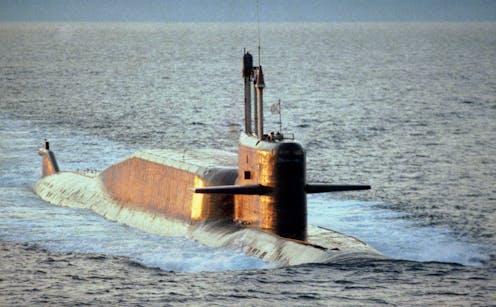
The AUKUS alliance, announced by leaders of the three countries last week, finds them seeking strategic advantage in the Indo-Pacific region with a focus on developing nuclear-powered submarines for the Australian Navy.
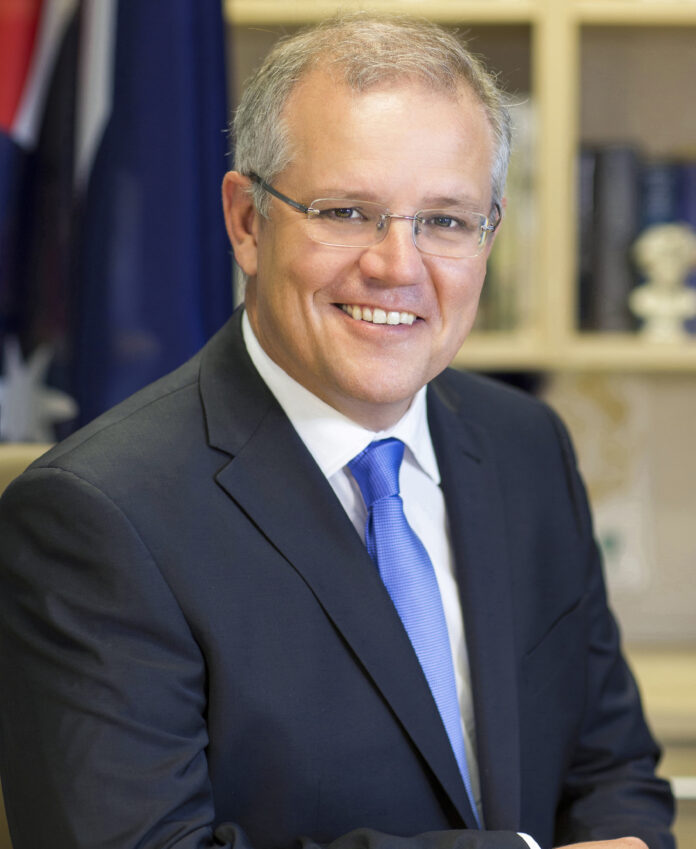
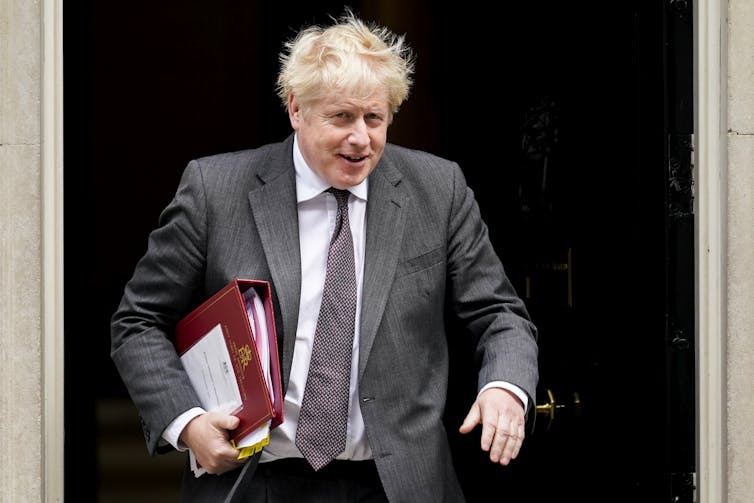
Announcing the pact via video link with Australia’s Prime Minister Scott Morrison and his British counterpart Boris Johnson, US president Joe Biden said it was about enhancing their collective ability to take on the threats of the 21st century.
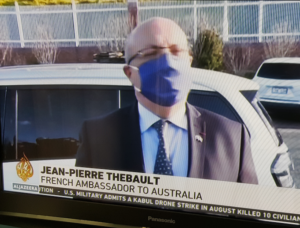
Recalled French ambassador Jean-Pierre Thebault … angry words for journalists on the way to the airport. Image: AJ screenshot APR
France has recalled its ambassadors to the US and Australia for consultations, in a “Pacific” backlash over a submarine deal after Canberra cancelled a multibillion-dollar deal for conventional French submarines, reports Al Jazeera.
President Biden declared: “Today we’re taking another historic step, to deepen and formalise co-operation among all three of our nations, because we all recognise the imperative of ensuring peace and stability in the Indo-Pacific over the long term.
“We need to be able to address both the current strategic environment in the region, and how it may evolve.”
Describing this threat as rapidly evolving, Biden said AUKUS was launching consultations on Australia’s acquisition of conventionally armed submarines powered by nuclear reactors. The president emphasised that the subs would not be nuclear-armed.
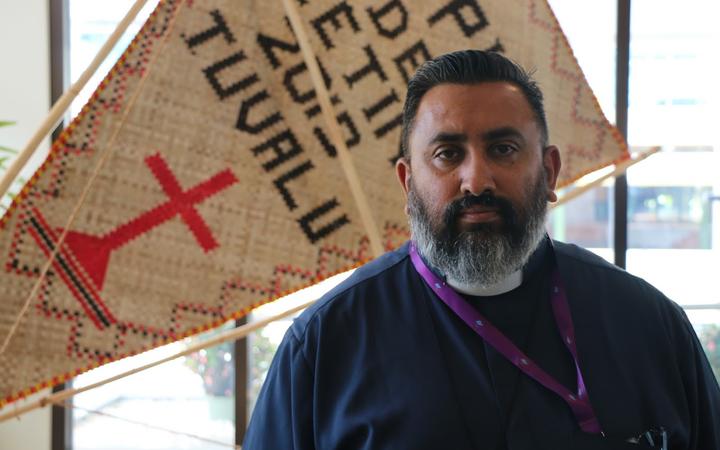
Serious concern for Pacific But the general secretary of the Pacific Conference of Churches, Reverend James Bhagwan, said the move towards nuclear submarines was a serious concern for a region still dealing with the fallout from nuclear weapons tests.
“Three weeks ago, the current chair of Pacific Islands Forum, the Prime Minister of Fiji (Voreqe Bainimarama) reiterated that we want a Blue Pacific that is nuclear free. It’s at the heart of Pacific regionalism,” he said.
The general secretary of the Pacific Council of Churches, James Bhagwan … “We are still dealing with the fallout from nuclear testing.” Image: Jamie Tahana/RNZ
“From the Sixties, from when the very first tests started in our region, this is something that government, civil society, churches have all been very adamant against, to keep our Pacific nuclear-free. We are still dealing with the fallout from nuclear testing.”
However, Morrison said it was time to take the partnership between the three nations to a “new level”, noting that “our world is becoming more complex, especially here in our region, the Indo-Pacific”, a sign of the alliance’s growing angst over China.
But the move towards nuclear submarines confronts the spirit of a nuclear-free zone that Pacific regional countries signed up to decades ago.
Furthermore, the pact comes as the Pacific Islands Forum continues to protest about Japan’s plans to dump treated nuclear waste water into the ocean from the Fukushima power plant, that was damaged in an earthquake and tsunami 10 years ago.
Taken by surprise The Federated States of Micronesia, a country with close ties to the US, was diplomatic in conveying how the pact caught it by surprise.
A spokesperson for the FSM government said it had “trust, faith and confidence” in the US and Australia in their promotion, and protection, of a Free and Open Indo-Pacific
“It can safely be assumed that the United States and Australia are making security decisions with the best interests of the Pacific in mind, because our vitality is their vitality. That said, this news is a surprise.
“Micronesia is confident this decision makes our country safer, but Micronesia also looks forward to learning more about how precisely that is the case.”
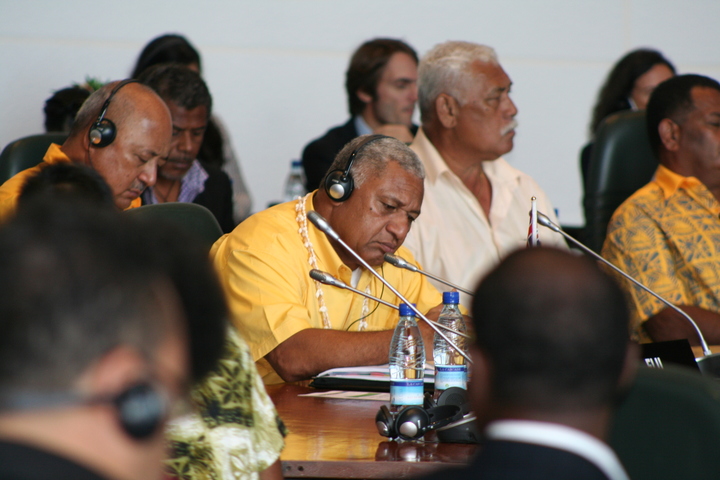
Regional figure … as Pacific Forum chairman, Fiji’s Prime Minister Voreqe Bainimara has outlined the regional aim for a nuclear-free Blue Pacific. Image: Johnny Blades/RNZ
Rather than loss of business, Pacific Islands are more concerned about existential loss, having first hand experience of nuclear testing by French, American and British.
“The ocean impacts on our life,” Reverend Bhagwan said.
“We are the fish basket of the world. So if one submarine comes in and something goes wrong and the nuclear waste from that submarine gets into our ocean, that’s too much already.”
Pacific interests Reverend Bhagwan questioned how the pact stacked up with Scott Morrison’s claims that Australia considered Pacific Islands countries as vuvale, or family.
“This is our Pacific way. Sometimes we don’t agree, but we always act in the best interests, we always come and support one another,” he said.
“This is not Australia acting in the best interests of the rest of its Pacific Vuvale.”
China has described the pact as being detrimental to regional peace and stability.
Relations between Beijing and Canberra are at an all-time low, and a spokesman for the Chinese government urged Australia to think carefully whether to treat China as a partner or a threat.
New Zealand’s Prime Minister Jacinda Ardern said the prohibition of nuclear-powered vessels in its waters remained unchanged, adding that the pact “in no way changes our security and intelligence ties with these three countries”.
She said New Zealand was first and foremost a nation of the Pacific which viewed foreign policy developments through the lens of what is in the best interest of the region.
This article is republished under a community partnership agreement with RNZ.
The New Caledonian government has extended the current lockdown as well as the curfew, until October as the covid-19 pandemic worsens.
On Thursday, seven deaths from covid-19 were recorded, the heaviest daily toll since the discovery of the first indigenous cases of the disease on September 6.
It brings the death toll to 24 since September 6, announced by President Louis Mapou, during a joint speech with the French High Commissioner, Patrice Faure.
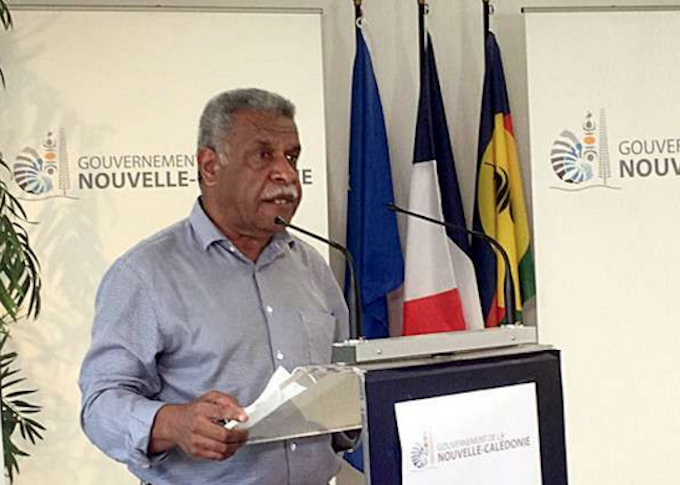
President Louis Mapou … announced New Caledonia’s 24th covid-19 death. Image: Les Nouvelles Calédoniennes
A total of 211 people are in hospital, including 29 in intensive care.
Authorities are extremely worried by the current situation which is why lockdown has been extended until October 4.
The 9 pm to 5 am curfew has also been extended until the same date.
President Mapou said: “We must not relax our efforts … to gradually recover a social life that would allow New Caledonia to relaunch itself from October 4.
“This fight is the fight for life. It requires a lot of sacrifices.”
Due in particular to the “risk of spreading the virus”, the representative of France “refuses to take the risk of endangering the population.”
French High Commissioner in New Caledonia Patrice Faure … refusing to take the “risk of endangering the population”. Image: RNZ/The Pacific Journal
Faure also stressed that “given the violence of comments observed on social networks”, this ban also aims to “avoid excesses that could endanger the organisers, participants or passers-by”.
The public prosecutor had indicated earlier in the day that prosecution would be initiated — especially for death threats made online against doctors publicly supporting vaccination.
This article is republished under a community partnership agreement with RNZ.
The West Papua National Committee (KNPB) claims that an attack on a military post in Maybrat regency earlier this month is being used as a pretext to “force the KNPB into a corner” and to criminalise them, reports Suara Papua.
The September 2 attack on Kisor sub-district military post in Maybrat regency, West Papua province, killed four soldiers.
“There are vested interests and a plot by certain parties behind the killing for four TNI [Indonesian military] members at Kisor, Maybrat,” claimed KNPB spokesperson Ones Suhuniap in a statement sent to Suara Papua newspaper.
“First multinational palm oil companies, which are currently challenging [the cancellation of] permits in the western Birds Head region,” he said.
“Second, the construction of [new] Koramil [sub-district military commands] in several districts in South Sorong and Maybrat regencies.
“Third, the additional deployment of troops on the grounds of securing the PON XX Papua [20th Papua National Games].”
Suhuniap said the incident was a plot and a trap which had been arranged to distract public attention from a challenge by four palm oil companies with the Jayapura State Administrative Court (PTUN) against Sorong Regent Jhony Kamuru’s decision to revoke their permits.
Legalising Trans-Papua Highway posts The “plot” was also to legalise and accelerate the construction of sub-district military posts and TNI and Indonesian police posts on the Trans-Papua highway connecting Manokwari and Sorong.
Suhuniap said that for the KNPB such a plot was nothing new and these methods were often used in Papua, especially against the KNPB.
As has been reported, the police claimed that a member of the civil society KNPB was involved in the attack, namely the movement’s chairperson in the Kisor sector.
However, what their alleged motive was and why they were involved, along with who the mastermind was behind the 19 people declared responsible for the attack had not been cited by the police.
Suhuniap said that if there were KNPB Maybrat members involved then there was a third party which provoked or trapped them into it and so it was necessary to discover the mastermind and what their interests were.
The KNPB did not kill or act in a hostile way towards other people, including the TNI and police, Suhuniap said.
“There is no agenda of murder directed against the authorities or special organisational instruction to attack members of the TNI and Indonesian police,” he said.
Investigation needed “So the police must delve into and investigate this case further. Who was the mastermind behind the attack? Don’t criminalise the KNPB.” he said.
If the investigation found that KNPB members were proven to have been involved in the attack then their actions were taken as individuals, not the organisation.
“We as an organisation [the KNPB] have never carried out sabotage or urban guerrilla actions,” he said.
Suhuniap also said the attack was part of an Indonesian effort to counter public demands from within Papua and internationally for the release of KNPB international spokesperson Victor Yeimo.
“The state is shaping public opinion to distract the Papuan people’s attention from Victor Yeimo’s release and creating a sense of fear,” he said.
“Indonesian colonialism through its intelligence [services] are shaping public opinion and distracting the Papuan people’s attention by accusing the KNPB of being involved in the attack on the soldiers in Kisor.
“We believe that this effort to distract public attention is a cheap sort of intelligence propaganda to destroy and criminalise the KNPB.”
Suhuniap called on colleagues from West Papua’s 112 resistance movement organisations and all Papuan people to remain solid and not be influenced by the manipulation of public opinion.
“The Papuan people must be consistent in rejecting the extension of special autonomy, the unconditional release of Victor Yeimo and demanding the right to self-determination,” he said.
Ten people have died from Papua New Guinea’s covid-19 pandemic and 203 new cases were reported in five days from September 9 as National Pandemic Response Deputy Controller Dr Daoni Esorom made a red alert call on Independence Day “super spreader” events.
“Papua New Guineans are just not heeding our calls to adhere strictly to public health protocols like masking up and keeping social distancing at the mass events,” he said.
“There is a high risk of a surge in infections in the coming weeks and months.”
Esorom urged provinces to be proactive in their covid-19 response.
“There were shows in Goroka, Enga, Western Highlands and other provinces despite the National Control Centre advice not to proceed.
“If the events result in a surge of covid-19 cases, the provincial health authorities and administration must be fully responsible. These are super-spreader events,” he said.
“Money will not run away. At this time [in the face of the Delta variant threat] gatherings should be limited.”
Appeal to the people He appealed to the people — whether they believed that covid-19 was there or not, believed in conspiracy theories or in not being vaccinated — there were two strategies needed to prevent a big surge in the country.
“The first is observing strictly to the Niupela Pasin (New Normal) which was nothing more than listen and follow.
“Niupela Pasin is a public health and social intervention that in the long-term will definitely reduce the number of cases.
“At the same time they are cost effective strategies.
“It will not cause a lot of money but in the event that we do not follow them,there will definitely be a big surge of the covid-19 infections in Papua New Guinea.
“If we have to get ourselves out of the epidemic, we need to vaccinate ourselves, and everyone.”
In an update on Wednesday, NCC Incident Manager Dr Melinda Susapu said two covid-19 deaths were reported on Monday on the back of 130 new cases (120 in Western, three in Hela, two in the National Capital District (NCD) and one each in Morebe, Eastern Highlands, New Ireland, Madang and Jiwaka).
Deaths now 204 She said the two deaths were from Western Province which brought the total cumulative deaths to 204.
The total number of covid-19 cases in the country was 18,542 of which 17,892 had recovered and 448 cases still active.
“NCC had yet to receive the samples that were sent to the Doherty Institute in Melbourne, Australia, to confirm whether the covid-19 cases reported were of the delta variant because the institute was not able to run tests for the samples (Australia is also experiencing a surge in cases).
“Of the 130 new cases, 24 were re-infection cases (22 in Western and two in NCD which means these people had contracted covid-19 some five or more months ago and these data will help in understanding the transmission dynamics of covid-19 and whether it was characteristic of Delta.
“Only eight of the 22 provinces are reporting regularly,” she said.
Susapa said due to delays in the reports the actual situation in provinces could be grossly underestimated.
Reporting gaps “The surveillance teams are constantly identifying reporting gaps and are working with provinces to ensuring the discrepancies are minimised,” she added.
Susapu said the total number of covid-19 tests done to date in the country was 182,403 “which is very low”.
Esorom said it was important that health facilities were conducting testing and people should go for testing because testing was necessary “for us to understand the extent of the spread and for us to respond appropriately”.
“It is taking too long for the genome sequencing of samples sent to Australia,” he said.
“Hence, the NCC is working with partners to enable the PNG Institute of Medical Research (IMR) to do that by next month.”
Lulu Mark is a reporter for The National. Republished with permission.
Questions have been raised about why the head of Fiji’s Bureau of Statistics was fired by the Bainimarama government this week.
Kemueli Naiqama recently published this year’s household income and expenditure survey that showed three quarters of Fiji’s poorest people are indigenous Fijians, or i-Taukei.
It is the first time ethnicity has featured in data published in the annual survey.
RNZ’s correspondent in the capital Suva, Lice Movono, told RNZ FirstUp the bureau had been “enhancing their ability to report information” and trying to be in line with sustainable development goals reporting.
“And the latest report shows that the poorest people in this country are the i-Taukei people,” Movono said.
“But more importantly that our poverty population — or the population that is living well below the poverty line — is very high.
“It would be directly opposite to the policies of this government to give information segregated according to ethnicity — it would be extremely embarrassing for a government that has been talking about producing an all time record high boom – economic growth,” she said.
Sacking defended The Statistics Department comes under the Ministry for Economy.
The Minister, Aiyaz Sayed-Khaiyum who is also Fiji’s Attorney-General, has defended his sacking of the country’s chief statistician.
Sayed-Khaiyum questioned the methodology used for the study and labelled it flawed.
“Poverty in Fiji is now measured by consumption, including the food grown in a family backyard, and not just income,” he said.
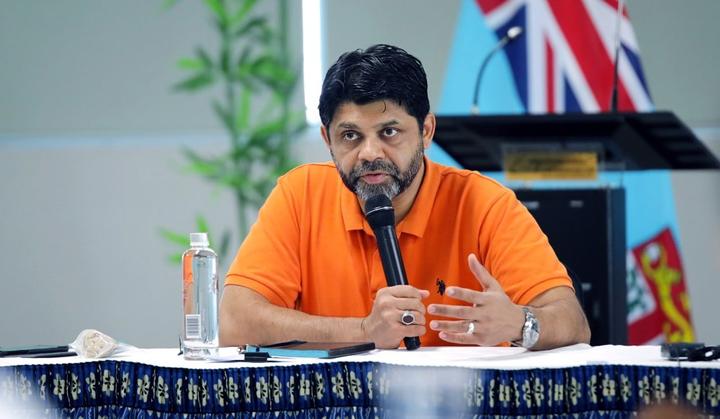
Minister Aiyaz Sayed-Khaiyum … “Poverty in Fiji is now measured by consumption.” Image: Fiji government/FB
Sayed-Khaiyum told a media conference in Suva he had issues with the bureau’s analysis of ethnic and religious data in its 2019-2020 Household Income and Expenditure Survey (HIES).
“We appreciate any independent office carrying out a proper, professional independent analysis of any data and understand the importance of reliable, timely and accurate statistics,” Sayed-Khaiyum said.
“And many may not know this or many may not delve further into this — we in fact approved this new methodology of moving away from what we call using the traditional income measure for welfare analysis — to using consumption expenditure for poverty measurement.”
New measuring yardstick Sayed-Khaiyum said the consumption-based methodology for measuring poverty would “accurately and better assist in policy-making”.
He said the new yardstick did not just look at how much money a household earned but also at how they had access to services.
But there were many who disagreed with the attorney-general.
The University of the South Pacific’s senior lecturer in economics, Dr Neelesh Gounder, said the poverty estimates produced at all levels were reliable.
He said those not happy with the ethnic-based policy needed to target the policy and not the data.
Gounder said the survey was just the “messenger and shooting the messenger would not help.”
“Regarding data on ethnicity, there are several policy areas where ethnic-based data is relevant and required,” Dr Gounder said.
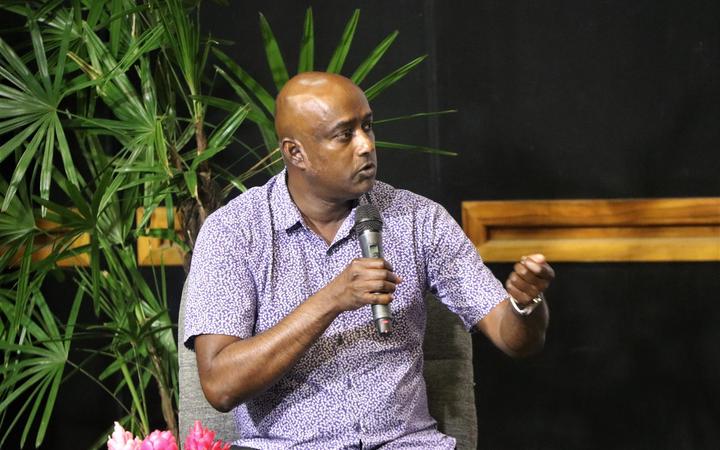
USP senior economics lecturer Dr Neelesh Gounder … “shooting the messenger would not help.” Image: RNZ/University of the South Pacific
Ethnic data important “Ethnic data allows us to see beyond presumed beliefs and prejudices that underly ethnic groups and it seems the government wants to avoid race-based policies that may arise from ethnic data.
“Recognising diversity based on ethnicity does not necessarily mean such differences should also lead to policy based on ethnicity.”
However, the government needs to understand that it is not the census or HIES that is causing ethnic tension in Fiji, Dr Gounder said.
The leader of the opposition Social Democratic Liberal Party (SODELPA), Bill Gavoka, said reports Naiqama was escorted out of his office were “shameful”.
“It is truly troubling,” Gavoka said.
He said the Bureau of Statistics is independent of ministers and instead reported directly to Parliament, with staff who are civil servants, but without being under ministerial control.
“The statistics they generate are independent of government and to hear that the FBoS CEO Kemueli Naiqama was unceremoniously dismissed and escorted off-premises for the report of poverty in Fiji, says a lot about the type of democracy we have in Fiji,” Gavoka said.
Independence needed He said SODELPA wants the Statistics Bureau to have independence from any undue outside influence, especially from a government that has been hyping about a “boom” that many knew was not true.
“The collection, compilation, analysis, abstraction, and publishing of statistical information relating to the economic and general activities must be carried out without fear and SODELPA tells the Attorney-General and FijiFirst, ‘hands off’,” Gavoka said.
By exceeding the scope of data collection and ignoring fact-based methodology, the government said Naiqama had breached the terms of his contract with the ministry.
Under his employment contract, Naiqama will be paid all salary and accrued entitlements for the period up to September 15, 2021.
This article is republished under a community partnership agreement with RNZ.
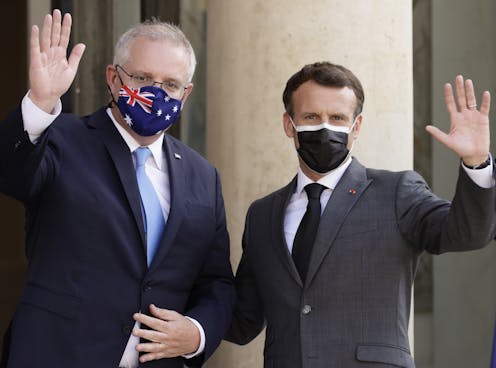
Scott Morrison, whose COVID face masks have the Australian flag emblazoned on them, likes to talk about “the Australian way” of doing things and Australian values.
But it is not “the Australian way” to secretly plan, over a very long time, to deceive a close friend of this country, and then to treat them in a most humiliating and disdainful manner. That does not align with “Australian values” of honesty and fair dealing.
If Australia is really surprised an angry French government has withdrawn its ambassador from Canberra (as well as its ambassador from Washington) it suggests it has no grasp of the proprieties of international diplomacy.
To add insult to injury, on Sunday Defence Minister Peter Dutton suggested the Australian government had been “upfront, open and honest” – the French could have read the signals of our discontent with their $90 billion submarines contract, including in Senate estimates hearings. This latter reference brought to mind then Prime Minister Malcolm Turnbull suggesting to Barack Obama that if he’d kept up with the Northern Territory News he’d have known about Australia’s lease of the Port of Darwin to the Chinese.
As recently as the end of August, Dutton and Foreign Minister Marise Payne held the “Inaugural Australia-France 2+2 Ministerial Consultations” with their French counterparts. In the “bilateral cooperation” section of the communique came the sentence: “Ministers underlined the importance of the Future Submarine program”.
It’s telling that the unveiling of the new AUKUS agreement last week was surrounded by more showmanship than diplomacy. The leaders of Australia, the US and Britain were successfully linked for a synchronised performance. But Morrison apparently did not manage to speak personally to French President Macron when a massive contract was being torn up.
AUKUS carries Morrison’s individual branding. It may be the most significant legacy of his prime ministership; however long he is in office, it will certainly be one of them.
It has all the Morrison hallmarks: his own work, conceived and executed in secrecy, kept to the smallest possible round of colleagues, details to be worked out much later, and little concern for the incidental fallout.
If, 30 years on, historians rate it as a stroke of strategic foresight that greatly protected Australia in a time of Chinese potential aggression, Morrison will deserve all the credit. He says he’s been working for 18 months on this – the mustering of a new Anglosphere in our region – and he has managed to pull it off with Joe Biden and Boris Johnson, who both had their own reasons for being receptive.
On the other hand, if after 30 years, AUKUS is judged in the rear vision mirror to have escalated tensions with China to a greater degree than it protected us from Chinese aggression, history’s judgement will be different.
Even as we’re consumed by the short term, it is always worth a look at the long view. Especially when Afghanistan is fresh in our minds – a commitment that was necessary initially, but ended in a fiasco that has restored the Taliban.
Morrison’s planned nuclear-powered subs come without any estimated cost (except they’ll be more expensive than the French ones); or precise timetable (except they won’t be available for a couple of decades); or decision about which boat will be chosen (except it will be American or British), or firm indication of how much building will be done in Australia (except that it won’t be all of it and possibly only a modest amount).
If any of these aspects returns to bite, blame will (or should) rest on Morrison’s head, whether he’s around or not.
Then there’s the French relationship to manage. How long their fury will last is anybody’s guess. But given their interests in the region, it is no small thing to deliver this rebuff in what can only be seen as a crass manner.
Marise Payne may not be of great use in repairing the tear in the relationship. Her diplomatic credibility is one of the immediate casualties of the affair, especially after the recent ministerial talks. One can only imagine how the feisty Julie Bishop would have reacted to being left so compromised.
With Australia’s ambition for a free trade agreement with the European Union in mind, Trade Minister Dan Tehan, flak jacket packed, is off to Paris next week.
Also important is the message that’s been sent to some key regional countries. Indonesia and Malaysia have expressed concerns. The risk is Australia could be seen as an unexpectedly capricious player in the way it operates.
AUKUS is a mark of the supremacy of the hawks in Canberra. Although Morrison said he started planning it with former defence minister Linda Reynolds, it is a precise fit for current minister Dutton.
In thinking about defence strategy, governments of both complexions have circled around questions of long range capability, of which nuclear-powered submarines are part.
But it was not until Morrison, in the lead up to the 2020 defence strategic update, started to push Reynolds and the defence establishment to contemplate the acquisition – and potential use – of such weaponry that the real momentum came. In Dutton, Morrison has a defence minister who not only shares his instinct on this, but has a full time focus on it.
Some months ago the secretary of the home affairs department, Mike Pezzullo, himself a hawk, wrote of hearing the “drums of war”. It was obvious well before that Australia was preparing to refurbish and expand its own drum set in the face of an assertive China already targeting Australia economically.
Dutton and others have increasingly dropped the government’s earlier attempt to avoid naming China as the potential enemy, even if we haven’t quite got back to the red arrows from the north of those 1960s depictions.
One problem with the subs deal is that, given the pace at which things move, a China-US military blow-up over Taiwan (if it comes to that) could be done and dusted, with god knows what consequences, by the time the boats are in the water. No wonder the talk now is of leasing a sub or two to fill in the gap, given the inadequacy of the Collins-class submarines we now operate.
It should be noted, incidentally, that some commentators expert in these things say the French nuclear-powered subs (as opposed to the conventionally-powered ones we’re ditching) would be more suitable to our needs than the US or UK boats.
The government says the problem is they’d need their nuclear power refuelled every seven to ten years offshore (because Australia wouldn’t have the nuclear facility), while US and UK subs are powered for their lifetimes. That would not seem a great difficulty, but obviously reworking the French deal would not have delivered the big technological and other advantages of going the full monty with the AUKUS partners.
AUKUS will bring Australia a whole lot of other US weaponry and more boots on Australian ground.
This takes us to the future of the Port of Darwin. Just as the Coalition has botched for years its attempts to get new submarines, so the Northern Territory awarding a Chinese company the lease of the Port of Darwin was a massive snafu.
It’s no good the federal Coalition saying it was all the NT government’s fault. The defence department knew about it and wasn’t worried.
Now the Morrison government has a review of the lease in train. In light of AUKUS, with enhanced military assets in the north and our assessment of the Chinese, it would seem a logical absurdity to let the lease stand. And yet quashing it would be another demonstration of Australia’s unreliability on done deals. It’s a mess.
AUKUS will no doubt have a good many more consequences. One (not formally or totally linked of course) is expected to be a more ambitious climate policy from Australia, which Joe Biden has been urging on the Morrison government for the Glasgow climate conference.
Morrison in coming weeks will want to deliver to Biden (and Johnson), although we don’t know the extent of that delivery, or whether Barnaby Joyce will find himself struggling with any collateral fallout among his own people.
Michelle Grattan does not work for, consult, own shares in or receive funding from any company or organisation that would benefit from this article, and has disclosed no relevant affiliations beyond their academic appointment.
Victoria’s roadmap out of lockdown, released today, marks an important milestone. It’s a clear commitment to delivering on the National Plan, and provides much-needed clarity on where we are heading and what the next few months will look like. It is staged and sensible, striking the balance between opening up and maintaining a level of control over transmission.
The roadmap charts a course of staged reopening as more Victorians become vaccinated. It’s informed by modelling from the Burnet Institute, which makes some sobering predictions on the number of cases and the strain on our health system, no matter what course we take from here.
It steps us through what things will look like as we move from 80% of those aged 16 and older having had at least one dose, to 70% fully vaccinated, through to and 80% and beyond.
The potential risk of easing restrictions will be managed through a continued focus on outdoor activity and leveraging the lower risk of infection and, even more so, hospitalisation, in the growing number who are fully vaccinated.
Having a clear vision for where you are heading can make all the difference, especially when the time horizons are now within weeks. We need this, as it will still be a difficult transition through “the gateway” to living with COVID.
Balancing the risks
The roadmap was only one of five scenarios the Burnet team modelled and is in fact the least cautious. But the decision was taken to balance these risks with the direct and indirect health costs of delaying the easing of restrictions further.
The modelling forecasts twice the peak in case numbers, ICU admissions and deaths under the proposed path compared with staying under lockdown, or the other more restricted scenarios.
But it also shows that maintaining high levels of testing can mitigate some of this additional risk.
We have a road out, and one we can make less costly by testing when symptomatic, and abiding by the public health orders now the end is in reach.
So what does the plan say?
When 80% of Victorians have had a single vaccination dose
At 80% single dose coverage among those aged 16 and over, expected by September 26, the travel limit in Melbourne will extend to 15km.
Outdoor activities such as basketball, golf, tennis will be allowed, subject to the same people limits as picnics: two adults if unvaccinated, or up to five fully vaccinated.
In regional Victoria, final year VCAL (Victorian Certificate of Applied Learning) students will be allowed back to study onsite. Masks will no longer be required for beauty or personal care services.
When 70% of over-16s are double dosed
October heralds the staged return to partial onsite schooling, with further changes once 70% of those 16 and older are fully vaccinated, expected by October 26.
This marks the official ending of what we know as lockdown.
The curfew will also end in metro Melbourne and outdoor hospitality will open to those fully vaccinated.
Weddings and funerals will be allowed outdoors for up to 50.
Students from all years will be able to return to face-to-face learning for at least part of the week in both Melbourne and regional Victoria.
Regional Victoria will also see further easing with up to 30 fully vaccinated patrons allowed indoors in hospitality venues.
When 80% of over 16s are double-dose vaxxed
When we get to 80% double dose coverage, projected for November 5, all of Victoria will share the same more modest restrictions.
Indoor activity will open further for those fully vaccinated, including retail, and caps will lift to 150 for organised indoor events and 500 outdoors.
Private gatherings of up to 30 people outdoors will be allowed, but only ten guests are allowed in the home, the setting deemed the highest risk.
By year’s end, as we exceed 80% of adults fully vaccinated and aim for 80% including 12- to 15-year-olds, more visitors to the home will be allowed, possibly extending to 30 by Christmas.
International travel might be possible by then too, at least to low-risk countries.
Interstate travel will also be on the cards, although this might be limited to New South Wales and ACT until other states also move to living with the virus.
Why lift restrictions on outdoor activities and for the vaccinated?
It makes sense to use outdoor settings and individual and population vaccination protection to progress on this road out to manage transmission risk.
Remaining unvaccinated is a greater risk now, even with these rules in place – 204 people in hospital this week, and only 1% of these fully vaccinated.
Vaccine passports won’t be a permanent fixture, but allow us to do more things earlier than otherwise possible.
It’s important to recognise that the steps along the way may end up looking somewhat different depending on case numbers, perhaps for the better.
Lower case numbers as we start this transition will put us in a better position, as the Doherty modellers reported last week. So the more we contain transmission while in lockdown, the easier the road ahead and lowest impact on hospitals.
The immediate challenge has not changed. We still need to do everything we can to keep case numbers from rising and, if possible, bring them down. We still need to get vaccinated as quickly as possible and push coverage in those over 16 up to 80%, and beyond.
What has changed is that we can see clearly where we are heading and how our hard work to prevent further waves while waiting for the vaccine roll-out now translates into greater freedoms in coming months.
This is a critical transition period that will test us all, and it helps to see vaccination levels that can provide some relief within reach after a gruelling 18 months. With the end of this “pre-vaccine” phase within sight, a final push to control transmission over this last stretch makes this a safer and quicker passage through the gateway to living with the virus.
If we do better than the Burnet modelling assumes by getting tested when symptomatic, vaccinated or not, and abiding by the rules in place, we will come in well under the forecast case and death counts.
Victoria and NSW are watching and learning from each other as each state eases out of lockdown while keeping a level of control over the virus. Success will reassure other states and territories of how this can work, and allow Australia to once again be open for business.
Catherine Bennett receives funding from Medical Research Future Find and the National Health and Medical research Council, and was appointed as a independent advisor on the AstraZeneca COVID Vaccine Advisory Board
Hassan Vally does not work for, consult, own shares in or receive funding from any company or organisation that would benefit from this article, and has disclosed no relevant affiliations beyond their academic appointment.
Industry Minister Christian Porter has been forced to resign from cabinet after declining to seek and provide to Scott Morrison the names of the anonymous benefactors who have helped fund his legal costs.
Morrison has appointed energy minister Angus Taylor acting industry minister and sources say he is likely to continue in the dual role.
In a three-page statement, Porter renewed his attack on the ABC and said a statement provided by the now-deceased woman who accused him of historical rape – which he denies – showed the allegation lacked credibility and was written by someone “very unwell”.
Porter is keeping the funds donated to a “blind trust”, the amount of which is unknown. He also says he will seek to run again in his Western Australian seat of Pearce, which is on a 5.2% margin.
Last week, Porter updated his parliamentary register of interests to reveal a “part contribution” to his legal bills for his (now settled) defamation case against the ABC from “a blind trust known as the Legal Services Trust”. Porter said he did not know the names of donors.
Morrison asked his department to advise whether the arrangement breached ministerial standards.
But Morrison indicated at a news conference on Sunday he and Porter had finalised his future ahead of the advice.
Morrison was clearly anxious to have it settled before his trip to the United States, so it would not be a distraction during what he hopes will be time of positive news following last week’s announcement of the AUKUS security agreement.
Bad publicity around Porter has been a running sore for the government for much of the year.
The historical rape allegation surfaced publicly in February, when the ABC reported material about it had been sent to several politicians, including the prime minister. Porter was not named but later identified himself, declaring the alleged assault had never happened.
Initially, he hoped to retain his position as attorney-general, but this was politically untenable and he was moved to the industry job in a reshuffle.
With an outcry over the “blind trust” and an election approaching next year, Morrison could not afford another prolonged scandal around Porter. He indicated Porter’s future was in doubt when he said last week he was taking the matter very seriously.
Morrison said on Sunday that in their discussions, Porter had been unable to “practically provide further information because of the nature of those [trust] arrangements”.
That Porter couldn’t provide the information meant he could not conclusively rule out a perceived conflict of interest.
Morrison said Porter was upholding the ministerial standards by resigning.
Porter said in his statement that while he had no right of access to the trust’s funding or conduct, he had asked the trustee for an assurance, which he received, “that none of the contributors were lobbyists or prohibited foreign entities.
“This additional information was provided as part of my Ministerial disclosure,” he said.
He said no doubt the desire of some or many of the donors to remain anonymous was driven by wanting to avoid “trial by mob”.
Porter said he believed that he had provided the information required under the Members’ Register of Interests, and that the additional disclosures he provided under the Ministerial Standards were in accord with its additional requirements.
“However, after discussing the matter with the Prime Minister I accept that any uncertainty on this point provides a very unhelpful distraction for the Government in its work.”
He said to the extent the uncertainty might be resolved by seeking further information about donors’ identities, “this would require me to put pressure on the Trust to provide me with information to which I am not entitled.
“I am not prepared to seek to break the confidentiality of those people who contributed to my legal fees under what are well-known and regular legal structures, including the confidentiality attached to the Trust contribution,” Porter said.
He had explained he “could not assist any process that would ultimately allow people who have done nothing wrong to become targets of the social media mob.”
“Ultimately, I decided that if I have to make a choice between seeking to pressure the Trust to break individuals’ confidentiality in order to remain in Cabinet, or alternatively forego my Cabinet position, there is only one choice I could, in all conscience, make.”
In his renewed attack on the ABC, Porter said that “seemingly with great care and effort – [it] has reported only those parts of the information that it has in its possession which feeds into its narrative of guilt.
“I have recently been provided from a source outside the ABC with a copy of the only signed document that the person who made and subsequently withdrew the complaint ever made.
“Many parts of that 88-page document are such that any reasonable person would conclude that they show an allegation that lacks credibility; was based on repressed memory (which has been completely rejected by courts as unreliable and dangerous); which relied on diaries said to be drafted in 1990/91 but which were actually words composed in 2019; and, was written by someone who was, sadly, very unwell.”
Opposition Leader Anthony Albanese said Porter needed to answer where the money had come from. He also said Morrison had not sacked Porter – Porter had resigned.
Michelle Grattan does not work for, consult, own shares in or receive funding from any company or organisation that would benefit from this article, and has disclosed no relevant affiliations beyond their academic appointment.
Proposals to expand police powers, to criminalise coercive control and to establish specialist women’s police stations have all occupied a prominent place in Australia’s recent debate about responses to violence against women.
The proposal to establish women’s police stations has received a strong platform in mainstream media and academic journals. It has also featured in debates on policy development, such as in the Women’s Safety and Justice Taskforce currently underway in Queensland.
In the local and global movement for Black and Indigenous lives where associated campaigns are asking the public to scrutinise police powers and to discuss defunding police, many Australian feminists have been advocating for punitive solutions to domestic violence.
But there is currently no credible evidence to support the implementation of women’s police stations, and the research underpinning the proposal in Australia is problematic in several ways.
Specialist women’s police stations are designed to respond specifically to violence against women. They have been a feature of policing in Argentina, Brazil and other Latin American countries since the late 1980s, as well as parts of Africa and Asia.
All Women Police Station Tiruvannamalai, India. Wikimedia
Some women’s police stations adopt a “multidisciplinary” approach to policing domestic violence. They are staffed with teams of police who work alongside social workers, psychologists and lawyers. However, women’s police stations are still police stations.
They vary in appearance, with some colourfully designed with play rooms for children and welcome rooms that are decorated with flowers and murals.
Their mandate is to provide services for women. It’s unclear whether the stations provide support for people who identify as women outside of the cis-gender binary.
What does the research say?
To date, Australian news reporting on women’s police stations has relied almost exclusively on research led by Australian criminologist Kerry Carrington.
Journalists and commentators have frequently used this research to report on and advocate for the establishment of women’s police stations in Australia. Investigative journalist Jess Hill states:
We don’t get cops to fight fires or drive ambulances, because that’s considered specialist work. So why don’t we just take the police who love responding to family violence […] and create a parallel force? […] It’s a proven model that’s existed across Latin America (and various other countries) for 35 years.
The evidence presented in favour of women’s police stations is largely drawn from two original studies. Both studies were led by Professor Carrington at the Queensland University of Technology.
The first was a study undertaken in Argentina over a three-month period.
This research included interviews with 100 employees from ten women’s police stations in the Buenos Aires province of Argentina. The research participants represented were selected by the province’s Ministry of Security – who the police station reports to.
The second study drew on the findings of 2 surveys conducted in Australia on attitudes towards the proposal of women’s police stations.
These two surveys were: one “workforce” survey, which was distributed to Australian police officers, non-governmental organisations and case workers; the second “community” survey, with recruitment of Australian adults via Facebook advertising.
The second study found people thought women’s police stations could improve the policing of gender violence in Indigenous communities in Australia if staffed by appropriately trained teams working from both gender and culturally sensitive perspectives.
The authors of the study concluded:
adapted to an Australian context where Indigenous women are many times more likely to experience domestic family violence, these specialist police stations will need to be appropriately staffed by Indigenous and non-Indigenous officers trained to work from both gender and culturally sensitive perspectives.
Issues with the studies
There are several concerns with both studies.
In relation to the study in Argentina – all 100 of the participants were paid employees of the two police stations being researched. Police officers made up 79%, and 21% were lawyers, social workers or psychologists employed by or otherwise engaged with the two police stations selected for the study.
The study doesn’t consider how the research participants’ statuses as employees of the police stations may have influenced their views.
A second concern is the study didn’t include interviews with survivors or their families or support networks. It also didn’t include interviews with the communities where the stations were located.
A third limitation (which the authors acknowledge), is the study does not examine whether these police stations reduced crime rates, statistics of domestic violence or apprehended violence orders.
In addition, no data is supplied about important factors to assess the claims of the benefit of women’s police stations in other matters related to domestic violence. Such as whether women’s police stations increase access to legal supports or whether they improve a person’s ability to report violence.
Finally, neither study examines whether there was a reduction in crime rates or statistics of domestic violence, femicide or apprehended violence orders.
It is difficult to assess the effectiveness of women’s police stations without this data.
Evidence to suggest women’s police stations don’t work
Evaluations of women’s police stations have had mixed results. For example, one recent evidence summary in India found “all-women police stations did not improve services for gender violence victims”.
Another study suggests no improvement in reporting or accountability with respect to women’s police stations in India.
And there is evidence to suggest women’s police stations are not free from discrimination and violence, such as reports of transphobia.
This paper from Spanish journal Delito y Sociedad in 2016, reported female officers associated with La Plata women’s police station apprehended and publicly searched ten transgender women. The women said they were threatened with being shot if they moved. They stated four of them were detained for no reason other than their visibility as trans women.
The event led to widespread condemnation of the La Plata women’s police station by transgender advocacy groups, particularly as station staff at that time included a trans woman.
There is also the death of Úrsula Bahillo that indicates these police stations aren’t always effective with protecting people who experience domestic violence.
Bahillo reported violence from her policeman boyfriend to a woman’s police station on at least 18 separate occasions. She died three days after reporting her case to a women’s police station in Buenos Aires province in February this year.
La Capital reported Bahillo’s family stated the women’s police station “did nothing.”
Úrsula Bahillo’s case became notorious for the repeated times she asked for help, denounced her aggressor [to police] and was not listened to.
Policing studies conducted in Australia and the UK suggest simply increasing the number of female police officers will never be enough to improve discriminatory policing.
Despite female leadership in policing in Queensland, there have still been reports of sexism and racism among police, including police posting on social media that women lie about domestic violence.
What about Black and Indigenous women?
We found very little research on the experiences of Black and Indigenous women with women’s police stations, besides one 2010 report, looking at Latin America, which observed:
Indigenous and Afro-descendent women have limited access [to women’s police stations] because few operators come from or understand those cultures and few speak their languages.
Indigenous advocates have repeatedly drawn attention to the police failure to protect Indigenous women and families.
An example of this involves the case of Tiffany Paterson, an Aboriginal woman from the Northern Territory who was violently assaulted after the Northern Territory Police failed to protect her.
Tiffany, who survived the attack, later sued the Northern Territory Police on the grounds of negligence and settled on confidential terms.
It is broadly understood in Indigenous communities that police stations are not safe places for Indigenous people. They are also not safe for Indigenous people to call upon for assistance, with domestic or state-sanctioned violence.
We know Indigenous families and communities are often frontline responders to domestic violence. Indigenous women are more likely to report violence or seek support from staff within Indigenous organisations, not police nor non-Indigenous services.
We know policing of domestic violence plays a significant role in the removal of Indigenous children from their families. The deep mistrust of police within Indigenous communities is acknowledged by police themselves.
Literature produced with Indigenous communities by Indigenous and non-Indigenous scholars in Australia points to concrete alternatives for Indigenous women and families experiencing violence.
White feminists must listen to Indigenous peoples and organisations who are at the frontline delivering evidence-based early intervention and prevention services, as well as Indigenous researchers with lived experience.
All those who have previously supported women’s police stations should read this important work and reconsider their position. Now is a crucial time for these discussions, on the 30 year anniversary of the Royal Commission into Aboriginal Deaths in Custody, and with Indigenous incarceration rates increasing and the preparation of a new ten year National Plan to address violence against women and children.
Crystal McKinnon receives funding from the Australian Research Council.
Marlene Longbottom is employed by the University of Wollongong and is currently the VC Aboriginal Postdoctoral Research Fellow.
Amanda Porter and Ann Louise Deslandes do not work for, consult, own shares in or receive funding from any company or organisation that would benefit from this article, and have disclosed no relevant affiliations beyond their academic appointment.
Medical news is full of stories about promising new treatments for challenging conditions, or for additional health benefits of routine behaviours and habits. Who doesn’t want to feel good about drinking coffee or eating chocolate?
In this rich vein, a study by German and British researchers published earlier this year — which just won the Ig Nobel prize for medicine — suggests orgasmic sex can clear nasal congestion as well as a nasal decongestant.
The Ig Nobels are awarded to “honour achievements that first make people laugh, and then make them think”, with a ceremony at Harvard University and Nobel laureates among those handing out prizes.
This year’s winner deserves critical appraisal before deciding whether to prescribe orgasm for consenting partners with stuffy noses.
When we critically appraise research it’s important to look at “internal validity” first. Could the results have been caused by other factors, such as bias due to flaws in design or how the research was conducted? The next step is to ask whether the findings have “external validity” or can be generalised to the wider population.
Also, with most studies that aren’t using the “gold standard” study design of double-blinded, randomised controlled trials, we need to consider other factors to establish cause and effect. This includes consistency with other evidence and biological plausibility — or whether the findings tally with established understandings of our bodies.
The German-UK study was clearly not a double-blind study (the couples knew they were having sex) and was small in size (18 heterosexual couples), but each subject was their own “control” subject. That means each person had the intervention — sexual intercourse with orgasm — compared with a nasal decongestant spray applied the following day.
Nasal flow was measured at five time points: before sex, after orgasm and up to three hours afterwards. Subjects were tested with a questionnaire to determine which ones had pre-existing nose blockages over the past month. Nasal function was assessed subjectively by the participant and objectively with a portable device measuring air flow.
As such, this study was well-designed and conducted. That is, apart from one minor flaw: some participants were unable to focus on the device before and immediately after intercourse, leading to some missing data!
Some research data was lost in the afterglow. Unsplash, CC BY-SA
The study did find a significant improvement in nasal flow immediately after orgasm and this was of similar size to the benefit from decongestant spray used the following day.
However, the benefit from sexual activity was short-lived and nasal flow was back to baseline within hours. Unsurprisingly, the improved nasal flow was only seen in those with pre-existing nasal congestion.
Though effective, nasal decongestant spray is probably less fun than sex. Shutterstock
Wait, there’s a connection between orgasm and noses?
The research paper notes the theory of “reflex nasal neurosis” was put forward by German otolaryngologist Wilhelm Fliess, a close friend of Sigmund Freud, in 1897. Both believed neuroses were mostly caused by sexual problems.
Fliess theorised there were specific “genital spots” in the nose that influenced genital function. Yet his theory failed scientific scrutiny and faded into obscurity.
However, exercise is known to cause an improved nasal flow and this benefit persists for up to 30 minutes after physical activity.
Observational studies have suggested people who have more sex are happier, but that might not be the whole story. Shutterstock
There are some limitations of the research, such as the small sample size of volunteer couples, and the timing of nasal air flow measurements.
But overall, the study presents some convincing evidence that orgasm improves nasal obstruction, at least for an hour or so. And, as the researchers note: “I don’t think other methods to relieve congestion are nearly as much fun as sexual activity.”
The Ig Nobel winners suggest further research into whether masturbation has similar benefits, or whether multiple orgasm might provide longer relief of nasal congestion.
So, those with nasal congestion shouldn’t throw away their decongestant sprays just yet. However, all of us can bask in the warm glow of knowing we can add another health benefit to sexual intercourse and orgasm.
David King does not work for, consult, own shares in or receive funding from any company or organisation that would benefit from this article, and has disclosed no relevant affiliations beyond their academic appointment.
Recently, two native Australian birds have stolen the limelight with their impressive vocal imitations.
A superb lyrebird called Echo at Sydney’s Taronga Zoo has produced a painfully realistic vocal rendition of a human baby crying. Lyrebirds are already world-famous for their astonishingly accurate vocal mimicry, but these new recordings show their abilities can still surprise.
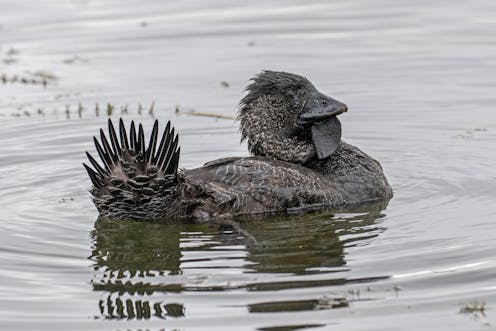
Then a new paper announced the arrival an unexpected newcomer to Australia’s vocal imitation scene. A male musk duck (Biziura lobata) named Ripper was recorded imitating two stereotypical Australian sounds: a loudly shutting gate and a person exclaiming “you bloody fool!”.
The gate sound, at least, proved a hit with one of Ripper’s male colleagues who also ended up mimicking the sound. Excitingly, these recordings — originally from the 1980s and dug out from archives — provide the first material evidence of any duck species copying a sound in its environment, disrupting current understandings of the evolution of vocal learning in birds.
So what’s the big fuss about crying and swearing birds?
Why musk ducks are odd
Vocal production learning is a highly specialised trait that’s rare among animals.
It requires flexible and sophisticated control over vocal production, and can be associated with enlarged regions of the brain relative to non-vocal learners.
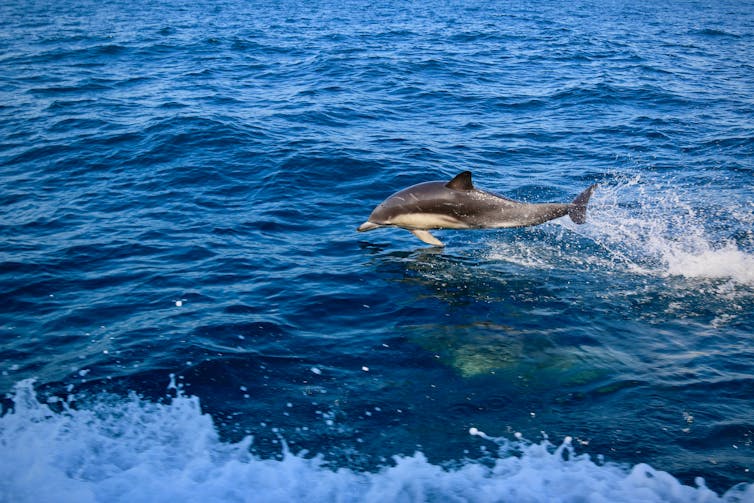
For a long time, the only other animals known to possess similar vocal learning abilities to humans were parrots and male songbirds. But today, the musk duck joins a broad, but relatively small, list of non-human animals capable of vocal learning, including some bats, elephants, dolphins, whales and seals. Belatedly, we can now add female songbirds to the list of vocal production learners.
Dolphins are among few animals with capacity for vocal learning. Shutterstock
The loquacious “Ripper” was a captive-reared male musk duck at the Tidbinbilla Nature Reserve near Canberra. When he hatched, with the help of a foster bantam hen, he was the only musk duck there.
But even in the wild, musk ducks are odd. Male musk ducks are up to three times larger than females and have a distinctive bulbous lobe of skin hanging from their bills. Their name comes from the musky smell emitted by dominant males.
In the breeding season, males group together (in “leks”) and perform an exciting aquatic courtship displays for females, performing both day and night. Each male performs a structured, audio-visual display with his tail over his back, inflating his throat lobe, and splashing water while whistling loudly.
In the wild, male display whistles seem to form local dialects — a signature of vocal learning. But this doesn’t involve imitations of other species.
Ripper produced many elements of wild display, but would avidly display to people. His bizarre mimicry of anthropogenic sounds formed part of this display.
Listen to Ripper say ‘you bloody fool’
Mimicking in captivity
The story of Ripper is part of a long scientific tradition. Captive-reared parrots and some songbirds mimicking human speech feature in ancient European writings, including the works of Aristotle and Pliny the Elder.
More recently, the possible complexities of parrot communication were explored in a pioneering study of “Alex”, the captive African grey parrot, who had a vocabulary of more than 100 words.
Alex video caption.
By and large, such accounts of human imitations involve a captive individual raised in isolation from others of its own kind, but in close association with a human caretaker. The human caretaker then becomes the social model for the captive bird’s vocal development.
So while these examples reveal an animal’s capacity for vocal production learning, they don’t show that wild animals imitate sounds from their environment. Indeed, very few of the animal species that mimic people in captivity produce anything other than their own, species-specific vocalisations in the wild.
However, this is not true of Australia’s lyrebirds and other avian vocal mimics.
Mimicry in wild Australia
Two lyrebird species are famous for the diversity and accuracy of their vocal mimicry: the superb lyrebird of the wet eucalypt forests of southeast Australia, and the Albert’s lyrebird of Australia’s subtropical east.
In captivity, male superb lyrebirds have been recorded mimicking anthropogenic sounds ranging from chainsaws, emergency vehicle sirens to this new recording of a crying human baby.
Superb lyrebirds have been recorded mimicking chainsaws, sirens and more. Shutterstock
In the wild, both males and females are proficient mimics of the vocalisations and wingbeats of other bird species — and occasionally mammals. A single individual male superb lyrebird can even mimic a flock of alarm-calling birds.
Despite many rumours, it remains a bit of a mystery when and how often wild lyrebirds mimic sounds of human origin.
Lyrebirds aren’t the only ones. Australia is the lucky home to a surprisingly large number of songbird species that regularly mimic in the wild, from tiny thornbills to the large enigmatic bowerbirds that, even in the wild, occasionally produce startlingly accurate renditions of humans.
But not all mimics are what they seem. In a heartbreaking example, the mimetic song of the Regent honeyeater is both a consequence and a cause of the species’ decline. Wild males copy other species because there aren’t enough males left to pass on their song to the next generation.
Regent honeyeater are critically endangered songbirds. Shutterstock
Threatened archival treasures
Ripper the swearing musk duck, Echo the bawling lyrebird, and the forgotten songs of the Regent honeyeater show us how much we still have to discover about Australia’s extraordinary birds. Far from being the biogeographical oddity, Australian birds are still destabilising biological theory.
Ripper was a bird of the 80s, and we only know of his bizarre mimicry because Rippers’ recordist, Dr Peter Fullagar, was on a mission to establish a natural history sound archive for Australia. Like all good 80s singers, Ripper was recorded on cassette tape before Peter digitised it.
It’s only from historical archives that researchers could discover that original song of the Regent honeyeater was unique to the species and more elaborate than the songs of contemporary males. Simply listening to captive-reared birds or the dwindling singers in the wild is no longer enough to reveal the Regent honeyeater’s natural song: the baseline has shifted.
What other treasures lie gathering dust in forgotten sheds or library stacks? We must be quick, before those cassette tapes degrade too far to be read.
Anastasia Dalziell receives funding from the National Science Foundation (USA). She was recently a postdoctoral research fellow with the Macaulay Library: a scientific archive of natural history audio, video, and photographs.
Justin A. Welbergen receives funding from the Australian Research Council and the National Science Foundation (USA).
University of Canberra Professorial Fellow Michelle Grattan and University of Canberra Vice-Chancellor and President Professor Paddy Nixon discuss the week in politics.
This week Michelle and Paddy discuss the revelation that anonymous donors covered some of former attorney-general Christian Porter’s legal fees incurred during his defamation case against the ABC.
They also discuss Scott Morrison’s upcoming trip to Washington for the QUAD forum, and what this means for the AUKUS partnership announced this week, which will see Australia acquiring nuclear-powered submarines.
Michelle Grattan does not work for, consult, own shares in or receive funding from any company or organisation that would benefit from this article, and has disclosed no relevant affiliations beyond their academic appointment.
Of the 8.2 million homes and businesses active on Australia’s National Broadband Network (NBN) in July 2021, 77% are now reported to be on a broadband plan that delivers speeds of at least 50 megabits per second (Mbps). This is plenty to accommodate a typical household’s needs for video streaming (Netflix high-definition resolution, for instance, uses about 3Mbps and ultra-high definition about 12Mbps), video conferencing (2-3Mbps), gaming (less than 1Mbps) and general web browsing.
So why do we still experience video freeze, game lag spikes, and teleconference stutters? The problem is not speed, but other factors such as latency and loss, which are unrelated to speed.
For more than three decades we have been conditioned to think of broadband in terms of Mbps. This made sense when we had dial-up internet, over which web pages took many seconds to load, and when DSL lines could not support more than one video stream at a time.
But once speeds approach 100Mbps and beyond, studies from the Broadband Forum and others show that further increases are largely imperceptible to users.
Yet Australian consumers fear being caught short on broadband speed. More than half a million Australians moved to plans delivering more than 250Mbps in the March 2021 quarter. Indeed, we have collectively bought about 410 terabits per second (Tbps) on our speed plans, while actual usage peaks at 23Tbps. This suggests we collectively use less than 6% of the speed we pay for!
In contrast to our need for speed, our online time has grown tremendously. According to the Australian Competition and Consumer Commission (ACCC), the average Australian household consumed 355 gigabytes of data in December 2020, a 59% increase on the year before.
Our internet usage is like a marathon runner gradually adding more and more miles to their training distances, rather than a sprinter reaching higher and higher top speeds. It therefore makes little sense to judge our multi-hour marathon of video streaming, gaming and teleconferencing by running a connection speed test which is a 5-10 second sprint.
What do we really need from broadband?
So what do we need from our broadband for a good streaming, gaming or conferencing experience? A connection that offers low and relatively constant latency (the time taken to move data packets from the server to your house) and loss (the proportion of data packets that are lost in transit).
These factors in turn depend on how well your internet service provider (ISP) has engineered and tuned its network.
To reduce latency, your ISP can deploy local caches that store a copy of the videos you want to watch, and local game servers to host your favourite e-sport titles, thereby reducing the need for long-haul transport. They can also provide good routing paths to servers, thereby avoiding poor-quality or congested links.
To manage loss, ISPs “shape” their traffic by temporarily holding packets in buffers to smooth out transient load spikes. But there’s a natural trade-off here: too much smoothing holds packets back, leading to latency spikes that cause missed gunshots in games and stutters in conferences. Too little smoothing, on the other hand, causes buffers to overflow and packets to be lost, which puts the brakes on downloads.
ISPs therefore have to tune their network to balance performance across the various applications. But with the ACCC’s Measuring Broadband Australia (MBA) Program predominantly focused on speed-testing, and with a 1% margin separating the top three ISPs all keen to claim the top spot, we are inadvertently incentivising ISPs to optimise their network for speed, rather than for other factors.
This is a detrimental outcome for users, because we don’t really have quite the need for speed we think we do.
How can we do better?
An alternative approach is possible. With advances in artificial intelligence (AI) technology, it is now becoming possible to analyse network traffic streams to assess users’ experience in an application-aware manner.
For example, AI engines trained on the pattern of video “chunk” fetches of on-demand streams such as Netflix, and live streams such as Twitch, can infer whether they are playing at the best available resolution and without freeze.
Similarly, AI engines can analyse traffic throughout the various stages of games such as CounterStrike, Call of Duty or Dota2 to track issues such as lag spikes. And they can detect videoconferencing stutters and dropouts by analysing traffic on Zoom, Teams, and other platforms.
Australia has made significant public investment into a national broadband infrastructure that is now well equipped to provide more-than-adequate speed to citizens, as long as it runs as efficiently as possible.
In addition to his academic appointment, Vijay Sivaraman is co-founder and part-time CEO of Canopus Networks, which develops network traffic analytics software. He has received funding from many organisations including Google, Cisco, HPE, Optus, Telstra, NBN, Canopus and ACCAN. He is affiliated with the IEEE.
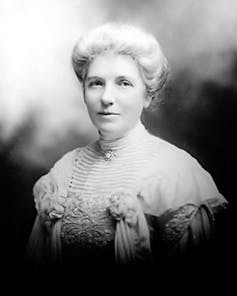
In 1992 four New Zealand icons (and the queen) appeared on new banknotes. Part of creating national identity, these notable citizens were chosen to represent the pinnacles of achievement.
Āpirana Ngata, Edmund Hillary, Ernest Rutherford and Kate Sheppard — all in circulation so their acts and values can be admired, celebrated and emulated.
Collectively, the banknote icons signalled a bicultural nation that celebrates Māori knowledge and success, a place where women are equal and where it is possible to lead the world, including in science and exploration.
But while positioned on individual pedestals, these people were also part of citizenship-building that relied on team efforts.
Ngata was one of many talented members of the Young Māori Party. Hillary didn’t climb Everest alone. And Rutherford’s scientific breakthroughs resulted from collaborative work that stood “on the shoulders of giants”.
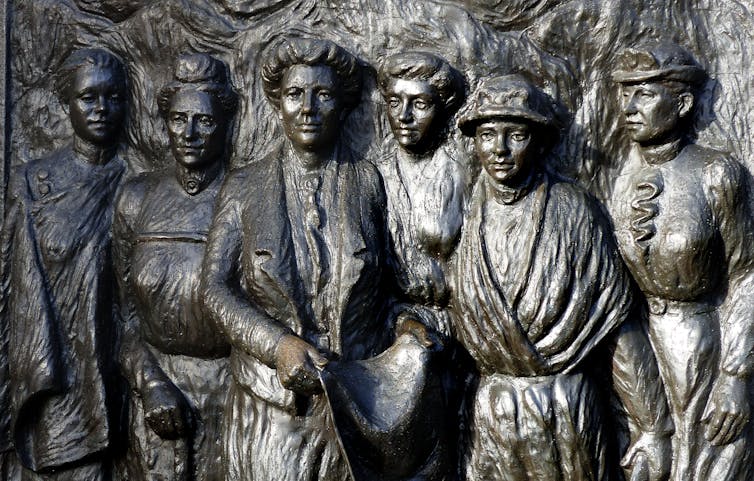
A detail from Margriet Windhausen’s Kate Sheppard National Memorial, unveiled in Christchurch in 1993 by New Zealand’s first female governor-general, Dame Catherine Tizard. CC BY-SA
Cast in bronze
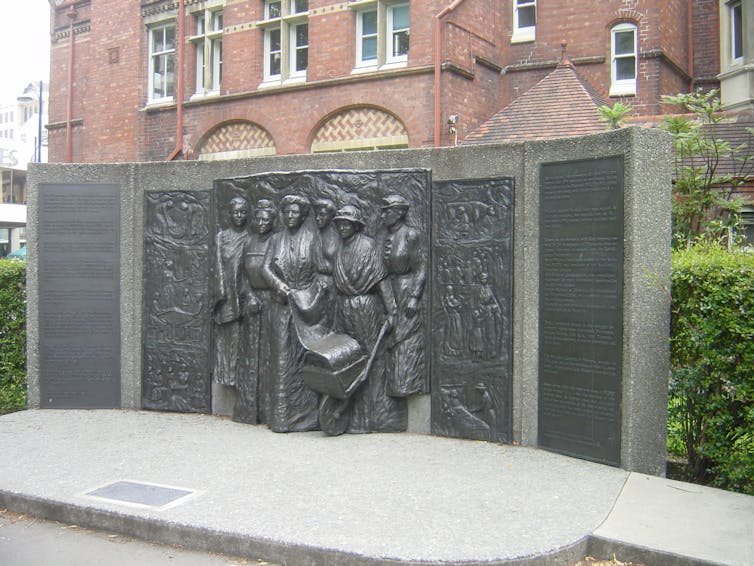
So what of Kate Sheppard’s position? A year after she graced the $10 note, she was put on another pedestal, literally. Unveiled in 1993, the national memorial provides a useful interpretation of the suffrage leader’s place in the collaborative women’s movement of the late 19th century.
The memorial’s Christchurch location, Sheppard’s name in its title and her central position cast in bronze all recognise her leadership. But the monument also recognises how, after the victory, she brought together the networks that had formed during the suffrage campaign.
Sheppard became the first president of the National Council of Women (NCW) in 1896, but flanking her in bronze are others central to the women’s movement.
Meri Te Tai Mangakāhia of Taitokerau requested the vote for women from the Kotahitanga parliament. Amey Daldy was a leader of Auckland’s Women’s Christian Temperance Union (WCTU) and Franchise League. Ada Wells of Christchurch worked for equal educational opportunities for girls and women. Harriet Morison of Dunedin was an advocate for working-class women and active in the Tailoresses’ Union. And Helen Nicol led the important women’s franchise campaign in Dunedin.
The monument also recognises the complex layers and themes of women’s suffrage, including the place of men such as MP Sir John Hall who played a vital part in the suffrage victory. Seven other prominent suffragists are also named. Smaller panels depict generic women going about their daily lives, all part of the wider movement.
The full Kate Sheppard memorial in Christchurch: layers of context and meaning. CC BY-SA
An archetypal heroine?
So what makes Sheppard so iconic? As well as her role in a world-first episode in New Zealand history, I would argue Sheppard embodies many of the characteristics common to modern heroines globally.
She is emblematic of a mother figure, specifically as a maternal feminist concerned with home, purity and well-being. Metaphorically, her work involves giving birth to the nation.
Accompanied by an image of the symbolic white camellia flower presented to pro-suffrage MPs, Sheppard’s image on the banknote is part of her invention as a feminine, stylishly dressed, commanding figure.
But there are other dynamics at work, too. Sheppard is sometimes framed as a reformer, called to work for a more peaceful and egalitarian society. But the 2015
punk-rock musical That Bloody Woman portrays her as a rebel warrior queen, fighting with bravery and determination.
Intrigue in her private life also adds to Sheppard’s appeal. Was her marriage to Walter Sheppard unhappy? They lived apart from 1905 until he died in 1915. Author Rachel McAlpine wrote a fictional account involving an extramarital affair and a love child.
And what of the rumours surrounding Sheppard’s friendship with William Lovell-Smith, who she married towards the end of her life after the death of his wife Jenny? Her private life hints at mystery and suggests a woman advancing new ways of co-habiting.
There is also tragedy. Sheppard lost her only child, Douglas, in 1910, and outlived her nearest and dearest friends and relations, including her only grandchild.
Sheppard’s shape-shifting presence leaves room for us to create our own versions to augment all the writing she left revealing her beliefs and ideas. The Kate Sheppard Women’s Bookshop aptly memorialises her, and her leadership is honoured through scholarships and awards.
All this has helped keep her memory alive, especially with the feminists who have always claimed her as a heroine.
Princess Te Kirihaehae Te Puea Herangi as a girl. Ref: 1/2-005159-G. Alexander Turnbull Library, CC BY-NC
Who else but Sheppard?
Sheppard is on the money, then, but who else might represent the heroic archetype?
Waikato woman of mana and Kīngitanga leader Te Puea Hērangi is surely one, described by historian J.G.A. Pocock as possibly the most influential woman in New Zealand’s political history.
Te Puea was also a mother figure. A literal healer, she nursed her people back to health — especially after the smallpox epidemic of 1913 and the devastating 1918 influenza epidemic that killed a quarter of the population at Mangatāwhiri, leaving many orphans to be cared for.
Her motto is said to have been “work, eat, pray, work again”. Te Puea was called to help her people and was dedicated to leading their resurgence. In particular, her efforts secured the Kīngitanga movement. Part of her legacy as the most active leader of her generation was the building of Tūrangawaewae marae at Ngāruawāhia.
Like Sheppard, Te Puea’s health and welfare work included campaigns against alcohol and smoking. In the face of Pākehā resistance she built an impressive health facility at Tūrangawaewae. In 1951 she became the first patron of the Māori Women’s Welfare League.
Her activism included seeking compensation for land confiscation. An early peace warrior, she led a non-violent campaign against conscription during the first world war. Like Sheppard, she was part of an international network and well-connected around the Pacific.
Also like Sheppard, Te Puea was strategic and collaborated with many men. She launched Māui Pōmare’s political career and later collaborated with Āpirana Ngata. Well known in the Pākehā world as Princess Te Puea, in 1937 she was made a Commander of the Order of the British Empire.
In many ways, of course, Christchurch and Ngāruawāhia were worlds apart. While both women challenged the state, Sheppard represented a mainstream Pākehā establishment, whereas Te Puea pursued mana motuhake for her people. Yet, placed side by side and viewed through an early 21st-century lens, both are important heroines in history.
Both stand for citizens working together for the common good. Kate Sheppard might be on the money to represent women’s rights as a fundamental part of Aotearoa New Zealand. But, as her memorial suggests, it’s important we don’t see her as the only woman worthy of being on a pedestal.
Katie Pickles received funding from Royal Society Te Aparangi James Cook Research Fellowship.
French diplomatic language can be subtle. When Canberra announced its abrupt foreign policy change and unilateral decision to walk away from its contract with French submarine builder Naval Group, the French foreign affairs and defence ministers released a very short statement to “note” the “unfortunate decision”.
But make no mistake. Behind muffled diplomatic language, Paris is furious and there will be repercussions for Australia.
The French media have been far less restrained in their reactions, using language like “stabbing”, “backstabbing”, and “treason”.
It’s not all about the money. France is the third-largest retailer of weapon systems across the globe. Rather, the affront comes from the way in which Canberra announced the decision: through the media.
Left in the dark about Australia’s sudden change of mind, France and the European Union more broadly now face a dramatic re-think of their diplomatic and military doctrine in the Indo-Pacific region on very short notice.
We can expect four major consequences from the scrapping of the A$90 billion submarine deal with France.
1. Possible economic retaliation from the EU
In the wake of Brexit, the UK and Australia are currently renegotiating free trade agreements with the EU. There can be little doubt some kind of economic retaliation will now come against both Britain and Australia through EU legislation.
With German Chancellor Angela Merkel soon to step down, French President Emmanuel Macron will have right of way to shape these FTAs, meaning Australia may find the door to Europe and its markets blocked for decades to come.
The French parliament could also refuse to ratify the FTA when it is formalised. One of France’s leading Liberal politicians, Renaud Muselier, is calling on the EU to suspend negotiations with Australia altogether.
2. Loss of defence training and upskilling
The entire high-tech ecosystem built around Naval Group in Australia, and in South Australia in particular, will now vanish.
The knock-on effect of this decision will be significant. At the heart of the contract with France was the employment and training of the Australian workforce to ultimately take complete control of the submarine fleet.
It was about Australian self-sufficiency and national sovereignty. Now, the many Australians training in France as part of the “future submarine program” will likely no longer complete their exchange programs and apprenticeships.
Similarly, some of Naval Group’s French subcontractors in cyber-security, telecommunications and the space industry are also likely to depart Australia or reduce their operations, bringing an end to any technology transfer and upskilling for Australians.
Former Prime Minister Paul Keating has remarked the new nuclear-powered submarine deal with the US and UK will result in
a further dramatic loss of Australian sovereignty, as material dependency on the United States robbed Australia of any freedom or choice in any engagement Australia may deem appropriate.
3. South Australia will lose other investments
There are also many effects that will be felt beyond the defence sector.
Since 2016, the South Australian government has leveraged the submarine deal to lure a number of large French multinationals to the state and establish an Office for French Strategy to accelerate Australian-French ventures.
Further to this, SA Premier Steven Marshall also committed to opening a trade office in Paris to drive SA export growth in Europe.
Many of these efforts will now be wasted, with Paris likely to redirect its investments elsewhere.
4. The French connection, c’est fini?
Finally, the annulment of the submarine deal will bring to a sad end the nascent “French connection” within Australia.
Hundreds of French families who recently relocated to Adelaide will be forced to return to France. This means the bilingual educational program established for French and Australian children now appears bleak.
Similarly under threat are the many partnership agreements between the three universities of South Australia and French universities and research hubs centred specifically on supporting the Naval Group ecosystem in Adelaide.
A Naval Group union representative has at least confirmed the French workers in Adelaide will go home to jobs.
But what will happen to thousands of Australian workers and the hundred or so local businesses supplying parts to Naval Group? The new deal with the US does not guarantee they will be employed, as no contract has yet been signed.
The future of French-Australian relations at a standstill
The overnight change in Australian strategic policy has left the French bemused. The French submarine deal ensured sovereignty, independence and autonomy to Australia, but Paris is discovering the conditioned reflex of relying on “great and powerful friends” (the US and UK) runs high in the Australian psyche.
France proposed a genuine strategic alliance with Australia, one based on mutual respect and common values that would have bolstered Australia’s sovereignty in the long term and diversified Australia’s partnerships to reduce its dependence on those “great and powerful friends”.
However, the French-Australian partnership is unlikely to be salvaged anytime soon given the public humiliation France has felt. Australia will now likely face economic and diplomatic retaliations from France. Just how and when will be decided in due course in both Paris and Brussels.
And there will be another showdown between France and the US, between whom a diplomatic crisis is brewing.
While condemning Australia’s betrayal and unreliability on French national TV, French Foreign Minister Jean-Yves Le Drian also expressed his ire at the US, saying “this is not done between allies” and it’s “a knife in the back”.
Interestingly, exactly 240 years ago the French Navy defeated the British Navy in Chesapeake Bay, paving the way for the victory at Yorktown and the independence of the United States.
Diplomacy is not an overnight matter; it is built on centuries of relationships built with others in the great Concert of Nations. The French also have a long memory, and a sense of history.
To French eyes, Australia is yet to sit at the table of this great Concert of Nations with a sovereignty, foreign policy and submarines of its own.
The authors do not work for, consult, own shares in or receive funding from any company or organisation that would benefit from this article, and have disclosed no relevant affiliations beyond their academic appointment.
New Zealand Parliament Buildings, Wellington, New Zealand.
Editor’s Note: Here below is a list of the main issues currently under discussion in New Zealand and links to media coverage. You can sign up to NZ Politics Daily as well as New Zealand Political Roundup columns for free here.
Joel Fitzgibbon and Anthony Albanese in parliament in 2018.Mick Tsikas/AAP
One imagines the retirement of Joel Fitzgibbon at the next election simplifies things for Anthony Albanese, as he crafts a climate change formula more in sync with the established science and the global consensus.
A vocal defender of coalmining and “hi-vis” jobs in the regions, Fitzgibbon had become a burr in the Labor leader’s saddle — and a gift to the Coalition — as he regularly lamented his party’s latter day “obsession” with emissions reduction at the expense of regional jobs.
The voluntary exit of a media-enabled critic should help Labor present a unified front. But the electoral dualism bedevilling the ALP, both championed and personified by Fitzgibbon, remains problematic.
The end of an era
Fitzgibbon, a trade-qualified regional MP of 25 years, represented a dying breed in a parliamentary peloton now typically populated by tertiary-educated cosmopolitans.
That dualism may yet pose real-world implications in Fitzgibbon’s regional NSW seat of Hunter, which has been held between him and his father Eric for almost a third of a century.
Joel Fitzgibbon has been a vocal critic of his party and its direction since the 2019 election. Mick Tsikas/AAP
Albanese knows that to secure a Labor majority, he must first wrest seats from the Coalition, not give away strongholds already in his column. Yet some in Labor believe the risk of losing Hunter — still a 62.4% Labor seat —has been overstated, anyway.
They say (or is it hope?) the savage 14-plus percentage swing against Fitzgibbon in 2019 “probably” represented the nadir of Labor’s support, citing an election blighted by mixed messaging over the Adani Carmichael coal mine and Bill Shorten’s proposed 45% cut to emissions by 2030.
Whatever the cause, there’s little doubt the 21.5% share of the first preference vote secured by One Nation’s Stuart Bonds sent shockwaves through the ALP. It was certainly instrumental in Fitzgibbon’s decision to step up his public criticism, complaining long and loud about his party’s “drift to the left”, driven by the concerns of inner-city professionals.
Restaurant chats and public spats
One ostentatious demonstration of this new muscularity was the formation of the OTIS group led by Fitzgibbon. The group first met at a Canberra restaurant of the same name ahead of parliamentary sittings in February, 2020. As Peter van Onselen reported in The Australian at the time,
the members want to see Labor move further to the right on policy scripts such as coal mining, climate change more broadly and how Labor best handles the threat of the Greens on its left flank.
Even more divisive was Fitzgibbon’s public spat with Labor’s climate change spokesperson, Mark Butler. In an uncommonly frontal public attack in November 2020, Fitzgibbon successfully called for Butler’s removal from the climate role in favour of a more conservative figure.
A swap of jobs between Butler — a left-aligned Albanese confidant — and health spokesperson Chris Bowen of the NSW Right faction, duly followed.
‘Back to the centre’?
Albanese has since signalled Labor’s election pledge will be less ambitious arguing, among other things, an already steep emissions reduction path designed to begin in 2019, would be too sharp if commenced in 2022. changed precipitous to dangerous – still acurate/ok?
Either way, Fitzgibbon claims some of the credit, telling media that his work of dragging the ALP “back to the centre”, was largely done.
While the emission policy was only part of a wider sweep of policy initiatives blamed for Labor’s shock defeat in 2019, Fitzgibbon had called the 45% cut “crazy” in an interview with Sky News.
Announcing his retirement, Fitzgibbon continued to prosecute his case declaring the retention of Hunter would be contingent on Albanese’s “strong support” for an ongoing coal mining industry. As he told Radio National:
I’m confident that Albo has taken us sufficiently to the centre and put sufficient emphasis on hope and aspiration amongst working families that I can go comfortably knowing that Hunter is safe.
Local sensitivities are clearly front-of-mind. Albanese has endorsed Fitzgibbon’s choice of a successor, Daniel Repacholi, a former coal miner who also happens to be five times Olympic shooter — most recently in Tokyo.
The Labor leader has also parked his past objections to local ALP branch members being denied a vote, calling for Labor’s national executive to short-circuit the process of selecting Fitzgibbon’s successor if there is more than one nomination.
Albanese has been fielding red-hot anger in Labor ranks over the plan to parachute current deputy Senate leader, Kristina Keneally into the western Sydney seat of Fowler. But similarly, he expects the national executive to step in. cut back quote here – this ok?
Labor’s TBC climate policy
Once the politics here is navigated, the next challenge is one of policy.
Labor leader Anthony Albanese will face off with Prime Minister Scott Morrison in an election expected in early 2022. Bianca De Marchi/AAP
Fitzgibbon has previously argued Labor should hold its tongue on emissions targets, leaving it for the government to set the policy.
So far this has been Albanese’s approach — wait until the Morrison government has determined its final position going into the UN COP26 climate talks in Glasgow in November, before setting out a policy which is more ambitious, but not dramatically so.
It seems Labor’s previous terror of being picked off on its left flank by the Greens in the inner cities, has given way to another fear — a virtuous loss in the more conservative suburbs and regions. And potentially a fourth consecutive defeat.
Mark Kenny does not work for, consult, own shares in or receive funding from any company or organization that would benefit from this article, and has disclosed no relevant affiliations beyond their academic appointment.
I have been watching the sudden rise to prominence of the word ‘Indo-Pacific’ these last couple of months. These last couple of days it may have been the most repeated word on Radio New Zealand.
According to Wikipedia today, Indo-Pacific is “biogeographic region”, although Wikipedia includes an outdated section on the geopolitical use of this conjoint word. Clearly, we can expect a major Wikipedia update this year.
When googling for a dictionary definition, I only got one, from Oxford “relating to the Indian Ocean and the adjacent parts of the Pacific”. Again, like Wikipedia the dictionaries are ‘behind the eightball’, as Americans might say, though the meaning of that expression is also not too clear. (I mean that the dictionaries are slow-moving; this month’s already ubiquitous meaning of ‘Indo-Pacific’ has outpaced the lexicographers.)
The best geopolitical definition that I have found is a list of 24 countries from CEO World: Australia, Bangladesh, Bhutan, Brunei, Cambodia, Fiji, India, Indonesia, Japan, Laos, Malaysia, Maldives, Myanmar, Nepal, New Zealand, Papua New Guinea, Philippines Singapore, Sri Lanka, Taiwan, Thailand, Timor Leste, United States, Vietnam. These are presented, essentially, as a democratic bulwark to the south of China.
What matters much is which countries are excluded. First and foremost is of course China. Thus we can see that India-Pacific is a putative anti-China alliance. So this is not the ‘Asia-Pacific’ of APEC; that alliance emphasised economic cooperation. Economic cooperation is not what the Indo-Pacific is principally about; though economic cooperation (bullying?) to achieve geopolitical ends will almost certainly be high on the new agenda.
Also, with the emergence of AUKUS, we may understand the United Kingdom as an ‘honorary member’ of the Indo-Pacific, reflecting the former ‘British Empire’, and pointedly excluding European Union countries that have had not-to-long-ago imperial interests in this newly concocted geopolity.
Other countries not on the list are: Korea (North and South), Hong Kong, Macao, Pakistan, Canada, Russia. Also, it is important to note the absence of Latin America, East Africa, Polynesia, and parts of Melanesia. Re the latter two, imperial France remains a significant presence in both Polynesia and Melanesia.
As a geographic rather than a geopolitical region, the United States does not belong in the Indo-Pacific; the Wikipedia biogreographic region does not include anywhere in America or Northeast Asia, but does include Africa and Madagascar. Yet, as a new geopolitical entity, the United States has clearly placed itself at the centre, while otherwise excluding the Americas.
In addition to being an anti-China alliance, it can also be seen as an anti-Iranian alliance, with ‘Iran’ loosely defined to include Afghanistan and Iraq, and other ‘Middle-Eastern’ political entities subject to a degree of Iranian influence.
Based on the above list, South Korea and Pakistan can be seen as the key ‘neutral’ border countries between the Indo-Pacific and the new axes of enmity. While South Korea’s omission from the above list may be an oversight, we should see that the United States is slowly writing-off Pakistan; indeed, acquiescing in Narendra Modi’s accentuation of Hindu nationalism in India. Re Pakistan, watch that geopolitical space.
Hong Kong is now classed as a part of China.
Provocatively, the Indo-Pacific list includes Taiwan, Laos, and Myanmar. Realistically, Myanmar should not be there; it’s not a democracy. There are also issues with Vietnam’s credentials as a democracy. (And Bhutan, for that matter, strategically placed between China and India.)
Taiwan becomes the absolute frontline of what the new geopolitical discourse is about, and has significantly escalated as the likely flashpoint through which this new Cold War – between the Indo-Pacific (including United Kingdom) and whatever alliance China builds (including its entente with Russia). Beijing considers Taiwan, Hong Kong and Macao as equal and intrinsic components of China.
The other little noticed potential flashpoint is Laos, which now has a relationship with China that has some parallels with the relationship between Cuba and United States before 1958. We may also note that post-Vietnam (embarrassment-distracting) United States foreign policy – especially the activities associated with the hapless though well-meaning Jimmy Carter, and his arch-cold-warrior Zbigniew Brzezinski) – substantially helped to set in play the geopolitical conflicts of the 1979 to 2021 era.
Aotearoa New Zealand is very much on the periphery of the dangerous new ‘Indo-Pacific’ bureaucratic amusement game – a game that is escalating in part to take attention away from the Afghanistan, Iraq, Iran and Syrian debacles. While we may hope that the new Hermit Kingdom – AoNZ – keeps out of this fray, we note Australia’s deep commitment to this new geopolitical posturing; and we note that our senior political leaders, bureaucrats, and foreign relations’ academics, have all embraced the new non-pacifist language of IndoPacificism.
Finally, we should note that one of the main features of the new alignment is its exclusion of the European Union. My gut feeling is that the gulf between Berlin/Paris and Washington/London will widen substantially this decade. And we should note that the United States is increasingly downplaying its former quasi-imperial role in the Americas, in favour of a new quasi-imperial alignment which refocuses on Southeast Asia as well as its Australian and British ‘deputy-sheriffs’.
Where does all this leave Canada? On Monday, Canada goes to the polls in what has been described to me as a “vanity election”. Further, the United States maintains a closed border to Canada, despite Canada having opened its border to the United States. Just as the New Zealand Australia relationship is being sorely tested, so is that between Canada and the United States. Another space to watch.
————-
Keith Rankin (keith at rankin dot nz), trained as an economic historian, is a retired lecturer in Economics and Statistics. He lives in Auckland, New Zealand.
The current wave of COVID cases is leading to more hospital and intensive care (ICU) admissions. Frontline health workers and experts use the term “intubation” for the extra breathing support some patients need in an emergency.
But many people don’t know what this procedure involves and the trauma it can cause.
Patients with COVID-19 who deteriorate and need additional support with their breathing require intubating and ventilating. That means a tube is inserted and a ventilation machine delivers oxygen straight to the lungs.
Inserting the tube
Intubating a patient is a highly skilled procedure and involves inserting a tube through the patient’s mouth and into their airway:
patients are usually sedated, allowing their mouth and airway to relax. They often lie on their back, while the health-care professional stands near the top of the bed, facing the patient’s feet
the patient’s mouth is gently opened. An instrument called a laryngoscope is used to flatten the tongue and illuminate the throat. The tube is steered into the throat and advanced into the airway, pushing apart the vocal chords
a small balloon around the tube is inflated to keep the tube in place and prevent air from escaping. Once this balloon is inflated, the tube must be tied or taped in place at the mouth
successful placement is checked by listening to the lungs with a stethoscope and confirmed via a chest x-ray.
A laryngoscope is used to guide a tube into the airway. Shutterstock
While intubated patients are attached to a ventilator and their breathing is supported, they are unable to talk or swallow food, drink or their saliva.
They often remain sedated to enable them to tolerate the tube. They can’t attend to any of their own needs and disconnection from the ventilator can be catastrophic.
For this reason any patient who is intubated and ventilated is cared for in an intensive care unit with a registered nurse constantly by their bedside.
American lawyer and editor David Latt recalled his experience of being intubated and ventilated following a diagnosis of COVID-19, saying:
When they were giving me anesthesia to put me to sleep so they could put a tube in my mouth that would enable me to breathe, I just remember thinking, ‘I might die.’ Sometimes in the abstract, you think, ‘If it’s my time, it’s my time.’ But when I was on that table […] I just thought, ‘No, I don’t want to go.’
Latt feared he would never see his two-year-old son or his partner again.
Taking the tube out
The length of time a COVID patient requires intubation and ventilation varies and depends on the reasons for it and the response to treatment. However, there are reports of patients being intubated and ventilated for over 100 days.
Once a patient’s respiration improves and they no longer require breathing support, the tube is removed in a procedure called “extubation”. Like intubation, extubation requires highly skilled health-care workers to manage the process. It involves:
a spontaneous breathing trial, which assesses the patient’s capacity to breathe unassisted before extubation to decrease the risk of respiratory failure
an assessment by the treating doctor, intensive care nurse, speech pathologist or physiotherapist of the patient’s ability to cough (so they can effectively clear their own throat and prevent substances entering the lungs)
treatment from a physiotherapist is usually required before and after extubation if the patient has had mechanical ventilation for more than 48 hours. This is to ease the process of weaning the patient off the ventilator and help them learn to breathe independently again.
Once extubated, patients remain in ICU and are closely monitored to ensure they can safely maintain a clear and effective airway. Once they are able to do this and are stable enough to transfer to the ward they are discharged from the ICU.
Intubation, ICU and trauma
Patients with COVID-19 who require intubation and ventilation have witnessed a number of stressful events in the ICU, such as emergency resuscitation procedures and deaths. This may increase the risk of post-traumatic stress disorder, anxiety, and depression.
Although we don’t have definitive long-term data, patients who have been critically ill from COVID often have a long and difficult journey of recovery. They will likely remain dependant on health care services for some time.
Many patients who have been intubated and ventilated recall it as being one of the worst experiences of their lives. Clearly it is something we should try to avoid for as many people as possible.
There are currently 138 patients patients intubated and ventilated in ICUs across Australia. That’s 138 patients who cannot communicate with their loved ones, who are scared, frightened and vulnerable.
Most of these patients have not been vaccinated. The most important thing we can do to reduce the risk of being intubated and ventilated as a result of COVID-19 is get vaccinated.
Soap operas have been around since television was invented. Often involving outlandish plots, exaggerated storylines and hyperbolic characters and dialogue, they labour each moment on screen for ultimate dramatic effect. The women are transcendingly good looking and the men impossibly buff.
Packed to the Rafters — which aired for 122 episodes on Seven from 2008 to 2013 and was broadcast in over 20 countries — always managed to transcend the soap genre, presenting the daily struggles of everyday people without melodrama or histrionics.
Following the trials and tribulations of the Rafter family, they confronted issues from the usual (births, deaths and marriages) to the extreme (arrests, vasectomies and even a kidney donation to an HIV-positive grandmother).
Throughout, the drama was understated and subtle. The show handled these crises sensitively, exploring them thoroughly. They were not glossed over or rushed. It didn’t try for the shock factor. Nor were there easy answers to anything, with problems resolved quickly. Some issues were not resolved at all, just like in real life.
Now, after eight years, they are … Back to the Rafters, re-imagined for Amazon Prime.
Getting off the road
At the end of the final season, Dave (Erik Thomson) and Julie (Rebecca Gibney) with their four-year-old daughter Ruby had left Sydney and their extended family to do what many Australians do in later life: travel the byways and highways in a campervan.
At the beginning of the new series, the recent past is recapped before setting up the new premise. After being on the road for six years, the van they are travelling in breaks down outside the small fictional town of Buradeena, and Dave, Julie and now 10-year-old Ruby (Willow Speers) decide to plant roots in this picturesque rural village.
Across six episodes, the drama in the new series revolves around contemporary issues: country versus city life; Ruby’s concern for climate change; homelessness as a result of a defective apartment building; dealing with sick parents in aged care; the infertility Ben and his new wife face.
Back to the Rafters looks at a generation looking after their children and their parents. Brook Rushton/Amazon Prime
But the internal conflict is the more relevant overarching arc of the series. Julie wants to move back to Sydney so she can better provide care for both her father and her children; Dave is resolute in his desire to stay in Buradeena.
They are torn between duty, responsibility, love and dedication to their family — but even moreso to each other.
A drama about us
As Seinfeld is oft-quoted as a comedy about nothing, Rafters has always been a drama about the ordinary. Ordinary people facing ordinary issues many of the viewers have faced in their own lives. But ordinary doesn’t mean mediocre. Far from it. Ordinary means the characters and drama feels drawn from real life.
I always found Packed to the Rafters to be honest and authentic. It was relatable because the issues, actions and dialogue of the characters were grounded in realism.
Most television shows cater to a specific audience niche: crime dramas for adults, teen dramas for younger people. Horror shows like The Walking Dead or comedies like Ted Lasso are even more niche. Reality television shows like The Block and The Voice rate well because they cater to a wide demographic.
Back to the Rafters, like its predecessor, explores ordinary Australian life. Amazon Prime
Rafters is like the reality TV of drama. Its multi-generational approach means it caters to all ages. While it aired on Seven, it was one of the only dramas on Australian television a whole family — from grandparents to children — could sit down to watch together, finding it reflected real family life back at them.
Back to the Rafters avoids most of the trappings of what I have previously dubbed “Zombie TV” – those shows that come back from the dead and act as if nothing has changed.
The writers of Back to the Rafters have not tried to emulate the familiar concerns of the past. Instead they created issues relevant to 2021, with all the current complications attached.
At the heart of Rafters has always been one thing: family. The conflict and care between generations as they go through different stages of their lives. Dave and Julie, like many middle-aged couples, are caught in the middle. Pulled between needing to help ageing parents and the desire to still help children and grandchildren.
And this is the key to Rafters continued success. It takes the ordinary in our lives and makes it just a little bit more extraordinary on the screen. It’s a great joy to go Back to the Rafters again, after all these years.
Back to the Rafters is streaming on Amazon Prime from today.
Daryl Sparkes does not work for, consult, own shares in or receive funding from any company or organization that would benefit from this article, and has disclosed no relevant affiliations beyond their academic appointment.
Source: The Conversation (Au and NZ) – By Nicholas Biddle, Professor of Economics and Public Policy, ANU College of Arts and Social Sciences, Australian National University
Shutterstock
COVID-19 has upended so many aspects of our lives in Australia, it can be hard to remember what life was like before the pandemic. It’s also hard to remember what we feared would happen when the pandemic first struck.
Some of the predictions have come to pass — there was a massive economic shock, travel and mobility have been constrained, mental health has suffered as lockdowns have been extended, and government budget deficits are at levels that would have seemed inconceivable only two years ago.
Another early prediction was that the pandemic would lead to a fraying in social cohesion.
In data released recently we show there’s been an increase in many aspects of social cohesion over the course of the pandemic. But this may be slipping as lockdowns drag on.
Before discussing results from the most recent survey, it is worth reflecting on what “social cohesion” actually means.
It can mean different things to different people but one useful definition from a recent research report is:
the degree of social connectedness and solidarity between different community groups within a society, as well as the level of trust and connectedness between individuals and across community groups.
In other words, it’s about how much we trust each other, how connected we feel to others and to what extent we feel solidarity and empathy with others.
Social cohesion can operate at the individual, household, or community level.
How did we measure social cohesion?
Since April 2020, the ANU Centre for Social Research and Methods has been running a multi-wave longitudinal survey tracking the outcomes, attitudes, and behaviours of a representative sample of Australians during the pandemic period. We wanted to see how these factors have changed over time.
Incorporated into the ANUpoll series of surveys, the data also allows us to track outcomes at the individual level from prior to the COVID-19 period. The study was carefully designed to ensure we could be confident the responses were free of many of the biases that plague many studies where people opt-in to participate.
In February (pre-COVID), May and October 2020, respondents were asked three questions related to social cohesion. These were repeated in August 2021, our most recent wave of data collection. The questions were:
“Generally speaking, would you say that most people can be trusted, or that you can’t be too careful in dealing with people?”
“Do you think that most people would try to take advantage of you if they got the chance, or would they try to be fair?”
“Would you say that most of the time people try to be helpful or that they are mostly looking out for themselves?”
These questions are asked across a range of social surveys in Australia and internationally.
All three questions were answered on a scale of 0 to 10, and averaged out to give a perceived social cohesion score on a scale of 0 to 10.
Individual-level data for all four surveys are available through the Australian Data Archive for any researcher to analyse.
A significant and substantial boost early on — but a recent dip
Our data suggests there was a significant and substantial improvement in social cohesion between February and May 2020 (the early stages of the pandemic). There was another increase between May and October 2020.
So rather than leading to an erosion of social cohesion, the pandemic — and arguably the government and societal response — appears to have enhanced it.
There was a slight but not statistically significant decline in perceived social cohesion between October 2020 and August 2021. However, perceived social cohesion is still significantly and substantially above what it was pre-COVID.
Perceived social cohesion in Australia, February 2020 to August 2021.
The greatest improvement over the COVID-19 period has been in the trust measure — from 5.40 (out of 10) in February 2020 to 6.02 in October.
The greatest decline over the last 10 months has been in whether people are perceived to be helpful. That declined from an average of 6.23 in October 2020 to 6.04 in August 2021, a difference that was statistically significant.
Why does it matter?
Measures of social cohesion are important in their own right. However, there are other reasons society should care about social cohesion.
If people trust others to not harm them and to follow through on agreements, then there’s less need for expensive contracts and contract enforcement (think fewer court cases, expensive legal work, resource-intensive arbitration).
Causality is particularly difficult to show with this type of data but it’s possible social cohesion may also lead to or support pro-social behaviour — meaning positive behaviours like friendliness or helping one another.
Our data suggests there was a significant and substantial improvement in social cohesion in the early stages of the pandemic. Shutterstock
Our data show, for example, that 38% of those who gave a value of 0 to 2 on the “helpful” question had been vaccinated as of August 2021, compared to 51% of those who gave a score of 3 to 6, and 66% of those who gave a score of 7 to 10.
In other words, those who perceive that people mostly try to be helpful are more likely to have been vaccinated.
Even though we have avoided the worst of the effects that some other countries have seen, COVID-19 has caused immense damage to Australia’s economic, social, and mental health.
One bright spot has been an increase in many aspects of social cohesion.
There are some initial indications that this may be dropping as lockdowns go on, and the end of the worst impacts does not appear to be in sight.
We should make sure that we do not lose our unexpected gains.
The Queensland Police Service (QPS) is expected to begin a trial using artificial intelligence (AI) to determine the future risk posed by known domestic violence perpetrators.
Perpetrators identified as “high risk” — based on previous calls to an address, past criminal activity and other police-held data — will be visited at home by police before domestic violence escalates, and before any crime has been committed.
It is necessary to find better ways to improve safety for women subjected to domestic violence. However, using AI technology in this context may have unintended consequences — and the proposed plan raises serious questions about the role of police in preventing domestic violence incidents.
The approach relies on an algorithm that has been developed from existing QPS administrative data (QPRIME). All statistical algorithms must assess risk based on available data, which in turn means they are only as good as the data underpinning them.
Experts who criticise the use of data-driven risk assessment tools in policing point to the lack of transparency in the specific kinds of data analysed, as well as how predictions based on these data are acted upon.
Because of how police operate, the key data most consistently captured are information about past situations police have been called to, and criminal history data.
Using this information to train an AI algorithm could reinforce existing biases in the criminal justice system. It could create an endless feedback loop between police and those members of the public who have the most contact with police.
QPS representative Ben Martain has said police won’t be able to charge someone they door-knock for a future suspected offence.
He also said for the pilot, attributes of ethnicity and geographic location were removed before training the AI model. But despite this, it seems likely Aboriginal and Torres Strait Islander people will continue to be disproportionately targeted, since they are over-represented across all kinds of police contact.
The aim of such AI-based strategies in policing is to prevent or reduce crime, through an assessment of the risk of future offending. In theory, this means police would intervene early to stop a crime from occurring in the first place.
However, with this approach there are risks police may create crime. An unprompted police door-knock would be unwelcome in most households — let alone one where police have previously attended to carry out searches or make arrests.
In this “preventative” program, perpetrators and the victims they live with may be nervous, agitated or even angry at the police intrusion at their home for no apparent reason.
A visited person might use offensive language or refuse to provide their name. It would not be surprising if this led to charges.
Such charges might lead the visited person to become even more nervous, agitated or angry, and then they may find they are charged with assault and resisting police. This is popularly known as the “trifecta”, wherein a person who has otherwise not offended is ultimately charged with offensive language, resisting arrest and assaulting police.
The standard powers in the police toolbox are to arrest and charge. With QPS’s proposed plan, there is an obvious risk of widening the net of criminalisation for both perpetrators, as well as victims who may be misidentified as perpetrators. For instance, sometimes victims who have used violence in self-defence have been arrested instead of the perpetrator.
Bringing further harm to victims
The role of the victim in such a program is also of concern. Any program that deepens surveillance of perpetrators also deepens surveillance of victims.
Victims do not always want police to intervene in their lives. In some cases, this form of proactive policing might feel like an extension of control, rather than help. What happens when police visit and discover a high-risk perpetrator and victim are living together again?
Victims may fear child protection authorities will get involved and feel obliged to cover up the fact they are still with the perpetrator. And once a victim has been pressured to lie, they may be reluctant to call the police the next time they do need police intervention.
Victims of domestic violence may feel obliged to lie or withhold information from police to avoid child protection authorities getting involved. Shutterstock
In some cases, the perpetrator or victim may decide not to take the safety advice of police officers who visit. It is not clear what police might do in a situation where they ask a perpetrator to leave, or try to take a victim to safety, but they refuse.
The mission of any domestic violence intervention should be to restore power to victims. But we know interventions do not assist all women (or men) equally. Structural inequalities, including race and class, mean interventions are experienced differently by different people.
Will a victim have a say in whether police engage in proactive policing of their perpetrator? Should they have a say?
In the context of risk assessment, many experts argue women often (although not always) have a strong sense of when they are at heightened risk.
Family court-ordered contact visits can be one of those moments of high risk. Yet in these situations women often report police refusing to help keep them and their children safe. How is the voice of the victim factored into risk assessment with this tool?
One particular concern is whether police are really equipped to intervene in circumstances where there is no crime. QPS representative Ben Martain said when perpetrators are “not at a point of crisis, in a heightened emotional state, or affected by drugs or alcohol” — they are “generally more amenable to recognising this as a turning-point opportunity in their lives”.
But police themselves have questioned their role in domestic violence circumstances — instead highlighting the potential role social workers may have, in their place.
It is not clear whether police are the best-positioned service to intervene when there is no identified disturbance. Queensland already has information-sharing protocols involving teams tasked specifically with responding to people involved in high-risk domestic violence relationships. These teams include community-based support workers.
This may be a better path for intervention during those critical periods of calm.
Heather Douglas receives funding from the Australian Research Council.
Robin Fitzgerald receives funding from Australian Research Council.
Until COVID-19, few people knew anything about Australia’s chief medical officer or the state and territories’ chief health officers. Now they are front and centre of the news cycle.
But media coverage misses the nuances of the role. We see people with particular skills and personalities. Yet, each of the offices and officers is embedded in a particular institutional and historical context, which drives their role.
We are involved in an international study to look at their role during the pandemic in Australia, New Zealand, the United Kingdom and Canada. Here’s what we’ve found so far from the Australian data.
In Australia, the chief medical officer, Paul Kelly, is the principal medical adviser to the federal health minister and health department. So he has the overarching bureaucratic responsibility for Australia’s federal health response to the pandemic.
For the states and territories, the chief health officers have that overarching responsibility.
COVID-19 has seen all assuming regular slots in press conferences. They are constantly under the microscope of the millions of epidemiologist wannabes.
COVID-19 has shown how contested their roles are. Are they public servants who act on behalf of the government? Or ought they be independent from politics, shaping policy to protect public health? Or must they balance the contradictions that come with being both a health professional and a public servant?
Legislation in each jurisdiction gives the chief health officer varying degrees of institutional power. This not only affects their role, but how outbreaks are defined and managed.
In some jurisdictions (New South Wales, Queensland, Tasmania, Western Australia) the chief health officers become public health emergency “controllers” for pandemic management.
Qld gives its chief health officer the most power (possibly the most, even internationally). This is partly due to also serving as deputy director-general (a senior position in the bureaucracy). Qld’s chief health officer is also the final decision-maker on public health restrictions (most notably borders) “in consultation” with the premier. NSW also holds the director-general position but the premier is the final decision-maker.
In comparison, Victoria’s chief health officer has neither the deputy director-general role nor “controller” oversight of emergency procedures.
An inquiry into Victorian hotel quarantine concluded this prevented the chief health officer from fulfilling the “controller” position. As a result, certain infection control details were overlooked, resulting in the outbreak that led to the state’s second wave.
The chief medical officer at the federal level has arguably the least legislative power of all given the jurisdictional autonomy of the states. The power of this role during the pandemic has mainly come through chairing the national committee of state and territory chief health officers.
Chief medical and health officers work at the interface of politics, policy and health evidence. They are unelected, yet are accountable to ministers, the premier and parliament. They work with the relevant secretaries and ministerial offices.
Whatever their remit, ultimately the buck stops with them. As we’ve seen under COVID-19, they have the power to “stop the nation”.
However, our analysis provides practical insight about how health evidence during the pandemic intersects with political realities.
But communicating evidence is an entirely different matter. More than acting as “honest brokers” of evidence to policy, their use of evidence needs to be strategic if they are to have influence. And this requires political acumen.
Elected politicians need to be seen to be in control. When presenting evidence, not all of which will be popular, chief health and medical officers need to anticipate political responses.
They must also be media savvy. The much-watched daily COVID-19 press conferences (recently disbanded in NSW) are well orchestrated. In times of crisis, clarity of messaging is as important as evidence. Image is too. Displaying collegiality across government is necessary visual messaging despite robust negotiations behind the scenes.
As public servants, chief health officers must be excellent networkers and departmental managers. They delegate authority while holding ultimate responsibility for their legislated role.
In their agencies each has put into place management systems to deal with the complexities of the pandemic. Their networks extend to other sectors and agencies. For example, one chief health officer we interviewed explained having to unexpectedly collaborate closely with the police enforcement of public health restrictions.
Quarantine is under the constitution a federal government responsibility but was agreed to be managed at state level. This source of outbreaks challenged the effectiveness of chief health officers because the mix of public and private involvement compromised effective quarantine management.
Relationships with other chief health officers matter. The virus does not respect state boundaries, however much political leadership claims the contrary.
Collective decisions, often with massive ramifications, must be made. Trust in the skills and decision making of fellow chief health officers in different jurisdictions is fundamental.
Experience helps, demonstrated by those in NSW and Qld who have held the role the longest. But being relatively new brings dynamism. The early goal of zero transmission was championed by a chief health officer with less experience.
An unprecedented pandemic has thrust previously faceless bureaucrats and their representatives onto our screens and devices in ways unimaginable even two years ago.
Ultimately, chief health officers have shown they need to balance the mix of public servant and health professional with a nuanced approach to politics.
But individuals are never the whole story. Investment in public health (putting hospitals aside) remains inadequate, for instance. New variants of COVID-19 are also testing a coordinated public health response like never before, chief health officers included.
Patrick Harris receives funding from CIHR on a joint project with Canadian and Scottish colleagues called “Senior public health leadership during the 2019 novel coronavirus outbreak: Comparative approaches to mitigating the spread of infectious disease and its social consequences in Canada and abroad” . Patrick is the President of the NSW Branch of the Public Health Association of Australia.
receives funding from CIHR on a joint project with Canadian and Scottish colleagues called “Senior public health leadership during the 2019 novel coronavirus outbreak: Comparative approaches to mitigating the spread of infectious disease and its social consequences in Canada and abroad.
Evelyne de Leeuw receives funding from CIHR on a joint project with Canadian and Scottish colleagues called “Senior public health leadership during the 2019 novel coronavirus outbreak: Comparative approaches to mitigating the spread of infectious disease and its social consequences in Canada and abroad”
Australians consume a lot of salmon – much of it farmed in Tasmania. But as Richard Flanagan’s new book Toxic shows, concern about the industry’s environmental damage is growing.
With the industry set to double in size by 2030, one dubious industry practice should be intensely scrutinised – the use of so-called “cracker bombs” or seal bombs.
The A$1 billion industry uses the technique to deter seals and protect fish farming operations. Cracker bombs are underwater explosive devices that emit sharp, extremely loud noise impulses. Combined, Tasmania’s three major salmon farm operators have detonated at least 77,000 crackers since 2018.
The industry says the deterrent is necessary, but international research shows the devices pose a significant threat to some marine life. Unless the salmon industry is more strictly controlled, native species will likely be killed or injured as the industry expands.
Tasmanian salmon farming is a billion-dollar industry. Shutterstock
Protecting a lucrative industry
Marine farming has been growing rapidly in Tasmania since the 1990s, and Atlantic salmon is Tasmania’s most lucrative fishery‑related industry. The salmon industry comprises three major producers: Huon Aquaculture, Tassal and Petuna.
These companies go to great effort to protect their operations from fur seals, which are protected in Australia with an exemption for the salmon industry.
Seals may attack fish pens in search of food and injure salmon farm divers, though known incidents of harm to divers are extremely rare.
The industry uses a number of seal deterrent devices, the use of which is approved by the government. They include:
lead-filled projectiles known as “beanbags”, which are fired from a gun
sedation darts fired from a gun
explosive charges or “crackers” thrown into the water which detonate under the surface.
In June this year, the ABC reported on government documents showing the three major salmon producers had detonated more than 77,000 crackers since 2018. The documents showed how various seal deterrent methods had led to maiming, death and seal injuries resulting in euthanasia. Blunt-force trauma was a factor in half the reported seal deaths.
A response to this article by the salmon industry can be found below. The industry has previoulsy defended the use of cracker bombs, saying it has a responsibility to protect workers. It says the increased use of seal-proof infrastructure means the use of seal deterrents is declining. If this is true, it’s not yet strongly reflected in the data.
Seal deterrents are deployed to protect salmon farm operations. Shutterstock
Piercing the ocean silence
Given the prevalence of seal bomb use by the salmon industry, it’s worth reviewing the evidence on how they affect seals and other marine life.
A study on the use of the devices in California showed they can cause horrific injuries to seals. The damage includes trauma to bones, soft tissue burns and prolapsed eye balls, as well as death.
And research suggests damage to marine life extends far beyond seals. For example, the devices can disturb porpoises which rely on echolocation to find food, avoid predators and navigate the ocean. Porpoises emit clicks and squeaks – sound which travels through the water and bounces off objects. In 2018, a study found seal bombs could disturb harbour porpoises in California at least 64 kilometres from the detonation site.
There is also a body of research showing how similar types of industrial noise affect marine life. A study in South Africa in 2017 showed how during seismic surveys in search of oil or gas, which produce intense ocean noise, penguins raising chicks often avoided their preferred foraging areas. Whales and fish have also shown similar avoidance behaviour.
The study showed underwater blasts can also kill and injure seabirds such as penguins. And there may be implications from leaving penguin nests unattended and vulnerable to predators, and leaving chicks hungry longer.
Research also shows underwater explosions damage to fish. One study on caged fish reported profound trauma to their ears, including blistering, holes and other damage. Another study cited official reports of dead fish in the vicinity of seal bomb explosions.
Man-made noise can disturb a variety of marine animals, including porpoises. Shutterstock
Shining a light
Clearly, more scientific research is needed into how seal bombs affect marine life in the oceans off Tasmania. And regulators should impose far stricter limits on the salmon industry’s use of seal bombs – a call echoed by Tasmania’s Salmon Reform Alliance.
All this is unfolding as federal environment laws fail to protect Australian plant and animal species, including marine wildlife.
And the laws in Tasmania are far from perfect. In 2017, Tasmania’s Finfish Farming Environmental Regulation Act introduced opportunities for better oversight of commercial fisheries. However, as the Environmental Defenders Office (EDO) has noted, the director of Tasmania’s Environment Protection Authority can decide on license applications by salmon farms without the development necessarily undergoing a full environmental assessment.
Tasmania’s Marine Farming Planning Act covers salmon farm locations and leases. As the EDO has noted, the public is not notified of some key decisions under the law and has very limited public rights of appeal.
The Tasmanian government has thrown its support behind rapid expansion of the salmon industry. But it’s essential that the industry is more tightly regulated, and far more accountable for any environmental damage it creates.
In a statement in response to this article, the Tasmanian Salmonid Growers Association, which represents the three producers named above, said:
Around $500 million has been spent on innovative pens by the industry. These pens are designed to minimise risks to wildlife as well as to fish stocks and the employees. We believe that farms should be designed to minimise the threat of seals, but we also understand that non-lethal deterrents are a part of the measures approved by the government for the individual member companies to use. If these deterrents are used it is under strict guidelines, sparingly, and in emergency situations when staff are threatened by these animals, which can be very aggressive.
Tasmania has a strong, highly regulated, longstanding salmon industry of which we should all be proud. The salmon industry will continue its track record of operating at world’s best practice now and into future. Our local people have been working in regional communities for more than 30 years, to bring healthy, nutritious salmon to Australian dinner plates, through innovation and determination.
Benjamin Richardson is a member of the Tasmanian Greens, and a former member of the management committee of the Tasmanian Environmental Defenders Office.
Source: The Conversation (Au and NZ) – By Euan Ritchie, Professor in Wildlife Ecology and Conservation, Centre for Integrative Ecology, School of Life & Environmental Sciences, Deakin University
Shutterstock
What do koalas, barking owls, greater gliders, southern rainbow skinks, native bees, and regent honeyeaters all have in common? Like many native species, they can all be found in vegetation along fences and roadsides outside formal conservation areas.
They may be relatively small, but these patches and strips conserve critical remnant habitat and have disproportionate conservation value worldwide. They represent the last vestiges of once-expansive tracts of woodland and forests, long lost to the chainsaw or plough.
And yet, the NSW government last week made it legal for rural landholders to clear vegetation within 25 metres of their property boundaries, without approval. This radical measure is proposed to protect people and properties from fires, despite the lack of such an explicit recommendation from federal and state-based inquiries into the devastating 2019-20 bushfires.
This is poor environmental policy that lacks apparent consideration or justification of its potentially substantial ecological costs. It also gravely undermines the NSW government’s recent announcement of a plan for “zero extinction” within the state’s national parks, as the success of protected reserves for conservation is greatly enhanced by connection with surrounding “off-reserve” habitat.
Small breaks in habitat can have big impacts
A 25m firebreak might sound innocuous, but when multiplied by the length of property boundaries in NSW, the scale of potential clearing and impacts is alarming, and could run into the hundreds of thousands of kilometres.
Some plants, animals and fungi live in these strips of vegetation permanently. Others use them to travel between larger habitat patches. And for migratory species, the vegetation provides crucial refuelling stops on long distance journeys.
For example, the roadside area in Victoria’s Strathbogie Ranges shown below is home to nine species of tree-dwelling native mammals: two species of brushtail possums, three species of gliders (including threatened greater gliders), common ringtail possums, koalas, brush-tailed phascogales, and agile antenchinus (small marsupials).
Roadside and fenceline vegetation is often the only substantial remnant vegetation remaining in agricultural landscapes. This section, in northeast Victoria’s Strathbogie Ranges, running north to south from the intersection, is home to high arboreal mammal diversity, including the threatened greater glider. Google Earth
Many of these species depend on tree hollows that can take a hundred years to form. If destroyed, they are effectively irreplaceable.
Creating breaks in largely continuous vegetation, or further fragmenting already disjointed vegetation, will not only directly destroy habitat, but can severely lower the quality of adjoining habitat.
This is because firebreaks of 25m (or 50m where neighbouring landholders both clear) could prevent the movement and dispersal of many plant and animal species, including critical pollinators such as native bees.
An entire suite of woodland birds, including the critically endangered regent honeyeater, are threatened because they depend on thin strips of vegetation communities that often occur inside fence-lines on private land.
Ecologically-sensitive fence replacement in regent honeyeater breeding habitat. Ross Crates
For instance, scientific monitoring has shown five pairs of regent honeyeaters (50% of all birds located so far this season) are nesting or foraging within 25m of a single fence-line in the upper Hunter Valley. This highlights just how big an impact the loss of one small, private location could have on a species already on the brink of extinction.
But it’s not just regent honeyeaters. The management plan for the vulnerable glossy black cockatoo makes specific recommendation that vegetation corridors be maintained, as they’re essential for the cockatoos to travel between suitable large patches.
Native bee conservation also relies on the protection of remnant habitat adjoining fields. Continued removal of habitat on private land will hinder chances of conserving these species.
Glossy black cockatoos rely on remnant patches of vegetation. Shutterstock
Disastrous clearing laws
The new clearing code does have some regulations in place, albeit meagre. For example, on the Rural Fire Service website, it says the code allows “clearing only in identified areas, such as areas which are zoned as Rural, and which are considered bush fire prone”. And according to the RFS boundary clearing tool landowners aren’t allowed to clear vegetation near watercourses (riparian vegetation).
Even before introducing this new code, NSW’s clearing laws were an environmental disaster. In 2019, The NSW Audit Office found:
clearing of native vegetation on rural land is not effectively regulated [and] action is rarely taken against landholders who unlawfully clear native vegetation.
The data back this up. In 2019, over 54,500 hectares were cleared in NSW. Of this, 74% was “unexplained”, which means the clearing was either lawful (but didn’t require state government approval), unlawful or not fully compliant with approvals.
Landholders need to show they’ve complied with clearing laws only after they’ve already cleared the land. But this is too late for wildlife, including plant species, many of which are threatened.
Landholders follow self-assessable codes, but problems with these policies have been identified time and time again — they cumulatively allow a huge amount of clearing, and compliance and enforcement are ineffective.
Vegetation along roadsides and close to fences can be critical habitat for greater gliders.
We also know, thanks to various case studies, the policy of “offsetting” environmental damage by improving biodiversity elsewhere doesn’t work.
Nobody disputes the need to keep people and their assets safe against the risks of fire. The code should be amended to ensure clearing is only permitted where a genuinely clear and measurable fire risk reduction is demonstrated.
Many native bees, like this blue-banded bee (Amegilla sp.), will use the nesting and foraging resources available in remnant vegetation patches. Michael Duncan
Granting permission to clear considerable amounts of native vegetation, hundreds if not thousands of metres away from homes and key infrastructure in large properties is hard to reconcile, and it seems that no attempt has been made to properly justify this legislation.
We should expect that a comprehensive assessment of the likely impacts of a significant change like this would inform public debate prior to decisions being made. But to our knowledge, no one has analysed, or at least revealed, how much land this rule change will affect, nor exactly what vegetation types and wildlife will likely be most affected.
A potentially devastating environmental precedent is being set, if other regions of Australia were to follow suit. The environment and Australians deserve better.
Euan Ritchie receives funding from the Australian Research Council, Australian Government Bushfire Recovery program, Australian Geographic, Parks Victoria, Department of Environment, Land, Water and Planning, WWF, and the Bushfire and Natural Hazards CRC. Euan Ritchie is a Director (Media Working Group) of the Ecological Society of Australia, and a member of the Australian Mammal Society.
Ben Moore receives funding from The Department of Planning, Industry and Environment (NSW) and the Natural Resources Commission (NSW). He is a member of the Ecological Society of Australia and The Australian Mammal Society.
Mark Hall is a member of the Ecological Society of Australia and the Australian Native Bee Association
Megan C Evans receives funding from the Australian Research Council through a Discovery Early Career Research Award fellowship and has previously been funded by the National Environmental Science Program’s Threatened Species Recovery Hub.
Jen Martin and Ross Crates do not work for, consult, own shares in or receive funding from any company or organisation that would benefit from this article, and have disclosed no relevant affiliations beyond their academic appointment.
Source: The Conversation (Au and NZ) – By Cathy Stone, Conjoint Associate Professor, School of Humanities & Social Science, University of Newcastle
CUC Far West, Author provided
For university students living out of reach of a campus and studying online, the growing presence of Regional University Centres is proving to be a lifeline in times of COVID-19. An early evaluation shows these centres in regional and remote Australia are highly effective in supporting students who have been historically under-represented at university and are at high risk of not completing courses. As one student said:
“I probably would not have persisted with the course if I had not seen [their centre’s learning skills adviser] to help me.”
Managed locally by indepedent, not-for-profit boards formed from community members, the number of centres has grown to 26 around the country. These centres collaborate with universities to offer face-to-face learning communities for students in regional and remote areas. Within each centre are quiet study spaces, computers, internet, study support and the company of peers.
People in regional and remote Australia are about half as likely as those living in major cities to have a university qualification. This educational divide starts early, with high school students from these areas being about 30% less likely on average to complete year 12 than their city-based peers.
The shift to online learning has thrust the challenges of online study into the spotlight. Until recently only a minority experienced these challenges. Now there is more awareness of the need to improve support for online students, including those outside major cities.
The challenges of online learning include technology and internet connectivity problems, which are more likely in regional and remote Australia. Isolation from teachers and other students can be another barrier.
Regional University Centres are helping students to overcome these challenges.
At each of the centres, they can study, link up with other students, have access to high-speed internet and information technology and get help with their study skills.
Of the 26 centres across Australia, 13 are operating within the Country Universities Centre (CUC) network. A student at one these centres said:
“I have unreliable internet as I live 20km from town. Having access to CUC has helped so much. I am more motivated to continue with my studies because I love going there.”
The centres provide students with IT facilities and high-speed internet in areas where connectivity is often poor. CUC Parkes, Author provided
The number of Regional University Centres has steadily increased around the country since 2018. This growth has been fuelled by community willpower and funded by a combination of governments and local industry. Early evidence from CUC evaluations is starting to show the positive impact on students.
One example is the Learning Skills Advisor (LSA) program begun in 2020 to provide generic academic skills sessions across the CUC network. The first in-house evaluation provides an interesting snapshot of the students who came to LSA sessions from March 2020 to July 2021, and of the impact of the program in general.
Students from government equity categories were strongly represented. They included students from low socioeconomic status (SES) (72%) and Indigenous (9%) backgrounds. As well, 53% were the first in their families to be at university, 65.5% were aged 25 and over, and 46% were studying part-time.
Other research tells us that part-time, mature-age, low-SES, Indigenous and online students have been historically under-represented at university. If they do manage to get to university, they are more likely to withdraw without qualification.
The recent snapshot tells us the centres are reaching the students most at risk.
The positive impacts of the LSA program are clear. The evaluation found:
93% of participating students reported feeling more confident about their studies
96% were more motivated
97.5% achieved higher grades
95% were more likely to continue with their studies.
Students said they found the practical information helpful.
“I learned about different ways to look up information. There were ideas about how to arrange information and structure essays more efficiently.”
“I learned to reference as I go, add the reference to my bibliography as I found the source.”
As students’ confidence improved, so did their grades and their motivation to continue. Their responses make this clear:
“Managed a HD/D average. I attribute this to the support I have received from [LSA].”
“Gave me the edge on exam day.”
“My confidence is up and my marks are following suit.”
They also valued having a space to study, with the facilities they need:
“Perfect study space, away from distractions and everything that is needed right in the one place.”
These preliminary evaluation findings are highly encouraging. They show that the right type of locally available support can encourage and motivate regional and remote students. Building their confidence and skills helps them to persist and succeed.
A more formal evaluation of the CUC student experience is under way. The results are due to be published in early 2022.
The early results indicate that Regional University Centres are successfully complementing the online education universities are providing. The physical space, technology and face-to-face support the centres offer are making a difference.
This is a win-win, not only for students and universities, but also for the economic, social and educational capital of regional, rural and remote communities.
The author acknowledges the help of Monica Davis, CEO, and Chris Ronan, Equity & Engagement Director, of the Country Universities Centre in the writing of this article.
Cathy Stone consults with Country Universities Centre in her capacity as an independent consultant and researcher. She is also a researcher/author in other work cited within this article.
This week the Organisation for Economic Co-operation and Development published its first “Economic Survey of Australia” since 2018.
It gives Australia good marks for a remarkably good economic response to the COVID pandemic, but warns of the importance of not shirking reforms needed for long-term prosperity.
The Reserve Bank of Australia’s governor, Philip Lowe, also addressed Australia’s recovery this week, in a speech to the Anika Foundation, which funds research into adolescent depression and suicide. Lowe has made a speech annually since 2017 to help raise funds for the foundation, as his predecessor Glenn Stevens also did.
Lowe was upbeat about Australia’s recovery from the pandemic, and also had important observations about Australia’s economic outlook.
He emphasised the central bank would not be lifting interest rates to curtail the latest spike in house prices. The OECD report warns the Australian government relies too much on income taxes for revenue. It also argues forcefully for the significant economic benefits in Australia doing more to reduce carbon emissions.
Taken together, these two assessments point to the outstanding job done in managing the economic recovery.
But they also tell us we will have economic problems down the road if three big, structural reform areas — housing affordability, the tax mix, and decarbonisation — are not addressed.
Recovery signposts
In his speech on Tuesday, Lowe painted a helpful picture of the path of Australia’s recovery before the Delta outbreak — with the unemployment rate hitting a 20-year low and GDP growth recouping all its 2020 losses.
At the end of the June quarter, domestic final demand was more than 3% above its pre-pandemic level. GDP was up close to 10% for the previous 12 months.
The recovery of the labour market was even more impressive. As Lowe put it:
In June, the employment-to-population ratio reached a record high of 63% and the unemployment rate fell to 4.9%, the lowest it had been in more than a decade.
The momentum in the labour market was so strong that in July the unemployment rate dropped to 4.6%, despite Delta-related lockdowns in greater Sydney.
Lowe went on to discuss the economic hit of Delta.
Of course, how big that hit is depends on vaccination rates and how safely NSW and Victoria reopen. At a time when there’s a fair bit of discussion of best-case scenarios, Lowe warned of grimmer possibilities, warning of the possibility of:
further significant restrictions on activity […] in response to new outbreaks of Delta, the emergence of a new strain of COVID-19 or a decline in the potency of the current vaccines.
What Lowe hinted at, but didn’t say, was that, absent the Delta outbreak in Australia, the recovery would have continued to drive GDP up and unemployment down.
“On the economy,” Lowe said, “our central message is that the Delta outbreak has delayed – but not derailed – the recovery of the Australian economy. If that turns out to be correct then unemployment could fall below 4% by early 2023 — though how far below remains to be seen.
It’s worth remembering that had the federal government not bungled its vaccine buying and roll-out strategy, Australia might have avoided the current economic pain.
Finally, Lowe was emphatic the central bank would not be raising interest rates to “cool the property market”:
I want to be clear that this is not on our agenda. While it is true that higher interest rates would, all else equal, see lower housing prices, they would also mean fewer jobs and lower wages growth. This is a poor trade-off in the current circumstances.
That’s Lowe-speak for: “Read my lips — no interest rate hikes until 2024.”
The hefty OECD report (about 130 pages) concurs with Lowe’s view on strength of Australia’s pandemic recovery. It essentially congratulates the government for its response, noting “fiscal policy has responded with unprecedented force”.
OECD Economic Surveys: Australia, 2021. OECD
But it also notes the low rate of Australia’s goods and services tax (GST) compared to consumption taxes in other countries, leaving the federal government (and thereby state and territory governments) reliant on personal income taxes.
The report observes that GST revenue as a share of total taxation has been falling — from 15.4% in 2003-04 to 14.1% in 2020-21. It suggests increasing the rate of GST would lead to a more efficient tax mix.
This puts both side of politics squarely on notice that serious tax reform needs to be on the agenda soon.
The OECD report also emphasises the importance of the Australian economy decarbonising more rapidly. This is another big policy reform on which the government has show little inclination to take stronger steps.
Common threads
So the RBA and OECD both point to Australia’s strong pandemic recovery, driven in large part by the fiscal force of programs such as JobKeeper and JobSeeker.
The Delta outbreaks have put a serious dent in this recovery. But there is reason to believe the recovery will be back on track by early 2022. In the longer term, though, there will have to be a reckoning about major structural reforms.
By 2050 we will need to have a largely decarbonised economy. We are also going to need to have an improved tax mix to drive innovation. And sooner rather than later the housing affordability crisis must be addressed.
Richard Holden is President-elect of the Academy of the Social Sciences in Australia.
Source: The Conversation (Au and NZ) – By Dean Biron, PhD in Cultural Studies; teaches in School of Justice, Queensland University of Technology
For many of us back in 1991, it felt as if the planet tilted slightly further on its axis when Smells Like Teen Spirit — the lead single from Nirvana’s Nevermind album — began to dominate the airwaves. The song’s compelling fusion of blast furnace punk, whimsical melody and inscrutable lyrics was unlike anything else commercial radio had embraced up to that point.
Friday September 24 marks the 30th anniversary of the release of Nevermind. Materialising apparently out of nowhere, within four months the album had shoved its way to the top of the US charts, dislodging Michael Jackson’s Dangerous in January of 1992. It did almost as well in Australia, reaching number two.
Nevermind has gone on to become a recording phenomenon, with over 30 million copies sold. Nobody saw this coming, not least the band’s record company. John Rosenfeld, who worked for Nirvana’s label, Geffen, at the time of its release has said they originally projected sales of 50,000.
Nirvana formed in 1987 in the logging and fishing town of Aberdeen, Washington. Featuring guitarist, vocalist and principal songwriter Kurt Cobain, bass player Krist Novoselic, and new drummer Dave Grohl, Nevermind was Nirvana’s second album — the first for a major label.
Instantly identifiable by its cover image of an infant swimming toward a fish hook baited with a dollar note, it included three more frenetic-cum-fragile singles — Come As You Are, Lithium and In Bloom — as well as two haunted acoustic tracks — Polly, a repudiation of sexual violence, and the cello-bathed Something in the Way, which alluded to homelessness.
A range of factors converged to draft Nirvana into the mainstream with Nevermind. Certainly, the quality of the songs helped.
So did Teen Spirit’s incendiary video, which conveyed generational antipathy through robotic cheerleaders, a swarm of convulsive teens and a wizened school janitor (Cobain having held down just such a job for a short time). Producer Butch Vig and mixer Andy Wallace were also vital, applying precisely the right amount of gleam to the band’s coarse-grained, jet engine roar.
Significant, too, were the many post-punk musicians who in the 1980s shaped what Nirvana biographer Michael Azerrad subsequently termed a “shadow music industry”. This underground faction of American bands — Minutemen, Hüsker Dü, Dinosaur Jr, Mudhoney, Sonic Youth and others — forged a crucial alternative, do-it-yourself aesthetic pathway through the ultra-conservative Reagan-Bush era.
Sometimes important art takes time to inject itself into the bloodstream of the culture. While the Velvet Underground are now acknowledged as a pivotal force in early rock music, at the time their records had limited critical cache and sold poorly. With Nevermind, however, audiences caught on quickly, leaving cultural commentators scrabbling to hook on to a hurtling zeitgeist.
Three stars from Rolling Stone
Bass guitarist Novoselic has since spoken derisively of the many journalists who initially mocked Nevermind before later claiming “they loved it from the start”.
In hindsight, this seems slightly exaggerated. Some publications did completely overlook the record at first. A few came in with fists flailing: the Boston Globe referred to it as “moronic ramblings”.
Others, though, were prescient in their praise. Melody Maker’s Everett True prophesied Nevermind would “blow every other contender away”.
Renowned author Greil Marcus expressed a surprising preference for Nirvana’s murky debut album Bleach, while Chad Channing, the drummer replaced by Grohl to make Nevermind, complained the record’s major label sheen wasn’t true “grunge”.
Now considered a classic, Nevermind divided opinions on its release. Shutterstock
But the most revealing response came from Rolling Stone magazine, whose initial reviewer Ira Robbins was one of the smarter music writers of the time. He concluded that Nevermind found Nirvana “at the crossroads — scrappy garageland warriors setting their sights on a land of giants”. The magazine’s editors hedged even more bets by adding a three-star rating, the rock press equivalent of consigning a record to eternal mediocrity.
Rolling Stone eventually yielded to popular sentiment. In 1992 there was a revised four-star review. Then, in 2004, Nevermind’s standing was upgraded even further: a five-star ranking in that year’s Rolling Stone Album Guide. This followed on from 17th place in the magazine’s 2003 500 Greatest Albums of All Time list, putting it up there with Highway 61 Revisited, Are You Experienced? and Marquee Moon.
Robbins, too, seemed determined to set the record straight as soon as the opportunity arose. For the 1996 edition of his Trouser Press Guide, the review of Nevermind — one of the longest in the entire volume — deemed it “the Rosetta Stone of 90s punk-rock”.
By the 1990s, music criticism was changing. A glut of available recordings — nowadays an overwhelming deluge — coincided with further fragmentation of the rock genre both in style and format. At the same time, publications like Rolling Stone were increasingly seen as tied up with traditionalist, patriarchal notions of popular music history.
Kurt Cobain voiced the alienation of a marginalised youth who couldn’t care less about the old rules. His group’s music was nowhere near as unorthodox as, say, that of close friend Dylan Carlson’s influential drone-metal project Earth. But Nevermind was a subversive assault upon the rock elite from within: a big guitar sound without the big-dick attitude.
Into the stratosphere
We’ll never know exactly what sent Nirvana into the stratosphere while artists of comparable brilliance didn’t transcend their relatively minor standing. After all, in the 1980s quite a few of us in Australia were convinced each new Go-Betweens record would be the one to spark global domination.
Similar could have been said for Public Enemy circa 1991, or for Sleater-Kinney (like Nirvana, hailing from the Pacific Northwest) a few years after.
No doubt Cobain himself would have conceded being a white, all-male, US-based guitar-bass-drums outfit (albeit one from the seamier side of the tracks) gave them a leg-up on these and many other contenders.
Cobain’s amalgam of influences was expansive, from the Raincoats, Iggy Pop, Ian MacKaye and REM to Samuel Beckett and William S. Burroughs. He wasn’t above raiding the classic rock fortress for ideas, but also excavated deep below in search of subterranean misfits to emulate.
Nonetheless, Boston’s Pixies were the main forebears of Nirvana’s trademark quiet-loud-quiet sound. As it happens, I recall The Happening, an extraordinary Pixies song from 1990, giving me the same kind of this-could-be-the-one jolt that Teen Spirit did a year later. Yet one is regarded as a historical turning point, the other an obscurity.
Wherever the alternative banquet began, big business and media were always going to be quick to gatecrash. As Nevermind broke, the corporate vultures weren’t just circling: they’d already flown in to commence tearing the last morsels from the skeleton of post-Reagan America.
As journalist and political analyst Thomas Frank noted in his important 1995 essay Alternative to What?, by the time of Cobain’s 1994 death by suicide, the commodification of rebellion was complete. For the ultimate proof, Frank pointed to a cynical MTV advertisement found in the business sections of certain newspapers and magazines. It featured an image of a grunge-styled youth along with the caption: “Buy this 24-year-old and get all his friends absolutely free”.
Corporate scavengers aside, Nevermind continues to stir fans and critics. Its history continues to be told, and many of the sharpest (and best written) recent takes are by Australian writers.
Josh Bergamin’s recent note-perfect analysis sets Nevermind’s success within contrasting milieus of generational disillusionment and executive greed, arguing Cobain and many of his fans engaged in radical acts of political resistance.
Cristian Strömblad uses the context of growing up in suburban Brisbane to tell of how Nirvana helped open up new aesthetic worlds.
Tiarney Miekus explores perennial death-of-rock narratives in light of “the big dumb accident” that was Nevermind.
Conversely, wardens of the conventional rock canon still emerge to disdain the achievements of alt-culture’s “anaemic royalty”. In one resentful, ridiculous critique of the album on the Classic Rock Review website, J.D. Cook concluded Nirvana was “only popular because of Cobain’s suicide”, implausibly overlooking the two-and-a-half years of international acclaim preceding that grim epilogue.
A beginning
To me, Nevermind wasn’t a peak. It was a beginning. Nirvana was a stunning band and Cobain by all accounts a dedicated, intelligent, yet supremely troubled individual whose life always teetered on the chasm’s edge. Until his death partly stalled the show – the imperatives of consumerism ensuring the band’s ghost would continue to post a profit regardless – the music kept getting better.
Cobain’s craft evolved as success lured his social conscience further into the open. This is palpable on the In Utero album (1993), in songs such as Frances Farmer Will Have Her Revenge on Seattle and Rape Me (the latter later distorted by those who hid behind a controversial title to evade its prescient, victim’s-eye view of sexual abuse).
Once Nevermind raised Nirvana’s media profile, Cobain continued putting forward positions on different political issues (for instance, after they appeared in drag for the video to In Bloom, he told an interviewer that “at least it brings the whole subject of homosexuality into debate”).
The band’s social justice stance was made abundantly clear in the liner notes for the 1992 compilation Incesticide, which warned sexists, racists and homophobes would not be welcome to sweat in their particular mosh pit. They also contributed a “leftover” of exceptional quality, a song titled Sappy, to the 1993 AIDS fundraiser album No Alternative.
The group even did its best to subvert MTV’s rebellion-into-cash mentality at their November 1993 Unplugged in New York appearance. The show featured gut-wrenching versions of the best tracks from In Utero (Pennyroyal Tea and All Apologies) and a touching three-song gambol with underground mentors Meat Puppets. Topping it off were surely two of the most remarkable cover versions ever performed: David Bowie’s The Man Who Sold the World and Lead Belly’s Where Did You Sleep Last Night.
Today, Nirvana’s iconic stature is only confirmed by it being caught up in two of America’s pet modern-day farces: the conspiracy theory (some still claim Cobain’s death was murder) and a multi-million dollar lawsuit (the child depicted on Nevermind’s cover is currently suing the band and others for damages).
As for all that voice-of-a-generation stuff … well, Nirvana’s appeal was hardly universal: they meant something to plenty of people in places like New York and Sydney, probably a lot fewer in Addis Ababa or Tehran.
Nor is the ultimate cultural significance of Nevermind easily pinned down. In that context, it is worth remembering that two other major US events of 1991 — the videotaped beating of Rodney King in Los Angeles and the Luby’s Cafeteria mass shooting in Texas — didn’t exactly portend epochal change in racial equality or gun control.
Nevermind didn’t change the world. But for a while it helped some of us believe the world could change, and that is enough.
Dean Biron does not work for, consult, own shares in or receive funding from any company or organisation that would benefit from this article, and has disclosed no relevant affiliations beyond their academic appointment.
We live, to borrow a phrase, in interesting times. The pandemic aside, relations between the superpowers are tense. The sudden arrival of the new AUKUS security agreement between Australia, the US and UK simply adds to the general sense of unease internationally.
The relationship between America and China had already deteriorated under the presidency of Donald Trump and has not improved under Joe Biden. New satellite evidence suggests China might be building between 100 and 200 silos for a new generation of nuclear intercontinental missiles.
At the same time, the US relationship with North Korea continues to smoulder, with both North and South Korea conducting missile tests designed to intimidate.
And, of course, Biden has just presided over the foreign policy disaster of withdrawal from Afghanistan. His administration needs something new with a positive spin.
Enter AUKUS, more or less out of the blue. So far, it is just a statement launched by the member countries’ leaders. It has not yet been released as a formal treaty.
The Indo-Pacific pivot
The new agreement speaks of “maritime democracies” and “ideals and shared commitment to the international rules-based order” with the objective to “deepen diplomatic, security and defence co-operation in the Indo-Pacific region”.
“Indo-Pacific region” is code for defence against China, with the partnership promising greater sharing and integration of defence technologies, cyber capabilities and “additional undersea capabilities”. Under the agreement, Australia also stands to gain nuclear-powered submarines.
To demonstrate the depth of the relationship, the agreement highlights how “for more than 70 years, Australia, the United Kingdom and the United States have worked together, along with other important allies and partners”.
At which point New Zealand could have expected a drum roll, too, having only just marked the 70th anniversary of the ANZUS agreement. That didn’t happen, and New Zealand was conspicuously absent from the choreographed announcement hosted by the White House.
Having remained committed to the Five Eyes security agreement and having put boots on the ground in Afghanistan for the duration, “NZ” appears to have been taken out of ANZUS and replaced with “UK”.
Don’t mention the nukes
The obvious first question is whether New Zealand was asked to join the new arrangement. While Prime Minister Jacinda Ardern has welcomed the new partnership, she has confirmed: “We weren’t approached, nor would I expect us to be.”
That is perhaps surprising. Despite problematic comments by New Zealand’s trade minister about Australia’s dealings with China, and the foreign minister’s statement that she “felt uncomfortable” with the expanding remit of the Five Eyes, reassurances by Ardern about New Zealand’s commitment should have calmed concerns.
One has to assume, therefore, that even if New Zealand had been asked to join, it might have chosen to opt out anyway. There are three possible explanations for this.
The first involves the probable provision to Australia of nuclear-powered military submarines. Any mention of nuclear matters makes New Zealand nervous. But Australia has been at pains to reiterate its commitment to “leadership on global non-proliferation”.
Similar commitments or work-arounds could probably have been made for New Zealand within the AUKUS agreement, too, but that is now moot.
The dragon in the room
The second reason New Zealand may have declined is because the new agreement is perceived as little more than an expensive purchasing agreement for the Australian navy, wrapped up as something else.
This may be partly true. But the rewards of the relationship as stated in the initial announcement go beyond submarines and look enticing. In particular, anything that offers cutting-edge technologies and enhances the interoperability of New Zealand’s defence force with its allies would not be lightly declined.
The third explanation could lie in an assumption that this is not a new security arrangement. Evidence for this can be seen in the fact that New Zealand is not the only ally missing from the new arrangement.
Canada, the other Five Eyes member, is also not at the party. Nor are France, Germany, India and Japan. If this really was a quantum shift in strategic alliances, the group would have been wider — and more formal than a new partnership announced at a press conference.
Nonetheless, the fact that New Zealand’s supposedly extra-special relationship with Britain, Australia and America hasn’t made it part of the in-crowd will raise eyebrows. Especially while no one likes to mention the elephant – or should that be dragon? – in the room: New Zealand’s relationship with China.
Alexander Gillespie does not work for, consult, own shares in or receive funding from any company or organisation that would benefit from this article, and has disclosed no relevant affiliations beyond their academic appointment.
For a very intellectually smart man, Christian Porter often shows extraordinarily bad judgment.
After he was accused of historical rape, which he strongly denied, he believed he could remain as attorney-general, despite that being clearly not viable.
Then he chose to sue the ABC and one of its reporters for defamation, but quickly found this brought reputational risks and huge financial costs. The case was settled before going to trial.
Now Porter has disclosed, in an update this week to the parliamentary register of MPs’ interests, that he has accepted funds from a “blind trust” to help him pay his legal bills.
Unsurprisingly, there was a general outcry, and Prime Minister Scott Morrison has his department advising whether this arrangement breaches the ministerial standards code. Once more, Porter’s frontbench future is hanging in the balance.
How this plays out is an integrity test for Morrison. Porter needs to leave the ministry or (taking the most lenient view of the situation) immediately have the trust repay all the money to those anonymous benefactors.
Indeed, Porter shouldn’t have to wait to be told by the PM – he should recognise this himself.
Regardless of the departmental advice to Morrison, acceptance of anonymous donations fails the standards of propriety that we should expect from MPs, and certainly from ministers.
Former PM Malcolm Turnbull – who admittedly is no fan of Porter for various reasons – described his action colourfully as “like saying ‘my legal fees were paid by a guy in a mask who dropped off a chaff bag full of cash’”.
Porter argued the government didn’t pay for his court action so these funds are coming to him in a private capacity. But regardless of the fact he was liable for his bills, he is a senior public figure – the debate surrounded his public role and anyway the “private” morphs into the “public”.
There are practical reasons, as well as the matter of principle, why political figures shouldn’t accept money from unknown sources.
While Porter says he doesn’t know the names of the donors, obviously others do. Potential benefactors must have been directed to the trust, which has administrators, with the funds provided to Porter’s lawyers.
Why do the benefactors want to remain anonymous? Do they believe backing Porter will cause them damage or embarrassment? These donors have helped Porter with money, but by staying in the shadows they have actually harmed him, as his present invidious position shows.
One day, their names may emerge publicly. If they don’t, they very likely will be known privately in Liberal circles. That just invites rumours, down the track, that so-and-so might have obtained favours from the Liberals because he or she helped Porter out. Compromising all round.
The rules covering the disclosure of political donations are woefully inadequate. Among much else, we can now see they should extend to cover donations made to politicians in their so-called “private” capacity.
The anonymous largesse to Porter is the latest example of the poor standards in political life that so alienate many of the public, fuelling distrust and cynicism.
At a governmental level, we’ve seen this in the scandals of the community sports grants and commuter car parks schemes before the last election, which were run essentially as vote-buying exercises. Proper process came a distant second to the pursuit of political advantage.
In the sport rorts affair one minister, the Nationals’ Bridget McKenzie, was finally forced to resign. But the reason given was a technicality; there was no admission by Morrison that the scheme – in which his office was intimately involved – had been shamelessly rorted. (All’s ended well for McKenzie – after the Barnaby Joyce leadership coup she was restored to the cabinet.)
Constitutional lawyer Anne Twomey, from the University of Sydney, in a recent speech pointed to the damage this sort of behaviour does.
“The notion abounds amongst politicians that the means are justified by the ends – that it is OK to abuse the rule of law and make unlawful grants to buy an election outcome, because the success of your side in that election is for the overall benefit of the country,” Twomey said.
“Even if that were objectively true in the short term, it is not in the long term. The corrosion of the rule of law and the seeding of future corruption are profoundly worrying. We are being set on a trajectory with horrific ends. Yet our own leaders cannot see beyond the immediate glittering prize of the next election.”
The “whatever it takes” mindset has become all-pervasive. It’s often partnered with “whatever can be hidden”.
The Morrison government is notorious for trying to conceal its workings. At present it is attempting to legislate to get round a legal judgment that found the national cabinet is not a committee of the federal cabinet and therefore it cannot claim cabinet confidentiality. Let’s hope the Senate crossbench stands up against the government’s bid.
A few years ago, both sides of federal politics doubted the need for a national commission against corruption. But after Labor, the Greens and crossbenchers pressed the issue, the Coalition government was reluctantly forced to accept the idea.
While attorney-general, Porter produced draft legislation in late 2020 for an integrity commission. His model was widely criticised; its many holes included that there would be no opportunity for whistle-blowers to directly lodge complaints against politicians and public servants, and investigations involving these figures would not have public hearings.
The government says it will introduce its legislation for the integrity commission before year’s end. We don’t know what changes it is making to the earlier version following the consultation process, but whatever the revised model looks like, it will be a stretch to get legislation through before the election.
An integrity commission is an overdue reform that will help promote greater trust in the political system. Australia Institute polling done in August in four seats – Brisbane (Qld), Braddon (Tas), Bennelong (NSW) and Boothby (SA) – found overwhelming support for setting up a commission. But it’s only part of the answer to the trust deficit.
To promote trust, politicians and governments need to feel proper standards matter – that there is a political cost (short of an integrity commission investigation) to doing the wrong thing, or cutting corners for political ends.
Reinforcing this point requires deterrents to bad behaviour in the form of institutional checks and transparency as well as sanctions.
But there also needs to be positive reinforcement wherever possible – within parties, inside a government, and from voters – of the message that high standards are a central KPI for politicians.
Without that messaging, lack of trust and public cynicism will only grow, poisoning the political system further.
Michelle Grattan does not work for, consult, own shares in or receive funding from any company or organisation that would benefit from this article, and has disclosed no relevant affiliations beyond their academic appointment.
For a very intellectually smart man, Christian Porter often shows extraordinarily bad judgment.
After he was accused of historical rape, which he strongly denied, he believed he could remain as attorney-general, despite that being clearly not viable.
Then he chose to sue the ABC and one of its reporters for defamation, but quickly found this brought reputational risks and huge financial costs. The case was settled before going to trial.
Now Porter has disclosed, in an update this week to the parliamentary register of MPs’ interests, that he has accepted funds from a “blind trust” to help him pay his legal bills.
Unsurprisingly, there was a general outcry, and Prime Minister Scott Morrison has his department advising whether this arrangement breaches the ministerial standards code. Once more, Porter’s frontbench future is hanging in the balance.
How this plays out is an integrity test for Morrison. Porter needs to leave the ministry or (taking the most lenient view of the situation) immediately have the trust repay all the money to those anonymous benefactors.
Indeed, Porter shouldn’t have to wait to be told by the PM – he should recognise this himself.
Regardless of the departmental advice to Morrison, acceptance of anonymous donations fails the standards of propriety that we should expect from MPs, and certainly from ministers.
Former PM Malcolm Turnbull – who admittedly is no fan of Porter for various reasons – described his action colourfully as “like saying ‘my legal fees were paid by a guy in a mask who dropped off a chaff bag full of cash’”.
Porter argued the government didn’t pay for his court action so these funds are coming to him in a private capacity. But regardless of the fact he was liable for his bills, he is a senior public figure – the debate surrounded his public role and anyway the “private” morphs into the “public”.
There are practical reasons, as well as the matter of principle, why political figures shouldn’t accept money from unknown sources.
While Porter says he doesn’t know the names of the donors, obviously others do. Potential benefactors must have been directed to the trust, which has administrators, with the funds provided to Porter’s lawyers.
Why do the benefactors want to remain anonymous? Do they believe backing Porter will cause them damage or embarrassment? These donors have helped Porter with money, but by staying in the shadows they have actually harmed him, as his present invidious position shows.
One day, their names may emerge publicly. If they don’t, they very likely will be known privately in Liberal circles. That just invites rumours, down the track, that so-and-so might have obtained favours from the Liberals because he or she helped Porter out. Compromising all round.
The rules covering the disclosure of political donations are woefully inadequate. Among much else, we can now see they should extend to cover donations made to politicians in their so-called “private” capacity.
The anonymous largesse to Porter is the latest example of the poor standards in political life that so alienate many of the public, fuelling distrust and cynicism.
At a governmental level, we’ve seen this in the scandals of the community sports grants and commuter car parks schemes before the last election, which were run essentially as vote-buying exercises. Proper process came a distant second to the pursuit of political advantage.
In the sport rorts affair one minister, the Nationals’ Bridget McKenzie, was finally forced to resign. But the reason given was a technicality; there was no admission by Morrison that the scheme – in which his office was intimately involved – had been shamelessly rorted. (All’s ended well for McKenzie – after the Barnaby Joyce leadership coup she was restored to the cabinet.)
Constitutional lawyer Anne Twomey, from the University of Sydney, in a recent speech pointed to the damage this sort of behaviour does.
“The notion abounds amongst politicians that the means are justified by the ends – that it is OK to abuse the rule of law and make unlawful grants to buy an election outcome, because the success of your side in that election is for the overall benefit of the country,” Twomey said.
“Even if that were objectively true in the short term, it is not in the long term. The corrosion of the rule of law and the seeding of future corruption are profoundly worrying. We are being set on a trajectory with horrific ends. Yet our own leaders cannot see beyond the immediate glittering prize of the next election.”
The “whatever it takes” mindset has become all-pervasive. It’s often partnered with “whatever can be hidden”.
The Morrison government is notorious for trying to conceal its workings. At present it is attempting to legislate to get round a legal judgment that found the national cabinet is not a committee of the federal cabinet and therefore it cannot claim cabinet confidentiality. Let’s hope the Senate crossbench stands up against the government’s bid.
A few years ago, both sides of federal politics doubted the need for a national commission against corruption. But after Labor, the Greens and crossbenchers pressed the issue, the Coalition government was reluctantly forced to accept the idea.
While attorney-general, Porter produced draft legislation in late 2020 for an integrity commission. His model was widely criticised; its many holes included that there would be no opportunity for whistle-blowers to directly lodge complaints against politicians and public servants, and investigations involving these figures would not have public hearings.
The government says it will introduce its legislation for the integrity commission before year’s end. We don’t know what changes it is making to the earlier version following the consultation process, but whatever the revised model looks like, it will be a stretch to get legislation through before the election.
An integrity commission is an overdue reform that will help promote greater trust in the political system. Australia Institute polling done in August in four seats – Brisbane (Qld), Braddon (Tas), Bennelong (NSW) and Boothby (SA) – found overwhelming support for setting up a commission. But it’s only part of the answer to the trust deficit.
To promote trust, politicians and governments need to feel proper standards matter – that there is a political cost (short of an integrity commission investigation) to doing the wrong thing, or cutting corners for political ends.
Reinforcing this point requires deterrents to bad behaviour in the form of institutional checks and transparency as well as sanctions.
But there also needs to be positive reinforcement wherever possible – within parties, inside a government, and from voters – of the message that high standards are a central KPI for politicians.
Without that messaging, lack of trust and public cynicism will only grow, poisoning the political system further.
Michelle Grattan does not work for, consult, own shares in or receive funding from any company or organisation that would benefit from this article, and has disclosed no relevant affiliations beyond their academic appointment.
Fiji will lift the covid-19 pandemic containment borders everywhere on the main island of Viti Levu from 4am tomorrow, Friday, September 17.
Prime Minister Voreqe Bainimarama announced this tonight, fulfilling what he had declared earlier last month that the borders on Viti Levu would be lifted once 60 percent of the targeted Fijian population was fully vaccinated.
He said domestic travel would be open everywhere on Viti Levu.
“Inter-island travel, however, will remain highly controlled, including to Vanua Levu, until we achieve higher vaccination coverage in Vanua Levu and our outer islands,” Bainimarama said.
“With domestic travel open, public service vehicles will be able to operate at 70 percent capacity.”
Bainimarama said employers who were required under covid-safe measures to transport staff to and from work would no longer need to do so.
The curfew hours for Viti Levu will be from 9pm until 4am.
The PM announced tonight that 62 percent of all adults in the country were fully vaccinated and more than 97 percent had received their first dose.
He said this meant Fiji was “quickly becoming one of the safest countries in the world”.
“With well over half of adults in Fiji fully vaccinated, our Covid-19 Risk Mitigation Taskforce — which includes our top medical and policy experts — has developed a careful framework that details the next phase of our response.”
Timoci Vulais a Fiji Times reporter. Republished with permission.
Australia’s labour force statistics for August again make the case for giving up on the rate of unemployment as an indicator of the state of the labour market.
In June the official unemployment rate dropped below 5% for the first time since before the Global Financial Crisis of 2008. In July it dropped again, to 4.6%.
With major lockdowns across Australia since late July, the rate for August was widely expected to go up. Yet the Australian Bureau of Statistics’ figures show that while total hours worked were 5.6% down on their May peak, the jobless rate defied all predictions and fell again, to 4.5%
To understand why this has happened, we just need to follow the COVID-19 trail.
Employment fell
The re-emergence of COVID-19 in Victoria in June and NSW in July had already reduced hours of work. That trend accelerated in August with simultaneous lockdowns in NSW, Victoria, Queensland and the ACT.
Total hours worked in Australia declined by 3.8% in just one month, and are now back below their pre-COVID level in March 2020.
NSW has, unsurprisingly, been hardest hit. Hours worked there have fallen 11.8% since May. This is a more severe downturn than NSW experienced with the onset of COVID-19 in 2020, when hours worked decreased by 9.9%.
Until July, the re-emergence of COVID-19 brought decreases in hours worked but not in the number of people employed. That changed in August. Employment in NSW fell by 173,000, or 4.4%.
Other states in lockdown, Victoria and Queensland, have also gone backwards but to a lesser extent. Victoria in particular appears to have got away lightly in the month to August. Hours worked did fall by 2.8% but there was a slight increase in employment.
ABS payroll data — a different measure to its monthly labour force survey — show much smaller decreases in jobs in Victoria than NSW in August across most industries.
This may reflect that Victoria’s latest lockdown started after NSW; or it may show that Victoria has managed to have its lockdown with less disruption to work. Data on employment for September will tell us more.
Hours worked fell more
Seeing larger falls in hours worked than employment tells us something important about how businesses adjust to needing less labour.
Rather than laying off their staff, at least in the initial stages of lockdown, businesses have chosen to reduce their hours of work.
This can be seen in the rise in the rate of underemployment between July and August, from 8.3% to 9.3%. Since May, the number of workers getting fewer hours than usual due to “no work, not enough work or stood down” rose about 490,000. Of those workers, about an extra 190,000 worked zero hours in the week of the survey.
People gave up looking for work
If employment fell between July and August, you might be thinking, doesn’t that mean more people unemployed, and a higher rate of unemployment?
Normally that’s what we’d expect to happen.
But it only happens if the people who lose their jobs stay in the labour market, looking for work.
In August, however, while employment decreased by 146,000, the number of people wanting to work — who the ABS counts as part of the labour force — declined even more, by 168,000. Thus unemployment fell by 22,000.
Withdrawals from the labour market were almost entirely concentrated in NSW. The state that saw the biggest decrease in hours worked also had the biggest decrease in people wanting to work — 3.8%.
So the lower rate of unemployment in August is not a sign of improving labour market conditions. Instead it shows many potential workers decided it wasn’t worth looking for a job.
Young people and women most affected
Those bearing the brunt of these latest lockdowns are same groups most adversely affected by the initial impact of COVID-19 in 2020.
Youth (aged 15 to 24 years) make up just 15% of the population but accounted for half of the decrease in employment in August. It’s likely this disproportionate impact is again due to younger people being more likely to work in the industries most affected by lockdowns – such as accommodation and food services.
The story from 2020 is also repeating in the labour market impact of lockdowns by gender. From May to August, female employment fell by 90,000, compared with 25,000 for males. Women also withdraw from the labour force in much larger numbers than males, 119,000 to 80,000.
Jeff Borland receives funding from the Australian Research Council.
Source: The Conversation (Au and NZ) – By Susan Green, Professor in Indigenous Australian Studies and GCWLCH Co-ordinator, Charles Sturt University
The town of Wilcannia in the far outback of New South Wales on the banks of the Darling river.shutterstock
The COVID-19 crisis in Wilcannia demonstrates how entrenched neglect, combined with a global pandemic, have created a perfect storm impacting the most marginalised people in society.
The treatment of the Barkindji people of Wilcannia is appalling by anyone’s standards and should be unacceptable to every Australian. The stories flooding out of Wilcannia of mistreatment of Aboriginal people should make every person stand up and demand immediate action.
The government needs to take immediate action to address the conditions in which the people in Wilcannia are forced to live, and by providing vaccinations immediately to all those who want to be vaccinated.
Not enough healthcare, too much police involvement
As part of my research, I spoke to community members over the phone to listen to their experiences of this breakout. Here are just a few stories told to me by the people of Wilcannia:
a young mother who was made to sit outside a hospital on a cold night, before being sent home due to under-resourcing
a woman who had police arrive on her doorstep to inform her she had tested positive to COVID-19, and they must take her to the isolation unit. There was no phone call from NSW Health, just police arriving to take her to isolation. Her elderly mother, who is on dialysis, was taken to another town
Aboriginal people with mental illness or disorders, who require regular treatment and medication, being picked up in police vans and taken to the hospital because they “may” have COVID-19. The people of Wilcannia told me they were told this is because police vans are “easier” to clean.
The police or the defence force themselves cannot be blamed. They are doing all they can to assist, much of which NSW Health should be resourced to do. Without the police and the defence force, Wilcannia would be in a much worse situation. However, we need a health and community response, not a law and order response.
Reports have surfaced Aboriginal people in Wilcannia are being fined up to $5,000 for leaving home to get food. Some of the people being fined are already living on meagre incomes and having to pay those fines will cause significant distress and further financial problems, further entrenching disadvantage.
Neglect of Aboriginal people has led us here
Overcrowded and poor-quality housing already results in poor health outcomes. The effects of overcrowded and poor quality housing during a viral pandemic cannot be overstated.
Aboriginal people have been isolating in tents during cold desert nights to try to protect their families. They do not choose to live in overcrowded and poor-quality housing; that is all that is available.
NSW Health have since supplied 30 motor homes for people diagnosed with COVID so they can isolate away from their families.
The situation in Wilcannia did not just happen overnight, nor was it unforeseen. The neglect of Aboriginal people by current and successive governments has led us to this point.
Furthermore, Aboriginal health services predicted last year that if COVID-19 entered Aboriginal communities, it would be disastrous. Instead of governments taking responsibility for their failures, some have blamed the people suffering the consequences of their failure.
For example, the government demonised the family and community who attended a funeral, making false statements and allegations, despite the funeral occurring before restrictions and lockdowns outside of the Greater Sydney Region. Those who made negative statements about the funeral attendance have expressed regret, but it’s too little too late.
Aboriginal people were classified as 1B priority for the vaccines, but in many places, the vaccines were simply not available. This was either because services on the ground did not have the capacity to deliver or there just were not enough vaccines. Many Aboriginal people across the state of NSW have reported long waiting lists to get vaccinated.
It must also be noted that those Aboriginal people wary of vaccines have good reason, based in over 200 years of history, not to trust what the government says.
However, we do not need to go back that far to understand this crisis. We only need to look at the government’s failure to secure enough (timely) vaccines for these vulnerable communities.
What has to happen now?
The government firstly must address the immediate needs of the community, by ensuring adequate and appropriate housing for people to isolate in, tents and motor homes are not appropriate in this situation. Vaccinations must be urgently administered and everyone who wants to be vaccinated must be able to do so without a waiting list.
More doctors and nurses need to be sent to regional areas affected by the virus. Social workers must also be sent to ensure people have access to adequate and appropriate health care, food and accommodation as well as programs to allow people to deal with issues worsened by the pandemic and to maintain mental and cultural well-being during times of isolation and lock down.
Susan Green receives funding from ARC research funding. She is affiliated with CSU as an academic, AASW, as the Aboriginal and Torres Strait Islander Board member and Visual Dreaming as a board member.
The Australian government has just declared an historic defence agreement with the United States and United Kingdom that will see a new fleet of nuclear-powered submarines patrol our shores and surrounding waters.
Research into nuclear-based propulsion of marine vessels began in the 1940s with the dawn of the “nuclear age”. Since then, only six nations have owned and operated nuclear submarines: China, France, India, Russia, the UK and the US.
Considering Australia has just torn up a A$90 billion contract to construct a new arsenal of conventional submarines, yesterday’s announcement will probably come as a surprise to many.
So what is “nuclear” about a nuclear submarine? The first thing to say is that a nuclear-powered submarine is not a nuclear weapon.
On the surface, they look like any other submarine. The key difference lies in the way they are powered.
In the early days of atomic research, scientists rapidly realised the huge amounts of energy released by “splitting the atom” can be harnessed to generate electricity. Nuclear reactors inside power stations have been powering homes and industry across the world for 70 years. Similarly, each nuclear submarine draws power from its own miniature onboard nuclear reactor.
At the heart of every atom is an atomic nucleus, made of protons and neutrons. The number of protons defines what chemical element that atom belongs to; nuclei with the same number of protons but varying numbers of neutrons are called isotopes of that element.
Some very heavy nuclei are highly susceptible to a process known as nuclear fission, whereby they split into two lighter nuclei with a total mass less than the original nucleus. The remainder is converted to energy.
The amount of energy released is immense, as we can see from Einstein’s famous equation, E = mc², which tells us the energy is equal to the change in mass multiplied by the square of the speed of light!
Reactors in a nuclear-powered submarine are typically fuelled with uranium. Natural uranium mined from the ground consists mainly of an isotope called uranium-238, mixed with small amounts (0.7%) of the key isotope uranium-235.
For the reactor to work, the uranium fuel has to be “enriched” to contain the desired proportion of uranium-235. For submarines, this is typically about 50%. The degree of fuel enrichment is a crucial factor in maintaining a chain reaction that gives a consistent, safe level of energy output.
Inside the reactor, uranium-235 is bombarded with neutrons, causing some of the nuclei to undergo nuclear fission. In turn, more neutrons are released and the process continues in a so-called “nuclear chain reaction”. The energy is given off as heat, which can be used to drive turbines that generate electricity for the submarine.
Conceptual diagram of a nuclear fission chain reaction. ANU, Author provided
What are the pros and cons of going nuclear?
One huge advantage of nuclear-powered submarines is they do not require refuelling. When one of them enters into service, it will be commissioned with enough uranium fuel to last more than 30 years.
The high efficiency of nuclear power also enables these submarines to operate at high speed for longer periods than conventional diesel-electric submarines. What’s more, unlike conventional fuel combustion, nuclear reactions do not require air. That means nuclear submarines can stay submerged at deep depths for months at a time, giving them better stealth capabilities and allowing for longer, more remote deployments.
The downside is the eye-watering cost. Each nuclear submarine typically costs several billion dollars to build, and requires a highly skilled workforce with expertise in nuclear science. With its dedicated training programs offered by world-class universities and government agencies, Australia is well situated to meet the increasing demands in this space, and will also benefit from existing UK and US expertise through the new trilateral security pact.
At this stage, details on where the fuel would be sourced are unclear. While Australia has an ample supply of uranium in the ground, it lacks the capacity to enrich or fabricate the reactor fuel, which could be sourced from overseas.
What will happen to the spent fuel? The 2015 Nuclear Fuel Cycle Royal Commission found commercial viability for long-term radioactive waste storage and disposal facilities in South Australia. Whether this eventuates will doubtless be subject to deliberations at local and federal government levels for years to come.
I’ll say it again. This is not a call by Australia to deploy nuclear weapons in our waters. For uranium to be designated “weapons grade”, it needs to be enriched to upwards of 90% uranium-235 – the fuel for a nuclear-powered submarine doesn’t come close.
The tactical advantage of submarines comes from their stealth and ability to pinpoint targets secretly without detection.
Maintaining safety, for both crew and the natural environment, is crucial onboard any sea vessel. Hollywood movies such as K19: The Widowmaker, in which a nuclear submarine malfunctions on its maiden voyage, play on our emotions and our instinctive fear of nuclear radiation.
But advances in modern safety controls and procedures mean reactor accidents in submarines are hopefully now consigned to the past.
The strategic and geopolitical outcomes of this policy decision are yet to be seen. But one thing is already clear: Australia’s latest foreign policy venture is also a firm embrace of nuclear science.
AJ Mitchell works for The Australian National University, Canberra.
On Friday, US President Joe Biden announced a sweeping new vaccine mandate for employers covering around 100 million adults.
Given the urgent need to increase Australia’s vaccination rate, it may be tempting to think we need our own mass mandates.
That would be a mistake. The US mandate responds to problems which aren’t major barriers to vaccine uptake in Australia.
State and federal governments here should pursue other avenues first.
Why did Biden announce a mandate?
Biden has mandated vaccination for federal workers and contractors, and employees at hospitals and health centres that receive federal government funding. This covers around 17 million people.
Biden will also instruct his Department of Labor to issue an emergency ruling to require vaccination (or weekly testing) for workers at companies that have 100 or more employees. This should cover around 80 million people.
This big step has already courted backlash in Republican-led states. Why was it necessary?
Despite setting a good early pace, the US has fallen behind many other wealthy nations. The country hit 40% of its total population fully vaccinated in May, but is now only at just over 53%. Canada began June with just 6% of its population vaccinated, but is now at almost 70%.
The US also faces large regional disparities. In the northeast, some states have vaccination rates comparable to Canada. In the south, rates are much lower. Despite administering more than 380 million vaccine doses, the country is currently recording over 140,000 COVID cases and 1,600 deaths per day.
The causes are complex. However, under-resourced and/or unwilling state governments, a fragmented and inequitable health-care system, a deficit of social trust, and the viral spread of misinformation undoubtedly contribute.
Biden’s announcement arises out of well-known problems with political action in the United States. Passing legislation would require agreement from a Congress already at loggerheads over other key planks of the Democrats’ domestic agenda. Therefore, the mandate will be implemented via Biden’s unilateral powers as president.
It may provoke backlash against vaccination among some people, which could impact existing vaccinations for children, as well as COVID vaccines. However, it’s difficult to see what other options are available.
Australia has other ways to increase uptake
Fortunately, the circumstances are different in Australia. We would therefore advise a more circumspect approach.
Companies have introduced their own private mandates for workers, the public, or both, with Crown Resorts this week announcing it’s looking to introduce such a policy. State governments will be adding vaccine passports to their toolkits for venues in New South Wales and Victoria.
But there are additional important pathways to increasing vaccination rates that can foster trust in the health-care system. These have proved difficult in the US, but are available in Australia.
Targeted outreach in the form of clinics and bespoke persuasive communications are needed for poorly reached communities. Culturally and linguistically diverse populations and Aboriginal communities need culturally safe vaccination sites and interventions to address specific concerns.
The Biden administration can do little to work with states with low vaccination rates. Even as cases soar in Kentucky and Tennessee, Republican state governments have been largely unwilling to take additional steps to stop the spread and speed up vaccination.
In Australia, with supply issues soon to dissipate, the states and territories can work together with the federal government on improving communications and addressing access issues. The current significant disagreements in our National Cabinet nevertheless pale in comparison to the ceaseless battlefield of US federalism throughout the pandemic.
A US-style mandate is a blunt instrument. It’s potentially effective if all else fails, but not without costs.
We should continue to build a rollout that strengthens trust in health systems and vaccinations. This will not only help us reach the high vaccination coverage rates we need, but will also prepare us for the next crisis.
Adam Hannah receives funding from the WA Department of Health.
Katie Attwell receives funding from the Australian Research Council and the WA Department of Health. She is currently funded by ARC Discovery Early Career Researcher Award DE1901000158. She is a member of a government advisory committee, the Australian Technical Advisory Group on Immunisation (ATAGI) COVID-19 Working Group 2. She is a specialist advisor to the Therapeutic Goods Administration. All views presented in this article are her own and not representative of any other organisation.
Paul G. Buchanan and Selwyn Manning deliver podcast A View from Afar. This week, Australia, USA and UK announce a trilateral security alliance. Plus the nuclearisation of Australia's submarine fleet.
A View from Afar
PODCAST: USA-Aust Submarine Nukes + China + USA move to occupy each other’s vacuum
/
RSS Feed
Share
Link
Embed
A View from Afar – In this week’s podcast, Paul G. Buchanan and Selwyn Manning discuss: Geopolitics and how the global order is changing fast after the United States withdrawal from Afghanistan. And overnight the US and Australia announced the nuclearisation of Australia’s submarine fleet.
In particular, Paul G. Buchanan and Selwyn Manning examine how the United States’ military arm is now pivoting to the Indo-Pacific region, as the People’s Republic of China pivots its priorities westward to a land-based Silk Road orientation joining Pakistan, Russia, Iran to develop interests in the post-US Taliban-controlled Afghanistan.
It appears both the USA and China are moving to fill a perceived vacuum left by the other side.
While the PRC focusses its attention to Silk Road interests, it also is preoccupied inwardly. China has issues at home. As does the USA where its President Joe Biden is struggling to stabilise intrenched divisions in this post-Trump period.
But back to China, where its leader Xi Jinping has ordered strict screen-time controls over young new generation Chinese; huge regulatory reforms designed to control its wealth generating business sector; and a command for China’s wealthy classes to share and to shift toward a state-wide goal of common prosperity.
What does all of this mean for the states and economies of the Asia Pacific/Indo-Pacific region?
WE INVITE YOU TO PARTICIPATE WHILE WE ARE LIVE WITH COMMENTS AND QUESTIONS IN THE RECORDING OF THIS PODCAST:
You can comment on this debate by clicking on one of these social media channels and interacting in the social media’s comment area. Here are the links:
Threat.Technology placed A View from Afar at 9th in its 20 Best Defence Security Podcasts of 2021 category. You can follow A View from Afar via our affiliate syndicators.
Prime Minister of Australia, Scott Morrison. Image by Kristy Robinson / Commonwealth of Australia - CC BY 4.0, https://commons.wikimedia.org/w/index.php?curid=57753091
Source: The Conversation (Au and NZ) – By Patricia A. O’Brien, Visiting Fellow, Department of Pacific Affairs, Australian National University, and Adjunct Professor, Asian Studies Program, Georgetown University
Today it was announced the US, Australia and the UK are forming a new security partnership to be known as AUKUS.
This alliance, announced by the leaders of the three countries, throws an entirely different light on the recent 70th anniversary of the ANZUS Treaty and indeed key defence relationships of the past seven decades.
Dubbed by some as ANZUS 2.0, AUKUS is a trilateral agreement, but one that notably excludes New Zealand. With the UK’s inclusion instead, this agreement shifts the ANZUS Treaty’s Pacific Ocean focus to one that encompasses the Indo-Pacific and Atlantic Oceans too. It is an arrangement with global reach and profound, long-term implications.
There is much to unpack from this far-reaching announcement. It was only known publicly that a major announcement was coming less than 24 hours beforehand. In the slick promotional video that preceded remarks by Australian Prime Minister Scott Morrison, UK Prime Minister Boris Johnson and finally US President Joe Biden, the fact that the three nations are democracies was touted as a defining and unifying feature.
Yet the publics of the three nations were kept in the dark about what was afoot, and were instead presented a fait d’accompli. “AUKUS is born”, Morrison declared. Few knew it was even in gestation.
The secrecy surrounding AUKUS is troubling given its significance, especially for Australia. These stakes were clearly demarcated in today’s White House press briefing ahead of the formal leaders’ announcement. AUKUS in its scope and aims:
binds decisively Australia to the United States and Great Britain for generations.
To further underscore the significance for Australia, the US spokesperson described AUKUS as:
the biggest strategic step Australia has taken in generations.
The most significant component of AUKUS announced so far is that Australia will acquire nuclear-powered submarines. The US and the UK have shared this nuclear technology in an arrangement dating back to 1958.
Over the next 18 months, the US and UK will “support Australia’s desire to acquire nuclear-powered submarines”. Adelaide will soon see technical and strategic teams from all three countries working on building the subs.
These submarines will allow Australia to “deploy for longer periods”, are “quieter”, “much more capable” and will allow “us to sustain and to improve deterrence across the Indo-Pacific”, the White House said. All three leaders were at pains to stress Australia has no intention of pursuing nuclear weapons, though these capabilities will necessarily develop along with the limited AUKUS aims of propulsion.
Now Australia’s pre-existing sub-building deal with France is destined for the scrap heap, but not without a hefty bill for Australian taxpayers, it has been reported.
The other elements of AUKUS include enhancing joint capabilities, deeper military interoperability, “new architectures” of meetings and engagements between defence and foreign policy officials, and to “spur co-operation across many new and emerging arenas” – cyber, applied AI, quantum technologies and “some undersea capabilities”.
The need for this immense shift in Australia’s defence capabilities and the genesis of the AUKUS partnership were not specified in today’s announcement. Biden came closest to articulating AUKUS’s intent when he said it will help “better meet the threats of today and tomorrow”. There is no doubt what has sparked this strategic recalibration: the rise of China.
In addition to exponentially increasing Australia’s military capabilities, the overarching rationale of AUKUS is to link existing allies and partners together. This will in turn create a global web of security arrangements to combat China’s massive and rapid global expansion. This is why the focus of AUKUS is on the Indo-Pacific, which stretches from the eastern Pacific to the east coast of Africa.
Many questions remain about AUKUS. One is why did the UK return to the Indo-Pacific arena in this way, having essentially left it, in strategic terms, in the 1950s?
According to Johnson’s brief remarks today, it joined to impart knowledge about nuclear submarine technology, “acquired over generations”, to Australia. This will have a two-fold benefit, he said. It will “preserve security and stability in the Indo-Pacific” while “creating hundreds of highly skilled jobs across the United Kingdom”. The UK’s involvement in AUKUS is its most significant enaction of its new Indo-Pacific strategic “tilt” set out in its 2021 defence and foreign policy review.
One of the many questions arising from the AUKUS announcement is why the UK is re-engaging in the Indo-Pacific. Alberto Pezzali/AP/AAP
But beneath statements insisting that AUKUS does not interfere with New Zealand’s existing security arrangements, its exclusion from this security partnership has set it on a singular course.
AUKUS’s initial purpose of building Australia a fleet of nuclear-powered subs assures this. As Ardern emphasised,
New Zealand’s position in relation to the prohibition of nuclear-powered vessels in our waters remains unchanged.
There is no doubt China will react strongly to this news and, given its recent conduct towards Australia, punitively in terms of trade. The implications are likely to be manifold.
How Australians respond to the nation’s course set today without their knowledge or consultation will be interesting to gauge. If 70 years of living with the ANZUS treaty is any indication, reactions will be strong and sharply divided.
Patricia A. O’Brien received funding from the Australian Research Council as a Future Fellow, the Jay I. Kislak Fellowship at the John W. Kluge Center, Library of Congress, Washington D.C. and New Zealand’s JD Stout Trust.
School holidays are upon us again. In pre-pandemic days, many parents and carers would be busily planning holidays interstate or overseas, booking in play dates, organising day trips or tee-ing up visits to family and friends.
Instead, a significant amount of us are in lockdown (still), living with restrictions and likely working from home.
School holidays may feel like more of the same, and many parents are burned out from trying to work while managing remote learning.
I am an education researcher with a lasting interest in how to blend creativity with educational experiences for children.
If you and the kids are stumped for things to do these holidays, and looking for ways to reconnect after a really trying school term, here are some ideas to try.
Try some conversation starters — you might be surprised what comes out
Think back to your own childhood memories. It’s likely your favourite moments are less about big grand gestures and more about moments of connection with a parent or carer.
Finding fresh ways to cultivate this positive relationship in lockdown might be hard, but it’s not impossible.
One idea is to experiment with “conversation starters” — perhaps while you go on your daily walks, as you throw a ball around, or as you go around the dinner table.
Give your children language to talk about their experiences, to help them develop a sense of self.
You might want to talk about experiences you have had today, recently, since lockdown began or even ever. These sentence starters may help kick things off:
I enjoyed …
In future, I’d like to try …
Wouldn’t it be cool if we could …
I look forward to …
When such-and-such happened, I felt …
Give it a try. Perhaps it’ll feel a bit stilted at first. But you might be surprised at what comes up once you and your child start talking.
If it’s allowed, go on a picnic to your local park. Take your shoes off and feel the grass in your toes. Shutterstock
Find new ways to share positive emotions
Positive emotions are contagious. Look for new ways to share positivity around by, for example:
each person saying three things they are grateful for over dinner or while on a family walk
making a list of small joys (like a recent dish you enjoyed or a local garden you like walking past). Keep the list in a visible place, like on the fridge, and add to it over time
try a random act of kindness. Make a nice card or postcard and deliver it to someone in your neighbourhood. Or write a note of appreciation to a teacher or local business
celebrate day-to-day achievements. See if you can teach your child a family recipe, form a mini book club by reading the same book together and discussing it, or try to learn something new together.
Remember, though, you don’t have to try to enforce constant positivity. Sadness and stress are normal too, and we must ensure children are given space to share those emotions as well.
Even in the city, we can connect with nature
Connecting with nature helps improve mental well-being, even when that contact is brief.
A visit to the national park might be out of the question but you can still find nature even in the most urban of settings. You could:
try mindful walking with your child, where you purposefully notice what is around you (so no earphones or devices)
borrow a trick from meditation practice and name five things you see, four things you hear, three things you feel, two things you smell and one thing you taste. Think of it as a kind of sensory “scavenger hunt” to do while you’re on your walks. You just might notice something new
if it’s allowed, go on a picnic to your local park. Take your shoes off and feel the grass in your toes
if you’re subject to a lockdown radius, get out the map and study closely what exactly is in your radius. There may be a park or a street you haven’t visited yet. Finding new streets to walk can be shockingly invigorating
if you’re lucky enough to have a backyard, make the most of it. Create a sculpture together using found objects, arrange petals in a shape, build a fairy house, fix up a garden bed, cook outside, set up a tent and go camping in the garden
plant something — herbs, flowers, anything — in balcony pots or a little indoor garden and watch it grow. Take progress photos.
Plant something, and take progress photos. Shutterstock
Connect with your child and their interests
Find ways to connect with your children — take an interest in what they’re interested in, even if it’s not something you’d typically do with your leisure time.
You could try:
a regular board game or card game night (and let your child pick what to play)
making a favourite food from scratch (pasta is fun for all ages)
start a community art installation that brings hope and joy, like the Spoonville craze or the bears in windows movement.
Be gentle with yourself
If reading that list makes you feel exhausted, please be gentle with yourself. You don’t have to do any of those things if you don’t have the time, energy or inclination. Nobody is expecting you to plan every moment of your child’s holidays.
But if a spare pocket of time arises and you’re looking for ways to reinvigorate the same old walks, chores or activities, I hope this list proves useful.
Narelle Lemon consults on wellbeing via Explore and Create Co. She is currently funded with a research team for a two year project, funded by the Building Safe Communities grant from the Victorian Department of Justice and Community Safety, supporting Pasifika secondary students to stay and complete school, where wellbeing is one part of the research focus. She volunteers for Action for Happiness Australia. She sits on the board and currently holds the position of Chair.
A West Papuan group seeking self-determination has greeted Papua New Guinea on its 46th anniversary of independence, predicting that one day the artificial colonial border separating the two would “fall like the Berlin Wall”.
“We are there with you in spirit for this great celebration.
“I know that one day all of New Guinea, from Sorong to Samarai, will celebrate true independence and enjoy God’s creation on our green island. This is our long-term dream.
“With one half unfree, our island is not complete.
“We are one island, with one ancestor. Just because a colonial border separates us, does not mean we are destined to be apart forever.
“One day this artificial line will fall like the Berlin Wall, bringing our people together once more.”
Wenda said in a statement it was in “my heart’s dream to see elders from each half of the island meet and watch their grandchildren dance together in peace like the Bird of Paradise”.
He said Papuans continued to dream of liberating the people of West Papua from tyranny, 21st colonialism imposed by the Indonesian government.
“You have reached your 46th year of sovereignty – we have been fighting for the last 58 years for independence and freedom,” said Wenda.
Exiled Papuan leader Benny Wenda … “the new generation, in West Papua and PNG, must fight to liberate the rest of New Guinea”. Image: Office of Benny Wenda
“We will pray for your celebrations and thank the forefathers who liberated PNG.”
On the other side of the island, said Wenda, Papuans still struggled for their freedom, but their forefathers had already set their destiny.
“Now the new generation, in West Papua and PNG, must fight to liberate the rest of New Guinea,” he said.
“One day we will join these independence celebrations hand-in-hand, with the Morning Star [banned in Indonesia] raised alongside the PNG flag. We will stand together and celebrate together.”
While Papua New Guinea gained its independence from Australia in 1975, West Papuans declared independence in 1961 but this was overturned in a non-democratic referendum in 1969 — the so-called Act of Free Choice — after Indonesian paratroopers had invaded Papua, then a colony of The Netherlands.