Podcasts have been made covering the case, news outlets worldwide are giving daily updates — it would seem the public’s incessant consumption of true crime is feeding a market need for new material at an increasingly ravenous pace. As of yesterday a Google search of Petito’s name returned over 41,000,000 hits, and between TikTok and Twitter, there are now well over a billion posts with her name as a hashtag.
In June 2021, the couple embarked on a road trip across the US, sharing their trip on social media with her growing fan base. Although the couple were travelling together, on the first of September, Laundrie arrived at his parents’ home in Florida, alone, in their white van. On the 19th of September, Petito’s remains were found, and police have ruled her death as a homicide. An arrest warrant has since been issued for Laundri, but his whereabouts remain unknown.
In essence, Petito’s life, and death, have been co-opted by the media and public as a form of entertainment. It would seem that the proliferation of true crime — and the constant need to feed that monster, have desensitised many to the human stories behind the deadlines.
But what effect does this have on those intimately caught up in these events, and why do some cases become of such significant public interest, while the families of other victims struggle to raise awareness of their own loved ones’ cases?
There are a number of factors at play here. The first is that there are all the elements present to allow media outlets to create a strong narrative around Petito’s disappearance and death; the endless images and videos she posted to social media of her road trip, the drama of her previous interaction with the police — captured on body camera and showing a very distressed young woman obviously in crisis — the building of the tension with her disappearance, which also acted as a cliffhanger, before the tragic news of her death.
In essence, all of the elements of a popular true crime narrative, with all the mystery, hooks, and tropes of recent shows and podcasts such as Casefile, Bowraville, and Serial.
But this is not a TV show or a movie. This was a young woman’s life, and death, which has now become media fodder, with her final days being treated as entertainment. Theories as to what happened are running rife, current affairs programs are pumping out hastily produced pieces with experts picking apart what we know, and what they predict may have happened.
The media benefit, as it provides high traffic content for the 24-hour news cycle, and clickbait for online stories.
And some individuals are also capitalising on Petito’s case to gain attention. For example one woman co-opted Petito’s murder as her personal brand, posting 70 videos on TikTok in 6 days, rocketing her following from 170,000 people to over 650,000, with many other TikTok users capitalising on the same trend.
Others have created Instagram and Twitter accounts in Petito’s name, in what could be seen as an opportunistic and narcissistic attempt to gain followers.
‘Missing white woman syndrome’
Since Petito’s case went “viral”, a lot of people have pointed out the media’s complicity in creating another case of “missing white woman syndrome”.
Missing white woman syndrome highlights the notion of “worthy” and “unworthy” victims — those who are considered valuable front-page news, and those who aren’t. This refers to the overabundance of coverage of cases of missing white women, and the lack of coverage of people of colour and men.
The argument is not that white women deserve less attention, just that others deserve the same level of interest. This disparity in media coverage has led to calls from Indigenous people, both in the US and Australia, for change.
Consider the case of 20-year-old Ashley Loring Heavyrunner, an Indigenous woman who disappeared in Montana in 2017, whose story was barely given a fraction of the coverage that Petito received by the media. But her story is sadly reflected across Native American communities where there is an epidemic of missing people.
The lack of reporting around Indigenous people’s disappearances highlights the media’s disinterest in helping to raise awareness of missing persons more generally, and that the purpose of news stories is to create a sensationalised narrative for public consumption.
This undated photo provided by David Robinson shows his son, Daniel Robinson, in Arizona. The 24-year-old geologist went missing from a field site outside of Phoenix in June 2021. The disappearance of Gabby Petito has brought new attention to a phenomena known as ‘missing white woman syndrome’. Courtesy of David Robinson via AP
Criminal case as fair media game
My concern, from a criminologist’s perspective, is what happens if this case goes to court, if someone is tried for her murder? Will this saturation of speculation have an impact on the judicial process?
Perhaps we all need to look at how we respond to victims of violent crimes. We can all make a change to the narrative and don’t have to buy into the media feeding frenzy.
This is an important discussion — these women and their lives are not ours to co-opt, to voyeuristically dissect. They are not a form of entertainment.
Xanthe Mallett does not work for, consult, own shares in or receive funding from any company or organization that would benefit from this article, and has disclosed no relevant affiliations beyond their academic appointment.
Pacific Island countries are betting big on vaccination as a strategy for resuming tourism by Christmas and bringing much needed relief for their struggling economies.
For much of the Pacific, tourism has long been the goose that laid the golden egg. But the pandemic has underlined how fragile and temperamental tourism can be. It relies on stable social and economic conditions at both destination and source — the opposite of what has happened since early 2020.
While border openings dependent on vaccination rates might seem hasty, some Pacific leaders see it as the only viable path forward for economies that have nosedived because of COVID.
As the South Pacific’s second pandemic summer approaches, the question is how to balance the risk of further outbreaks with a return to tourism and some kind of economic normality.
Race to vaccinate
Against a backdrop of hesitancy and misinformation, vaccination rates in some parts of the Pacific are now breaking world records. Niue and the Cook Islands have almost fully vaccinated all eligible citizens this year.
Samoa is also ramping up its vaccination programme in the hope of joining the Cooks and Nuie if and when travel resumes within a contained New Zealand-Pacific bubble.
With vaccination also gaining traction in the Solomon Islands, Vanuatu and Fiji, tourism officials are hopeful a fully vaccinated population will allow them to reopen borders while protecting the health and safety of citizens.
But some tourism-dependent states that opened earlier are now struggling. Guam had to suspend a “vacation and vax” programme – which allowed international visitors to receive a bonus COVID shot in an effort to jump-start tourism – after a Delta surge caused deaths and mass hospitalisations.
With some 278,000 residents, French Polynesia has recorded more than 40,000 COVID cases and over 600 deaths. With just 54% of the population having received their first vaccine dose, tourism is now largely quarantine-free for fully vaccinated visitors.
In Fiji, despite the virus having spread to tourism spots such as the Yasawa islands, Beqa and Kadavu, tourism stakeholders are optimistic the country (which has begun to ease local restricitions) will re-open its international borders on November 1.
Caution versus desperation
The other side of the coin, of course, is how prepared and willing tourists will be to plan a Pacific holiday — and what conditions are placed on their travel (such as New Zealand’s current quarantine requirement for re-entry).
After opening to quarantine-free travel with New Zealand in May this year, then closing the borders again due to a largely Auckland-based COVID outbreak in August, the Cook Islands has chosen to adopt a cautious approach.
In future, it will allow inbound travel only for fully vaccinated people and only when there has been zero community transmission in New Zealand. Given the stubbornly long tail of Auckland’s current Delta outbreak, this could mean longer delays.
Similarly, New Zealand has taken a cautious approach with Fiji after declaring it a high-risk country and limiting travel for the foreseeable future. For its part, Fiji is relying on mass vaccination and compliance with COVID guidelines, including stringent enforcement of vaccination for certain workers.
And despite its devastating recent outbreak, Fiji’s government has claimed it is showing regional leadership in managing tourism recovery. The aim is to offer quarantine-free travel to visitors from “green list” countries (Australia, New Zealand, Japan, Canada, Korea, Singapore and parts of the US), with visitors needing to be fully vaccinated and testing negative for COVID before departure.
But the eagerness to re-open isn’t shared by all, including the country’s opposition leader, Bill Gavoka, who has said:
We have got to have our priorities right — health first over the economy. I don’t believe Fiji is ready.
Who wants to travel?
Ultimately, given these many uncertainties, the fate of tourism-dependent Pacific nations will hinge less on government proclamations than on the risk calculations of tourists themselves.
Elsewhere in the world, tourism destinations have tried to reassure travellers while also protecting their own populations. Greece, for example, enacted Operation Blue Freedom with the aim of vaccinating all resident adults on specific islands such as Corfu and Crete by the end of July. Subsequent Delta surges have disrupted re-opening plans, however.
Pacific nations could potentially implement similar policies in selected locations. But it remains to be seen how much vaccine “passports”, currently being touted as a prerequisite for international travel, will be the crucial circuit breaker.
The ability to track and trace visitors is also important, with some countries wanting tight oversight of tourist itineraries, while others hope voluntary use of tracer apps will be enough.
However there are limitations on using such technologies in the Pacific because they rely on people owning and carrying a mobile phone, having sufficient data and GPS permanently enabled. Network coverage is very poor in some places, and phones often cannot provide sufficiently detailed location information to determine virus exposure.
Whatever the measures, Pacific governments have a major challenge on their hands, especially given their weak public health systems. Having gambled hard on tourism being a mainstay of their economies, they must now live in hope that the tourism goose can get back to laying its golden eggs.
Regina Scheyvens receives funding from the Royal Society Te Apārangi under a James Cook fellowship.
Apisalome Movono does not work for, consult, own shares in or receive funding from any company or organisation that would benefit from this article, and has disclosed no relevant affiliations beyond their academic appointment.
As well as her interviews with politicians and experts, Politics with Michelle Grattan now includes “Word from The Hill”, where she discusses the news with members of The Conversation politics team.
In this episode, politics + society Senior Deputy Editor Justin Bergman and Michelle canvass the internal brawling that’s happening – which has included Nationals minister Bridget McKenzie attacking treasurer Josh Frydenberg – as Scott Morrison seeks a deal with Barnaby Joyce for the government to endorse a target of net zero emissions by 2050 for the Glasgow climate conference.
They also discuss Morrison’s indication this week that he mightn’t go Glasgow. The aftermath of lockdowns could make it a risky time to be out of the country.
Additional audio
Gaena, Blue Dot Sessions, from Free Music Archive.
Michelle Grattan does not work for, consult, own shares in or receive funding from any company or organisation that would benefit from this article, and has disclosed no relevant affiliations beyond their academic appointment.
Source: The Conversation (Au and NZ) – By Luke Grzeskowiak, Channel 7 Children’s Research Foundation Fellow in Medicines Use and Safety – Flinders University & South Australian Health & Medical Research Institute, Flinders University
Pregnancy comes with aches and pains and heightened anxiety about what we put into the body.
A new article published in Nature Reviews Endocrinology has urged caution around taking paracetamol during pregnancy. The paper is a “consensus statement” that brings together analysis by a panel of experts who looked at evidence from human and animal studies of paracetamol use in pregnancy.
Paracetamol use during pregnancy may alter fetal development, say the authors, with long-lasting effects on child health. The authors call for improved education for health-care professionals and patients, less paracetamol use during pregnancy and further research.
Alert but not alarmed
At first glance, calls to minimise paracetamol use during pregnancy are alarming. For those who have taken paracetamol (commonly marketed in Australia as Panadol, Herron Paracetamol, Panamax, Chemist Own or Dymadon) during pregnancy, this could cause anxiety.
This new consensus statement calls for caution, but not concern. The proposed recommendations are largely consistent with current advice provided to pregnant women in Australia.
With any medication in pregnancy, there needs to be a careful balance between treating a maternal condition and protecting the unborn. A trusted health care provider can help reach an informed decision. Paracetamol is no different.
Paracetamol is the active ingredient in hundreds of prescription and non-prescription medications. Shutterstock
What are the concerns?
Worldwide, more than 50% of pregnant women use paracetamol to treat pain and/or fever. Paracetamol is the active ingredient in hundreds of prescription and non-prescription products. It has been widely regarded for many years as safe to use during pregnancy.
But these studies have limitations. Researchers have found it hard to distinguish the effects of paracetamol from the effects of underlying illness. And there are potential inaccuracies in recording the amount and timing of paracetamol use across an entire pregnancy as are highlighted in the accompanying editorial.
Possible risks of paracetamol use in pregnancy are supported by a number of animal studies, the authors say. For this reason, caution regarding paracetamol use has been advised until a definitive link can be proven or disproven.
It’s worth noting the available evidence suggests any possible harms of paracetamol are likely to be dose-related. As highlighted by the review article, most increased risks have been linked with use in pregnancy for more than two or four weeks. Current evidence suggests limited risks to unborn babies when paracetamol is taken short term.
Timing is also important. Taking paracetamol during the first trimester has been linked to an increased risk of reproductive and urogenital disorders. Neurodevelopmental disorders have been linked to use in the second or third trimester.
The potential benefits of taking medication need to be weighed against any possible risks. Paracetamol is recognised as an important medication for treating pain and fever during pregnancy.
If left untreated, these conditions could harm the fetus or the pregnant person (the Nature editorial and statement say the expert advice is “relevant for all people who wish to become pregnant, including transgender individuals, non-binary people and intersex people”).
The review authors recognise the potential benefits of paracetamol use and note untreated pain has been linked to increased risks of depression or anxiety as well as hypertension during pregnancy. Fever in pregnancy is a risk factor for multiple neonatal and childhood disorders, including certain birth defects and miscarriage. There is evidence to suggest that use of paracetamol may reduce these risks.
The optimal management of pain or fever during pregnancy has not been well studied and treatment options remain limited.
Non-steroidal anti-inflammatory medications (such as ibuprofen) have been linked to miscarriage when used in the first trimester, whereas use after 30 weeks’ gestation can negatively impact kidney and heart/lung function in the fetus. For this reason non-steroidal anti-inflammatory medications are best avoided unless advised by a healthcare professional. The same goes for strong pain medications such as opioids, which should be reserved for the management of severe pain. Paracetamol remains the best choice for the short-term treatment of pain and/or fever during pregnancy.
It is also important to identify the cause of the pain or fever, particularly during pregnancy. Discussions about paracetamol use can lead to further investigation, recommendations for non-medication treatments or the need for different medications.
Safe options for pain management during pregnancy are limited. Shutterstock
The new consensus statement does not alter existing recommendations regarding paracetamol use during pregnancy. But it does highlight the importance of thinking carefully before using any medications during pregnancy and raises greater awareness about how challenging making informed decisions about medication use can be.
Better evidence is needed to support decision-making during pregnancy and reduce unnecessary anxiety and concern.
Paracetamol use during pregnancy should be discussed with a health-care professional and used at the lowest effective dose for the shortest possible duration. Non-medication therapies for treating pain or fever should be tried before or in addition to paracetamol. When indicated, short-term use of paracetamol remains the safest medication for the treatment of pain and/or fever during pregnancy.
Luke Grzeskowiak receives funding from the Channel 7 Children’s Research Foundation, The Hospital Research Foundation, and National Health and Medical Research Foundation
Debra Kennedy is affiliated with MotherSafe, the NSW Statewide Medications in Pregnancy and Lactation Advisory Service at the Royal Hospital for Women.
As well as her interviews with politicians and experts, Politics with Michelle Grattan now includes “Word from The Hill”, where she discusses the news with members of The Conversation politics team.
In this episode, politics + society Senior Deputy Editor Justin Bergman and Michelle canvass the internal brawling that’s happening – which has included Nationals minister Bridget McKenzie attacking treasurer Josh Frydenberg – as Scott Morrison seeks a deal with Barnaby Joyce for the government to endorse a target of net zero emissions by 2050 for the Glasgow climate conference.
They also discuss Morrison’s indication this week that he mightn’t go Glasgow. The aftermath of lockdowns could make it a risky time to be out of the country.
Additional audio
Gaena, Blue Dot Sessions, from Free Music Archive.
Michelle Grattan does not work for, consult, own shares in or receive funding from any company or organisation that would benefit from this article, and has disclosed no relevant affiliations beyond their academic appointment.
Prime Minister Scott Morrison is reportedly developing a plan for Australia to adopt a target of net-zero emissions by 2050. Climate change was a central focus of the Quad talks in Washington which Morrison attended in recent days, and he is under significant international pressure to adopt a net-zero target ahead of climate talks in Glasgow in November.
Morrison is very late to the party on issue of net-zero – and lagging far behind public opinion. A recent Lowy poll showed 78% of Australians support the target.
But standing firmly in Morrison’s way is the Coalition’s junior partner, the Nationals. The words of key Nationals figures including Resources Minister Keith Pitt and pro-coal senator Matt Canavan suggest net-zero is the hill they will die on. And Nationals leader Barnaby Joyce, not exactly a climate warrior, has indicated he’s yet to be convinced on the merits of the target.
Ultimately though, this is just bad strategy from the Nationals. It burns valuable political capital for no good reason, and abrogates responsibility to their own constituents.
Not much of a target at all
First, a net-zero emissions target is a really obvious position of compromise for the Nationals specifically, and for a reluctant Australian government more generally.
Every state and territory in Australia has already adopted this target for 2050, or bettered it. And most of our international peers have a net-zero target including the United Kingdom, Japan, Canada, Germany, France and the United States.
Getting to net-zero by 2050 also doesn’t necessarily require immediate or significant emissions cuts. As critics including Greta Thunberg and former IPCC chair Bob Watson have argued, the targets can create the impression of action without requiring immediate change.
Research shows many jurisdictions with a net-zero target do not have robust measures in place to ensure they’re met, such as interim targets and a reporting mechanism.
And the timeframe for net-zero – whether 2050 like most nations, or 2060 as per China – is way beyond the political longevity of our current government MPs. That means those now in parliament will be spared much of the political pain of implementing policies required to meet the target.
Finally, pursuing net-zero emissions (rather than just zero-emissions in sectors where that is feasible) allows fossil fuel companies to offset their climate damage, by buying carbon credits, rather than stopping their polluting activity. It also potentially allows for fairly speculative efforts to remove greenhouse gases from the atmosphere via geoengineering.
For these reasons and more, the net-zero goal is in often criticised as a dangerous trap for doing very little on climate change – which appears to be the goal of many in the Nationals.
Nationals MPs Matt Canavan and Keith Pitt are vocal opponents of any moves to net zero. Mick Tsikas/AAP
Adapting to change
In opposing the net-zero target, the Nationals often point to potential damage to the nation’s mining and farming sectors, primarily a loss of jobs and economic growth. Some Nationals have called for those sectors to be carved out of any net-zero target.
On the question of agriculture, research released by the Grattan Institute this week shows it’s getting increasingly hard to argue the sector should be exempt from the target – its emissions are simply too great.
And there is much that can be done right now to cut agriculture emissions, if the government does more to encourage farmers to adopt the right technologies and practices.
On mining, the Nationals are fighting a losing battle. Soon, the world will no longer want our coal. As others have noted, we must prepare for the change and diversify the economy, rather than lamenting what’s still left in the ground. And Australia can easily replace coal-fired electricity generation with renewable energy, backed by storage.
Prime Minister Scott Morrison says he is working on a net-zero by 2050 plan. Evan Vucci/AP/AAP
For whom do the Nationals speak?
By refusing to compromise on a net-zero target, the Nationals are burning all sorts of political capital they could potentially wield with the Liberals on a range of issues. The Nationals would have held particular sway over Liberals concerned about holding on to their inner city seats in a 2022 election.
More importantly, the position of Keith Pitt, Matt Canavan and other intransigents in the Nationals isn’t just an abandonment of future generations. Nor is it only a rejection of our responsibilities to vulnerable people in all parts of Australia and the world, or our duty of care to other living beings.
It’s also a spectacular betrayal of their own constituencies. Rural Australia will be disproportionately affected by climate change, particularly in the form of higher temperatures, changing rainfall patterns and increasing disasters like drought and bushfires. And the long-term economic costs of inaction for rural constituencies will be potentially catastrophic.
It’s for these reasons that organisations like the National Farmers Federation have specifically called for a commitment to net zero emissions.
In the 2019 election, the Nationals received just 4.5% of the vote in the lower house, with the Liberal Nationals of Queensland achieving just 8.7% (as a proportion of the national total). In both cases, it was less still in the Senate.
Yet despite speaking on behalf of a small fraction of the country, the party is holding Australian climate policy to ransom.
Maybe we can’t get the intransigents in the National Party to suddenly recognise their obligations to the planet and its inhabitants. But surely they can be convinced to represent the interests of rural voters? Time – what little we have left – will tell.
Source: The Conversation (Au and NZ) – By Frank Bongiorno, Professor of History, ANU College of Arts and Social Sciences, Australian National University
Prime Minister Scott Morrison cheers in the sheds after a NRL match between the Cronulla Sharks and the North Queensland Cowboys in Sydney, 2019.Craig Golding/AAP
Review: Quarterly Essay 83 Top Blokes: The Larrikin Myth, Class and Power by Lech Blaine (Black Inc)
The top blokes seem to be everywhere. There have been top blokes protesting lockdowns. Labor preselected a top bloke to run for Hunter at the next election. A well-known top bloke from the 1980s, John Elliott, has left us for “that better place”. Top blokes can be found in board rooms, cabinet rooms and locker rooms across the country. And Lech Blaine, author of the Quarterly Essay 83, Top Blokes: The Larrikin Myth, Class and Power, says we also have a top bloke running the country.
But then it gets complicated. Blaine argues there are some top blokes — particularly politicians — who present themselves as larrikins in the finest Australian tradition but who aren’t the real McCoy.
The original larrikins of the 1870s and 1880s were young urban louts and sometimes serious criminals. By the first world war, the larrikin had become a rather cuddlier national type of the kind Australians use to flatter themselves: an anti-authoritarian with a heart of gold. It would be many years before larrikinism would come to be associated in public discourse with businessmen or politicians, probably as late as the 1980s.
The modern varieties are descendants of this larrikin. The rest of us are invited to admire rather than condemn, to shake our heads in admiration and amusement at their witty piss-taking and daring mischief.
Kerry Packer was a rich top bloke and although he liked gambling, sport and meat pies rather than cordon bleu, he wasn’t, Blaine suggests, a real larrikin. Paul Hogan was another rich top bloke, but Crocodile Dundee was only a pale imitation of the real bushman he was modelled on — who met his end in a shootout with police. So Hogan wasn’t a real larrikin either, especially not when he complained the tax office wasn’t giving him a fair go.
Paul Hogan: a faux larrikin. Jason Boland/AP
Bob Hawke was a top bloke who might almost have been a real larrikin but with his middle-class upbringing (the son of a clergyman), he had to put some work into being a champion pisspot and rooter. And then Hawke became a reformed larrikin.
You can generally identify a real larrikin, says Blaine, by his favourite football code, although the test only works north of the Barassi Line in the Rugby League-playing states. Real larrikins are are born-and-bred League men. Top blokes who are pretenders go for Rugby Union.
Scott Morrison, whose faux larrikinism is at the heart of Blaine’s essay, is a Rugby man who now pretends to be a League man. He picked up the Cronulla Sharks allegiance rather in the way Liberal National Party Senator from Queensland, Matt Canavan, has acquired a striking resemblance to a coal-miner (belying his university education and career in the public service, consulting and political advising).
His colleague, the latter-day “Dad Rudd” Barnaby Joyce, went to Sydney’s posh Saint Ignatius’ College Riverview before qualifying as an accountant. Blaine believes there is a grand political confidence trick at the heart of this cosplay. Conservative political parties who govern consistently to increase inequality and do over ordinary folk are populated by leaders who pretend to be ordinary folk.
Barnaby Joyce: went to Sydney’s Riverview. Mick Tsikas/AAP
Blaine locates the phenomenon in both a long cultural history — the veneration of the noble bushman explored brilliantly by Russel Ward in his 1958 book The Australian Legend — and in a more recent past. In particular, the aggressive and largely successful bid by conservative parties since John Howard’s victory in 1996 to win over blue-collar male workers has been achieved by the expropriation of a national iconography of white male virtue, vigour and victimhood.
At the same time, Labor became more white-collar, less attractive to what remained of the old working class, and more appealing to university graduates — the very kinds of people who had once voted for the Liberal Party. Some of these people skived off to the Greens, and some of the blue-collar conservatives have headed into the camp of One Nation.
But the key point is that the Liberal and National parties are led by men who have found it necessary to “pass” as ordinary blokes and sometimes even as beer-swilling larrikins when they are really — well — Rugby Union types or churchy puritans of the Morrison kind.
Class
Blaine is a fluent, insightful and often amusing essayist who, like several younger cultural commentators in Australia, is willing to talk seriously about class once again — a habit that is stronger in Britain. His approach is often anecdotal. There is some family memoir — much of it moving and evocative — and we are regularly returned to a working-class foster brother John whose attitudes become a kind of litmus test for many of Blaine’s claims.
This is naturally problematic: how representative is John, a Liberal voting “battler” all his life, of a wider body of thought, feeling and electoral behaviour?
Working-class conservatives always have been, and always will be. Menzies would not have won a single election if he hadn’t attracted the votes of blue-collar unionists. Howard, probably for the first time in Australian political history, gained a majority of blue-collar votes in 1996 but he quickly lost many of them again. (Murray Goot and Ian Watson have suggested that only in 2004, the Mark Latham election, was Howard able to bring most of them back).
Blaine also has little to say about where their mothers, wives, girlfriends and daughters fit into this psephology. At Scott Morrison’s “miracle” election, as the Australian Election Study pointed out, 48% of men voted Liberal or National, but just 38% of women.
Of course, such a gender gap — it has been opening up since the 1990s — supports the thrust of Blaine’s argument, although cause and effect here are hard to disentangle. Male politicians are performing a style of masculinity calculated to appeal to a group of voters they hope will be attracted to it; the shift of men to the conservative parties motivates such role-play to keep them there and gather more members of the fraternity of mates. But this also highlights the vulnerability of such a strategy: can “Go the Sharkies” cosplay of the Morrison kind make further incursions on the male vote when it is aleady so high?
Blaine gives Anthony Albanese a show at the next election. With his working-class background and long involvement with the South Sydney Rabbitohs, he has better claims to the larrikin tradition, according to Blaine, even while showing few signs of identifying openly with it. That is another of the ironies at the heart of Blaine’s case.
Anthony Albanese: has better claims to the larrikin tradition but is reluctant to claim it. Dan Himbrechts/AAP
Blaine thinks Labor must do more to appeal to coal-miners. A striking feature of this essay is that in line with much analysis of the 2019 election, coal has come to carry the heavy baggage of standing in for the entire old economy and its working class. It is perhaps an equation too easily made, and one that might be broken more easily than some have imagined.
Top Blokes sometimes skates over historical complexities too easily and occasionally gets things wrong, but it is a serious effort to come to grips with the modern political exploitation of a long-standing Australian male image, that of the larrikin.
Reading it, I recalled an astute early 1960s observation from the late Peter Coleman: academic, author, editor and Liberal politician. Australian “democratic innocence”, said Coleman, kept company with “the snarl of the collectivist bully”, “the open smile” being joined by “the broken bottle”.
Scott Morrison, I’ve often thought, has a nice, friendly and open smile.
Frank Bongiorno does not work for, consult, own shares in or receive funding from any company or organization that would benefit from this article, and has disclosed no relevant affiliations beyond their academic appointment.
Climate explained is a collaboration between The Conversation, Stuff and the New Zealand Science Media Centre to answer your questions about climate change.
What is an ice age? Do they have to last a certain amount of time to count, how did they vary and how many ice ages has the Earth experienced?
As with many definitions of natural phenomena, a precise definition of an ice age isn’t straightforward.
Ice ages form during protracted periods of a relatively cooler Earth. A definition must include the condition that the Earth is sufficiently cool for permanent ice formation.
A second part of an ice age definition is the end result of protracted cooling. Ice ages lead to the development of continental ice sheets in the northern and southern hemispheres, and the growth of glaciers in mountainous parts of the world, such as the Himalayas, Alps, Southern Alps and Andes.
A third part of the definition involves time. For an ice age to be recorded as significant, it must last for a geologically significant amount of time.
If we bring all these factors together, then an ice age occurs during times of protracted lower temperatures, resulting in significant areas covered in ice for millions to tens or even hundreds of millions of years.
Ice ages are not uniformly cold. There can be colder and warmer periods during the overall ice-age period. Colder periods lead to more extensive areas of continental ice sheets, valley glaciers and sea ice, while warmer periods lead to reduced areas of ice.
Cold ice-age periods on Earth are called “stadials”, while warmer parts of an ice age are known as “inter-stadials”. An ice age ends when the Earth warms enough for the ice cover to recede, or disappear completely.
The regions on the fringes of extensive ice sheets and glaciers experience a cooling to the point that a consistently cold environment forms.
In regions close to larger ice sheets, thr ground remains frozen for most of the year. Alexander RyuminTASS via Getty Images
Usually, the ground is frozen for much of the year, growing seasons are short, and only the hardiest of flora and fauna survive. The Russian tundra is an example of this landscape.
These environments are called “periglacial” and occupy areas between relatively warmer ice-free regions and permanent ice fields.
Ice ages and the Earth’s climate
Ice ages change the Earth’s climatic belts. Temperate and tropical zones become restricted to the lower equatorial latitudes.
A question that follows on from the definition of an ice age is: how cold does Earth have to become to produce one? Earth’s average global temperature today is around 16℃.
Analysis of proxy temperature data (e.g. from the modelling of deep-ocean sediment isotope compositions) over the past 500 million years of Earth’s history indicates that average global temperatures have varied between around -10℃ and +30℃. During the most recent glacial maximum (stadial, 23,000 to 11,000 years ago), the average global temperature was about 8℃, with polar regions experiencing average temperatures of -2℃. Ice-free periods over the past 500 million years correspond with average global temperatures of over 20℃.
There is no official minimum period of time for an ice age. Some colder periods in historical times are termed little ice ages, including between the 13th and 18th centuries. This period was characterised by longer and colder winters, and shorter, cooler summers. Rivers regularly froze over in winter in western Europe. The stunning artwork of the Dutch painter Hendrick Avercamp (1585–1634 CE) documents aspects of this period.
Winter Landscape with Ice Skaters, by Hendrick Avercamp (circa 1608). Sepia Times/Universal Images Group via Getty Images
How many ice ages has the Earth experienced?
Geologists agree Earth has gone through six major global ice ages. The oldest ice age occurred some 2,900-2,780 million years ago. The most recent ice age is the one we are currently experiencing, the late Cainozoic-Quaternary Ice Age, which began around 34 million years ago with the glaciation of Antarctica.
Between these two ice-age periods, other ice ages occurred at 2,400-2,100, 715-550, 450-420 and 360-260 million years ago. These six major ice ages lasted between 300 and 30 million years respectively.
Ice ages vary in length of time, extent, and extremes of temperature. The most extensive ice age was the period referred to as “Snowball Earth” when geologists think ice reached all the way to the equator, some 700 million years ago.
At other times within ice ages (such as today), ice is mainly restricted to polar regions and higher mountain chains. But at its greatest extent, the present glacial period produced ice sheets as far south as the southern Great Lakes in the US and the river Thames in the UK. Mountain glaciers also extended much further and sea levels were some 120 metres lower than today.
There are many factors that cause ice ages. The main ones include variations in Earth’s orbit, known as Milankovitch cycles, reductions in solar energy emissions, lower atmospheric greenhouse gas concentrations, variations in ocean currents, tectonic activity, continental configurations, mountain building periods and global volcanism.
Michael Petterson has received funding from a range of sources such as research grants and international aid grants throughout his career.
Genetic testing is increasingly used as part of routine healthcare to determine a patient’s risk for some conditions, including certain cancers.
But insurers can use genetic test results to refuse cover or increase premiums. This is called genetic discrimination — the use of someone’s genetic information to treat them differently.
International research shows some people decline medical genetic testing or participation in genetic research because of fear of genetic discrimination. Clinicians, researchers and patient groups also report this is an ongoing issue in New Zealand.
For people who are at risk of genetic conditions, choosing not to be tested may have serious health impacts. And if people are afraid to be part of genetic research because of insurance fears, this will undermine the potential of genetic medicine to better understand disease and improve diagnosis and treatment.
New Zealand is out of step with the rest of the world in its consumer protection against genetic discrimination. This is particularly significant given obligations under under Te Tiriti o Waitangi and a commitment to protect and improve the health of Indigenous people.
Māori and Pasifika people in particular have specific concerns around the use of genetic information. Given historic evidence of race-based discrimination, this adds to the challenge of providing equitable healthcare to all New Zealanders.
Under Te Tiriti o Waitangi, the New Zealand government must protect the rights, interests and taonga of Māori people. Failure to address genetic discrimination may undermine efforts to include Māori and Pasifika groups in medical research. It could also mean research in these populations with the greatest health inequities could lead to greater discrimination.
Many countries have banned or restricted insurance companies from using genetic test results. Canada recently introduced legislation that completely bans the use of genetic test results to discriminate in insurance and employment. Despite insurer resistance, the legislation passed and has withstood a Supreme Court appeal.
The Australian moratorium
In Australia, private health insurance is not subject to risk rating and genetic or other forms of discrimination do not apply. But specific legislation allows life insurers to use genetic test results in risk rating for other products (including death cover, income protection, and disability and trauma/critical illness cover).
The Australian life insurance industry has introduced a self-regulated moratorium for policies up to certain limits (A$500,000 for death cover).
This moratorium has significant limitations, including the financial limits, the lack of government oversight and its temporary nature (it will expire in 2024 unless renewed). But it is a step forward for Australian consumers, who can obtain some level of insurance cover without fear of genetic discrimination.
The situation is more dire in New Zealand. Legally, both health and life insurance companies are allowed to ask for and use genetic test results to discriminate against applicants. However, the industry has previously agreed not to require individuals to undergo genetic testing.
The obligation is on the person applying for insurance to provide the genetic test result, not on a medical professional or health service. But if an applicant doesn’t disclose the result, the insurer can void the policy due to fraud when a claim is later assessed.
Australians can obtain health insurance without any fear of genetic discrimination. But New Zealanders who are being proactive about their health by having genetic testing are at risk of being penalised both financially and medically.
Insurance use of genetic test results remains unclear
The Financial Services Council (FSC) is the industry body for health and life insurance in New Zealand. The FSC’s internal guidelines for using genetic test results used to be publicly accessible on their website. But when the Australian industry introduced its moratorium in 2019, New Zealand didn’t follow suit. The guidelines were removed from the website.
We and colleagues have made several requests for the guidelines since 2020, and our colleagues finally received guidelines applying to life insurers this week. The letter accompanying the guidelines advised that:
There is no standard documentation for how genetic testing information is currently used by the New Zealand life or health insurance industry.
The guidelines did confirm that life insurance companies can use applicants’ genetic test results in underwriting. But they recommend (but do not require) insurers should not:
ask or incentivise the applicant to have a genetic test
ask the applicant or the applicant’s doctor for test results if the test was part of medical research and the result will not be disclosed to the applicant
ask the applicant or the applicant’s doctor for test results if the test is not the applicant’s individual test, but a close relative’s.
FSC also advised there are no guidelines available for how health insurers use genetic test results. Apparently, a health insurance committee working group is considering this question.
Self-regulation by insurance companies is inherently conflicted. This is especially so where insurers manage their own access to information that benefits them. The damning findings of the Australian Royal Commission into the banking and financial services industry are a signpost for the New Zealand industry.
Similar findings in the 2019 Life Insurer Conduct and Culture report in New Zealand demonstrate issues with integrity, transparency and public trust. FSC’s refusal to make its guidelines available to the public for several months illustrates this ongoing lack of transparency.
Taking steps like Australia would be an improvement, but not enough. Canada has shown that a complete ban is possible, despite insurer resistance.
We argue a ban on insurers’ use of genetic test results is necessary to advance genetic medicine and protect Māori, Pasifika and all New Zealanders. The New Zealand government must consider this issue in its insurance contract law review.
Jane Tiller has received funding from the Australian government’s Genomic Health Futures Mission, to monitor the effectiveness of the Australian genetics and life insurance moratorium. She is a founding member of the Australian Genetic Non-Discrimination Working Group
Andrew Shelling has received research funding from various New Zealand government agencies, the University of Auckland and various charities.
Andrew is a board member of Breast Cancer Cure. Andrew was a Trustee for the Nurture Foundation for Reproductive Research.
We are learning that, in the absence of high levels of natural immunity to Covid19, New Zealand will need extremely high vaccination rates before it can repudiate its growing ‘hermit kingdom’ status.
(It is important to note that the expression ‘hermit kingdom’ dates to a book title from 1882 – ‘The Hermit Nation’, by William Elliot Griffis – referring to Korea under the Joseon dynasty, and in particular during the centuries [17th to 19th] of the isolationist Tokugawa Shogunate in Japan. The expression ‘hermit kingdom’ is more of a Buddhist reference than a reference to cold war communism, and has been applied in more recent times to Bhutan of ‘happiness’ fame. The best example of a substantial self-isolating hermit nation today – Hillary Clinton’s reference notwithstanding – is not North Korea; it is Turkmenistan. The most complete contemporary example, though, would be Abkhazia.)
To achieve vaccination rates in excess of 90 percent, we need clearly defined population (and sub-population) denominators. Ninety percent of what? As a matter of definition, we have wavered from 90% of people aged over 16, aged over 12, aged over 5, and aged over 0. Further, while we have a reasonable idea of what our nationwide populations are for each age and ethnicity cohort, we have much less idea of where they are.
The five-yearly census – run since the 1860s in Aotearoa New Zealand – is meant to be a means of calibrating our population data, which otherwise are based on estimates. The 2018 census was an extreme case of us losing sight of this principal reason for holding a census; instead, it became a large-sample survey, not very helpful because the accuracy of survey data depends more on a lack of sample bias than it does on sample size.
We know that in the 2013 census Māori communities in Northland were substantially undercounted. The lack of trust in government agencies indeed goes back several decades. The methodological problems with the 2018 census were already well-established, and almost certainly date back as far as 1991 when, at census time (at least from the 1930s), New Zealand first had highly marginalised population sub-groups. (The 1931 census, during the Depression, was cancelled as an economy measure; indeed, an unfortunate false economy measure.) Inequality as well as unemployment increased dramatically between the 1986 and 1991 censuses; income inequality kept increasing through the 1990s. Further, the 1991 census was politicised, through its radical redefinition of the way unemployment was counted, making its labour force data unable to be properly compared with earlier census data, and substantially understating the actual extent of labour market failure.
Auckland’s Population
There are almost certainly significantly fewer people living in Auckland today than most policymakers believe to be the case. This is even more so for Māori, and is an important part of why published Covid19 vaccination rates for Māori in Auckland Tāmaki Makaurau are so low.
This should not be a surprise, because the big story in town from 2012 to 2017 was the real estate bubble. (This bubble followed a similar event from 2004 to 2008, despite these being years of falling net immigration and rising interest rates in New Zealand.) The major demographic impact of the dramatic 2010s’ decade house price inflation was that of people selling houses – realising capital gains – and moving to the hinterland (including a few heading for the South Island hinterland). Not only did many people leave Auckland, but most of us knew they were leaving Auckland. There were more than just anecdotes, there were television programmes highlighting the Auckland exodus. And, no, international immigration was not nearly as focussed on Auckland as most people, especially the mayors of Auckland, imagined.
The biggest gap in our demographic data is our lack of accurate sub-national population estimates. Instead of correcting our increasingly unreliable locality population estimates, in order the fill-out the 2018 census, we resorted to much of these uncalibrated estimates. In principle we know how many people are in New Zealand, and their ages and their preferred ethnicities; but even that was doubtful due to the very sloppy way Statistics New Zealand used to collect immigration data (as a casual add-on to tourism data, based on how people completed exit and entry cards). But we know very little about net migration within New Zealand; that includes people having left New Zealand for a while and later resettling in a different part of New Zealand.
Electoral Data
Electoral data can be a useful way to check on population patterns. In 2014 and 2017, the same electoral boundaries were used. And more than half of these boundaries were retained for the 2020 and 2023 elections. New Zealand has both general electorates (aka constituencies) and Māori indigenous population electorates.
Electorate boundaries are redrawn every five years or so, based on census data. Using a slightly bizarre format which fixes the number of South Island general electorates. A population quota is then calculated for all electorates, based on the population in the South Island who do not identify as Māori. The quota is then applied to the North Island ‘general’ population. As a result, one more North Island electorate was established in 2020, and a certain degree of population reshuffling was required; for 2020, this reshuffling mainly affected the Waikato region, but also affected Northland. Both shuffles impacted on Auckland; indeed the new electorate was inserted into South Auckland.
Nevertheless, more than half of Auckland’s electorates did not experience boundary changes. Further, the quota system allows for an electorate’s estimated population to be up to five percent below or above quota. The Auckland electorates which did not experience boundary changes found themselves below the quota; in some cases, just within the allowable five percent margin. These unchanged electorates are: East Coast Bays, North Shore, Northcote, Te Atatu, Kelston, Mt Albert, Auckland Central, Epsom, Tāmaki, Pakuranga, and Mangere. Maungakiekie had its boundaries unambiguously extended in 2020, as did the Māori electorate Tāmaki Makaurau. New Lynn and Mt Roskill did sideways shifts to accommodate increased population in Northland and the North Auckland rural (and semi-rural) fringe. A new electorate was created in Takanini, South Auckland, allowing the bloated electorates further south to become a bit smaller.
Māori Electorates
To the constant surprise and frustration of Aotearoa New Zealand’s Māori elite, not enough Māori opted to go on the Māori electoral role. This meant that the number of Māori electorates stayed at seven. The target population size for Māori electorates is the same as for general electorates, though the average population base for the seven Māori electorates may necessarily diverge by more than five percent compared to the general electorates.
To effectively use electorates as locational demographic indicators, we need to used votes cast as a percentage of nationwide votes. In New Zealand, we can do the exercise separately for Māori and general electorates.
In 2008, 14.6% of Māori votes were cast in Tāmaki Makaurau (Auckland); over one-seventh of all Māori votes. In 2011, that fell to 14.4%. The ‘winner’ in 2011 was Te Tai Tokerau (the north) and the loser was Te Tai Tonga (the south, essentially Wellington), reflecting a loss of government employment in Wellington following the election of a National-led government in 2008.
In 2014, Tāmaki Makaurau was reduced in size, and its share of the Māori vote accordingly fell to 13.8%. Then, with the same boundaries as 2014, Tāmaki Makaurau fell to 12.6% of the Māori vote. Te Tai Tokerau stayed top, and Te Tai Tonga increased its share, reflecting a degree of restoration of Māori employment in the Wellington bureaucracy.
In 2020, Tāmaki Makaurau was enlarged in size (reclaiming many South Auckland voters from Hauraki-Waikato), and got 14.1%, while Hauraki-Waikato slumped to 13.2% of the Māori vote. While the combined Auckland-Waikato Māori vote did show a small increase after 2017, evidence from the general electorates indicates that this increase was in Waikato, not in Auckland.
In 2020, Te Tai Tonga increased again, to 15.8% of the Māori vote; reflecting renewed opportunities for Māori employment in Wellington’s government nexus. Te Tai Tokerau, with unchanged boundaries, fell from 15.2% to 14.7%. This last shift would appear to be a reversal of the 2011 effect, and also a shift of Māori out of West Auckland and into the far north iwi homelands (and Whangarei) where houses are less expensive.
As a recently retired lecturer in Unitec’s School of Applied Business, I can affirm that, while Pasifika clearly represented an increasing proportion of student enrolments, Māori enrolments showed a steady decline in the 2010s. This was despite excellent, indeed improved, Māori student support on campus. The most obvious, and almost certainly correct, explanation was that the Māori population within Auckland has diminished; and from an already low percentage base. About 25% of all non-Māori New Zealand residents live within the borders of the Tāmaki Makurau Māori electorate; yet even in its restored and enlarged form, Tāmaki Makaurau only registered 14.1% of Māori votes in 2020, down from 14.6% in 2008.
The total Māori population in Auckland may be ninety percent (or even less) of what the Ministry of Health believes it to be. Thus, even an official 75% vaccination rate of Māori in Auckland might in reality be 90%. To get the nationwide Māori vaccination rate up to ninety percent, Auckland will not be the place to go looking for the unvaccinated.
The General Population
From an electoral point of view, nearly half of New Zealand residents with Māori ancestry have chosen to identify as ‘general’ rather than as Māori. While ten percent of electorates are Māori, 17 percent of the population is Māori.
The 11 Auckland electorates (listed above) with unchanged boundaries, cast 14.6% of all general electorate votes in 2020, while representing 15.3% of general electorates. In 2014, these electorates cast on average 15.44% of votes, while representing 15.49% of all electorates. In 2017, 15.03% of votes were cast in these places, which represented 15.49% of all electorates. This suggests that the relative decline in Auckland’s general population persisted in the 2017 to 2020 period.
Of particular note was the Maungakiekie electorate (not one of the 11 previously mentioned), which cast 1.54% of all general electorate votes in 2014, 1.47% in 2017, and 1.38% in 2020 despite having its boundaries enlarged. This is a part of Auckland which once had a highish Māori population, but has now been substantially gentrified, and emptied.
Maungakiekie is one of the electorates which represent a north and west block of eight which have had boundary shuffles. While together, their boundaries are unchanged, Maungakiekie has unambiguously enlarged, whereas Upper Harbour and Whangarei have unambiguously shrunk. Upper Harbour’s share of the total vote has been consistent at 1.50% of the total, or just slightly under. Whangarei scored 1.63% in 2014, 1.71% in 2017, and 1.63% with reduced boundaries in 2020. Whangarei has clearly grown in its population share, just as Auckland has fallen in its share.
As well as Northland, the other area that has clearly grown much faster than the national average is Auckland’s ‘southern hinterland’ outside of the urban electorates of Hamilton East, Rotorua and Tauranga. Indeed this southern hinterland – a mix of South Auckland, Waikato, Bay of Plenty – contains the one new electorate arising from the 2020 boundary reshuffle. This zone of population growth particularly represents the outskirts of Hamilton and Tauranga, Coromandel, and Auckland’s southern fringe. Mangere and Pakuranga, in the south of Auckland, have unchanged boundaries. Their voter statistics represent the Auckland pattern, not the Waikato pattern. So it seems safe to conclude that, within this ‘southern hinterland’, the population growth has been greater to the south of core South Auckland, and not in core South Auckland.
Where to Vaccinate
While this demographic analysis of Auckland and its surrounds is important for a number of reasons, my main conclusion here is that, if we want to get our Covid19 statistics up towards a rate of ninety percent of people aged over five – and especially Māori statistics – then we should be looking for people in Northland and greater Waikato, and not looking for people in Auckland who are just not there.
And, to the mainstream media, whenever you report percentages, don’t forget to specify the denominators. Ninety percent of what? And ask that the denominators suggested by officials be quantified. (And remember that, when commentators refer to ‘Hermit Kingdom’, they may not be referencing modern North Korea.)
Keith Rankin (keith at rankin dot nz), trained as an economic historian, is a retired lecturer in Economics and Statistics. He lives in Auckland, New Zealand.
New Zealand Parliament Buildings, Wellington, New Zealand.
Editor’s Note: Here below is a list of the main issues currently under discussion in New Zealand and links to media coverage. You can sign up to NZ Politics Daily as well as New Zealand Political Roundup columns for free here.
Jacob Blokland/Flinders University, Author provided
The parched deserts of the South Australian outback were once a rainforest filled with a rich variety of birds and animals. Now, thanks to a new fossil discovery, we know the apex predator of this lush ecosystem was a newly discovered eagle that lived 25 million years ago.
We discovered the fossil remains of this species, named Archaehierax sylvestris, in prehistoric sediments at Lake Pinpa, 400 kilometres north of Adelaide.
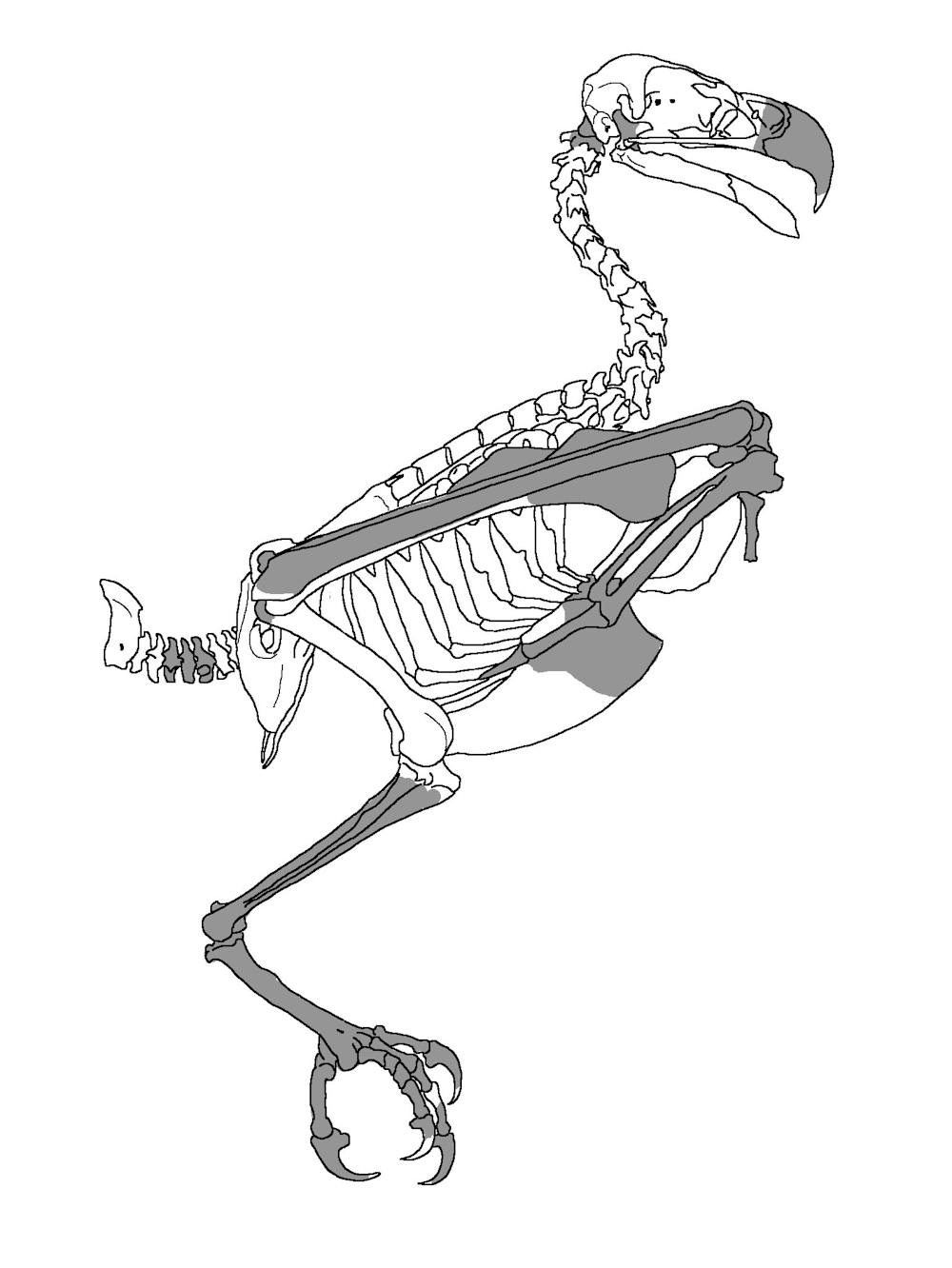
It is one of the most complete raptor fossils from this time period found anywhere in the world. It comprises 63 bones, which is truly exceptional; most fossil birds are named on the basis of just a single bone.
Silhouette of an osprey skeleton with shading to show the bones preserved in the new fossil raptor, Archaehierax sylvestris Ellen Mather, Author provided
We have named it Archaehierax sylvestris, meaning “ancient hawk belonging to the forest”. It was slightly smaller than a wedge-tailed eagle, with talons spanning 15 centimetres that allowed it to grab prey the size of a koala or possum. And it had short, robust wings adapted to fly within the cluttered confines of a forest, rather than to soar through the skies.
With its relatively short wings and long legs, this eagle was likely an ambush hunter, waiting for unwary prey to approach, rather than a soaring forager. In the forest, it probably preyed on medium-sized marsupials. But from a high perch, it would also have made forays over the lake where it could catch ducks and flamingos.
Since the 1970s, the barren, salt-crusted sediments in South Australia’s arid north have yielded a range of bone fragments, teeth, and other fossils of the animals that lived there — many of which would have been prey for Archaehierax.
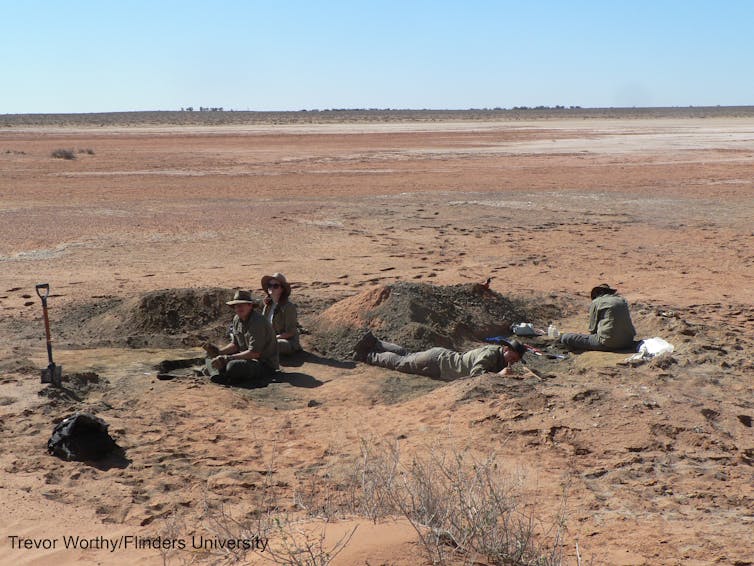
The authors working on the excavation site at Lake Pinpa. Left to right: Aaron Camens, Amy Tschirn, Jacob Blokland, Kailah Thorn. Trevor H. Worthy, Author provided
These fossils include a host of mammals, ranging from wombat ancestors the size of a small cow, through a range of tree-dwelling herbivores such as possums and koalas, to small terrestrial carnivores no bigger than a mouse.
These animals lived around a large lake where crocodiles and turtles abounded, and freshwater dolphins played.
Waterbirds were abundant, including cormorants, several types of flamingo, four species of duck, and Presbyornis, a bizarre long-legged fowl that went extinct elsewhere in the world 20 million years earlier. Many smaller forest birds such as songbirds, parrots and rails are also known, but most are not yet described.
Global eagle family
Left tarsometatarsus (lower leg bone) of the fossil raptor Archaehierax sylvestris, beside Aquila audax (Wedge-tailed Eagle). The fossil was distorted during burial so the top half is rotated 90 degrees to the lower half. Silhouettes show relative sizes of these birds. Scale bar represents 10 millimetres. Ellen Mather, Author provided
Archaehierax was clearly a member of the raptor family, which includes most hawks and eagles. But its bones differed in many ways from all other raptors, including similar-aged ones from elsewhere in the world.
Archaehierax sylvestris was not the only raptor we found at Lake Pinpa. Isolated bones show a smaller eagle also lived in these forests, but the fossils are too fragmentary to give this species a name.
There is another fossil raptor known from deposits at Riversleigh World Heritage Area in northwest Queensland. Pengana robertbolesi is a few million years younger than Archaehierax, and not closely related to the Pinpa bird. It was adapted to capture prey in holes in trees.
Our analysis suggests Archaehierax was probably not closely related to any living raptor. Rather, it represented an ancient lineage that split off near the base of the raptor family tree. This is consistent with previous genetic analysis suggesting most living groups of hawks and eagles evolved only in the past 20 million years — roughly 5 million years after Archaehierax lived and died.
Previously, raptor fossils as ancient as 25 million years old were only known from Europe and North America. Archaehierax sylvestris and its smaller contemporary show that Australia was an important geographic location in the early global evolution of raptors.
Australia is already widely understood to be a cradle of evolution of songbirds, and our island continent doubtless played a similar role in the evolution of other types of birds too.
These raptors and the earliest songbirds lived in temperate rainforests. Back then, the area around what is now Lake Pinpa was located more than 1,100km south of where Adelaide is today, at a latitude equivalent to present-day Fiordland at the southwestern tip of New Zealand.
In the 25 million years since, continental drift has carried Australia and the fossils north at 6 centimetres per year (the speed at which your fingernails grow), travelling more than 1,500km.
The rainforest where these birds lived is now the arid outback. And there are almost certainly many fossils awaiting discovery there that will tell us more about how Australia’s unique birds evolved.
Trevor H. Worthy receives funding from The Australian Research Council and the Sir Mark Mitchell Research Foundation
Aaron Camens receives funding from Sir Mark Mitchell Foundation .
Michael Lee receives funding from the Australian Research Council
Ellen K. Mather and Jacob C. Blokland do not work for, consult, own shares in or receive funding from any company or organisation that would benefit from this article, and have disclosed no relevant affiliations beyond their academic appointment.
Source: The Conversation (Au and NZ) – By Paul Kinsella, Honorary Clinical Fellow, Department of Infectious Diseases, The University of Melbourne, The Peter Doherty Institute for Infection and Immunity
Australian Health Minister Greg Hunt wants COVID-19 rapid antigen tests to be available for home use as soon as they’re approved by the Therapeutic Goods Administration (TGA). Hunt hopes approval will come by Christmas, if not before.
This would allow Australians to test themselves for SARS-CoV-2, the virus that causes COVID-19, in their home and receive the results within half an hour.
Rapid antigen tests have been used overseas for many months and are available from many different manufacturers.
As Australia moves to the next phase of managing COVID-19, these tests will become more commonplace. So what can we learn from their use overseas?
How do they work and how effective are they?
Traditional PCR tests amplify parts of the virus’ genetic code. PCR tests are performed on a swab of the nose and throat taken by health professionals. They’re then sent to a laboratory for analysis.
PCR tests are more sensitive than antigen tests: they can detect lower levels of the virus compared to antigen tests. However PCR tests can take hours, or occasionally days, for results.
Antigen tests, on the other hand, detect protein on the surface of SARS-CoV-2 directly from a sample. The sample can be a swab of the nose, but some use saliva samples.
Antigen tests give results more quickly than PCR tests, but because of their lower sensitivity they are only useful in detecting high levels of virus.
In a study from Oxford University, rapid antigen tests detected approximately 80% of infections in people with high levels of the virus when compared to PCR tests.
Antigen tests play an important role in testing people who have no symptoms.
One of the largest studies from the United Kingdom, of almost 750,000 tests on 250,000 people in Liverpool, showed rapid antigen tests may be useful in diagnosing infections in people who have no symptoms.
These authors broadly categorised the reason for testing in three ways:
Test to protect: testing of people in vulnerable settings such as aged care facilities
Test to release: frequent testing of those who have been exposed to COVID to allow them to be released from quarantine earlier
Test to enable: antigen testing to allow safer return to normal activities such as visiting aged care homes or attending large sporting events.
Rapid tests can allow people to return to their normal activities more quickly, but they’re less sensitive than PCR tests. Shutterstock
As part of this study, testing was performed in key workplaces, such as with emergency services workers and in schools. Results were promising, showing a 17.5% increase in detection of cases.
This increase in detection may assist in breaking chains of transmission. It’s important to remember that when testing people with no symptoms, rapid antigen tests are more likely than PCR tests to return false positives.
However, despite high rates of uptake, test users only returned a small proportion of these kits (8.3%) to health authorities.
How are other countries using them?
Singapore has recently distributed home testing kits to all households nationally, free of charge.
It’s hoped people will use these tests if they have been in contact with a known case, or if they have symptoms of COVID. This may result in a reduction in transmission of the disease, but results remain to be seen.
Daily testing of children exposed to COVID in school was shown to be an acceptable alternative to self-isolation to prevent transmission, while allowing children to remain in class.
Overseas, the costs of these tests have largely been covered by governments, occurring in pilot programs or clinical trials.
In parts of Europe, home tests can also be purchased from pharmacies and supermarkets for around €5-20. In the US, tests cost up to US$50.
What do users think about these tests?
Attitudes to antigen testing have generally been positive. Those who participate in antigen testing most commonly cite “civic duty” and a desire to protect family and friends as the reason.
The main barriers to testing were found to be concerns over the accuracy of the test and the personal consequences of a positive result, such as missing work or an important event.
What is Australia’s regulator, the TGA, reviewing?
The TGA has recently invited sponsors of kits to submit information relevant to the use of home testing, including the use of software to capture results data.
Rapid tests are currently in use in some settings, for example, in aged care facilities to test workers before their shifts, but these need to be overseen by a health professional.
The TGA’s requirements aim to protect the safety and privacy of users. They include ensuring:
clear instructions for the user in the event of a positive result
reporting of complaints relating to false positives and false negatives
guarantees relating to data privacy and cybersecurity.
But these regulations don’t extend to verification of patients’ details or transmission of results to public health authorities.
When and how home testing is introduced in Australia will be closely linked to vaccination rates and movement through the phases of the National Plan.
People without symptoms, for example, could use home testing as an extra reassurance prior to visiting family or attending events.
Home testing could also be used to monitor for the presence of infection after a known exposure, reducing the need for extended quarantine.
In hospitals, they may be used as a complement to PCR testing to screen staff who have no symptoms, or to screen high-risk patients who are very likely to have COVID to allow rapid decision making.
Given the current large differences in COVID-19 cases across the country, it’s highly likely the inevitable introduction of home antigen testing will be both jurisdiction- and context-specific.
The introduction of home testing for SARS-CoV-2 may also pave the way for home testing for other infectious diseases, such as sexually transmitted infections and influenza. This would be a paradigm shift in the way we detect and monitor infectious diseases in Australia.
The authors do not work for, consult, own shares in or receive funding from any company or organisation that would benefit from this article, and have disclosed no relevant affiliations beyond their academic appointment.
If you’re feeling uninspired, stagnant and joyless, you’re not alone. A sense of languishing is one of the dominant emotions of 2021 as we navigate life in an ongoing pandemic and process other terrible world events alongside.
But although many people are struggling and these struggles are not to be ignored, the pandemic has also provided a chance to flourish — functioning well and feeling good, with a sense that life is meaningful and worthwhile, despite challenging circumstances.
Flourishing operates at the top end of the mental health continuum, with languishing at the bottom end.
A separate but related continuum relates to the experience of mental illness symptoms (from zero to severe). Key to this thinking is that mental health (languishing versus flourishing) and mental illness are independent from each other, and it is possible to flourish with mental illness symptoms and vice versa.
Recently published Stats NZ data provide an overview of New Zealanders’ well-being during the pandemic and conclude:
New Zealanders have remained resilient, with most people remaining happy, healthy and satisfied with their lives, despite the challenges [of the pandemic].
For Māori in New Zealand, who generally experience disproportionate rates of poor mental health compared to other groups, recent research highlights that positive outcomes following the 2020 COVID-19 lockdown were nearly as frequent as adverse ones.
So, here are three strategies we can use to acknowledge the languishing but nevertheless move towards more experiences of flourishing.
1. Hold the ‘and’
Holding the “and” is a psychological practice commonly used in several therapies, including dialectical behaviour therapy (DBT). At its simplest, DBT encourages a balance between opposites.
Often, when we are coping with difficult experiences we fall into a habit of “all or nothing” or “black and white” thinking and we find it hard to see the grey. Lockdowns and the Delta variant are good examples of challenges where we might find it hard to see a balance between both extremes, oscillating between thinking “things will never get back to normal” or “everything is fine”.
Holding the “and” in this scenario might look like acknowledging that our normal is being disrupted right now, and knowing that we have the tools to make it through in one piece. This style will give you permission and encouragement to feel frustrated and grateful, angry with moments of calm, and cautiously optimistic while feeling scared.
2. Practice active acceptance
When we have some ability to influence or control a situation, active coping or problem-solving strategies are generally best. But this approach of taking charge is much less effective when we are managing in circumstances beyond our control, like the current pandemic.
Research shows a style of coping called “acceptance coping” results in significantly less distress during such times.
Importantly, acceptance isn’t a passive process. It’s not giving up. Rather, it’s reminding ourselves “this is how things are right now”. Psychologists call this helpful, active acceptance, as opposed to resigning acceptance.
Key steps to acceptance are to notice and acknowledge thoughts and feelings about a situation and then focus on what is important as we tackle the challenge. For example you may notice feeling sad, allow yourself to experience that emotion (acceptance) and then focus on something that is important for that day, for example dialling into a team meeting to check on colleagues.
Connecting with others helps us stay resilient in times of crisis. Shutterstock/SewCream
3. Connect with others
A third strategy that helps nudge us towards flourishing is connecting with others. In our world of physical distancing, the good news is that with connection, it’s quality over quantity. The benefits of being with others come largely from the emotional connection you make with another person.
Significant research has shown that experiencing frequent positive emotions (hope, joy and achievement) help people stay resilient and thrive even in times of crisis. Recent studies show co-experienced positive emotions – the good feelings you get when you really connect with someone – may be even more important than positive emotions experienced alone.
In even more compelling evidence, recent research examining more than one hundred risk factors for mental illness found that social connection was the strongest protective factor against depression. Finding ways of feeling connected with people in your bubble, as well as staying connected online with others, is one of the best strategies.
These key strategies of balance, acceptance and connection help us to move from languishing towards flourishing. Focusing on practising these skills may serve as a psychological vaccine in these pandemic times.
Gaynor Parkin and Dr Amanda Wallis, from Umbrella Wellbeing, have both contributed to this article.
Dougal Sutherland works for Victoria University of Wellington and Umbrella Wellbeing
This event is the latest in a growing number of Indigenous name repatriations across the nation. As a Butchulla person, and a researcher of the representation of Indigenous peoples in archives and historical narratives, I can appreciate the significance of something as seemingly small as a name change.
How common is it to revert to the Indigenous place name?
The reversion to the name K’gari has happened in stages over a number of years. In 2011, the Bligh government added K’gari as an alternative to the place name Fraser Island in the Queensland Place Names Register.
The Fraser Island portion of the Great Sandy National Park was changed to K’gari (Fraser Island) National Park in 2017. This latest change is specifically in relation to the UNESCO World Heritage area.
K’gari is among a growing number of places around Australia that have returned to their Indigenous names. One of the most famous examples is Uluru.
In Queensland, the National Parks First Nations Naming Project has been assisting in reverting national park names to Indigenous names where possible as a part of the government’s commitment to the truth-telling process. North Stradbroke Island and Moreton Island National Parks have reverted to Minjerribah and Gheebulum Coonungai, respectively.
According to then-minister for environment and the Great Barrier Reef, Leanne Enoch
This project is a positive step in our truth telling around First Nations Peoples’ significant and ancient connection to country.
Not renaming, reclaiming
Changing a place name will not fix racism in one fell swoop. No one is claiming it will. But name repatriation speaks to the importance of language in both culture and sovereignty.
Indigenous place names link Traditional Country to the history, culture and people that have been a part of that land long before colonisation. Overwriting Indigenous names with colonist names is an attempt to deny this deep, pre-existing connection and the sovereignty of Indigenous peoples.
The renaming of Butchulla Country was one of the first things Captain James Cook did as he first sailed the east coast of Australia.
In 1770, as Cook’s ship sailed close to Tacky Waroo, a large basalt headland on the east side of K’gari, it was met by a party of Butchulla warriors standing on the headland. In the lexicon of the day, all dark-skinned people were called “Indians”, so Cook renamed Tacky Waroo “Indian Head”.
In other cases, colonial place names were, and still are, blunt reminders of colonial violence. Places like Murdering Creek, Massacre Bay, Skull Creek and many more litter the Australian landscape and indicate violent acts that occurred in those places.
The name Fraser Island is named after a Scottish woman, Eliza Fraser, who was shipwrecked on the island in 1836. Fraser lied about being mistreated by Butchulla people after being shipwrecked. Even in those days, her account of her time on K’gari was thrown into doubt.
Fraser was known to be a sensationalist who made her story more and more salacious as time went on, in efforts to garner more money from sympathetic supporters. Her accounts of her time on K’gari were syndicated as far as the Americas, and reinforced the narrative that Indigenous peoples were “savages” and “cannibals”. These classifications led to Indigenous peoples being vilified around the globe.
Colonial history is not Indigenous history
Language plays an important part in reinforcing the notion that history in Australia began with the arrival of Cook and his fleet.
Colonial place names are another subtle yet persistent reinforcement of the notion that this land only has a place in history once it intersects with the narratives of colonists.
K’gari was the name chosen by the Butchulla because that is the sky spirit the island was created from. The name goes back to the very creation of the island, and yet the name that stuck was the name of a woman who spent not more than two months on the island.
Re-adoption of Indigenous place names signifies the increased recognition of history and culture that predates colonisation. More importantly, these name repatriations recognise that history and culture continue today.
The history of colonisation is not Indigenous history. Indigenous history and the history of this continent predates, pre-exists and will eventually override colonial history. Indigenous place names are evidence of that.
Repatriation of Indigenous place names is a part of the process of reintroducing Indigenous perspectives into the narratives of our modern society.
Repatriation of Indigenous place names reaffirms that First Nations have always existed, and still exist in Australia today. Moreover, they are a source of distinction that sets Australia apart from the rest of the world for the one thing no other country in the world can come close to: being home to the oldest living cultures in the world. That should be a source of pride for all Australians.
Always was, always will be K’gari.
Rose Barrowcliffe is a member of the Butchulla Aboriginal Corporation.
Technologies to harness the power of water are touted as crucial for a low-emissions future. But over many decades, the hydropower industry has caused serious damage to the environment and people’s lives.
More than 500 new hydropower dams are currently planned or under construction in the world’s protected areas. And some 260,000 kilometres of the last wild rivers – including the Amazon, Congo, Irrawaddy and Salween rivers – are threatened by proposed dams.
The global hydropower industry says the technology’s installed capacity must increase by more than 60% by 2050 if the world hopes to limit climate change. And the World Hydropower Congress, held remotely from Costa Rica this month, proposed steps to expand with minimal harm.
But stringent oversight, and a commitment from banks and governments to support only sustainable pumped hydro developments, is urgently needed. Otherwise, the expanding industry could displace millions more people, irreparably damage rivers and drive species to extinction.
The hydropower expansion must be subject to strict oversight. Shutterstock
Old technology given new life
Hydroelectricity is an old technology which involves passing water from a reservoir through a turbine, to generate electricity. One application, known as pumped storage, can store electricity generated by solar and wind. In the era of climate change, pumped storage has given new life to hydropower technology.
Pumped hydro uses excess renewable energy to pump water from a lower reservoir to a higher one. The water is then released downhill to produce electricity when needed, then pumped back up when electricity returns to surplus.
Technologies such as wind and solar can only produce electricity when the sun is shining or the wind is blowing. Pumped hydro can make such generators more reliable by storing renewable energy when it’s produced then releasing it as needed.
Three pumped hydro storage projects operate in Australia: two in New South Wales and one in Queensland. Two are under construction, including the massive Snowy 2.0, and about a dozen are at the scoping stage.
Pumped hydro storage can be added to existing reservoirs on rivers. It can also be located off rivers, which can often lead to better social and environmental outcomes. One such project in North Queensland, Kidston, involves redeveloping an old gold mine.
Australian National University research this year identified about 616,000 potential sites around the world for pumped hydro, including more than 3,000 in Australia. Developing fewer than 1% of these could support a fully renewable global energy system.
Pumped hydro projects circulate water between upper and lower reservoirs. Shutterstock
A poor record
Hydropower and associated dams have a long record of environmental and social damage. Aside from flooding ecosystems, farmlands and towns, hydropower projects significantly disrupt river flows. This, among other harms, can deny water to floodplain wetlands, block fish migration and breeding and reduce nutrient flows.
Globally, populations of freshwater species – including mammals, birds, amphibians, reptiles and fish – have declined by about 84% since 1970, in large part due to dams. In Tasmania, inundation of the unique Lake Pedder ecosystem in the 1970s led to several species extinctions.
And while hydropower is widely considered a “clean” energy, it can lead to significant amounts of greenhouse gases when flooded plants and trees decompose.
Emissions from most hydropower dams are comparable to the life-cycle emissions from solar and wind generators. But at warmer tropical sites where vegetation is more dense, reservoirs could have a higher emission rate than fossil-based electricity.
As far back as 20 years ago, dams were found to have displaced 40 to 80 million in the half century prior. And dams have damaged the livelihoods of hundreds of millions people downstream over the past century.
But new hydro projects are routinely proposed at sites where they will cause substantial damage. And social and environmental problems caused by hydropower dams continue in places as diverse as Colombia and Southeast Asia’s Mekong region.
The Snowy 2.0 pumped storage project in Kosciusko National Park highlights trade-offs involved in many hydropower developments.
It promises to improve the reliability of solar and wind power, helping mitigate climate change. But it also threatens two endangered fish species, and several thousand hectares of national park are being cleared for infrastructure.
Dams displace people whose land and farms are submerged. PRAKASH HATVALNE/AP
An industry makeover
Clearly, the world hydropower industry has public relations work to do, if its global expansion is to be realised. The International Hydropower Association appears to have cottoned on to this, taking a sophisticated approach to improving the industry’s social licence.
The industry has actively engaged conservationists in preparing sustainability standards. Voluntary assessment tools outline steps to minimise damage to people and the environment, and a new sustainability certification scheme for hydropower was launched at this month’s congress.
The industry has pledged not to build hydropower dams in world heritage sites. It has also offered to “avoid, minimise, mitigate or compensate” for damage in protected areas (albeit falling short on offering full protection).
However, it’s hard to see the new standards being systematically applied unless governments of major dam building nations – especially China, India, Brazil and Turkey – adopt the standards in their planning and approval processes.
And how will rogue operators and irresponsible financiers be prevented from developing unsustainable projects – especially when some governments are fixated on enabling them?
It’s in the interests of the International Hydropower Association, as the progressive element of the hydropower industry, to advocate for governments and financiers to assess proposed hydropower projects against the new standards.
Governments should assess hydropower projects against the new standards. Lukas Coch/AAP
Causing the least harm
Pumped hydro has an important role to play in the renewable energy transition, but only where projects cause minimal harm to people and nature.
Ensuring a sustainable industry in future could be achieved by stopping damaging conventional hydropower projects on rivers. Instead, pumped storage projects should be developed when:
an assessment shows they meets the needs of an energy system
environmental and social conflicts are minimal, such as at off-river sites
for projects in tropical areas, shallow reservoirs and flooding of vegetation is avoided to minimise greenhouse gas emissions.
Pumped storage offers the hydropower industry a chance to reposition itself from villain to hero. The industry must now translate its words into practice. And financiers and government regulators must support only those hydropower projects which genuinely seek to minimise environmental and social harm.
Jamie Pittock receives funding from the Australian Water Partnership and APEC with respect to pumped storage hydropower in the Asia-Pacific region. He is acting Director of the Wentworth Group of Concerned Scientists and advises a number of non-government environmental organisations (including The Nature Conservancy and WWF). He contributed advice into the International Forum on Pumped Storage Hydropower.
Source: The Conversation (Au and NZ) – By Luke Zaphir, Researcher for the University of Queensland Critical Thinking Project, The University of Queensland
Melbourne has seen days of anti-lockdown and anti-vaccination protests with hundreds of arrests made. Many protesters hold right-wing and extremist views.
Police say people have been arrested for breaching the chief health officer’s directions, as well as drug-related offences and outstanding warrants. But protesters say the crackdown shows their views are being silenced and the legitimate right to protest — a democratic right that links to freedom of speech — is being squelched.
These protests raise important questions about the nature of freedom of speech. Do the actions of the police represent an attempt to limit what people can say, think or believe?
Such concepts can be difficult enough for adults to deal with. But they can be far more confusing for children.
What do kids need to know about free speech?
The First Amendment to the United States Constitution proclaims freedom of speech as a right for all citizens. The Australian constitution does not have such an explicit statement regarding free speech. But Australia is a party to seven core international human rights treaties and the right to freedom of opinion and expression is contained in articles 19 and 20 of the International Covenant on Civil and Political Rights.
In Australia, freedom of speech is taught explicitly as a concept as part of the year 8 civics and citizenship curriculum. Depending on the school and state, this amounts to about four lessons exploring democratic freedoms that allow for participation in Australian society.
But in practical terms, if a child gets sick at the wrong time and needs to miss school they’ll never learn about the most fundamental aspects of their own citizenship at school.
Children need to understand that when we talk about freedom of speech we’re actually talking about (at least) two things: freedom of opinion or belief, and freedom of expression.
Freedom of expression is more complicated though. We have the right to say what we want — to give our opinions, advertise, display art and protest — but within limits. Most people are aware of these limits: we aren’t allowed to say fighting words, slander another person’s name, cause a panic, or incite violence, for example.
A useful analogy, understandable by most children, is that we have the right to drive freely on roads provided we observe limits on speed, places we can park, how we negotiate the roads with others and the amount of alcohol we have consumed.
Simplistically, limits on what we say, where we say it and how we act are, therefore, like limits on the road, designed to optimise both our rights and public harmony.
In the case of the protesters, they are claiming and acting as if they have a right to not conform to restrictions put in place for the sake of public health and safety. In other words, they are not acknowledging any limits.
There are consequences to this, just as there are consequences to breaking road rules. Indeed some protesters have already tested positive for COVID, increasing the possibility of infection within the community.
You’re free to drive on the roads, but there are still rules you need to follow. Shutterstock
But what about when the free speech is done in a privately owned sphere that is available to the public – such as on a social media platform?
What about free speech in privately owned public spaces?
There have been many instances where a news organisation or person has been banned from social media platforms — the most famous example being that of ex US President Donald Trump.
In this instance, it is not a government intervention that has blocked a person from expressing their opinions but a private entity with its own rules and regulations.
Let’s go back to our road example. If someone has a private road leading to a nice bluff overlooking the sea, they might allow anyone access to the bluff provided they follow conditions such as not speeding, sticking to the road and not playing loud music. If someone decided not to abide by those conditions, it is justifiable for the owner to ban them.
Private businesses also allow people into their stores so long as they accept certain conditions governing their behaviour. Most people think this is reasonable.
But what conditions are acceptable to place on public access to private property? What if we did not allow people of a certain racial background into our coffee shop? Or certain genders? Almost no one would think that was reasonable.
The conversation with children, therefore, needs to be about whether limitations are fair and reasonable.
Private companies like Facebook, Twitter and YouTube are allowed to set conditions for those who use their platforms. In fact, in the case of social media, you have to explicitly agree to abide by those terms to be allowed to use it.
Freedom of speech means allowing others the same rights
A crucial characteristics of participatory democracy is that everyone gets a say on issues of public importance, or at least every view gets a champion.
And if you’re free to express an idea, people are free to respond to you, and perhaps dismiss you, as they wish. Your right to be heard is not a right to be taken seriously.
The right to be heard is not the right to be taken seriously.
Kids need to be involved
A final important point is that it’s not enough to tell students there are rules — they need to be active participants in constructing those rules.
A classic philosophical thought experiment is the paradox of tolerance, formulated neatly by the philosopher Karl Popper:
in order to maintain a tolerant society, the society must be intolerant of intolerance.
In democratic societies, we need to be tolerant of other beliefs, lifestyles, opinions and expression, but how do we match this with the idea of limits on free speech?
We can use the following questions to start discussions with our students or children:
are there any behaviours we should find intolerable or unacceptable (such as violence, racism and homophobia)?
why are these behaviours intolerable — will they cause harm, or do we simply disagree with them?
how do we know harm occurs?
These conversations about rights and responsibilities are an essential part of a democratic education.
It is possible to have unlimited freedom of expression — just not in a democracy. If someone can say what they want without any regard or consequence, then they’ve merely reached the top of a dictatorship.
Peter Ellerton is a Fellow of the Rationalist Society of Australia.
Luke Zaphir does not work for, consult, own shares in or receive funding from any company or organisation that would benefit from this article, and has disclosed no relevant affiliations beyond their academic appointment.
If you’re like most Australians, the single biggest chunk of your energy bill — about 40% — goes to a network services company, which owns and operates the transmission lines or pipes delivering electricity or gas to your home.
But evidence from takeover bids for Australia’s last two publicly listed electricity network services companies suggests you are paying more than you should.
These prices are set by the Australian Energy Regulator, because network services are monopolies: you can choose your energy retailer, but not the lines or pipes through which the electricity or gas flow.
It’s the regulator’s job to determine a fair price for these services — one that doesn’t shortchange the service provider or gouge consumers.
But the Australian Energy Regulator has not been getting these pricing decisions right, according to calculations that can be made using the bids by overseas investors for AusNet Services Ltd, the biggest energy network provider in Victoria, and Spark Infrastructure Group, whose assets include South Australia’s electricity distribution network.
Being listed on the stock exchange, they must disclose financial information. This information enables analysts to calculate how much investors value them compared to the Australian Energy Regulator.
This calculation — known as Regulated Asset Base (RAB) multiple — suggests the regulator has been allowing energy network companies to charge way more than necessary.
AusNet owns and operates almost all of the electricity transmission system in Victoria, and also big gas and electricity distribution networks. It is the subject of a takeover battle between Brookfield Asset Management, a Canadian infrastructure fund, and APA Group, Australia’s largest natural gas infrastructure business.
On September 20, it was revealed that Brookfield offered to acquire AusNet for A$2.50 a share. The day after APA Group offered a mix of cash and equity that it said valued Ausnet at A$2.60 per share.
These bids provide a baseline to calculate the Regulated Asset Base multiple: the the ratio of investors’ valuation to the regulator’s valuation.
How much an investor is prepared to pay for a share indicates their expectation of the future dividend (or profits) those shares will return. How much the regulator’s allows a company to charge is based on what it sees as a fair return to shareholders.
From this information the Regulated Asset Base multiple can be calculated.
A multiple of 1 would mean the investors’ valuation equals the regulator’s valuation. A number lower than 1 would mean the regulator is setting prices too low. A number greater than 1 means it is setting prices too high.
Brookfield’s offer, according to The Australian Financial Review, gives Ausnet a multiple of 1.68. This suggests the Australian Energy Regulator is allowing AusNet to charge prices 68% higher than Brookfield would be happy to accept. APA’s bid suggests a RAB multiple even higher.
Of course, it is not entirely as simple as that. Not all of AusNet’s revenue come from regulated assets. This may slightly affect the valuation of AusNet. Assuming AusNet’s unregulated businesses are as profitable as its larger regulated businesses, we estimate the RAB multiple is 1.54.
Valuing Spark Infrastructure
Spark Infrastructure owns controlling interests in two Victorian electricity distributors (Citipower and Powercor), Transgrid in NSW, and South Australia’s main distribution network, SA Power Networks.
In August, Spark’s board approved a A$5.2 billion takeover offer from US private equity giant Kohlberg Kravis Roberts and the Ontario Teachers’ superannuation fund.
This offer gives Spark a RAB multiple of 1.5. This suggests the monopolies Spark has a share in are charging prices 53% higher than needed to adequately compensate investors
The impact on customers will vary, but these calculations suggests network services charges should be about two-thirds current levels. This would make household electricity bills about 15% lower than now.
I am not suggesting the regulator should set prices consistent with a RAB multiple of 1. But prices should not favour monopoly owners as much these takeover valuations suggest they do.
The underlying issue here is not new. Official inquiries over the past decade — the Garnaut Climate Change Review update in 2011, the Senate inquiry into energy bills in 2012 and the Productivity Commission’s review of electricity network regulation in 2013 —
all concluded energy regulation erred excessively in favour of investors at the expense of consumers.
The Australian Energy Regulator and the Australian Energy Markets Commission (which oversees all energy markets) have responded to these inquiries with new rules, guidelines, committees and processes.
Yet the problem remains — and if these takeovers are successful then AusNet and Spark Infrastructure will almost certainly be delisted. We will then lose vital information on RAB multiples that allows objective assessment of the regulator’s decisions.
Bruce Mountain does not work for, consult, own shares in or receive funding from any company or organisation that would benefit from this article, and has disclosed no relevant affiliations beyond their academic appointment.
A film about the perpetrator of Australia’s worst mass shooting was always going to be controversial. After 25 years, Tasmania’s Port Arthur massacre — in which 35 people were killed and scores more injured — is still raw for many Australians.
Some would no doubt be bristling at attachment of director Justin Kurzel to the project. Kurzel’s filmmaking pedigree includes unflinching examinations of some of Australia’s darkest criminal history. In 2011, his Snowtown was a compelling look at suburban dynamics and charismatic evil but was also graphic in its depictions of the town’s notorious killings. More recently, True History of the Kelly Gang (based on Peter Carey’s Booker-prize winning novel) treats its bushranger tale with punk-rock abandon and brutal violence.
But Nitram (Martin spelled backwards) is comparatively restrained. Tracing the lead up to the massacre, rather than the event itself, the film depicts a young man unable to assimilate into the society around him. Caleb Landry Jones (whose performance won Best Actor at Cannes this year) embodies a childlike outcast, incapable of regulating his emotions. His mother (Judy Davis) and father (Anthony LaPaglia) have grown accustomed to his aberrant behaviour, though not without being worn down by it over the years.
Anthony LaPaglia and Judy Davis as the parents of the title character in Nitram. Madman Entertainment
A chance meeting with the eccentric tax lotto heiress Helen (Essie Davis) offers Nitram his first and only friend: an equally lonely outcast. In an alternate history, the odd pair might have lived out their days peacefully in Helen’s decaying estate, listening to opera and surrounded by her many pets. But as the audience knows, this is not where the film is heading.
Where True History of the Kelly Gang toyed with avant-garde bursts of light and colour, Nitram is nuanced in style. Here it is the crack and whirr of firecrackers held seconds too long, a hand edging its way towards a nest of teeming wasps, a blaring car horn, and off-tune piano that grate on our nerves; Kurzel gradually recruits abrasive physical and sonic elements to signal a world off-kilter.
While fears abounded that the film might glorify a killer, or paint him as sympathetic, Kurzel is aware of what is at stake and careful to hold his subject at a distance.
The real perpetrator’s name is never uttered, instead “Nit-ram” is hurled at the film’s protagonist as a juvenile taunt. The young man is as unknowable to himself as he is to us, at one point remarking to his mother, “Sometimes I watch myself, and I don’t know who it is that I’m looking at.”
Caleb Landry Jones plays the disturbed protagonist of Nitram. Madman Entertainment
This opacity of character is significant. Though several moments provide possible contributing factors for the tragedy that we know is coming, Kurzel resists presenting them as a clear cause and effect trajectory. Rising family tensions, mental health concerns, a nonchalant attitude to gun sales, and a gradual chipping away at the young man’s autonomy — all of these are shown, but Kurzel does not for a moment pretend that they add up to an explanation for his subject’s actions.
When the soon-to-be killer is transfixed by a television news report about Scotland’s Dunblane massacre (a watershed moment in UK gun control reform) we are offered another pseudo-motive for the tragedy we know is imminent. This too, however, seems to point more towards our all too human desire for clarity in the wake of incomprehensible events than it does towards a coherent and containable explanation.
Naturally, many will take ire with the humanisation of someone that we would prefer to dismiss as a monster. But atrocities like the Port Arthur massacre aren’t committed by monsters, they are committed by people, and this is the deeply unsettling reality that Kurzel asks us to sit with for close to two hours.
For Kurzel, Nitram isn’t a pathologically evil villain that would be easier to reconcile with a legible understanding of horrific crimes. Nor is he a pitiable victim of social circumstance and untreated psychological issues. Where the events of his life might, in a less nuanced portrayal, generate sympathy or suggest senseless violence can ultimately be understood, Kurzel resists giving pat explanations for the sake of narrative closure.
And this complexity is where the moral value of the film lays. There is a crucial difference between humanising a problematic figure and excusing their actions.
Oliver Hirschbiegel’s 2004 film Downfall courted similar controversy for depicting Hitler as vulnerable in the final days of the Third Reich. Of course, it is more comfortable to reduce him to a spectre than to consider that an ailing family man was capable of incomprehensible evil. But representing history’s tyrants and criminals as three dimensional is not the same as vindicating or even explaining them.
Nitram is uneasy but powerful viewing. The film’s very existence will understandably upset many, regardless of how sensitively it treats its subject. Particularly for Tasmanians, the traumatic legacy is very real and still raw.
But it may also come as a relief that Nitram does not exploit the community’s pain for entertainment or shock value and the massacre is not depicted onscreen.
Instead, the film asks complex questions about what volatile mix of personal, historical, and social forces may have led to the events of the massacre. The fact that there is no easy answer does not reduce the value of the asking.
Nitram is in cinemas from September 30th 2021.
Alison Taylor does not work for, consult, own shares in or receive funding from any company or organisation that would benefit from this article, and has disclosed no relevant affiliations beyond their academic appointment.
Christine Baranski and Audra McDonald in The Good Fight.Scott Free Productions, King Size Productions, CBS All Access
Our writers nominate the TV series keeping them entertained during a time of COVID.
Ever since The West Wing premiered in 1999, American television has loved series based on presidential politics. One could now spend months working through programs like Veep or Graves on streaming services. Rather like doctors and lawyers, politicians have become the basis for white collar TV series.
During the daily dramas of last year’s Trump campaign, television needed to do more than offer realism; the earnest liberalism of The West Wing felt oddly outdated amidst the realities of COVID, Black Lives Matter and the 2020 elections. What was needed was a television version of magic realism, able to speak to the events of the day but in ways that went beyond the documentary.
During the time of Trump, a different kind of political TV drama was required. David Maxwell/EPA
There are few politicians in The Good Fight, but it remains the most interesting American political series of the past few years. A spin off from The Good Wife —which did have a politician as a central figure, it’s a legal drama set in an African-American law firm in Chicago headed by Liz (Audra McDonald) and Diane (Christine Baranski). That Diane is white, and married to a gun-loving Republican, becomes an on-going issue for the firm.
The fifth series of The Good Fight begins with a survey of 2020, in which COVID — “that thing from China” — the murder of George Floyd and the elections take centre stage.
Viewers of earlier episodes will recognise some of the main characters, although each series introduces new players. This one gives a starring role to Mandy Patinkin as the fake Judge Wackner.
Increasingly, the drama plays out in his parallel court, which dispenses the sort of immediate and sensible justice that the corrupt and choked systems of Cook County, including Chicago, fail to do.
The idea of an unofficial court is already a television staple — Judge Judy Scheindlin’s move into reality television comes to mind — but here high mindedness develops into disillusion and ultimately disaster: watch the last episode to see how the series blends reality and fiction.
I watched the most recent episodes of The Good Fight during the latest Melbourne lockdowns, curious whether the sense of outrage at Trump that fuelled so many of the previous series would diminish. But the divisions in the United States that became so marked in the past four years have not gone away, and the series reminds us that despite his rhetoric, Biden has failed to bring the country together.
Solidifying faultlines
If anything, the show suggests that the political and cultural faultlines are solidifying. Over the past two years the show has become oddly bizarre, rather as if the writers of The X Files have wandered into the studios of Robert and Michelle King, the writers and producers of both The Good Wife and The Good Fight.
Their scripts take off from the news headlines and wander into fantasy, but fantasy that seems an acute harbinger of actual events.
The Good Fight stands out for sheer inventiveness, a willingness to take chances that rarely exists in American television dramas. Diane seeks advice from the ghost of Ruth Bader Ginsberg; the firm’s investigator, Jay (Nyambi Nyambi) hears the voices of Frederick Douglas, Karl Marx and Christ.
Jay (Nyambi Nyambi) hears the voices of Frederick Douglas, Karl Marx and Christ.
The show espouses unapologetically progressive politics, but it does so without becoming didactic and at times with remarkable humour (you will need to go back to earlier series to see its skewering of Trump).
It is most challenging in the inclusion of sympathetic characters from the right, such as Diane’s husband (Gary Cole), who may or may not have been implicated in the riots at the Capitol, and the black Republican lawyer, Julius Cain (Michael Boatman), who is imprisoned after a false accusation of bribery, and then pardoned by Trump.
The personal is political
That the personal is the political is evident in Diane’s struggles, both with her right-wing husband and with her colleagues who increasingly question how an African-American law firm can have a white woman as one of their named partners.
If I have an unease with the way the series has developed it is that too much of it revolves around Diane, possibly because Baranski along with Marissa Gold (Sarah Steele) is the only major character to have survived the transition from The Good Wife.
I’ve now spent eight years of my life in the US, having first gone there as a callow graduate student when Lyndon Johnson was president. Like so many other Australians, I fell in love with the country, and my career has been largely shaped by it.
Yet the more I’ve visited, the more foreign it becomes. The Good Fight is exhilarating entertainment and a grim warning of what the US could become.
Dennis Altman does not work for, consult, own shares in or receive funding from any company or organisation that would benefit from this article, and has disclosed no relevant affiliations beyond their academic appointment.
With a very close result as counting continues, it could be weeks or even months before a government is formed. This is what we know so far:
1. Progressive parties were the big winners
Both the centre-left Social Democrats (SPD) and the Greens added more than 5% to their vote.
It looks like the CDU has ended up with their worst performance of the post-war period, scoring just 24.1% of the popular vote. This means that the SPD, currently on 25.8%, will have the right to try and form a government.
SPD candidate for chancellor, Olaf Scholz had a good election but now faces tough negotiations to get a result in his favour. Michael Sohn/AAP
Few would have suggested 12 months ago the SPD under Olaf Scholz would be in a position to build a government. Having endured a long, grinding period as the junior party in a “grand coalition” with Merkel’s centre-Right Christian Democratic Union (CDU), pundits (including myself) had wondered whether the SPD could survive the serious challenge to their base from the German Greens and a more centrist CDU.
This weekend’s election has shown the party’s resilience in a fragmenting electoral landscape.
2. The CDU paid dearly for fumbling their post-Merkel succession plan
Merkel announced her retirement in 2018, so the CDU had plenty of time to think about succession.
In the last few years, the party had experimented with two Merkel-style centrists. The first, Annegret Kramp-Karrenbauer, quit the leadership in 2020 after a state election in Thuringia saw her party court far-right votes.
After another destabilising party ballot, Armin Laschet — the pick of party apparatchiks — was chosen as leader. Many CDU voters would have preferred the Bavarian state premier Markus Söder, who pulled out of the leadership race in April.
The election result has left the CDU reeling. Carsten Koal/EPA/AAP
Laschet’s avuncular style of politics failed to gain traction during the campaign, while the deadpan gravitas of the SPD’s Scholz and the urgent politics of the Greens seemed to have struck a chord in sombre times.
3. Even the winners didn’t get what they wanted.
Talk of SPD “triumph” and CDU “failure” is all relative. In reality, the two parties are less than 2% apart and between them only hold about 50% of the national vote — scarcely enough for another grand coalition.
In the last televised debate before the election, Scholz made it clear if he had the chance to build a coalition government, he would prefer to do that with the Greens.
But the SPD won’t be able to form government with the Greens alone. They will need a third party.
4. Coalition-forming talks will be tricky
While coalition governments are the norm in Germany, forming a government won’t be straightforward. There are a number of coalition possibilities with names that often stem from the colours associated with the parties.
These include another “grand coalition” of the two biggest parties, the SPD and the CDU, “Kenya” (SPD, CDU, and Green) or, perhaps less likely, “Jamaica” (CDU, Green and the free marketeer Free Democratic Party (FDP)). A “traffic light” coalition (SPD, Green, and FDP) is also possible.
Some had tipped that the socialist Left Party (Die Linke) might have been brought into a ruling coalition of left-wing parties for the first time at the federal level, a so-called “Red-Red-Green” coalition. Even with them, however, Scholz still wouldn’t have enough seats to govern.
Coalition talks have already begun behind the scenes. The main parties also began declaring their conditions for joining a ruling coalition during the election coverage on Sunday night.
5. The minor players remain minor
In the last coalition discussions of 2017, the free marketeer FDP infamously chose to preserve their doctrinal purity rather than take up a role as a junior partner in government.
It would be unsurprising to see them do the same again, with their leader already seeming to have ruled out a so-called “traffic light” coalition with the SPD and the Greens because it wouldn’t deliver the tax cuts the FDP want.
Meanwhile the Left Party had a horror night, losing almost half of their votes, and relying on complicated electoral rules to be able to sit in the German parliament with fewer than the normal 5% of votes required.
6. The far-right vote slipped overall
But at 10.5% nationally, it is worryingly high in some areas, particularly the eastern states of Thuringia, Saxony and Saxony-Anhalt. The far-right Alternative for Germany party are the greatest threat to German democracy, and their voters are not, as some imagine, pensioners who remember the certainties of the old Communist regime fondly. Rather, they are young and middle-aged East Germans who have voted against migration, anti-COVID measures and “the system”.
All other parties have completely ruled out political cooperation with this pariah party, an encouraging sign after the debacle in Thuringia in 2020, which saw the CDU and FDP flirt with making use of Alternative for Germany votes to support them in state government.
7. Green politics is mainstream
At one stage, the Greens had entertained hopes of winning the election. Even thought they fell well short of this with 14.6% of the vote, the election was fought on their territory, with all of the parties forced to explain their plan for taking Germany to net zero emissions and a green economy.
Greens supporters danced in response to the election result on Sunday. Jens Schlueter/EPA/AAP
Their success on the weekend means Germany seems set to continue its support of these goals.
Matt Fitzpatrick receives funding from the Australian Research Council (ARC).
At the height of her fame in the 1990s, supermodel Linda Evangelista was often quoted as saying she wouldn’t get out of bed for less than $10,000 a day. Now she’s revealed a popular cosmetic procedure has sent her to the “lowest depths of self-loathing”, destroyed her livelihood and made her a recluse because of the changes to her body. She is suing for US$50 million.
The process, called cryolipolysis (or fat freezing) shrinks fat over a few months, after an initial period of redness where the treatment has been applied.
When Evangelista underwent cryolipolysis, she reportedly experienced a side-effect where the fat increases over the months following treatment instead of decreasing. This is called paradoxical adipose hyperplasia. This complication occurs more often in men and more often when older versions of the machine used in the treatment are employed. Manufacturers quote an incidence of 1 in 4,000 cycles, but the real incidence may be more frequent because patients might not report the complication due to lack of awareness.
Cryolipolysis — often referred to by the commercial name CoolSculpting — has gained popularity in recent years. But those considering it should be aware of the potential for rare complications.
Less invasive than liposuction
Before cryolipolysis, liposuction was the only effective therapeutic option for the removal of excess fat tissue. Because liposuction is an invasive procedure and carries the inherent risks associated with surgery, cryolipolysis was developed in 2007 to address body contouring as a less-invasive procedure.
The procedure was conceived after the observation of reduced fat in a child’s cheek after sucking on an ice block. Normally the fat cell numbers are reduced after freezing.
Cryolipolysis treatment leaves initial redness, but then fat is meant to shrink over subsequent months. Shutterstock
Unfortunately, the cause of the opposite effect reportedly experienced by Evangelista is not fully understood. Theories vary from some patients’ fat cells being prone to acting in the opposite way than predicted, to unintended activation of stem cells due to nerve or blood supply issues.
Growing in popularity
Body contouring, or body sculpting, procedures are the fastest growing procedures in cosmetic medicine. Some areas of fat on the body are almost impossible to shrink with diet and weight loss. People with diabetes may also seek treatment for areas that are injected with insulin and can accumulate fat under the skin.
Nonsurgical fat reduction methods include cryolipolysis (often marketed as CoolSculpting), ultrasound (Vaser Shape and Liposonix), and radiofrequency (Vanquish).
The number of body sculpting treatment sessions has risen 68% since 2015. Within body sculpting procedures, cryolipolysis accounted for 45.7% of all body contouring treatments.
Similar undesirable effects — paradoxical adipose hyperplasia — have been reported for non-invasive radiofrequency treatment.
Ultrasound fat reduction has not yet been reported to cause the same adverse effects. However, fat cells can recover after this treatment, making it a temporary reduction in those cases.
Many patients may not be aware they have experienced paradoxical adipose hyperplasia because it comes on slowly and may be hidden by general weight gain. They might also just assume the treatment did not work.
In more noticeable cases, the area drawn into the freezing device will, after the redness settles, slowly enlarge and protrude more than it did before the start of treatment. The growth is not steady and within a few months it reaches a maximum size that depends on the patient’s body fat content.
What is safe for people who want to change their shape?
The definitive treatment for unwanted body fat that can’t be improved with exercise is liposuction in a skilled operators’ hands.
Liposuction is an invasive procedure with increased risks including irregularity in the skin’s surface and contour.
Ultrasound therapy may be the safest option to adjust body shape as a primary treatment. It may also be considered for cases of paradoxical adipose hyperplasia although it may only be a temporary solution. Testing the treatment in a small area is advisable first.
Any time you change the body’s balance, you risk creating new problems. Particularly when dealing with fat. When patients put weight on after fat removal procedures, the fat will distend in other areas significantly more than the treated areas and this gives an unusual appearance.
When proceeding with any cosmetic procedure it pays to be well informed and prepared for unwanted outcomes, even if they are rare. Yes, the journey will be much longer when complications occur. The trick is not to go for a quick fix or let negative feelings about appearance override caution and have a competent clinician advising you.
Michael Freeman does not work for, consult, own shares in or receive funding from any company or organization that would benefit from this article, and has disclosed no relevant affiliations beyond their academic appointment.
In the opening panel of the National Summit on Women’s Safety 2021, Professor Marcia Langton called for a separate national plan to address violence against Aboriginal and Torres Strait Islander women.
Other panels spoke about the importance of perpetrator interventions and engaging men and boys in prevention, particularly those that engage with Aboriginal men. Such programs are important but if they are not based in appropriate frameworks they can be dangerous.
In research conducted between 2018-2020, ten principles of good practice to prevent violence against women were identified through case studies of two Northern Territory programs addressing men’s violence. These principles were developed with practitioners in a series of workshops. One of the areas of focus was accountability for men who use violence.
Men’s behaviour change programs in the Northern Territory
Men’s behaviour change programs respond to violence by working with men who have used violence. Other programs seek to engage men and boys as allies in violence prevention.
Currently there are only two behaviour change programs in the Northern Territory and very few programs that engage men and boys in violence prevention. More are desperately needed.
However it is not enough to simply have these programs – they must be safe and effective.
Approximately 300 Northern Territorians contributed to the development of principles of good practice to prevent violence against women. These have been communicated in a framework called “Hopeful, Together, Strong”.
These principles of good practice show that to be effective programs must be:
holistic, community-driven and culturally safe
sustainable and educational
be framework- and theory-informed
involve multi-agency collaboration
be strengths-based and accessible
require accountability from men who use violence.
These principles came from practice-based knowledge of Aboriginal and Torres Strait Islander people and non-Indigenous practitioners. Panel discussions at the Women’s Safety Summit spoke of the same principles, with discussions of the need for community-driven, holistic, culturally safe approaches.
A study of two programs that work with men
The first program studied is the Marra’ka Mbarintja Men’s Behaviour Change program run by Tangentyere Council Aboriginal Corporation in Mparntwe/Alice Springs. This men’s behaviour change program is for Aboriginal and non-Indigenous men who have used violence.
The study found this men’s behaviour change program was promising and showed evidence of assisting the community to move through the stages of change.
Particular strengths of this program were its culturally safe approach, its use of assertive outreach, its emphasis on women and children’s safety and holding men accountable for their use of violence.
This program has since developed Central Australian Minimum Standards for men’s behaviour change programs. Despite the promising indications of program effectiveness, this program is under-funded, under-staffed, and under-resourced.
The second program studied will not be named to allow them the opportunity to put in place the research recommendations. This prevention program seeks to engage men in violence prevention by delivering training and sessions to Aboriginal and non-Indigenous men in regional and remote Northern Territory communities. In an effort to raise awareness, this program educates men about different types of violence.
Despite being well-funded, well-intended, and having a strong geographical reach, the research found this prevention program to be ineffective and often collusive with men’s violence against women. This was due to program staff having no expertise or training in domestic, family and sexual violence.
This led staff to minimising and/or condoning men’s use of violence in training sessions and using language like “women are just as bad”.
This is an inaccurate claim, considering women are nearly three times more likely to experience intimate partner violence than men; almost ten women a day are hospitalised from assault by a partner; and Indigenous women are hospitalised due to family violence at three times the rate of Indigenous males.
Therefore this program’s training sessions often reinforced harmful and incorrect attitudes and beliefs which could drive further violence against women.
Comparing these two vastly different programs highlights the importance of minimum standards for programs working with men to prevent violence. Appropriate frameworks for these programs need to be built from evidence about what works, particularly in remote communities and alongside First Nations people.
If not conducted correctly, programs working with men can put women and children at continued risk. Funding and support should be directed to programs that can show evidence of being grounded in frameworks of good practice.
Prioritising the safety of women and children must be at the forefront of everything any men’s program does. This includes elevating the voices of survivors and the inclusion of women in leadership. In particular, the perspectives of Aboriginal women must inform these programs, and Aboriginal people and communities must have decision-making roles in their governance.
When women’s voices are not included, there is no chance to model gender equality in relationships. In the case of men’s behaviour change programs, without women’s insights, the opportunity for accurately monitoring and assessing risks has been lost. If only the man’s assessment of risk is heard, there is no way to tell if the potential for violence is escalating. This can lead to staff minimising a man’s use of violence.
Staff employed in these programs working with men must be given comprehensive, ongoing training. This is to minimise the risk of collusion and to empower staff to challenge men’s use of or justification of violence. Understanding why some men minimise and justify their behaviour is a skill that specialist facilitators constantly work at. They need to balance holding men accountable within a non-shaming and non-judgemental space so men are able to explore and take ownership of their behaviour.
Programs working with men must also address additional drivers of violence against Aboriginal women, such as the ongoing impacts of colonisation on Indigenous people and communities. Programs must be equipped with an understanding of intergenerational trauma and how colonisation has undermined gender roles and relations in First Nations communities, and respond to the gendered impacts of these compounding traumas.
The ongoing impacts of colonisation on non-Indigenous people and society also drives violence against Indigenous women. Colonisation has created systems and structures which privilege non-Indigenous people and reinforces power imbalances between them and Indigenous people. Programs working with men must therefore take an intersectional approach, and in addition to gendered drivers, address structural and racist violence.
We must also engage men and boys in preventing violence against women.
On day two of the Women’s Safety Summit, Thelma Schwartz expressed the sentiment that men are not always the problem, they can be the solution.
We invite our men, our brothers, uncles and cultural leaders to stand with us, to come together to work on solutions for us all, our young ones, our men and women together.
A good example of this is the partnership between Darwin Indigenous Men’s Service and the Darwin Aboriginal and Torres Strait Islander Women’s Shelter. This partnership shows how communities can work together to break the cycle of violence.
However, such local strategies are rarely given the opportunity to build their capacity and become effective programs, through a lack of government support.
To create and support community-led violence prevention programs, Indigenous people must be involved in conducting the research and informing what is best practice in their respective communities. Kinship and traditional Aboriginal family structures and ways of maintaining relationships, must be integrated into these practices.
We need place-based models, conceived, designed, and delivered by the community for the community.
Chay Brown receives funding from ANROWS and the Australian National University Gender Institute.
Desmond Campbell is affiliated with Our Watch as a Board Member.
An accelerating arms race in the Indo-Pacific is all but guaranteed now that China finds itself a target of new security arrangements — AUKUS and the Quad — aimed at containing its power and influence.
This has the makings of a new great game in the region in which rival powers are no longer in the business of pretending things can continue as they are.
The AUKUS agreement, involving Australia, the US and UK to counter China’s rise means a military power balance in the Indo-Pacific will come more sharply into focus.
The region has been re-arming at rates faster than other parts of the world due largely to China’s push to modernise its defence capabilities.
Unambiguously, AUKUS implies a containment policy.
Likewise, the further elevation of the Quad security grouping into a China containment front will play into an atmosphere of heightened security anxiety in the Indo-Pacific.
The four Quad participants – the US, Japan, India and Australia – have their own reasons and agendas for wanting to push back against China.
The Quad leaders unveiled a host of initiatives after their face-to-face meeting last week. Evan Vucci/AP
After their summit last week in Washington, the Quad leaders used words in their joint statement that might be regarded as unexceptional in isolation.
Together with other developments such as AUKUS, however, the language was pointed, to say the least:
Together, we re-commit to promoting the free, open, rules-based order, rooted in international law and undaunted by coercion, to bolster security in the Indo-Pacific and beyond.
The “beyond” part of the statement was not expanded on, but might be read as a commitment to extend the Quad collaboration globally.
All this has come together at the dawn of a new US administration whose members include several conspicuous China hawks, and at a moment when China has shown itself to be ever-willing to throw its weight around.
Beijing’s crude campaign against Australian exports in an effort to bend Australia’s policy to its will is a prime example. It is doubtful an AUKUS or an invigorated Quad would have emerged without this development.
Under President Joe Biden, this shift will be driven by a hardening in American thinking that now recognises time is running out, and may already have expired, in the US ability to constrain China’s rise.
These are profound geopolitical moments whose trajectory is impossible to predict.
Australia commits fully to China containment
Canberra is now a fully paid-up member of a China containment front, whether it wants to admit it, or not. In the process, it has yielded sovereignty to the US by committing itself to an interlocking web of military procurement decisions that includes the acquisition of a nuclear-propelled submarine fleet.
Whether these submarines are supplied by the US or Britain is a bit immaterial since the technology involved originates in America.
The submarines will not be available for the better part of two decades under the most optimistic forecasts. However, in the meantime, Australia could base US or British submarines in its ports or lease American submarines.
Meanwhile, Australia is committing itself to a range of US-supplied hardware aimed at enhancing the inter-operability of its military with the US.
This is the reality of fateful decisions taken by the Morrison government in recent months. Such a commitment involves a certain level of confidence in America remaining a predictable and steadfast superpower, and not one riven by internal disputes.
Australian defence spending likely to rise
What is absolutely certain in all of this is that an Indo-Pacific security environment will now become more, not less, contentious.
SIPRI notes that in 2020, military spending in Asia totalled $US528 billion (A$725 billion), 62% of which was attributable to China and India.
IISS singled out Japan and Australia, in particular, as countries that were increasing defence spending to take account of China. Tokyo, for example, is budgeting for record spending of $US50 billion (A$68 billion) for 2022-23.
However, those projections will now have to be re-worked given the commitments that have been made under AUKUS.
Neglected in the flush of enthusiasm that accompanied the AUKUS announcement is the likely cost of Australia’s new defence spending under a “China containment policy”. It is hard to see these commitments being realised without significant increases in defence allocations to 3-4% of GDP.
This comes at a time when budgets will already be stretched due to relief spending as a consequence of the pandemic.
In addition to existing weapons acquisitions, Canberra has indicated it will ramp up its purchases of longer-range weapons. This includes Tomahawk cruise missiles for its warships and anti-ship missiles for its fighter aircraft.
At the same time, it will work with the US under the AUKUS arrangement to develop hypersonic missiles that would test even the most sophisticated defence systems.
What other Indo-Pacific nations are doing
Many other Indo-Pacific states can now be expected to review their military acquisition programs with the likelihood of a more combative security environment.
Taiwan, for example, is proposing to spend $US8.69 billion (A$11.9 billion) over the next five years on long-range missiles, and increase its inventory of cruise missiles. It is also adding to its arsenal of heavy artillery.
Seoul has also hinted it might be considering building its own nuclear-propelled submarines (this was among President Moon Jae-in’s election pledges in 2017). Signs that North Korea may have developed a submarine capable of firing ballistic missiles will be concentrating minds in Seoul.
All this indicates how quickly the strategic environment in the Indo-Pacific is shifting.
Australia — perhaps more so than others — is the prime example of a regional player that has put aside a conventional view of a region in flux. It now sees an environment so threatening that a policy of strategic ambiguity between its custodial partner (the US) and most important trade relationship (China) has been abandoned.
The price tag for this in terms of equipment and likely continuing economic fallout for Australian exporters will not come cheap.
Tony Walker does not work for, consult, own shares in or receive funding from any company or organisation that would benefit from this article, and has disclosed no relevant affiliations beyond their academic appointment.
A new poll shows nearly two out of three New Zealanders want the border to remain closed until at least 90 percent of the country is vaccinated.
The poll, in partnership with the country’s leading daily newspaper The New Zealand Herald, which is also running a 90% Project in support of high vaccination, showed growing support for vaccination, according to the paper in a front age report.
The Herald said the Talbot Mills Research poll indicated that 89 percent of those polled planned to get vaccinated or had already done so.
“The results contrast with a public appeal yesterday from former prime minister Sir John Key for New Zealand to break out of its ‘smug hermit kingdom’ by opening the border as soon as possible,” the Herald said.
The newspaper said that support for 90 percent was much higher than for the “option of opening the borders after everybody had been given a reasonable chance to get vaccinated, regardless of the overall rate – an option favoured by 26 percent of people.”
Political editor Claire Trevett wrote that support for the 90 percent plus threshold was “particularly high among Labour and Green supporters (70–72 percent support) – but about 60 percent of National and Act supporters also favoured it”.
The government had so far refused to set a specific threshold or date at which it would ease border restrictions, Trevett wrote. However, it had committed to trialling measures such as home isolation this year, as part of its road map.
“The poll of 1050 people aged 18 and over was taken from August 31 to September 6 – the third week of the lockdowns sparked by the delta outbreak. It has a margin of error of +/- 3.1 per cent,” wrote Trevett.
“The NZ Herald has joined with Talbot Mills Research for polling on vaccinations as part of the 90% Project, to help track public sentiment over the coming months.”
Covid 19 Delta outbreak: Sir John Key – 5 ideas to transform our approach, via @nzheraldhttps://t.co/HByf2xoANA Problem is Maori and Pasifika will suffer most while Key’s mates enjoy their overseas holidays. Lift vaccination first
In a statement, the Health Ministry said there were now a total of 1177 community cases associated with the latest outbreak of the delta variant of the virus, RNZ News reports.
All of the latest cases were identified in Auckland.
The ministry said one of today’s community cases had previously been under investigation and was now confirmed and linked to the current outbreak.
“The case has now recovered. The case spent 14 days in a quarantine facility along with household members who also tested positive for covid-19,” the statement said.
EDITORIAL:By the Fiji Times editor-in-chief Fred Wesley
Fiji’s Assistant Minister for iTaukei Affairs Selai Adimaitoga said quite a lot on Friday in her end of week statement on the Media Industry Development Act 2010 in Parliament.
She blamed reckless reporting by journalists as “one of the causes of violence and economic destruction over the past years”.
She said dishonest media had played a role in every troubling event in Fiji’s history. For that, she said, media organisations had a duty to tell the truth to the public and not to publish things that would stir political instability or violence.
“We must ensure that history does not repeat itself as Fijians deserve honest and fair media,” Ms Adimaitoga said.
She said every media organisation should only speak the truth and fairly report on facts, adding “Fiji cannot afford the reckless reporting of the past. The media have a responsibility to publish the truth. They also have a responsibility to maintain professional standards, a responsibility to maintain integrity”.
We totally agree with her that media organisations have a duty to tell the truth and fairly report on issues. We do not just talk about it. We do it, every day.
We try, every day, to fairly report on issues of importance to the nation, and to provide coverage that cuts through any imaginary demarcation line.
There are many such lines — political leanings, ethnicity, gender and religion for instance. Any good news organisation lives on its reputation for reliability. If its information is reliable it has the trust of its readers or viewers. But a key part of the media’s role is to hold power to account.
Ms Adimaitoga, whose [FijiFirst] government has held power (in one form or another) for more than a decade, said nothing about that. Our editorial decisions on what information we present must factor in what is of public interest, and the public interest requires close scrutiny of those who exercise power over us.
So when a government politician talks about “anti-government” news, she must think carefully about the fact that the public expects accountability from her government. Keeping the trust of our readers requires us to maintain a balance and not to be partisan advocates for one political side or the other.
Ms Adimaitoga needs to better appreciate and understand the role of the media. And we will say to her what we have said to the government in the past when we have faced the same “anti-government” label.
We are not anti-government, nor are we pro-government, and neither she nor anyone should try to put us into one corner or another.
The Fiji Times does not exist to create positive headlines for the government. It exists to publish all views and to ensure there is balanced coverage of the news and balanced political debate.
The public in any democracy expects to read diverse news and opinions which are representative of our whole society and the different viewpoints and perspectives that exist in our nation.
And we believe in serving the public in line with those democratic expectations.
The Fiji Times was founded at Levuka in 1869. This editorial was published in The Sunday Times edition of the newspaper yesterday (September 26) under the title “The role of the media” and is republished by Asia Pacific Report with permission.
Papua human rights activist and lawyer Veronica Koman has called for an independent inquiry into the attack on health workers in the Kiwirok district, Star Highlands, Papua, saying there are two versions of how the tragedy happened.
A healthcare worker, 22-year-old Gabriella Maelani, was killed during the attack by the West Papua National Liberation Army-Free Papua Organisation (TPNPB-OPM) resistance movement.
“There is one version which is clearly being shared a lot in the media. And there is a second version circulating among the Papuan people,” Koman told CNN Indonesia.
Koman said that the chronology of events which was being broadcast by most news media depicted the alleged brutality of the TPNPB-OPM during the attack.
In the second version alleged the attack was triggered when a person wearing a doctor’s uniform shot at the TPNPB, causing a shootout inside the healthcare building, Koman said.
She said that in Papua many TNI (Indonesian military) personnel held dual posts as teachers and doctors. She believed this caused a great deal of suspicion in Papua.
Nevertheless, she was saddened by the news that a healthcare worker died, although she said that the truth about the chronology of events must still be investigated.
Death of healthcare worker Based on information she had received, the death of the healthcare worker was not because they were tortured by the TPNPB as alleged.
“The Papuan people’s version is that it’s not true that there was torture. Gabriella jumped [into a ravine] while escaping, she wasn’t thrown into the ravine by the OPM,” she said.
Koman called for an independent investigation. According to Koman, finding out which chronology was correct would influence several factors, particularly racism against the Papuan people.
“If for example the alleged barbaric actions are not true, it will influence the stigma and racism against the Papuan people. And that is very barbaric,” she said.
“Looking for examples of human rights issues, we can separate it. The ones adversely affected should be the OPM, not the ordinary Papuan people.
“In general with minority groups, including the Chinese, when one person does wrong, everyone is adversely affected. LGBT [lesbian, gay, bisexual and transgender] for example, if a gay person does something, the whole community is adversely affected. So it’s important to straighten it out.”
Koman also said care was needed to be taken with the witness testimonies.
Information under duress She questioned whether or not the witnesses provided information under duress.
“There would have been many soldiers around them … So they could have been pressured,” she said.
Earlier, the TPNPB-OPM admitted responsibility for attacking public facilities such as a community healthcare centre and school building in the Kiwirok district on September 13 and 14.
They claimed that the attack was a form of resistance demanding Papuan independence from Indonesia.
The Presidential Staff Office said that “armed criminal groups” (KKB) — as officials generally describe Papuan armed independence fighters — violated human rights law after the healthcare worker died during the attack on September 13.
Presidential Staff Deputy V Jaleswari Pramodhawardani said that the armed group had violated several laws such as the healthcare law, the nurses law, the hospital law and the healthcare quarantine law.
A group of doctors have hit the phones to support Pasifika families who have tested positive for covid-19 and been transferred into managed isolation.
The chairperson of the Royal New Zealand College of GPs’ Pasifika chapter, Monica Liva, said about half the people infected with the virus in Auckland were Pasifika.
She contacted Pasifika doctors who could talk to people in their first language and hear any concerns they might have.
“It’s also to take off the load off the MIQ medical team, so that they can focus on the urgent covid-19 needs,” Dr Liva said.
Dr Liva said she had been heartened by the number of GPs agreeing to help.
TikTok take-up for vaccines The North Island iwi Ngāti Porou have launched a covid-19 vaccination campaign aimed at rangatahi using the social media platform TikTok.
Ngāti Porou’s Taryne Papuni said TikTok was a natural first pick to get the message across.
“That’s one of the mediums that they’re always on, always on the TikTok or the Instagram.
“We thought yeah, we can reach a lot of our people, a lot of our young ones that way and hope that the young ones will actually lead for their elders.”
Earlier this week, Ngāti Porou hosted a vaccinations clinic at Te Poho o Rawiri Marae.
18 new community cases in NZ The Health Ministry reported 18 new community cases of covid-19 in New Zealand today, with all but two epidemiologically linked to previous cases.
There was no media conference today. In a statement, the ministry said there were now a total of 1165 community cases associated with the latest outbreak of the delta variant of the virus.
It said 934 of Auckland’s 1148 cases had now recovered.
The ministry said there were five cases in the past fortnight that were still not linked to previous cases.
The 16 linked cases reported today are all in isolation at home or in MIQ.
This article is republished under a community partnership agreement with RNZ.
New Zealand has 16 community cases of covid-19 today, according to the Ministry of Health.
In a statement, the ministry said 13 of today’s 16 cases had been epidemiologically linked to previous cases.
There have been 10 unlinked cases in the past fortnight.
There was also one historical community case not associated with the current outbreak and another historical case at the border.
The ministry said the community case deemed to be historical was not associated with the current outbreak in Auckland as this case initially came through the border and has been previously reported and spent 14 days in managed isolation, during which time they routinely tested negative.
“They have subsequently tested positive, but this has been deemed historical and is no longer infectious.”
There are 13 people in hospital with covid-19, with four in intensive care.
The ministry said 903 of Auckland’s 1129 cases in this outbreak had now recovered.
Residents of Kāinga Ora apartments in Parnell have been tested after they were added as a covid location of interest in Auckland.
The Ministry of Health added the apartments today, along with a supermarket in Flat Bush.
A person infected with covid-19 visited on three consecutive days – over last weekend and Monday.
Kāinga Ora’s area manager Andrew Walker said they had worked with Auckland Regional Public Health and the City Mission, which has mobile testing capacity, to make it quick and easy for residents to be tested yesterday.
Walker said masks were also delivered to residents and communal areas given an extra deep clean, over and above the special cleaning in alert level 3 and 4.
There has now been a total of 1146 cases in the current community outbreak, and there have been 3806 cases in this country since the pandemic began.
A Waitematā District Health Board spokesperson today said that a patient at Auckland’s Waitākere Hospital had tested positive for covid-19 after presenting at the emergency department yesterday, but that the overall exposure risk is considered low.
The ministry said today fewer than 10 patients were affected.
This article is republished under a community partnership agreement with RNZ.
New Zealand might not be part of the recently revealed security agreement between the US, Britain and Australia (AUKUS), but it certainly can’t avoid the diplomatic and strategic fallout.
Under the pact, Australia stands to gain nuclear-powered submarine capability, with the US seeking greater military basing rights in the region. ASEAN allies have had to be reassured over fears the region is being nuclearised.
Unsurprisingly, China and Russia both reacted negatively to the AUKUS arrangement. France, which lost out on a lucrative submarine contract with Australia, felt betrayed and offended.
But behind the shifting strategic priorities the new agreement represents – specifically, the rise of an “Indo-Pacific” security focus aimed at containing China – lies a nuclear threat that is growing.
Already there have been warnings from China that AUKUS could put Australia in the atomic cross-hairs. Of course, it probably already was, with the Pine Gap intelligence facility a likely target.
While New Zealand’s nuclear-free status makes it a less obvious target, it is an integral part of the Five Eyes intelligence network. Whether that would make the Waihopai spy base an attractive target in a nuclear conflict is known only to the country’s potential enemies.
100 seconds to midnight
What we do know, however, is that nuclear catastrophe remains a very real possibility. According to the so-called Doomsday Clock, it is currently 100 seconds to midnight — humanity’s extinction point should some or all of the planet’s 13,100 nuclear warheads be launched.
The US and Russia account for most of these, with 1,550 many of these deployed on high alert (meaning they can be fired within 15 minutes of an order) and thousands more stockpiled.
The other members of the “nuclear club” – France, Britain, Israel, India, North Korea, Pakistan and China – are estimated to possess over 1,000 more.
Most of these warheads are much larger than the bomb that destroyed Hiroshima in 1945. US, Russian and Chinese investment in the development of a new generation of hypersonic missiles has raised fears of a new arms race.
The Trump legacy
From New Zealand’s point of view, this is more than disappointing. Having gone nuclear free in the 1980s, it worked hard to export the policy and promote disarmament. The high-tide was in 2017 when 122 countries signed the UN’s Treaty on the Prohibition of Nuclear Weapons.
But the nine nuclear-capable countries simply shrugged. The Trump administration even wrote to the signatories to say they had made “a strategic error” that “turns back the clock on verification and disarmament” and urged them to rescind their ratification.
President Donald Trump then began popping rivets out of the international frameworks keeping the threat of nuclear war in check. He quit the Intermediate Nuclear Forces Treaty (INF), which prohibited short- to medium-range nukes in Europe, and the Open Skies agreement, which allowed flights through national air space to monitor compliance.
He also quit the multi-national agreement restricting Iran’s nuclear programme (despite Iran’s compliance) and failed to denuclearise North Korea, despite much fanfare. The bilateral START agreement limiting US and Russian nukes survived, but China rebuffed Trump’s idea of a trilateral nuclear pact.
Nor is the clock ticking backwards with Joe Biden in the White House. Although he extended START, the Iran deal hasn’t been resurrected and there’s been no breakthrough with a still provocative North Korea.
Both the INF and the Open Skies agreements lie dormant, and the AUKUS pact has probably seen US-Chinese relations hit a new low.
Time for renewed action
While it makes sense for New Zealand to maintain and promote its nuclear-free policy, it must also be pragmatic about reducing tension and risk, particularly in its own region. Being outside the AUKUS agreement and being on good terms with China is a good start.
Not being a nuclear state might mean New Zealand lacks clout or credibility in such a process. But the other jilted ally outside the AUKUS relationship, France, is both a nuclear power and has strong interests in the region.
Like China, France sits outside the main framework of US-Russia nuclear regulation. Now may well be the time for France to turn its anger over the AUKUS deal into genuine leadership and encourage China into a rules-based system. This is where New Zealand could help.
The Christchurch Call initiative, led by Jacinda Ardern and French president Emmanuel Macron after the 2019 terrorist attack, shows New Zealand and France can cooperate well. Now may be the chance to go one step further, where the country that went nuclear free works with the country that bombed the Rainbow Warrior, and together start to talk to China.
This would involve discussions about weapons verification and safety measures in the Indo-Pacific region, including what kinds of thresholds might apply and on what terms nuclear parity might be established and reduced.
Such an initiative might be difficult and slow — and for many hard to swallow. But New Zealand has the potential to be an honest broker, and has a voice that just might be heard above the ticking of that clock.
As UN Secretary General António Guterres warned only last week: “We are on the edge of an abyss and moving in the wrong direction. Our world has never been more threatened or more divided.”
I was working on the Rainbow Warrior when it was blown up by the French. I helped paint it, before the explosions.
New Zealand Parliament Buildings, Wellington, New Zealand.
Editor’s Note: Here below is a list of the main issues currently under discussion in New Zealand and links to media coverage. You can sign up to NZ Politics Daily as well as New Zealand Political Roundup columns for free here.
Source: The Conversation (Au and NZ) – By Catherine Archer, Senior Lecturer in Strategic Communication; social media researcher, Murdoch University
Would you share your most intimate thoughts with strangers?
For many women, during the pandemic and associated lockdowns, closed Facebook groups have been a place to do just that. These groups offer a chance to escape the house virtually and spend time with like-minded souls, sometimes chatting, often venting, and seeking solidarity in virtual sisterhood.
Mental health issues, chronic illness, domestic violence, children’s illnesses and issues, divorce, death, infidelity: these are just some of the issues discussed in these groups, along with the more mundane minutiae of life.
While women get friendship and advice from the groups, it’s at a cost. Group administrators spend countless unpaid hours screening new members, managing group conflict, and ensuring accuracy of information.
What’s more, the recent Australian High Court ruling that media companies are responsible for defamatory comments on their Facebook pages puts the spotlight on some of the risks faced by “accidental community managers” in these groups, unpaid and unprotected by large media organisations (or indeed any organisation at all).
The labour of creating and maintaining peer communities online is often invisible, undervalued, and fraught with risk. The recent Australian census asked questions about household labour, but few people stop to consider the significant labour involved in creating and maintaining online communities.
Closed, women-centred Facebook groups have become a sought-after place for millions of women who want to connect with others outside of the public eye. Their inner workings remain an under-researched area and there are risks and rewards, including the possibility of legal risks, media outing and shaming. The practice of “screen-shotting” content from supposedly private spaces is an ever-present risk.
Members of a closed group of more than 3,000 lawyers who are also mothers were reportedly threatened with defamation action after details of their criticisms of anti-mask activism became known outside the group.
We interviewed women who are members of closed Facebook groups. We studied four specific categories of Facebook users: partners of those in the military, migrant women, “mum bloggers” and “everyday” mothers.
Participants told us they joined private or secret Facebook groups because they wanted a safe, trusted, gender-specific space for discussion.
But these groups require significant labour to create and maintain. Women undertake this “hidden” labour not only for themselves, but on behalf of their families, institutions and organisations. Groups are used to get information, advocate for their needs and often create a peer assistance community to cover gaps in other support services.
Running a Facebook group can be hard work, not to mention legally risky. Christin Hume/Unsplash, CC BY-SA
Some mum bloggers told us they joined the groups to seek “refuge” from their public blogging, while still often maintaining a more curated public presence, so as to escape surveillance, including from brands (as current or potential sponsors or partners), the mainstream media, and trolls.
Meanwhile, women whose partners were in the military sought spaces away from the intense expectation of the “ideal military spouse”.
Migrant mothers noted that a shared cultural background, and common experiences such as loneliness or racism, increased their level of trust in the fellow group members and the information they provided.
And for everyday mums, the groups offer a chance to let the “mask of motherhood” slip and to take time out to seek advice and focus on their own issues.
The cost of caring
These responses suggest many women are seeking solace from their intensive caring roles as mothers and partners. But ironically, it takes a lot of work to create, maintain and participate in these groups.
Members and administrators of these groups work hard to make them safe, trustworthy and inclusive. But with COVID lockdowns affecting much of Australia’s population, tensions have pushed some groups to breaking point.
Fiery exchanges around specific issues such as vaccines, panic-buying or compliance with public health orders, or generally heightened emotions amid the pandemic, have prompted some moderators to close or temporarily suspend pages.
Earlier this year, Facebook admitted it needs to do more to reduce the risks involved in moderation and membership of closed groups, pledging to “continue to build and invest to make sure people can rely on these places for connection and support”.
While closed Facebook groups meet people’s need for connection away from the glare of the societal gaze, the paradox of creating “private” spaces within a commercial platform that monetises personal information also sits uncomfortably for many users.
The invisible work women undertake in these groups bring many benefits to their families, their employers, and to themselves. Recognising this unpaid labour is vital and more needs to be done to train, resource and support the volunteers who make and maintain these vital community resources.
Catherine Archer received funding from St John of God Health Care and partnered with Playgroup WA for part of the research into mothers’ use of social media that informed this article.
Amy Johnson is currently an administrator of a women-centered Facebook group.
Leah has been a volunteer admin for various Facebook groups, and currently runs a local parents’ Facebook group.
The swift reemergence of the Taliban in Afghanistan after a failed 20-year war means we need to look beyond military solutions to extremism. One area policymakers should focus on are madrassas — the religious schools that have existed in many Muslim countries for centuries.
Our research in Pakistan shows the importance of these institutions not just in terms of education and religious fundamentalism, but welfare support, too.
This provides critical lessons for Afghanistan.
Madrassas and the Taliban connection
The exact number of madrassas in Afghanistan is not documented, but many Taliban have studied in them. There are an estimated 30,000-plus madrassas in Pakistan, where there is also a strong connection to the Taliban. For example, the Darul Uloom Haqqania madrassa in north west Pakistan has been described as the “university of jihad”.
There are tens of thousands of madrassas in Pakistan. Waqqar Hussnain/EPA/AAP
The 9/11 Commission’s report found madrassas provided a narrow education, supporting religious fundamentalism, that may lead to terrorism. It specifically recommended supporting improved education in Pakistan.
But reforms have only met with limited success. In part, this is because madrassas help meet the welfare needs of large, marginalised segments of the population.
Poverty in Afghanistan and Pakistan
Both Afghanistan and Pakistan have very high poverty levels, although the problems are more intense in Afghanistan. In 2016, more than half (51.7%) of the Afghan population and 39% of Pakistan’s population were considered poor due to the serious health, education and living standard deprivations they faced, using the poverty line of US$1.90 (A$2.60) per day.
Between November 2019 and February 2020, the lead author travelled to Pakistan to conduct field research. Almost 600 families who sent children to madrassas were surveyed, with 90 of this group further interviewed in depth. An additional 40 madrassa heads were also interviewed.
Many students at madrassas come from deeply impoverished families. Mohammad Sajjad/AP/AAP
There are 132 districts in Pakistan, but these can include several towns and villages, and the fringes can include significant rural populations. Out of these 132 districts, 14 were randomly selected for survey. About 35-45 families from each district were then randomly selected. The selected cities had high, middle and low poverty index scores and included Lahore, Faisalabad, Bajor (a conflict-affected tribal area bordering Afghanistan), Upper Dir (a conflict-affected area in the province of Khyber Pakhtunkhwa) and Multan.
The families were asked about their jobs, assets, the risks they faced, and the support they received from the government and family, friends, and religious institutions.
Living on 20 cents a day
The study found most families sending their children to madrassas were deeply impoverished. Remembering that the international poverty line is only US$1.90 per day, it is notable that of the 570 households studied, more than 400 were earning between 14 and 28 US cents per person per day (20 to 40 Australian cents per day).
Of the group, almost 12% were unemployed, while 60% had precarious jobs such as street vending, and 1.75% had no male adult — so child labour was their primary income source.
Of those surveyed, 15% suffered from infectious diseases such as tuberculosis, hepatitis and polio. Forced migration because of conflict (13%) and natural disasters (13%) were also common.
One of the participants described the lack of services:
My wife and I suffer from hepatitis […] A sizeable portion of my income is spent on treating this disease […] The water in my area is salty and undrinkable. Therefore, we must travel long distances to collect water. The hospital is hours drive from our village, and in emergency cases, we usually resort to traditional treatments.
Another talked about the ongoing risk of violence:
We are faced with a tribal conflict ongoing for forty years. Several members of our family have been killed in this conflict. We cannot move out of our homes during the day […].
Madrassas fill the vacuum
In the absence of hospitals and essential services, madrassas step in to help fill these needs. They are a significant source of welfare for these families, in addition to the education they provide.
The withdrawal of international troops from Afghanistan has plunged the country into crisis. Bernat Armangue/AP/AAP
This can include cash assistance to families in times of need, assistance with health costs and helping with marriage and burial services.
I am a brick kiln worker, and we are a family of eight […] I have sent two of my kids to a madrassa in another city, where they are fed, provided shelter, and given a monthly stipend. So, it is a big relief for me.
A madrassa education, including education in Arabic, also makes children employable, potentially leading to jobs in other countries, or as Islamic teachers in schools, re-employment in the same madrassas or running their own madrassas.
I got a degree in Islamic education and got re-employed in the same madrassa. Although my income is less, I am happy that I have a job to feed my family.
Lessons for aid agencies and governments
International development agencies and financial organisations now highlight the role of social safety nets in poverty reduction in developing countries.
Despite this growing interest, Pakistan and Afghanistan face severe economic and financial problems, assistance through formal government programs is only marginally helpful in meeting household needs.
As one participant explained:
I am a widow, and I get approximately 4500 PKR (approximately A$42) on a quarterly basis from [the government social welfare program]. I have to feed four kids, and the amount I receive is so little that I can use it only for buying basic consumption items [wheat flour, lentils, oil, rice, milk, and vegetables] of a week.
Our research suggests vulnerable and marginalised populations will continue to depend on madrassas for welfare support so long as governments do not have the adequate financial resources to fund effective social protection programmes.
In turn, a breeding ground for fundamentalism and extremism may continue to welcome new recruits. International donor agencies and countries such as Australia should direct their efforts to strengthen formal welfare strategies, so impoverished families are not forced to turn to madrassas for help.
Zahid Mumtaz receives funding from Australian National University for his PhD.
Peter Whiteford has received funding from the Australian Research Council and the Department of Social Services. He is a Policy Advisor to the Australian Council of Social Service and a Fellow of the Centre for Policy Development.
Source: The Conversation (Au and NZ) – By Mark Patrick Taylor, Chief Environmental Scientist, EPA Victoria; Honorary Professor Macquarie University, Macquarie University
Shutterstock
Everything in our homes gathers dust. But what exactly is it? Where does it come from, and why does it keep coming back? Is it from outside? Is it fibres from our clothes and cells from our skin?
Yes, but it’s a lot more than that.
People from all around Australia have been sending their dust to Macquarie University’s DustSafe program. Instead of emptying the vacuum cleaner into the bin, they package it up and we analyse it. As a result, we are getting to know the secrets of your dust! In total, 35 countries are part of this program.
Dust is everywhere. It settles on all surfaces in the natural environment as well as inside homes and buildings — where we spend about 90% of our time, even before COVID.
Some dust is natural, coming from rocks, soils and even space. But the DustSafe program is revealing Australian house dust can include nasties such as:
Some estimates suggest one third of trace element contaminants in household dust originate from sources inside your home, with the rest migrating from outside via air, clothes, pets, shoes and the like.
You and your pets are constantly contributing skin cells and hair to dust. Dust is also made up of decomposing insects, bits of food, plastic and soil.
Intuitively, one might think having pets transporting a variety of organic contaminants including faeces into homes is somewhat gross. However, there is emerging evidence that some “filth” is beneficial as it may help your immune system and reduce allergy risk.
You and your pets constantly contributing skin cells and hair to dust. Shutterstock
Dust contains a wide collection of chemicals, including those listed on the UN’s Stockholm Convention on Persistent Organic Pollutants, which are linked to certain cancers, birth defects, dysfunctional immune and reproductive systems, greater susceptibility to disease and damage to the nervous system.
Chemicals used in pesticides and in our clothing and furniture also combine with dust in our homes. Toxic flame retardants are used in countless domestic products including children’s pyjamas and can make their way into dust.
Dust also contains microplastics from clothes, packaging, carpeting and furnishings. They’re easily inhaled and ingested, especially by children who often put their hands in their mouth.
Pefluorinated chemicals or PFAS — known as the “forever chemicals” — are used in many domestic products including cosmetics and some non-stick surfaces. These chemicals are in our house dust, too.
Garden soil and road dust gets tracked in on your shoes or blown in on windy days. Outdoor dust particles get in on the hairs of your pets. Vehicle exhaust dust also gets inside.
Recent dust storms have transported topsoil from farming lands and desert regions to our homes in the city.
By deduction, dust would also contribute to adverse health outcomes. Certain types of dust are particularly bad; there are renewed exposures concerns about silicosis dust for tradespeople, and asbestos dust from home renovation.
House dust is part of life. Even in closed-up homes, it will still settle from the indoor atmosphere, leak from the ceiling cornices and attic spaces, and seep into your living areas through cracks around windows and doors.
Any particles of dirt, smoke, fibres or crushed materials that go into the air eventually come down as dust.
But there’s much you can do.
We can try to stop dust getting inside. Use door mats and take your shoes off indoors. Mud-covered children or pets can be towelled down at the door and dusty work clothes should be removed upon entering.
We can choose wisely what chemicals we allow into our homes and how they are used.
Reducing our use of plastics, pesticides and waterproofers will help to reduce the chemical load. Quit unnecessary antibacterial products. A damp cloth with soap or a detergent is just as useful to clean a surface.
Regular vacuuming helps enormously. Vacuum cleaners fitted with a fine particle filter (such as HEPA filter) are more effective at removing allergen-causing dust.
Dusting with a dry cloth or feather duster is likely to recirculate the dust back into the air, so use a damp cloth instead.
Wet mopping of hard floor surfaces also removes fine dust left behind by sweeping or vacuuming.
To find out more about your dust, send a sample to DustSafe.
MPT is currently employed as the Chief Environmental Scientist for Victoria at EPA Victoria. He remains an honorary Professor at Macquarie University.
MPT has been affiliated with Broken Hill Lead Reference Group (NSW, Australia), LEAD Group (NSW, Australia), and NSW Environment
Protection Authority’s Broken Hill Environmental Lead Program, and reports undertaking paid and non-paid work for the NSW Environment Protection Authority’s Broken Hill Environmental Lead Program in relation to the assessment and management of environmental lead contamination in Broken Hill, NSW, Australia. MPT has also provided advice in relation to lead exposure matters to various law firms, relating to mining and smelting lead contamination and human exposures in Australia and Africa, including accepting personal fees from Leigh Day for an investigation of lead contamination in Zambia. MPT also reports managing two community-orientated programmes in Australia that provide advice about lead contamination from garden soils and household dusts with support from Macquarie University. MPT also reports compensated and uncompensated work for the Australian Building Codes Board, the Australian Federal
Government, and the US non-governmental organisation Pure Earth.
The “DustSafe” program was funded by an Australian Government Citizen Science Grant, CSG55984 to M.P. Taylor.
Cynthia Faye Isley works at Macquarie University as a postdoctoral researcher for DustSafe.
Kara Fry works at Macquarie University as a research assistant for DustSafe.
Max Mclennan-Gillings works as a research assistant for VegeSafe, DustSafe’s sister citizen science program.
Source: The Conversation (Au and NZ) – By Deborah Lupton, SHARP Professor, leader of the Vitalities Lab, Centre for Social Research in Health and Social Policy Centre, UNSW Sydney, and leader of the UNSW Node of the ARC Centre of Excellence for Automated Decision-Making and Society, UNSW
Today, we use the term “long COVID” to describe the lingering symptoms some people have many weeks or months after infection.
But how long COVID came to be recognised by doctors and the wider community shows us the power of patient activism, networking, research skills and persistence.
Using social media, patients collected evidence of their symptoms, and advocated for themselves and for further research. Even the term long COVID stems from this activism.
When growing numbers of COVID survivors began realising their symptoms were persisting or worsening, patient-led groups quickly sprang up online. Social media was crucial in helping survivors collect evidence, network and advocate.
As early as March 2020, people with continuing COVID symptoms began drawing attention to their experience on Twitter.
Some people began to call themselves “COVID long-haulers”. The term comes from truck-drivers who regularly work long shifts.
US teacher Amy Watson started the trend with a selfie posted to Facebook from the day she was first tested for COVID in March 2020. Watson wore a trucker’s cap in the photo.
Once Watson realised her COVID symptoms were continuing longer than expected, she began describing herself as a “long hauler” and started a private Facebook group using the same name.
Several British patients who were part of the Long Covid SOS advocacy group made a YouTube video, Message in a Bottle, which they uploaded in July 2020. It has since received more than 57,000 views.
This video, featuring COVID survivors, captures the struggles they face weeks and months after infection.
The video captured the attention of the World Health Organization’s COVID-19 response team, which invited group members to a meeting to discuss their experiences.
Video-sharing platform TikTok also features #covidlonghauler content, with millions of views. Young people who made these short videos describe their experiences of long COVID and warn viewers to be careful about protecting themselves from infection.
As momentum grew, the medical profession and peak health bodies such as the World Health Organization began to accept the name long COVID as a diagnosis.
We now recognise that patient-led evidence is crucial in learning more about COVID’s effects on the body.
People with long COVID have worked together to collect evidence about the condition. University researchers, from medical and non-medical backgrounds, living with prolonged COVID symptoms have often led the charge.
Websites such as covidCAREgroup offer members the opportunity to take part in medical and public health research.
People with COVID founded the online Body Politic support group. In an example of patient-led research, researchers with long COVID at King’s College London initiated and led a web-based survey to research the condition. They advertised the survey on the Body Politic website. The findings were published in a medical journal this year.
Although estimates vary, we now know about 10% report symptoms 12 weeks after their COVID diagnosis.
The outstandingly successful example of long COVID is the latest of a history of patient-led support, information sharing, activism, fund raising and involvement in research.
People with new or rare diseases or those whose conditions are contested have often had to fight hard to have their illness acknowledged and appropriately treated.
When HIV/AIDS first emerged in the early 1980s, patient activist groups had major successes in combatting stigma and fighting for support, health care, medical research and drug development.
The most well-known activist organisation was ACT UP, based in the US and led by the LGBTQI community. ACT UP members relied on street marches, protests and rallies to spearhead political action.
Chronic fatigue syndrome (CFS) is another example. People with this syndrome have had to challenge doctors’ assumptions their symptoms are “all in their mind” because the causes and markers of their illness are still open to speculation.
The medical profession has sometimes criticised advocates for being overly “militant” in their efforts to be heard and receive effective treatment.
Yet patient-led research and activism have made great strides in achieving their goals in achieving recognition for HIV, CFS and many other conditions.
The development of the internet in the 1990s assisted these efforts, as has social media since the early 2000s.
Dedicated platforms such as PatientsLikeMe have sprung up, offering a variety of condition-specific support groups and access to clinical trials. PatientsLikeMe has a COVID-19 forum with over 100,000 members.
The success of patient-led groups in putting long COVID firmly on the medical and health policy map is one positive step in countering the effects of the continuing pandemic.
However, many members of successful patient-led groups are highly educated and socioeconomically advantaged, with excellent access to digital devices and the internet.
Long COVID has sometimes been described as a “silent” disease, because damage to the body can be overlooked. Some patients have been able to break the silence.
However, it remains important to find ways for marginalised and disadvantaged groups and people living in low-income countries to benefit from these kinds of initiatives. More than ever, the voices of these groups should be heard.
Deborah Lupton is affiliated with OzSAGE, an independent COVID-19 policy advisory body.
In the media, parents can be portrayed as fearful and conservative when it comes to relationships and sexuality education. Parental concern about the appropriateness of such programs at school is often cited as a reason they may be watered down.
My recent study examined the views of 612 fathers of children aged 3-12 across Australia on relationships and sexuality education. Most (94%) of the fathers surveyed said they valued it for their own children and 92% said they wanted to play an active role in delivering it.
Why does it matter?
There are many reasons why it’s important men are more involved in conversations around relationships and sexuality education.
For instance, men are more likely to hold homophobic views than women. And in Australia, 83% of criminal offences related to intimate partner violence in 2019 and 2020 were perpetrated by men.
However, research shows fathers in Australia are substantially less involved in relationships and sexuality education than mothers, and are also less likely to participate in related research. The reasons for this largely reflect expectations mothers are nurturers and fathers providers. Although these notions are outdated and evolving, they do persist in Australia today.
Additionally, fathers consider themselves poorer communicators and feel less comfortable talking about sensitive topics than mothers. This leads to a gap between their intentions and their actions as sexuality educators.
What I did in my study
My study included fathers of varying types and levels of employment and education, different cultures, ages, and ethnic backgrounds. Participants also included fathers of varying sexual orientations. The proportions of fathers in each category broadly resembled that in the Australian population more generally.
First, 612 fathers completed a survey on their opinions about what should be included in relationships and sexuality education, as well as the extent to which they were involved.
Fathers are less confident about their ability to talk about sensitive matters than mothers. Shutterstock
The survey comprised 106 questions about various aspects of relationships and sexuality education. These included the appropriate age to teach it and value placed on various topics and outcomes, the strategies fathers recall using, and fathers’ fears, concerns and barriers to engaging with it.
I then interviewed ten fathers to help explain the findings.
What fathers said
The survey included a list of 17 outcomes of relationships and sexuality education. These ranged from understanding puberty and reproduction, to knowing how to find help with a sexuality related issue. Fathers rated these on a scale from “not important” to “very important”.
When asked to rate how important individual outcomes were for their children as they approached the teen years, fathers’ top priorities were their teenagers’ capacity to avoid violent relationships, understand consent, and recognise and report sexual abuse.
When asked about what motivated him to be involved in relationships and sexuality education for his children, one father of six in his 60s said:
I want to make sure that if something happens to one of my kids, they can come to me to discuss it.
Understanding gender diversity, emotions, puberty, contraception, body image, sexual orientation, values, reproduction and birth, and sex were all outcomes fathers considered important.
Most interview participants felt the recent changes in social norms around gender and sexuality reflected in the media were opportunities for them to start conversations:
One father in his late twenties, with two sons, said:
There’s a big change around gender and all of that, so I’m reading up on that and I translate it into how I’m dealing with my kids.
In both the survey and interviews, most fathers dismissed concerns the mere act of talking about sex would shatter childhood innocence.
One father said he received no education or involvement from his own father on sexual or relationship matters. He also said:
I don’t think that you are going to make a six-year-old suddenly super interested in sex if you just have an honest conversation about what it is.
Fathers rated most outcomes as more important for daughters than for sons, reflecting a slightly elevated level of concern and a perceived vulnerability of daughters when it comes to sex and relationships:
I think the consequences for girls are, in our society especially, harder.
I see that the repercussions are worse for girls and women because sexual violence is gendered.
The responsibility to prepare sons to treat women and girls with respect was also front of mind for many participants. One father said:
It would be mortifying if I sent a boy out, you know, who was a predator.
Religious fathers, who constituted 30% of participants, valued the majority of outcomes slightly less than non-religious fathers. However, they still rated a range of progressive outcomes that might be considered discordant with religious values, such as comfort with sexual orientation and use of contraception, as important.
While fathers accepted exposure to sexualised imagery and pornography was, to some extent, out of their control, they wished to protect their children from perceived harms.
One father of four from a religious background said:
When it comes to pornography, or sexualisation and social media, I’ve got an important job to actually provide protection for the children.
Fathers need more support
Unpublished findings from my study indicate fathers would like to have access to a range of resources specifically designed for fathers to support further engagement with relationships and sexuality education.
One father said:
I don’t know how I’d have those conversations, but I would cross that bridge when I got there, you just have to.
Katy Thomas does not work for, consult, own shares in or receive funding from any company or organization that would benefit from this article, and has disclosed no relevant affiliations beyond their academic appointment.
With action sequences that are being hailed as some of the best in the history of the Marvel Cinematic Universe, Shang-Chi and the Legend of the Ten Rings is shaping up to overtake Black Widow as the biggest film of the pandemic.
Given the huge challenge of presenting a film of this scale with a kung fu master as its central character, it was imperative the filmmakers delivered authentic fight scenes that could stand alongside the classics and showcase the best action the genre has to offer.
Tracing through China, Hong Kong and Hollywood, martial arts films have a history almost as long cinema itself. This history is on exciting display in Shang-Chi, and will cement the film’s position in kung fu cinematic history.
Beginning with Shanghai productions in the 1920s, early martial arts films drew influence from Chinese opera and wuxia novels: narratives set in Ancient China focusing on heroes with supernatural martial arts abilities. Fight scenes in these early films emphasised flowing dramatised movements, but rarely showcased actual martial arts skills.
This changed with the transformation of Hong Kong cinema in the 1970s. Resisting the fantastical elements of the wuxia style, local studios Shaw Brothers and Golden Harvest put actual martial artists into their films.
Lee’s intense and realistic fighting style, as shown in films like The Big Boss (1971) and Enter the Dragon (1973), sparked an international obsession with the art of kung fu — even as international fans often had to deal with poor-quality dubbing and bootleg videos.
After Lee’s untimely death in 1973, the genre morphed from showcasing ferocious physicality into a more acrobatic, comedy-infused approach, such as in Drunken Master (1978) and The Magnificent Butcher (1979) starring, respectively, Jackie Chan and his China Drama Academy “brother”, Sammo Hung.
Hong Kong cinema entered its Golden Age in the 1980 and ‘90s. At this time, contemporary kung fu classics like Chan’s Police Story (1985) complimented popular historical films such as Jet Li’s Tai Chi Master (1993) and Donnie Yen’s Iron Monkey (1993).
The second boom
In the late 1990s, around the time of Hong Kong’s handover to China, many of the industry’s leading figures made the move to Hollywood.
With films like Chan’s Rush Hour (1998) and Shanghai Noon (2000), and Li’s Romeo Must Die (2000) and The One (2001), English-speaking fans could finally see kung fu films on a big screen without the need for subtitles.
Celebrated martial arts choreographer Yuen Woo-ping also lent his talents to international productions, allowing kung fu to find its way into hits like The Matrix (1999) and Kill Bill (2003).
In 2000, the Chinese blockbuster Crouching Tiger, Hidden Dragon showed modern international audiences now had an appetite for the elaborate swordplay and gravity-defying wirework of wuxia films, and many stars returned to China to capitalised on the trend.
Jet Li’s Hero (2002) and Fearless (2006), as well as House of Flying Daggers (2004) and the first film to feature both Jackie Chan and Jet Li, Forbidden Kingdom (2008), all helped to redefine the martial arts film: bringing star power and global audiences to an industry that had, until then, largely received only local attention.
These Chinese-made films focused on producing elegant wuxia action dramas. In Hong Kong, kung fu was still going strong, largely thanks to Stephen Chow’s hugely popular comedies Shaolin Soccer (2001) and Kung Fu Hustle (2004), and Donnie Yen’s Ip Man (2008).
Shang-Chi: the first Asian superhero
In many ways, the character of Shang-Chi may be seen as the cultural successor to Bruce Lee. Created during the height of the global obsession with Lee’s films, the character of Shang-Chi first appeared in Marvel comics in December 1973 – just months after the death of the legendary actor.
In light of this, the producers of Shang-Chi were keen to bring together a predominantly Asian and Asian-American cast and crew who could do justice to the first Asian superhero to headline a Marvel feature film.
This has paid off: Shang-Chi is being praised as both a classic Marvel superhero film, and an exceptional kung fu film in its own right.
Under fight director Andy Cheng and stunt coordinator Brad Allan, the film draws upon a range of different styles, including wing chun, Shaolin kung fu, bajiquan and hung ga stances, and the iron rings from which the film gets its title.
Hollywood has come a long way from declaring Lee “too authentic” to take the lead role in the original 1970s Kung Fu television series. Shang-Chi is likely to inspire a whole new generation of kung fu cinema fans.
Joyleen Christensen does not work for, consult, own shares in or receive funding from any company or organization that would benefit from this article, and has disclosed no relevant affiliations beyond their academic appointment.
Political momentum is growing in Australia to cut greenhouse gas emissions to net-zero by 2050. On Friday, Treasurer Josh Frydenberg was the latest member of the federal government to throw his weight behind the goal.
But for Australia to achieve net-zero across the economy, emissions from agriculture must fall dramatically. Agriculture contributed about 15% to Australia’s greenhouse gas emissions in 2019 – most of it from cattle and sheep. If herd numbers recover from the recent drought, the sector’s emissions are projected to rise.
Cutting agriculture emissions will not be easy. The difficulties have reportedly triggered concern in the Nationals’ about the cost of the transition for farmers, including calls for agriculture to be carved out of any net-zero target.
But as our new Grattan Institute report today makes clear, agriculture must not be granted this exemption. Instead, the federal government should do more to encourage farmers to adopt low-emissions technologies and practices – some of which can be deployed now.
The Morrison government must do more to help farmers get on the path to net-zero. Alex Ellinghausen AAP/Fairfax Media pool
Three good reasons farmers must go net-zero
Many farmers want to be part of the climate solution – and must be – for three main reasons.
First, the agriculture sector is uniquely vulnerable to a changing climate. Already, changes in rainfall have cut profits across the sector by 23% compared to what could have been achieved in pre-2000 conditions. The effect is even worse for cropping farmers.
Livestock farmers face risks, too. If global warming reaches 3℃, livestock in northern Australia are expected to suffer heat stress almost daily.
Second, parts of the sector are highly exposed to international markets – for example, about three-quarters of Australia’s red meat is exported.
There are fears Australian producers may face a border tax in some markets if they don’t cut emissions.
The European Union, for instance, plans to introduce tariffs as early as 2023 on some products from countries without effective carbon pricing, though agriculture will not be included initially.
Third, the industry recognises action on climate change can often boost farm productivity, or help farmers secure resilient revenue streams. For example, trees provide shade for animals, while good soil management can preserve the land’s fertility. Both activities can store carbon and may generate carbon credits.
Carbon credits can be used to offset farm emissions, or sold to other emitters. In a net-zero future, farmers can maximise their carbon credit revenue by minimising their own emissions, leaving them more carbon credits to sell.
The agriculture sector itself is increasingly embracing the net-zero goal. The National Farmers Federation supports an economy-wide aspiration to be net-zero by 2050, with some conditions. The red meat and pork industries have gone further, committing to be carbon neutral by 2030 and 2025 respectively.
Good soil management aids a farm’s fertility. Shutterstock
What can be done?
Australian agricultural activities emitted about 76 million tonnes of carbon dioxide-equivalent emissions in 2019. Of this, about 48 million tonnes were methane belched by cattle and sheep, and a further 11 million came from their excrement.
The sector’s non-animal emissions largely came from burning diesel, the use of fertiliser, and the breakdown of leftover plant material from cropping.
Unlike in, say, the electricity sector, it’s not possible to completely eliminate agricultural emissions, and deep emissions cuts look difficult in the near term. That’s because methane produced in the stomachs of cattle and sheep represents more than 60% of agricultural emissions; these cannot be captured, or eliminated through renewable energy technology.
Supplements added to stock feed – which reduce the amount of methane the animal produces – are the most promising options to reduce agricultural emissions. These supplements include red algae and the chemical 3-nitrooxypropanol, both of which may cut methane by up to 90% if used consistently at the right dose.
But it’s difficult to distribute these feed supplements to Australian grazing cattle and sheep every day. At any given time, only about 4% of Australia’s cattle are in feedlots where their diet can be easily controlled.
Diesel use can be reduced by electrifying farm machinery, but electric models are not yet widely available or affordable for all purposes.
These challenges slow the realistic rate at which the sector can cut emissions. Yet there are things that can be done today.
Many manure emissions can be avoided through smarter management. For example, on intensive livestock farms, manure is often stored in ponds where it releases methane. This methane can be captured and burnt, emitting the weaker greenhouse gas, carbon dioxide, instead.
And better targeted fertiliser use is a clear win-win – it would save farmers money and reduce emissions of nitrous oxide, a potent greenhouse gas.
Supplements added to stock feed are a promising way to cut emissions. Dean Lewins/AAP
Governments must walk and chew gum
An economy-wide carbon price would be the best way for Australia to reduce emissions in an economically efficient manner. But the political reality is that carbon pricing is out of reach, at least for now. So Australia should pursue sector-specific policies – including in agriculture.
Governments must walk and chew gum. That means introducing policies to support emissions-reducing actions that farmers can take today, while investing alongside the industry in potential high-impact solutions for the longer term.
Accelerating near-term action will require improving the federal government’s Emissions Reduction Fund, to help more farmers generate Australian carbon credit units. It will also require more investment in outreach programs to give farmers the knowledge they need to reduce emissions.
Improving the long-term emissions outlook for the agriculture sector requires investment in high-impact research, development and deployment. Bringing down the cost of new technologies is possible with deployment at scale: all governments should consider what combination of subsidies, penalties and regulations will best drive this.
Agriculture must not become the missing piece in Australia’s net-zero puzzle. Without action today, the sector may become Australia’s largest source of emissions in coming decades. This would require hugely expensive carbon offsetting – paid for by taxpayers, consumers and farmers themselves.
Grattan Institute began with contributions to its endowment of $15 million from each of the Federal and Victorian Governments, $4 million from BHP Billiton, and $1 million from NAB. In order to safeguard its independence, Grattan Institute’s board controls this endowment. The funds are invested and contribute to funding Grattan Institute’s activities. Grattan Institute also receives funding from corporates, foundations, and individuals to support its general activities as disclosed on its website.
A tough debate is expected when a highly volatile Nationals parliamentary party meets on Monday, ahead of climate change negotiations between Prime Minister Scott Morrison and Nationals leader Barnaby Joyce to endorse a target of net zero emissions by 2050.
Joyce is under dual pressure, with his party room sharply divided over the 2050 target, and former minister Darren Chester announcing, in a weekend statement which criticised Joyce without naming him, that he is taking “some time away” from the party room.
No details of the climate plan are yet on the table, but strong positioning is underway, with negotiations between Morrison and Joyce resuming once the PM, returning on Sunday night from his American trip, is back in the country.
The Nationals meet every Monday, remotely when parliament is not sitting.
Joyce indicated on Friday he would accept the government adopting a firm target of net zero emissions by 2050 provided the regions were not worse off. He also wants some largesse for the Nationals.
At the same time he is expressing concerns and gives the impression of being dragged reluctantly towards an agreement.
Morrison was pressed again while in the US about increasing Australia’s ambition on climate policy and has signalled he proposes to do so. But he has to get the minor Coalition partner on side.
Both President Joe Biden and British Prime Minister Boris Johnson have pushed Australia hard as the November Glasgow climate conference draws near.
The government’s current position is net zero “preferably” by 2050.
Interviewed by the ABC on Sunday, Joyce provided little fresh clarity. But asked whether there should be no coal jobs lost, he said, “well, not by reason of domestic policy”.
Deputy Nationals leader and agriculture minister David Littleproud, who supports the 2050 firm target with safeguards and incentives for the regions, told Sky that members of the Nationals party room were “pragmatic”. They were “looking through the lens of protecting regional Australia but making sure there’s opportunity for regional Australia to also participate in this”.
But former resources minister Matt Canavan tweeted, “I am deadset against net zero emissions. Just look at the disaster the UK is living through. They’re switching off their industry to keep their lights on, and they are struggling to feed themselves. Net zero emissions would just make us weaker.”
Resources minister Keith Pitt said: “We are yet to see the strategy, the plan, the cost, and who’s paying.
“My priority will be the 1.2 million direct and indirect jobs associated with the resources sector”.
Chester, who is a supporter of net zero, won’t be in the meeting to help advance the case. He said he had “decided to take a break from organised meetings, events and activities in The Nationals Federal Parliamentary party room.
“I will reassess my position when Federal Parliament resumes in October.
“To be clear, I continue to support the Coalition Government but want some time away from the The Nationals Federal Parliamentary party room to reflect on a number of significant issues.
“My decision follows months of frustration with the repeated failure of the leadership to even attempt to moderate some of the more disrespectful and offensive views expressed by a minority of colleagues.”
Chester, who was dropped from the frontbench when Joyce became leader, has been highly critical of Queensland National George Christensen, whose string of provocative comments have included, most recently, accusing Victorian police of using excessive force against demonstrators, and suggesting they should be arrested.
Joyce on Sunday again indicated he could not silence Christensen, who is retiring at the election, and said that anyway, there was a right of free speech.
Asked on SBS whether he thought he had the support of the majority of the Nationals to go forward on climate policy, Morrison said: “It’s not about my view. It’s about what I think Australians are clearly looking for”.
“My job is to bring my government together to focus on the plan that can achieve it.
“A plan [that] says to Australians, whether they’re up in the Hunter, or down in Bell Bay, or up in Gladstone or up in the Pilbara […] this is how we achieve net zero emissions in the future.
“Our view is that we can achieve that by keeping the costs low, keeping people in industries, ensuring we’re using transition fuels that take us from one place to the next, and we take people on the journey,” Morrison said.
The communique from the QUAD summit which Morrison attended at the end of his trip said: “We have joined forces to tackle the climate crisis, which must be addressed with the urgency it demands.
“Quad countries will work together to keep the Paris-aligned temperature limits within reach and will pursue efforts to limit it to 1.5°C above pre-industrial levels.
“To this end, Quad countries intend to update or communicate ambitious NDCs [nationally determined contributions] by COP26 and welcome those who have already done so.”
The QUAD includes the US, Australia, Japan and India.
Michelle Grattan does not work for, consult, own shares in or receive funding from any company or organisation that would benefit from this article, and has disclosed no relevant affiliations beyond their academic appointment.
The Quad has come a long way since it was resurrected in 2017 as a loose coalition comprising the US, Australia, India and Japan. The face-to-face, leaders summit at the end of last week marked a new high point for the grouping.
Three of the members continue to suffer Chinese coercion in various forms: economic coercion in Australia’s case, and the use of military and grey-zone tactics to advance territorial claims when it comes to India and Japan.
It is an open secret the Quad’s primary and overwhelming raison d’etre is countering China. As a response, Beijing vacillates between outright scepticism and scornful indignation about the return of a “Cold War mentality” to the region.
China’s Foreign Ministry spokesman Zhao Lijian for example, described the latest meeting in Washington as a “closed, exclusive clique targeting other countries”. He added the Quad
runs counter to the trend of the times and the aspirations of regional countries. It will find no support and is doomed to fail.
Beijing is wary of the Quad with good reason. While the Quad countries avoid mentioning China directly, Beijing knows the group is seeking to counter its ability to set the regional agenda, promote its own authoritarian norms and values, and dominate the most important technologies of the future.
China’s aims present a comprehensive challenge to the US-led liberal order in everything from diplomacy and trade to technology and military power. It is this Chinese ambition which has given momentum to the Quad.
A commitment to combat global problems
Friday’s summit made substantive progress on the initiatives flagged during the first Quad leaders’ virtual meeting in March. It also expanded the Quad agenda to include broader aspects to meet the China challenge.
These initiatives can be grouped into three broad categories:
First, the Quad wants to show that liberal democracies can deliver solutions to the greatest challenges of our time, and that their vision of a “free and open Indo-Pacific” is more attractive than the China-centric model Beijing promotes.
As part of this, the Quad countries have upped their COVID-19 vaccine pledge, now promising to donate 1.2 billion vaccine doses globally by the end of 2022.
While India has pledged to resume vaccine production for export in October, Japan set aside US$3.3 billion (A$4.5 billion) in loans and Australia US$212 million (A$291 million) in grant aid for Indo-Pacific countries to purchase vaccines.
Given the existential threat COVID-19 still presents to much of the region, this represents an attractive counter to Beijing’s vaccine diplomacy, which has been used to exert political influence.
And on climate change, the Quad announced three notable initiatives:
a taskforce dedicated to establishing “two to three low-emission or zero-emission shipping corridors by 2030” through the development of green-port infrastructure and clean bunkering fuels at scale
a clean-hydrogen partnership to “strengthen and reduce costs across all elements of the clean-hydrogen value chain”
a new cooperative space initiative to exchange satellite data to monitor climate change risks and manage the sustainable use of oceans and marine resources.
Secure technologies and supply chains
The second category of initiatives involves measures to foster an open, accessible, and secure technology ecosystem — a response to growing security concerns about the use of equipment from Chinese telecommunications companies to build 5G networks around the world.
The group pledged to work towards advancing more “secure, open, and transparent 5G and beyond-5G networks” — an indirect reference to developing an alternative to Chinese vendors.
And to prevent China from dominating the critical and essential technologies of the future, the Quad also launched an initiative to map vulnerabilities and bolster security in these supply chains, particularly semiconductors.
A counterpoint to Belt and Road
Finally, the third category of initiatives is targeted toward the creation and promotion of liberal rules, norms and economic standards throughout the region.
This includes the development of standards on quality infrastructure development, technology standards for the collection of big data, the use of artificial intelligence, and shared cyber standards for the development of “trustworthy digital infrastructure”.
All these programs are designed to counter Chinese economic practices (via its Belt and Road Initiative) and high-technology exports that undermine liberal democratic practices and enable government corruption and authoritarian-style control and surveillance of populations.
However, an economic component capable of competing directly with China’s Belt and Road Initiative is still missing. The absence of a more comprehensive, Quad-based economic strategy remains the greatest weakness in its pitch to advance a “free and open Indo-Pacific”.
Without it, the Quad cannot counter Beijing’s narrative in the region that the path to economic prosperity is primarily dependent on China.
Still not a ‘security apparatus’
Also notably absent from the summit was discussion of greater military-strategic cooperation.
Prior to the meeting, a US administration official emphasised “the group is not a security meeting or security apparatus”.
The Quad is certainly not an alliance and it is unlikely to become an “Asian NATO”, despite Chinese claims this is what it is aiming to do.
Nevertheless, the four countries have advanced their abilities to conduct joint military operations, such as the Malabar naval exercise. They have also strengthened their cooperation in other areas — such as the sharing of military logistics and maritime surveillance and intelligence information — although this is in bilateral and trilateral formats so far.
And the momentous announcement of the AUKUS alliance between the US, UK and Australia will certainly complement the deterrent capabilities of the Quad.
In all of these initiatives, the Quad leaders have succeeded in dispelling Chinese Foreign Minister Wang Yi’s prediction the group would “dissipate like sea foam”.
Instead, it has become a genuine democratic bulwark against Chinese expansionism and is increasingly forcing Beijing to recalculate the costs of its actions.
Lavina Lee has received funding from the Australian Department of Defence. She is a member of the Australian Strategic Policy Institute Council.