There could be no better example of the United Nations’ failure to live up to its founding ideals than the recent visit by secretary general António Guterres to Russia. Attempting to calm the dangerous war in Ukraine, he obtained nothing of significance.
No peace deal, no blue helmeted peacekeepers in the warzone keeping the belligerents apart. Relegated to the role of an aide to the Red Cross, his single achievement was an agreement in principle to help the beleaguered civilians in Mariupol.
Guterres then went to Kyiv where he criticised the Security Council for failing to prevent the war. Russia applauded with a salvo of missiles fired at the same city he was speaking in.
This is far from what the drafters of the UN Charter envisaged. They had wanted to avoid history repeating. The organisation’s predecessor, the League of Nations, had failed precisely because the great powers felt their interests were better served by not joining.
To entice the five most powerful post-war nations (America, Russia, France, Britain and China) to join the new UN, it was split in two. The General Assembly was where the talking took place. The Security Council had the real power over peace and security.
Above all, the big five were offered the power of veto over Security Council actions, meaning any one of them could block any initiative to prevent or end war. Therein lies today’s sad reality.
UN Secretary-General António Guterres addresses a Security Council meeting about the ongoing crisis in Ukraine, May 5. Getty Images
Power by veto
It was originally hoped the veto would be used rarely, and those granted it would behave as model international citizens. Since 1946, however, the veto has been used more than 200 times. Russia (and the Soviet Union before it) has used it most, followed by the US.
Since the end of the Cold War, new patterns have emerged: the US has continued to use the veto to protect Israel, but France and Britain have become silent. Russia, and increasingly China, use their veto most to thwart Security Council initiatives.
Turning Syria to rubble was only possible because Russia helped its ally militarily and then repeatedly vetoed (often with the support of China) Security Council intervention or condemnation.
We now face the same situation with Ukraine. Russian president Vladimir Putin has run his tanks over the fundamental principles of the UN Charter and disobeyed the International Court of Justice because of the unbridled power of veto.
The last proposed Security Council resolution Russia vetoed affirmed the territorial sovereignty of the Ukraine and condemned Russia’s invasion as a violation of the United Nations Charter.
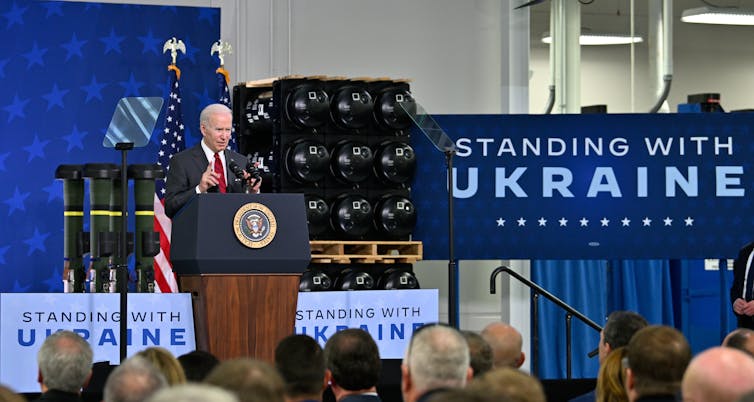
US President Joe Biden speaking at a Lockheed Martin facility which manufactures weapon systems being provided to Ukraine. Getty Images
A more dangerous world
Although most of the world wants restrictions on the use of the veto, nothing has changed. The only restraint involves the General Assembly being called together to scrutinise and comment after the veto has been used.
While the UN remains impotent, Ukraine exercises its sovereign right to self defence – including the right to source military hardware from other countries. This is quite legal under international law unless it involves prohibited weapons or the trade itself is prohibited by an agreed UN embargo, neither of which applies to Ukraine.
This has meant the UN void is filled (despite threats from Moscow) by at least 40 countries, which are now busy providing weaponry and aid to help Ukrainians defend themselves.
The net effect is that one permanent member of the Security Council has invaded a country across whose border sit three other permanent members furiously pushing high-tech weaponry into the warzone.
For now, the always risky balance between the veto-wielding members looks precarious. And the post-war assumption that the big powers would behave with some restraint now seems questionable at best.
While the scale and variety of arms shipments to Ukraine is growing, that alone won’t necessarily cause the war to spill across borders. Nor should Russia attacking those arms shipments once they reach Ukraine.
But if the geography of the conflict expands – such as if Russian targets outside Ukraine are repeatedly hit, or discontent spreads further into breakaway provinces – the danger escalates.
Similarly, should Russia harass Western nations with cyber-attacks in retaliation over arms supplies, and individual countries (or possibly NATO acting collectively) retaliated in kind, the situation could quickly spin out of control.
Other dire possibilities include Russia targeting arms shipments in international territory, such as the high seas – or worse, attacking them within (or transiting through) a NATO country.
The real trigger may not be Russia winning this war, but beginning to lose it. At that point, the theory and paper wall of a UN system designed to prevent wider conflict and superpowers clashing may disappear in a flash.
Alexander Gillespie does not work for, consult, own shares in or receive funding from any company or organisation that would benefit from this article, and has disclosed no relevant affiliations beyond their academic appointment.
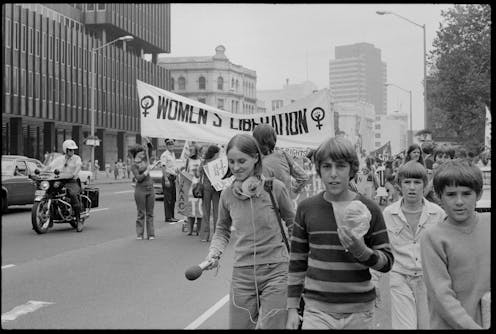
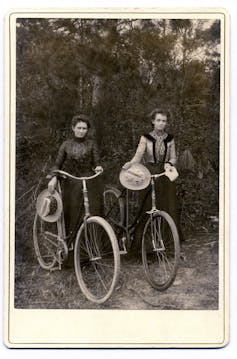
Mitchell Library, State Library of New South Wales and courtesy SEARCH Foundation, CC BY-NC-SA
Mother’s Day has long been exploited for commercial and political gain. This year, again, my inbox is filled with gift ideas to “make mum smile”. With the federal election looming, we can expect candidates to make the most of this weekend to demonstrate their pro-family credentials.
But advertisers and politicians are not the only ones with a stake in Mother’s Day. The day’s origins lie in feminist campaigns in the late 19th and early 20th century to promote peace and greater recognition of women’s social and economic contribution as mothers.
For subsequent generations of feminists, it has proven to be a site of contest. This was especially so in the 1970s, when women’s liberationists set out to challenge prevailing expectations of female domesticity.
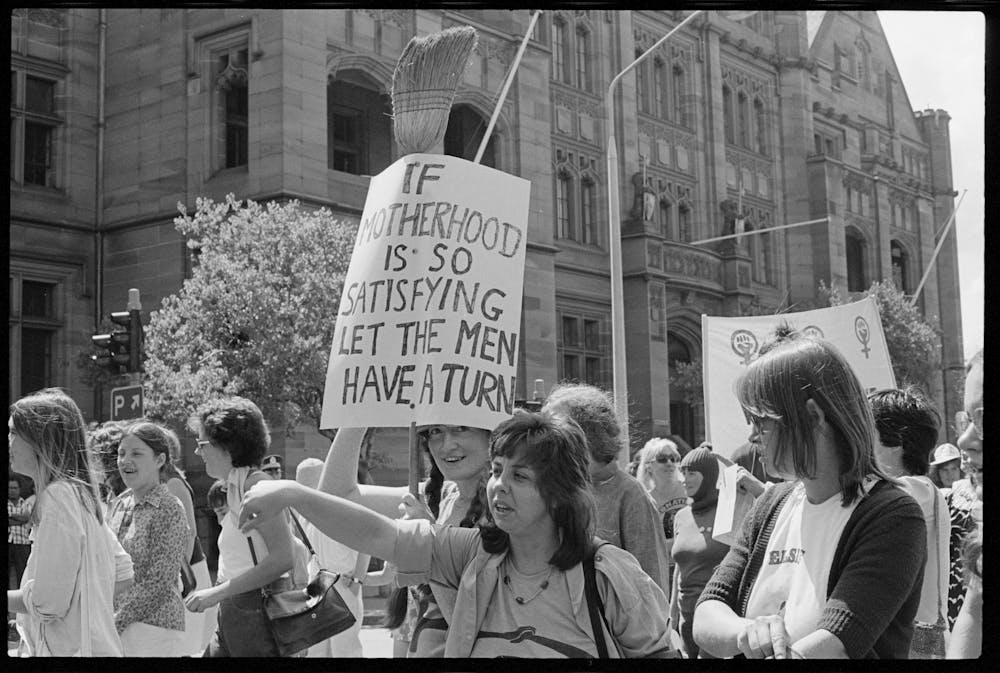
In their view, the dominant model of the male breadwinner and female homemaker was a leading source of women’s oppression. Many felt Mother’s Day only reinforced the problem.
Women protested against the notion ‘motherhood’ was always women’s work. Mitchell Library, State Library of New South Wales and courtesy SEARCH Foundation, CC BY-NC-SA
A pamphlet issued by Adelaide women’s liberationists in 1971 claimed Mother’s Day was little more than an exercise in hypocrisy.
For one day, the pamphlet asserted, society paid lip service to women’s “martyrdom” in the home. For the rest of the year, their domestic labour remained invisible and their “basic needs” were left unmet – including for some independence from their children.
But it is worth noting women’s liberationists argued the “cult” of domesticity not only had dire consequences for women, but for children too. On this Mother’s Day, it bears remembering activists were committed to their joint liberation.
The book is now best known for its forthright critique of maternity: Firestone went so far as to describe pregnancy as “barbaric” and advocated for artificial reproduction in its place.
But The Dialectic of Sex was also noteworthy for Firestone’s analysis of children’s status in the nuclear family and the power parents wielded over them. Mothers played a particularly insidious role, Firestone argued, in the psychological formation of children, determining “what they become as adults and the sorts of relationships they are able to form”.
Firestone’s views on the subject were far from exceptional. Indeed, the concept of children’s liberation reverberated through a wide range of feminist texts of the period.
And as I discovered when I started looking for evidence of the concept’s impact in Australia, it was also put into practice in diverse ways.
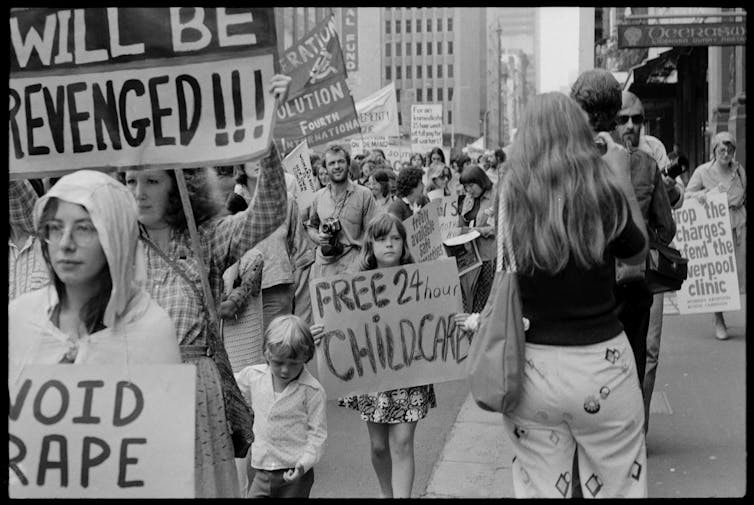
For feminist mothers in the 1970s, access to affordable childcare services was an especially high priority – not only to enable their equal participation in public life, but because of its benefits for children’s social development and connection beyond the nuclear family.
This sentiment was best captured in the slogan used at protest marches: “Free Mum, Free Dad, Free Me, Free Child Care”.
The rights of mothers, fathers and children were explicitly linked. Mitchell Library, State Library of New South Wales and courtesy SEARCH Foundation, CC BY-NC-SA
Many feminist teachers and mothers were attracted to new approaches that emphasised children’s autonomy and self-direction. These principles also informed broader decisions about childrearing, such as mothers’ selections of books, toys and clothing, and their attempts to be more open and frank when addressing their children’s questions about sexuality.
When they could not find readily available alternatives, one Melbourne group even began producing their own resources. In 1974, they formed the Women’s Movement Children’s Literature Cooperative. Their first book, The Witch of Grange Grove, was typical in featuring characters who disregarded gender stereotypes and pursued their own interests.
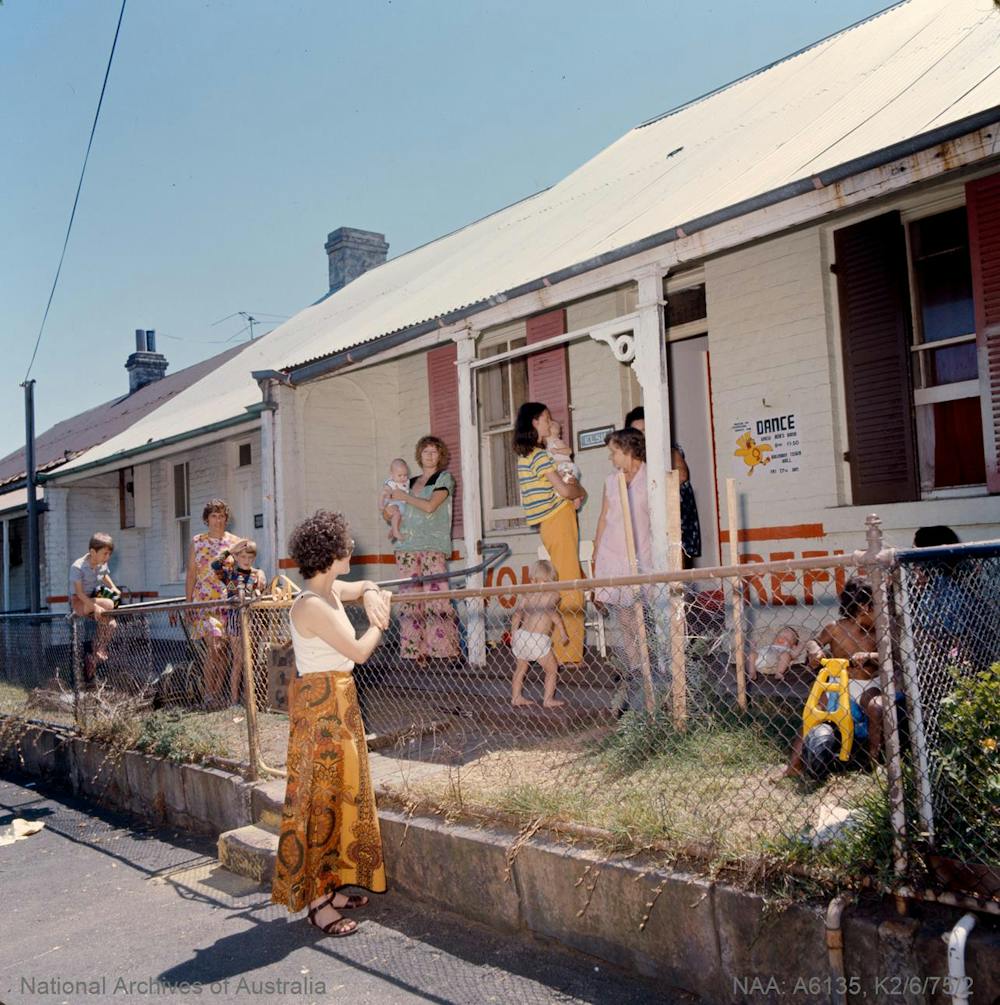
By the mid-1970s, the issue of violence within the family home had become pressing. Children comprised more than half of the residents at women’s refuges, such as Elsie in Sydney. Along with physical and emotional abuse, child sexual abuse – particularly by male relatives – was one of the issues that refuge workers, along with activists at rape crisis services, frequently confronted.
Elsie Women’s Refuge, Glebe, 1975 – half of the residents of refuges like this were children. National Archives of Australia: A6135, K2/6/75/2
For many feminists of the era, women’s and children’s liberation were inseparable.
This was certainly true for the Adelaide activists protesting Mother’s Day in 1971. As their pamphlet had it, for both their own sake and so as not to “suffocate” their children, women must “renounce [their] martyrdom” and redefine themselves as “a human being […] not just ‘mum’”.
But this message was often lost on women’s liberation’s opponents, who were intent on casting the movement as “anti-mother” and “anti-child” – a stereotype of this era that has persevered.
While the movement was often painted as ‘anti-mothers’, women campaigned for mother’s rights, like the right to childcare. Mitchell Library, State Library of New South Wales and courtesy SEARCH Foundation, CC BY-NC-SA
Internal tensions within women’s liberation have also shaped feminist and popular memory of this period. While many involved in the movement worked hard to improve the conditions of mothers and their children, not everyone felt these efforts went far enough.
Some women were alienated by the staunch critiques of motherhood, or felt judged by those who did not have children. And although women’s liberation attracted participants from diverse backgrounds, many First Nations and migrant women chose to organise in groups outside it, in part due to a perception that their experiences of motherhood required different political remedies.
The relationship between 1970s feminism and maternity was at times a fraught one. But we should not forget that this ambivalence about motherhood could also be productive, creating space for new ways of thinking not just about women, but children too.
We continue to grapple with many of the same issues, from childcare and gender socialisation to child abuse and family violence.
In seeking lasting solutions to these problems, it is worth remembering there is a longer history of feminist activism that might inform our contemporary approaches – not least of all when it comes to responding to the predictable cliches that surface each year on Mother’s Day.
Isobelle Barrett Meyering does not work for, consult, own shares in or receive funding from any company or organisation that would benefit from this article, and has disclosed no relevant affiliations beyond their academic appointment.
Source: The Conversation (Au and NZ) – By Leah Ruppanner, Professor of Sociology and Founding Director of The Future of Work Lab, The University of Melbourne
Shutterstock
With Mother’s Day right around the corner, many grateful and loving families are thinking about what to give mum to show their appreciation.
Should you give her chocolate? Nope. Fancy soaps? Nope. Fuzzy slippers, pyjamas, scented candles? No, no and no.
On this Mother’s Day, keep your cash and give your wonderful mother gifts that will actually have a long-term impact on her health and well-being.
The chore divide in same-sex relationships is generally found to be more equal, but some critique suggests equality may suffer once kids are involved.
This year give your mum (or mums) the gift of equal housework and childcare sharing – start by taking the most-hated tasks and then hold onto them… forever.
Research shows housework inequality is bad for women’s mental health. Undervaluing women’s housework and unequal sharing of the chores deteriorates relationship quality, and leads to divorce.
Housework and childcare take up valuable time to keep the family happy, harmonious and thriving, often at the expense of mum’s health and well-being.
So, skip the chocolates and show mum love by doing the worst, most drudgerous and constant household chores (hello, cleaning mouldy showers!) and keep doing these… forever.
This year give your mum (or mums) the gift of equal housework and childcare sharing – start by taking the most-hated tasks and then hold onto them… forever. Shutterstock
2. Initiate a mental unload
The mental load is all of the planning, organising and management work necessary to keep the family running.
The mental load is often perceived as list making or allocating tasks to family members.
But, it’s so much more – it is the emotional work that goes with this thinking work.
The mental load is the worry work that never ends and can be done anywhere, anytime and with anyone (in, for example, said mouldy shower).
Because the mental load is performed inside our heads, it is invisible. That means we don’t know when we or others are performing this labour unless we really tune in.
In fact, it is often when we tune in through quiet time, relaxation or meditation that the mental load rears its ugly head. Suddenly you remind yourself to buy oranges for the weekend soccer game, organise a family movie night and don’t forget to check in on nanna.
Women in heterosexual relationships are shown to do more of the mental load with serious consequences for their mental health. But we don’t have a comprehensive measurement of how much women do it nor how it is allocated in same-sex couples.
So, on this mothers’ day spend some time talking about, cataloguing, and equalising the family’s mental load.
The mental load is all the planning, organising and management work necessary to keep the family running. Shutterstock
3. Speak up for your mum and all caregivers
Families alone cannot bear the brunt of the caregiving necessary to keep us thriving.
Governments, workplaces and local communities also play a critical role. For this mothers’ day, pick an issue impacting mothers (for example, equal pay, affordable childcare or paid family leave) and do one thing to help move the needle.
Write a letter to your boss, your local MP, or donate money to an advocacy organisation advancing gender equality.
Or, role model these behaviours yourself – normalise caregiving as a critical piece of being an effective worker, create policies and practices that support junior staff to care for themselves, their families and their communities and use these policies.
Research shows men want to be equal carers and sharers but often fear what taking time off for caregiving will signal to their employer despite evidence that fathers who request flexible work are perceived more favourably.
Appearing to be singularly devoted to work was shown to be impossible during the pandemic with kids, spouses, partners, and pets home all day long.
Write a letter to your boss, your local MP, or donate money to an advocacy organisation advancing gender equality. Shutterstock
Learning to create more care-inclusive workplaces and communities is critical.
Paid parental leave, affordable and accessible high-quality childcare, flexibility in how, when and where we work and greater investments in paid sick leave, long-term disability support and aged care are just a few policies that would strengthen the care safety net.
We will all be called upon to care at some point in our lives – let’s create the environments that support caregiving for all, not just mum.
Can the Southern Cross represent Australian identity? Waved by a proud athlete or an angry protester, inked into skin or stuck to a car window, these five stars condense different aspirations, identities and histories into a recognisable symbol.
Yet such symbolism is inherently contested: from the Eureka Stockade to protests over COVID-19 vaccine mandates, or from the coat of arms to the eponymous Sydney train station, Australians have projected differing values and narratives of belonging to this constellation.
Warwick Thornton’s 2017 film We Don’t Need a Map wrestles with racist usage of the Southern Cross, playing on a growing disquiet among many Australians who have come to associate the Southern Cross with bigotry. But Thornton also explores Indigenous narratives about the Southern Cross, suggesting the symbol can never be contained within a single defining narrative.
It is important to appreciate the diversity of identities under the Southern Cross. But we want to go further and ask: what role can the Southern Cross play in shaping an Australian identity, in which diversity coheres in a unique and life-giving way?
Through his teaching and artistic direction, Warlpiri Elder Wanta Jampijinpa Pawu asks these questions with anyone willing to hunt with him. Jampijinpa explores the meaning of the Southern Cross: a law emblazoned on the night skies since creation and read by countless generations of Aboriginal and Torres Strait Islander peoples.
Wanta has spent decades educating young Warlpiri, especially through his innovative work as artistic director of the biennial Milpirri festival in Lajamanu, in the northern Tanami desert.
Through the Milpirri festival, Wanta and his father Jerry Jangala have drawn from rich wells of cultural identity to expound the concept of ngurru-kurlu, (Warlpiri for “home within”). Wanta understands Ngurru-kurlu to be a way of navigating identity for all who seek to live alongside one another under the Southern Cross.
Ngurra-kurlu is the essence of a people. You might call it their home. But it is more than just the ground we sleep on: we become our own home. The first three letters, ngu, mean “inner” and rra means flowing or being in motion. So ngurra is “inner flow”. By adding kurlu, which means “home,” or “with home,” you get ngurra-kurlu.
The Southern Cross can show us how to discover our ngurra-kurlu. This is more than identity: it’s also about belonging and purpose. The stars of the Southern Cross show us how our own ngurra-kurlu is bound together with the ngurra-kurlu of others.
For Warlpiri, each star of the Southern Cross represents the different skin groups that make up Warlpiri society, mapping respective stories, language, law and country.
These skin groups are:
Nampijinpa/Jampijinpa and Nangala/Jangala (north group – emu)
Napaljarri/Japaljarri and Nungarrayi/Jungarrayi (west group – wedge-tailed eagle)
Napurrula/Jupurrula and Nakamarra/Jakamarra (south group – kangaroo)
Napanangka/Japanangka and Napangardi/Japangardi (east group – goanna).
The Southern Cross is like a map that shows us how to live alongside different people, country and ecosystems; these weave together to make our homes and sustain our identities. When we see birds, animals, plants, places, we see our families, so it reminds us of these relationships with people, the land and sky.
The little star in the Southern Cross is the wulyu-wulyu (Western chestnut mouse). That this star is off-centre is a reminder to keep learning about this country and its inhabitants, to nourish one another and grow together, so that we also do not drift away.
The Southern Cross has deeper meanings than non-Indigenous people might realise. It is more than a symbol: for Warlpiri, it is a law that has existed since the beginning, which means we cannot claim the Southern Cross as our own but need to be reclaimed by it. By exploring its diverse meanings, we can discover those connections that sustain life in all its vibrant diversity and unity.
Sitting above us all, the Southern Cross calls us to become wantarri (a gift to one another), to become wungu-warnu (companions who are the same but different), a relationship that is a cross between family and friend. Through generous acts such as the Uluru Statement from the Heart, First Nations people have invited the rest of the nation to discover shared belonging and purpose. This has been done against Australia’s backdrop of painful and violent dispossession and disrespect against First Nations people.
This invitation will continue to be shared because it is always there, written in country. Wanta teaches us there are other stories in the Southern Cross, like Jardiwarnpa, the “real” Australia Day. Jardiwarnpa takes place in the cool season after the great storms of the wet, when the Southern Cross rises from below the horizon. This is a time for reconciliation and atonement, bringing our wrongdoings and discarding them in the open, so that all might see and we might become one body of people again.
Wanta’s teaching leads to the challenging yet hope-filled assertion: in all of our differences, we are called to become Australia. As we digest the knowledge from this continent, we are learning to belong to it. To learn about our respective relationships and responsibilities to one another is to become our home, which is a kind of freedom.
It is no good trying to define Australian identity through two-dimensional symbols: we must allow this country to teach us how to sit, feed and camp together under one sky.
The authors do not work for, consult, own shares in or receive funding from any company or organisation that would benefit from this article, and have disclosed no relevant affiliations beyond their academic appointment.
The debate over whether an “ethnic vote” phenomenon exists in Australia re-emerges at each federal election.
Some argue people from ethnic communities can be influenced by issues which are cultural or which relate to their countries of origin rather than to their duties as Australia citizens.
We know from previous elections that sections of multicultural Australia can play a critical role in the election outcome. But obviously different communities have different concerns and this can play out unevenly.
What might this mean in 2022?
What has happened before?
Ahead of the 2016 federal election I suggested issues associated with ethnicity would play a critical role in the deciding votes in marginals with significant multicultural populations. As it turned out they did – delivering at least two seats in NSW and one in Victoria to the Coalition and in turn, government.
Prime Minister Scott Morrison and Treasurer Josh Frydenberg campaign at a synagogue in Kooyong. Mick Tsikas/AAP
In 2019 I suggested ethnic voters might well save Morrison’s government, again mainly among disappointed opponents of the 2017 same-sex marriage legislation. While Queensland proved more important in the large, but Chisholm and Reid gave Morrison the tiny buffer he needed to win.
But there was no uniform “ethnic vote”. In some Labor electorates in 2019, the “ethnic vote” was a socially conservative one – with voters swinging away from the ALP, due to its commitment to same-sex marriage and the Liberal’s promise of a religious discrimination act.
My colleague Christina Ho and I drilled down into the 2019 results for the marginal Liberal seat of Banks in Sydney, concluding that the large local population of Chinese Australian voters tended to be slightly more pro-Labor than the average voter, but followed the broader swing towards the Liberals.
What is different in 2022?
Both Liberal and Labor-held seats will be important in 2022. Some critical electorates with significant ethnic populations include Parramatta, Reid, Banks, Fowler, Greenway and Lindsay in NSW, and Chisholm, Bruce, and Wills in Victoria.
Goldstein and Kooyong in Melbourne and Wentworth in Sydney also have significant Jewish populations. Nearby North Sydney also has a high number of overseas-born voters. All four of these seats are being challenged by “teal” independents.
Ethnicity may also present itself in some significant new ways this time.
The international world is more present in this election than it usually is, with Russia’s invasion of Ukraine, and ongoing tensions with China front of mind and the news agenda. There has also been a significant increase in new citizens. Over 2020-21 this included about 24,000 Indians, 9,000 Filipinos, and 7,000 Chinese.
The government’s pandemic responses has also greatly challenged the “most successful multicultural society in the world” slogan. Not only have Australians with overseas connections been cut off from the rest of the world (or been locked out of the country) but we have seen high death rates among ethnic communities, the undermining of their well-being through lockdowns (which affected industries employing high proportions of ethnic workers), and reinvigorated racism.
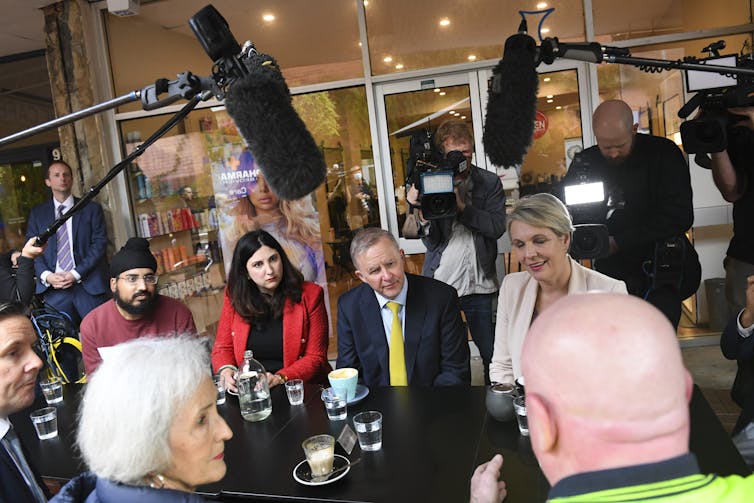
Labor leader Anthony Albanese and frontbencher Tanya Plibersek have been campaigning in Parramatta. Lukas Coch/AAP
Ahead of the 2022 vote, the ALP’s decision to install candidates in Fowler and Parramatta who are not from diverse cultural backgrounds nor from the local area might be thought of as patronising and ultimately, not a vote winner. Well-known Vietnamese Australian local councillor Dai Le is standing as an independent in Fowler, which could hurt parachute candidate, Kristina Keneally.
Where the parties stand
The Federation of Ethnic Communities of Australia has a comprehensive election wish-list. This includes an Office for Multicultural Australia and a new, well-resourced anti-racism strategy.
So far, we have little detail on the major parties’ election policies on multiculturalism and for ethnic Australians.
Last year, Immigration Minister Alex Hawke promised a multicultural cohesion statement but this has not yet eventuated. The recent federal budget also cut expenditure for multicultural programs, and reduced support to the Australian Human Rights Commission, which does important anti-racism work.
The ALP has not yet released its main policy goals, though a 2021 report on multicultural engagement was very limited in its goals and did not include earlier commitments to expand the government’s multicultural policy capacity.
The Greens proposal for a federal multicultural commission sits undebated before the Senate, though the party has a specific set of anti-racism policies for the 2022 campaign.
On the ground
A focus on two electorates – one in Victoria and the other in NSW – shows us what impact an “ethnic bloc” might have.
The first is the ultra-marginal seat of Chisholm, currently held by Liberal MP Gladys Liu on a margin of just 0.5% and contested by Labor candidate Carina Garland.
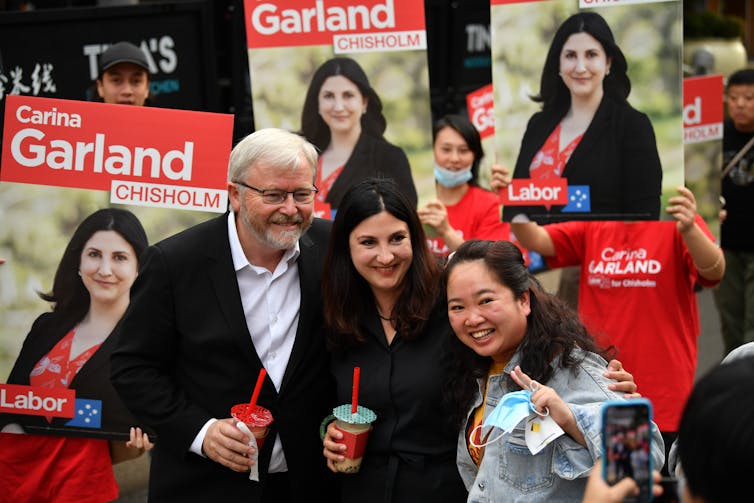
Former prime minister Kevin Rudd campaigns with Labor candidate Karina Garland in Chisholm. Joel Carrett/AAP
According to the (latest available) 2016 Census data, half the population of Chisholm reported speaking a language other than English at home. The electorate had a China-born population of 14%, with 17% having both parents born in China. About 20% spoke a Chinese language at home. The next major community language was Greek.
Reflecting the high proportion of the China-born population, 36% of the population reported “no religion”, while 6% identified as Buddhist. In 2019 the Greens vote of 12% and the ALP of 34% were not enough to halt the Liberal win, with a primary vote of 43%. The informal vote was 4.5%.
Key issues this time include the rising racism experienced by Chinese Australians during the pandemic, the antipathy to China voiced by the government, and the perception of economic threats associated with the major parties.
The Parramatta campaign
The second seat is Parramatta, which the Labor Party currently hold on 3.5%. Here outgoing Labor MP Julie Owens will be replaced by candidate Andrew Charlton. He is challenged by Liberal candidate Maria Kovacic.
According to the 2016 Census, more than 60% of the Parramatta population speak a language other than English at home, with Arabic and Mandarin equal on 8%, Cantonese and Hindi about equal on 5% and Tamil on 3%. About 15% were born in India, with another 8% in China.
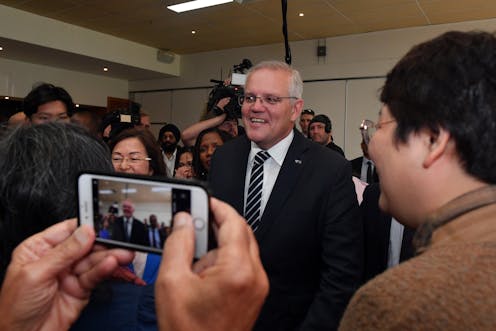
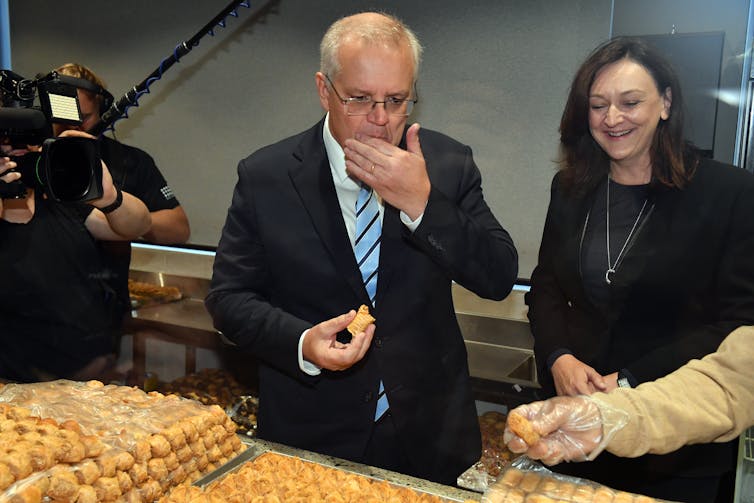
During the campaign, Morrison has tried Lebanese sweets in the marginal electorate of Parramatta. Mick Tsikas/AAP
The electorate has a large number of Catholics, Hindus and Muslims. Since 2019 the sub-continent population has risen, with many more becoming citizens. In 2019, even though the ALP won the seat, the first preference swing to the Liberals was 7%, with an informal vote of 8%.
Parramatta will be affected by the strong campaign by Christian groups to focus attention on the need for a Morrison-government type religious discrimination act, which may also find some support among Muslim communities.
Critically, the ALP candidate is a non-local white man, parachuted into an electorate which was badly impacted by COVID lockdowns. The Coalition’s candidate has strong links to local eastern European communities, Christian churches and business and voluntary organisations, including networks of business women in western Sydney.
Ultimately in heavily “ethnic” electorates we will see ethno-cultural values tested against socio-economic interests. Diaspora voters will decide whether these interests reinforce or counteract each other and then how that propels their vote.
Andrew Jakubowicz received funding from the ARC for research on ethnic groups in Australian politics. This article is dedicated to the memory of James Jupp, the doyen of studies in ethnic politics in Australia, who passed away in early April.
What happens if no party or coalition of parties wins a majority in the House of Representatives at the federal election? This is known as a “hung parliament”.
While it is unusual at the federal level, it has happened more often at state and territory level, so there is lots of experience in dealing with them in Australia.
The prime minister gets to choose what happens next
An election does not terminate the existing government. It continues in office as a caretaker government until a new government is formed, so there is never a gap between governments. An inconclusive election does not mean no-one is in charge.
Contrary to popular belief, it is not up to the governor-general to “call upon” someone to form a new government after an election. This is because there is no vacancy in the office of prime minister until the prime minister resigns.
If the result of the election is unclear, or the results leave neither side with a majority so the balance of power will be held by independents and members of small parties (known as “crossbenchers”), then it is up to the prime minister to decide what to do next.
The prime minister could choose to:
resign on behalf of the government, which is normally what occurs if it is clear that enough of the crossbenchers are going to support the other side
stay in office while negotiating with the crossbenchers to see who they will support (and resign if they choose the other side)
stay in office and face parliament to see whether the lower house votes no-confidence in the government (in which case the prime minister must, according to convention, resign) or whether the house is prepared to let the government stay in office as a minority government.
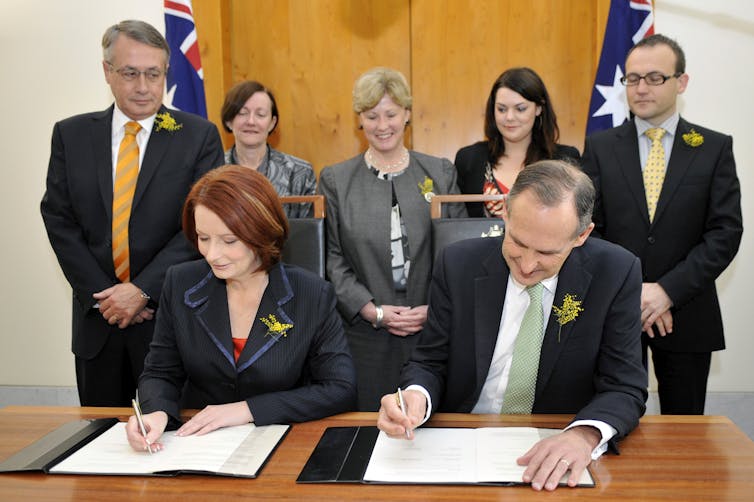
When the 2010 election resulted in a hung Parliament, Prime Minister Julia Gillard brokered agreements with the Greens and independents to support her minority government. AAP/Alan Porritt
What is the governor-general’s role?
The role of the governor-general is limited. If the prime minister resigns on behalf of the government, convention requires the governor-general to appoint as prime minister the person most likely to command the support of a majority of the lower house.
This will usually be the leader of the opposition. In rare circumstances, where there are competing claims about who commands the support of the lower house, the governor-general might have some discretion. However, if the issue was contentious, the governor-general would probably leave it to the House of Representatives to decide by voting on who holds its confidence.
In the extraordinary circumstance where a prime minister refused to resign, even though the lower house had voted no confidence in them or their government, the governor-general would be entitled to dismiss the prime minister and commission a new one to form a government. But this has not happened in Australia and is extremely unlikely ever to occur.
Is it necessary to get a ‘confidence and supply’ agreement with the crossbenchers?
When there is a hung parliament, the focus is on whether enough of the crossbenchers will support one side or the other in government, by protecting it from a no-confidence vote and by passing its budget (known as “supply”).
Minority governments can be defeated on legislation and other motions in the lower house and continue in office, as long as they can get supply passed and do not lose the confidence of a majority of the lower house.
So where there is a hung parliament, both sides will ordinarily try to negotiate a “confidence and supply” agreement with enough crossbenchers to guarantee majority support on those two crucial matters. It is not necessary to have such an agreement, but it does help in providing stable government. It is also a good indicator to the governor-general of who commands the necessary support of the lower house.
That is why, despite comments that they won’t do “any deals”, it is likely that in the face of a hung parliament, both the prime minister and the opposition leader would try to negotiate confidence and supply agreements with enough crossbenchers to get majority support in the lower house.
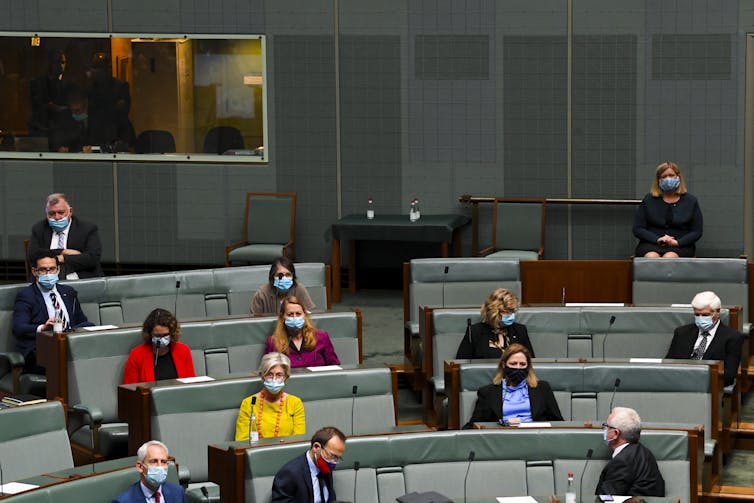
In the event of a hung parliament, crossbenchers become extremely important. AAP/Lukas Coch
In return for a promise of support on confidence and supply, the crossbenchers will usually impose some conditions. They may require the government to promise to implement certain policies (for example, measures to deal with climate change) or establish greater accountability (such as an anti-corruption body).
They may seek reforms on how parliament operates and demand adequate funding for existing accountability bodies, such as the auditor-general. They may also make their agreement on confidence conditional on the government not engaging in any corrupt conduct.
There are no rules about how these negotiations take place or how long it takes before an agreement is reached. Prime Minister Julia Gillard took over two weeks to negotiate confidence and supply agreements with enough crossbenchers to form a minority government. But if close elections are challenged in the Court of Disputed Returns, it can take months to obtain certainty. In the meantime, the existing government continues in office as a caretaker government.
Hung parliaments can be effective or chaotic, or both, as the Gillard minority government showed. Forcing a government to explain and justify every bill on its merits, and negotiate amendments to reach a reasonable consensus, is no bad thing. It can result in significant improvements to government policy and legislation. A hung parliament can be a moderating force that knocks the ideological edges off policies and pushes them into the centre ground, where they have broad acceptance.
On the other hand, a hung parliament can result in governments failing to take hard, but necessary, measures that are in the country’s long-term interests. It can also result in horse-trading of support for bills and unfair favouritism directed towards projects in the electorates of the crossbenchers.
Whether a hung parliament ends up with policy paralysis and horse-trading on the one hand or major improvements in accountability and policy on the other, depends on the quality of both the government and the crossbenchers and their commitment to the public interest over self interest.
So when it comes to voting, it is wise to look beyond party or independent labels to the quality and commitment of the candidate you choose – because it may turn out to be very important.
Anne Twomey has received funding from the Australian Research Council and occasionally does consultancy work for governments, parliaments and inter-governmental bodies.
Although sport is often touted as a vehicle for positive experiences, many investigations into sporting cultures – particularly high performance sport – have highlighted how predatory or abusive behaviour by coaches can emerge and be tolerated.
The potential for (and reality of) abuse in youth sport is based on various factors. This includes the reputation of the coach to produce “champions”, the money medals generate for an organisation, the pressure felt by athletes to endure pain and discomfort as part of training, and a general culture of obedience.
For those reasons, a robust, sustainable child safeguarding (CSG) policy has become a critical step to ensure New Zealanders – young and old – can continue to enjoy their involvement in sport.
The risk, however, is that these necessary safeguards can inadvertently create confusion and cultures of suspicion between colleagues, parents and athletes. When even a congratulatory high-five or reassuring pat on the back can be misconstrued, we need to ask how we get the balance right.
Keeping kids safe
Encouragingly, the New Zealand’s Children’s Act (2014) introduced a series of changes over the past few years to enhance the safety of children and adults working with children in a range of settings.
Although the law is not specifically aimed at the sport sector, Sport NZ – the crown entity responsible for governing sport and recreation – has responded with several (online) training modules, and engaged with the sector to safeguard children interacting with adults in sport settings.
Notwithstanding this progress at home, international research suggests the legal requirements on coaches can cause confusion, spoiling the otherwise healthy and positive relationships coaches can have with parents and young athletes.
This is especially true of volunteers, who make up such a large proportion of coaching roles generally, and who often struggle to access nuanced CSG training in preparation for their roles.
High performance sports, like gymnastics, have come under scrutiny for the predatory behaviour of coaches. ssj414/Getty Images
Policy fails to make it into practice
Currently, the influence policy is having on coach and athlete experiences is not well understood in Aotearoa New Zealand.
To begin to address this, we asked 237 coaches from around the country to complete an online survey of their understanding of CSG policy in their sport or club, and how that policy is influencing their coaching.
While the findings indicated some sport organisations are reaching more coaches than others, overall the results indicated significant uncertainty about what CSG policy exists or what it requires.
In particular, only 33% of volunteer coaches considered current CSG policy helpful in their roles.
Many participants (60%) said they had not made any changes to their coaching practice in response to CSG policy. Notwithstanding the commendable efforts made by Sport NZ (and others), this is concerning and suggests much more clarity is needed to ensure safe sporting environments.
Blanket bans have trumped nuanced policy
So, what kinds of changes are being made by the remaining 40%? Data from this and other research indicates some coaches and organisations are misinterpreting CSG policy, and consequently making adjustments based on what they think is right.
For instance, participants said policies in their sport or club aimed to restrict males from coaching females, and encouraged sweeping bans of all physical contact between adults and children.
However, these reactions are not advocated as the “best practice” outlined in the Children’s Act or Sport NZ’s training. Rather, it seems the lack of clarity surrounding CSG best practice is sometimes based more on people’s “best guess”.
We suggest this is primarily driven by wider, societal anxieties about abuse in sport, and is causing people to make changes that are neither required nor necessary.
As research in Aotearoa and abroad has shown, this has included “no touch” and gender separation policies that lead to adults and children viewing each other as potentially dangerous.
This in turn leads to cultures of suspicion rather than positive and sustainable cultures of safeguarding. Equally concerning is the danger of turning good people away from sport if misinterpretations escalate.
Balance needed to prevent long term harm
No one wants children exposed to predatory behaviour in sport. But discouraging interaction between males and females, or adults avoiding any physical contact with children, isn’t a solution.
Research suggests this culture of suspicion can worsen over time, which is antithetical to a positive educational experience. As scholars in the UK have suggested, this inevitably leads to significant collateral damage to intergenerational relationships.
Given the apparent uncertainty surrounding CSG policy, any changes coaches or organisations make should be monitored carefully by sport sector leaders, policy makers and coach educators.
Challenging as it may be, it’s critical we provide opportunities for people to share and discuss best practice with each other and with experts. To that end, Sport NZ’s efforts to circulate CSG policy in the sector must be supported by ongoing research to measure what’s happening over time.
This is imperative if sport is to keep providing rewarding experiences for both adults and children.
Blake Bennett received a grant from the Faculty of Education and Social Work at the University of Auckland to conduct this research.
By now, many of us will be familiar with the Omicron variant of SARS-CoV-2, the virus that causes COVID. This variant of concern has changed the course of the pandemic, leading to a dramatic rise in cases around the world.
We are also increasingly hearing about new Omicron sub-variants with names such as BA.2, BA.4 and now BA.5. The concern is these sub-variants may lead to people becoming reinfected, leading to another rise in cases.
Why are we seeing more of these new sub-variants? Is the virus mutating faster? And what are the implications for the future of COVID?
All viruses, SARS-CoV-2 included, mutate constantly. The vast majority of mutations have little to no effect on the ability of the virus to transmit from one person to another or to cause severe disease.
When a virus accumulates a substantial number of mutations, it’s considered a different lineage (somewhat like a different branch on a family tree). But a viral lineage is not labelled a variant until it has accumulated several unique mutations known to enhance the ability of the virus to transmit and/or cause more severe disease.
This was the case for the BA lineage (sometimes known as B.1.1.529) the World Health Organization labelled Omicron. Omicron has spread rapidly, representing almost all current cases with genomes sequenced globally.
Because Omicron has spread swiftly, and has had many opportunities to mutate, it has also acquired specific mutations of its own. These have given rise to several sub-lineages, or sub-variants.
The first two were labelled BA.1 and BA.2. The current list now also includes BA.1.1, BA.3, BA.4 and BA.5.
What we know about the latest Omicron sub-variants, according to the World Health Organization.
We did see sub-variants of earlier versions of the virus, such as Delta. However, Omicron has outcompeted these, potentially because of its increased transmissibility. So sub-variants of earlier viral variants are much less common today and there is less emphasis in tracking them.
There is evidence these Omicron sub-variants – specifically BA.4 and BA.5 – are particularly effective at reinfecting people with previous infections from BA.1 or other lineages. There is also concern these sub-variants may infect people who have been vaccinated.
So we expect to see a rapid rise in COVID cases in the coming weeks and months due to reinfections, which we are already seeing in South Africa.
However, recent research suggests a third dose of the COVID vaccine is the most effective way to slow the spread of Omicron (including sub-variants) and prevent COVID-associated hospital admissions.
Recently, BA.2.12.1, has also drawn attention because it has been spreading rapidly in the United States and was recently detected in wastewater in Australia. Alarmingly, even if someone has been infected with the Omicron sub-variant BA.1, re-infection is still possible with sub-lineages of BA.2, BA.4 and BA.5 due to their capacity to evade immune responses.
Is the virus mutating faster?
You’d think SARS-CoV-2 is a super-speedy front-runner when it comes to mutations. But the virus actually mutates relatively slowly. Influenza viruses, for example, mutate at least four times faster.
SARS-CoV-2 does, however, have “mutational sprints” for short periods of time, our research shows. During one of these sprints, the virus can mutate four-fold faster than normal for a few weeks.
After such sprints, the lineage has more mutations, some of which may provide an advantage over other lineages. Examples include mutations that can help the virus become more transmissible, cause more severe disease, or evade our immune response, and thus we have new variants emerging.
Viral mutations speed up in a ‘sprint’ for a few weeks, sometimes leading to new sub-variants. Shutterstock
Why the virus undergoes mutational sprints that lead to the emergence of variants is unclear. But there are two main theories about the origins of Omicron and how it accumulated so many mutations.
First, the virus could have evolved in chronic (prolonged) infections in people who are immunosuppressed (have a weakened immune system).
Second, the virus could have “jumped” to another species, before infecting humans again.
What other tricks does the virus have?
Mutation is not the only way variants can emerge. The Omicron XE variant appears to have resulted from a recombination event. This is where a single patient was infected with BA.1 and BA.2 at the same time. This coinfection led to a “genome swap” and a hybrid variant.
Two viruses can ‘swap’ genetic material, resulting in a recombinant virus that can become a distinct lineage (recombinant lineage X). Ashleigh Porter
Other instances of recombination in SARS-CoV-2 have been reported between Delta and Omicron, resulting in what’s been dubbed Deltacron.
So far, recombinants do not appear to have higher transmissibility or cause more severe outcomes. But this could change rapidly with new recombinants. So scientists are closely monitoring them.
As long as the virus is circulating, we will continue to see new virus lineages and variants. As Omicron is the most common variant currently, it is likely we will see more Omicron sub-variants, and potentially, even recombinant lineages.
Scientists will continue to track new mutations and recombination events (particularly with sub-variants). They will also use genomic technologies to predict how these might occur and any effect they may have on the behaviour of the virus.
This knowledge will help us limit the spread and impact of variants and sub-variants. It will also guide the development of vaccines effective against multiple or specific variants.
In the human fascination with birds, it’s the flashy appearance and antics of males that get the most attention from researchers and the public.
From their colourful plumage to elaborate songs and courtship displays, male birds often steal the show. This has led to female birds routinely being overlooked by conservation planners.
First, let’s clear up a few misconceptions. At least 70% of female birds sing – a fact historically overlooked due to research and survey biases towards males. And while many female birds have more muted colours than males, there are numerous examples of females with brilliant plumage.
But the wonders of the female bird world go far deeper. The capacity of female birds to rear and protect their young is phenomenal. Somehow, they manage to hold their families together despite predators, harsh conditions and sometimes, a less-than-attentive partner.
The capacity of female birds to rear and protect their young is phenomenal. Shutterstock
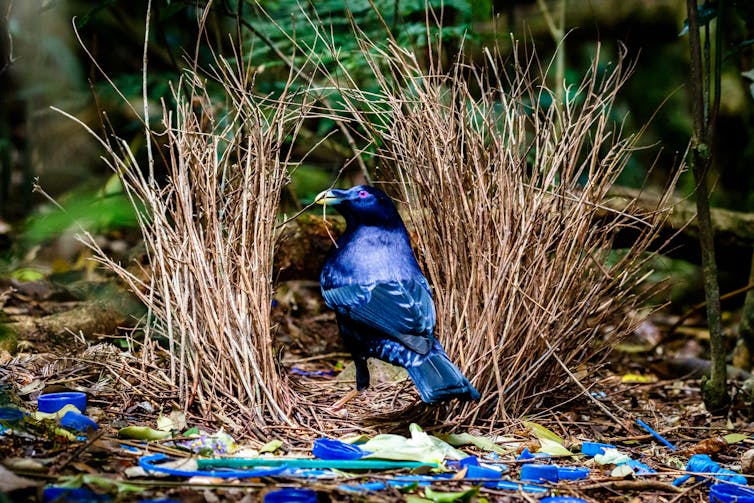
Satin bowerbirds: an unequal domestic burden
The male bowerbird is one of the most over-the-top bachelors of the bird world.
Male satin bowerbirds have striking, iridescent blue plumage and violet-coloured eyes. Females, on the other hand, are green and brown to blend into their surroundings.
To attract a mate, the male dances in an exaggerated fashion and makes a decorated bower. Females visit various bowers and select their mate. After that, the female basically does everything.
She makes the nest – usually high in a tree to protect nestlings from predators such as goannas. She produces and incubates the eggs on her own. And once the chicks hatch, the mum alone feeds them and defends the nest.
Meanwhile, the male bowerbird fusses over his man-cave – or bower – throughout the year in the hope of attracting another mate.
While the female bowerbird raises the babies alone, the male tends to his bower to attract another mate. Shutterstocks
Palm cockatoos: the female bodyguard
Male palm cockatoos shot to fame a few years ago when new research identified their drumming abilities. The males make drumsticks from branches and bang them rhythmically against a tree for pair-bonding or sometimes to claim territory.
But once the palm cockatoos pair up, the female plays a crucial role in securing their territory for breeding. During many months of behavioural observations, we found the female sits sentinel (kind of like a bodyguard) on the tree hollow while the male goes inside, splintering sticks with his massive bill to make the nest.
If danger comes – perhaps a neighbouring cockatoo pair or predator – the female alerts her mate and chases away the intruder.
The female palm cockatoo keeps a watchful eye for intruders when the male is in the hollow making their nest. Christina N. Zdenek
Virtuosic lady lyrebirds
The impressive repertoire of male superb lyrebirds is well-known. But it was only in recent years, when researchers turned their attention to the female, that her incredible singing ability was discovered.
Male lyrebirds don’t help with nest-building, incubation, brooding or feeding young.
Left alone to rear and protect her offspring, the female lyrebird has developed a cunning ability to confuse predators by mimicking the calls of at least 19 other bird species.
The female lyrebird is also remarkable for the length of time she cares for her young. Once fully feathered and able to fly, young lyrebirds remain dependent on their mothers and may stay in their care for more than a year.
She might be a little plain, but the female lyrebird is a clever, committed mother. Shutterstock
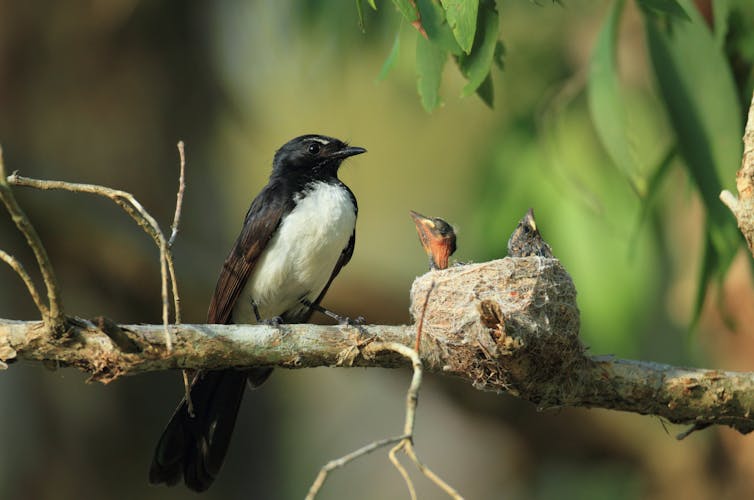
Fairy-wren code-makers
The Horsfield’s bronze-cuckoo does not build its own nest but instead lays its eggs in the nests of other birds such as fairy-wrens. This can leave the fairy-wren mother expending precious time and food raising another bird’s chicks.
But the female superb fairy-wren has developed a truly ingenious way to detect foreign nestlings once the eggs hatch.
She sings to her eggs – and includes in the song a specific “password”. Once her chicks hatch, they sing the password when begging for food.
It can be hard for the fairy-wren mum to differentiate her young in her dark, ball-shaped nest. But she can identify her offspring by their song. Cuckoo nestlings can’t learn or sing the password so are less likely to get fed.
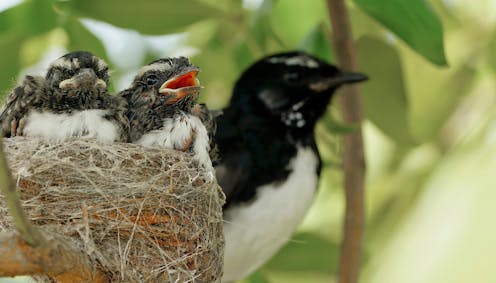
The fairy-wren mother has developed an ingenious way to recognise her own young. Shutterstock
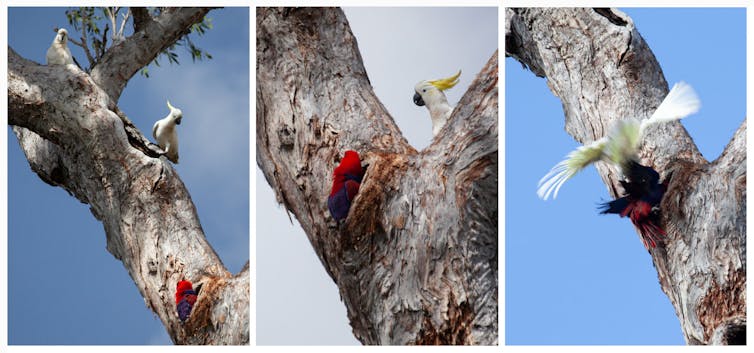
Eclectus parrot: the ultimate nest defender
Even though nesting only takes a few months, female eclectus parrots guard their precious hollows for up to nine months.
This is why their plumage is red and their male counterparts are green.
The red serves as a beacon screaming “this hollow is taken!”, helping keep cockatoos away.
A female eclectus parrot fights off sulphur-crested cockatoos from her tree hollow. Christina N. Zdenek
Here’s to all mums
Female birds are just as worthy of our time and research effort as their male counterparts. Considering the behaviours and needs of female birds is especially vital from a conservation perspective.
What’s more, affirming the important role of females in any community – bird or human – is crucial to achieving more equitable and just societies. Never is that message more important than on Mother’s Day.
Ayesha Tulloch receives funding from the Australian Research Council. She is the Vice President of Public Policy and Outreach and co-convenes the Science Communication Chapter for the Ecological Society of Australia, and sits on Birdlife Australia’s Research and Conservation Committee. She is a member of eBird Australia, the Society for Conservation Biology and the University of Sydney’s Charles Perkins Centre Citizen Science Node.
Christina N. Zdenek received funding from the Australian-American Fulbright Commission, National Geographic, Norman Wettenhall Foundation, and the Hermon Slade Foundation.
Source: The Conversation (Au and NZ) – By Jesse Adams Stein, Senior Lecturer & ARC DECRA Fellow, School of Design, University of Technology Sydney
Most politicians vocally support Australian-made products. Manufacturing certainly provides excellent opportunities for candidates in high-vis to make election campaign announcements.
Labor has promised to make Australia “a country that makes things again”. It has emphasised locally-made transport, NBN infrastructure, apprenticeships and defence-related production.
The Coalition has spruiked the federal government’s modern manufacturing strategy. It highlights technology investment and six priority areas (minerals, food, medical, clean energy, defence and space).
But despite the seemingly endless announcements, Australian manufacturing remains a problem for the major parties. Whoever wins the federal election will need to do things very differently if they genuinely want to boost local production.
In the mid-1960s, Australian manufacturing employed around 25% of the working population; it’s now down around 6.4%.
Manufacturing’s share of GDP is also in decline, now sitting at around 6%. Jobs continue to drift offshore.
Leaving things to the “free market” clearly isn’t working for Australian manufacturing. But patriotic argument we must get back to the “good old days” where everything was supposedly made in Australia is also unrealistic.
There is another way: a coordinated and targeted national industry policy that favours long-term planning over a short-term, scattergun approach.
Tapping into the global green economy
What Australia needs is coordinated national industry policy supporting niche, specialist manufacturing.
This policy would drive an ecosystem of industries and sectors geared towards emissions reduction and skills development. It would help Australia take its place in the booming global “green” technology economy.
This targeted approach requires manufacturing policy to be developed in step with policy on education, energy, mining, research and development, and emissions reduction.
Done right, the international evidence shows tailored support for niche industries can be very successful.
Germany, for example, has a coordinated policy emphasising technical skills, generous funding for research and development, and energy sector decarbonisation. This approach supports high-end vehicle manufacturing.
Switzerland has specialised in luxury consumer products, precision instruments and food items. In Denmark the policy focus has been on high-quality consumer and industrial products – from bespoke furniture to aircraft – for international markets.
Direct financial benefits to manufacturers certainly help, if they require manufacturers to remain onshore.
The federal government could also offer tax-related “carrots and sticks” requiring foreign-owned companies to establish production sites in Australia, so as to avoid tariffs.
Government procurement policies that more overtly favour local manufacturing can also be effective, given the influential size of state and federal governments as consumers themselves. Opting for overseas-made tenders, such as Sydney’s crack-riddled light rail sets, can prove very expensive in the long run.
When governments commit to onshore production, Australia can produce excellent products meeting international demand. Take, for example, the Bushmaster armoured vehicles produced by Thales Australia in Bendigo and requested by Ukraine. Thales spent A$1.9 billion on Australian suppliers between 2018 and 2020, generating a significant local return on government spending.
For employers in manufacturing, skills shortages can impede expansion.
As I argue in my book Industrial Craft in Australia, Australia can learn from countries that put long-term technical education at the heart of their industrial policy.
The German vocational training sector, for example, involves industry employer associations, unions and work councils collaborating with a publicly subsidised training system. This produces a highly skilled workforce with scholarly and technical knowledge.
Two examples show what’s possible: electric vehicles (EVs) and solar batteries.
The conventional thinking is that Australian car manufacturing is “dead”. But recent research published by the Carmichael Centre and Per Capita suggests EVs and/or EV component manufacturing remains viable, especially as local demand for EVs outstrips supply.
Much of Australia’s existing automotive-manufacturing infrastructure is lying unused, and could be revamped for component manufacturing and assembly.
On solar batteries, Australia could capitalise on soaring global demand for battery storage of renewable energy.
Australia has its own lithium and zinc reserves – key battery ingredients. So it makes more sense to add value to our mineral resources than to ship raw materials offshore and buy back overseas-produced batteries at inflated prices.
Currently, very few companies completely manufacture solar batteries in Australia.
One exception is sonnen, based at an old Holden plant in South Australia. Sonnen is now owned by Shell – even fossil fuel giants can see where global industry is going.
Supporting fossil fuels comes with dire climate consequences. But it’s also worth asking whether it makes sense to heavily subsidise low value-add extractive industries.
Australia can afford to transform manufacturing into an economically viable, environmentally sustainable and job-creating sector. For that, we need a strategic and long-term approach.
The Coalition and Labor parties have each produced election policies designed to help low and middle income earners buy homes.
Who is likely to benefit from them and who is likely to suffer is far from obvious, and depends in part on the price of the homes on offer.
But broadly speaking, both parties’ schemes will hurt buyers of low-priced homes and renters – and here’s why.
What’s on offer?
The Coalition and Labor policies have common themes, among them lower deposits for first homebuyers on low to middle incomes buying below-average priced homes.
The Coalition would extend its Home Guarantee Scheme scheme. It enables buyers with deposits as small as 5% (2% for single parents) to avoid paying mortgage insurance.
Labor’s Help to Buy Scheme would see the government partnering with buyers for up to 30% of the value of an existing home and 40% of the value of a new home, also with a low (2%) deposit.
Labor’s income caps are A$120,000 for couples and $90,000 for singles. The Coalition’s are $200,000 per annum for couples and $125,000 for singles.
Each scheme has price caps for the homes that can be bought with it. Roughly similar, they range from $400,000 in regional Tasmania to $900,000 in Sydney.
What’s likely to happen
For properties with values above the thresholds, the policies should have next to no effects on demand or supply, and as a result, close to no effect on prices.
For properties with values below the thresholds, the resulting increase in demand should push up prices (as well as getting more people into homes).
How much will depend on how responsive the supply of housing is to prices. The more responsive (“elastic” is the term used), the less prices will need to climb to get the extra people into homes.
There’s reason to believe housing supply is fairly inelastic. The bulk of the supply of housing is fixed. It was built some time ago.
Also, it takes time to build new homes, and supply of labour is fairly fixed, being hard to ramp up quickly. Uncertainty about whether the policy will continue might make builders cautious about hiring more staff, even if they can get them.
This is likely to push up the prices of lower (but not higher) value properties.
The Australians the schemes help into lower value properties will still come out ahead, but not others trying to get into lower value properties.
Low-priced homes will cost more
Some who would have been only just able to get into a lower-priced home will miss out as a result of the scheme, seeing prices climb just beyond their reach.
Repeat buyers of lower-priced homes face no such problem. People moving from one lower-priced home to another will find both the home they buy and sell have climbed in price, leaving them broadly no worse off.
All they will face will be a small net loss associated with higher (percentage based) agent fees and higher stamp duty.
Low-priced rents will cost more
Renters of and owners of lower-priced investment properties will be worse off.
More than one quarter of households rent, normally in lower-priced homes. New landlords who have to pay more for these homes will charge more in rent, in what will be an undesirable second-round consequence of the policies on offer.
Some households who would have rented will be able to get into home ownership as a result of the schemes. Others, who still have to rent, will pay more.
We ought to build more homes
While the size of these effects is uncertain, it’s easy to determine their direction.
The best way to get more renters into homes is to build more homes for them, enough to push down prices.
Stopgap proposals aimed at giving a fortunate few a leg-up can have unintended consequences.
John Freebairn does not work for, consult, own shares in or receive funding from any company or organisation that would benefit from this article, and has disclosed no relevant affiliations beyond their academic appointment.
Whether you need a new villain or an old Spider-Man, your sci-fi movie will sound more scientifically respectable if you use the word multiverse. The Marvel multiverse puts different versions of our universe “out there”, somewhere. In these films, with the right blend of technology, magic, and imagination, travel between these universes is possible.
For example (spoilers!), in Spider-Man: No Way Home, we discover there are other universes and other Earths, some of which have their own local Spider-Man. In the universe of the movie, magic is possible.
This magic, thanks to a misfiring spell from superhero Dr Strange, causes some of the other Spider-Men to be transported into our universe, along with a few supervillains.
So, which of these ideas has Marvel borrowed from science, and which ones are pure fiction?
Multiverse lite: a really big universe
Could there be other Earths? Could there be other people out there, who look a lot like us, on a planet that looks like ours? Scientifically, it’s possible, because we don’t know how big our universe actually is.
We can see billions of light years into space, but we don’t know how much more space is out there, beyond what we can see.
If there is more space out there, full of galaxies, stars and planets, then there are more and more chances for Another-Earth to exist. Somewhere. With enough space and enough planets, any possibility becomes likely.
The fiction of the Marvel multiverse stems from the ability to travel between these other earths. There’s a good reason why Dr Strange needs to use magic for this.
According to Albert Einstein, we can’t travel through space faster than light. And while more exotic ways to travel around the universe are scientifically possible – wormholes, for example – we don’t know how to make them, the universe doesn’t seem to make them naturally, and there is no reason to think they’d connect us to Another-Earth rather than some random part of empty space.
So, almost certainly, if Another-Earth is out there somewhere, it’s unimaginably far away, even for an astronomer.
In Dr Strange in the Multiverse of Madness, the multiverse is breached by various magical spells and special abilities. Marvel Studios
Changing the laws of nature
The Marvel multiverse might seem wild, but from a scientific perspective it’s actually too tame. Too normal. Too familiar. Here’s why.
The basic building blocks of our universe – protons and neutrons (and their quarks), electrons, light, etc. – are able to make amazing things, such as human life. Your body is astounding: energy-gathering, information-processing, mini-machine building, self-repairing.
Physicists have discovered that the ability of our universe’s building blocks to make life forms is extremely rare. Just any old blocks won’t do.
If electrons had been too heavy, or the force that holds atomic nuclei together had been too weak, the stuff of the universe wouldn’t even stick together, let alone make something as marvellous as a living cell. Or, indeed, anything that could be called alive.
How did our universe get the right mix of ingredients? Perhaps we won the cosmic lottery. Perhaps, on scales much bigger than what our telescopes can see, other parts of the universe have different building blocks.
Our universe is just one of the options – a particularly fortunate one – among a multiverse of universes with losing tickets.
This is the scientific multiverse: not simply more of our universe, but universes with different fundamental ingredients. Most are dead, but very very rarely, the right combination for life-forms comes up.
The Marvel multiverse, by contrast, merely rearranges the familiar atoms and forces of our universe (plus a bit of magic). That’s not enough.
In Spider-Man No Way Home, three different Spider-Man’s from alternate universe (and alternate Spider-Man movie franchises) team up to battle villains from across the multiverse. IMDB
Cosmic inflation and the Big Bang
What was our universe like in the past? The evidence suggests that the universe was hotter, denser and smoother. This is called the Big Bang Theory.
But was there a Big Bang? Was there a moment when the universe was infinitely hot, infinitely dense, and contained in a single point? Well, maybe. But we’re not sure, so scientists have explored a bunch of other options.
One idea, called cosmic inflation, says that in the first fraction of a second of the universe, it expanded extremely quickly. If true, it would explain a few things about why our universe expands in just the way it does.
But, how do you make a universe expand so rapidly? The answer is a new type of energy field. It has control of the first moments of the universe, causes a rapid expansion, and then hands the reins to the more familiar forms of matter and energy: protons, neutrons, electrons, light, etc.
Cosmic inflation might make a multiverse. Here’s how. According this idea, most of space is expanding, inflating, doubling in size, moment to moment. Spontaneously and randomly, in small islands, the new energy field converts its energy into ordinary matter with enormously high energies, releasing what we now see as a Big Bang.
If these high energies scramble and reset the basic properties of matter, then each island can be thought of as a new universe with different properties. We’ve made a multiverse.
Everything Everywhere All At Once (2022) is about a regular woman trying to get her taxes done, who must also battle an evil that spans across the multiverse. IMDB
So is there a Multiverse?
In the cycle of the scientific method, the multiverse is in an exploratory phase. We’ve got an idea that might explain a few things, if it was true. That makes it worthy of our attention, but it’s not quite science yet. We need to find evidence that is more direct, more decisive.
Something left over from the aftermath of the multiverse generator might help. A multiverse idea could also predict the winning numbers on our lottery ticket.
However, as Dr Strange explains, “The multiverse is a concept about which we know frighteningly little.”
Luke Barnes does not work for, consult, own shares in or receive funding from any company or organisation that would benefit from this article, and has disclosed no relevant affiliations beyond their academic appointment.
The public don’t have much regard for journalists and many people will be critical of the “gotcha” questioning that found Anthony Albanese on Thursday unable to recite the six points of his policy on the National Disability Insurance Scheme.
Pursuing “gotchas” is as easy as shooting fish in a barrel. We’ve seen plenty of it recently. A while ago, Scott Morrison didn’t know the price of petrol or bread. Because a leader can’t rattle off a list doesn’t necessarily mean they don’t know a policy, and usually there are deeper questions the public would like explored.
Having said that, the NDIS moment was unfortunate for Albanese. And he wasn’t convincing when later on the ABC he denied he’d been caught out, although he’d win sympathy for his contention that “one of the things that puts people off politics, I think, is the sort of gotcha game-playing”.
The incident brought back memories of his stumble at the start of the campaign – when he couldn’t recall the unemployment and cash rates – and it played into the impression he isn’t good on detail. Before the news conference, he had been grilled on TV about whether he was really across his brief.
Albanese is not a strong campaigner, and it doesn’t help that he’s just come out of COVID and had to get through a campaign launch while still feeling its aftermath. He’s relying on having his frontbench colleagues beside him, which is not a bad thing in itself because most of the team are good performers but does risk diminishing him. He is also keeping to a relatively light schedule.
Recognising his own weak points, and the media’s penchant for “gotchas”, he needed to be better prepared. On Thursday he finally rustled up his material on the NDIS from an adviser but the confusion made for bad pictures.
The danger of being trapped by these questions is they not only get immediate headlines but become part of a wider, self-reinforcing negative story. And “gotchas” deflect attention from the big substantive issues, which in this fourth campaign week have been cost of living and rising interest rates.
A just-released poll from the Australian National University’s Centre for Social Research and Methods, titled Views on policy and politics on the eve of the 2022 Federal Election, underlines how central the cost of living has become for voters.
Some 3587 people were asked, between April 11 and 26, how much of a priority each of 22 policy areas should be for the next government. Nearly two thirds (64.7%) gave as a top priority reducing the cost of living. Among Coalition voters, 60.8% said this was a top priority: among Labor voters, it was 68.8%.
The only other area rating more than 60% as a top priority was “fixing the aged care system”(60.1%).
Four other areas polled more than 50% as a top priority. These were: “strengthening the nation’s economy” (54.4%), “reducing health care costs (53.5%), “dealing with global climate change” (52.8%), and “improving the education system” (53.1%).
Just 27.2% said fixing the budget was a top priority.
The two issues at the bottom of the list of top priorities were “dealing with the issue of immigration” (22.3%) and “addressing issues around race in this country” (24.8%).
It is notable that only 36.6% of Australians say dealing with the pandemic should be a top priority for the next government.
COVID is hardly getting a mention in this election campaign. This is despite a continuing high death rate, which only a few months ago would have been dominating headlines and news conferences. Covid-related deaths are now running at about 40 a day nationally, and it is currently the second leading cause of death in Australia, just a little behind heart disease, and ahead of dementia/Alzheimer’s disease.
The COVID years have been a balancing act between health and the economy – the scales, in the minds of politicians and members of the public, are now heavily weighted to the latter.
In campaigns, it is worth thinking about not just what issues are being talked about, but also what is being forgotten or pushed aside.
In this election, the Liberals are fighting on two fronts – against Labor and against the “teal” candidates. Thus on Wednesday treasurer Josh Frydenberg debated his Labor shadow Jim Chalmers at the National Press Club and on Thursday, he was up against his “teal” challenger Monique Ryan in a Sky debate in his Melbourne seat of Kooyong.
It’s a fair bet Frydenberg anticipated his face-off with Chalmers was the more predictable and manageable contest – it was a battle on known ground in which each combatant fought competently.
When Frydenberg met Ryan, he was on more unfamiliar, even treacherous political terrain, despite his opponent being at a considerable disadvantage, in terms of experience and her narrow agenda.
Frydenberg had his arguments marshalled, but prickled when Ryan described him as “the treasurer for NSW” during the pandemic. He was careful to stress his concern for his Kooyong community, and subtly made it clear he was no Scott Morrison (for example in talking about an integrity commission).
With “Keep Josh” signs through his electorate, Frydenberg warned: “If people vote for me, people need to know that if they want to keep me as the local member, but they may have an issue with something that the Liberal party has said or done and they want to give us a kick for that, at the end of the day you know that may not leave me as being the local member”.
Ryan stressed the teal issues of climate and integrity, and cast her opponent as “a hostage both to Barnaby Joyce but also his own political ambitions”.
She declared that “For Mr Frydenberg, politics is about power. For me, it’s about people.”
“Politics for me is about people, thank you Monique,” Frydenberg said sharply. “It’s about small business […] It’s about my local community.”
The content of this debate was less remarkable than the fact it happened at all. That the treasurer was going head to head in a major debate with an independent candidate was testament to how concerned Frydenberg has been about this seat that once was seen as the deepest blue.
Michelle Grattan does not work for, consult, own shares in or receive funding from any company or organisation that would benefit from this article, and has disclosed no relevant affiliations beyond their academic appointment.
Men’s suicide is often linked to social and economic factors such as financial problems, legal issues and unemployment.
But when seeking to understand men’s suicide, we shouldn’t overlook important questions of responsibility, choice, and agency – especially in the case of men who kill themselves in the context of relationship conflict and intimate partner violence.
Our research, published this week, found threats of self-harm and suicide were a tactic of coercive control men used against female partners.
Together with other forms of physical, emotional, economic and psychological controlling behaviour, threats of self-harm and suicide were intended to instil fear and exert power over women.
Our research team included University of Newcastle psychiatric epidemiologist Tonelle Handley, UNSW senior research fellow in epidemiology Bronwyn Brew Haasdyk, and University of Newcastle professor of rural health David Perkins.
We examined cases of completed suicide from the National Coronial Information System and used a subset of data involving 155 suicide cases between 2010 and 2015 in rural Australia. We then qualitatively analysed 32 cases in detail to explore emerging patterns in the data.
Of the 2,511 male suicide cases in our larger study sample, family and intimate partner violence were identified in around 6% of cases.
The use of violence and suicide by men in our study took place primarily during times of separation, divorce, and custody battles. Men’s actions appeared to be based on a belief that threats of self-harm would force women into changing their behaviour.
When changes did not occur, suicide became a final act by which some men sought to punish women who they felt had wronged them. In some cases, men left spiteful messages or damaged (ex) partners’ personal belongings.
What drives this behaviour?
Suicide can be seen as a social act that draws on culturally established meanings. Here we might think of particular “types” of suicide such as the “protest suicide”, or “revenge suicide”.
Alternatively, we might think of acts of suicide that seek to express specific meanings such as grief, shame, honour or suffering.
These approaches are useful for considering how men in our study used suicide as a distinct form of violence to punish women, exact revenge, or lay blame and guilt on women.
The grief and guilt associated with suicide can be especially disruptive to relationships within families, including those between mothers and their children. For some men, suicide may be way of exerting control over (ex) partners, even in death.
These approaches also bring to light masculine ideals around marriage, family, authority, and control over women’s bodies. These were evident in the experiences, expectations, emotions, and actions of men in our study who suddenly found intimate partners out of reach.
Some men threaten suicide as a way of punishing their partner. Shutterstock
How do police respond?
The proportion of men in our study who were in contact with police and/or health services in the weeks before suicide was high.
Police face challenges when managing incidents of violence and threats of self-harm. As primary responders to intimate partner violence and mental health crises, police make important decisions about whether the criminal justice or mental health systems are the most appropriate pathway.
Our study found that in cases of physical violence, property damage, or other criminal offences, including violation of a domestic violence order, men were charged with a criminal offence.
However, in cases involving threats of self-harm, police regularly chose a health system pathway for these men.
What about health providers?
Once in health settings, health professionals typically viewed men’s violence (including threats of suicide) as a temporary crisis, with mental illness and/or alcohol or other drug use seen as important contributory factors.
Treatment then focused on management of these crises, primarily using medication, with a tendency to downplay men’s violent behaviour.
We found there was little evidence for the effectiveness of these interventions, with coroners’ findings identifying several problems in patient discharge, follow-up, and support.
Despite the involvement of police and health services, there was no indication the men in our study received any treatment to address their violent behaviour.
Further, the health and criminal justice interventions they did receive served as short-term responses, were disjointed, and did not directly communicate with each other.
So what needs to happen?
Health service and criminal justice interventions provide important opportunities for intervening to prevent further violence, including suicide.
Our study highlights the need for interventions that provide access to well-targeted, well-resourced, collaborative health and community services. There is a particular need for long-term integrated treatment, care, and social support for men experiencing alcohol or other drug use problems.
This requires a whole-of-government response to fund coordinated, collaborative approaches that do not treat social and health problems in isolation.
Also needed are mandated perpetrator programs that hold men responsible for their actions. These need to address the harmful norms of masculinity and consider the needs of men in their entirety.
If this article has raised issues for you, or if you’re concerned about someone you know, call Lifeline on 13 11 14.
Scott Fitzpatrick does not work for, consult, own shares in or receive funding from any company or organisation that would benefit from this article, and has disclosed no relevant affiliations beyond their academic appointment.
A leak of draft court documents reveals Roe v. Wade – which has broadly guaranteed abortion rights in the United States since 1973 – may be overturned.
The US decision may influence the rhetoric and lobbying techniques of anti-abortion activists globally but it has no direct bearing on Australia.
Nevertheless, it is a chance to highlight continued obstacles to abortion access in Australia.
Abortion is a common, essential health service. About 88,800 people have an abortion in Australia each year. Between one quarter and one third of women living in Australia will have an abortion in their lifetime.
In 2021, South Australia became the final jurisdiction to decriminalise abortion. However, the law has not commenced. Until then, the state’s abortion providers and patients remain subject to old, criminalising legislation. So the state government must enact the new law immediately.
Western Australia became the last jurisdiction to introduce “buffer zone” legislation, which prevents the harassment of pregnant people outside places that provide abortions. In WA, criminal law continues to regulate medical doctors who provide abortions.
All jurisdictions prohibit unqualified people from performing abortions. This is unnecessary legislation that seeks to regulate “backyard abortions”, which no longer exist, and prevents the full integration of abortion into health law (which already ensures medical procedures are performed by qualified professionals).
For the most part, however, abortion in Australia is now regulated under health law rather than criminal law. While new health laws correctly frame abortion as a matter of health, these health laws continue to impede access to it.
gestational limits to abortion (in all state/territories except the Australian Capital Territory)
requirements for doctors provide patients with information about counselling services (WA, NSW, SA).
Over-regulation is a direct result of, and exacerbates, abortion stigma, which treats abortion as more risky than it is in practice.
All medical procedures are already tightly regulated by government (state and federal health law), institutions (for instance, hospital policies) and professional bodies (for instance, doctors’ codes of ethics).
Removing the stand-alone abortion legislation that exists in all states/territories would treat abortion like all other health procedures and decrease abortion stigma.
Since Tasmania’s last private abortion clinic closed in 2018, abortion provision in the state has been dire. Last year, the government took action, expecting that, by October 2021, select public hospitals (together, covering the entire state) would provide abortions.
Surgical abortions are now performed at three public hospitals in the state. Vulnerable women are prioritised, indicating the service may not be universal.
The federal government could tie funding for public hospitals to abortion provision.
Primary health-care provision of abortion also needs to increase, which requires two key policy shifts.
First, the Therapeutic Goods Administration (TGA) must revise its guidelines for providers and dispensers of medical abortion. At present, doctors must complete an instruction module and register to prescribe mifepristone. Pharmacies must register to dispense the drug. No other drug is subject to such unnecessary regulation.
Second, Medicare needs to add an item number specifically for the provision of medical abortion. Appointments take time and, to keep this service viable, GPs often charge an out-of-pocket fee to patients of A$200-$300. Providing a Medicare item number reflects the need for this service and would incentivise more GPs to become providers by ensuring adequate compensation.
We need changes to Medicare to encourage more GPs to offer medical abortions. Shutterstock
More nurses, midwives and Aboriginal and Torres Strait Islander health workers are needed to provide abortion services if abortions are to be affordable, local and timely.
This requires several shifts, including (but not limited to) changes to state/territory abortion laws (many of which limit abortion provision to medical doctors), TGA guidelines, and increased training.
Australia’s system is not perfect
There are several legal and practical hurdles to make sure abortion in Australia is affordable, accessible, and provided in a timely manner. We can look to the recent developments in the US to mobilise, in Australia, for a health system that reflects that abortion is an essential, common part of health care that needs to remain free from stigma and political interference.
Erica Millar receives funding from the Australian Research Council. She is a member of the South Australian Abortion Action Coalition.
Source: The Conversation (Au and NZ) – By Adrian Beaumont, Honorary Associate, School of Mathematics and Statistics, The University of Melbourne
As well as the whole House of Representatives, 40 of the 76 Senate seats will be up for election on May 21. There are 12 senators per state and two per territory. At half-Senate elections, six senators for each state and the four territory senators are up for election. Unless there is a double dissolution, state senators have six-year terms and territory senators have three years.
The Senate is massively malapportioned, with Tasmania having the same number of senators as New South Wales, despite the latter’s population being more than 15 times greater. This was the price for the smaller states joining the Australian federation in 1901.
For elections to the Senate, all senators up for election in a state or territory are elected by statewide proportional representation with preferences. With six senators up in each state, a quota is one-seventh of the vote, or 14.3%. With two up in each territory, a quota is one-third or 33.3%.
Voters are instructed to number at least 1-6 above the line (to vote for parties), or 1-12 below the line (voting for candidates). However, a “1” only vote above the line is still a formal vote, but in that case there are no preferences beyond the party receiving that vote. Six preferences are required for a formal below the line vote.
In state upper houses like NSW and South Australia, voters are only told to give a first preference above the line, although they can give more preferences. This leads to a larger number of exhausted votes than in the federal Senate. There, candidates will need about 0.8 quotas after preferences to win, while it’s only about 0.5 quotas with optional preferences.
Last year, Labor and the Coalition combined to change legislation to require 1,500 members to register a party, up from the current 500, and to disallow parties with similar names to older parties. Owing to the first change, there will be less cluttering on Senate ballot papers, with most states seeing a fall in the number of above-the-line boxes from 2019.
The second change was aimed at the Liberal Democrats and the Democratic Labour Party. The DLP was deregistered under the 1,500 rule – see analyst Kevin Bonham – but the Liberal Democrats found a loophole that enabled them to keep their name for this election, as ABC election analyst Antony Green has explained.
However, Western Australia is the only state where the Liberal Democrats have drawn a box far enough to the left of the Liberals for name confusion to be an issue.
The Senate playing field
The Coalition currently holds 35 of the 76 Senate seats, Labor 26, the Greens nine, One Nation two, Centre Alliance one and Jacqui Lambie one. The remaining two seats are filled by party defectors: Rex Patrick from Centre Alliance and Sam McMahon, who quit the Northern Territory Country Liberal Party and is now a Liberal Democrat.
During the last term, the Coalition regained a seat from a defector when Cory Bernardi resigned from the Senate.
The table below shows the 2022 seats up for election in each state and territory.
Senate seats up for election in 2022.
The Coalition will be defending three senators in all states except SA, and that makes them vulnerable if Labor wins the election. Senate results are highly correlated with lower house results, although the major parties’ primary votes are typically a little lower in the Senate.
For Labor and the Greens combined to gain control, they would need to gain four seats in total at this election. The Coalition and One Nation combined could gain control via a two-seat gain, with the Coalition virtually certain to gain from a defector.
State analysis
For this analysis, I will use the Poll Bludger’s BludgerTrack for each mainland state. For translating poll percentages into quotas, one quota is 14.3%, two quotas are 28.6% and three quotas are 42.9%. It’s a pity Newspoll hasn’t yet published state data from its five polls taken since late March.
BludgerTrack is an analysis of lower house polling, and most data were taken before it was known that One Nation would contest 149 of the 151 House of Representatives seats. One Nation will be higher in the Senate, particularly in NSW, Victoria and SA.
In NSW, Labor has 38.5%, the Coalition 38.4%, the Greens 10.4% and One Nation 2.0%. One Nation and UAP preferences would help the Coalition to three seats, with the Greens likely gaining from Labor. Likely outcome: three Coalition, two Labor, one Green.
In Victoria, Labor has 38.1%, the Coalition 35.5%, the Greens 12.8% and One Nation 1.8%. I think this would be close between Labor and the Coalition for the final seat, so it would be either be three Coalition, two Labor, one Green; or three Labor, two Coalition, one Green.
In Queensland, the Coalition has 38.2%, Labor 31.9%, the Greens 14.0% and One Nation 6.9%. One Nation will be boosted in the Senate by Pauline Hanson’s candidacy. This result would be a Greens gain from the Coalition, with two Coalition, two Labor, one Green and one One Nation elected. But Labor has historically underperformed its polling in Queensland.
In WA, Labor has 38.7%, the Coalition 37.3%, the Greens 12.2% and One Nation 5.3%. One Nation and UAP preferences would likely lift the Coalition above Labor for a status quo result of three Coalition, two Labor, one Green.
In SA, Labor has 43.6%, the Coalition 39.3%, the Greens 10.5% and One Nation 2.2%. Nick Xenophon, a former independent SA senator, is contesting this election. But Bonham reported a Greens-commissioned SA Senate uComms poll gave Xenophon just 0.37 quotas – not enough to threaten.
However, Xenophon is likely to draw votes from both major parties, allowing the Greens to win a seat. This is likely a Labor and Green gain from the two Centre Alliance (one former), with a SA result of three Labor, two Coalition, one Green.
Tasmania’s sub-samples are too small for a separate analysis, but it was easily the most Labor-leaning state at the 2019 election, with Labor winning by 56-44, compared with a national result of 51.5-48.5 to the Coalition.
If Labor and the Greens win a combined 4-2 split in any state, it’s likely to be in Tasmania. Lambie will not be up for election this year, but she’s trying to win a second seat for her party.
Bonham reported polling that would give independent ACT Senate candidate David Pocock a chance of defeating the Liberals’ Zed Seselja. But there’s been speculation at past elections that the Liberals could lose this seat, and it hasn’t happened yet.
In the NT, the CLP is virtually certain to regain its Senate seat from defector McMahon.
With two gains for Labor and the Greens likely in SA, one in Queensland and one in Tasmania, on current polling Labor and the Greens would likely have enough for a Senate majority. But polls can change, or be wrong, as they were in 2019.
Adrian Beaumont does not work for, consult, own shares in or receive funding from any company or organisation that would benefit from this article, and has disclosed no relevant affiliations beyond their academic appointment.
While the recent legal challenges to elements of the government’s COVID-19 response have had mixed results in the courts, they have revealed something important – how the rule of law works in New Zealand.
In the past two years, a raft of laws have been passed or amended as the government put its response to COVID-19 on a legal footing.
Some of these laws have been subsequently challenged in the courts, starting with the Borrowdale case in May 2020. Plaintiff Andrew Borrowdale argued the government’s lockdown orders were based on an improper use of its powers under the Health Act and that a range of New Zealanders’ rights had been violated as a result.
Other cases have argued, with varying degrees of success, that the government’s requirement of mandatory vaccinations violated the rights of some New Zealanders.
At the end of April, the High Court found the border quarantine (MIQ) system did work well to protect public health and many of the resulting restrictions on rights were justifiable.
However, the court also found the allocation of space in MIQ through a virtual lobby system amounted to an unjustifiable limit on the right of New Zealand citizens to return because it did not prioritise citizens over non-citizens, and it did not prioritise on individual need or delays experienced.
What we see in these cases is the New Zealand constitution in action, operating as a system of checks and balances to protect individuals from arbitrary interference by the state.
As an aspect of that, the cases show the operation of the rule of law, which means any power exercised by the government has to be based on legal authority and that everyone is subject to the law, whether they are members of the public or politicians.
A recent court case challenged the legality of the government’s managed isolation and quarantine (MIQ) system, with mixed success. Adam Bradley/Getty Images
Bill of Rights has its limits
The Bill of Rights Act plays an important role in that regard, although its ability to protect our rights is not as strong as we might like to think.
There are four ways the Bill of Rights works in the creating of laws.
Firstly, the Bill of Rights Act states clearly that it does not affect all other laws passed before or after it simply because those laws are inconsistent with the Bill of Rights.
For example, New Zealanders have the right to protest but their protest actions cannot be unduly disorderly, violent or unsafe. Neither can the courts use the Bill of Rights Act to invalidate the COVID-19 Public Health Response Act 2020.
The Bill of Rights Act does, however, stipulate that wherever an act, such as the Health Act, can be interpreted in a manner that is consistent with the Bill of Rights, then that interpretation is to be preferred.
Thirdly, the Bill of Rights Act, on the whole, does not protect absolutely the rights of New Zealanders, but any restrictions on those rights must be justifiable.
This balancing act has been at the core of the COVID cases so far. The limitations on the right to refuse medical treatment, for example, have largely been justified on the grounds of public health.
Finally, the attorney-general is required to report to parliament when they find any proposed law appears to be inconsistent with the Bill of Rights. Parliament is still free to pass the proposed law, thanks to the provision outlined above.
The point of the Bill of Rights
At this stage, we might be left wondering what the point of the New Zealand Bill of Rights Act actually is.
The Act still operates as a mechanism by which New Zealanders can challenge the law in the courts, and the courts can scrutinise the law in question.
Director-General of Health Ashley Bloomfield has been the subject of several court cases challenging the government’s COVID-19 response. Mark Mitchell-Pool/Getty Images
Even if they can’t force the government to change the law, judges can point out any problems and put the onus back on the government to respond.
One aspect of this part of the constitutional process is a “declaration of inconsistency”, which allows judges to signal to the government and parliament that a law has seriously problematic implications for the protection of rights and freedoms contained in the Bill of Rights Act.
Efforts to improve this part of the constitutional system of checks and balances are currently under further discussion, as the New Zealand Bill of Rights (Declarations of Inconsistency) Amendment Bill makes its way through parliament, providing another example of our constitution and our democracy at work.
Limited options for change
If New Zealanders are unhappy with the current state of play regarding their own rights and the powers of the government, they have two options. Both are based on a question of trust.
Disgruntled kiwis can leave things as they are and continue to trust our elected representatives to protect our rights and freedoms. Any perceived failures in that regard can be dealt with at the ballot box.
Alternatively, those dissatisfied with the situation can push to change the New Zealand Bill of Rights Act itself to allow judges to have greater powers to curb parliament’s law-making power.
But changing the balance of law-making in favour of the courts involves a greater level of trust in those who are not so easily removed from power.
In a 2017 public talk, former prime minister and constitutional legal expert Geoffrey Palmer traversed these difficult issues. Somewhat presciently, however, he noted that such changes should not be undertaken in a time of crisis.
Trust in the rule of law to ensure the accountability of government – the structures of governance that stand aside the electoral ebbs and flows of political parties – is a core aspect of our democracy.
The “COVID cases” shine an important light on how the rule of law works in Aotearoa New Zealand; how the courts, the government and parliament must continue to work to ensure the rights of New Zealanders.
Even if now is not the time for change, as we emerge from this current crisis, it may well be the time to reflect on the importance of the rule of law as we continue to navigate uncertain seas.
Claire Breen does not work for, consult, own shares in or receive funding from any company or organisation that would benefit from this article, and has disclosed no relevant affiliations beyond their academic appointment.
The leaked Roe v Wade draft opinion this week has shown us the power of the legal system when it comes to facilitating (or winding back) social change.
This is why judicial appointments are so critical, and why there has been so much debate around the recent appointment of Ketanji Brown Jackson.
In April, Brown Jackson made history after being confirmed as the first black woman appointed to the US Supreme Court. She will take up her post in the middle of the year (and was not part of the Roe v Wade vote).
Despite Brown Jackson’s impressive background – she has been a judge of the US Court of Appeals – her appointment has been fraught with divisive racial politics and toxic partisan commentary.
In Australia, we rarely have debates of this sort. We don’t have much diversity in the judiciary, either.
Every Justice of the High Court of Australia since Federation in 1901 has been white, and all but six have been men. This is reflected elsewhere in the judicial system, where the vast majority of senior judges are male and virtually all are from British and European ancestry. For any Indigenous person or person of colour who finds themselves charged with and convicted of a crime, it is almost certain their sentencing will be decided upon by a white judge.
With the mandatory retirement of Chief Justice Susan Kiefel and Justice Patrick Keane due in the next parliamentary term, there is a significant opportunity to make the seven-member High Court more diverse.
Labor hints at change
There are signs a prospective Labor government would at least consider this.
In a recent article for the Australian Financial Review, Labor MP Andrew Leigh (who is not the party’s shadow attorney-general) hinted Labor was thinking about how to improve the representation of women and other minorities on the bench.
As he wrote:
In 120 years, no judge of colour has ever been appointed to the High Court of Australia […] the demography of the bench will never perfectly match the nation, but people should be able to see themselves in the faces of those chosen to dispense justice.
In response to criticism about gender diversity in senior judicial positions, a spokesperson for Attorney-General Michaelia Cash has previously pointed to the Coalition appointing Jacqueline Gleeson to the High Court and Jennifer Howe to Melbourne’s Federal Circuit Court in 2021.
Would it really make a difference? Given the lack of diversity on the Australian benches, it is difficult to answer this question directly. However, we do know Australia’s highly politicised selection process – it is decided by the prime minister and attorney-general – results in consistently ideological judicial decision-making.
In a recent study on the High Court, colleagues and I found a highly conservative High Court justice (such as Dyson Heydon) was around 30 percentage points less likely than a left-wing justice (such as Michael Kirby) to make an ideologically liberal decision. This includes being pro-civil liberties, Indigenous rights, freedom-of-information and the environment.
In a follow-up study, we also looked at whether justices vote in ways that demonstrate loyalty to the prime minister who appoints them. In some ways, this is a more serious question because it concerns judicial independence from government interference. We find that where the federal government is a party in High Court cases, justices are slightly more likely to rule in favour of the government who appointed them than subsequent governments.
These findings are not necessarily evidence of a malfunctioning justice system. After all, prime ministers are democratically elected and justices are not simply legal “robots” – they are people too. As such, it’s only natural their background and personal experience plays a part in the courtroom.
Judicial diversity outside Australia
We can also look to the experiences of other countries, who have found that increased judicial diversity positively affects case outcomes for minority litigants.
Research shows panels of US Federal Circuit Court Justices with one woman and two men (as opposed to all men) are significantly more likely to rule in favour of the plaintiff in cases regarding race, colour, religion and sex discrimination. Importantly, these results held for appointees of both Democratic and Republican parties, suggesting that women’s representation can cut across ideological divides.
Similarly, the presence of a black judge on a judicial panel was associated with a nearly 40 percentage point increase in the likelihood a court found in favour of policies that aim to increase the representation of black and other underrepresented people in government, universities, and private organisations.
In Israel, the presence of an Arab judge on panels (as opposed to all Jewish panels of judges) made a sizable improvement to the prospects of Arab defendants in criminal sentencing.
What happens now?
Whichever party wins the federal election, an emphasis on diverse appointments could make a lasting difference to justice for marginalised groups.
With two High Court appointments to be made in the next three years (and others on the Federal Court), this is a huge opportunity to recognise Australia’s diversity in one of the most important systems in our society.
Patrick Leslie receives funding from The Australian Research Council.
Source: The Conversation (Au and NZ) – By Marina Yue Zhang, Associate Professor of Innovation and Entrepreneurship, Swinburne University of Technology
China has had the world’s fastest growing economy since the 1980s. A key driver of this extraordinary growth has been the country’s pragmatic system of innovation, which balances government steering and market-oriented entrepreneurs.
Right now, this system is undergoing changes which may have profound implications for the global economic and political order.
The Chinese government is pushing for better research and development, “smart manufacturing” facilities, and a more sophisticated digital economy. At the same time, tensions between China and the west are straining international cooperation in industries such as semiconductor and biopharmaceutical manufacturing.
Taken together with the shocks of the Covid pandemic, and particularly China’s rapid and large-scale lockdowns, these developments could lead to a decoupling of China’s innovation system from the rest of the world.
Balancing government and market
China’s current “innovation machine” began developing during the economic reforms of the late 1970s, which lessened the role of state ownership and central planning. Instead, room was made for the market to try new ideas through trial and error.
The government sets regulations aligned to the state’s objectives, and may send signals to investors and entrepreneurs via its own investments or policy settings. But within this setting, private businesses pursue opportunities in their own interests.
However, freedom for businesses may be declining. Last year, the government cracked down on the fintech and private tutoring sectors, which were seen to be misaligned with government goals.
Building quality alongside quantity
China performs well on many measures of innovation performance, such as R&D expenditure, number of scientific and technological publications, numbers of STEM graduates and patents, and top university rankings.
Most of these indices, however, measure quantity rather than quality. So, for example, China has:
substantially increased R&D expenditure. However, the proportion of its R&D expenditure on basic research, especially by enterprises, is still far lower than in many industrialised countries
has applied for the most international patents of any country, but the quality of these patents measured by scientific influence and potential commercial value still lags international competitors.
In the past, policies have aimed to “catch up” with known technologies used elsewhere, but China will need to shift focus to develop unknown and emerging technologies. This will require greater investment in longer-term basic research and reform of research culture to tolerate failure.
Developing smart manufacturing
Chinese firms can already translate complex designs into mass production with high precision and unmatched speed and cost. As a result, Chinese manufacturing is appealing to high-tech companies such as Apple and Tesla.
The next step is upgrading towards “industry 4.0” smart manufacturing, aligned with the core industries listed in the government’s Made in China 2025 blueprint.
By 2020, China had built eleven “lighthouse factories” – benchmark smart manufacturers – the most of any country in the World Economic Forum’s “global lighthouse network”.
Building an advanced digital economy
China’s giant tech companies such as Alibaba, Tencent and Huawei are also using machine learning and big data analytics to innovate in other fields, including pharmaceutical research and autonomous driving.
In China the regulations for biotechnology, bioengineering and biopharmaceuticals are relatively relaxed. This has attracted researchers and investors to several leading biotechnology “clusters”.
China’s population of more than 1.4 billion people also means that, even for rare diseases, it has a large number of patients. Using large patient databases, companies are making advances in precision medicine (treatments tailored to an individual’s genes, environment, and lifestyle).
The rising power of China’s big tech firms has seen the government step in to maintain fair market competition. Regulations force digital firms to share user data and consolidate critical “platform goods”, such as mobile payments, across their ecosystems.
However, there are signs that such collaboration between China and the West may be under threat.
The semiconductor manufacturing industry – making the chips and circuits which drive modern electronics – is currently global, but at risk of fragmentation.
Making chips requires huge amounts of knowledge and capital investment, and while China is the world’s largest consumer of semiconductors it relies heavily on imports. However, US sanctions mean many global semiconductor companies cannot sell in China.
China is now investing vast sums in an attempt to be able to make all the semiconductors it needs.
If China succeeds in this, one consequence is that Chinese-made semiconductors will likely use different technical standards from the current ones.
Different standards
Diverging technical standards may seem like a minor issue, but it will make it more difficult for Chinese and Western technologies and products to work together. This in turn may reduce global trade and investment, with bad results for consumers.
Decoupling standards will increase the fracture between Chinese and Western digital innovation. This in turn will likely lead to further decoupling in finance, trade, and data.
At a time of heightened international tensions both China and the West need to be clear on the value of international collaboration in innovation.
From 2010–2014, while Vice President at Imperial College London, I collaborated with Huawei in forming the Data Science Institute, Imperial College London.
Marina Yue Zhang and Mark Dodgson do not work for, consult, own shares in or receive funding from any company or organisation that would benefit from this article, and have disclosed no relevant affiliations beyond their academic appointment.
The New South Wales government’s roadmap to transition from coal-based electricity to renewable energy involves the creation of five “renewable energy zones” across the state.
These “modern-day power stations” will use solar, wind, batteries and new poles and wires to generate energy for the state. They’re part of a broader plan to meet a legislated target of 12 gigawatts of renewable energy and 2 gigawatts of storage by 2030.
These renewable energy zones include measures to deliver regional benefits such as engagement, jobs and benefit-sharing with local Aboriginal communities. This is a first for an Australian renewable energy program of this scale.
However, two things are needed to maximise this opportunity for Aboriginal people.
First, Aboriginal land councils need greater support and resources to participate effectively in delivery of the renewable energy zones.
Second, there should be a program to facilitate the development of renewable energy projects on Aboriginal-owned land.
Through these actions, the government can help develop partnerships that can deliver revenue and jobs for Aboriginal communities as the state transitions to clean energy.
Maximising opportunities for First Nations communities
There are some cases of renewable energy projects delivering for Aboriginal communities, such as solar farms engaging unemployed Aboriginal workers. But overall the benefits have been limited to date.
However, legislation requires the NSW government bodies and renewables projects in the renewable energy zones to comply with “First Nations Guidelines” currently under development.
The guidelines will require:
regional reference groups
an engagement framework for renewable energy projects, and
a document reflecting community interests developed with the input of local Aboriginal organisations (land councils and Traditional Owners under Native Title) in each renewable energy zone.
Projects bidding for a “long-term energy supply agreement” from the NSW government – which will guarantee a minimum price for their output – have to comply with the Indigenous Procurement Policy. This includes ensuring a minimum 1.5% Aboriginal workforce and 1.5% of contract value to Aboriginal businesses.
These First Nations guidelines will form part of the tender evaluation, creating incentives for projects to increase benefits for First Nations communities.
The inclusion of these First Nations guidelines in the renewable energy projects is a first for Australian renewable energy. It’s likely to significantly improve economic outcomes for Aboriginal communities.
So far, so good.
However, there are also some missed opportunities.
First, if renewable energy projects and the First Nations guidelines are to work well, greater resourcing and capacity-building is needed for local Aboriginal land councils so they can participate effectively.
In addition, the NSW government should develop an Aboriginal-led local and regional level clean energy strategy so communities can identify what they want from this momentous change.
A study by the Indigenous Land and Justice Research Group, based at the University of Technology Sydney, revealed local Aboriginal land councils are eager for renewable energy. This would improve opportunities to live and work locally, boost energy security, lower costs, enable care of Country and create wealth.
However, the study found these communities had little or no knowledge about renewable energy options or how they could benefit.
Only one Local Aboriginal Land Council in the pilot renewable energy zone had prior dealings with renewable energy operators. All were uncertain about how their land assets could be mobilised.
More opportunities needed for Aboriginal-owned land in NSW
There are currently no measures to encourage and facilitate renewable energy projects on Aboriginal-owned land in NSW.
Work by Indigenous Energy Australia and the Institute for Sustainable Futures found the best outcomes often occur from “mid-sized” renewable energy projects on Indigenous-owned land.
Examples include:
the Ramahyuck Solar Farm (Longford, Victoria), which is wholly owned and operated by the Ramahyuck District Aboriginal Corporation. Following government funding, debt financing was secured for construction. The profit generated from the development will be redirected to Aboriginal education and health programs
the Tuaropaki Geothermal Power Station in New Zealand, which is 75% owned by the Māori, Tuaropaki Trust and 25% by Mercury Energy (a large energy company). The Tuaropaki Trust was developed through financial partnerships and government support. These developments produced long-term income for community programs and other commercial ventures
the Atlin Hydro Project in Canada, a 100% Indigenous owned and operated project. Government support was critical in establishing the project. Once established, revenues were distributed based on joint clan meetings for health programs and a land guardian program.
Developing projects on Aboriginal-owned land would take more time to identify a workable model, ensure there is support within the land council and local community and develop local capacity. But done well, it can deliver greater benefits for Aboriginal communities.
A government program developed in parallel with the roll out of the renewable energy zones could develop opportunities for renewable energy developments in partnership with local Aboriginal land councils.
Support for meaningful, Aboriginal-led renewable energy projects on Aboriginal land has the potential to make real progress towards the long hoped for benefits of land restitution for First Peoples in NSW.
The time for action is now.
Heidi Norman is affiliated with the First Nations Clean Energy Network (FNCEN).
The Institute for Sustainable Futures, University of Sydney received funding from the NSW Department of Planning, Industry and Environment for research into renewable energy employment, skills and supply-chains in NSW and with Indigenous Energy Australia to produce case studies of engagement with indigenous communities by renewable energy projects.
We are used to thinking of money as notes and coins, the kind most of us hold in our wallets. But most money – in Australia it’s 96.3% – is digital, held by financial institutions and moved around via bank transfers, debit cards and credit cards.
Late last year Treasurer Josh Frydenberg promised to consult about introducing a third type of currency, a central bank digital currency, and asked the treasury to come up with a position by the end of 2022.
A central bank digital currency (CBDC) would be an “e-dollar”, each one worth $1 dollar, but able to be held digitally without being put into a bank – such as on computers or in digital wallets on phones.
It could allow direct consumer-to-consumer and consumer-to-business payments without the intervention of financial institutions, and allow people who don’t want to use banks to hold funds in a form that’s safer than cash.
It could also head off attempts by private firms – such as Facebook, which proposed something called Libre – to do the same sort of thing.
For transactions, it would have a clear advantage over so-called cryptocurrencies such as Bitcoin, whose values fluctuate because they are not tied to a currency.
Many central banks are investigating the idea, but most say they are unlikely to issue a retail CBDC in the foreseeable future.
Australia’s Reserve is particularly unenthusiastic, declaring there is “currently no strong public policy case to introduce a CBDC for retail use”.
Whereas in much of the rest of the world the use of cash is shrinking, in Australia there are more banknotes in circulation as a proportion of the economy than at any time since the introduction of decimal currency in 1966.
Most of the cash appears to be used to store money rather than execute transactions. But if ever Australians could be weaned off cash, there would be savings for the Reserve Bank in the cost of printing and distributing cash, and also, most likely, fewer robberies.
But how the idea would work isn’t clear.
Like bus and train cards
Victoria’s Myki cards needn’t record ownership. Shutterstock
One model would be to produce a digital token almost exactly the same as cash. Like a banknote, it could be passed from one person to another in anonymity, with no central authority involved.
The bus and train cards used in some parts of Australia are like this – unless an owner chooses to register ownership, there is no record of who used the card.
One downside is that, unlike cash, very large sums could be held on very small devices, which could be stolen or lost. A New Zealand study notes that cash is relatively bulky, “making it unlikely that consumers would carry
large amounts on their person or store large amounts in their homes”.
And it could facilitate illegal transactions. The current Coalition government is so concerned about the use of cash for illegal transactions that it introduced legislation – never enacted – which would have banned the use of cash for payments over A$10,000.
An alternative, the one most often talked about as a consumer digital currency, would use blockchain technologies of the kind used in Bitcoin and other cryptocurrencies to register and track ownership, and verify transactions.
With blockchain, every transfer is recordable and hard to delete. The central bank (in Australia’s case, the Reserve Bank) would be able to track transactions.
It can be thought of as an account at a central bank, which could be used to transfer money to other accounts. In most models, the account would pay no interest.
And the central bank could limit transactions. Some, such as Bank of England Bank of England deputy governor Jon Cunliffe, see this as an advantage.
He says it could be like
giving your children pocket money but programming the money so that it couldn’t be used for sweets
In his book The Future of Money, Cornell University economist Eswar Prasad warns about societies in which central bank digital money becomes “an additional instrument of government control over citizens”.
China’s ‘programmable’ e-currency
China became the first major economy to pilot a digital currency in 2020.
The consulting firm Oliver Wyman says the digital Yuan will be “programmable” and could be set to only be used for payments after “activation” when certain predefined conditions are met.
China’s government, but not other users, would have the ability to monitor transactions in real time, in what China calls “controlled anonymity”.
This isn’t what much of the rest of the world seems to want. A survey of European consumers finds the thing they most want from an e-currency is privacy (43%) ahead of security (18%) and offline usability (8%).
The United States is continuing to investigate the idea, pointing to benefits including getting payments quickly to people in times of crisis (assuming there are working electricity and internet connections) and providing services to the unbanked.
Privacy is the roadblock
Privacy isn’t of concern in the other arena central banks are moving ahead with plans for a digital currency – wholesale money. Australia’s Reserve Bank is well advanced on Project Atom, which would allow financial institutions to transfer money between each other more quickly.
At the retail level, much of the world is moving slowly. Australia’s Reserve Bank says apart from the developed economies of Sweden and Canada, most of the economies advancing the idea are emerging, including the Bahamas, Cambodia, Eastern Caribbean, Ecuador, Nigeria and Ukraine.
They have weaker electronic banking infrastructure than Australia, and populations that can’t easily access physical banks.
Nafis Alam does not work for, consult, own shares in or receive funding from any company or organisation that would benefit from this article, and has disclosed no relevant affiliations beyond their academic appointment.
Last weekend’s LPGA event in California will likely be remembered as much for what was said as the golf that was played. Asked about some on-course treatment she’d needed for back pain, world number three Lydia Ko replied matter-of-factly, “It’s that time of the month.”
The candid reference to her menstrual cycle had Golf Channel commentator Jerry Foltz flummoxed. Ko joked, “I know you’re at a loss for words, Jerry. Honesty it is.”
Ko has been celebrated for breaking the stigma about menstruation in sport. But she is not the first elite athlete to talk to the topic. Chinese swimmer Fu Yuanhui made headlines for telling the world she was on her period during the 2016 Rio Olympics.
But even though more athletes are speaking out about a normal physiological experience, the words “period” and “menstruation” still tend to shock commentators and audiences.
A long silence
A brief look at the history of women in sport helps explain these longstanding silences and taboos. In fact, women in the 19th century were considered too “weak” and “fragile” to even participate in sport and vigorous physical activity.
Victorian women with bicycles, circa 1890, clearly ignoring male advice. Getty Images
Doctors and politicians – male, of course – warned women that running, cycling or playing tennis would compromise their ability to have children, including the threat that women’s wombs would fall out if they rode a bicycle.
We might seem to have come a long way, with modern women competing in almost every sport, demonstrating skill, competence, strength and courage. Yet discussion of many aspects of their female physiology – menstruation, menopause, pregnancy – has long been suppressed.
In this context, the menstrual cycle has often been seen as a “problem” in women’s sport. Research has revealed how sportswomen view it as an unwanted complication for training and competition. Some athletes have resorted to working around it for big events by manipulating the oral contraceptive.
It has been shown the menstrual cycle not only affects female reproduction, but also regulates physiological, metabolic, thermoregulatory and cognitive functions. But even coaches well versed in sport science have trouble talking about the menstrual cycle.
Our own research has shown most elite sportswomen don’t feel comfortable talking about menstrual health matters with male coaches and support staff, preferring to talk to women instead. While some coaches have adopted a more progressive approach, they remain the minority.
With a persistent culture of stigma and taboo, conversations about menstruation often happen in code, or quietly and privately among fellow sportswomen and women support staff.
Chinese swimmer Fu Yuanhui (here competing in 2019) also made headlines at the 2016 Olympics for talking about menstruation. Getty Images
An evolving science
Over the past two decades, however, a new wave of women in sport science has been leading important initiatives in understanding how the menstrual cycle affects women’s training, performance and recovery.
Their research has examined an array of menstrual-health issues faced by sportswomen (and menstruating non-gender-conforming athletes), including conditions such as iron deficiency, menorrhagia (heavy bleeding), amenorrhea (chronic loss of menstruation), and RED-S (relative energy deficiency in sport). The work represents a real change, with more research by women, with women, for women.
Armed with such knowledge, athletes and teams are designing training, performance, recovery, injury prevention and rehabilitation, sleep, nutrition and well-being programmes around the menstrual cycle. In the process, menstruation is re-framed as a sign of health and power.
For example, much of the research is conducted by white sports scientists on white sportswomen. Important cultural and religious ways of knowing menstruation are ignored or overlooked – although some athletes are drawing on Indigenous understandings of menstruation as a time and source of strength and power.
Lydia Ko has restarted an important conversation, one we must keep having publicly and privately. As physiology and nutrition expert Stacy Sims has put it, “women are not small men”, and their distinctive and varied physiologies are not weaknesses. Rather, they are strengths yet to be fully understood, harnessed and celebrated.
The authors do not work for, consult, own shares in or receive funding from any company or organisation that would benefit from this article, and have disclosed no relevant affiliations beyond their academic appointment.
May Nango sharing stories about Mamukala wetlands with her grandson, in 2015.Anna Florin (courtesy of GAC), Author provided
For 65,000 years, Bininj – the local Kundjeihmi word for Aboriginal people – have returned to Madjedbebe rock shelter on Mirarr Country in the Kakadu region (in the Northern Territory).
Over this immense span of time, the environment around the rock shelter has changed dramatically.
Our paper, published last week in Quaternary Science Reviews, uses ancient scraps of plant foods, once charred in the site’s fireplaces, to explore how Aboriginal communities camping at the site responded to these changes.
This cooking debris tells a story of resilience in the face of changing climate, sea levels and vegetation.
A changing environment
The 50-metre-long Madjedbebe rock shelter lies at the base of a huge sandstone outlier. The site has a dark, ashy floor from hundreds of past campfires and is littered with stone tools and grindstones.
The back wall is decorated with vibrant and colourful rock art. Some images – such as horsemen in broad-brimmed hats, ships, guns and decorated hands – are quite recent. Others are likely many thousands of years old.
May Nango sharing cultural knowledge about bim (rock art) with Djurrubu rangers Axel Nadjamerrek, Amroh Djandjomerr and Cuisak Nango at Madjedbebe. Lynley Wallis (courtesy of GAC)
Today, the site is situated on the edge of the Jabiluka wetlands. But 65,000 years ago, when sea levels were much lower, it sat on the edge of a vast savanna plain joining Australia and New Guinea in the supercontintent of Sahul.
At this time, the world was experiencing a glacial period (referred to as the Marine Isotope Stage 4, or MIS 4) . And while Kakadu would have been relatively well-watered compared with other parts of Australia, the monsoon vine forest vegetation, common at other points in time, would have retreated.
This glacial period would eventually ease, followed by an interglacial period, and then another glacial period, the Last Glacial Maximum (MIS 2).
Cut to the Holocene (10,000 years ago) and the weather became much warmer and wetter. Monsoon vine forest, open forest and woodland vegetation proliferated, and sea levels rose rapidly.
By 7,000 years ago, Australia and New Guinea were entirely severed from each other and the sea approached Madjedbebe to a high stand of just 5km away.
What followed was the rapid transformation of the Kakadu region. First the sea receded slightly, the river systems near the site became estuaries, and mangroves etched the lowlands.
By 4,000 years ago, these were partially replaced by patches of freshwater wetland. And by 2,000 years ago, the iconic Kakadu wetlands of today were formed.
Unlikely treasure
Our research team, composed of archaeologists and Mirarr Traditional Owners, wanted to learn how people lived within this changing environment.
To do this, we sought an unlikely archaeological treasure: charcoal. It’s not something that comes to mind for the average camper, but when a fireplace is lit many of its components – such as twigs and leaves, or food thrown in – can later transform into charcoal.
Under the right conditions, these charred remains will survive long after campers have moved on. This happened many times in the past. Bininj living at Madjedbebe left a range of food scraps behind, including charred and fragmented fruit, nuts, palm stem, seeds, roots and tubers.
A scanning electron microscope image of charred waterlily (Nymphaea sp.) stem found at Madjedbebe. Anna Florin (courtesy of GAC), Author provided
Using high-powered microscopes, we compared the anatomy of these charcoal pieces to plant foods still harvested from Mirarr Country today. By doing so, we learned about the foods past people ate, the places they gathered them from, and even the seasons in which they visited the site.
Researchers worked hard to collect comparative reference material, including the fruit of andjalbbirdo (white bush plum, Syzygium eucalyptoides subsp. bleeseri) near Mudjinberri, on Mirarr Country, 2018. Elspeth Hayes (courtesy of GAC)
Ancient anme
From the earliest days of camping at Madjedbebe, people gathered and ate a broad range of anme (the Kundjeihmi word for “plant foods”). This included plants such as pandanus nuts and palm heart, which require tools, labour and detailed traditional knowledge to collect and make edible.
The tools used included edge-ground axes and grinding stones. These were all found in the oldest layers at the site – making them the oldest axes and some of the earliest grinding stones in the world.
Our evidence shows that during the two drier glacial phases (MIS 4 and 2), communities at Madjedbebe relied more on these harder-to-process foods. As the climate was drier, and food was probably more dispersed and less abundant, people would have had to make do with foods that took longer to process.
Highly prized anme such as karrbarda (long yam, Dioscorea transvera) and annganj/ankanj (waterlily seeds, Nymphea spp.) were significant elements of the diet at times when the monsoon vine forest and freshwater vegetation got closer to Madjedbebe – such as during wetland formation in the last 4,000 years and earlier wet phases. But they were also sought from more distant places during drier times.
May Nango following the vine of a karrbarda (long yam, Dioscorea transversa) to dig for its yam near Djurrubu, on Mirarr Country, 2018. Anna Florin (courtesy of GAC)
A change of seasons
The biggest shift in the plant diet eaten at Madjedbebe occurred with the formation of freshwater wetlands. About 4,000 years ago, Bininj didn’t just start to include more freshwater plants in their diet, they also began to return to Madjedbebe during a different season.
Rather than coming to the rock shelter when local fruit trees such as andudjmi (green plum, Buchanania obovata) were fruiting, from Kurrung to Kunumeleng (September to December), they began visiting from Bangkerrang to Wurrkeng (March to August).
This is a time of year when resources found at the edge of the wetlands, now close to Madjedbebe, become available as floodwaters recede. With the emergence of patchy freshwater wetlands 4,000 years ago, communities changed their diet to make the best use of their environments.
Today, the wetlands are culturally and economically significant to the Mirarr and other Bininj. A range of seasonal animal and plant foods feature at dinner time, including magpie geese, turtles and waterlilies.
The burning question
It’s likely the First Australians not only responded to their environment but also shaped it. In the Kakadu region today, one of the main ways Bininj modify their landscape is through cultural burning.
Fire is a cultural tool with a multitude of functions – such as, hunting, generating vegetation growth, and cleaning up pathways and campsites.
One of its most important functions is the steady reduction of wet season biomass which, if left unchecked, becomes fuel for dangerous bushfires in Kurrung (September to October), at the end of the dry season.
Djurrubu rangers Amroh Djandomerr and Deonus Djandomerr burning Mirarr Country, not far from the Madjedbebe site, in 2019. Lynley Wallis (courtesy of GAC)
Our data demonstrates the use of a range of plant foods at Madjedbebe during Kurrung, throughout most of the site’s occupation, from 65,000 to 4,000 years ago.
This points to an ongoing practice of cultural burning, as it suggests communities managed fire-sensitive plant varieties, and reduced the chance of high-intensity bushfires by practicing low-intensity cultural burns before the hottest time of the year.
Today, the Mirarr still return to Madjedbebe. Their knowledge of local anme is passed down to new generations, who continue to shape this incredible cultural legacy.
Acknowledgment: we would like to thank the Gundjeihmi Aboriginal Corporation, the Mirrar, and especially our co-authors May Nango and Djaykuk Djandjomerr.
Anna Florin received funding from the Australian Research Council, the Wenner-Gren Foundation, the Australian Institute of Nuclear Science and Engineering, and the Dan David Foundation for this research.
Andrew Fairbairn receives funding from Wenner-Gren and AINSE for this research
Chris Clarkson has received funding from the Australian Research Council (ARC) and the Australian Nuclear Science and Technology Organisation (ANSTO).
Have you noticed your Facebook and Instagram feed filling up with political ads lately?
The social media strategies of many parties and candidates aim to bypass mainstream media to speak directly to voters, but they are often not as sophisticated as is assumed.
As part of a team studying the digital campaign, we have been tracking what the parties and candidates are doing with their Facebook and Instagram ad spend during the election campaign.
A big spend by ‘teals’ and Labor – and political fragmentation
The first is the really significant spend from the “teal” Independents. Historically, many successful federal Independents (such as Tony Windsor, Rob Oakeshott or Cathy McGowan) have come from regional areas.
But they rarely had the resources to execute a campaign of the scale we’re seeing from inner city “teals” like Monique Ryan (running in the seat of Kooyong against Treasurer Josh Frydenberg).
Some are spending A$4,000-$5,000 a week on Facebook and Instagram ads. That is enormous. Very few candidates from the major parties would normally spend that amount. Frydenberg is doing so to try to retain his seat.
The second theme emerging is that, so far, Labor is spending more than the Coalition. That’s a product of Labor’s post-2019 election review, which was damning of their digital campaign and emphasised a digital first strategy.
Thirdly, we’re seeing a real diversity of spending across a range of parties and candidates – Jacqui Lambie in Tasmania, Rex Patrick in South Australia, the Liberal Democrats and the United Australia Party in Queensland, for example.
That reflects the broader fragmentation of the political landscape in Australia. Federal elections in Australia are increasingly complex and multi-dimensional, the campaign online is indicative of this trajectory.
In inner city seats where teal independents are running, the number one issue is overwhelmingly climate change. But “environment” or “climate” is not one of they key terms we have found for the major parties across Australia. Instead, jobs, Medicare and health are more prominent.
For those in outer metropolitan and regional areas, the data suggests the cost of living is the key issue parties have identified as determining their vote.
Negative campaigning is showing up, too. One of the top terms appearing in ads from the major parties is “lies”.
Take talk of ‘microtargeting’ with a grain of salt
While there is always talk of fine-grained and sophisticated microtargeting strategies, there is good reason to be wary of such claims.
There’s a perception we live in this incredible digital age where each message is tailored to our interests or our personalities. But the reality is quite different.
In fact, a great deal of digital campaigning isn’t that targeted at all. Clive Palmer’s campaign is an extreme example of this, “carpet bombing” the electorate with messages about “freedom”. (A reasonable rebuttal might be: can I be free to not receive these messages?)
The reality is that most political advertising online is little more than what I describe in my recent book as a form of “narrowcasting”, where targeting is based on a basic segmentation of voters into demographic or geographic groups.
While many of the techniques we see in Australian election campaigns have been used overseas, particularly in the US and the UK, our electoral system and electoral rules are different; a mixed electoral system and compulsory voting changes the dynamic enormously.
In the US and the UK, the primary focus is to “get out the vote” rather than persuade voters. But the evidence suggests the effects of digital campaigns on mobilisation are limited. For persuasion, it is even less.
Most parties also lack the resources to engage in highly differentiated and targeted campaign activity.
In research I recently completed with colleagues from six advanced democracies, we showed most campaign activity builds on pre-existing techniques and are far less sophisticated than is often assumed.
Digital campaigning matters, as voters are online. It educates, it informs, it drives the conversation and it can have effects on social cohesion.
But the idea digital campaigning is the canary in the coalmine of electoral manipulation in Australia is hyperbole.
Data privacy is the broader concern
Two significant digital campaigning issues we should be concerned about are data privacy and cybersecurity.
They are able to acquire all sorts of data about you, from the Australian Electoral Commission, from data they collect when they speak to voters and from digital tracking data.
When pre-poll voting starts on Monday May 9, it will signal the denouement of one of the least compelling streaming series ever to secure repeat funding: #AusVotes2022.
I guess it helps if your ratings are locked in by law.
As community organisations like the Country Fire Service, Lions Club and Rotary gear up for Australia’s triennial feast of ballot-marking and sausage-eating, it is timely to ask who on each side has risen through the campaign period so far, and who hasn’t. This in turn tells us something about the government we might install.
First, let’s consider the Coalition.
Obviously, it is only actual votes that can settle this argument. Or, to put it in political-speak, “there is only one poll that counts”.
That was the standout lesson of the 2019 election. Despite negative reviews of the popularity of the Coalition’s one-man show, Australian audiences actually liked what they heard.
However, in 2022 that one-man approach seems less fit for purpose. Partly this is because the one man is Scott Morrison, who, after boldly explaining he doesn’t hold a hose, may now struggle to hold the house.
It’s also partly because in 2019, Morrison had a persuasive script written for him by his opponents’ plans for tax increases. In 2022, Labor has given him much less to work with, meaning the spotlight has stayed on his own performance.
Complicating things further is that Morrison’s party is trailing in the polls and fighting on three separate fronts: in the regions against Pauline Hanson’s One Nation and Clive Palmer’s United Australia Party; in the middle and outer suburbs against a unified Labor Party; and in its affluent capital city strongholds, against lifelong Liberal voters attracted to centrist independents.
In only one of these distinct battlegrounds, the outer suburbs, is the Prime Minister considered the clear asset he was in 2019. Indeed, in some Liberal heartland electorates, sitting moderate MPs have quietly asked that he stay away.
Scott Morrison is not the electoral asset in 2022 that he was in 2019. AAP/Mick Tsikas
These differential demands have forced the Liberals to tailor their messaging, and diversify their messengers too.
Tellingly, Morrison has so far not accepted multiple interview requests to appear on the ABC’s flagship political and current affairs programs, including 7.30, Insiders and Radio National Breakfast. He has done just one interview on AM, and that was on the very first day of the campaign when almost all the main broadcasters got an interview.
Much of the burden for these and other interviews has fallen to deputy Liberal leader Josh Frydenberg. Affable, media-savvy and relentless, Frydenberg is probably the most popular politician on the conservative side, and with the economy central to the government’s re-election pitch, has rightly done his share of the heavy lifting.
But he has been distracted back at base by the existential threat he faces in his Melbourne seat of Kooyong. Defending a margin of just 6.4%, Frydenberg is locked in a ferocious local battle to hold off a highly credentialed “teal” independent, Monique Ryan.
It is a real dilemma. Frydenberg might be his party’s friendly face and leadership future, but he needs to stay in parliament for that to mean anything. At times, the stress has shown.
Josh Frydenberg has had to do a lot of the Coalition’s heavy lifting – as well as shoring up his own seat. AAP/James Ross
This has placed an even bigger burden on Senator Simon Birmingham. The doughty finance minister is the safest pair of hands on the government side, able to deliver a message, handle tricky interviews, and do it all with an even temper. It helps also that as an upper house member, he is not fighting for his career.
However, after Birmingham, the Coalition’s communications talent becomes noticeably less reliable. The Liberals’ official campaign spokesperson and incoming health minister (if the Coalition survives) is another South Australian senator, Anne Ruston.
She has struggled to cut through with the same command as Birmingham – a situation not helped by Labor’s suggestion she presents a risk to Medicare.
Among the other frontbench voices asked to step forward is Victorian-based Minister for Superannuation and Women’s Economic Security Jane Hume. Again, she has not made a lasting impression.
Others, such as the usually effective communicator Peter Dutton, are problematic. Dutton has probably done more harm than good outside his home state of Queensland – particularly in the seats under threat from climate-conscious “teal” independents.
Ditto outspoken Nationals Barnaby Joyce and Matt Canavan. Even Foreign Minister Marise Payne has not lifted the team after coming across as supine early in the campaign, when Beijing signed a security agreement with Australia’s close Pacific neighbour, the Solomon Islands.
The secretive Sino-Solomons pact was a body blow to the Coalition’s claimed vigilance against a strategically expansive China and against national security threats generally.
So what about Labor?
It sounded trite at the time, but when news broke of Anthony Albanese’s forced COVID isolation for week three of the campaign, Labor spinners insisted the leader’s absence would allow other frontbench talent to shine.
Albanese had suffered a rocky start to the campaign and may have benefited from the circuit-breaker brought by his seven-day isolation. Labor’s reconfiguration may have been an attempt to make a virtue of necessity, but arguably it worked.
Jason Clare has won plaudits for his performance as Labor’s election spokesman. AAP/Bianca de Marchi
In his place, established names such as Penny Wong, Jim Chalmers, Kristina Keneally and, to a lesser extent, Labor’s deputy leader Richard Marles took more public profiles. Marles subsequently had his own isolation experience after contracting COVID.
Also prominent were the official campaign spokespeople, Jason Clare and Katy Gallagher. Clare in particular has demonstrated an ability to land a political blow, and played a strong supporting role as warm-up man and attack dog at Labor’s campaign launch in Perth last weekend.
However, one of Labor’s most popular and senior figures, Tanya Plibersek, has been much less prominent in the campaign so far. Her absence has not escaped the attention of the Coalition, nor the media. As an effective communicator, Plibersek has clearly been under-used so far in this campaign – especially given her popularity and profile.
At the time of publication, that looked to be changing as Plibersek attended a campaign function with Albanese. But she remain under-utilised.
Labor’s popular education spokesperson, Tanya Plibersek, has been far less prominent in the campaign so far – which has escaped neither the Coalition nor the media. AAP/Lukas Coch
Within the minor parties and independents, the leaders – such as Adam Bandt, Pauline Hanson, and Clive Palmer – tend to be the only ones garnering much of the national media spotlight. To some extent, this reflects the fact they are not prospective parties of government. And with the exception of Bandt, are they also not realistic propositions for seats in the House of Representatives, where government is formed.
Clearly the 2022 election could change that to a degree if some of the “teal” independents are successful, although by definition, independents speak only for themselves.
Just over a fortnight from now, the effects of these wider frontbench contributions – good and bad – will be matters for the voters to decide.
For voters, getting a better sense of the people and capabilities being offered by each of the prospective parties of government remains an important, if under-appreciated, aspect of our election contests.
Mark Kenny does not work for, consult, own shares in or receive funding from any company or organization that would benefit from this article, and has disclosed no relevant affiliations beyond their academic appointment.
Throughout the pandemic, we’ve heard much about health-care worker burnout. But what we haven’t heard much about is its effects on patients.
Even before the pandemic, health workers were grappling with long hours, high workplace demands, staff shortages, and limited resources. The culture of health-care values selfless dedication and around-the-clock availability, yet this risks both health-care workers’ health and the quality and safety of patient care. The pre-existing cracks in the system have widened during the pandemic.
The World Health Organisation says burnout results from chronic workplace stress that has not been successfully managed, and is characterised by:
feelings of energy depletion or exhaustion
increased mental distance from one’s job, or feelings of negativity or cynicism related to one’s job
reduced professional efficacy.
Health-care workers experience moral distress – where they worry they cannot give their patients adequate care. Shutterstock
Burnout is linked to moral distress, which occurs when health-care workers feel they cannot deliver the care they are trained to provide. Our participants talked about the emotional distress they experienced as patients died alone, the deficiencies in aged care, and their worries about whether health-care resources would be rationed.
What are its consequences?
The sustained and prolonged stress of the pandemic is taking its toll. Clinician burnout and workforce shortages are linked, and they have been listed as the biggest threats to patient safety in the United States in 2022.
Staffing shortages lead to patients having to wait longer for health care, even in life-threatening emergencies with potentially fatal outcomes, or being turned away. Patients have long wait times just to be triaged in emergency departments, with some deciding to leave instead of wait.
A review of nursing studies reveals burnout, particularly emotional exhaustion, is associated with poorer quality and safety of care. This review cites studies finding nurses and patients negatively rate the care provided when nurses are burnt out; along with adverse outcomes including medication errors, patient falls, increased infections, and even increased mortality in one study.
A participant in our survey said:
I’m burnt out. The impact of COVID has affected my empathy. I feel like best practice is unachievable and that there are so many barriers to providing care.
Burnout has implications for the whole workforce. Health-care workers who are burnt out may reduce their hours of work, quit their jobs, or retire early. These unnecessary staff reductions contribute to workforce shortages, meaning less staff available to provide care to the patients and increased pressure on those clinicians left behind.
Health-care workers are not easily replaced and the education and training of our highly skilled workforce is a substantial investment in quality patient care. This is why we must ensure health-care organisations have strategies to support and promote staff well-being and retain their staff.
Health-care workers are not easily replaced. Shutterstock
What has to happen to reduce burnout?
Even during times of crisis, burnout is not inevitable. Through our research we heard from health-care workers who felt connected, engaged, and able to do their jobs well despite the increased demands of the pandemic. The secret to avoiding burnout was not “individual resilience” – health-care workers are already a highly resilient group – nor tokenistic gestures of support.
One emergency department nurse in our survey told us her managers told staff to “watch [their] mental health” and threw them a pizza party, which she described as “the equivalent of throwing a Band-Aid over a haemorrhaging artery”.
Burnout is an occupational issue needing organisational change.
It requires a commitment from organisations and leaders to deliver safe, healthy and caring workplaces.
Practical supports to improve staff well-being include proactive strategies that ensure a work culture of respect and kindness, removal of stigma and feelings of guilt if staff need to take time off to support their mental health, and debriefing and peer support programs.
Frontline health-care workers in our survey asked for workload management strategies to reduce burnout, such as:
“compulsory leave days to prevent burnout” or “burnout leave”
sufficient staffing with “workload flexible hours to prevent burnout”
“prioritising leaving on time/taking leave to ensure health-care workers are well rested and avoid burnout”.
Staff also need workplaces free from patient and visitor abuse, so hospitals need to have good policies for preventing occupational violence.
The pandemic is not over yet, and it won’t be the last health crisis we face. We can’t afford to lose caring and dedicated health-care workers to burnout. Investing in safe and healthy workplaces is an investment in the quality of patient care.
Karen Willis receives funding from the Lord Mayor’s Charitable Foundation for the project: Future-Proofing the Frontline: Strategies to support healthcare workers during times of crisis.
Jaimie-Lee Maple receives funding from the Lord Mayor’s Charitable Foundation for the project: Future-Proofing the Frontline: Strategies to support healthcare workers during times of crisis.
Marie Bismark receives funding from the National Health and Medical Research Council. She is a Board Director of The Royal Women’s Hospital and GMHBA health insurance.
Natasha Smallwood receives funding from the Lord Mayor’s Charitable Foundation for the project: Future-Proofing the Frontline: Strategies to support healthcare workers during times of crisis. She is a Board Director for the Victorian Doctors’ Health Program.
Source: The Conversation (Au and NZ) – By Euan Ritchie, Professor in Wildlife Ecology and Conservation, Centre for Integrative Ecology, School of Life & Environmental Sciences, Deakin University
Shutterstock
Australia’s remarkable animals, plants and ecosystems are world-renowned, and rightly so.
Unfortunately, our famous ecosystems are not OK. Many are hurtling towards collapse, threatening even iconic species like the koala, platypus and the numbat. More and more species are going extinct, with over 100 since British colonisation. That means Australia has one of the worst conservation records in the world.
This represents a monumental government failure. Our leaders are failing in their duty of care to the environment. Yet so far, the election campaign has been unsettlingly silent on threatened species.
Here are five steps our next government should take.
Numbats – dubbed Australia’s meerkats – are endangered. Shutterstock
1. Strengthen, enforce and align policy and laws
Australia’s environmental laws and policies are failing to safeguard our unique biodiversity from extinction. This has been established by a series of independentreviews, Auditor-Generalreports and Senateinquiries over the past decade.
The 2020 review of our main environmental protection laws offered 38 recommendations. To date, no major party has clearly committed to introducing and funding these recommendations.
To actually make a difference to the environment, it’s vital we achieve policy alignment. That means, for instance, ruling out new coal mines if we would like to keep the world’s largest coral reef system alive. Similarly, widespread land clearing in Queensland and New South Wales makes tree planting initiatives pointless on an emissions front.
Despite Australia’s wealth of species, our laws protecting biodiversity are much laxer than in other developed nations like the United States, Canada and the United Kingdom. These nations have mandatory monitoring of all threatened species, which means they can detect species decline early and step in before it’s too late.
2. Invest in the environment
How much do you think the federal government spends on helping our threatened species recover? The answer is shockingly low: Around $50 million per year across the entire country. That’s less than $2 a year per Australian. The government spent the same amount on supporting the business events industry through the pandemic.
Our overall environmental spending, too, is woefully inadequate. In an age of mounting environmental threats, federal funding has fallen sharply over the past nine years.
For conservationists, this means distressing decisions. With a tiny amount of funding, you can’t save every species. That means ongoing neglect and more extinctions looming.
This investment is far less than what is needed to recover threatened species or to reduce the very real financial risks from biodiversity loss. If the government doesn’t see the environment as a serious investment, why should the private sector?
The next government should fix this nature finance gap. It’s not as if there isn’t money. The estimated annual cost of recovering every one of Australia’s ~1,800 threatened species is roughly a mere 7% of the Coalition’s $23 billion of projects promised in the month since the budget was released in late March.
3. Tackle the threats
We already have detailed knowledge of the major threats facing our species and ecosystems: the ongoing destruction or alteration of vital habitat, the damage done by invasive species like foxes, rabbits and cats, as well as pollution, disease and climate change. To protect our species from these threats requires laws and policies with teeth, as well as investment.
If we protect threatened species habitat by stopping clearing of native vegetation, mineral extraction, or changing fishing practices, we will not only get better outcomes for biodiversity but also save money in many cases. Why? Because it’s vastly cheaper to conserve ecosystems and species in good health than attempt recovery when they’re already in decline or flatlining.
Phasing out coal, oil and gas will also be vital to stem the damage done by climate change, as well as boosting support for green infrastructure and energy.
Any actions taken to protect our environment and recover species must be evidence-based and have robust monitoring in place, so we can figure out if these actions actually work in a cost-effective manner against specific objectives. This is done routinely in the US.
Salvaging our damaged environment is going to take time. That means in many cases, we’ll need firm, multi-partisan commitments to sustained actions, sometimes even across electoral cycles. Piecemeal, short-term or politicised conservation will not help Australia’s biodiversity long-term and do not represent best use of public money.
4.: Look to Indigenous leadership to heal Country
For millennia, First Nations people have cared for Australia’s species and shaped ecosystems.
In many areas, their forced displacement and disconnection with longstanding cultural practices is linked to further damage to the environment, such as more severe fires.
Focusing on Indigenous management of Country can deliver environmental, cultural and social benefits. This means increasing representation of Indigenous people and communities in ecosystem policy and management decisions.
5. Work with communities and across boundaries
We must urgently engage and empower local communities and landowners to look after the species on their land. Almost half of Australia’s threatened species can be found on private land, including farms and pastoral properties. We already have good examples of what this can look like.
The next government should radically scale up investment in biodiversity on farms, through rebates and tax incentives for conservation covenants and sustainable agriculture. In many cases, caring for species can improve farming outcomes.
Corroboree frogs are critically endangered. Shutterstock
Conservation is good for humans and all other species
To care for the environment and the other species we live alongside is good for us as people. Tending to nature in our cities makes people happier and healthier.
Protecting key plants and animals ensures key “services” like pollination and the cycling of soil nutrients continues.
We’re lucky to live in a land of such rich biodiversity, from the ancient Wollemi pine to remarkable Lord Howe island stick insects and striking corroboree frogs. But we are not looking after these species and their homes properly. The next government must take serious and swift action to save our species.
Euan G. Ritchie is the Chair of the Media Working Group of the Ecological Society of Australia, Deputy Convenor (Communication and Outreach) for the Deakin Science and Society Network, and a member of the Australian Mammal Society.
Ayesha Tulloch receives funding from the Australian Research Council. She is the Vice President of Public Policy and Outreach and co-convenes the Science Communication Chapter for the Ecological Society of Australia, and sits on Birdlife Australia’s Research and Conservation Committee. She is a member of eBird Australia, the Society for Conservation Biology and the University of Sydney’s Charles Perkins Centre Citizen Science Node.
Megan C Evans receives funding from the Australian Research Council through a Discovery Early Career Research Award and has previously been funded by WWF Australia and the National Environmental Science Program’s Threatened Species Recovery Hub.
COVID-19 travel restrictions brought migration to Australia to a virtual standstill, and over the course of the pandemic about 500,000 temporary migrants have left our shores. Now many Australian businesses are screaming out for more workers.
So, who are Australia’s missing migrants, where did they work, and when might they come back?
Which migrants are missing?
The Grattan Institute’s new report, Migrants in the workforce, shows there were about 1.5 million temporary migrants in Australia as of January 2022, compared with almost 2 million in 2019.
The 500,000 “missing migrants” are mainly international students and working holiday makers.
There are roughly 335,000 international students in Australia now – about half as many as in 2019 – and only 19,000 working holiday makers – about 85% fewer.
The number of temporary skilled workers is down by about 20%. Almost all of the 660,000 New Zealand citizens living in Australia on temporary visas remained throughout the pandemic.
Department of Home Affairs
This shortfall of migrants from the uncapped temporary migration program is hurting some businesses more than others. Before the pandemic about 17% of workers employers hospitality were here on temporary visas. These temporary migrants were overwhelmingly international students earning some money as waiters, kitchen hands and bar attendants.
Grattan analysis of ABS 2016 census
Demand for these services remains high, so it’s little wonder employers in the hospitality industry are screaming out for staff. The most recent data from the Australian Bureau of Statistics shows about 33% of hospitality businesses in February were advertising for extra staff, compared with 15% in February 2020.
Meanwhile farmers are struggling because working holiday makers, who have made up about 4% of the agricultural workforce, are almost entirely absent.
Border closures have boosted wages where temporary migrants typically work
Closed borders may well have boosted the employment prospects and wages of locals in sectors where temporary migrants – especially students and working holiday makers – have made up a large share of the workforce. That’s likely to have benefited younger Australians, especially those working in hospitality.
But the fact there are fewer migrants in Australia now than before the pandemic is unlikely to have had much impact on the employment prospects and wages of Australian workers overall.
When migrants come to Australia, they spend money – on groceries, housing, transport, hospitality and so on. Fewer migrants means less of that spending, which means less demand for labour to make those goods and provide those services.
Grattan Institute research published in Febuary shows government spending and the Reserve Bank’s stimulus policies, not border closures, are the main reason for the the low unemployment rate.
Our analysis shows the effect record low interest rates and unprecedented levels of government support for businesses and households is seven to eight times larger than the effect of the border closure.
Whoever wins the federal election should resist the temptation to make permanent changes to visa policy
The federal government has implemented short-term measures to attract international students and working holiday makers back to Australia. It is refunding the application fee to those applying for such visas, and has removed the 40-hour per fortnight cap on working hours for international students.
Grattan analysis of ABS labour force data
But whichever party wins the election should avoid further changes to visa policy in response to what are short-term labour shortages.
Students and working holiday makers are likely to gradually return now that borders have reopened. Treasury expects the net overseas migration to increase from 41,000 people in 2021-22 to 180,000 in 2022-23 and 213,000 in 2023-24.
History shows expanding pathways to lower-skill, lower-wage migrants risks putting downward pressure on the wages of workers now in those roles.
As we have seen in agriculture and hospitality sectors, once an industry relies on low-wage labour, it is hard to wind the clock back.
Temporary changes to migration policy to solve short-term problems have a habit of becoming permanent.
Grattan Institute began with contributions to its endowment of $15 million from each of the Federal and Victorian Governments, $4 million from BHP Billiton, and $1 million from NAB. In order to safeguard its independence, Grattan Institute’s board controls this endowment. The funds are invested and contribute to funding Grattan Institute’s activities. Grattan Institute also receives funding from corporates, foundations, and individuals to support its general activities, as disclosed on its website. We would also like to thank the Scanlon Foundation for its generous support of this project.
Brendan Coates does not work for, consult, own shares in or receive funding from any company or organization that would benefit from this article, and has disclosed no relevant affiliations beyond their academic appointment.
In the midst of Labor’s campaign about the cost of living, the Coalition has zeroed in on one of those costs – taxes – and guaranteed to stop them rising. Its Lower Tax Guarantee promises:
No new taxes on Australian workers.
No new taxes on retirees.
No new taxes on superannuation.
No new taxes on small businesses.
No new taxes on housing.
No new taxes on electricity
In addition, the Coalition promises to continue to adhere to its taxation “speed limit” by keeping tax revenue below 23.9% of gross domestic product.
Labor, fearing its tax policies cost it the last election, isn’t mentioning tax much, and is backing the Coalition’s already-legislated Stage 3 tax cuts aimed at Australians on more than $90,000, and due to start in mid-2024.
As it happens, most Australians are due to pay a good deal more tax from mid next year when the Coalition’s Low and Middle Income Tax Offset ends.
This will give taxpayers with incomes between $48,001 and $90,000 a cut in their tax rebate of $1,500 next financial year.
Actually, we will need more tax
One of the problems with the pledge is that we are likely to need more tax.
Even on optimistic assumptions about productivity growth set out in the budget, the deficit – the extent to which revenue falls short of spending – is projected to be an usually high 3.4% of GDP next financial year, followed by 2.4%, 1.9%, 1.6% and then continuing without disappearing thereafter.
Budget deficits were an appropriate response to the pandemic.
But, as the Coalition keeps reminding us, unemployment is now just under 4% and set to fall lower, which means we might be at what the authorities call “full employment”, or so close to it the difference hardly matters.
The presumption that from now on Australia should aim for a balanced budget is baked into the budget fiscal strategy that targets “a budget balance, on average, over the course of the economic cycle”.
The continuing deficits the budget is forecasting risk aggregate demand (private and government spending) exceeding what the economy is able to produce.
In the coming year the budget forecasts an increase in aggregate demand of 4.5%, unmatched by the increase in Gross domestic product of 3½%.
The result is likely to be a budget-driven increase in inflation, at a time when the Reserve Bank is trying to ward off a surge in (largely foreign-produced) inflation.
Realistically, sound management requires the incoming government to balance the budget, if not straight away, then at least by 2023-24.
Failure to balance the budget will result in unacceptably high inflation and increasingly severe action by the Reserve Bank to restrain it, with damaging consequences for living standards.
There are only two ways to balance budgets: cut spending or increase revenue, and the biggest source of government revenue – by far – is tax.
The Morrison government has committed itself to an arbitrary tax ceiling that limits total taxation revenue to 23.9% of GDP, forevermore.
Labor is not committed to such a ceiling and nor does it talk much about appropriate levels of tax.
The reality is that according to the latest Treasury and Department of Finance projections, government spending will settle at 27.2% of GDP in ten years time, well above the tax ceiling.
Tax pays for services
The government is also guaranteeing essential services, but many are hugely underfunded, examples include:
the promise to fully implement the recommendations of the aged care and disability services royal commissions
tertiary education, which will be funded less in 2024-25 than it was pre-pandemic in 2018-19
health funding – abstracting from the impact of the pandemic, the rate of increase in health funding is projected to be less than half the increase pre-pandemic
defence, diplomacy, and foreign aid spending which will be needed to plug a massive capability gap over the next twenty years or so years
Certainly, there are opportunities for budget savings, starting with electorate giveaways and dodgy infrastructure projects that have no business case. But realistically, these savings will fall well short of what’s needed to fund the extra spending we are going to have to make.
In short, guarantees of both the provision of essential services and lower taxation are incompatible. No party can credibly promise both.
What this election needs is a debate about the best way to raise the needed revenue, followed by a full-scale review of taxation after the election.
The starting point should be to work out how much extra revenue is required.
A rough estimate is an extra 4% of GDP. While that might seem like a lot, it would leave Australia as one of the lower taxing countries in the OECD. It hasn’t hurt the OECD’s prospects.
Michael Keating receives funding from the ARC more than ten years ago, but nothing more recently
The human brain is said to be the most complex biological structure ever to have existed. And while science doesn’t fully understand the brain yet, researchers in the expanding field of neuroscience have been making progress.
Neuroscientists have made substantial inroads towards mapping the complex functions of the brain’s 85 billion or so neurons and the 100 trillion connections between them. (To put this astronomical number into perspective, there are upwards of 400 billion stars in the Milky Way galaxy.)
Enter Neuralink, a Silicon Valley start-up backed by Elon Musk that has developed a neuroprosthetic device known as a brain-computer interface. Among other things, Musk claims this chip could cure tinnitus, the neurological condition that causes ringing in your ears, within five years. But is this possible?
What is Neuralink?
The coin-sized Neuralink device, called a Link, is implanted flush with the skull by a precision surgical robot. The robot connects a thousand miniature threads from the Link to certain neurons. Each thread is a quarter the diameter of a human hair.
The device connects to an external computer by Bluetooth for continuous communication back and forth.
In future, Neuralink prostheses might help people with various kinds of neurological disorders where there is a disconnect or malfunction between the brain and the nerves that serve the body. That includes people with paraplegia, quadriplegia, Parkinson’s disease and epilepsy.
Since its establishment in 2016, Neuralink has been recruiting top-class neuroscientists from academia and the broader research community to develop the technology to treat these conditions.
Neuralink’s monkey can play Pong with his mind
In April 2021, the company released a remarkable proof-of-concept video. It showed a nine-year-old macaque monkey called Pager successfully playing a game of Pong with his mind, by having an implanted Neuralink device connected to a computer running the game.
Pager the monkey played the computer game Pong with his mind. Pixabay.com
Pager was shown how to play Pong using a joystick. When he made a correct move, he’d receive a sip of banana smoothie.
As he played, the Neuralink implant recorded the patterns of electrical activity in his brain. This identified which neurons controlled which movements.
When the joystick was disconnected, Pager was able to play the game and win using only his mind.
Human trials to further develop the Neuralink prototype are expected to commence towards the end of 2022, contingent on United States Food and Drug Administration (FDA) approval.
Musk’s tinnitus claims
Elon Musk has claimed the Neuralink device could cure tinnitus by 2027.
Tinnitus is a neurological condition that manifests as a ringing or buzzing in the ears in the absence of an external source.
Tinnitus is a common problem, caused when the nerve that connects the inner ear with the brain, known as the vestibulocochlear nerve, is damaged due to prolonged loud noise, injury or deficiencies in blood supply.
A cure for tinnitus has proven elusive. Treatment currently centres on masking the sound or learning to ignore it.
At present, the Neuralink prosthesis connects to the cerebral cortex, the surface layer of the brain. This is where the device can remedy damage to the brain’s ability to process motor sensory input or output.
Are Musk’s claims credible?
These claims might appear grandiose. Yet the underlying science is not controversial.
Neural implants have been helping people since the early 1960s when the first cochlear implant was placed in a person with impaired hearing. There has been much progress in the 60 years since then.
Neuroscientists are broadly optimistic the device has potential to treat tinnitus. It may also be useful in treating obsessive compulsive disorder, repairing brain injuries, and treat conditions such as autism or degenerative diseases of the nervous system using deep brain stimulation.
As Paul Nuyujukian, director of the Brain Interfacing Laboratory at Stanford University, observes:
We are on the cusp of a complete paradigm shift. This type of technology has the potential to transform our treatments. Not just for stroke, paralysis, and motor degenerative disease, but also for pretty much every other type of brain disease.
What do we need to be cautious of?
The FDA categorises Neuralink as a class III medical device, the riskiest category. Before human trials start, Neuralink must successfully clear the rigorous FDA regulatory controls.
To be approved, the company must provide exhaustive clinical trial data from non-human test subjects (such as Pager the monkey) to conservatively justify moving to the next phase. Some monkeys have died during Neuralink’s tests, and critics have raised animal welfare concerns.
The approvals process for human testing could take some time.
The regulators will be looking for unintended negative consequences of the device, such as depression. Also of interest will be how practical it is to remove or repair a device should it malfunction, and how to manage the risk of brain injury or infection.
Once FDA-approved, Neuralink will enlist human volunteers and the next round of trials will proceed.
How long it will be until the device is commercially available and how much it will cost is anyone’s guess. It could be years and with a price tag that puts it out of reach for all but the wealthy.
So it’s wise to not hold out false hope for an affordable implant in the short term.
David Tuffley does not work for, consult, own shares in or receive funding from any company or organization that would benefit from this article, and has disclosed no relevant affiliations beyond their academic appointment.
In the Wentworth Project, sponsored by the University of Canberra’s Centre for Change Governance and The Conversation, we are tapping into voters’ opinions in this seat, which appears to be on a knife edge.
In this podcast we talk with the two main candidates, Liberal incumbent Dave Sharma and “teal” independent Allegra Spender, as well as with Kerryn Phelps, the former independent member in the seat, who has mentored Spender and is on the advisory council of Climate 200, which is donating to her campaign.
Sharma says “Kerryn Phelps was a genuine independent candidate or a more traditional independent candidate. […] This independent candidate is really sort of a franchise or party operation.”
Sharma casts the teals, who are challenging Liberals in a range of city seats, as reflecting “populism as a political force”.
“People think populism only belongs to the right because of Donald Trump. I think the independents are basically harnessing a populist mood, which is similar to what Donald Trump did, which is ‘a curse on all your houses.’”
Morrison is not campaigning in the teal seats. Asked how much the Prime Minister is a drag on the vote, Sharma stresses the team. “Scott Morrison is the leader of our team and the spokesperson for the team. But it’s also got a range of ministers in there who control different portfolios and we’re putting ourselves forward, and I certainly am here, as a team.”
Spender says “there’s a feeling amongst the community that I hear, that they feel that the parties are looking after themselves first and the community after”.
On a possible hung parliament, she says, “I would be willing to work with either party, or major party on supply and confidence, because I want stable government”. She would talk first to whichever side had the greatest number of seats.
Wentworth is seeing enormous spending. Spender says her campaign will probably spend between $1.3 and $1.5 million (with something under 30% expected to come from Climate 200).
She favours caps on spending and donations. “I’d like to see a cap in what individuals or companies can give. I’d like to see real time information in terms of what has been given. And then I think at the same time, you need to look at political advertising and how that is used because the government just spent $30 million spruiking their clean energy credentials […] immediately before the election being called.”
Kerryn Phelps says of Wentworth: “I’ve had a medical practise in Double Bay for around two decades, and so I know the community well. It’s generally seen as an affluent community, but it’s actually quite diverse. There are clearly strong beliefs about the economy and business. And so a candidate would need to have business experience. But the people also have a very strong social conscience. They’re very environmentally aware. And I think that’s particularly highlighted by the fact that it’s bounded by the harbour and the ocean.”
Michelle Grattan does not work for, consult, own shares in or receive funding from any company or organization that would benefit from this article, and has disclosed no relevant affiliations beyond their academic appointment.
Source: The Conversation (Au and NZ) – By Prudence Flowers, Senior Lecturer in US History, College of Humanities, Arts, and Social Sciences, Flinders University
AP Photo/Jason DeCrow
A leaked United States Supreme Court draft opinion reveals it is poised to strike down Roe v. Wade, the landmark 1973 decision that guaranteed abortion as a constitutional right.
The end of Roe v. Wade would dramatically impact reproductive rights in the US. It would also likely have symbolic consequences globally, shaping the strategies and tactics of the trans-national anti-abortion movement.
Overturning Roe v. Wade would put the US Supreme Court out of step with public sentiment.
Abortion is a routine and safe health-care procedure accessed by approximately one in four American women. 2021 polling indicated 80% of Americans support abortion in all or most cases, and at least 60% support Roe v Wade.
About half the states are expected to immediately ban abortion; 16 states plus the District of Columbia have laws protecting abortion rights.
In the short term, a patient’s ability to legally access abortion would effectively be a lottery, determined by geography or having the financial resources to travel significant distances.
In the longer term, opponents of abortion view this moment as a beginning rather than an end. Republican lawmakers are already strategising about legislation that would ban abortion nationwide after six weeks.
Abortion is a routine and safe health-care procedure accessed by approximately one in four American women. Kristopher Radder/The Brattleboro Reformer via AP
Abortion in Australia is regulated by state and territory legislation and the overall trend in the 21st century has been to enshrine abortion as a legal right. In 2021, South Australia became the last jurisdiction to decriminalise the procedure.
Politically, abortion is the subject of conscience votes. It normally does not function as a partisan issue for the major parties, with the notable exception of the 2020 Queensland election, when the LNP promised a review of the recently passed abortion decriminalisation law while One Nation pledged to roll it back.
But while legal abortion in Australia seems secure, we are still a long way from treating abortion as the routine health care it is.
Access is a key issue
In most of Australia, patients needing abortion care face significant barriers to access.
With the exception of South Australia and the Northern Territory, most public hospitals do not offer abortion care. Instead, private clinics provide abortion services and patients pay hundreds of dollars out-of-pocket.
Regional patients face immense logistical barriers and travel and procedure costs. The pandemic inadvertently led to the permanent closure of regional abortion clinics in Queensland and New South Wales. Telehealth services for early medication abortion can sometimes help but shouldn’t be the only option.
Broadly, there is a significant shortage of trained surgical abortion providers. Although early medication abortion can be prescribed by GPs, very few are certified to do so. Until COVID, many private regional abortion clinics relied on doctors working on a fly-in-fly-out model.
In the 2019 federal election, Labor promised “free abortions” via a major sexual and reproductive health policy but has not revisited this proposal in the current campaign.
American tactics imported to Australia
While Australia does not share the US’ intense partisan politics over abortion, we also do not share the approach of Canada where abortion is normalised as reproductive health care.
There has also been a disturbing domestic trend towards the increasing political stigmatisation of abortion.
Amanda Stoker, the assistant minister for women, recently addressed the annual Queensland anti-choice rally.
The end of Roe v. Wade will likely embolden our own anti-abortion activists and politicians, who can question public provision of abortion, push for additional legal and medical regulations, and seek to revise laws by emphasising US talking points such as “late-term” and “sex-selective” abortions.
Legislatively eroding abortion is a strategy that has proven immensely successful in the US.
It ensures abortion is not viewed as health care, that anti-choice rhetoric is amplified in mainstream media, and that abortion patients and providers are further stigmatised.
Cumulatively, these tactics have a chilling effect that will likely make access to abortion even harder.
If the US Supreme Court overturns Roe v. Wade this year, it will mean the end of a decision that has survived 49 years worth of hostile legal challenges. AP Photo/Alex Brandon
If the US Supreme Court overturns Roe v. Wade this year, it will mean the end of a decision that has survived 49 years worth of hostile legal challenges.
It demonstrates the power and danger of long-term tactics relying on stigma and the gradual erosion of rights. It reminds us all that rights must be continually defended, never taken for granted.
Prudence Flowers has received funding from the South Australian Department of Human Services. She is a member of the South Australian Abortion Action Coalition.
Source: The Conversation (Au and NZ) – By Rajib Dasgupta, Chairperson, Centre of Social Medicine and Community Health, Jawaharlal Nehru University
In India in 2021, an estimated 504,000 people died from tuberculosis, or TB. That’s almost one per minute. More than a quarter of the estimated TB cases worldwide are in India.
In 2018, the UN committed to end the TB epidemic globally by 2030. The “End TB” strategy sought to reduce TB incidence by 80%, deaths by 90%, and eliminate catastrophic costs for TB-affected households.
Tuberculosis is a disease caused by infection with the bacteria Mycobacterium tuberculosis. It mainly affects the lungs, and the bacteria spreads when an infected person coughs or sneezes.
Some people are infected but do not get any symptoms, which is known as “latent TB”. In others, the infection begins to cause symptoms within weeks or months, which is known as “active TB”.
Up to 10% of those with latent TB eventually develop active TB years after the initial infection.
Antibiotics are the mainstay treatment of TB. However, the bacteria has been known to become resistant and find a way to beat these antibiotics. Drug-resistant strains of TB have become a global concern.
When India gained independence in 1947, there were about half a million TB deaths annually and an estimated 2.5 million Indians suffered from active tuberculosis.
India’s first national survey of TB, conducted from 1955 to 1958, found on average four of every 1,000 people in India had TB.
The National Tuberculosis Institute was established in 1959 and an interdisciplinary group of epidemiologists, tuberculosis specialists, microbiologists, biostatisticians, sociologists, public health nurses and X-ray engineers conducted a series of research studies that culminated in the National Tuberculosis Programme in 1963. The key strategy of the program was to use chemotherapy to treat TB.
What did the most recent survey find?
The results of the most recent national TB survey in India (2019–21) have just been released, and found just over three people per 1,000 had active TB cases. This is not a great improvement on the last survey from the 1950s (four per 1,000) and much higher than the WHO’s 2020 estimate of 1.8 per 1,000.
The highest prevalence was in Delhi, at over five per 1,000. Groups with higher prevalence included the elderly, malnourished, smokers, those with alcohol dependence and diabetics.
Despite the plan to eliminate catastrophic costs due to TB, an estimated 7-32% of TB sufferers and 68% of TB sufferers whose infection is resistant to frontline antibiotics experienced catastrophic costs. Catastrophic costs are said to be incurred when the total costs of treatment exceeds 20% of the annual household income.
What happened to TB during the catastrophic COVID outbreak in India?
This probably indicates TB diagnoses were lost in 2020 during the COVID outbreak. Given hospitals were overwhelmed by COVID cases, people with TB symptoms would have been less able to get care, or would have been hesitant about going to hospital for fear of catching COVID. Even the National Institute of Tuberculosis and Respiratory Diseases (NITRD) was converted into a designated COVID Care Centre in May 2021.
One might have thought lockdowns to stop the spread of COVID (which spreads person-to-person) would have seen a decrease in the incidence of TB (which also spreads person-to-person). This effect was certainly seen for infections such as influenza.
We can only speculate as to why TB cases didn’t decrease, but the fact TB was already endemic in India, and the fact lockdowns probably increased overcrowding for socioeconomically disadvantaged households, could have meant TB was able to more effectively spread in crowded households.
This was exacerbated by the healthcare system at time bordering on collapse as resources had to be allocated for COVID cases, and access to diagnostics and treatment were reduced during the lockdown periods.
Detect refers to early identification of presumptive TB cases, at the first point of care, and prompt diagnosis using high sensitivity diagnostic tests
treatment refers to initiating and sustaining all patients on first-line anti-tuberculosis drug treatment for drug-sensitive TB patients and appropriate antibiotics for drug resistant TB
prevent refers to scaling up air-borne infection control measures at health care facilities, treatment for latent TB infection in contacts of confirmed cases, and addressing social determinants of TB including crowded housing and sanitation
build refers to strengthening and building on the existing health service to prevent and treat TB and positioning TB high on the health and development agenda.
It is looking like we may be too late to reach the 2025 elimination goal. But if we follow these four steps, we might come closer to eliminating TB in India.
Jens Seeberg is the principal investigator and Rajib Dasgupta is the chair of the scientific advisory board of Antimicrobial resistance and labor migration across healthcare boundaries in Northern South Asia (AMR@LAB), funded by the Novo Nordisk Fonden.
Jens Seeberg does not work for, consult, own shares in or receive funding from any company or organisation that would benefit from this article, and has disclosed no relevant affiliations beyond their academic appointment.
There is more than one useful perspective on the present Russian war in Ukraine. None of these put the Kremlin and Vladimir Putin’s Russian war machine in anything other than an egregious light; Mr Putin is a geopolitical warrior of the worst order. He believes that he is waging a war against the treasonous secession of a territory that, in the view of him and many other Russians, should be an integral part of a Russian/Slavic ethno-political union.
(It is important to note that the western coalition of countries has a very different view. In the western view, the Soviet Union was dissolved, giving birth to fifteen sovereign, unaligned and autonomous nation states. The objective reality for almost all countries is of course some point in between full independence and some subjection to a higher or bigger authority.)
Putin’s badness does not however make good all those who would wage rhetorical or physical war against Russia. Further, most of history is scripted by the winners of conflicts. And as time passes, particular agendas come to the fore, reflecting ephemeral cultural concerns which inevitably influence different generations of historians.
One of today’s most prevalent cultural concerns is racism, and rightly so. A result, though, is that historical events come to be seen almost entirely through an ahistorical lens; in the case of 2020, the liberal anti-racism lens. Thus World War Two (WW2), more than ever, is understood as a fascist racist genocide against Jews; and that ‘the liberal west’ were fighting tooth and nail against the racist fascist Nazis because they were racist and fascist. Likewise, the United States’ Civil War of 1861-1865 is understood by many as a simple battle of good versus evil, black versus white; an anti-racist North fighting to the death against the racist slavers in the South, in order to free the ethnically African slaves.
In reality, both of these tumultuous conflicts were principally about something else; though the ‘bad guys’ were infused with self-serving views of racial superiority. War crimes were committed aplenty by all sides in these conflicts. In WW2, the principal motivation of the German aggressors – under the sway of both the Nazi government and substantial grievances carried over from WW1 – was ‘lebensraum‘, a desire to expand the greater German nation into the ‘Slavic’ territories to Germany’s east, including an expansion into Ukraine’s wheatlands and Russia’s oilfields beyond. Thus the central component of Nazi racism was the convenient belief that Slavs were an inferior people; a natural labouring caste. In the West, we continue to be unaware – through convenient ignorance – that WW2 (and WW1 for that matter) were principally struggles between Teutons and Slavs. (With the proviso that WW2 was also made up of another war of Japanese imperialism, in which Japan’s elite had also granted itself a conviction of ‘far-eastern’ racial superiority.)
The Jews on the other hand were not presented as racial inferiors; rather, they were presented by German nationalists – and by just about all other ethnically-European peoples including the Slavs – as a ‘devious but clever’ ethnic/religious people. The Jews were the ever-present scapegoat ‘race’ who have inherited that role for much of the history of Christianity. Many of the worst pogroms against Jews took place around the time of the Black Death in the fourteenth century; Jews were accused of poisoning the water-wells as a means to genocide, and suffered brutal backlashes as a result of those easily disprovable claims. In the fifty years from 1875 to 1925, the worst anti-Jewish pogroms took place in the western parts of ‘greater Russia’, including the early Soviet Union. And they continued in the Baltic States and Ukraine before the Germans arrived. The West – including the English-speaking West – was generally unsympathetic; many liberal westerners believed in the anti-Jewish conspiracy theories and, on that point at least, had some empathy towards the German Nazis.
Wars of Secession
The conflict that I will most focus on is that of the American ‘Civil War’. But we should note that secessions from de jure or de facto political unions are angst-ridden and usually violent affairs. Working backwards, Brexit was certainly angst-ridden, though was fortunately achieved without warfare. Other recent secession states also substantially avoided bloodshed: Slovakia and Slovenia, for example. And the three ex-Soviet Baltic States did manage to shift into both Nato and the European Union, again without bloodshed. Other secessions from ex-Soviet states did take place, militarily though successfully. The attempted secession of Chechnya from Russia was an unsuccessful and bloody affair.
Outside of the former Soviet Union, the secessions from the former Yugoslavia of Bosnia and Kosovo were bloody, and are still incomplete. The attempted secession of Catalonia from Spain failed. The secession from Sudan of South Sudan was a bloody success, though the new country continues to have many problems including tribal division.
Eritrea seceded from Ethiopia in 1991, after a long war of independence. Sadly, Eritrea continued to be entangled with wars in Ethiopia. And it descended into becoming what might best be described as the ‘Stalinist’ state which it is today. Eritrea voted with Syria and Belarus in the UN General Assembly in support of Russia’s invasion of Ukraine. In the mid-2010s, Eritrea – per capita – was a very significant source Mediterranean ‘boat people’ refugees.
In the 1970s, the secession of Bangladesh from Pakistan was a successful though bloody affair. The attempted secession of Biafra from Nigeria was a bloody failure. Much more recently, the long Sr Lankan Civil War – a failed secession attempt by northern Tamils – ended in a bloodbath. The successful secession of Algeria from France in the 1960s was also a very bloody affair.
In the Caribbean, a number of countries seceded from their quasi-American de facto colonial realities: especially Cuba and Nicaragua. Two other attempted secessions were put down militarily through United States ‘gunboat diplomacy’; Grenada in the 1980s and the Dominican Republic in the 1960s. Across the Pacific, Philippines suffered similarly in 1900.
In the late 1910s and early 1920s, Ireland seceded from the United Kingdom, a secession which included a rebellion and a civil war. Similar events occurred in Finland around the same time, as that country seceded from Russia. (Finland, by the way, could have been the model for Ukraine, in the early 2020s. An opportunity tragically squandered.)
A final country worth mentioning is Haiti, which successfully though bloodily (and with the help of an epidemic disease, yellow fever) seceded from France 220 years ago. Haiti’s secession was an uprising of plantation slaves; of Africans, transplanted into the ‘new world’, creating a neo-Africa which (like Eritrea) has been unable to live up to the aspirations of its founders. In all parts of the world, the road to post-secession success is commonly riddled with disappointments.
The US Civil War: The Confederate Secession
In 1860 the ‘Union’ of the United States of America was made up of 33 semi-autonomous states, divided informally into southern and eastern ‘slave states’ and northern and western ‘free states’. Seven of the former states seceded from the Union as the ‘Confederacy’ in February 1861, just weeks before the inauguration of newly elected president Abraham Lincoln. Hostilities began in April with the Confederate attack on Fort Sumter, a major Union military site now in Confederate territory.
Thus, Lincoln’s hand was somewhat forced in the direction of suppressing the secession. But it’s unlikely that Lincoln could have tolerated the secession for long, even had the Fort Sumter attack not taken place. After Lincoln called for troops to put down the secession, four more slave states joined the confederacy, including Virginia, adjacent to Washington DC. Washington itself was surrounded by slave states, with Maryland and Delaware – slave states to the north of the federal capital – showing divided loyalties.
By 1860, before the Civil War, the two-party political divide had become established, with the Democratic Party (founded by Thomas Jefferson) prevailing in the slave states, and Lincoln’s Republican Party prevailing in the free states. Lincoln’s predecessor, James Buchanan, had been a Democratic president.
The Civil War that followed lasted for four years and cost more lives in the United States than all other wars (before and after) combined. Latest estimates give an overall death toll of 750,000 in a country of just over 30 million people. The accepted number of civilian deaths is 50,000; although it was almost certainly higher. The demographic technique used to raise the death toll to 750,000 from 620,000 was based on comparisons between the 1860 and 1870 censuses, and focussed only on additional male deaths (using females as a control).
The Civil War was pursued by Lincoln as a war against secession, not a war against slavery; although of course the ‘right’ to maintain slaves was at the core of the secessionary movement. We should not presume that this was a war of northern anti-racists versus southern racists. Indeed the problem of ideological racism in the imperialist west was really only getting started in the 1860s, as the ideas of Social Darwinism took hold. Racism was becoming endemic throughout the western world; and, as well, it should be understood that tribalist and sectarian forms of racism were pretty much endemic in the non-western world.
Slavery was understood in 1860 as essentially a labour issue, rather than as a race issue. The division between north and south reflected divergent economic development, with the south taking a liberal free trade position (seeing its future in agrarian terms), whereas the north was pursuing a protectionist model of economic development through industrialisation and its need to stablish a strong domestic market for locally produced manufactured goods.
The Civil War became a particularly nasty war, fought mostly on Confederate territory, which became for a long time a military stalemate. From a Confederate point of view, this was a war of defence; defence of their territory from the destruction and depredation being inflicted by an invading force, a force superior in numbers but inferior in passion.
The Confederates miscalculated, in the sense that they hoped for much more support – including direct military support – from the United Kingdom and possibly France; the United Kingdom in particular was committed to the liberal free trade cost-competitive model of economic development. Nevertheless, the Confederate armies put up an amazing fight.
What were the counterfactuals? If Lincoln had withdrawn after Fort Sumter, and accepted the secession of the original seven states, then the savagery could have been avoided, and the slave issue would have been eventually resolved, probably as it was resolved in Brazil in the 1880s. But a display of apparent weakness on Lincoln’s part might have encouraged the remaining eight slave states to join the secession, leaving Washington DC – the Union capital – as a geographical enclave. And such apparent weakness could easily have led to further secessions in the mid-west and far-west. Had the secession succeeded, the USA today might have just been Pennsylvania, New York and New England.
An import part of the Civil War, and its brutality, was the ‘scorched earth’ deployment of Union troops through Georgia in 1864 – General Sherman’s ‘March to the Sea’. Many wars of attrition have since followed that model of wanton destruction of land and people. The Georgia campaign may have been, literally, overkill. Could Lincoln have suppressed the secession with a lesser level of destruction?
What if Lincoln’s troops had lost the war? Today he would be zero rather than hero; known as a maker of widows. Perhaps a war criminal in light of the Georgia campaign? Washington would have become capital of a US Confederate state which would have gained international recognition soon enough; and slaves would have been freed eventually, decades later. Once matters get taken so far, there is no going back; there’s only victory or ignominy. Abraham Lincoln, like Julius Caesar, crossed his Rubicon.
Epilogue: The Great American Political Realignment
The origins of the Democratic Party lie in the southern plantations and in Thomas Jefferson’s agrarian dream of white liberal yeoman autonomy. The Republican Party – and its forerunner, the Federalist Party – began with Alexander Hamilton’s commitment to industrialisation and grew with the subsequent development of big business in the northern states. Jefferson was a libertarian slave-owning patrician. The more conservative Hamilton was of humbler origins, born in the British West Indies as the result of an ex-nuptial union; rumours that his mother was of ‘mixed race’ have not been substantiated. (Certainly, Jefferson had children of mixed race.) Hamilton would almost certainly have become an early American president; that is, had he not been killed in a duel.
A quick purview of the 1920 presidential election results shows a substantial win to the Republican Party. The alignment of red (Republican) and blue (Democrat) states very much reflected the conflicting origins of the two parties. The 2004 election, again a Republican victory, shows a near complete geographical switch. All the blue states in 1920 were red in 2004. And all the blue states in 2004 were red in 1920. The geographic switch largely happened in the 1970s and 1980s, though Bill Clinton being a southerner raised the Democrat vote in the 1990s in the south to higher levels than might otherwise have occurred.
Yet the Democrats continue to be the party of liberalism (although some aspects of the meaning of ‘liberalism’ in America have changed), and the Republicans continue to be the party of conservatism. As the party of liberalism, the Democrats have always been the party of internationalism, hence the greater and ongoing propensity of the Democrats to participate – or at least align – in international conflicts. Historically the more nationalist Republicans have taken a more neutral stance than the Democrats with respect to conflicts in Europe and Asia, preferring not to get involved.
The American Civil War was, in part, a desire on the part of the South to remain internationally connected; to sell cotton and tobacco to Europe, and to buy goods – and labourers – on the world market. The South paid a very high price in its quest to maintain its version of the good life. The North won a great victory, and then freed the slaves; Abraham Lincoln won his venerated place in history.
*******
Keith Rankin (keith at rankin dot nz), trained as an economic historian, is a retired lecturer in Economics and Statistics. He lives in Auckland, New Zealand.
In the course of her Met Gala attendances, Kim Kardashian has worn floral Givenchy (attending for the first time in 2013, pregnant with her first child), silver Balmain, gold Versace and latex “wet look” Thierry Mugler.
Last year, following the separation from her husband Ye (Kanye West) she wore head-to-toe black Balenciaga, an ensemble that rendered her a shadow, a silhouette, recognisable only by the familiar shape of her body.
This year, on the arm of new beau Pete Davidson, Kardashian has once again altered her body and reimagined her look. She lost 7kg in a matter of weeks and spent 14 hours bleaching her hair blonde: all to fit into a delicate, beaded Jean Louis dress, originally drawn by a young Bob Mackie and once worn by Marilyn Monroe.
The dress was famously worn by Marilyn Monroe. Getty Images
This is not just any vintage gown. This is a piece of American history. Monroe wore the dress in 1962 for the 45th birthday celebrations for President John F. Kennedy, where she famously serenaded him with a sultry rendition of Happy Birthday, Mr President.
The ethics of wearing such a fragile piece of material history are one thing. The logistics required – beyond the crash diet and hair dye – are quite another.
The elaborate nature of this performance attests to Kardashian’s commitment to the event, her dedication to fashion and her desire to attract maximum attention.
Vogue reports Kardashian wore the dress for only a matter of minutes, just as she walked the red carpet.
She was ushered out of her hotel through barricades against the paparazzi, fitted into the gown by a conservationist from the Ripley’s Believe It or Not Museum (who purchased the dress at auction in 2016 for a record US$4.8 million) in a small fitting room outside the museum, escorted up the steps by Davidson and hovering security guards, and then changed into a replica of the dress (also owned by Ripley’s) for the remainder of the party.
The interview in Vogue illustrates her reverence for Monroe, especially in that gown and at that historic event.
Monroe and Kardashian share much in common. They have recognisable bodies; famous for their sex appeal. They are petite women, 1.68cm and 1.57cm respectively. Both have been married three times. Kardashian, at 41, is just five years older than Monroe when she died, only three months after serenading the President at Madison Square Garden.
They are also vastly different. Monroe, a silver screen icon; an actor of remarkable talent. Kardashian, a reality TV star and icon of the modern celebrity age; famous for being famous.
By wearing this dress, radically (unhealthily) transforming her body into an approximation of Monroe, Kardashian attempted to reiterate their likeness.
Just as she has morphed herself into a facsimile of Cher or Naomi Campbell, or transformed her style under the tutelage of her ex-husband, Ye: Kardashian is nothing if not a fashion chameleon.
Reshaping the nature of celebrity
Kardashian is also irrefutably herself. She has constructed her own form of celebrity and has fought fiercely for its legitimacy. Her inclusion on the Met Gala guest list in the first place – initially only as Kanye’s plus-one – was hard won.
So, what does it mean for this peerless contemporary celebrity to appropriate the dress, the aura, the mythology of an historical Hollywood icon?
Some commentary has suggested Kardashian would be lucky to have half the charisma, the magic of Monroe. This may be correct, yet it also somewhat misses the point.
Regardless of your thoughts about Kardashian, it is undeniable she is an astute (albeit frequently tone deaf) business woman, who has made a living from her body and her ability to modify it.
For better or worse, she has altered the nature of celebrity and, along with her sisters, has reshaped American beauty ideals.
Of course, she is also a billionaire: one of the only women in the world with the financial means and cultural capital to acquire the rights to wear such a gown – extracted from its usual home in a temperature-controlled vault.
Other commentary decried the extravagance of the Met Gala itself. These familiar dissenting voices were perhaps louder than ever this year, as the event celebrated the so-called Gilded Age in American history (1870-1900) at a moment when political, economic, environmental and health crises the world over continue to proliferate.
However, that is the joy of fashion. It reminds us that, regardless of our differences, we are all bodies wrapped in garments. So, as women’s rights are brutally peeled back across the United States, I couldn’t help but revel in the extreme extravagance for a moment and savour this elaborate celebration of an iconic American woman.
Harriette Richards does not work for, consult, own shares in or receive funding from any company or organization that would benefit from this article, and has disclosed no relevant affiliations beyond their academic appointment.
It is common to hear people use stigmatising, discriminatory and hurtful labels such as “psycho”, “schizo” or “totally bipolar”. Others might minimise conditions by saying they too are “a bit OCD” because they value structure and organisation.
This kind of everyday use of pseudo-clinical terms can be upsetting for young people who are struggling with these conditions. Worse still, it can stop them seeking care.
Clinical terms can have the same effect. For our recent research, we worked with young patients, carers and clinicians to develop new mental health vocabulary that carries less stigma, but remains accurate.
Labels can provide concise and understandable descriptions of clinical and theoretical ideas. Diagnoses enable patients and health professionals to follow evidence-based advice for effective care, because best practice guidelines are available for all labelled medical conditions.
In other words, naming a condition is the first step towards identifying the best treatment available. Labels can also help create communities of individuals who share a similar clinical description, and reassure individuals they are not alone.
On the other hand, labels can result in stigma and discrimination, poor engagement with services, increased anxiety and suicidal thoughts, and poorer mental health.
The process of posing a diagnosis, may treat an individual’s strengths or their vulnerabilities as abnormalities and pathologise them.
For example, a young person’s vivid imagination and artistic drive – strengths that allow them to produce wonderful artwork – might be recast as a sign of illness. Or their experience of growing up in poverty and disadvantage, could be seen as the cause of their mental illness, rather than environmental factors that may have merely contributed to it.
As such, clinicians should seek to understand a person’s difficulties through a holistic, humanistic and psychological perspective, prior to giving them a label.
Stigma around mental health labels may prevent young people seeking help. Unsplash, CC BY
In the past decade, there have been efforts to improve naming of psychiatric disorders. Attempts to update psychiatric terms and make them more culturally appropriate and less stigmatising have resulted in renaming schizophrenia in several countries.
Proposed terms such as Si Jue Shi Tiao (thought and perceptual dysregulation) in Hong Kong, and Johyenonbyung (attunement disorder) in South Korea, have been suggested as alternatives that carry less stigma and allow a more positive view of psychiatry.
These new terms, however, were generated by experts in the field. Consumers and clients within the mental health system have rarely been consulted, until now.
Thoughts from those ‘at risk’
Currently, “ultra-high risk (for psychosis)”, “at-risk mental state” and “attenuated psychosis syndrome” are used to describe young people at elevated risk of developing psychosis. But these labels can be stigmatising and damaging for the young people who receive them.
At Orygen, new, less stigmatising ways to describe the “risk for psychosis” concept were co-developed with young people with lived experience of mental ill-health.
During focus groups, former patients were asked how they would like their experiences to be termed if they were believed to be at risk for developing a mental illness.
This discussion resulted in them generating new terms such as “pre-diagnosis stage”, “potential for developing a mental illness” and “disposition for developing a mental illness”.
The terms were then presented to three groups: 46 young people identified as being at risk for psychosis and currently receiving care; 24 of their caregivers; and 52 clinicians caring for young people.
Most thought these new terms were less stigmatising than the current ones. The new terms were still judged as informative and illustrative of young people’s experiences.
Patients also told us they wanted terms like these to be fully disclosed and raised early in their care. This revealed a desire of transparency when dealing with mental ill-health and clinicians.
Labels can, and should, be revisited when stigma becomes associated with them.
Co-designing new diagnostic labels with patients, their carers and clinicians is empowering for all involved. Several similar projects are underway in Italy and Japan to include a cultural perspective in renaming terms related to young people at risk of developing serious mental ill health.
We hope to integrate and use more terms generated by young people in mainstream early intervention psychiatric services. We hope this will have a meaningful impact on young people’s mental health by allowing better access to care and less stigmatisation.
If this article has raised issues for you, or if you’re concerned about someone you know, call Lifeline on 13 11 14.
The authors do not work for, consult, own shares in or receive funding from any company or organisation that would benefit from this article, and have disclosed no relevant affiliations beyond their academic appointment.
Source: The Conversation (Au and NZ) – By Jessica Vredenburg, Senior Lecturer (Assistant Professor) in Marketing, Auckland University of Technology
GettyImages
From Nike to Ben & Jerry’s to Airbnb, more and more brands are taking a stand on sociopolitical issues (often called brand activism), to the point it’s arguably become a component of any brand’s strategy.
But as consumers grow more accustomed to such initiatives, they’ve also become increasingly critical. While its clear many consumers want brands to take a stand, it’s not always clear what that stand should be.
So weighing in on a divisive issue becomes a calculated risk. Customers may stop buying a brand if it supports the “wrong” side of an issue, or supports it in the wrong way.
If and when this happens, the door opens for rival brands to pick up those disgruntled customers purely by remaining neutral on an issue, gaining an edge simply by observing and reacting to what the first brand has done. This raises an important question: is there a second mover advantage when it comes to brand activism?
Bystander brands and free agents
Take Gillette’s now infamous 2019 “The Best Men Can Be” campaign, for example. The short film features images of violence between boys, sexism in movies and at work, as well as news clips of the #MeToo movement. A voice asks, “Is this the best a man can get?”.
The day after the Gillette ad was released, rival Dollar Shave Club tweeted a short and simple message: “Welcome to the Club”. Comments on the tweet suggest it resonated with a group of consumers seemingly offended by the Gillette ad.
Our research examines what we call “bystander brands” that appeal to disaffected consumers of rival brands, who are offended by an activist stance and now “free agents” with no fixed brand allegiances.
As second movers, these bystander brands can, at least in the short term, benefit from consumer scepticism (or cynicism) fuelled by a perceived overload of brand activism – some of it inauthentic, opportunistic, imitative or just “woke washing” – which devalues such activism overall.
Our findings suggest that deliberate bystander brand strategies – waiting for a competitor to take a stand then appealing to alienated or offended customers – can appeal to certain consumers.
So far, research in this area has tended to focus on how sociopolitical brand activism works, how it can be most effective, and how companies can avoid reputational damage in the process.
But little has been said about brands that might be drawn into activist conversations simply through their competitors taking a stand. Rivals or bystander brands could remain silent on an issue, take a neutral stance, or announce an opposing position.
Appealing to a competitor’s customers is typically very challenging, given the strong psychological “contracts” that build brand loyalty. The fallout from brand activism represents a rare situation where market share is up for grabs.
For example, following Nike’s endorsement of Colin Kaepernick with its 2018 “Dream Crazy” campaign, many enraged customers looked for alternative athletic brands. What are the likes of Adidas and Under Armour to do in this position? Surprisingly, the research has yet to address this potential market share in limbo.
Brands have struggled to navigate activism in the modern era, with noticeable missteps around Black Lives Matter and #metoo. Steve Dykes/Getty Images
The conservative consumer
We find the desire to reject sociopolitical brand activism particularly true for customers who identify as “conservative”. While boycotting brands is a bipartisan affair, the way consumers engage in boycotts differs.
Past research finds conservatives can be quicker to seek punishment and want corrective action as a result of their moral outrage. Brand rivals are sometimes even viewed with hostility as the “enemy”. Switching from an offending brand to a rival satisfies a desire for retaliation, a pattern we observed across three studies.
Furthermore, our work finds that intentionally mentioning such rivalries in brand advertising is more effective at attracting “free agent” conservatives, relative to their more liberal counterparts, who were less concerned with brand rivalry or persuaded by advertising based on it.
Strategically, then, remaining “activism adjacent” as a bystander brand represents a critical opportunity. As other brands risk losing customers with sociopolitical platitudes or inauthentic campaigns, rivals can maintain relevance in an increasingly nuanced marketing landscape. It can be as simple as a cheeky tweet.
Para penulis tidak bekerja, menjadi konsultan, memiliki saham atau menerima dana dari perusahaan atau organisasi mana pun yang akan mengambil untung dari artikel ini, dan telah mengungkapkan bahwa ia tidak memiliki afiliasi di luar afiliasi akademis yang telah disebut di atas.
New Zealand Parliament Buildings, Wellington, New Zealand.
Political Roundup is entirely subscriber-funded. The ethos behind this public service is to help foster a robust and informed public debate, with a great diversity of perspectives. If you appreciate what we are doing in providing non-partisan analysis and information about politics, economy, and society, please consider helping us keep going, by donating via Victoria University of Wellington’s fundraising page here: https://bit.ly/VUWDemocracyProject
Political Roundup: Trevor Mallard’s petty fiefdom
Is Parliament just the fiefdom of Trevor Mallard and his colleagues? That’s the impression the public might take from yesterday’s news that the Speaker of Parliament is issuing trespass notices to political opponents who visited the protest in March on the lawns of Parliament.
Speaker Mallard has the absolute right to decide who can and can’t visit Parliamentary grounds. However, in arbitrarily trespassing selected political figures, he brings both himself and the institution of Parliament into yet more disrepute. In particular, the decision to threaten New Zealand First leader Winston Peters with arrest if he visits Parliament makes a further mockery of how authorities have dealt with dissent. A sense of pettiness now pervades Mallard and those that defend him.
Parliament already has a bad rap. Poll after poll shows confidence in and respect for the institution has been declining in recent times.
One of the big problems is that Parliament and politicians are seen as out of touch, elite, and aloof. To get a better understanding of the problem, in 2018 Parliament actually commissioned a Colmar Brunton survey into how the public feels about Parliament. The results were so bad they were buried.
Here’s what New Zealanders think of Parliament:
21% “feel a sense of ownership of Parliament”
16% “feel connected to Parliament”
13% “would speak highly of Parliament”
7% “would speak highly of MPs”
27% trusted Parliament, compared to 29% who expressed distrust, and 41% who declared trust in the “civil service”
60% “believe big business and vocal minorities are the ones who influence Parliament”
37% “feel there’s no point in trying to influence Parliament as nothing will change”
These results are a real problem for an institution that is constitutionally regarded as the “people’s place”. And Mallard’s actions over the protest, and attempts to punish those people who attended the protest just reinforce the notion that Parliament is actually just the fiefdom of elites.
The big problem for Mallard in sending out trespass orders to figures who came to observe the protest is that it is entirely arbitrary and issued without justification. Over the course of the weeks of the protest, the site was visited by dozens, if not hundreds, of journalists, politicians, academics, public servants, and so forth.
I was one of these – visiting as an academic researcher of politics and political commentator. Like many others, I wasn’t there to support the protest in any way but to observe and try to understand what was occurring. In my case, I made it clear that I opposed the politics of those protesting.
To what extent Winston Peters was opposed to the protesters is less clear. But there has been no attempt for Speaker Mallard to explain why Peters is being legally banned from the place. Was he considered part of the protest? Or in some way encouraging it? We don’t know.
It seems unlikely that other observers at the protest such as media and academics will be trespassed, because that would surely create an immense fightback by all those who value democratic principles. But in lieu of such public figures – or even just neutral members of the public – being trespassed, Mallard needs to explain such inconsistencies. At the moment it looks as if he is simply targeting those that he doesn’t like.
If the criteria is that anyone who visited and was perceived to show support for an illegal occupation should be banned then there will be many current and former MPs, – especially Māori MPs from Labour, Greens and Te Pāti Māori – who would end up with quite a stack of trespass orders. That’s the problem with denying access to basic human and democratic rights to score political points – own goals are inevitable in the end.
Being the representative of Parliament, and the Labour Party who keeps him in the role, Mallard’s actions also reflect on the rest of the politicians in the institution. Those who stand by his decisions on this issue will have to also bear responsibility for them. And those that don’t will need to make their opposition clear.
As with all of Mallard’s other missteps over managing the protest, this one also seems destined to backfire. Not only will his actions reinforce the sense of persecution of the actual protesters, who felt conspiracies and the heavy hand of the state, but it will boost the political chances of Winston Peters in his attempted electoral comeback.
Peters is now well placed to enter the upcoming Tauranga by-election, and potentially do very well. By-elections can throw up some odd surprises, as voters don’t feel constrained to vote with the same degree of seriousness as in general elections. A large proportion of locals might well want to use a vote for Peters as a protest vote against the Government, or even just a slap in the face of Mallard for being dictatorial. And given that National appears to have chosen a weak and uninspiring candidate, anything could happen.
Of course, a surprise win by Peters would make Mallard’s trespass order somewhat moot and embarrassing, as the Speaker would have to rescind it to allow a triumphant Peters to take up his elected place.
Regardless of this unlikely scenario, there seems a good chance that Mallard will be forced to rescind the trespass notices, and stop sending out more. His survival as Speaker might depend on it. Certainly, if wiser heads around him, such as the Prime Minister, care about how the public feels about the institution of Parliament, or even about the Labour Party, then Mallard’s overreach will soon be put on notice.
Further reading on Mallard’s trespassing of Winston Peters
There’s something wonderful about sitting under the night sky, watching a meteor shower play out overhead. However, observers in the southern hemisphere usually get the short end of the stick, with most of the best showers strongly favouring those north of the equator.
Every May, however, southern observers get a special treat – the Eta Aquariid meteor shower. This year conditions promise to be perfect, making it the ideal opportunity for some autumnal meteor observation.
The forecast peak for this year’s Eta Aquariids falls on the morning of Saturday, May 7. The Moon is well out of the way, so meteors won’t be lost in its glare.
But what if skies are cloudy? Well, if you miss the morning of the peak, don’t panic! The Eta Aquariids are famed for their broad peak, and meteor rates typically stay high for about a week around the peak (May 4–11). So if Saturday morning is cloudy, try looking again on Sunday, or even Monday.
To get the best view, you’ll want to get up in the early hours of the morning and be well away from any bright city lights. Give your eyes time to adjust to the darkness. Take a chair or recliner to get comfortable, relax and gaze skywards.
You won’t even need a telescope! To best observe meteor showers, you’ll want to watch as wide an area of sky as possible. Using a telescope or binoculars would make the spectacle almost impossible to observe.
Dust and debris from a famous comet
As the Earth orbits the Sun, it continually runs into dust and debris from comets and asteroids. Every April and May, the Earth spends about six weeks traversing a river of dust left behind by the famous Comet 1P/Halley.
Comet 1P/Halley was photographed on March 8, 1986, during its last pass around the Sun. NASA/W. Liller
Every 76 years or so, Comet Halley swings close to the Sun. Its icy surface heats up until the ices boil off into space in a process called “sublimation”. This shrouds the comet in a gaseous coma, which is blown away from the Sun to generate the comet’s tail.
The gas escaping Halley’s surface carries dust grains, which gradually spread around the comet’s orbit. Some move ahead of the comet, while others lag behind.
Over thousands of years, the space around Halley’s orbit has become thick with dust grains. The comet is essentially moving through a dirty snowstorm of its own making! And each year, the Earth runs through that broad river of dust – giving birth to the Eta Aquariid meteor shower.
Interestingly, the Earth runs into Halley’s debris again in October, producing the famous Orionid meteor shower. But we get a better show in May each year with the Eta Aquariids, as this is when we move closer to the centre of the dust stream.
When dust left behind by a comet smashes into Earth’s atmosphere, it becomes a spectacular fiery streak of light high in the sky. This usually happens about 80km above the ground, although the largest bits of debris can penetrate pretty deep into the atmosphere before burning up entirely.
The dust grains in a meteor shower all move around the Sun at essentially the same speed and in the same direction. This means the grains are also travelling in the same direction as they hit the Earth.
But as they move towards an observer on the ground, that observer’s perspective will make their paths diverge, and they will seem to be radiating out from a single point in the sky. That point is known as a shower’s “radiant”.
The Orionid meteors are a great example of how meteors in a shower seem to radiate from a single point in the sky. Phil Hart
Meteors showers are named for the constellation in which their radiant lies. So the Eta Aquariids have a radiant near the star Eta Aquarii – the tenth-brightest star in Aquarius.
To see the Eta Aquariids, you’ll need to wait until the radiant rises – before that, the body of the Earth gets in the way. We’re lucky here in the southern hemisphere, as the Eta Aquariid radiant rises in the east at around 1:30 to 2am, local time.
The Eta Aquariids radiant will rise between 1.20am and 2.20am for cities across Australia. Museums Victoria
While the Eta Aquariid meteors can be seen anywhere in the sky, the ideal place to see the best number of meteors is about 45 degrees to the left or right of the radiant itself.
Fortunately, this year we have another spectacular sight in the morning sky. Four planets – Saturn, Mars, Jupiter and Venus – will all be in a line. To see the best meteor show, look about 45 degrees to the left or right of this line of planets.
The line of planets and the Eta Aquariid radiant as they will appear at around 4am on May 7 from Sydney (rising in the east). The sky will look mostly the same from Brisbane, Canberra and Perth at 4am (local time), Melbourne, Hobart and Adelaide at 4:30am (local time) and Darwin at 5am (local time). Museums Victoria/Stellarium
To see how the planets and radiant will rise from your location, visit the Stellarium planetarium website, set your location and move the date and time forward to the morning of May 7. If you turn on the “constellations” and “constellations art” (at the bottom of the screen), you can watch Aquarius and the planets rising from the comfort of your computer.
How many meteors should I expect to see?
The Eta Aquariids are the second best shower of the year for people in Australia. They can put on a spectacular show – but don’t expect to see meteors falling like snowflakes.
When the radiant first rises above the horizon, at around 1.30am, meteors from the shower will be few and far between. If you see five or six Eta Aquariids in that first hour, you should probably count yourself lucky.
That said, these early meteors could be really spectacular. Known as “Earth grazers”, they often seem to streak from near one horizon all the way across the sky. Earth grazers are the result of meteors hitting our atmosphere at a very shallow angle, almost edge on. They’re rare, but incredible to witness!
As the night goes on, and the radiant climbs higher into the sky, the number of meteors should increase. In the hour before dawn, you could easily see 20 to 30 meteors per hour.
Oh, and a word of warning: meteors are like buses – if you’re expecting 30 per hour, you can easily wait ten minutes and see nothing, before three come along at once. Make sure you dress warm so you can stay under the stars for at least half an hour, if not more!
The authors do not work for, consult, own shares in or receive funding from any company or organization that would benefit from this article, and have disclosed no relevant affiliations beyond their academic appointment.
There’s something wonderful about sitting under the night sky, watching a meteor shower play out overhead. However, observers in the southern hemisphere usually get the short end of the stick, with most of the best showers strongly favouring those north of the equator.
Every May, however, southern observers get a special treat – the Eta Aquariid meteor shower. This year conditions promise to be perfect, making it the ideal opportunity for some autumnal meteor observation.
The forecast peak for this year’s Eta Aquariids falls on the morning of Saturday, May 7. The Moon is well out of the way, so meteors won’t be lost in its glare.
But what if skies are cloudy? Well, if you miss the morning of the peak, don’t panic! The Eta Aquariids are famed for their broad peak, and meteor rates typically stay high for about a week around the peak (May 4–11). So if Saturday morning is cloudy, try looking again on Sunday, or even Monday.
To get the best view, you’ll want to get up in the early hours of the morning and be well away from any bright city lights. Give your eyes time to adjust to the darkness. Take a chair or recliner to get comfortable, relax and gaze skywards.
You won’t even need a telescope! To best observe meteor showers, you’ll want to watch as wide an area of sky as possible. Using a telescope or binoculars would make the spectacle almost impossible to observe.
Dust and debris from a famous comet
As the Earth orbits the Sun, it continually runs into dust and debris from comets and asteroids. Every April and May, the Earth spends about six weeks traversing a river of dust left behind by the famous Comet 1P/Halley.
Comet 1P/Halley was photographed on March 8, 1986, during its last pass around the Sun. NASA/W. Liller
Every 76 years or so, Comet Halley swings close to the Sun. Its icy surface heats up until the ices boil off into space in a process called “sublimation”. This shrouds the comet in a gaseous coma, which is blown away from the Sun to generate the comet’s tail.
The gas escaping Halley’s surface carries dust grains, which gradually spread around the comet’s orbit. Some move ahead of the comet, while others lag behind.
Over thousands of years, the space around Halley’s orbit has become thick with dust grains. The comet is essentially moving through a dirty snowstorm of its own making! And each year, the Earth runs through that broad river of dust – giving birth to the Eta Aquariid meteor shower.
Interestingly, the Earth runs into Halley’s debris again in October, producing the famous Orionid meteor shower. But we get a better show in May each year with the Eta Aquariids, as this is when we move closer to the centre of the dust stream.
When dust left behind by a comet smashes into Earth’s atmosphere, it becomes a spectacular fiery streak of light high in the sky. This usually happens about 80km above the ground, although the largest bits of debris can penetrate pretty deep into the atmosphere before burning up entirely.
The dust grains in a meteor shower all move around the Sun at essentially the same speed and in the same direction. This means the grains are also travelling in the same direction as they hit the Earth.
But as they move towards an observer on the ground, that observer’s perspective will make their paths diverge, and they will seem to be radiating out from a single point in the sky. That point is known as a shower’s “radiant”.
The Orionid meteors are a great example of how meteors in a shower seem to radiate from a single point in the sky. Phil Hart
Meteors showers are named for the constellation in which their radiant lies. So the Eta Aquariids have a radiant near the star Eta Aquarii – the tenth-brightest star in Aquarius.
To see the Eta Aquariids, you’ll need to wait until the radiant rises – before that, the body of the Earth gets in the way. We’re lucky here in the southern hemisphere, as the Eta Aquariid radiant rises in the east at around 1:30 to 2am, local time.
The Eta Aquariids radiant will rise between 1.20am and 2.20am for cities across Australia. Museums Victoria
While the Eta Aquariid meteors can be seen anywhere in the sky, the ideal place to see the best number of meteors is about 45 degrees to the left or right of the radiant itself.
Fortunately, this year we have another spectacular sight in the morning sky. Four planets – Saturn, Mars, Jupiter and Venus – will all be in a line. To see the best meteor show, look about 45 degrees to the left or right of this line of planets.
The line of planets and the Eta Aquariid radiant as they will appear at around 4am on May 7 from Sydney (rising in the east). The sky will look mostly the same from Brisbane, Canberra and Perth at 4am (local time), Melbourne, Hobart and Adelaide at 4:30am (local time) and Darwin at 5am (local time). Museums Victoria/Stellarium
To see how the planets and radiant will rise from your location, visit the Stellarium planetarium website, set your location and move the date and time forward to the morning of May 7. If you turn on the “constellations” and “constellations art” (at the bottom of the screen), you can watch Aquarius and the planets rising from the comfort of your computer.
How many meteors should I expect to see?
The Eta Aquariids are the second best shower of the year for people in Australia. They can put on a spectacular show – but don’t expect to see meteors falling like snowflakes.
When the radiant first rises above the horizon, at around 1.30am, meteors from the shower will be few and far between. If you see five or six Eta Aquariids in that first hour, you should probably count yourself lucky.
That said, these early meteors could be really spectacular. Known as “Earth grazers”, they often seem to streak from near one horizon all the way across the sky. Earth grazers are the result of meteors hitting our atmosphere at a very shallow angle, almost edge on. They’re rare, but incredible to witness!
As the night goes on, and the radiant climbs higher into the sky, the number of meteors should increase. In the hour before dawn, you could easily see 20 to 30 meteors per hour.
Oh, and a word of warning: meteors are like buses – if you’re expecting 30 per hour, you can easily wait ten minutes and see nothing, before three come along at once. Make sure you dress warm so you can stay under the stars for at least half an hour, if not more!
The authors do not work for, consult, own shares in or receive funding from any company or organisation that would benefit from this article, and have disclosed no relevant affiliations beyond their academic appointment.