

Source: The Conversation (Au and NZ) – By John Cronin, Professor, Strength and Conditioning, Auckland University of Technology
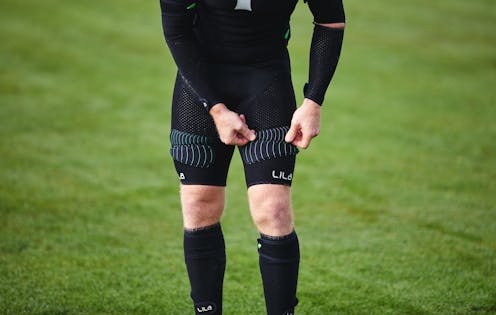
It’s the time of year to make resolutions to improve fitness and strength, but this may not require a gym membership or even hard work.
Strength training can be effective with small weights, provided by household items like a small can of spaghetti or wearable resistance loads incorporated into clothing.
You might remember from your school physics classes that strength and force are fairly synonymous. The formula for force was given to us by Sir Isaac Newton: force = mass x acceleration.
When you think of getting stronger or improving the force of certain muscles, you may have visions of lifting relatively heavy weights. But because of the large mass, you can’t move a heavy load quickly. As a result your movement velocities and accelerations are small.
But the Newtonian formula shows there is another possibility for improving strength. This type of training highlights the velocity and acceleration of movement, which means the masses have to be small or light – like the wearable resistance 600g weights the sprinter in this video is using on his thighs.
Depending on whether he is doing a tempo run or a sprint, the angular velocity at his hip can be between 400 to 1000 degrees per second, in other words very fast.
Wearable resistance
From a physics perspective, there are two ways to develop strength. You either move heavy loads slowly or light loads quickly.
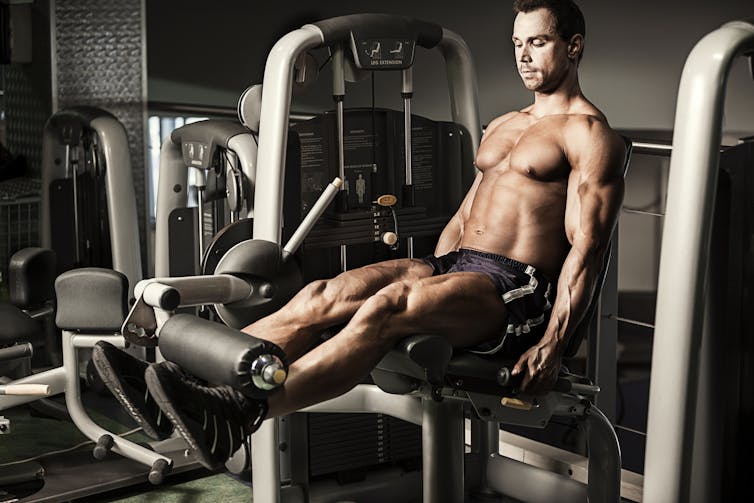
Shutterstock/AAR Studio
Wearable resistance refers to strength training where you affix a load to your body in some manner. It takes advantage of the concept of moving small masses (micro-loading) at high velocities.
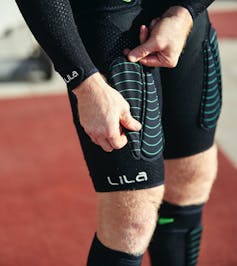
Author provided, CC BY-ND
That small mass is being accelerated and decelerated at high rates, which in turn loads the muscles substantially.
Let’s add one more layer of physics to show how micro-loading with wearable resistance trains strength. Have you heard of inertia? It describes the resistance to a change in motion. Resistance is a function of mass.
For example, if you place a 400g weight on your mid-thigh, then your thigh is 400g heavier and therefore requires more muscular effort to accelerate and decelerate. If you place the same weight further away from the rotating hip joint, you’ll need to put in more muscular effort to get it going because that loading has greater rotational inertia.
It’s this rotational inertia you are really interested in when it comes to assessing the muscle training with limb-loaded wearable resistance. It is important to understand so you can use it safely and effectively.
The formula here is: rotational inertia = mass x radius²
Let’s take the thigh as an example. The thigh requires rotational force (torque) to move it. The larger the thigh mass, the more muscular effort (torque) is required by the hip flexors and extensors.
By simply adding more wearable resistance to the thigh you can increase the rotational inertia, which means more muscular effort or turning force (torque) is required at the hip joint.
But let’s not forget the second part of the formula (r²), which describes where we put the mass. This has a bigger influence on rotational inertia (muscular effort) because the distance between the joint and the added weight (radius) is squared.
Read more:
Resistance band workouts are everywhere – but do they work?
Increasing the training effect
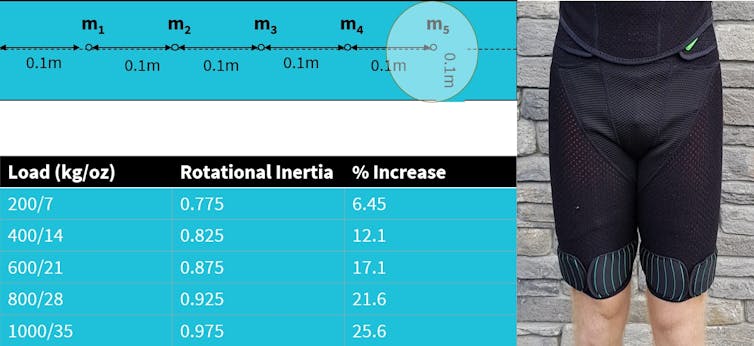
I have modelled the rotational inertia associated with the thigh of a 86kg athlete. In the table you can see the rotational inertia for a variety of loads when they are placed mid-thigh.
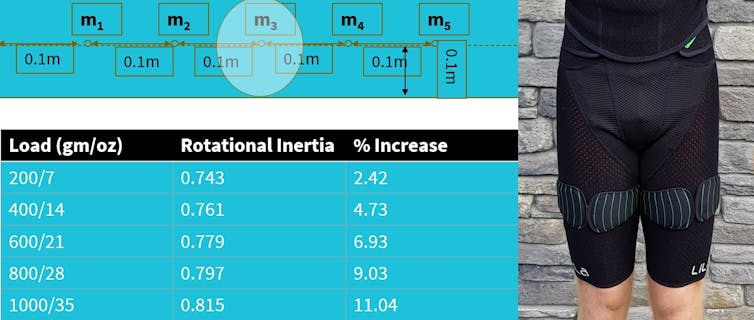
Author provided, CC BY-ND
By shifting the load further down the leg, you can increase the rotational inertia, for example from 4.7% to 12.1% for a 400g load.
Author provided, CC BY-ND
This is called distal loading and it is one of the most important parameters to understand with wearable resistance. For every centimetre you move from the axis of rotation, the distance is squared and hence has a substantial effect on rotational inertia and therefore the muscular work required.
Read more:
Four ways older adults can get back to exercising – without the worry of an injury
Wearable resistance micro-loading provides an alternative to traditional strength training with heavy loads. It also has the added bonus of happening as part of what you are doing anyway, such as walking or swimming. For the time-poor, this is good news as the gym can take on less importance.
By slipping a weight further away from the rotating joint, you can systematically and progressively increase the training effect on your muscles without adding weight.
As a result of the greater mechanical load, your metabolic activity and calorie burning increase. There are many possible applications of wearable resistance training beyond strength and fitness building, including for general health, injury prevention and recovery.

John Cronin has worked for Lila Movement Technology, Malaysia and received shares in the company previously. He no longer receives funding or shares from this organisation.
– ref. Wearable resistance: how to get stronger by simply moving, with a little help from small weights – https://theconversation.com/wearable-resistance-how-to-get-stronger-by-simply-moving-with-a-little-help-from-small-weights-166350













































































.jpg)
Otago University covid-19 experts copping abuse from anti-vaxxers
By Hamish MacLean in Dunedin
University of Otago covid-19 experts are not immune to the increasingly vitriolic attacks dished out to scientists commenting on New Zealand’s pandemic response.
Among a litany of attacks University of Otago epidemiologist Professor Michael Baker has endured over the course of the pandemic, at the start of this week a caller told him he had “a target on his back”.
Professor Baker said he kept the caller on the line for about 20 minutes and asked him what that meant “in real terms”.
The caller was an anti-vaxxer who was accusing Professor Baker of propaganda on behalf of pharmaceutical companies, telling him vaccines were dangerous, especially so for children.
The caller had half-baked information gleaned from various sources that did not really make sense, Professor Baker said.
“He had these slogans he was throwing at me, but when I asked him what he meant he didn’t really have any answers.”
This week it was revealed University of Auckland professors Shaun Hendy and Siouxsie Wiles have argued to the Employment Relations Authority their employer was not doing enough to protect them as they shared their expertise with the public.
Professor would call police
But Professor Baker said he had not raised any concerns for his safety with his employer, the University of Otago.
If anyone made a threat where he felt he or his family was unsafe he would not hesitate to involve the police.
The Wellington-based scientist received the occasional phone call where a caller delivered a stream of abuse and hung up, but Professor Baker said he was most likely to receive abuse in the form of emails, averaging a few attacks by email every day.
As an exercise, Professor Baker began classifying the forms of abuse he received into “five categories of insult”, he said.
There were the incoherent streams of abuse, which were easily dealt with, he said.
Some people had major grievances but did not know where to go, and contacted him to vent and, in some extremely sad cases, he would reply and express sorrow and sympathy.
There were anti-vax propagandists whose positions were not based on facts, which he ignored.
There were those with ideological stances who disapproved of the government’s overall strategy, who at times delved into conspiracy theories.
Personal attacks stream
Finally, the group he found the hardest to deal with came as personal attacks from a small stream of people who persistently contacted him, and tried to undermine his ability to comment.
“Talking about how you look, or how you appear – they’re obviously making quite a concerted effort to look at where you might feel a bit vulnerable,” he said.
The attacks had never made him question his role of speaking publicly about the pandemic response, Professor Baker said.
University of Otago evolutionary virologist Dr Jemma Geoghegan said she, too, had not raised any concerns with her employer.
She said “no” to about 90 percent of media requests because the issues were not related to her field of expertise.
In limiting her media exposure, she had limited the number of people who wanted to harass her about her expertise, Dr Geoghegan said.
“I don’t generally speak about vaccines, so [that] abuse isn’t aimed at me,” the Dunedin scientist said.
‘Weirdly strong views’
However, she had published on covid-19 origins and people had “weirdly strong views about that”.
The issues dealt with by her Auckland counterparts were not surprising though and she had sympathy for them.
“This is happening all around the world,” Dr Geoghegan said.
“I’ve got international collaborators that … I think their mental health has suffered.
“Before covid, or at the start of covid, they were really prominent on Twitter and stuff like that, and now they’ve had to delete their accounts because of the amount of abuse they’ve got.”
Hamish MacLean is an Otago Daily Times journalist. This article is republished under a community partnership agreement with RNZ and this story first appeared in the Otago Daily Times
Article by AsiaPacificReport.nz