Page 751

Electronic surveillance law review won’t stop Border Force’s warrantless phone snooping

Source: The Conversation (Au and NZ) – By Niamh Kinchin, Senior Lecturer, School of Law, University of Wollongong

Shutterstock

Australia’s electronic surveillance laws are being reformed with a goal of making them “clearer, more coherent and better adapted to the modern world”.

However, there is one significant set of powers beyond the scope of the reforms: the Australian Border Force’s (ABF) broad powers to search personal digital devices and copy electronic information without a warrant.

One man who had his phone searched by the ABF on entering the country recently told The Guardian he had “no idea what officials looked at, whether a copy of any of the data was made, where it would be stored and who would have access to it”.

The surveillance reform aims to deliver better protection of individuals’ information and ensure law enforcement agencies have the powers to investigate serious crimes and threats to security. So why has the privacy of travellers and migrants who cross Australia’s border been left so exposed?

A notable omission

The reform aims to replace the “current patchwork of laws” governing electronic surveillance, including the Telecommunications (Interception and Access) Act 1979 and the Surveillance Devices Act 2004, with a single piece of streamlined, technology-neutral legislation.

However, the reform’s scope is limited to accessing information and data covertly. Activities that fall under this definition include “intercepting phone calls, remotely accessing a person’s computer or using a listening or tracking device”.


Read more:
National security review recommends complete overhaul of electronic surveillance – but will it work?


The Deparment of Home Affairs gives as an example of an activity not covered by the reform an agency accessing a computer when executing a search warrant. This scenario may not involve covert surveillance, but some protection is provided by the need to apply for a warrant.

In contrast, the ABF’s powers to access electronic information and data do not require a warrant. The Customs Act 1901 allows ABF officers to examine any goods subject to customs control, including digital devices such as mobile phones and laptops.

ABF officers can also make copies of documents that may be relevant to prohibited goods, the commission of an offence, or “security”. A “document” includes mobile and other phones, sim cards, personal electronic recording devices, computers, written material and photographs.

Under the Migration Act 1958, ABF officers can search a person and their property if the officer suspects there are reasonable grounds for considering cancelling the person’s visa. The person must either be detained or has not been cleared by immigration. “Property” includes digital devices.

Intrusive powers

A guiding principle of the reform is to develop a law that “contains appropriate thresholds and robust, effective and consistent controls, limits, safeguards and oversight” of “intrusive” powers.

Electronic surveillance powers are described as “intrusive” because they can reveal sensitive information about an individual or organisation. The ABF’s powers are arguably equally as intrusive, but have less protection and lack transparency.

ABF officers do not require your permission to search your devices. If you refuse, you may be referred “for further law enforcement action”.

The ABF also has no obligation to inform you what information was examined or copied.

The ABF can pass information gathered from searches of digital devices to other federal and state departments, agencies, police forces or a coroner if it falls within a broad category of “permitted purposes”. Permitted purposes include the rather far-reaching “information relating to immigration, quarantine or border control between Australia and a foreign country”.

Notably, it is more difficult for police within Australia to search your mobile phone. Although police have general search powers, if they want to unlock your mobile phone or electronic device they must apply for a warrant first.

According to a Freedom of Information application made by the transparency activist organisation Right to Know, between July 1 2009 and June 30 2019 there were 436 incidents where electronic devices were examined. In the same period, the contents of electronic devices were copied 109 times.

An opportunity missed

By limiting the reform to covert electronic surveillance powers, the government has missed an opportunity to strengthen accountability of equally intrusive surveillance powers at Australia’s border.

Why the omission? Officially, because the ABF’s powers aren’t covert. This is despite individuals not knowing what information is accessed, copied or stored.

Unofficially, because the government is unlikely to dilute its migration and border control powers. According to the ABF, it “exercises its functions and powers at the border in order to protect the Australian community and deliver its mission to enable legitimate travel and trade”.

As the recent Novak Djokovic deportation case shows, “strong borders” are popular with the public.

What should you do if the ABF wants to search your mobile phone or laptop? Considering you may face a criminal sanction if you refuse, be smart about your data protection. You may wish to use two-factor authentication and store sensitive information in the cloud on a secure European server while you are travelling.


Read more:
Travelling overseas? What to do if a border agent demands access to your digital device


Public submissions on the reform of Australia’s electronic surveillance framework are due by February 11 2022. Unfortunately, there is no space for a conversation about the ABF’s extraordinary surveillance powers.

The Conversation

Niamh Kinchin does not work for, consult, own shares in or receive funding from any company or organisation that would benefit from this article, and has disclosed no relevant affiliations beyond their academic appointment.

ref. Electronic surveillance law review won’t stop Border Force’s warrantless phone snooping – https://theconversation.com/electronic-surveillance-law-review-wont-stop-border-forces-warrantless-phone-snooping-175833

Confused polling distorts the debate on an Indigenous Voice to Parliament

Source: The Conversation (Au and NZ) – By Murray Goot, Emeritus Professor of Politics and International Relations, Macquarie University

Would Australians vote for an Indigenous Voice in the Constitution? Would they approve the parliament simply legislating a Voice? Australians may support one, both, or neither.

The answers matter because after the next election we may be looking at a referendum to amend the Constitution by adding a Voice to parliament, or moving towards the new parliament legislating a Voice.

Labor has promised a referendum, while the Coalition seems more inclined to legislate – possibly with Labor’s support, since this would not preclude a referendum.

Much may depend on what the polls show.

What polls can tell us:

  • polls showing opposition to a constitutional amendment but support for a legislated Voice would discourage a government from holding a referendum

  • polls showing support for a constitutional amendment but opposition to a legislated Voice would encourage a government to hold a referendum

  • polls showing opposition to both would make change less likely

  • polls showing support for both would boost a campaign for the Voice that has faded in the last two years.

To change the Constitution, a vote in favour of a Voice would need the support of the majority of voters in the majority of states.

What the polling suggests

In the latest attempt to establish not whether voters want to hear a Voice but what sort of Voice they might want to hear, the Sydney Morning Herald and the Age commissioned a national poll of people enrolled to vote from Resolve, a political communications company.

In this poll, conducted in mid-January, respondents were told:

Some people have suggested that the Indigenous Voice should be permanently enshrined in the Constitution with a national vote so that it cannot be easily removed, and only then made law once it has that public endorsement. However, others would prefer that it is made law in the first instance so that it can be road-tested before a permanent place in the Constitution is voted on, and to avoid the chance of a “no” vote without that road-testing.

When respondents were asked to indicate their “own preference”, about a quarter (28%) said they preferred the first option (hold a vote to enshrine the Voice in the Constitution), about a quarter (24%) said they preferred the second option (legislate the Voice in the first instance), and about half (48%) were categorised as “not sure/no preference”.

These numbers suggest majority support for neither a referendum nor legislation. But questions to which half the respondents can’t give an answer are usually questions that should never have been asked.

In cases where huge numbers fail to make a choice, respondents either don’t understand the question or are indifferent between the choices offered. The proportion answering “not sure/no preference” in the Resolve poll very likely underestimates this.

Asking a question that requires respondents to factor in sequences of events – constitutional change before legislative change or legislative change before constitutional change – when they have little interest in or knowledge of politics is too complicated.

The wording of the question doesn’t help. The phrase “permanently enshrined” is likely to reduce support for change, I suspect. In addition, the idea of legislation as a form of “road-testing” is challenged by critics who insist if the Voice did pass such a “test”, the push for constitutional “enshrinement” would lose momentum.

A balanced question (or set of questions) in the poll would have recognised these contested understandings.

Above all, the question about a Voice to Parliament ignores the possibility that respondents may have been prepared to support a referendum followed by legislation. The fact that someone prefers X to Y does not begin to show they would be happy with X, but unhappy with Y.

Finding a poll showing majority support for constitutional change is not hard, though finding a poll that doesn’t offer respondents a politics tutorial along the way is harder.

In June 2020, in an unpublished poll conducted pro bono for a group lobbying for constitutional change, the research firm C|T Group asked respondents how they would vote:

if a referendum were held today […] to change the Constitution to set up a new body comprising Aboriginal and Torres Strait Islander people that gives advice to federal parliament on Aboriginal and Torres Strait Islander issues.

More than half (56%) said they would “definitely” or “probably” vote yes, 17% said they would “definitely” or “probably” vote no, and 28% were “undecided”.

Polls that ask about legislating a Voice without necessarily changing the Constitution are scarce. But in February 2018, Newspoll told respondents then-Opposition leader Bill Shorten “has pledged to create an indigenous (sic) advisory body to give indigenous people a voice to parliament”.

Newspoll asked whether “on balance”, respondents were “in favour or opposed to Bill Shorten’s plan to give indigenous people a voice to parliament.” More than half (57%) favoured the plan (despite it being tagged as a Labor proposal), 32% opposed it, and 18% said they didn’t know.

If the choice respondents were given in Resolve’s poll is not one they want to make, it is also not one they may need to make – provided they support both ways forward. Whether they do, the Resolve poll isn’t well enough designed to say.

The Conversation

Murray Goot receives funding from no organisation but has received funding from the Australian Research Council and various government bodies and formal inquiries in the past.

ref. Confused polling distorts the debate on an Indigenous Voice to Parliament – https://theconversation.com/confused-polling-distorts-the-debate-on-an-indigenous-voice-to-parliament-175525

Newspoll has Labor’s biggest lead since Turnbull’s ousting as Coalition damaged by COVID

Source: The Conversation (Au and NZ) – By Adrian Beaumont, Honorary Associate, School of Mathematics and Statistics, The University of Melbourne

AAP/Diego Fidele

In the first Newspoll of 2022, Labor led by 56-44, a three-point gain since the previous Newspoll in early December. Primary votes were 41% Labor (up three), 34% Coalition (down two), 11% Greens (up one), 3% One Nation (steady) and 11% for all Others (down two).

This is Labor’s biggest lead in Newspoll since the aftermath of the August 2018 ousting of Malcolm Turnbull in favour of Scott Morrison as prime minister. But the Coalition recovered to win the May 2019 election, with the final polls inaccurate. So the Coalition is not out of contention for the upcoming election yet.

39% were satisfied with Morrison’s performance (down five), and 58% were dissatisfied (up six), for a net approval of -19, down 11 points. Analyst Kevin Bonham said this was Morrison’s worst net approval since the 2019-20 bushfires (-22 then).

Anthony Albanese had a net zero rating, up six points. Morrison led Albanese as better PM by 43-41 (45-36 in December). This poll was conducted January 25-28 from a sample of 1,526. Figures are from The Poll Bludger.


Read more:
Grattan on Friday: A royal commission into COVID’s handling would serve us well for the future


The Coalition’s crash in Newspoll is very likely caused by the current COVID wave in Australia. While cases have dropped from over 100,000 a day to about 50,000 in the last ten days, deaths are still trending up, with a recent peak of 134 deaths on January 28.

Other than in Victoria during the late 2020 wave, Australia had avoided high COVID death rates. If we had previously had much higher death rates, we would be more likely to forgive the government for current deaths.

The Omicron wave in the UK has pushed average daily deaths past 260, but this is far from the peak of over 1,200 average daily deaths in January 2021, before vaccines were widely available.

Victoria’s bad experience in late 2020 may explain why it was the only state to gain in Essential’s COVID response polling last week (see below), while all other mainland states suffered double digit declines in their “good” rating.

Can the Coalition recover before the election, expected in May? Daily deaths are likely to fall back eventually, and the jobs situation is good for the government, though inflation is likely to be a negative.

The Morrison government has taken a tumble in the polls, but can it recover before the federal election, due by May?
AAP/Brian Cassey

Liberals may be in danger in Wentworth and North Sydney

uComms polls of the federal NSW seats of Wentworth and North Sydney for the left-wing Australia Institute, conducted January 24 from samples of about 850 per seat, gave the main independent challenger a 56-44 lead over the Liberal incumbent in Wentworth and a 59-41 lead in North Sydney.

Seat polls have been unreliable in the past, and a uComms poll close to the 2021 Tasmanian election was biased against the Liberals. But if education polarisation continues, voters in highly-educated traditional safe Liberal inner city seats could deliver big shocks on election night.


Read more:
Non-university educated white people are deserting left-leaning parties. How can they get them back?


Essential poll: Everywhere except Victoria falls on response to COVID

In last week’s Essential poll, 38% gave the federal government a poor rating for its response to COVID (up six since December), and 35% a good rating (down six). It is the first negative rating for the federal government on COVID response in Essential’s history, with the previous worst result a net +3 rating last August.

All state governments polled except Victoria also suffered falls, with WA down 12 to 66% good, Queensland down 11 to 46% good, SA down 14 to 43% good and NSW down 17 to 37% good. Victoria was up four to 47% good.

41% thought those who have chosen not to get vaccinated against COVID to be ill-informed, 22% that they are being deliberately selfish, while 37% believed their personal choices should be respected.

46% approved of Morrison’s performance (steady since December) and 46% disapproved (up two), for a net zero rating; this is Morrison’s worst in Essential since the bushfires. Albanese’s net approval was down four to zero. Morrison’s lead as better PM was cut to 42-34 from 42-31 in December.

Morgan poll: 56-44 to Labor

A Morgan poll, conducted January 4-16 from a sample of almost 2,800, gave Labor a 56-44 lead, a 0.5 point gain for Labor from an unpublished poll taken in mid-December. Primary votes were 37% Labor (steady), 34.5% Coalition (steady), 12% Greens (up 0.5), 3% One Nation (down one), 0.5% UAP (steady), 8.5% independents (up one) and 4.5% others (down 0.5).

An 8.5% vote share for independents suggests climate-focused independents are doing well, and Labor would benefit from their preferences.

Jobs situation very good for government, but not inflation

In the December jobs report, which the ABS released January 20, unemployment dropped 0.5% from November to 4.2% and underemployment dropped 0.8% to 6.6%. The employment population ratio – the share of eligible people employed – was up 0.3% to 63.3% after a jump from 61.3% to 63.0% in November.

This is Australia’s lowest unemployment rate since August 2008, just before the global financial crisis began. The unemployment rate has not been below 4% since the 1970s.

The January jobs report is likely to be worse owing to COVID disruption. But given past experience here and overseas, the jobs situation will improve rapidly once COVID eases. This will be good for the government going into an election.

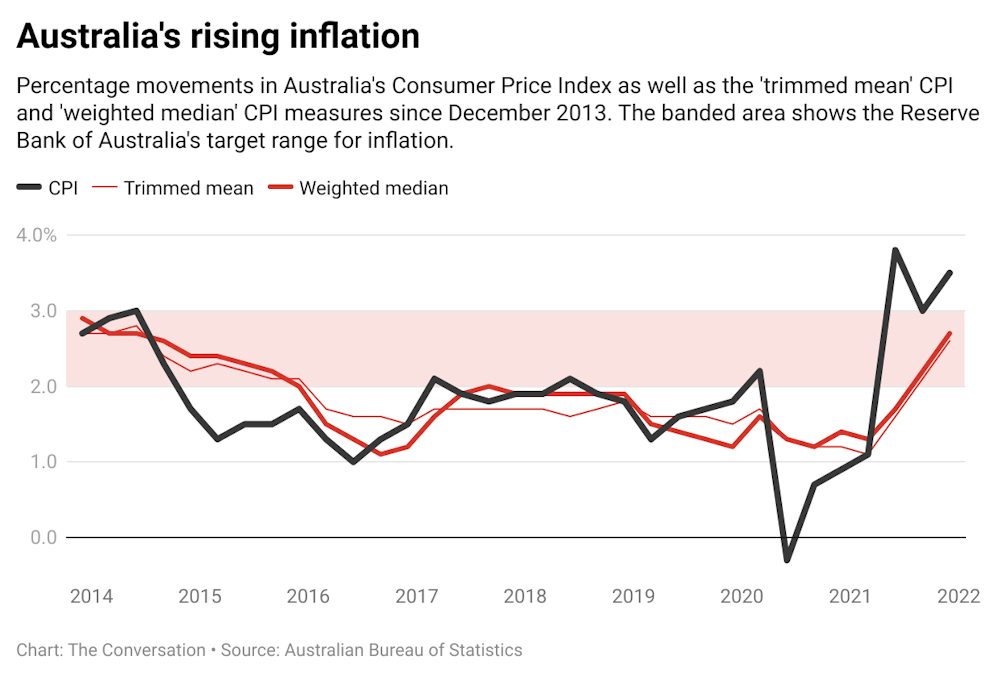
The ABS reported on January 25 that headline inflation rose 1.3% in the December quarter for a 3.5% annual rate. Annual core inflation increased to 2.6%, the highest since 2014. While Australian inflation is relatively high, it is only half the US annual inflation rate
of 7.0%.

Labor way ahead in Victorian state Resolve poll

In a Victorian state Resolve poll for The Age, Labor had 41% of the primary vote (up three since October), the Coalition 31% (down three), the Greens 11% (up one) and independents 10% (down one). As usual, Resolve did not give a two party estimate, but Bonham’s estimate was 59-41 to Labor.

Incumbent Daniel Andrews led the Liberals’ Matthew Guy as preferred premier by 47-30, out from 45-32 in October. This poll was conducted with the federal Resolve polls in November and January from a sample of 1,039.

46% said Andrews had managed the COVID pandemic well, down from 57% in August 2021. That compares to a 35% national good rating for Morrison, 31% in NSW for Liberal Premier Dominic Perrottet and 45% in Queensland for Labor Premier Annastacia Palaszczuk.

Four NSW byelections on February 12, and a WA poll

Four state byelections will occur in NSW on February 12 in the seats of Bega (Lib, 6.9% margin), Monaro (Nat, 11.6%), Strathfield (Labor, 5.0%) and Willoughby (Lib, 21.0%). Labor and the Coalition have declared candidates in all seats except Willoughby, which Labor is unlikely to contest.

A Painted Dog Research poll for The West Australian had WA voters supporting Premier Mark McGowan’s decision to keep the borders closed by a 71-29 margin. The sample was 637, as reported by The Poll Bludger.

Boris Johnson’s lockdown party problems

I wrote for The Poll Bludger on January 23 about whether UK Prime Minister Boris Johnson would be ousted by his Conservative MPs over outrage at lockdown-busting parties at Downing Street. Also covered: US redistricting and Joe Biden’s poor ratings.

The Conversation

Adrian Beaumont does not work for, consult, own shares in or receive funding from any company or organisation that would benefit from this article, and has disclosed no relevant affiliations beyond their academic appointment.

ref. Newspoll has Labor’s biggest lead since Turnbull’s ousting as Coalition damaged by COVID – https://theconversation.com/newspoll-has-labors-biggest-lead-since-turnbulls-ousting-as-coalition-damaged-by-covid-175835

Pacific health provider faces covid-19 fatigue within community

By Sri Krishnamurthi, RNZ Pacific digital journalist

South Seas Healthcare Trust chief executive Lemalu Silao Vaisola says people are tired of covid-19 rather than complacent after two years of the pandemic.

He said he had seen fatigue set in which could explain the low uptake of the booster shot in the Pacific community.

“People are just covid-fatigued where everything is all about self-isolation, traffic lights and the lockdowns.

“I think it is just fatigue, people are just tired. So I don’t know if it is complacency, but it’s been ongoing and two years is a long time to go through changes.”

Lemalu said the South Seas Healthcare team were preparing now for omicron to hit communities just like they had done in the past two years of covid-19.

He said the team intended to use the Manukau Insititute of Technology campus for a booster vaccination drive to get rates up.

“We’ve still got the MIT sites that’s during vaccinations and we’ve got a drive through vaccination for increasing the boosters and five to 11 [year olds] and on top of that we’ve been training our staff in terms of outreach into the homes.”

Front and centre
Lemalu said his organisation was front and centre fighting the delta strain and the experience stood them in good stead.

“We’ve got a good template to respond, but again every variant so far provides its own set of challenges,” he said.

“I’m happy that we’ve sort of almost had two years experience that will position us to hopefully be ready for this, but like I said before it’s different from what we are seeing overseas.

“We plan for the worst and hope for the best.”

He is encouraging Pacific families to get a booster shot.

This article is republished under a community partnership agreement with RNZ.

Print Friendly, PDF & Email

Article by AsiaPacificReport.nz

‘Virtual influencers’ are here, but should Meta really be setting the ethical ground rules?

Source: The Conversation (Au and NZ) – By Tama Leaver, Professor of Internet Studies, Curtin University

lilmiquela/Instagram

Earlier this month, Meta announced it is working on a set of ethical guidelines for “virtual influencers” – animated, typically computer-generated, characters designed to attract attention on social media.

When Facebook renamed itself Meta late last year, it heralded a pivot towards the “metaverse” – where virtual influencers will presumably one day roam in their thousands.

Even Meta admits the metaverse doesn’t really exist yet. The building blocks of a persistent, immersive virtual reality for everything from business to play are yet to be fully assembled. But virtual influencers are already online, and are surprisingly convincing.

Mark Zuckerberg’s Metaverse announcement. 30 October 2021.

But given its recent history, is Meta (née Facebook) really the right company to be setting the ethical standards for virtual influencers and the metaverse more broadly?

Who (or what) are virtual influencers?

Meta’s announcement notes the “rising phenomenon” of synthetic media – an umbrella term for images, video, voice or text generated by computerised technology, typically using artificial intelligence (AI) or automation.

Many virtual influencers incorporate elements of synthetic media in their design, ranging from completely digitally rendered bodies, to human models that are digitally masked with characters’ facial features.

A Topography of Virtual Influencers by Rachel Berryman, Crystal Abidin, and Tama Leaver (October 2021).

At both ends of the scale, this process still relies heavily on human labour and input, from art direction for photo shoots to writing captions for social media. Like Meta’s vision of the metaverse, influencers that are entirely generated and powered by AI are a largely futuristic fantasy.

But even in their current form, virtual influencers are of serious value to Meta, both as attractions for their existing platforms and as avatars of the metaverse.

Interest in virtual influencers has rapidly expanded over the past five years, attracting huge audiences on social media and partnerships with major brands, including Audi, Bose, Calvin Klein, Samsung, and Chinese e-commerce platform TMall.

A competitive industry specialising in the production, management and promotion of virtual influencers has already sprung up, although it remains largely unregulated.

So far, India is the only country to address virtual influencers in national advertising standards, requiring brands “disclose to consumers that they are not interacting with a real human being” when posting sponsored content.

Ethical guidelines

There is an urgent need for ethical guidelines, both to help producers and their brand partners navigate this new terrain, and more importantly to help users understand the content they’re engaging with.

Meta has warned that “synthetic media has the potential for both good and harm”, listing “representation and cultural appropriation” as specific issues of concern.

Indeed, despite their short lifespan, virtual influencers already have a history of overt racialisation and misrepresentation, raising ethical questions for producers who create digital characters with different demographic characteristics from their own.

But it’s far from clear whether Meta’s proposed guidelines will adequately address these questions.


Read more:
What is the metaverse? A high-tech plan to Facebookify the world


Becky Owen, head of creator innovation and solutions at Meta Creative Shop, said the planned ethical framework “will help our brand partners and VI creators explore what’s possible, likely and desirable, and what’s not”.

This seeming emphasis on technological possibilities and brand partners’ desires leads to an inevitable impression that Meta is once again conflating commercial potential with ethical practice.

By its own count, Meta’s platforms already host more than 200 virtual influencers. But virtual influencers exist elsewhere too: they do viral dance challenges on TikTok, upload vlogs to YouTube, and post life updates on Sina Weibo. They appear “offline” at malls in Beijing and Singapore, on 3D billboards in Tokyo, and star in television commercials.

Virtual influencer Rozy stars in a commercial for Shinhan life insurance.

Gamekeeper, or poacher?

This brings us back to the question of whether Meta is the right company to set the ground rules for this emerging space.

The company’s history is tarred by unethical behaviour, from Facebook’s questionable beginnings in Mark Zuckerberg’s Harvard dorm room (as depicted in The Social Network) to large-scale privacy failings demonstrated in the Cambridge Analytica scandal.

In February 2021 Facebook showed how far it was willing to go to defend its interests, when it briefly banned all news content on Facebook in Australia to force the federal government to water down the Australian News Media Bargaining Code.


Read more:
Facebook has pulled the trigger on news content — and possibly shot itself in the foot


Last year also saw former Facebook executive Frances Haugen very publicly turn whistleblower, sharing a trove of internal documents with journalists and politicians.

These so-called “Facebook Papers” raised numerous concerns about the company’s conduct and ethics, including the revelation that Facebook’s own internal research showed Instagram can harm young people’s mental health, even leading to suicide.

Today, Meta is fighting US antitrust litigation that aims to restrain the company’s monopoly by potentially compelling it to sell key acquisitions including Instagram and WhatsApp.

Meanwhile, Meta is scrambling to integrate its messaging service across all three apps, effectively making them different interfaces for a shared back end that Meta will doubtless argue cannot feasibly be separated, no matter the outcomes of the current litigation.

Given this back story, Meta seems far from the ideal choice as ethical guardian of the metaverse.

The already extensive distribution of virtual influencers across platforms and markets highlights the need for ethical guidelines that go beyond the interests of one company – especially a company that stands to gain so much from the impending spectacle.

The Conversation

Tama Leaver receives funding from the Australian Research Council (ARC) as a chief investigator in the ARC Centre of Excellence for the Digital Child.

Rachel Berryman’s PhD research is funded by an Australian Government Research Training Program (RTP) Scholarship.

ref. ‘Virtual influencers’ are here, but should Meta really be setting the ethical ground rules? – https://theconversation.com/virtual-influencers-are-here-but-should-meta-really-be-setting-the-ethical-ground-rules-175524

Here’s why misinformation is a smaller problem than you think

Source: The Conversation (Au and NZ) – By Paul Kenny, Professor of Political Science, Australian Catholic University

Shutterstock

It’s widely believed that this is the age of misinformation, of alternative facts, and of conspiracy theories gone mainstream, from QAnon to anti-vaccine and anti-lockdown movements.

In this telling, claims spread by internet crackpots are amplified by partisan news networks and social media to the point that wild myths can now influence or even change governments.

But is this really the case, or are we inflating the problem of misinformation? Ironically, many of our common beliefs about the issue are, well, myths.

Conspiratorial beliefs are held by a small minority

How many people actually believe misinformation-fed conspiracy theories? It turns out, not many. Wild conspiracy theories like QAnon draw headlines, especially given their believers were amongst the rioters who stormed the US Capitol a year ago. But these beliefs are still rare.


Read more:
Misinformation, disinformation and hoaxes: What’s the difference?


While surveys estimate the number of QAnon believers in the US to be as high as 15%, this is likely due to “acquiescence bias”. This is the tendency for people to agree with whatever they’re asked in a survey, even statements like “the government, media, and financial worlds in the US are controlled by a group of Satan-worshipping pedophiles who run a global child sex trafficking operation.” As political scientists Seth Hill and Molly Roberts have demonstrated, phrasing survey questions differently can slash the numbers who agree by half.

the word
How potent are lies and misinformation?
Shutterstock

Of course, even if only a small percentage of us believe false or deliberately misleading information, there may be real consequences. In America, around 15% of adults refuse to get a COVID vaccine. That, in turn, is leading to what’s been dubbed the pandemic of the unvaccinated.

Why do people fall for false information, even when it’s against their own direct interest, such as keeping themselves and their families alive?

Are we really too gullible?

A common answer is that people are easily duped. The ability of populists like Donald Trump to ride to power on the back of a series of false or misleading claims would seem to be compelling evidence of such widespread credulity. Trump drove the “Birther myth” that Barack Obama was not born in the United States and pedalled wildly inaccurate statistics on crime rates, unemployment throughout his campaign.

But the idea that only a few of us can resist the deluge of falsehoods is another myth. If people were so easily gulled, we’d all be the willing slaves of a manipulative elite! Rather, as French social and cognitive psychologist Hugo Mercier has argued, people have “open vigilance” cognitive mechanisms that prevent this from happening. While we are open to letting in new information, our standard response is to treat that information sceptically.

Are we just irrational?

So how does misinformation slip through? First, our ability to critically evaluate information is far from perfect. While it was once common belief humans would always rationally act in our own best interests, research by Nobel Prize-winning economist Daniel Kahneman and many others has shown we all have systematic cognitive errors such as the “availability heuristic” and the “omission bias”.

Both errors are involved in vaccine hesitancy. If rare vaccine side effects draw media attention, many people will fixate on this risk, despite how low it is. That’s the availability heuristic at work.

At the same time, people discount the risks associated with not taking an action (being unvaccinated), while overestimating the risks of taking an action (getting vaccinated). That’s the omission bias.

There is a link between susceptibility to misinformation and lower levels of cognitive reasoning. But irrationality is not the whole story. When it comes to explaining support for conspiracy theories like QAnon, we need to look beyond people’s numeracy skills.

We’re team players

As Mercier has pointed out, we’re more likely to believe a lie if it comes from a source we already trust. Ours is a deeply social species. We evolved to use culture – shared beliefs and practices – as a kind of societal glue. In practice, this means we sometimes suspend our disbelief just to to get along.

Take, for example, the well-studied effect of political partisanship on American acceptance of the Birther myth: by 2016, while 80% of Democrats believed that Barack Obama was born in the United States, only 25% of Republicans did. People accept misinformation like Birtherism and QAnon to fit in with their group.

How can we help people taken in by misinformation?

For some of us, the pandemic has brought with it an unwelcome challenge: trying to change the mind of a loved one swayed by misinformation about vaccination.

Two female friends talking
Creating a common understanding is vital to give persuasion a chance.
Shutterstock

According to an influential theory known as the “backfire effect”, not only do people resist information running contrary to their prior beliefs, but confronting them with this information only increases their commitment to their prior belief.

If this theory was true, there would be no point in arguing. Luckily, the backfire or backlash effect is yet another popular myth. “Out of the hundreds of opportunities to document backlash in my own experimental work on persuasion, I’ve never seen it.” That’s Yale persuasion expert Alexander Coppock, who I corresponded with by email.


Read more:
Radicalization pipelines: How targeted advertising on social media drives people to extremes


Why does the myth persist? Coppock believes it’s because disagreement is unpleasant on a personal level. “When we try to persuade others, they don’t like it and they like us less for having tried,” Coppock said. What happens next? After we seemingly fail in our efforts at persuasion, we reassure ourselves the person holding the belief is simply wrong, if not stupid.

Our failed efforts at persuasion shouldn’t stop us trying. The experimental evidence clearly shows us that everyone, even strongly partisan people, can update their views when given accurate information. While some of us have further to go before we are fully convinced, clear, accurate information usually moves us in the right direction.

The key is to avoid making it a partisan right/wrong issue. The more you can make someone else feel included and on the same team, the more empathy and trust you generate.

The more the other person feels understood, the better your chances are of bringing them back in from the wilds of misinformation.

The Conversation

Paul Kenny does not work for, consult, own shares in or receive funding from any company or organisation that would benefit from this article, and has disclosed no relevant affiliations beyond their academic appointment.

ref. Here’s why misinformation is a smaller problem than you think – https://theconversation.com/heres-why-misinformation-is-a-smaller-problem-than-you-think-172968

Does pork-barrelling actually work? New research suggests it’s not a big vote winner

Source: The Conversation (Au and NZ) – By Ian McAllister, Distinguished Professor of Political Science, Australian National University

Lukas Coch/AAP

Do political rorts deliver extra votes at elections?

Politicians seem to think so, judging by the number and frequency of pork-barrelling scandals involving the misuse of public spending. Indeed, according to the former NSW premier, Gladys Berejiklian, such activity is normal. As she said last year, “all governments and all oppositions make commitments to the community in order to curry favour”.


Read more:
After a bombshell day at ICAC, questions must be asked about integrity in Australian politics


But do the electoral benefits outweigh the controversy and the risk to political careers? Nationals senator Bridget Mackenzie (temporarily) lost her ministerial position over events surrounding the 2018-19 sports rorts scandal. The Labor minister Ros Kelly suffered a similar fate in the “whiteboard” sports grants controversy in 1994.

Given the effort politicians and their advisers commit to directing public funds to marginal electorates, an observer would think the electoral returns would be substantial.

New research by myself and federal Labor MP Andrew Leigh, published in the journal Political Studies, casts doubt on this assumption.

Why do politicians pork-barrel?

The international research on pork-barrel politics suggests politicians are attracted to it for two reasons. One is to win over swinging voters, who might be impressed by a candidate’s ability to garner resources for his or her electorate. The other is to reward supporters and to “deliver” for the party’s voter base.


Read more:
From donkey votes to dog whistles, our election language has a long and political history


Australia’s political institutions are ideally suited to pork-barrelling. Party politics are highly disciplined, and elections almost always produce a clear winner.

The three-year federal electoral cycle provides multiple opportunities for pork barrelling, while compulsory voting means all voters are potentially open to influence. And while there is independent oversight over government expenditure, there are few formal constraints on governments that decide to allocate funding based on partisan considerations.

The sports grants scandal

In 2018, the Coalition government set aside A$100 million to upgrade sporting facilities around Australia, with the allocation of grants overseen by the Australian Sports Commission (Sport Australia).

However, as the Australian National Audit Office’s 2020 report made clear, a parallel evaluation of the grants was also conducted by the sports minister’s office. This evaluation identified “marginal electorates held by the Coalition as well as those electorates not held by the Coalition that were to be targeted in the 2019 election”.

Prime Minister Scott Morrison.
Prime Minister Scott Morrison lost a minister over the sports rorts scandal.
Mick Tsikas/AAP

Our interest in examining the impact of the 2018-19 sports grants on voters stemmed from the fact that we know which electorates received grants and – thanks to a spreadsheet leaked to the ABC – which grants were awarded on merit and which were likely to have been awarded on political considerations. We estimate that of the almost 700 grants that were funded, just over half were awarded based on politics rather than need.

By matching the grants to each electorate, and taking into account such factors as incumbency and the socioeconomic status of the electorate, we could make two estimates. First, we wanted to know the extent to which grants were directed to marginal electorates. And second, we wanted to know if the impact of grants – both merit-based and politics-based – had any influence on the vote in the 2019 election.

What we found

On the first question, the extent of bias, we found grants were significantly more likely to be directed to seats held by the Coalition, with National-held seats being particular beneficiaries. This supports both the audit office’s report and is also in line with other research on previous scandals, both Coalition and Labor. It confirms that an incentive was to attract swinging voters as well as to deliver for the party’s core voters.


Read more:
The ‘car park rorts’ story is scandalous. But it will keep happening unless we close grant loopholes


On the second question, and contrary in our expectations, the allocation of grants had no significant effect on the Coalition’s vote. This held both for the number of grants that were allocated to each electorate, as well as to the dollar amount of those grants.

Why does pork barrelling fail to deliver votes?

This unexpected finding then led us to consider why voters fail to be swayed by the lavish allocation of government funds. We have two – necessarily speculative – explanations.

The first is the low standing of politicians. The Australian Election Study survey shows trust in politicians is at an all-time low. In the 2019 study, three quarters of the respondents thought “people in government look after themselves”. This is the highest figure ever recorded. Voters may therefore simply regard pork-barrelling as normal.

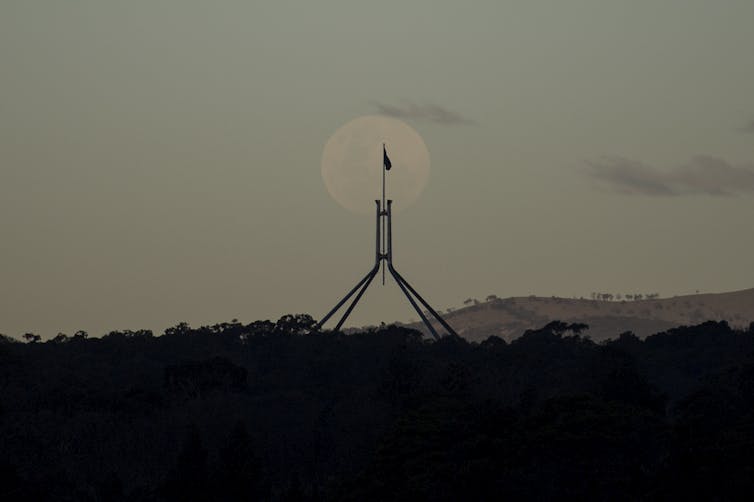
Moon rising over Parliament House.
Australians’ trust in politicians it at an all-time low, according to survey research.
Lukas Coch/AAP

The second explanation is politicians over-estimate the effect of pork-barrelling. To test this we conducted a straw poll of 14 House of Representative members who were asked what the impact of the vote would be if half a million dollars was spent on their electorate. Only two thought it would have no effect. Of the remainder, about half thought it would bring an additional 1% of the vote or more.

In short, pork-barrelling, at least in the case of the sports grants, does not work. Politicians clearly believe otherwise.

But what pork-barrelling almost certainly does do is to further erode the public’s confidence and trust in elected politicians. With trust and integrity likely to be major issues for voters at the 2022 election, how the parties approach these issues will have a major impact on the outcome.

The Conversation

Ian McAllister receives funding from the Australian Research Council.
This article is based on a journal article co-authored by federal Labor MP and former ANU professor of economics, Andrew Leigh.

ref. Does pork-barrelling actually work? New research suggests it’s not a big vote winner – https://theconversation.com/does-pork-barrelling-actually-work-new-research-suggests-its-not-a-big-vote-winner-173329

What we know now about COVID immunity after infection – including Omicron and Delta variants

Omicron Variant. Image via WIKIMEDIA.ORG.

Source: The Conversation (Au and NZ) – By Stephen Kent, Professor and Laboratory Head, The University of Melbourne

AAP Image/Bianca De Marchi

COVID is rampant in Australia and many parts of the world right now. Some people battling or recovering from infection may wonder if catching COVID will give them longer term immunity for when the next wave comes.

Since the early days of the pandemic we’ve known COVID induces a wide range of immune responses and one infection provides partial protection from future infections.

Unfortunately, immunity wanes over time – people lose half their immunity every 3 months. Further, new variants continue to emerge that are partially resistant to key immune responses – antibodies that neutralise earlier strains – this is especially true of Omicron.

We’re starting to get a more detailed understanding of COVID immunity across variants. Here’s what we know so far …

Breakthrough infection happens but vaccines are still a must

Since around 95% of Australians over 16 have had at least two COVID vaccines, most people catching COVID now have previously been vaccinated – this is called “breakthrough infection”.

The vaccines are effective at substantially reducing severe COVID illness. They are less effective, particularly over time, at preventing infections, including with new variants. A third vaccine dose helps maintain immunity, and everyone eligible should get a booster as soon as possible.

Because the Astra-Zeneca vaccine is less effective than the Pfizer or Moderna vaccines, it’s critically important for vulnerable older Australians immunised with two Astra-Zeneca vaccinations to be boosted with a third vaccine dose as quickly as possible.

Professor Peter Doherty explains vaccination and immunity in everyday terms.


Read more:
Should I get my COVID vaccine booster? Yes, it increases protection against COVID, including Omicron


The good news is people first vaccinated with Astra-Zeneca and subsequently boosted with Pfizer or Moderna develop high levels of protective immune responses.

Recent work shows a nice boost in antibody immunity after breakthrough infection. This boost in antibody immunity may not be as fast or strong as getting a vaccine, but it has a big advantage in that the immunity is more specific to the infecting strain such as Delta.

The current vaccines are still based on the original strain isolated in Wuhan, China in early 2020. Several vaccine manufacturer’s are racing to update their vaccines for the Omicron variant (much as we do with the yearly flu vaccines), but these variant-specific vaccines are still some months away.


Read more:
Will an Omicron-specific vaccine help control COVID? There’s one key problem


Infection immunity builds where COVID strikes first

Another potential advantage for immunity derived by infection (acquired in the respiratory tract) compared to vaccination (given into the muscle) is that immunity is better focused to the surfaces of the nose, throat and eyes. This is where COVID is first encountered.

Surface antibodies (termed immunoglobulin A) and specialised tissue “resident” immune cells (B and T-cells) are induced by infection but not intramuscular vaccination.

The level of protection offered by these “local” or “mucosal” responses is not yet clear in people, but some studies in animal models suggest they are helpful.

lab technician at CDC
Research and understanding of immune responses to COVID is developing.
Shutterstock

Delta infection offers a little protection against Omicron

The Omicron variant is slowly replacing the Delta variant around the world. It is more transmissible and avoids antibodies more effectively.

Do people who have been infected with the Delta variant have an advantage in terms of protection from the Omicron variant? The two strains share some sequence changes, but Omicron has many more mutations than Delta.

Only a minority of neutralising antibodies that fight Delta can also neutralise the Omicron variant. That said, neutralising antibodies against Delta are better at fighting Omicron than previous strains. This is particularly true for people who have caught Delta and been previously vaccinated.

The reverse is also true – people who have caught Omicron have some improved antibody protection against Delta. This may not be much use as Delta is disappearing from prevalence, but the knowledge could be useful for future variants.

T-cells might be key to cross-variant protection

There is considerable interest in a type of immunity called T-cells and their potential ability to fight COVID infection.

Theoretically, T-cells could assist in protecting against severe infection with new strains because T-cells usually cross react to all variants of SARS-CoV-2, the virus that causes COVID.

However, the evidence to date points to the central role of neutralising antibodies obtained from infection or vaccination in protection from both getting an infection and preventing severe disease. A recent unpublished study suggests neutralising antibodies are boosted by breakthrough infections but not T-cells. We know T-cells are very important in protecting from other infectious diseases and many cancers, but perhaps have a lesser role in COVID.


Read more:
‘Welcome to our world’: families of children with cancer say the pandemic has helped them feel seen, while putting them in peril


Gaining immunity isn’t the end of the story

Overall, infections with Delta and Omicron provide a boost in immunity against these strains. Infection will probably help protect individuals from reinfection with the same variant. Infection may offer a small amount of protection from different variants and potentially from future variants.

However, immunity will not be enduring and it is still possible to get severe infections and ongoing symptoms (termed “Long COVID”) from breakthrough infections. They are best avoided! Current booster vaccines along with social measures are our best way to stay healthy while we wait for Omicron-specific vaccines.

The Conversation

Stephen Kent receives funding from the Australian and Victorian governments for COVID-19 research.

ref. What we know now about COVID immunity after infection – including Omicron and Delta variants – https://theconversation.com/what-we-know-now-about-covid-immunity-after-infection-including-omicron-and-delta-variants-175653

Our hospitals are at greater risk of flooding as the climate changes. We need better evacuation plans.

Source: The Conversation (Au and NZ) – By Martin Loosemore, Professor of Construction Management, University of Technology Sydney

Rick Rycroft/AP

With hospitals under strain from COVID-19, we need to safeguard them against another threat set to increase as the world warms.

That threat? Flooding. Many Australian hospitals were built on cheap land near rivers. But as climate change loads the dice in favour of larger floods, areas previously safe may no longer be so. We must plan ahead to ensure patients and healthcare workers are not trapped by floodwaters.

Our new research shows future floods in low-lying areas of Western Sydney are likely to disrupt road networks, preventing safe evacuation of patients. Only last year, this region suffered its worst floods in decades, and more are expected as we enter a flooding cycle. This fast-growing region is rated one of Australia’s highest flooding risks, and hosts a number of healthcare facilities built in flood-prone areas.

The solution? We believe new approaches to mathematical modelling can help decision makers optimise plans for safe evacuation in different flooding scenarios. By cutting evacuation time, we hope these approaches can save lives.

Hospitals were not built to cope with larger floods

Around 80% of Australians live within 50 kilometres of the coast. As a result, many hospitals were built on low-lying land adjacent to seas or rivers. Most were designed without climate change risks in mind.

The major floods brought by La Nina last year, and the catastrophic 2010-2011 Queensland floods, have shown us how exposed many of our cities are to floods. Already in 2022, we have seen large floods up and down the east coast.

Climate change is predicted to bring Australia less rain overall, except for the tropical north. The rain that does fall will be more likely to fall in intense bursts. River flash floods from intense rain events or cyclones will pose an increasing threat to health facilities.


Read more:
Floods are going to get worse: we need to start preparing for them now


Some urban areas are on highly flood-prone areas. For example, the NSW Hawkesbury Nepean flood plan anticipates a flood similar to the infamous 1867 flood would result in around 90,000 people being evacuated.

That’s to say nothing of flooding from the sea. Around Australia, 75 hospitals and health service facilities are within 200 metres of the sea. That puts them at real risk from coastal inundation and erosion by the end of the century, if the seas rise by one metre as the Intergovernmental Panel on Climate Change predicts.

This is not a hypothetical scenario. Hospitals have already been left without power for days due to flooding, while others have been forced to evacuate patients. Only last year, floods up and down the east coast cut roads and forced authorities to find alternatives to hospitals for people unable to get through.

Clearly, this matters. Hospitals play a vital role in creating a disaster-resilient society, and it is critical they can keep operating in disaster situations.

The World Health Organization (WHO) has called for a better understanding of the threat posed by flooding.

What can we do to prepare?

In our region, very little is known about how we might best evacuate hospitals in the event of a major flood. We simply haven’t done enough research.

What we found in our work is that the issue is extremely complex. Where would patients be evacuated to, for instance? How do you do it safely? Which routes would be safe in a major flood? How would medical staff get to other hospitals?

Evidence from recent floods suggests many hospitals in flooded areas will face major challenges transferring patients and resources to other healthcare facilities.


Read more:
Sydney’s disastrous flood wasn’t unprecedented: we’re about to enter a 50-year period of frequent, major floods


So what can hospitals do better?

At present, hospital administrators rely heavily on evacuation drills to test and improve emergency evacuation planning. These drills are expensive and disruptive and their effectiveness is difficult to assess.

We have found new approaches to mathematical modelling could greatly assist hospital managers plan for a flood to prevent them becoming disasters.

For example, analysis of Western Sydney’s Hawkesbury-Nepean Valley can visually show how different size flood events would impact on hospitals, healthcare and aged care facilities, as well as roads, bridges and electricity lines.

figure showing different flood sizes in Western Sydney
Modelling outcomes for a range of flooding scenarios in Western Sydney’s Hawksbury-Nepean valley.
Author provided

Imagine the Hawksbury-Nepean Valley area floods again like last year. In a scenario where a hospital floods and patients need evacuation, hospital administrators will face a conundrum. Which roads do they send the patients down?

Sophisticated modelling our team is undertaking will let us predict which routes are best, based on the roads most likely to flood, ambulance and staff availability, health needs of patients and the availability of suitable beds and staff in other hospitals. The models allow us to optimise routes for the most urgent patients.

For hospital administrators, the benefit of these models is the ability to glimpse the likeliest scenarios and plan ahead, before the floods happen.

Climate change can supercharge floods, as we are seeing more and more. Decision makers must plan ahead accordingly. Running flood and evacuation simulations now could help save lives in the future.

The Conversation

Martin Loosemore receives funding from The Australian Research Council

Maziar Yazdani and Mohammad Mojtahedi do not work for, consult, own shares in or receive funding from any company or organisation that would benefit from this article, and have disclosed no relevant affiliations beyond their academic appointment.

ref. Our hospitals are at greater risk of flooding as the climate changes. We need better evacuation plans. – https://theconversation.com/our-hospitals-are-at-greater-risk-of-flooding-as-the-climate-changes-we-need-better-evacuation-plans-174467

Labor leads Coalition 56-44% and Morrison slumps dramatically in first 2022 Newspoll

Source: The Conversation (Au and NZ) – By Michelle Grattan, Professorial Fellow, University of Canberra

Labor has opened a 56-44% two-party lead and Scott Morrison’s net satisfaction rating has plunged 11 points in Newspoll, after a disastrous summer in which Omicron has ripped through most of the country and deaths have spiked.

The poll, published in The Australian and the first Newspoll of the year, found the government dropping behind Labor for the first time as better at leading Australia’s recovery out of the pandemic.

The Coalition primary vote fell 2 points to 34%, compared with the final Newspoll of 2021, while the ALP’s vote rose 3 points to 41%.

The large Labor two-party lead compares with its pre-Christmas lead of 53-47%, and if replicated at an election would bring a landslide loss for the Morrison government. The current 56-44% Labor lead is the biggest for the opposition since September 2018.

The total deaths of people with COVID so far this year is approaching 1500. Shortages of rapid Antigen tests and serious supply chain problems resulting in shortages on supermarket shelves have led to high levels of community frustration.

With parliament resuming next week for what is expected to be a difficult fortnight sitting for the government, the poll numbers will unsettle already worried Coalition backbenchers.

Anthony Albanese has almost closed the gap on Morrison as better prime minister in the poll – Morrison leads by 43% to 41%. This compares to Morrison’s 45-36% lead in December.

Net satisfaction with Morrison, down 11 points, is now minus 19, his lowest ranking since early 2020 after the bushfires.

His satisfaction is down 5 points to 39%; his dissatisfaction rating is up 6 points to 58%.


Read more:
Grattan on Friday: A royal commission into COVID’s handling would serve us well for the future


Albanese’s net satisfaction rating is zero. His approval increased 4 points to 43%; his disapproval fell 2 points.

One third (33%) thought Albanese the best to lead the country’s recovery out of the pandemic, compared to 32% who opted for Morrison.

On the best to lead Australia on climate change, Albanese was on 39% and Morrison 21%.

On jobs and growth, Morrison led Albanese 33-31%, and on dealing with China Morrison was ahead of Albanese 31-26%.

Asked which of several issues was the most important when deciding how they would vote, 38% chose coming out of the pandemic. It came in above creating jobs and growing the economy (26%), leading Australia’s response to climate change (21%), and dealing with the threat of China in the Asia-Pacific (10%).

Concerns with COVID were greatest in Queensland, which had been relatively protected before it saw infections and deaths rise sharply after opening its border: 38% of voters there said it was the most important issue when deciding who to vote for. This compared to 35% in NSW and 32% in Victoria.

The government, which will stress its economic credentials in the run up to the election, has a poor rating in the poll as the better economic manager, leading Labor 33% to 31% on who would be better placed to create jobs and growth.

In NSW and Queensland the Coalition had a 38% primary vote, with Labor on 29%. In Victoria the Coalition was on 26% and Labor 33%.

The Greens were on 11% (up a point), Pauline Hanson’s One Nation was unchanged on 3%; independents and minor parties were down 2 point to 11%.

The national poll was conducted during January 25-28 with 1526 people.

Meanwhile the NSW government on Sunday sharply criticised the federal government for not financially contributing to a state support package for small and medium sized businesses that are being hit by the Omicron wave.

Unveiling the $1 billion package NSW Treasurer Matt Kean said “I was hoping to make this announcement standing beside Prime Minister today and the Treasurer. But they’re not to be found.”

The Conversation

Michelle Grattan does not work for, consult, own shares in or receive funding from any company or organization that would benefit from this article, and has disclosed no relevant affiliations beyond their academic appointment.

ref. Labor leads Coalition 56-44% and Morrison slumps dramatically in first 2022 Newspoll – https://theconversation.com/labor-leads-coalition-56-44-and-morrison-slumps-dramatically-in-first-2022-newspoll-175994

Teachers don’t have enough time to prepare well for class. We have a solution

Source: The Conversation (Au and NZ) – By Julie Sonnemann, Deputy Program Director, School Education, Grattan Institute

Shutterstock

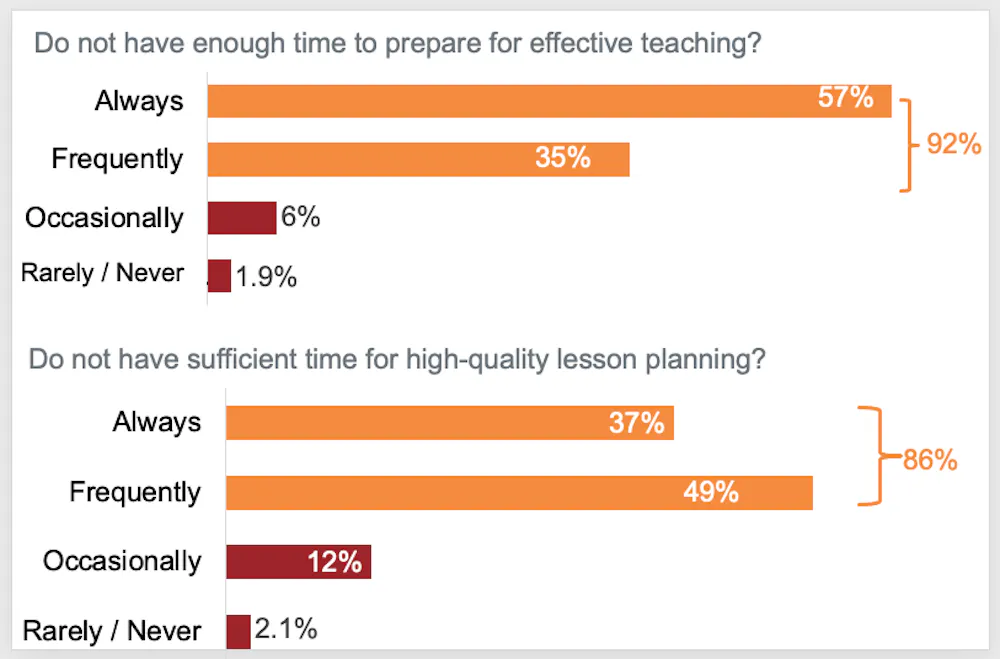
Almost all teachers (92%) in our study out today said they don’t have enough time to prepare effectively for classroom teaching – the core of their job.

The Grattan Institute surveyed 5,442 Australian teachers and school leaders across all states and territories, primary and secondary schools, and government and non-government schools. The survey was about teachers’ use of time.

Teachers told us they are too stretched to do everything we ask of them. When teachers aren’t supported to do their jobs well, teaching quality suffers and students lose out.

Beyond preparation for effective teaching, 86% of teachers reported they didn’t have time for high-quality lesson planning.

Teachers say they don’t have time to prepare well for lessons


2021 Grattan survey on teachers’ time, Author provided

Our findings consistently show many teachers feel overwhelmed by everything they are expected to achieve. One teacher told us:

[There is] not enough planning time to allow for how responsive we need to be to students’ needs.

Many teachers, especially at disadvantaged schools, said they get too little support to help struggling students.

And many teachers point to heavy requirements relating to writing reports, communicating with parents and supporting student welfare. One teacher said:

Administration time takes up most of planning time – such as communication to parents, newsletters, displays, notes, permission slips, phone calls and talking to students about well-being issues.

Teachers’ struggle with workload is not caused by a lack of effort – Australian teachers work hard. Census data show teachers in Australia work about 44 hours a week on average – much more than the 40 hours of general professionals.

Australian teachers’ working hours are high by international standards, too. OECD data show Australian secondary teachers work an average of 45 hours a week, compared to the international average of 40 hours.


Read more:
‘Exhausted beyond measure’: what teachers are saying about COVID-19 and the disruption to education


Our survey also found school leaders are aware of the pressure on teachers’ time, but feel powerless to do much about it.

We cannot expect each of the 9,500 schools around Australia to solve these challenges on their own. Governments must step up. Our report, Making time for great teaching, recommends governments adopt three reform directions.

1. Find ways other school staff can take on non-teaching work

Governments need to better match teachers’ work to their expertise. To do this, they should find better ways to use the wider schools workforce, including support and specialist staff, to help teachers focus on effective teaching.

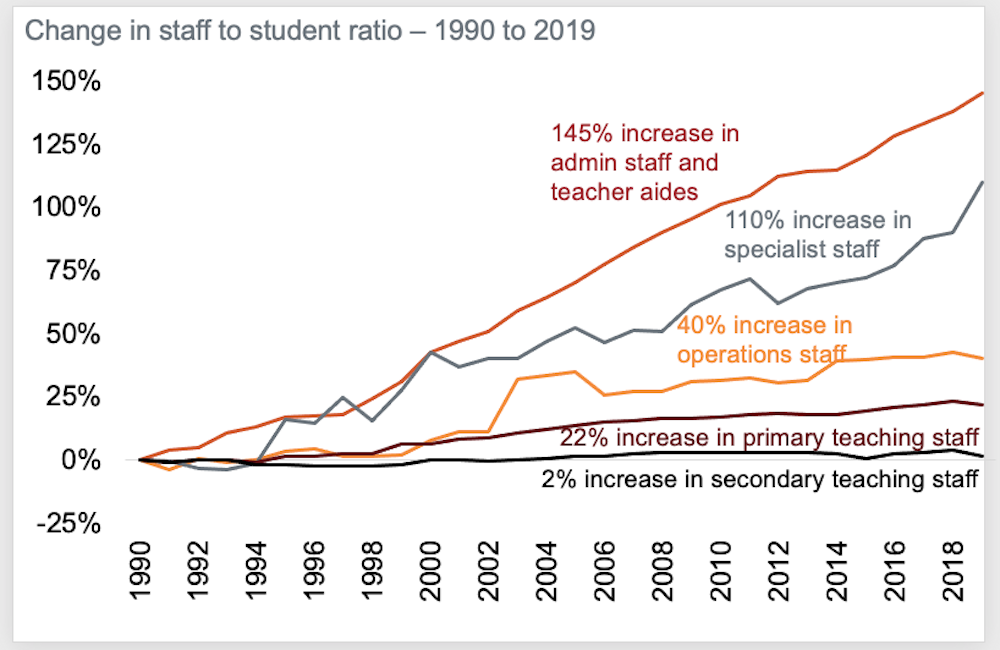
Significant numbers of support and specialist staff have been added to schools over the past few decades. But governments have not tracked the best way to deploy and use them well.

Administrative staff includes teacher aides and assistants. Specialist staff support students or teaching staff – this includes school counsellors and speech pathologists.
Grattan analysis of ABS 2020, Schools, Australia, 2019 (and previous years), Author provided

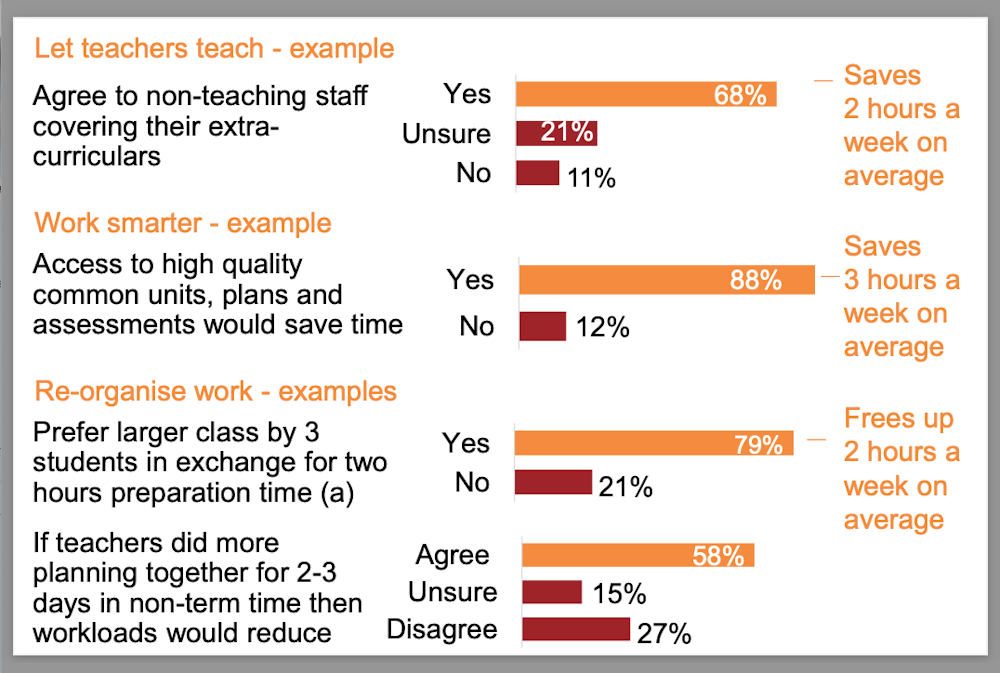
In our survey about 68% of teachers agreed support staff could cover their extra-curricular activities. We estimate this would free up an additional two hours a week for teachers.

2. Help teachers reduce unnecessary tasks

Teachers consistently say they feel overburdened by administration. Streamlining administration where possible is important. But there are also significant opportunities to improve how teacher time is spent on core teaching-related work.

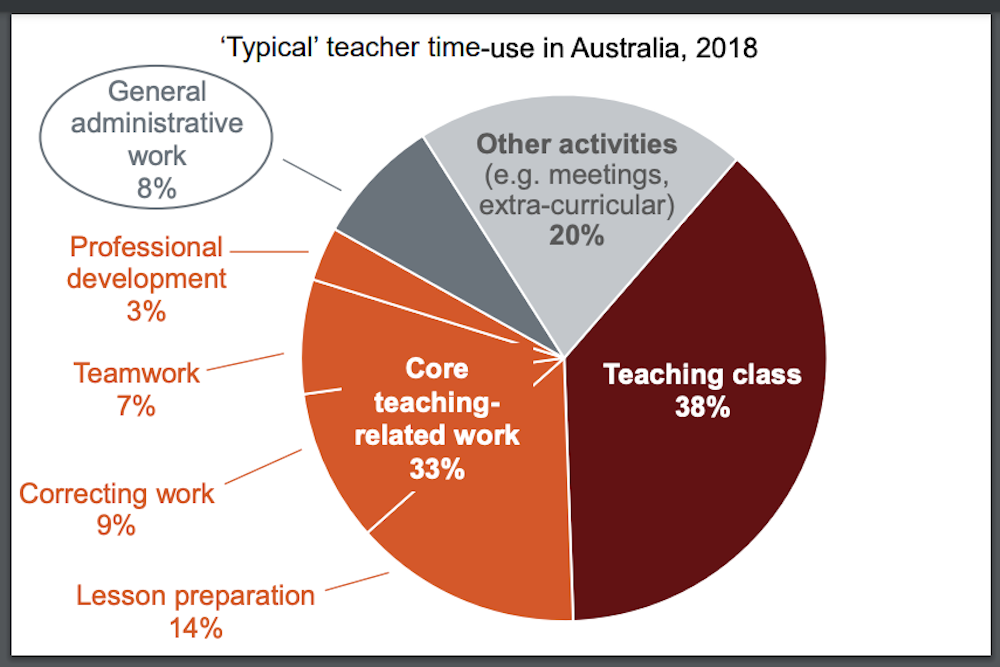
According to the OECD’s Teaching and Learning International Survey (TALIS), Australian teachers spend about one-third of their time each week on core teaching activities such as correcting student work, preparing for lessons, teamwork and professional development.

This is four times as much as the time spent on general administration (8%), so any improvements in core teaching work could potentially free up large amounts of time.

Teachers don’t spend enough time actually teaching

Lower secondary teachers in Australia. General administrative work includes communication, paperwork and other clerical duties. Percentages may not add up to 100 due to rounding.
Grattan analysis of OECD (2019), Author provided

Lesson preparation is one of the key activities teachers do weekly. Yet more than half of teachers say this involves a lot of searching for and creating their own curriculum unit and lesson plans, assessments and classroom resources. This work eats up a lot of time and is a significant barrier to teachers feeling prepared for the classroom.

Almost 90% of teachers agreed that having high-quality common resources for curriculum and lesson planning would help reduce their planning burden. This would free up an extra three hours a week.

3. Rethink how teachers’ work is organised

Policy decisions and industrial agreements shape the fundamental ways teachers’ work is organised in schools. For example, they set the number of face-to-face teaching hours required each week, the number of students in each class and expectations about the work teachers do during term breaks.

Governments should ensure school leaders have the flexibility to rethink teachers’ work in ways that open up more preparation time. For example, school leaders should have the flexibility to make small increases in class sizes (say by two to three students). Most teachers said they were in favour of slight increases in class sizes in exchange for two hours of extra preparation time each week.


Read more:
Making better use of Australia’s top teachers will improve student outcomes: here’s how to do it


School leaders should also have flexibility to schedule more structured preparation and planning activities in non-term time. In our survey 58% of teachers agreed working together for two or three extra days before each term could reduce their workloads during term.

Teachers agreed with several reforms

(a) answers to question about moving to larger classes are from primary school teachers only.
2021 Grattan survey on teachers’ time, Author provided

What next

Our report calls on Australian governments to commit to a $60 million program to investigate and pilot the concrete options, including those tested in our report, that create more time for great teaching. That investment would be a tiny fraction (less than 0.1%) of the $65 billion Australia’s governments spend each year on school. This is a small price to pay to improve the way our schools operate and ease the workload burden on teachers.

Making sure teachers have enough time for great teaching should be a national imperative.

The Conversation

We thank the Origin Energy Foundation for their generous support for this project.

Julie Sonnemann is also a Board Director of The Song Room, a not-for-profit organisation

Rebecca Joiner does not work for, consult, own shares in or receive funding from any company or organization that would benefit from this article, and has disclosed no relevant affiliations beyond their academic appointment.

ref. Teachers don’t have enough time to prepare well for class. We have a solution – https://theconversation.com/teachers-dont-have-enough-time-to-prepare-well-for-class-we-have-a-solution-175633

What the Ash Barty and ‘Special K’ tennis triumphs say about Australia and the buttoned-up sport industry

Source: The Conversation (Au and NZ) – By David Rowe, Emeritus Professor of Cultural Research, Institute for Culture and Society, Western Sydney University

Mark Baker/AP

The lead-up to the 2022 Australian Open was dominated by the unvaccinated top-ranked male tennis player Novak Djokovic’s ignominious deportation from Australia.

Djokovic’s absence prompted claims this would be an inferior Grand Slam. Enter the contrasting Australian tennis characters of Ash Barty and her supporting cast of Nick Kyrgios and Thanasi Kokkinakis to fill the vacuum.

Their respective wins in the women’s singles and men’s doubles suddenly turned the tournament into a very Australian story, swamping the nation’s media with celebratory headlines like “I’m so proud to be Aussie”: emotional Barty savours win for the ages.

Was this just the last big party of the Australian summer, or did it offer more enduring lessons for the country and sport?

What these wins mean for Australia

Sport is without question hugely important in Australian society, although its advocates are prone to exaggerate its nationwide appeal. Most Australians don’t engage in organised sport and only about half go to venues as paying spectators.

The majority watch some sport on television, although often only when a much-publicised event happens, like a woman’s singles final involving a compatriot like Barty.

Research has shown that heavy users of sports media exhibit variously higher levels of Australian patriotism, nationalism and “smugness”, while also tending to be less internationalist in outlook. So, after local success at the Australian Open, some Australians really will feel they live in the world’s greatest country.

Spikes in sport participation around major events are usually short-lived. Of more pressing concern is the capacity of sporting success (like that of Barty and the so-called “Special Ks”) to attract people from historically marginalised communities as sport participants.


Read more:
The numbers game: how Ash Barty became the world’s best female tennis player


This is especially important in individual sports like tennis where there are significant socio-economic barriers related to the cost of training, travel and equipment.

Barty’s middle-Australia background, growing up in the Queensland city of Ipswich, offers encouragement to budding tennis players who don’t go to expensive private schools. She is a key member of the current generation of champion Australian sportswomen, alongside footballer Sam Kerr and cricketer Meg Lanning, who are making major inroads into the male-dominated institution of sport.

That she is Indigenous and was photographed after her win with renowned Aboriginal sportswomen Evonne Goolagong Cawley and Cathy Freeman, projects a powerful message that sport is – or should be – for all.

Kokkinakis (who has Greek heritage) and Kyrgios (who is half-Greek, half-Malay)
had materially comfortable upbringings, but their unexpected success is a global projection of Australian multiculturalism.

The wildcard entrants geeing up a raucous crowd also symbolises a wider societal drift away from “stuffed shirt” institutions – including sport – in favour of freer, less regulated avenues of self-expression.

Nick Kyrgios, right, and Thanasi Kokkinakis, left.
Nick Kyrgios, right, and Thanasi Kokkinakis, left, were wild card entrants in the men’s doubles tournament.
Simon Baker/AP

A message for sport

Comparing the divergent public personae of Barty and Kyrgios, their successes perhaps suggest that professional sport as an industry should reconsider the way athletes choose to project themselves. Largely because of commercial sponsorship and endorsement considerations, they have been encouraged to be cautious, scripted and bland.

Many athletes prefer to use their own social media accounts to communicate directly with fans, avoiding journalistic scrutiny where possible in favour of self-advertisement.

In their different ways, both Barty and Kyrgios have bucked the trend. Barty has charted her own course through tennis, including dropping out for a while to play cricket. A determinedly unaffected “everywoman” who sips beer while watching the Australian Football League (AFL), she rarely uses the personal pronoun “I” or talks about herself in the third person. Barty prefers the collective “we” and constantly praises the large team, including family and friends, around her.


Read more:
‘The stars aligned’: Ash Barty’s Wimbledon win is an historic moment for Indigenous people and women in sport


Kyrgios has taken on the “bad boy” image pioneered by the likes of basketballer Dennis Rodman. Supremely talented but lacking the discipline of multiple Grand Slam winners such as Barty or Djokovic, he has carved out a niche as a volatile character whom crowds will come to watch.

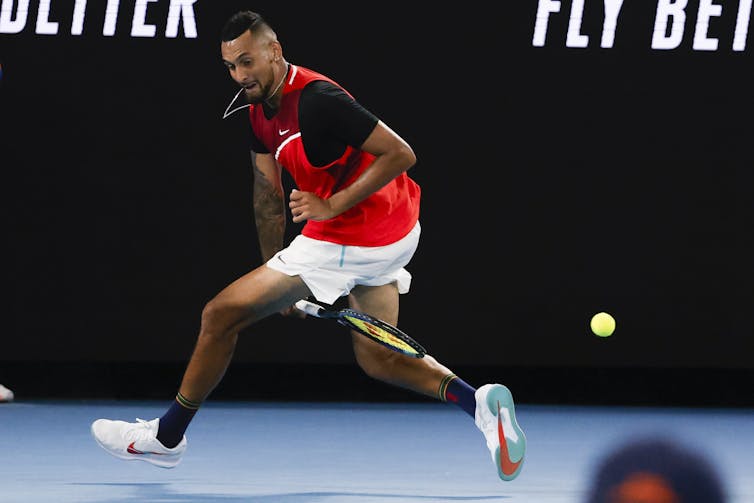
Nick Kyrgios plays a shot back between his legs.
Nick Kyrgios plays a shot back between his legs during his second round match against Daniil Medvedev of Russia.
Hamish Blair/AP

He puts on a show involving skilled tennis play, on-court rants and off-court rows. The message here for the media-sports cultural complex is there is room for both types of sport personality in today’s crowded “attention economy”.

In being true to themselves, both Barty and Kyrgios have put their mental health ahead of their sports careers at times.

As fellow tennis player Naomi Osaka has demonstrated, the sport-media machine can swallow and spit out those who do not protect something of themselves from the constant demand to reveal all in public.

Soon the 2022 Australian Open will be in the rear-view mirror, but its lessons for sport and society will remain perpetually in play.


Read more:
Nick Kyrgios on probation: can controversial athletes sell a sport or are they bad for the business?


The Conversation

David Rowe has received funding from the Australian Research Council for the Discovery Projects ‘A Nation of “Good Sports”? Cultural Citizenship and Sport in Contemporary Australia’ (DP130104502) and ‘Australian Cultural Fields: National and Transnational Dynamics’ (DP140101970).

ref. What the Ash Barty and ‘Special K’ tennis triumphs say about Australia and the buttoned-up sport industry – https://theconversation.com/what-the-ash-barty-and-special-k-tennis-triumphs-say-about-australia-and-the-buttoned-up-sport-industry-175993

Top economists expect RBA to hold interest rates low in 2022, as real wages fall

Source: The Conversation (Au and NZ) – By Peter Martin, Visiting Fellow, Crawford School of Public Policy, Australian National University

Wes Mountain/The Conversation, CC BY-ND

Australia’s leading forecasters expect the Reserve Bank to resist pressure to lift interest rates all year, despite rising interest rates overseas, much higher inflation, plunging unemployment, and financial market traders pricing in two hikes in the next six months.

The 24-person forecasting panel assembled by The Conversation also predicts:

  • weaker economic growth
  • much lower housing price growth
  • next to no growth in the Australian share market
  • little or no further inroads into unemployment
  • and wage growth so weak that real wages go backwards.

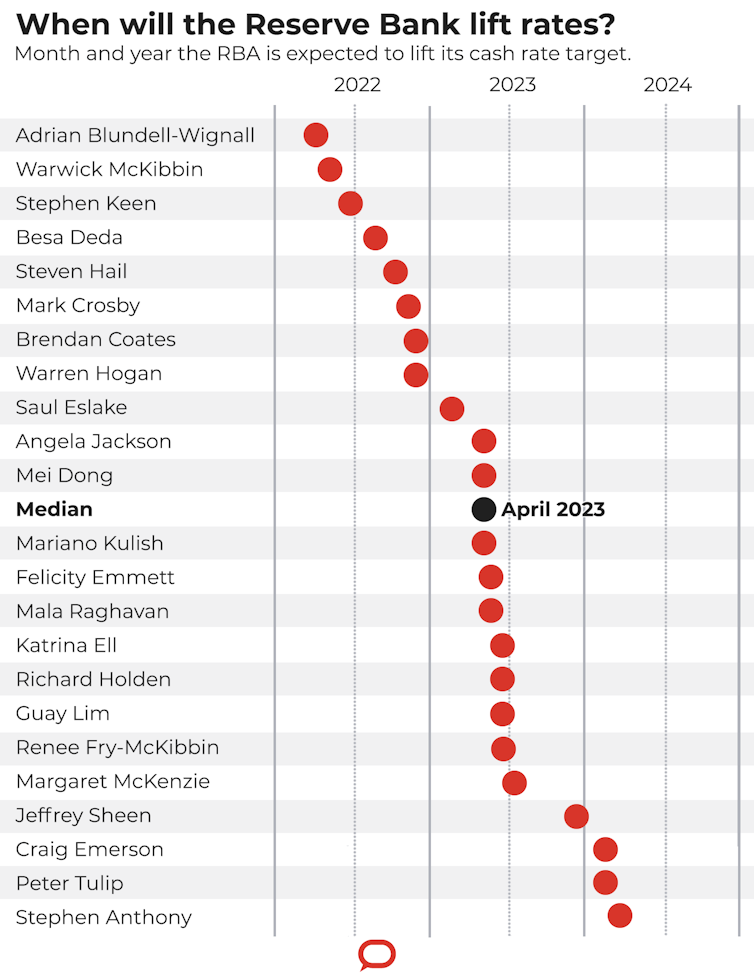
Two-thirds of the forecasting panel expect the Reserve Bank to leave rates ultra low until at least the first quarter of 2023, when it will have a better read on price pressure, wages and the jobs market.

Investors are banking on a different outcome.

Ahead of the Reserve Bank board’s first meeting for the year on Tuesday, securities exchange trading is pricing in an increase in the Reserve Bank’s cash rate from its historic low of 0.10% to 0.25% by June, followed by an increase to 0.5% by August, and two further increases to 1.0% by Christmas.


Read more:
Top economists see no prolonged high inflation, no rate hike in 2022


If that happened, it would leave mortgage rates higher than they were before COVID and before two years of ultra-low interest rates pushed up home prices 25%.

The Bank of England increased its cash rate from 0.1% to 0.25% in December and the Reserve Bank of New Zealand lifted its cash rate in October and November to 0.75%. A 40-year high in inflation is expected to force the US Federal Reserve to lift rates in March.

But China has moved in the other direction, cutting rates and imploring the rest of the world not to “slam on the brakes”.

On balance, no rate hike all year

Reserve Bank Governor Philip Lowe addresses the National Press Club on Wednesday.
Lukas Coch/AAP

Now in its fourth year, the Conversation survey taps the expertise of leading forecasters in 18 universities and financial institutions, among them economic modellers, former Treasury, OECD and Reserve Bank officials, and a former member of the Reserve Bank board. The panel was surveyed on January 20.

Eight of the panellists predict the Reserve Bank will begin lifting its cash rate this year. One, former OECD official Adrian Blundell-Wignall, expects the bank to begin lifting in March, ahead of the federal election.

But the bulk of those surveyed point to the bank’s target of achieving average inflation “sustainably within” its target band of 2-3% over time, noting that inflation has been well below that band for most of the past five years.

Governor Philip Lowe will outline his thinking after the first Reserve Bank board meeting of the year in an address to the National Press Club on Wednesday.
The panel expects him to suggest he will need to see more than a short-lived burst of higher inflation before he lifts rates.

The panel’s median (middle) forecast is for rate hikes to begin in April 2023. Three panellists, including Peter Tulip, a former research manager at the bank, expect no increase before February 2024.


The Conversation, CC BY-ND

Inflation not yet a problem

Although inflation has jumped to a four-decade high of 7% in the United States, and although Australia’s headline inflation rate has hit 3.5%, the so-called “underlying inflation rate” targeted by the Reserve Bank hasn’t yet reached the top of the bank’s 2-3% target band.

The panel’s average forecast is that it won’t reach it in 2022 or 2023, and that it will decline in 2023.


Made with Flourish

Real wages shrinking

But inflation is expected to be high enough to send real wages backwards, perhaps for two consecutive years – a first in the 25-year history of the wage price index.

In 2022 the panel’s average forecast is for wages growth of just 2.7% in the face of underlying inflation of 2.9%, pushing down real wages (buying power) 0.2%.


The panel expects wages growth to remain no higher than prices growth in the year that follows, despite historically low unemployment and labour shortages.

In 2023 it expects wages growth to do no better than underlying inflation at 2.8%.


GDP growth sinking

Economic growth is expected to sink. The panel expects the December 2021 bounce out of state lockdowns to be reported on March 2 to be followed by a March quarter impacted by something akin to “voluntary lockdowns”, as Australians restrict movements in response to Omicron.


Read more:
Why you might feel anxious after lockdown — and how to cope


Even as immigration and freedom of movement return, the panel expects economic growth to sink back towards 2.5%, which is roughly where it was before COVID and well below the 3-4% common in the 1990s and early 2000s.

Panellists pointed to “increasing social and political discord” and weaker demand from China, along with the “absence of any policies designed to lift productivity growth above dismal pre-COVID rates” as drags on growth, and identified government spending as one of the few supports.


The panel expects China’s economic growth to sink below US economic growth for the first time since the 1970s.

Mei Dong of the University of Melbourne said Chinese growth would suffer from a shrinking working-age population growth, declining employment participation, markedly slower productivity growth and a decision by Chinese authorities to de-emphasise GDP growth as an objective.


Spending held back

The broadest measure of overall living standards, real net national disposable income per capita, is expected to climb more strongly than real wages in 2022, reflecting growth in other sources of income including company profits.

Consumer spending is expected to grow by a healthy 3.7% in real terms, although by nowhere near as much as it would if the boost in saving during the COVID pandemic was fully unwound.


Household saving soared to an unprecedented 23.6% of income in mid-2020 amid concern about COVID, plunged down to a still-elevated 11.8% in mid 2021 after restrictions eased, and then soared again to 19.8% as Delta took hold.

The ratio is expected to remain at an elevated 12% throughout 2022, well above the few per cent common in the decades leading up to COVID, as households hang onto rather than spend income, uncertain about the future.

In December, Treasurer Josh Frydenberg spoke about the unusually high saving rate as a source of future spending, saying it was “a lot of damn money that’s been accumulated”. The panel’s forecasts suggest that accumulation will continue.


The panel expects non-mining business investment to grow strongly throughout 2022, although in response to budget measures rather than what economist Stephen Anthony describes as structural drivers moving in the other direction.

Panellist Mark Crosby says investment should slow towards the end of 2022 as the prospect of higher interest rates dents the construction industry.


Unemployment with a ‘4’, but not a ‘3’

Few of the panellists expect Australia’s unemployment rate to fall much below its present 4.2% in the two years ahead, despite what former ANZ economist Warren Hogan describes as the strongest labour demand Australia has ever seen.

He says the problem is the skills employers are looking for don’t match those of job-seekers and the workers likely to become available in the years ahead.

Janine Dixon says businesses are putting more people on their payrolls to cover sick leave and isolation leave, making it likely there has been an increase in underemployment.


In releasing the December budget update, Treasurer Frydenberg forecast “the addition of around one million jobs” between October 2021 and mid-2025.

It’s a projection broadly endorsed by the panel, although mainly because they believe that’s what population growth is likely to deliver.

Mark Crosby described it as a “pretty ordinary outcome given the rate of jobs growth seen prior to the pandemic”. Much would depend on migration. The more migrants, the more extra jobs.


Weaker home price growth

After a year in which national housing prices soared 22%, the panel is expecting more sedate growth of 6.5% in Sydney and 6.1% in Melbourne.

Katrina Ell of Moody’s Analytics believes the market has already peaked. She says mortgage rates will creep higher this year regardless of whether the Reserve Bank lifts official rates, and measures put in place by the Prudential Regulation Authority are starting to cramp investor interest.

Warren Hogan disagrees, seeing investors driving the next phase of the housing market. He says cashed-up upper middle to high income households will try to protect their wealth against rising inflation by buying real estate.


Subdued markets

In aggregate, the panel expects the exchange rate to stay broadly where it is at 71 to 72 US cents in 2022, and expects the ASX200 share price index to end the year about where it began, after climbing 13% in 2021 and sinking 9% in January.

They expect the iron ore price to fall from US$137 per tonne to US$98.


The panel:


This Conversation survey is the first not to include the views of Griffith University professor and former IMF and Treasury official Tony Makin who passed away suddenly in November, aged 66. His contributions were greatly valued.

The Conversation

Peter Martin does not work for, consult, own shares in or receive funding from any company or organisation that would benefit from this article, and has disclosed no relevant affiliations beyond their academic appointment.

ref. Top economists expect RBA to hold interest rates low in 2022, as real wages fall – https://theconversation.com/top-economists-expect-rba-to-hold-interest-rates-low-in-2022-as-real-wages-fall-175054

Vaccine inequity in the Pacific: ‘We need to support our neighbours’

By Eleisha Foon, RNZ Pacific journalist

Concern is growing around low covid-19 vaccine rates in the Pacific.

People in developing nations are generally missing out due to accessibility issues, a slow roll out of vaccines, difficulties getting to remote areas, a lack health of resources and misinformation resulting in vaccine hesitancy.

But ChildFund director of programmes Quenelda Clegg said developed countries need to support the Pacific and also stop hoarding vaccines.

The organisation has been raising awareness about vaccine inequity and the issues happening in the Pacific.

“We need to support our neighbours. They are having covid in their countries and we are starting to see those outbreaks,” she said.

“They do need more and there needs to be a continual supply to ensure they get their vaccinations up to double dose and they need to consider boosters and vaccinations for children.”

Papua New Guinea has some of the lowest vaccination rates in the world — only 3 percent of the population are double vaccinated.

Near 10 percent of Solomon Islanders have had two vaccine doses and in Vanuatu it is about 22 percent.

Samoa is 60 percent double vaccinated and Kiribati is 50 percent double vaxxed.

New Zealand supplies
“The New Zealand government has given a good supply to Indonesia and Papua New Guinea, but they have committed to sending more so we must ensure they do that and hold them to account,” Clegg said.

COVAX, the worldwide initiative aimed at equitable access to covid-19 vaccines, needed to do more, she said.

Kiribati is the only Pacific nation to be supported so far by COVAX, which is co-led by the Coalition for Epidemic Preparedness Innovations (CEPI), GAVI vaccine alliance, World Health Organisation and UNICEF.

She said some countries (but not New Zealand) were giving away vaccines when they were almost expired.

“The support to COVAX needs to be strategic and meaningful. It can’t be when they’re just about to expire.”

She warned new variants could emerge “from the Pacific, if we don’t do something now”.

This article is republished under a community partnership agreement with RNZ.

Print Friendly, PDF & Email

Article by AsiaPacificReport.nz

Mass eviction back on again near UPNG as police give green light

PNG Post-Courier

Deputy Police Commissioner Operations Anton Billie has given the green light for Papuan New Guinean police in the National Capital District to carry out a major eviction operation.

Settlers who have built their homes on land at the back of the University of PNG, bordering with Gerehu stage 3B and Morata stage one suburbs, will be forced to leave — if they do not comply with the court-ordered eviction notice handed out earlier.

Last week Deputy Commissioner Billie had stopped his men from carrying out the eviction because the court order was “not clear” and he feared that there could be legal repercussions for police involvement — especially with such a huge eviction operation involving many families.

The Post-Courier's front page report 26012022
The Post-Courier’s front page report on the stalled mass settler evictions earlier this week. Image: Post-Courier screenshot APR

On Tuesday, Billie was served a notice to rescind his decision by the proprietor of the land, Sixth Estate Limited, and on Wednesday, after seeking advice from his legal team, he gave the okay for the eviction exercise to start.

He explained to the Post-Courier newspaper the stop notice was to ensure that the eviction exercise was legally correct and everything was in order.

Civil issues must be clarified
“We have our own legal directorate and any civil issues in nature must be clarified first,” he said.

“This is basically to safeguard the police force and state because on numerous occasions we’ve been taken to court on issues like an eviction exercise done without proper consultation,’’ said Deputy Commissioner Billie.

“My decision was not intended to stop the court order but to get legal clarification into the matter at hand, which must be clarified by the legal team. And, after receiving clarification on the matter, I will let the police execute forthwith and without delay the eviction exercise.

“The eviction will be carried out anytime next week.”

Republished with permission.

Print Friendly, PDF & Email

Article by AsiaPacificReport.nz

Covid-19: Three more children among 12 latest deaths in Fiji

RNZ Pacific

Three more children have died from covid-19 in Fiji, taking the death toll since the pandemic hit the country in 2020 to 791.

The Fiji government also confirmed on Wednesday that a 10-day-old infant, 8-year-old girl and 13-year-old boy are among 12 covid-19 patients who have died.

There are 223 new cases in the community, with a total of 1980 patients in isolation.

Health Secretary Dr James Fong said all three children were from the Northern Division.

He said the baby had died at home before she could be taken to hospital.

He said the eight-year-old had a significant congenital medical condition that likely contributed to her death.

“The 13-year-old male was admitted for nine days at Nabouwalu Hospital in Bua before he passed away,” Dr Fong said.

“He had a significant congenital medical condition, and an assessment made by medical consultants confirmed that his pre-existing conditions contributed to his death. He was not vaccinated.”

Four-day intervals
Dr Fong said that due to the time required by clinical teams to investigate, classify and report deaths, a four-day interval is given to calculate the seven days rolling average of deaths, “based on the date of death, to help ensure the data collected is complete before the average is reported”.

“Therefore, as of January 20 the national 7-day rolling average for covid-19 deaths per day is 4.1, with a case fatality rate of 1.32 percent.”

Dr Fong said there were 155 covid-19 patients in hospital.

The Health Ministry also recorded nine more covid-19 deaths between January 8-22.

Latest deaths

* A 70-year-old man from the Northern Division died at home on January 14. He was not vaccinated.

* A 98-year-old woman from the Western Division died on arrival at Lautoka Hospital on January 16. She was fully vaccinated.

* An 81-year-old woman, also from the west, died at home on January 16. She was fully vaccinated.

* A 74-year-old man from the west died on arrival at Tavua Hospital on January 18. He had pre-existing medical conditions and was not vaccinated.

* A 75-year-old woman from the west died at home on January 20. She was fully vaccinated.

* A 72-year-old woman from the Central Division had died at home on January 21. She had pre-existing medical conditions and was fully vaccinated.

* A 46-year-old woman from the Western Division died at home. She was not vaccinated.

* A 78-year-old man from the Eastern Division died at home on January 21. He was fully vaccinated.

* A 79-year-old man from the Central Division had died on arrival at the Colonial War Memorial Hospital in Suva on January 22. He was fully vaccinated.

This article is republished under a community partnership agreement with RNZ.

Print Friendly, PDF & Email

Article by AsiaPacificReport.nz

Covid-19: Three more deaths in Solomons as outbreak ‘overwhelms’ health staff

RNZ Pacific

Three more people have died of covid-19 in Solomon Islands raising the national tally to five.

Health authorities confirmed the country’s first two deaths on Tuesday.

During a media conference last night, Health Minister Dr Culwick Togamana said the government was expecting more cases in the coming days.

He said community transmission was now widespread in the capital Honiara and some provincial areas.

“For the Western Province, a surge in flu-like illness was noted in Rukutu village where we suspect a recent gathering involving those who travelled from Honiara and may have transmitted covid-19.

“Our team has reached the village, distributed face masks, advised on covid-19 safe measures and collected samples for testing in Gizo.”

He said health officials were still waiting on lab results from Australia to determine the variant they are dealing with in the current outbreak.

Loss of staff a challenge
Dr Togamana said loss of staff had added challenges to the already overwhelmed health system.

More than 100 frontline workers in Solomon Islands have been infected with covid-19 and are isolating.

“Our only national referral hospital [Honiara] is now compromised. Many staff from the Ministry of Health also tested positive and continue to work from isolation,” he said.

“Guadalcanal health teams have also reported six of its workers isolated at Good Samaritan — four have tested positive while the remaining two await the results.”

Dr Togamana said 24 Honiara City Council health workers had also tested positive with covid-19.

This article is republished under a community partnership agreement with RNZ.

Print Friendly, PDF & Email

Article by AsiaPacificReport.nz

Reunifying First Nations families: the only way to reduce the overrepresentation of children in out-of-home care

Source: The Conversation (Au and NZ) – By BJ Newton, Senior Research Fellow in Social Policy and Social Work, UNSW

Getty Images

We are edging closer to another anniversary of Kevin Rudd’s National Apology to the Stolen Generations on February 13.

At the time of the National Apology in 2008, there were 9,070 Aboriginal and Torres Strait Islander children in out-of-home care in Australia. Today, that number has increased to approximately 18,900, with First Nations children representing more than 40% of all children in out-of-home care.

The Family Matters Report led by SNAICC estimated that by 2030, the number of First Nations children in out-of-home care will more than double again without “profound and wholesale change to legislation, policy and practice”.

Australian governments are responding to this crisis at both the national and state levels. One of the Closing the Gap targets is to reduce the number of First Nations children in out-of-home care by 45% by 2031.

Most recently, the national framework for supporting Australia’s children prioritises addressing the overrepresentation of First Nations children in out-of-home care.

Likewise, all states and territories in Australia are also focusing on “permanency” outcomes to reduce the number of children living in out-of-home care.


Read more:
First Nations families need support to stay together, before we create another Stolen Generation


Permanency policies

Permanency refers to recent changes in child protection legislation, policies and casework practice aimed at providing all children in care with a permanent, safe and stable home throughout their childhoods.

Permanency policies appear to be motivated by the best interests of children, but moving Aboriginal children to permanent care orders has a range of benefits for the state. Not only does it appear progress is being made towards reducing overrepresentation in out-of-home care, it also absolves child protection departments of any further financial, practical or moral responsibility to these children or their families.

Of significant concern is these permanency policies do not necessarily mean these children will return to their families. Rather, it means many will move out of the care system through guardianship or adoption.

Under permanency policies, parents must prove within two years of their child’s removal they can address the child protection department’s safety concerns for their child, otherwise these other options will be pursued.

Aboriginal community-controlled organisations and advocates strongly oppose permanent care orders that result in the adoption of First Nations children or their guardianship by non-Aboriginal carers. They also argue this two-year timeframe is unrealistic for parents struggling to navigate a range of interpersonal, social and bureaucratic systems to meet the department’s requirements to have their children returned.

Child reunification (also called restoration) is the process of returning children to their parent or caregiver from out-of-home care following a statutory removal. Across all states and territories in Australia, reunification is the preferred policy pathway for children exiting out-of-home care.

However, this is not reflected in child protection statistics, which show the number of exits to guardianship orders increasing from 18,919 children in 2017 to 21,523 in 2020.

In addition, of the 10,612 Aboriginal and Torres Strait Islander children for whom restoration was a possibility in 2019-20, only 14.8% were returned home.


Read more:
Thirteen years after ‘Sorry’, too many Aboriginal and Torres Strait Islander children are still being removed from their homes


First Nations families are set up to fail

Current approaches to child reunification come from a perspective where parents are blamed for the problems leading to a child’s removal and preventing their return home. Their perceived failings are considered instead of the external factors that prevent children from returning to their families (and indeed contributed to their removal in the first place).

For example, research for the Australian Housing and Urban Research Institute examined the intersections between housing and domestic and family violence experienced by First Nations women. This research found homelessness and insecure housing played a significant role in preventing reunification for children who had been removed from their mothers.

Government departments also need to be held accountable when bureaucratic processes and poor decision-making prevent or delay children’s return home.

The 2019 Family is Culture Review found a restoration rate of 17.5% of the 1,318 Aboriginal children taken into care in NSW in 2015-16. The review noted this rate could have been much higher if the NSW Department of Communities and Justice explored the possibility of more families being reunited in these cases and worked towards that goal.

Instead, children remained in out-of-home care or were moved to other permanency orders.

The review cited unclear reunification processes for these families. Parents were often dismissed and discriminated against by child protection services, and there was also as a pattern of mothers being too scared to report domestic violence for fear of having their children taken away.

The review also found impossible goals are set by child protection services for parents living with disability and disadvantage.

Inaccessible and inappropriate services are also barriers to parents achieving their reunification goals in the timeframes. These include securing housing or undergoing a mental health or rehabilitation treatment program, for which waitlists can be very long.

The National Apology was delivered to the many thousands of First Nations peoples impacted by the genocidal protection and assimilation policies that dominated the 20th century in Australia. We like to think these harmful policies are behind us, but they have merely shifted to the guise of promoting a “permanent home for life” for Aboriginal children.


Read more:
Stolen Generation redress scheme won’t reach everyone affected by the policies that separated families


If governments are truly committed to reducing the number of Aboriginal and Torres Strait Islander children in out-of-home care in a way that meets the needs of families and communities, then a whole-of-system approach is needed.

Parents cannot be expected to manage complex social and structural factors beyond their control. These external challenges should not keep children separated from their parents.

The focus on reducing the overrepresentation of Aboriginal and Torres Strait Islander children in out-of-home care needs to shift. We need not be preoccupied with the number of children who leave care, but rather the ultimate goal of increasing the number of children returning home.

The Conversation

BJ Newton receives funding from the Australian Research Council to lead the research project ‘Bring them home, keep them home: charting the experiences, successful pathways and outcomes of Aboriginal families whose children have been restored from Out-of-Home Care’. Aboriginal community-controlled organisations and AbSec partner on this research.

ref. Reunifying First Nations families: the only way to reduce the overrepresentation of children in out-of-home care – https://theconversation.com/reunifying-first-nations-families-the-only-way-to-reduce-the-overrepresentation-of-children-in-out-of-home-care-175513

Go low, go slow: how to rapid antigen test your kid for COVID as school returns

Source: The Conversation (Au and NZ) – By Margie Danchin, Paediatrician at the Royal Childrens Hospital and Associate Professor and Clinician Scientist, University of Melbourne and MCRI, Murdoch Children’s Research Institute

Shutterstock

Many parents across Australia will be COVID testing their kids at home using rapid antigen tests (RATs), as school returns across many states next week.

The Victorian and New South Wales governments strongly recommend twice-weekly testing of school students and staff.

This may be challenging for many parents, especially if their child has developmental or behavioural difficulties.

So, how can you safely perform a RAT on your child at home and help them to engage in the process?

Preparing for the test

As with vaccination, the key to performing the test successfully is preparing the child well and explaining what will happen, to give them some control over the situation and to minimise anxiety.

Sit down and talk with your child and explain:

  • they will need to do a RAT in the morning twice a week (if in Victoria or NSW). It wont be forever, but will be needed for the first four weeks of school, at least

  • they can go to school if the test is negative

  • and that all their friends will be doing it as well.

It doesn’t need to be scary or painful. With the right technique, you’ll be able to perform this test quickly and safely at home, or allow your child to do it themselves if they can.

In general, give yourself about 20 minutes, and remember not to rush the process the first few times you do it with your child.

It would help to show your child a video, like the one below, on how it’s done as you familiarise yourself with the instructions.

There’s no need to downplay the experience by saying “it won’t hurt”. Acknowledge it may be a little uncomfortable. Explain you’ll do it together and they can show you how they would like it done for them. You may like to practice with a small cotton bud prior to using the actual RAT kit, either with them or another adult.

How to do a rapid antigen test at home with your child.

How to perform the test

First, lay the kit out on a table with the swab packet ready to be opened, the liquid solution tube and caps, and the test device.

For a nasal swab test, begin by blowing their nose and washing your hands. Then rest their head on a chair with a headrest, or on a pillow on the sofa where they can rest comfortably. In younger kids, you can have them sitting on your lap with their head resting on the fold of your elbow.

The swabbing hand holds the swab like a pencil, with the rest of your hand or little finger on their cheek, upper lip or chin, as if you’re about to draw a moustache on their face. This will help stabilise the swab in case the child suddenly moves or sneezes.

They key is to aim the swab low (flat against the bottom of the nasal passage) in the nose and go in slow.

Many people have a crooked nasal septum, which is the wall dividing the left and right of the nose, meaning there may be more room on one side of the nose than the other. There’s also much more room lower down the nose, and going too high and too fast will cause discomfort.


Read more:
How to talk to your child about a COVID diagnosis … and share the news with others


Think low and slow and aim down and back, rather than up high. This will reduce pain and allow more time for the swab stick to capture as much material as possible, thereby increasing the likelihood of a more accurate test.

Insert the swab about 1–2 cm into the nose and rotate it for 15 seconds, or about 4–5 times. Repeat on the other side. Never push against a hard resistance which may cause pain.

Then, dip the swab tip into the liquid solution, giving the tube a good squeeze and mix for about 15 seconds before closing the lid and then dropping the solution into the well on the test tray. Discard the swab stick carefully. Wash your hands and wait. Most test kits require 15 minutes, but please follow the instructions for your particular brand.

Person using a rapid antigen test for COVID
Remember to carefully check your test’s instructions.
Shutterstock

Congratulate your child on doing a great job! We want this to be a positive experience for them as it’ll be part of our routine for a while.

After having this done a couple of times, some kids may prefer to do this themselves. Giving them autonomy and the knowledge that it’s not painful or scary will be empowering. Believe it or not, they may even start to think of it as quite fun if it doesn’t hurt.

What about saliva tests?

Saliva liquid tests are different altogether.

They’re not a throat swab. They may require a short period of fasting, depending on the kit, up to 30 minutes of no food or drink prior to the test.

The child will have to learn to do a few deep coughs into a closed mouth and then either express their saliva into a container or to have a lollipop device which they suck on.

The timing on reading the result is also dependent on the brand.

RATs aren’t the only way to minimise transmission

No matter how well you do it, some children will find this harder than others. We understand that. But honest education and practice runs will help the vast majority of kids.

The key is planning, discussion, watching videos and attempting to make it a bit fun to try and take away some of their anxieties. Demonstrating the test on an adult may also help.

Of course, RAT testing isn’t the only way to try and minimise COVID cases at school. There will be a range of other strategies that kids will be asked to do.

This includes vaccination, wearing masks inside and potentially some outdoor learning.

Changes are being made to improve ventilation in schools by installing air-purifiers, especially in high-risk areas in schools such as sick-bays and canteens, and trying to install shade sails for outside learning.

There’s a huge push to get as many kids as possible to receive one dose of vaccine before schools starts. Over 30% of primary kids in Victoria have had one dose, with the aim to reach over 80% by mid-February. There will also be pop-up clinics at some schools in the next few weeks.

The dose interval for children at higher risk of COVID (including those with some underlying medical conditions) has been shortened from eight to three weeks in the context of ongoing community transmission to ensure vulnerable kids are prioritised.

Booster doses for teachers are also critical.

There’s much to do to support teachers, families and children, especially medically vulnerable kids, to make schools as safe as they can be. It’s important to prioritise face-to-face learning to maximise the education, well-being, and mental health of our kids.


Eric Levi, Consultant ENT Surgeon at St. Vincent’s Hospital and The Royal Children’s Hospital Melbourne, co-authored this article.

The Conversation

Margie Danchin receives funding from the Victorian and Commonwealth Departments of Health, NHMRC, DFAT and WHO. She is chair, Collaboration on Social Science and Immunisation (COSSI). This article is co-authored with thanks to Dr Eric Levi, FRACS, MBBS, B.Sc, PGDipSurgAnat, MPH&TM, Specialist Otolaryngologist Head & Neck Surgeon, RCH, Melbourne.

ref. Go low, go slow: how to rapid antigen test your kid for COVID as school returns – https://theconversation.com/go-low-go-slow-how-to-rapid-antigen-test-your-kid-for-covid-as-school-returns-175615

Have you stopped wearing reusable fabric masks? Here’s how to cut down waste without compromising your health

Source: The Conversation (Au and NZ) – By Aleasha McCallion, Strategic Projects Manager, Monash Sustainable Development Institute, Monash University

Shutterstock

At the beginning of the pandemic, many of us opted to buy reusable fabric masks to help fight the spread of COVID – they’re better for the environment than disposables, can be locally made, and come in a range of creative designs.

But since the highly infectious Omicron variant emerged, we’ve been urged to wear well-fitted respirator mask as a first choice (N95, KN95, or P mask). These, however, have a short shelf-life, and it may be jarring to switch back to a more wasteful product for many environmentally-minded Aussies.

While it’s too soon to say exactly how many disposable masks go to landfill in Australia, we do know textile waste is already a massive issue. Every year, each Australian throws away around 23 kilograms of clothes on average, with more than 780,000 tonnes of leather, rubber and other textile waste generated Australia-wide.

As waste generation is likely to increase as we protect ourselves against Omicron, are there ways we can minimise our waste without compromising our health?

Making the most out of masks

Australians have been advised since mid-2020 that N95 masks offer the best protection against coronavirus. They typically offer a tighter fit to the face and a higher level of filtration than fabric masks, protecting the wearer from aerosols and droplets.

But supply chain issues, concerns of shortages, and lower transmission rates of earlier variants meant the comparatively less effective fabric and surgical masks were fit-for-purpose in lower-risk settings. This is no longer the case under the Omicron variant.

An easy way to minimise waste if you own N95 masks is to safely extend their life. In hospital settings, it’s advised to avoid use beyond one day and to dispose if they become soiled or moist.

This, however, is not realistic for the general public, such as when supply is low. There are a range of methods to reuse N95 masks safely, which are supported by the mask’s inventor. There are also re-usable options such as elastometric respirators.


Read more:
Time to upgrade from cloth and surgical masks to respirators? Your questions answered


For disposable respirators, the most straightforward reuse method in non-medical settings is to rotate your mask every three or four days, storing it in a clean paper bag when not in use. Wash your hands thoroughly before and after you touch your mask, and keep your mask dry – if your mask gets wet, stop using it. Consider numbering your masks so you don’t mix them up.

The US Centre for Disease Control and Prevention (CDC) recommends using N95s up to five times before throwing it away (if they’ve been kept clean and aren’t damaged). But it’s important to note the long-term effects of cleaning and reuse are still unknown.

How to safely reuse your N95.

There’s no need to throw away fabric masks. Having your favourite fabric masks on hand as backup in your car, bag or pockets is important because any mask is better than no mask in low-risk and fleeting contact settings, such as outside.

Double masking – placing your fabric mask over a disposable surgical mask – offers increased protection compared to a single fabric or surgical mask. And fabric masks will also offer protection against other droplet-based diseases, like the flu.

Sustainability in healthcare

The surge in disposable mask waste points to a broader issue that’s getting increasingly recognised: hospital waste.

Take single use plastic hospital gowns, for example. An estimated 1 million gowns have been used each year of the pandemic at just one (of six) acute public hospitals in Victoria, according to an ongoing investigation undertaken by co-author Forbes McGain.

This number is a conservative estimate, and only captures public hospitals when we know disposal gowns are used in many other settings. This includes in private hospitals, aged care, residential and home care, allied health services and testing and vaccination centres.

Environmentally sustainable healthcare is an emerging field aimed at finding alternative solutions to the waste generated in healthcare, its impacts on the environment, and how we educate health professionals on sustainable practices.

For example, research shows there’s potential to expand the “tiered approach”, which offers further choice of protection depending on low or high risk settings. For example, integrating reusable gowns when appropriate could help keep people safe, put less strain on supply systems, and help reduce waste.


Read more:
Health care has a huge environmental footprint, which then harms health. This is a matter of ethics


Spearheading this effort is textile scientist Meriel Chamberlin, who is collaborating with clinicians to develop compliant, safe and reusable textile gowns that offer protection and comfort with a lower environmental impact than disposables.

When it comes to masks, more sustainable options are also being developed. This includes masks and filters made from biodegradable agricultural crop waste.

Research is also underway to identify processes for re-purposing discarded single-use face masks into road pavements materials.

Floral cloth mask
Wearing reusable cloth masks to protect against COVID is no longer advised, but it’s worth holding onto them as a back up.
Liza pooor/Unsplash, CC BY

Six ways to offset our daily waste

Even during a pandemic, people don’t want to be wasteful. Tellingly, “Plastic Free July” saw a huge global increase in participation from 250 million participants in 2019, to 326 million in 2020.

There are many ways to reduce waste without compromising your health. The key is to focus on behaviours within your control, such as minimising single-use plastics. To help offset your daily waste from disposable masks, consider:

  1. making the switch to refillable cleaning products to cut down on single-use packaging (there are even delivery options)

  2. if you’ve shifted to online grocery delivery, choose paper over plastic bags and either reuse them at home or compost them after use

  3. when dining at home, repurpose your leftovers, prioritise older food, and avoid over-buying to cut down on food waste

  4. if you’re shopping online more, find second-hand retailers and peer-to-peer platforms to give pre-loved items a new life (there are delivery options for this too)

  5. before throwing away household items (clothing, furniture), try selling or giving them away online – you’d be surprised what other people find useful

  6. if your household items are damaged, get them repaired, or use them for a different purpose, such as using well-worn clothes as cleaning rags.

Just because we’re in a period of significant social change, doesn’t mean we have to lose momentum on sustainability.


Read more:
Avoiding single-use plastic was becoming normal, until coronavirus. Here’s how we can return to good habits


The Conversation

Forbes McGain is currently undertaking collaborative research via two UniMelb/Western Health grants on: how to extend the use of barrier/infection control gowns, and developing a reusable face mask. He has also received grants from NHMRC, MRFF, ANZCA (college of anaesthetists), CICM (college of intensive care medicine), and is actively involved with Doctors for the Environment Australia.

Aleasha McCallion and Kim Borg do not work for, consult, own shares in or receive funding from any company or organisation that would benefit from this article, and have disclosed no relevant affiliations beyond their academic appointment.

ref. Have you stopped wearing reusable fabric masks? Here’s how to cut down waste without compromising your health – https://theconversation.com/have-you-stopped-wearing-reusable-fabric-masks-heres-how-to-cut-down-waste-without-compromising-your-health-175243

Politics with Michelle Grattan: Tanya Plibersek on parents’ role in reducing violence against women

Source: The Conversation (Au and NZ) – By Michelle Grattan, Professorial Fellow, University of Canberra

As election year opens, Michelle Grattan speaks with Tanya Plibersek, Labor’s spokeswoman on education and women, about the opposition’s agenda in these two critical areas.

Violence against women is one of our society’s most pressing and intractable issues, and front and centre for Plibersek, who says there is a way to do better.

“We do know so much about what we can do to reduce risks of violence in interpersonal relationships. And of course, it starts with our youngest Australians,” she says. We “need to rely much more on parents to model healthy relationships in the home.”

“It disturbs me that the rates … of domestic violence don’t seem to be coming down and in fact, one of the few areas of crime where statistics continue to go up are areas like sexual assault. So we need to do better at prevention. We need to do better at policing and in our justice system.”

Despite these negatives, Plibersek sees last year’s March4Justice and increased public and media awareness as signs “things are changing, that our society is changing in a way that is, I hope, unstoppable.”

On education, Plibersek talks through the detail of Anthony Albanese’s announcement of $440 million for schools for improvements such as better ventilation and also for mental health and wellbeing initiatives for kids, so hard hit during the pandemic.

As university fees are set to rise for many students this year, Plibersek has said that under a Labor government Australians can expect “a commitment to a fundamental overhaul of our university sector”.

She says she wants to “make sure that every young Australian who is prepared to work hard and study hard can get a place at university and that no one’s discouraged because of the fees”. But although highly critical of the government’s controversial new fees structure Plibersek cannot give a commitment a Labor government would change it quickly. That would need to be worked through with the universities, she says.

The Conversation

Michelle Grattan does not work for, consult, own shares in or receive funding from any company or organization that would benefit from this article, and has disclosed no relevant affiliations beyond their academic appointment.

ref. Politics with Michelle Grattan: Tanya Plibersek on parents’ role in reducing violence against women – https://theconversation.com/politics-with-michelle-grattan-tanya-plibersek-on-parents-role-in-reducing-violence-against-women-175907

With male imperial descendants dwindling, will Japan’s leaders finally accept a female emperor?

Source: The Conversation (Au and NZ) – By Masafumi Monden, Lecturer in Japanese Studies, University of Sydney

KYDPL KYODO/AP

Princess Aiko, the only child of Japan’s Emperor Naruhito and Empress Masako, came of age last month as she turned 20. Despite her royal lineage, Aiko may never ascend to the throne.

Japanese consistently tell poll after poll they would be happy with a female emperor or an emperor descended from the female line. But Japanese imperial household law forbids this – and despite succession in the male line hanging by a thread, it doesn’t look like it’s changing anytime soon.

A history of female emporers

A sculpture of Queen Himiko.
A sculpture of Queen Himiko at the Osaka Prefectural Museum of Yayoi Culture.
Wikimedia Commons

The Kōshitsu tenpan 皇室典範 (or imperial household law) only allows men to ascend to the throne. But this law prohibiting female emperors dates back only to the Meiji period in 1889 when Japan had reopened to the West and modelled its new government on Prussia, which had banned emperors of female descent.

Before then, Japan was no stranger to female emperors. The very first ruler of Japan we know by name was the Shamaness-Queen Himiko in the third century. She brought peace to Japan after a long period of war, dispatched several diplomatic missions to China and, according to Chinese sources, was even succeeded by another female ruler.

Empress Go-Sakuramachi.
Wikimedia Commons

After vanishing from Japanese history for centuries, Himiko’s memory is now experiencing something of a golden age, reappearing in everything from manga to mascots.

Since Himiko, at least eight women have reigned as emperor in Japan. The first was in the year 592; the last to occupy the throne was Go-Sakuramachi, who reigned from 1762 to 1771.

Reform proposals don’t go far enough

In 2005, the modern ban on female succession looked likely to be scrapped under then-Prime Minister Junichiro Koizumi.

But while the debate was actually underway in the Diet (Japan’s parliament), the news broke that Prince Akishino – Naruhito’s younger brother – and Princess Akishino were expecting another child.

Reform ground to a halt. And when Prince Hisahito was born, becoming the first new male member of the imperial family in nearly 41 years, the whole debate was placed on the back burner.

But the problem hasn’t gone away. No more male babies have been born since, and every time a female member of the imperial family marries a commoner, they lose their royal status. The former princess Mako, the elder daughter of Prince and Princess Akishino, was the last to do so. She’s just moved to New York with her husband, Kei Komuro, a law clark.

In December, a Japanese government panel put forward two proposals to address the slowly dwindling number of male heirs to the throne:

  • allow princesses who marry commoners, like Mako, to retain their status as working members of the royal family

  • allow males from Japan’s old princely families (who had lost all status after the second world war) to be adopted into the imperial family.

These are only proposals, and it’s anyone’s guess whether they will be taken forward. Even if they are, there are pitfalls.

Many of these former princely families, for example, have themselves died out since the war. Plus, there is a strong argument the Constitution (which forbids discrimination on the basis of family origin) makes it impossible to restore royal status to the few princely families that remain.

And even if reforms are put in place to allow women in the imperial family to retain their royal status when marrying out, the government is not contemplating granting such status to their spouses or children. Doing so could pave the way for female monarchs or female-line emperors, which traditionalists staunchly oppose.

Some die-hard traditionalists even claim the existence of a special Imperial “Y” chromosome carried generation after generation in the male line dating from the first emperor, Jimmu, around 700 BC. Allowing a child of Aiko’s to ascend to the throne would sever this magic thread and raise questions about the legitimacy of the imperial family, they argue.

Revisiting the ban on female succession, meanwhile, has not been broached again since 2005.

Former princess Mako (left) and her husband, Kei Komuro.
Former princess Mako (left) and her husband, Kei Komuro, en route to New York last year to start their new lives.
Ryo Aoki/Yomiuri Shimbun/AP

What the public thinks

Princess Aiko is striking a more restrained and personal note. Rather than spending a large amount of money on a new tiara during her recent coming of age ceremonies in December, she chose to wear an old one belonging to her aunt, Sayako.

Borrowing the old tiara is said to have been Princess Aiko’s idea, given the economic hardship of the Japanese people amid the pandemic.

Meanwhile, Crown Prince Akishino, now second in line to the throne after his brother, is less popular in the public eye. Akishino’s spending of 4.3 billion yen (over A$50 million) on home renovations, together with the scandal around his daughter Mako’s marriage to Komuro were not well-received.

This has contributed to a swing in public sentiment on the idea of female succession. A recent survey showed 85% of Japanese were in favour of a female emperor and more than 80% would actually rather Princess Aiko be the next emperor.

This is a huge shift since the scant 35% of people who supported the idea of a female emperor when a similar survey was conducted in 1999.

Princess Aiko with her parents.
Japan’s Emperor Naruhito, Empress Masako (left) and their daughter Princess Aiko.
Imperial Household Agency/AP

Keeping the ban on female descent is increasingly difficult to justify. Japan ranked 120th out of 156 countries in the World Economic Forum’s global gender gap report in 2021, worst among the G-7 countries. Despite legislation being passed in 2018 to promote female political representation, recent elections in the Diet Lower House actually saw female representation fall, and there are only three women in Prime Minister Fumio Kishida’s 20-member cabinet.

This coming spring, young Prince Hisahito starts high school. As the system now stands, he can’t make any choices about the rest of his own life – regardless of what he and his cousin Princess Aiko may actually want, or their nation prefer.

The Conversation

Masafumi Monden does not work for, consult, own shares in or receive funding from any company or organisation that would benefit from this article, and has disclosed no relevant affiliations beyond their academic appointment.

ref. With male imperial descendants dwindling, will Japan’s leaders finally accept a female emperor? – https://theconversation.com/with-male-imperial-descendants-dwindling-will-japans-leaders-finally-accept-a-female-emperor-174867

A rogue rocket is on course to crash into the Moon. It won’t be the first

Source: The Conversation (Au and NZ) – By Alice Gorman, Associate Professor in Archaeology and Space Studies, Flinders University

Bettmann / Contributor

In a few weeks’ time, a rocket launched in 2015 is expected to crash into the Moon. The fast-moving piece of space junk is the upper stage of a SpaceX Falcon 9 rocket which hoisted the Deep Space Climate Observatory satellite off our planet. It has been chaotically looping around Earth and the Moon ever since.

Asteroid-hunter Bill Gray has been keeping tabs on the 4-tonne booster since its launch. This month he realised his orbit-tracking software projected the booster will slam into the lunar surface on March 4, moving at more than 9,000 kilometres per hour.

The booster is tumbling wildly as it travels, which adds some uncertainty to the timing and location of the predicted impact. It is likely to occur on the far side of the Moon, so it won’t be visible from Earth.

Some astronomers say the collision is “not a big deal”, but to a space archaeologist like me it’s quite exciting. It will be the Moon’s newest archaeological site, joining more than 100 other locations that document human activity on the Moon and in cislunar space.

A history of crash landing on the Moon

The impact will leave a new crater on the dark side of the Moon.

The very first human-made artefact to make contact with the Moon was the Soviet Luna 2 in 1959 – an extraordinary feat, as it was only two years after the launch of Sputnik 1, the first artificial Earth satellite.

The mission consisted of a rocket, a probe, and three “bombs”. One released a cloud of sodium gas to enable the crash to be seen from Earth. The USSR didn’t want the groundbreaking mission to be called a hoax.

The other two “bombs” were spheres of pentagonal medallions inscribed with the date and Soviet symbols. If they exploded as planned, they would have scattered 144 medallions over the lunar surface.


Read more:
Tardigrades: we’re now polluting the moon with near indestructible little creatures


Other crashes have been missions gone wrong, like the Israeli Beresheet lander in 2019. This was especially controversial as the lander carried a secret cargo of dried tardigrades, tiny creatures that could be revived in the presence of water.

Various spacecraft have naturally decayed and fallen out of orbit, like the Japanese relay satellite Okina in 2009. Others have been intentionally crashed at the end of their mission life.

The NASA Ebb and Flow spacecraft were deliberately crashed into the lunar south pole in 2012, specifically to avoid any risk of damaging the Apollo landing sites. Impacting at a speed of 6,000km per hour, they left craters 6 metres across.

The upper images show the landscape before impact and the lower images show the craters and the dark ejecta.
NASA

Many crashes have been used to collect seismic data. Observations from the controlled impact of Saturn third-stage boosters and ascent modules from the Apollo missions were particularly valuable, as timing, location and impact energy were known.

Environmental impacts

The Falcon 9 rocket stage is significantly larger than the tiny Ebb and Flow spacecraft and is travelling faster. The crash will make a much larger crater, which will kick up chunks of rock and dust. On this airless world, the dust could travel a fair way before settling down.

The only other spacecraft on the Moon’s far side are the US Ranger 4 probe, which crashed in 1962, and China’s Chang-e 4 lander and Yutu-2 rover. Yutu-2 is still trundling along the lunar surface on its six wheels.

Yutu’s latest results show that “soil” on the far side may be stickier than the near side, and there is a higher density of small craters.

The rocket stage could potentially cause damage to these historic spacecraft, if it lands on or near them. However, this is statistically unlikely. Current predictions have it landing in Hertzsprung crater, a long way from the Aitken basin where the Chinese spacecraft are operating.

Although there are no cameras to observe the crash, at some point NASA’s Lunar Reconnaissance Orbiter is likely to pass over and image the impact point.

We’ll learn something about the geology of the location from the colour differences and distribution of the ejected material. It’s an opportunity to learn more about the Moon’s mysterious far side.

Changing attitudes to space junk

In the earlier Space Age, little thought was given to leaving what many call “trash” on the lunar surface.

The Moon is sometimes considered a “dead” world because it has no life. The Committee on Space Research (COSPAR) Planetary Protection Policy does not require any special precautions for lunar activities.

But there is a growing awareness the Moon has distinct environmental values of its own. The Declaration of the Rights of the Moon, created by a group of independent researchers, states the Moon has “the right to exist, persist and continue its vital cycles unaltered, unharmed and unpolluted by human beings”.

Canadian researchers Eytan Tepper and Christopher Whitehead have suggested the Moon could be protected by giving it legal personhood, much like the Whanganui river in Aotearoa New Zealand.


Read more:
Can the Moon be a person? As lunar mining looms, a change of perspective could protect Earth’s ancient companion


The Moon is struck by meteors all the time. In many ways, the Falcon 9 impact will be just another one. What makes it interesting is how it acts as a litmus test for changing public opinions about our responsibilities to the space environment.

The public is looking for accountability from space agencies and private corporations. As plans for lunar mining and habitation accelerate, hopefully it’s a message that is ready to be heard.

The Conversation

Alice Gorman is a Vice-Chair of the Global Expert Group on Sustainable Lunar Activity and a co-author of the Declaration of the Rights of the Moon.

ref. A rogue rocket is on course to crash into the Moon. It won’t be the first – https://theconversation.com/a-rogue-rocket-is-on-course-to-crash-into-the-moon-it-wont-be-the-first-175834

The Museum of Modern Love reminds us to engage with art – and each other

Source: The Conversation (Au and NZ) – By Gabriella Edelstein, Lecturer in English, University of Newcastle

Ten Alphas

Review: The Museum of Modern Love, directed by by Timothy Jones.

When was the last time you looked at a stranger in the eyes? Really looked, for an uncomfortably long period of time, recognising something about them and yourself in the process? Probably not recently. In a pandemic world it is becoming harder – if not impossible – to connect with other people on such an intimate, vulnerable level.

The Museum of Modern Love, adapted by Tom Holloway from Heather Rose’s Stella Prize winning novel, explores what it means to gaze deeply at another person and recognise their shared humanity.

The play centres on a composer Arky Levin (Julian Garner) and his unfathomable choice not to visit, sit with and look at his wife Lydia (Tara Morice) who is dying in a nursing home.

Like his namesake Konstantin Levin from Anna Karenina, Arky needs to have a divine moment of transcendence to find the courage to connect to his beloved.

While Konstantin’s realisation is religious in nature, Arky’s moment of truth comes in the form of performance art.


Read more:
Exquisite prose, with rare and subtle insight


The artist is present

Rose took inspiration from the Serbian performance artist Marina Abramović’s epic endurance work The Artist is Present (2010).

Held in New York’s Museum of Modern Art (MoMA), Abramović sat in a chair for eight hours a day for 75 days. As she sat, strangers could choose to sit and stare into the artist’s eyes for as long as they liked. But they could not speak, nor touch.

Over the 75 days, 1,545 people sat in front of 850,000 spectators.

A woman stares out from a screen.
Audiences are invited to look – but not touch.
Ten Alphas

For the sitters, it was reportedly a sublime moment of recognition: they laughed, they cried and they were transformed through the simple act of maintaining eye contact with Abramović.

Holloway’s The Museum of Modern Love returns to this performance artwork to make a moving case for the importance of not just actively engaging with art, but actively engaging with each other.


Read more:
The mystical stillness of Marina Abramovic in Sydney


Who watches the watchers?

Much of the play is set in MoMA. As the audience in Sydney’s Seymour Centre, we watch the art gallery patrons watch Abramović’s sitters (like Godot, we never see Abramović herself). The cast also joins us in this watching: when not performing they sit on the stage’s edges, gazing on the action within.

At times, the production is at risk of becoming a play about wealthy New Yorkers having existential crises. It is at its best not when Arky is at its centre, but when the MoMA attendees stand around discussing Abramović.

Two women sit and talk
Holloway captures the lovely and absurd conversations which can occur in an art gallery.
Ten Alphas

Holloway captures those sorts of lovely, absurd conversations you might hear in an art gallery: about gaze as desire, loneliness, the value of art in society and that eternal question: “is this even art?”

At some points, these conversations stretch the limits of credulity. In real life, no one speaks like they are in a novel about art. But to hear this sort of navel-gazing discourse is why we engage with art in the first place: to imagine the impossible.

While the characters talk, their faces are projected in close-up at the back of the stage, moving in slow motion, as though they are before Abramović. This draws our attention to the effect (and sometimes awkwardness) of watching: exactly what the theatre audience was there to do.

Behold

Theatre is a uniquely predisposed artform to have audiences question what it means to watch and look.

The word “theatre” derives from the Ancient Greek theasthai, which means, in its most simple definition, “to behold”. But more than this: theasthai suggests gazing at something with intent and acknowledging what you’re looking at can have an emotional effect upon you.

Going to the theatre is never a passive act. An audience should expect to be moved, even transformed by what they are watching.

Three people sit on stage.
An audience should always expect to be moved.
Ten Alphas

During The Museum of Modern Love, there was laughter, sighing, even an audible “eugh!” of recognition from one audience member when a character revealed she is a PhD student. The performance was a powerful reminder of the civic importance of the performing arts in bringing people together for a few hours of beholding, of contact.

The Museum of Modern Love wants to draw our attention to the power, and purpose, of performance. As one character asks: “what good is art without the people to be moved by it?”

It is a particularly pertinent question in our post-pandemic world.

The Museum of Modern Love plays at The Seymour Centre as part of the Sydney Festival until January 30.

The Conversation

Gabriella Edelstein does not work for, consult, own shares in or receive funding from any company or organisation that would benefit from this article, and has disclosed no relevant affiliations beyond their academic appointment.

ref. The Museum of Modern Love reminds us to engage with art – and each other – https://theconversation.com/the-museum-of-modern-love-reminds-us-to-engage-with-art-and-each-other-173413

The Aboriginal flag is now ‘freely available for public use’. What does this mean from a legal standpoint?

Source: The Conversation (Au and NZ) – By Isabella Alexander, Professor of Law, University of Technology Sydney

This week, Prime Minister Scott Morrison announced the federal government had “freed the Aboriginal flag for Australians”.

After an extensive social media campaign to #Freetheflag, the federal government has purchased the copyright from Harold Thomas, the Luritja artist who created it more than 50 years ago. The deal reportedly cost $20 million.


Read more:
Don’t say the Aboriginal flag was ‘freed’ – it belongs to us, not the Commonwealth


The Aboriginal flag has long been a symbol of resistance and unity for Indigenous people in Australia. Although the copyright settlement is a practical solution to a controversial problem, not everybody is pleased the federal government now owns the exclusive rights to reproduce the Aboriginal flag.

Has it really been freed?

A fight to #FreetheFlag

Controversy over the flag erupted in June 2019. Clothing the Gaps, an Aboriginal-owned-and-led business, received cease and desist letters from a non-Indigenous company, WAM Clothing, demanding it stop using the Aboriginal flag on its clothing.

As the then-copyright owner, Thomas had granted WAM Clothing exclusive rights for use of the flag on its clothing. This meant anyone else wanting to put the flag on clothing – even non-commercially – had to get permission from the company.

Clothing the Gaps started a petition to #Freetheflag, which gathered more than 165,000 signatures and high-profile supporters from across Australia.

Community anger grew when the AFL, NRL and Indigenous community groups were also asked to pay for using the flag, and in some cases, threatened with legal action.

In September 2020, a Senate inquiry began examining the flag’s copyright and licensing arrangements. In the meantime, Minister for Indigenous Australians Ken Wyatt was quietly negotiating with Thomas to purchase the flag’s copyright.

Then in the lead-up to Australia Day this week, Morrison announced the flag was now “freely available for public use”.

What’s in the agreement?

The exact details of the agreement are confidential but, according to the government, the agreement transfers the Aboriginal flag’s copyright to the Commonwealth. The agreement also includes:

  • all future royalties the Commonwealth receives from sale of the flag will be put towards the ongoing work of NAIDOC (the details of this have yet to be seen)

  • an annual $100,000 scholarship in Thomas’ honour for Indigenous students to develop Indigenous governance and leadership

  • an online history and education portal for the flag.

To ensure Aboriginal flags continue to be manufactured in Australia, the current manufacturers, Carroll and Richardson Flagworld, will remain the exclusive licensed manufacturers and providers of Aboriginal flags and bunting.

But this only covers commercial productions – individuals are free to make their own flags for personal use.


Read more:
How easy would it be to ‘free’ the Aboriginal flag?


Thomas still has rights

Under the terms of the copyright assignment, Thomas retains moral rights over the flag.

This means he still has the right to be identified and named as the creator of the work, can stop someone else being wrongly identified as the creator of the work, and can stop the work from being subjected to derogatory treatment, which means any act which is harmful to the creator’s reputation.

Thomas will also use $2 million to establish a not-for-profit body to support the flag’s legacy.

Just like the national flag

The flag will now be managed in the same way as the Australian national flag.

This means it will be free for anyone to use it in any medium and for any purpose (except for making and selling flags commercially). You can place copies on clothing, sportsgrounds and articles, and you can use the flag in any medium, such as on websites or in artworks, including having it tattooed on your body.

However, it is recommended to follow the usual protocols for respectful use of the flag.

How free is the flag?

Despite the new provisions, some Indigenous people are unhappy control of the flag is now in the hands of the federal government rather than an Indigenous-led body.

Others have pointed out that if the flag is “free” for anyone to use, this is likely to benefit large corporations and off-shore manufacturers using cheap labour to make clothing and products featuring the flag, rather than Indigenous-owned enterprises.

It is possible the flag is now even more free than the government suggests. As academic David Brennan points out, under the Copyright Act 1968, if the Commonwealth owns copyright in an artistic work, then it expires 50 years after the calendar year in which the work was made. This contrasts with the usual term of protection for artistic works, which is the life of the author and 70 years thereafter.

If this is correct, it would mean that copyright in the flag (which Thomas created in 1971) actually expired on January 1, 2022, and the flag is now in the public domain. This would throw into question the validity of the exclusive licence to Flagworld and the government’s ability to dispose of royalties.

It would also mean Thomas’ moral rights are extinguished, as they last only as long as the copyright does.

Without seeing the terms of the agreement, which are commercial-in-confidence, we cannot be certain. Clarification from the government would be welcome.

A final twist

Before he transferred copyright, Thomas says he created a digital representation of the flag, and minted it as a non-fungible token (NFT).

NFTs are digital certificates secured with blockchain technology, which authenticate a claim of ownership to a digital asset. They have taken off in the art world, and are bought and sold for millions of dollars.

But all they can do is provide evidence of authenticity for a specific digital file. They do not afford any other rights, such as copyright, and many find the high prices they command to be baffling. Others are concerned by their enormous carbon footprints. Thomas states he will hold the NFT “on an ongoing basis, on behalf of Indigenous communities”.

Thomas professes himself happy with the outcome, stating “the flag will remain, not as a symbol of struggle, but as a symbol of pride and unity”.

However, the thing about flags is their meaning is made by those who wave them, rather than simply by those who create them.

The Conversation

Isabella Alexander receives funding from the Australian Research Council.

ref. The Aboriginal flag is now ‘freely available for public use’. What does this mean from a legal standpoint? – https://theconversation.com/the-aboriginal-flag-is-now-freely-available-for-public-use-what-does-this-mean-from-a-legal-standpoint-175626

Vaginal birth after caesarean increases the risk of serious perineal tear by 20%, our large-scale review shows

Source: The Conversation (Au and NZ) – By Anthea Lindquist, Obstetrician and Perinatal Epidemiologist, The University of Melbourne

shutterstock Shutterstock

Pregnant women who previously birthed by caesarean section are presented with a choice: whether to try for a vaginal birth, or book in for a repeat caesar.

Those mulling over a vaginal birth are counselled at length about the risk of a rare but nasty outcome – the uterus rupturing while labour is in full flight.

But new research looking at 130,000 births over five years has uncovered an increased risk of another outcome women deserve information about: extensive tearing around the vaginal region during birth.

Our new study, published in the British Journal of Obstetrics and Gynaecology, hones in on the risk of vaginal trauma for those who birth vaginally after a prior caesarean. This kind of birth trauma relates to significant injury to a woman’s perineum, the important region between the vagina and anus. The perineum anchors many pelvic floor muscles that help control the bladder and bowels.

We defined serious birth injury as a tear in the perineum that extends into the anal sphincter – the delicate ring of muscle that helps us control our bowels. Damage to this muscle is called a third-degree perineal tear.


Read more:
Explainer: vaginal birth after caesarean


What we studied

The study looked at 130,000 births in Victoria and compared the risk of a third-degree perinatal tear among first-time mums with those who birth vaginally after a prior caesarean (sometimes referred to as a VBAC). In our study, vaginal birth included women birthed without any medical assistance, and births by forceps or the ventouse (vacuum birth). Anything but birth by caesarean.

The results were clear: a vaginal birth after a previous caesarean increases the chance of significant vaginal trauma (third-degree tear) by 21% (albeit from a low baseline rate).

A potential reason for this increased risk might include a mismatch between a uterus that has birthed before and a perineum that has not. If this is the case, the labour progresses quickly, which does not allow enough time for the perineum to stretch naturally. However, the real reason for this risk is unknown and further research is needed.

Lifelong impacts

Once a vaginal birth injury occurs, the tears are immediately repaired by obstetricians. Many women heal fully – but some who sustain a third-degree tear during birth develop distressing issues that never disappear, despite expert care, including from specialist physiotherapists.

Symptoms can include an ongoing dragging sensation in the pelvic floor, or true prolapse of the vaginal walls. Sometimes, coughing or sneezing can cause urine leakage. And for some, jogging becomes too hard due to leaking of urine and pelvic discomfort. Others might suffer from reduced faecal control and even the odd episode of faecal soiling. Sex can be painful.

woman with caesar scar holds baby
Women who had a caesarean birth the first time around are at greater risk of serious birth injury from a subsequent vaginal birth.
Shutterstock

This doesn’t mean women shouldn’t consider VBAC

This increased risk of injury does not make it unsafe for women who have had a caesarean before to try for a vaginal birth. But our results should be incorporated into counselling of these women about their choices.

Since the risk of vaginal birth injury including the anal sphincter sits at around 5-7% in Victoria for first-time mothers, the increase of 21% raises the overall likelihood to around 6–8.5%. It’s a modest rise that will bother some, but not others.

Still, women deserve to be given this information so they can judge for themselves whether it worries them enough to ask for a repeat caesarean, or try for a vaginal birth.

pregnant woman in waiting room
Birth counselling should fully explain the risks.
Shutterstock


Read more:
Mothers need better care to reduce post-traumatic stress after childbirth


Counselling is not just about cautioning women of the risks. As midwives and obstetricians, we talk with these women about what will happen when they go into labour, when to come into hospital, and what their chance (and definition) of “successful” vaginal birth might be.

We also mention the most enticing advantage for those whose destiny is an uncomplicated vaginal birth – they sidestep another caesar. Often, this means a shorter recovery time and improved likelihood of breastfeeding.

After these discussions, some women will feel the very small risk of serious vaginal trauma (or uterine rupture) is one well worth taking and opt to try for a vaginal birth. Others will opt for the certainty of a repeat caesarean.

Women deserve full support in their birth choices. And they deserve to be fully informed about possible risks. It’s time we broaden our discussions with women planning a vaginal birth after caesarean section to include the increased risk of vaginal birth trauma.

The Conversation

Anthea Lindquist receives salary and project funding from the National Health and Medical Research Council. Her current funding (Ideas grant funding) is not related to this project.

Stephen Tong receives salary and grant funding from the National Health and Medical Research Council of Australia (NHMRC). His NHMRC funding is not related to this project (aside from salary support). Stephen authored The Birth Book and he receives royalties from sales.

ref. Vaginal birth after caesarean increases the risk of serious perineal tear by 20%, our large-scale review shows – https://theconversation.com/vaginal-birth-after-caesarean-increases-the-risk-of-serious-perineal-tear-by-20-our-large-scale-review-shows-173249

Meat and masculinity: why some men just can’t stomach plant-based food

Source: The Conversation (Au and NZ) – By Dora Marinova, Professor of Sustainability, Curtin University

Shutterstock

Meat alternatives are suddenly everywhere, from burger joints to supermarket shelves to restaurant-grade food.

One problem? For men, in particular, there is often a visceral attachment to slaughter-derived meat. This could pose a stumbling block for an industry worth an estimated $A9.4 billion globally in 2020 and seeing significant growth, with grocery sales in Australia up by 46% in 2020.

Our new research is based on interviews with 36 men who recently went to vegan restaurants in Sydney and tried a plant-based burger. We found none of these men, who usually eat animal meat four to five times a week or more, were likely to include plant-based alternatives in their diets permanently.

But why? That’s the interesting part. Many of our interviewees made a strong link between animal meat and their own masculinity. “I don’t want to end up with my friends laughing at me over a plant-based burger,” one said. Another told us plant-based burgers were “ruining [his] reputation as a man”. A third said he felt guilty choosing plant-based burgers: “I was feeling I was sacrificing my manhood, my masculinity. It’s even worse when you are kind of forced to do it as everyone around is doing it. There is no other option.”

Why do some men react so strongly to meat alternatives?

We interviewed men aged 18-40, as these are the generations most likely to embrace flexitarianism (meat-reduction) and include more plant-based foods. That’s why it was surprising to see the strength of their negativity.

We believe two psychological responses are at work:

  • The men we interviewed saw the idea of a vegan-only menu as a blow to their freedom to choose, regardless of whether they enjoyed the burger. They were determined to restore their freedom. This is in line with the idea of psychological reactance, which suggests people will react very strongly to perceived loss of freedoms

  • on the other hand, the men we interviewed wanted to impress or please their girlfriends or partners who had taken them to the restaurant. This is linked to impression management theory, which describes how we strive to be in control of how others see us. Earlier research has shown men, in particular, can buy into eating larger and unhealthy meals as part of impression management. Our interviewees had to juggle how their partner saw them as well as how their friends and other men would see their choices.

Plant-based burger with grill marks
Plant-based burgers are hitting the mainstream – but are they meaty enough for some men?
Shutterstock

What happens when these two theories collide? You get themes emerging like these:

  • focusing on the novelty of a vegan restaurant. One 18 year old told us: “You don’t need to be a vegan to go and try a veggie burger. I am not a vegan, but everyone is talking about [these burgers]. I am not even kidding, they are so popular.” A 29 year old said: “We used to go out and eat steaks and burgers in pubs and steakhouses […] now we are mingling with the veggie burger eaters. Strange world!”

  • protecting masculinity through food choice. A 22 year old told us: “Friends nowadays can trace you everywhere. I don’t want to end up with my friends laughing at me over a plant-based burger,” while a 19 year old said he had to “guard what [my girlfriend] is saying in front of my male friends. I think she is smart enough and understands the implications of this. We do have a vegan friend, and everybody is constantly fooling him and it’s very annoying to think that I can get in his place with my vegetarian burger”

  • scepticism over the taste of the plant-based burgers. One 32 year old told us it was “tasteless for me […] not even close to real meat. You could have it once but that’s it”

  • concerns over the health of plant-based burgers. A 21 year old told us plant-based burgers were not better for health compared to meat. “They are ultra-processed imitations,” he said.


Read more:
Diners more likely to choose a vegetarian option when 75% of the menu is meat-free – new research


Why does this matter?

The emergence of this new industry is a clear response to urgent calls to change our current food systems due to the heavy environmental footprint of animals bred for meat, destruction of pristine habitat to create more fields, as well as animal welfare concerns. Our reliance on meat also affects our health, both on an individual and population level. New alternatives to animal-sourced meat represent the start of the transition to more sustainable food choices.

Excavator on forest cleared for livestock
Clearing land for meat animals is a major source of biodiversity and wilderness loss.
Shutterstock

Unfortunately, plant-based alternatives can only help us tackle our overlapping environmental crises of climate change, extinctions, wilderness loss and pollution if people actually want to eat them in preference to animal muscle. This may mean improving the ingredients used in some alternative products and reducing the processing to boost how healthy they are.


Read more:
How scientists make plant-based foods taste and look more like meat


Forcing people to abandon animal meat is a non-starter, given how strongly we react to perceived loss of freedoms. That means we need to go after the psychological reasons some men, in particular, have such a strong attachment to animal meat.

How can we do that? Social marketing would be a good start, given the successes of previous common-good campaigns around making tobacco use less popular, uptake of sunscreen and COVID vaccinations.

Our study shows any marketing messages to encourage men to take up plant-based alternatives will need to be tailored very carefully. These could include:

  • describing plant-based foods as a deliberate choice to make to improve nutrition, reduce health risks and improve the environment. This approach would be likely to suppress the reactance backlash

  • presenting new forms of male identity focused on food to describe a masculinity centred around caring for themselves and for wilderness to create a positive impression management.

Even with reluctant or avoidant eaters, the plant-based sector is still expected to grow strongly, adding $3 billion to the Australian economy by 2030.

Just imagine if we could bring everyone along – even self-described carnivores.

The Conversation

Christopher Bryant consults for alternative protein companies and meat-reduction non-profits through Bryant Research Ltd. He has received research funding from Animal Charity Evaluators. He also co-organizes the RECAP group (www.recapresearch.org).

Diana Bogueva and Dora Marinova do not work for, consult, own shares in or receive funding from any company or organisation that would benefit from this article, and have disclosed no relevant affiliations beyond their academic appointment.

ref. Meat and masculinity: why some men just can’t stomach plant-based food – https://theconversation.com/meat-and-masculinity-why-some-men-just-cant-stomach-plant-based-food-174785

Only 1 in 3 teachers use research evidence in the classroom – this is largely due to lack of time

Source: The Conversation (Au and NZ) – By Joanne Gleeson, Research Fellow in Education, Monash University

Shutterstock

Even before the pandemic, recent research shows most Australian teachers worked an average of 140 to 150% (one-and-a-half times) of their paid hours in a typical week. And they’re not necessarily getting to focus on aspects of the job they believe are important, such as actual teaching. In fact, the same research shows teachers spend, on average, 1.5 times as many hours on non-teaching tasks, such as administration and compliance reporting, as they do on face-to-face teaching.

Adding to teachers’ workloads are growing expectations they will find and use research to improve their practice for the benefit of students. References to the use of research and evidence-based initiatives now feature in various state-level school improvement frameworks, such as the Victorian Department of Education and Training’s Framework for Improving Student Outcomes (2.0), national professional standards, and professional learning programs such as those provided by the Victorian Academy of Teaching and Learning.


Read more:
‘Exhausted beyond measure’: what teachers are saying about COVID-19 and the disruption to education


By reading and using the latest research, teachers can improve their knowledge and teaching skills concerning a number of everyday issues. These range from student well-being and school engagement to subject expertise and different teaching approaches, including online learning. But using research is complex and takes time to do well – time that teachers just don’t seem to have.

Over the past two years, our work at the Monash Q Project has involved surveying and interviewing 1,725 Australian teachers and school leaders from primary and secondary schools across Australia to understand how and why they use research in practice.

We gave them a number of survey items to respond to. Having sufficient time was a key challenge they faced. Most indicated they “did not have adequate time to engage with research” (76%) and struggled to “keep up with new research” (76%).

Nearly two-thirds did not believe their school provided sufficient “structured time dedicated to reading, discussing and understanding research” (63%). As such, many reported giving up their own time to engage with research.

How much of their own time teachers give up

One in three teachers (33%) indicated they consulted research before the start of the school year, and one in four (25%) did so during the holidays between terms. For those who also consulted research during the school term, more than two-thirds (69%) indicated they did so at home on the weekend.

Woman sitting at computer at home, with cat on the window sill.
Many teachers engage in research at home, in their own time.
Shutterstock

In most cases teachers engaged with research for less than 30 minutes at a time. Only when teachers engaged with research at home on the weekend did they usually spend more than 30 minutes on this task.

Only a small number of teachers regularly use research

Many teachers also told us they didn’t have the necessary skills when it came to understanding the research appropriately. For instance, 55% said they lacked confidence in “knowing where to find relevant research”, 64% in how to “analyse and interpret research” and 49% in how to “judge the quality of research”.

Due to time constraints and the lack of necessary skills, only a minority of teachers reported regularly using research (37%) or university-based guidance (30%) in their practice.

Teachers want to use research

Teachers told us using research well matters, though, when it comes to doing a good job and supporting their professionalism.

Most teachers indicated that using research had both “influenced their practice” (81%) and “changed their thinking” (74%) for the better. Nearly three-quarters believed research use was “critical to being a good educator” (74%). During one interview, a NSW school leader connected research use with having a teaching mindset of “professional excellence”.

A Queensland school leader said:

[…] it would be careless and wrong professional conduct if we did not reach or try to gain as much evidence (and knowledge) about student behaviour as we could.

Teachers also believed “research would help improve student outcomes” (83%), and most felt “clear about how research could be used to change practice” (75%). This contributes to growing international evidence that associates teachers’ research use with learning and teaching improvements.

Teachers need more time

Research shows one in four teachers intend to leave the profession before retirement, and time is one key factor. Australian teacher educators and international educators are calling for teachers’ workloads, particularly administrative and compliance obligations, to be addressed.

To do so effectively, we must make sure teachers’ workloads are not simply reduced, but reorganised to provide time for critical professional work such as engaging with research. This change is not just important for teachers, but also for their students.


Read more:
Schools are surveying students to improve teaching. But many teachers find the feedback too difficult to act on


The Conversation

Joanne Gleeson receives funding from the Paul Ramsay Foundation.

Blake Cutler receives funding from The Paul Ramsay Foundation.

Lucas Walsh receives funding from The Paul Ramsay Foundation.

Mark Rickinson receives funding from the Paul Ramsay Foundation.

ref. Only 1 in 3 teachers use research evidence in the classroom – this is largely due to lack of time – https://theconversation.com/only-1-in-3-teachers-use-research-evidence-in-the-classroom-this-is-largely-due-to-lack-of-time-175517

Vital Signs: it’s too early for the RBA to pull the trigger on interest rates

Source: The Conversation (Au and NZ) – By Richard Holden, Professor of Economics, UNSW

Shutterstock

Inflation is picking up in Australia, and there is considerable speculation about what the central bank will do with interest rates in 2022.

The Consumer Price Index figures out this week show prices over 2021 rose 3.5%. That increase reflected big jumps in some prices – such as transportation costs, up 12.5% – while other prices fell – such as communication (down 0.5%) and clothing & footwear (down 0.3%).

These large differences across categories are why the Australian Bureau of Statistics also reports a less volatile measure of price changes known as the “trimmed mean”. That rose by 2.6% over the past year – in the middle of Reserve Bank of Australia’s target range of 2-3% inflation.

The trimmed mean is what the RBA tends to focus on, and will surely be a key topic at the central bank’s first board meeting for the year, next Tuesday.


ABS, 6401.0 Consumer Price Index, Australia, December 2021.

CC BY

Many market participants think the RBA will start raising the cash rate from its historically low level of 0.1% in August. Bond markets are pricing in a June hike.

At this point what seems almost certain is that the RBA will end the A$350 billion bond-buying program it began in March 2020 to stimulate the economy. This “quantitative easing” program was an unconventional measure for the RBA. It involved the bank buying government bonds as a last-ditch effort to boost inflation. Indeed, at various points it promised to buy enough three-year bonds to keep the yield on them at 0.1% (a policy known as “yield curve control”).

The case for the RBA increasing interest rates certainly exists. But it’s less pressing than in places such as the United States.


Read more:
Inflation hits 3.5%, but one high number won’t budge the Reserve Bank on interest rates


All eyes on the US Federal Reserve

The US Federal Reserve is under intense pressure to raise rates because inflation has clearly taken hold.

Consumer prices rose 7% in 2021. The Fed has strongly signalled it will raise rates at its next board meeting in March. At a press conference this week, the Fed’s chair, Jerome Powell, said:

I would say that the committee is of a mind to raise the federal funds rate at the March meeting, assuming that the conditions are appropriate for doing so.

This follows a big debate in 2021 about whether emerging inflation was transitory, basically due to the pandemic, or more structural, due to massive government spending coupled with low interest rates – therefore requiring the Fed to respond.

US Federal Reserve board chairman Jerome Powell has clearly signalled an interest rate rise in on the cards for March.
Brendan Smialowski/AP

The most notable voice arguing inflation was structural was former US Treasury Secretary Larry Summers. “Team transitory” was led by Nobel laureate and New York Times columnist Paul Krugman, who conceded in December inflation was less transitory than he had thought.

The evidence has had clear implications for the US. The Fed will raise interest rates to bring inflation down. History tells us that once the Fed sets its mind to taming inflation it will succeed. The only question is whether it can do so without inducing a recession. The coming 12 to 18 months will be very informative in this regard.


Read more:
Inflation: why it is the biggest test yet for central bank independence


Lessons for Australia

The US narrative around “out of control” inflation is spilling over into Australia’s national discussion, even though inflation is far less of a concern and the RBA has more options than the US Fed.

Inflation in Australia is right in the middle of the target band, not miles outside it as in the US. The Fed cannot wait. Here, the RBA has time to assess how inflation is playing out before pulling the trigger on increasing interest rates.

That said, matters are not helped by talk in the business community of inflation spiralling out of control, or in other circles of potential industrial action over lack of wage growth.

We should remember that over the past few years the RBA has achieved exactly what it intended to do, entirely consistent with its mandate. Its core objective as an institution is to keep inflation between 2% and 3%. Right now it is 2.6%.

This is essentially the first time since Philip Lowe took over as RBA governor in September 2016 that inflation has been in the target band. In contrast, inflation averaged 2.5% over the 10-year tenure of Lowe’s predecessor, Glenn Stevens. Talk about on the money.

It would be remiss of me not to mention I was a tough critic of the RBA in 2019 over it being too slow to cut rates in the face of low inflation. But the bank has done what a substantial group of economists pushed it to do – and it has worked.

There are two caveats.

The first has to do with Lowe’s “forward guidance” about the central bank not raising rates, basically no matter what, until 2023 or even 2024. Many people, myself included, thought that was always a bad idea.


Read more:
Vital Signs: RBA governor Philip Lowe’s dangerous game on interest rates


What matters more, though, is the future.

If the RBA does decide to begin raising rates this year, the challenge will be to do so without damaging Australia’s economic recovery from the pandemic.

This will be part science, part art. It’s why the job of Reserve Bank governor is so important for the nation.

The Conversation

Richard Holden is President of the Academy of the Social Sciences in Australia.

ref. Vital Signs: it’s too early for the RBA to pull the trigger on interest rates – https://theconversation.com/vital-signs-its-too-early-for-the-rba-to-pull-the-trigger-on-interest-rates-175827

Global Papuan student body condemns Jakarta’s disruption of study funds

Asia Pacific Report newsdesk

A global Papuan student welfare advocacy group has condemned the Indonesian government’s disruption of autonomous local education grants supporting studies abroad, branding the move as “assassinating” indigenous human resource development.

The International Alliance of Papuan Student Associations Overseas (IAPSAO) issued an open letter today headed “Do not disturb and hinder [us] — leave us [to] study in peace”, saying that funding changes created under the controversial new autonomy statute would have a crippling impact on education.

Some 125 Papuan students — 41 studying in New Zealand and 84 in the United States — have been ordered home under the new policy removing the 10 percent autonomous education funds allocated to the Melanesian provincial governments and transferring the administration of funds to other departments.

Papuan students studying in Australia, Canada, Germany, Japan, Russia and the United Sates are also affected.

The Papua provincial government led by Governor Lukas Enembe has followed a proactive  policy on education with a scholarships programme abroad to invest in the region’s human resources.

“Papuan students, the recipients of the Papuan Provincial Government Foreign Scholarships, are aware and understand that education is one of the human rights guaranteed by the state constitution in Article 31 of the 1945 Constitution and Law No. 20 of 2003 on the National Education System,” the student statement said.

The students also cited international laws concerning human rights endorsed by Indonesia, which “provide legal obligations [on] the government to respect, protect and promote the right to education”.

“Political policies by the central government towards Papua often create bad legal implications for the rights and dignity of indigenous Papuans,” added the statement.

Scholarships, empowerment affected
The students said that amendments to the Special Autonomy Law volume 2, the enactment of Law No. 2 of 2021, the second amendment to Law No. 21 of 2001, and regarding special autonomy for the Papua province and Government Regulation No. 107 of 2021, had led to several priority programmes of the provincial government of Papua being stopped.

“Especially programmes funded from Papua’s special autonomy fund, including
education scholarships, economic empowerment and health,” had been impacted on, the student statement said.

The statement by Papuan students
The statement by Papuan students … a matter of the human right of education. Image: APR

“We are aware and understand that the basis of the Papua provincial government’s decision to repatriate Papuan Students from Abroad in a very large number, which is due to the 10 percent of the Special Autonomy funds for the education sector [being withdrawn] and transferred to other institutions.

“The termination and diversion of 10 percent of the education fund managed by the Papua
provincial government is an assassination of human resource investment for the future of Papua through education.

“We also view that [with] the policy of diverting the allocation of education funds, the central government does not consider [the interests] of the ongoing scholarship programme (Papuan Students Abroad).”

The student statement also said the central Jakarta government’s political policies did not consider human rights, including “the rights of Papuan children to obtain a quality education”.

The students demanded the following:
1. The central government must return the 10 percent of OTSUS funding allocation in the education sector to the Papua provincial government for the continuity and sustainability of the “Governor’s Policy” to develop Papuan human resources through the Papua Foreign Scholarship Programme;
2. The central government must take responsibility for the negative implications of the amendment to Law No. 21 of 2001 concerning OTSUS Papua which has an impact on the Papua Provincial Government’s Foreign Scholarship Programe;
3. The central government should not “kill Papuan human resources” anymore with its political policies; and
4. The central government should take responsibility for policies that have an impact on the 2022 budget (tuition and living costs) for Papua Province Foreign Scholarship recipients.

The statement is signed by the presidents of the Papuan Students Association in Oceania, Papuan Students Association in the United States of America and Canada, Papuan Students Association in Russia, Papua Students Association in Germany and the Papua Students Association in Japan.

Print Friendly, PDF & Email

Article by AsiaPacificReport.nz

Grattan on Friday: A royal commission into COVID’s handling would serve us well for the future

Source: The Conversation (Au and NZ) – By Michelle Grattan, Professorial Fellow, University of Canberra

This month about as many people have died with COVID in Australia – more than 1,000 – as die in the whole of a bad year from influenza.
“Because of extraordinarily high virus transmission, we’re getting more deaths now in this ‘enlightenment’ COVID time than in the ‘dark ages’ time,” says Brendan Crabb, research scientist and director of the Burnet Institute.

“On a seven-day average, we are now seeing more than 60 deaths every day, with no sign yet of a decline. Lessons from the UK and US are that without effective controls we may settle on a high baseline toll beyond the Omicron peak that is not much below this.”

Yet as deaths suddenly spiked in the last few weeks, attention on them doesn’t seem to have spiked proportionately.

The pandemic news of January has been been dominated by the shortage of RATs, supply-chain problems, and pressures on the health system.

We have not learned to live with the disruption of Omicron, or as yet to strike the most effective response to it, but we are not, it seems, traumatised by its current death toll.

At least, not most of the country. This week Western Australian Premier Mark McGowan justified delaying his plan to open the state border on February 5 by highlighting the deaths elsewhere.

“As you’re seeing over east, huge numbers of people are dying,” he said. He’s copped plenty of criticism for his turnaround.

In COVID’s early days in Australia, deaths were very much front and centre in public attention. Now, despite a highly vaccinated population and a less lethal variant of the virus, the substantial death numbers are higher than the narrative of late 2021 led us to anticipate. However, they aren’t leaving such a deep imprint on the public consciousness.

The earlier dire warnings to the unvaccinated about the risks they ran were absolutely accurate. But the statistics are also showing that many of those dying with COVID were vaccinated. Clearly vaccination is not the be-all-and-end-all it might have sounded. Just as in driving your car, the seat belt offers protection but is not a guarantee of survival in a crash.

Anyway, the authorities have quickly changed their messaging from the importance of being doubly vaxxed to the necessity of that booster. Crabb says vaccines are “brilliant” and the most important thing people can do is to have three doses. “But it doesn’t make you bullet-proof, nor protect those around you. Any effective strategy has to be more than vaccines.”

On various fronts, Australia’s journey through Omicron has not been managed effectively, which reinforces the already strong argument for a royal commission into how the pandemic in general has been handled.

Anthony Albanese this week took his “small target” strategy to the extreme when, appearing at the National Press Club, he was asked whether if he becomes prime minister he would set up a royal commission.

The Labor leader declined to commit. There’d need to be an “assessment” of what had been done, he said. He conceded Labor had considered a royal commission, but the matter hadn’t been though its “process”.

Albanese mightn’t want to take attention off the RATs shortage and other issues by promising a royal commission. Or perhaps he fears advocating it would open him to Scott Morrison’s again accusing him of playing politics. It could be cast by critics as tit-for-tat for the Abbott government’s royal commissions into its Labor predecessor, notably into the “pink batts” scheme which resulted in many house fires and several deaths.

But the case for a commission is overwhelming, especially to inform us about what needs to be done to ready for pandemics in the future. It is needed to investigate all fronts: health, economics and governance.

Especially in the early stages of the pandemic, everyone welcomed “health advice” being followed by governments. But the term “health advice” concealed some sharp differences that occurred among experts. These continue today, as we grapple with Omicron.

A royal commission would enable better understanding of the debates that have gone on, and go on, within the health establishment, including at the Australian Health Protection Principal Committee (AHPPC), the group of federal and state advisers to the national cabinet. Mostly, differences within that group have been mired in secrecy.

Unreadiness and slow reactions have led to some of the serious problems in handling COVID. These have included the initial slow rollout of the vaccines, and latterly the tardiness in obtaining RATs.

Political failures account for part of these problems, but what about the bureaucracy? The pink batts royal commission identified faults in the Environment Department. Has the federal Health Department been found wanting in this crisis and what changes are needed? And what about the responses of the state health systems?

In general the Australian economy has held up well during the pandemic, and that has been substantially due to government programs. At the same time, some funds have been wasted and an outside investigation would be instructive on how things could be done better if circumstances repeated themselves.

A detailed probe into the supply-chain issues could lead to more belts and braces for the future.

The debate about governance has been fraught during COVID, which exposed just how much power the states have in the federation.

Morrison’s innovation of the “national cabinet” has run side by side with premiers taking their own courses on matters from schools to borders.

Critics of the states would have liked to see Morrison able to exercise near-total authority. Conversely, many of Morrison’s critics believe tough premiers were what held the deaths in check for so long.

How the federation has operated during COVID and what adaptations are needed would be major issues for a royal commission.

And then there’s Australia’s international response. Much attention was on the government’s call for an inquiry into the pandemic’s origins, but what about Australia’s role in a co-ordinated global response?

Like Albanese, Morrison’s line is that the time to talk about “reviews or whatever” is not now.

But calls for a royal commission are coming from across the political spectrum, ranging from backbench Labor through the crossbench to some on the right in the Coalition, although motives vary and there are differences about timing.

Some of those against such an inquiry point to the drawn-out nature of royal commissions. But the investigation would not divert from current efforts and could be staged, reporting progressively.

To the argument “not another royal commission”, the answer is that such comprehensive investigations look under the rocks, produce a wealth of information, and concentrate the attention of policymakers. Who would say the royal commissions into banking and aged care were not worth the effort?

A royal commission would not take away from Australia’s undoubted successes in dealing with COVID. Rather, it would be a form of insurance, putting us in the best position to confront a possible Mark 2 pandemic.

The Conversation

Michelle Grattan does not work for, consult, own shares in or receive funding from any company or organisation that would benefit from this article, and has disclosed no relevant affiliations beyond their academic appointment.

ref. Grattan on Friday: A royal commission into COVID’s handling would serve us well for the future – https://theconversation.com/grattan-on-friday-a-royal-commission-into-covids-handling-would-serve-us-well-for-the-future-175845

Word from The Hill: Anthony Albanese’s challenge is to define himself to voters

Source: The Conversation (Au and NZ) – By Michelle Grattan, Professorial Fellow, University of Canberra

As well as her interviews with politicians and experts, Politics with Michelle Grattan now includes “Word from The Hill”, where she discusses the news with members of The Conversation politics team.

In this episode, politics + society Senior Deputy Editor Justin Bergman and Michelle canvass Anthony Albanese’s address to the National Press Club this week, billed as the opposition leader seeking to outline what sort of PM he would be.

They also discuss whether the Coalition will lean on its perceived strengths – the economy and national security – in the lead-up to the federal election, as well as the calls coming from across the political spectrum for a royal commission into Australia’s pandemic response and whether this will play a role in the election.

Additional audio
Gaena, Blue Dot Sessions, from Free Music Archive.

The Conversation

Michelle Grattan does not work for, consult, own shares in or receive funding from any company or organisation that would benefit from this article, and has disclosed no relevant affiliations beyond their academic appointment.

ref. Word from The Hill: Anthony Albanese’s challenge is to define himself to voters – https://theconversation.com/word-from-the-hill-anthony-albaneses-challenge-is-to-define-himself-to-voters-175843

Hearts, cells and mud: how biology helps humans re-imagine our cities in vexed times

Source: The Conversation (Au and NZ) – By Marco Amati, Associate Professor of International Planning, Centre for Urban Research, RMIT University

Shutterstock

Biological metaphors for the city abound in daily use. You may live close to an “arterial” road or in the “heart” of a metropolis. You may work in one of the city’s “nerve centres” or exercise in a park described as the city’s “lungs”.

The ready use of such metaphors indicates an underlying naturalism in our thinking about the city. Naturalism is a belief that a single theory unites natural and social systems.

Historically, this way of thinking has helped us grapple with the complex urban predicaments. Today, as the world’s cities face new problems, fresh urban visions are needed again.

The effects of climate change, such as extreme heat, pose a direct challenge to cities. What’s more, climate change is prompting people to move to cities from rural areas, which puts pressure of urban infrastructure. So let’s look at how biological ideas are useful for building cities that can withstand these challenges.

Drawing of the city as a body
‘Fortified Man’ – a 15th century city concept by Francesco Di Giorgio Martini.
Turin Biblioteca Reale.

The city as a body

During the 17th and 18th centuries, understanding of blood circulation and other bodily functions crystallised. This knowledge could be fed into an Enlightenment vision in which urban components mirrored the functions of different body parts.

The image to the right shows the urban vision of Italian military engineer Francesco di Giorgio Martini (1439-1501).

He believed cities should be planned with the centre of government located at the “head” – the most noble part of the body. From an elevated position – metaphorically and sometimes physically – governments could both be protected, and surveil the rest of the city-body.

According to di Giorgio Martini’s thinking, a temple should be located at the city’s “heart” to guide its spirit. And piazza should be located at the “stomach”, guiding the city’s instinct and mixing the populace.

Countless medieval and renaissance cities include a citadel on a hill. But this type of city thinking culminated in the 20th century when the French-Swiss urban planner known as Le Corbusier conceived of a city with a decision-making “head”, separate from the residential and the industrial “bowels”.

This inspired new capitals such as Brasilia (Brazil), and Chandigarh (a state capital in northern India).

Historically, planners have also been inspired by understanding of a single organ. As shown in the image below, architect Pierre Rousseau designed the French city of Nantes with a centre that functioned as a “heart” and pumped goods and individuals through it.

But such biological and scientific thinking could also reinforce social divides.

During the 17th-century plagues in Florence and Rome, for example, the poor were considered lowly organs that attracted and even bred disease. As a result, they were locked down in hospitals away from the city – a move medical experts at the time likened to surgical removal of a weak part of the body.

Drawing of the city centre as a heart
Rousseau Pierre’s 1760 plan for the city of Nantes with a heart at the centre.
Archives municipales de Nantes

Cells of the city

The scientific discovery of the cell later produced a range of urban analogies in 20th century.

The below diagram shows the vision of upstate New York drawn by community planner Henry Wright in 1926. He envisaged a “tissue” of urban development which fed off clusters of recreational woodland, encouraging wholesome activity and good living for the suburbs’ residents.

Drawing of a city comprised of cells
Henry Wright was inspired by the idea of the city comprised of ‘cells’.
Report of the State of New York Commission of Housing and Regional Planning (1926)

For Finnish-American architect Eliel Saarinen, healthy communities were analogous to healthy cells. But this thinking had a flip side.

Saarinen believed slum areas in cities could be treated similarly to cancers – effectively “excised” by moving them out of the city centre to “revitalise” the urban centre. The poor and racial minorities bore the brunt of this thinking.


Read more:
Up on a roof: why New Zealand’s move towards greater urban density should see a rooftop revolution


New urban naturalism

In a 2017 book, influential physicist Geoffrey West proposes that hidden laws govern the life cycle of everything from plants and animals to our cities.

Such thinking shows how naturalism in city planning remains relevant in the 21st century.

For further examples, we need look only to the concept of the “smart city”, in which a city’s performance in areas such as public transport flows and energy use is carefully monitored. This data can be used to make the city more “intelligent” – improving government services and citizen welfare, and producing indices such as walkscores and liveability.

Contemporary Belgian architect Luc Schuiten takes the concept of a living city to its logical extreme in his design for a “vegetative city”.

According to Schuiten, cities should be built not of materials but of products of a viable local ecosystem. This might mean first growing a native tree then constructing a building around it.

artist's image of trees growing on buildings
Schuiten proposed the idea of a ‘vegetative city’.

Schuiten’s idea reflects ancient approaches in cities such the Yemen city of Sana’a, where high rise buildings are made from mud brick – a sustainable material suitable for the city’s hot climate. Schuiten takes this further, removing the agency of builders and giving it over to plants.

Naturalistic thinking provides us with a powerful set of visions for the good city of the future. But just as the naturalism of the 17th century was double-edged, so it is now.

For example, the rise of the smart city promises a great deal for citizens but delivers even more for big tech and corporations.


Read more:
Smart city or not? Now you can see how yours compares


And as with any application of science, naturalistic thinking in contemporary cities must ensure marginalised and disadvantaged groups are protected and supported.

COVID-19 provides another reason to apply a more naturalistic approach to urban planning. Perhaps seeing the city as a living organism would have left authorities better placed to deal with the pandemic’s spread through urban centres.

And among the general population, a more naturalistic understanding of our urbanised selves may have meant decisions by governments and chief medical officers were easier to accept.


Marco Amati is the author of the recent book The City and Superorganism: a history of naturalism in urban planning

The Conversation

Marco Amati has previously received funding from the Australian Research Council, Horticulture Innovation and the Commonwealth Government through the National Environmental Science Program

ref. Hearts, cells and mud: how biology helps humans re-imagine our cities in vexed times – https://theconversation.com/hearts-cells-and-mud-how-biology-helps-humans-re-imagine-our-cities-in-vexed-times-173325

Neil Young’s ultimatum to Spotify shows streaming platforms are now a battleground where artists can leverage power

Source: The Conversation (Au and NZ) – By D. Bondy Valdovinos Kaye, Lecturer, Queensland University of Technology

Neil Young has given Spotify an ultimatum: remove the Joe Rogan Experience podcast or Neil Young walks. In a letter to his management team and label, the 79-year-old rocker lambasted Spotify for spreading Rogan’s misinformation about COVID vaccinations.

“I want you to let Spotify know immediately TODAY that I want all my music off their platform,” said Young to his management team and record label.

“They can have Rogan or Young. Not both.”

Young is the first high-profile artist to condemn Spotify for its handling of COVID misinformation, but far from the first person to single out Rogan’s podcast on the platform.

The Joe Rogan Experience podcast has the highest amount of subscribers on Spotify. In 2020 the podcast became a Spotify exclusive through a deal estimated at $100m. Despite its massive popularity, the Joe Rogan Experience has been frequently criticised for promoting conspiracy theories, misinformation and other problematic content.

In January 2022, 270 medical health practitioners and researchers submitted an open letter calling on Spotify to moderate misinformation on its platform. The letter was prompted by an episode that featured a controversial physician who openly promoted conspiracy theories and baseless claims about COVID vaccinations.

“This is not only a scientific or medical concern; it is a sociological issue of devastating proportions and Spotify is responsible for allowing this activity to thrive on its platform,” the letter read.

Two days later, Spotify has reportedly removed Young’s music from its platform. This isn’t the first time Young has removed his songs from Spotify, citing poor sound quality as the reason when he temporarily pulled his entire catalogue from Spotify in 2015.

Joe Rogan on his podcast The Joe Rogan Experience. A few weeks ago, 270 doctors, scientists, healthcare professionals and professors wrote an open letter to Spotify, expressing concern about medical misinformation on Rogan’s podcast.
YouTube

Stream of conscience

Neil Young is not the first musical artist demanding change from the streaming giant.

Spotify and other music streaming platforms have become a battleground where artists can leverage their power, notably over disputes concerning artists’ revenues and the value of music in an era of streaming.

In 2015, Taylor Swift briefly removed her album 1989 from Apple Music due to the platform offering a three month free trial that would not generate royalties for artists.

In 2021, the artist payout debate was reignited after the publication of a Parliamentary report in the UK calling attention to Spotify’s handling of artists’ rights management, revenue rates, and commercial fairness.

Recently, following the release of her latest album 30, Adele took aim at Spotify demanding the shuffle feature be removed from albums encouraging users to listen to the tracks in their intended order.

Self-regulation

Spotify has taken action to regulate harmful content on its service in the past. In 2017, Spotify announced it would remove content from bands connected to white supremacist and neo-Nazi movements.

Spotify also joined several other social media and streaming platforms including Facebook, Apple Music and podcast platform Stitcher to remove the polemical right wing conspiracy theorist Alex Jones and his podcast InfoWars for spreading misinformation and lies about the 2012 Sandy Hook school shooting.

In 2018, Spotify added a new hate conduct policy to its terms of use that included guidelines for removing music that “promotes, advocates, or incites hatred or violence.” Spotify developed the policy in partnership with the Southern Poverty Law Center and the Anti-Defamation League. The platform faced immediate backlash when it cited the policy to defend removing American artists R. Kelly and XXXTentacion from its editorial and algorithmically curated playlists. The two artists’ catalogues were not removed from Spotify’s streaming library, but would be far less visible to listeners.

Critics viewed Spotify’s use of the policy an attempt to censor music. With such a sweeping definition of hate conduct, some observers wondered, why were R. Kelly and XXXTentacion removed and not the dozens, if not hundreds, of other artists with controversial pasts or criminal convictions?

The move prompted other prominent artists, most notably Kendrick Lamar, to threaten withdrawing their music from Spotify entirely. Shortly afterwards, Spotify rolled back the policy. In a corporate statement announcing the shift, Spotify also minimised its responsibility in political matters or public controversies: “That’s not what Spotify is about. We don’t aim to play judge and jury.”

Digital platforms have taken steps to moderate misinformation. For example, in the lead up to the 2020 US election, Twitter began adding fact-check labels to tweets shared by former president Donald Trump. Later that year, Facebook’s Oversight Board began hearing cases to oversee key decisions related to content moderation.

Throughout the COVID pandemic, academics and public health officials have called on social media platforms to help fight the spread of dangerous health-related misinformation.


Read more:
Adele has successfully asked Spotify to remove ‘shuffle’ from albums. Here’s why that’s important for musicians


Policing platforms

Reliance on platforms to moderate podcast content is a tenuous proposition. As commercial entities operating internationally, platforms simultaneously seek to serve their corporate interests and comply with regulations and laws in multiple jurisdictions.

Significant change can be achieved when platforms act in unison, such as in the decision to ban political advertising implemented by several major digital platforms including Spotify after facing significant public pressure. Still, users and advocates should not hold their breath waiting for platforms to do the right thing.


Read more:
Michelle Obama, podcast host: how podcasting became a multi-billion dollar industry


Failures to moderate harmful content are harder to ignore when they involve bigger name artists. Neil Young has never shied away from political action in a musical career spanning nearly six decades. The singer’s demands were bolstered by a credible threat: he’s removed his music before and now he’s done it again.

Ideally, the pressure from Young’s fans and other prominent artists will push Spotify to take effective action against misinformation so users can spend time rockin’ in the free world instead of listening to COVID conspiracy theories.

The Conversation

D. Bondy Valdovinos Kaye does not work for, consult, own shares in or receive funding from any company or organization that would benefit from this article, and has disclosed no relevant affiliations beyond their academic appointment.

ref. Neil Young’s ultimatum to Spotify shows streaming platforms are now a battleground where artists can leverage power – https://theconversation.com/neil-youngs-ultimatum-to-spotify-shows-streaming-platforms-are-now-a-battleground-where-artists-can-leverage-power-175732

Test all students and staff twice a week, or only close contacts? States have different school plans – here’s what they mean

Source: The Conversation (Au and NZ) – By Fiona Russell, Senior Principal Research Fellow; paediatrician; infectious diseases epidemiologist; vaccinologist, The University of Melbourne

Shutterstock

Schools will open for term one across Australia next week – except in Queensland which has delayed the start of the school year.

As as the country battles a wave of Omicron infections, states have introduced a comprehensive suite of measures to help reduce school outbreaks, as well as disruptions. Testing plans rely on regular use of Rapid Antigen Tests (RATs), which the government will provide to schools and parents. They are a very important additional tool in providing a safe school environment.

Victoria and New South Wales strongly recommend primary and secondary staff and students do a RAT twice a week on school days for the first four weeks of term. Because of the greater risk associated with COVID for some students with disabilities, Victoria’s recommendation for specialist school staff and teachers is testing five days per week.

Children who test positive will be required to stay home along with household members for seven days in Victoria. In NSW, a child who tests positive can return to school when symptoms resolve and two consecutive day of negative tests.

Regular testing of asymptomatic cases as in NSW and Victoria is known as a “surveillance strategy” and the ACT has similar plans. But while South Australia recommends early education and care staff test several times per week for surveillance, the state’s schools strategy is different and is known as “test-to-stay”. Here, close contacts will need to do a RAT every day for seven days and can attend school if they test negative.

NSW and Victoria will also allow close contacts to attend school if they are close contacts as long as they report a negative RAT test.

Both strategies, surveillance and test to stay, have been implemented in several jurisdictions in the United States, Canada and Europe, all of which reopened schools during Omicron outbreaks. But why do different Australian states have different plans, and what is the evidence for these testing measures?

Surveillance and testing to stay: the evidence

Twice-weekly testing for surveillance is voluntary in NSW, Victoria and the ACT, so not everyone will be following the guidelines perfectly. But modelling by the Doherty Institute (using Delta parameters) found detecting infections in school early – such as with surveillance – and high vaccine coverage in the community markedly reduce outbreak risk even if the testing uptake is only 50%.

The modelling also found twice-weekly screening of asymptomatic students in areas at risk of outbreaks can result in even fewer infections and fewer in-person teaching days lost.

The Doherty report also found allowing close contacts to attend school if they test negative, through a test-to-stay strategy, contains an outbreak as effectively as requiring close contacts to quarantine at home.

Doherty’s findings reproduce the outcomes seen in a real-world study when the Delta variant was dominant, which compared standard quarantine to test-to-stay in England. There was no difference in transmission between schools where bubbles were sent into home isolation for ten days versus those where daily contact testing (test-to-stay) was implemented.

Another impressive study from Utah of 13 high schools (November 2020 to March 2021) found using test-to-stay detected an additional 90 infections and saved 109,752 in-person learning days.


Read more:
When will this COVID wave be over? 4 numbers to keep an eye on and why


In Massachusetts, the test-to-stay program found that of 503,312 tests conducted (up to 9 January 2022), only 1.4% were positive, which was lower than the statewide rate of positive tests. Additionally, secondary transmission rates were found to be low in schools using this strategy and ranged from 0.7% to 2.9%. These studies were done before the emergence of Omicron.

So, which one is better?

The surveillance strategy will help identify any positive cases early, before symptoms develop, and help prevent introducing infections into schools and the broader community.

The test-to-stay strategy minimises the need for children who are not infectious to stay at home unnecessarily, helps reduce days of lost learning and staffing issues, and minimises disruption from quarantine requirements.


Read more:
Schools can expect a year of disruption. Here are 7 ways they can help support the well-being of students and staff


The decision on which strategy to take depends on context, including workforce issues and the level of community transmission, and the availability of sufficient quantity of RATs.

When there is a case in the class, test-to-stay should be done daily for close contacts for seven days. But when community transmission is high, it’s best to add surveillance screening twice weekly for staff and students aged five and above (and 3-5 year olds if tolerated).

The Doherty modelling found a synergistic benefit of combining twice weekly surveillance screening with a test to stay policy. The greatest number of face-to-face teaching days gained using this approach occurs when community transmission is highest.

States employing a surveillance strategy will need to revisit this in four weeks, including the uptake and acceptance of testing – specifically the impact of children having regular testing for an infection that has little direct harm to them. There must be a clear off-ramp as the outbreak may also be almost complete and children will be tired of having nasal swabs.

What’s likely to happen when schools open

The number of new cases surveillance detects will always be biased towards the age groups and settings most tested. As schools open, the number of infections will increase, but they will appear to increase even more because intensive testing will find many more mild and asymptomatic cases.

Mobility patterns also change after the school holidays. Because more people are moving around, there will inevitably be an increase in infections in early childhood and school settings. But these will be relatively short-lived and mild, given the overseas experience. States that delay opening schools may simply postpone trouble and lengthen the outbreak. Moreover, there is little evidence closing schools controls infection rates and transmission in the broader community during outbreaks.


Read more:
We shouldn’t delay the start of school due to Omicron. 2 paediatric infectious disease experts explain


Ongoing surveillance in the Netherlands has found adults are the most common source of infection. As children grow older, they are more likely to become the source but still less likely than adults. The study also found teaching staff during the Omicron period had slightly less infections than the general adult population.

COVID vaccination in children is effective at preventing severe disease, but has minimal impact on mild Omicron infections. Any preventive effect against infection may wane quite quickly.

It is understandable many parents will be feeling anxious about schools opening. But it is important to remember COVID in healthy children is generally a mild illness, akin to influenza, so unvaccinated and partially vaccinated children can return safely to school. Although hospitalisation does occur, it is less frequent than other common childhood respiratory viruses.

RATs are an important tool in helping to provide a safe working and learning environment and we strongly encourage school staff and parents to test as recommended.

The Conversation

Fiona Russell receives funding from NHMRC, the Wellcome Trust, DFAT and the World Health Organization.

Robert Booy consults to all vaccination companies in Australia and works one day a week for Vaxxas. He has received funding from NHMRC and ARC in relation to vaccine research.

ref. Test all students and staff twice a week, or only close contacts? States have different school plans – here’s what they mean – https://theconversation.com/test-all-students-and-staff-twice-a-week-or-only-close-contacts-states-have-different-school-plans-heres-what-they-mean-175514

New research shows few Australians know about our own connections to the Holocaust

Source: The Conversation (Au and NZ) – By Steven Cooke, Associate Professor of Cultural Heritage and Museum Studies, Deakin University

In December 1938, Yorta Yorta man William Cooper took part in a protest organised by the Australian Aborigines’ League to deliver a letter to the German consulate in Melbourne condemning the “cruel persecution of the Jewish people by the Nazi government”.

The protest came weeks after Kristallnacht, an outpouring of violence against Jews by the Nazi regime in Germany, which resulted in the burning of synagogues, damage to Jewish businesses, imprisonment of tens of thousands of Jews and many killings.

Holocaust educators in Australia have taken up Cooper’s march as an example of being an “upstander”, rather than a “bystander” during the Holocaust.

It’s also an example for the thousands of school students who visit Holocaust museums in Australia each year of the type of personal and political action needed to ensure the Holocaust does not happen again.

William Cooper.
Wikimedia Commons

But what do Australians know about Cooper and his protest? The answer from a recent survey appears to be not very much.

Holocaust awareness high, but not Australia’s role

The national survey of more than 3,500 Australians, funded by the Gandel Foundation, has found people’s general knowledge of the Holocaust is high – 80% of respondents knew the Holocaust happened between 1933 and 1945 and 67% knew the Holocaust refers to the genocide of Jews.

But there were significant gaps when it came to Australia’s connections to it.

Only 16% of respondents, for example, knew who Cooper was. Just 11% knew Australia refused to accept more Jewish refugees during the Evian Conference in 1938, a meeting of 32 countries to discuss the German-Jewish refugee crisis. And only 7% of respondents knew Australia has one of the largest number of Holocaust survivors in the world per capita, outside Israel.


Read more:
How COVID has shone a light on the ugly face of Australian antisemitism


While these figures are sobering and a cause for reflection, other findings are more positive.

The survey not only measured Australians’ knowledge of the Holocaust, but also their Holocaust awareness. This is defined as acknowledging the true scale of the Holocaust and caring about Holocaust education.

Almost nine in ten Australians (88%) agreed we can all learn lessons for today from what happened in the Holocaust. And despite millennials having generally less overall knowledge of the Holocaust than older generations, they have higher levels of Holocaust awareness.

Our survey is the first of its type undertaken in Australia, and similar to other surveys overseas.

Polish Jews led away for deportation by German SS soldiers.
In this 1943 photo, Polish Jews are led away for deportation during the destruction of the Warsaw ghetto by German troops.
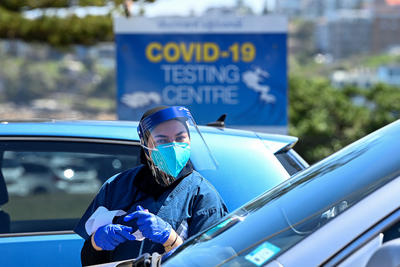
Anonymous/AP

How Holocaust awareness is linked to Australian history

According to a recent biography of Cooper, what’s often missing from commentary about his 1938 protest against the Holocaust was the fact he wanted to use the opportunity to draw attention to racism and violence against First Nations peoples in Australia, too.

The author, Bain Atwood, argued the emphasis on this one event overshadowed the broader activism of Copper and the Australian Aborigines’ League on issues like First Nations representation in government, land rights and acknowledgement of colonial dispossession and violence.


Read more:
William Cooper: the Indigenous leader who petitioned the king, demanding a Voice to Parliament in the 1930s


The concern here is that a continuing focus on the Holocaust could detract from understanding our own difficult history in Australia.

Our survey found, however, a strong relationship between Holocaust awareness and positive feelings towards religious minorities, refugees and asylum seekers and First Nations Australians. The findings suggest, though, more work needs to be done to make the connections between Australian history and the Holocaust explicit. This includes our history of colonial genocide and our treatment of asylum seekers and refugees.

This does not mean making simplistic comparisons, but acknowledging different histories and memories and how they interconnect. Our survey found, for instance, just over half the respondents agreed with the statement: “the Stolen Generations are an Australian example of genocide”.

Support for greater Holocaust education is high

Promisingly, our survey found higher levels of Holocaust awareness among those who had visited a Holocaust museum or taken part in specific Holocaust education. There was also strong support among our respondents (66%) for compulsory Holocaust education in schools.

There will soon be new or significantly redeveloped Holocaust museums in every state and territory in Australia. Australia also recently became a full member of the International Holocaust Remembrance Alliance, which includes a commitment to include the Holocaust in school curriculums and institute a national day of commemoration (which Australia did last year).

The federal government has also supported pilot projects for a Holocaust Memorial Week in 2018 and 2022.

The Victorian government, meanwhile, has supported the development of specific resources to help educators teach the Holocaust in schools. And a growing number of Australian educators have graduated from Gandel Foundation’s intensive teaching programs at Yad Vashem, the world’s largest Holocaust memorial museum in Israel.

With the rise of anti-Semitism – including online hate and Holocaust denial and distortion – understanding the relationship between Holocaust awareness and efforts to combat racism today is more important than ever.


Read more:
We tracked antisemitic incidents in Australia over four years. This is when they are most likely to occur


The Conversation

Steven Cooke received funding from the Gandel Foundation to undertake this research. He is a member fo the Australian delegation to the Internatioanl Holocaust Remembrance Alliance.

Andrew Singleton receives funding from the Australian Research Council and Gandel Philanthropy

Dr Donna-Lee Frieze donna-lee.frieze@deakin.edu.au receives funding from the Gandel Foundation as a lead researcher for the Gandel Holocaust Knowledge and Awareness Survey 2021, is a lead researcher on the project Holocaust Memorial Week 2022 with a grant from the Department of Education, Skills and Employment and a delegate for the International Holocaust Remembrance Alliance. She is affiliated with Deakin University.

Matteo Vergani receives research funding from the Victorian government, Gandel Philanthropy, the Australian federal government, and the Canadian government.

ref. New research shows few Australians know about our own connections to the Holocaust – https://theconversation.com/new-research-shows-few-australians-know-about-our-own-connections-to-the-holocaust-175325

Kiribati confirms more than 100 covid-19 cases – new rules

By Kelvin Anthony, RNZ Pacific regional correspondent

The Kiribati Health Ministry has confirmed that the atoll island nation has surpassed 100 covid-19 cases after it recorded 37 new positive infections yesterday.

There are 116 people infected on Tarawa – 36 imported and 80 local cases.

Nine new cases have been found in Butaritari Island, prompting the government to advise local authorities to enforce a lockdown.

Several other islands have been placed under strict restrictions — including South Tarawa, Betio, and Buota — to stop the virus from spiralling out of control.

Meanwhile, the government said that from today, fishermen in South Tarawa and Betio would only be allowed to go fishing between 6am and 2pm.

Only four people would be allowed to be on a boat or part of a group fishing near shore, it said.

The government has declared a state of disaster and the entire nation — of 120,000 — is on lockdown under a strict 24-hour curfew.

‘Real fear’ in community
Speaking to RNZ Pacific from Tarawa, freelance journalist Rimon Rimon said the increase in positive cases had caused “real fear in the community”.

“That’s the initial reaction that people have, when their life is in danger, they panic you know. That’s certainly the situation in Kiribati,” he said.

Left to right Kiribati fisheries minister Ribanataake Tiwau and Kiribati health minister Tinte Itinteang who are part of the country's Covid-19 Response Taskforce.
Kiribati Fisheries Minister Ribanataake Tiwau (left) and Health Minister Tinte Itinteang who are part of the country’s Covid-19 Response Taskforce. Image: Kiribati Govt/RNZ Pacific

Kiribati was among a handful of countries that were covid-19-free, mainly because it kept its borders shut to the outside world for almost two years.

More than 93 percent of its eligible population has been vaccinated, while just over 50 percent are fully vaccinated.

But the nation is well short of its target of inoculating 80 percent of its target population, even though the government announced in September 2021 that it had enough vaccines to immunise more than 70,000 people over 18 years old.

Rimon said while the vaccination programme was rolled out smoothly, it was not adequate for Kiribati to open its borders freely — as in the case of other countries.

“Once the government opened up its borders and brought in its flights that’s when things changed completely,” he said.

Change ‘pretty sudden’
“The change was pretty sudden on the people and also the government, and we can see on the ground the response is not as efficient as people would want it to be.”

It was still unclear how the virus spread into the community after a flight carrying 36 covid-19 positive people arrived from Fiji on January 14, he said.

“At the moment our Ministry of Health is on top of things but as I understand they are overwhelmed at the moment with resources and manpower.”

Meanwhile, the authorities are advising people to strictly follow the covid-19 protocols to minimise the risks and spreading the virus in the community.

This article is republished under a community partnership agreement with RNZ.

Print Friendly, PDF & Email

Article by AsiaPacificReport.nz