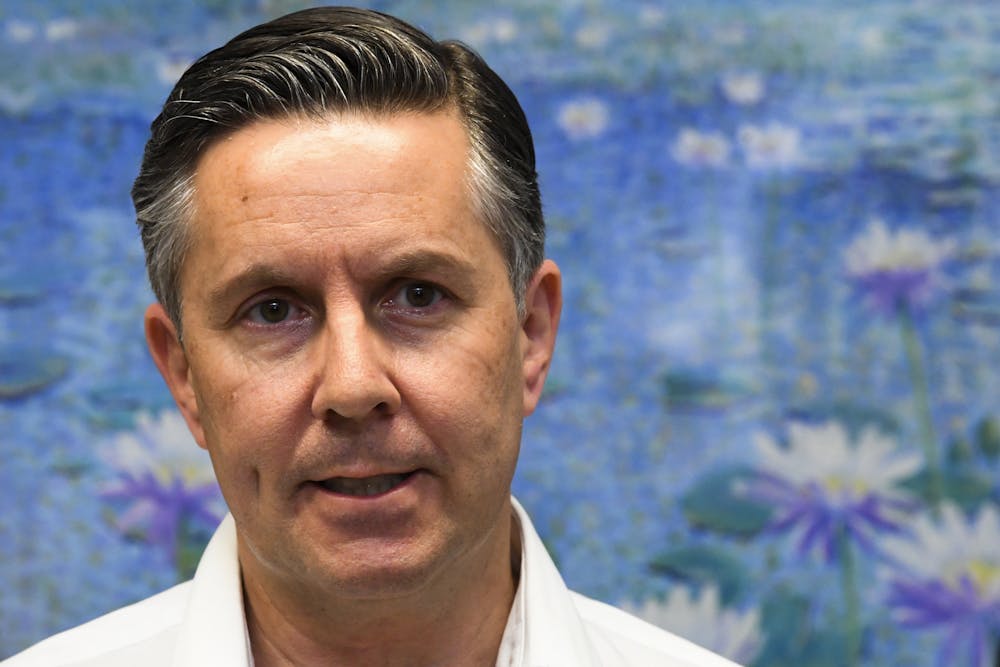
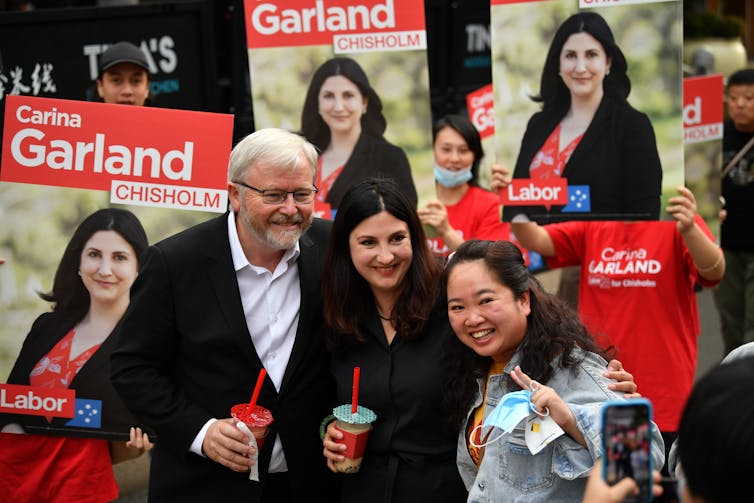
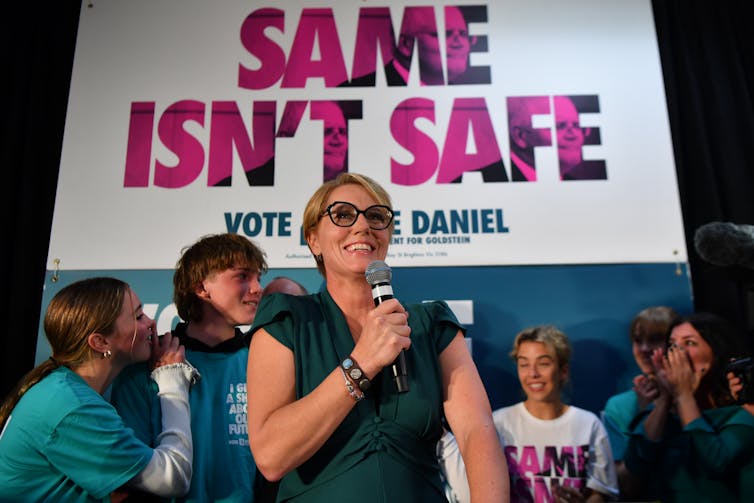
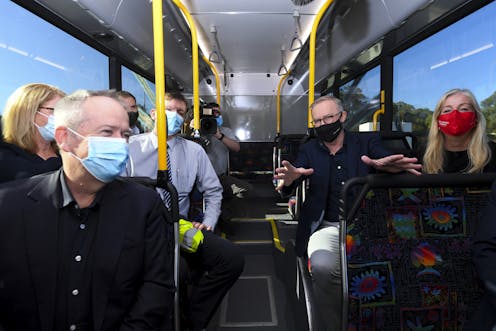
“Powes! Powes! Powes!” The city of Port Moresby was ringing with chants of support for its governor for the past 15 years — Powes Parkop.
Hundreds of men, women and children from the settlements to the suburbs flocked at the weekend in support of the three-term politician who stands confident of defending his seat one more time.
The Independence Boulevard came alive with shades of orange — the colour of Parkop’s Social Democratic Party — more than a hundred buses, taxis and private vehicles crammed the Kone Tigers Oval while banners pledging the support of youth, women, settlements and suburbs danced.
Making his stance clear, Parkop said he was ready for another term in Parliament.
“From the bottom of my heart, I am proud of how far we have come and I promise you, the journey of transformation will continue to be outstanding for our people in the city and all our people in the entire length and breadth of our country,” he said.
“Today I am ready. I am energised. I am all set for the next five years to continue to do more and deliver more for our people, our city and our country. “
The rally last Saturday follows Parkop’s quiet nomination on Thursday, May 19, at the Sir John Guise stadium as the first candidate to nominate for the National Capital District (NCD) regional seat.
Gratitude to supporters He also extended gratitude to the people of the city for their support of his leadership.
“I thank our people from the eastside, the westside and southside of our city, for your faith and belief in our leadership and journey together,” he declared.
“I thank you for your steadfastness, your unwavering support and loyalty.
NCD Governor Powes Parkop … “It has been a great journey for us and for me as your Governor.” Image: The National
“It has been a great journey for us and for me as your Governor in the last 14 years,” said Parkop.
“We have delivered equally in the entire NCD, the East, West and South and we are poised to deliver more in the next 5 years to transform our capital city, the pride of our country.”
Deputy Governor and Motu-Koita chairman Dadi Toka Jr, sitting member for Moresby South Justin Tkatchenko, Moresby North-east hopefuls Pastor Moses Minape and Joe Tintin Saraga were also present at the rally.
John Rosso named Deputy PM Meanwhile, Gorethy Kenneth reports that Prime Minister James Marape has announced Member for Lae and Minister for Lands John Rosso as the country’s Deputy Prime Minister going into the election and beyond.
Marape has also announced Hagen MP and SOE Minister William Duma will be acting Prime Minister while he is away attending the 37th Australia Papua New Guinea Business Forum and Trade Expo.
It was unable to provide a definitive figure on the nominations due to lack of information and communications from the provinces.
Electoral Commissioner Simon Sinai said that a few hiccups were experienced in many provinces where information was not readily available and also due to communication difficulties.
You’d be forgiven for not having heard about the long-awaited new Australian Curriculum, which was released with little fanfare in the midst of the election campaign. But this update to the national curriculum (9.0), for foundation to year 12 students, is hugely significant. It will guide the education of young Australians for the next six years, which could encompass a child’s whole primary or secondary school education.
Education fundamentally prepares children for life, so it should be expected to address the existential issues of our time. On our current trajectory, climate change will drastically affect children’s health, wealth and job futures. Today’s children face up to seven times as many extreme weather events as people born in the 1960s experienced.
If we are to tackle climate change and adapt to the impacts that are already unavoidable, then children need to be educated for a changing future. Until now, however, this subject matter has been largely missing from the Australian Curriculum.
Our research project, Curious Climate Schools, has involved 1,300 Tasmanian school students to date in student-led climate literacy learning. It shows current teaching leaves students with many unanswered questions about climate change. And, from our lightning analysis of the new curriculum, it seems it won’t routinely deal with the kinds of questions students are asking.
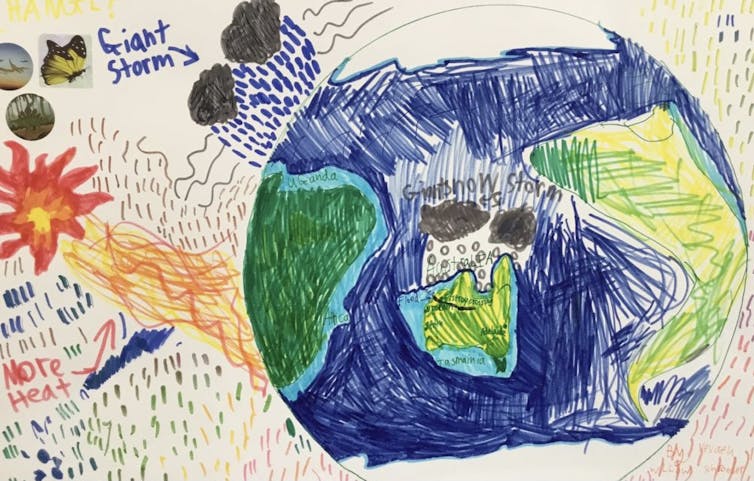
Climate change as seen by students at Margate Primary School, Tasmania. www.curiousclimate.org.au/schools
The good news is that the new curriculum does pay more attention to climate change. The old curriculum had a total of four explicit references to “climate change”. Whether it was covered in the classroom depended on the knowledge and beliefs of teachers.
In the new curriculum we counted 32 references to climate change across diverse subject areas: civics and citizenship, geography, history, science, mathematics, technologies, and the arts. This means students have more opportunities to learn about climate change, and teachers have more direction on where and how to teach it.
For example, in civics and citizenship, secondary school students can now learn about global citizenship by studying the campaigns of youth activists like Greta Thunberg and the work of Indigenous Australian climate campaigner Amelia Telford. They can also learn about global climate governance, including the United Nations Sustainable Development Agenda and the UN Framework Convention on Climate Change.
Climate change is also used in innovative ways in the new curriculum. In maths, for example, it’s presented as a context for teaching students how to use statistical evidence.
Our work with students through Curious Climate Schools shows their wide-ranging questions about climate change encompass ethics, politics, their careers and their futures. Students are interested in climate science and projected impacts, but have more questions about the urgency of action and what can be done. This illustrates that learning about climate change must be suffused through all subject areas if students are to become climate literate.
Many young people want to contribute their skills and knowledge to climate action in their future careers. We need to show them, through the curriculum, that in whatever subject area their interests lie – health, arts, law, engineering, ecology or many other fields – they will be able to use their talents to tackle the climate crisis.
Worryingly, explicit mentions of climate change are still missing from the primary school curriculum. The Curious Climate Schools project found upper primary teachers had the most interest and capacity to bring climate learning into their classrooms, because they were more able to explore the complex and interacting issues of climate change across subject areas.
Equipping teachers for holistic climate teaching
Climate change is causing legitimate and increasing anxiety for many young people. Many students leave school feeling betrayed and disempowered because their climate concerns are not being heard or taken seriously. The new curriculum does not adequately acknowledge or act on the significant emotional impacts of growing up in a changing climate.
This leaves teachers, who may become the bearers of bad news to many students, in a difficult position. In our interviews with teachers they told us they don’t feel confident to teach about climate change or to manage their students’ anxiety as they discover how climate change will affect their futures.
Governments and universities have a responsibility to ensure teachers have the knowledge and skills to teach their students holistically about climate change. They can’t be expected to do this without training or resources.
The new curriculum moves towards addressing climate change in the classroom, but climate teaching in schools must be much more ambitious, given the urgency and enormity of the problem. This needs to be supported first by building teachers’ own knowledge about climate change. It also means equipping schools with resources that empower their students to become active citizens in a changing climate.
Kim Beasy received funding from the Centre for Marine Socioecology, the University of Tasmania and the Tasmanian Climate Change Office for the research and engagement reported in this article.
Chloe Lucas received funding from the Centre for Marine Socioecology, the University of Tasmania, and the Tasmanian Climate Change Office for the research and engagement reported in this article. She is also funded by the Australian Research Council, and the Tasmanian State Emergency Services. Chloe is a member of the Centre for Marine Socioecology, the Institute of Australian Geographers and the International Environmental Communication Association, and is a member of the Editorial Board of Australian Geographer.
Gabi Mocatta received funding from the Centre for Marine Socioecology, the University of Tasmania and the Tasmanian Climate Change Office for the research and engagement reported in this article. She is co-lead of the Climate Change Communication and Narratives Network, funded by Deakin University, and vice-president of the Board of the International Environmental Communication Association.
Gretta Pecl received funding from the Centre for Marine Socioecology, the University of Tasmania and the Tasmanian Climate Change Office for the research and engagement reported in this article. She has also received funding from the Australian Research Council, Department of Agriculture Water and the Environment, Department of Primary Industries NSW, Department of Premier and Cabinet (Tasmania), the Fisheries Research & Development Corporation, and received travel funding support from the Australian government for participation in the IPCC process.
Rachel Kelly received funding from the Centre for Marine Socioecology, the University of Tasmania and the Tasmanian Climate Change Office for the research and engagement reported in this article. She is affiliated with the Centre for Marine Socioecology, and the National Environmental Science Programme Climate Systems Hub.
Source: The Conversation (Au and NZ) – By Nancy Baxter, Professor and Head of Melbourne School of Population & Global Health, The University of Melbourne
In a poll conducted by the Guardian in August of 2021 about the number of deaths Australians would be willing to accept as restrictions eased, only 3% of respondents felt that 5,000 or more COVID-related deaths per year would be acceptable.
But did these people die of or with COVID? This question is raised often by those who wish to diminish the impact of the pandemic, including former prime minister Scott Morrison.
The evidence, however, is clear – of all people who died “of” or “with” COVID during the pandemic in Australia, 90% have died of COVID.
Even if we concern ourselves only with excess death rates (that is, deaths exceeding what would usually be expected) COVID is a major killer. The Australian Bureau of Statistics evaluated deaths in January 2022, around the time of the peak in COVID cases during the first Omicron wave in Australia. Comparing the observed mortality rate to the usual pre-COVID rate, they found 22% more deaths in that month than expected.
Add to that we are now facing our first flu season in two years, with weekly numbers now exceeding the average for the past five years.
Coupled with a lower-than-average uptake of the flu vaccine this year, the flu season is shaping up to potentially be a severe one – potentially resulting in up to 30,000 people requiring admission to hospital.
With winter coming, and more people gathering indoors as the weather turns cold, COVID cases may also rise in tandem with influenza.
We can reduce cases
This looming disaster can be averted: we can reduce transmission and “flatten the curve” with simple actions.
We have seen the impact the relaxation of public health restrictions and protections like mask-wearing mandates have made in terms of driving transmission.
In Western Australia, relaxation of public health measures including mask wearing and household contact isolation occurred on April 29. Within days of these changes, case numbers reached record highs – there are now 100 more people hospitalised with COVID every day than before these changes went into effect.
It would stand to reason reinstating these two measures would have the opposite effect – fewer cases, fewer people in hospital, and fewer people dying of COVID.
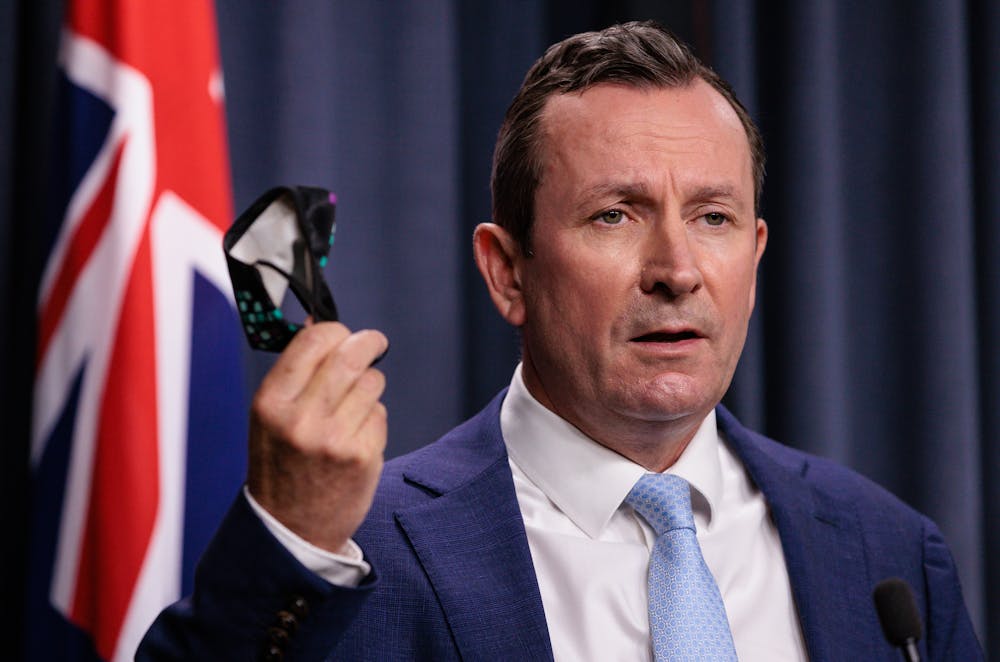
Western Australia saw a huge uptick in cases after removing masks and isolation requirements. AAP Image/Richard Wainwright
The Australian Medical Association has called for an increase in voluntary use of masks, yet its pleas are being ignored. It seems without mandates most people are unwilling to wear masks, so reinstating these mandates for indoor gatherings should be considered.
Boosters and treatments are vital
We also need to use the tools we have to prevent serious disease in people who contract COVID.
Although vaccinations have maintained effectiveness for serious illness, hospitalisation, and death, our protection has waned over time and has also been reduced due to Omicron’s increased immune-evasion.
The impact of a booster dose is substantial, with high levels of protection against severe outcomes demonstrated with a third dose. Yet only 70% of the population of Australia has received a booster and numbers are not increasing.
If delivered early to those most at risk of severe disease, antiviral medications can reduce the risk of hospitalisation. But to access these medications, patients must have access to testing and a knowledgeable care provider all within five days of the onset of symptoms. The GP community is trying, but inequitable distribution of these treatments will occur without more education and support for the clinicians at the coalface.
A clearly articulated vision of what is at stake and what actions we need to take to avert disaster is the leadership we need right now.
A few simple public health measures such as mask mandates and reinstating isolation for household contacts of positive cases could make a major difference saving lives. And ensuring provision of boosters and early antiviral therapy for those at-risk despite vaccination will also save lives.
Pretending the pandemic is in the rear-vision mirror will help no one.
I have been an unpaid participant on an Ad Board for MSD who make Molnupiravir
Nicholas Talley receives funding from the NHMRC and the Department of Defence/Breakthrough Human Performance Research Call. He is affiliated with OzSage, the Australian Medical Council (AMC) (Council Member) and the NHMRC Principal Committee (Research Committee).
As the polls closed on Saturday night, most election commentary focused on the dispiriting campaign where both major parties avoided any substantial division on policy issues and instead focused on negatively framing the opposing leader.
Even to many seasoned political minds, the most likely outcome seemed to be a reversal of the last parliament, with Labor winning enough seats to form a narrow majority, and one or two more seats falling to independents. As we all now know, the outcome was utterly different. The Liberals lost many of their crown jewels to climate challengers – teal independents and the Greens.
This means the new Labor government now has a different challenge on climate. Rather than trying to keep check on concessions to the cross-bench, Labor must now find ways to pursue more ambitious climate policies. Labor can’t pull the most effective lever available – a carbon price – after the Liberals successfully poisoned the well. But there are other ways to accelerate Australia’s shift to cleaner and greener, such as through public investment in large-scale solar and wind.
The next three years will be challenging economically and politically. But the transformation wrought by the election has opened up the possibility of a similar transformation of climate policy. With bold action, a bright future awaits.
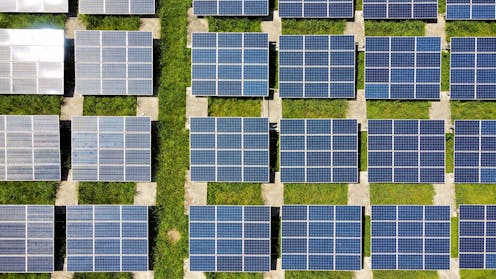
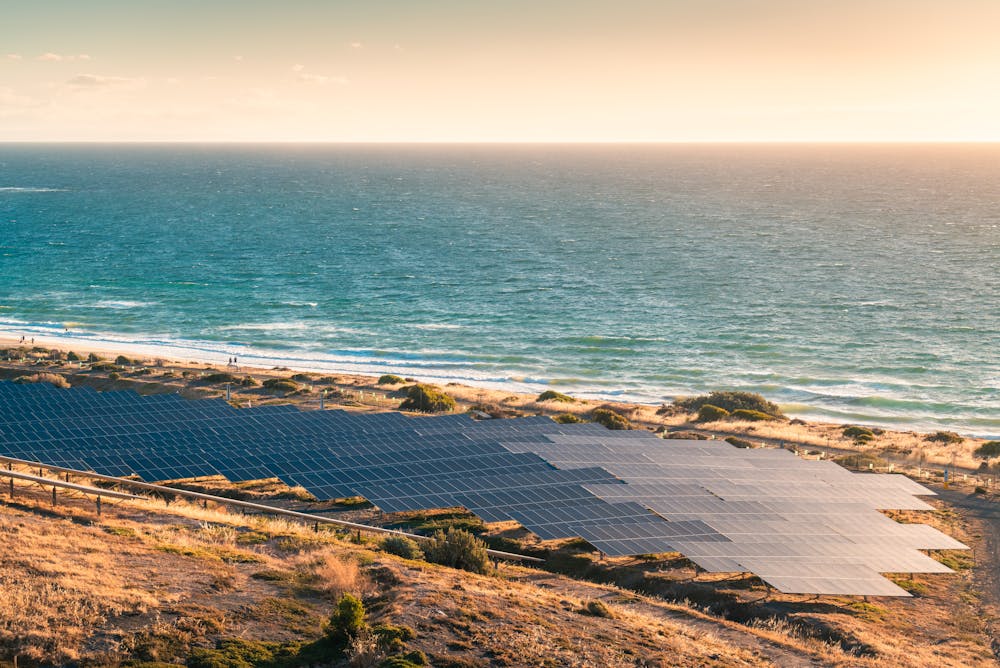
Government backing for large scale renewables could be one lever Labor could pull. Shutterstock
Climate proved critical
Labor’s path to victory was unusual. The party taking government will do so despite its primary vote slumping to a postwar low, far below the level of routs seen in 1996 and 1975.
Outside Western Australia (where the result was driven largely by the success of the McGowan government’s Covid policy), Labor barely moved the dial. So far Labor has taken five seats from the Liberals (with some Labor-held seats still in doubt) while losing Cowper to an independent and Griffith to the Greens.
The big shock in this election was the loss of a string of formerly safe Liberal seats to Greens and “teal” independents. All of these candidates campaigned primarily on climate change, an issue the major parties, and most of the mainstream media had agreed should be put to one side as too dangerous and divisive.
During the campaign, the possibility of a hung parliament drew attention. In response, both major parties vowed (not very credibly) that they would never do a deal with Greens or independents to secure office. Realistically, it seemed possible that Labor might offer a slightly more ambitious program on climate policy in order to make minority government easier.
In retrospect, it’s clear that this type of analysis assumed Australia’s long-standing political pattern would continue: a two-party system, with a handful of cross-benchers occasionally playing the role of kingmaker. All of the media commentary leading up to the election took this for granted. The “teal” independents were seen as a possible threat to two or three urban Liberals and the Greens were, for all practical purposes, ignored.
What we have instead is a shock to this system. Australia now has a radically changed political scene in which the assumptions of the two-party system no longer apply. Even if Labor scrapes in with a majority, it is unlikely to be sustained at the next election, given the challenging economic circumstances the incoming government will face. As for the LNP, unless they can regain some of the seats lost to independents and Greens, they have almost no chance of forming a majority government at the next election, even with a big win over Labor in traditionally competitive seats.
Labor’s proposed Rewiring the Nation corporation is aimed at making the grid renewable-ready. Shutterstock
Adapting to political change
Labor’s challenge now is to adapt to this new world. They will have to find ways of delivering what the electorate clearly wants on climate, after ruling out most of the obvious options in the course of the campaign. The new leader of the LNP will have the unenviable task of winning back lost Liberal heartlands while placating a party room dominated by climate denialists and coal fans.
Having ruled out a carbon price, Labor will need to be much more aggressive with the safeguard mechanism it inherits from the LNP. By itself, this won’t be nearly enough.
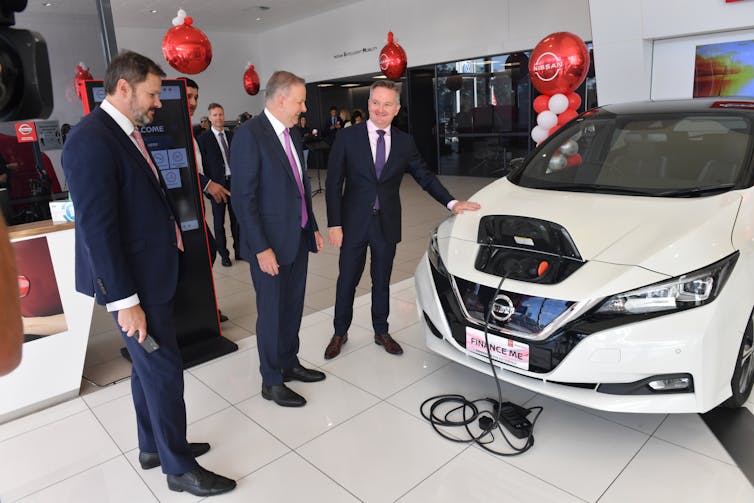
The real need is to promote rapid growth in large-scale solar and wind energy, and to push much harder on the transition to to electric vehicles. Some of this could be done through direct public investment, on the model of Queensland’s CleanCo, or through expanded use of concessional finance using the Clean Energy Finance Corporation and the new Rewiring the Nation Corporation. The great political appeal of this approach is that all of these agencies are off-budget and therefore won’t count in measures of public debt, which is bound to grow in coming years due to pandemic spending.
Democracy, however imperfect, works through the possibility of renewal and change. What this election has shown us that the political system can change. Now comes the task of applying politics – the art of the possible – to the challenge of switching our energy systems from fossil fuels to clean power. It’s our best chance yet.
John Quiggin is a former Member of the Climate Change Authority
For the past ten years, NASA’s Curiosity rover has been trundling around the surface of Mars, taking photos in its quest to understand the history and geology of the red planet and perhaps even find signs of life.
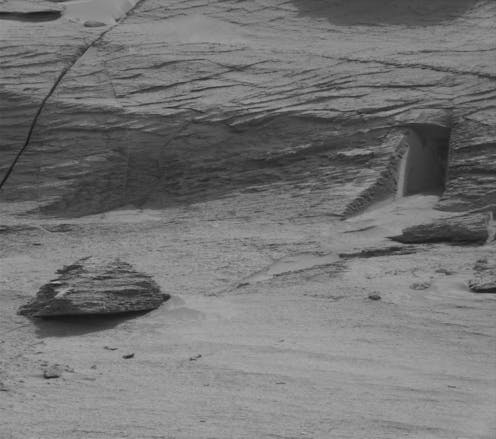
Last week it took a photo which appeared to show a doorway carved into the rock. It’s the sort of thing that on Earth might indicate an underground bunker, such as an air-raid shelter.
Seeing is not always believing
At first sight, the picture is totally convincing. At second sight, maybe not. The passage seems to go in only a short way before the steeply descending roof meets the floor.
And then those killjoys at NASA tell us its only about 45 cm high. Still, who said Martians had to be the same height as us? But thengeologists point out several straight-line fractures can be seen in this site, and the “doorway” is where they happen to intersect.
Such a pity. It would have been so exciting if it had been a real doorway. Instead it joins the face on Mars, the spoon on Mars, the cube on the Moon, and all the other things seen in photos from space that turn out not to be as exciting as we thought.
The face on Mars, the spoon on Mars, and the cube on the Moon. On closer examination, each turned out to be a natural geological formation. NASA, NASA, CNSA
The sad fact is that when presented with an unclear or unfamiliar image, humans try to turn it into a familiar-looking object. Scientists call our tendency to do this “pareidolia”.
It’s easy to understand why it happens. We likely evolved this tendency because spotting important things like predators or faces, even when the light is poor or they are partly obscured, gave us an advantage. And getting false positives – seeing a predator where there is none – is better than not seeing a predator who then eats you.
No signs of life
Reasonable explanations won’t deter the conspiracy theorists who say the doorway really is evidence of life on Mars, and maintain that scientists are engaged in some sort of cover-up.
If I were trying to do a cover-up, I wouldn’t be releasing the photos! So a conspiracy doesn’t seem very likely.
But there’s also a lesson here for serious searchers for alien life. As astronomer Carl Sagan said, extraordinary claims require extraordinary evidence.
Following this maxim, scientists seeking evidence of extra-terrestrial life demand much stronger evidence, than, say, someone looking for a geological formation. And despite decades of searching for evidence of life on Mars, we have found nothing.
It is still possible there may once have been life on Mars. We may yet find some fossilised relics of ancient cellular life. But suddenly finding an artefact such as a doorway, or a spoon, seems unlikely.
The bigger picture
There’s a similar story with the broader search for extra-terrestrial intelligence (SETI). For years, SETI scientists have been searching the skies for signals from other civilisations, but so far we have found nothing. But nearly all our searches have been on the nearest few stars, and so in a sense the search has barely started.
Meanwhile, we continue to be bombarded with photos purporting to show UFOs (Unidentified Flying Objects) or UAP (Unidentified Aerial Phenomena).
The vast majority of these photos are probably fakes, or mistaken photos of familiar objects such as weather balloons. But as scientists, we must keep an open mind. In among the rubbish, perhaps there may be one or two photos or videos that really could stretch our current knowledge.
The problem is that if someone presents me with a photo purporting to show a flying saucer, I know that the odds overwhelmingly favour it being a fake, and so I’m likely to dismiss it rather than wasting my time examining it carefully. But supposing I’m wrong?
Similarly, when we see a doorway, or a face, or a spoon, on Mars, it’s all too easy to dismiss it out of hand. But we must remain alert to the possibility that one day we might find archaeological evidence of past life on Mars.
Admittedly, this seems very unlikely. But not impossible. It would be a terrible loss if, among all our careful searching through the data, we missed the thing we had been searching for because it was too easily dismissed as a trick of the light.
Ray Norris does not work for, consult, own shares in or receive funding from any company or organization that would benefit from this article, and has disclosed no relevant affiliations beyond their academic appointment.
One of the surprising results from the federal election was a record vote for Legalise Cannabis Australia, a minor party previously known as the Help End Marijuana Prohibition (HEMP) party.
The party received 2-7% of the Senate vote in most states and territories, narrowly missing out on a Senate seat in Queensland.
This follows a notable result in the 2021 Western Australian state election, where it picked up two seats in the Legislative Council.
Does the success of this single issue minor party mean Australians are finally ready to “legalise it”?
In 2019, for the first time in the survey’s history, the National Drug Household Survey found more Australians support the legalisation of cannabis (41.1%) than oppose it (37%).
Support for the legalisation of cannabis has risen dramatically over the last few decades.
In 2007, only 21.2% of Australians supported legalisation. This jumped to 24.8% in 2020, then to 26% in 2013. It was 35.4% in 2016. By 2019, 41.1% of those surveyed supported legalisation.
Only 22% of Australians surveyed in 2019 felt cannabis possession and use should be a criminal offence, compared to 34% in 2010.
Support for cannabis legalisation likely comes from observing the legalisation of recreational cannabis in countries across the globe. Examples include Uruguay, Malta, Mexico, South Africa, Canada and a number of states in the United States.
Interestingly, very few Australians indicate they would use cannabis if it were legalised.
Over 78% of respondents to the 2019 survey said that they would not use cannabis even if it was legal.
Only 9.5% said they would “try it” and 9.2% say they would “use it about as often as they do now”.
But surveys can be misleading
But asking voters if they support a policy proposal in the abstract might not tell us much about how much they’d support it once it becomes a hot button political issue.
We saw this play out in the 2020 New Zealand cannabis referendum. There, 51% of voters rejected the legalisation of cannabis, despite early opinion polling in 2020 indicating strong support.
As the cannabis legalisation debate became a greater topic of discussion, support for legalisation gradually narrowed and finally flipped right before voting day. In the end, New Zeland narrowly voted no.
Opponents argued a normalisation effect could encourage teenagers to start using cannabis or that there would be more drug-affected drivers on the road. Some argued there would be unpredictable effects of lung health and mental health.
There is mixed evidence for each of these propositions, but the debate itself made voters more cautious about change.
A gradual approach
One of the big lessons from the last few decades of cannabis law reform is voters prefer a gradual and measured approach to drug liberalisation.
Voters need to be convinced the legalisation of currently illicit drugs will successfully reduce health and social harms.
One academic analysis of the failure of the New Zealand referendum noted the proposed bill failed to address voter concerns about potency, reducing the black market and the normalisation of cannabis.
A libertarian style argument in favour of cannabis legalisation focused on the “freedom to choose” is unlikely to shift voters already concerned about the harms of legal substances such as alcohol and tobacco.
Jumping straight from a criminalised environment regarding cannabis towards full legalisation may also be too fast for some voters. A gradual change of policies regarding cannabis is more likely to have support.
For example, states that adopt medicinal cannabis policies (as Australia has done) tend to move faster towards recreational cannabis legalisation than other jurisdictions.
One intermediate step, which has already occurred to varying degrees in the ACT, Northern Territory and South Australia is the decriminalisation of the possession and use of cannabis.
Change will be slower than some hope
There has been strong consistent support for the decriminalisation of cannabis in all states and territories in Australia for a number of years now.
Decriminalisation provides a good introductory step towards treatment cannabis use as a health issue, not a criminal justice one.
Overall, there’s a growing level of support for cannabis law reform in Australia. But change is likely to occur much slower than liberalisation supporters would hope.
Albanese is not the first newly-minted prime minister to prioritise a trip to Jakarta as Scott Morrison’s first overseas visit as leader was also to Indonesia.
Instead, Albanese has had to travel to Tokyo for a pre-planned meeting of Quad nations (Australia, India, Japan, and the United States).
Nevertheless, judging by the campaign, and a bit of recent history, we can expect to see a Labor government pay more attention than their predecessors to Indonesia – and Southeast Asia in general.
Both major parties say they recognise the “vital importance” of the Australia-Indonesia relationship.
Despite this, ties between the neighbours have often been described as a “rollercoaster”. Unpredictability and insensitivity have often clouded the relationship, no matter who is in power.
Labor Prime Minister Julia Gillard government’s snap ban on live cattle exports to Indonesia in 2011 caused tensions with Indonesia. Former Prime Minister Tony Abbott came to power in 2013 promising “more Jakarta, less Geneva”, only to quickly abandon it as the government repeatedly damaged relations with Indonesia. Tensions emerged over boat turn-backs, bugging and spying allegations, and the death penalty.
Perhaps relations never fully recovered after Australia, under the Howard government, led a multinational force in East Timor in 1999.
But in recent years, Indonesia has barely rated a mention in Australian foreign policy discussions.
Rather than a rollercoaster, the relationship has plateaued.
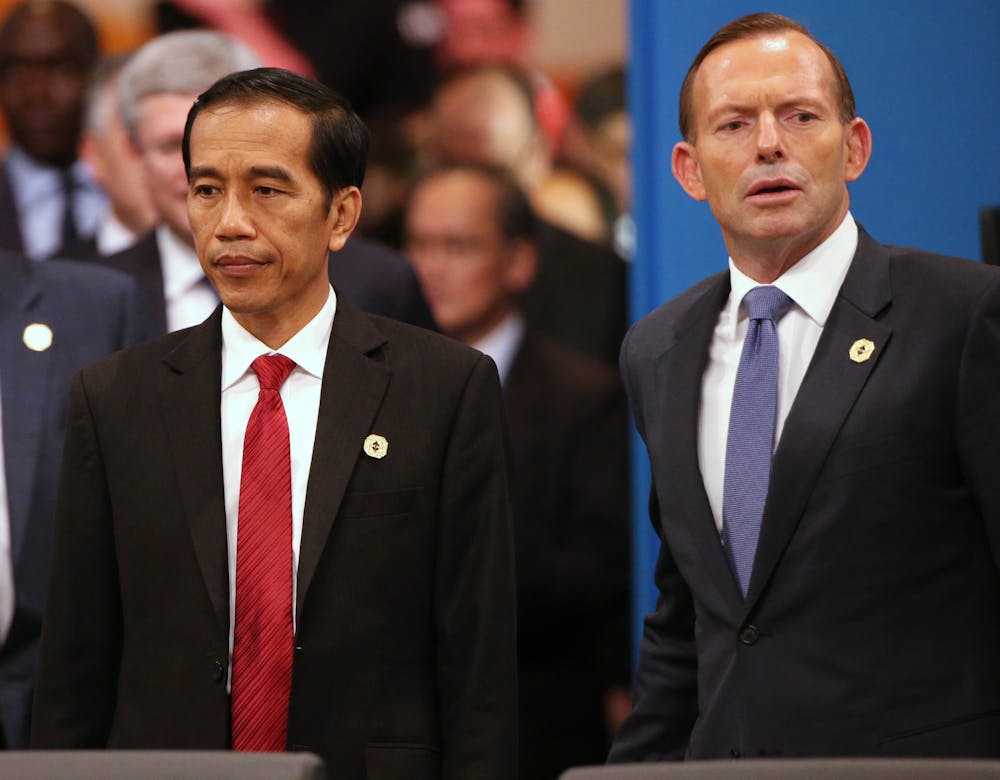
Former prime minister Tony Abbott came to power in 2013 promising ‘More Jakarta, less Geneva’ but relations soon suffered. AP Photo/Rob Griffith
There were some early successes in the Morrison era, including the two countries signing a new Comprehensive Strategic Partnership in August 2018 that promised to deepen ties and cooperation.
The following year, both countries signed the “landmark” Indonesia-Australia Comprehensive Economic Partnership Agreement (IA-CEPA).
But these two early successes built on the work of previous governments.
The IA-CEPA deal had been in the works for over a decade.
Morrison’s predecessor Malcolm Turnbull carefully cultivated a strong personal relationship with his Indonesian counterpart, Joko Widodo. Turnbull’s 2015 Jakarta visit involved one of Widodo’s “blusukans” – an impromptu visit to a market. Foreign Minister Julie Bishop and her Indonesian counterpart, Retno Marsudi, also had a reportedly strong relationship.
This personal touch has not quite been replicated under the Morrison government.
Areas of friction
A low point was a surprise announcement by Morrison during the 2018 Wentworth byelection. Unexpectedly, Morrison said he’d consider moving the Australian embassy in Israel from Tel Aviv to Jerusalem, following similar moves from then-US President Donald Trump.
This wasn’t well received in Muslim-majority Indonesia. The optics were not good – it suggested a tendency on Morrison government’s part to privilege electoral ambitions ahead of the national interest.
In a reported text message exchange, Marsudi purportedly told Payne the embassy issue “will slap Indonesia’s face [and] affect bilateral relations”.
There have been other areas of friction. Indonesia initiallyresponded critically to Australia’s AUKUS deal, which reflected concerns about how Australia acquisition of nuclear powered submarines might affect regional security, the arms race and non-proliferation.
Following the announcement, Morrison’s plan to stop over in Jakarta from a US visit was called off when Widodo opted to visit provinces outside Jakarta instead.
The impression was that the Coalition looks to Australia’s “great and powerful friends” in the US and the UK for security, while Labor prioritises regional relationships.
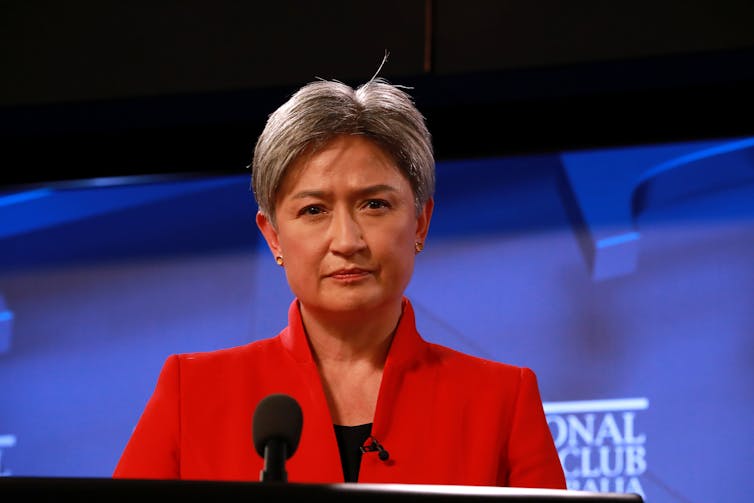
This difference was on display in the pre-election foreign ministers debate between Marise Payne and Penny Wong.
While Payne talked up the Quad and AUKUS (both which don’t include Indonesia), Wong focused on the Pacific and Southeast Asia. However, Indonesia was barely mentioned by either.
How might Australia-Indonesia relations change under Labor?
Labor’s election campaign rhetoric emphasised regional engagement based on “mutual respect and a sense of genuine partnership”. It announced a Southeast Asia policy, including A$470 million over four years in foreign aid and the creation of a Southeast Asia office in the Department of Foreign Affairs and Trade.
Despite the lack of specific attention to Indonesia during the campaign, there are some positive signs, though. Labor advocates a First Nations foreign policy, which could be appealing to Indonesia.
Australia and Indonesia already cooperate fruitfully on shared interests in maritime security, marine science and the blue economy. This is likely to continue regardless of who is in power.
Most importantly, Labor’s national security plan highlights climate security as an area of cooperation, promising a A$200 million climate and infrastructure partnership with Indonesia.
But more needs to be done. Labor should focus more on bolstering Asian studies and languages in secondary schools and universities, particularly Bahasa Indonesia.
The new government also needs to listen to Southeast Asian perspectives.
States like Indonesia don’t want to be forced to make a choice between US and China.
Engaging with Indonesia requires creative, nuanced and modulated diplomacy. Sensitivity around sovereignty, autonomy and regional security is key.
Rebecca Strating receives external funding from the Australian Department of Foreign Affairs and Trade, United States Department of State, the UK High Commission in Australia, and Taiwan Foundation for Democracy.
The World Health Organization’s newly released report on regulating cross-border alcohol marketing raises the alarm for countries like Australia and New Zealand, given their light touch towards alcohol advertising.
Alcohol is widely consumed in Australasia but there is ongoing tension over how much restraint, if any, should be placed on the marketing of these products.
Australia and New Zealand are at the unrestrained end of the marketing continuum. Both countries rely on industry-led policy in the form of voluntary codes – an approach identified as insufficient by the WHO report.
What is cross-border alcohol marketing?
Alcohol marketing, created and disseminated in one country and spread across borders into others, is commonly used by multinational corporations striving to increase sales and normalise alcohol as an everyday product. Much of this advertising is taking place in the digital media sphere.
The increased use of these media platforms by alcohol corporations allows them access to cheap advertising opportunities. For as little as US$2, an advertising campaign based in Australia could reach a thousand young people profiled as interested in alcohol, for example.
Marketing across digital media has also increased the impact of those messages.
Brands interact with users on social media platforms, encouraging the posting, sharing and liking of branded images and messages. Higher user engagement is associated with more drinking.
Multinational corporations like AB InBev have been quick to embrace digital platforms as a new way to advertise alcohol products. Pavlo Gonchar/Getty Images
Targeting the individual
The increased power of these advertisements reflects the effectiveness of “personalised marketing”. Companies can now target individuals and “look alike” audiences.
This approach is made possible thanks to the enormous amount of data collected as we interact together, purchase products and indicate our interests and passions through our clicks and likes.
This data is extremely valuable to marketers and alcohol corporations. It gives them insight into the best time of day, the best brand of alcohol and the best type of marketing message to send our way.
All groups across society are vulnerable to being bombarded by messages encouraging the purchase and consumption of alcohol.
Digital advertising can target everyone: teenagers looking for brands which exemplify their identity; young adults, the heaviest “occasion drinkers” in Australia and New Zealand, some of whom are developing drinking habits that may be hard to change in later life; and adults of all ages who wish to reduce their consumption, often for health reasons.
Digital media has become an all-encompassing marketing environment in which the “buy” button – with home delivery and often no checks on age or intoxication – provides a seamless marketing and distribution system.
In New Zealand, online sales increased significantly during the COVID-19 lockdowns, particularly among heavier drinkers.
Entering the metaverse
The alcohol industry is now showing its initiative by entering the emerging metaverse. To understand the metaverse, according to one commentator, you should
take today’s social media, add a splash of sophisticated 3D, fold in a plethora of options for entertainment and gaming, garnish it all with data-driven personalisation, and you are all set to take away your order of a supersized social media network, the metaverse.
In terms of marketing, this provides a new opportunity. The biometric data essential to a virtual reality experience is also available to develop “biometric psychographics”, allowing for the even greater personalisation of advertising.
Virtual alcohol brands created and used by avatars in the metaverse support the development of brand allegiance in real life, and virtual reality will transform e-commerce experiences and increase the power of sponsorship.
AB InBev, the largest global alcohol corporation, was an early adopter of the metaverse. One of its brands, Stella Artois, is sponsoring the Australian Zed Run platform on which virtual horses can be raced, bred and traded. The Zed Run platform experienced 1,000% growth in early 2021.
Digital horse racing game Zed Run has exploded in popularity, with alcohol companies using the digital platform to reach a new audience. Lisa Maree Williams/Getty Images
Regulating to reduce alcohol harm
The digital world is extremely dynamic. It is also opaque to most policy makers and public health practitioners. It is telling that there is no reference to the metaverse as a cross-border alcohol marketing opportunity in the WHO report.
There is an urgent need for debate regarding how policy makers should better understand the risks involved with the targeted marketing of hazardous products such as alcohol.
The WHO report outlines various partial and unsuccessful approaches to regulating marketing in the digital media.
Attempts, such as Finland’s regulation of user-shared branded material, have failed because they did not interfere with the basic architecture of the social media platforms, which is predicated on engagement via sharing and liking.
The most successful examples offered by the WHO report have been countries like Norway, which have imposed a complete ban on alcohol marketing including in the digital media.
The report emphasises the need for surveillance and enforcement, suggesting ways in which alcohol companies could be penalised for marketing breaches.
The support provided by international agreements such as the Framework Convention on Tobacco Control is identified as a possible template for future discussions.
The response to tobacco marketing provides a good and largely effective model for officials and policy makers. That said, the public health goal for alcohol is not equivalent to the smokefree goal. Advocates are not trying to eliminate alcohol altogether.
However, there are parallel arguments in favour of creating a healthier media environment through regulation to prevent the promotion of alcohol products via increasingly sophisticated technological and psychological tools.
These products are significant causes of reduced well-being, and this marketing increases consumption and therefore harm. The messages of the WHO report are timely and should be heeded.
Sally Casswell has received funding from many independent funding bodies and WHO. She is Chair of the Global Alcohol Policy Alliance which advocates for evidence based alcohol policies and is a Board member of Health Coalition Aotearoa.
A New Caledonian anti-independence candidate has withdrawn from the race for a seat in the French National Assembly just hours before nominations closed.
Vaea Frogier pulled out, citing concern about the splits in the anti-independence camp.
Seventeen candidates in New Caledonia are standing in next month’s election, with the pro-independence parties jointly fielding just one candidate in each of the territory’s two electorates for the seats in Paris.
Frogier said the anti-independence side was more divided than ever, facing the unity of the pro-independence side, which may win a seat.
Her withdrawal is meant to increase the chances of anti-independence politicians retaining the two seats.
In March, Frogier had been among the first to lodge a candidacy.
Frogier is a former deputy mayor of Mont-Dore and the daughter of Pierre Frogier, who is a former president of New Caledonia and now a member of the French Senate.
New French Overseas Minister Meanwhile, a new French Overseas Minister has been appointed by President Emmanuel Macron in the second stage of his government reshuffle, reports RNZ Pacific.
Yael Braun-Pivet has replaced Sebastien Lecornu who has been given the defence portfolio.
Braun-Pivet had been the head of the National Assembly’s law commission.
Her main challenges include negotiations with New Caledonian leaders in the aftermath of last December’s controversial independence referendum.
While the anti-independence camp wants the territory’s reintegration into France after its victory at the ballot box, the rival pro-independence side refuses to accept the referendum result.
In the reshuffle’s first step on Monday, Macron chose Elisabeth Borne as the new prime minister.
The foreign affairs portfolio has been given to Catherine Colonna who has been France’s ambassador to Britain.
This article is republished under a community partnership agreement with RNZ.
Elections are a test – the ultimate test, really – of those who serve as parliamentarians and those who aspire to serve. Scott Morrison asserted quite absurdly early in the 2022 campaign that the election was not a popularity contest.
Clearly, the opposite is true. An election involving every eligible voter is by definition a popularity contest.
It was not hard to see why Morrison was trying to argue that day was night. With the early halo effect of the pandemic that boosted his popularity towards the stratosphere a distant memory, he was trying to overcome his rising levels of unpopularity. Ultimately, in the final days of the campaign, with his initial Lewis Carroll-esque stylings having failed to change the Liberals’ tracking polling, he pledged to become a different person.
As we know from the election result, Morrison’s resort to something more akin to comics where a superhero assumes a new identity because the writers have run out of ideas didn’t work either. But among the attempts to reframe the democratic process and remake himself, he offered one observation that contained an element of truth: that the election was not about him, it was about “you”. “You”, in this case, was each voter.
This election and its fractious, atomised, and possibly revolutionary aftermath will definitely be about Australian voters. They are about to be tested. After all, in the strictest sense they have collectively created this situation – historically low primary levels of support for the major parties, the denial of a strong working majority to either side, an expanded crossbench in the lower house – by casting their votes.
Scott Morrison’s attempts to redefine himself were too little, too late.
There are complexities here. It can be argued the candidates and their parties and support groups – donors, volunteers and media companies – are coauthors with the voters of each election outcome. The interactions between political players and voters shape the result; of course they do. But now that the votes are in and the tallies being finalised, the voters are obliged to own the result. I’m a voter, so I’ll pose the question this way: do we have it in us to do that?
It’s a reasonable question, because even if this election produces a Labor government with a slim majority, rather than the minority government that appeared more likely at the close of counting on Saturday night, the new administration will be built on a Labor primary vote of around 33%. Until not so long ago, conventional wisdom had it that anything less than a Labor primary of 40% would consign the party to the opposition benches. So that’s one more truism consigned to the dustbin.
But there will be no shortage of Liberal and National MPs and media commentators, especially those working for News Corporation, who will be arguing from day one that the Albanese government is somehow illegitimate and without a mandate. That criticism will come regardless of whether Labor commands a House of Representatives majority in its own right or operates in minority with the tacit acceptance of enough of the crossbenchers to maintain confidence and supply.
The Liberals’ Senate leader, Simon Birmingham, began that narrative on television on Saturday night and continued it in an interview on Sunday morning. At least two of News Corp’s senior commentators have run it out too.
You have to wonder whether Anthony Albanese and his deputy Richard Marles – neither of whom has an especially combustible or pugnacious style – are ready for the onslaught. They should be, given they were around when Julia Gillard fell short of a majority at the 2010 election, which in many respects began Labor’s long political winter that was broken only at this election.
That was a dreadful time for our political system and for that Labor government. Gillard made a series of political errors, going back on a pre-election promise not to introduce a carbon tax and allowing herself to be portrayed as too close to the Greens. A vengeful Kevin Rudd lurking inside her government also didn’t help.
The attacks on the Gillard government helped foster a sense of ‘buyer’s remorse’. AAP/Alan Porritt
Encouraged by the media, a substantial chunk of the voting public recoiled from the very idea that somehow the parliament they had helped elect had produced a minority government in which crossbenchers had influence on policy. Meanwhile, the Coalition under Tony Abbott set about saying and doing anything that would wreck the Gillard government’s standing, with little thought of what would happen on the other side of the next election.
This led to buyer’s remorse on a grand scale. And it now falls to Albanese and his cabinet and backbenchers to simultaneously defend and aggressively assert their government’s authority while trying to lure more electors to the Labor fold. Yes, it’s true that in our electoral system in which preferences determine outcomes, and everyone 18 and older is required by law to lodge their ballot papers, every vote counts. (This exposes the claim thrown around since Saturday night that Labor has no right to govern because two-thirds of the people voted against it as utterly ridiculous. If so, what was Morrison doing serving as PM when 58.5% of voters didn’t cast a primary vote for the Liberals or Nationals in 2019?)
But for a government to prosper and feel confident it can take bold decisions when they’re required, and to be re-elected, it will more than likely need more than one in three voters who are willing to put a “1” next to the name of its candidates on the ballot paper. To counter its natural enemies, this Labor government will need as many community advocates as it can muster.
That, as much as climate change action, the reform of aged care and the NDIS, an anti-corruption tribunal and the other policy items on the party’s to-do list, should be a first-order objective for Albanese and his team.
Shaun Carney does not work for, consult, own shares in or receive funding from any company or organisation that would benefit from this article, and has disclosed no relevant affiliations beyond their academic appointment.
It is pretty human to crave the approval of peers and to hope for more of the same, even if unconsciously.
But for political parties selling themselves as unifying forces of the middle, broad-based and representative, this way lies atrophy. And death.
Courting the applause of extreme media voices is a formula for narrowing a party’s electoral reach.
Yet this is where the Liberal Party of Australia has journeyed over its nine years in office. First under Tony Abbott’s ideological zealotry and then through various squalls and culture wars since.
After unsuccessful attempts to address climate policy by Malcolm Turnbull and Josh Frydenberg – the latter being the standout casualty of the 2022 reckoning – the preference for clever politics over policy solutions has drawn the Liberal Party further from the great Australian middle, and towards gratifying the sharper grievances of religious conservatives and the electoral gains from suburban outsider resentment.
Throwing out euphemisms like “the quiet Australians” to camouflage his real project of demonising elites, Scott Morrison told a mining conference a year ago “We’re not going to achieve net-zero in the cafes, dinner parties and wine bars of our inner cities”.
It turns out this was a thumb in the eye to his own party’s greatest asset, its rusted-on intergenerational base of cashed-up professionals in its heartland. In the year since, this support base has been not just ignored, but insulted.
Depicted as mere dupes for even considering candidates wanting swifter action on climate change, corruption, and gender equality, life-long Liberals rebelled, voting with their well-heeled feet.
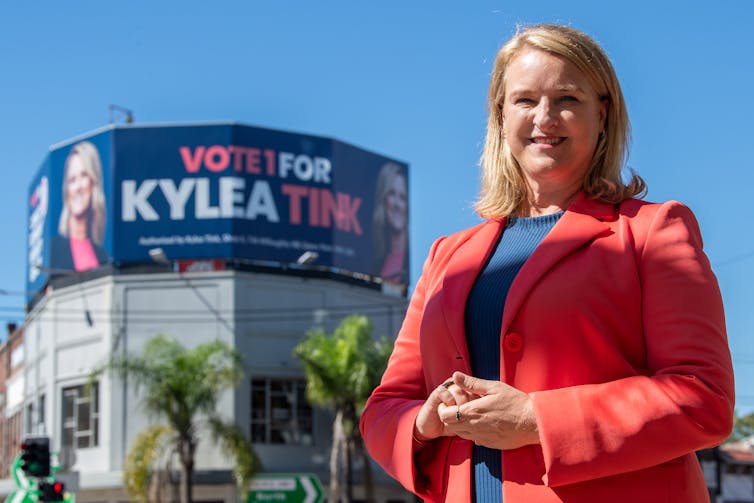
The Liberals branded them as fakes, but independents like Kylea Tink harnessed enough votes to snatch previously safe Liberal seats. AAP/Bianca de Marchi
On May 21 2022, Morrison’s divisive strategy backfired spectacularly.
His personal appointment of the anti-trans Katherine Deves in Warringah (a once Liberal seat with the second highest pro-marriage equality vote in NSW in 2017) did not turn the election nationally, but its symbolism mattered.
It said everything about the slice of Australia to which Morrison’s Liberal-Nationals government had become in thralled.
Dog whistling Deves’s harmful views to the marginal outer-suburbs where Morrison thought they might just resonate, was a moral low point in major party politics in Australia. But it was also an undiluted electoral disaster.
Using Katherine Deves’ anti trans views as a dog whistle was not just a low point in public debate, but an unmitigated political disaster. AAP/Mick Tsikas
So how does the party of Menzies’ “forgotten people” and John Howard’s “broad church” read the result, and then re-tool for recovery?
That task is made far more difficult because so many of the party’s leading lights have been washed away in Morrison’s great electoral bungle. The most important loss is the aforementioned Frydenberg (it seems) because the erstwhile treasurer and deputy leader represented the articulate urbane centre-ground. Clearly the most gifted and saleable Liberal in the parliament, he was the heir apparent.
His absence highlights that even the early logistical decisions will set the course. Among the few remaining moderates, Simon Birmingham told Insiders on Sunday, who they choose to be leader will set the tone of the opposition, but influence its policy also.
Therefore, it matters. Assuming Frydenberg does not scrape through on a favourable postal vote surge, Peter Dutton is the both the most likely leader, and the most conservative.
His selection would inevitably take the Liberal Party further from its disillusioned traditional blue-ribbon supporters – certainly in Victoria but elsewhere also.
Voters who walked in 2022, would keep walking.
Here, the basic maths are crucial. It is hard to imagine the Coalition even getting to 76 seats in future without recovering some or all of the “teal” seats.
Yet history shows that good independents consolidate their wins, suggesting these seats would be very hard to recover at any time, let alone when policy and personnel options are this limited.
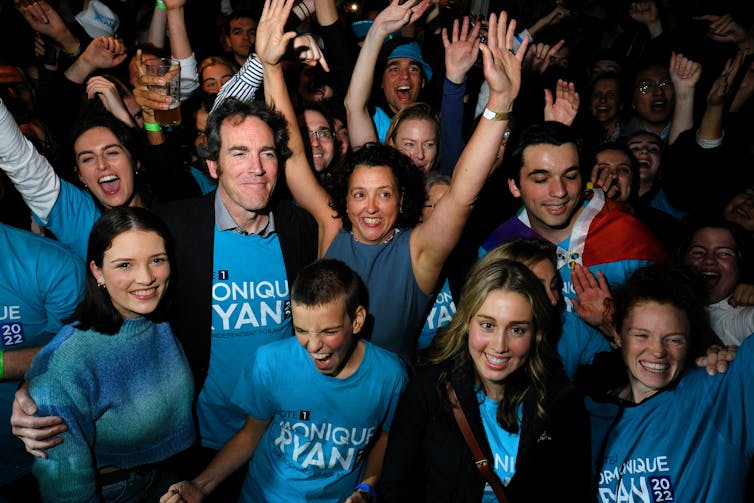
Besides, finding genuinely local, top-shelf female candidates who are both capable and willing to take on a Zoe Daniel or a Monique Ryan – and who are prepared to campaign over almost a whole term, will be a supremely difficult task.
Making that commitment for a party with two more average conservative men running it (names like Angus Taylor and Dan Tehan have been mentioned) is even more difficult to picture. And if one of them is Peter Dutton, probably impossible.
This explains why Liberals are casting about for a woman to take one of the two leadership posts, probably that of deputy. Karen Andrews and Sussan Ley have been floated.
Surveying the carnage, Birmingham observed that the wellsprings of the weekend rout began a long time ago with the needlessly drawn-out marriage equality vote, (a full-blown culture war) and the rejection of the National Energy Guarantee championed by Frydenberg and Turnbull.
Both political storms had registered negatively with soft Liberals in the heartland seats, leaving many distinctly unimpressed.
Yet as the beleaguered party considers its options, entreaties to double-down on the very things that alienated it from its base are already being aired. The logic can be well hidden.
A hardliner from South Australia, Senator Alex Antic, told Sky News on Sunday,
“>The Liberal Party’s experiment with the poison of leftism and progressivism must be over.”
Other prominent conservatives on the network suggested Liberals who had become pale imitations of Labor were the ones defeated, whereas hardliners who stood up against climate policy and who oppose a First Nations Voice to Parliament, had been successful.
These were their takes after the most significant shift to the left by mainstream voters in memory.
They highlight the influence of ideology and what looms as a wrestle for the centre-right soul that lay ahead.
Sensible Liberals meanwhile, have some big decisions to make.
They could listen to the extremist voices in partisan media, remembering of course it’s what got them to here. Or they could be more self-critical.
In a democracy, it’s never a terrible idea to listen to what the voters have just told you. Their message wasn’t hidden at all.
Mark Kenny does not work for, consult, own shares in or receive funding from any company or organisation that would benefit from this article, and has disclosed no relevant affiliations beyond their academic appointment.
Source: The Conversation (Au and NZ) – By Greg Barton, Chair in Global Islamic Politics, Alfred Deakin Institute for Citizenship and Globalisation, Deakin University
Lukas Coch/AAP
Extreme weather events are the new normal. The use of nuclear weapons by Vladimir Putin’s Russian military is now an unthinkable possibility. And Xi Jinping’s China, our largest trading partner and rising superpower, is pulling down the shutters.
The immediate challenge facing incoming Prime Minister Anthony Albanese and Foreign Minister Penny Wong is to reassure allies and friends of continuity and certainty. But more than that, the change of government presents an opportunity to build confidence in Australia’s capacity, once taken for granted, for visionary leadership and humble decency.
Remind me, what is the Quad?
The Quad involves India, Japan, the United States and Australia. It began in 2007, under George W Bush and John Howard, but Kevin Rudd, Australia pulled back because of concerns about America’s approach to China.
Prime Minister Turnbull revived the arrangement in 2017 as concerns mounted about China’s military expansion in the South China Sea. In March 2021 the Quad leaders issued a joint statement. “The Spirit of the Quad” spoke of a “rules-based maritime order in the East and South China seas” that supported a “Free and Open Indo-Pacific”.
At this week’s meetings, Japan and India will be looking for signs Australia is serious about engaging with Asia. Another old friend with deep and long-established links in Asia, France, will be looking for signs of a reset. The US will be reviewing its expectations of what Australia, under a Labor government, is prepared to contribute to both the Quad security dialogue and to the AUKUS trilateral security pact.
Albanese and Wong share much in common with US President Joe Biden and Secretary of State Antony Blinken. Their face-to-face meetings this week in Tokyo have the potential to reset the allies’ approach to China and the Indo-Pacific well beyond what was every likely or possible under Donald Trump and Scott Morrison.
The China question
One of the greatest challenges of our time is to reverse the slide in relations between China and the West. The stakes are immense, not just for defence and security, or trade and the economy, but also global responses to climate change, and the future course of Chinese society and the lives of 1.4 billion people.
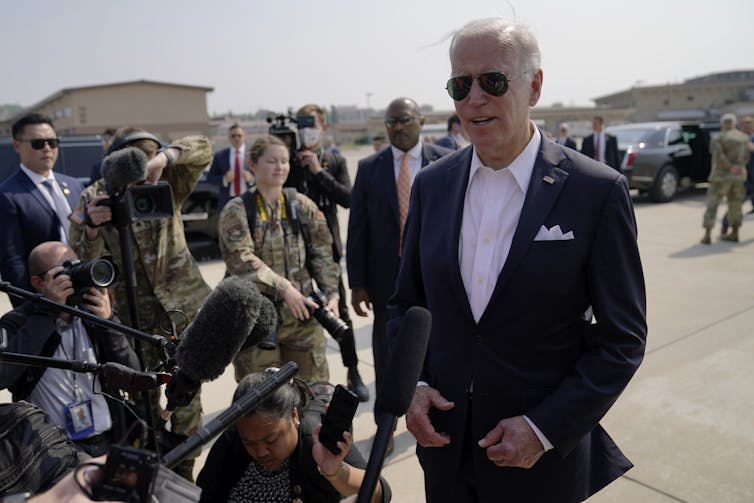
US President Joe Biden travelled to Japan on Sunday, ahead of the Quad meeting. Evan Vucci/AP/AAP
Biden and Blinken will also be looking for signs that the new Albanese Labor government is as committed to AUKUS as was the Morrison government. The revelation last week that, contrary to expectations in Washington DC, Labor was not consulted about AUKUS, raised doubts about the functioning of the security pact.
The operational details of how AUKUS could transform our immediate security environment, have also not been fully spelt out. As with the Quad, the potential benefits, and threats, to Australia go well beyond hard-core defence and security issues.
New opportunities with Wong
For decades, Australia’s engagement with Asia has lacked the sustained investment of financial, political, and social capital that is needed. Albanese says that he wants to change this, singling out Indonesia as a key priority for his government.
Despite living on the edge of the largest and fastest developing economies and societies on the planet, Australia has been far too lazy, shortsighted, and miserly about truly engaging with Asia. Our current woes with Chinese trade bans point to a failure to engage more broadly with both China and the rest of Asia.
Under Penny Wong, the Department of Foreign Affairs and Trade has the potential to play a critical role in securing Australia’s broader security interests. Wong’s personal backstory, as well as her formidable intellect, will be key assets in our engagement with Asia.
Penny Wong comes her new job with years of experience as a senior minister under the Gillard/Rudd governments. Jane Dempster/AAP
The challenges facing the new defence minister – understood to be Richard Marles – intersect tightly with those facing Wong. The shocking invasion of Ukraine by Russia, and the unexpected course of the war, contain many lessons for Australia. The first is the importance of international alliances and institutions, such as NATO and the European Union. Prior to Russia’s invasion of Ukraine, it was easy to be critical of NATO and the EU, and question their utility and substance. Not any more.
The Quad, AUKUS, ANZUS, and the Five Eyes intelligence alliance, together with ASEAN, are very different entities to NATO and the EU, but the war in Ukraine casts them in a fresh light. Diplomacy, trust and relationship-building are as critically important to defence and security as tanks, trucks and planes.
Other lessons from Ukraine
Australia’s next Defence White Paper, likely to be released in 2023, is going to be shaped by the both the rise of China and the decline of Russia. The experiences of the war in Ukraine, the critical role of logistics, the utility of certain kinds of equipment such as tanks, and the impact of organisational culture will be closely studied.
In all of this, there are challenges as well as great opportunities for Australia. Already it is clear that intelligence, IT and drones have played a critical role in defence of Ukraine. Australia has considerable capacity to innovate and develop related critical systems, hardware and technology, to the benefit of both national and regional security.
It should go without saying that Australia needs to both prepare for war and to do everything that it possibly can to avoid war. The later depends very much on the former, together with diplomacy and relationship building.
Don’t forget climate change
War, in the worst-case scenario, constitutes an existential threat. So too does climate change.
The remarkable outcomes of the 2022 federal elections point to the realisation of millions of Australians that more frequent and severe, fire, flood, drought and intense heat events represent an immediate security threat.
Neither the LNP nor Labor intended for this to be climate election. But it clearly was. This was an instance of ordinary voters being well-ahead of the leaders of the two larger parties.
The impacts of climate change will contribute directly to political and social stability in our region. Crises in food and water security, rising sea levels and severe weather events, and an increased impact of animal-to-human diseases such as COVID-19, mean that responses to climate change are integral to managing national and regional security.
The nation and the region is watching and looking to the new Australian government for leadership on security and this includes climate change.
Greg Barton receives funding from the Australian Research Council. And he is engaged in a range of projects working to understand and counter violent extremism in Australia and in Southeast Asia that are funded by the Australian government.
Source: The Conversation (Au and NZ) – By Catharine Coleborne, Dean of Arts/Head of School Humanities, Creative Industries and Social Sciences, University of Newcastle
Higher education did not figure prominently in the election campaign. The biggest issues facing the sector, in particular the arts, humanities and social sciences, could never be fully addressed in six weeks, but the Australasian Council of Deans of Arts, Social Sciences and Humanities (DASSH) urges the incoming Labor government to act on three issues as a priority.
The first is the impacts in Australia’s universities of the former Coalition government’s Job-Ready Graduates Package announced in June 2020. The changes included enormous fee increases for humanities, arts and social science (HASS) subjects.
Third, the acting minister for education and employment, Stuart Robert, wrote to the Australian Research Council (ARC) in December 2021 to direct that a significant portion of research funding be awarded to projects that demonstrate a strong connection with Australia’s manufacturing priorities. Research funding for the arts, humanities and social sciences is shrinking.
Taken together, these three policy shifts represent a sustained assault on the arts, humanities and social sciences. Ministerial vetoes of ARC discovery grants in late 2021 added to the picture of federal government disregard for our fields of education and research and their role in Australian society.
The Job-Ready Graduates Package was announced in 2020. Student fee increases of 113% apply to most arts degree subjects from 2022. This has had a direct impact on inflation.
The previous government assumed that studying these subjects will not get you a job, despite its own graduate outcomes data showing the opposite. According to Universities Australia, 36% of domestic students and 11% of international students were enrolled in arts, humanities and social sciences in 2018. Yet the government inferred that these disciplinary fields contribute little to Australia’s cultural and economic interests.
According to research commissioned by the Council of Deans, graduates from the HASS fields make up two-thirds of the Australian workforce. The QILT Employer Satisfaction Survey of 2021 showed graduates of “society and culture” degrees exceed the national average in their preparedness for employment.
A blinkered approach to research commercialisation
The research commercialisation plan will focus research efforts on the six national manufacturing priorities identified in the Modern Manufacturing Strategy.
Researchers in the humanities and social sciences will find it almost impossible to attract funding under these priorities. The creative industries might have better prospects in some areas such as design for new technologies.
However, the Coalition government’s own policies were contradictory. The National Research Infrastructure Roadmap, released in April 2022, points to “outcomes from research in the creative arts, humanities and social sciences disciplines” as being “critical to achieve the economic, social and environmental benefits we strive for”. The roadmap suggested this research will “play an important role in ensuring social acceptance and uptake of research outcomes, adoption of new technologies and ensuring ethical and responsible development and application of emerging technologies”.
The Council of Deans welcomed this recognition of the value of HASS research.
In December 2021, acting minister Robert asked that discovery grants be assessed under a strengthened national interest test. He also asked the ARC to “bring forward a proposal to enhance and expand the role of the industry and other end-user experts in assessing the National Interest Test of high-quality projects”.
We have argued these proposals represent a major shift for researchers in Australia. They would further entrench the changes that are pushing research dollars away from arts, humanities and social sciences.
Not only this but, as I noted at a Senate hearing on the ARC Amendment Bill 2018, applying a national interest test to inquiry-driven research links funding decisions to immediate, commercial and political concerns. Our STEM colleagues agree.
ARC research grants have also been subject to vetoes by government ministers, drawing condemnation both in Australia and internationally. The vast majority of grant vetoes since 2005 have affected humanities and social science projects, with the government showing ignorance of our contribution. Senator Amanda Stoker, for example, representing the education minister at a Senate estimates hearing in February, said:
“We are very happy to stand by the decision to reject a research project on how climate shaped the Elizabethan theatre. Presumably it’s something about how the theatre might have needed a roof or something.”
The value of our disciplines can be seen in every part of Australian life. Without arts, humanities and social sciences research we would not be using languages to build peace and diplomacy in our region, or have our current social institutions forging democracy. We would not have “Big History”: the study of how how humans and our environment have co-existed and influenced change over time leading to the profound understandings of humanity’s origins through interdisciplinary research. We would have little shared conceptual knowledge of our nation’s ancient histories and Indigenous cultures.
We have extensive collective experience as deans of these disciplinary fields in almost every university in Australia. We argue that researchers in the humanities, arts and social sciences have been highly responsive to the need to forge relevant research.
We look forward to working with the next minister for education to implement changes to these policies that will benefit our universities and the hundreds of thousands of students studying in our degree areas.
Catharine Coleborne is the President of the Australasian Council of Deans of Arts, Social Sciences and Humanities (DASSH), the peak body for Deans (and equivalent roles) of these fields across Australia and New Zealand, representing 43 university members.
Labor has inherited an economy with a pretty full “head of steam”.
Domestic demand is growing strongly, fuelled by
households flush with cash (and enriched by big increases in property prices)
full pipelines of housing construction and government-funded infrastructure
businesses apparently keener to invest than for more than a decade.
Unemployment has fallen to its lowest for 48 years with only 1.3 unemployed for each vacant job.
And Australia has also been one of very few economies to benefit financially from the impact of the conflict in Ukraine on food and energy prices.
Stormy weather
But Labor has also inherited an economy which, like most others at the moment, is experiencing a sharp acceleration in inflation. As a result, interest rates are likely to climb significantly over the next 18 to 24 months, weighing on Australia’s many heavily-mortgaged households.
And Labor will have to deal with the consequences of the ongoing slowdown in – and the deterioration in relations with – Australia’s major customer, China.
It might also have to confront a sharp slowdown, if not a recession, in the US and much of the rest of the industrialised world.
And it might do so with limited room to deploy fiscal (spending and tax) tools, thanks to the deterioration in Australia’s public finances.
Limited mandate
Like every first-term federal and state government in the past 30 years, the Albanese government comes into office with only a limited mandate – one in which the list of things it has promised not to do is longer than the list of things it has promised to do.
It has mandates for:
more ambitious action on climate change, for which it will be supported by the bevy of independents elected in formerly safe Liberal seats
improved standards in aged and disability care
cheaper child care
more technical and further education and university places
more spending on social and affordable housing and
collecting more tax from multinational corporations.
But it has no mandate for reforms that might lift Australia’s woeful productivity performance over the past decade, beyond whatever contribution any of the aforementioned policies might make, at the margin.
And, having acknowledged its policies will marginally add to the projected budget deficits over the next four years, it has no mandate for anything that would put Australia’s public finances on a more sustainable medium-term trajectory (as its counterpart in New Zealand did in its budget handed down last week).
In particular, it lacks a mandate to find the revenue required to fund the extra spending on aged and disability care, and health, which the Australian people clearly want, or for the extra spending on defence that the Australian people seem likely to get, whether they want it or not.
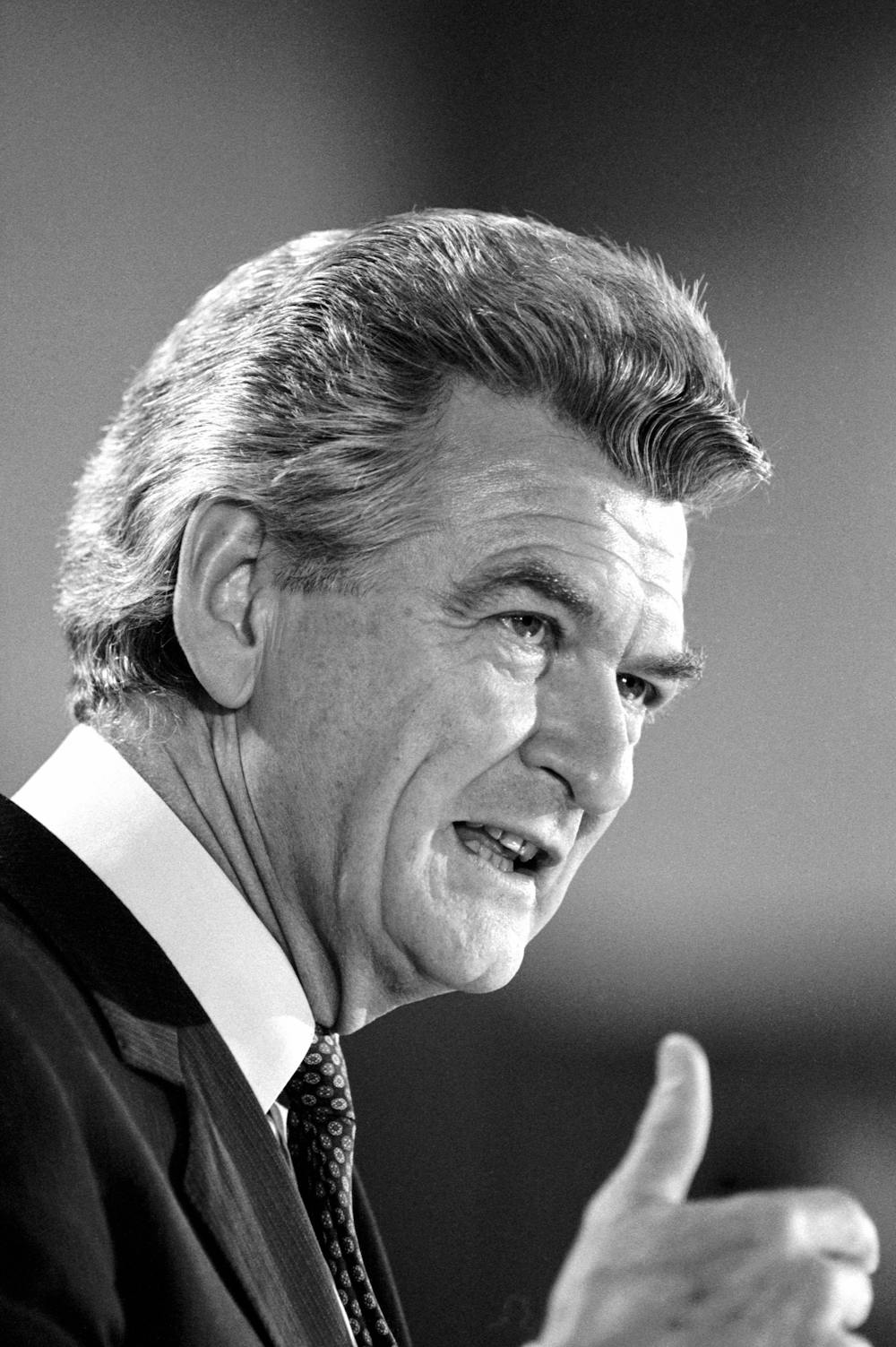
Bob Hawke used summits to expand mandates. National Archives of Australia
If it truly wishes to make a lasting difference to Australia’s medium term prospects – in the way that the Hawke and the Keating governments did – Labor needs in its first term to lay the groundwork for a more expansive mandate for its second term.
The most effective way of doing this would be to commission a series of inquiries into a limited number of issues posing the greatest medium-term challenges for Australia.
Among them would be ways of lifting productivity growth, housing affordability, tax reform, federal-state financial relations, the performance of Australia’s education system, and inequality.
If the inquiries had well-crafted terms of reference and were led by well-chosen people tasked with identifying solutions and making the case for change, Labor could then use their findings to create a more ambitious platform for 2025.
It is what Prime Minister John Howard did. Having promised ahead of the 1996 election that he would “never, ever” introduce a goods and services tax, he used that term to make the case for introducing such a tax in his second term, put it to the 1998 election, and won.
Prepare for that second term now
Bob Hawke did a similar thing to Howard with his 1983 national economic summit and 1985 national taxation summit, expanding the boundaries of what was politically possible while keeping faith with those to whom he had promised not to do certain things in his first term.
The alternative approach of abandoning promises shortly after taking office, adopted by the Abbott government in its first budget in 2014, and Queensland Premier Campbell Newman in 2012, is usually fatal.
Not since 1931 has a first-term federal government failed to secure a second term. This makes it possible to lay the groundwork now for that term, creating the mandate to allow Labor to do what it won’t be able to do in its first.
Saul Eslake does not work for, consult, own shares in or receive funding from any company or organisation that would benefit from this article, and has disclosed no relevant affiliations beyond their academic appointment.
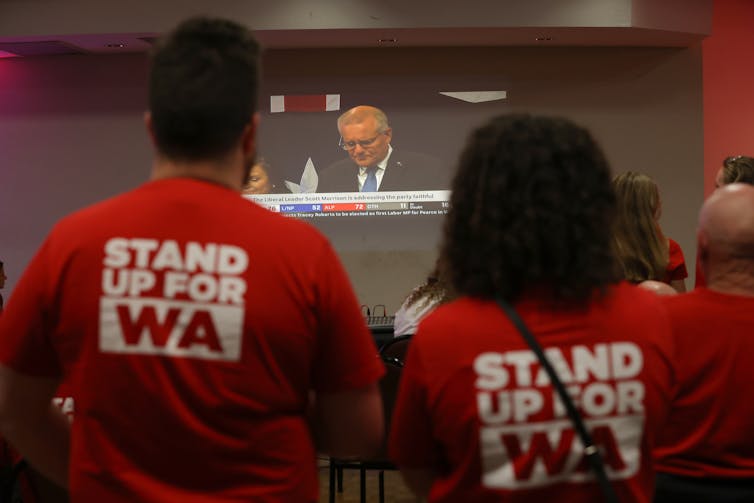
During the count, the rest of the country saw a slow but steady accumulation of Labor gains despite a fall in its primary vote. There was also a solid but unspectacular swing to it on a two party preferred (2PP) measure. But WA moved decisively and dramatically into the Labor camp. This is evident in both votes and seats.
Labor won four seats from the Liberals: Swan, Pearce, Hasluck and Tangney. So it now holds nine of WA’s 15 seats in the House of Representatives – the first time it has held a majority of WA’s federal seats since 1990. The Liberals also look very likely to lose the prized seat of Curtin to a teal independent. This would leave them with just five seats, in a state where they won 11 out of the 16 that were available in 2019.
These seat gains to Labor come on the back of massive primary and 2PP vote swings. Labor’s first-preference vote in WA jumped from 29.8% in 2019 to about 37.3% this time around.
In 2019, Labor’s primary vote in WA was 3.5 percentage points below its national share of 33.3%. Now, it is 4.5 percentage points above – a turnaround of 8 percentage points.
According to the ABC on Sunday evening, Labor in WA has about 55.3% of the 2PP, compared with about 52.2% nationally. In 2019, Labor won only 44.4% of the 2PP in WA, compared with 48.5% nationally. Labor in WA has gone from second-lowest to the highest 2PP share of any state.
Labor picked up four seats in WA. Richard Wainwright/AAP
In the Liberals’ two most marginal seats, Pearce and Swan, the swings to Labor on a 2PP basis are 14.9% and 13.1% respectively. Electoral boundaries for Pearce were redrawn after the last election, favouring Labor and reducing the total number of WA seats to 15. In Hasluck, Labor’s other target seat, there was an 11.5% swing, which means outgoing Minister for Indigenous Australians Ken Wyatt has lost his seat.
A few months ago, Premier Mark McGowan talked about Tangney as a possibility before Labor expectations were hosed down. Now, a swing of 12.1% has seen Ben Morton, a close colleague of Scott Morrison, defeated. Meanwhile, Labor’s most marginal seat, Cowan, previously on a margin of 0.9%, now has an 10% buffer.
Labor also looks like it may pick up a third Senate seat for the first time in a half-Senate election, with the Greens also winning a seat. This could tip the balance of power in the Senate.
The final blow to the Liberal Party is the likely loss of Curtin, held by Celia Hammond. Despite a 13.9% margin, it seems to have fallen to independent Kate Chaney.
Four steps to success in the West
We can think of the election outcome in WA as the result of four distinct steps along the electoral map.
WA Premier Mark McGowan’s enormous popularity in the state was a bonus for Anthony Albanese’s campaign. Lukas Coch/AAP
First, WA Labor has been a serial underperformer in federal politics, so merely shifting towards the average national Labor vote share was always likely to deliver it at least one seat, possibly two. The lack of contentious issues in the campaign relating to tax or the resources industry, plus the increased attention paid to WA by federal Labor, helped turn the dial in Labor’s direction.
Second, McGowan’s ongoing popularity disproved the notion that state politics don’t translate federally. Clearly, in 2022, they did. Federal Labor was able to capitalise on Labor’s strong brand in those Perth suburbs where it did so well in the 2021 state election. This enabled it to make a second big step forward in its primary vote.
Third, the Coalition federal government shot itself in the foot in 2020 when Morrison criticised the WA government’s border closures, and even more so when it supported Clive Palmer’s High Court case against them.
This was a major contributor to the Liberal Party’s decimation at the state poll in March 2021, leaving it with just two lower house MPs and depriving it of staff and resources, and thus not well positioned to withstand Labor’s strong campaign this time around. In addition, the WA Liberal Party’s failure to address internal organisational and factional issues left it open to a successful challenge in its Curtin heartland.
Outgoing Minister for Indigenous Australians Ken Wyatt lost his seat of Hasluck as Labor swept WA. Richard Wainwright/AAP
Fourth, WA’s relatively benign experience of the pandemic, plus Palmer’s unpopularity, meant most disaffected Liberal voters switched directly to Labor rather than to other right-wing parties. The United Australia Party and One Nation between them look to have only won 6.2% of the vote in WA, compared with 9.2% nationally.
Only one WA-based Labor MP, Madeleine King, is regarded as a certainty for a ministerial portfolio. But with federal Labor owing so much to WA, satisfying the ambitions and expectations of his WA MPs, and the broader WA community, will be an early challenge for Anthony Albanese.
John Phillimore worked as an adviser to state Labor governments in Western Australia in the 1980s and between 2001 and 2007
Joe Hawke — the prominent kaumātua and activist who led the long-running Takaparawhau occupation at Auckland’s Bastion Point in the late 1970s — has died, aged 82.
Born in Tāmaki Makaurau in 1940, Joseph Parata Hohepa Hawke of Ngāti Whātua ki Ōrākei, led his people in their efforts to reclaim their land and became a Member of Parliament.
He had been involved in land issues in his role as secretary of Te Matakite o Aotearoa, in the land march led by Dame Whina Cooper in 1975, before Ngāti Whātua Ōrākei walked onto their ancestral land on the Auckland waterfront in January 1977 and began an occupation that lasted 506 days.
He was among the 222 people arrested in May 1978 when police, backed by army personnel, ejected the protesters off their whenua.
“We are landless in our own land, Takaparawha means a tremendous amount to our people. The struggle for the retention of this land is the most important struggle which our people have faced for many years. To lose this last bit of ground would be a death blow to the mana, to the honour and to the dignity of the Ngāti Whātua people,” Hawke said1977.
“We are prepared to go the whole way because legally we have the legal right to do it.”
In 1987, he took the Bastion Point claim to the Waitangi Tribunal and had the satisfaction of seeing the Tribunal rule in Ngāti Whātua’s favour] and the whenua being returned.
He was a pou for protests and demonstrations thereafter — a prominent pillar in Māori movements.
In the 1990s Hawke became a director of companies involved in Māori development, and in 1996 he entered Parliament as a Labour Party list MP, before retiring from politics in 2002.
In 2008, he became a Member of the New Zealand Order of Merit for his services to Māori and the community.
Hawke’s tangi will be held at Ōrākei Marae this week. Wednesday marks the 44th anniversary of the Bastion Point eviction. His nehu will be on Thursday.
E te rangatira, moe mai rā.
The Bastion Point occupation protest lasted 506 days … 222 people were arrested in May 1978 when police, backed by army personnel, ejected the protesters off their whenua. Image: NZ History – Govt
Women were everywhere and nowhere in the 2022 federal election.
The message from the weekend’s vote was that the things that really matter to women and their communities matter at the ballot box, too. Even if they were not part of the conversations the major parties were having.
We know that women have been trending away from the Liberal Party, for almost 40 years. And we also know polls suggest women care about climate change more than men and of course we know they care about being respected and living in safety.
Big wins across the country
The most conspicuous winners on Saturday night were the so-called teal candidates.
From Zoe Daniel and Monique Ryan in Melbourne to Zali Stegall, Sophie Scamps, Kylea Tink and Allegra Spender in Sydney and Kate Chaney in Perth, politics-as-usual is being revolutionised by independent women.
Here we have seen a swathe of well-credentialed professional women secure stunning victories in metropolitan seats that have historically provided the Liberal Party with its power base. This is a trend started by former independent Cathy McGowan in 2013 in Indi. McGowan, who has continued to advise the current crop of candidates, wanted local members who actually listened to their constituents.
The teals made gender equality one of their top priorities, also situating it within an interlinked set of policy positions including anti-corruption and climate change. And they have been rewarded with history-making wins. Their impact on Australia’s political scene is already seismic and we’re barely 24 hours post-election.
But we also saw significant gains from women in other parts of the political spectrum.
Liberal MP Bridget Archer held her seat against the tide, having stood up for integrity issues and LGBTIQ+ rights during the last parliament.
Also in Tasmania, Jacqui Lambie increased her Senate team to two, with the likely election of Tammy Tyrrell.
Voters line up in Melbourne on election day. Luis Ascui/AAP
In Western Australia, Labor’s surprise success stories were female candidates like Zaneta Mascarenhas turning blue seats red. And in Sydney, independent Dai Le showed the major parties they can’t take local communities for granted, after she ousted parachuted Labor star Kristina Keneally.
This election is a stark warning about treating communities with contempt.
What will Labor do now?
We have known for some time the Coalition had “women problems” (Tony Abbott’s first cabinet had just one woman – Julie Bishop – in 2013). These were exacerbated in 2021 with Brittany Higgins’ allegations of rape at Parliament House and the dismissive way the Coalition and Scott Morrison responded to concerns.
Labor frontbencher Penny Wong played a prominent role on election night. Lukas Coch/AAP
Anthony Albanese and Labor have pledged to do more. It was noticeable the incoming prime minister made specific references to women in his victory speech and was prominently introduced by incoming Foreign Affairs Minister Penny Wong.
He has already appointed Linda Burney, the first female Aboriginal woman elected to the House of Representatives, as Indigenous Affairs Minister. Tanya Plibersek is expected to take the lead on women’s policy as Minister for Women.
But what have they promised and it is enough?
Sexual harassment
Labor’s commitment to fully implement all the Australian Human Rights Commission’s 55 Respect@Work recommendations is welcome news to the thousands of women who participated in the March4Justice last year.
We of course now need to watch to make sure this happens the way Sex Discrimination Commissioner Kate Jenkins intended.
Labor will also now have carriage of Jenkins’ other recommendations – to improve the culture at parliament house. This includes Labor Party culture.
Economic security
Labor says Australia should be “leading the world in equality between women and men”.
In policy terms, Labor is pledging to make childcare cheaper and to support women in insecure work. This means that wages in female dominated industries – such as care work – need to lead the policy discussion.
But there’s also a need for greater focus on the gendered nature of poverty and disadvantage. More could be done around fixing the adequacy of income supports. We know that most people who receive parenting payments (more than 90%) are women. More also needs to be done to invest in social housing, in addition to the lack of affordable housing over all.
It is reasonably clear the new Albanese government recognises the structural barriers to genuine equality. But with the Coalition’s stage three tax cuts totalling $15.7 billion annually backed by Labor – a legislated change that will overwhelmingly benefit high-income men – it is difficult to see how much-needed structural reform is to be funded and implemented.
Labor says it is making a “record” $3 billion investment into women’s safety. As part of this, it is pledging $77 million on consent and respectful relationships education. It will also spend $157 million for more community workers to support women in crisis and put ten days of domestic violence leave into the National Employment Standards.
Policymakers frequently fail to grasp the depth, complexity, and impact of violence on women and children. There are also clear links between women’s safety and economic security, including the need to address income support, homelessness, and housing.
The economic cost of violence against women and children is huge, but the policy debate is constantly framed in terms of money spent. We will need to watch this area closely for signs of real progress and lives being saved and better supported.
Who are ‘women voters’?
Finally, we also need to be cautious about how we speak about “women” and “women voters”.
An effective gender agenda needs to take account of the diversity of women’s interests.
Analysts do women a tremendous disservice by supposing that women are a single voting block or socially homogeneous group.
Diversity is something feminists have long attempted to place squarely at the centre of policy discussion. This includes economic and cultural differences in a population in which diversity is not a politically “marginal” issue but simply a description of mainstream Australian society.
Women have been angry, hurt and disappointed by major party politics in recent years. The results of the weekend show change at the ballot box is possible. We can only hope it now translates into change where it is needed most.
Camilla Nelson has received funding from the Whitlam Institute.
There’s an ancient observance in Chinese history that an earthquake is an ominous omen of coming political change. When the ground shakes it’s said the heavens are withdrawing an emperor’s mandate and encouraging people to rise up against a dying dynasty.
A few days ago, a sizeable quake shook Macquarie Island 1,500 km off Tasmania. While that island is hardly Canberra, Australia’s own electoral gods – the good burghers of the capital cities’ suburbs – nonetheless forced a tectonic shift in Australian politics on Saturday.
The aftershocks are likely to reverberate around the nation’s party system for years to come. Labor leader Anthony Albanese may still form majority government but, even if not, a few trends remain clear.
Political realignments
The first is the devastation of the Liberal Party. There was a 6% swing against the Coalition but this is largely a Liberal, not Coalition or National party problem. That’s roughly the size of the quake that demolished Paul Keating’s Labor government in 1996 and delivered an electoral “realignment” where “aspirational” working class Australians first moved to the Liberal-National Coalition.
Saturday’s movement from the Liberals (and, to a lesser degree, Labor) to the teals and Greens across the suburbs suggests another political realignment has occurred.
A second trend is the electorate’s rejection of outgoing Prime Minister Scott Morrison’s personal “bulldozer” style – a leadership type he foolishly acknowledged in the final week of the campaign.
Scott Morrison’s ‘bulldozer’ approach was rejected by voters. Mick Tsikas/AAP
But this is a Liberal problem as much as Morrison’s: when a party puts all its electoral eggs in the leadership basket (and encourages its leader to behave presidentially via “captain’s pick” pre-selections), the party has nothing left to sell when those leadership eggs are broken.
Existential crises
Third, and even more critically, Saturday was a rejection of a Liberal party that had become so conservative in its social, climate and wage policy that voters in the inner and middle suburbs could no longer stomach it. Only in the outer suburbs, provinces and regions (especially in Queensland and Tasmania, and particularly among older, male and blue-and fluoro-collar voters) did the conservative vote hold up.
This leads to a fourth theme – an existential crisis as to who the Liberals are and whom they represent. With moderate and progressive Liberals, most commonly in safe and leafy Liberal seats, wiped out on Saturday in a red wave in Perth, a green wave in Brisbane and a teal wave in Sydney and Melbourne, the next Liberal party room is likely to be the most conservative since the Menzies’ era.
There is a great irony here. At a moment when (especially younger, educated urban and suburban) Australians have jumped to the centre-left and demanded action on climate change, cost-of-living and government integrity, a now-battered Liberal party – likely to be led by the very conservative Queenslander Peter Dutton – may be more resistant to the progressive zeitgeist than ever.
If the Liberals cannot reconcile its deepening conservatism – based in Queensland where the Liberal National Party lost only two seats in Brisbane while maintaining all regional representation from Caboolture to Cape York – with an increasingly progressive electorate across Australia’s inner and middle suburbs, its longer-term prospects come into question.
Moreover, given the Liberals have seen support spin off in three directions – to Labor, the teals and to the populist right of Pauline Hanson and Clive Palmer (especially in Queensland) – the party that has governed federally for 51 of the past 73 years might be out of office for more than a decade.
While the Senate count is far from complete, it already appears Hanson is struggling to be re-elected. It’s also evident that the Liberal Democrats under former premier Campbell Newman, as well as the United Australia Party, have spectacularly fizzled despite Palmer spending millions.
Labor faces its own threats
But Labor faces its own existential threat in suffering a primary vote locked in the low 30s across Australia, and in the high 20s in Queensland. With fewer than one in three Australians now opting for Labor – and just over one in four Queenslanders – hundreds of thousands of capital city dwellers now see the Greens and teals as the only forces able to deliver on climate, integrity and equality.
This is certainly the case in Brisbane where the Greens – building on recent Brisbane City Council and state seat successes – have picked up the western Brisbane electorate of Ryan, and are set to win Griffith and Brisbane, too. If so, the departures of up-and-coming Labor MP Terri Butler and Liberal MP Trevor Evans will be a mammoth loss to the parliament.
Labor’s identity and mission are also in question. Albanese, while only the fourth Labor opposition leader to take office since the end of World War II, is the first to come to the top job without a comprehensive platform of policy reform.
Last, this election reveals that Australian voters, wracked with fears over the cost-of-living, unrepresentative leadership and weak climate policy, were indeed in the mood for change. But that change, toward the Greens and independents, took a turn few expected, and did not occur at all in regional Queensland.
Once again, the 2022 federal election reminds us that Queensland is indeed different.
Paul Williams is a research associate with the T J Ryan Foundation.
The most amazing thing about the election was the very low primary vote for the ALP and the Liberal Party.
The Liberal Party has lost seats to both Labor and the “teal” independents.
But the National Party has lost no seats (although Flynn is still very close) and its vote has declined only marginally. The problem with calculating swings for or against the Nationals is that candidates in Queensland stand for the Liberal National Party and then choose membership of either the Liberal or Nationals party room.
So the result for the Nationals has been very much steady state with essentially no real change since the previous election. This isn’t necessarily surprising as the ALP struggles to achieve 20% of the vote in many rural electorates.
If there’s to be a significant challenge to a National incumbent then it needs to come from either a minor party, as has happened in two seats in the New South Wales parliament with the Shooters, Fishers and Farmers (SFF), or from a high profile independent.
At the 2022 election there were a number of independents in National seats, but none had sufficient votes to make a significant challenge. This is not surprising as most National electorates are geographically very large and independents invariably have a power base in only part of the electorate.
Minor parties flop
As for the various minor parties – SFF, Pauline Hanson’s One Nation (PHON) and the United Australia Party (UAP) – none have performed very well at this election.
The PHON vote went up overall as the party ran candidates in more electorates than 2019. However, in those electorates where PHON had run previously its vote tended to decline, especially in Queensland.
Despite its massive campaigning the UAP vote stayed under 5%. It made no real impact.
Coalition holds onto regional and rural seats
One thing worth noting is the Nationals performed well in Victoria, with a slight increase in its primary vote. There was a swing to the Nationals in both Gippsland and Mallee.
When one looks at the rest of Australia, the Liberals successfully held onto their rural seats in both South Australia (Barker and Grey) and Western Australia (O’Connor, Forrest and Durack). If one then looks at Tasmania, which is largely regional in nature, there has been a swing of around 2% to the Liberals.
There are some interesting implications in these election results. The first is that the balance between the Nationals and the Liberals in the Coalition has changed, so that in any future arrangement, the Nationals will have a more prominent voice. This assumes, of course, that the coalition continues now that both parties are in opposition.
The second is the Liberals have been far more successful in rural and regional Australia than in the cities. This will also shift the balance for the Liberals between city and country, in favour of the country.
At the same time, the largest contingent of Coalition members in the parliament will come from Queensland and the Liberal Party may well be led by a Queenslander.
The Liberals now largely represent outer suburban and regional Australia. This is where its strength lies. It will need to decide on its future strategy. Does it seek to rebuild the Howard “broad church” by attempting to win back the seats lost to the teal independents, or does it attempt to remake itself more explicitly as a regional/outer suburban party?
City and bush divide
This election seems to indicate a major division opening up between the city and the bush. This coincides with a siloing of the population, such that the affluent increasingly do not rub shoulders with the less well off.
Labor will not make any inroads into the bush in the foreseeable future, beyond the regional seats it already holds such as Bendigo and Ballarat.
The Liberals may have to look at waving goodbye to what it once considered to be its “blue ribbon” seats. This election may indicate Australians are not moving closer together but further part.
Perhaps Australia is approaching a crossroads.
Gregory Melleuish receives funding from the Australian Research Council..
The rout of Scott Morrison goes beyond the defeat of his government. It has left behind a Liberal party that is now a flightless bird.
The parliamentary party has had one wing torn asunder, and its path to recovery will be difficult and painful.
It has lost a clutch of moderates, and with them the person who would have been potentially the most unifying figure in opposition, Josh Frydenberg.
Peter Dutton, now the most likely next leader, is divisive within the party and community; he would wield a hard fist against the new government but have trouble rebuilding his own side and changing his style.
Meanwhile the postmortem will get ugly. As outgoing minister Jane Hume put it succinctly on Sky News, “We should gut the chicken properly before we read the entrails – and there’ll be a lot of gutting.”
The Coalition’s loss goes to multiple factors, but Morrison personally carries much of the blame. On Saturday, he was torn down by a combination of quiet Australians and noisy ones.
His arrogant, or ill-informed, assumption seems to have been the teals were just a bunch of irritating women, and that professional people – including and especially female voters – in traditional Liberal seats would buy the government’s insulting argument these candidates were “fakes”.
They weren’t fakes – they were the genuine article. They embodied the thinking of many people, who previously voted Liberal and had concerns about climate, integrity and gender equity. But especially, and fundamentally, the rise of these candidates was a sign of community frustration and anger at the way politics is being played.
Morrison thought that whatever he lost to the teals – and almost no one expected him to lose anything like this much – he would pick up with the outer suburban tradies, the “quiet” ones.
Don hi-vis jackets as much as often as possible. Get your advancers to organise photo ops so you could put on aprons in coffee and food-serving places around the country. Kick footy balls. Oh, and install Katherine Deves in Warringah to dog-whistle on the trans issue to electorates many kilometres away.
Well, the tradies turned out to be harder voters to move or keep than the inner city professionals, and Morrison lost out in that transaction. The tradies are more worried about cost of living than culture wars.
For some time Morrison, reading polls and focus group reports and hearing from some alarmed backbenchers, was trying to catch up with the political zeitgeist. But it was too little too late, and moreover his efforts had unintended consequences.
He negotiated a deal with Nationals leader Barnaby Joyce for the net-zero 2050 emissions target. But the revised climate policy lacked medium-term ambition and so didn’t combat the teals. It also set off a “climate war” among Coalition troops and supporters, with a sharp negative reaction from the right.
Recognising his own deep unpopularity – he couldn’t set foot in many Liberal seats during the campaign – Morrison promised to be more empathetic if re-elected. However his last-minute “bulldozer gear change” narrative became a complete muddle, convincing nobody.
In the run-up to the election, with the polls showing the government was flagging, the Liberals put their hopes in Morrison’s reputation as a campaigner.
But that reputation was always over-egged – the 2019 “miracle” win came as much from the unpopularity of Labor’s policies and then leader, Bill Shorten.
Morrison was banking on wearing down Anthony Albanese during a relatively long six-week campaign. The government would play the man, and Albanese certainly made that easier with his mistakes.
But the electorate had also decided to play the man, and that man wasn’t Albanese. Voters had made up their minds against the government before the campaign, and many were given a middle-ground landing spot by the teals.
The election delivered lethal variations of the maxim that all politics is local. Labor’s bid to install former senator Kristina Keneally in the Sydney seat of Fowler was rejected by the voters, who likely would have got behind a well-known local Asian-Australian candidate, lawyer Tu Le, if Labor had put her up.
On a much bigger scale, Western Australians have had their revenge over Morrison’s attacks on their state during the pandemic (joining Clive Palmer’s border challenge; drawing an unfortunate comparison with cave people). Something of the same reaction has hit the Liberal vote in Victoria, where many people resented the attacks on Premier Dan Andrews.
Albanese, Australia’s 31st prime minister, was, it turns out, born under a lucky political star. Leave aside the log cabin story. In the days of the Rudd/Gillard/Rudd Labor governments, he wasn’t talked of as a likely future prime minister.
If Shorten had won the last election, Albanese, now 59, would never have reached the leadership. Time would have been against him.
Uncharismatic but dogged and canny, Albanese kept his nerve and held the party together over a difficult term dominated by a pandemic that initially helped incumbent governments and sidelined oppositions.
In an unwelcome byelection, he held the seat of Eden-Monaro, when a loss could have posed a threat to his leadership. He saw off mutterings as colleagues grew nervous about whether he could deliver government.
He set, and stayed with, the small-target strategy. He weathered the vicious and unrelenting attacks from the Murdoch media, in their newspapers and from Sky News commentators.
All the while, Morrison was doing for him what Shorten did for Morrison in 2019: alienating voters.
We don’t yet know whether Albanese will be in majority or minority government, although Labor’s chance of a majority were said to be improving on Sunday. If it were minority government, there are so many crossbenchers he wouldn’t have any trouble securing confidence and supply and passing legislation.
As leader of the house in the minority Gillard government, Albanese is experienced in dealing with crossbenchers, which would stand him in good stead.
There is speculation about the pressure he will be under, including from inflated Greens (at least one extra in the lower house and perhaps more) and the teals, to be more ambitious on climate policy.
But he needs to act with caution. Trust is low in the Australian electorate, and it is not a bad rule – unless circumstances change substantially – to say what you’ll do and do what you say.
“I want to change the country, I want to change the way politics works in this country,” Albanese declared on Sunday. To the extent he can do either, establishing and maintaining trust, in himself and in his government, will be vital.
He is promising to gather premiers and chief ministers together soon, which is a sound move. The federation is in need of some greasing.
While main attention is always on the prime minister, the incoming Labor government is fortunate in having a strong frontbench, several of whom have been in office before.
Sworn in on Monday, Albanese will fly off to Tuesday’s QUAD, the highly significant grouping of the leaders of United States, Japan, India and Australia. Although on one level the timing might look inconvenient, it is actually extraordinarily fortuitous.
Albanese, with little experience in foreign affairs, now has the immediate opportunity not just to participate in the QUAD’s collective discussion, but to have bilateral meetings with Japan’s Fumio Kishida, India’s Narendra Modi and US president Joe Biden.
It’s icing on the cake as he starts his term.
Michelle Grattan does not work for, consult, own shares in or receive funding from any company or organization that would benefit from this article, and has disclosed no relevant affiliations beyond their academic appointment.
Source: The Conversation (Au and NZ) – By Stephen Duckett, Honorary Enterprise Professor, School of Population and Global Health, and Department of General Practice, The University of Melbourne
Labor’s win in Saturday’s election heralds real change in health policy. Although Labor had a small-target strategy, with limited big spending commitments, its victory represents a value shift to a party committed to equity and Medicare, and, potentially, a style shift to a hands-on, equity-oriented health minister.
Labor’s shadow health minister, Mark Butler, is expected to be the new health minister, subject to a reshuffle caused by two Labor shadow ministers losing their seats.
Butler is very different from his predecessor. He was Australia’s first minister for mental health and ageing in the Gillard government. He also held the equity-focused ministries of housing, homelessness, and social inclusion. He has written a book about ageing in Australia, published by Melbourne University Press.
The new minister faces two urgent policy priorities: primary care and COVID.
Fixing primary care
Outgoing health minister Greg Hunt released an unfunded strategy paper on budget night. It aimed to improve primary care – a person’s first point of contact with the health system, usually their GP or practice nurses. The paper had languished on his desk for months and was the result of years of consultation and consensus-building.
One of the largest and most important Labor commitments during the campaign was almost A$1 billion over four years for primary care reform, about A$250 million in a full year.
The funding commitment is cast broadly, promising to improve patient access to GP-led multidisciplinary team care, including nursing and allied health and after-hours care; greater patient affordability; and better management of complex and chronic conditions.
Presumably, a key way this will be effected will be through voluntary patient enrolment. A patient would enrol with a practice, and the practice would get an annual payment for that enrolment. This was promised for people over 70 in the 2019–20 budget but not delivered.
This new policy is a welcome start for reform in primary care and signals the importance that a Labor government attaches to the sector.
Mark Butler was Minister for Mental Health and Ageing in the Gillard government. AAP Image/Lukas Coch
The Strengthening Medicare Fund was only sketched out in broad terms before the election, and provides insight into the new ministerial style. The details of the policy will be thrashed out in a taskforce which will include key stakeholders. Most importantly, the taskforce will be chaired by the minister – no hiding behind consultants; he or she will hold the hose.
COVID deaths continue: three times as many people have died this year than in the previous two. The coalition delegitimised any form of action, including mask wearing and vaccine mandates, as part of its undermining of state public health measures, especially action by Labor states.
The prevalence of third dose vaccinations, necessary for adequate protection from Omicron, sits at about two-thirds of the over-16 population, much lower in the under-16s, meaning that many in the population are not protected.
Public hospitals are bursting at the seams, with staff overwhelmed. This needs urgent attention, and the Coalition strategy of ignoring it and saying it was someone else’s problem, must be dumped. Labor vowed to “step up the national strategy” late in the election campaign.
Hopefully Labor’s shadow aged care minister, Clare O’Neil, will continue in this role post-election. She proved more than a match for her hapless opponent, Richard Colbeck.
Labor made big commitments in aged care, creating a significant point of difference with the Coalition, despite the Coalition’s investments in the 2021–22 budget.
In addition to the Coalition commitments, Labor promised 24/7 registered nurse coverage in residential aged care facilities, and to support a wage rise for aged care workers. The latter is particularly important because without a wages uplift, the staff shortages in the sector will continue.
Labor won’t engage in climate denialism or use climate policy as a political wedge.
Recognising and addressing climate change is an important issue for the health sector and, of course, the community more broadly as the teal surge and the Greens’ wins demonstrated.
Labor has committed to establishing a centre for prevention and disease control, which should provide a framework for addressing social and economic determinants of health.
Potentially as important in terms of policy style are Labor’s public service policies. The “consultocracy” which thrived under the Liberals will be shown the door, replaced by public servants doing the job the public service has always been available to do.
Obviously, a new Labor government will not be able to be meet all the community’s pent-up aspirations in a single term.
Nevertheless, it is disappointing Labor did not commit to phasing in universal dental care – the crucial missing piece of Australia’s universal health coverage.
Butler and his colleagues have a huge agenda on their plates. Starting with primary care is a good first focus, as without those foundations in place, the whole system cannot work well.
Stephen Duckett does not work for, consult, own shares in or receive funding from any company or organization that would benefit from this article, and has disclosed no relevant affiliations beyond their academic appointment.
The federal election result is highly problematic for the Liberal Party. Aside from finding itself on the opposition benches for the first time in nine years, the Liberal Party lost support in what were once its strongest electorates in Victoria. The biggest blow of all came in losing former Treasurer Josh Frydenberg’s seat of Kooyong.
It’s a devastating result that must now start a conversation about the party’s policy agenda at the state and national level.
Victoria, like Western Australia, had been the subject of a routine electoral redistribution before this election by the Australian Electoral Commission. This resulted in a new seat being created to the west of Melbourne, Hawke, to reflect the state’s changing population. In the process, it redrew the boundaries of many seats.
Even before the campaign began, the Liberal Party looked to be in trouble in Victoria. At the national level, opinion polls were showing Labor ahead on the all-important two party preferred vote.
Despite this, the experience of 2019, when polls got it wrong, injected some doubt as to whether Labor could really win the election. For example, one nightmare situation for Labor could have been enjoying a boost in the support in seats it already held, but being unable to win seats from the Coalition.
The possibility of this occurring was quickly extinguished on election night as Chisholm, the most marginal seat held by the government in Victoria, showed a strong swing to Labor. A two-party preferred vote swing of over 8% meant Gladys Liu could not defend the seat, held by a margin of just 0.5%.
Labor’s Carina Garland won the marginal seat of Chisholm from the Liberals’ Gladys Liu. AAP/Joel Carrett
The story continued in other parts of the state such as the seat of Deakin, which covers suburbs including Ringwood and Croydon in eastern Melbourne. It is held by right faction luminary Michael Sukkar but, with a two-party swing of almost 6% to Labor, looks likely to be a Labor gain.
In the inner-metropolitan seat of Higgins, Liberal incumbent Katie Allen’s primary vote fell by over 6%. The seat, once held by Treasurer Peter Costello and then Kelly O’Dwyer, is now looking almost certain to be won by Labor.
Even in the once-relatively safe seat of Menzies, which was previously held by Kevin Andrews, the Liberal party’s primary vote fell by over 9%. The candidate who replaced Andrews, Keith Wolahan, must now wait for the final votes to be counted to know his fate because, at the time of writing, he was ahead by just 45 votes.
There were some rare bright spots for the Coalition in Victoria. The Nationals were able to defend their seats while, in the outer-metropolitan electorate of La Trobe, Jason Wood has strengthened the margin he holds the seat by over 3%.
Inner Melbourne turns teal
One major development in Victoria was the performance of the teal independent candidates, especially in the inner metropolitan seats where the Liberal Party had performed very strongly over many decades.
Independent Zoe Daniel has won the formerly blue ribbon Liberal seat of Goldstein from incumbent Tim Wilson. AAP/Joel Carrett
The electorate of Goldstein had been held by the Liberal Party since its creation in 1984, and has been represented by MPs who became senior ministers, including David Kemp (1990-2004) and Andrew Robb (2004-2016). The incumbent, Tim Wilson, was defending a healthy two-party preferred margin of 7.8%. However, this evaporated as independent Zoe Daniel won the seat after the Liberal’s primary vote collapsed by over 13%.
The seat of Kooyong, which was held by Treasurer Josh Frydenberg, also fell to a teal independent, Monique Ryan, who finished with a higher primary vote than the incumbent.
The defeat in Kooyong has added significance. This was the seat that was held by the Liberal Party’s founder and longest serving prime minister, Robert Menzies. The defeat of the party here indicates its policy agenda is no longer resonating with what was once its core constituency.
Where to from here?
The losses in Victoria for the Liberal Party pose significant challenges. At a national level, the loss of Frydenberg, Allen and Wilson deprives the party of insights from Victorians, something that it can ill afford when trying to arrest the slide in popularity in this state.
The absence of Frydenberg in particular will also diminish the experience the party has, especially in the Treasury portfolio, and will likely have implications for the party’s policy direction.
The absence of these MPs, as well as the possible absence of Sukkar, also has important organisational implications for the party at the broader state level. The Liberal Party had significant party infrastructure that was built around the inner metropolitan electorates. Kooyong, Deakin and Higgins all had “200” clubs, which are important fundraising bodies for the Liberal Party. It remains to be seen how the party can continue to fund-raise in the same way without a local MP.
In electoral terms, the Liberal Party has gone backwards in Victoria, losing seats to not just its main rival in Labor, but also new challengers in the form of the teal independents. It will need some serious soul-searching to find its way back from here.
Zareh Ghazarian does not work for, consult, own shares in or receive funding from any company or organization that would benefit from this article, and has disclosed no relevant affiliations beyond their academic appointment.
The new government also celebrates the first female Minister for Indigenous Affairs, Linda Burney, as another significant and historic occasion.
Albanese’s commitment to the Uluru Statement from the heart made it clear it is an exciting time to be an Aboriginal or Torres Strait Islander person and participate in building our democracy.
No other election victory speech has placed Indigenous Peoples as central to the incoming government’s policy. Labor’s win thus represents a positive turning point in the relationship between Indigenous Peoples and other Australians.
What does this mean for an Indigenous Voice to Parliament?
An Indigenous Voice to Parliament and Government is one of three aspects of the Uluru Statement, alongside truth-telling and Treaty.
In 2020 I sat on the National Co-Design Group for Indigenous Voice. This was the federal government consultative process that put together the framework for how Indigenous peoples could have a say in parliament and government. Across 2020 and 2021, the working groups for Indigenous Voice heard from almost 9,500 Indigenous and other Australians who offered their thoughts on how a Voice to Parliament might work in practice.
Yet, Labor’s track record in living up to the big policy and social moments is patchy. For example, the 2008 National Apology for Stolen Generations was a bold move to recognise the trauma of colonisation in separating families.
However since that speech, there has been significant increase of Indigenous children in out of home care. This growth jumped in 2008 with the establishment of Close the Gap and has been a consistent trend throughout the Labor and Liberal years since the Apology.
Two options
Instituting an Indigenous Voice under Labor can go one of two ways.
Labor could implement the framework for Indigenous Voice designed by Aboriginal and Torres Strait Islander leaders. Our design was tested in wide-ranging public feedback from both Indigenous and non-Indigenous people. This can be implemented without the need for constitutional reform. This Voice to Parliament would not depend on anything more than the creation of an Act of parliament. This would constitute a national Indigenous body that represents local and regional Indigenous Voices from country to city.
The other pathway is constitutional enshrinement of an Indigenous Voice, which would require a referendum.
We do not need to have constitutional enshrinement of an Indigenous Voice to begin the process of government and parliament deeply listening to Indigenous Peoples for equity in decision-making. Indeed, it is better that we hold off on enshrinement and let the establishment of Indigenous Voice work out the foundations of a historic relationship between Indigenous Peoples and the rest of Australia.
I am full of hope that Indigenous Voice to Parliament and Government will be a powerful example of how we maintain democracy in Australia. If a parliament and government is from the people and for a people, then Indigenous Voice is a perfect place to test how we hear and respond to issues that are representative. Indigenous Voice is not a third chamber, but rather the process in which our gaps of relationship-building are filled.
People are hurting, through fire, flood or pandemic, and the previous government have badly let us down in addressing this. Politics is not just the act of leadership – Indigenous Voice can be a place where harmonious and practical advice can demonstrate how working together has mutual benefits.
It is exciting to think how far we might come as an Australian population when we look to Indigenous-led processes of inclusion as a model for those other marginalised voices. It is this basis of a healthy and connected relationship to each other, and to Country, that we might have the makings of reaching a democratic fullness of parliament and government.
This election has been surprising, because we could not assume obvious winners in the choice of multiple opinions, parties, independents and positions. What has been beautiful is the idea that an Indigenous Voice is no longer a wedge issue, but something genuine of our Australian character to stand for – a right to have a fair go.
Dr Emma Lee has consulted on the National Co-Design Group for Indigenous Voice. Dr. Lee has also received funding from the Australian Research Council Grant DP200101394 Making policy reform work: a comparative analysis of social procurement.
Public concern over climate change was a clear factor in the election of Australia’s new Labor government. Incoming Prime Minister Anthony Albanese has committed to action on the issue, declaring on Saturday night: “Together we can take advantage of the opportunity for Australia to be a renewable energy superpower”.
Following Labor’s win, frontbencher Richard Marles said the new government would stick to the climate policies it took to the election. But it’s not yet clear if Labor can form a majority in the lower house, or will rely on support from the teal independents and Greens MPs – all of whom campaigned heavily for stronger climate action.
Independent Monique Ryan, a pro-climate teal MP projected to win Kooyong, on Sunday declared she would work with a minority Labor government if it went further on climate policy – including ramping up its 2030 emissions target. Other crossbenchers are likely to take a similar stance.
Labor’s climate and energy policies provide an important foundation for progress. But there are some sectors of the economy that still need far more focus. So what might the next parliament bring on climate action?
Monique Ryan, centre, says she will pressure Labor to lift its 2030 emissions target if she wins Kooyong as expected. LUIS ASCUI/AAP
Saturday’s federal poll was the first where Australia had a national commitment to net-zero emissions. Whoever won government faced the task of normalising the target within government and across the economy, and accelerating rapid real-world emissions cuts.
Under the Morrison government, Australia pledged to reach net-zero by 2050. But our research, conducted with the CSIRO, has shown Australia could get there by 2035.
Such a target would be consistent with the Paris Agreement goal of limiting global warming to 1.5℃. It would also unlock our competitive advantage in a net-zero world – one where we can be a major player in exporting green energy and other low-emissions commodities.
Labor’s Powering Australia plan would reduce national greenhouse gas emissions by 43% by 2030, based on 2005 levels.
Analysis shows Labor’s proposed target, while far more ambitious than the previous government’s, is consistent with 2℃ of global warming. This is not yet in line with the Paris Agreement goal for “well below” 2℃ warming.
In minority government, Labor would come under pressure from the crossbench to adopt a stronger 2030 goal. Incumbent Warringah independent Zali Steggall, for example, is calling for at least 60% emissions reduction by 2030, and the Greens want even more.
Greens and teal independents are aligned with Labor on legislating Australia’s net-zero emissions target and reinvigorating institutions such as the Climate Change Authority.
A climate change bill, which Steggall and others championed in the last parliament, is more comprehensive. It would provide legislated timeframes for action on climate change, and implement a process ensuring targets are in line with the science.
The teals are likely to support Labor’s plans to standardise company reporting on matters such as climate risk and emissions. The move brings Australia in line with international best practice and will bring substantial benefits.
Warringah independent MP Zali Steggall introduced a climate change bill in the last parliament. Mark Baker/AAP
So too will Labor’s commitment to net-zero emissions in the federal public service by 2030, which will stimulate demand for low-carbon goods and services.
A gap to be addressed by the Labor government is creating roadmaps to net-zero for sectors and key regions. These could be integrated into Labor’s proposed National Reconstruction Fund, and should be devised in collaboration with the states and industry, as well as communities and workers affected by the global shift to net-zero.
The electricity sector produces about one-third of Australia’s emissions. The teals and Labor both went to the election aiming for renewable energy to comprise 80% of the electricity mix by 2030, which is about the pace of change needed.
Two major new Labor policies will be the basis for this:
Rewiring the Nation: includes A$20 billion in new electricity transmission infrastructure. If designed sensibly, the investment will unlock further private investment
Powering the Regions: investment in ultra low-cost solar banks, community batteries and improving energy efficiency in existing industries.
Yet more must be done – for example, more planning and new energy market rules. These should ensure the future energy system is no bigger than it needs to be, and that zero-emissions energy by 2035 is produced at least cost.
The Greens and teals want to halve emissions from Australia’s industrial sector by 2030. Labor’s current plans for industry aren’t that specific – and a crossbench with the balance of power is likely to pressure Labor in this area.
Labor’s policies on industry emissions comprise two main building blocks:
National Reconstruction Fund: $3 billion from the fund will aid industry’s low-carbon transition, including for manufacturing of green metals such as steel and aluminium
a revised “safeguard mechanism” requiring big polluters to reduce emissions.
Australia’s energy-intensive industries are already planning their response to shifting global markets. Labor must help these industries manage the change at the scale and pace required.
Australia’s industry must cut its emissions. Daniel Munoz/AAP
A broader transport plan
In transport, Labor has proposed removing taxes and duties on lower-cost electric vehicles – making them cheaper – and adopting Australia’s first electric vehicle strategy.
The party has already committed to 75% of all new Commonwealth fleet cars being low- or no-emissions by 2025. The teals want 76% of all new vehicle sales to be electric by 2030. The Greens would also push for a far stronger electric vehicle policy.
Labor will also take steps to establish high-speed rail on Australia’s east coast. But its transport policy essentially ends there. It could do more on public and active transport, as well as decarbonising freight and aviation.
A broader transport strategy – especially involving infrastructure planning and investment – would help the transport sector move towards net-zero.
Labor has room to expand its electric vehicle targets. Mick Tsikas/AAP
Strip emissions from buildings
Labor’s Housing Australia Future Fund is rightly focused on building new social and affordable housing, but is silent on net-zero. All governments have agreed to a zero-carbon buildings trajectory – now it’s time the federal government worked proactively with the states to achieve this.
The forthcoming review of the National Construction Code is a chance to bring in higher energy performance standards for new buildings.
But existing homes and business premises also need attention. A package of funds and regulations to drive electrification and energy performance gains there would bring lower energy bills and better health outcomes to many Australians.
A sustainable land sector
Labor policies will support innovation in agriculture, including reducing methane emissions from livestock and other carbon farming opportunities. There will also be crossbench support for increased tree planting and soil carbon storage, as well as more spending on low-carbon agriculture practices and technologies.
Under Australia’s carbon credit scheme, landholders are granted carbon credits for activities such as retaining and growing vegetation. Serious questions have been raised over the integrity of the scheme, and dealing with these issues should be a priority for the new government.
Many of Australia’s natural systems, such as rivers and other ecosystems, are stressed or near failure. The land sector both contributes to this alarming trend and can be part of the solution, and will be badly affected if the problems are not addressed.
Many farmers have shifted their practices in response to climate and environmental threats. But the new government should create a roadmap to place the land sector in a wider environmental context. This would ensure the sector seizes investment opportunities and plays its part in a sustainable future.
Such a plan would also help Australian agriculture shore up its share of global food exports in a world increasingly demanding low-emissions products.
Labor must draw up a low-carbon roadmap for the land sector. Shutterstock
A bigger, bolder vision is needed
The new Labor government has three years to steer Australia in a world that expects – and badly needs – every nation to take rapid climate action across the economy.
Australians have voted for a parliament with a stronger climate action agenda. More will be needed beyond the headline measures.
The onus is on all Australians help shape and implement these changes and ensure the nation not just survives, but thrives in a warmer world.
Anna Skarbek is CEO of Climateworks Centre which receives funding from philanthropy and project-specific financial support from a range of private and public entities including federal, state and local government and private sector organisations and international and local non-profit organisations. Climateworks Centre works within Monash University’s Sustainable Development Institute. Anna is on the board of the Green Building Council of Australia, the Centre for New Energy Technologies and Sentient Impact Group. She is a member of the Blueprint Institute’s strategic advisory council and the Grattan Institute’s energy program reference panel.
Anna Malos is part of Climateworks Centre which receives funding from philanthropy and project-specific financial support from a range of private and public entities including federal, state and local government and private sector organisations and international and local non-profit organisations. Climateworks Centre works within Monash University’s Sustainable Development Institute.
Public concern over climate change was a clear factor in the election of Australia’s new Labor government. Incoming Prime Minister Anthony Albanese has committed to action on the issue, declaring on Saturday night: “Together we can take advantage of the opportunity for Australia to be a renewable energy superpower”.
Following Labor’s win, frontbencher Richard Marles said the new government would stick to the climate policies it took to the election. But it’s not yet clear if Labor can form a majority in the lower house, or will rely on support from the teal independents and Greens MPs – all of whom campaigned heavily for stronger climate action.
New Kooyong independent Monique Ryan, one of a host of new pro-climate teal MPs, on Sunday declared she would work with a minority Labor government if it went further on climate policy, including ramping up its 2030 emissions target. Other crossbenchers are likely to take a similar stance.
Labor’s climate and energy policies provide an important foundation for progress. But there are some sectors of the economy that still need far more focus. So what might the next parliament bring on climate action?
New Kooyong MP Monique Ryan, centre, says she will pressure Labor to lift its 2030 emissions target. LUIS ASCUI/AAP
Saturday’s federal poll was the first where Australia had a national commitment to net-zero emissions. Whoever won government faced the task of normalising the target within government and across the economy, and accelerating rapid real-world emissions cuts.
Under the Morrison government, Australia pledged to reach net-zero by 2050. But our research, conducted with the CSIRO, has shown Australia could get there by 2035.
Such a target would be consistent with the Paris Agreement goal of limiting global warming to 1.5℃. It would also unlock our competitive advantage in a net-zero world – one where we can be a major player in exporting green energy and other low-emissions commodities.
Labor’s Powering Australia plan would reduce national greenhouse gas emissions by 43% by 2030, based on 2005 levels.
Analysis shows Labor’s proposed target, while far more ambitious than the previous government’s, is consistent with 2℃ of global warming. This is not yet in line with the Paris Agreement goal for “well below” 2℃ warming.
In minority government, Labor would come under pressure from the crossbench to adopt a stronger 2030 goal. Incumbent Warringah independent Zali Steggall, for example, is calling for at least 60% emissions reduction by 2030, and the Greens want even more.
Greens and teal independents are aligned with Labor on legislating Australia’s net-zero emissions target and reinvigorating institutions such as the Climate Change Authority.
A climate change bill, which Steggall and others championed in the last parliament, is more comprehensive. It would provide legislated timeframes for action on climate change, and implement a process ensuring targets are in line with the science.
The teals are likely to support Labor’s plans to standardise company reporting on matters such as climate risk and emissions. The move brings Australia in line with international best practice and will bring substantial benefits.
Warringah independent MP Zali Steggall introduced a climate change bill in the last parliament. Mark Baker/AAP
So too will Labor’s commitment to net-zero emissions in the federal public service by 2030, which will stimulate demand for low-carbon goods and services.
A gap to be addressed by the Labor government is creating roadmaps to net-zero for sectors and key regions. These could be integrated into Labor’s proposed National Reconstruction Fund, and should be devised in collaboration with the states and industry, as well as communities and workers affected by the global shift to net-zero.
The electricity sector produces about one-third of Australia’s emissions. The teals and Labor both went to the election aiming for renewable energy to comprise 80% of the electricity mix by 2030, which is about the pace of change needed.
Two major new Labor policies will be the basis for this:
Rewiring the Nation: includes A$20 billion in new electricity transmission infrastructure. If designed sensibly, the investment will unlock further private investment
Powering the Regions: investment in ultra low-cost solar banks, community batteries and improving energy efficiency in existing industries.
Yet more must be done – for example, more planning and new energy market rules. These should ensure the future energy system is no bigger than it needs to be, and that zero-emissions energy by 2035 is produced at least cost.
The Greens and teals want to halve emissions from Australia’s industrial sector by 2030. Labor’s current plans for industry aren’t that specific – and a crossbench with the balance of power is likely to pressure Labor in this area.
Labor’s policies on industry emissions comprise two main building blocks:
National Reconstruction Fund: $3 billion from the fund will aid industry’s low-carbon transition, including for manufacturing of green metals such as steel and aluminium
a revised “safeguard mechanism” requiring big polluters to reduce emissions.
Australia’s energy-intensive industries are already planning their response to shifting global markets. Labor must help these industries manage the change at the scale and pace required.
Australia’s industry must cut its emissions. Daniel Munoz/AAP
A broader transport plan
In transport, Labor has proposed removing taxes and duties on lower-cost electric vehicles – making them cheaper – and adopting Australia’s first electric vehicle strategy.
The party has already committed to 75% of all new Commonwealth fleet cars being low- or no-emissions by 2025. The teals want 76% of all new vehicle sales to be electric by 2030. The Greens would also push for a far stronger electric vehicle policy.
Labor will also take steps to establish high-speed rail on Australia’s east coast. But its transport policy essentially ends there. It could do more on public and active transport, as well as decarbonising freight and aviation.
A broader transport strategy – especially involving infrastructure planning and investment – would help the transport sector move towards net-zero.
Labor has room to expand its electric vehicle targets. Mick Tsikas/AAP
Strip emissions from buildings
Labor’s Housing Australia Future Fund is rightly focused on building new social and affordable housing, but is silent on net-zero. All governments have agreed to a zero-carbon buildings trajectory – now it’s time the federal government worked proactively with the states to achieve this.
The forthcoming review of the National Construction Code is a chance to bring in higher energy performance standards for new buildings.
But existing homes and business premises also need attention. A package of funds and regulations to drive electrification and energy performance gains there would bring lower energy bills and better health outcomes to many Australians.
A sustainable land sector
Labor policies will support innovation in agriculture, including reducing methane emissions from livestock and other carbon farming opportunities. There will also be crossbench support for increased tree planting and soil carbon storage, as well as more spending on low-carbon agriculture practices and technologies.
Under Australia’s carbon credit scheme, landholders are granted carbon credits for activities such as retaining and growing vegetation. Serious questions have been raised over the integrity of the scheme, and dealing with these issues should be a priority for the new government.
Many of Australia’s natural systems, such as rivers and other ecosystems, are stressed or near failure. The land sector both contributes to this alarming trend and can be part of the solution, and will be badly affected if the problems are not addressed.
Many farmers have shifted their practices in response to climate and environmental threats. But the new government should create a roadmap to place the land sector in a wider environmental context. This would ensure the sector seizes investment opportunities and plays its part in a sustainable future.
Such a plan would also help Australian agriculture shore up its share of global food exports in a world increasingly demanding low-emissions products.
Labor must draw up a low-carbon roadmap for the land sector. Shutterstock
A bigger, bolder vision is needed
The new Labor government has three years to steer Australia in a world that expects – and badly needs – every nation to take rapid climate action across the economy.
Australians have voted for a parliament with a stronger climate action agenda. More will be needed beyond the headline measures.
The onus is on all Australians help shape and implement these changes and ensure the nation not just survives, but thrives in a warmer world.
Anna Skarbek is CEO of Climateworks Centre which receives funding from philanthropy and project-specific financial support from a range of private and public entities including federal, state and local government and private sector organisations and international and local non-profit organisations. Climateworks Centre works within Monash University’s Sustainable Development Institute. Anna is on the board of the Green Building Council of Australia, the Centre for New Energy Technologies and Sentient Impact Group. She is a member of the Blueprint Institute’s strategic advisory council and the Grattan Institute’s energy program reference panel.
Anna Malos is part of Climateworks Centre which receives funding from philanthropy and project-specific financial support from a range of private and public entities including federal, state and local government and private sector organisations and international and local non-profit organisations. Climateworks Centre works within Monash University’s Sustainable Development Institute.
Source: The Conversation (Au and NZ) – By James Laurenceson, Director and Professor, Australia-China Relations Institute (ACRI), University of Technology Sydney
An Albanese government in Canberra means an improved trajectory in Australia-China relations is a real possibility.
Sure, there will be no “re-set” like we saw in the heady days of 2015. The world has changed; Australia and China certainly have.
And, of course, Beijing will need to be ready to chart a different course, not just Canberra.
After all, in 2020 it was Beijing’s decision and Beijing’s decision alone to respond to political disagreements by cutting off senior level dialogue and hitting Australia’s exports.
Further tempering the outlook is that the architect of China’s assertive foreign policy turn, President Xi Jinping, is expected to be re-instated for a third term when the Communist Party of China meets for its 20th National Congress later this year.
But the Morrison government’s actions and reactions were not irrelevant. The current dire state of bilateral relations between Canberra and Beijing was not inevitable.
Missed opportunities
It is an observable fact, for example, that the Morrison government abandoned the more diplomatic approach it had pursued in 2019.
Rock bottom in Australian diplomacy came in March this year, when an airliner crashed in southern China, killing 132 people.
Yet in contrast to the leaders of the UK, Canada, India and others – all countries that have had their own acute challenges with Beijing – neither the prime minister nor his foreign minister, Marise Payne, saw any reason to issue even a short statement of condolences.
Imagining Canberra has no agency to promote a relationship recovery also misses the fact every other capital in the Asia-Pacific region has managed to maintain relations with Beijing in a more constructive state.
The role and value of diplomacy
A recent poll by the Australia-China Relations Institute shows the Australian public recognise the current situation is not as one-sided as Canberra or Beijing like to suggest.
A clear majority of respondents, 78%, agreed that, “The responsibility for improving the relationship between Australia and China lies with both countries”.
Some commentators insist there is no prospect of an improvement. They typically point to there being bipartisan agreement “China has changed” and to overwhelming agreement between the major parties on the suite of policies justified in response.
But this assessment dismisses the role and value of diplomacy.
As Allan Gyngell, former head of the Office of National Assessments said:
It is not beyond the capacity of effective diplomacy to return the situation between Australia and China to something more closely approximating that of other US allies.
Penny Wong as foreign minister
The Chinese embassy in Canberra will have cabled back to Beijing the conciliatory diplomatic touches incoming foreign minister, Senator Penny Wong, has pursued from opposition.
Australia has done nothing to injure [the] partnership [with China], nothing at all.
But in May last year, Wong insisted the differences between Australia’s interests and China’s interests,
do not mean that there’s nothing we can do. They don’t mean that there’s no room for improvement in our own actions.
And unlike the Morrison government, Wong took time to express her condolences after the China plane crash tragedy in March.
Another difference is Wong looks beyond just Washington and London for insight into Australia’s challenges.
In November last year, she singled out Singapore, saying:
Their insight into China, their insight into the region, are second to none […] [Singaporean] Prime Minister Lee [Hsien Loong] is a thinker and a leader whose writing and speeches on these issues, I think, are second to none.
It was Singaporean Prime Minister Lee who stood next to Morrison last June and offered the following advice
There will be rough spots [with China] […] you have to deal with them. But deal with them as issues in a partnership which you want to keep going and not issues which add up to an adversary, which you are trying to suppress.
A new opportunity
There’s one other factor pointing to a more positive future. Beijing has form in using the arrival of a new government as an opportunity to undertake a face-saving adjustment.
The Australia-China relationship began to sour during the government of Malcolm Turnbull (between September 2015 and August 2018). Turnbull’s foreign minister, Julie Bishop, did not visit China in the final two and a half years of her tenure.
Morrison was the Turnbull government minister responsible for signing off on the ban of Chinese technology company, Huawei, from Australia’s 5G rollout.
Yet when Morrison subsequently emerged as prime minister, Beijing took the opportunity to invite his new foreign minister for a formal visit less than three months later. A month after Morrison won another term in May 2019, he secured a meeting with China’s president Xi Jinping.
Beijing would now also recognise that any plan it once had to change Canberra’s political decision-making by disrupting Australia’s trade has been a dismal failure.
It not only cratered Australian elite and public opinion, but damaged China’s reputation as a responsible great power and reliable trade partner elsewhere (notably in North America and Europe).
All this raises the prospect that when the 50th anniversary of the establishment of diplomatic ties between Australia and the People’s Republic rolls around in December, the occasion might now be marked with some celebration – not just awkward silence.
James Laurenceson does not work for, consult, own shares in or receive funding from any company or organisation that would benefit from this article, and has disclosed no relevant affiliations beyond their academic appointment.
The election results are in and Labor has won enough seats to form government, either as a majority or with the support of independents. What will this mean for political integrity?
The main election promise Labor has made on integrity is to establish what it says will be a “powerful, transparent and independent National Anti-Corruption Commission” (sometimes shortened to NACC).
So, what is Labor’s model for an anti-corruption commission?
Labor has proposed a robust commission with strong powers, coupled with checks and balances to ensure it does not abuse its powers.
The National Anti-Corruption Commission will have broad jurisdiction to investigate serious and systemic corruption by Commonwealth ministers, public servants, ministerial advisers, statutory office holders, government agencies and MPs.
Crucially, it would have the power to conduct public hearings if it believes it’s in the public interest.
Labor’s model balances the seriousness of allegations with any unfair prejudice to a person’s reputation or unfair exposure of a person’s private life.
This is a proportionate model that enhances public trust through public hearings, but also takes into account legitimate concerns about damage to an individual’s reputation.
By contrast, the Coalition’s proposed model did not include the power for public hearings.
The National Anti-Corruption Commission will have the power to make findings of fact, including findings of corrupt conduct. It could refer matters involving criminality to law enforcement authorities.
Unlike the Coalition’s policy, the National Anti-Corruption Commission will also have retrospective powers to investigate alleged misconduct from 15 years ago.
Labor’s National Anti-Corruption Commission can act in response to referrals, including from whistleblowers and public complaints, consistent with other integrity bodies.
By contrast, the Coalition’s model did not allow referrals from the public.
Importantly, the strong powers of the National Anti-Corruption Commission will be counterbalanced by external accountability mechanisms to “watch the watchdog” via parliament and the courts.
There would be oversight by a parliamentary joint committee. Its decisions would also be subject to judicial review, to ensure the body’s compliance with the law, due process and other standards.
Can Labor deliver by Christmas?
Labor has promised to pass legislation establishing the National Anti-Corruption Commission by the end of the year. Is this feasible?
There are still some aspects of Labor’s model that remain unclear, such as the budget that will be allocated to establish and run the body.
For the commission to be effective, it requires sufficient funding and staff to carry out its investigations.
Also, the full design of the National Anti-Corruption Commission has not been announced, such as how many commissioners or deputy commissioners it would have.
It is also unclear whether it would have a corruption prevention division, which is a pro-integrity function that monitors major corruption risks across all sectors.
These details would need to be worked through expediently to get a bill up by Christmas.
Labor has said it will draw on a draft bill proposed by independent MP Helen Haine in 2020. This may potentially expedite the drafting process.
The composition of the Senate will also be crucial to determine whether Labor can pass this bill, especially if the Coalition seeks to block it.
The electorate has spoken. The time is overdue to introduce a federal anti-corruption commission.
It is time for the new government to act – without delay. Australians deserve a robust system of accountability that will keep our politicians honest.
Yee-Fui Ng does not work for, consult, own shares in or receive funding from any company or organization that would benefit from this article, and has disclosed no relevant affiliations beyond their academic appointment.
Source: The Conversation (Au and NZ) – By Susan Harris Rimmer, Professor and Director of the Policy Innovation Hub, Griffith Business School, Griffith University
The Australian Labor Party will form government either outright or in a minority government.
The ALP has so far gained a small 2.8% two-party preferred national swing (though much higher in Western Australia, around 10%).
The crossbench may double in size with a progressive-leaning “potpourri” of candidates including Greens and “teal” independents.
Roughly a quarter of Australians voted for a minor party in the 2019 election (24.7% in the House of Representatives).
This time, it’s predicted over 33% of the electorate voted for minority parties or independents. Such votes in the inner city seats in particular are changing the political equation for the major parties.
The major parties look like only gaining two-thirds of the overall vote. In the past they’ve had more than 80% of the vote, confirming a long-term trend of decline in vote for the major parties. The ALP might take government with only around a third of the vote, so the “third force” of politics in Australia must be taken seriously from now on.
As I commented for CNN, for too long the Australian parliament has been run like private gentleman’s clubs of yesteryear with a culture that prioritises protection for the powerful over professionalism for all.
This election might be the final straw for that culture, and a wake-up call for party campaign strategists.
The ALP is entitled to think a win is a win. But the dominance of the major parties may be over.
So, what’s going on?
It has been a difficult three years for many Australians; for many the most difficult of their lives, dealing with the pandemic and natural disasters.
It was always possible this election might throw up unusual results, especially as the major parties ran business-as-usual, frankly lacklustre, mostly forgettable and negative campaigns focused on the character of the leaders and gotcha moments.
Many undecided voters remained undecided after the three leaders’ debates. Despite the leaders talking predominantly about the short-term cost of living, perhaps it seems voters want urgent leadership on long-term climate adaptation in a government with integrity safeguards.
The Liberals lost many of their blue-ribbon seats to “teal” independent candidates, and both the ALP and Liberals may have lost several inner city seats to the Greens.
It’s likely the major parties were not strong enough on climate change beyond targets, not comprehensive enough on gender equality issues and were silent on higher education cuts in university seats.
The major parties’ campaigns did not disrupt voters’ disengagement and disillusion with politics generally either.
The Greens
Queensland always keeps national pundits on their toes, and this time the “miracle” looks like it’s going the Greens’ way.
It has won the lower house seat of Ryan, and at the time of writing is leading in Griffith. The Greens are also a chance in the seat of Brisbane.
In Victoria, the Greens again won the now safe seat of Melbourne, and may also pick up Macnamara.
The Queensland Greens were confident of their campaign in Griffith, Ryan and Brisbane with concerted door-knocking for many months, targeting issues like aircraft noise and rental rights, and engaging with young people.
The Greens candidate in Ryan, architect Elizabeth Watson-Brown was a quiet but effective grassroots campaigner.
The Greens may also pick up the sixth Queensland Senate seat in a fight with Pauline Hanson.
This bears out recent findings that Brisbane, Griffith and Ryan are particularly exposed to climate risks, as identified in the Climate Council report “Uninsurable Nation”.
Griffith’s Climate Action Beacon conducted one of the most ambitious climate change surveys yet conducted in Australia.
We found this could be the “climate election” because 87% of the respondents indicated they believe climate change should be a priority for the government. This was also the findings of the ABC’s Vote Compass.
The Nationals’ vote held this election, so it’s clearly the Liberal Party that has suffered with its voter base.
United Australia Party
Prior to election day, UAP was polling about 3% and so far is around 4.3%.
It’s possible UAP preferences may have an impact on several Western Sydney seats, but beyond that, there was no clear impact despite the $70 million spent on the United Australia Party campaign advertising. The UAP face controversy about a misleading advert about the World Health Organisation on the final day of the campaign.
One Nation got a national first preference vote of 3.1% in 2019, an increase on the 1.29% it received in 2016.
More candidates ran in this election, pushing up the vote overall but the party did not increase their vote in seats previously contested.
Pauline Hanson herself was almost invisible in the campaign, partly because she tested positive to COVID during the campaign. But she may retain her Senate spot.
More to come
Susan Harris Rimmer receives funding from the Australian Research Council and the ONI.
The Morrison government has been resoundingly defeated, with Labor headed for office, although whether in a minority or majority was unclear late Saturday night.
The election has been a triumph for the teal independents, with up to five new teals set to join a record crossbench.
Treasurer Josh Frydenberg is expected to lose his seat of Kooyong to teal independent Monique Ryan.
According to the ABC, Labor has won the Liberal seats of Chisholm and Higgins in Victoria, Robertson and Reid in NSW, Boothby in South Australia, and in Western Australia Swan, Pearce, Hasluck, held by the Minister for Indigenous Australians, Ken Wyatt, and Tangney held by Special Minister of State, Ben Morton.
But Labor frontbencher Kristina Keneally is expected to be defeated in her bid to win the Sydney seat of Fowler. The seat is likely to taken by independent Dai Le.
Apart from Kooyong, teal independents have defeated Liberals in Goldstein in Victoria, and North Sydney and Mackellar in NSW, with Wentworth in the balance.
Frydenberg told supporters on Saturday night that while mathematically it was still possible to win, it was definitely difficult.
The election has also been a big victory for the Greens, which have won Ryan from the Liberals in Queensland. The Greens may also pick up the Queensland Labor seat of Griffith. The Liberal seat of Brisbane is in play between Greens, Labor, and the Liberals. In the previous parliament, the Greens have only had the seat of Melbourne held by their leader Adam Bandt.
Scott Morrison conceded defeated before 11pm. He announced to supporters that he would quit the leadership.
“I will be handing over the leadership at the next party room meeting to ensure the party can be taken forward under new leadership which is the appropriate thing to do,” Morrison said.
“Tonight, it’s a night of disappointment for the Liberals and Nationals, but it’s also a time for Coalition and members and supporters all across the country to hold their highs head.
“We have been a strong government, we have been a good government. Australia is stronger as a result of our effort over these last three terms”
“We hand over this country as a government in a stronger position than we left it than we inherited it when we came to government those years ago under Tony Abbott,” he said.
Albanese said “Tonight the Australian people have voted for change. My Labor team will work every day to bring Australians together”.
“I want to find that common ground where we can plant our dreams,” he told supporters.
He said: “Together we can end the climate wars”.
“I hope my journey in life inspires Australians to reach for the stars.”
The loss of Frydenberg leaves Peter Dutton as the favourite to become leader of the opposition.
The Coalition and Labor both have very low primary votes, an indication of the disillusionment of voters with both sides.
In Western Australia, where Morrison campaigned on Friday, the Liberal vote collapsed.
Finance Minister and senior moderate Simon Birmingham, speaking about Warringah, where independent Zali Steggall has retained her seat against controversial Liberal candidate Katherine Deves, said: “I think it sends a message about what Australians believe when it comes to issues of respect, of inclusion, of diversity.
“And the message is Australians want people to respect their lives but they also want have a strong and profound respect for the lives of others under the circumstances of others and I think what we are seeing there is a strong message.”
Birmingham said there had been a “contagion effect” from Warringah that punished Liberals in adjacent seats.
Teal independent Zoe Daniel, who has won Goldstein, named after suffragette Vida Goldstein, who failed in her effort to enter federal parliament, said: “Today I take her rightful place”.
Michelle Grattan does not work for, consult, own shares in or receive funding from any company or organisation that would benefit from this article, and has disclosed no relevant affiliations beyond their academic appointment.
One of the most stunning features of the 2022 election has been the challenge from teal independents in Liberal seats.
At the close of counting on Saturday, the teal independents have polled much stronger than expected, and look to have succeeded in electing a swathe of new independents to the House of Representatives. As Liberal Party commentator Tony Barry told the ABC, “the Liberals have lost their base”. It was not a blood bath, but a “teal bath”.
The headline story is the success of neurologist Monique Ryan who looks poised to take the blue-ribbon seat of Kooyong from Treasurer Josh Frydenberg. But teal candidates have stormed other electorates in Melbourne, Sydney, Perth and Canberra.
When we are talking about “teals” we are talking about the 23 independent candidates, most of them women, who have challenged traditionally Liberal-held seats or Senate spots. All have received support from fundraising organisation Climate 200.
Independent Allegra Spender casts her vote in Wentworth on Saturday. Bianca De Marchi/AAP
Climate 200 convener Simon Holmes a Court credited the success, particularly in inner Melbourne, to a huge volunteer effort. “This community independents movement is incredible,” he told the ABC.
The results so far
Counting is still continuing and it needs to be noted that high numbers of postal and pre-poll votes will favour the major parties. So we will need to watch some of these seats in coming days before the results are confirmed.
ABC election analyst Antony Green has already given:
North Sydney to independent Kylea Tink, defeating Liberal MP Trent Zimmerman
Mackellar to GP Sophie Scamps, defeating Liberal MP Jason Falinski
Goldstein to with former ABC journalist Zoe Daniel, defeating Liberal MP Tim Wilson.
Along with Kooyong, business leader Allegra Spender was ahead of Liberal MP Dave Sharma in Wentworth.
Independents Kate Chaney in Perth’s Curtin and Rob Priestly in regional Victoria’s Nicholls were also putting up a huge fight as counting closed on Saturday. Caz Heise in Cowper in northern NSW was also recording a strong independent vote.
Other independents with Climate 200 backing were also comfortably re-elected: Zali Steggall in Warringah, Helen Haines in Indi, Andrew Wilkie in Clark and Centre Alliance MP Rebekha Sharkie in Mayo.
Taking into account the likely election of Dai Le – a non-Climate 200 independent candidate against Labor’s Kristina Keneally in Sydney’s Fowler – the independent numbers on the cross bench could double in size.
In the Senate, teal candidate David Pocock is in a close race for the second ACT Senate spot, with Liberal incumbent Zed Seselja.
What does this mean?
These results far exceed expectations before polling day. Noting the very strong results for the Greens, particularly in Queensland, we have seen an extremely clear vote for more action on climate change, more integrity in politics and more action on gender equity. These were all central planks of their campaigns.
Voters who would normally have voted for a moderate Liberal, but would have been unlikely to vote Labor or Greens, were given a viable choice – and they took it with both hands.
Treasurer Josh Fydenberg adds sauce after voting in Kooyong on Saturday. James Ross/AAP
In an election full of different results and surprises, this block of independents is going to markedly change the composition of the lower house. The precise nature of their role and power will be determined when we know if Labor will rule in a majority or minority.
These results also mean that the Liberal Party has been stripped of its moderate MPs.
Minister for Finance Simon Birmingham lamented the loss of his colleague Zimmerman on Saturday night, saying the party would have to “make up for the absence of those [moderate] voices”.
Birmingham also blamed the “contagion effect” of Katherine Deves’ controversial candidacy in the neighbouring seat of Warringah, arguing this has turned potential Liberal voters in other seats. It might well be argued that Deves had a similarly adverse effect on the campaigns in other long-held Liberal seats on the North Shore and surrounds, such as Mackellar and Bennelong.
But of course these results reflect something much more serious and much deeper than a preselection problem.
What should follow now is a period of soul-searching within the party, and a decision on how it will challenge these seats in the future. Where will be party’s base lie in the future?
Meanwhile a new crop of MPs have given “politics as usual” a huge shock.
From the beginnings of Cathy McGowan’s victory in Indi in 2013, we now have an established model for community-backed candidates to win seats in parliament. The teals will have a steep learning curve in Canberra (without the infrastructure of established parties to support them) but they have already made a difference.
We should expect to see similar challenges in both Labor and Liberal seats in elections to come. The Australian political system is well and truly on notice.
Amy Nethery does not work for, consult, own shares in or receive funding from any company or organisation that would benefit from this article, and has disclosed no relevant affiliations beyond their academic appointment.
Source: The Conversation (Au and NZ) – By Adrian Beaumont, Honorary Associate, School of Mathematics and Statistics, The University of Melbourne
AAP/Lukas Coch
With 53% counted at Saturday’s federal election, the ABC is calling 72 of the 151 House of Representatives seats for Labor, 52 for the Coalition, two Greens and nine Others. 16 seats remain in doubt.
Primary votes were 35.3% Coalition (down 6.2% since the 2019 election), 31.9% Labor (down 1.4%), 12.4% Greens (up 2.0%), 5.1% One Nation (up 2.0%), 4.4% UAP (up 1.0%) and 10.9% for all Others (up 2.6%). Labor is projected to win the two party vote by a 51.2-48.8 margin, a 2.7% swing to Labor.
The Poll Bludger’s model has 69 Labor wins to 47 for the Coalition. When seats where a party is ahead are assigned, Labor has 77, the Coalition 60, independents 10 and Greens three. That would put Labor just above the 76 needed for an outright majority. The Poll Bludger’s two party projection is 52.3-47.7 to Labor.
If Labor wins a majority, they can thank WA. Usually one of the most anti-Labor states at federal elections, the Poll Bludger currently has a 55.2-44.8 Labor two party win there, a 9.8% swing to Labor. Labor is ahead in ten WA seats to four for the Liberals with one independent.
In inner city seats, the Liberals will likely lose Treasurer Josh Frydenberg’s Kooyong (Vic), Goldstein (Vic), Higgins (Vic), North Sydney (NSW), Wentworth (NSW), Ryan (Qld) and Brisbane (Qld). However, Higgins was the only clear Labor gain, with the rest either going to independents or the Greens. Labor has likely lost Griffith to the Greens and Kristina Keneally’s Fowler to an independent.
I will have more tomorrow morning about the Senate and close House contests.
The results are an indictment on both major parties. Owing to the education divide, the Coalition lost support in wealthy urban seats, but it was the Greens and independents who gained, not Labor. The Coalition probably lost these seats owing to Scott Morrison’s record on climate change, and because of increasing education polarisation.
Inflation is another key reason the Coalition lost this election. The 12-month inflation rate to the March quarter of 5.1% combined with the 2.4% rise in nominal wages meant that real wages fell 2.7% in those 12 months, and were down 2.2% since the 2019 election.
Without this large fall in real wages, the Coalition would have been likely to offset losses in wealthy urban seats with gains from Labor in regional and outer suburban seats. It’s an indictment on Labor that voters didn’t turn to it.
The final two party vote will not be available for weeks as the electoral commission will not start a two party count in seats that were not contests between Labor and the Coalition until the main business of deciding elected members is over.
But with both major parties slumping, the best final pollster of the election was the Resolve poll for Nine newspapers that had primary votes of 34% Coalition, 31% Labor, 14% Greens, 6% One Nation, 4% UAP, 6% independents and 4% others.
Adrian Beaumont does not work for, consult, own shares in or receive funding from any company or organization that would benefit from this article, and has disclosed no relevant affiliations beyond their academic appointment.
It really started unravelling for Scott Morrison on All Saints Day, November 1 2021, when French President Emmanuel Macron branded him a liar.
Asked by Bevan Shields, who is now editor of The Sydney Morning Herald, whether he thought Morrison had lied to him over the Australian government’s decision to jettison its submarine contract with France, Macron uttered the now immortal words:
I don’t think; I know.
Within 48 hours, the man Morrison replaced as prime minister, Malcolm Turnbull, said publicly that Morrison had a reputation for telling lies. “He’s lied to me on many occasions,” Turnbull said. “Scott has always had a reputation for telling lies.”
This emboldened the media, for whom the word “liar” raises a red flag. Calling someone a liar is defamatory: it makes ordinary reasonable people think less of the person.
Establishing a defence is complex. It might seem straightforward: either a person told the truth or they didn’t. But in defamation law, it would be necessary to establish that the person intentionally said things they knew to be materially untrue and did so habitually. Plaintiff lawyers can drive a horse and cart through that.
So mostly the media edit it out, using approximations such as “untruth” or “falsehood”.
However, not long after Turnbull’s public accusations, the online news site Crikey.com felt it had become safe to publish a story that began:
Since Crikey published its initial dossier of Scott Morrison’s lies in May 2021, the number of untruths uttered by the prime minister has continued to grow — as has his reputation for mendacity.
The story then outlined the defamation problem:
When Crikey decided to detail Scott Morrison’s habit of lying back in May, there was some concern. Could we really call the prime minister a liar? Lawyers were consulted; the dossier we’d put together was double- and triple-checked.
Six months later, things were very different. It was not merely possible but fashionable to label Morrison a liar, having become the height of chic among the French.
Macron and Turnbull had created a situation in which, when it came to lying, Morrison had no reputation to defend. The defamation laws do not protect a reputation that has not been earned.
These accusations ripped the scab off a festering wound inside the Coalition parties caused by dismay at Morrison’s character more generally.
On February 1 2022, Channel Ten’s political editor and columnist for The Australian, Peter van Onselen, confronted Morrison at a televised National Press Club lunch with what he said were leaked text messages between the former New South Wales premier, Gladys Berejiklian, and an unnamed serving cabinet minister.
In this exchange, Berejiklian allegedly described Morrison as “a horrible, horrible person”, adding she did not trust him and that he was more concerned with politics than with people. She later said she did not recollect sending such a text, but did not deny it.
Responding to her, the cabinet minister allegedly described him as a “complete psycho”.
Later the same month, yet another leak revealed that the deputy prime minister, Barnaby Joyce, had called Morrison a “hypocrite and a liar” in a text sent on to Brittany Higgins, a month after her allegations of having been raped in the office of the then defence minister, Linda Reynolds, became public.
Speaking of Morrison, Joyce told Higgins:
He is a hypocrite and a liar from my observations and that is over a long time. I have never trusted him and I dislike how he earnestly rearranges the truth to a lie.
He later apologised to Morrison.
Other aspects of Morrison’s character came into focus in late February, when turmoil inside the New South Wales division of the Liberal Party over the pre-selection of candidates for the May 21 election erupted into the open.
The central allegation was that Morrison’s pro-consul on the pre-selection committee, Alex Hawke, was deliberately sabotaging the process by failing to turn up at meetings. This would back the party into a corner, enabling Morrison to impose his own candidates at the last minute in defiance of party rules.
Then in April, Michael Towke, whom Morrison defeated in a highly controversial pre-selection fight for the seat of Cook in 2007, called Morrison a “compulsive liar” and accused him of using a racial slur against Towke’s Lebanese ethnicity as part of manoeuvres that eventually saw Towke’s original 82-8 pre-selection win overturned in favour of Morrison.
Statutory declarations to this effect were also leaked; Morrison denied the allegation of racism.
The impact of this series of events on Morrison’s 2022 election campaign was significant. He no longer found it expedient to say, as he had in 2019, “If you vote for me, you get me.”
Barnaby Joyce apologised for a leaked text referring to Scott Morrison as a ‘hypocrite’ and a ‘liar’. Steven Saphore/AAP
Entering the last week of the campaign, he set about trying to re-invent himself, saying he was “a bit of a bulldozer” and promising to change after the election.
It was clearly a recognition that his deficiencies of character were a drag on his chances of re-election, but it inevitably raised two more questions: who is the real Morrison, and can his promise to change be believed?
According to The Sydney Morning Herald, Liberal campaigners believed voter discontent with him was so strong it could sweep the government from office.
The same article quoted one Liberal Party member as saying voters at some early voting centres “hated” Morrison, and another that resentment at him was dragging the government down.
The newspaper also reported that an analysis of the campaign showed Morrison had avoided visiting key electorates where his appearance was reckoned to risk damaging the chances of the Liberal candidates.
These included four seats where moderate Liberals were facing serious challenges from “teal” independents: Treasurer Josh Frydenberg in Kooyong, Tim Wilson in Goldstein, Dave Sharma in Wentworth and Trent Zimmerman in North Sydney.
Plausibility has always been the foundation on which Morrison’s electoral appeal rested. But as has been noted previously, that is very unstable terrain on which to build political success.
The seismic eruptions set off by Macron’s accusation seven months before election day destroyed that foundation and with it any chance the Liberal-National Coalition had of pulling off another miracle win.
Denis Muller does not work for, consult, own shares in or receive funding from any company or organisation that would benefit from this article, and has disclosed no relevant affiliations beyond their academic appointment.
Source: The Conversation (Au and NZ) – By Marija Taflaga, Lecturer, School of Political Science and International Relations, Australian National University
It is incredible the government that led Australia through the pandemic with one of the highest vaccination rates, some of the lowest per capita death rates and, comparatively, a good story to tell on the economy has decisively lost government.
As I wrote after his miracle win in 2019, Morrison had the chance to use his towering authority as a proven winner to shape the government’s agenda. And this he duly did.
He made a virtue of his pragmatism: Morrisons’ government racked up billions in debt to save the economy, but made it clear which sectors were out of favour. The flaws in the COVID vaccine rollout stemmed from early decisions designed to maximise the government’s political benefit.
But when the strategy fell apart due to a lack of forethought and capacity, the states took up the slack and the military was brought in.
The government flirted with industrial relations reform before shelving it as too risky.
The Commonwealth Integrity Commission saga revealed precisely the government’s true preferences on accountability.
The government’s response to women’s anger – try as it might – only succeeded in comprehensively showing they did not understand the problem.
Morrisons’ three-year long crab walk on a 2050 emissions target illustrated both his political skills but also his impotence in the face of the Nationals, upon whom he was dependent to govern.
The government’s shock when its religious freedom bill failed, demonstrated where it was prepared to fight and die.
At the end of three years and a six-week campaign, the same question about what a Coalition government even wanted to do with another term was – unbelievably – still hanging in the air.
Morrison – a brilliant communicator and a bulldozer
Morrison has always been a brilliant communicator and his message has been clear all along: despite a rapidly changing world, he would defend, as far as possible, the status quo.
Like all successful Liberal leaders, Morrison did dominate his government and did shape it in his own image.
Like all successful Liberal leaders, Scott Morrison dominated his government. AAP/Mick Tsikas
An overt political lens was foremost in everything his government did. Morrison was spot-on when he described himself as a bulldozer.
But it wasn’t that he rushed to policy solutions, in a crash or crash-through style; it was that he bulldozed over political problems, burying them in spin.
By governing so cynically, the Morrison government eroded the goodwill it would need to see it through the inevitable missteps that occur when governing in extraordinary times.
What now for the Liberal Party?
After almost a decade in power the Coalition government’s policy legacy is comparatively thin. Instead, its achievements are obscured in the popular memory by leadership instability and the policy churn it unleashed.
Both phenomena are symptomatic of a party that has increasingly struggled to debate ideas generally, and which missed a critical opportunity to do so in opposition between 2007 and 2013.
Indeed, the problems the Liberals faced in 2019 remain the same, if not more pressing. This is a party that has to manage several competing ideological standpoints and lacks the internal institutional machinery to manage debates and settle disputes.
Its primary mechanism to resolve policy disputes remains leadership change.
The most obvious area where this will be difficult for the party is climate change. Having lost its majority, the party’s position on climate change remains unfinished business.
The deal struck by Morrison in government on climate change was fragile, and with the loss of many pro-climate candidates it remains to be seen whether the Coalition will adhere to the agreement – especially as opposition clears the policy decks.
The teal independents’ victory will see the federal Liberal party room shift further to the right.
The likely defeat of Josh Frydenberg, the leading Liberal left/moderate leadership candidate in a seat one once held by the Liberal Party’s founder, Sir Robert Menzies, leaves that wing of the party without clear leadership in the lower house (especially after so many other moderates have also lost their seats).
Should Morrison resign tonight or fail to be reaffirmed by the party room, the leadership of Peter Dutton, the most likely leader in opposition, would likely see the Liberal Party take a different direction across several policy domains.
At a practical level, the loss of once rock solid blue ribbon seats removes resources from the moderate/left faction of the Liberal party.
With the lost seats also goes several staff positions and the resources of an electoral office.
It will also renew the factional conflict over candidate selection at both the state and federal levels as the balance between the left/moderate and right/far right factions within the NSW and Victoria in particular is hotly contested.
Organisationally, the party is riven in several states by factional conflict focused overwhelmingly on controlling candidate selection.
Its organisation has continued to drift and degrade as its party membership grows older (around 70 years of age) and questions are raised about the sincerity of new recruits given the history of alleged branch stacking scandals.
Given the success of the female “teal” independents, it is hard not to think what the Liberal party might look like today if it had found a way to replicate Labor’s recruitment of women into the parliament.
Across the world, women are more likely to worry about climate change and cross-national studies show centre-right women are less conservative than their male counterparts.
Perhaps a party with 50% women might have shifted the Coalitions’ internal culture and made it able to hear a major shift going on within the electorate.
These are uncertain days for the Coalition and the Liberal party. There will always be a need for a centre-right party in Australia.
But the loss of so many from the moderate wing will, if not amended in coming elections, radically shift the balance of power internally within the party and its position within the Australian party system.
Marija Taflaga receives funding from the ARC for a project that looks into the career pathways of political elites.
Source: The Conversation (Au and NZ) – By Frank Bongiorno, Professor of History, ANU College of Arts and Social Sciences, Australian National University
Labor’s successful bid for government – only its fifth victory from opposition since the first world war – was based on an experiment that no one could have known would work.
It was a small-target strategy of a kind that has never seen Labor come from opposition to government at an election in the federal sphere. It offered a low-key campaign, led by a man with 25 years of parliamentary experience. But no one would see Anthony Albanese as a charismatic figure in the mould of Gough Whitlam, Bob Hawke or Kevin Rudd.
That might offer Albanese and Labor opportunities. It has raised the expectations of voters as any opposition seeking government must do, but it has not raised them too far. It has been circumspect about what it is likely to be able to achieve in a first term.
Especially in recent days, Albanese laid more emphasis on the magnitude of the task to be faced by a new government, given the size of Australia’s debt. We can expect some further lowering of expectations in the days, weeks and months ahead, as the constraints of budget deficits, ballooning debt and increasing inflation do their work on the new government.
The campaign received its political and moral ballast from Albanese’s support for minimum wage increases in line with inflation. Most of the media pack proclaimed this another of Albanese’s gaffes.
But many of this country’s journalists display little feel for public sentiment – as they showed when they famously misread the import of Julia Gillard’s misogyny speech – and on this occasion they failed to see that Albanese had for the first time established his campaign’s central thread.
It was a rather modest claim: that low-paid workers should not suffer a further decline in their living standards. That large sections of the media saw this as dangerous adventurism tells us as much as we need to know about who the present system is working for and who it is working against.
The story Albanese told was not just about himself (although there was a lot about his late mum), but about what he would stand for in government. From this point, Albanese began to connect more directly with the traditional values of his party and provided a clearer indication of what he would do if presented with the reins of power. He began to talk more cogently and persuasively about universal provision, with childcare especially in his sights.
Anthony Albanese’s small-target strategy might just offer Labor opportunities. Lukas Coch/AAP
Why should people earning over half a million get support?, the media pack asked this one-time socialist firebrand. Because Labor believes in universalism, he replied, as it had shown over so many years with Medicare. And because it recognised in childcare provision a public good that would boost the economy, was just to women and was good for society.
Yes, this was the language of Whitlamite social democracy – always a risk for Labor, which many electors suspect of being profligate with taxpayers’ money. But it was also an idea rooted in Labor’s long-standing approach to welfare.
Alongside its support for targeted, means-tested support, Labor has long supported certain types of universal provision – going right back to its maternity allowance of 1912. Medicare was another example. Albanese started to sound like a leader capable of showing that his party had a Labor soul.
The messages about wages and childcare were increasingly part of a broader narrative about a caring economy and society that also informed his commitments to improving the provision of aged care.
In the COVID era, this was a message rather more potent than most commentators imagined it might be. Its potency was increased in rough proportion to the sincerity, authenticity and conviction that Albanese displayed in delivering it.
Yes, Albanese also spoke about clean energy and climate change, but his messages have been carefully calibrated to avoid the problems that Labor experienced in electorates where such messages remain unwelcome to many voters – the so-called coal seats. And he was willing to discuss national security and foreign policy, too, as well as his commitment to the Uluru Statement from the Heart.
But the stress was on bread-and-butter issues. He often sounded like a state Labor leader making a bid to become premier. I do not intend this observation as a criticism, because I am convinced this was a deliberate and sensible approach. After all, Labor has frequently won government from opposition in the states and territories over the past half-century. It has rarely done so federally.
Albanese emphasises co-operation, collaboration and teamwork. He will not make the same mistakes as Rudd, in imagining that he has received some magical mandate from “the people” that allows him to bypass the party that he leads, with its various claims and demands on anyone who leads it. He will work with a team of ministers that looks unusually capable. He talks of holding an employment summit: a nod in the direction of the Hawke government’s consensus politics.
He is a textbook case of what the late Graham Little, the political psychologist, would have called a group leader. “Group leaders pay attention to the many ways people need and depend on each other,” Judith Brett explains, “specialising in the politics of sympathy and compassion and taking care not to put themselves too far ahead of the people they lead.” This is a traditional Labor leadership style: pre-Whitlam, and certainly anti-Rudd.
Albanese has said that if elected, he will govern like Bob Hawke. Mick Tsikas/AAP
It is also likely to affect Albanese’s relations with the crossbench. If he scrapes a majority, he would do well to govern as if he doesn’t. A third of the electorate has voted in the House of Representatives for minor parties and independents; at the last election, it was just under one in four.
He cannot afford to ignore the constituencies to which the Greens and teal independents in particular have so successfully appealed in this campaign. He will need minor party and independent support in the Senate. He may well need their goodwill and numbers in the House of Representatives in a second term.
These might be considered constraints on the government, but they need not be: it is easy to imagine Albanese, who did so much to keep the parliamentary show on the road during the Gillard years, tackling this task of forging productive relations with the minor parties and independents with an aplomb that would almost certainly have been beyond Morrison.
In that respect at least, the times may well suit him.
Frank Bongiorno is a member of Kim For Canberra (Senate election) and has donated to Climate 200.
You first have to lose an election on principle if you want to win one on principle.
This was how Labor rationalised the miscalculations that led to its “Don’s Party” disappointment in 1969, followed by the 1972 triumph of the “It’s Time” campaign.
Half a century later, the idea of sticking with unpopular policy seems romantic, unthinkable. Principles are not just old-hat in an era of professionalised politics, but absurd.
Swamped by voter-attitude metrics, modern democratic leaders are not leaders in the traditional sense. Rather, they are followers.
Followers of market researchers and media proprietors who disabuse them of ambitious conceits like national leadership, or anything that might tempt them to make changes based on electoral judgment, the national interest, or even ideology.
Still, a few months ago, one starry-eyed fool (to wit, this author) described the looming 2022 federal election as the most important national choice to be put before voters since that 1972 hinge-point.
If it was an invitation to Labor leader Anthony Albanese to paint in bold brushstrokes, he didn’t receive it.
Instead, Labor’s risk-averse policy presentation has largely mirrored the reform-shy government it seeks to replace. This makes for the least policy-divergent choice in the 50 years since 1972.
The 2022 election more closely resembles a velodrome match-sprint where the two riders have almost stopped on the banked section, each terrified of leading off and being overtaken in the final dash for the line.
Whitlam’s re-imagining The 1972 comparison gets even harder when you look at former Prime Minister Gough Whitlam’s first month in office.
He promised to establish diplomatic relations with Peking (now Beijing), following his audacious trip to “Red China” in 1971. Imagine this (or any) opposition making a play of similar foreign policy gravity today.
Whitlam’s bold Australian re-imagining, which historian Stuart McIntyre later characterised as “a nationalism attuned to internationalism”, kick-started a lucrative economic co-dependency that has propelled Australian prosperity to this day. Hungry for commodities and services imports, China’s staggering growth has also insulated Australia through global shocks like the Asian Financial Crisis, Global Financial Crisis, and the covid-19 pandemic.
While the Coalition would no doubt have come to it eventually, Whitlam acted without hesitation or American permission. Crucially, he backed his capacity to explain it to the country, despite the danger of being tagged as soft on communism.
Again, leaders taking decisions and then relying on their persuasive powers to win arguments seems fanciful amid the timidity of contemporary politics.
A shot of adrenaline In those first days, Whitlam also ended conscription, withdrew from Vietnam, granted independence to Papua New Guinea, and set about ratifying long-deferred international conventions on basic labour conditions, racial non-discrimination, and nuclear weapons proliferation.
With his pared back, don’t-frighten-the-horses agenda, Albanese might have less to do over a whole term, and Whitlam was only getting started.
Before his government crashed, Whitlam would end the White Australia Policy, scrap royal honours, appoint the first women’s adviser, reform draconian divorce laws, champion multiculturalism, dramatically ratchet up funding for the arts and humanities, abolish university fees, revive urban development, and more.
To a slumbering post-war Australia, it was a shot of late 20th Century adrenaline and the results were startling. Australian historian Manning Clark described it as the “end of the Ice Age”.
But in 1975, it ended in ignominy. As McIntyre later observed, “the golden age was over”.
History rhyming, not repeating So far, the case for equivalence between 1972 and 2022 is not obvious, right?
But what if it is not Labor that now represents the radical option but the status quo? What if changing governments offers the safer, more conventional course for nervous voters? As Mark Twain noted, history doesn’t repeat itself but it often rhymes.
Labor leader Anthony Albanese … speaking to the media at a Perth hospital on day 36 of the campaign. Image: Lukas Coch/AAP
Labor’s 1972 manifesto was inspiring, but it was the urgency with which its modernising promise was articulated after 23 years of Coalition rule that had impatient voters energised. The McMahon Coalition government was a no ideas factory in the lead-up to the 1972 election, although it did not exhibit the insidious corrosive streak of its modern-day equivalent.
This is the rhyme. While the 2022 election is not about the magisterial reform possibilities of an incoming government, it is about the urgent need to rescue longstanding governing norms around transparency, accountability, ministerial standards, trust and the honesty, and of course, the viability of the public service.
It is in this critical sense that the two elections might be compared.
Divide and dither The radicalism absent from Labor’s 2022 manifesto is made up for in the unspoken but no-less transformative erosion of standards by the government. The Coalition is primarily intent on the political dividends of division, on courting the applause of media vassals, religious conservatives, and a populist Nationals rump.
Morrison’s approach can be described as divide and dither.
It finds its expression in the Coalition’s reflexive recourse to politics over policy — frequently at the direct expense of the national interest such as in the weaponisation of climate change and more recently, the attempts to weaken the outward presentation of domestic bipartisanship on national security.
Prime Minister Scott Morrison … visiting a Tasmanian paving business on day 39. Image: Mick Tsikas/AAP
The former is a classic of the genre. Morrison’s hollow embrace of net zero by 2050 ahead of Glasgow last year was greeted by political insiders as a triumph of prime ministerial skill, when all it really did was expose how utterly pointless the Coalition’s decade-long negation had been.
Moreover, it brought no revision to interim targets nor adjusted any other policy architecture.
Its real aim — in which it was successful — was the neutralisation of a Coalition stance that had morphed into a clear electoral negative.
The latter, national security, was tickled along last Friday in Defence Minister Peter Dutton’s ultra-earnest press conference transparently called to (re)frighten voters about a Chinese “warship” that was “hugging” Australia’s north-western coast at a distance of 400 kilometres.
Manufactured wars and textimonials Divide and dither revels in manufactured culture wars over transgender teens and identity politics, fumes about supposed attacks on faith, and white-ants efforts to build support for a First Nations Voice in the Constitution.
Witness the government’s pillorying responses to anti-discrimination campaigners with dismissive throw-aways like “all lives matter”.
Divide and dither’s existence was spectacularly laid bare in a series of explosive “textimonials” regarding Morrison’s character from his own colleagues — people much closer to him than voters, including Deputy Prime Minister Barnaby Joyce. These described him variously as a “hypocrite and a liar”. A New South Wales Liberal senator called him a “bully with no moral compass”.
It’s there, too, in the vicious campaigns against “fake” independent women – simply for standing for office. In a democracy.
The Liberals’ refusal to acknowledge and address female under-representation has invited the very rebellion it now faces from high-calibre female candidates in safe Liberal seats.
The overall impression is of a government shamelessly enabled by a pseudo-independent media that makes no serious attempt to govern for all Australians.
No change means no consequences In light of these multiple failures, in opting for no change, Australian voters would be saying there is no cost for governing like this.
Albanese has not had an ambitious campaign, unlike his predecessor Bill Shorten, who lost the 2019 election to Morrison. Image: Toby Zerna/AAP
The Coalition’s take-out would be — keep misleading and pork-barrelling and fomenting useless culture wars.
Policy failure over the last eight years — including a massive cut to the ABC’s international funding — has weakened Australia’s voice in the Pacific to its lowest ebb since the Menzies government established the first radio shortwave service across the region more than 80 years ago. Now, with China’s media expansion and the recent Solomon Islands crisis, it is obvious that Australia can’t afford to waste any more time in properly re-establishing its media presence and engagement with our Pacific neighbours. A new parliamentary report outlines a way forward, but the Coalition government has not yet pledged any substantial funding. Labor has promised an extra $8 million a year for the ABC’s international operations if it wins the federal election tomorrow. Former ABC international journalist Graeme Dobell, now with the Australian Strategic Policy Institute (ASPI), outlines the latest developments.
ANALYSIS:By Graeme Dobell
Australia’s polity grapples with the need to remake and rebuild our media voice in the South Pacific.
Domestic political battles and budget cuts have degraded the central role Australia played in islands journalism in the 20th century. Australia’s media voice in the South Pacific is at its weakest since Robert Menzies launched the shortwave radio service in 1939.
Now we must reimagine that role and empower that voice for the 21st century — a new model of talking with, not to, the South Pacific.
The policy failure that has so weakened our voice in the past decade had one deeply familiar element — recurring Oz amnesia about our interests, influence and values in the islands.
See the amnesia lament offered by a Canberra wise owl, Nick Warner, in his Financial Review op-ed about “Australia’s long Pacific stupor’”: “For two generations, since the end of World War II, Australia has squandered the chance to build deep and enduring relations with our neighbours in the South Pacific. And now it’s almost too late.”
This is a candid view from the heart of the Canberra system. You don’t get much more plugged in and powerful than Warner, who served as our top diplomat in Papua New Guinea, led the Regional Assistance Mission to Solomon Islands, and then headed the Department of Defence, the Australian Secret Intelligence Service and the Office of National Assessments.
‘Stupor’ history framing Warner’s “stupor” history frames his diagnosis of how China could clinch a security treaty with Solomon Islands:
“China is now seemingly entrenched in Solomons and will also be looking for other opportunities for a base elsewhere in the Pacific. But, for better or worse, Pacific politics seldom provide certainty. It’s not too late for Australia to shore up its place in the South Pacific and to protect its strategic interests.”
The need to “shore up our place” that Warner points to brings us back to a specific example of the stupor/amnesia — the degrading of our media voice in the islands and the role of the Australian Broadcasting Corporation.
In the South Pacific, Radio Australia and the international television service, ABC Australia, still do great work. But they have only a third of the budget they enjoyed a decade ago. Underline that stupor/amnesia fact: spending on the ABC as our Indo-Pacific media voice has been cut by two- thirds.
Political payback in Canberra produced a gang-that-couldn’t-shoot-straight tragedy in the South Pacific. The Abbott aim was to scratch the anti-Aunty itch, but he badly wounded a major instrument of Australian foreign policy. The damage was compounded when the ABC turned off shortwave in 2017; here again was a domestic focus that damaged our regional interests.
Aunty as the villain In this long-running melodrama with elements of dark comedy, a valiant ABC is also a victim — with foes instead seeing Aunty as villain. What a long run the drama has had: three generations of Murdochs have warred with Aunty, starting in the 1930s with Keith Murdoch’s bitter fight against the creation of an independent ABC news service.
Labor’s idea is a good first step to restart Australia’s conversation with the islands, Jemima Garrett writes, but it “seems to be simply pushing out more ‘Australian content’ and crowding the regional airwaves with ‘Australian voices’. This is ‘soft power’ in a crude form – a one-way monologue when what is needed is a dialogue — a 21st century conversation in which Australia and Australians talk ‘with’ and not ‘to’ our Pacific neighbours.”
Preferring hard power to soft power, Prime Minister Scott Morrison called Labor’s policy “farcical”, saying that in the South Pacific, “I sent in the AFP [Australian Federal Police]. The Labor Party wants to send in the ABC, when it comes to their Pacific solution.”
Australia, of course, needs it all—the AFP and the Australian Defence Force, but also the ABC.
In this argument, I declare my love of Aunty. I worked as a journalist for Radio Australia and the ABC (1975–2008) and had the huge privilege of spending much time as a correspondent in Southeast Asia and the South Pacific.
I did break the habit of a lifetime by putting the boot into Aunty when it switched off shortwave. The ABC had damaged its international role, set by parliamentary charter, in favour of its domestic responsibilities.
Soft-power thinking Labor’s soft-power thinking is work in the minor key compared to the recent effort of parliament’s Joint Standing Committee on Foreign Affairs, Defence and Trade.
In the final sitting week before the start of the election campaign, the committee issued its report “Strengthening Australia’s relationships in the Pacific”. The media recommendations were the most ambitious to come out of Canberra in many a day:
“The Committee notes the media environment within the Pacific is becoming more contested, and recognises Australia has a national interest in maintaining a visible and active media and broadcasting presence there. The Committee recommends the Australian Government considers steps necessary to expand Australia’s media footprint in the Pacific, including through:
– expanding the provision of Australian public and commercial television and digital content across the Pacific, noting existing efforts by the PacificAus TV initiative and Pacific Australia;
– reinvigorating Radio Australia, which is well regarded in the region, to boost its digital appeal; and
– consider[ing] governance arrangements for an Australian International Media Corporation to formulate and oversee the strategic direction of Australia’s international media presence in the Pacific.’
I own up to the idea for the creation of an Australian international media corporation, contained in my submission [No 21] to the inquiry. The committee’s findings and the idea of a new international body, to build on the ABC foundations, will be the next column in these musings on the Oz media voice in the South Pacific.
This article was first published in The Strategist journal of the Australian Strategic Policy Institute (ASPI). Graeme Dobell is ASPI’s journalist fellow and this is republished with the author’s permission.
Source: The Conversation (Au and NZ) – By Adrian Beaumont, Honorary Associate, School of Mathematics and Statistics, The University of Melbourne
AAP/Lukas Coch
The federal election is on Saturday. Polls close at 6pm local time; that means 6pm AEST in the eastern states, 6:30pm in SA and the NT and 8pm in WA. 124 of the 151 House of Representatives seats are in the eastern time zone, 12 combined in SA and the NT and 15 in WA.
The Coalition notionally holds 76 of the 151 seats, Labor 69 and there are six crossbenchers. Gains and losses for parties and crossbenchers will be measured against this. This does not include Craig Kelly’s defection from the Coalition to the UAP in Hughes.
The final Newspoll, conducted May 13-19 from a sample of 2,188, gave Labor a 53-47 lead, a one-point gain for the Coalition since the previous week. Primary votes were 36% Labor (down two), 35% Coalition (steady), 12% Greens (up one), 5% One Nation (down one), 3% UAP (steady) and 9% for all Others (up two).
54% were dissatisfied with Scott Morrison’s performance (up one) and 41% were satisfied (down one) for a net approval of -13, down two points. Anthony Albanese’s net approval improved six points to -5.
The incumbent-skewed better PM measure was tied at 42-42 after a 43-42 Morrison lead last week. Newspoll figures are from The Poll Bludger.
Labor has a 53-47 lead in both Newspoll and Ipsos, and the Coalition would need Newspoll to be at least as wrong as it was in 2019 to get to a 50-50 two-party tie. It’s not impossible for the Coalition to win, but Labor is far more likely to win this election, probably with a solid majority in its own right.
In the final Newspoll before the 2019 election, Morrison had a net +1 approval rating while then Labor leader Bill Shorten was at -8, and Morrison led by 47-38 as better PM. This year’s leaders’ ratings are far worse for Morrison. And Newspoll now weights by education.
Ipsos: 53-47 to Labor
The final Ipsos poll for The Financial Review, conducted May 15-18 from a sample of 1,996, gave Labor a 53-47 lead, a four-point gain for the Coalition since last fortnight’s Ipsos. Primary votes were 36% Labor, 35% Coalition, 13% Greens, 5% One Nation, 3% UAP and 8% for all Others with undecided excluded.
With undecided included, primary votes were 34% Labor (down one), 33% Coalition (up four), 12% Greens (steady), 15% for Others including One Nation and UAP (down one) and 5% undecided (down two).
By 2019 preference flows, Labor led by 51-44 (52-40 previously) – the headline figure excludes undecided. By respondent preferences, Labor led by 49-40 (50-35 previously). This poll’s result of 53-47 was probably rounded in the Coalition’s favour, but the last Ipsos was probably rounded to Labor.
51% disapproved of Morrison’s performance (steady), and 34% approved (up two), for a net approval of -17, up two points. Albanese’s net approval was up two to -4. Albanese led Morrison by 42-39 as preferred PM (41-36 previously).
I covered the final Resolve (52-48 to Labor), Essential (51-49 to Labor) and Morgan (53-47 to Labor) polls on Wednesday. Morgan continued polling this week, but see no evidence of a further shift towards the Coalition.
In an additional question from the Resolve poll, 40% supported Albanese’s proposal to increase the minimum wage by 5.1%, 27% wanted the minimum wage increased by a smaller amount and 16% wanted it kept unchanged.
The question was flawed as it presented Morrison’s argument against the minimum wage increase, but no argument for Albanese, for example that this increase is in line with the 12-month to March inflation rate of 5.1%.
Counting of early votes
With Friday’s data to be added, the ABC’s election analyst Antony Green said pre-poll votes cast so far as a percentage of overall enrolment have surpassed that in 2019, even though early voting started a week earlier in 2019. 27% of enrolled voters have voted pre-poll in 2022, compared to 25% at the same point in 2019.
With an increasing number of people voting early, major pre-poll booths have not reported results until very late on election night; these booths often have 10,000 or more votes, and can have a large impact on seat results.
To address this issue, legislation was passed last year to allow sorting of votes to begin at 4pm local time in pre-poll booths, two hours before polls close. That means election officials can sort votes into piles for various candidates, but not start a count until 6pm. This change will hopefully decrease the time until pre-polls start reporting.
As well as votes cast at early voting centres, 15.9% of enrolled voters have applied for postal votes, up from 9.4% in 2019. Green says that in 2019 84% of postals were returned and 81% accepted in the count. Postals will not be counted on election night, and their inclusion in later counting will shift results towards the Coalition.
Economic data: wage price and jobs report
The ABS reported Wednesday that the wage price index rose 0.7% in the March quarter and 2.4% in the 12 months to March. But inflation increased 2.1% in the March quarter and 5.1% in the 12 months to March. So real wages were down 1.4% in the March quarter and 2.7% in the 12 months to March.
The ABC said the last time wage growth was above its long-term average of 3.1% annually was in 2013. This is the worst real wage growth since the introduction of the GST. Greg Jericho at The Guardian said real wages are 2.2% below where they were at the 2019 election, 1.5% below the 2016 election and near their level at the 2013 election.
The ABS reported Thursday that the unemployment rate dropped 0.1% from March to 3.9% in April, and the underemployment rate was down 0.2% to 6.1%. The employment population ratio – the percentage of eligible Australians employed – was steady at 63.8%.
The ABC said this is the lowest unemployment rate since 1974. But I believe the reason the government has struggled in the polls in the lead-up to this election despite very good job reports is the decline in real wages.
Seat polls: Higgins, Goldstein, Curtin and Pearce
The Poll Bludger reported Thursday that a Redbridge poll of Goldstein (Vic, Lib, 7.8% margin) for Climate 200 gave Liberal incumbent Tim Wilson 36.0% and teal independent Zoe Daniel 26.9% with 8.4% undecided. 53% of voters for other candidates would preference Daniel, 13% Wilson and 34% undecided. The Poll Bludger gets 54.6-45.4 to Daniel.
The Poll Bludger reported Wednesday that a uComms poll in Higgins (Vic, Lib, 2.6%) for the left-wing Australia Institute, conducted May 2 from a sample of 836, gave Labor a 54-46 lead from primary votes of 37% Liberals, 30% Labor and 20% Greens.
An Utting research poll of Curtin (WA, Lib, 13.9%) for The West Australian, conducted May 16 from a sample of 514, gave independent Kate Chaney a 52-48 lead over the Liberals. Primary votes were 38% Liberals, 32% Chaney, 13% Labor and 9% Greens.
A YouGov poll for Labor of Pearce (WA, Lib, 5.2%) gave Labor a 53-47 lead. This poll was conducted May 15-16 from a sample of 411. It has a similar result to an Utting research poll of Pearce (52-48 to Labor) that I reported Wednesday.
Adrian Beaumont does not work for, consult, own shares in or receive funding from any company or organisation that would benefit from this article, and has disclosed no relevant affiliations beyond their academic appointment.
Source: The Conversation (Au and NZ) – By C Raina MacIntyre, Professor of Global Biosecurity, NHMRC Principal Research Fellow, Head, Biosecurity Program, Kirby Institute, UNSW Sydney
Two cases of monkeypox have been detected in Australia, following reported cases in several European countries. Both are in men just returned from Europe.
Health authorities have said the cases are not a cause for panic, but to remain vigilant for symptoms if you have just returned from overseas.
Monkeypox is caused by an orthopoxvirus that is closely related to the virus that caused smallpox, variola. Smallpox only infected humans, but monkeypox is an animal virus that occasionally infects humans after they are bitten or scratched by a monkey or other animal.
It is a respiratory virus and can also spread to humans without contact, probably through aerosols. However, it does not usually spread easily between humans, and typically only in close contacts. Studies have found about 3% of contacts of a monkeypox case will be infected.
A week or two after exposure, infection starts with fever, headache, swelling of the lymph nodes and muscle ache. Skin eruptions usually appear within one to three days of the fever commencing, and in most cases affect the face, hands and feet.
There are two types of the virus, one which has a fatality rate of about 1% and one with a fatality rate of about 10%. The UK outbreak outbreak appears to be the less severe type, but 1% is similar to the fatality rate for COVID, so it is still a concern. It is more severe in children.
Why is it emerging now?
It was first identified in humans in 1970, in the Democratic Republic of Congo (DRC). It is a re-emerging disease that’s been causing large outbreaks in Nigeria and DRC since 2017.
Scientists have puzzled over why a previously rare infection is now becoming more common. The vaccine against smallpox also protects against monkeypox, so in the past, mass vaccination against smallpox protected people from monkeypox too. It is 40 years since smallpox was declared eradicated, and most mass vaccination programs ceased in the 1970s, so few people aged under 50 have been vaccinated.
There are even fewer in Australia, where mass smallpox vaccination was never used, and an estimated 10% of Australians have been vaccinated. The vaccine gives immunity for anything from five to 20 years or more, but may wane at a rate of about 1-2% a year.
Monkeypox rash in an infected man in the Democratic Republic of the Congo. CDC
Our research shows waning of immunity from smallpox vaccination may explain the increasing outbreaks of monkeypox – it is more than 40-50 years since mass vaccination ceased.
Current outbreak
In September 2018, a case of monkeypox occurred at a naval base in Cornwall, UK, in a person who had travelled from Nigeria. Simultaneously, a second case occurred in Blackpool in an unrelated person returning from Nigeria, and a nurse also became infected in the hospital.
The current outbreak in the UK is the largest outside of Africa and has spread to many countries in Europe, North America and now Australia.
Clusters have occurred among men who have sex with men, a pattern not seen before. The initial importation could have spread at a venue or within a community that resulted in more spread in the same group.
This is an unusual outbreak, with unrelated cases in different locations in the UK. This could be explained by substantial numbers of asymptomatic infection, but asymtomatic infection is uncommon and usually in people who have had the smallpox vaccine.
In a well-studied outbreak in the US linked to imported animals, only three in 20 cases were asymptomatic, and they had been vaccinated. The other 17 cases all had the rash.
Most people infected in the current epidemic are too young to have been vaccinated, so substantial asymptomatic infection is unlikely. Further, smallpox does not transmit in asymptomatic people, so it is unlikely monkeypox will be very different.
Serological studies to measure asymptomatic infection are being done in the UK and should shed more light on this hypothesis. Hopefully further investigations can help us understand the epidemiologic links between cases in the UK and elsewhere.
This is the first time there has been travel-related spread from outside of the African continent, where the virus is endemic in animals. There have been a number of travel related importations to the UK, Singapore, Israel and other countries from Nigeria and DRC since 2017, but now the source of spread appears to be the UK, which is unprecedented. Given visits between the UK and Australia are very common, it is not surprising we now have cases here.
Preventing further outbreak
There are effective vaccines against monkeypox – the second and third generation smallpox vaccines, both live virus vaccines using the vaccinia virus. Vaccinia is another orthopoxvirus that confers immunity against smallpox and monkeypox, but can have serious side effects in some people, especially those with compromised immune systems.
Mass vaccination would not be warranted because of the side effects. The best strategy is to identify contacts and vaccinate them, rather than mass vaccination.
This is called “ring vaccination” and was used to eradicate smallpox. Monkeypox has a long incubation period (one to two weeks), so being vaccinated post-exposure can protect.
The third generation vaccines do not replicate in the body and can be used in immunocompromised people. However they are expensive and it’s unlikely Australia would have much supply. For health workers who will be at risk of exposure, the use of third generation vaccines should be considered if the epidemic grows.
There are also effective antivirals against monkeypox and smallpox which were not available before smallpox was eradicated.
Given the unusual nature of this epidemic, it would be wise to ensure we have a stockpile of antivirals and enough of both types of vaccines, together with regulatory processes to use them against monkeypox.
Isolation of cases and quarantine of contacts works to curtail epidemics. We would also do well to draw on the contact tracing infrastructure developed during COVID, so contacts can be rapidly identified and quarantined, and the spread of the virus curtailed.
Raina MacIntyre is on the WHO SAGE Ad Hoc advisory group on smallpox and monkeypox, and has received funding for advisory boards and for a smallpox a table top exercise from smallpox vaccine manufacturers Bavarian Nordic and Emergent Biosolutions (the latter also make a smallpox antiviral); and from antiviral manufacturers SIGA Technologies and Meridien Medical. She is a recognised global expert on smallpox, an area she has done research on since 2005. In May 2022 she was part of a two-day global roundtable on smallpox and monkeypox hosted by Bavarian Nordic.
With the election almost upon us, thoughts are more than ever turned to political survival. While getting pre-selected and winning elections are the initial, difficult challenges of a political career, a major ongoing one is surviving in the treacherous galaxy of politics.
As part of our study of political leadership, during 2021 we interviewed 13 politicians from across the Australian political spectrum. They included federal and state ministers, senators, federal and state members of parliament, and mayors of local government (for ethics reasons, participants are not named).
As part of this, we looked at the complex reasons a leader’s political career might end, from the perspectives of politicians themselves.
While some of our interviewees told us “good leaders don’t fail”, there are plenty of reasons – beyond the ballot box – a political career can be brought to an involuntary end.
In recent years we have seen a huge number of leaders resign or be dumped, at both the state and federal level. Some have left for family reasons, but there have also been leadership spills, corruption investigations and harrassment allegations.
But a political career can end for more other, more complex reasons. As I have previously written, politicians today are under scrutiny 24/7 by the public, members of opposing parties and the media. The pace is relentless and unforgiving. Indeed, politicians rely heavily on their staff, colleagues, and other sources of support and information to do their jobs. As one former politician told us:
Sometimes they might not have the right people around them, because you can’t do everything yourself.
Another interviewee observed how precarious the situation is:
Good leaders can be provided with the wrong information; [there are] some things that cause leaders to fail which are just plain bad luck.
Beyond bad luck or bad advice (or bad advisers), politicians also need to make their own sound judgements. Being unwilling to listen to bad news may also lead to failure in political leadership:
Some leaders I think only want to hear the good news. They don’t like to hear bad news and they don’t like dealing with issues. They see leadership is more as a badge of honour, rather than a responsibility.
All about timing
One of the major criticisms of politicians today is not having the foresight to deal with emerging issues, such as climate change. But is this a symptom of what has come before?
While having a vision is essential to be an effective leader, sometimes being ahead of the political times can be disastrous. Former prime ministers who tried to enact policies on climate change may agree. As one interviewee observed:
You can fail as a leader because you try something that’s just too hard. Hard stuff sometimes takes years, and sometimes really good leaders are just ahead of the trend. And so, they can bring a small group with them, but they can’t transition it to a larger community. And sometimes it’s just not the right time.
Caution when it comes to policy or big agendas can perhaps also be understood in the context of an unforgiving media cycle and inability to have in-depth discussions. Another interviewee noted how easily the news agenda can spiral out of control and be diverted into difference issues:
I think quite often things happen that are beyond your control and then the public will call upon you and actually run it down. You can be very popular one night and very unpopular next day depending on your last decision and slight comment that you might make innocently but they have an effect what you say doesn’t matter.
Unethical behaviour
But of course, it’s not all bad luck and bad timing. Politicians who participated in this research spoke of their good intentions and of leadership as being about serving the community. But they conceded there are politicians who joined politics to serve their personal interests. As one noted:
At the moment, I think we have more people in public life who are thinking about what they can get out of it and how they’re going to be able to reward themselves, rather than how they can serve the people that put them there.
The NSW ICAC has unearthed numerous examples of politicians who have not acted in the public interest. For some, this has even resulted in jail time.
Use-by dates
All politicians would say they’d like to leave at a time of their choosing. But this is harder than it sounds. It is an unusual, powerful and all-consuming role, that becomes much more than a job.
Interviewees noted that not getting out in time may lead to a politicians’ downfall.
there comes a time when leadership is redundant. There comes a time when you’ve given what you can give […] And quite often you see people who persist long after their time.
However, anyone looking at a loss on Saturday can take some heart. One interviewee explained the job losses of former prime ministers John Howard and Bob Hawke as part of a “natural cycle of change”.
I don’t think we could see the replacement of every prime minister as being a sense of failure.
Ataus Samad is affiliated with the Australia & New Zealand Academy of Management, Association of Advanced Collegiate Schools of Business, and Ethnic Communities Council of NSW Inc. In the past worked with politicians as a member of advisory board and a staff. Currently working as a lecturer at the Western Sydney University.
We know that New Zealand has one of the world’s lowest mortality outcomes, so far, in the Covid19 pandemic. (So has North Korea.) It’s still far too early to access the costs incurred – loss of utility enjoyed by actual and ‘would-have-been’ New Zealand residents – and is also too early to properly assess covid’s death toll.
The above 2022 chart shows that New Zealand is rejoining the world, in having excess pandemic death. Still not high by the standards of most other countries. And the actual excess death peak in March almost exactly matches the covid-reported death peak, albeit allowing for reporting delay. So, so far, the upside and downside biases in the official Covid19 death toll for New Zealand are evenly balanced. Just as some people have died with covid but not of covid, some others have died of covid, undiagnosed. This is usual. (The ‘difference’ plot in the chart, for recent weeks, is caused by the reporting delay, and not by any net bias nor from public health quarantines.)
In addition to the recent excess deaths, the main chart feature to note is that July and August 2021 look very different from July and August (midwinter) in 2020. These deaths – matching the usual seasonal peak – have not yet been explained. While normally at that time of the year these would be influenza deaths, there were in fact neither influenza nor covid deaths in July 2021.
Chart by Keith Rankin.
The second chart for excess deaths shows deaths from all seasonal causes, such as influenzas and colds. We see clearly that New Zealand is on a significant ‘excess deaths’ path this year; so far not unlike 2019, though at a higher level.
The question begged by the chart is whether excess deaths this year will reach anything like the peak of the 2017 (undeclared) influenza pandemic. And, if they do, to what extent will the excess deaths be deaths due to Covid19? And how many will be due instead to a range of other transmissible microbes, given our probable loss of ‘street immunity’ (to use a phrase from a New Zealand vet, when discussing dogs getting ‘kennel cough’ this year)? My sense is that seasonal deaths will peak at about 2017 levels. (Street immunity, by the way, should be understood to arise from diet and lifestyle as well as from regular exposure to passing pathogens.)
Note the 2021 winter peak, similar to the influenza peaks of 2015, 2016 and 2018.
Chart by Keith Rankin.
The final chart shows New Zealand excess deaths by age cohort. The chart is not directly comparable with the other two, because it shows deaths over the ‘previous three months’. The chart shows that, as with other economically developed countries – eg the small countries in Western Europe – covid deaths are, like influenza deaths, concentrated among the older population. (This is unlike the United States, where there were huge percentages of excess deaths of people under 75 years-old. The United States’ data reflects huge amounts of ancillary unwellness in the middle-aged population. I heard one United States doctor mention in passing, on the Al Jazeera news, that one recent research paper indicates that 40 percent of United States covid fatalities were of people with diabetes. This seems important, though the media haven’t picked up on it.)
(Note that age data for most European countries, while important, needs to be treated with caution; that’s due to the complex demographic consequences of World War 2.)
In New Zealand, it is almost certain that many of the people who died from Covid19 this year are older people who would have died from Covid19 in 2020 or 2021, had covid penetrated the quarantine barriers in the way it did in Eastern Europe and South America. While, from the ‘annual’ and ‘overall’ excess deaths, the chart continues to show a negative overall toll, it shows that excess deaths for the last twelve months are now above zero.
Although the New Zealand’s covid pandemic mortality data is fully consistent with prosperous and relatively equal western countries, there is no guarantee that post-pandemic mortality will continue to fit that pattern. New Zealand’s population has a number of chronic health challenges; challenges which may make post-pandemic mortality more like that in the USA than in the EU. New Zealanders have not yet had their street immunity tested; in all likelihood street immunity has declined precipitously among New Zealand people, just as it has among New Zealand’s pet dogs.
*******
Keith Rankin (keith at rankin dot nz), trained as an economic historian, is a retired lecturer in Economics and Statistics. He lives in Auckland, New Zealand.