Page 736

‘An ever-ticking clock’: we made a ‘time crystal’ inside a quantum computer

Source: The Conversation (Au and NZ) – By Stephan Rachel, Associate Professor and ARC Future Fellow, The University of Melbourne

IBM

You probably know what a crystal is. We’ve all seen one, held one in our hands, and even tasted one on our tongue (for instance sodium chloride crystals, also known as “salt”).

But what on earth is a “time crystal”, if not a sci-fi gadget in the latest Marvel movie? Why do we need a quantum computer to make one? And what is a quantum computer anyway?

Bits and qubits

Let’s start there. Computers are all around us. Some are compact, portable and primarily used to stream Netflix, while others fill entire rooms and simulate complex phenomena like the weather or the evolution of our Universe.

Regardless of the details, on a fundamental level computers all have the same purpose: processing information. The information is stored and processed in “bits”.

Any physical system with two identifiably distinct states (call them “0” and “1”) can serve as a bit. Connect lots of bits together in the right way and you can do arithmetic, logic, or what we generally call “computation”.
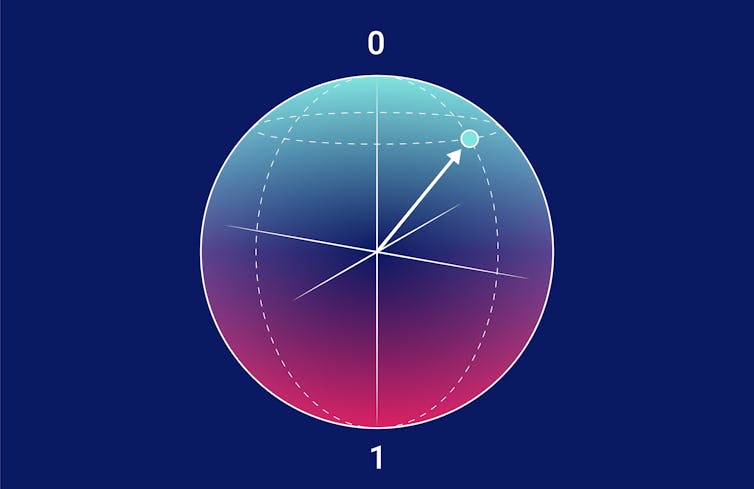
A conventional bit can take the values of 0 or 1 – but a quantum bit or qubit can take on a range of complex values in between.
Shutterstock

Now, it turns out that the physical world on a very fundamental level is governed by the strange rules of quantum physics. You can also make a quantum version of a bit, called a quantum bit or “qubit”.

Qubits can also be described in terms of two states, “0” and “1”, except they can be both “0” and “1” at the same time. This allows for a much richer form of information processing, and hence more powerful computers.

What can we do with quantum computers?

Much of the current research in this area is focused either on building a working quantum computer – a challenging engineering task indeed – or on designing algorithms to do things we can’t manage with our current, classical computers.

Our research, however, is focused on an application first envisioned by the famous US physicist Richard Feynman more than 30 years ago: to use quantum computers to conduct research in fundamental physics.


Read more:
Explainer: quantum computation and communication technology


As theorists, we typically use a combination of pen-and-paper mathematics and computer simulations to study physical systems. Unfortunately, conventional computers are very ill-equipped for simulating quantum physics.

This is where quantum computers come in. They are already quantum in nature and can, in principle, behave like any quantum system we wish to investigate.

Using IBM’s quantum computer we were able to achieve precisely that, turning it into an experimental simulator to create a novel state of matter, just as envisioned by Feynman. This machine is located in America but can be accessed remotely by researchers around the globe.

Being able to access quantum computers from anywhere in the world represents a major shift in this kind of quantum research.

Time crystals

The special type of quantum system we created is called a “time crystal”.

I hope you will not be too disappointed when I say you will probably not get to hold one of these in your hands any time soon. But maybe we can at least understand what a time crystal is!

The crucial idea here is that matter exists in different “phases”, like the three familiar phases of water: ice, water and steam. A material can have very different properties depending on which phase we find it in.

In a conventional crystal, particles are arranged regularly in space. In a time crystal, they’re arranged regularly in time.
Shutterstock

Now a conventional crystal – we might actually call it a “space crystal” – is one such phase of matter. Crystals are characterised by a very regular arrangement of particles in space.

In a time crystal, particles are not only arranged regularly in space, but also in time. The particles move from one position to another and back again, without slowing down or losing energy.

Now this is truly different from what we usually deal with.

Beyond equilibrium

The types of phases we normally encounter all have on thing in common: they are in “thermal equilibrium”. If you leave a hot cup of coffee sitting on your desk it will transfer heat to its surroundings until it reaches the same temperature as your room, and then it stops and no changes happen from then on.

If you carefully add a layer of cream to your – now unfortunately cold – coffee and begin stirring, you will see changes happen in time. Coffee and cream will mix in beautiful swirls until the whole thing turns into a uniform light brown liquid, and nothing really changes after that.
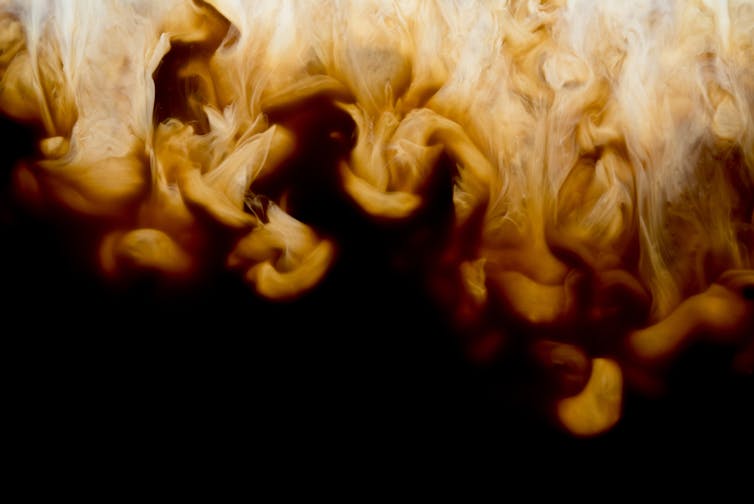
Coffee and milk mixed together will create beautiful swirls before eventually reaching a uniform light-brown equilibrium.
Shutterstock

These are examples of “equilibrium”. The common theme is that things in equilibrium do not change over time.

Our time crystal violates this condition. It actually keeps changing indefinitely, for all eternity, without ever reaching equilibrium.

A loophole in the laws of thermodynamics?

A time crystal therefore constitutes an out-of-equilibrium phase – in fact, it is one of the first examples of such a strange state of matter. It is essentially like an ever-ticking clock that neither loses energy, nor requires a supply of energy to keep going.

This seems dangerously close to a perpetual motion machine, which would violate the laws of thermodynamics.

But the first law of thermodynamics – which says energy is not created or destroyed – is not in any danger here, as we can’t extract energy from a time crystal while also keeping it running.


Read more:
Unpacking a mystery of physics: Why processes in nature operate only in one direction


The second law states that things left to themselves can only become more disordered over time. This concept is probably all too familiar to anyone with kids or housemates.

But there is a loophole. The second law forbids things from becoming more ordered with time, but it doesn’t say they can’t maintain their current level of disorderedness forever.

In everyday life, we don’t see this loophole in action. It is the equivalent of stirring away at your coffee and cream and finding that the swirling tendrils of cream never fully mix with the coffee.

This is what time crystals do. We don’t see it in everyday life because it really is a quantum phenomenon.

Beyond time crystals

Quantum computers are still in their infancy. But as they improve they will allow physicists like us to improve our fundamental understanding of nature.

This in turn may translate into technological innovation, just as the physics of the last century enabled the digital revolution that shapes our lives today.

Quantum computers provide a platform for physicists to engineer and investigate novel states of matter that cannot be found in nature. Time crystals just mark the beginning of this exciting endeavour.

The Conversation

Stephan Rachel receives funding from the Australian Research Council (ARC). He is affiliated with the IBM Quantum Hub established at the University of Melbourne.

Philipp Frey does not work for, consult, own shares in or receive funding from any company or organisation that would benefit from this article, and has disclosed no relevant affiliations beyond their academic appointment.

ref. ‘An ever-ticking clock’: we made a ‘time crystal’ inside a quantum computer – https://theconversation.com/an-ever-ticking-clock-we-made-a-time-crystal-inside-a-quantum-computer-178164
Remembering the past, looking to the future: how the war in Ukraine is changing Europe

Source: The Conversation (Au and NZ) – By Matt Fitzpatrick, Professor in International History, Flinders University
Both sides in this war have plundered history. Vladimir Putin claims to be replaying the second world war by “denazifying” Ukraine, while his forces desecrate the Holocaust site of Babyn Yar.

Putin’s opponents have their own analogies. Putin is variously Hitler, Stalin or Tsar Peter the Great.

On social media, memes mine the medieval period to remind the West that when Kyiv was a flourishing metropolis in the 11th century, Moscow was still a wilderness.

Historians are uninterested in these debates. They know both sides can produce maps and histories to “verify” their claims. These need not shape present realities. As the Kenyan representative to the UN said about the African situation, where colonial era borders continue to chafe:

Rather than form nations that looked ever backwards into history with a dangerous nostalgia, we chose to look forward to a greatness none of our many nations and peoples had ever known.

Instead, historians are looking at the rapidly shifting present. They realise history is being made, not replayed in Ukraine. In the process, it is changing the face of Europe.

Germany changes course

In the space of one week, some of the old certainties about Europe have been thrown out the window. Most spectacularly, Germany, whose Nazi past has seen it avoid becoming a significant military power, has now committed itself to dramatically increasing its military spending. An initial injection of €100billion (A$153billion) will be followed by a guaranteed sum of at least 2% of GDP to be spent in each budget.

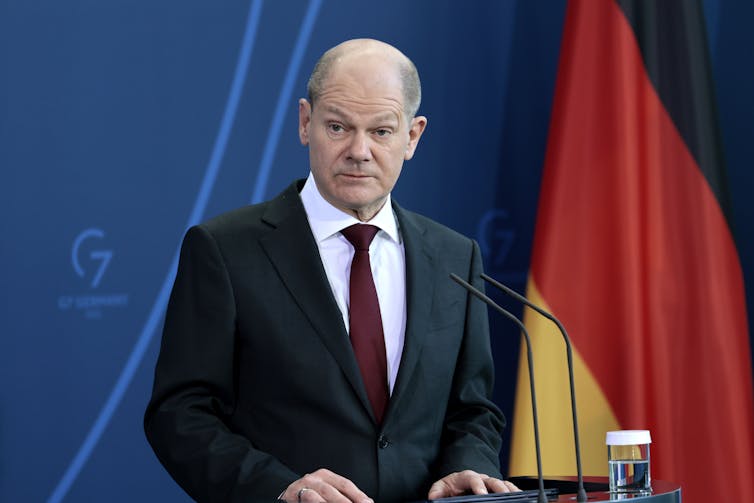
In contravention of its standing policy prohibiting the sale of armaments to war zones, German Chancellor Olaf Scholz has announced his country will join the rest of Europe in providing weapons to the Ukrainians. German troops are now heading for Lithuania and Slovakia, while air and sea deployments have been made to Romania, the Baltic and the Mediterranean.

New German Chancellor Olaf Scholz has disrupted Germany’s post-war history by intervening in support of Ukraine.
Hannibal Hanscke/pool/EPA/AAP

On top of this, Germany’s Merkel-era approach to energy security, which had until days ago rested on the promise of plentiful Russian gas, has been scuttled.


Read more:
What can the West do to help Ukraine? It can start by countering Putin’s information strategy


The rush to NATO

Elsewhere, NATO has also rushed eastward, and the Baltic states of Latvia, Lithuania and Estonia have become a hastily agreed-upon forward post for NATO troops.

Having been firmly against joining NATO for decades, public opinion in Finland has suddenly shifted, with a citizen petition forcing a parliamentary debate on the issue. Alongside the Finns, non-NATO Sweden has been granted special access to NATO intelligence to help co-ordinate European responses to the war.

Now scotched rumours had even abounded that Poland, Slovakia and Bulgaria were to donate their fighter places to Ukrainian fighter pilots, stretching the line between military aid and active participation.

Even Switzerland, whose neutrality has lasted since the Napoleonic Wars, has suddenly joined the EU’s economic sanctions targeting Russian banks and assets.


Read more:
Germany’s €100-billion army fund: a remarkable change in post-war policy in response to the Ukraine crisis


Europe’s southeast moves too

Other European states are also altering their political course. Bosnia is mulling over a bid to formally join NATO, while Kosovo is making a pitch to secure a permanent US base on its territory.

Both of these moves would have been viewed as unthinkable provocations to Russia a week ago, and would still represent risky options for NATO. But, with NATO declaring Europe stands at the dawn of a “new normal”, such earlier taboos are giving way to a desire for “more support to countries like Georgia, Moldova, and Bosnia and Herzegovina”.

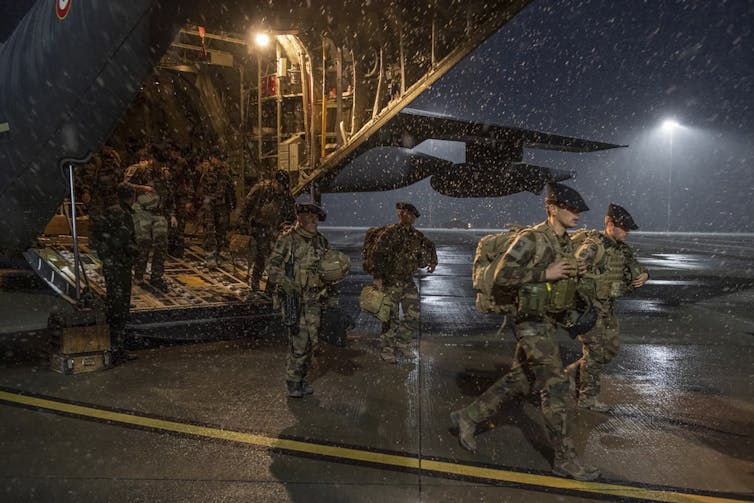
Meanwhile, French troops have been sent into Romania as part of Europe’s “strategic solidarity” with Ukraine’s neighbours.

Events have swept aside the earlier careful discussions about the consequences of NATO enlargement in Eastern Europe.

French troops have arrived in Romania as part of a ‘strategic solidarity’ with Ukraine’s neighbours.
French army/AP/AAP

In the southeast, Turkey’s President Recep Tayyip Erdogan, who has tried to walk a middle road between Russia and NATO, has also succumbed to the pressure of his NATO allies and activated the 1939 Montreux Convention. This effectively closes the Turkish Straits to warships, significantly hampering Russia’s ability to move more ships from the Mediterranean into the Black Sea and on to Crimea and Odessa in southern Ukraine.

Not everything is different

While it appeared Poland and Hungary, along with Bulgaria, Romania and Moldova, had reversed their notoriously anti-refugee policy by opening their eastern borders, it has since emerged these openings are still along racial lines. This means the borders are easily traversed by European Ukrainians, but are still very real barriers to the Arab, Asian and African refugees forced to flee their work and studies in Ukraine.

Some alliances with Moscow have remained firm. The story of Belarus President Alexander Lukashenko is well-known. His fate has been publicly tied to Russia since massive protests broke out after a fraudulent election destabilised his grip on power. He has used the conflict to increase his grip on power through a dubious referendum.

Less well understood outside the Balkans, however, is the position of Serbia’s President Aleksandar Vucic, who has declared his qualified support for Putin, so as to keep Russian support for Serbian objectives in Kosovo and Bosnia. “Serbia respects the norms of international law,” he has declared, “but Serbia also understands its own interests.”

Forgotten histories

Contrary to some reporting, this is not the first major war in Europe since the second world war. The Balkans spent much of the 1990s engulfed in a war that saw the disintegration of Yugoslavia, horrific ethnic cleansing, Serbian genocide, the NATO bombing of Belgrade and the ongoing garrisoning of Kosovo. Indeed, Putin has never forgotten NATO’s actions in the Balkans.

So too, the military conflict between Russian and Ukraine, ongoing since 2014, was preceded by the Russian-Georgian War of 2008.

Elsewhere, Iraqis have pointed out that Russia’s attack on Ukraine echoes the 2003 US invasion of Iraq, an invasion that also brought into question the robustness of international law.

However, historians are aware these past wars in Europe and beyond did not trigger the kind of rapid and united European action being seen now. Nor did they lead to the threat of nuclear conflict that has re-emerged as Europe walks the tightrope between military aid and becoming an active belligerent that could trigger the kind of nuclear consequences threatened by Putin. This nuclear dilemma was not one faced in the times of Hitler, Stalin or the tsars.

The Conversation

Matt Fitzpatrick currently receives funding from the Australian Research Council.

ref. Remembering the past, looking to the future: how the war in Ukraine is changing Europe – https://theconversation.com/remembering-the-past-looking-to-the-future-how-the-war-in-ukraine-is-changing-europe-178151

No, you cannot ‘devaccinate’ yourself with snake venom kits, bleach or cupping

Source: The Conversation (Au and NZ) – By Holly Seale, Associate professor, UNSW Sydney

Shutterstock

Claims you can “devaccinate” yourself have been circulating on social media, another example of extreme and dangerous misinformation about COVID vaccines.

Methods said to remove COVID vaccines from the body include using snake venom extractors or a type of traditional therapy known as “wet cupping”.

If you encounter claims like this online, you need to ask yourself four questions, to figure out whether these claims really are too good to be true.


Read more:
People want to use bleach and antiseptic for COVID and are calling us for advice


Cupping

Misinformation circulating on Instagram and other social media includes a video of someone using cupping therapy, suggesting this removes or sucks out the COVID vaccine.

The video shows someone cutting the skin, before applying a cup over the cuts to create suction – a type of therapy known as “wet cupping”.

Cupping has been used for thousands of years, mostly in traditional Chinese medicine. Practitioners believe this eases pain or promotes healing by drawing fluid towards the treated area and improve the flow of energy. However, there are few high-quality studies to support its effectiveness.

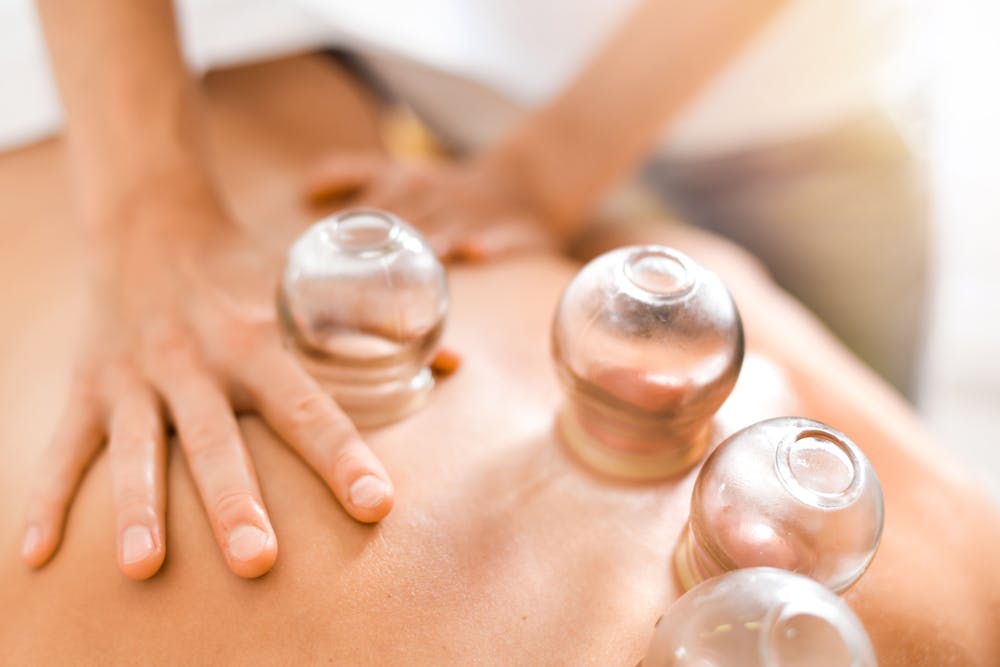
Cups on someone's back as part of cupping therapy
Cupping therapy is said to ease pain or promote healing by drawing fluid towards the treated area.
Shutterstock

Why this doesn’t remove vaccine

Cupping usually affects only the superficial layers of the skin. COVID vaccines are generally deeper, injected into muscle.

After injection, vaccines train the body’s immune system to fight SARS-CoV-2, the virus that causes COVID. They do this by either presenting a weakened or inactivated part of the virus (the spike protein antigen) to the immune system, or by delivering the instructions for the body to make these antigens.

It’s important to note, this period of “training” is very short, and once the body has learnt how to respond, the vaccines are cleared from your body in mere days or weeks.

That’s because after the vaccine has primed the immune system, the body breaks down these components naturally, just as it does with other genetic fragments, proteins and fats.


Read more:
No, COVID vaccines don’t stay in your body for years


Snake venom kits

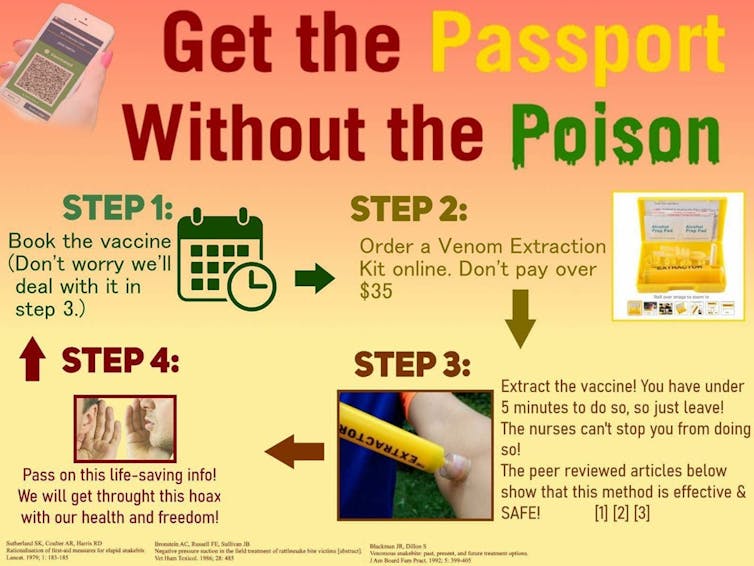
Others have tried to devaccinate using venom extraction kits. These kits include a plunger-type device you place over a snakebite, which is supposed to suck out venom.

Again, venom extractors will not remove the antigen in COVID vaccines, for the same reasons we’ve already described.

Venom extractors don’t remove enough snake venom, let alone COVID vaccine (Author supplied).

They also cannot remove enough venom to prevent serious systemic (widespread) effects of a snakebite. One study found the kit only removed 0.04% of the total load of venom, and ended up just removing body fluid.
Critically, they can destroy tissue around the site of the snakebite.

We all play a part

Information about devaccination continues to circulate on some platforms, such as BitChute and Telegram.

If you come across someone selling a wonder cure or drug online – whether that’s related to COVID or some other illness – here are some tips for thinking about what you see:

1. Is it hard to believe?

When you see something posted that looks sensational, it is even more important to be sceptical.

In a popular TikTok video, an osteopathic physician, who no longer practices, suggests people “detox” by take a bath in baking soda, epsom salt and borax to get rid of “radiation, poisons and nanotechnologies”.

She says people need to detox because COVID vaccines have “RNA-Modifying Transhumanism-Nano-Technology”, and “the people pushing these injections want to change what it is to be human”.

She also claims to have identified a jellyfish-like tiny invertebrate called “Hydra Vulgaris” that can:

multiply and form independent neural networks inside those who have received COVID-19 vaccines and could ultimately influence their thoughts and actions.

Jellyfish
Now, we have to worry about jellyfish controlling our minds?
Shutterstock

Even though sometimes we want to believe that someone has found the cure or answer to a question we are seeking, go with your gut reaction. If it sounds ridiculous, it probably is. If you are unsure whether the information is legitimate, talk to a family member, friend or your GP.

2. Have you checked the facts?

If a resource is provided in another language, how can you be sure what it says?

Using the cupping video as an example, Stephen Dickey, a professor of Slavic languages and literature at the University of Kansas, identified the dialogue in the video as Russian. But he said “there was no mention of the vaccine” and “there is no mention at all of exactly what is being extracted”.

When reviewing the resource, do you know who the author is and does that author specialise in the field the article is concerned with? Check LinkedIn or do a quick Google search to see if the author can speak about the subject with authority and accuracy.

3. Is there a hidden agenda?

Have you considered whether the person or organisation attempting to sell you a new drug or treatment has a hidden agenda? This can be increasing their reach on social media or making money.

For example, American “archbishop” Mark Grenon and his sons are reported to have sold more than US$1 million of their bleach-type “Miracle Mineral Solution”. They said it was a cure for COVID, cancer, Alzheimer’s, diabetes, autism, malaria, hepatitis, Parkinson’s, herpes, HIV/AIDS and other serious medical conditions.

4. What’s the source?

When an article cites sources, it’s good to check them out. The post about the snakebite kit included references to three published papers. These were dated 1979-1992, decades before COVID.

It’s also important to look at the topic of the cited paper. In the case of the 1979 paper, this looked at measures for a particular type of snakebite, which included examining the effects of applying firm crepe bandages on monkeys. There was no mention of the use of snake venom removal kits or COVID.

So, when you come across any videos or social media posts about fantastical new drugs or treatments that promise otherwise impossible cures or outcomes, it is important to always think:

If what you’re reading seems too good to be true, or too weird, or too reactionary, it probably is.

The Conversation

Holly Seale is an investigator on research studies funded by NHMRC and has previously received funding for investigator driven research from NSW Ministry of Health, as well as from Sanofi Pasteur and Seqirus. She is the Deputy Chair of the Collaboration on Social Science and Immunisation.

Margie Danchin receives funding from the Commonwealth and State government, NHMRC, DFAT and WHO. She is chair, Collaboration on Social Science and Immunisation (COSSI).

ref. No, you cannot ‘devaccinate’ yourself with snake venom kits, bleach or cupping – https://theconversation.com/no-you-cannot-devaccinate-yourself-with-snake-venom-kits-bleach-or-cupping-177439

Many students don’t know how to manage their money. Here are 6 ways to improve financial literacy education

Source: The Conversation (Au and NZ) – By Laura de Zwaan, Lecturer, Department of Accounting, Finance and Economics, Griffith University

Shutterstock

How we can improve the teaching of financial literacy in high school? And why is it important?

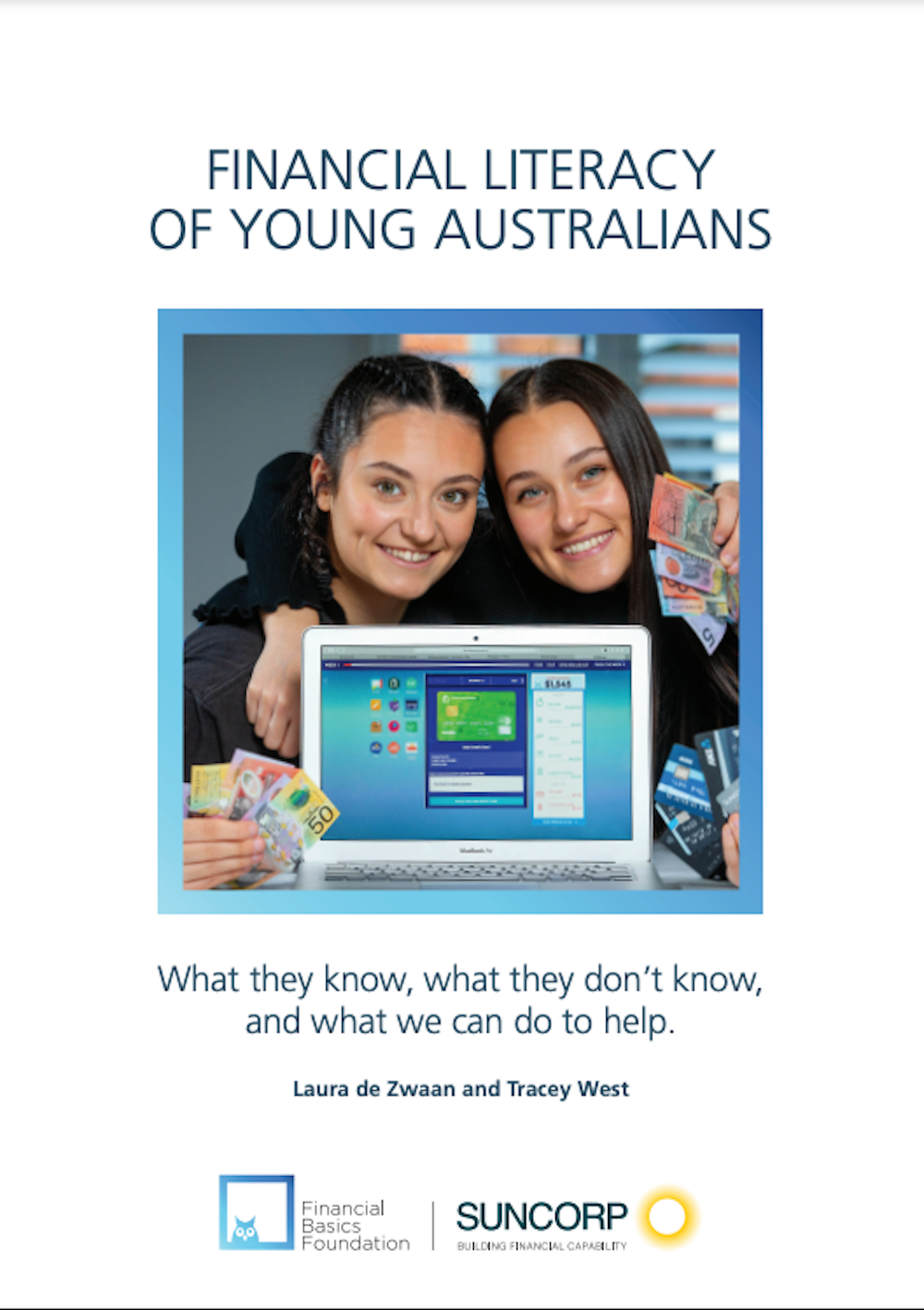
Cover of report on Financial Literacy of Young Australians

Financial Basics Foundation

People need a basic understanding of financial concepts to make good financial decisions. Our newly released research found most students generally do not know a lot about personal finance. This includes being able to apply basic numeracy to real-life financial situations, such as making purchasing decisions that are value-for-money and understanding interest on loans and investments.

Our report also makes six recommendations to improve financial literacy education in schools.

Our findings were consistent with previous evidence that 16% of Australian 15-year-olds lack even the basic level of financial literacy they need to participate in society. There is evidence that financial literacy in this age group is declining.


Read more:
Aussie kids’ financial knowledge is on the decline. The proposed national curriculum has downgraded it even further


This trend is concerning. The senior years of high school are a time when students take on more personal responsibility and financial independence. The financial habits they form then may last through adulthood. Low financial literacy is persistently linked to poorer financial outcomes.

The Australian Curriculum acknowledges students need financial literacy to operate in our financial world. However, this curriculum only covers up to year 10. In years 11 and 12, the years that are particularly important in shaping students’ financial capability, financial literacy is taught only in lower-level maths subjects.

Infographic comparing Australia and other countries on variation in financial literacy and use of mobile apps and phones for financial transactions.
How Australia compares to other countries in the PISA 2018 assessment of students’ financial literacy.
ACER/PISA 2018, CC BY-NC-ND

What did the study find?

Our research explored the financial literacy of students in years 10, 11 and 12 at two urban and two rural schools. We found what students do know about financial literacy has been learned from home, maths or business studies. Students who were undertaking business studies were far more informed than other students.

Home life has been found to have a huge impact on a child’s financial literacy. There are often calls for parents to teach their children about personal finance. However, that assumes parents are able and willing to do that.


Read more:
How to teach your kids to think more critically about money


The students we spoke to were incredibly diverse. Household structures varied greatly, with many students not living with their parent/s. There was also evidence of parents not being able to provide financial guidance.

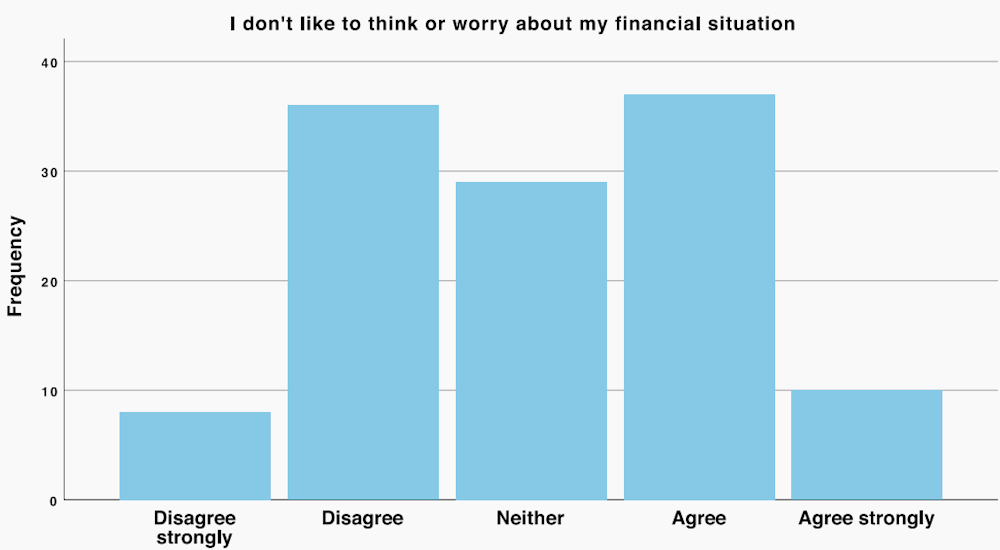
Nearly half the surveyed students preferred not to think about their financial situation.

Chart showing proportions agreeing or disagreeing with proposition 'I don't like to think about my financial situation'.

De Zwaan & West 2022, Financial Literacy of Young Australians

We talked to a lot of the students about maths and found this was not the most effective curriculum area for learning about personal finance. When taught as part of the maths curriculum it tends to result in students fixating on formulas and calculations, without understanding the underlying concepts. As one student said:

“I only really remember the formula because that’s all we got taught.”

Many students also dislike maths. This means they are disengaged from learning at the outset. One student told us:

“If I was in class doing that [a simple question about interest], I would just read it, keep reading it, but not actually process it or try it because I’d just give up.”

There was also often a disconnect between the financial scenarios students were learning about and their experiences in their own lives.

Students who could remember financial concepts would often recall an experience or something from history when talking about it. This suggests stories may be more effective in communicating financial concepts. For example, one student said of inflation:

“Over time, because obviously more money is being printed […] people think printing money creates more money and you’re richer, when in reality you’re just making the currency you have worthless, because there’s so much of it, that it’s not difficult to acquire it at all. I learned most of that from history.”

Interestingly, we found evidence of young women in particular needing more context to make financial decisions. When asked financial questions, they wondered about different aspects of the question rather than quickly answering. Test questions commonly used to assess financial knowledge often offer little context.

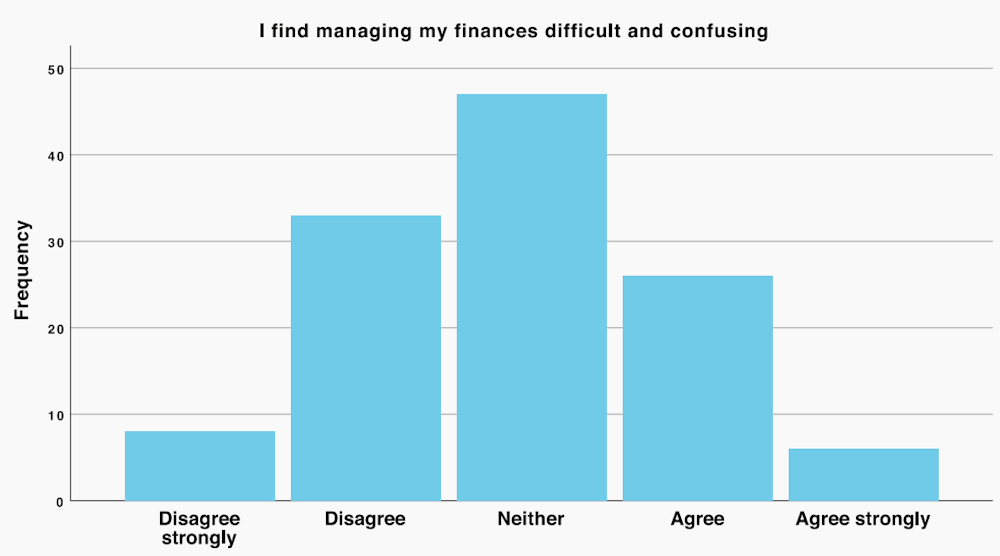
About one in three students agreed they found managing their personal finances difficult and confusing.

Chart showing proportions agreeing or disagreeing with proposition 'I find managing my finances difficult and confusing'.

De Zwaan & West 2022, Financial Literacy of Young Australians

Finally, we noted many students were not learning financial strategies, such as moderating spending, that have lifelong benefits.


Read more:
Would you pass this financial literacy quiz? Many won’t – and it’s affecting expensive aged care decisions


How can we improve?

Given the importance of financial literacy for student well-being, our report makes these recommendations:

  1. financial literacy education should be elevated in high schools, ideally as a standalone program, but also by injecting principles of financial literacy into as many curriculum areas as possible – particularly in the well-being and pastoral care area

  2. financial literacy education in maths needs to be improved, using a range of approaches – not limited to calculation activities

  3. financial literacy education should be expanded to subjects other than maths and business, in line with shifting the focus from financial calculations to financial concepts

  4. learning activities should be aligned with the students’ general level of financial experience

  5. students need more exposure to effective financial strategies, in particular how to moderate (or control) spending for saving

  6. a range of assessment methods should be offered to enable students to show what they have learnt. Assessment tasks should go beyond calculations and could include written pieces, visual or dramatic presentations, or oral explanations. These could be presented by groups or individuals.

The Conversation

Laura de Zwaan has received funding from Ecstra Foundation and the Financial Basics Foundation. She is an affiliate member of the Financial Planning Association and is a member of the Financial Planning Academic Forum. She has also been a member of the Wealth Academy Advisory Board.

Tracey West has undertaken consultancy work for ECSTRA Foundation and Treasury on financial literacy. She has also received grant funding from ECSTRA Foundation and the Financial Basics Foundation.

ref. Many students don’t know how to manage their money. Here are 6 ways to improve financial literacy education – https://theconversation.com/many-students-dont-know-how-to-manage-their-money-here-are-6-ways-to-improve-financial-literacy-education-177918

After the floods comes the disaster of underinsurance: we need a better plan

Source: The Conversation (Au and NZ) – By Antonia Settle, Academic (McKenzie Postdoctoral Research Fellow), The University of Melbourne

The floods affecting Australia’s eastern seaboard are a “1 in 1,000-year event”, according to New South Wales Premier Dominic Perrottet. But that’s not what science, or the insurance industry, suggests.

Throughout Australia in areas prone to fires, cyclones and floods, home owners and businesses are facing escalating insurance costs as the frequency and severity of extreme weather events increase with the warming climate.

Premiums have risen sharply over the past decade as insurers count the cost of insurance claims and factor in future risks. The latest report from the Intergovernmental Panel on Climate Change, published this week, predicts global warming of 1.5℃ will lead to a fourfold increase in natural disasters.

Rising insurance premiums are creating a crisis of underinsurance in Australia.

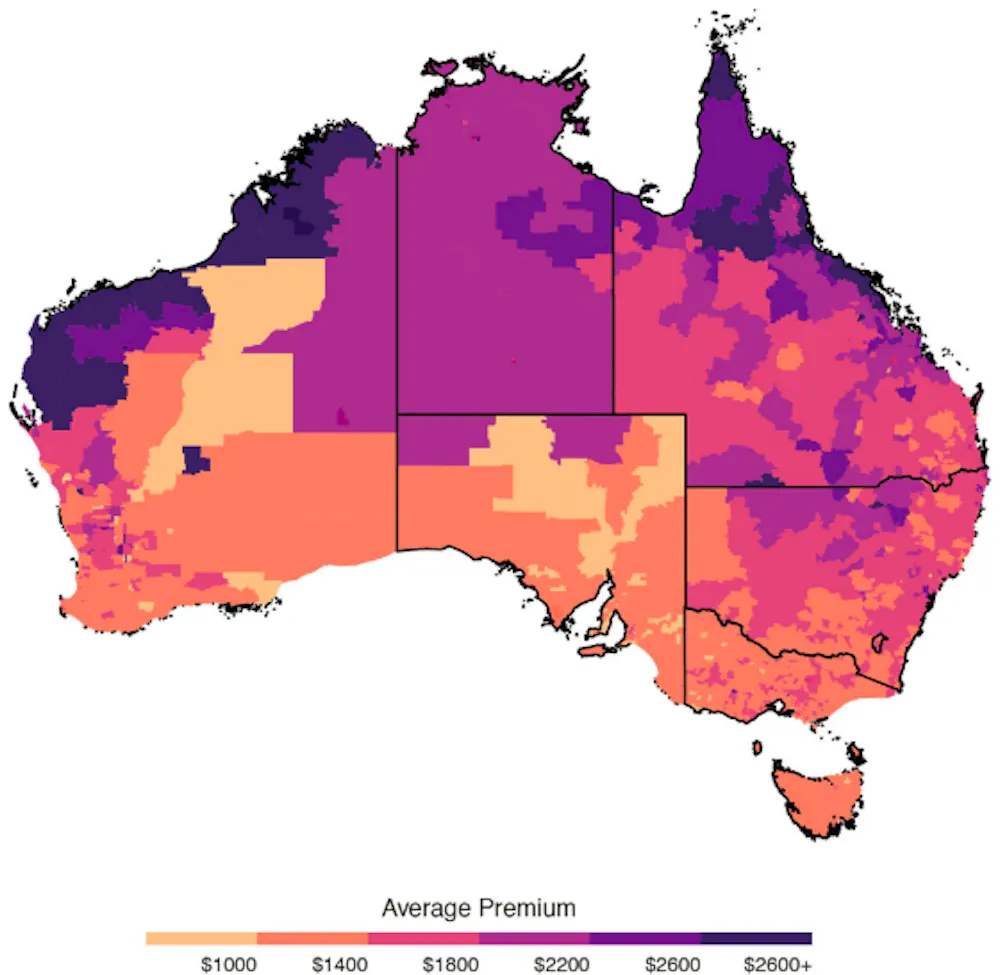
In 2017 the federal government tasked the Australian Competition and Consumer Commission to investigate insurance affordability in northern Australia, where destructive storms and floods are most common. The commission delivered its final report in 2020. It found the average cost of home and contents insurance in northern Australia was almost double the rest of Australia – $2,500 compared with $1,400. The rate of non-insurance was almost double – 20% compared with 11%.


Average premiums for combined home and contents insurance, 2018–19

Average premiums for combined home and contents insurance in Australia, 2018–19

ACCC analysis of data obtained from insurers., CC BY

While the areas now experiencing their worst flooding in recorded history aren’t part of the riskiest areas identified by the insurance inquiry, the dynamics are the same.

Those not insured or underinsured will be financially devastated. Insurance premiums will rise. As a result, more people will underinsure or drop their insurance completely, compounding the social disaster that will come with the next natural disaster.

So, what do about it?

Tackling insurance affordability

There are two main ways to reduce insurance premiums.

One is to reduce global warming. Obviously this is not something Australia can achieve on its own, but it can be part of the solution.

The other is to reduce the damage caused by extreme events, by constructing more disaster-resistant buildings, or not rebuilding in high-risk areas.

The federal government, however, has put most of its eggs in a different basket, with a plan to subsidise to insurance premiums in northern Australia.

This won’t do much for those affected by the current floods. It won’t even do much to solve the insurance crisis in northern Australia.

The reinsurance pool, a blunt tool

In the 2021 budget the federal government committed A$10 billion to a cyclone and flood damage reinsurance pool, “to ensure Australians in cyclone-prone areas have access to affordable insurance”. The legislation to establish this pool is now before parliament.

The ostensible rationale is that the government can drive down insurance costs for consumers by stepping in and acting as wholesaler in the reinsurance market, in which insurers insure themselves against the risk of crippling insurance payouts.

The idea is that discounted reinsurance will lead insurers to lower their premiums.


Read more:
A national insurance crisis looms. The Morrison government’s $10 billion ‘pool’ plan won’t fix it


There is no guarantee, however, that insurers will pass on their cheaper costs to customers. This means the benefits of the pool are unclear.

So are its costs. Effectively, the government is shifting risk from insurers to itself, subsidising insurance premiums for those in some parts the country from the public purse.

The ACCC inquiry gave considerable attention to the idea of a reinsurance pool. While acknowledging there could be some benefits, it concluded the risks outweigh the rewards:

We do not consider that a reinsurance pool is necessary to address availability issues in northern Australia.

Targeting and mitigating

Above and beyond the aforementioned problems, there are two telling failures of the reinsurance pool plan.

First, subsidising insurance companies doesn’t target help to those who need it most: low-income households.

There is a growing body of research showing that natural disasters, and the ways governments respond to them, is contributing to greater inequality.

As the South Australian Council of Social Service makes clear in a report published this week, improving insurance access for people on low incomes at risk from natural disaster requires targeted support, such as promoting non-profit “mutual” insurance schemes.


Read more:
Natural disasters increase inequality. Recovery funding may make things worse


Second, only mitigation can bring the overall cost of natural disasters down. Ways to do this include public works (building levees, upgrading stormwater systems, conducting planned burns) and improving buildings (reinforcing garage doors, shuttering windows, managing vegetation around homes, and so on).

The ACCC’s insurance report identifies a range of ways mitigation strategies can be tied into insurance pricing. Yet none of these has been incorporated into the Morrison government’s response to the insurance crisis.

There is little support for the reinsurance pool outside of the federal government. Neither the ACCC, the insurance industry nor community sector advocacy organisations support reinsurance as a meaningful solution.

A reinsurance pool for the whole of Australia?

For the areas of NSW and Queensland now flooded, as well as the rest of the country outside the ambit of the reinsurance pool, the relentless rise in insurance costs will continue, tipping ever more homes out of the insurance safety net.

We must find better solutions to the insurance crisis than what is being offered to northern Australia. A reinsurance pool cannot be a national solution because it isn’t the solution for northern Australia.

There are no cheap and easy solutions, but the terrain is clearly mapped out across an array of inquiries and reports into insurance and climate vulnerability. More than a blanket subsidy for the insurance industry, the time has come for climate vulnerability to be taken seriously by the federal government.

The Conversation

Antonia Settle does not work for, consult, own shares in or receive funding from any company or organisation that would benefit from this article, and has disclosed no relevant affiliations beyond their academic appointment.

ref. After the floods comes the disaster of underinsurance: we need a better plan – https://theconversation.com/after-the-floods-comes-the-disaster-of-underinsurance-we-need-a-better-plan-178143

A tale of subterfuge, rivalry, Napoleon and snakes: how the NSW State Library came to own the map of Abel Tasman’s voyages

Source: The Conversation (Au and NZ) – By Lynette Russell, ARC Laureate Fellow, Monash University, and Deputy Director of the ARC Centre of Excellence for Australian Biodiversity and Heritage, Monash University

State Library New South Wales

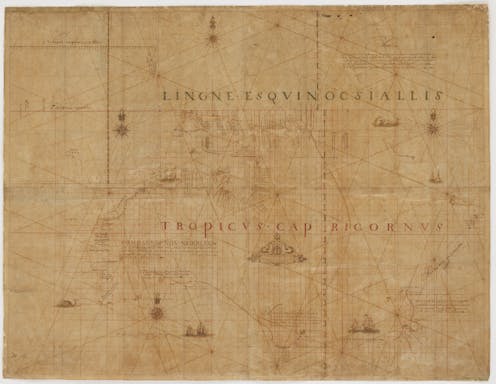
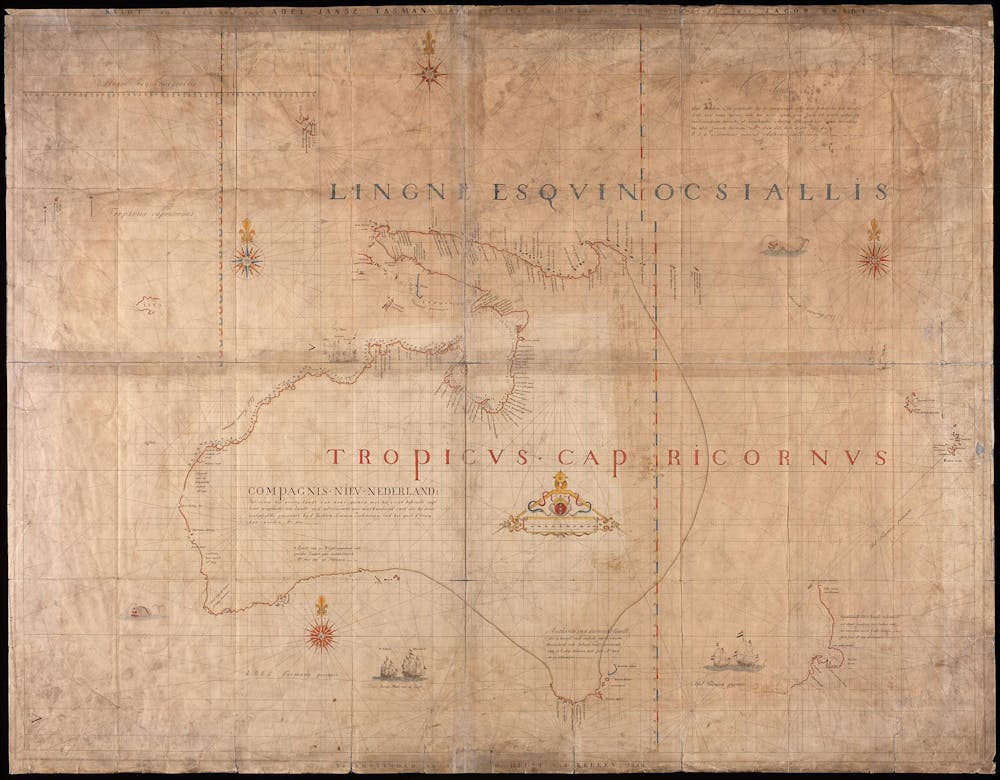
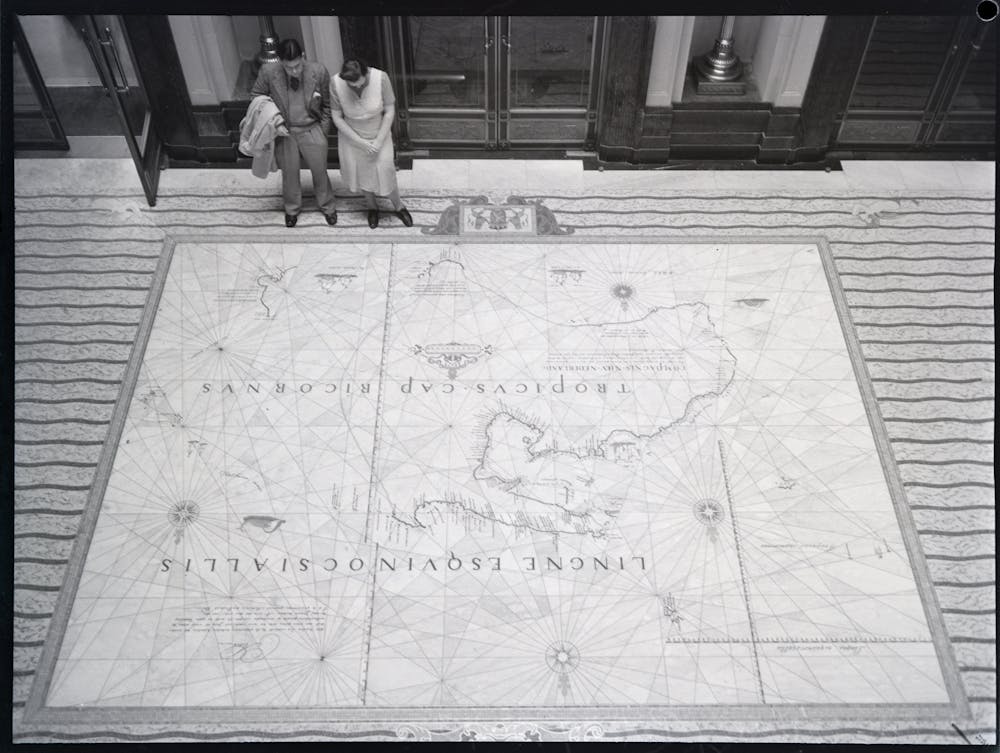
Every year, tens of thousands of New South Wales State Library patrons walk past a stunning mosaic replica of the Tasman Map on the floor of the Mitchell library vestibule. The original Tasman map, recently restored, charts the two voyages of the Dutch explorer Abel Tasman in 1642 and 1644.

The map is perhaps the Mitchell Library’s greatest treasure, though we know little about the time, place, or artist responsible for it.

Yet as we discuss in a new paper, its acquisition by the Mitchell library is a story of subterfuge, intrigue, personal animosities and state-versus-commonwealth rivalries.

The Tasman Map was probably made in the mid- to late-1600s in Batavia (now known as Jakarta), home of the Dutch East India Company, on Japanese paper.

It was most likely compiled by a team of draftsmen from a range of charts from Tasman’s two voyages. One of the artists was almost certainly Isaack Gilsemans, draftsman on the voyage.

Mystery shrouds the map’s whereabouts from the 17th century until 1843, when Amsterdam mapmaker Jacob Swart described and reproduced it.

Jacob Swart’s reproduction of the Tasman Map, c.1860.
Wikimedia Commons

In 1891 the original 17th century map was listed for sale by Frederick Muller & Co. An interested group headed by historian George Collingridge tried unsuccessfully to persuade the NSW government to purchase it.

Instead, the map was purchased by Prince Roland Bonaparte, great-nephew of Napoleon, and an anthropologist with a great interest in Australia.


Read more:
How early Australian settlers drew maps to erase Indigenous people and push ideas of colonial superiority


The princely promise

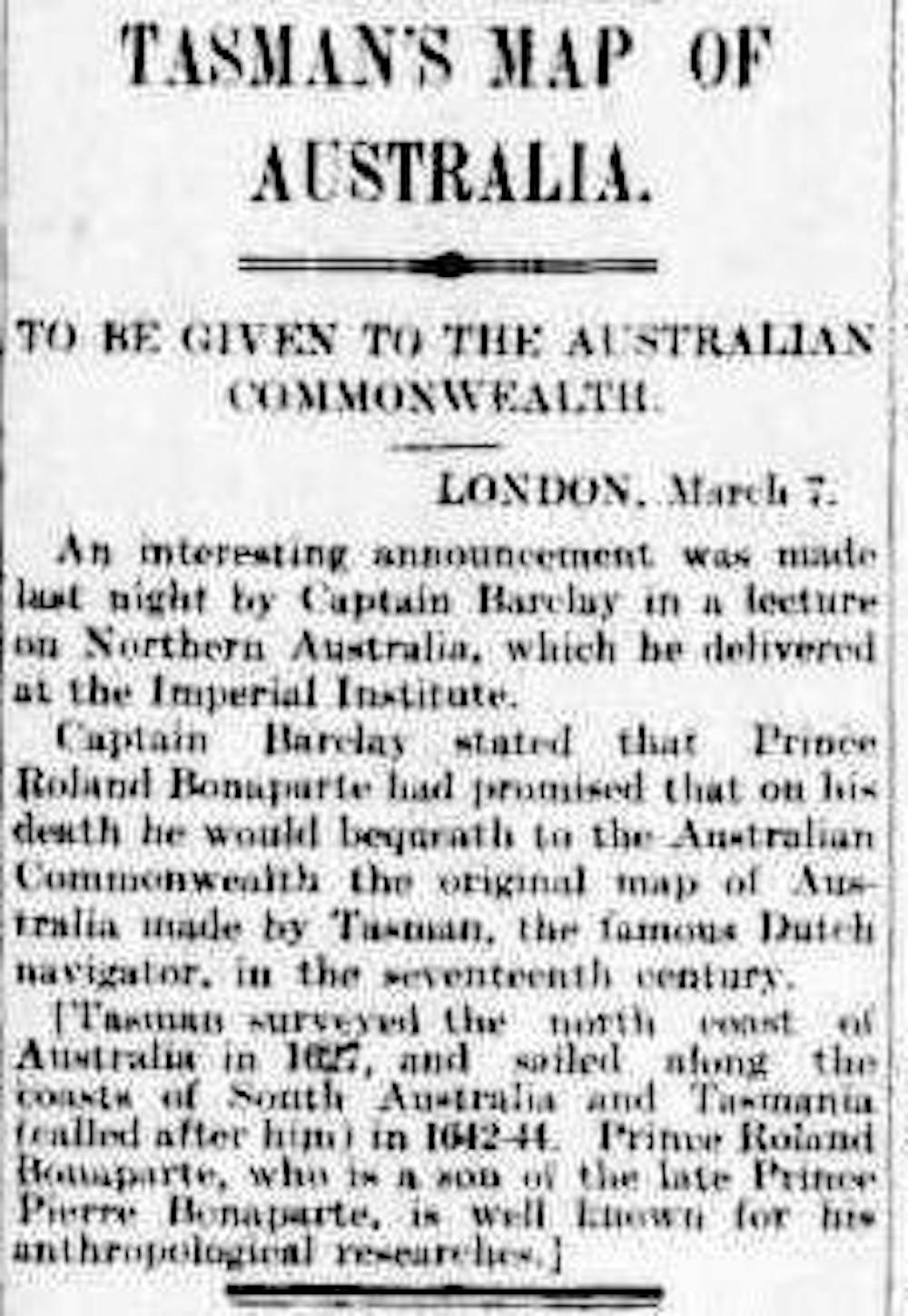
In March 1899, Henry Vere Barclay – a failed pastoralist, explorer and raconteur – gave a talk at the Imperial Institute in London where he announced Prince Roland had promised the Tasman map would be bequeathed to the Australian Commonwealth Government.

Newspaper reads: Tasman's map of Australia to be given to the Australian Commonwealth.
News of the map, reported in the Argus.
National Library of Australia

Within days, headlines declaring Prince Roland’s intended gift of the map to the Commonwealth of Australia had appeared in at least 44 Australian and New Zealand newspapers.

The prince’s intention to bequeath the map was confirmed in 1904 by James Park Thomson, president of the Royal Geographical Society of Queensland.

After viewing the map in Paris, Thomson wrote in his memoir, Round the World, of how the prince believed the map would be “of the greatest interest and use to the Commonwealth.”

Also reported by Thomson was how the prince wanted to hand the map to the Commonwealth government in person – but he was terrified of snakes and disliked rabbits which “seemed to overrun the place”.

Murmurings about the Tasman map fell silent for two decades and only emerged again after the prince’s death in 1924.


Read more:
Putting ‘Australia’ on the map


A clandestine operation

In 1926, anthropologist Daisy Bates read Thomson’s book, noting the reference to Prince Roland’s intended bequest.

Knowing the prince had recently died, she wrote to an acquaintance, William Ifould, asking him to enquire of the prince’s estate and the status of the map.

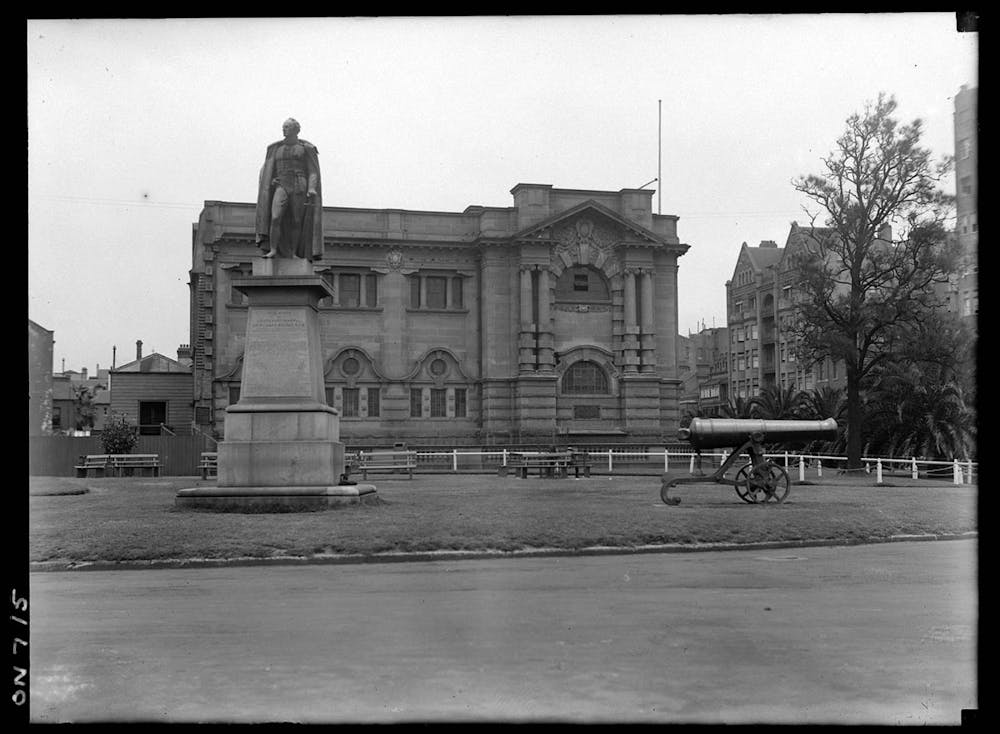
As chief librarian of the NSW Public Library, Ifould immediately began a clandestine operation to bring the Tasman Map to Australia.

The Mitchell Library photographed in 1923.
State Library New South Wales

It is clear from his earliest communications, when he warned his agent not to let the map come to the attention of Prime Minister Stanley Bruce, that Ifould was consumed by a singular goal: to acquire the map for NSW before anyone from the Commonwealth government remembered the prince’s promise.

Ifould’s chief personal nemesis was Kenneth Binns, librarian of the Commonwealth National Library, but Ifould also held an abiding antipathy for the Commonwealth itself.

In the earliest days of the scramble for the map, the Commonwealth Library’s collection was yet to have a permanent home, with the national capital of Canberra still in the early planning stages. Binns was based in Melbourne, then the seat of the national parliament, and this played into a rivalry between Sydney and Melbourne.

The Tasman Map was in the possession of Princess Marie Bonaparte, who was aware of her father’s desire to bestow it upon the Australian nation. Her husband Prince George wanted to travel to Australia and present the map himself.

This created concern for Ifould and the Mitchell Library, who were worried they might accidentally present it to the prime minister instead of the Mitchell Library.

Princess Marie clearly considered the map belonged to the Australian Commonwealth.

Ifould and his conspirators – including a succession of British ambassadors and NSW agents-general – ignored this. As one agent-general advised the NSW premier:

it is probable that she does not mean to say the Map will go to the Commonwealth Government, and that the use of the words ‘Government of Australia’ has no particular significance.

In May 1932 came the breakthrough Ifould had been waiting for: Prince George postponed his trip again, and Princess Marie agreed to hand the map to the Paris-based Australian Trade Commissioner.

Ifould’s seven-year clandestine operation, came to fruition when the map, now known as the Bonaparte-Tasman Map, arrived in Australia to great fanfare in September 1933.

A global map; a local rivalry

Absent from any version of the story over the past 90 years is admission of knowledge of Prince Roland’s wish, expressed multiple times, for the map to go to the Commonwealth.

The mosaic reproduction of the Tasman Map, photographed in 1934.
State Library of New South Wales

The role of Barclay’s 1899 anecdote, and its publication around the country, was eradicated. This allowed the map falling into the Mitchell’s hands to be characterised as a happy coincidence, and not the result of scheming and subterfuge.

The Tasman Map, as it is commonly viewed today, is a mosaic reproduction by Italian artisans, of a Dutch map, on Japanese paper, depicting Antipodean coastlines, representing east Asian dominance, donated by a French aristocrat, intended for the Australian Commonwealth, but wrested by a state institution obsessed with inter-library rivalry.


This research will be discussed at the NSW State Library’s Mapping the Pacific conference on March 3 2022.

The Conversation

Lynette Russell receives funding from the Australian Research Council.

Leonie Stevens is employed as a Research Fellow on the Australian Research Council-funded Global Encounters Laureate project..

ref. A tale of subterfuge, rivalry, Napoleon and snakes: how the NSW State Library came to own the map of Abel Tasman’s voyages – https://theconversation.com/a-tale-of-subterfuge-rivalry-napoleon-and-snakes-how-the-nsw-state-library-came-to-own-the-map-of-abel-tasmans-voyages-177069

NZ Parliament grounds ‘reclaimed’: Police operation ends 23-day protest

RNZ News

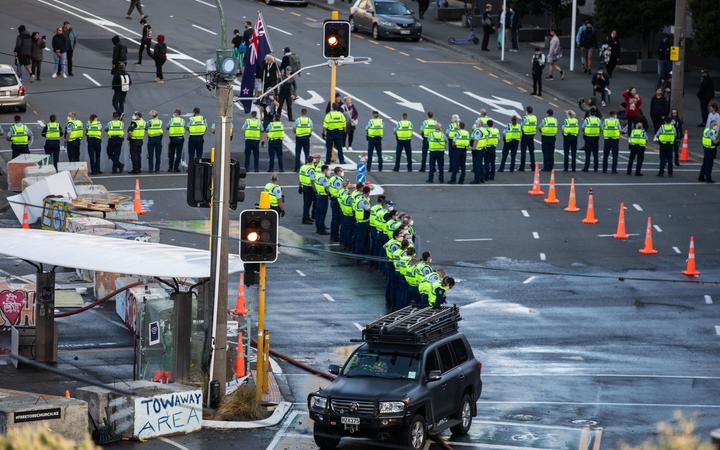
The area around New Zealand’s Parliament has today been the scene of a full-day ordeal of violence as police removed protesters whose behaviour prompted the Prime Minister to say there were “words I cannot use in this environment for what I saw”.

Early this morning, police launched an operation at Parliament and the surrounding areas in the capital Wellington “to restore order and access to the area”.

Before the sun rose, police could be seen getting information, holding shields.

As the sun set at the end of the day, about 150 protesters were peacefully facing police with riot shields on Featherston Street near the Railway Station — although other officers were clearing away signs of the earlier violence – bricks and bottles that had been thrown at them.

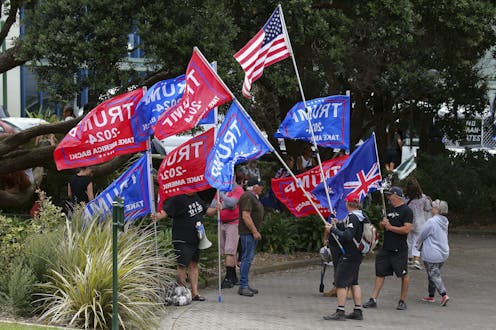
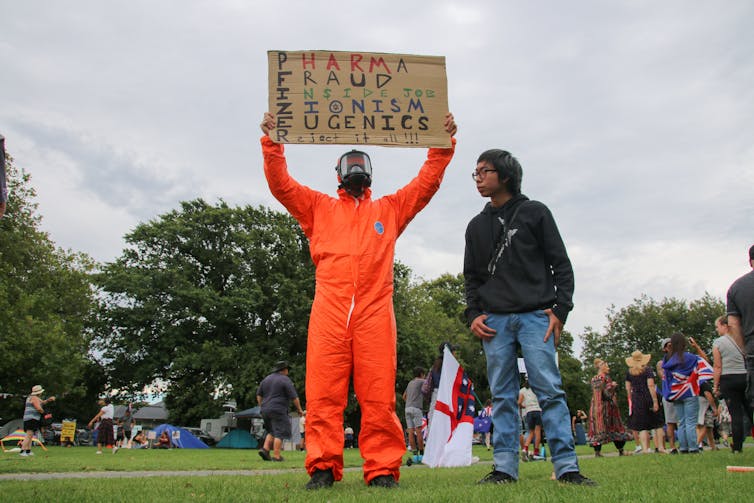
The afternoon saw fires lit, explosions, weapons used against police, injuries to officers and arrests at the 23-day anti-covid public health measures protest.

About 5pm, Prime Minister Jacinda Ardern addressed media and laid out just how she felt about the actions of the protesters.

Ardern said she was angry and deeply saddened to see Parliament desecrated in the way seen today, including the children’s playground being set alight.

An ‘illegal, hostile’ occupation
It demonstrated why the government refused to engage with the group, she said.

“It was an illegal occupation, they engaged in hostile, violent and aggressive behaviour throughout the occupation, and today that has culminated in the desecration of this Parliament’s grounds.

“I am absolutely committed we will restore those grounds and we will not be defined by one act by a small group of people.”

Ardern said there was a place for peaceful protest in this country, but “this is not the way that we engage and protest”. She said peaceful protest was the way to send a message, this by comparison was “a way to end up before the courts”.

Police remove protesters from Parliament.      Video: RNZ News

How it played out
As the day began, some protesters had spent the night preparing for action, with cars and campervans moved to block streets.

As police moved into the area, a loud speaker blared instructions for protesters to leave or be arrested, while officers searched tents and checked no-one was in them before ripping them down.

As daylight set in, a clash between protesters and police followed.

Police undertake an early morning operation around Parliament.
Police undertake an early morning operation to restore order and access to the area around Parliament. Image: Angus Dreaver/RNZ

But police gained significant ground, removing a number of vehicles and structures belonging to the protesters.

Leading up to midday, police in riot gear could be seen in among the operation. Pepper spray was used in response to protesters using fire extinguishers at officers.

About noon, Police Commissioner Andrew Coster said a point had been reached “where protest leaders were either unable or unwilling to effect substantial change”.

“We have been concerned that those with good intentions have been outnumbered by those willing to use violence,” he said.

“The harm being done far outweighs any legitimate protest.”

Balance had tipped
Until today, police had been trying to de-escalate the situation, he said. But the balance had tipped.

“We will continue this operation until this is completed.”

Commissioner Coster would not give a timeline, saying it would be when the job was done.

As the afternoon progressed, the situation heated up.

Police continued to gain ground, ripping out tents, barriers and signs, protesters physically pushed back, threw bricks, wood and other items, and used tent poles like javelins.

Gas bottles exploded and fires were lit – including Parliament’s slide and tents set ablaze.

Just before 4pm, police said they had arrested 38 people and towed 30 vehicles.

Shortly after, police gained more ground including the Beehive forecourt and then began using fire hoses to spray protesters.

A fire at Parliament grounds
A fire at Parliament grounds. Image: RNZ

No caption

‘Grounds reclaimed’
By 6pm, police had cleared Molesworth Street of all protester vehicles. They had arrested 65 people — that number would reach 87 by late Wednesday – and towed 50 vehicles.

Not long after, Assistant Police Commissioner Richard Chambers told Checkpoint that Parliament Grounds had been reclaimed after 23 days of occupation.

“We’ve made magnificent progress today our staff have done an incredible job, in very challenging circumstances.

“You will have seen that has been met with significant resistance and violence from some, and we are very pleased with the way that our staff dealt with it today.”

Seven police staff required hospital treatment.

“They have a range of minor and serious but non-life threatening injuries. They are all receiving support and their families have been advised,” police said in a statement.

“Some injuries were lacerations caused by objects thrown at them. These included bricks and paving stones taken from the nearby streets, rocks, traffic cones, poles and wood from pallets. Staff were also showered with paint, petrol and water from a high-powered fire hose.”

Review of protest occupation
Ardern signalled there would be a review of the protest occupation at Parliament to determine if more could have been done to prevent it from happening.

Coming into the evening, police said they would continue efforts to clear Parliament grounds overnight.

There will be a substantial police presence in Wellington and at Parliament, and residents should be assured that police will continue to make their presence felt and keep them safe.

A small number of protesters remained near the Victoria University Pipitea campus.

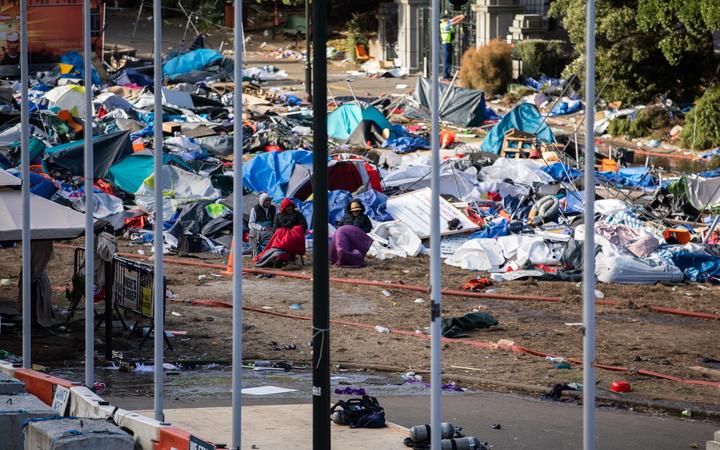
Rubbish left behind at the Parliament protest site
Rubbish left behind at the Parliament protest site. Image: RNZ

Late on Wednesday evening, Speaker of Parliament Trevor Mallard said in a statement that Parliament’s grounds would be closed until further notice.

‘Recovery plan’
“A recovery plan for the grounds has been developed which includes working with mana whenua and coordinating offers of assistance from volunteer groups,” he said.

“Due to assessments of the grounds’ condition that must take place before that work can begin, and for health, safety, and sanitary reasons, I ask that all members of the public please stay away till advised otherwise.

“I’d like to take this opportunity to thank the police, Parliamentary Security, Buildings and Facilities, Health and Safety teams and all other staff for their continued efforts to keep everyone at Parliament and the surrounding areas safe.

“Their resilience and understanding, along with all of you who have been affected by this protest must be acknowledged and thanks given for everyone’s hard work and messages of support.”

More information about the recovery plan for Parliament’s grounds would be released when it was available, Mallard said.

“We will restore our beautiful grounds and I will keep you informed of developments.”

This article is republished under a community partnership agreement with RNZ.

Print Friendly, PDF & Email

Article by AsiaPacificReport.nz

PM Ardern denounces violence, ‘desecration’ outside Parliament

RNZ News

Prime Minister Jacinda Ardern says she is saddened and angered by protesters’ actions today, and that the New Zealand Parliament’s grounds have been “desecrated”.

Ardern addressed media after an afternoon that saw fires lit, explosions and objects thrown at police as an anti-covid public health protest sparked violent scenes.

There have been multiple arrests, vehicles have been towed away and some police and protesters have suffered injuries.

Some set fire to protesters’ tents arousing concern that gas canisters would explode, and some large blasts were heard.

Police were able to take back most of the ground the protesters had been occupying for the past three weeks.

Ardern said she was angry and deeply saddened to see Parliament desecrated in the way seen today, including the children’s playground being set alight.

She said it demonstrated why the government refused to engage with the group.

‘An illegal occupation’
“It was an illegal occupation, they engaged in hostile, violent and aggressive behaviour throughout the occupation, and today that has culminated in the desecration of this Parliament’s grounds,” she said.

“I am absolutely committed we will restore those grounds and we will not be defined by one act by a small group of people.”

Asked about those who had been throwing projectiles at police, including LPG bottles thrown on flames and cobblestones hurled at officers, she said there were “words I cannot use in this environment for what I saw today”.

She said while the events today did not surprise her — considering the anger protesters had already expressed in the past few days — Ardern said it did sadden her.

PM Jacinda Ardern’s media briefing outside Parliament

Video: RNZ News

She said anyone still throwing projectiles should “put down their weapons long enough for police to arrest them”.

Ardern said there was a place for peaceful protest in this country, but “this is not the way that we engage and protest”.

She said peaceful protest was the way to send a message, this by comparison is “a way to end up before the courts”.

Asked if protesters would be able to return overnight or tomorrow, Ardern said police would be present at Parliament.

She said the police commissioner wished to make the point that there would be a substantial police presence in Wellington, and locals should be assured that while this had been a distressing period, police would continue to make their presence felt and keep them safe.

Ardern said she knew that in planning for today’s operation, police had expected there would be “hostility, resistance and violence”.

“They planned for that because that is what they and Wellingtonians have experienced for several weeks now.”

She said while they planned for it, it was another thing entirely to witness it.

Thanks to frontline police, emergency services
“To our frontline police and emergency and fire services, you have our deep admiration and our thanks. You have been calm but resolute in trying to bring this occupation to a conclusion,” she said.

“It has come at great risk to your personal safety. Thank you for putting others before yourselves.”

She said she had spoken to the police commissioner and there have been various injuries sustained by officers, but she would leave it to him to go into more detail.

Ardern said the fires created in the front of Parliament, including at the war memorial were causing more distress than what the police would have done today.

She said she believed the force that was used was used to keep others safe.

She said police have been mindful of the presence of children throughout the occupation, and there were other agencies present should there be a situation where children were left unsupervised or uncared for, such as if parents were arrested.

Infected 20,000 in one day
Ardern said it was almost impossible to comprehend that people would stand opposed to efforts to slow down the spread of a disease, when it has infected 20,000 and put more than 400 in hospital in just one day.

She said while many had seen disinformation and dismissed it as conspiracy theory, a small portion had believed it and acted on it in a violent way.

“This cannot stand.”

Ardern said this afternoon’s events were an attack on frontline police, an attack on Parliament, and an attack on New Zealanders’ values, and it was wrong.

“Our country will not be defined by the dismantling of an occupation. In fact when we look back on this period in our history, I hope we remember one thing,” she said.

“Thousands more lives were saved in the past two years by your actions as New Zealanders than were on that front lawn of Parliament today.

“The sacrifices we were all willing to make to look after one another, that is what will define us, no protest, no fire, no placards will ever change that. Today the police will restore order and tomorrow your government will work hard to get us safely back to the normality everyone deserves.”

About 270 protesters
Ardern said there was nothing to suggest that security settings as a country needed to change in response to the protest. She said it was estimated there were about 270 protesters who were causing the acts of violence and destruction seen today.

“That demonstrates it only takes a relatively small group of people who are committed to destruction to cause it, should they so choose. But it also demonstrates it was not a large group who were engaging in those acts either.

“We are not going to dismiss some of the underlying causes of what we have seen, but nor will we excuse it.”

She said work would be done to address how misinformation and disinformation led to what was seen today, but the government “will be at pains to ensure that it never becomes an excuse for the violent acts that it resulted in”.

“It’s a dangerous place when citizens are led into spaces where they believe so deeply in conspiracy theory that they react with such violence.”

Ardern acknowledged there have been for a long time a group of New Zealanders who have been living on the margins and have subscribed to other conspiracy theories, and “this happens to be the current rallying cry”.

Ardern said finding a solution to disinformation and misinformation was not about taking away people’s ability to have differing opinions or debate, to take different positions.

“People should of course always have that freedom of thought and view and perspective and in New Zealand we’ve celebrated that, but when the debate you’re having is no longer based on fact, where does that take you? That is the challenge we have.”

This article is republished under a community partnership agreement with RNZ.

Print Friendly, PDF & Email

Article by AsiaPacificReport.nz

Wednesday’s GDP numbers are impressive, but they are for the December quarter, when we were bouncing back from Delta

Source: The Conversation (Au and NZ) – By John Hawkins, Senior Lecturer, Canberra School of Politics, Economics and Society and NATSEM, University of Canberra

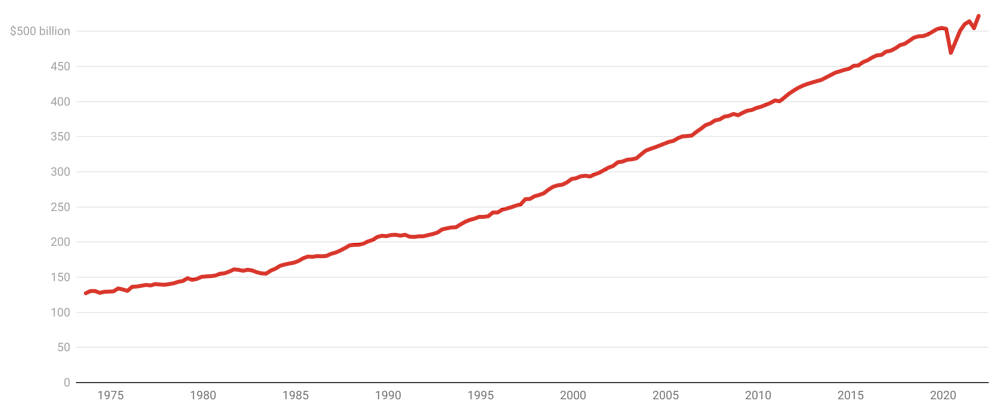
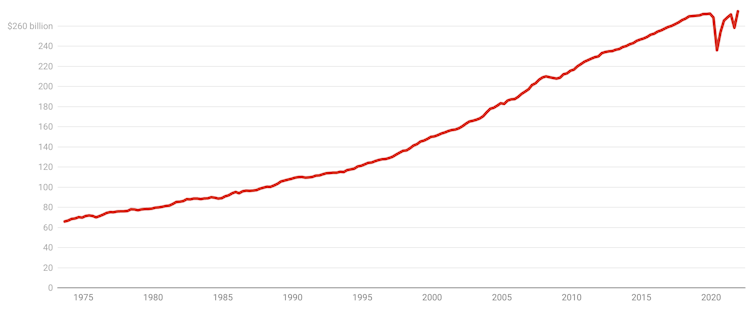
Australia’s economy bounced back a welcome 3.4% in the December quarter of 2021, more than reversing the 1.9% lockdown-related decline in the September quarter. It was the sixth-biggest increase in the 60 years the figures have been compiled.


Australian quarterly gross domestic product

Chain volume measures, seasonally adjusted.
ABS National Accounts

The economy grew by 4.2% over the year to December, making it 3.4% bigger than it was two years earlier, before COVID.

This is similar to what happened in the United States, but better than what happened in the European Union and South Korea. The economies of the UK and Japan are still smaller than they were before COVID.

While it is impressive in the circumstances, had there been no pandemic, real GDP was set to climb 6% rather than 3.4% over those years. That’s what the Reserve Bank had been forecasting.

The South East versus the rest

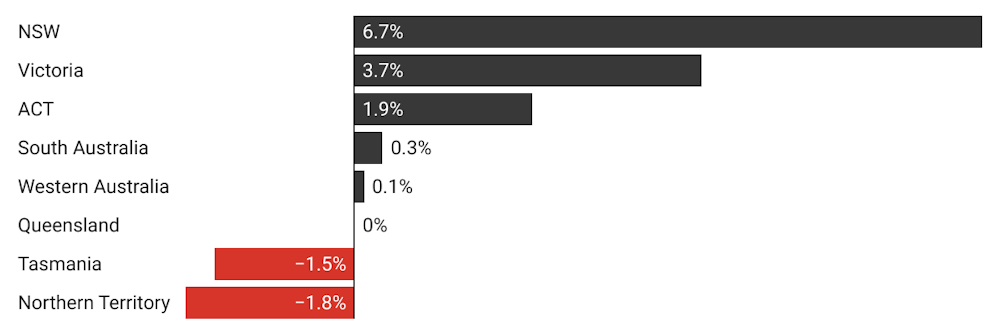
It depended very much on where you lived. NSW, Victoria and the ACT were constrained by lockdowns in the September quarter.

Those states bounced back most strongly in the December quarter.

It is notable, and concerning, that in the other states, the best measure of total spending, state final demand, barely grew at all or went backwards.


State final demand, December quarter

Seasonally adjusted.
ABS National Accounts

Household spending was the main driver of the stronger GDP.

It bounced back in the December quarter as unemployment fell, vaccination rates rose and consumer confidence climbed ahead of Omicron in the belief COVID was coming under control.


Household final consumption expenditure

Chain volume measures, seasonally adjusted.
ABS National Accounts

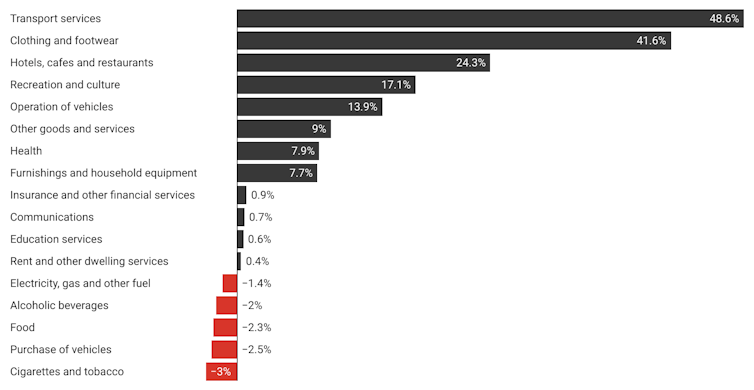
Spending on services surged. Personal and other services, the category that includes hairdressing, climbed by a record 15%.

There were also some big increases in spending on non-essential goods. Purchases of clothing and footwear jumped by more than 40%.


Components of household final consumption expenditure

December quarter growth in real household final consumption expenditure.
ABS National Accounts

Households have been saving an unusually high proportion of their income during the pandemic.

The saving ratio soared to a record high early in the pandemic, fell during the 2020 recovery, soared again during the 2021 lockdowns, and fell in the December quarter.

But it remains, as the Treasurer said in his press conference, around three times what it would have otherwise been without the pandemic.


Household saving ratio

Ratio of saving to net-of-tax income, seasonally adjusted.
ABS National Accounts

Much of the saving is the result of caution, but much also reflects government support programs that maintained incomes at times when people were limited in their ability to spend on travel, restaurants, cinemas, gyms and other services.

Some of the frustrated services spending was diverted to goods, exacerbating supply bottlenecks and contributing to inflation.

Inventories climbed $1.5 billion after a fall of $2.9 billion in the September quarter as wholesalers restocked, also contributing to GDP growth.


Read more:
Australia cut unemployment faster than predicted – why stop now?


Export volumes fell as the reduction in coal exports (reflecting heavy rain and labour constraints) outweighed the increase in agricultural exports (reflecting a record grain harvest).

Housing construction also detracted from growth as shortages of workers and materials caused delays in building.

Sharing the cake

How were the proceeds of this higher GDP shared among Australians?

Treasurer Josh Frydenberg was keen to point out the wages bill climbed by more than 5% through the year as more workers found jobs, higher bonuses were paid and workers switched to better jobs and got promotions, a form of wage growth not captured in the official wage price index.

The wages share of national income remained near an all-time low. Wage growth is lagging price growth, meaning workers are getting a smaller share of the pie than they have been used to.


Wages share of total factor income

Compensation of employees including wages, salaries and social security contributions.
ABS National Accounts

Looking forward

The December quarter was between the bulk of Delta and the bulk of Omicron.

After the outbreak of Omicron in late December, hours worked slid 9% in January as workers became sick, isolated and caring for friends and family who were sick.

Consumer sentiment deteriorated in both January and February as petrol prices rose and attention turned to interest rate rises.

Russia’s invasion of Ukraine, and the subsequent further surge in petrol prices, is likely to depress sentiment further.


Read more:
Inflation hits 3.5%, but it won’t budge the Reserve Bank on interest rates


This means the next GDP release, covering the March quarter, will quite likely go backwards, taking GDP growth down with it.

Fortunately for the government, it isn’t due for release until Wednesday June 1, safely after the election which must be held by Saturday May 21 to avoid a separate half-Senate election.

The Conversation

John Hawkins was formerly an economic analyst and forecaster in the Reserve Bank and Treasury.

ref. Wednesday’s GDP numbers are impressive, but they are for the December quarter, when we were bouncing back from Delta – https://theconversation.com/wednesdays-gdp-numbers-are-impressive-but-they-are-for-the-december-quarter-when-we-were-bouncing-back-from-delta-177821

Brisbane floods: pondering the wisdom of placing our major galleries, libraries and theatres on the banks of a flood-prone river

Source: The Conversation (Au and NZ) – By Margaret Cook, Lecturer in History, University of the Sunshine Coast

As a historian, I spend many hours at the State Library of Queensland looking out the large glass panels gazing at the Brisbane River. Its tranquil brown water quietly meanders past, offering an ideal place to watch the CityCat ferries and the occasional passing rower.

But this weekend the water was roaring, racing past the library, full of pontoons, boats and debris. The river broke its banks, reclaiming its floodplain and inundating buildings in its path, until the flood peaked at 3.85 metres at the Brisbane gauge.

Maiwar (Turrbal name for the Brisbane River) has a long history of floods, as does the south end peninsula or Kurilpa, “place of the water rat”. This land, once full of waterholes, creeks and wetlands provided sustenance for Turrbal and Jagara peoples for centuries.

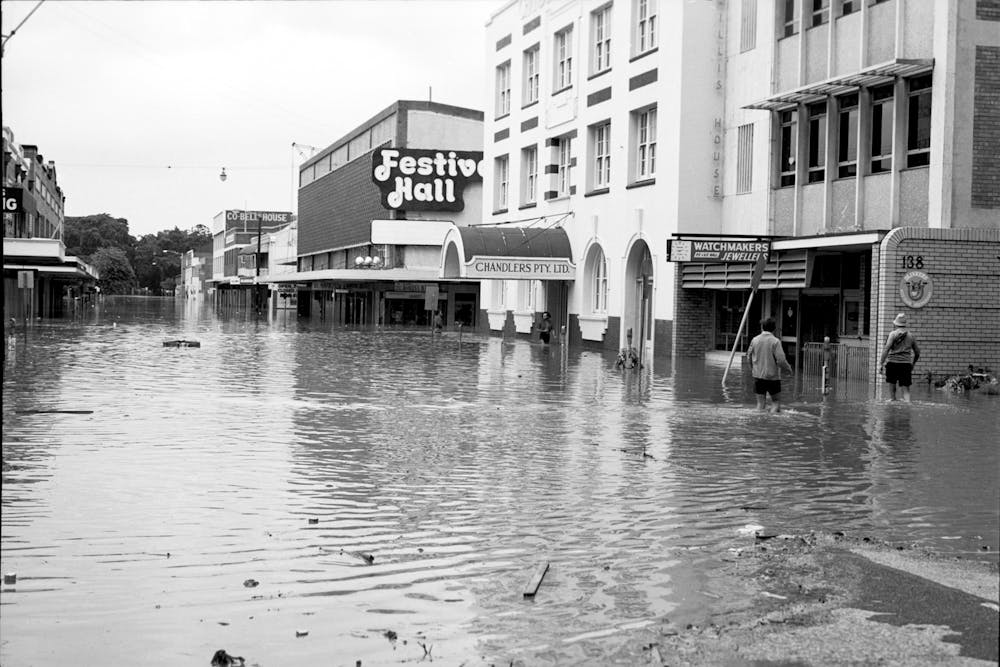
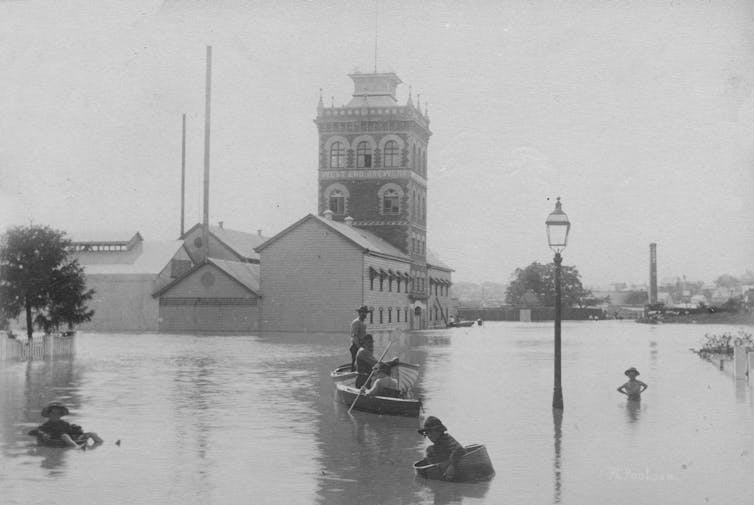
Flooded streets of Brisbane in 1893.
Queensland State Archives

By 1893 when a flood of 8.35 metres occurred in central Brisbane, South Bank was an industrial site occupied by wharves, factories, commercial businesses, and the railway line, with residential estates in nearby West End.

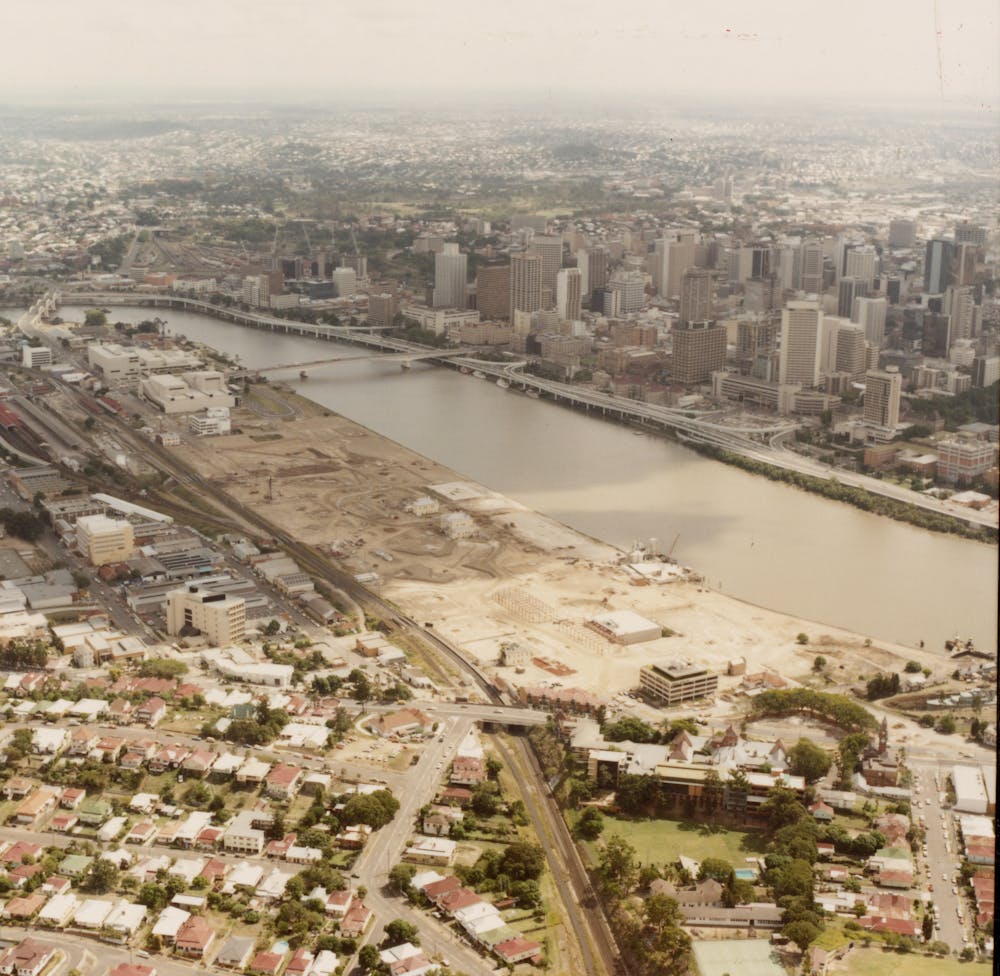
After the flood, commercial businesses moved to the north side and between 1900 to the 1970s the south bank declined, left as largely undeveloped open space.

A new cultural precinct

In 1969, the Queensland Art Gallery Site Committee selected the river’s south bank as the site of a new state art gallery, its river location regarded as enhancing its aesthetic appeal.

By 1974 the state government had acquired more land for a cultural precinct, undeterred by the 1974 floods that reached 5.45m at the Brisbane gauge.

The 1974 floods reached a height of 5.45 meters.
Queensland State Archives

Additions included the Queensland Art Gallery (opened in 1982), Queensland Performing Arts Centre (1985), Queensland Museum (1986) and Queensland State Library (1988, extended 2006). The cultural precinct expanded with the Playhouse Theatre (1998) and the Queensland Gallery of Modern Art (GOMA, 2006).

By 1987, the Queensland Art Gallery and Queensland Performing Arts Centre (both far left) had been opened, but most of the south bank was undeveloped.
Queensland State Archives

With its riverside landscape forecourts and restaurants, and iconic Brisbane eye, the designs took advantage of the location, and were intended to make a statement when viewed from the north side of the river.

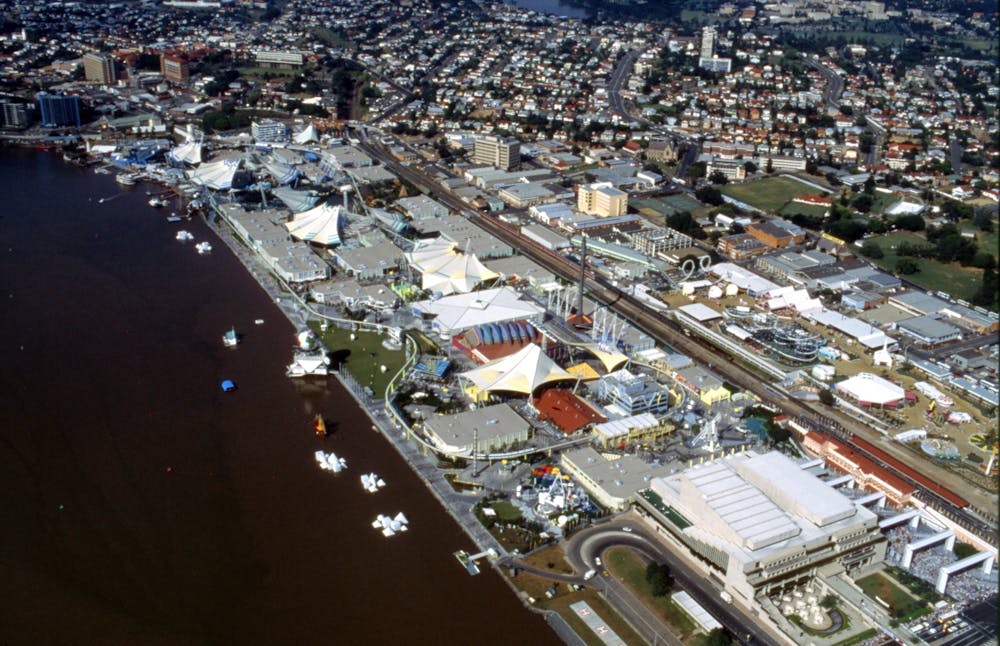
The adjacent land was developed for World Expo ’88, now South Bank Parklands and home to the Queensland Conservatorium (1996) and ABC studios (2013).

The precinct stretches more than 450 metres along the Brisbane River and is now the cultural hub of Brisbane.

In 1988, South Bank was home to the World Expo.
Queensland State Archives

The 2011 floods

But South Bank’s watery history is never far away.

In 2011 Brisbane again flooded, this time to 4.46m at the Brisbane gauge, and the precinct’s vulnerability was exposed. Within hours its riverside location switched from an asset to a liability. The carparks and basement levels were inundated where the electrical, fire and air-conditioning systems were located, rendering the buildings unsafe.

The buildings were all closed as basements pumps went into overdrive.

Water did not enter the Queensland Art Gallery, but the lower level of the Children’s Art Centre, River Café and back-of-house areas were damaged at the Gallery of Modern Art. The first floor was well above river levels and the ground floor’s robust design allowed it to be hosed out.

The State Library was forced to move its collection to higher levels – as staff had been doing in previous wet weeks – and was saved by the 2006 renovation that had already relocated some books to higher levels. The Edge, the children’s space on the ground floor, was damaged.

Almost three metres of floodwater inundated the lower end of the Playhouse at the Queensland Performing Arts Centre. It was a month before performances could be held.

The headquarters of the Queensland Theatre Company, only blocks away in Montague Road, was in waist-deep water.

Thousands of props and costumes were destroyed – years of theatrical history were sent to the dump. The stage flooring and lower-level seating, bar, reception and green rooms were irrevocably damaged.

As the floodwaters receded, humidity (the harbinger of mould) rose, the power loss making humidity monitors and air conditioning impossible. Librarians and museum and art curators monitored anxiously.

But after a few weeks, in the spirit of “the show must go on”, the curtains re-opened at the Queensland Performing Arts Centre and these cultural hubs returned to business as usual.

The 2022 floods

When floodwaters rose again this year my fellow historians and I were texting each other to ask: “what’s happening to the State Library, is it in trouble?”

Sadly, it was. The State Library of Queensland, its access limited for months by COVID-19, is again closed. The community tool library on ground floor of the library is completely under water.

The Queensland Theatre Company is again inundated with water.

Performances at the Queensland Performing Arts Centre are postponed until at least March 7.

The ABC, an essential service in floods, was inundated. Brisbane news was diverted through Melbourne or Perth and local journalists reported in the field.

In a few weeks’ time I hope to return to research at the state library. Once again, I will look out over the river and enjoy the peaceful reverie of seemingly benign water pass by.

But this time I will contemplate the wisdom of placing all our cultural repositories on the banks of a flood-prone subtropical river.


Read more:
Like rivers in the sky: the weather system bringing floods to Queensland will become more likely under climate change


The Conversation

Margaret Cook does not work for, consult, own shares in or receive funding from any company or organisation that would benefit from this article, and has disclosed no relevant affiliations beyond their academic appointment.

ref. Brisbane floods: pondering the wisdom of placing our major galleries, libraries and theatres on the banks of a flood-prone river – https://theconversation.com/brisbane-floods-pondering-the-wisdom-of-placing-our-major-galleries-libraries-and-theatres-on-the-banks-of-a-flood-prone-river-178156

How Tasmania’s major digital blackout was fixed, and how another could be avoided – an electrical engineer explains

Source: The Conversation (Au and NZ) – By Thas Ampalavanapillai Nirmalathas, Professor of Electrical and Electronic Engineering and Deputy Dean Research at Faculty of Engineering and Information Technology, The University of Melbourne

Shutterstock

Tasmanians yesterday suffered a six-hour digital blackout, with phone and internet services down across the state. Some radio and television broadcasts were also affected, as well as banking and electronic payment services.

The impact was so severe that Tasmania’s connectivity to the rest of the world was reportedly reduced by 70%, before services slowly began being restored around 6pm.

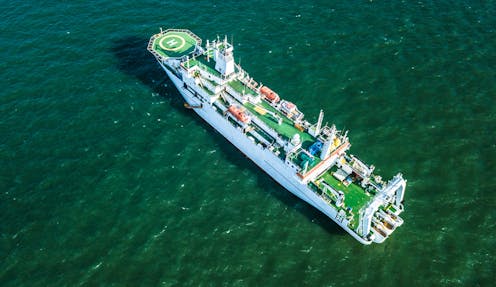
The state is connected to the Australian mainland (and the rest of the world) by three fibre-optic cables. Two are deployed by Telstra, and the third is owned by the Tasmanian government and laid along the BassLink electricity cable into Victoria.

By an astounding coincidence, different construction crews cut the two Telstra cables in two separate incidents: one was cut at around 11am in Victoria, near Frankston, and the other was cut at a remote location in Tasmania at around 1pm.

It’s not clear how this happened, given the perennial advice for construction crews to “dial before your dig”. It could be the crews were working with inaccurate information, and didn’t realise they were digging on the cables’ routes.

The breaks in the two cables led to a major disruption to all internet and telecommunication services in Tasmania. Priority services, such as triple zero calls, were kept alive using the third cable.

A complicated setup

Undersea fibre-optic cables are made of bundles of glass fibres, each one about as thick as a strand of human hair. Information is carried along these fibre strands at high speeds in the form of light pulses.

The fibres are carefully arranged inside the cable, with each strand supported by a strengthening sheath. The entire cable is also protected by an outer waterproof sheath, making it suitable for undersea deployment.

Undersea cables leave the shore via special landing sites and loosely sit on the ocean floor. They can suffer damage from anchors of passing ships, or natural disasters – which happened during the recent volcanic eruption in Tonga. But these incidents are very rare.

On the shore, the cables are laid underground and only accessible at key network exchange locations.


Read more:
The Tonga volcanic eruption has revealed the vulnerabilities in our global telecommunication system


Repair logistics

Repairing damage to undersea cables requires specialist ships that draw the cable to the ocean’s surface. One by one, the individual glass fibre strands are separated, cleaved with a diamond blade (to achieve clean polished ends on the strands), and then fused or welded back together to complete the repair.

The repaired link is mechanically strengthened with a protective covering, after which the network engineers run a range of tests before the link can carry network traffic again.

In yesterday’s events, however, the damage to the two fibre-optic cables happened along their land routes, so repair crews could fix them relatively quickly. Had the cables been damaged at undersea locations, repairs could have taken days.

Any delays yesterday would have mainly been a result of getting the right equipment and technical crews to the locations – especially the more remote one on the Tasmanian side.

What’s the fix?

The digital blackout highlighted Tasmania’s over-reliance on the current fibre links. The Tasmanian government has in the past failed to be part of other undersea cable projects that could have provided a more diverse connection between Tasmania and the mainland.

The state could run into more trouble in the future, should it fail to bolster its connective capabilities.

As the distance between Tasmania and the mainland is about 200km, deploying wireless links (such as those used by radio towers) wouldn’t be realistic. This would require very high antenna towers and multiple repeaters in the sea.

And while NBN satellites could be used to provide some connectivity, undersea cables remain the best option.

Ideally, there should be investment not only in establishing a potential fourth cable link, but also in upgrading the existing infrastructure to broaden its capacity. Cables would still be impacted during adverse events, but the entire system would become much more resilient overall.

Diversity in the cable network is also critical, especially in terms of the physical cable routes. In situations where links are damaged, we need to be able to reconfigure the network quickly (and without human intervention). So even if a fault happens, signals can be automatically rerouted to bypass faulty links.

With the world’s increasing dependence on digital connectivity, and the emergence of 5G, operators like Telstra and newcomer HyperOne are planning to build new national fibre networks.

In February Telstra announced plans to expand its current network in Australia, with roughly A$1.6 billion worth of upgrades expected – but specifics about where and how the money will be spent aren’t known.

HyperOne also has plans to build additional undersea cables linking Perth, Adelaide, Melbourne, Launceston, Hobart and Sydney. This could provide more diversified connectivity to Tasmania.

The Conversation

Thas Ampalavanapillai Nirmalathas receives funding from the Australian and Victorian Governments as well as received funding for collaborative projects with organisations such as Telstra, Nokia, AT&T, Transurban, Digital Falcon, Eirene Holdings, InstaWireless, nbn, and Google.

ref. How Tasmania’s major digital blackout was fixed, and how another could be avoided – an electrical engineer explains – https://theconversation.com/how-tasmanias-major-digital-blackout-was-fixed-and-how-another-could-be-avoided-an-electrical-engineer-explains-178169

Politics with Michelle Grattan: Russia specialist Matthew Sussex on Putin’s potential to start wider war

Source: The Conversation (Au and NZ) – By Michelle Grattan, Professorial Fellow, University of Canberra

As the West watches appalled at Russia’s brutal attack on Ukraine, attention is increasingly turning to the question of Vladimir Putin’s longer term ambition, and the potential for this conflagration to turn into a wider war.

Matthew Sussex, associate professor at the Griffith Asia Institute at Griffith University and an expert on Russia, believes Putin won’t want to stop at subjugating Ukraine.

“Putin himself seems absolutely personally invested in recreating the footprint at least of the USSR – certainly not its ideology, but its footprint.”

“He has for a long time said that Ukraine doesn’t deserve to exist as a state. That Ukrainians and Russians are just one people driven apart by the West.

“So he has […] achieved some of his aims already.”

“And the worry is, of course, that if Putin gets what he wants in Ukraine, then he will not stop. He will then turn his eyes to Latvia, Lithuania, Estonia – possibly even Poland will be told in a few years time that it doesn’t have the right to exist as a sovereign state.”


Read more:
Putin is on a personal mission to rewrite Cold War history, making the risks in Ukraine far graver


On whether there’s a possibility of the war in Ukraine leading to a military conflict with the West, Sussex says: “Absolutely. It is potentially the case that Putin, who is a gambler, will try and up the ante by staging some kind of demonstration of strength against NATO, or perhaps even a provocation directly against NATO troops.

“Many, many wars in history have been started by accident, by overconfidence, by miscalculation. And this is why it’s a very, very dangerous time.”

The Conversation

Michelle Grattan does not work for, consult, own shares in or receive funding from any company or organisation that would benefit from this article, and has disclosed no relevant affiliations beyond their academic appointment.

ref. Politics with Michelle Grattan: Russia specialist Matthew Sussex on Putin’s potential to start wider war – https://theconversation.com/politics-with-michelle-grattan-russia-specialist-matthew-sussex-on-putins-potential-to-start-wider-war-178306

Politics with Michelle Grattan: Russian specialist Matthew Sussex on Putin’s potential to start wider war

Source: The Conversation (Au and NZ) – By Michelle Grattan, Professorial Fellow, University of Canberra

As the West watches appalled at Russia’s brutal attack on Ukraine, attention is increasingly turning to the question of Vladimir Putin’s longer term ambition, and the potential for this conflagration to turn into a wider war.

Matthew Sussex, associate professor at the Griffith Asia Institute at Griffith University and an expert on Russia, believes Putin won’t want to stop at subjugating Ukraine.

“Putin himself seems absolutely personally invested in recreating the footprint at least of the USSR – certainly not its ideology, but its footprint.”

“He has for a long time said that Ukraine doesn’t deserve to exist as a state. That Ukrainians and Russians are just one people driven apart by the West.

“So he has […] achieved some of his aims already.”

“And the worry is, of course, that if Putin gets what he wants in Ukraine, then he will not stop. He will then turn his eyes to Latvia, Lithuania, Estonia – possibly even Poland will be told in a few years time that it doesn’t have the right to exist as a sovereign state.”

On whether there’s a possibility of the war in Ukraine leading to a military conflict with the West, Sussex says: “Absolutely. It is potentially the case that Putin, who is a gambler, will try and up the ante by staging some kind of demonstration of strength against NATO, or perhaps even a provocation directly against NATO troops.

“Many, many wars in history have been started by accident, by overconfidence, by miscalculation. And this is why it’s a very, very dangerous time.”

The Conversation

Michelle Grattan does not work for, consult, own shares in or receive funding from any company or organization that would benefit from this article, and has disclosed no relevant affiliations beyond their academic appointment.

ref. Politics with Michelle Grattan: Russian specialist Matthew Sussex on Putin’s potential to start wider war – https://theconversation.com/politics-with-michelle-grattan-russian-specialist-matthew-sussex-on-putins-potential-to-start-wider-war-178306

COVID mask mandates might be largely gone but here are 5 reasons to keep wearing yours

Source: The Conversation (Au and NZ) – By C Raina MacIntyre, Professor of Global Biosecurity, NHMRC Principal Research Fellow, Head, Biosecurity Program, Kirby Institute, UNSW Sydney

Shutterstock

Mask mandates in most indoor settings have been dropped in New South Wales, Victoria and the ACT, with Queensland to follow later this week.

Without a mandate, mask use tends to drop, so we can expect only a minority of people to be masked in public indoor spaces.

With thousands of cases a day and just over half (57%) of Australians having received a third COVID vaccine dose and children still under-vaccinated, we may see a surge in infections.

While masks are a small inconvenience, they remain vital in preventing SARS-CoV-2, because the virus spreads through the air we breathe.


Read more:
The pressure is on for Australia to accept the coronavirus really can spread in the air we breathe


Some people will continue to wear masks to stay safe and achieve a more normal life through the pandemic. Here are five reasons to keep wearing yours.

1. Masks reduce your chance of getting COVID

Many studies have shown masks protect against COVID. While N95 respirators offer the greatest protection, even cloth masks are beneficial. N95s respirators lower the odds of testing positive to COVID by 83%, compared with 66% for surgical masks and 56% for cloth masks.

The protection when everyone wears a mask is much greater, because it reduces the likelihood of well people inhaling the virus and prevents infected people from exhaling the virus into the air. If everyone wears a mask, the viral load in the air is much lower.

When we lose the protection of universal masking, it’s a good idea to wear a high protection N95 or P2 respirator.


Read more:
How to get the most out of your N95 mask or other respirator


2. You might not know you have COVID

Transmission of the virus without symptoms is a major driver of spread, and we cannot know who around us is infected.

Infected people may be asymptomatic or may not know they’re infected. This is especially so for Omicron.

Overall, about one in four infections are asymnptomatic. But even people with symptomatic infection are contagious before the symptoms start.

Business woman wears a mask.
You might not know you’re infectious.
Shutterstock

3. Wearing a mask protects others, including those at risk of severe COVID

Wearing a mask protects others, including those at greatest risk of severe COVID: people with disability, chronic illnesses and suppressed immune systems.

COVID disproportionately affects migrants and people from lower socioeconomic groups who are more likely to work in customer-service roles. If you wear a mask, you’re protecting workers, commuters and others you interact with.

Rates of vaccination also lag among Aboriginal and Torres Strait Islander people, leaving them more vulnerable to COVID in the absence of masks.


Read more:
Australia is failing marginalised people, and it shows in COVID death rates


Masks also protect children who are vulnerable to COVID, with only half of five to 11 year olds partially vaccinated and under-fives not yet eligible for vaccination.

Children who wear masks can also protect their peers. In the United States, the risk of outbreaks was nearly four times higher in schools without mask mandates compared to those with mandates.

Omicron is not the flu or a cold, and has accounted for 17% more deaths than Delta in the United States. While Omicron generally causes less severe disease than Delta, it has claimed more lives because of vastly higher case numbers.

There is also growing evidence SARS-COV-2 persists in the body after infection, which may result in long-term heart, lung and brain damage.

4. Masks protect your colleagues

Many workplaces are insisting on people returning to face-to-face work, some without providing safe indoor air – and now without mask mandates.

The risk of COVID transmission is greatest when indoors for prolonged periods without adequate airflow. So sitting in an office for eight hours without a mask is a risk, especially if safe indoor air has not been addressed.

Man in a mask sits at his work desk, next to his female colleagues.
Wearing a mask reduces your risk of contracting COVID from co-workers.
Shutterstock

At the same time as dropping many workplace mask mandates, NSW has moved to remove automatic workers’ compensation for people who catch COVID at work.

This is a double disadvantage for workers returning to workplaces with fewer protections and facing greater obstacles to workers’ compensation should they get infected.

5. Others might follow your lead

Being one of the few people wearing a mask when others aren’t, such as in a supermarket, is a daunting prospect for those of us who wish to continue masking. There are reports of masked people being abused and bullied.

However a NSW survey showed the majority of people in that state wanted mask mandates to remain. The more we normalise masks and the more we see them, the better protected the community will be.

As much as we wish it so, the pandemic is not over and new variants will likely emerge.

A layered, multi-pronged strategy which includes vaccines, masks, ventilation, testing and tracing is the best way to protect health, the economy and a resumption of normal activities.


Read more:
How does Omicron compare with Delta? Here’s what we know about infectiousness, symptoms, severity and vaccine protection


The Conversation

C Raina MacIntyre receives funding from NHMRC, MRFF and has consulted for Ascend Performance Materials, Detmold Group and Cleanspace in the last 5 years.

ref. COVID mask mandates might be largely gone but here are 5 reasons to keep wearing yours – https://theconversation.com/covid-mask-mandates-might-be-largely-gone-but-here-are-5-reasons-to-keep-wearing-yours-177824

‘One of the most extreme disasters in colonial Australian history’: climate scientists on the floods and our future risk

Source: The Conversation (Au and NZ) – By Andrew King, Senior Lecturer in Climate Science, The University of Melbourne

The deluge dumped on southeast Queensland and northern New South Wales this week has been catastrophic. Floodwaters peaked at around 14.4 metres high in Lismore – two metres higher than the city’s previous record.

So how does this compare to Australia’s previous floods, such as in 2011? And can we expect more frequent floods at this scale under climate change? The answers to questions like these aren’t straightforward.

Climate change doesn’t tell the whole story, as extreme rainfall can occur for a variety of reasons. What’s more, it’s too soon to officially state whether this event is directly linked to climate change, as this would require a formal event attribution study. This can take months or years to produce.

In any case, we do know extreme events like this will occur more frequently in a warmer world. And the rising death toll, ongoing evacuations and destroyed homes make this one of the most extreme natural disasters in colonial Australian history.

How this compares to floods in our past

The east coast is a common place for heavy rainfall and flooding. The Yugara and Yugarabul people have traditional stories about great floods in the Brisbane river region long before European colonisation, and sediments from floodplains indicate floods as severe as those in 2010–2011 have occurred at least seven times in the past 1,000 years.

Instrumental records and documentary accounts show severe floods have inundated southern Queensland’s cities and towns in the 1820s, early 1840s and 1890s, 1931, 1974 and, of course, in 2010–2011.

Each of these events have been devastating, and record-breaking, depending on which records you’re interested in.

The floods in 1841 and 1893 are considered highest in terms of water levels recorded in Brisbane city, reaching over 8m. Australia’s wettest day on record was also recorded in 1893, when Crohamhurst in the Glasshouse Mountains measured 907 millimetres in one day.


Read more:
IPCC report: Coastal cities are sentinels for climate change. It’s where our focus should be as we prepare for inevitable impacts


Black and white image of men in a small boat in front of a tall brick building that is half submerged in flood water. The building had 'West End Brewery' written on it
The West End Brewery in Brisbane in 1890. The Brewery building was damaged even further in the 1893 flood, when the Brisbane River rose 10 feet above the 1890 record.
John Oxley Library, State Library of Queensland

The 1974 event was associated with extreme rainfall totals in many coastal areas, including 314mm in one day in Brisbane, and more than a metre of rainfall was recorded over three days in places such as Mount Tamborine and the northwest of Surfers Paradise.

The 2010–11 flood, while not as severe in terms of extreme rainfall totals, was notable for its inland extent, and was the final act of Australia’s wettest July to December on record.

The current flood has peaked at 3.85m in Brisbane, below the 2010–2011 levels of 4.46m. But it’s breaking records in other areas such as Lismore in northern NSW. The rainfall statistics associated with this event are also nearing the highest on record for many places, possibly due to the slow-moving nature of the associated weather system.

Four of the top six highest rainfall totals in NSW were recorded on 28 February, and Brisbane has just experienced three days of over 200mm. These aren’t the highest daily totals ever recorded in the city, but the first time three days of such intense falls have been documented, in data that go back to 1841.

Disentangling the role of climate change

When it comes to understanding the role of human-induced climate change in extreme events, there is the temptation to ask the wrong question: “did climate change cause this event?”

Since any extreme event is always a manifestation of climate variability, large weather systems, local-scale weather and climate change, it’s impossible to categorically answer this question with a simple “yes” or “no”.

Instead, the question we should be asking is “did climate change contribute to this event?”

Well, firstly, there has actually been a slight decrease in summer rainfall in southeast Queensland and northeast NSW since the mid-20th century. But, there’s very high variability in rainfall for this region, and La Niña – a natural climate phenonenon associated with wetter weather – often brings flooding to this area, as we saw in 2010/2011 and in the 1970s.

Trends in maximum 3-day rainfall in summer (December-February) from 1959/1960 to 2019/2020 show mixed trends in the flood-affected region. White areas are where station coverage is sparse or the dataset fails a quality control test.
Author provided

Indeed, the effect of La Niña (and its counterpart El Niño, associated with drier weather) makes identifying a climate change-related trend more difficult. In other words, while a human-induced climate change signal may be present, the naturally high variability makes it hard to spot.

The atmosphere can hold approximately 7% more moisture for every degree Celsius of global warming. However, we also need the right weather systems in place to trigger the release of moisture from the air and cause extreme rainfall. The climate change effect on these systems is uncertain.


Read more:
New IPCC report shows Australia is at real risk from climate change, with impacts worsening, future risks high, and wide-ranging adaptation needed


Climate change and weather systems

The severity of the flooding in southeast Queensland is partly due to a weather system called an “atmospheric river” sitting over the region for days. To make matters worse, the rain fell on an already sodden ground due to both the higher-than-average rainfall from the current La Niña, and the La Niña in the 2020-2021 summer. This made a huge difference to the scale of the floods.

We don’t fully understand how the persistence of these natural systems will change in future, but recent work shows climate change will cause long-lasting atmospheric rivers over Sydney to occur almost twice as often by the end of the 21st century. We don’t know yet if that’s also true further north of Sydney.

To complicate things further, there’s evidence to suggest climate change may be influencing the frequency, intensity and impacts of El Niño and La Niña events.

Climate change projections also suggest we may see small increases in the number of extreme one-day rainfall events which typically lead to flash flooding, in eastern Australia. But there’s a lot of uncertainty.

And worldwide, Monday’s report from the Intergovernmental Panel on Climate Change projected that global warming of 2℃ this century will bring twice as much flood damage compared to 1.5℃ warming. This jumps to 3.9 times more flood damage at 3℃ warming.

While the role of climate change is hard to pin down in Australia’s biggest floods, we know flooding often strikes our east coast. Building greater resilience to severe flooding would help lessen their impact.

Taking steps like concentrating new housing and infrastructure projects in areas above flood plains would help make us less vulnerable to these events.


Read more:
Like rivers in the sky: the weather system bringing floods to Queensland will become more likely under climate change


The Conversation

Andrew King receives funding from the Australian Research Council and the National Environmental Science Program.

Linden Ashcroft receives funding from the Australian Research Council.

Sarah Perkins-Kirkpatrick receives funding from the Australian Research Council.

ref. ‘One of the most extreme disasters in colonial Australian history’: climate scientists on the floods and our future risk – https://theconversation.com/one-of-the-most-extreme-disasters-in-colonial-australian-history-climate-scientists-on-the-floods-and-our-future-risk-178153

Civilians are being killed in Ukraine. So, why is investigating war crimes so difficult?

Source: The Conversation (Au and NZ) – By Ben Saul, Professor of International Law, Sydney Centre for International Law, University of Sydney

Oleksandr Ratushniak/AP

The prosecutor of the International Criminal Court, Karim Khan, is opening an investigation into whether war crimes may have been committed in Ukraine. He is urgently seeking to preserve evidence as the fighting rages on.

War crimes are serious violations of international humanitarian law, which seeks to regulate the conduct of war and the treatment of civilians and prisoners during war.

As Russian troops have reached major cities, there have been increasing reports of strikes on civilian objects, such as apartment buildings, schools, kindergartens, hospitals, and oil and electricity facilities.

With the fighting now moving deeper into urban areas – and Russian forces becoming frustrated by Ukrainian resistance – the harm to civilians could become much greater.

Ukraine is not a party to the Rome Statute of the ICC, but it has twice accepted the court’s jurisdiction over any international crimes committed in its territory. This could include offences committed by pro-Russian separatists or Russian or Ukrainian military forces.

It does not matter that Russia is not a member of the court and has not accepted its jurisdiction. But it does mean Russia, like the US, is very unlikely to cooperate with the court.

What is a war crime?

In considering whether war crimes have been committed, the devil is in the legal detail. This is why forensic criminal investigations are so important to uncover the truth and cut through propaganda or the understandable emotion involved in conflicts where civilians are hurt.

International humanitarian law does not absolutely prohibit harm to civilians or their property, and tolerates some collateral damage to civilians.

However, the law is unambiguous when it comes to deliberate attacks on civilians or civilian objects. These are war crimes, unless a civilian object is also being used for military purposes and thus becomes a military target.


Read more:
Is international law powerless against Russian aggression in Ukraine? No, but it’s complicated


Disproportionate attacks are also war crimes. These are attacks that cause excessive civilian casualties relative to the military advantage of attacking a military target. So, for instance, this could include a missile strike on an apartment building that Russian forces knew would cause significant civilian casualties for little military gain.

International law also prohibits indiscriminate attacks. These could include using certain weapons against military targets in dense urban areas, such as artillery, cluster munitions or thermobaric “vacuum” bombs, whose wide effects also risk hitting civilians.

Russian troops have already been accused of using cluster munitions and vacuum bombs in civilian areas in Ukraine. Both were also used by Russian forces in the devastating Chechen wars in the 1990s.

Other war crimes include killing detainees, torture, hostage taking, illegal detention and wanton property destruction.

It is also a war crime to kill or injure anyone when dressed in the military uniform of the other side (such as possible Russian saboteurs wearing Ukrainian uniforms), or when dressed as a civilian without any military insignia (this could potentially include Ukrainian civilians who throw Molotov cocktails).

Crimes likely to have occurred

This is not the first time the ICC has looked into alleged crimes in Ukraine. A preliminary examination by Khan’s predecessor, Fatou Bensouda, in 2020 found “a reasonable basis to believe” war crimes and crimes against humanity had been committed in eastern Ukraine and Crimea since 2014.

Bensouda did not indicate who was responsible, though much of the conduct is likely to have been committed by Russian forces (in Crimea) and pro-Russian separatists (in eastern Ukraine).

The prosecutor’s office had not yet sought permission from judges to open a full-scale investigation. But Khan has now confirmed those findings and wants to launch such a formal investigation, expanded to include the current conflict.

In Crimea, the allegations include everything from wilful killing and torture to the conscription of Ukrainian civilians into the Russian army and forced transfer of civilian prisoners from occupied territory.

In eastern Ukraine, the alleged war crimes include murder, torture, rape and launching attacks causing disproportionate civilian casualties.

Khan is satisfied these alleged crimes are grave enough to justify ICC prosecution, and that Ukraine and Russia are either unable or unwilling to investigate themselves. Ukraine cannot take suspects into custody in areas it does not control, while Russia is uninterested in prosecuting anyone.

However, the ICC does not have jurisdiction over the international crime of aggression – that is, to prosecute Russia’s unlawful attack on Ukraine.

Ukraine has made a claim with the International Court of Justice that Russia is invading on the pretext of stopping genocide by Ukraine, but this is a speculative gambit. And the ICJ does not have jurisdiction to directly hear any claim that Russia is committing aggression.

Challenges make prosecutions unlikely

The ICC investigation sends an important signal to Russia that impunity for international crimes will not be tolerated. It contrasts with the court’s position on Afghanistan, where the investigation into alleged war crimes by the US and other foreign forces was controversially “deprioritised” last year.

But significant hurdles still remain. Once a formal investigation is launched, it will take many years to progress. This is due to the difficulty of obtaining and preserving evidence (both physical and digital) in the middle of live combat and a rife propaganda war. Russia will also be uncooperative.

Even then, realistically, it is unlikely many prosecutions will happen – if any at all. For one, establishing which Russian military or political leaders are responsible for specific crimes will be complex and difficult. Then, arresting them in Russian-occupied territory, or obtaining their extradition from Russia, will be virtually impossible. The ICC has only convicted 10 people in two decades, despite the prevalence of international crimes in many conflicts.


Read more:
‘Judge, jury and executioner’: why holding militaries to account for alleged war crimes is so hard – podcast


At most, anyone ultimately indicted may think twice about travelling outside Russia or occupied Ukraine, as they could be arrested in 123 countries that are members of the court.

There is also the possibility Putin’s regime will eventually fall and a new Russian government may be more open to seeking justice for its past. Collecting and preserving evidence is therefore essential for any future accountability efforts.

Having failed to prevent the conflict, the least the international community can do now is better resource the prosecutor’s office to undertake its important investigations, and share relevant evidence and intelligence.

The Conversation

Ben Saul is affiliated with Chatham House in London and the International Centre for Counter-terrorism in The Hague.

ref. Civilians are being killed in Ukraine. So, why is investigating war crimes so difficult? – https://theconversation.com/civilians-are-being-killed-in-ukraine-so-why-is-investigating-war-crimes-so-difficult-178155

Sudden mould outbreak after all this rain? You’re not alone – but you are at risk

Source: The Conversation (Au and NZ) – By Rebecca Bentley, Professor of Social Epidemiology, Principal Research Fellow in Social Epidemiology and Director of the Centre for Research Excellence in Healthy Housing in Melbourne School of Population and Global Health, The University of Melbourne

Shutterstock

Recent torrential rain along the east coast of Australia has sparked renewed fears of mould in people’s homes, which can cause dangerous health problems. Many flood-affected residents in northern New South Wales and Queensland will also be contending with mould as part of the post-flood cleanup.

Moulds are fungi – microbes like viruses or bacteria. There are some microbes in every building and they’re usually harmless.

In a damp or water-damaged environment, however, toxic mould species grow and release spores that can cause health problems if inhaled.

Here’s what you need to know.


Read more:
Floods herald creeping problem of mould and growing health risks


More than just lungs: mould can affect health in other ways

Many of us know someone whose asthma is triggered by exposure to mould. But even non-asthma sufferers are at risk.

Research shows dampness, mould and related airborne particles are associated with a range of adverse health outcomes, including increased risks of asthma, allergies, and respiratory infections and symptoms.

A parliamentary Inquiry into Biotoxin-related Illnesses in Australia noted the need for further research into mould prevalence, mould measurement and the potential health effects of exposure to damp and mould.

Some research suggests people exposed to mould in their homes report more severe depression and anxiety symptoms. Of course, this association isn’t just about mould, and worsening mental health is likely to do with a range of factors associated with living with damp and mould, including poor housing condition, poverty, and general ill health.

Heavy rain and floods lead to excess indoor moisture, and a damp environment is perfect for mould growth.
Shutterstock

Mould hot spots in Australia

The World Health Organisation advises no level of exposure to mould can be considered safe for health. It says dampness and mould-related problems should be prevented and remediated early to avoid potentially harmful exposure.

Despite this strong advice, mould is a common problem in Australia. Until recently, not much has been known about mould prevalence, with the official WHO guidelines on indoor air quality estimating 10-50% of Australian homes are affected by dampness and mould.

We can also make an estimate using the large-scale Australian Rental Housing Conditions Dataset, which collates robust data collected from over 14,000 rental households in 2020.

Our analysis of this data set shows 27% of renters say their current home has problems with mould and 21% report problems with dampness.

Mould is often found in the south eastern states of Australia due to a combination of lower temperatures and damp weather. It is also a problem in New South Wales and Queensland, where 39% and 26% of regions respectively have a high prevalence of mould in rental homes. Sydney has more mould than Melbourne.

We have mapped the data for Melbourne, Sydney and Brisbane here:

Data source: the Australian Rental Housing Conditions Dataset.
Centre for Research Excellence in Healthy Housing

You’re also more likely to find mould in poorly maintained, low-income housing. These poor housing conditions are more common among people who already experience health issues.

Children are another group at higher risk of living in housing with mould – 33% of people living with two or more children reported mould in the Australian Rental Housing Conditions Dataset (compared to 27% of childfree households).

Other risk factors for mould included roof and plumbing defects, and the need for urgent repairs.

Building codes and rental policy can help

Mandated building standards are important to ensure design, building and maintenance sufficiently address mould growth.

Our current building codes do not focus on preventing damp conditions. In fact Australia’s National Construction Code previously inadvertently promoted moist indoor environments by solely focusing on well-sealed, energy-efficient buildings.

The National Construction Code is to be updated in late 2022. Hopefully, the new code will directly address the mould-promoting condensation problem caused by measures to increase energy efficiency in buildings.

New builds, of course, don’t house the whole population. Almost a third of Australian households rent, and this includes older homes with a range of structural issues. Policies targeting renters and landlords could have a significant impact on population health.

While tenancy regulations vary across Australia, some states and territories have begun to address the issue of mould in rental housing.

For example, the recent Victorian rental reform mandates premises:

must be free from mould and damp caused by or related to the building structure.

It allows tenants to log an urgent repair request where issues, such as leaking roofs or plumbing, lead to mould.

Since there are no accepted standards for mould measurement or remediation, legislation referring to “mould and damp” may not end up improving housing conditions.

An agreed definition of what level of mould is harmful, and how it can be measured, would allow governments to set cut-offs above which homeowners are compelled to intervene.

What can you do about mould in your home?

Prevention is more efficient than removal. The key is keeping the house dry and free of dust. Make sure you:

  • fix leaks, including roofs and walls as well as plumbed appliances such as dishwashers

  • increase ventilation and air circulation with windows and fans

  • use extractor fans when cooking, bathing or drying laundry

  • use a dehumidifier

  • clean condensation from inner windows.

Use extractor fans when cooking, bathing or drying laundry.
Shutterstock

If mould has already set in, the best option is to remove it physically with a microfibre cloth.

Mould remediation is complex and often best undertaken with professional advice. Australian state and territory governments provide advice on dealing with dampness and mould in the home.

For example, see advice sheets from the Victorian Department of Health, NSW Health and the Queensland government.

This explainer by the Healthy Housing Centre of Research Excellence on mould and damp also provides information on where you can seek help.


Read more:
Queenslanders at risk from mould as flood clean-up continues


The Conversation

Rebecca Bentley receives funding from the National Health and Medical Research Council and the Australian Research Council.

Ang Li receives funding from the University of Melbourne Early Career Researcher Grant Scheme and funding support from the National Health and Medical Research Council.

ref. Sudden mould outbreak after all this rain? You’re not alone – but you are at risk – https://theconversation.com/sudden-mould-outbreak-after-all-this-rain-youre-not-alone-but-you-are-at-risk-177820

60 arrests made as NZ police say some Parliament protesters have weapons

RNZ News

Police have made 60 arrests today as part of a pre-planned operation to remove anti-covid public health protesters from New Zealand’s Parliament grounds.

Police have been descending on Parliament from early this morning on day 23 of the occupation and have also begun towing larger vehicles, including campervans and trucks.

They say they have gained significant ground this morning across the occupation.

Police have asked the public and commuters to avoid the area near Parliament and say they will continue to help those who want to leave the grounds to do so safely.

Hill Street is closed, and many surrounding streets to the protest have been blocked.

Protesters have reacted by throwing cones at police.

Police staff in and around the protest area have sighted protesters in possession of various weapons. These include homemade plywood shields and pitchforks.

One man told RNZ he wanted to move his car because it was all he owned.

There were reports of forklifts on the move, and police were also taking down more tents.

One of the RNZ reporters on the scene said they were being abused by protesters and told to leave.

The Kīngitanga is calling for a peaceful resolution to the occupation at Parliament and other sites across the country.

In a statement, a spokesperson said the Kīngitanga had not given its support to any occupation and claims to the contrary were untrue.

They said Kiingi Tuheitia had been a strong advocate for the covid public health response, while acknowledging the impact on people and their families.

The Kīngitanga said its priority was to get through omicron and start preparing for a life after covid.

The Kīngitanga said it was calling for a peaceful resolution to the occupation at Parliament and other protest sites across the country.

This article is republished under a community partnership agreement with RNZ.

Print Friendly, PDF & Email

Article by AsiaPacificReport.nz

‘We are in dark times’: what is it like for Ukrainians in Australia watching their country at war?

Source: The Conversation (Au and NZ) – By Anastasiya Byesyedina, PhD Candidate in the Department of Government and International Relations, Sessional Teacher and Student Writing Fellow, University of Sydney

Brendon Thorne/AAP

Last Friday afternoon, I received a phone call from my mother in Ukraine. It was 5am Kyiv time and I heard her voice tremble as she told me, “Putin announced an invasion – I can hear bombing!”.

Ukrainians around the world are watching the Russian invasion of their home in horror and distress. As a researcher in Australia, my interests are in the study of Ukrainian revolutions and identity. But before all that, I am Ukrainian.

It is a surreal and gut-wrenching experience to hear the voice of your loved one in crisis when you are oceans apart. Feelings of fear, shock and angst run through every Ukrainian trying to grapple with the reality of war from afar.

So, sleep deprived but hopeful, Ukrainians in Australia are spending their days relentlessly attending rallies and waiting for phone calls from their family.

Ukrainians in Australia

Ukrainians have a long and significant history in Australia. Records show Ukrainians began migrating to Australia as early as 1860, but the largest wave of migration was in 1948 when Ukrainian refugees arrived from displaced persons camps in Europe after the second world war.

The Opera House sails lit with the colours of Ukraine's national flag
The Opera House sails have been lit with the colours of Ukraine’s national flag in solidarity with the country’s people and government.
Mark Baker/AAP

Following Ukraine’s independence in 1991, younger Ukrainian professionals came to Australia on skilled visas.

According to the 2016 Census there were 13,366 Ukraine-born people in Australia. Victoria has the largest number at 5,322, followed by New South Wales (4,830), Queensland (1,248) and South Australia (929). More than 46,000 people reported they had Ukrainian ancestry.

Due to the complex history and geography of the region, some Russians in Australia will also have family in Ukraine or identify as Ukrainian.

Rallying and praying

The Ukrainian community in Australia is not just watching the war, they are trying to stop it with rallies.

Whether they are students, couples, families with children, old or young, Ukrainians in Australia have the same goals. They want to raise awareness of Russian atrocities on Ukrainian land and ensure the Australian government provides enough support in the form of military aid, humanitarian relief, migration aid and sanctions.


Read more:
Torn between worlds, Ukrainian Australians are feeling the mental health impacts of war. Here’s how to help


So, regardless of the weather, Ukrainians in Melbourne, Adelaide, and Sydney have marched.

You will have seen them wearing vyshyvankas – a blouse embroidered with patterns that differ depending on the region of Ukraine someone is from. Waving Ukrainian flags and singing the Ukrainian national anthem have also become a daily ritual. A key line is “Ukraine is not yet dead, nor its glory and freedom”, echoing past and present resilience against Russian aggression.

Community groups, such as the Australian Federation of Ukrainian Organisations, have also been working with the Ukrainian community, sending letters to local MPs and talking to Ukrainian families here and abroad.

Some Ukrainians have also been going to church. The Holy Transfiguration of Our Lord Parish in Sydney’s Blacktown is one of the oldest Ukrainian churches recorded in Australia and has been uniting the Ukrainian diaspora over the past week. As priest Vadym Koreniuk told me:

We are in dark times. Feeling that you are not alone is very reassuring. It helps to keep you sane.

It is encouraging to see Prime Minister Scott Morrison has already agreed to provide Ukraine with military and humanitarian aid. This needs to continue.


Read more:
Morrison would favour expelling Russia from G20, as Australia provides $105 million for Ukraine assistance


Australia – and the rest of the world – must maintain the pressure against Russia. Boycotting Russian products may be another way to do this.

Support from other former Soviet states

Since the invasion of Ukraine, we have also been encouraged by the solidarity among other diaspora communities here in Australia. The rallies have seen Australians, Georgians, Poles, Lithuanians and Russians – to name a few – come out to support the Ukrainian people.

Protestors holding a sign, 'I want to see my Mom and Dad again'.
Protests against Russia’s invasion have been organised around Australia.
Brendon Thorne/AAP

This is reminiscent of protests in Ukraine in 2013 and 2014, against Russian-backed former president Victor Yanukovych. These were also supported around the world, most notably by neighbouring citizens.

The significance of ethnic groups who were once part of the Soviet empire joining Ukrainian rallies here cannot be overstated. These groups are more than familiar with the repercussions of Soviet and Russian aggression. During Sydney’s Martin Place rally on Saturday, I heard a Russian man say:

I was born Russian, it was not my choice […] But why I am now standing with this flag, the flag of an aggressor, the flag of a colonial empire?

He then burned his Russian passport.

The diaspora’s vital role

The rallies are set to continue. It is vital for the Ukrainian community in Australia to be continuously heard. As a diaspora group, this is the least we can do for our family, friends and Ukrainian National Army back home.

In the meantime, I try to talk to my mother every day, hoping this nightmare ends and that I can see her face again.

The Conversation

Anastasiya Byesyedina does not work for, consult, own shares in or receive funding from any company or organisation that would benefit from this article, and has disclosed no relevant affiliations beyond their academic appointment.

ref. ‘We are in dark times’: what is it like for Ukrainians in Australia watching their country at war? – https://theconversation.com/we-are-in-dark-times-what-is-it-like-for-ukrainians-in-australia-watching-their-country-at-war-178029

How does Omicron compare with Delta? Here’s what we know about infectiousness, symptoms, severity and vaccine protection

Source: The Conversation (Au and NZ) – By Sanjaya Senanayake, Associate Professor of Medicine, Infectious Diseases Physician, Australian National University

Shutterstock

Since Omicron was detected in South Africa in late November, the SARS-CoV-2 variant has spread to more than 165 countries and is now the dominant strain.

Omicron has more mutations than other strains: 72 in total, the most concerning of which make the virus more transmissible and better able to evade the immune system and vaccines.

So how does Omicron differ to Delta in infectiousness, symptoms, severity and vaccine protection.


Read more:
How new COVID-19 variants emerge: Natural selection and the evolution of SARS-CoV-2


How contagious is it?

The basic reproduction number (R0) is one gauge of the infectiousness of a virus. It tells you how many susceptible people a single infected person will themselves go on to infect.

Danish researchers estimate the effective reproduction number of Omicron is 3.19 times more than that of Delta, which had an average R0 of 5 (ranging from 3.2 to 8).

Similarly, Japanese research concludes Omicron is 4.2 times more transmissible than Delta early on.

So, in a fully susceptible (unvaccinated and uninfected) population, one person with Delta would, on average, infect five other people, while one person with Omicron could transmit the virus to about 20 others.

This makes Omicron one of the most infectious agents known.


Another practical indicator of a virus’s infectiousness is how easily it spreads within households. This is known as the secondary attack rate.

Studies from various countries have consistently shown Omicron has a higher secondary attack rate in households than Delta. In a household with Omicron, householders have a 14-50% chance of getting infected.

Why is Omicron more infectious?

Omicron’s varied mutations allow it to evade the immunity generated by both previous infections and vaccination.

Studies have also shown Omicron infects and multiplies in the upper airways 70 times faster than Delta.

There also seems to be more asymptomatic infections with Omicron. This probably facilitates transmission, as people don’t realise they’re infected and will move around normally.

How long does it take to become sick?

The incubation period of Omicron – the period from being infected to getting symptoms – is around three days, with the person often becoming infectious a day or two before symptoms emerge.

This is shorter than with Delta and earlier variants.

The average duration of illness is shorter with Omicron than Delta: five days compared to six.

With new isolation rules implemented during the Omicron wave, seven days after testing positive to COVID, those who are symptom-free will no longer have to isolate.

The Conversation

CC BY-ND

What are the symptoms?

The five most common symptoms of Delta and Omicron are:

  • runny nose
  • headache
  • fatigue
  • sneezing
  • sore throat.

Compared with Delta, Omicron is more likely to cause a sore throat and less likely to be associated with the loss of taste or smell.

The Conversation

CC BY-ND

In children, Omicron may be more likely to cause croup, which leads to a distinctive barking cough. Croup is associated with other viruses, but Omicron’s ability to infect the upper airways so efficiently may allow it to cause croup more than previous COVID variants.


Read more:
My child has croup. Could it be COVID? What do I need to know?


Is it less severe?

Yes, Omicron causes less severe disease than Delta. Part of this may be due to Omicron being less able to infect lungs as it does the upper airways.

The risk of hospitalisation and ICU admissions from Omicron are 40-80% lower than with Delta.

The risk of death is about 60% less with Omicron than with Delta.

Yet despite the reduced severity, this wave of Omicron has been associated with higher rates of hospitalisations in many countries because of the sheer numbers of those infected.

The only silver lining has been how the Omicron wave peaked within a few weeks in numerous countries, with hospitalisation and daily case numbers quickly coming down.

Can you be reinfected with COVID?

Yes, people who have previously had COVID from earlier variants are at risk of getting infected with Omicron, particularly in regions with low vaccination rates.

Analysis of 116,683 cases early in the UK’s Omicron wave found 9.5% of Omicron cases were reinfections.

It’s too early to know the risk of a person previously infected with Omicron getting Omicron again.


Read more:
Why don’t most people with COVID need to test for another 30 days, even if they’re re-exposed?


How effective are two doses of vaccine?

After 20 weeks, two doses of either mRNA vaccine (Pfizer or Moderna), reduced the risk of infection with Omicron by only around 10%.

By the same point in time, two doses of AstraZeneca essentially provide no protection against infection with Omicron.

However, two doses of vaccine still prevent severe disease, with a vaccine effectiveness against hospitalisation of up to 35% six months later. This is less than half as effective as the protection offered against hospitalisation with Delta.

How effective are three doses of vaccine?

A booster dose of vaccine improves your protection against Omicron. Vaccine effectiveness against hospitalisation is 83% ten or more weeks after the booster.

Protection against symptomatic disease increases too. Vaccine effectiveness is 65-75% two to four weeks after the booster, reducing to 45-50% ten weeks after the booster.

Pfizer and Moderna have also developed an Omicron-specific vaccine which they are about to test in clinical trials and could be available in the second half of 2022.


Read more:
What’s the difference in protection against Omicron between 2 doses and 3 doses of vaccine?


The Conversation

Sanjaya Senanayake does not work for, consult, own shares in or receive funding from any company or organisation that would benefit from this article, and has disclosed no relevant affiliations beyond their academic appointment.

ref. How does Omicron compare with Delta? Here’s what we know about infectiousness, symptoms, severity and vaccine protection – https://theconversation.com/how-does-omicron-compare-with-delta-heres-what-we-know-about-infectiousness-symptoms-severity-and-vaccine-protection-172963

Traditional school doesn’t suit everyone. Australia needs more flexible options

Source: The Conversation (Au and NZ) – By Rebecca English, Senior Lecturer in Education, Queensland University of Technology

Shutterstock

Schools were thrown into a spin by the COVID-19 pandemic. When children were sent home to learn remotely, teaching methods remained largely the same. Many children, parents and teachers were frustrated by the difficulties they faced when schools tried to transplant face-to-face classroom learning into homes.

Over time, a number of teachers and parents adapted their approach by reducing contact hours and the reliance on lecture-style instruction. Many moved to games and small-group discussion instead. For some students this worked well.

Schools in all states have now reopened and students are required to return to a pre-COVID status quo. But, many cannot or will not, and others feel they are being forced into arrangements they don’t like.


Read more:
Homeschooling boomed last year. But these 4 charts show it was on the rise before COVID


The pandemic has changed some parents’ and children’s expectations and experiences of schooling. For instance, many parents saw benefits for their child working at their own pace and being more active.

Research suggests many parents would keep their children in schools if the system was more flexible – even if it allowed the option of attending school part time while learning remotely the rest of the time.

From changed expectations to different choices

While most children in Australia returned to school, a large and growing proportion of families have opted for some kind of at-home learning.

In December 2021, the ACT held an inquiry into the pandemic’s impact on the community. Many parents sent in submissions requesting the state to continue to allow remote learning for those who elected to do so. One of the recommendations on the pandemic’s impact on schools was for the ACT government to

consider the benefits of remote learning for some children and […] whether to introduce this as an ongoing arrangement for those who are better suited to remote learning.

Across the country, home education numbers have increased dramatically. While the exact figures are yet to be released by all state and territory authorities, in NSW, there’s been a reported 28% increase in registrations (from 7032 to 8981) in just ten months. This has been accompanied by a blow-out in the wait-time to be registered, which has more than doubled for some families.

Vivienne Fox (administrator of an online home school registration support page) told us the NSW registration process:

has blown out to at least 16 weeks from submitting the application to receiving the certificate, which is when they say that you’re recognised as registered […] that’s more than one term.

Additionally, private distance education schools have seen a substantial jump in enrolments.

Dr Terry Harding, the manager of Australian Christian College, one of the country’s largest providers of non-government distance education services, told us:

We have four schools in four states. All are experiencing higher than normal enrolments. One has closed new enrolments for term 1 because of the massive influx of new students.

Rise of illegal pop-up schools

Another, more worrying, change has been the emergence of education services that fall into a legal grey area. Teachers who have been forced out of the school system (often for reasons related to COVID vaccination or the disease itself) are moving into the home education sector.

Facebook groups have been set up to connect families with teachers. Some offer tutoring or classes that parents attend with their children. Others have created pop-up schools where parents can drop children to classes and which provide progress reports.

These pop-up schools are not legally or validly operating and are not a non-government school.

To be classed as a non-government school in Australia, schools must be registered by statutory authorities in their state or territory. In Queensland, for example, it’s NSSAB, the Non-State Schools Accreditation Board.


Read more:
Thinking of switching to homeschooling permanently after lockdown? Here are 5 things to consider


In all states and territories, these authorities are made up of various representatives of the main non-state school authorities (such as the Catholic Education Commission and independent schools associations). They are convened by education departments to register non-state schools and ensure they are validly operating, including that they are not offering a school service to home educators.

However, these pop-up schools are specifically targeting the home education community and offering a service to them. This is illegal. A spokesperson of the NSW Education Standards Authority (NESA) told us:

It is an offence for a person to conduct, knowingly permit or assist in the conduct of an unregistered school, for the education of school aged children […] Where NESA has information raising concerns that an illegal school may be operating, NESA will conduct an investigation.

What does this mean going forward?

Schools are now a tricky position. They are trying to balance the needs of fearful parents with the needs of those who think mandates, especially banning parents from school grounds if they are un-vaccinated, have gone too far. They are also dealing with parents’ concerns about children bringing the virus home to vulnerable family members.

Some factors pushing families to homeschool and distance education are already well recognised. These include a child having a diagnosis such as autism spectrum disorder, bullying and the family feeling schools are not catering to their children’s needs. We have known for a long time homeschooling is not the first choice for all families.

For many it is a last ditch attempt to meet their children’s learning and well-being needs.


Read more:
Don’t want to send the kids back to school? Why not try unschooling at home?


Schools may have to adapt to a changed mode to meet parent and students’ needs. Flexible delivery, including opening up the distance education schools for broader enrolments, would support those who benefit from being home some of the time and help those who are concerned about risks associated with school attendance.

More options for distance education would minimise the problem of pop-up schools. And it would leave home education for those who want it, not for those who feel they have no other option.

The Conversation

Rebecca English is a member of the Home Education Association.

Chris Krogh is affiliated with Home Education Australia – a national, not-for-profit, membership-based association supporting home educators.

Giuliana Liberto is a member of the Home Education Association, Inc.

Karleen Gribble is a member of the Home Education Association.

ref. Traditional school doesn’t suit everyone. Australia needs more flexible options – https://theconversation.com/traditional-school-doesnt-suit-everyone-australia-needs-more-flexible-options-177608

The psychology of a loss of place: when we demolish socially significant places, we demolish part of who we are

Source: The Conversation (Au and NZ) – By Iain Butterworth, Honorary Associate Professor, School of Global, Urban and Social Studies, RMIT University

The John Curtin Hotel in Carlton, another of Melbourne’s cultural landmarks, is set to close. Nearly 150 years old, the pub has long been a haunt of the union movement, Labor leaders, detectives, journalists and the live music scene.

The building will probably be sold to overseas property developers. While the building has some degree of heritage protection, there appears to be nothing to prevent developers from gutting the interior, keeping the façade and then building a further six stories on top of the lobotomised carapace.

There’s no requirement that this site continues to provide a community setting for people to build social ties, both strong and weak.

Once again, Australian planning systems are set to fail the individual and collective identities and biographies of those who live here, and those who came before us.

Once again, residents of a colonial Australian city are experiencing what First Nations, other colonised peoples, asylum seekers and climate refugees have long known: when we are forced to leave a loved place, or when that place changes beyond our control, we experience loss and grief, and our individual and collective identities can be wounded.


Read more:
The John Curtin Hotel is a home for Melbourne’s musicians, activists and unionists. Shutting it down is a loss for our cultural heritage


A feeling of destierra

Social psychologist Irwin Altman said the loss of buildings and places where we have lived our lives and built community can feel like the loss of a personal relationship which we expected to last indefinitely. Our experience of a change in a place is “both a serious environmental issue and a deeply personal one”.

In Returning to Nothing: the meaning of lost places (1996), historian Peter Read challenged us to not “underestimate the effect which the loss of dead and dying places has on our own self-identity, mental well-being and sense of belonging”.

Read pointed out that, unlike the English language, there’s a word in Spanish, destierra, which describes the psychological trauma of being uprooted, displaced or dispossessed from a loved place.

Flinders Street Station
How would your relationship to Melbourne change if its architecture was lost?
Fabian Mardi/Unsplash

Our colonial planning laws, which are steeped in the tradition of terra nullius, give very limited weight to the personal and collective emotions and identities of those who seek to preserve the links between threatened buildings, places and spaces, and their own biographies, ongoing Indigenous presence and community identity.

Liveable cities

With its focus on healthy, liveable neighbourhoods, the Victorian government’s Plan Melbourne has sought to build on the legacy of Melbourne’s claim to be the world’s most liveable city.

Certainly, the Australian Urban Observatory shows that many parts of Melbourne offer easy physical access to diverse affordable housing, local employment, social infrastructure, fresh affordable food, green space, walkable neighbourhoods and efficient public transport.

But liveable places also welcome us. They make it easy for us to feel like we belong and to experience a sense of community.

The Astor theatre in Saint Kilda
Buildings are an important part of how we feel like we belong.
John Torcasio/Unsplash

The built environment is far more than a backdrop to our lives. Environmental economist and planner Michael Jacobs said “People do not simply look out over a landscape and say, ‘this belongs to me’. They say, ‘I belong to this’”.

Our overtly formal and “rational” planning and heritage laws typically assess the value of buildings and places on their architectural merit alone, rather than how these places and spaces serve as repositories of cultural memory and settings for building community.


Read more:
Cities are made from more than buildings and roads. They are also made by ambiences – how a city makes you feel


The loss of The Greyhound

While the John Curtin Hotel has never been one of my tribal haunts, its significance resonates.

In 1996, I moved to Melbourne to study. I found a flat in Balaclava, and immediately felt at home. The urban form provided a sense of intimacy that I’d never experienced living elsewhere in Australia.

One of my favourite St Kilda haunts was the Greyhound Hotel.

This raffish, Victorian/art-deco pile had served as a community meeting place for local LGBTQ+ residents and other locals for almost 100 years.

The Greyhound Hotel, photographed in 1937.
State Library Victoria

The hotel, and nearby St Kilda Town Hall, each on opposite sides of Brighton Road, served as a symbolic gateway to my local neighbourhood. The Greyhound certainly wasn’t a fancy building, but it was quirky. For 160 years, it had been a vital “third place” for building community: a space we gather in away from home and work.

The Greyhound was integral to the character of the local neighbourhood, and to people’s individual and collective stories.

Despite its acknowledged social significance and a community petition, neither local heritage laws nor the State Planning Minister would protect the Greyhound Hotel from destruction in 2017 by the international consortium that had bought it.

Because the original Victorian hotel had been remodelled extensively in the 1930s, the council indicated that it could not include the building on its “historic” register, which apparently only recognises buildings that remain largely unchanged. Think about all the historic buildings in Europe that have evolved continuously over the centuries.

Locals mourned the Greyhound’s destruction and took home bricks as mementos. Several years following the hotel’s demolition, the site remains an empty scar: there’s no history there at all. Even now I try to avoid going near it.

May the John Curtin Hotel – and those who identify with it and love it – experience a different fate.

The Conversation

Iain Butterworth is the founder of Iain Butterworth and Associates, which aims to bring planners, policy makers, researchers and citizens together to build more liveable, healthier cities and communities.

ref. The psychology of a loss of place: when we demolish socially significant places, we demolish part of who we are – https://theconversation.com/the-psychology-of-a-loss-of-place-when-we-demolish-socially-significant-places-we-demolish-part-of-who-we-are-177612

The extremism visible at the parliament protest has been growing in NZ for years – is enough being done?

Source: The Conversation (Au and NZ) – By Paul Spoonley, Distinguished Professor, College of Humanities and Social Sciences, Massey University

GettyImages

It has been interesting to watch media and public commentators come to the realisation – sometimes slowly – that the siege of parliament was not simply an anti-vaccine mandate “protest” but something with more sinister elements.

While researchers and journalists have noted the toxicity of some of the politics on display, as well the presence of extreme fringe activists and groups, it should have come as little surprise.

These politics have been developing for some time, heavily influenced by the rise of a particular form of conspiratorial populism out of Donald Trump’s America, and by the networking and misinformation possibilities of social media.

Internationally, researchers noted a decisive shift in 2015-16 and the subsequent exponential growth of extremist and vitriolic content online.

This intensified with the arrival of conspiracy movement QAnon in 2017 and the appearance of a number of alt-tech platforms that were designed to spread mis- and disinformation, conspiracy theories (old and new), and ultranationalism and racist views.

While local manifestations developed slowly, there was evidence that some groups and activists were beginning to realise the potential. The Dominion Movement and Action Zealandia embraced these new politics – white nationalism, distrust of perceived corrupt elites and media – along with the relatively sophisticated use of social media to influence and recruit.

A protester in a bio-hazard suit holds a placard during an anti-mandate protest in Christchurch.
GettyImages

COVID and conspiracy theory

These anti-authority, conspiratorial views have been around in New Zealand for some time within the anti-1080, anti-5G and anti-UN movements.

But we began to see the formation of a loose political community around the 2020 general election. It was notable, for instance, that online material from the Advance NZ party had 30,000 followers and their anti-COVID material was viewed 200,000 times.

COVID gave new impetus to these movements, partly because the pandemic fed many of the now well-established tropes of those inclined to believe in conspiracies – the role of China, government “overreach”, the influence of international organisations like the UN or WHO, or the “malign” influence of experts or institutions.


Read more:
What are the rights of children at the parliament protest – and who protects them?


COVID not only encouraged others to be convinced that conspiracies were at work, the lockdowns also meant more were online and more were likely to engage. QAnon proved to be a key influence.

The election saw Advance NZ (and the NZ Public Party), along with the New Conservatives, the Outdoor Party and Vision NZ all peddle versions of COVID scepticism, the distrust of elites or of ethnic and religious “others”.

Combined, they received 2.73% of the party vote and 3.01% of electorate votes. Not large, but related online activity was still troubling.

The alt-right in NZ

By mid-2021, when the Institute for Strategic Dialogue (ISD, a UK-based research organisation) undertook a study for the Department of Internal Affairs of New Zealand’s extreme online activity, things had ramped up yet again.

The ISD looked at 300 local extremist accounts and 600,000 posts. In any given week, 192 extremist accounts were active, with 20,059 posts, 203,807 likes or up-votes and 38,033 reposts/retweets.


Read more:
The NZ anti-vax movement’s exploitation of Holocaust imagery is part of a long and sorry history


When it came to far-right Facebook pages, there were 750 followers per 100,000 internet users in New Zealand, compared to 399 in Australia, 252 in Canada and 233 in the USA.

Those numbers should give us all pause for thought. The volumes, the relatively high density, the extensive use of QAnon and the mobilisation of a not insignificant part of the New Zealand community indicate the alt-right and its fellow travellers were now well and truly established here.

The ‘sovereign citizens’ at parliament

This is reinforced by the Department of Internal Affairs’ digital harm log. Not only are the numbers growing, but the level of hate and threats directed at individuals and institutions remains high.

In this context, it’s not surprising to see these ideologies surface at the occupation of parliament grounds, or the fractious and divided nature of those attending, and that their demands are so diverse and inchoate.

Nor should it come as a surprise that the protesters display a complete unwillingness to trust authorities such as the police or parliament.

For some time, the so-called “sovereign citizens” movement has been apparent in New Zealand, again heavily influenced by similar American politics. Laws and regulations are regarded as irrelevant and illegal, as are the institutions that create or enforce them.

What’s perhaps more surprising is that New Zealanders have generally not known more about these politics and the possibility they would produce the ugly scenes at parliament.


Read more:
The occupation of NZ’s parliament grounds is a tactical challenge for police, but mass arrests are not an option


Information and action needed

While there has been some excellent media coverage, there has been a sense of playing catch-up. The degree of extremism fuelling the protests and the various demands appeared to catch parliament and the police off guard.

Our security and intelligence agencies are devoting more resources to tracking these politics – but they need to be more public about it. The Combined Threat Assessment Group and the SIS provide updates and risk assessments, but these often lack detailed information about local activists and actions. We need to be better informed.


Read more:
What the ‘freedom convoy’ reveals about the ties among politics, police and the law


The police are enhancing existing systems to better record hate crimes and activities (Te Raranga), which should become an important source of information.

And the Department of Prime Minister and Cabinet will be announcing some of the details of the new centre of excellence, He Whenua Taurika, that will provide evidence of local developments.

If many New Zealanders have been surprised and saddened about the extremist politics visible at the parliament protest, there is now little excuse for not understanding their background and momentum. The challenge now is to ensure further hate crimes or violence do not follow.

The Conversation

Paul Spoonley is a member of a New Zealand Police independent advisory panel and has been working with the Department of Prime Minister and Cabinet on the implementation of the Royal Commission of Inquiry recommendations. He is a member of Te Raranga Advisory Group.

ref. The extremism visible at the parliament protest has been growing in NZ for years – is enough being done? – https://theconversation.com/the-extremism-visible-at-the-parliament-protest-has-been-growing-in-nz-for-years-is-enough-being-done-177831

Word from The Hill: Assistance for Ukraine and Peter Dutton’s fundraising

Source: The Conversation (Au and NZ) – By Michelle Grattan, Professorial Fellow, University of Canberra

As well as her interviews with politicians and experts, Politics with Michelle Grattan now includes “Word from The Hill”, where she discusses the news with members of The Conversation politics team.

This week Michelle and politics + society editor Amanda Dunn discuss Australia’s response to the war in Ukraine which now includes more than $100 million for lethal and non-lethal assistance and humanitarian aid.

They also canvass Peter Dutton’s recent controversial GoFundMe campaign for flood victims.

The Conversation

Michelle Grattan does not work for, consult, own shares in or receive funding from any company or organisation that would benefit from this article, and has disclosed no relevant affiliations beyond their academic appointment.

ref. Word from The Hill: Assistance for Ukraine and Peter Dutton’s fundraising – https://theconversation.com/word-from-the-hill-assistance-for-ukraine-and-peter-duttons-fundraising-178173

How disrupted Russian gas supplies will hit global and Australian prices

Source: The Conversation (Au and NZ) – By Vlado Vivoda, Senior Lecturer in Strategic Studies (Australian War College), Deakin University

As economic sanctions on Russia escalate, there has been an attempt to isolate vital energy exports from the mix. This may be wishful thinking.

US President Joe Biden last week said sanctions against Russia, including cutting off Russian banks and individuals from the global SWIFT transaction system, were “specifically designed to allow energy payments to continue”.


Read more:
‘Just short of nuclear’: the latest financial sanctions will cripple Russia’s economy


But prices on futures contracts for natural gas in Europe soared last week. While they have settled down since, internationally the market is volatile and uncertain.

Russia is both the world’s second-largest exporter of crude oil and refined petrol, and the largest exporter of natural gas, mostly via pipelines to western Europe. The European Union and its allies want to put maximum pressure on Russia, but not set off an energy crisis that hurts their own people and plunges the world economy into recession.

Analysts point out that Russia’s war on Ukraine will likely disrupt its gas exports even without sanctions, with Western countries pulling out of relationships with Russian energy companies and the possibility Moscow could withhold supplies in retaliation for other measures.

Trading, shipping and insurance companies are unlikely to take the risk of dealing with Russian cargoes, fearing either physical attack, payment issues because of financial sanctions, the risk of non-delivery, or public and investor backlash for continuing to do business with Russia.

The extent of the upheaval is demonstrated by BP’s announcement this week to sell its 19.75% stake in Russia’s state-owned oil company Rosneft. Shell followed suit by announcing it will exit its joint ventures with Russian gas giant Gazprom, including its 27.5% stake in the Sakhalin-II liquefied natural gas (LNG) facility in East Asia.

These actions – unprecedented by global energy companies – demonstrate how profound effects may be.

What happens to natural gas supplies prices has consequences for Australia, also a relatively major player in the global gas export market. Unlike with petrol prices, however, Australian gas consumers are largely insulated from international volatility.


Read more:
What Russia’s war means for Australian petrol prices: $2.10 a litre


Russia’s natural gas exports

Natural gas is traded internationally by pipeline or shipped as LNG. Russia’s exports account for 26% of international pipeline trade and 8% of LNG trade.

About 77% of these exports go to European countries and account for about 40% of Europe’s total natural gas consumption. Dependence varies. Nine countries rely on Russia for more than 90% of their gas imports: Bulgaria, Czech Republic, Estonia, Finland, Hungary, Latvia, Romania, Slovakia and Slovenia.

In 2021 slightly less than 10% of Russian gas exports to Europe was transported via Ukraine (through pipelines).

Australia’s gas capabilities

Australia is the world’s fifth biggest natural gas exporter. It exclusively exports natural gas as LNG, and is now the world’s largest LNG exporter, accounting for 22% of international trade.

In 2021, Australian LNG exports were valued at A$49.1 billion, or more than 10% of Australia’s total export revenues.

Historically, more than 99% of Australian LNG has been exported to Asia, mainly China, Japan and South Korea.

Most of these LNG exports are locked into inflexible long-term contracts. About 36% of exports, however, are sold under flexible spot and short-term contracts. To sell this to Europe would mean selling less to existing customers, which would be difficult given contractual and transportation constraints.

In late January the Morrison government offered to provide extra LNG to “friends and allies” in Europe should Russian supplies be cut. Last week foreign minister Marise Payne said she had been talking to European counterparts about this. But most analysts question the feasibility, at least in the near term.

As noted by Graeme Bethune, the head of Adelaide consultancy EnergyQuest, “Australian LNG is produced by private companies, and the government doesn’t decide where it goes”.

According to Credit Suisse analyst Saul Kavonic, there is “precisely zero” capacity for Australia to boost LNG deliveries to Europe in the short term.

Australian LNG could be used in “swaps”. These involve swapping an LNG cargo in one part of the world with one closer to where a buyer wants it delivered. This may allow, for example, American LNG to be diverted to Europe, and Australian LNG replacing it in Asia.

But it is still a zero-sum game for the global economy.


Read more:
How Russia’s invasion of Ukraine will ripple through the global economy and affect Australia


Effects on Australian exporters and customers

Australian LNG exporters will benefit from higher global prices. The good news for Australian consumers is that those higher prices largely won’t flow through to domestic prices.

Australia’s domestic gas prices are about 70% lower than overseas, due to government measures to quarantine Australian customers from international prices and guarantee secure and affordable gas to the country’s east coast market.

Most Australian gas buyers have long-term supplies locked in.

This is why the head of the Australian Competition and Consumer Commission does not expert gas prices to rise, unlike petrol prices.

The Conversation

Vlado Vivoda does not work for, consult, own shares in or receive funding from any company or organisation that would benefit from this article, and has disclosed no relevant affiliations beyond their academic appointment.

ref. How disrupted Russian gas supplies will hit global and Australian prices – https://theconversation.com/how-disrupted-russian-gas-supplies-will-hit-global-and-australian-prices-178023

As petrol prices rise, will carbon emissions come down?

Source: The Conversation (Au and NZ) – By Peter Martin, Visiting Fellow, Crawford School of Public Policy, Australian National University

Bianca de Marchi/AAP

No one likes paying A$1.80 per litre for petrol. But amid forecasts of prices climbing to $2.10 as Russian’s invasion of Ukraine drags on, it’s possible some good could come of that pain – including greater energy independence and a faster path to net-zero emissions.

Two months ago, at the start of 2022, the typical Sydney and Melbourne unleaded price was $1.60 a litre. A year earlier, at the start of 2021, it was $1.20.

That increase – from $1.20 to $1.80 in just 14 months – is a jump of 50%.

Estimates of the price elasticity of demand for petrol prepared by Paul Burke of the Australian National University and Shuhei Nishitateno of Kwansei Gakuin University in Japan come up with the number 0.3. Other estimates are higher.

A price elasticity of 0.3 means that for each 10% a price climbs, demand for the product falls 3%.

In the case of petrol, where the price has climbed a phenomenal 50% in the past 14 months, demand for it should fall 15%, a fall big enough to make a dent in Australia’s greenhouse gas emissions.

There’s been nothing like such a drop, and what drop there has been can be explained by COVID measures such as lockdowns and working from home.

The high price needs to last to have an effect

There hasn’t been a big drop because the elasticity estimates are long term. Those of us who drive cars don’t (and often can’t) react straight away.

Sure, we can delay filling up if the price is high, or drive from one station to another, but in the short term we have no choice but to buy petrol.

Longer term, if we think the price is going to stay high, we will change our behaviour. Burke and Nishitateno’s calculations suggest that each 10% increase in the price of petrol that lasts boosts the average fuel efficiency of new cars by 2%.

It’s an average figure. Some of us will go electric altogether, and be freed of petrol bills, others will do nothing, and others will buy smaller cars or hybrids.

Petrol prices change what we buy

This is how things have played out. When prices shot up in the 1970s we switched to smaller cars, most of which weren’t made in Australia, and helped trigger the decline of the Australian car industry. When prices fell after a spike around 2008 we moved to gas-guzzling SUVs.

Prices that command attention.
Ellen Duffy

So what will matter for our demand for petrol (and our emissions) is whether the higher prices last. There’s no doubt we are paying attention.

We spend almost as much on alcohol (2.2% of our budgets) as we do on petrol (2.6%) but we notice petrol prices more. In part this because they are displayed prominently in well-lit letters of a regulated height.

As marketing researcher David Chalke put it, “you have to buy it, and there’s a bloody great big sign always there telling you how much it is”.

In the 1970s and early 1980s, Australia was fairly self-sufficient in petrol. There was a lot of oil in the Bass Strait and Australia refined it locally.

Then the wells ran low. These days 60% of our petrol is imported and most of the 40% that is made here is made from imported oil.

Russia is one the big three suppliers

It means our prices move with international prices, which are determined by how much is needed (COVID and the rise of China have big effects) and how much is supplied.

Supply is partly determined by big oil exporting nations that get together and strike agreements with the aim of keeping prices high, but not so high that buyers buy less. The biggest are Saudi Arabia (17% of exported crude oil), Russia (11%) and Iraq (7.7%).

From time to time they break these agreements, as Russia seemed to in 2009 when it sent far more oil into the market than was expected and helped bring about the biggest price collapse on record, pushing down the price from US$140 per barrel to US$40 per barrel, and helping usher in the era of the SUV.

Australian prices are low

Australian petrol prices are at record highs, but by international standards they are still unusually low; the fourth-lowest among the 31 OECD nations graphed by Australia’s Bureau of Resource & Energy Economics – above only Chile, the United States and Turkey.

The chief reason is tax, In December taxes (fuel excise plus GST) accounted for only 37% of the price of Australian unleaded petrol, compared to 48% of New Zealand petrol and 60% of German and UK petrol.


Low by international standards

Retail unleaded price (Australian cents per litre)
Department of Industry, Science, Energy and Resources

There are good reasons for taxing Australian motorists more. Higher taxes would better reflect the cost of roads and road repair and the environmental damage wrought by cars.

That’s not likely to happen right now – although in 2014 the Coalition reintroduced indexation in the face of surprising opposition from the Greens, ensuring fuel tax at least increased in line with prices. But it suggests there’s little room to cut taxes.


Read more:
What Russia’s war means for Australian petrol prices: $2.10 a litre


If access to Russian oil remains difficult and prices don’t return to where they were, we will move away from using petrol faster, either by making adjustments such as working more from home or by buying cars that are more efficient or more electric.

It’ll be a bizarre and largely welcome byproduct of war in Ukraine, perhaps the only one. It’ll increase the value of takeover target AGL, Australia’s largest electricity supplier, and speed us on our path to zero emissions and energy independence. It’ll get us where we are going sooner.

The Conversation

Peter Martin does not work for, consult, own shares in or receive funding from any company or organisation that would benefit from this article, and has disclosed no relevant affiliations beyond their academic appointment.

ref. As petrol prices rise, will carbon emissions come down? – https://theconversation.com/as-petrol-prices-rise-will-carbon-emissions-come-down-178024

Morrison would favour expelling Russia from G20, as Australia provides $105 million for Ukraine assistance

Source: The Conversation (Au and NZ) – By Michelle Grattan, Professorial Fellow, University of Canberra

Scott Morrison has announced A$105 million in a package of military and humanitarian assistance for Ukraine, and flagged he would support Russia being thrown out of the G20.

The Prime Minister has also warned people not to go from Australia to fight for Ukraine, saying this would probably be illegal as well as suicidal.

The assistance package includes $70 million for lethal and non-lethal assistance and $35 million in humanitarian aid.

The military assistance, through NATO, will include missiles and ammunition.

Morrison said he wouldn’t give further details “because I don’t plan to give the Russian government a heads-up about what is coming their way”.

The humanitarian aid will go to international organisations for shelter, food, medical care, water and education support.

“This will be our opening contribution. We expect over time there will be further requests,” Morrison told a news conference after cabinet’s national security committee was briefed on the war and ticked off on the measures.

Asked about Russia’s membership of the G20, Morrison said, “We are seeking to impose maximum cost together with our allies and partners on Russia, and they have self-selected themselves as a pariah state. That’s how they should be known.”

To expel Russia from the G20 would take a consensus of its members guided by the chair which this year is Indonesia. China is a member of the G20 and presumably would oppose the removal of Russia.

Ukraine has urged people from other countries to join its fight against the invading Russians. “Anyone who wants to join the defence of Ukraine, Europe and the world can come and fight side by side with the Ukrainians against the Russian war criminals,” President Volodymyr Zelenskyy has said.

But Morrison said people should not travel from Australia to Ukraine, and especially not to fight.

“The legal position of those who may seek to do that, I think, is very unclear,” he said. This was particularly so as the extent to which the informal militia would be part of the Ukrainian official armed forces would be unclear.

Under Australian law it is not legal to go to fight in another country other than in that country’s official forces.

Morrison said people could not assume going to fight was a legal act. “On the evidence that we have it is unlikely.” 

“What I would also argue is anyone seeking to do that would find themselves on the wrong end of some very, very violent attacks,” Morrison said.
 
“Others have described those sorts of things as suicide missions and that’s not an unreasonable assessment.”

The Conversation

Michelle Grattan does not work for, consult, own shares in or receive funding from any company or organisation that would benefit from this article, and has disclosed no relevant affiliations beyond their academic appointment.

ref. Morrison would favour expelling Russia from G20, as Australia provides $105 million for Ukraine assistance – https://theconversation.com/morrison-would-favour-expelling-russia-from-g20-as-australia-provides-105-million-for-ukraine-assistance-178165

Bloomfield warns over ‘tough weeks ahead’ as NZ covid cases hit 20,000

RNZ News

Director-General of Health Dr Ashley Bloomfield says the national health system relies on New Zealanders’ continued cooperation as almost 20,000 cases are announced today.

Dr Bloomfield is resuming his appearance at daily 1pm media briefings amid the omicron outbreak, with peak cases and hospitalisations expected in the next few weeks.

He said today nearly 20,000 new cases of covid-19 had been reported, with 373 people in hospital, nine of whom are in ICU.

He said it was hard to estimate how many people in hospital with covid-19 were there because of the virus, as opposed to simply having the virus and being there for a different reason.

However, he said Middlemore Hospital’s estimate of about 70 percent to 80 percent presenting because of covid-19 symptoms gives a good gauge.

There are just under 100,000 active cases across the motu, he said.

“I know that such a high daily case number can be concerning for people to hear, and many of us will now have whānau members who now have covid-19, but it’s important to remember that covid-19 now is a very different foe to what it was at the beginning of the pandemic.”

He said what had helped New Zealand so far had been doing the basics well and people should keep doing this — wearing masks, practising good hand hygiene, and avoiding going out if unwell.

“There’s no doubt the next few weeks are going to be tough, the health system can’t do it alone, so thanks in advance to all New Zealanders for continuing to support our efforts to live with the virus on our terms.”

Watch a replay of the briefing here:

The media conference today. Video: RNZ News

He said the high vaccination rate meant for most people omicron would be a milder illness and could be managed safely at home.

Dr Bloomfield says PCR testing had served New Zealand “incredibly well”, but with thousands of cases each day the country reached the point last week where rapid antigen testing became both useful and appropriate.

He said samples were typically pooled earlier on in the outbreak, but a positive test in a batch means each will need to be retested. Higher test positivity rates now, however, mean it becomes less feasible.

He said prior to February 7, none of the labs had ever exceeded 5 percent test positivity, but the swift increase in positive cases has affected that. Labs have also had other difficulties, including vacancies in roles and sickness because some lab workers had contracted the virus.

Apology over test result backlog
Dr Bloomfield said he wanted to apologise to people whose tests had been delayed, but said they had committed to completing the test processing.

People are still advised to seek a test, though some people facing a longer delay should also seek a rapid antigen test, he said.

The samples affected by the backlog might be slightly less accurate — they were more likely to show a negative result — but all positive results would be accurate.

Dr Bloomfield said some 9000 tests were sent to Queensland for testing, to help clear the backlog. He said the backlog was clearing, but anyone who had had a test on February 23 or earlier, or who had developed symptoms, should collect a rapid antigen test from their local testing centre or seek advice from Healthline.

He said the problem with delays in PCR testing was less to do with delays in rolling out rapid antigen tests, and more to do with the ministry being “a day or two late” to recognise how quickly the virus was spreading.

“Once the samples were in the lab it’s hard to take them out and redistribute them, so we still had capacity across the network but we didn’t have the opportunity to redistribute them and probably if we’d started to do that a day or two earlier, then we may still have had a backlog but perhaps not such a big one.”

Dr Bloomfield said test processing had got to a much more manageable level in the past 24 to 48 hours.

He said there was strong uptake of RATs for people who had symptoms, or who were household or close contacts, as well as surveillance testing at hospitals and aged care facilities.

If people needed to pick up a rapid antigen test, the Healthpoint website had an increasing list of places where they were available.

Dr Bloomfield said there were good numbers of the tests available now — more than five million had been distributed in the last seven days, there were over 12 million in storage, and more than 16 million were expected to arrive this week.

Self-reporting of test results
Bloomfield thanks the more than 40,000 people who have self-reported a rapid antigen test result. He says it is an important measure to give officials a good idea of how far the virus is spreading.

He says people who are unwell will be given enough tests for three tests per eligible person in their household. People who are critical workers can also preorder the tests online from testing centres.

During question time Dr Bloomfield said there was a bit of a lag on whole genome sequencing for those who have been in hospital, and with the short hospital stay times, there is not an accurate picture of how many cases in hospital are omicron versus delta.

The most common symptoms are cough, sore and scratchy throat, a runny nose, and generally feeling unwell, “that sort of flu-ey feeling, the whole body aches”, but people who are not boosted are far more likely to have more severe symptoms.

Dr Bloomfield said the loss of sense of smell and taste does not appear to be as much of a notable symptom for omicron, but some young people had also been experiencing an upset stomach.

The past two days have seen daily cases above the 14,000 mark, and hospitalisations have also continued to increase, reaching 344 yesterday.

It comes as the government yesterday confirmed New Zealanders would be able to return to New Zealand without isolating, with the date for returnees from countries other than Australia brought forward to Friday.

New Zealanders in Australia and critical workers were yesterday able to return without entering managed isolation.

People who are eligible but have not yet got their booster shot are urged to, as it protects against both transmission and severe illness from the omicron variant.

This article is republished under a community partnership agreement with RNZ.

Print Friendly, PDF & Email

Article by AsiaPacificReport.nz

AJI slams hacking of group chief’s accounts as attack on press freedom

By Vitorio Mantalean in Jakarta

The Indonesian Independent Journalist Alliance (AJI) has condemned the hacking and disinformation attacks against the group’s general chairperson Sasmito Madrim as a serious threat to media freedom.

In a written release, the AJI stated that the incident was a “serious threat to press freedom and the freedom of expression”.

“This practice is a form of attack against activists and the AJI as an organisation which has struggled for freedom of expression and press freedom,” the group stated.

“The hacking and disinformation attack against AJI chairperson Sasmito Madrim is an attempt to terrorise activists who struggle for freedom of expression and democracy”, the group said.

The AJI stated that the hacking attack began on February 23 and targeted Madrim’s personal WhatsApp, Instagram and Facebook accounts as well as his personal mobile phone number.

All of the posted content on his Instagram account was deleted then the hacker uploaded Madrim’s private mobile number.

Madrim’s mobile number was subsequently unable to receive phone calls or SMS messages.

Pornographic picture hack
On his Facebook account, Madrim’s profile photograph was replaced with a pornographic picture.

On February 24, the AJI monitored a disinformation attack which included Madrim’s name and photograph on social media.

The narrative being disseminated was that Madrim supported the government’s 2020 banning of the Islamic Defenders Front (FPI), supports the government’s construction of the Bener Dam in Purworejo regency and has asked the police to arrest Haris Azhar and Fatia Maulidiyanti, two activists who were criminalised by Coordinating Minister for Maritime Affairs and Investment Luhut Binsar Pandjaitan.

The AJI Indonesia asserts that these messages are false and such views have never been expressed by Madrim.

“These three [pieces of] disinformation are clearly an attempt to play AJI Indonesia off against other civil society organisations, including to pit AJI against the residents of Wadas [Village] which is currently fighting against the exploitation of natural restores in its village,” wrote AJI.

AJI Indonesia is asking the public not to believe the narrative of disinformation spreading on social media and to support them in fighting for press freedom, the right to freedom of expression, association, opinion and the right to information.

Translated from the Kompas.com report by James Balowski for IndoLeft News. The original title of the article was “Kecam Peretasan Terhadap Ketumnya, AJI: Ancaman Serius Bagi Kebebasan Pers“.

Print Friendly, PDF & Email

Article by AsiaPacificReport.nz

PNG’s Justice Minister orders inquiry into foreign consultants status

PNG Post-Courier

Papua New Guinea’s Justice Minister Bryan Kramer has confirmed that he has ordered his department — Justice and the Attorney-General (DJAG) — to investigate a complaint against the National Judicial Staff Service (NJSS) hiring highly paid overseas consultants.

Their wages are paid in Australian dollars and deposited in overseas accounts.

Kramer made this statement on the floor of Parliament when answering a series of questions from shadow attorney-general and Rabaul MP Dr Allan Marat during question time.

Dr Marat had asked what the status of the investigations are?

Were there breaches of the relevant laws, and why they are paid in Australian dollars and their salaries paid in overseas accounts?

Kramer said this initial complaint came via a written complaint as chairman of Judicial Legal Commission concerning contracts that were recently awarded within the judiciary to overseas consultants.

The complaint, he said, had a report attached that raised specific issues of amount of money being paid, to foreign contractors and payments being made overseas.

investigations are ongoing
The investigations are not complete and are ongoing.

Once complete a decision would be made about course of action would be taken, Kramer said.

“On the issues of public service it is important to note that these contracts were paid for private consultancy services so won’t fall [under] the regulation of public service,” he said.

Kramer explained that there was a query raised with the State Solicitor to seek clearance concerning whether or not these contracts were complied with legally and lawfully under the procurement processes.

“And the advice I understand provided by the State Solicitor is that, they exceeded the threshold within the jurisdiction of the judicial services to execute these contracts and provided an advice [on] whether to re-negotiate the contracts down to the threshold or to call for public tender on those contracts.”

He added that the concern was over the manner in which the contracts had been approved and the amounts involved in the contracts.

“There are specialised skills or experts around the globe that the state may engage from time to time — be it in oil and gas, and in any new legislative areas like in carbon credits,” Kramer said.

Significant fee
“These experts will attract a significant fee but justification will be on a short term contract where they may apply to come on a three to six month to provide that expert opinion and advice.

“These contracts were extended over a period of, I think 8 to 9 years,” he said.

“That’s another contentious issue that we are looking at.”

  • What was the justification;
  • What were the terms of reference for engagement of these contracts;
  • What were the specific outcomes of these contracts;
  • Why were they continually renewed — is it necessary to renew?;
  • Why were they not advertised for Papua New Guinean experts or other experts, like under the European Union (EU); or
  • Why did we not engage these consultants under the existing EU [arrangements] where they pay for the contracts and we don’t have to meet the costs.”

Kramer concluded that once the investigations were completed and if it was confirmed that there was non-compliance with legislative procedures, then a decision would be made by DJAG to terminate these contracts.

Republished with permission from the PNG Post-Courier.

Print Friendly, PDF & Email

Article by AsiaPacificReport.nz

Border controls: Tourists may be welcomed to NZ earlier, says Skegg

RNZ News

Epidemiologist Sir David Skegg, who along with his team has been providing advice to the New Zealand government on the covid-19 response, says more border restrictions may ease soon, as the opposition National Party calls for all visitors to be allowed into the country.

Yesterday, the government announced that from 11.59pm on Wednesday, vaccinated New Zealanders returning to the country and who test negative on pre-departure will no longer have to self-isolate on arrival.

The move brings forward step two of the phased reopening of the border, but the National Party says that does not go far enough and is calling for the border to be open to all visitors, to jump-start the tourism industry.

The government relied on urgent advice from the Strategic Covid-19 Public Health Advisory Group — chaired by Sir David — before making the changes.

Sir David told Morning Report the next few weeks were expected to be very challenging on the health system as the peak of the omicron outbreak evolves, so it was best to wait until then before making decisions about opening to tourists.

“We still don’t know where it’s going to end. The number of people going into hospital every day is increasing, so I’m not surprised that they’re [the government] just going to take a bit of time to decide about that, but I expect that tourists will be welcome to New Zealand earlier than we expected,” he said.

“And it’s funny everyone calls for certainty, but actually this is a case where the uncertainty has been beneficial to those interests because the dates are coming forward.”

Tourism industry planning
However, National Party Covid-19 response spokesperson Chris Bishop told Morning Report that the tourism industry needed that certainty from now to plan ahead.

“If you talk to people involved in the tourism industry, they are literally borrowing money on their credit cards, mortgaging their houses to try and get through. And so what we can do for them is reconnect New Zealand to the world, open those borders, and allow tourists to come here,” he said.

“You’re probably not going to see a massive influx of tourists straight away in the next two to three, four weeks, you know, airlines have got to put flights on.

“But it is really important that we send signal to the airlines and to the airport that tourists are going to come and they’re going to come soon because airlines are making those bookings for the next few months and the next year right now so they do need some certainty, they do need that time frame.”

Bishop said while there would be some risk in such a decision, it was about considering the “relative risk”.

“The relative risk of allowing people who are vaccinated, who have passed the pre-departure test, to arrive into New Zealand, going into a country with one of the highest reproduction rates in the world right now and with 15,000 covid cases per day, the relative risk is much lower.

“But you’ve also got to weigh that up against the incredibly tough circumstances that our tourist parts of the economy have been in over the last two years.”

‘Minimal effect’ on NZ
On the other hand, Bishop said yesterday’s announcement was undoubtedly good news for the grounded New Zealanders who would be excited to once again be able to see their friends and whānau here.

Sir David said the changes announced yesterday would only have a “minimal effect” on New Zealand’s situation.

“The impact of this on the progress of our epidemic in New Zealand will be very small, really quite slight. The fact is that we’ve got thousands of new cases occurring every day … the number of people turning up at the airport who are infected at the moment it’s an average of about 10 a day.

“That number will go up, of course, with more people coming into New Zealand, but it will have a minimal effect on our epidemic.”

The government has asked the advisory group to now review the role of vaccine passes and mandates for the future.

This article is republished under a community partnership agreement with RNZ.

Print Friendly, PDF & Email

Article by AsiaPacificReport.nz

NZ’s covid-19 response still one of the best worldwide, says health expert

RNZ News

A public health expert says New Zealand’s covid-19 response is still one of the best in the world, two years after the first case was discovered here.

Two years ago today, the first case of the coronavirus was confirmed in New Zealand, in a recent returnee.

The entire country would go into lockdown for the first time less than a month later.

As New Zealand marks two years of living with covid-19, 14,633 new community cases of the virus were announced yesterday alone and a total of 56 people have died from it.

In a statement, the Ministry of Health said there were also 344 community cases of the cases in hospital and five in ICU.

This was less than a record 14,941 community cases reported yesterday.

Lowest death rate in OECD
Epidemiologist Professor Michael Baker of Otago University said this country still had the lowest death rate from covid-19 in the OECD by a large margin.

“The pandemic is now thought to have killed about 20 million people across the globe,” he said.

“And they’re mainly in countries where, obviously, they’ve had limited resources, or they’ve had very poor leadership from the governments.

“It’s interesting to see, in somewhere like Russia, the pandemic has now killed almost 0.8 percent of the entire population.”

The Johns Hopkins University Coronavirus Resource Centre reported 86,140 cases of covid-19 and 56 deaths today.

The centre reported more than 435 million cases of the virus and 5.9 million deaths globally.

Professor Baker said he was still optimistic about the future, highlighting that life expectancy in New Zealand had risen by about eight months over the course of the pandemic — one of the only countries in which this has happened.

Russian life expectancy dropped
By comparison, the life expectancy of Russian residents had dropped by about two years, he said.

“We haven’t seen those kinds of impacts since the Second World War.”

Professor Baker said the outbreak would peak over the next month before declining. He warned that New Zealand would see tens of thousands of new infections every day, and the total number of people with covid-19 was likely to be much higher than the number of people that get tested.

However, he said New Zealand had fared well compared to other countries.

“By delaying the arrival of the omicron variant, it’s given us a good opportunity to get highly vaccinated and boosted. And also, we have what is called peak immunity, because we’ve had our vaccine doses and boosters very recently and that means we’re ready to meet this virus with a lot of antibodies.”

The Ministry of Health said more than two thirds of eligible New Zealanders had now had their booster dose, with 28,836 people receiving their boosters on Saturday.

Four people were arrested at the Parliament grounds anti-covid public health protest overnight — two for breaking bail conditions, one for possessing an offensive weapon and one for trespass.

Police said the number of protesters had shrunk to about 200 people.

This article is republished under a community partnership agreement with RNZ.

Print Friendly, PDF & Email

Article by AsiaPacificReport.nz

NZ newspaper condemns ‘reckless’ pandemic protesters in face of Ukraine’s ‘real danger’

Pacific Media Watch newsdesk

New Zealand’s leading daily newspaper today contrasted the “reckless self-expression” of anti-covid mandates protesters and the dangers confronting the people of Ukraine fighting for their survival as an independent nation in the face of a brutal four-day-old invasion by its neighbour Russia.

Critising the rhetoric by protesters against the so-called “draconian” and “authoritarian” covid-19 rules in this country, the New Zealand Herald today mocked the anti-mandates protest in the Parliament grounds in the capital Wellington entering its third week, saying “attacks on people and their freedom are real and dangerous in a country under Russian assault”.

The newspaper said public gatherings carried extra risk in a pandemic. However, while a rally to draw attention to a desperate invasion far away was “at least understandable, the anti-mandate protests [in Wellington and Auckland] seem to be more about reckless self-expression”.

In an editorial, the paper said “noticing contrasts between two different situations” could provide clarity.

“The Russian invasion of Ukraine has instantly put claims from a minority of people opposed to covid-19 restrictions around the world in perspective.

“These people have argued that common coronavirus health requirements during the pandemic are attacks on their personal freedom.

“They have talked and written about oppression, coercion and risks over complying with health measures meant to help people survive a frequently deadly and dangerous coronavirus.”

‘Particularly unpersuasive’
Now, said the Herald, these views “sound particularly unpersuasive”.

“As footage and reporting from Ukraine shows, oppression is having armoured vehicles from a neighbouring country roll down your roads.

“Loss of freedom is having to hide in shelters to avoid military strikes from the air or having to walk with your belongings to the border for safety.

“Risk is potentially dying or being injured when your apartment building is hit by a missile.”

What was happening in Ukraine was also what happened in less publicised conflicts around the globe, said The Herald.

“Its harrowing pictures and eyewitness accounts, its timing in the third year of the pandemic, and its unfolding impact, [have] shaken the world.

“Civilians, who if they were elsewhere might be only fighting off a covid infection, are having to handle improvised weapons in Kyiv or join 120,000 others who have already fled to neighbouring countries, according to United Nations estimates.”

Protests against Moscow’s aggression
Protests condemning Moscow’s aggression and expressing support for Ukrainians have taken place in New Zealand and in different countries, including in Russia where almost 3000 people have been arrested.

“In New Zealand, there have been protests against the war at the same time as ongoing demonstrations by people who see vaccination mandates, social distancing, vaccine passports and mask-wearing as an imposition on their rights,” said The Herald.

“There’s been a lot of rhetoric with covid-19 of ‘draconian” and ”authoritarian” rules,” said the newspaper.

“In reality, complying with some restrictions for a period of time, which have involved adjusting goals and behaviours and dealing with economic issues, has meant this country has survived a challenging situation pretty well so far compared with others.

“It has hit harder for some groups in society than others. Yet a lot of people are still finding it fairly easy to cope, with vaccination shots, boosters and masks, even with omicron case numbers soaring to dizzying heights and New Zealand’s death toll rising again.”

“Russian citizens know about authoritarianism. On Friday thousands of Russians bravely took to the streets to denounce their government’s invasion.

“Those citizens in Moscow, St Petersburg and other cities knew the risk they were taking and at least 2700 have reportedly been arrested.

Mass displays of dissent not tolerated
“President Vladimir Putin’s government does not tolerate mass displays of dissent. Opponents of the regime have been poisoned and killed. The country’s main opposition leader Alexei Navalny is imprisoned.”

“These rebels on Friday had a cause: objecting to war, the violation of a country’s sovereignty and the deaths, hardship, and displacement being inflicted.”

The newspaper said that anti-war rallies and anti-mandate protests took place in New Zealand on Saturday despite omicron cases hitting 13,000 and deaths from the pandemic reaching 56 — far lower than in most other countries.

“Police said officers outside Parliament were spat on. Protesters have been seen ignoring social distancing and avoiding masks and the Ministry of Health said people attending are coming down with covid.

“Hospitals around the country were reporting visits from people who had been at the Parliament site,” said the newspaper.

Print Friendly, PDF & Email

Article by AsiaPacificReport.nz

Local advocacy groups call on NZ to press Indonesia to free accused activist

Asia Pacific Report newsdesk

A national network of groups supporting freedom and justice for West Papua has called on Foreign Minister Nanaia Mahuta to condemn Indonesian charges of treason against accused West Papuan Victor Yeimo.

They have called for the release of Yeimo, who this week rejected charges against him in a court hearing in the Papuan provincial capital of Jayapura.

Spokesperson Catherine Delahunty, a former Green Party MP, described the charges against West Papua National Committee (KNPB) international spokesperson as “trumped up” and said Yeimo had suffered a “serious health crisis”.

“In addition to taking a strong position in support of Ukraine at this terrible moment we are asking Nanaia Mahuta to stand up for human rights in our neighbourhood,” she said in a statement.

“Last week Victor Yeimo was charged with treason for participating in an antiracism peaceful protest on August 19, 2019.

“He also spoke against the abuse of West Papuan students, which included hours of being harangued and called ‘monkeys’ before being beaten and arrested.

“That is his only ‘crime’, but for that he has been detained for ten months, suffered a serious health crisis and is now in court facing trumped up charges of treason,” Delahunty said.

Yeimo charged with makar
In Jayapura, the preliminary court hearing against Yeimo was held at the Jayapura District Court in Abepura, Papua, on last Monday, reports Suara Papua.

During the hearing, the public prosecutor read out the indictment in which he charged Yeimo under the makar (treason, subversion, rebellion) articles.

The defence believes that the charges are excessive because what happened in August 2019 was a response to the racism which was “rooted in the nature of the Indonesian population against Papuans”.

Victor Yeimo
Papuan campaigner Victor Yeimo in handcuffs … he is international spokesperson for the West Papua National Committee (KNPB), a peaceful civil society disobedience organisation. Image: Tribunnews

The prosecution said that during the protest actions which ended in riots on August 29, 2019, there was verbal as well as written involvement of the defendant along with his colleague the chairperson of the KNPB, Agus Kossay, in demonstrations which were facilitated by the chairpeople of the Student Executive Council (BEM) in Jayapura.

“They [the chairpersons of the West Papua National Parliament (PNWP), the Federal Republic of West Papua (NRFPB), the West Papua National Coalition for Liberation (WPNCL) and the Free West Papua Campaign (FWPC), together with the defendant], called for, and took part in committing the act of makar with the maximum [aim] of all or part of the country’s territory [separating from Indonesia],” said prosecutor Andrianus Y. Tomana in reading out the charge sheet in the courtroom.

According to the prosecutor, Yeimo was being indicted for crimes under Article 106 of the Criminal Code (KUHP) in conjunction with Article 55 Paragraph (1) on the crime of makar, Article 110 Paragraph 1 of the KUHP on criminal conspiracy to commit a crime, and Article 110 Paragraph 2 on endeavoring to mobilise people or call on people to commit a crime.

In reply, Yeimo admitted that he had been involved as a participant in the anti-racist demonstration on August 19, 2019. However, the protest happened without problems and after it finished the protesters returned home.

‘I was arrested because of racism’
“I was arrested only because of the racism case, indeed I was involved and it’s true there were speeches.

“But it was not just me that gave speeches, the DPRP [Papua Regional House of Representatives] spoke, the governor spoke, all of the Papuan people spoke at the time. So if I’m being tried, why aren’t they being tried?” he asked.

Yeimo explained that he attended along with other Papuan people in order to oppose and to fight against the racism and this opposition was conveyed peacefully at the Papua governor’s office.

Delahunty said the Yeimo case had attracted a strong response from UN Special Rapporteurs, but in letters to the West Papua Action Network the New Zealand government only said it was “concerned” and that its officials “raise the case”.

The European Union Commission has called for Indonesia to allow their high commissioners to visit West Papua, specifically naming the Victor Yeimo case as a human rights issue.

“Our Foreign Minister needs to support the growing international calls for justice for Victor,” Delahunty said.

“She needs to condemn this outrage and call for the treason charges to be dropped and Victor Yeimo to be immediately released.”

Print Friendly, PDF & Email

Article by AsiaPacificReport.nz

Auckland closes Domain to vehicles over anti-health camping protesters

RNZ News

The Auckland Domain remained closed today to vehicles until further notice, because a small number of anti-covid protesters have set up tents there and stayed overnight.

They moved there after thousands of people crossed the harbour bridge on foot yesterday, in a march organised protest against New Zealand’s covid-19 public health measures.

The Ministry of Health reported a record 14,941 new community cases of covid-19 in New Zealand today, with 305 people now in hospital — five of them in intensive care.

Camping is not permitted in the Domain, which lies between the suburbs of Parnell and Grafton.

Auckland Council director of customer and community services Claudia Wyss said it was working with event organisers on a safety-first approach.

She said there was no timeline for reopening at this stage and the council apologised for any inconvenience.

The campers include people who took part in the march over the Harbour Bridge, shutting down southbound traffic for an hour and a half.

The march was organised by Destiny Church’s Freedoms and Rights Coalition. Leaders had been in talks with the Auckland Council and police about their presence late on Saturday, and promised to leave the site by 9pm that night.

A protester in a video has claimed to have mana whenua status, and said they were occupying a pa site at the domain.

Auckland Council said it was continuing to work with police and to engage constructively with the group.

However, it has raised concerns the marchers and protesters risked spreading covid-19 by gathering.

In New Plymouth, about seven tents and about 30 people were at an anti-covid protest beside the Coastal Walkway on Sunday morning.

Fewer people at Wellington anti-covid protest
About 300 vehicles remain in the protest area inside cordons at Parliament grounds, however an RNZ reporter said some protesters appeared to be packing up this morning ready to leave.

Police are maintaining a perimeter at access routes to the area amid the sounds of reggae music and the occasional car horn. The protesters are waving flags and shouting the word “freedom”, to passing cars.

Protesters have been camping in tents and in vehicles parked in and around the protest area, which covers grounds belonging to Victoria University as well as parts of Molesworth and Hill streets.

Businesses, schools, the university and residents in the area have reported major disruption since it began on February 7.

About 200 new protesters turned up at the campsite on Saturday, but police said that was far fewer than on previous weekends.

RNZ estimates that by Sunday the number of protesters had halved from last weekend, when more than 1000 people took part.

A group called Farmers for Freedom told followers this morning via social media that a convoy it had organised would reach the protest today with a trailer of food.

This article is republished under a community partnership agreement with RNZ.

Print Friendly, PDF & Email

Article by AsiaPacificReport.nz

The hacker group Anonymous has waged a cyber war against Russia. How effective could they actually be?

Source: The Conversation (Au and NZ) – By Jennifer Medbury, Lecturer in Intelligence and Security, Edith Cowan University

Screenshot/Twitter

A spate of cyber attacks has affected Ukraine’s digital systems since Russia’s invasion began. It soon became clear Russia’s “boots on the ground” approach would be supplemented by a parallel cyber offensive.

Last week Ukraine called on its citizens to take to their keyboards and defend the country against Russia’s cyber threat. At the same time, a campaign was underway among the hacktivist collective Anonymous, calling on its global army of cyber warriors to target Russia.

Who is Anonymous?

Anonymous is a global activist community that has been operating since at least 2008. It brings a potential for significant cyber disruption in the context of Russia’s invasion of Ukraine.

The group has previously claimed responsibility for acts of hacktivism against a wide range of targets, including against big businesses and governments. Anonymous’s activities are often aligned to major events, and the group claims to have an “anti-oppression” agenda.

The collective has no defined structure or leadership. Acts are simply undertaken under the banner “Anonymous”, with some reports of limited rules of engagement being used to guide actions (although these are likely fluid).

As Anonymous is a movement, with no formal legal status or assets, responsibility for actions shifts to individuals. But there remains a fundamental issue of attribution in cyber security incidents, wherein it’s difficult to determine a specific source for any attack.


Read more:
A decade since ‘the year of the hacktivist’, online protests look set to return


What are they threatening to do?

On February 16, Anonymous TV posted a video message with a series of recommendations and threats. Leaning on the stereotypical “hacker” image, the masked speaker issues a serious warning to Russia:

If tensions continue to worsen in Ukraine, then we can take hostage […] industrial control systems. Sole party to be blamed if we escalate on that will be the same one who started it in the very first place with troop buildups, childish threats and waves of unreasonable ultimatums.

Several Russian government websites and media outlets have since been targeted, with Anonymous taking credit on its Twitter channel.

The attacks have leveraged the same distributed denial of service techniques used in many previous cyber attacks, including attacks on Ukrainian banking and government websites. In such attacks, the attacker knocks targeted websites offline by flooding them with bot traffic.

Further incidents have included the theft and publication of Russian Department of Defence data, which may contain sensitive information useful to fighters in Ukraine. Emails from Belarusian weapons manufacturer Tetraedr and data from the Russian Nuclear Institute have also reportedly been accessed.

It’s too early to determine how useful these data may be. Most of the stolen information will be in Russian, which means translators will be needed to help examine it.

Russian TV channels were also attacked and made to play Ukrainian music and display uncensored news of the conflict from news sources outside Russia.

It’s hard to be certain that Anonymous did carry out the cyber attacks for which it has claimed responsibility. The movement is founded on anonymity, and there are no viable means of verification. But the tactics, targets and theatrics on show are consistent with previous attacks claimed by the group.

Also, even if some attacks are not a direct consequence of Anonymous’s actions, one could argue this doesn’t really matter. Anonymous is all about being perceived as having an impact.

Will it make a difference?

It’s unlikely the cyber attacks claimed by Anonymous will have a significant impact on Russia’s intent or military tactics. That said, these actions could provide key intelligence about specific tactics Russia is using, which would be valuable to the Ukrainians and their allies.

A further benefit is that the impact of the invasion on Ukrainian people is getting more publicity – especially within Russia, where news is significantly censored. This could help counter Russia’s domestic propaganda machine, and present a more balanced view of events.

Cyber attacks will likely continue to escalate on both sides, involving both state and non-state actors. Russia’s National Computer Incident Response and Coordination Center has raised its threat level to “critical”, indicating concerns about Russian infrastructure being targeted through cyber attacks.


Read more:
As Russia wages cyber war against Ukraine, here’s how Australia (and the rest of the world) could suffer collateral damage


Citizen hackers

Alongside Anonymous, large numbers of Ukrainian cyber professionals have volunteered to assist with Ukraine’s cyber defence. The volunteers are being organised through Telegram channels and other encrypted apps.

Their goals include defending Ukraine’s critical infrastructure, helping the government with cyber espionage, taking down Russian disinformation from the web, and targeting Russian infrastructure, banks and government websites.

But despite reports of some 175,000 joining the cyber army’s Telegram channel, its impact so far remains unclear.

The Conversation

The authors do not work for, consult, own shares in or receive funding from any company or organisation that would benefit from this article, and have disclosed no relevant affiliations beyond their academic appointment.

ref. The hacker group Anonymous has waged a cyber war against Russia. How effective could they actually be? – https://theconversation.com/the-hacker-group-anonymous-has-waged-a-cyber-war-against-russia-how-effective-could-they-actually-be-178034

FIFA has finally acted against Russia, but it doesn’t undo a long history of cosying up to Putin

Source: The Conversation (Au and NZ) – By Keith Rathbone, Senior Lecturer, Modern European History and Sports History, Macquarie University

Martin Meissner/AP

Under intense international pressure, FIFA made an abrupt about-face this week and suspended Russia’s teams from international football. The move means Russia will not have a chance to compete in the 2022 World Cup in Qatar.

For decades, soccer’s global governing body has avowed sporting neutrality, preferring not to politicise sporting events. The federation’s decision to punish Russia for its aggressive war-making represents a small step towards a more politically forward-thinking policy, but its actions fall far short of redressing the harm it has caused in the past.

It also came after international outcry over its initially weak response to Russia, in which it said the team would still be allowed to compete under the name “Football Union of Russia”, at neutral venues and without its flag or anthem.

It took bold steps by countries like Sweden, Poland and the Czech Republic, which flat-out refused to play against any Russian team, for FIFA to change its mind.

What FIFA’s leadership still fails to realise is banning Russia does not introduce politics into sports – it removes the stench of it. FIFA has long allowed dictators – especially Russian President Vladimir Putin – to politicise the game. It now has a responsibility to clean up its own mess.

A long history of Russian sportwashing

FIFA has taken action against belligerent nations before. Following the second world war, both Germany and Japan were prevented from taking part in the 1950 World Cup in Brazil.

FIFA also excluded South Africa from the World Cup during the apartheid era and removed Yugoslavia from qualifying for the 1994 tournament during the war in the Balkans.

But FIFA has had a long history of working alongside Putin and looking the other way when it comes to Russia’s human rights abuses.

The 2018 World Cup, for which FIFA awarded hosting rights to Russia, allowed Putin to trumpet his country’s post-Soviet modernisation. But it came at great cost to soccer’s legitimacy.

After a bribery scandal in the bidding process for the 2018 and 2022 World Cups shook the soccer world, FIFA hired a former US attorney to investigate. He didn’t last long; he resigned in protest and suggested FIFA was incapable of reform.

FIFA refused to move the tournament from Russia even after Russian-backed rebels shot down a Malaysia Airlines plane, the Russian military occupied Crimea, and a former Russian spy was poisoned in the United Kingdom.


Read more:
Is Russia worthy of hosting the World Cup?


FIFA had been perfectly placed to make an important statement about the centrality of human rights to the sport. The Russian soccer world was (and still is) deeply connected to Putin and his oligarch backers. Vitaly Mutko, the deputy prime minister of Russia, for instance, was the former chairman of the Russian Football Union and head of the 2018 World Cup organising committee.

But FIFA failed to act then, and was slow to act again this week.

In the face of Russia’s brutal invasion of Ukraine, FIFA President Gianni Infantino could only offer embarrassingly milquetoast comments when questioned by reporters.

Asked if he regretted allowing Putin to host the 2018 World Cup and whether sport had helped “embolden” the Russian leader, Infantino offered cliches. “I firmly believe in sport to bring people together,” he said.

He offered no condemnation of the Russian invasion and refused to comment on whether he would return the Medal of Friendship that Putin awarded him in 2019.

Other sports move quickly to isolate Russia

While FIFA and Infantino prevaricated, other sporting federations acted to isolate Russia.

The Polish Football Association called FIFA’s stance “totally unaccepteable” and said the Polish national team would not play Russia. UEFA, the European football governing body, ended its lucrative sponsorship deal with the Russian energy company Gazprom and moved the Champions League final in May from St Petersburg to Paris.

And French Football Federation President Noël Le Graët told Le Parisien:

The world of sport, and in particular football, cannot remain neutral.

Even the International Olympic Committee, no stranger to working with dictators accused of human rights violations, strongly condemned Russia for violating the Olympic Truce immediately after the invasion.

The IOC went a step further this week, recommending Russian and Belarusian athletes be banned from all international competitions, although it left itself some wiggle room with the Winter Paralympics about to begin in Beijing.

In fact, the sporting world has been almost completely united in pulling its competitions from Russia. Most didn’t wait to act.

Formula One cancelled the Russian Grand Prix, while the international ski and volleyball federations cancelled or moved competitions to other locations. Even the International Chess Federation shifted the Chess Olympiad from Moscow. It remains to be seen, however, whether these events will ban Russian competitors from taking part.

Should Russian athletes be punished?

Many other organisations are going further by already banning Russian competitors or looking to ban them.

The Norwegian Ski Federation banned all Russian competitors from its competitions, while Sweden is pushing for a total ban on Russian athletes competing in the European Union.

In North America, former NHL stars like Dominik Hasek are arguing for the league to suspend Russian players.

These organisations and players realise that Russian athletes competing under a neutral flag still compete for Russia. The IOC might not play the Russian national anthem at the upcoming Paralympics, but Russian state television still celebrates its athletes’ victories and transforms them into symbols of state power and prestige.

Banning Russian athletes might seem unfair because it will impact people who had no say in the invasion of Ukraine. In fact, many Russian athletes are bravely showing their opposition to the Putin regime. But after years of sporting organisations providing exceptions for Russian athletes to continue to compete, a tougher stance is now needed.


Read more:
Russian Olympic doping saga shows need for a radically different approach


The Conversation

Keith Rathbone does not work for, consult, own shares in or receive funding from any company or organisation that would benefit from this article, and has disclosed no relevant affiliations beyond their academic appointment.

ref. FIFA has finally acted against Russia, but it doesn’t undo a long history of cosying up to Putin – https://theconversation.com/fifa-has-finally-acted-against-russia-but-it-doesnt-undo-a-long-history-of-cosying-up-to-putin-178035

Japanese encephalitis virus has been detected in Australian pigs. Can mozzies now spread it to humans?

Source: The Conversation (Au and NZ) – By Cameron Webb, Clinical Associate Professor and Principal Hospital Scientist, University of Sydney

Pascal Debrunner/Unsplash

With our summer dominated by wet weather and booming mosquito populations, health authorities have been alert to the threat of mosquito-borne disease.

One such disease is Japanese encephalitis virus, which has been detected for the first time in southeastern Australia. It has been found in pigs at pig farms in Victoria, New South Wales and Queensland, indicating the virus is likely circulating in the local mosquito populations, which could infect humans.

Ongoing rain and flooding ensures suitable conditions for mosquitoes will persist well into Autumn.

What is Japanese encephalitis virus?

Japanese encephalitis virus is part of the flavivirus family, closely related to West Nile, Zika, Murray Valley encephalitis, dengue and yellow fever.

An estimated 68,000 cases of encephalitis occur annually across Southeast Asia and Western Pacific regions.

The virus is maintained in a cycle between mosquitoes and waterbirds. Pigs are also an important host, especially where pigs, mosquitoes, waterbirds, and water bodies all occur together.

Outbreaks are more likely to occur during the wet season.


Read more:
La Niña will give us a wet summer. That’s great weather for mozzies


How serious is Japanese encephalitis?

Most infected people have mild illness or no symptoms at all. Symptoms of fever, joint pain, and rash are common but severe cases also experience headache, neck stiffness, confusion, seizures, and sometimes coma and death.

Less than 1% of those infected will develop a severe brain infection, encephalitis, which may be fatal.

The disease is particularly problematic in children, with survivors often left with significant brain injuries.

To confirm infection, cerebrospinal fluid (that surrounds the brain and spinal cord) and blood are tested by specialised public health laboratory.

Culex annulirostris is the most likely mosquito to be transmitting Japanese encephalitis virus in Australia and is widespread and abundant after flooding.
Cameron Webb/NSW Health Pathology

Why has Japanese encephalitis virus appeared in Australia?

Outbreaks of Japanese encephalitis virus have occurred in countries neighbouring Australia’s north, including Papua New Guinea and Indonesia.

Concern has often been raised about the potential introduction and spread of the virus onto the Australian mainland, given the high populations of mosquitoes, wild pigs and waterbirds in the north.

During outbreaks of Japanese encephalitis virus in Torres Strait during the 1990s, the virus even spread to the Cape York Peninsula. But the virus didn’t take hold and the last definitive evidence of activity on the mainland was in 2004.

Now the virus is back. A new incursion occurred in early 2021, when a human case was diagnosed in the Northern Territory.

Now there is evidence of Japanese encephalitis virus in pigs in multiple pig farms in New South Wales, Victoria and Queensland. And there is a risk of transmission to humans.

How did the virus make its way south?

Investigations are underway to work out how much virus is in the region and assess the ongoing risk to human and animal health. But we will never definitively know how (or when) the virus managed to move south.

It could be linked to overlapping transmission cycles fuelled by favourable weather conditions that bring water to flood plains, wetlands, and other habitats shared by mosquitoes and waterbirds. Or it could be due to migration of infected birds or mosquitoes.

There is little doubt the La Nina-dominated weather patterns that impacted southeastern Australia over the past two years played a role.

The spread of mosquito-borne viruses, such as Murray Valley encephalitis virus, from northern Australia to southeastern Australia has been documented before. We just never expected Japanese encephalitis virus to take this pathway too.

La Nina has brought above average rainfall to much of Australia and flooding has provided ideal conditions for local mosquitoes.
Cameron Webb/NSW Health Pathology

How can you avoid catching Japanese encephalitis virus?

A vaccine is available to protect against Japanese encephalitis virus. This has been demonstrated as an effective way to prevent disease outbreaks.

Some Australians have been vaccinated but it hasn’t been a routine part of international travel, even to countries where the risk is high.

Consideration could be given to vaccinating at-risk groups in Australia.

Reducing further transmission of the virus to people will rely on the use of insecticides around high-risk locations, such as piggeries where infections have been identified, and the use of personal protection measures against mosquito bites.

Fortunately, the steps we routinely take to avoid mosquitoes bites during the Australian summer will work just as well against the mosquitoes likely to be carrying the virus. People just need to be more vigilant to protect themselves and family against mosquito bites.


Read more:
Mozzies biting? Here’s how to choose a repellent (and how to use it for the best protection)


Health authorities are recommending a number of steps to avoid mosquito bites. Minimimse time outdoors when mosquitoes are most active, especially dawn and dusk. Wear a long sleeved shirt, long pants and covered shoes. Apply a topical insect repellent containing Diethyltolumide, picaridin, or oil of lemon eucalyptus.

The weather has clearly contributed to this outbreak but it may also assist ending it. The onset of cooler weather in autumn will slow mosquito population growth and once winter arrives, most of the mosquitoes across southern regions of Australia will disappear. At least for a few months.

The Conversation

Cameron Webb and the Department of Medical Entomology, NSW Health Pathology, have been engaged by a wide range of insect repellent and insecticide manufacturers to provide testing of products and provide expert advice on mosquito biology. Cameron has also received funding from local, state and federal agencies to undertake research into mosquito-borne disease surveillance and management.

Andrew van den Hurk has received funding from local, state and federal agencies to study the ecology of mosquito-borne pathogens, and their surveillance and control. He is an employee of the Department of Health, Queensland Government.

Dominic Dwyer does not work for, consult, own shares in or receive funding from any company or organisation that would benefit from this article, and has disclosed no relevant affiliations beyond their academic appointment.

ref. Japanese encephalitis virus has been detected in Australian pigs. Can mozzies now spread it to humans? – https://theconversation.com/japanese-encephalitis-virus-has-been-detected-in-australian-pigs-can-mozzies-now-spread-it-to-humans-178017