Source: The Conversation (Au and NZ) – By Ian Kemish, Adjunct Professor, School of Historical and Philosophical Inquiry, The University of Queensland
This is part of a foreign policy election series looking at how Australia’s relations with the world have changed since the Morrison government came to power. You can read the first piece in the series here.
Successive Australian governments have lined up over recent decades to emphasise the importance of the Pacific region to Australian interests. While there are some differences in emphasis between the two major parties’ approach to the Pacific, we can expect considerable continuity in Australia’s approach to the region if there is a change of government in May.
Regional capitals will be early destinations for newly-elected ministers. The Pacific will remain the main focus of the Australian aid program, and the Australian Defence Force will continue to provide humanitarian support following natural disasters, as it has for decades. Economic integration with the region will remain a priority, as will labour market access.
But the stakes rose significantly for Australia last month, when a leaked draft security agreement between China and Solomon Islands confirmed Beijing’s intention to deploy military and police to the country, and to secure a potential supply base there for its warships.
The Coalition points to the Pacific Step-up program, first announced by Prime Minister Malcolm Turnbull in 2016, to illustrate how seriously it takes the region. As part of this, Australia has sustained its major aid effort in the Pacific, while pivoting over the past two years to respond to the challenges of COVID-19.
The government’s commitment also takes in a significant new infrastructure financing initiative. This invests in upgrades to Fiji’s airport and a new undersea internet cable between the Federated States of Micronesia, Kiribati and Nauru.
This bipartisan history takes in Labor government initiatives such as the 2008 Port Moresby Declaration, a landmark Australian commitment to work with Pacific nations on economic development and climate change. It also includes the resulting Pacific Islands Partnerships for Development, aimed at improving health, education and employment outcomes in the region.
Since 2013, we have seen fresh determination in Canberra to counter Chinese strategic inroads in the region, as well.
If these have been tactical wins for the current Australian government, China’s deal with Solomon Islands is undoubtedly a setback. It has prompted serious concern in Washington and other capitals.
Responding to China will require a collaborative response that draws on the voices of the Pacific Island nations that share Australia’s concerns. There are serious hazards for fragile Pacific nations in Beijing’s hunger for resources, its growing military engagement across the region and the scale of its lending patterns.
Australia will also need to work harder to avoid the impression that its focus on the region has been motivated only by an impulse to counter China’s reach.
Prime Minister Scott Morrison has won praise from some for his personal tone and language when engaging with regional audiences. This includes positioning Australia as a proud member of the Pacific “family”.
But his foreign policy address to the Lowy Institute in March struck a different tone. The prime minister depicted Australia’s neighbourhood as a geo-strategic theatre brimming with threats, rather than a place of collaboration or opportunity. He was speaking to a domestic audience against the backdrop of Russia’s war in Ukraine, but they will have been listening in the Pacific, too.
Last year, several Pacific leaders and senior community representatives expressed real disquiet in the aftermath of the AUKUS announcement about what they saw as a disrespectful lack of forewarning and the impact of growing strategic competition on a vulnerable region.
Fijian Prime Minister Frank Bainimarama told the UN General Assembly that Australia and its AUKUS partners should shift their focus to what the Pacific sees as the highest priority.
If we can spend trillions on missiles, drones, and nuclear submarines, we can fund climate action.
Opportunities for Labor
This is where a Labor government would have a significant opportunity to differentiate itself in the eyes of the region.
Pacific countries have consistently made it clear they see climate change as an overriding, existential challenge. The current government’s measures to support climate change resilience and renewable energy projects have generally been been drowned out by an entrenched regional belief that Australia has been a laggard on this issue.
Labor has signalled it will respond seriously to this concern. In his own address to the Lowy Institute in March, Opposition leader Anthony Albanese said he would elevate climate change to a national security issue. He also highlighted Labor’s intention to join Pacific countries in hosting a special regional climate conference.
Simply holding a conference like this would undoubtedly have a positive symbolic impact across the region and help reset Australia’s global climate credentials.
Foreign Affairs Shadow Minister Penny Wong has also said Labor would draw more strategically on Australia’s multicultural strengths, including its Indigenous cultures, to improve engagement with the Pacific.
While DFAT has done solid work in developing an Indigenous diplomacy agenda, it has yet to be folded into the foreign policy mainstream or applied deliberately in dealings with the region. These kinds of soft diplomacy strategies should not be underestimated for their symbolic importance.
There is little sign the strategic competition in the region will lessen over the coming Australian term of government. And the Pacific Island nations will quickly throw up challenges to whoever is in power after the election.
COVID also remains a pressing issue in the region. But Australia will need to lift its strategic gaze beyond the immediate health concerns to build partnerships to address the pandemic’s longer-term impact on Pacific societies. This is especially true in the education sector, where COVID has reversed decades of hard-won gains and removed millions of children – especially girls – from school.
Whoever wins in May, flexibility and a genuine commitment to partnership with the Pacific family will be the key factors in success.
Ian Kemish AM is a former Australian diplomat who served, among other roles, as Australian High Commissioner to Papua New Guinea. He chairs the Kokoda Track Foundation, which receives Australian Government support for its work in PNG, and is the Pacific representative for the Global Partnership for Education. He is a nonresident fellow with the Lowy Institute, and represents Bower Group Asia in the region.
Many Australian schools still use “streaming”, where students are separated into classes based on ability. However, not all students see streaming as beneficial.
My research, published in the journal Research Papers in Education, found streaming caused some students to feel unduly pressured, privileged, disempowered, and misunderstood.
Some students in higher-ability classes said they felt more confident and motivated, but students in lower streams reported conforming to teachers’ low expectations for achievement.
In Australia, there is no official educational policy on streaming (also known as tracking, setting, or “between-class ability grouping”). Schools make local decisions about if and how to stream students.
My recent research in Western Australia shows students themselves can experience the inequity embedded in streaming. I followed 25 year 10 students across their school days for one week of school. I did more than 100 interviews with the students and conducted 175 classroom observations.
The research revealed some students in lower streams found their learning opportunities were limited. Student in the higher streams had different exams, assignments, grading, and excursions than students in lower streams.
Ryan* discussed how in the higher stream, they “got to build roller coasters” while students in the lower stream were “just building bridges.”
The research revealed some students in lower streams found their learning opportunities were limited. Shutterstock
Students also expressed frustration their capacity to succeed was limited by streaming.
Jerome said that in a lower streamed class
The highest mark you can get in that class is a C!
Moving up between streams highlighted the difference for students too. Curt remembered it was like he “skipped a year.”
Krissy said “there is a big gap of knowledge” when you “move up” to a higher stream.
Some students in higher streams welcomed the challenge of more difficult learning and extra opportunities. They felt motivated by the additional opportunities and, as Jenny put it, “wanted to be pushed” because it made them “feel good about themselves.”
For other students, streaming felt restrictive. These students felt their teachers saw them in a way that didn’t match how they saw themselves.
Not seen as individuals
Many students felt their teachers had conceptualised their ability because of the streamed class they were in, rather than seeing them as individuals.
Being expected to perform at a higher level academically felt constrictive and unwelcome for some students.
Jessica, for instance, resisted being told to do more difficult work in higher streams. When her teacher told her the work she was doing was Year 11 work she responded by thinking
Why can’t we do Year 10 work? What happened to the Year 10 work?
Other higher stream students also felt unmotivated by being assigned work they found too difficult. Rochelle avoided her maths teacher and the learning, saying:
Some of the math, she’s like doing stuff on the board and I’m just like [wide eyes] oh my God. This is too hard […] If I don’t get it, I’m like, I lose motivation.
Students in lower streams complied with their teachers’ low expectations for learning. Jerome said his teacher
[…] understands what class we’re in, like everyone’s just, no one really cares. So she does understand if I don’t really focus that much.
Many of these students felt they didn’t fit in with the teachers’ homogeneous expectations for streamed classes.
Students in lower streams complied with their teachers’ low expectations for learning, the research found. Shutterstock
Calling out inequity
Not all students accepted streaming. Some felt undue pressure and privilege in higher streamed classes.
Jessica noticed she and her classmates in higher streamed classes sometimes had to do extra tests her friends in different classes got to skip.
It’s really like, ‘is this really fair?’ Because I’m getting all this extra stress, and like, it’s helping me, but it’s not like 100%.
Sarah noticed students in the higher streams “had the privilege to go on a lot of excursions” while students in lower steams didn’t. She said she thought it’d be better if there was no streaming.
I don’t think there should be a (higher streamed) class […] I think it’s better with everyone fair, and everyone should do the same.
These students questioned the fairness of streaming, even while acknowledging the privileges of being in the higher streamed class.
Poor behaviour in lower streams makes learning harder
Poor behaviour in lower streams made it difficult for students already struggling at school.
Asher, who was in a lower streamed class, said:
They’re not learning because they’re always mucking around, and it takes away from everyone else’s ability to learn because the teacher’s preoccupied dealing with them […] And we’re behind a whole assessment because of the people in our class.
Other students described their peers in lower streams as “naughty”, “noisy”, “rowdy” or “messing around.”
Students in higher streamed classes noticed and appreciated how being streamed protected them from poor behaviour of students in the lower streams. Rochelle said she’d felt “distracted” in the lower streams, but since moving the higher stream found “things have changed […] my class is pretty good.”
Since moving to the higher streamed class, Curt noticed “everyone focuses.” This had not been his experience in the lower streamed classes.
Clustering students who have difficulty achieving at school can lead to more behaviour problems in lower streamed groups.
Streaming can perpetuate disadvantage
A growing body of research has identified a link between streaming and equity issues.
Critics of streaming say it is an ineffective way to cater to the varied needs of students and that it can perpetuate social inequality (because students from lower socio-economic backgrounds and minorities are often placed in “bottom” groups, where their opportunities to learn are limited).
Education researcher John Hattie has said streaming (or “tracking”) says to kids that “this is where you perform” and it presents equity issues.
Yet, teachers in Australia often believe streaming is beneficial because it allows them to meet students’ learning needs more effectively.
So what should educators do?
Schools, educators and policymakers making decisions about streaming should consider students’ experiences and take into account how streaming helps perpetuate cycles of disadvantage. Policymakers could look to guidelines aimed at reducing the inequality associated with it.
All students deserve the opportunity to learn well and to confront limiting expectations and prove them wrong. My research shows students want to be taught and seen as individuals – unconstrained by labels and assumptions.
We should take care adults’ socially-contrived notions of student “ability” don’t place limits on their capacity to succeed at school.
* All names have been changed to protect the students’ identities.
Olivia Johnston has previously received research funding from the Fogarty Foundation, the Western Australian Institute for Educational Research, and the Australian government Research Training Program. This story is part of The Conversation’s Breaking the Cycle series, which is about escaping cycles of disadvantage. It is supported by a philanthropic grant from the Paul Ramsay Foundation.
So the federal election is on. Billboards are suddenly plastered with party slogans, campaign ads are all around us, and our social media feeds are flaring up with political spin.
Political advertising is a major feature of Australian election campaigns. But sometimes it can be difficult to separate facts from scare campaigns, or even to distinguish a government ad from a party ad.
So what are the rules that govern political advertising in the upcoming election campaign?
There are very few restrictions on political advertising
Political advertising seeks to promote a political party, candidate, or political agenda. These ads can come from political parties themselves, or from anyone else who wants to influence voters and can afford to pay for one.
We have already seen several major advertising campaigns launched for this election, including the Coalition’s “Why I love Australia”, Labor’s “A better future”, and a series of prominent United Australia Party ads.
There are no limits on how much political parties, independent candidates, or third parties can spend in a federal election. So the race is on to raise more money than your opponents so that you can spread your message further and wider.
Some funding also comes from the taxpayer to help cover campaign expenses, such as advertising. The Australian Electoral Commission (AEC) reimburses parties or candidates for some of their spending according to the share of the primary vote they achieve in the election. In the last federal election this amounted to A$70 million in funding.
Political ads need only meet some basic requirements, which are monitored by the AEC and the Australian Communications and Media Authority (ACMA).
These include identifying who authorised the ad – that’s the bit at the end of a TV or radio ad that sounds like someone trying to break a fast-talking record – and not misleading voters on howto cast a vote.
If an ad encourages voters to fill out their voting paper incorrectly, the AEC can intervene, but only to correct that specific part of the ad. ACMA also enforces a “blackout period” on TV and radio ads in the final few days before election day.
Truth is not a requirement
When it comes to the content of political ads, there is almost no oversight.
Political ads are not fact-checked. The truth or otherwise of what is said in a political ad is left up to the voter to determine for themselves.
It’s worth noting this hands-off approach is very different to strict rules around commercial advertising. Where a company is alleged to have misled consumers about a product or service, the matter is investigated, the ad may be pulled, and the company could face fines or further penalties. But there are no consequences for political parties if they lie to voters in their ads.
That means bad-faith characterisations of other parties’ policies – or even flatly inaccurate ones – are perfectly OK under the law.
That’s how misleading scare campaigns have been allowed to feature so prominently in recent elections.
During the 2019 election campaign, the Coalition hit Labor with false advertising about “death taxes”. And Labor ran the false “Mediscare” campaign against the Coalition at the 2016 election. Neither of these campaigns broke any rules.
Democratic politics, and election campaigns in particular, are naturally a contest of ideas. They involve values, promises, “blue sky” thinking, and unproveable claims.
But deliberately false and misleading advertising hurts the democratic process. It can divert voter attention from the real issues and potentially distort election outcomes.
In an attempt to tackle this problem, both South Australia and the ACT have enacted truth in political advertising laws at the state level. At the federal level, however, it’s a case of anything goes.
What about government advertising?
Government advertising is different – or it’s supposed to be. It’s advertising funded by the taxpayer for the legitimate purpose of enabling the government of the day to communicate important information to the public.
Government advertising includes, for example, public campaigns to remind people to get their booster shots, or information on how to access assistance in a domestic violence situation.
But sometimes government advertising can shade into political advertising, particularly when governments make ads spruiking their own performance.
Government advertising often ramps up in the pre-election period. We’ve seen some examples of this recently, in the recent blue-shaded advertisements about “Australia’s Economic Plan”, or “Making Positive Energy”. It’s not clear what public benefit is served by ads like these.
Government advertising is subject to guidelines that require campaigns to be justified, objective, and fair, and prohibit the promotion of political party interests. But these guidelines are not enforceable.
The Independent Communications Committee reviews all campaigns costing more than $250,000, but it only sees them at the proposal stage, and can only provide advice to government.
It has no power to veto a proposed ad campaign.
What can we expect during the election period?
We probably won’t be seeing much government advertising over the coming weeks.
The government is now in “caretaker” mode. Caretaker conventions state the Department of Finance and the Department of Prime Minister and Cabinet must review all taxpayer-funded advertising and make recommendations on whether the campaigns should proceed or be deferred.
If a campaign gets the green light, the government still has to get the Opposition’s approval. As a result, any government advertising that looks suspiciously like government self-promotion tends to disappear during elections.
But when it comes to political advertising, the sky is the limit – at least while parties’ campaign funds hold out.
We can expect political ads to continue to ramp up over the coming weeks. The onus will be on each voter to sift through the spin for the facts and for the policies that matter to them.
The Grattan Institute began with contributions to its endowment of $15 million from each of the Federal and Victorian Governments, $4 million from BHP Billiton, and $1 million from NAB. In order to safeguard its independence, Grattan Institute’s board controls this endowment. The funds are invested and contribute to funding Grattan Institute’s activities. Grattan Institute also receives funding from corporates, foundations, and individuals to support its general activities as disclosed on its website.
Kate Griffiths does not work for, consult, own shares in or receive funding from any company or organisation that would benefit from this article, and has disclosed no relevant affiliations beyond their academic appointment.
It seems every few weeks we hear about a new COVID variant, and it’s hard to know how concerned we ought to be.
A “recombinant” variant has emerged, dubbed “Omicron XE”, which is the result of two omicron strains merging together in a single host and then going on to infect others.
So what do we know about this new hybrid, and do we need to worry?
Omicron is a variant of the SARS-CoV-2 virus that was first discovered in Botswana on November 11 2021 and designated a variant of concern by the WHO on November 26. Since this time, it has been transmitted worldwide and replaced Delta to become the dominant variant.
Omicron has since continued to evolve to have multiple different lineages, or genetically related subvariants. This includes the original Omicron BA.1 (B.1.1.529) and also BA.2 and BA.3.
BA.2 is more infectious than BA.1 and has now taken over or outcompeted BA.1 to become the new dominant form of the SARS-CoV-2 virus worldwide, with the WHO officially announcing this to be the case on March 22 2022.
The differences we have seen with Omicron relative to previous variants are explained by the relatively large number of mutations it has acquired, with 60 mutations not found in the original virus arising from Wuhan, China.
Among these mutations are 32 genetic changes in the spike protein. The spike protein is the part of the virus it uses to attach to human cells, as well as the target of the immune response against the virus, from both vaccines and prior infection.
BA.2 shares many of these same mutations as the original Omicron variant, but also has 28 unique genetic changes of its own. Four of these genetic changes are in the spike protein, which explains why some of its characteristics are different to the original Omicron variant (BA.1), including the fact it appears to be approximately 30 to 50% more infectious than BA.1.
Just as we have seen new variants arise, followed by the evolution of subvariants or different lineages, the SARS-CoV-2 virus has continued to change in other ways as well. In recent times we have seen not just spontaneous changes in the genetic code that have accounted for the changes described above, but also so-called recombinants.
A recombinant is where related viruses exchange genetic material to create offspring with genetic material from both parent viruses. This can arise when viruses of two different strains (or variants or subvariants) co-infect the same cell.
The genetic material of the viruses can get mixed and packaged together to make a new recombinant virus, with properties of either or both parent viruses. The properties of the recombinant virus therefore depend on which parts of the genetic material from the parent viruses make it into the new version – just like you might have your mum’s nose and your dad’s knees.
A person may become infected with two virus strains, and they combine to create a new strain. Shutterstock
When Delta and Omicron recombine, the resulting progeny have been referred to as “Deltacron” (although more officially these are referred to as XD and XF). This type of recombinant was first identified in France in mid-February and seems to have a genetic sequence mostly the same as Delta, but with aspects of the spike protein from Omicron BA.1.
So what is XE and where is it spreading?
XE is a recombination of BA.1 and BA.2. There are many other BA.1 and BA.2 recombinants, including XQ in the UK, XG from Denmark, XJ from Finland and XK from Belgium.
While XE still comprises a small proportion of total sequenced cases, it has shown evidence of community transmission, at least within England where it was first detected in mid-January. There have now been just over 1,100 cases recorded.
It has also been identified in India, China and Thailand. Initially the growth rate for XE appeared to not be significantly different from BA.2, but more recent data from the UK suggests it has a growth rate of around 10 to 20% above that of BA.2.
This data remains preliminary and based on small numbers, so may change as we get more information. If it is true, then this means XE is likely to be slightly more contagious than BA.2, which was slightly more contagious than BA.1, which was more contagious than Delta.
Do we need to worry?
Our immune response that helps to protect against COVID-19 is generated by vaccination or from previous infection, and it mostly targets the spike protein. Given XE basically has the same spike protein as BA.2, it doesn’t appear our protection against XE will be significantly reduced.
While this is something public health agencies and expert groups certainly should monitor, and they are, it isn’t really something that is unexpected given the number of cases we continue to see worldwide. So it shouldn’t be a cause of extra concern for the general public.
The best way to slow the emergence of new variants, as well as recombinants, remains having as many people in the world protected by vaccination to reduce the pool of susceptible hosts in which these events can occur.
Paul Griffin does not work for, consult, own shares in or receive funding from any company or organisation that would benefit from this article, and has disclosed no relevant affiliations beyond their academic appointment.
You’re leaving for your family Easter lunch, trying to make sure all children are wearing shoes and socks. Then you’re hit with the dreaded question, “Dad, is the Easter bunny real?”.
For many families, Easter traditions bring a special kind of magic for both children and adults. Like Santa and the tooth fairy, the Easter bunny represents the pure innocence and fun of childhood. With a dash of imagination, and plenty of beautifully wrapped chocolate, what could go wrong?
Well, unfortunately, the truth may be what goes wrong, leading to tears for disappointed children.
Thankfully, there are ways to manage this situation gracefully and even use it as a learning opportunity.
Family traditions and Easter
Some families organise Easter egg hunts in the backyard or park for children to find eggs the Easter bunny leaves behind. Some families create magic through shared games, gifts and delicious food, without telling white lies about the Easter bunny.
However, whatever holiday traditions you follow in your family, children often hear about the Easter bunny at school.
So even if you don’t welcome the Easter bunny into your family, you may still be faced with the dreaded question.
Storytelling has played a rich part in our human history and evolution. When we tell stories to children, we teach them about about social norms – the rules and expectations society expects of us all.
Santa and the tooth fairy teach children about socially desirable behaviour – behave well and you’ll be rewarded. The Easter bunny teaches children about celebration and showing appreciation through giving gifts.
Children are usually very good at separating the unreal from the real. Depending on the circumstances, this can even be as young as three years old.
The strength of children’s beliefs is directly related to the amount of supporting “evidence” they’ve experienced over the years.
We don’t tend to hear children asking if Frozen’s Elsa is real. There’s a good reason. spiderman777/Shutterstock
Beliefs about cultural figures, such as the Easter bunny and Santa, are often stronger than beliefs about fictional television or book characters (such as SpongeBob SquarePants or Frozen’s Elsa). That’s because rituals for Easter and Christmas are so widespread and are reinforced in western society.
Children’s beliefs are often stronger in families where parents provide more detail about the story or ritual, or if parents go the extra mile in providing evidence by putting out carrots for the Easter bunny, or milk and cookies for Santa.
There’s some loss for kids in finding out the truth, but there’s also a gain.
The process of children finding out the truth can be a really important learning experience for your child. Asking questions (about the Easter bunny or other tricky matters) develops their critical thinking skills, important milestones in child development.
However awkward you may feel, such critical thinking should be celebrated and supported.
So, what shall I say?
You’ll be relieved to know you can handle the question, “Is the Easter bunny real?” without ruining the magic and ritual of Easter.
If your child is questioning and unsure
To support your child, you can relax, listen carefully and be guided by your child. Aim to answer questions in a simple, straight-forward way. But remember, you don’t need to give the answer straight away.
You might say: “Hmm, can you tell me why you think the Easter bunny might not be real?”
When children learn their parents will always listen to them, take them seriously, and answer their questions as best they can, this will strengthen their bond by building trust.
If your child has heard other kids asking
Some kids may be asking about the Easter bunny because they’ve heard other kids asking the question, but make it clear to you in other ways they still want to believe.
You might say: “Even though other kids are asking about it, it sounds like you still believe in the Easter bunny? Should we see what happens this year?”.
If your child is sad about the truth
For most kids, finding out the truth is a positive experience. But some may feel really sad and upset when they find out. For these kids, it will help if parents acknowledge and validate their feelings.
You might say: “I know it feels so sad and disappointing to find out the Easter bunny isn’t real.”
Celebrate the moment
Parents can also talk about how it’s such a big important milestone for kids to be ready for the truth.
You might say: “All kids hear the story about the Easter bunny, and when they figure out it’s not real, it’s a really special moment. It shows how much you’ve grown and how clever you are at working things out on your own. I think we should celebrate!”
Coming-of-age tradition
Parents might also want to turn the occasion into a positive coming-of-age tradition, where they learn Easter is about family togetherness and celebration.
You might tell your child: “Even though there’s no actual Easter bunny, the magic of Easter is really about doing all the fun things together with our family and friends, and showing each other we love them by giving chocolate gifts.”
Kids like to feel involved, so you could ask: “What would you like to keep doing each year to keep the magic of Easter alive?”
In advising parents, my usual rule of thumb is, if a child is asking a question, they’re ready to hear the answer. This goes for all topics, including painful or embarrassing ones.
But kids communicate in a number of ways, so take your lead from your child.
Every child is different, and although all kids pass through broad developmental stages, some kids may want to hold onto beliefs about the Easter bunny and Santa for longer.
How do you handle the situation where there are children of different ages in the family? If parents want younger children in the family to believe in the Easter bunny, it may work to “recruit” older children in on the secret.
Older kids are more likely to support the magic of the Easter bunny for their younger brothers and sisters if they feel important and are part of something special.
However, if the younger child learns from their older sibling the Easter bunny isn’t real, that’s OK too. Older siblings can help younger kids develop a range of complex cognitive skills. Watching bigger kids find out the truth about the Easter bunny may help everyone.
Elizabeth Westrupp does not work for, consult, own shares in or receive funding from any company or organisation that would benefit from this article, and has disclosed no relevant affiliations beyond their academic appointment.
We’ve all heard those people who say “running gives you a high” or “exercise is addictive,” but for many of us, it’s hard to love exercise. Some might even say they hate it, dread it, or the thought of going to the gym gives them anxiety.
Why do some of us hate exercise? And how can we overcome this to reap the lifesaving benefits of getting the body moving?
Humans didn’t evolve to ‘exercise’
Throughout most of human history, food was scarce and being active wasn’t a choice. For millennia, humans had to move to find food, and once they were fed, they rested to conserve energy, because they didn’t know where their next meal was coming from.
So, if you have the urge to sit down and watch Netflix rather than going to the gym, you might take solace in the knowledge resting is a natural human tendency.
Having said that, our 21st-century lifestyles involve far too much sitting and resting. With technology, cars, and other labour-saving devices, moving is no longer necessary for daily survival.
Movement is no longer necessary for our daily survival. Shutterstock
Yet, being physically inactive is terrible for our health. A meta-analysis published in prestigious medical journal The Lancet found physical inactivity is associated with a 30-40% increased risk of colon cancer, 30% increased risk of breast cancer, 20-60% increased risk of type 2 diabetes, and a 30-50% higher risk of premature death, compared with being physically active.
So how much physical activity do you actually need?
It’s recommended Australian adults (aged 18-65) get at least 150 (though preferably 300) minutes of moderate-intensity physical activity each week. Moderate intensity exercise might be a brisk walk, light cycle or mowing the lawn.
If you are willing to do vigorous physical activity, you only need half that (75-150 minutes per week). Vigourous activity is anything strenuous enough you would struggle to have a conversation: jogging, or running around playing a sport like footy or tennis.
A variety of activity types are encouraged since different physical activities entail different benefits. Muscle-strengthening exercises, like lifting weights or doing push ups, are encouraged twice a week, to keep bones and muscles strong.
If that is all starting to sound too complicated, rest assured ANY exercise is good for you. You don’t have to achieve the physical activity guidelines to benefit from physical activity.
What are some science-backed tips for getting motivated?
According to psychologists there are two main types of motivation: extrinsic and intrinsic motivation. Intrinsic motivation arises from within – doing something for the personal reward or challenge of it. Extrinsic motivation comes from external factors, like trying to earn a reward or avoid a punishment.
You can boost your intrinsic motivation by identifying why exercising is important to you.
1. Identify your “why” – do you want to exercise for your health? Is it for your kids? Is it for how working out makes you feel? Exercise has long-term benefits for health and function, flow-on benefits for your children, and immediate effects on mood and vitality. Being clear in your mind about what you want to gain from exercising, can help prompt you into action.
Thinking about why you want to exercise can help your intrinsic motivation. Shutterstock
Extrinsic motivators can also help you get started with exercise.
2. Arrange to meet a friend to exercise together. You’ll be more likely to follow through, as you won’t want to let your friend down. Also, research suggests people exercise for longer when they exercise with family members and friends compared with those who exercise alone
3. reward yourself with a new piece of clothing or shoes you’ll enjoy exercising in. Be sure to make the reward conditional on doing a certain amount of exercise, so you have to earn it
4. get an activity tracker. Fitness trackers have a host of features designed to boost motivation, such as prompts, self-monitoring and goal-setting. There is a plethora of research suggesting activity trackers increase physical activity
5. exercise at the same time each day, so it becomes a habit. Research suggests exercising in the morning leads to faster habit formation compared with evening exercise
6. do an activity you enjoy. Starting a new exercise habit is hard enough. Increase your chances of sticking with it by doing an activity you find enjoyable. Also, you may exercise at a higher intensity without even realising it, if you are doing a form of exercise you enjoy. If you hate running, don’t do it. Go for a long walk in nature
7. start small. Leave yourself wanting more, rather than overdoing it. You’re also less likely to feel sore or injure yourself
8. listening to up-beat music improves mood during exercise, and reduces perceived exertion, leading to increased work output. These benefits are particularly effective for rhythmic, repetitive forms of exercise, such as walking and running
9. take your dog for a walk. Dog-walkers walk more often and for longer than non-dog walkers, and they report feeling safer and more socially connected in their neighbourhood
People who walk with dogs walk more often and for longer. Shutterstock
10. make a financial commitment. Behavioural economic theory recognises humans are motivated by loss aversion. Some commercial websites have harnessed this for health by getting people to make a “commitment contract” in which they pay a financial deposit that is forfeited if the health behaviour commitment is not met. This approach has been shown to improve physical activity, medication adherence and weight loss.
Be patient with yourself, and keep the long game in mind – it takes around three to four months to form an exercise habit. After that, the intrinsic motivators take over to keep your exercise routine going. Who knows, maybe you’ll be the one hooked on exercise and inspiring your friends and family a few months from now.
Carol Maher receives funding from the National Health and Medical Research Council, the Medical Research Future Fund, the National Heart Foundation, the South Australian Department for Innovation and Skills, the South Australian Department for Education, Healthway and Hunter New England Local Health District.
Ben Singh does not work for, consult, own shares in or receive funding from any company or organisation that would benefit from this article, and has disclosed no relevant affiliations beyond their academic appointment.
Universal and affordable access to dental care is the perennial health-care issue everyone cares about but no major political party seems willing to address in any substantive way.
Thank goodness the Greens consistently remind us of the pressing need to make dental care an essential part of health care. This election, they’ve been quick to push out their policy to integrate dental care into Medicare.
They propose everyone with access to Medicare be eligible for what are described as the “clinically relevant services they require”. This includes general dental, orthodontics (such as braces) and restorative services (such as crowns).
To make sure there are enough dental professionals, the Greens propose university education and training for the dental workforce be fee-free.
Such an expansive scheme is very expensive. This has been costed at A$77.6 billion over the next decade, funded with new taxes on big corporations and billionaires.
The Greens (who might hold some sway in a new parliament but will never be in government with budget responsibilities) have the luxury of proposing a large-scale program with no information about its presumable gradual introduction.
The Greens have also proposed a funding mechanism that is very unlikely to fly, given both the Coalition and Labor view new taxes and tax reforms as political poison.
The Greens’ publicly available policy document is just three pages long and very short on detail. A number of key questions go unacknowledged and unanswered.
The policy has been costed by the independent Parliamentary Budget Office, so there must be more detail available about the program’s rollout and scope.
The policy document does not say if the proposed $77.6 billion investment includes, or is in addition to, current federal spending on dental care through the Medicare-funded dental services for eligible children, public dentistry for some adults, and GP and hospital visits for dental needs.
This figure likely does not include the costs of free university education for dentists, which is part of the Greens’ separate education policy.
Does the proposed funding include educating the next generation of dentists? That would cost extra. Shutterstock
This $77.6 billion investment over ten years is substantial. This equates to an average of $7.7 billion a year – about the same (see table 5.8.1) as the annual cost to the federal budget of the subsidy to encourage people to purchase private health insurance.
However, these costs should be balanced against the economic benefits a federal government investment in a universal dental-care program would deliver in terms of reduced health-care costs and increased productivity.
What is covered?
The proposal is said to be costed on the basis that 80% of dental services will be “routine”. But especially in the early years of such a program, there will be a pent-up demand from people who have waited years for care. These people will need more extensive and expensive services.
Formal guidelines about what is “routine” or “essential” and a focus on prevention and early intervention will be critical to ensure targeted care and prevent cost blow-outs.
Having the right dental workforce in the right places is essential for universal access to dental care.
Simply providing free university places for dental students will not address the current situation, which sees a surfeit of dentists in metropolitan areas and a scarcity in rural, remote and socially disadvantaged areas.
Many dental-care services can be delivered by dental hygienists and technicians and any new scheme should encourage the most appropriate professional to deliver each service.
The policy does not specifically address providing oral health and dental care for people with special needs, including aged-care residents or people with a physical or mental disability.
The campaign materials talk about “free dental care” but provide no indication as to how this will be achieved. Under Medicare, neither the fees doctors and allied health professionals charge, nor bulk billing, are mandated. It would be very difficult to impose set fees and a requirement to bulk bill on dental professionals.
University of Sydney colleague Professor Heiko Spallek and I recently proposed that in the face of unwillingness of the major political parties to implement a universal dental-care program, there should be a more targeted approach to providing dental services.
For example, this could be a preventive program for children, oral hygiene programs for people in aged care, Medicare coverage of dental care for pregnant and post-partum women and for people with certain chronic medical conditions, such as cancer, diabetes or HIV/AIDs. Alternatively, a more limited approach could see the provision of designated essential services under a means-tested program.
I’ve written before about the need for teams of dental professionals and educators where they’re most needed, such as remote and under-served communities.
It is time for politicians and the medical profession to see oral health and dental care as an essential health-care issue worthy of substantial investment.
The Greens’ proposal – despite its inadequacies – has a vision that should serve as a starting point for public debate.
Lesley Russell does not work for, consult, own shares in or receive funding from any company or organisation that would benefit from this article, and has disclosed no relevant affiliations beyond their academic appointment.
Alberts lyrebird in its natural habitatJustin Welbergen, CC BY-NC
Am I not pretty enough? This article is part of The Conversation’s series introducing you to Australia’s unloved animals that need our help.
Mention the superb lyrebird, and you’ll probably hear comments on their uncanny mimicry of human sounds, their presence on the 10 cent coin, and their stunning tail. Far less known – but equally, if not more, impressive – is the Albert’s lyrebird.
Like the superb lyrebird, the Albert’s lyrebird performs spectacular dance displays and, as our latest research shows, produces astounding mimicry of sounds from its environment. The Albert’s lyrebird is part of an ancient lineage of song birds, and even attracted the attention of Charles Darwin himself.
While the superb lyrebird is notoriously shy, the Albert’s lyrebird is more elusive still and is only found in a small region of subtropical rainforest hidden away in the mountainous areas of Bundjalung Country, on the border between New South Wales and Queensland.
Sadly, historical land clearing and recent bushfires have placed this species under threat, and a lack of information may be impeding its conservation. So let us introduce you to this shy performer and convince you that the Albert’s lyrebird is worthy of as much attention as its limelight-stealing sister species.
A male Albert’s lyrebird in display. Alex Maisey
Impressive displays
The Albert’s lyrebird (Menura alberti) is a large, ground-dwelling bird that forages by scratching up the soft, leaf-littered forest floor.
Both sexes have dark auburn-red feathers, and the male sports a showy tail made of silvery thread-like feathers that create a waterfall effect over his head during his courtship display. The display also reveals a bright, flame-like patch of orange feathers underneath his tail.
Like superb lyrebirds, male Albert’s lyrebirds hit the stage in midwinter. Hidden within the thick vegetation of the rainforest, they use clusters of vines or sticks as a platform to perform. The male Albert’s lyrebird then sings a remarkable song.
Impressively, they can accurately mimic up to 11 different species, including satin bowerbirds, Australian king-parrots, crimson rosellas and kookaburras, among others.
They also mimic multiple vocalisations from each species, as well as non-vocal sounds such as wingbeats. In fact, one lyrebird can mimic up to 37 different sounds!
A male Albert’s lyrebird mimicking while on his display platform.
Drama and ‘whistle songs’
In our latest research, we show each male arranges his mimicry into a particular order that’s repeated again and again throughout a performance. What’s more, all males within a location perform their mimicry in a similar order, suggesting this sequence is learnt from neighbouring males.
For example, lyrebirds at Binna Burra, in Lamington National Park, often mimic a kookaburra, followed by an eastern yellow robin, wingbeats, and the “tsit” of a green catbird. You can hear this shared sequence in the recordings below.
Bird A from Binna Burra mimicking a kookaburra, robin, wingbeats, and a catbird. Author supplied: Fiona Backhouse103 KB(download)
Bird B from Binna Burra mimicking the same sequence. Author supplied: Fiona Backhouse181 KB(download)
Bird C from Binna Burra mimicking the same sequence again. Author supplied: Fiona Backhouse219 KB(download)
We’ve also discovered that males order their mimicry to place contrasting calls together within the sequence. This likely increases “drama”, and highlights the virtuosity of the male through the great diversity of sounds he can produce.
Lyrebirds not only mimic, but also sing their own songs, including their prominent whistle song – a striking melody we could hum or whistle along to, and during the dawn chorus the whistle songs of every lyrebird echo around the escarpments of their range.
These songs also vary from region to region, so each population has its unique set of whistle songs shared among the local males, which you can hear in the recordings below.
A whistle song from Mt Jerusalem. Author provided112 KB(download)
A whistle song from Lamington. Author provided119 KB(download)
A whistle song from Goomburra. Author provided135 KB(download)
It’s not just the males that sing – female lyrebirds are shamefully underrated. Like female superb lyrebirds, female Albert’s lyrebirds sing both their own song and mimic the sounds of other birds.
They seem to often mimic alarm calls of eastern whipbirds, as well as grey goshawks, a fierce predator of lyrebirds.
While the Albert’s lyrebird may be most noticeable for its extravagant plumes and vocal virtuosity, they also likely play an important role in the local ecosystem.
Superb lyrebirds are “ecosystem engineers”, who turn over soil when foraging with their powerful claws, which can reduce bushfire fuel. Albert’s lyrebirds also rake the forest floor while foraging and are likely to have similar impacts.
A male Albert’s lyrebird using its powerful claws to forage in the leaf litter. Alex Maisey
A threatened species
Since European colonisation, Albert’s lyrebirds have endured a history of land clearing for agriculture, and were even once shot to put in pies!
As a result, they are listed nationally as “near threatened”, though this listing worsens to “vulnerable” in NSW, where the smallest population has an estimated 10 individuals.
The devastating 2019-2020 bushfires that engulfed Australia’s east coast burnt an estimated 32% of Albert’s lyrebirds habitat. As a result, Albert’s lyrebirds have now been listed as one of 13 priority bird species requiring urgent management after the fires.
Now, more than ever, it’s important to fully understand the behaviour and ecology of this species to ensure their survival.
(Left) The escarpment in Main Range National Park, typical of Albert’s lyrebird habitat. Photo taken before the 2019-2020 bushfires. (Right) Smoke from bushfires burning throughout the range of Albert’s lyrebirds in November 2019. Imagery derived from NASA’s Worldview. Fiona Backhouse/NASA Worldview
What can we do?
The Albert’s lyrebird has escaped much public attention and has likely seen severe habitat loss after the fires. However, there is good news.
Citizen science initiatives in local council areas are helping to more accurately map Albert’s lyrebird occurrences, and improve habitat quality and connectivity by removing weeds.
Albert’s lyrebirds are not only important as an individual species, but also provide an entire soundscape through their diverse mimetic repertoires that they can perform for over an hour at a time.
They provide a soundtrack to our dwindling ancient rainforests, and are an important part of Australia’s natural and cultural history. Let’s ensure the next generation has the opportunity to meet this shy sister of the superb lyrebird.
Fiona Backhouse received funding from BirdLife Northern NSW, and was assisted by funding from the National Science Foundation (USA).
Anastasia Dalziell receives funding support from the University of Wollongong and the National Science Foundation (USA) for research on the acoustic ecology and cultural evolution of lyrebirds (see: lyrebirdlab.org).
Justin Welbergen receives funding support from Western Sydney University and the National Science Foundation (USA) for research on the acoustic ecology and cultural evolution of lyrebirds (see: lyrebirdlab.org).
Robert Magrath receives funding from the Australian National University and the Australian Research Council for work on the acoustic ecology and communication of birds.
Fads and fashion have always influenced the plants we keep. And so it is with variegated plants, which have become very popular with indoor plant enthusiasts these days.
Variegated plants possess multiple colours – typically on their leaves, but in some cases on stems, flowers and fruit. Their patterns include stripes, dots, edges and patches. They’re usually green with either white or yellow, but can also feature red, pink, silver and other colours.
Variegated plants can divide opinion. I recall a great aunt telling me many years ago of her great fondness for the variegated Aspidistra elatior growing her garden. But I’ve also heard gardeners and garden designers dismiss variegated foliage because it didn’t fit with their design or colour themes.
Now, it seems indoor variegated plants are considered a “must-have” home decor accessory. But before you rush out and buy one, make sure you know how to keep it happy.
Variegated plants come in an array of colours and patterns. Shutterstock
Understanding variegated plants
Most plant species are entirely green but occasionally a variegated individual arises. Some catch the eye of a dedicated plant collector or nursery worker and become a popular variety.
Plant variegation can occur for several reasons.
In some plants, such as the flowers of tulips, it’s due to a viral infection. The resulting streaks of different colours may be cursed or valued depending on the aesthetic effect.
Others plants, such as those in the genus coleus, are naturally patterned. Groups of cells produce different colour combinations, causing leaves to grow with attractive markings.
Plant variegations can also arise from genetic mutation.
When growing variegated plants, it’s important to understand how the various colours affect the way it functions.
The green part of plants contains chlorophyll, a pigment essential for photosynthesis. (Photosynthesis, of course, is the process by which the leaves convert sunlight into oxygen and carbohydrate that provides energy for plants to grow.)
In variegated plants, white parts of leaves do not contain chlorophyll and so do not photosynthesise.
Yellow parts of leaves can help send energy to the chlorophyll, but can’t perform photosynthesis on their own. The same goes for some red, orange and pink patches of tissue.
But all cells in the leaf – green or not – use the plant’s energy. That means variegated plants are less efficient energy producers than their all-green counterparts, which causes them to grow more slowly.
Some plants have mutated into albinos containing no chlorophyll. These normally die within a few days or weeks of germination.
Yellow parts of leaves do not photosynthesise. Shutterstock
Caring for your plant indoors
It’s no coincidence many popular indoor plants – such as coleus, philodendrons, monsteras, dracaenas and calatheas – are variegated. Because they’re usually far less vigorous than all-green versions of the species, they won’t be pushing against the ceiling within weeks.
The decorative colour and pattern of a variegated indoor plant is an added bonus.
Variegated plants can take longer than others to reach a size considered appropriate for sale at a nursery, so may be comparatively more expensive. But there are ways to protect your variegated investment.
First, watch out for “reversion”. This can occur when a variegated plant sends up an all-green shoot. The shoot will grow fast compared to the variegated parts and can eventually take over, causing the whole plant to revert to green.
To avoid this, vigilantly remove any green shoots before they get big.
You don’t want variegated plants quickly outgrowing their space, but remember they’re low on chlorophyll and so need good light.
And like any indoor plant, ensure its leaves are kept free of fine dust and you don’t give it too much, or too little, water.
Indoor variegated plants need good light to make up for the lack of chlorophyll. Shutterstock
Variegated plants in the garden
The popularity of indoor variegated plants will almost certainly lead to greater use outdoors.
Their slow-growing nature means outdoor variegated plants are usually much less likely to be “weedy” and spread where they’re not wanted.
This can be an advantage if you’ve avoided planting a species because it will take over the garden. The variegated versions of pittosporum, ficus and nerium oleander, for example, are far less intent on global domination than their all-green counterparts.
When planting a variegated plant outdoors, watch that it doesn’t become shaded by other quicker-growing plants. Many variegated plants already struggle to photosynthesise sufficiently. A bit of extra shade can damage or even kill them.
So ensure they get enough light – and every so often give them a hand by trimming back nearby plants.
Ensure variegated plants are not over-shaded. Shutterstock
Growing with flying colours
Variegated plants are having their moment in the sun. But their interesting biology is always in fashion!
These plants can brighten up your indoor space and provide attractive colour and pattern in the garden.
By learning about how variegated plants function and considering their special requirements, you can enjoy them for years to come.
Gregory Moore does not work for, consult, own shares in or receive funding from any company or organisation that would benefit from this article, and has disclosed no relevant affiliations beyond their academic appointment.
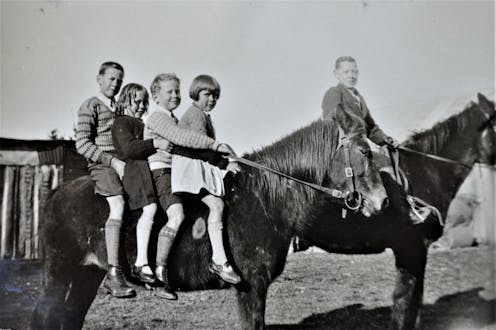
My grandmother, Claire Hastings, was born in the 1920s on a farm in Armidale, northern New South Wales. That was a relatively common thing, with just 43% of the population living in cities, compared with more than 70% now.
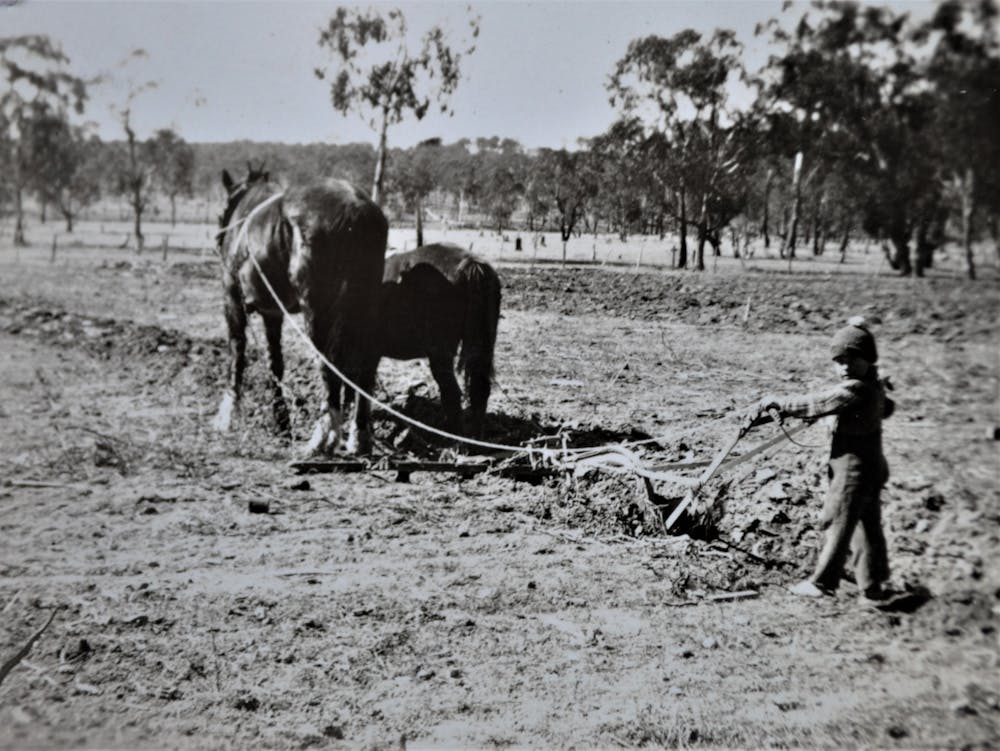
She lived in a small wooden hut, with a chicken coop out the front and fields out the back. When she and her siblings came home from school, they helped plough the fields with a horse-drawn plough until sundown.
Little did she know this life would soon disappear. The “second industrial revolution” (of mass production and standardisation) was creating machines to replace human and horse power. A plough pulled by a tractor could do in hours what took Grandma and her siblings a week.
Grandma’s brother, John, working the plough (c1929) Bradley Hastings, Author provided
By the time she left school, age 17, she wasn’t needed on the farm. So she instead went to college, became a teacher, got married and raised a family. Now 93, she lives in a comfy suburban four-bedroom home, enjoys dining at restaurants, and loves going to the theatre and on ocean cruises.
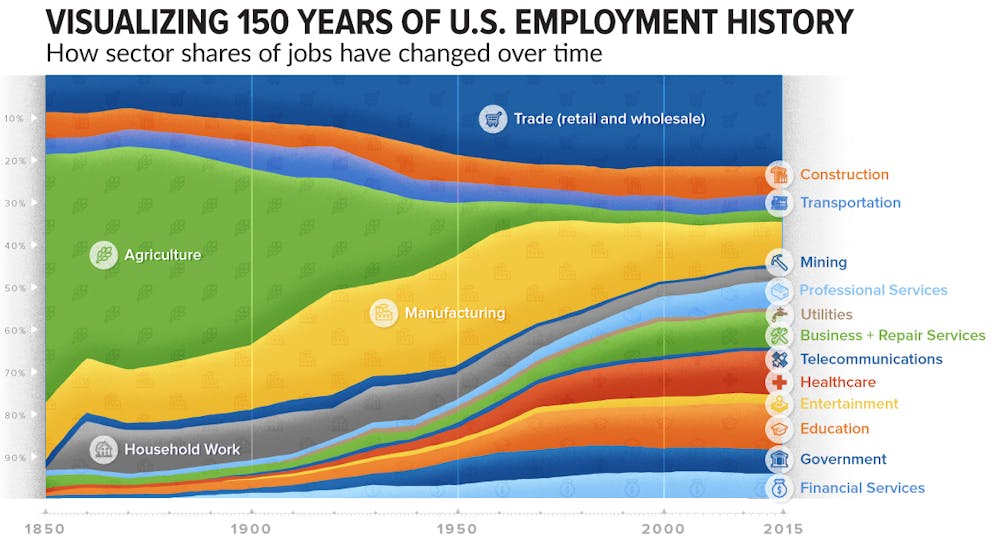
Her story is far from unique. Around the world industrialisation has reduced farm employment enormously. In the United States, for example, 40% of the
labour force worked on farms in 1920; now it is about 2%
The loss of those jobs, and their replacement, is worth remembering as we now confront the “fourth industrial revolution”, with robots and artificial intelligence tipped to take up to 40% of the jobs now done by humans within two decades.
The hit list is long, from drivers and call-centre workers to computer programmers and university lecturers like myself (we face being replaced by AI avatars, delivering animated content online).
But just as disappearing farm jobs didn’t lead to permanent mass unemployment, nor should we fear this next stage of technological development.
Improving quality of life
While industrial farming was not universally embraced as progress, the huge reductions in farming labour over the 20th century were key to a better life for most people (though poverty and glaring economic inequality still exist).
To cite just one measure, when my grandmother was born the average life expectancy in Australia was 60 years. Now it’s more than 80.
The underlying forces driving such advances are twofold.
First, the mechanisation of farming made food cheaper. US data shows the price of a common basket of groceries is now about 80% cheaper than a century ago. Similar trends exist for virtually every other consumable product.
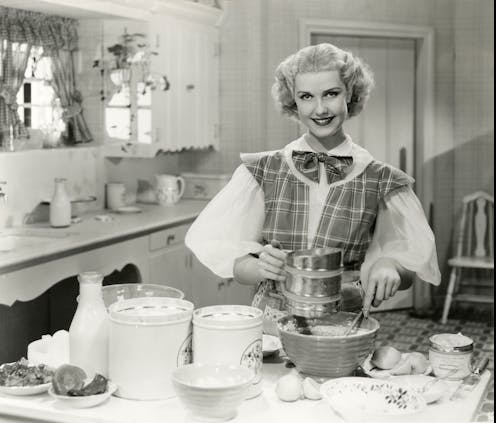
Second, spending less on food meant people could spend more on other things. New industries sprang up – automobiles, holidays, health care, finance, fitness and education and so on. Sectors virtually unknown in the 1920s now employ more than half of the population.
McKinsey
These new industries have both underpinned improvements in our quality of life and, crucially, created new jobs.
As artificial intelligence and robotics develop, services such as banking, insurance and transport will become cheaper. As a consequence, we will have more money to spend on other items – on health and fitness, travel and leisure and possibilities yet to be conceived.
Whatever these new or expanded industries are, jobs will evolve at the same time as quality of life improves for all.
None of this, of course, will necessarily make you feel better if you have (and love) a job under threat from automation.
Some lessons from my grandma’s life may help.
First, she didn’t take the changes personally. She understood that times were changing, and that she would have to change with them. She embraced the challenge rather than being defeated by it.
The author with his grandmother on her 90th birthday. Bradley Hastings, Author provided
Second, she understood she had to develop new skills. At the same time as farm jobs were diminishing, she saw growing demand for more teachers, underpinned by government regulations requiring children to stay in school longer. So too today education is the key for future jobs.
None of us know what the future holds. But for our collective future to replicate the advancements my grandmother has seen over her life, it’s inevitable that artificial intelligence and robots will take over jobs.
I asked grandma if we should be worried. “Life moves on,” she told me.
And so must we.
Bradley Hastings does not work for, consult, own shares in or receive funding from any company or organisation that would benefit from this article, and has disclosed no relevant affiliations beyond their academic appointment.
Australians were involved in competitive cookery long before MasterChef.
The earliest of Australia’s cooking competitions were at agricultural shows. In 1910, the Royal Agricultural Society of NSW hosted its first competition for “perishable foods” at the Royal Easter Show.
Along with pastry and pickles, competitors could also be judged on their calf’s foot jelly.
By the 1920s, the cookery category at the Easter Show had been firmly established. It was purely the preserve of women. Men were prohibited from entering and wouldn’t be allowed to enter until after the second world war.
Women living in NSW and the ACT also entered their wares in the Country Women’s Association’s The Land Cookery Competition. Starting in 1949, the competition judged women on their ability to bake classics such as fruit cake, butter cake and lamingtons, offering modest prize money to the winners. It is still running today.
These competitions are grounded in a history of cooking which saw women as “cooks” and men as “chefs”. Women were amateurs working in the home, while men worked in professional kitchens. This phenomenon continues today.
Cookery competitions allowed women to receive recognition for their often-overlooked hard work and skill. Contestants were encouraged to break out of their comfort zones, to be creative, innovate and impress.
With women as their key demographic, it is little wonder that, by the 1960s, women’s magazines such as the Australian Women’s Weekly began hosting large-scale cookery competitions open to readers around the country.
Perhaps the most extravagant of these competitions was the Butter-White Wings Bake-Off, which ran from 1963 to 1970. The competition pitted Australia’s best home bakers against each other in a variety of categories, including cakes, desserts, main courses and “busy lady recipes”.
Australian Women’s Weekly, Wednesday 12 July 1967. Trove
Entering their written recipes, contestants competed at state level for a chance to win a trip to the national final where they would cook for illustrious judges.
Thousands competed at the state level of these competitions, and one from each state and territory would go on to the final. These were held in either Sydney or Melbourne in front of live audiences, usually in the middle of a department store.
The 1970 final was televised, with the Weekly estimating two million viewers would watch the proceedings.
It was Australia’s first televised cooking competition.
Marketing and celebrities
Just as MasterChef is sponsored by advertisers, the cookery competitions hosted in the Weekly proved to be lucrative marketing opportunities for a variety of sponsors. The prizes, provided by sponsors such as Breville and QANTAS, included cash, fur coats, appliances, cars and overseas holidays.
The choice of judges also offers us a glimpse of the glamour associated with the competitions as well as the continued gendered expectations surrounding cookery. A slew of early “celebrity chefs” were flown in from exotic, international destinations to judge the competition – including the Galloping Gourmet himself, Graham Kerr.
These celebrity chefs judged the main course section; the overtly feminine baking sections were judged primarily by women.
Australian Women’s Weekly, Wednesday 23 October 1968. Trove
It was in the cake section that contestants really went above and beyond, both in the recipes themselves and in their names. In 1968, prize-winning recipes included “Golden Crown Dessert”, “Marshmallow-Cherry Cake”, “Chocolate Gold Layer Cake” and “Peach Kuchen”.
Peach Kuchen, which won the “Busy Lady” section, was made with a packet of White Wings cake mix, a tin of peaches and some sour cream. The Bake-Off helped to popularise (and sell!) boxed cake mixes: even the “busy woman” could create delicious cakes deserving of accolades.
A dizzying progression
The last Butter-White Wings Bake-Off was held in 1970, but the magazine kept hosting cooking competitions. In 1980, Elizabeth Love was crowned “Best Cook in Australia.”
Her prize-winning menu included oysters in pastry cases, ballotine of duckling with baby vegetables and a red wine jus, mango sorbet and almond petits fours.
In a recent interview, Love reflected that her menu drew on the concepts of nouvelle cuisine, which was popular at the time. It was an ambitious menu for a home cook – however Love declared that she didn’t think it would do very well if she went on MasterChef today.
Australian cooking has come a long way – competitions are no longer for the busy home cook. Shutterstock
Her menu demonstrates the dizzying progression of Australian food over the past 40 years.
Cookery competitions like those held in the Weekly gradually disappeared, replaced instead by competitions on television, which have grown in popularity over the last two decades.
Like the magazine cookery competitions of the past, where contestants were inventive and used new and exciting ingredients, television competitions have also proved important for introducing the Australian palate to innovative cooking techniques and exotic ingredients.
Our ongoing fascination with cooking competition shows such as MasterChef reflects the prestige still on offer for those ambitious contestants who enter them, as well as the cultural importance of food.
Eugene von Guérard, Mount Kosciusko, seen from the Victorian border (Mount Hope Ranges) 1866
National Gallery of Victoria, Melbourne Purchased, 1870 Photo: National Gallery of Victoria, Melbourne
Most Australians could name this country’s tallest mountain, Mount Kosciuszko. But how many could tell you where it got its name?
Paul Strzelecki (1797-1873) named Mount Kosciuszko after his compatriot in 1840. A friend of the third US president, Thomas Jefferson, Tadeusz Kościuszko (1746-1817) was a graduate of the Royal Military Academy in Warsaw, engineer, freedom fighter and statesman.
A self-didactic geologist, Strzelecki left Poland in the late 1820s and travelled extensively throughout the world.
He explored North and South Americas, studying mineral deposits and soil composition. He also visited Cuba, Tahiti and New Zealand before arriving in Australia.
Strzelecki came to Sydney in April 1839 to visit his friend, an Australian politician James Macarthur. In Australia, Strzelecki continued to follow his passion for mineralogy, discovering gold in News South Wales.
In March 1840, Strzelecki climbed the highest peak of the Australian Alps.
He named it Mount Kosciuszko in honour of the man whom he considered a hero of the resistance against Russian oppression.
Karl Gottlieb Schweikart (1772–1855) Portrait of Tadeusz Kościuszko, painted after 1802. National Museum in Warsaw
He distinguished himself by devising the key defence strategy which secured the defeat of the British army at Saratoga in 1777. He also designed the fortification at West Point – the site of the United States Military Academy.
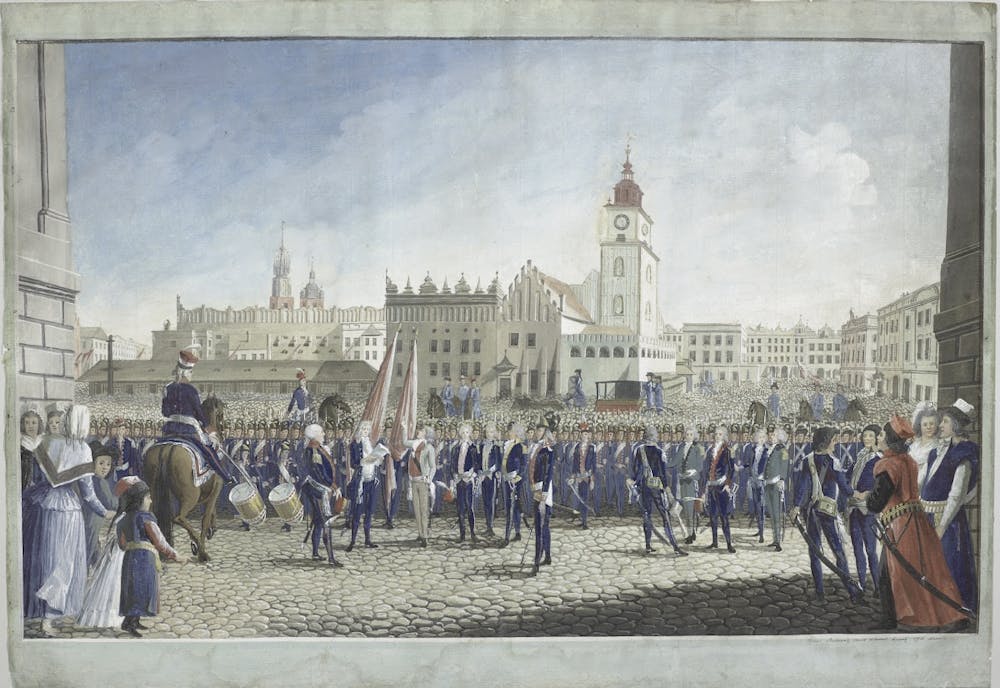
Back in Poland-Lithuania, on March 24 1794 in Kraków and faced with the Russian invasion, Kościuszko proclaimed an uprising to defend his homeland.
Assuming the role of the Commander in Chief of all the Polish-Lithuanian armed forces, he swore to defend the territorial integrity of his country, its sovereignty and universal freedom.
Ideas of the Enlightenment
Kościuszko appealed to all sections of the population of Poland-Lithuania to repel the Russian invasion and reverse the humiliating so-called “partitions” of its territory imposed first in 1772 and again in 1793.
His ideas were shaped by the thinkers of the enlightenment, including John Locke and Hugo Kołłątaj.
Kościuszko valued equality and personal liberty. His public acknowledgement of the burden of serfdom brought him a great following among peasants who formed large units in his insurrectionary army.
His ideas were revolutionary for the time. He challenged the prevalent ideas about rigid feudal social structures. His actions extended the meaning of who made up a “nation” to include peasants: placed on equal footing to nobles for the first time.
The first test of Kościuszko’s military strength came on April 4 1794, when the army under his command faced numerically superior Russian imperial forces at the Battle of Racławice in Lesser Poland.
Kościuszko’s victory over Catherine the Great’s generals made him a hero. Recruits from all over Poland-Lithuania flocked to Kościuszko’s army. Local populations in Warsaw and Vilnius rose on the news of his success, expelling Russian troops.
Michał Stachowicz, The oath of Tadeusz Kościuszko in the Old Town Market in Kraków (1796). The Royal Castle in Warsaw
On May 7 1794, Kościuszko’s proclamation granted civil liberty to all peasants of Poland-Lithuania, giving them protection of the law and ownership of the land they worked on.
During the same year, Kościuszko’s forces faced combined Russian and Prussian forces in a series of battles. Among staunch supporters of Kościuszko were such military commanders as Władysław Franciszek Jabłonowski (1769–1802), the first known Polish general of African descent.
In the second half of 1794, success abandoned the insurrectionists. During the Battle of Maciejowice on October 10, a wounded Kościuszko was captured by the Russians. He was imprisoned 1,000 kilometres away in Saint Petersburg as Catherine the Great’s trophy prisoner.
Jan Bogumi Plersz, Kościuszko and his horse fall in the battle of Maciejowice, painted between 1794 and 1817. Polish Army Museum in Warsaw
The Russian Empress was petitioned for the release of Kościuszko by his American friends. One of them, an African American Jean Lapierre who served with Kościuszko as his aide-de-camp, offered himself in exchange for Kościuszko’s freedom.
His request was denied. Kościuszko was not released until the death of Catherine the Great in November 1796.
A lasting legacy
Kościuszko’s uprising ended with the bloody siege of Warsaw and the massacre of 20,000 of its population by Russian troops. Led by Russia, the third and final “partition” of Poland-Lithuania extinguished its nationhood for the next 123 years.
During this “partition era”, compatriots of Kościuszko were forced into exile. One of these was the explorer and philanthropist Paul Strzelecki. Kościuszko’s legacy of fighting for what is right influenced Strzelecki and many others.
23 years after Kościuszko’s death, Strzelecki named Australia’s highest mount in Kościuszko’s honour. Five years later, he published the Physical Description of New South Wales and Van Diemen’s Land, an extensive account of his investigation of the climate, geology and geography of Australia.
His decision to give the highest mountain in Australia the name of his hero left a lasting link between Australia and East Central Europe.
Darius von Guttner Sporzynski receives funding from the Australian Research Council.
New Zealand is now part of the war with Russia. And our independent foreign policy is virtually dead.
That’s the upshot of the Government’s definitive fall into line with Five Eyes and NATO, in supporting the war against Russia this week. It’s a remarkable “rush to war” and needs much more debate and analysis than we’ve been seeing.
Military deployment is not simply an “operational matter”, and requires considerable debate. After all, this week’s departure of a Hercules aircraft with 50 personnel is the first time since the 1930s that this country has sent troops to a European war.
The Death of NZ’s “independent foreign policy”?
New Zealand’s vaunted “independent foreign policy” has always been a myth, or at least overstated. But this week it’s become very clear that it barely exists anymore. Although the small commitment of troops and aircraft is largely symbolic in nature, New Zealand has nonetheless joined NATO – for the first time – in a military conflict.
Even Government MPs are questioning the motivation behind the rush to arms, with Green Party foreign affairs spokesperson Golriz Ghahraman openly stating that military support was more about appeasing allies than actual effective support: “What we are providing will not go far and is more symbolic and about supporting Nato than anything.”
As Matthew Hooton writes today in the Herald, despite all the attempts to explain why this country is going to war for moral reasons, “In reality, Ardern is working hand-in-glove with our Five Eyes partners and NATO, especially with the British”. And he suggests that our traditional allies must have simply insisted that New Zealand fall into line by sending troops.
Hooton concludes that we can put to bed this idea that New Zealand has an independent foreign policy: “this week’s deployment, against the Government’s stated objectives, indicates we don’t have strategic autonomy either. We’ve chosen our side – or it has chosen us – and it is Washington, London and Canberra, not Moscow and Beijing.”
He suggests that Prime Minister Jacinda Ardern is returning New Zealand to an early 20th century role of loyally following Western Anglo countries into war. In this regard, Ardern is “New Zealand’s most traditionalist foreign-policy prime minister since Robert Muldoon”. In fact, it’s not dissimilar to Michael Joseph Savage’s pronouncing in 1939 that “where [Britain] goes, we go; where she stands, we stand”.
On the political left, there are also those who are in no doubt that this decision is eroding New Zealand’s independent foreign policy. Former Minister of Disarmament and Associate Foreign Minister Matt Robson (from the Helen Clark administration) has argued this week that joining up with NATO will have significant ongoing consequences: “without public discussion, the Labour Government, like National before it, has drawn us into the largest nuclear-armed military alliance in the world, Nato, and has signed up to the encirclement strategy of Russia and China.”
Another former minister, Peter Dunne, says previously New Zealand has only sent “post-event peacekeepers and reconstruction forces” to conflict zones, but with this latest move, especially in moving away from UN-mandated sanctions, “New Zealand will now find it more difficult to resist United States’ and British pressure to become involved in similar situations in the future”. He suggests New Zealand’s “independent foreign policy is slowly but surely being whittled away”.
The slide into war
Just as the frog doesn’t jump out of the slowly heating water, and then it’s too late, there’s a sense in which the New Zealand Government has been slowly but surely edging further into the Ukraine war, discarding any neutrality. The thin edge of the wedge was the sanctions, which came after the initial $6m in humanitarian aid. This was followed by the dispatch of some surplus helmets and body armour. Then the deployment of nine intelligence analysts to the UK and Belgium. Then a donation of $5m to NATO. And finally this week came the big shift to giving money to buy arms, and flying logistical support and personnel over to Europe.
All along the way, it’s possible that the New Zealand Government was hoping that their latest concession to demands from traditional allies might be enough to satisfy them. Instead, it’s led to the expectation of greater involvement.
Is New Zealand actually at war with Russia, officially? On TV on Tuesday, Rear Admiral James Gilmour couldn’t deny it, instead conceding that “I think it’s reasonably clear that our status as a neutral country has shifted”, saying he would leave the country’s exact war status to the lawyers.
A hawkish atmosphere is developing in New Zealand
The Labour Government’s decisions to escalate their involvement and support for the NATO military campaign against Russia have not simply been due to international pressure. There has been a growing hawkish atmosphere domestically, too.
National is strongly backing Labour’s march to war, and applying pressure for the Government to do even more. And National’s defence spokesperson, Gerry Brownlee, keeps pushing for the expulsion of the Russian Ambassador, which is likely to escalate tensions even further. The Greens are providing some sort of counter to the shift towards war, but clearly they have not so far made it a major coalition issue at leadership level.
There’s also some public appetite for military escalation – evidenced by the number of yellow and blue flags displayed everywhere, and the revulsion caused by the atrocities shown nightly on the TV news. But to what extent the public agrees with supplying arms and sending troops to help with the war against Russia isn’t clear. It’s notable that a survey out this week in Australia – a much more hawkish nation than ours – shows that only 36 per cent favour sending military who might get involved in the conflict, and even when it comes to supplying lethal military supplies, only 55 per cent approved. So in New Zealand, it’s far from certain that the public is really as behind this as some in the media are making out.
The New Zealand Labour Government has of course been increasingly hawkish itself. Since coming to power in 2017 it committed to spend an extra $20bn more on military hardware – especially on aggressive submarine-hunting airforce planes. Labour is boasting that their defence spend has gone up from 1.11 per cent of GDP under the John Key Government to 1.54 per cent.
Lack of debate
Has there been sufficient debate about New Zealand’s slow but sure shift into the Ukraine war? Hardly. Partly this has been due to the fact that our involvement has followed some slow but escalating steps and many could be excused for hardly noticing the extent of New Zealand’s interventions. Of course, that is how many disastrous wars have started, notably Vietnam and, more recently our twenty-year war in Afghanistan that ended with the Taliban back in complete control. Like in Afghanistan we are seeing atrocities and abuses on a regular basis, and it’s human nature to want to “see something done”, but alternatives to war and aggression are hardly being discussed at the moment.
Surely we can at least expect Parliament to be having robust debates about sending New Zealand troops to Europe? This simply hasn’t happened, and it doesn’t look likely to happen. The biggest change to New Zealand’s foreign policy in 35 years is going unchallenged and undiscussed.
Peter Dunne lamented yesterday that the Government simply isn’t being upfront about the magnitude of the changes to foreign policy. He says: “If a general foreign policy reset is now underway prompted by the Ukraine invasion, New Zealand needs to make the scope of that change very clear to friends and allies from the outset”.
In his analysis this week, Matt Robson suggests that the current Cabinet seems ignorant of what aligning this country with NATO really means, as well as ignorance of the complexities of the Ukraine-West-Russia dynamics. He argues that the Government needs to do some background research, and this “should be discussed by Cabinet so that we develop our policy on the Ukraine by understanding the complexities. Cabinet needs to step back in what seems to be a rush to war under the nuclear umbrella.”
What about other options?
There’s been a tiny element of humanitarian aid in the Government’s approach to the Ukraine crisis – but really just enough to dispel the notion that a totally military approach is being taken.
Similarly, we are doing virtually nothing in the one area that could make the most difference – providing refugee resettlement during the crisis. The Russian invasion has created the largest refugee crisis in Europe since the Second World War, and yet all New Zealand has done is give out some working visas to relatives of the few Ukrainians who already live here.
That’s a total of just 202 visas in the context of 4.5m displaced people. If New Zealand was really keen to take a humanitarian approach to the crisis, it’s here that New Zealand could afford to be much more generous.
Crucially, New Zealand could also push much harder for reform of the institution set up to deal with these issues – the United Nations. The Ukraine conflict has once again exposed the weakness of a system that protects superpowers through the Security Council veto. Abandoning UN processes for imposing economic sanctions and going to war, as New Zealand has done with Ukraine, doesn’t solve that – it just returns the world to a place where the international bullies are free to threaten and dominate smaller and poorer nations. That isn’t the type of world we claim to want, but one which our current actions are leading to.
Further reading on Ukraine and international relations
The words “chocolate” and “disappointment” don’t often go together.
But you may have experienced some disappointment if you’ve ever unwrapped the bright foil of an Easter egg to discover white, chalky chocolate inside. What is this white substance? Is it mould? Bacteria? Is it bad for you? Can you still eat it?!
The answer is yes, you can! It’s called “bloom” and it’s caused by fats or sugar from the chocolate. To understand why it forms, and how to avoid it forming, we need to consider the chemistry of chocolate.
The right stuff
Easter egg chocolate is made up of a relatively small number of ingredients: cacao beans, sugar, milk solids, flavourings, and emulsifiers to keep it all mixed together.
Fermenting and roasting cacao beans triggers many chemical reactions which develop delicious flavours. Much in the same way peanut butter can be made from peanuts, the roasted cacao beans are ground into a paste known as cocoa liquor.
The liquor is mixed with the other ingredients, and ground together with heating (known as conching) to form liquid chocolate.
Fat crystals
The fluidity of the cocoa liquor comes from the fats released when the beans are ground. These fat molecules are known as triglycerides, and they resemble the letter Y with three long zigzagging arms connected to a central junction. The triglyceride arms can vary, but they tend to be a mixture of saturated and unsaturated fatty acids.
An example of a typical chocolate triglyceride with saturated and unsaturated fatty acids. Author provided
When the melted chocolate cools, these triglyceride fats assemble into highly ordered structures that are crystals at the molecular scale. Depending on how well the temperature is controlled, the fats can take on one of six different crystal structures. These different crystal forms are called polymorphs.
Control your temper
The most desirable crystal form gives chocolate a smooth, glossy appearance, a clean snap and a melt-in-your-mouth texture. Achieving this requires careful temperature control from liquid to solid through a process known as “tempering”.
Poorly controlled cooling of the melted chocolate results in other crystal forms, which tend to have a less pleasing look and mouth feel – often chalky or gritty. These less desirable forms can convert during storage. And as the underlying crystal structure of the fats change, some of the triglycerides separate.
These separated fats collect at the surface as colourless crystals, giving the chocolate a white fat bloom. This is especially noticeable if the chocolate is poorly stored and goes through melting and re-solidification.
The ingredients can also affect fat bloom. Cheap chocolate tends to use less cocoa butter and more milk solids, which introduce more saturated fats. Saturated fats are also common in nuts, and can migrate from the nut to the chocolate surface. So a chocolate-covered hazelnut is more likely to show fat bloom than a nut-free version.
Sugar or fat crystals?
Sugar bloom is less common than fat bloom, although they can look very similar. It occurs when sugar crystals separate from the chocolate, particularly under humid storage conditions.
You can tell the difference with a simple test. Sugar bloom will dissolve in a little water, while fat bloom will repel water and will melt if you touch it for a while. Unfortunately chocolate bloom can’t be reversed unless you completely melt the chocolate and recrystallise it at the correct temperature.
The easiest ways to avoid bloom on your Easter eggs is by choosing a brand with a high cocoa butter content, transporting and storing your eggs in a low temperature and humidity, and making sure you eat them before their best before date – assuming they last that long!
Nathan Kilah does not work for, consult, own shares in or receive funding from any company or organisation that would benefit from this article, and has disclosed no relevant affiliations beyond their academic appointment.
Russia’s invasion of Ukraine is unlikely to be resolved on the battlefield. An end to the bloodshed and destruction of Ukraine can be negotiated, but such negotiations need to be mediated carefully.
Recep Tayyip Erdoğan, the president of Turkey, is currently acting as a mediator between Russia and Ukraine. Such a situation, where a separate country or politician assumes the role of go-between, has worked to bring some past wars to an end.
But politicians aren’t always the best mediators.
Negotiations can be facilitated more actively, and ideally international experts on peace mediation should be involved as quickly as possible.
There have been many developments in the field of peace mediation over the past decades. The United Nations, the African Union and other international organisations have set up mediation teams.
Peace mediation is developing into a professional activity. There have even been initiatives to adopt a new international treaty to create a stronger framework and more guidance for peace negotiators.
Mediators are called in when a conflict is too complex for the parties to resolve by themselves, as in family disputes for instance. Trying to end wars is, obviously, very complex and requires certain expertise.
The problem in the Russia-Ukraine context is all these experienced organisations would be dismissed as “pro-Western” by Moscow. The same is true for states like Switzerland and the Nordic states, which have a long tradition as mediators.
Therefore, the current Russia-Ukraine talks are taking the form of classical diplomacy negotiations between states mediated by politicians. Professional peace mediators aren’t involved.
Politicians as mediators?
Peace mediators don’t necessarily have to be perfectly neutral and unbiased. Close relationships with one or both conflict parties may actually help.
Indeed Erdoğan has high stakes in this conflict. This doesn’t automatically disqualify him as a mediator.
Consider the role the United States, historically a strong supporter of Israel, played in brokering the 1993 Oslo Agreement between Israel and the Palestinian Liberation Organization.
Another example is the role Blaise Compaoré, the former president of Burkina Faso, played in the 2007 negotiations leading to a peace agreement between the government of the Ivory Coast and the rebellious “New Forces”, which Compaoré overtly supported.
Being able to influence and, to some extent, compel the conflict parties to negotiate can also help. A prime example is the 1995 Dayton Peace Agreement that ended the bloodshed in Bosnia-Herzegovina.
Here, the US had some leverage over the parties, which allowed the chief mediator, Richard Holbrooke, to adopt the “Big Bang approach” in which all parties are locked in a room – in this case the Wright-Patterson air force base in Dayton – until they reach an agreement.
But Russia is too powerful for that.
This is also why the Austrian chancellor’s trip to Moscow this week seems rather hopeless and possibly counterproductive at this stage. Chancellor Nehammer seems to think he can negotiate humanitarian corridors and a ceasefire.
But Putin will be able to use the visit to show Russians he isn’t that isolated in Europe (even if Austria is hardly a heavyweight). So while attempts to mediate are always laudable, they need to be planned carefully.
Fundamentally, politicians aren’t necessarily the best mediators, although they often see themselves as such, and Erdoğan is relatively well placed.
Peace mediation experts should be involved
International, professional experts on peace mediation could and should be involved in the Russia-Ukraine talks, whether formally or informally. Most peace agreements have been facilitated by third parties in some way.
For instance, the Intergovernmental Authority on Development, a regional organisation, mediated the negotiations between Sudan and South Sudan, with the contribution of other organisations and experts. This led to the adoption of the Comprehensive Peace Agreement in 2005, which ended a longstanding war.
Also, while a ceasefire is desirable, it isn’t absolutely necessary to make progress on substantive issues, such as the status of the Donbas and Crimea. Many negotiations, from Bosnia to Colombia, have been held while the fighting continued. So even if there’s no ceasefire, the parties can still agree on other issues.
And it can be OK to agree to disagree. Not everything needs to be resolved right now in a comprehensive package deal. Some issues can be resolved later. Peace is a process.
To be clear, engaging in negotiations doesn’t imply excusing Russia’s aggression or the perpetration of war crimes. And atrocities against civilians, as revealed by the recently discovered corpses in Bucha, could further decrease the chances for successful talks.
No indictments or arrest warrants against political and military leaders, including Putin, have been issued in the context of Ukraine so far. But with the situation before the International Criminal Court, this could change. While it will be difficult to execute such warrants, they’re likely to affect negotiations.
It’s crucial to explore every option to end this war right now by envisaging a scenario that allows both sides to avoid feeling humiliated. Using professional peace mediators would help. But of course they can’t be imposed on Putin.
Philipp Kastner does not work for, consult, own shares in or receive funding from any company or organisation that would benefit from this article, and has disclosed no relevant affiliations beyond their academic appointment.
Source: The Conversation (Au and NZ) – By Morgan Harrington, Research Fellow, Centre for Aboriginal Economic Policy Research, Australian National University
The rate of voter participation in federal elections by people living in remote Indigenous communities has been lower than the national average since First Nations people were granted the right to vote in 1962. In recent years, the rate has been in decline. Rates are lowest in the Northern Territory.
The low rate of participation among First Nations people living in remote communities could affect the lower house election results in the Northern Territory seat of Lingiari. Warren Snowden has stepped down after 20 years holding the seat.
Measuring the number of First Nations people (or any particular demographic group) who vote in federal elections is challenging. Electoral rolls do not include information about cultural identity. Census figures, which could be used as a basis for comparison against voter turnout rates, are imprecise.
Data from the 2005 NT Assembly general election show voting rates were 20% lower in electorates with the highest Indigenous populations.
In his study of the 2019 federal election, Australian National University researcher Will Sanders found
perhaps only half of eligible Aboriginal citizens […] may be utilising their right to vote.
Reports from the Northern Territory’s most recent Assembly election also found record lowturnout across Indigenous communities.
Researchshows rates of informal votes are also higher in remote Indigenous communities.
Barriers to First Nations people voting
Decisions made at the federal level over the last three decades appear to have provided significant obstacles to voting in some First Nations communities.
First is the 1996 abolition of the Aboriginal and Torres Strait Islander Election Education and Information Service.
Twostudies point to this abolition as a potential reason for a decline in voting rates in remote Indigenous communities since the mid-nineties.
Established in 1979, this service existed specifically to increase voter registration rates among First Nations people. This was done by, for example, providing voter education and election materials in Indigenous languages.
The second decision was the 2005 abolition of the Aboriginal and Torres Strait Islander Commission.
First Nations people participated in five of the Commission’s elections administered by the same Australian Electoral Commission responsible for federal elections. Although voting was voluntary, analysis shows participation was higher in northern and central Australia than in southern Australia.
The third relevant policy change was the passage of the 2006 Electoral Integrity Bill. This introduced more stringent rules for the identification required to vote, making it more difficult for people in at least one remote community to register to vote.
The fourth policy decision was a 2012 change to the Commonwealth Electoral Act, known as the “Federal Direct Enrolment and Update”.
This enabled the Australian Electoral Commission to register eligible Australians to vote based on information available through several government agencies. These include Centrelink/the Department of Human Services, the Australian Taxation Office, and the National Exchange of Vehicle and Driver Information Service.
This means people living in many remote communities are not automatically added to the electoral roll, unlike most of the rest of Australia.
West Arnhem Regional Council mayor Matthew Ryan and Yalu Aboriginal Corporation chairman Ross Mandi launched an official complaint to the Australian Human Rights Commissioner over this issue in June last year.
They argued failure to apply the Federal Direct Enrolment and Update in remote communities represents a breach of the Racial Discrimination Act.
A survey of residents in one remote community on South Australia’s APY lands found a lack of information contributed to low participation in elections.
Obstacles included:
a lack of materials available in appropriate languages
uncertainty about how to cast a formal vote
problems related to literacy, and
a lack of appropriate identification necessary to enrol.
In October last year, the Australian Electoral Commission announced new funding for its Indigenous Electoral Participation program with the aim of increasing enrolment rates; the upcoming election will show if the program is working.
Given that voting is compulsory in Australia, non-participation is a concern in any election. But these issues are likely to be particularly relevant in the 2022 federal election, at least in the seat of Lingiari.
Lingiari covers all of the Northern Territory outside the greater Darwin/Palmerston area. So it is the one House of Representatives division where Indigenous Australians (many of them living in remote communities) have clear electoral power.
Providing more mobile polling booths could help make voting easier for people in remote Indigenous communities. Currently, these booths can be present for as little as two hours during an entire election period.
There is also evidence Indigenous people are more likely to vote in elections for Indigenous candidates, and for candidates who have visited their community.
Warren Snowden has represented the electorate since its creation in 2001, but he is not contesting this election; the seat is up for grabs.
Indigenous people will determine who takes Snowden’s place. But how many of them vote may be limited by their ability to enrol, the availability of information in an appropriate language, and access a polling booth.
Morgan Harrington does not work for, consult, own shares in or receive funding from any company or organisation that would benefit from this article, and has disclosed no relevant affiliations beyond their academic appointment.
PODCAST: Buchanan + Manning: Military Diplomacy and the Global Security New Normal
/
RSS Feed
Share
Link
Embed
A View from Afar – In this podcast, political scientist Paul Buchanan and Selwyn Manning discuss how numerous countries have committed aid, intelligence expertise, military hardware and weapons to a multilateral effort in support of Ukraine.
What does this 2022-style of military diplomacy mean for the independent foreign policies of countries like New Zealand – with its style of incremental contributions in aid of the defence of Ukraine?
For example, the New Zealand Government this week confirmed the deployment of a C-130 Hercules with 50 personnel to Europe; a further eight logistics specialists based in Germany; $13 million in further support to procure equipment for the Ukraine military.
On announcing the move, New Zealand’s Prime Minister Jacinda Ardern said: “Our support is to assist the Ukraine Army to repel a brutal Russian invasion because peace in the region of Europe is essential for global stability.”
Ardern added: “The global response has seen an unprecedented amount of military support pledged for Ukraine, and more help to transport and distribute it is urgently needed, and so we will do our bit to help.”(ref. ForeignAffairs.co.nz, https://foreignaffairs.co.nz/2022/04/11/mil-osi-new-zealand-new-zealand-sends-c130-hercules-and-50-strong-team-to-europe-to-support-ukraine/ )
So today, we examine how Russia’s invasion of Ukraine, with its method of total annihilation, has drawn once relatively independent nations into the fold of western security alliances. And we will consider whether such moves will become a permanent configuration?
Also in this episode, we will discuss the South-West Pacific strategic balance. Specifically, why has the People’s Republic of China, and the Solomon Islands bilateral security agreement, upset Australia, New Zealand, and the United States of America?
You can comment on this debate by clicking on one of these social media channels and interacting in the social media’s comment area. Here are the links:
Threat.Technology placed A View from Afar at 9th in its 20 Best Defence Security Podcasts of 2021 category. You can follow A View from Afar via our affiliate syndicators.
The words “chocolate” and “disappointment” don’t often go together.
But you may have experienced some disappointment if you’ve ever unwrapped the bright foil of an Easter egg to discover white, chalky chocolate inside. What is this white substance? Is it mould? Bacteria? Is it bad for you? Can you still eat it?!
The answer is yes, you can! It’s called “bloom” and it’s caused by fats or sugar from the chocolate. To understand why it forms, and how to avoid it forming, we need to consider the chemistry of chocolate.
The right stuff
Easter egg chocolate is made up of a relatively small number of ingredients: cacao beans, sugar, milk solids, flavourings, and emulsifiers to keep it all mixed together.
Fermenting and roasting cacao beans triggers many chemical reactions which develop delicious flavours. Much in the same way peanut butter can be made from peanuts, the roasted cacao beans are ground into a paste known as cocoa liquor.
The liquor is mixed with the other ingredients, and ground together with heating (known as conching) to form liquid chocolate.
Fat crystals
The fluidity of the cocoa liquor comes from the fats released when the beans are ground. These fat molecules are known as triglycerides, and they resemble the letter Y with three long zigzagging arms connected to a central junction. The triglyceride arms can vary, but they tend to be a mixture of saturated and unsaturated fatty acids.
When the melted chocolate cools, these triglyceride fats assemble into highly ordered structures that are crystals at the molecular scale. Depending on how well the temperature is controlled, the fats can take on one of six different crystal structures. These different crystal forms are called polymorphs.
Control your temper
The most desirable crystal form gives chocolate a smooth, glossy appearance, a clean snap and a melt-in-your-mouth texture. Achieving this requires careful temperature control from liquid to solid through a process known as “tempering”.
Poorly controlled cooling of the melted chocolate results in other crystal forms, which tend to have a less pleasing look and mouth feel – often chalky or gritty. These less desirable forms can convert during storage. And as the underlying crystal structure of the fats change, some of the triglycerides separate.
These separated fats collect at the surface as colourless crystals, giving the chocolate a white fat bloom. This is especially noticeable if the chocolate is poorly stored and goes through melting and re-solidification.
The ingredients can also affect fat bloom. Cheap chocolate tends to use less cocoa butter and more milk solids, which introduce more saturated fats. Saturated fats are also common in nuts, and can migrate from the nut to the chocolate surface. So a chocolate-covered hazelnut is more likely to show fat bloom than a nut-free version.
Sugar or fat crystals?
Sugar bloom is less common than fat bloom, although they can look very similar. It occurs when sugar crystals separate from the chocolate, particularly under humid storage conditions.
You can tell the difference with a simple test. Sugar bloom will dissolve in a little water, while fat bloom will repel water and will melt if you touch it for a while. Unfortunately chocolate bloom can’t be reversed unless you completely melt the chocolate and recrystallise it at the correct temperature.
The easiest ways to avoid bloom on your Easter eggs is by choosing a brand with a high cocoa butter content, transporting and storing your eggs in a low temperature and humidity, and making sure you eat them before their best before date – assuming they last that long!
Nathan Kilah does not work for, consult, own shares in or receive funding from any company or organisation that would benefit from this article, and has disclosed no relevant affiliations beyond their academic appointment.
Source: The Conversation (Au and NZ) – By Gorana Grgić, Senior Lecturer, Department of Government and International Relations and US Studies Centre, University of Sydney
AAP/EPA/Michael Reynolds
Any sort of analysis that tries to draw lessons from an evolving event such as an ongoing major war is a potentially futile task. On the one hand, there is a fog of war that prevents us from understanding the tactical developments. On the other hand, the time lag is still much too short to allow us to fully comprehend the consequences and impact of what has aptly been described as Europe’s September 11.
Yet, there is no doubt the Russian invasion of Ukraine will have an irrevocable effect on the state of international affairs for years to come. It has accelerated some of the negative trends in world politics – the great power rivalry between the West and revisionist powers such as Russia and China, and economic nationalism.
Equally, it has brought about sweeping foreign policy changes in some of the most powerful European countries, notably Germany.
However, on the other side of the Atlantic, rather than bringing about a major shift in foreign policy, Russia’s aggression has highlighted tensions in US foreign policy.
The Russian invasion of Ukraine has exposed faultlines in US foreign policy. AAP/AP/Rodrigo Abd
The struggle between democracies and autocracies
From early in his presidency, US President Joe Biden has promoted policies that made the renewal of democracy in the United States and around the world the central tenet of his tenure. His most recent major speech, delivered in Warsaw, pointed to the continuity of the battle for democracy that follows the end of the Cold War and continues today.
The lofty rhetoric on the fight to defend democracy, while laudable and urgent, has inevitably drawn criticism. Those who believe democracy promotion has to begin at home rightly argue the United States has to address its myriad issues of democratic malaise before it is able to point fingers abroad.
This is not a new tension in modern US history. After all, the track record of US foreign policy during the Cold War was one in which democratic ideals failed to meet reality, both at home and abroad.
Yet, the early decades of the 21st century present an even greater challenge on this front. For one, some of the most recent US foreign policy record in democracy promotion failed to effect durable and positive changes. For example, the US intervention in Afghanistan is widely seen as a failure.
US foreign policy during the Cold War was one in which democratic ideals failed. AAP/EPA/handout
Boots on ground are out, economic warfare is in
Principles and values in foreign policy are one thing, but the action a country is prepared to take to defend them is quite another. So far, it has been abundantly clear the Biden administration leans more towards pragmatism than idealism. This has been most notable in the imposition of no-fly zones in Ukraine.
Ukrainian President Volodymyr Zelenskyy, and even some of the foremost US allies in Eastern Europe, have been imploring Biden to enforce a no-fly zone in Ukraine. However, both the executive and legislative branches have made it clear they would only do so if one of the NATO member states was attacked.
The reluctance to escalate the military intervention reflects the anxiety that such action might increase the risk of armed exchanges with Russia, or even lead to a world war. It is also about acknowledging the American public is wary of war.
At the same time, while Biden is trying to minimise the potential of physical warfare, it has gone hard on economic warfare. Since the Cold War, several US administrations have used economic sanctions to try to change behaviour and impose costs on the target regimes.
However, the scope and size of sanctions imposed on Russia is remarkable given its position as an exporter of hydrocarbons on which some of America’s closest allies are hugely reliant.
This is part of the changing way economics is used in foreign relations.
Biden came into the office signalling that in many ways, the protectionist turn that began under his predecessor would continue. This was predicated on the idea of economic policy for the middle class and weaning off the dependence on critical goods from countries that are in strategic competition with the US.
The issues arise from the messy middle period of building the economic resilience as supply chains are redirected.
Balancing multi-regional commitments
Russia’s invasion happened as the Biden administration unveiled its long-awaited Indo-Pacific strategy. This aims to manage the most important strategic relationship of the 21st century – that between the United States and China. After all, the second-order effects of the war in Ukraine have a lot of bearing on China’s relations with Russia and the lessons it can draw from the response of the West.
Even as the US, along with the EU, continues to play the key coordinating role in imposing sanctions on Russia and providing aid and relief to Ukraine, the Biden administration has made a point of signalling America’s long-term strategic interests are not primarily in Europe.
This is why the US has been supportive of European defence integration, along with reassuring US allies in the Indo-Pacific that it has not lost its long-term strategic vision.
Much like during the Cold War, where adversarial relations and great power politics marked the nature of the international system, the United States will have to find a way to balance its international commitments with domestic economic security and democratic renewal.
Unlike during the Cold War, this task will be much harder given the complexity of the actors and the challenges it needs to address.
Gorana Grgić does not work for, consult, own shares in or receive funding from any company or organisation that would benefit from this article, and has disclosed no relevant affiliations beyond their academic appointment.
From clothes to curtains, towels and sheets, fabrics are everywhere in our daily lives. You might also hear people call them “textiles”.
People have been making fabric, or textiles, for a very long time. In fact, they’ve been doing it for almost 35,000 years!
Let’s first think about what a fabric is. The dictionary says fabric is a cloth made by knitting or weaving together fibres.
What is a fibre?
A fibre is like a strand of hair. It’s very long and thin.
Fibres can come from nature. Some common natural fibres are cotton, silk and wool.
Raw cotton as it is found on the branch. Shutterstock
Humans have also found ways to make fibres ourselves in the past 150 years. We can use technology to turn oil into fibres. We can even make special fibres to make your raincoat waterproof, or make a soldier’s vest bullet-proof.
But how can these thin, hair-like fibres be made into something we can wear?
From fibre to yarn
First, we need to put the fibres together to make long strings of yarn. This can be tricky because many fibres are quite short, especially natural ones.
A cotton fibre is usually only around 3cm long. That’s shorter than a paper clip. Wool is usually cut from a sheep when it is 7.5cm long – about the length of a crayon.
We twist these shorter fibres together to make a longer yarn. The twisting makes the fibres rub together and grip to each other. This is called yarn spinning.
Yarn spinning
The first step of yarn spinning involves taking bundle of fibres, lining them up, them combing them like you comb your hair … or how you might comb a long beard! In fact, when we’ve combed them into a sheet, we call it a “beard”.
Before we can make wool into fabric, it needs to be spun into yarn. Shutterstock
Next, the sheet is stretched into a long tube. As it stretches, it becomes thinner and thinner. Then we twist it to form a yarn. This delicate sheet of fibres may have been metres wide to begin with, but we twist it into a thin thread.
There are all types of yarn threads. They can be thin, thick, hard, soft, stretchy, or even ones you can’t cut! It all depends on the starting fibre and the machine settings.
Turning yarn into fabric
Once we have our yarn, we’re ready to make fabric. There are many ways do this, such as weaving, knitting or felting.
Weaving crosses the yarns over and under in a chessboard pattern. Knitting makes loops that pass through each other.
Weaving yarn into fabric can be done by hand, or by machine. Shutterstock
Felting is when we get wool fibres wet and soapy. We rub the fibres together until they are all tangled up. Then we press the fibres into a flat sheet called felt.
Weaving, knitting and felting can be very slow if you do them by hand! These days we often use machines to speed things up.
How fabric is made
So we start with the fibre. Then we spin it into long strings of yarn. Next we weave, knit or felt the yarn into fabric. And that, Saskia, is how we make fabric.
Hello, curious kids! Have you got a question you’d like an expert to answer? Ask an adult to send your question to curiouskids@theconversation.edu.au
Ken Aldren S. Usman receives funding from Deakin University’s Post-graduate Research (DUPR) Scholarship Grant.
Dylan Hegh receives funding from Australian National Fabrication Facility, IMCRC and Sustainability Victoria
Over the next six weeks, Prime Minister Scott Morrison and Labor leader Anthony Albanese will dash around the country, trying to secure as many precious votes as they can.
We know from previous elections that different parts of the country can react very differently come election day.
Prime Minister Scott Morrison shakes hands with Shannie the golden retriever in Sydney on Tuesday. Mick Tsikas/AAP
What are the key seats and issues affecting Australians? Here, six Australian politics experts tell us what to expect in Queensland, Victoria, South Australia, Western Australia, Tasmania and New South Wales.
QUEENSLAND
Paul Williams, associate professor in politics and journalism, Griffith University
The usual electoral rule is only seats held by a margin of fewer than five percentage points are in play at this point of an electoral cycle.
But these are unusual circumstances. After nine years’ incumbency, the Coalition looks tired and accident-prone. On the heels of an escalating cost-of-living crisis, all government seats under 10% in Queensland are vulnerable to a Labor assault, especially given 2019 was an artificially high watermark for the Liberal National Party.
That means at least ten Queensland seats will be “in play”. These are: Longman (3.3%), Leichhardt (4.2%), Dickson (4.6%), Brisbane (4.9%), Ryan (6.0%), Bonner (7.4%), Herbert (8.4%), Petrie (8.4%), Forde (8.6%) and Flynn (8.7%).
Paradoxically, of these, smaller margin seats like Leichhardt and Dickson could be a bigger ask for Labor (given the high profile of their sitting LNP MPs, Warren Entsch and Peter Dutton) than “hip-pocket nerve” seats like Petrie, Forde and Herbert.
But watch out also for Bowman (10.2%) where the retiring LNP MP Andrew Laming has attracted the wrong sort of publicity and Capricornia (12.4%) where economic insecurities will also loom large.
Labor MP Terri Butler is facing a challenge from the LNP and the Greens in the Brisbane seat of Griffith. Darren England/AAP
The above, of course, is predicated on a uniform swing across Australia – something that rarely if ever occurs. Indeed, some opinion polling has found Queensland – always a battleground state – is the slimmest lead for Labor in Australia. If so, Labor seats in danger of falling to an aggressive LNP campaign include Lilley (0.6%), Blair (1.2%), Moreton (1.9%) and Griffith (2.9%). Both the LNP and the Greens have Griffith in their sights.
In the Senate, the race for the last two of six seats will be between the Greens (almost certain to win one spot) and for the other, Clive Palmer of his own United Australia Party, former Queensland premier Campbell Newman for the Liberal Democrats and – the likely winner – Pauline Hanson.
Outgoing Nationals MP George Christensen has just announced he will also run on One Nation’s Senate ticket – in the unwinnable third spot.
What kind of PM do Queenslanders want?
This election will be a referendum on two issues.
The first is which party is more in touch with the growing cost-of-living crisis. Despite recent relief in fuel prices, the soaring costs of fresh food and housing are high on Australians’ list of gripes. While the government can brag about attaining the lowest unemployment in 50 years, this means little to Australians who work too few hours or earn too small a wage.
The second is the qualities Australians want in their prime minister. In 2019, the freshly-minted Morrison – with baseball cap, rolled up sleeves and beer in hand – struck a note of authenticity. But, three years later, amid accusations (from other Liberals) Morrison is just another tricky politician, the less well-known Anthony Albanese will be worth the risk for many.
What’s changed since 2019?
Most of the changes since the last federal election point to a more challenging environment for the Coalition in Queensland.
First, Albanese is not Bill Shorten. Second, where Shorten, via a complicated franking credits tax, gave the government an enormous target, Labor under Albanese has curled itself into a tight policy ball.
Moreover, coal, which last time wedged Labor between regional blue-collar voters and urban white-collar workers, has hardly been mentioned since COVID-19. The LNP itself will likely be wedged in the regions as the populist right, led by Palmer, Hanson and Newman, strips votes from the LNP in the name of “anti-mandate freedom”, with preferences potentially leaking to Labor.
Clive Palmer has flagged a A$70 million spend for his United Australia Party campaign in 2022. Mick Tsikas/AAP
Many political observers assume Queensland votes as a singular constituency or, at best, as a dual constituency across Brisbane and “the Bush”. But my research has found at least six electorally distinct Queenslands, each with its own peculiarities.
We often say a general election is really a series of mini-elections whose parts are more critical than the whole. In light of the points above, Queensland in 2022 really will be a collection of 30 unique contests.
VICTORIA
Zareh Ghazarian, lecturer in politics, Monash University
In Victoria, the contest in the House of Representatives is set to be focused on a handful of seats.
As the election pendulums prepared by Malcolm Mackerras and Antony Green show, Victoria has just one seat held by less than one percent – Chisholm. This was won by Liberal MP Gladys Liu in 2019 and has a margin of just 0.5%, making it the second most marginal seat in the country.
The Labor Party will also be defending Corangamite held by Libby Coker on a margin of 1%.
Morrison tries his hand at basketball in Corangamite on Wednesday. Mick Tsikas/AAP
Many seats in Victoria were affected by an electoral redistribution after 2019, which changed their boundaries and created an additional electorate due to the state’s growing population. This means the state is electing 39 MPs to the House of Representatives. It is expected the new seat of Hawke, which takes in suburbs from the west of Melbourne, will be a safe Labor one.
The teal challenge
There are also independents advancing a broadly progressive agenda contesting traditionally safe Liberal seats including Kooyong (currently held by Treasurer Josh Frydenberg) and Goldstein (currently held by Liberal MP Tim Wilson). The 2022 election will test the extent to which the agenda promoted by these independents resonates with traditional Liberal voters.
Former journalist Zoe Daniel is challenging Liberal MP Tim Wilson in the Melbourne seat of Goldstein. Diego Fedele/AAP
The Greens will expect to hold Adam Bandt’s seat of Melbourne, while also aiming to win other inner-city electorates such as Higgins, which is currently held by the Liberal Party with a margin of 3.7%.
In the Senate, minor parties such as One Nation have traditionally performed poorly. It would be expected the previous pattern will continue. In 2019, the Liberal Party won three of the six seats up for election, the ALP claimed two seats and the Greens won one seat.
SOUTH AUSTRALIA
Rob Manwaring, associate professor in politics and public policy, Flinders University
Historically, South Australia’s has little direct impact on federal elections. Due to shifts in population, the overall number of federal seats in the state has declined to just ten.
Of the Liberal party’s 20 most marginal seats, South Australia has only one in play – Boothby – currently with a nominal lead for the Liberals of 1.4%. Of the twenty most Labor-held marginal seats, none are in South Australia.
Yet, the political issues in South Australia are a microcosm of the wider national dynamics. In Boothby, outgoing Liberal MP Nicolle Flint unexpectedly stood down, citing sexism and abuse from the left side of politics. Both the major parties are fielding two new candidates.
Labor leader Anthony Albanese hopes to capitalise on Premier Peter Malinauskas’ recent state election victory in South Australia. Matt Turner/AAP
Strikingly, Jo Dyer is also running as an independent in the seat. Dyer’s candidacy reflects the growing national trend for female candidates to challenge in marginal Liberal or anti-Labor seats. Dyer is the outgoing Adelaide Writers’ Week director and high-profile advocate for the deceased woman who accused Christian Porter of rape – the former attorney-general has strenuously denied the allegations.
If the ALP does as well as polls predict, then Boothby will fall to Labor for the first time since 1949. If a large anti-Coalition vote comes in the seat of Sturt (held by the Liberals on 6.9%) would also fall.
Xenophon attempts a comeback
Nick Xenophon is running as an independent for a SA Senate spot. Kelly Barnes/AAP
South Australia’s Senate vote might prove to be a more bitter contest. The surprising electoral reappearance of Nick Xenophon (who retired in 2017) has provoked a rivalry with his former running mate, independent senator Rex Patrick.
Last month, Patrick used parliamentary privilege to flag concerns about Xenophon’s work for Chinese telco Huawei (Xenophon says he has not worked for the company for more than 18 months). This political dispute intersects with the Morrison government’s campaigning on national security and the all-important defence sector in South Australia.
State election momentum
The most significant electoral dynamic to strengthen the federal ALP campaign will be the unexpectedly thumping win by Peter Malinauskas at the state election in March.
The ALP will take heart from state Labor’s focus on health policy – a key issue within the state. Interestingly, Morrison’s appearance on the campaign trail had little positive impact for the state Liberals.
What might help the Liberals’ campaign in the state, is that unlike the rest of the nation, there has never been a significant presence of the Nationals.
WESTERN AUSTRALIA
John Phillimore, professor and executive director, John Curtin Institute of Public Policy, Curtin University
For more than 30 years, Western Australia has been a Liberal safe haven at federal level. But after Labor and Premier Mark McGowan’s astounding victory in 2021, could 2022 be different?
The Liberals currently hold 11 of WA’s 16 seats but a redistribution means WA lost a seat, so notionally the numbers are now ten Liberal and five Labor. In 2019, Labor thought it had a strong chance in four Liberal seats but instead suffered a swing against it. Expectations are more tempered this time around, but Labor is quietly optimistic it can win at least two extra seats, with one or two surprises possibly in store.
The most marginal seat is Cowan, held by Labor’s Anne Aly on a 0.9% margin. She is up against the Liberal MP for the now-abolished adjacent seat of Stirling, Vince Connolly.
Aly has a high profile and polls suggest the current swing is to Labor, so she is likely to win. If the Liberals win Cowan, Labor’s chances in WA and nationally would nosedive.
Labor’s Anne Aly is up against Liberal challenger Vince Connolly in Cowan. Mick Tsikas/AAP
Swan (3.2%) and Pearce (5.2%) are the two Labor “must wins” in WA if they want to form government. Longstanding Liberal sitting members Steve Irons and Christian Porter are retiring and the latter’s seat of Pearce has had a major redistribution, which should help Labor’s candidate Tracey Roberts, who is the local mayor.
Hasluck is held by Minister for Indigenous Australians Ken Wyatt on a 5.9% margin. Labor had high hopes last time but Wyatt instead secured a 3.3% swing in his favour. This seat will be a big test of whether WA has decisively moved into the Labor camp. If it has, then Tangney, held by 9.5% by the Liberals, might even come into play. This would be a big blow to the Prime Minister, as it is held by his close colleague, Ben Morton. Published polling shows the seat is close.
Finally, the blue-blood seat of Curtin – Julie Bishop’s former seat now held by Celia Hammond (on 13.9%) – is targeted by high-profile independent Kate Chaney, from the well-known political and business family.
Liberal MP Celia Hammond took over Julie Bishop’s seat of Curtin in 2019. Lukas Coch/AAP
Recent polling shows the seat is neck and neck. Even if the Liberals hold on, the contest is likely to draw attention and resources from campaigns in more marginal seats.
Neither federal leader has been able to visit WA until recently. Morrison is more of a known quantity in WA compared to Albanese, which may help him at the ballot box. Newspoll indicates both leaders have a net satisfaction rating in WA of minus 5%, compared to nationally, where Morrison polls much worse than Albanese.
The McGowan factor
Labor has not won 50% of the two-party preferred (2PP) vote in WA at a federal election since 1987, when local hero Bob Hawke was prime minister. In 2019, Labor won just 44.45% of the 2PP vote.
The big change in WA since 2019 has of course been COVID-19 and the stunning result of the March 2021 state election. Labor won 60% of the primary vote and 70% 2PP. The Liberals were reduced to a humiliating two seats in the 59-seat Legislative Assembly, cutting resources and morale for the upcoming federal contest.
Albanese has been spending time with popular WA premier Mark McGowan. Trevor Collens/AAP
The big question now is whether McGowan’s political dominance at the state level will eat into WA’s traditional support for the Liberals at the federal level.
Quarterly polls since the state election have shown Labor’s lead holding steady. If this continues, that would represent a 2PP swing of 8.5%, putting three if not four Liberal seats in jeopardy.
TASMANIA
Michael Lester, casual academic, University of Tasmania
Tasmania has just five House of Representative seats but two of them are very marginal and a third is held by an independent. So the state may still have a big impact on the outcome of the election if there is a tight finish, particularly if there is a hung parliament.
Albanese campaigned in the marginal seat of Bass on Monday. Lukas Coch/AAP
The five Tasmanian electorates align with the electoral boundaries for the state House of Assembly where there are clear geographical, cultural and political divides. The two southern seats are considered safe and unlikely to change hands. Franklin is held by Labor’s Julie Collins with a 12.2% margin. In Hobart-centred Clark, independent Andrew Wilkie has held the seat since 2010 and now has a 22.1% margin. If there is a hung parliament, Wilkie may play a key role in post-election negotiations to form government.
Labor’s Brian Mitchell has held Lyons since 2016 and in 2019 won with a comfortable 5.2% but was helped considerably when the Liberal candidate resigned during the campaign over inappropriate social media posts. This time, he is up against Liberal candidate Susie Bower, who contested Lyons at last year’s Tasmanian state election.
Bass and Braddon
Both major parties are focusing most of their campaign effort in the northern seats of Bass and Braddon, both of which have already had multiple visits by the party leaders.
Bass and Braddon have both been won by the same party at each of the last eight elections and both are currently held by the Liberals. Bridget Archer in Bass is seeking to become the first incumbent to retain the seat in two decades. She holds it on just 0.4% and is up against the previous incumbent, Labor’s Ross Hart.
In 2021, Liberal MP Bridget Archer made headlines after crossing the floor to support debate on an independent federal integrity commission bill. Mick Tsikas/AAP
Braddon’s current Liberal member Gavin Pearce holds the seat on a 3.1% margin and is opposed by Labor’s Chris Lynch. A March uComms poll conducted for the The Australia Institute found only one percentage point separated the two on a first preference basis. The preferences of the Greens, Jacqui Lambie Network and independent Craig Garland are expected to decide the seat.
The Senate race
Liberal senator Eric Abetz is trying to win a place back in the Senate, despite being demoted on his party’s ticket. Mick Tsikas/AAP
In the Senate, Labor’s Anne Urquhart and Helen Polley and the Liberal Party’s Jonathon Duniam and Wendy Askew are expected to be re-elected, along with the Greens’ Peter Whish-Wilson.
The big interest is whether long-term Liberal senator Eric Abetz can overcome being dumped to the third position on the party’s senate ticket to win the last seat.
Abetz is running a below-the-line campaign and has billboards across the state with no Liberal branding to try to maximise his chances. Tasmanians are more likely than voters in other states to vote below the line due to their familiarity with proportional voting for the state’s House of Assembly.
When former Labor senator Lisa Singh was demoted to last on her party’s ticket she successfully ran a below-the-line campaign which saw her re-election in 2016. Abetz will have strong competition from the Labor’s third candidate Kate Rainbird as well as from the Jacqui Lambie Network’s Tammy Tyrell.
NEW SOUTH WALES
Mark Rolfe, honorary lecturer, School of Social Sciences, University of New South Wales
In New South Wales, Morrison will sandbag the three marginal Coalition seats (Reid and Lindsay in Sydney and Robertson on the central coast) and push for the ten Labor seats that have margins of less than 6%. He must gain in his home state to offset losses expected in Queensland, Western Australia and Victoria.
A problem with this strategy will be Labor reminding voters of Morrison’s failures in seats which suffered recent natural disasters, while promising more emergency services and infrastructure under an Albanese government.
Morrison campaigned in Gilmore on day one of the campaign. Mick Tsikas/AAP
These include Macquarie (0.2%), covering the Blue Mountains and Hawkesbury, Eden-Monaro (0.8%) and Gilmore (2.6%) on the south coast and Richmond (4.1%) on the north coast, which Morrison initially left out of flood relief.
Infighting and court challenges
Morrison added further difficulties by wasting a year in a toxic standoff with his state branch over preselections for 12 candidates. This was only resolved last Friday evening.
Morrison thereby robbed new candidates of valuable campaigning time, especially against independent Zali Steggall, who is defending Warringah (7.2%). Likewise, independent Allegra Spender is alarming current Liberal Dave Sharma in Wentworth (9.8%) and Kylea Tink is scaring his colleague Trent Zimmerman in North Sydney (9.3%).
Factional fights in Reid and Eden-Monaro will also hamper campaigning support.
Commutes and cost-of-living
Further complicating Morrison’s strategy is the disastrous rental and housing affordability crisis. This not only has an impact on disaster recovery, it afflicts all regions and it exacerbates anxieties over stagnating wages and living costs.
Both Morrison and Albanese have been campaigning in Dobell (Labor held on 1.5%) and Robertson (Liberal held on 4.2%). On the central coast between Sydney and Newcastle, these seats contain “dormitory suburbs” where many people commute out of the area for work. They have high numbers of families with children and of people over 65.
Morrison campaigned in Lindsay, which the Liberals hold on 5%, on Wednesday. Mick Tsikas/AAP
Therefore, policies on aged care and Medicare are especially important to them, as are road and rail spends to ease long commutes.
But we should ignore any clichés about “Howard’s battlers” deciding the election in western Sydney seats like Parramatta and Lindsay. They were never rusted-on Labor working class loyalists, as claimed, but swinging voters.
The working class did not vote more for the Coalition than Labor in 2019, there was a bit of a swing in some seats. The ALP still gets the most of the working class votes, even if this has declined in comparison to the past.
Paul Williams is a Research Associate with the TJ Ryan Foundation.
John Phillimore has previously worked as an adviser to state Labor governments in Western Australia, most recently in 2007.
Michael Lester was a political adviser to Labor Premier Jim Bacon from 1998 to 2002
Mark Rolfe, Rob Manwaring et Zareh Ghazarian ne travaillent pas, ne conseillent pas, ne possèdent pas de parts, ne reçoivent pas de fonds d’une organisation qui pourrait tirer profit de cet article, et n’ont déclaré aucune autre affiliation que leur poste universitaire.
Source: The Conversation (Au and NZ) – By James Laurenceson, Director and Professor, Australia-China Relations Institute (ACRI), University of Technology Sydney
This is the first piece in a foreign policy election series looking at how Australia’s relations with the world have changed under the Morrison government.
Official relations between Australia and China are worse now than at the beginning of Prime Minister Scott Morrison’s term. This isn’t opinion – it’s a statement of fact.
These days, it’s easy to forget that just a month after winning the 2019 election, Morrison met with China’s president, Xi Jinping, on the sidelines of a G20 gathering in Japan.
In November of that year, he also sat down with the Chinese premier, Li Keqiang, while the two were in Thailand for the East Asia Summit.
His foreign minister, Marise Payne, meanwhile, met her Chinese counterpart, Wang Yi, in August 2019 – and again the following month.
This high-level political dialogue, albeit not in the form of official bilateral visits, came at a time when political relations were already strained after Canberra had taken a strong stand against Beijing’s actions in the South China Sea and banned Chinese technology companies from Australia’s 5G rollout, among other actions.
Two factors made this delicate balance possible from Beijing’s perspective.
First, early in his term, Morrison was deliberate in framing relations with China as a partnership. Despite the disagreements, he said he was “very committed to ensure [these] don’t overtake […] the rest of the relationship”.
Standing alongside Morrison following a meeting in the Oval Office in September 2019, Trump announced that “Scott has very strong opinions on China” and then challenged him to express those “right now”.
Morrison’s response? “We have a comprehensive strategic partnership with China. We work well with China […] we have a great relationship with China”. The contrast with Trump, who went on to describe China as “a threat to the world”, was dramatic.
Four days later, China’s foreign ministry released a statement saying it had
noted Australia’s positive statements recently, particularly by Australian PM Scott Morrison who said China was a partner not a threat to Australia.
Morrison initially diverged from the US on his China statements, but by 2020, there was a notable shift in his tone. John Minchillo/AP
How relations soon began to sour
But in early 2020, this balance was lost.
The trigger came in April when, freshly returned from a visit to the US, Home Affairs Minister Peter Dutton delivered remarks that solidified Beijing’s assessment that Canberra was coordinating with Washington to attack China over the COVID-19 pandemic. In quick succession, Payne and Morrison made other comments that reinforced this perception.
Then, in late 2020, The Wall Street Journal reported that Australian diplomats far afield in Europe had been “connecting China critics in smaller nations with counterparts elsewhere”, adding these efforts “buttressed similar ones by Washington”.
Beijing’s response was to freeze dialogue with the Morrison government and begin a campaign of economic coercion targeting Australian exports. The latter, in particular, strengthened the case being made against Beijing by China hawks in Canberra and also contributed to a sharp negative turn in Australian public opinion.
The rest of the year was characterised by increasingly harsh rhetoric, particularly from Beijing, and a series of actions and counter-actions. Black and white adversarial positions were adopted in both capitals.
And then hit rock bottom
By 2021, Morrison had more or less stopped describing China as a partner. In February, he declared
China’s outlook and the nature of China’s external engagement … has changed since our comprehensive strategic partnership was formed.
Along with Dutton (now defence minister), the prime minister began to overwhelmingly cast China as a threat.
Further, with an eye to the polls, the Coalition government sought to turn the “China threat” into an election wedge from late 2021.
Morrison accused the opposition leader, Anthony Albanese, of having “backed in the Chinese government” in November. And talk of Labor’s “appeasement” of China then coloured political rhetoric over January and February this year.
How could the election change things?
Yet, as our new qualitative survey at the Australia-China Relations Institute shows, there is no material difference between the major parties’ China policies. Instead, the distinctions between the Coalition and Labor are confined to how such policies might be best carried out.
The opposition has indicated it would place greater emphasis on diplomatic tone and conduct, ensuring, for example, the Department of Foreign Affairs and Trade plays a bigger role.
Asked what Labor’s “plan on China” is, Shadow Foreign Minister Penny Wong said in February it would prioritise improving Australia’s military and diplomatic capabilities, as well as its economic resilience. Labor has also refrained from depicting the world in stark ideological terms.
Morrison previously rejected viewing the rise of China as “some great ideological struggle between two world-views”, saying this could lead to a “very dangerous end”.
However, he began to embrace this binary in June 2021. This crescendoed with a warning last month that a new “arc of autocracy” was emerging to “challenge and reset the world order in their own image.”
China’s behaviour broadly is now very different to what it was a decade ago, meaning whichever party takes office following the May election will face numerous challenges in trying to manage the relationship and ensure it does not worsen.
But the Morrison government’s 2019 formula, and the results this delivered, suggest what still might remain possible.
Labor’s mooted approach leans in this direction. It is also more closely aligned with the approach taken by other countries in the region, which despite having their own, sometimes acute, challenges with Beijing, are still able to advocate their interests with China’s leaders and benefit from trade that flows freely.
Les auteurs ne travaillent pas, ne conseillent pas, ne possèdent pas de parts, ne reçoivent pas de fonds d’une organisation qui pourrait tirer profit de cet article, et n’ont déclaré aucune autre affiliation que leur organisme de recherche.
The revelation that women’s KiwiSaver retirement savings lag 20% behind men’s represents a double threat: not only are women paid less during their working lives, they will also be poorer when they retire.
This is perhaps to be expected – the gap in retirement savings reflects the gender pay gap overall. Many women who do the same work as men are comparatively underpaid, meaning they have less money to save for their retirement.
COVID-19 worsened the pay and savings gender gap. The government’s direct financial assistance favoured male-dominated sectors like construction, rather than female-dominated, low-wage sectors like hospitality.
On top of this, a COVID baby boom will likely see old trends reinforced, with more women than men taking time out of the paid workforce. In turn, this will see them disadvantaged when they retire, perpetuating the cycle.
Part of the solution, therefore, would be to enable more women to return to paid work by making it more attractive for men to take paid parental leave. Because right now, the number of new fathers choosing to do this is vanishingly small.
Old stereotypes persist
These problems have wider implications for the rights of women to equality and freedom from discrimination under international and domestic law.
New Zealand’s Human Rights Act also prohibits indirect discrimination, meaning laws or policies that have a negative effect on certain groups – even if unintentional – are still discriminatory.
Yes, New Zealand’s statutory parental leave scheme mitigates some of the immediate financial burden of childbearing and child rearing. It appears, on the face of it, to promote gender equality, since either parent can be the primary carer and thus be entitled to parental leave. Also, one parent can transfer their leave and pay entitlements to the other.
However, the statutory leave payments are capped at NZ$621 per week, which is less than the weekly minimum wage. And while a partner is entitled to up to two weeks of leave, that leave is unpaid.
This rather meagre scheme hasn’t prevented some companies from generating their own, more generous packages, some of which provide paid partner’s leave.
Yet the statutory entitlements are transferred in less than 1% of cases, and only 4% of partners take unpaid leave. It seems the present system serves to reinforce old stereotypes of women as carers and men as earners outside the home.
Stay-at-home dads
One way to change this would be to introduce non-transferable, paid partner leave. This would apply irrespective of whether the primary carer has an entitlement to paid parental leave themselves.
Such a scheme would offer greater incentive for men to look after their young children at home, freeing up more women to go back to work.
There is evidence this works. Sweden introduced paid parental leave in 1974, but the number of fathers taking leave only jumped significantly when non-transferable paid leave was introduced in 1995.
A number of other countries are already guaranteeing paid parental leave that includes paid paternity leave or leave reserved specifically for fathers of infants. And a similar recommendation was made by New Zealand’s National Advisory Council on the Employment of Women as far back as 2008.
But OECD research suggests paternity leave payments need to be equivalent to half or more of a father’s previous earnings. Given the existing gender pay gap means fathers are already likely to be earning more than mothers, a partner-specific scheme would inevitably favour men.
Offering boosted paternity payments for men as a way to close the gender pay gap may seem paradoxical. But it does highlight the ineffectiveness of current systems offering lower payments that are taken up mainly by women.
Again, Swedish research suggests separate payments to fathers can serve to close the gender pay gap by allowing mothers to return to the paid workforce. Opportunities for promotion and pay rises can then increase retirement savings.
And there are wider benefits to these family-friendly policies, such as improved health for mothers and children, improved educational outcomes for children, and lower levels of stress among fathers.
Longer term, however, making paid paternity leave a more viable option financially and socially for families will mean doing more to address the gender pay gap and its flow-on effects over a woman’s lifetime.
There’s no single solution to this multi-faceted problem, but encouraging more men back into the home with paid paternity leave would help shift things in the right direction.
Claire Breen ne travaille pas, ne conseille pas, ne possède pas de parts, ne reçoit pas de fonds d’une organisation qui pourrait tirer profit de cet article, et n’a déclaré aucune autre affiliation que son organisme de recherche.
Singing with others feels amazing. Group singing promotes social bonding and has been shown to raise oxytocin (the “bonding hormone”) and decrease cortisol (the “stress hormone”).
But it’s not just about singing in groups. There are many unexpected ways
singing is good for you, even if you’re on your own.
Singing is a free and accessible activity which can help us live happier, healthier and more fulfilling lives.
And before you protest you are “tone deaf” and “can’t sing”, research shows most people can sing accurately in tune, so let’s warm up those voices and get singing.
1. Singing gets you in the zone
If you’ve ever lost track of time while doing something slightly challenging but enjoyable, you’ve likely experienced the flow state. Some people refer to this feeling as being “in the zone”.
Playing around with a song you know can help you get into a flow state. Shutterstock
According to positive psychology, flow, or deep engagement in a task, is considered one of the key elements of well-being.
One way to get into this flow state is through improvisation.
Try your hand at some vocal improvisation by picking one phrase in a song you know well and playing around with it. You can improvise by slightly changing the melody, rhythm, even the lyrics.
You may well find yourself lost in your task – if you don’t realise this until afterwards, it is a sign you’ve been in flow.
Singers make music with the body. Unlike instrumentalists, singers have no buttons to push, no keys to press and no strings to pluck.
Singing is a deeply embodied activity: it reminds us to get in touch with our whole selves. When you’re feeling stuck in your head, try singing your favourite song to reconnect with your body.
Focus on your breathing and the physical sensations you can feel in your throat and chest.
Singing is also a great way to raise your awareness of any physical tensions you may be holding in your body, and there is increasing interest in the intersection between singing and mindfulness.
3. Singing as exercise
We often forget singing is a fundamentally physical task which most of us can do reasonably well.
When we sing, we are making music with the larynx, the vocal tract and other articulators (including your tongue, lips, soft and hard palates and teeth) and the respiratory system.
Singing can be great exercise for your respiratory system – and your whole body. Shutterstock
Just as we might jog to improve our cardiovascular fitness, we can exercise the voice to improve our singing. Functional voice training helps singers understand and use their voice according to optimal physical function.
Singing is increasingly being used to help improve respiratory health for a wide range of health conditions, including those with chronic obstructive pulmonary disease, Parkinson’s, asthma and cancer.
Because singing provides such a great workout for the respiratory system, it is even being used to help people suffering from long COVID.
Studies show these psychological benefits flow because group singing promotes new social identities.
When we sing with others we identify with, we build inner resources like belonging, meaning and purpose, social support, efficacy and agency.
5. Singing for “super-ageing”
“Super-agers” are people around retirement age and older whose cognitive abilities (such as memory and attention span) remain youthful.
Research conducted by distinguished psychologist and neuroscientist Lisa Feldman Barrett and her lab suggest the best-known way to become a superager is to work hard at something.
Learning a new skill – like singing – is a great way to help with healthy ageing. Shutterstock
Singing requires the complex coordination of various physical components — and that’s just to make a sound! The artistic dimension of singing includes memorisation and interpretation of lyrics and melodies, understanding and being able to hear the underlying musical harmony, sensing rhythm and much more.
These characteristics of singing make it an ideal candidate as a super-ageing activity.
Melissa Forbes ne travaille pas, ne conseille pas, ne possède pas de parts, ne reçoit pas de fonds d’une organisation qui pourrait tirer profit de cet article, et n’a déclaré aucune autre affiliation que son organisme de recherche.
George Christensen caused the government a heap of trouble while he was in the Nationals, and is set to be a pest now he’s jumped ship.
A year ago Christensen announced he wouldn’t re-contest at this election, saying “I think my time is done”. Now he’s opted, just days after resigning from the Liberal National Party, to run as third candidate on the One Nation Queensland Senate ticket.
He won’t win a seat but defeat will entitle him to a $105,000 “resettlement allowance”.
It had been earlier reported he’d tried to have the LNP disendorse him, so he could get this payout, but it had declined. (Christensen claims he is already likely entitled to the money but this is denied by government sources.)
At a news conference with his new leader, Pauline Hanson, Christensen said if he could help get Hanson and maybe her number two candidate elected it would be “the job done, because Pauline’s been a warrior for common sense conservative issues”.
Christensen, 43, member for the north Queensland seat of Dawson since 2010, has been extended an extraordinary degree of tolerance by his colleagues over the years. His party has treated him with kid gloves, despite some outrageous behaviour.
So indeed did his electorate. Regardless of his spending nearly 300 days in the Philippines between April 2014 and June 2018 – which earned him the title “the member for Manila” – the Dawson locals gave him a positive swing of more than 11% in 2019.
Over the years Christensen periodically threatened to cross the floor and sometimes did, although he was equally likely to draw back after kicking up the dust. In his book A Bigger Picture, Malcolm Turnbull has a diary entry saying Christensen kept threatening to move to the crossbench.
In late 2017 he encouraged Sky to report that an unnamed Coalition MP would quit the government if Turnbull remained prime minister, then changed his mind leaving a couple of presenters high and dry.
In the arguments over the handling of COVID, he featured prominently at anti-lockdown and anti-vaccination rallies.
In August last year he condemned the handling of the pandemic, declaring in a parliamentary speech: “restore our freedoms, end this madness.” Scott Morrison dissociated himself from Christensen’s views and the house voted to condemn his comments.
Christensen called the bluff of his peers and betters in the Nationals. When tackled about his maverick backbencher Barnaby Joyce would say that taking him on would be fruitless, and just make things more difficult. Nationals deputy leader David Littleproud earlier this year described him as a “free spirit” while disagreeing with him.
Christensen and Joyce only spoke about his defection on Tuesday night. On the campaign trail on Wednesday, Joyce described his action as an “unwelcome distraction”.
Senator Matt Canavan months ago tried to talk Christensen out of retiring, believing he was an asset for the LNP and a great campaigner.
Canavan now describes his former colleague as “a coward” for “shirking away from battles in the LNP” in favour of the “echo chamber” of a minor party. He’d deserted the Nationals party members, Canavan said.
Canavan admits that Christensen could harm the LNP Senate vote in Queensland, where there are “a lot of angry people” from the debate over COVID and vaccines.
Christensen told the Courier Mail he should have joined One Nation “a long time ago”.
“The more I queried One Nation’s policies and looked at their constitution, their core beliefs, the things that Pauline has been campaigning on recently, just about everything aligned with my views.”
On Sky on Wednesday night he said he hadn’t deserted anyone because “my beliefs are exactly the same. I’ve just realised One Nation is more in tune with those thoughts.” He rejected the gold-digging interpretation of his motives for running for One Nation.
He said he had fulfilled his “contract” because he had stuck with the LNP right to the end of the parliament before he “pulled the pin”. He named not just the handling of COVID but the signing up to the 2050 net zero target as among his beefs. One Nation was the only party in the parliament questioning “this religion of manmade climate change”.
“You get sick of defending the indefensible,” he said.
He said it was “not impossible” to win the Senate seat but it would be “a big ask”, although he claimed he was in One Nation “for the long haul”.
For a minor party, One Nation sure has a big umbrella. In their earlier years George Christensen and former Labor leader Mark Latham (now in the NSW parliament) would never have imagined they’d end up wearing the same brand.
Michelle Grattan does not work for, consult, own shares in or receive funding from any company or organisation that would benefit from this article, and has disclosed no relevant affiliations beyond their academic appointment.
In this episode, Michelle Grattan speaks with Joe Hockey about his newly-released memoir titled Diplomatic.
Hockey, treasurer in the Abbott government and former Australian ambassador to the United States, picked early that Donald Trump had a good prospect of becoming president and reached out to his team, something that went down badly at the time with the foreign affairs bureaucracy back in Canberra.
But Hockey says: “Diplomacy is just about human relations. It’s countries dealing on the same basis with each other as human beings. So you’re never going to get on well with someone you don’t know. You’re actually going to have to engage.”
Of Trump’s successor, Hockey says: “I think Joe Biden has aged quite a bit in the presidency. He’s only been president for just over a year. He’s really shown he hasn’t had the energy that you would expect of someone as president of the United States.”
Also, “he’s run a very left wing agenda, and that’s completely stunned – completely stunned – middle America, because they thought he was a safe, middle-of-the-road sort of person.
“America is just not tuned into that. They’re not buying that.”
Speaking about the differences between US and Australian politics, Hockey highlights the significance of compulsory voting in this country. “I think the challenge in the United States is, you know, firstly, you try and get your own people to vote. And the more extreme you are, the more you villainise, and radicalise your opponents. It’s easier to get people to come out and vote for you if they’re against something.
“We don’t have that battle for the extremes, and I think that’s really, really important,” he says.
“The political ads and what people say about each other in the United States has no filter, has no boundaries. And as a result, it becomes more fractious, becomes much more aggressive. And I think it’s really, really important that proper defamation laws [exist] that allow someone to go in and protect their reputation so that people cannot make ridiculous, false accusations against others.”
And Hockey’s prediction for May 21? “I think it’s just too close to call, really. I genuinely feel that both parties have a pathway to victory. And then, as so often the case, as events unfold during the campaign, we’ll get a clearer picture of which way […] the events are breaking.”
Michelle Grattan does not work for, consult, own shares in or receive funding from any company or organisation that would benefit from this article, and has disclosed no relevant affiliations beyond their academic appointment.
George Christensen, the maverick Liberal-National Party member from far north Queensland, dropped the pre-Easter bombshell that he is no longer heading for retirement but joining One Nation. Today, the Below the Line podcast team unpack what this means for the major parties’ prospects in that seat and for the election result.
Joining our host, award-winning broadcaster Jon Faine, is Anika Guaja who says the defection is a big win for One Nation, whose leader Pauline Hanson says they will field candidates in every Australian electorate.
Meanwhile, Andrea Carson finds that One Nation is getting more public interactions (likes, shares and comments) on Facebook for political posts than any other party or politician including the Prime Minister Scott Morrison. Carson says this shows One Nation’s mastery in reaching voters with their conversational style of messaging on social media.
Facebook data aggregated using CrowdTangle shows Hanson’s dominance on social media.
Simon Jackman notes that even before the media publicly shamed Anthony Albanese with front page headlines for failing to recall the unemployment rate on the first day of campaigning, Labor’s vote lead was already narrowing according to different pollsters.
With early voting opening on May 9, ahead of polling day on May 21, our panel looks at what this means for media messaging, polls and political strategies. Added to this is the Australian Electoral Commissioner Tom Rogers’ unprecedented announcement that COVID-19 affected voters will be able to lodge their vote by telephone on election day. This has never happened in a federal Australian election before. This raises all sorts of questions about how the vote will be recorded and counted, especially for those of you who choose to vote “below the line” on the Senate ballot.
Listen to our expert panel’s latest election insights, and thank you for tuning in and propelling Below the Line into the top 20 Australian news podcasts on Spotify this week after just two episodes. Keep listening, we’ll have more to come right up until election day.
These charts show reported cases and deaths for the week ending 10 April.
We have now reached a stage where the world has largely moved on from the Covid19 pandemic, so ‘official’ recording is far from the diligent process that existed for most of the last two years. Throughout the pandemic, different countries – and states within countries – tested and recorded both cases and deaths differently. The ongoing value of these data will be their ‘time series’ nature, enabling cases’ data to be corroborated against excess deaths, and generally showing when the various epidemic waves passed through each country.
New Zealand is coming towards the end of its first unsuppressed wave of Covid19. So, in early April, it was second in the world for known positive test results. The other countries in the first chart represent a mix of mainly ‘first world’ countries, whose testing and recording processes have been persevered with.
China, the country with the most covid-angst at present, doesn’t register. Its acknowledged incidence of Covid19 remains small by international standards. And it has reported zero deaths since early 2020. Hong Kong’s death problem probably gives a better idea of what has been happening, however, in the most affected places in China.
We note that New Zealand is well up the covid death league now, and has been for a few weeks. The ‘jury is still out’ however on whether there has been a significant number of ‘excess deaths’. (This critical statistic can vary in apparently odd ways, with, for example, Netherlands showing substantially more excess deaths than reported covid deaths in March, while neighbouring Belgium shows the opposite.)
Other countries on the deaths’ table include the usual western European countries which, in the main, record deaths ‘with covid’, a measure that typically exceeds deaths ‘of covid’ if there are no or few ‘public health mandates’ in place.
We note that, as has been generally true, Eastern European countries show up more strongly in the ‘deaths’ data than in the ‘cases’ data. We note Russia in particular, which, based on excess deaths, had ‘lost’ one percent of its population to covid – well over a million people – by the time it invaded Ukraine. Ukraine was ‘only half as bad’ then, and, unsurprisingly, has not been assiduous with its covid monitoring since 24 February.
*******
Keith Rankin (keith at rankin dot nz), trained as an economic historian, is a retired lecturer in Economics and Statistics. He lives in Auckland, New Zealand.
Australia’s wildlife was hit hard by the 2019-20 Black Summer megafires.
Amongst the casualties were our iconic tree-dwelling koalas, with an estimated 5000 dead in New South Wales alone. They are now officially endangered in three states and territories.
To tackle both issues, our new modelling study backs the approach of biobanking (freezing koala sperm) and tailored assisted reproduction techniques. We found these techniques would result in a five-fold decrease in the costs of running captive breeding programs.
Despite their promise, these reproductive tools have not yet become widely used in conservation. With koalas facing an uncertain future, it’s time to explore their full potential. If we get this right, we could use the same tools to help other species in rapid decline.
A koala named ‘Peter Lemon Tree’ at Port Stephens Koala Hospital. Penny Harnett/University of Newcastle
What are these techniques?
In animals, biobanking refers to freezing and storing sperm, eggs and embryos, as well as other cells and tissues from the body. These techniques have long been used in agriculture to store valuable sperm from top breeding bulls and crops in seed banks.
Most people are aware of in vitro fertilisation (IVF), a common assisted reproductive technology, but other options exist such as artificial insemination and direct sperm injection into the egg. In humans, IVF and sperm injection have dramatically improved fertility while artificial insemination has revolutionised the breeding of livestock.
Models show huge drop in costs and less inbreeding
In our modelling, we set the goal of maintaining at least 90% of the genetic diversity in the captive population over a century.
We compared conventional natural breeding programs to programs mixing natural breeding with frozen koala sperm from wild animals delivered by artificial insemination or direct sperm injection.
We found supplementing captive breeding with frozen sperm would dramatically slow inbreeding rates, produce genetically healthier animals and require fewer animals to be held in breeding colonies.
To reach the genetic target, you would need 223 koalas in a conventional captive program. By contrast, adding assisted reproduction means you’d only have to keep 17 koalas.
Dr Ryan Witt left and Dr Lachlan Howell with the koala Peter Lemon Tree at Port Stephens Koala Hospital. Penny Harnett/University of Newcastle
These much smaller colony sizes are what drives down the cost. When you factor in the costs of assisted reproduction, including sperm freezing and performing artificial insemination or sperm injection, you still end up with a more than five-fold reduction in costs.
Let’s put these technologies to work
While these technologies have proven their worth for us and for livestock, we largely haven’t put them to work in wildlife recovery. We believe this is a missed opportunity to cut costs and boost genetic diversity.
The few programs which have embraced these techniques have seen success.
North America’s black-footed ferret is coming back from the edge of extinction, aided in part by assisted reproduction techniques. In the 1980s, the last remaining 18 black-footed ferrets were brought into a captive breeding program in America. Because the genetic diversity was so low, researchers used artificial insemination and frozen sperm to reintroduce lost genes and reduce the damage from inbreeding.
What do we need to do?
In recent years, we’ve seen significant investment in frozen storage and genomic sequencing of tissue samples collected from wild koalas.
These technologies are useful to take stock of the genetic health of koala populations. But they can’t help us restore lost genetic diversity to wild populations because the frozen tissue samples cannot be turned into living animals.
While we’ve seen some progress in tailoring these technologies to koalas, there’s more to do. To date, 34 koala joeys have been born using artificial insemination in tame zoo koalas. These joeys, however, came from fresh or chilled sperm, not frozen. To use frozen sperm requires more research and technology development. Other procedures like embryo transfer and cryopreservation of sperm will also need more development.
If we perfect these techniques and technologies, we could see new possibilities for koala conservation.
These include:
using genetic material from dead or sick koalas which would otherwise be lost
preserving gene pools from genetically important koala populations at risk of extinction
protecting the species against catastrophic events in the wild linked to climate change, disease and bushfire, which can cause major genetic loss
reducing inbreeding in captive breeding programs and producing genetically fit koalas for release
overcoming issues of separated populations and ensuring desirable breeding pairs can actually breed
tackling relocation issues emerging from the varying diets of koalas across regions and risk of disease transfer.
We already have the expertise
Australia already has a strong network of wildlife hospitals and zoos across the koala’s range in eastern Australia, as well as existing captive colonies and technical and husbandry expertise.
Zoos and wildlife hospitals in eastern Australia which could help collect and store koala sperm and potentially help research into assisted reproduction. Shelby A. Ryan
With a relatively small amount of funding (A$3-4 million to start, A$1 million annually), these sites could be equipped to collect and store koala sperm from wild populations and help perfect the technologies we need to make this a reality.
Longer term, we could adapt these technologies for other endangered marsupials. The potential is real. All we need now is attention from researchers and funding bodies.
Lachlan G. Howell is affiliated with Deakin University, the Centre for Integrative Ecology, the University of Newcastle, and FAUNA Research Alliance. Lachlan is funded by the Bushfire and Natural Hazards CRC. Lachlan is a member of the Australasian Wildlife Management Society. Lachlan would like to acknowledge several co-authors on the research study referenced in this article including Stephen D. Johnston, Justine K. O’Brien, Richard Frankham, John C. Rodger, Shelby A. Ryan, Chad T. Beranek, John Clulow and Donald S. Hudson. We also thank Port Stephens Koala Hospital and their president Ron Land for assistance in under-standing the required program costs used in the models.
Ryan R. Witt receives funding from Taronga Conservation Society Australia, the Mid North Coast Joint Organisation, WWF-Australia’s Regenerate Australia Program, and the Paddy Pallin Foundation administered by the Royal Zoological Society of New South Wales. He is affiliated with the University of Newcastle and FAUNA Research Alliance. Ryan is a member of the Royal Zoological Society of New South Wales, is a scientific associate of Taronga Conservation Society Australia, and is the Australasian board member of the Companion Animals and Non-Domestic Endangered Species Committee of the International Embryo Technology Society.
John Clulow is affiliated with the University of Newcastle (Research Affiliate) and the Fauna Research Alliance.
A View from Afar – In this podcast, political scientist Paul Buchanan and Selwyn Manning will discuss how numerous countries have committed aid, intelligence expertise, military hardware and weapons to a multilateral effort in support of Ukraine.
What does this 2022-style of military diplomacy mean for the independent foreign policies of countries like New Zealand – with its style of incremental contributions in aid of the defence of Ukraine?
For example, the New Zealand Government this week confirmed the deployment of a C-130 Hercules with 50 personnel to Europe; a further eight logistics specialists based in Germany; $13 million in further support to procure equipment for the Ukraine military.
On announcing the move, New Zealand’s Prime Minister Jacinda Ardern said: “Our support is to assist the Ukraine Army to repel a brutal Russian invasion because peace in the region of Europe is essential for global stability.”
Ardern added: “The global response has seen an unprecedented amount of military support pledged for Ukraine, and more help to transport and distribute it is urgently needed, and so we will do our bit to help.”(ref. ForeignAffairs.co.nz, https://foreignaffairs.co.nz/2022/04/11/mil-osi-new-zealand-new-zealand-sends-c130-hercules-and-50-strong-team-to-europe-to-support-ukraine/ )
So today, we will examine how Russia’s invasion of Ukraine, with its method of total annihilation, has drawn once relatively independent nations into the fold of western security alliances. And we will consider whether such moves will become a permanent configuration?
Also in this episode, we will discuss the South-West Pacific strategic balance. Specifically, why has the People’s Republic of China, and the Solomon Islands bilateral security agreement, upset Australia, New Zealand, and the United States of America?
Join Paul and Selwyn for this LIVE recording of this podcast while they consider these big issues, and remember any comments you make while live can be included in this programme.
You can comment on this debate by clicking on one of these social media channels and interacting in the social media’s comment area. Here are the links:
Threat.Technology placed A View from Afar at 9th in its 20 Best Defence Security Podcasts of 2021 category. You can follow A View from Afar via our affiliate syndicators.
Source: The Conversation (Au and NZ) – By Aaron J. Snoswell, Post-doctoral Research Fellow, Computational Law & AI Accountability, Queensland University of Technology
An image created by DALL-E 2 in response to the prompt ‘a robot hand drawing’.OpenAI
Machine learning systems called DALL-E, GPT and PaLM are making a splash with their incredible ability to generate creative work.
These systems are known as “foundation models” and are not all hype and party tricks. So how does this new approach to AI work? And will it be the end of human creativity and the start of a deep-fake nightmare?
1. What are foundation models?
Foundation models work by training a single huge system on large amounts of general data, then adapting the system to new problems. Earlier models tended to start from scratch for each new problem.
DALL-E 2, for example, was trained to match pictures (such as a photo of a pet cat) with the caption (“Mr. Fuzzyboots the tabby cat is relaxing in the sun”) by scanning hundreds of millions of examples. Once trained, this model knows what cats (and other things) look like in pictures.
But the model can also be used for many other interesting AI tasks, such as generating new images from a caption alone (“Show me a koala dunking a basketball”) or editing images based on written instructions (“Make it look like this monkey is paying taxes”).
2. How do they work?
Foundation models run on “deep neural networks”, which are loosely inspired by how the brain works. These involve sophisticated mathematics and a huge amount of computing power, but they boil down to a very sophisticated type of pattern matching.
For example, by looking at millions of example images, a deep neural network can associate the word “cat” with patterns of pixels that often appear in images of cats – like soft, fuzzy, hairy blobs of texture. The more examples the model sees (the more data it is shown), and the bigger the model (the more “layers” or “depth” it has), the more complex these patterns and correlations can be.
Foundation models are, in one sense, just an extension of the “deep learning” paradigm that has dominated AI research for the past decade. However, they exhibit un-programmed or “emergent” behaviours that can be both surprising and novel.
The PaLM language model can answer complicated questions. Google AI
3. Access is limited – for now
The sheer scale of these AI systems is difficult to think about. PaLM has 540 billion parameters, meaning even if everyone on the planet memorised 50 numbers, we still wouldn’t have enough storage to reproduce the model.
The models are so enormous that training them requires massive amounts of computational and other resources. One estimate put the cost of training OpenAI’s language model GPT-3 at around US$5 million.
As a result, only huge tech companies such as OpenAI, Google and Baidu can afford to build foundation models at the moment. These companies limit who can access the systems, which makes economic sense.
Usage restrictions may give us some comfort these systems won’t be used for nefarious purposes (such as generating fake news or defamatory content) any time soon. But this also means independent researchers are unable to interrogate these systems and share the results in an open and accountable way. So we don’t yet know the full implications of their use.
4. What will these models mean for ‘creative’ industries?
More foundation models will be produced in coming years. Smaller models are already being published in open-source forms, tech companies are starting to experiment with licensing and commercialising these tools and AI researchers are working hard to make the technology more efficient and accessible.
The remarkable creativity shown by models such as PaLM and DALL-E 2 demonstrates that creative professional jobs could be impacted by this technology sooner than initially expected.
Traditional wisdom always said robots would displace “blue collar” jobs first. “White collar” work was meant to be relatively safe from automation – especially professional work that required creativity and training.
Deep learning AI models already exhibit super-human accuracy in tasks like reviewing x-rays and detecting the eye condition macular degeneration. Foundation models may soon provide cheap, “good enough” creativity in fields such as advertising, copywriting, stock imagery or graphic design.
The future of professional and creative work could look a little different than we expected.
5. What this means for legal evidence, news and media
We will also have to confront the challenge of disinformation and misinformation generated by these systems. We already face enormous problems with disinformation, as we are seeing in the unfolding Russian invasion of Ukraine and the nascent problem of deep fake images and video, but foundation models are poised to super-charge these challenges.
As researchers who study the the effects of AI on society, we think foundation models will bring about huge transformations. They are tightly controlled (for now), so we probably have a little time to understand their implications before they become a huge issue.
The genie isn’t quite out of the bottle yet, but foundation models are a very big bottle – and inside there is a very clever genie.
Aaron J. Snoswell’s research is funded by the Australian Research Council Centre of Excellence for Automated Decision-Making and Society (CE200100005).
Dan Hunter receives funding from the Australian Research Council Centre of Excellence for Automated Decision-Making and Society (CE200100005)
The island nation of Sri Lanka is in the midst of one of the worst economic crises it’s ever seen. It has just defaulted on its foreign debts for the first time since its independence, and the country’s 22 million people are facing crippling 12-hour power cuts, and an extreme scarcity of food, fuel and other essential items such as medicines.
Inflation is at an all-time high of 17.5%, with prices of food items such as a kilogram of rice soaring to 500 Sri Lankan rupees (A$2.10) when it would normally cost around 80 rupees (A$0.34). Amid shortages, one 400g packet of milk powder is reported to cost over 250 rupees (A$1.05), when it usually costs around 60 rupees (A$0.25).
On April 1, President Gotabaya Rajpaksha declared a state of emergency. In less than a week, he withdrew it following massive protests by angry citizens over the government’s handling of the crisis.
The country relies on the import of many essential items including petrol, food items and medicines. Most countries will keep foreign currencies on hand in order to trade for these items, but a shortage of foreign exchange in Sri Lanka is being blamed for the sky-high prices.
Many believe Sri Lanka’s economic relations with China are a main driver behind the crisis. The United States has called this phenomenon “debt-trap diplomacy”. This is where a creditor country or institution extends debt to a borrowing nation to increase the lender’s political leverage – if the borrower extends itself and cannot pay the money back, they are at the creditor’s mercy.
However, loans from China accounted for only about 10% of Sri Lanka’s total foreign debt in 2020. The largest portion – about 30% – can be attributed to international sovereign bonds. Japan actually accounts for a higher proportion of their foreign debt, at 11%.
Defaults over China’s infrastructure-related loans to Sri Lanka, especially the financing of the Hambantota port, are being cited as factors contributing to the crisis.
But these facts don’t add up. The construction of the Hambantota port was financed by the Chinese Exim Bank. The port was running losses, so Sri Lanka leased out the port for 99 years to the Chinese Merchant’s Group, which paid Sri Lanka US$1.12 billion.
So the Hambantota port fiasco did not lead to a balance of payments crisis (where more money or exports are going out than coming in), it actually bolstered Sri Lanka’s foreign exchange reserves by US$1.12 billion.
So what are the real reasons for the crisis?
Post-independence from the British in 1948, Sri Lanka’s agriculture was dominated by export-oriented crops such as tea, coffee, rubber and spices. A large share of its gross domestic product came from the foreign exchange earned from exporting these crops. That money was used to import essential food items.
Over the years, the country also began exporting garments, and earning foreign exchange from tourism and remittances (money sent into Sri Lanka from abroad, perhaps by family members). Any decline in exports would come as an economic shock, and put foreign exchange reserves under strain.
For this reason, Sri Lanka frequently encountered balance of payments crises. From 1965 onwards, it obtained 16 loans from the International Monetary Fund (IMF). Each of these loans came with conditions including that once Sri Lanka received the loan they had to reduce their budget deficit, maintain a tight monetary policy, cut government subsidies for food for the people of Sri Lanka, and depreciate the currency (so exports would become more viable).
But usually in periods of economic downturns, good fiscal policy dictates governments should spend more to inject stimulus into the economy. This becomes impossible with the IMF conditions. Despite this situation, the IMF loans kept coming, and a beleaguered economy soaked up more and more debt.
The last IMF loan to Sri Lanka was in 2016. The country received US$1.5 billion for three years from 2016 to 2019. The conditions were familiar, and the economy’s health nosedived over this period. Growth, investments, savings and revenues fell, while the debt burden rose.
A bad situation turned worse with two economic shocks in 2019. First, there was a series of bomb blasts in churches and luxury hotels in Colombo in April 2019. The blasts led to a steep decline in tourist arrivals – with some reports stating up to an 80% drop – and drained foreign exchange reserves. Second, the new government under President Gotabaya Rajapaksa irrationally cut taxes.
Value-added tax rates (like Australia’s goods and services tax) were cut from 15% to 8%. Other indirect taxes such as the nation building tax, the pay-as-you-earn tax and economic service charges were abolished. Corporate tax rates were reduced from 28% to 24%. About 2% of the gross domestic product was lost in revenues because of these tax cuts.
In March 2020, the COVID-19 pandemic struck. In April 2021, the Rajapaksa government made another fatal mistake. To prevent the drain of foreign exchange reserves, all fertiliser imports were completely banned. Sri Lanka was declared a 100% organic farming nation. This policy, which was withdrawn in November 2021, led to a drastic fall in agricultural production and more imports became necessary.
But foreign exchange reserves remained under strain. A fall in the productivity of tea and rubber due to the ban on fertiliser also led to lower export incomes. Due to lower export incomes, there was less money available to import food and food shortages arose.
Because there is less food and other items to buy, but no decrease in demand, the prices for these goods rise. In February 2022, inflation rose to 17.5%.
What will happen now?
In all probability, Sri Lanka will now obtain a 17th IMF loan to tide over the present crisis, which will come with fresh conditions.
R. Ramakumar does not work for, consult, own shares in or receive funding from any company or organisation that would benefit from this article, and has disclosed no relevant affiliations beyond their academic appointment.
Source: The Conversation (Au and NZ) – By Stephen Duckett, Honorary Enterprise Professor, School of Population and Global Health, and Department of General Practice, The University of Melbourne
Public hospital emergency departments in every state are overwhelmed, with ambulance ramping the most visible manifestation. Emergency department performance is deteriorating with fewer people being seen in a timely manner.
Labor, in its first major health election campaign announcement, has signalled it recognises the problem, and is offering an innovative solution — at least 50 new urgent care centres.
There are several definitions used to identify these patients retrospectively in datasets – for example: “not too urgent”, “not arrive by ambulance”, “not admitted” — but the important issue is identifying these patients prospectively and encouraging them not to go to the emergency department, but rather to seek care elsewhere.
The reasons these patients attend an emergency department are complex and may be multi-faceted – it may be to do with perceived availability of necessary diagnostic equipment (for example x-rays), cost, or their regular general practice was not open.
The Labor proposal addresses some of these by ensuring the clinics will bulk bill and that they will be open extended hours, with appropriate equipment.
The issue of potentially avoidable emergency department presentations is facing health systems around the world, and so the “urgent care centre” idea is not new.
Close to home – and referred to in Labor’s proposal – are the New Zealand urgent care centres. These centres – with medical staff specifically trained in urgent care – treat minor ailments, fractures, sporting injuries, sprains and strains, and infections.
South Australia has established four “priority care centres” in Adelaide with a similar remit. Labor’s proposal refers to the centres potentially treating “broken bones, wounds, minor burns, and scrapes”, so fits the same profile as the New Zealand model.
Importantly, both the South Australian and New Zealand models are established with general practices, and Labor’s proposed model is similar. In this way, they are a contrast to a Rudd government initiative of free standing “Super Clinics”.
Importantly, the Labor Party commitment is that there will be further development of this proposal with state and territory governments and other stakeholders, including local emergency departments and ambulance services, and hopefully Primary Health Networks as well.
The million-dollar question – actually the A$135 million question – is whether these new centres will work. People will certainly use them, but that is not the critical benchmark for an evaluation. What is important is whether use of an urgent care centre will reduce emergency department use.
Importantly, the Labor commitment is phrased as a pilot, so hopefully a rigorous evaluation study will be developed alongside the establishment of the new centres, allowing a proper evaluation. If the evaluation shows there are demonstrable, measurable benefits in reduced emergency demand, with good care outcomes, then the new centres will provide a platform for further expansion across the country.
Will urgent care centres fix the emergency department mess?
Here the answer is more complex.
There is no single, simple solution to emergency department overcrowding, but urgent care centres will help, and they are certainly better than nothing, which is the Morrison government’s offer to date.
Emergency department access is also a system and flow problem – patients are staying too long in hospital because they cannot get adequate aged care support at home or a bed in a residential aged care facility, or because the National Disability Insurance Scheme has failed to provide appropriately for them.
Another contributing factor is mental health care. The Productivity Commission showed the mental health system in Australia is a renovator’s opportunity, and additional support systems are needed to help people avoid crises which lead to emergency department presentations.
People, especially younger people, don’t have a regular GP and might think the emergency department is the best place to go for chronic care, which it’s not.
In summary, the Labor urgent care initiative is innovative – at least for Australia – and welcome. But Labor needs to be careful it doesn’t over-hype the initiative. It is a pilot. It addresses one component of the overall emergency department flow problem. It has yet to be evaluated. So we should have an open mind about whether the approach really works prior to investing too much in it.
Unfortunately, in the black-and-white world of an election campaign, nuance sometimes goes out the window.
Stephen Duckett is chair of the Board of Directors of the Eastern Melbourne Primary Health Network.
Source: The Conversation (Au and NZ) – By Andrew Lorrey, Principal Scientist & Programme Leader of Southern Hemisphere Climates and Environments, National Institute of Water and Atmospheric Research
Earlier this month, we wrapped up the latest annual end-of-summer snowline survey over New Zealand’s South Island (Te Waipounamu), providing a birdseye view of how glaciers fared during the past year.
This collection of aerial photos adds to a near half-century perspective of irrefutable and dramatic climate change impacts on New Zealand’s frozen landscapes.
To put it bluntly, New Zealand’s glaciers look emaciated. Another Tasman Sea marine heat wave punctuated the hottest year on record nationally at the close of 2021, bathing the Southern Alps in warmth. That pattern continued into the Southern Hemisphere summer of 2022.
As New Zealand’s glaciers continue to feel the heat and shrink, bedrock that has not seen daylight for ages becomes exposed. Basins filled with meltwater begin to multiply across the landscape. In many cases, a ring of dirt and rock around some of New Zealand’s largest lakes marks where ice once reached.
Our current research is exploring these exposed rocky ridges to retrace New Zealand’s climate history.
Scientists are building a picture of how and when glaciers retreated over millennia. @bexparsonsking @niwa_NZ.
Fingerprints of change in the landscape
The ridge-like mounds of rocks retreating glaciers leave behind are called moraines. Directly in front of some of the largest Southern Alps glaciers, fresh moraines circumscribe turquoise-tinted lakes, with ice calving into them. This scene doesn’t leave room for denial of the rapid retreat of ice from the alpine landscape.
The Mueller, Hooker and Tasman lakes are surrounded by moraines, in Mt Cook National Park. Andrew Lorrey, CC BY-SA
Downstream, more extensive moraines are wrapped like ribbons around massive lake basins that lie along the edge of the Southern Alps. Some of these landforms stretch for miles, and they illustrate ice was much more extensive in the past.
We know the processes that formed those moraines must have been similar to what we observe today. But how old are they? What happened to the massive ice that was once there, and why did it retreat?
A new mechanism that explains a rapid shift at the end of the last ice age – called the Zealandia Switch – is founded on New Zealand moraine evidence. This new hypothesis is challenging a long-held view about why glaciers changed in the recent and distant past.
While the Zealandia Switch focuses on global ice retreat for prehistoric times, we think it may also explain what is happening right now with our glaciers.
Left: The map shows the Lake Ohau and Lake Pukaki moraines, with their ages expressed in thousands of years before present. Right: Lake Pukaki (A) and Lake Ohau (B) moraines indicate ice rapidly retreated 18,000 years ago. Map: David Barrell, GNS Science; Photos: Aaron Putnam & George Denton, University of Maine, CC BY-SA
Clues from a nearly sunken continent
Glacial geologists use rare chemical isotopes trapped in rocks to trace the history of Earth’s surface with a technique called cosmogenic surface exposure dating.
This method measures how long rocks found on the surface today have been exposed to cosmic rays. Boulders that have been carried inside flowing ice have zero exposure history.
When they are dropped onto a moraine and exposed to cosmic rays from outer space, their “cosmic clock” starts and the rare isotopes begin to accumulate inside minerals in the rock.
Once exposure dates for moraine boulders are established, they are linked to detailed maps that outline ice advance and retreat sequences. The major moraines around central Southern Alps lakes – Pukaki, Tekapo and Ōhau – now have hundreds of results showing rapid change happened about 18,000 years ago.
Offshore in the Tasman Sea, microfossils from sediment cores indicate ocean currents and boundaries shifted at exactly the same time. Climate modelling can explain the simultaneous land and sea changes through a major switch of Southern Hemisphere westerly winds over the nearly-submerged Zealandia continent – hence the Zealandia Switch hypothesis.
When the Zealandia Switch turns on and spins up the southern westerlies, it helps to promote water vapour export from the tropics and atmospheric circulation patterns that drive warming in both hemispheres. If the Zealandia Switch hypothesis is upheld, then the story about Quaternary ice age origins and their impacts on global climate, plant ecosystems and ancient fauna will need to be rewritten.
The Zealandia Switch and ice loss
Fast forward 18,000 years and the southern winds of change are on the move again. Subtropical waters are being pumped into the Tasman Sea, driving more frequent marine heatwaves. New Zealand’s temperatures are soaring.
Atmospheric rivers loaded with tropical moisture are penetrating Antarctic latitudes and bringing record temperatures with them. The current situation has hallmarks of the Zealandia Switch playing an enhanced role – but this time, Earth is in an interglacial rather than an ice age state.
New Zealand’s summer snowline (also known as the New Zealand Equilibrium Line Altitude) has continued to rise in recent years. It is expected to be at least 200m above the 1981-2010 average elevation by next decade. Andrew Lorrey, CC BY-SA
The rise of the snowline is accelerating in the Southern Alps. By 2035, many glaciers monitored by NIWA are expected to be approaching extinction. Reproduced from Lorrey et al. (2022), CC BY-SA
These connections raise the possibility that human activities have flicked the Zealandia Switch to a higher level of the “ON” position, and it may remain stuck there for the foreseeable future. If what unfolds is anything similar to when the Zealandia Switch curtailed the ice age during the Last Glacial Termination, we can expect big, fast and global climate re-organisation impacts.
The changes ahead may also bring the beginning of the end – a final termination – for many glaciers north and south.
Andrew Lorrey receives funding from the National Institute of Water and Atmospheric Research LTD.
Aaron Putnam receives support for scientific research from the National Science Foundation, the Comer Family Foundation and the Quesada Family Foundation.
David Barrell receives funding from GNS Science.
George Denton receives support for scientific research from the National Science Foundation, the Comer Family Foundation and the Quesada Family Foundation.
Joellen Russell receives funding from the US National Science Foundation and the Thomas R. Brown Foundation
It would be nice to think that when mandates have served their purpose, they can be removed. In practice, removing mandates may affect public attitudes about the importance of vaccination and the likelihood of getting boosters.
Government employment mandates involve governments requiring workers in specific industries to be vaccinated. Businesses and organisations may also implement their own policies requiring the vaccination of their staff, their clients, or both.
Most states and territories embraced public space mandates and all have required vaccination of aged and health-care workers.
But many are on their way out. NSW eased its requirements last year. South Australia has recently revoked mandates for police, teachers and transport workers. Queensland’s new policy is noted above.
Victoria, Western Australia, and the Northern Territory are sitting with their existing requirements for now.
What could happen next?
It’s unclear what impact removing vaccine mandates will have in Australia. However, we can learn from other public health measures and COVID vaccine mandates implemented overseas.
Seat-belt laws converted a government requirement into a widespread social norm. Car manufacturers reinforced the norm with vehicles that beep at us when we don’t comply.
But just because something has become habitual doesn’t mean we can lose the law. If governments removed the seat-belt law now and expected us to comply because we are informed, educated, and socialised, some people would still conclude that seat belts are no longer important. Removal of a requirement can send a bad message.
The Italian government learned this when the region of Veneto suspended childhood vaccine mandates for four childhood vaccines in 2007. Officials thought the region’s wealthy and educated population would continue to vaccinate their children if the regional government provided strong education and messaging.
They were wrong. Their strategy worked until there was a national vaccine scare in 2012. Vaccination rates in Veneto plummeted faster than anywhere else in the country.
Other countries have already experimented with introducing, removing, and sometimes re-introducing mandates. Some, such as Austria and the United Kingdom, have flip-flopped, providing little opportunity to study the impact of their mandates’ introduction or removal.
Israel, which vaccinated its population promptly with Pfizer to the envy of the world, used a “public space” mandate (with an opt-out of a negative COVID test). The mandate has been switched on and off depending on the disease situation at the time.
Mandates are also not without risks and costs. They can provoke reactance, making those who are reluctant to vaccinate more determined not to do so. They may also prompt activism against vaccines and mandates.
High vaccination rates help contain COVID
One of the biggest challenges is nobody knows what the next phase of COVID will look like. Neither infection nor the current vaccines provide long-lasting immunity. We don’t know whether the next strain will continue the trajectory towards less serious symptoms started by Omicron (and helped by high vaccination rates).
Whether we continue to be able to stay on top of COVID and whether the disease continues to remain less severe in most people infected will depend on maintaining high vaccination coverage rates.
Governments across the nation and the world have struggled to get third doses into populations at the same level and with the same enthusiasm people showed towards the first two.
Uptake in paediatric populations is also lagging in Australia – and there are no mandates.
Now adults are being asked to prepare for and accept our fourth doses.
Leading the way
Western Australia has one of the highest rates of uptake in the country, with 76.7% of people aged over 16 triple dosed. This compares with the national average of 52.3%.
It’s no coincidence the state’s employment mandates, which cover 75% of the workforce, require workers have their third dose within a month of becoming eligible.
The WA mandate did not contain three doses to begin with, but it was very easy for the government to build it in.
Faced with rolling back the mandate or keeping it operational for the fourth dose, the government will have to grapple with whether the population continues to support these measures – and there are definitely people who reluctantly accepted two doses and are not prepared to keep having more.
WA’s public space mandate only covers two doses for now.
WA’s COVID vaccination experience has shown that mandates, including for third doses, drive high levels of uptake, and are easy for governments to implement.
However, much of the rest of Australia is moving in an opposite direction to WA in removing its mandates.
As we live through the continued natural experiment of living with COVID – and not allowing it to defeat us – we now move into a new phase of making sense of what to do with the policy instruments governments used.
Katie Attwell receives funding from the Australian Research Council and the WA Department of Health. She is funded by ARC Discovery Early Career Researcher Award DE1901000158. She is a specialist advisor to the Australian Technical Advisory Group on Immunisation (ATAGI) COVID-19. All views presented in this article are her own and not representative of any other organisation.
You join a political party. Its rules are over 100 pages long. And that’s only for your state division. There’s also an overarching “federal” party constitution.
Good, you think. Parties run parliament, our lawmakers should be be governed by rules about selecting candidates or expelling party members. But are they? Can you ask the courts to ensure your party’s powerbrokers abide by the rules that they, by and large, write?
It’s a simple question, but the answer to it is a mess, thanks to cases about recent high-profile interventions by national party leaders into Victorian Labor and the NSW Liberals.
What is going on? In part this is an historical tangle within common (in other words, judge-made) caselaw. In part, it is because the major parties have decided to upset 30 years of pragmatic acceptance of the obvious answer: serious rules, of registered parties, should be enforceable.
Ninety years ago, Ned Hogan lost his pre-selection to stand for the Labor Party and was expelled from its ranks. Just weeks before, he had been Labor premier of Victoria. This drama – one of several splits that occasionally rend our parties – happened as the nation was divided about Depression-era austerity measures.
In 19, Ned Hogan was expelled from the Labor Party- despite having served as Victorian Labor premier. National Portrait Gallery
Hogan fought his peremptory treatment all the way to the High Court. In 1934, it ruled in favour of the party. Not on the merits, but because it equated parties to any “voluntary association […] formed for social, sporting, political, scientific, religious, artistic or humanitarian” interests. Unless the squabble concerned who owned property, the court would treat it as a private stoush.
Parties as semi-public bodies
Thirty years ago, this ruling was side-stepped. It had long been criticised for its unreality. A clear-sighted Queensland judge, John Dowsett, reasoned that whatever the mores of the 1930s, modern parties were deeply involved in public affairs. In particular, they register with electoral commissions and receive significant public funding.
Since 1992, a variety of Supreme Court judges, across numerous states, reinforced that finding. Party rules formed a contract, biding party members and administrators alike.
This didn’t mean open slather. First, non-members couldn’t insist party rules be enforced. (So parties could easily avert hostile takeovers). Second, only clear, usually procedural, rules were enforceable. (So statements of philosophy were treated as puffery). Internal grievance procedures had to be exhausted and members who sued late could be rebuffed.
Finally, the courts just interpreted rules, they didn’t re-write them. Rules might be democratic or hierarchical. With one caveat: they couldn’t completely oust any role for the courts.
First they came for the union boss…
In 2019, Anthony Albanese intervened personally to urgently expel construction union leader, John Setka, from Victorian Labor. This was in apparent violation of the state party’s procedures and misconduct triggers.
Setka challenged in court, but Labor convinced a Victorian judge to revert to 1934, and not hear the matter. Few seemed to lament this judicial washing of hands. After all, Setka has attracted much controversy in his personal, legal and union life.
In 2019, Anthony Albanese moved to have union boss John Setka expelled from the Labor Party. AAP/Daniel Pockett
Into 2021-22, the role of the courts became critical. First the national takeover of Victorian Labor was contested. Then, a similar gambit by Scott Morrison in NSW was decried as “carpet-bombing”, by Liberal members both moderate and conservative.
In the last month, appeal courts in Victoria, then NSW, crafted a third way. Courts should hear such disputes, but only if they are closely connected to some electoral law requirement.
This new approach is very fuzzy. The Victorian court said it covered pre-selections, since parties nominate their candidates via the electoral commission. The NSW court rejected that finding completely, suggesting that only questions such as who was the party’s agent for electoral registration were necessarily within judicial purview.
The High Court in a wedge
In each case, party members then sought leave to appeal to the High Court. In each case, in the past week, the High Court declined to be involved. Understandably, given the imminence of the election. Sometimes the clock runs down on any useful remedies, and complex questions deserve considered reflection.
Also, the merits of the claims were limited. Unsurprisingly, party rules often give wide power to national executives to intervene, take over a branch, and select candidates.
But in Delphic hints last Friday, two High Court judges tantalisingly implied the very narrow NSW approach was fine.
Where do these judicial shenanigans leave us? First, until the High Court finds a suitable case to resolve the confusion, members in most states – but not necessarily the biggest two – may still seek the help of the courts.
Second, parties can run up costs by objecting to court hearings at will. Yet, if a party executive wants the courts involved (to suit their public agenda, or if there’s a fight between sub-factions in which the executive has no interest) it can simply not raise an objection to a hearing.
Finally, the law of parties in Australia is one-sided and underdeveloped. Parties get benefits, from public funding through to control of party names on ballot papers.
Yet they increasingly are constructed as mere electoral brands, disconnected from any social base.
Meanwhile, their dwindling band of active members – who pay up to $225 a year for the privilege – have limited say in party affairs. And little reassurance the courts will help them if they feel repressed by administrators ignoring their party’s own rules.
Graeme Orr does pro bono and occasionally consultancy work in the law of politics, including electoral law. He is on the NSW Electoral Commission’s iVote advisory panel. Last year he was on the Constitutional Advisory Board of the ARM. In the past he has given pro bono advice, on electoral law, to various small parties and independent candidates, regardless of ideology.
We interviewed 23 people who were homeless or had experienced homelessness to find out how they viewed literacy and participation in literacy classes. We wanted to know what would help or hinder them in attending literacy classes.
Our report found low literacy levels affected homeless people’s lives in many ways. Our interviewees repeatedly emphasised the importance of having a literacy program suited to their needs.
Homelessness can directly impact rates of literacy and available opportunities for individuals. Shutterstock
Common factors driving poor literacy
Housing instability or adolescent homelessness was a common factor contributing to poor literacy. Dropping out of school at an early stage was typical.
Holly* said:
I dropped out of school in Year 7 so I haven’t had much schooling […] And then going to being on the streets and going from house to house you don’t learn very much. Just what sort of you learn from other people.
Lisa told us:
I tried to get my Year 10 but I didn’t end up getting it [Year 10 certificate] cos’ I had a baby. And I ended up taking my baby back to school but I’d probably say Year 9.
Sam had a similar history:
I left halfway through Year 10. I didn’t even finish my Year 10 exams. I did the half-yearly but didn’t complete my certificate so I found it really hard to get into work.
Daniel said:
I didn’t really start reading until I was an adult. I read the pictures in MAD magazines and stuff like that.
They also spoke about factors such as learning dis/abilities such as dyslexia, as well as systemic factors such as racism.
Rick, an older Indigenous man, experienced institutional racism throughout his youth:
I didn’t have much schooling because of discrimination back in the 60s, 70s and that, and didn’t get much to school.
Dropping out of school at an early stage was typical among our interviewees. Shutterstock
A humiliating experience
The experience of not being able to read was humiliating for some. Gregory said:
I can’t even read the newspaper. I pretend to people […] I can read […] but I just look at the pictures.
Interviewees said that besides not being able to read the newspaper, they struggled with key activities such as filling in forms, shopping, reading and sending emails or text messages, and writing letters.
Luke told us he wanted:
[…] help with reading newspapers, stuff like that […] Filling out forms would probably come in handy ‘cos I always have trouble with forms […] You name it. Everything you’ve got to do nowadays is filling out forms.
Andrew said:
Just dealing with the paperwork and that with all the different agencies you have to go through, while you’re homeless is just absolutely insane.
Aaron told us:
I’ve got pretty basic literacy. Like, since you left school, you forget a lot of words which you don’t use most of them. And then you get on the phone and you’re trying to send a message and […] you go, “How do you spell that bloody word?” You can’t put the […] letters to the word.
Respondents noted that their literacy levels meant filling out forms and paperwork was a difficult task. Shutterstock
A stepping stone
All interviewees felt a literacy program for homeless people would improve the quality of their lives. As Daniel said,
Literacy obviously is a key factor for a successful life, isn’t it?
They recognised the strong link between finding employment and improved literacy. They felt classes were a good idea if they would, as Drew suggested, “better my job prospects”.
Leanne saw value in having some formalised recognition, saying:
If it puts me back into the workforce, that’d be great – even if it was just, like, a certificate of attainment or whatever. That’d be even better.
Some interviewees saw literacy classes as a stepping stone to engage with educational institutions, and finish high school certificates.
Holly said a literacy program would help her do “year 10 and my HSC, no matter how much it takes”.
Some also wanted to enhance their skills to read and write for pleasure. Daniel commented,
I’d expect a tutor to say, ‘Pick up a book. I’ve got one here that I suggest if you’re struggling’.
The benefits of books were also noted for well-being. As Sandra said:
Books have helped me through my mental health issues […] books are very useful in times of need.
What would help create a successful literacy program?
Interviewees told us a successful literacy program for homeless people would need to provide refreshments, have empathetic tutors, be comfortable, be accessible and be in familiar territory.
Anna said a literacy class would be best at
a community centre or like a town hall something like that. Something relaxing […] ‘cos you don’t want people coming in and just being, you know, [in] unknown territory.
Andrew said:
People would probably be more comfortable coming to a place like this [a community centre] as opposed to a university ‘cos you’ve got some pretty funky young people nowadays.
Chloe told us:
A venue that would be central but also not so public as well [so] that they could easily get to [it] and not feel judged when they’re walking through.
Interviewees told us an effective tutor would be respectful and understanding. Andrea said:
Just be really open and understanding […] Obviously not judgemental or that sort of stuff. I guess just to maybe try and understand that people are at different levels as well and people want different things out of the course.
Our study, funded by The Footpath Library, highlighted how structural issues in a person’s formative years affect their literacy and life outcomes.
A parliamentary inquiry into adult literacy recently identified the need for local community-based “literacy mediators”. These are professional educators or peers who have the literacy competency and necessary skills to enhance the literacy of people experiencing homelessness. Literacy mediators would support them with their literacy needs in a safe and inclusive way.
* All names have been changed to protect identities.
This project received funding from The Footpath Library. This story is part of The Conversation’s Breaking the Cycle series, which is about escaping cycles of disadvantage. It is supported by a philanthropic grant from the Paul Ramsay Foundation.
Alan Morris received funding from the Footpath Library and receives funding from the Australian Research Council
Keiko Yasukawa contributed to this project that was funded by the Footpath Library. Funding sources for her past research projects have included the ARC, Commonwealth government, NCVER and the Telstra Foundation. She is affiliated with the NSW Adult Literacy and Numeracy Council, a membership based professional association for adult literacy and numeracy professionals in NSW.
Source: The Conversation (Au and NZ) – By Julia Powles, Associate Professor of Law and Technology; Director, Minderoo Tech & Policy Lab, UWA Law School, The University of Western Australia
Shutterstock
Over the past decade, the top end of sport has become saturated in data. Some of this is visible — such as match statistics, maximum speeds and distances covered — but a tremendous amount is invisible.
Athletes are continuously being tracked. Details on their precise location, physiology, well-being, sleep, and more are recorded round the clock through an array of body-worn and observational technologies.
This information, most of which is personal and sensitive, is processed by a complex and opaque transnational system of commercial entities, including cloud providers, device manufacturers, analytics developers and athlete management systems.
Given the sheer scale and number of entities involved, few people know where this information goes. It’s rare for sports scientists and support staff to be able to account for it, and rarer still for sports governing bodies and athletes themselves.
The justification from technology vendors and sports clubs is that all this information is collected to improve performance and reduce injury risk to athletes.
But a number of people in the sports sector have started asking questions: is the data collection actually delivering athletes benefits? What are the costs? And what are the implications beyond the sector?
Professional athletes have their information collected around the clock. Armelle Skatulski/UWA Minderoo Tech and Policy Lab., Author provided
Assessing the state of play
To answer these questions, the Australian Academy of Science convened an expert working group over the past 18 months. The group, which we co-chaired, comprised a dozen experts from a range of fields including sports science, sports medicine, sports governance, artificial intelligence, law, policy, and social science.
The project drew on experience from a number of the working group’s members, who have worked for the past three decades in basketball, cricket, netball, rugby league, rugby union, football (soccer) and Australian rules football. We also interviewed 25 sports practitioners with experience working on professional sport codes in Australia, the United States and Europe.
Our findings, published today in a discussion paper, reveal the degree of personal and sensitive information collected from professional athletes is excessive, and often unjustified.
Our scientific review of the types of data being collected, and their use in professional sport, showed that much more information is collected than is demonstrably beneficial to athletes.
What’s more, how the information is being collected and used falls short of requirements laid out in Australian law. Excessive data collection that is neither demonstrably beneficial, nor lawful, has costs — not just for athletes, but for everyone who works in sport.
The great unpredictable drama of sport
Currently in professional sport, the approach to athlete data is “collect everything you can” and “save it in case it’s useful”. This is the sort of environment susceptible to snake oil salesmen peddling the promise of artificial intelligence and machine learning.
But as our expert group warns, there’s a crucial limit to any promise that if we can just gather enough data, we can leverage it to predict injury and performance.
We found what we can collect on athletes is almost always a second-order proxy of what we actually need in order to understand causal mechanisms of performance and injury.
Say we want to predict the risk of soft-tissue injury. Metrics routinely collected in professional sport such as total running time, distance covered, and repeat sprint efforts can be used to calculate macro measures of muscle work. Some sports might also make relative assessments of muscular strength deficits and asymmetries.
Ultimately, these are all low-resolution data inputs about athlete movement, attempting to reflect how hard the muscles are working. But this is a long way from describing the multi-scale complexity of human function. No amount of machine learning can bridge this gap.
Turning around unaccountable monitoring
Where do athletes figure in how sporting leagues and clubs handle the often intimately revealing information about them?
Current practices in professional sport are out of step with Australian legal requirements. Two major disconnects stand out. First, the category of “performance data” widely used in sport is not a legally recognised concept.
Rather, in law, the vast majority of what’s collected is actually health information, and requires much more robust protection and active athlete engagement.
Second, under Australian law, sporting organisations are limited to holding information that is “reasonably necessary” to their functions or activities. Australia’s leading privacy regulator has confirmed information “being entered in a database in case it might be needed in the future”, or being collected as part of “normal business practice”, simply does not satisfy this test.
Professional sport is a workplace. Few of us would be comfortable in a workplace where, rather than being judged on the outcome of our efforts, our every tiny movement was being unnecessarily observed and judged.
Remembering what works
Athletes risk having their livelihoods affected by data and systems that do not adequately reflect them, and that they can’t contest.
At the same time, increasingly invasive data collection risks replacing expert specialists — such as exercise physiologists, biomechanists and sports psychologists – with data analysts who lack domain expertise in the complexities of human function, especially in the small and highly specific populations who compete at the pinnacle of sport.
Our paper calls for a conversation about legal and ethical guardrails, and improvements in literacy and governance needed to ensure athletes have their rights protected and promoted. This is both in their own interest and in the public interest.
Change is coming
In a tangible sense, we are pleased that key players in the sector have been inspired by our work to tackle the challenge.
Player associations like the Rugby League Players Association are working with researchers to establish scientifically rigorous studies in specific areas to validate whether players’ intimate information can be linked to health outcomes. This is happening at a small scale before being considered for a wider rollout.
The Australian Institute of Sport, and associated state and territory entities, have initiated the award-winning Female Performance & Health Initiative. This has already led to restrained practices around menstrual tracking and other information collected on female athletes.
More broadly, the high performance system is implementing a long-term project, in partnership with the University of Western Australia, to establish a leading approach to athlete-centred data stewardship.
Just as Australia punches above its weight in the sporting arena, it has a historic opportunity to set forward-looking norms and standards around how it approaches athlete information. Let’s get ahead of the game.
Julia Powles is Chief Investigator on a grant to improve data governance and ethics in high performance sport, funded by the Australian Institute of Sport and National Institute Network. She is also Director of the UWA Minderoo Tech & Policy Lab, which receives unrestricted gift funding from Australian charitable organisation, Minderoo Foundation.
Toby Walsh receives funding from the Australian Research Council as an ARC Laureate Fellow.
The result of the federal election will be key for a voice to parliament protected by the Constitution as called for by the Uluru Statement from the Heart. The election will also be crucial for Indigenous affairs more broadly.
The Uluru Statement calls for structural reform of the Australian Constitution. This means a First Nations Voice to Parliament so Indigenous peoples can be appropriately recognised and have a say about the laws and policies that affect them. The second step of the Uluru Statement is a Makarrata Commission to oversee a process of agreement-making (treaty) and truth-telling.
Scott Morrison acknowledged significant problems with past government approaches to Indigenous affairs in his 2019 Closing the Gap address. Morrison promised to do things differently,
“Despite the best of intentions; investments in new programs; and bi-partisan goodwill, Closing the Gap has never really been a partnership with Indigenous people. We perpetuated an ingrained way of thinking, passed down over two centuries and more, and it was the belief that we knew better than our Indigenous peoples. We don’t.”
Following details of these failures, including how closing the gap targets have been set, Morrison promised,
“There remains much to do. And we will do it differently”
Morrison’s promise however has proven lacklustre. This is despite the much-praised Council of Australian Governments partnership with the Coalition of Aboriginal and Torres Strait Islander Community-Controlled Peak Organisations (the Coalition of Peaks). This partnership produced the re-negotiated closing the gap agreement.
Despite these promises, First Nations communities have witnessed much of the same, with advice being ignored and funding cut. Pat Turner, CEO of the National Aboriginal Community Controlled Health Organisation, described the recent budget as “business as usual” that won’t help close the gap.
The current government’s plans around a voice to parliament
The current government has made its intention to pursue a legislated voice to government clear. This was confirmed with A$31.8 million being allocated in the budget to the next stage of local and regional voice structures following the government’s final Voice Co-Design report. If the government is re-elected, we can expect voice legislation to be introduced.
The pursuit of a legislated body before constitutional reform is a mistake. It is contrary to the Uluru Statement and the support that was received by the government’s own process for constitutional enshrinement.
The government legislating a model without first enshrining the First Nations Voice in the Constitution ignores how important structural reform is. Australia’s institutions can only make real and lasting change in Indigenous affairs by empowering First Nations people to achieve meaningful and effective treaty and truth-telling outcomes.
However there are issues with the government’s Voice Co-Design report and the limited legislated voice model it is pursuing. The proposed model will gag Indigenous communities by restricting what they can and can’t raise to the national level. This means issues that involve local or state matters cannot be elevated to the national body. Elevating matters to the national body and using its position and resources may be exactly what is required to force change.
The current proposed models state the government will decide what is a local issue and when advice may be given. This will further entrench Indigenous dis-empowerment and limit government accountability.
The 1967 referendum was supposed to address this very issue. The Commonwealth were given the power by the most successful referendum in Australian history to legislate for Indigenous peoples and address the failure and inaction of state governments. And yet the federal government will not make use of this power to support First Nations voices in state governments.
Where does Labor stand?
The opposition under Anthony Albanese and Linda Burney has promised to implement the Uluru Statement from the Heart in full. This was confirmed in Albanese’s budget reply speech where the opposition leader stated,
“I want to build a strong Australia […] An Australia that embraces the generous Uluru Statement from the Heart, including a constitutionally recognised Indigenous Voice to Parliament.”
Labor has said it is committed to a referendum in its first year of parliament but has said it would look to simultaneously pursue the implementation of a Makarrata Commission. This is problematic because this does not follow the sequence set out in the Uluru Statement from the Heart.
Beginning a Makarrata Commission in the current climate would mean relying on the same institutions Indigenous affairs are currently having issues with. One example of this is the new closing the gap agreement with the Coalition of Peaks that has been mostly ignored. As a result, gaps in health, education and socio-economic status in First Nations communities continue to exist.
Labor has made other promising commitments since the last federal election. These include earlier promises to end the cashless welfare card and the Community Development Program. The Community Development Program has forced generations of unemployed Indigenous peoples to work for less than minimum wage to receive support. It’s being scrapped by the government in favour of a new employment program in 2023 but with little detail or promise of being any better for Indigenous communities.
Many have doubts over Labor’s commitments, particularly with strong memories of Labor’s continuance of the widely condemned Northern Territory Intervention. The Intervention, in response to conflated reports of child sex abuse in communities, communities that had otherwise been asking for the resources to address these issues over decades, saw the Australian Army sent into Indigenous communities without notice.
The Intervention forced the handover, management and leasing of Indigenous property and communities. It put in place strict restrictions on movement and prohibited goods such as alcohol and pornography, while also implementing strict income management. Despite the many known problems and backlash from the community, Labor continued the program under the new “Stronger Futures” program in 2012.
The Greens have troublingly revised their support for the Uluru Statement, after handing their Indigenous affairs portfolio to Lidia Thorpe. This has resulted in the Greens insisting on a reversal of the sequence of reforms (Truth, Treaty and Voice rather than Voice, Treaty and Truth). Something contrary to the Uluru Statement and evidence of what will work in the Australian context.
Most independents are supportive of the Uluru Statement and have expressed their commitment publicly. This commitment is also shared with a general commitment to achieve lasting reform in Indigenous affairs.
National leadership on the Uluru Statement and Indigenous affairs is important if we are to make lasting, meaningful change. Unfortunately, the federal government has been actively limiting its role while disingenuously emphasising the importance of state and local groups. These groups are then heaped with the burden of responsibility without genuine empowerment, government support or resources to achieve change.
Professor Megan Davis has written on this phenomenon. This policy practice sees the federal government walk back from their leadership in Indigenous affairs, something that was hard fought for in the successful 1967 referendum. Michael Dillon from Australian National University’s Centre for Aboriginal Economic Policy Research explains that:
“It is the culmination of a decade-long push to shift Indigenous policy responsibilities away from the Commonwealth and towards the states and territories, and away from Indigenous-specific programs and towards mainstream programs.”
States and territories are doing some good work, including work towards treaty in Victoria, Queensland and the Northern Territory. Victoria is often said to be the only jurisdiction moving ahead with the Uluru Statement reforms. The new Malinauskas government in South Australia has recently made similar promises.
However, the Uluru Statement is deliberately a federal reform – it is a reform of our nation, and no state or territory can implement that alone. The reality of our political, legal and cultural institutions is woven with the character of our nation, including its hierarchical makeup.
Whoever wins the coming election will need to actively lead on improving Indigenous affairs if we are to make meaningful and lasting change.
Eddie Synot is affiliated with Indigenous Law Centre, UNSW that works in partnership with the Uluru Dialogue on progressing the Uluru Statement from the Heart.