Page 698

Our new environment super-department sounds great in theory. But one department for two ministers is risky

Source: The Conversation (Au and NZ) – By Peter Burnett, Honorary Associate Professor, ANU College of Law, Australian National University

Getty

Good news, Australia – the environment is back. Our new government has introduced a new super-department covering climate change, energy, the environment and water.

But while the ministry move sounds great in theory, it’s risky in practice. Having one super-department supporting two ministers – Tanya Plibersek in environment and water, and Chris Bowen for climate change and energy – is likely to stretch the public service too far.

If a policy area is important enough to warrant its own cabinet minister, it also warrants a dedicated secretary and department. This is especially true for the shrunken environment department, which has to rebuild staff and know-how after having over a third of its budget slashed in the early Coalition years.

Supporting two cabinet ministers stretches department secretaries too thinly. It makes it hard for them to engage in the kind of deep policy development we need in such a difficult and fast-moving policy environment.

What are the politics behind this move?

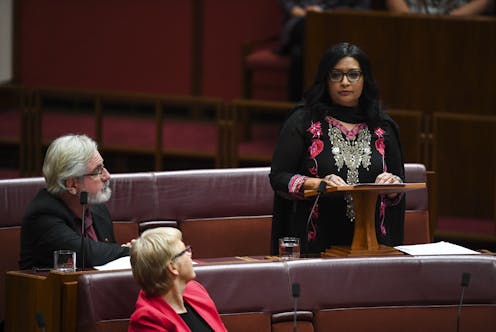
Tanya Plibersek’s appointment last week as minister for the environment and water was the surprise of the new ministerial lineup.

Even if Plibersek’s move from education in opposition to environment in government was a political demotion for her, as some have suggested, placing the environment portfolio in the hands of someone so senior and well-regarded is a boon for the environment.

Having the environment in the broadest sense represented in Cabinet by two experienced and capable ministers is doubly welcome. It signifies a return to the main stage for our ailing natural world after years of relative neglect under the Coalition government.

It also makes good political sense, given the significant electoral gains made by the Greens on Labor’s left flank. While ‘climate’ rather than ‘environment’ was the word on everybody’s lips, other major environmental issues need urgent attention. Threatened species and declining biodiversity are only one disaster or controversy away from high political urgency.

When released at last, the 2021 State of the Environment Report will make environmental bad news public. Former environment minister Sussan Ley sat on the report for five months, leaving it for her successor to release it.

Now comes the avalanche of policy

Both ministers have a packed policy agenda, courtesy of Labor’s last minute commitment to creating an environmental protection agency, as well as responding to the urgent calls for change in the sweeping [2020 review] of Australia’s national environmental law (https://epbcactreview.environment.gov.au/resources/final-report).

That’s not half of it. Bowen is also tasked with delivering the government’s high-profile 43% emissions cuts within eight years, which includes the Rewiring the Nation effort to modernise our grid. He will also lead Australia’s bid to host the world’s climate summit, COP29, in 2024, alongside Pacific countries.

Plibersek also has to tackle major water reforms in the Murray Darling basin and develop new Indigenous heritage laws to respond to the parliamentary inquiry into the destruction of ancient rock art site Juukan Gorge by Rio Tinto.

Can one big department cope with this workload?

Creating a super-department is a bad idea. That’s because the agenda for both ministers is large and challenging. It will be a nightmare job for the department secretary tasked with supporting two ministers. It’s no comfort that the problem will be worse elsewhere, with the infrastructure department supporting four cabinet ministers.

Giving departmental secretaries wide responsibilities crossing lines of ministerial responsibility encourages them to reconcile policy tensions internally rather than putting them up to ministers, as they should.

The tension between large renewable energy projects and threatened species is a prime example of what can go wrong. Last year, environment minister Sussan Ley ruled a $50 billion renewable megaproject in the Pilbara could not proceed because of ‘clearly unacceptable’ impacts on internationally recognised wetlands south of Broome.

Ley’s ‘clearly unacceptable’ finding stopped the project at the first environmental hurdle. That’s despite the fact the very same project was awarded ‘major project’ status by the federal government in 2020.

The problem here is what might have been the right answer on a narrow environmental basis was the wrong answer more broadly.

If Australia is to achieve its potential as a clean energy superpower and as other renewable energy megaprojects move forward, we will need more sophisticated ways of avoiding such conflicts. This will require resolution of deep policy tensions – and that’s best done between ministers rather than between duelling deputy secretaries.

Super-departments also struggle to maintain coherence across the different programs they run. While large departments bring economies of scale, these benefits are more than offset by coordination and culture issues.

An early task for Glyn Davis, the new head of the prime minister’s department, will be to recommend a secretary for this new super-department of climate change, energy, the environment and water. In addition to the ability to absorb a punishing workload, the successful appointee will need high level juggling skills to support Plibersek and Bowen simultaneously.

Ironically, in dividing time between two ministers, she or he will be the least able to accept Plibersek’s call for staff of her new department to be ‘all in’ in turning her decisions into action.

The Conversation

Peter Burnett does not work for, consult, own shares in or receive funding from any company or organization that would benefit from this article, and has disclosed no relevant affiliations beyond their academic appointment.

ref. Our new environment super-department sounds great in theory. But one department for two ministers is risky – https://theconversation.com/our-new-environment-super-department-sounds-great-in-theory-but-one-department-for-two-ministers-is-risky-184386

When is a condition ‘chronic’ and when is it a ‘disability’? The definition can determine the support you get

Source: The Conversation (Au and NZ) – By Elizabeth Kendall, Professor, Director, Griffith Inclusive Futures, Griffith University, Griffith University

Unsplash, CC BY

“Chronic conditions” and “disability” are not just words. They can determine the funding and supports we can access, how we’re treated and how we feel about ourselves.

For population data purposes, disability is defined as a limitation or impairment lasting at least six months that impacts everyday activities. Using this definition, 18% of Australians have a disability. But nearly half of all Australians (47%) have at least one chronic condition that restricts ability, and 19% have two or more.

Although definitions serve an important administrative purpose, they can also be misleading, discriminatory, dehumanising, distressing, and even dangerous. They oversimplify complex issues with significant ramifications.

It turns out people do not fit neatly into categories – but these boxes can determine who receives support and who does not.

What’s the difference?

Chronic conditions are long-lasting health issues with persistent impacts that are likely to worsen over time.

They are not immediately life-threatening, but they are a leading cause of premature death. The management of chronic conditions typically rests with state and territory health systems and general practice funded via Medicare.

The National Disability Insurance Scheme was implemented in 2013 to address serious disability, which they define as as a permanent and medically diagnosed impairment that substantially reduces what a person can do.

Physical and psychological injury – which may or may not result in permanent disability – is addressed through state and territory schemes such as the National Injury Insurance Scheme, Transport Accident Commission and Workcover. These injury schemes focus on loss of economic capacity (or earning potential) and provide the supports needed for a person to recover to their most productive state.

People may also hold private health insurance, which they can use to fund preventative or therapeutic services.


Read more:
From glasses to mobility scooters, ‘assistive technology’ isn’t always high-tech. A WHO roadmap could help 2 million Australians get theirs


Gaps between systems

It sounds like a comprehensive system that should address everyone’s needs. But schemes don’t always match up, and eligibility gaps can raise insurmountable challenges. In extreme cases, the gaps can mean the difference between life and death.

Ironically, disability definitions that are meant to help can promote harmful stereotypes and low expectations by incentivising “deficit models” of thinking that focus on what a person can’t do, rather than what they can do.

The disability sector has spent decades shifting the definition of disability away from a focus on deficits and medical diagnoses. Newer understandings of disability focus on the interaction between people and their environments and the pursuit of human rights.


Read more:
Labels like ‘psycho’ or ‘schizo’ can hurt. We’ve workshopped alternative clinical terms


Barriers and overlaps

The physical and social barriers that exclude people from society affect all people with impairments, whether they are labelled as chronic conditions or disability.

The reality for many Australians is there is no clear distinction between the two labels and, in fact, they often co-exist. Chronic conditions can result in disability and disability can increase vulnerability to a range of chronic conditions.

Separate definitions lead to misunderstandings about the reality of impairment in Australia, leaving us poorly prepared to manage its consequences.

If we consider common impairments that are rarely labelled as disability (deafness, visual decline, allergy, and chronic pain), then a massive 79% of Australians experience impairment. So, it makes little sense to refer to, and plan for, this population as though it is a minority.

Doing so promotes the marginalisation of disability and reduces any real pressure to redesign the way we support and engage with all members of our society.

People are messy

Even the most tangible aspect of these definitions – permanence – is not consistently or clearly determined.

Disability Support Pension eligibility for people aged 16 to 64 years requires a permanent and stable condition for at least two years and restricted ability to work. Other schemes use different time frames.

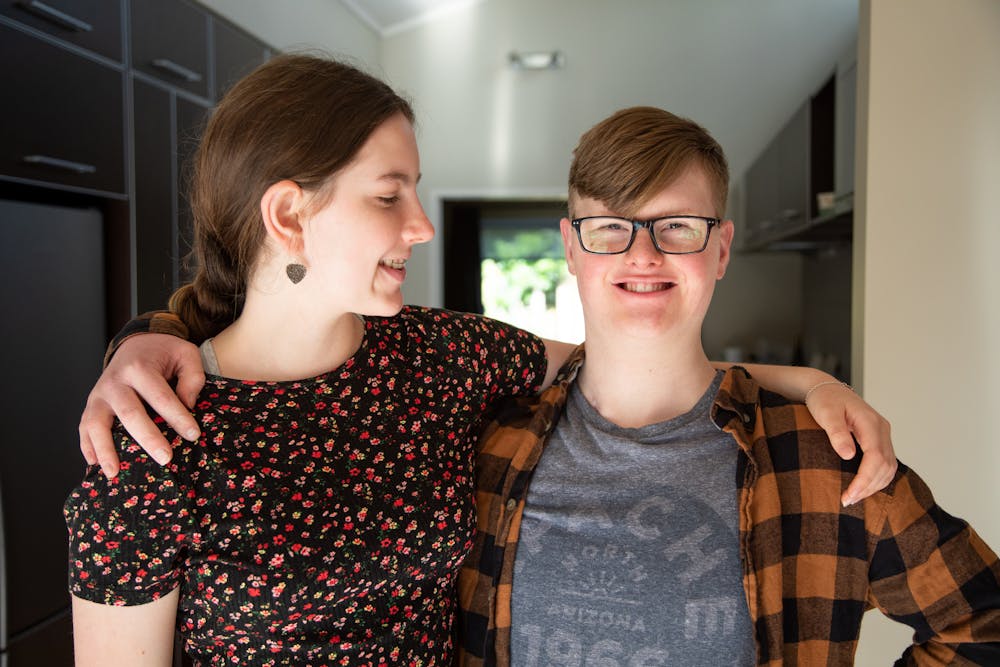
Young woman and man hug side by side.
People are not labels, but systems find that hard to absorb.
Getty/Jessie Casson

In the NDIS, the disability label can only be applied to people who are under 65 years, but where does that leave the 50% of over 65s with disability? They contend with the Aged Care system and its equally complex criteria.

As a participant in the Dignity Project, a disability citizen science initiative, said:

[…] my age makes my disability invisible. I don’t have the same rights as under 65s.


Read more:
The 29,000 younger Australians living with dementia are getting lost between disability services and aged care


Dignity, not labels

The way in which disability occurs (and when) seems to determine how “deserving” an individual is of services – but this is not just and equitable.

Forcing people into categories removes humanity – but these are people whose lives have been affected by impairment, illness or trauma. The use of labels belittles people, dehumanises their experiences and homogenises their unique needs, interests, and sociocultural circumstances.

Our understanding of disability should be underpinned by the desire for everyone to enjoy dignified and personally meaningful lives. To achieve this, we need to harmonise definitions and build a deliberately inclusive society that can accommodate everyone.

We need to de-emphasise prescribed differences, join up fragmented systems and focus on universal design, while simultaneously acknowledging each person’s context, nature and needs.

Angel Dixon: ‘It’s really important for the people with lived experience, of our experiences, to be involved and help researchers without disability’.

The Conversation

Kelsey Chapman receives funding from The Motor Accident Insurance Commission, The Department of Transport and Main Roads, and the Gold Coast Hospital Collaborative Grant Scheme.

Connie Allen, Elizabeth Kendall, and Maretta Mann do not work for, consult, own shares in or receive funding from any company or organisation that would benefit from this article, and have disclosed no relevant affiliations beyond their academic appointment.

ref. When is a condition ‘chronic’ and when is it a ‘disability’? The definition can determine the support you get – https://theconversation.com/when-is-a-condition-chronic-and-when-is-it-a-disability-the-definition-can-determine-the-support-you-get-183365

Young Australian voters helped swing the election – and could do it again next time

Source: The Conversation (Au and NZ) – By Intifar Chowdhury, Associate lecturer, Australian National University

Greens supporters celebrate on election night. James Ross/AAP

The 2022 federal election saw a significant move away from the two major parties, with a host of independent and Greens candidates taking seats from Labor and the Coalition.

Amid predictions about a “youthquake” before May 21, what role did young voters play in this radical electoral shift? And how important could they be by the next election?

The trend was there

Even before the election, researchers had noted major differences between younger and older voters.

Long-term voting patterns showed Labor was more likely to attract young voters. But surveys also showed how both the major parties have been losing their youth vote to the Greens.

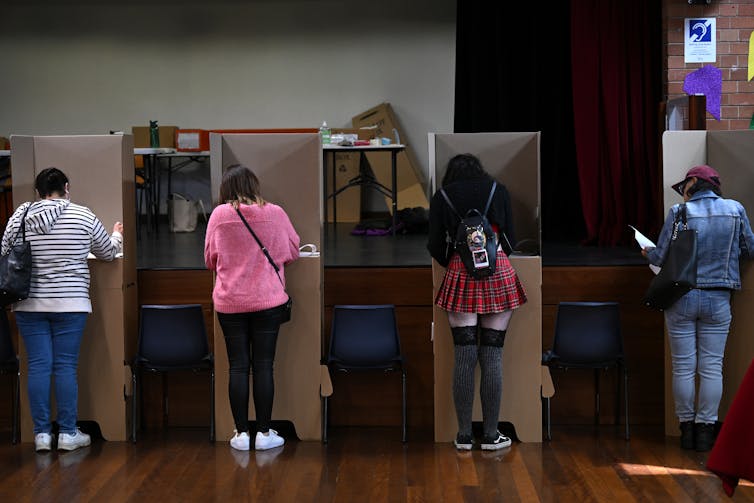
Voters at the polling booth on Election Day.
Younger voters were trending away from the major parties before the 2022 poll.
Dean Lewins/AAP

As the Australian Election Study found after the 2019 election, 42% of voters under 24 did not vote for Labor or the Coalition. Of those aged 25 to 34, 35% did not vote for Labor or the Coalition. This compares to just 12% of those aged over 65.

We also know younger voters were more concerned about environmental issues and property prices than older voters. None of these were adequately addressed during the last term of parliament, which was marred by frightening bushfires, heat waves and floods, and saw inadequate action on climate change and rising intergenerational inequality.


Read more:
Young Australians are supposedly ‘turning their backs’ on democracy, but are they any different from older voters?


Clear wins on May 21

So it is not surprising that electorates with the highest rate of voters under 30 saw unprecedented support for Greens in 2022. An analysis of AEC enrolment data shows seats with four of the top five highest proportions of young voters (18-29 year-olds) went to the Greens. This includes:

  • Melbourne with a youth vote of 26.9% (Greens retain)
  • Brisbane with a youth vote of 25.7% (Greens gain from the Liberal Party)
  • Griffith with a youth vote of 24.7% (Greens gain from Labor)
  • Ryan with a youth vote of 22.5% (Greens gain from the Liberal Party)


Also in the top five was the seat of Canberra with a youth vote of 23.1%. This was an easy Labor retain. However, here the Greens primary vote was almost 25% and the Greens, not the Liberal Party, were used for the two-party-preferred calculations.

There were also a relatively high rate of youth enrolment in key seats likes Kooyong (20.8%, independent gain from Liberals) and Fowler (19.5%, independent gain from Labor). There were other Liberal-turned-teal seats with a relatively lower proportion of youth voters (Curtin 17.7%, Wentworth 17.1%, Goldstein 16.3%, North Sydney 16.3% and Mackellar 15.6%). But it is important to acknowledge the women’s vote may have been a stronger driving force in these seats.

So, what does this mean electorally going forward?

The big debate about young voters

Leading up to the election there was a lot of speculation about young people’s voting behaviour. As other countries recorded a worrying decline in youth electoral participation, I argued young Australians are different.


Read more:
What will young Australians do with their vote – are we about to see a ‘youthquake’?


Still, there was concern the backdrop of COVID suffering, economic inequality, climate inaction and decaying trust in political leaders would culminate in youth political disengagement. Clearly, this did not happen.

Parties and politicians now are on notice

The election shows how the centre of gravity of Australian politics has shifted. The various swings away from the major parties revealed just how discerning voters can be. It also showed voters are likely to act based on policy concerns, rather than political allegiances.

The oldest millennial voters were 42 at this election, while first-time voters of 18 years of age included members of Generation Z. So, some of this can be attributed to generational replacement as the polls populate with more progressive, apartisan younger voters.

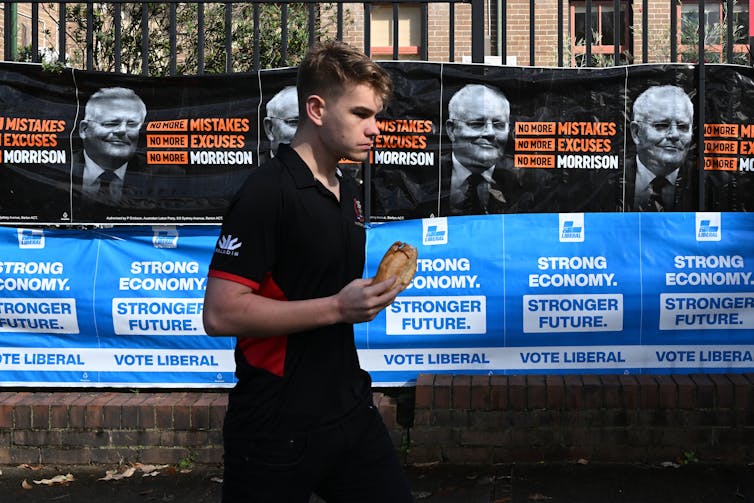
A young voter walks past election advertising at the polling booth.
Ahead of the election, there were fears young people would disengage with voting.
Dean Lewins/AAP

This trend is only going to increase. A basic analysis of current enrolments, plus expected future enrolments suggests that by the next election, millennial voters and younger (those under 45) will make up about 44% of the voting population. This is similar to this election – where they made up 43% – but significantly up from ten or 20 years ago. That means what we consider to be younger generations are replacing their older counterparts – and their more conservative values – over time in the electorate.

The 2022 election also sends a crucial political signal to the younger voters. The results show them the power of their actions to affect change in Australia’s democracy – and that the vote, in an aggregate sense, is an effective tool to do so. The 2022 federal election was one to restore young people’s hope and faith in the Australian democratic system.

Major parties need to acknowledge that younger voters do not like what they are offering, especially in response to climate change. If Labor is hoping to woo them back in 2025, it is interesting that “Minister for Youth” is not a cabinet position.

In the lead-up to their electoral success, the Greens worked hard in Brisbane – courting voters with young, personable candidates who went door-to-door to speak to voters directly. But they need to keep working. The Greens and teal victories were a virtue of issue-based voters, who will be watching whether these new MPs make change in Canberra.

Young voters in Australia can no longer be ignored.

The Conversation

Intifar Chowdhury does not work for, consult, own shares in or receive funding from any company or organisation that would benefit from this article, and has disclosed no relevant affiliations beyond their academic appointment.

ref. Young Australian voters helped swing the election – and could do it again next time – https://theconversation.com/young-australian-voters-helped-swing-the-election-and-could-do-it-again-next-time-184159

You no longer need surgery to be diagnosed with endometriosis. Here’s what’s changed

Source: The Conversation (Au and NZ) – By Mike Armour, Senior research fellow in reproductive health, Western Sydney University

Shutterstock

By age 44, endometriosis affects around one in nine women and people assigned female at birth in Australia.

It’s caused by the presence of tissue similar to the lining of the uterus found outside the uterus. While endometriosis is most commonly found in the pelvic cavity, it can sometimes be found in the diaphragm, lungs and elsewhere.

Symptoms include severe period pain, pain below the belly button when not menstruating, fatigue, digestive problems (often mistaken for irritable bowel syndrome), pain with bowel motions and/or urination, painful intercourse, and infertility.

It previously took, on average, 6.48 years for endometriosis to be diagnosed with surgery. But with doctors now able to give a clinical diagnosis of “suspected endometriosis” based on symptoms and a physical examination, the time to diagnosis is likely to reduce.


Read more:
Endometriosis can end women’s careers and stall their education. That’s everyone’s business


Why diagnose endo through surgery?

Endometriosis has historically been diagnosed through surgery. When performed by a skilled surgeon, this is still the most accurate method of diagnosis.

The most common surgical procedure for endometriosis is laparoscopy (or key-hole surgery). A thin telescope (called a laparoscope) is inserted into the belly button to see and access the organs inside the abdomen and pelvis.

Ideally, when the surgeon sees abnormal tissue during the procedure, they biopsy or remove a sample and send it to a lab. The pathologist then looks for endometrial-like cells under a microscope to provide confirmation of endometriosis. Occasionally, what a surgeon sees is not confirmed to be endometriosis but something else or normal tissue.

A woman with dressings from a laparoscopy holds her tummy.
Sometimes endo will be diagnosed and treated in the same surgery, but this isn’t always the case.
Shutterstock

The endometriosis might be fully treated during that same diagnostic surgical procedure, or it might be incompletely treated or not treated at all. This depends on the extent of the endometriosis and the surgical skill of the surgeon, among other things.

Overall, surgery to remove endometriosis is effective in relieving pain symptoms, reducing infertility and improving quality of life.

However surgery is a very expensive way to achieve a diagnosis, both for the patient and the health system.

Laparoscopic surgery also comes with the risks of infection, major bleeding, and injury to important structures like the bowels or bladder. Recovery takes about four weeks.

How is the diagnostic process changing?

Some experts have argued surgery shouldn’t be used as a diagnostic test. This has prompted a move in recent years towards a “clinical diagnosis”, where a doctor makes an assessment based on symptoms and/or abnormal findings during a physical examination.

For most people, endometriosis symptoms begin with cyclical pain with their periods. That pain process evolves and pain can exist every day, with bowel motions or urination (often worse during the period), and during intercourse.

On physical examination, the doctor can sometimes feel endometriosis nodules in the vagina with the tips of their fingers. The lack of movement of the uterus as the doctor tries to move it with two hands may also raise suspicion, as can tenderness during this examination.


Read more:
Considering surgery for endometriosis? Here’s what you need to know


There are some drawbacks to clinical diagnosis. Most notably, the wrong diagnosis may lead a person down an incorrect treatment plan, inevitably delaying treatment for the true diagnosis.

People who receive a clinical diagnosis may also feel less able to access surgery, if that’s their preferred treatment, as a clinical diagnosis usually prioritises hormonal medications and other drug treatments in place of or before surgery.

Imaging techniques

Over the past five to ten years, there has been an increasing ability to “see” endometriosis using imaging such as transvaginal ultrasound (an internal scan where the ultrasound wand is inserted into the vagina) and magnetic resonance imaging (MRI).

Diagnosing endometriosis through medical imaging is gaining popularity because it allows doctors and patients to understand the diagnosis and extent of the endometriosis without having to perform surgery.

Woman undergoing an MRI talks to her nurse.
Some endometriosis can be see on MRIs.
Shutterstock

The ability to see endometriosis relies heavily on the expertise of the person doing and interpreting the imaging test, just as seeing endometriosis at surgery relies on the expertise of the surgeon.

Not all types of endometriosis are yet reliably seen on an imaging test. For example, severe endometriosis with deep nodules and adhesions (bands of scarring which can attach to other organs) is easier to see than superficial endometriosis, which sometimes consists of a few deposits no larger than a few millimetres.

If the imaging is done by someone with expertise, it is generally possible to “rule out” moderate to severe endometriosis but minimal to mild disease may not be detected.


Read more:
I have painful periods, could it be endometriosis?


Ideally, an imaging-based diagnosis should eliminate the need to have a two-step surgery (diagnostic surgery followed by treatment surgery), as the surgeon has a better understanding of the location and extent of the disease before starting the first surgery. This increases the likelihood of success with a single treatment surgery.

However, there are legitimate concerns that a move to use an imaging-based diagnosis will leave those with a “normal scan” falsely reassured because the disease is not visible on the scan. So, doctors should never tell someone they don’t have endometriosis based on an imaging test alone.

The Conversation

Mike Armour is the chair of the Endometriosis Australia research committee. He reports receiving funding from Metagenics, Canopy Growth, and Sci-Chem, outside the submitted work.

Cecilia Ng receives funding from the Medical Research Future Fund (MRFF).

ML reports receiving grant funding from OZWAC, Endometriosis Australia, AbbVie, CanSAGE, MRFF, HHS; honoraria for lectures/writing from GE Healthcare, Bayer, AbbVie, TerSera, consulting fees from Imagendo, outside the submitted work.

ref. You no longer need surgery to be diagnosed with endometriosis. Here’s what’s changed – https://theconversation.com/you-no-longer-need-surgery-to-be-diagnosed-with-endometriosis-heres-whats-changed-180246

Get out and go fungal: why it’s a bumper time to spot our native fungi

Source: The Conversation (Au and NZ) – By Gregory Moore, Doctor of Botany, The University of Melbourne

Shutterstock

When COVID forced Melburnians to isolate during large parts of 2020 and 2021, many took the opportunity to walk around parks, creeks or remnant bush.

In your walks, you may have noticed the wonderful and diverse range of fungal fruiting bodies on display. Victoria’s display of puff balls, bracket fungi and fairy rings has been nothing short of splendid.

The fun’s not over, either. This year has been a particularly good one for fungus too, and here’s why. As you may recall, the harsh 2019-20 summer dried our soils, stressed much of our vegetation and led to major bushfires. In 2021, this switched abruptly to one of the wettest starts to a year on record in many places, courtesy of the La Niña climate pattern.

With the rains, the weather became ideal for fungal reproduction. We had warm, very moist soils and lovely warm and sunny autumnal days, perfect for fungi to send up their reproductive structures (you might know these as mushrooms and toadstools) and spread their spores. Conditions this good may not occur again for years so seize the opportunity to see them.

Puffball
Puffball mushrooms emit a cloud of spores into the air when stepped on.
Shutterstock

What you can see in a walk in the park

Fungi are not just for adults. Oh no! They can entertain children for hours.

In 2020, our family group took a walk in Brimbank Park, in Melbourne’s northwest. The five year old leader waved his lucky stick/sword/wand in the air as we entered, declaring, “today we hunt fungus!” He was still doing so two hours later, closely followed by his younger brother.


Read more:
The glowing ghost mushroom looks like it comes from a fungal netherworld


Their first findings were puff balls, some brown and others like little white pebbles. If you squeeze these puff balls, a fine dust of spores can emerge like a mist. You don’t want to breathe them in but at a distance they are mostly harmless.

We spotted some like ordinary field mushrooms, but when you scratched their light tan surface a bright yellow colour emerged. If you were to eat these yellow-staining mushrooms you would be sick and potentially seriously ill. Some contain very powerful toxins and can prove to be deadly if eaten. Unless you know exactly what fungus you have, don’t even think of eating them. It’s advisable to wash hands well after handling any kind of fungi.

Yellow-staining mushroom
Yellow-staining mushrooms are the most common cause of mushroom poisoning in Australia, given their resemblance to field mushrooms.
Shutterstock

Spores are the means by which fungi reproduce themselves. Most are tiny but they can be dry like powder, damp and sticky, dull or brightly coloured, plain or ornately decorated and sometimes quite smelly. The dry spores can easily be dispersed by even a gentle breeze, but the sticky ones often adhere to an unsuspecting passer-by such as a bird, rabbit, dog or human sock.

We gave the little ones extra points if they looked at the fungus but left it intact, even if they couldn’t resist giving one or two a poke. Their next discovery gained even more points because you had to look up: it was a bracket fungus growing on a dead branch. Some of these are snowy white, but others are yellow or bright orange, almost like traffic lights. Some have an almost velvety outer texture while others appear to be made of woody rings like the tree upon which they are growing.


Read more:
The ancient, intimate relationship between trees and fungi, from fairy toadstools to technicolour mushrooms


On dead trees, bracket fungi have the role of recycling old dead wood. Some don’t even wait until the tree dies. They gain access to the old wood at the tree’s centre and begin the decay process while the tree is still living. The fruiting bodies of these fungi look like little shelves on the trunk of the tree and can persist for decades. On some trees, multiple brackets form a veritable stairway to heaven. If you have a large bracket fungus on a large old branch or tree, it’s a good idea to get arboricultural advice about the safety of the tree.

Fairy rings, basket fungus and symbiotic relationships

Our little posse of fungal hunters had travelled 100 metres into the park, but in the zigzag pattern of explorers, it had taken us an hour. A brown dried star-like structure was revealed as a dried puff ball, its spores well and truly blown and what was once a ball had peeled back as it dried into a near perfect star. In a section of mown grass, we come across the delicate mushrooms of a fairy ring. Excitement ensues.

Why is it a ring?
Where are the fairies?
Can you eat them?
Not the fairies, the mushrooms!
The fairies of course heard us coming and so they are hiding.
No, you can’t eat them because they might be poisonous and make you sick.

Fairy rings form into a circle because they came from a single starting point and expanded outward from the centre at more or less the same rate.

Fairy ring mushrooms
Fairy rings of mushrooms come from a common source.
Shutterstock

Is that a pebble? No it’s a fungus doing a brilliant impression of a pebble. We were camouflage experts now, and it couldn’t hide from us. Then a squeal. What is that? A soccer ball? No, old plastic. No, a dome. It’s a magnificent white basket fungus shaped like an intricate geodesic sphere. We left it for others to discover. With the mighty stick/sword/wand high in the air, we head for home.

Fungi are always there in our soils. Their fine thread structures, called hyphae, lie underfoot all year, but their fruiting bodies only appear under the right conditions. Many of these fungi entwine around the roots of specific plants and in many cases into the plant root cells themselves. The fungus offers water and nutrients to the plants and in return the plants give the fungus some of the carbohydrates they produce from photosynthesis. It’s a marvellously beneficial relationship.

stinkhorn fungus
The smooth cage stinkhorn (Ileodictyon gracile) has a fruiting body like a geodesic dome.
Michael Jefferies/Flickr, CC BY

We went a-hunting several more times, and the young ones never tired of the sport. Interacting closely with plants and fungi meets basic physical, mental and psychological needs hailing back to our early travel through natural ecosystems.

Finding and poring over plants and fungi engages all our senses – sight, hearing, smell, touch – and for experts only, taste. It’s no wonder all of us in the hunt feel the better for this purposeful forest bathing.

Spotting fungi above ground is a rare treat. If the weather gets too chilly, or if La Niña gives way to hot and dry El Niño, the fungi will vanish. But if we get a mild, wet winter, the fungal season can just roll on. That’s the thing about fungi, you can never be sure. They play by their own rules.


Read more:
How fungi’s knack for networking boosts ecological recovery after bushfires


The Conversation

Gregory Moore does not work for, consult, own shares in or receive funding from any company or organization that would benefit from this article, and has disclosed no relevant affiliations beyond their academic appointment.

ref. Get out and go fungal: why it’s a bumper time to spot our native fungi – https://theconversation.com/get-out-and-go-fungal-why-its-a-bumper-time-to-spot-our-native-fungi-184317

The inequity of Job-ready Graduates for students must be brought to a quick end. Here’s how

Source: The Conversation (Au and NZ) – By Andrew Norton, Professor in the Practice of Higher Education Policy, Australian National University

Labor’s promise of a “universities accord” suggests a slow and careful approach to higher education policy. A new education minister without a strong background in the portfolio may also want time to get across the issues.

In general, taking this time to get policy right and build support for it is a good approach. But when current policy is causing problems and lacks significant support there is a case for acting more quickly. This is the situation with the previous government’s Job-ready Graduates student funding policy enacted in late 2020.

Job-ready Graduates imposes unfair HELP debts on some students, adds to the government’s costs of running the HELP loan scheme, and distorts university incentives in distributing student places between courses.


Read more:
Labor’s promised universities accord could be a turning point for higher education in Australia


How are university courses funded?

A mix of contributions from the Commonwealth and students fund domestic undergraduates in public universities. Added together, these contributions are the overall funding rate per subject.

The government sets Commonwealth contributions, which vary by academic discipline. The government pays universities according to their enrolments up to a capped total grant amount.

Universities set student contributions up to a legal maximum, which also varies by discipline. Universities are paid directly by students or through HECS-HELP loans. Total student contribution revenue is not capped.

Once universities reach their maximum Commonwealth contribution grant they can still increase enrolments, but on student contribution revenue only. These extra students are called “over-enrolments”. Historically, over-enrolments have been an important source of flexibility in meeting student demand.

In its basic architecture, Job-ready Graduates has similarities with previous funding policies, other than the demand-driven system, which uncapped both Commonwealth and student contributions.

Where Job-ready Graduates differs is in the setting of Commonwealth and student contributions.


Read more:
Demand-driven funding for universities is frozen. What does this mean and should the policy be restored?


Commonwealth cut per student contribution

Job-ready Graduates increases student places by keeping total university grants at roughly the same level but reducing the average Commonwealth contribution. Universities need to deliver more student places for each million dollars in public funding.

Labor has already promised a small, and possibly temporary, increase in total Commonwealth contribution funding. Given the government’s overall budget position, a significant increase per student may not be feasible.


Read more:
Labor offers extra university places, but more radical change is needed


For universities, increases in student contributions at least partly offset reductions in Commonwealth contributions under Job-ready Graduates.

Student contributions changed radically

The most radical element of Job-ready Graduates was a further change to student contributions. Before this policy took effect, a mix of assumed private financial benefits and course costs explained student contribution levels by discipline. The price gap between the cheapest and most expensive discipline was about $4,500 a year.

Job-ready Graduates abandoned this system. Instead, it uses student contributions to manipulate student demand.

In nursing and teaching, “job-ready” courses the previous government favoured, student contributions were cut by about $2,700 a year. In disfavoured courses they went up. The biggest increases of $7,800 a year were in humanities other than languages.

The gap between the cheapest and most expensive course more than doubled, to $10,550 a year.

Higher or lower Commonwealth contributions partly offset these changes to student contributions, so overall funding rates changed by less than the student contribution levels.


Read more:
3 big issues in higher education demand the new government’s attention


Job-ready Graduates has long-term impacts

The Job-ready Graduates assumption that students would respond to these price signals and change enrolment patterns was never sound. Course preferences still depend on student interests. For financially motivated students, differences in job and salary prospects are also more significant than how much they pay for their course.

Job-ready Graduates annually shuffles hundreds of millions of dollars in HELP debt between students. Some students, like those in nursing or teaching, will owe less than previously and repay their debt earlier.

Others, like those taking humanities courses, will owe much more and keep repaying for years longer than before. Some may never fully repay their HELP debt.

While HELP is designed to allow slow or incomplete repayment, this should reflect varying individual circumstances. It is not sensible or fair to assign repayment periods and risks based on course choices.

Slow or no repayment increases the cost of HELP to the government. This is not prudent when it already faces large budget deficits.

The system also affects the economics of over-enrolment.

In fields such as arts, law or business, the student contribution covers more than 90% of the maximum revenue a university could get per student. These fields are close to a de facto demand-driven system, with only minor financial constraints on increased enrolments for universities already earning their maximum Commonwealth grant.

In fields such as education and nursing, less than 25% of maximum per student revenue comes from the student. Over-enrolments in these fields are almost certainly loss-making, creating a deterrent to accepting more students.

How can this system be fixed?

To fix the system we need student and Commonwealth contributions that vary within a narrower range.

This change can be close to budget-neutral. Course that are too expensive, relative to other fields, would have student contributions decreased and Commonwealth contributions increased. Courses that are too cheap would have student contributions increased and Commonwealth contributions decreased.

Estimates of 2022 enrolments could be used to ensure contribution increases and decreases balance each other, leaving the government and universities in the same financial position.

A fast or slow change?

Student contribution increases are normally “grandfathered”, so only new students are affected and continuing students are retained on the old rates.

Grandfathering is generally preferable, so students partway through their course are not suddenly hit with unexpected extra charges to finish it. But Job-ready Graduates creates so many problems that it should be ended as quickly and comprehensively as possible.

If the new student pricing system was introduced for 2023, students facing higher charges would have benefited from up to two years of discounted student contributions. Their total course cost at graduation would still be lower than for other students.

A fast fix for the problems of Job-ready Graduates does not preclude later changes coming from the accord process. It is an interim measure to correct errors rather than a long-term policy.

The Conversation

Andrew Norton does not work for, consult, own shares in or receive funding from any company or organisation that would benefit from this article, and has disclosed no relevant affiliations beyond their academic appointment.

ref. The inequity of Job-ready Graduates for students must be brought to a quick end. Here’s how – https://theconversation.com/the-inequity-of-job-ready-graduates-for-students-must-be-brought-to-a-quick-end-heres-how-183808

A century-old double standard: like Labor leaders before him, Albanese is being told he can’t manage money

Source: The Conversation (Au and NZ) – By Alex Millmow, Senior Fellow, Federation University Australia

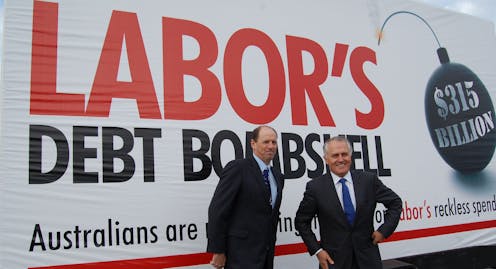
The Coalition’s debt truck from 2009, when net government debt was 6% of GDP – instead of the 30% of GDP it climbed to under the Coalition. Andrea Hayward/AAP

The Australian Labor Party is Australia’s oldest political party, and Anthony Albanese is only its seventh prime minister.

He would do well to recall the experiences of his predecessors.

Incoming Labor prime ministers have invariably faced immediate and serious economic challenges, some of them bequeathed by conservative governments that styled themselves as superior economic managers.

In October 1929, Labor leader James Scullin defeated the conservative Stanley Melbourne Bruce, 12 days before Wall Street began the great crash that set off the Great Depression.

The reverberations put the skids under the new government.

Even its brightest star, mercurial treasurer Edward Theodore, could not save it from annihilation two years later as the grip of the depression tightened.

It didn’t help that the prices of Australia’s major export commodities, wool and wheat, were in free-fall while the Commonwealth and the states owed millions in foreign loans and servicing costs to London.

Bruce wouldn’t have been the only politician – before or since – to have thought privately that the election he won was a good one to lose.

Labor often inherits problems

The Albanese government faces economic challenges of its own.

When the Reserve Bank board meets on Tuesday June 7, it is likely that interest rates will climb yet again. It will be part of a reckoning neither side faced up to squarely during the campaign.

Like Scullin and Theodore in 1929, Albanese and his treasurer Jim Chalmers have inherited a mountain of public debt and a stubborn budget deficit.

In Scullin’s time the Commonwealth and states had borrowed heavily for projects such as railways. The debt was mostly owed to British banks, and had to be honoured.


Read more:
The good old days: how nostalgia clouds our view of political crises


At least for the moment Albanese will enjoy high commodity prices.

But what if overseas credit agencies decide to send a message about what they believe to be overspending? They have done it before during the 1980s, removing Australia’s AAA credit rating under (Labor) Prime Minister Bob Hawke, restoring it under (Coalition) Prime Minister John Howard.

It would fit in with the widely-held belief (even in financial markets) that Labor governments are spendthrift, and push up the cost of borrowing.

Labor is often told it can’t manage money

Liberal Party advertisement.
Twitter

It is here we see the great asymmetry in Australian politics at play. Labor governments are perceived to be poor economic managers, regardless of what circumstances require them to do, compared to Coalition governments who are supposedly superior, regardless of what circumstances require them to do.

Scott Morrison put this way during the campaign: “Labor can’t manage money”.

The sentiment has plagued Labor since Scullin’s day.

The Whitlam Labor government had the misfortune to come to power just as the long post-war boom was about to end. Within a year, a 1973 oil price hike by members of the Middle East oil producing cartel supercharged inflation and unemployment, derailing the Labor’s planned spending on social programs and solidifying the perception that it couldn’t manage money.

Labor has a history of managing well

But the necessary cutbacks in spending began with Labor itself, in Treasurer Bill Hayden’s contractionary August 1975 budget, implemented months later by the Fraser Coalition government after it took office in November 1975.

Bob Hawke wound back spending as a share of the economy.
National Archives of Australia

In March 1983, the Hawke Labor government took power only to be informed by Treasury Secretary John Stone that the budget deficit was far greater than the figure which departing Coalition treasurer John Howard had claimed.

Treasurer Paul Keating faced the need to restrain expenditure to relieve pressure on borrowing and on interest and exchange rates.

A fall in Australia’s terms of trade in early 1985 made the need for deep budget cuts more urgent.

The Hawke cut government spending as a proportion of gross domestic product while putting in place a prices and incomes accord, which successfully moderated pay rises in return for Medicare and superannuation.

Months after being elected in late 2007, the Rudd Labor government was warned of a looming financial crisis in the United States. It held off on its plans to slash government spending and developed a stimulus package that prevented mass unemployment, avoided recession, and kept Australia’s financial institutions alive.

The Coalition is treated more gently as economic managers

This success didn’t deter the Coalition from demonising the borrowing required to fund the package, even though Labor left office with net debt of 10% of GDP, compared to the 31% of GDP forecast in the Coalition’s 2022 budget.


Read more:
A new dawn over stormy seas: how Labor should manage the economy


Like Scullin in 1929, Albanese has been bequeathed a formidable list of problems. They include rising interest rates, stagnating wages and soaring inflation.

He also has to attend to a stubborn budget deficit while fulfilling his promises of increased funding for childcare, education, housing and aged care.

As has become the norm in Australia, these challenges have been made harder by the different ways in which the Coalition and Labor are judged.

The Conversation

Alex Millmow does not work for, consult, own shares in or receive funding from any company or organisation that would benefit from this article, and has disclosed no relevant affiliations beyond their academic appointment.

ref. A century-old double standard: like Labor leaders before him, Albanese is being told he can’t manage money – https://theconversation.com/a-century-old-double-standard-like-labor-leaders-before-him-albanese-is-being-told-he-cant-manage-money-184037

View from The Hill: Ten women in shadow cabinet, and Nationals grab trade job

Source: The Conversation (Au and NZ) – By Michelle Grattan, Professorial Fellow, University of Canberra

Angus Taylor will take the key shadow treasury post in a 24-member shadow cabinet containing 10 women and six Nationals.

The lineup was announced by opposition leader Peter Dutton and Nationals leader David Littleproud on Sunday.

In a sign the opposition may consider throwing its weight behind nuclear power, Queensland Liberal Ted O’Brien, a supporter of nuclear energy, becomes shadow minister for climate change and energy.

O’Brien chaired a parliamentary inquiry into nuclear power and wrote in 2020: “Rather than being perpetually divisive, I believe nuclear technology has the capacity to unite Australians. It is a proposition that brings together progressives and conservatives within the Coalition.”

Julian Leeser, from NSW, is promoted from the backbench to shadow attorney-general and shadow minister for Indigenous Australians. This will give him a key role in the opposition’s response to the government’s planned referendum to enshrine an Indigenous Voice to Parliament.

Leeser has had a long term interest and involvement in the Indigenous affairs area. He co-chaired with Labor’s Patrick Dodson a parliamentary inquiry on the constitutional recognition of Indigenous Australians where he was involved in the co-design process for a Voice to Parliament.

The Coalition has only one indigenous member of the federal parliament, Jacinta Price, who will sit with the Nationals. Asked about her at his news conference, Dutton pointed out she had only just been elected, but signalled her likely future elevation.

The Nationals will have six members of the 24 member shadow cabinet – compared to five in the Morrison cabinet – reflecting their larger proportion of the Coalition, thanks to holding their seats and gaining a senator.

They have also seized back trade, a long term ambition, and a portfolio they had held in earlier times. Trade and tourism goes to NSW Nationals Kevin Hogan.

Littleproud, who chose his frontbenchers, has included in shadow cabinet Barnaby Joyce, whom he defeated for the leadership. Littleproud’s decision was presumably partly driven by his desire to keep the outspoken Joyce from making too much trouble. Joyce will be spokesman on veterans’ affairs.

Another former Nationals leader, Michael McCormack, is spokesman for international development and the Pacific in the outer shadow ministry.

Having 10 women matches the number in the Albanese 23-member cabinet.

Deputy Liberal leader Sussan Ley will be shadow minister for industry, skills and training, and for small and family business, as well shadow minister for women, where she will be charged with trying to win back the support of female voters who deserted the Coalition at the election.

A notable absence from the frontbench is former immigration minister Alex Hawke, a factional numbers man for Scott Morrison. Stuart Robert, another close ally of Morrison, has been demoted to the outer shadow ministry, becoming shadow assistant treasurer and shadow minister for financial services.

Morrison had indicated publicly he did not want a frontbench post. Colleagues do not expect him to serve out the full term.

Former Nationals resources minister Keith Pitt is off the frontbench. The shadow resources minister will be Queensland Nationals senator Susan McDonald.

Darren Chester, who ran for Nationals leader, remains on the backbench, to which Joyce consigned him last year.

Dutton prevailed on former foreign minister Marise Payne, who had not sought a frontbench position, to become shadow cabinet secretary.

Littleproud will continue in agriculture, an area he held in government.

Foreign Affairs goes to opposition Senate leader Simon Birmingham, where he will shadow his Senate opposition number, Foreign Minister Penny Wong. Birmingham is the leader of the diminished band of moderates in the Liberal party, after several fell to “teal” independents.

Former attorney-general and industrial relations minister Michaelia Cash becomes shadow minister for employment and workplace relations.

Karen Andrews will shadow her old area of home affairs, and also become shadow minister for child protection and the prevention of family violence.

Deputy Nationals leader Perin Davey takes water and emergency management.

Former trade minister Dan Tehan becomes shadow minister for immigration and citizenship.

Health and aged care goes to Anne Ruston, who in the election campaign was nominated by Morrison for the health portfolio if the government remained in office.

The Nationals leader in the senate, Bridget McKenzie, will be shadow minister for infrastructure, transport and regional development.

Sarah Henderson – a one-time ABC journalist who has become a strong critic of the public broadcaster – will become shadow minister for communications.

Former member of the SAS, Andrew Hastie, becomes defence spokesman. He was assistant minister for defence before the election.

Victorian Jane Hume will be shadow minister for finance and shadow special minister of state.

Alan Tudge, whose status became confused in government after he stood aside following claims made by a former staffer, will be education spokesman.

Paul Fletcher becomes shadow minister for science, the digital economy and government services. He will also have responsibility for the arts.
Michael Sukkar takes social services, the NDIS, housing and homelessness.

The environment shadow will be Jonathon Duniam, a senator from Tasmania.

Dutton said the opposition had “incredible depth of talent”. “I’m cognisant of trying to bring people through for an opportunity,” he said.

Littleproud said the Nationals team he brought forward was “about renewal and generational change”.

He was enthusiastic about getting trade back: “The trade portfolio has had a long and proud history with the Nationals, including with party greats John McEwen and Doug Anthony”.

Shadow Ministry List

The Conversation

Michelle Grattan does not work for, consult, own shares in or receive funding from any company or organisation that would benefit from this article, and has disclosed no relevant affiliations beyond their academic appointment.

ref. View from The Hill: Ten women in shadow cabinet, and Nationals grab trade job – https://theconversation.com/view-from-the-hill-ten-women-in-shadow-cabinet-and-nationals-grab-trade-job-184439

Ramos-Horta challenges Pacific’s biggest threat to media freedom – China’s gatekeepers

COMMENTARY: By David Robie

Timor-Leste, the youngest independent nation and the most fledgling press in the Asia-Pacific, has finally shown how it’s done — with a big lesson for Pacific island neighbours.

Tackle the Chinese media gatekeepers and creeping authoritarianism threatening journalism in the region at the top.

In Dili on the final day of Chinese Foreign Minister Wang Yi’s grand Pacific tour to score a multitude of agreements and deals — although falling short of winning its Pacific region-wide security pact for the moment — newly elected (for the second time) President José Ramos-Horta won a major concession.

Enough of this paranoid secrecy and contemptuous attitude towards the local – and international – media in democratic nations of the region.

Under pressure from the democrat Ramos-Horta, a longstanding friend of a free media, Wang’s entourage caved in and allowed more questions like a real media conference.

Lusa newsagency correspondent in Dili Antonió Sampaio summed up the achievement in the face of the Pacific-wide secrecy alarm in a Facebook post: “After the controversy, the Chinese minister gave in and agreed to speak with journalists. A small victory for the media in Timor-Leste!”

Small victory, big tick
A small victory maybe. But it got a big tick from Timor-Leste Journalists Association president Zevonia Vieira and her colleagues. He thanked President Ramos Horta for his role in ending the ban on local media and protecting the country’s freedom of information.

Media consultant Bob Howarth, a former PNG Post-Courier publisher and longtime adviser to the Timorese media, hailed the pushback against Chinese secrecy, saying the Chinese minister answering three questions — elsewhere in the region only one was allowed and that had to be by an approved Chinese journalist — as a “press freedom breakthrough”.

On the eve of Wang’s visit, Timor-Leste’s Press Council had denounced the restrictions being imposed on journalists before Horta’s intervention.

“In a democratic state like East Timor not being able to have questions is unacceptable,” said president Virgilio Guterres. “There may be limits for extraordinary situations where there can be no coverage, but saying explicitly that there can be no questions is against the principles of press freedom.”

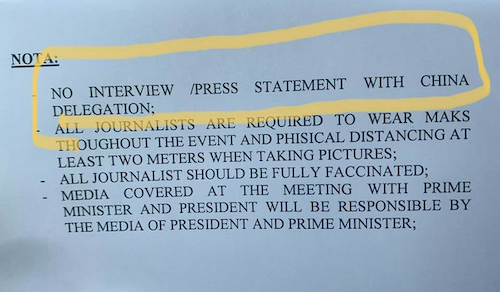
The pre-tour Chinese restrictions on the Timorese media
The pre-tour Chinese restrictions on the Timorese media … before President Jose Ramos-Horta’s intervention. Image: Antonio Sampaio/FB

The Chinese delegation justified the decision to ban questions from journalists or to exclude from the agenda any statements with “lack of time” and the “covid-19 pandemic” excuses.

However, Ramos-Horta was also quietly supportive of the Chinese overtures in the region.

According to Sampiaio, when questioned in the media conference about fears in the West about China’s actions in the Pacific, Ramos-Horta said “there is no reason for alarm” and noted that Beijing had always had interests in the region, for example in fishing.

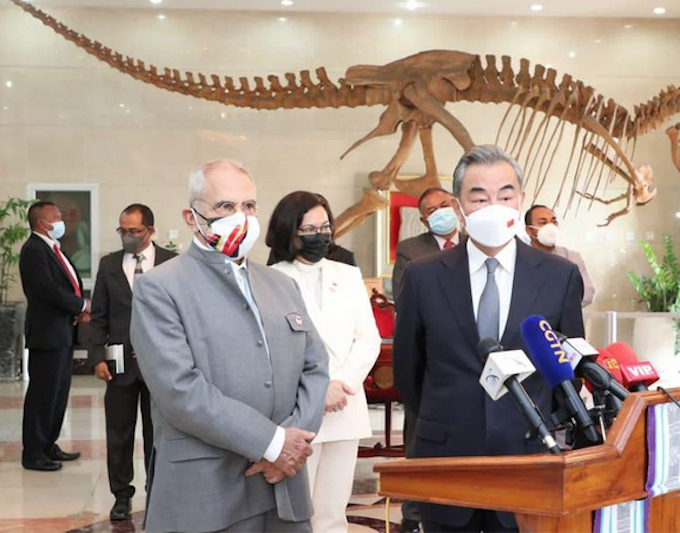
Timor-Leste's President Jose Ramos-Horta with Chinese Foreign Minister Wang Yi in Dili
Timor-Leste’s President Jose Ramos-Horta with Chinese Foreign Minister Wang Yi in Dili … “is no reason for alarm” over Chinese lobbying in the Pacific. Image: Lusa

‘A lot of lobbying’
“These Pacific countries have done a lot of lobbying with China to get more support and China is responding to that. These one-off agreements with one country or another, they don’t affect the long-standing interests of countries like Australia and the United States,” he said.

An article by The Guardian’s Pacific Project editor Kate Lyons highlighted China’s authoritarian approach to the media this week, saying “allegations raise press freedom concerns and alarm about the ability of Pacific journalists to do their jobs, particularly as the relationship between the region and China becomes closer.”

But one of the most telling criticisms came from Fiji freelance journalist Lice Movono, whose television crew reporting for the ABC, was deliberately blocked from filming. Pacific Islands Forum officials intervened.

“From the very beginning there was a lot of secrecy, no transparency, no access given,” she told The Guardian.

“I was quite disturbed by what I saw. When you live in Fiji you kind of get used to the militarised nature of the place, but to see the Chinese officials do that was quite disturbing.

“To be a journalist in Fiji is to be worried about imprisonment all the time. Journalism is criminalised. You can be jailed or the company you work for can be fined a crippling amount that can shut down the operation … But to see foreign nationals pushing you back in your own country, that was a different level.”

Media soul-searching

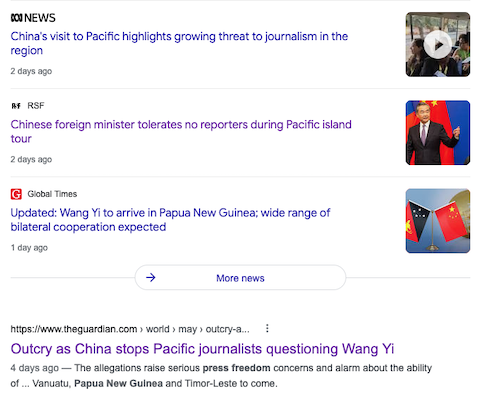
Google headlines on China and Pacific media freedom
Google headlines on China and Pacific media freedom. Image: Screenshot APR

China was moderately successful in signing multiple bilateral agreements with almost a dozen Pacific Island nations during Wang’s visit to the region. The tour began 11 days ago in Solomon Islands — where a secret security pact with China was leaked in March — and since then Wang has met Pacific leaders from Kiribati, Samoa, Fiji, Tonga, Niue (virtually), Cook Islands (virtually) and Vanuatu.

However, the repercussions from the visit on the media will lead to soul searching for a long time. Some brief examples of the interaction with Beijing’s authoritarianism:

Solomon Islands: The level of secrecy and selective media overtures surrounding Wang’s meetings with the government sparked the Media Association of the Solomon Islands (MASI) to call on local media to boycott coverage of the visit in protest over the “ridiculous” restrictions.

Samoa: Samoan journalist Lagipoiva Cherelle Jackson criticised the Chinese restrictions on the media with only a five-minute photo-op allowed and no questions or individual interviews. There was also no press briefing before or after Wang’s visit.

Fiji: No questions were allowed during the brief joint press conference between Wang and Fijian Prime Minister Voreqe Bainimarama. Local media later reported that, according to Fijian officials, the no-question policy came from the Chinese side.

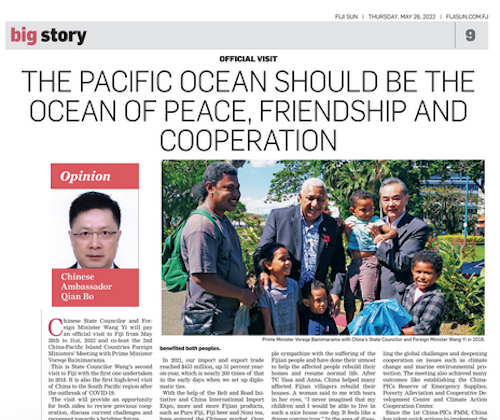
Chinese Ambassador Qian Bo's article in the Fiji Sun
Chinese Ambassador Qian Bo’s article in the Fiji Sun on May 26. Image: China Digital Times

Examples of local media publishing propaganda were demonstrated by the pro-government Fiji Sun, with a full page “ocean of peace” op-ed written by Chinese Ambassador Qian Bo claiming China’s engagement with Pacific Island countries was “open and transparent”. The Sun followed up with report written by the Chinese embassy in Fiji touting the “great success” of Wang’s visit.

Tonga: Matangi Tonga also published an article by Chinese Ambassador Cao Xiaolin a day before Wang’s visit claiming how “China has never interfered in the internal affairs of [Pacific Island countries]” and would “adhere to openness.”

Global condemnation
The secrecy and media control surrounding Wang’s tour was roundly condemned by the Brussels-based International Federation of Journalists and Paris-based Reporters Without Borders and other media freedom watchdogs.

“The restriction of journalists and media organisations from the Chinese delegation’s visit … sets a worrying precedent for press freedom in the Pacific,” said the IFJ in a statement.

“The IFJ urges the governments of Solomon Islands and China to ensure all journalists are given fair and open access to all press events.”

Likewise, RSF’s Asia-Pacific director Daniel Bastard said the actions surrounding the events organised by the Chinese delegation with several Pacific island states “clearly contravenes the democratic principles of the region’s countries”.

He added: “We call on officials preparing to meet Wang Yi to resist Chinese pressure by allowing local journalists and international organisations to cover these events, which are of major public interest.”

University of the South Pacific journalism head Associate Professor Shailendra Singh also criticised the Chinese actions, saying “we have two different systems here. China has a different political system — a totalitarian system, and in the Pacific we have a democratic system.”

In Papua New Guinea, the last country to be visited in the Pacific before Timor-Leste, “there appeared to be little resistance” to the authoritarian screen, according to independent journalist Scott Waide, a champion of press freedom in his country.

“There’s not a lot of awareness about the visit,” he admits. “I would have liked to have seen a visible expression of resistance at least of some sort. But from Hagen, where I was this week. I didn’t see much.”

Waide has been training journalists as part of the ABC’s Media for Development Initiative (MDI) programme as a prelude to the PNG’s general election in July.
https://www.abc.net.au/abc-international-development/projects/

‘Problems to be resolved’
“We have problems that need to be resolved. Over the last month, I’ve tried to impart as much as possible through training workshops on the elections,” he told Pacific Media Watch But there are huge gaps in terms of journalism training. I believe that is a contributor to the lack of obvious pushback over Wang’s visit.”

Reflecting on China’s Pacific tour, Lice Movono, said: “At the time of my interview with The Guardian, I think I was still pretty rattled. Now I think the best way to describe my response is that I feel extremely disturbed.”

She expressed concerns that mostly women journalists from the region noted “but that didn’t get enough traction when other media covered the incident(s) — that China was able to behave that way because the governments of the Pacific allowed it, or in the case of Fiji, preferred it that way.

Movono said that since her criticisms, she had come in for nasty attention by trolls.

“I’m getting some hateful trolling from Chinese twitter accounts – got called a ‘fat pig’ yesterday,” she told Pacific Media Watch.

“Also I’m being accused of lying because some photos have come out of the doorstop we did on the Chinese ambassador here and some have purported that to be an accurate portrayal of Chinese ‘friendliness’ toward media.”

So the pushback from President Ramos-Horta is a welcome sign for media freedom in the region.

Timor-Leste rose to 17th in the 2022 RSF World Press Freedom Index listing of 180 countries — the highest in the Pacific region — while both Fiji and Papua New Guinea fell in the rankings. There are some definite lessons there for media freedom defenders.

Frustrated Pacific journalists hope that there will be a more concerted effort to defend media freedom in the future against creeping authoritarianism.

Print Friendly, PDF & Email

Article by AsiaPacificReport.nz

Police beat Papuan protesters with rattan sticks – 20 injured, flag seized

Asia Pacific Report newsdesk

Indonesian police have been accused of beating two Papuan students with rattan sticks – severely injuring them — while 20 other students have been injured and the Morning Star flag seized in a crackdown on separate protests yesterday across the two Melanesian provinces of Papua and West Papua.

The protesters were blocked by police during a long march in the provincial capital of Jayapura opposing planned new autonomous regions in Papua.

The police have denied the rattan beating claims.

Papuan human rights activist Younes Douw said almost 3000 students and indigenous Papuans (OAP) took to the streets for the action.

“Around 650 students took to the streets today. Added to by the Papuan community of around 2000 people,” Douw told CNN Indonesia.

Douw said that the actions yesterday were held at several different points in Jayapura such as Yahukimo, Waena and Abepura.

Almost every single gathering point, however, was blockaded by police.

Police blockade
“Like this morning there was a police blockade from Waena on the way to Abepura,” he said.

Douw said that two students were injured because of the repressive actions by police.

The two were named as Jayapura Science and Technology University (USTJ) student David Goo and Cendrawasih University (Unas) student Yebet Tegei.

Both suffered serious head injuries.

“They were beaten using rattan sticks,” Douw said.

Jayapura district police chief Assistant Superintendent Victor Mackbon denied the reports from the students.

“It’s a hoax. So please, if indeed they exist, they [should] report it. But if they don’t exist, that means it’s not true,” Mackbon told CNN Indonesia.

Demonstration banned
The police had earlier banned the demonstration against new autonomous regions being organised by the Papua People’s Petition (PRP).

The Papua Legal Aid Foundation (LBH) said that by last night at least 20 people had been injured as a result of police violence in in breaking up the protests.

“In Sorong, 10 people were injured. In Jayapura, 10 were also injured,” LBH Papua chair Emanuel Gobay told Kompas.com.

“The injuries were a consequence of the repressive approach by police against demonstrators when they broke up the rallies,” he said.

Police also arrested several people during the protests.

“In Nabire, 23 people were arrested then released later in the afternoon.

“Two people were also arrested in Jayapura and released later,” Gobay said.

When this article was published, however, local police were still denying that any protesters had been injured.

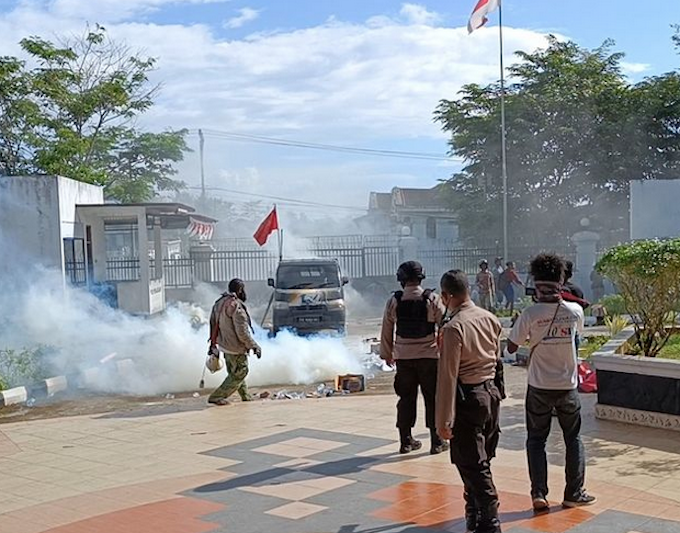
Tear gas fired at Papuan protesters by Indonesian police
Tear gas fired at protesters as police break up a demonstration in Sorong, West Papua. Image: ILN/Kompas

Fires, flag seized in Sorong
In Sorong, police broke up a demonstration against the autonomous regions at the Sorong city Regional House of Representatives (DPRD) office, reports Kompas.com.

Earlier, the demonstrators had asked DPRD Speaker Petronela Kambuaya to meet with them but there was no response.

The demonstrators then became angry and set fire to tyres on the DPRD grounds and police fired teargas into the rally.

Sorong district police operations division head Police Commander Moch Nur Makmur said that the action taken was following procedure.

“We had already appealed to the korlap [protest field coordinator], saying that if there were fires we would break up [the rally], but they (the protesters) started it all so we took firm action and broke it up,” said commander Makmur.

Police also seized a Morning Star independence flag during the protest. The flag was grabbed when the demonstrators were holding a long march from the Remu traffic lights to the Sorong DPRD.

Makmur said that when police saw somebody carrying the Morning Star flag, they seized it.

“The flag was removed immediately, officers were quick to seize the flag,” he said.

Translated by James Balowski for IndoLeft News. The original title of the article was Demo Tolak DOB Diadang Aparat di Papua, Mahasiswa Luka Dipukul Rotan.

Print Friendly, PDF & Email

Article by AsiaPacificReport.nz

The PRC’s Two Level Game.

Headline: The PRC’s Two Level Game. – 36th Parallel Assessments, Analysis by Dr Paul G. Buchanan.

Coming on the heels of the recently signed Solomon Islands-PRC bilateral economic and security agreement, the whirlwind tour of the Southwestern Pacific undertaken by PRC Foreign Minister Wang Yi has generated much concern in Canberra, Washington DC and Wellington as well as in other Western capitals. Wang and the PRC delegation came to the Southwestern Pacific bearing gifts in the form of offers of developmental assistance and aid, capacity building (including cyber infrastructure), trade opportunities, economic resource management, scholarships and security assistance, something that, as in the case of the Solomons-PRC bilateral agreement, caught the “traditional” Western patrons by surprise. With multiple stops in Kiribati, Fiji, Samoa, Tonga, PNG, Vanuatu and East Timor and video conferencing with other island states, Wang’s visit represents a bold outreach to the Pacific Island Forum community.

It is worth pausing to consider the broader context in which these developments have played out, both in terms of background context as well as some of the specific issues canvassed during the junket. First, we must address some key concepts. Be forewarned: this is long.

China on the Rise and Transitional Conflict.

For the last three decades the PRC has been a nation on the ascent. Great in size, it is now a Great Power with global ambitions. It has the second largest economy in the world and the largest active duty military, including the largest navy in terms of ships afloat. It has a sophisticated space program and is a high tech world leader. It is the epicenter of consumer non-durable production and one of the largest consumers of raw materials and primary goods in the world. Its GDP growth during that time period has been phenomenal and even after the Covid-induced contraction, it has averaged well over 7 percent yearly growth in the decade since 2011.

The list of measures of its rise are many so will not be elaborated upon here. The hard fact is that the PRC is a Great Power and as such is behaving on the world stage in self-conscious recognition of that fact. In parallel, the US is a former superpower that has now descended to Great Power status. It is divided domestically and diminished when it comes to its influence abroad. Some analysts inside and outside both countries believe that the PRC will eventually supplant the US as the world’s superpower or hegemon. Whether that proves true or not, the period of transition between one international status quo (unipolar, bipolar or multipolar) is characterised by competition and often conflict between ascendent and descendent Great Powers as the contours of the new world order are thrashed out. In fact, conflict is the systems regulator during times of transition. Conflict may be diplomatic, economic or military, including war. As noted in previous posts, wars during moments of international transition are often started by descendent powers clinging or attempting a return to the former status quo. Most recently, Russia fits the pattern of a Great Power in decline starting a war to regain its former glory and, most importantly, stave off its eclipse. We shall see how that turns out.

Spheres of Influence.

More immediate to our concerns, the contest between ascendent and descendent Great Powers is seen in the evolution of their spheres of influence. Spheres of influence are territorially demarcated areas in which a State has dominant political, economic, diplomatic and military sway. That does not mean that the areas in question are as subservient as colonies (although they may include former colonies) or that this influence is not contested by local or external actors. It simply means at any given moment some States—most often Great Powers—have distinct and recognized geopolitical spheres of influence in which they have primacy of interest and operate as the dominant regional actor.

In many instances spheres of influence are the object of conquest by an ascendent power over a descendent power. Historic US dominance of the Western Hemisphere (and the Philippines) came at the direct expense of a Spanish Empire in decline. The rise of the British Empire came at the expense of the French and Portuguese Empires, and was seen in its appropriation of spheres of influence that used to be those of its diminished competitors. The British and Dutch spheres of influence in East Asia and Southeast Asia were supplanted by the Japanese by force, who in turn was forced in defeat to relinquish regional dominance to the US. Now the PRC has made its entrance into the West Pacific region as a direct peer competitor to the US.

Peripheral, Shatter and Contested Zones.

Not all spheres of influence have equal value, depending on the perspective of individual States. In geopolitical terms the world is divided into peripheral zones, shatter zones and zones of contestation. Peripheral zones are areas of the world where Great Power interests are either not in play or are not contested. Examples would be the South Pacific for most of its modern history, North Africa before the discovery of oil, the Andean region before mineral and nitrate extraction became feasible or Sub-Saharan Africa until recently. In the modern era spheres of influence involving peripheral zones tend to involve colonial legacies without signifiant economic value.

Shatter zones are those areas where Great Power interests meet head to head, and where spheres of influence clash. They involve territory that has high economic, cultural or military value. Central Europe is the classic shatter zone because it has always been an arena for Great Power conflict. The Middle East has emerged as a potential shatter zone, as has East Asia. The basic idea is that these areas are zones in which the threat of direct Great Power conflict (rather than via proxies or surrogates) is real and imminent, if not ongoing. Given the threat of escalation into nuclear war, conflict in shatter zones has the potential to become global in nature. That is a main reason why the Ruso-Ukrainian War has many military strategists worried, because the war is not just about Russia and Ukraine or NATO versus Russian spheres of influence.

In between peripheral and shatter zones lie zones of contestation. Contested zones are areas in which States vie for supremacy in terms of wielding influence, but short of direct conflict. They are often former peripheral zones that, because of the discovery of material riches or technological advancements that enhance their geopolitical value, become objects of dispute between previously disinterested parties. Contested zones can eventually become part of a Great Power’s sphere of influence but they can also become shatter zones when Great Power interests are multiple and mutually disputed to the point of war.

Strategic Balancing.

The interplay of States in and between their spheres of influence or as subjects of Great Power influence-mongering is at the core of what is known as strategic balancing. Strategic balancing is not just about relative military power and its distribution, but involves the full measure of a State’s capabilities, including hard, soft, smart and sharp powers, as it is brought to bear on its international relations.

That is the crux of what is playing out in the South Pacific today. The South Pacific is a former peripheral zone that has long been within Western spheres of influence, be they French, Dutch, British and German in the past and French, US and (as allies and junior partners) Australia and New Zealand today. Japan tried to wrest the West Pacific from Western grasp and ultimately failed. Now the PRC is making its move to do the same, replacing the Western-oriented sphere of influence status quo with a PRC-centric alternative.

The reason for the move is that the Western Pacific, and particularly the Southwestern Pacific has become a contested zone given technological advances and increased geopolitical competition for primary good resource extraction in previously unexploited territories. With small populations dispersed throughout an area ten times the size of the continental US covering major sea lines of communication, trade and exchange and with valuable fisheries and deep water mineral extraction possibilities increasingly accessible, the territory covered by the Pacific Island Forum countries has become a valuable prize for the PRC in its pursuit of regional supremacy. But in order to achieve this objective it must first displace the West as the major extra-regional patron of the Pacific Island community. That is a matter of strategic balancing as a prelude to achieving strategic supremacy.

Three Island Chains and Two Level Games.

The core of the PRC strategy rests in a geopolitical conceptualization known as the “three island chains” This is a power projection perspective based on the PRC eventually gaining control of three imaginary chains of islands off of its East Coast. The first island chain, often referred to those included in the PRC’s “Nine Dash Line” mapping of the region, is bounded by Japan, Northwestern Philippines, Northern Borneo, Malaysia and Vietnam and includes all the waters within it. These are considered to be the PRC’s “inner sea” and its last line of maritime defense. This is a territory that the PRC is now claiming with its island-building projects in the South China Sea and increasingly assertive maritime presence in the East China Sea and the straits connecting them south of Taiwan.

The second island chain extends from Japan to west of Guam and north of New Guinea and Sulawesi in Indonesia, including all of the Philippines, Malaysian and Indonesian Borneo and the island of Palau. The third island chain, more aspirational than achievable at the moment, extends from the Aleutian Islands through Hawaii to New Zealand. It includes all of the Southwestern Pacific island states. It is this territory that is being geopolitically prepared by the PRC as a future sphere of influence, and which turns it into a contested zone.

The 3 Island Chains.

The PRC approach to the Southwestern Pacific can be seen as a Two Level game. On one level the PRC is attempting to negotiate bilateral economic and security agreements with individual island States that include developmental aid and support, scholarship and cultural exchange programs, resource management and security assistance, including cyber security, police training and emergency security reinforcement in the event of unrest as well as “rest and re-supply” and ”show the flag” port visits by PLAN vessels. The Solomon Island has signed such a deal, and Foreign Minister Wang has made similar proposals to the Samoan and Tongan governments (the PRC already has this type of agreement in place with Fiji). The PRC has signed a number of specific agreements with Kiribati that lay the groundwork for a more comprehensive pact of this type in the future. With visits to Vanuatu, Papua New Guinea and East Timor still to come, the approach has been replicated at every stop on Minister Wang’s itinerary. Each proposal is tailored to individual island State needs and idiosyncrasies, but the general blueprint is oriented towards tying development, trade and security into one comprehensive package.

None of this comes as a surprise. For over two decades the PRC has been using its soft power to cultivate friends and influence policy in Pacific Island states. Whether it is called checkbook or debt diplomacy (depending on whether developmental aid and assistance is gifted or purchased), the PRC has had considerable success in swaying island elite views on issues of foreign policy and international affairs. This has helped prepare the political and diplomatic terrain in Pacific Island capitals for the overtures that have been made most recently. That is the thrust of level one of this strategic game.

That opens the second level play. With a number of bilateral economic and security agreements serving as pillars or pilings, the PRC intends to propose a multinational regional agreement modeled on them. The first attempt at this failed a few days ago, when Pacific Island Forum leaders rejected it. They objected to a lack of detailed attention to specific concerns like climate change mitigation but did not exclude the possibility of a region-wide compact sometime in the future. That is exactly what the PRC wanted, because now that it has the feedback to its initial, purposefully vague offer, it can re-draft a regional pact tailored to the specific shared concerns that animate Pacific Island Forum discussions. Even if its rebuffed on second, third or fourth attempts, the PRC is clearly employing a “rinse, revise and repeat” approach to the second level aspect of the strategic game.

An analogy the captures the PRC approach is that of an off-shore oil rig. The bilateral agreements serve as the pilings or legs of the rig, and once a critical mass of these have been constructed, then an overarching regional platform can be erected on top of them, cementing the component parts into a comprehensive whole. In other words, a sphere of influence.

Vietnamese Oil Rig in a contested zone.

Western Reaction: Knee-Jerk or Nuanced?

The reaction amongst the traditional patrons has been expectedly negative. Washington and Canberra sent off high level emissaries to Honiara once the Solomon Islands-PRC deal was leaked before signature, in a futile attempt to derail it. The newly elected Australian Labor government has sent its foreign minister, sworn into office under urgency, twice to the Pacific in two weeks (Fiji, Tonga and Samoa) in the wake of Minister Wang’s visits. The US is considering a State visit for Fijian Prime Minister (and former dictator) Frank Baimimarama. The New Zealand government has warned that a PRC military presence in the region could be seriously destabilising and signed on to a joint US-NZ statement at the end of Prime Minister Ardern’s trade and diplomatic junket to the US re-emphasising (and deepening) the two countries’ security ties in the Pacific pursuant to the Wellington and Washington Agreements of a decade ago.

The problem with these approaches is two-fold, one general and one specific. If countries like New Zealand and its partners proclaim their respect for national sovereignty and independence, then why are they so perturbed when a country like the Solomon Islands signs agreements with non-traditional patrons like the PRC? Besides the US history of intervening in other countries militarily and otherwise, and some darker history along those lines involving Australian and New Zealand actions in the South Pacific, when does championing of sovereignty and independence in foreign affairs become more than lip service? Since the PRC has no history of imperialist adventurism in the South Pacific and worked hard to cultivate friends in the region with exceptional displays of material largesse, is it not a bit neo-colonial paternalistic of Australia, NZ and the US to warn Pacific Island states against engagement with it? Can Pacific Island states not find out themselves what is in store for them should they decide to play the Two Level Game?

More specifically, NZ, Australia and the US have different security perspectives regarding the South Pacific. The US has a traditional security focus that emphasises great power competition over spheres of influence, including the Western Pacific Rim. It has openly said that the PRC is a threat to the liberal, rules-based international order (again, the irony abounds) and a growing military threat to the region (or at least US military supremacy in it). As a US mini-me or Deputy Sheriff in the Southern Hemisphere, Australia shares the US’s traditional security perspective and emphasis when it comes to threat assessments, so its strategic outlook dove-tails nicely with its larger 5 Eyes partner.

New Zealand, however, has a non-traditional security perspective on the Pacific that emphasises the threats posed by climate change, environmental degradation, resource depletion, poor governance, criminal enterprise, poverty and involuntary migration. As a small island state, NZ sees itself in a solidarity position with and as a champion of its Pacific Island neighbours when it comes to representing their views in international fora. Yet it is now being pulled by its Anglophone partners into a more traditional security perspective when it comes to the PRC in the Pacific, something that in turn will likely impact on its relations with the Pacific Island community, to say nothing of its delicate relationship with the PRC.

In any event, the Southwestern Pacific is a microcosmic reflection of an international system in transition. The issue is whether the inevitable conflicts that arise as rising and falling Great Powers jockey for position and regional spheres of influence will be resolved via coercive or peaceful means, and how one or the other means of resolution will impact on their allies, partners and strategic objects of attention such as the Pacific Island community.

In the words of the late Donald Rumsfeld, those are the unknown unknowns.

Analysis syndicated by 36th Parallel Assessments

The ultra-polluting Scarborough-Pluto gas project could blow through Labor’s climate target – and it just got the green light

Source: The Conversation (Au and NZ) – By Bill Hare, Adjunct Professor, Murdoch University

Shutterstock

The Albanese government has this week thrown its support behind what’ll be one of Australia’s most polluting developments: the Scarborough-Pluto gas project in Western Australia.

Our analysis last year found the full Scarborough-Pluto project will emit almost 1.4 billion tonnes of greenhouse gases over its lifetime. That’s over three times Australia’s current annual emissions, and around 14 times WA’s annual emissions.

We calculate that the emissions from this project and all of its related activities will add about 41 megatonnes per year to Australia’s national emissions by 2030. That is a materially relevant number – it’s nearly 7% of our emissions in 2005, which is the year we use as a baseline for emissions targets.

To put it another way, it’s nearly twice as much as the emissions avoided by all the rooftop solar panels in Australia each year.

It comes as the new minister for climate and energy Chris Bowen yesterday reiterated his commitment to Labor’s 2030 climate target of reducing Australia’s emissions by 43% on 2005 levels.

But as Bowen doubled down on this vow, the new resources minister, Madeleine King, was reassuring the gas giants their climate-wrecking projects were here to stay.

Woodside’s calculations don’t tell the full story

Ours was the first study that put together the total greenhouse gas implications of the entire Scarborough-Pluto project.

The project is made up of the Scarborough gasfield (located offshore) and the Pluto processing plant (on land).

Woodside Energy projects the offshore Scarborough gasfield expansion will release 878 megatonnes of carbon dioxide equivalent over its lifetime. This projection is derived from its federal government approval assessment.

But this doesn’t tell the full story. State government approvals looked at emissions from the entire project, including the Pluto processing plant and its extension.

We put state and federal numbers together for the first time to find emissions for the whole Scarborough-Pluto project would be nearly 60% larger than Woodside’s reported projections for Scarborough alone.

In a statement to The Conversation, a Woodside Energy spokesperson said its “data is in accepted regulatory approval documents”, which notes that a Environmental Resources Management study from 2020 examined the emissions intensity of Scarborough gas, processed through Pluto, and then used to generate electricity in selected markets.


Read more:
Australia’s biggest fossil fuel investment for a decade is in the works – and its greenhouse gas emissions will be horrifying


Our own work, along with a CSIRO report for Woodside, debunks the argument that LNG from this project will reduce emissions globally. The bottom line is that adding the amount of LNG planned from this project is likely to slow down decarbonization in key markets and add significantly to global emissions.

Woodside’s Scarborough-Pluto project is just one of many fossil fuel projects in the pipeline. Overall there are 114.

We added up the emissions of 46 liquefied natural gas and coal mines officially classified as “new projects” by the federal government. By 2030 these would add at least 8-10% to Australia’s projected emissions for 2030.

Including the Scarborough-Pluto project and all its related activities in this mix would add 15-17% to Australia’s 2030 emissions.

We can’t lower emissions using gas

It’s difficult to see how Labor can both embrace the gas industry and reduce emissions to its target of 43% by 2030. It could try using controversial carbon offset schemes, but this wouldn’t go down well with the public nor with Labor’s emphasis on restoring integrity and trust in government.

While Australia’s domestic emissions account for 2% of global emissions, we calculate that adding emissions from our fossil fuel exports would increase our total greenhouse gas footprint to around 4-5% of global emissions. And those exports, thanks to the gas (and coal) industry, look set to balloon.

It’s clear the Scarborough-Pluto project is not compatible with the goal of limiting global temperature rise to 1.5℃ this century.

Last year the International Energy Agency (IEA) released a roadmap for bringing global emissions to net zero. It found gas use would need to depend on a large roll-out of carbon capture and storage technologies: 14% of total energy supplied by gas would be captured and stored in 2040, increasing to 30% by 2050.

But carbon capture and storage is flawed. WA’s Gorgon gas project’s attempt at using the technology is testament to that. Gorgon has blown its budget and fallen short of its targets by around 50%.

It should be noted there are no current or proposed plans to utilise carbon capture and storage for Scarborough.


Read more:
Relying on carbon capture to solve the climate crisis risks pushing our problems into the next generation’s path


The Woodside spokesperson says IEA modelling shows there’s an important role for oil, gas and hydrogen in the world’s future.

Woodside argues that in the IEA’s net zero emissions scenario, the forecast cumulative global investment in oil and gas needed to meet the world’s energy needs is approximately US$10 trillion by 2050. But this obscures the fact new and additional fossil fuel infrastructure at the scale of Scarborough-Pluto expansions is not consistent with net zero emissions.

The IEA modelling also shows a rapid decline of demand for gas over the next five to ten years. Its net zero roadmap projects the potential for a rapid collapse in Australia’s major liquefied natural gas markets (South Korea, Japan, China) by the mid-2020s, as they implement Paris compatible climate targets.

Russia’s invasion of Ukraine has forced the whole world to rethink its relationship with gas, as prices rise here and overseas largely due to sanctions on Russia’s supply.

Woodside claims the shift away from Russian energy sources strengthens the case for Browse – a proposed A$30 billion gas development north of Broome, WA. But phasing out gas, in fact all fossil fuels, is not only a climate question. It is a security matter.

We must fully embrace renewables

Those who will now fully embrace renewables as a way to ensure energy independence will also be at the forefront of the inevitable global energy transformation, gaining competitive advantage.

And Australia, with such vast renewables resources, could be a world leader in green hydrogen exports.

Gas simply has no place in the fight to stop global warming beyond 1.5℃ this century. The big question is whether the Albanese government, if it wants to be taken seriously on climate change, will take that on board.

Right now, given the high-profile intervention from the resources minister providing “absolute” support for Woodside and gas developments, the jury unfortunately is well and truly out.


Read more:
Australia’s net-zero plan fails to tackle our biggest contribution to climate change: fossil fuel exports


The Conversation

Bill Hare receives funding from the European Climate Foundation, Climate Works Foundation, Bloomberg Philanthropy, and Solutions for Climate, a project of Climate Action Network Australia.

ref. The ultra-polluting Scarborough-Pluto gas project could blow through Labor’s climate target – and it just got the green light – https://theconversation.com/the-ultra-polluting-scarborough-pluto-gas-project-could-blow-through-labors-climate-target-and-it-just-got-the-green-light-184379

VIDEO: Gas crisis gives Labor its first big test

Source: The Conversation (Au and NZ) – By Michelle Grattan, Professorial Fellow, University of Canberra

University of Canberra Professorial Fellow Michelle Grattan and University of Canberra Vice-Chancellor Professor Paddy Nixon talk about this week in politics.

They discuss Anthony Albanese’s newly sworn in cabinet, the Liberals and Nationals new leadership team, the energy crisis currently facing Australia and the Labor Governments plan to make parliament better behaved.

The Conversation

Michelle Grattan ne travaille pas, ne conseille pas, ne possède pas de parts, ne reçoit pas de fonds d’une organisation qui pourrait tirer profit de cet article, et n’a déclaré aucune autre affiliation que son organisme de recherche.

ref. VIDEO: Gas crisis gives Labor its first big test – https://theconversation.com/video-gas-crisis-gives-labor-its-first-big-test-184382

Australia’s energy crisis: 3 ways the Albanese government can ease pressure on your power bills

Source: The Conversation (Au and NZ) – By Tim Nelson, Associate Professor of Economics, Griffith University

Shutterstock

Australia is in the grips of an energy crisis, with electricity generation prices roughly 115% above the previous highest average wholesale price ever recorded.

The price for electricity in New South Wales for this quarter (March to June), for instance, is currently at a staggering A$300 per megawatt hour.

Future electricity prices are also increasing to previously unimaginable levels. The market is pricing electricity contracts for next financial year at $238 per megawatt hour – around 180% higher than what it traded at the beginning of this year.

The Labor government yesterday ruled out triggering an emergency mechanism to restrict gas exports, a mechanism many say would help ease household prices. In any case, we propose three additional ways it can start to ease the pressure on prices.

Wait, what’s going on?

The Australian Energy Regulator recently approved household electricity price rises of up to 20%. The regulator noted prices are increasing due to a jump in wholesale prices (which we predicted back in March).

Wholesale prices are the price of generating electricity and have historically represented around 35% of the final bill for households. There are three key drivers of wholesale prices:

  • the cost of building new generation: if capital costs and financing costs for new projects increase, then wholesale prices are also likely to increase

  • supply and demand: how much generation is available relative to demand

  • the cost of operating existing generation: if input costs, such as coal and gas prices, increase then electricity prices are also likely to increase.

Contrary to much of the existing commentary, it is a combination of the second and third drivers that has resulted in prices increasing to unprecedented levels.

Coal plant at night
Coal units within power stations have been going offline this year.
Shutterstock

First, let’s look at input costs. The price of coal and gas has surged as a consequence of the Russian invasion of Ukraine.

Due to formal sanctions and informal shunning of Russian exports, thermal coal prices have increased five-fold to an unprecedented $A500 per tonne. This has increased the cost of energy from coal-fired generation to over $150 per megawatt hour.

Gas prices have also increased substantially as a consequence of sanctions against Russia. Prices jumped from $6-12 per gigajoule in the first three months of 2022, to around $50 per gigajoule at the end of May.

They’ve been so high that governments and regulators have intervened and capped prices at $40 per gigajoule. This means electricity generation from gas has increased in cost to around $300 per megawatt hour.


Read more:
Why did gas prices go from $10 a gigajoule to $800 a gigajoule? An expert on the energy crisis engulfing Australia


But the second – and less spoken about – impact is the significant reduction in supply of generation during April, May and now June.

Many coal power stations were partially or totally taken offline in April. We saw a step change in pricing overnight on April 1, when prices changed from around $100 per megawatt hour in March to around $200 per megawatt hour in April.

Whether offline for maintenance or to maximise generator profits, it’s not clear why so many coal generation units have not been available to generate.

The chart below (sourced from Australian Energy Market Operator operational data) shows the total black coal generation offered at various prices in April and May is materially lower than the previous 18 months (and, in particular, relative to the previous April and May).

Black coal generation offered into the market by price.
Joel Gilmore and Tim Nelson, Author provided

The fact so many coal units have been unavailable has led to a significant increase in gas-fired generation to fill the gaps, despite it being so expensive to run.

As such, the generator setting the price in the wholesale electricity market during April, May and now June was almost always a gas-fired plant, resulting in prices rising to such unprecedented levels.

How should Australia deal with these horror prices?

1. An inquiry into why so many coal plants weren’t available

At the very least it would seem prudent to task the Australian Competition and Consumer Commission with an inquiry into why so much coal generated power has been unavailable during April, May and June.

If it is for maintenance purposes, it will be important to learn how better to schedule this to ensure similar outcomes don’t occur in the future.

An inquiry will also be able to determine if a coal plant has been unavailable due to market power driving prices higher. To be clear, the problem is not with removing coal over time – just that in this case, the shortage of capacity was unexpected.

2. Turbocharge renewable energy efforts

The new government should accelerate investment in new electricity supply by increasing the legislated renewable energy target, which has delivered 20% renewable energy, but can be increased substantially to reduce our exposure to high fuel costs.

This should also involve amalgamating emerging state-based initiatives, such as the New South Wales government’s 12 gigawatt energy roadmap, making it easier for investors to coordinate across different states.

An updated national target could also create room for emerging projects, such as offshore wind, to accelerate their development.

Offshore wind farm at sunset
Offshore wind has huge potential for supplying energy in Australia.
Shutterstock

A stronger renewable energy target will increase electricity supply, and place downward pressure on prices.

3. Implement a capacity reserve

The new government should work with the Energy Security Board to implement a reserve mechanism for new “dispatchable” capacity – such as batteries, pumped hydro, hydrogen-ready turbines – to drive investment and ensure they’re in place before coal is phased out.

This is much more efficient than recent proposals for a capacity mechanism suggested by coal-fired power station owners to pay existing coal generators for their capacity. It’s clear from the current situation that Australia’s ageing coal plants cannot be relied upon.


Read more:
Paying Australia’s coal-fired power stations to stay open longer is bad for consumers and the planet


We all need to remember electricity is an essential service. Acting quickly is crucial to avoid households falling into hardship, and businesses closing their doors.

The Conversation

Tim Nelson is an Associate Professor at Griffith University and the EGM, Energy Markets at Iberdrola Australia, that develops renewable projects and batteries.

Joel Gilmore is an Associate Professor at Griffith University and General Manager Energy Policy & Planning at Iberdrola Australia, that develops renewable projects and batteries.

ref. Australia’s energy crisis: 3 ways the Albanese government can ease pressure on your power bills – https://theconversation.com/australias-energy-crisis-3-ways-the-albanese-government-can-ease-pressure-on-your-power-bills-184134

Australia finally has a dedicated minister for cyber security. Here’s why her job is so important

Source: The Conversation (Au and NZ) – By Ivano Bongiovanni, Lecturer in Information Security, Governance and Leadership / Design Thinking, The University of Queensland

Lukas Coch/AAP

On Tuesday, Australia’s new Prime Minister Anthony Albanese announced his government’s first full ministry, with Victorian member Clare O’Neil appointed Minister for Home Affairs and Minister for Cyber Security. It’s the first time cyber security has had its own portfolio in the Australian cabinet.

Former Minister for Home Affairs Karen Andrews was in charge of most of the implementation of the previous government’s cyber security policies, and often shared these duties with former Assistant Defence Minister Andrew Hastie. No other government in the G20 has a dedicated minister for cyber security.

Albanese anticipated this move prior to the election. During an address at the Lowy Institute on March 10, he hinted his intent to appoint a dedicated cyber security role. Details on the role are yet to be defined, as is the associated budget.

O’Neil was previously Shadow Minister for Innovation, Technology and the Future of Work. With education in history, law and public policy, and a previous stint in management consulting with McKinsey & Company, she has a multifaceted background.

This puts her in a good position to promote a multidisciplinary approach to cyber security – something that has been called upon for a long time.

Her appointment is expected to strengthen Australia’s commitment to cyber security, which was first systematically set out in the 2016 Cyber Security Strategy, and re-emphasised in the 2020 strategy.

Cyber risk is only increasing

According to the Australian Cyber Security Centre, there had been a nearly 13% increase in cyber crime reports in the 2020-21 financial year, compared to the year prior.

With some 67,500 reports, that’s one incident reported nearly every eight minutes. Self-reported losses totalled more than A$33 billion, with more than a quarter of the incidents associated with critical infrastructure. Year to year, these numbers are on the rise.

The growth in cyber security budgets over the past few years has signalled how seriously Australia is taking this. Allocated funds grew from $230 million in 2016, to $1.67 billion in 2020, to $9.9 billion in this year’s budget to implement the REDSPICE program.


Read more:
Budget 2022: $9.9 billion towards cyber security aims to make Australia a key ‘offensive’ cyber player


This has been accompanied by policy changes. Between December 2021 and April 2022, the previous government strengthened the Security of Critical Infrastructure regime in two phases. In the first phase, it expanded the definition of critical infrastructures from four to 11 sectors.

It introduced positive security obligations, such as mandatory cyber incident reporting by certain entities to the Australian Cyber Security Centre, and expanded the provision of information to the Register of Critical Infrastructure Assets. This register helps the government track ownership of key cyber infrastructure, among other important information.

Beyond this, it included government assistance to industry as a potential last resort in cyber incidents. This opens the possibility for the Secretary of Home Affairs to direct an affected entity to take certain actions in response to an incident.

In the second phase, it introduced enhanced cyber security obligations for the country’s most critical assets, or “systems of national significance” – and made it obligatory for them to have risk management programs.

The new government has yet to indicate whether new cyber security policies will be promoted, or existing ones modified. However, before his election Albanese emphasised the importance of strengthening cyber resilience, as a complement to the offensive cyber measures introduced in the previous government’s REDSPICE program.

A trailblazing move for the sector

The appointment of O’Neil as a dedicated Minister for Cyber Security sends two important signals.

First, it demonstrates cyber security has become an important matter for politicians and business leaders alike, not just for IT departments. It also has the potential to strengthen Australia’s position in the Asia-Pacific cyber context, and in response to possible threats from the Ukraine war.


Read more:
As Russia wages cyber war against Ukraine, here’s how Australia (and the rest of the world) could suffer collateral damage


Second, in line with Albanese’s efforts to increase gender balance in the cabinet, the newly appointed minister is a woman. This is a powerful signal in the cyber security world.

As of 2018, the percentage of women cyber professionals in Australia was 25%. This is higher than most countries, but still far from balanced.

There are several reasons for women’s under-representation in the cyber space. They include a 24/7 “always on” work culture, gender-based discrimination, stereotype biases, wage inequality, issues with perceived self-efficacy, and a lack of women role models.

However, recent initiatives have been taken to break the barriers. We’ve seen more dedicated university scholarships, industry mentorship programs, flexible work arrangements and “positive discrimination” (such as hiring to fill quotas). Although views on the latter remain controversial.

Regardless, the appointment of a woman to a top cyber security position could certainly go some way towards empowering other women in the space, and those wanting to join. This will hold particularly true if O’Neil decides to address Australia’s gender gap in cyber talent.

Recent forecasts show the country will need nearly 17,000 more cyber security professionals by 2026.

The Conversation

Ivano Bongiovanni does not work for, consult, own shares in or receive funding from any company or organisation that would benefit from this article, and has disclosed no relevant affiliations beyond their academic appointment.

ref. Australia finally has a dedicated minister for cyber security. Here’s why her job is so important – https://theconversation.com/australia-finally-has-a-dedicated-minister-for-cyber-security-heres-why-her-job-is-so-important-184322

Could the Depp v. Heard case make other abuse survivors too scared to speak up?

Source: The Conversation (Au and NZ) – By Jessica Lake, Research Fellow, Australian Catholic University

Johnny Depp has won his defamation suit against his ex-wife Amber Heard for her Washington Post op-ed article published in 2018, which stated she was a “public figure representing domestic abuse”.

The facts in every case are unique, and the jury is always in a better position to judge these facts than commentators relying on media reports.

Nevertheless in such a high profile case as this, the verdict has a ripple effect that can go beyond the facts. The unfortunate reality is the Depp Heard case is likely to reinforce the fear that women who come forward with claims of sexual and domestic abuse will encounter a system in which they are unlikely to be believed.

Reform is needed to better balance the protection of men’s individual reputations with the rights of women to speak about their experiences.


Read more:
The Johnny Depp-Amber Heard defamation trial shows the dangers of fan culture


Defamation a tool of elite men

Depp was awarded more than US$10 million in damages after convincing the jury Heard was a malicious liar.

This is despite the fact a UK judge determined in 2020 that it was “substantially true” Depp had assaulted Heard repeatedly during their relationship.


Read more:
The Johnny Depp libel trial explained


After the verdict, Heard commented she was “heartbroken that the mountain of evidence still was not enough to stand up to the disproportionate power, influence, and sway” of her famous ex-husband.

Historically, the common law of defamation was built to protect public men in their professions and trades. It worked to both defend their reputations individually and shut down speech about them as a group.

Data from the United States in the late 20th century shows women comprise only 11% of plaintiffs bringing defamation suits.

As legal scholar Diane Borden has noted, the majority of libel plaintiffs are “men engaged in corporate or public life who boast relatively elite standing in their communities”.

Defamation trials – which run according to complex and idiosyncratic rules – are often lengthy and expensive, thus favouring those with the resources to instigate and pursue them.

Various defences exist, including arguing that the comments are factually true, or that they were made on occasions of “qualified privilege”, where a person has a duty to communicate information and the recipient has a corresponding interest in receiving it.

But in one way or another, disputes concerning allegations of sexual and domestic abuse usually come down to matters of credibility and believability that play on gendered stereotypes.

It becomes another version of “he said, she said”, and as we’ve seen from the social media response to Amber Heard, women making these types of allegations are often positioned as vengeful or malicious liars before their cases even reach the courts. This is despite the fact sexual assault and intimate partner violence are common, and false reporting is rare.

In fact, most victims don’t tell the police, their employer or others what happened to them due to fears of not being believed, facing professional consequences, or being subject to shaming and further abuse.

Heard has received thousands of death threats and suffered relentless mockery on social media.


Read more:
Almost 90% of sexual assault victims do not go to police — this is how we can achieve justice for survivors


Time for reform

The global #MeToo movement and recent Australian campaigns, such as those instigated by Grace Tame and Brittany Higgins, encourage survivors to speak out and push collectively for change.

But now, ruinous and humiliating defamation suits could further coerce and convince women to keeping their experiences quiet and private. Measures must be taken to better protect public speech on such matters.

One potential way forward is for defamation trials involving imputations of gendered abuse to incorporate expert evidence about the nature of sexual and domestic violence in our society.

For decades, feminist legal scholars fought for the inclusion of such evidence in criminal trials, especially those relating to matters of self-defence in domestic homicides and issues of consent in rape proceedings.

Expert sociological and psychological evidence can combat and discredit ingrained patriarchal assumptions and myths – comments and questions such as “what was she wearing?”; “why didn’t she fight back?”; “why didn’t she just leave him?”; “why was she nice to him afterwards?” or “why didn’t she tell people at the time?”

Otherwise, pervasive gender bias – often held by both men and women, judge and jury – can undermine the voices and accounts of women before they even set foot in court, before they even open their mouths.

Defamation trials have not traditionally included such expert evidence. But now that they have become a powerful forum for silencing speech about gendered harm, perhaps it’s time they did so.

The Conversation

Jessica Lake does not work for, consult, own shares in or receive funding from any company or organisation that would benefit from this article, and has disclosed no relevant affiliations beyond their academic appointment.

ref. Could the Depp v. Heard case make other abuse survivors too scared to speak up? – https://theconversation.com/could-the-depp-v-heard-case-make-other-abuse-survivors-too-scared-to-speak-up-184324

Emergency departments are clogged and patients are waiting for hours or giving up. What’s going on?

Source: The Conversation (Au and NZ) – By Robyn Clay-Williams, Associate Professor, Macquarie University

Shutterstock

Around 25,000 people visit hospital emergency departments across Australia every day. Many of them are reporting waiting for hours to be seen. Some give up and leave, only to have their condition deteriorate.

“Ambulance ramping” – where ambulances queue outside hospitals to hand over patients – has become more common and means some people wait long periods before they even arrive at emergency.
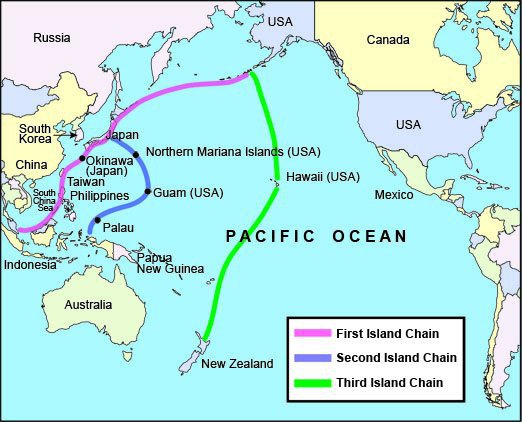
Of the 8.8 million presentations at emergency departments each year, one in three people wait more than four hours to be treated and admitted to a ward for further care, or to be discharged.

Our fragile public health system and its staff need urgent attention before emergency departments can recover.

Not a new problem

Demand for urgent hospital care is increasing Australia-wide, placing prolonged strain on the acute care services provided by emergency departments. But demand has been building over decades, not months.

According to the Australian Institute of Health and Welfare, the number of people presenting at public emergency departments increased by 3.2% on average each year from 2014–2019, mostly due to an ageing population that is experiencing more complex health issues.

Perhaps surprisingly – and despite ups and downs in some cities over shorter periods – overall demand on emergency departments decreased during the peak COVID period as people chose to stay home or were in lockdown. Volumes have only recently recovered to normal levels.

Two key issues stand in the way of people getting emergency care.

First, the public health system is already at capacity, so even small increases in demand send it into gridlock.

Second, with more and more staff unable to work due to illness, including COVID infection, burnout and now influenza, there are not enough staff to look after patients.


Read more:
Hospital emergency departments are under intense pressure. What to know before you go


No slack in the system

Emergency departments are in the business of preparing for the unexpected, whether it’s a surge in COVID infections or mass injuries from natural disasters, large-scale accidents or a terrorist attack.

The surge becomes magnified when the event also affects health-care staff or facilities, taking away care capacity as demand increases. We are currently facing an early influenza surge, with rates around what’s typically seen in late June.

Systems can cope with unexpected events by allowing “slack” or holding excess capacity in normal times. Unfortunately, our health-care systems have been stripped of excess capacity. Cuts in the name of efficiency have been implemented by successive governments, without fully appreciating the implications on health-care supply in times of need.


Read more:
The private health insurance rebate has cost taxpayers $100 billion and only benefits some. Should we scrap it?


Working harder comes at a cost

During COVID, extra capacity was created by ambulance and hospital staff working faster and longer. Longer term, this results in burnout.

Because burnout is harder to see than ramped ambulances, it’s less likely to make the evening news – but it’s a more critical and complex problem.

Around 20,000 Australian nurses left the profession in 2021, many citing stress and abuse suffered on the job.

Around 8% of paramedics suffer post-traumatic stress disorder, twice the average for Australian workers. Almost one third are diagnosed with depression.


Read more:
Bad for patients, bad for paramedics: ambulance ramping is a symptom of a health system in distress


Just add beds?

The addition of “more beds” sounds like a practical solution – but hospital beds rely on staff (particularly nurses) to take care of the patients in them.

Addressing hospital staff shortages is less straightforward. There is a long lead time to train additional nurses and we can’t rely solely on importing them from overseas. New Zealand is already concerned we’re going to take many of its nurses to help our aged care sector and other countries are competing for skilled hospital staff.

In an attempt to relieve pressure, governments want to divert those with less severe illnesses or injury away from emergency departments to urgent care centres or 24-hour GPs. This may improve access to care for some patients, but it may not substantially reduce emergency demand. New South Wales data shows surprisingly few people went to emergency when they could have gone to a GP.

Improving flow

The long-term solution to emergency department blockages is to increase throughput.

Imagine the hospital as a bathtub, and the patients as the water streaming into the bath. Increasing the bath size is a temporary fix. If you can’t turn off the tap, it will quickly fill. We need to work on the drainage system – increasing the size of the drain and unblocking any pipes that are clogged.

Hospitals have a duty of care to discharge patients to a safe environment. To quicken hospital discharges, we need more community capacity to house people with disability, people with mental health conditions who need supported care, older people who can no longer live alone without assistance, and homeless people.

hospital staff at busy work station
Addressing the shortage of health-care workers is a complex process.
Getty/Lisa Maree Williams

Working with patients

Processes often follow a “one size fits all” model, yet patients are diverse in their preferences and needs. Some groups have more complex needs, which mean they may spend longer in the emergency department.

We know, for example, emergency departments perform worse for older adults with multiple health conditions, people who have a disability or mental health condition, people who are Aboriginal and/or Torres Strait Islander, or who come from a culturally and linguistically diverse background.

We are about to embark on a project with three large Sydney hospitals. We will work with patients, clinicians and community groups to co-design emergency care improvements and reduce wait times. Examples might include strengthening connections between GPs and the emergency department, and greater use of technology to streamline care pathways and help patients navigate the journey.

For now, everyone can help alleviate stress on emergency departments by taking better care of their health, addressing problems early with their GP, and taking advantage of immunisation programs such as for COVID and influenza.

The Conversation

Robyn Clay-Williams receives funding from the Medical Research Future Fund and the Australian Research Council.

Henry Cutler receives funding from the Medical Research Future Fund, National Health and Medical Research Council and the Australian Healthcare and Hospitals Association

ref. Emergency departments are clogged and patients are waiting for hours or giving up. What’s going on? – https://theconversation.com/emergency-departments-are-clogged-and-patients-are-waiting-for-hours-or-giving-up-whats-going-on-184242

RSF condemns Chinese curb on reporters during Pacific island tour

Pacific Media Watch newsdesk

Reporters Without Borders (RSF) has condemned a media blackout imposed on events during Chinese Foreign Minister Wang Yi’s 10-day tour of Pacific island countries.

Wang is today in Papua New Guinea at the end of an eight-country tour that began on May 26, but a “Chinese state media reporter is so far the only journalist to be allowed to ask him a question”, says the Paris-based global media freedom watchdog.

On the second day of his two days in Fiji this week, “the media briefing itself was run by the visiting government [and] the press passes were issued by the Chinese government,” Fiji journalist Lice Movono told The Guardian.

Movono and her cameraman, and a crew with the Australian TV broadcaster ABC, were prevented from filming a meeting between Wang and the Pacific Islands Forum’s secretary-general shortly after Wang’s arrival in Fiji the day before, although they all had accreditation.

She also observed several attempts by Chinese officials to restrict journalists’ ability to cover the event.

“From the very beginning there was a lot of secrecy, no transparency, no access given,” Movono said.

During Wang’s first stop in the Solomon Islands on May 26, covid restrictions were cited as grounds for allowing only a limited number of media outlets to attend the press conference and only two questions were allowed ­– one to the Solomon Islands’ foreign minister by a local reporter and one to Wang by a Chinese media outlet.

No interaction with the media was allowed during his next two stops in Kiribati and Samoa.

Resist Chinese pressure
“The total opacity surrounding the events organised by the Chinese delegation with several Pacific island states clearly contravenes the democratic principles of the region’s countries,” said Daniel Bastard, head of RSF’s Asia-Pacific desk.

“We call on officials preparing to meet Wang Yi to resist Chinese pressure by allowing local journalists and international organisations to cover these events, which are of major public interest.”

Following the Solomon Islands, Kiribati, Samoa and Fiji, Wang visited Tonga, Vanuatu, Papua New Guinea and Timor-Leste with the same aim of signing free trade and security agreements.

RSF has previously condemned the Chinese delegation’s discrimination against local and international media during the Asia-Pacific Economic Cooperation summit held in November 2018 in Port Moresby, Papua New Guinea, with President Xi Jinping attending.

China is among the world’s worst countries for media freedom, ranked 175th out of 180 nations in the 2022 RSF World Press Freedom Index.

Pacific Media Watch collaborates with Reporters Without Borders.

Print Friendly, PDF & Email

Article by AsiaPacificReport.nz

Kontras criticises military officers being made regional heads as ‘return to New Order’

By Gita Irawan in Jakarta

Indonesia’s Commission for Missing Persons and Victims of Violence (Kontras) has criticised the appointment of Central Sulawesi State Intelligence Agency (BIN) regional chief (Kabinda) Brigadier-General Andi Chandra As’aduddin as the acting (Pj) regent of Seram Bagian Barat in Maluku province.

The appointment of As’aduddin was based on Home Affairs Ministry Decree Number 113.81-1164, 2022 on the Appointment of an Acting Seram Bagian Barat Regent in Maluku.

Kontras coordinator Fatia Maulidiyanti said that placing TNI (Indonesian military) or Polri (Indonesian police) officers in civilian positions indicates that the state has no interest in the mandate of reformasi — the political reform process that began in 1998.

One of these was abolishing the dual socio-political function of the armed forces (then called ABRI) and upholding civilian supremacy over the military.

Yet, according to Maulidiyanti, empty regional leadership posts can be filled by state civil servants with experience in administrative management.

She also questioned why the position had to be filled by a TNI officer.

“This is a betrayal of the mandate of reformasi and democratic values,” Maulidiyanti told Tribune News.

She said that what was frightening was the potential abuse of power.

This, she said, was because TNI officers had their own powers which were then augmented by the civilian position they occupied.

“Instead of promoting democracy, it is instead a return back to the New Order [the ousted regime of former president Suharto],” said Maulidiyanti.

Note:
The next regional elections will not take place until November 27, 2024. Regional heads who end their terms in office before this will be replaced by acting regional heads appointed directly by President Widodo in the case of governors and the Home Affairs Ministry in the case of regents and mayors. In total, there will be 271 regions led by acting regional heads, including 27 governors.

Translated by James Balowski for IndoLeft News. The original title of the article was Kontras Kritik Keras Penunjukan Perwira TNI Aktif Jadi Pj Bupati Seram Barat.

Print Friendly, PDF & Email

Article by AsiaPacificReport.nz

Te Amokura – Tairāwhiti artists behind Warriors indigenous jersey

By Kaupapa Māori reporter Matai O’Connor of The Gisborne Herald

Tairāwhiti tā moko artists Maia Gibbs and Henare Brooking designed the jersey the Warriors wore in their Indigenous Round National Rugby League match against Newcastle Knights last Saturday.

The jersey, called Te Amokura, is a powerful expression of connection, unity and identity developed in partnership with Puma and Gisborne’s Toi Ake Maori art gallery.

Maia Gibbs (Ngāi Tāmanuhiri, Rongowhakaata, Ngāti Kahungungu) and Henare Brooking (Ngāti Porou, Rongowhakaata, Te Whānau-ā-Apanui, Ngāti Kahungunu, Ngāti Tūwharetoa) run the gallery located in Ballance Street Village.

Public Interest Journalism Fund
PUBLIC INTEREST JOURNALISM FUND

It was set up about two years ago following the first covid-19 lockdown.

Gibbs said the jersey needed to “encompass what the club and team represent”.

“We are the paintbrushes and pencils that put it together but the players are the ones that live their lives under a microscope. This is about them and what they want to represent.

“It’s pretty cool to see our tohu holding its own,” he said.

Powerful expression
“I’m humbled to have had the opportunity to work on this project and see it come to life — even more so to do it along side taku tuakana Henare Brooking.

“To have the support of our iwi, hapū and whānau throughout is really special and we thank you all,” he said.

Te Amokura is a powerful expression of the Warriors’ connection, unity and identity. It takes its inspiration from the manu (bird) of the same name, known across the Pacific, Australia and Aotearoa.

The amokura helped the great navigators of the Pacific chart the largest body of water in the world.

It is known for its two distinct red elongated tail feathers which were highly prized by foremost warriors and chiefs throughout Te moana nui a Kiwa.

These are represented by two red strips on the back of the jersey.

The colours represent significant elements of the club’s identity but also the journey over the last three seasons, and the sacrifices made by players and staff to base themselves away from home, their families and their fans.

The Warriors jersey designers Maia Gibbs (from left), Michaela Brooking and Henare Brooking
The Warriors jersey designers Maia Gibbs and Henare Brooking with Michaela Brooking. Image: The Gisborne Herald

The collective whakapapa
Blue represents mana moana — the ocean — that connects Aotearoa, Australia and the Pacific, carrying the collective whakapapa.

Green represents mana whenua — the land — Aotearoa acknowledging the Warriors’ true home and importantly Australia’s mana whenua, the Aboriginal whanaunga and the original people of Australia who hosted the team over the last three seasons.

Red represents mana tāngata — the people — connecting players past, present and future, and interweaving the whakapapa of each individual as they move into the field of battle.

The black represents Te Pō — a place of development and learning — while the white is Te Ao — a place of expression and action.

The jersey is like a korowai (cloak) that adorns the wearer, not just as a jersey but as a representation of their own journey.

It is a celebration of the Warriors’ cultural identity and a representation of the connection they share as indigenous people across the world.

This year’s NRL Indigenous Round focused on creating a space for learning and educating Australians about Indigenous culture as well as encouraging the rugby league community to take three key actions to be part of the change — learn the land; learn the history; support an Indigenous business.

The Te Amokura | Pacific Media Centre
The Te Amokura | Pacific Media Centre logo.

Note: Te Amokura is also the Te Reo Māori name of the Pacific Media Centre, which launched this website Asia Pacific Report in 2016. Asia Pacific Report is now published independently in association with Evening Report and Pacific Journalism Review.

Republished with permission by The Gisborne Herald and NZ On Air.

Print Friendly, PDF & Email

Article by AsiaPacificReport.nz

Petition to officially name country Aotearoa delivered to Parliament

By Giles Dexter, RNZ News political reporter

New Zealand’s Te Pāti Māori has handed over its petition — with 70,000 signatures — calling for the country to officially be named Aotearoa.

It is on our passports, on our money, and in our national anthem. But Aotearoa is not our official name, yet.

The petition was delivered to Parliament today. It calls to change the country’s official name to Aotearoa, and begin a process to restore te reo Māori names for all towns, cities, and places by 2026.

“Whether you’re for or against, the thing is everyone knows that Aotearoa is a legitimate name given to this country by Kupe — not by Governor Grey or any written book, this is well before any of those things,” Te Pāti Māori co-leader Rawiri Waititi said.

Te Reo fluency among Māori dropped from 90 percent in 1910 to 26 percent in 1950.

Today, just 20 percent of the Māori population speak it. That’s three percent of the whole country.

Waititi said the only way to restore the language was to make it visible in as many places as possible.

‘Pebble being dropped in the water’
“This is the pebble being dropped in the water, the initial pebble hitting the water. And what it’ll do, from now for many years to come, is those ripples will continue to get bigger and bigger.”

The petition now goes to a select committee, which will decide what to do next. Whether that was a bill or even a public referendum, it had already succeeded, Waititi said.

“It’s starting the dialogue, it’s building awareness. It has started a wananga across the country.”

National leader Christopher Luxon said changing the name was a constitutional issue.

“I think those are decisions for the New Zealand people, if there’s widespread support it should go to referendum and it should be a decision that they get to make. It’s not something the government makes,” he said.

But just last week Luxon posted a tribute in te reo Māori to kaumatua Joe Hawke, resulting in a tirade of anti-Māori remarks from National supporters.

Waititi brushed off any backlash the petition, and by extension he, received.

“If they’re getting their undies in a twist, that’s their undies, not my undies,” he said.

Time for a discussion
Government ministers said it was time for a discussion over changing the name, but were not actually committing to one.

“These things evolve over time, but it’s up to every New Zealander to be part of the debate,” Andrew Little said.

“I’m mindful that representatives from Ngāi Tahu have pointed out that Aotearoa tends to focus on the North Island, but that’s a debate that can rightly happen,” David Clark said.

Associate Health Minister Ayesha Verrall admitted she had not given it any thought.

“But I’m very comfortable having the country referred to as Aotearoa-New Zealand,” she said.

Deputy Prime Minister Grant Robertson said it was not something the Labour caucus had discussed, while Michael Wood called for open-mindedness.

“I think any question like that needs to be worked through really carefully. It’s the name of our country, the identity of our country,” he said.

Labour’s Māori caucus divided
Labour’s Māori caucus was somewhat divided

“I think we should have a good conversation about it. I’ve personally got no problems with us using Aotearoa but it’s a question for the whole country,” Kelvin Davis said.

Minister of Māori Development Willie Jackson supported the use of Aotearoa, but said he had recently been travelling around the country, speaking to Māori communities, and changing the country’s name never came up.

“We have other kaupapa more important right now,” he said.

Peeni Henare believed the country was ready.

“I’m encouraging one and all to have a very mature debate over what I think is a pretty cool kaupapa,” he said.

Artist Hohepa Thompson, also known as Hori, backed the petition.

Hori’s Pledge response
Hori’s Pledge is a response to billboards popping up around the country saying “New Zealand, not Aotearoa”, funded by lobby group Hobson’s Pledge.

Thompson had been driving across Te Ika a Maui, with his own billboard in tow, to call for change.

He believed a hyphenated ‘Aotearoa-New Zealand’ would not go far enough.

“Māori have taken the backseat for many, many times. So when it comes to Aotearoa-New Zealand, let’s have this. Aotearoa, boom.”

The most positive conversations on his trip came from people who did not even know Pākehā history, he said.

“The only renaming that happened here was from that side. So we’re not trying to create ‘change’, were just re-instating what was already here.”

He pointed out a similar subject that took place recently.

Three years ago, some said a national holiday for Matariki would never happen. Later this month, it will be officially celebrated for the first time.

This article is republished under a community partnership agreement with RNZ.

Print Friendly, PDF & Email

Article by AsiaPacificReport.nz

What does China want in the Pacific? Diplomatic allies and strategic footholds

Source: The Conversation (Au and NZ) – By Denghua Zhang, Research fellow, Australian National University

By the time Chinese Foreign Minister Wang Yi’s ten-day tour of the Pacific is over in early June, he will have met with leaders from all ten Pacific island countries that have diplomatic relations with China.

This tour is the second of its kind since 2006 (his predecessor Li Zhaoxing visited the region that year). It follows a meeting of Pacific foreign ministers with China last year.

But what does China want from the region and why is it showing such strong interest in the Pacific?

China wants two main things

China seeks two main things from the region – one diplomatic and one strategic.

Diplomatically, it needs the voting support of Pacific islands at the United Nations. These countries, most of which are small, have an equal vote at the UN.

Their support – on issues such as Taiwan, Tibet, Xinjiang, Hong Kong, South and East China Seas, and human rights – matters to China.

For example, during Wang’s visit, Pacific leaders pledged to stick to the “One China” policy. This means they will recognise the People’s Republic of China over the Republic of China (Taiwan).

However, the China-Taiwan diplomatic battle is far from over. In the Pacific, Palau, Marshall Islands, Tuvalu and Nauru still recognise Taiwan.

Strategically, China sees Pacific islands as a target of what’s known as “South-South co-operation” – partnerships between developing countries.

China’s mistrust of developed countries is deep rooted and has persisted since the founding of the communist regime in 1949. To reduce the strategic pressure from developed countries, China strives to forge close ties with the developing world.

In this sense, Wang’s Pacific visit is largely prompted by recent heightened competition between China and the US-led traditional powers.

The Quad countries (Australia, India, Japan, and the United States) recently released a joint leaders statement promising to increase their support to countries in the Indo-Pacific region.

It is hardly a coincidence that on the same day, China’s ministry of foreign affairs revealed the itinerary for Wang’s Pacific visit. Details of concrete achievements arising from the provinces of Chinese Guangdong, Fujian and Shandong’s engagement with Pacific islands were released the following day.

China is signalling it will not recede in its competition with traditional powers. It also wants to send a message that a closer relationship with China will benefit Pacific islands.

Security significance for China

In the long run, the Pacific islands have great security significance for China.

China’s People’s Liberation Army, especially the navy, has aimed to break the “island chains” (in particular, there are a series of military bases on islands near China and in the Pacific, which Beijing believes the US and its allies are using to encircle China).

The Pacific islands sit along one of these island chains. Little wonder, then, the Chinese military is keen to gain a foothold in the Pacific in the long run – this would be crucial if competition between China and the US deteriorates into rivalry and even military conflict.

This is why traditional powers are alarmed by the China-Solomon Islands security pact – despite clarification from Beijing and Honiara China will not establish a military base in Solomon Islands.

To achieve these objectives, China has worked hard to foster a closer relationship with Pacific islands. In particular, it has highlighted its respect of Pacific islands as equal partners, economic opportunities for Pacific commodities to enter the massive Chinese market, and the benefits of Chinese aid for the region.

Proposed agreements

In this context, China proposed two broad agreements to be signed by all its Pacific partner countries during Wang’s visit.

However, this plan was shelved due to the lack of consensus among Pacific leaders on the nature of these agreements and potential negative implications for regional security.

For example, prior to Wang’s visit, President of the Federated States of Micronesia David Panuelo wrote to leaders of all Pacific island countries and territories warning that signing these agreements may drag Pacific islands into conflicts between China and the US in future.

This may have taken China by surprise; President Panuelo paid a successful state visit to China in 2019 and lauded his country’s relationship with China as “great friendship taken to a new high”.

This was a clear setback for China. As a suboptimal solution, China’s ministry of foreign affairs turned the two agreements into a position paper and published it on May 30.

A main difference is that in the position paper, China only briefly states its readiness to co-operate with Pacific islands to promote regional security, combat transnational crimes and tackle non-traditional security threats.

By contrast, the original two agreements had more details on security co-operation such as providing police training for the region and strengthening co-operation on cyber security.

Apparently, China has learnt to downplay its planned co-operation with Pacific islands on security, an increasingly sensitive area amid the competition.

Looking into the near future, it is likely China will be more cautious in expanding its engagement with the Pacific region.

It will likely focus on pragmatic co-operation in less sensitive areas like climate change, poverty reduction, agriculture and disaster relief.

China will lobby for more support from Pacific islands before it is willing to reintroduce the broad agreements.

The Conversation

Denghua Zhang does not work for, consult, own shares in or receive funding from any company or organisation that would benefit from this article, and has disclosed no relevant affiliations beyond their academic appointment.

ref. What does China want in the Pacific? Diplomatic allies and strategic footholds – https://theconversation.com/what-does-china-want-in-the-pacific-diplomatic-allies-and-strategic-footholds-184147

To meet the Chinese challenge in the Pacific, NZ needs to put its money where its mouth is

Source: The Conversation (Au and NZ) – By Alexander Gillespie, Professor of Law, University of Waikato

Getty Images

This week’s White House meeting between Jacinda Ardern and Joe Biden reflected a world undergoing rapid change. But of all the shared challenges discussed, there was one that kept appearing in the leaders’ joint statement – China in the Pacific.

Tucked within the statement, with all its promises of increased co-operation and partnership, was this not-so-subtle declaration:

In particular, the United States and New Zealand share a concern that the establishment of a persistent military presence in the Pacific by a state that does not share our values or security interests would fundamentally alter the strategic balance of the region and pose national-security concerns to both our countries.

Unsurprisingly, this upset Chinese officials, with a foreign ministry spokesperson accusing Ardern and Biden of trying to “deliberately hype up” the issue.

But hopefully the statement will also prompt New Zealand to put its money where its mouth is when it comes to increasing assistance in the Pacific region. Expressing “concern” about China’s influence means little otherwise.

Shared concerns: Joe Biden meets Jacinda Ardern in the Oval Office on May 31.
Getty Images

Aid and influence

While New Zealand and Australia are responsible for around 55% of all of the aid flowing into the region, that contribution needs to be seen in perspective.

There are two obvious shortcomings. First, more needs to be done to promote democracy in the Pacific, which means supporting anti-corruption initiatives and a free press. Second, both countries simply need to give more.

Neither spends anywhere near the 0.7% of gross national income on development assistance recommended by the United Nations (UN).


Read more:
Amplifying narratives about the ‘China threat’ in the Pacific may help China achieve its broader aims


The high-tide mark for both was long ago: 0.52% for New Zealand in 1975 and 0.48% for Australia in 1967. Today, New Zealand spends 0.26% and Australia 0.21% of their incomes on overseas aid.

It’s against this backdrop of under-spending that China has come to be seen as an attractive alternative to the traditional regional powers. It has no colonial baggage in the Pacific and is a developing country itself, having made impressive leaps in development and poverty reduction.

Debt and distress

Many of the small developing island states in the Pacific share common challenges and vulnerabilities: negative migration patterns, risk from climate change and fragile economies.

Three states in the region (Kiribati, Solomon Islands and Tuvalu) are in the UN’s “least developed countries” category. Two others (Samoa and Vanuatu) are just above the threshold. Most are at high risk of debt distress, increasing the risk of poor policy decisions simply to pay bills.


Read more:
New Zealand has just joined an overtly anti-China alliance – are the economic risks worth it?


The average debt-to-GDP ratio for Pacific states has risen from 32.9% in 2019 to 42.2% in 2021. Vanuatu, Palau and Fiji have debt-to-GDP ratios greater than 70%.

China currently accounts for only about 6% of all aid in the region, but supplements this with grants and loans, some commercial and some interest-free. These overlap with grand infrastructure plans such as the Belt and Road Initiative aimed at connecting many regions of the world.

While it might not have secured its desired regional multilateral trade and security agreement with Pacific nations, China is clearly in the Pacific for the long haul.


Read more:
Saying China ‘bought’ a military base in the Solomons is simplistic and shows how little Australia understands power in the Pacific


Working with China

This presence need not be seen entirely negatively. In the right circumstances, Chinese assistance can have a positive impact on economic and social outcomes in recipient countries, according to the International Monetary Fund. (The same study also found a negative but negligible effect on governance.)

Overall, Chinese influence in the Pacific is not necessarily something that must be “countered”. For the good of the region, countries should seek ways to work together, especially given that aid to the Pacific is often fragmented, volatile, unpredictable and opaque.

Co-ordinated, efficient and effective partnerships between donors, recipients and regional institutions will be vital, and co-operation with China could be part of this.

New Zealand and Australia need to expand their work on the vast infrastructure and development needs of the Pacific. Transparency should be a priority with all projects and spending, and co-operation should be tied to shared benchmarks such as the UN’s Sustainable Development Goals.

For its part, China should give more aid rather than loans (especially to the least developed countries) to avoid the risk of poor countries becoming beholden to lenders or even bankrupted.

Peace and security

Above all, peace and security between and within countries should be an agreed fundamental principle. The good news is that South Pacific nations have already taken steps towards this by agreeing to the Nuclear Free Zone Treaty.

This could be complemented by an agreement banning foreign military bases in the region to maintain its independence. If needed, peacekeeping or outside security assistance should be multilateral through the UN, not bilateral through secret arrangements.

Co-operation for the good of the Pacific should be the goal, but this is only possible if the region is not militarised.

Chinese influence and power in the Pacific is a reality that cannot be wished away or easily undermined. With the US similarly determined to assert itself, the stakes are rising. All nations should work together to ensure no small, independent Pacific country becomes a pawn in what could be a very dangerous game.

The Conversation

Alexander Gillespie does not work for, consult, own shares in or receive funding from any company or organisation that would benefit from this article, and has disclosed no relevant affiliations beyond their academic appointment.

ref. To meet the Chinese challenge in the Pacific, NZ needs to put its money where its mouth is – https://theconversation.com/to-meet-the-chinese-challenge-in-the-pacific-nz-needs-to-put-its-money-where-its-mouth-is-184315

How to complain about aged care and get the result you want

Source: The Conversation (Au and NZ) – By Jacqueline Wesson, Senior Lecturer (Teaching and Research), Discipline of Occupational Therapy, School of Health Sciences, Faculty of Medicine and Health, University of Sydney

Shutterstock

It can be hard to know what to say, or who to talk to, if you notice something isn’t right for you or a loved one in residential aged care.

You might have concerns about personal or medical care, being adequately consulted about changes to care, or be concerned about charges on the latest bill. You could also be concerned about theft, neglect or abuse.

Here’s how you can raise issues with the relevant person or authority to improve care and support for you or your loved one.


Read more:
What is ‘quality’ in aged care? Here’s what studies (and our readers) say


Keep records

You can complain about any aspect of care or service. For instance, if medical care, day-to-day support or financial matters do not meet your needs or expectations, you can complain.

It is best to act as soon as you notice something isn’t right. This may prevent things from escalating. Good communication helps get better results.

Make written notes about what happened, including times and dates, and take photos. Try to focus on facts and events. You can also keep a record of who was involved and their role.

Keep track of how the provider responded or steps taken to resolve the issue. Write notes of conversations and keep copies of emails.

Who do I complain to?

Potential criminal matters

If you have concerns about immediate, serious harm of a criminal nature then you should contact the police, and your provider immediately. These types of serious incidents include unreasonable use of force or other serious abuse or neglect, unlawful sexual contact, stealing or unexpected death.

The provider may have already contacted you about this. They are required to report such serious incidents to both the Aged Care Quality and Safety Commission within 24 hours, and to the police.

Other matters

For other matters, talk to the care staff involved. Try to find out more detail about what happened and why things went wrong. Think about what you expect in the situation.

Then talk to the most senior person in charge, to see if they can make changes so things don’t go wrong in the future. This person may be called the nursing unit manager, care manager or care director.


Read more:
How to check if your mum or dad’s nursing home is up to scratch


Providers must acknowledge and investigate your complaint, tell you their findings and actions taken, and follow up to see if you are satisfied.

If you would like support to talk to the provider, the Older Persons Advocacy Network can help. This free service provides independent and confidential support to help find solutions with the aged-care provider. The network can also help you lodge a formal complaint.

How to I lodge a formal complaint?

If you are not satisfied with the way your provider responded, you can lodge a complaint with the Aged Care Quality and Safety Commission.

Be prepared to submit the facts and events, plus emails and correspondence, you have already collected. Think about what you want to happen to resolve the complaint.

Each complaint is handled individually and prioritised depending on the risks to you or your loved one. The commission will start its processes within one business day when complaints are urgent. The resolution process took an average 40 days in 2020-21.

You can complain confidentially, or anonymously if you feel safer. But the commission may not be able to investigate fully if it’s anonymous. Also, there are limits to what the commission can do. It cannot ask providers to terminate someone’s employment, or provide direct clinical advice about treatment.

Elderly woman looking worried on phone
You can complain confidentially or anonymously if you feel safer.
Shutterstock

Sometimes the commission has issued a “non-compliance” notice to the provider (for a failure to meet quality standards), and action may again be limited. So it is a good idea to check the non-compliance register beforehand to see if your provider is listed.

What do others complain about?

From October to December 2021, about a third of Australian nursing homes had a complaint made to the commission against them. Some had more than one complaint. More than half of these complaints were lodged by family, friends or other consumers.

The top reasons for complaints were about:

  • adequacy of staffing

  • medication administration or management

  • infectious diseases or infection control

  • personal and oral hygiene

  • how falls are prevented and managed

  • consultation or communication with representatives and/or family members.

What if I’m still not happy?

If you’re not happy when you receive the commission’s outcome, you can request a review with 42 days.

You can also request the Commonwealth Ombudsman to review the complaint if you’re not satisfied with the commission’s decision or the way the commission handled your complaint.

Elderly man leaning on fist, looking worried
You or your loved one can ask for a review if you’re still not happy with the outcome.
Shutterstock

Remember, you have a right to complain

The Aged Care Royal Commission spotlighted the neglect and substandard care that can occur in nursing homes. Despite attempts to lift the standard of aged care, we know residents and carers still have concerns.

Residents, and their representatives or families, have a legal right to speak up and complain, free from reprisal or negative consequences. This right is also reflected in the Charter of Aged Care Rights, which providers are legally required to discuss with you and help you understand.

Moving to another facility

If you have exhausted all avenues of complaint or feel conditions have not improved, you may decide to move to another provider or facility, if available. This option may not be possible in rural areas.

This is a difficult decision. It takes time, as well as financial and emotional resources. Starting again with a new provider can also be disruptive for everyone, but sometimes it may be the right choice.


Contact the Older Persons Advocacy Network on 1800 700 600, the Aged Care Quality and Safety Commission on 1800 951 822 or the Commonwealth Ombudsman on 1300 362 072.

The Conversation

Jacqueline Wesson has previously worked at Montefiore Residential Care and continues to have a professional link with them. She has previously received funding from Dementia Australia, and has provided advice about restrictive practice legislation via a local PHN.

Lee-Fay Low receives funding from the NHMRC and Dementia Australia. She has previously received research funding from aged care providers including HammondCare and The Whiddon Group, as well as state and federal governments. She has also received honorarium from Roche. She has provided input and advice to multiple aged care providers and government bodies including to the Royal Commission into Quality and Safety in Aged Care, and the Aged Care Quality and Safety Commission.

ref. How to complain about aged care and get the result you want – https://theconversation.com/how-to-complain-about-aged-care-and-get-the-result-you-want-180036

Our business schools have a blindspot that’s hindering a more co-operative culture

Source: The Conversation (Au and NZ) – By Gregory Patmore, Emeritus Professor of Business and Labour History, University of Sydney

Shutterstock

Tranby is an Indigenous adult education school in the inner-city Sydney suburb of Glebe. Founded in 1957, its graduates include Eddie Mabo, who went on to win the most significant land rights legal battle in Australian history – overturning the fiction of terra nullius.

What makes Tranby special is not just being Australia’s oldest not-for-profit independent Indigenous education provider. It is the type of education it provides – teaching the skills needed to manage organisations and communities democratically.

It teaches co-operation, and the skills to run co-operative organisations.

This makes it a rarity in business education.

Tranby Aboriginal Co-Operative is Australia’s oldest Indigenous adult dducation provider.
Tranby, CC BY-NC-ND

Though co-operatives exist throughout Australian society, making a hugely valuable economic contribution, their distinctive nature and management requirements are largely ignored by university business schools.

This neglect is costing us all.

Part of the social fabric

Australia has a rich history of communities forming co-operatives to provide services where for-profit businesses or the state have been unwilling or unable.

They run shops and schools, offer banking and mortgage services, and provide housing and health services.


Read more:
More affordable housing with less homelessness is possible – if only Australia would learn from Nordic nations


The first co-operative in Australia is thought to be the Brisbane Co-operative Society, which set up a store in 1859.

Over the next century came many agricultural co-ops. In the 1950s and 1960s, co-workers and communities pooled funds to form building societies and credit unions when banks were unwilling to lend money.

More recently regional communities have established co-operatives to replace shuttered businesses, to spearhead renewable energy and manufacturing projects, and to provide better conditions for cleaners and care workers.

When the northern Victorian town of Sea Lake was left without a pub after one hotel shut and the other burnt down, locals formed a co-operative to reopen and run the Royal Hotel.
Kerry Anderson, CC BY

Co-ops range in size from small neighbourhood operations, such the Gymea community preschool in Sydney to major enterprises such as Cooperative Bulk Handling in Western Australia, which reported a $133 million surplus in 2021.

All up there are more than 1,700 in Australia. It’s possible you’re a member of one – or a closely aligned “mutual” organisation (such as the NRMA or RACV). About eight in ten Australians are, yet fewer than two in ten realise it.

Improving co-operative education

This general lack of recognition is reflected by the sector’s almost complete invisibility in educational courses.

In 2016 a Senate committee inquiry found neglect of co-operative and mutual businesses in high-school and university courses was a clear impediment for the sector.

It could easily be concluded this neglect has also actively damaged the sector – notably through the 1980s and 1990s with “demutualisation
of big member-owned organisations such as AMP and the St George Bank.

This effectively involved privatising these organisations for the benefit of existing members, who got windfall profits at the expense of future members.

Demutualisation was pushed by managers and consultants educated in business, but not in the distinctive values of co-operative business.


Read more:
Why AMP and IOOF went rogue


They often regarded the co-operative and mutual structure as less competitive than an investor-shareholder model focused on maximising profits.

Subsequent developments have proven how flawed these assumptions were. AMP, for example, featured heavily among the wrongdoings exposed by the Hayne royal commission into financial services. No co-operative or mutual business did.

Levelling the playing field

The Senate inquiry report recommended the federal government look to improve understanding of co-operatives and mutual through secondary school curriculum. It also recommended universities include topics on co-operatives in their business and law programs.

In 2017 the University of Newcastle established Australia’s first postgraduate program in co-operative management and organisation.

But it axed the program in 2020 due to pandemic-related cutbacks and insufficient student numbers.


Read more:
Why it’s time for business schools to radically rethink the MBA


Now, apart from the University of Sydney’s Co-operatives Research Group and the University of Western Australia’s Co-operative Enterprise Research Unit, the landscape is bare.

What’s needed are both specialist courses and recognition within general business or law courses. You’d be hard placed to find a business degree that gives co-operatives more than fleeting attention.

The focus instead is on individual entrepreneurship, investor-owned businesses and vague ideas of social business.

Economic viability with social responsibility

The 2016 Senate inquiry report noted co-operatives have an important economic role to play. They increase competition in highly concentrated markets (such as banking). They provide services in areas where investor-owned or state enterprises do not work.

It singled out Tranby College as an excellent example of what can be achieved – both for members and the broader community:

Evidence suggests the co-operative model is ideal in delivering services in remote areas, such as Indigenous communities, where issues can be complex and service provision through the private sector is often not suitable or available.

As former United Nations secretary-General Ban Ki-moon has said, co-operatives show “it is possible to pursue both economic viability and social responsibility”.

It is important students at all levels be aware of what makes co-operative businesses different and valuable.

Hopefully the Albanese government will not neglect them. They have a lot to offer communities and reinforce democratic values.

The Conversation

Gregory Patmore received funding from the Australian Research Council Discovery Program (DP170100573) for the main research underlying this contribution and has received funding from the Business Council of Co-operatives and Mutuals for a specific project on COVID-19 and co-operatives.

ref. Our business schools have a blindspot that’s hindering a more co-operative culture – https://theconversation.com/our-business-schools-have-a-blindspot-thats-hindering-a-more-co-operative-culture-182218

Has lowering the drinking age caused more crime? Despite ongoing concern, the evidence isn’t clear cut

Source: The Conversation (Au and NZ) – By Alexander Plum, Senior Research Fellow in Applied Labour Economics, Auckland University of Technology

Getty Images

It’s fair to say that drinking alcohol is popular among Kiwis, to the point of potential harm.

According to the latest New Zealand Health Survey, one in five adults – or 824,000 people – have an established drinking pattern that “carries a high risk of future damage to physical or mental health”.

In 2016, data showed heavy drinking sessions were much more common in New Zealand than in the UK, the US, Canada and even countries like Finland, Norway and Sweden.

Alcohol abuse is also a major contributor to crime. In 2010, the New Zealand Police estimated about one-third of all police apprehensions involved alcohol and half of serious violent crimes had alcohol as a contributing factor.

Dropping the purchasing age

However, in a landmark alcohol reform enacted in 1999, New Zealand reduced the minimum purchasing age from 20 to 18 years old.

Politicians in favour of the change argued that an 18-year-old could vote and marry and should therefore be given the chance to drink in a safe environment.

Since then, there has been an ongoing debate among social and political commentators, including health professionals, over whether the legal purchasing threshold should be raised back to 20.

Critics of the 1999 reform usually cite a potential increase in public health risks to support their point of view.

Last year, in an unprecedented move, the heads of the district health boards released a joint statement calling for the reform of the 2012 Sale and Supply of Alcohol Act.

The statement proposed numerous changes to reduce easy access to alcohol, including increasing the legal purchasing age from 18 to 20.

Man in costume drinks from wine bottle.
New Zealand’s drinking culture is well known, but data show dropping the drinking age increased only some types of alcohol-related crime.
Tim Clayton/Getty Images

Does alcohol access cause a jump in crime?

In a recent study, researchers found monthly consumption jumped drastically when individuals turned 18 and could legally purchase alcohol.

The researchers used Statistics New Zealand’s integrated data infrastructure (IDI) to test whether this change in drinking behaviour prompted a corresponding spike in alcohol-related criminal behaviour among 18- and 19-year-olds.

The analysis also took advantage of the detailed crime register administered by the Ministry of Justice.

The spectrum of offences is broad, ranging from minor incidents, such as bringing alcohol into an alcohol banned area, to severe crimes like causing injury through excess alcohol.

The authors considered convictions a more accurate measure of crime than arrests, as not every arrest leads to a conviction.


Read more:
College-age kids and teens are drinking less alcohol – marijuana is a different story


Researchers looked at the difference in alcohol-related criminal behaviour for ages just below the minimum legal purchasing age versus ages right above the mandated age threshold.

Put simply, the research compared the criminal outcomes of youths who had just gained the right to buy alcohol to those who were close to turning 18 and therefore unable to legally buy it.

There was a slight increase in traffic violations by drivers around the currently mandated age of 18. However, the analysis found little evidence that 18- and 19-year-olds committed more alcohol-related crimes after reaching the legal purchasing age.

From 2014 to 2018, the average number of alcohol-induced offences for those aged 17 years and 11 months stood at 53 convictions per 100,000 people and increased by four convictions in the month turning 18. This equals an increase of 8% but is not statistically significant.

However, similar to previous research, the analysis indicated that gaining easier access to alcohol was associated with an immediate spike in other crimes, particularly dangerous acts and property damage.

The average number of property damage convictions (per 100,000 people) where alcohol was involved increased from 40 to 51 (28%), and dangerous acts increased from 47 to 60 convictions (27%) in the month of turning 18.

Man drinking beer while driving.
There was a slight increase in alcohol-related traffic offences after the legal drinking age dropped to 18 years old.
Getty Images

Alcohol purchasing age of 20

The researchers also examined how criminal behaviour changed in the period between 1994 and 1998 when the legal alcohol purchasing age was 20.

They found that all alcohol-related convictions dropped from 203 to 163 (19%) in the month of turning 20.

This surprising pattern is caused by changes in the legal breath and blood alcohol limit, which takes place at the same age and permits higher blood alcohol levels for drivers aged 20 and above.

When removing those types of convictions, the researchers find no observable jump in alcohol-related crimes. That said, there was an increase in offences against public order and other traffic-related convictions.

Alcohol and crime in the US and Canada

These findings align with the data from the United States and Canada.

A US study looked at how crime rates changed around the minimum legal drinking age of 21 in the states where drinking and purchasing alcohol below the age of 21 is not permitted.


Read more:
Binge drinking and blackouts: Sobering truths about lost learning for college students


The authors found individuals aged just over 21 were 5.9% more likely to be arrested than individuals just under 21. However, crime levels for this age group were substantially higher compared to New Zealand.

In Canada, where the minimum legal drinking age for most states sits at 18, and 19 in Alberta, Manitoba and Québec, a sharp increase of 7.6% in all crimes was observed – with a large jump of 29.4% for disorderly conduct.

As two decades of data shows, allowing younger people to drink has resulted in upticks in some types of crime, but not all of them. Understanding the impact of lowering New Zealand’s drinking age can inform the ongoing policy debate and offers decision makers an insight into how these sorts of thresholds can change society in unexpected ways.

The Conversation

The authors do not work for, consult, own shares in or receive funding from any company or organisation that would benefit from this article, and have disclosed no relevant affiliations beyond their academic appointment.

ref. Has lowering the drinking age caused more crime? Despite ongoing concern, the evidence isn’t clear cut – https://theconversation.com/has-lowering-the-drinking-age-caused-more-crime-despite-ongoing-concern-the-evidence-isnt-clear-cut-182035

This Australian grasshopper gave up sex 250,000 years ago and it’s doing fine

Source: The Conversation (Au and NZ) – By Michael Kearney, Associate Professor in Ecophysiology and Evolutionary Biology, The University of Melbourne

Michael Kearney, Author provided

Most animals on Earth have two sexes, male and female, that combine and mix their genes when they reproduce. We are so accustomed to this state of affairs that the existence of all-female species that don’t have sex, but instead reproduce by cloning, comes as a great surprise.

The beautiful green grasshopper Warramaba virgo is one of these rare “parthenogenetic” species, in which an egg can develop into an embryo without being fertilised by a sperm. It lives in the southern parts of the Australian arid zone, where it feeds on mulga trees and other shrubs and bushes in the summertime.

A full-body photo of a Warramaba virgo grasshopper against a white background.
The grasshopper Warramaba virgo reproduces asexually.
Michael Kearney, Author provided

We have studied these grasshoppers for the past 18 years to understand how they developed asexual reproduction, and how the change has affected their ability to survive and reproduce.

Our new research published in Science shows W. virgo arose about 250,000 years ago from a cross between two different sexually reproducing species of grasshopper, and giving up sex appears to have had no negative repercussions for them whatsoever.

The puzzle of parthenogenesis

Biologists studying evolution have often considered the rarity of parthenogenetic species like W. virgo as a major puzzle.

This is because sex imposes big costs on animal reproduction. First, there is the “two-fold cost of sex”: half a creature’s offspring (the males) are unable to produce their own offspring alone, so they are often seen as “evolutionary wastage”.

Moreover, finding a mate takes energy and mating animals are often at greater risk of attack by predators. Doing away with males also removes these drawbacks.

A photograph showing a low bushy green tree in a landscape of red dirt
Warramaba virgo feeds on mulga trees (many of which also reproduce asexually).
Michael Kearney, Author provided

So why does sex exist at all? The main reason, biologists think, relates to the mixing or “recombination” of genes as a consequence of sex. This can speed up the rate of adaptation by bringing favourable combinations of genes together and also helps to purge a population of combinations of bad mutations.

Parthenogenetic species don’t have these processes: instead, all members of the species have virtually identical genes. This means they might be less able to adapt when the environment changes. What’s more, parthenogens could accumulate bad mutations that reduce their fitness.

But are these costs real? Do they result in the rapid extinction of any parthenogens that happen to form?

What’s the secret of W. virgo?

Over the past 18 years we have been investigating these questions in W. virgo.

This grasshopper was first studied in 1962 by the eminent evolutionary biologist and geneticist Michael White. White’s young son Nicholas first discovered them near the New South Wales town of Hillston, when he noted that only females of a particular species could be found.

White then went on to show that the same species was present 2,000 km away in Western Australia, along with a sexual species (recently named W. whitei).

W. virgo turned out to have a hybrid origin: a cross between W. whitei and another species, W. flavolineata, many thousands of years in the past.

A triptych of three face-on photographs of different grasshoppers.
Warramaba virgo (middle) and its ‘parent species’, W. flavolineata (left) and W. whitei (right)
Michael Kearney, Author provided

A parthenogenetic species might have an advantage if its genetic diversity is boosted by repeated hybridisations between the two parent species, producing an army of different clones. Combining the genomes of the two species might also make the parthenogens more vigorous.

Such “hybrid vigour” does occur in some animals, such as mules (crosses between a horse and a donkey). The mule has much greater strength and endurance than its parent species.

Could it be that the hybrid origins of W. virgo generated a diverse clone army with special abilities compared to its sexual relatives, or a hybrid with high level of vigour?

Few benefits to giving up sex, but also no drawbacks

The answers to these questions were a resounding “No”!

We examined more than 1,500 genetic markers in W. virgo and found almost no variation in the parthenogens compared with the parent species.

This showed clearly that only one hybrid mating between W. whitei and W. flavolineata was responsible for producing W. virgo in the first place. Based on the number and nature of mutations that have occurred in W. virgo, we estimate the mating occurred some 250,000 years ago.

We also showed that the parthenogen had no advantage over its parent species in a range of physiological traits including tolerance to heat and cold, rate of metabolism, how many eggs they lay, the size of their eggs, how long they take to mature and how long they live.

Meanwhile, W. virgo naturally produced twice as many female offspring as the sexual species. It retained its two-fold advantage over sexual species despite 250,000 years for low fitness mutations to accumulate in this species.

The conclusion from our research then is that W. virgo has become parthenogenic but without costs. It has also successfully spread all the way from the west side of the country to the east side, unlike its parent species.

Why don’t more species give up on sex?

So why then do we see sexual species everywhere despite their two-fold reproductive cost? We suspect it must be very difficult to develop parthenogenesis in the first place.

Indeed, we have tried experimentally crossing the same sexual species that gave rise to W. virgo and only created a few hybrids, none of which were able to produce offspring. The hybrid state may disturb the normal processes of egg development sufficiently to make parthenogenesis an extremely uncommon phenomenon in animals more generally.

A photograph of a grasshopper sitting on a leaf.
A lab-made cross of W. whitei and W. flavolineata. She produced few eggs, none of which hatched.
Michael Kearney, Author provided

We think future research into the paradox of sexual reproduction should focus on barriers that prevent sex from being lost, rather than only focusing on the advantages of sex.

The Conversation

Ary Hoffmann receives funding from the Australian Research Council.

Michael Kearney does not work for, consult, own shares in or receive funding from any company or organisation that would benefit from this article, and has disclosed no relevant affiliations beyond their academic appointment.

ref. This Australian grasshopper gave up sex 250,000 years ago and it’s doing fine – https://theconversation.com/this-australian-grasshopper-gave-up-sex-250-000-years-ago-and-its-doing-fine-184241

What would King Charles mean for the monarchy, Australia and the republican movement?

Source: The Conversation (Au and NZ) – By Ben Wellings, Senior Lecturer in Politics and International Relations, Monash University

This week’s Platinum Jubilee marks 70 years of Queen Elizabeth II’s reign over “the people of the United Kingdom, the Realms and the Commonwealth”. This occasion, the first ever for a British monarch, allows us to reflect on the importance of succession.

The queen’s royal title and duties will one day be transferred to Prince Charles, the 73-year-old Prince of Wales.

Although the timing of this transition remains uncertain, it may prompt many Commonwealth nations such as Australia to reconsider the legacy and legitimacy of the monarchy itself.

The precarity of succession

Succession has long been the weak link in the system of hereditary monarchy.

Sometimes this is because the current ruler produces no surviving heirs, as in the case of Queen Anne, or Carlos II of Spain.

Alternatively, it may be because others dispute the line of succession, as was seen in the war-provoking disputes over succession in the cases of William the Conqueror and “Bonnie Prince Charlie”.

Sometimes, succession has not been successful because the new monarch has practised the “wrong” religion, or married the “wrong” sort of woman – as was thought of James VII and II and Edward VIII, respectively.

Perhaps most memorably the objection to the principle is so violently held, no succession is possible at all. This was true in the cases of Charles I of Great Britain, Louis XVI of France, and Nicholas II of Russia.

For such reasons, successions must be carefully managed if monarchs want to ensure the royal line is preserved.


Read more:
A long line of discrimination but should succession to the throne be changed?


Succession and legitimacy

Across the Commonwealth, the monarch plays a crucial role in legitimatising systems of government.

Historical continuity denotes stability, an attribute that monarchies are supposed to embody. Hence the idea of the “king’s two bodies”: the physical form of the monarch may perish, but the idea of monarchy continues in the body of the new king or queen.

Our current queen holds the title of Queen Elizabeth II to associate her in line of succession with Elizabeth I. However, Queen Elizabeth is not, in fact, the second Elizabeth to reign in Australia, New Zealand, Canada, or even Scotland.

Instead, this continuity of title serves to imbue the monarchy with a sense of stability independent of party, faction, nation, or ideology.

This is not to say the monarchy is “above politics”, as is often claimed.

The emphasis on political stability and historical continuity puts it, as an institution, firmly in the conservative camp.

Conservatives tend not to write down their rules of operation in one place. One notable exception is Walter Bagehot’s The English Constitution. Published in 1867, this influential book distinguishes between the “efficient” and “dignified” parts of the constitution.

Bagehot viewed the “efficient” part of the constitution as responsible government, primarily concerned with statecraft, grand strategy, and the day-to-day running of kingdoms.

The “dignified” part, in contrast, provided a symbolic focus for the the notions of unity and loyalty across Britain and its Empire – of which the monarchy was a central element.

According to Bagehot, having a popular monarch is crucial to upholding the legitimacy of the political system.


Read more:
There’s a strong case to be made for constitutional monarchies. But there’s no case for one in Australia


Public perceptions of the monarchy

However, the popularity of a monarch can cut both ways.

If a monarch is unpopular, the legitimacy of the system can suffer. This is exemplified by public perceptions of Queen Victoria in the 1870s.

Following Prince Albert’s death in 1861, Queen Victoria remained largely absent from public life during an extended period of mourning. Meanwhile, republicanism gained significant political traction in England.

Similarly, neither Elizabeth II nor the monarchy were particularly popular in either the UK or Australia during the 1990s. Moreover, the death of Diana, Princess of Wales, in 1997 further damaged the monarchy’s public image.

Significant political resources were mobilised in the UK to rectify this situation. As a result, the monarchy was largely rehabilitated by the time of the Queen’s Golden Jubilee celebrations in 2002.

Yet, attitudes towards the monarchy can be equivocal – not least in Australia.

Former Prime Minister Tony Abbott, the most open promoter of monarchy among Australia’s recent prime ministers, came under intense criticism for his decision to appoint Prince Philip a Knight of Australia in 2015.

And the ABC received complaints after the announcement of Prince Philip’s death interrupted an episode of TV drama Vera, indicating ambivalent attitudes towards the monarchy as an institution.

Yet republicanism in Australia currently remains muted. This is in part because, as per the script-writing in the Netflix drama The Crown, the nonagenarian Queen can do no wrong.

The same cannot be said for the rest of the family.

Prince Andrew’s court case in the US, the internal feuding concerning the Duke and Duchess of Sussex (Harry and Meghan), and even William and Kate’s problematic reception during their tour of the Caribbean have harmed public perceptions of the monarchy across the Commonwealth.


Read more:
From dummy spits to a ‘sleaze machine’: Tina Brown’s The Palace Papers is a delectable account of a soap opera family


Royals or republic?

In Australia, proponents of republicanism assert Prince Charles’ future ascension to the throne could signify a critical juncture in the realisation of an Australian republic.

Such “constitutional wrangling” may be overshadowed by more pressing matters – pestilence and war being two current examples.

Nevertheless, the imminent transition from Elizabeth II to Charles III across the Commonwealth entails certain risks.

Barbados became a republic last year. Perhaps it may be time for Australia to reconsider the place of the monarchy in our own political system.

The Conversation

Ben Wellings does not work for, consult, own shares in or receive funding from any company or organisation that would benefit from this article, and has disclosed no relevant affiliations beyond their academic appointment.

ref. What would King Charles mean for the monarchy, Australia and the republican movement? – https://theconversation.com/what-would-king-charles-mean-for-the-monarchy-australia-and-the-republican-movement-182662

Could Australia’s new independent and Green MPs be key to better trans-Tasman relations?

Source: The Conversation (Au and NZ) – By Jennifer Curtin, Professor of Politics and Policy, University of Auckland

Supporters of independent candidate Kylea Tink celebrate her victory over the Liberal incumbent in North Sydney. Getty Images

Almost two weeks on from the Australian federal election and the Australian Labor Party looks set to govern alone with 77 seats, despite securing only 32% of the primary vote.

The Liberal and National parties were also beset by primary vote losses, while the winners appear to be the multitude of old and new small parties and independents. Between them, these outsiders have scooped up more than 30% of the vote in the House of Representatives.

It’s tempting to draw lessons for New Zealand from the Australian result – not least because the Liberal-National Coalition governed through the pandemic. The policies of Scott Morrison’s government were not unlike New Zealand’s – closing borders, providing additional funding to states and initially supporting lockdowns – and it was punished at the polls.

Also like New Zealand, they were slow to roll out vaccines and distribute rapid antigen test supplies. Australian cities experienced protests against lockdowns and vaccine mandates in the name of freedom. And while the economy remained resilient, Australia is facing rising cost of living, stretched supply chains and predictions of worse to come.

It would be easy to assume, then, that being the incumbent government at the height of a pandemic does not bode well for re-election. But it may also be that this outcome represents an opportunity for New Zealand.

The ‘teal’ deal

This Australian election was about much more than COVID-19. It was about Morrison’s leadership – or lack of it, especially after catastrophic bushfires and floods. He appeared to care little about political integrity or about the toxic culture within his party that alienated many female colleagues.

And he relished the opportunity to engage in divisive rhetoric on asylum seekers, China and climate change.


Read more:
He’s Australia’s 31st prime minister. So who is Anthony Albanese?


It was this last issue that spurred the zeal for independent “teal” candidates (perhaps best thought of as blue-green liberals) in the safe “leafy” electorates of Sydney, Melbourne and Perth, while in Queensland the Greens scooped seats off the Liberals and Labor.

This is not surprising, given research suggests an increasing number of Australians want to see progress on emissions reductions and are less likely to respond to a culture war on climate.

But the teal independents did more than highlight a progressive popular mandate for the environment. They also shone a light on the ugliness of pork-barrel politics and populism, and the limitations of centrally controlled major parties at a time when diverse communities want their voices heard.

Independents at the vanguard

That said, the rise of independents has been a slow and simmering trend in Australian politics, both federally and at the state and territory level. The Liberal and National parties have been the target of what appears to be an independent “movement” since the 1980s.

Independents won a number of rural and regional seats in the 1990s and 2000s, fuelled by three key factors: a belief that major parties were taking “safe” seats for granted, compulsory voting, and community-based candidates able to harness a geographical concentration of votes under Australia’s preferential voting system.

Indeed, by the early 2000s, Australia was home to more independent parliamentarians than any comparable Western country. At times they have held the balance of power. At others, they’ve championed causes the major political parties found too risky or uninteresting, including political integrity and human rights.


Read more:
The ‘Biloela family’ are going home – but what will Labor do with thousands of other asylum seekers in limbo in Australia?


Perhaps most relevant for New Zealand has been the influence of independents on Australia’s immigration and offshore detention policies.

In 2019, for example, independent Cathy McGowan sided with the Labor opposition and several other independents to pass the Medevac Evacuation Act, which made it possible for critically ill detainees to be treated on the Australian mainland.

The Morrison government claimed the new law was unconstitutional and repealed it after its “miracle” election victory later in 2019, with the support of independent senator Jacqui Lambie. Lambie reportedly traded her vote for the possibility of a more permanent solution based on New Zealand’s resettlement offer, finally taken up by Australia earlier this year.

Now, with the election of Anthony Albanese’s Labor government, there is discussion about a possible softening of the visa cancellation and deportation polices under section 501 of the Immigration Act. Here, the role of independent (and Green) MPs may be crucial to New Zealand’s interests.

A better deal for Australian Kiwis

There is now a strong tradition of independents committing to human rights issues, in the House and the Senate. And while their focus has often been on the plight of refugees and asylum seekers, the goodwill and energy of these cross-benchers might also be applied to improving pathways to citizenship for New Zealanders living permanently in Australia.

The current barriers to citizenship have fuelled the deportation rate, as well as blocked Australian New Zealanders from access to benefits after natural disasters or for medical disabilities.


Read more:
Albanese will bring a different style of leadership to the PM’s office –– can Australia make the adjustment?


The challenge for Jacinda Ardern will be to encourage Albanese and the new Labor government to loosen the 2016 arrangement made by the previous Coalition government. This offered a pathway to permanent residence and eventually citizenship, but applied only to New Zealanders who had been living in Australia before February 2016 and who met certain criteria.

Revising those conditions could form part of a revamped Closer Economic Relations agreement to mark its 40th anniversary next year. If that doesn’t work, New Zealand could consider lobbying Australia’s progressive independent and Green MPs.

Either way, the Albanese government is presenting itself as more interested in its Pacific neighbours and in those who want to make Australia their permanent home. As such, it represents the best opportunity in nearly a decade for more favourable trans-Tasman relations.

The Conversation

Jennifer Curtin is an Associate Investigator on an Australian Research Council grant (2022-2024) with Cosmo Howard and Juliet Pietsch that examines the history of the “fair go” in Australia and New Zealand.

She is the co-author with Brian Costar of the book “Rebels with a Cause. Independents in Australian Politics (UNSW, 2004).

ref. Could Australia’s new independent and Green MPs be key to better trans-Tasman relations? – https://theconversation.com/could-australias-new-independent-and-green-mps-be-key-to-better-trans-tasman-relations-183525

Herd immunity was sold as the path out of the pandemic. Here’s why we’re not talking about it any more

Source: The Conversation (Au and NZ) – By Hassan Vally, Associate Professor, Epidemiology, Deakin University

Shutterstock

Early in the pandemic, the term “herd immunity” hit the headlines, along with a polarised discussion on how to achieve it.

Some groups were attached to the now-discredited notion of letting a dangerous virus rip through the population to reach the critical level of population immunity needed to reduce transmission.

But a more serious conversation focussed on the prospect of attaining herd immunity by vaccination.

This is the idea that vaccines – when available and taken up at sufficient levels – could squash virus transmission. This would lead to the possible elimination or eradication of SARS-CoV-2, the virus that causes COVID.

The promise was this would herald the return of life back to normal.

It’s understandable why this notion gained so much attention, as it promised a complete return to a world without COVID. But in reality it was probably always a pipe dream.

As time wore on, herd immunity became even less reachable.

Here’s why we’re not talking about it any more, even with the high vaccination rates we see today.


Read more:
80% vaccination won’t get us herd immunity, but it could mean safely opening international borders


What is herd immunity?

If enough people in the community develop immunity to an infectious agent such as a virus, an epidemic is unable to grow.

In fact, much like a bushfire goes out when it runs out of fuel to burn, an epidemic begins to decline when the virus runs out of susceptible people to infect.

The level of vaccine coverage needed in a population to get you over the line to achieve herd immunity is the “herd immunity threshold”.

This depends on two main parameters – the infectiousness of the virus and the effectiveness of the vaccine.

In short, the more infectious the virus and the less effective the vaccine, the more people you need to vaccinate to achieve herd immunity.


Read more:
What is herd immunity and how many people need to be vaccinated to protect a community?


Further and further out of reach

As the pandemic progressed, herd immunity via vaccination moved further and further out of reach. In fact, based on what we know about currently circulating viral variants, today, herd immunity via vaccination is mathematically impossible.

Back at the beginning of 2020, we were grappling with the original strain of SARS-CoV-2, which was much less infectious than current circulating variants.

The original strain had an estimated Ro (basic reproduction number) of two to three. That is, someone infected with the virus would spread it to, on average, two to three others.

Pins on a board, connected with string
Each person with the ancestral strain of the virus infected two to three others. But later variants infected many more.
Shutterstock

If we assume we were working with a vaccine with an effectiveness of 80%, this yields a herd immunity threshold estimate of 60-80%. That is, when the original strain of the virus was circulating we would have needed to vaccinate 60-80% of the whole population to see the epidemic decline. Mathematically at least, this was not out of reach.

However, as we know, circumstances have changed dramatically over the course of the pandemic, with the original SARS-CoV-2 virus superseded by far more infectious variants.


Read more:
When is a COVID mutation a new variant, and when is it a subvariant? And what’s a recombinant?


Although estimates of the infectiousness for the variants are subject to some uncertainty, it is reasonable to assume Delta has a reproduction number of about five and Omicron may be in the ballpark of about 20, placing it up there among the most infectious diseases known.

Based on these numbers for Delta and Omicron, the herd immunity threshold estimates go up to 100-118%.

As you cannot vaccinate more than 100% of the population, you can see how relying on vaccination to achieve herd immunity has become progressively more mathematically impossible as the pandemic progressed.

That’s not all

Over the course of the pandemic we have learnt more about how the vaccines have performed in the real world and the nature of our immune response.

Vaccines don’t block all transmission

Herd immunity via vaccination, and the calculations above, assume vaccines stop transmission 100% of the time.

Although vaccines reduce transmission to a significant degree, they do not prevent it completely. If we factor this into our calculations, the challenge to achieve herd immunity becomes harder again.

Immunity wanes over time

Attaining herd immunity also assumes immunity against COVID is maintained long term. But we now know immunity wanes after vaccination and after natural infection.

So if immunity is not sustained, even if herd immunity were theoretically possible, it would only be transient. Preserving it would only come with significant effort, requiring regular delivery of boosters for the whole population.

New viral variants

Then we’ve seen new variants emerge with an ability to evade the immune response. Any change in the immunogenicity of new variants moves the goal posts further away, compromising our ability to achieve herd immunity to an even greater extent.

So why are we bothering to vaccinate?

While attaining herd immunity via vaccination is no longer a realistic proposition, this needs to be put into perspective.

Vaccines go hand-in-hand with other measures

It’s better to consider herd immunity as a gradient rather than a binary concept. That is, even if we don’t reach the herd immunity threshold, the greater the proportion of the population vaccinated, the more difficult it becomes for the virus to spread.

Therefore, vaccination can combine with other behavioural and environmental measures (such as physical distancing, wearing masks and improving ventilation), to substantially impact the ability of the virus to move through the population.

Vaccines protect individuals

Despite the allure of herd immunity, the primary purpose of COVID vaccination has always been to protect individuals from severe illness and death, and thus the impact of disease on the population.

In this regard, despite the waning protection against infection, vaccines appear to afford more sustained protection against severe disease.

So being vaccinated remains as important now as it has always been. Right now, at the start of winter and with few COVID restrictions, it has never been more important to ensure you are fully vaccinated.


Read more:
How well do COVID vaccines work in the real world?


The Conversation

Hassan Vally does not work for, consult, own shares in or receive funding from any company or organization that would benefit from this article, and has disclosed no relevant affiliations beyond their academic appointment.

ref. Herd immunity was sold as the path out of the pandemic. Here’s why we’re not talking about it any more – https://theconversation.com/herd-immunity-was-sold-as-the-path-out-of-the-pandemic-heres-why-were-not-talking-about-it-any-more-183918

Social media spreads rumours about COVID vaccine harms … but it doesn’t always start them

Source: The Conversation (Au and NZ) – By Katie Attwell, Associate professor, The University of Western Australia

Thought Catalogue/Unsplash

For decades, anti-vaccine movements have generated and spread rumours that vaccines cause serious health problems. The rollout of COVID vaccines has provided new opportunities to spread misinformation.

At the start of the pandemic, people were already worried about the virus and the impact of other public health measures, such as lockdowns, on their physical and social well-being. As COVID vaccines were rolled out, concerns mounted about the small but serious risk of blood clots linked to the AstraZeneca vaccine.

Alongside this, there has been a degree of panic around unsubstantiated rumours of adverse events – extremely rare medical problems after being vaccinated – circulating on social media.
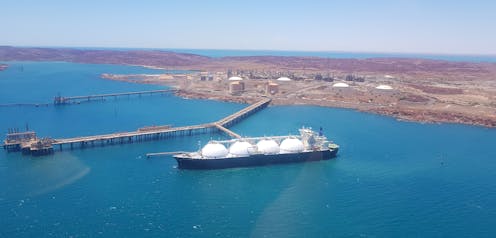
But contrary to the popular belief that social media creates these rumours, our new research suggests social media generally only aids the spread of these rumours.


Read more:
The 9 psychological barriers that lead to COVID-19 vaccine hesitancy and refusal


What ‘vaccine harms’ are people sharing on social media?

We have been studying community attitudes to COVID vaccinations, including the flow of information on social media, the kinds of information being shared, and by whom.

In our latest study, we tracked emerging concerns about alleged adverse events globally. We used Google Trends and Crowdtangle – a research platform for studying Facebook’s public-facing data. We focused on the most commonly searched and discussed events to track where they were coming from.

We dug into the five most frequently searched adverse events: clotting, fainting, Bell’s palsy, premature death and infertility.

Clotting

Clotting was associated with the AstraZeneca vaccine and the rare instances of thrombosis with thrombocytopenia syndrome (TTS). This led to the vaccine’s suspension or authorities placing age restrictions on its recipients in many countries.

News reporting on clotting was generally reasonable and in line with the threat the condition posed. Because the issue was newsworthy on its own, it did not require sensationalist reporting. Social media spread these reports globally, so the first reports of clotting, emerging from Austria, spread on Facebook pages as far as Ghana, the Philippines and Mexico within eight hours.

A nurse puts a bandaid on a woman's arm after an vaccination.
The risk of clots caused concern.
CDC/Unsplash

Fainting, Bell’s palsy and premature death

There was no scientific basis for the other four rumours we investigated. However, three of them drew specifically from “traditional” (television and newspaper) news reporting on specific incidents.

For example, a Tennessee nurse fainted on television shortly after receiving the Pfizer vaccine. Traditional media reports included the nurse’s own disclosure of a history of fainting and cautioned against attributing it to the vaccine.

Likewise, elderly baseball legend Hank Aaron died from natural causes two weeks after receiving a COVID vaccine on camera. He had hoped to inspire other Black Americans to be vaccinated.

These two incidents were widely reported in traditional media and soon flowed into social media posts attributing them to the vaccine.

The Bell’s palsy rumour came out of news reports in Bangladesh, which were then picked up by a UK outlet, attributing the rare condition to the Pfizer vaccine.

Infertility

The rumours of COVID vaccines causing infertility were the only ones that we could not trace to an original “traditional media” source. Instead, two internet stories misrepresenting the work, and words of scientists were shared widely on social media. Traditional media only picked up the story to report on the misinformation occurring.

We describe this as an example of vaccine sceptics “theory crafting” online. This is when a group of people on the internet use their collective resources to analyse information to develop plausible explanations for events.

In the case of infertility, a willing community misused two scientific sources to construct what they represented as compelling evidence of a cover-up. This theory then led to a persistent internet rumour that COVID vaccines caused fertility problems.

In the other four cases above, we found traditional media still played an important role in determining people’s awareness of alleged adverse events.

Pregnant woman holds her dress.
Traditional media reported on vaccine myths about fertility.
Ömürden Cengiz/Unsplash

What did mainstream news outlets do?

Traditional media outlets were important to those sharing the social media posts, as they treated mainstream media reports as markers of credibility.

Vaccine-sceptical communities used international media sources to build “evidence” for adverse events. They then redistributed this “evidence” among their international networks.

Disreputable outlets chased “clickbait”, accelerating the spread of misinformation. For instance, when 86-year-old Aaron died, one site led with the headline “Hank Aaron Death: MLB Legend Shockingly Passes Away Weeks After Taking COVID-19 Vaccine”. This headline spread much faster and further on social media than the majority of reports that explained Aaron’s death was not a result of his vaccination.

Inaccurate and sensationalist headlines in mainstream media went on to drive significant searches and shares. The rumours flowed globally, unfettered by national boundaries.


Read more:
Media reports about vaccine hesitancy could contribute to the problem


Despite most of the rumours we investigated gaining traction because of media reporting, journalists also played an important role in suppressing or debunking illegitimate claims.

The disruption of earlier media models clearly poses a challenge for the accuracy of information shared on the internet. The imperative for news sources to generate clicks can outweigh the imperative to provide accurate and reliable information.

So what’s the solution?

We can see no easy answers for resolving the flow of misinformation online.

However, the use of credibility markers for both authors and stories on social media is one possible solution. A system where publicly recognised topic experts can “upvote” and “downvote” news stories to produce a “credibility score” would help readers judge the perceived credibility of particular stories and information.

In the meantime, we recommend scientists and health professionals, where possible, promote their own perspectives when a story about alleged adverse events needs clarifying. Doing so can potentially change the trajectory and spread of a story.

Scientists and health professionals speaking out can’t prevent the stories from being shared within online communities of vaccine-refusers. These people are invested in sharing such information regardless of its veracity. However, professionals can limit the damaging spread of rumours once media outlets begin to report their debunking.


Read more:
We can’t trust big tech or the government to weed out fake news, but a public-led approach just might work


The Conversation

Katie Attwell receives funding from the Australian Research Council and the WA Department of Health. She is funded by ARC Discovery Early Career Researcher Award DE1901000158. She is a specialist advisor to the Australian Technical Advisory Group on Immunisation (ATAGI) COVID-19. All views presented in this article are her own and not representative of any other organisation.

Tauel Harper does not work for, consult, own shares in or receive funding from any company or organisation that would benefit from this article, and has disclosed no relevant affiliations beyond their academic appointment.

ref. Social media spreads rumours about COVID vaccine harms … but it doesn’t always start them – https://theconversation.com/social-media-spreads-rumours-about-covid-vaccine-harms-but-it-doesnt-always-start-them-184169

Teachers’ stress isn’t just an individual thing – it’s about their schools too

Source: The Conversation (Au and NZ) – By Rebecca J. Collie, Scientia Associate Professor of Educational Psychology, UNSW Sydney

Shutterstock

Stress is common among teachers, and recent reports suggest it’s getting worse. We need to understand the sources of this stress to improve support for teachers. Growing teacher shortages in Australia underscore the need for this support.

It is also important to identify whether there are patterns of stress experienced by individuals and groups of teachers within a school. This knowledge will tell us whether support for teachers should be targeted individually or to a teaching staff more broadly.


Read more:
Almost 60% of teachers say they want out. What is Labor going to do for an exhausted school sector?


Our study involving 3,117 teachers at 225 Australian schools shows sources of stress do vary among individual teachers. At the same time, the school environment – workloads, student behaviour and expectations of teachers – appears important. At some schools the stress experiences of individuals mirror those of the teaching staff more broadly.

So managing stress is not just the responsibility of individual teachers. Schools have an important role to play in developing a workplace that helps to minimise their teachers’ stress.

What are the sources of teachers’ stress?

In our study, published in Teaching and Teacher Education, we examined three common sources of stress at work to see how these affect well-being among individual teachers and across a whole school teaching staff.

These three sources of stress are:

  • workload stress – teachers’ sense they have too much lesson preparation, instruction or marking work in the time available to them

  • student behaviour stress – teachers’ sense that student behaviour is overly disruptive or aggressive

  • expectation stress – teachers’ sense that professional/registration bodies and parents are placing very high or unrealistic expectations on them.

We first examined how the three sources of stress co-occur among teachers to identify teacher stress profiles. That is, we wanted to see if there are distinct types of teachers who experience similar patterns across the three sources. For example, are there teachers with low or high levels of all three sources of stress, and are there teachers who have mixed levels of the sources of stress?

Next, we wanted to ascertain whether different types of schools are identifiable as being more or less stressful based on the make-up of their teacher stress profiles. That is, we set out to identify different school profiles.

Once we had identified teacher and school profiles, we examined whether the different profiles were linked with work strain and work commitment. Work strain refers to the adverse outcomes of stressful work – such as feeling highly stressed and reduced mental or physical health. Work commitment refers to teachers’ attachment to their profession.

Ideally, teachers experience low strain at work, but high commitment.


Read more:
Teachers can’t keep pretending everything is OK – toxic positivity will only make them sick


What teacher profiles did we find?

Our analysis used data from the OECD Teaching and Learning International Survey (TALIS) 2018. We identified five teacher profiles:

  • low-burden profile (7% of teachers in our sample) displaying very low levels of all three stressors

  • mixed-burden-workload profile (15%) displaying below-average workload stress, very low student behaviour stress and low expectation stress

  • mixed-burden-behaviour profile (19%) displaying low workload stress, below-average student behaviour stress and low expectation stress

  • average-burden profile (41%) displaying slightly above-average levels of all three stressors

  • high-burden profile (18%) displaying high workload stress and very high student behaviour and expectation stress.

Teacher profiles according to the combination of levels of workplace stress, student behaviour stress and expectation
The five teacher stress profiles reflect their experience of the combined impacts of workplace stress, student behaviour stress and expectation stress.
Collie & Mansfield 2022, Author provided

Looking at links between profiles and outcomes, the low-burden profile and the two mixed-burden profiles generally displayed the lowest work strain and highest work commitment.


Read more:
Higher salaries might attract teachers but pay isn’t one of the top 10 reasons for leaving


What school profiles did we find?

We then examined how these teacher profiles are distributed in schools. We identified three school profiles:

  • workload-oriented-climate profile (17% of schools in our sample) composed mostly of teacher profiles with high workload stress, but also a sizeable proportion displaying lower stress

  • behaviour-oriented-climate profile (23%) composed mostly of teacher profiles with high student behaviour stress, but also a sizeable proportion displaying lower stress

  • higher-pressure-climate profile (60%) composed mostly of teacher profiles with above-average to high levels of all three sources of stress.

Teachers who collectively displayed the highest levels of work strain tended to work in higher-pressure-climate schools. Levels of work commitment were also lowest among teachers in those schools.


Read more:
COVID and schools: Australia is about to feel the full brunt of its teacher shortage


What does this mean for teachers and schools?

One notable finding was the differentiation between workload stress and student behaviour stress in two teacher profiles and two school profiles. Some teachers and schools were higher in student behaviour stress. Others were higher in workload stress. And other profiles had similar levels of all types of stress.

These results suggest sources of stress at work are not necessarily specific to the individual, but reflect a broader school climate as well. So, teachers’ stress isn’t just an individual issue – some schools are more stressful places to work.

In practice, it is important that teachers have their own strategies to manage stress. At the same time, our findings suggest schools and educational systems should be aware of teachers’ collective experiences of stress and provide school-wide supports.

To reduce workload stress, research suggests supportive mentors are helpful. It’s also helpful to develop professional learning communities to share the loads of lesson preparation and marking moderation.

Reducing workload across the school is also critical. Decreasing teachers’ face-to-face teaching time and administrative tasks have been suggested as ways to do this.

Providing professional learning opportunities to develop teachers’ classroom management skills might help reduce student behaviour stress.

A positive learning climate at school is also important. When students feel supported and are more engaged in their learning, they are less likely to be disruptive. In particular, research suggests it is important that all students feel cared for, have opportunities to succeed in their learning, and are given a say in content and tasks in the classroom.

Finally, research suggests school leaders can help reduce expectation stress by seeking out teachers’ perspectives and conveying their trust in them as professionals. Likewise, positive school-home partnerships can help ensure teachers, school leaders, students and parents are aligned in their goals.

The Conversation

Rebecca J Collie receives funding from the Australian Research Council.

Caroline F. Mansfield does not work for, consult, own shares in or receive funding from any company or organisation that would benefit from this article, and has disclosed no relevant affiliations beyond their academic appointment.

ref. Teachers’ stress isn’t just an individual thing – it’s about their schools too – https://theconversation.com/teachers-stress-isnt-just-an-individual-thing-its-about-their-schools-too-183451

Grattan on Friday: Albanese government mugged by gas crisis as it faces challenge of managing expectations

Source: The Conversation (Au and NZ) – By Michelle Grattan, Professorial Fellow, University of Canberra

Tony Burke reads a poem aloud every day and has a piano lesson once a week.

The new minister for employment and workplace relations, as well as minister for the arts, says it’s important not to get trapped by the “facts in front of you” without any room for creative thought.

And, having been a minister before, Burke brings to government lessons learned from first time round. One of them is not to rush things like a bull at a gate.

For former ministers, a second chance at power is a rebirth, an opportunity to do things differently, avoid mistakes, as well as to augment an earlier legacy. Burke is one of more than half the new cabinet who were ministers previously.

Anthony Albanese, with the experience of the Rudd-Gillard-Rudd government, has a headful of the dos and don’ts of exercising power.

By the same token, moving into government can be like having diligently swotted for the big exam and then being hit by some left-field questions on the day.

Labor knew it would inherent a cost-of-living problem – it campaigned on it. But it didn’t expect the dramatic crisis in gas prices Australia is suddenly facing, driven by events in Europe, outages at coal-fired power stations and other factors.

Inevitably, the government is coming under pressure to “do something”, including pulling the “trigger”, established by the Coalition, that would force gas producers to divert exports to supply the domestic market. The “trigger” came after the Gillard government granted licences for gas exports from eastern Australia without any “reservation” provision for domestic use (such as exists in Western Australia).

The challenge for the government is to be seen to be on top of things, while not rushing into precipitate action.

Energy Minister Chris Bowen, another minister with extensive experience in government, including as a treasurer, walked that line on Thursday.

Bowen has convened a meeting of energy ministers for early next week, and he assured reporters Resources Minister Madeleine King was talking to gas companies and Industry Minister Ed Husic was in discussions with large industrial users.

But Bowen pointed out the “trigger”, even if pulled, couldn’t come into force until January.

The government would “take whatever action is necessary”, but after full briefings and gathering all the information.

The next few months will test the government’s ability to the limit on economic and energy issues, as it confronts major problems while trying to manage expectations.


Read more:
Australia has more women in cabinet than ever before: what difference will diversity make?


On the gas crisis, it’s one thing to eschew, as Bowen said, the knee-jerk reaction; it’s another to find an appropriate reaction and know when it has to be applied.

Then there’s the budget. This week’s national accounts showed 3.3% annual economic growth, which was better than anticipated.

Despite this, Treasurer Jim Chalmers – one of the first-time ministers, although a chief of staff to then treasurer Wayne Swan – was negative in his language. Perhaps this is because he is anticipating bringing down what will be a difficult budget. Chalmers’ performance drew some criticism because of the risks of talking down the economy.

What the new government has been talking up is its intention (and ability) to bring a new style and tone to politics. It is setting a high bar for itself because, as the freshness wears off, political behaviour tends to revert to the old ways. The sceptics will say, we’ve held lofty sentiments before and often they haven’t come to much.

Albanese invokes the Hawke “consensus” approach as a model. A major test of this will be the jobs summit the government plans to hold ahead of the October budget.

Hawke’s 1983 economic summit is the gold standard for summits. Attended by employer, union and community representatives, it ran for a week and enabled a detailed airing of issues. In 1985, Labor’s tax summit was a much more fractured affair; it laid the path for some important reforms but failed to pull off support for Paul Keating’s desired consumption tax.

Kevin Rudd’s Australia 2020 summit, co-chaired by Glyn Davis, the man Albanese this week announced will head the prime minister’s department, was an altogether different gathering.

It was an occasion for the free flow of ideas, with an overlay of celebrity. It was criticised for the later outcomes failing to live up to the hype.

To get the best out of the jobs summit – which is to be followed by a white paper – it should be broad in the issues addressed, but focused, and backed by extensive preparatory research. It should run long enough for detailed discussion. A few hours won’t cut it.

It should also be public. This has the downside of excessive grandstanding – the usual suspects saying the usual things – and requires careful management. But it has the upside of allowing voters a (modest) degree of buy-in to the policy process.

The government is also promising to deliver a parliament that behaves and operates better. It is certainly confronting a transformed House of Representatives, in which the crossbenchers have swelled to 16 (including four Greens).


Read more:
Politics with Michelle Grattan: Tony Burke advocates on wages and arts


This influx would force changes of itself. For example, last term the crossbench had only one question each day – that will naturally increase.

Burke, in his role as leader of the house, is open to other changes, but makes it clear there are limits.

He is not inclined to supplementary questions (which happen in the Senate). And forget an end to “Dorothy Dixers” – questions from backbenchers inviting ministers to say what good things the government is doing. Burke thinks that’s too valuable a platform to give up.

Will we see less sledging and general bad behaviour in the house? The larger crossbench will promote an improvement. But the conduct will also depend on the strength of whoever Labor puts in as speaker, and how Peter Dutton (a natural headkicker) approaches his role of opposition leader.

As well, the tone is likely to worsen later in the term, when contestants are shaping up for another bout at the ballot box.

The public want better standards of parliamentary behaviour. But old ways are hard to break, so let’s judge in three years’ time.

Another big front on which Albanese has raised expectations is federal-state relations, although he hasn’t sketched out detail.

Scott Morrison’s national cabinet had a mixed record in the COVID era. Relations between federal and state governments varied from co-operative to fractious, depending on the time and issue.

Albanese faces four Labor states, with New South Wales and Tasmania in non-Labor hands. Not that political stripe necessarily determines where a state stands on issues – for example, the GST distribution sees WA set against other states.

Two state elections are looming – in Victoria in November, and NSW in March. If the Perrottet government, which is progressive on issues such as climate and tax, were returned, it would likely be anxious to co-operate with the Albanese government on a reform agenda. If there were a new government in Victoria, that state would likely be less co-operative.

The experience of the pandemic has profoundly altered the federation, without any formal change of the constitution. The premiers have been empowered and energised. Albanese needs to weld them together to deliver a slate of national outcomes.

The Conversation

Michelle Grattan does not work for, consult, own shares in or receive funding from any company or organisation that would benefit from this article, and has disclosed no relevant affiliations beyond their academic appointment.

ref. Grattan on Friday: Albanese government mugged by gas crisis as it faces challenge of managing expectations – https://theconversation.com/grattan-on-friday-albanese-government-mugged-by-gas-crisis-as-it-faces-challenge-of-managing-expectations-184326

4 reasons our gas and electricity prices are suddenly sky-high

Source: The Conversation (Au and NZ) – By Tony Wood, Program Director, Energy, Grattan Institute

Shutterstock

Gas users and the incoming government are describing Australia’s sudden east coast energy crisis as “apocalyptic” and “a perfect storm”.

There is no doubt that a rare combination of international and domestic events, together with long-term policy shortcomings, have led to a very nasty position from which there is no easy way out.

Four events have led to the immediate crisis.

1. Coal-fired generators have been failing

First, outages at coal-fired power stations have meant that gas has been called on more than usual.

More than one quarter of coal-fired plants have been offline for much of the year so far, which is far from usual.

The system is designed so that when that happens, gas generators take their place.

2. Australia is running low on gas

Second, the Australian Energy Market Operator (AEMO) has been warning of gas supply shortages in the southeast for some time as traditional gas resources, mainly in offshore Victoria, run low.

Onshore gas development in Victoria has been prevented by a succession of state government decisions, and input terminals have been either rejected on environmental grounds or delayed due to financial barriers.


Read more:
Gas crisis? Why Japan pays less than Australians for Australian gas


In 2012 the Gillard government rejected the idea of reserving a certain proportion for domestic consumption, as happens in Western Australia.

The history of cheap and plentiful gas in Victoria has made Victorian households and firms more dependent on gas than other Australians, and there has been little move towards electrification.

3. Europe wants non-Russian gas

Third, in their desperation to reduce their dependence on piped Russian gas, European countries have been pushing the international price of liquefied natural gas sky high, buying from countries such as Australia, Qatar and the United States.

Some Australian exporters have received prices four times or more times higher than normal.

4. Suddenly, there’s a cold snap

Finally, a cold snap on Australia’s east coast has brought forward the winter spike in demand for gas for heating.

The immediate impact of the combination of these four events has been a looming shortage of gas on the east coast, including gas to supply power stations.

Industrial gas consumers who do not have the protection of a fixed contract are facing potentially destructive prices.

Thankfully there is no immediate price impact for households using gas, as their retailers have gas supply contracts, although many households are suffering higher electricity prices because gas-fired power stations have had to be pushed into service to replace coal-fired stations.

Quick actions

AEMO has taken action, partly by imposing a wholesale price cap of $40 per gigajoule ahead of forecasts the spot price in
Victoria was set to climb $382.

The “shadow price” used to indicate what would have happened were it not for the cap, hit $800 on Tuesday.

And AEMO has triggered the so-called
Gas Supply Guarantee Mechanism to secure gas for power generators.

These actions have worked, even though a price of $40 per gigajoule is financially crippling for large industrial consumers, and AEMO cannot magically source gas that isn’t there.

But no overnight answer

Chris Bowen, the new minister for climate change and energy, is already working closely with AEMO and his state and territory counterparts and industry to get complete information and advice.

But as Treasurer Jim Chalmers said on Tuesday, there’s no overnight answer.

The Turnbull Government introduced the Australian Domestic Gas Security Mechanism in 2017 in response to concerns that exports of liquefied natural gas from Queensland might one day create domestic shortages.


Read more:
Heading north: how the export boom is shaking up Australia’s gas market


It was also concerned that gas producers were selling gas overseas at lower prices than they were asking for at home. The threat of government intervention has generally ensured supply.

But the mechanism is unlikely to be effective in addressing the current problem, for two reasons. First, there are physical limits on getting gas awaiting export in Queensland to Victoria where it is needed.

And second, to the frustration of many gas customers, the mechanism can’t bring down prices, which are set internationally. It deals only with supply.

Thankfully, no false prices

The current crisis illustrates the fundamental policy connection between electricity supply, gas markets, and climate change.

The decision to immediately convene a meeting of the national energy and resources ministers and the relevant agencies is the right first step, but only the beginning of a journey that will involve urgent and sustained reforms to the way Australia’s markets work.


Read more:
Australia has plenty of gas, but the price is extreme. The market is broken


The new government has indeed come to power in the face of a perfect storm, and there are more challenges ahead. Its approach so far has been constructive, measured, and cooperative – and it has resisted the temptation to make promises it can’t keep.

It is to be hoped that this new approach will enable it to navigate through to what will almost certainly be somewhat calmer waters ahead.

The Conversation

Tony Wood owns shares in related energy and resources companies via his super fund

ref. 4 reasons our gas and electricity prices are suddenly sky-high – https://theconversation.com/4-reasons-our-gas-and-electricity-prices-are-suddenly-sky-high-184303

Online abuse against women is rife, but some women suffer more – and we need to step up for them

Source: The Conversation (Au and NZ) – By Hannah Klose, Teaching Associate/PhD Candidate, Monash University

Lukas Coch/AAP

Women online suffer a disproportionate amount of harm and abuse, but it isn’t all based on their gender. This “cyber violence” is also shaped by a range of other intersecting factors such as race, religion, class, caste and disability.

Our ongoing research involves collecting case studies from both India and Australia to understand how various marginalised identities can impact young women’s experiences of online violence, and how social media companies – including Facebook, Twitter and Instagram – aren’t doing enough to stop it.

India is a rich case study for this research, as it’s a country where women have many different expressions of identity in large numbers – and where there remains a lot of racial, religious and social tension across society.

However, although Australia and India have significantly different cultures, women in both countries fall victim to online crimes, including cyber stalking and cyber harassment. And those with marginalised identities have to deal with more more stigma and targeting.

What’s worse is platform content moderators are failing to recognise this cyber violence – often because they don’t understand the nuance and contexts in which stigmas operate.

What is cyber violence?

Cyber violence can be understood as harm and abuse facilitated by digital and technological means.

In 2019, there was a 63.5% increase in the number of cyber violence cases being reported in India, compared to 2018. There has since been a further rise in cases against women from marginalised communities, including Muslim and Dalit women.

One prominent example is the “Bulli Baiapp, which turned up on GitHub in July last year. The app developers used the images of some 100 Muslim women without their permission, to put them up “for sale” in a fake auction. The purpose was to denigrate and humiliate Muslim women in particular.

This is mirrored in Australia. Young Indigenous women are susceptible to being on the receiving end of cyber violence which not only targets them by gender, but also race.

A 2021 research report by eSafety found Aboriginal and Torres Strait Islander women felt victimised by racist and threatening comments made online, usually in public Facebook groups. They also reported feeling unsafe and having their mental health significantly impacted.

Another example comes from New South Wales Greens Senator Mehreen Faruqi, who has received extremely high levels of online abuse as Australia’s first female Muslim senator. Speaking on behalf of women from marginalised backgrounds, Faruqi said:

It is based on where I come from, what I look like, my religion.

Young women with marginalised identities

Research on cyber violence against women in India reveals how hatred towards certain religions, races and sexual orientations can make gender-based violence even more harmful.

When women express their opinions or post pictures online, they are targeted based on their marginalised identities. For instance, Kiruba Munusamy, an advocate practising in the Supreme Court of India, received racist and caste-based slurs for speaking out about sexual violence online.

And women with marginalised identities continue be victimised online, despite attempts to control this.


Read more:
A better way to regulate online hate speech: require social media companies to bear a duty of care to users


Take Australia’s “Safety by Design” framework, developed by the eSafety commissioner. Despite having some gathered traction in the past few years, it remains a “voluntary” code that encourages technology companies to prevent online harm through product design.

In India, hate speech against Muslims in particular has been on the rise. India has laws (albeit flawed) that can be used to deal with online abuse, but better implementation is needed.

With a Hindu majority, and radicalisation, it can be difficult to report incidents. Victims are concerned about safety and secondary victimisation, wherein they may face further abuse as a result of reporting a crime.


Read more:
Why Modi’s India has become a dangerous place for Muslims


It’s hard to know the exact amount of cyber violence perpetrated against women with marginalised identities. Yet it’s clear these identities are linked to the amount of, and type of, abuse women face online.

One study by Amnesty International found Indian Muslim women politicians faced 94.1% more ethnic or religious slurs than women politicians of other religions, and women from marginalised castes received 59% more caste-based slurs than women from more general castes.

We’ve long understood the need for an intersectional approach to feminism. We now need the same approach to protecting women’s safety online.
Shutterstock

Recognition in platform design

Five years ago, Amnesty International submitted a report to the United Nations highlighting the need for moderators to be trained in identifying gender-related and identity-related abuse on platforms.

Similarly, in 2019 Equality Labs in India published an advocacy report discussing how Facebook failed to protect people from marginalised Indian communities. This is despite Facebook having caste, religion and gender as “protected” categories under hate speech guidelines.

Yet in 2022 social media companies and moderators still need to do more to approach cyber violence through an intersectional lens. While platforms have country-specific moderation teams, moderators will often lack cultural competency and literacy on matters of caste, religion, sexuality, disability and race. There could be various reasons for this, including a lack of diversity among staff and contractors.

In a 2020 report by Mint, one moderator working for Facebook India said she’s expected to achieve an accuracy report of 85% minimum to keep her job. In practise, this means she can’t spend more than 4.5 seconds on content being reviewed. Such structural issues can also contribute to the problem.

The way forward

In March 2022, the eSafety Commission in Australia joined a global partnership to end cyber violence against women. But a great deal of work still needs to be done.

Content moderation can be complex, and requires collective expertise from communities and advocates. One way forward is to enforce transparency, accountability and resource allocation to build solutions within social media companies.

In November last year, the Australian government released the draft of a bill aimed at holding social media companies accountable for content posted on their platforms, and protecting people from trolls.

It’s anticipated these regulations will ensure platforms are held responsible for harmful content that affects users.


Read more:
Leigh Sales showed us the abuse women cop online. When are we going to stop tolerating misogyny?


The Conversation

The authors do not work for, consult, own shares in or receive funding from any company or organisation that would benefit from this article, and have disclosed no relevant affiliations beyond their academic appointment.

ref. Online abuse against women is rife, but some women suffer more – and we need to step up for them – https://theconversation.com/online-abuse-against-women-is-rife-but-some-women-suffer-more-and-we-need-to-step-up-for-them-183646

Politics with Michelle Grattan: Tony Burke advocates on wages and arts

Source: The Conversation (Au and NZ) – By Michelle Grattan, Professorial Fellow, University of Canberra

Tony Burke is the minister for employment and workplace relations and minister for the arts, as well as the leader of the House of Representatives.
One of his first tasks is the government’s new submission for the minimum wage case, which will say these workers should not be left behind, as inflation has spiked.

If the Fair Work Commission gives a 5.1% rise, in line with inflation, is there a case for it not flowing through to awards, or all awards?

“I can’t imagine a situation where there was no flow-through at all. The commission always has the capacity to work out how the flow-through might happen.” He notes one option floated has been a flat dollar increase so the flow-through happened differently.

“The commission will work that through. But certainly there are many awards that are not far from the minimum wage.

“And when we talk about the heroes of the pandemic a lot of those people are on those awards. So while the focus has been specifically minimum wage, I tend to use the term low-paid workers.”

On reforming parliament, Burke says he is not trying to get rid of the anger. He doesn’t want to turn parliament into “a quiet, polite dinner party”.

“The debate is fierce and passionate and real. I think that matters and I think it’s good for democracy.”

Nor is he in favour of scrapping “dorothy dixers”, because the government needs the opportunity to tell the house what it is doing.

But there will be more questions for the larger crossbench, and he flags the government won’t so routinely shut down opposition moves for debates.

“Standing Orders say there’s one question from the crossbench. With a crossbench as large as what we’re now facing, that’s just not sustainable.”

Without changing that, “you’re effectively telling a very large number of Australians that because they didn’t vote for a major party, their voice is going to be heard less.”

Burke says he has a passion for the arts – he was briefly arts minister at the end of the last Labor government – and laments a lack of a cultural policy in recent years.

“In cultural terms, what the arts, events, entertainment sector do matters to who we are as Australians. And that affects your education policy, your health policy, your trade policy, your foreign affairs policy. Nor has there been any guidance that these are serious industries and these are serious jobs.”

The arts are really important in giving people a capacity to imagine and create, Burke says. They are “really important for us as a nation. I don’t think we’ve had an arts minister see it as a priority in that sense for a long time, and I really want to bring that back”.

The Conversation

Michelle Grattan does not work for, consult, own shares in or receive funding from any company or organisation that would benefit from this article, and has disclosed no relevant affiliations beyond their academic appointment.

ref. Politics with Michelle Grattan: Tony Burke advocates on wages and arts – https://theconversation.com/politics-with-michelle-grattan-tony-burke-advocates-on-wages-and-arts-184319

National reconciliation centre to help lead national systemic change

Source: The Conversation (Au and NZ) – By Andrew Gunstone, Executive Director Reconciliation Strategy and Leadership, and Professor Indigenous Studies, Swinburne University of Technology
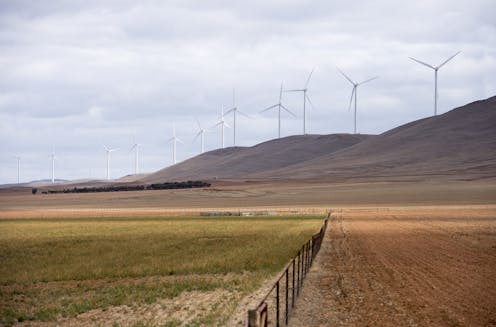
GettyImages

Each year, National Reconciliation Week is bookended by three major milestones in the nation’s reconciliation journey.

May 26, commemorated before National Reconciliation Week, is National Sorry Day, the anniversary of the release of the Bringing Them Home report in 1997.

May 27 marks the 1967 Referendum that enabled the Commonwealth government to make laws for Aboriginal and Torres Strait Islander peoples, and for Aboriginal and Torres Strait Islander peoples to be counted in the Census.

June 3 observes the 1992 Mabo decision that overturned the myth of terra nullius – “land belonging to no one” – and recognised the existence of native title.
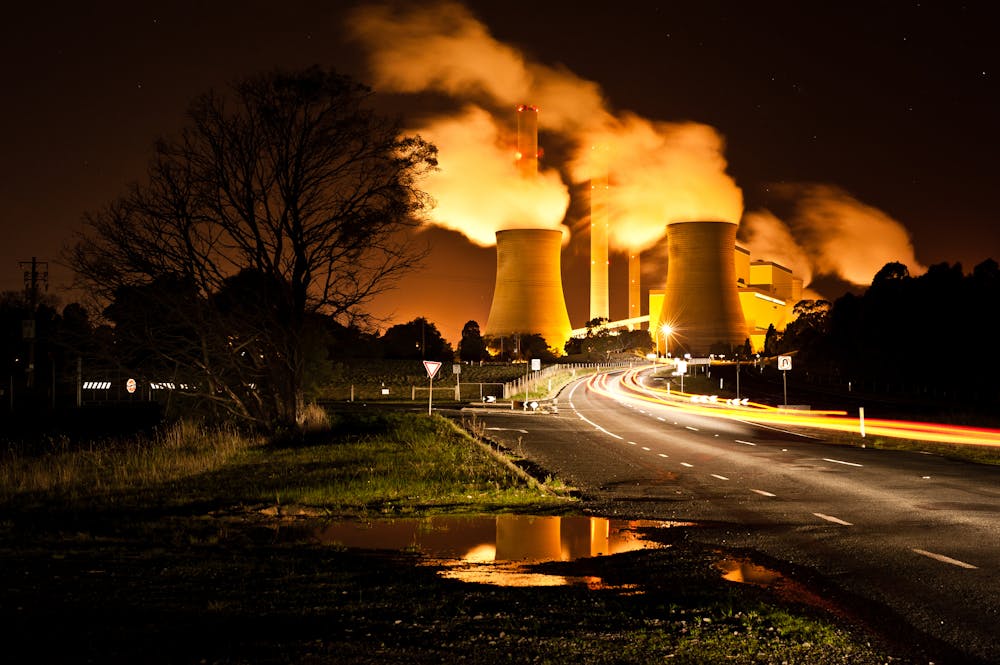
The Council for Aboriginal Reconciliation established National Reconciliation Week in 1996. Since 2001, Reconciliation Australia has led the week and the reconciliation movement more broadly. This work embodies the “people’s movement” called for at the 1997 Australian Reconciliation Convention.

Today’s (2 June) launch of the National Centre for Reconciliation Practice will further national understandings of reconciliation beyond this allocated week in June. Through a range of programs, the centre will explore areas such as self determination, cultural safety, and Indigenous Knowledges.


Read more:
‘More than a word’: practising reconciliation through Indigenous knowledge-sharing in tourism


Reconciliation movement

The reconciliation movement has garnered significant engagement from national, state and territory, and local reconciliation bodies.

This has included commitments to Reconciliation Action Plans from 2000 organisations with a reach of 4 million people, including workplaces, schools, universities, clubs, local councils, and many other organisations across the country.

Reconciliation Action Plans articulate an organisation’s commitment to reconciliation through measures such as increasing the employment of Aboriginal and Torres Strait Islander people in their organisation. These plans also examine how to make workplaces culturally safe through actions such as cultural training and additional learning, and encouraging engagement with Aboriginal and Torres Strait Islander businesses.

However, the nation currently faces some crucial moments in its reconciliation journey. We have the opportunity to address long-standing reconciliation-related areas, including Indigenous rights, treaties, truth telling and reparative justice.

The Uluru Statement from the Heart invites the nation to address Voice, Treaty and Truth, a vital step on our reconciliation journey. The Yoorrook Justice Commission has been established in Victoria as the country’s first truth-telling body. Victoria, the Northern Territory and Queensland are also working towards state and territory-based treaties.


Read more:
Reconciliation Week: a time to reflect on strong Indigenous leadership and resilience in the face of a pandemic


National Centre for Reconciliation Practice

Committed to this vision of reconciliation, Swinburne University is today launching the National Centre for Reconciliation Practice. Swinburne’s 2020-23 Elevate Reconciliation Action Plan’s primary commitment is the national centre, which is the first of it’s kind in Australia.

Led by Andrew Gunstone (this article’s lead author), the National Centre engages with a broad range of reconciliation matters. The National Centre also explores how Aboriginal and Torres Strait Islander peoples and non-Indigenous peoples can collaborate in the national reconciliation journey.

The Centre does this through engagement, outreach, education and research activities. In particular four research programs led by Swinburne Aboriginal and Torres Strait Islander academics. Each program relates to key areas of Swinburne’s Reconciliation Action Plan and concerns elements critical for sustainable reconciliation.

The programs are Cultural Safety, led by Wiradjuri scholar Sadie Heckenberg; Indigenous Knowledge, led by Yarra Yarra/ Yorta Yorta/ Ngarai illum Wurrung man Andrew Peters; Indigenous Rights, led by Garrwa scholar Emma Gavin; and Reconciliation Movements, led by Wiradjuri scholar Wendy Hermeston.

The National Centre is engaging with Reconciliation Australia, industry, communities, academia and governments to help lead national systemic change in reconciliation, with a range of current projects:

  • Documenting the history of the Australian reconciliation movement to better understand current reconciliation matters.
  • Working with Reconciliation Australia to develop several national RAP and reconciliation impact measurement tools.
  • Working with Reconciliation Australia to create industry-focused online training modules on Reconciliation Action Plans and reconciliation.
  • Working with Reconciliation Victoria to examine attitudes in the Victorian reconciliation movement on reconciliation matters.
  • Creating online teaching modules on decolonising and Indigenising higher education and vocational education.
  • Working with Ember Connect on empowering Aboriginal and Torres Strait Islander women in spaces of education.

Institutions, national, state and local governments each have a role in genuinely and tangibly committing to reconciliation and making their organisations culturally safe for Aboriginal and Torres Strait Islander people.

As a nation, we must ensure real commitment to Aboriginal and Torres Strait Islander self-determination. We must acknowledge the nation’s dark past so we can walk together in the present, as the Uluru Statement from the Heart calls for, “in a movement of the Australian people for a better future”.

The Conversation

Andrew Gunstone is Executive Director of Reconciliation Strategy and Leadership and leads the National Centre for Reconciliation Practice at Swinburne University. He receives funding from the Australian Research Council and the Department of Education. He is Co-Chair of Reconciliation Victoria.

Andrew Peters works for Swinburne University as a Senior Lecturer in Indigenous Studies, and is a Research Lead for the National Centre for Reconciliation Practice.

Emma Gavin works for Swinburne University and is a Research Lead for the National Centre for Reconciliation Practice.

Sadie Heckenberg is a Research Lead within Swinburne’s National Centre for Reconciliation Practice. She receives funding from the Australian Research Council, is the President-Elect of the National Aboriginal and Torres Strait Islander Higher Education Consortium and sits on the ARC’s College of Experts. She is affiliated with the National Tertiary Education Union, as the Victorian representative on the Aboriginal and Torres Strait Islander Policy Committee.

Wendy Hermeston works for Swinburne University and is a Research Lead (Reconciliation Movements), for the National Centre for Reconciliation Practice.

ref. National reconciliation centre to help lead national systemic change – https://theconversation.com/national-reconciliation-centre-to-help-lead-national-systemic-change-183434

Should Australia introduce menstrual leave? Yes, but we need other period-friendly policies as well

Source: The Conversation (Au and NZ) – By Sarah Duffy, Senior Lecturer, School of Business, Western Sydney University

Jodie Cook/Unsplash

Spain recently announced plans to legislate menstrual leave. This is extra leave for those who experience severe period pain.
The decision has sparked public debate about whether Australia should introduce a similar scheme.

More than 90% of women under 25 report regular period pain and there is little evidence it reduces with age.
At least one in nine women and those assigned female at birth also have endometriosis, and many have to reduce their work hours to manage their symptoms.

But while Australians should have access to menstrual leave, they also need period-friendly policies they can access first. A “menstrual policy” offers an employer-endorsed pathway to manage symptoms in the workplace.

For office workers, this would ideally include: working where most comfortable within the office and the use of heat packs, where helpful; flexible working arrangements to reduce the impact of period pain; as well as access to paid leave.


Read more:
Balancing work and fertility demands is not easy – but reproductive leave can help


Which countries already have menstrual leave?

Menstrual leave has been around for a century. In 1922, the Soviet Union enacted protective labour laws to guard the menstrual health of women workers to “fulfil their reproductive and maternal functions”.

Japan introduced seirikyuuka (menstrual leave) in 1947. The battle for these rights began as early as 1928, when women transport workers demanded change due to inadequate sanitary facilities. It exists today, but has low uptake and generates resentment from colleagues.

Woman with long brown hair types on a laptop at her desk.
Some menstrual leave programs have been in place for decades and have their pros and cons.
Mimi Thian/Unsplash

Similarly, Indonesia introduced a menstrual policy in 1948, however some Indonesian women are frustrated that their right to access menstrual leave is not upheld consistently.

In 2020, Vietnam granted women an extra half an hour break, three days a month (fully paid) for those who are menstruating. However, they offer a bonus payment to those women who don’t take any leave.

History shows us that in addition to policy, education needs to accompany any proposed policy to reduce discrimination, uneven application and hesitancy around uptake.

What has Spain proposed?

Spain may become the first European country to introduce menstrual leave for women who experience severe period pain. If the proposed legislation passes, those who menstruate will have access up to three days of paid leave per month.

But a medical certificate must be supplied. For those working in low-paying jobs, the cost of obtaining a medical certificate could outweigh the benefit.

So what are the alternatives?

Australian organisations are leading the world in this space. Future Super and Modibodi have introduced menstrual policies, rather than menstrual leave alone. Their policies are based on a menstrual and menopause policy developed by the Victorian Women’s Trust.

The policy encourages organisations to offer staff flexibility in managing when they work and where they work to best manage their symptoms. They also urge staff to modify their workstation by sitting in a more comfortable location and using a heat pack as necessary.

The final support for employees is the right to access paid leave that they don’t have to pay back, or provide a doctor’s certificate to access.

Woman puts her head in hands.
Mentrual policies should offer staff flexibility to manage their symptoms.
Shutterstock

Of course, this approach won’t fit all sectors, especially mining or construction sites. Working from home, flexible start times, or modifying your work station, is often impossible.

However, a menstrual policy that mandates all employees have access to hot water, soap and a hygienic place to dispose of period products, could go a long way. This might seem basic, but unfortunately these provisions are not always available to women working in trades.

Women in the service industry face a different set of challenges. They often don’t have a choice about when they can go to the toilet, and may struggle to afford period products or the doctor’s visit required to access sick leave.

For these workplaces, providing free period products, allowing easier access to toilet breaks, and removing the need for a doctors certificate could make a substantial difference.


Read more:
Supporting menstrual health in Australia means more than just throwing pads at the problem


Essentially, a menstrual policy should prompt employers to consider how their workplace can be reasonably adapted to support those who want to work while navigating menstruation and support those who temporarily just can’t.

This needs to be done in a way that is sensitive to social, cultural and class-based differences. How it will be perceived by the portion of the workforce who don’t menstruate also needs to be considered.

What are the risks?

Despite the potential benefits of menstrual leave for Australia, if introduced, this policy will exist in a society that (in some quarters) shames menstruation and sees it as something to hide.

Some people worry those who access a menstrual policy may seem unreliable, likely to abuse leave provisions, or be considered too expensive to employ.


Read more:
Does gender equality suffer when women get menstrual leave?


Menstruators may face workplace discrimination and harassment to access the leave. In Indonesia, for example, people have been asked to remove their underwear to “prove” they were menstruating.

If given a choice, it’s likely people experiencing severe menstrual pain would rather not need additional supports. But they do. A menstrual policy is a necessary step towards supporting women and people who menstruate to stay in the workforce.

The Conversation

Mike Armour receives funding from Endometriosis Australia and Western Sydney University in relation to endometriosis and the workplace. He is the chair of Endometriosis Australia’s Clinical Advisory Committee.

Emilee Gilbert, Michelle O’Shea, and Sarah Duffy do not work for, consult, own shares in or receive funding from any company or organization that would benefit from this article, and have disclosed no relevant affiliations beyond their academic appointment.

ref. Should Australia introduce menstrual leave? Yes, but we need other period-friendly policies as well – https://theconversation.com/should-australia-introduce-menstrual-leave-yes-but-we-need-other-period-friendly-policies-as-well-184146

Will things be better for LGBTIQ+ people under Labor? Here’s what the new government has promised

Source: The Conversation (Au and NZ) – By Paula Gerber, Professor of Human Rights Law, Monash University

Australia under Scott Morrison didn’t feel like a very safe place for LGBTIQ+ people.

So will this change under the new Albanese government? The answer appears to be a resounding “yes”.

Let’s examine Labor’s election promises on policies affecting the LGBTIQ+ community.


Read more:
Word from The Hill: Scott Morrison defends Katherine Deves (again), but slips up on surgery detail


A steady stream of attacks

Under the Morrison government, LGBTIQ+ people were subjected to a steady stream of attacks, including:

  • Peter Dutton banning the defence department and serving military personnel from holding morning teas where staff wore rainbow clothing to mark the International Day Against Homophobia, Biphobia, Interphobia and Transphobia (IDAHOBIT), on the basis that this constituted a “woke agenda”

  • Morrison refusing to ban the expulsion of school students from religious schools on the basis of their sexual orientation or gender identity

  • A refusal to protect teachers at religious schools from being fired because of their sexual orientation or gender identity

  • Three separate attempts to pass the Religious Discrimination Bills, widely considered a sword with which to attack LGBTIQ+ people rather than a shield to protect people of faith from discrimination

  • Morrison supporting Katherine Deves, the Liberal candidate for Warringah, despite her repeated, spiteful attacks on trans people

  • Morrison endorsing Tasmanian Senator Claire Chandler’s Save Women’s Sports Bill that sought to exclude trans women from single-sex sports.

These assaults had the cumulative effect of making sexual and gender minorities feel like outsiders at best, and unwelcome intruders in the Coalition government’s heteronormative, cisgender vision of Australia at worst.

This, coupled with the prejudice and persecution trans people are already subjected to, has contributed to serious harm to the mental health of LGBTIQ+ people.


Read more:
The religious discrimination bill is not just words – it will make LGBTIQ+ Australians sick


What has Labor promised?

One easy and long overdue reform Labor has committed to is counting LGBTIQ+ people in the next census (in 2026). Although the 2021 census asked all sorts of personal questions about income and health conditions, there was no opportunity for LGBTIQ+ people to record their sexual orientation, gender identity or intersex status.

The Australian Bureau of Statistics had drafted and tested such questions but left them out of the census following then Assistant Treasurer Michael Sukkar expressing “a preference” that such questions not be included.

Collecting data about diversity in sexual orientation, gender identity and intersex status provides LGBTIQ+ people with a sense they’re seen and included. It’s also vital to the development of appropriate evidenced-based policies and reforms.

Another commitment by Labor ahead of the election was to amend anti-discrimination laws so that all students are protected from discrimination on any grounds, and all teachers are protected from discrimination at work (while maintaining the right of religious schools to preference people of faith in the selection of staff).

This is a long overdue reform. Too many teachers have been sacked because of their sexual orientation.

Labor has also made commitments to greater consultation and funding for LGBTIQ+ health services, and to address the unique health issues and barriers accessing health services LGBTIQ+ Australians face.

It’s easy to compare Labor’s policies relating to LGBTIQ+ people to those of the previous government, and be delighted with the positive changes. However, using the Morrison government as the benchmark is setting the bar way too low. A more appropriate yardstick is that developed by Equality Australia, who used a traffic light system to evaluate the parties’ policies. It found while Labor’s policies are much better than the Coalition’s, there’s still room for improvement.

Can the Greens influence policy?

The Greens have committed to significantly more protections for the LGBTIQ+ community than Labor.

Although Labor has secured a majority in the lower house, it doesn’t control the Senate. The Greens look set to have 12 senators in the upper house, which places them in a strong negotiating position to secure the implementation of their LGBTIQ+ policies.

While some of the Greens’ policies relate to matters that fall within the jurisdiction of the states rather than the federal government (for example, banning conversion practices), they also have policies the Albanese government would do well to adopt.

This includes having a federal minister for equality. Such ministries exist in Victoria and the UK, and help promote equality of opportunity for everyone.

The Greens also advocate for the appointment of a LGBTIQ+ Human Rights Commissioner within the Australian Human Rights Commission (AHRC), joining other specialist commissioners such as the Race Discrimination Commissioner.

This would be a valuable addition to the AHRC, strengthening its capacity to proactively respond to discrimination on the basis of sexual orientation, gender identity and intersex status.

This is particularly important at this time. We are seeing an increase in violent attacks on LGBTIQ+ people in the US following a sharp rise in anti-LGBTIQ+ laws being debated in nearly 40 of the 50 states.

These developments are a wake-up call for what could happen in Australia if we become complacent.

A tipping point?

Albanese’s victory speech gives us a sense that the treatment of LGBTIQ+ people is about to change dramatically.

The new prime minister said he wants Australia to be a country where “no matter where you live, who you worship, who you love or what your last name is, that places no restrictions on your journey in life”. Now we need to pay close attention to see whether the new government not only delivers on its election promises, but also works with the Greens to see some of their policies implemented.

June is Pride Month – an opportunity to honour the 1969 Stonewall Uprising in New York. The Stonewall riots were a tipping point for the gay liberation movement in the United States. This Pride Month may be a tipping point for the Australian LGBTIQ+ community; a new government that values equality, diversity and respect for all people, is certainly a cause for celebration.

The Conversation

Paula Gerber does not work for, consult, own shares in or receive funding from any company or organization that would benefit from this article, and has disclosed no relevant affiliations beyond their academic appointment.

ref. Will things be better for LGBTIQ+ people under Labor? Here’s what the new government has promised – https://theconversation.com/will-things-be-better-for-lgbtiq-people-under-labor-heres-what-the-new-government-has-promised-184139