Page 668

Did China’s balloon violate international law?

Source: The Conversation (Au and NZ) – By Donald Rothwell, Professor of International Law, Australian National University

Chad Fish/AP

Was the balloon that suddenly appeared over the US last week undertaking surveillance? Or was it engaging in research, as China has claimed?

While the answers to these questions may not be immediately known, one thing is clear: the incursion of the Chinese balloon tested the bounds of international law.

This incident has also added another layer of complexity to the already strained relations between the US and China. US Secretary of State Antony Blinken’s planned visit to Beijing has been postponed. And China has reacted to the shooting down of the balloon with diplomatic fury.

Both sides have long disagreed over the presence of US warships in the South China Sea and Taiwan Strait, which China claims as its own waters and the US considers international waters. Will the air be the next realm to be contested by the two superpowers?

A long military history

Hot air balloons have a somewhat benign public image. But they also have a long military history that extends back to the Napoleonic era in Europe during the late 18th century and early 19th century when they were used for surveillance and bombing missions. The early laws of war even included some specific measures designed to address the military use of balloons during armed conflict.

Royal Danish Air Force observation balloon in the early 1900s.
Wikimedia Commons

The modern military significance of balloons now appears to be understated, especially in an era of uncrewed aerial vehicles or drones, which have proven effective during the current Ukraine war.

However, while balloons may no longer be valued for their war-fighting ability, they retain a unique capacity to undertake surveillance because they fly at higher altitudes than aircraft, can remain stationary over sensitive sites, are harder to detect on radar, and can be camouflaged as civilian weather craft.

Who has sovereignty over the air?

The international law is clear with respect to the use of these balloons over other countries’ airspace.

Every country has complete sovereignty and control over its waters extending 12 nautical miles (about 22 kilometres) from its land territory. Every country likewise has “complete and exclusive sovereignty over the airspace above its territory” under international conventions. This means each country controls all access to its airspace, which includes both commercial and government aircraft.

But the upper limit of sovereign airspace is unsettled in international law. In practice, it generally extends to the maximum height at which commercial and military aircraft operate, which is around 45,000 feet (about 13.7km). The supersonic Concorde jet, however, operated at 60,000 feet (over 18km). The Chinese balloon was also reported to be operating at a distance of 60,000 feet.

International law does not extend to the distance at which satellites operate, which is traditionally seen as falling within the realm of space law.


Read more:
Chinese spy balloon over the US: An aerospace expert explains how the balloons work and what they can see


There are international legal frameworks in place that allow for permission to be sought to enter a country’s airspace, such as the 1944 Chicago Convention on International Civil Aviation. The International Civil Aviation Organization has set an additional layer of rules on airspace access, including for hot air balloons, but it does not regulate military activities.

The US also has its own “air defence identification zone”, a legacy of the Cold War. It requires all aircraft entering US airspace to identify themselves. Canada has its own complementary zone. During the height of Cold War tensions, the US would routinely scramble fighter jets in response to unauthorised Soviet incursions into US airspace, especially in the Arctic.

Many other countries and regions have similar air defence identification zones, including China, Japan and Taiwan. Taiwan, for instance, routinely scrambles fighter jets in response to unauthorised incursions of its airspace by Chinese aircraft.

Two Chinese fighter jets take off to fly a patrol over the South China Sea in 2016.
Jin Danhua/Xinhua/AP

Testing the waters – and air

So, given these clear international rules, the US was on very firm legal footing in its response to the Chinese balloon. Overflight could only have been undertaken with US permission, which was clearly not sought.

China initially attempted to suggest the balloon malfunctioned and drifted into US airspace, claiming force majeure. If the balloon was autonomous, it would have been entirely dependent on wind patterns. However, a report in Scientific American said the balloon appeared to have a high level of manoeuvrability, especially when it appeared to linger over sensitive US defence facilities in Montana.

Washington displayed a lot of patience in dealing with the incursion. President Joe Biden authorised military jets to shoot down the balloon, but it took some days before that could be done safely without endangering lives on the ground.

The balloon incident has clearly tested the Biden administration and the US response to China’s growing military assertiveness.

Similar events occur on a regular basis in the South China Sea, where the US Navy conducts freedom of navigation operations through Chinese claimed waters. The US presence is vigorously challenged by the Chinese Navy.


Read more:
Does the US have the right to sail warships through the South China Sea? And can China stop them?


China has also responded aggressively to the presence of US reconnaissance planes over the South China Sea, raising the risks of an accident that could spark a wider conflict.

What is remarkable about the balloon incident is China has asserted its physical presence well within America’s sovereign borders. How both sides respond in the aftermath will determine whether China-US tensions worsen further and if we can expect potential future provocations between the two sides in the air, as well as the seas.

The Conversation

Donald Rothwell does not work for, consult, own shares in or receive funding from any company or organisation that would benefit from this article, and has disclosed no relevant affiliations beyond their academic appointment.

ref. Did China’s balloon violate international law? – https://theconversation.com/did-chinas-balloon-violate-international-law-199271

Scams, deepfake porn and romance bots: advanced AI is exciting, but incredibly dangerous in criminals’ hands

Source: The Conversation (Au and NZ) – By Brendan Walker-Munro, Senior Research Fellow, The University of Queensland

Shutterstock

The generative AI industry will be worth about A$22 trillion by 2030, according to the CSIRO. These systems – of which ChatGPT is currently the best known – can write essays and code, generate music and artwork, and have entire conversations. But what happens when they’re turned to illegal uses?

Last week, the streaming community was rocked by a headline that links back to the misuse of generative AI. Popular Twitch streamer Atrioc issued an apology video, teary eyed, after being caught viewing pornography with the superimposed faces of other women streamers.

The “deepfake” technology needed to Photoshop a celebrity’s head on a porn actor’s body has been around for a while, but recent advances have made it much harder to detect.

And that’s the tip of the iceberg. In the wrong hands, generative AI could do untold damage. There’s a lot we stand to lose, should laws and regulation fail to keep up.

The same tools used to make deepfake porn videos can be used to fake a US president’s speech. Credit: Buzzfeed.


Read more:
Text-to-audio generation is here. One of the next big AI disruptions could be in the music industry


From controversy to outright crime

Last month, generative AI app Lensa came under fire for allowing its system to create fully nude and hyper-sexualised images from users’ headshots. Controversially, it also whitened the skin of women of colour and made their features more European.

The backlash was swift. But what’s relatively overlooked is the vast potential to use artistic generative AI in scams. At the far end of the spectrum, there are reports of these tools being able to fake fingerprints and facial scans (the method most of us use to lock our phones).

Criminals are quickly finding new ways to use generative AI to improve the frauds they already perpetrate. The lure of generative AI in scams comes from its ability to find patterns in large amounts of data.

Cybersecurity has seen a rise in “bad bots”: malicious automated programs that mimic human behaviour to conduct crime. Generative AI will make these even more sophisticated and difficult to detect.

Ever received a scam text from the “tax office” claiming you had a refund waiting? Or maybe you got a call claiming a warrant was out for your arrest?

In such scams, generative AI could be used to improve the quality of the texts or emails, making them much more believable. For example, in recent years we’ve seen AI systems being used to impersonate important figures in “voice spoofing” attacks.

Then there are romance scams, where criminals pose as romantic interests and ask their targets for money to help them out of financial distress. These scams are already widespread and often lucrative. Training AI on actual messages between intimate partners could help create a scam chatbot that’s indistinguishable from a human.

Generative AI could also allow cybercriminals to more selectively target vulnerable people. For instance, training a system on information stolen from major companies, such as in the Optus or Medibank hacks last year, could help criminals target elderly people, people with disabilities, or people in financial hardship.

Further, these systems can be used to improve computer code, which some cybersecurity experts say will make malware and viruses easier to create and harder to detect for antivirus software.

The technology is here, and we aren’t prepared

Australia’s and New Zealand’s governments have published frameworks relating to AI, but they aren’t binding rules. Both countries’ laws relating to privacy, transparency and freedom from discrimination aren’t up to the task, as far as AI’s impact is concerned. This puts us behind the rest of the world.

The US has had a legislated National Artificial Intelligence Initiative in place since 2021. And since 2019 it has been illegal in California for a bot to interact with users for commerce or electoral purposes without disclosing it’s not human.

The European Union is also well on the way to enacting the world’s first AI law. The AI Act bans certain types of AI programs posing “unacceptable risk” – such as those used by China’s social credit system – and imposes mandatory restrictions on “high risk” systems.

Although asking ChatGPT to break the law results in warnings that “planning or carrying out a serious crime can lead to severe legal consequences”, the fact is there’s no requirement for these systems to have a “moral code” programmed into them.

There may be no limit to what they can be asked to do, and criminals will likely figure out workarounds for any rules intended to prevent their illegal use. Governments need to work closely with the cybersecurity industry to regulate generative AI without stifling innovation, such as by requiring ethical considerations for AI programs.

The Australian government should use the upcoming Privacy Act review to get ahead of potential threats from generative AI to our online identities. Meanwhile, New Zealand’s Privacy, Human Rights and Ethics Framework is a positive step.

We also need to be more cautious as a society about believing what we see online, and remember that humans are traditionally bad at being able to detect fraud.

Can you spot a scam?

As criminals add generative AI tools to their arsenal, spotting scams will only get trickier. The classic tips will still apply. But beyond those, we’ll learn a lot from assessing the ways in which these tools fall short.

Generative AI is bad at critical reasoning and conveying emotion. It can even be tricked into giving wrong answers. Knowing when and why this happens could us help develop effective methods to catch cybercriminals using AI for extortion.

There are also tools being developed to detect AI outputs from tools such as ChatGPT. These could go a long way towards preventing AI-based cybercrime if they prove to be effective.


Read more:
Being bombarded with delivery and post office text scams? Here’s why — and what can be done


The Conversation

Brendan Walker-Munro receives funding from the Australian Government through Trusted Autonomous Systems, a Defence Cooperative Research Centre funded through the Next Generation Technologies Fund.

ref. Scams, deepfake porn and romance bots: advanced AI is exciting, but incredibly dangerous in criminals’ hands – https://theconversation.com/scams-deepfake-porn-and-romance-bots-advanced-ai-is-exciting-but-incredibly-dangerous-in-criminals-hands-199004

What’s the safest seat on a plane? We asked an aviation expert

Source: The Conversation (Au and NZ) – By Doug Drury, Professor/Head of Aviation, CQUniversity Australia

Shutterstock

When booking a flight, do you ever think about which seat will protect you the most in an emergency? Probably not.

Most people book seats for comfort, such as leg room, or convenience, such as easy access to toilets. Frequent flyers (this author included) might book their seat as close as possible to the front so they can disembark more quickly.

We rarely book a flight with hopes of getting one of the middle seats in the last row. Well, guess what? These seats are statistically the safest ones on an airplane.

Air travel is safe

Before we get into it, I should reiterate that air travel is the safest mode of transport. In 2019, there were just under 70 million flights globally, with only 287 fatalities.

According to the US National Safety Council’s analysis of census data, the odds of dying in a plane are about 1 in 205,552, compared with 1 in 102 in a car. Even so, we pay little attention to fatal road accidents, but when we hear about an ATR72 crashing in Nepal it’s the lead story on every news page.


Read more:
Qantas flight mayday: can a plane normally fly on just one engine? An aviation expert explains


Our interest in plane crashes might lie in wanting to understand why they happen, or what the odds are of them happening again. And perhaps it’s not a bad thing; our concern ensures these tragic incidents are thoroughly investigated, which helps keep air travel safe.

Frankly speaking, there is no real need to worry about safety when you board a commercial flight. But if you’ve still got that nagging question in your head, driven by sheer curiosity, read on.

In the middle, at the back

It’s worth remembering accidents by their very nature do not conform to standards. In the 1989 United Flight 232 crash in Sioux City, Iowa, 184 of the 269 people onboard survived the accident. Most of the survivors were sitting behind first class, towards the front of the plane.

Nonetheless, a TIME investigation that looked at 35 years of aircraft accident data found the middle rear seats of an aircraft had the lowest fatality rate: 28%, compared with 44% for the middle aisle seats.

This logically makes sense too. Sitting next to an exit row will always provide you with the fastest exit in the case of an emergency, granted there’s no fire on that side. But the wings of a plane store fuel, so this disqualifies the middle exit rows as the safest row option.

At the same time, being closer to the front means you’ll be impacted before those in the back, which leaves us with the last exit row. As for why the middle seats are safer than the window or aisle seats, that is, as you might expect, because of the buffer provided by having people on either side.

A front view of the wing of a commercial plane.
The wings of commercial planes store fuel, which can make this area slightly more hazardous in the very unlikely event of an emergency.
Shutterstock

Some emergencies are worse than others

The type of emergency will also dictate survivability. Running into a mountain will decrease chances of survival exponentially, as was the case in a tragic 1979 disaster in New Zealand. Air New Zealand Flight TE901 crashed into the slopes of Mt Erebus in Antarctica, killing 257 passengers and crew.

Landing in the ocean nose-first also decreases chances of survival, as witnessed with the 2009 Air France Flight 447, in which 228 passengers and crew perished.

Pilots are trained to minimise potential risk in an emergency event as best as they can. They will try to avoid hitting mountains and look for a level place, such as an open field, to land as normally as possible. The technique for landing in water requires assessing the surface conditions and attempting to land between waves at a normal landing angle.

Aircraft are designed to be very robust in emergency situations. In fact, the main reason the cabin crew remind us to keep our seat belts fastened is not because of crash risk, but because of “clear air turbulence” that can be experienced at any time at high altitudes. It is this weather phenomenon that can cause the most damage to passengers and aircraft.

Manufacturers are designing new planes with more composite materials capable of handing in-flight stress. In these designs, the wings are not rigid and can flex to absorb extreme loading to prevent structural failure.

Does the type of plane make a difference?

Granted, there are certain variables, such as impact from airspeed, that can vary slightly between different airplane types. However, the physics of flight is more or less the same in all planes.

Generally, larger planes will have more structural material and therefore more strength to withstand pressurisation at altitude. This means they may provide some additional protection in an emergency – but this, again, is highly dependent on the severity of the emergency.

That’s not to say you should book your next flight on the largest plane you can find. As I’ve mentioned, air travel remains very safe. So I’d suggest thinking about what movie you’ll watch instead, and hoping they don’t run out of chicken and only have the shrimp left!


Read more:
Jetlag hits differently depending on your travel direction. Here are 6 tips to get over it


The Conversation

Doug Drury does not work for, consult, own shares in or receive funding from any company or organisation that would benefit from this article, and has disclosed no relevant affiliations beyond their academic appointment.

ref. What’s the safest seat on a plane? We asked an aviation expert – https://theconversation.com/whats-the-safest-seat-on-a-plane-we-asked-an-aviation-expert-198672

Albanese’s Newspoll ratings drop but Labor maintains big lead

Source: The Conversation (Au and NZ) – By Adrian Beaumont, Election Analyst (Psephologist) at The Conversation; and Honorary Associate, School of Mathematics and Statistics, The University of Melbourne

Mick Tsikas/AAP

A federal Newspoll, conducted February 1-4 from a sample of 1,512, gave Labor a 55-45 lead, unchanged on the previous Newspoll in early December. Primary votes were 38% Labor (down one), 34% Coalition (down one), 11% Greens (steady), 6% One Nation (steady) and 11% for all Others (up two).

While Labor retained a large lead, Prime Minister Anthony Albanese’s ratings slumped, with 57% satisfied with his performance (down five since December), while 33% were dissatisfied (up four). Albanese’s net approval dropped nine points to +24.

Opposition Leader Peter Dutton’s net approval was down one point to -10. Albanese continued to lead Dutton by 56-26 as better PM (59-24 in December). The net approval for Albanese is the lowest in this term so far for Newspoll. Newspoll figures are from The Poll Bludger.

In the first Newspoll that has asked about the Indigenous Voice to parliament, voters supported the Voice by a 56-37 margin with 7% undecided. Greens voters were the strongest supporters (81-10), with Labor voters at 74-18 support. However, Coalition voters were opposed by 59-37 and Other voters, which includes One Nation, were opposed by 53-41.

Labor won government at the May 2022 election, and have now been in office for over eight months. With Australia’s inflation rate still high, a softening in Albanese’s ratings is to be expected.

Morgan poll: 57-43 to Labor

In last week’s weekly federal Morgan poll, Labor led by 57-43, a two-point gain for the Coalition since the previous week. Primary votes were 37.5% Labor, 33.5% Coalition, 11.5% Greens and 17.5% for all Others. This poll was conducted January 23-29.

Resolve additional questions on the republic, Australia Day and bulk billing

I covered the federal Resolve poll in late January. In additional questions
, voters favoured Australia becoming a republic by 39-31 (37-36 opposed after the death of the queen in September).

On all the Harry and Meghan revelations, 62% said they had heard about it, but it had no influence on their view of a republic, 14% said they were more likely to support a republic and 7% less likely. By 31-12, voters thought King Charles III is performing well as Australia’s head of state.

By 54-18, voters supported companies allowing their employees to work on Australia Day and swap this with another day. By 47-19, they supported councils offering citizenship ceremonies on days other than Australia Day.

On GP bulk billing, 47% said their GP bulk bills, 18% said their GP used to bulk bill, but doesn’t anymore. 22% said their GP charges a gap fee and 10% said they don’t have a regular GP. Asked to choose the top priority for additional health funding, 46% chose raising the medicare rebate, 29% increased hospital funding and 16% setting up out-of-hours medical clinics.

Liberals win Victorian Narracan supplementary election

A supplementary election occurred in the Victorian state Liberal-held Narracan on January 28; the election was postponed from the November 26 state election owing to a candidate’s death.

The Liberals held Narracan by a 62.9-37.1 margin over independent Tony Wolfe, a 2.9% swing to the Liberals from the Liberal vs Labor margin at the 2018 state election. Labor did not contest the supplementary election.

Primary votes were 45.0% Liberals (down 10.6%), 11.1% Greens (up 5.1%), 11.0% Wolfe (new), 7.1% Labour DLP (new), 6.1% Freedom Party (new) and 6.0% One Nation (new). In 2018, Labor had won 31.9% of the primary vote in Narracan. I expect Wolfe to finish second ahead of the Greens after distribution of preferences.

Lower house seats won at the state election are now final, with Labor winning 56 of the 88 seats (up one since 2018), the Coalition 28 (up one) and the Greens four (up one). Three independents elected in 2018 either retired or were defeated.

Victorian election poll performance

With the November 26 Victorian election complete with Narracan, Labor won 36.6% of the overall lower house primary vote, the Coalition 34.5%, the Greens 11.5% and all Others 17.4%. Labor won the two party vote by 54.9-45.1, with the ABC assuming Wolfe in Narracan is Labor for this purpose.


Read more:
Final Victorian election results: how would upper house look using the Senate system?


The table below shows how the three final polls – Resolve, Morgan and Newspoll – performed against the election results. Bold in the table indicates a poll estimate within 1% of the actual result.


Overall the polling was accurate, with Labor’s actual two party share very close to what was estimated by both Newspoll and Morgan. Of these three polls, Newspoll performed best with primary votes estimates very near actual for both the Coalition and the Greens.

Old NSW Morgan poll: 55-45 to Labor

The New South Wales state election will be held in under two months, on March 25. A Morgan poll, conducted in December but not released until January 31, gave Labor a 55-45 lead over the Coalition, a three-point gain for Labor since November.

Primary votes were 33.5% Coalition (down 3.5), 33.5% Labor (down 1.5), 12% Greens (up 0.5), 4.5% One Nation (down 0.5), 1% Shooters (down 0.5) and 15.5% for all Others (up 5.5). This poll had a sample of 1,446.

WA changes in National and Liberal leaders

After Labor’s massive March 2021 Western Australian election landslide, Labor held 53 of the 59 lower house seats, the Nationals four and the Liberals two. That made the Nationals the official opposition.

The Poll Bludger reported on January 31 that National leader Mia Davies had resigned, and was replaced as opposition leader by Shane Love. For the Liberals, leader David Honey was challenged by Libby Mettam, the only other Liberal in the lower house. This was settled in Mettam’s favour by the Liberals’ seven upper house MPs. Honey conceded defeat, and Mettam was elected unopposed.

The Conversation

Adrian Beaumont does not work for, consult, own shares in or receive funding from any company or organisation that would benefit from this article, and has disclosed no relevant affiliations beyond their academic appointment.

ref. Albanese’s Newspoll ratings drop but Labor maintains big lead – https://theconversation.com/albaneses-newspoll-ratings-drop-but-labor-maintains-big-lead-198584

How much has support for the Voice fallen? It depends on how you ask

Source: The Conversation (Au and NZ) – By Murray Goot, Emeritus Professor of Politics and International Relations, Macquarie University

Support for embedding an Indigenous Voice to parliament in the Constitution has fallen. The polls provide good evidence once you work out how to find it.

However, the voters who have shifted are not Labor voters or those who vote for the Greens – they are Coalition voters.

These voters have not shifted to the “undecided” column or joined the “don’t knows”, as some pollsters suggest; they have shifted to the “no” column.

This may not be fatal to the referendum’s prospects, but with the campaign barely begun and support slipping in the final weeks of other referendum campaigns, it is serious.

Comparing different polls that asked the same question

One way of establishing whether support has shifted is to compare polls taken by the same pollster using the same question, some time apart.

From May (59%) through August (57%) to October (55%), SEC Newgate reported a decline of four percentage points in favour of inscribing a Voice in the Constitution.

Between September (65%) and October (60%), Compass reported a decline of five percentage points in polling that was made available to me.

And from August (65%) to December (63%), a much longer period, Essential Media, whose polls are published in the Guardian, reported a smaller decline.

While the shifts were all in the same direction, their disparate sizes are difficult to reconcile. The task of estimating the overall shift, from the earliest date (May) to the latest (December), is more difficult still.


Read more:
Most Australians support First Nations Voice to parliament: survey


Comparing two polls from the same pollster using different questions

Another approach is to compare polls taken by the same pollster, some time apart, even when the question used the first time differs from the question used the second time.

Recently, David Crowe, chief political correspondent for the Sydney Morning Herald, reported that support for an Indigenous Voice to parliament had fallen from 53% to 47%, though when forced to choose between “yes” and “no”, support had fallen less steeply, from 64% to 60%.

Crowe’s report was based on a comparison between the latest Resolve poll (December-January) and an earlier poll Resolve had run (August-September).

The first time around, the Resolve question rehearsed the prime minister’s proposed wording of the constitutional amendment; the second time around, it did not.

The first time, it avoided the word “enshrine”, a word some may have found off-putting. And the first time, it asked a standard “yes”, “no”, “don’t know” question, while the second time, it asked whether respondents would definitely vote yes, probably vote yes, were undecided or did not have enough information, would probably vote no or would definitely vote no.

In short, if support had slipped, this was not a set of questions that could show it.

The best way to see how far support has fallen

In the absence of a panel, where the shift in views of individual respondents are tracked, the best way of seeing how far opinion has changed is to compare the seven national polls conducted between late May and September (by Dynata, Essential, Resolve, Scanlon, and SEC Newgate) and the four conducted between October and January (by Freshwater, Morgan, Resolve, and SEC Newgate).

All of these polls meet acceptable standards for question wording and are similar in their range of response options.

This way, we can look at a larger number of polls, avoid the problem of overlapping timeframes when making comparisons, and allow differences in question wording and in response formats to wash out.

Across the two periods, the proportion of respondents saying “yes” declined from 58 to 51%, while the proportion saying “no” increased from 18 to 27%. These are averages across the two sets of polls; the medians are little different.

This suggests a decline of about seven percentage points in support for inscribing a Voice in the Constitution and an increase of around nine points in opposition.

Which voters have moved – and where have they moved

We can also compare the averages of the polls that break down results by party in order to see how support for the Voice has shifted among voters who support the Coalition, Labor, the Greens or other parties.

Between late May and September, support among Coalition voters averaged 45% in the six polls that broke down the results by party. Among Labor voters, support averaged 64%; among the Greens, 80%; and among others, 53%.

Between October and January in the three polls that broke the results down by party, support among Coalition voters averaged just 36%; among Labor voters it averaged 67%; among the Greens, 80%; and among others, 52%.

In short, while support among Coalition voters dropped by nine percentage points, on average, among other voters it remained steady or increased. If respondents in the two sets of polls shifted from “yes” to “no”, then Coalition voters must have shifted from “yes” to “no” – not to “don’t know”.

Moving to “don’t know” might have suggested they were open to coming back; moving to “no” suggests they are not, especially for Nationals happy to follow the party line. (Unfortunately, the polls do not distinguish Liberal voters, National voters and those in Queensland who vote for the LNP.)


Read more:
Could the Nationals’ refusal to support a Voice to Parliament derail the referendum?


Parties as influencers

One of the questions keeping some in the “yes” campaign up at night is how much support would decline if the Liberals (or the Greens) came out against the Voice, or became increasingly divided.

Others have slept well in the belief that the standing of the major parties is so attenuated it no longer matters what the Liberals decide to say.

Just how far parties as opinion leaders have declined is one thing the referendum may help reveal. With the prime minister loud in his support, the opposition leader expressing his doubts, and the Nationals saying no, perhaps it has started to do so already.

The Conversation

Murray Goot does not work for, consult, own shares in or receive funding from any company or organisation that would benefit from this article, and has disclosed no relevant affiliations beyond their academic appointment.

ref. How much has support for the Voice fallen? It depends on how you ask – https://theconversation.com/how-much-has-support-for-the-voice-fallen-it-depends-on-how-you-ask-199002

Which seat on a plane is the safest? We asked an aviation expert

Source: The Conversation (Au and NZ) – By Doug Drury, Professor/Head of Aviation, CQUniversity Australia

Shutterstock

When booking a flight, do you ever think about which seat will protect you the most in an emergency? Probably not.

Most people book seats for comfort, such as leg room, or convenience, such as easy access to toilets. Frequent flyers (this author included) might book their seat as close as possible to the front so they can disembark more quickly.

We rarely book a flight with hopes of getting one of the middle seats in the last row. Well, guess what? These seats are statistically the safest ones on an airplane.

Air travel is safe

Before we get into it, I should reiterate that air travel is the safest mode of transport. In 2019, there were just under 70 million flights globally, with only 287 fatalities.

According to the US National Safety Council’s analysis of census data, the odds of dying in a plane are about 1 in 205,552, compared with 1 in 102 in a car. Even so, we pay little attention to fatal road accidents, but when we hear about an ATR72 crashing in Nepal it’s the lead story on every news page.


Read more:
Qantas flight mayday: can a plane normally fly on just one engine? An aviation expert explains


Our interest in plane crashes might lie in wanting to understand why they happen, or what the odds are of them happening again. And perhaps it’s not a bad thing; our concern ensures these tragic incidents are thoroughly investigated, which helps keep air travel safe.

Frankly speaking, there is no real need to worry about safety when you board a commercial flight. But if you’ve still got that nagging question in your head, driven by sheer curiosity, read on.

In the middle, at the back

It’s worth remembering accidents by their very nature do not conform to standards. In the 1989 United Flight 232 crash in Sioux City, Iowa, 184 of the 269 people onboard survived the accident. Most of the survivors were sitting behind first class, towards the front of the plane.

Nonetheless, a TIME investigation that looked at 35 years of aircraft accident data found the middle rear seats of an aircraft had the lowest fatality rate: 28%, compared with 44% for the middle aisle seats.

This logically makes sense too. Sitting next to an exit row will always provide you with the fastest exit in the case of an emergency, granted there’s no fire on that side. But the wings of a plane store fuel, so this disqualifies the middle exit rows as the safest row option.

At the same time, being closer to the front means you’ll be impacted before those in the back, which leaves us with the last exit row. As for why the middle seats are safer than the window or aisle seats, that is, as you might expect, because of the buffer provided by having people on either side.

A front view of the wing of a commercial plane.
The wings of commercial planes store fuel, which can make this area slightly more hazardous in the very unlikely event of an emergency.
Shutterstock

Some emergencies are worse than others

The type of emergency will also dictate survivability. Running into a mountain will decrease chances of survival exponentially, as was the case in a tragic 1979 disaster in New Zealand. Air New Zealand Flight TE901 crashed into the slopes of Mt Erebus in Antarctica, killing 257 passengers and crew.

Landing in the ocean nose-first also decreases chances of survival, as witnessed with the 2009 Air France Flight 447, in which 228 passengers and crew perished.

Pilots are trained to minimise potential risk in an emergency event as best as they can. They will try to avoid hitting mountains and look for a level place, such as an open field, to land as normally as possible. The technique for landing in water requires assessing the surface conditions and attempting to land between waves at a normal landing angle.

Aircraft are designed to be very robust in emergency situations. In fact, the main reason the cabin crew remind us to keep our seat belts fastened is not because of crash risk, but because of “clear air turbulence” that can be experienced at any time at high altitudes. It is this weather phenomenon that can cause the most damage to passengers and aircraft.

Manufacturers are designing new planes with more composite materials capable of handing in-flight stress. In these designs, the wings are not rigid and can flex to absorb extreme loading to prevent structural failure.

Does the type of plane make a difference?

Granted, there are certain variables, such as impact from airspeed, that can vary slightly between different airplane types. However, the physics of flight is more or less the same in all planes.

Generally, larger planes will have more structural material and therefore more strength to withstand pressurisation at altitude. This means they may provide some additional protection in an emergency – but this, again, is highly dependent on the severity of the emergency.

That’s not to say you should book your next flight on the largest plane you can find. As I’ve mentioned, air travel remains very safe. So I’d suggest thinking about what movie you’ll watch instead, and hoping they don’t run out of chicken and only have the shrimp left!


Read more:
Jetlag hits differently depending on your travel direction. Here are 6 tips to help you get over it


The Conversation

Doug Drury does not work for, consult, own shares in or receive funding from any company or organisation that would benefit from this article, and has disclosed no relevant affiliations beyond their academic appointment.

ref. Which seat on a plane is the safest? We asked an aviation expert – https://theconversation.com/which-seat-on-a-plane-is-the-safest-we-asked-an-aviation-expert-198672

200 experts dissected the Black Summer bushfires in unprecedented detail. Here are 6 lessons to heed

Source: The Conversation (Au and NZ) – By Libby Rumpff, Senior Research Fellow, The University of Melbourne

David Crosling/AAP

The Black Summer bushfires of 2019-20 were cataclysmic: a landmark in Australia’s environmental history. They burnt more than 10 million hectares, mostly forests in southeast Australia. Many of our most distinctive, ancient and vulnerable species were worst affected.

A new book released today, titled Australia’s Megafires, synthesises the extent of the losses. The work involved contributions from more than 200 scientists and experts. It provides the most comprehensive assessment yet of how the fires affected biodiversity and Indigenous cultural values, and how nature has recovered.

The work reveals a picture of almost unfathomable destruction. More than 1,600 native species had at least half their range burnt. And hundreds of species and ecosystems became nationally threatened for the first time, or were pushed closer to extinction.

We must use Black Summer as an opportunity to learn – and make fundamental changes. Here, we outline six lessons to heed.

firefighters silhouetted against flames
We must use Black Summer as an opportunity to learn – and make fundamental changes.
Shutterstock

1. Natural systems are already stressed

Problem: Even before Black Summer, most Australian ecosystems were already struggling due to multiple threats.

The threatened alpine bog communities in the Australian Capital Territory, for example, were already being damaged by climate change, weeds and feral animals. Then the Black Summer fires came through and burnt 86% of known sites.

Put all these threats together, and recovery for these ecosystems – which are slow to develop – will not be easy. They may be lost altogether, along with threatened animals that call the bogs home, such as the broad-toothed rat.

Solution: Managing crises such as fires is not enough on its own. Our natural systems must be made more resilient. More effective legislation and management is needed to control all threats that degrade nature. And in some cases, threatened species may need to be relocated to put them out of harm’s way.

2. We don’t know what, or where, all species are

Problem: Thousands of Australian species are not (or barely) known to science. It’s very hard to protect a species if we don’t know it exists, where it lives or how it responds to fire.

For example, it’s likely that the Black Summer fires sent many invertebrate species – such as insects and spiders – to extinction. But we’ll never know because they were never described by Western science, and their distributions were never traced.

Only about 30% of Australia’s estimated 320,000 invertebrate species have been described by taxonomists. Of those that are described, most are known from only one or two records, which provides only limited insight. Information is similarly poor for fungi.

Solution: We need to gather more information about how species and environments respond to fires, and to what extent conservation efforts after fires are working. This is especially true for poorly known species groups. And the data should be made accessible to all who seek it.


Read more:
They might not have a spine, but invertebrates are the backbone of our ecosystems. Let’s help them out


Kangaroo Island Micro-trapdoor spiders were among the many invertebrate species affected by the fires.
Photo: Jess Marsh

3. Emergency responders don’t have enough information

Problem: Emergency responders told us that during the fires, they didn’t have the information to prioritise the most important areas for conservation.

We found across 13 agencies, just two threatened species were covered by a specific and accessible emergency plan: the Wollemi pine and the eastern bristlebird. These plans told emergency responders what rescue action was needed.

For example, a plan was in place to protect the only known natural stand of Wollemi pines, in New South Wales. This prompted an extraordinary firefighting effort during the Black Summer fires. The effort was successful.

Solution: More than 1,800 of Australia’s plant and animal species are at risk of extinction. We must identify which are a priority, where they are, and how to protect them from bushfires. This information must be communicated to emergency responders and incorporated into regional fire management plans.

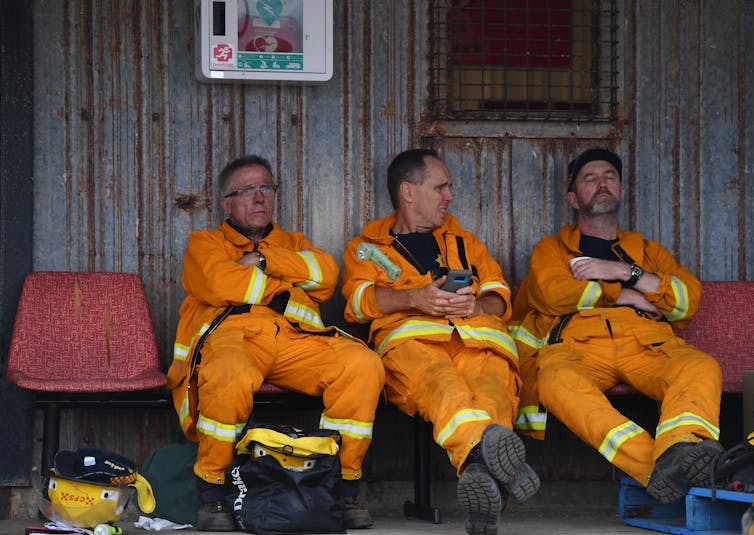
three firefighters seated
Fire officials need more information to help them protect natural assets.
David Mariuz/AAP

4. Biodiversity usually comes last

Problem: Traditionally, the hierarchy of what to protect in disasters goes like this: first human life, then infrastructure, and finally biodiversity. If this hierarchy continues, some of our most significant species and natural environments will be lost.

In one example recounted to the book’s researchers, fire authorities decided to prioritise saving a few farm sheds over 5,000 hectares of national park.

Solution: There are cases, such as avoiding extinctions, where protecting nature is more important than saving infrastructure. Community priorities should be surveyed, and the information used to inform planning and policy.

Legal obligations to protect biodiversity in fires are few. The current re-working of federal environment laws provides an opportunity to change this.


Read more:
‘Bad and getting worse’: Labor promises law reform for Australia’s environment. Here’s what you need to know


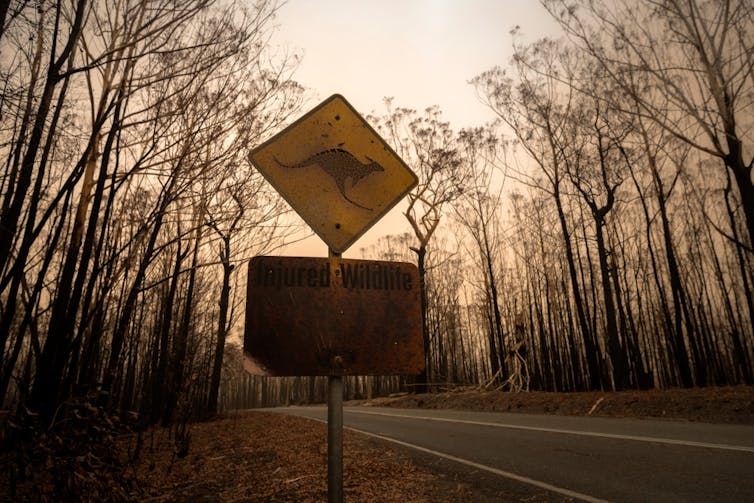
blackened sign of kangaroo and bunt bush
Biodiversity is often the last priority of fire managers.
Shutterstock

5. Conservation funding is grossly insufficient

Problem: Decades of sustained management effort is needed to recover many species and environments affected by fire. Unfortunately, funding for the task is short-term and inadequate.

For example, both state and federal governments invested heavily in controlling feral herbivores, such as deer, in the months after the fires. This was done to protect unburnt and regenerating vegetation. Yet, eventually the funding dries up and feral populations rebound.

Extra funding for some short-term recovery projects flowed in the wake of the Black Summer fires – from governments, the private sector and the community. But for many species, recovery will be a long-term proposition – if it happens at all.

Solution: Governments must stop seeing spending on the environment as optional. It’s as fundamental to our society and well-being as health and education – and funding levels should reflect this.

hand holds lizard
An endangered Rosenberg’s monitor at Kangaroo Island, after the Black Summer fires. For many species, recovery is a long road.
David Mariuz

6. First Nations knowledge has been sidelined

Problem: First Nations people have used fire to manage forested landscapes for millenia. Yet their knowledge and perspectives have not been incorporated into forest fire management and recovery.

So how has this come about? Barriers identified in the book include inadequate employment and training opportunities for First Nations people to undertake cultural burning activities. Also, First Nations people are frequently denied access to Country to rekindle and develop their land management skills, and lack the legal authority to undertake cultural burning.

And as the book shows, cross-cultural challenges mean non-Indigenous fire officers can have limited appreciation or knowledge of Indigenous cultural burning protocols.

Solution: Indigenous people should be supported to rekindle cultural fire practices in forests. And non-Indigenous fire managers should, with consent from First Nations people, incorporate these practices into policies governing fire management and recovery.

What’s more, species and sites that are culturally important to First Nations people should be prioritised for protection and recovery.


Read more:
Fire management in Australia has reached a crossroads and ‘business as usual’ won’t cut it


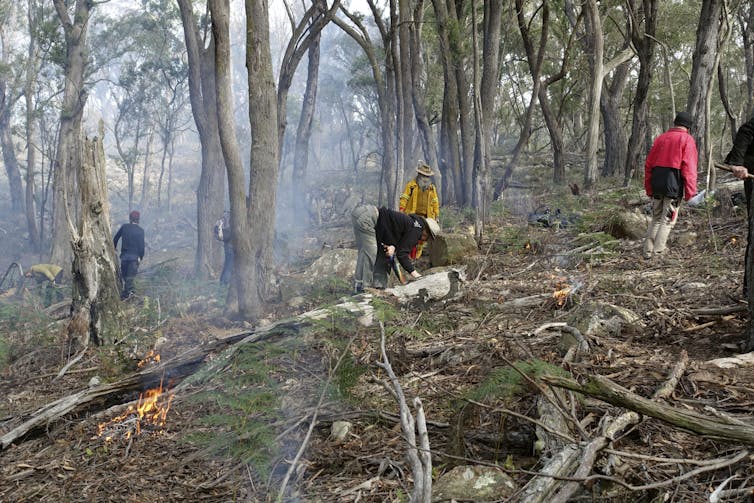
people walk around bush with small fire burning
First Nations fire knowledge has been sidelined. Pictured: a workshop on Indigenous fire practices in Bungendore, NSW, in 2020.
Kydpl Kyodo

Harnessing our grief

The Black Summer fires showed people care. The disaster triggered an outpouring of grief from Australia and around the world. We understood one thing clearly: we were losing what enriches our lives.

But protecting our precious natural assets requires a fundamental reset of Australia’s fire management.

More broadly, the Black Summer fires kickstarted a huge collaborative recovery effort from governments, conservation and research organisations, and First Nations groups. If we’re to be better prepared for future megafires, this impetus must continue.

The Conversation

Libby Rumpff received funding from the NESP Threatened Species Hub, which funded the book. She was on the Commonwealth Government’s Wildlife and Threatened Species Bushfire Recovery Expert Panel. She is employed by University of Melbourne, and the Australian Government (as of October 2022). All views are her own.

Brendan Wintle has received funding from The Australian Research Council, the Victorian State Government, the NSW State Government, the Queensland State Government, the Commonwealth National Environmental Science Program, the Ian Potter Foundation, the Hermon Slade Foundation, and the Australian Conservation Foundation. Wintle is a Board Director of Zoos Victoria. Brendan Wintle is a member of the Biodiversity Council

John Woinarski received funding from the NESP Threatened Species Recovery Hub, which also provided some support for this book. He was a member of the Commonwealth Government’s Wildlife and Threatened Species Bushfire Recovery Expert Panel

Sarah Legge received funding from the NESP Threatened Species Hub, which also funded the book. She was on the Commonwealth Government’s Wildlife and Threatened Species Bushfire Recovery Expert Panel, and is on the Commonwealth Government’s Threatened Species Committee.

Stephen van Leeuwen received funding from the NESP Northern Australia Environmental Resources Hub and is currently employed as the BHP-Curtin Indigenous Chair of Biodiversity and Environmental Science and fills the position of Deputy Director and Senior Indigenous facilitator in the NESP Resilient Landscape Hub. Stephen was on the Commonwealth Government’s Wildlife and Threatened Species Bushfire Recovery Expert Panel, and is also on the Commonwealth Government’s Threatened Species Scientific Committee and the Indigenous Advisory Committee.

ref. 200 experts dissected the Black Summer bushfires in unprecedented detail. Here are 6 lessons to heed – https://theconversation.com/200-experts-dissected-the-black-summer-bushfires-in-unprecedented-detail-here-are-6-lessons-to-heed-198989

You can’t fix school refusal with ‘tough love’ but these steps might help

Source: The Conversation (Au and NZ) – By Christine Grové, Fulbright Scholar and Adjunct Senior Lecturer, Monash University

Anete Lusina/Pexels

School attendance levels in Australia are a massive issue according to Education Minister Jason Clare.

As he told reporters last week, he hopes to talk to state colleagues about the issue at a meeting later this month.

There’s evidence that school attendance rates have been dropping now for ten years, and we see it amongst boys and girls, we see it in every year from kindergarten right through to the end of school.

Clare’s comments come on the top of a growing concern about school refusal. A Senate inquiry is due to report on the issue next month. Submissions from teachers and parent groups describe an alarming trend that has been exacerbated by COVID.

Victorian shadow minister for education Matthew Bach – a former teacher – suggests it is up to parents, not governments, to fix this:

What the growing number of children who refuse to attend school need most is tough love. Going to school must simply be non-negotiable.

But will tough love help, let alone work? How can we support children who are struggling to attend school?

How many students are refusing to attend school?

School refusal is not truancy. It happens when children or adolescents regularly refuse to attend school or experience significant distress when faced with the prospect of going to school.

The rates of school refusal vary widely depending on factors such as age, cultural background, socioeconomic status, and mental health.

Estimates of school refusal vary, with higher rates observed in certain groups, such as those with anxiety disorders. In Victoria, the rate of school refusal grew by 50% between 2018 and 2021 to about 2% of those in state schools. Our previous research has shown some young people’s resilience decreased during COVID. This may have contributed to disengagement with going to school.

The consequences of school refusal can be serious. As well as impacting their academic progress and education, it can negatively impact the development of some social skills or place strain on their mental health and family relationships.

Why do some kids refuse to go to school?

The reasons why children and young people may refuse to go to school are complex. And may be related to:

  • learning difficulties: some children struggle with the academic side of school, which may lead to feelings of frustration or a lack of motivation

  • social anxiety: some children may be fearful of social situations, which can cause them to avoid school

  • mental health issues: children who are dealing with depression, anxiety, or other mental health problems may have trouble getting to school

  • family problems: issues at home such as divorce, financial problems, or trauma can affect a child’s emotional wellbeing and willingness to go to school

  • negative school experiences: children who have had negative experiences such as bullying, may be less likely to attend school.


Read more:
Back-to-school blues are normal, so how can you tell if it’s something more serious?


Why tough love does not work

It seems simple: just force your child to go to school. However, research shows an authoritarian approach can have negative impacts on children who are refusing school.

If children are forced or punished because of school refusal, they can develop low self-esteem, a lack of independence and difficulty forming healthy relationships. They are at increased risk of anxiety and depression, and can experience challenges expressing emotions and communicating effectively.

Often children can feel a sense of hopelessness. They may feel ashamed or embarrassed about missing school. So, they are in a vulnerable and challenging situation, and need to feel like they are being listened to and supported.

When they are extremely fearful and stressed, forcing children to attend school is not helpful. Arguably it is also not possible for older children who can be a lot more independent.

What can parents do?

If a child is refusing to go to school, it’s important for parents and educators to address it in a supportive way that does not punish the child.

They need to work together to find a solution that works for the child. For example, sometimes home schooling or online schooling can help for a period of time.

Each child and family will be different but it is important, in the first instance to identify the reason why a child is not going to school. This can involve talking to the child, observing the triggers of their behaviour, and talking to teachers or other professionals like a GP or psychologist.

Then, some other steps may include:

  • develop a plan together: once the reason for the refusal is understood, parents can work with the child and school to develop a plan. This may involve working on academic skills, seeking counselling, or making changes to the school environment and routine.

  • be responsive and supportive: children who are experiencing school refusal may be feeling anxious, stressed, or overwhelmed. Parents can provide emotional support and encouragement to help the child feel more confident and comfortable with attending school.

  • encourage positive relationships: helping your child to form positive relationships with peers and teachers can help them feel more connected to the school community and more motivated to attend.

  • seek further professional help: if a child’s refusal to attend school is severe and persistent, mental health professionals can help.

It’s important to approach refusal in a collaborative and responsive way, with the child’s wellbeing as the priority. Clear communication and common goals between the school, parents and the child are essential.


Read more:
Is your child anxious about starting school? The approaches we use for children with disability can help all families


Does it matter how old a child is?

Responses to school refusal can differ between younger children and adolescents.

A young man leans against a wall.
Responses to school refusal may differ depending on the age of the child or young person.
Arturo Anez/Pexels

For those in primary school, the focus may be more on identifying the cause and addressing any early learning difficulties or behavioural issues that may be present. Parents can work with teachers to create a positive and supportive school environment, and can provide additional support at home.

For those in high school, the approach could focus on addressing any underlying mental health issues, such as anxiety or depression or look for any learning challenges that may have been missed in the early years. They may be more resistant to parental or teacher intervention, so it may be helpful to involve them in the process and encourage them to suggest solutions that could work for them.

Regardless of the child’s age, it’s important to approach the situation with empathy and understanding, and to work together with the child, school, and other professionals.


If this article has raised issues for you or someone you know, you can call Lifeline on 13 11 14 or Kids Helpline on 1800 55 1800.

The Conversation

Christine Grové is a fellow of the College of Educational and Developmental Psychologists, a member of the Australian Psychological Society, and the American Psychological Association, and a member of The United Nations Association of Australia Academic Network.

Alexandra Marinucci is a member of the Australian Psychological Society.

ref. You can’t fix school refusal with ‘tough love’ but these steps might help – https://theconversation.com/you-cant-fix-school-refusal-with-tough-love-but-these-steps-might-help-199095

How to save $4 billion a year: reform a fuel tax credit scheme with no real rationale

Source: The Conversation (Au and NZ) – By Marion Terrill, Transport and Cities Program Director, Grattan Institute

Revising the generous fuel tax credits given to businesses should be a priority for the Albanese government, because keeping them would conflict with two other pressing priorities: reducing carbon emissions and repairing the budget.

Fuel tax exemptions have existed for as long as the federal government has taxed fuel, starting in 1957. With the rationale for the tax being to pay for building and maintaining roads, initially all off-road users were exempt.

But the earmarking of all fuel tax revenue for spending on roads ended in 1959 – more than 60 years ago. With the tax becoming a general revenue-raiser, the rationale for exemptions or tax credits has shifted with the disposition of the government of the day.

The settings inherited by the Albanese government now cost the budget almost $8 billion a year.


CC BY

As long ago as 1991, the Australian National Audit Office recommended the credit scheme “clarify its purpose and objectives”. Yet those objectives remain unclear today.

Who benefits most?

Previous governments have argued exemptions and tax credits support regional industries, and people living in regional areas.

In 1999, when the credit was extended to marine, rail, and some trucks and buses, the then-deputy prime minister (and National Party leader) John Anderson said the goal was to reduce transport costs, particularly for “those people living in regional, rural and remote areas”.

In 2006, when expanding the credit to include all off-road users and on-road vehicles weighing over 4.5 tonnes, the then-assistant treasurer Peter Dutton said: “This is good news for business, and regional Australia in particular.”

But if the aim of the policy is to support regional areas, fuel tax credits are a poorly targeted way to do so.


Read more:
We pay billions to subsidise Australia’s fossil fuel industry. This makes absolutely no economic sense


In the five industries that receive almost 90% of the value of credits, more than 60% of businesses, and 67% of employees, are in major cities.

There is no evidence fuel tax credits particularly benefit regional areas, or that they are more effective than other policies in doing so.

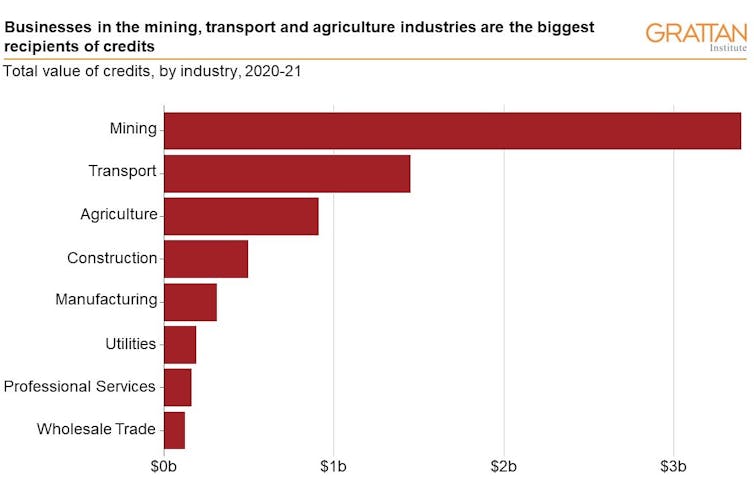
It is hard to avoid the conclusion that fuel tax credits are mostly a gift to the mining and agricultural industries – the only non-care industries that have always received an exemption from paying taxes on fuel, and the major recipients of fuel tax credits today.


Business in the mining, transport and agriculture industries are biggest recipients of fuel tax credits.

CC BY-SA

Budgetary needs have prompted changes

Changes to fuel tax credits have also aligned with the budgetary needs of the government of the day.

In 1982, when government debt as a share of GDP was rising steadily, the Fraser government narrowed the scheme to just mining, primary industries and care industries. Many businesses previously exempt – including in rail, marine, construction and manufacturing – were forced to pay fuel taxes.

In 2006, the Howard government broadened the scheme during the mining boom when budget surpluses meant no net debt for the first time in 30 years.

Despite the straightened fiscal position the government now faces, the credit scheme remains unchanged.

Out of step with net zero and budget repair

The Albanese government has several growing spending obligations, particularly in health, aged care, disability care and interest expenses on its debt.

After stripping out the effects of temporary factors such as high commodity prices, there remains a stubborn gap between government receipts and spending of about $40 billion a year.

In a new report published by Grattan Institute, Fuelling budget repair: How to reform fuel taxes for business, we argue fuel tax credits should be removed for on-road users, and roughly halved for off-road users. This would save about $4 billion a year.

It would also reflect the environmental and health costs of diesel use.


Read more:
Australia’s government gives more support to fossil fuel research than is apparent


Giving businesses tax credits on for consuming fuel without having to pay for or reduce their carbon emissions is sharply at odds with the government’s goal of net zero emissions by 2050. Diesel combustion currently accounts for 17% of Australia’s emissions.

In 2020, the top five industry recipients of fuel tax credits directly produced more than half of Australia’s emissions. That share is expected to reach 64% by 2030.

As well as helping repair the budget, reducing fuel tax credits would signal to businesses that they need to consider emissions in their investment decisions, minimising the costs to future consumers, taxpayers and shareholders.

The Conversation

Grattan Institute began with contributions to its endowment of $15 million from each of the Federal and Victorian Governments. In order to safeguard its independence, Grattan Institute’s board controls this endowment. The funds are invested and Grattan uses the income to pursue its activities. Marion Terrill does not work for, consult, own shares in or receive funding from any other company or organisation that would benefit from this article, and has disclosed no relevant affiliations beyond the academic appointment above.

Grattan Institute began with contributions to its endowment of $15 million from each of the Federal and Victorian Governments. In order to safeguard its independence, Grattan Institute’s board controls this endowment. The funds are invested and Grattan uses the income to pursue its activities.

ref. How to save $4 billion a year: reform a fuel tax credit scheme with no real rationale – https://theconversation.com/how-to-save-4-billion-a-year-reform-a-fuel-tax-credit-scheme-with-no-real-rationale-198999

Higher interest rates, falling home prices and real wages, but no recession: top economists’ forecasts for 2023

Source: The Conversation (Au and NZ) – By Peter Martin, Visiting Fellow, Crawford School of Public Policy, Australian National University

Wes Mountain/The Conversation, CC BY-ND

Australia’s Reserve Bank is set to push up rates once again at its first meeting for the year on Tuesday, according to all but two of the 29 leading economists surveyed by The Conversation at the start of 2023.

Those experts predict we will still be living with higher rates by the end of the year, although they should start to come down in 2024.

Their average forecast is an increase in the bank’s cash rate target from 3.1% to 3.6% during 2023. That’s enough to add an extra A$190 to the monthly cost of servicing a $600,000 variable mortgage, bringing the total increase in the cost of servicing such a mortgage since the bank began hiking rates in May 2022 to more than $1,000.


All but three of the specialists surveyed expect the Reserve Bank’s cash rate target to peak during 2023, and on average the panel expects it to fall back to close to its present level during 2024.

Panelist Jo Masters of Barrenjoey Capital says the bank’s keenness to bring down inflation will be tempered by the knowledge that a large number of borrowers are set to exit the very cheap three-year fixed-rate loans they took out early in the pandemic and are facing very steep increases indeed.


The highest forecast for a peak in the cash rate is from former Reserve Bank research manager Peter Tulip, who expects a cash rate of 5% by December 2024 – enough to add a further $725 to the monthly cost of servicing a $600,000 mortgage.

The panel assembled by The Conversation includes macroeconomists, economic modellers, former Treasury, International Monetary Fund and financial market economists, and a former member of the Reserve Bank board.

Most expect inflation to fall sharply from here on, with all but five believing the quarterly rate will turn out to have peaked at 7.8% in December 2022.


Financial markets economist Warren Hogan says the food and fuel prices pushed up by Russia’s invasion of Ukraine are already falling, and the only question is how quickly inflation falls, and how soon it returns to the Reserve Bank’s 2-3% target band.

Former federal Labor minister Craig Emerson says, unlike in the 1970s, wage rises aren’t helping sustain inflation. Then, more than half the Australian workforce was unionised and wage setting was centralised. Today only one-eighth of the workforce is unionised and most wages are not set centrally.

The panel expects real wages to go backwards for the third consecutive year in 2023, as wages growth of 3.9% is overpowered by prices growth of 4.5%.


Wage growth is expected to fall back to 3.6% in 2024 as the economy weakens and as an increase in immigration helps fill labour shortages. But the average forecast is wage growth to outstrip price rises next year for the first time since 2020, as inflation falls back to 3.2%.

Recession unlikely at home, more likely abroad

The panel assigns a 26% probability to a recession in the next two years, an increase on the 20% it assigned in mid-2022.

Former Department of Foreign Affairs and Trade chief economist Jenny Gordon says if Europe goes into a recession in its 2023-24 winter and China’s recovery is slow, a recession in Australia will become more likely.

While the panel expects China’s decision to end COVID lockdowns will lift its growth rate from 3% in 2022 to 4.7% in 2023, it does not expect anything like a return to the previous growth rates of 8% or more.

Industry economist Julie Toth says China is facing resource depletion and population decline, as well as a cyclical downturn in industrial and residential investment. COVID-19 presents an immediate threat to its people and economy.


Read more:
China’s population is now inexorably shrinking, bringing forward the day the planet’s population turns down


The panel assigns a 42% probability to a recession in the United States within the next two years, a 57% probability to a recession in the European Union, and a 73% probability to a recession in the United Kingdom.

Four of the economists surveyed believe the UK recession has already started. As in the US, it is likely to result from the run of interest rate increases put in place to contain inflation.

University of Tasmania economist Mala Raghavan expects the US to skirt an outright recession and instead experience a “rolling recession”, in which different parts of the economy take time to turn down.


KPMG forecaster Sarah Hunter says while Australia should avoid a recession as commonly described (two consecutive quarters in which production shrinks) economic growth could well turn negative for one quarter at the start of the year, as household spending turns down and mining shipments are disrupted by floods.

Regardless, the economy will be “very weak by historic standards” in 2023. The panel expects economic growth of only 1.7% in 2023, climbing to 2.5% by 2026.


The panel is forecasting very weak growth in household spending of 2.2% over the year to December, and a further decline in the household saving ratio from 6.9 to 5.1%.

Non-mining business investment is expected to hold up, climbing 2.8% over the year to December, up from 1.75%. Mining investment is expected to climb 3.4%, with much depending on demand from the rest of the world.


Read more:
How housing made rich Australians 50% richer, leaving renters and the young behind – and how to fix it


Home prices are expected to fall further in 2023 in response to higher interest rates, slipping another 7% in Sydney and 6% in Melbourne.

AMP economist Shane Oliver says the buying power of someone on average full-time earnings with a 20% deposit has fallen by more than one quarter as a result of interest rate hikes, and prices are yet to fully reflect this.


Jobs to hold up

Australia’s unemployment rate dipped below 4% for the first time in five decades in 2022. It is expected to stay below 4% (at 3.96%) in 2023 and then remain below 5% in 2024 even as immigration builds up, in part because low unemployment has made previously unemployed Australians employable.

As former Deloitte Access director Chris Richardson puts it, previously hard to employ Australians have been “polishing their skills and their resumes”.

Federation University economist Margaret McKenzie also points to the large amount of sick leave being taken, creating demand for workers to fill the gaps.


On average, the panel is expecting a flat share market in the year ahead, but the forecasts range from growth of 8% to a decline of 17%, led down by weaker bank stocks and household spending as interest rate increases bite.

The panel expects the iron ore price to remain roughly steady at US$105 throughout 2023, rather than falling to the US$55 assumed in the budget.

Partly as a result, the panel is forecasting a budget deficit of A$29.4 billion in 2022-23, down from the officially forecast $36.9 billion.


The Conversation’s Economic Panel

Click on economist to see full profile.

Download the 2023 economic survey

The Conversation

Peter Martin does not work for, consult, own shares in or receive funding from any company or organisation that would benefit from this article, and has disclosed no relevant affiliations beyond their academic appointment.

ref. Higher interest rates, falling home prices and real wages, but no recession: top economists’ forecasts for 2023 – https://theconversation.com/higher-interest-rates-falling-home-prices-and-real-wages-but-no-recession-top-economists-forecasts-for-2023-198975

Papuan journalist award-winner Victor Mambor targeted for his reports

By David Robie

When Papuan journalist Victor Mambor visited New Zealand almost nine years ago, he impressed student journalists from the Pacific Media Centre and community activists with his refreshing candour and courage.

As the founder of the Jubi news media group, he remained defiant that he would tell the truth no matter what the risk while facing an oppressive and vindictive regime.

“Journalists need to break down the wall and learn freely about our struggle,” he said in a message to New Zealand media via an interview with Pacific Media Watch.

Now the 49-year-old journalist and editor finds that the risks are growing exponentially as his media network has expanded — with an English language website and Jubi TV becoming add-ons — and the exposure of his networks have also widened.

He writes for the Jakarta Post, Benar News and contributes to international news services. Two years ago he was also co-producer of an award-winning Al Jazeera 101 East documentary about the plunder of West Papuan forests for oil palm plantations.

But last week the timing was impeccable over his latest award, the Oktonianus Pogau Prize for courageous journalism. It came just eight days after a bomb blast had happened in the street outside his Jayapura home.

The blast has been described as a “terror” attack as a warning over his journalism.

Police investigating
Police are investigating but nothing of substance has been reported so far.

Less than two years ago, on 21 May 2021, another (of many) attempts were made to intimidate Mambor — a glass window in his Isuzu car was smashed and the backdoor and lefthand door spray-painted while the vehicle was parked outside his house in Jayapura.

No prosecution, or even an arrest of a suspect.

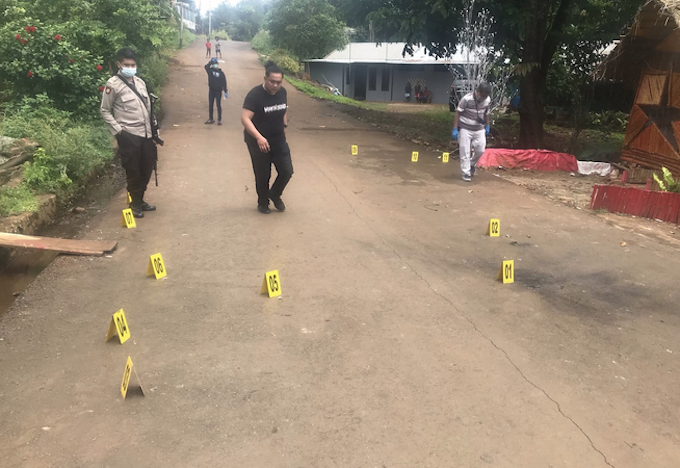
Police conducting a crime scene investigation in Bak Air Complex, Angkasapura Village, Jayapura City, after the bomb blast on 23 January 2023
Police conducting a crime scene investigation in Bak Air Complex, Angkasapura Village, Jayapura City, after the bomb blast on 23 January 2023. Image: Jubi/Dok

“This act of terror and intimidation is clearly a form of violence against journalists and threatens press freedom in Papua and more broadly in Indonesia,” said Lucky Ireeuw, chair of the Jayapura chapter of the Alliance of Independent Journalists (AJI) at the time.

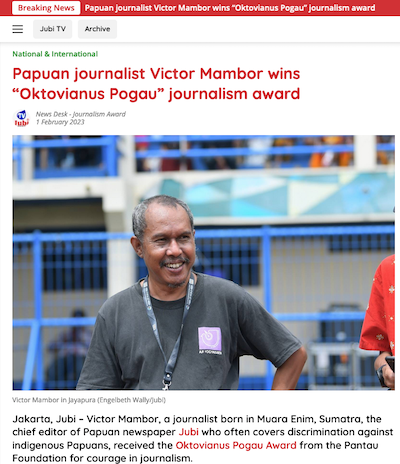
Tabloid Jubi coverage of the Oktovianus Pogau award to Victor Mambor
Tabloid Jubi coverage of the Oktovianus Pogau award to Victor Mambor. Image: Jubi screenshot APR

“It is strongly suspected that the terrorism suffered by Victor is related to reporting by Tabloid Jubi which a certain party dislikes,” he added without being more specific.

Mambor was actually born at Muara Enim, Sumatra in 1974, the son of Rachmawati Saibuna and John Simon Mambor, a poet from Rasiey, Wondama Bay. His father was also a leader of the Papua Presidium Council and he died as a political prisoner in Jakarta in 2003 at the age of 55.

Presidium chair at the time was chief Theys Eluay, who was murdered by Indonesian soldiers in the following year at Sentani, Papua. Eluay was a colleague of John Mambor.
Victor Mambor often quotes his father, saying: “Be proud of yourselves as Papuans who have never begged in their rich land.”

Pantau citation
The Pantau Foundation began awarding the Pogau prize for courage in journalism in 2017 to honour the bravery of the founder of news media Suara Papua, Oktovianus Pogau.

A Papuan journalist and activist born in Sugapa on 5 August 1992, Pogau died at the age of 23 in Jayapura. The award is given annually to commemorate his bravery.

Pogau reported on violence against hundreds of indigenous Papuans during the Third Papuan Congress in Jayapura in 2011. At the time, three Papuans were killed and five jailed on treason charges — but no Indonesian official was questioned or punished.

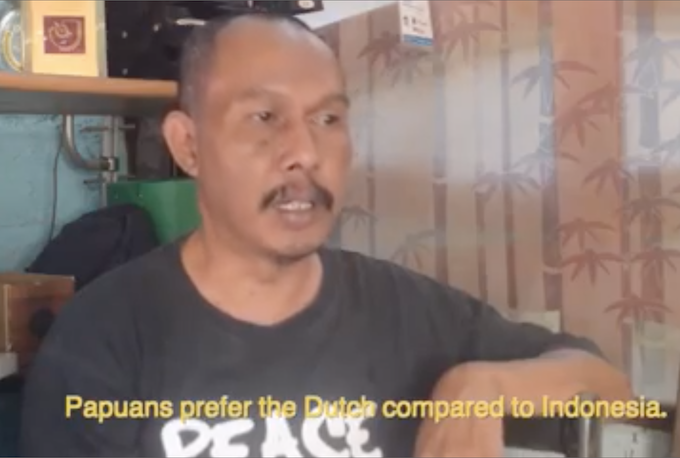
A scene from the Al Jazeera investigative documentary Selling Out West Papua in June 2020
A scene from the Al Jazeera investigative documentary Selling Out West Papua in June 2020. Image: Screenshot APR

Frustrated by the fact that hardly any Indonesian news media were reporting these human rights violations, Pogau launched Suara Papua in 2011.

Speaking for the Pantau Foundation, human rights advocate Andreas Harsono delivered this citation in part:

“Victor Mambor’s decision to return to his father’s homeland and defend the rights of indigenous Papuans through journalism — as well as being steadfast in the face of intimidation after intimidation — made the jury agree that he was a courageous journalist.

“Victor Mambor’s name was recently mentioned in the media after a bomb was detonated outside his house on January 23 in Jayapura. Mambor suspected the terror was related to Jubi’s coverage of the murder and mutilation of four indigenous Papuans from Nduga in Timika in October 2022, when four soldiers were charged with “premeditated murder” . . .

“Victor Mambor grew up in Muara Enim until he graduated from SMAN 1. In 1992, he moved to Bandung, where he later worked as a journalist for Pikiran Rakyat daily. In Bandung, he was mentored by Suyatna Anirun, an actor and director from the Bandung Study Theatre Club.

“In 2004, after his father died, young Victor Mambor decided to work as a journalist in Jayapura. He was appointed editor of Jubi, later general manager, expanding into television and using drones.

“On his blog, Victor Mambor posts important texts he created or translated between 2005 and 2017, including the abduction of Papuan children to Java and his criticism [about] Jakarta journalists’ perspectives, which often only talk about Indonesian nationalism and not giving much space for Papuan perspectives.

“In May 2015, Victor Mambor interviewed President Joko Widodo in Merauke about restrictions on foreign journalists entering Papua since 1967. Jokowi replied that all foreign journalists were free to enter Papua without restrictions.

“Ironically, to this day President Jokowi’s statement has not come true. Foreign journalists are still restricted from entering Papua.

“In 2019, together with several journalists in Pacific Island countries, he founded the Melanesian Media Freedom Forum (MMFF).

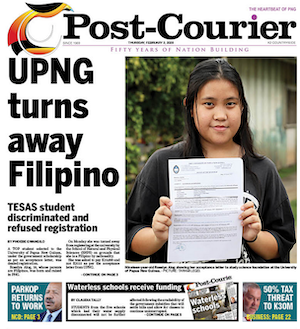
“Mambor has also increased coverage of the Pacific region through Jubi, a natural thing for Papuan media, as well as working with media outlets such as Radio New Zealand, Solomon Star, Vanuatu Daily Post, Melanesia News, Fiji Times, Islands Business, Cook Islands News, Post-Courier, and Marshall Islands Journal.

“Victor Mambor was one of three co-producers of an investigative video entitled Selling Out West Papua broadcast by Al Jazeera in June 2020. He collaborated with Mongabay, the Gecko Project and the Korea Centre for Investigative Journalism.

“This was about how a South Korean company, Korindo, seized land and destroyed Papua’s forests. The documentary makers received the Wincott Award for video journalism.

“On May 21, 2021, Mambor was intimidated. His car glass was broken, and the door was spray-painted, while parked at night in front of his house in Jayapura. The police have yet to find the perpetrators of this vandalism.

“In September 2021, António Guterres, Secretary-General of the United Nations, issued an annual report on international cooperation in the field of human rights. Guterres named Victor Mambor as one of five human rights defenders who frequently experienced intimidation, harassment and threats in covering issues in Papua and West Papua provinces.

“Yayasan Pantau calls on the Indonesian police, especially in Papua, to keep Victor Mambor safe, and to find the people who damaged his car and placed a bomb in front of his house.”

Victor Mambor speaking in an "unfree media" documentary on the Jubi website
Victor Mambor speaking in an “unfree media” documentary on the Jubi website. Image: Screenshot APR
Print Friendly, PDF & Email

Article by AsiaPacificReport.nz

Enshrining the Voice gives best chance for Closing the Gap, Albanese says

Source: The Conversation (Au and NZ) – By Michelle Grattan, Professorial Fellow, University of Canberra

Enshrining a constitutional Voice to parliament will bring better practical outcomes and give the best chance for Closing the Gap, Prime Minister Anthony Albanese will say in a major address on the referendum on Sunday.

Albanese will also flatly reject opposition calls for the government to legislate the Voice at once, pointing out that the call from Indigenous people is for it to be in the Constitution.

The government will introduce the legislation for the referendum, with the wording of the question, before the end of March. This will be followed by a parliamentary inquiry lasting at least six weeks.

The PM, outlining the timing in a Guardian podcast, said the legislation would then be debated and voted on in the May-June budget session. Once it is passed, the referendum then must be held not earlier than two months and 33 days after that, and not later than six months. That put the timeframe between September and December, he said.

In his address to a Chifley Research Centre conference – released ahead of its Sunday delivery – Albanese highlights positive results from the justice reinvestment model in Bourke to argue the value of consultation. Co-designed by Aboriginal people and run by the locals, the community takes responsibility for the rehabilitation of young offenders instead of their being sent to jail.

In this case, “the community’s voice was heard – and that saved lives”.

“We know that when governments listen to the people on the frontline, when we build from the ground up, when we trust in the wisdom and experience and earned knowledge of country and culture and kinship, we get better results.

“And better results are desperately needed,” Albanese says.

“Every Closing the Gap report confronts us with the reality that many Aboriginal and Torres Strait Islander people lead lives of lesser opportunity.”

He says the failures in Closing the Gap “are not failures borne of a shortage of goodwill, or good intentions. Rarely even is it a lack of investment or resources.

“Governments on both sides have invested billions. But by and large, we have been repeating the same process and expecting a different outcome.

“Imposing decisions from Canberra. Mostly, with the best of intentions. But assuming that one size will fit all. And ignoring the wisdom of community,” Albanese says.

“Enshrining a Voice in the Constitution is our best chance to change that, because it has come from Aboriginal and Torres Strait Islander people themselves.”

Albanese says that in the course of the year, there will be more information about the Voice for people to examine, but its mechanics will not be written into the Constitution.

He urges the parliament to embrace the Voice “as a vehicle for Closing the Gap and improving lives”.

Rejecting the calls for legislation before constitutional change, Albanese says the Uluru Statement from the Heart was the product of five years of consultation among Indigenous people and “in 2017 they produced a very clear request for recognition and a voice in the Constitution”.

Also, putting the Voice into the Constitution “sends a message about the strength and substance of the body.

“Not just to the government of the day or the parliament of the moment but also to the people we want the Voice to serve, the people we want engaging with it.

“It sends a message to Aboriginal and Torres Strait Islander people: we’re serious about making this work, over the long-term.

“Not as a project of one government – but as an enduring national priority.”

Albanese, who has the Uluru statement on his office wall, says the referendum will be an opportunity for Australians “to show their best qualities: their generosity, their sense of fairness, their optimism for the future”.

On Friday at national cabinet all premiers and chief ministers signed a statement of intent to work “collaboratively to support a constitutionally enshrined Voice”.

Meanwhile, in the coming week the federal cabinet and the Northern Territory government will consider a report recommending the reimposition of alcohol bans in NT community. Albanese favours the move.

The Conversation

Michelle Grattan does not work for, consult, own shares in or receive funding from any company or organization that would benefit from this article, and has disclosed no relevant affiliations beyond their academic appointment.

ref. Enshrining the Voice gives best chance for Closing the Gap, Albanese says – https://theconversation.com/enshrining-the-voice-gives-best-chance-for-closing-the-gap-albanese-says-199259

Iwi leaders warn Hipkins not to bow over Three Waters co-governance

By Jamie Tahana, RNZ News Te Ao Māori journalist at Waitangi, and Russell Palmer, digital political journalist

Iwi leaders in Aotearoa New Zealand have accused opposition parties National and ACT of “fanning the flames of racism”, urging the prime minister to be brave and not walk away from partnership on Three Waters.

With Waitangi events and festivities gearing up for the holiday weekend, Prime Minister Chris Hipkins attended the Iwi Chairs Forum yesterday.

He emerged from the closed-doors meeting saying they had asked the government to continue to work with Māori “to advance the issues that we’ve been working on previously”.

Iwi leaders had also, it seemed, laid down a wero [challenge].

“I have also heard their concern that they don’t want to see ethnicity, race, being used as a way of dividing New Zealanders and I was able to absolutely reiterate my government’s commitment to ensuring that we continue to work together to avoid that happening,” Hipkins said.

“Where there is uncertainty, where there is a lack of clarity, that can lead to fear. Politicians who use that fear or exploit that fear in order to try and gain political advantage need to really reflect on their own actions. That’s something my government will never do.”

Tukoroirangi Morgan at the Iwi Chairs Forum at Waitangi, 2023.
Tukoroirangi Morgan at the Iwi Chairs Forum at Waitangi. Image: Ella Stewart/RNZ News

He was not afraid to get into specifics, either.

“They don’t want the concept of co-governance to be used to stoke fear, and nor do we,” he said.

“I think it’s been misunderstood and those who seek to use misunderstanding around it for political advantage need to reflect on their own behaviour.

“People can form their own judgments about that but I certainly think the opposition — National and ACT have, as they’ve done in the past — they’ve used uncertainty to try and stoke fear.”

Prime Minister Chris Hipkins at Waitangi for the Iwi Chairs Forum.
Prime Minister Chris Hipkins at Waitangi for the Iwi Chairs Forum. : Ella Stewart/RNZ News

The devastating flooding in Auckland this week may have changed some minds about the need for change in management of drinking, waste and stormwater — something Hipkins will be looking to capitalise on.

“I think that we have to accept that as a result of climate change we’re going to see more extreme weather events, and stormwater — which is an integral part of the Three Waters system — is going to continue to come under more pressure,” he said.

The iwi leaders were not shy about it either, with Tukoroirangi Morgan telling reporters they wanted co-governance or a similar partnership retained in the Three Waters legislation.

“The challenge we’ve put to the prime minister today is will he succumb to the attack dogs of the National party and ACT as they fan the flames of racism and anti-Māori sentiments, and throw us under the bus for the sake of keeping alive Three Waters?”

Prime Minister Chris Hipkins at Waitangi on 3 February.
Prime Minister Chris Hipkins at Waitangi on 3 February 2023. Image: Ella Stewart/RNZ News

Morgan, it must be noted, has been appointed chair of the entity set to oversee Auckland and Northland’s water.

“There is nothing mysterious about Three Waters — it’s all about pipes under the ground. Our view is as it has always been: we stand here at Waitangi, the cradle of the Treaty of Waitangi, and here is the embodiment of partnership,” he said.

“What we seek from this government is an ongoing commitment that partnership will amplified and affirmed through Three Waters, [it is an] opportunity for the Crown and Māori to work together in a meaningful and significant way.”

Jamie Tuuta, an iwi leader from Taranaki, also warned against allowing Māori to become a political football this election.

“One of the key messages we want to give to the prime minister and other ministers is that they need to stand up, they need to step up,” he said.

“It’s unacceptable — because again, the racist and biased attacks on Māori in 2023 are unacceptable.”

A Pou Tikanga of the forum, constitutional law expert Professor Margaret Mutu, said it was essential race rhetoric was removed from electoral debate.

“There’s a need to understand and address racism in this country and over recent times it’s got a lot more urgent,” Professor Mutu said.

“We need to make sure that work doesn’t slow down, particularly as the extreme attacks coming in are very, very hurtful. We want to try and stop that hurt.”

Te Arawa’s Monty Morrison said the meeting went “very well, it was very open.”

Ngāti Kuri’s Harry Burkhardt said they “were clear about our message, and I think Chris received that well”.

Prime Minister Chris Hipkins, who was wearing formal attire after meeting with Iwi chairs, rolled up his suit pants to join rangatahi who were waka training at Waitangi on 3 February, 2023.
The Kaihautū (waka leader) Mukai said having the prime minister visit was “beautiful”. Image: Ella Stewart/RNZ News

Luxon, Seymour respond
Co-governance was a topic National’s leader Christopher Luxon chose to address when he visited Rātana last week. His speech accused the government of failing to make its position on the matter clear, and allowing it to become a “divisive and immature” conversation.

National had been invited to meet with the Iwi Chairs Forum but declined. In a written statement after the kōrero at Waitangi today, Luxon said the party had been clear about its position.

“We support co-management between government and Māori for natural resources in the context of Treaty settlements. We do not support co-governance of public services or separate bureaucratic systems for Māori and non-Māori,” he said.

“Labour has progressed a divisive agenda and continually failed to set out its views clearly. It is disappointing to see the new Prime Minister try to shut down the discussion rather than clearly setting out Labour’s plans for the public to judge.”

Luxon has previously raised as examples National does not support:

  • The Māori Health Authority, which sets strategy for overcoming racial health gaps and commissions kaupapa Māori health services
  • The Three Waters legislation allowing equal representation between council and iwi appointees on a strategic oversight group which appoints the management board of the four entities set to take over management of water services

ACT leader David Seymour — who has Ngāpuhi roots — has been even more stridently critical of these, arguing they are race-based approaches which only further divide.

“If the prime minister thinks that ACT is making co-goverment divisive, wait till he hears what Labour’s been up to,” he said.

ACT leader David Seymour
ACT leader David Seymour . . . bristled at being labelled an “attack dog” by Tukoroirangi Morgan, chair of the Auckland and Northland Three Waters entity. Image: Samuel Rillstone/RNZ News File

“Their modus operandi is to divide public affairs between two groups of people based on race — that is divisive and it’s unsurprising that opposition parties are raising concerns.”

He bristled at being labelled an “attack dog” by Morgan.

“Again, it’s a shame. The Iwi Chairs Forum were an organisation we’ve enjoyed good relationships with.

“That kind of language, calling people dogs, well it doesn’t exactly sound like they’re coming to the table to make the situation any better, now, does it.”

Three Waters changes yet to be decided
Since taking over as Prime Minister from Jacinda Ardern, Hipkins has promised his government will focus more on the “bread-and-butter” issues, targeting cost-of-living pressures and cutting back some of the government’s work programme.

Media speculation has highlighted the unpopularity of the government’s RNZ-TVNZ merger and the Three Waters projects, and therefore likely on the chopping block.

Prime Minister Chris Hipkins, who was wearing formal attire after meeting with Iwi-chairs, rolled up his suit pants to join rangatahi who were waka training at Waitangi on 3 February, 2023.
Dozens of rangatahi travelled from six kura across Te Tai Tokerau to show off their waka paddling skills, with Prime Minister Chris Hipkins attending their training session. Image: Ella Stewart/RNZ News

Hipkins signalled announcements within weeks about the slimmed-down work programme, but when pressed about Three Waters early this week spoke about the need to change the status quo — statements he repeated today.

“We’ve been doing so many different things, actually we probably haven’t created the space to make sure people understand what we’re doing and why we’re doing it and that is absolutely, I think, a lesson for us over the last five years and it’s something we have all reflected on and you’ll see some change in that regard.

“I haven’t said a lot in terms of ruling things in and out, but one thing I will rule out is no reform . . .  we can’t continue with the status quo — it is not delivering New Zealanders the water services they need and that they deserve.

“If we leave it just with the status quo, one thing it will deliver is significantly higher rates for households, and I’m not willing to just stand back and say ‘that’s a council problem to deal with’.”

He has, to date, refused to outline what any of the changes to the project might be — saying those decisions are yet to be made by the full Cabinet — but speculation has centred on the co-governance aspect.

“I think everybody acknowledges that what we’re doing now or around the way we manage our water infrastructure in New Zealand is not sustainable, and it has left us with a pretty disgraceful legacy, frankly, of that core infrastructure being run down.”

Taranaki iwi leader Jamie Tuuta said whatever changes came, they expected the same level of engagement and partnership.

“By and large what we ask is that we are respected and that [Hipkins] and his ministers engage openly with us in the event that there are any changes.”

With an election in October, Morgan and the other leaders present at today’s forum are clear: they want bold leadership and partnership, and however this year’s election plays out — they will still be there.

“This is a ongoing journey for us,” Morgan said. “Absolutely, we would want a very clear and unfettered response and commitment from this government that they’re not going to walk away, nor are they going to throw us under the bus for their own political means.

“Iwi will be at this side of the table come the election, we’ll deal with whoever the government is. What is clear in this situation is we are enduring, iwi will remain as the Treaty partner.

“Whether we deal with Hipkins after the election or the National Party, we will see, but all we say is that we want an equitable share in the major decisions that affect our people – that’s our bottom-line expectation.”

This article is republished under a community partnership agreement with RNZ.

Print Friendly, PDF & Email

Article by AsiaPacificReport.nz

PNG’s Education Minister slams UPNG ‘discrimination’ against Filipino student

By Phoebe Gwangilo in Port Moresby

Higher Education Minister Don Polye has condemned a decision by the administration of the University of Papua New Guinea to treat a PNG-born and bred grade 12 school leaver as an “international” student.

Roselyn Alog, 19, whose parents are Filipinos, was born and raised in PNG.

On Monday, she was turned away from registering at the university by the School of Natural and Physical Sciences on the grounds that she is a Filipino by nationality.

She was asked to pay K19,638 (almost NZ$9000) and not K3115 (NZ$1400) as per the acceptance letter from UPNG.

Alog completed her grade 12 last year at the Paradise Private School and was selected through the National Online System to study under the SNPS programme.

“I have considered that those students who have come through PNG’s education system, regardless of nationality over the years, have a right to be given the same treatment as everyone else for enrolment,” Polye said.

“PNG is a member of the global community and our universities are institutions of learning for all international students who live within or live outside our shores.

Diverse students
“We are happy to see students of diverse nationalities and cultures live and study together as it’s part of learning.

The Post-Courier's front page story about UPNG discrimination
The Post-Courier’s front page story on 2 February 2023 about the university discrimination against PNG-born student Filipino student Roselyn Alog. Image: Screenshot APR

“If a student had been paying school fees through the echelon of our formal education structure at the established school fees structure, then the same student is entitled to pay the same fee asked of through the formal process.

“A student should not be discriminated against. No foreign student will be made to pay more if such a student had been coming up [through] the formal PNG education system.

“Any errors made must be corrected immediately.”

Francis Hualupmomi, Secretary for the Department of Higher Education Research Science and Technology (HERST) which manages the TESAS (scholarship scheme), said no university had the right to take away the TESAS privilege awarded to a student.

A call from the scholarship division of the Department of HERST to the Post-Courier asked Roselyn Alog to visit their office to establish her citizenship status.

Phoebe Gwangilo is a PNG Post-Courier journalist. Republished with permission.

Print Friendly, PDF & Email

Article by AsiaPacificReport.nz

Anti-corruption agency probes Fiji’s ex-elections chief

RNZ Pacific

Fiji’s former Elections Supervisor Mohammed Saneem is under investigation by the country’s anti-corruption agency for alleged abuse of office and has been stopped from fleeing the country.

The Fijian Elections Office (FEO) said Saneem was alleged to have “on numerous occasions . . . unlawfully authorised payments of sitting allowances” to members of the Electoral Commission (EC) and has been referred to the Fiji Independent Commission Against Corruption (FICAC).

The FEO said the Constitutional Offices Commission had clarified to Saneem that the allowance for the chairperson and members of the EC remained at the same rate of FJ$500 (NZ$356) per person, per meeting.

Saneem, however, had continued to instruct for allowances to be paid to the commission’s members for attending events other than meetings, including social functions.

According to Section 5 of the Electoral Act 2014, meetings held by the Electoral Commission are to be determined by the chairperson or a majority of the members of the Commission.

The Electoral Commission could also hold meetings virtually.

The FEO said the former elections boss — who was suspended last month and resigned this week — “continued to deviate from this and constantly gave instructions for payment of FJ$500 allowance to the Electoral Commission members”.

Attorney-General Siromi Turaga confirmed to Fijivillage News that Saneem had been trying to board a flight to Australia on Friday morning but was stopped by border officials as he was now under investigation by FICAC.

This article is republished under a community partnership agreement with RNZ.

Print Friendly, PDF & Email

Article by AsiaPacificReport.nz

Kayt Davies: AI will take media jobs but will free up time for fun stuff

COMMENTARY: By Kayt Davies in Perth

I wasn’t good at French in my final year of high school. My classmates had five years of language studies behind them. I had three. As a result of my woeful grip on the language, I wrote a terribly bad essay in my final French exam.

The more I read of ChatGPT’s output, the more I am reminded of my final French essay. I could not express the complex ideas I wrote in my English essays, so instead, I repeated the question a lot and clumped together words and phrases that sounded like they kind of went together. There was no logical thread, no cogent argument.

It was a bit like the perplexing, digressive, buzzword-rich oratory stylings of Donald Trump.

I have been a university lecturer, tutor and marker for coming on two decades now and late last year a student submitted an essay that I sent off to the university integrity team, explaining that it was “bad in a new and different way”.

According to Turnitin (our detection software), it wasn’t plagiarised. It didn’t read like it had been written in another language and run through Google Translate. The grammar was impeccable but there were glaring non-sequiturs and it danced around the question, which it repeated several times, but didn’t actually answer.

I didn’t hear back from the integrity people. They probably didn’t know what to do about it and may have been busy, as it was the end of the teaching year. I had also said it wasn’t urgent, as it had failed against my marking key, meaning the student, whose marks had been poor all along, would have to repeat the unit anyway.

New teaching year
A couple of weeks later ChatGPT was made available to the public, joining the dozen or so other AI writers available to people who want AI to string together their sentences.

Journalism lecturer Dr Kayt Davies
Journalism lecturer Dr Kayt Davies . . . graduates will need to be focused on things only humans can do to make the world a better place. Image: Kayt Davies/Curtin University

Now, heading back into a new teaching year, having spent the summer chatting with ChatGPT, I am in conversations with my colleagues about how we should proceed. I teach journalism and my colleagues are from a range of arts and communications disciplines.

Collectively our feelings are mixed, but I’m looking forward to letting my students know about this leap forward in communications technology.

I plan to explain it in the context of the other leaps and lurches I’ve lived through.

This won’t be the first to make swathes of workers redundant. I remember the angst in my industry about digital typesetting usurping the compositors and typesetters, replacing vast numbers of them with far fewer graphic designers.

ChatGPT will undoubtedly take some jobs, but it’s the donkey work of the writing professions. It frees us up to do the innovative fun stuff. Also, while ChatGPT is big and shiny, we’ve known that AI writing is on its way for a long time.

In 2018, Noam Lemelshtrich Latar summed up the progress in our field to date in his book Robot Journalism: Can human journalism survive? He documented the many workplaces already using AI writing software and concluded that there was still work to be done. There still is.

Essay capacity underwhelming
Much of the media racket over ChatGPT this summer has been about its capacity to write essays, and so I have read several essays it has written, and I can happily report that I am underwhelmed by them, but also fascinated by the challenge we face in getting better at describing the ways in which they are bad.

This task is part of the mission humanity more broadly is facing in figuring out what it is that people can do that robots can’t. If robots/AI writers are going to do the donkey-work writing in workplaces, that is not something we need to be training graduates to do.

Graduates need to be able to do things an AI language model can’t, and they need to be able to articulate their skill sets.

So, I will be generating AI content in my classrooms and we are going to set to work pulling it apart, in search of its failings and foibles. We’ll do this together and learn about it and ourselves as we go.

Another big theme in the media hype has been ChatGPT’s ability to “do the marking for us”. This, in my opinion, is rubbish. Sure, you can copy-and-paste some text into ChatGPT and ask it for a comment and a grade, but every university I know of demands more of the markers than a simple comment and grade.

If only it was that simple. But, no. We have to describe the specific criteria every piece of work will be assessed against, and the expectations ascribed to each criterion that will result in the award of a specific number of marks. This forms a table called a rubric, which is embedded in our unit websites and getting the assignments and rubrics out of that software and into ChatGPT would take longer than the tight time allocation we get to mark each piece.

Besides the software we mark in is already replete with time-saving tricks, like a record function so you can speak rather than type feedback and the ability to save commonly used comments.

‘Getting to know students’
In addition, failing to read the assignments would inhibit the “getting to know your students” process that marking their work facilitates, and so I imagine it to be the sort of drain-circling behaviour used by failing teachers on their way out of the profession — as student assessment of teachers who cheat in their marking is going to be on par with teacher assessment of students who cheat in their assessments.

Cheating is a key word here. While ChatGPT is new, universities have longstanding policies and charters that use words like “honesty and fairness” in relation to academic integrity. These are being underscored and highlighted in preparation for the start of semester and hyperlinked to paragraphs about AI writing.

Honest use of ChatGPT will involve disclosure about how it was used, and what measures have been taken to verify its content and iron out its wrinkles. It then joins the swath of online tools we encourage our students to use to prepare them for the professions they’ll enter when they graduate.

For my first year students these will be professions that have adjusted to the existence of AI language models, and so their new graduate brilliance will need to be focused on things only humans can do to make the world a better place. This is how I’m going to frame it in my classes, when our next semester starts.

Dr Kayt Davies is a lecturer in journalism at Curtin University. She is a contributor to Pacific Journalism Review. The article was first published in The West Australian and is republished by Asia Pacific Report with the author’s permission.

Print Friendly, PDF & Email

Article by AsiaPacificReport.nz

Papua’s Jubi chief editor awarded Indonesian Pogau prize for courage

RNZ Pacific

Journalist Victor Mambor, who is the chief editor of the West Papuan newspaper and website Jubi, has received the Oktovianus Pogau Award from the Indonesian-based Pantau Foundation for courage in journalism.

The foundation’s Andreas Harsono said Mambor’s decision to return to his father’s homeland and defend the rights of indigenous Papuans through journalism, as well as being steadfast in the face of “intimidation after intimidation”, made the jury agree he was a courageous journalist.

Late last month a bomb exploded outside Mambor’s home in Jayapura in an apparent planned attack and he has faced other incidents of intimidation.

Mambor suspected it was related to Jubi’s coverage of the murder and mutilation of four indigenous Papuans in October 2022, which led to four soldiers being charged with “premeditated murder”.

This article is republished under a community partnership agreement with RNZ.

Print Friendly, PDF & Email

Article by AsiaPacificReport.nz

Medicare reform is off to a promising start. Now comes the hard part

Source: The Conversation (Au and NZ) – By Peter Breadon, Program Director, Health and Aged Care, Grattan Institute

There was a lot of build-up to today’s National Cabinet meeting. Federal Health Minister Mark Butler has long said Medicare is in the worst shape it has ever been, and the premiers said health reform should be the top priority at the meeting.

Soon after taking office, Butler appointed a Strengthening Medicare Taskforce to advise on how to fix a system everyone agrees is in crisis. It includes the industry groups for GPs, nurses and allied health workers, as well as academic experts and a patient advocate. Today, the taskforce’s final report was discussed at National Cabinet and publicly released.

It’s only 12 pages long and light on detail, but it lays out clear directions and includes big reforms. While there have been many calls to throw more money into the existing system, the taskforce recommends a trickier, but necessary, course toward the structural, long-term reform general practice needs.

The taskforce’s recommendations fall under four themes: funding reform, multidisciplinary team-based care, data and IT, and supporting change.

Funding reform to improve access to care

The way Australia funds general practice is stuck in the past, and the taskforce recommends a big overhaul.

Today, we have a fee-for-service model which rewards doctors for seeing lots of patients for short, one-off visits.

But Australians have got older and sicker since Medicare was designed 40 years ago. Many of us require longer consultations. There is strong evidence that people will be healthier and live longer if they have ongoing relationships with their care team, not just one-off visits.

Another problem is the current funding model doesn’t do enough to ensure health care is delivered in communities with less access to care, including to First Nations Australians, people in rural and remote areas, and people on low incomes.


Read more:
First Nations people in the NT receive just 16% of the Medicare funding of an average Australian


The taskforce recommends a move to “blended” funding models to overcome these challenges. These models mix visit fees with other types of payments, such a flexible budget for each patient and payments for providing quality care.

The taskforce also recommends voluntary patient registration, where patients are linked with a “home” practice, so they build a relationship with their usual health care providers.

Encouraging multidisciplinary care

Australia’s current model of general practice doesn’t give GPs enough support.

There are many primary care workforces, such as nurses and allied health workers, whose training means they can help GPs manage a growing and more complex caseload. But as it stands, our rules, regulations, and funding model limit the help they can provide.

Changing this will bring big benefits. It can help take pressure off busy GPs, giving them more time for complex cases. And the evidence suggests it can boost quality of care and health outcomes.

medicare card and australian currency in background
Medicare was designed 40 years ago and needs an update.
Shutterstock

The taskforce recommends the federal government work with the states to remove regulatory barriers that stop primary care professionals from using all their skills.

It calls for more investment to help build these new teams into GP practices, and for Primary Health Networks (the regional organisations that are responsible for improving the primary care system) to deploy nurses and allied health workers to GP clinics where they are most needed.


Read more:
How do you fix general practice? More GPs won’t be enough. Here’s what to do


Improving data and digital systems

The right data and digital tools can let primary care teams know when their patients have been in hospital, or had new care recommended by other doctors. They can help practices provide the best care, help patients manage their own health, and help government understand how the system is performing.

But these systems are not working well. Australia’s digital health platform, My Health Record, is not user-friendly and few clinicians use it.

Progress in linking up data from Commonwealth and state systems has been agonisingly slow.

The taskforce calls for improvements to the My Health Record system, making sharing of information from providers the default, and making the system easier for clinicians and patients to use.

The taskforce proposes joining up health data, with new national governance, legislation, regulations and technology.

It also suggests new investment in IT infrastructure and skills for clinics, and building up digital health literacy for patients.

Supporting change management and cultural change

All of this calls for big shifts in how general practice operates. It’s easy to underestimate how hard change is for general practices, many of which already report high levels of stress and burnout.

New funding models and multidisciplinary team-based working go beyond simple tweaks to processes. They involve new ways of thinking about roles, responsibilities, and relationships.


Read more:
GPs are abandoning bulk billing. What does this mean for affordable family medical care?


Past attempts at general practice reform have shown just how hard the journey can be. Australia’s last attempt was the Health Care Homes trial, which ran from 2017 to 2021. It had trouble attracting general practices to participate, and problems with patients and practices dropping out.

The taskforce highlights that the reform journey for primary care can’t be rushed. It recommends a staged approach, supported by evaluation, and with patients and communities at the centre of policy and delivery.

It recommends supporting clinics to help them manage change. That includes training for practice managers so they can help practices transition to new ways of working.

What now?

Minister Butler remarked that the health sector has “a lot of loud voices and sharp elbows”.

Some groups have been quick to criticise the taskforce report. The Australian Medical Association, which represents doctors, said the report wouldn’t have an immediate impact for people who were struggling to get care. The professional body for GPs welcomed much of the report, but has also called for an immediate boost to funding, and cautioned GPs must lead any health care team. The allied health body has criticised the focus on building up teams inside GP clinics.

But this report could never satisfy everyone, or solve every problem.

What the taskforce proposes amounts to the biggest change to general practice in generations. It has recognised tinkering, or even a couple of big reforms, won’t heal a broken system. The proposals rightly span across funding models, workforce roles, and digital systems. And the taskforce emphasises change will be hard, take time, and should be guided by the voices of patients, clinicians, and communities.
This is the right approach to a very complex challenge.

There will be more detail on these reforms in the upcoming budget, but Minister Butler has said it will take years of investment to fix the crisis in general practice.

There is a lot more work needed to flesh out this vision, but it is a promising start.


Read more:
Should pharmacists be able to prescribe common medicines like antibiotics for UTIs? We asked 5 experts


The Conversation

The authors do not work for, consult, own shares in or receive funding from any company or organization that would benefit from this article, and have disclosed no relevant affiliations beyond their academic appointment.

ref. Medicare reform is off to a promising start. Now comes the hard part – https://theconversation.com/medicare-reform-is-off-to-a-promising-start-now-comes-the-hard-part-197914

NZ Greens back call for rent controls after Auckland flash floods

RNZ News

Green Party MP Chlöe Swarbrick is brushing off concerns a temporary rent freeze in flood-hit Auckland would just see landlords hike rents even more when the controls were lifted — arguing they should stay permanently.

More than 20 organisations have signed a letter urging Minister for Auckland Michael Wood, Housing Minister Megan Woods and Prime Minister Chris Hipkins to “recognise the difficulties facing families in Auckland” and ban landlords from raising rents for six months.

Among the signees are Renters United, the Citizens Advice Bureau, the Salvation Army, Child Poverty Action Group, Unite Union, Save the Children NZ, FinCap, various student unions and more.

“This is a response to some really troubling calls and comments we have heard from landlords and their representatives that they intend to increase rent, piled on top of the trauma that Aucklanders have just gone through,” Swarbrick told RNZ today.

Earlier this week, the Auckland Property Investors Association said “market forces” would  see rents in the city go up, with fewer rentals available after the record-breaking rainfall of last weekend.

“We will have a shortage of supply of rentals for a period of time just while these repairs are undertaken,” said president Kristin Sutherland, denying it was just greed.

“I’m not in a position to say whether it’s fair or not. It’s the same in any market when the supply and demand changes. I don’t think landlords are out there to make an extra buck.”

‘Really troubling’
Swarbrick called Sutherland’s comments “really troubling” and “disconcerting”.

Green MP for Auckland Central Chlöe Swarbrick
Green MP for Auckland Central Chlöe Swarbrick . . . “troubling calls and comments we have heard from landlords.” Image: Samuel Rillstone/RNZ News

“They’ve said that these are supposedly market forces at work, but if you lift the lid on that, these forces are their decisions and their disproportionate power being wielded over New Zealanders and Aucklanders who have really, really been through a lot.”

She has the backing of Human Rights Commissioner Paul Hunt, who said the right to a decent home is especially important in a state of emergency.

“What we’re urging is for the government to reassure Auckland renters that they’re not about to face an escalating cost of crisis to add to the burdens that too many people are facing,” Human Rights Commission’s housing inquiry manager Vee Blackwood told RNZ  Checkpoint.

Too many people were already paying high rents and unable to deal with unexpected costs, Blackwood said.

Reassurance could include a rent freeze, she said.

“It could include a rent freeze if government policy analysis indicates that would be the best response,” but there could also be other support offered such as an increase in accommodation subsidies, she said.

Businesses have responsibilities
“We acknowledge that many landlords are working in really good faith with their tenants to respond to that flood damage,” she said.

“What I would say is that landlords are businesses as you’ve acknowledged. Businesses also have human rights responsibilities.

“So their responsibilities are to respect the human right sof their tenants and to respect the fact that a decent home is a fundamental human right and not something that can just be divorced to making profit, especially when people are doing it this rough.”

Kiwi home ownership has been dropping for about three decades, particularly in younger age groups.

The government implemented a rent freeze in 2020 to “ensure that people can stay in their homes during this challenging time” as the country went into strict lockdown to eliminate the spread of covid-19, back when there were not any vaccines or effective treatments available.

When it was lifted however, landlords hiked rents more than they ever had before.

“That becomes the point of rent controls,” said Swarbrick.

‘Market forces’ at play
“Rent controls are about realising that these supposed market forces that are at play really boil down to the decision of landlords . . .

“The Greens are backing that call for a rent freeze, but obviously our long-term position has always been for there to be rent controls in place.”

Critics of rent controls say they discourage investment, restricting the supply of new rentals, and encourage people to stay in places that are cheaper, but might not suit their changing circumstances — such as having children or getting a new job somewhere else.

Consumer NZ says landlords who own rental properties damaged in the floods should actually be reducing rents, not hiking them.

Tenants in properties they cannot live in don’t have to pay rent at all, the watchdog said earlier this week.

This article is republished under a community partnership agreement with RNZ.

Print Friendly, PDF & Email

Article by AsiaPacificReport.nz

It’s tradition: Indigenous designs have been on Australian money since decimalisation

Source: The Conversation (Au and NZ) – By John Hawkins, Senior Lecturer, Canberra School of Politics, Economics and Society, University of Canberra

Shutterstock

Indigenous Australians are respectfully advised that the following includes the names and images of some people who are now deceased.

The Reserve Bank of Australia has announced that Queen Elizabeth II’s portrait on Australia’s $5 banknote will not be replaced by one of Charles III (as is happening in the United Kingdom). It will instead show a design that “honours the culture and history of the First Australians”.

While some will complain this is a break from the tradition of the reigning monarch’s head being on the lowest-denomination banknote, that has only been the case in Australia since 1966, when decimal currency was introduced.

Before that, navigator and cartographer Matthew Flinders appeared on the lowest (ten shilling) note. The queen was on the pound note (equal to 20 shillings).

The Reserve Bank of Australia consulted the federal government, which supports the change, but the decision is its own.

An opinion poll last year indicated just 34% of Australians wanted to see King Charles replace his mother on the $5 note, with 43% preferring another person, such as a famous Australian, and 23% undecided.


Read more:
Putting King Charles III on British currency bucks a global trend to honor diverse national heroes on coins and bills


What will the new design show?

Will the design honour an Indigenous individual, or a group, or First Nations people more generally? It will likely be several years before we know.

Banknote design is complex, and the central bank will need to consult widely and deeply with Indigenous Australians to avoid the cultural insensitivities that have marred previous efforts to depict Indigenous motifs or individuals.

What we do know is the note’s other side will show an image of Parliament House, as it does now. The current design includes the Forecourt Mosaic, which is based on Michael Nelson Jagamara’s work Possum and Wallaby Dreaming.

Australia's parliament house will continue to feature on one side of the next $5 banknote.
Australia’s parliament house will continue to feature on one side of the next $5 banknote.
RBA, CC BY

A return to tradition

While breaking with one “tradition”, an Indigenous motif on the lowest-denomination banknote restores another.

When decimal currency was introduced in 1966, the lowest-denomination banknote was the $1 note. One side featured a youthful Queen Elizabeth and the Australian coat of arms. The other showed an Indigenous design, based on bark painting by artist David Malangi Daymirringu, a Yolngu man from what is now northeastern Arnhem Land, and others.

The design of Australia' $1 note was based on work by artist [David Malangi Daymirringu.
The design of Australia’ $1 note was based on work by artist [David Malangi Daymirringu.
RBA

The Reserve Bank’s governor at the time was HC “Nugget” Coombs, a strong advocate for Indigenous Australians. But to his later embarrassment, it turned out no one at the bank thought to ask permission to copy the artworks used in the design – nor offer payment.

Only after the banknote was issued did an Adelaide newspaper report on the treatment of Malangi, who came to be known as “Dollar Dave”.

Coombs subsequently sought to make amends. Malangi was paid $1,000 (the same given to those whose art was used on other banknotes), a fishing kit and a special medallion Coombs commissioned.

The $1 note was phased out in 1984 (replaced by the $1 coin, showing a mob of kangaroos, in keeping with animal motifs on Australian coins).


Read more:
‘Dollar Dave’ and the Reserve Bank: a tale of art, theft and human rights


David Unaipon and the $50 note

The first Australian banknote to honour an Indigenous individual was the $50 note in 1996, with the change from paper to polymer notes.

Portraits of scientists Howard Walter Florey and Sir Ian Clunies Ross were replaced by Australia’s first female parliamentarian, Edith Cowan, and David Unaipon, a Ngarrindjeri man from what is now southeastern South Australia.

In 1996 Australia's $50 note became the first to honour an Indigenous individual, David Unaipon.
In 1996 Australia’s $50 note became the first to honour an Indigenous individual, David Unaipon.
RBA, CC BY

Unaipon (born in 1872) was a preacher, inventor and author. He was an expert in ballistics and believed the aerodynamics of the boomerang could be applied to aircraft.

His book, Myths and Legends of the Australian Aboriginals, was the first by an Indigenous author to be published in Australia – though without credit (W. Ramsay Smith, SA’s chief medical officer, was listed as the author). The book was finally republished with Unaipon’s name on the cover in 2006.

Gwoya Jungarai and the $2 coin

Gwoya Jungarai on the $2 coin.
Royal Australian Mint, CC BY

The first Australian coin to feature an Indigenous Australian was the $2 coin in 1988, showing Gwoya Jungarai (sometimes spelled Tjungurrayi).

Known as “One Pound Jimmy”, he was a survivor of the Coniston Massacre in the Northern Territory in 1928, when police killed at least 31 Warlpiri men, women and children.

This was a time when chief protectors were appointed to “watch over the interests” of First Nations people, and to “smooth the dying pillow” for a race of people who had been brought to the edge of extinction.

The image of Gwoya Jungarai came from a photo of him in 1935. This was used on a postage stamp in 1950, making him the first living Australian to be so featured.


Read more:
Elder, lawman, survivor: stamp research is the latest chapter in Gwoja Tjungurrayi’s remarkable life in pictures


What do other Commonwealth countries do?

New Zealand has the Indigenous name of the country (Aotearoa) and its Reserve Bank (Te Pūtea Matua) on its notes. This is feasible as there is one dominant Indigenous language, whereas in Australia there are hundreds.

One note (the $50) honours a Māori individual Apirana Ngata, the first Māori to graduate from a local university and a parliamentarian for 38 years.

Apirana Ngata on New Zealand's $50 note.
Apirana Ngata on New Zealand’s $50 note..
RBNZ, CC BY

Canada’s $50 note includes the Inuit word for “Arctic”.

The Reserve Bank of Australia is a founding member of the international Central Bank Network for Indigenous Inclusion, along with its peers in Canada and New Zealand. So there may be international discussion of the issues involved.

But the key to ensuring the design fulfils its potential to bring the country together and heal old wounds will be to consult with those whose culture and history the design is meant to honour.

The Conversation

John Hawkins used to work for the Reserve Bank of Australia.

Wayne H Applebee does not work for, consult, own shares in or receive funding from any company or organisation that would benefit from this article, and has disclosed no relevant affiliations beyond their academic appointment.

ref. It’s tradition: Indigenous designs have been on Australian money since decimalisation – https://theconversation.com/its-tradition-indigenous-designs-have-been-on-australian-money-since-decimalisation-199091

The Voice referendum: how did we get here and where are we going? Here’s what we know

Source: The Conversation (Au and NZ) – By Gabrielle Appleby, Professor, UNSW Law School, UNSW Sydney

Prime Minister Anthony Albanese has confirmed that sometime between August and November this year, the Australian people will go to a referendum for the first time since 1999.

We’ll be asked whether we support changing the Constitution to recognise Aboriginal and Torres Strait Islander people through the establishment of a representative Voice to inform government and parliamentary decisions.

For many people, following the process leading up to the referendum so far has been confusing.

So where are we, and what’s ahead?

Unorthodox and historic

This week, following a meeting of the government’s Referendum Working Group, the Shadow Minister for Indigenous Australians Julian Leeser claimed the process leading up to this referendum had been “unorthodox”, in that it hadn’t included a constitutional convention, a parliamentary inquiry or further public consultation.

This statement is both right and wrong.

It’s right in that the process leading up to this referendum has been unorthodox. But that’s because this referendum is historic. It’s about recognising the place of First Nations in the Australian Constitution.

This isn’t the first time we’ve attempted this: some may remember the failed attempt made by Prime Minister John Howard in 1999, when Aboriginal and Torres Strait Islander people were referred to passingly in a preamble. That was a proposal that involved no consultation with the Australian public or First Nations people.

Leeser is wrong in that, while there is a custom to have a constitutional reform mechanism of some kind prior to a referendum, that hasn’t always been the case. A constitutional convention has only been held three times since 1901. So the type of mechanism isn’t set. And in contrast to the 1999 attempt, behind the current attempt at recognition sits a world-leading deliberative process that was conducted by Aboriginal and Torres Strait Islander people.

An extraordinary, unorthodox and historic process unfolded across 2016 and 2017. Funded by the government with bipartisan support, 12 regional dialogues with Aboriginal and Torres Strait Islander people were held, which culminated in the First Nations Constitutional Convention and the delivery of the Uluru Statement from the Heart in May 2017.

That statement was issued directly to the Australian people, asking for constitutional recognition in the form of a First Nations Voice to speak to Parliament on decisions, policies and laws that affect Aboriginal and Torres Strait Islander people.

This constitutional reform process may be unorthodox, but it’s entirely appropriate. This referendum isn’t about what form of recognition Australian people want to give Aboriginal and Torres Strait Islander people, but whether they will accept the form of recognition being sought by First Nations. Australia is engaging in an exercise of mutual recognition that offers a respectful relationship forward for all Australians.


Read more:
Non-Indigenous Australians shouldn’t fear a First Nations Voice to Parliament


But that’s not to say there hasn’t been formal public consultation, or a parliamentary inquiry. That’s where Leeser is also wrong. This is one of the most scrutinised and critiqued proposals ever developed. Since 2010, there have been ten reports on constitutional recognition, many of which engaged in extensive public consultation.

Let’s take a look at just a few.

The Referendum Council, which oversaw the regional dialogues, also conducted an extensive public inquiry, including digital and public submissions. This revealed the strongest support (more than 90%) for Aboriginal and Torres Strait Islander people having a say when parliament makes laws and policies relating to Indigenous affairs.

In 2018, a joint parliamentary inquiry, chaired by Leeser and Labor Senator Patrick Dodson, looked at the question of constitutional recognition. It received almost 500 public submissions, and undertook hearings. While its terms of reference were wide, the committee concluded, based on its public consultations and inquiries, that the Uluru Statement from the Heart “was a major turning point in the debate”, and focused all of its attention on the Voice proposal.

In 2021, the Morrison government’s co-design process in relation to the design of a Voice delivered a report on the design of a non-constitutional Voice. Despite the question of constitutional enshrinement being outside the terms of reference of that body, the final report noted high levels of support for it. Indeed, the Indigenous Law Centre reported that more than 90% of the thousands of public submissions made to that process expressed support for a constitutional First Nations Voice.

What we know already

There has been a lot of political debate about whether we know enough “detail” about the Voice. There is, unfortunately, a fair amount of confusion about what detail we need to make an informed vote on the constitutional amendment, and what detail should – appropriately – be left for future legislation to determine.

But we do know a lot about what we’re going to be voting on. Here’s a brief run-down:

  • the referendum is about recognising Aboriginal and Torres Strait Islander people as the First Nations of Australia, and providing a structural change to our Constitution that gives them a body to speak to Parliament and government in order to improve decisions, policies and laws that affect them. It’s about making a practical difference in the lives of Aboriginal and Torres Strait Islander people

  • we have seen a draft version of the words that the Australian people are going to be asked to vote on, which was released by the prime minister at Garma in July 2022. The Referendum Working Group and the Constitutional Expert Group has been working on this drafting for a number of months, with publicly available summaries of their advice

  • it’s not about giving Aboriginal and Torres Strait Islander people special rights, but providing them input in the decision-making processes of government and Parliament. This is the type of participation right that articles 18 and 19 the UN Declaration of Rights of Indigenous Peoples (to which Australia is a signatory) guarantees

  • it won’t have a veto power

  • as it doesn’t have a veto power, constitutional enshrinement of the Voice is vital to its success. The extensive submissions to the 2020-2021 co-design process explained constitutional enshrinement was the only way the Voice would be set up for success with the stability, independence and authority it needed to shift the political dynamic in Indigenous law and policy. We know legislated and non-legislated bodies have been tried in the past – and failed. So it’s not a case where we could legislate the Voice first, because that would be a different beast

  • it won’t cede the sovereignty of Aboriginal and Torres Strait Islander people.

There are a lot of other questions out there about the eligibility of individuals to serve on the Voice, the selection of members, the number of members, the cost of the body, and more detail about its operations and accountability. We don’t yet have specific answers to these questions – although there are agreed principles that provide a general guide to some of them.

But these aren’t details that will be included in the constitutional amendment. They won’t be set into the Constitution, unable to be changed. These are details that will need closer consultation with Aboriginal and Torres Strait Islander people, and within government and parliament, to determine. They’re likely to be subject to change as circumstances change. We are not being asked to vote on these details.

There’s nothing sinister about this, and nothing is being “hidden” from us. The detail will be included in legislation to follow the referendum. Just like legislation establishing the High Court, the number and qualifications of judges, and the scope of its jurisdictions was introduced after the Constitution was passed, and has been amended occasionally subsequently.

The legislation that establishes the detail of the Voice will be subject to the ordinary, public and transparent parliamentary processes, to which the government and Parliament are ultimately accountable to the Australian people.


Read more:
Could the Nationals’ refusal to support a Voice to Parliament derail the referendum?


The next steps

While we know a lot, there’s more to come. Here are three key moments in the referendum timeline which will unfold in the next couple of months:

1. This month, the Yes and No campaigns will launch (these aren’t government-funded or affiliated). On February 18, the Yes campaign will launch a national week of action on the referendum proposal. There will be lots of information and opportunities to learn more about the proposal, and the key arguments for and against it.

2. On February 10, the Joint Standing Committee on Electoral Matters will report on the government’s proposed changes to how the referendum will be conducted, including removing the partisan Yes/No pamphlet and replacing it with a government-funded information campaign. More information will follow about the government’s planned information campaign, and of course, the campaign itself will roll out soon.

3. In March, the referendum working group will finalise its recommendations to the government, with the constitutional amendment bill introduced into parliament. The bill needs to pass with an absolute majority in both houses, before being put to a referendum within two to six months. The government is saying the referendum will likely be held between August and November, depending on the passage of the bill. The bill will contain the government’s final proposed wording for the constitutional amendment, and it will be subject to robust parliamentary inquiry, including in the Senate’s scrutiny committees, and a public submission and hearing process.

The Conversation

Gabrielle Appleby is a member of the Indigenous Law Centre at UNSW Law & Justice. In 2016-2017 she provided pro bono expert assistance to the Regional Dialogues and the First Nations Constitutional Convention that delivered the Uluru Statement from the Heart. She is a Director of the Centre for Public Integrity.

ref. The Voice referendum: how did we get here and where are we going? Here’s what we know – https://theconversation.com/the-voice-referendum-how-did-we-get-here-and-where-are-we-going-heres-what-we-know-198299

Waitangi Day 2023: why Article 3 of the Treaty deserves more attention in the age of ‘co-governance’

Source: The Conversation (Au and NZ) – By Alexander Gillespie, Professor of Law, University of Waikato

Getty Images

The heated (and often confused) debate about “co-governance” in Aotearoa New Zealand inevitably leads back to its source, Te Tiriti o Waitangi. But, as its long-contested meanings demonstrate, very little in the Treaty of Waitangi is straightforward.

Two versions of the 1840 document were written, one in English and one in te reo Māori. About 540 Māori, including 13 women, had put their names or moko to the document. All but 39 signed the Māori text.

But the differences in the translations were so significant that there has been debate ever since about what much of this agreement actually meant, especially Articles 1 and 2.

Article 3, on the other hand, attracts less controversy – which is interesting, because it was and is critical to debates such as the one swirling around co-governance. In effect, Article 3 acted as a mechanism by which the fundamental rights and privileges of British citizenship would be afforded Māori.

William Hobson, circa 1840.
Getty Images

In the English language version, the Crown promises the Queen’s “royal protection and imparts to them all the Rights and Privileges of British Subjects”. In te reo, the Crown gave an assurance that Māori would have the Queen’s protection and all rights accorded to British subjects.

The promise of these rights and privileges, coupled with Articles 1 and 2, conferred a fundamental commitment of a partnership, in which the two sides could be expected to act reasonably, honourably and in good faith towards each other.

Although there were many British laws, practices and principles in existence by this time, four particularly stand out.

Participation

The ideal was that laws reflected the community (or a portion of it at least) and were made with the participation and consent of citizens. This was a long-standing principle, in that law and governance could not be something arbitrary or controlled absolutely by one person.

There had been efforts to control royal abuses of power since the Magna Carta in 1215 and the establishment of a “common council of the kingdom”, by which high-ranking community leaders could be summoned to discuss important matters.


Read more:
A growing number of non-Māori New Zealanders are embracing learning te reo – but there’s more to it than language


Later, the 1688 Bill of Rights required free and frequent parliaments which would contain the right of free speech within them (parliamentary privilege in today’s terms). This meant representatives could speak without fear. Monarchs could no longer suspend laws on a whim, levy taxes at their pleasure, or maintain a standing army during peacetime without the permission of parliament.

The anomaly that only about 5% of British citizens (wealthy and entitled men) could actually vote for members of parliament was not resolved until legal reform in the early 1830s. This began the expansion of the political franchise and the widening of control over parliament.

The British Houses of Parliament in the 1800s, source of the laws underpinning the articles of Te Tiriti o Waitangi.
Getty Images

Individual rights

All were deemed equal in the eyes of the law, and the delivery of justice with integrity could be expected. Clause 39 of the Magna Carta stated:

No free man shall be seized or imprisoned, or stripped of his rights or possessions, or outlawed or exiled, or deprived of his standing in any other way, nor will we proceed with force against him, or send others to do so, except by the lawful judgement of his equals or by the law of the land.

Clause 40 added: “To no one will we sell, to no one deny or delay right or justice.” The Habeas Corpus Act of 1679 required a court to examine the lawfulness of a prisoner’s detention, thus preventing unlawful or arbitrary imprisonment.

The Bill of Rights prohibited excessive penalties, cruel and unusual punishment, and the imposition of fines or penalties before convictions. It also guaranteed the right for all citizens to petition, where they could complain or seek help from the authorities, without fear of punishment.

Tolerance and a free press

After the Reformation, religious tolerance among British subjects took centuries to develop. The 1701 Toleration Act allowed some tolerance of the public practising of different religions, although the monarch could never be Catholic. But it was not until 1829 that Catholics – and some other faiths – could even be elected to parliament in Britain.

The importance of tolerance can be seen in the oral promise made by Governor William Hobson at the time of the signing the Treaty: all established religious faiths would be tolerated in New Zealand, “and also Māori custom shall be alike protected by him”. Although an oral commitment, to many signatories it was just as binding as the written words.


Read more:
Putting te Tiriti at the centre of Aotearoa New Zealand’s public policy can strengthen democracy – here’s how


Public debate and the role of a free press was another important privilege. Although British laws governing libel, blasphemy and sedition were continued after 1688, there was a clear trend toward expanding liberty, allowing both booksellers and newspapers to proliferate.

This helped build the modern belief in the “fourth estate”, and that the media would act as a positive influence on decision makers.

Forward together

Despite the fine sounding language of Article 3 and all the expectations that went with it, the reality was that for many decades after 1840, the promised rights and privileges did not arrive for everyone.

The governor, followed by the early stages of representative government, ruled with a near absolute power that crushed dissent. The law itself was often used to target the rights and privileges of Māori, with some of the darkest examples occurring during and after the New Zealand Wars/Ngā Pakanga o Aotearoa.

Equality for most was largely a chimera, tolerance was elusive, and the press did not act as a brake on atrocious decision making.


Read more:
The Crown is Māori too – citizenship, sovereignty and the Treaty of Waitangi


Thankfully, the world is different today. Positive change has happened through successive generations of Māori defending the rights guaranteed in 1840, the Waitangi Tribunal, and the critical questioning of early and contemporary government policies by Māori, politicians, community leaders, media and scholars.

There have been official apologies, compensation and redress, although only a portion of what was alienated has been returned.

As we move forward and look for new ways to work together to achieve equal and equitable partnership based on Te Tiriti o Waitangi, it is important to remember the relevance of Article 3 and what it continues to offer in a modern context.

The Conversation

The authors do not work for, consult, own shares in or receive funding from any company or organisation that would benefit from this article, and have disclosed no relevant affiliations beyond their academic appointment.

ref. Waitangi Day 2023: why Article 3 of the Treaty deserves more attention in the age of ‘co-governance’ – https://theconversation.com/waitangi-day-2023-why-article-3-of-the-treaty-deserves-more-attention-in-the-age-of-co-governance-198976

More than 2,000 people from Wittenoom died of asbestos-related diseases. A powerful and compelling requiem brings their story to the stage

Source: The Conversation (Au and NZ) – By Kate Hunter, Lecturer in Art and Performance, Deakin University

Jodie Hutchinson/Red Stitch

Review: Wittenoom, directed by Susie Dee, Red Stitch

Deep in the remote Pilbara region of Western Australia, the town of Wittenoom lies empty, desolate … and contaminated.

Wittenoom is on Banjima country. It was officially established in 1947 as a company town to house those working on the blue asbestos mine in the nearby Wittenoom Gorge. In the 1950s, Wittenoom became Australia’s sole supplier of asbestos. The reported health risks of asbestos led to the shutting down of the mine in 1966 and permanent closure of the town in 2022.

To date, more than 2,000 miners, residents and family members have died from asbestos-related diseases.

Wittenoom, a new play by Mary Anne Butler, is the story of Pearl (Emily Goddard) and her mother Dot (Caroline Lee), who live and work in the town in its functioning heyday of the 1940s.

The pair face a tragic outcome borne of corporate greed and denial.


Read more:
Asbestos still haunts those exposed as kids in mining towns


Dark and spare

As the play opens, Dot and Pearl are perched on the small stage underneath a faded and broken “Welcome to Wittenoom” sign with most of the letters missing. It’s a junky wooden scaffold, propped up with ladders and broken trusses, panels gaping, covered in a fine dust. Pearl begins with a breathy and apocalyptic opening monologue – a lyrical portent that foreshadows the disturbing story to come.

Two women on stage
The play shifts from hardscrabble domestic moments to more poetic interludes.
Jodie Hutchinson/Red Stitch

The writing is dark and spare, and the play skips between present and past, shifting from hardscrabble domestic moments to more poetic interludes. Capable, affable Dot opens her house to some of the Greek and Italian mine workers to help them feel at home, even as, over time, the residents of the town begin to question the safety of the mine and the place where they live.

Young Pearl loves her mum, struggles to fit in at school, and grows more and more disturbed by the threat of the mine. These recollections are countered with the horror of a mesothelioma diagnosis and the hard facelessness of the medical fraternity.

As Dot, Lee is confident and centred. Goddard’s performance as Pearl is similarly accomplished, although there is a slightly alarming moment early on when Goddard resorts to that artificial convention of an adult playing a child. This is a brief interlude, fortunately, and for the most part both actors own the space. Together, they are terrific. It is so satisfying to see two performers who match each other’s energy and presence so well.

This presence is complemented by vocally strong delivery and an integrated and embodied physical expression – with each other, with the audience and with the space.

Despite the constrained playing area, there’s plenty of room for the audience to imagine into the world of the play, such is Susie Dee’s specific and attentive direction. Choreographed unison moments of long-recalled gestures and ghostly dances work to hold the piece in a kind of netherworld of memory and sadness.

The sound design by Ian Moorehead is variously heavy and swelling or dark and thunderous, sustained throughout the piece. At times a little tinny, it feels as if there is too much sound in this work, but the long and deep tones at the top of the show establish a suitably ominous feel.

A woman in a pink shirt
The cast are terrific.
Jodie Hutchinson/Red Stitch

The writing does not shy away from the ghastly medical detail of someone suffering from mesothelioma or the harsh reality that characterises its progression. This grounds the play in an authentic space in which the vulnerability of the human body is laid bare.

The theme of contamination is writ large. The inexorable advance of the disease is manifest as Pearl describes the gobbets of blood coughed up on the floor, the shadows on the lungs, the tumours like tap roots, the tiny poisonous fibres – all while a pale, fine ash gradually settles over the actors’ bodies like bone dust.

Human costs

Wittenoom does have its difficult moments, but Butler’s writing provides enough space and silence to give us time to breathe and Dee’s direction keeps the energetic arc dynamic.

The show is hard and sad, as is the real-life story of many who lived in the town, but it is also necessary. It reminds us of the personal, messy, human cost of such tragedies.

Two women on stage
There is space and silence for the audience to breathe.
Jodie Hutchinson/Red Stitch

The story of Wittenoom is a stark reminder of the deceptive and immoral practices large corporations maintain in the name of profit. The implications continue to manifest in contemporary Australian life. Asbestos mining was the cornerstone of the housing boom in the 1950s and ‘60s, and many of us grew up – or are still living – in houses built from asbestos sheeting, while companies continue to avoid admission of liability.

The show draws themes of grief, memory and injustice together in an undeniably moving way. It is a powerful and compelling requiem for the people whose lives have been destroyed.

Wittenoom is at Red Stitch, Melbourne, until February 19.


Read more:
Explainer: why the James Hardie asbestos victim compensation fund is running out of money


The Conversation

Kate Hunter does not work for, consult, own shares in or receive funding from any company or organisation that would benefit from this article, and has disclosed no relevant affiliations beyond their academic appointment.

ref. More than 2,000 people from Wittenoom died of asbestos-related diseases. A powerful and compelling requiem brings their story to the stage – https://theconversation.com/more-than-2-000-people-from-wittenoom-died-of-asbestos-related-diseases-a-powerful-and-compelling-requiem-brings-their-story-to-the-stage-198779

Text-to-audio generation is here. One of the next big AI disruptions could be in the music industry

Source: The Conversation (Au and NZ) – By Oliver Bown, Postdoctoral fellow, UNSW Sydney

Shutterstock

The past few years have seen an explosion in applications of artificial intelligence to creative fields. A new generation of image and text generators is delivering impressive results. Now AI has also found applications in music, too.

Last week, a group of researchers at Google released MusicLM – an AI-based music generator that can convert text prompts into audio segments. It’s another example of the rapid pace of innovation in an incredible few years for creative AI.

With the music industry still adjusting to disruptions caused by the internet and streaming services, there’s a lot of interest in how AI might change the way we create and experience music.


Read more:
Neil Young’s ultimatum to Spotify shows streaming platforms are now a battleground where artists can leverage power


Automating music creation

A number of AI tools now allow users to automatically generate musical sequences or audio segments. Many are free and open source, such as Google’s Magenta toolkit.

Two of the most familiar approaches in AI music generation are:

  1. continuation, where the AI continues a sequence of notes or waveform data, and

  2. harmonisation or accompaniment, where the AI generates something to complement the input, such as chords to go with a melody.

Similar to text- and image-generating AI, music AI systems can be trained on a number of different data sets. You could, for example, extend a melody by Chopin using a system trained in the style of Bon Jovi – as beautifully demonstrated in OpenAI’s MuseNet.

Such tools can be great inspiration for artists with “blank page syndrome”, even if the artist themselves provide the final push. Creative stimulation is one of the immediate applications of creative AI tools today.

But where these tools may one day be even more useful is in extending musical expertise. Many people can write a tune, but fewer know how to adeptly manipulate chords to evoke emotions, or how to write music in a range of styles.

Although music AI tools have a way to go to reliably do the work of talented musicians, a handful of companies are developing AI platforms for music generation.

Boomy takes the minimalist path: users with no musical experience can create a song with a few clicks and then rearrange it. Aiva has a similar approach, but allows finer control; artists can edit the generated music note-by-note in a custom editor.

There is a catch, however. Machine learning techniques are famously hard to control, and generating music using AI is a bit of a lucky dip for now; you might occasionally strike gold while using these tools, but you may not know why.

An ongoing challenge for people creating these AI tools is to allow more precise and deliberate control over what the generative algorithms produce.

New ways to manipulate style and sound

Music AI tools also allow users to transform a musical sequence or audio segment. Google Magenta’s Differentiable Digital Signal Processing library technology, for example, performs timbre transfer.

Timbre is the technical term for the texture of the sound – the difference between a car engine and a whistle. Using timbre transfer, the timbre of a segment of audio can be changed.

Such tools are a great example of how AI can help musicians compose rich orchestrations and achieve completely new sounds. In the first AI Song Contest, held in 2020, Sydney-based music studio Uncanny Valley (with whom I collaborate), used timbre transfer to bring singing koalas into the mix.

Uncanny Valley’s song Beautiful The World won the 2020 AI Song Contest.

Timbre transfer has joined a long history of synthesis techniques that have become instruments in themselves.

Taking music apart

Music generation and transformation are just one part of the equation. A longstanding problem in audio work is that of “source separation”. This means being able to break an audio recording of a track into its separate instruments.

Although it’s not perfect, AI-powered source separation has come a long way. Its use is likely to be a big deal for artists; some of whom won’t like that others can “pick the lock” on their compositions.

Meanwhile, DJs and mashup artists will gain unprecedented control over how they mix and remix tracks. Source separation start-up Audioshake claims this will provide new revenue streams for artists who allow their music to be adapted more easily, such as for TV and film.

Artists may have to accept this Pandora’s box has been opened, as was the case when synthesizers and drum machines first arrived and, in some circumstances, replaced the need for musicians in certain contexts.

But watch this space, because copyright laws do offer artists protection from the unauthorised manipulation of their work. This is likely to become another grey area in the music industry, and regulation may struggle to keep up.

New musical experiences

Playlist popularity has revealed how much we like to listen to music that has some “functional” utility, such as to focus, relax, fall asleep, or work out to.

The start-up Endel has made AI-powered functional music its business model, creating infinite streams to help maximise certain cognitive states.

Endel’s music can be hooked up to physiological data such as a listener’s heart rate. Its manifesto draws heavily on practices of mindfulness and makes the bold proposal we can use “new technology to help our bodies and brains adapt to the new world”, with its hectic and anxiety-inducing pace.

Other start-ups are also exploring functional music. Aimi is examining how individual electronic music producers can turn their music into infinite and interactive streams.

Aimi’s listener app invites fans to manipulate the system’s generative parameters such as “intensity” or “texture”, or deciding when a drop happens. The listener engages with the music rather than listening passively.

It’s hard to say how much heavy lifting AI is doing in these applications – potentially little. Even so, such advances are guiding companies’ visions of how musical experience might evolve in the future.

The future of music

The initiatives mentioned above are in conflict with several long-established conventions, laws and cultural values regarding how we create and share music.

Will copyright laws be tightened to ensure companies training AI systems on artists’ works compensate those artists? And what would that compensation be for? Will new rules apply to source separation? Will musicians using AI spend less time making music, or make more music than ever before?

If there’s one thing that’s certain, it’s change. As a new generation of musicians grows up immersed in AI’s creative possibilities, they’ll find new ways of working with these tools.

Such turbulence is nothing new in the history of music technology, and neither powerful technologies nor standing conventions should dictate our creative future.


Read more:
No, the Lensa AI app technically isn’t stealing artists’ work – but it will majorly shake up the art world


The Conversation

Oliver Bown receives funding from the Australian Research Council to research dialogic approaches to creative AI. He has an ongoing collaboration with the music production company Uncanny Valley, mentioned in this article, including some commercial creative commissions.

ref. Text-to-audio generation is here. One of the next big AI disruptions could be in the music industry – https://theconversation.com/text-to-audio-generation-is-here-one-of-the-next-big-ai-disruptions-could-be-in-the-music-industry-193956

Wondering about ADHD, autism and your child’s development? What to know about getting a neurodevelopmental assessment

Source: The Conversation (Au and NZ) – By Adam Guastella, Professor and Clinical Psychologist, Michael Crouch Chair in Child and Youth Mental Health, University of Sydney

Shutterstock

With childcare and schools starting the new year, parents might be anxiously wondering how their child will adapt in a new learning environment. Some parents may be concerned about their child’s development or that they need specialised support.

One in five children have a developmental vulnerability when they start school. And one in ten will meet criteria for a neurodevelopmental condition, such as autism or attention deficit hyperactivity disorder (ADHD).

Getting the right assessment can be surprisingly difficult. But there are ways you can get the most out of the process.


Read more:
What exactly is ‘neurodiversity?’ Using accurate language about disability matters in schools


Reasons for concern

Research shows a lack of support and poor educational environments can contribute to long term disadvantage for children.

Yet it can take many years to get an assessment. We recently found that, for more than 900 children attending a public developmental assessment service in Sydney, the average wait time from when parents first noticed concerns to receiving an assessment was 3.5 years.


Read more:
Bedtime strategies for kids with autism and ADHD can help all families get more sleep


There are some common things caregivers notice that prompt them to consider assessment:

  • slowness to talk, missing communication milestones or odd ways of talking, such as repetitive phrases

  • a preference for solitary or repetitive play (like lining objects up repeatedly). Difficulties with reciprocal and imaginative play, eye contact and use of gestures

  • slowness to walk, uncoordinated movements, repetitive hand gestures or body movements, excessive tip toe walking

  • trouble maintaining attention (other than for special interests), excessive irritability or hyperactivity

  • difficulties with learning or taking on new information

  • persistent challenging behaviours and distress

  • extreme picky eating and severe sleep problems.

If you are concerned, the first step is to speak to an early childhood nurse or general practitioner about your concerns. They may refer your child for a hearing and vision test first. A developmental specialist is usually next, such as a paediatrician, psychologist, occupational therapist, speech therapist, or social worker.

man and boy do educational activity at table
The earlier children can get assessment and support, the better.
Shutterstock


Read more:
How to talk to your child about their autism diagnosis – the earlier the better


What assessment is not

Assessment is not about identifying something that is wrong with your child, but determining what supports might be needed to help them reach their potential.

Children might have a specific delay that will respond to a specific intervention. A smaller proportion of children may have a more complex developmental condition requiring comprehensive assessment and management. Some common neurodevelopmental needs are addressed by national guidelines for assessment and support for ADHD and autism. They can be helpful for caregivers, educators and clinicians to understand evidence-based practices.

Up to 80% of children who have one neurodevelopmental condition will have multiple conditions requiring support. These children are also at a higher risk of other medical conditions, such as genetic conditions, epilepsy, skin conditions, allergies and asthma.

That’s why multidisciplinary assessment teams, consisting of professionals with different expertise, are often recommended. In the private sector, families may need to navigate several costly specialist appointments. Multidisciplinary assessment teams in the public sector can coordinate assessment in a matter of days, but waiting lists are long.


Read more:
ADHD affects girls too, and it can present differently to the way it does in boys. Here’s what to look out for


How to prepare for assessment

Caregivers know their children best and your input during the assessment is crucial. Bring school reports or doctor referrals to help the service understand your child better.

In the days before assessment, complete any questionnaires and explain what’s happening so your child knows what to expect. Some services have resources for this, including pictures and videos.

On the day, let the service know if your child is behaving very differently to usual or is stressed about any recent social or family changes.

Let the service know if there is a favourite activity for your child to play or whether there are any triggers that may cause them distress or to run away. Bring a favourite toy, snacks or activity with you if that helps make your child feel comfortable.

Once the assessment is complete, you will be given a clinical report of outcomes. In our recent study we evaluated 85 reports from one developmental assessment service. We found the report could not easily address all of the child’s needs. We also found reports were often too complex for many caregivers to understand and they would likely need further explanation and guidance.

While reports focused on developmental needs (speech, diagnosis, motor and cognitive development), they were less likely to investigate challenging behaviours, mental health concerns or broader family needs. So it is very important you understand what further assessment might be needed after this process.

How to get the most out of assessment

  • discuss your child’s support needs with the service and make notes about these conversations

  • don’t be afraid to ask questions and check how to ask follow up questions of the service. Better understanding will increase the likelihood your child will benefit

  • ask if a repeat assessment is required and when

  • communicate reports to any key professionals involved in your child’s care. Discussions between assessors and learning support teams in schools are particularly encouraged and should focus on practical supports for your child as they grow

  • follow up with your health professional or service to ensure recommendations are being implemented.

woman and girl doing one-on-one learning in classroom
Communicating assessment findings with your school support team is encouraged.
Shutterstock

The disconnect between assessment and support

A frequent frustration for parents is the disjointed relationship between assessment and support. After waiting years to receive a developmental assessment, families are often left waiting years longer for services to support child needs.

Access must be improved, particularly for families from disadvantaged backgrounds who are more reliant on public services. Our research shows that these families who need the support, with lowest education and financial resources, are waiting the longest to get what their child needs.

Two years ago, the Mental Health Commission recommended the establishment of regional and urban hubs where families could get developmental, medical and mental health assessments completed in one place. A small number of hubs will be announced soon. Unless these are linked to immediate support and interventions, however, we will continue to see longer wait lists and frustration for families.


The authors wish to acknowledge the contributions to this article by Angela Papanicolaou, who is a researcher and senior social worker within the Child Development Unit, Sydney Children’s Hospital Network.

The Conversation

Adam Guastella works for the University of Sydney and is the scientific chair of Neurodevelopment Australia. He receives no funding from this organisation.

Kelsie Boulton and Natalie Silove do not work for, consult, own shares in or receive funding from any company or organization that would benefit from this article, and have disclosed no relevant affiliations beyond their academic appointment.

ref. Wondering about ADHD, autism and your child’s development? What to know about getting a neurodevelopmental assessment – https://theconversation.com/wondering-about-adhd-autism-and-your-childs-development-what-to-know-about-getting-a-neurodevelopmental-assessment-197528

A growing number of non-Māori New Zealanders are embracing learning te reo — but there’s more to it than language

Source: The Conversation (Au and NZ) – By Brian Tweed, Senior lecturer, Massey University

Shutterstock/Renata Apanaviciene

As we approach another Waitangi Day, we should be thinking again about what Te Tiriti o Waitangi means.

As the late Moana Jackson commented, the meaning of Te Tiriti will be talked about in each generation because it is about a relationship between Māori and Pākehā and relationships must always be worked on. Here, we focus on the learning of te reo Māori by non-Māori in relation to Te Tiriti and the Māori concept of whakapapa in the hope of continuing the conversation and the relationship.

For full disclosure, we are married. Pania is Ngāti Porou and her father is a native speaker. Brian is Pākehā. We both learned te reo Māori as a second language as adults. We will come back to this later.

The learning of te reo Māori by non-Māori has become cool. Growing numbers of non-Māori are enrolled in te reo courses and there are many new resources to support their learning. It cannot be separated from Tiriti concerns and whakapapa.

Several authors have commented on this phenomenon of non-Māori enthusiasm for te reo Māori and Māori knowledge, highlighting the complex nature of the motivations involved.

Alison Jones, a Pākehā scholar in Indigenous education, notices how the demand by non-Māori to have te reo echoes the colonising demand to have Māori land.

Catherine Delahunty, a Pākehā activist in environmental and social justice, reminds non-Māori to “stay in our lane”, and warns that if we don’t, we effectively co-opt and attempt to control things that don’t belong to us.

Nicola Bright, a senior researcher of Tūhoe and Ngāti Awa descent at the New Zealand Council for Educational Research (NZCER), tells us Māori should benefit first from the revitalisation of te reo Māori.

Georgina Tuari Stewart, a scholar who explores the nexus between culture and education, alerts us to the need to accept the limits of our ability to know in relation to Māori knowledge.

In our own work, as academics focused on Indigenisation and decolonisation of education systems, we talk of New Zealand and Aotearoa as two different countries occupying the same land. Te Tiriti is about relations between these two countries.


Read more:
Tokenism and te reo Māori: why some things just shouldn’t be translated


A whakapapa perspective on language

We see the learning of te reo Māori with a whakapapa lens. We refer to whakapapa as the emergence of new entities from their previous forms. Inherent in our understanding is an acceptance that entities have a natural right to have their whakapapa respected.

For most non-Māori, languages have been commodified and are available on demand. We liken this to having a language supermarket. Customers can buy various products “off the shelf” to allow them to learn any language they like.

These days, the supermarket is virtual and the products are digital apps. We see the dark irony in Māori having to shop for their own language in this supermarket.


Read more:
Bilingual road signs in Aotearoa New Zealand would tell us where we are as a nation


In this commodified world, language is understood as a symbolic code that can be learned to express your thoughts. Learning a new language just means learning a new code. This is a distinctly colonising and capitalist view of language which cuts right across whakapapa, treating language as a disembodied entity, fixed through a vocabulary and a set of rules.

Viewed through whakapapa, a language is inherent in the worldviews and experiences of the people who emerge with it. Seen this way, languages cannot be separated from the people who speak them and who have inherited them from their ancestors.

Could non-Māori learning te reo be akin to colonisation?

The learning of te reo Māori, whether we like it or not, is already in the public domain. Anyone can learn it and we encourage everyone to do so. But if not done well and ethically, it could be another wave of colonisation.

If we go about learning te reo Māori as if it were a symbolic code or a commodified product that will provide certain (economic and self-investment) benefits, several things become apparent.

Since we learn a commodified version of te reo, we are not part of any processes of emergence alongside the people whose heritage te reo Māori is. This commodified form is in fact part of whakapapa for many non-Māori. It has emerged from our experiences and worldview and is a form of appropriation.

The taking of other people’s stuff and refashioning it for our purposes is indeed colonisation. But there is also great potential for growth as people and as a nation because learning a language can change you.

In whakapapa terms, the presence of te reo Māori in your life has become part of the emergence of the next versions of you and your descendants. The bottom line is to understand and respect whakapapa.


Read more:
Learning to live with the ‘messy, complicated history’ of how Aotearoa New Zealand was colonised


Honouring te Tiriti

Non-Māori people must first acknowledge the right for te reo to emerge in the world along with the people whose own emergence is intimately entwined with it through whakapapa. That’s iwi Māori.

This is a difficult task because many non-Māori are so used to believing that, in theory at least, they can know and possess anything (if they want to and put in the effort). Respecting whakapapa then involves non-Māori in a necessary self-limitation which runs counter to their own cultural development in a capitalist, exploitative and predatory culture.

Non-Māori must figure out how to acquire te reo Māori without possessing it.
It might help to return to our idea of two countries overlapping in time and space – New Zealand and Aotearoa. Honouring Te Tiriti then asks those of us who live in New Zealand to honour what happens in another country, Aotearoa.

We would never say, for example, that we have claims over what happens in China, nor that because we speak Chinese we have some special insight or claim over China or Chinese people. Adopting a similar stance with respect to te reo Māori as the native language of Aotearoa will bring us closer to being able to respect its right to have natural emergence through whakapapa.

For us, even though we converse with each other every day in te reo Māori, one of us speaks Māori and the other doesn’t.

The Conversation

The authors do not work for, consult, own shares in or receive funding from any company or organisation that would benefit from this article, and have disclosed no relevant affiliations beyond their academic appointment.

ref. A growing number of non-Māori New Zealanders are embracing learning te reo — but there’s more to it than language – https://theconversation.com/a-growing-number-of-non-maori-new-zealanders-are-embracing-learning-te-reo-but-theres-more-to-it-than-language-198154

Why do black holes twinkle? We studied 5,000 star-eating behemoths to find out

Source: The Conversation (Au and NZ) – By Christian Wolf, Associate Professor, Astronomy & Astrophysics, Australian National University

Somchat Parkaythong/Shutterstock

Black holes are bizarre things, even by the standards of astronomers. Their mass is so great, it bends space around them so tightly that nothing can escape, even light itself.

And yet, despite their famous blackness, some black holes are quite visible. The gas and stars these galactic vacuums devour are sucked into a glowing disc before their one-way trip into the hole, and these discs can shine more brightly than entire galaxies.

Stranger still, these black holes twinkle. The brightness of the glowing discs can fluctuate from day to day, and nobody is entirely sure why.

We piggy-backed on NASA’s asteroid defence effort to watch more than 5,000 of the fastest-growing black holes in the sky for five years, in an attempt to understand why this twinkling occurs. In a new paper in Nature Astronomy, we report our answer: a kind of turbulence driven by friction and intense gravitational and magnetic fields.

Gigantic star-eaters

We study supermassive black holes, the kind that sit at the centres of galaxies and are as massive as millions or billions of Suns.

Our own galaxy, the Milky Way, has one of these giants at its centre, with a mass of about four million Suns. For the most part, the 200 billion or so stars that make up the rest of the galaxy (including our Sun) happily orbit around the black hole at the centre.


Read more:
Are black holes time machines? Yes, but there’s a catch


However, things are not so peaceful in all galaxies. When pairs of galaxies pull on each other via gravity, many stars may end up tugged too close to their galaxy’s black hole. This ends badly for the stars: they are torn apart and devoured.

We are confident this must have happened in galaxies with black holes that weigh as much as a billion suns, because we can’t imagine how else they could have grown so large. It may also have happened in the Milky Way in the past.

Black holes can also feed in a slower, more gentle way: by sucking in clouds of gas blown out by geriatric stars known as red giants.

Feeding time

In our new study, we looked closely at the feeding process among the 5,000 fastest-growing black holes in the Universe.

In earlier studies, we discovered the black holes with the most voracious appetite. Last year, we found a black hole that eats an Earth’s-worth of stuff every second. In 2018, we found one that eats a whole Sun every 48 hours.

But we have lots of questions about their actual feeding behaviour. We know material on its way into the hole spirals into a glowing “accretion disc” that can be bright enough to outshine entire galaxies. These visibly feeding black holes are called quasars.

Most of these black holes are a long, long way away – much too far for us to see any detail of the disc. We have some images of accretion discs around nearby black holes, but they are merely breathing in some cosmic gas rather than feasting on stars.

A blobby photo of a red-yellow ring around a central black hole.
The glowing accretion disc around the black hole Sagittarius A*, at the centre of the Milky Way, was imaged in 2022.
EHT Collaboration

Five years of flickering black holes

In our new work, we used data from NASA’s ATLAS telescope in Hawaii. It scans the entire sky every night (weather permitting), monitoring for asteroids approaching Earth from the outer darkness.

These whole-sky scans also happen to provide a nightly record of the glow of hungry black holes, deep in the background. Our team put together a five-year movie of each of those black holes, showing the day-to-day changes in brightness caused by the bubbling and boiling glowing maelstrom of the accretion disc.

The twinkling of these black holes can tell us something about accretion discs.

In 1998, astrophysicists Steven Balbus and John Hawley proposed a theory of “magneto-rotational instabilities” that describes how magnetic fields can cause turbulence in the discs. If that is the right idea, then the discs should sizzle in regular patterns. They would twinkle in random patterns that unfold as the discs orbit. Larger discs orbit more slowly with a slow twinkle, while tighter and faster orbits in smaller discs twinkle more rapidly.

But would the discs in the real world prove this simple, without any further complexities? (Whether “simple” is the right word for turbulence in an ultra-dense, out-of-control environment embedded in intense gravitational and magnetic fields where space itself is bent to breaking point is perhaps a separate question.)

Using statistical methods we measured how much the light emitted from our 5,000 discs flickered over time. The pattern of flickering in each one looked somewhat different.

But when we sorted them by size, brightness and colour, we began to see intriguing patterns. We were able to determine the orbital speed of each disc – and once you set your clock to run at the disc’s speed, all the flickering patterns started to look the same.

This universal behaviour is indeed predicted by the theory of “magneto-rotational instabilities”.

That was comforting! It means these mind-boggling maelstroms are “simple” after all.

And it opens new possibilities. We think the remaining subtle differences between accretion discs occur because we are looking at them from different orientations.

The next step is to examine these subtle differences more closely and see whether they hold clues to discern a black hole’s orientation. Eventually, our future measurements of black holes could be even more accurate.

The Conversation

Christian Wolf receives funding from the Australian Research Council (ARC). He is a member of the Astronomical Society of Australia (ASA).

ref. Why do black holes twinkle? We studied 5,000 star-eating behemoths to find out – https://theconversation.com/why-do-black-holes-twinkle-we-studied-5-000-star-eating-behemoths-to-find-out-198996

A rapidly growing rocket industry could undo decades of work to save the ozone layer — unless we act now

Source: The Conversation (Au and NZ) – By Laura Revell, Associate Professor in Environmental Physics, University of Canterbury

Getty Images

The ozone layer is on track to heal within four decades, according to a recent UN report, but this progress could be undone by an upsurge in rocket launches expected during the same period.

The ozone layer protects life on Earth from the sun’s harmful ultraviolet (UV) rays. Destruction of the ozone layer became a major international issue in 1985 when the “ozone hole” was discovered over Antarctica.

Thanks to a coordinated global effort, the Montreal Protocol came into effect in 1987, leading to a ban on a class of chemicals called chlorofluorocarbons (CFCs), which were used in aerosols and refrigeration. A global crisis was avoided as a result.

But the global space industry is growing rapidly, with an increasing number of annual rocket launches. As we show in our new review, the gases and particulates rockets emit as they punch through the atmosphere could lead to delays in the ozone layer’s recovery.

Rocket fuel emissions are not regulated

Rocket on take-off
Atmospheric emissions from rocket fuels are not regulated.
Official SpaceX Images/Flickr, CC BY-SA

The launch industry today relies on four major fuel types for rocket propulsion: liquid kerosene, cryogenic, hypergolic and solid. The combustion of these fuels means contemporary rockets create a suite of gaseous and particulate exhaust products, including carbon dioxide, water vapour, black carbon, alumina, reactive chloride and nitrogen oxides. These products are known to destroy ozone.

In the stratosphere, an upper level of the atmosphere where the protective ozone layer resides, emissions linger for much longer than lower down. Small amounts of an exhaust byproduct can have greater destructive effects in the upper atmosphere than when close to Earth’s surface.

A new fuel is methane, which is used in multiple rocket engines under development by major launch companies. The emissions products of methane are as yet poorly understood.

As we outline, rocket emissions in the upper atmosphere can affect the ozone layer but are not regulated. We argue this policy gap must be filled to ensure sustainable growth of the rocket launch industry and protection of the ozone layer.


Read more:
Cornwall space launch: why the environmental cost of rocket launches is large even when they fail


Charismatic technology

Solid rocket fuel contains a chemical that releases chlorine in the upper atmosphere and destroys ozone. CFCs were banned because they contain chlorine.

Fortunately, the number of launches to date is so small that the impacts on the ozone layer are currently insignificant. However, over coming decades the launch industry is set to expand considerably. Financial estimates indicate the global space industry could grow to US$3.7 trillion by 2040.


Read more:
Space tourism: rockets emit 100 times more CO₂ per passenger than flights – imagine a whole industry


Rockets have exciting potential to enable industrial-level access to near-Earth space and exploration throughout the solar system. This makes them “charismatic technology” – and the promise of what the technology can enable drives deep emotional investment.

The allure of possibility can get in the way of even discussing how to make rockets achieve these aspirational goals without damage. We have to be able to have clear discussions.

Rocket taking off into space
Rockets hold an exciting promise of space exploration.
Official SpaceX Images/Flickr, CC BY-SA

Collecting and sharing data

Many communities – rocket launch providers, environmental regulators, atmospheric research scientists and government agencies – need to move forward together on an international level. Discussions on how to build best-practice operations for sustainability needn’t be stifling for space industry growth as potential actions are well within reach.

The greatest contribution each community can make, first off, is the collection and sharing of data. For example, those who build and launch rockets could estimate emissions during their design work and then measure actual emissions for their launch vehicles.


Read more:
A new era of spaceflight? Promising advances in rocket propulsion


Working with researchers to sample emission plumes in the atmosphere would help develop understanding of the real-world impacts of emissions on the ozone layer. The current lack of these measurements for modern launch vehicles limits the predictive power of atmospheric modelling. Making data easily accessible to researchers is necessary for meaningful progress.

To evaluate emissions at early stages of rocket development, we also need accurate models of the impact emissions have on the atmosphere. This is where coordination between the space industry and the ozone research community is essential – each community holds a complementary puzzle piece, both of which together inform regulatory discussion.

Creating sustainable global rocket launches is going to need coordination across aerospace companies, scientists and governments: it is achievable, but we need to start now. This is our chance to get ahead of the game.

The Conversation

Laura Revell receives funding from the Royal Society of New Zealand Marsden fund, Deep South National Science Challenge and Ministry for Business, Innovation and Employment for research related to airborne microplastics, climate modelling and stratospheric ozone. She is funded by the Rutherford Discovery Fellowships from New Zealand Government funding, administered by the Royal Society Te Apārangi.

Michele Bannister is funded by the Rutherford Discovery Fellowships from New Zealand Government funding, administered by the Royal Society Te Apārangi, for research related to Solar System exploration. She is a member of Aerospace Christchurch.

Tyler F. M. Brown is a member of Aerospace Christchurch

ref. A rapidly growing rocket industry could undo decades of work to save the ozone layer — unless we act now – https://theconversation.com/a-rapidly-growing-rocket-industry-could-undo-decades-of-work-to-save-the-ozone-layer-unless-we-act-now-198982

It’ll be tough for Perrottet to win the NSW election. But Labor won’t romp home either

Source: The Conversation (Au and NZ) – By David Clune, Honorary Associate, Government and International Relations, University of Sydney

At the New South Wales election on March 25 a 12-year-old Coalition government will be seeking re-election.

Hoping to return as premier is Liberal leader Dominic Perrottet – a political conservative and devout Catholic with seven children, who was this week forced to respond to allegations aired on Four Corners about curriculum concerns at a Sydney school linked to Catholic group Opus Dei. Perrottet attended Redfield College, one of the schools featured in the the ABC report.

It is just the latest headache for Perrottet, leader of a government whose 12-year term in office has only been exceeded in NSW by Labor from 1941-65 and 1995-2011.

Long-serving governments inevitably face the charge they are tired, worn-out and bereft of new ideas. The newly elected Albanese government has been a breath of fresh air at the federal level across a range of policy areas.

The Perrottet government, by contrast, is showing signs of having been in office too long: disunity, lack of discipline, inferior quality personnel, lack of vision.

In short, this will be a tough election for Perrottet to win.


À lire aussi :
Berejiklian says Maguire was part of her ‘love circle’ but was not significant enough to declare – will this wash with ICAC?


A succession of short-term premiers

One way of rejuvenating a government is through a new leader, who sometimes brings the prospect of renewal. However, replacing a capable, well-regarded leader with a neophyte can bring electoral danger.

In NSW, for example, Willis at the end of the Askin era, Unsworth after Wran, Fahey after Greiner, and Keneally after Carr were all defeated the first time they faced the voters.

The NSW Coalition government is unusual in that it has had a succession of relatively short-term premiers: Barry O’Farrell (2011-14), Mike Baird (2014-17), Gladys Berejiklian (2017-21), Dominic Perrottet (2021 – present).

Each of the first three won an election and contributed significantly to the government’s longevity.

O’Farrell established the governmental road map that emphasised careful planning and avoidance of hasty, politically-motivated decisions. But caution did not preclude achievement; there were major reforms in economic management, infrastructure, and the public sector.

However, O’Farrell resigned prematurely after it was revealed he had inadvertently misled the Independent Commission Against Corruption (ICAC) over the gift of a bottle of wine.

Baird was more of a technocrat, strongly interested in economic management. He also dealt with ICAC’s serial slaughter of Liberal MPs and won the 2015 election with an unappealing policy of electricity privatisation.

He left office with the NSW economy booming, the public finances in good shape and a massive infrastructure program underway.

Berejiklian will be remembered for her resilience, crisis management skills, and administrative competence. In 2019 she became the first female NSW premier to win a general election but resigned in December 2021 over an ICAC investigation into her relationship with discredited former MP Daryl Maguire.

Against the odds, Perrottet established himself as a trustworthy if dorky premier. Even the leaking by factional rivals of the fact he wore a Nazi uniform at his 21st birthday party didn’t seem to damage him too much.

The great irony is many expected Perrottet to be an unpopular premier who would drag the government down. In fact, the behaviour of members of his government has dragged his electoral prospects down.

A series of unfortunate events

Virtually nothing has gone right for Perrottet. Damaging revelations about the short-lived appointment of former Nationals leader John Barilaro as senior trade and investment commissioner in the Americas led to the resignation of deputy Liberal leader and minister for trade, Stuart Ayres.

On July 20, an ICAC investigation found former Liberal MP for Drummoyne, John Sidoti, had engaged in serious corrupt conduct.

On August 5 Perrottet sacked a minister, Eleni Petinos, over bullying allegations.

There was bitter rivalry between Transport Minister David Elliott and Treasurer Matt Kean, who indulged in unrestrained public criticism of each other. Relations between Kean and Perrottet, who had been long-term allies, became strained.

Perrottet tried to refute allegations about the Liberal party’s lack of women candidates by replacing three incumbent male upper house members with women. But the arrangement almost fell apart when the Liberal factions, who had not been consulted by their leaders, revolted. A face-saving deal was patched together at the last minute, involving the replacement of one of the proposed female candidates.

To top it off, the government introduced legislation about the clearing of native vegetation on private land that it was forced to abandon after vehement protests from environmentalists and its own backbench.

The teal threat

The NSW government faces challenges in safe seats on Sydney’s north shore from “teal” and independent candidates hoping to replicate their counterparts’ federal success.

Although there will probably be a groundswell of support, particularly given the lacklustre nature of some Liberal candidates, the optional preferential voting system will make their task difficult, as it did in Victoria.

All the federal “teals” came second on first preferences and won on a favourable distribution of preferences. NSW, by contrast, has an optional rather than compulsory preferential system, which means many voters will just vote one.

No easy win for Labor

That’s not to say Labor will romp home. The ALP needs a high 6% swing to form majority government, although a hung parliament is a distinct possibility.

Experience shows voters are very reluctant to change government unless they have faith in the alternative: the “time for a change” vote competes with the “fear of change” vote.

Opposition leader Chris Minns is plausible and presentable – but is that enough? A Resolve poll showed him slightly behind Perrottet as preferred premier, although the ALP was ahead on the primary vote – 37% to 34%.

Given the terrible lead up to the election Perrottet has had, this must be a disappointing result for Labor. Previous opposition leaders who defeated long-term governments, such as Neville Wran, Bob Carr and Barry O’Farrell, were aggressive political carnivores. Minns comes across as a mild herbivore.

From here, Minns must go hard on the government over its mistakes, divisions and scandals. At the same time, he needs to outline convincing policies and persuade the voters that life under his leadership will be an improvement.


À lire aussi :
Stadiums, bushfires and a pandemic: how will Gladys Berejiklian be remembered as premier?


The Conversation

David Clune ne travaille pas, ne conseille pas, ne possède pas de parts, ne reçoit pas de fonds d’une organisation qui pourrait tirer profit de cet article, et n’a déclaré aucune autre affiliation que son organisme de recherche.

ref. It’ll be tough for Perrottet to win the NSW election. But Labor won’t romp home either – https://theconversation.com/itll-be-tough-for-perrottet-to-win-the-nsw-election-but-labor-wont-romp-home-either-198892

The ‘Kraken’ subvariant XBB.1.5 sounds scary. But behind the headlines are clues to where COVID’s heading

Source: The Conversation (Au and NZ) – By James Trauer, Associate Professor, Monash University

Anastelfy/Shutterstock

The XBB.1.5 subvariant, known informally as “Kraken”, is the latest in a menagerie of Omicron subvariants to dominate the headlines, following increasing detection in the United States and United Kingdom.

But there have been few cases of XBB.1.5 in Australia so far. And its nickname – a mythical sea monster – may be causing unnecessary fear.

Yet XBB.1.5 and other subvariants do signal a change in how the virus is mutating. Here’s what this means for Australia and globally.


À lire aussi :
FAQ on COVID-19 subvariant XBB.1.5: What is it? Where is it prevalent? How does it differ from Omicron? Does it cause serious illness? How can I protect myself? Why is it nicknamed ‘Kraken’?


We’ve had multiple Omicron waves

From Australia’s first major wave of transmission in the summer of 2021/22 through to late 2022, we have had a series of COVID waves, each dominated by a single Omicron subvariant: BA.1, then BA.2 and then BA.5.

Although each new subvariant has played an important role in driving these waves of transmission, we should expect waves like this even in the absence of new variants.

This cyclical pattern of waves of increased infections alternating with periods of much lower transmission is an expected feature of endemic infections that confer short-term immunity, such as COVID.

This pattern arises because the natural protection we develop against the virus from infection declines or “wanes” over time. Markers of the immune response that protects against initial infection (especially antibodies) can be clearly observed to decline with time.

Reassuringly though, the protection we develop against severe outcomes is sustained for much longer.


À lire aussi :
Why are there so many new Omicron sub-variants, like BA.4 and BA.5? Will I be reinfected? Is the virus mutating faster?


Then there was a shift

In late 2022, following the rise of BA.5 around the globe, we started to see a shift in the evolution of SARS-CoV-2, the virus that causes COVID.

The result has been an explosion of subvariants, sometimes called a “variant soup”. This has led to the emergence of a plethora of genetically diverse Omicron subvariants: BA.4.6, BA.2.75, BQ.1, XBB, and on the list goes.

The recent evolution of the virus is markedly different to what we saw earlier in the pandemic. Before this proliferation of subvariants, there were complete shifts from wild-type (the original viral strain) to Alpha, Delta, Omicron and the earlier Omicron subvariants (BA.1, BA.2 and BA.5) – each with substantially different effects on COVID transmission and immune protection.

This brings us to XBB.1.5

XBB.1.5 was first detected in the US in October 2022. Since then, it has spread steadily, and has now been detected in more than 50 countries. In some countries, such as the UK and US, its share of COVID cases is increasing. Although importantly, in the UK the total number of sequenced XBB.1.5 cases remains small and there is uncertainty around these growth estimates at this early stage.

The potential of XBB.1.5 to outcompete other subvariants and take a bigger piece of infection pie is likely driven by its ability to evade parts of the immune system that prevent us getting infected. This is due to a specific mutation that might help it to better enter the human cells it first comes in contact with.

These properties have led to its monstrous social media moniker “Kraken”. It joins other subvariants given mythical nicknames, including “Centaurus” (BA.2.75) and “Aeterna” (BA.4.6).

Some argue these names make these subvariants easier to remember and more accessible to the general public than the often cumbersome official scientific terms used to describe these subvariants.

However, we must also acknowledge the considerable fear still associated with COVID, which could be exacerbated by attributing such terrifying names to each new form of the virus that emerges.

While a high level of concern may have been appropriate – or even beneficial – during the COVID-zero phase of our response, we now need to look to sustainable policies as we transition out of the emergency phase of our response.


À lire aussi :
Even bivalent updated COVID-19 boosters struggle to prevent omicron subvariant transmission – an immunologist discusses why new approaches are necessary


So how about Australia?

At the time of writing, only 29 XBB.1.5 sequences have been recorded across Australia, making predictions about its trajectory uncertain.

For XBB.1.5 to become established in Australia, it would have to outcompete a range of established subvariants, including two that appear to be more common here than overseas: BR.2 and XBF.

In countries in which XBB.1.5 is established and contributing a substantial proportion of samples, such as the US and UK, the number of COVID cases and hospitalisations already appear to be declining.


À lire aussi :
China’s COVID cases may have hit 900 million. What’s headed our way?


What can we expect next in Australia?

We can expect recurrent waves of infection in Australia, even without the emergence of dramatically different variants.

However, the health-care burden of these waves should get progressively less severe, due to high levels of hybrid population immunity (from vaccination, natural infection or both).

XBB.1.5 may come to be the dominant circulating subvariant, although it is very unlikely we will need to introduce restrictive measures to curb transmission.

As time goes on, it is likely that transmission waves will settle into a somewhat more predictable or cyclical pattern.

For other coronaviruses, this manifests as a winter epidemic every one to two years, and a pattern like this would also fit with the characteristics of COVID.

However, we are not there yet, as subvariants such as XBB.1.5 contribute to transmission waves and the epidemic continues to wax and wane unpredictably.

What should we do next?

Given this background of endemic transmission with fluctuating levels of transmission, our public health response needs to focus on sustainable measures, including through optimising population immunity.

This should include focusing on vaccines and medicines to protect the most vulnerable, as well as shifting towards considering how recently a person was last vaccinated rather than just the total number of vaccines, as proposed in the US.

A sustainable response also requires continued investment in surveillance systems to monitor COVID, its evolution and impact.

The Conversation

The Epidemiological Modelling Unit at the School of Public Health and Preventive Medicine (led by James Trauer) has received funding for COVID-19 research from the NHMRC, the MRFF, the World Health Organization, the Victorian Government Department of Health and Human Services (now the Victorian Department of Health) and the Northern Territory Government.

Angus Hughes ne travaille pas, ne conseille pas, ne possède pas de parts, ne reçoit pas de fonds d’une organisation qui pourrait tirer profit de cet article, et n’a déclaré aucune autre affiliation que son organisme de recherche.

ref. The ‘Kraken’ subvariant XBB.1.5 sounds scary. But behind the headlines are clues to where COVID’s heading – https://theconversation.com/the-kraken-subvariant-xbb-1-5-sounds-scary-but-behind-the-headlines-are-clues-to-where-covids-heading-198158

Losing the natural world comes with major risks for your super fund and bank

Source: The Conversation (Au and NZ) – By Madeline Combe, Doctoral student, University of Technology Sydney

Shutterstock

As the economist Herman Daly pithily said, the economy is a wholly owned subsidiary of the environment – not the reverse. Nature makes our lives possible through what scientists call ecosystem services. Think healthy food, clean water, feed for livestock, building materials, medicine, flood and storm control, recreation, and attractions for tourists.

Despite this, Australian businesses and financial institutions have so far failed to track how their activities both rely on and affect nature. This means our investments and superannuation could be exposed to hidden financial risks because of nature loss – and may also contribute to the destruction of nature.

That’s set to change. The private sector is waking up to nature’s value (and the risks of losing it). The world’s biodiversity rescue plan agreed to last year could help motivate governments and businesses to clean up their investments by directing more money to protect nature and less towards bankrolling extinction.

There’s one crucial plank we’re missing though – mandatory reporting of how businesses both depend on and impact nature.

Nature and financial health are inextricably linked

Fully half of the world’s total economic activity – around A$61 trillion – is moderately or highly dependent on nature and its services.

In Australia, that figure is very similar: around half of our GDP – $896 billion – has a moderate to very high direct dependence on ecosystem services provided by nature.

Australia’s economy and industries are dependent on nature. GVA refers to gross value added to the economy by industry.
Australian Conservation Foundation

What happens when we breach nature’s limits? Ecosystem services seize up or collapse, eventually disrupting these sectors. The tireless pollination work of honeybees, for instance, is valued at $14 billion a year. Or take Australia’s wheatbelt, where poor soil health is now costing farmers almost $2 billion a year in lost income.

Ecosystem services are not hypothetical. They have real value – and we will absolutely notice if they are gone.

Bee on apple blossom
Without pollinators, many agricultural businesses would struggle.
Shutterstock

What does this have to do with my super?

Australia’s super sector is responsible for the retirement savings of around 12 million Australians. Super funds are directly exposed to financial risk from nature loss through their investment portfolios.

Just as farmers can’t grow crops without healthy soils or pollinators, developers can’t build apartments without timber or environmental permits. In turn, that has implications for their value as investments.


Read more:
Taking care of business: the private sector is waking up to nature’s value


And because so many sectors are exposed, classic investment strategies such as diversification may no longer protect your super from losses.

So what are our super funds and banks doing about it?

To find out, we surveyed ten super funds and ten retail banks about their responses to nature-related risks. The survey – commissioned by the Australian Conservation Foundation – is the first time this has been done in Australia.

The findings? Not ideal. Every participating super fund and bank agreed the loss of nature now presented a serious risk to investment returns. They all agreed it was part of their responsibility to members and customers to measure and manage these risks. But only 20% of super funds and 10% of banks had attempted to assess how exposed they were.

Of the ten super funds and ten banks we surveyed, just 10% of banks (left) and 20% of super funds (right) had assessed their nature-related risks or opportunities. Half of the banks and 30% of super funds had plans to, while 40% of banks and 50% of super funds had no plans yet.
Australian Conservation Foundation

Again, this is not abstract. Super funds often have large holdings in the big four banks. Together, these banks have $170 billion in exposure to agriculture, mining, fisheries, and forestry – sectors directly reliant on a functioning natural world.

So why isn’t it a higher priority? One issue may be that many financial institutions are currently focused on climate change, given how rapidly impacts are mounting. But climate change and the breakdown of natural systems are twin crises. Nature offers far and away the largest method of taking carbon back out of the atmosphere, for instance. But that only works if salt marshes and wetlands and forests are intact.

Net zero targets for our banks and super funds are not fully credible unless there is a commitment to end the financing of deforestation. Only one organisation, Australian Ethical, had made such a commitment.

You would think Australia’s super funds and banks would be interested to find out how exposed their investments were to this growing risk. Tools to do this such as IBAT and ENCORE are readily available.

But to date, our survey findings don’t indicate banks and funds will do this voluntarily.

Banks and super funds may soon have to report these risks

The biodiversity rescue plan agreed to last year – known as the Kunming-Montreal agreement – is intended to set expectations for responsible finance and business globally, as the Paris Agreement did for climate change.

That means Australia will be expected to introduce disclosure requirements. If this comes to pass, banks, super funds, and the businesses they invest our savings in will have to measure and publicly report their impact on nature – as well as how much they rely on nature to make a profit.

First, though, the Australian government must introduce mandatory nature risk reporting. It’s already moving ahead with plans to make climate risk disclosures mandatory.

Treasurer Jim Chalmers has indicated nature is also on his radar.

The question then will be whether making this information public will actually do what we hope it will and use money to help natural systems rather than extract from them.

sugar cane and forest
For farms to function, they need natural services such as clean water, pollinators and healthy soil.
Shutterstock

What happens next?

Since taking office, the Labor government has pledged to take action on the perilous decline of the natural world with plans such as bringing the value of nature into our national accounts.

While positive, the real action won’t happen until nature risk reporting is mandatory, environment laws with teeth are introduced, and until both governments and private industry direct serious money into helping nature, not harming it. Risky nature credit markets aren’t going to cut the mustard.

You don’t have to sit back and wait. Why not ask your super fund and bank what nature-related risks they are exposing your money to?


Read more:
The historic COP15 outcome is an imperfect game-changer for saving nature. Here’s why Australia did us proud


The Conversation

Madeline Combe receives funding from the University of Technology, Sydney.

The research report on how super funds and banks are responding to nature-related risks was funded by the Australian Conservation Foundation.

Dr Megan Evans is one of Madeline’s PhD supervisors.

Megan C Evans receives funding from the Australian Research Council through a Discovery Early Career Research Award. She received funding from the Australian Conservation Foundation to support this research. She has previously been funded by the Department of Agriculture, Water and the Environment, WWF Australia, and the National Environmental Science Program’s Threatened Species Recovery Hub.

Nathaniel Pelle is an Honorary Associate of the Sydney Environment Institute, University of Sydney, and works for the Australian Conservation Foundation.

ref. Losing the natural world comes with major risks for your super fund and bank – https://theconversation.com/losing-the-natural-world-comes-with-major-risks-for-your-super-fund-and-bank-198669

Grit or quit? How to help your child develop resilience

Source: The Conversation (Au and NZ) – By Sarah Jefferson, Lecturer in Education, Edith Cowan University

Shutterstock

Grit. Don’t quit.

That’s the mantra many parents may have in mind when they, like me, spend what feels like years ferrying children to a seemingly endless variety of sports and activities. From enduring sheets of almost vertical icy rain while cheering them on a hockey pitch, to obscenely early morning starts for rowing, I can happily say my own grit and resilience has been tested to its upper limits. But what about the children’s?

When it comes to grit, resilience and kids sport, the question around their enrolment, ongoing participation and right to quit is often the topic of much conversation – and consternation. As parents, what should we do when kids announce, often mid-season, they want to “take a break” or quit altogether?

As a parent and educator this raises the question of that invisible line we often tread about how much to push them, when to let them take a break and when it’s OK to just let them quit.

A kid plays soccer.
Kids and adolescents are still developing grit and the ability to work strenuously towards a goal.
Photo by Kampus Production/Pexels, CC BY


À lire aussi :
If you want your child to be more resilient, get them to join a choir, orchestra or band


Grit matters

More than mere buzzwords, the terms grit and resilience have themselves been the subject of extensive research. US-based researcher Angela Duckworth has defined grit as “perseverance and passion for long-term goal”, saying it involves

working strenuously towards challenged, maintaining effort and interest over years despite failure, adversity, and plateaus in progress.

Grit has been associated with growth mindset, satisfaction and a sense of belonging.

One US study found

perseverance of effort predicted greater academic adjustment, college grade point average, college satisfaction, sense of belonging, faculty–student interactions, and intent to persist, while it was inversely related to intent to change majors.

A study of children coping with reading disorders found

strong evidence that grit and resilience is significantly related to mental health, academic success, and quality of life.

Duckworth suggests resilience is a component of grit but there are other models, too.

For instance, Special Air Service Regiment (SAS) veterans Dan Pronk, Ben Pronk and Tim Curtis (authors of the book, The Resilience Shield) propose groups of resilience factors as a series “layers” (such as a professional layer, a social layer, an adaptation layer) which interact with each other. They note the challenge of defining resilience, referring to it as “an outcome better than expected given the adversity being faced”.

A girl looks sad at a sport match.
Grit or quit?
Shutterstock

Giving grit a chance to grow

As adults, perhaps we can reflect on experiences we’ve had in life that have helped build our resilience. But kids and adolescents are still developing grit and the ability to work strenuously towards a goal. Their brains are undergoing significant developmental changes.

My research has a focus on teacher education and what helps teachers stick with a career that can occasionally be extremely challenging.

Learning to help children and adolescents navigate challenging situations and being able to cultivate your own resilience in the face of trying circumstances is a crucial skill for teachers.

A child's hands on a piano.
Grit has been associated with a growth mindset, satisfaction and a sense of belonging.
Shutterstock

So how do we handle those difficult conversations when kids announce they want to quit a sport or activity?

Firstly, remain neutral and check the temperature of the conversation. Is this a heat-of-the-moment conversation? Right after a big loss or a less-than-stellar piano recital? Good decisions are not usually made in those moments.

Talk to the coach or tutor to figure out what may really be going on. Sometimes the problem can be peer related and again, it is important for kids to learn to navigate those challenges.

All told, when kids announce they want to quit, keep the dialogue open. Listen carefully when they explain their reasons, but talk to your children about grit, too.

Share with them research that compares a growth mindset (which teaches that even when things get hard, we can learn and grow and get better) with a fixed mindset (which posits that either you’re good at something or not and there’s little room to change). Research suggests having a growth mindset can foster persistence and positive long-term outcomes.

The key is that parents don’t teach resilience to children just by telling them about it. It is truly built through experience.


À lire aussi :
True grit – we measured it and found it protected doctors from career burnout


The Conversation

Sarah Jefferson ne travaille pas, ne conseille pas, ne possède pas de parts, ne reçoit pas de fonds d’une organisation qui pourrait tirer profit de cet article, et n’a déclaré aucune autre affiliation que son organisme de recherche.

ref. Grit or quit? How to help your child develop resilience – https://theconversation.com/grit-or-quit-how-to-help-your-child-develop-resilience-195195

Short selling Adani: how an obscure US firm profited from triggering the Indian giant’s price plunge

Source: The Conversation (Au and NZ) – By Mark Humphery-Jenner, Associate Professor of Finance, UNSW Sydney

Sam Shere/Wikimedia Commons

A few weeks ago, Gautam Adani was indisputably India’s richest man.

Now his fortune is slipping away as the stocks of his many companies crash, thanks to the efforts of a relatively obscure US company named after the 1937 Hindenberg disaster (in which a hydrogen-filled airship caught fire, killing 98 people).

Adani’s personal fortune was an estimated US$150 billion in 2022. He catapulted past the previous richest Indian, Mukesh Ambani, on the back of the meteoric rise of Adani Group, a multinational conglomerate with holdings in mining, energy, airports, cement, food processing and weapons manufacturing.

Gautam Adani is no longer India's richest person.
Gautam Adani is no longer India’s richest person.
Aijaz Rahi/AP

Since January 25, Adani Group’s stock price has fallen 45%. The catalyst? An explosive report published on January 24 by Hindenburg Research, alleging Adani Group engaged in “brazen stock manipulation and accounting fraud scheme over the course of decades”.

What complicates this report is that Hindenburg Research isn’t just a research company. It’s an “activist short seller”, with a financial incentive in seeing Adani’s stock price fall.

Hindenburg makes its profits by identifying “man-made disasters floating around in the market”. It bets on the stock falling, then publicises that company’s negatives – including doing so in Adani’s case:

After extensive research, we have taken a short position in Adani Group Companies through US-traded bonds and non-Indian-traded derivative instruments.

Adani’s response includes calling the report a “calculated attack on India” and “intended only to create a false market in securities to enable Hindenburg, an admitted short seller, to book massive financial gain through wrongful means at the cost of countless investors”.

Activist short selling is certainly controversial. But it’s not necessarily illegal, nor unethical.


Read more:
Unpicking the labyrinth that is India’s Adani


How does short selling work?

Short selling (also known as having a “short exposure”, or “shorting”) is essentially betting on a company’s stock falling.

The process is more complicated than betting on a share price rising, for which all you have to do is buy the stock and wait for it to appreciate.

It can be done in several ways. The most common is to sell borrowed stock. The “short seller” makes a contract with a share owner to borrow shares for an agreed period. They then sell that stock, banking the proceeds. When the time comes to return the stock, they buy shares on the market to “repay” the loan. If the price has fallen in the meantime, they make a profit.

There are also methods that involve “derivatives”. These are financial instruments that allow investors to “bet” on financial outcomes. For example, a “put option” involves betting a stock’s price will fall below a specific level (called the strike price). Similarly, a futures contract pays out the difference between the current stock price and the future stock price. This allows the investor to effectively bet on price movements.

Investors might also invest via bonds. A corporate bond is much like a loan. Investors can short sell a bond like they would a stock. Alternatively, they can buy “credit default swaps”, which enable betting on a company defaulting on on its debt repayments.

There are even more complicated strategies than these. For fun explanations, check out the 2015 movie The Big Short, about the guys who bet on the collapse of the subprime mortgage market that led to the 2008 Global Financial Crisis.


Short selling explained by Margot Robbie in ‘The Big Short’.

Is short selling legal?

There are two main legal issues arising with short selling.

Market manipulation. It is illegal in most jurisdictions for activist short sellers to profit by spreading false or misleading information. This is the case in Australia and the US (where Hindenburg and some of its positions in Adani are based). But this is relatively easy to discover.

Insider trading. it would be illegal to bet on a company’s future share price using information that is not generally available, then reveal that information.

On this, Hindenburg Research is skating on thin ice with some of its assertions. For example, its report says of Adani’s deals to build a rail line to transport coal in Queensland:

None of the transactions were specifically disclosed in the Adani Enterprises annual reports. We uncovered them only by reviewing financials for the private Singaporean Carmichael Rail entity.

If those financials were publicly available in a database or online, Hindenburg Research is in the clear. But if the financials were not generally available, it risks being accused of insider trading.

However, Hindenburg’s report contains many allegations involving a large volume of public information, which means it would be difficult to establish whether it also used any non-public information to assemble the report.


Read more:
Vital Signs: ASIC’s crusade against activist short sellers will be bad for regular folk


Is this ethical? Should we be concerned?

There are some concerns about the ethics of profiting from a company’s demise.

Ethics can be arbitrary. However, we can consider some guidelines. These include:

  • Does society benefit from information about fraud coming to light?

  • If there were no financial incentive, would a company really spend two years doing detailed forensic analysis?

  • Does anyone unfairly lose to justify rules or laws to discourage such profits?

Exposing fraud is in the public interest. There must be some financial incentive to do such work. Existing shareholders are losing from Adani’s stock tumble, but that should properly be credited to the alleged fraud, not the report.

Ultimately, then, companies such as Hindenburg are generally a net positive if they comply with all relevant laws, securities regulations and privacy guidelines.

If the report is truthful, blaming Hindenburg for Adani’s crash is like blaming an alarm for a fire.

The Conversation

Mark Humphery-Jenner receives funding from the Australian Research Council and AFAANZ.

ref. Short selling Adani: how an obscure US firm profited from triggering the Indian giant’s price plunge – https://theconversation.com/short-selling-adani-how-an-obscure-us-firm-profited-from-triggering-the-indian-giants-price-plunge-198991

Why social media makes you feel bad – and what to do about it

Source: The Conversation (Au and NZ) – By Divna Haslam, Senior Research Fellow, Queensland University of Technology

Shutterstock

Have you ever found yourself scrolling through social media and noticed you felt a bit down? Maybe a little envious? Why aren’t you on a yacht? Running a startup? Looking amazing 24/7?

The good news is you are not alone. Although social media has some benefits, it can also make us feel a little depressed.

Why does social media make us feel bad?

As humans we inherently compare ourselves to others to determine our self-worth.
Psychologists call this social comparison theory.

We primarily make two types of comparisons: upward and downward comparisons.

Upward comparisons occur when we compare ourselves to someone else (in real life or on social media) and feel they are better than us (an unfavourable comparison for us) in whatever domain we are assessing (such as status, beauty, abilities, success, and so on).

For example, comparing your day at work to your friend’s post from the ski fields (we’re looking at you Dave!) is likely to be an upward comparison. Another example is making appearance comparisons which can make you feel worse about yourself or your looks .

Although upward comparison can sometimes motivate you to do better, this depends on the change being achievable and on your esteem. Research suggests upward comparisons may be particularly damaging if you have low self-esteem.

In contrast, downward comparisons occur when we view ourselves more favourably than the other person – for example, by comparing yourself to someone less fortunate. Downward comparisons make us feel better about ourselves but are rare in social media because people don’t tend to post about the mundane realities of life.

Comparisons in social media

Social media showcases the best of people’s lives. It presents a carefully curated version of reality and presents it as fact. Sometimes, as with influencers, this is intentional but often it is unconscious bias. We are just naturally more likely to post when we are happy, on holiday or to share successes – and even then we choose the best version to share.

When we compare ourselves to what we see on social media, we typically make upward comparisons which make us feel worse. We compare ourselves on an average day to others on their best day. In fact, it’s not even their best day. It’s often a perfectly curated, photoshopped, produced, filter-applied moment. It’s not a fair comparison.

That’s not to say social media is all bad. It can help people feel supported, connected, and get information. So don’t throw the baby out with the bathwater. Instead, keep your social media use in check with these tips.

Concrete ways you can make yourself feel better about social media

Monitor your reactions. If social media is enjoyable, you may not need to change anything – but if it’s making you exhausted, depressed or anxious, or you are losing time to mindless scrolling, it’s time for change.

Avoid comparisons. Remind yourself that comparing your reality with a selected moment on social media is an unrealistic benchmark. This is especially the case with high-profile accounts who are paid to create perfect content.

Be selective. If you must compare, search for downward comparisons (with those who are worse off) or more equal comparisons to help you feel better. This might include unfollowing celebrities, focusing on real posts by friends, or using reality focused platforms like BeReal.

Redefine success. Influencers and celebrities make luxury seem like the norm. Most people don’t live in pristine homes and sip barista-made coffee in white sheets looking perfect. Consider what real success means to you and measure yourself against that instead.


À lire aussi :
Want to delete your social media, but can’t bring yourself to do it? Here are some ways to take that step


Practise gratitude. Remind yourself of things that are great in your life, and celebrate your accomplishments (big and small!). Create a “happy me” folder of your favourite life moments, pics with friends, and great pictures of yourself, and look at this if you find yourself falling into the comparison trap.

Unplug. If needed, take a break, or cut down. Avoid mindless scrolling by moving tempting apps to the last page of your phone or use in-built focus features on your device. Alternatively, use an app to temporarily block yourself from social media.

Engage in real life. Sometimes social media makes people notice what is missing in their own lives, which can encourage growth. Get out with friends, start a new hobby, embrace life away from the screen.

Get amongst nature. Nature has health and mood benefits that combat screen time.

Be the change. Avoid only sharing the picture-perfect version of your life and share (in a safe setting) your real life. You’d be surprised how this will resonate with others. This will help you and them feel better.

Seek help. If you are feeling depressed or anxious over a period of time, get support. Talk to your friends, family or a GP about how you are feeling. Alternatively contact one of the support lines like Lifeline, Kids Helpline, or 13Yarn.

The Conversation

Divna Haslam has received funding from various granting bodies and the Australian Government. These are unrelated to this piece.

Sabine Baker ne travaille pas, ne conseille pas, ne possède pas de parts, ne reçoit pas de fonds d’une organisation qui pourrait tirer profit de cet article, et n’a déclaré aucune autre affiliation que son organisme de recherche.

ref. Why social media makes you feel bad – and what to do about it – https://theconversation.com/why-social-media-makes-you-feel-bad-and-what-to-do-about-it-197691

Myanmar’s military has ‘turned whole country into a prison’

Airstrikes ordered against civilian targets, destruction of thousands of buildings, millions displaced, nearly 3000 civilians murdered, more than 13,000 jailed, the country’s independent media banished, and the country locked in a deadly nationwide civil war. Myanmar civilians now ask what else must happen before they receive international support in line with Ukraine, writes Phil Thornton.

SPECIAL REPORT: By Phil Thornton

In the two years since Myanmar’s military seized power from the country’s elected lawmakers it has waged a war of terror against its citizens — members of the Civil Disobedience Movement, artists, poets, actors, politicians, health workers, student leaders, public servants, workers, and journalists.

The military-appointed State Administration Council amended laws to punish anyone critical of its illegal coup or the military. International standards of freedoms — speech, expression, assembly, and association were “criminalised”.

The Assistance Association for Political Prisoners (Burma), reported as of 30 January 2023, the military killed 2901 people and arrested another 17,492 (of which 282 were children), with 13,719 people still in detention.

One hundred and forty three people have been sentenced to death and four have been executed since the military’s coup on 1 February 2021. Of those arrested, 176 were journalists and as many as 62 are still in jail or police detention.

The Committee to Protect Journalists ranks Myanmar as the world’s second-highest jailers of journalists. Fear of attacks, harassment, intimidation, censorship, detainment, and threats of assassination for their reporting has driven journalists and media workers underground or to try to reach safety in neighbouring countries.

Journalist Ye Htun Oo has been arrested, tortured, received death threats, and is now forced to seek safety outside of Myanmar. Ye Htun spoke to the International Federation of Journalists (IFJ) of his torture, jailing and why he felt he had no choice, but to leave Myanmar for the insecurity of a journalist in exile.

They came for me in the morning
“I started as a journalist in 2007 but quit after two years because of the difficulty of working under the military. I continued to work, writing stories and poetry. In 2009 I restarted work as a freelance video and documentary maker.”

Ye Htu said making money from journalism in Myanmar had never been easy.

“I was lucky if I made 300,000 kyat a month (about NZ$460) — it was a lot of work, writing, editing, interviewing and filming.”

Ye Htun’s hands, fingers and thin frame twist and turn as he takes time to return to the darkness of the early morning when woken by police and military knocking on his front door.

“It was 2 am, the morning of 9 October 2021. We were all asleep. The knocking on the door was firm but gentle. I opened the door. Men from the police and the military’s special media investigation unit stood there — no uniforms. They’d come to arrest me.”

Ye Htun links the visit of the police and army to his friend’s arrest the day before.

“He had my number on his phone and when questioned told them I was a journalist. I hadn’t written anything for a while. The only reason they arrested me was because I was identified as a journalist — it was enough for them. The military unit has a list of journalists who they want to control, arrest, jail or contain.”

Ye Htun explains how easy it is for journalists to be arrested.

“When they arrest people…if they find a reference to a journalist or a phone number it’s enough to put you on their list.”

After the coup, Ye Htun continued to report.

“I was not being paid, moving around, staying in different places, following the protests. I was taking photos. I took a photo of citizens arresting police and it was published. This causes problems for the people in the photo. It also caused some people to regard me and journalists as informers — we were now in a hard place, not knowing what or who we could photograph. I decided to stop reporting and made the decision to move home. That’s when they came and arrested me.”

In the early morning before sunrise, the police and military removed Ye Htun from his home and family and took him to a detention cell inside a military barracks.

“They took all my equipment — computer, cameras, phone, and hard disks. The men who arrested and took me to the barracks left and others took over. Their tone changed. I was accused of being a PDF (People’s Defence Force militia).

“Ye Htun describes how the ‘politeness’ of his captors soon evaporated, and the danger soon became a brutal reality. They started to beat me with kicks, fists, sticks and rubber batons. They just kept beating me, no questions. I was put in foot chains — ankle braces.”

The beating of Ye Htun would continue for 25 days and the uncertainty and hurt still shows in his eyes, as he drags up the details he’s now determined to share.

“I was interrogated by an army captain who ordered me to show all my articles — there was little to show. They made me kneel on small stones and beat me on the body — never the head as they said, ‘they needed it intact for me to answer their questions’”.

Ye Htun explained it wasn’t just his assigned interrogators who beat or tortured him.

“Drunk soldiers came regularly to spit, insult or threaten me with their guns or knives.”

Scared, feared for his life
Ye Htun is quick to acknowledge he was scared and feared for his life.

“I was terrified. No one knew where I was. I knew my family would be worried. Everyone knows of people being arrested and then their dead, broken bodies, missing vital organs, being returned to grieving families.”

After 25 days of torture, Ye Htun was transferred to a police jail.

“They accused me of sending messages they had ‘faked’ and placed on my phone. I was sentenced to two years jail on 3rd November — I had no lawyer, no representative.”

Ye Htun spoke to political prisoners during his time in jail and concluded many were behind bars on false charges.

“Most political prisoners are there because of fake accusations. There’s no proper rule of law — the military has turned the whole country into a prison.”

Ye Htun served over a year and five months of his sentence and was one of six journalists released in an amnesty from Pyay Jail on 4 January 2023.

Not finished torturing
Any respite Ye Htun or his family received from his release was short-lived, as it became apparent the military was not yet finished torturing him. He was forced to sign a declaration that if he was rearrested he would be expected to serve his existing sentence plus any new ones, and he received death threats.

Soon after his release, the threats to his family were made.

“I was messaged on Facebook and on other social media apps. The messages said, ‘don’t go out alone…keep your family and wife away from us…’ their treats continued every two or three days.”

Ye Htun and his family have good cause to be concerned about the threats made against them. Several pro-military militias have openly declared on social media their intention against those opposed to the military’s control of the country.

A pro-military militia, Thwe Thauk Apwe (Blood Brothers), specialise in violent killings designed to terrorise.

Frontier Magazine reported in May 2022 that Thwe Thauk Apwe had murdered 14 members of the National League of Democracy political party in two weeks. The militia uses social media to boast of its gruesome killings and to threaten its targets — those opposed to military rule — PDF units, members of political parties, CDM members, independent media outlets and journalists.

Ye Htun said fears for his wife and children’s safety forced him to leave Myanmar.

“I couldn’t keep putting them at risk because I’m a journalist. I will continue to work, but I know I can’t do it in Myanmar until this military regime is removed.”

Air strikes target civilians – where’s the UN?
Award-winning documentary maker and artist, Sai Kyaw Khaing, dismayed at the lack of coverage by international and regional media on the impacts of Myanmar’s military aerial strikes on civilian targets, decided to make the arduous trip to the country’s northwest to find out.

In the two years since the military regime took illegal control of the country’s political infrastructure, Myanmar is now engaged in a brutal, countrywide civil war.

Civilian and political opposition to the military coup saw the formation of People Defence Force units under the banner of the National Unity Government established in April 2021 by members of Parliament elected at the 2020 elections and outlawed by the military after its coup.

Thousands of young people took up arms and joined PDF units, trained by Ethnic Armed Organisations, to defend villages and civilians and fight the military regime. The regime vastly outnumbered and outmuscled the PDFs and EAOs with its military hardware — tanks, heavy artillery, helicopter gunships and fighter jets.

Sai Kyaw contacted a number of international media outlets with his plans to travel deep inside the conflict zone to document how displaced people were coping with the airstrikes and burning of their villages and crops.

Sai Kyaw said it was telling that he has yet to receive a single response of interest from any of the media he approached.

“What’s happening in Myanmar is being ignored, unlike the conflict in Ukraine. Most of the international media, if they do report on Myanmar, want an ‘expert’ to front their stories, even better if it’s one of their own, a Westerner.”

Deadly strike impact
Sai Kyaw explains why what is happening on the ground needs to be explained — the impacts of the deadly airstrikes on the lives of unarmed villagers.

“My objective is to talk to local people. How can they plant or harvest their crops during the intense fighting? How can they educate their kids or get medical help?

“Thousands of houses, schools, hospitals, churches, temples, and mosques have been targeted and destroyed — how are the people managing to live?”

Sai Kyaw put up his own money to finance his trip to a neighbouring country where he then made contact with people prepared to help him get to northwestern Myanmar, which was under intense attacks from the military regime.

“It took four days by motorbike on unlit mountain dirt tracks that turned to deep mud when it rained. We also had to avoid numerous military checkpoints, military informers, and spies.”

Sai Kyaw said that after reaching his destination, meeting with villagers, and witnessing their response to the constant artillery and aerial bombardments, their resilience astounded him.

“These people rely on each other, when they’re bombed from their homes, people who still have a house rally around and offer shelter. They don’t have weapons to fight back, but they organise checkpoints managed by men and women.”

Sai Kyaw said being unable to predict when an airstrike would happen took its toll on villagers.

Clinics, schools bombed
“You don’t know when they’re going to attack — day or night — clinics, schools, places of worship — are bombed. These are not military targets — they don’t care who they kill.”

Sai Kyaw witnessed an aerial bombing and has the before and after film footage that shows the destruction. Rows of neat houses, complete with walls intact before the air strike are left after the attack with holes a car could drive through.

“The unpredictable and indiscriminate attacks mean villagers are unable to harvest their crops or plant next season’s rice paddies.”

Sai Kyaw is concerned that the lack of aid getting to the people in need of shelter, clothing, food, and medicine will cause a large-scale humanitarian crisis.

“There’s no sign of international aid getting to the people. If there’s a genuine desire to help the people, international aid groups can do it by making contact with local community groups. It seems some of these big international aid donors are reluctant to move from their city bases in case they upset the military’s SAC [State Administration Council].”

At the time of writing Sai Kyaw Khaing has yet to receive a reply from any of the international media he contacted.

It’s the economy stupid
A veteran Myanmar journalist, Kyaw Kyaw*, covered a wide range of stories for more than 15 years, including business, investment, and trade. He told IFJ he was concerned the ban on independent media, arrests of journalists, gags and access restrictions on sources meant many important stories went unreported.

“The military banning of independent media is a serious threat to our freedom of speech. The military-controlled state media can’t be relied on. It’s well documented, it’s mainly no news or fake news overseen by the military’s Department of Propaganda.”

Kyaw lists the stories that he explains are in critical need of being reported — the cost of consumer goods, the collapse of the local currency, impact on wages, lack of education and health care, brain drain as people flee the country, crops destroyed and unharvested and impact on next year’s yield.

Kyaw is quick to add details to his list.

“People can’t leave the country fast enough. There are more sellers than buyers of cars and houses. Crime is on the rise as workers’ real wages fall below the poverty line. Garment workers earned 4800 kyat, the minimum daily rate before the military’s coup. The kyat was around 1200 to the US dollar — about four dollars. Two years after the coup the kyat is around 2800 — workers’ daily wage has dropped to half, about US$2 a day.”

Kyaw Kyaw’s critique is compelling as he explains the cost of everyday consumer goods and the impact on households.

“Before the coup in 2021, rice cost a household, 32,000 kyat for around 45kg. It is now selling at 65,000 kyat and rising. Cooking oil sold at 3,000 kyat for 1.6kg now sells for over double, 8,000kyat.

“It’s the same with fish, chicken, fuel, and medicine – family planning implants have almost doubled in cost from 25,000 kyat to now selling at 45,000 kyat.”

Humanitarian crisis potential
Kyaw is dismayed that the media outside the country are not covering stories that have a huge impact on people’s daily struggle to feed and care for their families and have the real potential for a massive humanitarian crisis in the near future.

“The focus is on the revolution, tallies of dead soldiers, politics — all important, but journalists and local and international media need to report on the hidden costs of the military’s coup. Local media outlets need to find solutions to better cover these issues.”

Kyaw stresses international governments and institutions — ASEAN, UK, US, China, and India — need to stop talking and take real steps to remove and curb the military’s destruction of the country.

“In two years, they displaced over a million people, destroyed thousands of houses and religious buildings, attacked schools and hospitals — killing students and civilians — what is the UNSC waiting for?”

An independent think tank, the Institute for Strategy and Policy – Myanmar, and the UN agency for refugees confirm Kyaws Kyaw’s claims.The Institute for Strategy and Policy reports “at least 28,419 homes and buildings were torched or destroyed…in the aftermath of the coup between 1 February 2021, and 15 July 2022.”

The UN agency responsible for refugees, the UNHCR, estimates the number of displaced people in Myanmar is a staggering 1,574,400. Since the military coup and up to January 23, the number was 1,244,000 people displaced.

While the world’s media and governments focus their attention and military aid on Ukraine, Myanmar’s people continue to ask why their plight continues to be ignored.

Phil Thornton is a journalist and senior adviser to the International Federation of Journalists in Southeast Asia. This article was first published by the IFJ Asia-Pacific blog and is republished with the author’s permission. Thornton is also a contributor to Asia Pacific Report.

*Name has been changed as requested for security concerns.

Print Friendly, PDF & Email

Article by AsiaPacificReport.nz

Nick Young: NZ’s climate floods expose stark truth – people paying price of corporate greed crisis

By Nick Young of Greenpeace

My family and I are lucky to have come through it unscathed, but my neighbourhood in Titirangi has been ravaged.

Many people here and around the wider region have lost their homes altogether.

I’ve seen people’s belongings out on the streets in piles ruined beyond repair, houses swamped and whole properties carved away by slips leaving them unlivable. It’s hard to imagine what that is like.

And it made me angry.

Angry that this storm, and storms like it are now all made more intense by climate change that’s caused by industry that has been left to pollute unregulated for far too long. And this is only the latest in a series of similar climate floods in Aotearoa that have left people’s lives in ruin.

We’ve been let down by governments who have failed to regulate the dairy industry to cut methane emissions. They’ve failed to eliminate fossil fuels fast enough, and failed to redesign our towns and cities to be resilient enough.

They’ve known this was coming. Scientists have been saying it for years. Everyone’s been saying it. But still government has failed to act.

Confronting climate crisis
So as our communities come together to clean up after the floods and help make sure everyone has shelter, food and essentials, our resolve to confront and eliminate the causes of climate change is stronger than ever.

These climate floods have brought home the stark truth: People and communities are paying the price of a climate crisis that’s driven by corporate greed and governments unwilling to stand up to them.

I’ve also been inspired seeing the people coming together to help each other in a crisis. People helping out a neighbour, offering a place to stay, feeding tireless volunteers, donating bedding and clothes to the evacuation centres.

It shows me that we can work together to face the bigger challenges.

This is going to be a big year. With your help we can confront the dairy industry to reduce methane emissions. Together we can push our elected government to act to cut emissions from the biggest climate polluters.

Nick Young is head of communications at Greenpeace Aotearoa. Follow him on Twitter. Republished on a Creative Commons licence.

Devastating . . . New Zealand's seven major floods in a year
Devastating . . . New Zealand’s seven major floods in a year. Montage: Greenpeace
Print Friendly, PDF & Email

Article by AsiaPacificReport.nz
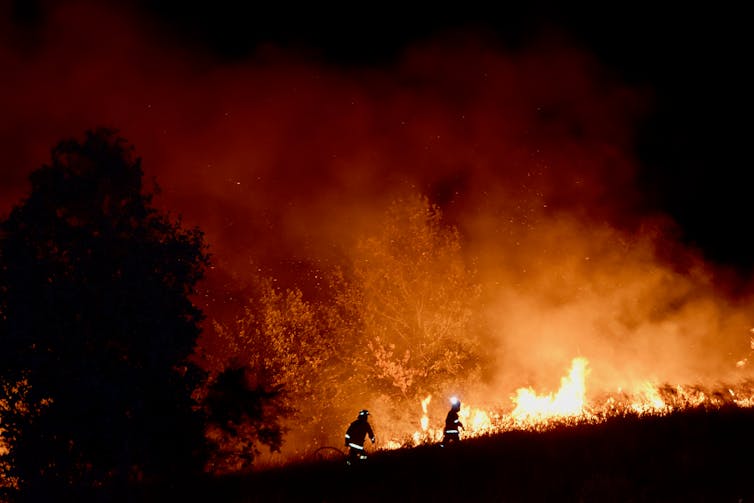
NZ flash floods: Residents slam council inaction over rubbish disposal

By Jonty Dine, RNZ News reporter

While Auckland residents enjoy a brief reprieve from the rain, the rubbish continues to pile up as the full cost of the New Zealand flash floods continues to be counted.

Some streets in Auckland are littered with items damaged and discarded from Friday’s freak flooding — causing a health hazard for locals.

Electronics, furniture, books and clothing line Shackleton Road in Mt Eden.

Connor O’Boyle’s home was inundated with one and a half metres of flood waters leaving most of what he owns destroyed.

“Everything is contaminated with black water. It’s actually a health hazard and it’s been a long time waiting to get feedback from the insurers so we’re really not sure how the clean-up is going because 20 other of my neighbours have all been flooded.”

He said residents tried to keep the street tidy but became overwhelmed.

“We initially tried to keep things tidy; we have flexi-bins and skips, but there is just too much.”

Frustrating wait
O’Boyle said it has been a frustrating wait for its removal.

“My other neighbours have been emailing the mayor’s office and they have got responses to take the rubbish to waste disposal sites but we physically can’t get there so we have got no real answers with the rubbish.”

Auckland flooding - piles of rubbish on Shackleton Road in Mt Eden
The rubbish from the flash floods lines the Mt Eden street Shackleton Road, leaving residents feeling overwhelmed. Image: Jonty Dine/RNZ

O’Boyle has criticised the council’s communication.

“It would just be nice for a plan to be put together for the residents, pretty much the response from the local government is: ‘it’s your problem you sort it out’.”

Another couple, the Naras, echoed his sentiments and said help has been scarce.

“It is difficult to find help, everything is in shortage. If you don’t get help within three days there is no use in getting help because it stinks. I cleaned up everything myself, if after six days you’re going to come and clean up the house [it] is already damaged.”

Another neighbour said looters were also a big issue.

Wardrobes stolen
“Going through, all the remnants of the flood, we had a couple of guys come and steal two wardrobes, they were drying out to be assessed by insurance, it’s pretty bad.”

Auckland flooding - piles of rubbish on Shackleton Road in Mt Eden
Street-stored flood debris . . . “Being a first world country this shouldn’t happen to us. This is New Zealand.” Image: Jonty Dine/RNZ News

The man said the council officials have let the residents down.

“Being a first world country this shouldn’t happen to us. This is New Zealand. We should have better drainage facilities here and the response should be pretty quick. The council and government have failed us in this area.”

Neighbour Fraser said they have been left with few options.

“This is probably not nice on the eyes either but what else can we do about it?”

He said even the efforts they have made have been exploited by others.

“It is quite unfortunate that people have just been dumping their rubbish in our bin, they are probably not aware that we paid for that ourselves. Even the swimming pool, a lot of people have been dumping stuff in that.”

‘This is huge’ – council
Council general manager of waste solutions Parul Sood said the flooding was an unprecedented undertaking for the clean-up crews.

“This is just huge, we haven’t dealt with something like this before.”

Sood said they have increased the number of dump sites but admitted it had been difficult to get to all the city’s streets and it could be a long time until the final piece of waste was collected.

“It is quite a massive impact on the city. I just think it will be a while before we clean out each and every piece of rubbish that has been generated by this really massive storm.”

However, O’Boyle said the response has not been good enough.

“It’s just disappointing that we can’t get the street cleaned, it’s not only a health hazard but it’s probably also causing contamination in our waterways. We all want to try to do the right thing and we just need it tidied up.”

This article is republished under a community partnership agreement with RNZ.

Auckland flooding - piles of rubbish on Shackleton Road in Mt Eden
Street debris . . . response “not good enough”. Image: Jonty Dine/RNZ News
Print Friendly, PDF & Email

Article by AsiaPacificReport.nz