Keith Rankin, trained as an economic historian, is a retired lecturer in Economics and Statistics. He lives in Auckland, New Zealand.
Analysis by Keith Rankin.
Keith Rankin, trained as an economic historian, is a retired lecturer in Economics and Statistics. He lives in Auckland, New Zealand.
New Zealand has had the worst reported mortality rate for Covid19 in the world for the last two weeks, according to the international data. And by a significant margin. But you wouldn’t know it from the media. ‘Underwhelming’ is an overstatement. The best I could find was this from Reuters nearly two weeks ago. New Zealand COVID death rate at record levels, 22 July 2022.
From worldometer weekly trends, the comparable number to the 151 given by Reutersis 271, that’s 54 deaths per million people in the week to 1 August 2022. The top five countries (all attending the Commonwealth Games) are:
We should note that all these countries other than New Zealand and Australia have populations less than 300,000 people. (Barbados’s population is 5.75% of New Zealand’s.) For very small countries, just one death has a big impact on the death rate. Unlike these little countries, New Zealand has been in the ‘top ten’ in the world for published covid deaths continuously, for several months.)
For a few days, the people at Worldometer struggled to work out New Zealand’s new reporting system. But they eventually decided that the original measure – deaths within 28 days of a positive test for Covid19 – was both the most comparable with other countries, and the most indicative as a measure of when the deaths occurred.
(The statistic above for ‘New Zealand revised’ is the new number favoured by the Ministry of Health. It’s not shown on Worldometer, and shown here only for comparison. This number – people who would not have died had they not had Covid19 – includes a few people who tested positive more than 28 days before their deaths.)
For the last few months, New Zealand has consistently had double Australia’s weekly Covid19 death rate. Both countries saw substantial increases in Covid19 deaths last month.
Why is this news not being reported by the traditional mainstream media? It’s more than the combined total of deaths in the 2011 Christchurch earthquake and the 2019 Christchurch Mosque tragedy. They were news.
A quick snapshot of other information, not easily accessible, about those who died with Covid19 in the last week:
86% of the deaths with covid in the last week were neither Māori, nor Pacific, nor Asian. Thus, mostly Pakeha.
83% of the deaths were people aged over 70 (ie all eligible – in principle though maybe not in practice – for four vaccination shots).
79% had had vaccination ‘boosters’ (though, for the vast majority of these, their immunity will have waned to minimal levels)
Good news for me on the personal front. I got my second vaccine booster yesterday, and without the intervention of petty bureaucracy to prevent me from doing so. (Refer: Answers Please? Tribulations af Getting a Covid19 Vaccine ‘2nd Booster’.) I’ll never know whether the first pharmacy simply had a wrong interpretation of the rules, or whether the Ministry of Health computer system was tweaked on Friday to fix the petty anomaly that I mentioned.)
*******
Keith Rankin (keith at rankin dot nz), trained as an economic historian, is a retired lecturer in Economics and Statistics. He lives in Auckland, New Zealand.
Source: The Conversation (Au and NZ) – By Jaya Dantas, Deputy Chair, Academic Board; Dean International, Faculty of Health Sciences and Professor of International Health, Curtin University
On July 23, World Health Organisation Director-General Tedros Adhanom Ghebreyesus took the unprecedented step and declared the monkeypox outbreak a “public health emergency of international concern” – the highest global alert level for a disease outbreak.
Following this and with 45 cases in Australia, Chief Medical Officer Paul Kelly declared last week that monkeypox is now a “communicable disease incident of national significance”.
So what is monkeypox? And who’s eligible for a vaccine?
Most cases in the current global outbreak are occurring among men who have sex with men. How can this group and others who are at risk protect themselves?
What is monkeypox?
Monkeypox is not a new disease, it was found in the late 1950s in lab primates in Denmark, and was first diagnosed in humans in an infant in the 1970s in the Democratic Republic of Congo.
In the past, monkeypox has mainly been transmitted from infected animals to humans (it is a zoonotic disease), and has been endemic to West and Central Africa. Transmission can occur through contact with infected animals including rodents, mice, rats, squirrels, monkeys and other primates.
But in this outbreak we’re seeing human-to-human transmission.
There are two distinct strains of monkeypox. These are the Central African and the West African types, the latter of which is believed to be one linked to the current global outbreak.
According to US Centers for Disease Control and Prevention (CDC) data, 23,620 cases have been reported since May in 80 countries, with 73 countries that had no previous reported monkeypox cases.
Most of the cases in Australia have been in New South Wales and Victoria, among returned travellers and men who have sex with men, and in the age group 21-40 years.
The declaration that monkeypox is now a disease of national significance means the outbreak requires national policies, interventions and public health messaging, with the deployment of more resources to assist affected areas and groups most at risk.
Symptoms and transmission
The incubation period – the time taken to develop the disease after exposure to the virus – is usually around 6-13 days.
Transmission generally requires close contact with an infected person. It can be transmitted via respiratory droplets.
It can also be transmitted through direct contact with body fluids or the rash (“lesions”), often through skin-on-skin contact, or indirect contact such as through contaminated clothing or bedding.
Transmission may occur from people without symptoms, or with barely-detectable symptoms.
Symptoms are similar to smallpox, though less severe. They can include:
fever
headache
aches
fatigue
sweats and chills
cough and sore throat
a rash that can look like blisters or pimples, which can be painful. These “lesions” typically go through several stages before eventually falling off.
The CDC says most people who get the virus will develop the rash.
A study in the British Medical Journal published last week also found 88% of 197 people with monkeypox in London had lesions on their genitals or anus.
Symptoms generally last between two and four weeks, and the disease usually resolves on its own. Most adults with a healthy immune system won’t have severe illness and won’t experience long-term harmful effects.
There’s no specific treatment for monkeypox yet. People with the infection should be given supportive treatment and light dressings on the rash, depending on the symptoms. Antivirals such as “tecovirimat” have been made available to patients in some countries who have or are at high risk of severe disease, such as being immunocompromised.
People with the infection should isolate immediately for the duration of the illness – usually two to four weeks, until the lesions heal.
Higher risk groups
Monkeypox can affect anyone. But men who have sex with men are at higher risk at the moment. WHO Director-General Tedros Adhanom Ghebreyesus said 98% of cases so far are among men who have sex with men.
It’s important we provide as much information about the virus as possible, and it’s absolutely crucial we do this in a way that is not stigmatising.
This outbreak is seeing cases spread via close prolonged contact from sexual activity in the LGBTIQ+ group. Many from this group want to take proactive actions to help their community.
prioritising vaccines as a matter of urgency for those most at risk
targeting public health messaging so the LGBTIQ+ community can make informed decisions.
Actions individuals can take include:
maintaining contact details of sexual partners in case of need to follow up
avoiding sex if you have a rash until you get tested
considering avoiding skin to skin contact during large gatherings
if diagnosed with monkeypox, avoiding close physical contact, including sexual contact, with other people for the duration of the illness.
The CDC says condoms may help lower the risk of spread if the lesions are confined to the genital and/or anal region, but they’re likely not enough to prevent transmission on their own.
Australia has secured small supplies of two smallpox vaccines, which provide protection against monkeypox.
The vaccine advisory body, the Australian Technical Advisory Group on Immunisation (ATAGI), has recommended key risk groups be administered the vaccines. They include:
those identified as a high risk monkeypox contact in the past 14 days
men who have sex with men who are at high risk of exposure. This includes those living with HIV, or with a recent history of a high number of sexual partners or group sex
sex workers, with clients in high-risk categories
and anyone in the risk categories planning travel to a country experiencing a significant outbreak, with vaccination recommended four to six weeks prior to leaving.
ATAGI has stated that vaccination within four days of exposure to someone who’s infectious with monkeypox will provide the highest chance of preventing disease.
Avoiding close contact with people who have the infection can help prevent transmission. Monkeypox doesn’t spread as easily as the coronavirus and can be kept under control if we are cautious.
The need for vaccine equity and global health leadership
We can’t repeat the “vaccine nationalism” we’ve seen during COVID with rich countries hoarding vaccine doses, as this will unjustly prolong the outbreak.
Currently, according to The Lancet medical journal, a smallpox vaccine sold as “Jynneos” in the US costs around US$100 a dose. The WHO has called on countries and manufacturers to ensure the vaccines, as well as diagnostics and therapeutics, are made available “at reasonable cost” where most needed.
Thus we have major political and policy challenges ahead and will need strong global health leadership going forward.
Jaya Dantas is Professor of International Health in the Curtin School of Population Health where she teaches a core unit in the Masters in Public Health and Master of Sexology course and leads a program of research in refugee and migrant health. She is currently lead CI on grants funded by Healthway and CI on a DISER grant. Jaya is the International Health SIG Convenor of the Public Health Association of Australia, has been appointed to the Global Gender Equality in Health Leadership Committee of Women in Global Health, Australia and is on the Editorial Advisory Group of the Medical Journal of Australia. She has lived experience of infectious diseases in India and Africa.
But to provide a buffer against the volatility of overseas markets, Aotearoa would need to be as energy independent as possible. Ideally, this would mean consuming only green hydrogen produced here, using abundant renewable hydro, wind and solar resources.
A hydrogen economy is good in theory, but to make the switch at the scale of Aotearoa’s climate ambitions would require about 150 petajoules of hydrogen each year, according to one estimate. That’s about a quarter of our current energy use.
Hydrogen is produced in a process known as hydrolysis – the splitting of water into hydrogen and oxygen gas, using electricity. To produce a quarter of Aotearoa’s energy consumption, hydrolysis would consume an enormous amount of water, about 13 million tonnes each year, the equivalent of a month’s worth of Auckland’s water demand.
This raises both cultural and technical issues, which we must address before embarking on a transition to hydrogen as a green fuel.
Freshwater has enormous significance to iwi and hapū. However, their views on hydrolysis as a consumptive use of water are not widely understood. If cultural complexity is ignored, hydrogen infrastructure or processes may fail to achieve an appropriate fit within Aotearoa New Zealand society and the technology could be orphaned.
Instead, we could start addressing this early through wānanga with representatives from a wide range of potentially affected iwi. Recognising and addressing cultural concerns at the outset will allow Māori to shape how the technology is developed and to share in the economic benefits of a hydrogen economy. The intention is to better understand how green hydrogen technologies and infrastructure could belong in Aotearoa New Zealand.
Green hydrogen production would require enormous amounts of water. Shutterstock/Scharfsinn
Supposing we are willing and able to make this vast quantity of hydrogen, our experience with other fuels suggests we would need about a month’s worth in storage at any given time. Storage helps to smooth fluctuating market demand, takes advantage of seasonal excess of renewables (in very windy, very sunny weeks) and provides emergency reserves for “dry year” crises.
Storing hydrogen underground
Unfortunately, hydrogen can’t be stored as a liquid except in specialised containers that keep it at extremely low temperatures. Like a freezer, this is always consuming energy.
Hydrogen is stored in liquid form at NASA’s Kennedy Space Center. Wikimedia/Doe, CC BY-ND
Hydrogen could be kept in special high-pressure tanks, but we would need more of these tanks than we have people in New Zealand. These tanks would be costly, cover large tracts of productive land and would be prone to damage by natural hazards. Where would they all go?
We already do this with natural gas in Taranaki. When it’s not needed, gas is injected into an old field called Ahuroa and then extracted as required. Underground storage of gas (methane) is common practice, providing energy resilience. For example, given the disruptions caused by the war in Ukraine, Germany is accelerating gas storage in geologic reservoirs in time for winter.
We have recently shown there may be enough space in other Taranaki rock reservoirs to store hydrogen underground. But it won’t be easy.
We know the gas can react with certain kinds of rock. It can even be a meal for hungry microbes. Both these processes would consume a valuable fuel. But predicting whether they will happen requires special laboratory experiments that can replicate the extreme pressure and temperature three kilometres below ground.
We are also still learning how to predict how hydrogen will move underground. We know that some of the injected gas will never come back out. This is the “cushion” that acts a bit like a spring that pushes the other hydrogen back to the surface.
Some hydrogen may also escape into the atmosphere through small cracks in the rock. We’ll need to know how much, set up surveillance to watch for it and consider its effect on the climate.
These are just a few of the challenges posed by underground storage of hydrogen. But our experience with natural gas storage gives us confidence we can manage them with the right research and planning.
New Zealand’s hydrogen future remains uncertain, but work is underway to prepare. Early signs for underground storage of green hydrogen are promising and there’s lots ofenthusiasm for it overseas.
But technical feasibility is not enough: any solution must make economic sense and be acceptable to the wider public, particularly tangata whenua.
Proving the feasibility of any new idea takes time. We need to develop, sometimes fail, refine and then find success. But with each new extreme weather event, its clear we don’t have a lot of time. In this new era of adaptation, governments, industry, communities and scientists will need to work more closely than ever.
David Dempsey has previously received funding to research underground storage of hydrogen in Taranaki.
Andy Nicol has previously received funding to research underground storage of hydrogen in Taranaki.
Kēpa Morgan works for Mahi Maioro Professionals Limited.
Ludmila Adam has previously received funding to research hydrogen geostorage.
Russian soldier Vadim Shishimarin at a May hearing in Kyiv where he was given a life sentence for killing a civilian.Getty Images
The deaths of more than 50 Ukrainian prisoners of war last week is not only an apparent war crime, but also another sign the situation is becoming a race to the bottom when it comes to international law and conventions.
Ukraine and Russia have blamed each other for the attack on the prison in Russian-occupied Donetsk. Ukraine also claims prisoners were being tortured and murdered there. Russia’s British embassy later posted on Twitter that Ukrainian Azov battalion soldiers deserved a “humiliating death” by hanging.
But amid the accusations and counter-accusations of atrocities being committed against prisoners of war, some simple facts are easily overlooked: rules already exist to prevent such horrors, and they apply in Ukraine.
Prisoners of war are explicitly covered by the Third Geneva Convention, drawn up in 1949 to replace the old Prisoners of War Convention of 1929 after the awful lessons of the second world war.
Both Russia and Ukraine are signatories, meaning they have promised to respect it in all circumstances. It’s important to note this is not the protocol of the Geneva Conventions Russian President Vladimir Putin recently quit.
Fog of war
Restraint during a war isn’t easy, but it is essential nonetheless. As well as respecting basic humanity and honour, the rules – which have operated for over 100 years – help combatants build the confidence to eventually find peace.
In the sense that it helps avoid escalating revenge and reprisal for attacks against the defenceless, respect for prisoners of war is also a pragmatic act of self-interest.
Adherence in Ukraine to the fundamental conditions of the Geneva Convention has been hard to gauge, however. Apart from occasional exchanges of prisoners of war, exactly how many prisoners have been taken by each side, and where they are held, remains largely unknown.
While the Red Cross has been able to visit some POWs and other detainees, it has not been granted access to visit them all. The problem is compounded by claims that some combatants taken on the battlefield are mercenaries and therefore do not count as prisoners of war, meaning they may be executed.
Further complicating things is that both sides are promising to put prisoners on trial for war crimes. With Russia holding over 1,100 Ukrainian prisoners and Ukraine making over 15,000 allegations of war crimes, both parties need to publicly re-pledge to the Geneva Convention on prisoners of war before things escalate.
Rights of the prisoner
The basic rules governing the treatment of prisoners of war are simple enough to state:
they must be taken prisoner if they surrender unconditionally, cannot be executed if they have stopped fighting, and must not be subjected to reprisals, mutilation or torture
they may be questioned (name, rank and serial number) but must be humanely treated and protected against acts of violence or intimidation, and against insults and public curiosity
they must be evacuated as soon as possible after capture to a safe area outside the combat zone, and can’t be used or positioned to deter military operations by their own side
the location of prisoner-of-war camps should be shared, and the camps clearly marked to be visible from the air, so they are not bombed by mistake
prisoners’ whereabouts should be shared via a central tracing agency, and they must be allowed to send and receive letters.
Beyond these rules, representatives from third-party countries or the Red Cross should be permitted to visit and interview (without witnesses) prisoners and their legal representatives.
And any disputes about the application of the convention rules should be resolved through an enquiry by an independent third party.
A protest rally in Lviv, Ukraine, after the bombing of the prisoner-of-war detention centre on July 29. Getty Images
War trial risks
It’s the handling of war trials in particular that requires most restraint. Although prisoners cannot be tried simply for fighting against their enemy, the Geneva Convention allows trials for grave breaches of the laws of war (such as murder or torture) – and even the death penalty if the domestic law of the detaining power includes it.
And despite judicial safeguards relating to fairness and the rights and means of legal defence, there is still the risk of a tit-for-tat process: one side finds a prisoner guilty, the other side responds in kind.
The best way through this is to allow the International Criminal Court (already pursuing its own investigations into the situation in Ukraine) to take the lead, giving the process real independence and integrity.
Trouble is, Russia has withdrawn from the International Criminal Court – just another measure of how far the observation of the laws of war has been eroded in Ukraine.
Alexander Gillespie does not work for, consult, own shares in or receive funding from any company or organisation that would benefit from this article, and has disclosed no relevant affiliations beyond their academic appointment.
Social media sites reporting this incident have attracted a barrage of negative comments perpetuating misconceptions around Acknowledgement of Country and Welcome to Country. Many clearly do not understand what they are and see them as “special treatment”. Unfortunately, Hanson has been a source of this line of thinking around so-called “special treatment”, as seen in her 1996 maiden speech to parliament.
Such comments reveal an Australian society still burdened with an unfounded resentment and fear of Aboriginal rights and connection to Country.
So, what is an Acknowledgement of Country? How is it different to a Welcome to Country?
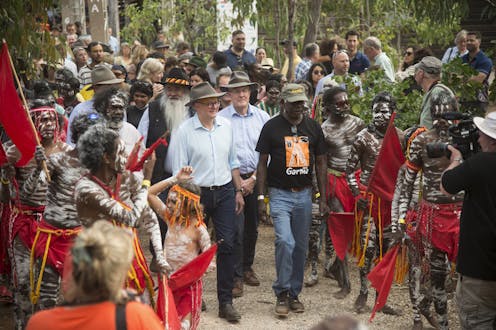
An Acknowledgement of Country is often made at the start of an event to pay respect to First Nations peoples as the Traditional Owners and ongoing custodians of the land.
An Acknowledgement often highlights the unique position of First Nations people in the context of culture and history, and their intimate relationship with the land.
An Acknowledgement does not exclude anyone. Anyone can deliver one. It costs nothing to give or listen to. You lose nothing from a ten second acknowledgement of the Country, language, and people that existed in a place for tens of thousands of years.
An Acknowledgement does not impact on the rights and status of other Australian people.
Acknowledgement of Country is different to a Welcome to Country. Crucially, only Traditional Owners can deliver a Welcome to Country.
Traditionally, First Nations people travelling to different Country had to seek permission to enter from the Traditional Owners. If granted, permission was given by way of a Welcome to Country.
Today, inviting an Elder to perform a Welcome is a way to recognise unceded Aboriginal sovereignty of ancestral lands. It’s also a way to honour ancient and continuing First Nations customs.
Wurundjeri Elder Joy Murphy Wandin has described Welcome to Country as practised by her people:
When there was a request to visit Country, the Werrigerri (a young man selected by the Elders of the community) would go on behalf of the community under the voice of the Elder, the Nurungeeta. There would be this negotiation and that could take a long time, it could take months. So that is the background of Welcome to Country. It is not a new thing. It is not because our land was dispossessed; it has nothing to do with that. It is all about respect for our culture and who we are. It is paying respect, especially to our ancestors.
Acknowledgements and Welcomes to Country weren’t invented to divide First Nations and non-Indigenous people.
Although both have been widely revived in recent years, they are traditional protocols. When Aboriginal peoples travel from their own home Country to that of another Aboriginal group, they too acknowledge the traditional custodians.
Similarly, it’s standard practice for a hosting First Nations group to perform a welcome to all visitors – Indigenous and non-Indigenous alike – as a way of being inclusive and welcoming.
In doing this, Aboriginal people are sharing their culture and social protocols and offering the opportunity to feel a deeper connection to the lands you walk upon and visit.
By learning traditional place names, you unlock important information about the character or features of that place.
Many Aboriginal people have been removed from Country, or can no longer access it through development, private ownership, farming and mining.
The Stolen Generations and mission era systematically worked to eradicate Aboriginal languages and cultural traditions. For many First Nations peoples, Acknowledgement of Country can help to restore some of this severed connection to Country and identity.
For us, Country is a word for all the values, places, resources, stories, and cultural obligations associated with that area and its features. It describes the entirety of our ancestral domains. While they may all no longer necessarily be the titleholders to land, Aboriginal and Torres Strait Islander Australians are still connected to the Country of their ancestors and most consider themselves the custodians or caretakers of their land.
For some Aboriginal people, Acknowledgement of Country is a constant reminder of the responsibilities of custodians to advocate for the protection of a fragile environment and its cultural heritage.
It reminds us all Aboriginal languages were the first languages spoken in this country. Many are are still spoken. Acknowledgement of Country brings us together and recognises the shared cultural history and landscape we have all inherited.
a very important way of giving Aboriginal people back their place in society, and an opportunity for us to say, “We are real, we are here, and today we welcome you to our land”. It’s paying respect, in a formal sense, and following the traditional custom in a symbolic way.
Understanding what Acknowledgement of Country and Welcome to Country are, and their history and origins can help us recognise the importance and power of continuing these practices.
It’s not about being divisive. It’s about continuing ancient connections to Country, history, and ancestors. It’s a reminder of the responsibility of custodians to the land and its creatures; to protect and look after them.
It’s about honouring and being respectful towards a custom and way of thought much older than the name or concept of “Australia” as a nation state, or any sitting of parliament.
Cally Jetta works for UniSQ. She is a co-founder of the Blackfulla Revolution social media site and current co-admin of ‘Connecting with Country’ Facebook page.
At every federal election, there is a moment when election-watchers turn their attention to the seat of Eden-Monaro in New South Wales. Between 1972 and 2013, the party that formed government won Eden-Monaro. It was (and for some, still is) considered a bellwether seat – what happens in Eden-Monaro is representative of the Australian electorate at large.
But there is another election bellwether we never hear about: people experiencing homelessness. Taken as a group, those who experience homelessness are representative of multiple forms of disadvantage and marginalisation.
Yet this is a very diverse group of people. While rough sleepers are the most recognisable, homelessness encompasses living in overcrowded accommodation, couch surfing, and being forced to sleep in cars, caravans or tents.
On any given night, an estimated 116,000 people experience homelessness in Australia. It would be natural to assume that for those affected, finding a home is far more important than voting in an election. Yet the assumption that the need for housing supersedes the need to belong to a political community is not always true. Material needs and the need to belong co-exist and are interdependent.
Beyond the older, single, white male who typifies representations of homelessness, there are disproportionate numbers within this group of unhoused Aboriginal and Torres Strait Islanders, young people, older women, war veterans, ex-prisoners, people who were in out-of-home care as children, people with disabilities, and LGBTIQ+ communities.
People experiencing homeless often includes disabled, LGBTQI+ and other marginalised groups. Getty Images
People experiencing homelessness commonly also present with trauma, experience of family and domestic violence, and mental health concerns. Compounding this is the current housing crisis, where entirely new groups are entering homelessness service systems.
What our research showed
Working with the Australian Electoral Commission (AEC) and three specialist homelessness service providers in Adelaide over the 2019 federal election, we undertook one of the largest studies of homelessness and voting habits.
With 164 participants, our research demonstrated that while people experiencing homelessness have much lower enrolment and turnout rates than the general population, this is not due to lower levels of political interest.
In fact, we found political interest among this group was higher in some respects than the general population. As one of the participants in our study said about the act of voting:
That was one of the main things for me, the politicians knowing that okay, we are constituents, members of society, the homeless are actually coming out to vote, that my vote matters.
With a turnout rate in excess of 90% of enrolled voters, Australia has one of the most equitable electoral systems in the world. However, estimating the turnout rate for people experiencing homelessness is considerably more difficult. Data from small sample interactions – unhelpfully – places turnout at between 10 and 67%.
Disillusionment, not apathy
Our study did not attempt to definitively measure the turnout rates of people experiencing homelessness, though about a fifth of our participants reported voting regularly.
Despite the many barriers and disincentives to voting for this group, we found that disillusionment was the real problem. Most participants cared about voting and were interested in elections, but did not vote because they thought it was pointless. As one participant told us:
Why should we vote for someone who doesn’t want us? Who doesn’t want to look after us? […] All of us felt left out, we felt like we’re nothing. And we’re human beings, not animals to walk on just because we’re poor.
Those exit-polled at AEC pop-up booths at specialist homeless services expressed similar sentiments:
I felt sad […] I looked at those pieces of paper and I folded them up and I put them in the box and I walked away in disgust.
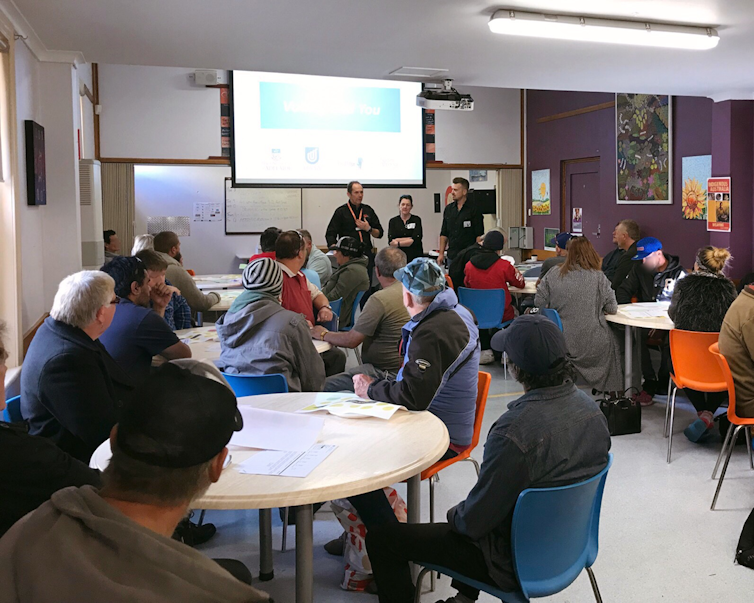
Voter information sessions at a specialist homelessness service provider. Author supplied
Over 80% of our participants said that voting was important yet most of them did not vote, and those who did reported mixed feelings about their electoral participation.
This reflects broader and deeper issues with political representation, especially of people experiencing disadvantage. Voting is how citizens assert their equality with other citizens, make their voices heard, and protect themselves from government neglect. As political scientist Walter Dean Burnham once said: “if you don’t vote, you don’t count”.
Increasing participation
Our study identified numerous ways electoral commissions can improve turnout for those experiencing homelessness. This includes permitting specialist homelessness service providers to be listed as residential addresses. This would allow homelessness service users to enrol and vote in the communities where they have meaningful connections.
We also recommended that any legislative, procedural, or operational changes, such as changes to voter identification requirements or enrolment processes, consider the potential impact on people experiencing homelessness.
However, the disillusionment with the political system felt by many experiencing homelessness is more serious and harder to tackle because it is informal and cultural.
The irony, of course, is that higher levels of electoral participation would make it harder for mainstream parties to ignore the needs, concerns and priorities of the most marginalised.
Being counted matters. We should do everything we can to ensure access to voting, the basic democratic right that protects and enhances all other rights.
This project was funded by the Australian Electoral Commission.
Jonathon Louth is affiliated with Homelessness Australia and is an executive at Centacare Catholic Family Services
Lisa Hill receives funding from the Australian Research Council. She is a Professor in Politics and International Relations at the University of Adelaide and Research Chair of the Centre for Public Integrity, an anti-corruption watch-doc.
Veronica Coram receives funding from Centacare Catholic Family Services SA, AnglicareSA and the Australian Housing and Urban Research Institute (AHURI).
New Zealand may seem to be under meteor bombardment at the moment. After a huge meteor exploded above the sea near Wellington on July 7, creating a sonic boom that could be heard across the bottom of the South Island, a smaller fireball was captured two weeks later above Canterbury.
Fireballs Aotearoa, a collaboration between astronomers and citizen scientists which aims to recover freshly fallen meteorites, has received a lot of questions about these events. One of the most frequent is about the bright green colour, and whether it is the same green produced by auroras.
An aurora australis observed from the international space station. Wikimedia Commons, CC BY-ND
Green fireballs have been reported and filmed in New Zealand regularly. Bright meteors often signal the arrival of a chunk of asteroid, which can be anywhere between a few centimetres to a metre in diameter when it comes crashing through the atmosphere.
Some of these asteroids contain nickel and iron and they hit the atmosphere at speeds of up to 60km per second. This releases an enormous amount of heat very quickly, and the vapourised iron and nickel radiate green light.
But is this the same as the bright green of an aurora? For the most recent meteor, the answer is mainly no, but it’s actually not that simple.
The green glow of the aurora is caused by oxygen ions in the upper atmosphere, created by collisions between atmospheric oxygen molecules and particles ejected by the sun.
These oxygen ions recombine with electrons to produce oxygen atoms, but the electrons can persist in an excited state for several seconds. In an energy transition known as “forbidden” because it does not obey the usual quantum rules, they then radiate the auroral green light at 557nm wavelength.
A meteor can also shine by this route, but only if it’s extremely fast. Very fast meteors heat up in the thin atmosphere above 100km where auroras form.
If you want to see a green auroral wake from a meteor, watch out for the Perseid meteor shower, which has now started and will peak on August 13 in the southern hemisphere.
Also arriving at about 60km per second, the Perseids are extremely fast bits of the comet Swift-Tuttle. Some Perseids trail a beautiful, glowing and distinctly green wake behind them, particularly at the start of their path.
Once the Canterbury meteor hit on July 22, the capricious winds of the upper atmosphere twisted the gently glowing trail, resulting in a pale yellow glow towards the end (as seen in the GIF below, also recorded by Greg Price for an earlier meteor). This is caused by sodium atoms being continually excited in a catalytic reaction involving ozone.
Are we being bombarded by meteors?
Yes and no. The arrival of big, booming green meteors and the dropping of meteorites isn’t rare in New Zealand, but it is rare to recover the rock. Fireballs Aotearoa is working to improve the recovery rate.
In an average year, perhaps four meteorites hit New Zealand. We’re encouraging citizen scientists to build their own meteor camera systems so they can catch these events.
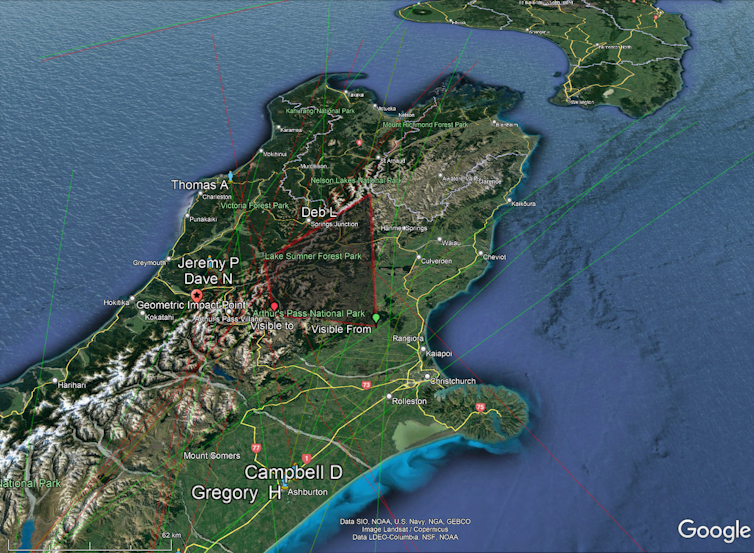
By comparing the meteor against the starry background and triangulating images caught by multiple cameras, we can pin down the meteor’s position in the atmosphere to within tens of metres.
The July 22 meteor as seen by a specialised meteor camera near Ashburton. Campbell Duncan/NASA/CAMS NZ, Author provided
Not only does that help us find the rock, but it tells us what the pre-impact orbit of the meteoroid was, which in turn tells us which part of the solar system it came from. This is a rather efficient way of sampling the solar system without ever having to launch a space mission.
Witness reports and high-resolution meteor cameras help to calculate a meteor’s trajectory. This map shows the approximate trajectory of the July 22 meteor at the top of the red shape in the centre. Fireballs Aotearoa and International Meteor Association, Author provided
Fireballs Aotearoa is rapidly populating Otago with meteor cameras and there are half a dozen more in other parts of the South Island. The North Island isn’t well covered yet, and we’re keen for more people (in either island) to build or buy a meteor camera and keep it pointed at the sky.
Then next time a bright meteor explodes with a boom above New Zealand, we may be able to pick up the meteorite and do some good science with it.
Many thanks for the input from Jim Rowe of the UK Fireball Alliance, and Greg Price who photographed the July 22 meteor and the persistent train.
William Jack Baggaley receives funding from University of Canterbury.
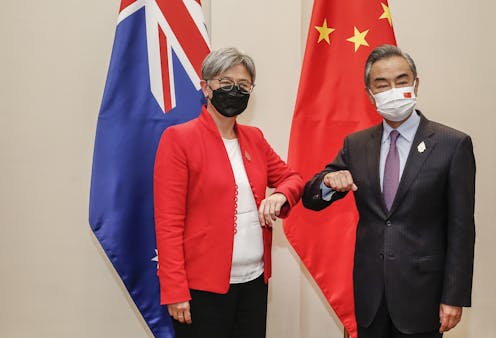
The right track? Foreign Minister Penny Wong meets with Chinese Foreign Minister Wang during the G20 foreign ministers’ meeting in Bali last month.Johannes P. Christo/Pool/AAP
Australia faces many global and regional challenges – the human and economic toll of the pandemic, the rippling effects of the Russian invasion of Ukraine, troubled relations with Pacific Island countries. But the most consequential of all is US–China rivalry. With the not-so-peaceful rise of China and the waning of American supremacy, Australia has been walking a tightrope, and for the past couple of years the balancing act has not been entirely successful.
The change of government is a good time to discuss Australia’s top foreign policy priorities and how to deal with them. Revisiting the “middle power” concept – what it means and how it works – can help clarify how Australia can better handle these challenging times.
Australia as a middle power
Although not everyone agrees about what defines a middle power, Australia is consistently considered to be among them, as measured by material capabilities, international behaviour and/or self-identity. Even if we define middle powers according to the outcomes rather than the intent of their actions, Australia has been a typical, if not quintessential, middle power. The Lowy Institute Asian Power Index confirms that much.
The most frequently named middle powers have shown a strong commitment to seeking multilateral and cooperative solutions to global and regional issues (with emerging middle powers more focused on their regions).
This is a rational choice, not least because these nations have neither the sheer material power nor the “soft power” afforded to great powers.
Multilateral diplomacy works well for middle powers. Separately, they are vulnerable to great power rivalry; together, they can have a more significant impact on the international system.
Strategic ambiguity (as opposed to blind loyalty to certain powers or groupings) also works well for middle powers. Taking sides can increase the risk for smaller states in a conflict between great powers. China has certainly noticed what it calls a “cold war mentality” in relation to Australia’s increasingly close ties to the US.
What went wrong
No matter what is defined as “the national interest” by the government of the day, Australia has two enduring interests: a security interest aligned with the west and an economic interest increasingly aligned with the east.
The defence alliance with the US is vital to Australia’s national security. But China continues to be Australia’s largest trade partner, with Asia accounting for 65% of Australian’s two-way trade in 2021.
Strategic ambiguity? A man reads a newspaper in Beijing reporting on US House Speaker Nancy Pelosi’s Asia visit, which may or may not include a stop-off in Taipei. Andy Wong/AP
This is why, despite all its political and security concerns, Australia has traditionally sought to maintain a balance between its strong economic relationship with China and its defence alliance with the US. In return, China expressed its appreciation at times when Australia acted independently of the United States. The policy of strategic ambiguity appears to have worked in Australia’s favour when it came to Taiwan and other issues extremely sensitive to China.
But Australia–China ties have hit a rough patch recently. The starting point was China’s provocative activities in the South China Sea and the global impact of its Belt and Road Initiative. That friction was compounded by Australia’s eager embrace of the United States’ vision for the Indo-Pacific.
China has doubled down on its economic and diplomatic coercion since at least 2017. More recently, in response to the Morrison government’s call for an independent investigation into the origin of COVID-19, it has imposed sanctions on many Australian exports.
In response, Australia further cemented its alliance with the US. It helped revive the Quad grouping with India, Japan and the US in 2017, and joined AUKUS, the Australia–UK–US enhanced strategic partnership, in 2021.
The problems multiply
While the economic impact of China’s sanctions has been mild in the short term, there is no telling the future. The disruption of global supply chains due to COVID-19 and now the Russian invasion of Ukraine highlights China’s dominant role in business-to-business trade.
Not only has the prolonged war in Ukraine caused a worldwide cost-of-living crisis, but it also showcases the vulnerability of smaller states and the further decline of the US-led world order. Putting all eggs in one basket may not be a wise choice for Australia.
Besides the China problem, Australian relations with Pacific Island countries have seen better days. Among the reasons for the deterioration are Australia’s reluctance to join forces to mitigate climate change, and its transactional approach to bilateral relations with neighbours.
Australia’s growing defence reliance on the US also polarises key partners in Southeast Asia. Regional powers like Vietnam and Indonesia are vying for multilateralism and cautious about antagonising China. Probably not helpful was the previous government’s scepticism about international organisations together with a longer-term decline in resources for engagement, evidenced by the fact that funding for the Department of Foreign Affairs and Trade has declined over the past three decades.
The way forward
To deal with these challenges, Australia needs a (re-)balancing act based on bilateral and multilateral diplomacy involving a wider pool of key stakeholders in the Indo-Pacific.
Less provocative rhetoric and efforts to identify mutual interests can help de-escalate the tension with China. Diplomacy should be brought back into the forefront, as the new government has sought to do.
Of course, a complete reset of China–Australia ties is unlikely given deep-seated human rights and national security concerns. But the American alliance doesn’t have to come at the cost of derailing trade relations with China. To reduce trade dependence on China, meanwhile, Australia should strengthen relations with India, ASEAN and other trading partners.
To that end, Australia must show Asia and the Pacific that it is a responsible and reliable partner, a “good international citizen”. Expanding development aid, education programs, cultural exchanges and other public diplomacy initiatives can help a great deal. “Climate change” is a common concern among these partners, and should be at the centre of the discussion.
Diplomacy is a long game. It is harder to mend relationships than to break them. It may take a while for Australia to see how diplomacy can help, but middle power diplomacy definitely serves Australia’s national interest.
Vu Lam does not work for, consult, own shares in or receive funding from any company or organization that would benefit from this article, and has disclosed no relevant affiliations beyond their academic appointment.
Source: The Conversation (Au and NZ) – By John Mamo, John Curtin Distinguished Professor of Health Sciences, Director, Curtin Health Innovation Research Institute, Curtin University
Alzheimer’s disease is the most prevalent form of dementia and, with a rapidly ageing global population, it is fuelling unprecedented demand for costly patient care. There have been an estimated 400 clinical studies since the first Alzheimer’s drug trial in 1987.
The demand for treatment solutions however, is not without significant risk. There have been recent allegations that research underpinning widely held understandings of what causes Alzheimer’s may be fraudulent. The impact of this on clinical trials is a potentially huge blow for people living with Alzheimer’s and their carers.
In this case, it might be a stretch to say all Alzheimer’s research is now compromised. But the allegations can prompt us to interrogate whether the governing bodies of research and drug approvals are truly effective.
A potentially flawed hypothesis
The concerns of possible Alzheimer’s research fraud follow findings by neurologist and physician Matthew Schrag, detailed in the journal Science.
Schrag wrote that an ongoing Alzheimer’s trial investigating the experimental drug simufilam was based on manipulated images published by scientists years earlier. If true, then volunteer patients to drug trials, including the simufilam studies, may be facing unnecessary health risks associated with experimental treatment – likely with no hope of clinical benefit.
Moreover, years of drug development costing tens of millions of dollars might have been wasted. The fundamental premise of what causes brain cell death in Alzheimer’s and by extension, what type of drugs are needed to be developed for treatment, may now need reconsideration.
Some contemporary Alzheimer’s clinical trials are based on a now potentially flawed hypothesis: that brain cell death is triggered by the early formation in the fluid that bathes the brain, of small clumps of protein called amyloid-oligomers.
One highly influential and highly cited study is at the centre of the current controversy. The authors claimed mouse models of Alzheimer’s showed memory impairment was associated with the accumulation of amyloid-oligomers. Schrag found compelling evidence the image presented in the 2006 paper may have been modified.
News of the alleged research fraud is a blow for people living with Alzheimer’s. Shutterstock
The internationally adopted peer review system, where discipline experts anonymously review scientific data put forward for publication, usually ensures robust outcomes. This should reassure the public about a study’s scientific claims. However, as the saying goes, science doesn’t lie, but people may.
In this instance, Schrag reviewed scores of images in scientific papers authored by neuroscientist Sylvain Lesné and suggested significant image tampering had consistently occurred. Leading independent image analysts and internationally recognised Alzheimer’s researchers backed Schrag’s claims.
Neuroscientists can rightfully be exceedingly disappointed publications that changed what we know about Alzheimer’s or other diseases now appear based on manipulated data. It potentially brings neuroscientists into disrepute and undermines public confidence.
It’s important to stress simufilam has not been approved by any regulatory agency. But a recent United States Food and Drug Administration (FDA) approval of the drug aducanumab – against expert advice which warned there wasn’t enough evidence to show it worked – has made physicians treating people living with Alzheimer’s extra sensitive.
Brain scans can show organ shrinkage in people with Alzheimer’s disease. Shutterstock
So does news of this potential fraud mean the field of Alzheimer’s research is corrupted? Can we be confident that what is prescribed to patients is safe and works?
We should keep in mind the broader context that publishing incorrect data is rare and research misconduct is even rarer. If incorrect data is identified, restorative practices are usually swift and comprehensive, including publishing “errata” corrections, or possibly, a retraction of findings by scientific journals. Significant penalties are also imposed for deliberate research misconduct.
Also, there are multiple clinical trials considering multiple aspects of the complex Alzheimer’s cascade from what causes the disease to how it affects memory and thinking. These are based on credible scientific findings.
Amyloid-oligomer clearance, which is now being questioned, is only one avenue that scientists have pursued.
The overwhelming majority of scientists are doing the right thing all of the time and if regulatory approval authorities such as our Therapeutic Goods Administration and the FDA continue to sensibly and thoroughly examine the evidence provided for approval, then we can hope for a better future for people living with Alzheimer’s.
John Mamo receives funding from the Australian National Health and Medical Research Council; the Medical Research Future Fund; the Australian Research Council and Multiple Sclerosis Western Australia.
When the new federal parliament opened last week, a record number of female politicians took their seats: 38% in the House of Representatives and 57% in the Senate. This changing of the guard, with women at the forefront, brings an opportunity to accelerate Australia’s efforts on climate change.
The major parties were virtually silent on the issues of gender equity and climate change throughout the 2022 election campaign. Yet, both issues proved to be turning points for the Australian electorate.
Climate change – one of the key platforms on which the teal candidates successfully campaigned – is central to Prime Minister Anthony Albanese’s parliamentary agenda. A bill to enshrine a climate target into Australian law was among the first introduced to parliament last week.
Women are on the front line of climate change impacts, which makes our experiences and leadership critical at decision-making tables. From Barbados to Finland, we’ve seen women’s leadership on climate bring fair, innovative and ambitious policies. We hope a new era in Australian climate policy is upon us, too.
Women around the world are disproportionately impacted by climate change due to existing systemic inequalities. For example in Africa, when disaster strikes, women may find it more difficult to evacuate their homes as primary caregivers, be unable to read written warnings, or be overlooked in rescue attempts in favour of men.
The gendered impacts of displacement from bushfires and other disasters can include increased experiences of domestic violence. Shutterstock
Women also have a critical role to play in achieving ambitious and innovative climate action. As the Women’s Leadership statement at last year’s Glasgow climate summit noted:
Despite increased vulnerability to climate impacts, we recognise that women and girls have been creating and leading innovative climate solutions at all levels.
There are scores of examples of female climate leadership and the benefits that follow when women and girls are afforded the opportunity to take a lead on climate action, throughout recent history.
Notable examples include Christiana Figueres, who steered international climate negotiations to a successful outcome in 2015, with the adoption of the Paris Agreement.
Greta Thunberg’s vigil to sit outside the Swedish Parliament every Friday protesting inadequate climate action inspired a youth climate protest movement.
Other young women such as National Director of Seed Mob Amelia Telford in Australia, and Pacific Climate Warriors founding member Brianna Fruean are at the forefront of First Nations’ climate advocacy efforts.
Prime Minister Mia Mottley, awarded the 2021 Champion of the Earth – Policy Leadership.
An OECD Working Paper released this year notes that women’s participation in decision-making often leads to the development of comparatively strong and sustainable climate policies and goals.
Case in point, Finland, under leadership of progressive Prime Minister Sanna Marin, recently committed to one of the most ambitious climate targets, legislating net zero by 2035 and carbon negative by 2040.
Meanwhile, Barbados Prime Minister Mia Mottley aims to phase out fossil fuels by 2030 and is a passionate advocate for developing nations vulnerable to climate change.
In the private sector, women’s participation is also crucial. The OECD cites evidence that when women occupy at least 30% of board seats they bring about change to climate governance within companies.
An end to Australia’s climate wars?
The Australian government’s sharp focus on climate change is a far cry from the “climate wars” that have been a roadblock to meaningful climate policy in this country for the past decade.
But Australia wasn’t always a problem country in international climate negotiations. At times, we’ve been a climate leader.
Under Julia Gillard’s Labor government, for example, Australia was one of the first countries to introduce a national legislated carbon price in 2011. This changed in 2013, when the newly elected Prime Minister Tony Abbott swiftly repealed this landmark law. Almost a decade of inaction on climate change by the federal government followed.
Signs of progress on climate change began to take shape at the 2019 federal election, when conservative but green Independent MP Zali Steggall ousted Tony Abbott from his long-held seat of Warringah.
The May election then brought a teal wave of female independents, along with gains for Greens and Labor women candidates. These women – such as Kate Chaney, Zoe Daniels, Monique Ryan, Sophie Scamps, Kylea Tink, Zali Steggall and Allegra Spender – are set to play a transformative role in our politics and society.
They campaigned on a climate and integrity platform, calling for stronger 2030 climate targets, increased renewable energy generation and passing a Climate Change Act to legislate and lock in emissions reduction targets.
Labor’s Climate Change Bill was one of the first pieces of legislation to be introduced to the new parliament, and negotiations are now well underway between Labor, the Greens and the female independents to pass it.
An early success borne from these negotiations has been establishing that Labor’s current target – 43% emissions reduction by 2030 – is a floor, not a ceiling, for ambition.
Still, as Kate Chaney put it in her first speech, “we need to go further”. This includes addressing questions about accountability for achieving the target, and a mechanism to ensure future governments continue to lift their ambition.
Towards a positive climate future
The success of the teal independents represents the enormous groundswell of anger and frustration felt by many people who might have, in the past, voted for the Coalition government.
This immense transformation points to the need for Australia to place gender equity, climate action and integrity at the centre of our decision-making.
As our national climate laws and policies take shape, we watch with anticipation to see how Albanese will navigate two houses occupied by women with strong, clear climate objectives and unprecedented support from their electorates.
Annabelle Workman received a Strategic Australian Postgraduate Award scholarship during her PhD. She is affiliated with the Climate and Health Alliance.
Kathryn Bowen has received funding for climate and health research, policy advice and technical assistance from the National Health and Medical Research Council, Australian Department of Foreign Affairs and Trade, WHO, Asian Development Bank, UNDP, UNEP, USAID, GIZ, EU, Future Earth, City of Melbourne, Victorian Department of Health. She is affiliated with the Climate and Health Alliance as a member of the Advisory Board and sits on the Science Committee of the World Adaptation Science Program.
Rebekkah Markey-Towler receives funding for a PhD at the Melbourne Law School from Australian Government Research Training Program Scholarship.
Jacqueline Peel ne travaille pas, ne conseille pas, ne possède pas de parts, ne reçoit pas de fonds d’une organisation qui pourrait tirer profit de cet article, et n’a déclaré aucune autre affiliation que son organisme de recherche.
One of Australia’s most prestigious boys’ schools has just announced it will go co-ed.
Last week, Sydney’s Cranbrook School – whose alumni include Kerry and James Packer and Atlassian founder Mike Cannon-Brookes – announced it will be fully co-educational by 2029.
Cranbrook joins a growing list of private schools around the country that are either considering going co-ed or have already done so. These include Newington and Barker College in Sydney, The Armidale School in NSW and Canberra Grammar in the ACT.
Does this mean we are seeing the beginning of the end of all-boys’ schools?
Single sex vs co-ed
Single sex vs co-ed debates have been going for decades in education circles. Which creates better outcomes? Is the answer different for boys than for girls?
It’s also one that many parents have a strong personal view on, perhaps influenced by what they experienced growing up.
The short answer is, decades of research into the topic remains inconclusive.
When it comes to students’ academic achievement, the biggest predictor of success is not gender but socio-economic status, whether they live in a rural or remote area, and race (especially if they are Indigenous).
The gender question
When it comes to social outcomes, the debate becomes more complicated.
Some research has criticised single-sex schools for segregating girls and boys, exaggerating differences between them and putting them in opposition to each other. This is not helpful when preparing students for understanding gender diversity and negotiating the world beyond school.
But research has also shown how boys take up much more physical space and teacher time in schools and classrooms than girls. Boys tend to be more disruptive, and require more discipline and attention.
Some research indicates boys may do better in co-ed environments than girls. Education researchers have long-acknowledged that girls can be a positive influence on boys’ behaviours – but to the detriment of their own learning. For example, girls may be asked to sit next to disruptive boys as a calming influence.
This, of course, reproduces inaccurate and tired gender stereotypes of girls as passive and diligent and boys as boisterous and unruly.
What did #MeToo do?
A critical recent shift has also been the #MeToo movement. In the education context, in 2020, former Sydney private school student Chanel Contos started a petition asking for students to share their stories of sexual assault.
In response to Contos’ petition, Cranbrook’s head prefect at the time, Asher Learmonth made a speech, noting, “Our school features heavily […] too heavily […] once again.” Cranbrook was among the schools Contos wanted to see introduce consent education.
The reckoning about gender relations in general and the school petition in particular, has focused much-needed attention on the sexism, misogyny and abuse that can breed in hyper-masculine environments.
All-boys’ schools also tend to be private schools – and this privileged environment can amplify a sense of entitlement. The point is, all or mostly male environments (whether they be in sport, business or politics) are not good for gender equality.
A social shift
What we are seeing here is not a shift in educational theory, but a shift in society’s expectations. As Cranbrook school leaders explained their decision to go co-ed:
Many see the transition as being a necessary and inevitable step forward in the context of a modern society.
But when we’re talking about the shift to co-ed, don’t forget that private schools are also businesses and they have to attract students.
Parents may be more attracted to co-educational private schools given the recent stories about the culture at some all-boys’ schools thanks to the schools’ petition and other high-profile reports of sexist behaviour. Going co-ed is not just a way to foster a “modern” environment at school, it makes good business sense as well.
Including girls in all-boys’ schools might seem a good solution to the problem and prevalence of sexism. However this is not an easy fix. Unhealthy attitudes about gender are rife in all schools as they are in the broader social world.
So, all schools need to be supported to create safe, respectful learning and social environments, with adequate training and teaching resources.
Amanda Keddie receives funding from The Australian Research Council to lead a project on school autonomy and social justice.
Kate Harding, Carnarvon 2020 (detail). Exhibition view of D Harding with Kate Harding: Through a lens of visitation at the Chau Chak Wing Museum. Photo: David James
Review: D Harding with Kate Harding Through a Lens of Visitation, Chau Chak Wing Museum
Entering D and Kate Harding’s Through a Lens of Visitation, Kate’s textile work Cylinders (2020) was the first thing to draw my attention. Higher than the surrounding works, it draws the eye with its bold geometric patterning in greens and ochre contrasting with the more organic palette of the surrounding work.
D Harding is a star of contemporary Australian art with a flourishing international profile. Their mother, Kate, is a textile artist who in recent years has used quilts to tell stories of family and country.
This exhibition shows the connections between a mother and child and the culture that forged them, foregrounding the contribution of Indigenous women.
D and Kate Harding are descendants of the Bidjara, Ghungalu and Garingbal peoples, and have strong continuous connections to the internationally significant heritage site of Carnarvon Gorge in central Queensland.
Attracting tourists for its natural and cultural values, the gorge is known for its exceptional rock art. However, the tourist lens has often obscured the spiritual importance for First Nations people. This exhibition and accompanying publication corrects this lens by foregrounding the living culture of First Nations people from a number of different viewpoints.
Threading together the artists’ Indigenous culture with rigorous scholarship, this exhibition challenges Australian art history.
An undulating landscape
The exhibition is predominately of textile works by both artists, accompanied by two of D’s large-scale paintings.
Throughout the exhibition, object and textile works are placed on tightly assembled plinths of various heights.
Plinths are the common white supports used to ensure sculptural works and statues can be examined closely. Most viewers do not even notice them. But in D’s work, the line dividing the plinth from the work is blurred.
Exhibition view of D Harding with Kate Harding: Through a lens of visitation at the Chau Chak Wing Museum. Photo: David James
As you enter, the lowest plinth is closest to the entrance, and the highest – standing at two metres tall – is in the back corner furthest from the entry. This creates an undulating landscape for the audience as they enter the gallery, and we feel an invitation to explore.
D told the audience at the opening the plinths signalled “hierarchies of care”. They adopted this gallery convention to present Indigenous culture with the same care reserved for classical treasures. Interventions like this counter the way museums have historically portrayed First Nations culture as anonymous ethnographic curiosities.
Attention to the object
In the middle of the field of plinths are two wrapped objects which remain secret, packaged neatly as if by a conservator preparing for safe storage.
The wall text reveals what audiences cannot see: two of D’s 2018 works Untitled Cloak and Repression cloak (ceremony for a gay wedding). Occupying the remainder of the plinths in the Penelope gallery are six textile works, visible but neatly folded to obscure a clear view.
Exhibition view of D Harding with Kate Harding: Through a lens of visitation at the Chau Chak Wing Museum. Photo: David James.
The wrapped objects recall Christo and Jeanne-Claude, drawing attention to the object, asking audiences to look at the overlooked. D’s wrapping safeguards Indigenous knowledge not for general consumption and ensures cultural safety.
This is most explicit in a redacted reproduction of a photograph of Carnarvon Gorge: what is withheld from view may be as significant as what is on display.
The exhibition encourages thoughtful inquiry. Each of the works on display was developed through years of sustained practice with deep respect for their materials, knowledge of place, Songlines and Indigenous cultural practices.
In Kate’s textile work this inquiry is achieved through a range of quilts which employ natural dyes including the bold angular geometry of Carnarvon (2020) to the more organic forms which dominate White Hill – looking for food at Clermont (2020). Her works are stylistically diverse, each conveying different story lines.
In this exhibition, D’s acclaimed painting practice is accompanied with textile work, making the two artists’ work often indistinguishable. This is most visible in Emetic painting (International Rock Art Red and White) (2020), whose forms and colours resonate with those found in Kate’s quilts.
The potential of materials to convey historical stories is clear in Blue ground/dissociative (2017), which uses white ochre on an arresting ground of Reckitt’s Blue pointing to the diverse traditions informing this exhibition.
Left to right: D Harding, Blue ground/dissociative 2017 and Kate Harding, Carnarvon underground water 2020. Exhibition view of D Harding with D Harding with Kate Harding: Through a lens of visitation at the Chau Chak Wing Museum. Photo: David James
The individual works, their careful display in this exhibition and the publication demonstrate a profound respect for both the language of contemporary art and Indigenous traditions.
It is a significant achievement.
D Harding with Kate Harding: Through a lens of visitation is on now at the Chau Chak Wing Museum at the Univerity of Sydney.
Scott East receives funding from the Australian Research Council Linkage Infrastructure, Engineering and Facilities Program (Grant LE210100021).
By Hilaire Bule, RNZ Pacific correspondent in Port Vila
A VT2 billion grant from the World Bank Group is set to reform unplanned urban settlements in Vanuatu and effectively improve the standard of living for many families.
It comes after the recent launching of the Vanuatu Affordable and Resilient Settlement (VARS) Project by the Vanuatu government and World Bank.
The project is the first of its kind in the Pacific region and the total cost is less than a VT3 billion grant. The money will cover unplanned urban settlements, particularly 23 unplanned settlements identified by Vanuatu authorities.
Ministry of Lands director-general Henry Vira has welcomed the assistance from World Bank.
“Vanuatu is exposed to multiple natural hazards, rapid urban growth rates, serviced land provision is slow, costly, and limited to high income groups, and low-and middle-income earners move into unplanned settlements in high hazard risk land with limited land registration and services leading to low quality of living environments high incidences of preventable diseases, and low-quality housing stock and increasing disaster risk in the settlements,” Vira said.
In 2016, the Vanuatu government requested assistance from the World Bank Group to address the growing problem of squatters in various disaster risk prone areas of Port Vila, he said.
There were two key questions for the technical assistance to focus on under the VARS, which are the future residential land and housing needs for low-and-middle income earners, and where and how the needs can be met given constraints of affordability and natural hazard risk.
The second is how the government can lead and enable activities and resources of public and private stakeholders to meet urban expansion needs, guide future development, and contribute to national economic growth and prosperity.
Main economic hub Vira said the capital city Port Vila was the government’s and the country’s main economic hub, accounting for an estimated 65 percent of GDP.
“The city has an estimated population of 66,000 people living within the municipal boundaries. The municipal area plus surrounding peri-urban settlements with strong economic and social connectivity to the city center is home to closer to 114,000 people, almost 40 percent of the nation’s population,” he said.
“In-migration from other islands accounts for most of the urban growth of 60 percent, with the remaining 40 percent from natural growth of the working age urban population.
“Urban-rural income differentials and rural underemployment are key drivers for people moving to Port Vila and smaller towns such as Luganville, in search of employment, better wages, health services, and education opportunities.”
Vira said the pace of urbanisation limited institutional capacity, and resource constraints have impacted the quality and resilience of urban settlements in greater Port Vila and development over the past decades had largely been unplanned and unregulated, resulting in the emergence of 23 informal settlements within the municipality and adjacent peri-urban areas of SHEFA Province.
He said people and assets were increasingly locating in marginalised and hazard-prone areas, including floodplains, steep hillsides susceptible to landslides, and coastal areas exposed to tsunamis and inundation.
“Households living in unplanned settlements with insecure tenure are reluctant to invest in resilient structures, increasing their vulnerability,” Vira said.
Two priority approaches The VARS project embraces two priority approaches: retrofitting existing settlements through upgrading to improve services and resilience and developing new models for planned and serviced urban expansion.
Resident Representative of World Bank for Vanuatu and Solomon Islands Annette Leith said Vanuatu was one of the most highly prone and vulnerable countries in the world to natural disasters.
“The rapid pace of urbanisation and the growth of unplanned settlements adds a new dimension to this challenge,” Leith said.
“I applaud the government and the people of Vanuatu for the many steps taken to build resilience through policies, investments, strengthening of institutions and building capacity at the national, provincial and community levels.
“I am pleased that the VARS Project will provide financial and technical resource to help implement some of these policies and provide resilient investments. This is an exciting project being led by the Vanuatu government in partnership and with support from the World Bank.”
This article is republished under a community partnership agreement with RNZ.
Papua New Guinea politics — or for that matter, Parliament — will no longer be the same any more in this country.
The defeats of experienced and long serving MPs Patrick Pruaitch, Davis Steven, John Simon and Dr Allan Marat has completely changed the landscape of politics in PNG.
And similar upsets are expected in coming days as counting proceeds in more than 70 electorates around the country.
Continuity in leadership at the national level in any country is important, and in PNG, it is no different.
This country still requires the presence of a good number of capable individuals in Parliament at any given term of the House who have the necessary skills, knowledge, and abilities to lead Parliament, or better still, provide that guidance needed by those who govern to ensure proper checks and balance are maintained.
The defeats of the four long-serving MPs reflects the wishes of their people and must be respected. No one will unwind the clock of events that have taken place in this election.
However, the losses suffered so far and the likelihood of other leaders bowing out leaves huge holes in Parliament and in their political parties which will take time to fill.
20 years in Parliament National Alliance Party leader and a former Treasurer Pruaitch, an economist by profession, lost the Aitape Lumi seat he has held since 2002 — the year another stable and highly respected politician and lawyer, Dr Allan Marat, entered Parliament.
Joining them a decade later were John Simon who took the Maprik Open seat in East Sepik province and Davis Steven who took the Esa-ala seat in Milne Bay province.
Deputy National Alliance party leader Walter Schnaubelt and East Sepik Governor-elect Allan Bird thanked the people of Aitape-Lumi for their support for Pruaitch over the last 20 years.
They advised over the weekend that the party would convene their meeting to address this issue among others and make an announcement later.
The casualty list so far includes Rabaul MP Dr Allan Marat, Maprik MP John Simon, Huon-Gulf MP Ross Seymour, ENB Governor Nakikus Konga, Koroba-Kopiago MP Petrus Thomas, Nawaeb MP Kennedy Wenge, and Menyama MP Benjamin Philip.
All lost their seats to first time MPs.
Gorethy Kennethis a PNG Post-Courier reporter. Republished with permission.
Late last month, New Zealand Health Minister Andrew Little stated what most who work in health already know.
Healthcare is all about people – the people being cared for and the people doing the caring.
Population growth, ageing and a pandemic mean there is no shortage of those needing care, but in New Zealand and globally, there is a chronic shortage of healthcare workers.
Little stopped short of calling it a crisis, but researchers and international agencies alike agree with a survey of New Zealand doctors that the health workforce is in crisis.
“Public statements from political leaders that there is ‘no crisis’ in the health system have seemed increasingly out of step with doctors’ experience over the past year” https://t.co/dXMhA38XIO
It’s clear healthcare is no longer the attractive sector it once was.
A highly mobile workforce and a global shortage Like the cost-of-living crisis, the health workforce shortage is not unique to Aotearoa New Zealand.
This year’s budget included NZ$76 million for medical training and primary care specialists, but doctors who started training this year will not be specialists until 2034.
Meanwhile, Labour’s solution is to undertake an international recruitment drive. It is hailing New Zealand as one of the easiest places in the world for healthcare workers to come to. But are our newly opened borders attractive enough?
In my health economics lectures I often use an anecdote about the Indian doctor who gets a job in the UK (colonial ties and a multicultural society), the British doctor who moves to Canada (less administration and more family friendly hours), the Canadian doctor who moves to the United States (specialists have much higher earning potential), and the US doctor who undertakes missionary work in India.
This highlights two issues: the health workforce is highly mobile and employment isn’t always about money. Aotearoa New Zealand is competing in a global health workforce market, and minister Little recently acknowledged the health sector as “fiercely competitive”.
But this isn’t a new phenomenon for New Zealand.
The health workforce in New Zealand has one of the largest shares of migrant workers, with 42 percent of doctors and almost 30 percent of nurses foreign-born (second only to Israel and Ireland, respectively). This is much higher than the aggregate estimates showing one in six doctors practicing in OECD countries studied overseas.
The OECD estimates the number of foreign-born doctors and nurses in OECD countries has increased by 20 percent, twice the growth rate of the overall increase across the workforce. This is what is most concerning.
The health workforce is not equally distributed. Migration of workers from low- and middle-income countries to high-income countries like Aotearoa New Zealand is a real threat to achieving universal health coverage and sustainable development goals.
New Zealand needs to be mindful that promoting our open borders is not at the expense of under-performing health systems with much greater need.
Losing healthcare workers to Australia Outflow is also a problem in New Zealand, with New Zealand-trained doctors and nurses crossing the Tasman every year. Add to this the international recruits leaving New Zealand for Australia and there most definitely is a health workforce crisis.
As our nearest neighbour, Australia is aggressively recruiting staff. And like pavlova and Phar Lap they are happy to claim what is ours as theirs. An easier route to citizenship and voting rights will make Australia even more desirable.
How can New Zealand compete in this market? Minister Little refers to encouraging New Zealanders to return home, including lifting their pay. Research shows it’s not all about income. Location and professional development opportunities are important factors when choosing career moves.
The healthcare reforms helped tempt me back to New Zealand after 22 years away. Perhaps working in a system which has equity as its focus may encourage those who are clinically trained to return as well.
There is considerable research to inform policies around retention and recruitment. The New Zealand Ministry of Health may wish to look to the UK, which was historically dependent on EU health and care workers and now has a health workforce depleted by both Brexit and the pandemic.
In the recent LSE-Lancet Commission on the future of the NHS, British scholars argued a sustainable workforce needed integrated approaches to be developed alongside reforms to education and training that reflect changes in roles and the skill mix, and more multidisciplinary working.
The LSE-Lancet Commission authors flagged the need for better workforce planning. New Zealand’s approach to workforce forecasting has also been criticised previously.
Planning aside, a possible solution worthy of discussion is the required skill mix of the workforce, particularly with technological advancements and changing health needs. For example, the introduction of non-medical prescribers has improved job satisfaction, released clinical time and increased patient access.
New Zealand’s once-in-a-generation health reforms offer a logical time to undertake workforce reforms. We need to learn from our own historical mistakes and avoid disconnecting the workforce from the policy reforms.
If minister Little and the ministry are to solve this, he will first need to admit there is a health workforce crisis.
Aotearoa New Zealand is unfortunately not alone in its quest to adequately staff healthcare, but the transformation of the health sector to create a more equitable, accessible, cohesive and people-centred system means New Zealand is uniquely placed to put those people who deliver care at the centre.
Predictions of catastrophic climate change seem endless – and already, its effects are hard to ignore. Events such as bushfires, floods and species loss generate feelings of sadness, anxiety and grief in many people. But this toll on the human psyche is often overlooked.
Our research has investigated the negative emotions that emerge in Australians
in response to the destruction of nature, and how we can process them. We’ve found being in nature is crucial.
Our latest research examined an eco-tourism enterprise in Australia. There, visitors’ emotional states were often connected to nature’s cycles of decay and regeneration. As nature renews, so does human hope.
As our climate changes, humans will inhabit and know the world differently. Our findings suggest nature is both the trigger for, and answer to, the grief that will increasingly be with us.
Immersion in nature can improve people’s emotional wellbeing. Tourism Queensland
Emotions of climate distress
Our research has previously examined how acknowledging and processing emotions can help humans heal in a time of significant planetary change. This healing can often come about through social, collective approaches involving connection with the Earth’s natural systems.
Eco-tourism experiences offer opportunities to connect with nature. Our recent research examined the experiences of tourists who had recently stayed at Mount Barney Lodge in Queensland’s Scenic Rim region.
The eco-tourism business is located on Minjelha Dhagun Country, next to the World Heritage-listed Mount Barney National Park. The region was badly affected by the Black Summer bushfires of 2019-2020.
Through an online questionnaire conducted last year, we sought to understand visitors’ psychological experiences and responses while at the lodge.
Seventy-two participants were recruited via an information sheet and flyer placed in the lodge reception. The youngest was aged 18, the oldest was 78 and the average age was 46. Some 71% were female and 29% were male.
We found 78% of respondents experienced sadness, anger, anxiety and other grieving emotions in response to current pressures on the Earth’s life supporting systems.
One reflected on how they “have laid awake at night thinking about all the biodiversity loss [and] climate change and wept” and another said they felt “so sad for the animals” in the face of bushfires or urban sprawl.
Environmental destruction triggers sadness and other emotions – but immersion in nature can help. WWF Australia
Another participant spoke of their sadness following bushfires in the Snowy Mountains fires of New South Wales:
This area is where I [spent] much of my youth, so it was really sad to see it perish. I felt like I was experiencing the same hurt that the environment (trees, wildlife) was – as my memories were embedded in that location.
This response reflects how nature can give people a sense of place and identity – and how damage to that environment can erode their wellbeing.
But grief can also emerge in anticipation of a loss that has not yet occurred. One visitor told us:
When I was little, I thought of the world as kind of guaranteed – it would always be there – and having that certainty taken away […] knowing that the world might not be survivable for a lot of people by the time I’m a grown-up – it’s grief, and anger, and fear of how much grief is still to come.
Anger and frustration towards the then-federal government were also prominent. Participants spoke of a “lack of leadership” and the “government’s inability to commit to a decent climate policy”. They also expressed frustration at “business profits being put ahead of environmental protection”.
Participants also said “it feels like we can’t do anything to stop [climate change]” and “anything we do try, and change is never going to be enough”.
Participants felt they lacked control over the effects of climate change. Sean Davey/AAP
There is increasing evidence of nature’s ability to help people sit with and process complex emotional states – improving their mood, and becoming happier and more satisfied with life.
Participants in our study described how being in natural areas such as Mount Barney helped them deal with heavy emotions triggered by nature’s demise.
Participants were variously “retreating to nature as much as possible”, “appreciating the bush more” and “spending as much time outside [so] that I can hear trees, plants, and animals”.
Participants explained how “being in nature is important to mental wellbeing”, is “healing and rejuvenating” and “always gives me a sense of spiritual coherence and connection with the natural world”.
For some, this rejuvenation is what’s needed to continue fighting. One participant said:
If we don’t see the places, we forget what we’re fighting for, and we’re more likely to get burned out trying to protect the world.
Similarly, one participant spoke of observing the resilience and healing of nature itself after devastation:
[I] find peace and some confidence in its [nature’s] ability to regenerate if given a chance.
This image of Mount Barney National Park shows nature’s ability to regenerate after bushfires. Innes Larkin
The call back to nature
Our findings suggest immersing ourselves in nature more frequently will help us process emotions linked to ecological and climate breakdown – and thus find hope.
Eco-tourism sites promote opportunities for what’s known as eutierria – a powerful state that arises when one experiences a sense of oneness and symbiosis with Earth and her life-supporting systems.
Through this powerful state, it’s possible for one to undertake the courageous acts needed to advocate on behalf of nature. This is essential for the transformations Earth desperately needs.
Australia’s wildlife is increasingly threatened with extinction. One key driver of this is habitat clearing and fragmentation. An associated factor is the expansion of our road network, particularly the upgrade and duplication of our highways.
Governments expand our major highways in the interests of road safety and traffic flow. But major roads become barriers to wildlife movement, as well as places where cars can hit and kill many animals.
Our new research explores whether highway underpasses help animals safely cross roads. We wanted to know if animals actually use underpasses – and if they had hidden dangers by funnelling animals through a confined space, making it easier for predators.
A wildlife underpass at Port Macquarie, with fences used to funnel animals through it. Author provided
What did we find?
To find out whether underpasses work, we used wildlife cameras to monitor 12 underpasses for more than two years in north-east New South Wales. Five under the Oxley Highway at Port Macquarie and seven under the Pacific Highway south of Grafton.
What we found was quite astounding. Vastly more animals than we expected were using the underpass. We detected over 4,800 medium-large mammals and goannas, while smaller species such as snakes and rodents also used the underpasses but were less reliably detected by our cameras.
Species such as eastern grey kangaroos, swamp wallabies, red-necked wallabies, red-necked pademelons and lace monitors crossed some underpasses more than once a week. Rufous bettongs and echidnas crossed individual underpasses every two to four weeks. These crossing rates suggest animals use underpasses to forage on both sides of the freeways.
Many animals made use of the underpasses, such as: (clockwise from left) rufous bettongs, lace monitors, red foxes and koalas. Author provided
We were particularly interested in whether the endangered koala would use the underpasses. They did, occasionally. We found they were not avoiding the underpasses, because they were detected infrequently in the adjoining forest.
Do underpasses with fences reduce or eliminate wildlife roadkill? Anecdotal evidence for our study road at Port Macquarie suggested roadkill rates were very low. Only four roadkills (two eastern grey kangaroos, one red-necked wallaby and one brushtail possum) were reported to the local animal welfare group for this road segment over a three year period encompassing our study. However, we should not be complacent. Roadside fences develop holes and need to be repaired to maintain their value.
Do underpasses attract predators?
Many people believe underpasses increase predator risk. This idea – known as the “prey-trap hypothesis” – suggests predators will be drawn to places where they can easily pick off unsuspecting animals funnelled into the confined space of an underpass.
We detected red foxes, feral cats and dingoes using these underpasses. But of these, only foxes were detected frequently enough to be a potential concern.
We tested the prey-trap hypothesis by testing three predictions. If the hypothesis was correct, foxes should be more common in the underpasses than in the forest, foxes should focus their activity at underpasses where potential prey are more abundant and the timing of use of underpasses by foxes and potential prey should coincide.
Even koalas were found to use underpasses. Shutterstock
What we observed didn’t match these predictions. At Port Macquarie, foxes were detected at three underpasses, while being absent from two. Of the three underpasses used by foxes, one particularly favoured by foxes was not favoured by bandicoots and pademelons, the potential prey.
We expected to detect foxes close in time to prey detection. But on average, there was a gap of over three hours between detecting foxes and bandicoots or pademelons, and over four hours between foxes and wallabies. We also found foxes were less often detected on nights when potential prey were using the underpasses.
These observations suggest potential prey may be avoiding the underpasses when foxes are about.
What conclusions can we draw?
Underpasses are a useful tool to enable wildlife to move across landscapes with roads. Not all ground-dwelling species of wildlife will find underpasses to their liking, but many do.
Could we retrofit underpasses to highways with very high roadkill rates? That depends. The conditions have to be right. For an underpass to be installed, you need the road to be adequately elevated. You also need roadside fences, to prevent animals taking the shorter but much more dangerous path across the highway. These fences don’t work if there are intersections, freeway off ramps or driveways.
What we need is to prioritise areas where underpasses are possible, where threatened species exist and roadkill rates are high. It’s very expensive to retrofit underpasses into existing roads, which is why we have to focus on priority areas.
In the future, it could be possible to use cattle-grid type structures to stop animals like koalas getting around fences and onto the roads. These are currently being trialled.
To figure out how to make underpasses even more effective, we need more publicly available research. At present, there’s a great deal of monitoring sitting in expensive but unpublished reports from consultants.
Underpasses are not a panacea for impacts on wildlife. And we shouldn’t use their effectiveness as a justification to run highways through pristine areas. They’re a tool to minimise impacts of road projects that have wide community support.
James Webb has peered into the distant UniverseNASA
We’ve now seen the first data from the James Webb Space Telescope. It has observed the atmospheres of distant planets, groups of nearby galaxies, galaxy light bent by unseen dark matter, and clouds of gas and dust in stellar nurseries.
I’m a professional astronomer who studies old galaxies, and even I find this a little puzzling.
Looking far, looking back
One of the key science goals of Webb is to peer back in time and observe the early Universe. Webb can do this because, like all telescopes, it is a time machine.
Light travels at 300,000 kilometres per second, so when we look at the Moon we are seeing it as it was a second ago. As the planets of our Solar System are millions or billions of kilometres away, we see them as they were minutes or hours ago.
Going further still, when we look at distant galaxies with telescopes we are often looking at light that has taken millions or billions of years to reach us. This means we are seeing these galaxies as they were millions or billions of years ago.
The James Webb Space Telescope is able to see more distant galaxies than other telescopes, including the Hubble Space Telescope.
Like Hubble it is above the glowing and turbulent atmosphere of the Earth. However, whereas Hubble has a 2.3 metre mirror for focusing light, Webb has a vast 6.5 metre mirror formed from 18 hexagonal segments. Finally, Webb is optimised to detect infrared light, which is what we observe from the most distant galaxies as the expansion of the Universe has stretched ultraviolet and infrared light into the infrared.
James Webb has a vast segmented mirror that allows it to look into the distant past. NASA
Among the first data obtained by Webb were infrared images looking towards a cluster of galaxies called SMACS 0723.
The light from SMACS 0723 has taken 4.6 billion years to reach us, so we are seeing it as it was 4.6 billion years ago. That’s slightly older than the Sun and the Earth, which only formed 4.56 billion years ago.
In recent weeks, galaxies far beyond SMACS 0723 have gained attention. Webb has detected a number of galaxies in the direction of SMACS 0723 and other regions that could be so distant their light has taken 13.5 billion years to reach us.
I say “could” because more data will be needed to absolutely confirm their distances, but some of these galaxies are very compelling candidates (others less so).
As the light has taken 13.5 billion years to reach us, we are seeing these galaxies as they were 13.5 billion years ago. The Universe itself is 13.8 billion years old, so we could be seeing galaxies as they were just a few hundred million years after the Big Bang.
Maisie’s Galaxy may be one of the most distant celestial objects yet observed. Steve Finkelstein/Twitter
Young, old or early?
While these very distant galaxies have been advertised as the “oldest galaxies”, I find this a little confusing. We are actually seeing these galaxies as they appeared when they were very young, perhaps a hundred million years old or so.
It is true that these galaxies will be old now, but our own Milky Way galaxy is very old now too. While our Sun is 4.56 billion years old, many stars in our galaxy are 10 billion years old and some stars in the Milky Way are 13 billion years old.
The galaxy we live in, the Milky Way, is billions of years old. Caroline Jones/Flickr
Furthermore, the very distant galaxies Webb has spotted will look very different today. Galaxies grow by acquiring gas and dark matter, forming new stars and merging with other galaxies.
A small galaxy that was vigorously forming stars soon after the Big Bang may have ended up being the seed of a galaxy that today is very massive and stopped forming stars long ago. That small galaxy and its old stars could also have ended up being just part of a larger galaxy formed relatively recently by merging galaxies together.
A record set to fall
So should we call these most distant galaxies young or old? Perhaps neither.
James Webb is seeing the earliest galaxies yet observed – some of the first galaxies that formed soon after the Big Bang.
I have thrown in one last caveat – “yet observed”. Webb has only just begun its mission, and current analyses are based on data collected over hours.
With days’ worth of data, Webb will push its view out to fainter and further objects, and see yet-more-distant galaxies. The record for the most distant and thus earliest observed galaxy will probably tumble a few times before the year is out.
Michael J. I. Brown receives research funding from the Australian Research Council and Monash University.
Bang! A child trips and grazes their knee. Your toddler bumps his head on the table. Your niece stubs her toe. The tears flood in.
Do you: (a) tell them to “brush-it-off”, (b) make a fuss and laboriously check for grazes, or (c) give them a cuddle, quick check, and encourage them to keep playing?
I am a physiotherapist and clinical pain neuroscientist from the University of South Australia. Recently, my colleagues and I published research investigating strategies to promote recovery and resilience in young children after injury.
While a parent or caregiver’s response to a child’s bumps or scrapes will depend on the child, the situation and the injury, generally, my research suggests a response like option c: comfort and reassurance (a cuddle), first-aid scan (quick check for grazes), and encourage them to manage their pain using distraction (return to activity).
Learning how to respond to pain
Everyday pain and injuries – such as minor bumps, cuts, grazes – are critical learning experiences for young children, and can influence how they interpret and respond to pain or injury experiences in the future.
This is important because one in five adolescents and adults will experience persistent or chronic pain problems, such as back pain, headaches or abdominal pain.
We don’t (yet) know how to prevent children from developing persistent pain problems. But teaching people with persistent pain about how pain works helps reduce their pain.
We all learn about pain and injury through our own life experiences. When we get an injury, pain follows. Therefore pain must mean injury, right?
Actually, it’s not that simple. One of the difficulties health practitioners face in teaching people about pain is that they are often challenging long-held beliefs about how pain and recovery works.
Instead of trying to challenge these life-long developed beliefs, we can work “bottom-up” and start educating children about pain and injury from early on.
How parents and carers respond to a child’s injury can shape their future responses. Shutterstock
Investigating helpful pain behaviours
With a vested interest in this myself (I have two young children), my colleagues and I wanted to find out what parents and caregivers can do to teach children about pain that might promote “helpful” pain behaviours. That is, behaviours that are likely to lead to recovery, and build resilience for the future (and hopefully prevent future pain problems).
To address this, we investigated “everyday” pains – mostly because they are common in young children, but also because experience through learning can be very powerful.
So, we conducted a study asking eighteen international experts from child health, psychology, development, resilience, as well as parents and educators, what parents and caregivers could do to promote recovery and resilience after minor pains and or injury.
While recognising that all children and experiences will be unique, here are five key tips from the experts:
1. Teach children about the meaning of pain
Teach children that pain is our body’s alarm system: it’s there to protect us from danger.
It’s also important to note that pain and injury don’t always align. How we’re feeling on the inside, for instance, can influence how much pain we are in. If children are hungry or tired, the pain might seem worse.
2. Validate children’s pain and injury
This could involve getting down to the child’s level, acknowledging their pain and or injury, and how they’re feeling.
Ensure children feel safe, heard, and protected.
But don’t make a big fuss of it. Every child and event will be different, so use your judgement to strike a balance.
3. Reassure them
Let them know that their body is amazing and will heal and recover; and the pain will pass.
Role-model empathy, allow children to express their emotions, and encourage them to connect to their body’s warning signs.
This might include helping them talk about or show their feelings. Be mindful to not let your own reactions and emotions intervene. A fearful and shocked reaction to an injury may instil fear in that child.
This doesn’t mean letting the child wail and carry on. Rather, let them express themselves and then encourage them to regulate their emotions. This could involve encouraging deep breathing and connect to what it is they are feeling on the inside.
5. Involve children in managing their own pain and injury
Encourage children to make decisions and attend to their pain and injury, in an age-appropriate way. This might involve getting a band-aid, wet cloth, rubbing the area, or distraction.
Discuss first-aid and healing processes. Pop on a band-aid, tell them their “ouchie” is protected, and that it’s safe to move and play.
Be mindful of your language – demonstrate that they are the healers, rather than “getting fixed”. For example, you could talk about when we eat good food and get lots of good sleep, we are setting up our bodies to have lots of energy to heal and get better. This encourages active involvement in the healing process.
In everyday life, children will be exposed to lessons about pain and injury in many other social, cultural and educational contexts. Pain is commonly shown in children’s movies and TV shows in unhelpful ways, with low levels of empathy and gender stereotypes, where boy characters sustain more injuries than girls, but observers are more responsive to girls.
Therefore, how parents and caregivers communicate with children about pain and injury is important, and can build resilience after injury.
The first Newspoll since the May federal election, conducted July 27-30 from a sample of 1,508, gave Labor a 56-44 lead (52.1-47.9 to Labor at the election). Primary votes were 37% Labor (32.6% at election), 33% Coalition (35.7%), 12% Greens (12.2%), 6% One Nation (5.0%), 2% UAP (4.1%) and 10% for all Others (10.5%).
Prime Minister Anthony Albanese’s satisfaction rating was 61% (up 20 since the final pre-election Newspoll) and his dissatisfaction rating was 26% (down 20). That gave Albanese a net approval of +35, up 40 points.
The Poll Bludger said Albanese’s net approval is the highest for a PM since early in Malcolm Turnbull’s tenure after he toppled Tony Abbott in September 2015. Prior to Turnbull, Kevin Rudd in October 2009 was the last to exceed Albanese’s net approval.
Albanese has a higher “satisfied” rating than any other new PM after a change of government election. But Newspoll has changed its methods since Rudd was PM, resulting in a lower undecided vote on the PM’s ratings. Net approval should be used for comparison with past PMs.
Opposition Leader Peter Dutton’s initial ratings were 41% dissatisfied, 37% satisfied (net -4). In comparing debut ratings for opposition leaders since 2006, The Poll Bludger said Dutton’s net approval was worse than all except Albanese, who had a -5 net approval in his first poll as opposition leader.
Albanese led Dutton by 59-25 as better PM, which The Poll Bludger says is the widest gap since early 2008 under Rudd. Now that we have a Labor PM, this measure will skew towards Albanese. Better PM skews to incumbents, not parties.
These ratings for Albanese are “honeymoon” ratings that are likely to fade as more opposition builds to his agenda. High inflation is likely to damage Albanese and Labor if it persists.
Essential: should the Greens support Labor’s 43% emissions reduction target?
In an Essential poll, conducted in the days before July 26 from a sample of 1,082, 50% thought the Greens should vote for Labor’s policy to reduce greenhouse gas emissions by 43% by 2030, 25% thought the Greens should only vote for Labor’s policy if Labor agrees to changes to bring it closer to Greens policy, and 25% said they did not want further action on climate change.
68% of those who voted Labor at the federal election wanted Labor’s current policy, while just 22% thought Labor should shift towards the Greens’ position. Among Greens voters, 52% thought Labor should shift while 40% did not.
Among the 75% who wanted further climate change action, 44% thought the 43% target is a sufficient contribution from Australia to limit the impact of climate change, while 40% thought more needs to be done.
Voters rated the new Labor government good at handling COVID by 36-27, education by 35-18 and climate change by 33-21. But Labor received a poor rating on cost of living (41-23 poor).
Well over 50% thought the federal government had a lot or a fair amount of influence over various economic issues, implying that voters will blame the government for a poor economy. Labor will hope inflation is under control and the economy is doing better by the 2025 election.
Just eight of 44 constitutional referendums have succeeded
Albanese has proposed a referendum to recognise an Indigenous Voice to Parliament in the Australian Constitution. Our constitution can only be changed by referendum, with a majority of the overall vote and a majority in a majority of the states (so four of the six states).
Just eight of the 44 referendums proposed since federation in 1901 have succeeded. Another five would have succeeded if only a simple popular vote majority had been required, but failed as at least three states were opposed.
The last constitutional referendums were in 1999, when a referendum on becoming a republic failed. The last successful referendums were in 1977, which required the replacement of a casual Senate vacancy with someone from the same party.
Australia has also had four non-constitutional referendums (plebiscites), where the law could have been altered by legislation alone but a public vote was desired. The successful same-sex marriage plebiscite in 2017 was the most recent.
The other three plebiscites were two narrowly defeated conscription plebiscites in the First World War and the plebiscite that chose Advance Australia Fair as our national song in 1977.
The one previous occasion in which a referendum on Indigenous rights was proposed resulted in a record “Yes” vote of over 90% at the 1967 referendum. The same-sex marriage plebiscite had a 61.6% Yes vote nationally, easily winning in every state.
Previous referendums have mostly involved proposals to reform our system of government. It’s likely the high failure rate is because voters take the attitude that if it ain’t broke, don’t fix it. Partisan politics is also a factor, and if the Coalition opposes the Voice, the chance of a successful referendum drops.
Adrian Beaumont does not work for, consult, own shares in or receive funding from any company or organisation that would benefit from this article, and has disclosed no relevant affiliations beyond their academic appointment.
Recent extreme weather events have underscored the need to cut the CO₂ emissions that are driving up global temperatures. This requires a rapid transition of the energy economy to renewable energy sources, the cheapest being solar photovoltaics (PV). And our newly published research points to a way we can drive down costs of the shift even further using cheaper forms of silicon for highly efficient solar panels.
To help drive this rapid uptake of solar PV, we need solar panels that are high efficiency and low cost. Over the past ten years, some new solar cell designs have led to record high efficiencies. The problem is these designs also need higher-quality materials, which cost more.
Our recent research suggests we might be able to rethink the type of silicon needed to make these high-efficiency solar cells.
More than 95% of solar panels are made using silicon. The silicon used to make solar cells is similar to that used in computer chips. It’s effectively very pure sand.
To make a solar cell work, we need to form an electric field so the generated current can all flow in one direction. This is done by adding impurity atoms into silicon, a process known as “doping”.
In commercial panel manufacturing, the most commonly used type of silicon is “p-type” silicon. This material is doped with atoms that have one less electron than silicon, such as boron or more recently gallium.
We can then introduce a very thin layer on the surface full of atoms with one extra electron relative to silicon, which is called “n-type” silicon. Placing these two types of silicon together forms what is called a “p-n junction”. The massive difference in the number of electrons between the p-type region and n-type region forces electrons to move rapidly, creating an electric field that drives the current in our solar cell.
Conventional solar panels on Australian roofs today are overwhelmingly made using p-type silicon, as it is about 10% cheaper than the alternative “n-type” silicon, doped with phosphorus.
Researchers are continually pushing to drive up the efficiency of solar panels so they can generate more power for consumers. In 2017, a record efficiency of 26.7% was achieved for a silicon solar cell. Last month, LONGi Solar announced an efficiency of 26.5% – very close to the world record – for the same type of solar cell made in a manufacturing environment, rather than in a laboratory.
This type of solar cell is called a “silicon heterojunction”. The special element of silicon heterojunction solar cells is that the surface is capped with a very thin layer – about 1,000 times thinner than a human hair – of amorphous silicon. This thin layer smooths the surface and reduces a lot of the energy losses.
Sanyo developed this cell design in the 1990s. At the time, high-quality n-type silicon wafers were used to make silicon heterojunction cells, even though these wafers are more expensive.
The main reason for this is that sunlight degrades cheaper p-type wafers. However, our understanding of this phenomenon and how to treat it has come a long way since the 1990s.
Our light-bulb moment
For the past 30 years, all silicon heterojunction solar cells, including the record-breaking cells, have been made using n-type silicon wafers. In our research project, we wanted to test whether cheaper, p-type wafers could also be used.
Through comprehensive testing, we found heterojunction solar cells made with p-type silicon did not perform as well. We were puzzled by this. But one day we had a literal light-bulb moment.
We realised that accidental exposure to room lighting for as little as ten seconds before testing reduced the voltage of p-type cells by as much as 30mV, which can cut their efficiency by a percentage point (i.e. from 22% to 21%). This was causing our cells to perform much worse than expected. Much like someone who has severe allergies is more sensitive to pollen in the spring, we realised these high-efficiency silicon heterojunction solar cells made with p-type wafers are much more sensitive to light-induced degradation.
Australians have led the way in installing solar panels but reducing the cost of high-efficiency panels could boost the urgent transition to renewables. Shutterstock
Problem identified, we now have the solution
We believe this observation is the reason high-efficiency cells have only previously been explored using expensive silicon. Past researchers were unaware of the sensitivity of p-type wafers to degrade and did not have the knowledge to overcome it.
Fortunately, we now know the bonding of boron and unwanted oxygen in the silicon wafer causes this degradation. Treatments with a high-intensity laser have been shown to stabilise cells in a matter of seconds.
The laser illumination can make hydrogen, which is already floating around in the silicon, more mobile to move around and “passivate” the unwanted boron-oxygen defects. Exactly how hydrogen does this is still an active area of research, but we know it solves the problem. Our research confirms a short laser treatment can stabilise the performance of p-type silicon heterojunction solar cells.
Armed with this new knowledge, we can further develop high-efficiency technologies with cheaper raw materials. This will reduce the cost of every watt of solar electricity produced. In March this year, solar panel manufacturer LONGi Solar announced an efficiency of 25.47% for a silicon heterojunction solar cell made using p-type wafers.
To see manufacturers making high-efficiency solar cells that are potentially cheaper means our findings have a tangible impact on industry. Reducing solar cell costs will provide cheaper electricity to millions of consumers while addressing climate change.
Bruno Vicari Stefani received funding from the Australian Renewable Energy Agency and the CSIRO Research Office. Bruno Vicari Stefani performed part of this work during his PhD at the University of New South Wales.
Brett Hallam receives funding from ARENA.
Matthew Wright receives funding from the UK Engineering and Physical Sciences Research Council grant number EP/V038605/1.
Today’s speech by Jacinda Ardern to the China Business Summit in Auckland was full of soothing words for Beijing.
The headline-grabber was Ardern’s comment that ‘a few plans are afoot’ for New Zealand ministers to return to China – and that the Prime Minister herself hopes to return to the country ‘to renew and refresh in-person connections’.
This might come sooner than we think. While China’s current elimination approach to Covid-19 heavily restricts in-person travel, New Zealand’s own experience shows how quickly these settings can change. After abandoning its own zero-covid policy, New Zealand this week fully re-opens to all visitors.
Expressing a willingness to travel to China – even if it is not currently possible to so – is a signal in itself.
A recurring theme during Ardern’s speech and the subsequent Q&A was the importance of marking this year’s 50th anniversary of diplomatic ties between Beijing and Wellington.
Calling New Zealand’s relationship with China as ‘one of our most important’, Ardern pointed to the ‘long history of engagement, and of beneficial interactions between our governments, our people, cultures and in commerce’.
Indeed, throughout the speech, Ardern was mild with her criticism of China and optimistic about the health and future of the bilateral relationship.
This does not mean that the speech was entirely a one-way street – Ardern said that New Zealand would continue to ‘speak out’ on contentious issues such as ‘economic coercion, human rights, Xinjiang and Hong Kong’.
But none of this was new – Ardern has cited these same issues in similar speeches before. And in the context of an address that was overwhelmingly positive towards China, the enumeration of the thorny issues on which Beijing and Wellington do not see eye-to-eye felt more like an obligatory recitation than a serious attempt at criticism.
In the speech itself, Ardern made only a single reference to Taiwan, on which she called New Zealand’s approach ‘consistent’ – a rather placative word she also deployed at several other times during the speech. But unsurprisingly, the Taiwan issue also topped the Q&A session afterwards, especially in relation to rumours of a potential visit there this week by US House of Representatives Speaker Nancy Pelosi.
In response, Ardern noted that ‘dialogue and diplomacy remain key’. And she continued to deploy these and other China-friendly phrasings – such as ‘de-escalation’ – to stave off the more sensitive sections of the interactive session. These very tactical ‘d-words’ also made multiple appearances in the speech itself.
New Zealand Prime Minister, Jacinda Ardern. Image: RNZ.
Taken as a whole, then, Ardern’s speech seemed to strike a softer and friendlier tone towards China than might be expected given the overall deterioration in bilateral relations between Wellington and Beijing this year.
Of all of New Zealand’s shifts towards the West this year– and there have been many – Beijing seemed most irked by the Prime Minister’s participation at the NATO summit in Madrid in late June and by the hawkish joint statement issued after Jacinda Ardern met Joe Biden in the White House at the end of May.
Both actions met with swift and sharp rebukes from China. While Beijing imposed no further penalty, there is no guarantee that New Zealand will keep escaping punishment if it continues down this bolder path.
Of course, Jacinda Ardern is adept at tailoring her speeches to her audiences. Today’s summit would have always been a chance to express a more China-friendly position. After all, Wang Xiaolong, China’s Ambassador to New Zealand, was listening in the front of the audience – and Ardern greeted him as she left the stage.
Still, the Prime Minister’s speech today continued an attempt at rhetorical recalibration that seemed to begin with her addresses in early July to Chatham House in London and the Lowy Institute in Sydney.
In London, Ardern defended China’s right to be involved in the Pacific and talked up the need for diplomacy and dialogue. In Sydney, she rejected the idea of a ‘democracy vs autocracy’ contest in the aftermath of Russia’s war on Ukraine.
Ardern’s Lowy Institute speech also heavily emphasised the notion of New Zealand having an ‘independent foreign policy’ – the phrase or variations of it were deployed no fewer than seven times – and her address to the China Business Summit today continued this theme.
Noting once again that New Zealand aimed to be ‘consistent’, Ardern said the country had for ‘decades’ adopted a ‘fiercely independent foreign policy driven by our assessment of our interests and values’.
This will go down well with Beijing: several recent official Chinese statements on the bilateral relationship have approvingly cited the phrase. The embassy’s account of a virtual meeting held between Chinese foreign minister Wang Yi and his New Zealand counterpart Nanaia Mahuta in mid-June – when tensions were particularly high – cited Beijing’s ‘respect for New Zealand’s independent foreign policy.’
China’s liking for the phrase is not without good reason. After all, the origins of the ‘independent foreign policy’ lie in New Zealand’s rift with the United States in the 1980s over the Fourth Labour Government’s nuclear-free policy.
Wellington may have largely patched up its relations with Washington since then, but New Zealand has never been fully reintegrated into the ANZUS defence alliance – a situation that Beijing would no doubt like to see continue.
The theme of the China Business Summit this year is ‘A Balancing Act’. And certainly, the softer line on China today and in recent speeches could be driven by a realisation on the part of Ardern that New Zealand had gone too far with its pro-Western foreign policy in the first half of the year.
The bigger international picture might also provide an opening for a less hardline and more nuanced approach to relations between East and West. In July, Wang Yi signalled a potential thaw in tensions with Australia, saying ‘the Chinese side is willing to take the pulse, recalibrate, and set sail again’. And Joe Biden’s virtual meeting with Xi Jinping last week was the first direct communication between the pair since March.
Of course, this positivity over rhetoric needs to be set against the substance. And on that front, the picture looks rather bleak. After all, Xi used his phone call to tell Biden ‘if you play with fire you get burned’ – a reference to the rumours that Nancy Pelosi will visit Taiwan this week.
Against this grim global backdrop, Ardern’s more generous, critical friend approach towards China will be popular with Beijing.
But time will tell whether it is anything more than just talk.
Geoffrey Miller is the Democracy Project’s international analyst and writes on current New Zealand foreign policy and related geopolitical issues. He has lived in Germany and the Middle East and is a learner of Arabic and Russian.
Source: The Conversation (Au and NZ) – By Anne-Mette Holmgård Sundahl, PhD Candidate in Political Science, Te Herenga Waka — Victoria University of Wellington
But this description not only misrepresents Ardern and her popularity – it also dilutes the concept of a “personality cult”, overlooking several of its defining characteristics.
My research explores the difference between mere popularity and personality cults. This work is important as commentators and media increasingly conflate the two ideas.
By definition, a personality cult parallels religious worship, elevating an individual’s authority “through the deliberate creation, projection and propagation of a godlike image”.
A personality cult also entails a specific set of social practices including inflated flattery and toadying, immunity from delegitimising crises and entrenched rituals.
Jacinda Ardern’s popularity has been called a personality cult, but is that accurate? Rob Kitchen/Getty Images
Debunking the myth of the cult
While a personality cult can develop organically from the general population, it equally needs to be cultivated from above to be used as an instrument of power.
Over the past few years, artists have depicted Ardern as Wonder Woman and as pop cultural figures like Star Wars’ Princess Leia or Rosie the Riveter from WWII marketing imagery.
But there have been no official attempts from Ardern or the government to depict her as a hero – in stark contrast to how both Trump and Putin have contributed to their own glorification.
The most significant differences between Ardern’s popularity and a fully-fledged personality cult can, however, be found in how the public responds to exaggerated depictions of their leader.
Chechen leader Ramzan Kadyrov called Putin a hero “appointed by Allah” who everyone should bow down to. Former US Secretary of Energy Rick Perry compared Trump to biblical kings, calling him “the chosen one, sent by God to do great things”.
In contrast, the praise Ardern receives is less inflated and excessive.
And while some argue that Ardern’s halo has blinded her fans to deeper problems, her supporters are not completely blind to her mistakes and shortcomings, with marked fluctuations in approval polls that coincide with her political successes and failures.
Inflation, Omicron and a straining health system have all eroded support for Ardern and the Labour party. Unlike what would be expected with a personality cult, her popularity is not immune to strong political headwinds.
Absence of rituals
In terms of more traditional cult-like behaviour, a personality cult also entails a ritualistic element.
After Putin unexpectedly stopped in the village of Izborsk, his path through town was marked, along with the places he had bought cucumbers, drunk from the fountain, and touched a tree and made a wish.
Magnitogorsk Museum likewise exhibited the overalls he had worn during his visit. Visiting these locations have become a matter of pilgrimage for his followers.
Such behaviour has been absent around the New Zealand prime minister.
Admittedly, Ardern’s weekly updates from her home during the COVID-19 lockdown in 2020, covering everything from serious political matters to her daughter’s nap time, could be reminiscent of a ritual, given it engaged people in an activity revolving around her.
However, the weekly updates didn’t originate at the grassroots level, unlike the hero worship of Putin, and their absence has been largely inconsequential for the community.
“Jacindamania” illustrates how popularity and a few hero-like depictions are not enough to constitute a fully-fledged personality cult.
That Ardern’s popularity hasn’t manifested itself into social practices and thus transformed into a personality cult, means that she has less authority than is suggested by some commentators.
Ardern can’t use her popularity to make her supporters follow orders blindly. Even loyal Labour voters challenge her political direction.
Trump, on the other hand, encouraged his supporters to unlawfully storm the Capitol in an attempt to overturn the 2020 presidential election results. Recent congressional hearings found these supporters rioted after being encouraged by Trump and stopped when Trump told them to go home.
Many of the supporters of former president Donald Trump who rioted in Washington D.C. said they were there because Trump told them to be. Brent Stirton/Getty Images
Tall poppy syndrome could be a barrier
Calling the phenomenon surrounding Ardern a cult thus grossly overestimates the extent of her power – and clashes with New Zealand culture.
With their perception of the country as an egalitarian society and the prevalence of the so-called “tall poppy syndrome”, New Zealanders are arguably less predisposed to worship or elevate a single individual.
New Zealanders’ innate modesty and tendency to downplay achievement are not conducive to the cultivation of a cult from above – or below.
So, while Ardern has experienced waves of popularity both domestically and on the global stage, her support is far from entering the territory of the personality cults surrounding Putin or Trump. She is popular, sometimes, but not infallible.
Anne-Mette Holmgård Sundahl does not work for, consult, own shares in or receive funding from any company or organization that would benefit from this article, and has disclosed no relevant affiliations beyond their academic appointment.
The colliding cluster Abell 3266 as seen across the electromagnetic spectrum, using data from ASKAP and the ATCA (red/orange/yellow colours), XMM-Newton (blue) and the Dark Energy Survey (background map).Christopher Riseley (Università di Bologna), Author provided
The universe is littered with galaxy clusters – huge structures piled up at the intersections of the cosmic web. A single cluster can span millions of light-years across and be made up of hundreds, or even thousands, of galaxies.
However, these galaxies represent only a few percent of a cluster’s total mass. About 80% of it is dark matter, and the rest is a hot plasma “soup”: gas heated to above 10,000,000℃ and interwoven with weak magnetic fields.
We and our international team of colleagues have identified a series of rarely observed radio objects – a radio relic, a radio halo and fossil radio emission – within a particularly dynamic galaxy cluster called Abell 3266. They defy existing theories about both the origins of such objects and their characteristics.
Relics, haloes and fossils
Galaxy clusters allow us to study a broad range of rich processes – including magnetism and plasma physics – in environments we can’t recreate in our labs.
When clusters collide with each other, huge amounts of energy are put into the particles of the hot plasma, generating radio emission. And this emission comes in a variety of shapes and sizes.
“Radio relics” are one example. They are arc-shaped and sit towards a cluster’s outskirts, powered by shockwaves travelling through the plasma, which cause a jump in density or pressure, and energise the particles. An example of a shockwave on Earth is the sonic boom that happens when an aircraft breaks the sound barrier.
“Radio haloes” are irregular sources that lie towards the cluster’s centre. They’re powered by turbulence in the hot plasma, which gives energy to the particles. We know both haloes and relics are generated by collisions between galaxy clusters – yet many of their gritty details remain elusive.
Then there are “fossil” radio sources. These are the radio leftovers from the death of a supermassive black hole at the centre of a radio galaxy.
When they’re in action, black holes shoot huge jets of plasma far out beyond the galaxy itself. As they run out of fuel and shut off, the jets begin to dissipate. The remnants are what we detect as radio fossils.
Our new paper, published in the Monthly Notices of the Royal Astronomical Society, presents a highly detailed study of a galaxy cluster called Abell 3266.
This is a particularly dynamic and messy colliding system around 800 million light-years away. It has all the hallmarks of a system that should be host to relics and haloes – yet none had been detected until recently.
Our data paint a complex picture. You can see this in the lead image: yellow colours show features where energy input is active. The blue haze represents the hot plasma, captured at X-ray wavelengths.
Redder colours show features that are only visible at lower frequencies. This means these objects are older and have less energy. Either they have lost a lot of energy over time, or they never had much to begin with.
The radio relic is visible in red near the bottom of the image (see below for a zoom). And our data here reveal particular features that have never been seen before in a relic.
The ‘wrong-way’ relic in Abell 3266 is shown here with yellow/orange/red colours representing the radio brightness. Christopher Riseley, using data from ASKAP, ATCA, XMM-Newton and the Dark Energy Survey)
Its concave shape is also unusual, earning it the catchy moniker of a “wrong-way” relic. Overall, our data break our understanding of how relics are generated, and we’re still working to decipher the complex physics behind these radio objects.
Ancient remnants of a supermassive black hole
The radio fossil, seen towards the upper right of the lead image (and also below), is very faint and red, indicating it is ancient. We believe this radio emission originally came from the galaxy at the lower left, with a central black hole that has long been switched off.
The radio fossil in Abell 3266 is shown here with red colours and contours depicting the radio brightness measured by ASKAP, and blue colours showing the hot plasma. The cyan arrow points to the galaxy we think once powered the fossil. Christopher Riseley, using data from ASKAP, XMM-Newton and the Dark Energy Survey
Our best physical models simply can’t fit the data. This reveals gaps in our understanding of how these sources evolve – gaps that we’re working to fill.
Finally, using a clever algorithm, we de-focused the lead image to look for very faint emission that’s invisible at high resolution, unearthing the first detection of a radio halo in Abell 3266 (see below).
The radio halo in Abell 3266 is shown here with red colours and contours depicting the radio brightness measured by ASKAP, and blue colours showing the hot plasma. The dashed cyan curve marks the outer limits of the radio halo. Christopher Riseley, using data from ASKAP, XMM-Newton and the Dark Energy Survey
Towards the future
This is the beginning of the road towards understanding Abell 3266. We have uncovered a wealth of new and detailed information, but our study has raised yet more questions.
The telescopes we used are laying the foundations for revolutionary science from the Square Kilometre Array project. Studies like ours allow astronomers to figure out what we don’t know – but you can be sure we’re going to find out.
We acknowledge the Gomeroi people as the traditional owners of the site where ATCA is located, and the Wajarri Yamatji people as the traditional owners of the Murchison Radioastronomy Observatory site, where ASKAP and the Murchison Widefield Array are located.
Christopher Riseley works for Alma Mater Studiorum – Università di Bologna. He is also affiliated with the Istituto Nazionale di Astrofisica (INAF) and CSIRO Space & Astronomy. He is supported by funding from the European Research Council (ERC) under the ERC Starting Grant ‘DRANOEL’, number 714245.
Tessa Vernstrom works for the International Centre for Radio Astronomy Research (ICRAR) at the University of Western Australia. She is affiliated with CSIRO Space & Astronomy.
The Albanese government is moving ahead with plans to hold a first-term referendum on a First Nations Voice. The Prime Minister has attended the annual Garma Festival in northeast Arnhem Land, where the Voice was a key focus.
The referendum will ask voters to enshrine in the Australian Constitution a First Nations body that would give non-binding advice to the federal parliament on laws and policies affecting Aboriginal and Torres Strait Islander peoples.
In recent weeks there has been growing debate on whether Australians need to see the full detail of the proposed advisory body before voting on it. Megan Davis, one of the architects of the process that preceded the Uluru Statement from the Heart, says voters should be asked to approve the body’s basic purpose and function, and other details can be filled in later by parliament.
Critics of this approach, including Marcia Langton, argue a specific model should be outlined in draft legislation and tabled in parliament before the referendum.
The question of whether proposals should be general or specific is a familiar issue in referendum design. So, how much detail should referendum proposals contain? And is there a risk that proposals that are too detailed, or too vague, can end up being rejected by voters?
For the First Nations Voice, the priority should be to develop a proposal that is sufficiently clear and detailed to enable Australians to cast an informed vote. Recent public statements from leading figures suggest this will occur.
As Megan Davis explains, Australians are being asked to approve a constitutional amendment that will enable the creation of the Voice. This could be in the form of a new constitutional provision that sets out the basic function and purpose of the First Nations advisory body.
It was always intended that detail on matters such as size, composition and resourcing would be left to the parliament. This recognises parliament’s supremacy in our constitutional system. It also enables the Voice to be tweaked over time in response to new circumstances. If a specific model appeared on the ballot paper, or was tabled in parliament before the vote, the flexibility and adaptability of the Voice would be undermined.
If Australians are to cast an informed vote, though, it is important they have a clear sense of what will happen if this new advisory body is approved.
Senator Pat Dodson recognises this. Earlier this week he announced the Labor government will, by the end of the year, release an exposure document that sets out key elements of the Voice.
Davis says the proposed constitutional amendment will be supplemented by other material to give Australians a clear idea about what they are voting on. This will include a set of design principles to guide decisions on matters of detail. It will also include a blueprint for the process that the government and parliament will follow to implement the Voice if voters approve it.
Taken together, these steps empower and respect voters, enabling them to cast an informed vote at the referendum.
The importance of clear proposals
One of the basic requirements of a fair referendum is voters have access to adequate information about the proposal. People can only cast an informed vote if they understand the nature of the proposal and what will happen if it is approved.
This is reflected in the Venice Commission’s Code of Good Practice on Referendums, a set of recommended standards on referendum conduct. The Code says “the question put to the vote must be clear”.
The dangers of unclear referendum proposals were demonstrated in 2016 when British voters were asked whether the United Kingdom should remain in, or leave, the European Union. It was never made clear to voters what would happen if “leave” prevailed. After “leave” won, years of post-referendum confusion followed as parliament argued over what the result meant and how to implement it.
The Australian Constitution protects against vague referendum proposals of this kind. Its special amendment procedure requires a “proposed law” be submitted to voters. This takes the form of a Bill that sets out the specific changes to the constitutional text if the referendum is successful. When the people vote Yes, those changes are made to the Constitution automatically.
Governments sometimes publish additional material to help voters understand what will happen if a referendum proposal is carried. In the lead up to the 2014 Scottish independence referendum, for instance, the Scottish government published a lengthy White Paper on its plans for independence and the process it would follow if the referendum was successful.
There has not been any systematic study of whether the amount of detail in a referendum proposal affects its chances of success.
It seems intuitive that vague proposals pose risks, as opponents can exploit the lack of detail to stoke fear about what might happen.
But highly detailed proposals also have their strategic drawbacks. Adversaries can pull apart the details, focusing attention away from a basic reform idea that may enjoy widespread support.
Recent referendum experience suggests there is no clear relationship between detail and success. It is thought Ireland’s 2013 referendum on abolishing the upper house was defeated, in part, because the consequences of the proposal were unclear. On the other hand, in 2016 a majority of UK voters embraced the vague idea of leaving the EU.
Closer to home, in 1999 Australians were presented with a highly detailed proposal for establishing a republic with an appointed president. Opponents attacked the specifics of the model, contributing to its defeat.
Looking ahead, we need to keep in mind that getting the proposal right is just one element of fostering informed voting at a First Nations Voice referendum.
As the referendum approaches, we need to ensure voters have access to clear, accurate and balanced information about the specific proposal and the wider constitutional system.
This can be achieved through a mix of initiatives, including an informative official pamphlet, a neutral education campaign, and public subsidies to ensure both sides have an opportunity to present their arguments.
As we debate what shape the referendum proposal should take, we must not lose sight of the other ways that we can support Australians to cast an informed vote on this important issue.
Paul Kildea has previously received funding from the Australian Research Council.
If politics really is to be done differently, as Prime Minister Anthony Albanese has promised, then the way politics is reported will need to be done differently too.
This is because the media’s power to portray will determine how the electorate perceives whether change is happening.
It is a reciprocating process. The way politicians perform influences the media’s portrayal of them, and how the media portray politicians in turn influences political practice.
One benchmark for helping us assess whether the promised change materialises is provided by academic Judith Brett’s characterisation of the Morrison administration:
The blame shifting, the careless inattention, the failure to prepare, the blatant favouring of Coalition and marginal seats with government largesse, the focus on announcements with little follow-up, the absence of serious concern about corruption and integrity […]
But that benchmark takes into account only the performance of the politicians. What about the media?
The media do appear to be in the early stages of changing the way they report federal politics. But this change is tentative, patchy and uncertain.
For instance, the coverage of the government’s actions on foreign policy has on the whole been straightforward and informative. That was until someone in the media pack travelling with Albanese in Europe asked why the prime minister’s visit to Ukraine was not equivalent to Morrison’s holiday to Hawaii during the 2019 bushfires. Albanese slapped down the comparison as “offensive”.
The on-the-road media pack had a bad election campaign disfigured by exactly this kind of juvenile “gotcha” reporting. Clearly in some parts of the media, the atmosphere of anticipated change has not penetrated.
Some in the media are still struggling to adapt to the change of government. Lukas Coch/AAP
In other parts of the media it clearly has, but there is an undercurrent of tentativeness, understandably so. Politics done differently suggests politics with fewer culture wars, fewer scandals, more policy focus, more incrementalism.
Moreover, a good deal of ideological steam has gone out of the political discourse as issues such as religious freedom, Safe Schools and transgender discrimination have faded from view. Climate change is now accepted by enough mainstream politicians, and media, to make the remainder look like cranks.
There has also been a dramatic structural change in the composition of the parliament, with the crossbench now representing a powerful third force. How will the media adjust from two-horse politics, so the crossbench gets a voice commensurate with its level of representation?
All this implies the need for a shift in the priority given by the media to the various news values that turn content into news. Two of the most powerful news values, negativity and conflict, have been in plentiful supply since the collapse of the Rudd prime ministership in 2010.
Politics done differently, with a focus on policy formulation and implementation, makes the news values of impact and significance more salient. But this is not the stuff of clickbait, eyeballs, social media agitation and tabloid headlines.
This is a challenge at a time when every click and eyeball counts for a media industry still trying to recoup some of the devastating financial losses inflicted by the internet.
Will editors and news directors – and media proprietors – be up for the challenge? It is too soon to say. Conflict or negativity can always be manufactured, so there is no guarantee a more civilised and constructive political conversation will be reflected in more civilised and constructive coverage.
However, there are a few early signs of recognition in the media that change is in the air.
Author and freelance journalist Julie Szego seems to be onto it. In a column for The Age, she made the sardonic observation that Australian politics was suddenly boring. Once upon a time, she wrote, it was like the Danish TV drama Borgen, a world of cheap publicity stunts, the selling out of cherished principles, and morally bankrupt spin where a prime minister “creepily” washed a woman’s hair for a photo op. “But now it is all one big yawn.” Yet this was worth celebrating, she said, because it had produced a “background hum of steady-as-she-goes, the not un-genuine bid for consensus, the incremental steps toward something better”.
Covering the first sitting day of the 47th parliament, The Australian on its front page tried kicking life into the issue of construction union thuggery, based on a parliamentary question from a Liberal backbencher. But its editor-at-large, Paul Kelly, wrote reflectively on the need for competence in government and for Albanese to break the cycle of first-term failure.
Whether this ‘new style’ of politics holds remains to be seen – but the media must be able and willing to adapt. Mick Tsikas/AAP
Katharine Murphy, writing in The Guardian Australia, described the first day of the new parliament as conveying “a sense of a corner being turned”.
She noted that Scott Morrison was absent, preferring to attend a conference of conservative politicians in Tokyo. This was perhaps for the best, she added, since the style of politics he indulged in had been “repudiated in myriad ways”.
Whether this change in atmospherics illustrated by these examples of the newspaper coverage percolates into television news is an open question.
However, if change is to occur in how politics is portrayed to the public, the performance of television is crucial. This is because television news is still the most general source for Australian news consumers, with 66% saying they watch TV news and 42% saying it is their main source of news.
Television news is also the most formulaic of all professional mass media: tight scripts allied to footage that may or may not assist the viewer’s understanding, and grabs of people speaking, all compressed into short packages. There is little scope for reflecting anything except the most superficial elements of a story.
Even so, the wording of scripts, the way they are read, and the choice and juxtaposing of grabs do allow for change to be reflected.
Regardless of the medium, absorbing and implementing change like this takes effort, and the difficulty of breaking old habits should not be underestimated. Journalists and audiences alike are accustomed to established ways of telling stories, just as medieval minstrels and their audiences were. No departure from the established script is easily tolerated.
But if it turns out that tomorrow’s politics are indeed done differently, it would be a serious disservice to the public if the media overlaid on them the news template of yesterday.
Denis Muller ne travaille pas, ne conseille pas, ne possède pas de parts, ne reçoit pas de fonds d’une organisation qui pourrait tirer profit de cet article, et n’a déclaré aucune autre affiliation que son organisme de recherche.
Australia has only a handful of specialists familiar with managing what happens when the nervous system can’t properly regulate the body, as sometimes occurs with long COVID. While long COVID clinics are being set up, there are no government-funded clinics for this type of nervous system dysfunction and private waiting lists are now long.
From the outset, long-COVID sufferers faced the same prejudice experienced by patients before them who sought assistance through Centrelink and the National Disability Insurance Scheme for the effects of post-infection conditions.
Disability insurance schemes worldwide are driven by definitions and checklists that allow non-medical workforces to assess and approve candidates for support services. But those with “invisible illness” rarely meet these criteria.
If we are to manage the tidal wave of impairment and disability bearing down on us, policymakers must heed the warnings that have been sounding for the past two years. We’ll need to rethink disability and support.
In November 2020, data later published in The Lancet were presented to the Chinese Academy of Medical Sciences. The researchers warned of persistent symptoms after COVID, including fatigue, cognitive dysfunction, palpitations, chest pain, depression, insomnia and headache.
The colloquial term “long COVID” was soon coined. Varying iterations of the name followed (including “COVID long haulers” in the United States). Many clinicians use the more scientific descriptor, “Post-acute sequelae of COVID-19”.
Long COVID is not a new phenomenon. Various post-infection illnesses have been documented in medical literature for decades.
And such conditions bear a striking resemblance to each other. First, an individual is knowingly (or unknowingly) exposed to a pathogen (a virus, bacterium or other microorganism). An acute illness of varying degrees of severity ensues before a partial or complete recovery. But following “recovery”, a broad range of symptoms emerge. And these lead to functional decline. In other words, they stop the sufferer from doing the daily activities they would normally be able to do.
These similarities support the theory these illnesses result from a hyper-vigilant immune system. This creates an immune response that inadvertently causes damage to the fragile autonomic nervous system (which regulates the body’s normal functions like heart rate and blood pressure) while attempting to rid the body of the invading pathogen.
However, there are a plethora of other theories and more investigation is needed.
Post-infection conditions like long COVID seem to affect more women than men. Shutterstock
An old stigma
Lack of understanding about these syndromes is reflective of the broad stigmas attached to them – the idea they are psychosomatic and involve the mind and body.
The origin of these stigmas can be traced to a series of publications in the latter half of the 20th century that addressed outbreaks of illnesses after exposure to unknown pathogens.
In 1970, the British Medical Journal published an article authored by two psychiatrists who had reviewed the case notes of 198 patients from the Royal Free Hospital in North London, where an outbreak of an unknown pathogen had occurred 15 years prior. The authors determined the disease had no identifiable organic origin and was therefore likely to be caused by “epidemic hysteria”. This conclusion was partly justified by the high proportion of women among those infected with the illness, the authors said.
Publication of this theory in a preeminent scientific medical journal gave credence to what became an enduring narrative. The result has been a chronic lack of interest and investment in these debilitating invisible illnesses, which can render people unable to work or participate in society.
A question of definition
The burden of these systemic failings now weighs heavy on a society faced with a worldwide tsunami of post-COVID conditions. And it goes some way to explaining the collective shrugging of shoulders by health authorities when it comes to providing answers for sufferers.
Estimates of how many people infected with COVID go on to develop long COVID vary from 5–40%. The large variance is a result of the initial absence of a consistent or unifying set of diagnostic criteria.
Recently the World Health Organization provided a definition of post-COVID conditions. It includes those with a history of likely or confirmed infection with SARS-CoV-2 (the virus that causes COVID) who experience lingering symptoms for longer than two months, which are unexplained by an alternative diagnosis.
Defining the illness allows clearer characterisation of who is affected. Long COVID is now known to affect any age group and may be unrelated to initial infection severity. This evidence prompted the US Centers for Disease Control and Prevention to detail an ominous warning about post-COVID health problems that “can last weeks, months, or years”.
Multiple case series and observational studies have now identified a high burden of nervous system dysfunction in long COVID patients. Several studies, including one published in the Journal of the American College of Cardiology, demonstrated up to 95% of long-COVID patients also meet the international criteria for postural orthostatic tachycardia syndrome. This syndrome can cause lightheadedness, brain fog, fatigue, headache, blurred vision, palpitations, tremor and nausea.
These symptoms often are often incompatible with carrying out normal daily tasks, which explains why unemployment and disability are high among postural orthostatic tachycardia syndrome patients, despite their young age.
Back in March 2021, the American Autonomic Society released a statement warning of the rising presentations of patients to autonomic specialist referral centres with symptoms of post-COVID postural orthostatic tachycardia syndrome. Of particular concern was the insufficient number of physicians familiar with this type of dysfunction to treat the condition.
This situation is mirrored in Australia where only a handful of specialists are familiar with managing such complex cases.
Contrary to popular medical opinion and widely held beliefs, effective therapies exist for underlying conditions like postural orthostatic tachycardia syndrome, which is prevalent in long COVID. Early intervention is key. Treatment needs to be fully explored and implemented before disability support services can be sought.
Our health systems need to absolve themselves of past sins and pay attention to the overwhelming voice of the current sufferers of long COVID and those with other post-infection syndromes or invisible illnesses who have endured decades of medical neglect.
Treatment options need to be made available and multidisciplinary teams need to upskill to manage these conditions.
A redefining of what it is to be disabled needs to be explored. Most importantly, these definitions should not be tied to a single cause but to the manifestation of symptoms that culminate in the disability.
Marie-Claire Seeley receives funding from The Australian Government Research Training Program. She is also a recipient of grant funding from the Standing Up To POTS Foundation, USA. Marie-Claire is the founding director of The Australian POTS Foundation which raises funds to further research, advocacy and support for those with postural orthostatic tachycardia syndrome.
The Albanese government has introduced tax cuts to electric vehicles in its first sitting week, claiming the proposed changes would be “good for motorists, good for climate action and good for fleet purchases”. They won’t, however, help most Australians afford one.
Labor plans to stop the “fringe benefits tax” applying to electric vehicles. This tax usually applies to all cars provided by an employer to an employee, either as part of a salary sacrifice arrangement or as a company car available for personal use. This means the winners of the tax change are high-end employees who can afford a high-priced electric vehicle such as a Tesla.
Rolling business fleets over to the secondhand market is an important way to make electric vehicles more affordable to everyday people. But this tax cut won’t see this happen anytime soon.
Our recent report recommends a suite of other tax changes to lower electric vehicle prices and ownership costs. Australia can’t meet its target of 89% new car sales being electric by 2030 without significantly reforming the transport sector. Labor’s new tax cut is a far cry from what’s needed.
Australia’s transport sector accounts for around 18% of national emissions. Electric vehicles, powered by renewable energy, are crucial for meeting Australia’s emissions target of net-zero by 2050.
This won’t happen if electric vehicles remain prohibitively expensive. Indeed, 87% of Australians in a 2021 survey said the biggest barrier to buy an electric vehicle is its high upfront cost.
So what does a fringe benefit tax on cars actually do?
There are two ways the fringe benefit tax is calculated in Australia: using the statutory formula (based on the car’s cost price), or using the operating cost method (based on the costs of operating the car). The fringe benefits tax is 47% of each method’s calculated final value, known as “grossed up taxable value”.
The highest payable fringe benefits tax is under the statutory formula method, which applies when employees fail to keep a car logbook. Under this method, electric vehicles would be at a disadvantage.
Employees would be penalised for choosing an electric vehicle because of its higher upfront cost price. Employers would pay a higher fringe benefits tax than if they’d bought a lower-priced petrol or diesel car. That doesn’t leave much incentive for businesses to buy an electric car.
Removing the fringe benefits tax on electric vehicles is a good way to stop penalising employees for choosing an electric vehicle. But it still won’t reduce the high upfront cost price.
Why businesses still won’t choose electric cars
Business uptake of electric vehicles depends on the total cost of ownership. Let’s use Hyundai’s Kona cars as a case study.
Modelling found Kona electric cars, including a smart charger, costs A$66,337 (excluding GST). A new Kona fuel-combustion car, on the other hand, costs $31,329 (excluding GST), which means electric vehicles are not cost competitive.
The fringe benefits tax would further widen this cost gap of over $35,000, adding around $12,000 each year to the Kona Electric.
Labor’s bill would remove the $12,000 yearly tax, reducing the ownership cost of an electric vehicle. But it will not reduce the upfront price difference with Kona’s fuel-combustion car.
Another factor to consider is that a 2020 survey found over 47% of business fleets used for work are parked at home and subject to fringe benefit taxes. This means the fringe benefit tax exemption does not apply to all business vehicles.
The fringe benefit tax exemption may encourage the 47% of business fleet vehicles parked at home to transition to electric vehicles. But this will require an additional cost of installing chargers. This can be expensive, non-tax deductible and subject to additional fringe benefits tax.
Can we buy from the second-hand market?
Australia should learn from tax changes in Europe, which have successfully accelerated the uptake of electric vehicles. Company cars represent the main market share for new electric vehicles in Europe.
The highest is in the Netherlands, where businesses account for 73% of new electric vehicle purchases. In the United Kingdom it’s at 67%, Germany at 49% and Norway at 34%.
After three to four years, these business electric vehicles are rolled over into the second-hand market, which are cheaper and more affordable to all consumers, not just high-end buyers.
This means Australian consumers cannot rely on more affordable business fleet electric vehicles being rolled over into the secondhand market any time soon.
Businesses account for 67% of electric vehicle purchases in the UK. Shutterstock
What should we do instead?
Our report finds the federal government must introduce additional tax changes, and not be limited to the fringe benefit tax exemption for electric vehicles.
We recommend 17 short-term and long-term tax changes to lower the upfront electric vehicle prices, the total cost of ownership and encourage home charging to address business lack of workplace charging infrastructure. These include:
instant asset write off to only apply to employer-provided fleet electric vehicles, up to the luxury car limit of A$84,916 (including GST in 2022/23). This would allow the Kona electric vehicle purchase cost of $64,037 to be claimed as an outright tax deduction by a business in its first year of ownership.
increase the GST credit and depreciation cost limit for fleet electric vehicles, up to the luxury car limit
a fringe benefit tax exemption for home charging installation and smart charges for fleet electric vehicles
instant asset write-off for home charging installation and smart charges for fleet electric vehicles.
Business incentives such as these will bring Australia a big step closer to meeting its 2030 electric vehicle target and, crucially, its net-zero emissions target.
Source: The Conversation (Au and NZ) – By Evangeline Mantzioris, Program Director of Nutrition and Food Sciences, Accredited Practising Dietitian, University of South Australia
www.shutterstock.com
The cereal bowl is sitting there getting mushy and gross. You ask your child to eat for the 20th time, but still they sit there, totally unwilling.
Eventually, there is simply no time left (the school bell will ring in three minutes) and you have to make a hasty exit out of the house. Maybe your child has eaten one or two mouthfuls, maybe they have had nothing. You and your kid are both cranky and stressed.
Does this sound familiar?
Unfortunately, eating breakfast really is important. So as parents, you do need to offer it and do need to try and make sure it is eaten.
But as a dietitian and a mum, I can assure you, it can be easier than this! How can parents get their kids to eat this important meal, without making it the most irritating part of the day?
Research tells us a lot of children don’t eat breakfast.
The most recent data we have is about ten years old. But as of 2011–12, close to 12% of boys and 15% of girls aged between two and 17 skip breakfast.
This increases with age. By the time children are 14 to 17, about 25% of boys and 36% of girls miss the meal. These results are somewhat similar to reported rates of breakfast-skipping around the world.
How important is the first meal of the day?
You have heard it before and that’s because breakfast really is important.
As research shows, skipping breakfast has been associated with lower diet quality.
For example, 2018 US research on children aged two to 12 who skipped breakfast on the day of study found 36% of their daily energy intake came from snacks compared to 29% in those who ate breakfast.
Breakfast skippers also had lower intakes of fibre, folate, Vitamin A, iron and calcium – all critical nutrients for physical and mental growth and development in children – than kids who did eat breakfast. Their intake of processed and ultra-processed foods was also higher.
Skipping breakfast has been linked to increased snacking among kids. www.shutterstock.com
A review of 16 studies in children and adolescents also indicates skipping breakfast in this age group is linked with more risk of obesity and being overweight. And this can lead to an increased risk of type 2 diabetes in children.
A study which looked at breakfast consumption in children and then followed them into adulthood found if they continued to skip breakfast they had higher risk of detrimental effects on their heart health and diseases such as metabolic syndrome and diabetes.
It is also important for learning
Skipping breakfast means there is not enough glucose in the body (from breaking down carbohydrates), which is what the brain prefers as its energy source. Glucose provides the energy for messaging between the brain cells and helps to make neurotransmitterss (chemical messages in the body).
Studies also show children who eat breakfast regularly perform better academically than those who skip it. In particular, skipping breakfast impacts on their memory and the number of errors on attention tasks.
This effect on achievement is more pronounced for those children who don’t eat enough nutritious food overall. Interestingly school breakfast programs lead to improvements in academic ability, but it is thought this may be because children attend school more.
Why don’t kids want to eat breakfast?
A 2014 study conducted in Australia and England tried to identify why adolescents skip breakfast. This found teenagers said they did not have time, were not hungry or did not enjoy breakfast. Only a small percentage reported skipping breakfast to control weight.
A 2019 study in the United States of kids aged six to 11 asked both parents and children why they think children skip breakfast.
Skipping breakfast is associated with a poorer diet overall. www.shutterstock.com
Respondents said lack of time and feeling rushed was the main reason.
In this study, they were also asked to identify what may help. Children suggested having a set morning routine and also selecting breakfast foods ahead of time.
The children also said that parents needed to continue to encourage them to eat breakfast. Parents were in agreement with these suggestions from the children but also said using “grab-and-go” products would also help.
Parents also said avoiding distractions – like books and phones – was important.
What can parents do?
1. Allow enough time
This will come as no surprise to parents, but we need to make sure kids have enough time to eat. This means getting up early enough and having a routine in the morning that makes time for breakfast.
2. Be prepared
To save time and make it easier set the breakfast table the night before. Get it ready with crockery, cups and cutlery, and put out the foods that won’t spoil overnight such as their favourite wholegrain cereal, spreads for toast and wholegrain bread.
3. Have a decent selection
Give your kids good options and make them feel like they have a choice. Ensure you have a range of healthy and easy breakfast options that your children like.
This can be traditional breakfast options like wholegrain breads and breakfast cereals, fruit toast, yoghurt and cut up or frozen fruit. Porridge, particularly in winter, is great as it can cook itself in the microwave.
Offering smoothies with fruit, yoghurt, milk and oats may be appealing to adolescents.
4. Think outside the (cereal) box
There are no rules around what sort of healthy foods can be eaten at breakfast. The important thing is that they are from the Australian Dietary Guidelines.
Some may find healthy leftovers from dinner appealing or even a sandwich with avocado and salad fillings, or cold meats like chicken or tuna. Of course a cooked breakfast with wholegrain toast, eggs and veggies (avocado, mushrooms, tomatoes, spinach) is excellent, but this is not a quick option!
5. Get rid of distractions
Make sure your kids can just focus on eating. This means no TVs, devices, toys or books.
6. Do it yourself
Remember children are great imitators. So, if they see parents eating breakfast they are more likely to do it as well.
7. Have a back-up
If these ideas still don’t work and you have had one of those mornings where nothing goes right, then you could consider grab-and-go options.
These don’t have to be commercial products either – think of smoothies, toast, previously homemade savoury muffins or banana bread (that are perhaps stored in the freezer for these occasions) or a piece of fruit.
Muesli bars can be an option, but make sure you look for ones that are low in sugar (less than 15 grams per 100 grams), low in saturated fat (less than 1.5 grams per 100 grams) and high in fibre (more than four grams per 100 grams). Remember if the bars contain fruit and nuts in them, the level of sugar and fat will go up, but this is not problematic as it is not added sugar or fat.
So, set yourself and you children up for successful breakfasts, and who knows? You may even enjoy the family eating together.
Evangeline Mantzioris is affiliated with Alliance for Research in Nutrition, Exercise and Activity (ARENA) at the University of South Australia. Evangeline Mantzioris has received funding from the National Health and Medical Research Council, and has been appointed to the National Health and Medical Research Council Dietary Guideline Expert Committee.
With the Australian Energy Market Operator (AEMO) warning consumers of huge price hikes ahead, further calls for the federal government to pull its so-called “gas trigger” seem inevitable.
But that could be a very big mistake – leading to the type of trade dispute Australia fought for years against Big Tobacco over plain packaging laws.
The gas trigger (officially the Australian Domestic Gas Security Mechanism) was created by the Turnbull government in 2017 when there were fears of a gas shortage in eastern Australia.
It allows the federal resources minister to direct gas exporters to limit their gas exports or find new sources of gas to meet domestic demand instead of exporting gas overseas.
To trigger the mechanism, however, requires predictions of insufficient supply, not just higher prices. It is therefore useless for dealing with the sort of short-term issues besetting eastern Australian gas markets, and has never been triggered.
The mechanism had been due to expire at the end of 2022. It was meant to be a temporary measure, not a permanent crutch in lieu of more sustainable solutions. But the government is keen to keep it. Resources Minister Madeleine King said it will be extended to 2030.
But should it?
There’s no doubt the trigger gives the government some leverage over the gas industry, in much the same way that pointing a gun at someone gets their attention.
Actually pulling the trigger, however, is a different matter. It may have serious unintended consequences, potentially breaching Australia’s commitments under various trade and investment treaties.
How the gas trigger works
An example of the extra regulatory leverage the gas trigger has given the federal government is its 2021 agreement with three major east-coast liquefied natural gas (LNG) plants: Australia Pacific LNG, Gladstone LNG and Queensland Curtis LNG.
Under this deal, the suppliers promised not to sell uncontracted gas internationally without first offering equivalent volumes to the domestic market.
What would happen if the gas trigger was actually pulled?
Then the mechanism becomes an export control measure, compelling gas companies to limit their exports or find new sources of gas to offset the shortfall.
In that circumstance, foreign-owned gas companies could use free-trade agreements to take Australia to a notoriously expensive “investor-state dispute settlement” process to claim compensation for what is known as indirect expropriation.
What is indirect expropriation?
Simply put, expropriation is any interference by governments with the rights and properties of foreign investors.
It can be direct, such as outright seizure of investors’ properties, or indirect, through enactment of laws or regulations that interfere with investors’ capacity to generate revenue or do business.
Australia has signed several investment treaties and free-trade agreements that contain investor-state dispute settlement provisions. If the government pulls the gas trigger, a foreign-owned gas company could seek compensation for interference with the company’s right to export gas to its overseas buyers.
Among other things, Philip Morris claimed the labelling regulations indirectly expropriated its brand assets, intellectual property and goodwill associated with its products. Australia eventually won the dispute, but at a reported A$24 million cost along with internal expenditures.
The risk of foreign gas investors making indirect expropriation claims is quite real. They have invested in extracting Australian gas to meet demand in markets such as South Korea and Malaysia.
For example, Santos, the lead developer of the Gladstone LNG project, signed a 20-year agreement with KOGAS in 2010 to supply 3.5 million tonnes a year of LNG. This amounts to 11% of Korea’s domestic LNG supply.
Electricity generators have already lodged claims for compensation over AEMO interventions in the energy market. We shouldn’t expect gas suppliers to do less.
So what now?
We need a better solution to provide affordable gas and electricity prices along with reliable supply.
Some experts have advocated for a Western Australian-style gas reservation model to be implemented nationally. This model requires gas producers to reserve supplies for the local market before other transactions.
It will take time to introduce the model nationally without also inviting expropriation claims. Existing supply contracts will need to be exempt – and these, such as the Gladstone LNG contract to supply Korea, are often decades long.
But as new contracts are signed, the reservation model can eventually provide the benefits it now gives to West Australian consumers.
It’s not the short-term solution we’d all like. But it is a better solution than extending the gas trigger. The work to introduce it should begin now.
Umair Ghori ne travaille pas, ne conseille pas, ne possède pas de parts, ne reçoit pas de fonds d’une organisation qui pourrait tirer profit de cet article, et n’a déclaré aucune autre affiliation que son organisme de recherche.
Since late 2020, the La Niña climate pattern has led to two years of above-average rainfall across much of Australia, and severe floods in parts of the country.
In areas spared the flooding, this rainfall has been good news for farmers, with improved conditions and high prices driving production and profits to record highs.
But the next drought is rarely too far away. For a reminder, we only need to look overseas, where the same La Niña weather system is combining with climate change to produce severe droughts in the United States, eastern Africa and South America.
Unfortunately, drought can be difficult to define and measure. Determining whether a region or farm is “in drought” is a longstanding and complex problem, which remains important to our future drought response.
Drought is about more than rainfall
For a long time, Australia’s standard measure of drought has been rainfall. But while rainfall indicators are easy to produce and interpret, they can be a poor measure of a farm’s prospects.
For one thing, the impact of drought depends on the timing of rain.
Even when the year’s total rainfall is okay, if most of it arrives at the wrong time of year (such as outside the crop season) it can have the same impact as a drought.
Temperatures are also increasingly important, with record heat waves having an important effect in recent years.
The story gets more complicated still when droughts affect the prices of inputs to farms. For example, during the 2018-19 drought many dairy farms were impacted by high hay and water prices, even where they received rain.
Measuring farm impacts
In response, researchers including myself at the Australian Bureau of Agricultural and Resource Economics and Sciences (ABARES) have developed a new drought indicator based on predictions of farm financial outcomes, with some advantages over measures based on only rain.
In some cases it presents a very different picture.
In the example below, for 2018-19, the indicator shows more severe impacts in parts of New South Wales than the rainfall model (because low rainfall was compounded by high temperatures and input prices), and less severe impacts in Western Australia (partly because of high grain prices resulting from shortages on the east coast).
Since the early 2000s, drought policy has evolved away from in-drought support of farm businesses to an approach that emphasises preparedness and resilience, making explicit drought “declarations” less common.
While this change has been welcome, it also led to a reduced focus on drought impact measurement (with the exception of some state-level systems).
But as recent droughts have shown, information on the extent and severity of drought impacts is still very important.
For one, it can help governments anticipate and prepare for increased demand for farm programs such as the Farm Household Allowance or the Rural Financial Counselling Service.
It can also help to better target resources for community, animal welfare or mental health drought impacts.
Such products are more likely to take off where indexes (and therefore payouts) can closely match real-world outcomes.
Early warnings are mattering more
While there is some evidence climate change has exacerbated recent droughts in Australia, there remains much uncertainty over the longer term effects.
Regardless, the potential for more extreme weather events is generally increasing the importance of early warning systems.
ABARES is working with the CSIRO and the Bureau of Meteorology to develop a Drought Early Warning System that will use this new indicator and a range of other tools to translate weather data into estimates of likely farm impacts.
Predicting these impacts remains very difficult, with challenges both in weather forecasting (particularly on monthly or longer time scales), and in translating these forecasts into agricultural outcomes.
But any improvements we can make will help us better respond to what the future has in store.
Cook Islanders go to the polls tomorrow to choose a new 24 member Parliament.
Voters will have four parties — and a movement calling for a collegial approach to government — to choose from.
Cook Islands politics has been dominated for years by the Cook Islands Party led by the current Prime Minister Mark Brown — a man who is very confident of holding on to power.
He believes his government has done a very good job keeping the country together in very trying circumstances over the past two or so years.
There are 69 candidates in all contesting the poll, and one, marine scientist Teina Rongo, hopes this election will be third time lucky for him.
Rongo wants to be in Parliament to correct what he sees as faults in the country’s approach to the environment and education.
He said the sectors are interconnected with the education system not properly reflecting Cook Islands Māori values.
‘Disconnected from environment’ “We are disconnected from our environment and I think part of the reason is because we have an education system or a curriculum that does not teach these things to our children,” he said.
“We have a more New Zealand-based curriculum than a Cook Islands one that teaches in the context of the Cook Islands.”
Te Tuhi Kelly moved to the Cooks some years ago and recently got permanent residency.
He has set up his own political party, the Progressive Party, for which he is the only candidate standing.
A human resources specialist, he said he was motivated to stand by what he saw as corruption in government and nepotism.
“I don’t have any issues around putting nieces, nephews, uncles, cousins and aunties into roles, as long as they can do it and as long as they can perform,” he said.
Teina Bishop is a veteran in Cook Islands politics and he said what he has learned is party politics is very divisive and that’s why his group is styled as a movement.
Collegial approach He wants the One Cook Islands Movement to foster a more collegial approach to politics, bringing everyone together.
He agreed it meant they were essentially independents, “an independent movement with a purpose”.
Bishop said it is very rare for one party to win a clear majority, so the One Cook Islands Movement candidates, if elected, were well placed to be in government.
The new party in the contest this year is the United Party, and uniting the country is their mantra.
Leader Teariki Heather said the way to do this was by investing in the people, and not spending on buildings that were unnecessary — such as, he said, cyclone shelters on islands that did not experience cyclones.
He envisages slashing the wages MPs get by 45 percent while increasing the minimum wages by 25 percent in Rarotonga and more in the outer islands.
Prices for imported foods have soared, with cartons of chicken nearly doubling in price in Rarotonga and double that again in the Pa Enua.
Minimum wage increase “So our plan is to increase the minimum wage and that will hopefully keep our people there, but also the increase in the cost of living [needs] to be more affordable for them,” he said.
United can also boast former New Zealand netball legend Margaret Matenga as one of its 17 candidates.
Cook Islands elections have typically been contests between the Cook Islands Party and the Democrats, although this time round this could well be shaken up by the newcomers.
Democrats deputy leader William “Smiley” Heather is another claiming Mark Brown’s government is ignoring the plight of the people who are struggling to cope with the soaring cost of living.
He said his party would redirect money that he said the government was putting towards development on Rarotonga.
“We believe the previous government is looking to build all these new buildings, $60 million — why are we spending money on that when our people are suffering, running out of money,” William Heather said.
The Cook Islands Parliament in session. Image: Phillipa Webb/Cook Islands News/RNZ
Pandemic challenge Mark Brown replaced Henry Puna as Prime Minister just before covid-19 hit, so this will be the first time he has led the party into an election.
He said the pandemic had been one of the most testing times, especially given the reliance on tourism, but his Cook Islands Party had handled it successfully.
Brown dismissed criticism of the way government was spending as unfounded.
He said a lot of their focus has been on those who had needed support through this time, “we put out a big package on covid economic support for over a two-year period, now we are focussing on recovery, bearing in mind that we are coming back from a contracted economy.”
The Cook Islands Party is promising small increases in the pension and the minimum wage.
The Electoral Office said all results should be available within several hours of the close.
Voting booths open at 9am on August 1 — Tuesday New Zealand time — closing at 6pm.
This article is republished under a community partnership agreement with RNZ.
The government of Niue has announced the country will move to covid-19 alert level red after it recorded nine new cases of the virus in the past 24 hours.
In a statement, Niue’s Minister of Health and acting Premier Sauni Tongatule said: “These cases are from different households and four of the cases are not linked to the border. This indicates the possibility of community transmission of covid-19.”
Tongatule announced the country would move immediately to its highest Covid-19 alert level but stopped short of an enforced lockdown
“Following the Niue National Covid Emergency Response Plan, where there are local cases that exist in the community, and with the high possibility of community transmission, we will move to Covid Alert Code Red. This will take effect immediately.
“However, there will be no lockdown in place as we take action to mitigate or minimise the impact of the disease in our communities as much as possible,” Tongatule said.
Close contacts and persons of interest associated with positive cases had been informed to get tested, he said.
Tongatule said Niue’s public service and essential government services would continue to operate.
He advised the public to limit their movement and interactions outside of their households this weekend and asked that they practice social distancing, mask wearing and hand hygiene.
Director-General for Social Services Gaylene Tasmania said anyone with covid-19 symptoms should go to the drive-through testing service at the Niue Foou Hospital which will be open from 9am to 6pm local time tomorrow.
NZ covid-19 deaths top 1500 In Wellington, the New Zealand Ministry of Health reported today that the number of cases confirmed as attributable to covid-19 had risen above the 1500 mark, as 4238 new community cases were reported.
The ministry said in the statement that there were 1502 deaths confirmed as attributable to the coronavirus, either as the underlying cause of death or as a contributing factor.
It said the average increase in deaths each day attributable to covid-19 over the past week was now 19.
Another 23 deaths of people with covid-19 were also reported today.
This article is republished under a community partnership agreement with RNZ.
Aboriginal and Torres Strait Islander readers are advised this article contains names and images of deceased people. Archie Roach’s family have given permission for his name and image to be shared.
I am not sure of the first time I heard Archie Roach’s music.
Like most Aboriginal people born during or after the 1980s, we grew up listening to the person we affectionately called Uncle Archie. But there was one song that spoke to me from the first moment I heard it: From Paradise.
The song tells the story of a young girl who was taken away from her Country, the river lands, part of the stolen generations.
While his songs will play loud and long into the future, beneath his music Uncle Archie gave us something else, something deeply profound but mostly invisible.
He gave us – and all of Australia – an image of an Aboriginal man, tender and humble. An image long denied us.
The passing of Archie Roach has hit us – Aboriginal and Torres Strait Islander people – like the first crack of thunder after dark clouds descend.
You know it’s coming, but it shocks you still.
Uncle Archie gave voice, a story, to the experiences of so many of our people. His song Took the Children Away gave shape to a suffering so deep and profound. “This story’s right, this story’s true,” he sang.
These cathartic melodies continue to offer us healing.
His catalogue of music spans distances and experiences difficult to grasp.
Uncle Archie’s gift was to write and bring to life through the strum of his guitar, the stories so familiar to us all.
His success took our stories to the nation, and the world.
To describe him simply as a musician fails to recognise him as a messenger.
His music reaches through darkness like the beam of a lighthouse, offering guidance and safe harbour in times of despair.
Through his life and love of music, Uncle Archie became our greatest storyteller.
The father and mentor
The music of Uncle Archie came from a place of suffering. Taken away as a child, being homeless, a drunk, locked up, learning of the death of family through whispers and letters, grief was his constant companion.
Through this time, he found Ruby Hunter. They would have two sons, Amos and Eban. Uncle Archie and Aunty Ruby, with their kids, shared a life of love, laughter and song. My personal favourite song, Down City Streets, was written by Aunty Ruby.
Uncle Archie has supported hundreds of young Aboriginal and Torres Strait Islander artists and inspired countless more through his foundation.
For decades Uncle Archie worked in youth detention centres, talking with young people who found themselves in hardship. He offered guidance and mentorship to young Aboriginal and Torres Strait Island people, illuminating a road through the difficulties of life, often the result of colonisation and racism.
He carefully navigated these spaces, acknowledging that while many young Aboriginal people, and especially boys, are born into a world that has been built to suppress them, they possess an inner strength stemming from culture and community.
Through his life, his dedication to Aunty Ruby, his devotion to his sons, his work with disengaged youth and his profound love for his people, Uncle Archie gave the nation an image of an Aboriginal man seldom found in the national psyche.
Images of the violent abuser, the drunk, the criminal, the absent father, or a combination of these, saturate our print media and television news bulletins. Even positive representations of Aboriginal men – the warrior, the sports star – exudes a sense of toughness and candour.
Rare, almost unheard of, are the stories of Aboriginal men as sensitive, soft, loving and vulnerable people.
Yet it is these qualities my research has revealed are most valued by our people.
The notion of “Emu Men” has emerged throughout my PhD.
Male emus are the primary carer for their chicks. The male partner will sit on the nest and the father rears the babies.
This notion of manhood and fatherhood – someone dedicated to his family, who has a primary responsibility to ensure the safety of his children and their passage through the world – appears to be deeply entwined in many of our peoples’ customs and cultures.
In Uncle Archie, we find the most profound sense of this alternate masculinity.
His songs will live on forever. But he also gifted us this alternate image of an Aboriginal man: someone soft, tender, loving, vulnerable, generous, resilient. Someone profoundly strong and with an inner wisdom, who sat on his nest and looked after his family and young people experiencing hardship.
It will take time to come to terms with this loss.
To his family we offer our hearts and hold you in our spirit.
This great songman gave our people a voice and a way to understand what has happened to us. He gave so much to a nation that treated him so badly.
As for me, like many others, Uncle Archie’s music and concerts has offered companionship through major life events. My wife and I danced to Love in the Morning on our wedding day.
And as for From Paradise, from the first moment I heard this song I thought he wrote it about my grandmother who was taken away and sent to Palm Island.
It is difficult to put words to this loss – Uncle Archie was always the one with the words.
Thank you for everything Uncle. May you soar with the eagles.
Bhiamie Williamson does not work for, consult, own shares in or receive funding from any company or organisation that would benefit from this article, and has disclosed no relevant affiliations beyond their academic appointment.
The two-week extension on the return of Papua New Guinea’s general election writs date has been knocked as unconstitutional.
A former Chief Justice, Sir Arnold Amet, said there were no provisions in the Constitution for any extension of writs beyond the fifth anniversary of the date fixed for the return of the writs, which was yesterday — July 29.
He said also that there were no constitutional provisions for a caretaker government to continue beyond this date.
Sir Arnold’s stance came as uncertainty surrounded the extension of the deadline for return of writs to August 12.
The extension sought by Electoral Commissioner Simon Sinai was granted by Governor-General Sir Bob Dadae this week because electoral officials in more than half of the country’s 118 electorates had yet to complete counting and declare members of the new Parliament.
Government House has indicated the instrument for gazetting of the extension was signed on Tuesday, but by yesterday there was no formal notice of this.
According to Secretary for Department of Justice and Attorney-General Dr Eric Kwa, the fifth anniversary for the 10th Parliament fell yesterday – July 29.
Sir Arnold’s view Said Sir Arnold: “And so if July 29, 2022 is the date originally fixed for the return of the writs, as being nearly as may reasonably be to the fifth anniversary of the date fixed for the return of the writs for the previous general election, which according to the 2017 calendar is July 28, then that is in sufficient compliance with the Constitution and Organic Law.
“The originally scheduled time and date for the calling of the first meeting of Parliament pursuant to the Constitution section 124 (1) and the Organic Law on Calling of Parliament for Thursday. August 4, 2022, was consistent with the ‘anniversary of the term of Parliament’.
“The extension of date for the return of writs to August 12 2022, to now extend the time for the return of the writs, as advised by the Head of State, acting on advice of the Electoral Commission, would now require the time and date to be fixed for the first meeting of Parliament to be ‘not more than seven days’ after August 12, 2022, which if not already fixed and advised shall be Thursday August 18 2022.”
Sir Arnold said the potential constitutional implications of this extension were that it:
Took the date fixed for the return of the writs to beyond the “as nearly as may reasonably be to the fifth anniversary of the date fixed for the return of the writs for the previous general election” by 15 days;
Took the term of office of the current members of Parliament, also 15 days, beyond the normal term of office of five years;
Extended the life of the current term of Parliament beyond the five years by 15 days to the return of writs and 21 days to the calling of the first meeting of Parliament, possibly on August 18, 2022.
Miriam Zarrigais a PNG Post-Courier reporter. Republished with permission.
From 1949 to 1996 more than 300 nuclear devices were detonated in the Pacific. In the mid-1990s a generation of political leaders had the foresight, wisdom and courage to support a civil society initiative that led to an International Court of Justice advisory opinion on the legality of the threat or use of nuclear weapons.
Today we face another threat just as grave – the climate crisis. The risks and threats to peace and security posed by the climate emergency are as real and as avoidable as those posed by nuclear weapons.
Top of the agenda at this month’s Pacific Islands Forum meeting in Fiji was, of course, climate change. Specifically, states have been asked to support an initiative to take climate change directly to the International Court of Justice (ICJ).
The ICJ will be asked for an advisory opinion on the legal obligations of states. Although non-binding, an advisory opinion from the court can trigger positive legal change.
Pacific youth are putting their faith in the ICJ — just like New Zealand did with its nuclear-free moment — to demonstrate what responsibility for future generations actually means. They are asking our government to help, but will New Zealand remember its history and answer the call of a new generation?
Youth inspired Vanuatu Pacific youth inspired the Vanuatu government to lead a formal state process involving a United Nations General Assembly resolution.
They chose well. Vanuatu has dedicated significant political and diplomatic effort to the initiative. Caribbean states are on board too.
But to get it across the line, New Zealand’s active support and leadership is critical. A unified position in the Pacific (including Australia) will greatly bolster international support. This week’s Pacific Islands Forum meeting is the place to get it.
Prime Minister Jacinda Ardern is well aware that climate change is the No 1 issue for the Pacific, in both socio-ecological and geopolitical contexts. Thus far, the government has accepted an advisory opinion on climate change as a “constructive proposal” with potential for creating “significant legal development” and has said it is willing to “engage” with partners.
While this is a good start, it is now time (as a matter of urgency) for New Zealand to significantly step up its support for the ICJ move. It can do this now by actively and openly backing the Vanuatu government and others to build a coalition of supportive states in the region and internationally.
Better still, why not become a co-sponsor of the UN General Assembly resolution?
This is exactly what Ardern’s government is now being called upon to do. An open letter from prominent New Zealanders, including Māori and Pasifika leaders from academia, civil society, such as Oxfam Aotearoa, and scientific and spiritual communities urges the government to take leadership.
Reminds government on kaitiakitanga The letter reminds the government of its commitment to the values of intergenerational justice and kaitiakitanga, both for the peoples of the Pacific and Aotearoa New Zealand. Critically, it reminds today’s leaders of New Zealand’s history.
The Power of the People.
The democratic deficit in international policy and law is well known. Youth do not have a seat at the table, and they know it. Their futures are negotiated behind closed doors where intergenerational justice is a political slogan at best.
I have personally seen the injustice of this many times at international treaty negotiations on climate change and the oceans.
In the face of this hard reality, the world’s youth still show up and speak up with passion and commitment. They remain committed to being constructive.
Pacific youth see an ICJ advisory opinion on climate change in exactly these terms. However, they need the help of our political leaders at the table, and they need it right now, to acknowledge climate change as real and immediate.
To deny them this vital legal opportunity is both immoral and brutal.
So will New Zealand show real solidarity with youth and peoples of the Pacific?
Will it honour its own history and reputation as an independent leader on global issues critical to the future of humanity and all life?
Or will this legacy be sacrificed on the altar of expediency and short-term national interests?
If youth are to keep their faith in us, then we must act urgently and decisively in their best interests.
Prue Taylor is a senior lecturer in environmental and planning law at the University of Auckland. This article first appeared on Stuff and is republished here with the author’s permission.
Bula readers. As some of you might be aware, I am a member of various media bodies and human rights international bodies such as Amnesty International and Reporters Without Borders, who do an excellent job as a watchdog on human rights and also press freedom across the globe.
Every year a Press Freedom Index is compiled and published by Reporters Without Borders which gives a ranking of 180 countries worldwide and assesses them on their press freedom records and the degree of freedom that journalists, media outlets and news organisations have in reporting.
The study is very thorough and comprehensive which gives it international credibility and is also a yardstick for gauging the true measure of freedom the press actually has in each of the nations it assesses.
Press freedom is defined as the ability of journalists as individuals and collectives to select, produce, and disseminate news in the public interest independent of political, economic, legal, and social interference and in the absence of threats to their physical and mental safety.
I am writing on press freedom to encourage our Fiji government and stakeholders that we need to do better as we have been ranked the worst nation in the Pacific for press freedom, which is really not a title to be proud of.
The evaluation criteria to get to this conclusion is a long and complex one, but to try and break it down briefly, there are the five RSF categories and indicators,
1. Political context – 33 questions and subquestions
They aim to evaluate:
the degree of support and respect for media autonomy vis-à-vis political pressure from the state or from other political actors;
the level of acceptance of a variety of journalistic approaches satisfying professional standards, including politically aligned approaches and independent approaches;
the degree of support for the media in their role of holding politicians and government to account in the public interest.
2. Legal framework – 25 questions and subquestions
They concern the legislative and regulatory environment for journalists, in particular:
the degree to which journalists and media are free to work without censorship or judicial sanctions, or excessive restrictions on their freedom of expression;
the ability to access information without discrimination between journalists, and the ability to protect sources;
the presence or absence of impunity for those responsible for acts of violence against journalists.
3. Economic context – 25 questions and subquestions
They aim to evaluate in particular:
economic constraints linked to governmental policies (including the difficulty of creating a news media outlet, favouritism in the allocation of state subsidies, and corruption);
economic constraints linked to non-state actors (advertisers and commercial partners);
economic constraints linked to media owners seeking to promote or defend their business interests.
4. Sociocultural context – 22 questions and subquestions
They aim to evaluate in particular:
social constraints resulting from denigration and attacks on the press based on such issues as gender, class, ethnicity and religion;
cultural constraints, including pressure on journalists to not question certain bastions of power or influence or not cover certain issues because it would run counter to the prevailing culture in the country or territory.
5. Safety – 12 questions and subquestions
The questions concern journalists’ safety. For this purpose, press freedom is defined as the ability to identify, gather and disseminate news and information in accordance with journalistic methods and ethics, without unnecessary risk of:
bodily harm (including murder, violence, arrest, detention and abduction);
psychological or emotional distress that could result from intimidation, coercion, harassment, surveillance, doxing (publication of personal information with malicious intent), degrading or hateful speech, smears and other threats targeting journalists or their loved ones;
professional harm resulting from, for example, the loss of one’s job, the confiscation of professional equipment, or the ransacking of installations. I felt it would be necessary to list how comprehensively thorough the organisation is in collecting information and data to make their assessment of countries and their willingness to let the public’s voice and their opinions be heard through the press without fear of reprisal.
The bad news is Fiji has a ranking of 102nd out of 180 countries in the world and to give you an example of where we are placed, just above us and in better positions are countries such as the Central African Republic, Botswana and Mongolia.
From a Pacific point of view, Papua New Guinea is ranked at 62, Tonga at 49 and Samoa at 45, which makes our ranking a national shame.
We really have some serious work in front of us to make media freedom truly something we can be proud of, because at present we are now the laughingstock of the Pacific.
Finally, we have an obligation as a nation to let our citizens have a voice and that voice is the press and the media.
Unfortunately, judging from the comprehensive and detailed ranking system that all the countries have been scrutinised under, we are falling far short of any kind of true freedom of press and freedom of media and that is the reality on the ground.
It is always a very serious issue indeed when the voices of the citizens cannot be heard and is suppressed through various laws and intimidation.
I believe we are better than this and have an obligation to improve our rankings to at the very least a satisfactory level and not one of a failed state.
What a national shame and what a sad reflection of our society in general. Take care and be safe.
Ajay Bhai Amritis a founding member of the People’s Alliance party and is also a freelance writer. This article was first published in The Fiji Times and is republished with permission.
Ideas are powerful, but when it comes to a constitutional amendment, they need to be put into words before they can be debated seriously.
Prime Minister Anthony Albanese has finally given us the first draft words for a constitutional amendment on an Aboriginal and Torres Strait Islander Voice to Parliament. They are as follows:
There shall be a body, to be called the Aboriginal and Torres Strait Islander Voice.
The Aboriginal and Torres Strait Islander Voice may make representations to Parliament and the Executive Government on matters relating to Aboriginal and Torres Strait Islander Peoples.
The Parliament shall, subject to this Constitution, have power to make laws with respect to the composition, functions, powers and procedures of the Aboriginal and Torres Strait Islander Voice.
It is a simple and elegant proposal, which demands little but offers much.
The only requirement of this amendment is that such a body exist. It leaves to parliament all the decisions about how it is comprised and operates. This balances stability and flexibility.
The constitutional demand that the body exists ensures it cannot be cancelled at the whim of a future government, or left to die of neglect. If the Australian people, in a referendum, have demanded the continuing existence of a Voice, this puts serious pressure on both the government and Indigenous Australians to make it work productively.
But if, over time, it ceases to work well, parliament has been given the flexibility to change the composition of the Voice and how it operates, so that it can properly fulfil the role voters intended for it. This avoids the problem of becoming stuck with a dysfunctional body and ensures the democratically elected body, parliament, has full power to make necessary changes.
The role of the Voice will be to make representations to parliament and the government about matters relating to Aboriginal and Torres Strait Islander peoples. The intention is to ensure parliament and the government are better informed when they make decisions.
There are two main aims of this proposed amendment.
1. Constitutional recognition
The first is constitutional recognition of Australia’s Indigenous peoples. They are not currently mentioned at all in the Commonwealth Constitution. Many politicians, including John Howard and Tony Abbott, have proposed that Aboriginal and Torres Strait Islander peoples be recognised in the Constitution. But recognition can take different forms.
The type of recognition proposed in this current amendment goes beyond just words on a page. It is no mere formulaic opening recitation.
True recognition involves giving another person enough respect to stop and hear their voice. This proposed amendment provides real recognition in daily life by ensuring Aboriginal and Torres Strait Islander peoples have a voice, and can be heard about laws and policies that are likely to affect them.
2. Practical change
The second aim is to achieve practical change. It is well known that Aboriginal policies and laws have been far from successful in the past. This is unsurprising, since those who make laws and policies in Canberra are largely removed from the impact they have on the ground.
With the best will in the world, it is impossible truly to understand the issues affecting a person’s life without walking in their shoes. Giving the people who have walked in those shoes a voice to inform governments about the likely effect of proposed laws and policies, and suggest how they might be altered to be more successful, will hopefully lead to better practical outcomes.
The question
The prime minister has also identified some proposed wording for the question to be asked in a referendum. Its wording is a little unusual.
Section 128 of the Constitution requires a referendum to change the Constitution, and says that it is passed when a majority of electors overall and a majority of electors in a majority of states “approve the proposed law”.
So the question needs to be formed in such a way that voters are approving the “proposed law” to change the Constitution – not approving an idea, a principle or the creation of a new body.
Under the current law, a referendum ballot paper sets out the long title of that proposed law to alter the Constitution, and then asks “Do you approve this proposed alteration?”. A box is then provided for the voter to write either “Yes” or “No”.
Example of ballot papers on the 1999 republic referendum. Australian Parliament House
For example, the ballot could say:
A PROPOSED LAW: To alter the Constitution to establish an Aboriginal and Torres Strait Islander Voice. Do you approve of this proposed alteration?
In his Garma speech, the prime minister stated the question would be:
Do you support an alteration to the Constitution that establishes an Aboriginal and Torres Strait Islander Voice?
While that question is clearer, it does not comply with the current law, which presumably the government proposes to amend. But the government would need to make it clear on the ballot paper that the voter was approving the proposed law, because this is what is required by the Constitution.
There is also a lack of clarity about whether the constitutional change would actually “establish” the Voice, given that legislation would first need to be enacted to determine how it is comprised and to establish the mechanism for choosing its members.
However, these are small matters that will no doubt be worked through in the ensuing debate.
Now that draft wording is available, the proposed amendment can be discussed with greater authority and clarity. Suggestions of a “third house of parliament” and other exaggerations can be readily dismissed.
Wisely, the government has shown itself open to adjusting the wording if necessary. The next stage in the process is one of consultation and education, so the Australian people can feel confident they are well-informed when they come to vote in any future referendum.
Anne Twomey has previously received funding from the Australian Research Council and occasionally does consultancy work for governments, parliaments and inter-governmental bodies. She has provided various draft amendments on Indigenous constitutional recognition for different bodies that have sought her assistance.
After guiding New Zealand through two and a half years of a pandemic, Dr Ashley Bloomfield’s time as Director-General of Health has come to an end.
We look back on some of the key moments during his time in the role:
22 May 2018 Dr Ashley Bloomfield was named as the new Director-General of Health while he was serving as the acting chief executive of Capital and Coast District Health Board.
2019 The health system faced some big challenges in 2019. Dr Bloomfield fronted health responses to both a measles outbreak and the Whakaari/White Island disaster.
27 January 2020 “Kia ora koutou katoa, welcome to the Ministry of Health, thank you very much attending this briefing this afternoon. My name is Dr Ashley Bloomfield, I’m the Director-General of Health.”
After two and a half years of a pandemic, it is probably hard to remember a time when Dr Ashley Bloomfield needed to introduce himself.
Before New Zealand had its first case of covid-19, back when it was referred to simply as a coronavirus (WHO would name it covid-19 on 12 February 2020), Dr Ashley Bloomfield and Director of Public Health Dr Caroline McElnay held a media stand-up.
Like most of the early briefings, it was held at the Ministry of Health.
It was two weeks after the first confirmed case outside of China had been identified and across the ditch, Australia had four cases. There had been 56 deaths worldwide.
28 February 2020 Almost exactly one month later, New Zealand’s first covid-19 case was confirmed in someone that had returned from overseas.
Reminiscent of a format we would come to know more intimately as time went on, the evening news would cut to a live press conference where Dr Bloomfield and then-Health Minister David Clark would provide more details of New Zealand’s first case. (Prime Minister Jacinda Ardern was in Australia at the time.)
The following day, supermarkets would see a rush of customers buying up toilet paper, hand sanitiser and tinned food.
March 2020 We would start to hear a lot more from Dr Bloomfield as the second, third and fourth (who had been at a Tool concert) cases of covid-19 were confirmed in early March.
By the end of the month New Zealand would be in lockdown and Dr Bloomfield had become a daily part of our lives.
“It did feel a little bit like I was having a performance review at one o’clock every day, broadcast live on television. But that’s as it should be — your job is to ensure that we’re being held accountable for our response,” he said.
PM Jacinda Ardern and Dr Ashley Bloomfield … creatively captured from a daily 1pm update fan. Image: RNZ
Daily cases had jumped to numbers in the eighties and the briefings had shifted to the Beehive, against a backdrop of yellow and white striped Unite Against Covid-19 branding.
On 29 March, during the 1pm briefing, Bloomfield would announce New Zealand’s first covid-19 death.
4 May 2020 “No new cases”. For the first time since New Zealand went into level 4 lockdown on 25 March, Dr Bloomfield announced there were no new cases of covid-19. It would be a phrase we would hear more of as the first community outbreak would start to slow.
And it evoked such emotion that “There are no new cases of covid-19 to report in New Zealand today” came second place in Massey University’s Quote of the Year.
August 2020 In an effort to encourage people to test for covid-19, Dr Bloomfield had his first covid-19 PCR test while filmed at a community testing site.
“It was much less painful than tackling Billy Weepu on the rugby field a couple of weeks ago.”
*Raises eyebrows With millions of people stuck at home in isolation watching daily media briefings, it was no surprise that Dr Bloomfield would find himself in meme-territory.
This was Dr Bloomfield’s response when he was asked about 5G in 2020:
Dr Ashley Bloomfield being asked about 5G conspiracy theories on April 8 vs Ashley Bloomfield being asked about bleach injections on April 26. Image: RNZ
And a year later when Covid-19 Response Minister Chris Hipkins said people should go outside and “spread your legs”.
The Guardian on the Hipkins quote.
Festival debut Who would have thought Dr Bloomfield would grace the main stage at Rhythm and Vines festival?
December 2020 Dr Bloomfield was awarded the New Zealand Medical Association’s highest accolade — The Chair’s Award
Fan art for Dr Ashley Bloomfield. Image: Sam Rillstone/RNZ
17 August 2021 The prime minister announced another nationwide lockdown after a case, assumed to be the delta variant, was detected. That meant the 1pm briefings, and daily doses of Dr Bloomfield, were back too.
22 September 2021 As New Zealand tackled the delta outbreak, Dr Bloomfield broke the news that we may never get to zero cases of covid-19.
A portrait pie of Dr Ashley Bloomfield. Image: Devoney Scarfe/RNZ
A portrait pie of Dr. Ashley Bloomfield.Photo: Supplied / Devoney Scarfe
October 2021 During Super Saturday, Dr Bloomfield was caught on camera busting a move at one of the community events.
“It seems we’re at a good point in terms of the pandemic, the response is shifting, I’m also confident that the system is in good hands with the changes that are afoot, and most certainly my family will be very pleased to have a little more of my time,” he said.
May 2022 Dr Bloomfield tested positive for covid-19 while he was at the World Health Assembly in Geneva, Switzerland.
Professional history
In May 2018, Dr Bloomfield was appointed the new Director-General of Health.
Dr Bloomfield was the acting Chief Executive for Capital & Coast District Health Board from 1 January 2018.
From 2015-2017, he was chief executive of the Hutt Valley District Health Board – the first clinician to lead the Hutt Valley District Health Board.
In 2017 Dr Bloomfield attended the Oxford Strategic Leadership Programme.
Prior to becoming chief executive at the Hutt Valley DHB, Dr Bloomfield held a number of senior leadership roles within the Ministry of Health, including, in 2012, acting Deputy Director-General, sector capability and implementation.
From 2012-15 he was Director of Service, Integration and Development and General Manager Population Health at Capital & Coast, Hutt and Wairarapa District Health Boards.
From 1999-2008 he was a Fellow of the Australasian Faculty of Public Health Medicine. Since 2008 he has been a Fellow of the NZ College of Public Health Medicine.
In 2010-2011 he was Partnerships Adviser, Non-Communicable Diseases and Mental Health at the World Health Organisation, Geneva.
Dr Bloomfield obtained a Bachelor of Medicine and Bachelor of Surgery at the University of Auckland in 1990.
This article is republished under a community partnership agreement with RNZ.
Nine suspects arrested over a barbaric machete attack on Sunday outside the counting venue at Port Moresby’s Sir John Guise Stadium have been labelled “innocent” and released this week from Papua New Guinean police custody at Waigani.
The act stirred up public fear, anxiety and created a lot of debate on the 2022 national general election in the National Capital District (NCD). It also got the attention of international media from the video circulated widely on social media showing a group of men chasing two men with bush knives, iron bars and other weapons and attacking them on the road at Waigani.
Reports from reliable security forces said that the nine suspects arrested behind Sports Inn, just next to Sir John Guise Stadium after discovery of bundle of knives inside their vehicle, had never taken part in the fight and were innocent.
Police picked them up after they ran down to their camp location fearful of being attacked by other candidate supporters following the fight that had erupted outside the counting venue.
Police said the men were all from Chimbu province, employed by a security firm, and the owner of the company was also an election candidate.
The bush knives discovered inside their vehicle belonged to the company.
The vehicle impounded by police is under investigation.
Marjorie Finkeois a PNG Post-Courier reporter. Republished with permission.