Page 652

TVNZ files opposition claim against Vodafone’s One NZ trademark

RNZ News

Television New Zealand has filed an opposition claim against Vodafone’s attempt to trademark the name “One NZ”.

In September last year, the telecommunications company revealed it wanted to change its name to One New Zealand to better reflect its legacy in Aotearoa, having separated from the global Vodafone group three years ago.

But a TVNZ spokesperson said its own TVNZ 1 and One News were reputable and valuable brands, and it was keen to protect them.

“Given these discussions are ongoing, we are simply exercising our rights until the parties reach a position they are comfortable with,” they said in a statement.

“We continue to partner with Vodafone commercially and on a range of projects.”

An initial three-month extension to the opposition period was filed in October but could not be renewed, and discussions had paused for the holiday break.

In a statement, Vodafone NZ corporate affairs head Conor Roberts said they expected TVNZ’s objection given the extension period could not be renewed.

They were “constructively working” with TVNZ on the matter, Roberts said.

“The remaining issues are minor and procedural and relate to various uses of the brand — rather than whether it can be used at all — and as such we believe they can be resolved,” he said.

Vodafone has up to two months to file a counterclaim or withdraw the application.

This article is republished under a community partnership agreement with RNZ. 

Print Friendly, PDF & Email

Article by AsiaPacificReport.nz

Fiji’s revised Media Act currently being drafted, confirms Rabuka

By Arieta Vakasukawaqa in Suva

Fiji’s much-anticipated Media Industry Development Authority (MIDA) Act review is now being drafted and expected to be tabled at the next cabinet meeting on January 17.

Prime Minister Sitiveni Rabuka confirmed this to journalists during an interview in Suva last Friday when he was questioned about the government’s actions to repeal the Act that was imposed by the FijiFirst government.

“It is currently being drafted by our legal team at the Office of the Attorney-General in conjunction with input from the Ministry of Information,” Rabuka said.

Fiji Times editor-in-chief Fred Wesley welcomed the statement by Rabuka.

“It has been long overdue, and this is something we had been hoping to see happen,” Wesley said.

Meanwhile, Rabuka reminded journalists they could do their work without fear as long their reporting was balanced.

Arieta Vakasukawaqa is a Fiji Times reporter. Republished with permission.

Print Friendly, PDF & Email

Article by AsiaPacificReport.nz

Labor’s scheme to cut industrial emissions is worryingly flexible

Source: The Conversation (Au and NZ) – By Rebecca Pearse, Lecturer, Australian National University

The federal government today proposed new rules to regulate greenhouse gas emissions from Australia’s polluting industrial sector. The rule changes apply to a measure known as the “safeguard mechanism”, and are supposed to stop Australia’s top 215 emitters, such as new coal, oil and gas projects, from emitting over certain thresholds, or “baselines”.

The safeguard mechanism was established by the Abbott Coalition government in 2016. It’s been widely criticised for lacking teeth – indeed, industrial emissions have actually increased since the mechanism began.

The safeguard mechanism was reviewed last year and Labor had promised a revamp. The fine detail of the changes is crucial, because it will determine how well Australia brings down its emissions on the path to net zero.

So would Labor’s proposed reforms, if implemented, be effective and equitable? Unfortunately, it appears no. They involve only very modest changes to a very flexible regime, and many issues plaguing the safeguard mechanism under the previous government continue.

What has Labor proposed?

The safeguard mechanism is the main lever the government can pull to ensure emissions from industry do not keep expanding. Industrial facilities regulated under the mechanism together account for almost 30% of Australia’s overall greenhouse gas emissions.

In its announcement today, Labor government proposed three key measures:

  1. emission baselines will remain flexible for industrial facilities planning to grow

  2. any tightening of baselines to industry standards will occur gently, giving facilities time to transition

  3. “trade exposed” industries (such as exporters relying on international markets) will be compensated in the form of grants.

Overall, the government says these changes will bring emissions baselines down by 4.9% each year to 2030.


Read more:
Nearly 30% of Australia’s emissions come from industry. Tougher rules for big polluters is a no-brainer


The biggest problem: flexibility

Industry lobby groups have argued against standardised rules for all facilities, saying it could damage their international trade competitiveness. Such “trade exposed” industries – such as steel producers and mining companies – have called for the safeguard mechanism to be more flexible.

But too much flexibility is generally the reason the scheme was ineffective under the previous Coalition government. Flexibility was built into the rules governing where, when, and how much industrial producers are required to reduce emissions.

The main sources of flexibility for industry under the current safeguard mechanism rules are:

  • loose baseline emissions, allowing facilities to expand their production

  • unlimited carbon credit purchases (where companies buy “credits” to represent emissions cuts made elsewhere, instead of cutting their own emissions outright).

Further flexibility will come from future proposed carbon credit trading rules that allow banking and borrowing credits for companies to use at a later time.

Ultimately, such flexibility means facilities can delay cutting their emissions to a later date. But as climate change accelerates, we have no time to waste.

Loose baselines

Industries aiming to grow their commodity output will be allowed to continue using flexible emissions baselines. In other words, as their production rises, so too will the amount of greenhouse gases they’re allowed to emit.

The government initially considered returning to “absolute baselines”, which fix carbon limits on existing facilities even when those facilities produce more goods.

Scientists and climate campaigners often argue for measures that make sure industry production baselines are adjusted intermittently to avoid exceeding the overall, absolute carbon target. But industry groups prefer a more flexible approach.

The government’s proposal to continue with individually tailored “production-adjusted” emissions intensity baselines mean industries can expand without facing increased costs.

For example, let’s say a new liquefied natural gas plant expands its output to meet international demand. Then, the overall emissions baseline for the plant will also increase, because the baseline is measured as emissions per tonne of gas produced. If enough producers do the same, the overall carbon budget will be broken.


Read more:
Clearer rules on reporting companies’ climate risks could soon put us on a path to decarbonising corporate Australia


New carbon credits to fill headroom

Some facilities have emitted considerably less greenhouse gases than their baseline allocations allowed, leaving a lot of headroom for these facilities to emit more greenhouse gases in future.

The Albanese government has signalled it wants to address this issue of having too much headroom by making aggregate adjustments to all baselines, plus creating a new kind of carbon credit: Safeguard Mechanism Credits (SMCs).

SMCs will be issued to facilities with baselines set above their actual emissions. These lower-emitting facilities can then sell credits to higher-emitting companies that struggle to reduce emissions. Or, these lower-emitting facilities can store the credits to use in future.

This means they’ll be able to plan to expand their emissions over reporting periods.

Weak limits on ‘old’ carbon credits

Labor’s proposed safeguard mechanism will not recognise international carbon credits (where an Australian company can buy credits from an overseas company). But the government seems open to this at a later date.

When it comes to carbon credits generated in Australia, the new rules continue with a laissez faire approach. There are no limits to how many carbon credits companies can use to compensate for excess emissions over their baselines, which means companies can avoid direct emissions cuts.

Until now, the only carbon credits recognised in the safeguard mechanism have been “Australian Carbon Credit Units”. Because of their well-documented integrity issues, these units have this week been subject to an independent review.

Controversially, the review found this carbon credit system is largely sound, and made 16 recommendations to improve it. Others, however, do not share this view, and say the system doesn’t lead to genuine emissions cuts.


Read more:
Chubb review of Australia’s carbon credit scheme falls short – and problems will continue to fester


Flexible compensation for exporters

The planned rule changes add up to a lot of continued flexibility for industry – mostly justified as keeping costs low for the companies.

But meaningful emissions reductions in Australia will inevitably lead to reduced production (and employment) in some industries. The challenge is to make sure it happens in ways that are fair for communities and workers.

Following the practice of Labor and Coalitions before it, export-focused industries will be compensated for some losses. These industries argue they must be allowed to compete on a level footing with rivals in other countries who are not forced to bear the cost of reducing their emissions.

Industry compensation should only be applied where the cost of carbon reductions is shown to cause the industry or company in question to move offshore and lead to an increase in global emissions.

About A$600 million from Labor’s $1.9 billion “Powering the Regions Fund” will be allocated to trade-exposed businesses. Climate action campaigners have criticised this compensation, particularly if it goes to fossil fuel companies.

More tension is likely to play out in coming weeks as the government consults on the proposed changes.

At some point, however, if Labor is serious about tackling climate change, the flexibility must give way to tougher rules for polluters, and a greater government commitment to an equitable industrial transition.

The Conversation

Rebecca Pearse receives funding from the Australian Resource Council and the National Recovery and Resilience Agency.

ref. Labor’s scheme to cut industrial emissions is worryingly flexible – https://theconversation.com/labors-scheme-to-cut-industrial-emissions-is-worryingly-flexible-197525

Dog theft is increasing, and so are new laws targeting this awful crime. But will they help?

Source: The Conversation (Au and NZ) – By Lisa Parker, Lecturer in Law, University of South Australia

Shutterstock

Amid the first year of the pandemic in 2020, crime statistics in Victoria showed an increase in the number of dogs reported stolen. Since then, media reports suggest there’s been an increase in dog theft in Australia.

The price of dogs has increased during the pandemic given higher demand and decreased supply, particularly of purebred and designer dogs. Dog theft is said to be rising due to offenders exploiting this situation. Media reports suggest dogs are being targeted to be sold on the black market.

Dogs have reportedly been stolen from outside supermarkets and restaurants, from backyards, inside homes and even doggy day care. Therapy dogs have also allegedly been stolen.

However, because of limited reliable data outside media reports, the true nature and extent of dog theft across Australia aren’t known.

In December 2022, South Australia became the latest Australian jurisdiction to introduce a standalone criminal offence of dog theft. New South Wales and the Northern Territory both have similar offences, and there are calls for other jurisdictions to follow suit.

But will specific dog theft laws actually help stop this awful crime? The practical effects are not clear cut, but such laws do have symbolic value, recognising dogs aren’t merely property.

How does the law deal with people who steal dogs?

Stolen dogs aren’t treated as cases of abduction or kidnapping in Australia. In other words, “dognapping” is not a specific crime. If someone is alleged to have stolen a dog, they are usually charged with larceny or theft.

The offence of theft captures the stealing of dogs because, in law, dogs are classified as property.

But when a dog is stolen, significant emotional distress is often caused to both the owner and the dog. Dogs are often recognised as members of the family, despite their legal status as property.

In both Australia and abroad, increasing attention is being paid to specific offences that seek to address the emotional impact caused when a dog is stolen.

New dog theft offences

Under the new South Australian law, the offence of dog theft carries a maximum penalty of $50,000 or imprisonment for two years.

Until now, a person stealing a dog in South Australia had been charged under the general offence of theft, which has a maximum penalty of ten years imprisonment.

The new offence of dog theft is targeted at people who seek to make financial gain from stealing and selling dogs. While the new offence has a much lower maximum term of imprisonment than general theft, it’s hoped the substantial financial penalty attached to the new offence acts as a strong deterrent to potential offenders motivated by profit.

Despite the higher financial penalty, the new offence is unlikely to make it easier for police to prosecute people who steal dogs. People who steal dogs are already being prosecuted under the general offence of theft; the new offence doesn’t fill a gap in the law.

Symbolic value

However, a standalone offence of dog theft does have symbolic value. It recognises dog theft is inherently different from other types of property theft.

As South Australia’s deputy premier, Susan Close, said while reading the dog theft bill in parliament:

A new summary offence sends a clear signal that anyone who steals a dog will face serious consequences. It also acknowledges that dogs are not simply property but are deeply loved members of the family which cannot easily be replaced.

Meanwhile, the United Kingdom looks set to take a different approach, with pet abduction to become a criminal offence. The Pet Theft Taskforce, established to investigate the reported increase in pet theft in the UK, recommended an offence of pet abduction instead of pet theft.

According to the taskforce, this would better reflect the view that stolen pets are not mere property, but sentient beings.


Read more:
Pet theft is on the rise, with more than 60 dogs stolen in the UK every week


Should dogs still be classified as property?

There’s ongoing debate whether the legal classification of animals as property in Australia is keeping pace with community attitudes.

There’s a shift towards recognising animals as sentient beings in the law.

In 2019, the ACT became the first Australian jurisdiction to recognise sentience of animals in legislation.

In family law, when couples separate, dogs are treated as part of the asset pool in property settlements. But there are calls for a new pet custody model that moves away from viewing dogs as property.

In the criminal law, a pet abduction offence such as that proposed in the UK would better reflect the view that dogs aren’t merely property.

However, beyond symbolism, in practical terms a change in the law may not reduce the frequency of the offence. The general offence of theft is already an adequate tool to prosecute those who steal dogs.

The Conversation

Lisa Parker does not work for, consult, own shares in or receive funding from any company or organisation that would benefit from this article, and has disclosed no relevant affiliations beyond their academic appointment.

ref. Dog theft is increasing, and so are new laws targeting this awful crime. But will they help? – https://theconversation.com/dog-theft-is-increasing-and-so-are-new-laws-targeting-this-awful-crime-but-will-they-help-196875

‘Drowning for love’ – 5 ways to protect your life while you’re trying to rescue someone in trouble in the water

Source: The Conversation (Au and NZ) – By Amy Peden, Research fellow, School of Population Health, UNSW Sydney

The news headlines show summer is a deadly period for drowning in Australia. Sadly, between December 1 and January 9, 35 people died due to drowning.

There are a range of reasons why the season is one of heightened risk for water-related incidents. Our research shows drowning risk is twice as high for children during school holidays and similarly increased for adults on public holidays.

People may be more likely to visit unfamiliar places and waterways not patrolled by lifeguards. They may seek relief in the water on hot days and consume alcohol while swimming, fishing or boating. Such risks can, and do, lead to tragedy at our beaches, rivers and pools.

Two recent summer tragedies have involved bystanders who have drowned trying to rescue someone from the surf. On January 1, an off-duty police officer drowned while rescuing his son who was caught in a rip current at a beach south of Narooma, New South Wales.

Just a few days later, a man drowned after trying to rescue his daughter from a rip current at Black Head Beach on the NSW mid-north coast. A nearby surfer was able to bring the girl ashore, but returned to assist her father and found him unresponsive. Both incidents involved rip currents at unpatrolled beaches and bystanders who drowned trying to save a child.

Researchers have a name for this tragic scenario: Aquatic Victim Instead of Rescuer syndrome or “drowning for love”.


Read more:
When is the right time for children to learn to swim?


One chance, 5 ways to protect yourself

On average five people drown while performing a bystander rescue each year in Australia.

Our research shows most people who rescue others will perform only one rescue in their lifetime. Their altruism will most likely be directed to family members including young children. Men are more likely to perform a rescue at a coastal location, while women are more likely to save a child struggling in a swimming pool.

young person underwater swimming
Men are more likely to rescue a loved one at the beach, while women are more likely to help a child at a swimming pool.
Unsplash/Tim Marshall, CC BY

So what steps can you take to reduce your risk of needing to perform a rescue in the first place? If you do need to perform a rescue – and most parents will want to do anything necessary to save a child – how do you do so safely?

Here are five evidence-based tips to help you avoid danger this summer:

1. Choose a patrolled beach

The guidance for beach safety in Australia tells us to “swim between the red and yellow flags”. Unfortunately, few beaches in Australia outside of populated areas are patrolled by lifeguards (who are paid professionals) or lifesavers (volunteers affiliated with community clubs).

Our research also shows people choose to swim at unpatrolled beaches because they are closer to their holiday accommodation or are less busy. Worryingly, many of those we surveyed at unpatrolled beaches were infrequent beachgoers with poor rip current hazard identification skills. Many did not observe safety signage, yet intended to enter the water knowing no lifeguard was present.

If you’re heading to the beach, plan your trip. Consult resources such as BeachSafe or download the app to find your nearest patrolled beach. It’s worth the extra 15 minute drive to find one.

Red and yellow flag at beach
Patrolled beaches are much safer for everyone.
Shutterstock

2. Understand rips and learn how to spot them

Rip currents, or rips, are strong, narrow offshore flowing currents that exist on many of the world’s beaches.

They begin close to the shoreline and flow offshore to the end of the surf zone (where waves are breaking) and various distances beyond. They are a global phenomenon because they are found on any beach with waves breaking across a surf zone.

Rip currents can be notoriously difficult to spot and are often appealing to swimmers due to the calm appearance of the water. They are dangerous because they can sweep even the strongest swimmer out to sea.

Learn how to spot a rip and, if in doubt, swim between the flags or speak to locals who know the safest places to swim.

Author Rob Brander (aka Dr Rip) explains his top 5 best tips for avoiding rips.

3. Stay calm and make a plan

In the heat of the moment, it can be hard to think logically. But it’s imperative to take a moment to assess the situation.

There are a range of rescues you can make without having to enter the water. These include talking to the person in trouble, throwing them something buoyant, wading or rowing to them or reaching out.

If you do need to enter the water, ensure someone else calls for help.

4. Take a flotation device with you

Our research shows those who drown while performing a rescue on the coast usually do not take a flotation device with them.

When adrenaline wears off and exhaustion kicks in, or if you need to support the weight of another person, having added buoyancy is vital. If you have a traditional flotation device such as a life jacket or boogie or surfboard, that’s great. If not, the humble esky or cooler, a pool noodle or even an empty soft drink bottle can provide some flotation assistance.


Read more:
Are you one of the many Australians who never learned to swim? Here’s how to get started


5. Learn how to perform CPR

Many people are alive today after almost drowning due to quick and effective cardiopulmonary resuscitation (CPR). First aid and CPR skills can assist someone who has been rescued from the water while you await emergency services.

While any attempt is better than no attempt, hands-only CPR (chest compressions without rescue breaths) is not recommended in a drowning situation, given the importance of oxygen to the drowning victim. Consider enrolling in a CPR and first-aid course.


Read more:
When we swim in the ocean, we enter another animal’s home. Here’s how to keep us all safe


It’s already been a heartbreaking summer for too many families. Heeding these tips may just save a life and ensure you and your loved ones enjoy time at the beach, river or pool safely.

Being caught in a rip can be ‘horrific’.

The Conversation

Amy Peden receives funding from the National Health and Medical Research Council. She is an honorary Senior Research Fellow with Royal Life Saving Society – Australia.

Rob Brander receives funding from Surf Life Saving Australia and the New South Wales Government Department of Justice via the Water Safety Fund.

ref. ‘Drowning for love’ – 5 ways to protect your life while you’re trying to rescue someone in trouble in the water – https://theconversation.com/drowning-for-love-5-ways-to-protect-your-life-while-youre-trying-to-rescue-someone-in-trouble-in-the-water-197411

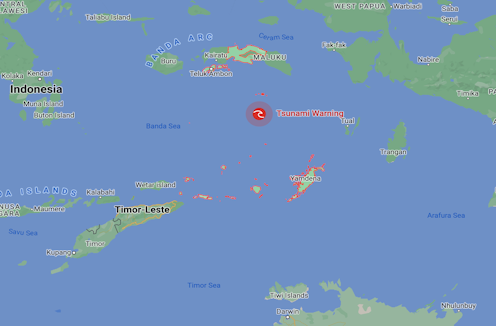
Maluku earthquake: why do some ocean earthquakes cause tsunamis while others don’t?

Source: The Conversation (Au and NZ) – By Martin Van Kranendonk, Professor and Director of the Australian Centre for Astrobiology, UNSW Sydney

Google Maps

We live on an active planet, one whose surface is constantly in motion, although imperceptibly to us most of the time. Until an earthquake occurs.

This morning, just such an event happened in the seas north of the Indonesian Archipelago, where a strong (magnitude 7.6 on the Richter scale) earthquake shook the region and was felt as far afield as Darwin in Australia.

The Bureau of Meteorology advises there is no tsunami warning for Australia, while some parts of Indonesia are in watch and wait mode. But what determines if a tsunami will occur?

Grinding rocks

Only 70 years ago, it was considered our planet was rigid and affected only by slight sagging and raising of landscapes.

However, with the advance of technology in the 1950s we began to map the seafloor using sonar. We could also measure the magnetic properties of the seafloor.

As a result, we’ve discovered the ocean floors are splitting apart at undersea mountain ranges known as mid-ocean ridges.

Additionally, oceanic crust (the part of Earth’s crust underlying the ocean basins) is being lost around the edges of most continents. It is being returned deep into Earth’s mantle – the thick layer of semi-molten rock beneath Earth’s surface crust.

This happens at what are known as “subduction zones”. Subduction zones are deep oceanic trenches where one tectonic plate dives down beneath another, generating earthquakes as the rocks slowly grind past one another.

The source of tsunamis

So why is it some earthquakes generate deadly tsunamis and others don’t?

Earth’s tectonic plates move across the planet’s surface at an average speed of around 10cm per year. This speed was originally estimated based on changes in the magnetic seafloor properties, but has now been measured by satellites in space.

This movement is not a smooth process, since Earth’s crust is hard and experiences strong friction when the tectonic plates come into contact with one another.

As they move, this friction builds up stress in the rock, which is released every once in a while in the form of earthquakes. In some places, earthquakes occur only occasionally but are very strong, while in others they happen more frequently and are weaker.

But earthquakes also vary greatly in terms of how deep they are generated below the surface. This is because subduction zones continue for a long way down into the mantle. The rocks remain cold and stiff for hundreds of kilometres down before they get hot enough from the internal heat of the planet to become soft.


Read more:
Why are shallow earthquakes more destructive? The disaster in Java is a devastating example


And this is the main reason some earthquakes generate tsunamis and others do not. Shallow subduction zone earthquakes actually displace the seafloor – either up or down – and also the ocean above it.

This happened with devastating effect in the 2011 Tohoku earthquake in Japan, located 24km deep and 9.1 magnitude on the Richter scale. This single earthquake moved the crust 26 metres in seconds and lifted up the ocean, sending the crashing waves of a tsunami right across the Pacific Ocean.

Meanwhile last night’s 7.6 magnitude Maluku earthquake in Indonesian waters was not as strong and occurred at a depth of 105km. At this depth, the energy and associated movement from the earthquake becomes dissipated into a million small fractures in the overlying rocks.

The energy also has to pass up through a wedge of the semi-molten mantle. Thus, the surface expression of the earthquake is significantly weakened and we either get no ocean waves, or only small ones.

Because Earth’s plates move at a relatively constant rate and we have a record of earthquake activity for any particular part of Earth’s crust in the form of the geological record, we can predict roughly how often earthquakes should occur in any broad location.

Unfortunately, we do not yet have the technology to be able to predict exactly when or where an earthquake will occur. But what we can do is identify areas at risk and build earthquake-resistant infrastructure in areas prone to earthquakes to prevent damage and loss of life.


Read more:
Be prepared, always: the tsunami message from New Zealand’s latest earthquake


The Conversation

Martin Van Kranendonk receives funding from the Australian Research Council.

ref. Maluku earthquake: why do some ocean earthquakes cause tsunamis while others don’t? – https://theconversation.com/maluku-earthquake-why-do-some-ocean-earthquakes-cause-tsunamis-while-others-dont-197529

Are polishes, acrylics and powders bad for my fingernails? Do I need a breather between manicures?

Source: The Conversation (Au and NZ) – By Christian Moro, Associate Professor of Science & Medicine, Bond University

Pexels/Valeria Boltneva, CC BY

People are increasingly opting for regular manicures – with vibrant layers of polish, gel, acrylic or powder.

Australians spend more than $22 billion a year on beauty treatments. And it’s not slowing down – the beauty and personal care market is expected to grow at around 2–5% in the next year.

Manicure popularity (velvet nails are among the latest looks) could be down to fashion, social media influencers or our desire for small luxuries. But should we hold off from treatments, and give our nails a break every now and then?


Read more:
We know hand dryers can circulate germs through the air. Why are they still used everywhere?


What are nails?

Nails are a unique feature in primates, made from skin cells. A special arrangement of keratin, a structural protein, allows the nails to become strong and compact. Keratin is the same protein present in hair, as well as the horns, claws and hooves of other animals.

Upon maturing, the cells making up the fingernail disintegrate their nucleus, giving rise to a translucent and colourless appearance.

Nails strengthen and protect the fingertips. They enable fine motor control, such as turning the pages of a book or picking up a needle from a table. They allow us to scratch ourselves when itchy, hold a better grip on some items, and pry open nuts and foods. They also enhance some sensations due to the underlying nerves.

The curved shape of the nail both strengthens it, as well as allows a nice snug fit to the underlying finger.

Fingernails grow at an average rate of 3 millimetres per month, so it takes about 4–6 months to fully grow from the cuticle to the tip. This is much faster than toenails, which grow around three times slower.

Labelled fingernail.
Christian Moro, Author provided

Fingernails grow from the skin at the base of the nail, with the new nail slowly pushing the rest forward. This occurs the fastest up to about 14 years of age, with males exhibiting faster-growing nails than females. The growth rate evens out at around 50 years of age.

Nails can be an insight into our health. An abnormally shaped nail bed (clubbing) may suggest anaemia, low tissue oxygenation, or cardiovascular disease. Discolouration or pitting could indicate autoimmune issues, infections or malnutrition.

How do nails break?

Dermatologists see a lot of patients with frail and brittle nails. Such nails can be vulnerable to splitting or breaking.

The external environment does impact our nails. Both low moisture and very high moisture can cause the nails to become brittle.

Poor nutrition and age can also affect the health of the nailbed and the strength and colour of the nails.


Read more:
What causes dry lips, and how can you treat them? Does lip balm actually help?


Beautiful nails

Healthy nails are more likely to look good.

Good habits to adopt for strong fingernails include trimming the nails straight across and rounding the edges, not messing with the cuticles (which help keep out nasty bugs), and not putting anything sharp under the nails.

But of course, playing around with the look of nails using shades and colours can be fun and fashionable. Around 85–90% of women worldwide use nail care products.

nail colour selection in salon
Choices, choices, so many choices.
Pexels/Rodnae, CC BY


Read more:
Yes, women might ‘feel the cold’ more than men. Here’s why


Can manicures do damage?

Although nail cosmetics can enhance nail appearance, they can potentially damage the underlying nails. Knowing what changes could occur is the important first step towards avoiding any permanent impact.

If you regularly paint your nails with traditional nail polish, be careful when using darker colours as this can stain the nail plate. Some ingredients in nail care products may also lead to allergic contact dermatitis.

To cure, harden, and dry each layer, the nail is often exposed to light under a fluorescent bulb. Most commonly, nail salons will use UV lamps, which requires about five minutes of exposure per hand.

This can cause cell damage and ageing to the skin. Current literature reports low skin cancer risk from UV lamp exposure. However, the recommendation is to apply a broad spectrum sunscreen with SPF >30 before exposure.

The most common method of removing gel polish is using acetone. The chemical can lead to brittle, dry and rough nails and cause separation of the nail from the nail bed.

Skin contact with acetone can also cause your skin to become dry, irritated and cracked. Some damage can also be done by peeling off acrylic or gel nails.

Everybody’s doing it.
Christian Moro, Author provided

Maybe don’t try this at home

Practising beauty techniques at home comes with the danger of serious harm.

The glue or chemical applicants used to adhere fake nails can cause serious burns. The chemicals used can also be harmful to children if left within reach. As such, going to a qualified and experienced nail technician is likely safer, provided they are taking infection precautions like using sterile tools and equipment.

Although nail cosmetics come with relatively minor risks, dermatologists often recommend sticking with your natural nails and painting them with regular polish, and allowing intermittent breaks between manicures to give your nails time to breathe.

We use the term “breathe” loosely here. Your nails receive their nourishment from the blood vessels under the skin, and do not need contact with the outside oxygen. But keeping the nails uncovered with product does give your body a chance to repair and regenerate the nail and its surrounding skin, keeping the region nice and healthy.

How long of a break is up to you, depending on your nails. However, given a full nail regrows entirely in four to six months, you won’t need to wait that long.


Read more:
What position should I sleep in, and is there a ‘right’ way to sleep?


The Conversation

The authors do not work for, consult, own shares in or receive funding from any company or organisation that would benefit from this article, and have disclosed no relevant affiliations beyond their academic appointment.

ref. Are polishes, acrylics and powders bad for my fingernails? Do I need a breather between manicures? – https://theconversation.com/are-polishes-acrylics-and-powders-bad-for-my-fingernails-do-i-need-a-breather-between-manicures-193947

Why Pacific Islanders are staying put even as rising seas flood their homes and crops

Source: The Conversation (Au and NZ) – By Merewalesi Yee, PhD Candidate, School of Earth and Environment Sciences, The University of Queensland

Photo: Merawalesi Yee, Author provided

Climate change is forcing people around the world to abandon their homes. In the Pacific Islands, rising sea levels are leaving communities facing tough decisions about relocation. Some are choosing to stay in high-risk areas.

Our research investigated this phenomenon, known as “voluntary immobility”.

The government of Fiji has identified around 800 communities that may have to relocate due to climate change impacts (six have already been moved). One of these is the village on Serua Island, which was the focus of our study.

Coastal erosion and flooding have severely damaged the village over the past two decades. Homes have been submerged, seawater has spoiled food crops and the seawall has been destroyed. Despite this, almost all of Serua Island’s residents are choosing to stay.

We found their decision is based on “Vanua”, an Indigenous Fijian word that refers to the interconnectedness of the natural environment, social bonds, ways of being, spirituality and stewardship of place. Vanua binds local communities to their land.

Waves submerge a house
A house on Serua Island is submerged by seawater.
Photo: Serua Island resident, Author provided


Read more:
Climate change forced these Fijian communities to move – and with 80 more at risk, here’s what they learned


Residents feel an obligation to stay

Serua Island has historical importance. It is the traditional residence of the paramount chief of Serua province.

The island’s residents choose to remain because of their deep-rooted connections, to act as guardians and to meet their customary obligations to sustain a place of profound cultural importance. As one resident explained:

“Our forefathers chose to live and remain on the island just so they could be close to our chief.”

Sau Tabu is the burial site of the paramount chiefs of Serua.
Photo: Merewalesi Yee, Author provided

The link to ancestors is a vital part of life on Serua Island. Every family has a foundation stone upon which their ancestors built their house. One resident told us:

“In the past, when a foundation of a home is created, they name it, and that is where our ancestors were buried as well. Their bones, sweat, tears, hard work [are] all buried in the foundation.”

Many believe the disturbance of the foundation stone will bring misfortune to their relatives or to other members of their village.

The ocean that separates Serua Island from Fiji’s main island, Viti Levu, is also part of the identity of men and women of Serua. One man said:

“When you have walked to the island, that means you have finally stepped foot on Serua. Visitors to the island may find this a challenging way to get there. However, for us, travelling this body of water daily is the essence of a being Serua Islander.”

The ocean is a source of food and income, and a place of belonging. One woman said:

“The ocean is part of me and sustains me – we gauge when to go and when to return according to the tide.”

The sea crossing that separates Serua Island from Viti Levu is part of the islanders’ identity.
Photo: Merewalesi Yee, Author provided

Serua Islanders are concerned that relocating to Viti Levu would disrupt the bond they have with their chief, sacred sites and the ocean. They fear relocation would lead to loss of their identity, cultural practices and place attachment. As one villager said:

“It may be difficult for an outsider to understand this process because it entails much more than simply giving up material possessions.”

If residents had to relocate due to climate change, it would be a last resort. Residents are keenly aware it would mean disrupting – or losing – not just material assets such as foundation stones, but sacred sites, a way of life and Indigenous knowledge.


Read more:
An entire Pacific country will upload itself to the metaverse. It’s a desperate plan – with a hidden message


Voluntary immobility is a global phenomenon

As climate tipping points are reached and harms escalate, humans must adapt. Yet even in places where relocation is proposed as a last resort, people may prefer to remain.

Voluntary immobility is not unique to Fiji. Around the world, households and communities are choosing to stay where climate risks are increasing or already high. Reasons include access to livelihoods, place-based connections, social bonds and differing risk perceptions.

As Australia faces climate-related hazards and disasters, such as floods and bushfires, people living in places of risk will need to consider whether to remain or move. This decision raises complex legal, financial and logistical issues. As with residents of Serua Island, it also raises important questions about the value that people ascribe to their connections to place.

Serua Island is one of about 800 communities in Fiji being forced to consider the prospect of relocation.


Read more:
Coastal property prices and climate risks are both soaring. We must pull our heads out of the sand


A decision for communities to make themselves

Relocation and retreat are not a panacea for climate risk in vulnerable locations. In many cases, people prefer to adapt in place and protect at-risk areas.

No climate adaptation policy should be decided without the full and direct participation of the affected local people and communities. Relocation programs should be culturally appropriate and align with local needs, and proceed only with the consent of residents.

In places where residents are unwilling to relocate, it is crucial to acknowledge and, where feasible, support their decision to stay. And people require relevant information on the risks and potential consequences of both staying and relocating.

This can help develop more appropriate adaptation strategies for communities in Fiji and beyond as people move home, but also resist relocation, in a warming world.

The Conversation

Celia McMichael receives funding from the Australian Research Council.

Karen E McNamara receives funding from the Australian Research Council, Australian Government, Organisation for Economic Cooperation and Development, and the Vanuatu Government.

Annah Piggott-McKellar and Merewalesi Yee do not work for, consult, own shares in or receive funding from any company or organisation that would benefit from this article, and have disclosed no relevant affiliations beyond their academic appointment.

ref. Why Pacific Islanders are staying put even as rising seas flood their homes and crops – https://theconversation.com/why-pacific-islanders-are-staying-put-even-as-rising-seas-flood-their-homes-and-crops-195100

What if your colleague is a bot? Harnessing the benefits of workplace automation without alienating staff

Source: The Conversation (Au and NZ) – By Lena Waizenegger, Senior Lecturer in Information Systems, Auckland University of Technology

Getty Images

The need for businesses to adapt to the workplace demands of the COVID-19 pandemic has accelerated the adoption of digital technologies, with clear implications for jobs and workers.

But just how much employees worry about the threat of automation – and how real those fears are – can have implications for workplaces beyond the technological change itself.

Our new research examined how employees feel about the introduction of “robotic process automation” (RPA) to the workplace. We also looked at how the willingness to embrace these new technologies influenced employees’ assessment of the software bots and their work.

RPA refers to software that interacts with different applications, such as a payroll system or a website, in the same way a human would.

Software robots – the so-called worker bees of RPA – can conduct mundane, repetitive and rule-based tasks such as transferring, entering and extracting data, accounting reconciliation, and automated email query processing. And they can do it at a fraction of the cost of employing real people.

The 24/7 worker

Unsurprisingly, organisations have embraced RPA for its cost and productivity benefits, but it’s not without its challenges. As RPA interacts with various applications, for example, it can “break” when one of the underlying systems is upgraded and the user interface changes.

RPA is also a double-edged sword for employees. On the one hand, with mundane and repetitive tasks outsourced to software robots, workers can focus on more complex tasks that require “soft” skills, empathy and decision-making capabilities.


Read more:
Companies are mitigating labour shortages with automation — and this could drastically impact workers


On the other, some feel threatened by the software robots because they are generally more productive, make fewer errors and don’t cost as much as human employees.

Employees can also end up having to do additional tasks, picking up the work that used to be completed by the staff replaced by RPA. Paradoxically, fewer human employees can lead to an increased workload rather than the expected decrease.

Similarly, as employees shift from a mix of mundane and complex tasks to mainly complex ones, the variety in their work is reduced. This can lead to feeling alienated at work, or a sense they lack control over their role.

Fear and enthusiasm

These various perspectives on automation were clear in our research. We interviewed employees and automation team members at a financial institution in New Zealand about their perceptions and responses to RPA and software robots.

We found that reactions to RPA are influenced by what employees imagined would be the consequences of software robots on their jobs. In turn, this influenced their collaboration with the automation team, their attitude towards change in their tasks and work processes, and ultimately their interactions with software robots – including how they judged the bots’ performance.

Perceptions and responses to RPA can be categorised by employees’ views of software robots as either burdens and threats, tools, teammates or innovative enablers.

Those who considered software robots as a burden and threat before they were introduced tended to have a negative view of their experience with RPA. They were concerned about job security, had negative reactions to having greater responsibility added to their workload, and were dissatisfied with the robots’ performance.


Read more:
Can machines invent things without human help? These AI examples show the answer is ‘yes’


Lessons for employees and employers

At the opposite end of the spectrum, those who viewed software robots as enablers of innovation saw the opportunities of RPA and the benefits of using robots to improve work quality.

Some eagerly accepted the robots as team members, even giving them human names and joking that the bot was taking a sick day when it stopped working. This group also appreciated the reduction in their own workloads through RPA.

Little surprise, then, that employees who view software robots as innovative enablers or teammates tended to collaborate closely with the automation team to find the best way to integrate robots and improve their performance.


Read more:
Brain-computer interfaces could allow soldiers to control weapons with their thoughts and turn off their fear – but the ethics of neurotechnology lags behind the science


In the middle ground, employees who viewed software robots as tools tended to be accepting, but remained sceptical about changes to their workloads and robot performance. They were reluctant to offer full cooperation with the automation team to configure robots’ tasks that would have consequences for their own roles.

Some level of automation is inevitable for businesses. To harness the benefits of RPA without alienating staff, organisations should communicate clearly and often, debunking the myths of robots and their capabilities early to avoid unnecessary misunderstandings by employees.

Employers should take the time to understand how different employees feel about the introduction of automation initiatives. And they should consider incorporating employees’ ideas to increase the overall benefits of automation.

The Conversation

The authors do not work for, consult, own shares in or receive funding from any company or organisation that would benefit from this article, and have disclosed no relevant affiliations beyond their academic appointment.

ref. What if your colleague is a bot? Harnessing the benefits of workplace automation without alienating staff – https://theconversation.com/what-if-your-colleague-is-a-bot-harnessing-the-benefits-of-workplace-automation-without-alienating-staff-196203

Chubb review of Australia’s carbon credit scheme falls short – and problems will continue to fester

Source: The Conversation (Au and NZ) – By Andrew Macintosh, Professor and Director of Research, ANU Law School, Australian National University

Jeremy Ng/AAP

An independent review of Australia’s controversial carbon credit system released today concluded the scheme is essentially sound. But key questions remain unaddressed – a fact that will continue to undermine confidence in Australia’s central climate policy.

The review, led by former chief scientist Ian Chubb, followed concerns raised by our research team that the scheme lacked integrity and was not delivering genuine reductions in greenhouses gas emissions. The review panel, however, says it does “not share this view”.

Climate Change and Energy Minister Chris Bowen on Monday said the government would implement all 16 of the review panel’s recommendations.

But more must be done to ensure the Albanese government truly delivers the emissions reductions it has promised.

smoke stack in front of setting sun
The federal government has accepted the review’s recommendations – but more must be done to ensure genuine carbon abatement.
Charlie Riedel/AP

Carbon credits underpin our climate policy

Australia’s carbon credit system is central to reaching the federal government goal of 43% emissions reduction by 2030 and net-zero by 2050.

The scheme provides carbon credits to projects that reduce greenhouse gas emissions using a number of approved methods, such as avoiding deforestation. These credits can be sold on the carbon market to entities that want to offset their emissions.

In March last year, our research team raised serious concerns about the scheme. In a series of papers, we outlined systemic flaws in the way carbon credits were issued.

We concluded Australia’s Emissions Reduction Fund – under which the scheme operates – has serious governance flaws, has issued a large number of low integrity credits and is wasting billions of dollars in taxpayers’ money.

Our analysis focused on three of the fund’s most popular methods – avoiding deforestation, human-induced regeneration of native forests and combusting methane from landfills. These account for 75% of the credits issued under the scheme.

We found that more than 70% of the credits issued under these methods do not represent genuine emissions abatement.

Following that criticism, in July last year, the Albanese government commissioned an independent review of the scheme. Those findings were released today.

farm scene with trees and crops
The author’s research found more than 70% of the credits issued under a number of carbon farming methods do not represent genuine emissions abatement.
Shutterstock


Read more:
We blew the whistle on Australia’s central climate policy. Here’s what a new federal government probe must fix


A ‘bewildering’ assessment

The panel concluded the carbon credit arrangements are largely sound. How the panel reached this conclusion is hard to fathom.

Discussion of the rules governing human-induced regeneration, landfill gas and avoided deforestation projects spans less than six pages.

The report does not contain references to the evidence relied upon to reach its conclusions, and includes very little analysis to support its findings. And importantly, the panel does not address key questions around the integrity of the scheme’s rules.

Bewilderingly, in its assessment of the methods, the panel does not refer to the findings of a review it commissioned from the Australian Academy of Science to inform its considerations.

The academy reviewed the three main methods my research team analysed and a fourth, concerning carbon capture and storage.

It found numerous flaws in the methods and the associated governance processes. For example, consistent with our analysis, it found a risk the human-induced regeneration method is crediting vegetation change brought on by rainfall, rather than project activities.

The academy also found problems with the landfill gas method – namely, that so-called “baselines” used to calculate carbon abatement don’t adequately account for other financial and regulatory incentives offered to operators for capturing and combusting methane.

This means credits are sometimes issued for actions the industry would take anyway. As I wrote in The Conversation in September last year, so great are the problems with the landfill gas method that several large companies profiting from it have called for changes to the system.

The academy is not alone in recognising these problems. The CSIRO [https://consult.dcceew.gov.au/independent-review-of-accu/submission/view/150] and Wentworth Group of Concerned Scientists also found problems with the rules governing the issuance of credits.

The review panel acknowledged the scientific evidence criticising the carbon credit scheme, but says “it was also provided with evidence to the contrary”. Yet it did not disclose what that evidence was or what it relates to. The public is simply expected to trust that the evidence exists.

pipes collecting methane from site
The landfill gas industry says credits are sometimes issued for actions the industry would take anyway.
Shutterstock


Read more:
‘Untenable’: even companies profiting from Australia’s carbon market say the system must change


Integrity is essential

The panel recommended significant changes to governance arrangements under the carbon credits scheme. It’s hard to understand the need for such changes if there are no material problems with the credits.

Nonetheless, most recommended governance changes are welcome, including:

  • reducing the roles performed by the Clean Energy Regulator, to “enhance confidence and transparency” and reduce potential conflicts of interest

  • amend the scheme’s legislation to improve transparency to support greater public trust and confidence in the scheme.

But these governance changes are not enough. Measures should be taken to prevent low-integrity credits being issued to existing projects. And polluting facilities should not be allowed to use low-integrity credits to meet their emission reduction obligations.

Without these changes, problems with the scheme will continue to fester, jeopardising the operation of the government’s climate policy.


Read more:
Australia relies on controversial offsets to meet climate change targets. We might not get away with it in Egypt


The Conversation

Andrew Macintosh consults to various organisations about the carbon market and other environmental markets. He is also a Director of Paraway Pastoral Co., which has ERF projects.

Don Butler receives funding from the Australian Government and also consults to various organisations about the carbon market and other environmental markets.

ref. Chubb review of Australia’s carbon credit scheme falls short – and problems will continue to fester – https://theconversation.com/chubb-review-of-australias-carbon-credit-scheme-falls-short-and-problems-will-continue-to-fester-197401

Mad world: global flashpoints to watch in 2023 in the era of ‘polycrisis’

Source: The Conversation (Au and NZ) – By Susan Harris Rimmer, Professor and Director of the Policy Innovation Hub, Griffith Business School, Griffith University

When 2022 began, there was trepidation about what might happen in at least ten regions. Topping most lists were concerns about tensions in Ukraine, Afghanistan and Ethiopia.

What actually transpired in 2022 were some of the most shocking humanitarian scenes in modern history – with a backdrop of the continuing pandemic and extreme weather events exacerbated by climate change.

This has prompted experts to speak of an era of “polycrisis”, where countries are dealing with cascading and interconnected crises.


Read more:
‘Polycrisis’ may be a buzzword, but it could help us tackle the world’s woes


The World Bank estimates 23 countries – with a combined population of 850 million people – currently face high or medium intensity conflict. The number of conflict-affected countries has doubled over the past decade.

This has triggered massive refugee flows. As of May 2022, a global record of 100 million people were forcibly displaced worldwide.

With the backdrop of last year’s bitter legacy, what crises are most concerning as we head into 2023?

There are a range of new flashpoints and ongoing deadly conflicts the world has largely ignored due to the focus on Ukraine.

2022’s bitter legacy

Russia’s invasion of Ukraine has been seared into our memories of 2022. It has been one of the fastest and largest displacement crises in decades.

Also making headlines last year was continuing violence in Afghanistan, where six million people were on the brink of famine by August 2022 according to the UN refugee agency, and the mayhem in Myanmar following the military’s February 2021 coup.

The opening days of 2023 look bleak. Those in Ukraine and Afghanistan are now facing winter without access to food, water, health care and other essential supplies.

The situation in Myanmar is only worsening, especially for ethnic minority regions and in Rohingya refugee camps.


Read more:
War in Ukraine is pushing global acute hunger to the highest level in this century


New flashpoint: Iran

In Iran, 22-year-old Mahsa (Jina) Amini was arrested at a metro station by the morality police who enforce the dress code, and she died after being held in their custody on September 16 last year.

Her death set off a sustained uprising in more than 150 cities and 140 universities in all 31 provinces of Iran, according to UN human rights chief Volker Türk.

More than 15,000 people, including children, have been arrested in connection with the protests and are threatened with execution. At least 26 of them currently face the death penalty, and at least four have reportedly already been executed. The Islamic Revolutionary Guard Corps say the average age of arrested protesters is as young as 15.

The prospects of a peaceful resolution of this crisis in 2023 are low and require strong global intervention.

Australia’s Foreign Minister Penny Wong has made firm statements against the death penalty and this “dark chapter” in Iran’s history with her Canadian and New Zealand counterparts, and she should continue this rhetoric.

Tensions in the Asia-Pacific

In our region, Sri Lanka faced economic collapse and a mostly peaceful uprising in mid-2022, and remains in a precarious position.

North Korea remains an aggressive actor. Military tensions on the Korean peninsula have risen sharply this year as Pyongyang has carried out an unprecedented blitz of weapons tests, including the launch of one of its most advanced intercontinental ballistic missiles in November.

From Australia’s perspective, our primary national security risk remains developments in the South China Sea and Taiwan.

More aggressive language on Taiwan emerged from the Chinese Communist Party Congress, and statements by President Joe Biden indicated the United States would not stand by if China invaded Taiwan.

Current Japanese Prime Minister Fumio Kishida has pledged to double Japan’s defence spending in response to these tensions.

There’s a high risk of miscalculation on this issue from all sides, and there’s the growing threat of grey zone tactics – coercive measures which don’t qualify as conventional military battle.

We must avoid tunnel vision

What we also witnessed in 2022 was that the world’s gaze and assistance was so firmly focused on events in Ukraine that many other long-running conflicts producing extreme human suffering were ignored or receded into the background.

For example, it’s hard to overstate the severity of the crises in East Africa of food, shelter and health systems – though comparably this has received little media attention.

What’s more, the UN Human Rights Office estimates more than 306,000 civilians were killed over ten years in the Syrian conflict, and any peaceful resolution is still “elusive” according to UN Special Envoy Geir Pedersen.

There are deep structural conflicts in Haiti, South Sudan, Ethiopia, Syria, Yemen, and the Democratic Republic of the Congo threatening people, species and the environment. The global community must pay attention.


Read more:
Permacrisis: what it means and why it’s word of the year for 2022


Dealing with ‘polycrisis’

Nations, civil society movements and the UN must be nimble enough to deal with the state of “polycrisis” or “permacrisis” the globe is enduring – where armed conflicts combine with and exacerbate issues such as inflation, cyber threats, geo-politics and the energy crisis.

World leaders are dealing with a host of pressing issues:

  • the climate emergency

  • the socio-economic repercussions of the COVID pandemic, by no means over

  • 100 million displaced people

  • the increasing global population, now over eight billion

  • the rising cost of living.

All this means 2023 is likely to be another turbulent year.

The Conversation

Susan Harris Rimmer receives funding from the Australian Research Council, the Queensland Public Service Commission and ONI.

ref. Mad world: global flashpoints to watch in 2023 in the era of ‘polycrisis’ – https://theconversation.com/mad-world-global-flashpoints-to-watch-in-2023-in-the-era-of-polycrisis-195433

AI might be seemingly everywhere, but there are still plenty of things it can’t do – for now

Source: The Conversation (Au and NZ) – By Marcel Scharth, Lecturer in Business Analytics, University of Sydney

Mahdis Mousavi/Unsplash

These days, we don’t have to wait long until the next breakthrough in artificial intelligence (AI) impresses everyone with capabilities that previously belonged only in science fiction.

In 2022, AI art generation tools such as Open AI’s DALL-E 2, Google’s Imagen, and Stable Diffusion took the internet by storm, with users generating high-quality images from text descriptions.

Unlike previous developments, these text-to-image tools quickly found their way from research labs to mainstream culture, leading to viral phenomena such as the “Magic Avatar” feature in the Lensa AI app, which creates stylised images of its users.


Read more:
No, the Lensa AI app technically isn’t stealing artists’ work – but it will majorly shake up the art world


In December, a chatbot called ChatGPT stunned users with its writing skills, leading to predictions the technology will soon be able to pass professional exams. ChatGPT reportedly gained one million users in less than a week. Some school officials have already banned it for fear students would use it to write essays. Microsoft is reportedly planning to incorporate ChatGPT into its Bing web search and Office products later this year.

What does the unrelenting progress in AI mean for the near future? And is AI likely to threaten certain jobs in the following years?

Despite these impressive recent AI achievements, we need to recognise there are still significant limitations to what AI systems can do.

AI excels at pattern recognition

Recent advances in AI rely predominantly on machine learning algorithms that discern complex patterns and relationships from vast amounts of data. This training is then used for tasks like prediction and data generation.

The development of current AI technology relies on optimising predictive power, even if the goal is to generate new output.


Read more:
Not everything we call AI is actually ‘artificial intelligence’. Here’s what you need to know


For example, GPT-3, the language model behind ChatGPT, was trained to predict what follows a piece of text. GPT-3 then leverages this predictive ability to continue an input text given by the user.

“Generative AIs” such as ChatGPT and DALL-E 2 have sparked much debate about whether AI can be genuinely creative and even rival humans in this regard. However, human creativity draws not only on past data but also on experimentation and the full range of human experience.

Cause and effect

Many important problems require predicting the effects of our actions in complex, uncertain, and constantly changing environments. By doing this, we can choose the sequence of actions most likely to achieve our goals.

But algorithms cannot learn about causes and effects from data alone. Purely data-driven machine learning can only find correlations.

To understand why this is a problem for AI, we can contrast the problems of diagnosing a medical condition versus choosing a treatment.

Machine learning models are often helpful for finding abnormalities in medical images – this is a pattern recognition problem. We don’t need to worry about causality because abnormalities are already either present or not.

But choosing the best treatment for a diagnosis is a fundamentally different problem. Here, the goal is to influence the outcome, not just recognise a pattern. To determine the effectiveness of a treatment, medical researchers run randomised controlled trials. This way, they can try to control any factors that might affect the treatment.

The confusion between these two types of problems sometimes leads to suboptimal applications of machine learning in organisations.

While the success of recent work in AI demonstrates the value of data-driven models, many of the problems we would want computers to solve require an understanding of causation.

Current AI systems lack this ability, apart from specialised applications such as board games.

A colourful pixellated image with vague outlines of several human eyes and mouths
A Stable Diffusion artwork generated by the prompt ‘The limits of artificial intelligence’. Current AI technology tends to perform poorly in unexpected situations. In this case, the prompt is not well represented in Stable Diffusion’s training data.
Stable Diffusion

Common sense reasoning

Language models such GPT-3 and ChatGPT can successfully solve some tasks requiring common-sense reasoning.

However, the following interaction with ChatGPT, adapted from an experiment by Gary Marcus suggests it is not entirely reliable in this respect.

I’m eight years old. When I was born, my biological mother was in Barcelona and my father was in Tokyo. Where was I born? Think through this step by step.

It is not mentioned where you were born. All we know is that your biological mother was in Barcelona and your father was in Tokyo at the time of your birth.

Whether AI systems such as ChatGPT can achieve common sense is a subject of lively debate among experts.

Sceptics such as Marcus point out we cannot trust language models to robustly display common sense since they neither have it built into them nor are directly optimised for it. Optimists argue that while current systems are imperfect, common sense may spontaneously emerge in sufficiently advanced language models.

Human values

Whenever groundbreaking AI systems are released, news articles and social media posts documenting racist, sexist, and other types of biased and harmful behaviours inevitably follow.

This flaw is inherent to current AI systems, which are bound to be a reflection of their data. Human values such as truth and fairness are not fundamentally built into the algorithms – that’s something researchers don’t yet know how to do.

While researchers are learning the lessons from past episodes and making progress in addressing bias, the field of AI still has a long way to go to robustly align AI systems with human values and preferences.

The Conversation

Marcel Scharth does not work for, consult, own shares in or receive funding from any company or organisation that would benefit from this article, and has disclosed no relevant affiliations beyond their academic appointment.

ref. AI might be seemingly everywhere, but there are still plenty of things it can’t do – for now – https://theconversation.com/ai-might-be-seemingly-everywhere-but-there-are-still-plenty-of-things-it-cant-do-for-now-197050

Help! My kid won’t read chapter books. What do I do?

Source: The Conversation (Au and NZ) – By Helen Harper, Senior Lecturer in English, Literacy and Language Education, University of New England

Photo by Mikhail Nilov/Pexels, CC BY

Many children start school excited about learning to read. And parents too! After many years of reading and re-reading (seemingly ad nauseam) favourite picture books aloud, it’s thrilling to see your child develop their own reading skills.

But what if they seem to be “stuck” on books that still use lots of illustrations, such as graphic novels, comics or picture books?

Many parents fret about their child still not having fallen in love with chapter books. You might mourn the fact they still aren’t reading the books you loved as a child – the Roald Dahl classics, the Narnia books or more recent releases such as the Harry Potter series.

But the fact is, it’s counterproductive to push your child to read a whole chapter book independently if they are not ready. You might turn them off reading altogether. Here’s what to do instead.


Read more:
Book Week: it’s not the costume that matters, but falling in love with reading


A kid flicks through a comic
Lots of kids still delight in books that rely heavily on visual aids, such as comics, graphic novels and picture books.
Photo by Dayvison Tadeu/Pexels, CC BY

Yes, chapter books are important. But don’t rush

Chapter books are an important step in learning to read. They introduce increasingly complex storylines, themes, characters and settings.

They expand children’s vocabulary (which is essential for developing reading comprehension).

Importantly, when texts have no pictures, children must rely on decoding (recognising sound-letter relationships) to make sense of the words.

This helps with developing reading fluency (reading accurately with expression at a pace that allows for comprehension), and developing reading stamina (maintaining comprehension over longer passages of text).

But the transition to chapter books can be daunting for children. It’s a big leap from picture books, where so much meaning is carried in the illustrations, to books where readers rely solely on the print to make sense of the text.

Your child may not be ready to read entire chapter books independently. They may still not have developed what researchers call “automaticity” in their decoding skills (reading words without having to sound them out).

Automaticity frees up mental space for paying attention to meaning. In other words, if you have to stop and sound words out all the time, it’s hard to follow the plot and can take the fun out of reading.

Here are some ways you can help your child develop the skills they need to read and enjoy chapter books.

Narnia books sit upon a shelf.
Maybe your kids just aren’t into the same books you loved as a child – and that’s OK.
Photo by Pixabay via Pexels., CC BY

Choose books that support the transition

Many books are designed to support young readers, with short chapters featuring plenty of images.

There are picture books for older children, and don’t be frightened of graphic novels. As well as visual richness, they often offer sophisticated storylines and themes.

Visit your local library and ask the children’s librarian for suggestions.

Share the reading, make it fun and keep the conversation going

Share the reading; you read a page or a paragraph, and they read a page or a paragraph, or even just a sentence or two.

This makes reading less overwhelming for kids, but still allows them to practise.

Plan reading time so it doesn’t compete with distractions such as screen time or siblings.

Your child may even like to help read a story to a younger sibling or to grandparents via Zoom.

Read alongside your child so you can share ideas about the story, author or series.

Talk with your child about movies, video games, images, art and comics. All of this talk helps build vocabulary and knowledge, which help them tackle more challenging texts.

Two children look at a picture book
Let’s not think that picture books are only for little kids.
Photo by Marta Wave/Pexels, CC BY

Respect their interests and keep it positive

Let your child explore the books they’re interested in.

Some children are not keen on fiction, and prefer to read about science or the world around them. These kinds of texts also help develop vocabulary and complex language.

Remember, reading for pleasure is associated with overall reading attainment and writing ability. It’s a big part of becoming a lifetime reader.

Yes, you can still suggest books to your child. But don’t get upset if they say no, and definitely don’t insult their tastes by putting down their favourite books and authors.

Whatever their response, keep the conversation channels open and help them feel confident about their own choices.

A child reads Captain Underpants
Don’t insult your child’s taste in books.
Shutterstock

Check your own anxiety levels and accept it takes time

Children can pick up on parental anxiety about academic achievement.

Anxiety takes up mental space and interferes with your child’s work as they practise more challenging reading.

Children may seem to master their sounds and letters quickly, but still need years of schooling to develop the knowledge and language they need for skilled reading comprehension. They also need time to get used to the pages of full print and the smaller font size in chapter books.

Accept that learning to read is a marathon, not a sprint. It’s big work for a young person.

What if I’m still worried?

If you are really worried about your child’s reading, talk to their teacher and consider if a sight or hearing test is warranted (to check they can see the letters and discriminate language sounds).

If your child does have decoding difficulties, a systematic approach to learning about sound-letter relationships, and practice in reading accurately and fluently is important.

In the end, though, your most important role is to give time and encouragement, to maintain an interest and enjoyment in reading together and independently.


Read more:
5 ways to support children’s early literacy skills and build family connections this summer


The Conversation

Bronwyn Parkin is affiliated with the Primary English Teaching Association of Australia.

Pauline Jones is President of the Primary English Teaching Association Australia (PETAA)

Helen Harper and Susan Feez do not work for, consult, own shares in or receive funding from any company or organisation that would benefit from this article, and have disclosed no relevant affiliations beyond their academic appointment.

ref. Help! My kid won’t read chapter books. What do I do? – https://theconversation.com/help-my-kid-wont-read-chapter-books-what-do-i-do-195092

Indonesian ex-graft convicts active again in political parties ‘nothing new’

By Agus Rahmat in Jakarta

Indonesia Corruption Watch (ICW) has condemned the phenomena of former corruption convicts becoming active again in political parties after serving their sentences.

However, it says this is not a new phenomenon in the world of politics.

ICW coordinator Agus Sunaryanto revealed several names of people who were caught up in corruption cases and who were now active again in political parties.

He cited names such as Andi Mallarangeng from the Democrat Party, who was indicted in the Hambalang sports complex case and released from prison in 2017.

Nazaruddin, also from the Democrat Party, was indicted in two cases — the 4.6 billion rupiah (NZ$4.65 million) bribery case involving the Wisma Atlet (Athletes Village), as well as graft and money laundering.

The latest is former United Development Party (PPP) chairperson Muhammad Romahurmuziy (Romy) who was indicted over receiving bribes for selling posts in the Ministry of Religious Affairs in 2019.

After being released from prison, Romahurmuziy was appointed as chairperson of the PPP’s Advisory Board.

“So (the phenomena of ex-corruptors becoming active again in political parties) is not just happening in the PPP. The Democrats are also like that, Nazaruddin and Andi Mallarangeng for example,” Sunaryanto told journalists.

‘Internal problem’
Sunaryanto said he suspected there was an “internal problem” in the political parties so that in the end they accepted former corruption convicts rejoining the party.

He also gave a flashback over the actions by the political parties when their members were indicted in corruption cases.

Sunaryanto said that the parties “fall over themselves publicly” in taking stern measures against corrupt members, such as dismissing them.

But these dismissals were just a political gimmick because party members could easily rejoin after they had served their sentences.

“I think there is a problem in the political parties. The political parties actually take good steps when [members] are declared suspects. Before, the Democrats immediately dismissed them [Nazaruddin and Mallarangeng], but then after they’re released, they come back in again. This is simply a political gimmick,” he added.

Translated by James Balowski for IndoLeft News. The original title of the article was “ICW Sindir Eks Koruptor Masuk Partai Lagi: Seperti Gimmick Politik”.

Print Friendly, PDF & Email

Article by AsiaPacificReport.nz
FLNKS congratulates Fiji PM Rabuka and his coalition government

By Timoci Vula in Suva

The Kanak Socialist National Liberation Front (FLNKS) of Kanaky New Caledonia has congratulated Fiji’s Prime Minister Sitiveni Rabuka and his three deputies on their election in Parliament last month.

In a statement, FLNKS’s Victor Tutugoro also congratulated the 55 Members of Parliament and the newly-constituted government.

The liberation front also congratulated Speaker Ratu Naiqama Lalabalavu and deputy Speaker Lenora Qereqeretabua.

“FLNKS looks forward to continuing to work closely with government in the future,” Tutugoro said.

“Our political, cultural and historical ties will continue within our great Melanesian family.

“FLNKS is ready to pursue our exchanges through the Melanesian Spearhead Group in the coming weeks.”

Tutugoro also acknowledged former prime minister Voreqe Bainimarama for his “strong support” to the FLNKS cause.

Tutugoro is second vice-president of New Caledonia’s Northern provincial government and a member of the territory’s Congress.

Timoci Vula is a Fiji Times reporter. Republished with permission.

Print Friendly, PDF & Email

Article by AsiaPacificReport.nz

Rabuka’s ‘wasteful spending’ spotlight now turns onto FBC, Fiji Sun

By Wata Shaw in Suva

After the termination of Qorvis Communications and Vatis, Prime Minister Sitiveni Rabuka has indicated that attention has now shifted to the state-run Fiji Broadcasting Corporation (FBC) and Fiji Sun newspaper.

He revealed this while addressing the nation on Friday afternoon.

“We made it clear in our manifestos that implementation of certain promises would be dependent on the true state of Fiji’s economy,” Rabuka said.

“We will be conducting mandatory audits and associated checks and balances. Until these are completed, we will be curtailing what we consider to be wasteful spending in areas that are not a priority.

“We’ve started an investigation into what appears to be excessive spending in the Department of Information, through payments to the [US-based] public affairs company Qorvis, the local communications company Vatis, the Fijian Broadcasting Corporation (FBC) and the Fiji Sun newspaper.

“In fact, there are many looming issues to address.”

He said that in the past 14 days they had made progress with ministers establishing themselves in their respective ministries.

Questions sent to FBC chief executive officer, Riyaz Sayed-Khaiyum, and Fiji Sun acting chief executive officer Rosi Doviverata remained unanswered when this edition of the Fiji Times went to press.

Wata Shaw is a Fiji Times reporter. Republished with permission.

Print Friendly, PDF & Email

Article by AsiaPacificReport.nz

Long before Silicon Valley, scholars in ancient Iraq created an intellectual hub that revolutionised science

Source: The Conversation (Au and NZ) – By Terhi Nurmikko-Fuller, Senior Lecturer in Digital Humanities, Australian National University

Shutterstock

Time and again, collaboration has proven to be a key driver of scientific and technological innovation. So it follows that some of the greatest advances have come from intellectual hubs set up for this very purpose.

Today Silicon Valley is synonymous with this idea – but it’s just one in a long line of institutions that paved the way before it. One such example came from Baghdad, Iraq, during the Islamic Golden Age in the fourth Islamic century (tenth century AD).

It was around this time, when Europe was living through its so-called “Dark Ages”, the House of Wisdom (Bayt-al Hikmah) was born. It was here that many great works from Persia, China, India and Greece were collected and translated into Arabic, including works by Aristotle and Euclid.

This illustration showing Aristotle teaching a student is from a manuscript attributed to Assyrian physician and writer Jabril ibn Bukhtishu (8th-9th century)
Wikimedia

This culturally and linguistically diverse environment gave rise to innovations that would have lasting legacies in fields including algebra, geography, astronomy, medicine and engineering.

Automata with talent

During its tenure of some three-and-a-half centuries, the House of Wisdom was populated by a number of multitalented thinkers.

Among these were the Banu Musa brothers – three ninth-century Persian scholars who lived in Baghdad. The brothers formed a multidisciplinary team: one was a mathematician, one an astronomer and one an engineer.

They translated works from other languages into Arabic, sponsored other translators and invested money in buying rare manuscripts. They were also involved in politics and the development of urban infrastructure, and were even musically talented.

But arguably their most tangible contribution was to automated machines, or automata. One of their works published in 850 AD, The Book of Ingenious Devices, translated as The Book of Tricks, describes machines that served as precursors to modern robots.

These automata included mechanical musical instruments and a self-playing steam-powered robotic flute player. Vrije University of Amsterdam’s Teun Koetsier considers this mechanical musician to be the world’s first programmable machine.

Brilliant polymaths

Another scholar of the House of Wisdom at the time was Mohammad ibn Musa al-Khwarizmi, whose name inspired a term we use regularly: “algorithm”.

In fact, his is a two-fold legacy, as the term “algebra” also derives from the title of one of his books, Kitab al-Jebr, or The Book of Completion.

A page from al-Khwarizmi’s Kitab al-Jabr, written around 820 AD.
Wikimedia Commons

This was one of the (if not the) world’s first publications of algebraic rules. He also made important contributions to geography and astronomy.

Al-Khwarizmi worked closely with al-Kindi, also known by his Latinised name Alkindus.

Al-Kindi was an Abbasid polymath. He was a citizen of the Abbasid Empire, which spanned the Arabic-speaking world from what’s now Pakistan to Tunisia, and from the Black Sea to the Indian Ocean. He was a mathematician, student of cryptanalysis, and pioneer in music theory who combined Aristotelian philosophy with Islamic theology.

Al-Kindi is credited with introducing Indian numbers to his colleagues and peers in the Arab-speaking world. Together with al-Khwarizmi, he developed the Arabic numerals that we all use today (i.e. numbers 0-9).

He also authored the oldest known book on cryptanalysis, and is known to have used statistical inference (a type of data analysis). Statistician Lyle Broemeling describes this as one of the earliest known examples of both these methods.

Al-Kindi’s personal library was so magnificent the Banu Musa brothers apparently conspired, in their jealousy, to have him beaten, evicted from the House of Wisdom, and his library confiscated and given to them.

Gone without a trace

After centuries of fostering intellectual thought and technical development, The House of Wisdom was destroyed by the Mongols during the Siege of Baghdad in 1258 – leaving next to no traces.

An artwork depicts the siege of Baghdad by Mongols
This painting by Persian historian Rashid-al-Din Hamadani formed part of a manuscript made in Iran around 1430 AD. It shows the 1258 siege of Baghdad by the Mongols, headed by Genghis Khan’s grandson Hulagu Khan.
Bibliothèque nationale de France. Département des Manuscrits. Supplément Persan 1113

This absence of archaeological evidence has even led some scholars to doubt its very existence, or to suggest it existed not so much as a place, but as a state of mind.

In his book Greek Thought, Arabic Culture, Dimitri Gutas suggests the House of Wisdom could, at best, be romanticised as an “idealised national archive”. But this view is challenged by Islamic Studies expert Hossain Kamaly in the review of the volume.

However, even Gutas agrees that between 800 AD and 1000 AD there was a large-scale translation movement in the Middle East that led to a comprehensive and systematic translation of Greek non-literary works into Arabic. Translators were held in high esteem, and social prestige was awarded not only to them, but also to the elite who helped fund their activities.

As renowned science communicator and theoretical physicist Jim al-Khalili summarises in his book Pathfinders:

[T]here was indeed an establishment known as the House of Wisdom […] expanded dramatically in scope from a mere palace library […] that became a centre for original scientific scholarship.

In other words, the House of Wisdom could have been a small space, but one that enabled a culture of interdisciplinary knowledge acquisition in a rich and dynamic environment. Its legacy and contribution to modern research are clear.

In his book Kitab Surat-al-ard, Al-Khwarizmi depicts what is considered one of the earliest maps of the River Nile (11th century).
Wiki Commons

Lessons for today

While there’s much we don’t know about the House of Wisdom, one thing seems clear: it was driven by an appreciation of the rich ideas that can emerge in a dynamic, multidisciplinary environment.

In this regard, it begins to sound less like Silicon Valley, which has shown itself to be focused squarely on commercial gain and is known for attracting unscrupulous behaviour.

On closer inspection, The House of Wisdom sounds more like a collaborative environment that could be achieved in higher education.

One key to its success was consistent financial backing from various caliphs, who were the political and religious leaders of Islamic states, known as caliphates. In other words, the scholars were focused on just that – scholarship – rather than applying for funding.

Also, all manners of gathering knowledge were equally respected, rewarded and encouraged, which led to social stability and prosperity.

What would it take to create a space like this today? A complete re-evaluation of the way higher education is managed, funded, judged and taught?

Or maybe we should simply ask: are our disciplinary divides, which position the sciences and humanities as antithetical, holding back innovation?

For the scholars in Baghdad in the fourth Islamic century, these pursuits were opposite but equal sides of the same coin. Perhaps we’d benefit by taking a page from their book.


Read more:
3 reasons to study science communication beyond the West


The Conversation

Terhi Nurmikko-Fuller does not work for, consult, own shares in or receive funding from any company or organisation that would benefit from this article, and has disclosed no relevant affiliations beyond their academic appointment.

ref. Long before Silicon Valley, scholars in ancient Iraq created an intellectual hub that revolutionised science – https://theconversation.com/long-before-silicon-valley-scholars-in-ancient-iraq-created-an-intellectual-hub-that-revolutionised-science-191589

Too many smelly candles? Here’s how scents impact the air quality in your home

Source: The Conversation (Au and NZ) – By Svetlana Stevanovic, Senior Lecturer in Environmental Engineering, Deakin University

Karolina Grabowska/Pexels

There’s nothing wrong with wanting your home to smell nice and fresh – and from candles to diffusers, there’s no shortage of home scent products to help you achieve that.

But having rampant fragrances in our indoor air can dramatically impact air quality, coming with a host of potential problems.

Indoor air quality is a going concern

People in high- and middle-income countries spend 85-90% of their time indoors. An average person inhales up to 20,000 litres of air daily, and exposure to air pollutants in stagnant air indoors can pose risks to our health and wellbeing, causing symptoms such as eye irritation, respiratory issues and even headaches.

According to the US Environmental Protection Agency (EPA), levels of indoor air pollutants are typically more than three times higher than outdoors.

Sources of indoor pollution can be many: cooking, heating, scented cleaning products, and also the products we use to deodorise our living or working spaces – whether they’re candles, diffusers, room sprays, gels, beads or other products.

The sole purpose of home scents is to make the air smell nice. This means we’re intentionally releasing a mix of chemicals in an indoor environment and potentially lowering the indoor air quality.


Read more:
Common products, like perfume, paint and printer ink, are polluting the atmosphere


Meet the VOCs

Air fresheners emit more than 100 different chemicals, including volatile organic compounds (VOCs). These are airborne chemicals that include wide classes of organic compounds: terpenes such as limonene (lemon scent), alpha-pinene (smell of pine trees), and beta-pinene; solvents such as ethanol, formaldehyde, benzene, toluene and xylene, and many other compounds.

These VOCs will react with ozone and other indoor oxidants to generate a range of oxidation products, which are potentially toxic molecules. The level of exposure and concentration determines the potential toxicity.

Fragrances and ozone can also generate pollutants such as formaldehyde, acetaldehyde and free radicals, all classified as toxic or hazardous by agencies such as the EPA.

The type and amount of pollutants created by your home fragrance will depend on many factors, such as the type of product (does it burn or is it a vapour?), its composition (although ingredients aren’t always known), and the indoor air itself.

All air freshener types produce high emissions of volatile organic compounds in some settings. How scents are delivered into the space is reported to be less important for emissions than the composition of the scent in question.

Legally, the chemicals used in air fresheners do not have to be disclosed. Studies have found vast variation in what gets disclosed on the label.

Apart from fragrance compounds, a home scent can also emit solvents such as ethanol and iso-propanol, or dipropylene glycol and tens of others. Odourless solvents are of specific concern as it is difficult for a consumer to predict the impact and to be aware of higher concentrations present in the air.

Notably, manufacturers of scents can use the words “fragrance”, “perfume” and “essential oil” in the list of ingredients without specifying which chemicals are used to form the fragrance.

Typically, it can be tens or hundreds of different chemicals that were not disclosed.

an amber coloured diffuser with several wooden sticks on a windowsill
Apart from scent, home fragrances like diffusers also contain various solvents.
H_Ko/Shutterstock

‘Green’ isn’t always better either

Even when the ingredients are listed on the label, it doesn’t mean the product is entirely off the hook.

For example, consumers can be easily misled by labels such as “green”, “organic” or “natural” on their products, also known as greenwashing.


Read more:
Greenwashing: can you trust that label?


There is generally a lack of awareness that the scents marketed as green or organic release similar amounts of potentially hazardous materials into the air as other products, as there’s no regulation on what can be labelled “green”.

For example, essential oils are natural aromatic compounds but, once released into the air, can form nanoparticles and pollutants such as formaldehyde, a known carcinogen.

Keeping it fresh

Our ubiquitous exposure to fragranced products, even at low levels, has been associated with various adverse health effects. In a study across the United States, Australia, Sweden and the United Kingdom, 32.2% of people were reported to have a sensitivity to fragrance. In those who are sensitive, fragrances are a risk factor for asthma and headaches.

All this doesn’t mean you must throw your scented candles in the bin. But using them in moderation is highly advisable if you care about the overall quality of your indoor air.

Although there is no safe threshold for exposure to particulate matter (such as soot) and VOCs, burning soy, beeswax or other non-paraffin candles in a moderate way – along with proper ventilation and/or indoor air filtration – should be considered generally safe.

That said, removing air fresheners, fragrances and scented candles will likely improve your indoor air quality overall. It will also make your living space safer for your family, pets and friends.

Some other measures you may consider to make your indoor environment cleaner and healthier are frequently ventilating spaces, using vacuum cleaners with HEPA filters, using air purifiers, surrounding yourself with greenery, and cleaning regularly.


Read more:
We can’t afford to ignore indoor air quality – our lives depend on it


The Conversation

Svetlana Stevanovic receives funding from the Australian Research Council and research and industry partners such as CO2 CRC, Hyzon Motors and others. All my work is associated with the characterisation of airborne materials and complies with the research ethics and scientific research integrity code. I do not have any funding related to the scent or candle industries.

ref. Too many smelly candles? Here’s how scents impact the air quality in your home – https://theconversation.com/too-many-smelly-candles-heres-how-scents-impact-the-air-quality-in-your-home-190913

Road to nowhere: why the suburban cul-de-sac is an urban planning dead end

Source: The Conversation (Au and NZ) – By Timothy Welch, Senior Lecturer in Urban Planning, University of Auckland

Getty Images

The cul-de-sac is a suburban trap. It’s virtually useless as a road, doesn’t support public transport, cycling or walking, and doesn’t work well as a play or gathering place. Its literal translation from the French is “bottom of a sack” – which sounds a lot less glamorous, you’ll agree.

And yet we persist with them. The calls for more housing that resonate across many urban societies almost always include plans to repurpose broad swathes of agricultural land into single-family housing serviced by twisting strands of cul-de-sac-capped roads.

But there is a danger in embracing this type of development. Despite the French name, the cul-de-sac as it exists today is not even from Europe. Like many modern transport nightmares, it originated in the car-oriented suburban planning of 1950s America, a defence against the perceived threat of the inner city.

Cul-de-sacs were envisioned initially as small offshoots from more traditional grid roads. They eventually morphed into isolated loops at the end of curvilinear patterns where only residents of the suburb would travel. They are the antithesis of connectivity.

Developers favour cul-de-sacs partly because they allow for building more single-family houses.
Getty Images

A developer’s dream

In pushing the cul-de-sac, land and housing developers were merely continuing with a misguided notion that began with suburbs in general: those endless landscapes of single-family homes on large sections were promoted as a way to re-engage with the community and escape the rat race of city living.

But studies have shown residents of suburbs have much lower rates of civic engagement than those living in a more urban environment.


Read more:
Electric cars alone won’t save the planet. We’ll need to design cities so people can walk and cycle safely


Developers told us cul-de-sacs were more efficient because they allowed higher densities. While not entirely a lie, it isn’t the whole truth either. Developers favour cul-de-sacs partly because they allow for building more single-family houses on oddly shaped land or closer to natural features than would otherwise be possible with a grid. Cul-de-sac suburbs often completely ignore topography or nature in their development.

Developers also favour cul-de-sacs because they require up to 50% less road, fewer pipes, streetlights and footpaths compared to traditional grid street patterns.

Snaking, disconnected cul-de-sac streetscapes mean less road to construct compared to a well-connected grid with more complex street hierarchies. But that also means fewer kilometres of footpaths, bike lanes and through-streets for public transport.

The very nature of cul-de-sacs means residents often require a car.
Getty Images

Costly and impractical

Suburban single-family housing on “greenfield” development is cheap to build and has a high profit margin. Unfortunately, disconnected, car-centric, large-home suburbs result in higher per capita infrastructure costs, vehicle ownership and travel time costs, and higher overall purchase prices. And the real cost of suburban living is met by governments, councils and residents.

True, people are often attracted to cul-de-sacs because they’re seen as having minimal traffic. Ironically, the very nature of cul-de-sacs means residents often require a car as their primary mode of transport. People searching for a refuge from the noise, pollution and danger of cars have backed themselves – literally – into a corner.


Read more:
Triumph of the mall: how Victor Gruen’s grand urban vision became our suburban shopping reality


The isolated and circuitous nature of cul-de-sac suburbs means there is often no access to public transportation. And active modes like walking, cycling and scooting are impractical. A lack of alternatives to the car means suburban residents have higher rates of car ownership – an added expense inner-city residents often don’t face.

Meanwhile, children might be only a few streets away from their friends, but in a jumble of winding roads and dead ends it’s virtually impossible to walk or cycle quickly to each other’s houses. Even that time-honoured rite of passage – walking alone to school – is impractical in this type of development.

Because these winding roads without any obvious focal point also often have low traffic volumes, they can’t support land uses other than low-density residences. As a result, even grabbing milk and bread from the dairy can involve a trip of several kilometres.


Read more:
Urban planning is now on the front line of the climate crisis. This is what it means for our cities and towns


No exit

Compared to the straight lines of traditional developments, the curvilinear roads that sweep through modern subdivisions might seem relaxing, even pastoral. But lurking around every curve is a hidden danger.

Lines of sight are significantly reduced, making every car backing out of its driveway a risk for other motorists. For pedestrians and people on bikes, this lack of visibility presents a significant danger.

New developments also tend to have wider streets and fewer intersections, encouraging faster driving. Higher speeds and lower visibility can be a deadly combination. Studies have shown fatal car crashes are 270% more likely in newer, cul-de-sac-laden developments compared to older traditional neighbourhoods.

All in all, giving something a French name might make it sound classy, but a cul-de-sac is really just a dead end. And that’s exactly what cul-de-sac subdivisions are, too – an urban planning dead end.

The Conversation

Timothy Welch does not work for, consult, own shares in or receive funding from any company or organisation that would benefit from this article, and has disclosed no relevant affiliations beyond their academic appointment.

ref. Road to nowhere: why the suburban cul-de-sac is an urban planning dead end – https://theconversation.com/road-to-nowhere-why-the-suburban-cul-de-sac-is-an-urban-planning-dead-end-194628

What are ‘masking’ and ‘camouflaging’ in the context of autism and ADHD?

Source: The Conversation (Au and NZ) – By Beth Radulski, PhD Candidate and Neurodiversity Project Manager, La Trobe University

Shutterstock

Many autistic people and ADHD-ers report using “masking” and “camouflaging” in their lives. This is where people conceal certain traits and replace them with neurotypical ones to avoid being recognised as neurominorities.

This can involve changing things such as

  • tone of voice

  • facial expressions

  • eye contact

  • speech patterns, and

  • body language.

Autistic people make these changes in an effort to match dominant social norms.

Some ADHD-ers also embrace the concept, though ADHD masking remains under-explored in research.

Masking and camouflaging can cause immense stress for neurominorities. And they’re different to the adjustments neurotypical people make in response to social cues. While neurotypical people may moderate behaviour to enhance social success, masking and camouflaging differ as they are used to avoid negative consequences.

Here’s what you need to know.

A person's face is covered by a leaf.
Masking and camouflaging are linked to physical, emotional, and intellectual exhaustion.
Shutterstock

How does masking or camouflaging affect neurominorities?

Masking and camouflaging are linked to:

Yet, without masking and camouflaging many autistic people report experiencing difficulty getting jobs and qualifications or issues with social exclusion. They may even risk verbal and physical assaults.

The consequences of unmasking can be enormous. Disclosing autism can risk permanent residency applications being denied, and may lead to unwanted “treatments”. For autistic people of colour in particular, this can even result in violence from police.

Reducing the need for masking and camouflaging

In my late twenties, I found out I am autistic. Suddenly, things started to make sense. From failing ninth grade, to chronic unemployment, and social isolation, I realised my disorder was causing these poor outcomes – or so I first thought.

This medical model understanding assumes disability is created primarily by a medical disorder in the body or brain. That struggles autistic people or ADHD-ers face with social life, employment, or schooling are because their brain doesn’t work the way it “should”.

The neurodiversity movement asks us to rethink this. It challenges us to ask how society can change to better include neurominorities (rather than seeing neurominorities as a problem needing to be “fixed”).

The #TakeTheMaskOff campaign on Twitter, driven by neurodiversity activists, aims to address anti-autism discrimination and boost social acceptance and inclusion.

So, how can society prevent poor wellbeing, social, educational, and employment outcomes for neurominorities? And what’s this got to do with masking?

My research suggests a first step is to begin identifying how neurotypical privilege – the cultural and social dominance of neurotypical norms – drives masking and camouflaging.

My work on autism is influenced by the work of activists who have paved the way for disability anti-discrimination policy. My recent paper argues for an intersectional approach to examining why autistic people use masking and camouflaging and what changes we can make to reduce the need for them to do so.

Intersectionality identifies how forces such as colonialism, racism and patriarchy help reinforce systemic inequity.

For example, might neurominority women in male-dominated settings be under extra pressure to mask in order to “pass” as neurotypical? Might autistic people of colour face unique risks when unmasking, in ways that most white people do not?

Perhaps one day we will see legal protections for visible neurominorities who cannot mask and camouflage, or choose not to.

A woman covers her eye with a cardboard piece.
We can begin identifying how neurotypical privilege – the cultural and social dominance of neurotypical norms – drives masking and camouflaging.
Photo by Leeloo Thefirst/Pexels, CC BY

In the meantime, you can support neurodiversity inclusion by:

Schools, workplaces, social circles, and research institutions should address neurotypical privilege. They should empower diverse neurominority leaders, and support them to drive systemic cultural change.

This is how we can remove barriers to unmasking, and improve life for neurominorities at work, school and in broader society.

The Conversation

Elizabeth Radulski sits on the advisory board for Untapped.

ref. What are ‘masking’ and ‘camouflaging’ in the context of autism and ADHD? – https://theconversation.com/what-are-masking-and-camouflaging-in-the-context-of-autism-and-adhd-193446

Meet the eastern bristlebird: tragically under-appreciated, and one fire away from local extinction

Source: The Conversation (Au and NZ) – By Dominique Potvin, Senior Lecturer in Animal Ecology, University of the Sunshine Coast

Am I not pretty enough? This article is part of The Conversation’s series introducing you to unloved Australian animals that need our help.


In 1962, renowned American conservationist Rachel Carson wrote a book entitled “Silent Spring” after she noticed the birdsong she used to wake up to as a child had been thinning. Its eventual absence had become almost deafening.

This deep dive into one of the tragedies of biodiversity loss eventually became one of the most influential works contributing to changes in legislation and practices surrounding the use of pesticides in the United States, and worldwide.

Its title, however, continues to resonate with many of us: birds (and frogs, insects, and many other animals) seem to announce their arrivals with songs and calls. Their absence becomes notable when the singing stops, and silence takes over.

Such has been the case in Australia for the under-appreciated, endangered eastern bristlebird (Dasyornis brachypterus).

Once common, its numbers have declined so dramatically in the past 40 years that only three populations remain in the central east coast of Australia. The northernmost population, found in southeast Queensland, has as few as 70 birds.

So why should we care about one more, seemingly unremarkable little brown bird in the forest?


Read more:
Clicks, bonks and dripping taps: listen to the calls of 6 frogs out and about this summer


Australia’s canary in a coal mine

At first glance, the eastern bristlebird doesn’t seem like a vulnerable bird. There is nothing too unique about its propensity to nest in clumped grasses or its territorial behaviours. Its song, while beautiful, doesn’t stand out in a typical Australian forest or heathland soundscape.

But this small, unassuming bird may be Australia’s canary in the coal mine when it comes to fire.

Since the 1980s, researchers have been trying to understand why the eastern bristlebird has seen such rapid decline. Time and again, fire regimes come up as the main factor predicting whether an eastern bristlebird population is stable or under threat. Fire regimes refer to the periods between fires, and their relative intensity and coverage.

While Australian landscapes are generally well adapted to fire, not all fires are created equal. Burn offs often take place without adequate research or knowledge, and at the wrong times. This – along with the increase in fire frequency, climate change and habitat loss – has contributed to dramatic losses of this species.

Fire can be devastating for many wild animals, but there is something special about the bristlebird that makes it particularly vulnerable to large, frequent fires.


Read more:
‘Gut-wrenching and infuriating’: why Australia is the world leader in mammal extinctions, and what to do about it


Its greatest threats

Eastern bristlebirds, despite being able to fly, appear not to appreciate the view of a top story dwelling. They don’t choose to live in the canopy, or even on lower branches of trees. Over millennia, the bristlebird has evolved a strong, almost exclusive preference for low, dense vegetation.

This habitat structure is important for many invertebrates and other small animals even less noticeable than the bristlebird, such as spiders, beetles and worms. This means the bristlebird can act like an indicator for how the entire understory ecosystem is doing.

Unfortunately, low, dense vegetation is often the first thing to burn and disappear during a fire. It also appears to take quite some time for bristlebirds to establish themselves again in an area, once a fire has come and gone.

Fire in the understory of a forest
The understory of a forest burns and disappears during bushfires.
Shutterstock

While we often see fire recovery as being green and lush, it can take years for an understory to recover fully and thus support its full community, including bristlebirds.

If fire was the only issue, it might be easy (or, at least, straightforward) to help this species recover. However, because of the distances between populations, the eastern bristlebird also suffers from genetic isolation. This means small populations can be more susceptible to inbreeding, and thus disease or general ill health.

We then compound the inbreeding effects with introduced predators such as cats and foxes, invasive weeds, habitat loss due to agriculture, and general roadkill, and we have a perfect storm of threats.


Read more:
Our helicopter rescue may seem a lot of effort for a plain little bird, but it was worth it


Isolated, vulnerable populations may only be one fire away from local extinction, signalling a potential collapse of their ground-level ecosystem.

This knowledge prompted emergency helicopter rescues of bristlebirds in Victoria to captivity at the height of the horror 2019-2020 bushfire season. This likely saved the species in the state.

In Queensland and New South Wales, the release of captive birds from breeding programs to recovering areas helped bring the species back from the brink.

Eastern bristlebird close up
Inbreeding is another big threat to eastern bristlebirds.
JJ Harrison/Wikimedia, CC BY-SA

But we have reason to hope

All is not lost, however. Captive breeding and translocation (moving individual animals from one population to another, to help boost genetic diversity) programs are in place for this little unassuming bird.

It’s important these programs are put in place alongside habitat-based strategies to ensure their success. This includes keeping feral animals away from where birds are released back into the wild, removing weeds and, perhaps most important, slowing fire regimes in certain areas.

Removing invasive species and recovering habitat are important strategies for saving just about every vulnerable native Australian species, from plants, to invertebrates, to charismatic larger animals such as koalas.

The eastern bristlebird may therefore be the little brown bird that could save entire ecosystems. Move over, canaries.


Read more:
This is Australia’s most important report on the environment’s deteriorating health. We present its grim findings


The Conversation

Dominique Potvin does not work for, consult, own shares in or receive funding from any company or organisation that would benefit from this article, and has disclosed no relevant affiliations beyond their academic appointment.

ref. Meet the eastern bristlebird: tragically under-appreciated, and one fire away from local extinction – https://theconversation.com/meet-the-eastern-bristlebird-tragically-under-appreciated-and-one-fire-away-from-local-extinction-175245

Can customary harvesting of NZ’s native species be sustainable? Archaeology and palaeo-ecology provide some answers

Source: The Conversation (Au and NZ) – By Nic Rawlence, Senior Lecturer in Ancient DNA, University of Otago

Shutterstock/Tessa Palmer

Aotearoa’s wilderness areas are the jewel in our ecotourism crown. But conservation laws may soon be in for a radical shake-up.

Recent proposals would, among other things, allow Māori to resume traditional harvesting practices (mahinga kai) on conservation land.

This has elicited heated emotions from some conservationists, who fear that biodiversity protection will be compromised, as well as from proponents of mahinga kai, who have been alienated from their traditional lands and customs for more than 130 years.

What does this all mean for our native species?

The times are a-changing

Article Two of Te Tiriti o Waitangi guaranteed Māori authority over natural resources. But, with government-administered and legally enforced “no take” policies covering most conservation land and native species, it is little wonder that many Māori feel alienated from their traditional lands and practices.

Article Four of the Conservation Act 1987 states the government must give effect to the principles of Te Tiriti. In 2022, in response to these disparities, the Department of Conservation released a report calling for an overhaul of Aotearoa’s conservation laws to have Māori at their heart. This was a move away from “preservation and protection” to “maintenance, enhancement and sustainable use”.

The report received a lukewarm reception from the government. But it is likely only a matter of time before many of these changes begin to be implemented.


Read more:
Fishing with Elders builds these children’s Oji-Cree language, cultural knowledge and writing


There are many precedents. Indigenous peoples in many countries lawfully practice traditional harvesting of some protected species. Customary management areas in Aotearoa, such as mātaitai reserves and taiāpure, demonstrate that community and Indigenous leadership can be effective at managing resources.

In many instances, communities may be more motivated to support conservation measures if species can also be used as a resource, such as the harvesting of tītī (sooty shearwaters).

A group of people with harvested tītī (sooty shearwaters) hung up to dry.
Māori in Foveaux Strait have practiced traditional harvesting of tītī (sooty shearwaters) for hundreds of years.
Hocken Collection

How do we ensure any harvesting is sustainable in this fast-changing world? Mātauranga (knowledge) and tikanga (custom) Māori, developed over centuries, can provide many of these answers. Combined with scientific methods and data, these bodies of knowledge create a powerful base from which managers can make robust and evidence-based decisions about harvest practices.


Read more:
Indigenous hunters are protecting animals, land and waterways


The past is the key to the present

Kia whakatōmuri te haere whakamua – I walk backwards into the future, with my eyes fixed on my past.

Palaeo-ecology, archaeology and matāuranga Māori share the philosophy that we can learn from the past. All three allow us to reconstruct how past ecosystems functioned, how people and species adapted to harvest pressures and climate change, and how we can use this information moving forward.

An archaeological midden with a pile of shells and other animal remains
Archaeological middens contain the remains of animals and trace changes in areas of food gathering.
Justin Maxwell, CC BY-ND

Palaeo-ecology and archaeology draw on many tools:

  • radiocarbon-dating anchors archaeological and fossil remains in time

  • stable dietary isotopes help determine diet and where animals fitted into the food chain

  • ancient DNA is used to determine how and when genetic diversity and population sizes changed through time

  • statistical modelling can show how abundance and distributions of plants and animals have changed, and may continue to change in the future.

This information can paint a picture of how past ecosystems responded to human impacts as well as predicting how future impacts may affect species and populations.

To harvest or not to harvest?

Globally, waves of human settlement generally correlated with the rapid extinction of local species. Hunting rates that would have been sustainable for closely related species still culminated in the flightless great auk’s extinction.

Many of Aotearoa’s plants and animals are slow to reproduce. Ancient DNA analysis and modelling have shown even very low levels of human harvesting resulted in the rapid decline and extinction of numerous New Zealand sea lion lineages. Less than one sea lion killed per person per year, despite a small human population at the time, was enough to seal their fate.

New Zealand sea lion on a beach
While sealions have been harvested in the past, modelling shows slow-reproducing species cannot be taken sustainably.
Wikipedia/Hase, CC BY-SA

Other charismatic, slow-breeding animals that would be similarly vulnerable to even low levels of harvest, even if we managed to restore their populations to moderately “healthy” levels, include kākāpō, tawaki (Fiordland crested penguin), hoiho (yellow-eyed penguin) and matapo (Otago shag).

Conversely, several locally abundant species, such as weka, kererū and kakīānau (black swan) could probably be sustainably harvested in some areas as long as careful guidelines are in place. The archaeological record shows some of these species were regularly hunted for hundreds of years with little evidence of population decline.

Looking to the future

No-one is proposing free-for-all harvesting. Poorly managed and unregulated harvest would be a terrible set-back to recent restoration and conservation efforts. But conservation and mahinga kai principles are not mutually exclusive. Both stand to benefit from ecosystem restoration.

Palaeo-ecological tools and insights from archaeology can help inform ecosystem restoration projects by establishing which species or lineages were present in a region. They can also facilitate translocations without unexpected ecological consequences or failure due to lack of suitable habitat or food.

Weka
Weka are an important mahinga kai species. But they are also a predator and can affect other taonga species.
Wikimedia/Bernard Spragg, CC BY-SA

Modern ecosystems in Aotearoa are highly degraded and not comparable to those of centuries ago. They are vulnerable to a range of old and new threats, including invasive predators, habitat loss or modification, and climate change.

An open-ended ethical question driving much of the controversy is whether endangered species should ever be intentionally killed.

Some endangered species might eventually sustain a harvest of, at most, only one or two individuals per year. Such exceedingly limited harvest may be enough to preserve some of the tikanga and mātauranga associated with mahinga kai.

In Te Tiriti, Māori were guaranteed the right to manage and use natural resources. Integrating traditional management practices with a range of scientific tools could enable communities to make evidence-based decisions around what constitutes “sustainable” harvesting. Mahinga kai, science and conservation need not be at odds with one another: they all have a future in Aotearoa.

The Conversation

Nic Rawlence receives funding from the Royal Society of New Zealand.

Richard Walter receives funding from Royal Society of New Zealand

Kerry Walton does not work for, consult, own shares in or receive funding from any company or organisation that would benefit from this article, and has disclosed no relevant affiliations beyond their academic appointment.

ref. Can customary harvesting of NZ’s native species be sustainable? Archaeology and palaeo-ecology provide some answers – https://theconversation.com/can-customary-harvesting-of-nzs-native-species-be-sustainable-archaeology-and-palaeo-ecology-provide-some-answers-196031

How housing made rich Australians 50% richer, leaving renters and the young behind – and how to fix it

Source: The Conversation (Au and NZ) – By Brendan Coates, Program Director, Economic Policy, Grattan Institute

Shutterstock

Compared to the rest of the world, income inequality is not particularly high in Australia, nor is it getting much worse – until you include housing.

Rising housing costs have dramatically widened the gap between what Australians on high and low incomes can afford. Rising home prices paired with plummeting rates of homeownership are driving up wealth inequalities.

If we want to address inequality, we will have to fix housing.

Housing is draining the incomes of the poor

People on low incomes, who are increasingly renters, are spending more of their incomes on housing.

The inflation-adjusted incomes for the lowest fifth of households increased by about 26% between 2003-04 and 2019-20. But more than half of this was chewed up by skyrocketing housing costs, with post-housing incomes climbing only 12%.

In contrast, the real incomes for the highest fifth of households increased by 47%, and their after-housing incomes by almost as much: 43%.


Note: Growth in income including housing costs is calculated by subtracting growth in housing costs from growth in disposable income.
Source: ABS Survey of Income and Housing microdata

Housing in driving wealth inequality

Wealth inequality in Australia is still below the OECD average but has been climbing for two decades.

While average full-time earnings have doubled over the past half-century, home prices have quadrupled.

It’s made more and more Australians millionaires. In 2019-20, fully one-quarter of homeowning households reported net wealth exceeding A$1 million.


Read more:
Renters spend 10 times as much on housing as petrol. Where’s their relief?


Rising asset prices over the following two years, albeit now starting to reverse, mean this figure is almost certainly higher now.

Median net wealth for non-homeowning households is a lowly $60,000.

Since 2003-04, the wealth of high-income households has grown by more than 50%, much of that due to increasing property values. By contrast, the wealth of low-income households – mostly non-homeowners – has grown by less than 10%.

Housing is driving up capital income

Rents used to make up just 2% of national income in Australia. Now they’re almost 10%. This explains more than a quarter of the rise in the capital share of income in Australia since 1960.

As housing has become more expensive, it’s the wealthier Australians who own more housing who have benefited the most.

Economists Josh Ryan-Collins and Cameron Murray estimate that up until June 2019, in more than half of the previous 30 quarters the median Sydney home earnt more than the median full-time worker.

In other words, a relatively low-risk, low-effort investment provided greater returns than a year of hard work.

Housing is creating a Jane Austen world

The growing divide between the housing “haves” and “have nots” is being entrenched as wealth is passed onto the next generation.

And the swelling of national household wealth to a total of $14.9 billion – increasingly in the hands of the baby boomers and older generations – means there is an awfully big pot of wealth to be passed on.


Source: ABS Survey of Income and Housing microdata

Big inheritances boost the jackpot from the birth lottery, the jackpot that underlies the Jane Austen novels set in the early 19th century. It was a world in which none of the rich got rich by working.

Among the Australians who received an inheritance over the past decade, the wealthiest fifth received on average three times as much as the poorest fifth.


Notes: Data on inheritances by wealth of recipient is not available from the probate records, so we use data from HILDA on self-reported inheritances. Wealth captured only in 2002, 2006, 2010, and 2014 surveys. Wealth quintile based on most recently-captured wealth information for an individual.
Source: HILDA Survey, 2002 to 2017

And inheritances are increasingly coming later in life. As the miracles of modern medicine have extended life expectancy, the most common age in which to receive an inheritance has been late fifties or early sixties – much later than when the money is needed to ease the mid-life squeeze of housing and children.

Large intergenerational wealth transfers can change the shape of society. They mean that a person’s economic position relates more to who their parents are than to their own talent or hard work.

To unwind inequality, we need to make housing less expensive.

Fix tax, but build more houses

The federal government should start by reducing the capital gains tax discount and abolishing negative gearing.

The effect on property prices would be modest – roughly 2% lower than otherwise – but the impact on home ownership would be a lot larger over time, as first home buyers begin to outbid investors at auctions.

However, housing inequality won’t really fall until more housing is built.

Australia hasn’t built enough housing for its growing population, because the construction of new homes has been all too often constrained by planning rules.


Read more:
A brief history of the mortgage, from its roots in ancient Rome to the English ‘dead pledge’ and its rebirth in America


Planning is a state responsibility, and easing planning restrictions is hard for state governments because many residents don’t want more homes near theirs.

That’s why the federal government should make it worth the states’ while via the new Housing Accord that sets targets for new construction and pays the states for each home built above a baseline.

Grattan Institute calculations suggest that if an extra 50,000 homes were built each year for the next ten years, national home prices and rents would be 10-20% lower than otherwise.

Auckland’s large-scale re-zoning in 2016 saw an extra 5% of the housing stock built in five years. We could do something like it here.

The Conversation

The Grattan Institute began with contributions to its endowment of $15 million from each of the Federal and Victorian Governments, $4 million from BHP Billiton, and $1 million from NAB. In order to safeguard its independence, Grattan Institute’s board controls this endowment. The funds are invested and contribute to funding Grattan Institute’s activities. Grattan Institute also receives funding from corporates, foundations, and individuals to support its general activities, as disclosed on its website.

Brendan Coates does not work for, consult, own shares in or receive funding from any company or organisation that would benefit from this article, and has disclosed no relevant affiliations beyond their academic appointment.

ref. How housing made rich Australians 50% richer, leaving renters and the young behind – and how to fix it – https://theconversation.com/how-housing-made-rich-australians-50-richer-leaving-renters-and-the-young-behind-and-how-to-fix-it-195189

John Mitchell: Politicians’ love-hate relationship with media and The Fiji Times

By John Mitchell in Suva

In any true democracy, the role of journalists and the media outlets they represent is to inform the people so that they can make educated and well-informed choices.

The role of politicians is to represent those who elected them.

They are to make decisions that best serve the public interest and to ensure that the concerns of citizens are heard, considered, and, where appropriate, acted upon.

In such a political system, the journalist and the politician must both serve the people but in peculiarly differing ways.

Journalists act on behalf of citizens by exploring and covering issues that concern the people and in doing so they include a diversity of voices and political opinions that offer different viewpoints and opinions.

The bottom line of their job is ensuring that politicians do their job transparently, with accountability and through better public service delivery.

In the end, journalism enhances, encourages meaningful dialogue and debate in society.

On the other hand, politicians use the media to reach the masses, make them understand their policies and through this — get acceptance and approval from the public.

Politicians love media spotlight
Politicians naturally love the media spotlight for without reporters nobody knows their policies and their good deeds, no matter how grand they may be.

Politicians love talking to reporters so they can get publicity.

Reporters like politicians too because they provide them with stories — there goes the long story of the symbiotic relationship between the press and powerful members of the legislature.

What a perfect relationship.

Absolutely wrong!

Some say the relationship is one of “love and hate” and always hangs in the balance.

This liaison of sorts is more than meets the eye and the truth is simple.

Like the legislature, the media has a prominent and permanent place in national leadership and governance (known as the Fourth Estate).

Critical components of democracy
Both are critical components of a democracy.

Because of their democratic mandate, the media and politicians cannot be fulltime bedfellows.

And as the saying goes, they will have their moments.

However, in past years The Fiji Times has always been seen as the “enemy of the state”.

This had nothing to do with the media’s work as a watchdog of society or the Fourth Estate, but rather with the way in which the former government muzzled the media and created an environment of fear through draconian media laws that stifled freedom of expression and constricted media freedom.

Simply put, a newspaper and any truly independent media outlet must be fair and in being fair, its content must reflect the rich diversity of views and opinions that exists in the public sphere, as well as the aspirations, fears and concerns of the varied groups that exist in the community.

Experts, academics or anyone outside of government is welcomed to use this forum of information exchange, dissemination and sharing.

Politicians, if they have nothing to hide, can use it too, provided what they have to say is honest, sincere and accurate.

Listening to pluralistic ‘voices’
A responsible government deliberately chooses to listen attentively to pluralistic “voices” in the media although these expressions may put it in an uncomfortable position.

A responsible government also explores avenues in which valid ideas could be propagated to improve its own practices and achieve its intended outcome.

In other words, a newspaper exists to, among other reasons, communicate and amplify issues of concern faced by citizens.

This includes voicing citizens’ complaints over any laxity in government’s service delivery, especially people in rural areas who often do not enjoy the public services that we so often take for granted in towns and cities.

So whenever, people use the mainstream media to raise concerns over poor roads, water, garbage disposal, education and inferior health services, the public does so with the genuine yearning for assistance and intervention from government.

And in providing this platform for exchange, the media achieves its democratic goal of getting authorities to effectively respond to taxpayers’ needs, keep their development promises and deliver according to their election manifestos.

Remember, a responsible newspaper or media does not exist to act as government’s mouthpiece.

Retaining media independence
If media outlets give up their independence and allow themselves to be used by politicians for political parties’ own political agenda and gains, then citizens who rely on the media as an instrument for meaningful dialogue, discussion and discourse will be denied their participatory space and expressive rights.

A responsible and autonomous newspaper like The Fiji Times does not exist to make government feel good.

For if this ever occurs, this newspaper will compromise its ability to provide the necessary oversight on government powers and actions, without which, abuse of power and corruption thrive to the detriment of ordinary citizens.

If media organisations and journalists who work for them operate in the way they should, then for obvious reasons, all politicians in government will “sometimes” find the media “upsetting” and “meddlesome”.

Copping the flak from ministers and those in positions of authority is part and parcel of the media’s work.

It is a healthy sign that democracy works.

This newspaper was instrumental in calling on the SVT (Soqosoqo Vakavulewa ni Taukei) government and its then prime minister, Sitiveni Rabuka, (now Fiji’s Prime Minister again under the People’s Alliance Party-PAP/National Federation Party (NFP) and Sodelpa coalition) to account for the enormous financial loss which caused the collapse of the National Bank of Fiji in the 1990s.

Our pages can prove that.

This newspaper also scrutinised many of the policies of the coalition government under the leadership of Mahendra Chaudhry and Laisenia Qarase, during whose time, this newspaper was the common foe.

Our pages can prove that.

Last government ‘vindictive, authoritarian’
But no government was as vindictive and authoritarian as the last government.

Today, early in the days of the PAP/NFP and Sodelpa coalition government, we are seeing the good old days of media freedom slowly coming back.

We can now doorstop the Prime Minister and call the Attorney-General at 9pm for a comment and get an answer.

The openness with which ministers talk to the press is encouraging.

We hope things stay that way and the government accepts that we will sometimes put out stories that it finds positive and there will be times when we will make its life difficult and uneasy.

At the end of the day, it is the people that we both work hard to serve.

Sometimes we will step on some people’s toes, be blamed for provoking disquiet and seem unpopular among powerful politicians.

That is to be expected and embraced.

Safeguarding press freedom
But we will continue to play a prominent role in safeguarding the freedom of the press so that all Fijians can enjoy their own rights and freedoms.

With the best intentions, our journalists will continue to forge forward with their pursuit of truth and human dignity, regardless of the political party in power.

As we rebuild Fiji and regain what many people think we’ve lost in 16 years, this newspaper will play a pivotal role in allowing government to reach the people so that they make informed choices about their lives.

We must face it — Fiji is heavily in debt, many families are struggling, the health system is in a poor state, thousands are trapped in poverty and the most vulnerable members of society are hanging in the balance, taking one day at a time.

It is in this environment of uncertainty that the media and politicians must operate in for the common good.

And as a responsible newspaper, we will listen to all Fijians and provide a safe space to express their voices.

That is our mandate and our promise.

John Mitchell is a senior Fiji Times feature writer who writes a weekly column, “Behind The News”. Republished with permission.

Print Friendly, PDF & Email

Article by AsiaPacificReport.nz

Stranded PNG air travellers angered at government’s lack of intervention

By Claudia Tally and Maxine Kamus in Port Moresby

Papua New Guinea’s local airlines Air Niugini and PNG Air may be back flying again this weekend.

But passengers affected by the “no lift off” were incensed at the cancellations of their flights this week with calls by citizens that this should not happen again when many found themselves stranded at airports across the country.

Government finally intervened and with the release of foreign exchange by the Central Bank, aviation gasoline supplier Puma Energy has promised to fuel the planes.

All domestic flights were grounded on Thursday after Puma said it did not have the US dollars to buy and supply Avgas.

Prime Minister James Marape responded to the saga — in a statement after almost an entire day — by setting up a special team to meet Puma and sort out the mess.

“I will also set up a State team to look deeper into this saga between the Central Bank and Puma,” Marape said.

Many angry passengers called Prime Minister Marape and his government to intervene and address what is the second instance of flight cancellations due to fuel shortages following lack of foreign currency.

‘Sad reflection’ on economy
Simdei Kamgu, a passenger who was turned away, said the situation was a “sad reflection of the poor state of PNG’s economy” and urged Marape to come forward with a solution as the lives of thousands of domestic travelers across the country were affected by the indefinite flight cancellations.

Another disappointed customer, Andrew Bepi, who had spent more than K6000 on tickets for himself and five family members travelling to Western Highlands Province, appealed to the government to find solutions.

“Feel sorry for us the people, it is not our fault. We are traveling for business and other work and we need the government and airline operators to come out and explain to us why and how long the delay will go on for,” said Bepi.

People confirmed to fly domestic routes yesterday met with disappointment when they fronted up at airports only to find out that all flights were cancelled indefinitely.

However, by 4pm Thursday, Puma Energy country general manager Hulala Tokome confirmed that Puma Energy had lifted their fuel restrictions to Air Niugini and would supply Jet A1 to the airline after a temporary approval of their FX order were given to them by their FX supplier BSP Financial Group and ANZ.

Bank of PNG acting governor Benny Popoitai said BPNG supplied Foreign Exchange Currency (FX) to commercial banks and Puma Energy was not a client of BPNG but a client of commercial banks.

Orders from Central Bank
Despite this claim by the Central Bank, the Post-Courier understands that commercial banks get their orders of FX from the Central Bank and if the commercial banks cannot supply FX release to their clients, then this means that the Central Bank cannot or is holding back on FX orders put in by commercial banks on behalf of their clients.

In a public notice, Air Niugini advised that due to issues with Puma Energy accessing US dollars, Puma had decided to suspend the supply of Jet A1 fuel within PNG, including to Air Niugini and all other airlines effective yesterday.

Consequently, the national flag carrier announced the cancellation of all domestic flights starting on Thursday until restrictions were confirmed removed late in the afternoon.

This is the second time this incident has hit the nation within months and those stranded at the Jackson’s Airport in Port Moresby on Thursday demanded the government to urgently resolve the crippling issue of inaccessibility to foreign currency with some concerned it will continue to occur despite the short term reprieve.

Among those stranded were those who had flown in from other provinces on connecting flights, and are now worried about where they will be lodged for the night until the matter of fuel supply and foreign currency is resolved between BPNG and Puma Energy.

Claudia Tally and Maxine Kamus are PNG Post-Courier reporters. Republished with permission.

Print Friendly, PDF & Email

Article by AsiaPacificReport.nz

Fiji sacks PR consultants Qorvis Communications and Vatis

Fiji Prime Minister Sitiveni Rabuka confirms termination of the Corvis contract. Video: The Fiji Times

By Arieta Vakasukawaqa in Suva

Qorvis Communications and Vatis — the two controversial public relation companies employed by the FijiFirst government to manage its public relations work — have been terminated.

This was confirmed by Fiji’s Prime Minister Sitiveni Rabuka outside Suvavou House yesterday during an interview with journalists.

Rabuka said the two companies would be investigated without disclosing more details.

FBC News reports that Rabuka said: “I gave instructions earlier for their termination, the cessation of any appointment with them, and investigations on how the funds have been used and how much.”

He said the Ministry of Information would carry out work for the government.

Corvis has been highly controversial over its handling of Fiji public relations.

Heated debate over Qorvis budget
In 2017, there was heated debate over a motion to decrease the budget allocation for Qorvis Communications was moved by the opposition, now the government.

A budget of $1 million had been allocated for services from Qorvis Communications which was described as an “international public relations, advertising, media relations and crisis communications firm”.

National Federation Party leader Professor Biman Prasad, then in opposition but now co-Deputy Prime Minister said the government did not need Qorvis Communications.

However, then Economy Minister Aiyaz Sayed-Khaiyum interjected and told the NFP leader to “stick to the motion” and not “make speculation”.

Arieta Vakasukawaqa is a Fiji Times reporter. Republished with permission.

Print Friendly, PDF & Email

Article by AsiaPacificReport.nz

Lawyer Draunidalo replaces Aiyaz as COC appointee in Fiji controversy

By Shayal Devi in Suva

Lawyer Tupou Draunidalo has replaced former attorney-general Aiyaz Sayed-Khaiyum as the opposition leader’s appointee to Fiji’s Constitutional Offices Commission (COC).

She was seen entering Suvavou House today where a meeting of the COC was being held.

Opposition leader Voreqe Bainimarama had earlier nominated Sayed-Khaiyum to the position. However, this was retracted after the appointment was deemed unconstitutional and in breach of the Political Parties Act.

Her appointment was later confirmed to the media by Attorney-General Siromi Turaga outside Suvavou House in Suva.

He said Draunidalo had been appointed by the opposition and government-appointed Cema Bolabola to replace Tanya Waqanika of Sodelpa.

The meeting today was attended by Prime Minister Sitiveni Rabuka, Suva lawyer Jon Apted and Bainimarama.

Meanwhile, National Federation Party general secretary Seni Nabou claimed Sayed-Khaiyum had fallen into a trap under the very Constitution that he wrote, reports The Fiji Times.

In a statement, she said Bainimarama had resorted to “bullying and threats” because he was frustrated that things were not going his way.

“Frank Bainimarama appointed Aiyaz Sayed-Khaiyum to the Constitutional Offices Commission (COC),” Nabou said.

‘Out he went’
“Aiyaz forgot that this disqualified him as a parliamentarian. So out he went.

“Then FFP said this was a strategy for Aiyaz to work ‘outside Parliament’.

“But Aiyaz again forgot the law. As a public officer he could not be secretary of FijiFirst. So now FFP changes course again.

“Now Aiyaz will leave the COC.

“This is the quality of legal advice the Fiji government rested on for 16 years. And this is one reason why Fiji is in such a mess now.”

Shayal Devi is a Fiji Times reporter. Republished with permission.

Print Friendly, PDF & Email

Article by AsiaPacificReport.nz

Human and Neanderthal brains have a surprising ‘youthful’ quality in common, new research finds

Source: The Conversation (Au and NZ) – By Stephen Wroe, Professor, University of New England

Neanderthal skull Petr Student/Shutterstock

Many believe our particularly large brain is what makes us human – but is there more to it? The brain’s shape, as well as the shapes of its component parts (lobes) may also be important.

Results of a study we published today in Nature Ecology & Evolution show that the way the different parts of the human brain evolved separates us from our primate relatives. In a sense, our brains never grow up. We share this “Peter Pan syndrome” with only one other primate – the Neanderthals.

Our findings provide insight into what makes us human, but also further narrow any distinction between ourselves and our extinct, heavy-browed cousins.

Tracking the evolution of the brain

Mammalian brains have four distinct regions or lobes, each with particular functions. The frontal lobe is associated with reasoning and abstract thought, the temporal lobe with preserving memory, the occipital lobe with vision, and the parietal lobe helps to integrate sensory inputs.

A colourful diagram of the human brain, showing frontal lobes at the front and occipital lobe at the back
The four main parts of the brain form the cerebral cortex.
The Conversation, CC BY-ND

We investigated whether the brain’s lobes evolved independently of each other, or whether evolutionary change in any one lobe appears to be necessarily tied to changes in others – that is, evidence the evolution of the lobes is “integrated”.

In particular, we wanted to know how human brains might differ from other primates in this respect.

One way to address this question is to look at how the different lobes have changed over time among different species, measuring how much shape change in each lobe correlates with shape change in others.

Alternatively, we can measure the degree to which the brain’s lobes are integrated with each other as an animal grows through different stages of its life cycle.

Does a shape change in one part of the growing brain correlate with change in other parts? This can be informative because evolutionary steps can often be retraced through an animal’s development. A common example is the brief appearance of gill slits in early human embryos, reflecting the fact we can trace our evolution back to fish.

We used both methods. Our first analysis included 3D brain models of hundreds of living and fossil primates (monkeys and apes, as well as humans and our close fossil relatives). This allowed us to map brain evolution over time.

Our other digital brain data set consisted of living ape species and humans at different growth stages, allowing us to chart integration of the brain’s parts in different species as they mature. Our brain models were based on CT scans of skulls. By digitally filling the brain cavities, you can get a good approximation of the brain’s shape.

A surprising result

The results of our analyses surprised us. Tracking change over deep time across dozens of primate species, we found humans had particularly high levels of brain integration, especially between the parietal and frontal lobes.

But we also found we’re not unique. Integration between these lobes was similarly high in Neanderthals too.

Looking at changes in shape through growth revealed that in apes, such as the chimpanzee, integration between the brain’s lobes is comparable to that of humans until they reach adolescence.

At this point, integration rapidly falls away in the apes, but continues well into adulthood in humans.

A chart mapping brain integration in evolution
Left: a chart shows the degree of integration between the brain’s lobes, with cooler colours indicating higher integration. Right: translucent skulls of a human, Neanderthal, chimp and gorilla, showing the digitally reconstructed brains within.
Gabriele Sansalone and Marina Melchionna, Author provided

Neanderthals were sophisticated people

So what does this all mean? Our result suggest what distinguishes us from other primates is not just that our brains are bigger. The evolution of the different parts of our brain is more deeply integrated, and, unlike any other living primate, we retain this right through into adult life.

A greater capacity for learning is typically associated with juvenile life stages. We suggest this Peter Pan syndrome played a powerful role in the evolution of human intelligence.


Read more:
When did humans first start to speak? How language evolved in Africa


There’s another important implication. It’s increasingly clear that Neanderthals, long characterised as brutish dullards, were adaptable, capable and sophisticated people.

Archaeological findings continue to mount support for their development of sophisticated technologies, from the earliest known evidence of string, to the manufacture of tar. Neanderthal cave art shows they indulged in complex symbolic thought.

Us and them

Our results further blur any dividing line between us and them. This said, many remain convinced some innately superior intellectual quality gave us humans a competitive advantage, allowing us to drive our “inferior” cousins to extinction.

There are many reasons why one group of people may dominate, or even eradicate others. Early Western scientists sought to identify cranial features linked to their own “greater intelligence” to explain world domination by Europeans. Of course, we now know skull shape had nothing to do with it.

We humans may ourselves have come perilously close to extinction 70,000 years ago.

If so, it’s not because we weren’t smart. If we had gone extinct, perhaps the descendants of Neanderthals would today be scratching their heads, trying to figure out just how their “superior” brains gave them the edge.


Read more:
First-ever genetic analysis of a Neanderthal family paints a fascinating picture of a close-knit community


The Conversation

Stephen Wroe receives funding from the Australian Research Council and the University of New England.

Pasquale Raia receives funding from the University of Naples Federico II.

Gabriele Sansalone does not work for, consult, own shares in or receive funding from any company or organisation that would benefit from this article, and has disclosed no relevant affiliations beyond their academic appointment.

ref. Human and Neanderthal brains have a surprising ‘youthful’ quality in common, new research finds – https://theconversation.com/human-and-neanderthal-brains-have-a-surprising-youthful-quality-in-common-new-research-finds-191594

Brekkies, barbies, mozzies: why do Aussies shorten so many words?

Source: The Conversation (Au and NZ) – By Kate Burridge, Professor of Linguistics, Monash University

Australians sure do like those brekkies, barbies and mozzies.

We’re not talking about “actual” mozzies here. We’re defo (definitely) talking about words — and Aussies can’t seem to get enough of these shortened words.

Some say we’re lazy for clipping them. Others claim it’s just Aussies knocking words down to size — ta, we’ll have a glass of cab sav or savvy b instead of whatever that is in French.

Our most beloved shortenings end in -ie/y and -o. Journos often ask us why Aussies use them, and whether they’ll last. Well, not only are we still using them, seppos (Americans) and pommies (Brits) are joining the action, too.

Here’s an uplifting story for your hollies (holidays) about Australia’s “incredible shrinking words”.

Endings that bond and bind us

These alternative forms of words are often described as “diminutives” (or hypocoristics).

Pet names with such endings can show we have a warm or simply friendly attitude toward something or someone (think of the -s on Cuddles). Certainly, on names, -ie/y and -o are often affectionate (think Susy and Robbo).

But the vast majority of Aussie diminutives are doing something different.

Indeed, saying journo or pollie doesn’t usually indicate we’re thinking of journalists and politicians as small and endearing things. These “diminutives” are also a world away from the birdies and doggies of the nursery. Adult Australians might cheerfully talk about blowies and trackies, but not birdies and doggies — well, unless it’s on the golf course or perhaps in reference to the Western Bulldogs getting a specky (spectacular mark).

For Australian National University linguist Anna Wierzbicka, these expressions are among the most culturally salient features of Australian English — expressions of informality and solidarity that are “uniquely suited to the Anglo-Australian ethos […] and style of interaction”.

Experiments by Australian linguists have empirically confirmed the social effects of these embellished words. Colloquialisms such as barbie and smoko are like accents – part of the glue that sticks Australian English speakers together.

Are -ie/y endings darlings or weaklings?

Diminutives can die out when they take on the burden of new social meanings. One of the oldest endings (found as far back as Anglo-Saxon times) is -ling. We see it still on words like twinkling and darling. However, by modern times it had flipped and become contemptuous, especially when used of humans (think of weakling and underling).

In contrast to -ling, our -ie/-y endings carry important, positive meanings, and there’s no sign yet that we’re giving up on them. Those sunnies, scungies, boardies, cozzies, stubbies and trackies are still the stuff of our sartorial summer fashion.

Slang might come and go, but the process that transforms sunglasses into sunnies and tracksuit pants into trackies continues to thrive.


Read more:
Get yer hand off it, mate, Australian slang is not dying


So thriving in fact are these expressions that some are among Australia’s successful exports. International celebrities include greenie, pollie, surfie, mozzie, budgie (and its offshoot budgie smugglers).

And let’s not forget the linguistic rockstar that is selfie – its meteoric rise to stardom in 2013 saw it crowned Word of the Year by Oxford Dictionaries, and also by the Van Dale dictionary in the Netherlands.

We are, however, constantly refreshing our stock of -ie/y words. Many of the gems in Wendy Allen’s 1980s collection of youth slang in Melbourne (Teenage speech) have bitten the dust (for example, scottie from “he’s got no friends” -> “s’got no friends” -> “s’got + ie”).

But the second edition of the Australian National Dictionary shows us how many -ie/y words have proliferated since the 1980s/1990s (firie, tradie, trackie daks).

Bottle-o, milko and smoko: still alive-o?

That other long-time favourite ending -o occurs all round the English-speaking world. However, as the Oxford English Dictionary describes, its use “is especially associated with Australia”.

The earliest Australian examples (like milko, rabbito, bottle-o) date from the 19th century and are abbreviated nouns referring to a person’s trade (“milkman”, “rabbit-seller” “bottle-collector”). Sometimes they appear with -oh because of their association with street calls, and this use is old – think of those cockles and mussels of 18th century London, all very much “alive, alive-oh”.

Our love of this -o suffix may also owe something to Irish English. However, Australian linguist Jane Simpson points out it has much wider applications in Australia (and New Zealand), as shown by place names such as Rotto (Rottnest Island), Freo (Fremantle), Paddo (Paddington) and common nouns such as compo (compensation), ambo (ambulance driver) and bowlo (bowling club). And we’re exporting these too – demo, preggo and muso have made it into the wider world.

As with -ie/y endings, our -o endings don’t seem to be going anywhere in a hurry. However, their long-term survival seems slightly less assured than -ie/y. We’re still seeing newer coinages (such as housos), but a 2011 study suggests young people might be using this one less than previous generations.

Rellies or rellos, garbies or garbos: is there a pattern?

There are wharfies and truckies but not wharfos and truckos; garbos and musos but not garbies and musies. People who ride motorcycles are generally bikers; those who belong to motorcycle gangs tend to be bikies.

So what’s wrong with bikos? And why are there gaps? Those who build houses are neither buildos nor buildies.

Undoubtedly there are nuanced differences of meaning involved here. Does weirdie describe unconventional people more affectionately than weirdo, or even weird person? Certainly there’s a world of difference between the sicko (psychologically sick person) and the sickie (leave you take when you’re sick – or is that when you’re not sick?).

You tell us: do you prefer a lammo or a lammie for the small chocolate and coconut–covered cake? And are members of your family rellos or rellies? There’s a lot of lexicographers, linguists and other word nerds who haven’t figured this out.

The Conversation

Kate Burridge receives funding from the ARC SR200200350.

Howard Manns receives funding from the ARC SR200200350.

ref. Brekkies, barbies, mozzies: why do Aussies shorten so many words? – https://theconversation.com/brekkies-barbies-mozzies-why-do-aussies-shorten-so-many-words-192616

No, you shouldn’t wash raw chicken before cooking it. So why do people still do it?

Source: The Conversation (Au and NZ) – By Enzo Palombo, Professor of Microbiology, Swinburne University of Technology

Shutterstock

Food safety authorities and regulators around the world recommend you don’t wash raw poultry before cooking.

That’s because washing chicken can splash dangerous bacteria around the kitchen. It’s best just to thoroughly cook the chicken without washing it, so it is safe to eat.

Despite this, chicken-washing remains common. A survey by Australia’s Food Safety Information Council showed almost half of Australian home cooks washed whole chickens before cooking. Dutch research found 25% of consumers washed their chicken often or almost always.

So why do people do it – and what does the research say about the risks of chicken-washing?

A person washes chicken over a sink.
Australia’s Food Safety Information Council recommends raw poultry not be washed before cooking.
Shutterstock


Read more:
Yes, you can reheat food more than once. Here’s why


Chicken meat and germs

Incorrect cooking temperatures and cross-contamination between different foods are two of the most important factors linked to foodborne illness.

This is particularly relevant to poultry meat. Two leading causes of foodborne illness are the bacteria Campylobacter and Salmonella, which are commonly found on raw poultry.

In Australia, reported cases of Campylobacter and Salmonella have almost doubled over the last two decades.

Of the estimated 220,000 cases of Campylobacter infection each year, 50,000 can be attributed either directly or indirectly to chicken meat.

Chicken is grilled on a barbecue.
Why do many home cooks continue to wash chicken before cooking?
Photo by Pixabay, CC BY

Chicken-washing myths, busted

One analysis of consumer responses to an education campaign about the dangers of washing raw poultry shed light on why many people still wash raw chicken before cooking.

Some believe there is a need to wash faeces and other matter off the chicken meat. In fact, modern processing techniques mean chicken carcasses do not need additional cleaning.

Others believe washing with a slightly acidic solution (such as vinegar or lemon juice) will kill bacteria.

On the contrary, research has shown washing raw poultry in lemon juice or vinegar does not remove bacteria and can increase the cross-contamination risk.

Washing chicken splashes bacteria around

One of the more compelling arguments why washing raw poultry under a running tap is a risky activity comes from recent research on water droplets ejected from the surface of washed chicken.

The study clearly showed bacteria can be transferred from the surface of the chicken to surrounding surfaces via water droplets.

Using high-speed imaging, the researchers found a higher tap height can increase splashing.

Chicken meat is often soft and the water flow can create a divot in the surface. This leads to splashing that would not occur on a curved, hard surface.

The researchers placed large agar plates next to the chicken surfaces to capture any water droplets. This allowed them to grow the bacteria that were transferred with the splashed water.

They found the level of bacterial transmission increased with greater tap height and water flow rate.

Aerated water (which is what you get when the tap is running very hard) also increased splashing and bacterial transmission.

What if I still really want to wash my chicken meat?

While washing raw poultry is not recommended, it appears some home cooks are reluctant to let go of this old habit.

If you insist on washing chicken meat, consider doing so in a sink of water rather than under a running tap.

Use a paper towel to mop up any liquids, dispose of the towel and clean up afterwards.

This will help reduce the risk of cross-contamination and keep the kitchen safe. And please wash your hands after handling raw meat!


Read more:
Health Check: when should you throw away leftovers?


The Conversation

Enzo Palombo does not work for, consult, own shares in or receive funding from any company or organisation that would benefit from this article, and has disclosed no relevant affiliations beyond their academic appointment.

ref. No, you shouldn’t wash raw chicken before cooking it. So why do people still do it? – https://theconversation.com/no-you-shouldnt-wash-raw-chicken-before-cooking-it-so-why-do-people-still-do-it-192723

Climate change is leaving African elephants desperate for water

Source: The Conversation (Au and NZ) – By Rachael Gross, PhD Scholar in Applied Conservation Ecology, Australian National University

Shutterstock

African elephant numbers have dropped from about 26 million in the 1800s to 415,000 today. While this is largely due to European colonisation, poaching and habitat loss, these majestic animals now face another grave challenge.

Climate change is causing droughts in much of Africa to become longer and more severe. This damages elephant habitats and denies them the water they need. Due to their unique physiology, African elephants need hundreds of litres of water each day to survive.

The African savanna elephant is listed as endangered. If the situation doesn’t change, Africa – indeed, the world – may lose one of its most iconic animal species.

dead elephant under tree
The carcass of an elephant discovered this year. It is suspected to have died due to the ongoing drought in Kenya.
DANIEL IRUNGU/EPA

A tragic plight

Elephants are not just important for their ecological, cultural and economic value. They are also a keystone species – that is, they help hold ecosystems together. This means their decline has far-reaching consequences.

Many African ecosystems pivot around the lives of elephants. Elephant feeding habits, such as pushing over trees and peeling off bark, can turn woody vegetation into grasslands. This makes room for smaller species to move in. Their digging for water in dry riverbeds creates water holes other animals can use. And as they migrate, elephants help spread seeds in their dung.

Under climate change, long, intense droughts across southern and eastern Africa are escalating. Some have lasted more than 20 years.

The conditions have left many elephants desperate for water. Research as far back as 2003 shows elephants in Zimbabwe were dying during drought. And in 2016, when a drying El Nino weather pattern hit southern Africa, there were reports of more elephant deaths, prompting a local conservation group to drill bore holes to provide relief.

Drought can also reduce the availability of food, causing elephants to starve. It can also mean young elephants die or don’t develop properly, because their parched mothers produce less milk.


Read more:
Rumble in the jungle: an ear to the ground can tell us how elephants are faring in the wild


baby elephant stands with mother
Drought can mean young elephants don’t develop properly.
Attila Balazs/EPA

A unique physiology

So, why do elephants struggle in drought and heat?

When elephants experience high internal temperatures, it can disrupt the function of cells, tissues and organs such as the liver and cause them to become sick and die.

Humans and other animals also suffer heat stress. But elephants are particularly vulnerable because they can’t sweat it off.

The graphic below shows how heat accumulates and dissipates in elephants.

Heat accumulates through an elephants’ natural metabolism and physical activity, as well as being absorbed from the environment.

But it does not always effectively dissipate. Elephants’ thick skin slows heat loss – and their lack of sweat glands exacerbates this.

Figure 1: the sources of heat gain in elephants, how heat is retained, and how they dissipate heat.

What’s more, elephants are the largest of all land mammals, weighing up to eight tonnes. They also have a large body volume – which generates heat – but a relatively small surface area (their skin) from which to lose this heat.

Water is essential for elephants to cope with heat. They swim and spray their skin with mud and water; the subsequent evaporation mimicks sweating and cools them down.

And elephants cool themselves internally by drinking several hundred litres of water a day.

Let elephants roam free

Creating artificial water sources is a common management intervention when elephants need water. This includes the use of pipes, bores and pumps.

But this measure can be problematic. Sometimes, the water is sourced from supplies needed by local people. And large numbers of elephants congregating around water can permanently damage the local environment and reduce food availability for other animals.

Historically, elephants migrated to water during drought. But the introduction of fenced areas in the landscape has disrupted this movement.

Fences were constructed to mark out colonial land ownership, separate people from large animals and deter poachers.

But as climate change worsens in Africa, elephants and other wildlife must be able to move freely between connected habitats.

Wildlife corridors may provide an answer. These are protected channels of vegetation that enable animals to move between fragmented patches of habitat. Wildlife corridors work well for megafauna in India and the United States and would likely increase mobility for much of Africa’s wildlife.

Introducing more wildlife corridors, especially in southern and eastern Africa, would require removing fences. This change would have repercussions.

Nearby communities – which have not coexisted with elephants since colonisation – would have to adjust to the change. The removal of fences may also lead to an increase in poaching. And letting elephants roam the landscape may make them less accessible to tourists, which could reduce tourism revenue.

But communities have coexisted with elephants in the past. And community-based projects have been shown to reduce conflict between humans and wildlife. In some cases, they’ve also led to lower poaching rates and increased quality of life for communities.

Community management projects, such as in Northern Kgalagadi in Botswana, show how local expertise – drawn from millennia of experience and knowledge – can guide wildlife management. Research has shown successful outcomes – both socially and ecologically – in places where elephants share landscapes with people.


Read more:
Africa’s great migrations are failing but there is a solution – and you can eat it too


herd of elephants in front of mountain
African elephants should be free to roam the landscape.
Ben Curtis/AP

Protecting a keystone species

Ensuring African elephants survive drought will increasingly require new conservation strategies, including community-based management. Without this, already dwindling elephant populations will continue to decline.

This would be bad news for the health and stability of natural ecosystems in Africa – and a blow to Africa’s people.

The Conversation

Rachael Gross receives funding from the Australian Government Research Training Program.

Rob Heinsohn does not work for, consult, own shares in or receive funding from any company or organisation that would benefit from this article, and has disclosed no relevant affiliations beyond their academic appointment.

ref. Climate change is leaving African elephants desperate for water – https://theconversation.com/climate-change-is-leaving-african-elephants-desperate-for-water-191844

Insects and spiders make up more than half NZ’s animal biodiversity – time to celebrate these spineless creatures

Source: The Conversation (Au and NZ) – By Jennifer Jandt, Senior Lecturer in Ecology, University of Otago

Shutterstock/PEnsell Photography

After almost two decades of championing native birds in an annual competition, Aotearoa is going to begin celebrating its spineless creatures this year.

New Zealand is home to more than 20,000 species of insects and spiders, representing well over half of all animal diversity. Many are endemic, which means they have no other home on Earth.

Like Aotearoa’s birds, native invertebrates have evolved largely without mammals and have filled many ecological niches taken up by mammals elsewhere. The Entomological Society of New Zealand has launched a Bug of the Year competition to introduce their wonderful diversity.

A montage of many different insects
New Zealand is home to thousands of native insects and spiders, many found nowhere else.
Author provided, CC BY-SA

The competition also promotes the power of citizen science through iNaturalistNZ to encourage New Zealanders to contribute simply by posting images of the critters they see flying or crawling around in their own backyards or around Aotearoa, whether that’s on the beach, the farm or during an epic tramp up to a mountain peak.

Scientists can use the data from these observations to learn more about the patterns, population sizes and ecology of our unique and sometimes threatened native bugs or new arrivals that might become pests.


Read more:
They might not have a spine, but invertebrates are the backbone of our ecosystems. Let’s help them out


No life on Earth without invertebrates

Invertebrates are central to the functioning of ecosystems. They are pollinators and decomposers, they aerate soils and control pests while also becoming food for other wildlife. But they remain understudied and underappreciated.

A close-up image of a vagrant spider.
Vagrant spiders are active hunters, often found under logs or stones.
Jenny Jandt/iNaturalist observation 79210413

The spider in your pantry might give you a fright, but you may not realise that she’s been eating tiny flies and pantry pests. You might have swatted at her or moved her outside where you think she’d be happier. But she was doing just fine in your pantry, and she was doing you a service, too.

New Zealand is home to two species of venomus spiders: the endemic katipō spider (Latrodectus katipo) and the Australian redback spider (Latrodectus hasselti). The odds of finding a venomous spider in a New Zealand home are low, but it’s always good to learn what it is before you swat or relocate.

Close-up on a wolf spider.
Female wolf spiders (Anoteropsis hilaris) weave their eggs in a ball of silk and keep it close to them until the young hatch.
Jenny Jandt/iNaturalist observation 66285476

The invertebrates in the garden – worms, millipedes, spiders – that scuttle towards you when you dig a hole to plant some flowers might be equally scary. But these critters were perfectly happy in that spot before you came along. And they’ll settle in once more after you get your flowers in place.

The worms will dive back into the soil, fertilising and aerating it to give your plant’s roots a good habitat for growth. The spiders and ants are hunting around for the little bugs that want to eat the flowers you just planted.

If you dig in your ground and find creepy crawlies aplenty, congratulations! You have some fertile soil and your plants will appreciate these tenants that help them get established.

Flies settling on chicken poo.
This group of Calliphoria vicina are feeding on some chicken poop.
Jenny Jandt/iNaturalist observation 97721605

Flies and wasps landing on your food or drink are annoying. Always check inside the bottle before sipping, as wasps and some fruit flies are attracted to the scent of fermenting fruit. This is the cue they use to find over-ripened fruits in your garden and they’ll help you clean them up.

Some flies feed on and/or lay their eggs in chicken or cat poo. While that seems gross, those flies and the larvae that hatch from the eggs are going to clean up that mess.

Meanwhile, big wasps are hunting the pest bugs that are chewing on broccoli and cabbage leaves in your garden, while tiny wasps are looking for aphids and other critters to lay their eggs inside. A lot of these tiny wasps (parasitoid wasps) have been introduced to Aotearoa specifically to target some of our agricultural pest species.


Read more:
Scientists need help to save nature. With a smartphone and these 8 tips, we can get our kids on the case


A hover fly foraging on strawberry blossoms.
Hover flies (also called flower flies or bee flies), seen here foraging on a strawberry flower, are often mistaken for bees.
Jenny Jandt/iNaturalist observation 143389969

We have come to appreciate bees and butterflies for their pollination efforts. But other insects can pollinate, too. For example, there are 37 endemic species of hoverfly in Aotearoa – and even more that have not been described yet. They are often mistaken for bees as they boast yellow and black stripes and are usually seen on flowers. Beetles, wasps and other flies can also be important pollinators for certain flowers and crops.

Native bees are often mistaken for small flies.
Jenny Jandt/iNaturalist observation 94890356

Most people recognise the introduced bumble bees and honey bees, but New Zealand’s 28 native species of bee (ngaro huruhuru) are often mistaken for small flies. Ngaro huruhuru are tiny, often black or metallic green and mostly solitary. Some nest in groups where each excavates a hole in a clay bank or undisturbed patch of soil to raise their young.

Social bumble bees and honey bees can outnumber solitary bees significantly. Ngaro huruhuru prefer small, open aster-like flowers, many of which we tend to think of as weeds. Dandelions, daisies and ragwort are the most common flowers to find foraging native bees. Ragwort is also attractive to flies and butterflies.

The endemic red admiral (kahukura, Vanessa gonerilla gonerilla) needs stinging nettles to lay its eggs.
Jenny Jandt/iNaturalist observation 110643854

Butterflies can look like little fluttering rainbows, adding colour and life to the garden. As adults, they can be important pollinators of flowering plants. However, their larvae (caterpillars) need a host plant. For example, the New Zealand red admiral (kahukura) relies on the native stinging tree nettle (ongaonga), but this is often considered a weed and removed from gardens. This limits opportunities for these beautiful butterflies to reproduce, leading to severe population declines in some regions of the country.

The next time you’re in your garden, take a minute to consider the insects and invertebrates occupying the spaces on, under and inside your plants. Post photos on iNaturalistNZ to learn more about them and be sure to check out this year’s 24 nominees for Bug of the Year 2023 competition. Voting closes on February 13.

The Conversation

Jennifer Jandt is affiliated with the Entomological Society of New Zealand, a member of the Bug of the Year Committee, and is Editor-in-Chief of the New Zealand Entomologist.

ref. Insects and spiders make up more than half NZ’s animal biodiversity – time to celebrate these spineless creatures – https://theconversation.com/insects-and-spiders-make-up-more-than-half-nzs-animal-biodiversity-time-to-celebrate-these-spineless-creatures-195450

What is income protection insurance – and how’s it different to total and permanent disability insurance?

Source: The Conversation (Au and NZ) – By Tania Driver, Lecturer in Financial Planning, James Cook University

Shutterstock

Many of us have car insurance, home insurance and health insurance. But what about income protection insurance?

Having income protection insurance means that if you get sick or injured and can’t work, you’ll still get paid. The insurance company will cover a portion of your earnings, so you can still pay everyday living expenses and bills.

But how exactly does income protection insurance work, and how’s it different to total and permanent disability insurance (sometimes shortened to TPD)?

Here’s what you need to know.

How does income protection insurance work?

Income protection insurance usually covers only 75% of the first A$20,000 of your gross monthly income, and 50% of gross monthly income that exceeds A$20,000 per month.

This gap is supposed to incentivise you to return to work.

There’s usually a waiting period. In other words, you need to be unable to work for a certain number of days before the benefits start to be paid.

Generally, the longer the waiting period, the lower the premiums (“premium” means what you pay for the insurance). The usual waiting periods are: 14 days, 30 days, 60 days, 90 days, 180 days, one year or two years.

The “benefit period” refers to the period of time you will get paid the benefit. The usual benefit periods are one year, two years, five years, or up until you’re 55, 60, 65 or 70.

How’s that different to permanent disability insurance?

Total and permanent disability insurance gets you a lump sum of money if you’re permanently unable to work in your occupation or in any occupation for which you’re suited by training, education or experience – or if you’ve lost the ability to function cognitively or physically. Or, you can get a payment if you have permanent loss of sight or limbs.

The money can be used for things like modifying the house, medical care or medical procedures.

You can choose a policy that covers you if you’re unable to work in your own occupation, or one that covers you if you’re unable to work in any occupation for which you’re appropriately trained. You can get a standalone policy or one that is built into your life insurance policy.

Under a standalone policy, the amount you get is not restricted to the amount insured under your life insurance policy. (That’s not the case when a total and permanent disability insurance is part of your life insurance policy.)

The main difference between income protection insurance and total and permanent disability insurance is that the former gives you an income stream and the latter provides a lump sum payment.

The other key difference is the amount insured under income protection cover is usually limited to 75% of your income, whereas you could have any amount of insurance coverage under your total and permanent disability policy.

Hang on, isn’t this included in my superannuation?

Many people have their income protection insurance, life insurance or total and permanent disability insurance built into their superannuation. In fact, more than 70% of life insurance policies in Australia are held inside superannuation funds.

The advantages of having personal insurance in your superannuation fund include:

  • lower costs due to super funds often having more bargaining power with insurers to get a good price

  • it can be more streamlined, because the insurance premium is paid directly from your super account; the balance of your super goes down but you don’t have to take money from your salary to pay for it

  • people with pre-existing conditions might find it easier to get certain insurances via their super fund than if they went out on their own

  • potential tax benefits (best to discuss these with a financial adviser).

It’s worth noting all benefits within superannuation, including insurance proceeds, are subject to Superannuation Industry Supervision legislation. It’s difficult to satisfy the legislation’s definition of “permanent disability”; it’s often more restrictive than definitions used by insurance companies.

So even if you satisfy the insurer’s definition of “permanent disability” and the money is paid to your superannuation account, you might not satisfy the legislation’s definition. The proceeds can be trapped in the superannuation fund until a condition of release is satisfied.

Many people get personal insurances after having a brush with tragedy or knowing someone who did.
Shutterstock

Why do people get income protection insurance?

For my research, I interviewed financial advisers and consumers about why people get income protection insurance. Motivations included getting married, having children, buying a house, having a brush with tragedy or knowing someone who did.

Financial advisers often told me immigrants from the United Kingdom, the United States, South Africa or New Zealand are more likely to purchase income protection insurance, as were people they saw as “intelligent”, “conservative” or “more responsible”.

They also said consumers are more likely to consider insurances they thought would be most claimable, such as life insurance and income protection insurance.

People often (wrongly) believe income protection insurance would be paid out if the person was unable to work due to losing their job for any reason.

Financial advisers often commented Australians tend to be relaxed and think unfortunate events are unlikely to happen.

If you’re considering purchasing income protection insurance, make sure you understand the risk of buying it within your superannuation policy (possible downsides include a short benefit period and inability to claim a tax deduction on the cost of the insurance).

And seek professional financial advice when deciding on the appropriate policy.


Read more:
Victims of NSW and Queensland floods have lodged 60,000 claims, but too many are underinsured. Here’s a better way


The Conversation

This story is part of a series on financial and economic literacy funded by Ecstra Foundation.

ref. What is income protection insurance – and how’s it different to total and permanent disability insurance? – https://theconversation.com/what-is-income-protection-insurance-and-hows-it-different-to-total-and-permanent-disability-insurance-193535

31 infants in mass burial of unclaimed bodies in overcrowded PNG morgue

By Phoebe Gwangilo in Port Moresby

The bodies of Papua New Guinean 31 infants who died between March and July last year at Port Moresby General Hospital were among 127 unclaimed bodies interred in a mass burial yesterday at the 9-Mile public cemetery.

The infants had died soon after birth — 0-7 days old — at the special care nursery but were not claimed by relatives within the first four to five days.

“Most of them are from the nursery and labour wards,” said morgue attendant Davis Angus yesterday at the mass burial site.

He said that of the 127 unclaimed dead bodies, 31 were infants, 48 adults and 48 amputated body parts. Normally the deceased stayed for two months two weeks before being declared unclaimed.

Angus said that about eight infants were placed and buried in one coffin — six coffins were used to bury the bodies of the 39 infants.

“The amputated are the body parts operated and removed from patients who were diabetic, had ulcers or were injured in nasty accidents,” he said.

“These come from the operating theatre.

“Two months is the maximum time for the dead bodies to be in the cool room. Two weeks is the grace period.

Second mass burial
“We conduct mass burial when we receive no notice from the relatives of the deceased.

“We get approval from the National Capital District Commission (NCDC) to proceed with a mass burial. It depends on the NCDC.

“If they delay, than we keep the bodies till whenever.”

These bodies now buried were unclaimed from March 1 to July 31 of last year.

“This is the second mass burial,” Angus said.

“The first one was conducted in December.

“We do mass burial to create space. Currently there is not enough space to keep the deceased bodies.

“In a day, four to five deceased [bodies] are taken to the morgue and six to seven are taken out by their relatives for decent burials. Weekly it is roughly 10 -15 that leave the morgue and 15 to 20 are received.”

The mass burial yesterday was prompted by a public outcry on both social and mainstream media when photos of 20 unclaimed bodies at the layout went viral and hit the front page of the PNG Post-Courier.

“The morgue is extremely crowded,” said Port Moresby General Hospital’s chief executive officer Dr Paki Molumi.

Phoebe Gwangilo is a PNG Post-Courier reporter. Republished with permission.

Print Friendly, PDF & Email

Article by AsiaPacificReport.nz

FijiFirst seems to be ‘confused’ over role of Aiyaz, says Naidu

By Felix Chaudhary in Suva

The opposition FijiFirst party still “seems to be confused” about the role of its general secretary Aiyaz Sayed-Khaiyum, says prominent Suva lawyer Richard Naidu.

“Mr Sayed-Khaiyum appears to have triggered his exit from Parliament by accepting a position on the Constitutional Offices Commission,” he said.

“That means he is a ‘public officer’ as defined in the Constitution.

“An MP who accepts appointment as a ‘public officer’ loses his seat in Parliament. That has already happened.

“Mr Bainimarama is now suggesting that Mr Sayed-Khaiyum will continue as general secretary of FijiFirst.

“But Mr Sayed-Khaiyum is still a ‘public officer’.

“Under section 14(1)(b) of the Political Parties (Registration Conduct Funding and Disclosures Act 2013) a ‘public officer’ is not eligible to be a political party official.

“In fact, under section 14(1)(a), while he holds office in the Constitutional Offices Commission, Mr Sayed-Khaiyum is not allowed even to be a member of the FijiFirst party.

“So FFP’s plans for Mr Sayed-Khaiyum, now that he is out of Parliament, still seem confused.

‘Other parties will be writing’
“No doubt other political parties will be writing to the Registrar of Political Parties, Mohammed Saneem, asking him to ensure that the FijiFirst party is complying with the law.”

Naidu was referring to a video statement on the FijiFirst party Facebook page on Tuesday night where FijiFirst leader Voreqe Bainimarama said Sayed-Khaiyum’s exit from Parliament would mean that “he will be able to fully concentrate on FijiFirst matters outside Parliament”.

“I will be leading the charge inside Parliament and he will be leading the charge outside Parliament,” Bainimarama said.

“So to ensure that we are constantly in touch with our supporters and all Fijians on a daily basis, I have tasked our general secretary to be our voice outside Parliament.

“He will be in our parliamentary office, he will give us advice and also issue statements on behalf of FijiFirst when Parliament is not sitting.”

Registrar of Political Parties Mohammed Saneem confirmed that any person taking up public office must ensure that they comply with section 14(1) of the of the Political Parties (Registration, Conduct, Funding and Disclosures) Act 2013.

In a media statement issued after questions from The Fiji Times, he said public office holders according to section 14(1) of the Political Parties (Registration, Conduct, Funding and Disclosures) Act 2013 (Act) were not eligible to be an applicant or a member of a registered political party, not eligible to hold office in a registered political party, are not to engage in political activity that may compromise or be seen to compromise the political neutrality of that person’s office in an election; or publicly indicate support for or opposition to any proposed political party or a registered political party or candidate in an election.

Felix Chaudhary is a Fiji Times reporter. Republished with permission.

Print Friendly, PDF & Email

Article by AsiaPacificReport.nz

Martyn Bradbury’s 17 editorial ‘no go’ zones for the NZ media

COMMENTARY: By Martyn Bradbury

The Daily Blog gongs
THE DAILY BLOG’S 2022 INFAMOUS MEDIA GONGS

Last month The Daily Blog offered its New Year infamous news media gongs — and blasts — for 2022. In this extract, editor and publisher Martyn Bradbury names the mainstream media “blind spots”.


Graham Adams over at The Platform made the argument this year that the failure of mainstream media to engage with the debates occurring online is a threat to democracy.

With trust in New Zealand media at an all time low, I wondered what is the list of topics that you simply are NOT allowed to discuss on NZ mainstream media.

Here is my list of 17 topics over 30 years in New Zealand media:

  1. Palestine: You cannot talk about the brutal occupation of Palestine by Israel in NZ media. It’s just not allowed, any discussion has to be framed as “Poor Israelis being terrorised by evil angry Muslims”. There is never focus on the brutal occupation and when it ever does emerge in the media it’s always insinuated that any criticism is anti-Semitism.
  2. Child Poverty NEVER adult poverty: We only talk about child poverty because they deserve our pity. Adults in poverty can go screw themselves. Despite numbering around 800,000, adults in poverty are there because they “choose” to be there. The most important myth of neoliberalism is that your success is all your own, as is your failure. If an adult is in poverty, neoliberal cultural mythology states that is all on them and we have no obligation to help. That’s why we only ever talk endlessly about children in poverty because the vast majority of hard-hearted New Zealanders want to blame adults in poverty on them so we can pretend to be egalitarian without actually having to implement any policy.
  3. The Neoliberal NZ experiment: You are never allowed to question the de-unionised work force that amputated wages, you can never question selling off our assets, you can never criticise the growth über alles mentality, you are never allowed to attack the free market outcomes and you can’t step back and evaluate the 35-year neoliberal experiment in New Zealand because you remind the wage slaves of the horror of it all.
  4. Class: You cannot point out that the demarcation line in a capitalist democracy like New Zealand is the 1 percent richest plus their 9 percent enablers vs the 90 percent rest of us. Oh, you can wank on and on about your identity and your feelings about your identity in a never ending intersectionist diversity pronoun word salad, but you can’t point out that it’s really the 90 percent us vs the 10 percent them class break down because that would be effective and we can’t have effective on mainstream media when feelings are the currency to audience solidarity in an ever diminishing pie of attention.
  5. Immigration: It must always be framed as positive. It can never be argued that it is a cheap and lazy growth model that pushes down wages and places domestic poor in competition with International student language school scams and exploited migrant workers. Any criticism of Immigration makes you a xenophobe and because the Middle Classes like travelling and have global skills for sale, they see any criticism of migrants as an attack on their economic privileges.
  6. Hypertourism: We are never allowed to ask “how many is too many, you greedies”. The tourism industry that doesn’t give a shit about us locals, live for the 4 million tourists who visit annually. We are not allowed to ask why that amount of air travel is sustainable, we are not allowed to ask why selling Red Bull and V at tourist stops is somehow an economic miracle and we are certainly not allowed to question why these tourists aren’t directly being taxed meaningfully for the infrastructure they clog.
  7. Dairy as a Sunset Industry: We are never allowed to point out that the millisecond the manufactured food industry can make synthetic milk powder, they will dump us as a base ingredient and the entire dairy industry overnight will collapse. With synthetic milks and meats here within a decade, it is time to radically cull herds, focus on only organic and free range sustainable herds and move away from mass production dairy forever. No one is allowed to mention the iceberg that is looming up in front of the Fonteera Titanic.
  8. B-E-L-I-E-V-E victims: It’s like How to Kill a MockingBird was never written. People making serious allegations should be taken seriously, not B-E-L-I-E-V-E-D. That’s a tad fanatical Christian for me. It’s led to a change in our sexual assault laws where the Greens and Labour removed the only defence to rape so as to get more convictions, which when you think about it, is cult like and terrifying. Gerrymandering the law to ensure conviction isn’t justice, but in the current B-E-L-I-E-V-E victims culture it sure is and anyone saying otherwise is probably a rape apologist who should be put in prison immediately.
  9. The Trans debate: This debate is so toxic and anyone asking any question gets immediately decried as transphobic. I’ve seen nuclear reactor meltdowns that are less radioactive than this debate. I’m so terrified I’m not going to say anything other than “please don’t hurt my family” for even mentioning it.
  10. It’s never climate change for this catastrophic weather event: Catastrophic weather event after catastrophic weather event but it’s never connected to global warming! It’s like the weather is changing cataclysmically around us but because it’s not 100 percent sure that that cigarette you are smoking right now is the one that causes that lump inside you to become cancer, so we can’t connect this catastrophic weather event with a climate warming model that states clearly that we will see more and more catastrophic weather events.
  11. Scoops: No New Zealand media will never acknowledge another media’s scoop in spite of a united front being able to generate more exposure and better journalism.
  12. Te Reo fanaticism: You are not allowed to point out that barely 5 percent of the population speak Te Reo and that everyone who militantly fires up about it being an “official language” never seem that antagonistic about the lack of sign language use. Look, my daughter goes to a Māori immersion class and when she speaks Te Reo it makes me cry joyfully and I feel more connected to NZ than any other single moment. But endlessly ramming it down people’s throats seems woke language policing rather than a shared cultural treasure. You can still be an OK human being and not speak Te Reo.
  13. Māori land confiscation: Māori suffered losing 95 percent of their land in less than a century, they were almost decimated by disease and technology brought via colonisation, they endured the 1863 Settlements Act, they survived blatant lies and falsehoods devised to create the pretext for confiscation, and saw violence in the Waikato. Māori have lived throughout that entire experience and still get told to be grateful because Pākehā brought blankets, tobacco and “technology”.
  14. The Disabled: Almost 25 percent of New Zealand is disabled, yet for such a staggeringly huge number of people, their interests get little mention in the mainstream media.
  15. Corporate Iwi: You can’t bring up that that the corporate model used for Iwi to negotiate settlements is outrageous and has created a Māori capitalist elite who are as venal as Pākehā capitalists.
  16. Police worship: One of the most embarrassing parts about living in New Zealand is the disgusting manner in which so many acquiesce to the police. It’s never the cop’s fault when they shoot someone, it’s never the cop’s fault when they chase people to their death, it’s never the cop’s fault for planting evidence, it’s never the cops fault for using interrogation methods that bully false confessions out of vulnerable people. I think there is a settler cultural chip on our shoulders that always asks the mounted constabulary to bash those scary Māori at the edge of town because we are frightened of what goes bump in the night. We willingly give police total desecration to kill and maim and frame as long as long as they keep us safe. It’s sickening.
  17. House prices will increase FOREVER! Too many middle class folk are now property speculators and they must see their values climb to afford the extra credit cards the bank sends them. We can never talk about house prices coming down. They must never fall. Screw the homeless, scre the generations locked out of home ownership and screw the working poor. Buying a house is only for the children of the middle classes now. Screw everyone else. Boomer cradle to the grave subsidisations that didn’t extend to any other generation. Free Ben and Jerry Ice Cream for every Boomer forever! ME! ME! ME!

You’ll also note that because so many media are dependent on real estate advertising, there’s never been a better time to buy!

Martyn “Bomber” Bradbury is a New Zealand media commentator, former radio and TV host, and former executive producer of Alt TV — a now-defunct alternative music and culture channel. He is publisher of The Daily Blog and writes blogs at Tumeke! and TDB. Republished with permission.

Print Friendly, PDF & Email

Article by AsiaPacificReport.nz
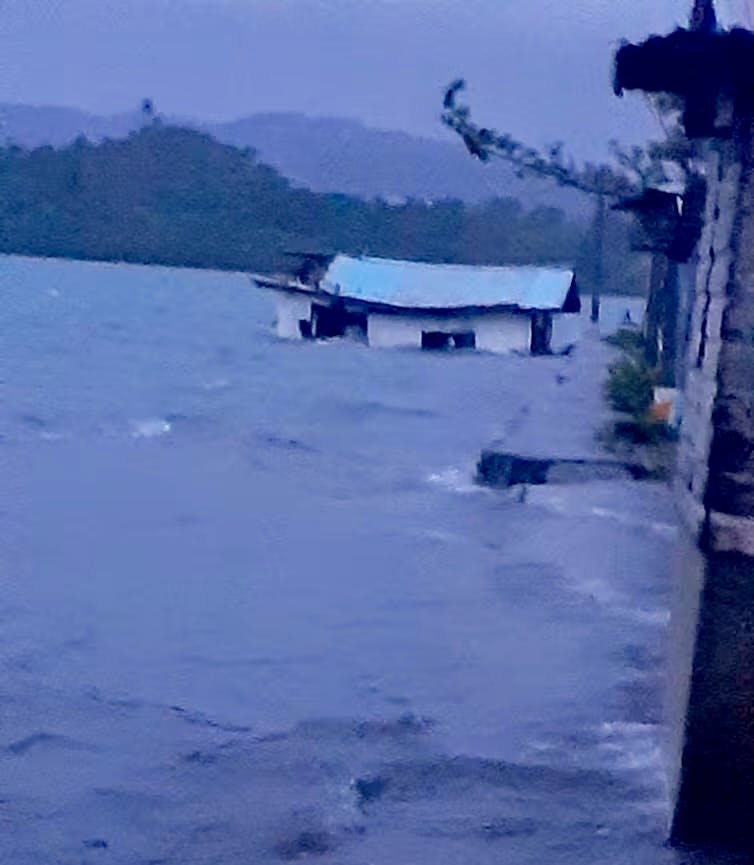
Tony Fala: Pelé – a tribute from Aotearoa and Oceania

ANALYSIS: By Tony Fala

Edson Arantes do Nascimento passed away at the age of 82 after a brave battle with colon cancer in Brazil on 20 December 2022. Known as “O Rei”, “The Black Pearl”, and “Pelé”, he was an ambassador, businessperson, community worker to the world, cultural force, leader, soccer player, and politician.

In this article, I write about why I admired Pelé as a child.

Writing as an adult and activist, I also pay tribute to Pelé and articulate why “O Rei” remains an important teacher of decoloniality and decolonisation in contemporary Oceania.

Pelé in my childhood in the 1970s
I caught brief glimpses of Pelé’s soccer genius in sports highlights on Aotearoa television news as a child in the 1970s.

I did not grasp the tactical, technical, or strategic intricacies of professional soccer when watching Pelé play for the New York Cosmos as a child. But I did see Pelé’s genius with a soccer ball on television. I remember seeing him play with creativity, joy, and imagination.

Pelé brought joy into my difficult childhood.

Like other Pacific Islanders of his generation, my father was a born-again rugby supporter who did not rate football as a sport. But even he would marvel at O Rei’s exploits on Aotearoa television when Pelé appeared.

Pacific people recognised Pelé’s genius — just as they recognised the extraordinary gifts of Muhammad Ali in the boxing ring.

Years before the formation of the English Premier League, I grew to love watching the great British players representing the mighty first division English clubs. Aotearoa television would play a weekly English first division match, and we always received televised, free- to-air coverage of FA Cup Finals in the 1970s and 1980s.

I came to love Division One English club football in the 1970s and 1980s.


An Al Jazeera tribute to Pelé.

Historically, Aotearoa has always had a strong affinity with British football. Despite loving the English game, I saw that Pelé played soccer in a radically unique way.

In later years, I would understand that Pelé played an Afro-Brazilian style of football known as “jogo bonito”, or, the beautiful game — characterised by creativity and improvisation by individual players; off the ball movement; one touch passing; samba like team rhythm and tempo, and superlative dribbling, passing, and attacking movements on the ground and in the air by the entire team.

I watched documentaries about Pelé as a child and a teen when they appeared on Aotearoa television. But I was too young to see the televised, in-colour spectacle of “jogo bonito” performed by Alberto, Gerson, Jairzinho, Pele, or Rivellino at Mexico City when Brazil beat Italy 4-1 to win the 1970 World Cup. I would only watch these mighty players in the 1970 World Cup after Sky TV played classic matches.

Pelé, Brazil, and ‘jogo bonito’ in 1982
But I did witness the “jogo bonito” performed by the 1982 Brazilian side that featured Eder, Falcao, Junior, Socrates, and Zico. Although this side did not win the 1982 World Cup, they remain the greatest sporting team I have ever witnessed — they performed art and played soccer simultaneously.

Aotearoa’s mighty All Whites played this Brazilian side in the group stages of the 1982 tournament. The team also got to meet Pelé in person when O Rei visited the Aotearoa team changing room before the match.

I was too young to understand that the 1982 side played a style of Afro-Brazilian soccer that continued the legacy of the beautiful game begun by Didi, Garrincha, Pelé, and Jairzinho long years before. Pelé was one of the innovators of this style of play in Brazil.

Engaging with Pelé as an adult
As an adult, I developed a fuller understanding of Pelé, his life, and his historical context.

  1. Pelé was born only 53 years after the abolition of slavery in Brazil in 1888 into an Afro-Brazilian family who often struggled to put food on the table. (Pelé writes about his childhood and the hardships he endured in his 2007 autobiography.)
  2. The Black Pearl’s Afro-Brazilian people occupied the lowest socio-economic positions in Brazilian society.
  3. Even today, Afro-Brazilians face discrimination in employment, the justice system, and day-to-day life in Brazil. The Brazilian police still target Afro-Brazilian male youth for violence even today.
  4. Opposing team’s fans made monkey noises — whether Pelé played in Brazil or around the world with his club, Santos. Despite his popularity, Pelé was a target of racism.
  5. Pelé’s Brazilian government prevented him from playing soccer in Europe by making him a “national treasure”. In consequence, Pelé could not sell his labour to European clubs. Critics have stated that this would never have happened to a white Brazilian.
  6. Brazilians accused Pelé of getting too close to figures in the Brazilian dictatorship of 1964-1985 — such as General Medici.
  7. Pelé’s former national teammate, Paulo Cesar Lima, said in the 2021 documentary Pelé that he loved Edson, but Lima also said he felt Pelé functioned as a “submissive Black man” during the height of the dictatorship repressions in 1969. Lima felt a statement by Pelé against the dictatorship in the late 1960s would have “gone a long way”.
  8. Brazilian journalist Juca Kfouri stated that Pelé did not have a guarantee that the Brazilian regime would not torture him if he did speak out.
  9. In Africa, ordinary people treated Pelé as a son when O Rei playing there in the late 1960s. Pelé remains a figure of Trans-Atlantic Black unity in Africa, the US, and in other parts of the Black Diaspora.
  10. Apartheid security forces prevented Pelé from leaving an airport when he visited South Africa in the 1960s. Pelé swore he would never return until South Africa was free from Apartheid. He did return in the 1990s — to spend time with Nelson Mandela.
  11. Pelé was a Goodwill Ambassador for the Rio De Janeiro Earth Summit in 1992.
  12. He was a Minister for Sport in Brazil.
  13. He was an ambassador for the UN, UNICEF, and UNESCO during his lifetime — always seeking to forge relationships with children.
  14. He endured business failures.
  15. He refused to recognise a daughter born out of wedlock.
  16. Pelé was a significant cultural force in Brazil — for good and for bad.
  17. He was a football genius. Football journalists such as Tim Vickery have spoken of Pelé’s soccer skills — Edson’s ability with both feet; acceleration; skills in the air; passing talents; unselfishness; football intelligence, and his psychological strength.

Pelé’s passing in the media
Since his untimely passing, television news networks such as Al Jazeera, BBC, CNN, MSNBC, and Television New Zealand have all honoured Pelé’s cultural, historical, political, and sporting legacy.

Similarly, print media in Aotearoa, Australia, Brazil, Britain, France, and South Africa have represented Pelé as a “cultural icon”, “hero”, “innovator”, “giant of sport”, an “artist”, a “genius”, and a “fine, humble, and warm human being”.

Print media sources in France and the US have also expressed criticism of Pelé for not doing more against the Brazilian dictatorship.

Sources in Brazil have criticised Pelé for not taking more of a public stand against racism in Brazil and the world.

Pelé’s aesthetics
Brazilian star Neymar wrote a moving tribute for O Rei after the great man died. In one part of his tribute, Neymar stated that Pelé transformed soccer into art. I agree with Neymar’s insight.

If one watches Pelé on film today, one sees a kinetic aesthetics of balance, gesture, grace, intelligence, power, speed, rhythm, and style — whether Pelé was in the air, in space, or in a crowd of players. One observes Pelé performing an aesthetics of creativity, joy, and improvisation. I have no doubt Pelé’s parents, coaches, friends, and teammates in Brazil all nurtured his aesthetics.

Simultaneously, I am in no doubt that Pelé’s aesthetic genius was a gift given him by his ancestors and by his historical experience of being Afro-Brazilian.

I am not Afro-Brazilian and do not pretend to understand the language of decoloniality and decolonisation Pelé performed in living motion on a soccer field. But I am convinced Pelé performed an aesthetics of Afro-Brazilian being, decolonisation, decoloniality, living, and expressing in his every movement on the soccer field.

Pelé performed the history of his ancestors on the soccer stage.

Pelé’s lessons for Oceania
In conclusion, Pelé taught me five things as a Pacific person in Aotearoa.

  1. struggle to embrace joy and freedom in your life,
  2. always extend solidarity to those engaged in the Black struggle,
  3. remember the struggle for justice in Aotearoa, the Moana, Palestine, or West Papua are one with the struggle Black people face around the world,
  4. always look for the talents and potential in your own Moana peoples, and
  5. never be ashamed of your Oceanian ancestors, your genealogy, or your history.

Despite his handful of personal failings, Pelé remains one of my great teachers in decolonial Oceania.

The author, Tony Fala, acknowledges the lives of Brazilian football greats Garrincha, Pelé, and Socrates as the inspiration for this article. He also pays tribute to Pacific peoples across Oceania who believe in soccer as a sport that embraces emancipation, participation, struggle, and unity.

Print Friendly, PDF & Email

Article by AsiaPacificReport.nz

High, Supreme, Federal, Family, County – what do all our different courts actually do?

Source: The Conversation (Au and NZ) – By David Heilpern, Associate Professor and Chair of Discipline (Law), Southern Cross University

One way to understand how the courts in Australia are ranked is to imagine a pyramid and an umbrella.

Let’s start with the pyramid. Imagine three lines horizontally across the pyramid dividing it into four sections. Each section represents a court of each state or territory.

So what’s on the base of the pyramid, and what are the upper layers?


Read more:
A constitutional Voice to Parliament: ensuring parliament is in charge, not the courts


The Local or Magistrates Courts

The bottom section represents the local or magistrates courts. It is biggest because it deals with the vast majority of court cases in Australia.

There is a single judicial officer presiding, and no jury. The bread and butter of these courts are minor crimes such as traffic offences, lesser assaults, shoplifting and possession of prohibited drugs.

These courts also have other roles including being children’s and coroners’ courts. They also deal with less serious civil disputes, where one person or company is suing another (under certain limits; in New South Wales, for example, that limit is A$100,000).

Local courts also deal with apprehended violence and restraining orders. The maximum sentence that can be handed out by a judge in a local court is generally two years imprisonment.

The other reason the bottom section of the pyramid is biggest is because all criminal matters start in the local court. The more serious ones work their way up to the higher courts for sentence or trial.

The District Court

The next section up the pyramid represents the District Court.

They deal with more serious crime such as sexual assault, major drug supply and high-level violence.

If the person on trial doesn’t plead guilty, there is a jury to determine guilt or innocence.

The district court also deals with serious civil disputes, generally where the amount is up to $750,000.

The Supreme Court

The Supreme Court is the next layer of the pyramid. It deals with the most serious civil and criminal cases, such as murder. They mostly have a jury in criminal cases.

They also deal with some specialty areas such as defamation.

The Courts of Appeal

Finally, there is the Courts of Appeal, which are part of the Supreme Court, but sit above it.

They hear appeals from lower courts, and there are usually three judges sitting on each matter.

The really interesting aspect of the pyramid is that it represents not just more seriousness and less volume as you go up, but also the appeal process.

So, if you want to appeal from the Local Court, then you go the District Court, then from the District to the Supreme Court and so on.

The “doctrine of precedent” means rulings from higher courts are binding on lower ones.

The High Court and the umbrella model

But what if you want to appeal from the Court of Appeal? That’s where the umbrella comes in.

That appeal is to the High Court, which you can imagine as an umbrella that sits over each of the state or territory pyramids.

There is one High Court, based in Canberra, and its decisions are final, and binding throughout all parts of Australia.

Fun fact: up until the 1980s the highest court for Australia was in England! Called the Privy Council, it was possible to appeal from state and federal courts and let English law lords be the final decider. But Australia got rid of that system and now the highest court in the land is the High Court.

Some state-based variations

Is it all that simple? Not really.

First, in Tasmania the Australian Capital Territory and the Northern Territory there is no District Court level at all. These are small states and territories, with not enough people to necessitate this level of the pyramid.

Second, sometimes appeals jump a level. For example, they may go straight from the Local Court to the Supreme Court. And in some states, there are different names for each level. In Victoria the District Court is called the County Court, and in some places like the Northern Territory, magistrates are called judges.

Finally, there are some specialty courts like the NSW Land and Environment Court that sit at Supreme Court level.

Hang on, what about federal courts?

Just when you thought you had your pyramids in a row, along comes another complication: the federal system.

The Constitution divides up powers between the states and the Commonwealth.

The best example is family law, which is allocated to the Commonwealth and so the Federal Court system deals with divorce and related matters.

And so there is another pyramid which works across the whole country only this time it has two levels.

The lowest and biggest level is the Federal Circuit and Family Court of Australia, dealing mostly with family law (but also other federal matters such as immigration and welfare law).

The next level up is the Federal Court, which deals mainly with corporations law, bankruptcy and trade practices as well as hearing appeals from the lower court.

Don’t forget the umbrella, the High Court, which also hears appeals from the Federal Court.

A whole myriad of tribunals

I’m sorry to have to tell you it gets even more complex from there. There are also tribunals.

Sitting beneath the state, territory and federal court systems is a whole myriad of tribunals which deal with non-criminal matters.

New South Wales, for example, has the New South Wales Civil and Administrative Tribunal (NCAT), which deals with tenancy, consumer, guardianship, strata and licensing matters. It even has its own appeal panel as well (and if people still aren’t happy, they can then appeal to the courts).

The members of the tribunal are not judicial officers and are appointed for fixed periods.

Of course, if you were to strike out centuries of history and start afresh, you would likely just have one multilayered pyramid across the country with a single tribunal at the foot, and the High Court at the top.

We can live in hope.


Read more:
Why defamation suits in Australia are so ubiquitous — and difficult to defend for media organisations


The Conversation

David Heilpern does not work for, consult, own shares in or receive funding from any company or organisation that would benefit from this article, and has disclosed no relevant affiliations beyond their academic appointment.

ref. High, Supreme, Federal, Family, County – what do all our different courts actually do? – https://theconversation.com/high-supreme-federal-family-county-what-do-all-our-different-courts-actually-do-193228