Source: The Conversation (Au and NZ) – By Adrian Beaumont, Election Analyst (Psephologist) at The Conversation; and Honorary Associate, School of Mathematics and Statistics, The University of Melbourne
A federal Resolve poll for Nine newspapers, conducted January 17-22 from a sample of 1,606 people, has given Labor 42% of the primary vote (steady since early December), the Coalition 29% (down one), the Greens 11% (steady), One Nation 6% (up two), the UAP 2% (steady), independents 8% (steady) and others 2% (down one).
Resolve does not give two-party estimates until close to elections, but applying 2022 election preference flows to the primary votes gives Labor about a 60.5-39.5% lead over the Coalition, a 0.5-point gain for Labor since December. Since the election, Resolve has been the most favourable poll for Labor of all the Australian pollsters.
Prime Minister Anthony Albanese’s net approval was down one point in the Resolve poll to +35 (60% good rating, 25% poor), while Dutton was down three points to -17 (46% poor, 28% good). Albanese led Dutton as preferred PM by 55-20% (54-19% in December).
Labor led the Liberals by 37-29% on economic management (38-31% in December). On keeping the cost of living low, Labor led by 34-20% (37-24% in December).
Honeymoon polling is continuing for Labor eight months after last May’s election. But a long honeymoon does not guarantee a Labor win at the next election. Kevin Rudd had a long honeymoon after winning the 2007 election, but was replaced by Julia Gillard before the 2010 election. Labor lost its majority at that election and barely retained government.
Resolve also gives Labor lead in NSW
The New South Wales state election will be held in two months, on March 25. A Resolve poll for The Sydney Morning Herald gave Labor 37% of the primary vote (down one point since late October), the Coalition 34% (down one), the Greens 12% (up one), the Shooters 2% (up one), independents 11% (up one) and others 5% (steady).
No two-party estimate was provided by Resolve, but analyst Kevin Bonham estimated a lead of about 54.5-45.5% to Labor, unchanged since October. This is in good agreement with a YouGov poll that I covered on Monday (56-44% to Labor).
Incumbent Liberal Premier Dominic Perrottet led Labor’s Chris Minns by 33-29% as preferred premier (30-29% in October). This poll was presumably conducted with the December and January federal Resolve polls from a sample of about 1,100 people.
The independent vote is very likely to be overstated. In polls last year in both Victoria and federally, Resolve asked respondents to select generic “independents” until actual ballot papers were published. After this, Resolve asked for specific listed candidates.
Resolve’s final Victorian poll last year showed a 6% slump for independents – a result that also occurred before the federal election.
Essential’s federal poll included a NSW sub-sample of around 300 respondents. Perrottet had a 47-36% approval rating (49-35% in June 2022), while Minns had a 39-26% approval (39-22% previously).
These ratings are very good for Perrottet given voting intentions, and indicate the recent controversy over his wearing of a Nazi uniform at his 21st birthday has had no impact.
Support for Voice to Parliament slumps
Public support for the First Nations Voice to Parliament has slipped in a federal Resolve poll of 3,618 people conducted in two separate stages in December and January.
Compared with a similar poll on the Voice conducted in August and September, overall support on the question was 47% (down six percentage points), with 30% opposed (up one) and 23% undecided (up four).
In a question where respondents were forced to choose “yes” or “no” (similar to a referendum), support for the Voice was 60% (down four percentage points from August/September), with 40% opposed (up four).
This is an average of two months of polling across December and January. Support for the question in January alone was 58% (with 42% opposed) after Opposition leader Peter Dutton questioned the government’s handling of the referendum.
Voice support in NSW dropped to 58-42% from 65-35% in August/September, and to 56-44% in Queensland from 59-41%.
On the public’s understanding of the Voice, 63% in the January poll said they had heard of it, but didn’t understand it and would struggle to explain it, while 23% said they had never heard of it and just 13% said they understood the Voice and were confident explaining it to someone else.
In this week’s federal Essential two-party measure (which includes undecided responses), Labor led the Coalition by 53-42% (51-44% in mid-December).
Primary votes were 34% Labor (down one), 31% Coalition (up one), 14% Greens (up one), 16% for all others (down one) and 5% undecided (steady). Respondent preferences were better for Labor than in December.
In other results from this poll of 1,050 respondents that was conducted in the days before January 24, Albanese’s net approval slumped nine points to +24, its lowest in Essential since the election last May, with 55% approving and 31% disapproving.
On Indigenous Australians, 42% thought things had got better for them in the past ten years (up six percentage points since January 2022), 10% worse (down four) and 38% stayed the same (steady).
On Australia Day, 33% supported a separate national day to recognise Indigenous Australians while keeping Australia Day (down four points since January 2022), while 33% did not support a separate day (up four), and 26% supported replacing Australia Day (up six).
This level of support for replacing the day is easily a record in Essential polls.
Labor’s lead widens in Morgan poll (but not this week)
Labor led by 59-41% in this week’s Morgan poll, a 0.5-point gain for the Coalition since the previous week. This poll was conducted January 16-22.
Morgan’s polls have swung strongly to Labor since late November, when Labor only led the Coalition by 52.5-47.5%.
In a separate Morgan SMS poll, conducted January 20-23 from a sample of 1,231 respondents, 64% thought January 26 should be known as “Australia Day” (down one point since January 2022), while 36% thought it should be known as “Invasion Day” (up one).
Adrian Beaumont does not work for, consult, own shares in or receive funding from any company or organization that would benefit from this article, and has disclosed no relevant affiliations beyond their academic appointment.
We all know someone who insists on wearing a cardigan in summer or refuses to turn on the air conditioning because “it’s not that hot”. Chances are this is an older person, and there’s a good reason for that.
There are five key reasons we’re more susceptible to heat as we get older.
1. Bodily changes
One of the main ways we lose excess heat, blood flowing to our skin, isn’t as effective as we get older. This is in part because the blood vessels in our skin don’t expand fast enough, and we may have less blood pumping with each beat of our heart.
Many other changes in our bodies also lead us to gain and store more heat as we get older. These include how our bodies control sweat and how well our kidneys balance fluid, which are both important for staying cool.
Older Australians may not respond to heat in ways that protect their own health and wellbeing. Australian culture tends to view heat tolerance as a matter of resilience and identity, where there is a sense of generational pride in being able to cope with the heat.
Reports also suggest many older people have concerns about the cost of air conditioning, may be hesitant to use it, or accidentally use reverse cycle units as heaters.
Many chronic illnesses that are more common with age are also associated with an increased risk for heat-related illness. Because blood flow is so important for regulating our body temperature, it’s not surprising that conditions such as heart failure and diabetes are associated with increased heat risk.
Similarly, many medications commonly prescribed for chronic illnesses can interfere with how our body regulates temperature. For instance, some blood pressure medicines reduce our ability to sweat and lose heat.
It is increasingly difficult for older Australians to find affordable and appropriate housing, especially pensioners and renters.
Poor home design, lack of insulation, inability to pay their energy bills, and limited income all contribute to being vulnerable to heatwaves in Australia. This is particularly troubling as energy prices soar.
Knowing the risks of extreme heat is the first step. Don’t underestimate your own risk during a heatwave.
There are many practical ways we can all keep ourselves and our homes cool, both safely and efficiently. These include:
using a fan, which is effective, especially when it’s humid, but may not be enough when it’s very hot and dry. If you have an air conditioner, consider using it
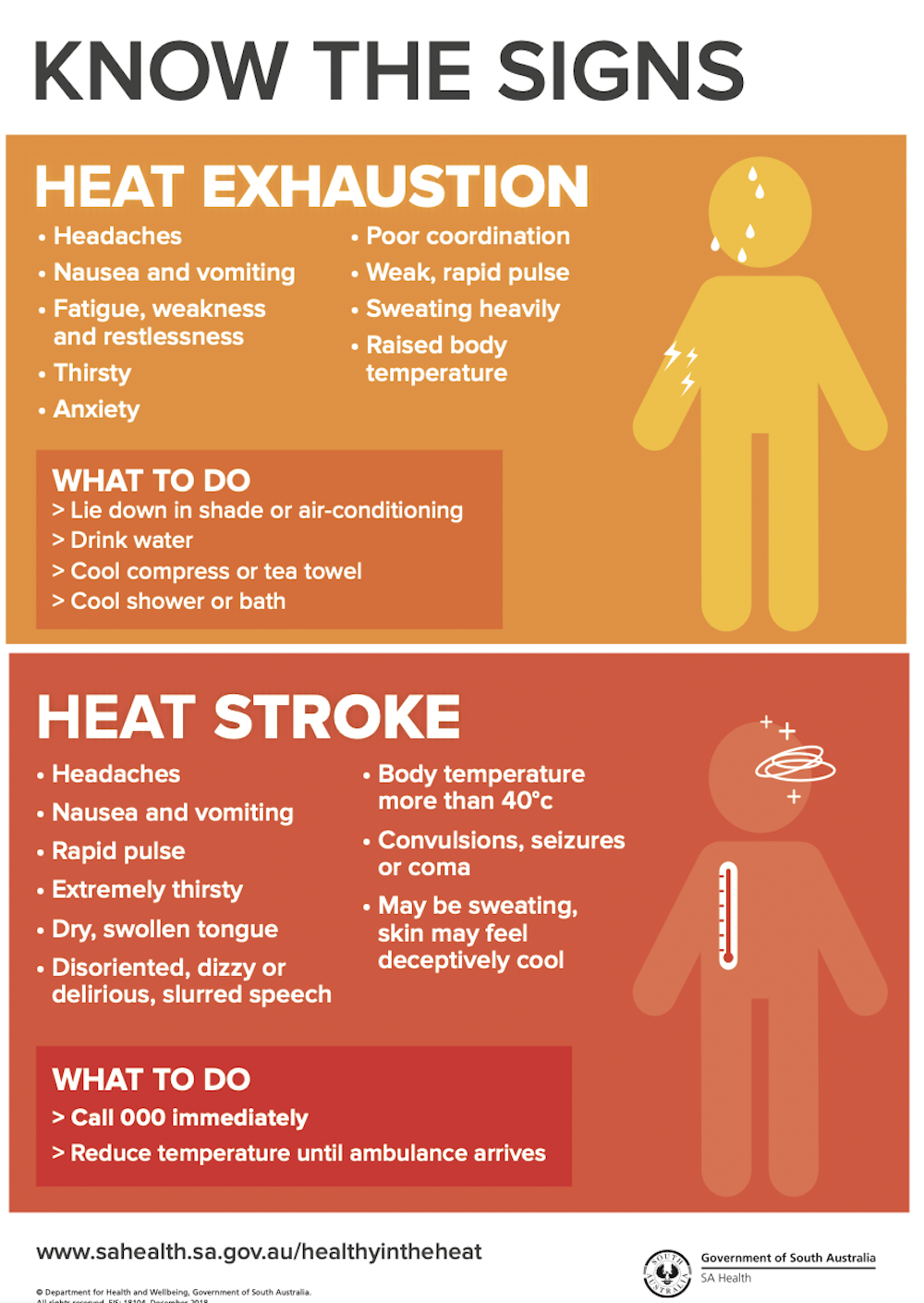
Do you know the signs of heat-related illness? SA Health
knowing the conditions inside your home by installing thermometers that ideally also measure humidity so you know which ways will work best to cool down
opening windows facing away from the sun when it’s cooler outside; otherwise keep blinds closed in the heat of the day
taking cool showers or applying a damp cloth to the back of your neck can help cool the skin
taking regular, small drinks of water, even when you’re not thirsty (unless you have heart or kidney problems in which case you need to talk to your doctor first as too much water may be a problem for you)
Australians are growing complacent about the health risks of extreme heat, see heatwaves as normal and public health messages aren’t cutting through any more.
It’s also important to remember that older people aren’t all the same, so any public health approaches to extreme heat should be tailored to communities and individuals.
One way we’re trying to help is by working directly with older people. Together, we’re researching and developing a smart device that makes it easier to know when your house is getting warm, and customising strategies you can use to cool down safely.
Sarah Cunningham receives an Australian Government Research Training Program scholarship. She is affiliated with the Extreme Heat and Older Persons research group which receives funding from Wellcome.
Birds sold in the pet trade are often colourful and charismatic creatures. Some can even be taught to talk, and they often provide owners with much-needed companionship.
But there are negative aspects of the pet trade that warrant a closer look.
Concerns about the billion-dollar global pet industry have usually focused on issues associated with the trade in endangered species, but the industry also plays a critical role in moving invasive species around the globe. For birds, it is the primary source of invasive species.
Our new study highlights how many pet birds, particularly parrot species, are reported as lost by their owners. They are contributing to a consistently large pool of escapees in our suburbs, with the potential to breed and spread.
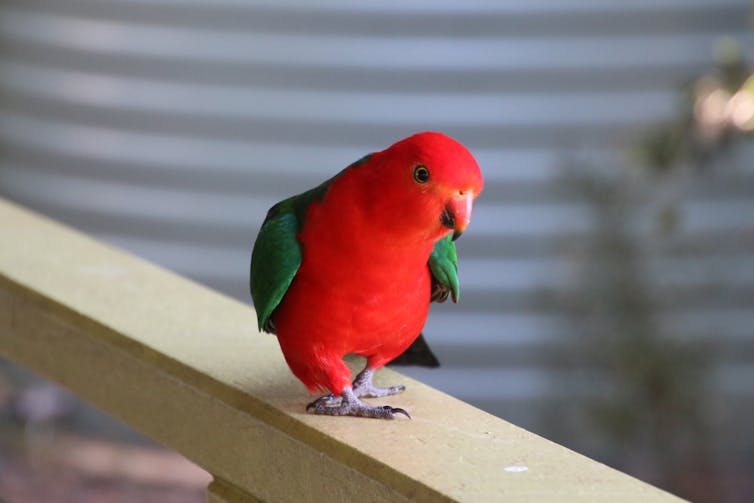
The Australian king parrot is one of the species currently available through the pet trade in New Zealand that could pose a risk. Author provided, CC BY-ND
An ill-fated history of introductions
Unfortunately, Aotearoa New Zealand is famous for its history of deliberate introductions of new bird species through well-organised acclimatisation societies. The meticulous record-keeping of these early British settlers has created one of the best global data sets for analysing the effect of propagule pressure (the number of healthy individuals released) on the establishment and spread of new species.
We now know that propagule pressure is a critical factor in whether a species becomes invasive. It’s a numbers game: the more individuals released (or escaped) and the greater the number of release events (at different times and in different places), the higher the chances a species will successfully breed and eventually spread.
Although the days of acclimatisation societies releasing new species are long gone, the pet trade has spurred a new wave of companion bird imports. Some of these imports are leading to the escape or even deliberate release of new bird species into the wild.
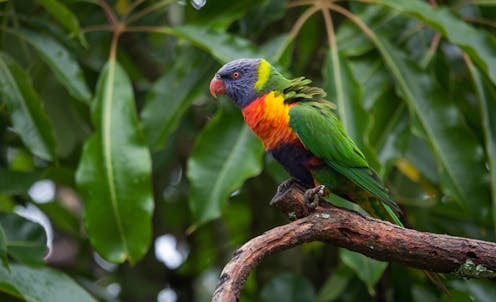
Rainbow lorikeet (Trichoglossus haematodus) Author provided, CC BY-ND
In 2000, authorities eradicated a population of about 150-200 rainbow lorikeets (Trichoglossus haematodus) in Tāmaki Makaurau Auckland after they were illegally and deliberately released. Sales of this species have continued since, but Auckland became the first and only region to ban sales last year.
Our study investigated the extent to which owners were reporting pet birds as lost through online websites in Aotearoa. What we found was staggering.
During our monitoring period of three-and-a-half years, 1,205 birds and at least 33 species were reported as lost, and 92% of them were parrots. Given that not all owners will list their lost pets on websites, and given that some are released deliberately, these numbers are likely to be a considerable underestimate.
Ring-necked parakeet (Psittacula krameri) Author provided, CC BY-ND
Ring-necked parakeets (rose-ringed parakeets, Psittacula krameri) have established in 47 countries and form large, noisy populations. They have severe impacts on orchards and crops, and also on native birds by outcompeting them for food and nest sites. About 100 pet owners reported this species as lost in our study.
Worryingly, 23% of the birds reported as lost were part of a group, often with male and female pairs lost together. That makes finding a mate and breeding in the wild much easier.
We used lost-bird data from Auckland in model simulations to investigate the overall propagule pressure from lost pet birds. For seven species (all parrots), we found there was more than an 80% chance of having a male-female pair at large in the same local area at the same time. For the ring-necked parakeet, this figure was a stark 100%, with an average of ten different local areas hosting a male-female pair at any point in time.
Clearly the pet trade poses a major risk for invasion of new parrot species.
Invasive birds, such as the eastern rosella pictured here, can pose a significant threat to native species through competition for food or nest sites, hybridisation, disease transmission and weed spread. Shutterstock/Wang LiQiang
Aotearoa has its own unique parrot species, such as kākā, that would be put at risk by these new invaders. Our native birds are already struggling with the onslaught of invasive introduced mammals. While we have tools for controlling mammalian pests, there are currently very few options for controlling invasive birds, and potentially less public support for this.
The only viable and cost-effective approach to preventing the economic and environmental risks invasive parrots pose is prevention. Regional bans will not be enough to prevent spread beyond regions, especially given the ease with which these birds can be bought online from outside the regions with bans. We need to enact regulation at the national level to ban the sale of parrot species that pose the highest risk.
The authors do not work for, consult, own shares in or receive funding from any company or organisation that would benefit from this article, and have disclosed no relevant affiliations beyond their academic appointment.
New Zealand Parliament Buildings, Wellington, New Zealand.
New Zealand Politics Daily is a collation of the most prominent issues being discussed in New Zealand. It is edited by Dr Bryce Edwards of The Democracy Project.
Traditionally, loneliness has been viewed as an individual problem requiring individual solutions, such as psychological therapy or medication. Yet loneliness is caused by feeling disconnected from society. It therefore makes sense that treatments for loneliness should focus on the things that help us make these broader connections.
The places where we live, work and play, for example, can promote meaningful social interactions and help us build a sense of connection. Careful planning and management of these places can create population-wide improvements in loneliness.
Our research team is investigating how the way we design and plan our cities impacts loneliness. We have just published a systematic review of research from around the world. Overall, we found many aspects of the built environment affect loneliness.
However, no single design attribute can protect everyone against loneliness. Places can provide opportunities for social interactions, or present barriers to them. Yet every individual responds differently to these opportunities and barriers.
Our review involved screening over 7,000 published studies covering fields such as psychology, public health and urban planning. We included 57 studies that directly examined the relationship between loneliness and the built environment. These studies covered wide-ranging aspects from neighbourhood design, housing conditions and public spaces to transport infrastructure and natural spaces.
The research shows built environments can present people with options to do the things we know help reduce loneliness. Examples include chatting to the people in your street or neighbourhood or attending a community event.
However, the link between the built environment and loneliness is complex. Our review found possibilities for social interaction depend on both structural and individual factors. In other words, individual outcomes depend on what the design of a space enables a person to do as well as on whether, and how, that person takes advantage of that design.
Specifically, we identified some key aspects of the built environment that can help people make connections. These include housing design, transport systems and the distribution and design of open and natural spaces.
So what sort of situations are we talking about?
Living in small apartments, for example can increase loneliness. For some people, this is because the smaller space reduces their ability to have people over for dinner. Others who live in poorly maintained housing report similar experiences.
More universally, living in areas with good access to community centres and natural spaces helps people make social connections. These spaces allow for both planned and unexpected social interactions.
This finding should make sense to anyone who walks or takes the bus. We are then more likely to interact in some way with those around us than when locked away in the privacy of a car.
Similarly, built environments designed to be safe — from crime, traffic and pollution — also enable people to explore their neighbourhoods easily on foot. Once again, that gives them more opportunities for social interactions that can, potentially, reduce loneliness.
Neighbourhoods that make it easier to get around without a car also promote social interactions. Shutterstock
Environments where people are able to express themselves were also found to protect against loneliness. For example, residents of housing they could personalise and “make home” reported feeling less lonely. So too did those who felt able to “fit in”, or identify with the people living close by.
These factors are fairly well defined, but we also found less tangible conditions could be significant. For example, studies consistently showed the importance of socio-economic status. The interplay between economic inequalities and the built environment can deny many the right to live a life without loneliness.
Our review reveals several aspects of the built environment that can enhance social interactions and minimise loneliness. Our key finding, though, is that there is no single built environment that is universally “good” or “bad” for loneliness.
Yes, we can plan and build our cities to help us meet our innate need for social connection. But context matters, and different individuals will interpret built environments differently.
Jennifer Kent receives funding from the Australian Research Council.
Marlee Bower receives funding from the BHP Foundation. She is affiliated with Australia’s Mental Health Think Tank.
Emily J. Rugel does not work for, consult, own shares in or receive funding from any company or organisation that would benefit from this article, and has disclosed no relevant affiliations beyond their academic appointment.
Why does one child experience excitement at the thought of starting the school year while another experiences debilitating anxiety?
It’s rarely one thing and is often a combination of factors, including a child’s temperament and self-confidence; their previous experiences at school, kinder or childcare; friendships they’ve already formed; and the types of transition activities they’ve undertaken.
As psychologists and mental health researchers, we also look at how the family is coping, and the child’s previous history of mental health or developmental disability diagnoses.
The good news is research shows parents, schools and health professionals can intervene early to support children who are feeling anxious about school.
Our research team developed a program called AllPlay Learn to support children with disability, who are at higher risk of experiencing anxiety at school because of the additional load from new routines, friendships, expectations, and “sensory overload” (where the noise, clutter, smells and other sensory input from the classroom or playground become overwhelming and distressing to a child).
These strategies can help all children, parents and teachers to better cope with the transition to school, or going back after the holidays.
What does back-to-school anxiety look like?
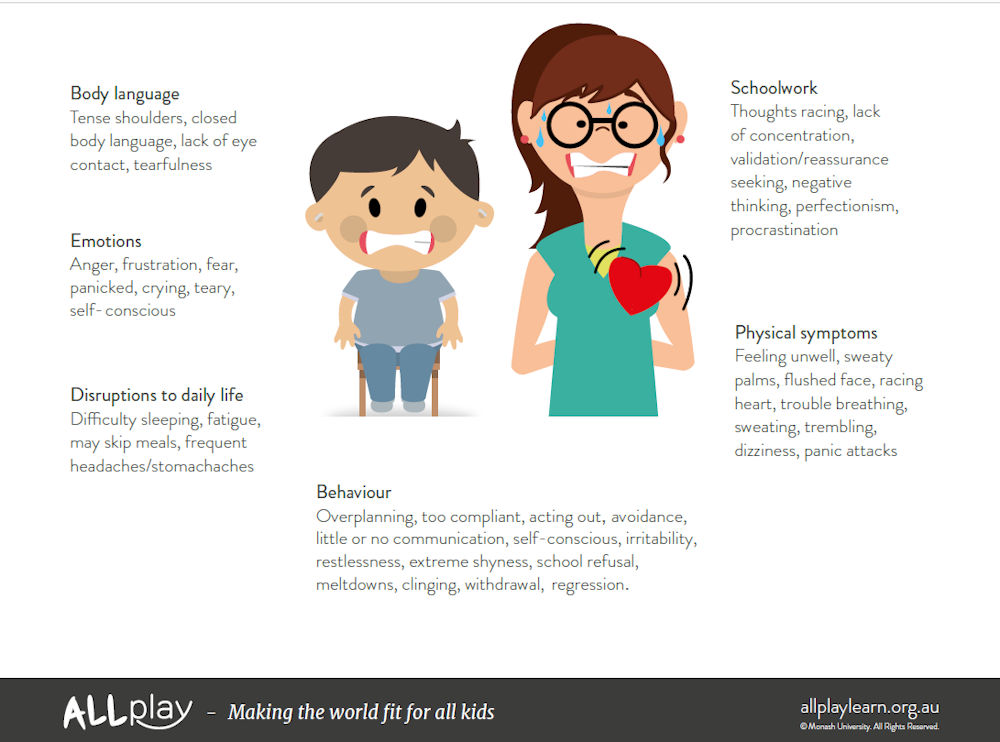
Anxiety in children isn’t always easy to spot. The symptoms can range from very subtle changes to body language, through to defiant behaviours such as anger and acting out.
Anxiety can present in a number of different ways. AllPlay Learn
However, avoidant behaviour is a hallmark feature for anxious children. Everyone can relate to gravitating to what makes us comfortable – being at home, engaging in things we like and are good at, and avoiding what makes us anxious or overwhelmed.
At its extreme, anxious-avoidant behaviour in relation to school can turn into school refusal, where a student regularly misses school with their parents’ knowledge due to school-related emotional distress.
How parents communicate about the new school year is important. Speaking positively about school and learning can reduce feelings of anxiety in children.
Parents can help children feel prepared and develop strategies to cope with feelings of anxiety by:
Familiarising them with their new school/classroom. Take your child to visit their new school or classroom, read stories about school and “play” school so they can practise things they’ll need to learn, such as packing their bag.
Helping them set goals. Encourage them to identify the things they can already do to get settled in their classroom, then set small goals for what they can do next. For example, “I can say goodbye without getting upset when my mum leaves. This term, instead of mum walking me into the classroom, I will wave through the window.”
Developing some “calming” supports. Ask what has helped them before when they had worries. They could practise relaxation breathing, have quiet bedtime activities, practise “brave statements” (such as “I might feel a little worried, but I know the teacher will be there if I need help”), or bring a special item from home.
Ensuring they can unwind after school. Some of the emotions your child has held inside all day may spill over when they return home. Consider calming activities, spaces or supports your child may need to process their emotions and sensory overwhelm.
Teacher support is important, particularly on arrival. Settling-in activities such as the choice to either read books or draw quietly can provide security to a child.
Communicating clear expectations of students, such as class rules, can also build trust between children and their teacher.
If a child is anxious, reflect on what aspects of school life might be contributing to anxious feelings and identify – with the child’s input – what they could manage with supports in place. For example, a child may feel able to separate from parents in the morning if they have a familiar toy or photo from home, and can have some quiet time in the classroom before the bell. Over time, these additional supports can be reduced.
Allow children time and space to manage big emotions. Children may have different preferences for support when distressed, but may find it challenging to communicate their needs when anxious or upset.
Provide structure and predictability. Visual schedules, social narratives (stories that tell children what they can expect at school), and warnings for transitions can provide security. Knowing what to do and who to play with can be challenging for a child who is feeling anxious, particularly during unstructured school time such as lunchtime.
What if your child remains anxious about school?
Some children may experience significant signs of anxiety such as not sleeping, social withdrawal, changes in eating habits, or significant ongoing distress or unhappiness.
When children experience ongoing, significant signs of anxiety that don’t resolve, some additional supports may be needed to ensure your child’s wellbeing and feelings of safety at school.
Talk to your GP, who can rule out underlying medical factors and refer you to appropriate support services, such as a child and adolescent psychologist.
Bethany Devenish received funding from the NSW Department of Education.The AllPlay Learn research program was funded by the Victorian Department of Education.
Ana Mantilla receives funding from the National Health and Medical Research Council (NHMRC; project grant no APP1101989). The AllPlay Learn research program was funded by the Victorian Department of Education. Ana also receives philanthropic funding from Jonathan and Simone Wenig, the Moose Foundation, Ferrero Group Australia as part of its Kinder + Sport pillar of Corporate Social Responsibility initiatives, MECCA Brand, and the Grace and Emilio Foundation, as well as funding from the NSW Department of Education.
Nicole Rinehart receives funding from the National Health and Medical Research Council (NHMRC; project grant no APP1101989). She is a board member of Amaze and a clinical psychology consultant at the Melbourne Children’s Clinic. The AllPlay Learn research program was funded by the Victorian Department of Education. Nicole also receives philanthropic funding from Jonathan and Simone Wenig, the Moose Foundation, Ferrero Group Australia as part of its Kinder + Sport pillar of Corporate Social Responsibility initiatives, MECCA Brand, and the Grace and Emilio Foundation, as well as funding from the NSW Department of Education.
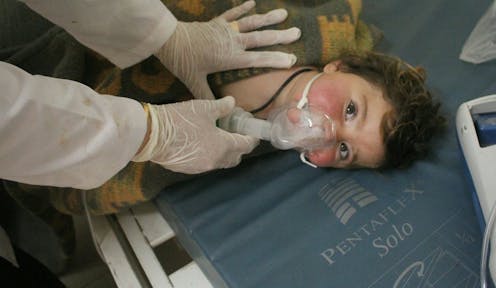
A child receives treatment after an alleged chemical attack in Syria in 2017.IDLIB MEDIA CENTER/EPA
The number of armed conflicts currently raging around the world is the greatest since the end of the Second World War. These wars can leave toxic environmental legacies and cause untold damage to human health.
One-quarter of the world’s population, or two billion people, live in countries experiencing war. They include Ukraine, Yemen, Syria, Myanmar, Sudan, Haiti and the Sahel region in Northern Africa.
Violent conflict causes substantial environmental damage – polluting air, water and soil, and damaging human health over the long-term.
Chemical weapons and toxins are still being used in current wars. The United Nations last month formally adopted principles to protect the environment in armed conflict. Concrete action is now needed to implement them.
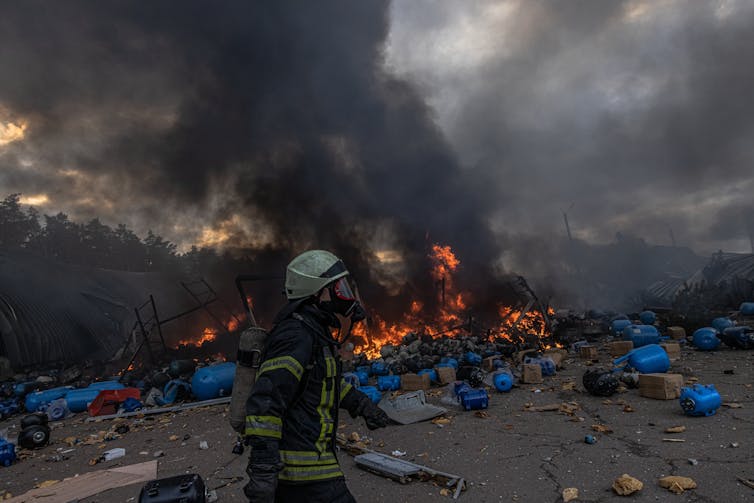
A Ukrainian firefighter at a chemical storage facility hit by a Russian missile in march 2022. Roman Pilipey/EPA
What are toxic remnants of war?
Toxic remnants of war are poisonous or hazardous substances resulting from military activities. They include:
radioactive material
white phosphorus
mustard agents
halogens
heavy metals
dioxins and other human carcinogens.
Atomic bombs dropped on the Japanese cites of Hiroshima and Nagasaki in 1945 are thought to have killed more than 200,000 people immediately; more died from nuclear radiation in subsequent years.
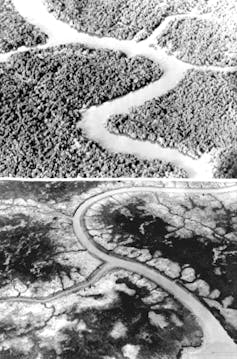
Top photo shows a mangrove forest near Saigon before US forces sprayed it with the chemical defoliant Agent Orange in 1965. Bottom photo shows a nearby area after the attack. AP
Some toxic remnants are a direct result of armed conflict. Agent Orange used in the Vietnam War contained dangerous dioxins that continue to damage people and the environment today.
The use of poisonous gases and other hazardous substances in warfare has a long history. Chlorine and mustard gas, for example, were used in the First World War.
However, unlike many past wars, today’s armed conflicts increasingly take place in urban and industrialised areas, posing a significant risk to civilians and their environment.
And the use of chemical weapons continues. For example, a UN official this month said the Syrian government’s “absence of accountability” for using chemical weapons in the nation’s long-running civil war was “a threat to international peace and security and a danger to us all”.
A threat to human health
Toxic remnants of war can result in many adverse health effects in humans.
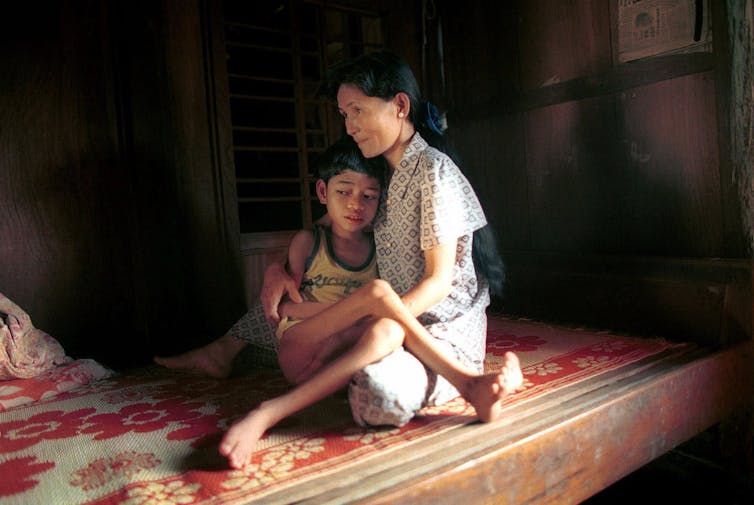
In Vietnam, research suggests a greatly increased risk of birth defects among children of parents exposed to Agent Orange. In some locations, extremely high levels of dioxins have been found in soil, sediment and foods, as well as human breast milk and blood.
Research has also linked Agent Orange to human genome instability (or genome mutations) in adults and children.
The effects of Agent Orange are still felt by Vietnam’s people today. Richard Vogel/AP
In Gaza, elevated heavy metal loads have been identified in mothers and newborns exposed to military attacks. Also in Gaza, birth defects have been associated with exposure to white phosphorus and other bombs containing toxic and carcinogenic metals.
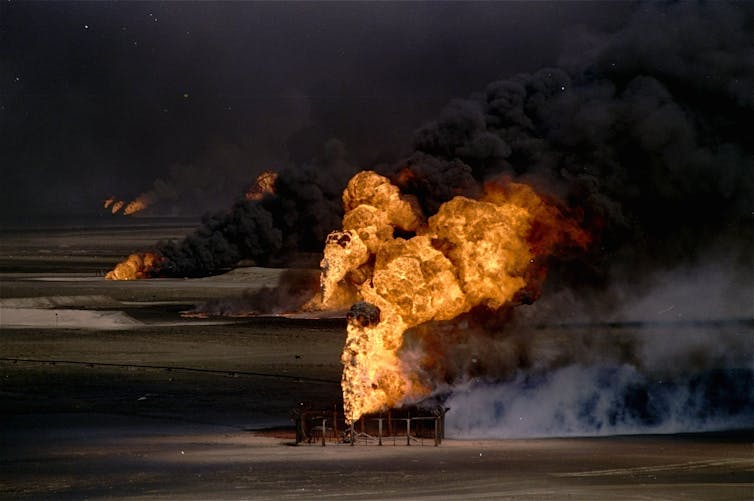
In Iraq, open burn pits used to dispose of war waste have exposed civilians to poisonous smoke and fumes. And smoke from oil well fires in the 1991 Gulf War, and more recently in Syria, pose a toxic risk.
Kuwaiti oil wells set alight by fleeing Iraqi troops in 1991 – smoke from which is toxic. Greg Gibson/AP
A scourge on the environment
In addition to human health effects, armed conflicts can cause widespread environmental damage.
Sensitive landscapes can be destroyed by the movement of troops and vehicles. And explosives can release particles, debris and other matter that pollutes the air and soil.
War can also cause toxic pollution indirectly, such as when services and infrastructure are destroyed or break down.
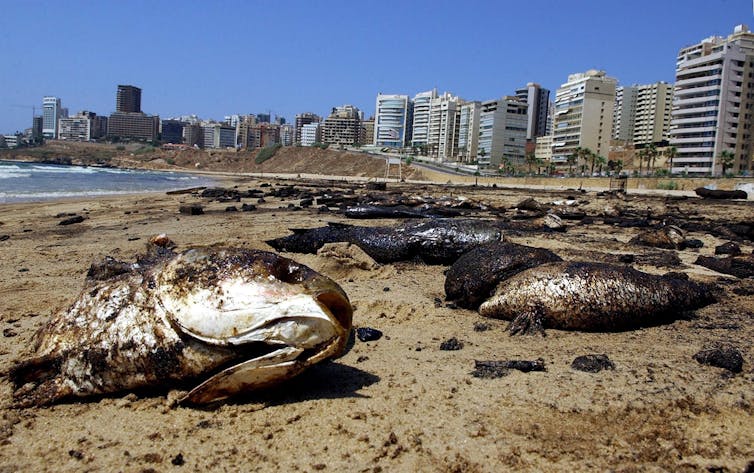
For example, Israel’s bombardment of a power plant in Lebanon in 2006 sent 110,000 barrels of oil into the Mediterranean sea, killing fish and turtles and causing an environmental crisis.
And according to the OECD, Russian military strikes on Ukraine refineries, chemical plants, energy facilities and industrial plants have sent toxic substances into air, water and soil. It says ammunition remains and damaged military vehicles also contain materials toxic to people and the environment.
The war in Ukraine is also raising fears of a radioactive incident at Chernobyl and other Ukrainian nuclear power plants.
Toxic remnants of war also interact with the effects of climate change. As ice in Greenland melts, for instance, pollutants from abandoned Cold War-era military infrastructure may enter waterways.
Dead fish lie on a beach in Beirut in 2006. Israel’s bombing of a power plant in southern Lebanon sent oil gushing into the sea. Assaad Ahmad/EPA
So what now?
Despite the known health and environmental effects, toxic weapons continue to be used in armed conflicts.
In December last year, the United Nations’ General Assembly adoptedprinciples to protect the environment in relation to armed conflict. They outline how the environment should be protected before, during and after armed conflict.
The principles include:
designating and protecting important environmental areas during an armed conflict
obligations to remove or render harmless toxic remnants of war.
But this protection isn’t binding in the same manner that a treaty or convention would be. Action is needed to ensure the principles are put into practice.
Governments, international organisations, armed groups, business enterprises and civil society all have a role to play.
According to the Conflict and Environment Observatory, such action should include a formal implementation vehicle, such as an engaged group of governments, to ensure the principles are adopted on the ground.
And increased public awareness of conflict pollution will also help create the momentum needed.
Without firm action, toxic remnants of war will continue to pose long term threats to communities and ecosystems.
Stacey Pizzino is affiliated with the Global Protection Cluster – Mine Action Area of Responsibility.
Jo Durham is affiliated with is the Global Protection Cluster – Mine Action Area of Responsibility
Michael Waller is affiliated with the Global Protection Cluster – Mine Action Area of Responsibility.
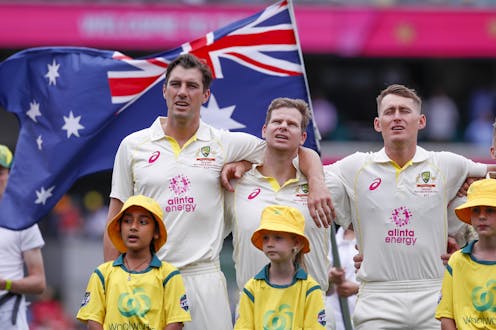
I have one prayer as I watch the Australian cricket team sing Advance Australia Fair patriotically before a match – “Please don’t turn on their microphone.” Like many Australians, their “joyful strains” of our anthem are … well, just strained.
It’s not their fault they misspent their youth playing cricket instead of taking singing lessons. And it’s not their fault they got so good they now have to sing in front of thousands before they can play.
But there is a fault. We’ve given them an anthem that average Aussies can’t sing in tune together.
Great unity?
According to former Prime Minister Scott Morrison, our anthem reflects “great unity”, but that wasn’t there at the start. It needed several “fixes”.
First Nations people were also omitted from McCormick’s original verses, ignoring their presence while glorifying British colonisation. More fixing from the Council swapped the offending verses for a politically neutral verse from McCormick’s Federation version with another tweak for gender-inclusive language.
Some Indigenous sport stars still refuse to sing the current anthem, as they say it doesn’t represent them.
The remaining inappropriate lyric, “young”, was amended to “one” in 2021 by a governor-general’s proclamation. And as for “girt”? No, unfortunately, it remains, but it has united Australians in its own special way. We all think it’s odd.
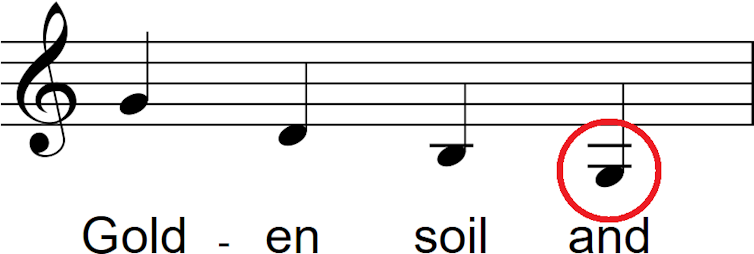
Unfortunately, while focusing on unifying lyrics, we’ve missed a musical problem that’s divided voices since 1878. The note range of Advance Australia Fair is more than the average Australian will sing accurately. For inexperienced singers, which is most of us, our voices crack with the very disunity the government tried to fix.
What is note range?
The note range of a song is like the number of steps it takes to climb from the lowest to the highest point. If there are too many steps, the average Aussie would rather abandon the sweaty climb and hang out on the ground floor with a cold beer.
The range of Advance Australia Fair is 17 steps (called “semitones”). This is a bigger climb than other nations’ anthems, such as Britain’s 10 semitones in God Save the King, France’s 14 semitones in La Marseillaise and New Zealand’s 14 semitones in God Defend New Zealand. At least the Australian anthem is more modest than the Americans’ who, true to reputation, like doing everything bigger. The Star-Spangled Banner rises 19 semitones, resulting in some excruciating vocal cracks.
In theory, most average adult voices should be capable of climbing 17 steps and well beyond. We have the equipment. In practice, however, many inexperienced singers have problems with something called “registers”.
Why do registers matter?
Vocal registers are like gears in a car. We usually sing low steps in first gear, or “chest voice”. Chest voice is the most familiar and comfortable register because that’s the voice most people use when speaking everyday.
To sing higher, we subconsciously move small muscles in our throat to shift into second gear, or “head voice”.
Experienced vocalists spend considerable time developing strength in each register and making the gear change between them smooth and stable. Non-singers may not be not used to holding notes steady in second gear, and end up wobbling, yodelling and going out of tune.
Others won’t budge out of first gear, and change the melody instead. Whichever approach we take, it certainly isn’t “unified”.
Back to school
Schools are the unofficial training ground for anthems. Weekly assemblies make it the most regular practice session Aussies will ever experience. But those 17 steps don’t help.
Many beginner instrumentalists in school bands can’t play 17 notes in their first year of learning an instrument. Some players can’t do it by their second year either. And aspiring trumpeters? Unless they are the next James Morrison, hold your breath and cover your ears.
While there’s no rule that an anthem must be playable by children, it might increase our national pride if they could.
A simple solution
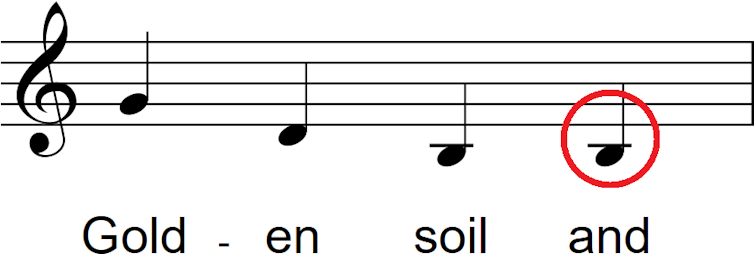
There is a remarkably simple solution to this musical problem dismembering our anthem – fix the note on the word “and”. Instead of this:
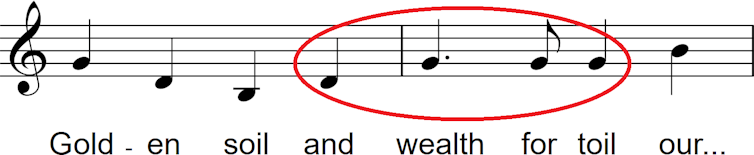
we can use a step already in the song, like this:
Alternatively, if that sounds odd, just substitute the steps from the first two bars like this:
Both options reduce the range to 14 steps which is singable in one register. If you start the song low, no gear change is required. Now we can sing the anthem and have a cold beer (or a lemonade for the kids).
If a proclamation can fix one word of our anthem for greater unity, then why not fix one note? Then, more everyday Australians could sing it together in unison. And isn’t that the point of an anthem?
Wendy Hargreaves does not work for, consult, own shares in or receive funding from any company or organisation that would benefit from this article, and has disclosed no relevant affiliations beyond their academic appointment.
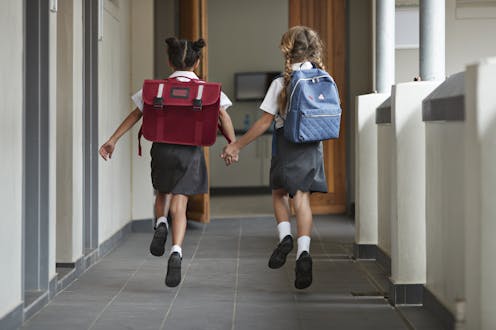
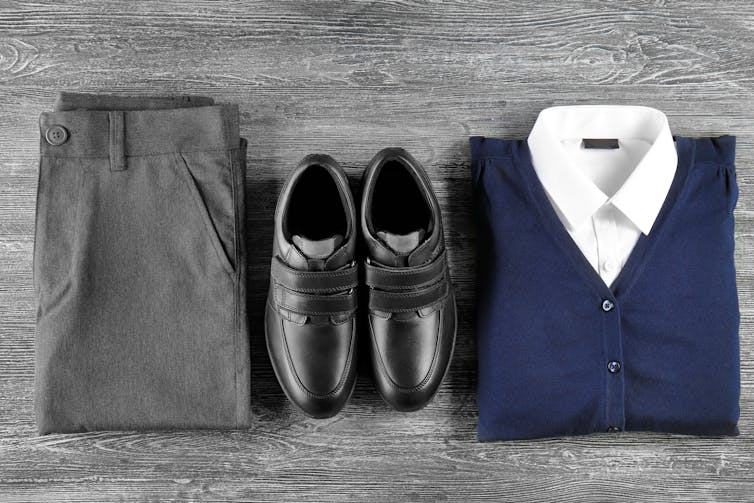
This year’s perennial back-to-school uniform discussion happens during a cost of living crisis. And we already know that the upfront and maintenance costs of school uniforms are a stress for families on lower incomes, in New Zealand and globally across rich and poor countries alike.
The Human Rights Commission even publishes school uniform guidelines, setting out how school policies can help pupils’ physical and mental health. And while cost is outside the guidelines’ scope, the commission acknowledges this is a common problem and it encourages schools to make uniforms accessible.
This is important, as uniform cost has been shown to reduce attendance and enrolment among pupils from lower income families. In other words, uniform affordability is an important factor in people accessing their right to state-funded education.
Given uniforms in themselves have no direct link to academic performance, there is a high price to pay for their being an obstacle to learning. However, there are things governments, schools and communities can do to improve this situation.
School uniforms were originally intended to disguise socioeconomic difference. Shutterstock
Uniform as ‘social camouflage’
It’s acknowledged across the political spectrum that education lifts people out of poverty, improves lives and boosts the economy. Indeed, the desire to remove the most outward signs of socioeconomic difference was a key reason school uniforms were adopted in the first place.
A well designed uniform should be comfortable, appealing and inclusive, easy to wear and allow physical activity. It can and should take away the pressure to wear expensive labels (sometimes called “social camouflage”), and remove distractions in class.
But if it’s unaffordable, many low-income students are no better off. Garments that were originally introduced to remove barriers can end up actually getting in the way of the right to a (theoretically) free education.
Government policy that bolsters existing initiatives would help, starting with a requirement for all schools to have a uniform policy. A nationwide overview of uniform costs, rules and dress codes could form the basis of a resource for schools to help develop best practice processes and principles that build on the Human Rights Commission guidelines.
With the government’s new equity index for funding high-need schools to improve students’ educational outcomes, it makes sense that the known obstacle of school uniform affordability doesn’t stop students getting through the gates.
New Zealand (along with other similar countries) could also amend its existing welfare grants process to better reflect the high upfront cost of school uniforms and make the eligibility criteria broader – especially given current inflation rates.
Plain sports-style uniforms have been embraced by state and private schools alike. Getty Images
Benefits of simpler, more affordable uniforms
In New Zealand’s devolved system, where school boards and communities have significant control of school operations, uniform policies are influenced by local expectations. Uniform design reflects tradition, helps identify students and signals a school’s place in the education market.
And while uniforms have no direct impact on academic performance, they influence how comfortable students feel in the learning environment. So understanding the functions of a uniform can help determine its form.
Mental and physical comfort, respect, and physical activity all improve learning. This explains why a simpler sports-style uniform that hits a number of targets for physical activity, comfort and affordability has been adopted by both private and public schools.
However, choice and affordability are linked to supply and demand. To ensure a thriving market, schools should follow Commerce Commission guidelines to regularly review suppliers and encourage competition for their business.
Additionally, allowing some uniform items to be purchased from any retailer, as opposed to specific suppliers, works out cheaper overall. Schools should consult with parents about uniform purpose, expectation and changes, and be transparent about any profits made from selling new uniforms.
We know those experiencing hardship often don’t ask for help because they feel ashamed. Schools can counter this by considering how hardship funds are administered and whether school uniforms can simply be supplied on enrolment.
Other strategies include having more expensive items, such as blazers, that can be borrowed when representing the school or for formal occasions; allowing students to discreetly borrow uniform items until their families can afford new or secondhand items; or simply giving students in need good quality secondhand uniforms.
Most schools have already established secondhand uniform sales, stocking good quality used items at a reasonable price.
As the Human Rights Commission guidelines make clear, school uniforms and policies about their use should be informed by considerations of human dignity, rights and Treaty of Waitangi principles.
These serve to shield pupils against racism and bullying, and protect culture, identity and religious expression, meaning students can feel comfortable and get on with learning. So let’s also think harder about uniform costs as integral to the value of our investment in education.
Johanna Reidy has received funding from University of Otago Research Grant 2023 for a pilot project to explore school uniform usage and health.
New temporary restrictions on takeaway sales and the prospect of reimposed bans on alcohol in Indigenous communities – with “opt-out” provisions – have followed Anthony Albanese’s Tuesday visit to crisis-ridden Alice Springs.
After a brief round of talks with local Indigenous, civic and police representatives Albanese fronted the media with Northern Territory Chief Minister Natasha Fyles, federal minister Linda Burney, senators Malarndirri McCarthy and Patrick Dodson and the member for Lingiari, Marion Scrymgour.
Albanese stressed the need for co-operation across levels of government and announced the federal and NT governments had appointed Dorrelle Anderson as Central Australian Regional Controller.
She will lead consultations with communities on an “opt-out” system for banning alcohol in them. A report will be made next week to the two governments on moving to the change.
The lapsing last July of the federal legislation banning alcohol in communities has been followed by a dramatic spike in crime in Alice Springs and problems in other NT Indigenous communities.
Despite widespread calls to do so, the NT government has refused to reimpose the bans, saying that would be race-based discrimination. Communities wanting to stay dry have had to opt to do so.
The outcry about the wave of crime put strong pressure on the federal government to act, and prompted Albanese’s visit, which was only announced on Tuesday morning. He had intended to visit Alice Springs late last year but was struck down with COVID.
Albanese told the news conference Anderson would “report back on February 1, to myself and to the Chief Minister, about the implementation of potential changes to alcohol restrictions in Central Australia, including potentially moving to an opt-out situation rather than opt-in that has applied”.
Fyles said: “We put in an opt-in system and we have seen communities opt-in. That opt-in finishes next week, and what I commit to is looking at the system, working with the community, including the possibility of placing an [opt-out] system”.
In immediate measures, Fyles announced takeaway alcohol won’t be sold on Mondays and Tuesdays. The hours in which it can be sold on other days will be reduced and purchases limited to one daily transaction per person. These measures, which the federal government hopes will be a “circuit breaker”, will be imposed for three months.
She told the news conference that “not everyone will be happy” with the measures she announced.
Fyles said the NT government had “done more than any other government around alcohol policy and measures to reduce harm in our community. But we need to give the community respite and support and we need to do that immediately.”
The federal government also announced it will spend $48.8 million over two years in Alice Springs “to tackle crime, keep women and children safe and provide support for young people in communities”.
Money will go to high visibility law enforcement, improved CCTV, lighting and other safety measures, additional emergency accommodation to give young people a place to go at night, a boost for domestic violence services, and extending funding for safety and community services where the funding is due to end in June.
Meanwhile a Resolve poll in Nine newspapers has found support for the Indigenous Voice to parliament referendum declining from 53% in August-September to 47% in December-January, with 30% against (previously 29%). When people were forced to choose between a yes or no vote, 60% supported and 40% opposed.
Michelle Grattan does not work for, consult, own shares in or receive funding from any company or organisation that would benefit from this article, and has disclosed no relevant affiliations beyond their academic appointment.
A veteran journalist known for covering rights abuses in Indonesia’s militarised Papua region says a bomb exploded outside his home yesterday and a journalists group has called it an act of “intimidation” threatening press freedom.
No one was injured in the blast near his home in the provincial capital Jayapura, said Victor Mambor, editor of Papua’s leading news website Jubi, who visited New Zealand in 2014.
Police said they were investigating the explosion and that no one had yet claimed responsibility.
“Yes, someone threw a bomb,” Papua Police spokesperson Ignatius Benny told Benar News. “The motive and perpetrators are unknown.”
The Jayapura branch of the Alliance of Independent Journalists (AJI) condemned the explosion as a “terrorist bombing”.
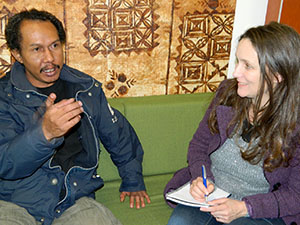
Tabloid Jubi editor Victor Mambor being interviewed by Pacific Media Watch’s Anna Majavu during the first visit by a Papuan journalist to New Zealand in 2014. Image: Del Abcede/PMW
Mambor is also an advocate for press freedom in Papua. In that role, he has criticised Jakarta’s restrictions on the media in Papua, as well as its other policies in his troubled home province.
The AJI awarded Mambor its press freedom award in August 2022, saying that through Jubi, “Victor brings more voices from Papua, amid domination of information that is biased, one-sided and discriminatory.”
“AJI in Jayapura strongly condemns the terrorist bombing and considers this an act of intimidation that threatens press freedom in Papua,” it said in a statement.
‘Voice the truth’ call “AJI Jayapura calls on all journalists in the land of Papua to continue to voice the truth despite obstacles. Justice should be upheld even though the sky is falling,” said AJI chair Lucky Ireeuw.
Amnesty International Indonesia urged the police to find those responsible.
“The police must thoroughly investigate this incident, because this is not the first time … meaning there was an omission that made the perpetrators feel free to do it again, to intimidate and threaten journalists,” Amnesty’s campaign manager in Indonesia, Nurina Savitri, told BenarNews.
The Papua region, located at the eastern end of the Indonesian archipelago, has been the site of a decades-old pro-independence insurgency where both government security forces and rebels have been accused of committing atrocities against civilians.
Foreign journalists have been largely barred from the area, with the government insisting it could not guarantee their safety. Indonesian journalists allege that officials make their work difficult by refusing to provide information.
The armed elements of the independence movement have stepped up lethal attacks on Indonesian security forces, civilians and targets such as construction of a trans-Papua highway that would make the Papuan highlands more accessible.
Human Rights Watch, meanwhile, has accused Indonesian security forces of intimidation, arbitrary arrests, torture, extrajudicial killings and mass forced displacement in Papua.
Security forces kill 36 Last month, Indonesian activist group KontraS said 36 people were killed by security forces and pro-independence rebels in the Papua and West Papua provinces in 2022, an increase from 28 in 2021.
In Sydney, Joe Collins of the AWPA said in a statement: “These acts of intimidation against local journalists in West Papua threaten freedom of the press.
“It is the local media in West Papua that first report on human rights abuses and local journalists are crucial in reporting information on what is happening in West Papua”.
Collins said Canberra remained silent on the issue — ‘the Australian government is very selective in who it criticises over their human rights record.”
There was no problem raising concerns about China or Russia over their record, “but Canberra seems to have great difficulty in raising the human rights abuses in West Papua with Jakarta.”
Republished from Free Radio Asia with additional reporting by Pacific Media Watch.
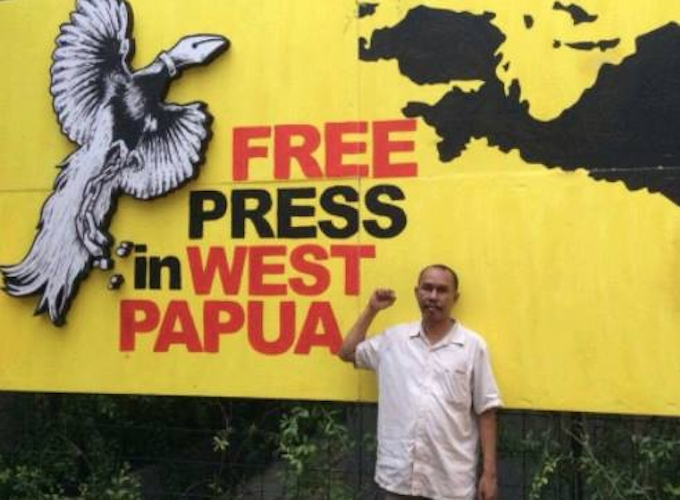
Victor Mambor as an advocate for media freedom in West Papua. Image: AWPA
There is a new twist in Papua New Guinea’s four-year drama surrounding the Maseratis bought for the 2018 APEC Summit.
It has emerged that the Department of Foreign Affairs, which wants to send the luxury vehicles to foreign missions abroad, cannot do so, because the vehicles — which have been collecting dust in a Port Moresby warehouse — will now be classified as “used vehicles”.
And some countries in which PNG’s foreign missions are based cannot accept them under that category.
Foreign Affairs Secretary Elias Wohengu said that Papua New Guinea was also a non-vehicle producing country which did not have a licence or permit to export vehicles, let alone used ones.
Many developed countries could accept anything classified as “used vehicles” from PNG.
Other countries, such as Solomon Islands and Indonesia, also have other obstacles to overcome, if the cars were going to be sent eventually — Solomon Islands does not have good paved roads for such low-lying luxury vehicles, and Indonesian roads are just too crowded. Fast cars such as the Maseratis will be of no use there.
Early last year a notice was sent for PNG Foreign Affairs Department and its missions abroad to be given the priority to purchase Maseratis and Bentleys for their operations.
Challenges facing missions There were challenges facing the missions and their heads on the latter.
Yesterday Wohengu spelled out the challenges preventing the cars from being sent across to the PNG Missions.
“As soon as the vehicles leave the sales spot, it is portrayed as a used car already,” he said.
“Some of these host countries do not accept used cars so we have the used car issue.
“Second issue that we have is the cost of shipment . . . But the biggest challenge is that many countries do not accept used cars, especially for diplomatic use and not from PNG,” he said.
“We would have got vehicles for all the missions, but you see, I can’t send a Bentley or a Maserati to Solomon Islands. Similarly I cannot send these vehicles to Jayapura or Fiji.
“But most of all, the used cars are not accepted in many host countries. Also we don’t have a permit for exporting used cars out of PNG. We can buy new vehicles from elsewhere but we can’t export them from PNG.
“Australia will not accept these cars from here, Singapore totally no. These are some examples.”
How the RNZ/TVNZ merger went from its first reading in Parliament to the legislative extinction list is an example of why New Zealand actually needs more public media and not less. Let me explain.
It has been labelled a grenade, a dog and a monolithic, monopolistic monster. Yet it is actually a reasonable policy that would bring New Zealand public media in line with most other developed countries.
No other developed country has separate national television and radio networks. They have seen how it fails us and said, “no thanks”.
Most other developed countries spend quite a bit more on their public media platforms too. Brits pay $81 each, Norwegians $110, Germans $142, but Kiwis just $27 each year to fund RNZ, TVNZ and NZ On Air.
Even with the government’s funding increase over the next three years, we’ll still be spending less per person than Australia, Ireland or any other country we like to compare ourselves to.
A big part of our public media underspend is successive governments’ policy that TVNZ pay its own way and rely on advertising dollars.
Other countries subsidise their public media because they realise that a reliable source of news and information is too important to be left in the hands of marketers and advertising departments.
Other end of the spectrum At the other end of the spectrum is the US spending just $3 per person on public media. You have to wonder how different US politics might be if it had fully-funded public media.
It is true that TVNZ does receive funding for programmes through NZ On Air but those shows still have to be simple and entertaining because TVNZ sells adverts around them. Only Sunday mornings have programmes for minorities or long-form political interviews, and of course, that is when there is no advertising.
That is the big difference between public media and commercial media. Public media doesn’t rely on advertising so it isn’t so desperate to get your attention and blast adverts at you.
Public media has time to examine public issues in-depth.
Commercial media needs to make money and with advertising dollars drifting to Google and Facebook, they work even harder to make content as eye-catching, entertaining and easy to understand as possible.
You may have noticed it on TVNZ, Newshub, Stuff or at the New Zealand Herald. These days there are more articles about crime, car crashes and weather bombs because they catch people’s attention.
Political reporting also wants to catch your attention. While public media can spend half an hour discussing a policy in-depth, commercial media want eyeballs so they go for the fun stuff — who’s up and who’s down in the pugilistic soap opera of daily politics. It is entertaining and it’s quick and easy to explain.
Complicated issues Unlike this opinion piece I’m writing for you now — I’m already halfway through my allotted word count, yet I’ve spent all of them just explaining the background. Complicated issues take more time to explain. I had better get on with it.
It was in this commercial political reporting soap opera that the media merger lost its way. Like many politicians, opposition broadcasting spokesperson Melissa Lee exploited commercial media’s focus on simplification and pugilism to attack the government. She repeatedly claimed the government could not explain why we need the merger, but the government had tried to explain it, only the public hadn’t heard because it is too complicated to explain quickly and simply on commercial media (as I’m trying to do here).
Political reporting fixated on Willie Jackson’s various stumbles as though this reflected the policy, rather than analysing the policy itself.
National Party leader Christopher Luxon also exploited commercial media’s lack of examination. He criticised the merger for being “ideological”, claiming it would destroy TVNZ’s business model, and saying he would demerge it if National win the election.
But none of the interviewers asked Luxon to explain his figures or why the destruction of TVNZ’s business model would be a bad thing. None asked him if demerging would also be “ideological” and none asked if he would get a cost-benefit analysis done before demerging.
Lee and Luxon’s criticism worked. A Taxpayers Union poll in November claimed 54 percent opposed the merger and 22 percent supported it.
Different polling outcome My organisation, Better Public Media Trust, also polled on the subject but we added some information about the merger, its costs and benefits. We got quite different results with just 29 percent opposing and 44 percent supporting the merger.
That shows what a little bit of information can do to public opinion. It also shows that reliance on commercial media for political discussion is prone to being style over substance, posturing over policy, soap operas over documentaries.
That is why the merger should go ahead. People would see it’s not a dog, grenade or monster, but intelligent, diverse and informative public media. Just in time for the election.
Myles Thomas is chair of the Better Public Media Trust (BPM). He is a television producer and director of various forms of “factual” programming, and in 2012 he established established the Save TVNZ 7 campaign. This article was first published in the New Zealand Herald and is republished here with the author’s permission.
Politicians can respond to the political rhetoric but claims that the new Fiji government has broken the law are a more serious matter, says prominent Suva lawyer Richard Naidu.
Reacting to FijiFirst general secretary Aiyaz Sayed-Khaiyum’s claims that there have been a number of incursions into the separation of powers since the government came in, Naidu said Sayed-Khaiyum had made no specific allegations that the People’s Alliance-led coalition had breached the “separation of powers”.
“In layman’s terms, ‘the separation of powers’ means only that the legislature (Parliament), the executive (Cabinet and civil servants) and the judiciary (judges and magistrates) should each ‘stay in their lanes’,” he said.
“They should not interfere in each other’s functions.
“Aiyaz has made no specific allegations that the new government has breached this concept. What law does he say has been broken?”
Naidu also questioned the procedures that were taken to set up the 2013 Constitution.
“Aiyaz’s FijiFirst party government applied the constitution as it suited them.
“It never set up the Accountability and Transparency Commission that the Constitution required (s.121); it never set up a Ministerial Code of Conduct as the Constitution required (s.149); it never set up a Freedom of Information Act as the Constitution required (s.150).
“This was, after all, his own government’s constitution.”
Rakesh Kumaris a Fiji Times reporter. Republished with permission.
West Papua independence campaigner Benny Wenda is in Vanuatu to meet Prime Minister Ishmael Kalsakau’s newly-installed government.
Wenda said he would also “strategise” on the way forward towards gaining eventual sovereignty from Indonesia and would be discussing ongoing issues in West Papua.
These include human rights abuses, and internal displacement of at least 160,000 Papuans by the Indonesian military while, he says, Jakarta continues to “pretend that nothing is happening in West Papua”.
Wenda said seven church pastors were among more than 200 people who had died in the conflict in the region in the last five years.
Wenda’s United Liberation Movement for West Papua (ULMWP) has observer status in the Melanesian Spearhead Group.
“We are developing in Melanesia, but unfortunately we cannot develop on top of all the suffering in West Papua which is another Melanesian country,” he said.
“I look forward to meeting Vanuatu’s new government leaders to brief them on the realities happening in West Papua. For example in the last five years, almost 240 Melanesians have died in West Papua.
‘Seven pastors killed’ “So far seven of our church pastors have been killed, including the most well-known Pastor Sanabani — a Bible translator.
“Indonesian soldiers also target our children while women give birth in the bush. Nobody has any statistics because Indonesia has banned all journalists for almost 50 years now from entering and reporting on what has been happening in our country.”
Comparing their situation with that of Russia’s war with Ukraine, he said television viewers are focused on their screens while no one really cares about what is happening in their next door neighbour of West Papua.
“We, the Melanesian countries call ourselves Christians but where is the Melanesian spirit of Christian brotherhood regarding West Papua?
“We badly need Melanesian Good Samaritans and perhaps now is the right time to prove that level of responsible leadership,” he said.
Vanuatu has pushed through the West Papua case at the Pacific Islands Forum as well as further abroad through the Organisation of Asia Caribbean and Pacific States (OACPS) in Brussels.
Len Garaeis a Vanuatu Daily Post journalist and RNZ Pacific correspondent. This article is republished under a community partnership agreement with RNZ.
Source: The Conversation (Au and NZ) – By Tristan Derham, Research Associate, ARC Centre of Excellence for Australian Biodiversity and Heritage (CABAH) Policy Hub – Training and Education, University of Tasmania
Shutterstock
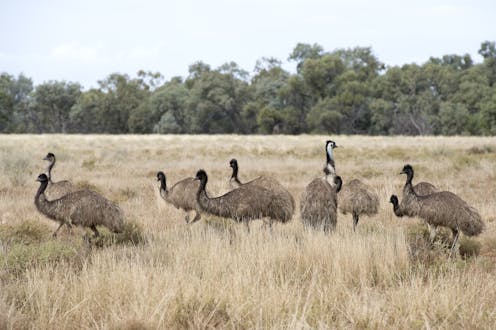
The emu is iconically Australian, appearing on cans, coins, cricket bats and our national coat of arms, as well as that of the Tasmanian capital, Hobart. However, most people don’t realise emus once also roamed Tasmania but are now extinct there.
Where did these Tasmanian emus live? Why did they go extinct? And should we reintroduce them?
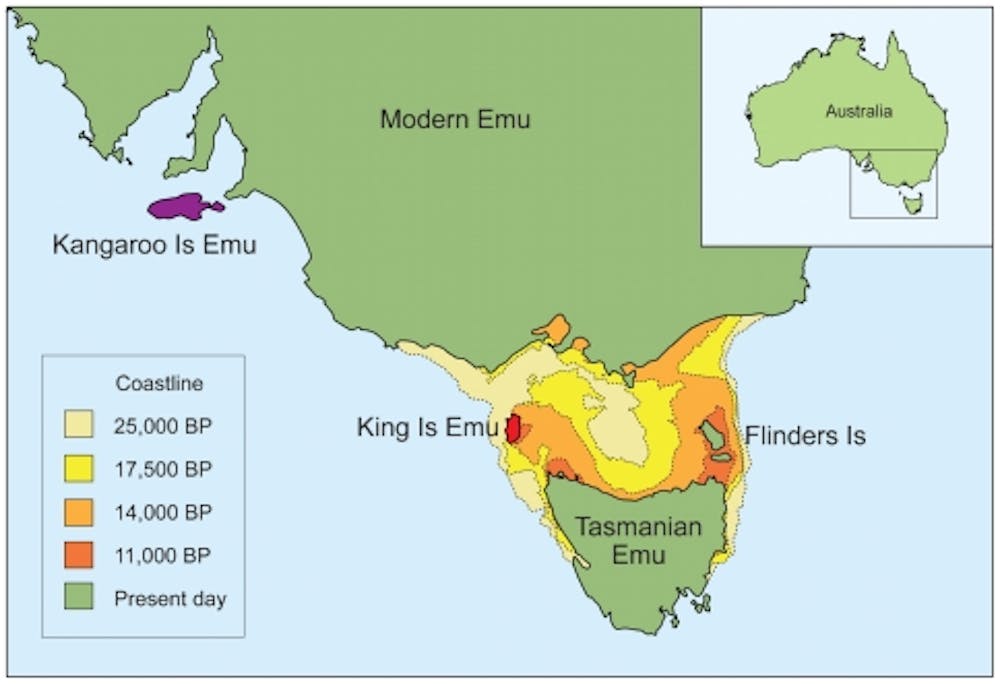
Our newly published research combined historical records with population models to find out. We found emus lived across most of eastern Tasmania, including near Hobart, Launceston, Devonport, the Midlands and the east coast. However, in the early days of British occupation, colonists hunting with purpose-bred dogs slaughtered so many emus that the population crashed.
It’s not all bad news, though. Those areas still provide enough good, safe emu habitat to make reintroducing emus from the Australian mainland to Tasmania a realistic option.
Large animals, such as bison, wolves and giant tortoises are already part of global efforts to repair and maintain ecosystems and prevent more extinctions, through the conservation movement known as “rewilding”.
In Tasmania, rewilding with emus might help native plants to cope with a changing climate. As our world warms, the places where conditions are just right for particular plant species are shifting. Those plants must disperse far and fast to keep up. Introducing emus, which disperse many plant seeds in their droppings, could help.
Emus are the biggest birds in Australia. The females weigh up to a whopping 37 kilograms. But when European sealers and explorers arrived on Australia’s southern islands, they found smaller, shorter emus. According to one estimate, Kangaroo Island emus averaged 24-27kg and King Island emus a mere 20-23kg.
Contrary to local folklore, Tasmanian emus were actually more similar to their mainland cousins. They weighed about 30-34kg (but sometimes up to 40kg).
Along with eastern grey kangaroos, known locally as “foresters”, emus were the biggest herbivores in Tasmania.
Large herbivores play important roles in ecosystems around the world. By chewing on plants, pushing through vegetation and churning up soil, large animals can create a mosaic of habitat types for other, smaller creatures. They move seeds and nutrients across the landscape and shape the frequency and intensity of fires.
Exactly how emus help ecosystems is a bit of a mystery because so few researchers have looked into it. But we do know emus are very good at seed dispersal. Emus live anywhere, eat anything and swallow their food whole. They walk miles and miles while seeds slowly pass through their gut, to be ejected in a ready-made batch of compost.
Without emus, some plant populations won’t be able to disperse quickly enough to escape the local effects of global warming.
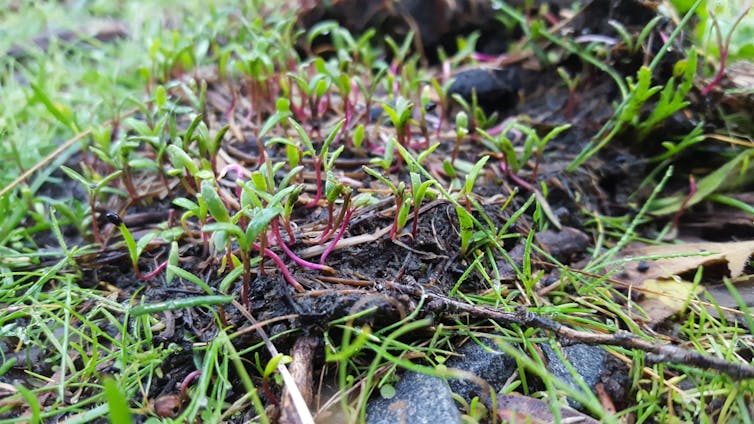
Many plant species benefit from being dispersed by emus that swallow their seeds whole and deposit them some distance away in a nutritious pile of ‘poo compost’. Author provided
We know colonists hunted emus and kangaroos in Tasmania. Emus were rarely seen on the island after 1845. But was hunting by a few hungry settlers enough to take out the whole population?
To find out, we recreated the emu population using computer simulations. Then we turned up the hunting pressure.
The signal was clear. Tasmania’s emu population could not sustain a harvest of more than about 1,500 adults per year. This limit was probably exceeded within a decade or two, which makes over-hunting the most likely cause of extinction.
Interestingly, the results of the simulation imply the island’s Indigenous people hunted adult emus at very low rates, less than one per person per year.
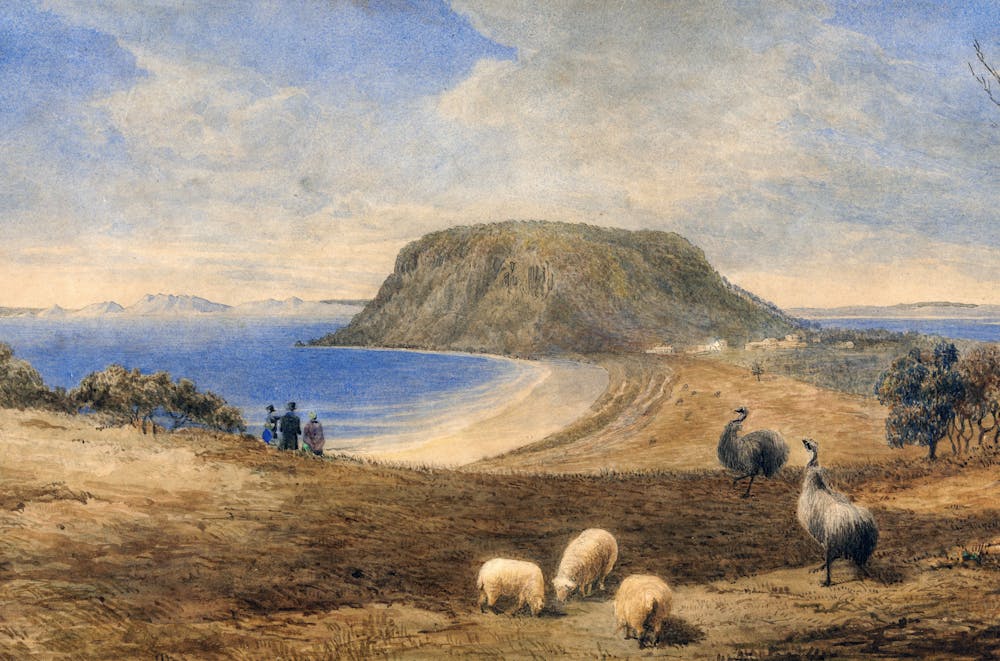
Emus at Stanley, Tasmania, during the 1840s, in a painting by William Porden Kay. They were rare by the middle of that decade. Wikimedia Commons
To find safe places for reintroductions, we overlapped emu habitat with current land use. We found large parts of the state that have both good emu habitat and a healthy distance from areas with higher risk of human-emu conflict.
Small-scale, trial introductions could be done in fenced enclosures to learn more about the emus’ needs and their ecological roles.
Indigenous voices are particularly important in conversations about reintroductions, because of the roles such animals play in living traditional cultures. For example, emus have featured in Tasmanian Aboriginal story, dance, song and art for generations. Pakana and Palawa still perform emu dances today.
Such conversations must be had with care, because many Indigenous people are wary of terms such as “rewilding” and “wilderness”. These terms can carry the implication of a land without people, when in fact Australian landscapes have a long and rich history of Indigenous people caring for Country. Even the concept of “wildness” can imply too strong a separation between humans and our non-human kin, and a lack of reciprocity and responsibility.
Australia has just begun rewilding
Landscapes all over the world have lost large animals that would otherwise be keeping ecosystems healthy and dynamic. European and American conservationists have responded by reintroducing large animals for their ecological and cultural functions.
Rewilding Europe, for example, has reintroduced bison to the Carpathian mountains and primitive horses to Portugal, Spain, Bulgaria and Ukraine. These efforts are placing prehistoric grazing regimes back into a rich cultural landscape.
On islands in the Indian Ocean, giant tortoises have been introduced to replace their extinct cousins. Those tortoises graze down weeds and give native plants a better chance of recovery.
In Siberia, the Pleistocene Park project aims to re-create a rich steppe ecosystem by reintroducing bactrian camels, musk oxen and American plains bison. One benefit is this will increase the amount of carbon stored in that landscape.
In Australia, most of our animal reintroduction programs are focused on conserving individual species. In a few cases, like the Marna Banggara project, ecological engineers like bettongs are being introduced to kick-start ecosystem restoration, but this is happening behind fences and on islands.
We need solutions like rewilding for our open landscapes. Reintroducing emus to Tasmania would be a good first step.
Christopher Johnson receives funding from the Australian Research Council.
Matthew Fielding and Tristan Derham do not work for, consult, own shares in or receive funding from any company or organisation that would benefit from this article, and have disclosed no relevant affiliations beyond their academic appointment.
A boom in 2023 predictions is spurring more tips about thriving in fast-changing workspaces.
But the talk about an Australian workplace revolution is not new – and a prime minister once offered a media model for renewing the national morale.
John Curtin retains a top place in prominent surveys of Australia’s greatest prime ministers. He faced the challenge of stirring a massive public effort in the second world war.
The road of service is ahead. Let us all tread it firmly, victoriously.
It was a dramatic turnaround, asking Australians to abandon their individualistic values. The main priorities became national cooperation, inclusion and unity.
This was a total war that reached more deeply into national society than any other crisis had before. It involved the most sudden reorganisation of Australian life to date. Australians faced bans on holidays, pleasure motoring and leisurely basking on beaches.
The nation worked around the clock to send supplies to Allied forces. As a journalism researcher, I have analysed three essential steps in Curtin using the media to generate public enthusiasm for a cooperative work ethic during the second world war.
Firstly, Curtin treated reporters as equals. They talked candidly in twice-daily news conferences.
Curtin had recognised a need for positive press relations prior to becoming prime minister. Previously, he had been a labour-oriented newspaper editor and an Australian Journalists’ Association district president.
He was also a firm believer in the style of leading by example.
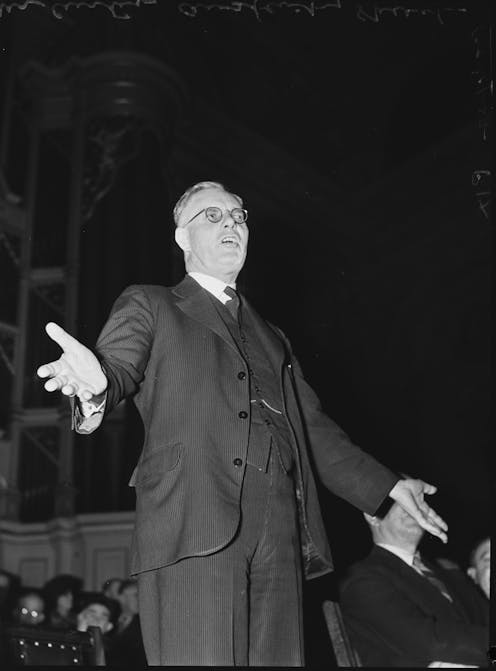
John Curtin’s lunchtime talk in Martin Place, Sydney in 1942.
Known for a “log cabin” background, he would talk about his meagre upbringing. He would recall that his family could only afford “tea without milk and bread without butter”.
Journalists presented him as “Plain John Curtin” and “Honest John.” The media image masked his dedicated studying to become the nation’s leader in 1941.
Reporters shared stories about Curtin’s preference for talking with workers. They would describe his careful broadcast rehearsals. Correspondents circulated his media announcement in London’s prestigious Guildhall that he had once been a “printers’ devil”, or a newspaper apprentice.
Boosting morale
Secondly, journalists accentuated Curtin’s plain talks about a community ethos of hard work.
He extensively used the broadcast media.
His personalised tone benefited from the intimate style of United States wartime president Franklin Delano Roosevelt’s fireside chats. As the prime minister, he often timed his evening radio chats to reach Australians working late.
are far from being helpless, inefficient moaners in the face of the enemy. We have paid the price for our seal to nationhood.
This talk was not only aired in Australia. More than 700 radio stations broadcast this talk across the US and Europe. This was the largest potential audience hooked up for an Australian broadcaster at the time.
Involving public audiences
Thirdly, journalists became compassionate eyewitnesses to reveal the need for a more inclusive wartime economy. They portrayed a growing campaign for more recognition of women workers.
News stories showed women’s efforts to improve their workplace conditions. Wartime filmmakers idealised the roles of female workers, who appeared as patriotic people’s heroines.
The media blitz elicited active public support for the national values of work, service and community.
Curtin’s media model helped to transform pre-war images of freedom-loving Australians who had independently fought their way back to prosperity after the depression.
He expanded Australia’s public sphere as a place of civic engagement in a national team enterprise pulling together for a victory.
Readers enthusiastically wrote letters to the editor about how to promote a cooperative work ethic. As a newspaper reader suggested:
This spirit of cheerfulness should be encouraged and cultivated.
News surveys indicated many workers were optimistic about their future by the war’s end in 1945.
Invoking a hopeful destiny
Since then, many political leaders have used the latest popular media available to champion a hopeful Australian work ethic.
Victorious election campaigns include Robert Menzies’ radio series, Gough Whitlam’s televised events and Kevin Rudd’s YouTube videos.
These campaigns have emphasised a fresh vision of empowering Australian workers.
Now, the value of an inclusive culture appears in trending lists on how to shape post-pandemic work.
Prime Minister Anthony Albanese has touted Curtin’s “quest for a true victory” that helped to transform post-war Australian society. At the National Press Club this year, he declared a need for a new “culture of cooperation” of working together.
Curtin’s media model suggests there are advantages in sharing frequent updates with journalists when leaders are aiming to transform a work culture. Curtin’s news talks show the possibilities of renewing morale during rapid workplace changes.
Dr Caryn Coatney received funding from a Fellowship at the Australian Prime Ministers Centre in the Museum of Australian Democracy at Old Parliament House, Canberra.
This weekend (and pretty much every weekend until the end of May), millions of people around the world will be making these sorts of decisions, hoping the right call will take them a step closer to fantasy football glory.
Glory or not, fantasy football should be a fun, enjoyable hobby… right? Recent research – including a newly published study – sheds light on whether that really is the case.
A real-world virtual team
For the uninitiated, fantasy football (“soccer” in some parts of the English-speaking world) is a game in which you select real-world players for your virtual team, with their subsequent real-world performance dictating your team’s score.
Many versions exist, but the basic premise is that points are awarded for doing good things (like scoring a goal) and deducted for doing bad things (like getting a red card). The virtual team with the most points by the end of the season, wins.
Fuelled by advances in smartphone technology and social media, fantasy football has rapidly grown to become a key meal in a fan’s football consumption.
You would think this would be a good thing, but take a quick scroll through the fantasy football “Twitter-verse” and you will soon find not everyone seems to be enjoying it for what it’s meant to be – a game.
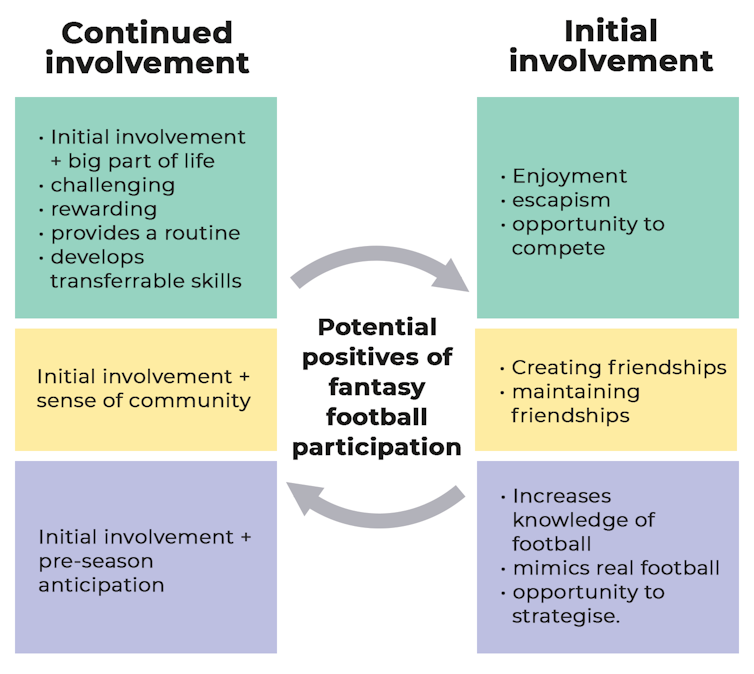
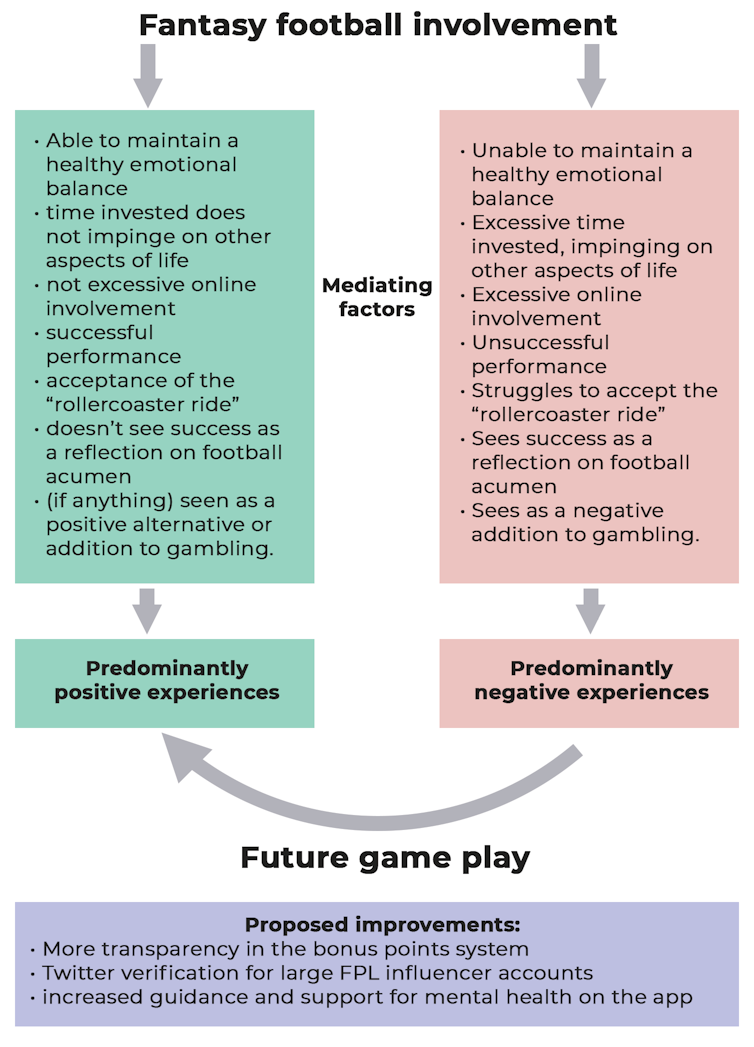
In our study, 1,995 fantasy football players (representing 96 different nationalities) completed a questionnaire on their anxiety, low mood, daily functioning, and problematic behaviour in relation to the game. Importantly, players also told us about their engagement (primarily the time spent playing the game) and experience (the number of years playing the game).
The good news was that for most respondents, fantasy football did not seem to have a negative impact on mental health. However, given the popularity of the game, it is notable that 3.4% and 5.1% of the respondents reported having moderate to severe anxiety and low mood in relation to the game, respectively.
In a game played by over 10 million people, that could be hundreds of thousands of people negatively affected by what is meant to be a fun and enjoyable hobby.
Interestingly, while engagement and mental health concerns were positively correlated, experience and mental health concerns showed the opposite relationship. That is, the more time a player invested in the game, the greater the negative mental health concerns they reported; but the more years’ experience they had playing the game, the fewer negative mental health concerns they reported.
It’s unclear why this is, but we think it’s possible that over time, players develop coping mechanisms or even an emotional “numbness” towards the game.
Looking for positives
Our first study provided insights into fantasy football’s potential harmful effects on wellbeing, but failed to investigate the numerous positives that inevitably must exist (why else would it have become a global phenomenon?).
We decided to address this by carrying out a follow-up study. This time, we took a qualitative, interview-based approach to paint a more holistic and detailed picture of what goes on when people take part in fantasy football. This paper has just been published in the journal Entertainment Computing.
We interviewed 15 experienced male fantasy football players, and thematically analysed the resulting data. Overall, it was found the game appears to have a much more positive than negative impact.
Aside from the obvious enjoyment factor, benefits included the creation and maintaining of friendships; an increased knowledge of football; the opportunity to strategise, compete, and develop transferable skills (such as an understanding of maths and statistics); escapism; and the provision of structure and routine to one’s week.
Model for ‘Initial Involvement’ and ‘Continued Involvement’ in fantasy football. Green boxes indicate factors related to the theme of ‘personal benefits’, yellow to the theme of ‘social connections’, and blue to the theme of ‘involvement in football’. We propose that players only become cognisant of the continued involvement factors once they have played the game for a period of time. The Conversation/Author provided, CC BY-ND
Mitigating the negatives
We also teased out some negatives. Responses from all participants lent support to our original study which highlighted fantasy football’s potential harm to wellbeing. “Anxiety-provoking”, “frustrating”, “addictive”, “affects self-confidence” and “disappointment and regret” were prevalent enough to warrant sub-themes of their own within the analysis.
Participants were also keen to mention the negative online impact – particularly through social media – that accompanies the game, as well as the intensity of involvement the game was perceived to require.
Perhaps of most importance was the identification of seven factors which we believe can be used by game creators and game players alike to help optimise participation in fantasy football.
For instance, we propose that if you think success in the game reflects your knowledge of football in the real world, it will lead to predominantly negative experiences. Likewise, it’s not wise to invest excessive time at the expense of other areas of life.
Players and game creators should aim to foster the factors in the green box (and deter those in the pink box) in order to optimise the experience of playing fantasy football. Proposals for improvements to the game (blue box) come from post-hoc, quantitative data collected from participants after the interviews. The Conversation/Author provided, CC BY-ND
Some of these are clearly easier said than done, and others may actually be incompatible with one another.
Nevertheless, we believe through identifying these factors, we can help players become more mindful of their fantasy football involvement, and the impact it may have on their mental health.
Like with most things in life, balance is key for fantasy football. The growth of the game shows no sign of slowing down, so it’s important for players and game creators alike to act now to improve the playing experience. If we don’t, making that call on Haaland or Kane will continue to have a greater consequence than it ought to.
Luke Wilkins ne travaille pas, ne conseille pas, ne possède pas de parts, ne reçoit pas de fonds d’une organisation qui pourrait tirer profit de cet article, et n’a déclaré aucune autre affiliation que son organisme de recherche.
It’s impossible to avoid the Aussie sun entirely, but Australians are well aware of the dangers of too much exposure. Some 40 years of Slip Slop Slap (and more recently added, Seek and Slide) campaigns have reinforced this, not to mention the unpleasant experience of a sunburn most of us have encountered at some point.
Skin does repair itself, but how long does that take? If you hit the beach for half an hour, then retreat to the shade for a while, then go back out, will the damage have gone back to baseline? Or are you accumulating it?
Like most things, it’s complicated.
How does the sun damage your skin?
Spending a day in the sun can cause 100,000 DNA defects in each exposed skin cell. DNA is the genetic information your body needs to build and run itself. There’s a copy in each of your cells, except for red blood cells and the layer of dead cells at the very surface of the skin.
Your cells have a very effective DNA repair process, called nucleotide excision repair, for this kind of damage. But some damage still slips through the cracks.
When your skin’s DNA monitoring system decides there is just too much damage to be effectively repaired, it tells the cells to self-destruct and calls in the immune system to finish them off. This causes the symptoms of sunburn: redness, pain, and sometimes blistering.
However, you don’t have to get sunburnt to start accumulating damage. A tan is your skin reacting to DNA damage by increasing the amount of melanin, which alters the skin’s colour, to mitigate future UV exposure. Though this only gives you the same protection as a 2-4 SPF sunscreen.
UV radiation in Australia is so high, particularly during summer, that you can start accumulating damage in the time it takes to hang out the washing or walk to the bus stop.
Even so, the amount of DNA damage is proportional to the amount of UV exposure, so longer exposures or exposures at high-UV times of day cause much more damage.
In the time it takes to hang the washing out, the sun can damage your skin. Shutterstock
Remind me, what is UV radiation?
There are two types of UV radiation that damage skin – UVB mostly affects the upper layer, causing sunburn and skin cancer, and UVA mostly damages the lower layer, causing premature ageing.
These act in two different ways to damage skin, but due its cancer-causing properties, UVB is the better studied.
Light particles (UVB photons) discharge energy when they hit DNA. This causes bases on one DNA strand to connect to each other, instead of their corresponding bases on the other strand.
‘Before’ shows a normal DNA helix. ‘After’ shows how excess energy from light causes the bases on DNA strands to link up incorrectly. NASA/David Herring
This distorts the DNA helix, so it doesn’t copy correctly when it’s time for the cells to divide.
And it causes permanent mutations that are replicated whenever the daughter cells multiply, setting the stage for skin cancers.
Even an exposure of half the amount of UV needed to cause a sunburn is enough to start generating these DNA defects.
How long does the damage take to repair?
Once they’re formed, the half-life of DNA defects is 20-30 hours, depending on the efficiency of your own DNA-repair machinery. That means it takes 20-30 hours for your cells to repair even half the damage.
In one study that took samples at 24 and 72 hours after exposure, almost 25% of the damage detected at the 24-hour mark was still present at 72 hours.
So if you’re already on your way to a sunburn, no, stepping away from the sun for 20 minutes to get an ice cream is not going to cut it. Your skin will eliminate most of the damage over a few days. But some may be missed or not found before the cell replicates.
You’re better off minimising damage in the first place by planning to hit the beach early, spending the middle part of the day reading your new murder mystery in the shade, and perhaps returning to the sands from mid-afternoon.
Alternatively, you could extend your time in the sun by covering up extensively with a long-sleeved rashie, thick leggings, hat and frequently reapplied sunscreen on anything not covered up – and don’t forget your feet!
To protect your skin, apply sunscreen as part of your morning routine on any day when the UV index is forecast to be 3 or higher. This will prevent an accumulation of damage from brief exposures like hanging out washing or walking in from the carpark.
Most weather forecasts will tell you what UV to expect but in Perth, Brisbane and Darwin it’s over 3 all year around.
If you’re going to be outside for a prolonged time, add sun protective clothing, a hat and sunglasses, reapply your sunscreen at least every two hours, and stay in the shade where possible.
If you do get sunburnt, the best thing you can do for yourself is stay out of the sun for a few days until the redness goes away. This lets your body deal with the damage as efficiently as possible without piling more on.
H. Peter Soyer is a shareholder of MoleMap NZ Limited and e-derm consult GmbH and undertakes regular teledermatological reporting for both companies. He is a Medical Consultant for Canfield Scientific Inc and Blaze Bioscience Inc..
New Zealand Parliament Buildings, Wellington, New Zealand.
New Zealand Politics Daily is a collation of the most prominent issues being discussed in New Zealand. It is edited by Dr Bryce Edwards of The Democracy Project.
A vast amount of rocks and other material are hurtling around our Solar System as asteroids and comets. If one of these came towards us, could we successfully prevent the collision between an asteroid and Earth?
Well, maybe. But there appears to be one type of asteroid that might be particularly hard to destroy.
Asteroids are chunks of rocky debris in space, remnants of a more violent past in our Solar System. Studying them can reveal their physical properties, clues about the ancient history of the Solar System, and threats these space rocks may pose by impacting with Earth.
Mainly concentrated in the asteroid belt, asteroids can be classified into two main types.
Monoliths – made from one solid chunk of rock – are what people usually have in mind when they think about asteroids. Monolithic-type asteroids about a kilometre in diameter have been predicted to have a lifespan of only a few hundred millions of years in the asteroid belt. This is not long at all given the age of our Solar System.
Artist concept of catastrophic collisions between asteroids located in the belt between Mars and Jupiter. NASA/JPL-Caltech, CC BY
The other type are rubble pile asteroids. These are entirely made up of lots of fragments ejected during the complete or partial destruction of pre-existing monolithic asteroids.
However, we don’t really know the durability, and therefore the potential lifespan, of rubble pile asteroids.
Sneaky and abundant rubble piles
In September 2022, NASA’s DART mission (Double Asteroid Redirection Test) successfully impacted the asteroid Dimorphos. The goal of this mission was to test if we could deflect an asteroid by impacting it with a small spacecraft, and it was a resounding success.
Like other recent asteroid missions by the Japan Aerospace Exploration Agency (JAXA) to visit asteroids Itokawa and Ryugu, and by NASA to asteroid Bennu, close-up images have shown that Dimorphos is yet another rubble pile asteroid.
The much-studied Ryugu asteroid – classified as potentially hazardous – is also a rubble pile. JAXA/Hayabusa2, CC BY
Those missions showed us that rubble pile asteroids have a low density because they are porous. Also, they are abundant. In fact, they are very abundant, and since they are the shattered bits of monolithic asteroids, they are relatively small, and thus hard to spot from Earth.
Hence, such asteroids represent a major threat for Earth and we really need to understand them better.
Learning from asteroid dust
In 2010, the Hayabusa spacecraft designed by JAXA returned from the 535-metre long, peanut-shaped asteroid Itokawa. The probe brought with it more than a thousand particles of rocks, each one smaller than a grain of sand. Those were the first-ever samples brought back from an asteroid!
As it then turned out, the pictures taken by the Hayabusa spacecraft while it was still orbiting Itokawa demonstrated the existence of rubble pile asteroids for the first time.
Early results by the team at JAXA who analysed the returned samples showed Itokawa formed after the complete destruction of a parent asteroid which was at least 20 kilometres large.
In our new study, we analysed several dust particles returned from asteroid Itokawa using two techniques: the first one fires an electron beam at the particle and detects electrons that get scattered back. It tells us if a rock has been shocked by any meteor impact.
The second one is called argon-argon dating and uses a laser beam to measure how much radioactive decay happened in a crystal. It gives us the age of such a meteor impact.
Our results established that the huge impact that destroyed Itokawa’s parent asteroid and formed Itokawa happened more than 4.2 billion years ago, which is almost as old as the Solar System itself.
That result was totally unexpected. It also means Itokawa has survived almost an order of magnitude longer than its monolith counterparts.
Such an astonishingly long survival time for an asteroid is attributed to its shock-absorbent nature. Due to being a rubble pile, Itokawa is around 40% porous. In other words, almost half of it is made of voids, so constant collisions will simply crush the gaps between the rocks, instead of breaking apart the rocks themselves.
So, Itokawa is like a giant space cushion.
This result indicates rubble pile asteroids are much more abundant in the asteroid belt than we once thought. Once they form, they appear to be very hard to destroy.
This information is critical to prevent any potential asteroid collision with Earth. While the DART mission was successful in nudging the orbit of the asteroid it targeted, the transfer of kinetic energy between a small spacecraft and a rubble pile asteroid is very small. This means they are naturally resistant to falling apart if impacted.
Therefore, if there was an imminent and unforeseen threat to Earth in the shape of an incoming asteroid, we’d want a more aggressive approach. For example, we may need to use the shockwave of a nuclear blast in space, since large explosions would be able to transfer much more kinetic energy to a naturally cushioned rubble pile asteroid, and thus nudge it away.
Should we actually test a nuclear shock wave approach, then? That is an entirely different question.
German Chancellor Olaf Scholz has been under tremendous pressure to supply Leopard tanks to Ukraine. The government in Kyiv has long argued it desperately needs them to regain territory seized by Russia in its 2022 invasion, and to protect the rest of Ukraine from the Kremlin’s looming spring offensive.
So far, Berlin has refused, and in recent weeks it has expended significant political capital in forbidding other nations like Poland and Finland from transferring their own Leopards to Kyiv.
Following earnest discussions between members of NATO’s Ukraine Defence Contact Group last week, the new German defence minister, Boris Pistorius, announced that instead of sending Germany’s tanks to Ukraine, he was going to count them instead. A proper inventory, apparently, would give Berlin a better idea about whether it might be able to meet Kyiv’s requests in the future.
Today, it appears Germany finally relented, with the foreign minister saying it would not stand in the way of Poland sending its Leopard tanks to Ukraine after all.
Germany’s position – which many have found perplexing – has reignited debate within NATO about arming the embattled government in Kyiv.
Is it an obligation or a risky move? What types of weapons should be provided? And what might be the repercussions in terms of a potential response from Russia, the future of European security and, ultimately, the credibility of the West?
What explains Germany’s indecisiveness?
There have been a number of attempts to explain why, in what is supposed to be a united alliance, there are such deep differences of opinion on these questions.
In Germany’s case, the country’s pacifist tradition – shaped by the experience of the second world war – is often cited as to what’s behind its reluctance to supply Kyiv with “offensive” weapons.
Some German analysts legitimately believe supplying tanks to Ukraine might lead to nuclear war with Russia. Because of its history as a divided nation during the Cold War, Germany also sees itself as having a special diplomatic role to play in bridging the divides between Russia and the West.
But these arguments aren’t particularly convincing alone. Nor are they especially useful. For one thing, Germany is already providing Ukraine with weapons that can be used for offensive purposes – including artillery, rocket launchers, bunker-busting missiles and Marder armoured fighting vehicles.
Further, Germany is one of the world’s most enthusiastic arms dealers. It sits at number four globally for total weapons sales. Germany had a bumper year for sales in 2021, reaching 9.35 billion euros (A$14.6 billion). Nearly half of these sales went to Egypt.
Its Leopard 2 tank is also the armoured staple of NATO militaries, with over 2,000 in service across Europe.
And when it comes to Russian President Vladimir Putin’s nuclear threats, this has been a concern for over a decade, so it is difficult to see how supplying Ukraine with tanks now makes Berlin especially vulnerable to Armageddon. In fact, for all his bluster, Putin has carefully avoided drawing NATO into the war, based on the sensible calculation it would hasten his defeat.
A more convincing explanation for Germany’s dithering has to do with the dysfunction within its military, as well as a healthy dose of domestic politics.
Scholz’s decision came only days after the resignation of the German defence minister, Christine Lambrecht. Her tenure was marked by PR disasters, including a New Year’s video message in which she recounted the “positive encounters” she had enjoyed with people over the war in Ukraine, and widespread condemnation for failing to improve the supply of equipment to Germany’s armed forces.
The problems with Germany’s military go deeper and are much harder to solve. Shortly after Russia invaded Ukraine, Germany’s military chief, General Alfons Mais, publicly bemoaned what he saw as the hopeless neglect and under-resourcing of the armed forces he commanded.
The trouble is Germany’s decision paralysis doesn’t help perceptions of NATO unity – and it especially doesn’t help the Ukrainians.
Scholz’s previous announcement that he would only permit other countries to send their Leopards to Ukraine if the US also supplied Kyiv with its M1 Abrams tanks was calculated to reveal America’s own reticence to donate high-end kit. This is in spite of the fact the Biden administration is arguably more concerned about advanced weapons systems falling into Russian hands than provoking Putin.
Of course, there have been attempts to break the impasse. Earlier this month, the UK announced it would provide Ukraine with 14 Challenger tanks. That’s hardly a huge number, and it is definitely not the most advanced piece of kit in the UK arsenal. But it was intended to get the ball rolling.
Clarity only comes with strategy
Above all, the back-and-forth on tanks is proof that NATO lacks a coherent strategy for the war.
True, NATO leaders often make stirring statements pledging support for Kyiv in its attempts to regain its territory, and claim the West’s goal is to see Russian imperialism defeated. But those alone do not amount to strategy: they are merely aspirations.
If NATO members are serious about seeing those aspirations succeed – and if getting the alliance more involved in the war itself is a clear red-line – they will need a much more detailed plan to provide Ukraine with every bit of assistance it requires to win the war on the West’s behalf.
Beyond that, NATO will also need a post-war commitment to guarantee Ukrainian sovereignty and develop a strategy for containing Russia in the future.
That will mean some hard compromises, the potential loss of domestic political capital and the danger of Russian reprisals. But this is a situation NATO finds itself in due to the legacy of its own inaction: by placating Putin in the past, it has simply encouraged him.
It is also manifestly clear there will be no going back to the pre-invasion era through some kind of desperately negotiated compromise. Putin has staked his personal credibility on triumph over Ukraine, and he has not deviated from a maximalist concept of victory.
If all this is too difficult for some NATO members, the ongoing nature of the Russian threat will make it necessary to come up with an alternative.
In many respects, there have been two tracks for European security for some time. The Baltic states, as well as Poland, the UK, the US and even Sweden and Finland are well ahead of Germany and other western European nations who still cling to the idea that Russia can still somehow be managed.
Indeed, if acknowledging a lack of consensus is what is required for the West to take a firmer approach towards Russia in the future, then it’s probably a price worth paying.
Matthew Sussex has received funding from the Australian Research Council, the Lowy Institute, the Carnegie Foundation and various Australian government agencies.
Semaglutide, sold in the forms of Ozempic and Wegovy, shot into public consciousness as an effective weight-loss medication last year, thanks to spruiking from social media influencers and people such as Elon Musk.
The unexpected increased in demand for the drug for weight loss has caused a world-wide shortage. Producing the drug – delivered as a weekly self-administered injection – involves a unique manufacturing set-up, so it will take some time to re-establish a global supply. It’s expected back in Australia at the end of March.
Semaglutide (in the form of Ozempic) is an effective medication in managing type 2 diabetes – and the shortage has left some people with diabetes struggling to find pharmacies with their treatment in stock. For many people with diabetes, Ozempic has controlled their blood sugar (and often also helped them lose weight) more effectively than other medications.
Due to the shortage of Ozempic, Australian GPs have been advised against prescribing it to treat obesity.
However, semaglutide in the form of Wegovy is designed specifically for weight loss. United States and Australian regulators have recently approved Wegovy for that purpose, though it hasn’t been available for use in Australia to date.
When the shortage is resolved and semaglutide is once again available in Australia for those with diabetes, it’s unclear who will be able to access it for weight loss. Patients and doctors are also asking how much they will pay, and what role it will play in managing obesity.
How does it work?
Semaglutide works in several ways, including increasing feelings of fullness by acting on appetite centres in the brain and slowing stomach emptying.
After two years, patients using it still benefit by not regaining their lost weight – but only if they are still taking the drug.
Disappointingly, once stopped, patients notice a gradual regain of up to two-thirds of the weight they lost. So essentially, semaglutide works only while taking it – it “manages” but does not “cure”.
Semaglutide is meant to be an add-on, not a replacement, for exercise and a healthy diet.
Research on the medication has always been done in conjunction with a healthy diet and exercise, as that is considered best practice. So we don’t know what happens if you just take the medication without also starting or maintaining a healthy lifestyle. We do know exercise is key to keeping weight off over time.
Semaglutide for weight loss isn’t meant to replace diet and exercise. Shutterstock
What are the side effects?
Semaglutide can cause nausea, bloating, constipation and diarrhoea.
Questions have been raised around the risk of pancreatitis, and thyroid and pancreatic cancers. So far the research is reassuring, however these are all rare, so it’s unlikely we will know if there is any significant increase for some years to come.
How much does it cost?
One of the biggest barriers to semaglutide for weight loss is the cost. Although patients spend less on food while taking it, in 2022 (when it was more easily available in Australia) it cost around A$130 a month.
It could be pricier once supply issues are fixed, because the manufacturer Novo Nordisk is spending millions of dollars building new facilities to meet the increased demand.
In the United States, prices are already over US$1,000 a month unless covered by insurance.
Australians with diabetes will continue to be able to access the drug on the Pharmaceutical Benefits Scheme (PBS) for the usual cost of a script. However, if used for obesity, it would be on a private prescription, so the cost is still unknown.
Obesity is more common among people with lower incomes. So from a public health perspective, those who would benefit the most may least afford it. This lack of equity must be wrestled with if this medication becomes widely used for obesity management. Subsidising on the PBS for weight loss is one option.
What are the downsides?
A serious concern is the potential for semaglutide to be used by people who are not obese, particularly those with eating disorders. Because it suppresses appetite, it could enable people to starve themselves in an unhealthy way.
Obesity is defined as a body mass index (BMI) of over 30, and overweight is BMI of 25-30. Yet there are reports of people with BMIs less than 25 using it to drop “just a bit of weight”.
The psychological and social pressure to be thin is a powerful driver, particularly in a society that frequently stigmatises obesity. People may see semaglutide as a way of “treating” their body image issues.
Another concern is the impact on enjoying food. Patients feel full after just a few bites, making meals with friends awkward, and sometimes limiting their social life.
But when this is insufficient, patients’ options are limited. The most effective is bariatric surgery. Although surgery is generally well tolerated, it is an irreversible lifelong change.
Once the semaglutide access issues are resolved, Australian regulators should seek input from the community and from doctors, and think carefully about the role the drug should play in Australia’s management of obesity and weight loss.
In addition to equitable access and protection for those with body image issues, we will need clear, evidence-based guidelines that consider the psychological and social impact of the drug.
At the end of last year, the world’s average price to emit one tonne of greenhouse gases was around US$5.29 (AU$7.77). For pricing to work as we want – to wean us off fossil fuels – it needs to be around $75 by the end of the decade, according to the International Monetary Fund.
Why is the price still so low? Because even in 2023, close to 80% of the world’s emissions from land clearing, power plants, cars and industry are pumped into the atmosphere without any cost to the polluter.
Carbon prices have long been favoured by economists and experts as a way to drive faster change. If you want to discourage something, the easiest way is to make it cost more. Pricing the three main greenhouse gases – carbon dioxide, methane and nitrous oxide – is an elegant and effective way to force polluters to find alternative ways of producing power or creating forms of transport. (Carbon price refers to pricing a tonne of carbon dioxide equivalent, CO₂-e, which covers all three gases).
There’s long been a strange disconnect between the minute-by-minute updates on financial asset prices and the the lack of information on carbon prices. In 2023, as extreme weather, droughts and floods propel climate change to the front of our minds, it’s far easier to access streams of data on share markets, commodities, foreign exchange than it is to find data on the measure most critical to global survival – the price of carbon. That’s why our research team worked to produce the first global carbon price index as a way to easily track changes in pricing globally – and see change over time.
Carbon pricing can help us go from fossil fuels to clean electricity. Shutterstock
How did we determine the true price of carbon?
To nail down the global price of carbon, we took into account every national or supranational scheme as well as the price of carbon traded through emissions trading schemes. We did not use carbon credits or offsets, as these tend to lack transparency, be rubbery and often questionable.
Different countries and jurisdictions have come at the problem of atmospheric pollution from different directions.
The simplest is to simply tax the pollutants you don’t want. This works if the price is set at the right level – not too low or too high at first – and increased as necessary.
Another common approach is to create a market for pollution through an emissions trading scheme, where high emitters have to purchase allowances. Over time, the new market will set the price on polluting as emitters and others compete for this finite pool of allowances. Regulators progressively cut the number of allowances, driving up the price of each allowance. The end result is to nudge large polluters to cut more and more of their emissions.
We didn’t include carbon credits or offsets in our indices, as their use is largely voluntary, they tend to be unregulated or loosely regulated, their supply is uncapped, and their impact varies widely. Whistleblowers have claimed Australia’s main carbon offset scheme is largely useless, for instance.
So what changes have we seen?
We first calculated this index a decade ago, when it became possible to pull together reliable price and scope information. When the index began, the global carbon price was just $0.67 per tonne of CO₂-e (or carbon dioxide equivalents). Back in 2013, only 20 jurisdictions had a price on carbon, covering just 8% of global emissions. At the time, Australia was one of them, before the so-called “climate wars” took over national politics.
Over the last decade, however, we’ve seen significant progress. The current price of around $7.77 per tonne of CO₂-e is almost eight times higher than 2013. From 20 countries or jurisdictions, we now have 58, accounting for 22.5% of global emissions. That includes the European Union’s emission trading scheme and China’s new national scheme, which respectively account for around 3% and 9% of emissions globally. The schemes don’t cover their whole economies.
This chart shows the evolution of the carbon price index since 2013.
That’s the good news. The bad news is there’s still a way to go. More than three-quarters of emissions go unpriced – costing the polluter nothing. That’s why the global carbon price is still so low. Nations like India, Iran, Russia, Indonesia and Australia have no carbon price or trading scheme.
Australia still bringing up the rear
Australia’s domestic emissions account for 1.27% of global greenhouse gas emissions. When you include our staggering fossil fuel exports as the world’s top LNG exporter and major coal exporter, our impact on the world climate almost quadruples to 5%. That’s depressingly high, given our population is just 0.3% of the world’s total.
Despite our vastly outsized carbon footprint, Australia still doesn’t have a mandated carbon price. We do have a safeguard mechanism – a baseline above which its big polluters need to pay. At present, the baseline is too high, meaning only a small number of polluters participate. The mechanism is currently under review.
Until the baselines are set lower and penalties enforced, Australia will remain a laggard in the fight against climate change. Labor’s pledge to cut emissions 43% by 2030 came without mention of a price on carbon.
Australia’s gas and coal exports vastly increase our broader emissions impact. Shutterstock
Will the rest of the world embrace carbon pricing?
Political pushback killed Australia’s first effort at pricing carbon in 2012. Similarly, political gridlock in America has made carbon pricing a non-starter at the national level. In response, left of centre governments have turned to different approaches, such as spending heavily on newly cheap clean energy.
Does this mean we’ll never see the global carbon price hit the point where it will be effective? It’s hard to say, but at present, it seems unlikely every major nation will price carbon.
That doesn’t mean it’s a waste of time for the nations and jurisdictions like the European Union which are embracing it. Far from it. It’s well established we can drive behaviour change by measuring it against a benchmark or expectation. That’s where we hope the real carbon price index can play a role. After all, this is one of the numbers that really matters.
Almost all of the trillion tonnes of carbon dioxide we’ve emitted since the Industrial Revolution were emitted for “free”. As global heating intensifies, the true cost is becoming ever more apparent.
The authors would like to thank Roger Cohen from C2Zero who was part of the index team and provided support for this article.
Nga Pham is also the co-chair of the Financial Capital Committee of the International Corporate Governance Network.
Bei Cui and Ummul Ruthbah do not work for, consult, own shares in or receive funding from any company or organisation that would benefit from this article, and have disclosed no relevant affiliations beyond their academic appointment.
Environmental scientists see flora, fauna and phenomena the rest of us rarely do. In this series, we’ve invited them to share their unique photos from the field.
We gathered at the edge of the ship deck, awaiting the return of our sediment corer that had been lowered 4.5 kilometres – half the height of Mount Everest – to the seafloor. Our team of 53 people nervously shuffled together like penguins as we speculated about what we’d find.
It was July 2022. We’d been at sea for 36 days on CSIRO’s Research Vessel Investigator to explore the edges of our continent and learn how it evolved through time. While we’re all familiar with the shape of modern Australia, our continental mass actually extends well beyond our shorelines.
Over the 36 days of our voyage, we mapped more than 40,000 square kilometres of the seafloor from as shallow as 22 metres to depths of over 4.8km. And we’ve created 3D visualisations of features never seen before.
The steel corer emerged from the deep glistening like pirate treasure. It marks just one of many samples we collected at sea. Analysing them all will probably take years, but we can still share exciting new maps of the seafloor and what they may reveal – from the threat of tsunami in Australia to evidence of ancient beaches and dunes.
Our research voyage aimed to investigate how mud and sand flows from our continent into the deep oceans. Along the way, these different sediments can travel down submarine canyons and form large landslides.
Sometimes, these submarine landslides are large enough to trigger a tsunami – so we’re also working to understand what the local tsunami risk is for Australia’s eastern seaboard communities.
The weather at sea isn’t always clear and calm. Early on in the trip we experienced winds of up to 50 knots. Mike Kinsela, Author provided Two Argo floats will be part of an international program consisting of a fleet of robotic instruments that drift with the ocean currents to collect information from inside the ocean. Here you can see an Argo float being deployed at dawn while the night shift scientists watch on. Mike Kinsela, Author provided
A big part of understanding the potential threat of tsunami is learning how the material from the submarine landslides along the eastern seaboard has moved down into the deep ocean. For example, does it go as a single, large slab of sediment, failing all at once? Or does it slowly break apart, with smaller pieces heading down slope one at a time as a slurry of sediment and water?
While Australia has a relatively low tsunami risk compared to other places around the world, we are still exposed and so should heed warnings from emergency services.
A recent tsunami to hit Australia was caused by the underwater volcanic explosion in Tonga in January last year. This brought waves of more than 80 centimetres to the Gold Coast, which could knock you off your feet.
Mapping the seafloor surface
We mapped areas of the seafloor with a level of precision not available to previous generations of hydrographers and map-makers in Australia. Some areas were nearly 5km deep and over 100 nautical miles from the coast.
To do this, we use a multibeam system. This involves sending out sound waves from the bottom of the ship in a wide cone-shape. These sound waves bounce off the seafloor back to the ship, giving us information about the depth of the seafloor and allowing us to map any features on its surface.
One feature we remapped was an area of the continental slope offshore of Yamba, New South Wales. Here we see cliffs up to a few hundred metres high – evidence of slope failure and sliding.
A section of seafloor off the coast of Yamba, NSW. The images show the mapped area before and after the voyage, clearly showing newly mapped areas and the large submarine landslide in the middle of the new mapping. Red indicates shallower areas on the continental shelf and purple indicates deeper areas, including the edge of the abyssal plain. The image is looking west towards the Australian continent. Data from CSIRO Marine National Facility. Maps by Elise Buller, Author provided
We also remapped the scar from the Bulli submarine landslide, which is the biggest submarine landslide identified on the Australian continental margin to date. At over 25km long and over 10km wide, the Bulli landslide off Wollongong in NSW removed 40 cubic kilometres of sediment from the edge of our continent.
Drowned coastal dunes on the continental shelf, 60-100m below present sea level. These dunes were formed above water when sea levels were lower and were preserved as the coastline migrated over them thousands of years later. In mapping these drowned dunes and similar features, we uncovered new evidence of ancient coastlines. Orange and red colours indicate shallower areas, while green colours indicate deeper areas. Data from CSIRO Marine National Facility. Map by Mike Kinsela
But to get a true feel for the multibeam system’s capabilities, we also mapped the wreck of the Limerick, a ship sunk by Japanese submarines off Australia’s east coast near Cape Byron in 1943. This also supported efforts to understand the current state of the famous shipwreck.
The wreck sits upside down in about 80m of water. To get a better view, we also lowered a camera to the torpedo hole in the side that sunk the ship.
A downward looking image of the stern of the MV Limerick wreck collected using the towed drop camera. The MV Limerick sits upside down on the seafloor. CSIRO MNF A sideways looking image of the stern of the MV Limerick wreck clearly showing the ships propellers. CSIRO MNF
Beneath the seafloor
Understanding what’s on the surface of the seafloor tells us a lot about what has happened over the last few hundreds of thousands of years.
But looking below the surface at the sediment layers beneath can tell us how the seafloor has evolved over millions of years.
To do this, we use techniques that send out pulses of sound that can penetrate the seafloor. These pulses then listen for return signals that bounce off interfaces of different types of sediments and rocks.
Samples being brought up from the seafloor is always a very exciting moment. Here, Chief Scientist A/ Prof Tom Hubble (right), inspects a freshly retrieved dredge sample late in the night at the end of his shift. Ali Jam Productions Photography, Author provided
Through these sub-surface imaging techniques, we have identified a range of interesting features. These include extinct river channels that were previously above the sea surface when sea levels were much lower in the past.
But to really tie things down we need physical samples of the seafloor and the sediment beneath it. Doing this is a challenge when you’re floating kilometres above the seafloor you want to sample.
So we use deep sea sediment corers and dredges, lowered down on winches with kilometres of cable. Corers punch into the seafloor and bring us back a column of sediment, while dredges drag along the bottom pulling up bits of mud and rocks, bringing them on board in big chain baskets.
One of the goals of our voyage was to help train the next generation of marine geoscientists. Here, one of the 12 student volunteers, Ruby (left), discusses a freshly retrieved and opened core with principal scientists A/ Prof Hannah Power and Dr Mike Kinsela. Murray Kendall, Author provided
Once on board, these samples are carefully analysed to look for key features that will help us piece together the puzzle of the continental margin’s evolution. Further work, such as radiocarbon dating and isotope analysis, is conducted in the months to years after the voyage to complete the analysis.
We’ve collected some fascinating new data that will keep us busy for years to come, but we also had time for table tennis competitions, a few movie nights, and a daily debate on which of the many delicious meals onboard was the favourite.
And we can’t forget the many spectacular sunrises and sunsets!
Sunrises at sea are unforgettable. Hannah Power, Author provided
Hannah Power receives funding from the Australian Research Council, the NSW State Government State Emergency Management Program, the Queensland Resilience and Risk Reduction Fund, the New Zealand Ministry for Business, Innovation and Employment Endeavour Fund, and ship time from Australia’s Marine National Facility. She is a member of the NSW Coastal Council.
Kendall Mollison receives funding from the Queensland Resilience and Risk Reduction Fund, the New Zealand Ministry for Business, Innovation and Employment Endeavour Fund, and ship time from Australia’s Marine National Facility administered by CSIRO.
Michael Kinsela receives funding from the NSW Department of Planning and Environment and research vessel time from the Marine National Facility (MNF) administered by CSIRO.
The voyage on RV Investigator described in this article was funded by the Australian Government as part of the CSIRO’s Marine National Facility (MNF) program.
The teenage years can be among the trickiest times for a parent. You have been used to being your child’s voice of reason. Then, all of a sudden, your authority is challenged by their peers, social media and huge developmental changes.
But the good news is children aged ten to 12 are still more influenced by their parents than their friends.
This makes it the ideal time for parents to establish parenting practices that will set the tone for when their child crosses over into adolescence.
Our research
In a recent study, colleagues and I looked at the perspectives, needs and behaviours of 2,600 Victorian parents.
This was part a study, run every three years and funded by the Victorian government, which aims to build a better understanding of parenting today.
A key finding was parents of teenagers reported they were less confident about their parenting than parents of younger children.
Parents of teenagers also reported greater levels of concern about their children’s behaviour, including how to manage their child’s use of technology. Parents of teens were less likely to use positive discipline methods they had previously used such as praise and rewards for good behaviour.
They also said they felt as though there was less support for parenting teenage children (as opposed to younger ones). This may leave parents feeling under-prepared to guide their child through the many developmental changes that take place during adolescence.
The tweenage years
Physical and emotional changes during the teenage years are widely understood. But young people also typically go through significant changes in the years before their 13th birthday, which some call the “tweens”. And this can challenge a parents’ relationship with their kids.
On top of the start of puberty, tweens can face additional expectations within the home, have to navigate the move to high school, and deal with increasing use of technology and social media.
Children between ten and 12 go through big emotional changes. Shutterstock
Between ten and 12, a child starts to develop new behaviours, attitudes and preferences, which can challenge the way a parent has previously parented. Increasing interest in bodily changes and sexuality starts to emerge. As can the demands for more freedoms to interact with the world without parents being present.
Parents are more likely to see a pre-teen misbehaving as a deliberate act rather than just a developmental issue. Consequently, parents may be more likely to react negatively to their pre-teen, rather than trying to understand why they are behaving like this.
The tween opportunity
Bearing in mind, children will still listen to their parents over their friends from ten to 12, the tween years present a golden opportunity to set up good parenting practices for the teenage years.
In the pre-teen years, parents can make small adjustments to their parenting style to retain what works, but also acknowledge their child’s new maturity.
Positive attention, praise and rewards for good behaviour will still work, but need to be age-appropriate. This might mean having a friend over as a reward rather than a sticker on a star chart.
You can make little adjustments in the pre-teen years that can set you up for the trickier teen times. Shutterstock
Rules and boundaries are also still important, but perhaps you can set them more in partnership with the child, to build trust and to set up patterns for positive communication down the track.
Maintaining strong, open and two-way communication with your tween is vital. Your ability to model cool negotiation and constructive conflict management will be pivotal in helping your tween and future young adult do the same.
Taking a breath or counting to five in your head before reacting to something you don’t like (something your child has said or done) gives you the space to think through a more constructive response. It also allows your child time to pause and consider the impact of their behaviour or words.
Staying connected and building mutual trust will help you both to navigate the murky waters of your child’s need for privacy and your need for assurance of their safety. Ensure you carve out time in your day to just sit and talk. You could ask your child about the most exciting part of their day. Or get their opinion on what to have for dinner this week.
These positive conversations are like money in the bank – investments that can be drawn upon later when more serious conversations are needed about trickier things like going out with friends or sexuality.
More support earlier on
The pre-teen period is often overlooked when it comes to parenting. Yet, it is a golden opportunity to better support parents when their children are going through significant developmental changes.
If parents are supported to adapt their parenting and communication style they can build a strong relationship with their tween and grow alongside their children. This will then help them navigate the fascinating, unique and important teenage years ahead.
Catherine Wade works for the Parenting Research Centre, which receives funding from the Victorian Government Department of Families, Fairness and Housing to conduct the Parenting Today in Victoria survey every three years.
Diversity, inclusion and equity policies are now broadly endorsed in Australian organisations. But not all diversities are equal. Our research suggests while programs for women and some racial minorities are being embraced, other diversities are excluded.
In particular social class is ignored, and people with invisible, subtle or complex diversities are seldom considered.
The almost exclusive and independent focus on gender and race is not surprising, given Australia’s history. Colonisation and the dispossession of Indigenous Australians, the legacy of the White Australia Policy and persistent discrimination against women at work are all realities with which, as a nation, we have not fully reconciled with.
But if everyone in Australia is going to get a fair go at work, all the disadvantages people face need to be recognised.
What our research involved
Our research project involved three Australian organisations over four years. One was the Australian subsidiary of a global technology business, another a national sports organisation, and the third a state government agency.
These organisations were selected because they operated in different sectors yet were known for their best-practice approach to diversity and inclusion. We spent up to nine months in each organisation, giving us enough time to learn about their cultures and see how initiatives and ideas played out. The agreement was that we would keep their identities anonymous in exchange for such access and freedom to report our findings, even if unflattering.
There was much to be impressed by. The chief executives supported equality in the workplace, diversity was seen as fundamental to developing the business, there was investment in diversity initiatives, and employees knew where their organisations stood.
Hierarchies of diversity
But we also found that how senior leaders managed diversity and inclusion created unintended consequences. Each organisation had a “hierarchy of diversity” – in terms of what, and who, got attention.
What stood out in all three organisations was that when women, or men from a culturally diverse minority, were in senior positions they still almost always came from a similar socio-economic background as other executives.
Though the term is not often used today in what many assume to be a socially mobile Australia, they shared what used to be commonly called “class” attributes. Almost exclusively, those in positions of power had similar experiences and interests borne from having been educated in an elite university and living in affluent suburbs.
This was apparent to staff who commented on how leaders tended to be involved in similar weekend activities and spent time in the same places (including restaurants) outside of work hours.
If they were women in senior leadership positions there was an expectation they would “play the game”, behaving in ways consistent with the “White male” executive norm. Coming from at least an “upper middle class” background made this much easier for them.
This reality, based on social and socio-economic privilege, was something barely talked about. But the lack of diversity on this dimension was palpable.
Acknowledging ‘intersectionality’
Kimberlé Crenshaw, a professor at the UCLA School of Law in California and Columbia Law School in New York, first used the term intersectionality in 1989. Shutterstock
That some forms of systemic exclusion or discrimination are recognised and addressed while others remain largely invisible has been explored through the concept of “intersectionality”, which draws attention to how different forms of diversity and disadvantage intersect, creating unacknowledged forms of discrimination.
The term was first used in 1989 by American legal scholar Kimberlé Williams Crenshaw, and stemmed from her work developing critical race theory and the lived experienced of poor African-American women in the US, who have face discrimination different to that by white women or black men.
We saw this reality in our research.
The director of one of the organisations we studied, and the only Indigenous woman in a leadership position, told us:
I get often treated by some managers and executives like I’m not really on the executive. I don’t get treated with the same respect as my peers by some of them. […] Partly it’s obviously because I’m black, partly it’s I’m a woman.
Having observed this organisation over a lengthy period, we can attest that her perceptions are legitimate. There may be no “conscious” bias involved, but it is fair to conclude that a female executive who wasn’t Indigenous would have a different experience.
Intersectionality recognises the effect of different combinations of identities and attributes, rather that treating those things discretely. First Book, CC BY
Even though these organisations didn’t acknowledge intersectionality in their policies and practice, employees were certainly aware of it. One person we spoke to cited the case of a senior manager, a woman born in India:
She’s a smart woman from an Indian background and she’s always being treated like the last wheel.
In another case, one of the people we spoke to talked about two of his Indian colleagues:
You couldn’t bottle them both up and say ‘they’re both Indians’, because they’re completely different. One’s from a rich background and one’s from a poorer background. They’ve got different mentalities and different ambitions. They’re different workers and different people.
Diversity and inclusion polices and programs are contributing to progress in reducing entrenched forms of discrimination and disadvantage in the workplace. But if these programs are to truly benefit our most disadvantaged groups, such as Indigenous people who come from low socio-economic backgrounds, much more will have to be done.
The way we understand diversity needs to be diversified. If we continue to privilege gender and race as if they are the only ways by which people are treated differently and excluded from leadership, many inequalities will remain.
Our research highlighted the intersectionality of race, gender and class as significant oversights in how we manage diversity. But there are many other intersections to consider – including the treatment of those with different sexual and gender identities, and people with different physical and neurodivergent abilities.
It’s up to all of us to challenge ourselves to understand how we privilege some differences over others. Reducing complex differences to a limited number of simple measurable categories blinds organisations to how privilege and discrimination operate at work.
The authors do not work for, consult, own shares in or receive funding from any company or organisation that would benefit from this article, and have disclosed no relevant affiliations beyond their academic appointment.
I was 13 years old when I discovered Vivienne Westwood. The music came first. From the moment I heard the album Never Mind the Bollocks, Here’s the Sex Pistols, I was hooked. Within a few months, I was spending my pocket money on a knock-off Westwood design – tartan bondage trousers. My punk look was completed with ripped t-shirts held together with safety pins, a denim jacket customised with bullet holes in the back, and Doc Martens boots.
It’s only recently that I’ve come to understand that what appealed to me most about the punk aesthetic, pioneered by Vivienne Westwood in the mid-to-late 1970s, was its queerness. From the start of her career in design, Westwood’s clothes challenged and undermined gender norms, and it’s probably for that reason why she is so revered by the LGBTQI+ community.
Westwood began selling clothes at a shop at 430 Kings Road, Chelsea with her then boyfriend, Malcolm McLaren in 1971. The third and most radical incarnation of that shop SEX, sold rubber and leather fetish gear alongside designs by McLaren and Westwood, including the original bondage trousers that I coveted as a teen.
This is where the queer, S&M aesthetic of punk came from.
Picture of SEX scanned from an adult magazine called Gallery International (1976). Flickr
Queer aesthetic
Queerness as a theoretical and cultural idea was brought into prominence in the 1980s by the French philosopher Michel Foucault. Simply put, queer theory is study of everything that sit outside of the heteronormative.
Heteronormativity places heterosexual desire as the normative (how things ought to be) system of society. This includes the belief in binary gender, and presupposes defined male/female, masculine/feminine behaviour. Anything else, including sexual behaviours perceived as deviant such as sadomasochism, is aberrant (queer).
It was at the shop SEX in 1975 that McLaren and Westwood first sold the iconic gay cowboys T-shirt. A subject chosen more for its shock value than for reason of allyship. It features a design appropriated from American artist Jim French with two men in cowboy clothes without pants, penises almost touching, while one arranges the handkerchief around the neck of his friend.
The text below: “Ello Joe. Been anywhere lately? Nah, it’s all played aht, Bill. Gettin’ too straight”, ironically, mourns the loss of queer spaces. It’s prophetic of the once hidden world of gay subculture that is now exposed to the mainstream.
The iconic gay cowboys tshirt designed by McLaren and Westwood. Vivienne Westwood website
That t-shirt led to prosecutions for indecency for shop assistant, Alan Jones, and for Westwood and McLaren too. It became a staple of punk uniform worn by Siouxsie Sioux, Sid Vicious, and many others besides.
Challenging the gender binary
Queerness and the challenge to binary gender in fashion have been a part of Westwood’s designs since she moved her clothes from the high street to the high fashion runway.
For her Pirate collection in 1981 the designer let the models, male and female, choose the clothes themselves regardless of gender. It was a style sold at Worlds End the final incarnation of 430 Kings Road, remodelled to suggest a pirate ship. The shop remains a mecca for Westwood devotees today. The pirate look was worn by Malcolm McLaren’s music protégés Adam Ant, Boy George, and Bow Wow Wow: New Romantic dandies who played with gender and androgyny.
Vivienne Westwood runways featured men in skirts and dresses long before, Harry Styles, Sam Smith, and Jaden Smith were wearing non-binary fashions to red-carpet events.
Vivienne Westwood and models pose for photographers at her Autumn/Winter 2020 fashion week showcase in London, Friday, Feb. 14, 2020. Grant Pollard/Invision/AP
The recent fashion for men wearing pearl necklaces and pearl drop earrings was equally foreshadowed by Westwood who had men in pearls on the runway from the early 1990s. Westwood pearl jewellery has never been more in fashion. Timothée Chalamet cemented his “pretty boy” reputation when he wore a Vivienne Westwood pearl choker to the premier of the film Bones and All in Rome last year.
Westwood and drag culture
When Westwood died on 29 December 2022, tributes flowed from the fashion and entertainment community. Among them were many of the stars of the global reality television hit RuPaul’s Drag Race. This year, RuPaul’s Drag Race launched its 15th season in North America. Its move to MTV (remaining on Stan in Australia) has secured a place in the mainstream for the subversive queer culture of drag.
British drag star Bimini Bom Boulash took to Instagram, posting:
Heartbroken at the news. If only the world was more like Vivienne Westwood. Rest in Power Vivienne. My Inspiration forever.
Winner of the first season of RuPaul’s Drag Race UK, The Vivienne, who takes her name from the designer, posted:
Vivienne Westwood is the woman that showed me I could do anything, I could wear what I wanted, she was an ICON and I lived my life through hers in some sort of way.
Raja Gemini who took the Crown of season three of Drag Race is widely regarded as first and foremost among the fashion queens. Her runway look of episode five: a high-piled powered wig, corset, and trousers printed with pastel forms reminiscent of French Rococo paintings strongly recalls Westwood’s 1991 Portrait collection. If you listen carefully, you can even hear the show’s judge Michelle Visage say “there’s Westwood” as Raja walks out on the mainstage.
Under the creative direction of Westwood’s husband, Andreas Kronthaler, the brand has become a leader in non-binary fashion. Skirts, dresses, and heels are worn by models regardless of their gender identity.
It is under Kronthaler that the former contests and noted fashion queens of Drag Race have become part of the Westwood family. Drag queen Milk was photographed for a Westwood SS2018 campaign by Jurgen Teller to coincide with the opening of a new boutique in New York City in 2018. Queens Miss Fame and Symone sat front row at Vivienne Westwood shows for Paris Fashion Week dressed in the designer’s clothes in 2021.
Miss Fame and Symone attend the Vivienne Westwood Spring-Summer 2022 ready-to-wear fashion show presented in Paris, Saturday, Oct. 2, 2021. Vianney Le Caer/Invision/AP
Now, some 30 years after I first found out about her work, I’m lucky enough own Westwood clothes. Wearing one of her kilts, a billowing toga shirt, wonky “alcoholic trousers”, and pirate boots raises eyebrows and admiration in equal measure. Westwood once said: “you have a more interesting life if you wear impressive clothes”.
I can attest to that. Her clothes make me feel more authentically myself as a queer person.
Associate Professor Robert Wellington receives funding from the Australian Research Council.
The debate over enshrining an Indigenous Voice in the Constitution is being impeded by the Alice Springs crime crisis, according to the Indigenous Labor member for the Northern Territory seat of Lingiari, Marion Scrymgour.
Scrymgour, a strong supporter of the Voice, warned on Monday that until what was happening in Alice Springs and elsewhere in the NT could be fixed, people weren’t going to be interested in having a discussion about the Voice.
A former NT deputy chief minister, Scrymgour blamed the NT government for not acting when the federal alcohol bans expired in the middle of last year. The NT government said it would not support continuing the mandatory alcohol restrictions, which it described as race-based targeting of Aboriginal Territorians. Communities now have to choose to “opt in” to bans.
Police figures recently released for Alice Springs showed a 43% rise in assaults in the year to November 30. There were also big increases in commercial break-ins and property damage.
The federal opposition has seized on the Alice Springs situation to declare the Albanese government should step in. Opposition leader Peter Dutton said the prime minister should go to Alice Springs “tomorrow”.
Asked on Sky what Anthony Albanese could do, Dutton said:
He can implement the grog ban immediately and we would support any parliamentary measure to do that. He can send Australian Federal Police tomorrow. He can provide additional funding for family services workers.
Scrymgour said she “absolutely” backed the Voice. “But I think that we can’t have these conversations if there’s all these issues that are impacting on communities like Alice Springs.
“How do we get Aboriginal people but also communities to have faith and to vote in this referendum if they don’t believe governments are listening to them?”
She said “people are under siege in their own homes”.
“People that I know that might have been sympathetic to constitutional reform and the Voice and looking at the referendum have become really frustrated because nothing has been done,” she told Melbourne radio station 3AW.
“So they’ve gone to the opposite thing of ‘well, why should we support the Voice if we can’t even get police to protect me while I’m sleeping in my own home?’”
Meanwhile, Indigenous leader Noel Pearson has warned of dire consequences if the Voice referendum fails. He said if it were kiboshed by the opposition, the chance for reconciliation would be lost forever.
As the opposition continues to ramp up calls for detail of the Voice model, Pearson dismissed this pursuit as a “complete diversion”. Detail was a matter for legislation, not for the constitution. He also rejected the idea of legislating the Voice before the referendum, saying that would be legislating under the current race provision in the Constitution, when the hook for the Voice needed to be a new provision.
Pearson reduced the issue to the simple question: “Are we going to vote ‘yes’ for reconciliation through constitutional recognition?”
“This year is the most important year in the past 235 […] and this referendum is the most important question concerning Indigenous and non-Indigenous Australians since the first fleet.
“What is at stake is the chance for reconciliation. And if this referendum is kiboshed through game playing and a spoiling game by the opposition, we will lose the opportunity I think forever,” Pearson told the ABC.
If the referendum were lost, “then I can’t see how the future will be anything other than protest. The Indigenous presence in this country will forever be associated with protest”, rather than reconciliation being achieved.
A Saturday Telegraph YouGov poll, done in NSW, found nearly a quarter (24%) of people undecided about the Voice. It showed 46% support for a yes vote, with 30% opposed. The paper reported that more than two-thirds (68%) thought the government had done a poor job in explaining how the Voice would work. The online poll was of 1,069 people.
Albanese, in a round of Monday media appearances, said that at the referendum people would be voting “for two simple things”.
To recognise Aboriginal and Torres Strait Islander people in our constitution and to do it in a way which gives them voice so they are able to provide advice to the parliament on matters that directly affect them, on education, on health, on housing – on the matters [where] we need to close the gap.
The shadow minister for Indigenous Australians, Julian Leeser, said people he’d have expected to be likely to support the referendum were cautious and concerned. “They’re saying to me things like, ‘Look I want to vote yes, but I’m just not sure I can because no one can explain to me how this will work.’”
Leeser, a long-term backer of constitutional recognition, now suggests the government is “in danger of losing me because I just don’t think there’re listening”.
He accused the government of “ignoring the reasonable concerns of reasonable Australians about providing detail about how this will work”.
The Liberals are yet to announce a position on the Voice referendum, which will be held in the second half of the year, although the Nationals have said they will oppose it.
Michelle Grattan does not work for, consult, own shares in or receive funding from any company or organization that would benefit from this article, and has disclosed no relevant affiliations beyond their academic appointment.
He pontificated at length while his party’s MPs stood silently behind him.
From what I could tell, Sayed-Khaiyum’s speech was a mixture of political criticism and claims about the law. The politicians can respond to the political rhetoric. But claims that the government has broken the law are a more serious matter.
Sayed-Khaiyum has raised a number of complaints suggesting that the new government has broken the law. He has not been very clear about why this is so. However, for the record, let’s go over these complaints (or at least what he seems to be suggesting):
that former Constitutional Offices Commission members were unlawfully removed from office
Wrong. The Commissioners were asked to resign. They did so. No law prevents them from resigning. If they had refused to resign, they would have remained in place (as others have done).
Sayed-Khaiyum says that the PM had “no authority” to ask them to resign. Wrong. Nobody needs “authority” to ask anyone else to commit a voluntary act. The former Constitutional Offices Commissioners are not the property of the FijiFirst party. No law has been broken.
that the Minister for Home Affairs should not have asked the Commissioner of Police to resign
Wrong. It is a free country. The minister may make any request he wants — and the commissioner may accept or refuse that request.
The commissioner refused the minister’s request, saying he wanted the Constitutional Office Commission process be followed. The commissioner remains in place.
No law has been broken.
that prayers at government functions breach the Constitution
The Fiji Times front page today . . . featuring lawyer Richard Naidu’s reply on constitutional matters. Image: Screenshot APR
Sayed-Khaiyum read out s.4 of the Constitution (“Secular state”) and claimed that at government functions prayers were now only offered in one religion (presumably the Christian one).
To suggest that this is something new — that this did not happen under the FijiFirst party government — is fantasy. And I too wish that those who offer prayers were sometimes a little more sensitive to other religions.
But that is not the point. The Constitution does not tell any of us how to pray.
No law has been broken.
“not referring to all citizens as Fijians”
The Constitution may refer to all citizens as “Fijians”. But the Constitution also guarantees freedom of speech. There is no law that says we must all call each other “Fijians”. We may call each other what we want.
No law has been broken.
replacing boards of statutory authorities before expiry of their terms
Sayed-Khaiyum should be specific. Which boards is he referring to? If board members have resigned and been replaced, then what I have already said about resignations also applies.
For a number of statutory bodies the minister has, under the relevant law, the power to appoint board members. This power generally includes the power to dismiss them.
Replacing boards or board members mid-term is certainly nothing new. Sayed-Khaiyum may recall a recent example while he was Minister for Housing. He requested the entire Housing Authority board to resign before the expiry of their terms (and they complied).
No law has been broken.
taking back ATS [Air Terminal Services] workers. Sayed-Khaiyum seems to think that because a court decided that ATS is not required to take the workers back, ATS cannot do so.
Wrong. Any parties to litigation — including employers and employees — can decide to settle their differences at any time — including after a court ruling. The new government has requested ATS to take its former employees back. If ATS has a legal problem with this, no doubt it will tell government.
No law has been broken.
that using vernacular languages in Parliament breaches Standing Orders
Other than for the formal process of electing the Speaker and the Prime Minister, Parliament has not yet even sat yet.
The new government wants to allow the use of vernacular languages in Parliament. The current Standing Orders do not permit this.
So, to allow the use of vernacular languages in Parliament, the government will have to propose changes to the Standing Orders and parliamentarians will have to vote for them. That is normal procedure (Standing Order 128).
No law has been broken.
“separation of powers”
Former attorney-general Aiyaz Sayed-Khaiyum during his attack on Fiji’s new coalition government claiming breaches of the law and Constitution. Image: The Fiji Times
Under the FijiFirst party government, this phrase seemed to be thrown around to justify anything. For example, the Parliament Secretariat would frequently refuse to allow opposition MPs to ask questions of government ministers because of “the separation of powers”.
This justification made no sense. Section 91 of the Constitution requires ministers to be accountable to Parliament.
In layman’s terms, “the separation of powers” means only that the legislature (Parliament), the executive (Cabinet and civil servants) and the judiciary (judges and magistrates) should each “stay in their lanes”.
They should not interfere in each other’s functions. Sayed-Khaiyum has made no specific allegations that the new government has breached this concept. What law does he say has been broken?
FijiFirst and the Constitution
Sayed-Khaiyum’s FijiFirst party government applied the Constitution as it suited them.
It never set up the Accountability and Transparency Commission that the Constitution required (s.121) It never set up a Ministerial Code of Conduct as the Constitution required (s.149).
It never set up a Freedom of Information Act as the Constitution required (s.150). This was, after all, his own government’s constitution.
His government treated Parliament — the elected representatives of Fiji’s people — with contempt. Almost all of its laws were passed under urgency (Standing Order 51).
Typically, parliamentarians got two days’ notice of what new laws the government was proposing, sometimes less. That meant no one had time to review the laws or consult the people on them.
The FFP government treated the people’s laws as its own property. Sayed-Khaiyum complains about board members being removed and public service appointment rules not being followed. He says nothing about the numerous arbitrary terminations of many public servants under the FijiFirst party government, including the Solicitor-General and the Government Statistician.
It was no less than the Fiji Law Society president who this week described rule of law under the FijiFirst government as “sometimes hanging by a thread”.
Against this background, not many lawyers are prepared to listen to Sayed-Khaiyum lecture us on the law.
#LOCALNEWS Who’s broken the law? “Separation of powers” and all that stuff. Aiyaz Sayed-Khaiyum’s hour-long news conference on Saturday, January 21, seems mostly to have followed the usual FijiFirst party format. #TimesNews#FijiNews#FijiPolhttps://t.co/sblh8koJBs
The “separation of powers” doctrine is also clear that if you have a problem with the lawfulness of any government action, the courts are there to solve that problem. It is the courts who decide if anyone has breached the Constitution. It is not the secretary of the opposition political party.
So, if Sayed-Khaiyum has a complaint that the law has been broken, he should do what the rest of us do — take it to court. That is what he frequently told the Opposition to do when it complained about what his government did.
Sayed-Khaiyum has a little more time on his hands now. He is a qualified lawyer with a practising certificate. So — get on with it. Bring your complaints to court, because that is where they belong. Should Sayed-Khaiyum really be lecturing us about the law?
Finally, Sayed-Khaiyum has still not explained to anyone how, in the space of three days in January, he got himself kicked out of Parliament by accepting a position on the Constitutional Offices Commission — and then had to resign from the Constitutional Offices Commission when asked how he could continue as general secretary of the Fiji First Party.
Should we really be taking legal advice from him?
Richard Naidu is a Suva lawyer and a columnist. The views in this article are not necessarily the views of The Fiji Times. Republished with permission.
Source: The Conversation (Au and NZ) – By Adrian Beaumont, Election Analyst (Psephologist) at The Conversation; and Honorary Associate, School of Mathematics and Statistics, The University of Melbourne
A new poll has given Labor a sizeable 56% to 44% two-party preferred lead over the Coalition, two months ahead of the New South Wales state election on March 25.
It’s an even bigger margin than the Newspoll conducted last September, which gave Labor a 54-46 lead.
The Coalition won the 2019 NSW election by a 52-48 margin after preferences, so this poll represents an 8% swing to Labor.
The YouGov poll for The Sunday Telegraph was conducted January 14-17 from a sample of just over 1,000 people, and recorded primary votes of 39% Labor, 33% Coalition, 11% Greens and 17% for all others. Poll figures and other NSW election news are from The Poll Bludger.
The public seems to be indifferent to the recent revelation by Liberal Premier Dominic Perrottet that he wore a Nazi costume to his 21st birthday party. About 67% of respondents said the scandal made no difference to their vote, while 20% said they would be less likely to vote Coalition, and 8% more likely.
On other topics, the poll found a majority of voters supported cashless gaming cards (61% in favour, 19% opposed). On the party best to deal with the cost of living, 30% selected Labor, 25% the Liberals, and 26% neither. Cost of living was rated the most important issue by 39%, far ahead of the 17% who rated the economy most important.
This YouGov poll found 46% of NSW voters supported a federal Indigenous Voice to Parliament, while 30% did not.
If these recent polls are accurate, the Coalition is likely to be defeated in March after three terms and 12 years in government. If this happens, Labor would govern federally and in all states and territories except Tasmania.
In other NSW election news, former Labor MP Tania Mihailuk has joined One Nation, and will be the party’s second candidate on its upper house ticket. Mark Latham was elected to the NSW upper house for One Nation in 2019 for an eight-year term. However, he has resigned so he can contest this election in an attempt to attract enough voters for One Nation to win a second upper house seat.
NSW Morgan poll: 52-48 to Labor
A Morgan poll, conducted in November from a sample of 1,234 gave Labor a 52-48 lead in NSW, a five-point gain for the Coalition since October. This poll was not released until December 20.
Primary votes were 37% Coalition (up five since October), 35% Labor (down 1.5), 11.5% Greens (up two), 5% One Nation (down 0.5), 1.5% Shooters (up 0.5), 5.5% independents (down three) and 4.5% others (down 2.5).
Morgan began polling NSW in September, and had Labor ahead by 53-47, before a Labor blowout in October to 57-43 and a Coalition recovery in November.
Victorian Narracan supplementary election
Owing to the death of a candidate before the November 26 Victorian state election in the Narracan district in the state’s east, the election there was postponed until Saturday January 28.
Labor and the Nationals will not contest, so the Liberals’ only significant opponents will be independents and the Greens.
Last year’s Freshwater federal poll: 54-46 to Labor
The Poll Bludger reported December 20 that a federal Freshwater poll for The Financial Review, conducted December 16-18 from a sample of 1,209, gave federal Labor a 54-46 lead.
Primary votes were 37% Labor, 37% Coalition, 12% Greens, 4% One Nation and 10% for all others.
Anthony Albanese had an approval rating of 48%, and a 30% disapproval rating. By contrast, Peter Dutton’s approval rating was 29%, and his disapproval rating was 38%. Albanese led Dutton as preferred prime minister 55% to 29%.
In this poll, 50% of voters supported the Indigenous Voice to Parliament, compared to 26% who did not.
Also, 56% said they supported the proposed cap on gas prices, while 20% did not. By 60% to 22%, voters would support extracting and using more domestic gas. Asked to choose between a cap on prices and increasing supply, the cap was just ahead, 40% to 39%.
Federal Morgan poll: 59.5-40.5 to Labor
Morgan’s first weekly federal poll of the new year gave Labor a 59.5-40.5 lead, a one-point gain for Labor since the mid-December Morgan poll. Morgan’s polls have swung strongly to Labor since late November, when Labor only led by 52.5-47.5. The latest poll was conducted January 9-15.
In a Morgan SMS poll that was conducted December 9-12 from a sample of 1,499, the Indigenous Voice to parliament was supported by 53%, to 30% against.
Labor and Greens voters strongly supported the Voice, while Coalition and One Nation voters were strongly opposed. This poll was released December 20.
Republican Kevin McCarthy becomes US House Speaker on 15th ballot
Republicans have a 222-212 majority over Democrats in the United States House of Representatives. To win the speakership, a candidate needs a majority of all votes for candidates, but not necessarily a majority of the House owing to abstentions and “present” votes (which is effectively an abstention).
I covered the January 3-6 Speaker election for The Poll Bludger. It took 15 rounds of voting before Republican Kevin McCarthy was elected Speaker, defeating Democrat Hakeem Jeffries by 216-212 with six Republicans voting “present”, lowering the threshold for a majority to 215.
This was the first time since 1923 that the speaker election had not been won on the first round. In every round, all 212 Democrats voted for Jeffries, while at one stage 21 Republicans were not voting for McCarthy.
Chris Hipkins replaces Jacinda Ardern as NZ Prime Minister
New Zealand Prime Minister Jacinda Ardern announced last week that she would resign as the country’s leader. She also announced that the next NZ election would be held on October 14 this year.
Chris Hipkins was elected by the Labour parliamentary caucus to replace Ardern on Saturday. He was the only nominee.
Ardern’s Labour party narrowly gained power from the conservative National in 2017 thanks to the support of the populist NZ First party. Labour then won a landslide in 2020, owing to the popularity of measures to keep COVID out.
But the combined vote for Labour and the Greens has fallen behind National and the right-wing “ACT” party in the polls.
I wrote for The Poll Bludger on Saturday that Hipkins faces a tough task to win a third term for Labour in October.
Adrian Beaumont does not work for, consult, own shares in or receive funding from any company or organisation that would benefit from this article, and has disclosed no relevant affiliations beyond their academic appointment.
Review: Sunday, directed by Anne-Louise Sarks, Melbourne Theatre Company
Sunday is a glimpse into the private world of the philanthropist and art patron Sunday Reed.
Sunday, born into the privileged Baillieu family, was a mobilising force in the revolutionary literary and art movement that became the Angry Penguins.
Structured around a loose interpretation of Sunday’s fractured menage à trois with painter Sidney Nolan and her husband, arts editor John Reed, the play unfolds the story of an unconventional, impulsive and passionate woman whose sheer force of character and talent for recognising and cultivating artistic brilliance helped forge the Modernist movement in mid-century Melbourne.
Set in the Reeds’ home and garden at Heide (later to become the Heide Museum of Modern Art), the play has a solid ensemble cast and a sleek and polished production design.
Fragmented scenes shift backwards and forwards through time to build an absorbing picture of the circle of artists who gathered around the Reeds, largely through Sunday’s determination to resist the constrained social conventions that pervaded Melbourne society at that time.
Characterised by a kind of quick-witted, Dorothy Parker-style dialogue which rollicks along, the play is enjoyably parochial in its depiction of characters who played such a crucial role in Australia’s – and Melbourne’s – artistic evolution.
The Reeds’ house and garden at Heide became a central focus for a bohemian and unconventional lifestyle, complete with gatherings, events, arguments and love triangles, which fostered the careers of key Australian artists such as Albert Tucker, Joy Hester, Arthur Boyd and John Perceval.
Sunday (Nikki Shiels) was a champion of the particular light the Australian landscape holds: the whites, the greens. Anthony Weigh’s dialogue crackles with in-jokes about the artistic, cultural and economic differences between Melbourne and Sydney.
Shiels gives us a strident, sassy and vulnerable performance. Pia Johnson/Melbourne Theatre Company
Shiels delivers a strident, sassy and vulnerable performance as Sunday Reed. Relaxed and confident, with a lithe physicality, Shiels is self-possessed and specific.
Josh McConville as Sidney Nolan unnerved me at first – he wasn’t at all how I imagined Nolan to be – but his comic timing and diffident, understated likeability grows as the play progresses.
John Reed (Matt Day) gives us a long, detailed critique of the old-boy/girl network, still rife in Melbourne. But his performance feels at odds with the rest of the production: his folksy, wholesome delivery undercuts Shiels’ more centred and dropped-in performance.
Beautiful design
This is a beautiful-looking, pared-back production.
Anna Cordingley’s striking chiaroscuro-washed set in grey tones is edged by a three-sided frame which holds the theatrical images. No fiddly doilies or busy prop-ridden scenes distracted from the action in this slickly-designed work.
Anna Cordingley’s set design is striking. Pia Johnson/Melbourne Theatre Company
Signature set pieces descend from the rig or rise through the floor. A single window, a sparkling chandelier, a clawfoot bath: these hint at places and spaces with a beautifully minimalist aesthetic.
The reduced palette is also delightfully manifested in Harriet Oxley’s specific and considered costume design.
The epic sound design by Jethro Woodward is a major player in the work. Birds, bells, synthetic harmonics and low tones are juxtaposed with wild jazz and drums, signifying shifts in time and place. Surtitles assist us to navigate the non-linear trajectory.
Endearing and entertaining
At times, despite the rapid-fire pace of the play (which cracked along for three hours), I found myself craving a deeper engagement with the material: the cloying gender politics of dour 1940s Melbourne; the shifting and complex power structures that underpin the art world.
The play turns a little darker over time as the complex relationships between the characters break down or explode, but the transformation of Sunday’s character from cheerful and witty in act one to desperate and cloying after the interval feels a little unresolved.
Sunday raises important questions about the nature of artistic authorship and the role of the benefactor as facilitator and enabler. Would Sidney Nolan have become the artist he became if not for Sunday Reed?
Who would Sidney Nolan have been without Sunday Reed? Pia Johnson/Melbourne Theatre Company
These issues are just as relevant now in the increasingly competitive world of contemporary art. But the comedic style of Sunday undermines the potential for a deeper set of considerations that might draw this work into a more contemporary discussion.
Ultimately, however, Sunday is an endearing and entertaining work which is a very Melbourne story. It is an imaginative unfolding of a life, resonating with iconic characters that are embedded in the cultural history of the city.
Kate Hunter does not work for, consult, own shares in or receive funding from any company or organisation that would benefit from this article, and has disclosed no relevant affiliations beyond their academic appointment.
For years, scientists have known bird flu kills every black swan it infects. This means if the disease made it to the Australian continent, it would be an existential threat to this iconic Aussie species.
A new study published today in Genome Biology finally reveals the gene contributions that make black swans particularly prone to falling victim to infectious diseases.
The relative geographic isolation of the black swan (Cygnus atratus) may have resulted in a limited immune toolbox, making them more susceptible to the infectious avian diseases Australia has been largely shielded from.
Mute swans are the iconic white species found throughout the Northern Hemisphere, while black swans are native to Australia. Paul Wishart/Shutterstock
A DNA puzzle
Unlike mallard ducks (Anas platyrhynchos) and the white-coloured mute swan (Cygnus olor), the black swan is extremely sensitive to highly pathogenic avian influenza or HPAI, commonly known as “bird flu”.
In May 2021 a collaborative effort between University of Western Australia and University of Queensland mapped the DNA puzzle of the black swan, which was released open-source through DNA Zoo.
To understand whether the geographically-isolated black swan has a different immune gene repertoire compared to its relatives, for the past two years we have worked on comparing the black swan genome to that of the closely related – yet genetically distinct – Northern Hemisphere mute swans. This work was done by a large team of scientists from Australia, New Zealand, Sweden, Germany, Japan, USA and UK.
Harnessing the power of high-performance computing, we mapped and compared tens of thousands of genes between the two species, to better understand why black swans fall victim to the virus so easily while mute swans do not. Such work is akin to finding a needle in a haystack.
Our work has now provided insights into how these species diverge genetically in response to the deadly bird flu and other viruses in the same family.
Black swans aren’t just a different colour from the white ones – the differences in genome run much deeper. Parwinder Kaur, Author provided
Some missing genes
Notably, we found the black swan showed undetectable gene expression in toll-like receptor (TLR-7), a class of proteins responsible for the immune system’s reaction to foreign viruses. In other words, they have the gene for it, but it’s not turning on for some reason.
Dr Parwinder Kaur pictured with a black swan in Matilda Bay, Perth. The birds are the subject of a major collaboration in genome comparison studies. Parwinder Kaur, Author provided
The TLR-7 family has been extensively studied in humans, as it is known to play a role in virus and tumour cell recognition. A 2021 study showed TLR-7 is crucial to the pattern recognition receptors (the molecules that can detect pathogens) of SARS-CoV-2 in humans.
In infected endothelial cells – the cells lining blood vessels and the heart – of the black swan, we found a dysregulated (abnormal) pro-inflammatory response. When the immune system reacts to a threat, some inflammatory response is normal, but it’s possible it can cause a more severe reaction if dysregulated.
Our work has also found the black swan genome was contractive. This means that from their last common ancestor with mute swans, black swans lost more genes in total than they gained.
Specifically, 39 immune-related gene families of the black swan were contractive as compared to the mute swan. This could be because being relatively isolated in Australia, they were less exposed to infectious bird diseases.
The data gathered by this sequencing project indicate the immune system of the black swan is more susceptible to any avian viral infection if it were to arrive in its native habitat. In other words, bird flu could even risk wiping out this species.
Now that we understand the potential underlying mechanism for black swans’ susceptibility to bird flu – and given TLR-7 is such an extensively studied gene in humans – there are several ways we can save our precious swans.
One way would be to look for natural variation that exists for this particular gene family in different black swan populations across Australia, Tasmania and New Zealand. There are likely to be individuals with higher resistance to bird flu, and we could use them to develop a strategic breeding program for this species.
Otherwise – and a more expensive path – would be to develop immunotherapy treatments, such as we have developed for humans. The good news is we now know what could be done to protect these swans.
Parwinder Kaur does not work for, consult, own shares in or receive funding from any company or organisation that would benefit from this article, and has disclosed no relevant affiliations beyond their academic appointment.
Source: The Conversation (Au and NZ) – By Emma Beckett, Senior Lecturer (Food Science and Human Nutrition), School of Environmental and Life Sciences, University of Newcastle
Parents of young children today were raised during some of the most damaging periods of diet culture. From diet and “lite” foods and drinks, to expensive “superfoods”, one constant across these changing trends has been the moralisation of food as “good” or “bad”.
These diet movements have led to many of us having difficult relationships with food, eating and dieting. If this sounds familiar, you might be wondering how to use the fun features of healthy foods to encourage kids to eat more of them.
“Eating the rainbow” means regularly eating a variety of different coloured fruits and vegetables. Encouraging your child to eat a rainbow is backed by the evidence and can start more well-rounded and positive conversations with them about foods.
All fruits and vegetables are good for us. Depending on the age and sex of your child, Australia’s dietary guidelines recommend they eat 2–5.5 serves of vegetables and a 0.5–2 serves of fruit each day.
Each fruit and vegetable has it’s own unique profile of nutrients, so the wider variety of fruit and vegetables you eat in those serves, the better.
Eating a variety of fruits and vegetables each day has more benefits than just eating the one type on repeat, so striving for the rainbow can help encourage variety.
Serving variety and colourful meals can also encourage us to eat more. So if you or your kids are struggling to eat enough fruit and vegetables, you can use the rainbow to help get all those serves in.
Sparking adventurousness
Chasing the rainbow can also help kids break out of their comfort zones and can be an early way to encourage adventurousness for new foods.
While kids can benefit from routine, there are links between how adventurous we are with trying new foods and other healthy traits and habits. Those who love trying new things tend to have a higher quality diet than those who hate trying new things.
Starting early conversations about the complexities of food
Most parents of today’s kids were raised during the “reductionist” era of nutrition. The focus wasn’t on whole, complex foods, but on the key macro and micronutrients they contain. So, bread becomes all about the carbs and citrus becomes all about the vitamin C.
When we think along these lines it’s easy to think bread is “bad” and citrus fruits are only a good source of vitamin C.
But foods are much more complex than this. Nutrients are rarely found in just one food, and each food is seldom made of just one nutrient. And even more importantly, food isn’t just nutrients – it also contains “bioactive compounds”.
These bioactives, which you might also see called phytonutrients or phytochemicals (phyto means from plants), occur naturally in plant foods. They’re not essential for our survival like nutrients are, but they can have healthy benefits.
Often these bioactives are linked to colours, so foods of different colours not only have different nutritional profiles, but they have different bioactive profiles too.
In fact, the pigments that give fruits and vegetables their colours are often bioactives. For example, reds can be lycopenes, linked to heart and blood vessel health and purples can be anothcyanins, linked to improved inflammation.
Kids don’t need to know which bioactive goes with which colour, or what they all do. But you can start conversations about the complexity of our biology and the food that nourishes it.
Survey data regularly shows many kids don’t know where their food comes from, or don’t know which fruits and vegetables are which.
Fruits and vegetables often change colours when they ripen, and different parts of the plants they come from are different colours. So talking about the rainbow can open up conversations about:
where food comes from
how it grows
which parts of each plant are safe to eat
which parts of the plants are tasty.
Rainbows go with everything
As children get older, you can start talking about what happens to the colours of foods when when you cook or mix them. Some foods that aren’t very tasty alone might be more palatable when you mix them with some other colours. For example, bitter green leafy vegetables can be tastier if we combine them with sour from citrus or sweetness from berries.
Cooking might make foods brighter or duller, and can release or change nutrients and bioactives.
Colours can be used in kitchen science experiments – like cabbage or blueberries acting as natural indicators of acidity.
Kids don’t need to know all the details to benefit from eating the rainbow, but talking about colours can spark curiosity. The rainbow is diverse, so it reduces the focus on individual foods, making healthy eating easier and more fun.
Emma Beckett has received funding for research or consulting from Mars Foods, Nutrition Research Australia, NHMRC, ARC, AMP Foundation, Kellogg, and the University of Newcastle. She is a member of committees/working groups related to nutrition or the Australian Academy of Science, the National Health and Medical Research Council and the Nutrition Society of Australia.
Have you ever been in the garden and found a large, white, C-shaped grub with a distinctive brown head and six legs clustered near the head?
If so, you’ve had an encounter with the larva of a scarab beetle (family: Scarabaeidae) also known as a “curl grub”.
Many gardeners worry these large larvae might damage plants.
So what are curl grubs? And should you be concerned if you discover them in your garden?
What are curl grubs?
Curl grubs turn into scarab beetles.
There are more than 30,000 species of scarab beetles worldwide. Australia is home to at least 2,300 of these species, including iridescent Christmas beetles (Anoplognathus), spectacularly horned rhinoceros beetles (Dynastinae), and the beautifully patterned flower chafers (Cetoniinae).
While the adults might be the most conspicuous life stage, scarabs spend most of their lives as larvae, living underground or in rotting wood.
Curl grubs make an excellent meal for hungry birds. Shutterstock
Scarab larvae can help the environment
Soil-dwelling scarab larvae can aerate soils and help disperse seeds.
Species that eat decaying matter help recycle nutrients and keep soils healthy.
Native scarab species can also be pests under the right circumstances.
For example, when Europeans began planting sugar cane (a type of grass) and converting native grasslands to pastures, many native Australian scarab species found an abundant new food source and were subsequently classified as pests.
Unfortunately, we know little about the feeding habits of many native scarab larvae, including those found in gardens.
Some common garden species, like the beautifully patterned fiddler beetle (Eupoecila australasiae), feed on decaying wood and are unlikely to harm garden plants.
Even species that consume roots are likely not a problem under normal conditions.
Plants are surprisingly resilient, and most can handle losing a small number of their roots to beetle larvae. Even while damaging plants, curl grubs may be helping keep soil healthy by providing aeration and nutrient mixing.
Most plants can handle losing a small number of their roots to beetle larvae. Shutterstock
How do I know if I have ‘good’ or ‘bad’ beetle larvae in my garden?
Unfortunately, identifying scarab larvae species is challenging. Many of the features we use to tell groups apart are difficult to see without magnification.
While there are identification guides for scarabs larvae found in pastures, there are currently no such identification resources for the scarabs found in household gardens.
Since identification may not be possible, the best guide to whether or not scarab larvae are a problem in your garden is the health of your plants. Plants with damaged roots may wilt or turn yellow.
Since most root-feeding scarabs prefer grass roots, lawn turf is most at risk and damage is usually caused by exotic scarab species.
Unfortunately, identifying scarab larvae species is challenging. Shutterstock
What should I do if I find curl grubs in my garden?
Seeing suspiciously plump curl grubs amongst the roots of prized garden plants can be alarming, but please don’t automatically reach for insecticides.
The chemicals used to control curl grubs will harm all scarab larvae, regardless of whether or not they are pests.
Many of the most common treatments for curl grubs contain chemicals called “anthranilic diamides”, which are also toxic to butterflies, moths and aquatic invertebrates.
And by disrupting soil ecosystems, using insecticides might do more harm than good and could kill harmless native beetle larvae.
Larvae found in decaying wood or mulch are wood feeders and are useful composters; they will not harm your plants and should be left where they are.
Larvae found in compost bins are helping to break down wastes and should also be left alone.
If you find larvae in your garden soil, use your plant’s health as a guide. If your plants appear otherwise healthy, consider simply leaving curl grubs where they are. Scarab larvae are part of the soil ecosystem and are unlikely to do damage if they are not present in high numbers.
If your plants appear yellow or wilted and you’ve ruled out other causes, such as under-watering or nutrient deficiencies, consider feeding grubs to the birds or squishing them. It’s not nice, but it’s better than insecticides.
Lawns are particularly susceptible to attack by the larvae of non-native scarabs.
Consider replacing lawns with native ground covers. This increases biodiversity and lowers the chances of damage from non-native scarab larvae.
Scarab beetles are beautiful and fascinating insects that help keep our soils healthy and our wildlife well fed.
Tanya Latty volunteers for and is affiliated with Invertebrates Australia, a not for profit conservation organisation. She is also affiliated with the Australian Entomological Society and the Australasian Society for the Study of Animal Behaviour. She receives funding from the Australian Research Council
Chris Reid has received funding from a federal Australian Biological Resources Study grant and the NSW Department of Education.
Incoming Prime Minister Chris Hipkins of Aotearoa New Zealand has signalled tackling the “inflation pandemic” will be a top priority for his cabinet’s slimmed-down work programme.
Hipkins and new Deputy Prime Minister Carmel Sepuloni — the first with a Pasifika heritage — will take the reins on Wednesday, following Jacinda Ardern’s sudden announcement last week she was quitting after a challenging five years in the top role.
“Jacinda Ardern and I are both absolutely committed to providing strong and stable leadership to New Zealand,” Hipkins told RNZ’s Morning Report today.
“I think that’s what they’ve seen from the Labour government over the past five-and-a-half years, and that’s what they’re going to continue to see.”
Need to focus “We need to focus in on some of those bread-and-butter issues that New Zealanders are certainly focused on at the moment, including issues like the cost of living, the effects of the ongoing global inflation pandemic that we’re experiencing at the moment.
“We just have to make sure that we’re putting our resources into the things that are going to make the biggest difference and that are the most important.”
Asked if tackling inflation could come in the form of “tax relief” or toning down the Labour government’s rapid increases to the minimum wage, Hipkins said he would not make up policy “on the fly”, but would be careful to make “sure that the policy settings that the government has aren’t going to make the inflationary problem worse”.
But he hinted those on the lowest incomes wouldn’t be a target for reining in inflation, which — as he noted with the phrase “inflation pandemic” — is a global problem.
“People on the lowest incomes often feel the pinch from higher inflation more than most because they don’t have a lot of extra disposable income to meet those additional costs.”
As for public servants, many he said were in pay discussions at present so he could not comment.
Another global issue New Zealand has not been immune to is the worker shortage. Hipkins said he would not “simply rely on immigration as being the only answer” to that particular problem.
“They want more skilled workers, but they also want to know that their sons and daughters, and their classmates and so on, are also going to find productive, gainful employment… I don’t think it’s and either-or…
“We’ve got thousands of young New Zealanders at the moment who aren’t doing anything. We’re going to have to have a bigger focus on making sure we activate that potential labour force, which at the moment isn’t there.”
‘Take a breath’ Asked if the Ardern-led government had moved too fast on social issues, Hipkins said while “worthy and valuable, we can’t always progress them all at the same time” and it was time to “take a breath”.
But he would not say which programmes might be scaled back or scrapped, having yet to meet with his new Cabinet.
Opponents of the Three Waters reforms however are likely to be disappointed – Hipkins saying that will still go ahead.
“Some of the rates increases people could see without further reform in this are could be … thousands of dollars a year extra on their rates if we don’t do something to address this issue. I’m not going to walk away from that.
“But I will run the ruler over what we’re currently proposing to make sure that we’re focused in on the right issues.”
A few articles published over the weekend suggested Hipkins’ political views were to the right of Ardern. On having that put to him, Hipkins said labels like that “don’t mean a lot”.
“I’m a Labour politician. I believe in the role of government to support New Zealanders, to make sure that they have opportunity . . .
“I absolutely believe in the values the Labour Party was founded on, which is that we are here for people who are working hard to get ahead and create a better life for themselves and their families.”
This article is republished under a community partnership agreement with RNZ.
More than 100 activist groups, including Greenpeace, Veterans for Peace, and the Arms Control Association have signed a letter calling on US President Joe Biden to apologise for nuclear tests conducted in the Marshall Islands.
The letter urges Biden to deliver on promises his administration has made regarding justice for those affected by the tests.
And it said this should be done before the Compact of Free Association with Washington is signed by all parties.
So far, Palau and the Marshall Islands have signed memorandums of understanding that outline the frameworks for what will become their third Compact of Free Association, while the Federated States of Micronesia has yet to sign up.
“The US government clearly has an ongoing moral obligation to help address the adverse impacts of nuclear testing in the Marshall Islands,” the letter states.
“We do not believe that any new Compact of Free Association can be considered fair or equitable without fully addressing these issues in a way that is acceptable to the Marshallese people.”
Between 1946 and 1958, 23 nuclear tests were carried out on Bikini Atoll and forty-four near Enewetak Atoll. The weapons tested had an estimated explosive yield equivalent to one-point-seven times that of the bomb dropped on Hiroshima.
Crippling impact Executive director Daryl Kimball of the Arms Control Association said the US needs to acknowledge the crippling impact of these tests.
“It’s important to remember the past legacy of US nuclear weapons testing,” he said.
Arms Control Association executive director Daryl Kimball . . . “The United States an enormous debt to pay for the devastating effects of the 67 United States nuclear weapons tests in the Marshall Islands.” Image: RNZ Pacific
“We feel we have in the United States an enormous debt to pay for the devastating effects of the 67 United States nuclear weapons tests in the Marshall Islands.”
Kimball said the effects of the tests are still present within the Marshallese community today.
“The nuclear testing has led to serious illnesses over time such as radiation poisoning, elevated cancer rates, birth defects, and the contamination of food and water sources continues to this day,” he said.
Runit dome built by the US on Enewetak Atoll to hold radioactive waste from nuclear tests. Image: Tom Vance/RNZ Pacific
A close up of Runit dome. Image: RNZ Pacific
“One of the islands — Runit Island, where waste from the past nuclear test is contained within a dome — has become completely uninhabitable.
“Many of the islands in the Marshall Islands are still contaminated and some may not be able to be fully restored. We have to remember that these islands are low-lying, they’re being affected by climate change and being battered by a number of different forces.”
Actions called for The activist groups’ letter states that before the Compact can be renewed a number of actions should be taken including:
Compensation claims of the Nuclear Claims Tribunal;
Expanding access to health care, especially for those with illnesses associated with radiation exposure; and
Prompt declassification of all documents relating to the relocation of displaced Marshallese people.
“When the first compact was signed in 1986 it was not clear the extent of the devastation of the damage,” Kimball said.
“The United States has not been as forthcoming as it needs to be about the information to declassify a lot of the records that were late, and frankly the Marshallese people — because of the economic hardships created in large part by the history of the testing — they themselves don’t have the technical capacity to deal with these issues and so we see these issues persisting.
“New efforts need to be taken, additional resources need to be provided to recompense for the damage to health, culture and the economy.”
Kimball said that an apology could not make up for the lives lost and the damage created by the nuclear tests, but “it’s the right thing to do”, he said.
“It would recognise the wrongs that were committed and teach future generations that these wrongs can never be and should never be created.”
This article is republished under a community partnership agreement with RNZ.
Prime minister Chris Hipkins. Image; Wiki Commons.
Analysis by Dr Bryce Edwards.
Political Roundup: Labour shifts focus from Grey Lynn to West Auckland
Chris Hipkins, Minister of Education, speaking at NZEI Te Riu Roa strike rally on the steps of the New Zealand Parliament, 15th August 2018. Then, Labour Party deputy leader Kelvin Davis looks on. Image; Wiki Commons.
The days of the Labour Government being associated with middle class social liberalism look to be numbered. Soon-to-be Prime Minister Chris Hipkins and Deputy Prime Minister Carmel Sepuloni are heralding a major shift in emphasis away from the constituencies and ideologies of liberal Grey Lynn and Wellington Central towards the working class politics of West Auckland and the Hutt Valley, where the two new leaders are based.
Hipkins and Sepuloni were elected yesterday and immediately started repositioning their Government away from what might be called the affluent “woking class” towards the “working class”. Gone is an emphasis on cultural politics, and in its place is a laser-like focus on the economy and delivery of better public services to ordinary citizens.
In his first speech, Hipkins said: “My focus will be on the here and now and the bread and butter issues that people care about.” He explained his big priority is dealing with the cost of living crisis, followed by jobs, crime, education, and health.
Herald political editor Claire Trevett described his speech as “the chalk to the cheese of Ardern’s style and language. We have gone from transformational to bread and butter.”
She approves of his new direction: “His job is trying to convince voters that Labour is focused on the various troubles plaguing them now – from potholes to hip ops to the price of bread – rather than some big highfaluting vision for the future, or expensive and cumbersome reforms that might look like luxury items in the current climate. It was precisely what he needed to do.”
Smart for Hipkins to focus on the economy
Matthew Hooton writes in The Australian today that Hipkins is smart to focus Labour on the economy – it’s the overwhelming voting issue for 2023. A Curia Research poll out on Friday showed that when asked what the number one issue in the country is, the biggest response is the cost of living (22 per cent), followed by the economy in general (19 per cent), with no other issue coming close.
And when the poll asked the public who they thought could best tackle inflation, 49 per cent chose National, with only 23 per cent favouring Labour. On the economy in general, National is favoured by 50 per cent, to Labour’s 27 per cent.
Labour desperately needs to turn around the perception that the party isn’t focused on economic issues during a recession. This is especially because Labour’s own traditional constituency of working people is hurting the most at the moment. As Hooton points out, “Measured as labour costs over consumer prices, real wages began falling from mid-2020. By September 2021, they were lower than when Ms Ardern became Prime Minister and have kept falling since. By September 2022, they were down nearly 6 per cent compared with mid-2020.”
Does this mean that Labour will focus on economics at the expense of “woke” politics?
The term “woke” has been increasingly used to describe this Labour Government, and commentators agree that Hipkins wants to change that perception.
Yesterday’s Sunday Star Times editorial explained that Hipkins’ leadership focus is on “working New Zealanders”, and “Hipkins is making clear that he’s going to be less ‘woke’ and more attuned to their needs.”
Stuff political editor Luke Malpass also says Hipkins “doesn’t share some of the more ‘woke’ culture affectations that some of his colleagues do.” Malpass suggests Hipkins is less about “some sort of social engineering agenda” and “more in the old-Labour mould of delivering ‘improvement’ in peoples’ lives, rather than adhering to a ‘progressive’ march of history view of the world”.
In the same newspaper, Andrea Vance refers to Labour ditching “distracting, unpopular initiatives and issues that we neatly package up as ‘identity politics’.”
Others see this shift is about taking Labour back towards traditional class-based progressive politics. For example, this week leftwing commentator Josie Pagani suggested that the new Labour leadership should, “Re-focus and sort out the underperforming public sector, jettison the identity politics, and deliver a greater share of the economy to wage earners.”
Political journalist Richard Harman says much of what Hipkins is doing “is going back to its past as the party of workers” and believes it’s a smart move. Harman points out that, although Hipkins might be “unashamedly from Labour’s middle-class base”, he is channelling his Remutaka constituency which “consists almost entirely of wage earners”, and “is a far cry from the increasingly affluent inner-city Mt Albert electorate of Jacinda Ardern.”
Harman also argues that various statements from Hipkins yesterday seemed like “veiled criticism of the Ardern Government’s focus on the kind of issues that excite young inner city voters”. In contrast to satisfying the affluent voters of Grey Lynn, Mt Albert and Wellington Central, Hipkins deliberately focused on working families: “I think that some of them might feel they feel that they are not hearing enough from us about the issues that are that really matter to them at the moment. And that’s absolutely where our focus will be.”
Certainly, both Hipkins and Sepuloni are stressing all things socio-economic. Yesterday Hipkins said he wanted to focus on the housing crisis, saying “You shouldn’t have to be on a six-figure salary to buy a new house.” Of course, he also was at pains to say he didn’t want property prices to actually drop.
And Hipkins said his government would strengthen public services, especially in education and health: “Access to those basics needs to be extended to all those who are striving for better.”
Hipkins emphasised his own “relatively humble” beginnings, and suggested that his new deputy fitted with those as well: “As a proud westie, I can’t think of a better sidekick for a boy from the Hutt.”
Sepuloni also stressed her humble background alongside her ethnicity, saying “It is very hard to fathom that a working-class girl from Waitara who turned ‘Westie’ that that person could become the Deputy-Prime Minister of New Zealand.” And profiles of her also advertise that her Samoan-Tongan father was a freezing worker and unionist, while her Pākehā Mum was from a farming background and worked in a Swanndri factory.
It was noteworthy that in his first speech, Hipkins failed to use the moniker of “Aotearoa”, referring instead only to “New Zealand” about a dozen times. It seemed deliberate, especially because Sepuloni followed suit. It was strikingly different to the convention of Government ministers over the last year or so.
It’s likely that Labour’s market research is telling them that the Government is being negatively associated with social engineering and “woke politics” relating to gender and ethnicity agendas. Working class voters in particular are probably less enamoured with such middle class liberalism. And the term “Aotearoa” has possibly become something of a signifier for what the public sees as Labour’s “woke excesses”.
There’s plenty of survey evidence to back this up. Whenever the public is asked about the use of “Aotearoa” or changing the country’s name, the vast majority are opposed. There’s probably a suspicion that liberal elites are pushing through such language changes without any public debate.
What happens to Co-governance and Three Waters?
Hipkins has emphasised his desire to reset the Labour Government this year by paring back its agenda and dropping unpopular policies. Could this include what surveys are showing as the most unpopular issues: Co-governance and Three Waters? The latest polling shows that 60 per cent of the public opposes Three Waters, with only 23 per cent in support.
It’s the co-governance element that appears to be of particular public concern. But reporting on Hipkins’ statements, Matthew Hooton says today: “To restore the Labour-Green vote in small towns and rural New Zealand, already down to a third, Mr Hipkins is signalling changes to plans for Maori tribes to hold 50 per cent of the seats on new regional drinking-, waste- and storm-water representative bodies.”
Hipkins spoke thoughtfully about co-governance in his press conference yesterday, saying that “no one understands what that means”, and further clarification is required, especially about the different contexts in which it is utilised by governments. But the clear subtext was that he was very willing and interested in getting such issues right off the agenda.
Some journalists have made much of the fact that Hipkins wasn’t able to recite the three articles of The Treaty of Waitangi yesterday. Reported as being an embarrassment, it’s probably not the damaging episode that some might think – instead, it might just reinforce that Hipkins isn’t as Treaty-oriented as other politicians.
Where does this leave Three Waters, which is getting closer to being implemented this year? According to Stuff’s Tracy Watkins: “Whether the implementation of Three Waters is parked or Hipkins strips it back to its original purpose of fixing degraded rivers and beaches and dodgy town water supplies, it will involve tough conversations with Labour’s powerful Māori caucus about co-governance that Ardern was unwilling to have.”
She argues Three Waters “has ripped open a fault line on race relations that polarises an already divided electorate.”
Claire Trevett says that it’s still not clear how bold Hipkins is prepared to be in his scrapping of unpopular policies. She asks: “Will he be brave? Will he indeed make big captain’s calls or just tinker?”
Analysts appear divided on what Hipkins is likely to do with Three Waters. Herald political journalist Thomas Coughlan writes today that the policy looks safe. In contrast, Stuff’s Andrea Vance says she expects Three Waters to be dumped. Others have argued that the overall reforms might stay in place, but shorn of the contentious co-governance requirements.
Notably, today former Labour leader David Cunliffe has come out to say: “Expect him to clear the decks of electoral liabilities, fast. Three Waters will be off the table. Likely also, speed limit reductions and the TVNZ/RNZ merger.”
Symbolically such U-turns could be a big deal. Chris Trotter writes on this today: “On the vexed questions of co-governance, decolonisation and indigenisation, the new prime minister need not even repudiate the Māori caucus’s revolutionary ambitions, merely state the obvious truth that they have so-far failed to convince their fellow citizens that such radical constitutional changes are either necessary or desirable. In the same breath, he can then reassure the Pakeha electorate that Labour will never connive in the arbitrary imposition of a new, ethnically-bifurcated, constitution from above.”
Is Labour back in the game?
Decisiveness and a fresh political orientation could well work electorally. According to Newshub political editor Jenna Lynch, the new direction and style of Hipkins is a shot in the arm for Labour: “He has a way of connecting with working families in a way Ardern couldn’t – so stardust or not, Prime Minister Hipkins may just be exactly the reset the Labour Government and Labour party needed.”
None of this means Hipkins is anti-woke, in the mould of someone like David Seymour, but simply that he will steer his government away from the culture wars. The electoral environment of 2023 is all about the economy, and so he needs to find ways to protect and lift people’s standards of living. Hipkins will want Labour to focus on “votes not the wokes”.
Does this shift away from Treaty issues or co-governance mean throwing Māori under the bus? Not really. Māori voters are, by and large, concerned with the same issues as non-Māori – and in fact, suffer the most from economic inequities. The last available poll of Māori voters – by Horizon last year for The Hui – asked what issues would drive their voting decisions, and the top was Cost of Living (72 per cent) followed by Housing, Health, Covid, Poverty, Economy, Employment, Education. Notably, Treaty issues was the lowest on the list.
Not everyone on the left will be happy with Hipkins’ new “bread and butter” focus. There will be concerns that Hipkins is cynically shifting in a more conservative or reactionary direction. There might also be questions about the authenticity of the repositioning. It’s a fair question as to whether this is just opportunism on Hipkins’ part.
Nonetheless, this shift towards a total focus on the economy and more working class concerns is what will determine Labour’s re-election chances more than anything else. And in this regard, Hooton has his own conclusion today about Labour’s chances of winning re-election: “If any recession is modest or avoided, unemployment stays low, inflation falls back towards the mandated 1-3 per cent band and the All Blacks thrash France at the World Cup opener in Paris on September 8, then Labour should scrape home for a third term. If any of those go wrong, Mr Hipkins is toast.”
Many of us are returning to work or school after spending time with relatives over the summer period. Sometimes we can be left wondering how on earth we are related to some of these people with whom we seemingly have nothing in common (especially with a particularly annoying relative).
However, in evolutionary terms, we all share ancestors if we go far enough back in time. This means many features in our bodies stretch back thousands or even millions of years in our great family tree of life.
In biology, the term “homology” relates to the similarity of a structure based on descent from a shared common ancestor. Think of the similarities of a human hand, a bat wing and a whale flipper. These all have specialist functions, but the underlying body plan of the bones remains the same.
Волков Владислав Петрович/Wikimedia Commons, CC BY-SA
This differs from “analogous” structures, such as wings in insects and birds. Although they serve a similar function, the wings of a dragonfly and the wings of a parrot have arisen independently, and don’t share the same evolutionary origin.
Here are five examples of ancient traits you might be surprised to learn are still seen in humans today.
One step ahead
What makes us human? This question has plagued scientists and scholars for centuries. Today it seems relatively straightforward to tell who is a human and who is not, but looking through the fossil record, things very quickly become less clear.
Does humanity begin with the origins of our own species, Homo sapiens, from 300,000 years ago? Or should we stretch things back more than three million years to ancestors such as “Lucy” (Australopithecus afarensis) from eastern Africa? Or even further back to our split from the other great apes?
Whatever line you draw in the sand to pinpoint the birth of humanity, one thing is certain. The act of habitually walking around on two legs, known as “bipedalism”, was one of our ancestors’ greatest steps.
It’s hard to overestimate the importance of bipedalism in human evolution. Microgen/Shutterstock
Almost every part of our skeleton was affected by the switch from walking on all fours to standing upright. These adaptations include the alignment and size of the foot bones, hip bones, knees, legs, and vertebral column.
Importantly, we know from fossil skulls that rapid increases in our brain size occurred shortly after we started walking upright. This required changes to the pelvis to allow for our larger-brained babies to fit through a widened birth canal.
Those big brains of ours then fuelled an explosion of art, culture and language, important concepts when considering what makes us human.
A hole in your head
In addition to your eyeballs sitting in their orbits, you may be surprised to learn that you have other large holes (known as fenestrae) in your skull.
Animals with this single window in their skulls are known as synapsids. The word means “fused arch”, referring to the bony arch found underneath the opening in the skull behind each eye.
Today all mammals, including humans, are synapsids (but reptiles and birds are not).
Other famous synapsids from prehistoric times include the often misidentified Dimetrodon. The sail-backed ancient reptile is commonly mistaken for a dinosaur. However, with its sprawling limbs and single temporal fenestra it instead belongs to a lineage sometimes referred to as “mammal-like reptiles”, although we prefer the more accurate term of synapsid.
Artist’s impression of a Dimetrodon, a long-extinct animal that was not a dinosaur. David Roland/Shutterstock
10 little fingers and 10 little toes
I am typing this article on my computer using ten of my digits (fingers and thumbs; digits also refer to toes but mine don’t reach the keyboard).
This pattern of five digits in the human hand or foot, known as a “pentadactyl limb”, is found in most amphibians, reptiles, birds and mammals.
But fish don’t have fingers and toes, so when was it that digits first evolved?
A recent study by myself and colleagues actually described the first digits found preserved within a fish fin. We used powerful imaging methods to peer inside a 380-million-year-old fossil called Elpistostege from Quebec, Canada, to reveal the oldest fish fingers!
Somewhat surprisingly, the first fish to evolve digits still retained fin rays around them so these bones would not have been visible on the animal externally.
The earliest tetrapods (four-limbed animals with a backbone that eventually moved out of water and onto land) “experimented” with the number of digits, sometimes being found with six, seven or eight of them.
These earliest tetrapods were likely still living in the water. It wasn’t until tetrapods became truly terrestrial that the five-digit limb arrived. This arrangement most likely arose as a practical solution to weight bearing on land.
Long in the tooth
Does your mind wander when you brush your teeth? Well, have you ever considered how evolutionarily old your pearly whites are?
In 2022 a team of palaeontologists described isolated fossil fish teeth from Silurian age rocks in Guizhou province, China. This remarkable discovery pushed the minimum age of teeth back a further 14 million years from previous findings. This means our dentition now harks back to a whopping 439 million years ago.
That new fish, a very early jawed vertebrate, was named Qianodus duplicis and is only known from isolated specialised teeth known as “whorls”. A tooth whorl is a bizarre row of teeth that curls in on itself in a spiral pattern (most famously present in the buzz-saw shark, Helicoprion).
Nevertheless, the teeth in the Chinese jawed fish have a number of features found in other modern jawed vertebrates, which highlight their relevance in understanding the evolution of our very own gnashers. Chomp on that!
Grow a spine
To “grow a spine” means to become emboldened and confident. The first animals to do just that must have surely been courageous to venture out into the perilous ancient seas 500 million years ago.
First, these worm-like animals evolved a “notochord” – a rod built of cartilage running along the back of the body. This enabled the attachment of segmented muscle blocks and a long tail extending beyond the anus. All animals with a notochord are called chordates, and includes everything from sea squirts to sea gulls, comprising more than 65,000 living species.
To get an idea of the first chordates, today we can look to animals such as the lancelet (known as Amphioxus or Branchiostoma). Lancelets look a bit like tiny, primitive fishes without fins. They swim by undulating their body from side to side.
Next come those with well organised heads (craniates), and those in which the notochord is replaced by a backbone in adults (vertebrates).
A backbone is built of individual segmented bones (vertebrae) which fit together in a specific interlocking pattern. We have a few tantalising fossils representing the earliest known examples of vertebrates, such as Metaspriggina known from Canada, or Haikouichthys from China in rocks more than 500 million years old.
So, whether it be your large brain and broad pelvis from walking around upright, skull with a single opening and bony arch, your fingers, toes, teeth or spinal cord, we humans share many ancient features in our bodies.
The Liberal Party’s recently published review of the 2022 federal election defeat does not mince words: the party has a problem with women.
The party has struggled to connect with women voters in recent elections, especially from the 18-34 age group. Moreover, just nine of the party’s 42 MPs in the House of Representatives and ten of its 26 senators are women. There have not been so few Liberal women elected to parliament since 1993.
To address the issue, the Liberals’ election review says the party must begin “broadening the membership base with young women, and retaining them”. Doing so, the authors argue, will help to “ensure there is a much larger number of high-quality female candidates” in future elections.
According to our research on the youth wings of political parties in Australia, Italy and Spain, however, this will be no easy task.
Moreover, it is not just the Liberal Party that has a problem attracting young women to its ranks, but also Labor. Our study indicates that both of their youth wings, the Young Liberals and Young Labor, have far fewer women members than men. In addition, the proportion of women members in both youth wings who would like to stand as candidates is far lower than that of men.
Our findings are based on surveys we conducted of six youth wings – three from the centre-left (Young Labor in Australia, Young Democrats in Italy, Socialist Youth in Spain) and three from the centre-right (Young Liberals in Australia, Forza Italia Youth in Italy, New Generations in Spain).
Youth wings are a key part of the political career pipeline in parliamentary democracies like Australia. Take New South Wales, for example. John Howard and Gladys Berejiklian were former presidents of the NSW Young Liberals, while Paul Keating and Anthony Albanese were former presidents of NSW Young Labor.
Several recent prime ministers and government ministers in Italy and Spain have similar political backgrounds.
In total, we surveyed almost 2,000 youth wing members in the three countries, with around 750 respondents from Australia. Ours is the first published academic study of youth wing members in this country.
As the figure below shows, men far outnumber women among our respondents in all six youth wings. This is markedly the case in the two Australian organisations, with women accounting for less than a quarter of the Young Liberals respondents and less than a third of Young Labor ones.
The major Australian parties have long been reluctant to release reliable data about their organisations, so we do not know for certain if our respondents perfectly mirror the full youth wing memberships. However, our results certainly suggest that if the Liberals want to achieve gender parity among their younger members, they have a long way to go.
Gender make-up of youth wing survey respondents. Author provided
Fewer young women wanting to stand for election
What about the desire to stand for election? To understand the electoral ambitions of youth wing members, we asked respondents whether they agreed or disagreed with the statement, “In the future, I would like to stand as a candidate for the senior party.”
Here, the largest gender gaps are in Australia.
As we can see from the figure below, two-thirds of men in Young Labor say they would like to run for public office one day, but only one-third of women agree. We see a similar 30-point gap in the Young Liberals, with almost three-quarters of men expressing a desire to stand and less than half of women saying likewise.
Gender make-up of respondents who agreed with the statement, ‘In the future, I would like to stand as a candidate for the senior party.’ Author provided
Surprisingly, despite Labor’s implementation of candidate gender quotas – which have facilitated the election of 36 women MPs (out of the party’s 77 total) in the current house – Young Labor women were the least likely of all women in our survey to express a desire to stand for election. They are over ten percentage points behind their counterparts in the Young Liberals, and more than 20 behind young women in the Italian and Spanish parties.
From interviews we’ve conducted with women and men from Young Labor and Young Liberal leadership teams over the past four years, these findings seem to be due to a mixture of factors. They range from the excessively adversarial “boy’s club” culture in both party youth wings to the tendency of men in the senior parties to mentor young men rather than women for electoral careers.
Our results may make depressing reading for Australian political observers. However, when we asked youth wing members about a non-electoral type of ambition – the desire to work for the senior party in the future – we got a very different picture.
As the figure below illustrates, the political ambition gender gap almost entirely disappears among Young Labor members and narrows considerably among Young Liberals.
Gender make-up of respondents who expressed a desire to work in the senior party. Author provided
In short, our findings suggest it’s not that women in Australian youth wings necessarily lack political ambition. Rather, they may prefer to pursue behind-the-scenes careers, such as party officials and advisers, than stand as candidates at elections.
While we do find some similar patterns in Spain, the shift in the Australian results from electoral to non-electoral ambition is by far the most striking.
Where to go from here
So, what does all this mean for Australia’s major political parties and the women in them? To be sure, while the Liberals have evident problems in terms of attracting women members and candidates, Labor cannot rest on its laurels, either.
Both parties have serious imbalances in terms of the number of young women joining their youth wings compared to men, as well as in the proportion of young women compared to young men who aspire to stand as candidates one day.
Remarkably, despite all its good intentions, the Liberal Party review of the 2022 election does not mention the Young Liberals even once. This is a serious omission. If parties wish to improve their candidate pools of tomorrow, it’s vital they concentrate their efforts on the youth wings of today.
Duncan McDonnell receives funding from the Australian Research Council.
Sofia Ammassari does not work for, consult, own shares in or receive funding from any company or organisation that would benefit from this article, and has disclosed no relevant affiliations beyond their academic appointment.