You might have noticed a buzz on social media about barefoot running, with many proponents breathlessly describing it as the most natural way to run.
But not everyone is a fan. The claims made about going barefoot can range from, “It’s the best thing I’ve ever done” to “I tried it and now I’m in terrible pain.”
So what does the research say about how to drop your usual runners and take up barefoot running, and why it seems to work for some people and not for others?
Our new paper, published in Medicine & Science in Sports & Exercise, tested a new way of switching from traditional shoe to barefoot running, and investigated why some runners may not tolerate barefoot running. We identified two key characteristics of runners who failed to transition to barefoot running.
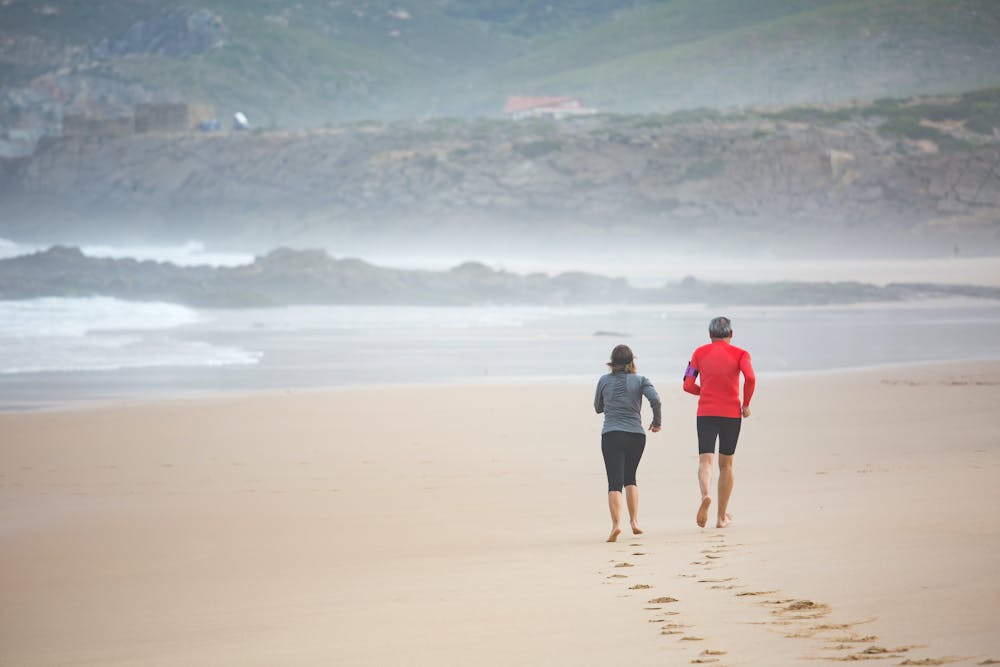
Barefoot running is just not for everyone. Shutterstock
We studied 76 runners who transitioned to barefoot running over 20 weeks – using a minimal running shoe as an intermediate phase between traditional shoe and barefoot running.
The runners ran in traditional running shoes for the first four weeks. For the next four weeks, they increased their time in minimal running shoes by no more than 20% of their total running volume each week.
After running full-time in minimal shoes for another four weeks, they then spent the next four weeks gradually increasing their time running barefoot by no more than 20% per week.
Finally, they ran barefoot for a further four weeks.
We also asked the runners to do some calf and foot strengthening and stretching, to assist the muscles in the move from traditional shoe to barefoot running.
Using this strategy, 70% of runners were able to successfully transition to barefoot running over 20 weeks.
Pain in the calf when running in minimal shoes and pain in the foot when running barefoot were the main reasons for not being able to switch to barefoot running.
We identified two features that were present in runners who failed to transition to barefoot running.
Contacting the ground first with the heel while running was one, and the other was very mobile feet (which means the arch is more flexible when the foot is bearing weight).
Why? It’s too early to say for sure, but we do know barefoot running tends to increase stress in the tissues of the foot and calf.
Our findings seem to indicate this tissue stress was not well tolerated in those who habitually contact the ground with their heels and/or have very mobile feet when they run barefoot or in minimal shoes.
This may result in pain and eventually injury. We also know fromotherstudies that running barefoot or in minimal shoes will result in higher rates of foot injury (such as stress fractures of the bones of the foot) and pain in the shin and calf. Traditional shoes usually provide more support and cushioning.
It seems runners who habitually contact the ground with their heel while running find it difficult to switch to contacting the ground with more of their midfoot or forefoot, which is what barefoot running tends to promote.
Those with mobile feet may need their muscles to work harder to stiffen the foot when pushing the foot off the ground while running.
Perhaps a more gradual transition period during which the limit is 10% (not 20%) weekly increase of running in minimal shoes or barefoot spread over a longer period (such as 40 weeks) would enable those wishing to run barefoot to do so without pain or injury.
If you want to try barefoot running, transition gradually. Shutterstock
Top tips for successful barefoot running
If you’re keen to try barefoot running, keep these tips in mind:
transition gradually over at least 20 weeks. Take longer if needed
use a minimal shoe as an intermediary, if possible
limit any increase in running in minimal shoes or barefoot to no more than 20% of total running distance per week
use pain during and in the 24 hours after running as a guide – especially if you feel the level of severity is unacceptable
consult a sports and exercise health care professional (such as a physiotherapist or podiatrist) if you experience pain or require assistance in transitioning – especially if you have previous injuries
consult a qualified run coach to assist with your running program
when barefoot running, protect your feet by running in well-lit conditions so you can see obstacles, and avoid excessively hot, cold or sharp surfaces
mix it up – people who run in lots of different types of footwear report fewer injuries than those who only run in one type of shoe.
It may also be that some runners are just not able to switch from their traditional running shoes to barefoot running.
Barefoot running may not be for everyone. It will not make you faster or reduce overall injury rate, and there is no evidence running barefoot burns more calories than running with shoes.
But if you’re thinking of giving barefoot running a go, transitioning gradually – using a minimal running shoe as an interim step – is more likely to result in a successful transition, and keep you running.
Natalie Collins has received funding from the National Health and Medical Research Council, Medical Research Future Fund, and Arthritis Australia. New Balance provided all shoes used in this study, free of charge, through the New Balance Global Scientific Award. New Balance had no input into the design of the study or interpretation of the results.
Bill Vicenzino has received funding from New Balance Global Scientific Award.
Kathryn Mills has received in-kind support from the New Balance Global Scientific Award. She is the current chair of the International Footwear Biomechanics Group, which is a volunteer role.
Many of us are drowning in “stuff”. To find space for all our possessions, we are paying off-site storage companies. Australians spend an average of A$163 per month on self-storage, one recent survey found.
The number one item stored in these facilities is furniture. Other items we cannot fit in our houses include appliances and electronics, hobby items, sports equipment, collectibles, memorabilia, books and photographs, cars and wine.
Around a quarter of customers cannot remember what is actually in their storage unit. Around 13% use them to hide their purchases from others.
The massive growth of the household storage industry is a sign of overconsumption. It’s a problem in many developed economies that’s doing increasing harm to the planet.
Unfortunately, the Earth does not have an off-site storage option. Curbing our desire to consume has to be the solution.
Costs are mounting for us and the planet
Australians owe, on average, about $3,800 in credit card debt and a further $17,700 in personal debt (excluding property debt, which averages $565,880).
This year Australian shoppers were expected to spend $63.9 billion in the six weeks before Christmas, about $2,458 per person.
We waste a lot of what we buy. For example, each year Australia wastes 7.6 million tonnes of food, with consumers accounting for half of this waste. The food we throw out is worth between $2,000 and $2,500 per household – or up to $1,000 per person.
That’s just the start of the wasteful spending – think of all those gym memberships, gift cards, clothes, appliances and furniture we’ve bought but don’t use.
In total, Australian households produce about 12.4 million tonnes of waste each year. That equates to roughly half a tonne per person.
We are not just spending beyond our personal means but also beyond what our planet can sustain.
Eventually, we will run out of places for all this waste to go.
People who own lots of stuff, or who collect things, are not necessarily hoarders, but may struggle to part with personal and household possessions. The reason can in part be explained by Belk’s concept of the extended self. This is when possessions become part of our identity and signal to others who we are and, importantly, who we want to be.
This is certainly the case for those who collect things. Our collections become a part of us and our life story. It can be difficult to disentangle ourselves from these possessions.
Some things we own may have symbolic value because they remind us of special people, places and events, such as gifts from a friend or souvenirs from a holiday. Possessions that still have potential financial or utilitarian value can also be hard to give up.
Part of the problem is we are exposed to thousands of advertisements every day and a huge array of cheap products. The temptation to keep buying things can be too much for many people.
In their 2005 book Affluenza, Clive Hamilton and Richard Denniss describe the Western world as being in the grip of consumerism. Fast forward to 2022 and it appears we haven’t changed much. Behaving as though we have a chronic lack of stuff, we simply buy too many things we don’t need.
Many Australians live in small houses or apartments that lack space for all their things. Even those in large houses find they are overflowing with possessions but are loath to give up some of them.
The solution is we pay someone else to store our possessions – and we pay a lot. Self-storage in Australasia has grown into a $1.5 billion industry.
There are about 2,000 self-storage facilities across Australia and New Zealand. Some house hundreds of individual storage units.
Depending on the size, location and type of storage unit (for example, climate-controlled for wine collections), the costs can add up to thousands of dollars a year for some people.
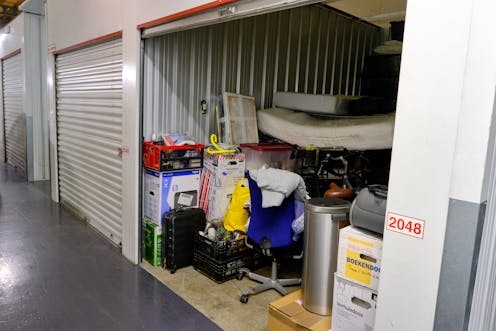
Self-storage businesses in Australasia have grown into a $1.5 billion industry. Shutterstock
It is easy to be swept up in the shopping frenzies of Christmas and new year sales. We are “programmed” to spend by marketers and retailers who surround us with temptation in stores and online.
But there are things you can do to help counter the impulse to buy and reduce its impacts.
Make a list and set a budget before you head to the shops, and try to stick to it. Use cash instead of cards when you can. Research shows people feel the cost of paying more when using cash. Don’t shop on an empty stomach or when you are tired.
Where possible, shop locally and buy locally made items. It’s great for your local economy, and the planet benefits from fewer air miles.
Rather than products, consider gifts of experiences, which don’t involve accumulating “stuff”. Options include creative classes, entertainment, sports, or health and beauty services.
Look for products with less packaging or with biodegradable packaging. Buy loose products and choose refillable options where you can.
Ask yourself: do I really need to buy this? If I didn’t have a credit card, could I actually afford it today?
We can all use self-monitoring to improve our spending habits and reduce the environmental costs.
The authors do not work for, consult, own shares in or receive funding from any company or organisation that would benefit from this article, and have disclosed no relevant affiliations beyond their academic appointment.
Black holes form natural time machines that allow travel to both the past and the future. But don’t expect to be heading back to visit the dinosaurs any time soon.
At present, we don’t have spacecraft that could get us anywhere near a black hole. But, even leaving that small detail aside, attempting to travel into the past using a black hole might be the last thing you ever do.
What are black holes?
A black hole is an extremely massive object that is typically formed when a dying star collapses in on itself.
Like planets and stars, black holes have gravitational fields around them. A gravitational field is what keeps us stuck to Earth, and what keeps Earth revolving around the Sun.
As a rule of thumb, the more massive an object is, the stronger its gravitational field.
Earth’s gravitational field makes it extremely difficult to get to space. That’s why we build rockets: we have to travel very fast to break out of Earth’s gravity.
The gravitational field of a black hole is so strong that even light can’t escape it. That’s impressive, since light is the fastest thing known to science!
Incidentally, that’s why black holes are black: we can’t bounce light off a black hole the way we might bounce a torch light off a tree in the dark.
Stretching space
Albert Einstein’s general theory of relativity tells us matter and energy have a curious effect on the universe. Matter and energy bend and stretch space. The more massive an object is, the more space is stretched and bent around it.
A massive object creates a kind of valley in space. When objects come near, they fall into the valley.
Massive objects (like planets, stars and black holes) create ‘valleys’ in space. Shutterstock
That’s why, when you get close enough to any massive object, including a black hole, you fall towards it. It’s also why light can’t escape a black hole: the sides of the valley are so steep that light isn’t going fast enough to climb out.
The valley created by a black hole gets steeper and steeper as you approach it from a distance. The point at which it gets so steep that light can’t escape is called the event horizon.
Event horizons aren’t just interesting for would-be time travellers: they’re also interesting for philosophers, because they have implications for how we understand the nature of time.
Stretching time
When space is stretched, so is time. A clock that is near a massive object will tick slower than one that is near a much less massive object.
A clock near a black hole will tick very slowly compared to one on Earth. One year near a black hole could mean 80 years on Earth, as you may have seen illustrated in the movie Interstellar.
In this way, black holes can be used to travel to the future. If you want to jump into the future of Earth, simply fly near a black hole and then return to Earth.
If you get close enough to the centre of the black hole, your clock will tick slower, but you should still be able to escape so long as you don’t cross the event horizon.
Loops in time
What about the past? This is where things get truly interesting. A black hole bends time so much that it can wrap back on itself.
Imagine taking a sheet of paper and joining the two ends to form a loop. That’s what a black hole seems to do to time.
This creates a natural time machine. If you could somehow get onto the loop, which physicists call a closed timelike curve, you would find yourself on a trajectory through space that starts in the future and ends in the past.
Inside the loop, you would also find that cause and effect get hard to untangle. Things that are in the past cause things to happen in the future, which in turn cause things to happen in the past!
The catch
So, you’ve found a black hole and you want to use your trusty spaceship to go back and visit the dinosaurs. Good luck.
There are three problems. First, you can only travel into the black hole’s past. That means that if the black hole was created after the dinosaurs died out, then you won’t be able to go back far enough.
Second, you’d probably have to cross the event horizon to get into the loop. This means that to get out of the loop at a particular time in the past, you’d need to exit the event horizon. That means travelling faster than light, which we’re pretty sure is impossible.
Third, and probably worst of all, you and your ship would undergo “spaghettification”. Sounds delicious, right?
Sadly, it’s not. As you crossed the event horizon you would be stretched flat, like a noodle. In fact, you’d probably be stretched so thin that you’d just be a string of atoms spiralling into the void.
So, while it’s fun to think about the time-warping properties of black holes, for the foreseeable future that visit to the dinosaurs will have to stay in the realm of fantasy.
Sam Baron receives funding from the Australian Research Council.
The idea of a “forgotten prime minister” may seem laughable. For Australian historians, it is the governed rather than the governors who need rescuing “from the enormous condescension of posterity” as the English historian E. P. Thompson famously put it.
Our First Nations histories especially were for too long silenced and concealed in what the anthropologist Bill Stanner called a “cult of forgetfulness practised on a national scale”.
Prime ministers, on the other hand, are stitched into the tapestry of national history thanks to extensive newspaper coverage, the dogged pursuits of political biographers, and the quest of archivists and librarians to collect their personal papers. Deceased leaders’ names adorn buildings and streets, federal electorates, and dedicated research centres, and in Harold Holt’s case, a memorial swimming pool.
But some, of course, are better known than others. So which prime ministers, if any, can be considered “forgotten” by contemporary Australia? And what does that act of forgetting reveal about our political culture? Commemorative rituals and opinion surveys suggest that some have very much receded from memory.
Here are a few prime ministers who deserve to be a little better known.
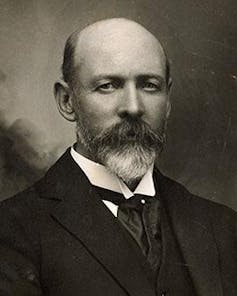
Edmund Barton 1901-03
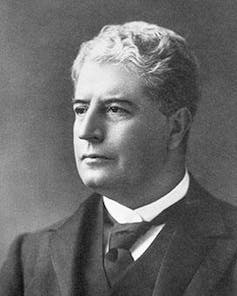
Edmund Barton, Australia’s first prime minister. National Archives of Australia
Barton was a hugely significant figure in his day. A leading advocate of federation, he was summoned by the Governor-General Lord Hopetoun (after a false start) to form the first Commonwealth government.
Between 1901 and 1903, Barton’s government, with the dynamic Alfred Deakin as its attorney-general, established some of the national institutions we now take for granted, such as the public service and the High Court. Barton and Deakin’s deeply racial vision of a White Australia was also enacted in legislation in these years.
Australia’s first prime minister (known to detractors as Tosspot Toby) helped to establish the machinery of federal government out of nothing. But this earned him no special place in Australian collective memory. Resigning in 1903, he spent the remainder of his life as a reticent statesman and High Court judge.
George Reid 1904-05
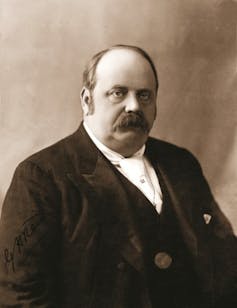
George Reid, a political enemy of Barton’s, held office from 1904-05. Museum of Australian Democracy
Reid was a political opponent of Barton’s. The defining issue of the early Commonwealth was tariff policy, and all other matters – industrial development, employment, and individual liberty – were refracted through the “tariff question”. Reid, a former New South Wales premier who had earned the moniker “Yes-No Reid” for his prevarications during the earlier federation debates, was a devout advocate for and leader of the Free Trade movement.
Reid was summoned to form a government in August 1904. Hamstrung by his lack of a parliamentary majority, he remarkably passed the Conciliation and Arbitration Bill. This was core business for the early Commonwealth, and two previous ministries had failed to secure it. But Reid’s attempts to settle the tariff question with Deakin’s Protectionists failed, and his ministry was defeated in parliament in July 1905.
Joseph Cook 1913-14
Joseph Cook, together with Reid, was instrumental in establishing the two-party system that continues today. National Archives of Australia
Out of office, Reid and his Free Trade colleague Joseph Cook played a crucial role in making the two-party system that endures today. Whatever their differences with Deakin and the protectionists, Reid and Cook (himself a former Labor MP in New South Wales) saw the rising Australian Labor Party as the real enemy.
Reid travelled the country establishing anti-socialist leagues and building the groundwork for a united anti-Labor Party. When the tariff schedule was finally settled in 1908, and the mutual animosity between Deakin and Reid seemed the only barrier to a Liberal fusion, the latter sacrificed himself and resigned so that the former could join forces with Cook on his own terms.
In 1913, Cook led the new Commonwealth Liberal Party to a federal election, winning by the narrowest of margins. He oversaw the opening weeks of the Great War the following year, committing 20,000 Australian troops and the Australian Navy to Britain, but soon lost power in Australia’s first double dissolution election.
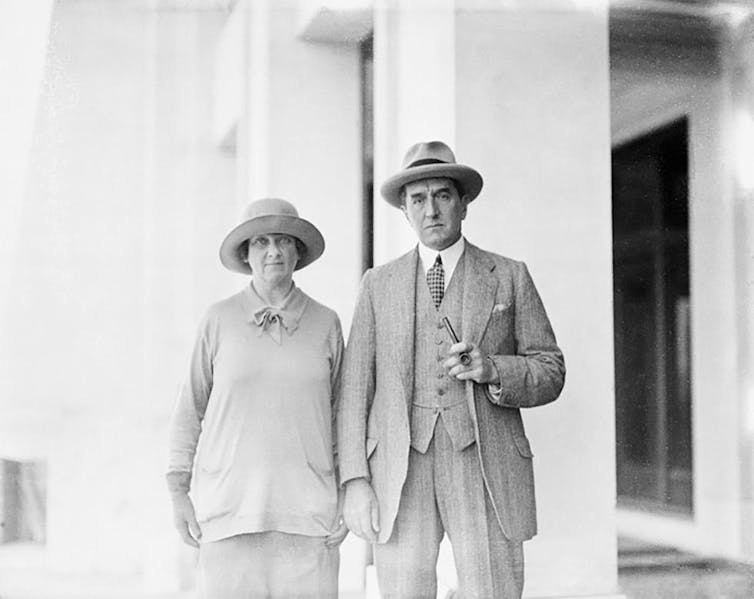
Stanley Melbourne Bruce 1923-29
After the war, the task of national leadership fell to Stanley Bruce, a young businessman and ex-serviceman from Melbourne. In 1923, as leader of the non-Labor forces (now reconstituted as the Nationalist Party), Bruce formed government with Earle Page’s Country Party (forerunner of today’s rural National Party). In doing so, Frank Bongiorno has recently explained, Bruce and Page ‘inaugurated the Coalition tradition on the conservative side of Australian federal politics’.
Stanley Melbourne Bruce (pictured with his wife Ethel) had the task of leading the country after the first world war. National Archives of Australia
Bruce’s government was ambitious for Australia in the “roaring ‘20s”. He envisioned a future underscored by British migrants, British money and imperial markets. In power for six years, he presided over the creation of the Loans Council and the federal parliament’s move from Melbourne to Canberra in 1927.
But like others before him, he came unstuck on the issue of centralised arbitration. His attempt to abolish the federal arbitration court (with a view to restraining wage growth) saw his government defeated and his own seat lost in the 1929 election.
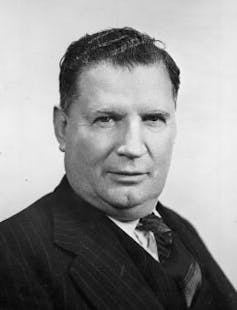
Arthur Fadden 1941
Arthur Fadden was chosen to lead his party after Robert Menzies resigned. National Archives of Australia
In the early 1930s, conservatives once again reorganised in the form of the United Australia Party, and dominated politics for the ensuing decade. But by 1941, after two years of wartime leadership, the young leader Robert Menzies appeared to falter. His colleagues disliked his brisk manner and the public lacked confidence in his government’s war efforts. A hung parliament after the 1940 election, in which two Independents held the balance, confirmed this. With his position untenable, Menzies resigned in August 1941 and the coalition unanimously chose Fadden, the Country Party leader, to replace him.
“Affable Artie” was a widely respected figure and apparently the only one who could hold together a decade-old government too consumed by infighting to meet the demands of the moment. His premiership lasted just 40 days, at which point the Independents offered John Curtin and Labor their support. The sole Country Party leader to become prime minister on a non-caretaker basis, Fadden was one of a small handful of men to lead the nation in a global war.
Australia and Its Forgettables
Why is it that these five prime ministers are largely absent from national memory? Four factors seem particularly significant.
First, contemporary Australian political discourse offers only a shallow sense of history. Political reporting rarely reaches for historical depth, and when it does, the second world war tends to be the outer limit.
Moreover, when Australians are asked to rank their prime ministers and select a “best PM”, they rarely reach beyond living memory.
The federation generation, overshadowed by the first world war, fare especially poorly. In the 1990s, with the centenary of federation fast approaching, surveys revealed that Australians knew less about its federal founders than they did about America’s ‘founding fathers’. What kind of country, the civics experts implored, could forget the name of its first prime minister? Tosspot Toby was no match for Simpson and his donkey.
Second, Australians prefer to think of their political history in terms of heroes and villains (often embodied by the same individuals). Those binary roles require gregariousness, dynamism, some controversy, and the occasional serving of larrikinism. “Tall poppy syndrome” notwithstanding, partisan heroes like Menzies and Gough Whitlam, or infamous rats such as Billy Hughes, make for easy storytelling.
The forgettables are more often reserved, restrained or even polite characters. The Primitive Methodist Joseph Cook was “[s]olemn and humourless”. The patrician Bruce was judged “too aloof and reserved to be an Australian”. And Frank Forde, in his old age, maintained that all of his colleagues and opponents had been “outstanding” and “capable men” for whom he had only “friendly feeling”. This is not exactly the stuff of masculine political legend.
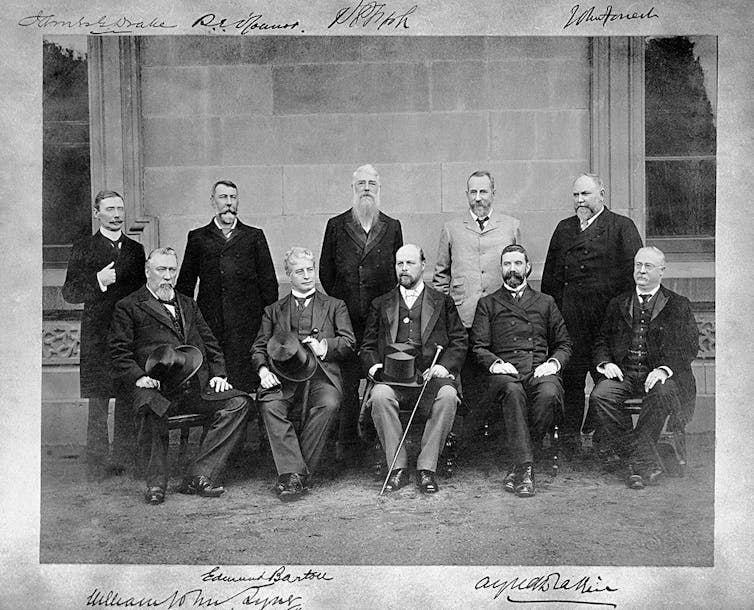
Alfred Deakin has tended to absorb the historical limelight and cast long shadows over his contemporaries, not least because he furnished historians and biographers with rich personal papers. (Barton scrupulously destroyed most of his). But as Sean Scalmer has argued, we ought not to overlook the influence of Deakin’s contemporaries in the making of Australian politics as we know it.
Alfred Deakin (front row, second from right) has tended to cast a long shadow over his contemporaries. Australian Parliamentary Library
Third, prime ministers are rendered immemorable if they were judged to be temporary, or presiding over some kind of interregnum. Australians have valorised the longevity and stability of Menzies and Howard, or the sense of epochal change that accompanied Whitlam and Hawke. Men like Reid, Cook and Fadden seem transitory in comparison.
Fourth, public memory has often depended on the sponsorship of major parties and their affiliated scribes and institutes. The corollary is that those who preceded the two-party system are harder to commemorate. Labor has been excellent at proselytising its great leaders and their great reforms, and demonising the rats and renegades. The Liberal Party, on the other hand, has struggled to memorialise its antecedents and influences (Deakin perhaps excepted). Menzies and Howard predominate in the collective Liberal psyche, and Liberal forerunners from Barton to Bruce rarely get a look-in.
Joshua Black is supported by an Australian Government Research Training Program Scholarship.
Hanging out at the beach, body surfing, boogie boarding or just cooling off in frothy waves under a hot sun are all part of a typical Kiwi summer.
But with an extensive coastline, plenty of hazardous surf and a poor water safety record, swimming between red and yellow flags under the watchful gaze of surf lifesavers is a reassuring part of the experience. Over the years, brave and capable lifeguards have saved thousands of lives.
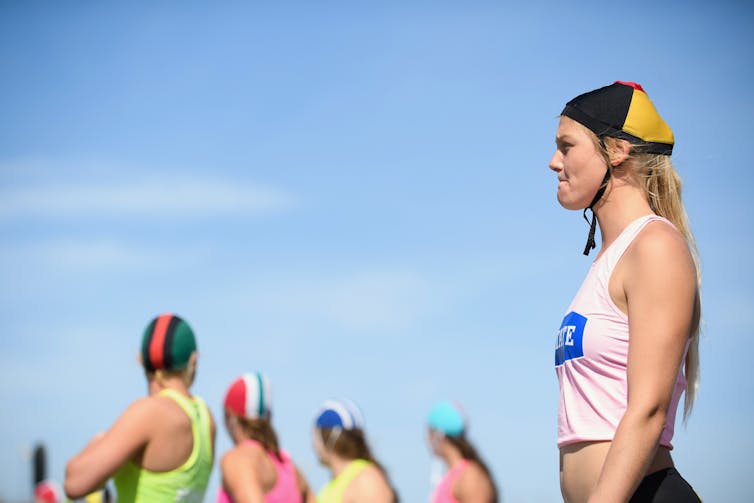
And these days you’re just as likely to be saved by a female guard as a male one. Girls and women now expect to be able to participate and compete in surf lifesaving. But it wasn’t always that way. Until relatively recently, patrolling the beach and waves was pretty much a male domain.
In many ways, the story of how surf lifesaving cast off its Edwardian-age origins of masculine grit and strength mirrors social progress in New Zealand in general. And it involves tenacious and talented women who braved the waters to open the way for others.
Taken for granted now, women were once excluded from surf lifesaving in New Zealand. Getty Images
Locked out of the changing room
Surf lifesaving landed on New Zealand’s shores in 1910, having crossed the Tasman from Australia where it was already taking hold. The volunteer club movement included both rescue work and sport. It quickly adopted a masculine culture that involved patrols of men drilling, training and competing.
Strength and fitness were considered prerequisites for rescuing bathers in trouble. Swimming out in a belt attached to a rope, throwing out and reeling in ropes, and rowing boats weren’t seen as women’s jobs.
Historians Caroline Daley and Charlotte Macdonald have examined the separation of women and men into different sports, and traced the development of an early lifesaving mythology: tanned muscular men, with women cast in a feminine supporting role, providing afternoon teas at the surf club or sunbathing on the sand. Saving lives was men’s work.
In reality, women always wanted to be actively involved and were buoyed by growing feminist attitudes and awareness in wider society. By the 1920s, women’s teams were forming at various clubs around the country. There were even some separate women’s clubs.
Researcher Elena Simatos examined the records of the Canterbury Surf Life Saving Association (CSLSA) from 1917-1990 to see if women had been “locked out of the changing room”. Despite the growing involvement of women, it seems there was clearly still prejudice against them.
In 1928, for example, the “Ladies” Sumner team was granted permission to compete for surf medallions and in club lifesaving events. But soon after, the CSLSA discussed the “question of the desirability of lady members entering into surf competitions” and banned women in Canterbury from competing.
Experiences varied according to the beliefs of individual members and the culture of each club. Overall, though, change came slowly through the steady chipping away at a dominant culture steeped in a tradition of exclusively male strength.
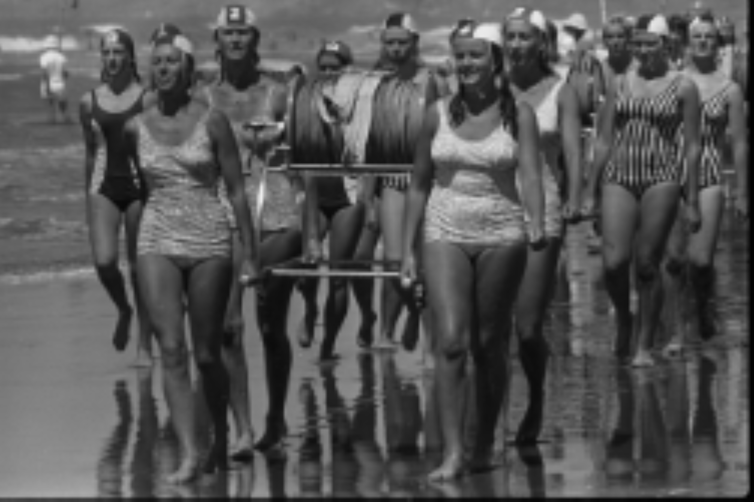
Female teams at the Waimairi Beach surf lifesaving competition, 1974. Christchurch City Libraries. CCL-Star-1974-2220-004-035N-02
Women hit the waves
Emergency regulations during the second world war allowed women to patrol beaches while the men were away fighting. But the change was reluctant and fleeting. There were concerns about the “physical strain” on women in surf races, with limits placed on the most challenging races.
But the post-war years saw some gains. Histories of surf lifesaving by Douglas Booth, Bob Harvey, Tony Murdoch and Christine Thomas have shown how the dominant culture continued to be eroded, with women’s clubs acting as incubators of female participation. Women were allowed to become summer beach patrollers and be paid for their work.
The first of New Zealand’s paid women patrollers was probably Daphne McCurdy (née Dasler), who received NZ$40 a week during the 1969-1970 summer season at Waimairi and North Beach in Christchurch.
McCurdy came from a family of swimmers, surfers and surf lifesavers and grew up near the North Beach Surf Life Saving Club. By 1969, she told me, she had gained the skills and tenacity for the job:
At the time of my appointment I had been active in surf lifesaving four-man, six-man and surf-race teams for more than a decade, was known for my ability to successfully pull a belt in rough seas, could ride a paddleboard if required and had trained most of my club’s boat crew members who had been recruited from the local football clubs. On the day of my appointment I was second in the surf swim test. I was the only female.
Swimming with the feminist tide in the 1970s, other paid women beach patrollers followed McCurdy. More girls and women entered competitions, and there were some mixed competitive teams around the country. More awards were also given – with titles such as “Lady Surf Life Saver of the Year”.
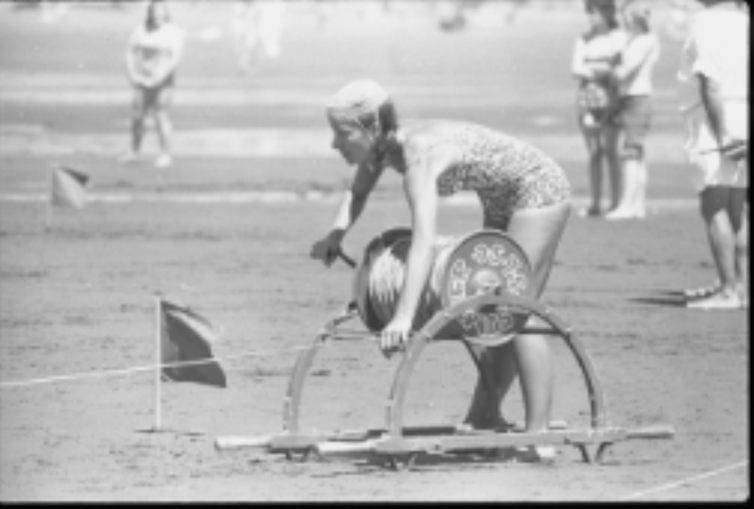
Proving women could do what men did, also at the 1974 Waimairi Beach surf lifesaving competition. Christchurch City Libraries. CCL-Star-1974-2220-004-035N-02
‘Amazons of the sea’
And yet, while women such as Jan Pinkerton and Christine Thomas gradually assumed leadership roles, surf lifesaving was still far from a gender-equity workplace. As author Sandra Coney noted in her 1985 article Amazons of the Sea for feminist magazine Broadsheet, there were only two women, Kate Sheriff and Muriel Brown, on the honours board of the Auckland Surf Life Saving Association.
Family background and connection, Coney argued, were still important for women like Sue Donaldson of Muriwai. Like Daphne McCurdy, she’d first become a lifeguard at Christchurch’s North Beach. Also like McCurdy, her father, brother and sister were lifeguards.
Nonetheless, women were making inroads, and the cultural reputation of surf lifesaving in New Zealand was always better than Australia’s. Historian Caroline Ford has written of “rampant misogyny” on Sydney beaches, where it took until 1980 for the Australian Surf Life Saving Association to allow women to become active surf lifesavers.
Still, Coney uncovered plenty of evidence of a macho, drink-fuelled local culture, involving “chunder miles where increasingly blotto clubbies stagger from jug to jug before disgorging a full frontal puke”. “Other typical boyish pranks [included] publicly stripping men of their togs and hoisting women’s knickers on the club flagpole.”
Did new technology shake up old prejudices and promote equality for all on the waves? On the contrary, Coney reported that “men have colonised the beaches”, keeping women away from new equipment that compensated for sheer physical strength.
In the 1950s and 1960s at Piha beach near Auckland, Coney’s sister Helen Watson couldn’t join the surf lifesaving club or use “all the interesting equipment – the skis, boards and boat”, and was “excluded from taking part in competitions”.
New lifesaving equipment was nabbed by the men. As Bryony Coutanche said of the heavily male-dominated board riding scene: “I was told to ‘get off, this is my wave’. The men are awful and when you’re learning it’s hard.”
By 2017, half of New Zealand’s surf lifeguards were women, but they made up only 28% of rescue boat drivers. A recent survey found girls and women still faced some barriers to participation.
Still, if surf lifesaving has never radically led the way for gender equality, its culture has changed with the times. A Wahine on Water program sets out to redress the remaining gender imbalance, providing mentors and training opportunities. And Surf Life Saving New Zealand has made it a mission to include all peoples and cultures within the organisation.
Lifesaving is heroic work that often shows people at their most humane and caring. So it’s good to see an inclusive culture being built for those welcome guards who watch over us while we relax and enjoy summer at the beach.
This article benefits from research by Elena Simatos in her 2016 University of Canterbury History BA (Hons) research essay, “Locked out of the changing room? A gendered history of surf lifesaving in Canterbury 1917-1990”, which was supervised by the author.
Katie Pickles does not work for, consult, own shares in or receive funding from any company or organisation that would benefit from this article, and has disclosed no relevant affiliations beyond their academic appointment.
Source: The Conversation (Au and NZ) – By Alina Morawska, Deputy Director (Research), Parenting and Family Support Centre, The University of Queensland
You’re running late for work, your eight-year-old can’t find the homework they were supposed to have put in their school bag last night, your four-year-old objects to the blue t-shirt you’d prepared and wants the other shade of blue, and then you step on a Lego piece that didn’t get packed away when you asked.
Even if you haven’t encountered this exact situation, just thinking about it might raise your hackles. Parenting comes with many emotions. Anger and frustration are not uncommon and may have been exacerbated by the stressors of the COVID-19 pandemic.
It’s OK for children to see parents experience and manage different emotions. But when getting angry, yelling and shouting are a default response, this can have negative consequences for children (and parents).
A parent’s propensity to react emotionally can increase the likelihood parents will react more harshly, punish their child excessively, or smack their child.
Extensive research has shown smacking is harmful for children’s development.
Reducing the risk of conflict
Parenting isn’t easy and doesn’t come with a manual. Many everyday situations can contribute to parents experiencing irritation and anger.
The best way to manage anger is to try to reduce the likelihood these situations will arise.
Important strategies to reduce the likelihood of problems arising in the first place include:
focusing on the positive
building strong relationships with children
communicating effectively
praising children
teaching children independence skills
putting in place effective family routines
having clear rules and boundaries and backing them up with appropriate consequences.
Building strong relationships with children reduced the risk of problems arising in the first place. Shutterstock
Looking after yourself
It is much harder to be calm, patient and persistent when parents’ own needs are not met and when parents are stressed or under pressure.
An important aspect of managing emotional reactivity is to look after your own wellbeing.
Take time out for yourself, balance your work and family responsibilities, and talk to your partner or other carers and support people about how you can get some time to yourself.
Strategies based on cognitive behavioural approaches – such as relaxation and breathing exercises – can also be helpful ways to reduce anger.
It’s important for parents to take time out for themselves, where possible. Shutterstock
OK but I still need help managing my anger in the moment. What now?
So you’ve done the parenting program, you’re looking after yourself and still you find yourself struggling to tame your anger. That Lego piece really hurt and how many times do you have to ask for things to be packed up anyway?
Sometimes even the best preparation and prevention strategies may not avoid a particular problem, so having a plan for what you can do in that moment is important.
When fury rages inside you, start by taking a few deep breaths. Focusing on relaxing muscles or counting to ten – anything to slow down your emotional reaction – can be helpful.
Remind yourself your child hasn’t done this on purpose and that while it’s frustrating, you can stay calm.
What we say to ourselves about a situation and why it happened can also increase our feelings of anger.
Research shows the attributions we make – meaning the explanations or reasons we have for situations or for our child’s behaviour – can play an important role in the way we react emotionally.
For example, if you think your child is deliberately trying to make your life miserable with their t-shirt choices, you are more likely to feel angry.
If, on the other hand, you say to yourself, “This is important to them and they’re only four,” you are much more likely to stay calm.
Try to catch the negative thoughts that come into your head in those situations that make you feel angry. Replace them with more helpful ones.
For examples, rather than saying “This is just not fair” you could say “This is upsetting, but I can deal with it.” It might feel awkward at first, but give it a try.
Anger is a human emotion. It can motivate us to persist in the face of difficulties, can be a way of reducing tension and can act as a signal to deal with a stressor we’re facing.
It can also cause harm to ourselves, our children and our relationships if it is not managed well.
Finding effective ways to positively manage those feelings of annoyance and irritation is important to ensuring positive family relationships.
The Parenting and Family Support Centre is partly funded by royalties stemming from published resources of the Triple P – Positive Parenting Program, which is developed and owned by The University of Queensland (UQ). Royalties are also distributed to the Faculty of Health and Behavioural Sciences at UQ and contributory authors of published Triple P resources. Triple P International (TPI) Pty Ltd is a private company licensed by Uniquest Pty Ltd on behalf of UQ, to publish and disseminate Triple P worldwide. Dr Morawska has no share or ownership of TPI. Dr Morawska receives royalties from TPI. TPI had no involvement in the writing of this articles. Dr Morawska is an employee at UQ. Dr Morawska is on the Board of Directors of the Parenting and Family Research Alliance.
When I was ten, I was the only female member of an all-boys sports team, and the boys liked to remind me of it, and that it would be better if I just went home.
That was my introduction to sexism. And its logic was clear: you are not welcome, go home.
It is also how many of us used to think about racism and sexism – as involving big, conscious signals of hatred or exclusion.
We now understand discrimination as a more complex phenomenon, involving a mix of big and small, intentional and unthinking, acts. Racism can be a large “not welcome” sign, but it can also be a series of micro-aggressions that leave racial minorities feeling marginalised, stigmatised or emotionally exhausted from repeated attempts to claim their rightful place on the team or at the table.
Sexism can be telling women and girls to – literally – go home, or it can be merely forgetting to unlock the girls’ locker room or provide protective gear designed for female bodies.
Performed repeatedly, these small acts can have systematic consequences for the choices women make about their lives and their sense of where they belong.
These acts can also have broader ripple effects on those witnessing them or walking alongside those affected. They are one way racism and sexism become systemic – baked into our social and legal structures.
Laws hurt, but they can help
Our laws are another source of systemic bias. Among them are laws that penalise crack cocaine more heavily than its whiter, powdered equivalent.
But laws can also be an important counter to bias. They can give women and marginalised groups the right to enter domains for which they have been excluded and stay there.
They can, for example, require equal funding for male and female sports teams.
And they can even require employers and educational institutions to make accommodations that make staying in institutions and succeeding possible.
Among such laws are laws that require wheelchair access and Braille signage and paid sick and carer’s leave.
These are not cheap for employers and educational institutions, but they can make a big difference to the lives and employment chances of those they help.
Micro-accommodations, to fight micro-aggressions
But laws can’t do everything. That’s why employers, managers and co-workers need to go further and provide small but meaningful accommodations to individual employees to help them thrive, rather than just survive, at work.
We could think of them as micro-accommodations. Like micro-aggressions, micro-accommodations involve acts that seems small to those making them, but if repeated can have much larger positive consequences for those they target.
Micro-accommodations can take the form of small scheduling adjustments. They might involve changing a start or finish time by a few minutes to accommodate school or daycare drop offs and pick ups, or short blocks in meeting calendars for parents to welcome their children home from school, or reordering presentations in meetings to allow people to arrive later or leave earlier.
Or they could involve providing short breaks for people to take prescribed medicines, or to briefly stretch to help manage injuries.
A micro-accommodation can be re-ordering a meeting. Shutterstock
For me, as an 11 year old in an all-boys sports team, micro-accommodations initially took the form of a scheduled break to allow me to access a far-away female bathroom, and later, an agreement among my team that I could have brief but exclusive use of the male locker room.
This made a big difference to my focus and batting average (it was baseball, in the United States) and more significantly to my sense that I had a place in the team.
That message of inclusion may not have erased the messages of past exclusions, but it definitely helped mute them.
In principle, micro-accommodations could take any form – so long as they go beyond what’s required by law, and impose only modest costs on those providing them.
Think of efforts by employers to provide halal, kosher, vegan or gluten-free menu options, or to provide proportional parking prices for those working part-time.
One of the most famous micro-accommodations in recent memory was documented by former Google and Facebook executive Sheryl Sandberg in her best-selling book, Lean In.
Pregnancy parking can be simply a matter of rearranging parking spaces. Shutterstock
Pregnant, late for a meeting, and only able to find a parking spot far from the front door of Google’s headquarters, Sandberg asked Google co-founder Sergey Brin for pregnancy parking closer to the door. He immediately said yes and said he wondered why the idea hadn’t occurred to him previously.
The cost was small: simply a matter of re-arranging parking spots rather than providing more. And the benefit to a pregnant Sandberg was huge. (If you don’t understand why, consider how hard it can be to walk quickly while heavily pregnant!)
Perhaps more important, it was a change that lasted well beyond Sandberg’s own pregnancies, benefited many other women at Google, and never became something they needed to negotiate each time they drove to the office.
Favours are not micro-accomodations
There is certainly value in managers and co-workers responding to requests for accommodations beyond what the law requires.
But asking has costs – it can cause anxiety and stress, it can be exhausting, and it can re-reinforce “not belonging”.
My own experience attests to this. When I started university teaching in Australia with a small baby, I was told that my classes would be at night, but that I could ask a colleague if they would consider swapping with me, as an accommodation.
I was fortunate that a colleague was generous and agreed to swap. It was a sacrifice for him, but not a large one. But the act of asking felt awkward and stressful. I really needed my colleague to say yes, if I was to keep doing the job I loved.
The question I kept asking myself was why it had become my responsibility to make things work rather than my employer’s.
The good news is that I and others repeatedly made this point, and there is now a far better policy: all staff at my university are invited to complete a form indicating when they can and cannot teach, and any special circumstances. Those who do the timetabling take this into account.
This is the difference between a favour and a micro-accommodation: a favour is inter-personal and ad hoc; a micro-accommodation is formalised so that all employees in the situations can benefit for as long as they are in that situation.
And micro-accommodations are public rather than private – not something workers have to keep quiet or minimize.
Favours are private, micro-accommodations are public
Private favours and quiet forms of “personal workarounds”, which are communicated on a need-to-know basis have downsides.
They are less effective because well-meaning colleagues can misunderstand and undermine them, and they are unlikely to have larger, systemic benefits.
Not advertising a workaround means it is likely to stop at one person.
Here’s an example. One of my co-workers, Marian, trialled a personal workaround involving blocking out a short period in her calendar after her kids came home from school. Because she didn’t advertise it to her team, she kept receiving calls and urgent queries during this time.
We discussed the challenges, and I encouraged her to communicate the workaround to her team.
As soon as she did, the results were different. The blocked-out time was almost never interrupted, and she found it much easier to look forward to her kids arriving home and spending time with them.
How to create micro-accommodations
Micro-accommodations are best when targeted to specific needs, as Marian’s was.
And they work best when they are initiated by managers, rather than employees. This takes an emotional load off workers and sends a powerful signal of inclusion.
Asking employees how best to accommodate their needs is one way to do it, but this still imposes an emotional responsibility on those being asked.
Another better way to do it is to informally audit facilities and schedules to see if they make sense for staff.
The resulting accommodations might be as simple as shifting important meetings and reporting deadlines away from major religious and school holidays.
Or making sure meetings don’t start at 9pm or finish at 6pm if childcare centres opens at 9am and close at 6pm.
Or making sure politicians don’t schedule big votes at unfriendly times.
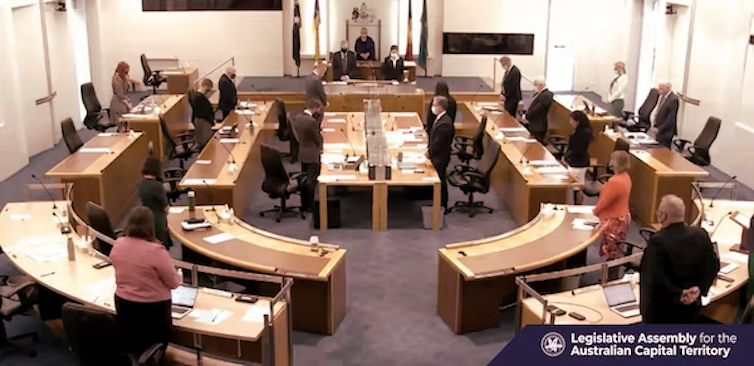
ACT Legislative Assembly.
I help run a program that helps women (including trans-gender women) prepare to run for electoral office. Modelled on the Kennedy School of Government’s From Harvard Square to the Oval Office program, it trains a diverse mix of Australian women for electoral success.
And it pushes for changes that make it easier for them to stay in office once there.
One – already in place in the Australian Capital Territory – is family-friendly sitting hours, with sittings generally beginning at 10 am and adjourning by 7 pm. Queensland’s parliament and Brisbane City Council have similar arrangements.
Where this can’t happen, parties can agree not to schedule crucial votes at night, or during morning drop-off times.
Diverse leaders have responsibilities
While it shouldn’t only have to fall to female and diverse managers to offer micro-accodations, they are in a good position to do so, even though the extra responsibilty is weighty.
It is no accident that it was Sheryl Sandberg rather than Sergey Brin who pushed for pregnancy parking, or that it was female legislators saw the case for family-friendly sitting times.
Micro-accommodations are far from the most important tool for achieving equality. Large-scale changes to the law can achieve more. And no amount of micro-accommodations can put right a world dominated by micro-aggressions.
But they are an important additional tool, one enlightened managers have the power and authority to use.
Rosalind Dixon receives funding from the ARC for her work on Constitutions and Democratic Resilience. The Pathways to Politics for Women NSW is also supported by the Trawalla Foundation.
Celebrity has always existed in one form or another. Across history, the likeness of kings, queens and nobility, deities, popes, and saints have been the subject of countless works of art.
Painted portraits, carvings in walls, verses in songs and stanzas in poems stand as testament to our enduring fascination with the human face. Some faces, such as that belonging to Helen of Troy, were so famous they are claimed, as English poet and playwright Christopher Marlowe wrote, to have “launched a thousand ships”.
Modern history has delivered new faces, and face fashions, for us to admire or despise. Movie stars, politicians, musicians and athletes, artists and writers all serve as role models upon which we stare and compare.
With our insatiable public appetite for celebrity images, it is little wonder some celebrities welcome the face mask as a way to avoid the public eye.
Social media and the news are awash with celebrity faces and remain a significant source of desire and fandom. The increased accessibility to celebrity images through social media platforms both shape and contribute to current beauty standards.
When we look at celebrity faces via their image, we can linger and study them at our leisure. Everything from their gestures, features, skin, and ageing process for example become the subject of intense scrutiny or media headlines.
Instagram Face – characterised by “ideal” yet generic features created through the use of filters – and the ever-expanding cosmetic surgery and beauty industries, could be seen as results of the feverish consumption of celebrity images.
The face has become a form of currency for celebrities: you only need to consider the likes of the Kardashian-Jenner family to reflect on this ongoing phenomenon. Leveraging their popularity, some of the Kardashian clan have their own beauty product lines, while other family members have carried out multiple product endorsements.
Kim Kardashian and Kylie Jenner. AP
Exploiting celebrity status for material or economic gain is not, however, unique to the Kardashian-Jenners. The relationship between celebrity and product success has been examined, including in the New York Times as a perceived personal exchange through consumption of endorsed products. We feel closer to celebrities while lining their pockets.
For the 21st century celebrity, the face is an index of value.
One criterion for celebrityhood, according to Stanford law professor Lawrence M. Friedman, is “high visibility”. Visibility can bring power and privilege, and celebrities understand this equation well.
Consider the example of beleaguered celebrity Kanye (Ye) West, who has worn masks during his performances since 2012. It is, however, his habit of masking in public that is most curious. West has been photographed many times wearing masks in an effort to achieve anonymity. Though, in the case of West, he remains entirely recognisable (notwithstanding the hordes of paparazzi trailing his every move).
When celebrities mask, they perform the spectacle of anonymity, rather than achieving anonymity itself.
The mask places further distance between us and them – it allows a one way scrutiny and the ability to see but not be seen. Disguising themselves in this way only serves to heighten the aura of celebrity. This has the effect of preserving their relative status as an image, as opposed to a knowable entity.
It is easy to forget, then, that this object of desire (or ridicule) is a person. One might suggest this failed form of disguise is strategic or intentional, driving the frenzied economy of celebrity image production. If celebrities can reclaim access to their image – their moneymaker – it is little wonder they adopt the mask in the public sphere. West’s masked face then becomes unsettling because it appears like a void in which the media’s gaze is deflected, and their fantasies are sunk.
Australian singer Sia is also well known for masking. Her desire to remain unseen has meant that she regularly performs in wigs that obscure her face. Here, the mask becomes a tool through which she can perform or embody an other character.
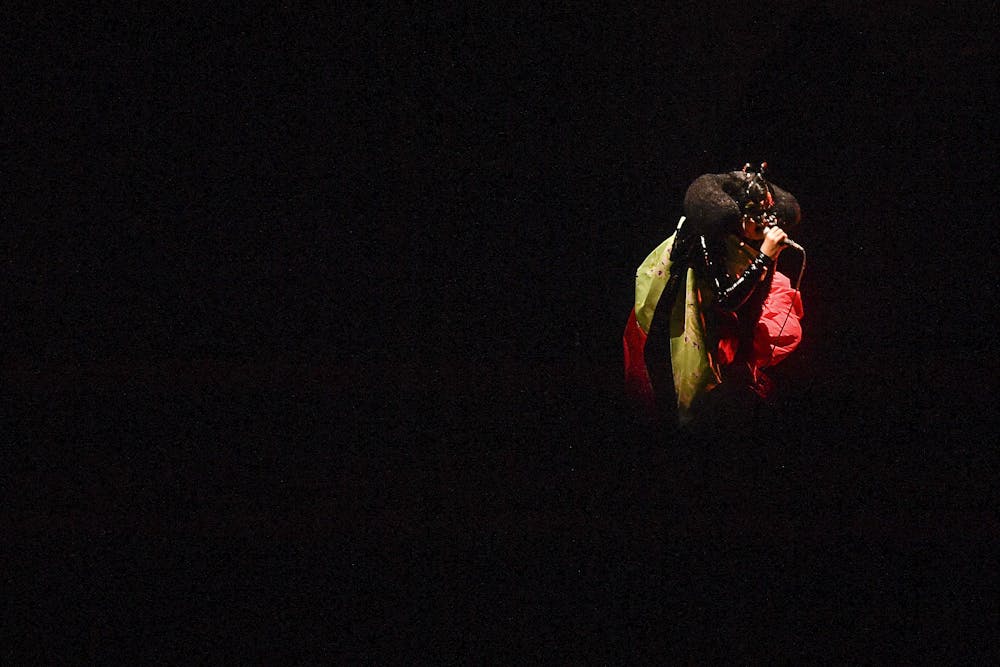
Icelandic singer-songwriter Björk also wears fantastical masks to perform on stage. She once said of the mask:
It’s a way to hide, and to reveal a different side of yourself […] Wearing a mask, I feel protected, like I can be more myself.
Icelandic singer Bjork performs at the Primavera Sound festival in Sao Paulo, Brazil, Saturday, Nov. 5, 2022. AP
Self-presentation and branding
For the celebrity, the mask has become a way of self-presentation and branding. It offers a safe, psychological space promoting free expression.
Our appetite for, and consumption of, celebrity faces shows no sign of waning, proving as philosopher Thomas Macho has argued, that we live in a “facial society”.
The internet and social media platforms have created a culture of extreme visibility. In a saturated image culture, perhaps masking is the last radical act a celebrity can do to achieve anonymity, or, paradoxically, to stand out from the ever growing crowd of celebrity faces.
Laini Burton does not work for, consult, own shares in or receive funding from any company or organisation that would benefit from this article, and has disclosed no relevant affiliations beyond their academic appointment.
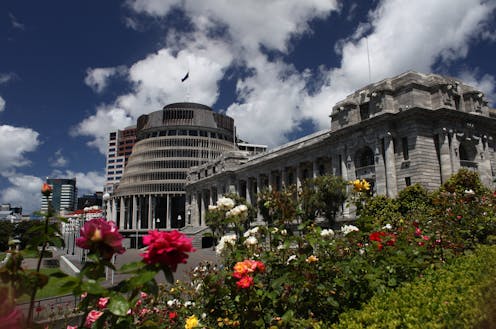
In a tidy alignment of round numbers, this year’s general election will also mark the 30th anniversary of the binding referendum that ushered in the mixed member proportional (MMP) system of voting. It will also be the tenth election held under the proportional system, truly a generational milestone in New Zealand’s political history.
But the public disquiet that led to the country voting out the old first-past-the-post (FPP) system goes further back, at least as far as the 1978 and 1981 elections. Both saw the centre-left Labour Party lose, despite having won a higher percentage of the vote than the victorious centre-right National Party.
The winner-takes-all nature of FPP also sidelined popular minority parties. In 1981, for example, the Social Credit Party won 20.7% of the vote but only two seats. In fact, most parties’ seats in parliament rarely reflected their share of the vote.
In 1984, Labour commanded 60% of parliament, having won only 43% of the vote. Six years later, National owned 70% of the seats based on 47.8% of the vote. As Lord Hailsham famously put it, Westminster jurisdictions were (and are) effectively “elected dictatorships”.
FPP governments tended to deploy their parliamentary majorities with the kind of arrogance that eventually led to the vote for change. Moreover, FPP parliaments failed to reflect the country’s demographic diversity: 77 of the 99 members of the final FPP parliament were men, there were only eight Māori MPs, a single Pasifika MP, and no one of Asian heritage. Hardly a house of representatives.
Prime Minister David Lange in 1985: a TV blunder led to electoral change. Getty Images
Accidental reform
The Royal Commission on the Electoral System (RCES) made an early case for change in 1986, but until the late 1980s electoral reform was a niche issue. It took a televised blunder from Labour prime minister David Lange to ignite the debate.
In the final leaders’ debate before the 1987 election, National’s Jim Bolger criticised Lange for ignoring the RCES recommentations. To his own colleagues’ surprise, Lange then went off-script and gave an undertaking that Labour would stage a referendum if reelected.
Lange reneged on the promise, enabling Bolger to give his own commitment during the 1990 campaign that a National government would hold a single binding referendum on the electoral system.
In the event, National strung the process out by legislating for two referendums. An indicative ballot in September 1992 was the first time in a Westminster parliamentary democracy that citizens were given the opportunity to change their electoral system – 84.7% of the 55% of eligible voters who turned out opted for change, and 70.5% indicated a preference for MMP.
That result triggered the second and binding referendum, a straight drag race between FPP and MMP, held in conjunction with the 1993 general election. The campaign leading up to the crucial decision was divisive and at times dirty.
On one side stood the pro-MMP Electoral Reform Coalition, supported by the minor political parties, Grey Power, some unions and the Māori Congress. On the other side, the Campaign for Better Government was backed by powerful corporate lobby group the Business Roundtable, the Employers Federation and a number of chambers of commerce.
Neither Labour nor National took an official position, but most MPs supported FPP. Indeed, Labour’s Helen Clark and National’s Simon Upton established the bi-partisan Campaign for First-Past-the-Post.
The second referendum was far closer than the first, with 53.9% ticking the box for MMP. But the result meant that when the country went to the polls in 1996, it was under a new electoral system. Contrary to some predictions, the sky did not fall.
MMP in action: more women, more minorities in parliament. Getty Images
Moderation and compromise
Fast forward three decades and the political landscape has changed considerably. Parliament is larger, with 120 members (occasionally one or two more, depending on the electoral caclulus), and therefore better placed to scrutinise executive activity.
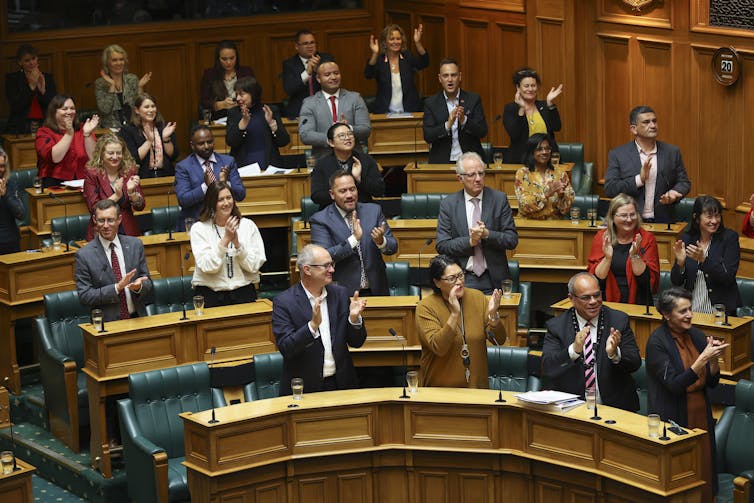
It’s also more diverse than its FPP predecessors: the current House of Representatives contains more or less equal numbers of female and male MPs, 25 Māori MPs (bearing out the hopes of those for whom MMP meant “more Māori parliamentarians”) and 18 members of Chinese, Cook Island Māori, Eritrean, Indian, Iranian, Korean, Maldivian, Mexican, Samoan, Sri Lankan and Tongan descent.
There are also wider lessons to be drawn. The arguments of naysayers notwithstanding, MMP has not led to government instability. We have learned how to form and maintain multi-party and minority governments, none of which has fallen to a confidence motion or failed to pass a budget. And, unlike the original Westminster jurisdiction, New Zealand prime ministers have generally seen out multiple
parliamentary terms.
MMP also tends towards policy moderation. For some – including the senior public servants who hoped it would lock in the public financial management reforms of the 1980s and 1990s – that’s the point. Others argue it prevents decisive policy action.
Despite heading a single party majority government – the only one under MMP, and the first since 1951 to secure a majority of the vote – Jacinda Ardern has tended not to rule by virtual decree the way some of her FPP predecessors did. She has been cautious (too much so for some), mindful that more normal minority or coalition government will inevitably soon return.
Ardern’s reluctance to throw her parliamentary weight around can be read another way, too. The imperative under MMP to build and maintain executive and legislative alliances also encourages political centrism.
Compromise can be frustrating, but over the long haul it can also help prevent the kind of political division and constitutional chicanery that have plagued nations with FPP electoral systems. Zero-sum games tend to apply in electoral politics: when winners take it all, others lose out.
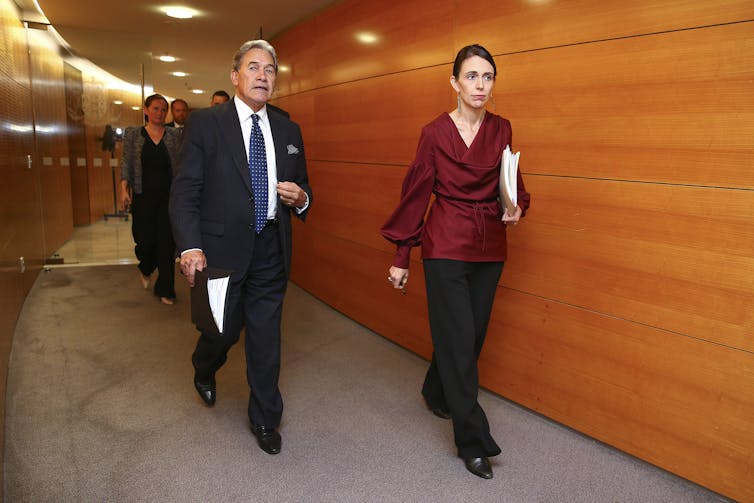
Coalition and compromise: Deputy Prime Minister and NZ First leader Winston Peters with Jacinda Ardern in 2020. Getty Images
A work in progress
Not everything has changed under MMP. True, small parties are often central to the formation of governments, either as formal coalition partners or parliamentary support parties, but the two major players continue to dominate.
Their combined vote share has dropped – in the nine elections before 1996, National and Labour captured 82.5% of the vote between them, compared with 72% across all nine MMP elections. But under MMP they have provided all of the prime ministers, the overwhelming share of cabinet ministers, and the vast majority of budget commitments.
MMP also needs refining as it evolves. The increase in the number of constituency seats relative to list seats is eroding the system’s capacity to deliver true proportionality.
And the thresholds for securing parliamentary seats are under scrutiny as part of the Independent Electoral Review. The 5% party vote threshold is arguably too high, while the ability to “coat tail” several MPs into parliament off a single constituency win unduly advantages small parties. But those are details in which there are few, if any, devils.
Aotearoa New Zealand, as elsewhere, faces challenges to its democracy. But coalition governments and diverse parliaments are not among them. Most people won’t notice when MMP celebrates its tenth election this year – that alone is a sign of just how far we’ve come.
Richard Shaw does not work for, consult, own shares in or receive funding from any company or organisation that would benefit from this article, and has disclosed no relevant affiliations beyond their academic appointment.
It’s hot, you’ve had a battle to get the kids in the car, and now you’re going to be late for the family lunch.
You turn onto the freeway only to get stuck behind a slow driver in the fast lane. You want them to move over or speed up, so you drive a little closer. Then closer. Then so close it would be difficult to avoid hitting them if they stopped suddenly.
When that doesn’t work you honk the horn. Nothing. Finally, frustrated, you dart into the left lane and speed past them.
Today was one of those days where many small annoyances have led to you being aggressive on the road. This isn’t how you usually drive. So why was today different?
Holiday driving may look a lot different to your usual commute. It may involve driving longer distances, or involve more frequent driving with more passengers than usual in the car.
Holiday driving comes with increased risk (road deaths tend to spike during the holidays). That’s why news bulletins often carry the latest “road toll” figures around public holidays.
But whether you drive differently to normal comes down to the value you place on your time, rather than when you drive.
If you are in a rush, your time becomes more precious because you have less of it. If something, or someone, infringes on that time, you may become frustrated and aggressive.
This is basic human psychology. You can get angry when someone gets in the way of what you are trying to achieve. You get angrier when you think they are acting unfairly or inappropriately.
Usually before you respond, you evaluate what has happened, asking who is at fault and if they could have done things differently.
But when you are driving, you have less time and resources to make detailed evaluations. Instead, you make quick judgements of the situation and how best to deal with it.
These judgements can be based on how you are feeling at the time. If you are frustrated before getting in the car, you are likely to be easily frustrated while driving, blame other drivers more for your circumstances, and express this through aggressive driving.
Tailgating and speeding are examples of this aggression.
A driver frustrated by the perception that someone is driving too slowly, or in the wrong lane, might speed past the offending driver, and maintain this speed for some time after the event.
Aggressive tailgating may be seen as reprimanding the driver for their perceived slow speeds, or to encourage them to move out of the way.
The problem is, when you are angry, you underestimate the risk of these behaviours, while over-estimating how much control you have of the situation. It’s not worth the risk.
A study of real-world driving shows both tailgating and speeding increase the odds of being in a crash more than if driving while holding or dialling a mobile phone. Drivers who are tailgating or speeding have a 13 to 14-fold increase in odds of being in a crash, compared to when they are driving more safely.
One way to stay safe on the roads these holidays is to recognise the situations that may lead to your own dangerous behaviours.
The Monash University Accident Research Centre has developed a program to help drivers reduce their aggressive driving. This helps drivers develop their own strategies to stay calm while driving, recognising that one strategy is unlikely to suit every driver.
Almost 100 self-identified aggressive drivers developed four types of tips to remain calm while driving:
before driving: tips include better journey planning, allowing enough time for the trip and recognising how you are feeling before you get in the car
while driving: this includes travelling in the left lane to avoid slow drivers in the right lane, or pulling over when feeling angry
in your vehicle: such as deep breathing or listening to music
‘rethinking’ the situation: acknowledge that in some situations, the only thing you can change is how you think about it. For example, ask yourself is it worth the risk? Or personalise the other driver. What if that was your loved one in the car in front?
Four months after completing the program, drivers reported less anger and aggression while driving than before the program. The strategies that worked best for these drivers were listening to music, focusing on staying calm and rethinking the problem.
A favourite rethink was a 5x5x5 strategy. This involved asking yourself whether the cause of your anger will matter in five minutes, five hours or five days. If it is unlikely to matter after this time, it is best to let go.
The holidays are meant to be relaxing and joyous. Let’s not jeopardise that through reactions to other drivers.
Amanda Stephens works for Monash University Accident Research Centre.
The program to reduce aggressive driving referred to in this article was made possible with the support of the ACT Road Safety Fund
Every summer, many Australians head to the ocean to swim, surf, sail, kayak, and walk along the beach.
But humans are not alone when we use the ocean. Fish, seals, dolphins, sharks, jellyfish, turtles, stingrays, cuttlefish, and birds often swim alongside us. When we enter the ocean we become part of an entangled web of animal relationships.
Encountering animals when we swim and surf in the ocean is fun and exciting. But sharing the water with animals also comes with the risk of stings, bites, frights, and injury to us. It can also bring harm to ocean wildlife.
By educating ourselves about marine life, humans can minimise risks to ourselves and the animals who call the ocean home.
We can frighten animals – and they can scare us
Despite how vulnerable we feel when swimming, our presence in the ocean can frighten or harm an animal. Animals may see us as a predator and alter their behaviour accordingly.
Fish, birds and small stingrays might swim off, and turtles might delay rising to the ocean’s surface to breathe.
Not all animals are frightened of humans. It’s a highlight when curious dolphins swim and play around us. But dolphins can attack humans or other animals if they feel threatened – for example when feeding or protecting their young.
Humans can also be scared of animals in the water. This fear drives the use of shark nets off beaches or, less commonly, shark culls.
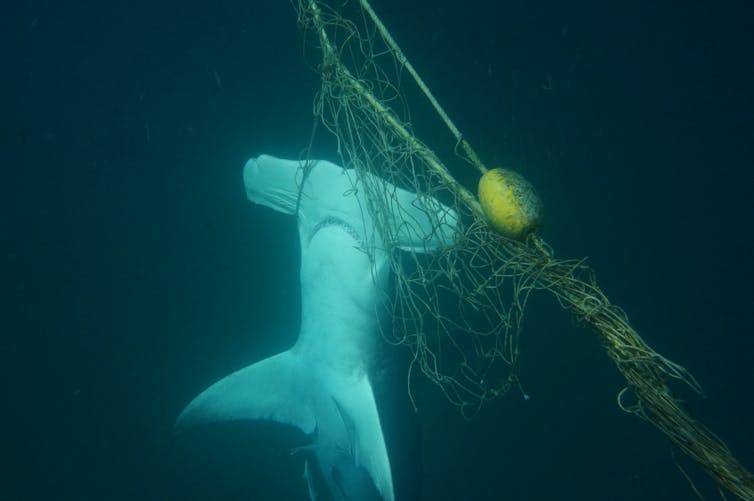
Shark nets are controversial – not least because they can entangle and kill animals including turtles, non-target sharks, stingrays, and whales.
Even more controversial are shark culls, such as those planned for Western Australia in 2013 after a spate of fatal shark attacks. The plan was later abandoned, after it was criticised as cruel and lacking scientific basis.
Killing or harming ocean animals so humans can have fun in the water raises all sorts of questions and moral dilemmas. So how else might we keep ourselves safe in the ocean?
Shark nets can kill non-target species, such as this hammerhead shark trapped off the Gold Coast. Sea Shepherd
Learn about ocean animals
Learning about what ocean animals you might encounter – and when – can help keep both people and animals safe.
Some animals are present year-round. But, as whale watchers and fisherman are well aware, many animals are more active in a particular seasons or only appear at certain times of the year.
For example, in cooler months in the waters off northern Australia, manta rays are most active. Leopard sharks, meanwhile, appear during warmer months in southeast Queensland and northeast New South Wales.
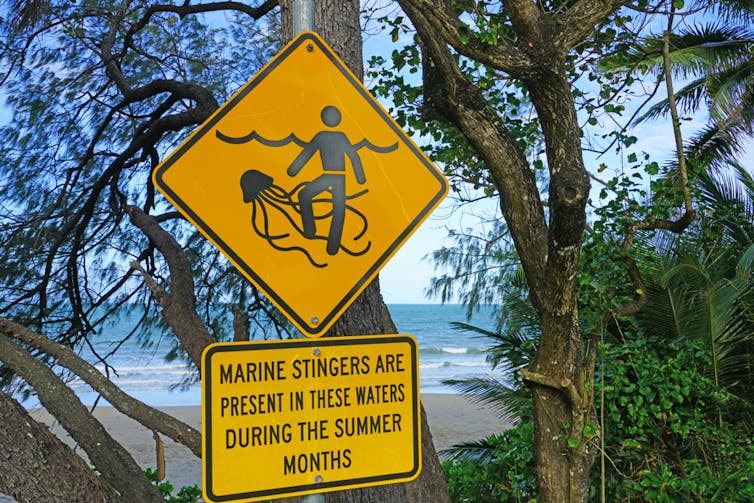
And from November until May or June, a variety of marine stingers can be found in the coastal waters of Far North Queensland. These include the potentially lethal box jellyfish.
Informing ourselves means we can take measures to keep safe. For example, people swimming in North Queensland in the warmer months are advised to swim at netted beaches, and wear wetsuits or stinger suits. Entering the water slowly also gives some marine stingers time to move away.
Ocean-goers in North Queensland should know when marine stingers are about. Shutterstock
When it comes to sharks, there are growing calls to adopt non-violent approaches to minimise risks to humans. This could include public education on, for example, links between fish seasons and shark activity.
Educating ourselves about ocean animals also helps us protect them.
Shorebirds, for instance, nest in spring and summer. This is prime beach time for people, too. Shorebird nests are shallow and vulnerable, and birds will often abandon their eggs when humans are around. Dogs and 4WDs pose an even bigger threat.
If we know we’re sharing a beach with nesting shorebirds, we can take steps to ensure their safety, such as keeping our dogs on a leash and avoiding using dunes and other common nesting areas.
The annual migration of whales and their calves up and down our coasts is an exciting time to visit the beach and, if you’re lucky, to view a splashy show of breaching or water slapping.
But if you plan to go sailing or kayaking, be aware of rules around interacting with whales. They law states they can approach us, but we must not get too close to them.
If you’re not an experienced ocean user, or don’t know about the animals living in a particular place, talk to someone who is informed.
If you use beaches patrolled by surf lifesavers they can give you information about animals that might be present that day, such as sharks or jellyfish. They can also tell you about ocean conditions such as rips, currents and water quality.
If you do suffer a painful bluebottle or jellyfish sting, surf lifesavers may also provide basic treatments such as dousing the sting with hot water or vinegar.
If you’re planning to swim or surf at unpatrolled beaches – especially if they’re remote – pack a basic first aid kit including sunscreen, vinegar and instant ice packs.
And remember, enjoying time in the ocean with other poeple is safer than swimming alone.
It’s safer to swim with others than alone. Jason O’Brien/AAP
Ensuring everyone enjoys the encounter
Despite the risks, most human encounters with animals in the ocean are exciting and positive.
Learning about the kinds of animals you might come across, as well as the best ways to interact with them, will help keep you safe – and make sure its a good experience for the animals too.
Rebecca Olive receives funding from The Australian Research Council.
More than half of the world’s population lives in cities. In Aotearoa New Zealand, the proportion of people who live in towns or cities exceeds 86%. With our lives increasingly lived in urban environments, it’s vital for our personal wellbeing – and the planet’s – that city planners find ways to foster a connection with nature.
The evidence is clear – people need direct, personal experiences with nature to care enough to protect it. As evolutionary biologist Stephen Jay Gould argued,
we cannot win this battle to save species and environments without forging an emotional bond between ourselves and nature as well – for we will not fight to save what we do not love.
In our recently published study, we explored the perceptions and experiences of nature that Hamilton residents had in their city.
Hamilton City Council is responsible for 1,142 hectares of open space, including more than 200 parks and reserves. In 2019, the council outlined its goal to have 80% of households with access to a park or open space within 500 metres of home.
Green spaces are any areas of unsealed urban land with some form of vegetation cover. We focused on three types – private gardens, parks dominated by native vegetation (“bush parks”), and parks dominated by introduced vegetation (“lawn parks”, large expanses of mown lawn scattered with individual trees).
Residents took us on tours of different green spaces around the city. During these visits, we asked them about the importance of these places, how they engaged with them and about their plant and animal encounters. We interviewed 21 residents – seven restoration volunteers, seven people who frequently visited bush parks, and seven who visited lawn parks.
We were particularly interested in how people perceived urban green spaces and the benefits they got from them. We also looked at the experiences and connection gained from different natural environments.
Ringing with birdsong
Kaelin was one of the Hamilton residents who took us on a tour of her garden and local park, one of Hamilton’s many branching gullies.
The gully was cool and quiet, the only sounds the murmurs of the tiny stream at its centre and the occasional indignant cheeps of our fellow fantail. As bell-like flutes punctuated by rude coughs and gurgles announced the presence of a tui, Kaelin turned to me with a delighted smile and said:
You can be down here in the right time of the year and you think, where am I? It’s not the city, it’s just ringing with birdsong.
Our interviewees described native bush parks as special places that provided a relaxing and restorative escape from city life. These green spaces, dominated by native vegetation, were the ones respondents commonly identified as places to sit peacefully and observe nature.
Lawn parks, on the other hand, acted more as “backdrops” for other activities – picnics, sports or farmers’ markets. Residential gardens, like bush parks, allowed for deeper observation and engagement with nature, but as private spaces, they didn’t provide the social benefits that parks do.
The value of diversity
Lawn parks are the most common type of green space in cities. Yet our study highlights that participants valued a diversity of green spaces that would meet a range of needs – their own, those of their community and those of other creatures such as birds, bats and weta.
Interviewees voiced a desire to have spaces in cities where unique New Zealand plants and animals could thrive. Respondents enjoyed sharing their parks and gardens with birds, bats and insects, recognising these animals contributed to the meaning of the place.
Creating habitat in cities for wildlife, however, was only one of the multiple
purposes of green spaces that respondents believed were important. They wanted to see a variety of parks that meet a range of community needs.
Just as respondents held multiple priorities for their own gardens, not always just as habitats for native flora and fauna, interviewees also wanted urban green spaces to support multiple uses and not serve exclusively as wildlife habitat.
New Zealand’s ongoing housing crisis has intensified political debates about urban green spaces, and Hamilton is no different.
The council recently completed consultation on significant changes to density rules in Hamilton’s central city and surrounding areas. The plan will allow three homes of up to three storeys to be developed on most properties, though the council says it is committed to maintaining its public green spaces.
As urban populations continue to rise, our research supports a renewed call for the importance of reserving space for parks and nature in cities. Instead of being a dispensable luxury, green space is crucial for the health and wellbeing of both people and native species.
Finding ways to foster personal experiences of green spaces, and the plants, animals, people and stories that provide meaning, is one way to increase city dwellers’ emotional involvement with local nature. Such subjective bonds can spur the motivation required for people’s everyday actions to nurture and protect what they love.
Elizabeth Elliot Noe receives funding from Bioprotection Aotearoa.
Ottilie Stolte does not work for, consult, own shares in or receive funding from any company or organisation that would benefit from this article, and has disclosed no relevant affiliations beyond their academic appointment.
The new year often means a new season of kids’ sports. Many families may be pondering whether to commit to another season or discovering their child is now saying they’d like to quit their usual sport.
My husband and I faced this dilemma last year when our nine-year-old wanted to quit Nippers (junior surf lifesaving). This followed a season of high emotion, where we faced weekly “drop-off dread”, only to have him happily bounce over to us after training, full of smiles and stories.
Given the vast body of research showing the benefit of organised sport for children (more on that later), it’s not always easy for parents to instantly agree when their child wants to quit.
So what does the research tell us about why kids drop out of sport and how might parents respond?
Competition can be stressful for some kids. Shutterstock
Participation rates in organised sport tend to peak towards the end of primary school, and there is significant decline in participation across adolescence.
Reasons for dropping out of a sport in adolescence include a focus on one sport over others or prioritising involvement in other activities (such as school work, jobs or socialising).
One of the major factors influencing children’s decision to quit sport is pressure from others (parents, coaches and peers).
Adult expectations, attitudes and behaviours can unintentionally sour children’s experiences of sport. This pressure can come in many forms, including unrealistically high expectations, a focus on winning, heated post-match debriefings, and critical comments.
Perceived pressure from adults relates to some of the main reasons children give for dropping out of sport: not having fun, being bored, or feeling they’re not good enough at it.
What are the benefits of sport for children?
When your child says they want to quit their sport, reflect on what’s at stake, and perhaps even discuss it with them.
As well as promoting health and fitness, organised sport builds developmental skills and competencies in young people.
Many parents see critical life skills – such as teamwork, resilience, dealing with frustration and disappointment, resolving conflicts and goal setting – as a major reason to enrol their children in sport.
Sport can also promote social connectedness for children and their families, contributing to a sense of belonging and social identity.
Our research with parents of Australian junior rugby league players suggests this might be particularly the case for Indigenous parents.
This social connectedness from sport can promote children’s mental health, helping protect against issues like anxiety and depression.
One longitudinal Australian study found children who drop out of sport between eight and ten years are at greater risk for social and emotional problems compared to those who continue in sport.
What can parents do when a child wants to quit?
There are no easy answers and the response will be shaped by factors unique to the child and their situation. But here are some strategies:
1. Talk to your child
Ask them what they don’t like about the sport. Is there anything that would need to change for them to continue? Would switching teams or dropping down a division make a difference?
You could try testing out the sport again, and agree to review things after a month.
Ask what they do like about the sport. This helps shift their thinking to what’s fun about it and what they might miss if they quit.
If your child can’t name anything they like, this might be the red flag you need that this sport isn’t for them.
2. Reflect on your own behaviour.
Think about your own hopes and expectations. Is it possible you’re putting too much pressure on your child?
Let your child know they can be open with you if they feel you’re pressuring them. You might need to work with your partner or other adults in the child’s life to come up with a plan to temper your expectations or behaviour around children’s sport.
Is it possible you’re putting too much pressure on your child? Shutterstock
3. Consider other options.
Every child is different. Some thrive on competition and performance, others find it anxiety-provoking and distressing. Others don’t much care if they win or lose.
Most children, though, enjoy personal accomplishment and the opportunity sport provides to challenge themselves and improve skills.
So, if the old sport isn’t working out for your child, consider looking for something different. Many activities build fitness and a sense of accomplishment but don’t necessarily involve competition.
For example, our local gymnastic club runs “NinjaZone” classes that challenge children to use their strength and agility to complete obstacle courses. My nine-year-old loves it.
Kicking off a new sports season provides an opportunity to reflect on the past and on how you can help your child have a positive sporting experience.
After all, the long-term goal is for our children to build a lifelong enjoyment of physical activity so they can bring the physical health, mental health and social benefits into adulthood.
Cassy Dittman holds an Honorary Research Fellowship with the Parenting and Family Support Centre, which is partly funded by royalties stemming from published resources of the Triple P – Positive Parenting Program, which is developed and owned by The University of Queensland (UQ). Royalties are also distributed to the Faculty of Health and Behavioral Sciences at UQ and contributory authors of published Triple P resources. Triple P International (TPI) Pty Ltd is a private company licensed by UniQuest Pty Ltd on behalf of UQ, to publish and disseminate Triple P worldwide. Cassy Dittman has no share or ownership of TPI, however as an author on Triple P Programs, she receives royalties from TPI. Cassy Dittman has received research funding from the National Rugby League.
Politicians around the world tout immigration restrictions as a way to fight wage stagnation and boost the job prospects of low-paid or unemployed locals.
The Trump administration pushed the message aggressively, at one stage calling a proposal to halve migration numbers the RAISE Act (standing for Reforming American Immigration for a Strong Economy), saying it would raise workers’ wages and help struggling families enter the middle class.
Whether or not cutting low-skilled migration would lift working class wages remains a highly contentious question.
My research examines the question in a broader way. Its findings – looking back at an extraordinary time of change in US history, from the 1880s on – suggest that while restricting immigration might at first help low-income workers, over time it hurts those local workers. This is due to what I call the “honeypot effect”, in which wage hikes for poor jobs keep people in poor jobs.
The problem is that there are very few real-world immigration restrictions to examine. Immigration to the global West has been rising steadily since the 1960s.
The COVID pandemic essentially eliminated immigration for a short time, but it is as good as impossible to isolate the effects of that from the effects of everything else that was going on at the same time.
America’s first exclusion: the Chinese Exclusion Act of 1882
Up until 1882, the US had an open-border policy with virtually no restrictions on entry. The Chinese Exclusion Act – introduced that year in response to the widespread belief that low-skilled Chinese immigrants were responsible for depressed wages and unemployment – was a first.
It was also long-lasting. It completely prohibited the immigration of Chinese labourers for more than fifty years.
It represents an ideal so-called “natural experiment”. Because Chinese immigration had been very heavily concentrated in certain locations, its impact was isolated to those locations, allowing what happened where it did restrict immigration to be compared to what happened where it did not.
And I discovered there was data. The US Government fully discloses Census data after 72 years. This allowed me to link individuals across US censuses to track the employment situation of millions of Americans over the entirety of their working lives.
A significant, negative, long-term effect
What I found was surprising. The Chinese Exclusion Act had a significant, negative long-term effect on American workers. My estimate is that workers in locations exposed to the Act earned on average 6-15% less over their working lives than their counterparts in other locations
The negative effects were strongest for low-skilled and unemployed workers.
The exclusion of Chinese immigrants not only failed to improve conditions for working-class Americans, but made them substantially worse off in the long run.
The honeypot and the occupational ladder
Then I set out to examine this seemingly counter-intuitive result: why shortages of low-skilled labour had led to worse long-term outcomes for low-skilled workers.
The answer appears to lie in a “honeypot” effect.
Higher low-skilled wages are attractive.
A closer look suggests the Chinese Exclusion Act was initially successful in boosting low-skilled wages and the employment of Americans in low-skilled jobs in the regions it had an effect.
This created a “honeypot” – American workers in those locations increasingly took and remained in low-skilled jobs. They became significantly less likely to become educated, meaning they fell behind their counterparts in other locations on the occupational ladder.
And their initial wage gains were short-lived, with increased arrivals from other countries and other parts of the US eventually filling the labour shortages.
This left the workers who had opted to stay in low-skilled jobs stuck with low pay, depressing their lifetime earnings compared to their counterparts in regions unaffected by the Chinese Exclusion Act.
Underlying the honeypot effect is the reality that most workers progress up an occupation ladder over their working lives, often as a result of education and training.
But education involves trade-offs. It can require giving up immediate income to earn more down the track.
Immediate income which is higher is harder to give up.
And there might be another mechanism at play. When low-skilled workers are in short supply, there might be fewer high-skilled jobs on offer because high-skilled jobs need low-skilled jobs to complement them.
Implications for today
The economy of 1882 bears little resemblance to today’s economy and we should take care in drawing general conclusions.
However, studies of modern immigration inflows into the United States and Europe also find they boost the education and occupational status of native workers, suggesting the processes underlying the honeypot effect are present in modern economies.
Immigration restrictions are too blunt an instrument and their effects are too complex to be used to boost wages and employment.
My findings suggest that even if restrictions are successful in creating wage gains for some in the short run, they are just as likely to lead to negative outcomes for locals in the long run.
This is not to say that increasing low-skilled wages is a bad thing. But immigration restrictions can only create temporary, unsustainable wage increases.
There are better, more sustainable ways to help low-skilled workers, backed by stronger evidence.
Attempts to help low-skilled workers should promote – or at the very least not discourage – education and occupational upgrading. That way they would help the low-skilled workers and the economy as a whole.
Dean Hoi receives funding from the University of Melbourne.
In today’s world it could be said, to a certain degree, that even a relatively impoverished person engages with luxury, in some way.
If you enjoy regulated heating or cooling at home, regular lighting, chicken meat, or eat chocolates, you are engaging with formats that once indicated luxury.
But what is, and is not, considered to be a luxury, changes with the times.
Decadence and luxury
When we describe a dessert as “decadent” today, we must remember it really means decaying, a concept related to the “Romans of the decadence” whose lavish lifestyles are held up as proof of why the Empire had to fail.
The Romans saw luxury as quintessentially foreign and therefore alien to the true and olden spirit of the Roman polis. This is why luxury was often represented as coming from “the Orient”, the source of rare scents, spices, gems, ivories and enslaved peoples.
As a result, the Romans introduced sumptuary laws, which were prescriptions to manage conspicuous consumption of things like expensive clothing and jewellery worn by social groups, but also the amount spent on banquets and even funerals.
This was necessary, because the ancient Romans enjoyed conspicuous luxury. They liked to eat food whose ingredients resembled another. They enjoyed delicacies such as fattened fowls, peacock, oysters, ham, wild boar and fig-peckers, the latter eaten whole, sometimes all combined together in a crusted paté, even though this was forbidden by the new laws. There were even luxuries in enslaved peoples. The poet Juvenal commented satirically that clearly it was better to have a bevy of pretty pageboys (exoleti) arranged according to their nationality, size and hair colour serving the drinks rather than coarse household help.
There is a long continuity in this type of consumption. In the 19th century, for example, there was a premium on tall footmen matching in size and the Victorians loved elaborate feasts with multiple courses.
Marissa Grootes/ Unsplash
Follow the money
By the mid 19th century, wealth from new industries created enormous fortunes at a time when taxation and labour costs were low.
North Americans became the richest people in the world. Clare Booth Luce, formerly married to the chairman of Time- Life, said:
In America money is a thing less valued in the spending than in the earning. It is less a symbol of luxury than of ‘success’, less of corruption than of virtue.
While Americans were good at making money, they seemed to need Europeans to spend it. The raft of rich American women who began to marry into the European aristocracy in the late 19th century were known as the “dollar princesses”, the term coming from a popular song. The British aristocracy were, of course, in turn marrying into this American wealth.
Between 1890 and 1914, half the world’s capital flowed through London. The Dollar Princesses paid for enormous renovations and modernisation of stately homes, were photographed with dozens of trunks as they moved across the Atlantic, and patronised the luxury establishments of jewellers, couturiers, florists and caterers.
The arrival of the wealthy Americans heiresses coincided with a series of challenges to the British aristocracy including the introduction of death duties, the rise in income tax and The Great Unrest of 1912.
Living in style
Between the end of the 19th century and the start of the first world war, luxury was widely reported and commented upon in diaries and memoirs. The house parties about which so much was written were characterised by excessive meals of great refinement, elaborate flowers and large numbers of visible servants.
Much luxury was French. Edward VII was a famed Francophile. The Entente Cordiale of 1904 benefited British French trade and travel.
Louis Vuitton opened in Bond St in 1900. His new flat trunks for cars were stackable, replacing older domed tops designed to repel water.
Cartier opened in London in 1902. Faberge also had a new London store.
The Paris Ritz opened in 1898 and the London Ritz Hotel in 1905, decorated in a newly fashionable white and gilt Louis XVI style.
Service Stripes
This was a period when wealthy women were laden with jewels: Kenneth Clark, the art historian, noted of a New York party in 1930 that the women “even brought pieces of jewellery in their hands and laid them down on the dinner table. This could have happened in the Middle Ages.”
Mrs Greville, one of the wealthiest women in England (daughter of a Scottish brewer), loved her jewels, owning pieces that could be traced back to Marie Antoinette and the Empress Josephine.
The late Queen Mother, a great lover of luxury and thoroughly Edwardian figure, inherited key pieces of jewellery from Mrs Greville in 1942, a friend from the time she was still Duchess of York.
But, as Elizabeth wrote in her diaries, she did not wear the lavish Cartier and Boucheron pieces until 1947, so as to not appear “out of sync” with the austerity movement immediately after the war. Profligate luxury risks looking out of step with public morals.
Simon Launay/ Unsplash
The Queen Mother wore all Mrs Greville’s jewels at her 80th Birthday party – and the owner of them now is Camilla, the Queen Consort. As Camilla is the grand-daughter of Edward VII’s mistress Mrs Keppel, the story comes full circle.
Mrs Greville left an estate in the 1940s worth approximately £39 million or 67 million AUD.
This is not much money if we compare it to the fortunes held by global billionaires today.
Gina Reinhart has between A$28.8 and A$31.4 billion. She lives discreetly part of the year in Dalkeith Perth in her late father’s home, in Singapore at a gated community, and on an ocean liner.
Luxury today
Today, luxury is seen as the embodiment of growing income inequality within states and communities, and also between different nations in the world. This is not new, although in the past luxury and inequality were seen as part of how a hierarchical society was structured: acknowledged, rather than seen as a problem.
Luxury is not the cause of inequality, though it might be one of its effects. When societies aims towards income and social equality (as some postwar societies did), luxury – or at least the public discussion of luxury – seems to disappear. By contrast, societies like the present, in which 1% of the population owns 49% of the world’s wealth, lead luxury to the fore.
Peter McNeil has received funding from The Leverhulme Trust. The Luxury publication project was co-authored with Professor Giorgo Riello of European University Institute.
The Governor of Oro province in Papua New Guinea, Gary Juffa, says Prime Minister James Marape encourages “honest debate” and discussion within his government.
The PNG coalition government is made up of 17 parties in an 118-seat Parliament. There are now only nine opposition MPs, after recent switches to government benches.
With so few opposition MPs, concerns have been raised that the opposition cannot effectively hold the government to account.
But Juffa disagrees, telling RNZ Pacific that disagreement and debate are encouraged between government MPs.
“There are MPs who monitor what is happening within government and do hold the government to account, there is a lot of debate and discussion in the government caucus,” he said.
“If the government makes a decision that the other members feel it’s not in the best interest of the country or the people they will voice their concerns.
“And that is actually a very — in my opinion — positive [feature] about the Marape government, the Marape government encourages dissent within his government.
Voicing their concerns “Our prime minister has allowed people and members of Parliament within the government to be critical, to voice their concerns.
“The past O’Neill government was very harsh towards any criticism, whereas the government of Marape allows criticism, and he has encouraged free media. He has allowed the media or he has encouraged the media to report. We do want the media to report factually.
“If they do report on critical concerns about the government then it is based on facts rather than rumour or rhetoric.
“Well, you know, I was in the opposition for seven years and nothing stopped me from speaking up. There were times when there were only five or four of us, but we still spoke up.
“You know, I think there are some good opposition MPs who were very vocal, and I don’t think it’s everyone joining the government-type situation. I think there are vocal active opposition MPs in Papua New Guinea,” he said.
Juffa, who founded the People’s Movement for Change party, of which he is the sole Member of Parliament, also commented on the government’s response to the violence which erupted during the 2022 election.
“The government has formed a parliamentary committee, chaired by Governor Allan Byrd, and it’s reached out to the Institute of National Affairs and other organisations. I believe they will also be working with the Commonwealth observers and other institutions, organisations that were critical of the elections,” he said.
Most violent election The poll was described as the most violent in the country’s 47 years of independence, with dozens of people losing their lives.
“So there have been immediate steps taken, I understand that the committee will be funded. It has the support of the executive government and the Prime Minister.
“And efforts are well underway to address and conduct a review of not just these elections, but previous elections and look at ensuring that the 2027 elections are a far more transparent, well-run well managed election than the ones we have seen in the past.”
RNZ Pacific’s correspondent in Papua New Guinea, Scott Waide, said that during polling that the violent extremes reflected wider public frustration in a poorly planned and managed election.
Juffa said unfortunately the reality was that there was a lot yet to be done in many parts of Papua New Guinea, “violence is very much prevailing”.
“Still, during these types of situations, we want to address them, and I believe the prime minister, the police minister and other members of Parliament charged with the responsibility are doing the best they can,” he said.
During the 2022 general election, Papua New Guinea police and electoral authorities were on the verge of declaring failed elections in some parts of the country at one stage where violence had all but halted the electoral process.
This article is republished under a community partnership agreement with RNZ.
With murders, contract killings, ambushes, war zone deaths and fatal injuries, a staggering total of 1668 journalists have been killed worldwide in connection with their work in the last two decades (2003-2022), according to the tallies by the Paris-based global media watchdog Reporters Without Borders (RSF) based on its annual round-ups.
This gives an average of more than 80 journalists killed every year. The total killed since 2000 is 1787.
RSF secretary-general Christophe Deloire said:
“Behind the figures, there are the faces, personalities, talent and commitment of those who have paid with their lives for their information gathering, their search for the truth and their passion for journalism.
In each of its annual round-ups, RSF has continued to document the unjustifiable violence that has specifically targeted media workers.
This year’s end is an appropriate time to pay tribute to them and to appeal for full respect for the safety of journalists wherever they work and bear witness to the world’s realities.
Darkest years The annual death tolls peaked in 2012 and 2013 with 144 and 142 journalists killed, respectively. These peaks, due in large measure to the war in Syria, were followed by a gradual fall and then historically low figures from 2019 onwards.
Sadly, the number of journalists killed in connection with their work in 2022 — 58 according to RSF’s Press Freedom Barometer on December 28 — was the highest in the past four years and was 13.7 percent higher than in 2021, when 51 journalists were killed.
15 most dangerous countries During the past two decades, 80 percent of the media fatalities have occurred in 15 countries. The two countries with the highest death tolls are Iraq and Syria, with a combined total of 578 journalists killed in the past 20 years, or more than a third of the worldwide total.
They are followed by Afghanistan, Yemen and Palestine. Africa has not been spared, with Somalia coming next.
With 47.4 percent of the journalists killed in 2022, America is nowadays clearly the world’s most dangerous continent for the media, which justifies the implementation of specific protection policies.
Asia also has many countries on this tragic list, including the Philippines, with more than 100 journalists killed since the start of 2003, Pakistan with 93, and India with 58.
Women journalists also victims Finally, while many more male journalists (more than 95 percent) have been killed in war zones or in other circumstances than their female counterparts, the latter have not been spared.
A total of 81 women journalists have been killed in the past 20 years — 4.86 percent of the total media fatalities.
Since 2012, 52 have been killed, in many cases after investigating women’s rights. Some years have seen spikes in the number of women journalists killed, and some of the spikes have been particularly alarming.
In 2017, ten women journalists were killed (as against 64 male journalists) — a record 13.5 percent of that year’s total media fatalities.
Pacific Media Watch collaborates with Reporters Without Borders.
Fiji Deputy Prime Minister Viliame Gavoka says the Media Industry Development Act will be replaced soon.
Speaking to members of the media after the coalition agreement signing for Fiji’s new government on Friday, he said the three leaders were in harmony in terms of repealing the Act.
“Absolutely free, we want to remove any kind of prohibitions and restrictions,” Gavoka said.
He said it was the wish of the coalition government for the media to be free and for the people of Fiji to live in a free society.
“We want you to be totally free to act and that is also the part of understanding — we live in a totally free country,” he said.
Pacific Media Watch reports that Associate Professor Shailendra Singh, head of the University of the South Pacific regional journalism programme, commented on Twitter:
Fiji’s much-criticised punitive Media Act to be replaced — question is replaced with what? Since its implementation 13 yrs ago no one has been charged under the Act underscoring its redundancy.
But it was like a noose [around the] media’s neck and blamed for self-censorship/chilling effect.
Pauliasi Matebotois a Fiji Times reporter. Republished with permission.
Fiji’s much-criticized punitive MediaAct to be replaced- question is replaced with what? Since its implementation 13yrs ago no one has been charged under the Act underscoring it’s redundancy. But it was like a noose in media’s neck and blamed for self-censorship/chilling effect. https://t.co/DiwUv93CPp
Travellers from China to Australia will be required to have a negative pre-departure covid-19 test from January 5 — and New Zealand says it is now assessing the health risks.
NZ government duty minister Stuart Nash said tonight that New Zealand was currently assessing the situation.
“I’ve been informed today that Australia has announced pre-departure testing for travellers arriving from China. This measure is being taken in response to the rapidly unfolding situation in China,” he said.
“New Zealand has a public health risk assessment under way which will be completed in the next 24 hours.
“Our response will remain proportionate to the potential risks posed by travellers and in the context of the international situation.”
New Zealand, to date, had said it has no plans to introduce testing for Chinese visitors, the Ministry of Health said last week.
An ‘abundance of caution’ Australia’s Health Minister Mark Butler said this decision was taken out of an “abundance of caution” and a temporary measure due to the lack of detailed information about the epidemiological situation in China.
“That lack of comprehensive information has led a number of countries in recent days to put in place various measures — not to restrict travel from China, it’s important to say — but to gather better information about what is happening epidemiologically in that country,” he said.
Butler said the government warmly welcomed visitors from China, and Australia was “well positioned right now in the fight against covid”.
“The resumption of travel between China and Australia poses no immediate public health threat to Australians,” he said.
Butler said universities and the tourism industry would also welcome the resumption of travel from China, as would people who had long been separated from their family and friends.
“We know there are many many hundreds of thousands of Chinese Australians who have been unable to see family and friends for months — and, in some cases, years — and their ability to do that over the coming period will be a matter of considerable joy for them, particularly as we head into the Lunar New Year period,” he said.
Butler said that, although the subvariant that appeared to be driving the wave in China was already present in Australia, the situation was “developing very quickly”.
Concerns over new variant “There are concerns, in an environment of cases spreading so quickly, about the possibility of the emergence of a new variant,” he said.
“Now there’s no evidence of that right now.
“This is a measure taken out of an abundance of caution to provide Australians and the Australian government with the best possible information about a fast-evolving situation.”
Butler said the Chinese government was informed about the measures this morning.
“It won’t come as any surprise to the Chinese government that Australia is putting this arrangement in place, I don’t think, given the broad range of countries that have taken similar steps over the last 48 to 72 hours,” he said.
This article is republished under a community partnership agreement with RNZ.
Science and maths skills are widely celebrated as keys to economic and technological progress, but abstract mathematics may seem bafflingly far from industrial optimisation or medical imaging. Pure mathematics often yields unanticipated applications, but without a time machine to look into the future, how do mathematicians like me choose what to study?
Over Thai noodles, I asked some colleagues what makes a problem interesting, and they offered a slew of suggestions: surprises, contradictions, patterns, exceptions, special cases, connections. These answers might sound quite different, but they all support a view of the mathematical universe as a structure to explore.
In this view, mathematicians are like anatomists learning how a body works, or navigators charting new waters. The questions we ask take many forms, but the most interesting ones are those that help us see the big picture more clearly.
Making maps
Mathematical objects come in many forms. Some of them are probably quite familiar, like numbers and shapes. Others might seem more exotic, like equations, functions and symmetries.
Instead of just naming objects, a mathematicians might ask how some class of objects is organised. Take prime numbers: we know there are infinitely many of them, but we need a structural understanding to work out how frequently they occur or to identify them in an efficient way.
The ‘Ulam spiral’ reveals some structure in the primes. If you arrange the counting numbers in squares spiralling outward, it becomes clear that many prime numbers fall on diagonal lines. Wikimedia Commons, CC BY-SA
Other good questions explore relationships between apparently different objects. For example, shapes have symmetry, but so do the solutions to some equations.
Classifying objects and finding connections between them help us assemble a coherent map of the mathematical world. Along the way, we sometimes encounter surprising examples that defy the patterns we’ve inferred.
Such apparent contradictions reveal where our understanding is still lacking, and resolving them provides valuable insight.
Consider the triangle
The humble triangle provides a famous example of an apparent contradiction. Most people think of a triangle as the shape formed by three connecting line segments, and this works well for the geometry we can draw on a sheet of paper.
However, this notion of triangle is limited. On a surface with no straight lines, like a sphere or a curly kale leaf, we need a more flexible definition.
So, to extend geometry to surfaces that aren’t flat, an open-minded mathematician might propose a new definition of a triangle: pick three points and connect each pair by the shortest path between them.
This is a great generalisation because it matches the familiar definition in the familiar setting, but it also opens up new terrain. When mathematicians first studied these generalised triangles in the 19th century, they solved a millennia-old mystery and revolutionised mathematics.
The parallel postulate problem
Around 300 BC, the Greek mathematician Euclid wrote a treatise on planar geometry called The Elements. This work presented both fundamental principles and results that were logically derived from them.
One of his principles, called the parallel postulate, is equivalent to the statement that the sum of the angles in any triangle is 180°. This is exactly what you’ll measure in every flat triangle, but later mathematicians debated whether the parallel postulate should be a foundational principle or just a consequence of the other fundamental assumptions.
This puzzle persisted until the 1800s, when mathematicians realised why a proof had remained so elusive: the parallel postulate is false on some surfaces.
On a sphere, the sides of a triangle bend away from each other and the angles add up to more than 180°. On a rippled kale leaf, the sides bow in towards each other and the angle sum is less than 180°.
Triangles where the angle sum breaks the apparent rule led to the revelation that there are kinds of geometry Euclid never imagined. This is a deep truth, with applications in physics, computer graphics, fast algorithms, and beyond.
Salad days
People sometimes debate whether mathematics is discovered or invented, but both points of view feel real to those of us who study mathematics for a living. Triangles on a piece of kale are skinny whether or not we notice them, but selecting which questions to study is a creative enterprise.
Interesting questions arise from the friction between patterns we understand and the exceptions that challenge them. Progress comes when we reconcile apparent contradictions that pave the way to identify new ones.
Today we understand the geometry of two-dimensional surfaces well, so we’re equipped to test ourselves against similar questions about higher-dimensional objects.
In the past few decades we’ve learned that three-dimensional spaces also have their own innate geometries. The most interesting one is called hyperbolic geometry, and it turns out to act like a three-dimensional version of curly kale. We know this geometry exists, but it remains mysterious: in my own research field, there are lots of questions we can answer for any three-dimensional space … except the hyperbolic ones.
In higher dimensions we still have more questions than answers, but it’s safe to say that study of four-dimensional geometry is entering its salad days.
Joan Licata does not work for, consult, own shares in or receive funding from any company or organisation that would benefit from this article, and has disclosed no relevant affiliations beyond their academic appointment.
One of the most popular new year’s resolutions is to exercise more. Many of us set ambitious goals requiring a big, regular commitment, but then abandon them because they’re too much to fit in. Plans to exercise more in the new year are often broken within a month.
So how can we exercise more regularly in the new year?
If the aim is to build long-term fitness and health, the exercise must be sustainable. It may be achievable to resolve to do an extra few minutes of muscle-strengthening exercises every day.
Our research suggests even one muscle contraction a day, for five days a week, can improve muscle strength if you keep it up for a month.
Physical activity guidelines recommended we perform 150 minutes of moderately intense exercise a week, as well as at least two muscle strengthening exercise sessions per week.
Skeletal muscle tissue declines with age, causing a loss of function and independence in older adults. So it’s important to include muscle strengthening exercises regularly to stimulate skeletal muscles of the legs, arms and trunk.
However, 85% of Australians don’t meet the physical activity recommendations to do both aerobic and muscle-strengthening exercises a week. The reasons include a lack of time, a lack of motivation, and no access to a workout facility.
It’s important to address these barriers, as physical inactivity increases the risk of many chronic diseases such as heart disease, diabetes, cancer, osteoporosis (weakened bones), dementia, depression and anxiety.
Short bouts of exercise can boost your muscle strength
My research team’s recent study found a small amount of regular resistance training can be better than doing one massive session, even if the amount of exercise overall was the same.
We asked participants to do an arm curl exercise consisting of 30 maximal contractions (so, contracting the muscle as hard as they could) each week for four weeks. One group did six contractions a day for five days a week; the other did 30 repetitions once a week.
The group that did them all in one go had no gains in muscle strength, whereas the group that spread the 30 repetitions over five days increased their muscle strength by more than 10%.
In a separate study, we showed that doing one three-second bicep muscle contraction a day, five days a week, increased muscle strength by 12%.
Participants contracted their muscles from a flexed to an extended position, like slowly lowering a heavy weight.
In both studies, participants used special equipment in our lab, and used as much strength as they could, but lowering a heavy dumbbell slowly several times could deliver similar results.
For a heavy dumbbell, it’s better to lift it with two arms and lower it with one arm to emphasise the eccentric muscle contraction. Shutterstock
Incorporate exercise into your daily activities
We are investigating the effects of five-minutes daily “eccentric” exercises on health and fitness of sedentary people. Eccentric exercises activate and lengthen muscles.
Author provided, The Conversation
We have already investigated the effects of sitting to a chair slowly and found it is effective for improving leg muscle strength, chair sit-stand ability, walking ability, and balance in older adults.
Many of us sit down on a chair or a sofa more than ten times a day. So, if we sit down slowly every time we sit, we perform at least ten eccentric contractions of the muscles that work to extend the knee joints, a day. This is a good opportunity for us to perform eccentric exercise daily to simulate our leg muscles.
Eccentric contractions not only affect muscle, they can also improve health indicators such as blood pressure and cholesterol levels.
Start small, then build momentum
Our studies have focused on resistance exercise, but it also applies for aerobic exercise. Five minutes of walking every day can still be beneficial for your health.
However, if you’re already doing regular gym workouts every week, adding a little exercise each day may not produce much of an added effect, so it is not necessary to replace a consistent regular exercise routine with smaller micro-sessions.
But for those starting out, who might find taking on a big exercise commitment daunting, doing a little bit of exercise, often, is a good start. Once your fitness has improved, you can add more exercise.
So what about setting a resolution to spend five minutes exercising every day in 2023?
Once you’ve set your goals, what can help you achieve them? Based on our research, we’ve distilled 12 goal-enablers. These cover four broad principles you can use to keep yourself on track.
You don’t have to do all 12. Just focusing on the most relevant three to five can make a big difference.
Set relevant supporting goals
An outcome goal isn’t enough. Set clear supporting goals that equip you to attain that outcome.
1. Behavioural goals stipulate the actions required to reach your outcome goal. If you want to change jobs, for example, behavioural goals could include working out what job you want, networking with relevant people, getting advice on your resume, and submitting at least three job applications each month.
2. Learning goals are the knowledge and skills you need to achieve your goal. Ways to identify your highest-priority learning goals, and how to attain them, include seeking advice from others who have mastered the skill you aim to learn, working with a coach, or watching instructional videos.
3. Sub-goals are small milestones on the way to your goal. They indicate your rate of progress towards attaining your ultimate goal. They can also provide a motivating sense of momentum.
Sub-goals are stepping stones on your way to achieving your end goal. Shutterstock
Build your internal motivation
This is the inner energy and focus that fuels, directs and sustains your efforts to reach your goals.
4. Connect goals to passions. If you like feeling like you’re on a mission, try framing your goals as reflecting a novice, apprentice or master level of development. If competition gets you going, perhaps frame your learning or sub-goals as indicating a bronze, silver, gold or platinum level of performance.
6. Build self-efficacy. Your self-efficacy is your belief in your capacity to succeed at a particular task. Set modest initial goals you are likely to achieve (see point 3). Ensure you have adequate resources and support (see point 8). If you find yourself thinking defeatist thoughts – “I don’t think I can do this” or “I’m too old for this” – then stop and think more encouraging thoughts instead.
Craft an enabling context
An enabling context helps keep your goals front of mind and sustains you in working to achieve them.
7. Implementation intentions stipulate when to pursue behavioural goals. These intentions increase the odds of attaining any goal. Two types are:
When-then intentions (for example: “When I am tempted to eat a snack, then I will drink a glass of water and wait 10 minutes to see if I still feel I need that snack”)
After-then intentions (for example: “After I eat lunch each day, then I’ll walk for at least 15 minutes somewhere green with my phone off”).
8. Ensure adequate resources. These could include adequate materials, technology, support of others, time and energy (enabled by an effective recovery routine).
9. Seek useful feedback to help gauge your progress and correct errors. Try asking the following questions: What happened? What went right? What went not so well and why? What can be learned? What are one or two things I can now do differently?
Anticipate and manage obstacles
As boxer Mike Tyson once said: “Everybody has a plan until they get punched in the mouth.” You need to be realistic about competing priorities and distractions bound to get in the way.
10. Identify and plan to manage points of choice, where other temptations may divert you from pursuing your goal. Points of choice may arise from within yourself (such as feeling tired, distracted or uninspired) or your surroundings (such as work pressures or family responsibilities). Plan ahead as to what you will do when these points of choice arise.
Be prepared for points of choice. Shutterstock
11. Remind yourself it’s OK to make mistakes. Repeating “error management training” mantras has been shown to improve learning and performance, particularly on complex tasks where people need to learn their way to a solution. Try these:
Errors are a natural part of the learning process.
I have made an error. Great! That gives me something to learn from.
12. Keep building your commitment. Lose that and all bets are off! All the above steps will help. It can also help to share your goals and progress with others, but choose carefully. Share your journey with people you respect, whose opinion of you matters, and whom you know won’t be a wet blanket.
Good luck. You’ve got this!
Ute-Christine Klehe receives funding from the German Research Foundation (DFG).
Lauren A. Keating and Peter A. Heslin do not work for, consult, own shares in or receive funding from any company or organisation that would benefit from this article, and have disclosed no relevant affiliations beyond their academic appointment.
As we welcome in the new year, a common activity across many cultures is the setting of new year resolutions. New year represents a significant temporal milestone in the calendar when many people set new goals for the year ahead. Here in Australia, over 70% of men and women (over 14 million Australians) are reported to have set at least one new year resolution in 2022.
New year pledges or promises are not new. This practice has been around for some time. Most ancient cultures practised some type of religious tradition or festival at the beginning of the new year.
Early 20th-century new year’s resolution postcards. Wikimedia
The Babylonians
Historically, the first recorded people to set new year pledges (later to become known as resolutions) are the Ancient Babylonians some 4,000 years ago.
The Babylonians are also the first civilisation to hold recorded celebrations in honour of the new year. Though for the Babylonians the year began not in January, but in mid March, when the crops were being planted. New year resolutions for the Babylonians were intertwined with religion, mythology, power, and socioeconomic values.
The Babylonians are said to have initiated the tradition of a 12-day new year festival called Akitu. Statues of the deities were paraded through the city streets, and rites were enacted to symbolise victory over the forces of chaos.
During this festival people planted crops, pledged their allegiance to the reigning king or crowned a new king, and made promises to repay debts in the year ahead. The Babylonians believed if they fulfilled their new year promises, then the Gods would look favourably upon them in the new year.
Akitu was the Babylonian festival for the new year. Wikimedia
Ancient Rome
Ancient Rome continued the tradition of celebrating new year and setting new year pledges. The Roman new year was initially celebrated on March 15 (The Ides of March), as this was the time the most important Roman officials (Consuls) took office.
The festival of Anna Perenna, an Italian goddess of the new year and the beginning of spring, was also celebrated on March 15.
The emperor Julius Caesar introduced the Julian calendar, in 46 BC, which declared January 1 as the start of the new year. This new date was to honour the Roman god, Janus.
Symbolically, Janus has two faces, to look back on the previous year and to look forward into the new year. Janus was the protector of doors, archways, thresholds and transitions into new beginnings.
Statue representing Janus Bifrons in the Vatican Museums. Wikimedia
Each new year Romans would offer sacrifices to Janus and pledge renewed bonds between citizens, the state, and the deities. Blessings and gifts were exchanged (for example sweet fruit and honey), and allegiances pledged to the emperor. New year celebrations and pledges were embedded into spirituality, power structures, and the societal fabric of the Roman culture.
The age of chivalry
In the Middle Ages (around 500 to 1500 A.D), medieval knights pledged their allegiance and renewed their vows to chivalry and knightly valour each new year.
Legend has it the most celebrated chivalry vows were those called “The Vow of the Peacock” or the “Pheasant”. The knights placed their hands on a live or roast peacock and renewed their vows to maintain knighthood values.
The splendid and various colours of these birds is thought to have symbolised the majesty of kings and nobility.
Beyond knightly valour and honour, however, chivalry served social and religious functions. Chivalry reinforced social divisions of wealth, prestige and superiority that served the interests of the ruling nobility and landed aristocrats. Thus, knighthood became analogous to an elite members’ club.
In the Middle Ages, new year was celebrated by different societies at different times of the year. Due to a timing miscalculation, the Julian calendar had resulted in seven extra days by the year 1000.
An early 14th-century German manuscript depicting a knight and his lady. Wikimedia Commons
Modern times
To solve problems associated with the Julian calendar, the Gregorian calendar was instigated by Pope Gregory XIII in 1582. The new year was officially reinstated to January 1.
Religion continued to exert a significant social and cultural influence on the purpose and function of people’s new year pledges. For instance, in the 19th century, Protestantism emphasised setting pledges strongly aligned to religion, spirituality, and moral character.
However, in the 1800s there is some evidence resolutions were beginning to be satirised. For instance, a series of satirical resolutions were being reported in the Walker’s Hibernian Magazine (1802), “Statesmen have resolved to have no other object in view than the good of their country”.
Resolutions had become a common activity, and people were making and breaking pledges just as they do to this day. For instance, as early as 1671, the Scottish writer Anne Halkett recorded in her diary the resolution, “I will not offend anymore”.
As in earlier times, people from across cultures continue to celebrate the new year (though at different times), and to set resolutions. Just as ancient civilisations would pray for rich harvest, resolutions today tend to also project societal values.
Contemporary resolutions tend to be more secular than religious or societal in nature. Conceptually, however, new year resolutions continue to capture people’s imagination, hopes, and promises for betterment. Even after 4,000 years, the new year continues to symbolise a new threshold. An opportunity for a fresh start.
Joanne Dickson does not work for, consult, own shares in or receive funding from any company or organisation that would benefit from this article, and has disclosed no relevant affiliations beyond their academic appointment.
Whistleblower Owen Wilkes was a tireless and formidable researcher for the Pacific, peace and disarmament. Before the internet, he combed publicly available sources on weapons systems and defence strategy.
In 1968, he revealed the secretive military function of a proposed satellite tracking station in the South Island, and while working in Sweden he was charged with espionage and deported after photographing intriguing but publicly visible installations.
In a new book about his life, Peacemonger, edited by May Bass and Mark Derby, Nicky Hager writes about Wilkes’ research techniques:
Owen Wilkes was an outstanding researcher, a role model of how someone can make a difference in the world by good research. But how did he actually do it? Owen managed to study complex subjects such as Cold War communications systems, secret intelligence facilities and foreign military activities in the Pacific.
There are many important and useful lessons we can learn from how he did this work. The world needs more public interest researchers, on militarism and other subjects. Owen’s self-taught research techniques are like a masterclass in how it is done.
Lots of information isn’t secret, just hard to find Owen worked for many years, sitting at his large desk at the Peace Movement office in Wellington, researching the military communications systems set up to launch and fight nuclear war. How was this possible?
We are a bit conditioned currently to imagine the only option would be leaked documents from a whistleblower. The first secret of Owen’s success is that he had learned that large amounts of information on these subjects can be found and pieced together from obscure but publicly available sources.
The heart of his research method was long hours spent poring over US government records and military industry magazines, gathering the precious crumbs of detail like someone panning for gold.
Behind the large desk were shelves and shelves of open-topped file boxes, each with a cryptic title. These boxes were full of photocopied documents and handwritten notes from his researching. This may all sound very pre-internet; indeed it was largely pre-digital.
International peace researcher Owen Wilkes . . . an inspirational resource person for a nuclear-free Pacific and many other disarmament issues. Image: Peacemonger screenshot
But what Owen was doing would today be called “open source” research and his work is far superior to that carried out by many people with Google and other digital tools at their fingertips. Probably his favourite source of all was a publicly available US defence magazine called Aviation Week and Space Technology. The magazine (now online) is written for military staff and arms manufacturers, keeping them informed about developments in weapons, aircraft and “C3I” systems, which stands for Command, Control, Communications and Intelligence systems: one of Owen’s main areas of speciality.
The magazine also covered Owen’s speciality of “space based” military systems, such as military communication and surveillance satellites. In Owen’s files, which can be viewed at the National Library in Wellington, Aviation Week and Space Technology appears often. In a file box called USA Space Systems is a clipping from 1983 about the US Air Force awarding a contract for a ballistic missile early warning system (nuclear war-fighting equipment). The article revealed that the early warning system would be based at air force bases in Alaska, Greenland and Fylingdales, England — three clues about US foreign military activities.
By reading and storing away details from numerous such articles, spanning many years, Owen built up a more and more detailed understanding of military and intelligence systems.
The other endlessly useful source Owen used was US Congress and Senate hearings and reports about the US military budget. This is where each year the US military spells out its military construction plans, new weapons, technology programmes and the rest; often with figures broken down to the level of individual countries and military bases.
Senior military officials appear at hearings to explain the threats and strategies that justify the spending. As with the military magazines, Owen systematically mined these reports year after year for interesting detail.
He was especially keen on the US Congress’ Committee on Appropriations, Subcommittee on Military Construction Appropriations. His files on US antisatellite weapons, for instance, contain a document from this subcommittee about new Anti-Satellite System Facilities (project number 11610) based at Langley Air Force base, Virginia. It had been approved by the president in the renewed Cold War of the mid-1980s to target Soviet satellites. Details like this were pieces in a 1000-piece jigsaw puzzle.
When he was based at the Peace Movement Aotearoa office in Wellington, from 1983 until about 1992, Owen spent long hours at the US Embassy library studying the Military Construction Appropriations and other US government documents. Each year the library received copies of the documents as microfiche (microphotos of each page on a film). Owen was a familiar visitor, hunched over the microfiche reader making notes and printing out interesting pages.
Many times this gave the first clue of construction somewhere in the world, pointing to that country hosting some new US military, nuclear or intelligence activity. The annual US military appropriation information is available to a researcher today. In fact it is now more easily accessed since it is online. But, if anything, Owen’s pre-digital techniques make it clearer how this research is done well. It’s a good reminder that the best sources of information are most often not in the first 10 or 20 hits of a Google search, the point where many people stop looking.
Experience and persistence An important ingredient in all these methods is persistence. The methods usually work best if, like Owen, a researcher sticks at them over time. Sticking at a subject means you start to recognise names and places in an otherwise boring document, appreciate the significance of some fragment of information and understand the big picture into which each piece of information fits.
Someone who reads deeply and studies a subject over a number of years can in effect become, like Owen, an expert. They may, like him, have no formal university qualifications. But they can know more about their subject than nearly anyone else, which is a good definition of an expert. They recognise the names and places and appreciate the significance of new evidence.
A textbook example of this was when Owen returned to New Zealand in the early 1980s and went to see a recently discovered secret military site near the beach settlement of Tangimoana in the Manawatu.
Owen, who had spent years studying secret bases around the world, was the New Zealander most likely to know what he was looking at. There, on one side of the base, was a large circle of antenna poles: a CDAA circularly-disposed antenna array. It instantly told him the Tangimoana facility was a signals intelligence base. It had the same equipment and was part of the same networks as the bases he had studied in Norway and Sweden.
Ensuring his research was noticed The purpose of Owen’s work was to make a difference to the issues he researched. A final and vital part of the work was getting attention for the findings of his research. Owen often spoke in the news and he wrote about the issues he was studying. Research, writing and speaking up are essential ingredients in political change. The part of this he probably enjoyed most was travelling and speaking in public to interested groups.
During the 1980s, he had major speaking tours to countries including Japan, the Philippines, Australia and Canada (and often around New Zealand). During these trips he would present information about military and intelligence activities in those countries. A 1985 trip to Canada, which he shared with prominent Palau leader Roman Bedor, was typical. He was in Canada for seven weeks, speaking in most parts of the country and numerous times on radio and television.
One of the things he emphasised was that Canadians, as residents of a Pacific country, should be thinking about what was going on in the Pacific. One of Owen’s recurrent themes was the importance of being aware of the Pacific.
The final ingredient of a good researcher is caring about the subjects they are working on. This can be heard clearly in everything Owen wrote about the Pacific. He described the Pacific being used for submarine-based nuclear weapons and facilities used to prepare for nuclear war. He talked about the big powers using the Pacific as the “backside of the globe”, epitomised by tiny Johnston Atoll west of Hawai’i where the US military does “anything too unpopular, too dangerous and too secret to do elsewhere”.
He talked about things that were getting better: French nuclear testing on the way out; chemical weapons being destroyed. But also the region being used as a site for great power rivalry; and, under multiple pressures, the small Pacific countries being at risk of becoming “more repressive, less democratic”. He cared, and that was at the heart of being a public-interest researcher for decades.
Many of the problems he described are still occurring today. More research, more good research, on these issues and many others is crying out to be done.
The Pacific year started with a ferocious eruption and global tsunami in Tonga, but by the year’s end several political upheavals had also shaken the region with a vengeance.
A razor’s edge election in Fiji blew away a long entrenched authoritarian regime with a breath of fresh air for the Pacific, two bitterly fought polls in Papua New Guinea and Vanuatu left their mark, and growing geopolitical rivalry with the US and Australia contesting China’s security encroachment in the Solomon Islands continues to spark convulsions for years to come.
It was ironical that the two major political players in Fiji were both former coup leaders and ex-military chiefs — the 1987 double culprit Sitiveni Rabuka, a retired major-general who is credited with introducing the “coup culture” to Fiji, and Voreqe Bainimarama, a former rear admiral who staged the “coup to end all coups” in 2006.
And pundits had been predicting that the 74-year-old Rabuka, a former prime minister in the 1990s, and his People’s Alliance-led coalition would win. However, after a week-long stand-off and uncertainty, Rabuka’s three-party coalition emerged victorious and Rabuka was elected PM by a single vote majority.
Fiji’s new guard leadership . . . Professor Biman Prasad (left), one of three deputy Prime Ministers, and Prime Minister Sitiveni Rabuka share a joke before the elections. Image: Jonacani Lalakobau/The Fiji Times
In Samoa the previous year, the change had been possibly even more dramatic when a former deputy prime minister in the ruling Human Rights Protection Party (HRPP), Fiamē Naomi Mata’afa, led her newly formed Fa’atuatua I le Atua Samoa ua Tasi (FAST) party to power to become the country’s first woman prime minister.
Overcoming a hung Parliament, Mata’afa ousted the incumbent Tuila’epa Sa’ilele Malielegaoi, who had been prime minister for 23 years and his party had been in power for four decades. But he refused to leave office, creating a constitutional crisis.
At one stage this desperate and humiliating cling to power by the incumbent looked set to be repeated in Fiji.
Yet this remarkable changing of the guard in Fiji got little press in New Zealand newspapers. The New Zealand Herald, for example, buried what could could have been an ominous news agency report on the military callout in Fiji in the middle-of the-paper world news section.
“Buried” news . . . a New Zealand Herald report about a last-ditched effort by the incumbent FijiFirst government to cling to power published on page A13 on 23 December 2022. Image: APR screenshot
Fiji Although Bainimarama at first refused to concede defeat after being in power for 16 years, half of them as a military dictator, the kingmaker opposition party Sodelpa sided — twice — with the People’s Alliance (21 seats) and National Federation Party (5 seats) coalition.
Sodelpa’s critical three seats gave the 29-seat coalition a slender cushion over the 26 seats of Bainimarama’s FijiFirst party which had failed to win a majority for the first time since 2014 in the expanded 55-seat Parliament.
The ousted Attorney-General and Justice Minister Aiyaz Sayed-Khaiyum – popularly branded as the “Minister of Everything” with portfolios and extraordinary power in the hands of one man – is arguably the most hated person in Fiji.
Sayed-Khaiyum’s cynical “divisive” misrepresentation of Rabuka and the alliance in his last desperate attempt to cling to power led to a complaint being filed with Fiji police, accusing him of “inciting communal antagonism”.
He reportedly left Fiji for Australia on Boxing Day and the police issued a border alert for him while the Home Affairs Minister, Pio Tikoduadua, asked Police Commissioner Sitiveni Qiliho, a former military brigadier-general to resign over allegations of bias and lack of confidence. He refused so the new government will have to use the formal legal steps to remove him.
Just days earlier, Fiji lawyer Imrana Jalal, a human rights activist and a former Human Rights Commission member, had warned the people of Fiji in a social media post not to be tempted into “victimisation or targeted prosecutions” without genuine evidence as a result of independent investigations.
“If we do otherwise, then we are no better than the corrupt regime [that has been] in power for the last 16 years,” she added.
“We need to start off the right way or we are tainted from the beginning.”
However, the change of government unleashed demonstrations of support for the new leadership and fuelled hope for more people-responsive policies, democracy and transparency.
Writing in The Sydney Morning Herald, academic Dr Sanjay Ramesh commented in an incisive analysis of Fiji politics: “With … Rabuka back at the helm, there is hope that the indigenous iTaukei population’s concerns on land and resources, including rampant poverty and unemployment, in their community will be finally addressed.”
He was also critical of the failure of the Mission Observer Group (MoG) under the co-chair of Australia to “see fundamental problems” with the electoral system and process which came close to derailing the alliance success.
“While the MoG was enjoying Fijian hospitality, opposition candidates were being threatened, intimidated, and harassed by FFP [FijiFirst Party] thugs. The counting of the votes was marred by a ‘glitch’ on 14 December 2022 . . . leaving many opposition parties questioning the integrity of the vote counting process.”
Fiji Prime Minister Sitiveni Rabuka and his wife Sulueti Rabuka with their great grandson, three-year-old Dallas Ligamamada Ropate Newman Wye, in front of their home at Namadi Heights in Suva. Image: Sophie Ralulu/The Fiji Times
“Our country is experiencing a great and joyful awakening,” he said. “It gladdens my heart to be a part of it. And I am reminded of the heavy responsibilities I now bear.”
The coalition wasted no time in embarking on its initial 100-day programme and signalled the fresh new ‘open” approach by announcing that Professor Pal Ahluwalia, the Samoa-based vice-chancellor of the regional University of the South Pacific — deported unjustifiably by the Bainimarama government — and the widow of banned late leading Fiji academic Dr Brij Lal were both free to return.
Paul Barker, director of the Institute of National Affairs, discussing why the 2022 PNG elections were so bad. Video: ABC News
Papua New Guinea Earlier in the year, in August, Prime Minister James Marape was reelected as the country’s leader after what has been branded by many critics as the “worst ever” general election — it was marred by greater than ever violence, corruption and fraud.
As the incumbent, Marape gained the vote of 97 MPs — mostly from his ruling Pangu Pati that achieved the second-best election result ever of a PNG political party — in the expanded 118-seat Parliament. With an emasculated opposition, nobody voted against him and his predecessor, Peter O’Neill, walked out of the assembly in disgust
Papua New Guinea has a remarkable number of parties elected to Parliament — 23, not the most the assembly has had — and 17 of them backed Pangu’s Marape to continue as prime minister. Only two women were elected, including Governor Rufina Peter of Central Province.
However, while acknowledging the shortcomings, the analysts said that the actual results should not be “neglected”. Stressing how the PNG electoral system favours incumbents — the last four prime ministers have been reelected — they argued for change to the “incumbency bias”.
“If you can’t remove a PM through the electoral system, MPs will try all the harder to do so through a mid-term vote of no confidence,” they wrote.
“How to change this isn’t clear (Marape in his inaugural speech mooted a change to a presidential system), but something needs to be done — as it does about the meagre political representation of women.”
Gloria Julia King, first woman in the Vanuatu Parliament for a decade, with Ralph Regenvanu returning from a funeral on Ifira island in Port Vila. Image: Ralph Regenvanu/Twitter
Vanuatu In Vanuatu in November, a surprise snap election ended the Vanua’aku Pati’s Bob Loughman prime ministership. Parliament was dissolved on the eve of a no-confidence vote called by opposition leader Ralph Regenvanu.
With no clear majority from any of the contesting parties, Loughman’s former deputy, lawyer and an ex-Attorney-General, Ishmael Kalsakau, leader of the Union of Moderate Parties, emerged as the compromise leader and was elected unopposed by the 52-seat Parliament.
A feature was the voting for Gloria Julia King, the first woman MP to be elected to Vanuatu’s Parliament in a decade. She received a “rapturous applause” when she stepped up to take the first oath of office.
RNZ Pacific staff journalist Lydia Lewis and Port Vila correspondent Hilaire Bule highlighted the huge challenges faced by polling officials and support staff in remote parts of Vanuatu, including the exploits of soldier Samuel Bani who “risked his life” wading through chest-high water carrying ballot boxes.
Tongan volcano-tsunami disaster Tonga’s violent Hunga Ha’apai-Hunga Tonga volcano eruption on January 15 was the largest recorded globally since the eruption of Krakatoa in 1883. It triggered tsunami waves of up to 15m, blanketed ash over 5 sq km — killing at least six people and injuring 19 — and sparked a massive multinational aid relief programme.
The crisis was complicated because much of the communication with island residents was crippled for a long time.
As Dale Dominey-Howes stressed in The Conversation, “in our modern, highly-connected world, more than 95 percent of global data transfer occurs along fibre-optic cables that criss-cross through the world’s oceans.
“Breakage or interruption to this critical infrastructure can have catastrophic local, regional and even global consequences.”
“This is exactly what has happened in Tonga following the volcano-tsunami disaster. But this isn’t the first time a natural disaster has cut off critical submarine cables, and it won’t be the last.”
Covid-19 in Pacific While the impact of the global covid-19 pandemic receded in the Pacific during the year, new research from the University of the South Pacific provided insight into the impact on women working from home. While some women found the challenge enjoyable, others “felt isolated, had overwhelming mental challenges and some experienced domestic violence”.
“Women with young children had a lot to juggle, and those who rely on the internet for work had particular frustrations — some had to wait until after midnight to get a strong enough signal,” she said.
Around 30 percent of respondents reported having developed covid-19 during the Work From Home periods, and 57 percent had lost a family member or close friend to covid-19 as well as co-morbidities.
She also noted the impact of the “shadow pandemic” of domestic abuse. Only two USP’s 14 campuses in 12 Pacific countries avoided any covid-19 closures between 2020 and 2022.
Pacific Islands activists protest in a demand for climate action and loss and damage reparations at COP27 in Egypt. Image: Dominika Zarzycka/AFP/RNZ Pacific
COP27 climate progress The results for the Pacific at the COP27 climate action deliberations at the Egyptian resort town of Sharm el-Sheikh were disappointing to say the least.
For more than three decades since Vanuatu had suggested the idea, developing nations have fought to establish an international fund to pay for the “loss and damage” they suffer as a result of climate change. Thanks partly to Pacific persistence, a breakthrough finally came — after the conference was abruptly extended by a day to thrash things out.
However, although this was clearly a historic moment, much of the critical details have yet to be finalised.
Professor Steven Ratuva, director of Canterbury University’s Macmillan Brown Pacific Studies Centre, says the increased frequency of natural disasters and land erosion, and rising ocean temperatures, means referring to “climate change” is outdated. It should be called “climate crisis”.
“Of course climate changes, it’s naturally induced seen through weather, but the situation now shows it’s not just changing, but we’re reaching a level of a crisis — the increasing number of category five cyclones, the droughts, the erosion, heating of the ocean, the coral reefs dying in the Pacific, and the impact on people’s lives,” he said.
“All these things are happening at a very fast pace.”
A Papuan protest . . . “there is a human rights emergency in West Papua.” Image: Tempo
Geopolitical rivalry and West Papua The year saw intensifying rivalry between China and the US over the Pacific with ongoing regional fears about perceived ambitions of a possible Chinese base in the Solomon Islands — denied by Honiara — but the competition has fuelled a stronger interest from Washington in the Pacific.
The Biden administration released its Indo-Pacific Strategy in February, which broadly outlines policy priorities based on a “free and open” Pacific region. It cites China, covid-19 and climate change — “crisis”, rather — as core challenges for Washington.
Infrastructure is expected to be a key area of rivalry in future. Contrasting strongly with China, US policy is likely to support “soft areas” in the Pacific, such as women’s empowerment, anti-corruption, promotion of media freedom, civil society engagement and development.
The political and media scaremongering about China has prompted independent analysts such as the Development Policy Centre’s Terence Wood and Transform Aqorau to call for a “rethink” about Solomon Islands and Pacific security. Aqorau said Honiara’s leaked security agreement with China had “exacerbated existing unease” about China”.
However, the elephant in the room in geopolitical terms is really Indonesia and its brutal intransigency over its colonised Melanesian provinces — now expanded from two to three in a blatant militarist divide and rule ploy — and its refusal to constructively engage with Papuans or the Pacific over self-determination.
“2022 was a difficult year for West Papua. We lost great fighters and leaders like Filep Karma, Jonah Wenda, and Jacob Prai. Sixty-one years since the fraudulent Act of No Choice, our people continue to suffer under Indonesian’s colonial occupation,” reflected exiled West Papuan leader Benny Wenda in a Christmas message.
“Indonesia continues to kill West Papuans with impunity, as shown by the recent acquittal of the only suspect tried for the “Bloody Paniai’” massacre of 2014.
“Every corner of our country is now scarred by Indonesian militarisation . . . We continue to demand that Indonesia withdraw their military from West Papua in order to allow civilians to peacefully return to their homes.”
NAA: A14482, 020309DI-03 AUSPIC/Photographer Peter West
Every year, the National Archives of Australia releases the cabinet records from 20 years earlier, and this year’s batch is out today.
This release, from the cabinet records of 2002, is framed by two events of the previous year.
The first took place in August 2001, when Australian troops boarded a Norwegian ship, MV Tampa, carrying more than 400 rescued asylum seekers.
The Howard government quickly introduced legislation to forbid “unauthorised arrivals” from landing on the Australian mainland. It also determined that those arriving by boat would be processed offshore.
The second event of 2001 was the Al-Qaeda terrorist attacks on the US mainland on September 11. These attacks ushered in a new securitised era in global and Australian politics that has lasted to the present day. They also led to two wars in which Australia participated. The first, in Afghanistan, lasted from 2001 until 2022. The second, the intervention by the “coalition of the willing” in Iraq, was launched in 2003 following decisions in Washington in 2002.
The two events of 2001, the Tampa and 9/11, overwhelmed Labor’s campaign and contributed to the third consecutive victory of the Coalition parties in the federal election held in November that year.
The Howard government cabinet at Parliament House in 2002. NAA: A14482, 020470-13a AUSPIC/Photographer David Foote
Many of the cabinet records of 2002 relate to the Howard government’s continuation of its “Pacific Solution”.
They include offshore processing in Papua New Guinea and Nauru, building a new immigration detention facility on Christmas Island, and revamping immigration centres on the mainland.
A conference in Indonesia in February 2002 led to the “Bali Process”, an official international forum to facilitate discussion and information-sharing on issues related to people-smuggling.
Other papers relate to Australia’s normal immigration program, which included a “special humanitarian program” for refugees not coming by boat.
Thus, refugees attempting to come by boat were excluded. But others who were lucky to be plucked from refugee camps around the world prospered.
Four of the 2022 World Cup Socceroos squad were born in Africa and three were refugees who entered Australia under the special humanitarian program. Defender Thomas Deng, for example, was born in Kenya to parents who had fled Sudan and moved to Australia in 2003.
National security
Other highlights of the cabinet papers relate to national security, foreign policy, defence and counter-terrorism.
The emblematic moment of 2002 came tragically for Australia on October 12, when the Jemaah Islamiyah terrorist group detonated a bomb in the tourist district of Bali. More than 200 people were killed, 88 Australians among them. Two short cabinet minutes of oral reports to cabinet refer to the enormous amount of work done by agencies, particularly the Department of Foreign Affairs and Trade, in the Bali crisis.
Other papers relate to peace-keeping operations in trouble spots in the region, including East Timor, Bougainville and the Solomon Islands. The operation in the last was an overture to the Regional Assistance Mission to Solomon Islands, launched in 2003.
There are many submissions from Defence Minister Robert Hill on the defence program and acquisitions. This was was the year Hill made the strongest official criticism yet of the “Defence of Australia” strategy that had governed Australian defence policy since the 1980s.
Hill presaged a new direction for strategy when he remarked:
It probably never made sense to conceptualise our security interests as a series of diminishing concentric circles around our coastline, but it certainly does not do so now.
The strategic debate in which Hill engaged in 2002 continues vigorously 20 years later.
Issues relating to climate change, the environment and heritage occupy as prominent a place in Howard’s 2002 cabinet as they do today.
Critically, following the lead of US President George W. Bush, cabinet decided not to ratify the 1997 Kyoto Protocol.
The European Union and Japan ratified the protocol in 2002. But it was not until 2005, after ratification by Russia and Canada, that the protocol came into effect. Australia’s cabinet accepted advice not to burden its emissions-intensive, trade-exposed industries by accepting commitments not also accepted by competitors.
The decision not to ratify in 2002 was symbolic of Australia’s failure to sustain a meaningful climate change regime in the years up to 2022.
Transport and social and economic policy
Deputy Prime Minister John Anderson made several submissions on transport and regional policy. In one, cabinet decided not to proceed with a proposal for a very-high-speed rail network between Brisbane and Melbourne on economic grounds. Now, 20 years later, the Albanese government has reversed the decision.
Communications Minister Richard Alston obtained cabinet approval for a package of significant media reforms with detrimental consequences for Australia’s media diversity. These could not, however, be implemented until after 2004 when the coalition parties gained control of the Senate.
Many other submissions relate to economic policy, including the first Integenerational report, welfare policy, health policy and agreements with the states on matters such as housing.
Indigenous policy
The release includes important submissions on Indigenous policy.
One approved a review of the operation of the Aboriginal and Torres Strait Island Commission, a body established under Hawke and dissolved in 2005.
In another, the government decided not to proceed with recommendations of the Council for Aboriginal Reconciliation, including for a treaty and recognition of Indigenous people in a new preamble to the Constitution.
In 2007, just before its defeat, however, Howard changed his mind, at least on the Constitutional question.
Arguably, Howard’s 2007 change of mind was an important step in the current process towards a constitutionally enshrined Indigenous Voice to Parliament.
Indigenous Education Ambassadors Michael O’Loughlin (left) and Reverend Shayne Blackman (centre) meet with Dr Brendan Nelson to discuss the National Indigenous.
English Literacy and Numeracy Strategy in 2002. NAA: 14482, 020239DI-004 AUSPIC/Photographer David Foote
Inclusions and omissions
Not every subject came to cabinet and some are only referenced by short minutes or oral presentations by ministers.
There is no submission, for example, on Howard’s finalisation of a A$25 billion natural gas deal to China. In this, Howard took an important step in the evolving trade relationship with China.
But 20 years later, the Australian people are suffering from failure by the Commonwealth and the states to establish a gas reservation policy on Australia’s east coast.
Likewise, there is only a short minute on Howard’s discussions with Bush in June 2002 and too little to indicate what significance they may have had to the subsequent intervention in Iraq.
Cabinet records are only the top of a pyramid. Records of individual agencies (which may be requested by individual researchers separately after 20 years) are equally important to the historical record.
This makes it imperative for the the National Archives to be adequately resourced to carry out its essential role as the custodian of the records of the Australian people.
To that end, discontinuing the efficiency dividend on the National Archives and other struggling cultural institutions would be a welcome start.
Funding from the National Archives of Australia to David Lee in the role of Cabinet historian in 2022 is being made to the research funds of the School of Humanities and Social Sciences, University of Canberra.
David Lee is a member of the Australian Labor Party.
Twenty four Pacific peoples have been recognised in the 2023 New Year’s honours.
A former Premier of Niue, Young Vivian, leads the list of distinguished Pacific peoples in the list.
Vivian has been made an officer of the New Zealand Order of Merit for his services to Niue.
Fiji-born Dr Api Talemaitoga, a familiar face to Pacific communities during the height of covid-19 in Aotearoa, has been acknowledged for his decades of service in the medical sector.
The first Pacific priest ordained in Rome in 1990, Father Paulo Filoialii of Samoa, has been recognised for services to the Pacific community.
Also on the honours list is Lisa Taouma, the producer and director of Coconet TV, the largest pool of Pacific content on screen in New Zealand.
And the lead singer of the popular band Ardijah, Betty-Anne Monga, has been recognised for services to music.
‘Better things will come’: Niue’s Young Vivian Young Vivian started his career as a teacher in New Zealand.
He went to a British school based on an English system. He failed English and was told to leave because enrolments were backed up.
Betty-Anne Monga . . . lead singer of the popular band Ardijah. Image: Dan Cook/RNZ Pacific
He said he “begged the education officer” to stay so he was sent to Northland College and was “very happy” there.
Community members say he has been instrumental in fostering a love for Vagahau Niue, or Niue language, as a respected elder.
Speaking to RNZ Pacific reporter Lydia Lewis in 2022, at the launch of the Niue language app in Auckland, Vivian said:
“A language is a key to your culture and your tradition. It gives you that spiritual strength of who you are and you are able to face the world,” he said.
“That’s very, very important to a small nation like Niue who has a population of only 2500 people, but here in Australia and New Zealand it’s 80,000.”
Former Niue premier Young Vivian says he is “proud” of the next generation of Vagahau Niue speakers at the Niue language app launch. Image: Lydia Lewis/RNZ Pacific
When he went home to Niue, he was “dissatisfied”.
“I want to be fully independent, but I could see signs that people were not acceptable to that so I gave up, only then we can be real Niueans,” Vivian said.
His message to Pacific leaders is to believe in themselves.
“They must depend on themselves and God, they have everything in their homes, they need guts, stickability and determination, small as they are, they can stand up to it.”
He encourages the next generation to go back to basics.
“You have to depend on literally what you’ve got,” he said.
Dr Api Talemaitoga . . . “I have this knowledge about health and I find it a real pleasure to do it.” Image: Greg Bowker Visuals/RNZ Pacific
‘Profound privilege’: Dr Api Dr Api Talemaitoga has been acknowledged for his decades-long work in the medical sector.
“I see it as a profound privilege, I have this knowledge about health and I find it a real pleasure to do it.”
More than three decades in the job after graduating in 1986, he has a deep sense of pride for the next generation.
“I was really fortunate to be given the opportunity to give the graduation address at the University of Otago for medical students,” he said.
“To see the highest number of Pasifika medical students walk across the stage was really emotional.
“I can happily retire now that I see this new generation of young people, enthusiastic, bright, diverse and they are the ones that will carry on the load in the future.”
Dr Talemaitoga always has a smile on his face and an infectious laugh, he is incredibly hard to get hold of because he is always helping his patients.
A young Dr Api sitting on the arm of sofa to the left of his paternal grandmother Timaleti Tausere in Suva. His parents, Wapole and Makelesi Talematoga, are on the left, his sister Laitipa Navara is sitting on his Dad’s lap and his brother Josateki Talemaitoga is in the middle next to his mum. At the back is his Dad’s youngest brother Kaminieli and sitting on the ground at the front is cousin Timaleti. Image: Dr Api Talemaitoga/RNZ Pacific
When asked how he keeps his charisma day in day out, he said:
“I am not superhuman, some days are just dreadful and you come home feeling really disillusioned and what’s the point of all of this when you see three or four people in a row heading for dialysis,” he said.
“Then you have days where you make a difference to one person out of the 25 or 30 you see that day.
“They feel really encouraged that you’ve been able for the first time to explain their condition to them … you can’t put it in words, it’s such an amazing feeling.”
Father Paulo Sagato Filoialii and Pope John Paul II. Image: Father Paulo Sagato Filoialii/RNZ Pacific
‘This is for you, not me’: Father Paulo The first Pacific Priest ordained in Rome in 1990 – Father Paulo Sagato Filoialii is dedicating his medal to the community he has served for decades, that has in turn backed him.
“I want to offer this medal for the Pacific Island people, this is for you, not for me. This medal I will receive is for all of you and I thank you all for your prayers, for your love and your support, God bless you all,” he said.
Father Paulo has contributed his time to the Catholic community in Christchurch and Ashburton.
Upon Father Filoialii being ordained, the Samoan Mass was performed for the first time in the Vatican, resulting in Pope John Paul II decreeing that the Samoan Mass can now be performed anywhere in the world.
‘Proud’: The Coconet TV’s Lisa Taouma Pioneering Pasifika producer and director Lisa Taouma paved the way for Pacific peoples in media.
She created the ground-breaking site The Coconet TV which is the largest pool of Pacific content on screen in Aotearoa.
On top of that she made the Polyfest series, the long-standing Pacific youth series Fresh, five award-winning documentaries, the feature film Teine Sa and two short films.
Taouma believes you are only as good as the people you bring through.
“I’m proud of having brought Pacific stories to the fore around the world, I am proud of having brought Pacific people with me into that space, that is what I am most proud of,” She said.
Taouma said it was awesome that more indigenous people were being recognised globally.
While she is humbled to receive the honour, she admits not accepting it crossed her mind.
“I felt quite conflicted at the start, you know there are problems with the idea of empire and how Pacific people have been treated under the history of the British Empire,” she said.
“At the same time, it is really important to stand in this space as a Pacific woman and to have more Pacific people recognised by the Crown if you like.
“This is a system that is hopefully more reflective of Aotearoa and where we stand now.”
‘I never looked back’: Sully Paea Niuean youth-worker Sully Paea has dedicated his life to working with youth, founding the East Tamaki Youth and Resource Centre between the late 1970s and 1986.
Paea said he was lost. He battled alcoholism and pushed through a diagnosis of depression. He had a violent criminal career until he met his wife which changed him completely.
He has dedicated his life to working with youth, founding the East Tamaki Youth and Resource Centre between the late 1970s and 1986.
After 40 years serving the community, he has never looked back
Tafilau Nina Kirifi-Alai . . . “Seeing Pasifika communities graduating from university has been rewarding.” Image: Tafilau Nina Kirifi-Alai/RNZ Pacific
‘We’re getting there as people’: Tafilau Nina Kirifi-Alai Tafilau Nina Kirifi-Alai has been honoured for her great services to Pacific Development.
Kirifi-Alai has been the Pacific manager of Otago University for more than 20 years.
She has assisted scholarships of Pacific students and has led developments for the University of Otago to support Pacific tertiary institutions in the region.
“Seeing Pasifika communities graduating from university has been rewarding,” she said.
“To see all those colours in the garments and all those families and all that, was like oh yeah we are getting there, we’re getting there as a people. This is why we left our homes to seek greater opportunities, education wise and work wise, and I actually believe that education is the key.”
‘Knowing your culture, knowing your roots’: Rosanna Raymond Activism is what paved the road for multidisciplinary artist and curator Rosanna Raymond.
Her work has taken her to China, Australia and Britain, where she has built an awareness of Pacific art and fashion.
She draws on her strong cultural bond to artefacts that were taken from their original land and are now displayed in museums throughout the world.
She made a huge written contribution by co-publishing Pasifika Styles: Artists inside the Museum in 2008 and was Honorary Research Associate at the Department of Anthropology and Institute of Archaeology at University College, London.
She said moving forward whilst staying true to several of her roots was what led her to where she was today.
The full list of Pasifika in the New Year’s Honours list are:
To be Companions of the New Zealand Order of Merit: The honourable Mititaiagimene Young Vivian, former Premier of Niue – For services to Niue.
To be Officers of the New Zealand Order of Merit: Nathan Edward Fa’avae – For services to adventure racing, outdoor education and the Pacific community
David Rodney Fane – For services to the performing arts
Dr Apisalome Sikaidoka Talemaitoga – For services to health and the Pacific community
Lisa-Jane Taouma – For services to Pacific arts and the screen industry
To be Members of the New Zealand Order of Merit: Father Paulo Sagato Filoialii – For services to the Pacific community
Sefita ‘Alofi Hao’uli – For services to Tongan and Pacific communities
Lakiloko Tepae Keakea – For services to Tuvaluan art
Marilyn Rhonda Kohlhase – For services to Pacific arts and education
Felorini Ruta McKenzie – For services to Pacific education
Betty-Anne Maryrose Monga – For services to music
Sullivan Luao Paea – For services to youth
Rosanna Marie Raymond – For services to Pacific art
The Queen’s Service Medal: Kinaua Bauriri Ewels – For services to the Kiribati community
Galumalemana Fetaiaimauso Marion Galumalemana – For services to the Pacific community
Hana Melania Halalele – For services to Pacific health
Teurukura Tia Kekena – For services to the Cook Islands and Pacific communities
Nanai Pati Muaau – For services to Pacific health
Lomia Kaipati Semaia Naniseni – For services to the Tokelau community
Ma’a Brian Sagala – For services to Pacific communities
Mamaitaloa Sagapolutele – For services to education and the Pacific community
Honorary: Tofilau Nina Kirifi-Alai – For services to education and the Pacific community
Tuifa’asisina Kasileta Maria Lafaele – For services to Pacific health
Nemai Divuluki Vucago – For services to Fijian and Pacific communities
This article is republished under a community partnership agreement with RNZ.
Prime Minister Sitiveni Rabuka says he is the prime minister for the whole of Fiji and all of its people.
In an interview with Fijivillage News, Rabuka said he would like everybody to have a happy New Year and not worry too much about the changes that they think this new government would bring in.
He said the biggest change was that they could have a “happy new year”.
Rabuka said the legacy of his previous leadership was his ability to work with opposition parties to formulate the 1997 constitution.
He added that this time he would like to continue that effort to work across the floor of Parliament and across the political divide in Fiji.
Fiji Prime Minister Sitiveni Rabuka’s interview with Fijivillage News.
The multicultural makeup of Fiji’s 903,000 population is about 65 percent iTaukei Fijians, 30 percent Indo-Fijians, and 5 percent “others” including those of other Pacific Islander ethnicities and Europeans.
‘Citizens’ assembly’ plan FBC News reports that Rabuka announced in his national address that a “citizens’ assembly” would be convened for consultations on a coalition manifesto review.
Rabuka said this would involve Fijians from all walks of life to add to the manifesto and vision statements of the ruling People’s Alliance, National Federation Party, and the Social Democratic Liberal Party (Sodelpa) coalition.
He said the assembly would seek ideas and concepts from delegates to complement the government’s plans for building a better, more prosperous, and happier nation.
Rabuka said the coalition government intended to establish specialist reviews in four key areas:
“The constitution and legal reform, the economy, defence, and national security and a forensic examination of the spending of the FijiFirst government.
“Each review team will include people with expert knowledge. The teams will report to the appropriate cabinet member, Of course, a looming issue is the state of Fiji’s public finances.
“The government debt may be now above $10 billion.”
The citizen’s assembly is part of the coalition government’s plan for the first 100 days.
Promise of ‘united Fiji’ RNZ Pacific reports that Rabuka’s inaugural address to the nation was delivered to the people of Fiji via the state’s social media channels.
Rabuka, the instigator of two military coups in 1987, has assumed the role of head of government for the second time in his political career, after being prime minister between 1992 and 1999.
Fijian voters voted out Voreqe Bainimarama’s FijiFirst after two terms in power, signalling their appetite for change. He was also a coup leader, in 2006.
Rabuka’s message to his fellow citizens was one promising a better and united Fiji for all.
“Our country is experiencing a great and joyful awakening,” he said.
“It gladdens my heart to be a part of it. And I am reminded of the heavy responsibilities I now bear.”
Apart from being prime minister, Rabuka is also responsible for foreign affairs, climate change, environment, civil service, information and public enterprises, and leads a cabinet made up of 19 ministers, as well as 10 assistant ministers.
He accepts that his cabinet is “larger than I initially planned.”
Parliamentarian pay cuts “Some of you [Fijian people] will be concerned about the cost,” he said.
But he offered his assurance to the people that he would take the necessary actions to cut costs, beginning with cuts to parliamentarians’ paycheques.
“In a democracy, the people are in charge,” Rabuka said.
“Elected representatives like me, and my parliamentary colleagues, do not lord it over you. We are your servants. We are here to listen to your concerns and respect your views.”
Naveel Krishant is a Fijivillage News reporter. This article drawing on Fijivillage, FBC News and RNZ Pacific is republished under a community partnership agreement with RNZ.
Look up on a clear sunny day and you will see a blue sky. But is this the true colour of the sky? Or is it the only colour of the sky?
The answers are a little complicated, but they involve the nature of light, atoms and molecules and some quirky parts of Earth’s atmosphere. And big lasers too – for science!
Blue skies?
So first things first: when we see a blue sky on a sunny day, what are we seeing? Are we seeing blue nitrogen or blue oxygen? The simple answer is no. Instead the blue light we see is scattered sunlight.
The Sun produces a broad spectrum of visible light, which we see as white but it includes all the colours of the rainbow. When sunlight passes through the air, atoms and molecules in the atmosphere scatter blue light in all directions, far more than red light. This is called Rayleigh scattering, and results in a white Sun and blue skies on clear days.
At sunset we can see this effect dialled up, because sunlight has to pass through more air to reach us. When the Sun is close to the horizon, almost all the blue light is scattered (or absorbed by dust), so we end up with a red Sun with bluer colours surrounding it.
But if all we are seeing is scattered sunlight, what is the true colour of the sky? Perhaps we can get an answer at night.
If you look at the night sky, it is obviously dark, but it isn’t perfectly black. Yes, there are the stars, but the night sky itself glows. This isn’t light pollution, but the atmosphere glowing naturally.
On a dark moonless night in the countryside, away from city lights, you can see the trees and hills silhouetted against the sky.
Trees are silhouetted against the glowing night sky. Rodney Campbell / flickr
This glow, called airglow, is produced by atoms and molecules in the atmosphere. In visible light, oxygen produces green and red light, hydroxyl (OH) molecules produce red light, and sodium produces a sickly yellow. Nitrogen, while far more abundant in the air than sodium, does not contribute much to airglow.
The distinct colours of airglow are the result of atoms and molecules releasing particular amounts of energy (quanta) in the form of light. For example, at high altitudes ultraviolet light can split oxygen molecules (O₂) into pairs of oxygen atoms, and when these atoms later recombine into oxygen molecules they produce a distinct green light.
You can see airglow at dark sites, such as the European Southern Observatory in Chile.
Yellow light, shooting stars and sharp images
Sodium atoms make up a minuscule fraction of our atmosphere, but they make up a big part of airglow, and have a very unusual origin – shooting stars.
You can see shooting stars on any clear dark night, if you’re willing to wait. They are teensy tiny meteors, produced by grains of dust heating up and vaporising in the upper atmosphere as they travel at over 11 kilometres per second.
As shooting stars blaze across the sky, at roughly 100 kilometres altitude, they leave behind a trail of atoms and molecules. Sometimes you can see shooting stars with distinct colours, resulting from the atoms and molecules they contain. Very bright shooting stars can even leave visible smoke trails. And among those atoms and molecules is a smattering of sodium.
A shooting star and airglow seen from the International Space Station. NASA
This high layer of sodium atoms is actually useful to astronomers. Our atmosphere is perpetually in motion, it’s turbulent, and it blurs images of planets, stars and galaxies. Think of the shimmering you see when you look along a long road on a summer’s afternoon.
To compensate for the turbulence, astronomers take quick images of bright stars and measure how the stars’ images are distorted. A special deformable mirror can be adjusted to remove the distortion, producing images that can be sharper than the ones from space telescopes. (Although space telescopes still have the advantage of not peering through airglow.)
This technique – called “adaptive optics” – is powerful, but there’s a big problem. There are not enough natural bright stars for adaptive optics to work over the whole sky. So astronomers make their own artificial stars in the night sky, called “laser guide stars”.
Those sodium atoms are high above the turbulent atmosphere, and we can make them glow brightly by firing a power laser at them tuned to the distinct yellow of sodium. The resulting artificial star can then be used for adaptive optics. The shooting star you see at night helps us see the Universe with sharper vision.
So the sky isn’t blue, at least not always. It is a glow-in-the-dark night sky too, coloured a mix of green, yellow and red. Its colours result from scattered sunlight, oxygen, and sodium from shooting stars. And with a little bit of physics, and some big lasers, we can make artificial yellow stars to get sharp images of our cosmos.
Sodium laser guide stars at ESO’s Very Large Telescope in Chile.
Michael J. I. Brown receives research funding from the Australian Research Council and Monash University.
Matthew Kenworthy receives research funding from the Nederlandse Organisatie voor Wetenschappelijk (Dutch Science Council) and has previously received funding from NASA, the National Science Foundation and the Nederlandse Onderzoekschool voor Astronomie (NOVA).
Source: The Conversation (Au and NZ) – By Greg Barton, Chair in Global Islamic Politics, Alfred Deakin Institute for Citizenship and Globalisation, Deakin University
Few are better placed to answer this than Mike Burgess, Director-General of Security and head of ASIO, Australia’s domestic intelligence agency.
Burgess is one of the handful of people who can talk openly about his agency’s work. And when he speaks, his words are carefully calibrated and warrant close attention.
In a rare public address in November he told the Australian public that, for the time being at least, they could stop worrying about the threat of a terrorist attack in Australia. He said:
When ISIL formed its caliphate in the Middle East, significant numbers of Australians were seduced by slick propaganda and false narratives, and that led ASIO to raise the terrorism threat level to PROBABLE. Our decision was tragically justified.
Since 2014, there have been 11 terrorist attacks on Australian soil, while 21 significant plots have been detected and disrupted.
Decades of hard work by police, communities and government agencies have ultimately reduced the capacity of terrorist groups (al-Qaeda and the Islamic State movement in particular) to significantly threaten stable, democratic states.
But in weak or failing states (including Syria, Iraq, Afghanistan and Somalia) al-Qaeda and Islamic State affiliates continue to represent an existential threat.
According to the Global Terrorism Index, Sub-Saharan Africa accounts for almost half of all terrorist deaths, and the Sahel (a region of North Africa that includes countries such as Niger, Mali and Burkina Faso) is home to some of the most potent terrorist networks on the planet.
How have stable democracies minimised the terror threat?
Established democracies have developed police-led counterterrorism intelligence capacity to the point where ambitious, large-scale, terrorist plots are largely detected and disrupted, and terrorist social networks are effectively pinned down.
And this is not just the case with Western democracies. In our region, for example, Indonesia, Malaysia and the Philippines have made impressive progress in constraining a resilient and pernicious terrorist threat.
For Indonesia, and Australia, the bomb attacks in Bali 20 years ago were transformative. In the wake the bombings, successful forensic investigations by the Indonesian National Police, in partnership with the Australian Federal Police (AFP), profoundly reshaped the police forces of both nations.
The AFP was established in 1979 and tasked with leading counterterrorism, in response to the Sydney Hilton bombing of 1978. This was an unprecedented attack that killed three and injured 11. By the turn of the century, however, the modest resources of the AFP were being reorientated towards more pressing threats, such as counternarcotics and port security.
The September 11 al-Qaeda terrorist attacks on America in 2001, however, forced an abrupt pivot, returning the AFP to its original focus on counterterrorism. A year later, in October 2002, AFP agents Mick Keelty and Graham Ashton were forced to draw on their relationships of trust with Indonesia National Police officers to figure out who was responsible for the Bali bombings, and to limit their capacity to launch further attacks.
Their successful cooperation led to the arrest of members of a breakaway bombing cell of an Indonesian al-Qaeda affiliate, Jemaah Islamiyah. Formed in 1993 along the Afghanistan-Pakistan border by so-called mujahideen, or holy fighters, this group supported the resistance to Soviet occupation in Afghanistan.
The Bali attacks resulted in the establishment of a specialist counterterrorism unit of the Indonesia police called Densus 88. In the 18 years since its establishment Densus 88 has arrested, and contributed to the successful prosecution of, more than 2,000 terrorists (this is my estimate based on the hundreds of arrests reported year on year).
The challenge now for Indonesian police is breaking the cycle of radicalisation. The recent release of Bali bomb-maker Umar Patek, on closely supervised parole, is confronting. But it’s also an encouraging indication of the success of Indonesian police in rehabilitating former terrorists.
The rise of the Islamic State caliphate in Syria and Iraq in mid-2014 marked a disturbing setback in counterterrorism in Australia and Southeast Asia. It was, in large part, a product of an unwise, and unwarranted, military intervention in Iraq a decade earlier. This toppled the regime of Saddam Hussein and opened the door to insurgent forces, including Al Qaeda in Iraq, which later became Islamic State in Iraq, and then Islamic State of Iraq and Syria (ISIS).
The 2003 invasion of Iraq and the toppling of Saddam Hussein proved deeply destabilising, with cascading perverse outcomes. The international military operation, in which Australia played a significant role, contributed both to the rise of ISIS and to its ultimate defeat.
A similar, though strikingly incomplete, cycle of events played out in Afghanistan. Initially, the US-led military operation that began in October 2001 constrained al-Qaeda, almost to the point of defeat. But ultimately, the military intervention led to the reconquest of Afghanistan by the Taliban, and the opening of the door to al-Qaeda and its rival Islamic State.
For the time being, however, police counterterrorism intelligence has constrained the capacity of both al-Qaeda and ISIS to project a threat into Australia.
What about far-right terror?
Far-right and related conspiracy extremism has gone from representing just 10-15% of the counterterrorism caseload of ASIO and the AFP to almost 50%. This is a pattern matched across North America and Europe.
For the moment, this new threat is mostly likely to manifest in lone-actor attacks that are mostly smaller-scale and less lethal (but not always, as we saw in Christchurch in 2019).
For Western democracies, and increasingly Asian democracies as well, toxic ultranationalism in the form of ethnic and religious supremacist movements is the rising threat. Currently it’s less well organised and coordinated than jihadi terrorism. But that’s likely to change.
And, as the tragic attacks in Wieambilla have shown, it has all became much more complex and unpredictable. Paranoia fuelled by conspiracy theories, mixed with religious fundamentalism and hatred of governments and police, is generating new forms of violent extremism.
As Mike Burgess reminded us:
Terrorism is an enduring threat. And terrorism is an evolving threat […] We keep the terrorism threat level under constant review. There can be no ‘set and forget’ in security intelligence.
Greg Barton receives funding from the Australian Research Council. And he is engaged in a range of projects working to understand and counter violent extremism in Australia and in Southeast Asia and Africa that are funded by the Australian government.
Have you heard the saying “water is life?” Well, it’s true.
Water is an essential nutrient. Our body cannot produce sufficient water to live, so we need to consume water through food and fluids to survive.
Maintaining hydration is one of the most fundamental components of good health. But lots of people don’t like drinking plain water much. The good news is there are many other healthy ways to help you stay hydrated.
Why hydration is important
Water is vital for many aspects of body functioning. About half our blood is “blood plasma”, which is over 90% water. Blood plasma is essential for carrying energy, nutrients and oxygen to the cells in the body that need it most. Water helps to remove waste products via the kidneys. It also helps keep joints lubricated, the digestive system functioning, the body’s temperature controlled and skin plump and strong.
If you don’t consume enough water, you may experience symptoms of dehydration such as headaches, dizziness, tiredness, low concentration, constipation and a dry mouth. Being severely dehydrated increases the risk of kidney stones and urinary tract infections.
If you feel thirsty, it means your body is already mildly dehydrated, so make sure you pay attention to what your body is telling you.
The amount of fluid we need changes as we age. Relative to our body weight, our needs decrease. So, a newborn baby has higher fluid needs (per kilogram body weight) than their parent, and older adults have lower fluid needs than younger adults.
Fluid requirements are related to metabolic needs and vary from person-to-person. The normal turnover of water in adults is approximately 4% of total body weight per day. So, for example, if you weigh 70 kilograms, you’ll lose about 2.5 to 3 litres of water a day (not including sweating). This means you will need to consume that amount of water from food and drinks to maintain your hydration.
Eight cups (or two litres) a day is often mentioned as the amount of water we should aim for and a nice way to track your intake. But it doesn’t account for individual variation based on age, gender, body size and activity levels.
Alcohol is a diuretic, which means it dehydrates the body by promoting water loss through urine. This fluid loss is a key factor that contributes to the severity of a hangover. Always have a glass of water in between alcoholic drinks to help stay hydrated.
Caffeinated drinks (like tea and coffee) only have a mild diuretic effect. For most healthy adults, it’s okay to consume up to 400 mg of caffeine a day – that’s about four cups of coffee or eight cups of tea. If you drink more than this, it may impact your hydration levels.
To check your specific requirements, check out the Australian guidelines for fluid intake.
Some people are at greater risk of the harmful health effects from dehydration and need to pay special attention to their fluid intake.
The highest priority groups are babies, young kids, pregnant women, and older adults. These groups are at greater risk for many reasons, including relatively higher water needs per kilo of body weight, reduced ability to detect and respond to symptoms of dehydration, and barriers to consuming fluids regularly.
Family and friends can play an important role in supporting loved ones to maintain hydration, especially during warm weather.
Ten ideas for keeping fluids up this summer
Download a water reminder app on your phone
This will help keep you on track during the day and give you digital “high fives” when you hit your water goals.
Add sugar-free flavouring
Try a sugar-free fruit infusion in your water to make it more appealing. Prepare a jug in the refrigerator and infuse it overnight so it’s chilled for you the next day. Fill it up and take it everywhere with you!
Add some fresh fruit
Add some slices of lime, lemon, berries, pineapple or orange to your water bottle for some natural flavouring. If the bottle is kept in a fridge, the fruit will stay fresh for about three days.
Make a jug of iced tea (not the bottled stuff)
There are many great sugar-free recipes online. Tea contributes to fluid intake too. For green and black teas, brew in boiling water then cool overnight on the bench before refrigerating. Fruit teas can be made using cold water immediately.
Add a dash of cordial to your water
A small amount of cordial in your water is a healthier alternative to drinking a sugar-sweetened soft drink or fruit juice. Diet cordials have less added sugar again.
Make a fruit ‘slushie’
Combine fresh fruit, ice and water at home in the morning and sip to increase your fluid intake for the day.
Buy a soda maker for your home
Some people find plain water tastes better with bubbles. Sparkling mineral water is great too, as long as there is no added sugar or sweeteners.
Before you eat anything, have a glass of water
Make it a rule with yourself to have a glass of water before every snack or meal.
Eat water-rich fruits and vegetables
Many fruits and vegetables have a high water content. Some of the best include berries, oranges, grapes, carrots, lettuce, cabbage, spinach and melons. Keep a container full of cut-up fruit to snack on in your fridge.
Use a water bottle
Take it with you during the day and keep it by your bed overnight.
Water bottles are everywhere and sometimes seem to offer emotional support as well as hydration.
Having a water bottle you enjoy using can go a long way in helping you keep up your fluids during the day.
Pay attention to the material of the water bottle and use one that helps you form good habits. Some people prefer metal water bottles as they can keep water cooler for longer (others feel like they are camping). Some prefer glass bottles because the water isn’t affected by any flavours from the container (others fear breaking the glass).
Consider the practical aspects, too: Will it fit in your bag? Will it be light enough to carry with you? Can you “chug” on it when you’re exceptionally thirsty? Does the lid require screwing? How durable is it in preventing leaks? Do some homework on your water bottle, an essential accessory!
Lauren Ball receives funding from the National Health and Medical Research Council. She is a Director of Dietitians Australia and an Associate Member of the Australian Academy of Health and Medical Sciences.
Emily Burch does not work for, consult, own shares in or receive funding from any company or organisation that would benefit from this article, and has disclosed no relevant affiliations beyond their academic appointment.
One of the things kids love most about the beach is the chance to play with sand. Sand is an excellent material to play with. It is versatile, widely available, open-ended and cheap.
Not only is it nature-based, but it involves manipulation, exploration, and construction with materials to create imaginary worlds.
On top of being endlessly fun, research also shows clear associations between sand play and children’s physical, cognitive and social–emotional development. This includes fine motor and gross motor skills, measurement, cooperative building, sharing and pretending.
Sand is also used in psychotherapy methods for children. In sand play therapy, children are given a sand pit and helped to communicate their thoughts, experiences and emotions using sand, water, miniature figurines and their hands.
As a nonverbal approach, this therapy is especially effective when working with children experiencing trauma, distress and disabilities.
Here are four tips to make the most of it over summer for you and your kids.
1. Don’t overthink it
When Dr Sanné Mestrom and her son play with sand, an old coffee cup becomes a handy mould. Sanné Mestrom.
While my five-year-old son and I live in the Blue Mountains, we regularly jump on the train to Bronte or Bondi Beach. Once there, I’ll grab a coffee, and we hit the sand. All we will have with us are our togs, a small chamois each and a sarong, which doubles as a beach towel.
For us, it’s important not to be burdened with too much stuff. The beach already has everything we need: sand, water, shells, sticks, rocks, pebbles and other random discarded and found objects.
The coffee cup quickly becomes a small mould for sculpting and doubles as a vessel for carrying sea water. While you can certainly buy great sand accessories (sophisticated brick and castle moulds, for example), these actually limit the potential of open-ended free-play.
2. Start with simple ideas
When you’re given free reign to create whatever you like, the limitless options can be overwhelming. Where do you begin? Let’s start with the simplest things:
Sculpting
When it’s dry, sand can be mounded, poured, and measured. When it’s wet, the sand can be moulded, shaped, and carved. Repurpose your cup or use recycled plastic containers as sand scoops to form various upturned sculptural shapes. You can of course create a stacked castle with these, or an elaborate, ever-expanding sand mandala. This is an abstract circular pattern of intricate designs that is ultimately washed away.
Structure
Experiment with scientific principles relating to gravity and force to problem solve your sculptures. For example, try reinforcing your sand tunnels with sticks and driftwood to give them structural integrity. The last time we were built tunnels at the beach, we emulated the layers of a large construction bridge we’d seen just days before. It was a great way to take something we’d seen in the built world, and apply it directly to our own sculptures.
Pattern
Walk to the end of the bay and collect as many interesting objects as you can find. This could be an array of dried and contorted seaweed, stripey pebbles, translucent sandblasted glass, bottle tops and textured and colourful seashells. The more the better. Try to find patterns in texture, scale, colour and form and use these to extend your sculpture project.
Collect feathers, pebbles and shells and make a sand mandala. Shutterstock
3. Try and find the flow state
As a lecturer in sculpture, I apply the same principles to my art students as I do to my young son: make sure give yourself plenty of open-ended, unstructured time. Sand play is first and foremost a creative pursuit, and as with any creative pursuit, you need to allow for as much time as possible to enter the “flow state”.
This happens when we become so deeply focused on a task and pursue it so effortlessly that all else disappears, including the passage of time, worry of failure, self-reflection, self-critique, or sense of authorship.
4. Use the beach as a conversation starter
The beach is not just about the waves, the sand and ice-creams. It can provoke ideas and conversations, big and small. For example:
think about how far your shells and glass might have travelled to find their way to your feet. I recall collecting an ancient coconut fossil on a beach in northern New Zealand as a child. It was a small, shrunken black nugget – the size of a strawberry. I found the idea of this transformation mind-blowing and still have the little treasure with me to this day
collect rubbish at the beach and talk about single-use plastic – how far plastic pollution can travel and how dangerous it is for ocean life
and my favourite: use your time at the beach to chat about the phenomena that give shape to our everyday lives, such as the interconnection of ocean tides, the moon and gravity, how waves travel across the globe, and how the sun maps the movement of time.
In this way, sand play is not just for children, it enriches us all.
Source: The Conversation (Au and NZ) – By Libby (Elizabeth) Sander, MBA Director & Assistant Professor of Organisational Behaviour, Bond Business School, Bond University
Shutterstock
Imagine starting your work day with a fresh coconut juice perched by your laptop as you gaze over the ocean or a tropical rainforest.
It’s the sort of thing to fantasise about during long, tiresome commutes and days in a claustrophobic, noisy office.
But so long as you have the right type of job, and an accommodating employer (not Elon Musk), it could be your reality.
The war for talent is no longer just between companies. More than 40 nations or territories now offer “digital nomad” visas to attract those able to be employed in one country while living, and spending their income, in another.
Fancy the beach? A bunch of exotic islands are on the list. Prefer tropical forests? Try Brazil or Costa Rica.
Looking for history? There’s Spain or Greece. Love Wim Hof-style ice-bathing? Iceland beckons.
Iceland’s Blue Lagoon geothermal spa, about 50 km south-west of Reykjavík. Shutterstock
What is a digital nomad visa?
Think of a “digital nomad” visa as a cross between a tourist and temporary migrant visa – a working-on-holiday visa. Instead of the visa giving you the right to work in the country, it’s allowing you to stay so long as you’re gainfully employed and bringing money into the local economy.
How long you can stay varies, from 90 days in Aruba in the Caribbean to up to two years in the Cayman Islands. Most are for 12 months, with an option to renew.
Some places, such as Latvia, restrict visas to employers registered in an OECD country. But generally the key requirement is that you can show you have no need to find local work and can meet minimum income requirements.
Generally, the visa conditions simplify taxation issues: you continue to pay your income tax in the country of your employer.
But this varies. For example, in Greece (which offers a two-year renewable visa) you are exempt from paying local income tax only for the first six months.
Combining work and travel
A key driver of the digital nomad trend is the ability to maintain a career while ticking off other personal goals, particularly travel and the ability to experience a different way of life.
Moving somewhere with a cheaper cost of living could be another motivation.
But before you decide to pack up, there are some things to consider to ensure being a digital nomad is right for you.
You’re a long way from home
The first is whether reality will live up to the fantasy.
As a digital nomad you’re a very remote worker, with all the pros and cons that come with that.
Some studies have shown remote workers can feel socially and professionally isolated.
Having an employer that’s supportive of your move will help. A 2017 review of prior studies on remote work found organisational support greatly reduces the psychological strain and social isolation felt by remote workers.
But working from home is one thing; being in another country is entirely another. Living a long way away from family and friends and support networks is likely to be more challenging, no matter how idyllic your location.
Even with a great view, remote work can have its downsides. Shutterstock
If you like predictable structure and routine, the uncertainty and inevitable inconveniences that arise may mean it isn’t for you.
And while you may be exempt from paying local income tax, you’ll have to comply with all other local laws – such as Indonesia’s new laws making sex outside marriage potentially punishable with a year in jail.
Foreign countries do things differently
If those things don’t faze you, here are three tips to make the transition easier.
First, all the usual considerations about remote work apply – and some are amplified. You will absolutely need reliable high-speed internet, and access to support services. Living in a remote village might be alluring, but how close is the nearest computer shop?
Second, understand when you’ll need to work. You may be on a different time zone to colleagues or clients. The novelty of an ocean view could easily wear thin after a few weeks of getting up in the middle of the night for zoom calls. How available you need to be could be a big factor in choice of destination.
Third, you may still find maintaining work-life balance a challenge. Research has shown how easily work-life boundaries are blurred with remote work. The desire to prove you’re not slacking off may make it even harder.
But if you have the right personality, and you’re lucky enough to have the right job and employer, being a digital nomad might bring you the best of two worlds.
Libby (Elizabeth) Sander does not work for, consult, own shares in or receive funding from any company or organisation that would benefit from this article, and has disclosed no relevant affiliations beyond their academic appointment.
“Ballet is woman” claimed the legendary New York choreographer George Balanchine. But “where are all the women ballet choreographers?” asked researchers Oellen A. Meglin and Lynn Matluck Brooks in 2012. They found only 23 articles on women ballet choreographers in the New York Times’ 171-year history.
In Australia, even the keenest ballet fan will struggle to recall a dozen ballets by women in The Australian Ballet company’s 60-year history.
While men make up a very small proportion of those dancing in this country, the 2018 Turning Pointe report found that in Australia’s major dance companies from 2011 to 2017 only 25% of choreographic commissions were women.
Choreographers are dance’s cultural leaders and storytellers. They are dance’s voice.
Supporting and celebrating today’s women choreographers is vital to encouraging a new generation of women to follow, giving women in dance a voice into the future.
So where are the Australian women choreographers of today? Here are five to get you started.
1. Frances Rings
Frances Rings will become artistic director of Bangarra in 2023. Daniel Boud/Bangarra
In 2023, Frances Rings will step into the role of artistic director of Bangarra Dance Theatre.
A descendant of the Wirangu and Mirning peoples from the west coast of South Australia, Rings made her choreographic debut with Bangarra in 2002 with the work Rations.
She has since created and co-created another seven works for the company.
Rings fuses contemporary movement with ancient Indigenous heritage to produce organic works deeply rooted in the natural world. Her works reflect critically on the past, celebrate survival in the present and offer hope for the future.
Her works share with the audience the feeling of connecting with the sacred on Country and are a First Nation’s ode to the power, beauty and spirit of the earth.
In 2023, Yuldea opens in Sydney before touring; and Terrain will be in Adelaide.
A former dancer with the Australian Ballet, Alice Topp’s works are known for their humanity.
She creates contemporary ballets that evoke both vulnerability and strength. Topp is celebrated for her fluid, acrobatic duets, and she often takes on themes about damage and repair, durability and fragility, falling and recovering.
Topp was a dancer with the Australian Ballet before becoming a choreographer. Supplied.
But she is anything but predictable. Her recent work Annealing saw a mass of noisy bright metallic gold bodies contrasted with a quiet, dimly-lit duet. She is also passionate about homegrown and inter-generational collaborations promoting local dancers, composers and designers.
Her first mainstage work, Aurum, won her the Helpmann Award for best ballet in 2019 and she has since created four other major works. She is currently resident choreographer with The Australian Ballet and creative director of independent collective Project Animo.
Stephanie Lake describes her work as “obsessed with groups and communal action […] that sense of shared experience”.
This obsession results in large celebratory works, like the 60-dancer Colossus and 200-plus cast Multiply. These works see masses of individual moving bodies imperfectly colliding and uniting, forming patterns reminiscent of flocks of birds or opening flowers.
Lake in rehearsal for The Universe is Here commissioned by Sydney Dance Company. Pedro Greig
Lake is not afraid to take on darker themes. Her work has looked at death, personal demons, underground monsters and pandemic lockdowns.
Performed on bare stages in simple attire with minimal lighting, Lake’s works draw us into the intimacy and vulnerability of the interacting bodies.
Her breakthrough work was Mix Tape in 2010. Since then, she has had works commissioned by Sydney Dance Company, Dancenorth and Tasdance, among many others, and she is currently artistic director of her own company, The Stephanie Lake Company.
Claire Marshall began her professional career in Brisbane as a contemporary dance choreographer. In 2013, she shifted to dance film and choreographing with the camera with her work Pulse, followed by the award-winning Ward of State in 2014.
Since then, she has created seven other film works, won multiple awards and has been part of film festivals across the world.
Claire Marshall works primarily on screen. Supplied.
In her choreographic process, Marshall allows objects and surfaces in the location to dictate movement choice. Using different lenses and angles, she creates often surreal worlds for her dancers to occupy.
Many of her works are psychological thrillers and have a distinctive 20th century flavour with vibrant vintage costumes and mid-century interiors.
Marshall leaves the meaning of her works open to interpretation. They are often interactive in a choose-your-own-adventure style, using split or multiple screens, giving each viewer a different experience.
In 2023, you can see Claire Marshall’s adapted version of Permutations online in April.
5. Annette Carmichael
Annette Carmichael is an award-winning contemporary choreographer based in Denmark, Western Australia, who creates works with professional dancers, artists and community members.
Annette Carmichael in rehearsal for The Beauty Index Moora. Nic Duncan
Most recently, Carmichael has been creating large-scale regional pieces co-created with community dancers. The works combine natural movement with a gestural language developed by the performers. They are multi-art productions exploring themes such as war, domestic violence and global terror.
Whether in theatres, huge outdoor arenas or on Zoom, Carmichael’s works take us on both personal and collective journeys sharing honest and often raw emotion.
In 2023, The Stars Descend will be the culmination of a three-year program which explored ways of connecting people with the natural world. It will unfold in five chapters along an area of rich biodiversity currently undergoing restoration. You can watch single performances or join the 15-day odyssey along the trail and see them unfold one by one.
Yvette Grant receives funding from a Commonwealth Government Scholarship and Grants and an Assistantship from The Faculty of Fine Arts and Music at The University of Melbourne.
Fiji’s Minister for Home Affairs and Immigration has invited the Commissioner of Police to resign, citing concerns on matters of confidence in him.
Pio Tikoduadua said the commissioner, Sitiveni Qiliho, had, however, asked that the government follow the process of the Constitutional Offices Commission.
Minister Tikoduadua said he respected his decision, and we would let the law take its course.
Fiji Police Commissioner Brigadier-General Sitiveni Qiliho . . . asked to resign. Image: Talebula Kate/The Fiji Times
Brigadier-General Sitiveni Qiliho was formerly in the military and in July 2021 successfully completed studies at the Royal College of Defence Studies in London. He was awarded a postgraduate certificate in Security and Strategy for Global Leaders.
However, the minister added that he had no issue with the commander of the Republic of Fiji Military Forces.
I have invited the Comissioner of Police to resign, citing concerns on matters of confidence.
However, he prefers the process that goes through the Constitutional Offices Commision. I respect that, and we will let the law take its course. pic.twitter.com/WzTXRK33m0
Border alert A border alert has been issued by Fiji’s Police Criminal Investigations Department (CID) for Opposition MP and former Attorney-General and Minister for Economy Aiyaz Sayed-Khaiyum.
“Mr Sayed-Khaiyum is a person of interest and is currently under investigation regarding a case of alleged inciting communal antagonism,” according to the CID.
It said it had yet to deal with Sayed-Khaiyum who was believed to be in Australia.
It said that according to his travel history, Sayed-Khaiyum had departed Fiji on 26 December 2022.
Opposition MP and former Attorney-General Aiyaz Sayed-Khaiyum . . . on border alert. Image: Fiji govt/RNZ Pacific
Meanwhile, Commissioner Qiliho said that was the normal monitoring mechanism of the CID to write to the Border Police to inform it if Aiyaz Sayed-Khaiyum returned.
New Zealand Parliament Buildings, Wellington, New Zealand.
New Zealand Politics Daily is a collation of the most prominent issues being discussed in New Zealand. It is edited by Dr Bryce Edwards of The Democracy Project.
The US tested 67 nuclear weapons on the Marshall Islands, tricking the people who lived on Bikini Atoll to leave their homeland “for the good of all mankind.”
But the Bikini Islanders didn’t know the US would contaminate their island and make it uninhabitable.
Now nearly 70 years later, many Marshall Islanders have moved to Springdale, Arkansas, nearly 600 miles (965 km) from the nearest ocean.
But as many Marshall Islanders build new lives there, they know Arkansas is not their permanent home, and their nuclear legacy is something both Americans and the next generation of Marshall Islanders need to remember.
The US forced the 167 islanders living on Bikini Atoll to leave in 1946 to enable American testing of nuclear weapons.
Over the next decade, the US tested 67 nuclear devices — 23 of them on Bikini.
Tabish Talib traveled to the Ozarks to learn how the Marshall Islanders are staying connected to their roots so far from their home.
“I feel like a nomad,” says a sixth generation representative of the Bikini Islanders in Arkansas, Sosylina Jibas-Maddison. “And it’s heartbreaking knowing there that we don’t have a home to go to.”
This is known to Marshall islanders as Bikini Day on July 5, the day that is also marked for the inaugural design of the swimsuit named by its French designer after the nuclear “bombshell”.
The AJ+ Reports documentary on the Marshall Islands in the US.
Fiji’s new Minister for Women, Children and Poverty Alleviation, Lynda Tabuya, plans to use surveys and online platforms as an integral part of her ministry
During her official welcome yesterday along with her assistant minister, Sashi Kiran, Tabuya said that over the years she had made it her life goal to help those less fortunate.
She was happy that she could continue what she loved to do on a national stage in helping all Fijians.
“As an integral part of my ministry, I plan on asking you — the citizens of Fiji — about the best way forward utilising surveys and online platforms,” Tabuya said.
“One of the foundations for building a better Fiji is providing equal opportunities to all Fijians irrespective of age, gender, physical ability or income level.”
To promote inclusivity and development, her ministry would continue to serve all Fijians through:
The care and protection of children
Greater policy intervention for older persons and persons with disability
More innovative and targeted income support to families living or caught in the cycle of poverty; and
Promoting gender equality and empowering women to reach their full potential.
Tabuya looked forward to strengthening and building on good partnerships with organisations whose activities and outputs support the ministries strategic objectives and those who provide services in the area of child protection and safeguarding, older people, people with disability, gender equality, women’s empowerment and ending violence against women and girls.
“During the turmoil of the last couple of months, the hymn ‘We Shall Overcome’ was often used as a source of inspiration,” she said.
“At this juncture, Fiji faces daunting poverty levels and incidences of domestic violence, but despite all these challenges I believe with God’s help and everyone working together, we shall overcome.
“I’m looking forward to working for the most disadvantaged in our society and together rebuilding Fiji into the way the world should be.”
Talebula Kateis a Fiji Times journalist. Republished with permission.
National Capital District Governor Powes Parkop is stable and recovering at the Gold Coast University Hospital in Australia, according to his wife Jean Parkop and close family members.
The relieving news comes following Governor Parkop’s medivac from Papua New Guinea to Australia after he suffered complications arising from a cardiac procedure that led to internal bleeding and caused a very tense few days for his family, supporters and residents of Port Moresby city.
Sensationalised news of Governor Parkop’s illness and hospitalisation went viral on social media but the Post-Courier was reliably informed of it last Wednesday evening.
By Thursday morning, he was moved from Port Moresby General Hospital to the Pacific International Hospital (PIH) where he was receiving treatment.
Initially, it was claimed that Governor Parkop had suffered a stroke. By Friday morning, word reached the Post-Courier that he would be medivaced to Australia for further treatment.
However, the Post-Courier was made aware that the medivac would be done in the afternoon.
On Friday, December 23, surrounded by wife Jean, nieces, nephews, grandchildren and extended relatives, Governor Parkop was escorted out of PIH and driven to Jackson’s International Airport where he was medevaced to the Gold Coast, Australia, arriving just after 9pm.
Soon after touchdown in Australia, doctors relayed to his family in PNG that he had been stabilised that evening.
An EMTV news item on Governor Parkop’s recovery.
A press statement from the family on Sunday confirmed that the medevac to Australia was on a recommendation from the PIH.
“We thank the hard working staff, doctors and nurses of Port Moresby General Hospital’s (POMGEN) Emergency Department and Intensive Care Unit (ICU) for receiving him and providing immediate attention and care for our father,” the statement said.
“The specialist surgeons, nurses and staff of Pacific International Hospital (PIH), we thank you for providing great treatment and concern.” Miriam Zarriga is a PNG Post-Courier reporter. Republished with permission.
I remember, as a child, being fascinated by how just seven simple wooden triangles and other shapes could offer endless entertainment. Unlike LEGO, the Tangram pieces do not snap together, and unlike the pieces of a jigsaw puzzle, they do not form a painted picture.
Instead, Tangram invites you to fit all the pieces together to form countless varieties of shapes. You can make your own shapes or you can try to form shapes that others have created. For instance, here’s one way to form a swan shape using Tangram pieces:
This is one of several ways to make a swan shape using Tangram. Can you find another? Shutterstock
But it’s not the only way to make a swan. Can you find others? If you do not have the physical puzzle at hand, you can use a virtual version of Tangram.
Tangram is accessible and yet challenging, and an excellent educational tool. It’s still used in schools today to help illustrate mathematical concepts and develop mathematical thinking skills. It even features a paradox or two.
Tangram is one of many rearrangement puzzles that have appeared throughout the ages. The earliest known rearrangement puzzle, the Stomachion, was invented by Greek mathematician Archimedes 2,200 years ago and was popular for centuries among Greeks and Romans.
It consists of 14 puzzle pieces that can fit together in the form of many different shapes. There are 536 different ways to fit the pieces together as a square.
Then there’s the Eternity Puzzle, released in 1999, which consists of 209 blue puzzle pieces that together form a big circle-like shape. It was very popular and sold 500,000 copies worldwide, perhaps due to the 1 million British pounds promised to whoever first solved it.
Less than a year later, the mathematicians Alex Selby and Oliver Riordan solved the puzzle and claimed the prize. The creator of the puzzle, the controversial Christopher Monckton, said at the time he had to sell his house to raise the prize money.
The origins of Tangram stretch back to the third century Chinese mathematician Liu Hui. Among many other accomplishments, Liu Hui used rearrangements of geometrical shapes to elegantly explain mathematical facts such as the Gougu Rule, also known as Pythagoras’ Theorem.
This rearrangement approach to geometry was later evident in the creation of 12th century Chinese banquet tables (rectangular tables designed to be arranged into patterns that might please or entertain dinner guests).
The Tangram was popularised as a puzzle game around the year 1800. Shutterstock
The Tangram craze
According to The Tangram Book by Jerry Slocum and other authors, the Tangram was popularised as a puzzle game around the year 1800.
They report the inventor, an unknown Chinese person using the pen name Yang-Cho-Chu-Shih (“Dimwitted recluse”), published Ch’i chi’iao t’u (“Pictures Using Seven Clever Pieces”), a book containing hundreds of Tangram puzzle shapes.
Patterns from a Tangram puzzle and solution books, China c. 1815 (British Library 15257.d.5, 15257.d.14) British Library
This sparked a craze for the game in China. Other Tangram puzzle books were soon published, with some eventually making their way to Japan, the United States and England, where they were translated and extended.
During 1817-18, the Tangram craze spread like wildfire to France, Denmark and other European countries. Worldwide interest in Tangram has endured ever since.
An educational tool harbouring a paradox or two
The lasting popularity of Tangram might partly be due to it allowing so many shapes with so few pieces.
For most people, though, Tangram is just a fun and creative challenge.
There are also some Tangram “paradox” puzzles discussed in The Tangram Book and elsewhere online, where Tangram pieces are arranged to make two seeming identical shapes (but where one appears to have a leftover piece).