Page 573

UN adopts Vanuatu-led resolution in ‘epic win’ on climate change

RNZ Pacific

The UN General Assembly has adopted a Vanuatu-led resolution calling for an advisory opinion from the International Court of Justice (ICJ) on climate change and human rights.

The resolution was tabled by Vanuatu and a core group of 17 countries, aiming to clarify what the obligations of states are in protecting the rights of current and future generations from the adverse effects of climate change.

The motion, sponsored by more than 130 countries, was greeted with cheers.

The ICJ will now prepare an advisory opinion that could be cited in climate court cases.

Vanuatu is one of the worst-affected nations affected by the climate crisis. Earlier this month, the country was hit by two Category 4 tropical cyclones in less than five days, which is estimated to cost Vanuatu more than half of its annual gross domestic product.

“Today we have witnessed a win for climate justice of epic proportions,” said Vanuatu Prime Minister Ishmael Kalsakau.

“Vanuatu sees today’s historic resolution as the beginning of a new era in multilateral climate cooperation, one that is more fully focused on upholding the rule of international law and an era that places human rights and inter-generational equity at the forefront of climate decision-making,” he said.

“The very fact that a small Pacific island nation like Vanuatu was able to successfully spearhead such a transformative outcome speaks to the incredible support from all corners of the globe.”

Vanuatu Prime Minister Ishmael Kalsakau
Vanuatu Prime Minister Ishmael Kalsakau . . . “I celebrate today with the people of Vanuatu, who are still reeling from the devastation from two back-to-back cyclones this month.” Image: Vanuatu govt

Kalsakau said he was celebrating the move but sees it is a “win” for the nation.

“I celebrate today with the people of Vanuatu, who are still reeling from the devastation from two back-to-back cyclones this month, caused by the fossil fuels and greenhouse emissions that they are not responsible for. To my people, today shows us that the world stands with Vanuatu.

“This celebration is a win for the rule of law, for protecting human rights, for improving multilateral climate cooperation, for climate justice and for acting with ambition to address the planetary climate crisis.

Vanuatu’s Climate Change Minister Ralph Regenvanu called the move “a shift in narrative which may yield greater climate action and ambition among all states in the global community”.

Youth can play a part in saving planet
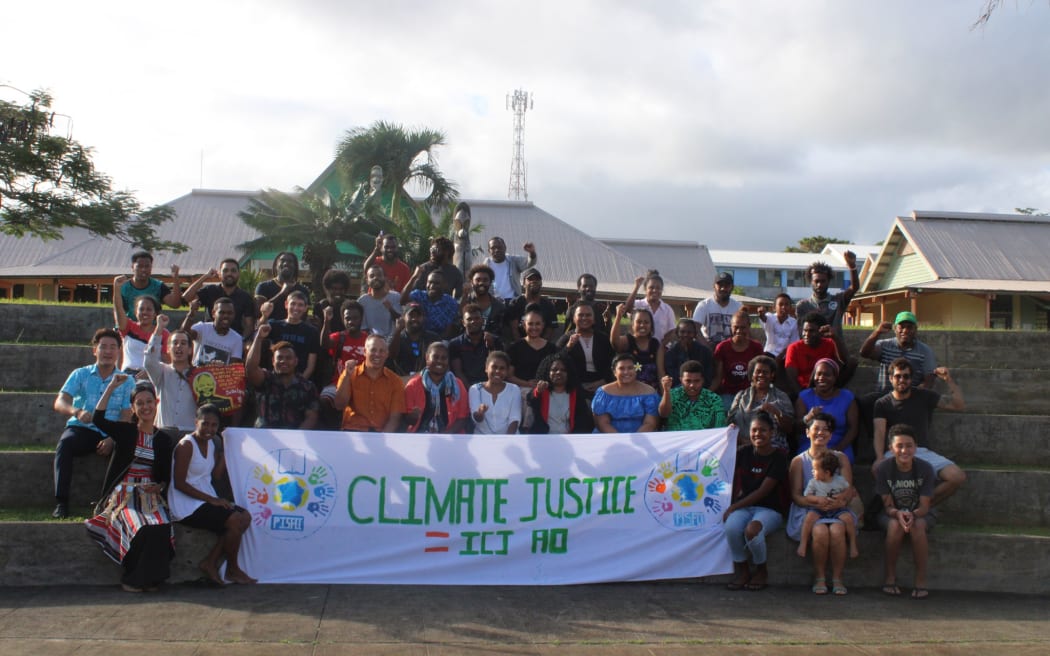
Pacific Island Students Fighting Climate Change played a key role in the campaign, and spokesman Solomon Yeo said the move shows that Pacific youth can play a part in tackling climate change.

“Today we celebrate four years of arduous work in convincing our leaders and raising global awareness on the initiative. We commend the undying support of our Pacific civil society organisations, communities, and youth who, without their support, we would not have ventured this far,” he said.

“The adopted resolution is a testament that Pacific youth can play an instrumental role in advancing global climate action.

“This further solidifies why young people’s voices must remain an integral part of the process. Now the first stage is over, we look to join hand-in-hand with governments and partners in bringing the world’s biggest problem to the world’s highest court.”

Pacific Island Students Fighting Climate Change
Pacific Island Students Fighting Climate Change . . . “Today we celebrate four years of arduous work in convincing our leaders and raising global awareness on the initiative.” Image: Pacific Island Students Fighting Climate Change

Oxfam Aotearoa has congratulated the student group for its role in the campaign.

Its climate justice lead, Nick Henry, said the world’s governments, especially in rich countries, must urgently take stronger action to reduce greenhouse gas emissions and stop the climate crisis getting worse.

He said a strong opinion from the International Court of Justice would help to hold governments to account on their obligations to act.

“To put this into perspective, the last comparable opinion was in 1996, when, after a long campaign from civil society, the ICJ issued an advisory opinion on nuclear weapons that was critical to nuclear disarmament and keeping the Pacific nuclear free.”

The UN Human Rights chief Volker Türk said the resolution could be an important catalyst for the “urgent, ambitious and equitable climate action that is needed to stop global heating” and to limit and remediate climate-induced human rights harms.

The move comes as the latest Intergovernmental Panel on Climate Change report that says current action and plans are insufficient to keep warming below 1.5 degrees.

The core group of countries behind the resolution also includes Pacific nations Federated States of Micronesia, Samoa and New Zealand, as well as Angola, Antigua & Barbuda, Bangladesh, Costa Rica, Germany, Liechtenstein, Morocco, Mozambique, Portugal, Romania, Sierra Leone, Singapore, Uganda, and Vietnam.

This article is republished under a community partnership agreement with RNZ.

Print Friendly, PDF & Email

Article by AsiaPacificReport.nz

We provided health care for children in immigration detention. This is what we found

Source: The Conversation (Au and NZ) – By Shidan Tosif, Honorary Clinical Associate Professor, The University of Melbourne

Australia’s immigration policies allow for indefinite locked detention, including for children and families. Detention is mandatory for people arriving without a valid visa – all those who arrived by boat between 2009 and 2013 were held in Immigration Detention Centres in Australia, or in Australian-contracted detention in Nauru or Papua New Guinea (PNG).

Australian detention numbers peaked in mid-2013, with 2,000 children detained at this time. By mid-2014, the average duration of detention exceeded 400 days.

While the last children were released from locked detention at the end of 2018, Australian law and policy still mandate detention for children arriving without visas. While the government refers to “held” or “locked” “detention”, to be plain, these children were imprisoned for seeking asylum.

We have just published a study describing the health of asylum-seeker children who experienced detention attending our Refugee Health Clinic over the past ten years.

Our team has been seeing refugee children for more than 20 years. We have extensive experience in refugee health, forensic medicine and child development, but nothing prepared us for the complexity of looking after these children.


Read more:
UK moves to copy Australia’s cruel asylum-seeker policy – and it will have the same heavy human toll


Trauma, mental illness, lack of protection

Our cohort of 277 patients comprised 239 children who had been detained, including 31 infants born in detention, and another 38 children born after release to families who experienced detention.

There were 79 children from families who had been detained on Nauru/PNG, 47 children had been detained offshore. Most children had spent time in at least three different Australian detention facilities.

The duration of locked detention ranged from a few months to more than five years. Children sent to Nauru/PNG were detained for longer (typically three to five years) than those held in Australia (typically around one year), and many of this group remain in community detention.

The experience of these children was traumatic. They arrived with trauma – 62% had experienced major trauma before or during their journey to Australia, 8% had experienced the death of an immediate family member. They then experienced trauma in detention. They were exposed to self-harm, suicide attempts and violence – in unrelated adults and within their own families.

One in five children were separated from a parent in detention, often for weeks or months, and young children were left alone in detention while their parents were hospitalised. More than half the cohort had parents with mental illness, this reached 86% in the Nauru/PNG cohort, and 21% of these children had parents requiring psychiatric admission.

The trauma and deprivation of immigration detention had profound impact on children’s health. Two-thirds had a mental health problem (most commonly anxiety, depression and/or post-traumatic stress disorder) and 75% presented with developmental concerns. Child protection issues were common – 19% required child protection notification and 8% were referred for sexual assault concerns in detention.

Protective systems were limited or absent. Almost half the children had interrupted education in detention. Schooling was unavailable or extremely limited for most children on Christmas Island for long periods. In Melbourne, within 20km of our hospital, school-aged children were not enrolled in school, often for months.

No health screening or follow-ups

While basic medical services were provided in detention, health screening was effectively absent – both in detention, and in the community in Victoria.

Only 1% of children had a recommended health screen before being seen in our service and only 29% of children had received routine childhood immunisation. We saw children with severe mental health, developmental and medical diagnoses that had not been recognised in detention.

In the early stages, there were some children seen once, who were transferred to another detention centre before their review appointment and never seen again. Families attended clinic with multiple guards, and were often late, completely missing their appointment time, despite the detention centre being notified well in advance.

Parents were frequently incapacitated by their own mental illness. We saw parents with severe depression, catatonic and psychotic features, and witnessed profoundly disordered attachment. Often it was difficult for them to even tell us what had happened to them and their children and what symptoms they were experiencing. In some cases, we admitted children directly to hospital, for immediate safety or medical concerns.

Documentation was unavailable, and we spent hours chasing paperwork, painstakingly piecing together health records for families, and notifying the detention health providers and the Department of Home Affairs of the issues.

Precarious migration status is traumatising too

We had not anticipated detention could, or would, last for years, or that we would still be seeing these children in 2023.

After release from detention, most children experienced improvements in family function, wellbeing and mental health. However, short-term bridging visas precluded parents working for years, and in many families, financial stress has impacted housing and food security.

The impact of detention, years of precarious migration status and trauma is ongoing, and many individuals in families in the Nauru cohort remain extremely unwell. These children have now been here nearly ten years – meaning some have entered and almost completed schooling.

The transition to permanent residency will be life-changing for the families detained in Australia, but deeply distressing for those sent offshore, who do not have access to this pathway.


Read more:
Are doctors ethically obliged to keep at-risk children out of detention?


What has to happen

Our research provides clinical evidence for the harm to children from Australian immigration detention, migration law, and related policies.

Governments must avoid detaining children and families – in Australia, and in other countries. It is unsafe and harms children.

We urge a compassionate approach to resolving the immigration status of these children and families, including those sent offshore to Nauru or PNG, that also recognises the impact of time.

These children have grown up in Australia, their identity is now Australian, and we should support them as children and young people in Australia.


Read more:
3 types of denial that allow Australians to feel OK about how we treat refugees


The Conversation

Shidan Tosif is a paediatrician and researcher at the Murdoch Childrens Research Institute, University of Melbourne and Royal Children’s Hospital Melbourne.

Georgia Paxton has provided independent advice to the Department of Home Affairs from 2013.

Hamish Graham is a paediatrician-researcher at the University of Melbourne, MCRI, and Royal Children’s Hospital Melbourne.

ref. We provided health care for children in immigration detention. This is what we found – https://theconversation.com/we-provided-health-care-for-children-in-immigration-detention-this-is-what-we-found-201783

Torrents of Antarctic meltwater are slowing the currents that drive our vital ocean ‘overturning’ – and threaten its collapse

Source: The Conversation (Au and NZ) – By Matthew England, Scientia Professor and Deputy Director of the ARC Australian Centre for Excellence in Antarctic Science (ACEAS), UNSW Sydney

Shutterstock

Off the coast of Antarctica, trillions of tonnes of cold salty water sink to great depths. As the water sinks, it drives the deepest flows of the “overturning” circulation – a network of strong currents spanning the world’s oceans. The overturning circulation carries heat, carbon, oxygen and nutrients around the globe, and fundamentally influences climate, sea level and the productivity of marine ecosystems.

But there are worrying signs these currents are slowing down. They may even collapse. If this happens, it would deprive the deep ocean of oxygen, limit the return of nutrients back to the sea surface, and potentially cause further melt back of ice as water near the ice shelves warms in response. There would be major global ramifications for ocean ecosystems, climate, and sea-level rise.

Schematic showing the pathways of flow in the upper, deep and bottom layers of the ocean.

Our new research, published today in the journal Nature, uses new ocean model projections to look at changes in the deep ocean out to the year 2050. Our projections show a slowing of the Antarctic overturning circulation and deep ocean warming over the next few decades. Physical measurements confirm these changes are already well underway.

Climate change is to blame. As Antarctica melts, more freshwater flows into the oceans. This disrupts the sinking of cold, salty, oxygen-rich water to the bottom of the ocean. From there this water normally spreads northwards to ventilate the far reaches of the deep Indian, Pacific and Atlantic Oceans. But that could all come to an end soon. In our lifetimes.

Why does this matter?

As part of this overturning, about 250 trillion tonnes of icy cold Antarctic surface water sinks to the ocean abyss each year. The sinking near Antarctica is balanced by upwelling at other latitudes. The resulting overturning circulation carries oxygen to the deep ocean and eventually returns nutrients to the sea surface, where they are available to support marine life.

If the Antarctic overturning slows down, nutrient-rich seawater will build up on the seafloor, five kilometres below the surface. These nutrients will be lost to marine ecosystems at or near the surface, damaging fisheries.


Read more:
IPCC climate report: Profound changes are underway in Earth’s oceans and ice – a lead author explains what the warnings mean


Changes in the overturning circulation could also mean more heat gets to the ice, particularly around West Antarctica, the area with the greatest rate of ice mass loss over the past few decades. This would accelerate global sea-level rise.

An overturning slowdown would also reduce the ocean’s ability to take up carbon dioxide, leaving more greenhouse gas emissions in the atmosphere. And more greenhouse gases means more warming, making matters worse.

Meltwater-induced weakening of the Antarctic overturning circulation could also shift tropical rainfall bands around a thousand kilometres to the north.

Put simply, a slowing or collapse of the overturning circulation would change our climate and marine environment in profound and potentially irreversible ways.

Signs of worrying change

The remote reaches of the oceans that surround Antarctica are some of the toughest regions to plan and undertake field campaigns. Voyages are long, weather can be brutal, and sea ice limits access for much of the year.

This means there are few measurements to track how the Antarctic margin is changing. But where sufficient data exist, we can see clear signs of increased transport of warm waters toward Antarctica, which in turn causes ice melt at key locations.

Indeed, the signs of melting around the edges of Antarctica are very clear, with increasingly large volumes of freshwater flowing into the ocean and making nearby waters less salty and therefore less dense. And that’s all that’s needed to slow the overturning circulation. Denser water sinks, lighter water does not.

Antarctic ice mass loss over the last few decades based on satellite data, showing that between 2002 and 2020, Antarctica shed an average of ~150 billion metric tonnes of ice per year, adding meltwater to the ocean and raising sea-levels (Source: NASA).

How did we find this out?

Apart from sparse measurements, incomplete models have limited our understanding of ocean circulation around Antarctica.

For example, the latest set of global coupled model projections analysed by the Intergovernmental Panel on Climate Change exhibit biases in the region. This limits the ability of these models in projecting the future fate of the Antarctic overturning circulation.

To explore future changes, we took a high resolution global ocean model that realistically represents the formation and sinking of dense water near Antarctica.

We ran three different experiments, one where conditions remained unchanged from the 1990s; a second forced by projected changes in temperature and wind; and a third run also including projected changes in meltwater from Antarctica and Greenland.

In this way we could separate the effects of changes in winds and warming, from changes due to ice melt.

The findings were striking. The model projects the overturning circulation around Antarctica will slow by more than 40% over the next three decades, driven almost entirely by pulses of meltwater.

Abyssal ocean warming driven by Antarctic overturning slowdown, Credit: Matthew England and Qian Li.

Over the same period, our modelling also predicts a 20% weakening of the famous North Atlantic overturning circulation which keeps Europe’s climate mild. Both changes would dramatically reduce the renewal and overturning of the ocean interior.


Read more:
The Southern Ocean absorbs more heat than any other ocean on Earth, and the impacts will be felt for generations


We’ve long known the North Atlantic overturning currents are vulnerable, with observations suggesting a slowdown is already well underway, and projections of a tipping point coming soon. Our results suggest Antarctica looks poised to match its northern hemisphere counterpart – and then some.

What next?

Much of the abyssal ocean has warmed in recent decades, with the most rapid trends detected near Antarctica, in a pattern very similar to our model simulations.

Our projections extend out only to 2050. Beyond 2050, in the absence of strong emissions reductions, the climate will continue to warm and the ice sheets will continue to melt. If so, we anticipate the Southern Ocean overturning will continue to slow to the end of the century and beyond.

The projected slowdown of Antarctic overturning is a direct response to input of freshwater from melting ice. Meltwater flows are directly linked to how much the planet warms, which in turn depends on the greenhouse gases we emit.

Our study shows continuing ice melt will not only raise sea-levels, but also change the massive overturning circulation currents which can drive further ice melt and hence more sea level rise, and damage climate and ecosystems worldwide. It’s yet another reason to address the climate crisis – and fast.


Read more:
A huge Atlantic ocean current is slowing down. If it collapses, La Niña could become the norm for Australia


The Conversation

Matthew England receives funding from the Australian Research Council (ARC).

Adele Morrison receives funding from the Australian Research Council (ARC).

Andy Hogg receives funding from the Australian Research Council (ARC) and the Commonwealth National Collaborative Research Infrastructure Strategy (NCRIS)

Qian Li receives funding from the NASA MAP program 19-MAP19-0011 and the MIT-GISS cooperative agreement.

Steve Rintoul receives funding from the Australian Government Antarctic Science Initiative, through the Australian Antarctic Program Partnership.

ref. Torrents of Antarctic meltwater are slowing the currents that drive our vital ocean ‘overturning’ – and threaten its collapse – https://theconversation.com/torrents-of-antarctic-meltwater-are-slowing-the-currents-that-drive-our-vital-ocean-overturning-and-threaten-its-collapse-202108

Fear and Wonder podcast: how scientists know the sea is rising

Source: The Conversation (Au and NZ) – By Joelle Gergis, Senior Lecturer in Climate Science, Australian National University

Solheimajokull, a glacier in Southern Iceland. whatafoto/flickr, CC BY-NC

Last week, the United Nations’ Intergovernmental Panel on Climate Change (IPCC) released its Synthesis Report of the Sixth Assessment Report, delivering a sobering assessment of the state of our climate and the urgency of curbing emissions.

The report represents the work of hundreds of dedicated scientists, whose tireless work is little understood and rarely acknowledged.

How do these scientists arrive at their conclusions? And what does it feel like to carry that knowledge and do their vital work at this crucial juncture in Earth’s history?

Fear & Wonder is a new podcast from The Conversation that seeks to answer these questions. It takes you inside the UN’s era-defining climate report via the hearts and minds of the scientists who wrote it.


Read more:
Introducing Fear and Wonder: The Conversation’s new climate podcast


The show is hosted by us: Dr Joëlle Gergis – a climate scientist and IPCC lead author – and award-winning journalist Michael Green.

In episode one, we heard how long-term natural and human records show us that our climate is changing. In episode two, we continue that trail to the present day, investigating some of the new ways that scientists are observing current changes in melting glaciers and sea level rise.


Read more:
Fear and Wonder podcast: how scientists know the climate is changing


Icelandic scientist Professor Guðfinna “Tollý” Aðalgeirsdóttir takes listeners crunching over the ice on a field trip to measure the summer snow melt on a glacier. She explains how she got into glaciology and recent advances in the way we measure the frozen parts of the planet. We also hear from English oceanographer and sea level rise expert Dr Matt Palmer, who talks about the revolution in ocean monitoring brought about by the global Argo float program.

As Joëlle concludes, “Both Tollý and Matt touch on the idea of memory in the frozen parts of the world. I think that’s a really important thing to think about because these changes that are being unleashed on the climate system as the Earth warms up and struggles to find its new equilibrium will reverberate for centuries to come. It’s something we’ll be living through a long time after we are gone.”

To listen and subscribe, click here, or click the icon for your favourite podcast app in the graphic above.


Fear and Wonder is sponsored by the Climate Council, an independent, evidence-based organisation working on climate science, impacts and solutions.

The Conversation

Dr Joelle Gergis has received funding from the Australian Research Council and the Australian Government’s Department of Industry, Science, Energy and Resources in the past. She currently receives funding from the Australian National University.

Michael Green does not work for, consult, own shares in or receive funding from any company or organization that would benefit from this article, and has disclosed no relevant affiliations beyond their academic appointment.

ref. Fear and Wonder podcast: how scientists know the sea is rising – https://theconversation.com/fear-and-wonder-podcast-how-scientists-know-the-sea-is-rising-202512

How ‘TeachTok’ is helping teachers connect with their students on TikTok

Source: The Conversation (Au and NZ) – By Crystal Abidin, Professor & ARC DECRA Fellow, Internet Studies, Curtin University

Cottonbro Studio/Pexels, CC BY-NC

Before social media, students rarely knew their teachers beyond their professional position in the classroom. Perhaps we might bump into them in the neighbourhood, at a supermarket, or in a restaurant. But as students, we knew little about teachers “off duty”.

Today, much has changed. During COVID, many teachers joined the social media platform TikTok as a way of communicating with and connecting with students they could not see in person.

TikTok enables users to upload short videos (between three and 10 minutes long), which often feature music in the background as an audio meme, and other filters or text.

You might have seen teachers on TikTok dancing to the latest viral song with their students. Or dressing in costumes to illustrate how many different jobs they do in a given day.

While some of them share behind-the-scenes snippets of their day jobs, others use the most popular audio, dance, and meme trends to convey educational messages.


Read more:
TikTok is more than just a frivolous app for lip-syncing and dancing – Podcast


What is ‘TeachTok’?

In our new study, we investigated the popular genre of “TeachTok” – where teachers teach and talk about teaching on TikTok – to understand how and why teachers turn themselves into “micro-celebrities” on the platform.

Previous research has looked at how internet celebrities monetise their following, taking on advertising deals, becoming ambassadors for various messages, or launching their own businesses. But in our study, we investigated the motivations and impacts of popular teachers on TeachTok.

Taking a bilingual approach, we focused on two of the most used languages worldwide and examined the most popular TeachTok hashtags in English and Spanish: #TeachersOfTikTok and #ProfesoresDeTikTok. We identified 12 of the most prolific professional teachers in both language groups, who teach from kindergarten to university level, and conducted a close analysis of their content over a month-long period in 2022.

How does TeachTok work?

TeachToks often saw teachers perform a range of “point of view” perspectives to demonstrate how they would react to different situations.

Some of the most popular included the inner monologue of teachers as they listen to student excuses for being late, or the sense of pride or gratitude they might feel when other students come to their defence.

Other teachers shared their entire preparation routines for the classroom.

Others perform TikTok dances after losing a bet to students, or after students have won a challenge. For example, “If 21/25 students pass the exam, I will create a profile on TikTok”.

In so doing, teachers are showing how they care about their students, building up relationships with their class, and helping their students understand more about their jobs.


Read more:
Should the US ban TikTok? Can it? A cybersecurity expert explains the risks the app poses and the challenges to blocking it


Learning at home

But TeachTok is not just about dancing and memes.

During COVID lockdowns teachers used TikTok to create short videos, which were then no longer than three minutes, to keep connecting with students. Unlike other social media platforms where lessons can be hours-long, TikTok involves clips that are easy to digest (although YouTube has recently launched YouTube Shorts which are clips that only go for 60 seconds).

One popular trend on TeachTok is language learning. For instance, you can find videos that teach you how to start a conversation in Spanish or learn basic phrases. Elsewhere, teachers share quick maths tricks that are easy to learn in just one minute.

Teachers also share tips for parents to assist with learning in the home. These activities include learning about codes with numbers and colours on cardboard, or using recycled plates to learn words.

TeachTok to help teachers

For teachers, TeachTok can also facilitate a sense of belonging, which is important in a profession where stress and burnout are common.

Many new teachers share their struggles and challenges in the early years of teaching, while others reflect on the academic year.

Other TeachToks address stereotypes people may have about teachers, such as how Spanish society perceives the profession as being “relatively easy with lots of time off”.

Is TeachTok here to stay?

As TeachTok becomes a new norm, there is more pressure for teachers to engage in unpaid work in their personal time. Some teachers lament the excessive criticism and surveillance they receive on TikTok, while others report students and parents have come to expect continuous access to them 24/7.

Teachers on the platform also need to be careful that they protect their students’ privacy if they are talking about lessons or class time in an online public forum.

But perhaps the most significant contribution of TeachTok is its ability to make education more accessible, engaging, and entertaining. It has become an excellent resource for anyone interested in learning a new language, mastering a new skill, or having fun while learning.


Read more:
China could be harvesting TikTok data, but much of the user information is already out in the open


The Conversation

Crystal Abidin receives funding from the Australian Research Council (DE190100789). She has previously consulted for ByteDance as an independent researcher on best practices regarding the wellbeing and safety of child influencers, but is not otherwise affiliated with the company.

Arantxa Vizcaíno-Verdú does not work for, consult, own shares in or receive funding from any company or organization that would benefit from this article, and has disclosed no relevant affiliations beyond their academic appointment.

ref. How ‘TeachTok’ is helping teachers connect with their students on TikTok – https://theconversation.com/how-teachtok-is-helping-teachers-connect-with-their-students-on-tiktok-202240

The yolk’s on you: a brief history of throwing food and drink on people as protest

Source: The Conversation (Au and NZ) – By Evan Smith, Lecturer in History, Flinders University

Twitter/ Wikimedia

Last weekend, anti-trans campaigner Kellie-Jay Keen-Minshull, better known as Posie Parker, arrived to speak at a rally in Auckland, which was surrounded by supporters of trans rights. During this rally and counter-protest, Keen-Minshull was doused in tomato juice, while other reports claim eggs were also thrown at her.

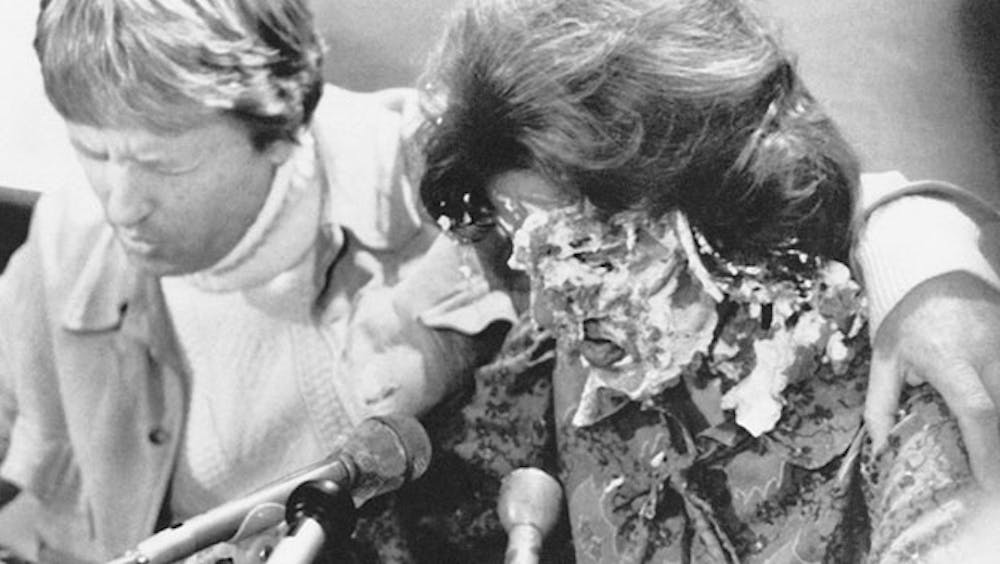
Many people made connections with other incidents where controversial (often racist or homophobic) figures were hit with food in public. This included when American anti-gay campaigner Anita Bryant was hit in the face with a cream pie on television in 1977, Australian far right politician Fraser Anning was egged in 2019 and the Brexit Party’s Nigel Farage was “milkshaked” while campaigning in the UK during the 2019 European Union Parliament elections.

The juice tipped over Keen-Minshull is part of a long legacy of politicians and controversial public figures being hit with food stuffs during protests against them.

A delicious symbol of protest

As Ekaterina Gladkova has written, food has long been a potent symbol for protest. Writing about food riots in the 18th century, social historian E.P. Thompson suggested that food formed part of the “moral economy” and food prices were central to lower class protest in England.

Food is also used in protest as a symbol of moral rejection, with eggs, tomatoes and other soft and sticky food stuffs thrown at public figures. Often soaking or staining the figure in question, the purpose of throwing food is not to hurt them, but to humiliate them. To make disagreeable figures into those of ridicule and to demonstrate people’s moral objection to their presence in public.

Anita Bryant, an outspoken opponent of gay rights, ran a campaign to repeal a local ordinance in Florida in 1977 that prohibited discrimination on the basis of sexual orientation.
Wikimedia, CC BY

Throughout the 20th century, many different groups flung food at people in protest, particularly at politicians. In 1910, the British suffragette Ethel Moorhead threw an egg at Winston Churchill when he was home secretary. This was in response to the treatment of suffragettes in prison, including the force-feeding of hunger strikers.

In 1960, then-US Vice President Richard Nixon was pelted with eggs and tomatoes while campaigning in Chicago. In Britain during the 1970s and 1980s, visits by right-wing politicians on university campuses saw several incidents of food stuffs hurled. Sir Keith Joseph, one of Margaret Thatcher’s earliest supporters, had flour bombs and eggs thrown at him at Essex University in 1977. Home Office minister David Waddington was covered in beer in December 1985 when he visited Manchester University. The following year, Enoch Powell was hit with a ham sandwich during a speech at Bristol University.

‘They blew whistles, let off stink and smoke bombs and at one point threw a ham salad sandwich at him…’ as reported in BACUS, the Bristol Student Newspaper.

A nice egg in this trying time

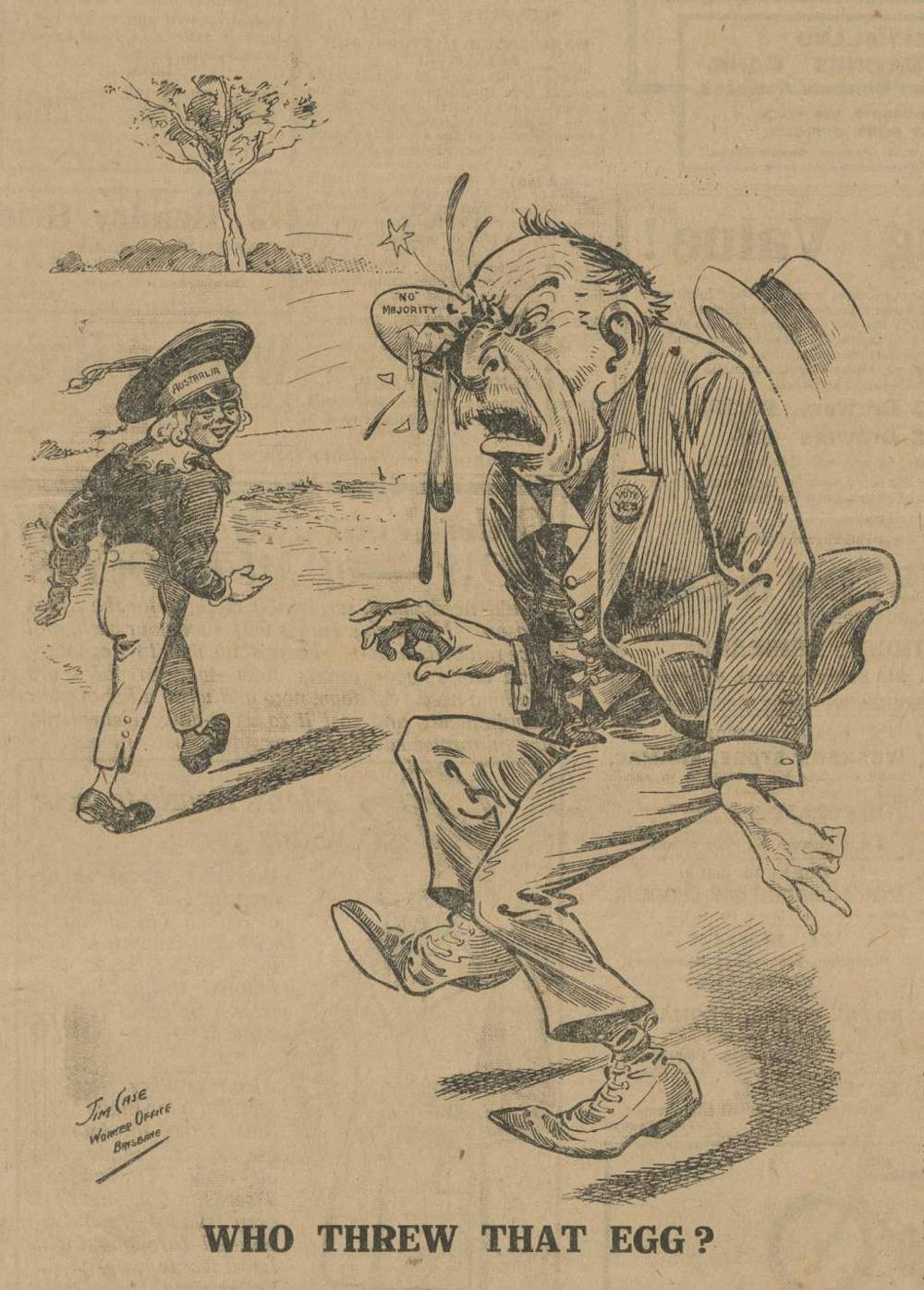
Australian politicians have also fallen victim to eggings over the decades. One of the most infamous eggings was of Prime Minister Billy Hughes in 1917 in Queensland. Hughes, campaigning to introduce conscription during the first world war, responded by calling for the launch of the Commonwealth Police Force (the predecessor to the Australian Federal Police).

In the late 1970s and early 1980s, then-Prime Minister Malcolm Fraser was egged on several occasions. In 1979, activists protesting against unemployment threw eggs at Fraser, reportedly shouting, “Feed the rich!” In 1981, students protesting against fees launched tomatoes and eggs at him when he arrived at Macquarie University.

This cartoon by Jim Case lampooned Prime Minister Billy Hughes in light of his public egging at Warwick, by conflating the egg with the Australian response to his conscription proposals.
The Museum of Australian Democracy

Throwing food stuffs has been a particular means of protesting the far right over the years, too. In Britain during the 1930s, anti-fascists threw various foods at Oswald Mosley’s British Union of Fascists at different meetings. At the legendary Battle of Cable Street in London in 1936, there are various accounts of eggs, flour and rotten food being chucked at fascists and the police.

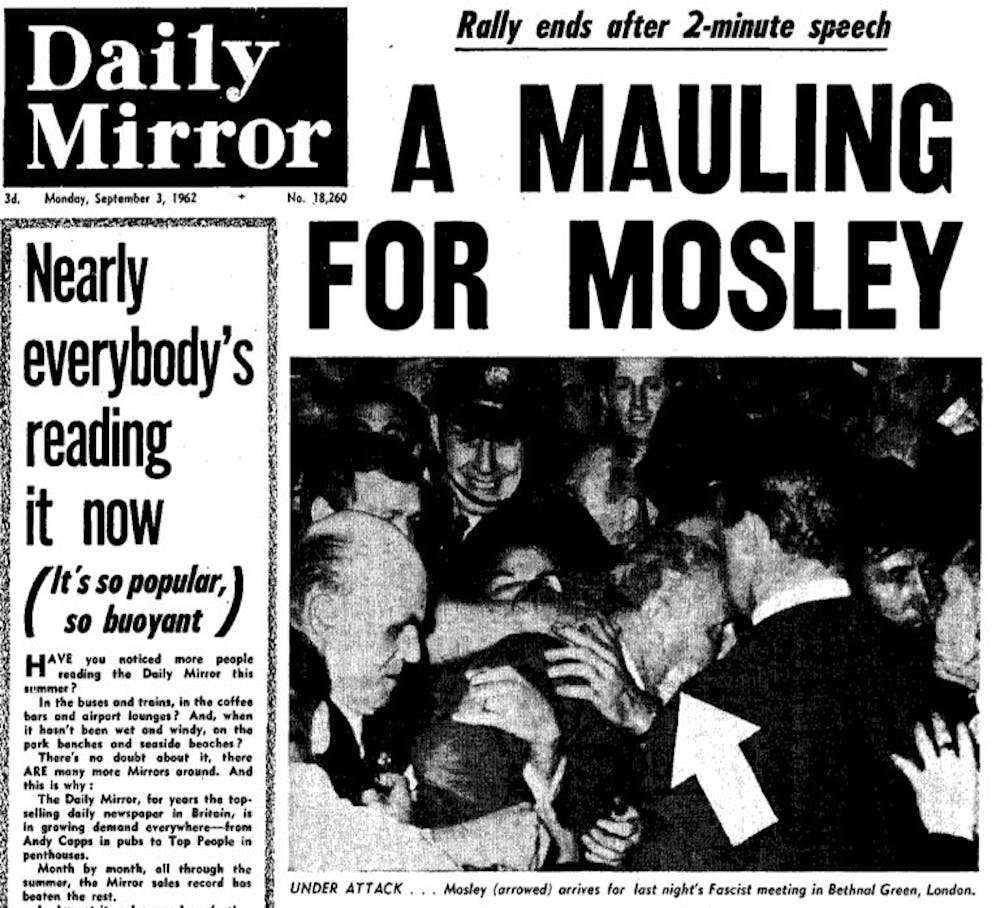
After the war, Mosley still attracted protests involving food. When speaking at the Cambridge Union in 1958, he was hit in the face with a custard pie. Speaking to the same union two years later, Mosley was slapped with a jelly across the face. The Cambridge student newspaper, Varsity, reported the protester shouted, “have a jelly my friend”, as he thrust the green jelly towards the fascist leader.

Front cover of the Daily Mirror, reporting on the egging.
Wikimedia

The milkshake: the anti-fascist cultural symbol

In more recent times, the British National Party’s Nick Griffin was egged as he tried to hold a press conference in 2009. In France, the Front National’s Marine Le Pen, once a close ally of Griffin, has been egged several times on the campaign trail, including in 2017 and 2022. In 2019, former English Defence League leader Tommy Robinson, UKIP candidate (and YouTuber) Carl Benjamin and Nigel Farage all become casualties of milkshaking, with the milkshake briefly becoming an anti-fascist cultural symbol.


Read more:
Why food is such a powerful symbol in political protest


Australia’s far right has also been of the receiving end of food being thrown by anti-fascists. When National Action attempted a public action in the Melbourne suburb of Brunswick in 1994, protesters heaved eggs, tomatoes and horse manure at them. It was reported that their leader, Michael Brander, was hit in the mouth with an egg, leading to Channel Nine to replay footage under the caption “hole in one”.

And, of course, former far right Senator Fraser Anning had an egg cracked over the back of his head by a teenage boy in 2019.

Humiliation, not violence

Some in the past have complained that eggings and milkshakings are a form of political violence. However, defenders of those who have thrown food at public figures have argued that these are non-violent forms of protest.

As numerous incidents demonstrate, the flinging of food is designed the humiliate, not injure. Compared with the prospect of violence from the far right, immersing political opponents in sticky and smelly food is relatively minor. The tossing of food at politicians and other controversial figures is symbolic of a moral objection to their politics and presence in public spaces.

After the egging of Nick Griffin, Gerry Gable, the long-time editor of the UK anti-fascist magazine Searchlight, wrote that while seeing foodstuffs being dumped over Griffin’s head “certainly brought a smile to many people’s face,” it was “going to take more than a few well-aimed eggs and worthy placards to finish the BNP for good”.

This is certainly the case, but the throwing of food is an act of protest that demonstrates disgust at the target. In the age of social media, where protest actions can be shared by millions, lobbing an egg, tomato or milkshake can be a feat of defiance against politicians, bigots and other objectionable characters.

The Conversation

Evan Smith has previously received funding from the Australian Academy of the Humanities and the Museum of Australian Democracy.

ref. The yolk’s on you: a brief history of throwing food and drink on people as protest – https://theconversation.com/the-yolks-on-you-a-brief-history-of-throwing-food-and-drink-on-people-as-protest-202724

For remote Aboriginal families, limited phone and internet services make life hard. Here’s what they told us

Source: The Conversation (Au and NZ) – By Jessa Rogers, First Nations Senior Research Fellow, Queensland University of Technology

Author provided

It’s well understood that the digital divide disproportionately affects people living in regional Australian communities. Remote Aboriginal communities in particular are among the most digitally excluded, yet there is little research looking at how these families experience digital inclusion.

Our research project, Connecting in the Gulf, shares stories directly from Aboriginal families living on Mornington Island, off the coast of Queensland in the Gulf of Carpentaria. Our full report is published online.

Working with the community, we developed a research method called “show and yarn” in which families showed us their devices and yarned about their experiences of digital inclusion.

Yarning is an Indigenous way of sharing knowledge. It was an important aspect of our work, since better outcomes are achieved when Indigenous people have a say in the design and delivery of policies, programs and services that affect them.

How do families living remotely connect?

Mornington Island residents have poor quality mobile and broadband services, and few options. The island’s only mobile network, Telstra 4G, is concentrated on the township of Gununa and is prone to congestion and outages.

The other main digital services are:

  • a free community wifi spot in Gununa with a 100-metre radius
  • a few solar-powered and satellite-enabled outstation phones placed across the island
  • the option to purchase NBN satellite plans from certain providers.
A cyclone-proof, solar-powered outstation phone about 20km from the township of Gununa.

The island, which has about 1,200 residents, is slated to receive a major upgrade under the Regional Connectivity Program sometime soon, but families were unaware of when this would happen.


Read more:
Digitising social services could further exclude people already on the margins


Extending a culture of sharing

The families we spoke to told us they use their mobile phones almost exclusively to make calls and access the internet.

In many cases, devices are shared between several family members, and data is shared via hotspotting when someone runs out. This is reflective of a broader culture of sharing, but can also be a source of conflict.

As one community member told us:

I hear a lot of people […] On Facebook, my mother is talking about hotspotting, they are sick of hotspotting […] I’ve got no data because we’ve got to hotspot for them […] If someone wants to use the internet to do a bank transfer, they’ll come up and ask.

Although families can purchase contract-based satellite internet connections, they spoke of poor past experiences, and a fear of being locked into contracts. They expressed that they would rather rely on prepaid credit than risk going into debt.

Interviewees also preferred to use data in their own homes despite the free community wifi spot, reflecting a family-oriented way of being.

Mornington Island residents showed us their devices and yarned with us about how they experienced digital inclusion.

Digital literacy is a challenge and opportunity

The families spoke of a gap between young people who quickly learn how to use technology, and Elders who aren’t as savvy online. We heard stories of young people pestering family members for online passwords and hotspots, and then using and/or sharing these with other people without permission.

As one person explained:

Some family members do feel like you’re taking advantage of them at times, when they feel like ‘Oh, I should share’. And it’s the same way with the banking, with the money. They’d feel like they’re obligated to share.

They also described how limited and unreliable mobile phone reception and coverage was impacting cultural activities.

For instance, phone reception stops just out of town and doesn’t cover most of the land and sea of the island. Sick and elderly people with safety concerns are scared to leave the township for activities out on Country.

One Elder suggested more young people would go out for cultural activities if outstations had better phone and internet coverage:

I think it’ll make them happy and have that pride in being out on their own land […] Whether it’s newborn turtle, or crab, fish, and them showing it off and it’ll give them that self-pride and happiness […] ‘This is what I caught’ – and they’ll show more than one family (on Facebook).

Some families had access to tablets and gaming consoles, mostly used by hotspotting prepaid mobile data.

What’s being done about the digital divide?

In January, the federal government established a First Nations Digital Inclusion Advisory Group to accelerate progress towards Closing the Gap targets. An Indigenous Digital Inclusion Plan is also being developed, with contributions from key stakeholders. Both of these developments are promising.

Boosting infrastructure in remote Aboriginal communities is not favourable for profits, given the small number of residents. Yet it’s essential for ensuring these families feel safe, that they can continue cultural practices, and access the many employment, health and education benefits of being online.

Most of all, we must listen to Indigenous voices and work with these communities to improve speed, reliability and access to services. Organisations such as InDigiMOB are working hard to achieve this.


Read more:
Digital inequality: why can I enter your building – but your website shows me the door?


The Conversation

Jessa Rogers receives funding from the Australian Research Council as a DECRA fellow. The Connecting in the Gulf project is funded by QUT’s IGNITE Grant Scheme, and the AuDA Foundation.

Amber Marshall has previously received funding for related research from the Australian Communications Consumer Action Network (ACCAN) and Queensland Government.

Kim Osman and Thu Dinh Xuan Pham do not work for, consult, own shares in or receive funding from any company or organisation that would benefit from this article, and have disclosed no relevant affiliations beyond their academic appointment.

ref. For remote Aboriginal families, limited phone and internet services make life hard. Here’s what they told us – https://theconversation.com/for-remote-aboriginal-families-limited-phone-and-internet-services-make-life-hard-heres-what-they-told-us-201295

Long COVID puts some people at higher risk of heart disease — they need better long-term monitoring

Source: The Conversation (Au and NZ) – By John Donne Potter, Professor, Research Centre for Hauora and Health, Massey University

Getty Images

Lasting damage to the heart and brain is an aspect of long COVID that should receive much more attention than it has so far. We have sufficient evidence now to call for ongoing monitoring of individuals across the population.

At least one in ten people – and probably more – develop long COVID after the acute infection and many experience persistent debilitating symptoms, including fatigue, a disturbed sense of smell or taste, shortness of breath, brain fog, anxiety and depression.

But a much smaller group of people develops more life-threatening disorders, particularly cardiovascular disease, which includes heart attacks and strokes. The scale of this problem is now clearer.

We know that SARS-CoV-2, the virus that causes COVID, can directly infect heart tissue and cause microscopic blood clots, which can sometimes culminate in deep vein thrombosis, pulmonary embolism, myocardial infarction and stroke.

Several studies now show an elevated risk of cardiovascular outcomes following COVID and there may also be hidden pathology that will only emerge as people age.

We need to monitor people with a history of COVID, at least with regular check-ups by family practitioners. Even better, we should establish a registry to facilitate research and healthcare for people at risk.

Cardiovascular disease after the acute infection has passed

The first study to present large-scale data on long-term (rather than acute) cardiovascular complications from COVID was based on the national healthcare databases of the US Department of Veterans Affairs. It established a cohort of almost 154,000 individuals with COVID and two comparison groups, each of more that five million.

The research showed that, after 30 days, people with COVID were at increased risk of stroke (1.5-fold higher risk) and transient ischaemic attacks of the brain (1.5-fold), abnormal heart rhythms (1.7-fold), ischaemic heart disease (1.7-fold), pericarditis (inflammation of the outermost layer of the heart; 1.9-fold), myocarditis (inflammation of the heart muscle; 5.4-fold), heart failure (1.7-fold) and clotting disorders (2.4-fold).

These higher risks increased with the intensity of required care during the acute COVID phase but were evident even among those not hospitalised.


Read more:
What the research shows about risks of myocarditis from COVID vaccines versus risks of heart damage from COVID – two pediatric cardiologists explain how to parse the data


Another study focused on a younger group (mean age of 43 years), using data held by US healthcare organisations, with more than four million individuals who had completed a COVID test. Like the veterans study, follow-up began after 30 days and continued for 12 months.

The researchers compared rates of cardiovascular outcomes for groups with and without COVID infection. Those with COVID had a higher risk of stroke (1.6-fold) and transient ischaemic attacks (1.5-fold), atrial fibrillation (2.4-fold), pericarditis (1.6-fold), myocarditis (4.4-fold), acute coronary artery disease (2.1-fold), heart attack (2-fold), heart failure (2.3-fold) and clotting disorders such as pulmonary embolism (2.6-fold).

The risk of a major adverse cardiovascular event was 1.9-fold higher. Risk for any cardiovascular outcome was about 1.6-fold higher, as was the risk of dying. These higher risks were seen among both men and women. The risk of dying was greater among people aged 65 and older.

Higher healthcare needs and excess deaths

The most recent study analysed insurance claims from every US state to explore one-year outcomes in a group of more than 13,000 people with long COVID, compared with a matched group of more than 26,000 individuals without a history of COVID.

During follow-up, the long-COVID cohort sought higher healthcare for a wide range of adverse outcomes, including cardiac arrhythmias (2.4-fold higher), pulmonary embolism (3.6-fold), ischaemic stroke (2.2-fold), coronary artery disease (1.8-fold), heart failure (2-fold) as well as emphysema and asthma.

The people with long COVID were more than twice as likely to die than the COVID-free controls.


Read more:
Supporting a child with long COVID – tips from parents of children living with the condition


It is notable these studies produced similar patterns of risk for cardiovascular disease. The risks of both myocarditis and clotting disorders were particularly elevated.

Another study took a different approach, estimating excess deaths due to cardiovascular disease across multiple pandemic waves in the US. From March 2020 to March 2022, there were more than 90,000 excess deaths from cardiovascular disease – 4.9% more than expected.

What might we be missing?

These are all observational studies. There is always the concern that some unmeasured variables may explain the findings. However, the close consistency of these studies makes this less likely. The following two reports suggest that, if anything, these studies may be underestimating the size of the problem.

In a community-based UK prospective study of long COVID among low-risk individuals (low prevalence of comorbidities and only 19% hospitalised with acute COVID), 26% showed mild heart impairment four months after their initial diagnosis.

Cardiovascular MRI scans of 534 individuals with long COVID revealed one in five showed some cardiac impairment at six months, which persisted in more than half the group at 12 months. These two studies suggest sub-clinical cardiac disorder may be a much more common manifestation of long COVID than expected.

Does vaccination help?

One way to establish whether COVID infection is responsible for the higher rates of cardiovascular disease is to ask whether vaccination reduces risk (as it does with the more common symptoms of long COVID).

Two studies suggest vaccination approximately halves the risk of severe cardiovascular outcomes. A Korean study shows fully vaccinated people had less than half the risk of both heart attack and stroke compared to an unvaccinated group.


Read more:
Long COVID affects 1 in 5 people following infection. Vaccination, masks and better indoor air are our best protections


A similar study in the US – with groups categorised as fully vaccinated, partially vaccinated, and unvaccinated – observed most cardiovascular events in the unvaccinated group (12,733 of 14,000). Affected individuals had markedly more co-existing conditions, including previous major cardiovascular events, type 2 diabetes, high blood lipids, ischaemic heart disease, liver disease and obesity.

However, even taking these pre-existing higher risks into account, those who were fully vaccinated had a 41% lower risk. Partial vaccination conferred a 24% lower risk of severe cardiovascular disease.

The need to monitor people with a history of COVID, especially long COVID, is clear.

The Conversation

John Donne Potter does not work for, consult, own shares in or receive funding from any company or organization that would benefit from this article, and has disclosed no relevant affiliations beyond their academic appointment.

ref. Long COVID puts some people at higher risk of heart disease — they need better long-term monitoring – https://theconversation.com/long-covid-puts-some-people-at-higher-risk-of-heart-disease-they-need-better-long-term-monitoring-202596

PNG’s Masiu denies ‘control of media’ but calls for ‘accountability’

By Gorethy Kenneth in Port Moresby

Communication Minister Timothy Masiu has hit back at recent reports termed as “inaccurate” over the control of media in Papua New Guinea from his ministerial statement in Parliament.

He said it was not true that the government was trying to control the media by setting up a Media Council.

He refuted the report, saying that the government would not control the media.

In his responce to questions raised, Masiu clarified the intent and purpose of the Media Development Policy which was basically to establish an enabling framework to recognise and develop the media in PNG to “support our development agenda”.

“Current research and recent consultations have led us to the consolidation of four main issues within the media sector,” he said.

“First is the concerns on [the] quality of journalism. By concerns we observe the decline of quality investigative journalism, the impact of substandard reporting on the development agenda, and the concerns on conduct, ethics, and accountability of journalists.

“My ministry, through the Department of ICT [Information Communications Technology], is currently collating both quantitative and qualitative data to verify the concerns on safety of journalists. We recognise that, at the moment, there is a lack of protection mechanisms for journalists.

‘Reorganising’ state-owned media
“My ministry has for the last three years looked at options on how to reorganise state-owned media outlets so that we coordinate dissemination of government information better.

“We recognise that us as government are lacking coordination in government information.

“The ministry has identified that SMEs [small and medium-sized enterprises], particularly in the modern media space, are not recognised as professionals and not given appropriate support.

“By promoting access to information, media diversity, and responsible journalism, the policy aims to support the development of a more informed, engaged, and empowered citizenry in Papua New Guinea.

“On the question of how this policy will promote media freedom, early this year we released draft version 1, followed by a version 2 of the National Media Development Policy.

“In both versions of the draft policy, we proposed for the re-establishment of the PNG Media Council as an independent arm to represent and maintain standards within the media professions.

“The ministry maintains the view that the PNG Media Council, through its self-governing model, is not doing enough to grow the profession and hold journalists accountable.

Media Council ’empowered’
“Through the ministry’s proposal, the PNG Media Council would be empowered and hold mainstream media outlets accountable and establish [a] protection mechanism for journalists.

“I want to inform Members of Parliament that we have had a consultation workshop and as a result, my department is working on identifying a model where we can find common ground with all stakeholders.

“I want to remind all that this policy is not about regulating but more on building capacity and recognition within the media profession.

“The department is reviewing whether to include provisions for oversight on social media platforms and we will inform in version 3 of the draft policy.

“As a matter of update, my department will be publishing a consultation report this week.

“Following this, the consultation itself is leading us to undertake a series of nationwide surveys to better define our media landscape and ascertain data necessary to consolidate issues highlighted in the recent consultation workshop.

“My department is expected to be releasing a version 4 of the draft policy towards the end of April.

“This version 4 will be subject to further feedback. I expect to take to cabinet as early as May and should legislation be proposed, we would also start the drafting process in May.”

Gorethy Kenneth is a senior PNG Post-Courier journalist. Republished with permission.

Print Friendly, PDF & Email

Article by AsiaPacificReport.nz

Fiji to scrap ‘dead in water’ media law with pledge to back independent journalism

By Kelvin Anthony, RNZ Pacific lead digital and social media journalist

The Fiji government has announced it will repeal the controversial Media Industry Development Act 2010.

Prime Minister Sitiveni Rabuka said cabinet had approved the tabling of a bill to repeal the Act “as a whole.”

“The decision is pursuant to the People’s Coalition Government’s commitment to the growth and development of a strong and independent news media in the country,” said Rabuka in his post-cabinet meeting update.

“It has been said that ‘media freedom and freedom of expression is the oxygen of democracy’,” he said.

“These fundamental freedoms are integral to enable the people to hold their government accountable.

“I am proud to stand here today to make this announcement, which was key to our electoral platform, and a demand that I heard echoed in all parts of the country that I visited,” he added.

The announcement comes just days after Rabuka’s government introduced a new draft legislation to replace the act.

Strongly opposed
The move to replace the 2010 media law with a new one was strongly opposed during public consultations by local journalists and media organisations.

They said there was no need for new legislation to control the media and called for a “total repeal” of the existing regulation.

The country’s Deputy Prime Minister, Manoa Kamikamica, told RNZ Pacific last Friday that there were areas of concern that local stakeholders had raised during the consultation session of the proposed new bill.

“We hear what the industry is saying, we will make some assessments and then make a final decision,” he said.

But Rabuka’s announcement today means that the decision has been made.

RNZ Pacific has contacted the Fijian Media Association for comment.

‘Good decision’ but investment needed
University of the South Pacific head of journalism programme Associate Professor Shailendra Singh said the announcement was expected.

Dr Singh said repealing the punitive legislation was a core election platform promise of the three challenger parties which are now in power.

“This is a good decision because the Fijian media and other stakeholders were not sufficiently consulted when the decree was promulgated in June 2010.”

But he said while getting rid of the media act was welcomed, the coalition was working on a new legislation and “we have to wait and see what that looks like”.

“The media act was dead in the water or redundant before the change in government. The new government could not have implemented it after coming to power, having criticised it and campaigned against it in their election campaign,” he said.

“Repealing the act removes the fear factor prevalent in the sector for nearly 13 years now.”

Dr Singh said the government had committed to the growth and development of a strong news media.

Public good investment
But that, he said, would require more than the repeal of the act.

“[Improving standards] will require some financial investments by the state since media organisations are struggling financially due to the digital disruption followed by covid.”

He said among the many challenges, the media industry was struggling to retain staff.

“So incentives like government scholarships specifically in the media sector could be one way of helping out.

“Media is a public good and like any public good government should invest in it for the benefit of the public.”

This article is republished under a community partnership agreement with RNZ.

Print Friendly, PDF & Email

Article by AsiaPacificReport.nz

‘Big picture vision’ conversations missing in Pacific, says Aqorau

By Giff Johnson in Majuro

Big picture conversations about the future of the Pacific islands should be happening, but they are not, says one of the region’s foremost commentators in an interview published n the Marshall Islands Journal.

Breaking down barriers between Pacific islands to spur economic development, visioning 21st century skills that island youth must have for jobs locally or globally, action needed to reverse the non-communicable disease pandemic sweeping the region, and reinventing governance systems for governments to successfully navigate the future of their nations — these are among priority issues that Dr Transform Aqorau believes need to be on the agenda for island leaders.

But for the most part they are not in the conversation.

“There isn’t enough discussion about the future,” said Dr Aqorau, who took up the Solomon Islands National University’s vice-chancellor position in January.

Dr Aqorau was in Majuro recently for the official opening of the Parties to the Nauru Agreement or PNA Office. He was the founding chief executive of the PNA Office from 2010-2016, guiding it from a decision of the leaders on paper to establish the first office of the PNA to becoming one of the most powerful fisheries organisations in the world.

“This is a conversation that isn’t just for universities,” he said. “Governments need to be discussing their vision for the future and work in tandem with national universities.”

It was not simply a theoretical exercise. The conversation could have much needed practical impact on islands in the region, he said.

PNA model ‘has clout’
The PNA model had shown the clout of a regional effort and the governance systems that supported the vision of the nine nations involved in PNA, he said.

“All Pacific islands need to create opportunities in agriculture, fisheries, tourism and other areas,” he said. “It’s difficult, but in the region, we should ask ourselves: What kind of collective brand can we create?”

He thinks the Pacific could offer itself to visitors as a tourism package, not in competition with one another.

“What did we learn from covid?” he asked. “Those that relied on one thing, such as tourism, struggled.”

“We shouldn’t see ourselves as separate. Instead, we should see ourselves as a single economic bloc (and by doing so) we could help ourselves more (during times like the covid pandemic).”

Tourism and trading blocs would work to the advantage of different islands, combined with technology and educational initiatives.

“In our Blue Continent, we should tear down national barriers and work together,” he said.

‘What future for our children?’
“If we don’t do these things for the people, respect for governments as institutions will decline. We need to be asking: What is the future we want for our children?”

Pacific youth should have global skills so they are citizens of the world, Dr Aqorau said.

Seeing NCDs undermine the health of people across the Pacific is great concern too Aqorau. “We need to manufacture our own healthy snacks and alternative foods from our own resources,” he said.

Governments need to get behind incentivising production of island “super foods” and phasing out imported junk food to attack the health crisis “so our next generation can live healthy like their forefathers”, he said.

“These are conversations with impact,” said Dr Aqorau. “They create jobs.”

He expressed worry about the present levels of governance in the region.

“Current structures of government are not working,” he said. “I don’t see their ability to manage this change unless there is a foundational change in the way governments are designed.”

Worsening corruption
He said he saw worsening corruption undermining governance in the region.

“I see increasing alienation of people and increased power in small groups of elite,” Aqorau said, adding that in the present governance environment there was “no way for youth and women to be involved.”

PNA was a shining example of governance that benefited people in the region, he said.

But in the area of resource extraction aside from fisheries — logging and forestry, fossil fuels, mineral mining and deepsea mining — there were no comparable levels of governance.

“PNA shows there is a lot that we can do with forestry, deep sea mining and other extraction resources,” he said.

“We need governance systems in place so we are not exploited. But it’s happening [exploitation] in forestry.”

In the context of the geopolitical competition that is putting additional stress on governance in the islands, Dr Aqorau offered this suggestion to donors.

“Instead of donating things we don’t need that add a level of burden on island countries, support constitutional reforms in governance.”

Dr Aqorau believes that “it won’t always be like this. Young people will demand change”.

Republished with permission.

Print Friendly, PDF & Email

Article by AsiaPacificReport.nz

Inheritance taxes, resource taxes and an attack on negative gearing: how top economists would raise $20 billion per year

Source: The Conversation (Au and NZ) – By Peter Martin, Visiting Fellow, Crawford School of Public Policy, Australian National University

Shutterstock

Asked to find an extra A$20 billion per year to fund government priorities like building nuclear submarines and responding to climate change, Australia’s top economists overwhelmingly back land tax, increased resource taxes, an attack on negative gearing and extending the scope of the goods and services tax.

The 59 leading economists surveyed by The Conversation and the Economic Society of Australia were asked to pick from a list of 13 options (many of them identified in the government’s 2022-23 Tax Expenditures and Insights Statement) and reply as if political constraints were not a problem.

The economists chosen are recognised as leaders in their fields, including economic modelling and public policy. Among them are former International Monetary Fund, Treasury and OECD officials, and a former member of the Reserve Bank board.

Asked to choose tax measures on the basis of efficiency – minimising the economic damage the extra taxes or tightening of tax concessions would do – 40% chose increased or new taxes on land, while 39% choose increased resource taxes.


International consultant Rana Roy said every major economist in every strand of modern economics had found taxes on the use of land and natural resources to be the least damaging way of raising money.

This was confirmed in Hong Kong, which charged for the use of crown land; in Norway, which heavily taxed oil and gas resources; and in countries such as Australia, which charge for the use of broadcast spectrum.

Former OECD official Adrian Blundell-Wignall said Australia’s natural resources were the birthright of every Australian. It was time for a resource rent tax along the lines of the one introduced by the Rudd and Gillard governments and abolished by the Abbott government in 2014.

Blundell-Wignall said politicians should ignore the usual hysteria that arose whenever the idea was discussed.

Centre for Independent Studies economist Peter Tulip said he would lump income from inheritances in with income from changes in land value. In both cases the income was unexpected, undeserved, and not compensation for sacrifice. And it disproportionately went to the already fortunate.

Negative gearing an ‘easy win’

A quarter of those surveyed backed winding back the ability to negatively gear (write off against tax) expenses incurred in owning investment properties, a concession costed by Tax Expenditures Statement at $24.4 billion per year.

Blundell-Wignall said negative gearing should have been wound back years ago. Few other countries allowed it, and it contributed to the build up of exposure to property in Australia’s banking system and financial risk as interest rates climbed.

University of Sydney economist James Morley described getting rid of negative gearing as an “easy win”. There were better ways to support home building.

Independent economist Saul Eslake said while he was inclined to extend capital gains tax to the sale of high-end family homes, the problem with the idea was that it might allow owners to write off against tax their mortgage payments (as is the case for investors who negatively gear), encouraging even larger mortgages.

One quarter of those surveyed wanted to broaden the scope of the goods and services tax (at present it excludes spending on education, health, childcare and fresh food) and one fifth wanted to increase the rate, pointing out that a 10%, it was low by international standards.

‘Unfair’ super concessions and tax-free inheritances

Asked to choose measures on the basis of equity – not treating similar people differently – 52% backed inheritance taxes, 37% backed winding back superannuation tax concessions and 32% backed increased resource taxes.

None would broaden the GST on equity grounds, and only 3.4% would increase its rate on equity grounds.


Grattan Institute chief executive Danielle Wood said two-thirds of the value of super tax breaks went to the top fifth of income earners, who are already saving enough for their retirement and would do so without tax concessions.

Wood said the government should go further than the measures taken against super accounts worth more than $3 billion announced in February.

The University of Adelaide’s Sue Richardson said super concessions had a negative impact on budget revenue, amounting to tens of billions per year. They were used for tax minimisation by high earners who obtained expensive advice.

Missing fixes: Stage 3 and a carbon tax

Guyonne Kalb of the University of Melbourne said the most important tax measure for fairness was one not listed as an option: scrapping the legislated “Stage 3” tax cuts for high earners, due to take effect in 2024.

The tax cuts scheduled for people earning between $120,000 and $200,000 would not have much or any positive impact on Australia’s labour supply and would cost the budget more than $100 billion in their first seven years.

Three panellists, Frank Jotzo, Michael Keating and Stefanie Schurer, said they would have selected “carbon pricing to raise revenue” had it been an option.

Jotzo said if Australia fully taxed emissions at $100 per tonne, the revenue would be around $15 billion per year from electricity, $18 billion from industry, and $9 billion from transport – very large sums in relation to other options.

Schurer would also take away all subsidies to fossil fuel industries. In 2021-22 measures that wholly, primarily or partly assisted fossil fuel industries cost federal, state and territory governments $11.6 billion.

If the government needed $20 billion per year, it could raise around half from fossil fuel subsidies alone.


Individual responses:


Read more:
How can Australia pay $368 billion for new submarines? Some of the money will be created from thin air


The Conversation

Peter Martin does not work for, consult, own shares in or receive funding from any company or organisation that would benefit from this article, and has disclosed no relevant affiliations beyond their academic appointment.

ref. Inheritance taxes, resource taxes and an attack on negative gearing: how top economists would raise $20 billion per year – https://theconversation.com/inheritance-taxes-resource-taxes-and-an-attack-on-negative-gearing-how-top-economists-would-raise-20-billion-per-year-202630

What are auroras, and why do they come in different shapes and colours? Two experts explain

Source: The Conversation (Au and NZ) – By Brett Carter, Associate Professor, RMIT University

Lightscape / Unsplash

Over millennia, humans have observed and been inspired by beautiful displays of light bands dancing across dark night skies. Today, we call these lights the aurora: the aurora borealis in the northern hemisphere, and the aurora australis in the south.

Nowadays, we understand auroras are caused by charged particles from Earth’s magnetosphere and the solar wind colliding with other particles in Earth’s upper atmosphere. Those collisions excite the atmospheric particles, which then release light as they “relax” back to their unexcited state.

The colour of the light corresponds to the release of discrete chunks of energy by the atmospheric particles, and is also an indicator of how much energy was absorbed in the initial collision.

The frequency and intensity of auroral displays is related to activity on the Sun, which follows an 11-year cycle. Currently, we are approaching the next maximum, which is expected in 2025.

Fox Fires, a short film inspired by the Finnish folk tale of the aurora borealis.

Connections to the Sun

Such displays have long been documented by peoples throughout North America, Europe, Asia and Australia.

In the 17th century, scientific explanations for what caused the aurora began to surface. Possible explanations included air from Earth’s atmosphere rising out of Earth’s shadow to become sunlit (Galileo in 1619) and light reflections from high-altitude ice crystals (Rene Descartes and others).


Read more:
Do the northern lights make sounds that you can hear?


In 1716, English astronomer Edmund Halley was the first to suggest a possible connection with Earth’s magnetic field. In 1731, a French philosopher named Jean-Jacques d’Ortous de Mairan noted a coincidence between the number of sunspots and aurora. He proposed that the aurora was connected with the Sun’s atmosphere.

It was here that the connection between activity on the Sun was linked with auroras here on Earth, giving rise to the areas of science now called “heliophysics” and “space weather”.

Earth’s magnetic field as a particle trap

The most common source of aurora is particles travelling within Earth’s magnetosphere, the region of space occupied by Earth’s natural magnetic field.

Images of Earth’s magnetosphere typically show how the magnetic field “bubble” protects Earth from space radiation and repels most disturbances in the solar wind. However, what is not normally highlighted is the fact that Earth’s magnetic field contains its own population of electrically charged particles (or “plasma”).

Model representation of Earth’s magnetic field interacting with the solar wind.

The magnetosphere is composed of charged particles that have escaped from Earth’s upper atmosphere and charged particles that have entered from the solar wind. Both types of particles are trapped in Earth’s magnetic field.

The motions of electrically charged particles are controlled by electric and magnetic fields. Charged particles gyrate around magnetic field lines, so when viewed at large scales magnetic field lines act as “pipelines” for charged particles in a plasma.

The Earth’s magnetic field is similar to a standard “dipole” magnetic field, with field lines bunching together near the poles. This bunching up of field lines actually alters the particle trajectories, effectively turning them around to go back the way they came, in a process called “magnetic mirroring”.

‘Magnetic mirroring’ makes charged particles bounce back and forth between the poles.

Earth’s magnetosphere in a turbulent solar wind

During quiet and stable conditions, most particles in the magnetosphere stay trapped, happily bouncing between the south and north magnetic poles out in space. However, if a disturbance in the solar wind (such as a coronal mass ejection) gives the magnetosphere a “whack”, it becomes disturbed.

The trapped particles are accelerated and the magnetic field “pipelines” suddenly change. Particles that were happily bouncing between north and south now have their bouncing location moved to lower altitudes, where Earth’s atmosphere becomes more dense.

As a result, the charged particles are now likely to collide with atmospheric particles as they reach the polar regions. This is called “particle precipitation”. Then, when each collision occurs, energy is transferred to the atmospheric particles, exciting them. Once they relax, they emit the light that forms the beautiful aurora we see.

Curtains, colours and cameras

The amazing displays of aurora dancing across the sky are the result of the complex interactions between the solar wind and the magnetosphere.

Aurora appearing, disappearing, brightening and forming structures like curtains, swirls, picket fences and travelling waves are all visual representations of the invisible, ever-changing dynamics in Earth’s magnetosphere as it interacts with the solar wind.

As these videos show, aurora comes in all sorts of colours.

The most common are the greens and reds, which are both emitted by oxygen in the upper atmosphere. Green auroras correspond to altitudes close to 100 km, whereas the red auroras are higher up, above 200 km.

Blue colours are emitted by nitrogen – which can also emit some reds. A range of pinks, purples and even white light are also possible due to a mixture of these emissions.

The aurora is more brilliant in photographs because camera sensors are more sensitive than the human eye. Specifically, our eyes are less sensitive to colour at night. However, if the aurora is bright enough it can be quite a sight for the naked eye.

Where and when?

Catching aurora in the southern hemisphere.

Even under quiet space weather conditions, aurora can be very prominent at high latitudes, such as in Alaska, Canada, Scandinavia and Antarctica. When a space weather disturbance takes place, auroras can migrate to much lower latitudes to become visible across the continental United States, central Europe and even southern and mainland Australia.

The severity of the space weather event typically controls the range of locations where the aurora is visible. The strongest events are the most rare.

So, if you’re interested in hunting auroras, keep an eye on your local space weather forecasts (US, Australia, UK, South Africa and Europe). There are also numerous space weather experts on social media and even aurora-hunting citizen science projects (such as Aurorasaurus) that you can contribute towards!

A rare sighting of the aurora australis from central Australia, with Uluru in the foreground.

Get outside and witness one of nature’s true natural beauties – aurora, Earth’s gateway to the heavens.


Read more:
Fire in the sky: The southern lights in Indigenous oral traditions


The Conversation

Brett Carter receives funding from the Australian Research Council, the SmartSat CRC and the Australian Department of Defence. He has also consulted for Chimu Adventures as part of their Southern Lights Flight tours.

Elizabeth A. MacDonald receives funding from NASA and employed by NASA’s Goddard Space Flight Center. The Aurorasaurus project receives funding from NASA and NSF.

ref. What are auroras, and why do they come in different shapes and colours? Two experts explain – https://theconversation.com/what-are-auroras-and-why-do-they-come-in-different-shapes-and-colours-two-experts-explain-202618

Fears AUKUS will undermine Australia’s defence sovereignty are misplaced

Source: The Conversation (Au and NZ) – By Peter K. Lee, Research Fellow, Foreign Policy and Defence Program, USSC, University of Sydney

The AUKUS submarine announcement earlier this month reignited a long-running debate about how to best preserve Australia’s sovereignty.

The announcement addressed some key concerns. For example, the United States will sell (rather than lease) Australia its Virginia class submarines so Australia can keep these boats. The submarine commanders and crew will be Australian. The rotational deployments of US and UK submarines through Perth won’t become a foreign base. And Australia will ultimately build its own AUKUS class nuclear-powered submarines, likely in Adelaide.

Even so, the AUKUS announcement was met with sharp criticism. For some commentators, AUKUS is the last nail in the coffin of Australian independence from the US.

There are concerns about the reliance on others for technology and skills, especially regarding the nuclear reactors. Also, the massive investment allocated to the submarines may undermine a more balanced defence force needed for defending the continent.

What’s more, some analysts have questioned whether Australia can maintain independent military decision-making in future conflicts. For example, would Australia’s submarines be used to support the US in a war with China?

These concerns deserve serious consideration.

But many Australian strategists reject them. For them, AUKUS is less revolution than evolution, merely the logical extension of Australia’s robust defence cooperation with the US over many decades.

The AUKUS submarine plan represents a new shade of the dependency that Australia has always had on the US for advanced capabilities, and with which Australia has always been comfortable. So long as Australia is able to use these tools as it sees fit, the argument goes, then sovereignty is ensured. This is the way of the alliance.

We haven’t yet sacrificed our defence sovereignty or sovereign industrial capabilities on the altar of AUKUS.

Here’s why.


Read more:
AUKUS submarine plan will be the biggest defence scheme in Australian history. So how will it work?


What are Australia’s defence sovereignty objectives?

Many critiques of AUKUS go far beyond the specific issue of whether the proposed submarine pathway compromises Australia’s defence sovereignty. Instead, they touch on deeper questions of Australia’s strategic alignment with the US and the UK, and our national decision-making writ large.

For example, the most headline-grabbing critique is that AUKUS has deprived Australia of its freedom to choose what to do in a possible military contingency over Taiwan. But this hinges on a hypothetical future scenario, the answer to which cannot be known today.

We simply don’t know if Australia is now more locked into a potential US-China conflict than was already the case before September 2021, when AUKUS was first announced.

Answering that question involves far more than an assessment of just our submarine industrial capability.

We should instead judge the submarine announcement, and whether it undermines Australia’s sovereignty, against the actual procurement objectives that lay behind the need to replace the retiring Collins class submarines.

Will the submarine plan help Australia enhance its “defence sovereignty”? And will it help Australia build a “sovereign industrial capability” that gives future governments credible military options at a time of their choosing?

The 2018 Defence Industrial Capability Plan defined “defence sovereignty” as

the ability to independently employ Defence capability or force when and where required to produce the desired military effect.

If the Virginia class or AUKUS class submarines couldn’t be independently operated and needed US commanders or nuclear technicians, this would undermine our defence sovereignty. But this isn’t the case.

Similarly, if a future Australian prime minister wished to send a submarine on a mission and could only do so with US and UK approval and technical support, that would also suggest the government didn’t have full defence sovereignty. But this isn’t the case either.

A century of partnerships with others

The same 2018 capability plan defined a “sovereign industrial capability” as

when Australia assesses it is strategically critical and must therefore have access to, or control over, the essential skills, technology, intellectual property, financial resources and infrastructure as and when required.

In fact, Australia’s domestic defence industrial base has focused on controlling key elements of a capability, rather than manufacturing everything onshore. On the submarines, those will be the components to operate and sustain the boats from Australian shipyards.

Australia has, therefore, chosen to largely equip its defence force with the most advanced capabilities available from abroad – it’s the world’s fourth largest arms importer for a reason.

It’s worth remembering Australia has never had a truly sovereign submarine industrial capability. The cancelled program with France was but the latest in a century of partnership with others.

This has included:

  • jointly crewed boats with the UK before the first world war

  • dependence on the US submarine fleet operating from our ports during the second world war

  • British-built Oberon submarines in the Cold War

  • and Swedish-designed Collins class submarines in the 1990s, incorporating a US combat system and French sensors and radars.

In this sense, AUKUS isn’t a “Brave New World”. It’s more “Back to the Future” for Australia’s shipbuilding aspirations.

AUKUS is a sovereign choice

The dream of an entirely self-sufficient defence industry is inherently appealing. There’s something unsettling about relying on others for capabilities to defend oneself.

But Australia’s entry into AUKUS doesn’t only entail sovereign risks for Canberra. The US is also making a big bet putting its most closely-guarded nuclear reactor technology and boats in Australian hands at a time when it needs them most.

So what does the US get out of this deal? In 2021, US officials were at pains to reassure us there was no quid-pro-quo to the deal. But even if there were such a request, there’s nothing about AUKUS that locks Australia into actions future governments cannot withdraw from.

The UK received nuclear propulsion technology from the US in 1958 but stayed out of the Vietnam War.

Canada was also offered nuclear-powered submarines in 1988, but chose not to pursue the offer due to budget constraints and public opposition. That backtrack didn’t doom US-Canada relations.

Every day for the next half century, Australia’s leaders will wake up each morning and be free to make a choice about the future of the AUKUS partnership.

So, too, will the Australian people, who at each election will be able to vote for political parties who might offer different visions for the future of AUKUS. That is what it means to be sovereign.

The Conversation

The Foreign Policy and Defence Program where Peter K. Lee works receives funding from the Australian Department of Defence as well as corporate support from Northrop Grumman Australia and Thales Australia. Peter Lee also receives funding as a Korea Foundation research fellow, part of the South Korean Ministry of Foreign Affairs, at the University of Melbourne.

ref. Fears AUKUS will undermine Australia’s defence sovereignty are misplaced – https://theconversation.com/fears-aukus-will-undermine-australias-defence-sovereignty-are-misplaced-202607

Teaching the ‘basics’ is critical – but what teachers really want are clear guidelines and expectations

Source: The Conversation (Au and NZ) – By Christine Braid, Professional Learning and Development Facilitator in Literacy Education, Massey University

Getty Images

Anyone watching the debate over the National Party’s recent curriculum policy announcement could be forgiven for thinking there is a deep divide in education philosophy and best practice in New Zealand. The truth isn’t quite that simple.

In fact, most (if not all) interested parties would agree that teaching and learning the basics of literacy and numeracy are vital. As one expert observer noted, the policies of the major political parties actually have much in common.

The National Party policy promises a curriculum focused on “teaching the basics brilliantly”. The government says much of this work is already under way with its current curriculum “refresh”. So where exactly is the issue?

The idea of mandated testing checkpoints clearly has some worried that the National Party’s policy is a return to a “back to basics” mentality that ignores or minimises other vital areas of teaching. As one headline had it, “KPIs are for businesses and boardrooms, not children and schools”.

While the basics are important, the argument goes, there are other things schools should focus on. That may be true, but it need not be so binary. Basic early literacy and numeracy skills are the foundation on which much other success is built.

Perhaps a better way to frame the discussion might be: a wider view of learning is important – and the basics are necessary.

Learning literacy is a complex process: handwriting skill is the best predictor of writing success.
Getty Images

Learning to read and write is hard

Foundations take time to put in place, however. With reading and writing, for example, it’s common for capable adults to assume that many of the foundational skills are easily achieved.

In fact, neuroscience shows literacy learning is a remarkably complex process. Learning to identify letters and the sounds associated with them, and learning to read and retain words, involves a kind of repurposing of the brain’s architecture.

Learning to correctly spell words is even more complex than reading them. Successful teaching of spelling requires clear and systematic guidelines. Mastery cannot be left to chance or done through rote learning lists of words.


Read more:
Has a gap in old-school handwriting and spelling tuition contributed to NZ’s declining literacy scores?


Another often undervalued basic skill is handwriting. It can be seen as purely a presentation technique and simply about neatness. But research shows handwriting skill contributes directly to writing achievement and is the best predictor of writing success in younger students.

Reading and writing also rely on a foundation of oral language skill, including understanding sentence structure and having a strong vocabulary. Being proficient with sentences is the building block for paragraph formation, essential to more advanced writing tasks. Vocabulary knowledge is a strong predictor of academic achievement, connected to both reading and writing success.

Clear guidelines and specifics: teachers want to know what denotes progress, and when they should be concerned.
Getty Images

What teachers want

None of these skills develop by chance. So the question becomes, how can a curriculum best support teachers to teach literacy from its foundations upwards, with as many students as possible succeeding?

In my work as a literacy facilitator, I find teachers want specifics. They want to know what to teach at each stage. They want to know what the children in their classes should be able to do within that year. They want to know what denotes progress, and when they should be concerned.


Read more:
Teachers need a lot of things right now, but another curriculum ‘rewrite’ isn’t one of them


But the curriculum as a whole is necessarily broad and all-encompassing, to reflect the complex needs of society. The curriculum refresh groups learning in broad bands – and this presents problems for specific guidance and benchmarks.

In the English curriculum, one of the literacy goals for learners in the year 1-3 band is to “use decoding strategies with texts to make meaning”. This is far too broad to be helpful in teaching or assessment in any specific way.

More nuanced progress indicators are still being developed, but the draft examples suggest there will be more guidance in more specific age bands.


Read more:
Education expert John Hattie’s new book draws on more than 130,000 studies to find out what helps students learn


Guidelines and benchmarks

As well as through the curriculum, teaching will be supported by the Literacy & Communication and Maths Strategy and the Common Practice Model. As an educator, I hope the final versions of these documents will offer clear guidelines for both teaching and assessment.

And there are new resources recently provided to schools that contribute usefully to a systematic and successful approach to literacy teaching. These are based on current evidence of how reading is best taught. They include a progression of word learning framework, and decodable readers with lesson plans.

All of these resources should provide useful direction for schools in their literacy teaching. While we can never make the task of teaching literacy simple, specific guidelines can make the pathway for teaching more straightforward.

More focus on the basics need not be boring for learners, either. I recently observed a lesson where the children were learning to decode new words. At the end, a six-year-old said “that was fun, can we do more?” The act of laying foundations for literacy is anything but dull.

The National Party’s call for guidelines around “teaching the basics brilliantly” speaks to a vital part of a rounded education. More detail is now needed about what “brilliance” will mean in practice, just as we need more detail on the current curriculum refresh. Making foundation skills a key component of the curriculum may not be the whole answer, but it is absolutely necessary for overall success.

The Conversation

Christine Braid has been involved with the MoE NZC refresh as an advisor on the literacy indicators; and had worked on the scope and sequence, and decodable text resources for the MoE.

ref. Teaching the ‘basics’ is critical – but what teachers really want are clear guidelines and expectations – https://theconversation.com/teaching-the-basics-is-critical-but-what-teachers-really-want-are-clear-guidelines-and-expectations-202714

Australia’s cultural institutions are especially vulnerable to efficiency dividends: looking back at 35 years of cuts

Source: The Conversation (Au and NZ) – By Frank Bongiorno, Professor of History, ANU College of Arts and Social Sciences, Australian National University

Shutterstock

In January the Albanese government launched a new arts policy, Revive. Among its measures was a commitment to exempt Australia’s seven national performing arts training organisations from the efficiency dividend.

The directors of Australia’s national cultural organisations in the galleries, libraries, archives and museums (GLAM) sector might well have looked on in envy, but also in hope. Revive did not deal with their problems, but Arts Minister Tony Burke does recognise they are in deep trouble.

Staff at the National Gallery of Australia, for example, are working in mouldy rooms and using towels and buckets to mitigate a “national disgrace”. This week, Burke gave assurances the cultural institutions will receive increased funding in the May budget, but it is not yet clear how much, or for how long.

And for many of the sector’s ills, the efficiency dividend is to blame.


Read more:
‘Arts are meant to be at the heart of our life’: what the new national cultural policy could mean for Australia – if it all comes together


Making cultural institutions ‘efficient’

The Hawke Government introduced the efficiency dividend – an annual decrease in government organisations’ funding – in 1987, levied at 1.25% annually.

While there was much window-dressing about greater efficiency and value for taxpayers, the overriding aim was budget savings. State governments have also levied efficiency dividends for the same reason.

The efficiency dividend has undermined the cultural institutions ever since. Senior public servants considered if big government departments were taking a hit, GLAM should not be treated differently.

But these institutions are not like other government agencies.

The war memorial
Entry charges were briefly levied at the Australian War Memorial.
Shutterstock

While small and specialised – and therefore poorly placed to absorb continuing cuts – they are legally mandated to grow. But these institutions, required by law to “develop their collections”, can barely afford to preserve their existing materials.

The only place where economies could reasonably be made was in employment. As staff numbers and organisational capacity declined, successive governments told the agencies to find new funding sources, such as philanthropy or user charges.

Entry charges were previously levied at the National Gallery, and even briefly at the Australian War Memorial.

Both generated animosity among visitors, who rightly felt that, as taxpayers, they should not have to pay to see the collections maintained on their behalf.

Not neglecting, strangling

In the end, institutions were in the invidious position of maintaining some core functions while neglecting or abandoning others.

When the efficiency dividend took effect in the late 1980s, the newly established National Film and Sound Archive was forced to suspend acquisition to save deteriorating records.

By 2008 similar effects were evident across the board. Required to produce efficiencies each year, the Australian National Maritime Museum found itself cancelling some exhibitions while deferring or scaling back others.

A glass museum on Darling Harbour.
The Australian National Maritime Museum was forced to cancel exhibitions.
Shutterstock

The Australian Institute of Aboriginal and Torres Strait Islander Studies told a parliamentary inquiry staff were “racing against time” to preserve materials that would be “lost forever” in the face of staffing cuts.

The institute even reported the likelihood of having to “compromise” its repatriation program to adhere to the efficiency dividend in 2008, the year of the Apology. The hypocrisies involved here were boundless.

The agencies have often been told to do additional work, even as funding disappeared.

The Rudd government reduced the closed period of most Commonwealth records from 30 years to 20 in 2010. The National Archives would have to release two years of cabinet records annually for ten years. Meanwhile, the archives was failing to meet basic statutory obligations for ensuring timely public access to open period records.

In a 2020 review, David Tune reported the timeframe for examining and clearing records was “unachievable because of resource constraints”.

Governments have nonetheless continued to cut funding to these institutions. The Rudd government increased the efficiency dividend by 2% to a total of 3.25% for one year. In December 2015 the Turnbull government imposed another 3% hike with a view to saving A$36.8 million.

Emergency funding was soon required to keep Trove, the National Library’s popular database, operational. That was a more sensitive issue for nervous politicians: there are Trove users in every electorate around the country and they love it passionately. But a leaky roof in the building that houses Trove, the National Library, is harder to see – even from Capital Hill.


Read more:
Trove’s funding runs out in July 2023 – and the National Library is threatening to pull the plug. It’s time for a radical overhaul


Where to?

In 2018 the Coalition government, supported by Labor, was able to find $500 million for massive renovations at the Australian War Memorial. But it took concerted national action by 150 writers, an intense media campaign and the treasurer’s personal intervention to secure $67 million in 2021 to save vital records at the National Archives from disintegrating before they could be digitised.

If the Albanese government really cares about the future of Australia’s national cultural institutions, the government will exempt them from the efficiency dividend. Revive sets a precedent in relation to performing arts institutions. The National Cultural Policy Advisory Group Burke established has advised dropping the efficiency dividend for cultural institutions.

The unpalatable alternative is continuing the cycle of fiscal suffocation and emergency funding we have seen for decades. A government that creates emergencies for itself to solve can never be called efficient. And for citizens, there is no dividend.


Read more:
Getting more bang for public bucks: is the ‘efficiency dividend’ efficient?


The Conversation

Frank Bongiorno is President of the Australian Historical Association.

Joshua Black is Administrative Officer of the Australian Historical Association.

Michelle Arrow receives funding from The Australian Research Council. She is Vice-President of the Australian Historical Association.

ref. Australia’s cultural institutions are especially vulnerable to efficiency dividends: looking back at 35 years of cuts – https://theconversation.com/australias-cultural-institutions-are-especially-vulnerable-to-efficiency-dividends-looking-back-at-35-years-of-cuts-202727

Safeguard deal shows Bandt’s Greens party has come of age

Source: The Conversation (Au and NZ) – By Mark Kenny, Professor, Australian Studies Institute, Australian National University

Mick Tsikas/AAP

It is understandable if observers have struggled to neatly categorise the agreement struck on Monday between the Albanese Labor Government and the Australian Greens party to progressively reduce industrial emissions.

Across political, environmental, and even business circles, opinions vary over whether Labor’s substantial renovation of the Coalition-era safeguards mechanism represents a decisive break from Australia’s decade of climate paralysis or is simply more tinkering when structural reform was needed.

At best, it is modest progress that could unlock wider action on emissions while making it harder for new fossil fuel projects, particularly coal and gas mines, to get going. That’s the view of the Australian Conservation Foundation for example, and of the Grattan Institute’s Program Director, Energy, Tony Wood.

To that extent then, it is a net environmental positive. Perhaps even a major one.
But critics, such as Osman Faruqi, culture news editor for Nine Entertainment, are scathing. The former Greens party candidate believes his old party, whose raison d’etre is environmental protection, has been politically manipulated by Labor.

Under Adam Bandt’s leadership, the Greens played hardball in the negotiations, publicly slamming Labor’s climate credentials and demanding a full ban on all future coal and gas projects in exchange for its crucial Senate votes.

“You can’t put the fire out while you’re pouring petrol on it,” Bandt had said to any microphone he could find. He depicted Labor’s approach of forcing existing industrial players to cut year-on-year emissions while also allowing new fossil fuel ventures as contradictory.

This was, and remains, a serious point – even if in the end, Bandt’s party settled for a hard cap on overall emissions by the 215 industrial polluters, limits on greenhouse gas production from any new projects, and a ministerial obligation to step in if agreed emissions limits are exceeded.

Both sides claimed a major victory, which might be the best sign there is of a fruitful negotiation.

For the Greens though, long derided as a party happier in protest mode rather than legislative process, the deal hints at what might be a subtle shift towards seeking material outcomes, even if that means compromise.

To its supporters’ deep umbrage, the party had long carried the blame for having joined with the Coalition to bury Rudd Labor’s emissions trading scheme in 2009, known formally as the Carbon Pollution Reduction Scheme or CPRS.

According to a persistent narrative, the environmental party had succumbed to the mistake of “making the perfect the enemy of the good”.

Greens’ loyalists still bristle at this criticism, eager to point out that Bob Brown cooperated with the subsequent Gillard-led Labor government to deliver an economy-wide carbon price-cum-emissions trading scheme that was superior to the “flawed” CPRS.


Read more:
It’s the 10-year anniversary of our climate policy abyss. But don’t blame the Greens


Faruqi calls the Clean Energy Act of 2011 that instituted those advances “the most serious climate legislation in Australia’s history”.

While this is arguable, it rather ignores its fatal context – namely a polity so divided on climate following the demise of the CPRS that it boosted Tony Abbott and fellow centre-right climate deniers. This ultimately poisoned the well of public support for Gillard and for progressive policy more broadly.

Julia Gillard and Bob Brown sign their agreement in 2010.
Alan Porritt/AAP

Wherever one stands on this historical debating point, there is no denying the dark shadow of 2009-10 loomed over the most recent negotiations around Labor’s improved safeguards mechanism.

Bandt appears to have concluded that sinking another Labor attempt at emissions control – and on essentially the same grounds – would be hard to justify.

But if he was limited at that end by the risk of repeating the CPRS error, he was hemmed in at the other end by the very public interventions of Brown and others. Brown, the party’s revered founding leader, publicly defended his party’s need to vote down Labor’s bill unless it contained the coal and gas ban.

Bandt’s answer to this predicament was to talk tough and look immovable on coal and gas in order to secure other improvements.

What does this tell us about his leadership style and nature of the party he leads?

When Bandt succeeded Richard Di Natale three years ago, I suggested in these pages that he might drag his party further to the left, such had been his combative rhetorical style.

On reflection, I now think this underestimated the significance of his status as the party’s only lower house MP.

What the current episode shows, is that if anything, he has pulled his party towards a more practical orientation, with an emphasis on getting things done.


Read more:
Australia’s safeguard mechanism deal is only a half-win for the Greens, and for the climate


This may reflect several things at once. First, the party’s maturing electoral base, which is seeking something more than determined talk in the face of a gathering climate emergency.

Second, Bandt’s own experience as an MP rather than a senator. And third, the Greens party’s surprising success in the House of Representatives in 2022. In the federal election of May 2022, one MP became four. The presence of other lower house members may have affected the nature of debate and the identification of priorities within the party room.

After the 2022 federal election, one Greens MP became four.
Lukas Coch/AAP

Lower house electorates call for political representation that is qualitatively different, closer to voters, and therefore closer to political mortality. Terms last a maximum of three years, not six. To hold a House seat, an MP must connect with a broader cross section of voters than in the Senate.

The voting method for senators uses state-wide proportional representation. That means the Greens, as a Senate-based party, could afford to present arguments for strong action on global heating acceptable to a sliver of voters state-wide – sufficient for a senator or two from most jurisdictions.

In contrast, holding onto lower house seats forces MPs to consider the immediate on-ground economic and employment implications of policy positions.

It may well be that the very presence of three new lower house MPs in the Greens party room has shifted the balance of internal debates to more politically attuned goals. And to debates where the economic and employment downsides of policy must be more frontally addressed.

The Conversation

Mark Kenny does not work for, consult, own shares in or receive funding from any company or organisation that would benefit from this article, and has disclosed no relevant affiliations beyond their academic appointment.

ref. Safeguard deal shows Bandt’s Greens party has come of age – https://theconversation.com/safeguard-deal-shows-bandts-greens-party-has-come-of-age-202739

Obsessive compulsive disorder is more common than you think. But it can take 9 years for an OCD diagnosis

Source: The Conversation (Au and NZ) – By Iain Perkes, Senior Lecturer, child and adolescent psychiatry, UNSW Sydney

Shutterstock

Obsessive compulsive disorder, or OCD, is a misunderstood
mental illness despite affecting about one in 50 people – that’s about half a million Australians.

Our new research shows how long and fraught the path to diagnosis and treatment can be.

This initial study showed it takes an average of almost nine years to receive a diagnosis of OCD and about four months to get some form of help.


Read more:
No, OCD in a pandemic doesn’t necessarily get worse with all that extra hand washing


What is OCD?

OCD affects children, adolescents and adults. About 60% report symptoms before the age of 20.

One misconception is that OCD is mild: someone who is extra tidy or likes cleaning. You might have even heard someone say they are “a little bit OCD” while joking about having beautiful stationery.

But OCD is not enjoyable. Obsessions are highly distressing and there are repetitive, intrusive thoughts a person with OCD can’t control. They might believe, for instance, they or their loved ones are in grave danger.

Compulsions are actions that temporarily alleviate, but ultimately exacerbate, this distress, such as checking the door is locked. People with OCD spend hours each day consumed by this cycle, instead of their normal activities, such as school, work or having a social life.

It can also be very distressing for family members who often end up completing rituals or providing excessive reassurance to the person with OCD.


Read more:
You can’t be ‘a little bit OCD’ but your everyday obsessions can help end the condition’s stigma


How is it diagnosed?

People with OCD often don’t tell others about their disturbing thoughts or repetitive rituals. They often feel ashamed or worried that by telling someone their disturbing thoughts, they might become true.

Doctors don’t always ask about OCD symptoms when people first seek treatment.

Both lead to delays getting correctly diagnosed.

When people do feel comfortable talking about their OCD symptoms, a diagnosis might be made by a GP, psychologist or other health-care professional, such as a psychiatrist.

Sometimes OCD can be tricky to differentiate from other conditions, such as eating disorders, anxiety disorders or autism.

Having an additional mental health diagnosis is common in people with OCD. In those cases, a health-care provider experienced in OCD is helpful.

To diagnose OCD, the health professional asks people and/or their families questions about the presence of obsessions and/or compulsions, and how this impacts their life and family.


Read more:
More than a habit? When to worry about nail biting, skin picking and other body-focused repetitive behaviours


How is it treated?

After someone receives a diagnosis, it helps to learn more about OCD and what treatment involves. Great places to start are the International OCD Foundation and OCD UK.

Next, they will need to find a health-care provider, usually a psychologist, who offers a special type of psychological therapy called “exposure and response prevention” or ERP.

This is a type of
cognitive-behavioural therapy that is a powerful, effective treatment for OCD. It’s recommended people with OCD try this first.

Man with dreadlocks sitting on sofa talking to therapist
A type of psychological therapy known as ‘exposure and response prevention’ is recommended first.
Alex Green/Pexels

It involves therapists helping people to understand the cycle of OCD and how to break that cycle. They support people to deliberately enter anxiety-provoking situations while resisting completing a compulsion.

Importantly, people and their ERP therapist decide together what steps to take to truly tackle their fears.

People with OCD learn new thoughts, for example, “germs don’t always lead to illness” rather than “germs are dangerous”.

There are a range of medications that also effectively treat OCD. But more research is needed to know more about when a medication should be added. For most people these are best considered a “boost” to help ERP.


Read more:
Brain scans reveal why it is so difficult to recover from OCD – and hint at ways forward


But not everything goes to plan

Delays in being diagnosed is only the start:

  • treatment is challenging to access. Only 30% of clinicians in the United States offer ERP therapy. There is likely a similar situation in Australia

  • many people receive therapies that appear credible, but lack evidence, such as general cognitive therapy that is not tailored to the mechanisms maintaining OCD. Inappropriate treatments waste valuable time and effort that the person could use to recover. Ineffective treatments can make OCD symptoms worse

  • even when someone receives first-line, evidence-based treatments, about 40-60% of people don’t get better

  • there are no Australian clinical treatment guidelines, nor state or national clinical service plans for OCD. This makes it hard for health-care providers to know how to treat it

  • there has been relatively little research funding spent on OCD in the past ten years, compared with, for example, psychosis or dementia.

What can we do?

Real change demands collaboration between health-care professionals, researchers, government, people with OCD and their families to advocate for proportionate funding for research and clinical services to:

  • deliver public health messaging to improve general knowledge about OCD and reduce the stigma so people feel more comfortable disclosing their worries

  • upskill and support health professionals to speed up diagnosis so people can receive targeted early intervention

  • support health-care professionals to offer evidence-based treatment for OCD, so more people can access these treatments

  • develop state and national service plans and clinical guidelines. For example, the Australian government funds the National Eating Disorders Collaboration to develop and implement a nationally consistent approach to preventing and treating eating disorders

  • research to discover new, and enhance existing, treatments. These include ones for people who don’t get better after “exposure and response prevention” therapy.


Read more:
Seeing a psychologist on Medicare? Soon you’ll be back to 10 sessions. But we know that’s not often enough


What if I think I have OCD?

The most common barrier to getting help is not knowing who to see or where to go. Start with your GP: tell them you think you might have OCD and ask to discuss treatment options. These might include therapy and/or medication and a referral to a psychologist or psychiatrist.

If you choose therapy, it’s important to find a clinician that offers specific and effective treatment for OCD. To help, we’ve started a directory of clinicians with a special interest in treating OCD.

You can ask any potential health professional if they offer “exposure and response prevention”. If they don’t, it’s a sign this isn’t their area of expertise. But you still can ask them if they know of a colleague who does. You might need to call around, so hang in there. Good treatment can be life changing.

If this article has raised issues for you, or if you’re concerned about someone you know, call Lifeline on 13 11 14.

The Conversation

Iain Perkes is employed by UNSW, Sydney and the Sydney Children’s Hospitals Network. He receives funding from Rotary Mental Health, the Mindgardens Neuroscience Network, National Health and Medical Research, the Tourette’s Association of America, and the New South Wales Higher Education and Training Institute.

David Cooper was funded by the UNSW Scientia PhD scholarship for his time on this article. David is also a clinical psychologist in private practice.

Jessica Grisham receives funding from the Australian Research Council and Rotary Mental Health.

Katelyn Dyason receives funding from Rotary Mental Health, and was funded by Mindgardens Neuroscience Network for her time on this article.

Lara Farrell receives funding from Rotary Mental Health, National Health and Medical Research Council (NHMRC), and Medical Research Future Fund (MRFF).

Lizzie Manning receives funding from National Health and Medical Research Council (NHMRC), Australian Research Council (ARC) and Tourette Association of America (TAA).

ref. Obsessive compulsive disorder is more common than you think. But it can take 9 years for an OCD diagnosis – https://theconversation.com/obsessive-compulsive-disorder-is-more-common-than-you-think-but-it-can-take-9-years-for-an-ocd-diagnosis-196651

Inheritance taxes, resource taxes and an attack on negative gearing: how top economists would raise $20 billion

Source: The Conversation (Au and NZ) – By Peter Martin, Visiting Fellow, Crawford School of Public Policy, Australian National University

Shutterstock

Asked to find an extra A$20 billion per year to fund government priorities like building nuclear submarines and responding to climate change, Australia’s top economists overwhelmingly back land tax, increased resource taxes, an attack on negative gearing and extending the scope of the goods and services tax.

The 59 leading economists surveyed by The Conversation and the Economic Society of Australia were asked to pick from a list of 13 options (many of them identified in the government’s 2022-23 Tax Expenditures and Insights Statement) and reply as if political constraints were not a problem.

The economists chosen are recognised as leaders in their fields, including economic modelling and public policy. Among them are former International Monetary Fund, Treasury and OECD officials, and a former member of the Reserve Bank board.

Asked to choose tax measures on the basis of efficiency – minimising the economic damage the extra taxes or tightening of tax concessions would do – 40% chose increased or new taxes on land, while 39% choose increased resource taxes.


International consultant Rana Roy said every major economist in every strand of modern economics had found taxes on the use of land and natural resources to be the least damaging way of raising money.

This was confirmed in Hong Kong, which charged for the use of crown land; in Norway, which heavily taxed oil and gas resources; and in countries such as Australia, which charge for the use of broadcast spectrum.

Former OECD official Adrian Blundell-Wignall said Australia’s natural resources were the birthright of every Australian. It was time for a resource rent tax along the lines of the one introduced by the Rudd and Gillard governments and abolished by the Abbott government in 2014.

Blundell-Wignall said politicians should ignore the usual hysteria that arose whenever the idea was discussed.

Centre for Independent Studies economist Peter Tulip said he would lump income from inheritances in with income from changes in land value. In both cases the income was unexpected, undeserved, and not compensation for sacrifice. And it disproportionately went to the already fortunate.

Negative gearing an ‘easy win’

A quarter of those surveyed backed winding back the ability to negatively gear (write off against tax) expenses incurred in owning investment properties, a concession costed by Tax Expenditures Statement at $24.4 billion per year.

Blundell-Wignall said negative gearing should have been wound back years ago. Few other countries allowed it, and it contributed to the build up of exposure to property in Australia’s banking system and financial risk as interest rates climbed.

University of Sydney economist James Morley described getting rid of negative gearing as an “easy win”. There were better ways to support home building.

Independent economist Saul Eslake said while he was inclined to extend capital gains tax to the sale of high-end family homes, the problem with the idea was that it might allow owners to write off against tax their mortgage payments (as is the case for investors who negatively gear), encouraging even larger mortgages.

One quarter of those surveyed wanted to broaden the scope of the goods and services tax (at present it excludes spending on education, health, childcare and fresh food) and one fifth wanted to increase the rate, pointing out that a 10%, it was low by international standards.

‘Unfair’ super concessions and tax-free inheritances

Asked to choose measures on the basis of equity – not treating similar people differently – 52% backed inheritance taxes, 37% backed winding back superannuation tax concessions and 32% backed increased resource taxes.

None would broaden the GST on equity grounds, and only 3.4% would increase its rate on equity grounds.


Grattan Institute chief executive Danielle Wood said two-thirds of the value of super tax breaks went to the top fifth of income earners, who are already saving enough for their retirement and would do so without tax concessions.

Wood said the government should go further than the measures taken against super accounts worth more than $3 billion announced in February.

The University of Adelaide’s Sue Richardson said super concessions had a negative impact on budget revenue, amounting to tens of billions per year. They were used for tax minimisation by high earners who obtained expensive advice.

Missing fixes: Stage 3 and a carbon tax

Guyonne Kalb of the University of Melbourne said the most important tax measure for fairness was one not listed as an option: scrapping the legislated “Stage 3” tax cuts for high earners, due to take effect in 2024.

The tax cuts scheduled for people earning between $120,000 and $200,000 would not have much or any positive impact on Australia’s labour supply and would cost the budget more than $100 billion in their first seven years.

Three panellists, Frank Jotzo, Michael Keating and Stefanie Schurer, said they would have selected “carbon pricing to raise revenue” had it been an option.

Jotzo said if Australia fully taxed emissions at $100 per tonne, the revenue would be around $15 billion per year from electricity, $18 billion from industry, and $9 billion from transport – very large sums in relation to other options.

Schurer would also take away all subsidies to fossil fuel industries. In 2021-22 measures that wholly, primarily or partly assisted fossil fuel industries cost federal, state and territory governments $11.6 billion.

If the government needed $20 billion per year, it could raise around half from fossil fuel subsidies alone.


Leer más:
How can Australia pay $368 billion for new submarines? Some of the money will be created from thin air


The Conversation

Peter Martin no recibe salario, ni ejerce labores de consultoría, ni posee acciones, ni recibe financiación de ninguna compañía u organización que pueda obtener beneficio de este artículo, y ha declarado carecer de vínculos relevantes más allá del cargo académico citado.

ref. Inheritance taxes, resource taxes and an attack on negative gearing: how top economists would raise $20 billion – https://theconversation.com/inheritance-taxes-resource-taxes-and-an-attack-on-negative-gearing-how-top-economists-would-raise-20-billion-202630

NSW Labor unlikely to win majority after flopping on pre-poll votes

Source: The Conversation (Au and NZ) – By Adrian Beaumont, Election Analyst (Psephologist) at The Conversation; and Honorary Associate, School of Mathematics and Statistics, The University of Melbourne

Dan Himbrechts/AAP

Labor is unlikely to win more than 46 of the 93 lower house seats at Saturday’s New South Wales state election, which would be short of the 47 required for a majority. The Coalition is likely to win 35 seats, the Greens three and independents nine. Depending on the outcome in Ryde, where Labor currently leads narrowly, Labor is likely to win 45 or 46 seats.

In Saturday night’s article on the election that was updated Sunday morning, I said that The Poll Bludger’s results
estimated Labor led in 51 of the 93 seats, based mostly on election day booth swings. I said that unless there was a systematic issue with the remaining votes, Labor would win a majority.


Read more:
Labor very likely to win majority in NSW election


People who voted at pre-poll booths before election day made up 28% of enrolled voters. On Monday and Tuesday, pre-poll booths in the close seats were counted, and the swings on pre-poll booths have been much worse for Labor than the swings on election day booths.

An example of Labor’s poor performance on pre-poll votes is Goulburn, which the Liberals held by a 3.1% margin going into the election. On election day booths, The Poll Bludger’s results
give Labor a 4.4% swing, enough to overturn the Liberal margin. But the Liberals gained a 0.8% swing to them on pre-poll booths.

Owing to the pre-poll votes, Labor has fallen behind in five seats that they appeared to lead on election night. The closest current Liberal leads are Terrigal (Liberals lead by 50.3-49.7), Goulburn (50.5-49.5) and Holsworthy (50.7-49.3).

Remaining votes in these seats will mostly be postals (which help the Liberals), and absents (which help Labor). But it’s unlikely that Labor can overturn any of the current Coalition leads.

The marked difference in swings between the pre-poll and election day booths is evidence there was a late swing to Labor that showed up on election day, but not in the votes cast before election day.

If Labor is short of a majority, they will still have at least a 45-36 seat lead over the Coalition. With three Greens and some left-leaning independents, it’s clear Labor would govern. This is not the hung parliament of the Victorian 1999 or federal 2010 elections, where there was a one-seat gap between the major parties and the next government was decided by independents.

In Kiama, Liberal Gareth Ward was forced out of the party over charges of sexual assault (which he denies). He ran as an independent, and defeated Labor and an endorsed Liberal, although there was an 11% two party swing to Labor when comparing Ward to what he polled in 2019 as a Liberal.

The Poll Bludger’s results estimate Ward will defeat Labor by 51.2-48.8 when all votes are counted, from primary votes of 39.7% Ward, 34.7% Labor, 11.5% Liberals and 10.7% Greens. I wrote in 2021 that sexual misbehaviour does not appear to have an electoral cost.


Read more:
Has a backlash against political correctness made sexual misbehaviour more acceptable?


Labor’s issues with pre-poll voting have also affected their statewide vote. On election night, the ABC was estimating a Labor two party vote of around 55-45, but that has dropped back to 53.8-46.2 with 68% of enrolled voters counted, a 5.8% swing to Labor from the 2019 election.

Current lower house primary votes are 37.1% Labor (up 3.8%), 35.5% Coalition (down 6.1%), 9.5% Greens (down 0.1%), 1.7% One Nation (up 0.6%), 1.5% Shooters (down 1.9%) and 14.7% for all Others (up 3.7%). Others includes 9.0% for independents (up 4.3%).

Coalition also improves in the upper house

The upper house is elected by statewide proportional representation with preferences, and a quota is 1/22 of the vote or 4.5%. With 54% of the statewide upper house vote counted, Labor has 8.14 quotas, the Coalition 6.67, the Greens 2.05, One Nation 1.26, Legalise Cannabis 0.80, the Liberal Democrats 0.72, the Shooters 0.68 and Animal Justice 0.46.

Current results do not include below the line (BTL) votes. Once these votes are included, the Coalition will drop a little. The Coalition is also likely to fall back when absentee votes are counted, but could continue to increase until then. They have gained 0.24 quotas since Saturday.

A seventh seat for the Coalition instead of one for Animal Justice would deny the left-wing parties (Labor, the Greens, Legalise Cannabis and Animal Justice) the 12-9 split at this election they need to take control of the upper house. An 11-10 left split would mean the overall upper house would be tied 21-21 between left and right.


Read more:
NSW election preview: Labor likely to fall short of a majority, which could result in hung parliament


The Conversation

Adrian Beaumont does not work for, consult, own shares in or receive funding from any company or organisation that would benefit from this article, and has disclosed no relevant affiliations beyond their academic appointment.

ref. NSW Labor unlikely to win majority after flopping on pre-poll votes – https://theconversation.com/nsw-labor-unlikely-to-win-majority-after-flopping-on-pre-poll-votes-202715

A rare video of wombats having sex sideways offers a glimpse into the bizarre realm of animal reproduction

Source: The Conversation (Au and NZ) – By Julie Old, Associate Professor, Biology, Zoology, Animal Science, Western Sydney University

Shutterstock

If you look at where wombats deposit their poo, you realise they must be able to perform some surprising acrobatics. It has always amazed me to see wombat scats on top of grass tussocks or logs, because I’ve always wondered how the stocky creatures must have manoeuvred themselves to put it there.

It turns out these sturdy marsupials also engage in a different kind of acrobatics: we recently received a video from Lyndell Giuliano and Andy Carnahan at Tomboye, New South Wales, who had filmed two wombats in the wild “doing the wild thing”!

While we know it happens, because there are baby wombats replenishing the population over time, it is not often humans get to witness such an event.

A rare sighting of above-ground intimacy

Scientists have previously documented wombat sex in some detail. Prior to the observations noted in the review, it was believed to occur underground in the privacy of the burrow, which was presumably the reason why it was rarely observed.

While we still don’t know a lot about what wombats do get up to underground, wombats have been spotted mating above ground in the open!

In this scenario, the male wombat has been described to chase the female wombat, often biting her, and pushing her on to her side, before also laying on his side and mating with her.

A rare video of wombats mating, captured at Tomboye in NSW.

In this recorded “rom-com”, it appears only the male is on his side during mating.

Violence and death

Other marsupials are also quite aggressive during mating. The Tasmanian devil, probably not unsurprisingly given its name, is particularly aggressive. Males drag females into their den and hold them captive, sometimes for days.

Among the tiny, rodent-like antechinus and phascogales, males are so determined to mate with as many females as they can that it results in a huge surge of stress hormones, leading to complete organ failure, and subsequently death.


Read more:
Doing it to death: suicidal sex in ‘marsupial mice’


This reproductive strategy, called “semelparity”, also occurs in salmon, and some frogs and lizards – but it is extremely rare among mammals.

And in the insect kingdom, it’s not unheard of for males to die after mating, though the reasons are often quite different.

Female praying mantises attract males and after the event decapitate their male companion and devour them. This cannibalism strategy enables females to produce more eggs. Males that are consumed are provided with a reproductive advantage through potentially increased numbers of offspring.

Male bees (drones) mate with females (queens) in the air. In some species, during the height of the “process”, the end of the male’s barbed endophallus is ejected from his body, and is retained with his sperm inside the queen. His work done, the male subsequently falls from the sky dead.

Subterfuge and fusion

Many animals use pheromones, essentially chemical messengers between members of the same species.

Some orchids have taken advantage of these chemicals, mimicking the pheromones of female wasps. Male wasps are tricked into thinking they have found their female, and while mating with the flower, become coated in pollen. These wasps subsequently mate with another orchid, thus transferring the pollen, and subsequently the orchid is fertilised.


Read more:
Warty hammer orchids are sexual deceivers


A photo of a flower with pink petals and a surprisingly beelike central structure.
In the same way some orchids imitate wasps, the bee orchid (Ophrys apifera) mimics the appearance and smell of a female bee to trick males into trying to mate with it.
Bernard Dupont / Wikimedia, CC BY-SA

There are some even more bizarre mating encounters in the animal world. The female deep sea angler fish allows the male to fuse with her, and sometimes even more than one male will fuse to the same female.

In return for sperm, the male anglerfish obtains nutrients from the female via their fused circulatory system. A truly “until death do us part” relationship.

Survival of the quickest

Among marsupials, some species (polyprotodonts) give birth to many more young than they can support. These so-called “supernumerary” young then race to reach a teat first, in what is essentially survival of the fittest.

The maximum number of young able to survive is therefore determined by the maximum number of teats.

Virginian opossums have 13 teats and can give birth to up to 56 young (although the average is more like 21), thus many newborns die shortly after birth, unable to find and attach to a teat. Tasmanian devils likewise produce an average of 39 young, but only have four teats, thus the maximum surviving litter size for devils is four.

Wombats are not polyprotodonts and only have two teats. However they usually only have one joey at a time.

Surprising organs

Much can be said for the phalluses of the animal world. None more so than echidna penises with their four heads, of which they only ever use two at a time.

Sharks likewise have two claspers, extensions of the pelvic fins which support internal fertilisation, of which they only utilise one during mating. Whale penises have been said to have been mistaken for deep sea monsters, or perhaps kraken tentacles, observed wrestling with their whale prey.

An echidna
Male echidnas have a four-headed penis, while females have two uteruses.
Shutterstock

Not to be outdone by the males, female marsupials have three vaginas and two uteruses. Two of the three vaginas are used for reproduction to allow sperm to travel up to fertilise the eggs. The third vagina, located between the other two, is for giving birth.

Female platypuses and echidnas have two uteruses and two ovaries. However, in platypus, only the left ovary is functional, and thus they only use one side of their reproductive tract for producing young.

Back to the wombats

As we have seen, there are a broad range of strategies animals use to produce young. Some reproductive strategies we are familiar with, others are deadly.

It puts the wombat video in perspective: our correspondents report the creatures walked away unharmed from the scenario, albeit with some love bites. At least everybody survived.

The Conversation

The authors do not work for, consult, own shares in or receive funding from any company or organization that would benefit from this article, and have disclosed no relevant affiliations beyond their academic appointment.

ref. A rare video of wombats having sex sideways offers a glimpse into the bizarre realm of animal reproduction – https://theconversation.com/a-rare-video-of-wombats-having-sex-sideways-offers-a-glimpse-into-the-bizarre-realm-of-animal-reproduction-202146

The Voice: what is it, where did it come from, and what can it achieve?

Source: The Conversation (Au and NZ) – By Gabrielle Appleby, Professor, UNSW Law School, UNSW Sydney

This is the first article in our three-part series explaining Voice, Treaty and Truth.


This week, the government will introduce a constitutional amendment into parliament to establish the Aboriginal and Torres Strait Islander Voice. If successful, it will go to a referendum likely in October or November.

We now know the wording of the amendment and referendum question the government is proposing. But what exactly is the Voice? Where did it come from? And what it can achieve?

What is the Voice?

The Voice provides permanent representation and recognition for Aboriginal and Torres Strait Islander peoples in the Constitution.

The Voice will be a new body that represents Aboriginal and Torres Strait Islander people from across Australia to provide their input into the decisions, policies and laws that are made by the government and parliament.

This is consistent with the UN Declaration on the Rights of Indigenous Peoples, which says Indigenous peoples have a right to participate in government decision-making in matters that affect their rights, through their own political institutions.

Across the world, similar types of institutions and relationships have been established, including in Sweden, Norway and Finland with the Sami people, and with the Māori in Aotearoa. There are also many similar relationships that Indigenous peoples have with the state in North and South America.

However, it’s also important to remember the Voice has been developed as a response to our local circumstances, and in particular, the lack of formal agreement – such as a treaty – or formal recognition of the rightful place of First Nations in Australia.

In Australia, the Voice will be constitutionally enshrined. This means successive governments can’t overturn it. It will be established as a new constitutional body in a new chapter (Chapter 9) at the end of the Constitution.

The key function of the Voice – to make representations to the government and parliament on matters relating to Aboriginal and Torres Strait Islander people – will also be constitutionally protected. But the government and parliament cannot be compelled (for example, through litigation) to follow these representations. As such, this body would not have “veto” power and is not a “third chamber”.

Rather, the Constitution is setting up a mechanism designed to improve decisions, policies and laws through First Nations input on matters that affect them. These matters might directly affect Aboriginal and Torres Strait Islander people, such as changes to the native title law, but it could also include broader laws and policies that have a particular impact on them, such as environmental protection laws or electoral laws. These decisions would be improved through their input.

Other details about the Voice will be decided by parliament through the normal legislative process. This ensures the Voice’s design can be flexible and evolve as required. These details include:

  • how many representatives will comprise the Voice
  • how they will be selected
  • what its internal processes will be
  • what powers it will need to perform its functions, such as accessing government information, and
  • how the Voice will interact with parliament and the executive.

As many constitutional experts have explained, establishing the key principles and leaving the detail to be determined through the legislative process is a normal – and desirable – way to design constitutional institutions.

That is not to say we don’t know what the Voice will look like – there has been significant work done on this. Most recently, the government has released a set of principles that will guide the initial legislative design of the Voice, should a referendum be successful.

The Voice also performs another important constitutional role: it recognises Aboriginal and Torres Strait Islander people as the First Peoples of Australia in the Constitution. At the moment, the Constitution is entirely silent with respect to Aboriginal and Torres Strait Islander people.


Read more:
Why a First Nations Voice should come before Treaty


Where did it come from?

The Voice has been proposed by Aboriginal and Torres Strait Islander people as the best solution to respond to their overwhelming feeling of disempowerment and structural disadvantage.

The concept of the Voice, when understood as recognition and representation, has a long history. The advocacy for greater political representation for Aboriginal people stretches back to a 1938 petition organised by Yorta Yorta man William Cooper.


Read more:
90 years ago, Yorta Yorta leader William Cooper petitioned the king for Aboriginal representation in parliament


The modern advocacy for constitutional recognition stretches back to Prime Minister Paul Keating’s response to the 1992 High Court native title decision known as “Mabo”. This included a social justice reform package that recommended constitutional recognition, to be determined through a series of conventions and negotiations with Aboriginal and Torres Strait Islander people.

This never happened, however. It wasn’t until 2010 that constitutional recognition was raised again as part of Julia Gillard’s minority government negotiations with independent MP Rob Oakeshott. This resulted in the establishment of the Expert Panel on Constitutional Recognition of Indigenous Australians, which reported in 2012.

The panel recommended recognition should be achieved through a series of changes, and most controversially a clause in the Constitution about racial non-discrimination. The Labor government never responded to the proposal and the Coalition dismissed it as a “one-clause bill of rights”.

Following this, in 2015, Aboriginal and Torres Strait Islander leaders developed the Kirribilli Statement, which requested a new set of consultations to break the stalemate on recognition.

This led to the bipartisan establishment of the Referendum Council and a A$10 million commitment to undertake nationwide consultations with Aboriginal and Torres Strait Islander people – as had been proposed back in the 1990s but never happened – as well as non-Indigenous consultations.

At the same time, groups like the Cape York Institute under Noel Pearson began significant work on a proposal for an Indigenous representative constitutional body, which would lay the conceptual foundations of the Voice. This included the development of some initial drafting by constitutional expert and professor Anne Twomey.

The Indigenous members of the Referendum Council, under the leadership of Aunty Pat Anderson, Megan Davis and Pearson, designed a series of locally led dialogues to understand the reform priorities of First Nations people across the country.

Each dialogue selected representatives to attend a First Nations Constitution Convention. After days of negotiations over such pressing questions as sovereignty and how best to achieve aspirations like a treaty, the convention endorsed the Uluru Statement from the Heart.

This called for two stages of reforms. First, a constitutionally enshrined Voice. Second, Makarrata, which is a Yolngu word for “coming together after a struggle”, to include agreement-making (a treaty) and truth-telling. Voice. Treaty. Truth.


Read more:
Your questions answered on the Voice to Parliament


What can it achieve?

The Voice is both a practical and symbolic reform.

Practically, the Voice is informed by decades of research and the experience of people on the ground, that decisions, policies, laws and most importantly outcomes are improved when Indigenous peoples are empowered and involved in the process.

Symbolically, the Voice offers Australia a chance to design a more inclusive narrative of nationhood, informed and strengthened by the participation of First Nations people.

In Australia, we have tried to address these issues before, including through bodies like the National Aboriginal Consultative Committee and the National Aboriginal Conference in the 1970s, the Aboriginal and Torres Strait Islander Commission (ATSIC) from 1990-2005, and smaller ministerial advisory bodies.

These bodies did good work and made a real difference, despite having limited power and resources. They often faced hostile political environments where a change in government would undermine the progress made.

But none of these bodies were enshrined in the Constitution, and each was dismantled, often at times of heightened political tension with the government. So, Aboriginal and Torres Strait Islander people were not able to have independence, stability, continuity or the necessary capacity to engage with government in a meaningful, ongoing way.

The Voice offers a highly practical reform, which for the first time will offer independence and stability through constitutional enshrinement.

The Voice is also an important stepping stone towards other key reforms in the relationship between Aboriginal and Torres Strait Islander people and the state – in particular, treaty and truth as described in the Uluru Statement.

The sequencing of Voice, Treaty, Truth has been given significant thought.

Voice precedes Treaty because fair, modern treaty negotiations require first the establishment of a representative Indigenous body to negotiate the rules of the game with the state. It can’t be left to the state alone, and the state must have a group of people with whom to negotiate.

In Victoria, this was achieved through a specific representative institution – the First Peoples Assembly.

Truth follows Voice and Treaty, because, as Torres Strait Islander political scientist Sana Nakata explains, Voice ensures Truth will matter more than just “continued performance of our rage and grief for a third century and longer”. Voice establishes the power for Treaty, and Treaty establishes the safekeeping of Truth.

As historian Kate Fullagar explains, truths about Indigenous history in Australia are well-known – there have already been royal commissions into colonial violence, the stolen generation, and Black deaths in custody. But they have been too easily forgotten, and they have not led to change.

The Voice presents an opportunity for improving the relationship between First Nations and the State through stable political empowerment that will give all Australians an opportunity for a better, shared future.


Read more:
What do we know about the Voice to Parliament design, and what do we still need to know?


The Conversation

Gabrielle Appleby is a member of the Indigenous Law Centre at UNSW (Sydney). She served as a pro bono constitutional consultation to the Regional Dialogues and First Nations Constitutional Convention that delivered the Uluru Statement from the Heart.

Eddie Synot is a Senior Engagement Officer with the Uluru Dialogue and a Centre Associate with the Indigenous Law Centre at UNSW (Sydney).

ref. The Voice: what is it, where did it come from, and what can it achieve? – https://theconversation.com/the-voice-what-is-it-where-did-it-come-from-and-what-can-it-achieve-202138


Part-time work is valuable to people with disability – but full time is more likely to attract government support

Source: The Conversation (Au and NZ) – By Helen Dickinson, Professor, Public Service Research, UNSW Sydney

Shutterstock

Work isn’t just about getting paid. Employment can provide a number of benefits for people in terms of health, wellbeing, social, economic and financial inclusion. It can also reduce reliance on government income supports. Arguably, work is even more important for people with disability, who are more likely to be in lower socioeconomic groups and socially isolated.

Our new research shows part-time work is valuable to people with disability and supports their wellbeing. It can also lead to reduced costs for health care.

But if more people with disability are to be supported into part-time and full-time work, we need changes to existing programs and services.


Read more:
Australia is lagging when it comes to employing people with disability – quotas for disability services could be a start


Employment and disability

In Australia, 54% of people with disability are employed, compared with 84% of the wider population. This gap is worsening. In the last ten years, employment of people with disability has decreased by 3%, while the rest of the population is up 23%.

Australia’s federal and state governments invest significant resources in employment supports for people with disability. Notable is the A$800 million spent each year on Disability Employment Services. There are also significant investments through the National Disability Insurance Scheme (NDIS) and other programs.

People with disability are twice as likely to work part time as people without disability. Yet, many of the government-funded programs for people with disability focus on getting people into full-time work.

The right fit

For our research, funded by WISE Employment, we spoke to 25 current Disability Employment Services clients. They told us part-time work can have a positive impact on many areas of wellbeing by building confidence, helping people better engage with families and communities, increase social networks and improve financial stability. As one person explained,

before becoming chronically ill I worked full time and had a lot of pride being independent. Being able to re-join the workforce has given me back that sense of self-sufficiency.

For some people with disability, capacity limitations and having to balance family and medical appointments means that they may only be able to work part time.

I’m recovering from cancer […] I’m hoping I’ll get my energy and stamina back. It’s hard after having time off work and then coming back. I’m just coping with part time, I wouldn’t cope with full time.

Returning to work or entering the workforce for the first time can be a difficult transition. Part-time work can be a helpful springboard into full-time employment.

Care also needs to be taken to match people to the right job – one that uses their skills, with appropriate supports in place. When people go into unsupportive jobs that do not make appropriate accommodations for disability – or if the job or environment is not a good fit – it can have a detrimental impact on their mental health and wellbeing.

Woman and young man with disability working in large greenhouse
Part-time work can make returning to work or first jobs easier.
Shutterstock


Read more:
‘The number one barrier has probably been stigma’: the challenges facing disabled workers in the Australian screen industry


The numbers

We also looked at client data from several sources (including service provider WISE Employment and Personal Wellbeing Index questionnaires completed by Department of Employment Services participants each year) for links between part-time work and wellbeing, mental health and health-care costs.

We found wellbeing scores are higher for those who are employed compared to those who are unemployed. There was no difference in wellbeing scores if individuals were employed full or part time. But we did find evidence those employed in casual jobs have slightly lower wellbeing.

We also drew on data from the Household, Income and Labour Dynamics in Australia Survey, which collects information annually on a broad range of topics, including demographic, social, economic and health characteristics of individuals. This data shows engagement with employment is associated with large mental health gains compared to being unemployed. And these effects are more pronounced for people with disability compared to those without disability.

As people work more hours, we see greater mental health benefits for people with disability. These effects seem to be greater for women engaged in part-time work, although the impact is the same for men and women with disability in full-time work.


Read more:
Inclusion means everyone: 5 disability attitude shifts to end violence, abuse and neglect


And it saves health dollars

We also drew on integrated data from sources, including the census, social security payments, tax records, death records and Medicare records. This shows a gradual reduction in costs associated with overall health-care services, mental health services and mental health scripts as the number of hours worked increased.

Finally, we applied the results of our analysis to current Disability Employment Services participants and people with disability on jobactive (now Workforce Australia).

We estimate that if if those who are not working were instead working part time (14–29 hours per week), it would save approximately $62.5 million per year in health-care services (including mental health services) and mental health prescriptions.


Read more:
Low staff turnover, high loyalty and productivity gains: the business benefits of hiring people with intellectual disability


The need for reform

Our research suggests there is value in part-time work for improving the wellbeing of people with disability. This comes with reduced health-care costs. But if we are to increase the number of people with disability working full and part time we need to change existing programs and services.

There needs to be careful thought given to brokerage processes that engage people in part-time jobs and the kinds of incentives offered to employers.

Rather than the frequently “blunt” mechanisms used by Disability Employment Services and the NDIS that categorise people as “working” versus “not working”, there needs to be ways to recognise the potential of part-time work to improve wellbeing.

The Conversation

Helen Dickinson receives funding from ARC, NHMRC, WISE and CYDA.

Dennis Petrie receives funding from WISE, Department of Health and Aged Care, NHMRC, ARC and NDIA.

Zoe Aitken receives funding from NHMRC and WISE.

ref. Part-time work is valuable to people with disability – but full time is more likely to attract government support – https://theconversation.com/part-time-work-is-valuable-to-people-with-disability-but-full-time-is-more-likely-to-attract-government-support-202711

Our new study provides a potential breakthrough on school bullying

Source: The Conversation (Au and NZ) – By Herb Marsh, Distinguished Professor of educational psychology, Australian Catholic University

Shutterstock

Your child comes home from school and tells you three classmates are teasing her constantly. One even put chewed gum in her hair as she was listening to the teacher. The other two smiled, laughed and whooped.

Hearing this, you understand your child is being bullied and their physical and mental wellbeing are under attack.

We know bullying is widespread: 30% of adolescents experience bullying, and almost all see it happening. It can devastate victims and lead to depression, anxiety and self-harm.

We are educational psychologists researching how to prevent bullying. And how, in a different scenario, these children could even be friends.

Our new study, published in American Psychology, trialled a new way of tackling bullying among students in South Korea. Instead of trying to change individuals’ behaviour, it puts the focus on how teachers can create an “anti-bullying climate” in their classes.

We believe this could be applied more broadly and provides a potential breakthough in approaches to this crisis.

Previous bullying research

For 50 years, educators have tried and failed to develop successful bullying-reduction programs.

In a recent journal article we reviewed existing school anti-bullying research. The results were disappointing. In particular, we found a focus on changing individual students’ behaviour has been largely ineffective.

We know bystanders can play an important role in standing up to bullies. But this is a risky thing to do. If you stand up to a bully, you put yourself at risk of retaliation and peer rejection. So bystanders are reluctant to support victims and discourage bullies. This is why individual approaches have not worked well.

This suggests we need to think more broadly about bullying and look at the social environment of the classroom to encourage more students to defend victims and defuse bullies.


Read more:
Not every school’s anti-bullying program works – some may actually make bullying worse


Our research

To develop a new approach to tackle bullying, in a separate study we looked at 24 experienced, full-time physical education teachers in Seoul. The group included both male and female teachers, teaching adolescent students.

For each teacher, we looked at two different classes, so there were 48 classes in total and 1,178 students.
The teachers were randomly assigned into two groups over an 18-week semester. One group was given a new approach to bullying to try, called “autonomy-supportive teaching”, while the other had no intervention.

What is autonomy-supportive teaching?

The idea behind autonomy-supportive teaching is to prevent bullying by cultivating a caring, egalitarian classroom that minimises hierarchy, conflict and “me-vs-you” competition.

The teacher sets the tone in the classroom and they can foster an anti-bullying climate when they:

  • take the students’ perspective

  • use an understanding tone when interacting with students

  • provide an explanatory rationale for each request, and

  • acknowledge and accept students’ negative feelings if they occur.

Research has shown when teachers do these things, students view teachers as “on their side”. This sense of being listened to and supported by the teacher then spills over to more supportive peer-to-peer relationships. Students then tend to support each other, and interpersonal conflict is low.

A teacher speaks to students working on laptops.
Under ‘autonomy-supportive teaching’, teachers try to cultivate an egalitarian, respectful classroom.
Shutterstock

What happened in our study?

The teachers in our first group were asked to participate in an eight-hour
autonomy-supportive teaching workshop at the start of semester. The teachers in the second group had no intervention from us, and approached their classes as they normally would.

Students in both groups were then surveyed at three points in the semester, asking them questions about the classroom climate.

Students were asked both how their teacher behaved and how they felt about their classmates. For example, they were asked to agree or disagree with statements including: “My teacher listens to how I would like to do things” and “My classmates try to understand how I see things”.

They were also asked about bystander behaviour and bullying, with questions such as: “I do something to help if I see a kid being called nasty names or threatened” and “In this class I was called names I didn’t like”.

Our findings

Using statistical analysis, we first tested whether teachers in group one followed the autonomy-supportive model as they were taught in the workshop. We found that they did.

We then tested whether students reported their classmates were supportive (as you would expect if the teacher was following the workshop’s advice), and also found they did.

We then tested whether students in this group were more likely to stand up for other students and less likely to experience bullying than those in group two (who did not follow the autonomy-supportive model).

Again, we found they were more likely to stand up to bullying and less likely to experience it.


Read more:
‘There’s a lot of places where you can’t be seen’: how bullying can be invisible to adults


Next steps

Our study showed how programs that change classroom climates can minimise bullying.

We are now hoping to extend our research in Australian school settings. We plan to scale up our program through online delivery.

This way, we can reach a larger, more diverse sample of schools, including those in remote locations.

The Conversation

Herb Marsh receives funding from the Australian Research Council.

Johnmarshall Reeve receives funding from the National Institute of Health (NIH, USA).

ref. Our new study provides a potential breakthrough on school bullying – https://theconversation.com/our-new-study-provides-a-potential-breakthrough-on-school-bullying-195716

Green juice, microdosing, cupping and … cocaine? Netflix’s Wellmania takes a humorous dive into the heady world of wellness

Source: The Conversation (Au and NZ) – By Edith Jennifer Hill, Associate lecturer, Flinders University

Netflix

Review: Wellmania, Netflix.

What does it mean to be well? Wellmania, inspired by Brigid Delaney’s book of the same name, attempts to answer this question.

Liv (Celeste Barber) is stranded in Australia after losing her green card, desperate to return to her job in the United States. After failing the necessary medical exam to apply for a new card, Liv embarks on a journey to “get well”.

And she’s going to do it in four weeks.

The show dives into the world of overconsumption of all kinds: food, drugs, sex and, eventually, wellness. Wellmania is a show where a glass of orange juice can’t be presented without a comment about the vitamin C content.

Liv’s health (or apparent lack thereof) is never presented in terms of her weight; instead, her “have it all” lifestyle is constantly critiqued by her friends and family.

You cannot, it turns out, have it all – if the all is a functioning career, family life, and copious amounts of cocaine and alcohol.

Throughout the eight episodes of this mini-series, Liv encounters all manner of wellness tropes, from green juices to vaginal crystal eggs. We are taken on a journey with her to cupping massages, watching intensely attractive people glistening on exercise bikes, to a nude session with a sex therapist.

Her journey is never presented as the clean, soft and beautiful acts of wellness we see on our Instagram feeds. Instead, it is hilarious, sweaty, vomit-covered, and has fallen so far off the wagon we are left wondering if she ever actually got on.

In the words of Liv: “Fuck diet, fuck exercise. All I need to do is starve myself and have my colon rinsed out.”

A woman in a gym, upside down in a harness.
Quick fixes for our health don’t exist.
Netflix

Wellmania shows us in no uncertain terms that while many of us crave quick fixes for our health, no such thing exists. It is quickly apparent Liv’s wellness extends beyond what she puts in her body (or up her nose). We see a complex relationship between friends, family and coming home.

This is, of course, coupled with all the humour of returning home and turning into an adolescent version of yourself when you are around your adult sibling. There is nothing quite like being 39 and flipping off your younger brother behind your mum’s back.


Read more:
Marketing, not medicine: Gwyneth Paltrow’s The Goop Lab whitewashes traditional health therapies for profit


What we mean when we talk about wellness

Wellness is a part of our everyday vernacular. We see it on our Instagram feeds, in news headlines and in a recent trend in publishing.

Self-help books, keto diets, green juices and ways to “get well” are promoted everywhere.

Wellness meant something distinctly different when the word first became commonplace. The history of the word wellness dates back to 1961, with medical doctor Halbert Dunn’s book High Level Wellness.

Dunn’s definition of wellness relies on an individual’s ability to function to their maximum potential physically, mentally and emotionally.

A woman in a robe at a spa.
Today, ‘wellness’ is a multi-billion dollar industry.
Netflix

Dunn’s work inspired physician John W. Travis to create the world’s first wellness centre. Travis believed health is not the absence of disease, but an “ongoing dynamic state of growth”.

His centre did not claim to treat or diagnose patients, but to help them understand why they are sick.

Since then, wellness has transformed from an ideology of self-examination used to describe relaxation, meditation and managed nutrition, to its current medicalisation alleged to treat health issues. Today, wellness is an unregulated word. With the popularisation of social media platforms and the commodification of bodies and health, wellness can be bought and sold online.

In Wellmania, we see Liv enter multiple wellness spaces.

Some of these spaces endeavour to help Liv understand her mind and body, like her very concerned and unbelievably patient GP. Others indirectly assist Liv to explore her past and relationship with her body: she hitchhikes to Canberra with a death doula; she sees a tarot card reader while microdosing on LSD.

It’s not all health and wellness. The show includes a significant amount of drug use and shows the dangers and dark side of the wellness industry, and of Liv. Liv’s self-destructive behaviour is mixed in a dangerous cocktail with fasting, bloodletting cupping and an inability to confront the past.


Read more:
Could microdosing be as good as yoga for your mood? It’s not that big a stretch


A holistic journey

Health is not linear. A consistent theme running through wellness discourse for the past 60 years is that to be completely well requires a holistic approach – not holistic as in the bastardisation of the word by the multibillion-dollar industry of juice cleanses and essential oils, but holistic as in the sense of the whole body.

Two women running near a beach.
Wellness is about the whole body – not just your physical self.
Netflix

Wellness is the physical body, yes, but also emotional, mental, sexual and spiritual health. Each episode of Wellmania shows us this, woven throughout a story of family, home, flourishing careers and the downfalls of them all.

Alongside its wonderful, crude humour (necessary in a show featuring colonics), Wellmania unexpectedly tells the story of grief and how uniquely it penetrates and devastates our bodies.

This series shows us one woman’s world of wellness. But, more than that, it reminds us how closely wellness is tied to our lives, bodies and loved ones, and the consequences of being unwell.

Wellmania is on Netflix from today.

The Conversation

Edith Jennifer Hill does not work for, consult, own shares in or receive funding from any company or organization that would benefit from this article, and has disclosed no relevant affiliations beyond their academic appointment.

ref. Green juice, microdosing, cupping and … cocaine? Netflix’s Wellmania takes a humorous dive into the heady world of wellness – https://theconversation.com/green-juice-microdosing-cupping-and-cocaine-netflixs-wellmania-takes-a-humorous-dive-into-the-heady-world-of-wellness-202235

Low vaccination and immunity rates mean NZ faces a harsh whooping cough winter – what needs to happen

Source: The Conversation (Au and NZ) – By Helen Petousis-Harris, Associate Professor Primary Health, University of Auckland

Bastiaan Beentjes/Getty Images

Following the deaths of two infants, doctors and scientists worry New Zealand’s whooping cough epidemic could be the worst in years.

Known as pertussis or the 100-day cough, whooping cough is a bacterial respiratory infection caused by Bordetella pertussis. It is extremely infectious and endemic in New Zealand.

Usually, pertussis epidemics occur in three-to-five-year cycles. Community (herd) immunity is thought to account for such cycles, with the end of an epidemic indicating herd immunity has been reached.

Then, over the subsequent three to five years, the pool of susceptible individuals grows until a threshold of susceptibility triggers another epidemic.

But the COVID pandemic, years of declining immunisation coverage and some nasty microbes have conspired to create a perfect storm of infectious diseases – including whooping cough, measles, respiratory syncytial virus (RSV) and influenza – for the coming winter.

Infants and young children, particularly Māori, will face the brunt.


Read more:
Respiratory infections like whooping cough and flu have plummeted amid COVID. But ‘bounce back’ is a worry


Symptoms of whooping cough

Whooping cough symptoms vary depending on many factors, including age, vaccination history and pre-existing conditions.

Initially, symptoms are non-specific, reading from the common cold’s playbook – runny nose, sneezing, occasional cough and maybe a mild temperature. This is the most infectious stage and also when antibiotics are most effective.

Features such as violent coughing, sometimes ending in vomiting or turning blue, and the “whoop” sound on breathing occur one to two weeks after these initial symptoms. At this stage, antibiotics are not expected to help symptoms, and for severe cases, care is only supportive, rendering clinicians and loved ones feeling helpless.

A women helping a young child with an inhaler
Antiobiotics are most effective during the early stages of infection.
Shutterstock/Alexander_Safonov

Social distancing slowed spread of pertussis

The youngest infants are most vulnerable to pertussis. Complications usually arise from violent coughing, and range from facial swelling, broken ribs and lack of oxygen to brain bleeds and swelling. There is also evidence B. pertussis has immune-suppressing qualities, increasing the risk for co-infections or secondary infections.

Over the past 21 years, at least ten deaths in babies have been caused by pertussis in New Zealand. There have likely been more, with some potentially incorrectly attributed to sudden unexpected death in infancy.

Under normal circumstances, whooping cough epidemics happen in cycles, but the arrival of COVID sparked rigorous and unprecedented social distancing and other infection control measures. This was essentially a global war against infectious diseases.


Read more:
Future infectious diseases: Recent history shows we can never again be complacent about pathogens


As its only host, B. pertussis relies on humans in order to spread. It is possible its spread was disrupted by the measures we took to protect ourselves from COVID, particularly in regions with more severe and prolonged social distancing measures such as Auckland.

The effect of social distancing on transmission patterns and epidemics has not yet been investigated specifically for pertussis. But work on other endemic airborne respiratory diseases, including influenza and RSV, warns large future outbreaks could happen following periods of extended social distancing. These findings are plausible for pertussis.

A third of infants lack protection

Social distancing measures may have reduced circulation of B. pertussis and a corresponding reduction in immunity may have increased susceptibility to pertussis infection. A disruption to the cyclic pattern of an epidemic disease may alter the timing and severity of the following epidemic. It may delay onset but increase severity.

While our pandemic actions may have an influence, we can be certain the alarmingly low immunisation coverage rates will result in some very severe cases among our most vulnerable infants. Around a third of our youngest infants are not appropriately immunised against pertussis. For Māori infants, more than half are at risk.

Prior to the COVID pandemic, New Zealand immunisation coverage had been diving, following a short but glorious period of high and relatively equitable vaccine coverage. This downward trend continued over the past three years, made worse through the diversion of resources that were already strained. The greatest declines in coverage have been among Māori.

This all means that since the last pertussis epidemic, New Zealand has been accruing susceptible individuals, accentuated by the pandemic and the declining immunisation coverage. It is like an all-you-can-eat smorgasbord of hosts for the pertussis bacterium to infect and travel through.

How to curb the immediate risk

The first most important action to prevent infant deaths is by vaccinating pregnant women. This provides transient protection to the newborn until old enough to receive their own vaccinations.

Less than half of pregnant women in New Zealand receive a pertussis booster, and for Māori women this is halved again. We need urgent action to raise awareness and improve access to services because this pregnancy boost is around 90% effective in preventing pertussis in infants.

The second most important task is to ensure infants receive their vaccines on time, every time. Getting these services to where they are most needed is vital and it requires urgent action to improve awareness and support for services to be delivered. This vaccine is about 85-94% effective in preventing pertussis in infants and young children in New Zealand.

While COVID remains an ongoing challenge, the pandemic has left us more vulnerable than we were to many other respiratory infections. There are many other factors that contribute to infectious diseases like pertussis, including poverty. Interventions that reduce risk through social and environmental policies, such as improving housing conditions, are central to infectious disease control.

However, with a burned-out and under-resourced workforce, and a revised health system that has yet to demonstrate its worth, some of the best tools in our kit for this winter are our underutilised vaccines.

The Conversation

Helen Petousis-Harris receives research funding for investigator-led research from GSK. She has severed on Advisory Boards for industry. She does not receive industry honoraria. She has received funding from research councils for studies related to vaccine coverage. She also has grants from the US CDC for vaccine safety studies and vaccine confidence workstreams.

Hannah Chisholm does not work for, consult, own shares in or receive funding from any company or organisation that would benefit from this article, and has disclosed no relevant affiliations beyond their academic appointment.

ref. Low vaccination and immunity rates mean NZ faces a harsh whooping cough winter – what needs to happen – https://theconversation.com/low-vaccination-and-immunity-rates-mean-nz-faces-a-harsh-whooping-cough-winter-what-needs-to-happen-202499

Indonesian security forces attack West Papuan rebels holding NZ pilot

By Finau Fonua, RNZ Pacific journalist, and Koroi Hawkins, RNZ Pacific editor

Indonesian security forces in Papua last week launched an offensive against the West Papua National Liberation Army (TPNPB) command holding New Zealand pilot Philip Mehrtens hostage, RNZ Pacific can confirm.

The operation was launched at 1am local time on Thursday, March 23, in Nduga.

It triggered a retaliatory attack from the pro-independence fighters with several casualties now confirmed by both sides.

The TPNPB issued a statement on Sunday confirming the attack and said the operation violated the New Zealand government’s request for “no violence”.

The rebel group said their district commander in Nduga, Egianus Kogoya, who led the capture of Mehrtens, was among those attacked by Indonesian forces.

They said one of their members was killed during the attack, but also claimed they had shot four Indonesian security personnel, killing one soldier and one police officer.

It is not clear at this stage if Mehrtens — who has been held captive for the last 50 days — was present in the jungle hideout which was targeted.

Indonesian security forces launch attack on West Papua National Liberation Army rebels holding NZ pilot hostage near Nduga
Indonesian security forces launch attack on West Papua National Liberation Army rebels holding NZ pilot hostage near Nduga. Image: RNZ Pacific

Verified by Human Rights Watch
Some details of the joint statement from the political and militant wing of the West Papua Freedom movement (OPM) about the attack have been corroborated by Human Rights Watch Indonesia.

“I have verified that statement by checking what the Indonesian police and also Papuan police have reported,” Andreas Harsono told RNZ Pacific.

Speaking from Jakarta, the human rights watch researcher said there had been a series of clashes between Indonesian security forces and Indigenous Papuan militant groups.

He said the conflict has been ongoing in the central and highlands Papua region over the past week.

“It is confirmed that it began with the attack against a West Papua National Liberation Army’s so-called headquarters — I guess this is a jungle hideout — on Thursday, March 23 1am,” Andreas Harsono said.

The struggle for West Papuan independence has been raging for 60 years since Indonesian paratroopers invaded the region while it was still a Dutch colony.

RNZ Pacific has contacted the New Zealand Ministry of Foreign Affairs for comment.

This article is republished under a community partnership agreement with RNZ.

Print Friendly, PDF & Email

Article by AsiaPacificReport.nz

Private security companies ‘holding PNG together’, claims minister

By Gorothy Kenneth in Port Moresby

Private security companies are currently holding Papua New Guinea together with the largest workforce of 29,445 and supporting the police in managing law and order issues.

There are only 6832 policemen and women serving the country currently, according to reports.

Internal Security Minister Peter Tsiamalili Jr told Parliament that the security industry in the country was one of the biggest supporters of law and order in helping to reduce crime by protecting life and property, including providing employment.

He said growth of the security industry had increased drastically after 16 years with a total number of licensed security companies recorded at 562, employing a total of 29,445 security guards.

Of these 562 companies, 15 were owned by foreigners.

This week the Royal PNG Constabulary announced that the constabulary would only get 560 best candidates from 13,039 applicants shortlisted out of 48,772 applications received from across the nation.

With the increase in law and order issues throughout the country and job scarcity currently faced, Minister Tsiamalili assured that the government was addressing this critically.

SIA established in 2006
The Security Industries Authority was established by the Security Protection Industries Act 2004 and it came into operation in 2006.

And by than it had registered 174 security companies that employed a total of 12,396 guards.

But after 16 years, as of December 2022, the total number of licensed security companies rose to 562 employing a total of 29,445 security guards.

“You will note that since 2006 till December 2022, the number of licensed security companies and the number of guards has been gradually increasing every year since 2006,” Minister Tsiamalili Jr said.

“The security industry is one of the industries in the law and justice sector that employs the largest workforce (29,445) and this security industry is supporting police and (managing) law and order issues in PNG.

“Security companies are supporting police help reduce crime by protecting life and property and also providing employment for many of our men and women, and more importantly supporting the economy, while police concentrate on investigating and arrest.”

Gorothy Kenneth is a PNG Post-Courier reporter. Republished with permission.

Print Friendly, PDF & Email

Article by AsiaPacificReport.nz

Aukus ‘going against’ Pacific nuclear free treaty – Cook Islands leader

US President Joe Biden (R) meets with Australian Prime Minister Anthony Albanese (L) during the AUKUS summit at Naval Base Point Loma in San Diego California on March 13, 2023. - AUKUS is a trilateral security pact announced on September 15, 2021, for the Indo-Pacific region. (Photo by Jim WATSON / AFP)
US President Joe Biden (right) meets with Australian Prime Minister Anthony Albanese (left) during the AUKUS summit at Naval Base Point Loma in San Diego California on 13 March 2023. Image: RNZ Pacific/Jim Watson/AFP

“But it is what it is,” he said of the tripartite arrangement.

‘Escalation of tension’
“We’ve already seen it will lead to an escalation of tension, and we’re not happy with that as a region.”

Other regional leaders who have publicly expressed concerns about the deal include Solomon Islands PM Manasseh Sogavare, Tuvalu’s Foreign Minister Simon Kofe and Vanuatu’s Climate Change Minister Ralph Regenvanu.

With Cook Islands set to host this year’s PIF meeting in October, Brown has hinted that the “conflicting” nuclear submarine deal is expected to be a big part of the agenda.

“The name Pacific means ‘peace’, so to have this increase of naval nuclear vessels coming through the region is in direct contrast with that,” he said.

“I think there will be opportunities where we will individually and collectively as a forum voice our concern about the increase in nuclear vessels.”

Brown said “a good result” at the leaders gathering “would be the larger countries respecting the wishes of Pacific countries.”

“Many are in opposition of nuclear weapons and nuclear vessels,” he said.

“The whole intention of the Treaty of Rarotonga was to try to de-escalate what were at the time Cold War tensions between the major superpowers.”

“This Aukus arrangement seems to be going against it,” he added.

This article is republished under a community partnership agreement with RNZ.

Article by AsiaPacificReport.nz

Australia’s safeguard mechanism deal is only a half-win for the Greens, and for the climate

Source: The Conversation (Au and NZ) – By Kate Crowley, Adjunct Associate Professor, Public and Environmental Policy, University of Tasmania

Labor and the Greens on Monday announced a deal to strengthen a key climate policy, the safeguard mechanism, by introducing a hard cap on industrial sector emissions.

But the Greens failed in their bid to force Labor to ban new coal and gas projects.

Labor did give ground in setting a hard cap on emissions which should – if it works – make many new fossil fuel projects unviable.

This isn’t the end of the climate wars – but the politics are changing. Denial and inaction are over. Now we’re seeing a tussle between the urgency of the Greens, Teals who want to ban fossil fuels and the Labor government as it balances demands from industry, climate voters and the unions.

All the while, our carbon budget is shrinking and the time available to act on climate change is disappearing.

How did we get here?

In May last year, the Coalition government lost office after almost a decade of climate policy failures.

Labor won government. But the balance of power changed in other ways too. Seven Climate 200-backed Teal independent MPs were elected. The Greens had a record four members elected to the House of Representatives and gained the balance of power in the Senate.

Labor immediately set a new goal of cutting emissions 43% by the end of the decade. To do it, they pledged to strengthen the Coalition’s questionable safeguard mechanism. This scheme’s emissions allowances had been set too high, and there were too many exemptions, meaning it wouldn’t have cut the promised 200 million tonnes of emissions by 2030.


Read more:
Greens will back Labor’s safeguard mechanism without a ban on new coal and gas. That’s a good outcome


Labor promised to fix these problems. The Greens and Teals were extremely sceptical. The resulting negotiations have lasted months, and left many disillusioned about how ambitious Labor will really be on climate.

But we do have something. Yesterday, a deal was announced and Labor’s reformed plan passed the lower house en route to the Senate. The Liberal and National parties voted against the reforms, even though it is their own – indeed their only – climate policy.

Were the negotiations worth it?

Hopefully. But it hasn’t been smooth sailing to secure Green and Teal support.

From the outset the Greens tried to drive a hard bargain by seeking an end to all new coal and gas projects. This, the government made clear, was not going to happen, and it didn’t.

Relations deteriorated rapidly as the government looked set to keep backing new coal and gas projects. Even so, the Greens kept negotiating. This produced an early win – the government ruled out using its new A$15 billion National Reconstruction Fund to invest in coal, gas or logging native forests.

Labor did not give ground on no new coal and gas. But the Greens did secure a legislated cap on the total industrial emissions covered by Australia’s 215 largest polluters covered by the safeguard mechanism – essentially, fossil fuel industries and manufacturers.

Greens leader Adam Bandt says the cap will mean only half of the 116 proposed coal and gas projects can proceed. But this isn’t guaranteed. Some projects would not have been viable regardless. And laws can be readily changed.

It remains to be seen how the concessions won by the Greens will work in practice.

What about the Teals?

The Teals have been less visible in this process, but they haven’t been sitting idle. Both the Teal independents and independent senator David Pocock have called for an absolute cap on industrial emissions.

Indeed, founding Teal Zali Steggall was the first to call for a UK-style “climate budget”, which proved palatable for that country’s conservative government.

Besides an emission cap, the Teals have called for restraint around the use of offsets and increased legitimacy on the use of controversial carbon offsets to ensure emissions are actually cut, not just offset. They advocate stronger oversight by the Climate Change Authority and other regulators.

Teal Sophie Scamps has proposed a means of ending the revolving door between the fossil fuel industry and government positions which influence government’s climate policy.

Teal Kylea Tink proposes expanding the safeguard mechanism to cover more of the economy. At present, the mechanism only covers about 30% of Australia’s emissions and is limited to industrial facilities emitting over 100,000 tonnes a year. Tink wants this to be lowered to 25,000 tonnes.

In the Senate, Labor needs David Pocock’s vote as well as the Greens to pass the bill. Pocock’s constituents are worried about the effect of new fossil fuel projects on our shrinking carbon budget. But as a pragmatist wanting action rather than inaction, he has given his support.

Where to next?

Attention will remain on the Greens, given they hold the balance of power in the Senate. They have capitalised on this, making sure to capture the media narrative by claiming the win – and flagging political fights to come over new fossil fuel projects.

But the Greens have also taken some friendly fire. Many environmentalists have been privately and publicly critical of a deal struck which does not rule out continued fossil fuel expansion in one of the world’s largest suppliers. Greens senator Nick McKim hit back at those in the movement he claim had undermined negotiations.

Greens founder Bob Brown dubbed Labor’s rejection of no new coal and gas a “colossal mistake”. He warned if climate minister Chris Bowen moves to weaken the hard cap on emissions, he will “bring the house down.”

We’ve seen this kind of backlash before, and it can be dangerous. Similar outrage helped kill the Rudd Labor government’s Carbon Pollution Reduction Scheme.

This is just the start. Having achieved a hard emissions cap, the Greens must ensure the cap actually caps emissions. That it’s set at the right level. And that it can’t be dodged or gamed. Stopping half of the mooted 116 fossil projects is hypothetical right now. Their voters will want them to deliver.


Read more:
Australia has a once in a lifetime opportunity to break the stranglehold fossil fuels have on our politics


The Conversation

Kate Crowley does not work for, consult, own shares in or receive funding from any company or organisation that would benefit from this article, and has disclosed no relevant affiliations beyond their academic appointment.

ref. Australia’s safeguard mechanism deal is only a half-win for the Greens, and for the climate – https://theconversation.com/australias-safeguard-mechanism-deal-is-only-a-half-win-for-the-greens-and-for-the-climate-202612

Politics with Michelle Grattan: Lambie urges return of former employment program for Indigenous communities

Source: The Conversation (Au and NZ) – By Michelle Grattan, Professorial Fellow, University of Canberra

Senator Lidia Thorpe’s defection from the Greens changed the power dynamic in the Senate. Now the government needs two crossbenchers (and the Greens) to pass legislation opposed by the Coalition. Tasmanian Senator Jacqui Lambie and her colleague Tammy Tyrrell can provide those two votes, which puts them in a potentially strong bargaining position.

Lambie has never been afraid to call things how she see’s them. She recently visited Alice Springs and urged the situation needed some “tough love”.

In this podcast Lambie urges a return to the old Community Development Employment Projects program for Indigenous communities. Under the CDEP people exchanged unemployment benefits for work and training managed by a local Indigenous community organisations. “I don’t know how many of these places I’ve visited in the Indigenous communities over the last nine years where they just so much praise that old jobs program.”

“This is where the Indigenous [people were] taught to build their own communities. [Where] we have young Indigenous kids out there that are getting apprenticeships and therefore they’re staying in their communities and they start looking after their communities.”

Lambie says the government wants to say the Voice is going to make a difference. “Well, here’s the voice of the people for nine years. Start moving on these sort of programs. They work and they work really well. You’re talking about you want to build all these thousands of new Indigenous homes. This is the perfect time to grab the bull by the horns and run with this old CDE program. It needs to be restarted. You get those skill sets and they stay in the communities”.

Lambie is taking a cautious approach to the Voice, with her view to be driven by her Tasmanian constituency.

“I have to say to you, Michelle, no, I don’t [have a view]”, although she has no problem with the wording Anthony Albanese has announced.

Lambie has found this government better to deal with than the Morrison one, and noticed a much improved atmosphere in Canberra.

“Compared to them [the former government] it’s actually been quite delightful. So as long as they stay honest and the trust remains – hopefully that will remain.

You know, towards that last election walking into this building nearly made me feel sick to the stomach. And if there’d been any more people in dark clothes, I would have thought in those last half a dozen sitting weeks I was attending a funeral up here. That is what it was like – it was god awful.”

The Conversation

Michelle Grattan does not work for, consult, own shares in or receive funding from any company or organization that would benefit from this article, and has disclosed no relevant affiliations beyond their academic appointment.

ref. Politics with Michelle Grattan: Lambie urges return of former employment program for Indigenous communities – https://theconversation.com/politics-with-michelle-grattan-lambie-urges-return-of-former-employment-program-for-indigenous-communities-202722

Australia’s safeguard mechanism deal is only half a win for the Greens, and for the climate

Source: The Conversation (Au and NZ) – By Kate Crowley, Adjunct Associate Professor, Public and Environmental Policy, University of Tasmania

Labor and the Greens on Monday announced a deal to strengthen a key climate policy, the safeguard mechanism, by introducing a hard cap on industrial sector emissions.

But the Greens failed in their bid to force Labor to ban new coal and gas projects.

Labor did give ground in setting a hard cap on emissions which should – if it works – make many new fossil fuel projects unviable.

This isn’t the end of the climate wars – but the politics are changing. Denial and inaction are over. Now we’re seeing a tussle between the urgency of the Greens, Teals who want to ban fossil fuels and the Labor government as it balances demands from industry, climate voters and the unions.

All the while, our carbon budget is shrinking and the time available to act on climate change is disappearing.

How did we get here?

In May last year, the Coalition government lost office after almost a decade of climate policy failures.

Labor won government. But the balance of power changed in other ways too. Seven Climate 200-backed Teal independent MPs were elected. The Greens had a record four members elected to the House of Representatives and gained the balance of power in the Senate.

Labor immediately set a new goal of cutting emissions 43% by the end of the decade. To do it, they pledged to strengthen the Coalition’s questionable safeguard mechanism. This scheme’s emissions allowances had been set too high, and there were too many exemptions, meaning it wouldn’t have cut the promised 200 million tonnes of emissions by 2030.


Read more:
Greens will back Labor’s safeguard mechanism without a ban on new coal and gas. That’s a good outcome


Labor promised to fix these problems. The Greens and Teals were extremely sceptical. The resulting negotiations have lasted months, and left many disillusioned about how ambitious Labor will really be on climate.

But we do have something. Yesterday, a deal was announced and Labor’s reformed plan passed the lower house en route to the Senate. The Liberal and National parties voted against the reforms, even though it is their own – indeed their only – climate policy.

Were the negotiations worth it?

Hopefully. But it hasn’t been smooth sailing to secure Green and Teal support.

From the outset the Greens tried to drive a hard bargain by seeking an end to all new coal and gas projects. This, the government made clear, was not going to happen, and it didn’t.

Relations deteriorated rapidly as the government looked set to keep backing new coal and gas projects. Even so, the Greens kept negotiating. This produced an early win – the government ruled out using its new A$15 billion National Reconstruction Fund to invest in coal, gas or logging native forests.

Labor did not give ground on no new coal and gas. But the Greens did secure a legislated cap on the total industrial emissions covered by Australia’s 215 largest polluters covered by the safeguard mechanism – essentially, fossil fuel industries and manufacturers.

Greens leader Adam Bandt says the cap will mean only half of the 116 proposed coal and gas projects can proceed. But this isn’t guaranteed. Some projects would not have been viable regardless. And laws can be readily changed.

It remains to be seen how the concessions won by the Greens will work in practice.

What about the Teals?

The Teals have been less visible in this process, but they haven’t been sitting idle. Both the Teal independents and independent senator David Pocock have called for an absolute cap on industrial emissions.

Indeed, founding Teal Zali Steggall was the first to call for a UK-style “climate budget”, which proved palatable for that country’s conservative government.

Besides an emission cap, the Teals have called for restraint around the use of offsets and increased legitimacy on the use of controversial carbon offsets to ensure emissions are actually cut, not just offset. They advocate stronger oversight by the Climate Change Authority and other regulators.

Teal Sophie Scamps has proposed a means of ending the revolving door between the fossil fuel industry and government positions which influence government’s climate policy.

Teal Kylea Tink proposes expanding the safeguard mechanism to cover more of the economy. At present, the mechanism only covers about 30% of Australia’s emissions and is limited to industrial facilities emitting over 100,000 tonnes a year. Tink wants this to be lowered to 25,000 tonnes.

In the Senate, Labor needs David Pocock’s vote as well as the Greens to pass the bill. Pocock’s constituents are worried about the effect of new fossil fuel projects on our shrinking carbon budget. But as a pragmatist wanting action rather than inaction, he has given his support.

Where to next?

Attention will remain on the Greens, given they hold the balance of power in the Senate. They have capitalised on this, making sure to capture the media narrative by claiming the win – and flagging political fights to come over new fossil fuel projects.

But the Greens have also taken some friendly fire. Many environmentalists have been privately and publicly critical of a deal struck which does not rule out continued fossil fuel expansion in one of the world’s largest suppliers. Greens senator Nick McKim hit back at those in the movement he claim had undermined negotiations.

Greens founder Bob Brown dubbed Labor’s rejection of no new coal and gas a “colossal mistake”. He warned if climate minister Chris Bowen moves to weaken the hard cap on emissions, he will “bring the house down.”

We’ve seen this kind of backlash before, and it can be dangerous. Similar outrage helped kill the Rudd Labor government’s Carbon Pollution Reduction Scheme.

This is just the start. Having achieved a hard emissions cap, the Greens must ensure the cap actually caps emissions. That it’s set at the right level. And that it can’t be dodged or gamed. Stopping half of the mooted 116 fossil projects is hypothetical right now. Their voters will want them to deliver.


Read more:
Australia has a once in a lifetime opportunity to break the stranglehold fossil fuels have on our politics


The Conversation

Kate Crowley does not work for, consult, own shares in or receive funding from any company or organisation that would benefit from this article, and has disclosed no relevant affiliations beyond their academic appointment.

ref. Australia’s safeguard mechanism deal is only half a win for the Greens, and for the climate – https://theconversation.com/australias-safeguard-mechanism-deal-is-only-half-a-win-for-the-greens-and-for-the-climate-202612

‘The reporting process was more traumatising than the assault itself’: LGBTQ+ survivors on accessing support after sexual violence

Source: The Conversation (Au and NZ) – By Bianca Fileborn, Senior Lecturer in Criminology, The University of Melbourne

Shutterstock

The following article discusses sexual violence, self-harm and suicide.

Gender and sexuality diverse (LGBTQ+) people experience disproportionately high levels of sexual violence, but we still know very little about their experiences of sexual violence and seeking support in Australia.

Our new research, released today, is one of the most comprehensive Australian studies on this to date. We surveyed 330 NSW-based LGBTQ+ survivors of sexual violence.

We found most participants experienced sexual violence at multiple points across their lives. And participants often reported negative experiences when trying to access support services.

Our findings also provide insights into what helped survivors on their journey to recovery, and how we can better support LGBTQ+ survivors.

Experiences of sexual violence

Nearly 25% of people we surveyed had experienced sexual violence in the past year, with this figure rising to 34% for participants aged 18-25 years.

Common forms of sexual violence the participants experienced included: non-consensual sexual touching (88%); sexual harassment (80%); someone continuing to have sex with them when they didn’t want to (80%); and someone having sex with them when they felt they couldn’t say no (82%).

Participants also experienced forms of sexual violence relating to their LGBTQ+ identity, such as being insulted, ridiculed or shamed about their body and gender expression (42%).

Participants told us:

  • sexual violence most commonly occurred in a private residence (71%)

  • most knew their perpetrator, and 86% of people said their perpetrator was a cisgender man. Contrary to myths promulgated by anti-trans lobbyists, our participants reported that trans women, trans men and non-binary people were least likely to have been perpetrators of sexual violence

  • for participants who knew their perpetrator, 51% said they were part of LGBTQ+ communities, while 49% were not

  • when asked about their perpetrator’s motivation, participants identified sexism (30%), homophobia (16%), biphobia (7%) and transphobia (5%) as driving factors.

Nearly 85% said their experiences impacted their mental health, and contributed to thoughts about self-harming (52%) and suicide (43%). For younger participants, thoughts about self-harm and suicide rose to 73%.

More than half of participants said experiencing sexual violence directly contributed to them self-harming or attempting suicide.


Read more:
Trans people aren’t new, and neither is their oppression: a history of gender crossing in 19th-century Australia


Survivors must be heard and believed

Telling someone about an experience of sexual assault is a vital step on the pathway to support and healing. Most participants (78%) did disclose their experiences to someone, typically a friend (66%), mental health provider (32%), partner (24%) or family member (23%).

Helpful responses ensured the survivor felt heard, believed, and free from judgement:

My dad was the most helpful. He just listened, and he gave me space and time, didn’t ask for details. Just let me tell him what I was ready to tell.

Another participant said:

Friends that I told were supportive and listened to my experiences. They never expressed any doubt that “it didn’t count as assault”, and had nuanced understandings of the factors of age, gender and power at play.

Helpful responses also included helping survivors to access support, and ensuring survivors had control over what happened next.

Yet, many participants experienced unhelpful or harmful responses when they disclosed. This included:

  • being dismissive or invalidating someone’s experience

  • minimising the impact of the event(s)

  • blaming the survivor for what happened

  • not believing the survivor’s experience.

One participant said:

I got a few “guys are assholes” responses. Just a throwaway comment, no validation or support. Or I was told that I was too young, and I should’ve known better.

Inappropriate responses made the survivor feel unsupported or misunderstood, and this contributed to self-doubt and self-blame. This can create barriers to seeking further help, such as survivors feeling like there would be no point to disclosing to other people.

‘The police were dismissive’

Participants told us that not all support services are knowledgeable about LGBTQ+ relationships and cultures. Some said they had to educate practitioners on LGBTQ+ relationship dynamics when they were seeking support.

Very few people reported their experience to police, and there’s a well-documented history of criminalisation and violence by police against LGBTQ+ people.

Of the 15% of participants who did report to police, most described negative or “mixed” experiences at best:

The police were dismissive, rude, and minimising of what happened.

Another said:

It was horrible… honestly the reporting process was more traumatising than the assault itself.

However, some participants did discuss positive experiences:

The police officer, he made me feel safe and quietly reassured me and it felt like I wasn’t judged.

Nevertheless, current service provision didn’t adequately address the needs and experiences of LGBTQ+ people, and was in some cases actively retraumatising.

What helped survivors?

LGBTQ+ survivors identified a number of support methods, resources and strategies that services can learn from and implement.

These included services:

  • adopting a holistic, trauma-informed approach to support. This approach focuses on survivors’ strengths, and aims to create safe and empowering environments that avoid retraumatising survivors

  • training and educating staff on LGBTQ+ relationships and dynamics of sexual violence

  • hiring LGBTQ+ people

  • centring the voices and experiences of LGBTQ+ survivors.

Ongoing psychological assistance and medical support were helpful for some people. Others found hope in connecting with family, spending time in nature, and hobbies. Participants used physical exercise to reconnect with their body, and recommended reading about trauma to reduce feelings of disempowerment.

Our findings indicate services need to facilitate holistic and creative responses for survivors that may differ from current “talk therapy” practices.

I saw a trauma-informed psychologist who worked with me for years afterwards to help me understand that it was not my fault and I shouldn’t carry the shame of what happened.

Support services need to create an inclusive and affirming environment that reflects the diverse needs of LGBTQ+ communities. This might include services tailored towards these communities.

For example, gendered programs such as “women’s groups” can be important sources of peer support for cisgender heterosexual women survivors. But they may leave women from LGBTQ+ communities, cis and trans men, and non-binary people without access to peer support programs.

There’s an urgent need for these insights to be taken up in policy and practice so we can appropriately support all survivors on their pathways to healing.


Eloise Layard, Jade Parker and Teddy Cook from ACON contributed towards this article.

If this article has raised any concerns for you, inclusive support is available from:

The Rainbow Sexual, Domestic and Family Violence Helpline (1800 497 212). And 1800Respect (1800 737 732).

Further information and resources are available through Say It Out Loud.

The Conversation

Bianca Fileborn receives funding from ACON, the Australian Research Council, the City of Sydney, and the Victorian Department of Justice and Community Services.

Angela Dwyer receives funding from ACON, the Australian Research Council, and the Tasmanian Department of Police, Fire, and Emergency Management.

Ash Barnes receives funding from ACON.

Nicole L. Asquith receives funding from ACON, and the Tasmania Department of Police, Fire and Emergency Services.

ref. ‘The reporting process was more traumatising than the assault itself’: LGBTQ+ survivors on accessing support after sexual violence – https://theconversation.com/the-reporting-process-was-more-traumatising-than-the-assault-itself-lgbtq-survivors-on-accessing-support-after-sexual-violence-202142

The First Nations Voice to parliament could get us to revisit conversations about Australia becoming a republic

Source: The Conversation (Au and NZ) – By Jesse J. Fleay, Republic Constitutional Scholar, Federalist, Co-Author of the Uluru Statement, University of Notre Dame Australia

Australia is preparing for a referendum to decide on the proposed Voice to parliament for First Nations people. Prime Minister Anthony Albanese has stated the referendum is likely to happen sometime between October and December this year.

If the Voice passes the referendum, Aboriginal and Torres Strait Islanders will be represented by a dedicated body to advise parliamentarians on the challenges faced by First Nations Australians.

At the same time, we are also seeing growing public support for the idea of Australia becoming a republic. This, like instituting a First Nations Voice to parliament, would involve significantly amending our Constitution.

If the referendum for a First Nations Voice is successful, what lessons might it hold for future possible constitutional amendments, such as Australia turning away from the monarchy and embracing republic status?


Read more:
The 1881 Maloga petition: a call for self-determination and a key moment on the path to the Voice


Why we need the Voice

By committing to a referendum and steering Australia on the path towards a First Nations Voice, the Albanese government has provided an opportunity to focus firmly on the needs of First Nations communities.

Significant issues need to be addressed, such as ongoing health and social inequities. First Nations Australians are more likely to die early than non-Indigenous Australians.

In addition, ongoing systemic harm across generations continues to impact First Nations peoples and their families.

Even with the little detail we know so far of the Voice’s proposed design, the ethical reasons behind its implementation are enough for many people to have already given the proposal their backing. In my view, instituting the Voice would be a vital step towards reconciliation between First Nations peoples and Australians of settler backgrounds.

To achieve reconciliation, another pivotal step on this long journey would be to consider what began the centuries of injustice and domination of First Nations peoples: British invasion.

The British invasion of Australia disrupted at least 40,000 years of cultures and traditions, and remaining part of that monarchy makes reconciliation between Australia’s First Peoples and its settler population much more difficult and unlikely.


Read more:
Our research has shown Indigenous peoples’ needs cannot be understood and met, without Indigenous voices


Australia’s allegiance to the Crown

Last year’s accession of King Charles III prompted renewed debate about whether and when Australia should end its allegiance to the British Crown.

Under Australia’s current constitutional arrangements, the Crown-appointed governor-general can decide whether a democratically elected prime minister remains in office. This is what led to the 1975 crisis in which Prime Minister Gough Whitlam was sacked by Governor-General Sir John Kerr.

In Australia, successive governments have done everything from removing the religious element from Queen Elizabeth II’s regal title in 1973, to establishing principles that prevent undue interference in Australia’s legislative or judicial processes. Despite this, the Crown’s presence and institutions remain ingrained in our governance and constitution.

Consider also that First Nations MPs, upon entering parliament, have to swear their allegiance to the reigning British monarch. This is something many would find difficult and contrary to why they are entering political life.

Would we ever have to choose between a Voice and a Republic?

There has been a lot of disagreement about constitutional transformation, yet there is clear support for a Voice from Australian republic advocates. Naturally, thousands of Australians feel they are not being heard, and want a more direct voice to their government as well.

Australians demonstrated they’re unhappy with their politicians and their government in a State of the Nation survey in 2022. Australians may be increasingly unhappy with their governments, yet Australians do not often vote yes in a referendum, which naturally raises concern for those who want the voice and a republic.

Although the State of the Nation survey demonstrated a lack of trust in politicians and our system of government, that alone is not enough to prompt people to vote for constitutional transformation. People need to see how a change will make life in Australia better for them. For a republic, the power is shifted from an elite family to the majority through an elected representative.

Republic supporters may be particularly apprehensive, having already fallen short of a victory in the previous referendum in 1999. Could the voice referendum throw out the republic debate for another decade?

The Albanese government has made it clear the First Nations Voice must take priority, but has fully committed to a republic referendum, and has appointed an assistant minister to the project of shaping Australia’s sovereignty.

The Uluru Statement from the Heart states First Nations sovereignty was never ceded and that it coexists with the sovereignty of the Crown.

Aboriginal and Torres Strait Islander people are not challenging the Crown in the call for self-determination, but for coexistence alongside the Crown. Should that Crown cease to hold sovereignty over Australia, naturally, First Nations people will continue to coexist with whatever sovereignty takes its place.


Read more:
‘We’re all in’, declares an emotional Albanese as he launches the wording for the Voice referendum


How can we best move forward?

Apart from caring for people, lands and waters, both the Voice to Parliament and the Australian Republic referenda have the potential to bring a more independent identity for our country.

This is especially important as we live in a time where far-right groups and false information place Australia’s freedom and democracy at risk.

These steps are also important in addressing the burden of crisis and torment experienced by First Nations people since Britain’s invasion.

The question is no longer whether we should have a voice for First Nations Australia, but why we don’t have one already. Surely the same can be said of our nation’s independence.

The Conversation

Jesse J. Fleay is affiliated with Australian Labor Party.

ref. The First Nations Voice to parliament could get us to revisit conversations about Australia becoming a republic – https://theconversation.com/the-first-nations-voice-to-parliament-could-get-us-to-revisit-conversations-about-australia-becoming-a-republic-199285

Don’t let financial shame be your ruin: open conversations can help ease the burden of personal debt

Source: The Conversation (Au and NZ) – By Matevz (Matt) Raskovic, Associate Professor of International Business & Strategy, Auckland University of Technology

Getty Images

Nearly two-thirds of New Zealanders are worried about the cost of living, and a quarter are worried about putting food on the table. But the shame that can come with financial stress is preventing some people from seeking help.

According to a recent survey, a third of New Zealanders were not completely truthful with their family or partners about the state of their finances, and 12% actively hid their debt. This shame and worry about money can spill over into addiction, violence and suicide.

Considering the effect of financial stress on our wellbeing, it is clear we need to overcome the financial stigma that prevents us from getting help. We also owe it to our kids to break the taboo around money by communicating our worries and educating them on how to manage finances better.

The burden of growing debt

Ballooning mortgage repayments are compounding the financial distress of many New Zealanders. At the beginning of 2023, an estimated 11.9% of home owners were behind on loan payments, with more than 18,400 mortgagees in arrears.

Given the majority of household wealth in New Zealand is in property, our financial vulnerability is closely linked to the ebbs and flows of the second most overinflated property market in the world.

There are also cultural reasons for growing financial distress. Many households have taken on significant debt to “keep up with the Joneses” and to pursue the quintessential quarter-acre dream. Social comparison and peer pressure act as powerful levers contributing to problem debt and over-indebtedness.

The average household debt in New Zealand is more than 170% of gross household income. That is higher than the United Kingdom (133%), Australia (113%) or Ireland (96%).

The rise of problem debt

And we are digging a deeper hole. Over the past year, demand for credit cards increased by 21.7%. The use of personal debt such as personal loans and deferred payment schemes is also climbing. There is a real risk this debt could become problem debt.

Problem debt can have severe and wide-reaching consequences, including housing insecurity, financial exclusion (the inability to access debt at affordable interest rates), poor food choices and a plethora of health problems.

Yet, the hidden psychological and social cost of financial distress remains often unspoken, overlooked and underestimated.


Read more:
How financial stress can affect your mental health and 5 things that can help


Even before the pandemic, 69% of New Zealanders were worried about money. The share of people worrying about their financial situation was higher for women (74%), and particularly women aged 18-34 (82%). It is no coincidence that the latter are particularly at risk of problem debt through so-called “buy now, pay later” schemes.

The stigma of financial distress extends beyond the vulnerable and the marginalised in our society. A growing number of middle-class New Zealanders are quietly suffering financial distress, isolated by financial stigma and the taboos around discussing money. When pressed, one in two New Zealanders would rather talk politics over money.

Time to talk about money

Navigating financial distress and stigma can feel overwhelming. Where money is a taboo subject, it may feel safer to withdraw, maintain false appearances, be secretive or shun social support.

This tendency to avoid open discussions and suffer in silence can lead to feelings of isolation and contribute to poor mental health, such as depression, anxiety and emotional distress.

Sadly, the trauma of living in financial distress can also break up families. Losing the symbols of hard-gained success and facing the prospect of a reduced lifestyle can be tough. It often triggers feelings of personal failure and self doubt that deter us from taking proactive steps to talk openly and seek help.

But what can families do to alleviate some of this distress?

Seek help

First, understand that you are not alone. Over 300,000 New Zealanders owe more than they earn.

Second, seek help. There are many services that help people work through their financial situation and formulate a plan. In the case of excessive debts, debt consolidation or debt solution loans may help reduce the overall burden and simplify your financial situation.

For those struggling with increasing interest on their mortgages, reaching out to your bank early is critical. During the 2008 recession, banks in New Zealand worked with customers to avoid defaulting on mortgages, including reducing servicing costs, capitalising interest and moving households to interest-only loans. It is essential to understand that the banks do not want mortgagees to fail, and that options exist.


Read more:
Are you financially literate? Here are 7 signs you’re on the right track


To help future generations avoid debt traps, we need open communication about money – also known as “financial socialisation”. This includes developing values, sharing knowledge and promoting behaviours that help build financial viability and contribute to financial wellbeing.

The lessons about handling money from family and friends are crucial for improving our children’s financial capability, helping them be more financially resilient and better able to survive the stresses we are experiencing now – and those yet to come.

The Conversation

Matt Raskovic is also a visiting professor at Zhejiang University in China and is also Vice-President Administration at the Academy of International Business (AIB).

Aaron Gilbert receives funding from Te Ara Ahunga Ora (Retirement Commission).

Smita Singh does not work for, consult, own shares in or receive funding from any company or organisation that would benefit from this article, and has disclosed no relevant affiliations beyond their academic appointment.

ref. Don’t let financial shame be your ruin: open conversations can help ease the burden of personal debt – https://theconversation.com/dont-let-financial-shame-be-your-ruin-open-conversations-can-help-ease-the-burden-of-personal-debt-202496

Is ‘climate anxiety’ a clinical diagnosis? Should it be?

Source: The Conversation (Au and NZ) – By Fiona Charlson, Conjoint NHMRC Early Career Fellow, The University of Queensland

Shutterstock

Last week the Intergovernmental Panel on Climate Change, comprised of the world’s most esteemed climate experts, delivered its sixth report and “final warning” about the climate crisis. It outlined several mental health challenges associated with increasing temperatures, trauma from extreme events, and loss of livelihoods and culture.

The report followed news that the jail sentence for a climate protester who blocked the Sydney Harbour Bridge had been quashed by a judge, who noted she’d been diagnosed with climate anxiety.

But what is “climate anxiety”? Is it a normal emotional response to a real and imminent threat? Or is it a condition that could require clinical treatment?


Read more:
‘It can be done. It must be done’: IPCC delivers definitive report on climate change, and where to now


A sense of panic, worry and fear

As people become increasingly affected by climate-related events, many may find themselves feeling anxious, angry and sad about the state of the planet.

“Climate anxiety” describes a sense of panic, worry and fear towards the consequences and uncertainty brought by climate change. The term “climate anxiety” is sometimes used interchangeably with “eco-anxiety”, which some health professionals and researchers refer to as anxiety felt about wider ecological issues. Researchers suggest climate anxiety can be shaped by our environments. For example, the type of media we see about climate change, how the people around us feel, or how our communities and governments are responding.

Research shows climate anxiety is felt around the world, especially among young people.

However, climate anxiety is not officially recognised as a condition or a mental health disorder in the diagnostic manuals relied upon by psychologists, psychiatrists and other health professionals. In fact, many researchers and health professionals warn against medicalising this understandable and expected response.


Read more:
Ten years to 1.5°C: how climate anxiety is affecting young people around the world – podcast


Natural responses to danger

We know anxiety is an in-built natural reaction when we feel in danger. Such feelings prompt us to prepare for and reduce threats to our wellbeing and safety.

For example, anxiety might help us when we encounter an animal in the wild, but it can also help us prepare for a difficult exam.

The findings of the latest climate report indicate humans have a lot to prepare for and act on, if we are to reduce the threats of climate change. To some extent, humans need to experience some levels of climate anxiety in order to prompt the changes that we need for a sustainable future.

But anxiety can become overwhelming and appropriately diagnosed as a clinical anxiety disorder. In the Diagnostic and Statistical Manual of Mental Health Disorders (DSM-5), anxiety disorders are marked by anxiety that is persistent, excessive and usually out of proportion to the threat.

Research shows climate anxiety can affect people’s ability to go to work or study, concentrate, sleep, or even enjoy time with their friends and family.

The challenge for health professionals is whether climate anxiety can be deemed persistent or excessive, given the nature of climate change. Whether or not climate anxiety is currently seen as a clinical diagnosis, there is a clear need to support the people that experience it.


Read more:
Friday essay: how many climate crisis books will it take to save the planet?


Channelling climate anxiety for good

While climate anxiety can have a negative impact on mental wellbeing, research findings from 32 countries have shown that some people may be channelling their climate anxiety in ways to help the environment, such as through pro-environmental behaviours and environmental activism, such as climate protests.

Australian data shows experiencing “eco-anger” – which refers to anger or frustration about ecological issues – leads to better mental health outcomes and is a key adaptive emotional driver of engagement with the climate crisis.

But more intense experiences of frustration and anger in relation to climate change are associated with greater attempts to take personal actions to address the issue. This suggests getting angry may help prompt some people to do something about climate change.

climate protest signs
Collective action may well channel worries in a positive direction.
Shutterstock


Read more:
You’re not the only one feeling helpless. Eco-anxiety can reach far beyond bushfire communities


Staying grounded

In the absence of official diagnoses or recognised treatments, collective action against climate change may therefore be an effective solution to climate anxiety.

And there are other things people can do to manage climate anxiety. While further research is needed to find the most effective strategies for climate anxiety, health professionals suggest:

  • spending time in nature
  • learning ways to ground yourself during distressing emotions
  • seeking support
  • taking breaks to prevent burnout
  • taking small everyday actions for self-care.

Small actions to help the planet might also help foster feelings of agency and wellbeing.

When climate anxiety veers into overwhelming or unhelpful territory, seeking support from a “climate-aware” health professional can be an important step to take.


If this article has raised issues for you, or if you’re concerned about someone you know, call Lifeline on 13 11 14.

The Conversation

Fiona Charlson receives funding from the Queensland Centre for Mental Health Research, Queensland Health.

Tara Crandon receives funding from the Child and Youth Mental Health group at QIMR Berghofer Medical Research Institute.

ref. Is ‘climate anxiety’ a clinical diagnosis? Should it be? – https://theconversation.com/is-climate-anxiety-a-clinical-diagnosis-should-it-be-202232

The ABC’s In Our Blood shines a light on lesbian activism during the AIDS crisis – but there’s more to their story

Source: The Conversation (Au and NZ) – By Kate Manlik, Casual Academic and PhD Candidate, Macquarie University

ABC

The recent ABC mini-series, In Our Blood, offers a fictionalised account of Australia’s response to AIDS, focusing on the development of a partnership between impacted communities, health professionals and government.

Lesbians are placed at the centre of this narrative, but more needs to be done to ensure these representations capture the complex histories of AIDS information activism in Australia.

The series features two lesbian characters: activist Deb (Jada Alberts) and high-school teacher Mish (Anna McGahan). Deb and Mish are shown attending activist rallies, speaking up in meetings with government representatives, transforming their home into an office for AIDS activists, and caring for people living with HIV.

Their inclusion serves to historicise lesbians’ immense contribution to Australian AIDS activist movements – but it perpetuates a well-established trope of the “altruistic” lesbian carer and advocate.

In this re-telling, we risk forgetting that lesbians also protested their own exclusion from epidemiological, medical and public health information about AIDS.

Are lesbians at risk of HIV?

The answer is complicated.

While sex between cisgender women is thought to be low risk, several studies suggest that transmission is possible.

It is, however, important to understand how HIV risk transmission hierarchies can render lesbian and queer women invisible in our surveillance data.

When a person is diagnosed with HIV, risk transmission hierarchies are used to record their most probable source of exposure to the virus. In Australia, these risk hierarchies have never recognised female-to-female sex as a potential route for HIV transmission.

This means, for example, that if a woman reports having sex with both men and women, her exposure to the virus is recorded as “heterosexual contact”. If she has never had sex with a man but uses injecting drugs, her exposure is recorded as “injecting drug use”. And if she has never had sex with a man or used injecting drugs, her exposure is recorded as “undetermined”.

Yet, even if we understand sex between cisgender women as low risk, lesbians are not a homogenous group. Some lesbians use injecting drugs, have sex with men or could become infected with HIV through another source of transmission.

But for these lesbians to be included in HIV surveillance data, their sexual identities must be obscured.

Because of this, we have no way of knowing how many lesbian and queer women are living with HIV or have died from AIDS-related illness in Australia. Although, anecdotally, we do know that four of the first seven women diagnosed with HIV were lesbians.

Part of the safe-sex campaign during the 1980s.
ACON

Untold histories of lesbian AIDS activism

Since the 1980s, when In Our Blood takes place, lesbians have advocated for their inclusion in Australia’s public health, medical and epidemiological response to AIDS.

Much lesbian AIDS activism occurred from within Australian AIDS organisations, such as the AIDS Council of New South Wales (now known as ACON). In 1988, ACON’s Women and AIDS Working Group produced the organisation’s first lesbian information pack, entitled Sapph Sex – its title a pun on safe and sapphic sex.

ACON’s Women and AIDS Working Group produced the organisation’s first lesbian information pack.
ACON

Outside the context of Australian AIDS organisations, activists used lesbian magazines to produce, debate and circulate lesbian-specific information about HIV. Lesbian magazines published articles contesting the dominant assumption that lesbians were “immune” to HIV, and provided a platform for HIV-positive lesbians to write on their experiences.

Readers of Australia’s largest lesbian magazine, Lesbians on the Loose, were also encouraged to write in to the magazine’s resident doctor, Doctor on the Loose, to request guidance on a range of health-related concerns.

During the height of the epidemic, Doctor on the Loose provided readers with advice on the risks associated with specific practices: sex, injecting drug use, sperm donation, and blood sharing rituals. In their responses, Doctor on the Loose worked to dispel common misunderstandings about HIV transmission:

you can’t catch it from toilet seats, sharing food, sharing joints, shaking hands or kissing (there is no evidence that tongue kissing passes on HIV).

HIV-positive lesbians were, of course, at the forefront of these activist endeavours. One such lesbian was Jennifer Websdale. As one of the first seven women diagnosed with HIV in Australia, she was committed to ensuring lesbians were visible as a distinct population in the global AIDS epidemic.

In 1991, Websdale received funding to attend the Ninth National AIDS/HIV Forum in New Orleans. When she returned to Australia, she coined the term “cuntaphobia” to describe the complex intersections of sexism and homophobia that work to silence HIV-positive lesbians in wider conversations about HIV.

AIDs campaigning in Australia 1985.
ACON

Websdale died from AIDS-related illness in 1994 at the age of 33. Three decades on, her activism retains an enduring relevance.

As we move toward ending HIV in Australia, it is imperative for us to interrogate how our ingrained re-tellings of the Australian AIDS epidemic foreground some histories, and marginalise others.

After all, the project of ending HIV will require us to ensure that HIV prevention, testing and treatment information and services are available to all Australians – including lesbian and queer women.

The Conversation

Kate Manlik received funding from a Research Training Program (RTP) Scholarship while undertaking this research.

ref. The ABC’s In Our Blood shines a light on lesbian activism during the AIDS crisis – but there’s more to their story – https://theconversation.com/the-abcs-in-our-blood-shines-a-light-on-lesbian-activism-during-the-aids-crisis-but-theres-more-to-their-story-202354