The start of the Australian tax year is an opportunity to reflect on the way in which children – some of them very young – are being used to minimise their parents and grandparents’ tax, and the message that will send them.
Children are mainly used as taxpayers of convenience by controllers of discretionary trusts (often called “family trusts”), although there are other means as well.
The way in which it is done is to take advantage of childrens’ tax-free thresholds.
Each Australian resident gets a tax-free threshold of A$18,200 meaning the first $18,200 earned is untaxed. The Low Income Tax Offset boosts this threshold further for low income earners ensuring some can earn up to $21,884 tax-free.
Unused tax-free thresholds are valuable for taxpayers who want to avoid tax. They can divert income to the holder of an unused threshold thereby turning what would otherwise be a high marginal tax rate into a marginal tax rate of zero.
Some taxpayers accumulate tax-free thresholds
Probably the most high-profile example of using the tax-free thresholds of others was a case over three decades ago in 1989 known as East Finchley Pty Ltd versus the Commissioner of Taxation.
It made use of the tax-free thresholds of foreigners who at the time were allowed to receive $585 tax-free.
What happened was that the trustee allocated the trust’s taxable income to 126 non-residents in India who were relatives of the people behind the trust.
Each non-resident was allocated $585, which was the exact amount of his or her tax-free threshold.
The court heard a director of the trustee company travelled to India to request that each beneficiary loan back the income they had received.
Children are a source of tax-free thresholds
It works much the same way for children.
Young people over the age of 18 get the full tax-free threshold, meaning that if they have no other income, a trust can purport to hand them up to $21,884 on which zero tax will be paid.
While young people under the age of 18 get the same tax-free threshold for income from employment and some other sources, their tax-free threshold for distributions from trusts is limited to $416 per year in an attempt to curtail their use as taxpayers of convenience.
Babies get distributions from trusts.
Yet Australia’s law reports are replete with examples of $416 per year being allocated to children under 18, some from when they are a few months old.
And there are exceptions that allow for children under 18 to receive up to $21,884 per year tax-free, including from a trust created by a grandparent’s will.
In many of these cases, the child never gets the money – it is used by the parents.
In many of these, the child doesn’t know they have been allocated the money.
The parents treat it as their own, with the “payment” to children being viewed as “just for tax purposes”.
When, and if, these children find out, it is likely to colour their views about the extent to which it is important to be truthful when complying with the tax law.
As it happens, it isn’t clear these parents are complying with the law.
Some of the arrangements artificial and contrived
Section 100A of the Tax Act applies specifically to trusts.
It says where a beneficiary is allocated income but the benefit actually goes to someone else, the beneficiary is not taxed but a penalty rate of tax (45%) is imposed on the trustee.
Some parents are testing the “ordinary family dealing” exception. Among the claims being made by parents is that children need not get the benefit of money allocated to them because they need to reimburse their parents for the costs of their upbringing. Yes, you read that correctly.
A strong case can be made that the Australian Tax Office hasn’t been tough enough in using Section 100A against taxpayer-of-convenience arrangements.
A strong case can also be made that if young adults aren’t able to meet their own expenses because they don’t earn their own income, they should be viewed as a dependant. And in turn, the $21,884 tax-free threshold should not be available to them.
And a case can even be made that treating children as taxpayers of convenience breaches their rights and child welfare laws. It certainly isn’t good for them if it encourages them to adopt the ethics of their parents.
The best approach would be to review and strengthen tax laws in order to remove the temptation for parents to even think about using their children in this way.
Dale Boccabella does not work for, consult, own shares in or receive funding from any company or organisation that would benefit from this article, and has disclosed no relevant affiliations beyond their academic appointment.
Maneki-neko, translated as beckoning cat but also known as lucky cat or welcome cat, is recognisable internationally, often found behind cash registers of restaurants and retail outlets – and also in your phone.
But how did the cat come to be, and what does it mean in Japan?
Cats, great companions and pets, probably arrived in Japan as early as a few thousand years ago, and by the eighth century appeared in literature and mythology.
As in the rest of the world, cats were useful in catching rats and mice.
Cats were precious and often kept on a leash, as in this 1768–70 painting by Suzuki Harunobu. The Metropolitan Museum of Art
The population of domesticated cats, however, was relatively small. Because they were precious, some cats were kept on leashes to keep them close, rather than letting them run wild.
During the Edo period (1603-1868), paintings of cats were sold to silkworm farmers. These images were believed powerful enough to scare off silkworm predators: rats and mice.
Paintings of cats were believed to keep mice away. This one was by Utagawa Kuniyoshi (1797–1861). Tokyo National Museum/ColBase
Maneki-neko style Japanese cat dolls can be traced back to the Edo period (1603-1868), or shortly beforehand. They probably first appeared in the Buddhist temples Gotokuji, Saihoji, or Jishoin, all located in Edo, today’s Tokyo.
Because the dolls have roots in the new eastern capital – instead of the traditional Japanese centre of Kyoto and its surrounding area of western Japan – we know maneki-neko is relatively new in Japanese history.
Each Edo temple has a different story about how maneki-neko came to be.
At the Gotokuji temple, the legend is based on the story of Ii Naotaka (1590-1659), the lord samurai of the Hikone domain. While passing Gotokuji, Naotka was beckoned by a cat at the temple gate. As he came inside he was saved from an unexpected heavy thunderstorm.
Out of gratitude, the samurai decided to provide continuous donations to the temple that had been struggling financially. The cat became the temple’s symbol and brought them continuous good fortune. Today, the temple attracts tourists from all over Japan and the world.
When and where the ceramic cats began to be sold remains a mystery, but by the late Edo period they found appeal with urban consumers.
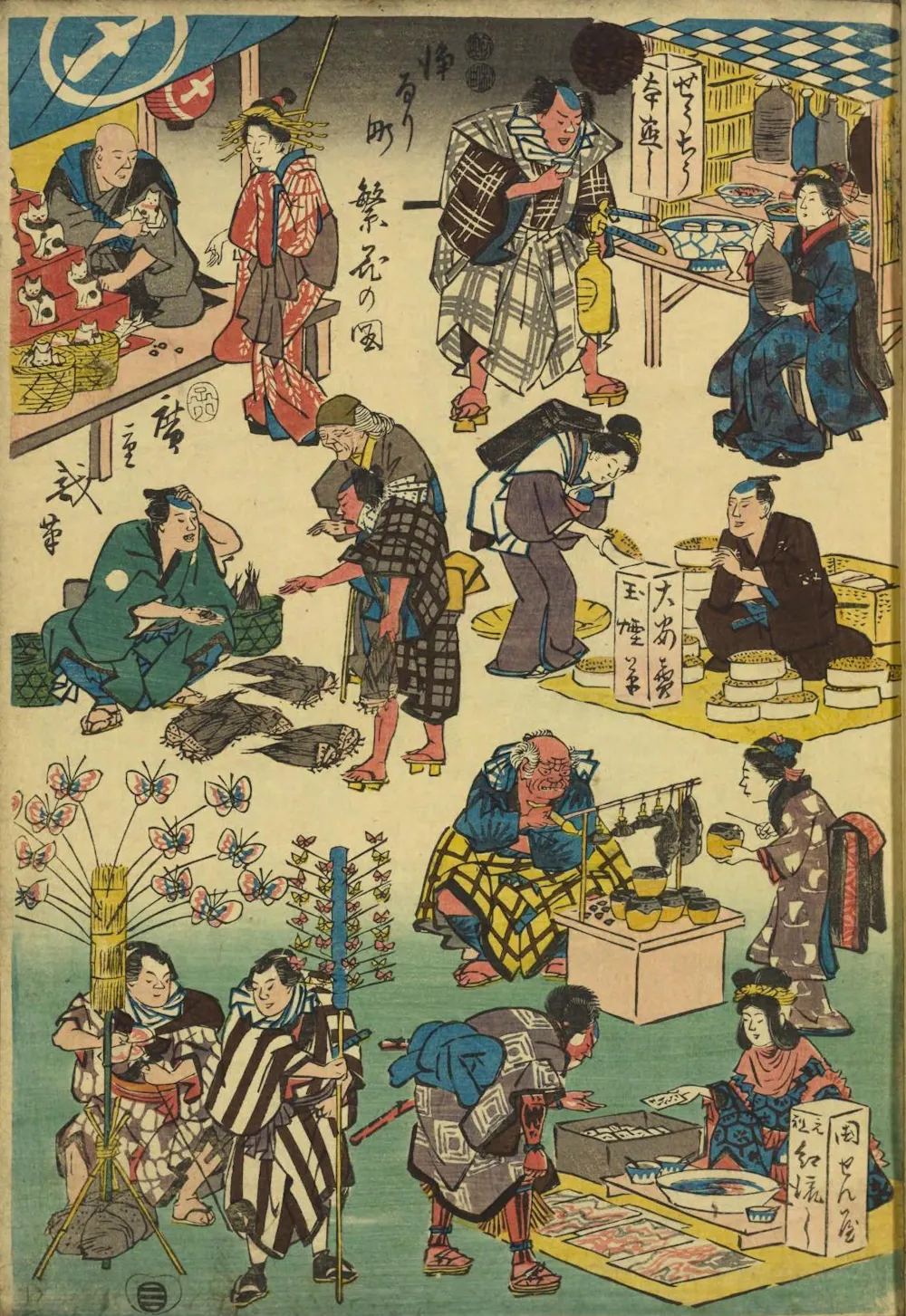
Clear evidence of this is found in Utagawa Hiroshige’s ukiyo-e print from 1852, which depicts a stall selling numerous doll cats. But these cats look slightly different from many cats we see in the 21st century; they hold no koban gold coins.
These cats, as seen in today’s Gotokuji cats, wore a bell around their necks, and were said to bring good luck to the owner.
In the Meiji era (1868-1912) mass production by using plaster moulds made the cat a popular figure nationwide. The cat came to represent material rather than emotional happiness.
By then, bells around cats’ necks were typically replaced with coins – perhaps linked to Japan’s increasing economic prosperity.
The earlier ceramic cats looked like cats rather than cartoon characters.
In the 1950s, makers in Aichi Prefecture adapted the form of its local dolls, Okkawa Ningyo, onto the dolls of cats. The head became as big as the body and eyes became widely opened.
Later in the century, maneki-neko gained popularity in the Chinese-speaking world through Hong Kong and Taiwan. Altars in Hong Kong tea houses had traditionally been dedicated to legends such as the 3rd century Chinese military general Guan Yu, but these days the pretty cats are also featured.
The cats then spread globally through a diffusion of Asian culture by Asian migrants.
Today, turn on your phone and launch the Pokemon app. You might soon capture Meowth, a maneki-neko pokemon with a koban (gold coin) on its forehead.
‘Cool Japan’
While in the English-speaking world, it is commonly held that “money doesn’t buy happiness,” it is permissible under Japan’s spiritual code to pray for personal material desires.
In contemporary Japan, you are free to ask for and seek what you want – even if what you want is just as simple as meeting the cat.
In addition to the Tokyo temples mentioned above, there are many places where you can meet the cat. Seto City in Aichi Prefecture, an area where ceramic cats have been produced over 100 years, is home to the Maneki-Neko Museum.
At the Hikone Castle, you can meet Hikonyan, a mascot created by the local government in 2007 to celebrate the castle’s 400th anniversary. The mascot is a model of the Gotokuji cat that welcomed Ii Naotaka.
The Japanese equivalent of the phrase “cast pearls before swine” is “cast coins before cats”.
And so maneki-neko, the pretty cat, welcomes you – and your money.
This feline welcome nicely reflects Japan’s soft power policy known as “Cool Japan”. Japan wants to use its cultural assets to attract international consumers and visitors to contribute to its economic revitalisation in the era when the county’s population is declining. We are most welcome to spend money in Japan.
Tets Kimura does not work for, consult, own shares in or receive funding from any company or organisation that would benefit from this article, and has disclosed no relevant affiliations beyond their academic appointment.
In 1865, my Irish-born great great grandparents travelled from Dunedin to Sydney to marry in St Mary’s Cathedral. Some 63 years later, my grandmother Mary also travelled to Australia to marry my grandfather Ted. He was a clerk with the Bank of New Zealand and had been posted to Melbourne in the 1920s.
Ted and Mary lived in St Kilda and played cards in the evening with Australians, Mr and Mrs Shaw, who lived in Ivanhoe and barracked for Collingwood. My father was born there in 1929 and moved back to New Zealand with his family at the age of five.
In 1962, my father visited Australia to watch their Test cricket side play the touring English team. He stopped in to visit the Shaws and met their daughter, my mother, whom he married not long after. They settled in the foggy city of Hamilton and, given both were Australian by birth, registered their four children as dual citizens.
Much later, my parents returned to Australia to enjoy their retirement years in the warmth of Queensland. Mum came back to New Zealand ten years ago, but continues to go back and forth across the Tasman, as my siblings and some of her grandchildren are there.
This is not a novel New Zealand story. But the long history of trans-Tasman cross-pollination took a wrong for New Zealanders from around the mid-1990s as access to social services and citizenship was incrementally tightened by both Labor and Coalition governments in Australia.
As of last weekend, however, New Zealand citizens who have been living in Australia for four years or more will be eligible to apply directly for Australian citizenship. And they will no longer need a permanent visa to qualify. In one sense, the trans-Tasman relationship is back on track.
Australia’s minister of home affairs, Clare O’Neil, explains the citizenship changes for New Zealanders living across the Tasman.
Two-way traffic
Although the colonisation of Australia and New Zealand was not wholly synchronous, the earlier settlement of Australia led to relationships between traders and whalers and Māori.
Historian Judith Binney writes that some Māori chiefs travelled to New South Wales to advance their tribes’ political and commercial interests and broader trans-Tasman trade in the early 1800s. At that time, New Zealand’s exports comprised flax, timber, whale products and foodstuffs, and were in high demand by Australia.
From the 1880s on, steady two-way people movement became a feature of the Australia and New Zealand bond. It was in part fuelled by growing institutional connections in banking, commerce and insurance, as well the less formal ties between organised religion, education, farming and party politics.
Social historian Rollo Arnold calls this a “perennial trans-Tasman interchange”. In these early years, clerks and salesmen left metropolitan Australia to take up business opportunities in small-town New Zealand, while entrepreneurial types left New Zealand for the opportunities available in the larger cities of Australia.
The gentler New Zealand climate attracted Australians seeking a farming life, while journalists and artists went the other way to expand their horizons and careers. New Zealand’s 1901 census showed 26,961 were Australian-born, making up 3.5% of the population. Five years later it was closer to 5.5%.
Kiwi band Split Enz is just one of many examples of trans-Tasman cultural cross-pollination. Getty Images
Inextricably linked
Even New Zealand’s political elite comprised Australian-born politicians. Premier Richard Seddon was born in Victoria, while six of the 13 members of the first Labour cabinet in 1935 were former Australians, including the prime minister, Michael Savage.
New Zealand gave Australia Mike Rann, Joh Bjelke-Petersen and Barnaby Joyce. Although Robert Muldoon is remembered for his pejorative comment that the “brain drain” to Australia improved the average IQ in both countries, it’s probably fairer to say the likes of John Clarke, Russell Crowe and Split Enz forged a genuine cultural connection.
As well, there are numerous regular and routine links, from the Five Eyes security relationship and prime ministerial and ministerial meetings, to common food standards, policy coordination and information sharing.
The Australia New Zealand Leadership Forum, established in 2004, meets annually, bringing together business leaders, politicians, policymakers and (more recently) Indigenous organisations for strategic discussions and policy sharing.
This year’s forum on July 19 is likely to focus on streamlining digital trade, regional responses to future pandemics, research, development and innovation, and Indigenous collaborations on constitutional, cultural, economic and data sovereignty issues.
Although the absolute number of New Zealanders in Australia is now much higher (670,000) than Australians in New Zealand (70,000), proportionally the gap is not huge: we make up about 2.5% of Australia’s population while they comprise 1.5% of ours.
Return to the ‘fair go’
Since the adoption of the Closer Economic Relations (CER) Agreement in 1973 (considered the gold standard of trade agreements), trade has increased by an annual average of 8%. Australia remains New Zealand’s second-largest trading partner (we are their ninth-largest) and has a 30% stake in our total foreign investment.
Traditional measures of the trans-Tasman relationship will always appear asymmetric due to differences in geographic, economic and population size, and our respective military alliances and capacities. At various times, political leaders on both sides of the Tasman have chosen to accentuate the differences in policy interests to suit their own agendas.
But it was a perceived imbalance in the cost of welfare services for New Zealanders in Australia that triggered the citizenship and residency rule changes for New Zealanders in 2001.
The unfairness and even absurdity of the old rules was perhaps best exemplified by the case of rugby star Quade Cooper last year. Born in New Zealand, he moved to Australia aged 13 and debuted for the Wallabies in 2008. Yet it took him five years (and four rejections) to be finally granted citizenship.
At the personal level, the new citizenship pathway should make such travesties a thing of the past. More broadly, it reinstates a fair way forward – otherwise known as a “fair go” – for people in both countries to build and grow the historic trans-Tasman relationship.
Jennifer Curtin is a partner investigator on an Australian Research Council funded project titled “Understanding the Antipodean ‘Fair Go’” led by Cosmo Howard at Griffith University.
Jennifer Curtin and Dominic O’Sullivan are co-authors of the chapter from which some of the material included here is drawn.
The full reference is: Curtin and O’Sullivan, Legacies of a Trans-Tasman Relationship: The Evolution of Asymmetry between New Zealand and Australia. In I. Roberge, N. Park and T.R. Klassen (eds). Asymmetric Neighbors and International Relations. Living in the Shadow of Elephants. New York: Routledge, pp. 54-69. (2023).
Jennifer is also
Australian universities are calling on the federal government to uncap university places for all Indigenous students.
This would mean any Indigenous applicant, provided they met the entrance requirements, could go to university. Currently, places are only uncapped for Indigenous Australians living in regional and remote areas.
The proposal is part of a broader push by peak body Universities Australia to increase Indigenous participation in higher education.
Is it a good idea? What is needed to boost Indigenous participation at university?
Australian universities and Indigenous students
On Sunday night, Universities Australia released a progress report on their Indigenous Strategy.
This explicitly recognises the presence and impact of racism in Australian universities. And emphasises universities’ responsibility for Indigenous advancement, addressing racism and cultural safety and embedding Indigenous knowledge and perspectives into university systems and structures.
It shows how universities are still heavily focused on recruitment of Indigenous students. These strategies are working at some level. The report noted Indigenous student enrolments more than doubled between 2008 and 2021.
But Indigenous student enrolment is still only at 2.08% and bachelor degree completion rates remain low compared to non-Indigenous students.
Almost one in two Australians in their 20s have a university degree compared to only 7% cent of young Indigenous Australians.
Uncapped places
Universities Australia wants to see a new push to improve Indigenous participation through uncapped places for all Indigenous Australians, irrespective of their postcode.
With 75% of Indigenous people living in urban areas, Universities Australia say the current policy needs to change.
The call comes as a time when big changes are expected for higher education. The Universities Accord review team has prepared a draft report on reshaping Australian universities. Increasing participation and access to university for disadvantaged group is a key priority. The government is expected to release it later this month.
This proposal certainly provides a tangible pathway for any Indigenous person wishing to undertake university study, regardless of their location.
However, as with many policies affecting Indigenous peoples, it need to be part of a holistic approach. Encouraging more Indigenous Australians to enrol in a university degree will not be as simple as just uncapping places.
For any university student to be successful, they must have foundational academic skills to support their learning. Closing the Gap data in education shows there is also still a long way to go in addressing schooling educational outcomes. For example, in 2021, 68% of Aboriginal and Torres Strait Islander peoples had achieved Year 12 or higher, compared with 91% of non-Indigenous Australians.
It is vital Indigenous peoples wanting to undertake university study come equipped with the skills they need for success. Many mob come with invaluable knowledge, perspectives and experiences connected to their identities as Aboriginal and/or Torres Strait Islander peoples. In addition to these strengths, academic preparedness for university study that results from quality schooling will support their educational trajectories over the long term.
Culture must change
Indigenous students also need to be supported when they get to university. The Universities Australia report showed almost all Australian universities have activities or programs for recruitment of Indigenous students.
Although, when surveyed, less than half of the 39 Australian universities made reference to an anti-racism statement or policy. The report also notes:
member universities’ responses were generally not focused on equipping students with an awareness of Indigenous values and knowledges.
Along with more evidence-based interventions to support schooling outcomes (so students can take advantage of an uncapped place), universities must embrace the challenges outlined in the report and take real action to address them.
If the culture and environment of universities don’t change, providing more numbers or even other methods such as scholarships are unlikely to change the overall outcome.
Urgent action is required and uncapping Indigenous student numbers is only one small part of a larger picture.
Marnee Shay receives funding from the Australian Research Council, AIATSIS and Edmund Rice Education Australia.
She is a member of QATSIETAC Department of Education Queensland and is a non-executive Director on the Edmund Rice Education Australia National Flexi School Board.
Maria Raciti works for the University of the Sunshine Coast. She receives funding from the Australian Research Council. She is affiliated with the National Centre for Student Equity in Higher Education.
Bronwyn Fredericks does not work for, consult, own shares in or receive funding from any company or organisation that would benefit from this article, and has disclosed no relevant affiliations beyond their academic appointment.
Recent sustained anti-coal action by Blockade Australia in the Hunter Valley has brought public protest back into the news cycle. Activists have occupied trains, railway lines and machinery in an attempt to obstruct coal production and broadcast their message about the climate crisis.
Under recent anti-protest legislation in New South Wales, which has been matched by similar laws in other states, some protesters have been charged by police for their activism.
Internationally, protesters faced with arrest have devised new ways to protest. Recently, Iranian activists have started engaging in “micro-protests”, which are small-scale protests over a shorter period of time, to evade arrest.
My historical research into the infrastructure of protest, using the anti-Vietnam War campaign in New South Wales as a case study, has found that many Australians who did not or could not actively or publicly protest similarly found “quieter” ways to express their opposition to the conflict.
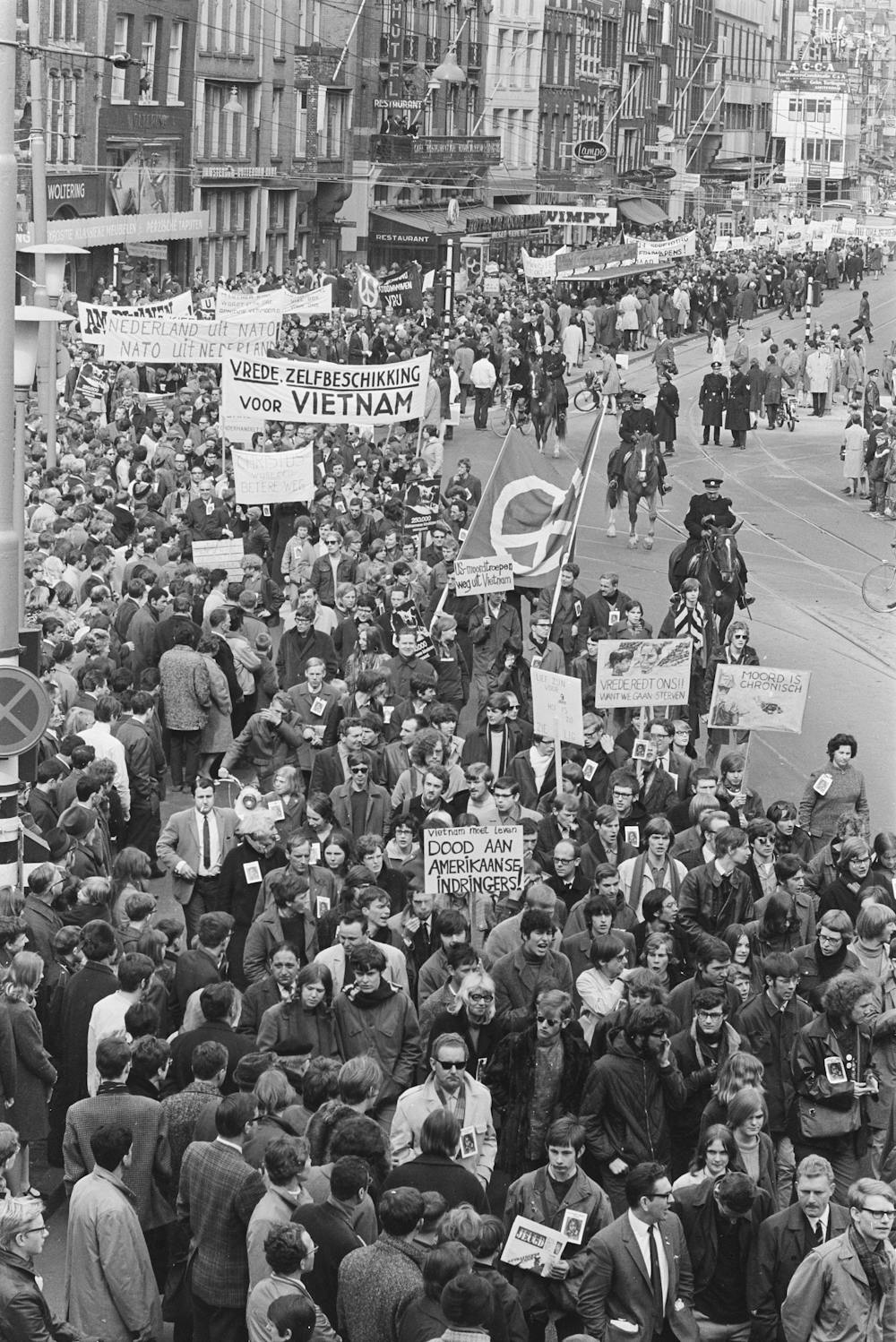
An anti-Vietnam War protest in Amsterdam. Wikipedia
The youth are revolting
In the popular Australian imagination, it seems the protester is a young person creating a public spectacle – holding up a sign, occupying a building or marching down a city street, even though older activists regularly play a part in protest movements.
Many might think of figures like Lidia Thorpe disrupting the 2023 Sydney Gay and Lesbian Mardi Gras Parade or ongoing protests by School Strike 4 Climate, which have shown how willing young people are to agitate for their collective futures.
But, in fact, one of the two anti-coal activists charged on last month for occupying a train in Singleton, New South Wales, is 64 years old.
My research shows our public memory of protest doesn’t come close to capturing everyone who used their energies to protest Australian involvement in Vietnam in the 1960s and 1970s, so we need to shift our idea of both protest and the protester to understand the potential scope of activism.
Quiet protest
Vietnam War-era protest organisations, such as the Association for International Cooperation and Disarmament, Save Our Sons, Youth Campaign Against Conscription and the Vietnam Moratorium Campaign, were aware of how important “quiet protest” was to the wider movement.
They continually appealed to supporters for help selling buttons, putting up posters, selling raffle tickets, filling envelopes, leafleting and other clerical work. These were all carried out by people who were opposed to the war, and are all considered acts of protest.
Social movement theorists agree that time and availability are crucial in drawing people to protest. As far back as 1974, the sociologist Anthony Orum wrote:
Without people who have time on their hands, great revolutions would probably never get off the ground.
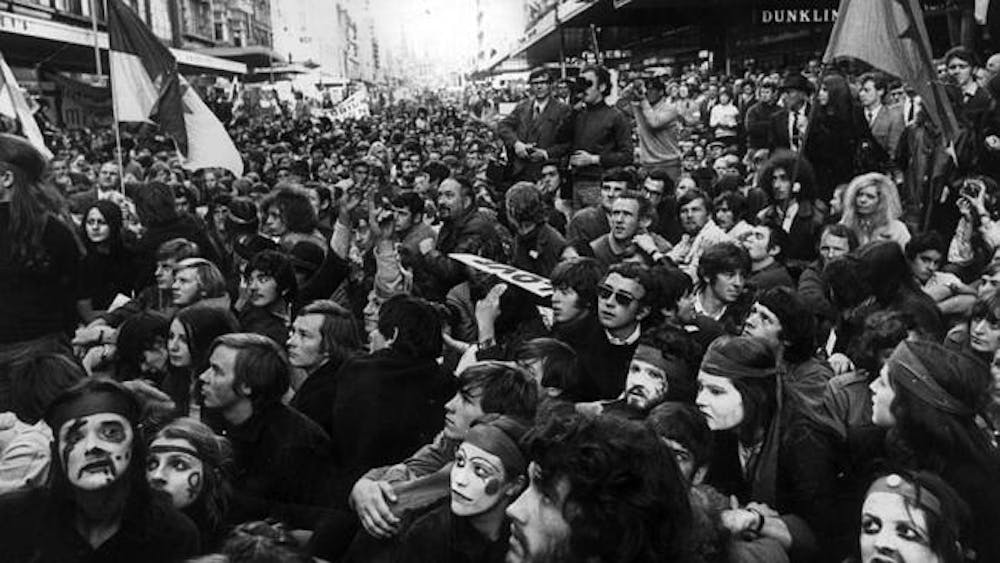
Anti-war protest in Melbourne, 1970. Wikipedia
Time and capacity
But what of those who did not have the time or capacity to march on streets, but who still saw themselves as part of the anti-Vietnam War movement?
These include Ian Robertson, a full-time Macquarie University student, whose parents had banned political activity because they feared it would disrupt his studies. Another silent protester was a Mrs Thomson, who was too busy organising her daughter Sue’s wedding to participate in anti-Vietnam protest activities. Public servants were also not permitted to publicly support the movement.
Most such records come from elderly members of the movement. In November 1969, Mabel Wilson, who in her words was “six years an octogenarian,” sent $5 to the Committee in Defiance of the National Service Act, writing:
I admire your courage and am completely in sympathy with your ideals. Alas! I am very old […] As you can see I can be of practically no use to you – or anyone […] My heart is with you all the way.
Similarly, on March 21 1970, Doris J Wilson of Asquith sent a donation to the Northern Districts Vietnam Moratorium Group with a letter saying:
I am past the age where I can do very much more than be just a voice.
On September 14 1970, L.T. Withers sent the same group a letter saying:
Congratulations for what you have accomplished. I feel rather guilty at being so useless […] myself and my wife are not as energetic as we used to be as the years are catching up on us a bit. I have enclosed a small donation to your local funds […] I would also be grateful if you could keep me informed of your activities.
Ruth Fryer of Hornsby sent a letter on February 9 1971 with a $3 donation:
Sometimes you wish you were young & strong again! But the hard work seems to be left to the young ones.
These Australians, among many others, were interested in the anti-Vietnam campaign and wanted to be involved as much as they could, given their limitations.
Studying the infrastructure of historical protest organisations shows us that we need to expand our idea of what a protest movement is and who it includes if we want to achieve the present-day goals of activist campaigning.
These findings are exciting because they capture a larger group of Australians in the protest tradition, and move past a limited, and often ableist and ageist, vision of protest to incorporate many others who feel just as strongly about the issues governing their lives.
Effie Karageorgos received funding from the State Library of New South Wales for this project.
Source: The Conversation (Au and NZ) – By Peter Ellerton, Senior Lecturer in Philosophy and Education; Curriculum Director, UQ Critical Thinking Project, The University of Queensland
Shutterstock
Educators involved in curriculum design know one hard truth: you can’t fit in everything. Whatever the finished product, there will always be someone who thinks something important has been missed or something unnecessary has been included.
This is what happened in the recent redesign of the Australian Curriculum, for example, where the emphasis on Western civilisation became politicised.
When it comes to science curriculums, the amount of potential content that can be included is staggering.
In the case of physics in primary or middle schools, we may or may not see the inclusion of topics such as wave theory, acoustics, electronics or relativity. Some may lament these exclusions, but most agree physics at this level can be taught without them.
Similarly, there are areas of biology that may be considered optional at this level, such as botany, entomology or marine ecosystems. Evolution, however, is a concept that underpins and integrates all facets of biological study.
As evolutionary biologist Theodosius Zobzansky noted in the title of his seminal essay, Nothing in Biology Makes Sense Except in the Light of Evolution.
Without evolution, the living world is a kaleidoscope of disconnected form and colour. With evolution, it is breathtakingly coherent. In terms of its simplicity and explanatory power, the theory of evolution by natural selection is arguably one of our most successful scientific achievements.
Because of evolution’s centrality to biology, its omission in any substantive course seems a matter of serious neglect.
Today many countries in the world, predominantly Islamic ones, do not teach evolution, as it is said to contradict religious teachings.
Recently, India also removed evolution from the formal education of students up to Year 10. This decision was supposedly related to its right-wing government’s commitment to promoting Hindu-nationalist perspectives.
These examples do not represent simple oversight. They are serious attempts to restrict people thinking about evolution and, ultimately, to delegitimise science for ideological gain.
Excluding evolution is a moral concern
Omitting evolution from educational curriculums isn’t just educationally fraught, it’s also a serious moral issue.
Morally speaking, at least four related points present themselves in favour of the inclusion of evolution in any biology curriculum.
1. Equality of opportunity
John Rawls, one of the most influential political philosophers of the 20th century, set equality of opportunity as a key social justice principle.
Many scientists have been inspired towards their work by understanding the grand narrative of evolution, which provides a coherent and effective framework to understand biological systems and their relationships.
Depriving students of this educational experience means they could be disadvantaged in further study or work. Or, worse, they might be dissuaded from it.
2. Free inquiry
Deliberate attempts to exclude serious rational inquiry are anathema to most philosophical schools of thought. Philosopher and scientist C.S. Peirce expressed this powerfully:
Upon this first, and in one sense this sole, rule of reason, that in order to learn you must desire to learn, and in so desiring not be satisfied with what you already incline to think, there follows one corollary which itself deserves to be inscribed upon every wall of the city of philosophy: do not block the way of inquiry.
To stifle inquiry is also to inhibit the development of important traits in students – especially curiosity, one of our most powerful tools for knowledge creation.
3. Fairness and public reasoning
Philosopher Immanuel Kant, expressing the essence of the Enlightenment as he saw it, set public reasoning through an individual commitment to rational inquiry as its cornerstone.
If we value the freedom to inquire and freedom of religious belief, it follows that no particular ideology should have unquestioned authority over others.
It’s naive to think science is a value-free arena. Yet it represents the most effective means of rational inquiry into the world we currently possess.
We can certainly allow for (and indeed need) explanations that the methodologies of science can’t provide. But rational inquiry needs to be accommodated, rather than usurped, by religious or political ideologies.
We do not rely solely upon science and reason, because these are necessary rather than sufficient factors, but we distrust anything that contradicts science or outrages reason.
4. Intellectual honesty, integrity and a commitment to scientific truths
An extended biology course that doesn’t contain evolution represents a promise made and broken.
To present something as scientific means it should embrace the methodologies and dispositions of scientific inquiry, including open-mindedness, scepticism and fallibility.
Ideologically driven censorship is therefore intellectually dishonest and, in these cases, results in a misrepresentation of science.
The bottom line
A moral stance is not something simply held dogmatically. It is one that can be reasoned in a way that’s rationally accessible to others.
Education in a cosmopolitan world – in as much as it is social, collaborative and cooperative – should be characterised by morality and rationality. Excising our best ideas from curriculums is both immoral and irrational.
As Australia prepares for the Voice referendum later this year, some commentators struggle to create a respectful space for all sides of politics. Especially to discuss the proposed constitutional change.
Debates with wide-ranging opinions have the potential to distract from the real issues at hand, becoming divisive and harmful. This can lead to spreadingmisinformation and worsen a lack of understanding across political views.
The way Australia debates the Indigenous Voice to Parliament matters. We saw the 2017 plebiscite on marriage equality, while resulting in a clear “yes” vote, considerably impacted the mental health and wellbeing of LGBTQIA+ people in Australia.
The referendum is a national event, which requires conversations with both Indigenous and non-Indigenous people in Australia. These conversations should bear in mind Indigenous people will be impacted the most by the referendum and the debate around it. Yet, effective national engagement on the Voice also requires non-Indigenous people to see this as important to their lives.
We conducted research examining how to help facilitators make these conversations easier, well-informed and fruitful. This research could be used to inform how the wider public have constructive and sensitive discussions about Indigenous affairs.
We work in collaborative teaching spaces where Indigenous and non-Indigenous educators provide space for non-Indigenous students to learn about Australia’s history, Indigenous identities, and future. The students we teach are a diverse group across ages, ethnicities, social backgrounds, and genders.
In our recent publication, we explain effective ways for facilitators to engage non-Indigenous people in discussions about Indigenous affairs. We discuss how we created a safe teaching space where students felt they had learned accurate and relevant information, heard Indigenous peoples’ viewpoints and were confident they could work collaboratively with Indigenous people in the future. The findings from our research can easily be applied to discussion around the Voice.
Our study showed these students engaged with Indigenous issues when they had access to:
clear evidence of Australia’s history and public policy as told by Indigenous people, relaying their experiences
examples of successful and respectful collaborations between Indigenous and non-Indigenous people within education
a requirement for participants to consider their own contribution and future engagement with Indigenous peoples and perspectives
space for Indigenous and non-Indigenous people to engage in respectful and informed discussion of issues by establishing ground rules. These rules include knowing appropriate and inappropriate terminology, having a willingness to listen and paying attention to evidence rather than stand-alone stories.
We provided examples of effective collaboration between Indigenous and non-Indigenous people, such as school-community partnerships, health services and environmental management collaborations. We also discussed the approaches that made these collaborations work well. This made most students feel eager and confident to follow these approaches in their future careers.
Most of the students expressed positive attitudes towards Indigenous knowledges and perspectives. However, they also commented that prior to this learning, they had been unaware of how little they knew of Indigenous histories, perspectives, and issues.
These students also had the chance to listen to Indigenous people discuss their experiences and family stories. Many students found they learned a great deal and better understood the depth of ongoing pain from Australia’s racist history. They were then able to think about how this could inform their professional engagement with Indigenous people and themes in schools.
Indigenous people make up approximately 3% of the population in Australia. So the support of the broader community is vital on Indigenous affairs such as the Voice.
The first step is knowledge. Non-Indigenous people need the opportunity to understand the political journey for Indigenous people in the lead up to the referendum, including the Uluru Statement. This could contextualise the importance of addressing longstanding injustices and help create better futures for Indigenous peoples.
Secondly, people need to understand how this referendum will affect Indigenous and non-Indigenous people. We can turn to the words of the many Indigenous voices who have made their thoughts a matter of public record.
Thirdly, safe space for respectful and informed dialogue is essential. The threat of being labelled “racist” can shut down meaningful discussion and prevent non-Indigenous engagement on important issues. But at the same time, Indigenous people having to manage fragility in non-Indigenous people can be exhausting.
Indigenous people need to be able to express their own positions on the Voice in a space that enables constructive dialogue, regardless of which political side they are on. Again, this requires that listeners understand the histories, and contemporary realities, at the heart of the Uluru Statement. It also means recognising that within any group of people, there will always be diverse perspectives on political matters.
Discussion spaces need to be informed by Indigenous peoples’ perspectives and knowledge about the realities which have brought us to this referendum. They should allow all people in Australia the opportunity to consider the part they will play in the future of our nation.
Les auteurs ne travaillent pas, ne conseillent pas, ne possèdent pas de parts, ne reçoivent pas de fonds d’une organisation qui pourrait tirer profit de cet article, et n’ont déclaré aucune autre affiliation que leur organisme de recherche.
Source: The Conversation (Au and NZ) – By Ben White, Professor of End-of-Life Law and Regulation, Australian Centre for Health Law Research, Queensland University of Technology
Voluntary assisted dying is legal in five Australian states with the sixth, New South Wales, following in November 2023. The territories are now permitted to legalise voluntary assisted dying, with the Australian Capital Territory intending to do so by the end of 2023.
Victoria was the first state to implement voluntary assisted dying in 2019. After four years, its legislation requires a formal review. Western Australia’s legislation, which started in 2021, requires a review after just two years. Both reviews are due to start soon.
Patients’ experiences of seeking voluntary assisted dying will be central to these reviews. In today’s Medical Journal of Australia, we report on the first study of patients’ voluntary assisted dying experiences in Victoria, as described in interviews with family caregivers.
We found five key barriers to accessing voluntary assisted dying in Victoria.
First, patients had difficulty finding doctors willing and qualified to assess eligibility for voluntary assisted dying.
Second, the voluntary assisted dying application process often took a long time and sometimes delays occurred. This was especially hard for very sick patients who had little time left.
Third, some hospitals, aged care facilities and other health-care institutions objected to being involved in voluntary assisted dying. Often, patients could not be assessed for voluntary assisted dying in these facilities, nor receive or take the voluntary assisted dying medication there.
Legal concerns also mean health practitioners in Victoria cannot use telehealth for voluntary assisted dying consultations. This required some patients to travel to appointments, sometimes over great distances, causing pain, distress and hardship.
Some aged care facilities object to being involved in voluntary assisted dying. Shutterstock
These five barriers meant patients were sometimes unsure about how to seek voluntary assisted dying and where to get information. They also caused suffering for patients and families, and led to delays in accessing voluntary assisted dying.
Access was more difficult for people in regional areas or with neurodegenerative conditions, such as motor neurone disease.
Who provides help and support?
Statewide voluntary assisted dying care navigators are government-funded health professionals who help patients navigate the system. Some hospitals and health services also appointed local voluntary assisted dying coordinators. Described as the “jewel in the crown”, their guidance was especially helpful when patients started the voluntary assisted dying process and were unsure what to do.
Finding a supportive doctor willing and qualified to assess eligibility for voluntary assisted dying was often a turning point for patients. But this sometimes depended on luck.
The statewide pharmacy service’s education and support when providing the voluntary assisted dying medication was very reassuring for patients and families.
These facilitators helped patients navigate a complex and rigorous voluntary assisted dying assessment process and to feel more supported and confident. Participants repeatedly commended the commitment and compassion of doctors, navigators and pharmacists.
Aside from some logistical challenges in the system’s early days (which improved over time), once patients contacted a willing doctor or navigator they generally felt well-supported.
How can voluntary assisted dying systems be improved?
We propose the following steps to improve patient access:
ensure patients have clear and readily available information about voluntary assisted dying so they can make earlier contact with care navigators
adequately resource and support integral system roles including navigators and the statewide pharmacy service.
Patients need clear and reliable information. Shutterstock
A safe system that allows only patients who meet the strict eligibility criteria to choose voluntary assisted dying is critical. However, our research shows significant barriers impede access and limit choice.
Some of these barriers are specific to Victorian law, such as doctors not being able to raise voluntary assisted dying. But others, such as limits on using telehealth, have implications for the rest of Australia.
For states reviewing their system, and jurisdictions implementing voluntary assisted dying or considering passing laws permitting it, access must be an important consideration too.
A summary of our research is available here. Information about contacting voluntary assisted dying care navigators in your state is available here.
Ben White receives funding from the Australian Research Council, the National Health and Medical Research Council and Commonwealth and State Governments for research and training about the law, policy and practice relating to end-of-life care. In relation to voluntary assisted dying, he (with colleagues) has been engaged by the Victorian, Western Australian and Queensland Governments to design and provide the legislatively-mandated training for doctors involved in voluntary assisted dying in those States. He (with Lindy Willmott) has also developed a model Bill for voluntary assisted dying for parliaments to consider. He is a part-time member of the Queensland Civil and Administrative Tribunal, which has jurisdiction for some aspects of this state’s voluntary assisted dying legislation. Ben is a recipient of an Australian Research Council Future Fellowship (project number FT190100410: Enhancing End-of-Life Decision-Making: Optimal Regulation of Voluntary Assisted Dying) funded by the Australian Government. This research is funded by that Future Fellowship project.
Eliana Close is currently appointed on an Australian Research Council Future Fellowship (project number FT190100410: Enhancing End-of-Life Decision-Making: Optimal Regulation of Voluntary Assisted Dying) funded by the Australian Government. She was employed on projects funded by the Victorian, Western Australian, and Queensland Governments to develop legislatively-mandated training for medical practitioners and nurse practitioners providing voluntary assisted dying.
Lindy Willmott receives or has received funding from the Australian Research Council, the National Health and Medical Research Council and Commonwealth and State Governments for research and training about the law, policy and practice relating to end-of-life care. In relation to voluntary assisted dying, she (with colleagues) has been engaged by the Victorian, Western Australian and Queensland Governments to design and provide the legislatively-mandated training for doctors involved in voluntary assisted dying in those States. She (with Ben White) has also developed a model Bill for voluntary assisted dying for parliaments to consider. Lindy Willmott is also a member of the Queensland Voluntary Assisted Dying Review Board and the Queensland Civil and Administrative Tribunal, but writes this piece in her capacity as an academic researcher. She is a former Board member of Palliative Care Australia.
Ruthie Jeanneret is a PhD Candidate on an Australian Research Council Future Fellowship (project number FT190100410: Enhancing End-of-Life Decision-Making: Optimal Regulation of Voluntary Assisted Dying) funded by the Australian Government. She was employed on projects funded by the Victorian, Western Australian, and Queensland Governments to develop legislatively-mandated training for medical practitioners and nurse practitioners providing voluntary assisted dying.
Many people, at some stage in their search for a career, have worked for free in return for some much valued experience. But it’s surprisingly hard to find exact numbers.
A 2016 national survey of 3,800 Australians found more than half (58%) of respondents aged 18 to 29 and more than a quarter (26%) aged 30 to 64 had done unpaid work at least once in the previous five years.
There is also data suggesting more than a third (37.4%) of Australia’s university students are doing courses which involve real work as part of their tertiary studies. In 2017 that amounted to 451,263 work-related learning experiences.
This is not uniquely Australian. In 2013 an EU survey of 12,921 people found 46% aged from 18 to 35 had done at least one internship, with more than half of those being unpaid.
So why are so many people around the world signing up to do unpaid jobs, in the guise of traineeships, internships or work experience.
One reason must be the strong promotion of internships as a step from education to employment. Employers have frequently identified practical experience as an important factor in deciding who to hire.
Many Australian students do unpaid work in the hope of securing work in their preferred career. Shutterstock
Internships have also been enthusiastically endorsed by many universities plus industry and government as a way to help students develop relevant skills to move into the graduate labour market.
With these groups backing internships, is it any wonder so many students and graduates believe an internship is essential to securing graduate employment?
But there’s a downside to internships stakeholders are reluctant to discuss.
When internships are either a prerequisite for professional accreditation or pseudo mandatory – you can’t get a job without one – then only those who have completed a placement can enter the profession.
Those who can’t afford to do unpaid work or lack the connections to secure a placement, may be left behind. This can be a tragedy for the individual, whose dreams of work in a particular industry might be dashed.
As well, the proliferation of unpaid (or low-paid) internships has the potential to have a much broader impact. It risks entrenching existing disadvantage and limiting diversity in professions.
It may also displace paid employment and undermine labour standards, as employers replace paid workers with a revolving door of interns who are treated as “cheap dead-end labour”.
Unlike in the EU, trainees in Australia have very few entitlements. Shutterstock
This is not a theoretical concern, there is evidence some of Australia’s tertiary students face obstacles which limit their capacity to secure or complete internships.
This includes disadvantaged students, including those from low socio-economic backgrounds, rural areas, those who are Indigenous and others who cannot do work placements required to get professional accreditation.
These poor outcomes are driving calls for reform. The European parliament recently endorsed a proposal to amend the 2014 Quality Framework for Traineeships requiring all trainees in EU countries be fairly remunerated.
On top of this, a growing number of countries have increasingly tough regulations regarding internships. For example, France banned open market internships in 2014, and now only allows regulated internships which are completed by a university student as part of their studies.
The French regulation sets out stringent supervision requirements from both workplace host and university and obligations for payment when the internship exceeds a set period. Belgium, Estonia, Italy, Lithuania, Portugal and Slovenia have also implemented specific laws requiring payment for open market traineeships.
The EU’s response to concerns about unpaid internships highlights the need for Australia to consider its position.
Currently, Australian regulations fail to regulate internships in any comprehensive way.
Instead, there are piecemeal rules dealing with isolated issues such as protecting interns against discrimination or harassment or ensuring universities’ internship courses meet set standards.
While these issues are important, dealing with them in isolation does not resolve the broad and complex issues internships raise.
Most stakeholders value internships so they are likely to continue. Therefore, we need to consider how they can be regulated to reduce negative outcomes and maximise the benefits. This will require a national debate to answer a range of difficult questions, including:
• what do we think the value of work is, and what is the impact of allowing unpaid work on individuals and society? Are we prepared to accept this impact?
• who should pay for training and skills development: individuals, employers, or society?
• who in our workplaces should be protected by labour laws and who should be excluded?
Once we have these answers, we can decide what the role of internships in Australia should be, and craft a regulatory regime to achieve that. Perhaps our conclusion should be, as articulated by the EU parliament, that it’s time we stopped exploiting interns and paid them a fair day’s pay.
Anne Hewitt has received funding to conduct research on the regulation of internships (2016 Australian Research Council Discovery Project Grant ‘Regulating Post-secondary Work Experience: Labour Law at the Boundary of Work and Education’ DP150104516 with Professor Rosemary Owens, Professor Andrew Stewart and Dr Joanna Howe) and the risks of payments made to student interns (2020 Australian Collaborative Education Network Research Grant ‘Risks associated with studentships’ with Dr Craig Cameron, Griffith).
The need to cut the emissions driving climate change is urgent, but it’s proving hard to decarbonise road transport in Australia. Its share of the nation’s total greenhouse gas emissions doubled from 8% in 1990 to 16% in 2020. New vehicles sold in Australia have barely improved average emissions performance for the last decade or so.
The federal government publishes emission forecasts to 2035 – 15 years short of 2050, the net-zero target date. Our newly published study forecasts road transport emissions through to 2050. The estimated reduction by 2050, 35–45% of pre-COVID levels in 2019, falls well short of what’s needed.
Our findings highlight three obstacles to achieving net zero. These are: Australia’s delay in switching to electric vehicles; growing sales of large, heavy vehicles such as SUVs and utes; and uncertainties about hydrogen as a fuel, especially for freight transport. These findings point to policy actions that could get road transport much closer to net zero.
How was this worked out?
Emissions and energy use vary from vehicle to vehicle, so reliable forecasting requires a detailed breakdown of the on-road fleet. Our study used the Australian Fleet Model and the net zero vehicle emission model (n0vem).
The study focused on so-called well-to-wheel emissions from fuel production, distribution and use while driving. These activities account for about 75–85% of vehicle emissions. (Life-cycle assessment estimates “cradle-to-grave” emissions, including vehicle manufacture and disposal.)
Working with European Union colleagues, our emissions simulation drew on an updated EU scenario (EU-27) showing the changes in the EU vehicle fleet needed to meet the latest (proposed) CO₂ targets. Our study assumed Australia will be ten years behind the EU across all vehicle classes.
We further modified the scenario to properly reflect Australian conditions. For instance, the EU has a much higher proportion of plug-in hybrid vehicles than Australia, where buyers are now bypassing them for wholly electric vehicles.
Energy use is shifting, but too slowly
Using this modified scenario, the simulation produces a forecast fall in total wheel-to-wheel emissions from Australian transport from 104 billion tonnes (Mt) in 2018 to 55-65Mt in 2050. Within the range of this 35–45% reduction, the outcome depends largely on the balance of renewable and fossil-fuel energy used to produce hydrogen.
The modelling nonetheless predicts a large shift in energy use in road transport in 2050, as 2019 was basically 100% fossil fuels.
The on-road energy efficiency of battery electric vehicles is roughly twice that of fuel cell electric (hydrogen) vehicles and roughly three times that of fossil-fuelled vehicles of similar type.
The modelling results make this clear. In 2050, battery electric vehicles account for about 70% of total travel, but 25% of on-road energy use and only about 10% of total emissions.
In contrast, fossil-fuelled vehicles account for about 25% of total travel in 2050, 60% of energy use and 75-85% of emissions. That’s even allowing for expected efficiency improvements.
This means the shift to a mostly electric fleet by 2050 plus the use of hydrogen is predicted to fall short of what’s needed to get to net zero. It will require aggressive new policies to increase the uptake of electric vehicles across all classes.
Lighter vehicles make a big difference
But that is not the whole story. One neglected issue is the growing proportion of big, heavy passenger vehicles (SUVs, utes). This trend is very noticeable in Australia. The laws of physics mean heavier vehicles need much more energy and fuel per kilometre of driving, and so produce more emissions.
Currently, a large diesel SUV typically emits a kilogram of CO₂ for every 3 kilometres of driving, compared to 15km for a light electric vehicle and 200 kilometres for an e-bike. An average electric vehicle currently emits 1kg of CO₂ every 7km.
This distance is expected to be around 60km in 2050, when renewables power the electricity grid. A lightweight electric car will more than double the distance to 125km per kilogram of CO₂. Reducing vehicle weights and optimising energy efficiency in transport will be essential to meet emission targets.
The study modelled the impacts of lightweighting passenger vehicles while keeping buses and commercial vehicles the same. If Australians had driven only small cars in 2019 for personal use, total road transport emissions would have been about 15% lower.
The reduction in emissions from simply shifting to smaller cars is similar to emissions from domestic aviation and domestic shipping combined. Importantly, lightweighting cuts emissions for all kinds of vehicles.
The uncertainties about hydrogen
Fuel cell electric vehicles using hydrogen account for only a few percent of all travel, but most will likely be large trucks. As a result, in our scenarios, they use a little over 10% of total on-road energy and produce 5-20% of total emissions, depending on the energy source used for hydrogen production and distribution.
The modified EU scenario includes a significant uptake of hydrogen vehicles by 2050. That’s by no means guaranteed.
The uptake in Australia has been negligible to date. That’s due to costs (vehicle and fuel), the need for new hydrogen fuel infrastructure, less mature technology (compared to battery electric vehicles) and limited vehicle availability. Unresolved aspects of hydrogen in transport include lower energy efficiency, the need for clean water, uncertainty about leakage, fuel-cell durability and value for consumers.
How do we get back on track?
Our study suggests Australia is on track to miss the net-zero target for 2050 mainly because of the large proportions of fossil-fuelled vehicles and large and heavy passenger vehicles.
These two aspects could become targets for new policies such as public information campaigns, tax incentives for small, light vehicles, bans on selling fossil fuel vehicles and programs to scrap them. Other options to cut emissions include measures to reduce travel demand, optimise freight logistics and shift travel to public transport, to name a few.
The study confirms the scale of the challenge of decarbonising road transport. Australia will need “all hands on deck” – government, industry and consumers – to achieve net zero in 2050.
Robin Smit is the founder and director at Transport Energy/Emission Research Pty Ltd (TER) and an Adjunct Associate Professor at University of Technology Sydney.
It wasn’t surprising when last week’s Education Review Office (ERO) report found New Zealand’s alternative education (AE) system suffers from inadequate facilities, a lack of qualified teaching personnel and poor long-term outcomes.
After all, alternative education funding had remained static for its first decade of operation, after which it received only minor increases until this year’s government budget.
This is despite around 2,000 young people each year accessing alternative education as a school of last resort, having been excluded or disengaged from mainstream secondary schools.
For many, behavioural and learning difficulties, and a cultural disconnection between school and home, have made schooling challenging. These young people have not received the help they needed earlier in their school years.
But beyond the immediate headlines that alternative education is failing students, a closer reading of the report also reveals how successful the system has been, despite the challenges. Young people in AE told the ERO they:
receive help from their educators (97% of the time, compared to 44% in their old school)
feel safe (93% compared to 59% in their old school)
almost never feel lonely (81% compared to 56% in their old school)
feel cared for (84%) and that their culture is respected (87%).
These young people also reported they had developed their own learning goals, and that their schoolwork was set at the right level. Surely those are things we would wish for all young people, whether in alternative education or not.
A system under pressure
Time and time again, the caring and dedicated AE workforce has been shown to be central to these successes.
Many staff are not qualified teachers, but are tutors with community and youth work experience and training. They artfully mentor young people to develop prosocial skills. The success of their work was further highlighted in the Youth19 AE report also released last week.
While the ERO report found fewer than one in ten AE students attain NCEA level 2, alternative education’s focus has to be elsewhere. As the report stated, students arrive in AE centres with large gaps in their basic education. They have to catch up on schooling as well as work on developing life and social skills.
Until only recently, students couldn’t stay in alternative education beyond the age of 16. Due to a lack of transitional support, many end up languishing in their later adolescent years.
At the same time, pressures on the system are growing, with more students entering alternative education with high and complex needs. Without adequate funding, others simply cannot get in.
Out of sight, out of mind
The problems in the AE system are in many ways a product of its origins. To begin with, it was never a government initiative.
In 1989, when the “Tomorrow’s Schools” reforms introduced competition between schools, vulnerable students soon became seen as liabilities because most struggled to meet the academic standards schools were judged on.
The 2019 Tomorrow’s Schools Independent Taskforce found competition had exacerbated ethnic and socioeconomic segregation. Students suspended or excluded from their schools began turning up on the doorsteps of youth organisations, churches and iwi groups.
These communities established alternative education as a makeshift response. In 1996, there were 500 young people being educated in at least 60 AE centres nationwide – effectively educational facilities without government approval, so technically illegal.
Systematic government funding was finally made available in 2000. The fledgling sector became legitimate by virtue of young people being able to remain on a school roll while attending an alternative education centre somewhere else.
It was hailed at the time as a community-school partnership, but as the ERO has found in the past, once young people enter alternative education they have been largely out-of-sight, out-of-mind for referring schools.
Focus and funding needed
Alternative education is not unique to New Zealand. Most Western countries have some system of catering for young people who need a different way of schooling. But New Zealand can do a lot better.
We need to consider how schools can best serve all young people to give them the best chance to stay engaged. Current research investigating critical turning points in the education journeys of AE students, due to be released later this year, will give us more insights.
But alternative education is here to stay. So we need to better support young people transitioning into and out of the system.
That means we need a bigger workforce of qualified teachers to work alongside tutors in alternative education. In turn, this will require increased funding and support from the Teachers Council of New Zealand to register teachers in this setting.
AE tutors also need to build and extend their expertise. New Zealand is behind other countries in offering qualifications to social educators – a unique profession that works alongside people to develop civic and life skills.
We might look to Denmark, for example, where tertiary-qualified social educators are highly skilled at working with young people within and beyond mainstream schools.
But most importantly, we need to increase the focus on alternative education. It represents the last, best opportunity to make a sustained difference to the lives of these young people. The significant investment required now will pale in comparison to the future cost to society of failing them.
Adrian Schoone was a member of the Expert Advisory Group for ERO’s Alternative Education report. He also advises the Alternative Education National Body, of which he was a past chairperson.
New Zealand Parliament Buildings, Wellington, New Zealand.
New Zealand Politics Daily is a collation of the most prominent issues being discussed in New Zealand. It is edited by Dr Bryce Edwards of The Democracy Project.
Why do humans undertake journeys of personal exploration, or subject themselves to challenging conditions for long periods of time? What might we learn from their experiences?
British mountaineer George Mallory undertook his fatal attempt to summit Mount Everest in 1924 simply “because it’s there”. While such quests may have deeply personal motivations, research carried out during expeditions in extreme conditions can contribute to our understanding of how humans respond to environmental challenges.
The research outcomes can potentially be applied to a variety of settings, including remote locations here on Earth and even human space exploration.
Searching for extreme environments
Many explorers seek out “extreme environments”. This term describes harsh and unusual environmental conditions where it is difficult for life forms like humans to survive and thrive.
Examples include places that experience extremes of temperature, pressure, altitude, rainfall, breathable air, natural light, or hazardous chemical concentrations.
In recent years, humans have undertaken many extreme experiments, either alone or in groups.
In June 2023, Joseph Dituri, a biomedical engineer at the University of South Florida, completed a record-breaking 100 days living 9.15 metres underwater in a special habitat. At this depth, the pressure is approximately double what we experience on land. As he stated afterwards:
The human body has never been underwater that long. This experience has changed me in an important way, and my greatest hope is that I have inspired a new generation of explorers and researchers to push past all boundaries.
From November 2021 to April 2023, Spanish mountaineer Beatriz Flamini spent 500 days alone in a dark subterranean cave. She aimed to “learn more about how the human mind and body can deal with extreme solitude and deprivation”. When asked why she looked happy on emerging from the cave, she replied: “How would you feel if you had a dream and you fulfilled it? Would you come out crying?”
In 2021, a so-called Deep Time project in France isolated 15 volunteers in a cave underground for 40 days and nights without access to sunlight, clocks, or telephones. The project aimed to explore human adaptation to isolation and extreme conditions, together with the absence of the normal stimuli that provide a sense of time.
Training for space
As part of its astronaut training program, the European Space Agency holds a three-week course in an underground cave system. This work prepares astronauts to work safely and effectively in multicultural teams in a place where safety is critical.
Extreme environments can be useful not just for training and simulations. Places with physical similarities to space environments can also serve as locations for so-called analog missions.
These field tests are less expensive and more convenient than space-based research. They allow for the testing of technology, equipment, and experimental concepts alongside assessment of human physical and psychological responses to challenging conditions.
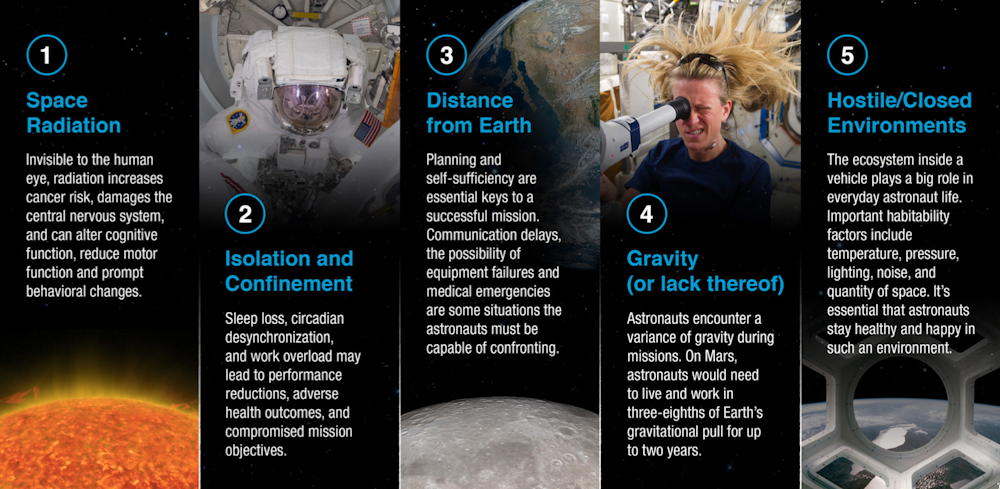
radiation – exposure to high levels of space radiation beyond Earth’s magnetic field
isolation and confinement – being far away from all that is familiar on Earth and confined in a relatively small and unchanging space can impact wellbeing, behaviour, and performance
distance from Earth – the farther away from Earth, the greater the communication delays and challenges, and thus the need for autonomy and self-sufficiency
gravity – astronauts could face up to four different gravitational environments. There is “normal gravity” or 1g on Earth; microgravity (“weightlessness”) in Earth orbit and in deep space transit; and partial gravity of 0.17g on the Moon and 0.38g on Mars. All of these have differing effects on the human body
hostile and closed environments – life support systems aim to provide a controlled environment, but problems can occur. Microbial lifeforms are a further consideration for both astronauts and the spacecraft.
These are the five hazards for humans in space, as outlined by NASA. NASA
There are many different types of analog missions, including in Antarctic, Arctic, underwater and desert settings. There are also closed small-group habitats such as NASA’s HERA module at Johnson Space Center and the privately owned Hi-Seas habitat on Hawai‘i island.
What we learn in extreme environments can be helpful closer to home, too.
Research into isolation and confinement provided helpful advice for people experiencing lockdowns during the peak of the COVID pandemic.
Telehealth research already benefits people living in isolated and remote areas. The United Nations Office of Outer Space Affairs runs a Space4Health initiative aimed at assisting countries in leveraging space infrastructure for better global health outcomes. NASA’s Spinoff archive documents the rich history of how space research has benefited life on Earth.
Through pushing the boundaries of human exploration in challenging environments, people not only learn more about themselves and their place in the world, but also make a unique contribution to a better understanding of human boundaries.
This knowledge can help us in various ways, both here on Earth and in humanity’s ultimate quest to reach for the stars.
Rowena Christiansen does not work for, consult, own shares in or receive funding from any company or organization that would benefit from this article, and has disclosed no relevant affiliations beyond their academic appointment.
There’s growing awareness public dental programs are unable to meet the demand for services. Private dental care is increasingly unaffordable, and millions of Australians go without the treatment they need.
The potentially avoidable costs to the health-care system and to people’s quality of life has led to increased pressure for a Medicare-style universal insurance scheme for dental care (Denticare) or the inclusion of dental care into Medicare.
Affordable and available dental care is crucial to addressing inequality in Australia. Teeth and gum problems can affect everything from your life expectancy and general health to your job prospects. The “dental divide” between rich and poor actually replicates disadvantage in Australian society.
So how did we get here? And what might change look like?
Why wasn’t dental included in Medicare in the first place?
The prevailing wisdom is that when the Whitlam Government put Medibank (the precursor to Medicare) forward in 1974, dental care was not included because of cost and politics – the battle with doctors’ groups opposed the new health-care insurance plan was difficult enough without taking on dental groups too.
There is, however, little to no evidence on the extent to which the Whitlam government pushed for dental to be included or how much it was opposed by dentists. It seems it was not on the agenda when Medicare was restored by the Hawke government.
Financial issues aside, there are two likely reasons dental wasn’t included.
Firstly, medicine and dentistry remain isolated practices that have never been treated the same way by the health-care system, health insurance funds, policymakers and the public.
Despite all the evidence on the importance of oral health, too often it is seen as merely a “nice-to-have”.
Secondly, the provision of public dental health services – often linked to dental hospitals and dental schools – has long been seen (especially by Coalition governments) as the responsibility of states and territories. These services have always been directed at children, low-income adults, and defined disadvantaged groups.
Section 51(xxiiiA) of the Australian Constitution, added in 1946, accords dental services the same status as medical services. This section gives the Commonwealth the power to legislate and fund these services but it’s not obligated to do so.
The Whitlam government was the first to provide national funding and direction to these state-based programs through the Australian School Dental Program.
Under the Keating government, the Commonwealth took a more substantial role in the funding of dental services with the introduction of the Commonwealth Dental Health Program, directed at financially disadvantaged adults.
This began in January 1994 but was abolished by the Howard government in 1996.
The Gillard government introduced National Partnership Agreements for Public Dental Services for Adults, which currently provide A$107.8 million annually to the states and territories.
The barriers to universal dental care
Proposals to expand Medicare to include dental services have been variously estimated to cost between $5.6 billion in additional Commonwealth spending per year (according to the Grattan Institute) and $7.5 billion a year (according to The Greens’ 2022 election policy).
These figures don’t factor in the savings made to health-care costs due to preventable dental cavities and gum disease (estimated by the Australian Dental Association at $818 million per year) and reduced productivity. Nevertheless, this is a huge budget impost. It would require increases in the Medicare levy, and/or increased taxation and/or cuts to the private health insurance rebate.
The other approach is to reduce costs by limiting the number of people covered and/or the number and type of services covered.
Means testing access to Medicare Benefits Schedule items for dental care is risky; it could easily lead to means testing of access to other MBS items.
Limiting the type of services covered is possible but would require a huge amount of work and endless debate on what constitutes basic and necessary services.
The establishment of an entirely separate scheme (the Denticare model) will still require enormous amounts of evidence-based decision-making around who and what is covered, how this is paid for, and what subsequently happens to current federally- and state-funded dental programs.
There’s more we can do
Previous attempts to incorporate dental services into Medicare have arguably failed. Researchers have described the Chronic Dental Disease Scheme (introduced by the Howard government) as as “the most expensive and controversial public dental policy in Australian history”. As a 2012 analysis showed, it blew out its budget and did not result in dental health improvements.
The current Child Dental Benefits Schedule has a low uptake. Less than 40% of those eligible for the scheme actually use it.
As I wrote in 2014, there is plenty Australia could do to better integrate dental and medical care, including focusing on best-value investments such as fluoridation and preventive services. It’s worth noting many of the preventive actions needed to address obesity (for example, encouraging breast feeding and limiting sugary beverages) will also improve dental health.
We could also expand emergency dental services in hospital emergency departments and create a “Dental Health Service Corps” of dentists and other medical professionals to help in rural and remote areas.
Almost a decade later, little as been done. Sadly, in the many years I’ve been writing about the dental divide, the only movement I’ve seen is in the increasingly bad numbers around waiting lists and costs to patients.
A Senate Select Committee is currently conducting yet another inquiry into dental services in Australia. Its just-released interim report, which discussed some of the proposals heard so far by the committee and some possible questions for it to consider, described Australia’s current oral and dental health system as “broken”. Public hearings, which will inform the committee’s final report, will be held later in the year.
Hopefully, this inquiry will (finally) drive politicians to see dental care as essential to health, wellbeing and a fair society – and to act.
Access to safe, clean water is a basic human right. But water scarcity or barriers to access can cause conflict within and between countries.
Fights over water can be expected to intensify as the world warms, evaporation increases and rainfall becomes less predictable. So we’ll need to work even harder to resolve disputes and share this precious resource.
We were among the delegates. Since then, we have discussed and debated ideas that surfaced at this international meeting. Some were worthwhile, but others were wrong. In particular, we challenge the concept of a global “social cost of water”.
One of the big ideas that came up at the conference was the need for a “new economics of water as a common good”, which includes the “social cost of water”.
Elaborating on his idea in the journal Nature, Swedish scientist Johan Rockström and colleagues wrote:
[Researchers] must assess the ‘social cost of water’, akin to the ‘social cost of carbon’, which considers the costs to society of loss and damage caused by water extremes and not meeting the basic provision of water for human needs.
The social cost of carbon is an estimate, in dollars, of the economic damages that would result from emitting one additional tonne of carbon dioxide into the atmosphere. It’s a decision-making tool used by governments, especially in the United States, for cost-benefit analysis of climate policy.
The social cost of water concept proposes valuing all types of water, including water vapour in the atmosphere that later falls as rain. This means attempting to put a dollar value on moisture flowing across borders, and implicitly creating world water markets. According to this logic, if most of Nigeria’s rain comes from forests in central Africa, then Nigeria should be prepared to pay central African nations to maintain the source of this moisture generation.
But we believe the concept of a global social cost of water is fundamentally flawed, as we explained in our correspondence in Nature in May, alongside others who also questioned its logic and purpose. Further correspondence in June also described calls to govern water on a global scale as “unrealistic” and distracting from sustainable and equitable access.
It’s unclear how a global social cost of water would work in practice. Writing as economists who have studied local water markets for decades, we see many problems with the concept, such as:
how water moisture volumes would be estimated reliably and regularly
how a dollar value could be reliably associated with water moisture flows across borders
how payments would be enforced between countries, and by what institutions
whether the money paid between countries would actually improve water security
what would happen when moisture flows across borders lead to floods with loss of human lives – would the downwind country receive compensation for water disasters as well as droughts?
Australia has the most sophisticated water markets in the world, in the Murray-Darling Basin. But even here there are considerable differences in how markets work. Water values and costs are also very different.
In December, 2022, the swollen Murray River flooded homes in South Australia. The floodwater reached the second floor of Darren Davey’s shack at Scott’s Creek, Morgan. MATT TURNER, AAP
Australia’s Murray-Darling Basin: a case in point
The value of water in the Basin consists of benefits and costs. Some benefits include:
direct use of water to grow crops or irrigate pasture
recreational use such as boating and water sports
indirect use including the benefits to health and wellbeing from living alongside a natural water body
future use values, knowing there is sufficient water to sustain healthy ecosystems and rivers in years to come
future generational, existence and cultural values such as non-use values associated with the ancient Brewarrina fish traps.
Costs include harm to mental health associated with a lack of water during drought. At the other extreme, there’s the cost of too much water causing floods, property damage and loss of life, or salinity harming viticulture in the Riverland.
This shows the social value of water is incredibly difficult to measure even within one area such as the Basin, let alone trying to enforce a global water market.
We think the best way to address the water crisis is to focus on local management and institutions, plan carefully and implement a wide range of policies. These include:
using economic methods and tools to assess and implement local water policies where feasible
removing subsidies that incentivise water exploitation
establishing sustainable extraction limits
strengthening water institutions to allow measurement, monitoring and enforcement of water use
This is a big task. Misdirection down blind alleys is a distraction that the world cannot afford.
Sarah Ann Wheeler has received funding from the Australian Research Council; GRDC; Wine Australia; MDBA; CRC Food Waste; CSIRO; Goyder Institute; SA Department of Environment and Water; ACCC; NT Department of Environment, Parks and Water Security; NSW Health; Commonwealth Department of Agriculture and Water; Meat and Livestock Australia; ACIAR; RIRDC; UNECE; NCCARF; National Water Commission; and the Government of Netherlands.
The International Food Policy Research Institute, where Claudia Ringler works, receives funding from a considerable number of donors; none of which is linked to this piece. Claudia Ringler is a member of the International Advisory Committee (IAC) of UNU-INWEH.
I was a teenager during Australia’s 1990s “recession we had to have”, and remember clearly a friend asking his dad for some money to go to the movies.
With equal parts frustration and resignation, the dad explained he’d been retrenched and wasn’t certain employment was on the horizon in his near future. So he really didn’t have any spare money for cinema tickets.
Rather than being scary or upsetting, as rather clueless teenagers this felt like something of a lightbulb moment.
Many kids learn about their parents financial difficulties this way. Something they’ve always been able to have is suddenly denied them. The penny drops.
But it’s not easy talking to your kids about the cost-of-living crunch. Many fear worrying their kids or leaving them with a lifelong “scarcity mindset”, where a person is forever cursed with a feeling spending money is always wrong.
So how can parents communicate the financial realities to their children? And how might the messaging be different with younger kids versus teens?
Keep calm and don’t let your own anxieties rub off on your kids. Pexels/Archer Hsu, CC BY
Most primary-aged children are oblivious to macro conditions outside their home and immediate community. They haven’t yet developed the ability to put sudden changes into perspective.
The key here is not to have your own anxieties rub off on your kids.
Children this age look to their parents as beacons of information and will very much mirror any fear or anxiety you express. They may even blow things out of proportion.
Keeping things calm and simple is key.
Provide a basic explanation that things cost money, and you don’t have as much money as normal right now, so as a family there are certain things you just can’t afford.
Very young children can be relentlessly narcissistic in their outlook – this is developmentally normal.
They might even demand you work more or harder so they can afford their desired items and activities. The best you can do is laugh it off and offer to try – but explain that for now, the kids will have to come up with something else to do.
Consider a plan to substitute their previous activities with free ones. For example, explain they can’t play their usual sport this season, but you are going to head to the local park every week to kick the ball around and have a picnic instead.
Depending on their intrinsic interest in the news and understanding of maths, finance and economics, a sudden and unexpected drop in finances may also come as a shock to teenagers.
But at around 12 years of age, children undergo somewhat of an explosion in frontal lobe function. Their capacity to comprehend and process even complex information increases quite markedly.
So teens may not only understand your current situation, but be able to help out.
Giving teens a “role” to play in assisting the family builds a sense of competence and offers a team-based problem-solving approach to the emotional concerns they may be feeling. In other words, they’ll feel less powerless.
This approach is underpinned by what psychologists and researchers call “self-determination theory”.
This well-studied concept posits that most humans have an innate need to:
experience and demonstrate autonomy (making your own choices, acting on your own volition)
competence (feeling like you’re good at something, have achieved something worthwhile)
relatedness (working well with others, especially people important to you).
So working as a team towards a common goal is a great way for a family to pull together and help each others’ mental wellbeing.
Discuss with your teens what activities, events and items might need to go on the backburner or be discontinued.
And don’t forget, teens have a very well-honed hypocrisy radar – there’s no point suggesting they cut back on recreational activities, for example, if you are not willing to do the same.
Use this as an opportunity to discuss the difference between “wants” and “needs” and ask them to sort family spending into those categories. Discuss points of disagreement calmly.
Ask your teens to brainstorm ways to improve your financial efficiency – and help you in doing so. They might enjoy coming up with ideas such as grocery shopping with a strict meal plan in cheaper stores, looking for specials, riding or walking to school where possible, getting a part time job or helping out with childcare.
Rather than fixating on what we have to go without, work with your teenagers to come up with proactive ideas on what you can do differently. Frame it as working together to achieve the same aim.
Teach your kids there can be challenges in life, but how you go about managing them is the key. This will help them develop into resilient adults.
Rachael Sharman does not work for, consult, own shares in or receive funding from any company or organisation that would benefit from this article, and has disclosed no relevant affiliations beyond their academic appointment.
India’s economy has emerged as a bright spot in the aftermath of the COVID-19 pandemic. Currently the fifth largest global economy, it is predicted to become the third largest by 2030.
It is expected India will contribute 15.4% to global economic growth this year, second only to China. Prioritising our trade and economic relationship with both countries should be a key goal for New Zealand.
This is already happening with China, where Prime Minister Chris Hipkins has just been leading a trade delegation to Beijing that included a meeting with leader Xi Jinping.
But New Zealand’s economic relationship with India has not received the same sort of attention. The last prime minister to lead a trade delegation to India was John Key in 2016. The free trade agreement (FTA) expected from that visit has still not happened, although Hipkins has promised to visit India at a later date.
As of December 2022, India ranked 16th among New Zealand’s trading partners, accounting for a little over 1% of our total trade. Between 2017 and 2022, trade with India declined by NZ$1 billion – largely due to plummeting international student numbers both before and after COVID, as well as a massive reduction in log exports after New Zealand’s rules for fumigation changed.
And between 2000 and 2023 New Zealand’s long-term investment in India was worth just US$79.02 million. This accounted for 0.01% of India’s total inward foreign direct investment (FDI). Australia by contrast invested US$1.1b in India during the same period, accounting for 0.2% of the FDI inflows.
Considering India’s economic growth over the past few years – and its future potential – New Zealand risks missing out if it doesn’t start to prioritise the relationship.
Building partnerships
This needs to begin with what is called an “early harvest” framework – an initial agreement that would allow New Zealand and India to identify products suitable for the first wave of tariff liberalisation.
The framework paves the way for a long-term comprehensive economic partnership (CEP), which goes beyond tariff reduction and trade in goods. New Zealand already has a regional comprehensive economic partnership with a number of countries in the Indo-Pacific region.
This type of partnership can reduce the time exporters spend waiting for goods to clear customs, as well as provide greater certainty for service exporters and investors in key areas of mutual economic benefit. A CEP thereby creates opportunities for New Zealand exporters to get their products and services into regional supply chains.
The advantage of a CEP over an FTA is that it includes services, investment, government procurement, mediation of disputes, and other regulatory aspects of trade. An FTA focuses only on goods. A CEP will likely have more appeal for India than a trade deal that focuses solely on tariff reduction.
A closer relationship with India would help New Zealand address critical skilled labour shortages. But to achieve this, the two countries would need to establish mutual recognition of qualifications and identify opportunities for training and development across key service sectors.
COVID’s impact on global supply chains and the subsequent production delays highlighted the importance of economic risk diversification for sustaining our long-term growth. Relying heavily on one single trading partner for our economic needs created significant vulnerability during the pandemic.
The last New Zealand prime minister to visit India was John Key in 2016. Parveen Negi/Getty Images
According to a report from the India New Zealand Business Council, a number of investment opportunities exist for New Zealand in a closer relationship with India. These go beyond agricultural product exports and include forestry, agricultural and financial technology, education, digitisation, traditional medicines and renewable energy.
The advantages of a closer partnership are not lost on on some of New Zealand’s trade groups. Horticulture New Zealand, for example, has already partnered with the northern state of Himachal Pradesh to improve the productivity and yield of the state’s apple production.
Other countries are also rapidly taking advantage of India internationalising its education sector under the 2020 New Education Policy. New Zealand universities are nowhere close to such a strong presence in this market.
The ecosystem to make this happen already exists. There is a growing Indian diaspora in New Zealand, as well as a strong engagement of business stakeholders and the diplomatic community from both countries.
The India New Zealand Business Council report outlines specific policy actions for governments and stakeholders to take this important relationship to the next level. So far, however, there has not been the political will to invest seriously in India. Only a change in mindset and perception will change that.
Rahul Sen is an Adjunct Researcher at the India New Zealand Business Council. The views expressed here are personal.
Of the 27 leading economists assembled by The Conversation to forecast the financial year that’s just begun, every one expects inflation to continue to fall.
The official quarterly measure of inflation peaked at 7.8% in the year to December and is now 7%, and the newer monthly measure peaked at 8.4% and is now 5.6%.
What’s at issue is how quickly inflation will continue to fall, how many more times the Reserve Bank will push up interest rates to make sure it falls as quickly as it wants, and the damage those rate hikes will do to an already very weak economy.
Twelve of the 27 think a recession is either more likely than not, or an even chance. And almost all expect a “per-capita recession”, in which economic growth fails to keep pace with population growth, sending living standards backwards.
Now in its fifth year, The Conversation survey draws on the expertise of leading forecasters in 25 Australian universities, think tanks and financial institutions – among them economic modellers, former Treasury, International Monetary Fund and Reserve Bank officials, and a former member of the Reserve Bank board.
Two more interest rate hikes this year
After 12 interest rate hikes that lifted the Reserve Bank’s cash rate from 0.1% to 4.1% in a little over a year, the panel expects two more.
The panel predicts a cash rate of 4.5% by the end of this year, followed by a decline to 4.3% by the middle of next year, and to 3.9% by the end of 2024.
Asked to specify the month in which the cash rate will peak, and how high it will go, the panel settled on a peak of 4.7% in November.
A cash rate of 4.7% would lift the typical rate on a new mortgage from 5.4% to 6%, adding a further $200 per month to the cost of servicing a $600,000 loan.
But the extra pain would be short-lived. Asked how long the cash rate would stay at its peak before being cut, the panel’s average guess was six months, meaning rates would begin to fall in June next year.
Several of those surveyed warned against expecting rates ever to fall back to anything like the emergency lows of 2020 and 2021. Others noted that the one thing that could force the Reserve Bank to cut rates faster than expected was a recession.
Plummeting inflation, an uptick in real wages
The panel expects inflation to slide from 7% to 5.2% by the end of the year, then to 3.9% by mid-2024, and to 2.9% a year later – putting it back within the Reserve Bank’s 2-3% target band.
Although steep, the fall in inflation isn’t as fast as predicted by the bank itself (3.6% by mid-2024) or the Treasury (3.25% by mid-2024).
Barrenjoey Chief Economist Jo Masters said while price pressure from imported goods and fuel was easing, inflation was increasingly being driven by the prices of services such as rents that tended to be persistent.
Margaret McKenzie of Federation University identified the reopening of borders as a source of downward pressure on prices, saying it would ease labour shortages.
Moody’s Analytics’ Harry Murphy Cruise said although weaker spending was putting downward pressure on inflation, the Reserve Bank seemed unwilling to let that take its course and wanted to slow inflation more quickly, risking “knocking the wind out” of an already fragile economy.
A welcome upside of much lower inflation forecasts is a forecast of the first increase in real wages in three years, albeit a small one.
The panel expects wages growth of 4% in the financial year ahead, just beating price growth of 3.9%. The resulting 0.1% increase in the so-called real wage would be followed by a more substantial increase of 0.7% in 2024-25 as wages growth of 3.6% topped price growth of 2.9%.
A per-capita (if not an actual) recession
New Zealand is already in a recession, and the panel assigns probabilities of 59% and 42% to the prospect of recessions in the United Kingdom and United States respectively, with the most likely start for both being the final three months of this year.
Throughout 2023, the panel expects economic growth of just 1.2% in the US and historically weak growth of 4.9% in China, suggesting Australia’s biggest customer for minerals will be unable to provide much help as Australia’s own economic growth dwindles.
The panel is forecasting Australian economic growth of just 1.2% in 2023 – the lowest rate outside a recession in more than 30 years, climbing to just 1.5% in the year to June 2024 and 2.3% in the year to June 2025.
AMP Chief Economist Shane Oliver said if the low growth rate turns into what is usually called a recession (two consecutive quarters of shrinking gross domestic product) it will be because the Reserve Bank pushes up interest rates too far for highly indebted Australians to withstand.
He said consumer spending is almost certain to shrink as debt servicing costs hit a record high and, on the Bank’s own analysis, 15% of households with a variable-rate mortgage – roughly a million people – experience negative cash flow.
Asked to estimate the chance of the Australian economy going into recession in the next two years, the panel’s average answer was 38%, well up from the 26% the panel assigned to a recession in February’s survey.
KPMG Chief Economist Brendan Rynne assigned a 100% probability to what he called a “shallow, extended recession”, in which growth is first weighed down by a downturn in housing investment, followed by a slowdown in business investment.
The average forecast start date of a recession, should there be one, is the final three months of this year.
The panel’s economic growth forecast of 1.5% for 2023-24 is well below the Treasury’s forecast of population growth of 2%, suggesting output per person will shrink in what is called a per-capita recession.
Unemployment climbing, albeit slowly
The panel expects a gradual increase in the unemployment rate from its present near-50-year low of 3.6% to 4.3% by mid-next year, followed by an increase to 4.6% by mid-2025.
The forecasts are in line with those of the Treasury and Reserve Bank, and suggest Australia is unlikely to surrender the big gains in employment made in the aftermath of the COVID lockdowns and return to the pre-COVID unemployment rate of 5%.
University of Tasmania economist Mala Raghavan said while job markets would become less tight as the economy weakened and as foreign students and migrants returned, the impact would be felt first in the underemployment rate, which reflects the extent to which workers are working fewer hours than they want.
Less household buying, higher house prices
The panel expects growth in real household spending of just 1.5% in 2023-24, meaning the amount bought per household is likely to shrink.
Yet at the same time, it is forecasting continued modest growth in home prices, which climbed for the third month in a row in May after falling since mid-2022.
Most of the panel expects some growth in Sydney and Melbourne home prices in the year to June, with only four panel members predicting declines. The average forecast is for both Sydney and Melbourne prices to climb by 2%.
Former Productivity Commission economist Jenny Gordon identified renewed migration as a driver of demand, offset by declining real wages and the risk of a recession.
Jo Masters said sellers appeared to be withdrawing supply, with total listings a third lower than normal, while the buyers appeared to have higher incomes than before and lower debt-to-income ratios, meaning they were less troubled by high interest rates.
Tiny share market growth, tiny budget deficit
The panel expects the budget surplus for the financial year just ended to be followed by only a tiny budget deficit of A$9.4 billion in 2023-24, which would be less than 0.4% of GDP.
Two panellists, Mariano Kulish and Stephen Anthony, expect this year’s surplus to be followed by another one of $18 billion to 20 billion. Anther, Jenny Gordon, expects this year’s surplus to be followed by a budget in balance.
The forecasts reflect an iron ore price expected to stay near US$104 per tonne at the end of the year, instead of falling towards US$60 as forecast in the budget.
The panel expects modest share market growth of 3% in the year to June 2024, with the results sensitive to home prices (through the profits of financial corporations) and minerals prices (through the profits of mining companies).
Peter Martin does not work for, consult, own shares in or receive funding from any company or organisation that would benefit from this article, and has disclosed no relevant affiliations beyond their academic appointment.
The name Vanuatu has taken on a sacred significance in Papuan liberation consciousness.
The Free Papua Movement (OPM) elders ignited this consciousness after the declaration of West Papua’s independence on 1 July 1971.
The declaration was an act of revolution to reclaim Papuan sovereignty, stolen by Indonesia.
General Seth Rumkorem and Jacob Prai declared it, defended it, and received official recognition. Dakar, Senegal, was among them, the first international diplomatic office opened by OPM shortly after the declaration.
As Papuans resisted the invasion, they sought refuge in the Netherlands, Papua New Guinea, Vanuatu, Sweden, Australia, and Greece. All joined, at least in spirit, under the name OPM.
Its spirit of revolution that bonded West Papua and Vanuatu with those across Europe, Oceania, and Africa. This was a time of decolonisation, revolution, and a Cold War.
The decolonisation movement back then was more conscious in heart and mind of humanity than now.
Rex Rumakiek’s ‘sacred connection’ Rex Rumakiek (now aged 78), a long time OPM fighter alongside others, established this sacred connection in 1978.
In Papua New Guinea, Rumakiek met with students from Vanuatu studying at the University of Papua New Guinea and shared the OPM’s revolutionary victory, tragedy, and solution.
These students later took prominent roles in the formation of the independent state of Vanuatu — became part of the solution — laid a foundation of hope.
A common spirit emerged between the OPM’s resistance to Indonesian colonisation and Vanuatu’s struggle for freedom from long-term European (French and English) confederation rule.
A brutal system of dual rule known as Condominium — critics called it “Pandemonium” (chaos and disorder).
West Papua, a land known as “little heaven” is indeed like a Garden of Eden in Milton’s epic Paradise Lost poem.
To restore freedom and justice to that betrayed, lost paradise was the foundation of Vanuatu and West Papua’s relationship. For more than 40 years Vanuatu has been a beacon of hope.
Deep connections Both shared deep religious metaphysical, cultural, and political connections.
On a metaphysical level, Vanuatu became a place of hope and redemption. Apart from supporting the West Papua freedom fighters, Vanuatu played a critical role in the reconciliation of Papuans who split off in various directions due to internal conflicts over numerous issues, including ideologies and strategies.
A tragedy of internal disputes and conflicts that placed a long-lasting strain on their collective war against Indonesian occupation.
This can be seen from Vanuatu’s decades-long effort to invite two key leaders of the West Papuan Provisional Parliament — General Seth Rumkorem and Jacob Prai.
In 1985, Vanuatu brought the two conflicting leaders of OPM, Mr. Jacob Prai and Gen. Seth Rumkorem, to Vanuatu and ended their differences so that they could work together (p. 217).
In 2000, Vanuatu invited the OPM leaders and Papua’s Presidium Council (PDP) to sign a memorandum of understanding. The year 2008 was also a year of reconciliation, which led to the formation of the West Papua Nation Coalition of Liberation (WPNCL).
In 2014, there was another big reconciliation summit in Port Vila, which led to the formation of the United Liberation Movement for West Papua (ULMWP).
Melanesian identity Culturally, Vanuatu and West Papua share a deep sense of Melanesian identity — a common bond from shared experiences of colonisation, racism, mistreatment, dehumanisation, and slavery.
This bond, however, is strengthened far beyond these European and Indonesian atrocities as Barak Sope, one of Melanesia’s key thinkers and prominent supporters of West Papua put it in 2017, Papuans and Vanuatu and all Melanesians in Oceania have deep ancient roots. There are deep Melanesian links that connect our ancestors. Europeans came and destroyed that connection by rewriting our history because they had the power of written language, and we did not.
Our connections were recorded in myths, legends, songs, dances, and culture. It is our duty now to revive that ancient link (Conversation with Yamin Kogoya in Port Vila, December 2017).
Politically, Vanuatu and West Papua also share a common sense of resistance to both European and Indonesian colonisations.
Father Walter Lini, founder of Vanuatu and MSG, later became Prime Minister. Following its renaming as the Vanua’aku Pati in 1974, Lini’s party pushed hard for independence — the Republic of Vanuatu was formally established in 1980.
The OPM and Black Brothers helped shape this new nation and were part of a force that created a pan-Melanesian identity through music.
“Vanuatu will not be completely free until all Melanesia is free from colonialism” is Walter Lini’s famous saying, which has been used by West Papua and New Caledonian Kanaks in their struggle for liberation against Indonesian and French colonisation.
A just world During this long journey, a profound bond and sense of connection and a shared cause, and destiny for a just world was born between Vanuatu and West Papua and the greater Oceania. A kind of Messianic hope developed with name Vanuatu that Papuans a hope that deliverance would come from Vanuatu.
Papuans can only express their gratitude in social media through their artistic works and heartfelt thanksgiving messages.
Ahead of the upcoming MSG summit, the Free West Papua Campaign Facebook page has posted the following image showing a Papuan with Morning Star clothing crossing a cliff on the back of a larger and taller figure representing Vanuatu.
In politics, it is all about diplomacy, networks, and cooperation, as the famous PNG politicians’ mantra in their foreign policy, “Friend to all and enemy to none.” This is such an ironic and tragic position to be in when half of PNG’s country men are “going extinct”, and they know how and why?
Sometimes it is necessary to confront such an evil head on when/if innocent lives are at risk. The notion of being friends with everyone and enemies with nobody has no virtue, value, substance, or essence.
In the real-world, humans have friends and enemies. The only question is, we must not only choose between friends and foes but also understand the difference between them.
No human, whether realist, idealist, traditionalist, or transcendentalist, who sincerely believes, can make a neutral virtue less stand — where right and wrong are neither right nor wrong at the same time. Human agents must make choices. Being able to choose and know the difference and reasons why, is what makes us human — this is where value is contested, for and against.
Stand up for something In the current world climate, someone must stand up for something — for the oppressed, for the marginalised, the abused, the persecuted, the land, for the planet and for humanity.
This tiny island country, Vanuatu has exhibited that warrior spirit for many years. In March, Vanuatu spearheaded a UN resolution on climate change. Nina Lakhani in The Guardian wrote:
“The UN general assembly adopted by consensus the resolution spearheaded by Vanuatu, a tiny Pacific island nation vulnerable to extreme climate effects, and youth activists to secure a legal opinion from the international court of justice (ICJ) to clarify states’ obligations to tackle the climate crisis — and specify any consequences countries should face for inaction.”
More than 60 years ago, when West Papua was kicked around like a football by the imperial West and East, Indonesia, the Netherlands, the United Nations and the illegal UN-sponsored sham referendum of 1969, no one on this planet dared to stand up for West Papua.
West Papua was abandoned by the world.
The Dutch attempted to safeguard that “sacred trust” by enlisting West Papua into the UN Decolonisation list under article 73 of the UN charter. The Dutch did the right thing.
The sacred trust, however, was betrayed when West Papua was transferred to the United Temporary Executive (UNTEA) following the infamous New York Agreement on 15 August 1962.
This sacred trust was to be protected by the UNTEA but it was betrayed when it was handed over to Indonesia in May 1963, resulting in Indonesia’s invasion of West Papua.
This invasion instilled fear throughout West Papua, paving the way for the 1969 referendum to be held under incredible fear and gunpoint of the already intimidated 1025 Papuan elders.
In 1969, instead of protecting the trust, the UN betrayed it by being complicit in the whole tragic events unfolding.
OPM’s answer to the illegal referendum — The Act of Free Choice OPM’s proclamation on 1 July 1971 was the answer to the (rejection of that illegal and fraudulent) referendum, known as the Penentuan Pendapat Rakyat-Pepera in 1969.
In protest, out of fear, and in resistance to one of the most tragic betrayals and tragedies in human history, an overwhelming number of Papuans left West Papua during this period. Several countries opened their arms to West Papua, including Vanuatu.
A major split occurred in OPM camps due to internal conflict and disagreement between the two key founding members. The legacy of this tragedy has been disastrous for future Papuan resistance fighters.
Papuans are partly responsible for betraying that sacred trust as well. This realisation is critical for Papuan-self redemption. That is the secret, redemption, and genuine reconciliation.
Every time a high-profile figure from Vanuatu or any Melanesian country engages internationally, Papuans feel extremely anxious. Amid the historical betrayals, Papuans wonder, “Will they betray us or rescue us?”
This tiny doubt eats at the soul of humankind. It is always toxic, a seed that contaminates and derails human trust.
In such difficult times, it is crucial for Papuans to reflect sincerely and ask, “where are we?” Are we doing, okay? What’s going on? Are we making the right decisions, are our collective defence systems secure?
Vanuatu historic visit to Jakarta Jotham Napat, the Foreign Minister of Vanuatu, visited Indonesian Foreign Minister Retno Marsudi on 16 June 2023. The main topic of discussion was bilateral relations between the two countries.
It is the first visit by a Vanuatu foreign minister to Indonesia in more than a decade. This marks an important milestone.
According to Retno, “I am delighted to hear about Vanuatu’s plan to open an embassy in Indonesia, and I welcome the idea of holding annual consultations between the two countries,” in her statement.
At Monday’s meeting, Napat expressed urgency to build a sound partnership between Vanuatu and Indonesia and expressed his eagerness to recover trust. The minister also expressed his country’s eagerness to create a technical cooperation agreement between the two countries and to establish sister city and sister province partnerships, which he said could begin with Papua.
Welcoming DPM/FM Jotham Napat of Vanuatu🇻🇺 on his 1st official visit to Indonesia🇮🇩 – the 1st visit of FM🇻🇺 in more than a decade
An important milestone in our bilateral relations, based on respect to sovereignty, territorial integrity & principles of mutual interests & benefits pic.twitter.com/Y8GkpwxvQC
— Menteri Luar Negeri Republik Indonesia (@Menlu_RI) June 16, 2023
During a joint press conference with Indonesian Vice-President Ma’ruf Amin, Napat expressed his commitment to the “Melanesian way”.
Vanuatu’s Napat meets Indonesian Vice-President In response to Minister Napat’s visit to West Papua, Benny Wenda of the United Liberation Movement of West Papua (ULMWP) said he welcomed the minister’s remarks on the “Melanesian Way”. Though it isn’t really clear what the Melanesian way is all about?
“Melanesian Way” is a complicated term. Although intuitively, everyone in the Melanesian context assumes to know it. Bernard Narakobi, the person who coined the term refused to define it. It has been described by Narakobi as being comparable to Moses asking God to explain who God was to him.
“God did not reveal himself by a definition, but by a statement that I am who I am,” wrote Narakobi.
Because God is the archetypical ultimate, infallible, eternal, omnipresent, alpha and omega. Narakobi’s statement about the God and Moses analogy is true that God cannot be defined by any point of reference; God is the point of reference.
For Melanesians, however, we are not God. We are mortal, unpredictable, flawed, with aspects of both malevolence and goodness. Therefore, to state that “we are who we are” could mean anything.
Continuing his search for a path for Melanesia, Narakobi wrote:
“Melanesian voice is meant to be a force for truth. It is meant to give witness to the truth. Whereas the final or the ultimate truth is the divine source, the syllogistically or the logical truth is dependent on the basic premises one adopts. The Melanesian voice is meant to be a forum of Melanesian wisdom and values, based on Melanesian experience.”
It seems that these truths and virtues as outlined by this great Melanesian philosopher do not have a common shared value system that binds the states of the MSG together.
‘Bought for 30 pieces of silver’ Following the rejection of ULMWP’s membership bid in Honiara in 2016, Vanuatu’s then Deputy Prime Minister, Joe Natuman, stated,
“Our Prime Minister was the only one talking in support of full membership for West Papua in the MSG, the Solomon Islands Prime Minister couldn’t say very much because he is the chairman.
“Prime Minister Charlot Salwai was the only one defending Melanesians and the history of Melanesian people in the recent MSG meeting in Honiara.
“The MSG, I must repeat, the MSG, which I was a pioneer in setting up, was established for the protection of the identity of the Melanesian people, the promotion of their culture and defending their rights. Right to self-determination, right to land and right to their resources.
“Now it appears other people are trying to use the MSG to drive their own agendas and I am sorry, but I will insist that MSG is being bought by others.
“It is just like Jesus Christ who was bought for 30 pieces of silver. This is what is happening in the MSG. I am very upset about this, and we need to correct this issue.
“Because if our friends in Fiji and Papua New Guinea have a different agenda, we need to sit down and talk very seriously about what is happening within the organisation.”
Principles or a facade? Whatever agenda Minister Napat had in mind when he travelled to Jakarta on June 16 — in a capital of rulers whose policies have resulted in fatalistic and genocidal outcomes for West Papuans for 60 years — these wisdoms from Melanesian elders will either be his guiding principle, or he will use the term “Melanesian Way” as a facade to conceal different intents not in agreement with these Melanesian values.
These are the types of questions that are at stake for West Papua, Vanuatu, and Melanesians, particularly in a world which is rapidly changing, including ourselves and our values.
In an interview with Island Business published on 3 February 2023, Minister Napat stated his priority for the 100-day work plan.
“Vanuatu has, like other Pacific countries, too often in the past been seen in the international limelight as a subservient associate to others’ interests and agendas, this must change if Vanuatu is to take its rightful place as an equal partner in the international arena.
“The creation and implementation of a new National Foreign Policy must take into account current global geopolitical trends”.
Minister Napat continued:
“The global geopolitical environment has and will continue to change. Our government must implement foreign policy directions which will have as its first priority, the best interests of the nation and people of Vanuatu.
“Since the original foreign policy directions after independence, Vanuatu’s foreign policy approaches in the last 30 years have been at times unclear, ad hoc, and reactive to circumstances and influences. It is time we set our own course and become proactive at all times”.
Vanuatu only support The minister did not rule out West Papua as one of the countries that influences Vanuatu’s engagement with the world. As anyone familiar with West Papua’s plight knows, Vanuatu is the only sovereign UN member country that has publicly supported West Papua.
There is no indication as to whether those “other interests” and “agendas” pertain to West Papua, Indonesia, MSG, the USA, China, or Australia.
If the minister’s trip to Jakarta was demonstrative of his pragmatic words and West Papua is one of the external interferences the Minister has implied, then Papuans can only hope for the best, that new developing relationships between Jakarta and Port Vila will not be another major betrayal for Papuans.
Minister Napa’s pragmatic approach to adapting to an unpredictable changing world is crucial for the country. Especially since Oceania is becoming increasingly similar to the New Middle East as China and the United States continue to compete, contest, revive or renew their engagement with island nations.
There is also another major player in the region, Indonesia, which has its own interests.
The government and the people of Vanuatu have a duty and responsibility to ensure they must be ready to face these vulgar threats, they pose as stated by the Minister. For persecuted Papuans, their only wish is: Please don’t betray us — the Sacred Trust.
West Papua will always remain a lingering issue — a unresolved murder mystery that has been swept under the rug. For a long time, the Vanuatu government and its people have decided to resolve this issue.
Vanuatu’s Wantok Blong Yumi Bill – Sacred Trust On 19 June 2010, this sacred trust was protected when the notion regarding West Papua was passed by Vanuatu’s Parliament. The purpose of the “Wantok blong yumi” Bill was to allow the government of Vanuatu to develop specific policies regarding the support of West Papua’s independence struggle.
Then, both the government under the late Prime Minister Edward Natape and his opposition leader, Maxime Carlot Korman, united and sponsored the motion to be drafted by one of the young proponents of West Papua’s cause, Ralph Regevanu, on behalf of the people of Vanuatu and West Papua.
In fact, this was a historic and extraordinary event. It was called a “Parliament extraordinary session” — a sacred session. This Act is an analogy to the declaration of war by tiny young ancient Jews against the giant Goliath and his fearsome army. With a slingshot, David defeated Goliath, not with a giant weapon, bomb, or money, but with courage, bravery and faith.
The Wantok Bill was Vanuatu’s slingshot to fight against and defeat the might of pandemonium warlords and Goliath armies that tortured Papuans everyday while scavenging the richness of this paradise land that has been continuously betrayed.
After the success of the motion, the prime minister promised to sponsor the issue of West Papua at the MSG and PIF meetings.
This promise was partially fulfilled when West Papua was granted observer status in the MSG in 2015. Tragically, this courageous figure passed away on 28 July 2015 (aged 61) just a few days after West Papua was granted observer status by the MSG on June 26.
Furthermore, West Papua has seen some positive developments at an international level. In September 2016, seven Pacific Island countries raised the plight and struggle of the West Papuan people at the UN General Assembly.
A resolution was passed by the PIF in 2019 regarding West Papua.
During the ninth ACP summit of heads of state and government, Ralph Regevanu and Benny Wenda succeeded in convincing the group to pass a resolution calling for urgent attention to be paid to the rights situation in Indonesia-ruled Papua.
Vanuatu also made it possible for Pacific leaders to request that the UN Human Rights Commissioner visit West Papua in 2019. Ralph Regevanu, then Vanuatu’s Foreign Minister, drafted the wording of the PIF’s Communique.
Edward Natape also said his government would apply to the UN Decolonisation Committee for West Papua to be relisted so the territory could undergo the due process of decolonisation.
West Papuans still wait for the UN’s promised decolonisation A long time OPM representative from West Papua, Dr John Otto Ondawame, and Andy Ayamiseba, were among those who witnessed and assisted in this victory. Sadly, both of them have since died.
Dr Ondawame died in 2014 and Andy Ayamiseba in 2020.
Both of these figures, as well as others, were long-time residents of Vanuatu since the 1980s. With their Vanuatu, Melanesia, and Oceania Wantoks, they had tirelessly fought for the rights of West Papua.
The people of West Papua continue to look towards Vanuatu and Melanesia and pray, just as the exiled diaspora of persecuted Jews looked towards Jerusalem and prayed. Vanuatu remains a beacon of hope for West Papua
Papuans’ greatest task, challenge and responsibility is to determine where to go from here.
This spirit of revolution was ignited by the OPM elders, and many brave young men, women, and elderly are fighting for it in West Papua today.
On 30 June 2023, the MSG Foreign Ministers Meeting (FMM) concluded successfully with members approving the outcomes of the MSG senior officials meeting (SOM) at the MSG secretariat in Port Vila, Vanuatu. A traditional welcome ceremony was conducted for the delegates.
A progress report by the MSG Director-General was presented to the SOM, along with the secretariat’s annual reports for 2020 and 2021, a calendar of events for 2023, a proposal to establish MSG supporting offices in member countries and a draft of the MSG secretariat’s work programme and budget for 2023.
The same people who were seen in Jakarta dancing, singing and propagated imageries of gestures, symbols, images, and rhetoric are the ones driving this MSG meeting. Indonesia’s delegation with the red and white flag is also seen sitting inside the MSG’s headquarters — the sacred place, sacred building, of the Melanesian people.
The test for Vanuatu is so high at the moment — reaching a climactic decision for West Papua. Hundreds of Free West Papua social media campaigns groups are inundated with so much optimistic images, symbols, cartoon drawing, words, prayers.
Giving this connection and high emancipation with the upcoming MSG summit, Minister Jotham Napat’s visit to Jakarta was indeed a huge shock for Papuans.
For Papuans, this is a stressful time for such a visit. Pressures, anticipation, prayers, and anxiety for MSG is too high.
Adding to this, this year the Chairmanship and Leaders’ Summit of the MSG are being entrusted to Vanuatu and Vanuatu is also the home base of MSG.
One of the moments West Papua have been waiting for
In the upcoming MSG games, Vanuatu had all the best cards at her disposal to achieve something big for Papuans. Vanuatu was one of key founding fathers of MSG, the MSG embeds Vanuatu’s spirit and values.
It would be “THE” long-awaited moment for Papuans to enter into MSG as Papuans have been insisting that their Melanesian family has been left out for decades.
Social media images and small videos of Vanuatu’s delegation, MSG’s leader and Papuans who support the Indonesian occupation of West Papua dancing and singing during the visit was indeed disheartening for Papuans.
The imagery and propaganda of the visit spread through the media. They intended to dim Vanuatu’s dawn Morning Star. A sacred beacon of light where tortured West Papuans look to, every morning, and pray for deliverance.
Vanuatu’s “Messianic hope” for West Papua in a world where almost no nations, empires, kingdoms, and institutions such as the UN offer refuge, to listen to and seeing such propaganda imageries spread through social media is dispiriting.
Whatever the reason for this visit might be, Papuans who simply just want their freedom from Indonesia, seeing such a visit and display of their trusted friend at the headquarters of their tormentors prompts immediate questions: What happened and why?
“Bring West Papua back to the Melanesian family”. Image: West Papua-Melanesia Facebook
‘Liklil Hope Tasol’ (Little Hope At All) Dan McGarry, former media director of the Vanuatu Daily Post, writes:
“One of the more popular songs Ayamiseba wrote for the Black Brothers is ‘Liklik Hope Tasol’, a ballad written in Tok Pisin whose title translates as ‘Little Hope At All’. Its narrator lies awake in the early morning hours, the victim of despair.
The vision of the Morning Star and a songbird breaking the pre-dawn hush provide the impetus to survive another day. The song, with its clear political imagery and simplistic evocation of strength in adversity, is clearly autobiographical. It is, arguably, the anthem which animated Ayamiseba’s lifelong pursuit of freedom.”
Such an extravagant display of rhetoric and imagery in the capital of the Pandemonium army that has mercilessly been hunting down “Papuans” on “their ancient timeless land”, New Guinea, as PNG philosopher Narakobi described it, or “little heaven” as Papuans referred to it, can only mean two things: either destroy that “little hope” or “rescue it”.
Only God knows the answer to this question as well of the real intent of the visit and what outcome will emerge from it — will it bring disappearance or hope for Papuans.
The late Pastor Allen Nafuki, a key figure in Vanuatu responsible for bringing warring factions of Papuan resistance groups together in Port Vila in 2014, which helped precipitate much of the ULMWP’s international success, left his last message on West Papua before he died: “God will never sleep for West Papua.”
Vanuatu is a sovereign independent country and as a sovereign nation, Vanuatu has every right to choose to whom she wants to be friends with, visit and sign any treaties and agreements with.
However, when the sacred trust of hope for the betrayed, rejected, persecuted nation like West Papuans is entrusted to them either by choice, force, or compassion, then the choice is clear: You either betray that trust, compromise it, or protect it.
The seed of the sacred bond planted by legendary OPM freedom fighters when the nation of Vanuatu was founded, before MSG was founded, will be either dimmed, betrayed, or resurrected.
The 2010 “Wantok Blong Yumi” Bill should be resurrected and protection given for the “Sacred Trust” (The Sovereignty of West Papua) that has been betrayed for more than 60 years.
The United Nations was the place that the Sacred Trust was betrayed and Vanuatu as a new Guardian of this Trust should restore that trust in the same institution. The statement by the former UN Secretary-General, Ban Ki Moon, during the Pacific Islands Forum (PIF) Summit in Auckland stated: “West Papua is an issue; the right place for it to be discussed, is the Decolonisation Committee of UNGA”.
Yamin Kogoya is a West Papuan academic who has a Master of Applied Anthropology and Participatory Development from the Australian National University and who contributes to Asia Pacific Report. From the Lani tribe in the Papuan Highlands, he is currently living in Brisbane, Queensland, Australia.
Vanuatu Deputy Prime Minister Jotham Napat and the MSG Director-General while visiting the Gelora Bung Karno Stadium and meeting with representatives of the Indonesian soccer team companied by the Indonesian foreign affairs minister. Image: Jubi/Twitter.
The Fiji government has announced its “rebuilding our future together” Budget with a spend of FJ$4.3 billion (NZ$3.2 billion) to address the high cost of living and pay for the hefty bill racked up by the former FijiFirst administration and the global pandemic, coupled with multiple tropical cyclones and the effects of Russia’s war on Ukraine.
Deputy Prime Minister and Minister of Finance Professor Biman Prasad said the focus of the budget was navigate the country from its economic crisis to provide a better standard of living for its people.
Professor Prasad said the deficit was higher than he wanted and nearly 25 percent of the budget would go to servicing debt.
“We have too much government debt for the size of our economy and that remains one of our biggest challenges. We must continue to carefully manage our revenue spending.”
He said the budget “stabilises revenue and debt level and puts the country on a sustainable path”.
Financial summary Total government expenditure for the 2023/2024 Budget is $4.3 billion with a projected revenue of $3.7 billion — a deficit of $639 million. Fiji starts July with a debt-to-GDP ratio of almost 88.8 pecent.
Here’s a list of the major spending and projects:
Tax policies Increases
Value Added Tax increases to 15 percent on most food, with the intension to pump an estimated $446m into the economy.
5 percent increase to the excise tax on alcohol and tobacco.
The excise on carbonated/ sugar-sweetened beverages will be increased from 35 cents per litre to 40 cents per litre.
A domestic excise of 40c per kilogram or per litre, and import excise of 15 percent, will be introduced on carbonated drinks, ice cream, sweet biscuits, snacks, and sugar confectionery.
Motor vehicle import excise duty will increase on all new and used passenger vehicles by an additional 5 percent.
The corporate tax rate will increase from the current 20 percent to 25 percent.
New companies eligible for reduced corporate tax for listing on the South Pacific Stock Exchange will have their tax rate increased from the current 10 percent to 15 percent. This will be for new companies and only for a period of seven years. These corporate tax rate increases will add about $73.5m in revenue.
Departure Tax will increase from the current $100 to $125 effective from August 1 and will further increase by an additional $15 to $140 effective from January 1, 2024. This will add a total of $30m towards overall tax revenues.
Reductions
21 basic food items continue to attract zero VAT with the inclusion of prescribed medicine to the list.
Reduction in fiscal duty from 32 percent to 15 percent on canned mackerel (except canned tuna), corned mutton, corned beef and beef products, canned tomatoes, prawns and duck meat.
Fiscal duty on sheep/lamb meats will be reduced to zero. For beef meat the duty is being reduced from 32 percent to 15 percent.
Reduction in import excise on chicken portions such as wings, drumsticks, feet, thighs, etc from 15 percent to 0 percent.
Concession on smartphones will be removed and replaced with a fiscal duty of 5 percent.
Education
Education gets the highest allocation in this budget – $845m.
Biman Prasad announced all Tertiary Scholarship and Loans Service debt — $650m owed by more than 50,000 students — is written off. But it comes with the caveat that these students will have to save a bond. The bond savings will be years of study multiplied by 1.5, and those who choose not to save the bond will have to pay the equivalent cost amount.
The rebranded Fijian scholarship scheme will have a total budget of $148.2m.
The salaries budget for the Ministry of Education increased to $322.6m, to cover existing teachers and 179 new teaching and non-teaching positions.
There is $8.9m for salary upgrades for teachers completing qualifications for higher pay.
$5.7m for the rural and maritime teaching allowance budget.
Free education and transport assistance to ECE, primary and secondary school students, with a total funding allocation of more than $100m.
There is also money for back to school support, and maintenance and upgrading of schools.
Investment in the technical colleges, working together with existing service providers, including the newly established Pacific Polytech.
A revamp the apprenticeship scheme in the next few months and also review the NTPC Levy and how best to support and fund skill upgrades in the workforce.
Tertiary institutions get $103.3m, the grant for the University of the South Pacific is restored, and they have allocated extra money towards clearing the USP outstanding grants.
There is also an extra $500,000 for Sangam Institute of Technology to accommodate additional nursing students, “in light of the current shortage”.
Health and disability
Health Ministry is allocated a budget of $453.8m, a significant increase of $58.7m from the previous budget.
Salaries and wages budget for the Health Ministry has increased to $126.4m.
This will cater for 250 intern nurses to move up to become registered nurses; 237 new intern nurses; 46 nursing assistants; 50 nursing aides; 40 midwives; 94 medical laboratory scientists; and additional support staff in various hospitals and non-medical officers for the Fiji Pharmaceutical & Biomedical Services to strengthen capacity and improve procurement efficiency.
Nursing assistant and nurse aide positions have been created to support the nurses’ focus on their core role, where these aides and assistants will take over the non-clinical responsibilities like making the bed, getting the consumables etc. The government is also providing $11.6m for the upgrade of nurses’ salaries and overtime.
$63m has been allocated for public health programmes, Emergency Radiology and Laboratory Services, procurement of drugs, consumables, medicines, and purchase of bio-medical equipment and accessories.
$2.5m is allocated for the Kidney Dialysis Treatment Subsidy. The allocation has been increased by $1m from this year’s level to cater for the increase in the dialysis subsidy from the current $150 per session to $180.
$16.4m is allocated for the upgrade and maintenance of urban hospitals and institutional quarters, permanent walkway for the maternity hospital at CWM, purchase, installation and replacement of ICT equipment, and a major interior upgrade of Labasa hospital.
From August 1, only patients with a combined household income of $30,000 or less per annum can qualify for the free services at private practitioners.
Tourism
Tourism Fiji is allocated an operating grant of $7m and to support new marketing strategies an increased Marketing Grant of $30m is provided in the new financial year.
Infrastructure, roads and water
$200m has been allocated for the maintenance of hospitals, health centres, schools, public buildings, government quarters, roads and bridges and water infrastructure.
The water sector will have an increased budget of $250.8m. This is a major increase of almost $60m compared to the current budget.
$51.2m has been allocated for the completion of the Viria water project. The total cost of the project is approximately $400m.
Government is working with the Asian Development Bank for a major institutional revamp of the Water Authority, including governance, investment planning, asset management, infrastructure replacement and upgrade, review of water tariffs, investment in people and improving customer service management. This will cost over $500m to replace the 40-year-old pipe system which is leaking underground.
An increased allocation of $100.6m is allocated for road maintenance.
Fiji Roads Authority is allocated a budget of $387.6m which comprises $14.7m for operations and $372.9m for capital expenditure.
In the last eight years, a total of around $3.1b was spent by the road authority without any strategic plan, without much priority and without proper costing.
$82.2m for the Transport Infrastructure Investment Sector Project financed through Asian Development Bank and World Bank loans of US$100m and US$50m, respectively.
Public Works, Meteorological Service and Transport Ministry is allocated a sum of $98.3m.
Government has also re-established the Public Works Department (PWD) to improve the state of rural roads around the country with an initial setup cost of $5m.
Social welfare and pension
Ministry of Women, Children and Social Protection funding allocation has increased from $147.7m to $200.2m.
More than 90,000 thousand people on social welfare will directly benefit from increased monthly allowances of 15 and 25 percent.
$100,000 is allocated to cater for the establishment of a new Department of Children.
$19.9m has been allocated for the Child Protection Allowance. This is an increase of $6.2m.
The Family Assistance Scheme is allocated a budget of $45.6m. This is an increase of $11.5m from the current financial year. A total of 26,000 households are expected to be assisted in this financial year.
$43million is allocated to cater for disability allowance, bus fare subsidy for elderly and disabled, electricity subsidy to households below $30,000 income and insurance for social welfare recipients. Over 100,000 people are expected to benefit from this.
Those aged 70 years and above, and on the social pension system, will receive a 25 percent increase in allowances. This means the monthly allowance will increase from $100 a month to $125 a month effective August 2023. Those between the age of 65 to 69 years will have their monthly allowances increased from $100 to $115.
The social pension scheme is allocated a large budget of $78.2m, an increase of $23.2m to cater for the needs of 54,200 senior citizens.
Effective from August 2023, the 1,500 FNPF pensioners who had their pension rates reduced by the military regime will be able to access the Government social pension allowance of $125 if they are above the age of 70 or $115 if they are between 60 to 69 years.
Civil service and cutbacks
Review of the current minimum wage rate to be done in the next financial year.
The government is working together with the workers’ representatives to review the overall pay and benefits of the civil servants.
In the next six to nine months, government will review the civil service remuneration and pending the review, the salary structure of the civil service will be readjusted to be commensurate with the work the civil servants are doing for the nation.
Government ministers have taken a 20 percent pay cut; they are significantly cutting down ministerial travel allowances put in place by the previous government.
Travel allowance of the Prime Minister, the current 250 percent per diem loading, will be reduced to 100 percent.
Ministers will have their top-up reduced from 200 percent to 50 percent.
For assistant ministers the top-up will be reduced from the current 100 percent to 25 percent.
Apart from these major reductions, Government will remove “all the exorbitant incidental allowances that are currently provided”.
Culture and arts
Ministry of iTaukei Affairs, Culture, Heritage and Arts has been allocated a budget of $38.6m, a major increase of $23.2m from this year’s allocation
To strengthen iTaukei administration and provincial councils, a grant of $10.8m is allocated to fund the 14 provincial councils, including $4.3m to fund the salaries and wages of 182 provincial council officers and other operational expenses of around $6.1 million.
The Turaga-ni-Koro monthly allowance will be increased from $100 to $150 per month for all 1,181 Turaga-ni-Koro for which a total sum of $2.1 million is allocated.
The Mata-ni-Tikina quarterly allowance will be increased by $150 per quarter, which is equivalent to an increase of $50 per month for the 262 Mata-ni-Tikina.
$4m is allocated for iTaukei Land Development to help landowners with the development of their land for commercial purposes.
To recognise and support the Turaga-ni-Yavusa in decision-making and Vanua administration, a monthly allowance of $100 has been allocated for 648 Turaga-ni-Yavusa under the Vanua Leadership Allowance with a sum of around $800,000.
Agriculture and Sugar
Ministry of Agriculture and Waterways is allocated a budget of $95.2 million in this budget which is an increase of $37.3 million.
For the first time, the government will be providing weedicide and fertilizer subsidy for non-sugar crops which includes rice, ginger, dalo, and cassava, with a funding of $1m to boost production of these crops.
The Ministry of Multi-Ethnic Affairs and Sugar Industry is allocated a sum of $51.7m in the new financial year, of which $49.7m is for the sugar unit.
With the aim to increase cane production from current production of 1.6m tonnes to 1.9m tonnes by 2024 season, a sum of $11m is allocated for the Sugar Development and Farmers Assistance Program, New Farmers and Lease Premium Assistance, Weedicide Subsidy, Farm Incentive Program and Cage Bins.
Fisheries, land and SME
Ministry of Fisheries and Forestry is allocated a budget of $41.6m. This will support the expansion of aquaculture, shrimp farming, seaweed Development Programme, Multi-Species Hatchery, construction of ice plants and the supply of tilapia fingerlings and prawn frys to farmers in the Western Division.
Ministry of Lands and Mineral Resources is allocated a budget of $30.1m to enable the Ministry to continue effectively and efficiently administer and regulate the land and mineral resource sector
Ministry of Trade, Co-operatives and Small Medium Enterprises and Communications is allocated a budget of $116.5m in the next financial year, an increase of $25.3m from this year’s allocation.
Fiji Prime Minister Sitiveni Rabuka (left) and Deputy PM and Finance Minister Professor Biman Prasad. Image: Sitiveni Rabuka/Twitter
Securing a nuclear-free region has been a long battle for the Pacific.
After the Second World War, the United States, along with its French and British allies, frequently tested nuclear weapons in the region.
In 1963 the British, American and Soviet governments agreed to ban atmospheric tests, but India, China and France were among those countries which did not.
The NFIP Teachers’ Wānanga at the Auckland Museum on 10-11 July 2023. Image: Marco de Jong
Nuclear testing in French Polynesia — Moruroa Atoll and Fangataufa became the focal point for both the tests and resistance towards this military activity.
It was also during this time that the Nuclear Free and Independent Pacific Movement (NFIP) and the Fiji Anti-Nuclear Group (FANG) came about — they played a significant role in influencing regional politics.
Rachael Nath talked to FANG’s advocate and then treasurer Nik Naidu and began by looking back to the 1970s.
Fiji Anti-Nuclear Group activists protest in Suva harbour against a visit by a US warship. Image: Rocky Maharaj/Nik Naidu
At least a self-contained shelter is enough to attract international eco-tourists to Papua New Guinea, say tourism operators.
David Van, an international tour guide operator, told the Bena tribe in Eastern Highlands province that international tourists had not experienced local life.
The tribe nurtures the 217ha Yasina Nature Park at Megabo in ward seven of the Upper Bena Local Level Government area in Unggai-Bena District, Eastern Highlands.
Van said he would work with them starting with self-contained shelters where the tourists can enjoy privacy for days and appreciate exposure to such experience.
Yasina Nature Park director Paul Pake said Van would help the park improve one of the existing guest houses with sanitary kits and bed fittings.
“He [David Van] told us to build more guest houses, so we will start erecting structures now,” Pake said, adding that Van would help them as well, like he did with the Asaro Mudmen and 11 self-contained guest houses.
David Van, a Belgian operating out of Thailand organising photo tourism in Asia, said Papua New Guinea had a big potential in tourism.
‘Best country’ for photo travel “I always do a lot of photo travel in the world, including Vietnam, Myanmar, but Papua New Guinea is the best country with different cultures compared to the world.”
He said that at least a decent shelter in the local communities with friendly environment was enough for international tourists from big cities to see where their food came from.
“They have been living in the big cities,” Van continued. “When they come here to Papua New Guinea, they will stay in hotels, come here, spend one hour and go back.
“They will not appreciate the real local life fully. Tourists would like to stay with the local people.”
Van said they would have to provide decent shelters where the tourists could enjoy their privacy while they mingled with the local life.
He assured them that he would expose Yasina Nature Park and others internationally.
“There is good potential here because the Bena tribe is not known, not many people know about it,” Van said.
“What I will do is take more pictures.
Yasina pythons . . . wildlife has been introduced to the park. Image: PNG Post-Courier
Organising Yasina tours “When I go back I will contact many people throughout the world, organise their tours and guide them to this place.”
He said the tour duration depended on the number of activities the park could organise for the tourists.
“If you can take them for a walk to see some waterfalls, do some farming, they would love to sweep soil away and pull sweet potatoes out of the ground,” Van said. “That is really local life.
“That’s what they want to see because they live in big cities — 20 floors up in the big buildings — and have never seen where their food comes from, how they are farmed.
“They have never even seen pig killing too.”
He said those were some areas where they could work around to develop tourism products.
Van has been in Papua New Guinea since last week.
He plans to visit other cultures and environment conservation sites in the Highlands region and help them develop tourism products.
Republished with permission.
Traditional Highlands cooking . . . an exposure for international tourists. Image: PNG Post-Courier
Prime Minister Chris Hipkins says New Zealand’s largest ever trade delegation to China has been “knocking on open doors”.
Hipkins held a media briefing yesterday on the final day of his week-long trip to China.
Hipkins has headed the trade delegation to China and has had successful meetings with top-ranking politicians, including Chinese President Xi Jingping.
He said it had been a great trip, and he had been heartened by the positive reaction business leaders in the delegation had received.
“There is a huge market here for New Zealand products and services and so I think for me one of the big insights was the door is wide open.”
Hipkins said he had had the opportunity to see just how thriving the relationship between New Zealand and China was, “particularly building on a very successful event last night which had hundreds of local and New Zealand business people able to get together”.
The relationship with China was “in good heart”, he said.
He said he had navigated the relationship with China in the same way New Zealand always had, “to be open, to be candid, to be transparent and to be consistent in our position”.
Watch the media briefing:
Visa issues Hipkins said the government had been well aware of difficulties with visas for a long time.
“We knew it was going to be a bit of a bumpy road when we reopened the border and had this huge backlog to work our way through — particularly in areas like international student visas for example, which can be quite time consuming to process because there’s a lot more in them.
“The timeliness around international student visa applications is looking pretty good, the timeliness around business visas is improving, the timeliness around visitor visas remains a challenging area for us because there’s a high volume of them and obviously the frequency with which they are flooding in continues to put the system under pressure.”
He said things like identity verification were causing delays, but “certainly we’re working hard to try and speed that up”.
NZ Prime Minister Chris Hipkins and the trade delegation . . . “A very positive vibe.” Image: Jane Patterson/RNZ News
A ‘very positive vibe’ Sealord chairperson Jamie Tuuta, the head of the business delegation, said there had been a “very positive vibe”.
“It’s been wonderful to be part of the delegation, really promoting Aotearoa New Zealand as one and I think it’s been a real success.”
He said the fact the prime minister had access to the top three politicians in China had been very important for business in China and economic relationships.
“I think it really just demonstrates the longstanding relationship that New Zealand has had with China.”
He said New Zealanders probably did not understand the level of coverage the trip has brought to the Chinese people in the media and social media, and said the large size of the delegation has been very beneficial.
Tuuta said the feedback from everyone on the trip is that it has been “a great success and the nature of the conversations that have been had are warm and constructive, are such where actually it’s positioned us well as a country and as businesses to grow trade and to work constructively with our customers and market”.
He said looking at other countries doing business in China, New Zealand businesses did punch above their weight.
This article is republished under a community partnership agreement with RNZ.
Source: The Conversation (Au and NZ) – By A J Brown, Professor of Public Policy & Law, Centre for Governance & Public Policy, Griffith University
Australia’s new National Anti-Corruption Commission is due to begin its operations today. Already there is much talk about who and what it should investigate.
So what kinds of cases can – and will – the NACC pursue? And how will its performance be judged?
The answers will be crucial not only to its own reputation, but overall public confidence in our newly strengthened public integrity system.
Leadership is one key to success
Last-minute compromises in the NACC’s design, like the insertion of the “exceptional circumstances” threshold for Royal Commission-style public hearings, left some wondering about its capabilities.
But as an agency which still clearly has strong powers and substantial resources, its credibility now rests primarily on the good judgement of its leadership and how it performs.
The new commissioner, Paul Brereton, is best known as leader of the Australian Defence Force’s difficult and chilling inquiry into war crimes allegations in Afghanistan. Standing down as a NSW appeals judge to accept the NACC appointment, he said he sensed a changing
tide in the affairs of the nation, which might significantly change for the better the governance of our Commonwealth.
Other encouraging appointees include Nicole Rose, the former head of Australia’s anti-money laundering regulator Austrac, and Philip Reed, the former CEO of the NSW Independent Commission Against Corruption.
A clear first case for NACC to handle?
So, what should this capable team sink its teeth into first?
A clear example of the type of case the NACC should take on is the alleged abuse of public office by retiring Coalition frontbencher Stuart Robert.
Now allegations have emerged, which he denies, that businesses planned to secretly channel kickbacks from contracts to Robert or his Liberal National Party fundraising vehicles.
Our research shows this basic question of whether senior officials are misusing their office for personal or political gain, or for friends and associates, lies at the heart of Australians’ corruption concerns.
Vitally, there is now an independent federal agency able to investigate and say clearly if there has been wrongdoing, or not.
Who can bring a case to the agency?
How this case should get to the NACC raises important questions.
Calls for the government to “refer” Robert to the NACC point to a dangerous assumption the agency should only investigate if it receives a specific, official complaint. This risks it being seen as a political “attack dog”.
In fact, any member of the public can ask the NACC to investigate based on their concerns about what has been reported. Or, indeed, even journalists can.
Most of the NACC’s business is actually likely to come from new legal requirements for all public service agencies to notify the commission if they become aware of any issue involving staff that “could involve corrupt conduct that is serious or systemic”. This is a huge step forward.
In the Robert case, Services Australia is already investigating alleged internal conflicts of interest affecting contracts won by the same consulting firm at the centre of the allegations against Robert.
Government Services Minister Bill Shorten has asked his agencies for further advice on how all these allegations should be resolved – but obviously, this is what the NACC is for. From this point forward, the relevant agencies should simply refer such cases without needing to be asked.
Crucially, there’s another way the NACC can decide which case to take on. If its own risk assessments, intelligence or the public debate identify cases of concern, it need not wait for anyone’s “referral”. Under the act which created it, the NACC is free to commence an inquiry into any suspected corruption issue it “becomes aware of”, including on its “own initiative”. Logically, it should do so.
Could PwC be investigated?
Other possible cases are less clear cut – underlining the tests of perceived relevance the new NACC now faces.
There have been prominent calls for the NACC to investigate the PwC scandal. Here, confidential government information about planned tax avoidance laws was used by the consulting firm to help its clients avoid the crackdown. Other similar conflicts of interest continue to be revealed.
But legal experts are rightly doubtful whether the NACC could investigate. While the agency can probe allegations of improper release of government information or corruption within a “contracted” service, PwC’s conduct was part of its own business and most likely falls outside the NACC’s government-focused jurisdiction.
There is also uncertainty over when and how the agency will investigate misuse of public funds for political pork-barrelling, such as the Morrison government’s sports and carpark rorts. Or the Australian National Audit Office’s most recent scathing report on the government’s even larger health and hospital funding program.
The NACC’s scope extends to “grey area” and political corruption, like pork-barrelling. However, this is only if it involves a breach of public trust or could adversely affect the honesty or impartiality of a public official’s work and the problem is serious or systemic.
It’s not yet clear how these thresholds will be met.
Why other reforms still matter
The uncertainties are a reminder not to expect more of the NACC than it was designed to deliver – and that other reforms are still key to ensuring government integrity.
For example, it is hard to imagine a more serious lapse of public integrity than the Robodebt scandal.
However, this is not the type of case the NACC is ever likely to investigate, because no personal corruption was involved. To prevent such massive failures of fairness, transparency and legality, we need other reforms, such as a far more robust Commonwealth ombudsman.
Similarly, everything hinges on stronger whistleblower protections. But while there have been some welcome first steps, there is much more to be done.
For instance, we need better protections for public and private employees alike, backed up by a whistleblower protection authority. Again, this work goes beyond the NACC, but the commission’s credibility will depend upon it.
Expectations are very high
Of course, there’s even more which will influence the NACC’s effectiveness, including:
how it balances the need for transparency with its often secret operations
whether its work leads to timely prosecutions, sanctions and positive change, and
whether it completes its own inquiries in a timely way – one of the biggest criticisms of the landmark NSW ICAC findings against former premier Gladys Berejiklian and state MP Darryl Maguire.
The NACC will need to be politically visible, yet totally independent. It must be scrupulously meticulous, but also clear-minded, values-driven and brave.
All this is possible. But after years of growing expectations, the NACC certainly has no small task.
A J Brown is a board member of Transparency International, globally and in Australia. He has received funding from the Australian Research Council, all of Australia’s Ombudsman offices, most of Australia’s anti-corruption agencies, other Commonwealth and State regulatory agencies, parliaments and private sector peak bodies for his research on integrity, anti-corruption and public interest whistleblowing relevant to this article, including the Australian Research Council Linkage project ‘Strengthening Australia’s National Integrity System: Priorities for Reform’ (https://transparency.org.au/australias-national-integrity-system/)
Papua New Guineans have been challenged to “actively contribute” towards development projects like the Boroko Transformation Project if citizens want to see change in the Pacific’s largest country.
Prime Minister James Marape issued this challenge this week when launching the National Capital District Commission’s Boroko Transformation Project in Port Moresby.
“This must happen. We all have a job to do, a role to play. Not just here in Port Moresby, but also around the country,” Marape said.
“If you want Papua New Guinea to develop, you have a job to do as well. Take care of Boroko.
“Don’t spit betel nut spittle here. We do not have other cities, we only have this city.”
Betel nut is the seed of the fruit of the areca palm with distinctive blood-red juice. It is chewed with betel leaf and lime for their effects as a mild stimulant, causing a warming sensation in the body and slightly heightened alertness.
It is popular across Papua New Guinea and in neighbouring countries.
24-hour business hub The Boroko Commercial Business District will undergo major developments to enable it to achieve the status of a 24-hour business hub that is clean and safe for residents, businesses and visitors.
NCD Governor Powes Parkop said this project is part of NCDC’s Vision 2030 to transform Port Moresby.
“This city carries our name. It is our image, our pride. It is the first place of arrival and the last place of departure for all our friends, investors and tourists from all over world,” he said.
“They define our people and our country by this capital city of ours. That is why it is very important that we lift this capital city leaving no stones behind.”
According to City Manager Ravu Frank, the plans for the Boroko Transformation Project were drawn up in November last year and since then, more than K400,000 (NZ$186,000) has been spent in major clean-ups and road work programmes, setting the foundations for developments expected in the future.
“The Boroko Transformation project is all geared to achieve our desire, wish and objective of a clean, safe, healthy and a planned Boroko for a liveable environment,” Frank said.
On Monday this week, Boroko was declared a “betel nut-free zone” and other similar regulations will kick in as the transformation project unfolds.
The employment gap between Indigenous and non-Indigenous Australians has barely changed since federal and state governments vowed to halve it more than 15 years ago. It’s a failure that raises serious questions about the effectiveness of the policies pursued.
Since 2015 the federal government has required a percentage of government contracts to be awarded to Indigenous businesses. This is currently 3% of eligible procurements by volume and 1.75% by value (increasing to 3% in 2027-28).
State and territory governments have similar procurement targets.
(Indigenous Australians make up about 3.8% of the population).
We’ve analysed data on more than 3,000 businesses that qualify for this program, registered with Supply Nation, a directory funded by the National Indigenous Australians Agency to assist government departments (and others) to source from an Indigenous business.
To be in the directory a business must be at least 50% Indigenous-owned. The directory also shows if a business is at least 51% Indigenous-owned – the threshold to ensure real control. Some argue this or even 100% Indigenous ownership should be the standard for procurement policies.
Each registry maintains their own processes to verify bona fides.
Supply Nation checks the ownership documents of the business and Certification of Aboriginality, typically provided through an Aboriginal community organisation or land council. This information is crosschecked with the Australian Securities and Investments Commission’s business registry.
Not all Indigenous businesses list themselves on registries but the 3,327 in Supply Nation are a good sample size. University of Melbourne research, for example, counted 3,619 Indigenous businesses in Australia in 2018.
Small is bountiful
On average, our results show that the bigger the business, the lower the rate of Indigenous employees.
This likely just reflects limits of the number of Indigenous people in the labour market.
For example, a small family-owned and operated Indigenous business will be able to recruit from personal networks. A large company, by contrast, will recruit from a broader labour market, and find it difficult to maintain a primarily Indigenous workforce. This helps explain why smaller businesses have a Indigenous employment rates of 52%, whereas for the largest Indigenous businesses the rate is 16%. But this is still significantly higher than in non-Indigenous businesses.
Profit or not
About 93% of Supply Nation businesses are for-profit, and 7% are not-for-profit. A higher proportion of not-for-profits are located in remote areas – that likely provide Indigenous-specific community services. This also helps explain the higher rates of Indigenous employment.
Sectoral differences
Supply Nation businesses broadly reflect sectoral industry patterns, with some obvious differences. There are more businesses in education & training, arts and recreation, and public safety and administration.
This reflects government departmental interests and demand for Indigenous knowledge in certain areas. There are for example, 101 organisations offering cultural competency training.
GRAPH OF INDUSTRIES, SUPPLY NATION v ALL AUSTRALIAN BUSINESSES
These numbers indicate Indigenous-owned business are powerful drivers of Indigenous employment. The Indigenous Procurement Policy has contributed to this.
Yet oddly, while the policy is intended to provide Indigenous Australians “with more opportunities to participate in the economy”, its contribution to employment is not explicitly mentioned or measured.
As the federal government considers a suite of reforms to employment programs, this is something that should be addressed to ensure the policy directing procurement dollars to where it delivers the best return, for the public purse and Indigenous people.
Our research is also a reminder to individual consumers as to the positive social impacts supporting Indigenous businesses can have.
This article is based on research undertaken at The Australian National University by Christian Eva, Kerry Bodle, Dennis Foley, Jessica Harris and Boyd Hunter.
The research project of which this article reports on is subject to funding from the National Indigenous Australians Agency (NIAA)
Saddle up, don the fedora and crack that whip: Harrison Ford is back as the intrepid archaeologist in Indiana Jones and the Dial of Destiny. The film premiered at Cannes, where Ford was awarded an Honorary Palme d’Or in recognition of his life’s work.
Reviews for the fifth film in the franchise have been mixed, and it is the first Indy film not to be directed by Steven Spielberg (this time, it’s James Mangold, best known for his motor-racing drama Ford v Ferrari).
But this is “event” cinema that combines nostalgia, old-school special effects and John Williams’ iconic score.
So, Ford is back, aged 80. What draws actors back after all this time?
Ford first played Indy in 1981 and last played him in 2008. That is a full 15 years since the most recent film in the series, and 42 years since his first outing in Raiders of the Lost Ark.
Ford has form in returning to celebrated characters. One of the great pleasures of watching The Force Awakens back in 2015 was seeing Ford play Han Solo again for the first time in over 30 years.
Actors return to roles for numerous reasons:
financial (Ford was reportedly paid US$25 million for Dial of Destiny)
protection of their brand, image and star persona (Michael Keaton returning to play Batman after three decades and three other actors who have embodied the role)
professional (Tom Cruise admitted over the 36 years between Top Gun films he wanted to make sure the sequel could live up to the original)
personal (once-huge stars are working less and less, and only feel the need to return to a built-in fan base every few years – Bill Murray in the 2021 Ghostbusters sequel springs to mind).
It’s not always a successful endeavour.
Arnold Schwarzenegger and Sylvester Stallone – two of the biggest action stars of the 1980s off the back of iconic roles as The Terminator, Rocky Balboa and John Rambo – have repeatedly returned to those roles, and critics have been particularly harsh.
It did not work for Sigourney Weaver in Alien: Resurrection in 1997, 18 years after her first time as Ripley; nor for Keanu Reeves in The Matrix Resurrections in 2021, 23 years after the original.
And still, I’m intrigued to see what Michael Mann could do with his long-rumoured sequel to Heat, his definitive 1995 crime film. Ever since Mann published his novel Heat 2 last year – a kind of origin story for Heat’s key protagonists – fans have been hoping a de-aged Al Pacino (now aged 83) might return as LA cop Vincent Hanna.
“Digital de-ageing” first entered the Hollywood mainstream in 2019 with The Irishman and Captain Marvel.
Via this process, older actors (Robert De Niro, Al Pacino and Samuel L. Jackson have all been subject to the technology) move back and forwards in time without younger actors having to play them.
Films still tend to cast two actors to play older and younger versions of the same character, a choice that dates back at least to 1974’s The Godfather Part II, in which a young Robert de Niro plays Vito Corleone, portrayed by the much older Marlon Brando in the first film.
In 1989, Indiana Jones and the Last Crusade features a delightful opening scene where River Phoenix plays the young version of Indiana Jones, before Ford takes over for the rest of the film.
Actors used to just play characters of their own age when reprising earlier roles. Paul Newman finally won a Best Actor Oscar for his role as “Fast Eddie” Felson in The Color of Money (1986), a quarter of a century after first playing him in The Hustler.
The sequel plays on Newman’s age, and his role as a mentor to an upcoming Tom Cruise, and bathes viewers in nostalgia and memories of a younger Newman.
But actors no longer have to exclusively play their age.
The first part of Dial of Destiny is an extended flashback, set in 1944, in which Ford has been digitally de-aged to appear in his 40s. This process used an AI system that scanned used and unused reels of footage of Ford from the first three Indy films to match his present-day performance.
Here, it is as if we are getting two Fords for the price of one: the “younger”, fitter Indy and the older, more world-weary version. It makes for a powerfully emotional connection on screen.
Yet there are some pitfalls to de-ageing. Some viewers complain that the whole process is distracting and that the hyper-real visual look of de-aged scenes resembles a video game.
Even so, de-ageing in Hollywood cinema is here to stay. Tom Hanks’s next film is using AI-based generative technology to digitally de-age him.
Harrison Ford remains a bona fide “movie star” in an industry profoundly buffeted by COVID, the rise of streaming platforms, the demise of the monoculture, and the changing nature of who constitutes a star.
In the midst of all this industry uncertainty, it seems there is no longer a statute of limitations on actors returning to much-loved characters.
The next big ethical issue for the film industry as it further embraces AI is whether to resurrect deceased actors and cast them in new movies.
Still, I’m looking forward to seeing more actors de-aged as the technology improves and audiences acclimatise to watching older actors “playing” younger versions of themselves. We are only at the start of Hollywood’s next big adventure.
Ben McCann does not work for, consult, own shares in or receive funding from any company or organization that would benefit from this article, and has disclosed no relevant affiliations beyond their academic appointment.
Against an international backdrop of increasing personalisation of disability services, disability campaigners in Australia fought to have an individualised scheme implemented here.
A decade later, Australians with disability, their families, advocates and support providers are waiting for the NDIS independent review and Disability Royal Commission findings, both due around October. The NDIS review published its interim report today, based on what they’ve heard so far. But we already know the scheme has been transformative for some, intensely disappointing for others and the subject of controversy.
The goal posts
Intended to be a no-fault insurance scheme for Australians with severe and permanent disability, the NDIS was to provide adequate support regardless of who they are, where they live or how their disability came about. It would be administered at the federal level with joint funding from state and territory governments.
It would also aim to foster inclusion and community awareness and provide information and referrals to services outside the NDIS (such as health and education). Specialised supports (such as personal care and therapies) for those with significant and permanent impairment, would be funded directly by the scheme and allocated via individual budgets.
But in the years since, most of the focus has been on personalised plans, with goals around inclusion and community falling by the wayside.
How much funding someone receives is determined through meeting with NDIS “planners”, who explore participants’ goals and what they need to achieve these goals. In determining supports, the National Disability Insurance Agency (NDIA), which administers the NDIS, must consider what is “reasonable and necessary” for the scheme to fund. Once a plan has been established, NDIS participants can engage providers from a market to deliver the services.
Importantly, the NDIS is meant to take a lifelong view of disability funding. Unlike the previous crisis-driven system, the idea of the NDIS is to invest money in the short term (early intervention) to save money in the longer term – when disability may have progressed to a point where the person can’t live independently or undertake paid work. Investment in disability care improves social and economic participation and independence.
Many issues have surfaced over the first decade of the NDIS, including:
Co-design
The NDIA has also not always been seen to work in partnership with disabled Australians to co-design the scheme. A number of failed reforms have damaged trust too.
But in 2022, the NDIS Act 2013 was changed to embed the principle of co-design into the legislation and new funding followed. Changes in NDIA leadership saw, for the first time, the appointment of a disabled person to the chair of the agency, along with several new directors with disability.
Higher participant numbers than originally forecast have increased scheme costs. Now expected to cost A$50 billion by 2025, the NDIS will overtake the cost of Medicare or defence. Critics argue the NDIS is unaffordable.
But looking at costs alone does not tell us everything we need to know about the scheme. For every dollar spent on the NDIS, $2.25 is created in value for the Australian economy. As NDIS costs increase, so do the economic benefits.
Also, increased funding does not mean all people with disability have access to more support. The NDIS has arguably become “the only game in town” for disability funding, while the states and territories have quietly defunded previously existing programs. While some people who qualify for individual funding packages can access more supports than before the NDIS, services for the much larger group who are not eligible for individual budgets have largely dried up.
Some of the increase in NDIS costs can be traced to mainstream services ceasing disability services, meaning people must try and access the NDIS to get disability supports.
Inequality and administrative burden
NDIS participants report many problems with using their NDIS plans and appealing NDIS decisions. The complexity of how the NDIS currently works has resulted in high administrative burdens for some participants.
One reason the critiques of the NDIS are so fierce is people have seen what the scheme can do and want it to live up to the promise of promoting inclusion and wellbeing for all participants.
There are ongoing concerns about costs. These might be mitigated through better systems to reduce provider fraud and unethical practices such as overcharging, cherry picking the “easier” or more lucrative clients, and client capture (where a provider arranges to deliver all a person’s NDIS services).
Boosting the NDIA workforce, as announced by NDIS Minister Bill Shorten, should help and also reduce mistakes and delays.
And there needs to be capacity development for NDIS participants. It’s currently very hard to learn how to use the scheme, but informed consumers can choose the right providers for their needs and speak up when they encounter problems and mistreatment.
Next year will see re-negotiations of funding agreements with states and territories begin – with the federal government likely to ask them to address some of the gaps in mainstream and community services.
It is clear NDIS reform will stay front-of-mind for some time yet. It is crucial people with disability remain central and involved in genuinely co-designing the second decade of the NDIS and beyond.
Helen Dickinson receives funding from ARC, NHMRC and CYDA.
Sophie Yates does not work for, consult, own shares in or receive funding from any company or organization that would benefit from this article, and has disclosed no relevant affiliations beyond their academic appointment.
Do you have a friend who responds to almost every anecdote you tell with “Oh my gosh, me too! This reminds me of when that happened to me.” Or perhaps you are that friend. Maybe you instinctively aim to bond with others by talking about experiences you’ve had that feel similar to what your friend has just shared.
In psychology, this is called “self-disclosure” – a habit of disclosing something about yourself to another person, often in an effort to forge a connection.
But while this practice feels incredibly natural to some (more commonly extroverts than introverts), it can rub others the wrong way, as a recent viral tweet showed:
Some furiously agreed, while others felt not responding to a friend’s story with your own experiences would almost violate the norms of conversation.
So why does self-disclosure elicit such strong reactions? And what can psychology tell us about this habit?
Self-disclosure is a bonding tool – a way of sharing part of yourself. It can deepen intimacy and friendships and makes you a bit vulnerable. That vulnerability can touch other people’s emotions, make them feel you trust them and can forge a connection.
Women typically do it more than men. Perhaps that is because women tend to be socialised to be allowed to be vulnerable or express they are not coping, whereas men are often socialised not to.
So why does it rub some people the wrong way?
Nuance is important here. Not all self-disclosure is helpful, and likewise I don’t think anyone is arguing a person should just sit there mute while one friend does all the sharing.
The goal is to have a sense of balance; effective self-disclosure is reciprocal. Jumping in too quickly with “Oh yes, that happened to me” can end up saturating conversation and make your friend feel they were never heard in the first place. It can be inadvertently invalidating and feel unbalanced.
A vast body of psychology research tells us that, fundamentally, humans want to feel heard. If your friend has just told you about some significant thing that happened to them, allow them space to express their feelings and their experience.
Another way a well-meaning self-disclosure can end up worsening imbalance is when one person shares an experience that, to them, feels equivalent – but it’s not. Your experience of the time you almost lost a loved one is not the same as your friend’s experience of actually losing a loved one.
Sometimes people jump in with advice and what, to them, feel like similar stories out of a misplaced effort to “fix” the first person’s problems.
But people’s contexts are different and their capacities are different.
Ironically, your effort to “help” may leave your friend with a sense of shame they are not able to solve their problem as easily as you did.
Grief can be a flashpoint
Grief can be a real flashpoint for this clash around self-disclosure. If a friend is talking about grief and your instinct is to jump in with your own experiences, please remember no two experiences of grief are the same.
Grief can be an incredibly isolating experience. In the acute aftermath people will swarm around you and you can feel very busy, but a few days or weeks later you are stuck with the grief while everyone else gets back to normal life.
Even close friends can panic and not know what to say after the immediate dust has settled. They may try to “help” by talking about their own experiences, or encourage a person to “move on” but this can end up invalidating the grieving person’s experience.
The safest thing is to listen and let a person who is grieving just feel their emotions.
It’s not a competition
Not every clash over self-disclosure is about grief, of course. Sometimes it can happen over seemingly banal things. You’re happy about a minor achievement, but after sharing it with a friend they say they did that, too.
If you’re an instinctive self-discloser, just be aware sharing your experiences too quickly after your friend can sometimes read as competitiveness (even if unintended).
Not all self-disclosure is harmful. Sharing your lived experiences can form the basis of a great conversation and a meaningful connection. We don’t want to be in a position where we have to shrink our joy because we worry about how it will affect anyone and everyone.
At the end of the day, we need to let each other have joy, sadness, anger and all the emotions.
Giving each other the space to feel those emotions is key. When your friend tells their story, ask them a few questions about it. Give them time and space to reflect on their experience and how it affected them, before you jump in straight away with your own experience.
And remember that context is key: sometimes self-disclosure will deepen your connection, while other times talking about your experiences may not actually be all that helpful.
Source: The Conversation (Au and NZ) – By Charles Livingstone, Associate Professor, School of Public Health and Preventive Medicine, Monash University
Shutterstock
A ban on all gambling advertising within three years has attracted the most attention of the 31 recommendations made by the Australian parliamentary inquiry into online gambling, which reported this week.
But equally significant are the recommendations to adopt public health principles to prevent gambling harm, to appoint a national online regulator, and for Australian to lead the development of international agreements that “aim to reduce gambling harm and protect public policy and research from gambling industry interference”.
If implemented, the recommendations will advance gambling regulation by several orders of magnitude.
Preventing harm is a better goal than the current practice of ignoring harms until they become overwhelming. Building a fence at the top of the cliff, rather than providing a fleet of ambulances at the bottom, seems sensible.
Many countries are grappling with regulating unlicensed online gambling operators registered in places like Curaçao and the Isle of Man. The only way to effectively address this is via international agreements.
And as with many other harmful commodity industries, gambling operators advance their interests through political influence. They have enthusiastically utilised the tactics honed by the tobacco industry – lobbying, political donations and influencing research outcomes through funding.
All these aspects need addressing. For example, the inquiry recommends imposing a levy on the gambling industry to fund research.
The proposals to prohibit all inducements to gamble come in four phases.
The first would ban all social media and online advertising. Radio advertising during school drop-off times would also be prohibited.
In the second phase, broadcast advertising for an hour either side of sporting broadcasts would be banned (as Opposition Leader Peter Dutton has argued for).
The third stage would prohibit all broadcast advertising for gambling between 6am and 10pm.
Finally, three years on, all gambling advertising would be gone from our screens.
Not many people will miss it. A 2022 survey by the Australia Institute found 70% support for such restrictions. The evidence suggests this would be beneficial to young people, since exposure to advertising increases the likelihood of gambling as adults, with significant harm for some.
The recommendations would set important precedents that can be readily applied to other forms of gambling. These include the principle of establishing a public health-oriented harm prevention policy, a national regulatory system, and enhancing consumer protections to potentially include a universal pre-commitment system.
If online gambling can be better regulated – and it can – why not casinos and pokies? Casino inquiries in New South Wales, Victoria, Queensland and Western Australia have certainly demonstrated the need. So has the NSW Crime Commission’s 2022 inquiry into money laundering in pubs and clubs. Notably, poker machines are estimated to be responsible for 51% to 57% of the total problems arising from gambling. Race and sports wagering account for 20%.
Certainly Australia’s unenviable record of being world leaders in gambling losses will be threatened if the recommendations are implemented.
The report acknowledges wagering service providers have “successfully framed the issue of gambling harm around personal responsibility while diminishing industry and government responsibility”.
There is too much potential for the gambling industry to be involved in the development of gambling regulation and policy in Australia.
Submissions from the gambling industry reflected this.
Indeed, the inquiry’s original terms of reference were about “online gambling and its impacts on problem gamblers”.
The committee changed this to the “impacts on those experiencing gambling harm”. Its report reflects this change, and the majority of submissions and evidence given in 13 public hearings overwhelmingly in favour of improved regulation of online gambling product
In the report’s forward, chair Peta Murphy writes:
I am proud to say this Committee has delivered a unanimous report that says, ‘enough is enough’.
Gambling harm imposes enormous costs on the community, and on those affected, including families. Examples of these effects are prominent in the committee’s report. Many are harrowing.
There is some way to go before Australia joins Italy, Spain, Belgium and The Netherlands in taking action against gambling interests. But delay means more harm to more people.
The Australian government now has an excellent road map to demonstrate its commitment to the health and wellbeing of Australians. Adopting the inquiry’s recommendations should be a high priority.
Charles Livingstone has received funding from the Victorian Responsible Gambling Foundation, the (former) Victorian Gambling Research Panel, and the South Australian Independent Gambling Authority (the funds for which were derived from hypothecation of gambling tax revenue to research purposes), from the Australian and New Zealand School of Government and the Foundation for Alcohol Research and Education, and from non-government organisations for research into multiple aspects of poker machine gambling, including regulatory reform, existing harm minimisation practices, and technical characteristics of gambling forms. He has received travel and co-operation grants from the Alberta Problem Gambling Research Institute, the Finnish Institute for Public Health, the Finnish Alcohol Research Foundation, the Ontario Problem Gambling Research Committee, the Turkish Red Crescent Society, and the Problem Gambling Foundation of New Zealand. He was a Chief Investigator on an Australian Research Council funded project researching mechanisms of influence on government by the tobacco, alcohol and gambling industries. He has undertaken consultancy research for local governments and non-government organisations in Australia and the UK seeking to restrict or reduce the concentration of poker machines and gambling impacts, and was a member of the Australian government’s Ministerial Expert Advisory Group on Gambling in 2010-11. He is a member of the Lancet Public Health Commission into gambling, and of the World Health Organisation expert group on gambling and gambling harm. He made a submission to and appeared before the HoR Standing Committee on Social Policy and Legal Affairs inquiry into online gambling and its impacts on those experiencing gambling harm.
New Zealand Parliament Buildings, Wellington, New Zealand.
New Zealand Politics Daily is a collation of the most prominent issues being discussed in New Zealand. It is edited by Dr Bryce Edwards of The Democracy Project.
Following widespread media coverage of the collapse of what was a more than US$70 million trust fund for Bikini islanders displaced by American nuclear weapons testing, the United States Congress has demanded answers from the Interior Department about the status of the trust fund.
Four leading members of the US Congress put the Interior Department on notice last Friday that Congress is focused on accountability of Interior’s decision to discontinue oversight of the Bikini Resettlement Trust Fund.
In their three-page letter, the chairmen and the ranking members of the Senate Committee on Energy and Natural Resources and the House Committee on Natural Resources — which both have oversight on US funding to the Marshall Islands — wrote to Interior Secretary Deb Haaland with questions about what has happened to the Bikinians’ trust fund.
It was initially capitalised by the US Congress in 1982 and again in 1988 for a total investment of just under US$110m.
Protests in Majuro The Congressional letter is the first official US action on the Bikini Resettlement Trust Fund and follows several demonstrations in Majuro over the past six weeks by members of the Bikini community angered by the current lack of money to support their community.
The letter notes that on November 16, 2017, Interior accepted Kili/Bikini/Ejit Mayor Anderson Jibas and the local council’s request for a “rescript” or change in the system of oversight of the Resettlement Trust Fund.
As of September 30, 2016, the fund had $71 million in it, the last audit available of the fund.
“Since then (2017), local officials have purportedly depleted the fund,” the four Senate and House leaders wrote to Haaland.
“Indeed, media reports suggest that the fund may have been squandered in ways that not only lack transparency and accountability, but also lack fidelity to the fund’s original intent.
“If true, that is a major breach of public trust not only for the people of Bikini Atoll, for whom the fund was established, but also for the American taxpayers whose dollars established and endowed the fund.”
They refer to multiple media reports about the demise of the Resettlement Trust Fund, including in the Marshall Islands Journal, TheNew York Times, Marianas Variety and Honolulu Civil Beat.
No audits since 2016 The Resettlement Trust Fund was audited annually since inception in the 1980s. But there have been no audits released since 2016 during the tenure of current Mayor Jibas.
The lack of funds in the Resettlement Trust Fund only became evident in January when the local government was unable to pay workers and provide other benefits routinely provided for the displaced islanders.
Since January, no salaries or quarterly nuclear compensation payments have been made, leaving Bikinians largely destitute and now facing dozens of collection lawsuits from local banks due to delinquent loan payments.
Bikini women load their belongings onto a waiting US Navy vessel in March 1946 as they prepare to depart to Rongerik, an uninhabited atoll where they spent two years. Image: US Navy Archives
‘Fund is in jeopardy’ The letter from Energy Chairman Senator Joe Manchin and ranking member Senator John Barrasso, and Natural Resources Chair Bruce Westerman and ranking member Raul Grijalva says American lawmakers “have a duty to oversee the management of taxpayer dollars appropriated for the resettlement and rehabilitation of Bikini Atoll”.
The letter also repeatedly makes the point that the money in the trust fund was only to rehabilitate and resettle Bikini Atoll, with projects on Kili or Ejit islands limited to only $2 million per year, subject to the Interior Secretary’s prior approval.
“Regrettably, the continued viability of the fund to serve its express purpose now appears to be in jeopardy,” the US elected leaders said.
The US leaders are demanding that Haaland explain why the Interior Department walked away from its long-standing oversight role with the trust fund in late 2017.
Specifically they want to know if the Office of the Solicitor approved the decision by then-Assistant Secretary Doug Domenech to accept the KBE Local Government’s rescript “as a valid amendment to the 1988 amended resettlement trust fund agreement.’
They also suggest Interior’s 2017 decision has ramifications for US legal liability.
Key questions “Does the department believe that the 2017 rescript supersedes the 1988 amended resettlement trust fund agreement in its entirety?” they ask.
“If so, does the department disclaim that Congress’s 1988 appropriation to the fund fully satisfied the obligation of the United States to provide funds to assist in the resettlement and rehabilitation of Bikini Atoll by the people of Bikini Atoll?
“And does that waive any rights or reopen any potential legal liabilities for nuclear claims that were previously settled?”
They also want to know if KBE Local Government provided a copy of its annual budget, as promised, since 2017.
The letter winds up wanting to know what Interior is “doing to ensure that trust funds related to the Marshall Islands are managed transparently and accountably moving forward?”
This article is republished under a community partnership agreement with RNZ.
The Baker underwater nuclear weapons test at Bikini Atoll in 1946. Dozens of World War II vessels were used as targets for this weapons test, and now lie on the atoll’s lagoon floor. Image: US Navy Archives
Source: The Conversation (Au and NZ) – By Rachel Gallagher, PhD Candidate, School of Earth and Environmental Sciences, The University of Queensland
Brisbane’s West End.Photo: Rachel Gallagher, Author provided
For almost a century, zoning has been the key tool used by urban planners to influence how our cities grow and change. Our newly published research looked at whether zoning is effective at guiding new urban growth patterns.
Zoning schemes vary, but generally consist of a map that classifies land into zones and a code that says what activities are permitted in each zone.
We found simply rezoning land for higher density is not enough to transform low-density and car-centric neighbourhoods into the mixed-use and walkable neighbourhoods envisioned in our planning schemes.
Contemporary zoning truly developed after the second world war. Australian cities grew rapidly during this period.
Houses under construction in Mount Gravatt c 1958. Queensland State Archives Structure plan for Brisbane in 1987, showing the major centres and roads. Brisbane City Council, Author provided
A combination of large real estate interests and the emerging field of urban planning created low-density, car-centric suburbs. Urban plans called for standardised subdivisions and land uses, and engineering of streets and infrastructure.
Urban development was largely characterised by detached houses in residential suburbs. Large road networks separated these suburbs from commercial and industrial areas of the city.
Fast-forward to the late 1980s and many cities began to introduce planning mechanisms to restrict outward expansion. Changes in zoning allowed for increased density and a mix of land uses. The aim was to encourage redevelopment of existing urban areas.
Development control plan for Newstead and Teneriffe, in Brisbane’s inner north. This area was the first focus of Brisbane City Council’s Urban Renewal Brisbane. Brisbane City Council, Author provided
Our research sought to understand how this new zoning, with the goal of increasing urban density, works in practice. We wanted to explore how differences in neighbourhood layouts influence outcomes.
To find out, we compared the redevelopment of six neighbourhoods over 70 years.
Each neighbourhood has zoning that allows for high-rise apartments to be built. But the six neighbourhoods have different street, land parcel and land use patterns. This is because their initial construction happened in different periods.
Study areas included: inner suburbs with a gridded street pattern; inner and middle suburbs retrofitted for motorway and road-widening projects and large drive-in shopping centres; and suburbs built with motorways, streets following curved lines and drive-in shopping centres at the outset.
One of the study areas includes part of Upper Mount Gravatt, where Garden City Shopping Centre opened in the 1970s. Queensland State Archives
Our research looked at the city at three scales: street network, land parcels and building footprints.
Creation of data by digitising historical imagery. Rachel Gallagher, Author provided
What did the study find?
We found street networks were stable, except for government-led motorway projects. Large-scale disruption of street networks often requires acts of overt, top-down power. This can fundamentally alter the urban fabric of a neighbourhood – a highway cut one study area in half.
Woolloongabba before and after the South East Freeway. Brisbane City Council and Queensland State Archives, Author provided
We found parcel boundaries were reconfigured for new development. Parcel size was reduced for most uses, except for commercial services like shopping centres.
We found a decrease in built structures over time, but an increase in their size. This was mainly due to larger buildings replacing smaller cottages and businesses. The total area covered by buildings increased substantially.
Some neighbourhoods were more adaptable to redevelopment than others. Less-connected neighbourhoods with large highways and cul-de-sacs, including those close to the city centre, had smaller increases in density than neighbourhoods with more grid-like street networks.
Built in 1973, Brisbane’s South East Freeway separates the east and west of the Woolloongabba suburb. Rachel Gallagher, Author provided
Character houses in Brisbane are dwellings built before 1947. Most inner-city parcels allow the construction of small apartments or townhouses if the development retains the original house.
However, our results show most parcels with character houses still contained only houses in 2021. This could be because contemporary renovations of houses significantly increase their building footprints, leaving little space for extra dwellings.
Examples of renovated character houses in Brisbane. Images: historic photographs sourced from Frank and Eunice Corley’s collection, donated to the Queensland State Library, and Google Streetview, Author provided
Our findings highlight the need to consider the existing built form and urban layout when applying generalised densification targets.
The suburbs of most cities in the developed world occupy more land than the gridded and denser city centres – and these suburban developments are not very adaptable to change.
Zoning alone may not be enough to catalyse redevelopment of suburbs that have disconnected and curvilinear street networks. Investment in infrastructure that improves transport connections may be needed if these areas are to be desirable (and practical) locations for increased urban density.
For over 15 years, the Victoria police used criminal barrister Nicola Gobbo as an informant against her own clients in what has become known as the Lawyer X scandal.
But this week it became clear the director of public prosecutions would not bring charges against any current or former police officers in the case.
The special investigator building the cases against the officers, former High Court judge Geoffrey Nettle, said it appeared to be a “waste of time and resources” to pursue the matter any further. His office has now been disbanded, with little to show for the A$120 million that was spent on years of investigations.
While the news may have only been briefly in the headlines, this case matters greatly. The shelving of the investigation should be a concern to us all.
‘Reprehensible’ behaviour
In the early 2000s, Gobbo represented a number of notorious figures in Melbourne’s criminal underground, including Carl Williams and Tony Mokbel. At the same time, she was giving police information about her clients.
In 2018, the High Court said the use of Gobbo as a police informer “debased fundamental premises of the criminal justice system” and that police conduct in using Gobbo as an informer was “reprehensible”.
The right to a fair trial is a cornerstone of the rule of law. No trial can be fair when a person’s defence lawyer is acting as an agent of the police.
In the wake of the High Court case, a royal commission was established. It found the police use of Gobbo as an informer may have affected the convictions or findings of guilt of more than 1,000 people.
The royal commission found police “corrupted the criminal justice system” and “tolerated bending the rules to help solve serious crime”. Senior police were implicated.
The scandal and its aftermath point to a systemic failure of police accountability. Such failure is fertile soil for police corruption and makes a repeat of the Lawyer X scandal entirely possible.
The scandal was kept under wraps for nearly a decade as police fought through the courts to suppress information about their use of Gobbo.
According to the royal commission, hundreds of people within Victoria Police knew about Gobbo. The Independent Broad-based Anti-corruption Commission (IBAC) also knew about Gobbo, but decided in 2015 it did not have the jurisdiction to deal with it.
IBAC sent the matter back to police to investigate. The police showed little inclination to investigate.
In short, there was no investigative body capable or willing to investigate the police tactic of using a criminal lawyer as a source against her own clients.
The key recommendation of the royal commission was the appointment of a special investigator, Geoffrey Nettle, to do the job. However, the director of public prosecutions maintained final say over whether any charges would be pursued.
While the director of public prosecutions is formally an independent body, bringing charges against police can still be professionally challenging, particularly when senior police may be involved. The director of public prosecutions relies on close police cooperation for its everyday operations.
The police are also politically powerful. In 1993, after a former Victorian director of public prosecutions charged police officers over fatal shootings, the government sought to undermine his independence, prompting his resignation.
The director of public prosecutions, Kerri Judd, declined to pursue charges, however, because of the time that had elapsed since the alleged offences and because the police involved would be able to run a defence “that any wrong or improper decisions […] were made in good faith in an effort to solve and prevent serious criminality”.
In addition, she said she had no confidence in Gobbo as a witness.
Calls for reform
The Lawyer X case provides a stark demonstration of why we need to address systemic failures in investigating police misconduct.
While the IBAC provides the promise of independent oversight, it is limited by a lack of resources, jurisdiction and investigative powers. In Victoria, police investigate at least 9% of complaints against police, and very few complaints are substantiated.
A parliamentary inquiry into IBAC made a raft of recommendations for change in the system of police oversight in 2018, but these have not been implemented.
In a positive sign, key recommendations of the royal commission into the Lawyer X scandal have been implemented. Legislation covering 25 of the recommendations related to the management of police informers has been passed.
However, these recent changes to the law also allow police to register lawyers as informants in some circumstances. This has the danger of institutionalising what could be a corrupt practice.
In addition, the external oversight of this informant registration scheme is in many respects similar to the flawed police oversight that contributed to the Lawyer X scandal in the first place.
The High Court said in relation to the scandal, “it is greatly to be hoped that it will never be repeated”. Without real reform to the way the police are policed and held to account, there is a very real possibility that it will be.
I have previously engaged in paid consultancy work for Victoria Police.
I have previously received Australian Research Council grants to engage in a research partnership with Victoria Police.
I have previously worked extensively in community legal centres on issues related to police accountability.
Michael Maguire is a member of the Yoorrook Royal Commission Advisory Committee, Melbourne
Source: The Conversation (Au and NZ) – By Megan Willis, Senior Lecturer, School of Behavioural and Health Sciences, Australian Catholic University
Shutterstock
Our interest in narcissism has never been higher, with Google searches for the word “narcissist” having steadily increased over the past decade. This term has become part of everyday parlance, readily thrown around to describe celebrities, politicians and ex-partners.
A byproduct of our growing interest in narcissism is a curiosity about what types of narcissist exist. But this is where things get tricky. A search for “types of narcissists” on Google returns wildly varied results. Some websites describe as few as three types. Others list up to 14.
What’s going on here?
What is a narcissist?
The word “narcissism” comes from the Greek myth of Narcissus, a boy who falls in love with his own reflection.
Over the past century or so, conceptualisations of narcissism have evolved. It is now thought of as a collection of personality traits characterised by grandiosity, entitlement and callousness. “Narcissist” is the term used to describe someone who scores highly on these traits.
A narcissist may also meet the diagnostic criteria for narcissistic personality disorder, a mental health diagnosis that affects about 1% of people. It’s broadly described as a pervasive pattern of exhibiting grandiosity, needing admiration and lacking empathy.
Importantly, not all narcissists have narcissistic personality disorder.
There are two main types of trait narcissism (which are distinct from narcissistic personality disorder). These are grandiose narcissism and vulnerable narcissism.
Grandiose narcissism is associated with a grandiose sense of self, aggression and dominance. Vulnerable narcissism is characterised by heightened emotional sensitivity and a defensive and insecure grandiosity that masks feelings of inadequacy.
Recent models have identified three core components of narcissism that help explain the similarities and differences between both grandiose and vulnerable narcissism.
Antagonism is common to both grandiose and vulnerable narcissism. It’s linked with traits such as arrogance, entitlement, exploitativeness and a lack of empathy.
Agentic extraversion is unique to grandiose narcissism. It’s associated with traits such as authoritativeness, grandiosity and exhibitionism.
Narcissistic neuroticism is specific to vulnerable narcissism. It’s associated with fragile self-esteem and a tendency to experience negative emotions and shame.
A person will likely meet the diagnostic criteria for narcissistic personality disorder when there is a convergence of high scores across each of these components.
Also, while diagnostic criteria emphasise the grandiose aspects of narcissistic personality disorder, clinicians report an oscillation between both grandiose and vulnerable narcissism in people with the disorder.
Vulnerable narcissism has a considerable overlap with borderline personality disorder, particularly in terms of its causes and the displayed personality traits. A person who only scores highly for vulnerable narcissism is more likely to be diagnosed with borderline personality disorder than narcissistic personality disorder.
Given the consensus in psychology on the two main types of trait narcissism described above (which sit alongside the clinical diagnosis of narcissistic personality disorder), how can we account for the many sources describing other “types” of narcissism?
First and most concerning is the proliferation of pop psychology articles that describe types of narcissism for which there is no good evidence.
They feature terms such as “cerebral narcissist”, “somatic narcissist”, “seductive narcissist” and “spiritual narcissist”. But searching for these terms in peer-reviewed academic literature yields no evidence that they are valid types of narcissism.
Some articles also use terms often considered synonymous with grandiose and vulnerable narcissism. This likely comes from early literature, which used a range of terms to describe types of narcissism. One review from 2008 identified more than 50 different labels used to describe types of narcissism.
Conceptually, however, each of these labels can be mapped onto either grandiose or vulnerable narcissism.
Often you will see “overt” and “covert” being described, sometimes alongside descriptions of grandiose and vulnerable narcissists. Some researchers have proposed overt and covert narcissism as being akin to grandiose and vulnerable narcissism. Others argue they are more appropriately considered expressions of narcissism present in both grandiose and vulnerable narcissism.
Lastly, a number of these articles describe narcissists by drawing on specific expressions of grandiose or vulnerable narcissism. For instance, they describe “antagonistic narcissists”, “communal narcissists”, “agentic narcissists” and “sexual narcissists” alongside grandiose and vulnerable narcissists.
These descriptions imply each of these are mutually exclusive types of narcissism, when really they should be thought of as aspects of grandiose and/or vulnerable narcissism. In other words, they are examples of how narcissism might be expressed.
The danger of labels
Narcissism’s multifaceted nature has likely contributed to the array of terms people use to describe narcissists.
Some of these are valid constructs. When used accurately, they can be useful for identifying the different ways narcissism is expressed – particularly in intimate relationships, where high levels of grandiose and vulnerable narcissism are associated with perpetration of abuse.
However, online articles that inaccurately describe and categorise narcissism are anything but helpful. This content fuels armchair psychologists, who then jump to assign the label “narcissist” to anyone they think is displaying narcissistic traits.
Even when accurately applied in clinical settings, diagnostic labels aren’t always useful. They may bring stigma, which can discourage people from seeking mental health support.
Megan Willis does not work for, consult, own shares in or receive funding from any company or organisation that would benefit from this article, and has disclosed no relevant affiliations beyond their academic appointment.
When you lift weights, why are you doing what you are doing? Who told you to train that way – coach, a personal trainer, an online exercise guru? And where did they learn how to prescribe exercise?
In fact, much of what we (and our trainers) think of as typical resistance training routines is heavily influenced by “governing body” fitness industry organisations you’ve likely never heard of: groups like the American College of Sports Medicine, the United Kingdom Strength and Conditioning Association, and the Australian Strength and Conditioning Association.
These peak bodies often release “consensus statements” on what works when it comes to resistance training. These statements influence TAFE and university courses, and help shape the education of personal trainers and coaches. The findings in these statements trickle down into what you and I see happen in the gym every week.
My colleagues and I wanted to take a closer look at these statements, and the studies on which they’re based. We were interested to know how many of those studies looked at both males and females, and the gender of the people who authored these statements.
Our paper, published today in the journal Sports Medicine, found most of what you are being told to do in the gym is likely primarily based upon male data, written by men.
It’s worth noting research hasn’t served sex and gender diverse people well and has tended to use a binary.
When you lift weights, why are you doing what you are doing? Shutterstock
Sex is a biological construct, whereas gender refers to the roles and traits society often assigns to men and women. It is important to note neither sex nor gender are binary.
However, data are typically presented in research in a binary manner. As our research was looking at the literature from a biological perspective, we used the terms female and male to describe the participants included in these studies. We used the terms woman and man to describe the gender of the authors and looked at all consensus statements published after the year 2000. As my colleagues and I noted in our paper, we acknowledge that our chosen methods of classifying sex and gender based on the above terminology may have resulted in misclassification of some people.
We then went through the list of studies referenced in these statements. We analysed the number of males and females who participated in these studies.
We also collected information about the gender of the authors of these statements. In other words, we collated the sex of over 100 million participants cited in the reference lists of 11 consensus statements from around the world.
What we found
We found:
91% of the first authors of these statements were men
women made up only 13% of authors overall
female participants only accounted for approximately 30% of all people in the studies on which adult and youth consensus statements were based
guidelines relating to older adults were a bit more balanced, with 54% female participants.
Some may argue 30% female participant data is probably fine, because women don’t lift weights so much. In the 1980s and before, weight training was seen as a masculine pursuit.
Not any more.
In fact, a recent survey in Australia found women are more likely to report adequate muscle strengthening activities over the previous 12 months when compared to men.
All this matters because a growing body of evidence suggests physiological differences between sexes in response to exercise.
Could there be benefit in prescribing exercise differently between sexes?
We know resistance training is good for our physical and mental health. Shutterstock
We don’t know what we don’t know
We know resistance training is good for our physical and mental health.
At the moment, however, we don’t know if we are disadvantaging half the population by knowing too little about how best they should do it.
Due to the longer time course for recovery mentioned above, should females have more rest days between high intensity sessions?
Given females appear to be more fatigue-resistant, should they actually be doing more training than males per session?
Unfortunately, we don’t yet know. A lot of the research needed to answer these questions conclusively hasn’t been done yet. And the research that we do have does not seem to be making its way to the papers informing the guidelines.
What now?
We need more women researchers authoring studies that feature female participants.
The bottom line? What you are being told to do in the gym is likely primarily based on studies that include more males than females. And we can’t yet be sure if that is delivering the best results for females and girls who work out.
We need more research evidence examining sex differences during exercise, and methodologically rigorous studies focused solely on female cohorts.
This will bridge the datagap, and help us understand how to get the best out of exercise for all.
Mandy Hagstrom does not work for, consult, own shares in or receive funding from any company or organisation that would benefit from this article, and has disclosed no relevant affiliations beyond their academic appointment.
IceCube Collaboration/Science Communication Lab for CRC 1491
Our Milky Way galaxy is an awe-inspiring feature of the night sky, viewable with the naked eye as a hazy band of stars stretching from horizon to horizon.
For the first time, the IceCube Neutrino Observatory in Antarctica has produced an image of the Milky Way using neutrinos – tiny, ghost-like astronomical messengers.
A portrait of the Milky Way combining visible light and neutrino emissions (in blue). IceCube Collaboration/US National Science Foundation (Lily Le & Shawn Johnson)/ESO (S. Brunier)
In research published today in the journal Science, the IceCube Collaboration – an international group of more than 350 scientists – presents evidence of high-energy neutrino emission coming from the Milky Way.
We have not yet figured out exactly where in our galaxy these particles are coming from. But today’s result brings us closer to finding some of the galaxy’s most extreme environments.
Neutrino astronomy
Neutrinos offer a unique view of the cosmos as they can travel directly from places no other radiation or particles can escape from. This makes them very interesting to astronomers, because neutrinos offer a window into the extreme cosmic environments that create another kind of particle called cosmic rays.
Cosmic rays are high-energy particles that permeate our Universe, but their origins are difficult to pin down. Cosmic rays are electrically charged, which means their path through space is scrambled by magnetic fields, and by the time one arrives at Earth there is no way to tell where it came from.
However, the environments that accelerate cosmic rays to extraordinary energies also produce neutrinos – and neutrinos have no electric charge, so they travel in nice straight lines. So if we can detect the path of neutrinos arriving at Earth, this will point back to where the neutrinos were created.
But detecting those neutrinos is not so easy.
How to hunt neutrinos
The IceCube Neutrino Observatory is not far from the South Pole. It uses more than 5,000 light sensors arrayed throughout a cubic kilometre of pristine Antarctic ice to search for signs of high-energy neutrinos from our galaxy and beyond.
Vast numbers of neutrinos are streaming through Earth all the time, but only a tiny fraction of them bump into anything on their way through.
Each neutrino interaction makes a tiny flash of light – and those tiny flashes are what the IceCube sensors look out for. The direction and energy of the neutrino can be determined from the amount and pattern of light detected.
IceCube Collaboration
IceCube has previously detected high-energy neutrinos coming from outside the Milky Way. However, it has been more challenging to isolate the lower-energy neutrinos coming from within our galaxy.
This is because some flashes IceCube detected can be traced to cosmic rays hitting Earth’s atmosphere, which create neutrinos and other particles called muons. To filter out these flashes, IceCube researchers have developed ways to distinguish particles created in the atmosphere and those from further afield by the shape of the light patterns they create in the ice.
Filtering out the unwanted detections has made IceCube more sensitive to astrophysical neutrinos. The final breakthrough that allowed the creation of a neutrino image of the Milky Way came from machine-learning methods that improve the identification of cascades of light produced by neutrinos, as well as the determination of the neutrino’s direction and energy.
Closing in on cosmic rays
The new neutrino lens on our galaxy will help reveal where the most powerful accelerators of galactic cosmic rays are located. We hope to learn how energetic these particles can get, and the inner workings of these high-energy galactic engines.
However, we are yet to pinpoint these accelerators within the Milky Way. The new IceCube analysis found evidence for neutrinos coming from broad regions of the galaxy, but was not able to discern individual sources.
Our team, at the University of Canterbury in New Zealand and the University of Adelaide in Australia, has a plan to realise that next step.
Five views of the Milky Way: the top two bands show visible light and gamma rays, while the lower three show expected and real neutrino results, plus a measure of the significance of neutrino events detected by IceCube. IceCube Collaboration
We are making models to predict the neutrino signal close to likely particle accelerators so we can target our searches for neutrinos.
Undergraduate student Rhia Hewett and PhD student Ryan Burley are examining pairs of accelerator candidates and molecular dust clouds. They plan to estimate the flux of neutrinos produced by cosmic rays interacting in the clouds, after the neutrinos travel from the accelerators.
They will use their results to enable a focused search of IceCube data for the sources of neutrino emissions. We believe this will provide the key to using IceCube to unlock the secrets of the most energetic processes in the Milky Way.
A timeline of neutrino astronomy. IceCube Collaboration
Jenni Adams has received funding from the Marsden Fund Council from New Zealand Government funding, managed by the Royal Society Te Apārangi.
“Food noise” or thinking about food constantly is not helpful to anyone’s mental health and wellbeing.
When we become obsessed with any one line of thought (in this case, food), we can become consumed by it and it’s very hard to think about anything else. This can be very distressing.
Some people taking the diabetes drug Ozempic for weight loss have reported a sudden silencing of food noise and cravings. But there are other ways to maintain a healthy balance when it comes to our internal food monologue.
One track thinking
Thinking about food constantly is a common feature of an eating disorder. Indeed one of the main criteria for diagnosis of eating disorders is a preoccupation with the weight, shape and size of one’s body. A person may use control, or lack of control, of food to bring their body in line with how they perceive it should look.
A person with anorexia nervosa severely restricts their food intake to the point where their body is starving. As a result of this deprivation, their brain constantly thinks about food.
People with binge eating disorder and bulimia nervosa are also consumed by thoughts of food including when they’ll eat, what they’ll eat, obtaining food and where they’ll eat it.
But it’s not just those with eating disorders who can be obsessed with food. If we are dieting, undereating, restricting our intake of food or overeating, we can be consumed by thoughts about food.
An easy fix?
As a clinical psychologist, I have treated many clients and helped people with eating disorders who can not stop thinking about food. They have often tried medications and drugs to try and stop ruminating over food, usually to no avail.
Or they are prescribed medications to reduce appetite, in the case of binge eating and obesity. These might work and help the person lose large amounts of weight, only for them to put it all back on again when they stop taking the drug.
Weight loss drugs should only be used under medical supervision and some diet pills can affect the heart, breathing, blood pressure and brain.
Ozempic (and similar drug Wegovy) use the ingredient semaglutide drug to induce feelings of being full or satisfied. Side effects of semaglutide can include nausea, bloating, constipation and diarrhoea.
So, it’s important to work on developing a healthy relationship with food and your body. Often a combination of psychological therapy and seeing an accredited dietitian is needed.
With clients, I start by working on what’s driving the food obsession. Is it due to eating too little? Not eating regularly enough? Having strict rules and what you can and can’t eat?
It’s important to establish regular and adequate eating so your body and brain are well-fuelled and you can make sensible decisions around the food you consume.
Our biology ensures that when we are hungry we will think about obtaining food for survival. It can make us anxious or “hangry” and it can be hard to concentrate or focus on anything else but food. Then when we eat, our brain stops sending messages to eat and we can focus again.
Eating well and regularly can help us develop a healthier relationship with food. Shutterstock
The RAVES model of eating is used for people with eating disorders to help them be in tune with their body, respond to its needs and establish healthy behaviours. It’s about helping a person understand where their food rules have come from, debunk myths around eating and dieting, and challenge unhelpful ways of thinking about food.
Many people with and without eating disorders have food rules around what they can and can’t eat, when and how much and this just sets us up to be obsessed with food. Once you allow yourself to eat when you’re hungry, stop when you’re full and have the foods you enjoy, you free your brain to think about things other than food and eating.
A person who has a healthy relationship with food listens to their body’s needs. They don’t have food rules around what they can and can’t eat and they feel comfortable in their body.
They can reject media and advertising around dieting and idealised bodies and they are respectful of their body. When I work with clients we work on listening to your body, respecting its needs and treating it well. This is called having a positive body image and is an important part of treatment for people with body image and eating issues.
It is often a person’s perception of their body that influences their eating. Learning to accept your physical self as well as treating the body well, with good nutrition, builds a positive body image.
If you are concerned about your relationship with food or your body, seeing your GP for a referral to a psychologist or dietitian is advised. The Butterfly Foundation is also a great source of support for information on eating disorders.
Vivienne Lewis does not work for, consult, own shares in or receive funding from any company or organisation that would benefit from this article, and has disclosed no relevant affiliations beyond their academic appointment.
Source: The Conversation (Au and NZ) – By Euan Ritchie, Professor in Wildlife Ecology and Conservation, School of Life & Environmental Sciences, Deakin University
As wildlife ecologists and conservation scientists, we are deeply concerned about plans announced last month that would intensify land clearing.
Accelerating habitat loss would all but guarantee failure of the Australian government’s zero extinctions plan, notwithstanding the fact many of the species placed in harm’s way by fracking and farming are yet to be discovered.
Rather than relaxing regulation to support development, we need to urgently overhaul Australia’s grossly inadequate environmental laws and safeguards, which also lack enforcement.
Earlier this year (2023), the ABC investigated suspicious land clearing in the NT.
When we think of unregulated land clearing and habitat loss in the tropics, impoverished countries in tropical South America, Africa and Asia spring to mind. Not a relatively rich, developed country like Australia.
But across Australia’s tropical north, landscapes are afforded little protection. Land clearing leads to habitat loss, erosion and pollution of waterways.
First Nations Peoples, environmental scientists, conservation groups, and other members of the public fear the push to develop cotton in the NT will mean clearing a further 100,000 ha. That stems from the 2019 NT Farmers Association business case for the construction of a cotton processing facility in the NT, which is nearing completion.
Proponents of pastoral land clearing projects almost never refer their projects to the Australian government for assessment, even if their projects are set to deplete thousands of hectares of habitat within the known range of threatened species.
This means the potential impacts on threatened species and other natural values supposedly protected by national environmental laws, are never assessed by experts. And there is no mechanism for anyone else to refer the development for assessment.
On one occasion the proponent referred an application to the NT Environment Protection Agency. But it was deemed clearing the 10,000ha would not have a significant impact. So there was no environmental impact assessment required.
Some of the most notable examples of recent uncontrolled land clearing, without any assessment of biodiversity impacts, were for cotton on pastoral land in the NT.
Finally, the current regulatory system covers single development proposals. It is poorly equipped to consider the cumulative impacts of successive individual clearing events.
This runs counter to warnings from the world’s climate scientists that we must rapidly move away from a reliance on fossil fuels if we are to meet ambitions to keep global warming below 1.5℃.
For northern Australia, climate change means more severe storms, coral bleaching, death of mangroves, more intense and extended dry seasons (with less water for wildlife), and increased fire risk and severity.
Threats may compound upon each other, as invasive gamba and buffel grass that favour and promote fire would be even more likely to thrive and expand.
A better future for Australia’s tropical savannas
To protect Australia’s tropical savannas from uncontrolled land clearing and gas extraction, we need:
Stronger national environment protection legislation. The federal government is in the process of reviewing the EPBC Act. This is a perfect opportunity to recognise and protect our tropical savannas. The new act must have stronger requirements for the formal assessment of all projects that are likely to affect threatened species. It must also take the cumulative impacts of multiple small projects into account, to avoid “death by a thousand cuts”.
Most importantly, conservation planning that is community-led, scientifically grounded and respects the wishes and concerns of First Nations Peoples regarding enterprises on and management of Country. Recent pastoral land clearing in the NT has ignored the concerns of Traditional Owners over the loss of Country (despite having legally recognised Native Title on the land).
Avoid repeating past mistakes
While Australia’s tropical savannas are massive in scale, they are increasingly insecure and under significant strain. Against a backdrop of climate change, biodiversity decline and extinction crises, any further development of the north must be subject to rigorous risk-assessment and appropriate environmental protections.
This is essential to ensure any economic benefits justify potential risks. We simply can’t afford to risk repeating mistakes already inflicted on much of southern Australia.
Euan G. Ritchie is a Councillor within the Biodiversity Council, and a member of the Ecological Society of Australia and the Australian Mammal Society.
Brett Murphy receives funding from the Australian Research Council. He is a member of the Australian Government’s Threatened Species Scientific Committee, and the Australian Wildlife Conservancy’s Scientific Advisory Network. He is a member of the Ecological Society of Australia.
John Woinarski is a member of the Biodiversity Council and a Director of the Australian Wildlife Conservancy
If students have poor academic results early in school, do they continue to fall further and further behind as they move through their education?
The intuitive answer to this question is yes. This perception is fuelled by relentless media reporting about falling standards in Australia, and claims about “widening gaps” between advantaged and disadvantaged groups of students.
If achievement gaps do widen as children develop, this would be evidence for what researchers call the “Matthew effect”. This theory, first described by Canadian psychologist Keith Stanovich, proposes students who start with poor academic skills early in school make less progress over time compared with their higher-achieving peers.
Referencing a verse from the Bible’s Book of Matthew, Stanovich argued children who initially had strong skills should become even stronger over time, because academic skills build on each other. (Or, as Matthew put it, “For whoever has will be given more, and they will have an abundance. Whoever does not have, even what they have will be taken from them.”).
According to this argument, higher-achieving students have an extra advantage over time because their skills, knowledge and ability will snowball, allowing their progress to accelerate relative to less able students.
But is this phenomenon universally true? Not necessarily, according to our latest research on Australian students.
Our research
We have a unique advantage in Australia because our national NAPLAN tests are designed to track students’ progress over time. So results on one test can be directly compared to the next or the previous one. This is rare internationally, and very powerful for answering questions about development.
Our research
examined patterns growth in literacy and numeracy in two states. We looked at 88,958 New South Wales students (who were in Year 3 in 2012), and 65,984 students in Victoria (who were in Year 3 in 2011).
We matched NAPLAN reading comprehension and numeracy results for each student from Year 3 through to Year 9. We examined reading and numeracy, as these two skills form the basis of learning in many other areas of the curriculum.
Contrary to expectations, we found no evidence of the Matthew effect in either reading or numeracy amongst students sitting NAPLAN tests in NSW or Victoria.
That is, students starting with below average NAPLAN results are making more progress from Year 3 to Year 9 compared with students starting above average. This compensatory growth pattern was seen in both reading and numeracy, but was particularly strong in reading.
This pattern can be seen in the figure below which plots trajectories for 100 randomly-selected students sitting NAPLAN reading tests in NSW.
This earlier study examined all longitudinal research on reading development across primary school. Studies were drawn from the United States, United Kingdom, Germany, Finland, Greece, Canada, Austria, Sweden, and the Netherlands, and the combined sample included 425,685 students. Matthew effects were only observed in a quarter of the included samples.
Our research is the first in Australia to build on these findings and examine reading and numeracy development in state-wide data using individual student scores across the NAPLAN years.
Given the widespread beliefs about widening gaps, our results should be reassuring. Although, our findings also indicate the highest achieving students do not make as much growth in NAPLAN as their lower performing peers.
This chart plots the progress of a random sample of the 88,958 NSW students in our study across all their NAPLAN reading tests. It shows students starting with below average NAPLAN results are making more progress from Year 3 to Year 9 compared with students who start above average. Author supplied
But what does this mean for high achievers?
There is a popular perception teachers are not effectively teaching students basic skills. But our research suggests students who begin with poorer literacy and numeracy skills are supported by classroom teachers, and do make progress over time.
However, while our results indicate poorly performing Year 3 students do “catch up” somewhat, a small proportion of students still fail to meet minimum standards for literacy and numeracy by Year 9. Ongoing efforts to identify and support these students in secondary school is vitally important.
On the other hand, our results also suggest students who begin with high achievement in NAPLAN reading and numeracy tests in Year 3 are not making the amount of progress to Year 9 they are capable of.
While both NSW and Victoria have clear policies and resources for teaching high-ability students, it is difficult for teachers to enact them if the majority of classroom time is focused on struggling students.
Perhaps the progress of high-ability students is not a high priority for schools once these students have attained the basic skills expected of their age group. Further research in Australian schools is needed to identify the reasons for underachievement relative to potential for high-ability students.
Nevertheless, our finding that struggling students can make good progress over time rather than falling further behind should be a cause for optimism among educators and the community.
Sally Larsen does not work for, consult, own shares in or receive funding from any company or organisation that would benefit from this article, and has disclosed no relevant affiliations beyond their academic appointment.