Page 56

Grattan on Friday: would Labor be supporting this war if it were in opposition?

Source: The Conversation (Au and NZ) – By Michelle Grattan, Professorial Fellow, University of Canberra

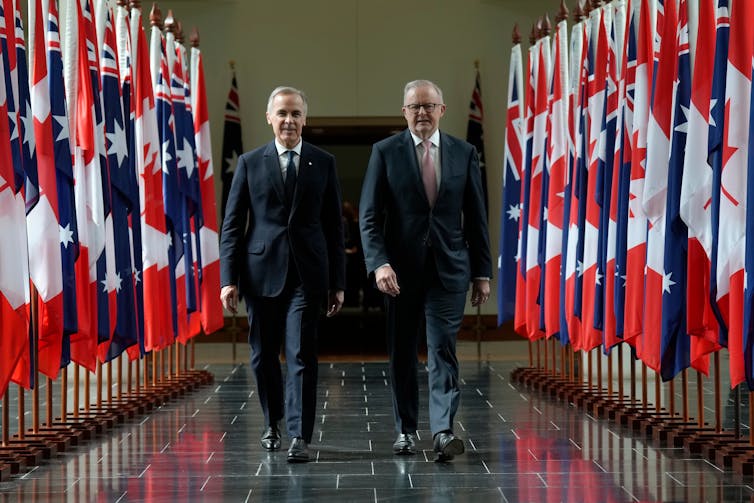
When Canadian Prime Minister Mark Carney addressed federal parliament on Thursday his well-crafted speech had one gaping hole. It did not mention the huge issue dominating world attention – the United States-Israeli strikes on Iran and the subsequent ever-widening conflict that has engulfed the region.

Both Carney and Anthony Albanese were quick to back the action at the weekend. But their endorsements would have been given reluctantly. Despite Australia and Canada being close American allies and members, with the US, of the Five Eyes intelligence sharing agreement, neither leader was accorded any prior notice of the attack.

Elaborating after his initial reaction, Carney said: “we took a position because we view the nuclear threat and the export of terrorism of Iran over decades as one of the gravest threats to international peace and security. In that limited sense we supported that aspect. That is not a blank cheque. That is not us participating.”

Albanese has been equally anxious to keep a distance while providing backing. He has refused, for example, to be drawn into the debate about the strikes seeming to flout international law.

Rewind to 2003 and the Iraq war. Labor was in opposition and came out strongly against the action. Albanese said at the time: “we do need regime change in some places of the world – it would certainly be good thing in Iraq – but it should be brought about peacefully”.

We might ask: if Labor were in opposition now, would it be against the American-Israeli action? Quite possibly.

In power, however, Albanese would have judged his government had no viable choice but to back Donald Trump’s action.

Critics argue that, given the nature of the Trump administration, Australia should unwind its alliance with the US. The Albanese government rejects that view as not in Australia’s long term interests – even if it were practical, given the now-advanced integration of our defence forces, to say nothing of AUKUS.

When Albanese finally secured a meeting with the US President last year, he established what seemed a reasonable rapport.

(Of course this can disappear in an instant, as British Prime Minister Keir Starmer found this week. When Starmer didn’t cooperate with Trump’s wishes in the Middle East conflict Trump turned nasty, saying, “This is not Winston Churchill that we’re dealing with”.)

In deciding his government’s stand on the US-Israeli action, Albanese would have been mindful of not harming the relationship he has established. An angry Trump could lash out – as he did against Spain. Trump declared “we’re going to cut off all trade with Spain” after that country said it would not allow the US to use jointly-run air bases in Spain for the Iran operation.

Albanese knew quiescent caucus members would suck up any doubts they had about backing the war. Politically, the main issue the government has had to cope with is some criticism of whether it has been doing enough to help stranded Australians get home.

As petrol prices started to rise – a hot button for the average person – Treasurer Jim Chalmers, who received some good news this week with a small uptick in Australia’s growth, quickly turned his attention to the economic implications of the conflict, amid work on the May 12 budget.

“The full consequences of this conflict are uncertain, but they’re likely to be substantial,” Chalmers said. “We already had challenges in our economy with inflation and global economic uncertainty, and what we’re seeing in the Middle East will make those challenges harder rather than easier, and this will be a key focus of the budget.”

Independent economist Chris Richardson’s judgement is that the conflict will be “a small economic negative and a smaller budget positive”.

“Conflict in the Middle East leads to spikes in both uncertainty and energy prices,” Richardson said in a social media post.

“Both of those will lower world growth, though perhaps not much.

“They’ll also drag on the Australian economy, though we do get a couple of offsets. The weaker world will weigh on industrial commodity prices, such as iron ore. But there are boosts underway to both energy commodities such as gas (where we are big producers) and fear commodities such as gold (ditto).

”[In net terms] that leaves the Australian economy feeling some pain (growth and jobs both a tad weaker), while still adding to overall national income (income from gas and gold both higher). The Australian economy is running faster than it can sustain right now, so a mild growth negative isn’t much of a problem.“

The new war has predictably worsened the fraying of social cohesion we’ve seen since 2023.

There was celebration among the local Iranian community, who welcomed the US-Israel strikes and fervently hope the conflict will lead to regime change.

But some mosques held or planned memorials for Iran’s slain Ayatollah Ali Khamenei. New South Wales premier Chris Minns strongly condemned them. That invited an extraordinary blast from the Liberal mayor of Liverpool Ned Mannoun who accused Minns of having a “fetish with attacking the Islamic community”.

There were calls for funding to be halted to Muslim bodies involved in the memorials. A $670,000 grant to a Melbourne organisation was cancelled.

Weeks before, Minns had cancelled the premier’s Iftar dinner. The state government said this was after consultation with Muslim community leaders. The Australian Federation of Islamic Councils this week said the decision “reflects the growing breakdown in the relationship between the Minns Government and the Muslim community” in the state.

“The reality is that the event would likely have faced a significant boycott from community leaders and organisations, which speaks volumes about the depth of frustration within the community,” the federation said.

Minns, questioned about police last month moving on praying Muslims, this week admitted to a “strained” relationship with the Muslim community.

“We want to rebuild the relationship, not just with me personally or the government or the Labor party, but with the civic institutions […] I don’t want to be in a situation where I’m antagonising the Muslim community, particularly during Ramadan.”

The sentiment is right, but overseas and local events have become wrecking balls for social harmony, and there are no obvious answers for repairing the damage.

ref. Grattan on Friday: would Labor be supporting this war if it were in opposition? – https://theconversation.com/grattan-on-friday-would-labor-be-supporting-this-war-if-it-were-in-opposition-277242


Rugby: Moana Pasifika relocate to Rotorua

Source: Radio New Zealand

Moana will host the Chiefs at Rotorua International Stadium on April 11. Photosport

Moana Pasifika will not play in the Pacific Islands this season, and have instead been forced to move one of their matches to Bay of Plenty.

The franchise announced on Thursday that the match scheduled to be played in Tonga, has been relocated to Rotorua.

Moana will host the Chiefs at Rotorua International Stadium on 11 April.

Nuku’alofa was originally intended as the venue for this fixture, but financial barriers once again blocked Moana going to the islands.

Under minimum broadcast standards, staging a Super Rugby game in Tonga requires transporting roughly three tonnes of equipment into the country at a cost of $600,000 – an expense the club must cover themselves.

It was a tough pill to swallow for Moana, who also had to cancel their Tonga visit in 2024 due to floodlight issues.

“It’s not a small undertaking to go over there and put on a game for our people. But that doesn’t mean that we’re not going to try and get there again. We just know we’ve got to do a bit more work and be able to hold a game there,” coach Fa’alogo Tana Umaga told RNZ.

However, Moana remain optimistic.

Moana Pasifika CEO, Debbie Sorensen said Bay of Plenty was a “win-win for both teams.”

“While we are sad we can’t take this game to Tonga, we do know that our fans and our community are everywhere – including in the Bay of Plenty region. I know Rotorua will also welcome the visit by the Chiefs.”

Sign up for Ngā Pitopito Kōrero, a daily newsletter curated by our editors and delivered straight to your inbox every weekday.

– Published by EveningReport.nz and AsiaPacificReport.nz, see: MIL OSI in partnership with Radio New Zealand

Questions raised over TVNZ’s editorial independence

Source: Radio New Zealand

TVNZ. RNZ/Marika Khabazi

Questions have been raised about TVNZ’s editorial independence after its chair discussed a news story with Broadcasting Minister Paul Goldsmith, media commentator Tim Murphy says.

TVNZ chair Andrew Barclay rang the minister after Goldsmith and cabinet colleague Mark Mitchell expressed dissatisfaction with a 1News story about gang numbers.

Goldsmith appointed Barclay to the public broadcaster’s board in September.

The story, about gang members now narrowly outnumbering police officers, aired on 1News last Thursday.

The report aired the same day the latest Crime and Victims survey showed 49,000 fewer victims of violent crime in the year to October 2025 compared to the previous survey in 2023.

Barclay spoke with Goldsmith over the phone before 1News ran a second story with a more positive angle.

Goldsmith, who is also the Justice Minister, confirmed he had spoken to the 1News journalist after the first story aired.

“Just like I often do when I’m not happy with a story, I ring the journalist and give them the benefit of my opinions,” he said.

Broadcasting Minister Paul Goldsmith confirmed he had spoken to the 1News journalist after the first story aired. RNZ / Nathan McKinnon

Goldsmith then said he had a “very short” call from the chair of TVNZ’s board “on a range of matters”, and the story came up in passing.

He “absolutely” did not bring the story up himself and he did not discuss editorial matters with Barclay, Goldsmith said.

“It’s not appropriate for me to be talking about political discussions and editorial matters with the board, and I haven’t,” he said.

Newsroom co-editor Tim Murphy told Midday Report running the second 1News story following those events gave the impression TVNZ was trying to make up for upsetting the government.

However, there were still many unanswered questions.

“The independence from ministers and the government of the day is really important for TVNZ and RNZ particularly, but how much went on and where and by whom I think we’re yet to find out,” Murphy said.

“Probably we’ll have to rely on the Official Information Act among other things to really know quite how involved or otherwise political interests were.”

It would be unusual for TVNZ’s chair to ringing the Broadcasting Minister about the broadcaster’s coverage, he said.

“The chair and the minister talk and that’s sort of the line of authority if you like, but not I think when the minister has been complaining so loud himself under his other portfolio,” Murphy said.

Barclay ought to have been aware of the “twilight zone of politics and media and journalism ethics”, he said.

Police Minister Mark Mitchell took to Facebook to express his frustration with the story after 1News’ gangs report.

Mitchell said it was “absolutely unbelievable” that, on a day the government had announced fewer victims of violent crime and a reduction in serious repeat youth offending, 1News “chose instead to engage in unbalanced journalism by running a story about gang membership with none of the context around the outstanding work our police are doing in cracking down on gangs in New Zealand”.

Five days later, 1News ran a second story reporting on the crime statistics the government had announced the previous week.

Mitchell again raised what he said was an “unbalanced” report during Question Time on Wednesday.

Labour’s police spokesperson Ginny Andersen then asked Mitchell whether he, any member of his office or any person acting on his behalf made contact with the TVNZ board regarding the report.

Mitchell said he had received a call from a “senior” TVNZ person to apologise after his Facebook post but he had not contacted anyone at TVNZ. He also confirmed the person he spoke to was not a member of the public broadcaster’s board.

A TVNZ spokesperson said the organisation’s political editor had contacted Mitchell’s office after the gang numbers story to advise the victims of crime data “should have been included”.

The spokesperson said the story was then reviewed internally and an editorial decision was made to run a follow-up story “incorporating those figures to ensure balanced coverage and to aid audience understanding around the use of differing crime statistics”.

The board chair and the minister talked regularly, TVNZ said.

“TVNZ’s Board Directors also take an interest in how editorial standards are maintained. But editorial independence is of paramount importance to us and operational decisions on how stories are covered are our own.”

Sign up for Ngā Pitopito Kōrero, a daily newsletter curated by our editors and delivered straight to your inbox every weekday.

– Published by EveningReport.nz and AsiaPacificReport.nz, see: MIL OSI in partnership with Radio New Zealand

Officials warns that retail crime advisory group lacks relevant expertise after resignations

Source: Radio New Zealand

Justice Minister Paul Goldsmith RNZ / Samuel Rillstone

  • Officials caution that after resignations retail crime advisory group doesn’t have security or facial recognition expertise
  • Group chairman says it will deliver robust reports on these issues to minister
  • Ministry of Justice says its advice still stands.

Justice Minister Paul Goldsmith has ignored advice from officials warning the remaining members of the ministerial advisory group charged with tackling retail crime don’t have relevant expertise in matters it will issue advice about.

Three of the five members of the Ministerial Advisory Group for Victims of Retail Crime resigned late last year and early this year, leaving just chairman Sunny Kaushal and Hamilton liquor retailer Ash Parmar.

Goldsmith confirmed last month that the group, which has faced criticism for its spending, will wind up in May, four months earlier than planned.

Before then the remaining members are expected to in April deliver advice to Goldsmith about the security industry, and facial recognition technology and information sharing.

Kaushal, who owns Auckland’s Shakespeare Hotel and is an advocate for retail shop owners, says he’s confident he and Parmar can deliver robust work.

The Ministerial Advisory Group for Victims of Retail Crime is headed by Sunny Kaushal. RNZ / Samuel Rillstone

But, a 26 January briefing from Ministry of Justice officials to Goldsmith and Associate Justice Minister Nicole McKee, obtained by RNZ, has raised concerns.

‘Remaining members do not hold subject matter expertise’

Group member Michael Bell quit late last year. His resignation was followed by Lindsay Rowles and Carolyn Young earlier this year.

“The three members who resigned, brought experience and expertise in the retail sector and in security and crime prevention,” the briefing said.

Young is Retail NZ’s chief executive. Officials said she brought leadership and experience to the group.

Retail NZ’s chief executive Carolyn Young Supplied

Bell, who worked for Michael Hill, was a key member of the jeweller’s security taskforce, which is “responsible for monitoring retail crime trends nationally and globally, and implementing prevention measures”.

Rowles had expertise in security and crime prevention, having formed and led Foodstuffs’ retail crime working group, which included trialling facial recognition technology

Continuing with just two group members came with a warning: “We do not consider the current membership meets the requirements established in the terms of reference, as there are no members who bring experience and expertise in security.”

Suggestions for a way forward included terminating the group as soon as possible; letting it run until September as planned; appointing new members to the group to replace the three who resigned; or winding it up early after it delivered in April reports on the security industry and facial recognition technology and information sharing.

This is the option Goldsmith chose, announcing on 10 February the group would continue with its current work before winding up in May.

“We consider there are two primary risks with proceeding on this basis. The first is that the advice provided by the MAG will be on behalf of the two remaining members and will not reflect discussions and endorsements of a fully constituted membership with a breadth of expertise and experience required by the terms of reference,” the briefing said.

“This is particularly important given that the remaining members do not hold subject matter expertise relevant to the areas covered by the reports – security industry, FRT, and information sharing.”

Chairman says advice will be robust

Kaushal told RNZ he was confident the group would deliver robust advice about the security industry and facial recognition technology.

He said all the group’s proposals were developed after at least two rounds of feedback from the likes of the retail sector, government agencies, local councils and non-government organisations.

“In the case of our FRT advice, we’ve consulted with privacy experts, the Privacy Commission, UK regulators, and FRT service providers both in NZ and the UK, along with retailers and sector groups,” Kaushal said.

“In the case of our security industry advice, we’ve consulted widely across the sector in New Zealand, with regulators here, and with industry bodies in Australia and Canada, along with retailers and sector groups.

“Our policy process is robust. It involves the MAG developing both an issues paper and an options paper – both of which are consulted on before final advice is prepared. We contract with experienced policy professionals to support the MAG in developing its advice.”

Kaushal said he was working with ministers on making sure the group’s remaining advice was balanced and considered a full range of sector views.

He said the group’s record spoke for itself.

“In just 18 months, we have delivered substantial and measurable progress in strengthening law and order. Through the ministerial advisory group, I have led seven major legislative-ready reform proposals.

“Four have already been accepted by the government to progress into law, including the Crimes Amendment Bill currently before Parliament.”

That bill includes extended powers for citizens’ arrests.

Goldsmith was asked about officials’ concerns about the expertise of the group’s two remaining members. His office said he had nothing further to add.

Ministry deputy secretary, policy, Caroline Greaney said: “The advice given stands, and the ministry has nothing further to add regarding that.

“An approach to mitigating some of these concerns is being worked through now, but at this point there is nothing more to say.”

New Zealand Security Association chief executive Gary Morrison said it was “reasonably relaxed” about the change in group personnel, and it had given feedback about facial recognition technology 8-10 months ago, before the resignations.

The association dealt with advisers to the group and Morrison had found they’d taken a balanced approach to issues.

‘Not played out as I hoped’

Bell’s resignation letter said that due to the significant time commitments of his job as Michael Hill national retail manager, he couldn’t focus enough on the group’s work.

Rowles was stepping down after his appointment as Mitre 10 chief executive, a position beginning this month.

Young’s letter said she decided to resign after consulting with the Retail NZ board.

In a covering letter to justice secretary Andrew Kibblewhite she thanked ministry officials for their support, but added: “… it certainly has not played out as I had hoped and it is disappointing that we haven’t been able to do more meaningful work with this group.”

She later told RNZ the group was a “very unpleasant environment” in which to work.

The group was supposed to operate for two years to September. It has an annual budget of $1.8 million, paid for from the proceeds of crime fund.

It has delivered advice to the minister on issues such as tougher penalties for shoplifters, strengthening trespass laws, and introducing new citizens’ arrest powers.

But, it has faced criticism about its value for money, including the $230,000 Kaushal invoiced for work in its first 12 months, which was allowed under the group’s payment guidelines; the central Auckland office space it rents for $120,000 a year; and the $24,000 spent on 22 well-catered stakeholder engagement meetings around New Zealand.

Sign up for Ngā Pitopito Kōrero, a daily newsletter curated by our editors and delivered straight to your inbox every weekday.

– Published by EveningReport.nz and AsiaPacificReport.nz, see: MIL OSI in partnership with Radio New Zealand

Wairarapa residents want flood-protection action

Source: Radio New Zealand

Adam Mazzola’s home was half a metre underwater in some parts during the peak of Monday’s flooding. Adam Mazzola

Flood-hit residents on Wairarapa’s south coast are demanding action after a creek burst its banks during torrential rain.

Low-lying homes in Whāngaimoana Beach were inundated when a severe storm swept across the lower North Island last month, closing roads, cutting power to thousands, and severing communities.

Locals say heartache could’ve been avoided if the stream bordering their properties had been dug out.

They’ve called on the council to open it to the sea so that it can drain during heavy rain, but the council says it’s not its responsibility.

Emergency operations says multiple warnings were issued about the flood risk and has signalled that flood mitigation will form part of its recovery work.

‘The water would’ve just buggered off’

Sections of the Whāngaimoana stream run through private property, including an identified and protected wetland, before hitting the beach, which is publicly owned.

When it breached its banks on Monday, 16 February, Adam Mazzola and his son were forced to evacuate as the water rose by up to half a metre inside their home.

They’ve been living elsewhere ever since, and Mazzola said they wouldn’t be returning to the 100-year-old bach – it’s too damaged.

A Givealittle page has been set up to help him “get back on his feet”.

Mazzola said it was important to know who was responsible for the stream and wanted to see a machine on standby to dig it out in the future.

“It [flood mitigation] could have saved our place and others if it [the stream] was cleared out and maintained,” he said.

Adam Mazzola looks at damage to his home. RNZ / Samuel Rillstone

Neighbours Jason Statham and Mellisa Tipene highlighted the same issue when RNZ visited.

Tipene said their property had flooded a “handful of times” in the past decade and believed opening up the stream at the beach would reduce the frequency.

“If they open up a mouth like Lake Ferry out the end there, so the water can release itself, you wouldn’t have it backing up and coming in here … and constantly flooding your yard that you work hard to… beautify.”

Whāngaimoana beach. RNZ

Statham said the rain warnings came well in advance of the downpour and thought there should have been some proactive flood mitigation.

“They should have been down there two days before it happened and opened up the mouth, and I don’t think that [the flooding] would have happened, the water would’ve just buggered off,” Statham said.

“But they didn’t do that. They warned us and all that, but they didn’t do f*** all.”

Property owners responsible for flood protection – council

While surveying the damage to her backyard, local Terry Shubkin told RNZ that more than one home in the lower section of the street flooded when the stream burst its banks.

Terry Shubkin. RNZ / Samuel Rillstone

Shubkin said flooding in the settlement was increasing in frequency, with the latest inundation on par with a “one-in-50-year flood” that hit in 2004.

She said she’d been pushing the Greater Wellington Regional Council [GWRC] for help on-and-off in the years since, but “the response I get is, ‘It’s not our problem.’”

Shubkin said the council put up a drone after “much nagging” last year and found willows and sediment were clogging the stream in places, but she said that was only part of the problem.

“The creek doesn’t actually flow out to the ocean; it closes off,” she said.

The regional council’s director of delivery, Jack Mace, said the council does carry out flood protection work in the area, but unfortunately, the creek falls outside its remit as set out in the Lower Wairarapa Valley Development Scheme.

The scheme from the 1960s is set for review in the next two to three years and covers building and maintaining stop banks, floodways, and drainage, as well as the opening of nearby Lake Ōnoke / Lake Ferry.

A council spokesperson said following the drone flight, recommendations were made to the landowner with the willows.

They said while Greater Wellington has powers to intervene in waterways – such as opening stream mouths – it won’t at Whāngaimoana because the creek doesn’t meet its criteria for management.

“Private landowners have a responsibility to protect their land from flooding unless there is a relevant river management plan/scheme in place.

“For this creek and community, the best opportunity to advocate for Whāngaimoana to be included in a river scheme is in the review of the Lower Wairarapa Valley Development Scheme.”

Mace said the regional council understood the impact of severe flooding on rural communities and believed it would take a long time for the region to fully recover.

“Our focus now is on stabilising river corridors within the scheme while we work to understand the extent of the damage and what may be required long term.”

Flood mitigation to be considered

Wairarapa Emergency Operations Centre said it was advised by the regional council that “Whāngaimoana was vulnerable to flooding if the stream breached its banks and sea swell backed up flood water” on Sunday, 15 February at 8.47pm.

A spokesperson for the office said staff followed up with residents as soon as it was safe to do so the next day, and noted that public advisories about the flood risk in low-lying areas – including an emergency mobile alert – were issued prior to and during the storm.

They said support agencies had boots on the ground in the immediate days after the flooding in Whāngaimoana and confirmed one family was still being “actively supported”.

“Regarding the clearing of streams and flood mitigation, we don’t have the necessary information to comment specifically about this situation at the moment, but this will form part of the recovery office’s work with impacted communities.”

In addition to immediate repairs, the recovery office – recently established by the South Wairarapa District Council – would focus on what communities needed to build resilience in the medium to long term.

Sign up for Ngā Pitopito Kōrero, a daily newsletter curated by our editors and delivered straight to your inbox every weekday.

– Published by EveningReport.nz and AsiaPacificReport.nz, see: MIL OSI in partnership with Radio New Zealand

Health NZ says petrol vouchers helping lower MRI waiting list in Greater Wellington

Source: Radio New Zealand

Health NZ Capital and Coast group director of operations Jamie Duncan said the scheme was about improving overall access to MRI scans. 123RF

Health NZ says an initiative to give patients in the Greater Wellington region petrol vouchers to drive to Whanganui for an MRI scan is working to bring waiting lists down.

Hundreds of patients in the region had been offered $150 petrol payments to travel out of the district to get the diagnostic procedure faster.

There had been criticism of the scheme – with the senior doctors union claiming it offered people the chance to buy their way up the public wait lists for MRI scans.

But Health NZ Capital and Coast group director of operations Jamie Duncan told Checkpoint that was not the case.

“We’re providing support for people that have the ways and means to access the scans in Whanganui. I think the impact here is twofold. Clearly those people get access to a scan, but what it does do is it frees up capacity locally on our MRI scanners for those people who aren’t in a position to travel,” he said.

Duncan said 288 patients had taken the opportunity to travel to Whanganui with a petrol voucher.

“What that means locally is from September our waiting time for a scan was approximately six months in Wellington, now just over six months later the wait time is closer to three to four months,” he said.

“It’s having a significant impact in improving access locally.”

The target wait time was six weeks for an MRI scan.

“We still know we have a ways and means to go to hit that target but you can see on that trajectory we’re moving there quite quickly,” Duncan said.

Duncan said the scheme was about improving overall access to MRI scans.

“There are other things we’re doing locally to improve access, we’re outsourcing to private providers, we’re employing more radiology staff in the public system to increase access to public MRI, we’re working weekend shifts to improve access as well,” he said.

Duncan said there were seven public MRI machines in the central region, with Whanganui being one of those.

There were two in Wellington Hospital and one in Hutt Valley Hospital.

Sign up for Ngā Pitopito Kōrero, a daily newsletter curated by our editors and delivered straight to your inbox every weekday.

– Published by EveningReport.nz and AsiaPacificReport.nz, see: MIL OSI in partnership with Radio New Zealand

Farrer byelection will be on May 9

Source: The Conversation (Au and NZ) – By Michelle Grattan, Professorial Fellow, University of Canberra

The byelection for the regional New South Wales seat of Farrer, vacated by former opposition leader Sussan Ley, will be held on May 9.

the date was announced by the Speaker of the House of Representatives on Thursday.

The main contenders for the seat with be the Liberal Party, the Nationals, One Nation and at least one high-profile independent, Michelle Milthorpe. The Labor party is not running.

The byelection, just days before the May 12 budget, is being regarded as a major test for new opposition leader Angus Taylor.

Importantly, it will also indicate whether the surge for One Nation in the opinion polls translates to votes. One Nation will select it’s candidate this weekend, from a shortlist of three.

The Liberal and National parties are yet to select candidates but Milthorpe who polled 20% at the last election, is already campaigning.

The Liberals will hold a rank-and-file pre-selection in about a week. The Nationals’ candidate will be chosen on Sunday.

The key dates are:

  • Issue of writ Wednesday April 1
  • close of rolls Wednesday April 8
  • close of nominations Monday April 13
  • declaration of nominations Tuesday April 14
  • date of polling Saturday May 9
  • return of writ on or before Friday July 10

ref. Farrer byelection will be on May 9 – https://theconversation.com/farrer-byelection-will-be-on-may-9-277621

Fine for unreported Hector’s dolphin death reveals toothless system, conservation group says

Source: Radio New Zealand

The camera on-board FV Emma Jane recorded images of a net being cut and a dead Hector’s dolphin sinking to the sea floor. RNZ / Alison Ballance

A small fine meted out to an Otago fisher, who killed a Hector’s dolphin then lied to officials, underscores the failure to protect endangered species, a conservation group says.

Māui and Hector’s Dolphin Defenders uncovered the death of the dolphin – one of only about 40 left in the area – and fought through the courts to obtain the details.

Founder Christine Rose said the case laid bare a toothless system that failed to act as a deterrent to the fishing industry and also highlighted the vulnerability of relying on the industry to self-report bycatch.

The Moeraki fisher, who RNZ has chosen not to identify, was already before the court for illegal fishing when the Ministry for Primary Industries (MPI) discovered he had killed a Hector’s dolphin while set-netting off Otago’s coast in February last year.

The camera on-board FV Emma Jane recorded images of the net being cut and the dead dolphin sinking to the sea floor.

Neither MPI nor the Department of Conservation (DOC) brought charges over the death of the dolphin. However, MPI charged the man with failing to report the capture under the Fisheries Act.

While it is illegal to harm a protected species, commercial fishers are exempted for “accidental capture”, or bycatch.

The Ministry for Primary Industries said, although killing protected wildlife as bycatch was not an offence, it took the prosecution for failing to report the incident “due to the seriousness of the non-reporting”.

DOC said its only involvement in the case was to confirm the mammal in the camera footage was an endangered Hector’s dolphin.

Industry group Seafood New Zealand said fisheries were the most regulated and surveilled primary industry in the country and the case showed the rules were working.

Otago University emeritus professor Liz Slooten said the case proved dolphins killed by fishing gear were not always reported.

It comes as the government sought to roll back parts of the camera programme.

The current law – which had no penalty for fishing industry-related dolphin deaths – was not fit for purpose, Slooten said.

‘A dirty old shag’

After the dolphin’s death was discovered the skipper lied in his catch report, responding ‘no’ when asked if any protected species had been caught.

When fisheries officers asked about the catch he told them it was “just a dirty old shag or a seven-giller (shark)”, according to MPI’s summary of facts.

When formally interviewed he admitted to catching the dolphin claiming it was a “common dolphin”.

Another of the man’s ships, FV Triton, was caught trawling illegally days earlier near the mouth of the Ōrāri River in South Canterbury while skippered by another man.

A no trawl prohibition applied in the area from January to April to protect sea-run Chinook salmon, MPI described the fish as being at “crisis point”.

The ship’s owner said he was unaware of the no trawl areas.

He was charged with trawling inside a prohibited area.

‘Manifest injustice’

The fisher pleaded guilty to all charges last September and was fined $5000 for failing to report the dolphin’s capture, $10,000 for trawling in a prohibited area.

Both ships were automatically forfeited.

However, the man kept both ships in exchange for a fee of $14,460.

Rose said the man would be able to treat the fine and buy-back costs as the price of doing business.

“Hector’s dolphins are priceless but the court’s judgement makes dolphin lives look worthless,” she said.

Hector’s dolphins are only found in New Zealand waters and are estimated to number about 15,000, a stark decline from the 50,000 estimated in 1975.

The case showed the organisations charged with protecting threatened marine mammals were failing, Rose said.

“If this was a kiwi or a kākāpō people would be rightly outraged. But, because it’s a dolphin, we only know about it because of the persistence of groups like ours.”

Rose learned of the death after spotting a reference to unreported bycatch in a presentation from MPI.

The dolphin’s death was not initially reported on DOC’s database, though it had since been added with a note that “due to an ongoing compliance investigation, this incident was not reported publicly until January 2026”.

The court did not impose any suppression orders and ordered the release of the information to Māui and Hector’s Dolphin Defenders last month.

“When he was finally prosecuted, as we find out from the district court records, it turns out he’s got a history of breaking the law and despite the fact he’s been fishing for 40 years he pretends to not know what the rules are,” Rose said.

“The fine he gets for all of this is only $5000 and forfeiture of his boat but in the meantime he’s able to buy that boat back and can be right back out there fishing.”

MPI’s 2023-24 South Island Hector’s bycatch reduction plan annual report noted that on at least four occasions the same fishing boats killed more than one Hector’s dolphin in a 12 month period.

MPI director of science and information Simon Lawrence said when Fisheries New Zealand finds evidence of breaches of fisheries rules it took a range of actions from education to prosecution.

Prosecution decisions were made based on Crown Law guidance, he said.

DOC biodiversity system and aquatic director Kirstie Knowles said DOC became aware of the dolphin’s death in April when Fisheries New Zealand asked for confirmation the footage showed a Hector’s dolphin.

As a Fisheries investigation was already underway, DOC did not open a separate investigation under the Marine Mammal Protection Act, Knowles said.

The High Court found in 2024 DOC’s approach to prosecution and investigation were unlawful and lacking.

Rose claimed DOC and MPI were failing in their duties.

“MPI are protecting the fishing industry, they’re not upholding the rules. DOC are nowhere to be seen. They should have been prosecuting this under the Marine Mammal Protection Act,” she said.

“Both these agencies that are supposed to be upholding the law and the flourishing and preservation of the marine environment and these protected species are missing in action.”

Less than a fifth of on-board footage monitored in last quarter

Before the introduction of on-board cameras, the industry reported one or zero Hector’s dolphins deaths in nets or trawls between 2014 and 2022.

But 15 deaths were reported or observed in the first year on-board cameras were rolled out.

Seafood NZ chief executive Lisa Futschek. RNZ / Kate Newton

A 2025 MPI report said about 30 percent of footage had been reviewed since 2023.

Figures for the quarter to September 2025 showed only 18 percent of footage was reviewed.

Seafood NZ chief executive Lisa Futschek said the Otago case showed the system was working.

There were clear rules on reporting, she said.

“We have a robust system. We need to work within it, and we do, and for those who don’t there are clear consequences which is what happened in this case,” Futschek said.

There were limits on the number of dolphins the fishing industry could kill in certain areas.

Those limits protected endangered species, Futschek said.

In the South Island the limit was 47.5 dolphins per year, but last year only seven were killed by the industry, Futschek said.

“So whilst even one capture is too many, we are still doing really well when it comes to making sure that particular species continues to thrive,” she said.

However, in the East Otago region the limit is two deaths per year.

Sign up for Ngā Pitopito Kōrero, a daily newsletter curated by our editors and delivered straight to your inbox every weekday.

– Published by EveningReport.nz and AsiaPacificReport.nz, see: MIL OSI in partnership with Radio New Zealand

Social Development Minister says nothing suggests Gloriavale children unsafe following visit

Source: Radio New Zealand

The Gloriavale compound on the West Coast. RNZ / Jean Edwards

Senior government minister Louise Upston says she did not see anything on a visit to Gloriavale that caused concern about children’s safety at the West Coast Christian community.

The Social Development Minister visited Gloriavale on 30 January where she met Overseeing Shepherd Stephen Standfast, senior leaders and other Gloriavale members.

Photos of the visit seen by RNZ show Upston speaking to parents, holding a baby, visiting a family home and touring the school art room.

Former Gloriavale member Virginia Courage has criticised the visit, saying the minister would not have seen the reality of life at the sect and should meet leavers rather than community leaders.

On Thursday Upston said the visit was important because she was responsible for an Abuse in Care Royal Commission recommendation the government take all practicable steps to ensure the ongoing safety of children, young people and adults at Gloriavale.

“I thought it was really important for me to be able to meet the key leaders, to be able to see for myself, and to ensure that I was well-informed,” she said.

Asked if she thought Gloriavale children were safe, Upston said “there was nothing that I saw that led me to think they weren’t”.

“What we’re working on is a community plan. I have to give them the benefit of the doubt and I am at this stage confident that they are engaged in the process, that they are working with the government agencies on the ground, that they’re working on an outcomes plan. That is very much anchored around the safety and care of children,” she said.

Social Development Minister Louise Upston visited Gloriavale on 30 January. RNZ / Mark Papalii

Government agencies were at Gloriavale working with the community on a regular basis, Upston said.

“Clearly there have been issues in the past. We are focussed now on the safety of children. There was nothing that I saw that led me to be concerned about it but regular contact with agencies on the ground will continue to happen and, because we are now looking at it as a group of agencies collectively, if there was anything that happened we would get to see it and know about it quickly,” she said.

Upston said she met a large group of Gloriavale leaders and attended a community gathering with a question-and-answer session.

“Then I did a walk-around like I usually do, I just wander off and go and talk to whoever I want to talk to and that’s exactly what I did,” she said.

Gloriavale’s leaders were concerned about education and schooling but Upston told them decisions about Gloriavale Christian School were a matter for the Secretary for Education.

The minister was unable to meet leavers in Wellington on a previous occasion but said she was happy to do so in future.

“I’ve said I’m happy to and the ball is in their court so when they’re back in Wellington, happy to catch up,” she said.

Upston was accompanied by National’s West Coast-Tasman MP Maureen Pugh, Ministry of Education deputy secretary Geoff Short and Regional Public Service Commissioner Craig Churchill.

Pugh said she had nothing further to add to the minister’s comments, except to say that she was there as the electorate MP to support Upston’s visit.

RNZ has approached Short and Churchill for comment.

Courage earlier told RNZ the minister should not have gone to Gloriavale.

“What she’s seeing is not reality, it’s crafted, it’s practised. Them going there and not being informed, not knowing what they’re dealing with, not having talked to leavers, not having gotten facts about the level of harm, really all you’re doing is giving Gloriavale air-time,” she said.

Upston would have met members hand-picked by Gloriavale’s leadership, Courage said.

“I’m highly, highly suspicious that this was just a PR event to make it look like they care. ‘We’ve been there and visited’ – and you didn’t see any abuse that day so it’s all okay? Of course you didn’t see any abuse, you were talking to the people who do the abusing,” she said.

“It actually upsets me to think that she went there and talked to the leadership. It’s the leadership who are responsible for the teachings that this community is suppressed and dominated by.”

Countless visits from police, politicians and government departments had failed to expose wrong-doing at Gloriavale, Courage said.

“None of them figured out what was going on, it had to be from ex-members going to court and proving it in court without a shadow of doubt the level of abuse, neglect, coercion, manipulation, deception even. You cannot go and visit Gloriavale and know what it’s about. You do not see the real thing,” she said.

Former Overseeing Shepherd Howard Temple was initially sentenced to two years and two months’ jail for indecently assaulting young women and girls, but that sentence was reduced to 11 months home detention. Tim Brown / RNZ

The High Court quashed Temple’s jail sentence on Tuesday following an appeal. The 85-year-old will instead serve 11 months’ home detention at a property in Greymouth.

A Gloriavale spokesperson said the minister came to see the community first-hand and meet a cross-section of members including the school board, mothers, managers and leaders.

It was a short visit including a brief inspection of the school, main building and accommodation, and a meeting with a homeschooling family, the spokesperson said.

The minister and senior leaders discussed “concerns about the registration of the school, success of our policies regarding abuse and continuing plans to support leavers”, they said.

Standfast took on the role of Overseeing Shepherd last December following the resignation of Howard Temple, who was sentenced to two years and two months’ jail for indecently assaulting young women and girls over 20 years.

The High Court quashed Temple’s jail sentence on Tuesday following an appeal. The 85-year-old will instead serve 11 months’ home detention at a property in Greymouth.

Last December the Ministry of Education announced it was cancelling Gloriavale Christian School’s registration because of safety concerns but the private school remains open pending a High Court judicial review.

Gloriavale founder Hopeful Christian – formerly known as Neville Cooper – was sentenced to five years in prison in December 1995 on three charges of indecent assault.

The Abuse in Care inquiry found the Overseeing Shepherd and senior leaders at fault for allowing physical and sexual abuse at the community, failing to prevent abuse and protect survivors and inappropriately handling perpetrators, allowing them to remain in the community and continue their abuse.

Sign up for Ngā Pitopito Kōrero, a daily newsletter curated by our editors and delivered straight to your inbox every weekday.

– Published by EveningReport.nz and AsiaPacificReport.nz, see: MIL OSI in partnership with Radio New Zealand

Moriori accuses Crown of not being neutral on issues with Ngāti Mutunga over Chatham Islands

Source: Radio New Zealand

Moriori Imi Settlement Trustees from left, Billy King, Tom Lanauze and Maui Solomon. Pokere Paewai/RNZ

The Moriori Imi Settlement Trust allege the Crown has reneged on a promise to remain neutral on issues of tino rangatiratanga between them and Ngāti Mutunga o Wharekauri over the Chatham Islands.

Descendants of both Moriori and Ngāti Mutunga were in the Court of Appeal in Wellington on Wednesday; the public gallery was so packed that a separate courtroom had to be set up with an Audio Visual link so everyone could watch the proceedings.

The Moriori Imi Settlement Trust is seeking a declaration of whether it would be unlawful for the Crown to enter into a settlement with Ngāti Mutunga that recognises or transfers interests in a way that conflicts with Moriori’s rights.

In November 2022, Ngāti Mutunga o Wharekauri and the Crown signed an Agreement in Principle (AIP) to settle the iwi’s historical Treaty Claims.

The AIP outlines a broad settlement framework, including recognition of Crown breaches of Te Tiriti and acknowledgement of Ngāti Mutunga o Wharekauri mana and tino rangatiratanga.

Chief Negotiator for Moriori Maui Solomon said they asked the Crown to remove the wording of tino rangatiratanga, but that request has so far been refused.

“During our negotiations with the Crown… we started in 2016, we signed our settlement in 2020, the Crown undertook to us that they would remain neutral, as between Moriori and Ngāti Mutunga on issues of mana whenua and tino rangatiratanga. They have not done that.”

Moriori would have preferred to settle out of court, he said.

Chair of Ngāti Mutunga o Wharekauri Iwi Trust Monique Croon said it’s disappointing to be in court over an issue they believe is straightforward.

“With tino rangatiratanga and our grievances, they are with the Crown, not against Moriori. And so we’ve always supported Moriori to have a settlement. And again we like to engage and we like to be part of sharing, working through that shared redress.”

Moriori settled their historic Treaty claims with the Crown in 2020, but the settlement did not include reference to mana whenua or tino rangatiratanga.

Croon said that choice was made by Moriori during negotiations with the Crown.

“Within their legislation in their deed [Moriori]… have agreed to have shared redress with Ngāti Mutanga. At this stage, we still haven’t been able to get together, engage with Moriori on that shared redress… we all share whakapapa. We live on a little island of Wharekauri where we’re a small population, and it’s important that we continue working together,” she said.

Solomon said although the Treaty was signed and applied mainly in New Zealand to Māori, the Crown claimed sovereignty over the Chatham Islands so Moriori have the same rights under the Treaty. “Wherever they’re claiming rights, they also assume the obligations,” he said.

“We don’t oppose Ngāti Mutunga having a settlement, per se. Even though we say, well, actually the Crown already rewarded Ngāti Mutunga by giving them all our land in 1870 by applying mainland custom of take raupatu.”

Chair of the Moriori Imi Settlement Trust Tom Lanauze disputes that Ngāti Mutunga took tino rangatiratanga from Moriori when they invaded the islands in 1835.

Even when Moriori people were slaughtered and enslaved there were still Moriori people on the Chatham Islands, he said.

“We didn’t lose our tino rangatiratanga by any means, in my view. And it’s still there today.”

In June 2025 the Moriori Imi Settlement Trust applied for interim orders in the High Court that the Crown not take any further action in progressing the Ngāti Mutunga Treaty claim to the extent that it would recognise that Ngāti Mutunga holds tino rangatiratanga over the Chatham Islands.

Justice La Hood dismissed the application, finding that “interim relief is not reasonably necessary to preserve Moriori’s rights.”

In December 2025, Ngāti Mutunga o Wharekauri and the Crown initialled a Draft Deed of Settlement.

Croon said the next step for the settlement is to have it ratified by iwi members.

“Once we have the vote or the support, then we’ll be looking at signing the deed about [the] middle of this year.”

A spokesperson for Minister for Treaty of Waitangi Negotiations Paul Goldsmith said he was unable to comment as the case is before the courts.

The Court of Appeal judges have reserved their decision.

Sign up for Ngā Pitopito Kōrero, a daily newsletter curated by our editors and delivered straight to your inbox every weekday.

– Published by EveningReport.nz and AsiaPacificReport.nz, see: MIL OSI in partnership with Radio New Zealand

Over 3000 New Zealanders in the Middle East amidst conflict

Source: Radio New Zealand

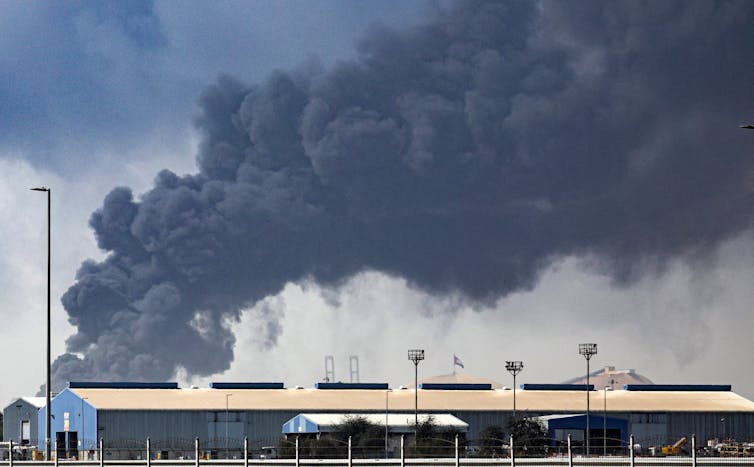
A plume of smoke rises from the Zayed Port following a reported Iranian strike in Abu Dhabi. AFP / RYAN LIM

More than 3000 New Zealanders are in the Middle East as the Iran war continues.

The US and Israel have been bombing Iran for almost one week, with Iran launching retaliatory strikes on US and Israeli bases across the Middle East.

Travel warnings are in place, and most flights in and out of the region are not operating.

The Ministry of Foreign Affairs and Trade said 3171 New Zealanders were registered with its service SafeTravel in the region.

That included 1,893 in the UAE, 411 in Qatar, 401 in Saudi Arabia, 120 in Egypt, 42 in Jordan, 72 in Kuwait, 55 in Bahrain, 30 in Iran, 12 in Iraq, and 83 in Israel and the Occupied Palestinian Territory, 38 in Oman, and 14 in Lebanon.

However, it expected the actual number of New Zealanders in each country to be higher.

Defence Minister Judith Collins previously told Midday Report on Thursday, two NZDF planes would be leaving New Zealand in the coming days.

“We’re not saying exactly where they’re going to be, for obvious security reasons, but we will be saying to people, if you want to leave, we’ll get you out of the region into a safer region…. but we won’t be bringing back the thousands of New Zealanders who we know are in the region all the way back to New Zealand.

“We’ll get you to a place where you can be safe and you can get commercial flights.”

The government is urging New Zealanders in the Middle East to register on SafeTravel in preparation for evacuation.

Sign up for Ngā Pitopito Kōrero, a daily newsletter curated by our editors and delivered straight to your inbox every weekday.

– Published by EveningReport.nz and AsiaPacificReport.nz, see: MIL OSI in partnership with Radio New Zealand

Fine for unreported Hector’s dolphin death reveals toothless system, coservation group says

Source: Radio New Zealand

The camera on-board FV Emma Jane recorded images of a net being cut and a dead Hector’s dolphin sinking to the sea floor. RNZ / Alison Ballance

A small fine meted out to an Otago fisher, who killed a Hector’s dolphin then lied to officials, underscores the failure to protect endangered species, a conservation group says.

Māui and Hector’s Dolphin Defenders uncovered the death of the dolphin – one of only about 40 left in the area – and fought through the courts to obtain the details.

Founder Christine Rose said the case laid bare a toothless system that failed to act as a deterrent to the fishing industry and also highlighted the vulnerability of relying on the industry to self-report bycatch.

The Moeraki fisher, who RNZ has chosen not to identify, was already before the court for illegal fishing when the Ministry for Primary Industries (MPI) discovered he had killed a Hector’s dolphin while set-netting off Otago’s coast in February last year.

The camera on-board FV Emma Jane recorded images of the net being cut and the dead dolphin sinking to the sea floor.

Neither MPI nor the Department of Conservation (DOC) brought charges over the death of the dolphin. However, MPI charged the man with failing to report the capture under the Fisheries Act.

While it is illegal to harm a protected species, commercial fishers are exempted for “accidental capture”, or bycatch.

The Ministry for Primary Industries said, although killing protected wildlife as bycatch was not an offence, it took the prosecution for failing to report the incident “due to the seriousness of the non-reporting”.

DOC said its only involvement in the case was to confirm the mammal in the camera footage was an endangered Hector’s dolphin.

Industry group Seafood New Zealand said fisheries were the most regulated and surveilled primary industry in the country and the case showed the rules were working.

Otago University emeritus professor Liz Slooten said the case proved dolphins killed by fishing gear were not always reported.

It comes as the government sought to roll back parts of the camera programme.

The current law – which had no penalty for fishing industry-related dolphin deaths – was not fit for purpose, Slooten said.

‘A dirty old shag’

After the dolphin’s death was discovered the skipper lied in his catch report, responding ‘no’ when asked if any protected species had been caught.

When fisheries officers asked about the catch he told them it was “just a dirty old shag or a seven-giller (shark)”, according to MPI’s summary of facts.

When formally interviewed he admitted to catching the dolphin claiming it was a “common dolphin”.

Another of the man’s ships, FV Triton, was caught trawling illegally days earlier near the mouth of the Ōrāri River in South Canterbury while skippered by another man.

A no trawl prohibition applied in the area from January to April to protect sea-run Chinook salmon, MPI described the fish as being at “crisis point”.

The ship’s owner said he was unaware of the no trawl areas.

He was charged with trawling inside a prohibited area.

‘Manifest injustice’

The fisher pleaded guilty to all charges last September and was fined $5000 for failing to report the dolphin’s capture, $10,000 for trawling in a prohibited area.

Both ships were automatically forfeited.

However, the man kept both ships in exchange for a fee of $14,460.

Rose said the man would be able to treat the fine and buy-back costs as the price of doing business.

“Hector’s dolphins are priceless but the court’s judgement makes dolphin lives look worthless,” she said.

Hector’s dolphins are only found in New Zealand waters and are estimated to number about 15,000, a stark decline from the 50,000 estimated in 1975.

The case showed the organisations charged with protecting threatened marine mammals were failing, Rose said.

“If this was a kiwi or a kākāpō people would be rightly outraged. But, because it’s a dolphin, we only know about it because of the persistence of groups like ours.”

Rose learned of the death after spotting a reference to unreported bycatch in a presentation from MPI.

The dolphin’s death was not initially reported on DOC’s database, though it had since been added with a note that “due to an ongoing compliance investigation, this incident was not reported publicly until January 2026”.

The court did not impose any suppression orders and ordered the release of the information to Māui and Hector’s Dolphin Defenders last month.

“When he was finally prosecuted, as we find out from the district court records, it turns out he’s got a history of breaking the law and despite the fact he’s been fishing for 40 years he pretends to not know what the rules are,” Rose said.

“The fine he gets for all of this is only $5000 and forfeiture of his boat but in the meantime he’s able to buy that boat back and can be right back out there fishing.”

MPI’s 2023-24 South Island Hector’s bycatch reduction plan annual report noted that on at least four occasions the same fishing boats killed more than one Hector’s dolphin in a 12 month period.

MPI director of science and information Simon Lawrence said when Fisheries New Zealand finds evidence of breaches of fisheries rules it took a range of actions from education to prosecution.

Prosecution decisions were made based on Crown Law guidance, he said.

DOC biodiversity system and aquatic director Kirstie Knowles said DOC became aware of the dolphin’s death in April when Fisheries New Zealand asked for confirmation the footage showed a Hector’s dolphin.

As a Fisheries investigation was already underway, DOC did not open a separate investigation under the Marine Mammal Protection Act, Knowles said.

The High Court found in 2024 DOC’s approach to prosecution and investigation were unlawful and lacking.

Rose claimed DOC and MPI were failing in their duties.

“MPI are protecting the fishing industry, they’re not upholding the rules. DOC are nowhere to be seen. They should have been prosecuting this under the Marine Mammal Protection Act,” she said.

“Both these agencies that are supposed to be upholding the law and the flourishing and preservation of the marine environment and these protected species are missing in action.”

Less than a fifth of on-board footage monitored in last quarter

Before the introduction of on-board cameras, the industry reported one or zero Hector’s dolphins deaths in nets or trawls between 2014 and 2022.

But 15 deaths were reported or observed in the first year on-board cameras were rolled out.

Seafood NZ chief executive Lisa Futschek. RNZ / Kate Newton

A 2025 MPI report said about 30 percent of footage had been reviewed since 2023.

Figures for the quarter to September 2025 showed only 18 percent of footage was reviewed.

Seafood NZ chief executive Lisa Futschek said the Otago case showed the system was working.

There were clear rules on reporting, she said.

“We have a robust system. We need to work within it, and we do, and for those who don’t there are clear consequences which is what happened in this case,” Futschek said.

There were limits on the number of dolphins the fishing industry could kill in certain areas.

Those limits protected endangered species, Futschek said.

In the South Island the limit was 47.5 dolphins per year, but last year only seven were killed by the industry, Futschek said.

“So whilst even one capture is too many, we are still doing really well when it comes to making sure that particular species continues to thrive,” she said.

However, in the East Otago region the limit is two deaths per year.

Sign up for Ngā Pitopito Kōrero, a daily newsletter curated by our editors and delivered straight to your inbox every weekday.

– Published by EveningReport.nz and AsiaPacificReport.nz, see: MIL OSI in partnership with Radio New Zealand

White Ferns continue dominance oer Zimbabwe in women’s international – first ODI

Source: Radio New Zealand

White Ferns batter Brooke Halliday set the foundation for victory over Zimbabwe in the first ODI. www.photosport.nz

The White Ferns have continued their dominance over Zimbabwe with a 180 run win in the first one-dayer in Dunedin.

The hosts were sent in to bat and posted a very competitive total of 354/3 with Brooke Halliday scoring an unbeaten 157.

It was Halliday’s highest ODI score and her first century for the White Ferns.

Top order batter Maddy Green scored 67 and wicketkeeper batter Izzy Gaze had an unbeaten 59 in the victory for the second half century of her ODI career.

In reply, Zimbabwe put together a soild 93-run partnership for the second wicket but could not score at the rate required before being dimissed in the 48th over.

Opener Kelis Ndhlovu top scored for the visitors with 52.

Captain Amelia Kerr was the pick of the White Ferns bowlers taking 4-35 off her 10 overs.

Jess Kerr also took 3-28 off 8.3 overs.

Game two of the three match series is on Sunday at the same venue of University Oval in Dunedin.

See how every ball played out on our blog:

Sign up for Ngā Pitopito Kōrero, a daily newsletter curated by our editors and delivered straight to your inbox every weekday.

– Published by EveningReport.nz and AsiaPacificReport.nz, see: MIL OSI in partnership with Radio New Zealand

The US just torpedoed an Iranian ship. Here’s why this old tech is hard to defend against

Source: The Conversation (Au and NZ) – By James Dwyer, Lecturer, School of Social Sciences, University of Tasmania

A US submarine sank the Iranian frigate IRIS Dena off the southern coast of Sri Lanka on Wednesday, killing 87 people.

The submarine struck the ship with a torpedo, US Defense Secretary Pete Hegseth said, resulting in “quiet death”.

The event marks the first time a US submarine has launched a torpedo in combat or engaged and destroyed a ship since the second world war.

Why is this old weapon reappearing now? And for that matter, what are torpedoes? Can ships defend against them, or even see them coming?

What are torpedoes, and how do they work?

Torpedoes have changed little over the years in terms of their concept and their operation. Simply put, a torpedo is effectively a small, unmanned submersible – a kind of hybrid of a mini-submarine and a missile, designed to attack both submarines and surface ships.

However, they have been modernised to an extent. Torpedoes today are generally “dual purpose”, designed to attack and destroy both ships and submarines. Single-purpose torpedoes are less commonly seen, but given their specialised nature are often more lethal.

Torpedoes are initially connected to the launching submarine by a wire or fibre-optic cable transmitting targeting data. These wires are designed to be “cut” as the torpedo gets close to its target, with the torpedo then switching on its own active sonar to steer the rest of the way.

Exactly how far torpedoes can be fired is highly classified information, but it may be tens of kilometres. It depends partly on how the torpedo is propelled – either with an electric motor (more common) or a fuel-powered one.

Electric motors are generally preferable, given their ability to accelerate instantly and achieve higher speeds. However, the range is generally considered to be lower than fuel-propelled torpedoes.

Why torpedoes are still in use today

Torpedoes are quite old and in many ways quite simple compared with more modern weaponry. However, they remain the primary armament of attack submarines.

As the name suggests, attack subs are designed to hunt and destroy other submarines, surface combatants (warships) and, if necessary, commercial vessels.

Other types of submarines such as ballistic missile submarines (designed for retaliatory nuclear strikes) and guided missile submarines (designed to fire guided missiles) also generally carry torpedoes for self-defence.

Submarines are by their nature stealthy. They are designed to sneak in close to their target undetected, and launch surprise attacks while remaining submerged.

To fire an air missile, a submarine needs to surface and risk detection. So torpedoes, which can be fired underwater, remain the perfect offensive weapon for submarines.

Torpedoes can also be delivered by aircraft, usually to strike at submarines where airborne missiles can’t reach. Aircraft typically use missiles to strike surface ships, as an aircraft would need to make a risky close approach to get within torpedo range.

How do warships detect and protect themselves from torpedo attack?

Beneath the sea, visibility is low and the radio waves used for radar don’t travel far. The primary tool for detecting submerged objects is sonar.

Sonar systems use sound, which travels faster and further through water than air.

There are two kinds of sonar: passive and active. Passive sonar listens quietly for engine noise, or transient sounds such as a torpedo tube being opened.

Active sonar generates a loud “ping” or series of pings and then listens for echoes. The initial pulses of noise reflects off objects to effectively paint an image, in a process known as echolocation.

The use of active sonar is generally avoided unless absolutely necessary, as it gives away the sonar user’s location. It can also be detected further away than it can itself detect objects such as submarines.

Submarine warfare plays out as a game of cat and mouse. The submarine attempts to sneakily move in close to its target undetected using passive sonar, and attack up close where the target has less chance of evading.

In turn, warships are constantly attempting to listen with passive sonar to avoid sneak attacks. If suspicious of close submarine contact, they will turn to active sonar to more accurately locate and attack first.

Active defences

If they know a torpedo is coming their way, surface ships and submarines have a few options up their sleeves for defence.

The first option is often to immediately accelerate and undertake radical changes of direction. The idea here is to make the torpedo manoeuvre in such a way as to break its guidance wires, or throw off its sonar.

If the guidance wires are cut prematurely, the torpedo’s active sonar may not be able to accurately detect the target (and could even possibly target the submarine that launched it if it were to manoeuvre in such a way as to accidentally cross the torpedo’s path).

Failing this, both warships and submarines are equipped with decoy noise makers, either towed or standalone. These generate bubbles and noise to try and get the torpedo to attack them instead of the target vessel.

As a last resort, warships are generally “compartmentalised” so damaged sections can be sealed off, meaning the vessel can still float even if a large amount of damage occurs.

An old weapon but hard to beat

Given the stealthy nature of submarines, in reality it is unlikely that they will be detected. It is also unlikely a torpedo will be detected until the final stage when it switches to active sonar to reach its target.

As a result, ships and submarines are likely to be first aware they are under attack when the torpedo detonates.

While torpedoes are still an old technology, there is still little in the way of active defences against them. This is quite different to the situation in the air, for example, where missile interceptors can often detonate an incoming missile in flight.

For the foreseeable future, torpedoes will still be the main weapon for submarine and anti-submarine warfare.

ref. The US just torpedoed an Iranian ship. Here’s why this old tech is hard to defend against – https://theconversation.com/the-us-just-torpedoed-an-iranian-ship-heres-why-this-old-tech-is-hard-to-defend-against-277615

Petrol prices too high? Here’s how quickly an EV could save you money

Source: The Conversation (Au and NZ) – By Hussein Dia, Professor of Transport Technology and Sustainability, Swinburne University of Technology

Petrol prices began rising even before the conflict in Iran drove oil prices higher. Australia imports around 80% of its fuel, which means prices can spike when geopolitical shocks ripple through supply chains.

As motorists face long queues in Australian cities, some will wonder whether it’s time to join the increasing numbers going electric to prevent hip-pocket pain.

Avoiding the weekly petrol fill-up is appealing. But the sticking point for many motorists has long been the higher upfront cost of an EV. As competition has increased, EV prices have fallen. Even so, most EVs still cost several thousand dollars more than a comparable conventional car.

Over time, cheaper running costs and less maintenance mean EV owners should recoup some of this money. But how long does it take? To answer this, I helped develop a public EV payback calculator, comparing five popular EVs with closely matched hybrid cars in the Australian market. Here, you can estimate how long it will take to pay back the price difference between EV and a conventional car.

It turns out the biggest factor is how you charge your EV. For drivers who rely on pricier public fast chargers, payback will take much longer. But drivers who charge mostly at home can see payback in a few years.

What makes EVs cheaper to run?

Battery electric vehicles are generally cheaper to run for three main reasons.

  1. Electricity is typically cheaper than petrol or diesel per kilometre driven – especially when charging at home using off-peak grid power or rooftop solar. EVs convert energy to motion far more efficiently than internal combustion engines, so less energy is wasted as heat.

  2. Maintenance costs are usually lower. EVs have far fewer moving parts, no oil changes, and less wear on brake pads, given regenerative braking does more work to slow the car – and recharges the battery. Over time, this translates into lower servicing bills. Early fears about battery degradation are vanishing, as batteries generally last longer than the lifespan of the car and last longer in the real world than during testing.

  3. Running costs are more predictable. Petrol prices change daily, while electricity prices usually change more slowly. EV drivers able to charge at home usually choose to charge cheaply at off-peak times or off home solar.

These advantages are real. But they don’t mean EVs are cheaper for everyone in every situation.

How does the calculator work?

At present, the MG4 Excite electric hatch retails at roughly A$42,000 drive-away, while a Toyota Corolla hybrid costs about $40,000.

The question is how fast the EV’s lower running costs recover this gap (in this case, $1,900).

My EV payback calculator models three annual distances: 10,000km (light use), 15,000km (average) and 20,000km (heavy). It also tests three patterns of charging: mostly home charging, a mix of home and public charging, and mostly public fast charging.

The calculator models five vehicle pairs, reflecting the choice many Australians are weighing up: battery EV or hybrid combustion engine vehicle in the same size class and price bracket. This is a conservative choice, because hybrids tend to have lower running costs than traditional cars.

For each pair, the calculator takes the price difference and annual running costs, and then calculates how long it would take for the lower energy and servicing costs of the battery EV to recover the higher purchase price.

These are not predictions or financial advice. They are indicative comparisons using conservative, transparent assumptions.

What does this look like?

The payback time shows how long it takes an EV to recover its higher upfront price under different driving and charging patterns.

Shorter payback times mean savings accumulate quickly, while longer periods indicate the extra upfront cost lasts a long time or is never recovered.

Payback time is useful, but it helps to see what it means in annual savings. Here, the big takeaway is charging behaviour matters as much as the car itself. Charging mostly at home delivers consistent savings, while relying heavily on public fast charging shrinks or even erases the advantage.

Home charging at off-peak times might cost 20 cents a kilowatt-hour, while the same charge at an ultrafast public charger might cost 60c/kWH. For a car with a 60kWH battery, that means a charge could cost A$12 at home or $36 at the public charger.

This means EV affordability is partly a question of charging access and electricity prices, not just sticker price. The economics are shaped less by the badge on the bonnet than by the charging pattern.

Payback time isn’t the only consideration. Many buyers also consider safety features, performance, convenience and likely resale value. But this shows whether an EV is cheaper to run and whether it repays its premium quickly are not the same question.

Home charging makes the biggest difference

When charged mostly at home, all five EVs save money on running costs when driven the typical 15,000km a year. In some cases, savings are large enough that payback arrives well within the typical ownership period of around ten years.

The clearest EV examples are the MG4 Excite and BYD Atto 3. These two battery EVs have moderate upfront premiums, and energy costs are meaningfully lower than hybrid equivalents. Under baseline assumptions, the MG4 can pay back in 3–5 years and the Atto 3 in 5–8 years. Payback is faster for higher-mileage drivers. This shows a lower upfront premium matters as much as efficiency.

Reliance on fast chargers can wipe out savings

Once charging shifts towards more expensive public fast chargers, the running-cost advantage narrows and payback takes longer. This is particularly visible when EVs are compared against efficient hybrids, which already have lower fuel costs.

That does not mean EVs are “bad”. It means more expensive public charging can eat up much of the running-cost advantage, especially when petrol prices are low. For prospective EV drivers without access to home charging, it’s worth checking the cost of nearby public chargers.

What does this mean for you?

My calculator shows EVs save most money and recoup their premium fastest when charging happens mostly at home, especially for people who drive more. But when motorists rely heavily on public fast charging, payback is less certain.

As Australian drivers consider going electric to save money – and end reliance on imported fuels – the key is not to focus only on the sticker price. It’s more useful to think through where you will charge your EV most of the time and estimate the costs and savings from doing so.

ref. Petrol prices too high? Here’s how quickly an EV could save you money – https://theconversation.com/petrol-prices-too-high-heres-how-quickly-an-ev-could-save-you-money-272165

Call for politicians to confirm KiwiSaver members can have their money at 65

Source: Radio New Zealand

[sh] Call to lock in KiwiSaver withdrawal age as 65

123RF

A prominent investor and director is calling for politicians to confirm that New Zealanders can count on getting their KiwiSaver when they turn 65.

Fraser Whineray, former Mercury chief executive, has outlined a plan for how he would like to reform the almost-20-year-old KiwiSaver.

He said a priority was to make the KiwiSaver withdrawal age its own setting.

At the moment, people can access their KiwiSaver funds when they reach the age of eligibility for NZ Super, which is currently 65.

But it shifted from 60 to 65 in 1993 and there have been proposals to move it higher.

Whineray said KiwiSaver access should remain at 65, regardless.

“If that [NZ Super age] shifts, then KiwiSaver shifts. I’m going ‘well hang on a second, KiwiSaver is my money’. People are doing their financial planning, their work planning, all those sorts of things… knowing it’s coming at 65.

“So one rule is that KiwiSaver’s access age needs to be defined, and not defined by something else.”

He said all political parties would receive a copy of the summary policy on Monday.

“I would love to see them answer the question ‘are you going to confirm that people can get their KiwiSaver no later than 65?’ And if they mumble over that question, and say ‘I’m going to wait for a report’ or get a study done or whatever – rightly, New Zealanders should say ‘that is not a hard question. It’s my money, I’m getting it at 65. You need to tick yes or find another job’.”

He said it should also be made clear that the government could not direct KiwiSaver funds.

“KiwiSaver funds need to know that it’s up to them and their risk appetite and their fund managers to work out what they should be invested in, how much in New Zealand, h ow much overseas, how much in bonds, how much in equities, etcetera.

“We can’t have a situation where KiwiSaver funds are being forced to invest in things which are to offload government fiscal problems.”

Whineray also wants to direct more KiwiSaver support to children. The number of under-18s with accounts has dropped since the $1000 “kickstart” payment was removed.

He said children could have an account opened automatically by Inland Revenue at birth with $5000 invested in a growth fund, paid by the government. A family could then put in $2 a week to give children a balance of $20,000 or $25,000 by 18.

He said this could be done with the $500 million a year currently spent on unevenly distributed incentives for people aged 18 to 64.

The member tax credit had cost nearly $1 billion before the government halved its contribution to $260. At the moment, many people were missing out and the system was creating “haves and have-nots” he said.

He also wanted compulsory employer contributions to continue for people on parental leave paid by the employer, and for contribution rates to reach 12 percent.

He said that should be done by dropping employer contributions to 2 percent from 2027 and increasing them by 0.5 percent a year to 2047, while employee contributions remained voluntary.

“We have to do this very gently … we’ve left people behind. They’re already not got on the buss or they are off the bus, so we need to reverse the bus a bit.

“This has to be very slow. Otherwise, it’s just too much of a shock for the system, and the economy, and wages… So, 20 years is kind of the transition, but it also overlaps with the political system letting it stabilise for 20 years, until at that point, it’ll be embedded.”

He said people who had been out of the country for a year should also not be able to pull out their money at that point.

“If you go anywhere [other than Australia] you can pull it out after a year. You go on the OE, you’re sitting in Ibiza, hit 366 days, you’ve permanently migrated and pulled the lot.”

Sign up for Money with Susan Edmunds, a weekly newsletter covering all the things that affect how we make, spend and invest money

– Published by EveningReport.nz and AsiaPacificReport.nz, see: MIL OSI in partnership with Radio New Zealand

In a ‘ruptured’ world order, here’s how Australia can forge new middle-power partnerships

Source: The Conversation (Au and NZ) – By Rebecca Strating, Director, La Trobe Centre for Global Security, and Professor of International Relations, La Trobe University

Canadian Prime Minister Mark Carney made an impassioned pitch in the Australian parliament for middle powers like Canada and Australia to build new coalitions in the “ruptured” global order that are less reliant on the United States.

In a post-rupture world, the nations that are trusted and can work together will be quicker to the punch, more effective in their responses, more proactive in shaping outcomes, and ultimately more secure and prosperous.

The question for middle powers like us is whether we preserve existing rules, write new rules to determine our security and prosperity, or let the great powers increasingly dictate outcomes.

Carney made a compelling case. So, how exactly would new coalitions of middle powers work, and which countries could Australia work with more closely?


The world order has “ruptured”, Canadian Prime Minister Mark Carney has warned – so it’s time for countries like Australia and New Zealand to forge a new, less US-reliant future. In this six-part series, we’ve asked top experts to explain what that future could look like – and the challenges that lie ahead.


Why middle powers need to work together

This enthusiasm for middle power coalitions poses some uncomfortable questions for Australia, given it requires a re-examination of our most important ally, the United States.

In defence terms, Australia remains reliant on Washington’s presence and military capabilities in the Indo-Pacific region. Much of our own military hardware simply cannot function without the US.

Stepping away from the US alliance completely is not an option. This is why Canberra has expressed support for recent US and Israeli strikes in Tehran, while not participating in them.

Yet, Canberra can – and should – build up other relationships to hedge against dependence on an increasingly unreliable US. We can do this in areas such as trade, conflict prevention and international law.

And with great powers increasingly willing to breach international law, middle powers have a great responsibility. By working together to safeguard international institutions, they can keep the global order functioning and try to restrain the behaviours of great powers when need be.

Canadian Prime Minister Mark Carney, left, and Australian Prime Minister Anthony Albanese leave Parliament following Carney’s address in Canberra, Australia. Adrian Wyld/The Canadian Press/AP

What would middle power alliances look like?

We need to be careful not to romanticise “middle powers”. The term often refers to countries that are not great powers, but can still exert influence and agency on the global stage through diplomacy or economic and military strength. This can include countries whose values or interests don’t align with Australia’s, such as Iran.

With that in mind, Australia should engage with other middle and smaller powers with a clear understanding of shared priorities:

  • avoiding coercion by great powers

  • shaping the architecture of international cooperation

  • holding great powers to account as “responsible stakeholders” of the international order.

So, how would these arrangements work, practically speaking?

In his speech in Canberra, Carney advocated for a “dense web of connections” with other middle powers. He called it “variable geometry”, or creating different coalitions for different issues, based on common values and interests.

Variable geometry is not a retreat from multilateralism. It is its evolution.

Bilateral ties

Let’s start by looking at Australia’s ties with individual countries.

Of course, Australia has a strong alliance with New Zealand.

Beyond this, Canberra has signed a number of “comprehensive strategic partnerships” in recent years with countries in the region, including the ASEAN bloc of Southeast Asian countries, India, Indonesia, Singapore, Papua New Guinea, Malaysia, South Korea, and most recently, Vietnam.

These agreements can deepen cooperation in a range of areas of mutual concern, including security.

Australia also signed a new defence agreement with Japan in 2023 that allows for each country’s forces to operate in the other. This is a big deal – it was Japan’s first defence treaty with an international partner since 1960.

More recently, Australia has agreed to bilateral defence agreements with Papua New Guinea, Indonesia and Timor-Leste. These pacts appear focused on “strategic denial” – preventing potential adversaries from achieving a foothold in our immediate region.

These bilateral agreements are regionally focused. A key question for Australia is whether it can also cooperate with countries like Canada, the UK, Germany and France in the Indo-Pacific region. This relies in part on their appetite to engage more here.

As Carney mentioned in Canberra, one potential area of cooperation is the Critical Minerals Production Alliance – an initiative launched by Canada to expand critical minerals production and processing capacity and diversify supply chains.

‘Lattice-work’ arrangements

Australia also has small coalitions in the region that allow for more flexible models of security cooperation.

Coalitions, rather than alliances with firm defence commitments, are more likely to flourish in a region as geo-strategically, economically and politically complex as the Indo-Pacific.

Australia’s key “minilateral” partnerships include:

  • the Quad (Australia, US, Japan, India) and emerging “Squad” (Australia, Japan, Philippines, US)

  • AUKUS (Australia, UK, US)

  • the Trilateral Security Dialogue (Australia, Japan, US)

  • Five Eyes (Australia, Canada, New Zealand, UK, US).

These all centre on US participation for a reason. Strategic minilateralism has long been Canberra’s way of anchoring Washington to the Indo-Pacific to provide a counterweight to China’s regional influence.

It is important to note that many middle powers hedging their bets by not aligning with either the US or China – such as Indonesia – still have strategies that rely on the US not withdrawing from the region.

The challenge now is how to cultivate new small-group arrangements for an uncertain future. Two new groupings that make a lot of sense are:

  • Japan, South Korea and Australia These three US allies have been growing closer in recent years. Now, it makes even more sense for them to collaborate in ways that may not involve the US, including in economic security, maritime security and supporting international rules.

  • Australia, Japan and the Philippines Like Japan, Australia is increasing its defence cooperation with the Philippines, another US ally. The Philippines is at the coalface of a number of security challenges involving China.

Larger alliances

Australia can also deepen relationships with larger groupings in areas other than security.

In fact, there’s already a successful group of middle and small powers in the region that doesn’t include either the US or China: the Comprehensive and Progressive Agreement for Trans-Pacific Partnership (or CPTPP).

This is a free-trade agreement originally for Pacific Rim countries, comprising Australia, Brunei, Canada, Chile, Japan, Malaysia, Mexico, New Zealand, Peru, Singapore and Vietnam. (Trump pulled the US out in 2017.)

The United Kingdom became the first non-Pacific nation to join in 2024; others like Uruguay, Costa Rica, the United Arab Emirates, Indonesia and the Philippines are interested in joining next.

The CPTPP has been successful in eliminating most tariffs among member countries, while also providing a platform for economic cooperation more broadly.

This agreement could expand even further to include the European Union, South Korea, Norway and Switzerland. Carney wants to “broker a bridge” between the EU and the CPTPP to “create a trading bloc of 1.5 billion people, grounded in common standards and shared values”.

The premature death of the global order

We need to avoid simplistic narratives about the state of the international order. Multilateralism isn’t dead. Global institutions still matter.

And people risk misunderstanding Carney’s call if they use it to suggest we need to funnel all of our efforts and resources into military deterrence alone. Middle and small powers play important roles in preserving international norms and creating new ones. This is more pressing in the current security environment.

And though the US is less interested in multilateralism at the moment, there is still a place – and a need – to encourage the great powers to cooperate on a wide range of issues, from trade to climate change to AI governance.

ref. In a ‘ruptured’ world order, here’s how Australia can forge new middle-power partnerships – https://theconversation.com/in-a-ruptured-world-order-heres-how-australia-can-forge-new-middle-power-partnerships-276367

Finance Minister Nicola Willis says economic impact from Middle East war isn’t clear

Source: Radio New Zealand

RNZ / Samuel Rillstone

Finance Minister Nicola Willis says the economic impact of the war in the Middle East still isn’t clear.

Energy prices have spiked because of supply concerns, while financial markets have been spooked by the conflict.

The shipping lane in the Strait of Hormuz, a vital channel for energy trade, effectively closed due to the ongoing conflict between the US, Israel and Iran in the Middle East.

Modelling by Westpac suggests a disruption to Iranian production only could see the price of oil rise another US$25 per barrel to around US$100 (NZ$168).

It’s warning that could push our inflation rate up by around one percent.

Further shipping disruptions through the Strait could see Brent crude spike further, and as a result, inflation could climb.

Willis told Checkpoint she was receiving briefings every day from the Treasury, which was closely co-ordinating with the Reserve Bank (RBNZ).

“What they’re telling me is that, of course, as a small trading nation, New Zealand will be impacted by these global events, but how we are affected will depend on what happens with the data,” Willis said.

Willis said she hasn’t received formal Treasury scenarios on the impacts of the Middle East conflict yet.

However, she said markets aren’t predicting oil to rise as high as they did after Russia’s invasion of the Ukraine.

“Markets don’t know yet how long this conflict will be or how severe this conflict will be, in fact, none of us know that,” Willis said.

“The best-case scenario I think for all of us is that the conflict ends. This is not New Zealand’s, but this is a conflict that is affecting human beings in a profound way and also has the potential to affect the global economy, and, therefore, New Zealand’s economy in a profound way.”

Willis said the Treasury and Reserve Bank are geared up to monitor the effects of the war closely.

She said it was too soon to tell how the conflict will impact her 2026 Budget, but she expects to stick to the operating allowance she gave off $2.4 billion.

Sign up for Ngā Pitopito Kōrero, a daily newsletter curated by our editors and delivered straight to your inbox every weekday.

– Published by EveningReport.nz and AsiaPacificReport.nz, see: MIL OSI in partnership with Radio New Zealand

Football Ferns v American Samoa – FIFA Women’s World Cup qualifiers

Source: Radio New Zealand

American Samoa’s Aaliyah Tu’ua and New Zealand’s Hannah Blake. Joshua Devenie / Phototek.nz

The Football Ferns overcame their biggest test, so far, of the Oceania World Cup qualifiers when they defeated American Samoa 3-0 in the Solomon Islands on Thursday.

In a battle between the top two sides in Group A, Football Fern Kelli Brown scored from the penalty spot just before half-time to break the deadlock.

Claudia Bunge doubled New Zealand’s lead just after half-time when she got on the end of a bending Michaela Foster cross.

Indiah Paige-Riley scored from long range, nestling the ball in the top left corner, in the 71st minute.

American Samoa managed to restrict the Football Ferns’ scoring in a way that Samoa and the Solomon Islands had not been able to earlier in the tournament.

In both previous matches the New Zealanders had scored eight unanswered goals.

The Football Ferns had already secured a place in the next stage of the qualification process for next year’s World Cup, the semi-finals, to be held in New Zealand next month.

The final will be played in Auckland on 15 April with the winner booking their place at the World Cup in Brazil.

Follow how all the action unfolded below:

Sign up for Ngā Pitopito Kōrero, a daily newsletter curated by our editors and delivered straight to your inbox every weekday.

– Published by EveningReport.nz and AsiaPacificReport.nz, see: MIL OSI in partnership with Radio New Zealand

Commissioner of Inland Revenue latest scam target

Source: Radio New Zealand

Inland Revenue say digital platforms use sophisticated algorithms to push content to people based on their search history. 123rf

Commissioner Peter Mersi was used as part of a scam inviting people to a webinar on crypto tax changes 123rf

Even the Commissioner of Inland Revenue cannot avoid being a target for scammers.

The tax department on Thursday warned that people needed to be wary of social media scams impersonating well-known New Zealanders, including commissioner Peter Mersi.

Mersi was used as part of a scam inviting people to a webinar on crypto tax changes.

An image of a man said to be the Commissioner of Inland Revenue (CIR), Peter Mersi, was used as part of a social media scam. IRD/SUPPLIED

The Financial Markets Authority last year warned that scammers were impersonating celebrities, journalists, politicians and financial commentators.

Some were using deepfake videos to promote free investment advice WhatsApp groups and encouraging people to invest in fake investment platforms, it said at the time.

In 2024, a number of fake posts claimed to be RNZ news stories.

IR spokesperson Stephen Lynch said digital platforms were using sophisticated algorithms to push content to people based on their search history.

He said the latest posts did not show Peter Mersi. Incorrect versions of the Inland Revenue logo were being used and the invitation was not from anyone at the department.

“We believe whoever is behind the campaign is using false, probably AI generated, images and messaging to trick people into giving out personal information which is then used to access online accounts or steal someone’s identity.

“Inland Revenue investigates and searches for scams so we can pass the details on to the social media platforms they appear on to have the ads taken down. Following notifications to Meta, this series of ads claiming to be from IR was taken down only to reappear, slightly altered, the next day.

“Unfortunately, the use of images and artificially generated likenesses is on the increase with investment scams on social media platforms and websites being a major contributor to New Zealanders losing $265 million dollars to fraud last year.”

Lynch said Inland Revenue had received more than 3000 reports of scams from the public in the three months to the end of February.

He said scammers were aware of important tax periods and increased their efforts at that time.

Sign up for Money with Susan Edmunds, a weekly newsletter covering all the things that affect how we make, spend and invest money

– Published by EveningReport.nz and AsiaPacificReport.nz, see: MIL OSI in partnership with Radio New Zealand

Nowhere immune from earthquakes, not even Northland

Source: Radio New Zealand

All five quakes were centred under Kerikeri Inlet at a depth of around 5km. Supplied / Hauraki Gulf Weather

Experts say a series of tremors around Kerikeri this week are a reminder that nowhere in New Zealand – even the country’s most seismically stable region – is immune from earthquakes.

Five quakes were recorded between 1 and 4 March, all centred below Kerikeri Inlet at a depth of about 5km.

The biggest, with a magnitude of 2.1, struck at 5.05pm on Tuesday.

Residents at Opito Bay, on the northern side of Kerikeri Inlet, described their homes shaking, hearing a “loud thud” or a booming sound like thunder, and their dogs “going crazy”.

Another said it felt like a car had crashed into the side of the house.

The quakes were also felt at Rangitane and Doves Bay, and at Wharau Bay on the opposite side of the inlet.

While small by New Zealand standards, any quakes in Northland get attention due to their rarity.

Seismic duty officer Sam Taylor-Offord said 10 earthquakes, including this week’s Kerikeri cluster, had been recorded in Northland since Earth Sciences New Zealand (formerly GNS Science) expanded its monitoring network in 2022.

He said the Kerikeri quakes were not recorded automatically by GeoNet, the country’s geological hazard monitoring system, and so did not show up immediately online.

That was because the earthquakes were small and occurred at the margins of the monitoring network, which was tailored to large quakes in seismically active areas, such as around the volcanoes of the central North Island.

The shakes were, however, recorded by Northland’s local seismometer network.

The quakes were felt at Opito Bay, Doves Bay, Rangitane (pictured) and Wharau Bay, on either side of Kerikeri Inlet. RNZ/ Peter de Graaf

Using that data, staff at the 24/7 National Geohazard Monitoring Centre were able to pinpoint the locations and manually add the five Kerikeri earthquakes to the record.

“These events correspond to reported times of shaking around Opito Bay and Doves Bay over the last couple of days. We’re now looking to see if there are more earthquakes in the sequence,” he said.

There was no known fault under Kerikeri Inlet so the cause could be best understood as the Earth’s crust breaking under accumulated stress.

Taylor-Offord said he was grateful to Northlanders who had reported the quakes at www.geonet.org.nz.

Such feedback helped Earth Sciences NZ update its records more accurately, especially around the margins of its monitoring network.

Taylor-Offord said earthquakes were rare in Northland because the region was far from the active plate boundary, where the Pacific plate was being forced under the Australian plate.

At its closest point to Northland, the boundary, known as the Hikurangi Subduction Zone, ran parallel to the east coast off Hawke’s Bay and Te Tai Rāwhiti, before continuing northeast along the Kermadec Trench.

That distance meant there was relatively little stress in the Earth’s crust under Northland.

The last big earthquake in Northland, in December 1963, was a magnitude 4.8 shake east of Kaitāia.

Northland’s average of about three earthquakes a year compared to thousands recorded every year along the East Coast (Hikurangi Subduction Zone) and Southern Alps (Alpine Fault) plate boundary regions.

Taylor-Offord said the Kerikeri Inlet shakes were a good reminder to expect earthquakes anywhere in New Zealand.

Anyone who experienced a large earthquake should remember the advice to “drop, cover and hold”.

Anyone who lived near the coast, as was the case for many Northlanders, should also be alert to the possibility of tsunamis.

“If the shaking is long or strong, get gone,” he said.

Northland’s monitoring network had 12 seismometers, with equipment at Whangaruru, Kawakawa and Omahuta closest to the Kerikeri earthquakes.

– Published by EveningReport.nz and AsiaPacificReport.nz, see: MIL OSI in partnership with Radio New Zealand

Most orchards pass health and safety checks, but chemicals and machinery risks remain

Source: Radio New Zealand

Worksafe said hazardous chemicals management was the most significant area of concern, followed by machinery safety issues and working in and around vehicles. 123rf

WorkSafe is mostly content with the health and safety of hundreds of orchards it visited late last year, but warns some farmers are still making risky decisions on farm.

Agriculture remained one of the most dangerous industries in Aotearoa, accounting for around [https://www.rnz.co.nz/news/regional/279795/man-crushed-by-tractor-in-bay-of-plenty

30 percent of injuries at work.]

The workplace health and safety regulator said it did not issue fines during its compliance campaign when it visited just under 660 horticultural businesses nationwide throughout July to September, but a number of infringement notices.

It said hazardous chemicals management was the most significant area of concern, followed by machinery safety issues and working in and around vehicles.

Inspectors said improvements around chemical management were required at just under 40 percent of the assessments.

Project lead, Carl Baker said many failed to have adequate hazardous chemicals inventories or safety data sheets in place that were required.

He said their main concerns were the administrative controls.

“Any business is meant to keep a list of the chemicals they have in their workplace, the quantities,” he said.

“The inventory is designed to help obviously the companies, but also emergency services when they turn on up, so they know what they’re facing.

“We found a high percentage of businesses out there didn’t have that in place.”

Baker said safety data sheets helped give workers an understanding of possible harm from chemicals and precautions that should be in place for their use, like protective personal equipment.

Eighteen percent of assessments found machinery safety issues, and 15 percent had issues of working in and around vehicles, usually around the use of helmets.

Baker said inspectors noticed an ongoing trend of unguarded power take-off shafts between the tractor to its implement.

“There’s a guard that goes around that because that spins at such a high revolution it creates a risk of people if you get in contact with it of getting in entanglement.

“That’s a really straight-forward fix. All they do is have to put a guard or cover over the top of it. But it’s one of the deadliest hazards that we probably would face on a farm is that unguarded PTO.”

He said another issue around vehicles was the lack of seatbelts being used on side-by-sides.

“We did identify a bit of a trend out there that the seatbelt was being plugged in behind the back. So the farmers were bypassing that safety feature,” he said.

“As we know with side-by-sides, just like a vehicle on the road, a seatbelt is designed to make you obviously safe in an instant.”

Horticulture New Zealand helped connect WorkSafe with growers the regulator said it previously had limited access to.

Chief executive Kate Scott said any injury was one too many, and it was using data like from these visits to better understand the causes of on-orchard injuries and develop training tools and solutions.

“The findings show where guidance and practical tools can make a real difference,” said Scott.

“We’re using data to better understand the causes of injury and develop training and tools that address risks such as sprains, cuts, machinery, weather exposure, and hazardous substances.”

There were 16 work-related deaths in agriculture throughout 2024, though the most common type was associated with injuries from livestock.

WorkSafe was set to report back about its health and safety sector compliance, next for sheep, beef and dairy farms it visited between October and December.

Sign up for Ngā Pitopito Kōrero, a daily newsletter curated by our editors and delivered straight to your inbox every weekday.

– Published by EveningReport.nz and AsiaPacificReport.nz, see: MIL OSI in partnership with Radio New Zealand

Alcohol Healthwatch ‘horrified’ after Steinlager beer mislabelled

Source: Radio New Zealand

More than 2500 cases have been recalled. Supplied / MPI

Alcohol Healthwatch’s Executive Director has said he was “horrified” after thousands of Steinlager beer bottles were mislabelled as alcohol free.

Andrew Galloway said he would like to see a strong regulatory response after the incident.

Food Safety New Zealand Deputy Director General Vincent Arbuckle told Checkpoint the implications are serious.

“[Lion are] very acutely aware of the fact that people choose for very real reasons to not drink and this is a very serious mistake.

More than 2500 boxes of 24 beers, more than 60,000 individual beers in total, are now being urgently recalled by Lion NZ after they were wrongly labelled alcohol free when they are not.

The Steinlager Ultra Low Carb Beer is actually 4.2 percent alcohol, but has been mislabelled.

Some of those boxes have gone to hospitality venues and will have been broken up.

Food Safety New Zealand said it is potentially very serious, with many consumers choosing to avoid alcohol for religious, cultural and medical reasons.

Arbuckle said there will be a thorough investigation, but the priority is the getting the beer back.

“They (Lion) know that and they have apologised publicly and we’ll be working with them to make sure we understand why this has happened and to be sure that it never happens again”

Lion said it was made aware of the mistake after a customer complained.

The company then found out there was an error in its production run, meaning beer containing 4.2 percent of alcohol was incorrectly labelled.

Arbuckle said they were now working to spread the message as far as possible.

“They’re working with all the retailers that the product’s been sold through. It’s also gone to hospitality, so they’ll be working with hospitality outlets where the product may have gone.”

“[Lion] released a public release yesterday, as did we, and they’re doing their level best to get the message out.”

With some of the beer sold to hospitality outlets, Arbuckle said there is a strong possibility of it being hard to identify.

“You would see a row in a chiller, that’s the non-alcoholic and here’s the alcoholic beers. And it’d be very difficult to sort that out. So outlets will need to be very cautious about trying to make sure they isolate.”

“They’ll have records of when they received a product and they’ll have some records of the batch they received. There’ll be ways in which they can check this out, but it is serious.”

Alcohol Healthwatch Executive Director Andrew Galloway told Checkpoint the organisation had a number of concerns, with medical being the most stark.

“People who are pregnant might be choosing to drink zero percent products and the risk of drinking while pregnant is the potential of fetal alcohol spectrum disorder, a lifelong disability.”

“There might be previously heavy drinkers or dependent drinkers. And buying this product that says it’s zero, that isn’t, could be a trigger into a relapse, which could ultimately cost lives.”

“I think there is responsibility, shared responsibility, one from the producer and manufacturer, but also the regulatory regime in which this is allowed to happen.”

“I don’t think there is any checks and balances on the products that are out there for sale… I think monitoring would be good to see… some more tools when something like this happens that you can follow up with a regulatory response and perhaps send a very strong message out there to other manufacturers that this will not be tolerated.”

He said it was important that the recall response was swift and far-reaching to avoid further harm.

“We are talking about New Zealand’s most harmful drug… in the situation we are at at the moment there’s over 2500 cases out there.”

Galloway said the development of zero alcohol options meant it was often hard for the consumer to tell the difference in taste and appearance.

He said it was likely someone drinking the alcoholic version with a non-alcoholic label would not be able to tell the difference and end up in a dangerous situation like drink driving.

“These products do mimic the parent brand… so someone could quite easily in good faith be thinking they’re doing the right thing and land themselves in trouble.”

Vincent Arbuckle said anyone who thought they might have the incorrectly labelled product should return it.

“Check the best before date. If you’ve got any doubt at all, return that product from where you purchased it from. Advice is to be very cautious with those with that product, if there’s any doubt at all, don’t drink it, return it to your retailer.”

The recall is for Steinlager Ultra Low Carb beer 24 pack of 330ml bottles.

On the outer carton the best before date is 21/10/26, the best before is the same on the bottle.

Steinlager Alcohol Free is only sold in green bottles, not clear bottles, so if a beer in a clear bottle is labelled alcohol free it is incorrectly labelled.

Sign up for Ngā Pitopito Kōrero, a daily newsletter curated by our editors and delivered straight to your inbox every weekday.

– Published by EveningReport.nz and AsiaPacificReport.nz, see: MIL OSI in partnership with Radio New Zealand

How Australia and NZ rules on plant milks differ from overseas, where cows make the only ‘milk’

Source: The Conversation (Au and NZ) – By Heather Bray, Senior Lecturer in Science Communication, The University of Western Australia

Last month, the United Kingdom’s Supreme Court determined that plant-based drink maker Oatly could not trademark the phrase “Post Milk Generation” – effectively banning the use of the word “milk” on their cartons.

The decision marked the end of a long-running legal battle between the Swedish drink maker and Britain’s dairy industry. Dairy UK, representing the country’s dairy farmers, objected to Oatly trademarking the “post milk” phrase on the basis that the use of the term “milk” was deceptive.

The UK Supreme Court upheld Dairy UK’s case, citing UK regulations that limit “milk” to only being used to describe food derived from “mammalian secretions”. In the UK and European Union, only cow’s milk can be called “milk”.

But what are the rules for plant-based drinks in Australia and New Zealand? And are consumers here confused by the word “milk” on everything from soy to almond and oat drink cartons?

What are other countries’ rules on ‘milk’ labelling?

The UK regulations referred to in the Oatly case were actually based on European Union rules, adopted by the UK before Brexit.

The EU regulations have been in place for more than a decade. The words “milk”, as well as other dairy words such as “cheese”, “butter”, and “cream”, are all banned from being used to describe plant-based products sold in the EU.

Under the EU rules, only cow’s milk can be called just “milk”. Any other species of mammal milk has to be identified – such as “sheep’s milk” or “goat’s milk”.

In contrast, in the United States some plant-based drinks are allowed to be labelled as “soy milk” or “almond milk” as those names have been established by common usage.

But there is a long-running bipartisan campaign to ban the word “milk” being used for anything other than dairy there, too.

Critics argue the US Food and Drug Administration has failed to enforce its own detailed standards, defining milk as “the lacteal secretion […] obtained by the complete milking of one or more healthy cows”.

US Democrat Senator Tammy Baldwin, who’s led a nearly decade-long campaign, says:

calling non-dairy imitation products “milk” or “yogurt” that do not contain dairy and are instead from a plant, nut, or grain, hurts dairy farmers […] and causes consumer confusion about the nutritional value of dairy versus imitation products.

What’s allowed in Australia and NZ?

Demand for plant-based drinks has been growing in both Australia and New Zealand.

Australia and New Zealand have a shared food regulator, Food Standards Australia New Zealand (FSANZ). In 2016, the regulator updated the trans-Tasman Food Code to allow plant-based foods and drinks to use terms like milk.

Using soy milk as an example, the regulations say:

The context within which foods such as soy milk or soy ice cream are sold is indicated by use of the name soy; indicating that the product is not a dairy product to which a dairy standard applies.

That’s why you’ll see “almond milk” in Australia and New Zealand sold in supermarkets. Those same products have to be sold as almond “drink” in the EU and UK.

However, that decision has been under review again in recent years.

Consumer research on plant milks

One of the main concerns raised by the dairy industry is that using “milk” for plant-based drinks can mislead consumers. As Australian Dairy Farmers’ President Ben Bennett said last week:

Words matter. When consumers pick up a product labelled ‘milk’, it should come from a cow – not a marketing department.

Responding to those longstanding concerns, the food regulator undertook several studies, including a 2025 consumer research report, involving nearly 3,000 Australians aged 18 to 90 years.

That report found those consumers were generally able to quickly and confidently identify plant-based drinks from their dairy counterparts. It also showed Australians were largely aware of the nutritional value difference between dairy milk and plant-based products.

Rows of plant-based soy, almond and oat milk at an Australian supermarket

Franki Chamaki/Unsplash, CC BY

So ‘oat milk’ is here to stay

On January 30 this year – less than a fortnight before the UK court ruling – Australia’s agriculture minister Julie Collins announced the government would work with the Alternative Proteins Council to “strengthen existing voluntary labelling guidelines” into a new industry code of practice.

Those existing guidelines give examples of how plant-based drinks can be labelled in Australia and New Zealand, such as “oat milk” or “almond milk ice cream”.

So if you’re ever out shopping the UK or Europe, look out for oat “drinks” on the supermarket shelves. But in Australia and New Zealand, expect to see those cartons continuing to say oat milk.

ref. How Australia and NZ rules on plant milks differ from overseas, where cows make the only ‘milk’ – https://theconversation.com/how-australia-and-nz-rules-on-plant-milks-differ-from-overseas-where-cows-make-the-only-milk-275923

Mark Carney highlights areas of Australian-Canadian cooperation as middle powers

Source: The Conversation (Au and NZ) – By Michelle Grattan, Professorial Fellow, University of Canberra

Mark Carney has nominated key areas of cooperation between Canada and Australia as part of middle powers building a new international order.

Addressing the federal parliament, with both houses sitting together, Carney once again pressed his now familiar argument for middle power activism as the old world order disintegrated amid rising great power rivalry.

“The question for middle powers like us is whether we establish the conventions and write the new rules that will determine our security and prosperity or let the hegemons increasingly dictate outcomes?”

Carney said that in the new global environment “the ability to form effective coalitions is becoming a central strategic capability.

“Great powers can compel. But compulsion comes with costs – both reputational and financial. Middle powers must convene to matter, but not everyone can.

“In a post-rupture world, the nations that are trusted and can work together will be quicker to the punch, more effective in their responses, more proactive in shaping outcomes, and ultimately more secure and prosperous.

“Middle powers like Australia and Canada hold this rare convening power. Because others know we mean what we say and we will match our values with our actions. Canada and Australia have earned this trust throughout our history. The question now is what we do with it.”

Carney said that because governments and businesses had given priority to efficiency over resilience, “we have developed supply chains and trading relationships that mean middle powers depend on great powers, and sometimes even individual corporations, for essential elements of their sovereignty”.

Integration was weaponised, creating fundamental vulnerabilities.

Canada was responding by building sovereign capabilities in critical sectors “by convening coalitions with trusted reliable partners like Australia, to ensure that integration is never again a source of our subordination”.

The five areas Carney named for particular cooperation with Australia were critical minerals, defence, artificial intelligence, trade and capital.

On critical minerals, he said: “In the old world and even to a degree today, the temptation has been to see ourselves as competitors. In this new world, we should be strategic collaborators. To boost investments, accelerate technical cooperation, enhance supply chain resilience, expand our domestic processing abilities, while boosting our strategic autonomy”.

Before his speech the two countries on Thursday signed a series of new agreements on critical minerals.

Carney pointed to existing cooperation in defence, for example both countries “are building up our capabilities, so the next generation of drones, surveillance aircraft, cyber, and AI are created in Adelaide and Alberta”.

Carney said Canada knew it must work with other middle powers to build its AI capabilities “so we are not caught between hyper-scalers and hegemons.

“Which is why Canada is collaborating with like-minded nations in Europe, and why we are partnering with Australia and India in a trilateral AI initiative to bolster our cooperation, and sovereign capacity.”

He said on trade Canada and Australia were “championing efforts to build a bridge between the Trans Pacific Partnership and the European Union”.

On capital Carney said: “as we are underinvested in each other’s economies, it is pressing to modernise our bilateral tax and investment treaty to make it easier to invest and grow good jobs in both of our countries. I welcome today’s agreement to do just that”.

Carney said: “These new connections between Australia and Canada are greater than the sum of their parts. This is alliance reaffirmed, a friendship strengthened, and a partnership to build greater prosperity and security in the Indo-Pacific and beyond.”

ref. Mark Carney highlights areas of Australian-Canadian cooperation as middle powers – https://theconversation.com/mark-carney-highlights-areas-of-australian-canadian-cooperation-as-middle-powers-277240

For 27 years, the Kyle and Jackie O Show indulged Australia’s most vulgar, sexist impulses

Source: The Conversation (Au and NZ) – By Denis Muller, Senior Research Fellow, Centre for Advancing Journalism, The University of Melbourne

The astonishingly successful Kyle and Jackie O radio show on KIIS FM is dead.

Jackie “O” Henderson resigned and Kyle Sandilands has been suspended for 14 days after he attacked her on air, accusing her of underperforming and being “off with the fairies” in what he said was her fixation with astrology.

The fact their partnership lasted 27 years and was one of the most successful in radio history invites a reflection on the contradiction between the kind of society we say we want and the kind of media we prize.

We live at a time of social divisiveness and say we want respectfulness. We live at a time when women are killed by their intimate partners at the rate of about one every eight days. We say it’s a scourge that must stop.

And yet this program, which showcased disrespect and misogyny, topped the Sydney radio ratings for many years and its presenters were paid eye-watering sums to keep it going.

A multimillion-dollar disaster

It is true it flopped in Melbourne and was primarily a Sydney phenomenon, but the show was intended to become national.

In anticipation of a national rollout, Sandilands and Henderson were reported to have each signed $10 million-a-year contracts through to 2034, a total commitment of $200 million by the station’s owner ARN.

However, Melbourne radio audiences have never shown an appetite for the kind of vulgar shock-jockery that has been a feature of Sydney radio for decades. Neil Mitchell, who dominated the mornings ratings in Melbourne for many years on 3AW, was a caustic commentator and relentless interviewer, but never descended to outright abuse.

The failure in Melbourne led to the planned national rollout being scrapped at considerable financial cost to the network.

Who was tuning in? Young men

Why was Kyle and Jackie O’s schtick of crudity, sexism and misogyny so popular? A look at the show’s demographics suggests some insights.

The live radio show’s audience was skewed to the 18–39 age bracket but also contained a substantial teenage following.

It also had a large podcast following, and this audience skewed male, although it also contained a substantial female component, and did very well in North America as well as Australia.

Together, these data suggest it answered some need, particularly among younger men, for a means of vicariously unleashing their frustrations, including their frustrations concerning women, as well as indulging a taste for scatological humour.

One consequence was that the Kyle and Jackie O show had a significant and socially damaging impact on Australian radio content standards.

It contributed to the normalisation of tolerance for extreme sexist content on Australian radio, particularly in Sydney. Alan Jones, when he was king of Sydney radio on 2GB, was infamously misogynistic about the then prime minister Julia Gillard, saying she ought to be taken out to sea and dumped in a chaff bag.

John Laws, Jones’s rival in Sydney, was not to be outdone. He told a woman who criticised him to “say something constructive, like you’re going to kill yourself”.

Decades of breaches

So what was the broadcast regulator, the Australian Communications and Media Authority, doing while Sandilands and Henderson were making millions from this vulgarity and misogyny?

In 2009, the show was taken off air after the authority found it breached broadcasting guidelines by attaching a teenage girl to a lie detector and asking her if she had been raped.

Last October, ARN was threatened with action if it did not rein in their “vulgar, sexually explicit and deeply offensive” commentary.

After more than two decades of broadcasting together, Kyle Sandilands and Jacqueline Henderson will no longer co-host their radio show. Tracey Nearmy/AAP

None of this made a blind bit of difference.

In 2025 alone, the show was found to have violated the commercial radio code of practice 12 times. These included two episodes of a guessing game involving recordings of staff members urinating, during which the hosts made graphic remarks about genitals, menstruation and oral sex.

Broadcasters on the slide

Radio industry data suggest FM radio continues to be popular in Australia, especially in the 25–39 age bracket in which the Kyle and Jackie O show rated strongly, with revenue projections through to 2028 being positive.

Its popularity rests not on the provision of news, for which people go elsewhere, but on musical entertainment.

However, the extravagance of the deal ARN made with Sandilands and Henderson seems unlikely to be repeated. It was predicated on what turned out to be a national rollout that never happened after the disastrous foray into Melbourne.

The Kyle and Jacki O show was on the slide. At their peak they had an audience in Sydney of 797,000 and a 16.3% market share. By the end of last year that had dropped to 12.7%.

Even so, they remained radio icons who our most senior politicians couldn’t resist. Prime Minister Anthony Albanese and NSW Premier Chris Minns attended Sandilands’ wedding. Minns, when asked about the broadcasting pair’s breakup, said it was “sad”.

Another contradiction between what society says and what it does.

ref. For 27 years, the Kyle and Jackie O Show indulged Australia’s most vulgar, sexist impulses – https://theconversation.com/for-27-years-the-kyle-and-jackie-o-show-indulged-australias-most-vulgar-sexist-impulses-277510

What is wabi-sabi? Will this Japanese philosophy make me happy?

Source: The Conversation (Au and NZ) – By Trevor Mazzucchelli, Associate Professor of Clinical Psychology, Curtin University

The ceramic bowl with an uneven glaze. The teacup mended with gold lacquer.

The images are calming and attractive.

They are said to reflect wabi-sabi – a Japanese aesthetic often summarised in the West as valuing imperfection, impermanence and incompleteness.

And wabi-sabi is having a moment on social media. It’s linked to everything from interior design to makeup trends and happiness.

So can wabi-sabi improve your wellbeing? Here’s what the psychological evidence says.

What is wabi-sabi?

At its core, wabi-sabi, as it is commonly understood in the West, rests on three simple ideas: things are flawed, things change, and things are never fully finished.

There isn’t much scientific research on wabi-sabi itself. You won’t find clinical trials testing the effects of “becoming wabi-sabi”.

But the ideas behind wabi-sabi reflect several well-established principles in psychology – responding kindly to imperfection, accepting change, and loosening rigid perfectionism.


Read more: What is the Japanese ‘wabi-sabi’ aesthetic actually about? ‘Miserable tea’ and loneliness, for starters


Imperfection and self-compassion

Wabi-sabi begins with imperfection. Instead of disguising cracks, it incorporates them. The flaw becomes part of the object’s character, not proof it is worthless.

In psychological terms, this resembles self-compassion – responding to your own mistakes or shortcomings with warmth and care, rather than harsh self-criticism.

Self-compassion does not pretend errors do not exist. It changes how we relate to them.

Research consistently shows people who are more self-compassionate report lower anxiety and depression and greater wellbeing.

When interventions help people develop this skill, their mental health often improves.

Like the repaired bowl, the person is not defined by the crack. The crack is acknowledged and becomes part of their story.

Impermanence and acceptance

Wabi-sabi also reminds us nothing lasts. Everything changes.

Some of our distress comes not only from change itself, but from insisting things should not change. We want relationships to stay the same. We want our bodies not to age. We want plans to unfold exactly as expected.

When reality shifts and we resist it, the struggle intensifies.

In psychology, acceptance means allowing thoughts, emotions and changes to occur without constantly trying to push them away or control them.

Modern therapies, such as “acceptance and commitment therapy”, teach this skill because resisting unavoidable experiences often intensifies distress.

Mindfulness – paying attention to what is happening right now without immediately judging or trying to fix it – is one way people practise acceptance.

Seen this way, wabi-sabi’s focus on impermanence is not passive resignation. It reflects a practical insight. When change is unavoidable, reducing the fight against it can reduce suffering.

Incompleteness and perfectionism

The third idea in wabi-sabi is incompleteness. Nothing is ever fully finished.

This runs counter to a form of perfectionism psychologists call clinical perfectionism. This is not simply wanting to do well. It occurs when people base their self-worth on meeting extremely high standards and respond to falling short with harsh self-criticism.

Research links this form of perfectionism with anxiety and depression.

Self-compassion may offer a similar shift in perspective. When people respond to setbacks with understanding rather than harsh self-criticism, the psychological cost of imperfection is reduced.

Wabi-sabi does not reject effort or aspiration. It questions the belief that you must be flawless before you are acceptable.

Imperfection and meaning

I recently wrote that meaning does not emerge from perfectly executed life plans. It grows from repeated, worthwhile action, often messy, unfinished and imperfect. Wabi-sabi echoes this.

If we wait for flawless conditions before acting, we may wait indefinitely. The project will never feel polished enough. The timing will never seem quite right.

But wellbeing is strongly shaped by what we do repeatedly, especially when those actions align with our values. From this perspective, imperfection is not an obstacle to meaning. It is often the setting in which meaning develops.

The repaired bowl is still used.

The musician keeps playing after a broken string.

The parent apologises and tries again.


Read more: Forget grand plans. These small tweaks can add meaning to your life


Imperfection and connection

There is also a social dimension.

Research shows vulnerability can strengthen relationships. In other words, when people acknowledge mistakes or limitations, they are often seen as more relatable and trustworthy.

Presenting as flawless can create distance. Allowing cracks to be visible can create connection.

Wabi-sabi offers a simple image for this. The crack is not hidden. It becomes part of the story.

Wabi-sabi has its limits

It is important not to overstate what wabi-sabi offers.

There is no evidence adopting it as a named philosophy guarantees happiness. It is not a treatment for depression. And acceptance does not mean tolerating injustice or giving up on improvement.

But at its heart, wabi-sabi questions whether our expectations have become too polished.

It asks whether some of our expectations – of our bodies, our productivity, our relationships – have become so polished they leave no room for being human.

How can I use it?

Wabi-sabi may not offer something entirely new. But it captures, in a single image, several psychological skills research suggests can help people live well.

It invites us to:

  • respond to our flaws with kindness

  • accept that change is normal

  • loosen rigid standards

  • act in line with our values despite imperfection

  • connect with others by showing our humanity.

Wabi-sabi is not a shortcut to happiness. But as both an image and a practice, it reflects a grounded psychological idea.

Wellbeing is less about erasing the cracks, and more about continuing to live, act and connect with them visible.

ref. What is wabi-sabi? Will this Japanese philosophy make me happy? – https://theconversation.com/what-is-wabi-sabi-will-this-japanese-philosophy-make-me-happy-275786

Hamish Mitchell-Wood jailed for distributing photos, videos showing sexual exploitation of children

Source: Radio New Zealand

RNZ / Nate McKinnon

Warning: Contains content about sexual offending against children.

A Dunedin man has been jailed for distributing photos and videos showing the sexual exploitation of young children.

Hamish Mitchell-Wood was sentenced to two years and nine months’ jail when he appeared in the Christchurch District Court on Thursday after earlier pleading guilty to possessing and distributing an objectionable publication.

The 30-year-old’s offending occurred over six weeks in March and April last year.

Mitchell-Wood was arrested in May when police seized his phone and devices.

Police learned he was operating multiple accounts on a digital platform on his computer and was in possession of more than 300 objectionable pictures and videos.

Eleven of the 12 publications shared involved children under the age of 13.

The court heard about half of the material in Mitchell-Wood’s possession involved young children of a similar age.

Judge David Robinson said Mitchell-Wood was complicit in child sex abuse, like all consumers of such material.

“This material both depicts and promotes child sexual abuse. The production of this material requires that real children be abused in the most violent ways,” Robinson said.

“That likely follows a period of exploitation and grooming of vulnerable and dependent children.”

Mitchell-Wood also had access to a “mega-link” where further objectionable material was stored on a separate server.

“These children are often damaged in irrevocable ways. The fact that their abuse has been recorded and disseminated amplifies those traumas,” Robinson said.

Most of the material Mitchell-Wood possessed was deleted but later recovered.

The court heard Mitchell-Wood had accessed the material during a stressful period when he had resorted to gambling and substance abuse.

“Today needs to be about holding you accountable for the harm that you have done to the community and the victims of your offending,” Robinson said.

Mitchell-Wood’s was also added to the child sex offender register.

Sexual Violence

Sign up for Ngā Pitopito Kōrero, a daily newsletter curated by our editors and delivered straight to your inbox every weekday.

– Published by EveningReport.nz and AsiaPacificReport.nz, see: MIL OSI in partnership with Radio New Zealand

Broadcasting Minister Paul Goldsmith says he ‘may have grunted’ at TVNZ chair

Source: Radio New Zealand

Broadcasting Minister Paul Goldsmith confirmed on Thursday the board chair of TVNZ contacted him after the police minister expressed dissatisfaction with a 1News story about gang numbers. RNZ / Mark Papalii

Broadcasting minister Paul Goldsmith says he “may have grunted” at TVNZ’s board chair after Andrew Barclay raised a crime story with him.

Goldsmith was quizzed about the exchange for an unusually long 12 minutes by Labour’s Reuben Davidson in Question Time on Thursday afternoon.

The minister confirmed the pair discussed TVNZ’s financials – due out on Friday – and board appointments in the 1 March phone call.

Barclay raised a TVNZ law and order story – that the government had been critical of – “in the context of the board’s interest in improving trust in TVNZ”, he said.

“I didn’t engage further in the discussion on that matter.”

A few days after the phone call, he had spoken at aTVNZ-hosted event celebrating the 60th anniversary of Country Calendar, Goldsmith said.

“(I) spoke with three board members and the chief executive. To the best of my knowledge, TVNZ news coverage did not come up in those conversations. The primary point of discussion was the history of Country Calendar.”

It was at this point that National minister Judith Collins interjected: “Best thing on TV!”

Goldsmith continued, “Yesterday I spoke to the chair informing him that I had been questioned about our phone call on the way out of the House as a courtesy.”

“I rang him again at 6.30pm yesterday evening, after the coverage over the afternoon to check on his welfare, as he is a new chair.”

“I may possibly have grunted” – Goldsmith

As the supplementary questions wore on, Goldsmith was asked what he had said after Barclay raised the crime story with him.

“I didn’t engage further in the discussion on that matter, I may possibly have grunted but I’m not sure.”

Asked if it was appropriate for a minister to complain about TVNZ’s news coverage in public, referring to Minister of Police Mark Mitchell’s Facebook post, Goldsmith said it was par for the course.

“I’m afraid that does happen from time to time and it seems to me it’s quite possible that the previous Labour government ministers may have done that from time to time as well.

Goldsmith was quizzed for an unusually long 12 minutes by Labour’s Reuben Davidson during question time Thursday afternoon. RNZ / Angus Dreaver

“I’ve often made the observation that a politician complaining about the media is like a farmer complaining about the weather. You may be right, but it makes no difference, and so you’ve got to figure out how to succeed in any respect.”

Government MPs had been laughing throughout Goldsmith’s answers but burst into applause after this.

The laughing continued when Davidson asked Goldsmith what he had done about other government ministers complaining about news coverage at TVNZ.

“Well, my concern is that I might find that I have no time left to do anything else if I was bothering myself [with that]. It is unfortunately something that happens from time to time, whether or not that’s fair or not is inappropriate.

“What I am clear about is the legislative requirement that no minister, including myself, should seek to direct TVNZ in relation to their coverage of news items, and we certainly haven’t done that.”

More details about the phone call

Taking questions from reporters before Question Time, Goldsmith said the phone call with Barclay had been “impromptu”.

“He sent me a text saying, can we have a chat? I called him back. I don’t think he answered, and he called me back. That was all.”

Goldsmith said it was not unusual for him to chat to board chairs over the weekend and TVNZ’s crime coverage had not been the impetus of the call.

“No. We were talking about a couple of things, talking about the financials of the company, the board appointments, I’ve got letters of expectations. There’s a range of issues that we covered.”

Goldsmith said his comments about the story had been appropriate.

“The broadcasting law is clear that no minister can give media instructions about political coverage or anything like that.

“All I was doing was saying I thought your story was bad, and this is why.”

“I don’t actually do it very often but occasionally I do it and I felt like doing it on this occasion.”

Sign up for Ngā Pitopito Kōrero, a daily newsletter curated by our editors and delivered straight to your inbox every weekday.

– Published by EveningReport.nz and AsiaPacificReport.nz, see: MIL OSI in partnership with Radio New Zealand

Are Google’s ‘preferred sources’ a good thing for online news?

Source: The Conversation (Au and NZ) – By T.J. Thomson, Associate Professor of Visual Communication & Digital Media, RMIT University

Why do you see the results you do when you search for information online? It’s a complex mix of what the source is, its relationships to other sources online, and your own past browsing history and device settings.

But this formula is changing. Rather than being passively served content that search engines decide is most relevant (or businesses have paid to have promoted), some big tech platforms have started providing users more control over what they see online.

Earlier this year, Google launched the Preferred Sources feature in Australia and New Zealand. Through it, users can select organisations that are “preferred” and whose content they’d like to see more of in relevant search results.

In response, a raft of organisations, from news outlets to big banks, have started inviting their audiences and customers to choose them, with instructions on how to use this feature. News outlets such as the ABC, News.com.au, RNZ and The Conversation have all done so, among many others.

If you decide to use this new feature, there are potential benefits – but there can be unintended outcomes as well.

Where do you get your news?

In Australia, more adults say they get news from social media (26%) than from online news websites (23%). This means that a feature like “preferred sources” might influence readers who get their news from search engines. But it won’t affect users who primarily get their news from social media apps.

Trading phones with someone and looking at their browsing history or recommended YouTube videos reveals just how much personalisation influences what we see online.

Big tech companies are known to harvest large amounts of data, making money in an attention economy from audience engagement. They also make money from knowing more about their users so they can sell this information to advertisers.

Much of the internet is governed by invisible algorithms – hidden rules dictating who sees what, for which reasons. Algorithms often prioritise content that is engaging and sensational, which is one reason why misinformation can flourish online.

As helpful as it can be to get recommendations of products to buy or Netflix shows to watch, based on your history, when it comes to voting and politics, recommendations become much more fraught.

Our own research has shown people’s online news and information environments are fragmented, complex, opaque, chaotic and polluted, and that users desire more control over what they see. But what are the potential impacts of this?

More control is good

At face value, more control over what we see online is a positive and empowering thing.

This rebalances the equation from the loudest, most popular, or wealthiest voices – or ones that manipulate algorithms the most – to the ones users are actually interested in hearing from.

It potentially also helps with cognitive overload. Rather than having to spend the time and mental energy to decide on a case-by-case basis whether each source you encounter is trustworthy, making this decision once for particular news brands or organisations can make engaging with search results more relevant and efficient.

But a lack of balance is risky

However, the voices people want to hear from aren’t necessarily the ones that are best for them. As with any choice, you need a level of maturity and critical thinking to act responsibly.

As data companies, search engines benefit from knowing ever more information about user behaviour and preferences. Knowing which media outlet you prefer may in some cases indicate your political party preferences. Knowing that you prefer sports news over celebrity news can help companies target you with advertising more effectively.

In addition, more choice could potentially affect the diversity of people’s media diets. Just like with food diets, if people rely too much on low-quality media, over time that may affect their opinions, attitudes and behaviours. This has important implications for democracies that rely on well-informed and engaged citizens to cast votes.

There’s also a risk in conflating news sources with other types of sources. Journalists at news organisations are often held accountable to professional codes of conduct that, for example, aim to prevent reporters from personally benefiting from their reporting.

In theory, this allows audiences to receive independent analysis on important topics with confidence that the source has fact-checked claims and doesn’t have a vested interest in the reporting.

But if you select a business – such as the blog of a hardware store or a bank – as a source, you don’t have those same guarantees around editorial codes of conduct and professional ethics.

Should you use this feature?

Overall, allowing users more control over what they see is a good thing. But appropriate governance and regulation – possibly championed by Australia’s Digital Platform Regulators Forum – is needed to ensure people’s privacy and that their source preferences aren’t unfairly monetised.

Being more involved in your media diet is a positive step, as is thinking about its balance and diversity.

Ensuring a mix of sources across types (think local, regional, national, and international) and varieties (political, social, sports, entertainment news, and so on) can lead to a better balance.

Also think about whether the sources you are relying on are based on opinions or on facts. Doing this and actively creating a high-quality media diet is better for you and for others in your community.

ref. Are Google’s ‘preferred sources’ a good thing for online news? – https://theconversation.com/are-googles-preferred-sources-a-good-thing-for-online-news-277372

Devastating new ‘ecocide’ film to premiere at West Papua solidarity forum weekend

Asia Pacific Report

A new documentary film on the devastating “ecocide” happening in West Papua will be screened at a weekend solidarity forum in Auckland Tāmaki Makaurau this weekend.

The 90m feature film, Pesta Babi (“The Pig Feast”) — Colonialism In Our Time, produced by award-winning Papuan journalist Victor Mambor and directed by Dandhy Dwi Laksono, tells a story about the impact of the Indonesian government and military on the lives of thousands of Papuans trying to protect their rainforests from destruction.

It also relates the plight of thousands of internal refugees in the Melanesian region.

The peaceful resistance of local communities is revealed in the documentary as they face up to 54,000 Indonesian troops and large corporate entities make big profits at the expense of an ancient culture.

Dorthea Wabiser of the environmental and human rights group Pusaka, will speak on the deforestation and displacement of communities in the south-eastern district of Merauke  where Indonesia is destroying 2.5 million ha of rainforest for palm oil, sugar cane, biodiesel, rice and other crops.

Military force is deployed to silence any dissent from communities.


Pesta Babi (The Pig Feast).                              Trailer: Jubi Media

Solidarity group hosts
The solidarity group West Papua Action Aotearoa with West Papua Action Tāmaki are hosting the two-day public forum on March 7 and 8 with the speakers from West Papua including environmental champions and filmmakers who operate in militarised zones at considerable risk to their personal safety.

Also, a media talanoa featuring Jubi Media founder Victor Mambor and others will be hosted by the Asia Pacific Media Network (APMN) at the Whānau Community Centre and Hub on March 9.

“The forum is an important event with a number of speakers and filmmakers from West Papua telling the hidden stories of the Indonesian occupation of their country,” said organiser Catherine Delahunty.

‘Kōrero with Victor Mambor’ . . . media forum open to the public, Monday, March 9. Poster: APMN

The climate impact of their destruction was incredibly serious as was the use of the military to enforce an end to traditional life, food sources, and forests, she said in a statement.

“These people are our Pacific neighbours with a devastating story to tell that our government and others across the world have chosen to ignore,” she said.

“They have a right to come here and to be heard despite the media bans in Indonesia and the desire of successive New Zealand governments to ignore structural genocide in our region.

NZ citizen kidnapped
“Only when a NZ citizen was kidnapped by Papuan soldiers did the government show any interest in West Papua, and this quickly faded once he was safely released thanks especially to West Papuan efforts.”

Other speakers at the forum include veteran activist and writer Maire Leadbeater, Green MP Teanau Tuiono, Hawai’an academic Dr Emalani Case, journalist and author Dr David Robie, Dr Arama Rata of Te Kuaka, and PNG academic Dr Nathan Rew.

  • Forum Day One (public sessons), Saturday, March 7:  Old Choral Hall, University of Auckland, 7 Symonds St,  9am–4pm.
  • World Premiere of “Pesta Babi” (The Pig Feast) documentary with Q&A – The Academy Cinema, Lorne St, CBD (below the Auckland Public Library), March 7, 6-8.30pm.
  • Forum Day Two (solidarity development), Sunday, March 8: The Taro Patch, 9 Dunnotar Rd, Papatoetoe.
  • Media Talanoa, Monday, March 9: “Kōrero with Victor Mambor: West Papua: Journalism as Resistance” – Whānau Community Centre and Hub, 165 Stoddard Rd, Mt Roskill (Next to Harvey Norman), 6-8pm.
  • Further information: Catherine Delahunty, West Papua Action Tāmaki and West Papua Action Aotearoa. Tel: 021 2421967

Article by AsiaPacificReport.nz

High Court recognises Ruapuke Island Marine Title again after revised legal tests

Source: Radio New Zealand

Ruapuke Island whānau at the High Court in April 2025. Supplied/Ruapuke whānau

Whānau from Ruapuke Island near Bluff have, again, won customary marine title (CMT) over the waters surrounding Te Ara a Kiwa/Foveaux Strait – the first claimants to do so under stricter rules.

In a judgement released on 26 February, the High Court found the group met the revised legal tests introduced by the Marine and Coastal Area (Takutai Moana) Amendment Act.

The Ruapuke Island Group had previously won CMT in late August 2025, following an eight year application process through the High Court.

At the time, Rick Fife of the Topi whānau, said the he was “extremely pleased” with the decision because it affirmed the connection the various Ruapuke whānau have with their takutai moana.

However, their win coincided with introduction of new rules, effectively making it harder for Māori to win customary marine title. The rule changes were also retrospective, meaning any court decisions issued after 25 July 2024 would be void and need to be reheard.

Despite that, the Court concluded that the claimants held the specified area in accordance with tikanga continuously since 1840, and had exclusively used and occupied the takutai moana without substantial interruption.

The evidence presented to the Court included generations of customary harvesting of kaimoana, seasonal mahinga kai practices and active stewardship of the environment through conservation and kaitiakitanga.

Ailsa Cain of the Kīhau whānau said the decision affirmed what Ruapuke whānau had always known.

“The Amendment Act asked the Court to apply new and more restrictive tests and consider all the evidence again. We are grateful that the Court has once more recognised our whakapapa our tikanga, and our uninterrupted relationship with these waters since before 1840.”

The Court found activities like commercial fishing did not amount to a substantial interruption of customary use and occupation, and had not prevented whānau from continuing their customary practices or exercising kaitiakitanga.

Te Rūnanga o Ngāi Tahu Kaiwhakahaere Justin Tipa congratulated the whānau on the outcome.

“Despite the government changing the law and forcing them back to court to face much stricter tests, their unbroken connection to these waters has now been recognised for a second time.” he said.

“This victory is significant, but we remain deeply concerned for other whānau who now have to fight much harder for their own recognition. Changing the law to raise the bar has put an unfair and unnecessary burden on whānau, hapū and iwi. It also risks shutting out whānau altogether whose whakapapa and tikanga connections are just as strong as those of Ruapuke.”

The law changes prompted sharp protest from Māori around the country, including Northland iwi Ngātiwai and Ngāti Manuhiri who are challenging the amendments in the High Court.

Sign up for Ngā Pitopito Kōrero, a daily newsletter curated by our editors and delivered straight to your inbox every weekday.

– Published by EveningReport.nz and AsiaPacificReport.nz, see: MIL OSI in partnership with Radio New Zealand

NZ spy agency put US far-right group Proud Boys on terrorist list despite not meeting threshold

Source: Radio New Zealand

Yellow smoke fills the air as an American flag is raised at the start of a Proud Boys rally at Delta Park in Portland, Oregon on September 26, 2020. AFP / Maranie R Staab

New Zealand’s spy agency did not believe the US far-right group Proud Boys met the threshold to be designated a terrorist entity in 2022, but went along with it anyway.

This has come out at a briefing of MPs by the Security Intelligence Service (SIS) at a select committee on Wednesday.

SIS Director-General Andrew Hampton said they were also okay about the Proud Boys being removed from the terrorist list last year.

“We didn’t think they actually met the threshold” in 2022, he said.

Dropping them from the list in 2025 meant they ended up in a position that was “probably closer to our original advice” in 2022.

The Combined Threat Assessment group (CTAG), hosted by SIS, did not support putting it on the list back then, but the general view was to do it, and he was part of endorsing that.

“I know I’m sounding a little ambivalent here, but we didn’t necessarily think it was a strongly supported decision first time.”

SIS Director-General Andrew Hampton. VNP/Louis Collins

When it came around in 2025, “we didn’t have a strong view either”, he said.

In 2022, Proud Boys were described as an ideologically fascist group that violently targeted minority groups. Its supporters took part in storming the US Capitol in 2020, and several had their sentences for that commuted by US President Donald Trump last year.

In 2025, the group was removed from the terrorist list here, even though the National Security Board, which includes the SIS, unanimously recommended its designation be renewed.

The board chair then laid out the reasons arguing otherwise, and Hampton said he was happy with those.

“The reality is it’s not making much difference to the New Zealand threat environment because they aren’t subjects for our investigation,” he told the select committee.

Labour MP Priyanca Radhakrishnan asked if the SIS would have endorsed removing it, despite the police saying they were a crypto-fascist group with participation in New Zealand.

The police had compiled a 29-page report of the case for putting it on the list. Under “Proud Boys in other countries”, the report mentioned Canada and Australia but not New Zealand.

Hampton said they had ended up closer to CTAG’s original advice in 2022.

Sign up for Ngā Pitopito Kōrero, a daily newsletter curated by our editors and delivered straight to your inbox every weekday.

– Published by EveningReport.nz and AsiaPacificReport.nz, see: MIL OSI in partnership with Radio New Zealand

How prepared are the US and its allies for a protracted conflict in Iran?

Source: The Conversation (Au and NZ) – By Andrew Gawthorpe, Lecturer in History and International Studies, Leiden University

If Israel and the US hoped their attack on Iran would force the country to capitulate quickly, they were wrong. Despite the death of the supreme leader, Ayatollah Ali Khamenei, and many other senior figures, Iran has managed to continue firing drones and missiles at targets across the Middle East.

This poses a challenge for the US and its allies, including Israel and the Gulf states. The challenge is that they might run out of air defences before Iran runs out of airborne projectiles.

The US and its allies use a number of weapons platforms to knock down incoming missiles and drones. The most important are Thaad interceptors, Patriot systems and SM-family naval missiles, while Israel also uses longer-range Arrow interceptors. However, the supply of these interceptors has been under severe strain in recent years.

Many have been provided to Ukraine, which faces relentless Russian aerial assault. Others have been used in the Red Sea to protect shipping against attacks by the Iran-aligned Houthis. And more still have been stationed in the Indo-Pacific to defend South Korea and Taiwan from possible North Korean and Chinese attacks.

Despite their importance to modern warfare, US stockpiles of these munitions are dangerously low. There are simply too many competing priorities, and production has only recently been increased. The 12-day war the US and Israel fought with Iran in June 2025 is thought to have consumed around a quarter of the entire US inventory of Thaads.

When stocks of these munitions diminish during a war, choices have to be made about which targets to protect – and which not to protect. This usually means focusing on the defence of strategic military installations, allowing some civilian areas to be hit. Israel is widely believed to have made this choice during the 12-day war.

That moment may be approaching again. However, this time it is not just Israel that is at risk, but half a dozen other Middle East countries. The main problem is in the Gulf states, which are in range both of the sort of long-range missile that Iran fires at Israel and its shorter-range projectiles.

These Arab countries can also be hit more easily by Iran’s Shahed exploding drones. The drones are much easier to launch than missiles, require less risk to do so and can reach some targets in the Gulf within minutes. Iran is estimated to have 80,000 of them.

Thick black smoke billows into the air above the Jebel Ali port in Dubai.
Thick black smoke billows into the air above the Jebel Ali port in Dubai after it was struck by debris from an Iranian intercepted missile on March 1. Stringer / EPA

Ukraine has faced this type of attack mix for years and it has developed complex, multi-layered air defences to counter it. This means using expensive interceptors (each Patriot missile costs US$4 million) to take down ballistic missiles and using a combination of other things – even a machine gun will do – to take down drones.

It’s an effective system that has kept Ukraine in the fight and ensures it does not use too many interceptors. The Gulf states have not done this. Instead, they appear to be using Patriot missiles and other extremely expensive and scarce missiles to take down everything from ballistic missiles to US$20,000 (£15,000) drones.

Missile defence systems are designed to launch several interceptors at each incoming projectile, meaning their stocks can run down quickly. Probably within a few days, the Gulf states are going to have to shift their tactics.

Stocks running low

Even if the Gulf states are the most exposed, the situation is not rosy for Israel or US military forces across the region either. Some US forces are in range of Iran’s Shahed drones and short-range missiles. Others are in range of Iran’s long-range missiles.

The exact size of missile defence stocks is classified. But a look at budgetary and procurement data suggests that US forces will become stretched within a matter of days or several weeks at the very most. At that point, the US will have to begin drawing down missile defence stocks from the rest of the world.

According to South Korean media, discussions are already underway about removing Thaads and Patriot systems from South Korea and sending them to the Middle East. Ukraine will get fewer. And US military readiness will be severely degraded around the world, inviting aggression and the possible opening of a second front.

The other side of the equation is Iran’s capabilities, which are something of an unknown. Long-range missiles are the type of munition it has the least of, and they are also the riskiest to launch. The US and its allies can be fairly confident that over time they will significantly degrade Iran’s ability to launch these missiles. Whether it will be fast enough to happen before a critical interceptor shortage is less certain.

But Iran’s short-range missiles and drones are another matter. The drones, especially, can be launched without large, visible weapons platforms, which make an easy target for US and allied air strikes. Particularly if Gulf air defences become very degraded, there are a host of highly damaging targets for them to hit – ranging from US bases to oil and gas infrastructure to shipping.

Ultimately, the answer to how prepared the US and its allies are for a protracted conflict seems to be “not very”. Even if it runs out of long-range missiles, Iran can probably continue its drone attacks for a very long time, causing chaos throughout the region and spiking energy prices by disrupting production and shipping. Stopping them will not be easy.

ref. How prepared are the US and its allies for a protracted conflict in Iran? – https://theconversation.com/how-prepared-are-the-us-and-its-allies-for-a-protracted-conflict-in-iran-277454

Strait of Hormuz: Gulf states’ food security is at immediate risk but wider shortages could push up consumer prices globally

Source: The Conversation (Au and NZ) – By Gokcay Balci, Lecturer in Sustainable Freight Transport and Logistics, University of Leeds

The Iranian regime has announced the closure of the strait of Hormuz and threatened to target ships attempting to transit the narrow waterway. Some have already been damaged. While this could seriously harm global energy supply and raise costs, the consequences actually extend far beyond these markets.

The strait of Hormuz, which sits to the south of Iran and connects the Persian Gulf with the Arabian Sea, is one of the most critical chokepoints for international trade. More than 30,000 ships, carrying around 11% of global seaborne trade by volume, transit the strait each year. And around 34% of seaborne oil exports and 19% of seaborne natural gas shipments also pass through it.

However, oil and gas are not the only commodities moving through the strait. The Gulf region serves as a major hub for the transfer of containers carrying consumer goods, particularly between Asia and Europe.

Alongside Jebel Ali in the United Arab Emirates – the world’s ninth-largest container port – the region handles more than 26 million containers annually, around 80% of which are transhipment (cargo containers being transferred between vessels). It is estimated that more than 150 ships, with a combined capacity of about 450,000 containers, are stranded in the region.

Food and agriculture supply is at risk

The strait of Hormuz is central to the global fertiliser trade. More than 30% of urea – the most widely used nitrogen fertiliser produced from natural gas – is exported from Gulf countries by sea.

Urea prices rose by about 14% on March 2 compared with the previous day. Fertilisers account for a significant share of production costs in many agricultural products, just over a third each for both corn and wheat, for example. When increasing fertiliser prices combine with rising energy costs, producing important crops becomes more expensive.

So the availability of agricultural output and food products could also be affected by the crisis. In addition to potential fertiliser shortages, disruptions to shipping may hit supplies. Perishable goods transported in refrigerated containers are already at risk of spoilage as container ships remain stranded near the strait.

Gulf countries face particularly high risks because many depend heavily on imported food. In Qatar, for example, more than 90% of food is imported, with the vast majority arriving by sea. With flights not fully operating across the region, food availability could become a growing concern. Food by road freight from Turkey may provide an emergency alternative, but capacity would be limited and costs significantly higher than maritime transport.

qatari women shopping in a supermarket selling imported fruit and vegetables.

Around 90% of food in Qatar is imported – mostly by sea. Sebastian Castelier/Shutterstock

Beyond the region, consumer prices may also rise. Higher energy costs are likely to be a major driver, although the overall impact will depend on how long the crisis lasts and what happens to those energy prices in the meantime. Brent crude oil prices increased from about US$72 (£54) before the strikes began to around US$79 as of March 4 – compared with roughly US$66 one month earlier.

A 2023 analysis by the European Central Bank suggested that inflation in Europe could rise by 0.8 points if a third of oil and gas supplies passing through the strait of Hormuz were disrupted. In the current situation, almost all shipping traffic through the strait has been halted.

The price of consumer goods could also be affected by the disruptions. Shipping costs have already increased for containerised shipments to the region, with major container lines imposing war risk surcharges ranging from US$1,500 to US$4,000 per container. For context, the typical cost of moving a container from Shanghai to Europe is around US$2,700-US$3,600 including freight and port cargo handling charges.

Similar surcharges are also applied to shipments between other regions not using strait of Hormuz, as leading container lines bypass the Suez canal, which links the Red Sea and the eastern Mediterranean. Instead, they reroute vessels around the Cape of Good Hope off the southern tip of Africa.


Read more: How Red Sea attacks on cargo ships could disrupt deliveries and push up prices – a logistics expert explains


This strategy was also adopted during the Red Sea crisis in late 2023, when Houthis in Yemen (backed by Iran) began seizing and attacking passing ships. Freight costs increased by 250% in the first few months of the crisis.

Overall freight rates – the price companies pay to transport goods – may once again increase globally as shipping capacity shrinks. Increases could be limited this time though, because the container sector was actually facing an overcapacity issue.

But perhaps surprisingly, higher shipping costs do not necessarily translate into large increases in consumer prices. For many products, maritime transport accounts for as little as 0.35% of the final retail price. But delayed shipments and unreliable transit times may instead create logistical challenges, including higher inventory costs and temporary shortages of essential goods, which can affect consumers more.

A prolonged crisis, combined with vessels rerouting around the Cape of Good Hope, could intensify pressures on consumer prices, logistics and production costs, and the availability of food and other consumer goods. It’s a reminder that regional tensions happening in strategic locations like the strait of Hormuz have global consequences for consumers.

ref. Strait of Hormuz: Gulf states’ food security is at immediate risk but wider shortages could push up consumer prices globally – https://theconversation.com/strait-of-hormuz-gulf-states-food-security-is-at-immediate-risk-but-wider-shortages-could-push-up-consumer-prices-globally-277214

What would Winston Churchill make of war with Iran?

Source: The Conversation (Au and NZ) – By Richard Toye, Professor of Modern History, University of Exeter

When Donald Trump criticised Keir Starmer for failing to sufficiently support American and Israeli operations against Iran, he did so with a historical flourish. “This is not Winston Churchill that we’re dealing with,” he complained.

The implication was clear: Churchill would have stood shoulder to shoulder with Washington in a confrontation with Tehran. The remark invites an obvious question: what would Churchill have made of war with Iran?

The answer is not as straightforward as Trump’s comparison suggests. Churchill’s record shows a mixture of hawkish rhetoric, strategic caution and a constant concern with maintaining Anglo-American unity. Far from embodying a simple instinct for confrontation, he tended to see war and diplomacy as inextricably linked.

Churchill’s famous 1946 speech in Fulton, Missouri, is a case in point. During this address, he warned that an “iron curtain” had descended across Europe. But the speech – formally titled The Sinews of Peace – was not simply a call to arms against Soviet expansion. Churchill simultaneously emphasised the need for understanding between adversaries and the importance of strengthening the United Nations. His core message was that peace could best be preserved if the western powers demonstrated sufficient unity and strength to deter aggression.

Iran already featured in the geopolitical crisis surrounding that speech. At the time, Soviet troops had failed to withdraw from northern Iran despite wartime agreements. The episode formed part of the early tensions that would harden into the cold war. Churchill therefore already viewed Iran through the lens of great-power rivalry.

That perspective had deep roots. During the second world war, Churchill had travelled to Tehran in 1943 to meet Franklin D. Roosevelt and Joseph Stalin at the first conference of the allied “big three”. The gathering took place in the capital of Iran because the country had become a crucial logistical corridor through which allied supplies flowed to the Soviet Union.

For Churchill, the conference was a sobering experience. Roosevelt increasingly cultivated Stalin’s goodwill, sometimes at Britain’s expense. Afterwards Churchill reflected ruefully that he had sat “between the great Russian bear … and the great American buffalo,” while Britain resembled “the poor little British donkey”. The remark captured his growing awareness that Britain was no longer one of the world’s dominant powers.

Roosevelt, Stalin, and Churchill seated together.

Roosevelt, Stalin, and Churchill in Tehran. Library of Congress

That realisation reinforced a central element of Churchill’s postwar strategy: the cultivation of an enduring Anglo-American partnership. His call at Fulton for a “special relationship” between the British Commonwealth and the United States was not a mere rhetorical gesture. It was an attempt to anchor Britain’s future security within the emerging American-led order.

The irony of a Churchill reference

But Churchill’s thinking about Iran did not stop with cold war diplomacy. In 1953, during his second premiership, Britain and the US supported a covert operation that overthrew Iranian prime minister Mohammad Mosaddegh and restored the authority of Shah Mohammad Reza Pahlavi. The coup was organised largely by the CIA, under the direction of Kermit Roosevelt Jr., but Churchill enthusiastically backed the plan. When Roosevelt later described the operation to him at Downing Street, the ageing prime minister reportedly declared that he would gladly have served under his command in such a venture.

That episode suggests that Churchill could certainly favour forceful action when he believed western interests were threatened. Yet it also highlights a historical irony. The overthrow of Mosaddegh became one of the central grievances invoked by Iran’s revolutionary leaders after the Iranian revolution. Since 1979, the Islamic Republic has repeatedly invoked foreign intervention – particularly the Anglo-American coup – to legitimise its rule and to portray itself as the defender of Iranian sovereignty against external domination.

In other words, the legacy of western interference in Iran has become one of the regime’s most powerful political weapons.

Churchill was well aware that wars and interventions could produce unintended consequences. Reflecting on his experiences as a young officer during the Boer war, he later wrote that once the signal for conflict was given, statesmen lost control of events. War became subject to “malignant Fortune, ugly surprises, awful miscalculations”. This was not the sentiment of a pacifist. But it was the observation of someone who had seen how quickly political decisions could unleash forces that no government could fully control.

What would Winston do?

How might these instincts translate to the present crisis? Churchill would almost certainly have regarded Iran’s regime with deep suspicion. His cold war mindset inclined him to see international politics in terms of ideological confrontation and strategic balance. He might well have argued that weakness in the face of aggressive regimes invited further challenges.

At the same time, Churchill rarely believed that military action alone could resolve geopolitical disputes. His preferred approach was to combine firmness with diplomacy – to negotiate from strength while maintaining channels of communication with adversaries. Even at the height of the cold war he hoped that a position of western strength might eventually persuade the Soviet leadership to strike a bargain.

‘No Winston Churchill’.

Above all, Churchill believed that Britain’s influence depended on maintaining close alignment with the US. But that alignment, in his mind, was meant to shape American power rather than simply echo it. The “special relationship” was supposed to be a partnership, not a blank cheque.

Trump’s invocation of Churchill therefore rests on a simplified image of the wartime leader as an instinctive advocate of military action. The historical record reveals a more complicated figure: a strategist who believed in strength, certainly, but also in diplomacy, alliances and the careful management of great-power rivalries.

If Churchill were alive today, he might indeed be urging western governments to demonstrate resolve. But he would probably also recognise that Iran’s political system has been forged in the memory of past foreign interventions – and that any new conflict would risk reinforcing the very forces it seeks to weaken.

Churchill once observed that war, once unleashed, rarely follows the tidy paths imagined by those who start it. That warning may be as relevant as any of his more famous phrases.

ref. What would Winston Churchill make of war with Iran? – https://theconversation.com/what-would-winston-churchill-make-of-war-with-iran-277525

The debate NZ should really be having about language policy

Source: The Conversation (Au and NZ) – By Hilary A Smith, Honorary Research Fellow (Linguistics), Te Kunenga ki Pūrehuroa – Massey University

Debates over language are back in the news in New Zealand, this time with proposed legislation that critics have dismissed as a political distraction.

In practical terms, the English Language Bill now before parliament – which has faced ridicule from the opposition for proposing to make English an official language in Aotearoa – would do little to change how it is used in daily life.

Nevertheless, the bill carries symbolic weight, arriving amid politicised debates over bilingual government department names and other changes to public language.

Moreover, it reminds us that language policy continues to be made reactively and piecemeal in New Zealand.

At a time when more languages than ever are being spoken in Aotearoa, the country remains without a clear and coherent national framework – something that increasingly carries implications for its workforce and migration.

A test too far? The bus driver case

A case in point came in January, when more than 500 bus drivers presented a petition to parliament warning that current immigration language settings risk creating a new driver shortage.

The petition argued the level of English required for residency is set unusually high, particularly when compared with Australia’s rules. According to the petitioners, this could force experienced drivers and their families to leave the country if they fail to meet the threshold.

At the centre of the dispute is the English-speaking world’s most used language test, the International English Language Testing System (IELTS), which tests listening, reading, writing and speaking.

Bus drivers applying for residence in New Zealand must achieve an IELTS score that is comparable to, and in some cases higher than, the level required of students beginning university study.

IELTS is also moving to an online-only format, meaning test-takers will need not only strong English skills but also the ability to type extended written answers under exam conditions.

One of the main arguments for maintaining high language standards is workplace safety.

But international research suggests this issue is more complex than a single test score implies. Studies show high-quality workplace training produces the best outcomes when it is tailored to different language groups.

For example, one 2021 study found that while environmental health and safety training delivered in English produced better results than animated cartoons for Portuguese speakers in Rio de Janeiro, the opposite was true for Chinese speakers in Guangzhou.

In other words, people learn best when they can understand what is being explained.

Reflecting this, US Occupational Safety and Health Administration standards introduced in 2010 require that “an employer must instruct its employees using both a language and vocabulary that the employees can understand”.

When content is well understood, it can also be more easily transferred into another language, including English.

Designed for settlement, not for work

The New Zealand government, for its part, has signalled little appetite to reform language requirements that have remained largely unchanged for more than two decades.

In its formal response to the petition, the government said the higher English standard applies only at the point of residence, not on temporary visas, and is aimed at long-term settlement rather than specific jobs.

In the government’s view, the requirement is about participation in social, economic and civic life, not occupational competence.

But even on its own terms, that distinction is open to challenge. English thresholds vary widely across visa categories: an Accredited Employer Work Visa requires IELTS 4, while from 2025 the Active Investor Plus Visa has no English requirement at all.

By separating “settlement English” from “workplace English”, policy is being asked to do several different jobs at once.

The result is a system that struggles to balance labour market needs, workplace safety and long-term integration, leaving key questions about language, training and productivity to be resolved as each issue arises.

A proper national language policy would align the scattered settings across immigration, education, government, law, public services, media and economic life – replacing ad hoc decisions with a coherent, evidence-based framework.

This is not to say the problem has been ignored.

Some notable pieces of work have included the Ministry of Education’s 1992 report Aoteareo: Speaking for Ourselves, the Human Rights Commission’s 2008 document Te waka reo and Royal Society Te Apārangi’s 2013 paper Languages in Aotearoa New Zealand.

More recently, the Ngā Reo o Tāmaki Makaurau Auckland Languages Strategy set out a long-term vision with goals and actions. It also provided a blueprint for the Languages Alliance’s call for a national, evidence-based policy framework.

All of these documents stressed the benefits of bilingualism and multilingualism – for individuals as well as for society as a whole. The benefits are not only educational and social, but economic.

Meanwhile, Aotearoa’s population is becoming ever more diverse, with more people speaking more languages each year. Data from the 2023 Census shows languages spoken by migrant communities are growing fast, with Panjabi up 45%, Tagalog up 38% and Afrikaans up 33% since 2018.

Without a clearly articulated framework with a strong evidence base, New Zealand is missing out on the potential opportunities offered by its growing linguistic diversity.

ref. The debate NZ should really be having about language policy – https://theconversation.com/the-debate-nz-should-really-be-having-about-language-policy-277074

GLP-1 drugs like Ozempic may lower the risk of addiction: new study

Source: The Conversation (Au and NZ) – By Shalini Arunogiri, Addiction Psychiatrist, Associate Professor, Monash University

A class of medications best known for treating diabetes and obesity may also reduce the risk of addiction – and help people who already have one, a new study shows.

Semaglutide (also known as Ozempic), liraglutide and tirzepatide (Wegovy) belong to a class of drugs called GLP-1 (glucagon-like peptide-1) receptor agonists. These mimic a hormone involved in regulating blood sugar and appetite.

Interest in GLP-1s for addiction has grown in the past decade, as some people prescribed them for diabetes or weight loss noticed they were drinking less alcohol or smoking less.

Animal studies suggested these drugs might reduce cravings and lower the risk of relapse. Large studies using health records or administrative data hinted at similar patterns.

This new study, published today in the BMJ, found starting a GLP-1 drug was linked with a 14% overall reduced risk of developing new substance use disorders, including alcohol, cannabis, cocaine, nicotine and opioids. Among people with an existing substance use disorder, taking a GLP-1 was associated with a 26% reduction in substance-related hospital admissions.

What did the researchers do?

Researchers examined electronic health records from more than 600,000 veterans with diabetes who were treated through the United States Department of Veterans Affairs.

Researchers compared those newly prescribed a GLP-1 with those started on a different class of diabetes medication called SGLT2 inhibitors (including empagliflozin and dapagliflozin) – a well-established treatment used as a comparison point.

The study followed participants for up to three years, asking two questions:

  • among people with no prior addiction diagnosis, were those on GLP-1 drugs less likely to develop one?

  • among people who already had a substance use disorder, were those on GLP-1 drugs less likely to experience serious harms, such as hospitalisation, overdose, emergency department visits, or death?

The researchers used a method called “target trial emulation,” which structures an observational study to resemble a randomised controlled trial as closely as possible.

In a randomised controlled trial, participants are randomly assigned to receive either the drug being tested or a comparison treatment. The two groups should be similar in every way except for the treatment they receive. If one group does better, we can be confident the drug caused it.

Observational studies work differently. No matter how carefully researchers try to account for differences such as weight, age and other health conditions, there is always the possibility that some unmeasured factor explains the results.

The target trial emulation design used here is among the best available approaches for observational data, but it cannot eliminate this problem. It can tell us that something is associated with better outcomes; it cannot prove that the drug caused those outcomes.

What did they find?

With that caveat in mind, the results were notable. Among people without a prior substance use disorder, those on GLP-1 drugs were less likely to develop one across every substance category examined:

  • alcohol, an 18% lower risk
  • cannabis, 14% lower
  • cocaine, 20% lower
  • nicotine, 20% lower
  • opioids, 25% lower.

This amounted to roughly 1–6 fewer cases per 1,000 people over three years.

For those who already had a substance use disorder, those prescribed GLP-1 drugs had better outcomes across every measure:

  • 31% fewer emergency department visits related to their substance use disorder
  • 26% fewer hospital admissions
  • a 39% reduction in overdoses
  • a 25% reduction in suicidal thoughts or attempts
  • 50% fewer deaths.

This amounted to around 1–10 fewer events per 1,000 people over three years.

That these patterns held across multiple substances and multiple outcomes makes them harder to dismiss.

But they remain associations, not proof. The ongoing randomised trials will be essential for determining whether GLP-1 drugs genuinely cause these benefits, or whether something else is at work.

But these results might not apply to everyone

The cohort was 90% male with an average age of 65, so findings may not extend to women, younger people, or those without type 2 diabetes.

The group also had significant health complexity. More than half (57%) were current or former smokers, over 40% had high cholesterol, and many had additional conditions including high blood pressure, heart disease and heart failure.

Mental health conditions were also common – more than 18% had post-traumatic stress disorder (PTSD), over 10% had depression and over 10% had anxiety.

We also don’t know whether participants were receiving any treatment for their substance use disorder, which could itself influence outcomes.

The bigger picture

Perhaps the most important takeaway isn’t about GLP-1 drugs at all. Substance use disorders are highly treatable.

Effective, evidence-based medications already exist – naltrexone and acamprosate for alcohol, methadone and buprenorphine for opioids – alongside a wide range of psychological therapies.

These treatments are safe and effective, yet only a small fraction of people who could benefit from them ever receive them. An estimated 3% of people with alcohol use disorder are ever prescribed effective medication.

The biggest barrier isn’t availability: it’s stigma, shame, fear of judgment and discrimination. Society still views addiction as a moral failing rather than a health condition.

For people living with a substance use disorder, this research on GLP-1s is encouraging but the more immediate message is that effective treatments are already available.

ref. GLP-1 drugs like Ozempic may lower the risk of addiction: new study – https://theconversation.com/glp-1-drugs-like-ozempic-may-lower-the-risk-of-addiction-new-study-277367

Winter Paralympics 2026: When does it start, how to watch and who is competing

Source: Radio New Zealand

Paralympian skier Adam Hall during practice at the Skicenter Rienz – Toblach, South Tyrol Italy on Friday 27 February 2026. Photosport / Jeff Crowe

The Winter Paralympics kick off in Milano Cortina on Saturday (NZT) and all eyes will be on Kiwis Adam Hall and Corey Peters.

Hall and Peters are New Zealand’s only two para athletes in Italy, competing in alpine skiing.

So when is the Opening Ceremony? And how can you watch the events? Here’s everything you need to know.

When do the Winter Paralympics start?

The Winter Paralympics officially start on Saturday, 7 March, with the Opening Ceremony at the Arena di Verona, where the Olympics had its Closing Ceremony.

Competition did begin a couple of days beforehand, on Thursday, 5 March, with preliminary rounds in wheelchair curling, which New Zealand is not competing in.

The Games run for nine days and will finish on 16 March.

What time does the opening ceremony start in New Zealand?

The Opening Ceremony will get underway at 8am NZT on Saturday.

What is the Winter Paralympics schedule?

The official schedule can be found at the official Olympics website.

Find out when the Kiwis are in action at the NZ Paralympics website.

Corey Peters. PHOTOSPORT

Where are the 2026 Winter Paralympics?

This year is the 50th anniversary of the Winter Paralympics, which have been held in the same host cities as the Winter Olympics since 1992.

It is also the second time the Winter Games have been held in Italy, with Torino hosting the Paralympics in 2006.

Like the Olympics, the Paralympics are being hosted by two cities, Milan and Cortina d’Ampezzo.

Competition will be spread across five venues around north-east Italy, from Para Ice Hockey in Milan to Para Snowboarding in Cortina.

What sports are there?

There are six sports taking place at the Paralympics this year, with a mixed doubles event making its debut in Para Curling.

  • Para alpine skiing
  • Para biathlon
  • Para cross-country
  • Para ice hockey
  • Para snowboard
  • Wheelchair curling

How many New Zealanders are competing?

Two Kiwis will be representing New Zealand at this year’s Winter Paralympics. They are skiiers Hall and Peters.

How can I watch the Winter Paralympics

TVNZ will broadcast the Milano Cortina 2026 Paralympic Winter Games in New Zealand on Duke and TVNZ+.

-RNZ with ABC

– Published by EveningReport.nz and AsiaPacificReport.nz, see: MIL OSI in partnership with Radio New Zealand

About 5500 Waikato Health New Zealand staff not paid overnight due to glitch

Source: Radio New Zealand

Health New Zealand Te Whatu Ora (HNZ) is scrambling to pay about 5500 staff in Waikato after a payment glitch. RNZ / Peter de Graaf

One of the thousands of North Island health workers who were not paid overnight has been dipping into her son’s bank account while she has just $2 in hers.

Health New Zealand Te Whatu Ora (HNZ) is scrambling to pay about 5500 staff in Waikato after a payment glitch.

Waikato Hospital health worker Helen, who did not what her surname used, told RNZ she felt embarrassed having to ask for money.

“I’ve had to borrow money just so I could park my car and make sure I could get my car out of the car park this afternoon after work,” she said.

“I’ve had to call the banks to make sure that they’re aware that money will not be available for my loans, I’ve had to let my landlord know that I won’t be able to pay my rent today due to not having enough money in the account.

“At this stage, if money doesn’t go through overnight, I’m not 100 percent sure that I can come to work tomorrow because my petrol light is also on.”

HNZ has put the problem down to an error in the rostering system that is used to calculate payments.

“This issue has now been resolved, and all impacted staff will be paid by the end of today,” Robyn Shearer from its people and culture team said.

“We are confident we have addressed the underlying reasons, and we have reduced the likelihood of this reoccurring.”

Staff were informed about the problem in a memo, Helen said.

“They have told us that the hours have been sent to the bank at about midday today, and they’re hoping that the money will come in overnight,” she said.

“But there’s no guarantee that the amount will be correct.”

Public Service Association national secretary Fleur Fitzsimons said health workers deserved to be paid on time. RNZ / Samuel Rillstone

Colleagues were in similar situations, Helen said.

“Most of them have been on the phone to the banks and changing mortgage payments and hoping that we don’t get stung with fees and dishonour payments or defaults on loans and things like that,” she said.

“It’s horrifically stressful at the moment.”

She said the pay glitch was frustrating, but she loved her job.

“And if I can be here tomorrow, I will be.”

The Public Service Association (PSA) called on HNZ to do an urgent review and said the error was a widespread failure.

The pay glitch struck about half of health workers in Waikato, it said.

“Workers turned up and did their jobs, caring for patients, keeping hospitals running, and they deserved to be paid on time,” PSA national secretary Fleur Fitzsimons said.

“A payroll failure of this scale is not a minor inconvenience, it causes real hardship.”

Health Minister Simeon Brown acknowledged staff who worked through the night to fix the problem. RNZ / Mark Papalii

Apologies from HNZ were not enough and IT failures had become a recurring feature of the public health system, Fitzsimons said.

Health Minister Simeon Brown acknowledged staff who worked through the night to fix the problem.

“I know this situation will be frustrating for those affected, and getting it resolved so staff are paid as soon as possible is the priority,” he said.

His office said he was waiting for Health New Zealand’s review into how the error happened.

Sign up for Ngā Pitopito Kōrero, a daily newsletter curated by our editors and delivered straight to your inbox every weekday.

– Published by EveningReport.nz and AsiaPacificReport.nz, see: MIL OSI in partnership with Radio New Zealand