More than half our population (50.7%) are born with ovaries and will experience perimenopause in midlife. This occurs as hormone levels decrease and ovaries slow their release of eggs.
Perimenopause usually begins in the early to mid-40s. Some people even begin perimenopause earlier, due to premature ovarian insufficiency or medical treatments such as chemotherapy or surgical oophorectomy (ovary removal).
Menopause is technically the single day 12 months after your last period. It usually occurs five to ten years after perimenopause begins, between ages 45 and 55.
Up to 80% of people in perimenopause experience symptoms. But it’s not just hot flushes – symptoms can be incredibly varied and range in severity.
irregular periods or periods of unusual heaviness or lightness
insomnia
night sweats
hot flushes
vaginal dryness
no interest in sex
urinary urgency.
It’s impossible to anticipate which, if any, symptoms you’ll experience, or in what order they will begin.
What impact does perimenopause have on work and life?
Around 30% of symptomatic Australians find their perimenopause symptoms significantly interfere with daily activities, including their ability to work.
The Australian Women’s Health Survey reported 46% of participants have taken an extended break from work, study or exercise due to menopause symptoms.
Thanks to the personal nature of many symptoms, and the stigma surrounding them, these statistics may still under-report the impact of perimenopause on both individuals and society.
The Australian Institute of Superannuation Trustees estimated the retirement of women due to menopausal symptoms would equate to lost earnings and super of more than A$15.2 billion for every year of early retirement.
Some women experience significant deterioration in their mental health in the lead up to menopause. Perimenopausal depression (PMD) is a serious illness and is categorised as a subset of major depression. It certainly shouldn’t be dismissed as female “hysteria” or a bad mood when someone is seeking care or support. In fact, female suicide rates increase from ages 40–60.
Know when to seek help
Each woman’s experience will be different, and not all symptoms are related to menopause, but with early recognition and seeking help when needed, this life transition can be a smoother journey.
There are various treatment options for perimenopausal symptom relief. The gold standard is menopausal hormone treatment, which used to be called hormone replacement therapy. This works by counterbalancing the hormone losses of perimenopause and comes in a range of doses and formulations, including gels, patches, pessaries, creams and tablets.
The period after menopause is associated with higher risks for heart disease, diabetes, osteoporosis and dementia. If menopausal hormone treatment is started within ten years of menopause, it may also reduce these risks.
Some women find it helpful to go through a symptom checklist before seeing their GP (or going through it with their GP) if they want an official diagnosis of perimenopause or treatment for symptoms.
And it’s important to know you can seek a second opinion if you’re not being listened to.
Perimenopause doesn’t just impact those personally going through perimenopause, it also affects their partners, families, businesses, workforce participation and gender equity. We all need to be educated about perimenopause and consider how to increase flexibility and support in our workplaces and other environments.
The federal parliament has just commenced a Senate inquiry into issues related to menopause and perimenopause. This will include the economic cost, physical impacts, government policies and programs, and cultural and societal factors. So we can expect to see more discussion of these issues until the final report is delivered in September 2024.
The decision by the High Court of Australia this week overturning the legality of indefinite immigration detention marks a watershed moment in Australian legal history.
For almost two decades, stateless people have faced the prospect of spending their lives behind bars.
Now, a stateless Rohingya refugee has been released from detention.
With no “stateless” visa category or pathway to permanency, stateless people will continue to face a life of uncertainty in the Australia community, begging the question; what next?
This week the Australian High Court ordered the immediate release of the stateless refugee, known as “NZYQ”, from immigration detention.
He’d been held there for more than five years.
The Court found that because there was no real prospect of his removal from Australia “becoming practicable in the reasonably foreseeable future”, his detention was unlawful.
This decision is highly significant, overturning almost twenty years of legal precedent established in 2004.
In that case, the High Court upheld the ability of the Australian government to detain people for an unlimited period.
That looked to be the fate of the man at the centre of this week’s case.
Having had his visa cancelled due to a criminal conviction and unable to be returned to Myanmar as a stateless refugee, he faced potentially being detained for the rest of his life.
Australia’s system of mandatory indefinite detention, a bipartisan policy introduced in 1992, is unique, even when compared with countries with similar legal traditions, such as the UK.
Available government statistics indicate there are currently over 1,000 people in immigration detention, 31 of whom are stateless.
The average length somebody is detained in Australia is a staggering 708 days.
More than 100 people have been held for more than five years.
What does is mean to be stateless?
There is little understanding of statelessness in Australia, despite the fact it affects millions of people globally.
A stateless person is someone with no nationality. Legally speaking, they are recognised as “belonging” to no country in the world.
While the causes of statelessness vary, the dominant root cause is usually discrimination of one kind or another, including on the grounds of gender, race or religion.
The legal definition of statelessness does not do justice to the lived reality.
Statelessness has the potential to impact almost every aspect of a person’s day-to-day life.
It can inhibit freedom of movement, access to education, housing, employment and medical care.
In Australia, these challenges are compounded by an often overwhelming sense of uncertainty about the future and the ever-present threat of detention.
The lived reality of statelessness is perhaps better understood in the words of Amir, a stateless father living in Australia:
Being stateless has been a huge source of sadness for me in my life. At times it has made me question my very existence and made me wonder why my parents chose to bring me into this world. I’ve never felt like I have a future. Wherever I’ve gone, I have no rights.
We must never forget that behind legal judgements are the lives of real people. Many stateless families we work with in the Stateless Legal Clinic have spent years in immigration detention, including Australian-born children who marked their first birthdays behind the wire.
The ongoing health impacts of detention, especially on children, have been well documented.
A lack of legal protections means an uncertain future
Along with the harmful effects of detention is the gap in legal protections stateless people experience in the Australian community.
Australia doesn’t have a distinct visa category for stateless people or pathway to permanent residency.
Many live with crippling prohibitions on their ability to build a secure life for themselves and their children. Access to some of the basic rights many of us take for granted – such as education – can be challenging. In the words of stateless mother Nur:
Being stateless makes things challenging for us here. My children feel Australian – yet we are often reminded they are not […] our eldest child, Iman started kindergarten this year. It was so difficult trying to enrol him – they asked about his passport, his visa, his status. I felt embarrassed having to explain he has no passport – no identity. No certainty of his future.
Australian law does not adequately protect the rights of stateless people in this country.
This week’s High Court decision is a critical first step in protecting stateless people from being indefinitely deprived of their liberty. What happens next is just as important.
In the absence of being recognised as citizens of any country in the world, Australia can – and must – do more to offer stateless children and adults a life of certainty in this country.
Michelle Foster receives funding from the Australian Research Council.
Katie Robertson does not work for, consult, own shares in or receive funding from any company or organisation that would benefit from this article, and has disclosed no relevant affiliations beyond their academic appointment.
Source: The Conversation (Au and NZ) – By David Rowe, Emeritus Professor of Cultural Research, Institute for Culture and Society, Western Sydney University
Looming over the Swan River in Perth, a shiny sporting structure boldly declares “OPTUS STADIUM Yes”. After the disastrously prolonged communication outage this week, many will have shouted “No”, or other words requiring asterisks in respectable media.
Sport stadium naming rights are controversial at the best of times – so why do corporates pay so much for them? And what are the risks?
Optus bought the ten-year rights from the Western Australian government in 2017 for a reported A$50 million.
This week’s public relations disaster stands in stark contrast to the company’s optimistic announcement that year, celebrating “a combination of mobile network expansion, coupled with game-changing entertainment experiences for events at the new Optus Stadium”.
Instead, the arrangement has become a focus of consumer anger towards the company, with the sport site suffering collateral damage.
The game has indeed changed, but not in the desired direction.
Named and shamed
From the outset, Perth Lord Mayor Basil Zempilas objected to the erasure of Perth from the stadium’s title.
Instead of anchoring the stadium to place for global marketing purposes, he argued, it could be anywhere in the world.
Optus’s troubles this week gave him a free kick on X (formerly Twitter), where he said:
The Optus Stadium naming rights arrangement never looks good on days like this. Bad decision any day – terrible look today.
Given the risks of such associations, why are businesses attracted to having their names and logos mounted on sports infrastructure?
Ever since sport and media converged, corporate brands joined the party.
It should be a fairly straightforward exchange – sport receives money and kudos, sponsors get profile and assumed good will. This is why companies advertise on sport clothing and equipment.
Stadium naming rights, though, make brands even more prominent by imprinting themselves on the cathedrals of sport.
But in the middle of a corporate crisis, reputations can be reduced to rubble.
Self-inflicted brand casualty Qantas previously had naming rights over the Sydney Entertainment Centre, which was known as the Qantas Credit Union Arena. Once home of the Sydney Kings and Sydney Uni Flames basketball teams, the venue was eventually demolished.
After its recent PR disasters, it seems unlikely Qantas would be rushing to get its name all over big venues again. It could, as in the Optus case, end up serving as a costly, flashing focal point for consumer rage.
The stadium curse?
Some analysts have argued acquiring sport stadium naming rights is a sign of corporate indulgence, frequently indicating a company is in decline.
Others have called it the “stadium curse” or “stadium jinx”, whereby stadium naming rights are mysteriously associated with corporate peril, even collapse.
Yet, despite these anxieties, sport stadia have no lack of big-time suitors in pursuit of prestige signage. Entry to this club takes a lot of capital, which is why banks, insurance companies, car manufacturers, hoteliers, communication conglomerates, entertainment companies and airlines predominate.
The likes of Melbourne’s AAMI Park and Kia Arena, or Brisbane’s Suncorp Stadium, are conspicuous examples of the corporate love affair with sporting real estate.
Smaller venues like PointsBet Stadium (Cronulla) and BlueBet Stadium (Penrith) are named after sport gambling companies, especially in association with rugby league. Here, physical spaces are used to attract customers to “punt” online.
Traditionalist fans also resent the names of their hallowed stadium being hawked around the marketplace and switched with the latest contract.
Confusingly, Melbourne’s Disney-themed Marvel Stadium has also been known as Colonial Stadium, Telstra Dome and Etihad Stadium in the last two decades.
For this reason, the Melbourne Cricket Ground, Adelaide Oval and the Sydney Cricket Ground have all resisted commercial naming rights.
Accor Stadium in Sydney is still often called Stadium Australia by the historically inclined and ABC broadcasters concerned about their editorial independence and integrity.
Aversion to a rival team’s sponsor
Stadium naming is a conspicuous means of marking sports territory, but fans may even feel an aversion to a rival team’s sponsor in the highly partisan world of sport.
Marketing scholars have developed the concept of oppositional loyalty to capture this antagonism of sport fans to the products and services associated with “the enemy”.
So branding a home stadium might turn both diehard fans and their fiercest opponents off the company paying so much for the naming rights.
Nonetheless, the association of sports, sponsors and grand buildings has enduring appeal.
The Sydney Opera House may not be a sport stadium as such, but it does host sport events.
Its famous sails are coveted by many sports, especially horse racing, to the chagrin of those who protest “our house is not for sale”.
On the other side of the continent, Optus Stadium would likely just settle for a full house with a functioning communications network.
David Rowe does not work for, consult, own shares in or receive funding from any company or organisation that would benefit from this article, and has disclosed no relevant affiliations beyond their academic appointment.
With National, ACT and NZ First locked in coalition negotiations, various urgent and climate-related transport challenges hang in the balance.
Based on pre-election rhetoric, the Clean Car Discount (CCD) scheme may soon be gone. While popular with the public, National has criticised the electric vehicle rebate portion as a “Tesla subsidy”, and the fees charged for high-emissions vehicles as a “ute tax”.
Transport agency Waka Kotahi has already put funding for cycling, pedestrian and public transport initiatives on hold, pending a “clear direction from the incoming government on its transport investment priorities”.
If the CCD does end, it’s likely the upward trend in SUV and ute purchases, which lost steam with the introduction of the programme, will once again pick up. Combined with any lost momentum on developing other transport modes, the impact on road safety and emissions reduction could be significant.
Utes and SUVs take over
Big vehicles already dominate New Zealand streets.
In 2009, over 75% of annual passenger vehicle registrations were for small cars, sedans and hatchbacks. SUVs and utes made up just 20% of imports.
By 2022, 87,669 (53%) of the 164,813 new vehicles sold in New Zealand were SUVs of some variety, and 35,056 (21%) were utes. All other vehicles, including passenger cars, vans and buses, comprised about 25% of new registrations.
Four of the five top-selling vehicles in the passenger segment in 2022 were utes and SUVs. They included (in order of sales volume) the Ford Ranger, Toyota Hilux, Mitsubishi Outlander and Mitsubishi Triton. Combined, these four big vehicles accounted for 40% of new registrations.
The low fuel economy of these vehicles directly translates to higher carbon emissions. Depending on the model, the Ford Ranger has a fuel economy rating between 7.6 litres per 100 kilometres and 11.5 L/100km; the Toyota Hilux has a range of 7.1 L/100km to 9.7 L/100km.
By comparison, the best-selling conventionally fuelled compact car, the Suzuki Swift, manages a significantly more efficient 4.6 to 6.1 L/100km.
Blind spots and safety
SUVs and utes are also much taller, weigh more, have higher grilles and bonnets, and have more blind spots than more compact vehicles. This makes them more dangerous in urban environments, for pedestrians and cyclists in particular.
In a crash, a vulnerable pedestrian is more likely to suffer a direct strike to the head from a ute or SUV than from a smaller car, where they are more likely to roll onto the bonnet and hit their head with less blunt force.
A recent report from the Vias Institute in Brussels found that if a ute hits a pedestrian or cyclist, “the risk of fatal injuries [increases] by nearly 200%”.
The same report showed ute occupants are 65% less likely than other vehicle type occupants to suffer a serious or fatal injury in a crash. Safety is one of the main reasons SUV and ute owners cite for buying a larger vehicle.
Conversely, the risk of serious or fatal injury for occupants of smaller cars that collide with utes increases by 50%.
Problems with a technological fix
SUV and ute manufacturers have recognised the increased danger blind spots pose to vulnerable road users. New technology has been added to the vehicles, including proximity sensors, 360-degree cameras and automatic emergency braking (AEB).
The technology is geared primarily to avoid collisions with other vehicles and improve safety for vehicle occupants. Studies have shown it can reduce vehicle-to-vehicle collisions by up to 25%.
The record with pedestrians and cyclists is less clear. But one obvious problem is the inability of the technology to function when the vehicle is turning, operating in adverse weather conditions, or at a very slow speed.
A recent study from the US Insurance Institute for Highway Safety showed fatal collisions with crossing pedestrians were more likely when a vehicle is turning than when it was not.
The rates were about twice as high for SUVs, nearly three times as high for vans and minivans, and nearly four times as high for pickups as they were for cars.
The Ford Ranger’s AEB system “does not react to pedestrians in turning scenarios”, according a safety testing report from the Australasian New Car Assessment Program (ANCAP), the independent vehicle-testing organisation used by Australia and New Zealand. The Toyota Hilux and Mitsubishi Triton have no ANCAP data on turning.
Danger and discouragement
Utes and SUVs also tend to have more blind spots than smaller cars when reversing. In New Zealand, five children are killed every year in driveway “backover” incidents.
As far back as 2011, before the big shift to larger vehicles, a Safekids New Zealand report on child driveway injuries found:
Cars run over more children than any other type of vehicle, but light trucks, commercial vans, four-wheeled drive and sport utility vehicles (SUVs) are consistently identified as being over-represented in the numbers of vehicles involved.
According to ANCAP safety tests, none of the four top-selling SUVs and utes in New Zealand have AEB systems tested or operated in backover scenarios.
Pedestrians and cyclists are over-represented in road deaths. Last year was particularly deadly for vulnerable road users, with cyclists making up 5% of all road deaths despite accounting for only about 1% of all trips.
The sad irony is that the dominance of SUVs and utes reduces the ability of communities to create safer streets that would encourage more walking and cycling. If the new government reverses transport policies aimed at encouraging walking and cycling and reducing the prevalence of large vehicles, those efforts will be set back even further.
Timothy Welch does not work for, consult, own shares in or receive funding from any company or organisation that would benefit from this article, and has disclosed no relevant affiliations beyond their academic appointment.
In October, a paper titled “Assembly theory explains and quantifies selection and evolution” appeared in the top science journal Nature. The authors – a team led by Lee Cronin at the University of Glasgow and Sara Walker at Arizona State University – claim their theory is an “interface between physics and biology” which explains how complex biological forms can evolve.
On the other were reactions from scientists. One evolutionary biologist tweeted “after multiple reads I still have absolutely no idea what [this paper] is doing”. Another said “I read the paper and I feel more confused […] I think reading that paper has made me forget my own name.”
As a biologist who studies evolution, I felt I had to read the paper myself. Was assembly theory really the radical new paradigm its authors suggested? Or was it the “abject wankwaffle” its critics decried?
Hackle-raising claims
When I sat down to read the paper, the very first sentence of the abstract had my hackles up:
Scientists have grappled with reconciling biological evolution with the immutable laws of the Universe defined by physics.
I had no idea we scientists grappled with this. No biologist I know has a problem with the laws of physics or sees any problem with reconciling them with evolution.
The abstract goes on to note that the laws of physics do not predict “life’s origin, evolution and the development of human culture and technology”, and claims we need a “new approach” to understand “how diverse, open-ended forms can emerge from physics without an inherent design blueprint”.
The complaint that biological evolution seems incompatible with the laws of physics, taken with the use of loaded terms like “design blueprint”, is reminiscent of creationist arguments against evolution. No wonder the blood pressure of evolutionary biologists was spiking.
In the words of one Nature commenter: “Why so many creationist tropes in the first few sentences?”
Biology and physics
Before I go further, I should note that I may, along with some of scientists quoted above, not fully understand the aim of the paper. But I have problems with what I do understand of it.
First of all, the claim that evolution is at odds with the immutable laws of physics does not seem to be supported.
The paper says “the open-ended generation of novelty does not fit cleanly in the paradigmatic frameworks of either biology or physics”, which doesn’t seem to make much sense.
In the paradigm of biology, we understand there is a variation in biological forms through genetic drift, mutation and selection. Does this need to “fit the paradigm of physics”, as long as it doesn’t break any laws of physics?
Another troubling statement: “To comprehend how diverse, open-ended forms can emerge from physics without an inherent design blueprint, a new approach to understanding and quantifying selection is necessary.”
Is it? One of the tenets of evolutionary theory is that there is no “teleology” – no goal or aimed-for endpoint – in the process. So how could there be a “design blueprint”? Why would its absence need to be explained?
Putting numbers on the odds of evolution
So what is assembly theory trying to do? According to Cronin, it “aims to explain selection & evolution before biology”; as such its goal is a theory that unifies inert and living matter and seeks to explain their complexity or otherwise, in the same way.
The paper itself says it is a “framework that does not alter the laws of physics, but redefines the concept of an ‘object’ on which these laws act”.
[Assembly theory] conceptualizes objects not as point particles, but as entities defined by their possible formation histories. This allows objects to show evidence of selection, within well-defined boundaries of individuals or selected units.
The “object” in assembly theory is then what “laws of physics” act on. For any object, we can calculate its “assembly index”, a number that measures how complex the object would be to make.
Any object that is both abundant and has a high assembly index is unlikely to have arisen by chance, so it must be a product of evolution and selection. This, in itself, is neither problematic nor new – apart from this calculated “index”.
How do we figure out that assembly index? We count the number of steps it would take to build a molecule, say, or a bodily organ, or a whole organism. The higher the index, the more likely it is to have evolved.
So assembly theory is an attempt to quantify the complexity of something and the likelihood of it having evolved.
A problem that doesn’t exist?
Is this useful? It’s hard to say.
For one thing, it implies there is only one pathway to produce a complicated (high assembly index) object such as a biochemical molecule, which is simply not the case.
it’s obvious that if a molecule is complex and there are lots of copies of it, then it likely emerged from some process of evolution. And most chemists could spot such cases without the need for assembly theory. Although trying to put numbers on it is very neat.
My own feeling is that this is a poorly written paper, as evidenced by the inability of many biologists to understand what it is trying to do, and much of the negative reaction to the work springs from the hard-to-follow framing and use of phrases that echo creationist talking points.
However, as a sweeping new paradigm aiming to unify evolution and physics, assembly theory appears – to me and many others – to be addressing a problem that does not exist.
Bill Bateman does not work for, consult, own shares in or receive funding from any company or organisation that would benefit from this article, and has disclosed no relevant affiliations beyond their academic appointment.
Source: The Conversation (Au and NZ) – By Ian Kemish AM, Adjunct Professor, School of Historical and Philosophical Inquiry, The University of Queensland
During the 2022 federal election campaign, the Morrison government was all too eager to brandish its national security credentials. Its message to voters was that the Asia Pacific was brimming with threats from aggressive, authoritarian China.
Then, when Solomon Islands signed a secret security deal with China, Australian media attention swung sharply to the Pacific and commentators with little real experience of the region sprang into action.
The debate seemed to treat the Pacific as a vacant expanse where China was locked in a contest with the West, led by Australia as its chief representative. There was little discussion about the people of the Pacific themselves, their concerns about climate change and environmental degradation, or their development aspirations.
Since coming into office, the Albanese government has engaged the region with energy and a more positive tone. But as Australians we still need to do more to elevate the quality of public discussion about the region. Like others whose work focuses on the Pacific, I find it disappointing that media interest evaporates if there is no obvious “China angle”.
As the Pacific Islands Forum is holding its annual summit this week, we’ve asked experts on the Pacific to examine the great power competition in the region. How are countries like the US, Australia, China and others attempting to wield power and influence in the Pacific? And how effective has it been? You can read the rest of the series here and here
To be sure, China’s behaviour in the Pacific is a legitimate matter of concern for both Australia and the region.
Beijing is investing heavily in its defence relations with the Pacific and promoting a different model of governance based on an authoritarian set of values. Many islanders are also concerned about creeping Chinese influence on the governance, media freedom and political independence of their nations.
The trouble is the way Australians talk about the Pacific often conveys the impression that “strategic denial” is the only motivation underpinning the country’s approach to the region – that we are more interested in excluding others than we are in the region itself.
There is nothing new about this. We are simply continuing a pattern that can be traced back to the very beginnings of colonial Australia.
Preventing settlement on the continent
Denying the Pacific to others was among the reasons behind Britain’s decision to establish the New South Wales colony. The planners argued it would provide a base from which to attack Spanish commerce in the ocean. They also saw an opportunity to deny French occupation of the continent.
As British Home Secretary Lord Sydney noted in 1786, a settlement at Botany Bay would
be a means of preventing the emigration of Our European Neighbours to that Quarter.
The appointment of Arthur Philip as the first governor of the colony effectively put him in charge of the entire eastern half of the continent, as well as a vast expanse of ocean radiating out from Cape York in the north to the southern tip of what is now Tasmania.
In the early 1800s, the Australian colonies responded with anxiety to a series of strategic threats – real or perceived – from foreign powers in the Pacific.
For example, just after war broke out between Britain and Napoleon Bonaparte’s France in 1803, Governor Philip King dispatched an expedition to settle Van Diemen’s Land out of concern it might be of strategic use to France.
Two French naval ships, the Naturaliste and Géographe, which explored the continent in 1802. Wikipedia Commons
Two decades later, rumours of French plans for a colony in Western Australia motivated Britain to establish its own there, too.
Russia followed closely behind France as a perceived threat in the Pacific. This intensified in the 1850s when Britain was part of an alliance that fought Russia in the Crimean War. The movement of a Russian naval squadron near Australian waters in 1854 prompted the reorganisation of imperial forces in the colonies and the construction of defensive batteries around Sydney Harbour.
Then, in the late 19th century, alarm bells rang about the French again. Colonial officials and newspapers strongly opposed the establishment of a French penal colony in New Caledonia and settlement in New Hebrides (now Vanuatu), not far from Australia’s shores.
A new threat emerges
Around the same time, the newly unified Germany came to be regarded in the colonies as the main threat to “natural” British dominance in the Pacific. This concern focused on the island of New Guinea as German missionary and trading activity expanded there from the early 1870s.
The authorities in London thought the Australians’ concerns were overblown and had no wish to provoke either Berlin or Paris at a delicate time in European affairs.
This tension, however, led to one of the more dramatic moments in colonial history. Fearing imminent German annexation of New Guinea, Queensland Premier Thomas McIlwraith sent a police magistrate to Port Moresby in 1883 to claim the island on behalf of the British empire.
British authorities, however, suspected the move was motivated by a desire to source “blackbirding” labour for Queensland’s sugarcane plantations and refused to approve the action, sparking colonial outrage.
Just a year later, the British ended up establishing a protectorate in southeastern New Guinea anyway, after Germany moved into the northeastern corner. But Australian anger about the British “betrayal” did not subside, helping drive the push for an independent policy towards the Pacific and eventually Australian nationhood.
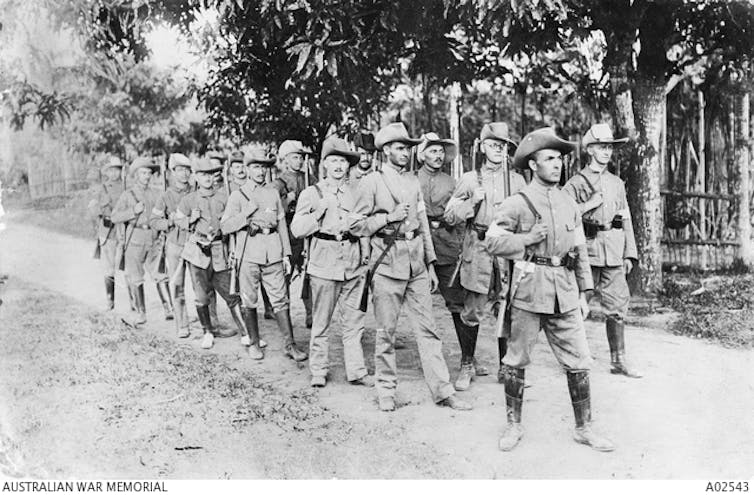
A platoon of German reservists in New Guinea after the outbreak of the first world war in 1914. Australian War Memorial, CC BY-NC
A national mindset on the Pacific takes hold
In fact, the first major convention of the colonies to discuss federation in 1883 was prompted by an immediate need to oppose French and German colonisation in the Pacific.
Around the same time, renewed tensions between Russia and Britain in the Pacific led to an expansion of the colonies’ military forces and the establishment of an auxiliary Royal Navy squadron in Australian waters.
So, when the Constitution was drafted in 1901, the framers specifically gave the Commonwealth the power to make laws “with the islands of the Pacific”. This reflected the growing sense that British authorities were not taking the colonies’ security concerns about the Pacific seriously enough.
A new national way of thinking of the Pacific was beginning to take hold. Early Australian leaders saw the Pacific similarly to how it was depicted during the 2022 election campaign – a vast, empty region where alien powers threatened Australian security interests.
And just like today, arguments for greater national sovereignty in defence came up against the belief that Australia’s security could best be guaranteed through an alliance with a major power.
For example, the Australian public strongly approved of a visit by the US Navy in 1908, which demonstrated to a rising Japan that Australia had powerful friends. But some voices were also critical of relying too heavily on the United States. The Bulletin magazine opined that if Japan was to attack,
there may be one chance in ten that the United States will be our ally.
Shifting our perspective
Australian solders seize Japanese ammunition after attacking Gona village in New Guinea during the second world war. Wikimedia Commons
Throughout the 20th century, more conflicts and geopolitical rivalries have only strengthened this mindset that Australia must retain hegemony over the Pacific to keep threats at bay.
The second world war in the Pacific was crucial to shaping Australia’s defence posture and the misgivings it continues to have about potential threats.
In recent years, this concern has shifted from Japan and Germany to China. As it has emerged as a regional power, Beijing has taken an aggressive approach to security issues in the Pacific and attempted to woo Pacific partners with concessional finance arrangements and opaque support for politicians.
On the plus side, Australia’s relations with the region have matured. Canberra respected the post-war drive for independence in the Pacific and has poured billions of dollars in aid money into the region to help the new nations develop.
Australian diplomacy has also become more responsive to the concerns of island nations, and has been in the spotlight again this week during Prime Minister Anthony Albanese visit to Cook Islands for the Pacific Islands Forum.
But our public discussions about the Pacific still contain echoes of the past. This contributes to a narrow, seemingly insecure, viewpoint on the region.
The Morrison government’s mishandling of its communication with Pacific countries about the AUKUS initiative shows how a singular focus on strategic denial can undermine our relations. Pacific nations were shocked by the idea that nuclear-powered submarines would be deployed in their region, particularly those that had experienced nuclear testing in the past.
If we can spend trillions on missiles drones, and nuclear submarines, we can fund climate action.
Our diplomacy on this issue has improved since.
Successive Australian governments stretching back to the early colonial administrators were not necessarily wrong in pointing to the potential security threats arising from the activities of others in the region.
But the real failing – then and now – has been to project only these concerns in the way we talk to, and about, the Pacific.
Ian Kemish AM is affiliated with the ANU National Security College, Griffith Asia Institute and University of Queensland. His strategic advisory business Forridel assists private and public sector organisations with stakeholder engagement across the Indo-Pacific region. He also chairs KTF, a foundation which partners with the Australian Government, PNG authorities and several private sector entities.
For many of us, group chats are part of the texture of our social lives. These groups, formed on apps like Messenger or Whatsapp, can be as large as a hundred people or as small as three.
We use them for organising one-off tasks or events, managing recurring coordination between groups like sports clubs or work teams, and keeping in touch with family and friends.
In the best cases, group chats can provide important spaces for building and maintaining relationships. They can be places of joy, solidarity and refuge.
But they can also be burdensome, and create feelings of anxiety and worry. I researched group chat dynamics and these are the three biggest issues I encountered.
1. You’re overwhelmed by the volume of messages
The volume of messages and notifications group chats generate can be overwhelming.
In my own research, a participant recalled accidentally leaving her phone at home, and returning to find she’d missed 200 messages in a group chat about buying a birthday gift.
Another explained that their most active group chat kicked off at 8am and didn’t quiet down until 1am.
A recent survey of people in the United States and United Kingdom suggests this is a common problem, with 40% of the respondents indicating they were overwhelmed with group chat messages and notifications. And then there’s notifications from email, social media, calendars, news apps, and so on.
People often manage this by muting group chats. But this can mean missing important information or plans to catch up, or having to dip in and out of the group chat to check for relevant conversations.
People can also find the chaos of group chat conversations overwhelming. In large groups, multiple conversations can be running at once, making it hard to keep track of what is being discussed or planned.
These problems can make group chats ineffective for the tasks they were set up to complete. Especially in large groups of acquaintances, planning can devolve into a mess of opinions, alternatives and side conversations.
One participant in my research described a group chat about a birthday gift getting sidetracked by two people having their own catch up.
Another recounted a disastrous group chat involving 20 people trying to organise a potluck dinner. Rather than reaching a consensus about who would bring what, the conversation devolved into a debate about whether potlucks were a bad idea, with one person insisting professional catering would better account for dietary requirements.
2. You don’t want to be there – but can’t leave
Other, possibly more significant, challenges are the difficult or awkward social dynamics that can arise. The ease of creating groups and adding members means people can be included in groups they wouldn’t have chosen to join.
In one instance of this, a woman was added to a group for organising a shared gift for a colleague. She would have preferred not to contribute to the gift but found it too awkward to leave.
Challenging dynamics can also arise when relationships change after a group chat has been established.
One participant told me about a group chat started by four close friends when they began university. A year later, one person had grown distant and become largely silent in the group chat, although the other three still used it to chat and organise catch ups. My participant found this dynamic incredibly awkward and had become cautious about starting group chats as a result.
Other participants described feeling trapped in group chats they would prefer to leave. The blunt “x has left the group” notification made them reluctant to formally quit but ignoring the group was also uncomfortable.
Many of these challenges stem from the rigid membership of group chats (you’re either in or you’re out) which doesn’t always gel with the complexity of our relationships. These challenges may also be exacerbated by unclear or contested social etiquette around group messaging.
3. You feel excluded
The most difficult issues arise when processes of social exclusion play out in group chats.
Back channel groups can emerge, where some group members create a new group to privately communicate about what’s happening in the main chat.
In the most dramatic cases, participants described people getting kicked out of groups because of disagreements or because someone felt the group chat had become too large.
Research suggests that being removed from a group is rare and mostly occurs when a relationship has ended.
But guessing whether you’ve been excluded from a group chat can be cause for anxiety, especially because you might not just be missing out on gossip and cat videos but also plans to catch up in person.
Our relationships with each other can be weird, awkward and messy – group chats reflect this social reality but with an added layer of technological complexity thrown in.
Generally, research suggests that the group chats people enjoy most are smaller groups with closer friends.
So, until app design improves and we collectively figure out etiquette for awkward group chat moments, your best bets are to:
use group chats with a handful of people who know each other, or who you’re confident will get along
find another way of organising that potluck. Use other forms of organisation for more complex events or with larger groups (invitations, Facebook events or one-on-one texts)
mute those crazy chats if you’re struggling with distraction or aren’t that interested. Muting is common and increasingly expected. If the chat is often used for organising things you don’t want to miss, let someone in the group know so they can keep you posted or make a routine of checking in
if you’re feeling weird about some group chat social dynamics, raise it with the person in the group you know best. We can make lots of assumptions about what other people’s messaging behaviours mean but the lack of extra social cues mean our assumptions can be off. That person might not be avoiding you – they might just have the chat muted!
The Conversation is commissioning articles by academics across the world who are researching how society is being shaped by our digital interactions with each other. Read more here
Kate Mannell does not work for, consult, own shares in or receive funding from any company or organisation that would benefit from this article, and has disclosed no relevant affiliations beyond their academic appointment.
This article is part of a series by The Conversation, Getting to Zero, examining Australia’s energy transition.
A time bomb is ticking inside the Albanese government’s climate policy. When it explodes, Australia will fall short of its climate targets and leave a gaggle of investors shirtless.
The problem arises from a poorly understood aspect of the net zero transition: carbon credits or offsets.
The centrepiece of Australia’s climate policy is a carbon pricing scheme known as the Safeguard Mechanism. It places caps on the emissions of around 220 of the country’s largest mining, gas and industrial facilities, based on the emissions intensity of their operations. Every year through to 2030 these caps will decline by between 1% and nearly 5%.
The facilities have two ways to keep their emissions within the caps. They can reduce them, or they can buy and surrender one of two forms of credits, the most significant being Australian carbon credit units (ACCUs) issued under Australia’s carbon offset scheme.
How the offset scheme works
Under the scheme, landholders, energy users and other emitters can register projects that avoid emissions or sequester carbon dioxide in trees, soils or geological formations. Those who do so in line with specified rules receive ACCUs, a tradeable financial instrument.
Each carbon credit unit is supposed to represent additional and permanent abatement of greenhouse gas emissions equivalent to one tonne of CO₂.
Reducing the emissions of facilities covered by the Safeguard Mechanism is likely to be difficult and expensive, at least in the short term, as most are in the oil and gas, coal and other mining sectors. For some, the only viable way to significantly reduce emissions is to stop production.
Carbon credits enable these facilities to meet their obligations by effectively paying someone else who can cut emissions more cheaply. In theory, allowing facilities with high abatement costs to use offsets lowers the economy-wide cost of reducing greenhouse gases, without sacrificing climate outcomes.
But for the scheme to work, the ACCUs must have “integrity”: they must represent an actual reduction in emissions that would not have otherwise occurred. And to the extent the reduction involves sequestration of CO₂ in a sink (such as a forest), it must stay in the sink permanently.
Our research shows that most of these projects have low integrity. People are getting carbon credits for not clearing forests that were never going to be cleared anyway, for growing trees that already exist, for growing forests in places that will never sustain them, and for operating electricity generators at landfills that would have operated anyway.
Putting net zero in peril
These projects do serious damage to Australia’s emissions reduction efforts. They enable Safeguard Mechanism facilities to increase their emissions – and governments to approve new fossil fuel projects – on the grounds that carbon credits will provide offsetting reductions elsewhere. But credits with no integrity produce no offsetting reductions.
The flood of low-integrity credits in the ACCU market also artificially lowers the carbon price faced by the Safeguard Mechanism facilities. The lower price causes the facility operators to rely more heavily on offsets and delay onsite emission reduction efforts. It also warps the offset market by making high-integrity offset projects unviable – a form of Gresham’s Law, where bad projects drive out the good.
The situation with Australia’s offset scheme is not unique. Research on other offset schemes has found similarintegrity problems. That’s because generating high-integrity credits is difficult.
Scheme regulators have a challenging job. Along with having to measure emissions and removals from dispersed and often naturally variable sources and carbon sinks, they must try to screen out phoney emissions reductions offered by project proponents.
The latter have both a huge information advantage over regulators and strong incentives to claim credits for doing what they were already doing or planning to do anyway – such as retaining forests they never intended to clear.
But regulators also have an incentive to increase the supply of credits, even if it risks reducing integrity. This is because low credit supply is taken as a sign of scheme failure.
Tight integrity standards reduce credit supply and push up credit prices, which in turn increases compliance costs for polluters and destabilises political support for carbon pricing schemes. Liquid markets built on a healthy supply of credits (regardless of quality) make regulators look good and keep emitters and politicians happy.
Despite not analysing the performance of a single project, the review confidently concluded that the level of abatement credited under the scheme had not been overstated. Its evidence for this was limited to one sentence: “While the Panel was provided with some evidence supporting that position (that integrity problems existed), it was also provided with evidence to the contrary.” It gave no details of what that contrary evidence was.
The panel then recommended substantial changes, including an end to the untenable situation in which the Clean Energy Regulator, the statutory authority charged with implementing legislation to reduce emissions, was responsible for making and administering the scheme rules and then buying most of the credits. The panel also proposed repeal of the avoided deforestation offset.
These changes, while welcome, were carefully designed to leave existing projects untouched. For example, repeal of the avoided deforestation method will not affect 63 existing projects, which will generate credits for years to come.
Conveniently, this will ensure that the supply of ACCUs and their price remain in a politically acceptable range until at least 2030.
Truly fixing the scheme requires the government to stop crediting low-integrity projects and methods. The credit tap must be turned off for all avoided deforestation projects and most human-induced regeneration projects, and crediting arrangements for landfill projects must be radically improved.
The government’s political problem is that it needs to keep the carbon price within a palatable range for Safeguard Mechanism facilities. If it stopped crediting low-integrity projects, prices would skyrocket and not enough high-integrity credits exist to meet demand.
The government could solve the problem by introducing a standard cap price into the Safeguard Mechanism. Instead of surrendering credits, facilities could pay, for instance, A$50 per tonne on excess emissions. But that would open the government to claims that the scheme is just another carbon tax.
Fixing these flaws is challenging. But by refusing to face the problems head-on, the government has sabotaged its own climate policy. Its failure could also permanently stain the reputation of offsets.
Like Robodebt, the scheme is badly designed, unethical, and destined to fail, albeit for different reasons. We can only hope that when it unravels, it doesn’t do Australia’s decarbonisation efforts permanent harm.
Andrew Macintosh is a director of the Paraway Pastoral Company, which has offset projects registered under the ACCU scheme. He has also received funding for research projects involving analysis of the operation of the ACCU scheme.
Don Butler receives funding from the Australian Government.
Source: The Conversation (Au and NZ) – By Michael Westaway, Australian Research Council Future Fellow, Archaeology, School of Social Science, The University of Queensland
Shutterstock
For almost ten years, debate has raged over the book Dark Emu by Aboriginal historian Bruce Pascoe. In it, Pascoe argues many pre-colonial Aboriginal groups were farmers, pointing to examples like eel aquaculture in Victoria, and grain planting and threshing of native millet in the arid centre.
The debate has drawn in everyone from academics to Aboriginal communities invested in food futures to shock jocks claiming it is a warping of history.
For our group of archaeologists and First Nations people, the fact this debate has raged so long suggests there are shortcomings in how we think of food production and how we investigate it in Australian archaeology.
Farmers versus foragers is a huge oversimplification of what was a mosaic of food production. After all, Australian landscapes differ markedly, from tropical rainforest to snowy mountains to arid spinifex country. For many Aboriginal people, the terms “farming” and “hunter-gatherer” do not capture the realities of 60 millennia of food production.
In our new research published in the Archaeology of Food and Foodways, we argue that to better understand millennia-old systems, archaeologists must engage deeply with fields such as plant genetics, ethnobotany, archaeobotany and bioarchaeology as well as listening more carefully to the views of Aboriginal people. Here’s how.
We need to use better methods
For decades, archaeologists have grappled with the task of understanding ancient food production. We are by no means the first to point to the lack of appropriate methods as a reason why this has proved hard.
Archaeobotanists Anna Florin and Xavier Carah have observed that food production systems in northern Australia are very similar to those in Papua New Guinea. While we accept Papuan food gardens, Australian archaeologists have been less eager to embrace this idea for Australia.
In part, this is a failure of terminology. Aboriginal food production was enormously varied.
This map shows the complex and diverse types of food production and settlement systems documented by researchers across Australia, ranging from arid grainlands to rainforest seed processing to yam harvesting. Author provided, CC BY-ND
The solution lies in better methods. For instance, many Aboriginal groups lived semi-permanently in gunyah (bark hut) villages, as Dark Emu demonstrates by quoting colonial observers.
These settlement sites are vital to gaining a better understanding of how people lived. By excavating gunyah sites and fireplaces where food was prepared, we can recover seeds by sieving dirt and ash to find out which plants people used. The problem? Many of the sieves used were not fine enough to capture the tiny seeds of vital plants such as native millet. Most seeds used by Aboriginal groups were less than 1mm in radius.
This can be fixed. In south-west Asia, archeobotanists have long used fine mesh sieves to recover ancient seeds. You also need reference collections of seeds to be able to identify them from fireplaces.
Genetics – and archaeology?
It might not sound like a natural fit. But around the world, combining plant genetics with archaeology has dramatically changed our understanding of how people used plants, how they moved them about the landscape and how they changed these plants into forms better suiting our use. The wild precursor of corn, for instance, looks almost nothing like what we moulded it into through selection.
Combining these approaches is only in its infancy in Australia. But early applications together with Aboriginal knowledge of plant use has revealed dramatic new insights into how Aboriginal people moved important species such as black beanCastanospermum australe around the landscape and cultivated them.
The legacy of these food production techniques may still be visible today. For instance, when we look at the four species of native rice, we would not expect them to have large seeds. But all four species do. For millennia, Aboriginal groups in Australia’s wet north farmed these floodplain grasses. They may well have provided some selective pressure that resulted in larger grains, as early farmers did elsewhere.
To date, we don’t know this for sure. But we can find out. Careful genetic analysis of remaining wild populations should tell us if these large grains came from human rather than natural selection. We can also analyse genetic diversity between wild rice populations, to see if Aboriginal groups were involved in spreading these useful plants further.
Every bone tells a story. In your bones lie traces of how fast you grew, what you ate and how hard your life was.
Studying ancestral remains is a very sensitive issue due to the colonial practice of collecting Aboriginal remains for research. But when done sensitively and respectfully, it yields fresh insights.
Bones and teeth can tell us many things about life in Aboriginal Australia. Tracking changes in isotope ratios in teeth can tell us if people were shifting to a more sedentary way of living. Stress in bones can tell us about difficult food production techniques such as labour-intensive seed grinding.
The past can shape the future
Aboriginal culture is 60 millennia old, during which time the climate shifted several times. Sea levels rose, flooding the Bass Strait and the coastal plains connecting Cape York to Papua New Guinea.
For a culture to survive that long means it had to rely on sustainable food production. Finding out how exactly this was done could yield lost knowledge and make it possible for current-day Aboriginal groups to recapture these methods and crops.
To date, renewed interest in bushfoods has not spread far beyond boutique food industries such as gourmet breads and specialised plant foods like Kakadu plum and quandongs.
Learning more about drought-resilient crops such as native rice and native millet (Panicum decompositum) could help farmers adapt to climate change and diversify food production. In central Victoria, the Dja Dja Wurung group is exploring the potential for kangaroo grass (Themeda triandra) for use as a food and as drought-resistant cattle fodder.
The better we understand ancient food production, the more likely we are to be able to bring this knowledge to bear on today’s challenges – and give a fuller answer to the questions raised by Dark Emu.
Dja Dja Wurung man Rodney Carter inspects kangaroo grass. Author provided, CC BY-ND
Michael Westaway receives funding from the Australian Research Council.
Alison Crowther receives funding from the Australian Research Council.
Robert Henry receives funding from the Australian Research Council.
Rodney Carter is the CEO of the Dja Dja Wurrung Corporate Group, the Dja Dja Wurrung Clans Aborginal Corporation and Dja Dja Wurrung Enterprises.
Nathan Wright does not work for, consult, own shares in or receive funding from any company or organisation that would benefit from this article, and has disclosed no relevant affiliations beyond their academic appointment.
Source: The Conversation (Au and NZ) – By Virginia Beal, Senior Marketing Scientist, Ehrenberg-Bass Institute for Marketing Science, University of South Australia
Federal and state governments have just launched a A$10 million advertising campaign to “raise the status” of teachers in Australia and encourage people to consider a career in school education.
Called “Be That Teacher”, the campaign features emotive stories from eight real teachers who have positively affected their students’ lives and futures.
For example, Mr Wang, a maths teacher from Victoria talks about how a Year 10 student wrote him a note to say “thank you for making me feel smart for once”. Mrs Kentwell, a primary teacher from Queensland, spoke about holding the hand of a young blind student in a running race, while other students cheered him on.
The rewarding feeling you get from teaching is something I’ve never felt from any other job.
The campaign, by ad agency Clemenger BBDO, is running across social media, television, cinema, billboards and at bus stops and train stations until next April.
Why do we need it?
The campaign comes amid an ongoing teacher shortage crisis in Australia. Federal government modelling has predicted a shortfall of more than 4,000 teachers by 2025. Last month, the New South Wales government revealed a 42% drop in casual teacher numbers meant 10,000 lessons in the state were going without a teacher each day.
We also know the number of students enrolling in teaching degrees has dropped 12% in the past ten years. Of those who do enrol, only 50% finish the degree and 20% of those who graduate leave the profession within three years.
There is evidence to show advertising can work. A clever way to demonstrate advertising’s value is to examine what happens in its absence. Our 2023 study showed, on average, brands experience a decline in sales when they stop advertising for more than one year.
But there are no certainties with advertising. So what increases the chance of a successful campaign?
Advertising works primarily by creating and refreshing memories – in this case by establishing a link between “teaching” and “positive career option”. This heightens the chance teaching will come to someone’s mind when considering careers. The freshness of a memory (how recently they saw the ad) increases the chances they will think of teaching.
This means the campaign should run while the shortage persists, to increase the chance it will be in potential students’ minds and particularly during the lead-up to university preference cut-off dates over the summer.
Do the ads themselves work?
The campaign gets an A on several factors.
The videos are beautifully crafted, capturing attention by using human faces, voices and authentic storytelling. All these elements improve the chances of campaign success by evoking an emotional response, which heightens memory retention.
The “Who will you inspire?” tagline used in the campaign is also both emotive and memorable.
The branding needs more work
Beyond the ads, the Be That Teacher website contains information about pursuing a teaching career (how to do it, available scholarships and support). While the campaign can create a memory or pique someone’s interest, this information will help people decide if teaching is the career for them.
Here, the branding aspect (or identity) of the campaign needs more work. Be That Teacher is new to Australians and it needs to be more prominent in the videos and still images to stand out and capture attention.
Introducing the line “Be That Teacher” visually at the beginning of the ads and adding a verbal mention, rather than just at the end, heightens the chance it will be processed and remembered. This is crucial if the campaign is going to push people to the website.
These are all complex issues and clearly, advertising will not be the sole fix to the teacher shortage (nor are governments suggesting it will be).
But with teachers so essential to Australia’s future, every effort should be made to build and retain our teaching workforce. Good advertising like this campaign can help generate more interest in the profession and provide a gentle nudge towards improving the status of this vital career.
Virginia Beal does not work for, consult, own shares in or receive funding from any company or organisation that would benefit from this article, and has disclosed no relevant affiliations beyond their academic appointment.
When you think of great Aussie musicals, some key films from the 1990s and 2000s come to mind: Strictly Ballroom, Muriel’s Wedding, Moulin Rouge!, Bran Nue Dae and The Sapphires. These films are often framed as “reviving” the musical genre for Australian audiences, due in large part to their box-office success.
While certainly fantastic films, there is actually a long history of Aussie musicals that have been popular with cinema audiences since the 1930s.
There are 73 films that have been classified as a “musical” or containing musical elements by the National Film and Sound Archive. They include comedies, children’s and animated films, dramas, revues, backstage musicals, biopics, dance films, rock musicals, soundtrack films, television musicals and live concert films.
So where to begin? These are my top five Aussie musicals you may not have heard of but should definitely try to see.
These films represent just a snapshot of the rich history of musical cinema in Australia. They demonstrate how Australian cinema responds to international trends in musical cinema production, but also how it influences and innovates in the global musical genre.
These films are hard to get a hold of and only occasionally pop up on streaming services – if at all. However, you might catch them on DVD or at your local indie film festival or retrospective (there were several screenings of Starstruck when the NFSA released a digitally restored version in 2015).
Olivia Newton-John’s 1965 debut feature, Funny Things Happen Down Under, directed by Joe McCormick, was an adaptation of the Terrible Ten children’s television show from 1959–60.
It’s Christmas time in the bush and a group of country children make a plan to save their woolshed, under threat because the sheep station has to be sold.
After they accidentally turn a goat’s wool multi-coloured because it drinks a strange concoction of Christmas pudding, flowers and fizzy water, they decide to feed it to the sheep to sell rainbow-coloured wool.
While certainly of its time (there is a scene that involves yellow face), the film has some great songs by Newton-John and New Zealand singer Howard Morrison, as well as an athletic final dance number around the shed called Click Go the Shears.
2. Oz
Directed by Chris Lofven, the 1976 film Oz (also known as Oz: A Rock ‘n’ Roll Road Movie, or 20th Century Oz on its release in the United States) is a version of The Wizard of Oz as a rock ‘n’ roll road movie set in the Australian outback.
Dorothy (Joy Dunstan) is hitchhiking to the city to see glam rocker The Wizard. Along the way she meets brainless surfie (Bruce “Stork” Spence) – the scarecrow – a mean mechanic (Michael Carman) – the tin man – and an overly confident bikie (Gary Waddell) – the lion.
Ross Wilson, the frontman of Daddy Cool and Mondo Rock, wrote and produced Oz’s musical score. The singles Livin’ in the Land of Oz by Wilson and Beating Around the Bush by Jo Jo Zep and the Falcons were both released in 1976 from the soundtrack.
Much like motorcycle road movie Easy Rider (1970), which had become a symbol of New Hollywood, Oz made a direct appeal to young audiences and the counterculture via a compilation soundtrack of contemporary popular music.
3. Starstruck
Gillian Armstrong’s Starstruck (1982) is a backstage musical set in 1980s Sydney. Barmaid Jackie (Jo Kennedy) lives above her family pub The Harbour View Hotel in The Rocks in Sydney with her mum, Nanna, cousin Angus and their pet cockatoo.
Jackie dreams of being a star, falls for a guitarist and joins a band called The Wombats so they can enter a TV talent competition.
Cue numerous musical numbers including Body and Soul, where Jackie dances on the bar, and an eventual performance at the Opera House after the band sneak on stage.
There’s also a fabulously camp Busby Berkeley-eque rooftop swimming pool number complete with co-ordinated lifeguards in speedos.
Rather than a traditional musical, Richard Lowenstein’s Dogs in Space (1986) is set in the underground punk scene in late 1970s Melbourne. It follows rocker Sammy (played by Aussie icon Michael Hutchence) through performing, partying, falling in love – and taking lots and lots of drugs.
The film has some amazing cinematography with winding long takes of the cast at their crammed inner-city terrace house as it gets progressively trashed by party after party.
Sammy’s love story with girlfriend Anna (Saskia Post) ends in tragedy and the final song, Rooms for the Memory, effectively uses Hutchence’s brooding star presence and vocals to great effect.
Based on true events from 1932, One Night the Moon (2001), written by First Nations director Rachel Perkins, features Aussie singer-songwriter Paul Kelly as the father of a girl (played by Memphis Kelly, his real daughter) who goes missing in the outback.
The girl’s mother (played by Kelly’s then wife and Memphis’ mother, Kaarin Fairfax) wants to employ an Aboriginal tracker (Kelton Pell) to help find the girl. Her father refuses, thus sealing the fate of his daughter through his prejudice.
With haunting songwriting and sweeping shots of the unforgiving landscape, this is a beautiful and moving story.
Phoebe Macrossan received funding from the University of the Sunshine Coast and assistance from the National Film and Sound Archive and the Australian Film Institute Research Collection for this research.
It’s helpful for the Albanese government to have all mainland states in Labor hands – but only up to a point.
This week we’ve seen the Queensland government bite back at federal plans to curb the national infrastructure program, while Victorian resistance to changes to the Murray-Darling water plan prompted Environment Minister Tanya Plibersek to lash out.
Infrastructure is always a vexed issue. The program is full of pork barrelling, whoever is in power. Even when that’s not involved, what to build and when it should be built is often contested.
In May, the government announced a 90-day review of the $120 billion infrastructure pipeline it inherited from the Coalition.
Infrastructure Minister Catherine King said projects had increased from about 150 to 800. The government’s aim was to reduce the number of projects (many of them small) and rearrange priorities.
High inflation, cost overruns and shortages of labour and materials are plaguing the program.
The political difficulties of abolishing or changing projects, often involving negotiation with states and territories, are obvious enough. Now they have become significantly worse.
The government has received its stocktake, and Treasurer Jim Chalmers says the overall cost of the program has blown out by some $33 billion.
Also, an International Monetary Fund report last week said infrastructure projects should be rolled out at a “more measured and co-ordinated pace, given supply constraints, to alleviate inflationary pressures”.
Chalmers is pushing this message, but it’s not being received well in Queensland.
State Treasurer Cameron Dick was blunt. “Queensland is Australia’s growth state and we need more infrastructure, not less,” he said in a tweet. “If infrastructure cuts are needed, they should be made to southern states with low growth and high debt.” (Fun fact: the electorate offices of Queenslanders Chalmers and Dick share a common wall.)
I’ve got a clear message for Jim. Jim’s a mate of mine. Jim, those projects better not be in Queensland.
The last thing the Palaszczuk government wants is for projects to be cancelled, slashed or delayed. It is in a particularly precarious position – it faces an election in a year’s time and will be fighting for survival.
Queensland has an obvious political self-interest in resisting infrastructure cuts, but there’s a national point too. With large numbers of migrants coming into Australia, the demand for transport and other infrastructure will be increasing, rather than decreasing. Whatever cuts and slowdowns are made will need to be well judged.
The federal government argues the existing pipeline is unrealistic and without change could not be delivered anyway. But even if the decisions about what to cut, scale back or defer are economically sound, in political terms they could store up electoral time bombs for the government.
Even minor and unworthy projects can be sensitive in marginal seats. Scrapping them could open opportunities for the opposition. Also, available funds for new projects presumably will be limited.
When the government finishes its negotiations with the states and the outcomes are announced, King will be the main minister defending the decisions.
As we saw in the row over the rejection of Qatar Airways’ bid for extra flights, she struggles when under pressure. She could find the task challenging.
The fight over the government’s water changes centre on its planned amendments to the Murray-Darling Basin plan.
The legislation, soon to be considered by the Senate, broadens the activities that can be funded and extends the times for delivery of water-recovery projects. Most importantly, it removes the cap on the federal government’s “buybacks” of extra water for the environment.
The Murray-Darling plan is always fraught, because the interests of upstream and downstream users and their governments differ. Nevertheless, Queensland, South Australia and New South Wales have signed on – although NSW has done so reluctantly.
But Victoria, where the Andrews government has built a close relationship with irrigators, has held out, defending its position on the basis of work done by Frontier Economics](https://www.water.vic.gov.au/our-programs/murray-darling-basin/social-and-economic-impacts-of-the-basin-plan-in-victoria).
Its report argues that “previous water recovery has resulted in less irrigation […] putting the viability of major irrigation districts and the industries and communities they support under pressure”.
“Further water recovery from irrigators (buybacks and on-farm projects) will add to the impacts already being felt and undermine the ability of irrigation communities to plan for the future.”
Plibersek declared, in an interview with the ABC, that it was “extraordinary that we’ve got a Labor government using dodgy modelling to join up with Barnaby Joyce and David Littleproud”.
Victoria’s Water Minister Harriet Shing retorts: “This isn’t about party politics, and it’s disappointing to see it framed that way. We don’t apologise for standing up for Victorian communities and environments.”
But Plibersek has backing from Jamie Pittock, from the Australian National University’s Fenner School of Environment and Society. He says:
The Victorian government can usually be relied on to make decisions based on solid data. In the case of the Murray-Darling Basin, bizarrely, it has relied on low-quality consultants’ reports that exaggerate the socio-economic costs and ignore the benefits from water buybacks.
The legislation will come to a vote in the Senate this year, and there will be wrangling with the crossbench.
Assuming the legislation passes, the federal government can override Victoria and proceed with the buybacks of water for the environment. But it will still face the opposition of farming and irrigator groups, and some local communities.
It would be hard to find political observers who believe Peter Dutton can win the next election, due by May 2025. But there is increasing talk about the possibility that Labor, given it has a very narrow majority, could find itself in minority government. (Contrast a year ago, when all the talk was about Labor’s prospects for increasing its majority.)
Being pushed into minority is something Albanese – a senior figure in the minority Gillard government – would want to avoid at all costs. It would hamper the government’s flexibility to pursue its program, mean constant negotiation with crossbenchers including bolshie Greens, and encourage the Coalition to run maximum disruption.
The challenge of keeping out of minority increases the importance of the “ground game” in Labor’s marginal electorates. And it could make controversies over local issues – scrapped infrastructure projects, or unpopular new ventures including ugly transmission lines for renewable energy – potentially dangerous for the incumbents in those seats.
Michelle Grattan does not work for, consult, own shares in or receive funding from any company or organization that would benefit from this article, and has disclosed no relevant affiliations beyond their academic appointment.
This week’s Optus outage affected 10 million people and hundreds of businesses. One of the early reasons given for the failure was a fault in the “core network”. The latest statement from the company points to “a network event” that caused the “cascading failure”.
The internet is complex, so most carriers, including Optus, use the concept of the “three layer network architecture” to explain it. This abstraction splits the entire network into layers.
This architecture is just one of many different ways of modeling complex networks. CC BY-SA
The access layer
This layer consists of the devices you use to connect to the internet. They include the customer equipment, National Broadband Network firewalls, routers, mobile towers, and the wall sockets you plug into.
The access layer is what people interact with most often. CC BY-SA
This layer generally isn’t interconnected, meaning each device sits at the end of the network. If you want to call a friend, for example, the signal would have to travel deeper into the network before coming back out to your friend’s phone.
An outage in the access layer might only affect you and your local neighbourhood.
The distribution layer
This layer interconnects the access layer with the core network (more on that later). Remember that the access layer regions aren’t connected to each other directly, so the distribution layer is the interconnecting layer.
Another term for the interconnection cables is “backhaul.”
It is a bit more abstract but generally includes large switches in local exchange buildings, and the cabling that joins them together and to the core network.
An exchange building in Bendigo, Victoria. Google maps, CC BY-SA
The main purpose of the distribution layer is to route data efficiently between access points. An outage in this layer could affect whole suburbs or geographic regions.
The core layer
The core layer is the most abstract. It is the central backbone of the entire network and connects the distribution layers together and connects telecommunication carrier networks with the global network.
While physically similar to the distribution layer, with switches and cables, it is much faster, contains more redundancy and is the location on the carrier’s network where device and customer management systems reside. The carrier’s operational and business systems are responsible for access, authentication, traffic management, service provision and billing.
The core layer is abstract but includes fibre optic cables and datacentres. Pexels, Lukas Coch/AAP, CC BY-SA
The core layer’s primary function is volume and speed. It connects data-centres, servers and the world wide web into the network using large fibre optic cables.
An outage in the core layer affects the entire country, as occurred with the Optus outage.
Why three layers?
A big problem with networking is how to keep everyone connected as the network expands.
In a small network it may be possible to link everyone together but as a network grows this would be unwieldy, so the network is divided into layers based on function.
The three layer model provides a functional description of a typical carrier network. In practice, networks are more complex, but we use the three layer model to assist with the understanding of where equipment and systems are found in the network, e.g., mobile towers are in the access layer.
A network of nine people would have 36 connections to link them to each other. The Conversation/Pexels, CC BY-SA
The core layer is designed to ensure that access layer traffic coming from and going to the Internet or data-centres is processed and distributed quickly and efficiently. Today many terabytes of data moves through a typical carrier core network daily.
Now a network of 20 people only needs 20 connections to a deeper layer. The Conversation/Pexels, CC BY-SA
Now you can see why a core layer failure could affect so many people.
Mark A Gregory does not work for, consult, own shares in or receive funding from any company or organisation that would benefit from this article, and has disclosed no relevant affiliations beyond their academic appointment.
Asked on Wednesday to explain why Optus broadband and mobile services had been simultaneously knocked out for five hours, its chief executive Kelly Bayer Rosmarino blamed a “technical network fault”, and then added:
There is no soundbite that is going to do it justice, so we want to really bottom-out the root cause, and when we have that very clear and in a digestible form, we will be forthcoming.
There are a couple of ways to interpret this statement. Either she didn’t want to indicate what her engineers really thought had happened, or she believed Optus users wouldn’t be able to understand the truth.
Or she might not have been thinking about Optus users.
Her reference to a “soundbite” seems to suggest Optus regards its key audience as the media rather than its customers.
Optus is baked into too much of what we do
With more than 10 million mobile customers alone, accounting for more than one-third of Australia’s population, the Singapore-owned Optus has become integrated into almost everything Australia does, from the operation of railways to automatic teller machines, to hospitals to emergency services.
Its customers, both corporate and personal, have become increasingly familiar with technical terms and technical explanations.
Those customers not only know more than they did – understanding many of the terms that apply to both software and hardware – but they expect more from technology, knowing that even some of their own jobs can potentially be replaced by artificially intelligent algorithms.
Many of those customers would be not only be asking “how did this happen”, but also “how could this be allowed to happen, given what technology is capable of”.
The golden hour
Crisis communicators have long spoken of the need to respond within the so-called “golden hour”, a concept taken from the emergency services where it is important to get to the injured party promptly.
In an increasingly automated world, that’s what Optus ought to have been able to do. Its core business is using technology for communications.
If it couldn’t use its mobile network, it ought to have been ready to use something else, even email.
Technology firms have built-in intensifiers
Crisis communications expert Timothy Coombs argues that the damage done to reputations during a crisis can be worsened by “intensifiers”, such as the organisation’s past history of crises, its track record, and sometimes the severity of damage caused.
Significantly, he finds no “halo effect” from having handled things well in the past, only a “Velcro effect” from having handled things badly.
To that I would add that a further intensifier is the extent to which an organisation suffering from a technology failure is itself a technology organisation.
It’s hard to argue you are a victim of something you have put yourself forward as a master of.
Sharing what it knows, on the assumption that at least some of its users will understand it, would be one way of indicating that Optus trusts its customers and is worthy of their trust.
Peter Roberts does not work for, consult, own shares in or receive funding from any company or organization that would benefit from this article, and has disclosed no relevant affiliations beyond their academic appointment.
Source: The Conversation (Au and NZ) – By Kayleen Manwaring, Senior Research Fellow, Allens Hub for Technology, Law & Innovation, and Senior Lecturer, School of Private & Commercial Law, UNSW Sydney
Shutterstock
In the United States, 41 states have filed lawsuits against Meta for allegedly driving social media addiction in its young users (under the age of 18), amid growing concerns about the negative effects of platforms.
The lawsuits allege Meta has been harvesting young users’ data, deploying features to promote compulsive use of both Facebook and Instagram, and misleading the public about the negative effects of these features.
What might we expect to happen next? And are there potential consequences for Australia?
Leveraging whistleblower revelations
The most significant suit, filed in a federal court in California, involves 33 states. The claim is based on breaches of state consumer protection statutes and common law principles regarding deceptive, unfair or unconscionable conduct, and federal privacy statutory provisions and regulations (collectively “COPPA”) which specifically protect children.
This co-ordinated action is reminiscent of other class actions in the US and United Kingdom by Rohingya refugees against Facebook for its role in enabling hate speech against their community in Myanmar.
These cases rely in part on revelations made by former Meta employee Frances Haugen in 2021 about the role Facebook’s algorithms play in facilitating harms on the platform. Haugen’s testimony suggests algorithms deployed across Facebook and Instagram were designed to increase content sharing, and therefore profits, using data harvested from users over many years.
These algorithms play a crucial role in determining what kind of content viewers are exposed to, how long they engage with it, and the likelihood of them sharing it.
According to Haugen, Meta made changes to its algorithms in 2018 to prioritise meaningful social interactions. These changes, she said, impacted how content was viewed on the news feed, leading to increased sharing of negative content such as hate speech.
The California case is notable for the specific allegations around strategies used to keep young people interacting with Facebook and Instagram. For instance, the plaintiffs have elaborated on the impact of the “infinite scroll” feature introduced in 2016.
This feature prevents users from viewing a single post in isolation. Instead it provides a continuous stream of content without a natural endpoint. Haugen described this as being similar to giving users small dopamine hits. It leaves them wanting more and less likely to exercise self-control.
The plaintiffs in the California case claim this feature encourages users, and especially young users, to compulsively use the platforms – negatively affecting their wellbeing and mental health.
They say the recommendation algorithms used by Meta periodically present users with harmful materials. These include “content related to eating disorders, violent content, content encouraging negative self-perception and body image issues, [and] bullying content”.
They also allege features such as “variable reward schedules” are implemented to encourage compulsive use by young people. This causes further physical and mental harm (such as from a lack of sleep).
Consequences for Australia
In the US, federal laws substantially restrict liability of online intermediaries such as Meta for content shared by users.
The Federal Court can impose significant penalties for violations of the Online Safety Act. But this doesn’t cover all the harmful content on social media, such as some linked to eating disorders and negative self-image.
Addressing young users’ compulsive social media use is a different challenge altogether. Some measures against this are possible. For example, if the US deception allegations are proven, any evidence that this extends to Australian users may ground an action against Meta for misleading or deceptive conduct (or false or misleading representations) under the Australian Consumer Law.
Penalties under the Australian Consumer Law have increased since the Google case, likely due to the deep pockets of platforms. Options for courts awarding penalties include 30% of a platform’s turnover, or three times the value of the benefit to the offending entity.
However, platforms are in a stronger position where conduct isn’t misleading, false or deceptive, but is merely “manipulative” or “unfair”. For instance, the infinite scroll feature is unlikely to be considered misleading or deceptive under Australian law.
Australia also has no legislative equivalent to COPPA. Australia’s law of unconscionable conduct requires such a high level of harsh or oppressive conduct that it’s extremely difficult to prove.
One recent unconscionable conduct case brought by a problem gambler based on the addictive design of electronic poker machines failed in the Federal Court.
Shortcomings in the current law have, in part, led to calls for a new prohibition on unfair trading practices. Pressure is also mounting to reform the ineffective and under-enforced Privacy Act.
We need collaboration and innovation
There are still many gaps in Australian law required to protect consumers, especially children, against harms posed by social media platforms. But domestic law can only go so far in protecting people using a medium that operates (mostly) seamlessly across borders.
As such, international law scholars have suggested more creative approaches in the context of online hate speech. One suggestion has been to make platforms accountable for their actions under the laws of the country where they are headquartered, for enabling crimes that have taken place in other jurisdictions.
In 2021, the world welcomed a US district court’s order for Facebook to disclose various materials to The Gambia relating to hate speech against the Rohingya community in Myanmar.
In doing so, the court strengthened The Gambia’s claims in a pending action before the International Court of Justice. This action claims the Myanmar government had, through its genocidal actions against the Rohingya people, breached its obligations under the Genocide Convention – and that hate speech amplified on Facebook enabled the violence.
As society grapples with the implications of mass data collection and profit-maximising algorithms, protecting individuals will require international co-operation and a re-evaluation of legal frameworks.
Kayleen Manwaring receives funding from the UNSW Allens Hub for Technology, Law and Innovation and the Cyber Security Cooperative Research Centre. She is a member of the Advisory Board for the Consumer Policy Research Centre (Vic) and is Deputy Chair and NSW Coordinator for an Australian chapter of the IEEE Society on Social Implications of Technology.
Siddharth Narrain does not work for, consult, own shares in or receive funding from any company or organisation that would benefit from this article, and has disclosed no relevant affiliations beyond their academic appointment.
PODCAST: How the Hamas-Israel War is a Catalyst of Global Order Change - Buchanan and Manning
/
RSS Feed
Share
Link
Embed
A View from Afar, by Dr Paul G. Buchanan and Selwyn Manning.
In this the eleventh episode of A View from Afar for 2023, political scientist Dr Paul Buchanan and journalist Selwyn Manning examine how the post-World War II liberal internationalist system is being challenged by a fluid constellation of global and regional powers to influence the shape of an emerging new world order.
And Paul and Selwyn also assess how this massive shift in geopolitic demarcations is forming, relatively quickly, into a world of bipolarity where on one side we have a multipolar constellation of states, and on the other the traditional western liberal democracies.
The catalyst behind this rapidly forming bipolarity is conflict.
And, most recently, it is clear, that the Israel-Hamas war – and the atrocities committed initially by Hamas and more lately by Israel forces – is driving the world toward a transitional moment.
It appears, that what is emerging from the current multipolar system – and think here the United Nations, the World Trade Organization, the International Court of Justice, the International Criminal Court among many other global bodies – is a situation that is not merely new-and-old Great Powers competing as nation-states.
But rather, what we see are groupings of fluid constellations of powers competing as blocs to influence the shape of what is to come.
In this episode Paul and Selwyn discuss and describe what is now evident, and sketch out what will likely emerge.
Of course, as mentioned, the Israel-Hamas war lays bare any claims of morality and exposes the hypocrisies of all sides in conflicts.
In particular the Hamas-Israel war exposes the west – led by the United States of America, the United Kingdom and various European states – to an argument that the west is morally moribund as it continues its colonial/post colonial attitudes of support of Israel as the latter commits an apparent disproportionate-defence offensive against Palestine’s peoples.
The argument appears to carry weight, especially as this western axis sustains its support for Israel’s war machine even while, on international humanitarian law grounds, the atrocities being committed against Palestine’s civilian population are morally indefensible and potentially legally enforceable as war crimes.
For example; retribution for the atrocities and despicable crimes committed by Hamas against defenceless Israeli citizens does not remove culpability for the State of Israel as it delivers on an apparent intention to annihilate Hamas and all people – children, the elderly, all innocents – who may surround Israel’s targets.
IHL shows how duty of care is not excused even if civilians are used as “human shields”, and at this juncture, it is not clear, whether that cited flawed-justification is founded on truth.
This is the position of what was once an authoritarian axis.
But what has formed is a multipolar-constellation that supports the Palestinian cause on postcolonial, Global South, and solidarity grounds.
The Questions:
So if all of this carnage is the catalyst for a new world order, what comes next?
Will we see the emergence of a parallel global institutional structure that develops as a counter-balance to the west’s post-WWII world order?
Has the west’s leading power lost its moral authority through its support for a war machine that has caused the deaths of over 10,000 people of innocent disposition, while itself refuses to be a signatory member state to the International Criminal Court and its principles of global justice?
And as such, has the west ceded persuasive moral authority to the rising constellation of once authoritarian-states that dominate the opposing bloc?
And does the west, as a consequence, find itself powerless to counter the migration of moderate independent states that are repelled by the immorality of the west’s arguments, laid bare by the Hamas-Israel war?
INTERACTION WHILE LIVE:
Paul and Selwyn encourage their live audience to interact while they are live with questions and comments.
To interact during the live recording of this podcast, go to Youtube.com/c/EveningReport/
The idea of helping drivers to avoid speeding is more than 100 years old. But early speed-limiting technologies proposed a top speed limit (similar to the way e-scooters are regulated in Australia), rather than allowing motorists the option to break the speed limit.
If we don’t do intelligent speed assist, what’s the alternative? Currently, we must constantly monitor speed limits and adjust our speed accordingly to avoid speeding. That means looking often at our speedometers.
There is some research to suggest continually taking our eyes off the road to review our speedometer could be dangerous.
Given how often speed limits can change on a route, and that we all make mistakes, it’s no wonder speeding is so common.
Will it work?
Installing intelligent speed assist in all cars could prevent at least 8% and up to 19% of all crashes Australia-wide. This represents up to 200 lives saved per year.
A NSW Centre for Road Safety trial found advisory intelligent speed systems reduced speeding in 89% of vehicles, across more than 1.9 million kilometres of testing.
Intelligent speed assist is not yet a perfect system. Hurdles to overcome include:
different speed sign coverage and designs from state to state
maintaining an accurate map of speed limits across Australia for GPS
potential over-reliance on the feature in varying driving conditions, such as wet weather, corners and so on.
But shouldn’t we be doing everything we can to overcome these hurdles, to make such a life-saving, child-saving technology work as well as it can?
What’s already been done?
Legislation in 2022 has made intelligent speed assist technology mandatory for all new cars sold in the European Union.
In Australia, if you drive a relatively new car, you may already have the option of intelligent speed assist. For example, if you drive a new Ford, you can activate its Intelligent Speed Limiter.
Cars have an average age of 10.4 years. So retrofitting older cars with intelligent speed assist technology has been trialled. Despite the European legislation, there’s no expectation of a wide-scale retro-fitting program.
It is common, though, to retrofit fleet cars such as government and company vehicles with intelligent speed assist. This improves fleet safety and distributes new technologies when these vehicles are sold on the second-hand market.
‘But I only speed a little bit’
Research shows most people think they’re better-than-average drivers. More than one in four Australians think it’s ok to speed if driving “safely”.
But you can’t speed and drive safely. For every 1km/h increase in speed, there is a 4% increase in fatal crashes. If everyone was to increase their speed by just 1km/h, we could expect an extra 48 deaths a year.
Road deaths remain the number one killer of children in Australia and speed is the most common factor in a crash.
Current measures to reduce speeding haven’t gone far enough. Despite two in three Australian drivers admitting to speeding every week, only one in ten got a speeding fine last year.
If you are worried about the government losing out on revenue, don’t. Road traffic crashes cost the Australian economy A$27 billion a year. Speed camera fines generate just $1.5 billion a year.
3 actions to get started
Intelligent speed assist is not a silver bullet. But it is one of five crucial actions that can make zero road deaths possible. More than 200 cities around the world have already achieved this goal at least five times for a calendar year since 2009.
Here are three actions to get started:
install intelligent speed assist in all all public buses and government fleet cars – the NSW government fleet, for example, has 25,000 cars
require intelligent speed assist for a 5-star ANCAP safety rating
adopt the EU legislation in Australia to require intelligent speed assist in all new cars.
We have an urgent problem, we have the technology, we have the evidence it works, so what’s stopping us using it to save lives on our roads?
The authors have provided footage online of intelligent speed assist in action, for free reuse.
Matthew ‘Tepi’ Mclaughlin receives research funding from the Australian government’s Medical Research Future Fund and the government of Western Australia’s Healthway. He also receives salary support through the Australian Research Council’s Centre of Excellence for Children and Families over the Life Course. He is a member of the Asia-Pacific Society for Physical Activity and a member of the Active Transport Advisory Group of Westcycle.
Courtney Babb receives funding from the Government of Western Australia, via the Department of Transport, and the Australian Housing and Urban Research Institute (AHURI). He is a member of the WA Greens.
Paul Roberts receives funding from: 1. the government of Western Australia via the Road Safety Commission of Western Australia funding of the Western Australian Centre for Road Safety; 2. the Australian Office of Road Safety.
Surrogacy offers the chance of parenthood for those who can’t carry a pregnancy for medical or social reasons.
In a surrogacy arrangement, a surrogate gives birth to a baby for the intended parents to raise. Most intended parents are heterosexual or gay couples, but single people can also use surrogacy to have a child.
In the 2021–2022 financial year, 213 Australian babies were born through international surrogacy – an arrangement between Australian intended parents and a foreign surrogate. Just 100 surrogacy births were reported by Australian and New Zealand fertility clinics in 2021.
Australian surrogacy laws and ethical guidelines aim to protect the interest of everyone involved with surrogacy. They also recognise the most important consideration of all is the welfare of the children born.
However, children born through international surrogacy aren’t protected by Australian laws because they’re born overseas. Our new research shows this can increase the physical and psychological risks to the child.
Making surrogacy easier to access in Australia could protect future children born through surrogacy.
We surveyed more than 300 Australians who were parents through surrogacy, or were planning on having a child via surrogacy. We asked if they had picked international or domestic surrogacy and why, and we asked about the fertility treatment they and their surrogate received.
Respondents who had a child through international surrogacy commonly reported using two fertility treatments currently banned in Australia: multiple embryo transfer and anonymous egg donation.
Surrogates sometimes supply their own egg, but mostly the egg is supplied from one of the intended parents or a donor. Once the egg has been fertilised, the resulting embryo is then transferred to the surrogate.
In Australia, only one embryo can be transferred to surrogates at a time. This is because multiple embryo transfer increases the risk of twin, or even triplet, pregnancies. These pregnancies are linked to higher rates of complications for the pregnant woman and the baby, including preterm birth. Preterm birth is when a baby is born before 37 weeks of pregnancy and is the main cause of death in children below the age of five.
Of the survey respondents who had completed international surrogacy, 37% reported multiple embryos had been transferred to their surrogate. Some 27% of parents through international surrogacy had a preterm baby and 11% had twins or triplets. In contrast, just 11% of parents through surrogacy in Australia had a preterm baby and none had twins or triplets.
If a donor egg is used in Australia, the donor-conceived person can access information about their donor once they turn 18. Anonymous donation is not allowed because research shows many people born through egg or sperm donation want to know the identity of their donor.
Of the respondents who used donor eggs in international surrogacy, 47% said the identity of the donor was anonymous. Australians born through international surrogacy with anonymous egg donors may never know who their genetic mother is.
The most popular reasons for picking international surrogacy were that surrogacy in Australia is long and complicated and it is difficult to find an Australian surrogate.
Most Australian surrogacy arrangements occur between friends and family members. If this is not possible, intended parents can join online communities to meet potential surrogates. However, the number of intended parents in these communities far outweighs the number of surrogates.
For those lucky to find an Australian surrogate, they must complete a series of legal requirements as part of the arrangement. These requirements protect the interests of surrogacy participants and include legal advice, counselling and a court order to transfer parentage from the surrogate to the intended parents.
With international surrogacy, commercial agencies or brokers can match intended parents to a surrogate and the various Australian legal requirements may not be needed.
In some countries, you don’t have to go to court for legal parentage of babies born via surrogacy. Unsplash/Omurden Cengiz
How can the risks of international surrogacy be reduced?
Intended parents considering international surrogacy should choose single embryo transfers and, if required, a known donor.
However, intended parents may not always be equipped with the information or resources to make this choice. Known donors may not always be available overseas and some of our respondents said they transferred multiple embryos because they were following the advice of their doctor.
Most respondents said they would prefer to complete surrogacy in Australia if it were possible. This means if surrogacy was more accessible in Australia, fewer people might go overseas and more babies might be born in Australia where regulations protect the child’s physical and psychological health.
To make surrogacy more accessible, surrogacy laws should be reviewed by an inquiry by the Australian Law Reform Commission. The House of Representatives Standing Committee on Social Policy and Legal Affairs recommended such an inquiry in 2016. This was never undertaken, but we don’t know why.
The Law Commission of England and Wales and the Scottish Law Commission recently published recommendations for surrogacy law reform in the United Kingdom. One recommendation removes the need for a court to grant intended parents legal recognition. This is a welcome step forward.
However, the recommendations have also been criticised for not allowing surrogate compensation, which could discourage some people from becoming surrogates. Compensation is financial acknowledgement of the time and effort involved with the surrogacy pregnancy and is currently not allowed in Australia.
Law reform in Australia must address all barriers for domestic surrogacy, including the shortage of surrogates, to protect the welfare of children born through surrogacy.
Ezra Kneebone receives funding from the Australian Government Department of Education.
Karin Hammarberg works for the Victorian Assisted Reproductive Treatment Authority.
Kiri Beilby does not work for, consult, own shares in or receive funding from any company or organisation that would benefit from this article, and has disclosed no relevant affiliations beyond their academic appointment.
Source: The Conversation (Au and NZ) – By Charles Knight, Adjunct Lecturer in Terrorism and Assymetric Conflict and Senior Researcher in Urban Warfare (UNSW), Charles Sturt University
With Israeli Defence Forces now reportedly surrounding Gaza City, the most densely packed part of the Gaza Strip, their fight against Hamas has entered a new phase focused primarily on urban warfare – some of it underground.
Sappers are the soldiers who clear paths through obstacles with machines and explosives, enabling other troops to overwhelm the enemy. They also create such obstructions and lay traps and mines when trying to defend a position.
Tunnels are a sapper’s job, too. Indeed, this is where the word comes from: the ancient technique of “sapping” beneath the surface to approach an enemy position protected from their arrows, bullets or shells.
As part of their plan for defence, Hamas sappers have excavated a huge series of tactical tunnels. Some are interlinked, some isolated. Some have been dug far below where bombs can reach, some are near the surface to allow access.
Tunnels and “mouseholes” in walls also allow for undetected movement between buildings. Hamas fighters expect they can emerge from these holes to attack Israeli soldiers before disappearing again.
In addition, Hamas sappers have likely prepared many improvised explosive devices (IEDs) – some hidden in walls to detonate when armoured vehicles pass by and other, larger explosives buried under roads.
Some tunnels may also be set as traps to entice Israeli soldiers to enter as they search for hostages.
Urban warfare is excruciatingly slow
As the war enters a new phase, it is pitting a grimly determined Israeli Defence Force (IDF), with the world’s best capabilities for urban warfare, against a force ready for martyrdom that has prepared for this fight for years. It will also be happening on terrain that analysts argue greatly favours the defender.
Though fighting in Gaza presents its own unique challenges, there are some lessons to be learned from the operations to eliminate Islamist fighters from the Iraqi city of Mosul and the southern Philippines city of Marawi in 2016-17.
In Mosul, a US-supported Iraqi force of about 100,000 took nine months to destroy an ISIS force of thousands in a thoroughly fortified city. The coalition lost 8,000 troops and many tanks and bulldozers to massive IEDs.
Progress was equally slow in Marawi, where it took five months for Filipino forces to defeat ISIS-Maute fighters. Troops could sometimes secure only one building per day because of the constant threat of ambush from tunnels and IEDs hidden in entrances, windows and stairwells.
Three layers of challenges
Urban war presents armies with compounding challenges.
The first layer is perceptual. There is a cognitive dissonance between a liberal society’s beliefs around the need for restraint in conflict and the primordial demands of urban war with its high costs in blood, destruction and legitimacy. Armies are averse to preparing for such horror.
Second, there are tactical challenges with fighting among buildings:
the threat of remote attack by drones or IEDs
the uncertainty created by hidden adversaries
the extreme exposure of forces as they advance
the dilution of combat power as forces are channelled, isolated and dispersed among buildings, with very restricted views
the degrading of sensors and communications systems.
Third, and critically, the presence of civilians in urban war zones imposes moral and ethical challenges. They suffer disproportionately and catastrophically, both as immediate casualties and from displacement and disease following the destruction of cities.
Military commanders also face a proportionality dilemma when it comes to interpreting international humanitarian law. They need to balance the necessity of their actions and the survival of soldiers against causing unintended but foreseeable civilian harm.
Further complexities include:
the obligation of forces to provide security and logistical support to noncombatants
the security threat from phone and social media usage by civilians
civilians who are hostile, obstructive or offer unarmed resistance
the psychological and political burden on commanders that may distort their decision-making.
How Israel has been preparing for this moment
The IDF has previously experienced these challenges in Gaza. After Israeli occupation ended in 2005, militant attacks prompted major incursions by the army in 2008 and 2014. That fighting taught the IDF key lessons.
From a political standpoint, Israel realised the importance of winning the contest of international and domestic public opinion. From a military and operational standpoint, the IDF learned that precision air power alone could not eliminate the threat from Hamas. Well-protected armoured vehicles were essential, and new capabilities were needed to counter the increasing use of tunnels by Hamas.
As a result, the IDF is uniquely well-equipped for urban operations, with the world’s best-protected tanks and armoured personnel carriers.
It also has world-leading armoured engineering vehicles, such as the D9 armoured “Doobi” bulldozer. With the D9, houses can be demolished instead of entered, reducing the risk of ambush and IEDs. However, these bulldozers have been controversially associated with destroying homes as punishment.
The D9 will be used in the war to create safe paths through terrain that may be mined, push alternative routes through buildings and build protective berms around “secured areas” to consolidate the IDF’s progress. Some of these bulldozers can even be operated by remote control.
The IDF’s Caterpillar D9R armoured bulldozer. Zachi Evenor/Wikimedia Commons, CC BY
Other armoured engineering vehicles include the Puma minefield breacher, with the Carpet mine and IED clearing system that can detonate or disrupt hidden munitions with blasts from
fuel-air explosive rockets. Engineer vehicles also carry equipment that can jam IED circuits or transmissions. Some may also have the THOR system, which uses lasers to explode IEDs.
Soldiers are also trained to find, operate in and destroy tunnels. They include elements of the Sarayet Yahalom, a special forces unit that uses specialised demolition charges, subterranean drones and robots.
The Israelis lead the world in highly classified subterranean sensing research, including the use of geospatial, acoustic, seismic, electrical resistivity tomography (ERT) and ground-penetrating radar technologies. The IDF’s public statements suggest tunnels within 20 metres of the surface can be mapped.
The IDF tunnel sappers also have niche armoured fighting vehicles. Some are fitted with the technologies mentioned above, others with drilling equipment that can bore down into tunnels to deliver devices, materials or explosives. One, the Nakpilon, uniquely has a door at the front to deploy soldiers straight into tunnel entrances.
The IDF has generally preferred to destroy tunnels from the surface rather than entering, but some Yahalom and other reconnaissance special forces train to fight below ground, alongside the Oketz dog unit, with specialised vision, breathing and communications equipment.
Given the scale of the tunnel network and the task of recovering hostages, some human reconnaissance seems unavoidable. History suggests this will be done by pairs or individuals, perhaps the Mista’arvim elite undercover units, who may operate by disguising themselves as Hamas fighters.
Given the Hamas advantage of home terrain and the advanced technology deployed by Israel, both sides will likely inflict bloody surprises on one another. The IDF has the military capability to prevail, but the human cost of the ground war and the outcome of the crucial geopolitical war of narratives remain unclear.
Charles Knight does not work for, consult, own shares in or receive funding from any company or organisation that would benefit from this article, and has disclosed no relevant affiliations beyond their academic appointment.
Source: The Conversation (Au and NZ) – By Susan St John, Honorary Associate Professor, Economic Policy Centre, Auckland Business School, University of Auckland
With a National-led coalition government taking shape (how long it takes is another matter), the nation’s “squeezed middle” awaits the financial relief promised during the election campaign.
As the lead party, National’s policies should be central to negotiations. For those without children, its proposed payment of the full Independent Earner Tax Credit for incomes between NZ$24,000 and $66,000 would kick in from April 1 next year.
This would help some 380,000 people in low and modestly paid work with an extra $10 a week. It’s not a lot, but better than nothing. For those with children, National has promised an extra $25 a week from the In Work Tax Credit – providing neither parent receives any part of a core welfare benefit.
At an annual cost of about $200 million, around 160,000 low-income “working families” would gain enough each week to buy a large block of cheese.
But for those roughly 180,000 families where parents are without work and who need welfare to survive, National’s election promises will deliver nothing.
This raises real questions about incoming prime minister Christopher Luxon’s promise to stick to the targets outlined in the Child Poverty Reduction Act and halve child poverty by 2028.
With a willingness to re-examine what is on the table, however, New Zealand’s worst-off children can be helped in a meaningful way. At the same time, the work effort of low-income parents can be better rewarded.
How the poverty trap works
The various tax credits available through Working for Families (WFF) are fiendishly complicated but utterly critical for the negotiating coalition parties to understand.
When a family’s joint gross income exceeds the (very low) fixed $42,700 threshold, every extra dollar earned denies them 27 cents of WFF assistance. To help explain this, it’s useful to imagine a typical family in those circumstances.
Let’s say this family has two children at school, with one parent in full-time employment and the other half-time, both on the minimum wage. That gives them a total annual gross income of $70,824, or $63,984 after tax.
WFF currently provides a maximum of $320 per week, made up of $248 from the Family Tax Credit (FTC) and $72 from the In Work Tax Credit (IWTC). But the parents’ joint income is over the fixed threshold, meaning they lose entitlement to $146 of WFF. This leaves just $174 a week for the needs of their children.
With rent or a mortgage taking maybe half of their net income, their budget just doesn’t add up. The weekly deficit must be covered by food parcels from foodbanks, special assistance from Work and Income, defaults on payments, high-interest borrowing or selling assets.
The parents are already stretched, but let’s say the mother decides to go back to full-time paid work. Her additional gross income would see Inland Revenue reduce her WFF entitlement by $116 a week – or demand repayment of any overpaid entitlements.
If she has a student loan, as many do, she could be liable for another repayment of $51 a week. Her extra income of $454 for 20 hours’ work leaves her better off by just $207.
Letting people work and earn more
To alleviate this kind of poverty trap, National proposes to increase the WFF threshold from $42,700 to $50,000. But this does not happen until 2026, just in time for the next election. In the meantime, rising costs will erode the family’s extra weekly $25 from the IWTC.
To increase the threshold to $50,000 immediately would cost about $250 million according to National’s own calculations. Delaying the change only decreases the incentive to work, with flow-on effects for productivity.
Rather than increasing the IWTC by $25, bringing forward the higher income threshold would be a more effective way to help squeezed middle-income “working” families by loosening the vice of that poverty trap.
It would deliver an extra $38 a week of WFF on joint incomes between $50,000 and, $100,000 or more, depending on the number of children. This would also address child poverty, as about half of the country’s poor children are in families in low-paid work.
But what of the other poor children in families that get nothing from National’s election promises? If their parents are so poor they need a benefit, or part of a benefit, they do not receive the IWTC and would gain nothing from the threshold increase.
These families live on budgets that fall far short of a liveable income. Many slip further into debt every week, waste precious time arguing for means-tested top-ups from Work and Income, or need food parcels from stretched and underfunded foodbanks.
A simple solution
For child poverty targets to have even a remote chance of being met, these worst-off children must be helped. This would best be achieved by an immediate increase to the Family Tax Credit, over and above the required inflation adjustment.
Here is a counter-intuitive but serious suggestion: reduce the In Work Tax Credit by $25 a week and increase the Family Tax Credit by the same amount.
This would mean the poorest families are better off. The working poor would see no difference, as their IWTC goes down while their FTC goes up. But they would still be helped greatly by the increase in the income abatement threshold, because any extra earnings would not be quite so badly penalised.
Much more could be done to reduce the poverty trap, including a reduction of the 27% abatement rate, indexation of the threshold for inflation, and a review of the penal student loan arrangements.
But this basic suggestion could still be a win-win for National’s key objectives at roughly the same eventual annual cost. It should be only a beginning, but it would provide a better path for future adjustments.
Susan St John is affiliated with the Child Poverty Action Group.
Penicillins are the most prescribed class of antibiotics in Australia. Originally derived from a fungus, penicillin antibiotics such as amoxicillin are used to treat common infections, including chest, sinus, ear, urinary tract and skin infections.
Penicillins are effective against a wide range of bacteria that cause common infections. But their activity is not so broad as to impact on good bacteria in our gut like other antibiotic classes do. They’re also cheap and readily accessible.
Up to 20% of Australians admitted in hospital say they have a penicillin allergy.
But not everyone who thinks they’re allergic to penicillin actually is. Research from our team and others suggests that if we assess all these patients, up to 90% are not allergic to it.
People who mistakenly think they’re allergic to penicillin may not get the most effective or safest antibiotics to treat their infection.
They are also at greater risk of developing multidrug-resistant infections or “superbugs”. This is because the antibiotic will kill off the bacteria that are susceptible to it, but the resistant bacteria are left behind to proliferate and cause further infection.
People who receive second-line antibiotics are more likely to have complications, such as antibiotic-induced gut infections. Second-line antibiotics tend to have a wider range of activity, killing both the bacteria causing infection, and the good bacteria required to keep our gut in balance. This allows bugs like Clostridium difficile, which normally lives in our gut but is controlled by other bacteria, to overgrow and cause inflammation.
For the health system, using second-line antibiotics means longer, more complicated hospital stays. Hospital stays for patients with penicillin allergies cost up to 63% more more than those without. It also results in greater costs for medications and greater resources required to treat the patient.
Why do people think they’re allergic?
People incorrectly believe they are allergic to penicillin for a number of reasons.
They may have experienced side effects from penicillin, such as nausea or diarrhoea. But though unpleasant, this doesn’t mean an allergy.
Others had a rash as a child, but this could have been due to the illness itself or an interaction between the virus and the antibiotic. An Epstein-Barr viral infection treated with amoxicillin, for example, causes a fine, red rash.
It’s important to know your true allergy status when you go to hospital. Shutterstock
Some believe a family history of reactions to penicillin means they cannot take them. But there is no evidence penicillin allergy is inherited.
If some time has passed between exposure, people can lose the allergic response. This is typically seen in adults who had a mild allergy as a child, but lose the response with time, so are said to have “grown out” of their allergy.
Then there are people who have had a genuine and serious reaction to penicillin. This includes anaphylaxis, with profound swelling, breathing difficulties and low blood pressure, and severe life-threatening reactions such as Steven-Johnson’s syndrome, which causes widespread blisters and wounds that resemble burns.
Testing for penicillin
When someone says they have a penicillin allergy, we first get them to explain what happened with the reaction, including to what antibiotic, in what context and how severe it was.
Then we perform skin tests to further assess the person’s risk of reaction. If skin tests are negative, we can then give the patient the penicillin in question under supervision (a “challenge”) to see if they react.
Skin tests assess a patient’s reaction to the allergen. Shutterstock
Some people can skip the skin tests altogether and go straight to the challenge if the history tells us they are at low risk of reacting.
Our study followed 195 patients who reported a penicillin allergy across six Sydney hospitals. In the first phase, we assessed 85 people and found 82% weren’t allergic to penicillin.
In the second phase, we assessed 110 people, of whom 69% weren’t allergic.
This is slightly lower than research on the population as a whole, because we only looked at people who were referred for an allergy assessment. Many more patients carry an allergy label than those referred for testing.
In our study, eight weeks after their test, just 54% of participants in phase one correctly knew their penicillin allergy status. Some allergic people believed they were not allergic, and many non-allergic people believed they were allergic.
For phase two, we ensured people received a standardised letter outlining their results in addition to having a doctor or nurse explain them. This time, 92% were correct in their understanding when contacted eight weeks later.
Ruling out allergies among people who think they can’t have penicillin is time- and labour-intensive. The wait time from someone first being referred to an allergy clinic to having testing can be up to two years. And it’s usually not available outside major metropolitan hospitals.
We need to improve access to testing and also look at when people can access allergy services. When a person is sick in hospital with a serious infection, it’s not the right time for testing.
We also need to ensure the results of allergy tests translate to the real world so people know their true allergy status. The fragmentation of our medical records are a barrier to clear and effective communication of a patient’s true allergy status, and urgently need to be improved.
Read the other articles in The Conversation’s series on the dangers of antibiotic resistance here.
Winnie Tong has received funding from Maridulu Budyari Gumal, the Sydney Partnership for Health, Education, Research and Enterprise (SPHERE), Triple I Clinical Academic Group seed grant 2017, and the Balnaves Foundation. The authors would like to acknowledge Professor Andrew Carr, their collaborators and participants on this project.
Jacqueline Loprete does not work for, consult, own shares in or receive funding from any company or organisation that would benefit from this article, and has disclosed no relevant affiliations beyond their academic appointment.
The COVID-19 pandemic highlighted the impacts of air quality on high-rise living. However, apartments face a range of atmospheric challenges. These include air and noise pollution, temperature and weather extremes, bushfire smoke and insects.
Our newly published research shows how apartment residents struggle with the impacts of unhealthy homes. It’s a result of decades of urban planning based on fossil fuel use and high-rise building standards poorly adapted to the Australian environment.
Residents in our study preferred centrally located apartments to detached, car-dependent houses. However, our interviews revealed apartments were hot in summer, cold in winter and prone to mould, condensation, noise and air pollution. The lower people’s socioeconomic status, the more likely they are to be exposed to such problems.
At the same time, residents’ experiences pointed to low-cost, low-tech solutions. Sustainable, climate-adapted apartment designs would allow for better natural airflow, shading and screening.
Ayasha’s experience in a two-bedroom apartment, built in 2017, highlighted the health costs of flawed design and a lack of insulation. She told us:
[…] at night-time it gets really cold because of the fog, like the interior glass gets wet and the room is always wet even when the heater is on […] Both of my daughter and me are having this cough thing because of the continuous heater […] For the last three weeks continuously she has this runny nose, like teary eyes and cough. She’s not recovering at all.
For Naomi, dampness in the 2016 two-bedroom apartment she and her husband bought caused concern about mould:
We’re conscious of the mould and we’re trying to keep the house aerated but it is very hard. In the bathroom, there’s a vent but it’s not strong and you don’t really want the window open for too long when it’s cold, so it does get a real build-up of moisture […] You’ll wake up and you can see a layer of wet all up the windows and on the ledge and it’s really hard to dry everything out.
Sarah’s 2018 apartment lacked flyscreens and ceiling fans to allow natural airflow through all the rooms. She said air conditioning became essential for coping with summer heat and avoiding unwanted insects.
We did open the doors a couple of times, the mosquitoes would get in and they would attack the baby. Like one time, she had 20 bites on her head one night […] and that was when we realised, no, we’re just gonna have to put the air con on.
Recent research on how to deliver sustainable apartment housing underscores the limitations of the National Construction Code, building materials and minimum regulations. This 2023 study called for better regulations targeting project design, compliance with standards, property valuation and transparent information about properties’ sustainability features.
As with all complex reforms, there are concerns the development industry will resist. Thus, some have suggested expanding the build-to-rent sector to achieve more sustainable apartment design.
Typically, diversified construction, finance and superannuation firms support this model of developing housing specifically to be rented. They have deeper pockets and a longer-term interest in the energy performance of buildings.
Yet studies show the build-to-rent sector is concentrated in higher-value locations. Costly subsidies and incentives would be needed to move it to areas where better, affordable housing is most needed.
Low-cost, low-tech solutions
Residents’ experiences reveal a range of low-cost, low-tech solutions that could easily be mandated for all apartment housing. These solutions include flyscreens, ceiling fans, external shading and adequate insulation.
Reminiscent of pre-air-conditioning building design, these solutions allow for flexibility in building facades, enabling both airflow and screening.
The same principles characterised early 20th-century, high-rise architecture. These buildings featured terraces, mesh balustrades, exhaust flues, cross-ventilation, sunrooms, external shading, louvres and screens “as a strategy of climate adaptability”.
The rise of air conditioning in the 20th century cemented apartments as enclosed environments. Models that depend on shutting the doors and windows and turning on the air conditioner are no longer viable in a climate crisis. Increasing living costs also mean many households can’t afford to use air conditioning.
Ceiling fans, louvres and cross-ventilation are a proven, low-cost way to create comfortable and healthy conditions. Shutterstock
Time to champion an Australian high-rise architecture
Australian governments, including the NSW government, have committed to delivering more affordable housing. But high-rise developments are often sited in polluted, noisy, freezing and sweltering environments. They get clustered around freeways and other busy roads to avoid political backlash from residents opposed to such developments.
Planning that optimises building orientation – to best access sunlight and ventilation – and apartment design standards adapted to the Australian environment are urgently needed. Otherwise households will be locked into unsustainable, single-access apartments devoid of cross-ventilation, screens or shading.
The authors do not work for, consult, own shares in or receive funding from any company or organisation that would benefit from this article, and have disclosed no relevant affiliations beyond their academic appointment.
Source: The Conversation (Au and NZ) – By Tina Daniel, Researcher and Lecturer, Australian Centre for the Advancement of Literacy, Australian Catholic University
Learning to read is one of the most important parts of early schooling. But there is ongoing and arguably increasing concern too many Australian children are falling behind in reading.
This year’s NAPLAN results alarmingly show almost one in three Australian children don’t meet the expected standard in Year 3.
What are the expectations around when children learn to read and how should their progress be monitored?
When do children start to learn to read?
In Australia, school is where formal reading instruction begins. So most children start to learn to read at age five or six.
In some countries children won’t begin to learn to read until seven because they start school later, while in other countries they might start at age four.
But once school begins, children should be taught about the sounds that letters typically make (for example, the letter t makes the “t” sound). After a few months of continuous instruction, they should be able to use the letter sounds they’ve been taught to read simple words that use these same letter sounds.
This doesn’t mean your child should be reading fluently by the end of their first year, but they should be able to remember and use what they have practised at school to read some simple words and text.
What should I do before they start school?
Parents can help prepare their child to learn to read before they reach school age.
One of the most reliable predictors of learning to read well is a strong spoken vocabulary, so explaining what words mean and discussing a range of topics with your child is an excellent start.
Reading with your child is another way to boost their vocabulary. Learning to read relies on a foundation of children learning the connections between letters and sounds. So when parents teach children to pay attention to letters and sounds in words, it helps them to learn to break the code.
Having books available to children to explore on their own (and with your help) may also increase their interest in learning to read.
Even if you have lots of books at home and read together, there is natural variation in how quickly children learn to read. Some children learn the connections between letters and sounds quickly and form memories of written words after only a few attempts at reading them.
But many children take longer to learn and require more practise and support.
The reasons some children don’t learn to read as well as others are often complex.
For example, one child may need more practice making the connections between letters and sounds than others. Another may have limited spoken language skills and need additional support to improve their sensitivity to the sounds of language or develop their understanding of what words mean.
It is important for parents to know that having difficulty with learning to read does not say anything about their child’s intelligence. Reading difficulties can impact children with a wide range of intellectual abilities and intelligence is not a criterion for diagnosing a reading difficulty.
Schools and teachers should routinely monitor children’s reading progress. This is particularly important during the first three years of school but should continue throughout the primary school years.
If a consistent gap is identified within the first year at school, a child should be offered additional help and opportunities for practise both at school and at home. It’s important to note gaps in reading achievement should be filled when the gap is small, rather than taking a “wait and see” approach that allows the gap to widen and for the child to fall further behind.
If you are concerned your child is finding it difficult to learn to read even after several months of intensive additional support, an expert assessment by a reading clinician is an important step.
Parents can find professional help for learning difficulties in Australia by visiting AUSPELD, which supports children and adults with learning difficulties.
The authors do not work for, consult, own shares in or receive funding from any company or organisation that would benefit from this article, and have disclosed no relevant affiliations beyond their academic appointment.
Alcohol and other drug use is a major problem in Australian workplaces costing more than A$4 billion a year. Of this, $3.6 billion is due to absenteeism.
While testing is legal to ensure the health and safety of workers, companies must have explicit policies telling employees their objectives and the consequences of being drug affected at work.
Many workplaces, particularly in safety sensitive industries like building and construction, manufacturing, mining, transport and aviation, test regularly for alcohol and other drugs. Workers can be fired for refusing to take part.
Both the Broderick report into bullying, harassment and sexual misconduct at the parliament of NSW in 2022 and the Jenkins report into Commonwealth parliamentary workplaces in 2021 identified alcohol as a significant psychosocial risk in the workplace.
How should testing be conducted?
While workplace health and safety laws are largely uniform across the country, there are no specific provisions regarding how and in what way alcohol and other drug testing should be conducted.
Most workplaces that test do it either at random intervals and with no notice as workers enter high risk worksites if there is a suspicion of use, or if a safety incident occurs.
Testing usually involves breath tests for alcohol, similar to police roadside testing of drivers, or urine or saliva tests for other drugs. Currentstandards require positive tests to undergo further testing in a laboratory to confirm the result.
A workplace must inform its employees if has an alcohol and other drugs testing policy. Shutterstock
Alcohol testing is an effective way to detect someone who is unfit for work because they are intoxicated. The test involves measuring alcohol in the blood stream and correlating this with impairment.
Even workplace testing is not foolproof
The problem with testing for illicit and pharmaceutical drugs is that these tests don’t necessarily indicate intoxication.
Both urine and saliva tests have long detection windows, so drugs can be detected hours, days or even months after the effects have worn off.
THC (Delta-9 tetrahydrocannabinol), the psychoactive component of cannabis, can be detected up to 30 hours after consumption in a saliva test and nearly a month after consumption in a urine test.
The Victorian parliament is currently holding an inquiry into the laws governing workplace drug testing, with a particular focus on whether current laws discriminate against medicinal cannabis users.
Under its terms of reference, the inquiry is considering whether testing may be improved to ensure due process and natural justice occurs in workplaces with these users.
Is there evidence to support workplace drug testing?
Drug testing is considered quite invasive so it needs strong evidence to justify its use. But there is very limited research of good quality available.
The highest quality evidence shows testing doesn’t reduce overall alcohol or other drug use. One study found of 11 evaluations only two showed tests cut alcohol or other drug use rates.
What makes good alcohol and other drug policy?
So testing may be helpful for workplace safety in industries where there is a high risk of injury, but it’s not enough on its own to improve the health of the majority of the workforce.
For that to occur, testing needs to be part of a comprehensive workplace strategy. Fatigue, stress, and mental health problems can all impact on health and safety in similar ways to alcohol and other drugs.
So there needs to be a broader consideration of “fitness for work” than just alcohol and other drug intoxication.
Also, much of the negative impact of alcohol and other drugs in the workplace is not in safety but in productivity and absenteeism rates.
A good alcohol and other drug policy reduces the damaging effect of usage, fatigue, stress and mental health issues by creating a healthy workplace culture where:
wellbeing is valued and supported
workers receive early education and support
managers and team leaders are trained to identify workers at risk
clear referral options such as an identified employee assistance program (EAP) provider are available
there are return to work options for workers who have been impaired
there are clear expectations about what is and what is not acceptable to ensure fitness for work.
Workplaces with effective drug and alcohol policies have happier, healthier and more productive staff and reduced absenteeism.
If you are worried about your own or someone else’s alcohol or other drug use, contact the National Alcohol and other Drug Hotline on 1800 250 015 for free, confidential advice.
Nicole Lee is CEO at Hello Sunday Morning and also works as a consultant in the alcohol and other drug sector and a psychologist in private practice. She has previously been awarded funding by Australian and state governments, NHMRC and other bodies for evaluation and research into alcohol and other drug prevention and treatment.
Jarryd Bartle does not work for, consult, own shares in or receive funding from any company or organisation that would benefit from this article, and has disclosed no relevant affiliations beyond their academic appointment.
The LIVE Recording of A View from Afar podcast will begin at midday Thurs November 9, 2023 (NZST) and Wednesday November 8, 6pm (USEDST).
Today, In this the eleventh episode of A View from Afar for 2023, political scientist Dr Paul Buchanan and journalist Selwyn Manning will examine how the post-World War II liberal internationalist system is being challenged by a fluid constellation of global and regional powers to influence the shape of an emerging new world order.
And Paul and Selwyn will also assess how this massive shift in geopolitic demarcations is forming, relatively quickly, into a world of bipolarity where on one side we have a multipolar constellation of states, and on the other the traditional western liberal democracies.
The catalyst behind this rapidly forming bipolarity is conflict.
And, most recently, it is clear, that the Israel-Hamas war – and the atrocities committed initially by Hamas and more lately by Israel forces – is driving the world toward a transitional moment.
It appears, that what is emerging from the current multipolar system –and think here the United Nations, the World Trade Organization, the International Court of Justice, the International Criminal Court among many other global bodies – is a situation that is not merely new-and-old Great Powers competing as nation-states.
But rather, what we see are groupings of fluid constellations of powers competing as blocs to influence the shape of what is to come.
In this episode Paul and Selwyn will discuss and describe what is now evident, and sketch out what will likely emerge.
Of course, as mentioned, the Israel-Hamas war lays bare any claims of morality and exposes the hypocrisies of all sides in conflicts.
In particular the Hamas-Israel war exposes the west – led by the United States of America, the United Kingdom and Europe – to an argument that the west is morally moribund as it continues its colonial/post colonial attitudes of support of Israel as the latter commits an apparent disproportionate-defence offensive against Palestine’s peoples.
The argument appears to carry weight, especially as this western axis sustains its support for Israel’s war machine even while, on international humanitarian law grounds, the atrocities being committed against Palestine’s civilian population are morally indefensible and potentially legally enforceable as war crimes.
For example; retribution for the atrocities and despicable crimes committed by Hamas against defenceless Israeli citizens does not remove culpability for the State of Israel as it delivers on an apparent intention to annihilate Hamas and all people – children, the elderly, all innocents – who may surround them.
Duty of care is not excused even if civilians are used as “human shields”, and at this juncture, it is not clear, whether that cited justification is founded on truth.
This is the position of what was once an authoritarian axis.
But what has formed is a multipolar-constellation that supports the Palestinian cause on postcolonial, Global South, and solidarity grounds.
The Questions:
So if all of this carnage is the catalyst for a new world order, what comes next?
Will we see the emergence of a parallel global institutional structure that develops as a counter-balance to the west’s post-WWII world order?
Has the west’s leading power lost its moral authority through its support for a war machine that has caused the deaths of over 10,000 people of innocent disposition, while itself refuses to be a signatory member state to the International Criminal Court and its principles of global justice?
And as such, has the west ceded persuasive moral authority to the rising constellation of once authoritarian-states that dominate the opposing bloc?
And does the west, as a consequence, find itself powerless to counter the migration of moderate independent states that are repelled by the immorality of the west’s arguments, laid bare by the Hamas-Israel war?
*******
INTERACTION WHILE LIVE:
Paul and Selwyn encourage their live audience to interact while they are live with questions and comments.
RECOGNITION: The MIL Network’s podcast A View from Afar was Nominated as a Top Defence Security Podcast by Threat.Technology – a London-based cyber security news publication. Threat.Technology placed A View from Afar at 9th in its 20 Best Defence Security Podcasts of 2021 category.
You can follow A View from Afar via our affiliate syndicators.
As Prime Minister Anthony Albanese concluded his four-day visit to China, both countries agreed it was important to keep up the momentum in their steadily warming relations, while also expanding their areas of cooperation.
Both sides emphasised the complementary nature of their economic ties and sounded optimistic about exploring new areas of cooperation in climate change, renewable energy and agriculture. They also committed to maintaining their recently resumed high-level dialogues. These include annual prime minister meetings and other diplomatic, strategic and economic talks.
While Australian media coverage focused on the historic nature of the trip, as well as the importance from a trade perspective, what mattered most to China? And how was the visit covered by the media there?
Beijing certainly views the visit as a major milestone in bilateral relations. Official media coverage emphasised that the two countries have no historical issues with one another, and have previously demonstrated how a stable bilateral relationship can be mutually beneficial.
President Xi Jinping praised Albanese’s efforts in getting their relations back to this level, calling the visit “a new starting point”.
The Chinese media and some of China’s Australia watchers also noted Albanese’s attendance at the China International Import Exhibition in Shanghai as symbolising the importance of the Chinese market for Australia. They saw this as an indication Australia “will not comply with US attempts to decouple from China”.
The main takeaways from the Chinese side
There are several important takeaways from Albanese’s trip on the Chinese side.
Overall, China saw the visit as an opportunity to re-engage Australia, a key US ally in the region and an important economic partner.
Recognising its economic coercion against the Morrison government did not achieve its objectives – and facing ongoing US-led efforts to constrain its rise – Beijing has been making foreign policy adjustments.
It has been reaching out to some US allies and partners, including key European Union member states, and inviting them to multi-pronged diplomatic initiatives organised by China. It has also been holding bilateral talks on important economic and political issues with high-ranking officials from these countries.
Chinese leaders recognised the Australian Labor Party’s traditional approach to foreign policy emphasises cooperation with international organisations, such as the United Nations and regional institutions. As such, they focused on the shared interests between China and Australia (commerce, climate change), as well as their shared identities (Asia-Pacific countries).
At the same time, they also subtly (or bluntly, depending which side you look at it) reminded Canberra that its alliance commitments with the US and membership in security arrangements like AUKUS and the Quad should not be at the expense of Australia-China relations – and certainly not Chinese interests.
The Global Times made no secret of the fact Australia can set an example for other US allies in an opinion piece:
Australia is the first US ally to make a clear change in its attitude toward China after a fierce conflict with China since the US defined China as its No. 1 strategic competitor. […] Japan, South Korea, the Philippines, and even US allies in Europe will think about themselves given the ups and downs of China-Australia relations.
The economic agenda was equally important to Beijing, given the difficulties China is currently facing.
Given the nature of Australia-China trade, there is a limit to the punitive measures China can impose on Australia. In fact, despite the tensions that existed with Australia under the Morrison government, overall bilateral trade has continued to grow, reaching nearly $300 billion in 2022. This shows how complementary the two economies actually are, as well as the resilience of these economic ties.
This is what Chinese leaders and the media emphasised during Albanese’s visit and why they were highly critical of the idea of “decoupling” or “de-risking” from China’s economy.
They characterised “decoupling” as going against free trade and protectionism, but in reality, Beijing is deeply concerned over any specific measures that restrict trade in the high-tech sector, such as with semiconductors. The US and its allies have been increasingly adopting such restrictions in recent years.
The importance of what wasn’t said
What wasn’t discussed much in the Chinese media was the gap between what Beijing presented as a successful visit and what was actually achieved.
One could argue both sides talked about the obvious – for example, that bilateral relations have more or less stabilised, compared to how they were 18 months ago. As China expert Richard McGregor astutely observed, Albanese was “pushing on an open door”.
This is not to belittle the progress made so far. The intentions of both governments to resume and strengthen the many dialogues between officials from their countries is important – even critical – in “resetting” the relationship. These channels of communication are incredibly important during times of crisis as a way of managing disputes and avoiding conflicts from spiralling out of control.
Though resetting the relationship was a definite aim in the long term, there were also significant takeaways in the short term. This can be seen in how the state media coverage downplayed AUKUS and conflicts in the South Pacific, where China’s influence has raised alarm bells in Canberra and Washington.
China has signalled its displeasure over AUKUS and continues to consider it a major impediment to further improvement of bilateral relations. But Xi told Albanese they could work together on regional security challenges.
Where there are efforts to cause disturbances in the Asia-Pacific region, we must firstly stay vigilant, and secondly oppose them.
And in the Pacific, the Chinese side is seeing an opportunity for the two countries in terms of regional economic development – how Australia and China can both contribute.
Jingdong Yuan does not work for, consult, own shares in or receive funding from any company or organisation that would benefit from this article, and has disclosed no relevant affiliations beyond their academic appointment.
The above exchange occurred during the seven-week trial leading to Kathleen Folbigg’s conviction for the deaths of her four infant children (Caleb, Patrick, Sarah and Laura) between 1989 and 1999. During the trial, the word “asphyxia” in its various forms (-ate; -ation; -ating) was used 208 times; “smother” (-ing; -ed) 221 times; and “consistent with” 233 times.
The pathologists and doctors concurred that the absence of external injuries was “consistent with” Caleb dying of a “catastrophic asphyxiating event”. This was repeated for each of the four children by each of the doctors, with strangling or smothering likely to be uppermost in the minds of the jurors.
Of course, Folbigg’s wrongful conviction had numerous factors. We have no way of knowing why the jury decided as it did.
But there are good reasons for forensic medicine practitioners and advocates to rethink their understanding – and use – of these words.
“Asphyxia” first appeared in print in 1699 defined as “without any Pulse, or sign of Life”. Predictably, this meaning “stoppage of pulse” then sprouted the meaning “stoppage of respiration” – a lack of breath is a salient sign of lifelessness.
Subsequently, the path has been rocky, and it is now understood variously by forensic doctors around the world. What is agreed, however, is that “asphyxia” is not a diagnosis; it is not a condition that can be pointed at or diagnosed.
As far as lay understandings go, things get murkier. Modern dictionaries list many senses but privilege “respiratory failure”, with “suffocation” usually given as a synonym; this in turn is defined as the interruption of breathing, including some means by which it’s brought about (for example, smothering, throttling).
The Urban Dictionary’s definition for “asphyxiation” is “death by strangulation; ergo blockage in air passage”. This dictionary has its problems, but like other collaboratively constructed dictionaries, it is useful for tracking contemporary social meanings of expressions not yet in more mainstream dictionaries.
More murkiness
In the trial, confused senses of “asphyxia” were combined with the misleading phrase “consistent with”. As used by experts, this is synonymous with “may or may not mean”.
Research shows, however, that people without expert knowledge hear the phrase as strong confirmation of the proposed connection.
In the 1998 Canadian inquiry into the (wrongful) conviction of Canadian man Guy Paul Morin, Commissioner Kaufman was scathing in his criticism of the use of “consistent with”. He regarded it as demonstrably misleading language, variably being used to mean:
‘could have come, or cannot be excluded as coming, from the accused’; ‘not inconsistent with’; ‘more than a possibility but less than a probability’; ‘perfect or near identity of two items’.
The historical thesaurus of the Oxford English Dictionary suggests this last sense “perfect or near identity of two items” has been around since the 1600s. Clearly, we can’t assume people today would automatically understand “consistent with” as simply a way of saying what is proposed is possible.
Bad meanings drive out good
The meanings we carry around in our heads seem so natural we fail to realise other people can have quite different understandings.
As linguist Nick Enfield describes, we hypothesise what others mean by the words they use. And the more unusual a word is, the more its meanings will vary because we aren’t given the same opportunities to refine our hypotheses.
For example, what part of the foot do you understand as the “instep” – the upper surface between toes and ankle, the underneath part, or perhaps both the top and underneath? All three meanings are out there, and different dictionaries favour different ones.
Does this really matter? In a highly circumstantial murder trial, it does.
Words are far more likely to take on negative overtones than favourable ones. The linguistic evidence is compelling – negative senses come to dominate and eventually quash all other senses. This transformation has a name: Gresham’s Law of Semantic Change.
It comes as no surprise that crowdsourced online dictionaries show the homicidal senses of “asphyxia” (and its derived forms) as winning out.
Asphyxia permeated Kathleen Folbigg’s trial
Importantly, it was agreed by all involved none of the babies showed any injuries. (Two pinpoint scratches on Sarah’s lower lip were agreed to be of no significance).
As the prosecutor said:
All they [the doctors] can say is that there was some form of obstruction that caused oxygen not to be able to get into the lungs and that’s what caused these babies to die […] all they can say is that it was induced asphyxiation from an external cause […]“ (Transcript p. 66)_
It was repeatedly asserted the presence of no injuries in any of the Folbigg children “was consistent with the occurrence of an acute catastrophic asphyxiating event” or “smothering”. This was probably heard by the jury as indicating no injuries meant an “asphyxial event” had occurred – in other words, the children had been strangled or smothered.
There was also repeated reference to the absence of natural explanations for four sudden and unexplained deaths in one family – with the unstated inference that the only reasonable explanation was homicide. Known as Meadows Law, this inference stalked Kathleen Folbigg’s trial and her subsequent appeals relentlessly. Meadows Law falls at the first hurdle: how likely is it there would be four murders – where there are no injuries – masquerading as natural deaths?
No (expert) witness was prepared to say that the signs pointed only to smothering but the medical evidence generally was that the result of each event was consistent with having been caused by acute asphyxiation. The jury accepted that evidence.
That summary encompasses the following linguistic storm: the doctors might say they thought the prosecutor was talking about asphyxia as meaning hypoxia/anoxia (low oxygen levels) due to any one of a myriad of causes.
The prosecutor believed he was asking whether, and the doctors were telling him that, the babies died from induced airways obstruction from external causes. And the jury thought they were being told the babies were smothered, or even strangled.
All of this is medically incoherent and incapable of establishing anything of significance – but probably had a powerful effect on the jury.
‘The wisdom of the crowd’
Since its first appearance in English in the 1600s, the term “asphyxia” has caused confusion.
In forensic pathology, it encompasses a number of concepts and is used variously by pathologists – and these uses are out of alignment with common lay usage. Combined with different understandings of “consistent with”, this confusion was very much to Folbigg’s disadvantage.
The jury system relies on “the wisdom of the crowd”. Forensic doctors, advocates and judges must recognise that, despite what they think and dictionaries say, the crowd can understand words very differently, and this can have consequences.
Professor Cordner was an expert witness at both Commissions of Inquiry into the convictions of Kathleen Folbigg.
Kate Burridge does not work for, consult, own shares in or receive funding from any company or organisation that would benefit from this article, and has disclosed no relevant affiliations beyond their academic appointment.
As climate minister in the former Labor government, Greg Combet has endured the rigours of the “climate wars”. He oversaw the highly contentious move to put a price on carbon, which ultimately came to grief under the Abbott government.
Fast forward a decade: now Combet has been appointed by Anthony Albanese to chair the government’s new Net-Zero Economy Agency. This agency, due later to become a statutory authority, is described on its website as:
responsible for promoting orderly and positive economic transformation across Australia as the world decarbonises, to ensure Australia, its regions and workers realise and share the benefits of the net zero economy.
Combet joins The Conversation to discuss the enormous challenges of Australia’s transition to renewable energy, its complications, and what is necessary to achieve our 2030 and 2050 commitments.
Combet has previously referred to Australia’s transition to renewable energy as “akin to post-war reconstruction”. He says:
It’s massive. […] So just for example, the total value of coal and liquefied natural gas exports in financial year ‘22 alone was almost $200 billion. And it’s not just a significance to the Australian economy and the many regions that depend upon that extraction and export and utilisation of fossil fuels.
Combet admits the government has “some pretty significant challenges” to achieve its 2030 target of having 82% of electricity generated by renewables:
It’s being limited by our capacity to deliver on the extensions of the transmission grid. There are social licence considerations, and that is basically taking the community along with this type of change.
We’re really going to have to, I think, collaborate and knuckle down in order to be able to achieve that 82% target and bring in the level of investment that’s necessary both in renewable generation and the poles and wires that are needed.
As Australia pursues its 2030 and 2050 commitments, Combet is very aware government policy is having an impact on job security.
He has advanced the idea of “special measures” for those losing jobs as a resuklt of the energy transition.
I think governments and the community more generally have a responsibility to workers impacted in that way, to ensure that their opportunity to find alternative employment or to retire with dignity, if that’s what an individual might prefer, or to gain the skills to do something new and different.
You rightly point out my trade union past, I was 25 years a trade union official, and I’ve dealt with many industry restructurings and I think I can figure what additional measures government might be able to bring to the table, to help people better than we’ve done in the past.
Michelle Grattan does not work for, consult, own shares in or receive funding from any company or organization that would benefit from this article, and has disclosed no relevant affiliations beyond their academic appointment.
Source: The Conversation (Au and NZ) – By Fan Yang, Research fellow at Melbourne Law School, the University of Melbourne and the ARC Centre of Excellence for Automated Decision-Making and Society., The University of Melbourne
Artificial intelligence (AI) is a label that can cover a huge range of activities related to machines undertaking tasks with or without human intervention. Our understanding of AI technologies is largely shaped by where we encounter them, from facial recognition tools and chatbots to photo editing software and self-driving cars.
If you think of AI you might think of tech companies, from existing giants such as Google, Meta, Alibaba and Baidu, to new players such as OpenAI, Anthropic and others. Less visible are the world’s governments, which are shaping the landscape of rules in which AI systems will operate.
Since 2016, tech-savvy regions and nations across Europe, Asia-Pacific and North America have been establishing regulations targeting AI technologies. (Australia is lagging behind, still currently investigating the possibility of such rules.)
Currently, there are more than 1,600 AI policies and strategies globally. The European Union, China, the United States and the United Kingdom have emerged as pivotal figures in shaping the development and governance of AI in the global landscape.
Ramping up AI regulations
AI regulation efforts began to accelerate in April 2021, when the EU proposed an initial framework for regulations called the AI Act. These rules aim to set obligations for providers and users, based on various risks associated with different AI technologies.
As the EU AI Act was pending, China moved forward with proposing its own AI regulations. In Chinese media, policymakers have discussed a desire to be first movers and offer global leadership in both AI development and governance.
Where the EU has taken a comprehensive approach, China has been regulating specific aspects of AI one after another. These have ranged from algorithmic recommendations, to deep synthesis or “deepfake” technology and generative AI.
China’s full framework for AI governance will be made up of these policies and others yet to come. The iterative process lets regulators build up their bureaucratic know-how and regulatory capacity, and leaves flexibility to implement new legislation in the face of emerging risks.
A ‘wake-up call’
China’s AI regulation may have been a wake-up call to the US. In April, influential lawmaker Chuck Shumer said his country should “not permit China to lead on innovation or write the rules of the road” for AI.
On October 30 2023, the White House issued an executive order on safe, secure and trustworthy AI. The order attempts to address broader issues of equity and civil rights, while also concentrating on specific applications of technology.
Alongside the dominant actors, countries with growing IT sectors including Japan, Taiwan, Brazil, Italy, Sri Lanka and India have also sought to implement defensive strategies to mitigate potential risks associated with the pervasive integration of AI.
AI regulations worldwide reflect a race against foreign influence. At the geopolitical scale, the US competes with China economically and militarily. The EU emphasises establishing its own digital sovereignty and striving for independence from the US.
On a domestic level, these regulations can be seen as favouring large incumbent tech companies over emerging challengers. This is because it is often expensive to comply with legislation, requiring resources smaller companies may lack.
Alphabet, Meta and Tesla have supported calls for AI regulation. At the same time, the Alphabet-owned Google has joined Amazon in investing billions in OpenAI’s competitor Anthropic, and Tesla boss Elon Musk’s xAI has just launched its first product, a chatbot called Grok.
Shared vision
The EU’s AI Act, China’s AI regulations, and the White House executive order show shared interests between the nations involved. Together, they set the stage for last week’s “Bletchley declaration”, in which 28 countries including the US, UK, China, Australia and several EU members pledged cooperation on AI safety.
Countries or regions see AI as a contributor to their economic development, national security, and international leadership. Despite the recognised risks, all jurisdictions are trying to support AI development and innovation.
By 2026, worldwide spending on AI-centric systems may pass US$300 billion by one estimate. By 2032, according to a Bloomberg report, the generative AI market alone may be worth US$1.3 trillion.
Numbers like these, and talk of perceived benefits from tech companies, national governments, and consultancy firms, tend to dominate media coverage of AI. Critical voices are often sidelined.
Competing interests
Beyond economic benefits, countries also look to AI systems for defence, cybersecurity, and military applications.
At the UK’s AI safety summit, international tensions were apparent. While China agreed with the Bletchley declaration made on the summit’s first day, it was excluded from public events on the second day.
One point of disagreement is China’s social credit system, which operates with little transparency. The EU’s AI Act regards social scoring systems of this sort as creating unacceptable risk.
These tensions are likely to hinder global collaboration on binding AI regulations.
The limitations of current rules
Existing AI regulations also have significant limitations. For instance, there is no clear, common set of definitions of different kinds of AI technology in current regulations across jurisdictions.
Current legal definitions of AI tend to be very broad, raising concern over how practical they are. This broad scope means regulations cover a wide range of systems which present different risks and may deserve different treatments. Many regulations lack clear definitions for risk, safety, transparency, fairness, and non-discrimination, posing challenges for ensuring precise legal compliance.
We are also seeing local jurisdictions launch their own regulations within the national frameworks. These may address specific concerns and help to balance AI regulation and development.
California has introduced two bills to regulate AI in employment. Shanghai has proposed a system for grading, management and supervision of AI development at the municipal level.
However, defining AI technologies narrowly, as China has done, poses a risk that companies will find ways to work around the rules.
Moving forward
Sets of “best practices” for AI governance are emerging from local and national jurisdictions and transnational organisations, with oversight from groups such as the UN’s AI advisory board and the US’s National Institute of Standards and Technology. The existing AI governance frameworks from the UK, the US, the EU, and – to a limited extent – China are likely to be seen as guidance.
Global collaboration will be underpinned by both ethical consensus and more importantly national and geopolitical interests.
Les auteurs ne travaillent pas, ne conseillent pas, ne possèdent pas de parts, ne reçoivent pas de fonds d’une organisation qui pourrait tirer profit de cet article, et n’ont déclaré aucune autre affiliation que leur organisme de recherche.
Optus customers woke up this morning to find they were unable to get their social media fix, and they weren’t happy. Around 4am AEDT, customers started to report an inability to access both mobile and home internet services.
Optus advised it was investigating the issue, with reports emerging around midday of some services coming back online.
Around 12.30pm, Optus chief executive Kelly Bayer Rosmarin told radio 2GB the path to restoration had been found, nearly nine hours after the blackout began.
The outage, one of the largest in Australia’s history, sent alarm bells ringing across the country. With a number of smaller mobile network providers reselling the Optus network, including Aussie Broadband, Amaysim, CatchConnect, Coles Mobile, Dodo, Moose Mobile and more, the impact was felt far and wide.
As the morning progressed, the impact grew. Health and emergency services were unable to communicate, trains in Melbourne were brought to a halt and small businesses across the nation were unable to use Optus EFTPOS.
Fortunately, Optus users could still use roaming to call 000 if they were within the coverage of other telecommunication service providers.
What is a ‘deep network’ problem?
Earlier today Minister for Communications Michelle Rowland described the incident as a “deep network” problem.
Telecommunications networks include three components: the core, transit and access networks. You can think of the core network as the systems that allow customers’ devices to connect to and access phone and internet services.
The transit network connects the core to the access networks using optical fibre cables. The access networks include the local infrastructure found in suburbs – including the mobile phone towers.
Core network outages can occur when equipment or cables fail, when there is a software fault, or when a cyberattack occurs.
The most common reason for a software fault is when a patch or update is applied and it has an unintended outcome, such as causing one or more of the core network systems to fail.
The mobile network distributed via cell towers provides both phone calls and data to customers. Daria Nipot/Shutterstock
What could have caused this?
Although Optus hasn’t give any indications as to the exact cause of the outage, Bayer Rosmarin said it was unlikely a cyberattack was the cause:
There is no indication that it is anything to do with spyware at this stage.
At the same time, experts have noted mobile cell towers are working, and there seems to be no damage to the underlying fibre optic network. This means we can probably rule out an issue in the transit or access networks.
The scale and speed with which the impact hit (and the somewhat specific timing) indicates the culprit was likely a problem in the core network.
It’s very possible a software or system update was responsible. Such updates or changes often happen out of business hours to have minimal impact. They typically involve a short period of downtime – a “scheduled outage” – which goes unnoticed by customers.
It could be, as some reports have speculated, the Optus outage was an unplanned consequence of a planned system change, such as a planned update or outage. When these processes go wrong, they can go spectacularly wrong!
As for how such a fault may happen, it is likely due to human error (especially since 4am is a time you might expect engineers to be carrying out patch work). However, it could also be a result of other factors, such as a hardware fault that then causes a software failure.
Another possibility is a fault in an accounting or user management system, such as no longer being able to attribute costs or verify users’ identities properly. Issues in back-end billing and management systems can generate a cascade of failures throughout the rest of a network. In such cases, a simple bug in the system can impact everyone connected to the network.
How will this be fixed?
Optus engineers will be actively investigating the cause of the outage. You might be imagining someone scurrying around with wires in their hands trying to find the one that isn’t plugged in – but in reality this will be a lengthy process that involves examining various systems and software configurations to find the culprit.
For Optus, the hard work will continue after the fix is in place to ensure it doesn’t happen again. And perhaps an even more difficult challenge will be convincing the public this was an isolated incident – one that has once again highlighted how vulnerable our massively connected systems are to (even single) points of failure.
We are looking at what we can do to say thank you to our customers for their patience.
Optus is likely to pay compensation to customers. For residential customers this may be in the form of a reduced bill.
For business customers, the compensation would be linked with their service-level agreements. In other words, the specific penalties for Optus will be based on individual agreements it has made with various parties using or sharing its services.
Beyond this, it’s highly likely today’s events have dealt a massive blow to Optus’s reputation – especially when considered alongside last year’s Optus data breach.
The authors do not work for, consult, own shares in or receive funding from any company or organisation that would benefit from this article, and have disclosed no relevant affiliations beyond their academic appointment.
Millions of Optus customers are in the wilderness of a nationwide network outage that began at 4am.
The initial response from Optus delivered by an unnamed company spokesperson on Facebook and X at 6.47am AEDT told Australians little they didn’t already know, that the network was down, and that the company didn’t yet know what had happened.
Later, at 10.30am, the ABC got through to Optus Chief Executive Kelly Bayer Rosmarino via WhatsApp and asked
What do you know? What’s happened?
Bayer Rosmarino replied:
Well I mean we do know how important connectivity is to all of our customers, so we are really, really apologetic and sorry that our connections have gone down today. The teams are working with huge effort to try and restore services as a priority, and will keep working on that until everybody’s back in action.
For the second time in a little over a year, the country’s second-largest telecommunications provider lost control of its story.
In September last year when the data of up to 9.8 million of its present and former customers was compromised, it failed to contact those affected for days and communicated via media statements, believing that was the “quickest and most effective way to alert as many current and former customers as possible”.
Golden rules for crises
Every company should have a crisis communications plan – a “living document” that it regularly updates, so that when a crisis emerges there is a strategy ready to be implemented.
There are several golden rules to executing an effective crisis communications response. They are based on transparency, honesty and empathy, and are well documented by theorists such as Timothy Coombs and William Benoit.
1. Learn from past mistakes
Last year Optus was castigated after its appalling public response (or lack thereof) to one of Australia’s largest data breaches. Optus took days to tell 9.8 million present and former customers that their data had been compromised.
For a company in the communications business, that’s an epic failure.
To make matters worse, once alerted to the breach, its customers were unable to get through. In a crisis, customers don’t want a recorded message that tells them their “call is important” only to be left on hold.
At that moment customers need information and assurance their trust in the company has not been misplaced. If the company doesn’t have capacity it should be ready to mobilise a temporary workforce to respond to its customers.
2. Prepare to deal with the media
Another mistake Optus appeared to make last year was not to give Bayer Rosmarin sufficient media training. She didn’t front the media for two days.
Corporate heads and executives should regularly undergo media training during which they learn how to respond to difficult and hostile questioning.
This time Bayer Rosmarin fronted the media within hours rather than days, although too late for the morning news programs that told Australians what was going on.
The best advice is to get out in front of the story. By the time Bayer Rosmarin spoke up at 10.30 this morning, it was difficult to alter an established narrative.
Once a story becomes publicly established, it becomes difficult to influence.
And tit is best to speak to more than one media outlet. This is particularly important for a company with a broad customer base like Optus.
4. Apologise and accept blame
Last year Optus painted itself as the victim of the hack (which it was) but then failed to also address its responsibility for keeping its customers’ data safe, and apologise for failing to do so.
Mortification (confessing and asking for forgiveness) is recommended by both Coombs and Benoit, and the sooner the better.
Companies that apologise late are seen as disingenuous.
5. Be empathetic
Companies that have let down their customers should put themselves in their customers’ place.
Part of doing this is to avoid corporate speak and connect at a human level.
Customers want to know the company accepts its actions have caused harm and is as concerned about it as they are, if not more so.
This means sharing information as soon as it is to hand so that customers can make decisions. These might involve leaving for a competitor, or sticking with the company that is sticking by them.
6. Be honest
If a company in crisis doesn’t know the answer to a question it should say so, but then promise to provide regular updates and be true to its word.
A company that leaves a communication vacuum (as Optus did this morning) will allow others to fill it, almost certainly to its detriment.
7. Bolster your company
Bolstering is reminding customers of the good things a company has done in the past, and can work when deployed alongside empathy, honesty and mortification.
It’s an approach that will prove difficult for Optus, given its performance the last time it was in this sort of crisis.
Alison Stieven-Taylor does not work for, consult, own shares in or receive funding from any company or organisation that would benefit from this article, and has disclosed no relevant affiliations beyond their academic appointment.
Vasily Kandinsky (1866-1944) was a pioneer of abstract art. His work and theories on art profoundly influenced the School of Paris, the American Abstract Expressionists, as well as the expressionist painters working in Australia.
Drawing on the extensive holdings of the the Solomon R. Guggenheim Museum in New York, this new exhibition at the Art Gallery of New South Wales is the largest Kandinsky exhibition to be held in Australia.
In about 50 works, it covers the full range of the artist’s vision: the early “folky” works carrying the impact of the Jugendstil (German art nouveau) and Impressionism; the groundbreaking abstracts with their impressions, improvisations and compositions; and finally the wonderful, refined late geometric and biomorphic paintings.
This is a precious gem of a show that celebrates the transformative power of art – its ability to transcend the material realm and to nourish us spiritually.
Russian imagery, spiritual realm and colour auras
Kandinsky was Russian, born in Moscow in 1866. He never lost links with Russian art and culture. He expressed a profound belief in Russian Orthodoxy as the sole true faith.
Circumstances of history meant he divided his life between living and travelling in Russia and working in Germany and finally living in France, where he died.
Nevertheless, even when living in the heart of industrial Munich, he still painted Russian horse-drawn troikas, churches with their cupolas and the great saints of Russia.
Building on the heritage of spiritualism inherent in Russian Orthodox icons and the inventive whimsical narratives in Russian folk art, Kandinsky also explored the spiritual realm and colour auras integral to theosophy.
He was one of the most influential teachers at the German Bauhaus, before the Nazis closed it. He wrote the single most influential essay in 20th-century art, On the spiritual in art, in 1911.
What strikes me about this exhibition is Kandinsky has lost none of his timeless magic.
Frequently when visiting an exhibition of an early modern – for example, Picasso’s cubism – you may be impressed by the work and its avant-garde properties that were so amazing in their day, but they appear of their time and somewhat dated.
Kandinsky’s paintings have not aged and appear contemporary and relevant to us now.
In Kandinsky’s early paintings, for example, Blue Mountain (1908-09) and Landscape with factory chimney (1910), the figurative element is still strong. Kandinsky invites the viewer to take a walk in the painting and explore an enchanted landscape.
Together with the theosophists, Kandinsky had a mistrust of science. At one stage he remarked:
The disintegration of the atom was to me like the disintegration of the whole world […] I should not have been surprised if a stone had melted in the air and become invisible before my eyes.
A mistrust of science was linked to a mistrust of the physical world observed through the senses and the desire to explore a spiritual reality that bypasses empirical observation and speaks directly to the soul.
Some of the great Kandinsky paintings, including Improvisation 28, second version (1912), Landscape with rain (1913) and the wonderful Painting with white border (May 1913), break free of the figurative realm and create their own reality.
Increasingly Kandinsky questioned the importance of the object as a necessary element in a painting and demonstrated a preparedness to embrace the power, fantasy and enchantment of the palette.
Colour for Kandinsky was a symbolic spiritual experience, with colours linked with spiritual states.
In Kandinsky’s work the physiological effect of colour is sensory and short-lived; warm colours like vermilion attract the eye; the bright yellow of a lemon is painful.
A psychological resonance is produced when the sensory impression causes an emotional vibration directly or through association: red is flame and blood, black a painful silence, the appeal of orange is like the sound of a church bell.
At that time, I tried, by lines and by distributing of patches of colour, to express the musical spirit of Russia.
One may see in the painting in the top-left-hand corner three black lines that relate to the horses of the Russian troika. In the centre is the lance of the Russian St George slaying the dragon that threatened his homeland with the impending war. Each element in the painting was the subject of a separate study and these studies inform us about the individual elements in the painting.
In a famous passage in On the spiritual in art, Kandinsky observed:
Colour is the keyboard. The eye is the hammer, while the soul is a piano of many strings […] [harmony rests] on the principle of innermost necessity.
Many of Kandinsky’s paintings in the 1920s and 1930s, including Blue segment (1921), Blue painting (January 1924) and Dominant curve (April 1936), refine some of the earlier more organic forms through geometric discipline to create great explorations of intuitive spiritual forms ambiguously suspended in space.
Kandinsky was a great innovator, a profound thinker and a superb painter and graphic artist. His vision changed the way we think about art. This outstanding landmark exhibition, for the first time, redefines his place in art for an Australian audience.
Kandinsky is at the Art Gallery of New South Wales until March 10 2024.
Sasha Grishin does not work for, consult, own shares in or receive funding from any company or organisation that would benefit from this article, and has disclosed no relevant affiliations beyond their academic appointment.
Source: The Conversation (Au and NZ) – By Yaqoot Fatima, Associate Professor, UQ Poche Centre for Indigenous Health, The University of Queensland
Obstructive sleep apnoea is about twice as common in First Nations people compared with non-Indigenous Australians.
But the truth is, this sleep-related respiratory disorder is significantly under-reported in First Nations communities.
A Let’s Yarn About Sleep program in Queensland hopes to change that, by acknowledging the importance of sleep not just to physical and mental health, but to spiritual health. The program uses traditional knowledge as a key part of its culturally responsive model of care.
In obstructive sleep apnoea the upper airway is repeatedly wholly or partially blocked during sleep, resulting in lower blood oxygen levels. The sudden drop in blood oxygen levels, and the body’s frequent waking to restart breathing, affects sleep. These also strain the heart and blood vessels.
People with sleep apnoea often wake up feeling unrefreshed and experience significant daytime sleepiness. Sleep apnoea also increases the risk of obesity, heart disease, cognitive problems, poor mental health, productivity loss and driving accidents.
We suspect there are significantly more cases in First Nations communities than currently reported. That’s partly because the proportion of First Nations people over 50 has grown in recent years and obesity is more common in this population. Both obesity and increased age are risk factors for sleep apnoea.
Another reason why we suspect sleep apnoea is under-reported is the lack of specialist sleep services in rural and remote areas. Long wait times, plus logistical and financial challenges in accessing services not available locally, means people are not being assessed, diagnosed and treated.
So community members have advocated for expanding the existing Let’s Yarn About Sleep program – which was originally set up to manage sleep problems in First Nations teenagers – to cater for people with sleep apnoea.
This builds on insights from community yarns about the impact of poor sleep. These highlighted that dreaming in First Nations culture is considered an important opportunity to connect with ancestors, Country and cultural knowledge. So, poor sleep, through its impact on dreaming, also affects spiritual health.
Let’s Yarn About Sleep project coordinator and Kalkadoon woman Roslyn Von Senden says:
Dreams are an important part of our life, a medium to connect with our ancestors to be guided, foresee things, connect with others, and get inspiration and ideas to express our artistic talent. Sleep loss deprives us of opportunities to connect with our culture, our ancestors and who we are as traditional custodians of the world’s oldest surviving culture. That leads to poor emotional and mental health, affects our wellbeing and results in chronic conditions.
The program’s yarn with community members also highlighted the lack of culturally secure services, low awareness of sleep apnoea treatment options and stigma in accessing services as the key contributors to high rates of undiagnosed/untreated sleep apnoea in First Nations communities.
Uncle Neil Dunne, a Pitta Pitta man, who has sleep apnoea and was a member of the program’s community steering group, says:
Sleep apnoea is very common in our community, but many of our mob don’t get tested. There is still shame in talking about sleep apnoea. Not many people know what it means and how it affects our health. I was tested for sleep apnoea, and the doctor told me I stopped breathing 13 times [per hour] in my sleep. This is scary. It is important to educate our community on how we can get help and why it is important to get help for sleep apnoea.
The idea was to design a culturally responsive model for local diagnosis and management of, and education about, obstructive sleep apnoea in First Nations communities.
This has involved consultation with 12 First Nations communities, and training Aboriginal health workers and nurses to deliver the program.
The Aboriginal health workers will educate community members about symptoms of sleep apnoea, its health impacts and pathways to seek clinical care. They’ll also screen for sleep apnoea in the community and start the referral process so people can be treated by GPs and nurses via their local community health service or Aboriginal medical service.
The program uses standard treatments for sleep apnoea, such as continuous positive airway pressure therapy, known as a CPAP machine. This includes a mask you wear at night to help open up your airway and help you breathe while sleeping.
But community Elders also guide the team to integrate cultural practices.
For example, the team will include didgeridoo sessions for men as part of the program. This Aboriginal musical instrument is not only an important part of cultural ceremonies, playing the didgeridoo reduces the severity of sleep apnoea. It strengthens the muscles of the throat and the back of the tongue (key muscles associated with sleep apnoea).
Cultural protocols don’t support offering didgeridoo sessions for women. So we will seek guidance from community members to decide which other wind instruments can be used for women.
It’s early days for us to see any results from the program. But it shows we can develop locally led and culturally responsive models of care.
By co-designing with community members, integrating cultural knowledge into how we manage sleep apnoea, and building the First Nations sleep health workforce, the program aims to transform diagnosis and management for First Nations peoples.
Timothy Skinner, Professor of Health Psychology, La Trobe University, co-authored this article.
Yaqoot Fatima is a member of the Australasian Sleep Association and is associated with the Sleep Health Foundation.
Yaqoot Fatima is supported by funding from the NHMRC Partnership Grant, MRFF Indigenous Health Research Grant, MRFF-EMCR grant, Tropical Australian Academic Health Centre grant and Beyond Blue for sleep health research.
Daniel Sullivan is a member of the Australasian Sleep Association and the Australian Psychological Society. Daniel Sullivan receives funding from a Medical Research Future Fund Early-Mid Career Researchers grant.
Romola Bucks is a member of the Australasian Sleep Association, and the Sleep Health Foundation. Romola has received funding or currently receives funding from sources including the NHMRC, the Tropical Australian Academic Health Centre Seed Funding Scheme, and Indigenous Health Research Fund: MRFF.
Shannon Edmed receives funding from the National Health and Medical Research Council (NHMRC) 2021 Medical Research Future Fund (MRFF) Early to Mid-Career Researchers Grant.
Shannon Edmed’s research is supported partially by the Australian Research Council’s Centre of Excellence for Children and Families over the Life Course (Project ID CE200100025).
She has also previously received funding from Government departments such as the Commonwealth Department of Health and Aged Care and the Commonwealth Defence Science and Technology Group.
Roslyn Von Senden does not work for, consult, own shares in or receive funding from any company or organisation that would benefit from this article, and has disclosed no relevant affiliations beyond their academic appointment.
Even before the pandemic, it was clear that despite more resources for mental health services in New Zealand and Australia, the prevalence of mental health problems was on the rise.
Mental health care in the current format is not meeting the needs of people living in the community, and there’s an ongoing shortage of mental health providers and relevant therapies.
In an unequal world, the rising burden of mental illness is often made worse by lack of access to quality evidence-based care. We need a new approach and it should focus on communities, scalability and equity.
Many think of mental health care as involving a visit to a GP, psychologist or psychiatrist, a prescription for medicines and perhaps individual “talk therapy”.
But we wanted to examine the value of “psychosocial” care – a broader approach that meets individual needs but also considers social factors such as housing, income or relationships.
Group interventions might typically mean weekly or monthly meetings with a regular group experiencing mental distress. These would be facilitated by peers or community members who have been through similar difficulties.
Our study focuses on communities with fewer resources in South Asia, including Nepal, India and Bangladesh. It takes a regional approach because we know context matters in mental health, and one size doesn’t fit all.
We considered group interventions that shared a cultural context to see if they better engaged people on a local level. As such, our findings are also relevant for addressing the mental health care gap in Aotearoa New Zealand. The value of relationships and whānau care is already well recognised for Māori.
There are also promising recent studies showing the value of group interventions for mental health among young people, and the contribution of kaimahi (non-regulated health workers) to improve outcomes for people with chronic conditions.
Group interventions have been shown to improve mental health outcomes in both community trials and systematic reviews. A recent meta-analysis of 81 studies showed talk therapy is the best initial treatment for depression.
A group of women in a northern Indian community build new friendships in a psychosocial support group. Gunjan Prasad/Burans/Herbertpur Christian Hospital, CC BY-SA
It can be used for a wide range of mental health problems and is more cost-effective than one-to-one individual therapy. In communities that have a more collective approach to health and wellbeing, such as Indigenous groups, mental health care delivered in groups can better reflect these values. This in turn may increase accessibility and uptake.
How group therapies work
Most quantitative health studies only ask whether a particular intervention works. But we used an approach that looks for how interventions work by examining the contexts, mechanisms and outcomes.
As well as examining effectiveness, a “realist” evaluation seeks to provide an explanatory analysis of how and why complex social interventions lead to improved health outcomes. This helped us assess what works, for whom and in what circumstances.
In this review of 42 peer-reviewed research publications, we identified five key mechanisms that groups offer to improve mental health:
They increase opportunity to be part of trusted relationships, which is a key social determinant of health. Group members described new friendships that continue after the intervention was over.
They trigger a sense of social inclusion and support, meaning people access resources and services more easily. Social inclusion is an important factor that determines mental health. Studies gave examples of how group members supported each other emotionally and with child care, agricultural and home responsibilities.
Groups can strengthen people’s ability to manage mental distress because they provide an opportunity to rehearse and use mental health skills and knowledge in a safe social space. This is key to building communication skills and self esteem.
They trigger a sense of belonging, and members can manage emotions better. This enabled behaviour changes. For example, widows in northeast India described how they were able to identify and control feelings of anger because of their sense of connection with the group.
Groups provide a sense of collective strength and can act collaboratively for their own wellbeing. Group interventions are particularly beneficial for minorities, such as non-binary and transgender people, who experience higher rates of mental distress as well as social exclusion. A group can offer social support and affirmation, which have also been identified as key mental health determinants.
These mechanisms are relevant in Aotearoa New Zealand as well as across the wider South Asian region we studied. The recent government inquiry into mental health and addiction, He Ara Oranga, underlined the value of non-biomedical and local solutions for mental health, including therapeutic groups. It called for a move from “big psychiatry” to “big community”.
Group therapy fits well with a community approach as it can meet mental health needs without medicines, hospitals or expensive professionals. Psychosocial group therapies do not seek to replace formal mental health care. They complement it by providing accessible, cost-effective care in communities and among people who have unmet mental health needs.
Kaaren Mathias consults for Burans, a non-profit community mental health initiative of Herbertpur Christian Hospital based in North India. She received a grant from UK Research and Innovation.
Hot on the heels of trips to Washington and Beijing, Prime Minister Anthony Albanese is now in the Cook Islands for the Pacific Island Forum. There, he will aim to strengthen relations with Pacific countries and reaffirm Australia’s place as a security partner of choice.
But to do that, he’ll have to repair a historic split from when former prime minister John Howard met with Pacific leaders on the same island, Aitutaki, a quarter of a century ago to defend his choice to expand Australia’s fossil fuel industries.
Pacific leaders see climate change as by far their greatest security threat. Sea level rise, stronger cyclones, marine heatwaves and ocean acidification pose existential threats. They will ask Albanese to support a regional declaration for a phaseout of fossil fuels.
What will happen on the atoll? We could see history repeat – Pacific outrage, Australian intransigence. Or we could see a better outcome, if Albanese signals Australia is at last ready to move away from fossil fuels.
When a scientific consensus on global warming emerged in the mid-1980s, Australia’s initial response was aligned with Pacific nations. In fact, they called for industrialised countries to immediately cut greenhouse gas emissions in a joint statement in 1990.
Pacific island nations suggested Australia’s national target – to cut emissions by 20% by 2005 – should be binding for all developed countries.
At the first Conference of Parties (COP1) to the UN climate convention in 1995, Australia’s negotiators argued for a weaker emissions target because our economy was more fossil fuel dependent than comparable nations. This positioning in the UN climate talks was further entrenched when Howard came to power in 1996.
One issue, two prime ministers on the same island, 26 years apart. Shutterstock
Differences with island nations came to a head at the 1997 South Pacific Forum, when island leaders tried to persuade Howard to support their calls for globally binding emissions cuts ahead of Kyoto Protocol negotiations later that year. Discussions in Aitutaki turned bitter and ran into overtime in the airport lounge.
Howard was not moved. At the Kyoto negotiations, Australia sought and won its own clause, allowing it to actually increase emissions, and expand its fossil fuel industries.
Afterwards, the Cook Islands prime minister Geoffrey Henry described Australia’s approach as a “self-serving” attempt to protect coal and energy intensive industries. Tuvalu prime minister Bikenibau Paeniu told regional media that “Australia dominates us so much in this region, for once we would have liked to have got some respect”.
For his part, Howard dismissed concerns that climate change and sea-level rise could threaten island states as “exaggerated” and “apocalyptic”.
Australia’s decision has rankled ever since.
Could we see Australia repair the rift?
For his part, Albanese has said he wants to repair the climate rift. At last year’s forum, he joined island leaders to declare a Pacific climate emergency. Australia is bidding to host the UN climate talks in 2026 in partnership with Pacific island countries, a move island leaders have formally welcomed. But it’s also clear Pacific countries want him to support a regional declaration to phase out fossil fuels.
Pacific governments have not been sitting still. This year, a group of Pacific governments called for a fossil-fuel-free Pacific. Island countries want to establish a new Pacific Energy Commissioner to oversee the region’s energy transition.
Pacific countries are also campaigning for a global Fossil Fuel Non-Proliferation Treaty which would oversee the end of fossil fuel expansion. These goals will be put to leaders again this week – including Albanese.
When Pacific ministers met in Vanuatu’s Port Vila in March, they emerged with calls for a fossil-fuel-free Pacific. Voyager Pacific Studios, CC BY-ND
There are signs Albanese will arrive with new climate finance in hand, including A$50 million for the global Green Climate Fund and funds for a regional Pacific Resilience Facility. Support to tackle rising climate adaptation costs will be welcomed, but it won’t be enough for Pacific leaders. What they want to see is their regionally powerful neighbour actually stop adding fuel to the fire.
Vanuatu’s climate minister Ralph Regenvanu says Pacific nations need genuine allies who will make substantive commitments to move away from coal, oil and gas.
No stopping the global energy transition
It’s not just Pacific nations calling on Australia to commit to a fossil fuel phase-out. Germany’s international climate envoy Jennifer Morgan is headed to this week’s forum to call on Australia to support the European Union push for a phase-out at next month’s UN COP28 climate talks in Dubai.
we have to not only phase out fossil fuels, we need to stop building new infrastructure for fossil fuels, because they will become stranded assets. We need to be working on a just transition for workers and building up new industries.
She has a point. The International Energy Agency last week released its annual World Energy Outlook, which found global deployment of renewable energy technologies is rapidly overtaking fossil fuel projects, and demand for fossil fuels is likely to peak before 2030.
Australia’s economic interests are shifting as the world economy heads toward net zero emissions. Gas and coal aren’t the only valuable things underneath Australian dirt – we’ve got a wealth of critical minerals vital to the clean energy transition.
Governments have no choice but to plan for the inevitable decline of fossil fuels and smooth the transition to clean energy industries such as battery manufacturing and green hydrogen and ammonia.
The sooner Australia gets on with the transition away from fossil fuels, the sooner we will be embraced by the rest of the Pacific family.
As artificial intelligence (AI) reaches the peak of its popularity, researchers have warned the industry might be running out of training data – the fuel that runs powerful AI systems. This could slow down the growth of AI models, especially large language models, and may even alter the trajectory of the AI revolution.
But why is a potential lack of data an issue, considering how much there are on the web? And is there a way to address the risk?
We need a lot of data to train powerful, accurate and high-quality AI algorithms. For instance, ChatGPT was trained on 570 gigabytes of text data, or about 300 billion words.
Similarly, the stable diffusion algorithm (which is behind many AI image-generating apps such as DALL-E, Lensa and Midjourney) was trained on the LIAON-5B dataset comprising of 5.8 billion image-text pairs. If an algorithm is trained on an insufficient amount of data, it will produce inaccurate or low-quality outputs.
The quality of the training data is also important. Low-quality data such as social media posts or blurry photographs are easy to source, but aren’t sufficient to train high-performing AI models.
Text taken from social media platforms might be biased or prejudiced, or may include disinformation or illegal content which could be replicated by the model. For example, when Microsoft tried to train its AI bot using Twitter content, it learned to produce racist and misogynistic outputs.
This is why AI developers seek out high-quality content such as text from books, online articles, scientific papers, Wikipedia, and certain filtered web content. The Google Assistant was trained on 11,000 romance novels taken from self-publishing site Smashwords to make it more conversational.
Do we have enough data?
The AI industry has been training AI systems on ever-larger datasets, which is why we now have high-performing models such as ChatGPT or DALL-E 3. At the same time, research shows online data stocks are growing much slower than datasets used to train AI.
In a paper published last year, a group of researchers predicted we will run out of high-quality text data before 2026 if the current AI training trends continue. They also estimated low-quality language data will be exhausted sometime between 2030 and 2050, and low-quality image data between 2030 and 2060.
AI could contribute up to US$15.7 trillion (A$24.1 trillion) to the world economy by 2030, according to accounting and consulting group PwC. But running out of usable data could slow down its development.
Should we be worried?
While the above points might alarm some AI fans, the situation may not be as bad as it seems. There are many unknowns about how AI models will develop in the future, as well as a few ways to address the risk of data shortages.
One opportunity is for AI developers to improve algorithms so they use the data they already have more efficiently.
It’s likely in the coming years they will be able to train high-performing AI systems using less data, and possibly less computational power. This would also help reduce AI’s carbon footprint.
Another option is to use AI to create synthetic data to train systems. In other words, developers can simply generate the data they need, curated to suit their particular AI model.
Several projects are already using synthetic content, often sourced from data-generating services such as Mostly AI. This will become more common in the future.
Developers are also searching for content outside the free online space, such as that held by large publishers and offline repositories. Think about the millions of texts published before the internet. Made available digitally, they could provide a new source of data for AI projects.
News Corp, one of the world’s largest news content owners (which has much of its content behind a paywall) recently said it was negotiating content deals with AI developers. Such deals would force AI companies to pay for training data – whereas they have mostly scraped it off the internet for free so far.
Content creators have protested against the unauthorised use of their content to train AI models, with some suing companies such as Microsoft, OpenAI and Stability AI. Being remunerated for their work may help restore some of the power imbalance that exists between creatives and AI companies.
Presented to recipients by the governor-general, this award is named after the movement’s founder, Lord Robert Baden-Powell, fondly known as B-P.
For millions, Baden-Powell remains a hero. For others, his role in creating the largest youth movement in history is overshadowed by allegations of colonial war crimes.
Like Macquarie University, the City of Sydney, and other institutions, Scouts is caught in an awkward gap between tradition and modernity, as society grapples with colonial figures who were heroes to some, but not others.
The movement began in 1907 after Baden-Powell coordinated a camp on Brownsea Island, England. Baden-Powell’s Scouting philosophy emphasised social responsibility and outdoor skills. The movement became a global sensation, arriving in Australia in 1908.
Notwithstanding its positive influence in fostering youth life skills, the early Scouting movement arguably sometimes operated as an agent of British colonialism. In the early 20th century, it spread across distant outposts of the British Empire, where it encouraged imperial loyalty.
Scouting has endured for over a century, in part because of its willingness to adapt to changing social values.
Now, a Scout can decide between swearing to “do their duty” to their king or queen, or their community and world, and can pledge to their “spiritual beliefs” or “their God”.
In part, this has been prompted by overseas events. In 2020, amid Black Lives Matter demonstrations, a statue of Baden-Powell in England appeared on a “Topple the Racists” hit list.
Controversy around Baden-Powell stems from allegations he held antisemitic and racist attitudes.
In 2010, declassified M15 files showed Baden-Powell had been invited to meet Adolf Hitler to build closer ties between Scouts and Hitler’s youth organisation.
Historians have since argued Baden-Powell has been incorrectly framed as a Nazi sympathiser. The meeting never eventuated, and Scouting was banned in Germany, with Baden-Powell being placed on a Nazi death list.
Before Scouts, Baden-Powell was already a hero of the British Empire for his efforts during the South African War.
This conflict claimed the lives of thousands of Black Africans. As an army officer, Baden-Powell famously defended the town of Mafeking, becoming an overnight hero to the British.
Yet, Baden-Powell has since been accused of war crimes against local Africans, including unlawful executions and contributing to starvation. Historians contest the extent to which Baden-Powell ought to be blamed.
Regardless, as an agent of empire, Baden-Powell cannot be extricated from the legacy of British colonialism in Africa. Globally, Scouts has recognised this, with the Chief Scout of the UK, Bear Grylls, admitting Baden-Powell’s “failings”.
An extended process of public reckoning
Scouts is just one of many organisations forced to reckon with their colonial baggage.
Often, colonial origin stories are commemorated through the names of places or institutions.
Anyone driving across Australia today will still see reminders of our colonial past in racist naming practices that glorify certain legacies over others, or spread a distorted version of history. The case to replace obviously racist place names can be uncontroversial, provided consultation takes place with Traditional Owners.
Examples include the many entities that derive their name from Lachlan Macquarie, who served as New South Wales governor from 1810 to 1821. He has been celebrated as a humanitarian, yet Macquarie terrorised local Indigenous peoples.
A statue commemorating Governor Lachlan Macquarie stands in Sydney’s Hyde Park. Shutterstock
In Hyde Park, a plaque beneath a statue of Macquarie describes him as “a perfect gentleman”.
Yet the City of Sydney has recently announced a review of 25 colonial statues, with an aim to include new signage that presents a fuller picture of history.
This is likely to be the start of an extended process of public reckoning. This may extend from relatively unknown statues, or place names, to big businesses and institutions with connections to questionable legacies.
These days, we don’t think much about being able to access a course of antibiotics to head off an infection. But that wasn’t always the case – antibiotics have been available for less than a century.
Before that, patients would die of relatively trivial infections that became more serious. Some serious infections, such as those involving the heart valves, were inevitably fatal.
Other serious infections, such as tuberculosis, weren’t always fatal. Up to a half of people died within a year with the most severe forms, but some people recovered without treatment and the remainder had ongoing chronic infection that slowly ate away at the body over many years.
Once we had antibiotics, the outcomes for these infections were much better.
Life (and death) before antibiotics
You’ve probably heard of Alexander Fleming’s accidental discovery of penicillin, when fungal spores landed on a plate with bacteria left over a long weekend in 1928.
But the first patient to receive penicillin was an instructive example of the impact of treatment.
In 1941, Constable Albert Alexander had an infected scratch on his face that had become infected.
He was hospitalised but despite various treatments, the infection progressed to involve his head. This required removing one of his eyes.
In 1941, Albert Alexander was hospitalised with a severe infection. Jonathan Borba/Pexels
Howard Florey, the Australian pharmacologist then working in Oxford, was concerned penicillin could be toxic in humans. Therefore, he felt it was only ethical to give this new drug to a patient in a desperate condition.
Constable Alexander was given the available dose of penicillin. Within the first day, his condition had started to improve.
But back then, penicillin was difficult to produce. One way of extending the limited supply was to “recycle” penicillin that was excreted in the patient’s urine. Despite this, supplies ran out by the fifth day of Alexander’s treatment.
Without further treatment, the infection again took hold. Constable Alexander eventually died a month later.
We now face a world where we are potentially running out of antibiotics – not because of difficulties manufacturing them, but because they’re losing their effectiveness.
We currently use antibiotics in humans and animals for a variety of reasons. Antibiotics reduce the duration of illness and the chance of death from infection. They also prevent infections in people who are at high risk, such as patients undergoing surgery and those with weakened immune systems.
But antibiotics aren’t always used appropriately. Studies consistently show a dose or two will adequately prevent infections after surgery, but antibiotics are often continued for several days unnecessarily. And sometimes we use the wrong type of antibiotic.
Surveys have found 22% of antimicrobial use in hospitals is inappropriate.
In some situations, this is understandable. Infections in different body sites are usually due to different types of bacteria. When the diagnosis isn’t certain, we often err on the side of caution by giving broad spectrum antibiotics to make sure we have active treatments for all possible infections, until further information becomes available.
In other situations, there is a degree of inertia. If the patient is improving, doctors tend to simply continue the same treatment, rather than change to more appropriate choice.
In general practice, the issue of diagnostic uncertainty and therapeutic inertia are often magnified. Patients who recover after starting antibiotics don’t usually require tests or come back for review, so there is no easy way of knowing if the antibiotic was actually required.
Antibiotic prescribing can be more complex again if patients are expecting “a pill for every ill”. While doctors are generally good at educating patients when antibiotics are not likely to work (for example, for viral infections), without confirmatory tests there can always be a lingering doubt in the minds of both doctors and patients. Or sometimes the patient goes elsewhere to find a prescription.
For other infections, resistance can develop if treatments aren’t given for long enough. This is particularly the case for tuberculosis, caused by a slow growing bacterium that requires a particularly long course of antibiotics to cure.
As in humans, antibiotics are also used to prevent and treat infections in animals. However, a proportion of antibiotics are used for growth promotion. In Australia, an estimated 60% of antibiotics were used in animals between 2005-2010, despite growth-promotion being phased out.
Why is overuse a problem?
Bacteria become resistant to the effect of antibiotics through natural selection – those that survive exposure to antibiotics are the strains that have a mechanism to evade their effects.
For example, antibiotics are sometimes given to prevent recurrent urinary tract infections, but a consequence, any infection that does develop tends to be with resistant bacteria.
When resistance to the commonly used first-line antibiotics occurs, we often need to reach deeper into the bag to find other effective treatments.
Some of these last-line antibiotics are those that had been superseded because they had serious side effects or couldn’t be given conveniently as tablets.
New drugs for some bacteria have been developed, but many are much more expensive than older ones.
Treating antibiotics as a valuable resource
The concept of antibiotics as a valuable resource has led to the concept of “antimicrobial stewardship”, with programs to promote the responsible use of antibiotics. It’s a similar concept to environmental stewardship to prevent climate change and environmental degradation.
Antibiotics are a rare class of medication where treatment of one patient can potentially affect the outcome of other patients, through the transmission of antibiotic resistant bacteria. Therefore, like efforts to combat climate change, antibiotic stewardship relies on changing individual actions to benefit the broader community.
Antimicrobial stewardship relies on individuals making decisions for the greater good. SJ Objio/Unsplash
Like climate change, antibiotic resistance is a complex problem when seen in a broader context. Studies have linked resistance to the values and priorities of governments such as corruption and infrastructure, including the availability of electricity and public services. This highlights that there are broader “causes of the causes”, such as public spending on sanitation and health care.
Other studies have suggested individuals need to be considered within the broader social and institutional influences on prescribing behaviour. Like all human behaviour, antibiotic prescribing is complicated, and factors like what doctors feel is “normal” prescribing, whether junior staff feel they can challenge senior doctors, and even their political views may be important.
There are also issues with the economic model for developing new antibiotics. When a new antibiotic is first approved for use, the first reaction for prescribers is not to use it, whether to ensure it retains its effectiveness or because it is often very expensive.
However, this doesn’t really encourage the development of new antibiotics, particularly when pharma research and development budgets can easily be diverted to developing drugs for conditions patients take for years, rather than a few days.
If we fail to act, we are looking at an almost unthinkable scenario where antibiotics no longer work and we are cast back into the dark ages of medicine
– David Cameron, former UK Prime Minister
Antibiotic resistance is already a problem. Almost all infectious diseases physicians have had the dreaded call about patients with infections that were essentially untreatable, or where they had to scramble to find supplies of long-forgotten last-line antibiotics.
There are already hospitals in some parts of the world that have had to carefully consider whether it’s still viable to treat cancers, because of the high risk of infections with antibiotic-resistant bacteria.
A global study estimated that in 2019, almost 5 million deaths occurred with an infection involving antibiotic-resistant bacteria. Some 1.3 million would not have occurred if the bacteria were not resistant.
The UK’s 2014 O’Neill report predicted deaths from antimicrobial resistance could rise to 10 million deaths each year, and cost 2-3.5% of global GDP, by 2050 based on trends at that time.
What can we do about it?
There is a lot we can do to prevent antibiotic resistance. We can:
raiseawareness that many infections will get better by themselves, and don’t necessarily need antibiotics
use the antibiotics we have more appropriately and for as short a time as possible, supported by co-ordinated clinical and public policy, and nationaloversight
monitor for infections due to resistant bacterial to inform control policies
reduce the inappropriate use of antibiotics in animals, such as growth promotion
reduce cross-transmission of resistant organisms in hospitals and in the community
prevent infections by other means, such as clean water, sanitation, hygiene and vaccines
continue developing new antibiotics and alternatives to antibiotics and ensure the right incentives are in place to encourage a continuous pipeline of new drugs.
Read the other articles in The Conversation’s series on the dangers of antibiotic resistance here.
Allen Cheng receives funding from the Australian Government and the National Health and Medical Research Council. He is affiliated with the Centre to Impact Antimicrobial Resistance at Monash University.
Contrary to a common belief, antibiotic resistance is not about your body becoming resistant to antibiotics.
Resistance arises when bacteria are exposed to levels of antibiotics that don’t immediately kill them. They develop defences that prevent the same antibiotic from harming them in the future, even at higher doses.
How bacteria adapt
The ability for bacteria to adapt lies in part with their astonishing rate of reproduction. Some species, such as Escherichia coli, can replicate as quickly as every 20 minutes, depending on the environment. One bacterium can become more than 68 billion bacteria in 12 hours.
However, bacteria don’t faithfully reproduce their genetic code, and mutations can slip in every generation.
While most changes are bad, sometimes they can help the bacteria grow in the presence of an antibiotic. This “new and improved” population quickly takes over.
Additional mutations enable survival at even higher antibiotic concentrations.
This evolution of resistance can be seen by growing bacteria on a large agar plate (a nutrient support that bacteria like to grow on) with zones of increasing antibiotic levels.
Watch how bacteria develop resistance to extremely high concentrations of antibiotics (Harvard Medical School).
Growth is halted when they first encounter the next zone, but once they have developed resistance they quickly expand until they reach the next region with more antibiotic.
Bacteria in your body can easily develop resistance in a similar manner during the typical seven- to ten-day course of antibiotic treatment.
In addition to the main chunk of DNA that encodes the bacterial genome, bacteria can host circular DNA snippets called plasmids. These plasmids are readily exchanged between bacteria, including different species.
Plasmid exchange usually occurs by direct physical contact between bacteria. Bacteria are promiscuous, so this can happen a lot! Once inside a bacteria, plasmids can be passed down to the next generation.
Unfortunately, plasmids are particularly good at encoding multiple resistance genes.
Bacteria develop resistance to antibiotic treatment using four main methods:
1) Keep the antibiotic out. Bacteria are good at keeping unwanted molecules from getting inside.
Gram-positive bacteria like Staphylococcus aureus have a thick cell wall enclosing a lipid membrane. Gram-negative bacteria, such as E. coli, are more difficult to kill as they have an additional outer membrane that acts as an extra barrier.
Bacteria are able to bring in the things they need to survive through these cell surfaces. Antibiotics can hijack these entry routes, but bacteria can modify the cell wall, cell membrane and entry proteins to block antibiotic penetration.
For example, bacteria increase the thickness of the cell wall to resist antibiotics like vancomycin.
3) Alter the antibiotic target. Antibiotics, like most other drugs, generally work by blocking the function of important enzymes within the bacteria. They specifically bind to the target like a key in a lock.
If bacteria alter the target shape by changing the DNA/protein sequence, the antibiotic (key) can no longer bind to its target (lock).
Resistance to a class of antibiotics known as fluoroquinolones (which includes ciprofloxacin) often occurs due to mutations of the enzyme targets.
4) Destroy or modify the antibiotic. Bacteria developed resistance to the original antibiotic, penicillin, by producing a protein that breaks apart the penicillin warhead.
These enzymes have evolved to keep pace with even the most recent new and improved penicillin-like antibiotics.
In response, drug developers have created molecules that specifically stop the enzyme from working, and dose these in combination with the antibiotic.
Another example of antibiotic modification is shown by resistance to a class of antibiotics called aminoglycosides. In this case, different types of enzymes chemically modify the structure of the aminoglycoside, such as the antibiotic tobramycin. Now, the key has been filed so that it no longer fits the lock.
While bacteria have developed mechanisms to resist antibiotics, these adaptations can come at a “fitness” cost. Bacteria may grow more slowly, or can be killed more easily by another antibiotic.
This has led to the concept of “collateral sensitivity” to prevent or overcome resistance when treating patients, by using pairs of antibiotics. Resistance to the first antibiotic increases susceptibility to the second, and vice versa.
In some cases, the “fitness costs” (energy and materials expended to maintain resistance) mean that resistance genes can be present, but they are not activated until exposed to an antibiotic. This makes it difficult to predict bacterial resistance by just looking at their genetic makeup.
Bacteria may get “stronger,” but they are not yet invincible. We need to take action before antibiotic resistance returns us to a pre-antibiotic era.
Read the other articles in The Conversation’s series on the dangers of antibiotic resistance here.
Mark Blaskovich receives funding from a range of government, not-for-profit and commercial organisations for research into antibiotic discovery and development. He is affiliated with AAMRNet (Australian Antimicrobial Resistance Network), an organisation promoting improved care and development of antibiotics and antibiotic alternatives.
Our planet has warmed by about 1.2°C since 1850. But this warming is not uniform. Warming at the poles, especially the Arctic, has been three to four times faster than the rest of the globe. It’s a phenomenon known as “polar amplification”.
Climate models simulate this effect, but when tested against the past 40 years of warming, these models fall short. The situation is even worse when it comes to modelling past climates with very high levels of greenhouse gases.
This is a problem because these are the same models used to project into the future and forecast how the climate will change. They are likely to underestimate what will happen later this century, including risks such as ice sheet melting or permafrost thawing.
In our new research published today in Nature Geoscience we used a high-resolution model of the atmosphere that includes the stratosphere. We found a special type of cloud appears over polar regions when greenhouse gas concentrations are very high. The role of this type of cloud has been overlooked so far. This is one of the reasons why our models are too cold at the poles.
Polar Stratospheric Clouds over Norway (Night Lights Films – Adrien Mauduit)
Looking into past climates can give us glimpses of possible futures for a range of extreme conditions. For us, this means we can use Earth’s history to find out how well our climate models perform. We can test our models by simulating episodes in the past when Earth was much warmer. The advantage of this is that we have temperature reconstructions for these episodes to evaluate the models, as opposed to the future, for which measurements are not available.
If we go back 50 million years or so, our planet was very hot. Carbon dioxide (CO₂) concentrations ranged between 900 and 1,900 parts per million (ppm), compared with 415 ppm today. Methane (CH₄) concentrations were likely also much higher.
Canada’s arctic archipelago was covered in lush rainforests inhabited by alligators, turtles, lizards and mammals.
For these plants and animals to survive, conditions must have been warm and ice-free year-round. Indeed, surface ocean temperatures exceeded 20°C near the north pole (at about 87°N) and 25°C in the Southern Ocean (at about 67°S).
This period called the early Eocene is a perfect test bed for our models, because it was globally very warm, and the poles were even warmer, meaning it was a climate with extreme polar amplification. In addition, the Eocene is recent enough for temperature reconstructions to be available.
But as it turns out, the models fail again. They are much too cold at high latitudes. What are our models missing?
Alligators, turtles, lizards and mammals lived in the Arctic about 50 million years ago, when it was much warmer than today. Bradley GT, Shutterstock
Polar stratospheric clouds
In 1992 American paleoclimatologist Lisa Sloan suggested polar stratospheric clouds might have caused extreme warming at high latitudes in the past.
These clouds are a rare and beautiful sight today. They are also called nacreous or mother-of-pearl clouds for their vivid and sometimes luminous colours.
They form at very high altitudes (in the stratosphere) and at very low temperatures (over the poles). In the present day climate, they appear mainly over Antarctica, but have also been observed during winter months over Scotland, Scandinavia and Alaska, at times when the stratosphere was particularly cold.
Just like greenhouse gases, they absorb infrared radiation emitted by the Earth’s surface and re-emit a portion of this energy back to the surface. This suggests polar stratospheric clouds could be one of the missing puzzle pieces.
They warm the surface. And their effect could be significant, especially in winter, when the sun does not rise. But they are difficult to simulate in a climate model, so most models ignore them. This omission could explain why climate models miss some of the polar warming, because they miss a process that warms the poles.
Three decades after Sloan’s paper, a few atmosphere models are finally complex enough to allow us to test her hypothesis. In our research we use one of them and find that under certain conditions, the additional warming due to these polar stratospheric clouds exceeds 7°C during the winter months. This significantly reduces the gap between climate models and temperature evidence from the early Eocene. Sloan was right.
Implications for future projections
Our research explains why climate models don’t work so well for past climates when greenhouse gas levels were much higher than they are today. But what about the future? Should we be concerned?
There is some good news. While polar stratospheric clouds do warm the poles, they won’t be as common in the future as they were in the distant past, even if both CO₂ and CH₄ reach very high levels.
This is due to another difference between the Eocene and today: the position of continents and mountains, which were different back then and which also influence the formation of polar stratospheric clouds. So even if we hit early Eocene levels of CH₄ and CO₂ in the future, we would expect less polar stratospheric cloud to be formed. This suggests the standard climate models are better at predicting the future than the past.
It’s therefore unlikely the Arctic and Antarctica will be covered by these beautiful clouds anytime soon. But our research shows evidence from past climates can reveal processes that only become important when greenhouse gas concentrations are high. Some of these processes are not included in our models because models are tested against present day observations and other processes simply seemed more important to include. Looking into the past is a way of broadening our horizon and learning for the future.