Page 518

Giant eagles and scavenging vultures shared the skies of ancient Australia

Source: The Conversation (Au and NZ) – By Ellen K. Mather, Adjunct Associate Lecturer in Palaeontology, Flinders University
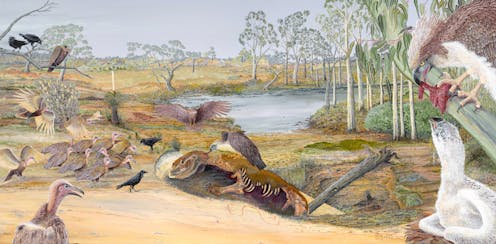
A flock of vultures (_Cryptogyps lacertosus_) and Australian ravens watch and wait (left), as an adult eagle _Dynatoaetus pachyosteus_ feeds on the carcass of a dead _Diprotodon_ (centre), while a younger bird seeks to join in. In the nearby treetops, a second adult _D. pachyosteus_ feeds its hungry chick (right). John Barrie

Today, Australia is home to 17 species of hawks and eagles. But the fossil record shows some other, rather special raptors were present in the relatively recent past.

Tens of thousands of years ago, Australia was home to species such as Dynatoaetus gaffae, the largest eagle ever to have lived in Australia, and Cryptogyps lacertosus, our only known vulture.

Now, we have discovered another ancient eagle shared the skies with these prehistoric predators. In a new paper in the journal Alcheringa, we describe the formidable Dynatoaetus pachyosteus, based on fossils found in the Naracoorte Caves in South Australia.

A new eagle unearthed

Dynatoaetus pachyosteus (the name means “powerful eagle with thick bones”) lived during the Pleistocene (a time period spanning from 2.5 million to 11,700 years ago). It had a wingspan similar to that of a wedge-tailed eagle, but with much more robust and powerful wings and legs. It was slightly smaller than its cousin, the massive Dynatoaetus gaffae.

This formidable predator would most likely have preyed on medium to large marsupials and birds. It may even have attacked juveniles and weakened individuals of huge megafaunal species like the giant flightless bird Genyornis.

An illustration of an eagle feeding a chick, together with photos of four bones.
The large extinct eagle Dynatoaetus pachyosteus (left) and comparison of its humerus or upper arm/wing bone (centre) to that of a modern female wedge-tailed eagle (right). Scale bar = 10mm.
John Barrie (reconstruction) / Ellen Mather (photos)

Dynatoaetus pachyosteus shared the Pleistocene landscape with at least two other large eagles, the huge Dynatoaetus gaffae and the wedge-tailed eagle we know today. For these species to coexist, they would have likely needed to have slightly different ecological roles to avoid outright competition.

“Niche separation” typically occurs by exploiting different kinds of food or habitats. These three eagles most likely coexisted by specialising in hunting different prey and nesting in different places.

The occurrence of both species of the Dynatoaetus genus in Australia (and nowhere else) has implications for the evolution of eagles. Dynatoaetus gaffae and D. pachyosteus presumably evolved from a common ancestor in Australia that diverged into two species, a process that typically takes a very long time.


Read more:
Australia’s extinct giant eagle was big enough to snatch koalas from trees


This suggests the ancestor of this genus was already ensconced on our continent millions of years before the two Pleistocene species arose. Dynatoaetus pachyosteus and D. gaffae together form a rare example of a raptor genus diversifying into multiple species entirely on the Australian continent (what scientists call “endemic evolutionary radiation”).

There are only two raptor genera today restricted to Australia, and both consist of only a single species: Hamirostra (the black-breasted buzzard) and Lophoictinia (the square-tailed kite).

Primitive vultures of ancient Australia

Our research has also revealed intriguing new information about another extinct raptor, the vulture Cryptogyps lacertosus.

Fossils from the Green Waterhole (also known as Fossil Cave), in the Tantanoola district near Mt Gambier, give us a more complete picture of this species. We found several paired wing bones, two shoulder bones, a vertebra and a toe bone, all probably from a single individual.


Read more:
It was long thought these fossils came from an eagle. Turns out they belong to the only known vulture species from Australia


The additional bones of Cryptogyps indicate it was a rather primitive vulture, less adapted for the long periods of soaring flight characteristic of modern vultures.

Thanks to the sediment around the fossils, we also have a very precise date of when Cryptogyps was alive. Many of the Green Waterhole fossils were buried in a deposit of calcite rafts – crystals that form on the surface of still bodies of water in caves.

Photos of several bones and an illustration of a vulture-like bird
Fossil bones from the wing and shoulder of the extinct vulture Cryptogyps lacertosus, recovered from Green Waterhole, South Australia. Scale bar = 50mm. Life reconstruction top right.
Ellen Mather (photos) / John Barrie (reconstruction)

Today, most of the cave is submerged because of a high water table, but in the past, it was mostly dry. A pool of water deeper in the cave was where these calcite rafts formed.

The water was likely what attracted animals into the cave in the first place. These animals then died, and their bones sank to the bottom of the pool along with the calcite rafts. Our team dated these calcite rafts – and thus the entombed Cryptogyps fossils – at approximately 60,000 years old.

Mammal extinctions affect birds of prey

When we think of the mass extinction of Australian megafauna, we tend to think about the demise of large mammals, such as the “giant wombat” Diprotodon optatum, the “marsupial lion” Thylacoleo carnifex, and the giant short-faced kangaroo Procoptodon goliah. Some large reptiles are also commonly recognised as victims: the giant goanna (Megalania) Varanus priscus, the constricting snake Wonambi naracoortensis, and even a giant armoured skink Tiliqua frangens.

But as we can see from the case of our large eagles and vultures, other groups of animals were also affected. Birds of prey, especially large and scavenging species, went extinct around the world during the Late Pleistocene, their food supply likely affected by the loss of large mammalian species. Australia appears to have been no exception to the rule.

Two photos of eagles in flight, one with a white belly and the other with dark, patterned wings.
The wedge-tailed eagle (Aquila audax) and the white-bellied sea eagle (Icthyophaga leucogaster) are the largest birds of prey found in modern Australia.
Michael Lee

The new fossils reveal many of Australia’s large birds of prey did not survive the megafaunal extinction event in the Late Pleistocene, roughly 50,000 years ago. The two largest species that managed to persist to the present are the wedge-tailed eagle, which is a generalist hunter found throughout the continent, and the white-bellied sea eagle, which targets fish and has a coastal distribution.

It is likely our three extinct large raptors – two giant eagles and a vulture – were too specialised as hunters and scavengers of megafauna to adapt to a rapidly changing world. Their extinction likely caused a further cascade of effects through the ecosytem: in Asia, for instance, more recent loss of vultures has led to increased populations of scavenging feral dogs and higher prevalance of diseases such as rabies.

The Conversation

Ellen K. Mather received funding from BirdLife Australia Raptor Group.

Michael Lee receives funding from the Australian Research Council, Flinders University and the Royal Society of South Australia

Trevor H. Worthy has received funding from The Australian Research Council for research on fossil birds. He has previously worked for Flinders University and now has an adjunct status there.

ref. Giant eagles and scavenging vultures shared the skies of ancient Australia – https://theconversation.com/giant-eagles-and-scavenging-vultures-shared-the-skies-of-ancient-australia-216358


NZ wants more seasonal workers – but Pacific nations no longer want to be the ‘outposts’ that ‘grow’ them

Source: The Conversation (Au and NZ) – By Apisalome Movono, Senior Lecturer in Development Studies, Massey University

The three party leaders currently negotiating to form New Zealand’s next government might have their differences, but they seem to agree on one thing: the Recognised Seasonal Employer (RSE) scheme needs to expand.

New Zealand, like Australia, faces critical labour shortages in some sectors, with real implications for future economic performance. The RSE scheme, which has delivered thousands of crucial workers in viticulture and horticulture since it began in 2007, is the logical solution.

Incoming prime minister Christopher Luxon has pledged to double the RSE intake from the current 19,500. ACT’s David Seymour wants the cap on these workers lifted completely – emulating the Australian approach. And NZ First is in favour of recruiting more migrant workers in all fields facing shortages.

But while an increase in RSE workers might benefit New Zealand, the impact on the Pacific nations they come from is becoming hard to ignore. In fact, the schemes risk undermining the very communities and economies they supposedly benefit.

Intake doubled after COVID

In the year to June 2023, 48,000 people left the Pacific to participate in New Zealand’s RSE scheme and Australia’s Pacific Australia Labour Mobility (PALM) scheme. This represented almost a doubling of visas issued since 2018-19, the last year of recruitment before COVID-19 interrupted things.

Remittance payments from workers in these schemes undoubtedly assisted Pacific countries during the periods of pandemic-related border closures. But the resulting labour shortages in the source countries saw calls for a review of participation in the schemes.

As the table below shows, 20% of the male working-age population in Vanuatu and Tonga were recruited in either the Australian or New Zealand seasonal labour schemes in 2022-23. These are people who will be absent from farms, schools, hospitals, mechanical workshops and other sectors in their home countries for six to nine months of the year.


A recent report from Vanuatu found 60% of enterprises – mostly in trades, retail and restaurants – had been affected by staff losses to RSE and PALM schemes. The tourism sector, in particular, has felt the impact strongly since the PALM scheme expanded to recruit workers beyond the primary sector.

Tourism operators report training staff only to see them leave for more lucrative work on seasonal worker schemes. Taumeasina Island resort in Samoa lost almost 60 workers over the 12 months to February 2023.


Not a win-win policy

The Pacific development policies of both New Zealand and Australia purport to “strengthen resilience” and “grow economies”, devoting millions of dollars to various initiatives.

Arguably, the extraction of increasingly large numbers of skilled and semi-skilled workers from important social and economic sectors is systematically undermining these same initiatives.


Read more:
Labor’s proposed Pacific labour scheme reforms might be good soft diplomacy but will it address worker exploitation?


The aid money cannot fully compensate for the loss of people from their families, communities, businesses and economic sectors for such extended periods. The Archbishop of Fiji recently spoke about the “dark side of seasonal work”, and it’s clearly no longer tenable to say seasonal labour schemes are the win-win they were originally intended to be.

The balance has tipped in favour of the bigger, richer countries. Earlier this year the OECD reported there is “limited upskilling” of these workers. The anticipated transformative effect on the Pacific private sector has not been seen.

The largest Pacific nation RSE contributors have found this loss of labour is undermining community development as well as the labour market. When workers leave it puts an extra burden on family and communities.


Read more:
Underpaid at home, vulnerable abroad: how seasonal job schemes are draining Pacific nations of vital workers


Samoan prime minister Fiame Naomi Mata’afa has been particularly concerned that Pacific countries are perceived as mere “outposts” which “grow” labourers for Australia and New Zealand.

Her sentiments are echoed in Vanuatu, where labour commissioner Murille Maltenoven has spoken of complaints about the “brain drain” affecting the domestic labour market. And Fiji’s prime minister Sitiveni Rabuka argues the local economy should be prioritised over seasonal labour schemes.

Policy and practice must change

The criticism has led both Australia and New Zealand to review and reform their respective seasonal worker policies. Improvements include more investment in pastoral care and skills training, and greater benefits for employees.

It seems unlikely, however, that this will fully address the growing imbalance between who benefits and who bears the cost of these schemes. Furthermore, with Australia expanding its own residency pathway to match New Zealand’s, even more skilled workers may be enticed to leave their Pacific homelands.


Read more:
Reaping what we sow: cultural ignorance undermines Australia’s recruitment of Pacific Island workers


The Samoan government is tackling the problem head on, approving a new labour mobility policy in late September. Among other things, it will prioritise those who have been unemployed for more than six months.

This reflects the OECD position that unskilled workers must be a priority. Otherwise, the schemes will directly undermine human development in Pacific countries.

Other seasoned observers have suggested New Zealand and Australia begin recruiting more workers from Papua New Guinea and Solomon Islands, rather than further deplete Samoa, Tonga and Vanuatu.

The OECD also urges investment in the private sectors of partner countries to create better job options and wages at home for Pacific workers. This is where Australian and New Zealand development aid policies should now be focused.

The Conversation

Apisalome Movono receives funding from Royal Society Te Apārangi.

Regina Scheyvens receives funding from Royal Society Te Apārangi.

Sophie Auckram does not work for, consult, own shares in or receive funding from any company or organisation that would benefit from this article, and has disclosed no relevant affiliations beyond their academic appointment.

ref. NZ wants more seasonal workers – but Pacific nations no longer want to be the ‘outposts’ that ‘grow’ them – https://theconversation.com/nz-wants-more-seasonal-workers-but-pacific-nations-no-longer-want-to-be-the-outposts-that-grow-them-217790

5 things we need to see in Australia’s new nature laws

Source: The Conversation (Au and NZ) – By Euan Ritchie, Professor in Wildlife Ecology and Conservation, School of Life & Environmental Sciences, Deakin University

Shane Bartie, Shutterstock

Australia’s abysmal rates of extinctions and land clearing since European colonisation are infamous globally. Our national environmental legislation has largely failed to protect biodiversity, including many threatened plants, animals and ecological communities. But change is afoot.

The federal government is reforming our national environmental law. Following a scathing review in 2021, the legislation is being rewritten. While amendments to the Environment Protection and Biodiversity Conservation Act 1999 (EPBC Act) are yet to be tabled in parliament, the government says “rolling consultation” has begun.

About 30 environment, business and industry groups attended “targeted stakeholder workshops” last month. Public consultation begins with two webinars, on November 23 and 28. Government officials are offering to “explain how the proposed changes are designed to work and how they compare to existing laws”. But they are not sharing the draft legislation yet.

How can we assess whether these new laws can prevent further species loss and habitat destruction? Here’s an essential checklist of five things the law must include if we are to avoid calamity and hasten environmental recovery.


Read more:
Labor’s plan to save threatened species is an improvement – but it’s still well short of what we need


1. A climate trigger

The EPBC Act does not explicitly discuss and account for climate change and its impacts. So the federal environment minister is not legally bound to consider – or authorised to refuse – new or expanded coal mines and fossil gas fields based on their future climate impacts.

But climate change clearly threatens biodiversity and special places such as the Great Barrier Reef, as well as human communities and culture.


Read more:
We should use Australia’s environment laws to protect our ‘living wonders’ from new coal and gas projects


2. Habitat means homes for wildlife

Protection of sufficient and connected habitat must be central to Australia’s national environmental law. If homes for swift parrots, koalas, greater gliders and other threatened species continue to be destroyed and fragmented, it is all but guaranteed Australia will fail in its stated quest to avoid further extinctions.

Northern Australia is home to exceptional but declining biodiversity that is increasingly threatened by development of pastoral, cotton and fracking industries.

Significant increases in land clearing and water extraction are seldom referred under the EPBC Act, let alone assessed.

Environmental law reform must stem the accelerating loss of biodiversity in this region and elsewhere. Reforms must include expanding the water trigger to apply to shale gas fracking, and ensuring significant land clearing is referred and assessed.

It is also crucial that federal approval powers are not devolved to states and territories, particularly in remote regions where so much damage occurs out of sight and out of mind.


Read more:
Land clearing and fracking in Australia’s Northern Territory threatens the world’s largest intact tropical savanna


3. Setting clear objectives and measuring outcomes

The new laws must state policy objectives such as no new extinctions and no actions that accelerate climate change.

Decision-makers must be required to address direct, indirect and cumulative threats that undermine these objectives.

The new National Environment Standards (the centrepiece of this law reform) must stipulate red lines not to be crossed, such as no clearing of any critically endangered ecological communities or critical habitat of threatened species.

We should always seek first to avoid harm, then keep harm to a minimum, and only as a last resort, offset remaining impacts – and then only with credible offset plans that fully account for uncertainties in delivering environmental compensation.

4. An independent umpire

We need a well-resourced, independent umpire, operating at arms length from government. This “independent cop on the beat” will need powers to prevent activities and developments deemed too harmful for biodiversity.

The government has vowed to create a national Environmental Protection Agency. The functioning and powers of such an entity risk being severely undermined if the environment minister of the day has the ability to “call-in” projects and make unilateral decisions over whether they can proceed. That would also create concern regarding industry influence and pressure on ministers to approve projects.

It’s essential ministers not only have regard for environmental standards but also follow them to the letter of the law.

5. A Voice for Country and culture

Our national environment laws must make room for genuine Aboriginal and Torres Strait Islanders participation in how matters of cultural and environmental significance are managed.

Our new nature laws must interact with federal cultural heritage laws, which are also under reform. Entities of cultural significance, such as humpback whales and dingoes, must be cared for in a way deemed appropriate by Indigenous Australians. Such a mechanism must be co-designed with Aboriginal and Torres Straight Islanders.

Policy must continue to be developed in partnership with Aboriginal and Torres Strait islander people. We suggest a Land and Sea Country Commissioner, “a Voice for Country”, could lead this ongoing collaboration. We also need to ensure groups are adequately resourced and supported to Care for Country.

We must do better

The time has come to lift our ambitions and truly protect our nation’s precious environment and biodiversity.

Australians want effective, urgent action from government. For cultural, social, economic and environmental reasons, biodiversity conservation should be treated as a public good and receive bipartisan support. It’s not an optional extra. We simply must invest in nature. We cannot afford not to.

The Conversation

Euan Ritchie receives funding from the Australian Research Council and the Department of Energy, Environment, and Climate Action. Euan is a Councillor within the Biodiversity Council, and a member of the Ecological Society of Australia and the Australian Mammal Society.

Jack Pascoe is Co-Chief Councillor of the Biodiversity Council and a member on the Ecological Society of Australia and the Australasian Wildlife Management Society. He receives funding from the Australian Research Council.

Kristy Howey is the Executive Director of the Environment Centre NT.

Terry Hughes receives competitive funding from the Australian Research Council.

Yung En Chee receives funding from an Australian Research Council linkage grant. She also receives funding and research contracts from Melbourne Water through the Melbourne Waterway Research-Practice Partnership 2023-28.

ref. 5 things we need to see in Australia’s new nature laws – https://theconversation.com/5-things-we-need-to-see-in-australias-new-nature-laws-217271

‘I feel like I’ve been able to create more awareness’: what is it like for Indigenous men at top-ranked universities?

Source: The Conversation (Au and NZ) – By Garth Stahl, Associate Professor, The University of Queensland

Emmanuel Offei/ Unsplash, CC BY-SA

One of the top priorities of the Universities Accord process it to improve access to university in Australia, particularly for those from underrepresented groups.

This is particularly so for Indigenous men, who are among the least likely groups go to university, let alone an elite one. Elite universities are highly ranked, located in metropolitan areas and tend to have fewer students from disadvantaged backgrounds (as opposed to regional and lower-ranked universities).

As of 2019, about 4.5% of Indigenous men had gone to university. Indigenous women are nearly twice as likely to apply for an undergraduate degree.

As Prime Minister Anthony Albanese has pointed out, there is “a greater chance of an Indigenous young male going to jail than university”.

But while politicians talk about how they want to see more Indigenous people attend and graduate from university, we don’t often hear from Indigenous students about their experiences.


Read more:
What are enabling programs? How do they help Australians get to uni?


Our study

We are a group of Indigenous and non-Indigenous researchers studying Indigenous men in higher education. We have interviewed 19 Indigenous current and former students across Australia as part of our research.

Understanding the experiences of those who are making university work for them can help us understand how to make higher education a better option for other young Indigenous men.

Here we focus on four young men – Nullah, Dural, Ricky and Birrani – who were attending an elite Australian university.

Isolation and homesickness

Many Indigenous students grow up in remote areas, which presents a geographical barrier to study. All Australia’s top-ranked universities are in major cities. This means many Indigenous students have to move to go to university.

Nullah studied education, history and maths. He told us he felt homesick during his studies:

I just didn’t know anyone getting down here. And it was pretty hard. I found it a lot easier to form relationships at the [Indigenous Support Unit] – more so than within my degree and in my classes.

Dural, who studied clinical psychology, also spoke of feeling isolated in his studies:

there wasn’t any Aboriginal people around at all. And I was like, yeah I didn’t really sort of know why that was the case or like I said before, felt isolated.

Ignorance and racism

Interviewees also spoke about encountering ignorance and casual racism at university.

Ricky did an education degree, with a focus on drama and Aboriginal and Torres Strait Islander Studies. He found the Indigenous course he studied to be “watered down and it was so surface-level that it annoyed me”.

He also spoke about how little his fellow students knew about Indigenous culture. He gave the example of needing to explain to other students why another Indigenous student had not looked them in the eye.

I was like, ‘Well, a lot of Indigenous people believe looking you in the eyes is a form of aggression. And out of respect, they won’t look you in the eyes.’ They were like, ‘Oh, we didn’t know that’ […]

But Ricky told us casual racism was the “hardest thing”:

I found it hard when we did education around Indigenous people and some of the casual racism. That was probably the hardest thing to deal with. And it’s not so much like I think they were trying to be racist, but some of the stuff that they’re saying, I was like, ‘Do you realise what you’re saying right now?’ Like do you understand?


Read more:
‘I would like to go to university’: flexi school students share their goals in Australia-first survey


Passion for study and a desire to help

Despite feelings of isolation and racism, our interviewees spoke of their studies with great passion. As Birrani, who did an advanced science degree, explained:

I didn’t really think of going to uni as an investment [in my future career] and all that kind of stuff. I just thought of it as doing what I want to do. I just wanted to do science.

Interviewees spoke about wanting to represent their culture and take their education back to their communities. Dural was highly motivated by what his education would allow him to do:

knowing that when you go to a psychologist, hoping that they’re culturally sensitive and they can sort of understand your experiences as an Aboriginal person as well.

Nullah talked about showing people in his community that higher education was an option for them.

I always, I knew that I was capable of studying at uni. And I kind of wanted to also prove to the people in my own community and mostly I tell my brothers that it can be done.

Change is possible

Despite the issues with their institutions, our interviewees saw the university environment as malleable and something that could be improved. Ricky spoke about representing his culture at university.

Like, really my motivation to go to uni is to make sure that Indigenous people get the right education, but it’s also about educating the educators to be able to educate in this topic.

Nullah similarly talked about helping to “embed” Indigenous perspective in classrooms.

I feel like that’s my passion and that’s my purpose, is having our people and our culture and our history represented more in the education curriculum and also to have that education there.

He added he wanted to influence how Indigenous culture was perceived at his university:

It’s something I’m really passionate about like my background, my culture, and sort of getting that out across into the university.

Dural was he was the only Indigenous male in his psychology course. But he saw this in positive terms as an opportunity for change:

So in my cohort, I guess whenever those issues come up, or whenever anyone’s wants to talk about psychology from more of an Aboriginal perspective, then I’m able to sort of share my knowledge and my experiences. And yeah, I feel like I’ve been able to sort of create more awareness around those issues, I guess.

A lot more to learn

Our research shows how young Indigenous men face significant barriers in their university studies. But it also shows how they approach their education with great passion, optimism and pride.

The interviewees told us how their strong sense of connection to culture and their identity inform how they navigate elite universities. They often encountered experiences where they had to educate their fellow classmates who, according to them, had little familiarity with Indigenous cultures.

Policymakers have a lot to learn from students like Nullah, Dural, Ricky and Birrani, especially if we are going to ensure university is a place that genuinely welcomes and supports Indigenous men to study. Our research highlights the importance of taking culture seriously, and what is possible if Indigenous culture is acknowledged, affirmed and incorporated into higher education spaces and learning.

The Conversation

Garth Stahl has received funding from the Australian Research Council and the National Centre for Student Equity in Higher Education.

Braden Hill has previously received funding from the National Centre for Student Equity in Higher Education.

Himanshu Gupta has received funding from the National Centre for Student Equity in Higher Education.

James Smith has received funding from the National Centre for Student Equity in Higher Education (NCSEHE); and is a past Equity Fellow and Adjunct Professor with NCSEHE.

Samuel Moore does not work for, consult, own shares in or receive funding from any company or organisation that would benefit from this article, and has disclosed no relevant affiliations beyond their academic appointment.

ref. ‘I feel like I’ve been able to create more awareness’: what is it like for Indigenous men at top-ranked universities? – https://theconversation.com/i-feel-like-ive-been-able-to-create-more-awareness-what-is-it-like-for-indigenous-men-at-top-ranked-universities-217186

Grattan on Friday: A government in a big hurry gives opposition some wins on ex-detainees

Source: The Conversation (Au and NZ) – By Michelle Grattan, Professorial Fellow, University of Canberra

It’s not very often we see a bill marched through parliament at such a pace as this week.

After being caught on the hop by the High Court, the government has brought in emergency legislation to strengthen its powers to control more than 80 people, some of them serious criminals, it has been forced to release from immigration detention. The bill was introduced in the lower house on Thursday morning and was set to pass Thursday night.

Those of an irreverent turn of mind might recall Scott Morrison’s Great Strawberry Crisis of September 2018, when a bill was also raced through in a day.

Both the strawberry bill and this one were enacted in the name of “keeping the community safe”.

The strawberry exercise, following the discovery of needles in some fruit, was an obvious political stunt. This week’s legislation goes to a serious matter, although there’s dispute about the threat to community safety, given the risks posed by these people aren’t greater than those presented by local criminals who leave jail. The difference is these are illegal immigrants.

The High Court isn’t usually front and centre in politics. But when it is, it can land sharp punches that throw governments off balance.

The Albanese government always knew the court might rule, as it did last week, that people can’t be held indefinitely in immigration detention. But on the basis of its past record, the odds seemed against it doing so.

The Coalition says the government failed to take into account a hint months ago from one judge. Certainly the government wasn’t as prepared as it should have been when the decision came.


Read more:
The latest citizenship-stripping plan risks statelessness, indefinite detention and constitutional challenge


It initially concentrated on putting conditions into people’s visas and making sure security and law enforcement authorities were prepared.

It was quickly obvious, however, that a robust response would be required. Regardless of the logic, the argument that these people pose no more danger than do post-sentence Australians wouldn’t wash. This was especially obvious when media stories appeared about frightened victims.


Read more:
Politics with Michelle Grattan: James Paterson on the High Court’s decision on detention and rising anti-Semitism


The government’s situation was complicated by the court’s delay in providing reasons for its decision (on which, incidentally, we don’t know whether the judges were unanimous or split).

The explanation of the court’s action is that this was a habeas corpus case, so the court’s first duty was to the individual at the centre of it. That meant when it decided the man should be released, it had an obligation to say so immediately.

Immigration Minister Andrew Giles, a junior minister, visibly struggled under the Coalition’s attack in parliament. The optics weren’t helped by the departure of Anthony Albanese late Wednesday for the APEC meeting in the United States. It’s been reported this was a trip the PM would have preferred to miss, but felt obliged to make because Joe Biden expected him to be there.

The High Court decision affected immediately more than 90 people, a number of whom had been convicted of major crimes including murder and rape. More than 80 have been released. The total number potentially involved could run into the hundreds.


Read more:
The High Court has decided indefinite detention is unlawful. What happens now?


The government kept repeating it had no choice but to let the detainees out at once. Minister for Home Affairs Clare O’Neil said, “If I had any legal power to do it, I would keep every one of those people in detention. Some of those people have committed deplorable, disgusting crimes. I am raising three children in this country, and I want a safe Australia.”

The emergency legislation, ticked off by a special caucus meeting, meant the Commonwealth could deploy ankle monitoring bracelets and impose curfews.

There was a catch-22 in the powers the government previously had. If a person breached their visa obligations, they could be sent to immigration detention – but after the court judgement, that penalty was no longer available. This made legislation necessary, so people could be jailed.

The government rushed the bill through the House of Representatives on Thursday morning in about an hour. The opposition was not allowed to move amendments.

The Coalition prepared several amendments, substantially broadening the restrictions, to pursue in the Senate. But, anxious to lower the temperature, speed the bill’s passage, and get the issue off the table, acting Prime Minister Richard Marles approached Opposition leader Peter Dutton. Marles and other ministers met Dutton in Marles’ office, and the government agreed to all the opposition amendments. They included mandatory minimum sentencing for visa breaches – which is inconsistent with Labor’s platform. It’s understood Albanese was kept abreast of things.


Read more:
‘I have no rights’: what happens to stateless people in Australia after the High Court’s ruling?


The legislation may be stopgap because, without the court’s reasons the government is working, to a degree, in the dark. More legislation could be needed next year.

The Greens have denounced the extra controls. The Greens’ Nick McKim told the Senate. “Make no mistake, this is Prime Minister Albanese’s Tampa moment and history will condemn him for this, just as it condemned Mr Howard and Mr Beazley over 20 years ago”. This was a reference to Coalition legislation for a drastic response to the asylum seekers on the Tampa.

McKim accused Labor of “an abject craven capitulation by a party that has forgotten where it came from, and forgotten what it used to stand for.” He predicted a High Court challenge to the legislation.

David Manne, executive director of Refugee Legal, says a challenge is “absolutely” possible. He says the new law confers “extraordinary powers” that are beyond necessity and proportionality.

Manne says the controls imposed could involve another deprivation of a person’s liberty, when the High Court has just ruled against the deprivation of their liberty.

In crude political terms, Labor knows it is always potentially vulnerable on issues involving asylum seekers and refugees. That vulnerability is on two flanks. The Coalition will exploit any situation to paint Labor as weak. The Greens will cast Labor as heartless.

The government hopes the legislation provides the necessary belt and braces to send the community the message that, despite initial fumbling, it is in control of this unexpected situation.

The Conversation

Michelle Grattan does not work for, consult, own shares in or receive funding from any company or organization that would benefit from this article, and has disclosed no relevant affiliations beyond their academic appointment.

ref. Grattan on Friday: A government in a big hurry gives opposition some wins on ex-detainees – https://theconversation.com/grattan-on-friday-a-government-in-a-big-hurry-gives-opposition-some-wins-on-ex-detainees-217912

The government just killed 50 infrastructure projects – what matters is whether it will fund them on merit from now on

Source: The Conversation (Au and NZ) – By Jago Dodson, Professor of Urban Policy and Director, Centre for Urban Research, RMIT University

Shutterstock

The federal government has just announced a list of projects to be abandoned as a result of an independent strategic review of its infrastructure investment program.

The review found the cost of the A$120 billion, ten-year program had blown out by $32.8 billion, half of which was in projects not yet under construction.

But the flaws in national infrastructure planning go much deeper than the question of whether or how projects are listed on a spreadsheet, and how much their costs blow out.

A national framework built around Infrastructure Australia was supposed to resolve differences between the states and the federal government on projects before they get approved.


Read more:
Infrastructure review recommends culling 82 planned projects


In the late 1990s and early 2000s, as Australia was recovering from recession, demands for new infrastructure funding grew.

Sydney, which had been “full up” according to then NSW Premier Bob Carr and had economised on spending in the runup to the 2000 Olympics, desperately needed new infrastructure.

With their budgets constrained, states began pitching projects to the federal government, but incoherently and without a national framework.

The Rudd Labor government went to the 2007 election promising to bring coherence and rationality to national infrastructure planning.

Independent advice was meant to fix things…

Rudd and the then infrastructure minister Anthony Albanese established Infrastructure Australia as an independent statutory authority to provide advice on national needs and project priorities. The idea of it being independent came from technocratic bodies such as the Reserve Bank and the Productivity Commission.

Infastructure Australia was diligent in its approach.

It undertook national infrastructure audits to determine key areas of need, prepared uniform criteria by which projects should be assessed, and compiled priority lists of projects assessed on merit against those criteria.

Final decisions on funding would rest with ministers, but they would have the benefit of Infrastructure Australia’s independent advice.

…but big projects are inherently political

But large infrastructure projects addressing public and business needs are unavoidably political.

As desirable as an independent body assessing projects on merit seems, retail politics militate strongly against delegating decisions to technocratic bodies.

But conversely, a minister who is seen to reject official independent advice is politically exposed. This gives both the agency and the minister strong imperatives to preserve each other’s modesty.

From the mid-2010s to the early 2020s, the Australian public service became increasingly politicised, resulting in hollowing out of expertise, loss of independence, and scandals such as robodebt.

‘High priority’ versus mere ‘priority’

Infrastructure Australia, while independent of the core public service in the same way as is the Reserve Bank, became subject to political pressure.

This is exemplified by the case of Victoria’s East-West Link toll road. The Abbott Commonwealth government committed to the project ahead of the 2014 Victorian election, despite the project having a benefit-cost ratio of less than one, meaning that its benefits were less than its costs.

Under the pressure to resolve the contradiction, Infrastructure Australia created a “high priority” list in addition to its existing “priority” list.

The new “high priority” list would include only the projects assessed as having the greatest value to the nation. The existing repurposed “priority” list could house the politically important but less meritorious projects, allowing politicians to claim these projects were “priorities”, even if their absolute merit was doubtful.

East-West Link funded then cancelled

The 2014 Victorian election result rescued some modesty after the newly elected Dan Andrews abandoned the East-West Link, but the interplay between political needs and technical rationality has if anything gotten worse.

Andrews’s $200 billion Suburban Rail Loop was endorsed electorally at the 2018 and 2022 state elections despite not appearing in any formal metropolitan or statutory transport plans.

At the time of the 2022 federal election, it hadn’t been submitted to Infrastructure Australia for assessment. But the federal Labor opposition, now the government, committed $2.2 billion to it.

Victoria has since submitted the Suburban Rail Loop to Infrastructure Australia, but the assessment is unfinished. Yet it appears on the updated federal infrastructure funding list released by the minister today.

Is Infrastructure Australia independent enough to reject the Suburban Rail Loop if it fails its assessment criteria?

‘Not demonstrably merit-based’

The Suburban Rail Loop is not alone as an infrastructure project promoted well in advance of its assessment. In the leadup to the 2019 election, the Morrison government released proposals for car parks at suburban rail stations.

This scheme was never submitted to Infrastructure Australia and was later found by the Commonwealth Auditor General to be “not demonstrably merit-based”, a finding Labor categorised as “sports rorts on steroids”.

The Independent Strategic Review of the national infrastructure program released on Thursday responds in part to these concerns.

It recommends that 86 projects deemed of lower merit be stopped, and supports another 156, with 32 to be determined through further assessment.

The review also offers advice about how to improve infrastructure planning. It recommends each state prepare an annual infrastructure plan identifying priority projects over ten years, and their proposed sequencing.

The federal government would provide an annual overview of infrastructure planning and priorities to inform assessment and decisions. Funding would usually be split 50:50 between the federal government and the states.

These are useful improvements but they still leave infrastructure open to gaming. There’s more that could be done.

The beginning of a way forward

A first option would be to raise the value threshold for individual projects the Commonwealth should even begin to consider, say $1 billion. Others could be funded through a bulk annual grant to each state.

A second option would be to require a higher merit threshold for considering a project. This would involve assessing regulatory, pricing or taxation alternatives before considering an infrastructure solution.

If after this assessment, infrastructure is deemed appropriate, alternative types of projects should be openly considered. Only after that’s done should the preferred project be considered for funding.

If this had applied to the Suburban Rail Loop, the Victorian government could have been told to assess other options, such as the tram and bus put forward by researchers at the University of Melbourne.


Read more:
Transurban’s West Gate tollway is a road into uncharted territory


For projects worth more than $1 billion, open parliamentary inquiries could be held to transparently assess their merits and allow for expert and public opinion to be aired on the record.

A further option would be to require rigorous carbon emission analysis of all projects and reject those that conflict with national climate goals.

This would make big infrastructure less attractive, given the carbon content of concrete and steel, and in transport would favour rail freight over roads, and public transport, walking and cycling over driving.

Lastly, all projects funded through Infrastructure Australia should be subject to independent public after-the-event analysis to create an accessible database of what worked and what did not.

Infrastructure is costly. Cheap politics and getting it wrong adds to inflation.


The Conversation

RMIT University receives funding from the Australian Housing and Research Institute and AusAid to support Jago Dodson’s research.

ref. The government just killed 50 infrastructure projects – what matters is whether it will fund them on merit from now on – https://theconversation.com/the-government-just-killed-50-infrastructure-projects-what-matters-is-whether-it-will-fund-them-on-merit-from-now-on-217900

Engineered stone kills tradies. Bunnings and IKEA stopping its sales is a big win for public health

Source: The Conversation (Au and NZ) – By Renee Carey, Senior Research Fellow, School of Population Health, Curtin University

haireena/Shutterstock

Major retailers Bunnings and IKEA have announced this week they will discontinue selling engineered stone. While this might mean you have to rethink your plans for your new kitchen benchtops, it’s a positive step that will protect the health of tradespeople exposed to this dangerous product.

Engineered stone contains up to 95% crystalline silica dust. This superfine dust is released into the atmosphere when workers cut, grind or drill engineered stone.

Breathing this dust into the lungs has been linked to serious long-term damage, including breathing difficulties, lung cancer and silicosis (scarring of the lungs).

We got to this point through a concerted campaign backed by strong scientific evidence. Let’s take a look.

Silicosis is preventable

In Australia, nearly one in four engineered-stone workers employed in the industry before 2018 have already developed silicosis or other silica dust-related diseases as a result of their exposure.

Silicosis is caused by breathing in silica dust which becomes embedded in the lungs and causes scarring. This means the person’s lungs can no longer function to their full capacity. Silicosis is a progressive disease, and there’s no cure.

We’ve known about silicosis for many years. Although engineered stone is a particularly potent source of silica dust, it can come from other sources too, such as rock, sand and concrete. It was historically a disease of miners due to their exposure to high dust levels.

Until the past few years, we were seeing a decline in silicosis numbers in Australia and internationally. But we’re now seeing a significant resurgence, due in a large part to the popularity of engineered stone.

My colleagues and I released a report last year which looked at how many Australian workers would develop silicosis and lung cancer as a result of their exposure to silica dust. We also looked at the effect of possible interventions to reduce or eliminate this exposure.

Our analysis found the lives of around 1,000 workers could be saved from silicosis if a ban on engineered stone was implemented. In addition, around 100 lung cancers would also be prevented over the lifetime of these workers.


Read more:
Banning artificial stone could prevent 100 lung cancers and 1,000 cases of silicosis, where dust scars the lungs


While some lives could be saved by other measures, such as wearing well-fitted respirators and using water when cutting engineered stone to reduce the dust levels, we calculated that the impact of a ban was much greater. These control measures also rely on compliance to be effective.

How did we get here?

The move – first taken by Bunnings, and soon after by IKEA – follows a concerted effort led by the Australian Council of Trade Unions (ACTU) over the past few years. The ACTU formed a consortium of organisations all working towards a ban on engineered stone to protect workers’ lives.

These organisations included the Lung Foundation, the Cancer Council, the Australian Institute of Occupational Hygienists and the Public Health Association of Australia. Our report was used to inform the campaigning by these organisations.

Members of the Construction Forestry Mining and Energy Union (CFMEU) staged protests at Bunnings stores earlier this year to encourage them to stop the sale of engineered stone products in their stores. In addition, the CFMEU and the wider union movement have vowed to stop their members from using engineered stone if a wider ban is not instituted.

Alongside this effort, we’ve seen numerous stories of everyday Australians – people who have worked with engineered stone, quarry workers and others – who have been diagnosed with silicosis. In many cases these have been young and otherwise healthy people.

No safe level

Our research added to evidence gathered by the Australian Institute of Occupational Hygienists that showed there was no practical way this product could be used safely. Based on the weight of this evidence, Safe Work Australia recently recommended a complete ban on engineered stone.

State and territory ministers in the portfolio of work health and safety met late last month to discuss the possibility of a ban. So far, governments in New South Wales and the Australian Capital Territory have indicated they will move towards a ban on engineered stone in the coming months if the federal government does not. It is thought that several other states would also support it.


Read more:
Renovating your kitchen? Help Australia’s tradies avoid silicosis by not choosing artificial stone


There is clear momentum towards a ban on engineered stone, and we urge the federal government to implement this as soon as possible. This will ensure a unified, nationally consistent response. We would also encourage other businesses to follow the lead of Bunnings and IKEA.

While ministers deferred their decision on a ban when they met last month, we hope this issue will be resolved when they next meet in December. Continued use of engineered stone will only result in more illness and death among Australia’s tradies. There’s a real opportunity here to make a big difference to public health.

The Conversation

Our report was commissioned by the Australian Council of Trade Unions (ACTU).

ref. Engineered stone kills tradies. Bunnings and IKEA stopping its sales is a big win for public health – https://theconversation.com/engineered-stone-kills-tradies-bunnings-and-ikea-stopping-its-sales-is-a-big-win-for-public-health-217791

As school students strike for climate once more, here’s how the movement and its tactics have changed

Source: The Conversation (Au and NZ) – By Eve Mayes, Senior Research Fellow in Education, Deakin University

School Strike 4 Climate/Flickr, CC BY-SA

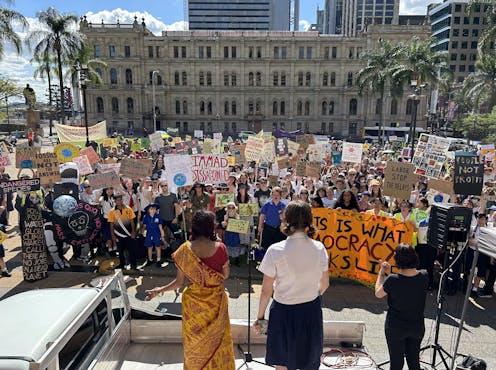
On Friday, students will once again down textbooks and laptops and go on strike for climate action. Many will give their schools a Climate Doctor’s Certificate signed by three leading climate academics.

These strikes – part of a National Climate Strike – mark five years since school students started walking out of schools to demand greater action on climate change. In 2018, the first students to strike defied calls by then prime minister Scott Morrison for “less activism” and to stay in school.

Last year, Australia voted out the Morrison government, in what was widely seen as a climate election. Teal independents won Liberal heartland seats on climate platforms, while the Greens recorded high votes. Labor came to office promising faster action on climate.

So why are school students still striking? Has the movement changed its focus? We have been researching these questions alongside young people involved in climate action in the ongoing Striking Voices project, as well as through the coauthor’s Sapna South Asian Climate Solidarity project.

We found the movement has expanded its demands from climate action to climate justice, stressing the uneven and unfair distribution of climate impacts. The movement itself has also become more diverse.

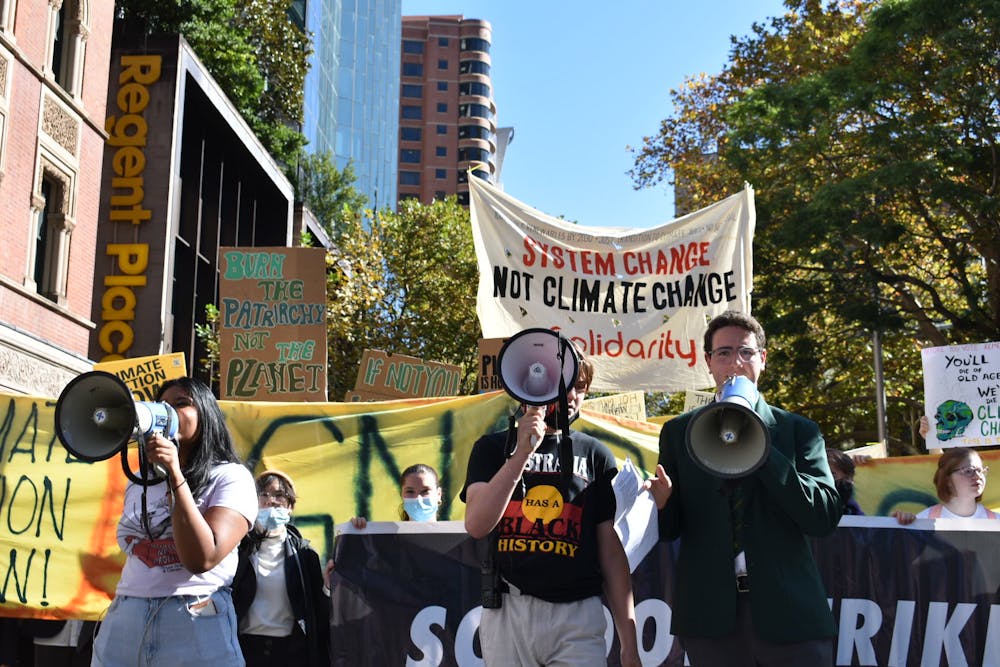
student strike for climate in Sydney 2022. Students marching with megaphones
Why are students still striking for climate justice? Because the job isn’t anywhere near done. This march was in Warrang (Sydney) in May 2022.
School Strike 4 Climate/Flickr, CC BY

From climate action to climate justice

Across the world, young climate advocates such as those from School Strike 4 Climate are calling for “climate justice” alongside “climate action”.

Why? Because climate change doesn’t impact everyone equally. As the Australian Youth Climate Coalition puts it, it’s “often the most marginalised in our societies who are hit first and worst by climate impacts and carry the burden of polluting industries”.

Mere semantics? No. The idea of climate justice draws attention to existing social and ethical injustices which climate change amplifies. The phrase also points to the need for climate solutions that work for people in a transformative way and help create collective and just societies.

In Australia, calls for climate justice are intimately connected with justice for First Nations people and to protecting, defending and “heal[ing] Country”, as Seed Mob write, with First Nations-led solutions.

Climate justice is central to the messaging of groups such as Pacific Climate Warriors diaspora, and Sapna South Asian Climate Solidarity.

In our conversations with young people, climate justice appears highly compelling. High-school student Yehansa Dahanayake explained:

I think I’d always thought of climate change as sort of a 2D thing. I thought about it as the temperature rise, deforestation, and sea caps melting – and while that is definitely true, I think [when] I started to learn about the justice aspects of climate change, [it] made me realise that there are many other factors that tie in, such as the Global North/ Global South difference and how that relates.

High-school student Emma Heyink told us about the importance of what she called a “justice-centred lens”:

You can’t look at climate change without looking at all these other issues. It just becomes so much more interlinked and solutions become so much more obvious.

Diversifying networks and strategies

So who are these young people, and what have they been doing in recent years?

Swedish student Greta Thunberg is frequently credited as sparking the youth-led climate movement.

But the movement is much larger – and more diverse – than one person, and increasingly so in recent years.

As a report by Sapna points out, Australia’s youth-led climate justice networks are more likely to be racially diverse than mainstream climate movements.


Read more:
If we want to achieve global climate targets, young people must take centre stage


Yet climate justice networks are not immune from the oppressive dynamics they protest against. When the coauthor interviewed 12 now-graduated school strikers of South Asian heritage, they reported sometimes feeling sidelined in climate spaces – which are often white-dominated – as well as in media opportunities. As one young person put it, it seemed “hard to tell a brown person’s climate justice story”.

There are signs of positive change. The upheaval of the COVID pandemic saw stronger connections emerge between social movements, and clearer links between intersecting crises and injustices, both globally and in youth-led climate networks.

As recent high-school graduate and school strike organiser Owen Magee explained:

at our strikes, we are platforming First Nations people, rural and regional people who’ve directly been affected by the climate crisis, directly being affected by fossil fuel greed and corporation greed. That in itself is focusing on the intersectional nature of climate justice.

You can see this cross-pollination in the support shown by young advocates across multiple climate justice networks in the Power Up gathering on Gomeroi Country in northwestern New South Wales to show solidarity with Traditional Owners fighting coal and gas projects on their lands.

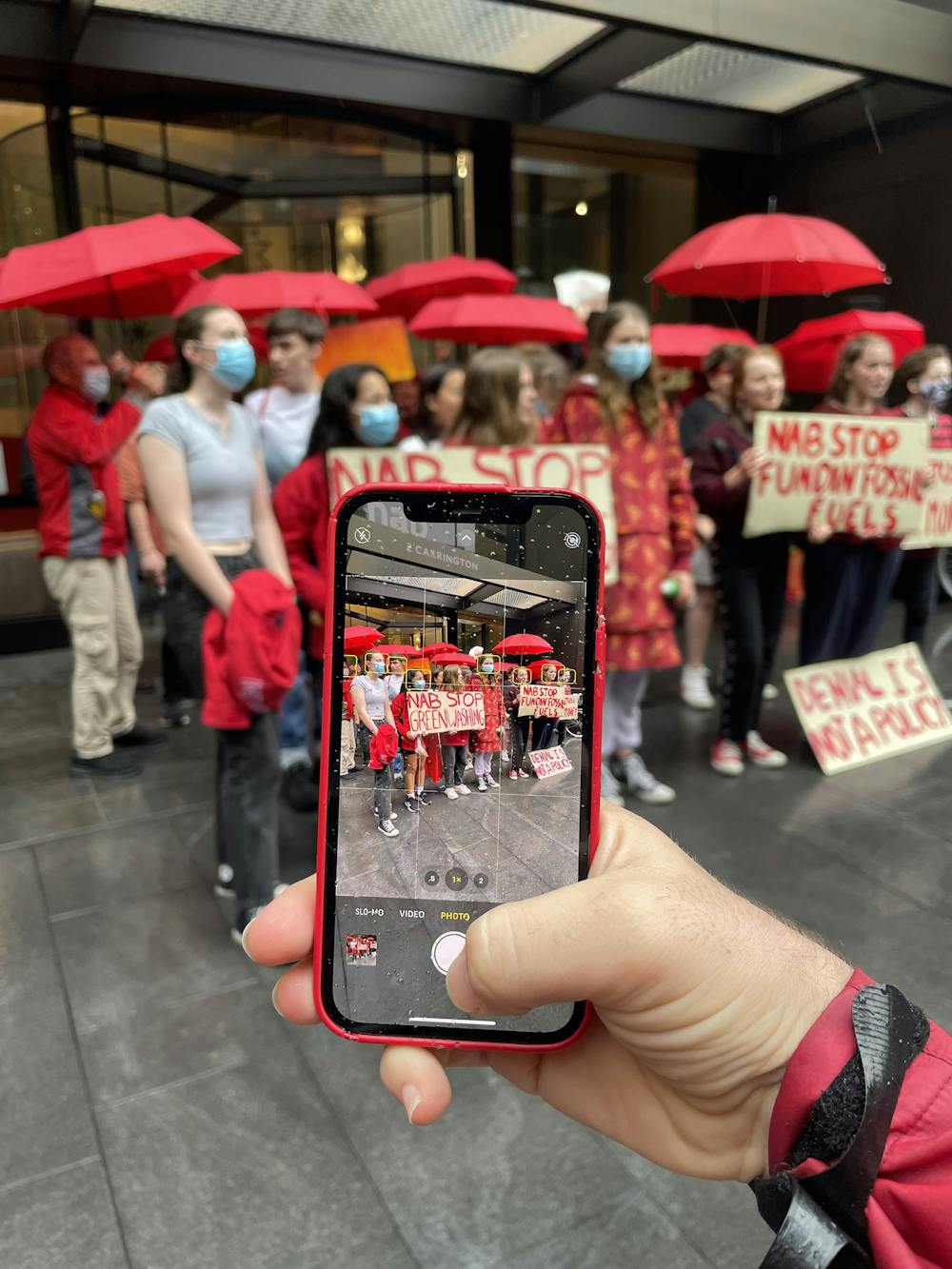
The targets and tactics of youth-led climate justice networks have shifted and proliferated in recent years – for example, to the banks that finance fossil fuel companies.

Students protesting against fossil fuels
Targets, tactics and strategies have evolved since 2018.
Student Strike 4 Climate/Flickr, CC BY

When school strikers graduate, some move into different modes of climate-related action.

Some have taken part in strategic climate litigation in a bid to create legislation embedding a climate duty of care for young people in government decisions on issues such as fracking approvals.

Others are involved in non-violent direct actions, such as next week’s Rising Tide People’s Blockade of the world’s largest coal port in Newcastle.

Young climate advocates are battling for climate justice on a wide range of fronts. They are calling on politicians to do the same.


Read more:
How Australia’s expanding environmental movement is breaking the climate action deadlock in politics


We would like to acknowledge and thank the Striking Voices project research associates, Natasha Abhayawickrama, Sophie Chiew, Netta Maiava and Dani Villafaña.

The Conversation

Eve Mayes receives funding from the Australian Research Council.

Ruchira Talukdar is co-founder of Sapna South Asian Climate Solidarity and receives funding from the Sunrise Project.

ref. As school students strike for climate once more, here’s how the movement and its tactics have changed – https://theconversation.com/as-school-students-strike-for-climate-once-more-heres-how-the-movement-and-its-tactics-have-changed-217663

Is Jim’s Beauty set to flop like Colgate lasagna or Harley-Davidson perfume – or could it be branding genius?

Source: The Conversation (Au and NZ) – By Edwina Luck, Senior Lecturer QUT Business School, Advertising, Marketing and Public Relations, Queensland University of Technology

Jim Penman, Author provided

Jim’s Group – best known for Jim’s Mowing and Jim’s Plumbing – this week announced a surprising brand extension.

It’s Jim’s Beauty, offering “professional beauty treatments in the comfort of your chosen space”.

It’s surprising because Jim’s Group got its start mowing lawns, then extended into related businesses, including dog washing, pest control and roofing.

These services are usually offered in the client’s home, and are provided by franchisees, as will the beauty services – which will include facial, lash and brow and nail treatments, as well as waxing and teeth whitening.

It isn’t a joke, although it has been greeted on social media as one, and was once the plot of a TV comedy sketch.

Brand extensions are nothing new

Brands often try to extend their “halo” to cover other fields, hoping to capitalise on goodwill and stay relevant in a changing world.

Fast food giant McDonald’s is a leader, introducing McCafes in 1993, salads and wraps in the 2000s, and more recently adding plant-based and vegan meals.

Coles and Woolworths have diversified into just about every product there is by selling their own generic home brands.

This has allowed them to undercut other brands and get more margin – a strategy that is paying off as consumers become more stretched, allowing Coles to increase home brand sales 9.4% and Woolworths 7.8% over the past year.

Even their delivery services can be thought of as brand extensions. Away from their physical stores, they are offering telehealth, insurance, mobile phone plans, gift cards, and deliveries at work.

It works where there’s brand alignment

Brand extensions work where there is brand alignment – where the extension is true to the image of the brand and doesn’t devalue it.

Among some of the most infamous failures are
Harley-Davidson perfume, Bic underwear, Cosmopolitan yogurt and Colgate beef lasagna.

Sometimes the extreme strangeness of an extension can create a buzz around a faded company, even if its sales bomb.

Cadbury briefly introduced Vegemite chocolate in 2015, but then said it hadn’t been serious. What it had wanted to do was to “generate talk” about rediscovering favourite flavours.

Jim’s could fill a gap in the beauty market

Industry researcher IBISWorld says Australia’s beauty industry is characterised by “market saturation and the wholehearted acceptance of its products by consumers”, which isn’t a good sign for Jim’s.

But IBISWorld says sales of beauty products are overwhelmingly through physical stores with “new channels” (mainly online) accounting for only 13.8% – which suggests there is room for growth in face-to-face sales aligned with services.

Jim Penman started Jim’s Mowing as a side business in 1982 while studying for a PhD in history. He turned it into a franchise in 1989 and then extended the idea to franchises including Jim’s Cleaning, Jim’s Building Inspections, Jim’s Fencing, Jim’s Antennas, Jim’s Pest Control and Jim’s Dog Wash.

A blog on a Jim’s Group website describes it as a “go-to for a plethora of services”. But they are all associated with the guy who used to have the beard – the tradie.

His success, or failure, in moving into beauty will help answer one of the enduring questions in business strategy: just because you can, does that mean you should?

The Conversation

The authors do not work for, consult, own shares in or receive funding from any company or organisation that would benefit from this article, and have disclosed no relevant affiliations beyond their academic appointment.

ref. Is Jim’s Beauty set to flop like Colgate lasagna or Harley-Davidson perfume – or could it be branding genius? – https://theconversation.com/is-jims-beauty-set-to-flop-like-colgate-lasagna-or-harley-davidson-perfume-or-could-it-be-branding-genius-217777

Biden-Xi meeting at APEC a reminder of the importance of global summits in dangerous times

Source: The Conversation (Au and NZ) – By Nick Bisley, Dean of Humanities and Social Sciences and Professor of International Relations at La Trobe University., La Trobe University

For three decades, the leaders of the Asia Pacific Economic Cooperation (APEC) forum have met to advance their shared interests in improving trade and investment across the region.

This year’s meeting in San Francisco has a particular prominence. US President Joe Biden and his Chinese counterpart Xi Jinping have met for the first time since last year’s G20 summit in Bali, amid efforts by the two great powers to improve their fraught relationship. APEC is normally held alongside the annual ASEAN and East Asia summits, but those jamborees were held a little earlier this year, giving the trans-Pacific grouping some much-needed clear air.

Established in 1989, APEC was intended to drive trade liberalisation in the Asia-Pacific at a time when global efforts had stalled. US President Bill Clinton was the inaugural host of the leaders’ meeting in 1993. In the 1990s, the grouping launched ambitious goals about free trade and took on what now seems like a curious mix of members.

APEC is one of the few international bodies in which Taiwan participates, alongside Hong Kong and the People’s Republic of China. The grouping manages this by having member economies, rather than states. It also includes Canada, Mexico, Peru and Chile, but not India. While many countries use the “Indo-Pacific” label to describe the region, APEC is a reminder that not so long ago the region’s future was imagined in rather different terms.

By the early 2000s, political interest in advancing free trade had ebbed and APEC’s influence began to wane. This was exacerbated by ASEAN’s offshoots, such as the East Asia Summit and the ASEAN Regional Forum, appearing better placed to advance a cooperative agenda.


Read more:
Biden-Xi meeting: 6 essential reads on what to look out for as US, Chinese leaders hold face-to-face talks


But the grouping remained valuable to its members less for the specific policy benefits it could provide, and more for the annual opportunity to gather and occasionally manage crises.

In 2001, the APEC summit in Shanghai allowed then US President George Bush and Chinese leader Jiang Zemin to meet and reset their relations following an incident in April that year in which a US EP3 reconnaissance aircraft was forced to crash land on Hainan Island. China held 24 crew members and the craft for ten days.

US-China relations were badly damaged, and APEC created the space for a high-level reset. Then, as now, the forum provides a useful pretext for the leaders to meet without either side feeling they were signalling weakness by travelling to the other’s territory.

Two decades later, and US-China relations have been in their most difficult phase since the normalisation of relations in the 1970s. The much-anticipated meeting between Xi and Biden appears to have been a success.

In the lead-up, both sides sought to manage expectations, making clear that neither anticipated any major breakthrough in relations. However, the four-hour discussion seems to have produced several important achievements. Perhaps the most important, at least in terms of managing risk, is the reopening of communication channels between the countries’ militaries, which had been shut down by Beijing in response to the then US House Speaker Nancy Pelosi’s visit to Taiwan in August last year.

China has also agreed to crack down on exporters who manufacture chemicals used in fentanyl production, and have agreed to establish a forum to maintain separation between AI and nuclear weapons systems.

Reportedly, the two leaders also discussed the question of Taiwan. The island has long been a regional flashpoint, but in recent years it has become a lighting rod for hawks on both sides of the Pacific. Both would benefit from a less heated environment.

More broadly, Biden and Xi appear to have succeeded in putting a floor under the relationship, and while they’re still some way from an agreed set of “rules of the road” in managing their regional competition, Asia can take some comfort that communication between the two is now better and the trajectory of the relationship is more positive than it has been.

Beijing and Washington have incentives for improving their relations. China’s economy is its worst shape since the reform era began. Biden faces wars in Ukraine and Gaza, and has surprisingly poor domestic political stocks less than a year out from the presidential election.

While the summit has improved things, the expectation bar was set low. The contest between the world’s two biggest economies remains heated, largely without guardrails and of immense risk.

APEC is more than just the US and China bilateral meeting. The group is about economic cooperation, and in the coming days the US will also try to deliver more on the so-far meagre offerings of its “Indo-Pacific Economic Framework”.

While its efforts to advance things like infrastructure standards and supply chain resilience will be appreciated, the real prize – improved access to the US market – remains politically off the table. This will limit what Washington can achieve.

The members of the Comprehensive and Progressive Agreement on Trans-Pacific Partnership (CPTPP), a trade agreement established after the US withdrew from its predecessor the TPP, will also gather to consider new applicants. Taiwan and China are prominent among these, but it is unlikely either will be allowed to join in the short term.


Read more:
The ‘drums of war’ are receding, but Anthony Albanese still faces many uncertainties on his trip to China


APEC 2023 is a reminder of how important multilateral gatherings are in times of geopolitical crisis. Without the excuse that the summit provided, there can be no doubt Xi and Biden would have found it much harder to meet and achieve what are, in the context of their parlous relations, some important positive steps to stabilise regional geopolitics.

Yet it is also a salutary reminder of the real limits of multilateralism in the region. The summit normally concludes with an agreed joint statement, but differences in views about Russia’s invasion of Ukraine, the Gaza conflict and myriad other issues mean that even the veneer of concord is unlikely. The old expansive institutions seem not to be well suited to the current period of heightened geopolitical tension.

The Conversation

Nick Bisley has received funding from the Commonwealth government for research on regional multilateralism.

ref. Biden-Xi meeting at APEC a reminder of the importance of global summits in dangerous times – https://theconversation.com/biden-xi-meeting-at-apec-a-reminder-of-the-importance-of-global-summits-in-dangerous-times-217373

Does screen use really impact our thinking skills? Our analysis suggests it could

Source: The Conversation (Au and NZ) – By Michoel Moshel, PhD/Masters Clinical Neuropsychology Candidate, Macquarie University

Screens have become seamlessly integrated into our daily lives, serving as indispensable tools for work, education and leisure. But while they enrich our lives in countless ways, we often fail to consider the potential impact of screen time on our cognitive abilities.

In a new meta-analysis of dozens of earlier studies, we’ve found a clear link between disordered screen use and lower cognitive functioning.

The findings suggest we should exercise caution before advocating for more screen time, and before introducing screens into even more aspects of daily life.

Young people’s screen time is increasing

In 2020, a UNSW Gonski Institute for Education report noted a concerning statistic: about 84% of Australian educators believe digital technologies are distracting in a learning environment.

And according to the ABC, a recent Beyond Blue survey of Australian teachers identified excessive screen time as the second-most significant challenge for young people, just behind mental health issues.

Despite mounting concerns, more than half of Australian schools have embraced a “bring your own device” policy. Students are spending more time online than ever before and starting at increasingly younger ages. A 2021 report by Common Sense Media estimated tweens spend an average of 5 hours and 33 minutes using screen-based entertainment each day, while teenagers devote a whopping 8 hours and 39 minutes.

A surge in screen use has led to some individuals, including children, adolescents and adults, developing screen-related addictions. One example is gaming disorder, for which 2–3% of people meet the criteria.

What is ‘disordered screen use’?

The impact of screens on our cognitive abilities – that is, our thinking skills such as attention, memory, language and problem-solving – has sparked much debate.

On one hand, some researchers and reporters claim screen use can have negative effects, such as health problems, shortened attention spans and hindered development.

On the other, schools are increasingly adopting technology to boost student engagement. Tech companies are also marketing their products as tools to help you enhance your problem-solving and memory skills.

Our recent study sought to understand the potential cognitive consequences of “disordered screen-related behaviours”. This is a broad category of problematic behaviours that may include screen dependency, and persisting with screen use even when it’s harmful.

We conducted a meta-analysis of 34 studies that explored various forms of screen use (including gaming, internet browsing, smartphone use and social media use) and compared the cognitive performance of individuals with disordered screen use to those without it.

Our findings paint a concerning picture.

Differences in cognitive function

Across these rigorously peer-reviewed studies, individuals with disordered screen use consistently demonstrated significantly poorer cognitive performance compared to others.

The most affected cognitive domain was attention, and specifically sustained attention, which is the ability to maintain focus on an unchanging stimulus for an extended period.

The second-most notable difference was in their “executive functioning” – particularly in impulse control, which is the ability to control one’s automatic responses.

Interestingly, the type of screen activity didn’t make a difference in the results. The trend also wasn’t confined to children, but was observed across all age groups.

Two ways to interpret the results

Why do people with disordered screen-related behaviours have poorer cognitive functioning?

The first explanation is that disordered screen use actually leads to poorer cognitive function, including poorer attention skills (but we’ll need more experimental and longitudinal studies to establish causality).

If this is the case, it may be the result of being constantly bombarded by algorithms and features designed to capture our attention. By diverting our focus outward, screen use may weaken one’s intrinsic ability to concentrate over time.

Crucially, impaired attention also makes it harder to disengage from addictive behaviours, and would therefore make it harder to recognise when screen use has become a problem.

The second explanation is that people who already have poorer cognitive functioning (such as less inhibitory control) are more likely to engage in disordered screen use.

This could be a result of the plethora of addictive cues designed to keep us glued to our screens. Being bombarded by these could make it harder to pull the brakes on screen use.

Although the literature doesn’t seem to favour this explanation – and does seem to suggest that cognitive functioning is impaired as a result of disordered screen use – it’s still a possibility we can’t rule out.

Attention is the bedrock of everyday tasks. People with weakened attention may struggle to keep up in less stimulating environments, such as a static workplace or classroom. They may find themselves turning to a screen as a result.

Similarly, people with less inhibitory control would also find it more challenging to moderate their screen use. This could be what drives them towards problematic screen-related behaviours in the first place.

Who should shoulder the responsibility?

Research indicates people with impaired cognitive functioning usually aren’t as well equipped to moderate their own screen time.

Many users with disordered screen use are young, with mainly males engaging in internet gaming and mainly females engaging in social media use. Neurodiverse people are also at greater risk.

Tech companies are driven by the goal of capturing our attention. For instance, Netflix chief executive Reed Hastings acknowledged the company’s most formidable competitor was sleep.

At the same time, researchers find themselves struggling to keep up with the pace of technological innovation. A potential path forward is to encourage open-access data policies from tech companies, so researchers can delve deeper into the study of screen use and its effect on individuals.


Read more:
TV can be educational but social media likely harms mental health: what 70 years of research tells us about children and screens


The Conversation

Michoel Moshel receives funding from an Australian Government Research Training Program Scholarship.

Jennifer Batchelor, Joanne Bennett, and Wayne Warburton do not work for, consult, own shares in or receive funding from any company or organisation that would benefit from this article, and have disclosed no relevant affiliations beyond their academic appointment.

ref. Does screen use really impact our thinking skills? Our analysis suggests it could – https://theconversation.com/does-screen-use-really-impact-our-thinking-skills-our-analysis-suggests-it-could-216828

Curious kids: what are tummy rumbles?

Source: The Conversation (Au and NZ) – By Andrea Stringer, Associate professor, University of South Australia

Shutterstock

What are tummy rumbles? – Anouk, aged 10, Coburg

This is a great question, and one lots of people ask!

There are a few different reasons for “tummy rumbles” or the (sometimes weird) noises your stomach makes.

For the most part, these are part of the normal workings of not only your stomach, but also your intestines. These are parts of your digestive system, which kicks into gear when you eat. It breaks down (digests) food and then the nutrients are absorbed by the body. Whatever is left comes out as poo (also called faeces).

Your entire digestive system (starting at your mouth and ending at the anus, or back opening of your bottom) is one hollow tube. It’s a bit similar to the water pipes in a house, that can be empty, or have water flowing though them. Sometimes your digestive system is empty and the organs are hollow and sometimes there is food moving through it.


Read more:
Curious Kids: how does your brain know how to move your body?


When eating really starts

The process of digestion actually starts before you eat anything! When you see or smell or think about food (particularly food you like), your brain activates nerves that stimulate your digestive system, so it can prepare itself for food arriving.

The first step involves increasing saliva in your mouth (that “mouth watering” feeling). This is mixed with food and make it easier to chew and swallow.

Next, the cells in your stomach and intestines produce and release chemicals called enzymes to break down the food when it gets there. Your stomach starts moving in “waves” to mix all of those chemicals together.

This is where you might hear some noises. Air in your stomach can get trapped against the wall. When a wave comes through it can sound like a bubble popping, or make a gurgling or rumbling sound that you can hear and sometimes feel. The medical name for these is borborygmi (pronounced BOR-BUH-RIG-MAI).

child holds paper model of stomach and digestion
Picture your digestive system like a long tube from your mouth to your bottom.
Shutterstock


Read more:
What causes hiccups and how can you get rid of them?


An empty stomach can be a noisier stomach

When your stomach is pretty empty and then liquid arrives from swallowed saliva, acid and enzymes, you can imagine it’s going to slosh around and create some noise that can echo in there.

When you are hungry (and thinking about food) your stomach might “growl”. While your stomach is waiting for food it’s moving liquid around to get ready for it and creating pockets of air that get squashed, creating noises.

Further down your digestive tract, in the intestine, muscular waves push everything down the tube, making sure there is space for new food to arrive. This can also create noises.

Then you eat something (hopefully) delicious

The food you eat moves through your stomach and slowly into the intestine, where similar mixing movements happen break it down in the body. Air (also called gas) in the intestine makes noise when it moves, like it did in the stomach.

Even though this noise can sometimes be annoying or embarrassing, and you would like it to go away, the mixing that happens in the intestine is important. It’s how you get all of the nutrients (things like carbohydrates, fats, proteins, vitamins, minerals and more) from food.

girl looks hungrily at hamburger
Just thinking about eating can trigger waves of anticipation in our stomach.
Shutterstock

The mixing (and the noises) mean food is mixing with the chemicals and breaking everything you’ve eaten down into small units, called molecules. Once these are small enough, the cells that line your intestine can take them in, a process called absorption.

Once the nutrients get into your blood stream, organs like your heart, lungs, brains and kidneys can use them to do their jobs in the body from pumping blood to breathing in air to telling the body what to do next.


Read more:
What happens if you need to pee while you’re asleep?


Should you worry about tummy noises?

These are the most common causes of tummy rumbles, but they can happen after you swallow air when you talk, drink or eat and it travels into your stomach or intestines.

The noises made by your digestive system are important – they mean it is working properly. However, if the noises come with any pain or diarrhoea it could be a sign of a food intolerance or other digestive issue and you should get it checked out.

The Conversation

Andrea Stringer receives funding from a National Health and Medical Research Council (NHMRC) Ideas Grant.

ref. Curious kids: what are tummy rumbles? – https://theconversation.com/curious-kids-what-are-tummy-rumbles-216163

Lost voices: ethnic diversity in the New Zealand parliament will decline after the 2023 election

Source: The Conversation (Au and NZ) – By Alexander Tan, Professor of Political Science and International Relations, University of Canterbury

Since the dawn of the Mixed Member Proportional (MMP) voting system in 1996, New Zealand’s parliament has become increasingly diverse. The 2020 election saw a record number of female MPs enter parliament and a world record proportion of MPs from the rainbow community.

Ethnic diversity also increased in 2020, with New Zealand having elected “one of the most diverse parliaments in the world” according to a CNN report at the time.

But the 2023 election saw a significant swing to the right, with a host of new MPs entering parliament. This inevitably changed the demographics.

Overall, New Zealand’s parliamentary representation has become less ethnically diverse, with a few exceptions, suggesting some parties need to look at the composition of their candidate lists and memberships.

Changes since 2020

The 2023 election result created a more complex picture of ethnic diversity in the country’s political representation.

The increase in the proportion of Māori MPs since the first MMP election has continued. Nearly 27% of MPs in parliament after the 2023 election identify has Māori, up from 22.5% in 2020, and more than double the proportion in 1996 (13%).


Prior to 1996, none of New Zealand’s MPs were of Asian decent, and only one (Taito Phillip Field) came from the Pasifika community. In 2020, 11 Pasifika MPs were elected, accounting for 9% of all MPs. But after the 2023 election, this has dropped to 6%.

The proportion of MPs of Asian ethnicity has only marginally increased, from 6.5% in 2020 to 6.6% in 2023. It’s important to note that “Asian” includes people whose heritage is from the Indian subcontinent as well as East Asia.

In 2020, the first MPs with Middle Eastern, Latin American or African heritage were elected to parliament, making up 1.7% of MPs. In 2023, this increased to 2.5%.

Parliament and society

Parties across the political spectrum have different commitments to ethnic diversity. And some parties have do not have any MPs from certain ethnic groups.

For example, the centre-left (Labour, Greens and te Pāti Māori) has a higher proportion of Māori MPs. NZ First and te Pati Māori have no Asian MPs, and only Labour and the Greens have Pasifika MPs in their caucuses.


À lire aussi :
NZ’s Green Party is ‘filling the void on the left’ as voters grow frustrated with Labour’s centrist shift


Along with having no Pasifika MPs, the National Party has the lowest proportion of Māori MPs of any political party, with just 10% of its caucus identifying as Māori.

Although the party has some MPs of Asian ethnicity in its caucus (6%), for the second term in a row it has no MPs of Indian heritage. The Indian community comprises 6.1% of the general population, making it one of the largest Asian groups in New Zealand.


Compared with the overall population, the next parliament also presents a varied picture. The proportion of Māori MPs, for instance, is notably higher than New Zealand’s Māori population. In 2023, 17.4% of the population and nearly 27% of elected MPs identify as Māori.


However, the proportion of Pasifika and Asian MPs elected in 2023 falls below their corresponding share of the population. The Pasifika population sits around 9%, but only 5.6% of MPs with Pacific descent were elected.

Similarly, Asian MPs will comprise only 6.6% of parliament, whereas the Asian population now stands at 18% of the total.

Despite this, New Zealand’s ethnic representation compares well with other industrialised democracies. Around 44% of New Zealand’s population and 40% of MPs belong to an ethnic minority group.

Australia, Canada and the United Kingdom have a greater disparity between the proportion of ethnic minority MPs and the proportion of their ethnic minority population.

In Canada, 15.7% of its lower house MPs and 26.3% of its population come from ethnic minority groups, whereas in Australia 6.6% of lower house MPs and 23% of the population belong to ethnic minorities.

The UK performs marginally better, with 10% of MPs in the House of Commons and 16% of the population coming from ethnic minority backgrounds.


Minority groups in the executive

Some minority groups are better represented in parliament than others, but it remains to be seen whether the same can be said about ethnic representation in the cabinet.


During the 2017-2020 government, 29% of all ministerial appointments were Māori, 13% were Pasifika and only 3% Asian. In the 2020-2023 government, 40% of executive office holders were Māori, 14% Pasifika and 7% Asian.

While Māori and Pasifika MPs held high-level executive positions between 2017 and 2023, including Winston Peters and Carmel Sepuloni as deputy prime minister, the same could not be said for Asian MPs. The highest-ranked MP of Asian ethnicity was health minister Ayesha Verrall, who reached number seven in Chris Hipkins’ cabinet.

Some concern has already been expressed about the lack of Pasifika representation in the new government, with none of the coalition parties having Pasifika MPs in their ranks.

Representation and democracy

As New Zealand continues to grow more ethnically diverse, the question of how this is reflected in political institutions becomes more crucial.

The health of a democratic system like New Zealand’s can be measured by the extent to which minorities participate in its democracy. Minority representation in a democracy is also a good indicator of other democratic values, such as inclusiveness and legitimacy of the political system.


À lire aussi :
Can New Zealand’s most diverse ever cabinet improve representation of women and minorities in general?


Political parties have already been instrumental in improving the representation of women in politics. Both Labour and the Greens have policies to promote gender equity in parliament.

Similarly, parties can take a more active role and adopt strategies to enhance ethnic minority representation in politics, particularly from under-represented groups such as New Zealand’s Pasifika and Asian communities.

The Conversation

Alexander Tan is affiliated with the Institute for Indo-Pacific Affairs (IIPA), Christchurch.

Neel Rajesh Vanvari is affiliated with the Institute for Indo-Pacific Affairs (IIPA) based in Christchurch, New Zealand.

ref. Lost voices: ethnic diversity in the New Zealand parliament will decline after the 2023 election – https://theconversation.com/lost-voices-ethnic-diversity-in-the-new-zealand-parliament-will-decline-after-the-2023-election-217648

Interim housing isn’t just a roof and four walls. Good design is key to getting people out of homelessness

Source: The Conversation (Au and NZ) – By Anahita Sal Moslehian, Postdoctoral Research Fellow, HOME Research Centre, Deakin University

State governments across the country have plans to increase social and affordable housing to address ballooning waitlists.

While necessary, this won’t be enough to clear the backlog of people waiting for public housing.

It also takes time to make more affordable long-term housing options available. So what can be done in the meantime?

Our research shows a new way of providing interim housing to support people transitioning out of homelessness.


Read more:
Efforts to find safe housing for homeless youth have gone backwards. Here’s what the new national plan must do differently


Short-term solutions in high demand

Studies have stressed the importance of meeting people’s immediate needs for secure and affordable homes, even in the short term.

It’s fallen to community housing providers to look at ways to provide immediate shelter.

Two providers in Victoria launched the Independent Living Units Program to address this gap.

The prefabricated units, or “tiny homes”, are homely, stylish, energy-efficient and compact.

Designed to house men experiencing homelessness, they’re a temporary home for six months to get people out of crisis accommodation while they try to break into the private housing market.

Importantly, the residents are also provided with individual case managers and tailored support services on site to help them transition from homelessness.

It’s a careful balance of two different housing approaches you may have heard of: housing first and treatment first.

Housing first prioritises stable and permanent housing over all else.

Treatment first integrates housing with support services, prioritising addressing underlying issues such as mental health disorders. This often means people must be able to demonstrate a period of treatment compliance before they’re allowed to live independently.

These two approaches haven’t worked perfectly alone. This program sought to put the best of both of them together.

Built environment key to success

Early in the project, testimonials were promising, so we were brought on board to evaluate it academically.

Our research analysed the experiences of people who’d lived in the units. It also looked at the goals of the program, the demand for it and viability of funding.

Perhaps unsurprisingly, our analysis supported the importance of having supportive, forgiving environments for people escaping homelessness.

There’s already plenty of research supporting this idea.

We found, in practice, such an environment should support independent living and meaningful community connectedness.


Read more:
Ageing in a housing crisis: growing numbers of older Australians are facing a bleak future


All this may sound obvious, but it’s not just about a roof and some support services. The key to achieving the environment people need is in the design of the housing itself.

In other words, the built environment helps create the social and emotional one.

The Independent Living Units Program demonstrates this idea in practice.

In particular, we identified 18 factors that were important, including appropriately sized self-contained units, planned activities, semi-open spaces and clustered unit arrangements.

Our research also shows how these factors need to function together to create a sense of home after homelessness, especially when such a place is temporary.

Residents told us there were many benefits beyond immediate relief of homelessness. These include:

  • reduced levels of anxiety

  • enhanced safety and security

  • stable and consistent daily routines and overall wellbeing

  • boosted self-confidence and self-reliance

  • a sense of worthiness and empowerment over their life

  • a burgeoning sense of community.

On a logistical level, the program brought together various stakeholders.

A housing association, local higher education and research institutions, a local manufacturer, state government departments, philanthropists and a charitable organisation were all involved.

Overall, our study found the program fills a gap in the current wide range of housing solutions.

How would it work on a larger scale?

The Independent Living Units Program is a small initiative based in Geelong, but its unique approach could be replicated across the country.

For that to happen, however, there are some key challenges to navigate:

  • Funding would need to be flexible and ongoing.

  • Housing regulations in each area would need to be flexible and evidence-based.

  • Limited land availability means governments and communities would need to work together to make space for interim housing.

  • Service providers would need to be trained in trauma-informed care to best help people transitioning from homelessness. One way of doing this is by mandating it in policy.

  • The existing scarcity of affordable housing, coupled with low vacancy rates in rentals, makes it more likely residents end up homeless again after leaving interim programs.


Read more:
‘It’s soul-destroying’: how people on a housing wait list of 175,000 describe their years of waiting


Our study also found perceived competition within the housing sector between transitional and permanent housing programs. This, too, would need to be addressed.

Even with those challenges, the Independent Living Units Program provides a much-needed stepping stone into permanent housing.

With the right support, it could form part of the solution to the complex housing crisis.

The Conversation

Fiona Andrews received funding from the Geelong Community Foundation and the Lord Mayors Charitable Foundation

Deakin University has received funding from the Lord Mayor’s Charitable Foundation and Geelong Community Foundation for research into evaluating the transitional housing model known as ILUP. Richard Tucker led this project.

Anahita Sal Moslehian and David Giles do not work for, consult, own shares in or receive funding from any company or organisation that would benefit from this article, and have disclosed no relevant affiliations beyond their academic appointment.

ref. Interim housing isn’t just a roof and four walls. Good design is key to getting people out of homelessness – https://theconversation.com/interim-housing-isnt-just-a-roof-and-four-walls-good-design-is-key-to-getting-people-out-of-homelessness-216160

What exactly is a ceasefire, and why is it so difficult to agree on one in Gaza?

Source: The Conversation (Au and NZ) – By Marika Sosnowski, Postdoctoral research fellow, The University of Melbourne

Barely a week after Hamas’ attack on Israeli soldiers and civilians on October 7 and the subsequent airstrikes by the Israeli Defence Force on the Gaza Strip, talk of a ceasefire had already begun.

More than five weeks into the war, calls for a ceasefire have only grown louder. Visiting the White House this week, Indonesian President Joko Widodo said, a “ceasefire is a must for the sake of humanity.”

Israel has thus far refused to discuss a ceasefire without the release of the 240 hostages being held by Hamas.

But what exactly is a ceasefire, and how do they work? And what sort of arrangement would be most effective in Gaza?

Different terms, different meanings

Virtually as old as conflict itself, a ceasefire is an ancient way of formalising a halt to armed violence between warring parties for a certain period of time. Historically, the terms truce and armistice were used as synonyms.

Perhaps surprisingly, international humanitarian law has no provisions relating specifically to when ceasefires should be negotiated, what they need to contain or how they need to be applied.

It is only in the last 50 years or so that a range of new terminology has become commonplace to describe the phenomenon of a “ceasefire”. These include:


Read more:
Israel-Hamas war: there is an important difference between a humanitarian pause and a ceasefire


Many of these terms have been used in the Gaza conflict. For instance, in late October, the UN General Assembly adopted a resolution calling for an “immediate, durable and sustained humanitarian truce leading to cessation of hostilities”.

In the Security Council, the US has called for “humanitarian pauses”, but not a “ceasefire”. Russia, meanwhile, has demanded a “humanitarian ceasefire”, but is unhappy with a “truce” or “pauses”.

This week, Hamas said it is willing to release 70 hostages in exchange for a five-day “truce”.

Israeli Prime Minister Benjamin Netanyahu has previously rejected a “temporary truce”, but under pressure from the US, has agreed this week to implement daily four-hour “humanitarian pauses”.

While there have been attempts to differentiate between these terms, states continue to place different emphasis or apply different meanings to them in ad hoc ways. This makes finding common ground difficult.

What could be achieved in Gaza instead

So, if we have no common definitions as a starting point, how do parties come to any useful or enforceable agreement on a ceasefire?

Thus far in Gaza, the answer has mostly been they don’t. It may be simplistic to say that words are what we use as humans to make sense of and order the world, but in this context, specifics matter.

Arguably, in focusing so squarely on getting to a halt in fighting (whatever we want to call that), we lose sight of many other important factors and actions that may or may not fall under the broad and open-to-interpretation umbrella term of “ceasefire”.

For example, Israel and Hamas might find agreement if negotiators focused on more specific details or issues, such as:

  • the amount of ordnance being used by both sides on a daily basis, and what kind of ordnance

  • where or what is targeted by both sides

  • the number of aid convoys allowed into Gaza, where they would come from, where they would go and what they would be carrying

  • the number and/or nationality of hostages to be released and at what regularity.

I am not a negotiator and this is not an exhaustive list. What it hopes to illustrate is that efforts for a grand-bargain-type ceasefire should not be prioritised over more nuanced, and perhaps tangible, efforts for other types of lulls in fighting.


Read more:
There’s nothing ‘humanitarian’ about a humanitarian pause in Gaza


How ceasefires can be problematic

At the same time, it should not be forgotten that ceasefires can have unintended consequences. Often these consequences are far from beneficial, positive or humanitarian – the kinds of things we expect from a ceasefire.

For example, in Syria, local ceasefires and reconciliation agreements have been used during the civil war to allow for the evacuation of citizens from their homes in places like Old Homs and Daraya.

Subsequently, a raft of presidential decrees were enacted that enabled the Syrian regime to permanently reappropriate their properties. State-backed reconstruction and development projects such as Basila City (which ironically means “Peace City” in old Aramaic), Marouta and Homs Dream were then built on the land acquired via the ceasefire agreements.

Likewise, during the Russian invasion of Ukraine, humanitarian corridors were implemented that allowed people from the besieged city of Mariupol to evacuate. Shortly afterwards, however, Ukrainian President Volodymyr Zelensky accused Russia of laying landmines within the corridors to thwart civilians’ ability to flee.

In another example, humanitarian corridors that Russia proposed setting up would not lead civilians to safety, but rather into Russia or its close ally Belarus.

Israel has similarly announced “safe corridors” enabling mass displacement of civilians from the north to the south of the country. The relocation is supposedly for civilians’ own safety, despite the fact airstrikes are killing civilians there, too. Many also fear the supposed “safe corridors” could lead to a permanent displacement of Gazans.

Israel has reportedly also canvassed support for a humanitarian corridor that would direct Palestinians towards the Sinai peninsula in Egypt, in effect making them an Egyptian problem with little possibility of return. The idea has unsurprisingly been rejected by both the Palestinians and Egypt.

A ceasefire is only the beginning

Despite all this, ceasefires are perhaps the best-formalised tools humans have so far devised to halt the violence of armed conflict for a time.

Therefore, given the suffering of civilians on both sides in the Israel-Hamas conflict, it is imperative some form of ceasefire happens. However, we should not be blinded by calls for a ceasefire (whatever terms are used), but stay alert to the hazards that ceasefires can themselves create.

In any case, a ceasefire that stops violence for four hours, four days or four months will only be the beginning of the more challenging work that needs to be done to bring meaningful and long-term security and stablity to both Palestinians and Israelis.

The Conversation

Marika Sosnowski has previously received funding from the Governance and Local Development Institute, the Fritz Thyssen Foundation and the Swedish Research Council which contributed to her work on ceasefires.

ref. What exactly is a ceasefire, and why is it so difficult to agree on one in Gaza? – https://theconversation.com/what-exactly-is-a-ceasefire-and-why-is-it-so-difficult-to-agree-on-one-in-gaza-217683

Infrastructure review recommends culling 82 planned projects

Source: The Conversation (Au and NZ) – By Michelle Grattan, Professorial Fellow, University of Canberra

The Albanese government’s infrastructure review has recommended 82 projects should be cancelled, after finding the $120 billion program unsustainable in its current form.

Construction has not started on these projects. The review recommends the savings be used to provide “headroom” in the program which is facing a large cost overrun.

The review recommended 100 projects, not yet under construction, should go ahead, while a further 56, also unstarted, should proceed but on the basis that identified risks are addressed satisfactorily.

Thirty six projects, not under construction, should complete planning, detailed costings, and rescoping, with the allocated funding used for “headroom”, the review says.

The government says it accepts all the review’s recommendations in principle and will announce details on Thursday.

The review estimates a $32.8 billion cost blowout in the program, of which an estimated $14.2 billion is on projects not yet under construction.

The report says the ten-year pipeline of projects “cannot be delivered within the $120 billion allocation, even with current contributions from jurisdictions”.


“The Australian Government cannot afford within the current program settings, to meet the identified cost pressures, nor add any new projects for delivery to the pipeline in the next ten years, without significant changes taking immediate effect,” the report says.

Some projects “do not demonstrate merit, lack any national strategic rationale and do not meet the Australian Government’s national investment priorities.

“In many cases, these projects are also at high risk of further cost pressures and/or delays. A number of projects were allocated a commitment of Australian Government funding too early in their planning process and before detailed planning and credible design and costing were undertaken.”

The review says the federal government can cease or pause federal funding to projects, to create “headroom for reallocation to merit-based projects, to fund construction once planning, design and detailed costings are complete or to relieve some of the estimated cost pressures on current projects”.

The government says it will not cut the overall size of the A$120 billion program. It is committing extra funding for a number of projects.


The government has been in discussions with the states and territories over the revamping of the program, with the Queensland government – which faces an election next year – warning against cuts to its state.

Among the projects the government says it is maintaining are the Melbourne Airport Rail Link, the Milton Ulladulla Bypass, the Singleton Bypass, the Muswellbrook Bypass and the Tasman Bridge Upgrade.

The Conversation

Michelle Grattan does not work for, consult, own shares in or receive funding from any company or organization that would benefit from this article, and has disclosed no relevant affiliations beyond their academic appointment.

ref. Infrastructure review recommends culling 82 planned projects – https://theconversation.com/infrastructure-review-recommends-culling-82-planned-projects-217805

‘Phage therapy’ could treat some drug-resistant superbug infections, but comes with unique challenges

Source: The Conversation (Au and NZ) – By Christine Carson, Senior Research Fellow, School of Medicine, The University of Western Australia

Shutterstock

Antimicrobial resistance is one of the biggest global threats to health, food security and development. This month, The Conversation’s experts explore how we got here and the potential solutions.


As bacteria become resistant to antibiotics, more people will become infected and die of untreatable bacterial infections. By 2050, drug-resistant infections are predicted to kill ten million people a year.

So researchers are desperately seeking viable alternatives. One promising therapy uses specialised viruses called bacteriophages to invade and kill bacteria. They’re called “phages” for short.

This “phage therapy” has been used to treat antibiotic-resistant infections in small numbers of people who would have died without another way to kill the bacteria causing their infections.

But phage therapy is complicated, more complicated than prescribing antibiotics and picking up a script from the pharmacy.


Read more:
The rise and fall of antibiotics. What would a post-antibiotic world look like?


What is phage therapy?

In the wake of COVID, we’re all familiar with viruses that infect human cells. There are also viruses that infect bacteria, known as phages.

Just as viruses that infect humans only affect certain types of human cells, phages prefer to infect certain types of bacteria. MS2 phage, for example, can infect Escherichia coli (E. coli) and some related bacteria – but not all of them.

Phages (shown in red) are viruses that attack and infect bacteria (shown in green).
Shutterstock

Often, phages infect bacteria and just remain there, existing within the bacterium.

Sometimes, phages infect bacteria with lethal consequences for the infected bacterium. This is what can be harnessed and turned into phage therapy.

If the right phage can be found, it can be delivered to the infection site (either intravenously, topically to the skin or by aerosol inhalation), where it will find, infect and kill the bacteria causing the patient’s infection.


Read more:
Viruses are both the villains and heroes of life as we know it


Since phages don’t infect and cause disease in humans, phage therapy selectively targets and kills the bacteria in the patient, and not the patient. An added bonus is phages leave other beneficial bacteria unaffected, unlike antibiotics.

So how is phage therapy prepared?

Before use, the right phage – capable of infecting the bacteria causing the infection – must be matched to target the infecting bacteria. This involves developing comprehensive phage libraries by isolating and selecting phages with the desired properties.

Fortunately, phages are everywhere – in soil, water, plants, animals and us. Finding and characterising them is straightforward, but takes time.

Successfully matching phage to the specific bacteria causing the patient’s infection requires lab technicians to isolate the bacteria first. This takes one to three days.

Scientist looks through microscope
First, lab technicians must isolate the bacteria causing the patient’s infection.
Shutterstock

Then, the isolated bacterium is tested against hundreds of phages from the phage library to find one that can infect and kill that bacterium. The methods are slow, labour-intensive and take another few days.

Finally, when a phage that can kill the bacterium is identified, that specific phage, or a cocktail of multiple lethal phages, must be manufactured and administered to the patient.

Ironically, the unique advantages that make phage therapy a viable treatment for antibiotic-resistant infections bring challenges for treating lots of patients.

Testing for clinical efficacy is still under way

Before phage therapy can be approved for widespread use, it must meet the stringent safety and efficacy requirements. Efforts to achieve this for specific infections are currently underway in academic and commercial research settings.

In the meantime, phage therapy is available in the United States on an ad hoc basis for “compassionate use”. In Australia, a “special access scheme” provides limited access, with efforts to expand access underway.


Read more:
Do you think you have a penicillin allergy? You might be wrong


Individual instances of phage therapy have saved the lives of those who would otherwise have died. But while there is a growing body of research supporting the efficacy of phage therapy, well-designed clinical trials are needed to establish its effectiveness.

Manufacturing presents a number of challenges

Phages are biological products that require careful production and quality-control processes. Propagating phages in the lab is one thing, but preparing them to a standard that can be applied, ingested, instilled or even injected into patients is another.

Developing scalable and standardised methods for phage production, purification and formulation is essential to meet the demand for widespread use.

Phages are made up of DNA or RNA, protein, and sometimes fats (known as lipids), all of which can be compromised if exposed to unfavourable conditions.

Pharmaceutical preparations of phage need to be transported, stored and dispensed in ways that preserve their biological activity, which can vary tremendously.

petri dish with bacterial culture with phage
Phages can infect the bacteria that cause drug-resistant infections.
Shutterstock

Bacteria can become phage-resistant

Similar to antibiotics, bacteria can develop resistance to phages over time. This can occur through various mechanisms, such as the modification of bacterial surface receptors targeted by phages to gain entry to the bacteria.

Ways to minimise or overcome the development of resistance need to be explored to ensure long-term effectiveness. This includes using phage cocktails, staggered administration of single phages or combining phage therapy with other treatments.

Commercial viability

Antibiotics aren’t “one size fits all” for bacterial infections, but one antibiotic covers many infections and many different bacteria. Prescribing antibiotics takes moments, treatment can start right away, and they have a large and established industrial, commercial and regulatory framework surrounding them.

In contrast, the customisation involved in delivering phage therapy takes a lot of time, labour and resources. This could make phage therapy relatively expensive.


Read more:
Could new antibiotic clovibactin beat superbugs? Or will it join the long list of failed drugs?


To prepare bespoke phage preparations on demand, there must be a commercially viable and sustainable pathway to set up and maintain the infrastructure needed.

Much of the technology already exists to modernise, standardise and massively scale the phage therapy pipeline. With continued dedication, collaboration and investment, we have the potential to harness phage therapy as a tool in the fight against drug-resistant infections.


Read the other articles in The Conversation’s series on the dangers of antibiotic resistance here.

The Conversation

Christine Carson receives funding from the WA Future Health Research and Innovation Fund, and the CUREator program, a national biotechnology incubator delivered by Brandon BioCatalyst. She has a commercial interest in companies developing diagnostic tests, and preventing viral infections.

Lucy Furfaro receives funding from the National Health and Medical Research Council (NHMRC) and is associated with Phage Australia.

ref. ‘Phage therapy’ could treat some drug-resistant superbug infections, but comes with unique challenges – https://theconversation.com/phage-therapy-could-treat-some-drug-resistant-superbug-infections-but-comes-with-unique-challenges-207025

How could Australia actually get to net zero? Here’s how

Source: The Conversation (Au and NZ) – By Anna Skarbek, CEO, Climateworks Centre

Shutterstock

Every bit of warming matters if we want to avoid the worst impacts for climate change, as the latest report from the Intergovernmental Panel on Climate Change shows.

In 2020, we released modelling showing how Australia could get to net zero faster – and keep the Paris Agreement goal of holding warming to 1.5°C in play. Our new update shows this is still the case.

This week, we released our latest modelling based on cutting emissions in line with the 2015 Paris Agreement, which set an upper limit on warming of well below 2°C, with a commitment to strive for the lower harm limit of 1.5°C.

At present, the government’s 2030 goal is a 43% reduction from 2005 levels, with plans to set a further target for 2035 soon. Our new modelling of 1.5°C and well-below-2°C (1.8°C) pathways shows we must increase the pace of emissions cuts to between 48–66% for 2030 and 61%–85% for 2035.

This means Australia would reach net zero emissions by 2039, around a decade sooner than the current target of net zero by 2050. Our research shows this is possible.

So how do you actually do this?

In July, the government announced the development of net zero plans for six sectors: electricity and energy, industry, built environment, agriculture and land, transport and resources. Treasurer Jim Chalmers recently said the government is preparing an ambitious policy agenda with big spending on green industries to help cut emissions, and to grow the economy as reliance on gas and coal falls.

These plans are now under development. Our modelling of these sectors shows which ones must cut emissions fastest – and how to do it for the least cost.

Electricity: In these 1.5°C and well-below-2°C least-cost scenarios, the electricity sector reaches near zero between 2034 and 2038. Renewable energy is already the least-cost way to generate power. In turn, clean electricity can help decarbonise the rest of the economy.

Industry and resources: In our scenarios, industrial emissions fall by 42% (well-below-2°C) or 54% (1.5°C) by 2035. By 2050, they fall by 54% and 67% respectively. Earlier and faster electrification and uptake of hydrogen technologies through the 2020s and 2030s drives more emissions reductions in the 1.5°C scenario.

Buildings: Rapid emissions reductions in the building sector come from electrification and improvements in energy performance in both scenarios. Housing energy efficiency improves by 41% by 2050 compared to today’s levels.

Agriculture and land: Cutting emissions in line with the 1.5°C goal will require much more removal of carbon dioxide from the atmosphere, mainly through sequestration in trees or soil. This can happen without damaging agricultural production.

How much CO₂ we need to pull from the air depends on our ambition. For the well-under-2°C scenario, we need to remove 1.4 billion tonnes (1.4 Gt). For 1.5°C, it’s 4.6 Gt. Farming emissions such as methane from livestock and nitrous oxide from fertilisers will take longer to cut, as emissions per, say, kilogram of beef falls while production increases overall. Adding algae to livestock feed and rolling out slow and controlled-release fertilisers may help lower emissions here.

Transport: Without strong action on transport, emissions will keep growing. Both scenarios show minimal change in total transport sector emissions until 2030. That’s because steady increases in vehicle use as our population and economy grows will prevent overall reductions – even as people go electric.

Under both scenarios, the transport sector changes markedly. Electric vehicles (EVs) become dominant, making up 73% of new car sales under the 1.5°C scenario or 56% in the well-below-2°C scenario. Our modelling doesn’t account for the additional potential benefits of shifting trips from cars to public transport, or from road to rail freight.


Read more:
Australia finally has a Net Zero Authority – here’s what should top its agenda


For most sectors, net zero relies on clean electricity

Our modelling suggests it’s most cost effective for Australia to rapidly switch fossil fuel electricity to renewable sources and push beyond the current 82% clean energy target by 2030. We should instead aim for between 83 and 90%, and almost 100% by 2050.

Coal-powered electricity generation disappears before 2035 in our 1.5°C scenario, and by late 2030s in our well-below-2°C scenario. Gas-powered electricity falls sharply around the same time period.

By 2050, gas-fired power stations would contribute less than 1% of total generation, only firing up briefly to firm electricity supply to the grid.

Under both the 1.5°C and well-below-2°C scenarios, Australia’s electricity generation increases markedly. Renewable-powered electricity generation in 2030 would be greater than the total amount of electricity generated in 2020. By 2050, it is more than three times as great.

The rise of hydrogen for hard-to-tackle sectors

Support for green hydrogen has soared in recent years, both internationally and locally through government programs such as Hydrogen Headstart.

Why the change? Because of its potential uses in hard-to-green sectors. Industrial processes such as steelmaking rely on high temperatures. Traditionally coal has been used, but hydrogen is emerging as an alternative. It may have a role in transport, through fuel-cell vehicles, and to replace gas in those industries that rely on high-temperature heat.

molten steel rods in factory
Steelmaking has long been seen as hard to decarbonise. But hydrogen may offer a path to do so.
Shutterstock

Neither of our modelled scenarios show a role for hydrogen in buildings, passenger transport or short-haul freight. That’s because electrifying homes and using battery-electric vehicles is cheaper and more market-ready.

But our modelling shows hydrogen can play a role in industry, long-haul freight and maritime shipping – if it becomes commercially viable for these sectors.

In our scenarios, domestic hydrogen demand grows to between 383 and 465 petajoules by 2050 – around 12–16% of Australia’s energy demand.

Time is more precious than ever

Our latest analysis shows a 1.5°C least-cost pathway would see Australia reach net zero more than a decade earlier than the current goal of 2050.

If Australia and the rest of the world can cut emissions in line with the Paris Agreement goals, a safer and more prosperous future awaits.

But it’s only possible if Australia acts quickly, builds on the momentum towards net zero and seizes the enormous opportunities offered in fast decarbonisation.


Read more:
The road is long and time is short, but Australia’s pace towards net zero is quickening


The Conversation

Anna Skarbek is on the board of the Centre for New Energy Technologies, the Green Building Council of Australia, Sentient Impact Group and the Asia-Pacific Advisory Board of the Glasgow Financial Alliance on Net Zero. She is a member of the Net Zero Economy Agency Advisory Board, the Grattan Institute’s energy program reference panel and the Blueprint Institute’s strategic advisory council.

Anna Malos and Michael Li do not work for, consult, own shares in or receive funding from any company or organisation that would benefit from this article, and have disclosed no relevant affiliations beyond their academic appointment.

ref. How could Australia actually get to net zero? Here’s how – https://theconversation.com/how-could-australia-actually-get-to-net-zero-heres-how-217778

We’re burning too much fossil fuel to fix by planting trees – making ‘net zero’ emissions impossible with offsets

Source: The Conversation (Au and NZ) – By Mike Joy, Morgan Foundation Senior Research Fellow in Freshwater Ecology and Environmental Science, Te Herenga Waka — Victoria University of Wellington

The idea that we can mitigate current carbon emissions by “offsetting” them with carbon reduction initiatives elsewhere has become central to government and business responses to climate change. But it’s an idea we need to seriously question.

Essentially, the offsetting strategy assumes the release of carbon stored by ancient biology a hundred million years ago can be mitigated in the current active carbon cycle. Since the Kyoto protocol was signed, offsetting has become the preferred option globally.

The concept of “net zero” carbon emissions is also at the heart of New Zealand’s official climate response and its Emissions Trading Scheme.

How this might change under a new government is hard to predict, with the different positions held by the negotiating parties potentially leading to a “coalition of climate chaos”, according to one commentator.

At one level, net zero makes sense. Planting trees to mitigate the effects of forest clearance – or to provide shade, stabilise land and enhance biodiversity – means carbon in the atmosphere can be sequestered where it otherwise would not be.

But that doesn’t automatically mean the planet can absorb all the fossil carbon human industry continues to release. The idea that harm done in the present can be “offset” somewhere else in the future – something also seen in the field of freshwater ecology – cannot be taken at face value.

How the carbon cycle works

To put things in perspective, global carbon emissions from burning fossil fuels are currently around 10 billion tonnes per year. If we continue emitting at this rate, total fossil fuel emissions from now to 2050 will be about 280 billion tonnes – seven times larger than the maximum estimated biological carbon sequestration of 38 billion tonnes from 2015 to 2050.

Before humans began extracting fossil fuels, carbon cycled in a dynamic equilibrium: the total amount of carbon entering each carbon pool was balanced by the total amount of carbon leaving, so the amount of carbon stored did not change.


Read more:
A tonne of fossil carbon isn’t the same as a tonne of new trees: why offsets can’t save us


Then, beginning with coal and later oil and gas, carbon stored over millennia prior to 65 million years ago has been unlocked and released.

Despite its ancient origins, this fossil carbon is “new” carbon being added to the current active land-atmosphere-ocean carbon cycle. The reality is that the long-term storage of carbon in plants, soils, geologic formations and the ocean can only mitigate carbon from the current carbon cycle – not any extra fossil carbon.

While the carbon atom in the tree is the same as the carbon atom from burned fossil fuels, that’s where the similarity ends. The fossil carbon the tree is purportedly mitigating is a separate and additional source.

Planting a tree only mitigates the carbon lost from another tree that no longer exists (the one we chopped down, for example). Furthermore, planting trees to mitigate fossil carbon emissions commits future generations to locking up land as forests, to be maintained forever.


Read more:
Now we know the flaws of carbon offsets, it’s time to get real about climate change


This comes with many risks, including wildfires and storm damage driven by droughts and rising temperatures. The resulting feedback loop of weather extremes caused by climate change can limit and even halt carbon sequestration in forests.

Planting forests to mitigate this means the land is then not available for possibly better uses, including food production. Even so, the world is currently removing trees at double the rate they are being replanted.


Read more:
Forests can’t handle all the net-zero emissions plans – companies and countries expect nature to offset too much carbon


The carbon trading trap

The now ubiquitous notion of “net zero” emissions is at best a delaying tactic, at worst a form of self-delusion, because it justifies allowing more fossil carbon to be released unabated.

In New Zealand, this translates into subtracting the carbon sequestered by forests planted since 1990 from total emissions – giving a false impression they are 27% lower than they actually are.

After subtracting the carbon sequestered from the total emissions, the remainder is labelled “net emissions” – even though every tree planted replaced a preexisting tree, so no fossil emissions were balanced out.

The trading of fraudulent carbon credits has been an issue in the past, as has been the sale of “phantom credits”. Overall, it has been shown that “offset credits traded on the market today do not represent real emissions reductions”.

But the underlying assumption that we can mitigate fossil carbon in the current carbon cycle persists. This is despite New Zealand’s Climate Change Commission making it clear the addition of fossil carbon to the atmosphere is effectively permanent on human timescales.

More trees alone won’t work

On top of natural sequestration strategies, there are also technological carbon capture and storage techniques being promoted. However, these require large amounts of energy, have been shown to be extraordinarily expensive, and have limited potential. Most attempts so far have failed.

Also, as the Intergovernmental Panel on Climate Change has noted, the carbon captured through such technologies will not necessarily be permanent. Crucially, the net energy return for fossil fuels – that is, the energy they supply versus the energy it costs to extract them – is already in sharp decline.

Any carbon capture system will significantly accelerate that decline. According to the IPCC, 13-44% of the energy obtained from extracting fossil fuels would be lost in the form of the energy required for the process of carbon capture.

The notion that the planet can achieve a net-zero equilibrium without fundamental economic and social change only serves to delay the inevitable.

Even if the entire country or planet were replanted in trees, it would at best soak up a decade’s worth of current emissions.

Deforestation has to be reversed, and more trees must be planted to sequester the carbon emitted through past land-use changes. But planting trees instead of stopping fossil emissions is not the answer. Planting trees as well as not emitting fossil carbon is the only solution.

The Conversation

Mike Joy receives funding from The Environmental Law Initiative.

ref. We’re burning too much fossil fuel to fix by planting trees – making ‘net zero’ emissions impossible with offsets – https://theconversation.com/were-burning-too-much-fossil-fuel-to-fix-by-planting-trees-making-net-zero-emissions-impossible-with-offsets-217437

We won’t get real equality until we price breastmilk, and treat breastfeeding as work

Source: The Conversation (Au and NZ) – By Julie P. Smith, Honorary Associate Professor, Australian National University

Shutterstock

The Australian Women’s Economic Equality Taskforce delivered a major report last month drawing attention to what it called the “motherhood penalty” – the 55% cut in earnings for Australian women in the first five years after having a child.

The report makes many good recommendations, including extending paid parental leave to 52 weeks and providing universal high-quality affordable early childhood education.

Yet it mentions “birth” only twice, and “breastfeeding” not at all.

Shying away from the reality that women breastfeed is in some ways unsurprising. Breastfeeding is divisive because it cuts across what some see as the most important goal for women’s empowerment – gender equity in unpaid work and the care of children, including infants.

Most care work can be reallocated

Women everywhere do disproportionate amounts of unpaid or informal work, meaning they generally work longer hours and have less time for rest and leisure than men.

In Australia, women spend 3.4 hours per day on “domestic duties”, whereas men put in 2.6. The gender gap widens for those with young children, where work intensity increases with multitasking.

The approach the Taskforce report adopts is a standard one to “recognise, reduce, and redistribute” the care work done by women.

But in a paper just published in Frontiers in Public Health we argue that breastfeeding is different from other care work: it can’t be redistributed, and shouldn’t be reduced.

Breastfeeding is an exception

We contend that breastfeeding ought to be recognised as a special category of “sexed” care work that should be supported rather than reduced or reallocated to others. We argue that to undermine women’s breastfeeding is profoundly sexist.

Thus, programs such as those put forward by Australia’s Women’s Economic Equality Taskforce should be assessed on their impact on women’s and children’s ability to breastfeed as well as on their impact on pay and employment.

It means breastfeeding ought to be counted as non-market production in the national accounts so that when assessments are made of productivity, or of what increases or decreases in gross domestic product, breastfeeding is seen as productive.

At present, a drop in breastfeeding rates that leads to increased commercial formula sales is counted as an increase in measured GDP – making it look as if it has made society better off. The cost to women’s health, children’s health and development and the environment is ignored.


Read more:
The National Breastfeeding Strategy is a start, but if we really valued breast milk we’d put it in the GDP


Breastmilk is a traded and valuable product, sold for an official price of US$100 (A$154) per litre in Norway’s human milk banking system.

The Mothers’ Milk Tool developed at the Australian National University is a step toward counting breastfeeding in the national food supply, as Norway does, and making it easy to calculate the value of the milk mothers and countries produce in gross domestic product (GDP).

An improved Australian time-use survey would also make it easier to count the productive value of this unpaid care work officially for the first time.

Critical for good health

The World Health Organization recommends breastfeeding children in all country settings for two  years or more, and exclusively for the first six  months.

Global estimates suggest that infants not being breastfed as recommended is responsible for at least 595,400 deaths of children each year (mainly from infectious diseases and malnutrition).

Even in high income countries like Australia, lack of breastfeeding is responsible for a large proportion of infant hospitalisations.

It has also been calculated that a worldwide 99 000 deaths of women (mainly from breast cancer, ovarian cancer and type II diabetes) occur each year as a result of shortened breastfeeding duration.

Nearly all Australian women start out breastfeeding, but cite barriers to continuing beyond a few months, and “return to work” is a prominent reason.

Breastfeeding at work is possible, but difficult.

Even where paid leave is available, women returning to work find it difficult to keep breastfeeding. Substituting formula for breastmilk is common, as bringing baby to mother or bottling expressed breastmilk for feeding at another location requires extra planning, dedication and time.

Where workplaces don’t support breastfeeding, women who attempt it run the risk of being marked down and suffering in pay and promotion.

The design of paternity leave matters.
Shutterstock

Extending parental leave to fathers can help, but not where it is taken separately to leave for mothers or in place of leave for mothers.

Women are consistently persistent in wanting to care for their babies. When Norway increased the number of paid weeks available exclusively to fathers at the expense of paid weeks available to either mothers or fathers in 2018, mothers took less paid leave and more unpaid leave, potentially worsening their financial situations and pay equity.

So-called “use-it-or-lose-it” paid leave available exclusively to fathers is often promoted as a way of getting new mothers back to their jobs while encouraging men to take up care work, but in practice it appears not to result in any meaningful change in the balance of unpaid work.

In contrast, leave that gives fathers time to undertake domestic and care work alongside mothers, including as single days, benefits women, reducing the need for hospitalisations and anti-anxiety medications. Initiatives that encourage fathers to support breastfeeding can help too.

Brushing it under the carpet won’t help women

It’s unsurprising the Women’s Economic Equality Taskforce has entitled its report a 10-year plan to unleash the full capacity and contribution of women to the Australian economy.

It was asked to examine issues including the gender pay gap and women’s workforce participation.

But unless the women it wants to participate in the paid workforce can breastfeed while doing it, its recommendations might not advance their interests.

The contribution that women make through breastfeeding is important. Brushing it under the carpet as part of a drive for equality in paid work harms them, their children and society more generally.


Roger Mathisen, director of Alive and Thrive East Asia Pacific, contributed to this article.

The Conversation

Julie P. Smith has received relevant funding from the Australian Research Council and Alive and Thrive South East Asia Pacific. She is a qualified breastfeeding counsellor and an honorary member of the Australian Breastfeeding Association.

Catherine Pereira-Kotze has received funding from the DSI-NRF Centre of Excellence for Food Security (through the University of the Western Cape, South Africa) and is a consultant for Alive and Thrive East Asia Pacific. She is a Registered Dietitian with the Health Professions Council of South Africa and currently working for First Steps Nutrition Trust in the UK.

Karleen Gribble’s work in this area was supported in part by grants from the Bill and Melinda Gate Foundation to FHI Solutions’ ‘Women’s Nutrition: An Integrated Policy and Advocacy Agenda.’ Karleen is an Australian Breastfeeding Association breastfeeding counsellor and educator.

ref. We won’t get real equality until we price breastmilk, and treat breastfeeding as work – https://theconversation.com/we-wont-get-real-equality-until-we-price-breastmilk-and-treat-breastfeeding-as-work-216623

Scrublands: not a whodunit but a ‘howcatchem’, a new suspenseful Aussie inversion of the genre

Source: The Conversation (Au and NZ) – By Stephen Gaunson, Senior Lecturer in Cinema Studies, RMIT University

Sarah Enticknap/Stan

In 2020, Stan announced its endeavour to produce 30 original series filmed in Australia over the next five years.

A particular focus of the network is crime productions. Scrublands is just the latest, joining Black Snow (2023) and The Tourist (2023), in addition to remaking the popular Australian feature films Wolf Creek (2016) and Romper Stomper (2018).

Scrublands is also on familiar ground, joining several other adaptations of small town Australian crime novels like Peter Temple’s Broken Shore (written in 2005 and adapted in 2013) and Jane Harper’s The Dry (written in 2016 and adapted in 2020).

In his original novel, Chris Hammer masterfully presents an epic tale of a dying town. He meticulously details its struggles where the op-shop opens only twice a week, the hotel shuts down and the Black Dog Motel is the sole accommodation, with a strict “no animals allowed” policy.

With a backdrop rooted in the author’s non-fiction work on the Murray-Darling Basin – The River (2010), The Coast (2012) – Hammer weaves a crime novel that peels back the layers of fictitious Riversend, a New South Wales town grappling with economic decline, drought and the trauma of a devastating massacre just 12 months earlier.

As with the novel, this horrific and inexplicable traumatic act is where Greg Mclean’s gripping series begins.


Read more:
Black Snow, a new pacy murder mystery, addresses the complicated legacy of slavery in Australia


Secrets and suspicion

In the town’s country church, Father Byron Swift (Jay Ryan), donned in white and purple robes, unexpectedly emerges with a rifle in hand. He commits a shocking act by opening fire on parishioners, resulting in the deaths of five men.

The clergyman is subsequently shot in self-defence by the local police officer, Robbie Haus-Jones (Adam Zwar), setting the stage for the unfolding saga of Scrublands.

It is a town full of secrets and suspicion of outsiders. The series follows burnt-out journalist Martin Scarsden (Luke Arnold) arriving 12 months later with a seemingly simple mission: to craft a human interest narrative on the aftermath of the mass shooting. His Sydney-based editor (Nicholas Bell) urges him to investigate how Riversend is faring one year after the horrific act.

A man and a woman talk.
Martin Scarsden is tasked with crafting a human interest narrative on the aftermath of the mass shooting.
Sarah Enticknap/Stan

The suspenseful narrative unfolds gradually across each episode, exposing the town’s hidden truths and pulling Scarsden deeper into the web of lies and secrets that have come to define this drought-stricken town.

All of the performances are strong, but Bella Heathcote who plays the grieving Mandy Bond is the standout.

As the audience is literally shown whodunit in this opening scene – replayed from different perspectives across the series – it is not a whodunit as much as a “howcatchem”.

A howcatchem is a crime narrative where the commission of the crime is shown or described at the beginning, usually including the identity of the perpetrator. The case then follows as the detective begins a hunt to restore the moral world by bringing justice to the community.

Scrublands offers a variation to this howcatchem sub-genre. The perpetrator is not at large but dead. The why of his violence, however, remains unsatisfactorily unanswered – and Scarsden intends to find out.

An immersive story

Further variations to the expected crime narrative continue with the victims being grown men rather than young women. Was the priest killing at random? Were his victims a calculated selection?

As Scarsden navigates the intricacies of Riversend, director McLean offers an expansive portrayal of the town. This gives viewers time to immerse themselves in the environment and multifaceted characters.

The story unfolds with a deliberate steady pace, allowing McLean to continue his interest in rural landscape stories (Wolf Creek, Rogue) where he has more recently branched beyond just Australia through international co-productions including Jungle (2017), set in the Amazon rainforest, and The Darkness (2016) about a family that visits the Grand Canyon.

A woman with a baby, a man pushes a pram.
There is a wave of Australian crime drama exploring lives in small towns.
Sarah Enticknap/Stan

The show is most successful through its links to rural crime noir with the emphasis on pulling apart the vulnerability and deception of this small town. All of these somewhat innocent characters are complicit in the criminality that was allowed to corrupt the town.

Scrublands is produced by Easy Tiger, the company behind adapting the Peter Temple Jack Irish novels for the ABC. Similarly, this is a detective story about a non-law-enforcement protagonist who has to rely on his own instincts rather than police intel.

Besides, the police here are just as suspicious as the crims being pursued.

The series builds at a nice tempo before the truth is finally revealed. Secrets are exposed, but nobody is less traumatised by the conclusion – including journalist Scarsden, whose own haunted past is equally exposed.

Hammer’s second novel, featuring the same protagonist, was the more impressive Silver (2019). There is another ready-made source work if Scrublands is renewed for a second series.

Scrublands is on Stan from today.


Read more:
Roald Dahl, time-bending crime, and queer pirate comedy: the best of streaming this November


The Conversation

Stephen Gaunson does not work for, consult, own shares in or receive funding from any company or organisation that would benefit from this article, and has disclosed no relevant affiliations beyond their academic appointment.

ref. Scrublands: not a whodunit but a ‘howcatchem’, a new suspenseful Aussie inversion of the genre – https://theconversation.com/scrublands-not-a-whodunit-but-a-howcatchem-a-new-suspenseful-aussie-inversion-of-the-genre-217365

Politics with Michelle Grattan: James Paterson on the High Court’s decision on detention and rising anti-Semitism

Source: The Conversation (Au and NZ) – By Michelle Grattan, Professorial Fellow, University of Canberra

Last week the High Court ruled that holding high-risk asylum seekers in indefinite detention was unconstitutional. As a consequence of the court decision, more than 80 people, some of whom were convicted of serious crimes including murder and rape, have been released. The government is now expected to rush in legislation to deal with the fallout.

In this podcast, Liberal senator and Shadow Minister for Home Affairs and Cyber Security James Paterson joins The Conversation to discuss the High Court’s ruling, his concerns about increasing anti-Semitism across the country, the rising cyber risks, and Australia’s future relations with China.

The Conversation

Michelle Grattan does not work for, consult, own shares in or receive funding from any company or organisation that would benefit from this article, and has disclosed no relevant affiliations beyond their academic appointment.

ref. Politics with Michelle Grattan: James Paterson on the High Court’s decision on detention and rising anti-Semitism – https://theconversation.com/politics-with-michelle-grattan-james-paterson-on-the-high-courts-decision-on-detention-and-rising-anti-semitism-217808

Grok is Elon Musk’s new sassy, foul-mouthed AI. But who exactly is it made for?

Source: The Conversation (Au and NZ) – By Nataliya Ilyushina, Research Fellow, Blockchain Innovation Hub, RMIT University

Shutterstock

On November 4, X owner Elon Musk unveiled his new AI chatbot Grok: a sarcastic ChatGPT alternative supposedly “modelled” after The Hitchhiker’s Guide to the Galaxy, one of Musk’s favourite books.

The verb Grok means “to understand intuitively or by empathy, to establish rapport with”. Science-fiction writer Robert Heinlein first coined the term, which is now used by people in the computer science industry.

According to xAI, another company in Musk’s diversified technology portfolio, Grok “is designed to answer questions with a bit of wit and has a rebellious streak, so please don’t use it if you hate humour!”

Grok is built on a large language model (LLM) in much the same way as OpenAI’s ChatGPT, and is being positioned as a potential rival.

Although Grok isn’t available to the general public yet, the beta version has been released to a small group of testers and some of X’s Premium+ subscribers. However, Musk said access would be granted according to the length of the Premium+ membership, which suggests new subscribers will have to wait.

If you’re impatient, a number of Grok’s “witty” interjections have made their way to X feeds. What stands out the most is just how foulmouthed the chatbot is programmed to be.

Is there any benefit to having a chatbot of this nature? And why might have Musk taken this approach?

AI with a ‘rebellious streak’

Musk has tweeted a number of his interactions with Grok, which has provided no shortage of snarky responses. Several other early adopters have also shared their experiences.

While some of Grok’s answers seem as good as other chatbots’ outputs, some are poorer. For example, one user reported Grok was unable to provide a news summary and analysis when asked about the United States’ off-year elections on November 7. Instead, it went through recent tweets on the topic.

This may be because Grok is still an early beta product. It had reportedly been through about two months of training at the time it was launched.

Although Grok is meant to be modelled after Douglas Adams’ 1979 satirical novel The Hitchhiker’s Guide to the Galaxy, critics have been quick to point out there’s little similarity between the chatbot and the characters and humour that made Adams’ book a worldwide success.

Nevertheless, Grok stands out for a number of reasons. Its essence lies in a perpetual satire and jest, which users are invited to relish.

It’s also willing to, as xAI put it, “answer spicy questions that are rejected by most other AI systems”. This trait has proven to be effective in making Grok go viral.

Early posts from users show it enthusiastically engaging in conversations about sex, drugs and religion, which other chatbots such as Microsoft’s Bing and Google’s Bard would refuse to do.

Learning from tweets

It’s not clear how Grok’s style will affect its practical use. While it does slightly outperform ChatGPT 3.5 on mathematical and multiple-choice knowledge tests, there don’t seem to be examples of how it would perform when asked to write a professional report or email, wherein humour would be inappropriate.

Grok has real-time and direct access to posts on X, along with standard training datasets. In other words, its responses are based on the content of a platform that has been heavily criticised for enabling hate speech and being poorly moderated since Musk’s takeover last year.

Since AI chatbots are largely reflective of the quality of their training data (and additional human feedback training), Grok could end up adopting the myriad biases and problematic traits inherent in X’s content. This would lead to safety risks, including the spread of harmful ideas and misinformation, a concern that’s commonly cited by experts calling for AI regulation.

While ChatGPT now has real-time access to the internet, it also trains on a separate dataset called Common Crawl. This allows developers to have more control of what goes in the chatbot’s “brain”.

According to xAI:

A unique and fundamental advantage of Grok is that it has real-time knowledge of the world via the X platform.

But this could also mean much less filtering of the content that goes into and comes out of Grok.

Why does Grok exist?

Controversially, Grok was launched just days after the AI Safety Summit at Bletchley Park in the United Kingdom, where 27 countries signed the Bletchley declaration towards mitigating the risks of AI.

Musk also participated in the summit. In fact, just hours before his flight to the UK, he spoke about how AI might pose an existential risk to humanity if it becomes “accidentally anti-human”.

Yet, a few days after discussing these risks and taking part in an AI summit, Musk releases an AI tool that disregards all the premises of safety engraved in the Bletchley declaration.

However, he may not see it that way. In an interview with Joe Rogan, Musk said he bought X (then Twitter) to fight the “woke mind virus” and “extinctionists” who “view humanity as a plague on the surface of the Earth”.

Training Grok to be politically correct, he said, is the risk itself – and this is why he wanted to develop a chatbot that says what it “thinks” (or rather, what the average user thinks).

That would make Grok the AI chatbot version of the “average Joe” on X. It’s hard to say whether, in the grand scheme of things, the majority of people need or even want such a tool. But we should certainly consider the safety risks it may pose.

In the meantime, at least Grok has a more comprehensive answer to the meaning of life than “42”.

The Conversation

Nataliya Ilyushina receives funding from the ARC Centre of Excellence.

ref. Grok is Elon Musk’s new sassy, foul-mouthed AI. But who exactly is it made for? – https://theconversation.com/grok-is-elon-musks-new-sassy-foul-mouthed-ai-but-who-exactly-is-it-made-for-217284

The Optus outage shows us the perils of having vital networks in private hands

Source: The Conversation (Au and NZ) – By Helen Bird, DIscipline Leader, Corporate Governance & Senior Lecturer, Swinburne Law School, Swinburne University of Technology

Optus chief executive Kelly Bayer Rosmarin is set to front a Senate inquiry this week, probing last week’s colossal outage which left millions stranded without internet or mobile phone connectivity for a staggering 14 hours.

The company has faced severe criticism for its handling of the outage, including for its lack of urgency in updating the public.

Loss of trust and confidence aside, if the national outage has taught us anything, it is there are real dangers in leaving the management of critical national infrastructure to a 100% privately owned company, in this case, a subsidiary of Singapore Telecommunications Limited, or Singtel as it is better known.

As a private company, Optus has no legal obligations to report publicly on its financial statements or governance arrangements, unlike its competitor, Telstra Ltd. They don’t even have to report to government, despite holding a licence to be a carrier under federal legislation.

Image of one of the Singapore based telecommunications company Singtel's storefronts
Optus is Australia’s second largest communications carrier but is privately owned by Singtel.
Tang Yan Song/Shutterstock

Optus is the second largest supplier after Telstra of national carrier infrastructure in Australia. Its services are critical to the operation of our economy and community wellbeing. An illustration of this was the failure of the emergency 000 service during the outage. People with Optus couldn’t contact emergency services for up to 14 hours.

The obligations of listed companies

If Optus was a publicly listed company, like Telstra, it would have to comply with the listing rules of the Australian Stock Exchange (ASX). This means it would have to disclose any information that could reasonably be expected to affect the price or value of the entity’s shares.

An unexplained system-wide outage of carrier services would arguably warrant this. If these rules applied to Optus, it would have had to issue regular market updates on developments during the outage. The odd, unannounced phone call by the Optus CEO to a radio program would be unsatisfactory.

A quick review of the Optus website’s “About Us” section suggests a number of apparent shortcomings. Contrary to the recommendations of the ASX corporate governance rules not a single member of the Optus executive board of directors qualifies as an independent director, that is, a director with no apparent ties to the company.

The idea of the independent director is to help a company board break out of its group think. In a crisis, for example, this would mean asking hard questions of executive management. While ASX governance rules technically only apply to public companies, they are a role model for all corporates, including large proprietary companies like Optus.

No details of the company’s risk-management arrangements are given either, including the chief risk officer. This is extraordinary for a company whose recent history (cyber hack, system outage) shows its exposure to extremely high levels of risk.

There are also no details of who monitors the executive management of Optus. It is important to see this for what it is – Optus devolves its corporate governance responsibilities to Singtel and runs a very lean operation in Australia.

This is seemingly good for Optus from a cost management viewpoint, but bad for Australia because we are leaving the governance of critical national infrastructure to a company with no direct accountability to the public and minimal accountability to the federal government.

Poorly prepared for a crisis

The absence of a comprehensive crisis management plan was obvious during last week’s outage. Despite experiencing a wide-scale cyber hack in 2022 Optus seemed ill-prepared to handle the system outage. You have to ask: why wasn’t a plan prepared well in advance of any such crisis?

Crisis management should entail a communication hierarchy and a systematic response. It is a key part of a company’s risk management system. This means knowing who needs to be notified and when to notify them. Presumably, high on that list would be the government. Instead, Bayer Rosmarin phoned radio programs revealing snippets of information in an ad-hoc way.

As part of crisis management, system fixes should be prioritised and companies obliged to tell the public the order in which these will be tackled. For example, the first fix should be health and hospital services. This did not happen. Instead, the absence of a clear plan only fuelled public anger.

Optus likes to control the narrative

Optus likes to tightly control its communication narrative. It refused to publicly release the Deloitte report on its 2022 cyber hack, until late last week when it was ordered to make it available to litigants in a class action.

Similarly, the chief executive was reluctant to explain the current system outage, effectively asserting that there was no point until they had “bottomed out the root cause” and could make it more digestible to the public.

Optus held all the power, yet when it did finally explain the failure days later, it was described as caused by a system upgrade and a failure of routers. Hardly more digestible than the system failure we already knew it to be.

In an increasingly digitised world, technology failures and system outages have become a fact of life. ASX Ltd, the licensed operator of Australia’s equity market, experienced a bad one in 2022, known as the collapse of the Clearing House Electronic Subregister System replacement project.

Knowing less than we would like

We know more about that failure than we will ever know about the Optus crisis because the ASX is a public company and was required to make continuous disclosure to the market.

In addition, ASX is also accountable for the management and governance of its critical infrastructure on an annual basis under licence arrangements overseen by the Reserve Bank and the Australian Securities and Investment Commission .

Like Optus, these failures have been the subject of hearings before parliament. However, there are no equivalent accountability requirements for Optus. Surely, the national telecommunications infrastructure managed by Optus is every bit as important as ASX’s clearing house infrastructure?

It is time to ask what accountability mechanisms should be in place for companies like Optus, whether they are enough and who watches over them. Where are the yearly assessments of that infrastructure by government agencies? The Senate inquiry, which was announced the day after the outage, will hopefully tackle these issues with the serious attention they deserve.

The Conversation

Helen Bird is a member of ASIC’s corporate governance panel. She has received funding from the Criminology Research Council and the Australian Research Council in the past.

ref. The Optus outage shows us the perils of having vital networks in private hands – https://theconversation.com/the-optus-outage-shows-us-the-perils-of-having-vital-networks-in-private-hands-217660

Even experts struggle to tell which social media posts are evidence-based. So, what do we do?

Source: The Conversation (Au and NZ) – By Erin Madden, PhD Candidate and Research Program Officer, University of Sydney

Sherise van Dyk/Unsplash

The debate on how to combat social media misinformation is as relevant as ever. In recent years, we’ve seen medical misinformation spreading alongside COVID, and political misinformation impacting the outcome of elections and national referendums.

Experts have largely placed the impetus to stop misinformation on three groups: social media users, government regulators, and social media platforms themselves.

Tips for social media users include educating themselves on the subject, and being aware of the tactics used to spread misinformation. Government bodies are urged to work together with social media platforms to regulate and prevent the spread of misinformation.

But all of these approaches depend on social media content we can easily recognise as “reliable”. Unfortunately, our new study just published in The Journal of Health Communication shows reliable content is not easy to find. Even we – researchers and subject matter experts – struggled to identify the evidence base of the social media posts we analysed.

Based on our findings, we have developed new guidelines to help experts create engaging content that also clearly communicates the evidence behind the post.


Read more:
Misinformation, disinformation and hoaxes: What’s the difference?


What did our study find?

We collected and analysed 300 mental health research-related X (formerly Twitter) posts from two large Australian mental health research organisations, posted between September 2018 and September 2019. We chose this timeframe to avoid the influence of recent major events like the Australian bushfires (starting November 2019) or the COVID-19 pandemic (starting March 2020) on our findings.

We assessed the written content within each individual post, whether the post contained hashtags, mentions, hyperlinks and multimedia, and whether the post featured an evidence-based source, such as a peer-reviewed journal article, conference presentation, or clinical treatment guidelines.

We found it was challenging to reliably establish the evidence behind the posts. Our team agreed on whether a post contained evidence-based information only 56% of the time. These chances are not much better than a coin flip.

When people with years of relevant training can’t reliably identify evidence-based content, how can we expect everyone else to?

Two mockups of tweets presenting made-up information and pretend hyperlinks
Examples of X posts communicating mental health research where the evidence-basis of the information is not clearly communicated in the post.
Erin Madden et al.

Although some posts appeared to be evidence-informed (for example, a researcher commenting on their area of expertise), the source of their statement was unclear in the majority of posts.

This raises further questions about the distinction between misinformation or disinformation, and “poor quality information”. We would argue the latter happens when the level of evidence supporting a post is not recognisable even to those trained in the field.

Two fake tweets with mental health information about depression and anxiety
Additional examples of X posts on mental health research where the evidence-basis of the information is not clearly communicated in the post.
Erin Madden et al.

While some posts contained links to evidence-based sources, such as peer-reviewed papers, most contained expert opinions only, such as news articles. To judge how reliable this content is, a user would need to put in significant extra work – reading resources thoroughly and following up on sources.

It’s not realistic to ask social media users to do this, especially when peer-reviewed sources use complex, technical language and often require payment to access.


Read more:
Removing author fees can help open access journals make research available to everyone


How can researchers communicate evidence-based content?

Academics are encouraged to translate their research for the public, but there is limited guidance on how to balance audience engagement with evidence-based information.

As part of our study, we aimed to create simple, evidence-based guidelines for researchers, on how to effectively disseminate mental health research via X. For example, we found that researchers can boost engagement by emphasising the specific population group the research relates to (for example LBGTIQA+ or culturally diverse communities) and by using images and videos.

Our guidelines encourage experts to create engaging content that also clearly communicates “what” the information is, “where” the information is from, and “who” the information is for.

Our guidelines for sharing evidence-based information on X.
Erin Madden et al., CC BY-ND

We outlined five main points:

What do I say?

1. tell the audience what the information is, and where it came from

2. tell your audience who you’re speaking to

How do I say it?

3. use media that adds to the post, expanding on what the information is and where it came from

4. use hyperlinks to verify research information in the post

5. minimise over-use of hashtags.

We also created mock “before and after” posts inspired by the posts from the study dataset, which outline the use of the guidelines in practice.

A ‘before and after’ post, taking into account the guidelines on best practice for sharing evidence-based information.
Erin Madden et al., CC BY-ND

The recent increased focus on tackling online misinformation points to a hopeful future for information quality on social media platforms. But we still have a long way to go to promote evidence-based research in an accessible manner.

Research organisations and experts have a unique opportunity to show leadership in this area. Academics can add their voices to the public discourse as trusted and reliable sources of content people want to engage with – all while maintaining research integrity.

Additionally, in today’s world where health information is often promoted, shared and re-shared by everyone, these guidelines also provide useful tips to help anyone share clear and reliable information, and empower people to effectively navigate health information on social media.


Read more:
More stick, less carrot: Australia’s new approach to tackling fake news on digital platforms


The Conversation

Louise Thornton receives funding from the National Health and Medical Research Council

Erin Madden and Katrina Prior do not work for, consult, own shares in or receive funding from any company or organisation that would benefit from this article, and have disclosed no relevant affiliations beyond their academic appointment.

ref. Even experts struggle to tell which social media posts are evidence-based. So, what do we do? – https://theconversation.com/even-experts-struggle-to-tell-which-social-media-posts-are-evidence-based-so-what-do-we-do-217448

What is the PanaNatra line of painkillers and can herbal products effectively relieve pain?

Source: The Conversation (Au and NZ) – By Nial Wheate, Associate Professor of the School of Pharmacy, University of Sydney

In an era where chronic pain affects millions worldwide, the search for effective and safe pain relief has never been greater.

PanaNatra is a line of herbal products from Haleon, the makers of Panadol. Haleon claims the three PanaNatra’s products, made from plant extracts, help manage and provide relief from mild joint aches, mild muscle pain, and mild pain affecting sleep.

They contain different combinations of four plants:

  • Boswellia serrata (contained in the joint and muscle products)
  • Curcuma longa (in the joint and muscle products)
  • Piper nigrum (just in the joint product)
  • Withania somnifera (just in the sleep product).

These products are “listed medicines” in Australia. This means the ingredients are considered broadly low risk, have been used in traditional medicine, and are manufactured to a high standard. But the manufacturer has not provided evidence to the government regulator that they work.

So can herbal ingredients effectively and safely relieve different types of pain?

What does the evidence say?

Let’s consider the evidence for the four main ingredients.

Boswellia serrata

Indian Frankincense (Boswellia serrata) has been described in traditional Indian Ayurveda texts since the 1st century AD. Key active compounds derived from the gum resin of the tree called boswellic acids are thought to have anti-inflammatory effects.

Boswellia serrata
Boswellia serrata is also known as Indian Frankincense.
Shutterstock

The Boswellia serrata dry concentrate extract (Rhuleave K) used in the Muscle Pain product contains 50 mg of the herb per tablet, whereas the Joint Pain product includes 33.3 mg as a different formulation (Apresflex).

A review of various human clinical trials using a range of formulations of this herb supports its ability to reduce some types of pain and improve function in osteoarthritis. But a key finding of the study was that improvement only begins when Boswellia serrata is used continuously for four weeks and at a dose of at least 100–250 mg per day.

In a clinical trial, 100 mg daily of a Boswellia serrata gum-based product was found to reduce pain and improve physical functions for people with osteoarthritis.


Read more:
9 signs you have inflammation in your body. Could an anti-inflammatory diet help?


Curcuma longa

Turmeric (Curcuma longa) has been used in Chinese and Indian medicine for at least 2,000 years. It contains a well-known chemical called curcumin, a natural compound used for its anti-inflammatory properties, especially for osteoarthritis.

Turmeric root (Curcuma longa)
Curcuma longa is also known as turmeric.
Shutterstock

Turmeric compounds such as curcumin are often combined with Boswellia serrata compounds to improve their anti-inflammatory effects to reduce pain.

A review of 16 different clinical trials found turmeric extracts were effective for knee osteoarthritis.

A similar conclusion was drawn from a review of 11 clinical trials which examined the use of curcuminoids (of which curcumin is one) for one to four months. It found curcuminoids had similar pain-relieving qualities as non-steroidal anti-inflammatory based drugs.


Read more:
These 5 foods are claimed to improve our health. But the amount we’d need to consume to benefit is… a lot


Piper nigrum

Black pepper (Piper nigrum) contains the chemical piperine, which has anti-inflammatory properties.

Piper Nigrum (peppercorn)
Piper nigrum is also called black pepper.
Shutterstock

Piper nigrum is often added to curcumin products to improve the absorption of curcumin, as is the case with the PanaNatra Joint Pain product.

For musculoskeletal pain, a preliminary human trial that examined the effects of a 1,000 mg daily dose of Rhuleave K (the extract used in PanaNatra) found it was as effective as paracetamol.

But the study was not placebo-controlled and the dose of paracetamol given (1,000 mg per day) was below the recommended daily intake for pain relief.


Read more:
Knee pain: here’s why it happens and how you can fix it


Withania somnifera

Withania somnifera (also called Ashwagandha) has been used in traditional Indian Ayurvedic medicine for thousands of years to reduce stress and ease inflammation.

Withania somnifera plant, commonly known as Ashwagandha (winter cherry)
Ashwagandha, or Withania somnifera, is sometimes called winter cherry.
Shutterstock

One of the key chemicals appears to be withaferin A which interferes with the inflammatory signalling pathway.

PanaNatra’s Pain and Sleep product contains 300 mg per tablet of a Withania somnifera extract called KSM66.

A human trial found a daily 600 mg dose of Withania somnifera extract improved sleep quality and helped in managing insomnia.

In a separate trial, Withania somnifera was found to improve sleep quality, again when administered at a dose of 600 mg per day.


Read more:
From Ayurveda to biomedicine: understanding the human body


So what does this mean?

Whether, and how well, a herbal medicine works is largely dependent on the formulation (how it’s made and the extract used) and the dose provided. The same herb used in one formulation may result in a different outcome than a different formulation containing the same herb.

It’s also important to note that effectiveness for one type of pain does not mean a product will work for other types of pain.

Overall, similar herb extracts to those that have been included in the PanaNatra products do have some evidence that they work for pain and sleep. Whether they work for you will depend on a number of factors including the effectiveness of the PanaNatra formulation, how much you take, and the extent of your pain.

Are they safe?

PanaNatra needs to be used carefully by some patients.

Overall, there is insufficient human data to recommend any of these herbal ingredients in pregnancy or lactation. In fact there is some evidence that Withania somnifera may be unsafe to use in pregnancy, and other than the amounts commonly found in food, turmeric and its compounds are not considered safe to use in pregnancy either.

The herbs may also impact the effectiveness and safety of other medicines. For example, the blood levels of the cancer drug tamoxifen may be reduced when taken concurrently with turmeric supplements.

Withania somnifera has been associated with drowsiness and cases of liver toxicity.

Curcuma longa products, including formulations containing curcumin and piperine, have also been associated with liver toxicity. As such, Australia’s Therapeutic Goods Administration has proposed adding warning labels to any products that contain those ingredients. But this discussion is ongoing and a decision won’t be made until next year.

Bottom line

While there is a long history of traditional use of the herbs in the PanaNatra products, there is limited high-quality scientific evidence for the effectiveness and safety for these specific products.

Pregnant and breastfeeding women should not take these products, and you should not exceed the daily dose recommended by the manufacturer.

If you have an underlying health condition, or are taking other medication, before you try them, consult your doctor or pharmacist to check if these products are suitable for you.


Read more:
Do you know what’s in the herbal medicine you’re taking?


The Conversation

Nial Wheate in the past has received funding from the ACT Cancer Council, Tenovus Scotland, Medical Research Scotland, Scottish Crucible, and the Scottish Universities Life Sciences Alliance. He is a Fellow of the Royal Australian Chemical Institute, a member of the Australasian Pharmaceutical Science Association, and a member of the Australian Institute of Company Directors. Nial is the chief scientific officer of Vaihea Skincare LLC, a director of SetDose Pty Ltd a medical device company, and a Standards Australia panel member for sunscreen agents. Nial regularly consults to industry on issues to do with medicine risk assessments, manufacturing, design, and testing.

Joanna Harnett is an academic University of Sydney’s Faculty of Medicine and Health Pharmacy School where she teaches and conducts research in the field of traditional, complementary, and integrative medicine (TCIM). She has received research funds from universities, organisations, and/or industry for TCIM research and education and received payments for providing expert advice about TCIM to industry, government bodies and/or non-government organisations, and/or spoken at workshops, seminars and/or conferences for which registration, travel and/or accommodation has been paid for by the organisers.
The institutes, centres and universities associated with the authors receive research grants, donations and endowments from foundations, universities, government agencies, individuals, and industry. Sponsors and donors have provided untied funding to advance TCIM education and research. This viewpoint article was not undertaken as part of a contractual relationship with any donor or sponsor.

ref. What is the PanaNatra line of painkillers and can herbal products effectively relieve pain? – https://theconversation.com/what-is-the-pananatra-line-of-painkillers-and-can-herbal-products-effectively-relieve-pain-216445

‘I was told to return to work as soon as I regained consciousness.’ Why only a third of assaulted nurses report it to police

Source: The Conversation (Au and NZ) – By C.J. Cabilan, Adjunct Lecturer, The University of Queensland

Shutterstock

Violence against nurses is pervasive. They are more likely to experience physical violence than any other health-care professionals. Violence against nurses occurs in the context of violence against women, with 87.5% of Australia’s nursing workforce identifying as women.

Nurses report being punched, hit, struck, having objects or body fluids thrown at them, being kicked, grabbed, spat on, threatened, pushed, slapped, strangled, scratched, bitten, or sexually assaulted by patients. These actions are assault, which is a crime. In recent years Western Australia, Queensland, South Australia and Northern Territory have implemented tougher penalties for those who assault nurses on the job as a deterrent.

But nurses don’t feel empowered or supported to report these crimes and patients are not being held accountable for their actions. Harsher penalties alone aren’t enough to protect nurses.


Read more:
Doctors are being sexually harassed at work. This needs to stop


Unhelpful responses from employers and police

We surveyed 275 nurses as part of our research. About 83% had been assaulted by patients. Around a third of the nurses in our study reported experiencing more than one form of assault.

But only about one in three assaulted nurses report attacks to the police. Nurses say the support they receive from their employers and police is generally poor, and they feel discouraged from proceeding with the reports they do make. Nurses said:

I felt like the decision was taken away from me and my management didn’t do anything in support of me.

I did not pursue charges as [there was] pressure from police to drop charges and no further support from my department in doing so.

nurse stands with hand in front of her to say stop
Violence and assault is often minimised as ‘part of the job’.
Shutterstock

Assaults still seen as ‘part of the job’

Nurses in our study spoke about how they see assaults as “part of the job”. As one said:

I was told to return to work as soon as I regained consciousness […] I had to look after the same patient because ‘there aren’t enough staff to replace you, and this is part of nursing […] There is only four hours left of your shift. Then you can go home and sleep it off’.

Another nurse said assaults were common:

[…] this sort of treatment from patients happens often and no one reports it. There’s this sort of culture that you just move on and get over it […] I have been physically and sexually assaulted a few times over the last year but not reported to police as I feel like I’m wasting time and resources and my claim isn’t important enough.

This self-limiting culture appears to be longstanding, and reinforced by substandard responses from their employer and police.

Nurses don’t report based on misconceptions

In our research nurses thought patients who are intoxicated or have a mental illness wouldn’t satisfy the requirement of a guilty mind (mens rea) required for conviction. Or that, they have to be physically hurt for assaults to be seen as an offence.

But patients who are intoxicated or have mental illness can be held accountable.

In legal terms, neither intoxication or mental illness equate to a lack of capacity to know what is right or wrong. And to say someone cannot be held responsible for their actions due to mental illness, can be seen as stigmatising or unjust. It is not up to a nurse, employer or police to decide a person’s mental capacity. Every person is to be presumed of “sound mind” unless proven otherwise during prosecution.

Another misconception is that nurses have to be physically hurt for assaults to be reported. As one nurse said:

I didn’t think that it was worth reporting it to the police as there was no visible harm done to me.

Harms from assault can be physical, emotional or psychosocial (impact on one’s thought and how they interact with others). However, assault is not characterised by its impact, but rather the act itself. A patient can be guilty of assault if they physically attack a nurse or if they threaten to do so.


Read more:
Aged care staff urgently need training to report and prevent sexual assault


Benefits of reporting to the police

Laws help set standards of what is right or wrong in society. To enforce the law, nurses must first report and make a statement to the police, so charges can be laid against a patient who commits violence. Police can then present this evidence to a prosecutor, who makes a decision if there is sufficient evidence for conviction.

Reporting to the police could have far-reaching impacts including:

  • enforcing a culture of respect and safety, improved staff retention and wellbeing
  • helping patients learn their rights to seek health care must be balanced with nurses’ rights to a safe workplace
  • setting a consistent standard of acceptable behaviours in society that includes health-care settings.

Many nurses have been assaulted by patients, but only few are reporting to the police. Employers and authorities must work together to empower and support nurses to report assaults. It is through this collective effort that we can hold patients to account, and ultimately keep nurses safe from harm.


Read more:
Paramedics have one of Australia’s most dangerous jobs — and not just because of the trauma they witness


The Conversation

C.J. Cabilan received funding the PA Research Foundation to conduct this research. She currently serves as the Director of Occupational Violence Prevention and Management for Canberra Health Services. The views described in the article are her own based on evidence.

ref. ‘I was told to return to work as soon as I regained consciousness.’ Why only a third of assaulted nurses report it to police – https://theconversation.com/i-was-told-to-return-to-work-as-soon-as-i-regained-consciousness-why-only-a-third-of-assaulted-nurses-report-it-to-police-217288

Generational tensions flare as Japan faces the economic reality of its ageing baby boomers

Source: The Conversation (Au and NZ) – By Simon Avenell, Professor in Modern Japanese History, Australian National University

Shutterstock

In 2024, the youngest of Japan’s baby boomers will turn 75. The boomers are called the “bunched” generation in Japan because they were born in a short spurt in the late 1940s, in the aftermath of the end of the second world war.

The sheer size of this cohort has made it a lightning rod for many of the thorny social and economic debates in Japan today. Japanese boomers are variously criticised for generational wealth disparity, national debt, and even the environmental crisis.

Historically, the boomers’ experience is very much the story of Japan’s postwar success. But were the boomers just lucky free-riders? And how have they shaped contemporary Japan?

The children of war defeat

Japan was under US-led occupation and struggling with a tattered economy when the boomers were born. Millions of soldiers and settlers had flooded back from the colonies and battlefields. As the Japanese began to rebuild their nation, they also enthusiastically procreated. From 1947 to 1949, Japan recorded around 2.7 million births annually, with a fertility rate exceeding 4.3.

Never again would Japan witness such stunning fertility. Apart from a short-lived uptick in the 1970s, annual births have been declining precipitously.

In 2020, Japan recorded its lowest number of annual births at 840,835 with a fertility rate of just 1.33. This is not the lowest in Asia, but it is well beneath the replacement rate of 2.1.

The protest generation

Japan’s boomers were both the engines and beneficiaries of the country’s economic miracle of the 1950s to 1970s, when GDP growth regularly hit the double digits.

In an age when most youth finished education in their teens, the boomers provided labor for Japan’s heavy, chemical, automotive, and electronics industries. Many migrated to cities like Tokyo, taking up jobs in small factories and retail stores.

The small percentage of boomers lucky enough to enter universities in the 1960s became the flagbearers of youth protest. They rallied against Japan’s subservience to America and its involvement in the Vietnam War. They demanded universities lower fees and give students a greater voice.

Beyond protest, they fashioned new cultures in music and art. Indeed, they were actors in the great theatre that was the “global 1960s”.

As student protest descended into violence in 1970s Japan, public opinion turned against the young boomers. A handful embraced murderous left-wing terrorism, but the majority chose the safety of corporate Japan.


Read more:
Baby Boomers, be nice to your grandkids: they may save Australia


Boomers fashion Japan’s economic miracle

In 1975, the youngest of Japan’s boomers were in their mid-20s. Japan was recovering from a massive hike in oil prices in 1973 and would face another petroleum shock in 1979.

It was the hardworking boomers who sustained Japan through these troubled economic times. In an age of rigidly defined gender roles, boomer men became Japan’s corporate and industrial warriors, while boomer women raised children and cared for elderly parents. Accordingly, they orchestrated Japan’s second – and last – postwar baby boom in the 1970s.

When Japan emerged as an economic superpower in the 1980s, it was the boomers who reaped the rewards. Although not all benefitted equally, Japanese baby boomers, now in their 30s, enjoyed relatively secure employment, a thriving economy, and superior standards of living.

At the same time, as the economy surged, the boomers faced financial pressures in housing and education. Some even worked themselves to death inside Japan’s pressure-cooker corporations.

Nonetheless, things were good for the boomers during Japan’s “bubble” economy of the 1980s. By the end of the decade, the youngest were in their 40s. As mid-career workers, they could both save and spend – something later generations would only dream of.

Intergenerational tensions in recessionary Japan

Just as the boomers were moving into the middle echelons of society, Japan’s economic miracle ended abruptly. What followed from the 1990s onwards has been called Japan’s “lost decades”, an “ice age” of employment, and an era of youth uncertainty and despair.

The boomers, however, survived largely unscathed. Thanks to an employment system that protected senior workers, most (although not all) of the boomers retained their jobs while their children struggled to find even casual work. Many boomers also had savings to fall back on.

But in recessionary Japan, the now-ageing boomers raised thorny issues for the country. As a healthy, long-lived, and very large cohort, their approaching retirement in the 2000s threatened the viability of Japan’s already-strained pension and health schemes. Youth born in a post-bubble Japan are faced with carrying this burden.

Not surprisingly, intergenerational tensions have arisen. For the boomers, it is easy to label youth as lazy and lacking perseverance. For the young, boomers were simply lucky to be born in an era of growth. And, to make matters worse, now the young must support the boomers in retirement.

Ageing boomers in the oldest society

Given the electoral clout of the boomers, politicians are treading carefully around solutions involving redistribution from the old to the young. Ultimately, intergenerational blaming is not the solution.

Japan’s baby boomers were born into a nation rising, but they also helped to fashion that success. Youth can draw on the boomers’ journey from the ashes of defeat to stunning affluence. But the boomers must also recognise how their generation has contributed to the demographic and socioeconomic challenges facing Japan today.

As the world’s oldest society continues to age, intergenerational empathy from the boomers is now more important than ever.

The Conversation

Simon Avenell does not work for, consult, own shares in or receive funding from any company or organisation that would benefit from this article, and has disclosed no relevant affiliations beyond their academic appointment.

ref. Generational tensions flare as Japan faces the economic reality of its ageing baby boomers – https://theconversation.com/generational-tensions-flare-as-japan-faces-the-economic-reality-of-its-ageing-baby-boomers-217289

It sounds like science fiction. But we can now sample water to find the DNA of every species living there

Source: The Conversation (Au and NZ) – By Maarten De Brauwer, Research fellow, CSIRO

Shutterstock

Figuring out what species live in an ecosystem, and which ones are rare or just good at hiding is an essential way to understand and care for them. Until now, it’s been very labour intensive.

But now we can do it differently. Take a sample from the ocean and match tiny traces of DNA in the water with the species living there.

It’s not science fiction – it’s environmental DNA sampling. This approach opens the door to rapid, broad detection of species. You can find if pest species have arrived, tell if a hard-to-find endangered species is still hanging on, and gauge ecosystem health.

Because eDNA testing is still new, there are questions about its strengths and weaknesses and how it can best be used. For instance, we can tell if extremely rare freshwater sawfish are present in a Northern Territory river – but not how many individual fish there are.

Today CSIRO released a roadmap created through consultation with many experts to show how eDNA technologies can be best integrated into marine monitoring at a large scale – and what the future holds.

man collecting DNA samples in buckets of river water
Here, lead author Maarten De Brauwer collects jerry cans of water from Tasmania’s Derwent River to document hundreds of species in the estuary.
Bruce Deagle, CC BY-ND

How does eDNA sampling work?

Deoxyribonucleic acid (DNA) is a very special molecule. It acts as the code for all life on Earth, holding the cellular instructions to make everything from a beetle to a human. Because DNA is unique to each species, it’s like a product barcode in a supermarket.

As animals and plants live their lives, they shed fragments of their DNA into their environment through dead skin, hair, saliva, scat, leaves or pollen. These traces make up environmental DNA. There’s enough DNA in water and even air to tell species apart.

The real power of eDNA sampling is how broad a net it casts. With one sample, we can detect anything living, from bacteria to whales, and in potentially every environment with life, from the deep sea to underground caves.


Read more:
Environmental DNA – how a tool used to detect endangered wildlife ended up helping fight the COVID-19 pandemic


Importantly, this method lets scientists detect species even if we can’t see or capture them. This comes in handy when working with rare or very small species, or when working in environments such as murky water where it is impossible to see or catch them. It will, for example, make it easier to study critically endangered pipefish in estuaries.

To date, much eDNA research has focused on detecting species in water, because it’s relatively easy to collect, concentrate and extract eDNA from liquids. But we now know we can produce species lists based on the eDNA in soil, scat, honey, or even the air.

Figure of mountains, seas, rivers showing how environmental DNA sampling can track species
Environmental DNA sampling has a wide range of uses, from land to river to sea.
Berry et al, doi.org/10.1002/edn3.173, CC BY-ND

How do scientists actually measure eDNA?

Typically, you collect samples, perform molecular analysis and interpret results.

Collect samples: Scientists collect a sample from the environment. This can be water, soil, or virtually any environmental substrate which might contain eDNA. We then process the sample to concentrate and stabilise the DNA. You might collect two litres of water with a bucket, filter it and then freeze or chemically stabilise the eDNA coating the filter.

Molecular analysis: The first step in the lab is to purify DNA from a sample. The next step depends on your goal. If you want to detect a single species, you would generally use a technique called quantitative polymerase chain reaction (qPCR), similar to how you test for COVID.

But to detect whole communities of species, you have to use high-throughput DNA sequencing. Where detecting a single species with eDNA takes only a few days days, completing the labwork for species communities can take weeks to months. At the end, you arrive at a long list of thousands or even millions of DNA barcode sequences.

Interpreting results: Single species interpretation is simple. Was DNA from your species of interest present or not? But when the goal is to identify multiple species, scientists use DNA reference libraries to link the DNA barcodes detected in the sample back to individual species.

This works well – but only if we already have the species listed in these libraries. If not, you can’t detect it with eDNA methods. That means eDNA can’t be used to detect new species or those only known from photos and videos.

Why does eDNA matter? Look at marine parks

Australia boasts one of the world’s largest and most biodiverse networks of marine parks. But as ocean life reels from climate change, overfishing and plastic pollution, it’s certain the oceans of the future will look very different to that of today.

Gauging impact to support evidence-based decisions across such a vast, diverse and remote area poses challenges difficult to solve with standard hands-on survey methods like like diving, video or trawling.

That’s where eDNA methods can help, offering a powerful, non-destructive, cost-effective and quick form of monitoring that can complement other techniques.

eDNA means we can fine-tune monitoring for specific purposes, such as detecting pests, endangered, or dangerous species.

figure showing the many future uses for eDNA with underwater drones, samplers in buoys
In future, our marine parks may well have networks of buoys sampling eDNA at the surface and underwater drones sampling the depths.
CSIRO, CC BY-ND

This is just the start. Imagine a future where eDNA data could be collected from the most remote oceans by autonomous vehicles, analysed by the drone or on board a research vessel, and integrated with other monitoring data so marine managers and the public can see near-real time data about the condition of the ocean.

Science fiction? Not any more.


Read more:
You shed DNA everywhere you go – trace samples in the water, sand and air are enough to identify who you are, raising ethical questions about privacy


The Conversation

Maarten De Brauwer receives funding from the CSIRO and the National Geographic Society. He is a board member at the Southern eDNA Society.

Oliver Berry receives funding from the CSIRO, the Australian Government, and the Minderoo Foundation. He is a board member of the Southern eDNA Society (Australia and New Zealand’s professional society for eDNA scientists and other stakeholders).

ref. It sounds like science fiction. But we can now sample water to find the DNA of every species living there – https://theconversation.com/it-sounds-like-science-fiction-but-we-can-now-sample-water-to-find-the-dna-of-every-species-living-there-216989

Fake news didn’t play a big role in NZ’s 2023 election – but there was a rise in ‘small lies’

Source: The Conversation (Au and NZ) – By Mona Krewel, Senior lecturer in Comparative Politics, Te Herenga Waka — Victoria University of Wellington

The threat of disinformation on social media in the lead-up to New Zealand’s 2023 election loomed large for the Electoral Commission and academics studying fake news.

So how bad did it really get?

As part of the New Zealand Social Media Study, we analysed more than 4,000 posts on Facebook from political parties and their leaders. Our study focused on the five weeks ahead of election day.

What we found should give New Zealanders some comfort about the political discourse on social media. While not perfect, there was not as much misinformation (misleading information created without the intent to manipulate people) and disinformation (deliberate attempts to manipulate with false information) as everyone feared.

Looking for fake news and half truths

To identify examples of both of those, a team of research assistants analysed and fact-checked posts, classifying them as either “not including fake news” or “including fake news”.

Fake news posts were defined as completely or mostly made up, and intentionally and verifiably false.

An example of this type of disinformation would be the “litter box hoax”, alleging schools provided litter boxes for students who identified as cats or furries.

Originating from overseas sources, this story has been debunked multiple times. In New Zealand, this hoax was spread by Sue Grey, leader of the NZ Outdoors & Freedoms Party.


Read more:
Social media can be information poison when we need facts most


In cases of doubt, or when the research assistants couldn’t prove the information was false, they coded the posts as “not including fake news”. The term “fake news” was therefore reserved for very clear cases of false information.

If a post did not include fake news, the team checked for potential half-truths. Half-truths were defined as posts that were not entirely made up, but contained some incorrect information.

The National Party, for example, put up a post suggesting the Ministry of Pacific Peoples had hosted breakfasts to promote Labour MPs, at the cost of more than $50,000. While the ministry did host breakfasts to explain the most recent budget, and the cost was accurate, there was no indication the purpose of this event was to promote Labour MPs.

How 2023’s election compared to 2020

At the beginning of the campaign, the proportion of what we identified as fake news being published on Facebook by political parties and their leaders was 2.5% – similar to what we saw in 2020.

The proportion of fake news posts then dropped below 2% for a long period and even fell as low as 0.7% at one point in the campaign, before rising again in the final stretch. The share of fake news peaked at 3.8% at the start of the last week of the campaign.

Over the five weeks of the campaign, we identified an average of 2.6% of Facebook posts by political parties and their leaders in any given week qualified as fake news. In 2020, the weekly average was 2.5%, which means the increase of fake news was minimal.

The sources of much of the outright fake news were parties on the fringes. According to our research, none of the major political parties were posting outright lies.

But there were posts from all political parties assessed as half-truths.

Half-truths stayed well below 10% during the five weeks we looked at, peaking at 6.5% in the final week. On average, the weekly share of half-truths was 4.8% in 2023, while in 2020 it was 2.5%.

So while the number of “big lies” – also known as “fake news” – did not increase in 2023 compared to 2020, the number of “small lies” in political campaigns is growing.

All of the political parties took more liberties with the truth in 2023 than they did in 2020.

Playing on emotions and oversimplifying

More than a third of all misleading posts in 2023 were emotional (37%), targeting voters’ emotions through words or pictures. Some 26% of the social media posts jumped to conclusions, while 23% oversimplified the topics being discussed. And 21% of the posts cherry-picked information, meaning the information presented was incomplete.

Some of the social media posts we identified as fake news or half-truths used pseudo-experts: people with some academic background, but who are not qualified to be expert witnesses on the topic under discussion (18%).

We also saw anecdotes of unclear origin, instead of scientific facts (15%), while 7% had unrealistic expectations of science, such as expecting science to offer 100% certainty.

Some of the posts included the claim that the posts’ authors had a silent majority behind them (5%). Another 5% of the social media posts identified as disinformation included personal attacks, rather than debating someone’s arguments.

Staying vigilant

The levels of misinformation and disinformation on social media during the past two elections in New Zealand have been fairly low – and certainly no cause for panic. But that doesn’t mean it will always stay that way.

On the one hand, we need to keep an eye on the social media campaigns in future elections and, in particular, monitor the development and use of misinformation and disinformation by political parties on the fringe.


Read more:
Beyond fake news: social media and market-driven political campaigns


We also need to keep eye on the major parties, as small lies might pave the way for more fake news or conspiracy theories in the future.

On the other hand, we need to resist overstating the use of misinformation and disinformation in New Zealand. Currently, there doesn’t appear to be the appetite to spread disinformation on social media by our major political parties or leaders.

This is a good thing for the health of our democracy, and we need to ensure it stays that way.

The Conversation

Mona Krewel is affiliated with the advisory panel to the Department of the Prime Minister and Cabinet to strengthen the country’s capacity to identify and address misinformation and disinformation. This article reflects her personal opinions as a researcher.

ref. Fake news didn’t play a big role in NZ’s 2023 election – but there was a rise in ‘small lies’ – https://theconversation.com/fake-news-didnt-play-a-big-role-in-nzs-2023-election-but-there-was-a-rise-in-small-lies-216338

Did this chemical reaction create the building blocks of life on Earth?

Source: The Conversation (Au and NZ) – By Quoc Phuong Tran, PhD Candidate in Prebiotic Chemistry, UNSW Sydney

Shutterstock

How did life begin? How did chemical reactions on the early Earth create complex, self-replicating structures that developed into living things as we know them?

According to one school of thought, before the current era of DNA-based life, there was a kind of molecule called RNA (or ribonucleic acid). RNA – which is still a crucial component of life today – can replicate itself and catalyse other chemical reactions.

But RNA molecules themselves are made from smaller components called ribonucleotides. How would these building blocks have formed on the early Earth, and then combined into RNA?

Chemists like me are trying to recreate the chain of reactions required to form RNA at the dawn of life, but it’s a challenging task. We know whatever chemical reaction created ribonucleotides must have been able to happen in the messy, complicated environment found on our planet billions of years ago.

I have been studying whether “autocatalytic” reactions may have played a part. These are reactions that produce chemicals that encourage the same reaction to happen again, which means they can sustain themselves in a wide range of circumstances.

In our latest work, my colleagues and I have integrated autocatalysis into a well-known chemical pathway for producing the ribonucleotide building blocks, which could have plausibly happened with the simple molecules and complex conditions found on the early Earth.

The formose reaction

Autocatalytic reactions play crucial roles in biology, from regulating our heartbeats to forming patterns on seashells. In fact, the replication of life itself, where one cell takes in nutrients and energy from the environment to produce two cells, is a particularly complicated example of autocatalysis.

A chemical reaction called the formose reaction, first discovered in 1861, is one of the best examples of an autocatalytic reaction that could have happened on the early Earth.

An old black and white photograph of a bald, bearded man wearing an old-fashioned coat.
The formose reaction was discovered by Russian chemist Alexander Butlerov in 1861.
Wikimedia

In essence, the formose reaction starts with one molecule of a simple compound called glycolaldehyde (made of hydrogen, carbon and oxygen) and ends with two. The mechanism relies on a constant supply of another simple compound called formaldehyde.

A reaction between glycolaldehyde and formaldehyde makes a bigger molecule, splitting off fragments that feed back into the reaction and keep it going. However, once the formaldehyde runs out, the reaction stops, and the products start to degrade from complex sugar molecules into tar.


Read more:
Can bleach help solve the origin of life in the primordial soup?


The formose reaction shares some common ingredients with a well-known chemical pathway to make ribonucleotides, known as the Powner–Sutherland pathway. However, until now no one has tried to connect the two – with good reason.

The formose reaction is notorious for being “unselective”. This means it produces a lot of useless molecules alongside the actual products you want.

An autocatalytic twist in the pathway to ribonucleotides

In our study, we tried adding another simple molecule called cyanamide to the formose reaction. This makes it possible for some of the molecules made during the reaction to be “siphoned off” to produce ribonucleotides.

The reaction still does not produce a large quantity of ribonucleotide building blocks. However, the ones it does produce are more stable and less likely to degrade.

What’s interesting about our study is the integration of the formose reaction and ribonucleotide production. Previous investigations have studied each separately, which reflects how chemists usually think about making molecules.

A photo showing a drop of blue liquid about to fall from a pipette into one of several empty test tubes.
Chemistry often focuses on clean, efficient and productive reactions, rather than messy combinations.
Shutterstock

Generally speaking, chemists tend to avoid complexity so as to maximise the quantity and purity of a product. However, this reductionist approach can prevent us from investigating dynamic interactions between different chemical pathways.

These interactions, which happen everywhere in the real world outside the lab, are arguably the bridge between chemistry and biology.

Industrial applications

Autocatalysis also has industrial applications. When you add cyanamide to the formose reaction, another of the products is a compound called 2-aminooxazole, which is used in chemistry research and the production of many pharmaceuticals.

Conventional 2-aminooxazole production often uses cyanamide and glycolaldehyde, the latter of which is expensive. If it can be made using the formose reaction, only a small amount of glycolaldehyde will be needed to kickstart the reaction, cutting costs.

Our lab is currently optimising this procedure in the hope we can manipulate the autocatalytic reaction to make common chemical reactions cheaper and more efficient, and their pharmaceutical products more accessible. Maybe it won’t be as big a deal as the creation of life itself, but we think it could still be worthwhile.


Read more:
We’ve been wrong about the origins of life for 90 years


The Conversation

Quoc Phuong Tran does not work for, consult, own shares in or receive funding from any company or organisation that would benefit from this article, and has disclosed no relevant affiliations beyond their academic appointment.

ref. Did this chemical reaction create the building blocks of life on Earth? – https://theconversation.com/did-this-chemical-reaction-create-the-building-blocks-of-life-on-earth-216843

New report reveals shocking state of prisoner health. Here’s what needs to be done

Source: The Conversation (Au and NZ) – By James Ogloff, University Distinguished Professor of Forensic Behavioural Science & Dean, School of Health Sciences, Swinburne University of Technology

A new Australian Institute of Health and Welfare report on the health of people in Australian prisons makes for sobering reading.

It reveals that compared to the general population, people in prison have higher rates of mental health conditions, chronic disease, communicable disease, and acquired brain injury. This is despite the fact the prison population is relatively young.

This is a problem for everyone. Research shows mental health intervention and engagement helps reduce offending among offenders with serious mental illness.

Good health care in prisons, with continuity of community health care upon release, not only helps the person being treated. It also helps the community through reduced levels of offending.


Read more:
Good mental health care in prisons must begin and end in the community


The new report

Data were collected in 2022 from 371 people entering prison during a given two-week period, and 431 who were due to be released during the data collection period or in the following four weeks. The report includes information drawn from 73 of 87 prisons across Australia (excluding Victoria, which didn’t participate in the survey this year).

The researchers also collected data from 4,500 people who visited the prison health clinic and another 7,100 people who received medications while in prison.

According to the data, around one in two prison entrants reported a chronic physical health condition.

One in two prison entrants reported having been told they had a mental health condition, with almost one in five currently taking mental health related medication.

Around one in five prison entrants reported a history of self-harm.

Self-reported levels of distress were high:

The report also revealed:

  • two-thirds of prison entrants reported they had previously been in prison

  • around two in five younger prison entrants reported a family history of incarceration

  • around two in five prison entrants reported having dependent children in the community

  • nearly one in three prison entrants reported their highest level of schooling as year nine or under

  • nearly one in two prison dischargees expected they would be homeless on release

  • almost one in three prison entrants reported consuming at least seven standard drinks of alcohol in a typical day of drinking

  • almost three in four prison entrants reported being current smokers.

Shocking, though unsurprising

As someone who has worked in prisons and researched prisoner health for more than three decades, I was sadly unsurprised by these grim findings. The results are largely consistent with previous reports and confirm people in custody have particularly high health needs.

It’s easy for us to lose sight of the health needs of people in prison while they are locked away.

A high percentage of people in prison are on remand pending trial and once sentenced most are back in the community relatively soon.

Once sentenced, most spend a relatively short time in prison, particularly those who commit low or medium-risk offences.

A high proportion of people cycle back into prison after release. There is very little continuity of care between health care in prison and in the community. The failures in the system help replicate disadvantage and leave the whole community worse off.

Why is the prisoner population generally in such poor health?

Many prison entrants are poorly educated, impoverished, come from families with an incarceration history, and experience homelessness.

They are also more likely than others in the community to have poor employment skills and histories, and to have experienced child abuse.

A disproportionate number of people in prison are Aboriginal or Torres Strait Islanders, a group that generally experiences significantly poorer health than the general community.

Recent evidence also shows many people in prison have poorer levels of health literacy than people in the general community. In other words, they may struggle to obtain, understand, and use information to make appropriate health decisions.

Why is this a problem for all of us?

Prisons are very much part of our community and most people are incarcerated temporarily. By enhancing the health care of people in prison and ensuring continuity of care to the community, we can reduce the costs associated with health care more generally. Investing early to improve the health of prisoners can save a lot of taxpayer money down the track.

And as some types of mental health conditions are related to a higher risk for offending, better health care can help enhance public safety.


Read more:
Victoria’s prison health care system should match community health care


What needs to be done?

We need to reassess how we think of prisons and those detained in them.

We have an opportunity to target people entering prisons to increase their health care and health literacy. Health care, and particularly mental health care, are critical ingredients in enhancing prisoners’ wellbeing, their health literacy and their continuity of care upon release.

All states screen detainees upon admission for health issues. And, encouragingly, the new report on prisoner health reveals almost three-quarters of prison dischargees rated the health care they received in the prison clinic as good or excellent.

But as good as they are, correctional health services cannot effectively overcome systems issues. Health care in prison is not enough to address health literacy, prevention of health problems, and continuity of care upon release.


Read more:
Raising the age of criminal responsibility is only a first step. First Nations kids need cultural solutions


The health and mental health care service system in Australia is fundamentally flawed.

Prison health services are funded by state governments without federal funding enjoyed by all other Australians through the Medicare Benefits Schedule (MBS) and Pharmaceutical Benefits Scheme (PBS).

This funding inequity and systemic issues contribute to the overall disadvantage in health care for people in prison.

And in some states, the responsibility for prisoner health care rests with the department of justice rather than the department of health.

This contributes to a breakdown in integrated service planning and delivery, which should include prisoner health care, health care upon release, and continuing care while in the community.

Boosting health literacy among people detained in prisons can help. Health literacy includes health-related critical thinking, communication, and problem-solving.

It means equipping people with the skills they need to actively participate in their own health and wellbeing.


Read more:
‘They weren’t there when I needed them’: we asked former prisoners what happens when support services fail


The Conversation

James Ogloff has received funding from the Australian Research Council and is a Strategic Advisor for the Victorian Institute of Forensic Mental Health (Forensicare). Forensicare provides mental health services in prisons in Victoria.

ref. New report reveals shocking state of prisoner health. Here’s what needs to be done – https://theconversation.com/new-report-reveals-shocking-state-of-prisoner-health-heres-what-needs-to-be-done-217558

Promotional techniques on junk food packaging are a problem for children’s health – Australia could do better

Source: The Conversation (Au and NZ) – By Gary Sacks, Professor of Public Health Policy, Deakin University

Drazen Zigic/Shutterstock

Too many Australian children are eating diets high in added sugars, saturated fats, salt, energy and ultra-processed foods. And often they’re not getting enough fruits, vegetables and wholegrains.

A key driver of unhealthy diets among Australian children is that unhealthy foods and drinks are ever-present and aggressively marketed.

In a new study, we looked at how manufacturers are targeting Australian children with marketing techniques on the packaging of unhealthy foods. We found widespread, unregulated use of promotional techniques, like cartoon characters, that directly appeal to children.


Read more:
Social media platforms need to do more to stop junk food marketers targeting children


Children are vulnerable to food marketing

There’s strong evidence food marketing works. When children are exposed to food marketing, such as in ads on social media or on TV, it increases brand awareness, results in positive brand attitudes, and leads to increased purchase and consumption of marketed products.

Even very young children are affected. For example, there’s evidence kids as young as 18 months can recognise corporate labels, at 20 months can associate items with brand names, at two years old can make consumer choices, and by two to three can draw brand logos.

The way food packaging is designed can also have an important influence on what people buy and consume.

The use of techniques such as cartoon and movie characters, gifts, games and contests on product packs has been shown to encourage children to think of these products as tasty, more fun and more appropriate for them.

Kids’ vulnerability to food marketing leaves parents having to juggle competing desires and demands. The concept of “pester power” recognises the power children have in influencing purchasing decisions.

Our study

We analysed the packages of around 8,000 Australian foods and drinks across a range of categories. These included biscuits, confectionery, breakfast cereals, non-alcoholic drinks, dairy, snack foods, and foods for infants and young children.

We assessed the number of products carrying child-directed promotional techniques on the pack, and grouped the techniques into two major categories:

  1. “child-directed characters”, including branded or licensed cartoon characters, children or child-like figures, personified characters (for example, spoons with faces) and celebrities that appeal to children

  2. “non-character-based elements”, including gifts, games and contests that appealed to kids, unconventional packaging, or product names that specifically reference children (for example, “kids bar”).

We then assessed the healthiness of products that used child-directed promotional techniques on the pack.

What we found

Some 901 out of 8,006 (11.3%) products had one or more child-directed promotional technique on the pack. Promotions were most common on foods for infants and young children, confectionery, snack foods, and dairy.

Child-directed characters were twice as common as non-character-based elements. Personified characters were the most popular tactic.

We found the vast majority of products using child-directed promotional techniques on their packaging were unhealthy. Some 81% of the child-directed marketing was on ultra-processed products, and the average health star rating of the products with child-directed marketing was 2.34 (out of 5).

How are other countries managing this issue?

To protect children’s health, the World Health Organization recommends governments implement policies to restrict children’s exposure to the marketing of unhealthy foods and drinks across a wide range of media.

In line with those recommendations, several countries have rules in place that ban child-directed promotions on food packaging.

For example, in Chile and Mexico, legislation prohibits the use of child-directed promotions on packaging of products that are high in ingredients such as sugar and salt. These bans are part of broader efforts to address unhealthy diets.

If Australia adopted similar legislation to Mexico, 95.5% of the products in our study with child-directed promotions would have to remove them from the pack.

Two children having cereal.
Children are vulnerable to marketing on food packaging.
BAZA Production/Shutterstock

What regulations does Australia have in place?

In Australia, there are some limited government regulations that restrict some unhealthy food advertising on free-to-air television during dedicated children’s programs.

There are also a range of voluntary guidelines developed by the food and advertising industries that restrict some types of food advertising.

But public health experts have criticised these voluntary codes for being weak and ineffective. They also exclude product packaging.

If Australia is serious about improving children’s health, stronger regulation of child-directed promotional techniques on the packaging of unhealthy foods is warranted.

What changes are needed?

Australia could draw inspiration from Chile and Mexico, which have integrated marketing restrictions with their front-of-pack labelling policies.

In Australia, a similar approach would mean foods that score below a threshold health star rating (say less than 3.5 out of 5) would not be able to use child-directed promotions on the pack. For this to operate effectively, the health star rating system, which is currently voluntary, would need to be made mandatory on all packs.


Read more:
Is it finally time to ban junk food advertising? A new bill could improve kids’ health


In the short term, it’s worth noting nearly two-thirds of products using child-directed promotions in our analysis were made by just 15 manufacturers. This offers some potential for action targeting specific manufacturers to request they voluntarily stop using such tactics on unhealthy foods.

This may be particularly fruitful for Australia’s large supermarket chains, given international examples where this has worked. Lidl in the UK removed cartoon characters from a selection of its own-brand cereals, for instance.

However, given the likely reality that most manufacturers won’t voluntarily abandon the revenue they gain from marketing to children in this way, government regulations are likely to be necessary to drive meaningful and sustained change.

The Conversation

Gary Sacks receives funding from the National Health and Medical Research Council (NHMRC), Australian Research Council (ARC), and the National Heart Foundation of Australia.

Alexandra Jones receives funding from the National Health and Medical Research Council. She has also received recent funding from the Bill and Melinda Gates Foundation for work on nutrition labelling.

ref. Promotional techniques on junk food packaging are a problem for children’s health – Australia could do better – https://theconversation.com/promotional-techniques-on-junk-food-packaging-are-a-problem-for-childrens-health-australia-could-do-better-216538
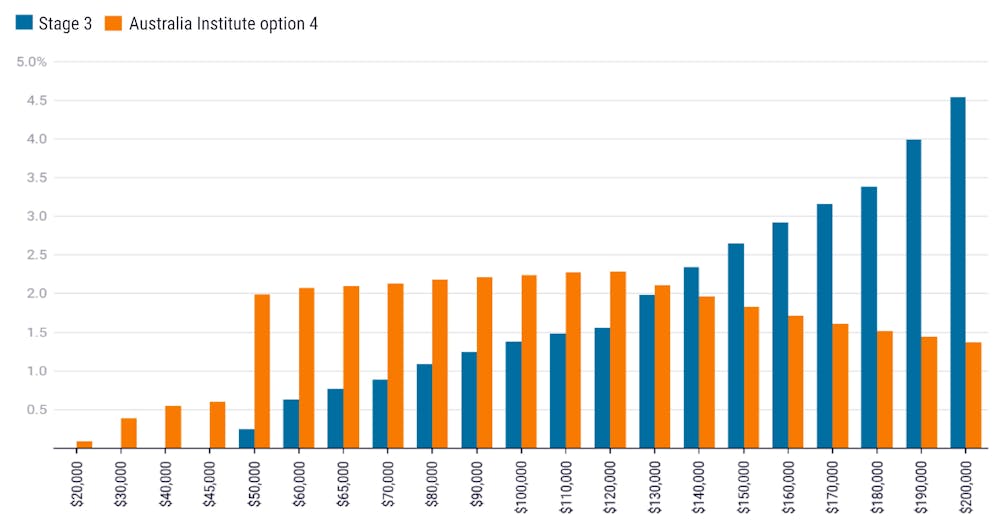
Here’s how a TV series inspired the KeepCup revolution. What’s next in the war on waste?

Source: The Conversation (Au and NZ) – By Danie Nilsson, Behavioural Scientist, CSIRO

Lune Media

Changing habits can be hard. So when a single episode of an Australian television show prompted a national shift in behaviour, as behavioural researchers, we took notice.

The first (2017) and second (2018) seasons of the ABC TV program War on Waste reached audiences of 3.8 million and 3.3 million viewers, respectively. That’s one in seven Australians. It inspired action, slashing the waste footprint of hundreds of Australian organisations. So it remains a valuable example of TV driving social change, and one we can still learn from today.

Through focus groups conducted in 2018, we explored how the first season encouraged Melbourne millennials’ to adopt reusable coffee cups. Then, when the COVID pandemic prompted greater use of disposable consumer products, we revisited the data and delved deeper into behavioural science.

Our analysis revealed people were drawn to the engaging storytelling, confronting visuals and prankster ex-Chaser host Craig Reucassel. He demonstrated, step-by-step, how to minimise waste in a relatable and guilt-free way. Our research, recently published in the journal Communication Research and Practice, can guide others to achieve similar success in behavioural change.

The #BYOCoffeeCup tram in Melbourne from the ABC’s War on Waste series, May 2017.


Read more:
What makes people switch to reusable cups? It’s not discounts, it’s what others do


Educational entertainment

In War on Waste, Reucassel confronts Australia’s many waste-management problems and potential solutions.

The series is an example of what behavioural psychologists call “entertainment-education interventions”.

In one episode, Reucassel staged a stunt on a Melbourne tram during peak hour, proclaiming it was filled with 50,000 disposable coffee cups – the amount sent to landfill every 30 minutes in Australia.

Almost overnight, KeepCup sales quadrupled, crashing the company’s website. Membership of a Responsible Cafes initiative promoting reusable coffee cups spiked from 400 cafes to 1,800.

An ABC study found more people of all ages bought coffee in reusable cups after War on Waste aired (up from 37% to 42%).

The survey also revealed millennials (aged 18-34 in 2017) were generally less likely to adopt waste-reduction behaviours compared with other age groups. But they excelled in using reusable coffee cups.

Why was the show so successful in encouraging people, and specifically millennials, to use reusable coffee cups?

If we can explain why this behaviour was so readily adopted, perhaps we can promote other sustainable behaviours at scale, in other entertainment-education interventions.

Our research uncovered five tactics used by the show to get these results.

1. Use a relatable host

Humans relate to people on TV. Research shows celebrities and people we consider engaging and credible are more likely to influence us.

Reucassel is a popular host with celebrity status. One focus group participant said:

A lot of films […] feel very preachy. It’s often either an expert, or just a narrator, who clearly didn’t know anything about the topic beforehand, who has now researched things, who is telling you things. Whereas in the case of the War on Waste, it felt more like he [Reucassel] was learning it with you, at the same time.

In the first season, we watched as Reucassel sorted the contents of a recycling bin, sharing the learning experience with the viewer. Research shows we are more likely to adopt a new behaviour if we’re shown how to do it rather than told what to do.

2. Mix statistics with confronting visuals

High-impact visuals have lasting effect. Reucassel’s many stunts served not only as an engaging way to present statistics, but also a way to connect with viewers by stirring up emotions. This approach builds audience knowledge and willpower, making a change in behaviour more likely.

As one focus group participant put it:

My favourite thing about the show was all the stunts that Craig pulled – it’s classic Chaser stuff. Like the big rolling ball of plastic bags and the tram full of coffee cups. I thought that aspect of it was the most hard-hitting and interesting.

Craig Reucassel stands alongside a 50m long table covered in food, which is the amount one family wastes in a year
Craig Reucassel stands alongside a 50m long table covered in food, which is the amount one family wastes in a year.
Lune Media


Read more:
We found 3 types of food wasters, which one are you?


3. Promote widespread community action

A common problem with behaviour change initiatives is a person will only change their behaviour if they feel like others are going to change their behaviour too. This often leads to “the tragedy of the commons”, where no one ends up taking action.

The opposite was true for War on Waste. Focus group participants felt the show created a groundswell for environmental change, so they were more inspired to take action because they felt others were taking action too. In the words of one:

I really enjoyed how it was a mix of personal actions [and] more systemic changes […] like getting Coles and Woolworths to change cosmetic standards [for fresh produce] but also the episode with the fast fashion, about getting the teenage girls to consider their own personal choices.


Read more:
Households find low-waste living challenging. Here’s what needs to change


4. Choose behaviours with an easy learning curve

Reducing waste may never be “easy”, but by choosing behaviours perceived to be low-cost with little inconvenience, we have a better chance of success.

Swapping the disposable coffee cup for a reusable cup was considered relatively easy with a “quick learning curve” – compared to composting or having a worm farm – and so became more readily adopted than other behaviours demonstrated in War on Waste.

Craig Reucassel with a Melbourne tram filled with 50,000 disposable coffee cups
The shocking sight of a Melbourne tram filled with 50,000 disposable coffee cups stopped city commuters in their tracks.
Lune Media

5. Show how behaviour can reveal social identity

People from all generations prefer to act in accordance with what society deems acceptable. So pro-environmental behaviours are more likely to be adopted when social pressure is placed on them.

War on Waste placed social pressure on us all to reduce our waste. Adopting a reusable coffee cup became a visible symbol for millennials to demonstrate to others that they were doing their bit, while expressing their environmental values.

As one participant said:

I think it’s just a trendy, convenient way to maybe look and feel like you are doing something that’s […] the right step.

What can we learn from this, and what’s next?

Many of the strategies we identified as successful in season one reappeared this year in season three, such as confronting visual stunts, shared learning experiences and targeting easy behaviours.

Based on the findings from our research, we expect to see further positive change generated from this season.

Our research also presents an opportunity to practitioners wanting to create behaviour change at scale by providing them with behavioural science strategies to embed in entertainment-education interventions.


Read more:
What to wear for a climate crisis


The Conversation

The authors do not work for, consult, own shares in or receive funding from any company or organisation that would benefit from this article, and have disclosed no relevant affiliations beyond their academic appointment.

ref. Here’s how a TV series inspired the KeepCup revolution. What’s next in the war on waste? – https://theconversation.com/heres-how-a-tv-series-inspired-the-keepcup-revolution-whats-next-in-the-war-on-waste-210718

‘You only assess what you care about’: a new report looks at how we assess research in Australia

Source: The Conversation (Au and NZ) – By Kevin McConkey, Emeritus Professor , UNSW Sydney

ThisIsEngineering/Pexels, CC BY-SA

Research plays a pivotal role in society. Through research, we gain new understandings, test theories and make discoveries.

It also has a huge economic value. In 2021, the CSIRO found every A$1 of research and development investment in Australia creates an average of $3.50 in economy-wide benefits.

But how do we know if individual research projects being conducted in Australia are good quality? How is research recognised? The key way this happens is through “research assessment”.


Read more:
Tumult and transformation: the story of Australian universities over the past 30 years


What is research assessment?

Research assessment is not a centralised or necessarily formal process. It can involve various processes and measures to evaluate the performance of individual researchers and research institutions. This includes assessing the quality, excellence and impact of various outputs.

Research assessment can be qualitative or quantitative. It can include publications in journals and the number of people who cite the research, gaining grants to do further research, commercialisation, media engagement and impact on decision-making or public policy, prizes and invitations to speak at conferences.

If research assessment is working fairly and effectively, it should achieve several things. This includes: helping to develop researchers’ careers, making sure innovative research does not get avoided in favour of short-term gains and helping funders and the community have confidence research is providing value for money and adding to the public good.


Read more:
We solve problems in 30 days through ‘research sprints’: other academics can do this too


Our project

Our new project aimed to provide a better understanding of how research assessment affects research in Australia.

In a report released today, we surveyed more than 1,000 Australian researchers and more than 50 research organisations.

This included universities, research institutes, industry bodies, government and not-for-profit organisations. The majority of researchers (74%) were in academic roles. Across those research sectors, we also conducted 11 roundtables involving around 120 people and 25 intensive interviews to understand the issues.

This work was commissioned by Chief Scientist Cathy Foley and conducted by the Australian Council of Learned Academies (involving the academies of science, medical science, engineering and technological sciences, social sciences and humanities).

It also comes as the Universities Accord review examines how research is funded and approached within higher education.

A young man searches the shelves of a library.
Research assessment should help to develop researchers’ careers.
Tima Miroshnichenko/Pexels, CC BY-SA

What we found

We found some difficulties with the current approach to research assessment.

We heard there is a tendency by some researchers to “play it safe” in terms of doing research they believe will score well. We also heard how the assessment process can unintentionally exclude or devalue particular forms of knowledge, particularly in the humanities and the social sciences, where outputs can be less easily quantified or less immediately seen.

As one interviewee said:

What is assessed and how it is assessed are an indication of what the
organisation values. You only assess what you care about. Values and
culture drive assessment.

Our roundtables told us senior staff and supervisors are often seen to reinforce the culture of “publish or perish”, with the number of articles being valued more highly than the quality.

We heard early and mid-career researchers and people from underrepresented backgrounds can have difficulties trying to “play the game” to advance their careers. For example, early-career researchers are often expected to produce work that benefits their larger team, at a cost to their own capacity for promotion.

As one interviewee noted:

Metrics are essential for defining value and comparative difference, but
Australia requires a modern and fair framework for assessing our current
and next generation of researchers.

Survey results

Our survey found a high level of dissatisfaction with the state of research assessment. This included:

  • 73% of respondents agreed assessment processes are not consistently or
    equitably applied across disciplines, in particular between the humanities and the sciences

  • 67% said there are not enough opportunities to provide input into research assessment practices

  • 70% said assessments took up unreasonable time and effort.


Read more:
Fieldwork can be challenging for female scientists. Here are 5 ways to make it better


The way forward

In our survey, we asked “What is one specific change you would
recommend to improve current research assessment processes?”.

Respondents wanted to see a shift towards quality over quantity. This means not just a focus on publishing as many papers as possible, but supporting research that may take longer for its value and benefits to emerge.

They wanted interdisciplinary research to be promoted and rewarded, because many of the complex problems of our world – from climate change to domestic violence to housing affordability – require multiple disciplines to be involved in finding solutions. In the same vein, they also wanted collaboration and team work to be rewarded more clearly and transparently.

They wanted less bias towards STEM (science, technology, engineering and maths) research and more promotion of diversity and of early-career researchers. This included better understanding of their personal and cultural situation, more focused career development and better managed teamwork.

To achieve all of this, and more, we will also need to understand that no single measure can assess all research or researchers. So, several tools will be needed, including quantitative indicators as well as qualitative measures and peer review.


Ana Deletic, Louisa Jorm, Duncan Ivison, Robyn Owens, Jill Blackmore, Adrian Barnett, Kate Thomann, Caroline Hughes, Andrew Peele, Guy Boggs and Raffaella Demichelis were all part of the expert working group supporting this work.

The Conversation

Kevin McConkey has previously received funding from the Australian Research Council. He is the current chair of the Policy Committee of the Academy of the Social Sciences in Australia. He is the chair of the Expert Working Group of the the Australian Council of Learned Academies, which prepared the report referred to in this article.

ref. ‘You only assess what you care about’: a new report looks at how we assess research in Australia – https://theconversation.com/you-only-assess-what-you-care-about-a-new-report-looks-at-how-we-assess-research-in-australia-217541

Cash may no longer be king, but the Optus debacle shows it is still necessary

Source: The Conversation (Au and NZ) – By Chris Vasantkumar, Lecturer in Anthropology, Macquarie University

Shutterstock

A simple software upgrade went wrong. Across the country economic life ground to a halt. Groceries were abandoned at supermarket checkouts. Commerce was paralysed as the nation waited for its payment system to be brought back on line.

The Optus outage lingers fresh in our minds yet the scene described here is not Melbourne or Sydney in November 2023, but Zimbabwe four years ago when the southern African nation suffered a 72-hour outage of the mobile money service known as Ecocash.

At a time when up to 96% of the country’s transactions were cashless, EcoCash, owned by the privately held telco, EcoNet, boasted more than three times the number of registered users than there are Zimbabweans who hold traditional bank accounts, and a near monopoly on mobile money payments.


Read more:
Optus has revealed the cause of the major outage. Could it happen again?


Occurring soon after a deeply unpopular move towards a cashless economy, this outage, along with a shorter one due to rolling blackouts earlier that same year, exacerbated concerns about the reliability of non-cash payments.

Abandoning the cashless experiment

Four years on, Zimbabwe has retreated from cashlessness, with the pandemic facilitating a return to cash in US dollars as the preferred means of payment. While the 2019 outage was not the only reason Zimbabwe returned to a cash economy, increasing frustration with mobile phone transactions contributed to it.

When I talk informally to Australians about these events and their possible implications for our own economic behaviours, I commonly hear some variant of the reply “but Australia isn’t Zimbabwe!”

Unidentified person making payment using iPhone
The Optus and other outages raise questions about the benefits of becoming a cashless society.
Shutterstock

But the Zimbabwean case holds some important lessons for us about the undesirability of eliminating cash in the aftermath of the latest Optus outage.

First, these outages highlight a key advantage of physical cash – it never goes down. We can rely on it to be there when we need it in contrast to cashless payment systems such as EFTPOS which suffered disruptions during the 2020 fires in NSW and Victoria.

We’re using less cash but we still won’t let go

Many Australians might argue for the need to keep cash as a fall back in the event of future natural and technical disruptions but the main reason they want to hang onto it has nothing to do with using it to buy and sell.


Read more:
Optus said it didn’t have the ‘soundbite’ to explain the crisis. We should expect better


Indeed its use in buying and selling has been in decline for 20 years and continued to decline during the pandemic. The total percentage of economic transactions cash accounted for dropped from 69% in 2007 to 13% in late 2022 according to the Reserve Bank’s June Bulletin on Consumer Payment Behaviour in Australia.

By contrast, much of the continuing demand for cash can be attributed to its use as a store of value — something you hold onto rather than spend. During the pandemic there was more cash being kept under metaphorical mattresses as a source of security and comfort, than was being spent.

A March 2021 RBA report found from March 2020 to February 2021, the value of banknotes in circulation rose 17.1% to A$97.3 billion because people were holding onto money at home? Moreover, even as its most recent report on cash usage highlights decreased reliance on cash across all demographics, the percentage of respondents stating they would “experience a ‘major inconvenience’ or ‘genuine hardship’ if cash was hard to access or use” has remained unchanged since 2019 at just over a quarter.


Read more:
Going cashless isn’t straightforward. Ask Sweden, or Zimbabwe


This desire to access cash even as its circulation declines highlights the degree to which doing away with it might be ill-advised and potentially destabilising. Indeed, this is exactly what happened in Zimbabwe — the country went cashless very quickly and without buy-in from most people.

Other reasons to keep cash, apart from dodgy technology

Other concerns about going cashless include the lack of privacy in the electronic payment system plus it being more difficult to control spending.

Even as some Australian banks move away from handling cash, other countries, Sweden most famously, have been forced to walk back such measures to respond to the needs of communities left behind by the shift to cashless payments.

These include the elderly, people in regional and remote areas, migrants and people who don’t have a bank account? While these groups are decreasing in size we ignore people who don’t have the knowledge the confidence or reliable access to cashless payment systems at our peril.

The financial transaction process needs to be inclusive. Standard, state-issued currency has historically been a public good that is accessible to all and ideally not a source of profit.


Read more:
Depending on who you are, the benefits of a cashless society are overrated


Going cashless is a form of privatising money. It moves transactions into a world where you must rely on banking institutions to buy and sell things while someone is making money off your financial dealings through fees. We wouldn’t usually think about this as similar to selling off the power grid but in some ways it is.

And as we saw all too vividly with the Optus debacle, a transition to privatised payment infrastructures opens up new kinds of vulnerability to go along with their convenience.

The Conversation

This article draws on research funded in part by a Macquarie University New Staff Grant and the Wenner-Gren Foundation.

ref. Cash may no longer be king, but the Optus debacle shows it is still necessary – https://theconversation.com/cash-may-no-longer-be-king-but-the-optus-debacle-shows-it-is-still-necessary-217520

How social media is breathing new life into Bhutan’s unwritten local languages

Source: The Conversation (Au and NZ) – By Tashi Dema, PhD Candidate in Language and Politics, University of New England

Shutterstock

Dechen, 40, grew up in Thimphu, the capital city of Bhutan. Her native language was Mangdip, also known as Nyenkha, as her parents are originally from central Bhutan. She went to schools in the city, where the curriculum was predominantly taught in Dzongkha, the national language, and English.

In Dechen’s house, everyone spoke Dzongkha. She only spoke her mother tongue when she had guests from her village, who could not understand Dzongkha and during her occasional visits to her village nestled in the mountains. Her mother tongue knowledge was limited.

However, things have now changed.

With 90% of Bhutanese people using social media and social media penetrating all remotes areas in Bhutan, Dechen’s relatives in remote villages are connected on WeChat.

She is in three WeChat groups where people usually communicate through voice messages in their native language. Most WeChat users in rural parts of the country communicate in their oral native language.

“I learn many words. I learnt how to say a lot of things in my own language,” the mother of two now living in Western Australia told me.

Dechen’s story is not isolated. Social media is giving a new lifeline to Bhutan’s native languages, which do not have written script and lack proper documentation. By communicating through voice messages, social media is giving Bhutanese people in both urban and rural areas a new opportunity to use their local language.


Read more:
What can the kingdom of Bhutan teach us about fighting corruption


Losing Bhutan’s languages

Bhutan is a tiny Himalayan nation with a population of under 800,000 people. Internet and television was introduced only in 1999 and mobile phones in 2004.

The country has more than 20 local languages, but only Dzongkha has written text and is promoted as the national language.

The country struggles to promote the national language and its usage against English. Today most urban residents, especially the elites, speak English as their primary language.

A Bhutanese woman on a phone.
WeChat users can send each other voice messages in their local language.
Shutterstock

Many languages – especially minority languages – are vanishing or becoming endangered as younger generations switch to Dzongkha and English.

The medium of instruction in schools is mostly in English; Dzongkha is taught only as grammar and literature. Students are shamed and often punished for using their local languages.

The preservation and promotion of local languages, therefore, depends on the speakers. A language faces extinction when its speakers die out or switch to another language.

Linguist Pema Wangdi has researched languages in Bhutan, and he told me many people are losing their native language.

“When we lose our language, we lose a piece of our national identity,” he told me.

Masked dance of Dochula Tsechu.
Languages are an important part of cultural identities.
Pema Gyamtsho/Unsplash

Wangdi has identified there are no longer any speakers of Olekha, an indigenous dialect of Rukha in Wangdu Phodrang.

“The loss of a single language is a loss of a piece of our national linguistic heritage and identity,” he said. “When a language is lost, cultural traditions which are tied to that language such as songs, myths and poetry will be lost forever.”

Other Bhutanese languages – including Tshophu language of Doyaps in Samtse, Monpa language of central Bhutan, and Gongdukha of Mongar – are endangered and at the brink of extinction.

Preservation of local languages

The future of the minority languages are at threat. The Constitution of Bhutan mandates the preservation and promotion of local languages, but there are no official efforts to preserve native languages.

But encouraging people to speak their native languages can have far reaching benefits in preserving and promoting Bhutan’s rich culture and tradition. Language embodies identity, ethnicity and cultural values: a thriving local language would help transfer this intangible wealth to the younger generation.

Social media could be an invaluable tool in this preservation.

Bhutanese man checking his mobile phone next a white stone wall.
Social media could be an invaluable tool in the preservation of languages.
Shutterstock

Bhutan could save its languages from becoming extinct with promotion of social media usages and language education could be done on the social media platforms. With both young and old people glued to social media, encouraging more people to use local languages in social media could generate interest among the youth to learn their local languages.

It could also help in documenting the endangered local languages as the older generation can record their voices on WeChat.

Many elder citizens feel strongly about their language and emphasise teaching their mother tongue to the younger generation and their grandchildren. Social media – joining the younger generation on platforms where they feel at home – could be the way forward.


Read more:
Thinking of taking up WeChat? Here’s what you need to know


The Conversation

Tashi Dema does not work for, consult, own shares in or receive funding from any company or organisation that would benefit from this article, and has disclosed no relevant affiliations beyond their academic appointment.

ref. How social media is breathing new life into Bhutan’s unwritten local languages – https://theconversation.com/how-social-media-is-breathing-new-life-into-bhutans-unwritten-local-languages-210280

We could make most Australians richer and still save billions – it’s not too late to fix the Stage 3 tax cuts

Source: The Conversation (Au and NZ) – By Peter Martin, Visiting Fellow, Crawford School of Public Policy, Australian National University

The Albanese government is about to have to make a really important decision.

It’s going to have to decide what’s more important: supporting Australians who are financially under water, or keeping an election promise.

And it’ll have to do it soon. It’s already working on its May budget, now just six months away.

That choice will affect almost every Australian, and it could shape whether you’re thousands of dollars a year better off – or not – from July next year.

Household budgets are shrinking

When Labor took office in May 2022, Australians were doing well. Consumer spending and economic growth were on the up and up, and mortgage rates and rents were only starting to climb.

A promise to keep the proposed multi-billion dollar Stage 3 tax cuts – announced but not implemented by the Coalition back in 2018 – seemed worth making to clear away any reasons any voters might have not to vote Labor.

Since May 2022, just about everything has got worse for “ordinary” Australians – those on typical incomes, which are about $85,000 for full-time workers and $43,000 for adult part-time workers.

The best measure of the buying power of after-tax incomes is real household disposable income per capita. During the past year, it shrank 5.3%, which is more than it shrank in either the early 1990s recession or the global financial crisis.

On my calculations, it’s the worst collapse in 40 years.

From those incomes have to be taken rents and mortgage payments.

The Reserve Bank says scheduled mortgage payments are now taking up a larger share of household disposable income than at any time in history10% when averaged over all households, including those that don’t have mortgages, and many times that for those that do.

This means when you go to the supermarket and find you can’t afford what you used to, you’re not imagining it. It hasn’t been like this in decades, and it’s about to get worse.

The Christmas bonus is missing

No bonus this year.
Shutterstock

In the lead up to each of the past four Christmases, ordinary earners have received a bonus from the tax office – the so-called low and middle income earner tax offset, initially worth $1,080 and increased to $1,500 in 2022.

This year, it’s gone. It means middle-earners’ pre-Christmas tax refunds will be up to $1,500 smaller or replaced with bills. Taxpayers who normally have a tax bill will get a bill up to $1,500 bigger.

An estimated 10.5 million Australians submitted their tax forms by October 31.

Most of them – most of those earning up to $90,000 and previously eligible for the full $1,500 offset – are about to find themselves a good deal worse off.


Read more:
Why do I suddenly owe tax this year? It could be because the Low and Middle Income Tax offset is gone, forever


Average earners will lose, while the rich get thousands

The very expensive Stage 3 tax cuts (costing $20 billion in their first year, and $313 billion over ten years) were meant to come to the rescue. They begin next July.

Speaking notes prepared for Treasurer Jim Chalmers and released under freedom of information laws say they will provide relief to low and middle earners and kick in at $45,000.

But someone on that income will get no relief. That person will lose an offset of $1,275 in return for a tax cut of zero. Someone on a higher wage of $50,000 will lose $1,500 in order to gain $125, and someone earning the typical full-time wage of $85,000 will have to lose $1,500 to gain just $1,000.

That’s right, a typical full-time worker will get relief of $1,000 from the Stage 3 tax cuts in return for losing the axed tax offset of $1,500.

Much higher earners will do much, much better. An Australian earning twice as much as is typical – $190,000 – will get $7,500. An Australian earning a bit more than that again – $200,000 – will get $9,000.

Labor has been handed an opportunity

Handing $9,000 to a high earner but only $1,000 to an ordinary full-time earner is
an indulgence that might have seemed okay when it looked as if ordinary earners were doing alright, or wouldn’t notice.

But it’s about to happen, and it’s about to cost $20 billion in its first year. That’s as much as the government plans to spend on the pharmaceutical benefits scheme in that year and almost twice what it plans to spend on higher education.

Greg Jericho has come up with options.
Aaron Hillborn for the Australia Institute, CC BY

What if it kept the tax cuts, but reoriented them to Australians who actually needed them – to the more than 80% of Australians who earn less than $120,000 a year – while still providing generous cuts to those who earned more than $120,000?

That’s a task Matt Grudnoff and Greg Jericho set themselves at the Australia Institute, coming up with four options. Each of those four would cost less than Stage 3 cuts; deliver more to Australians on less than $120,000 – and even fund a $250 per fortnight increase in the JobSeeker unemployment benefit.

Jericho’s punchline, delivered to the revenue summit at Parliament House last month: “I actually wish it was harder than it was”.

Option 4 costs $70 billion less over ten years but leaves every taxpayer earning up to $132,000 better off.

It doubles the tax cut Stage 3 gives to a typical full-time earner on $85,000, and still gives high earners $2,197 a year each.


Stage 3 vs Australia Institute Option 4, tax cut as percent of taxable income

Graph of percentage benefits from Stage 3 and an alternative at different incomes

The Australia Institute, A better Stage 3: fairer tax cuts for more Australians, October 2023, CC BY-SA

His point wasn’t that this is the best option. It was that there are options, many of which give the bulk of Australians – the stressed ordinary voters Labor and the Coalition will need in the next election – much more than Stage 3.

What’s wrong with making 80% of the electorate better off at a time when they desperately need it, and cutting future budget deficits by $70 billion?

Only that it would break a promise, and Prime Minister Anthony Albanese likes keeping promises.

But when asked in an Australia Institute survey what was more important – keeping a promise or reacting to changing economic circumstances – 61% picked reacting to changing circumstances.

Even among Coalition voters, 56% supported reacting to changing circumstances.

It puts the Stage 3 tax cuts in play. There’s still time, and plenty of electoral and economic reasons to rejig them.

The Conversation

Peter Martin is Economics Editor of The Conversation.

ref. We could make most Australians richer and still save billions – it’s not too late to fix the Stage 3 tax cuts – https://theconversation.com/we-could-make-most-australians-richer-and-still-save-billions-its-not-too-late-to-fix-the-stage-3-tax-cuts-217560