“Vabbing”, while not a new trend, is taking social media sites like TikTok by storm.
Vabbing is the act of taking one’s vaginal secretions and using it as a perfume. People dab the secretion on various erogenous zones such as the elbow, wrist or behind the ear. The practice is believed to increase a person’s sexual attractiveness.
Vabbing became popularised recently by TikToker Mandy Lee. She argues, in a now-deleted video, it can help people get dates. Mandy encourages her followers to try it, recommending places such as the gym and crowded bars. Since her original video, there’s been thousands of responses, with the #vabbingtrend hashtag having over 1.5 million views.
How does vabbing work?
Vabbing is premised on the science of pheromones, a form of olfactory communication. In other words, communicating via smell.
Bodily secretions such as vaginal fluids contain pheromones that can convey a range of information about a person, including their genetic makeups. In the animal kingdom, different pheromones can do different things, such as incite a behavioural response.
While pheromones play an important role in how animals communicate with each other, research is divided as to whether pheromones play a significant role in sexual and romantic compatibility for humans. The science is inconclusive as to whether humans can sense pheromones, and if this has any impact on dating or sexual behaviour.
Despite this uncertainty, companies marketing the use of pheromones to attract potential partners is big business. There are plenty of colognes and perfumes that use pheromones promising to increase one’s sex appeal. Whether they work, however, is still in question. Journalist Tayrn Hill, for example, tried them out and anecdotally did not find that her sex appeal increased.
Pheromone perfumes and colognes are considered cosmetic under FDA regulations, meaning that, while companies can claim they use pheromones, there is no regulation as to whether the product actually contains them.
Vabbing has been touted by TikTokers as a more effective form of using pheromones to attract partners than purchasing perfumes. This is, as Mandy Lee claims, based on using one’s own pheromone makeup, rather than an artificially created one.
While scientists argue vabbing does not work and others question if it is a hoax, vabbing practitioners insist on its effectiveness. Several people have tried and documented their vabbing experiences. They claim it has helped them have hotter sex and flirty interactions with others.
Vabbing as a feminist act?
Vabbing has been criticised as an act of desperation. Vabbing is also seen as another tool of patriarchal oppression in which women are taught to value their self-worth by their ability to sexually attract men. It has also been regarded as unhygienic and disgusting, and has become fodder for many comedians.
However, there is a long history of disdain for the vagina’s smell. Vagina’s are viewed as unhygienic, dirty or contaminating. This has been regarded as something shameful and to be disguised, making it a breeding ground for capitalist markets to create insecurities and develop products as a response, such as the development of vaginal cleansing products, marketed to help women “feel fresh” and “confident”, and to mask natural vaginal odours.
More recently, there has been a rise in there has products that promise to not only cleanse the vagina but lighten the vulva. The lightened colour of the skin is not only linked with hygiene, but also racism and privileging whiteness.
Concerns and shame associated with the smell and appearance of genitalia can also result in other practices like Brazilian waxing and anal and vulva bleaching.
The consequences of stigma associated with vaginal smell range from a negative impact on peoples’ comfort with sexual experiences to concerns about sexual health. This can include discomfort in receiving oral sex to encouraging hygiene practices that present the potential for increased health risks.
The trend of vabbing, and those taking it up, could herald a new direction where the vulva and vagina are embraced. These build on public attempts to celebrate the vulva and vagina, such as Gwyneth Paltrow’s vagina scented candle, artistic exhibits that showcase a diversity of genital appearance, or even Aimee Gibbs’s (Aimee Lou Wood, from the television series Sex Education,) labia-themed cupcakes.
Some argue vabbing may be less about attracting others, and more of a form of bodily awareness. Writer Tracey Duncan found that when they vabbed for a week they felt more sexually confident in themselves and began to embrace their natural musk:
This week, I thought more consistently about how much I’ve bought into the misogynist sanitisation of pussy than I ever have before, and I purposefully opted out.
While some may mock the trend of vabbing, take it as ironic, or argue it does not work, it nevertheless indicates the vulva and vagina and their functions are now out and proud.
Andrea Waling receives funding from the Australian Research Council and Commonwealth Department of Health.
Alexandra James receives funding from the Commonwealth Department of Health.
Under compulsory preferential voting, all formal votes must eventually preference one of the major parties over the other. The electoral commission has released preference flow information for all minor parties, This means we can tell, for example, how many Greens voters preferred Labor and how many the Coalition.
Analyst Kevin Bonham said changes in minor party preference flows from 2019 added one point to Labor’s national two party vote of 52.1%. Changes in flows to Labor occurred across the board, with the Greens (12.2% of overall vote) at 85.7% preferences to Labor, up 3.5% from 2019 and a record high.
One Nation (5.0% of overall vote) was at 35.7% to Labor, up 0.9%. UAP (4.1% of votes) was at 38.1%, up 3.3%. Independents (5.3% of votes) were at 63.8% to Labor, up 4.4%. All others (5.1% of votes) were at 45.3% to Labor, up 0.6%. The Coalition’s percentage share of preferences is 100 minus Labor’s share.
I previously published a critique of the polling at this election, which said the polls overstated Labor’s position on primary votes, but understated their share of preferences. These two errors roughly cancelled, so the overall average of Labor’s national two party vote in the five pre-election polls was 52.4%, close to the actual result of 52.1%.
Richmond, Brisbane and Macnamara were in doubt for some time after election night as it was not known which of Labor or the Greens would finish second and benefit from the other’s preferences. In Brisbane, the Greens were in third place, just 0.01% behind Labor on primary votes. They easily overtook Labor by 30.1% to 28.4%, then beat the LNP on Labor preferences.
In Macnamara, Labor held off the Greens by 33.5% to 32.8% from primary votes of 31.8% Labor and 29.7% Greens. In Richmond, Labor was 2.5% ahead of the Greens when the Greens were excluded.
I previously covered Groom, where independent Suzie Holt made the final two on just 8.3% of the primary vote. Labor had 18.7% primary, and Holt edged out Labor by 24.6% to 24.3% with the LNP already over 50%.
Neither One Nation nor the UAP made the final two in any seat, despite a combined 9.1% of the national primary vote. The closest they came was in Maranoa. Labor had a primary vote lead of 15.3% to 11.9% over One Nation, but this dropped to just 20.2% to 20.0% when One Nation was excluded.
Electoral reform proposals
The Guardian reported on July 10 that special minister of state Don Farrell said Labor would attempt to legislate spending caps, truth in political advertising and adherence to the “one vote one value” principle.
The Australian Constitution guarantees each state an equal number of senators, so Tasmania and NSW have 12 senators each, despite NSW having over 15 times Tasmania’s population. There are 12 senators from each state and two each in the ACT and NT, for a total of 76 senators.
The Guardian article reports ACT chief minister Andrew Barr advocated more senators for the NT and ACT. But Bonham said this would make malapportionment worse: while the ACT is underrepresented compared to Tasmania, it is already overrepresented nationally.
Giving the ACT more senators would skew the overall Senate result towards the left. Until David Pocock’s breakthrough win at this election, ACT and NT senators had always split 1-1 between Labor and the Coalition. But the ACT is very left compared to nationally, so extra ACT seats would normally assist the left.
Changing the Constitution requires an overall majority at a referendum, and a majority in a majority of states (so four of the six states). Bonham says there is a further clause in the Constitution that protects each state’s representation; that needs the affected state to vote in favour. Tasmanians are unlikely to vote to reduce their state’s disproportionate seat share in the Senate.
There is also slight malapportionment in the House of Representatives, as each state is guaranteed a minimum five of the 151 seats. Tasmania’s population should only entitle it to 3.3 seats. Bonham said expanding the House to 226 seats (a 50% increase) would fix this issue.
If the house is expanded, the Senate must also be expanded by the same percentage as the house. Bonham said expanding the Senate in this way would justify extra senators being added in the ACT and NT.
At the election, there were over 17.2 million eligible voters, an average of 114,000 per seat. Bonham said Australia’s population has increased by 66% since the last major expansion of parliament in 1984, so a 50% increase in parliament could be justified. However, adding more politicians is likely to be unpopular with voters.
Essential: Albanese’s approval down but still high
In an Essential poll taken in the days prior to July 11, 56% approved of Prime Minister Anthony Albanese’s performance (down three since June) and 24% disapproved (up six), for a net approval of +32, down nine points. Before the May election, Albanese was at +1 net approval as opposition leader.
68% said they haven’t had COVID, 17% have had it, and it felt like a bad cold, 7% have had it, and it felt way worse than any cold they’ve previously had, and 8% say they currently have COVID (4% mild, 4% serious). A question that was last asked in August 2021 had more COVID deaths thought acceptable to “live with”.
Respondents were asked whether they thought Australia had been better, worse or about the same in handling COVID as other countries. 53% thought Australia had been better than the US and 19% worse. For the UK, this was 50% better, 16% worse. China was 49% better, 22% worse. New Zealand was 24% better, 23% worse.
63% said they did not have a vegetarian or meat-reduced diet (up six since March 2021).
Two months since the election, Newspoll has still not returned. Perhaps they were waiting for the preference flow data that was released last Thursday; this will allow them to use 2022 flows.
With federal parliament resuming this week, Labor has a House majority, but will need the Greens and one of the six other Senate crossbenchers to pass legislation opposed by the Coalition through the Senate. Their most likely crossbench allies are David Pocock and the Jacqui Lambie Network.
I covered the early rounds of the UK Conservative leadership contest and the final MP rounds for The Poll Bludger. Liz Truss was in third place, but overtook Penny Mordaunt in the July 20 final MP round to qualify for the Conservative membership vote against Rishi Sunak.
The membership vote is conducted by mail, with the result to be announced September 5. A YouGov membership poll gave Truss a 62-38 lead over Sunak. Truss has promised to slash taxes if elected, including corporate taxes and green levies.

Adrian Beaumont does not work for, consult, own shares in or receive funding from any company or organisation that would benefit from this article, and has disclosed no relevant affiliations beyond their academic appointment.
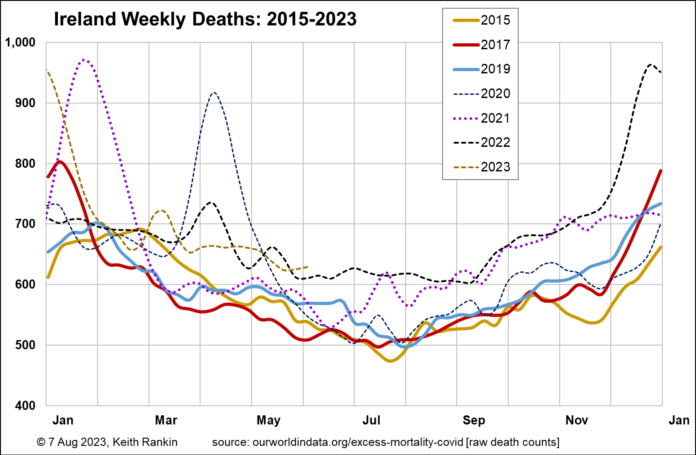
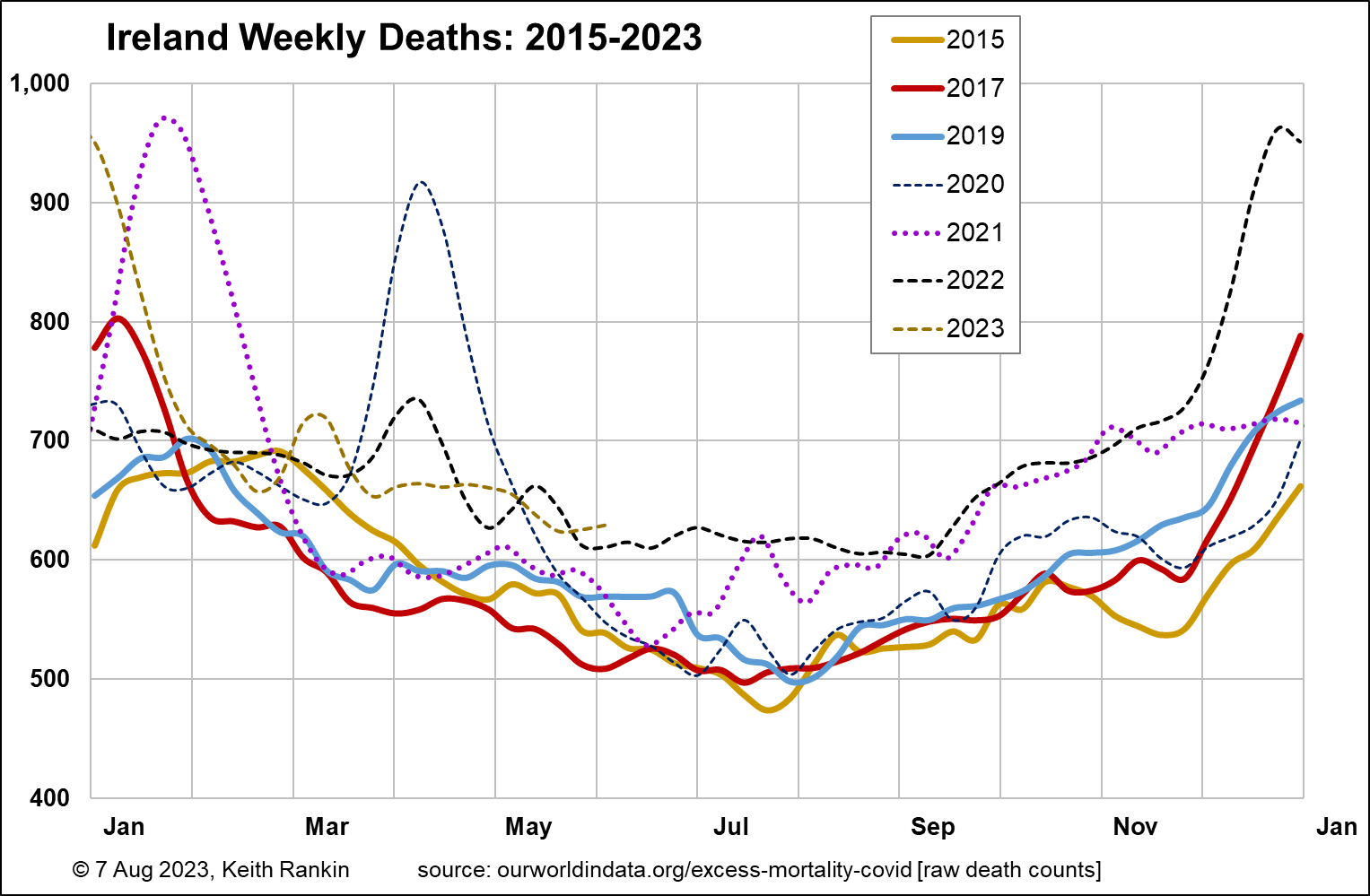
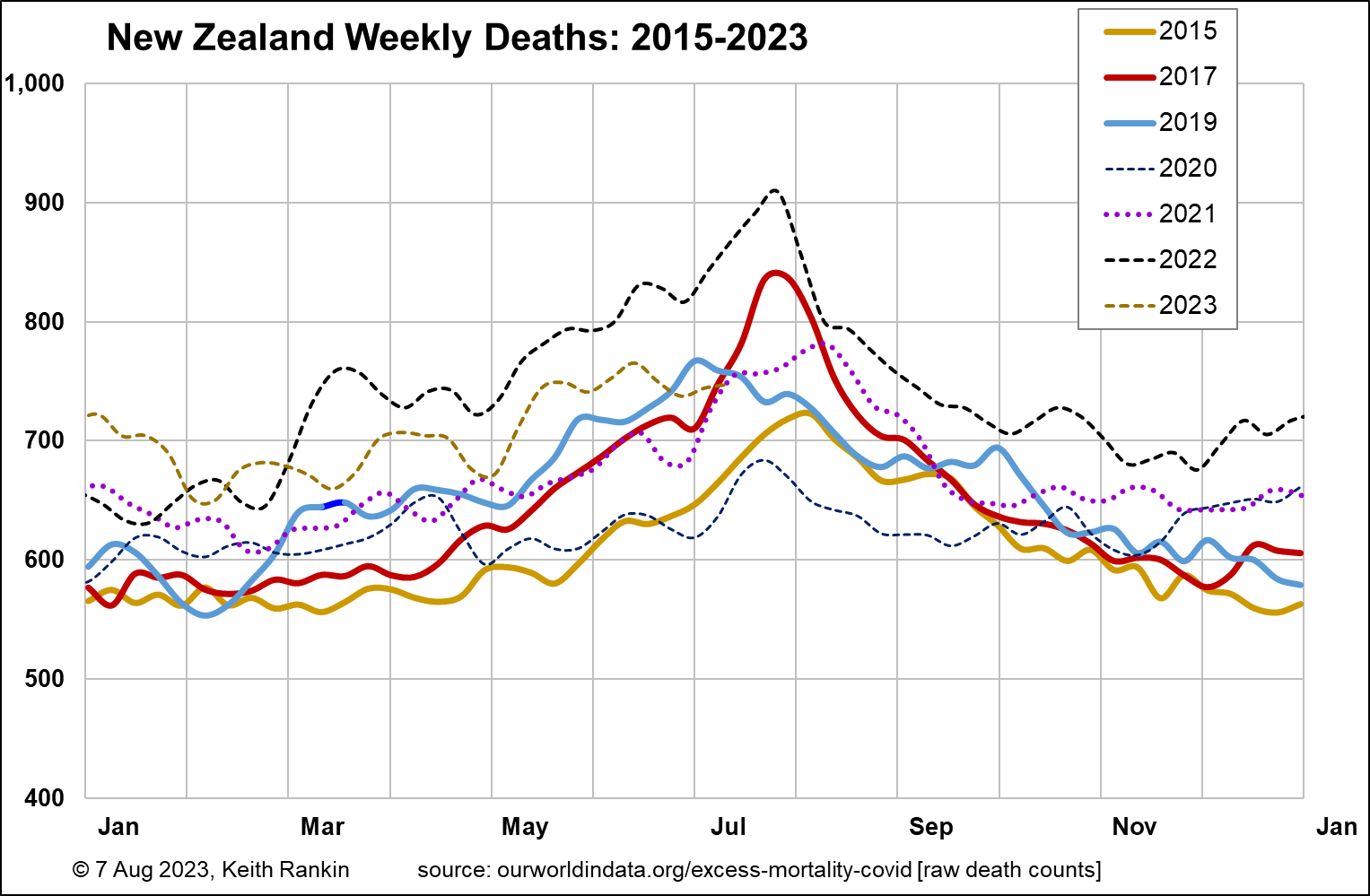
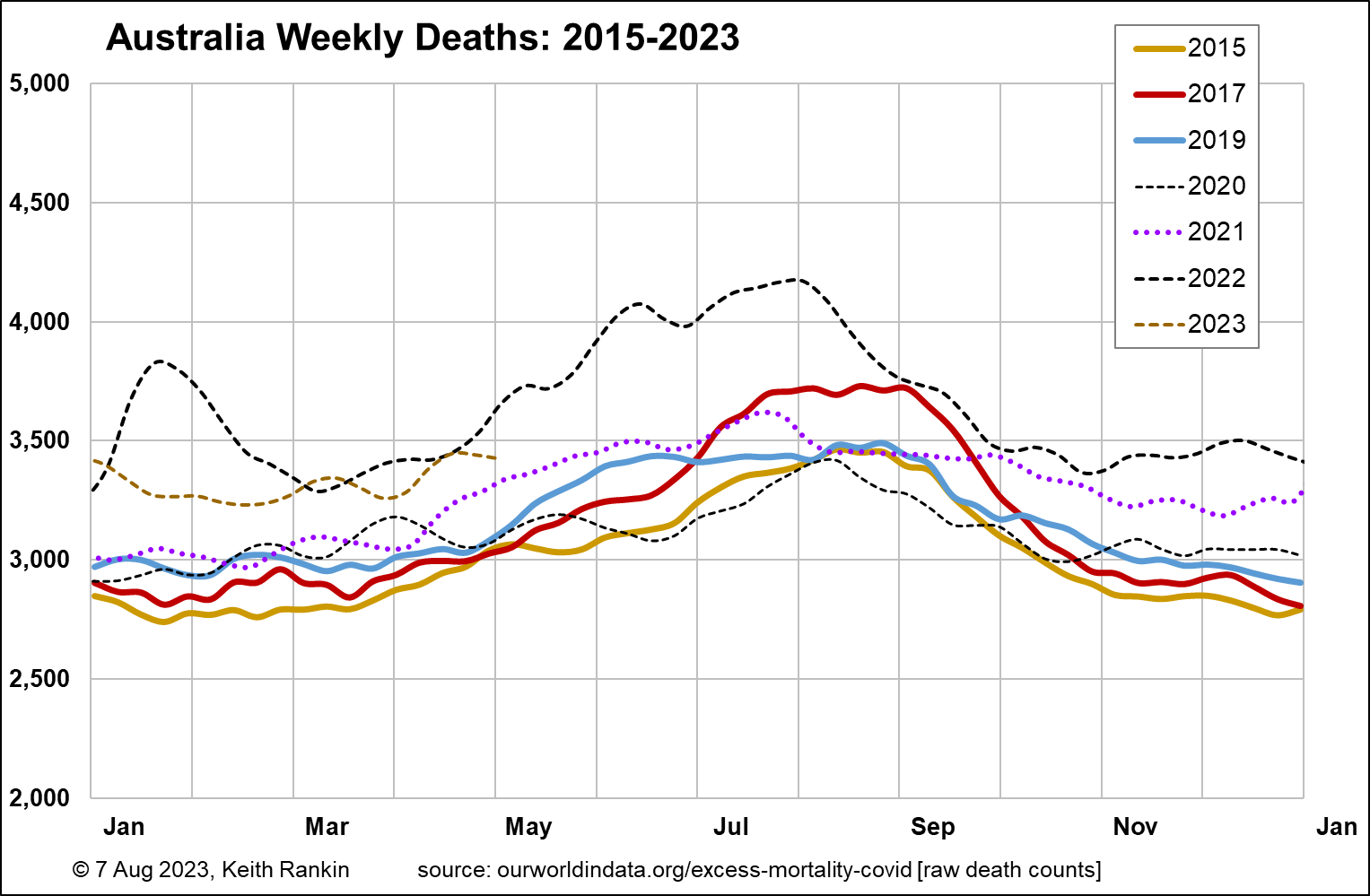
Chart by Keith Rankin.Chart by Keith Rankin.Chart by Keith Rankin.
West Europe
The first three charts (above) show three of the larger Western European countries: Germany, France, Spain. (Italy shows a similar picture.)
The most important data item is ‘excess deaths’. (In the case of France and Spain, the last few weeks of this data have been ‘topped up’ using estimates from The Economist, published by Our World in Data. Germany’s data is complete to the end of June, though most countries which release their mortality data promptly do subsequently revise their recent numbers, usually upwards.) For the pandemic as a whole, Germany has ‘lost’ 1530 per million of its population, including 197pm in the first half of this year.
In Germany, we clearly see the ‘Omicron death wave’ in March 2022, a common but by no means universal feature of country charts of this type. Reported covid cases clearly correlate with excess deaths in that month. We are also seeing the same June/July wave in Germany – in its summer – as we are seeing (in winter) in New Zealand. And, there is a clear June/July death wave to match Germany’s ‘case wave’. (Germany’s two worst death waves were in December 2020 [original Wuhan variant] and November 2021 [Delta variant].)
France shows many of the same recent patterns as Germany, though with only about half the severity. Two important differences are that the late 2020 wave came a month earlier in France, indicating that this late 2020 resurgence in Europe was probably driven by tourists from North America; covid levels in the summer of 2020 were much higher in the USA than in Europe.
Overall, France ‘lost’ 1740 per million of its population, including 240pm in the first half of this year. Certainly, France has the look of a more immune population than Germany. And it’s starting to show once again in the French Caribbean; throughout the pandemic, French people – relatively well-adapted to covid – have been conspicuous spreaders of covid through France’s extant empire.
As with Germany, deaths in the present wave do not show up markedly, yet, in the official death statistics; they only show up in excess deaths, meaning many people who have died in this wave have not been acknowledged as covid deaths.
Spain, while much more like France than Germany, still conforms with the general 2022 pattern for Western Europe. While case numbers appear lower in Spain than France, deaths are similar. Overall, Spain ‘lost’ 2570 per million of its population, including 286pm in the first half of this year. Spain looks to be well up the immunity gradient, like France; more so than Germany. This means that I would predict that Germany will have more excess deaths per million in the second half of this year than France and Spain.
We should note the importance of this concept of ‘immunity gradient’. New Zealand (like the much of the Western Pacific region) has a low place on the immunity gradient. This gradient means that countries like France and Spain will be among the most dangerous for New Zealand tourists to visit, at least with respect to catching Covid19. (New Zealand sports teams in Europe this year will be particularly vulnerable to covid, though these younger and fitter sportspeople will generally get through the illness quite quickly. So far, while significant numbers of elite sportspeople from New Zealand have caught covid overseas, almost none seem to have had disabling forms of the illness.)
Thanks to its place on the immunity gradient, in Spain “the pandemic has felt like an afterthought as Spaniards reverted to their usual beach holidays and eagerly welcomed tourists.” Deep in a Covid wave, Europe counts cases and carries on (22 July, NZ Herald courtesy of NY Times).
We should also note that the Scandinavian countries other than Sweden have charts that are similar to the Germany chart; except that their tolls in the first half of the pandemic so far were lower than Germany’s.
East Europe
Here I include charts for Czechia and Hungary, noting that other neighbouring countries – especially Poland and Slovakia – show similar patterns. (The Balkan countries and the former Soviet Union countries are more complex, and will not be further mentioned here.)
Chart by Keith Rankin.Chart by Keith Rankin.
The first and most important things to note are that Czechia and Hungary successfully suppressed Covid19 until September 2020; they were significantly more successful than even Germany, in this respect. The pattern then shows a particularly severe winter of 2020/21; in two or three waves, though the troughs of these waves were probably overstated.
The key issue here is that countries in these temperate latitudes – and North Europe is the best set of test cases – suffer significant winter seasonal epidemics in three or four winters out of five. The timings of these regular epidemics of excess deaths vary; February tends to be worst. This makes it very hard to determine a winter normal for these countries.
In the winters of 2020/21 and 2021/22, covid has to a large extent displaced influenza and other seasonal cullers. Thus, in the peak influenza months, excess deaths from Covid19 may fall. Rather covid has displaced these other illnesses as the principal seasonal culler. That’s why covid deaths are best understood in the context of the fatal illnesses that covid is displacing. (See these charts on Evening Report.)
Czechia ‘lost’ 4480 per million of its population, including 234pm in the first half of this year. Hungary ‘lost’ 4500 per million of its population, including 292pm in the first half of this year. Overall, both countries have lost nearly one in every 200 of their populations, so far. (One in 200 of the world’s population would be 39 million people.)
So far, these Eastern European countries have incurred double the mortality of the major western countries noted here. But they suffered much less in the first six months of the pandemic, and they have seen significantly fewer deaths in the last couple of months. They also suffered surprisingly little in July-September 2021, the Delta wave that was then washing through the whole world.
These countries appear to have suffered a calamitous shift down the immunity gradient during 2020, and then paid the full price. Thus, by mid-2021, they shifted up the immunity gradient; or at least the ‘natural immunity gradient’. With waning vaccination immunity, and lower rates of vaccination, these eastern countries suffered in the late months of 2021 (October and November).
From the abovementioned New York Times article: “Other parts of Europe were even more hands-off [this year]. In the Czech Republic, where there are no restrictions at all, including in hospitals, the virus is running rampant, and officials openly predict an increasing spike in cases.” While Czechia is a place to watch, I suspect that any uptick in covid there will be less than the present covid spike in Germany. Either way, like France and Spain, Czechia and Hungary are presumably dangerous countries for New Zealanders to visit at present.
New Zealand and Sweden
Chart by Keith Rankin.Chart by Keith Rankin.
These two countries are widely regarded as the developed capitalist countries which represent the opposite ends of the 2020 ‘stringency spectrum’. Sweden’s public health scientists emphasised the importance of population natural immunity as the key to good public health outcomes. New Zealand was the poster-child for interventionist mandates with the aim of creating maximum distance between the coronavirus and the people. New Zealand and Australia took more cues than Europe from those East Asian countries which were at the frontline of the successful suppression of the more lethal (though less transmissible) SARS1 coronavirus.
Sweden ‘lost’ 1210 per million of its population, including 128pm in the first half of this year. New Zealand ‘lost’ minus 220 per million of its population, though plus 272pm in the first half of this year.
Looking backwards, New Zealand has ‘done best’, though its excess deaths this year are comparable to all the other countries mentioned here (except Sweden which has done the best of the developed capitalist countries this year).
What matters, clearly, is the next phase of the pandemic. New Zealand is clearly, at present, well down the immunity gradient. New Zealand remains very vulnerable to international visitors bringing new strains of respiratory (and maybe some non-respiratory) pathogens.
The charts suggest that Spain, France, Czechia, Hungary and Sweden will have comparatively low excess mortality in the coming year and a half. My sense is that Germany will have higher ongoing mortality rates than these neighbours and near-neighbours.
My concern is for New Zealand, ‘going forward’, and with those other western Pacific countries that have taken bigger covid tolls in 2022 than in the previous two years combined. A particular point to note is that the next wave – the coming summer wave (or late spring) wave – will have a higher excess death toll than the present wave.
We see that, in many countries, Covid19 remains much more than a ‘winter’ illness. New Zealand at present is still seeing (at least in the early winter) rising covid-deaths offset by lower than normal non-covid winter deaths. When New Zealand gets to the late-spring or summer, there will be no such offset. Rather, in November or December, New Zealand could suffer a covid death spike similar to those this year faced by South Korea and Taiwan.
In terms of published data, New Zealand had the most covid deaths in the world last week. For some reason this known fact did not make the headlines. (This week New Zealand has been overtaken by Martinique and Anguilla, pointing to a new Caribbean covid wave. Just now is the peak of European and North American tourism into the Caribbean holiday destinations.) Further, while published cases and deaths have held steady in New Zealand over the last week, hospitalisations are rising again in the most recent data. It is possible that New Zealand will suffer over 800pm excess deaths in the second half of 2022; that’s another 4,000 people.
Below is the screenshot from Worldometer from Friday 22 July, showing New Zealand in its place at the top of the table for reported Covid19 deaths. The table is sorted by deaths per million people in each country’s population.
Chart by Keith Rankin.
Context of the Immunity Gradient
Johan Anderberg, in The Herd, cites Hungary and Poland – and Spain and France – as being among “countries that had shutdown playgrounds, forced children to wear facemasks, closed schools, fined citizens for hanging out on the beach, and surveilled parks with drones” (p.298). And he includes Germany, Czechia and Hungary “among countries that hadn’t been affected in the spring and thus lacked immunity” as having problematic experiences at the end on 2020 (p.292). Hungary, “where Viktor Orbán had invoked the threat of the virus to strengthen his power”, gets a special mention for the initial strength of its anti-covid response (p.260).
Re the matter of children, on RNZ today I heard a news report about this story: Likely cause of mystery child hepatitis outbreak found. This story provides significant counter-evidence against requiring younger children to isolate and wear facemasks. Presumably, adenoviruses have been in short supply in New Zealand too, especially given the prolonged closures of New Zealand’s international borders.
It’s more important than ever that the blindspots in New Zealand’s official covid narrative are exposed. Many countries desperately need a scientific scrutiny of facts, and not just a lazy presumption that a few overexposed experts are presenting all the known facts to the New Zealand public; all the facts about New Zealanders’ – and other peoples of the Western Pacific – changing vulnerability to Covid19 and other infectious diseases.
Instead, the latest reporting of Covid19 [RNZ] is substantially downplaying deaths, with no daily death total given in the press release, and no further mentions of people dying ‘with covid’. If the reporting had been done the same as last week, there would have been a record high daily death total of 40. Even under the new tighter definition, the latest daily covid death toll is 29, also close to the daily record.
*******
Keith Rankin (keith at rankin dot nz), trained as an economic historian, is a retired lecturer in Economics and Statistics. He lives in Auckland, New Zealand.
The latest draft report from the Productivity Commission on Aboriginal and Torres Strait Islander visual arts and crafts confirms what First Nations artists have known for decades: fake art harms culture.
Released last week, the report details how two in three Indigenous-style products, souvenirs or digital imagery sold in Australia are fake, with no connection to – or benefit for – Aboriginal and Torres Strait Islander people.
This is a long-standing problem. As Aboriginal Elder Gawirrin Gumana (Yolngu) explained in 1996:
When that [white] man does that it is like cutting off our skin.
The Productivity Commission has proposed all inauthentic Indigenous art should be labelled as such. But we think a much bolder conversation needs to happen around protecting the cultural and intellectual property of Indigenous artists.
Australia has no national licensing or production guidelines to protect Indigenous cultural and intellectual property within commercial design and digital spaces. Our work hopes to see this change.
Our research focuses on supporting and representing First Nations artists within design and commercial spaces, understanding how to ensure cultural safety and appropriate payment and combat exploitation.
Many First Nations artists we spoke to told us stories of exploitative business models. They were blindly led into licensing agreements and client relations that were not culturally safe. Clients thought commissioning a design equated to “owning” the copyright to First Nations art, culture and knowledge.
Gudanji/Wakaja artist and winner of the 2022 NAIDOC poster competition Ryhia Dank told us:
We need clear recognition, structures and licensing guidelines to protect all of what First Nations ‘art’ represents. I know a lot of us, as we are starting out don’t know how to licence our work […]
One of my first designs was for a fabric company and I didn’t licence the design correctly, so that company is still using my design and I only once charged them $350 and that was it. Having legal support from the start is critical.
The 2022 National NAIDOC Poster incorporating the Aboriginal Flag and the Torres Strait Islander Flag (licensed by the Torres Strait Island Council). NAIDOC, CC BY-NC-ND
Arrernte and Anmatyerre graphic novelist Declan Miller explained how many clients and businesses are misguided in thinking commissioning a design equates to owning the copyright to First Nations knowledges.
“Our art is not just art,” he said.
Clients need to be aware this is storytelling. This is culture. We will always own that. But we are happy for clients to work with us, and use our art and pay us for it, but we have to keep that integrity. This is our story, this is where we are from, this is who we are and you can’t buy that or take that from us.
Protecting property
Transparent labelling of inauthentic art is a great start, but there is more work needed.
Intellectual property laws and processes should adequately protect First Nations art.
“Indigenous cultural and intellectual property” refers to the rights First Nations people have – and want to have – to protect their traditional arts, heritage and culture.
This can include communally owned cultural practices, traditional knowledge and resources and knowledge systems developed by First Nations people as part of their First Nations identity.
First Nations products should be supplied by a First Nations business that protects Indigenous cultural and intellectual property, with direct benefits to First Nations communities.
The outcomes of our research have resulted in the recent launch of Solid Lines – Australia’s only First Nations illustration agency to be led by First Nations people. An integral part of this agency is the Indigenous cultural and intellectual property policy designed specifically for the design and commercial art industry.
The agency hopes this policy, created with Marrawah Law, will help create and support culturally safe and supportive pathways for First Nations creatives.
For First Nations artists represented by Solid Lines, our policy also means obtaining culturally appropriate approval to use family or community stories, and knowledges and symbols that are communally owned.
The report from the Productivity commission focuses on fake art coming in from overseas, but fake art also happens in our own backyard.
In our research, we have spoken to Elders, traditional custodians, and community leaders who are concerned that Western and Central Desert designs, symbols and iconography are now used by other First Nations across Australia.
This work often undermines customary laws and limits economic benefits flowing back to communities.
Community designs, symbols and iconography are part of a cultural connection to a specific land or country of First Nations people. Embracing Indigenous cultural and intellectual property policies will mean designs, symbols and iconography can only be used by the communities they belong to.
The Productivity Commission calculated the value of authentic Aboriginal and Torres Strait Islander arts, crafts, and designs sold in Australia in 2019-2020 at A$250 million. This will only continue to grow as Australia’s design and commercial industries continue to draw upon the oldest continuing culture in the world.
Visible recognition and protection of First Nations cultural and intellectual property will allow for new creative voices to respectfully and safely emerge within Australian art and design industries.
Through embracing guidelines around Indigenous cultural and intellectual property, First Nations artists will be supported in cultural safety, appropriate payment and combat exploitation. This is the next step beyond labelling inauthentic art.
Nicola St John has received research funding from Creative Victoria and The Australia Council for the Arts, Australian Government’s principal arts investment, development and advisory body.
Emrhan Sultan does not work for, consult, own shares in or receive funding from any company or organisation that would benefit from this article, and has disclosed no relevant affiliations beyond their academic appointment.
The Commonwealth group that has been observing the Papua New Guinea national elections has called for an urgent review of the electoral process.
The leader, former Nauru president, Baron Waqa, said he was gravely concerned at the daily incidents of violence and tragic loss of life that were being reported.
The Commonwealth Observers said the highly centralised structure of the Electoral Commission had undermined the effective delivery of the election.
They said the 2022 rolls were missing a large number of names, which in some cases meant up to 50 percent of eligible voters were not on the rolls.
They were critical of the late and insufficient disbursement of funds, and that unpaid bills and allowances from previous elections, created a lack of trust in the commission.
The observers reported numerous allegations of bribery and treating involving candidates’ agents.
They said they had witnessed the distribution of money and food to voters during the polling period.
They said there were inadequate efforts to facilitate the inclusion and participation of women, youth, persons with disability, and other disadvantaged groups in the political and electoral process.
The Commonwealth wants to see:
immediate reforms to strengthen voter registration;
the creation of a collaborative and decentralised Electoral Commission that is properly funded by government; and
a national network to support voter education and participation.
The Commonwealth group that has been observing the Papua New Guinea elections has called for an urgent review of the election process.https://t.co/HbB4xK1cig
Moresby governor shocked at election violence Meanwhile, the Governor of Papua New Guinea’s National Capital District has condemned the violence in the middle of Port Moresby on Sunday afternoon, reports RNZ Pacific.
People presumed to be supporters of rival election candidates clashed at the Sir John Guise Stadium where votes from the national election were being counted.
The attackers were armed with machetes and other weapons.
There are unconfirmed reports that at least two people were wounded.
NCD Governor Powes Parkop … the culprits for these “grotesque acts of violence” must be arrested and charged. Image: EMTV News
Governor Powes Parkop said he was shocked to see such “grotesque violence” in the country’s capital, and in broad daylight.
He said it was totally unacceptable and no justification could be made for such unacceptable behaviour.
Parkop said last week that he had asked for police to provide increased security in the election counting centres as he was concerned about the tension and the security risks, but he added that he was not aware that any such efforts had been made.
He said those who committed these “grotesque acts of violence must be arrested and charged and if their candidates are also involved in the planning of these act of violence they too must be arrested and charged.”
Parkop called on all candidates to restrain their supporters and show leadership.
Bishops demand government return to capital The Catholic Bishops of Papua New Guinea called on caretaker Prime Minister James Marape and his cabinet to return to the city and sort out the problems from the unruly election.
In a statement, the bishops said the leaders needed to return to supervise the proper completion of the electoral process; to direct the work and the intervention of the security forces; and to guarantee the safety of individuals, public institutions, and businesses.
They said a severe deterioration of events in the National Capital District in the next few hours or days would deprive those currently holding positions of responsibility of any future credibility and trust for the welfare of the country and its citizens.
This article is republished under a community partnership agreement with RNZ.
Unrest over the Port Moresby Northeast electorate voting in the capital. Image: Inside PNG
The covid-19 pandemic has already generated its own mythology. In Britain, they talk of the “myth of the blitz” – the idea of a society that pulled together in the Second World War to withstand the bombs dropped by the Luftwaffe with pluck, bravery and humour.
In Australia, our covid-19 myth is about a cohesive and caring society that patiently endured lockdowns, border closures and other ordeals. Like many myths, ours has some foundation in reality.
It might be a poor thing when considered alongside wartime Britain’s wartime sacrifices, and you have to ignore the empty toilet paper shelves in the local supermarket, but it still has its own force. It might be especially potent in Melbourne, where the restrictions were most severe and prolonged.
The covid-19 myth is now presenting its puzzles to true believers. If you imagined we all pulled together for the common good, and because we have the good sense to look after our own health, you are likely to find it strange that we are now apparently prepared to tolerate dozens of deaths in a day.
More than tolerate: there has been a preparedness to pretend nothing out of the ordinary is happening.
All of this seems a far cry from those days when we hung on the daily premiers’ media conferences and experienced horror as the number of new infections rose above a few dozen a day, a few hundred, and then a thousand or so. Have our senses been blunted, our consciences tamed?
A product of power Public discourse is never neutral. It is always a product of power. Some people are good at making their voices heard and ensuring their interests are looked after.
Others are in a weak position to frame the terms of debate or to have media or government take their concerns seriously.
The elderly — especially the elderly in aged-care facilities — have carried a much larger burden of sacrifice than most of us during 2020 and 2021. They often endured isolation, loneliness and anxiety.
They were the most vulnerable to losing their lives — because of the nature of the virus itself, but also due to regulatory failure and, in a few places, gross mismanagement.
Aged Care Minister Anika Wells has provided @abcnews with new details on COVID cases in residential aged care homes:
983 current outbreaks 6000+ residents infected 3250 staff are positive
ADF support for aged care homes will be continued until the end of September.
Casual and gig economy workers, too, struggle to have their voices heard. On his short journey to an about-face over the question of paid pandemic leave, Prime Minister Anthony Albanese at first said the payment was unnecessary because employers were allowing their staff to work from home.
Yet the conditions of those in poorly paid and insecure work have been repeatedly identified as a problem for them as well as for the wider community, because they are unable easily to isolate.
Up to his point, however, our democracy has spoken: we want our pizzas delivered and we want to be able to head for the pub and the restaurant. And we are prepared to accept a number of casualties along the way to have lives that bear some resemblance to those of the pre-covid era.
The “we” in this statement is doing a lot of heavy lifting. There is a fierce debate going on about whether governments — and by extension, the rest of us — are doing enough to counter the spread of the virus.
Political leadership matters Political leadership matters enormously in these things.
In the years following the Second World War, Australia’s roads became places of carnage, as car ownership increased and provision for road safety was exposed as inadequate. It peaked around 1970, with almost 3800 deaths — more than 30 for every 100,000 people.
Road fatalities touched the lives of many Australians. If not for the death of my father’s first wife in a vehicle accident on New Year’s Day in 1954, I would not be around to write this article today.
In the 1960s and 1970s, the coming of mandatory seatbelt wearing and random breath-testing helped bring the numbers down. Manufacturers made their cars safer.
Public campaigns urged drivers to slow down and stay sober. These were decisions aimed at avoiding avoidable deaths, despite the curtailment of freedom involved.
A British seat belt advertisement from the 1970s.
These decisions were also in the Australian utilitarian tradition of government, “whose duty it is to provide the greatest happiness for the greatest number” – as the historian W.K. Hancock famously explained in 1930.
The citizen claimed not “natural rights”, but rights received “from the State and through the State”. Governments made decisions about how their authority could be deployed to preserve the common good and protect individuals — from themselves as well as from others.
Pragmatic position Governments have during the present surge so far been willing to take what they regard as a pragmatic position that the number of infections and fatalities is acceptable to “the greatest number”, so long as “the greatest number” can continue to go about something like their normal lives.
But this utilitarian political culture also has its dark side. It has been revealed persistently throughout the history of this country — and long before anyone had heard of covid-19 — as poorly equipped to look after the most vulnerable.
The casualties of the current policy are those who have consistently had their voices muted and their interests set aside during this pandemic — and often before it, as well.
These are difficult matters for governments that would much prefer to get on with something other than boring old pandemic management. The issue is entangled in electoral politics — we have just had a federal contest in which major party leaders studiously ignored the issue, and the nation’s two most populous states are to hold elections in the next few months.
Governments also realise that restrictions and mandates will meet civil disobedience.
But covid cannot be wished away. At a minimum, governments need to show they are serious about it to the extent of spending serious money on a campaign of public information and advice on issues like mask-wearing and staying home when ill.
They usually manage to find a sufficient stash of public money ahead of each election when they want to tell us what a beaut job they’ve been doing. They might now consider whether something similar might help to save lives.
National Capital Dictrict (NCD) police have arrested 18 suspects following the slasher attacks on civilians yesterday outside Papua New Guinea’s national elections counting centre at Port Moresby’s Sir John Guise stadium.
NCD Metropolitan Superintendent Gideon Ikumu said the men were “persons of interest” and police would continue investigating.
“The men [suspects] are in custody with no charges laid until completion of the investigation by our CID,” Superintendent Ikumu said.
He also reassured city residents and the public to remain calm as the police were now out in numbers to carry out patrols and maintain order in the city.
“I hope this doesn’t happen again — our men are now dispatched to areas of concern to monitor and to ensure public safety is guaranteed,” Superintendent Ikumu said.
Superintendent Ikumu said members of the PNG Defence Force were also assisting city police by protecting the counting area at the Sir John Guise Stadium.
“This will now see support units assist regular police to maintain order in Port Moresby,” he said.
The city police chief said opportunists were also taking advantage of the situation. He urged city residents and the general public to be vigilant.
“While police and other security forces are out to ensure order, I call on residents to be mindful when moving around,” said Superintendent Ikumu.
He had also asked the NCD Election Manager to suspend counting until tensions eased in the city.
‘Global shame’ The National’s Rebecca Kuku reports that Papua New Guinea was “shamed internationally … when general election 2022 (GE22) candidates’ supporters turned the streets in the … capital Port Moresby into a battlefield.
“Innocent people ran helter-skelter as political supporters wielding bush knives started chasing and slashing people indiscriminately on the streets in front of City Hall (the National Capital District Commission building) about 2.30pm.
“People were seen running into the compound of the nearby Vision City Mega Mall for refuge as the assailants went about slashing their victims who collapsed on the spot.
“The uncivilised electoral violence started at the nearby Sir John Guise Stadium where counting of GE22 ballots were in progress for the Moresby Northeast electorate.
“Police said the knife-wielding offenders were supporters of two candidates and at least two were wounded.”
“It’s exciting to know that I am involved in making history and that my contribution will leave a legacy for my tupuna and mokopuna to be proud of.”
The words of Waikato Pasifika health advocate Mareta Matenga, who is helping lead a new Pan Pacific Community Hub in Hamilton.
“I am supporting the development of an integrated wellbeing service delivery model which will see different K’aute Pasifika-owned entities operating seamlessly in the same space,” Matenga said.
“This involves me supporting Leaupepe Rachel Karalus, K’aute Pasifika CEO, to support the development of this model, by working alongside other consultants who are also working on the development of the hub.
“My role is specific to the actual services that will work out of the new hub and preparing the team to transition well to the hub.”
The Pan Pacific Community Hub will include an integrated health centre, a stand-alone early learning facility and an open fale-style community space.
The fale is expected to open in September, followed by the childcare and early learning centre in November. The wellbeing component is set to open early next year.
Free or low cost services The hub is expected to offer free or low cost services in health, social, employment, housing and education.
K’aute Pasifika said the hub would enable the trust to better support the holistic wellbeing of families using Pacific models of care.
It will also increase connectedness and the sense of identity, and celebrate and support academic, sporting, creative and leadership potential and achievements.
Born and raised in Kirikiriroa (Hamilton), Matenga’s parents Ere (nee Marsters, Pamati Island) and the late George Ford (Vaipae, Aitutaki Island), together with her eight siblings have dedicated their lives to serving the Hamilton Cook Island Community and their Pacific Islands Presbyterian faith community.
Matenga is well-known within the Waikato community and has more than 20 years’ experience working in community development and community-led approaches.
“I remember being involved over the years in many community fono to dream and discuss how a place like the Pan Pacific Community Hub will help our community thrive and to celebrate our Pacific-ness in Kirikiriroa,” she said.
Matenga said it was exciting to be involved in creating history and that her contribution would leave a legacy for her tupuna and mokopuna.
Strong community experience K’aute Pasifika chief executive Rachel Karalus said Matenga’s strong community experience and connections were an asset to the organisation and the Waikato community.
“Mareta is a well-known and respected community leader who has dedicated herself to support not only her Cook Island community but all the communities in the Waikato,” she said.
“Mareta’s extensive experience in community engagement, community development and planning large scale projects and events will be invaluable to the development of the Wellbeing Service Delivery Model, that will sit inside and across the Pan Pacific Community Hub.”
Matenga said she was also grateful for the 20 years she had worked at the Hamilton City Council, and the vast experiences working with the Waikato community.
“I’m a proud Cook Islander and love knowing that my community support me, not only in the city of Hamilton, region of Waikato, Nation of Aotearoa, but also throughout the world.”
Public Interest Journalism funded through NZ On Air.
New Caledonia’s pro-independence FLNKS (Kanak and Socialist National Liberation Front) has signed a memorandum of understanding with the United Liberation Movement for West Papua (ULMWP), which wants independence from Indonesia.
The Kanak-Papuan deal was signed by Roch Wamytan, President of New Caledonia’s Congress, and the visiting ULMWP leader Benny Wenda.
Wamytan told La Premiere television in Noumea that both territories were involved in a process of decolonisation and emancipation — one with France, the other with Indonesia.
“We have signed this accord because each of us are confronted by a process of decolonisation and emancipation. The people of Papua with Indonesia and us with the French state,” he said.
“This process of decolonisation has not ended for us, it has been ruptured over time, to say the least.”
The memorandum aims to support each other internationally and to develop a list of common goals.
Indonesia took over the western half of New Guinea island after a controversial 1969 UN-backed referendum that is rejected as a sham by Papuans, with West Papuan activists now seeking inscription on the UN decolonisation list.
New Caledonia has been on the UN decolonisation list since 1986, and between 2018 and 2021 has held three referendums on independence from France.
Wenda visited Vanuatu on the first leg of his Pacific trip from his exiled base in London.
He was a guest of the Vanuatu West Papua Independence Committee.
FLNKS will boycott Paris talks New Caledonia’s pro-independence FLNKS movement said it would not attend talks in September of the signatories to the 1998 Noumea Accord in Paris.
West Papuan independence leader Benny Wenda … supporting each other internationally. Image: Koroi Hawkins/RNZ Pacific
A special meeting of the movement’s leadership decided at the weekend that legitimate talks would now have to be bilateral ones, involving the FLNKS and France as the colonising state.
Newly-elected FLNKS Congress member Laura Humunie said bilateral talks were the only formal way to get their message to the French state.
“We repeat, that to obtain bilateral talks we will not go to Paris because for us this is the legitimate way of talking to the French colonial state,” she said.
“Our loyalist partners who have signed the ‘no’ referendum, means that they align with the French state’s ideals.”
Last December, more than 96 percent voted against independence from France in a referendum boycotted by the pro-independence parties, which refuse to recognise the result as the legitimate outcome of the decolonisation process.
This article is republished under a community partnership agreement with RNZ.
West Papuan leader Benny Wenda (red shirt) signing the memorandum of understanding with the FLNKS. Image: FLNKS
Australian scientists are making strides towards solving one of the greatest mysteries of the universe: the nature of invisible “dark matter”.
The ORGAN Experiment, Australia’s first major dark matter detector, recently completed a search for a hypothetical particle called an axion – a popular candidate among theories that try to explain dark matter.
ORGAN has placed new limits on the possible characteristics of axions and thus helped narrow the search for them. But before we get ahead of ourselves …
Let’s start with a story
About 14 billion years ago, all the little pieces of matter – the fundamental particles that would later become you, the planet and the galaxy – were compressed into one very dense, hot region.
Then the Big Bang happened and everything flew apart. The particles combined into atoms, which eventually clumped together to make stars, which exploded and created all kinds of exotic matter.
After a few billion years came Earth, which was eventually crawling with little things called humans. Cool story, right? Turns out it’s not the whole story; it’s not even half.
People, planets, stars and galaxies are all made of “regular matter”. But we know regular matter makes up just one-sixth of all the matter in the universe.
The rest is made of what we call “dark matter”. Its name tells you almost everything we know about it. It doesn’t emit light (so we call it “dark”) and it has mass (so we call it “matter”).
If it’s invisible, how do we know it’s there?
When we observe the way things move in space, we find time and again that we can’t explain our observations if we consider only what we can see.
Spinning galaxies are a great example. Most galaxies spin at speeds that can’t be explained by the gravitational pull from visible matter alone.
So there must be dark matter in these galaxies, providing extra gravity and allowing them to spin faster – without parts being flung off into space. We think dark matter literally holds galaxies together.
The ‘Bullet Cluster’ is a massive cluster of galaxies which has been interpreted as being strong evidence for the existence of dark matter. NASA
So there must be an enormous amount of dark matter in the universe, pulling on all the things we can see. It’s passing through you, too, like some kind of cosmic ghost. You just can’t feel it.
How could we detect it?
Many scientists believe dark matter could be composed of hypothetical particles called axions. Axions were originally proposed as part of a solution to another major problem in particle physics called the “strong CP problem” (which we could write a whole article about).
Anyway, after the axion was proposed, scientists realised the particle could also make up dark matter under certain conditions. That’s because axions are expected to have very weak interactions with regular matter, but still have some mass: the two conditions needed for dark matter.
So how do you go about searching for axions?
Well, since dark matter is thought to be all around us, we can build detectors right here on Earth. And, luckily, the theory that predicts axions also predicts that axions can convert into photons (particles of light) under the right conditions.
This is good news, because we’re great at detecting photons. And this is exactly what ORGAN does. It engineers the correct conditions for axion–photon conversion and looks for weak photon signals – little flashes of light generated by dark matter passing through the detector.
This kind of experiment is called an axion haloscope and was first proposed in the 1980s. There are a few in the world today, each one slightly different in important ways.
The ORGAN Experiment’s main detector. A small copper cylinder called a ‘resonant cavity’ traps photons generated during dark matter conversion. The cylinder is bolted to a ‘dilution refrigerator’ which cools the experiment to very low temperatures. Author provided
Shining a light on dark matter
An axion is believed to convert into a photon in the presence of a strong magnetic field. In a typical haloscope, we generate this magnetic field using a big electromagnet called a “superconducting solenoid”.
Inside the magnetic field we place one or several hollow chambers of metal, which are meant to trap the photons and cause them to bounce around inside, making them easier to detect.
However, there is one hiccup. Everything that has a temperature constantly emits small random flashes of light (which is why thermal imaging cameras work). These random emissions, or “noise”, make it harder to detect the faint dark matter signals we’re looking for.
To work around this, we’ve placed our resonator in a “dilution refrigerator”. This fancy fridge cools the experiment to cryogenic temperatures, about −273°C, which greatly reduces the noise.
The colder the experiment is, the better we can “listen” for faint photons produced during dark matter conversion.
Targeting mass regions
An axion of a certain mass will convert into a photon of a certain frequency, or colour. But since the mass of axions is unknown, experiments must target their search to different regions, focusing on those where dark matter is considered more likely to exist.
If no dark matter signal is found, then either the experiment is not sensitive enough to hear the signal above the noise, or there’s no dark matter in the corresponding axion mass region.
When this happens, we set an “exclusion limit” – which is just a way of saying “we didn’t find any dark matter in this mass range, to this level of sensitivity”. This tells the rest of the dark matter research community to direct their searches elsewhere.
ORGAN is the most sensitive experiment in its targeted frequency range. Its recent run detected no dark matter signals. This result has set an important exclusion limit on the possible characteristics of axions.
This is the first phase of a multi-year plan to search for axions. We’re currently preparing the next experiment, which will be more sensitive and target a new, as-yet-unexplored mass range.
But why does dark matter matter?
Well, for one, we know from history that when we invest in fundamental physics, we end up developing important technologies. For instance, all modern computing relies on our understanding of quantum mechanics.
We never would have discovered electricity, or radio waves, if we didn’t pursue things that, at the time, appeared to be strange physical phenomena beyond our understanding. Dark matter is the same.
Consider everything humans have accomplished by understanding just one-sixth of the matter in the universe – and imagine what we could do if we unlocked the rest.
Source: The Conversation (Au and NZ) – By Frank Bongiorno, Professor of History, ANU College of Arts and Social Sciences, Australian National University
The COVID-19 pandemic has already generated its own mythology. In Britain, they talk of the “myth of the blitz” – the idea of a society that pulled together in the second world war to withstand the bombs dropped by the Luftwaffe with pluck, bravery and humour.
In Australia, our COVID-19 myth is about a cohesive and caring society that patiently endured lockdowns, border closures and other ordeals. Like many myths, ours has some foundation in reality. It might be a poor thing when considered alongside wartime Britain’s wartime sacrifices, and you have to ignore the empty toilet paper shelves in the local supermarket, but it still has its own force. It might be especially potent in Melbourne, where the restrictions were most severe and prolonged.
The COVID-19 myth is now presenting its puzzles to true believers. If you imagined we all pulled together for the common good, and because we have the good sense to look after our own health, you are likely to find it strange that we are now apparently prepared to tolerate dozens of deaths in a day. The total COVID death toll is now above 11,000.
More than tolerate: there has been a preparedness to pretend nothing out of the ordinary is happening.
All of this seems a far cry from those days when we hung on the daily premiers’ media conferences and experienced horror as the number of new infections rose above a few dozen a day, a few hundred, and then a thousand or so. Have our senses been blunted, our consciences tamed?
Public discourse is never neutral. It is always a product of power. Some people are good at making their voices heard and ensuring their interests are looked after. Others are in a weak position to frame the terms of debate or to have media or government take their concerns seriously.
The elderly – especially the elderly in aged-care facilities – have carried a much larger burden of sacrifice than most of us during 2020 and 2021. They often endured isolation, loneliness and anxiety. They were the most vulnerable to losing their lives – because of the nature of the virus itself, but also due to regulatory failure and, in a few places, gross mismanagement.
Casual and gig economy workers, too, struggle to have their voices heard. On his short journey to an about-face over the question of paid pandemic leave, Prime Minister Anthony Albanese at first said the payment was unnecessary because employers were allowing their staff to work from home. Yet the conditions of those in poorly paid and insecure work have been repeatedly identified as a problem for them as well as for the wider community, because they are unable easily to isolate.
Up to his point, however, our democracy has spoken: we want our pizzas delivered and we want to be able to head for the pub and the restaurant. And we are prepared to accept a number of casualties along the way to have lives that bear some resemblance to those of the pre-COVID era.
The “we” in this statement is doing a lot of heavy lifting. There is a fierce debate going on about whether governments – and by extension, the rest of us – are doing enough to counter the spread of the virus. Political leadership matters enormously in these things.
In the years following the second world war, Australia’s roads became places of carnage, as car ownership increased and provision for road safety was exposed as inadequate. It peaked around 1970, with almost 3,800 deaths – more than 30 for every 100,000 people. Road fatalities touched the lives of many Australians. If not for the death of my father’s first wife in a vehicle accident on New Year’s Day in 1954, I would not be around to write this piece today.
In the 1960s and 1970s, the coming of mandatory seatbelt wearing and random breath-testing helped bring the numbers down. Manufacturers made their cars safer. Public campaigns urged drivers to slow down and stay sober. These were decisions aimed at avoiding avoidable deaths, despite the curtailment of freedom involved.
These decisions were also in the Australian utilitarian tradition of government, “whose duty it is to provide the greatest happiness for the greatest number” – as the historian W.K. Hancock famously explained in 1930. The citizen claimed not “natural rights”, but rights received “from the State and through the State”. Governments made decisions about how their authority could be deployed to preserve the common good and protect individuals – from themselves as well as from others.
Governments have during the present surge so far been willing to take what they regard as a pragmatic position that the number of infections and fatalities is acceptable to “the greatest number”, so long as “the greatest number” can continue to go about something like their normal lives.
But this utilitarian political culture also has its dark side. It has been revealed persistently throughout the history of this country – and long before anyone had heard of COVID-19 – as poorly equipped to look after the most vulnerable. The casualties of the current policy are those who have consistently had their voices muted and their interests set aside during this pandemic – and often before it, as well.
These are difficult matters for governments that would much prefer to get on with something other than boring old pandemic management. The issue is entangled in electoral politics – we have just had a federal contest in which major party leaders studiously ignored the issue, and the nation’s two most populous states are to hold elections in the next few months. Governments also realise that restrictions and mandates will meet civil disobedience.
But COVID cannot be wished away. At a minimum, governments need to show they are serious about it to the extent of spending serious money on a campaign of public information and advice on issues like mask-wearing and staying home when ill. They usually manage to find a sufficient stash of public money ahead of each election when they want to tell us what a beaut job they’ve been doing. They might now consider whether something similar might help to save lives.
Frank Bongiorno does not work for, consult, own shares in or receive funding from any company or organisation that would benefit from this article, and has disclosed no relevant affiliations beyond their academic appointment.
“The pill” (the combined oral contraceptive pill) has been giving Australian women control over their reproductive health since the 1960s and remains the most commonly used method of contraception by Australian women.
Its use peaks with around 60% of Australian women in their late teens and early 20s using the pill, and drops to around 35% by the mid to late 20s.
Used perfectly, the pill prevents pregnancy 99.5% of the time, but in the real world where pills are occasionally forgotten it works 93% of the time.
In Australia, half of the women who start on the pill won’t be taking it six months later. Women come off the pill for lots of different reasons, including:
trying to fall pregnant
trying a different contraceptive option
side effects (including headaches, bloating, weight gain, not having a regular period, unpredictable nuisance or “breakthrough” bleeding, nausea, depression, reduced libido)
developing a medical condition where the pill is no longer safe (the most common of these is migraine or deep vein thrombosis, or smoking over the age of 35)
no longer needing contraception
wanting to know what their natural cycle and periods are like.
If you’re preparing to come off the pill, it’s hard to know what to expect – particularly if you’ve been on it for a long time.
Regardless of how long you’ve been taking the pill, the synthetic hormones are cleared from the body within days. Your body returns to releasing different amounts of oestrogen and progesterone throughout the cycle – although what’s “normal” for your body may have changed.
Teenagers can have irregular periods for the first few years before a more regular rhythm establishes. A lot might have changed since you first went on the pill – your body could have developed a medical condition, have a different lifestyle, changed size or shape, or had children. This can all impact how natural hormones in your body can impact you.
Regardless of how long you’ve been taking the pill, the synthetic hormones are cleared from the body within days. Unsplash/artem kovalev, CC BY
Here are some of the changes you might expect when coming off the pill.
Periods!
For many women, periods come back within a month of stopping the pill, with almost all women getting their period within three months. Your periods may start off irregular, but generally return to the natural menstrual cycle within three months. Women on the pill often have quite light periods, so coming off the pill you might experience heavier or longer periods. The natural cycle can also be impacted by exercise, diet, stress and underlying medical conditions. It’s a good idea to see a doctor if you haven’t got your period back within three months.
Fertility
Women can expect their fertility to return to their baseline “natural” level around three cycles after coming off the pill. That being said, you can definitely get pregnant as soon as you come off the pill. Being on the pill does not impact long-term fertility, even if it was taken for many years, so there’s no medical need to take a “break” from the pill to “normalise” things for the body.
For some women, coming off the pill can reveal problems the pill has been masking. For women with endometriosis, the pill commonly reduces their symptoms of painful periods, cramping, heavy bleeding and painful sex – and suppresses growth of the endometrial tissue in areas other than inside the uterus, where it belongs. Coming off the pill can cause a ramping up in period and pelvic pain. For women with a history of polycystic ovarian syndrome, periods are likely to return to being irregular once coming off the pill.
Acne
For women who experience hormonally driven acne (commonly seen around the jawline and which fluctuates with the period cycle), acne can flare after coming off the pill. Getting older or lifestyle changes can impact this though, so it’s not a given acne will return.
Mental health
There is growing evidence the hormones in the pill can bring on or worsen depression for some women, and is one of the most common reasons for stopping the pill. However, for women who experience depressive symptoms in the week leading up to their period (a condition known as premenstrual dysphoric disorder) taking the pill stabilises the mood and works as an antidepressant. It goes without saying then that women coming off the pill can see changes to their mood or anxiety levels, and it’s good to keep your mental health care provider in the loop.
talk to your GP or other health professionals beforehand, particularly if you have had heavy periods, painful periods or other issues in the past. If you’re not happy with your particular type of pill, know there are other options for contraception including other contraceptive pills which may not cause the same side effects
If you’re not happy with your particular type of pill, know there are other options for contraception. Unsplash/Prince Akashi, CC BY
have a plan for alternative contraception if you’re likely to be at risk of pregnancy and want to avoid it. If you have a regular partner, you might wish to have a conversation with them and discuss other options
consider monitoring and writing down your cycle and symptoms (heaviness and painfulness of periods, mood and anxiety) for 2–3 months before coming off the pill and afterwards. This can help you and your doctor recognise if coming off the pill uncovers some unexpected issues. Seek medical advice early if you are having heavy or painful periods
try to choose a time when life isn’t too stressful or chaotic, if possible. This will help you to work out if your symptoms are related to hormones, life in general – or both!
if you’re coming off the pill to prepare to conceive, it’s a good opportunity to book in for a prenatal check up. This can include talking about preparing yourself physically and mentally, supplements, and doing some blood tests to check for immunity against some viruses.
Phoebe Holdenson Kimura does not work for, consult, own shares in or receive funding from any company or organisation that would benefit from this article, and has disclosed no relevant affiliations beyond their academic appointment.
Buyouts involve governments paying compensation or compulsorily acquiring land to manage a retreat from high-risk areas. Moving people and assets permanently out of harm’s way is considered a final step in a long line of options for climate adaptation.
It had often been thought of as something for future generations to grapple with, but my global review of the research literature shows a surge in studies of this issue in the past five years. Retreat is something we have to grapple with now.
Some parts of New South Wales have been flooded four times in 18 months. Retreat and relocation from properties in high-risk areas must now be central to climate adaptation. My research provides lessons for Australia from around the world in how to manage this difficult task.
History repeats
At the height of the Western Sydney floods in March 2021, I wrote about the complexities of managed retreat. The same area has just had yet more catastrophic floods.
My recent review, published by the Royal Society, sought to understand trends and gaps in global research concerned with managed retreat (after a catastrophic event) and planned retreat (before such an event). The aim was to learn how prepared we are for delivering successful retreats from areas at risk. This has lessons for what Australia – and the rest of the world – should be doing.
What did the research find?
I examined published scientific literature in the decade to 2022 containing the keywords “managed retreat” and “planned retreat”.
In the past five years, 135 scientific papers containing these terms were published – a dramatic increase from seven papers in the five years prior. Common themes from these papers included:
the challenges of property rights and compensation
the need for governance and institutional mechanisms to enable an orderly and managed retreat
an increase in negative impacts on vulnerable communities as a result of relocations or retreats that were not orderly or well managed.
In my review, co-ordination across different levels of government emerged as a key barrier to managed retreat. This was no surprise.
Nor was it a shock to find that people’s perceptions of risk are framed in financial terms. Many are reluctant to face falls in the value of at-risk property. This is understandable given the attachments we have to “home” even when the risks are high. As one person told me about people building in dangerous places:
“[…] but this is the history of Australia, people building too close to the water. It’s ridiculous!”
A preoccupation with property values can lead to neglect of other losses associated with managed retreat, such as loss of tourism, infrastructure and other state-owned assets.
Australia is not new to managed retreat. Grantham in Queensland is often held up as a successful example. Even so, people struggled with the enormity of the loss and the complexity of the process of retreat.
Relocated communities overseas, including Oakwood Beach in New York, have gone through similar struggles.
All climate change impacts, including heat, fire and drought, may demand some type of retreat at some time and in a wide range of places.
Lessons from around the world
A recent analysis examined three voluntary buyout programs in the United States. It found those programs could be improved by ensuring the policies supporting buyouts – including which aspects of government were responsible for what – minimised barriers to being assessed for compensation.
Programs also needed to be flexible enough to work in a range of circumstances or places.
A focus on property owners can also lead to neglect of people who are renting or who who do not have a readymade place to relocate to. Australia’s crisis of housing affordability (and availability) crisis means this is a major concern.
Thoughtful and repeated community engagement is essential throughout the process of designing and implementing managed retreat to ensure community acceptance. A study of seven Californian localities identified where managed retreat had been attempted but implementation had failed. Failure was largely due to two reasons:
a failure of communication and inadequate community consultation
“baggage” associated with the term managed retreat, especially in terms of what it means for property ownership.
As noted in other parts of the world, successful managed retreat has several elements:
barriers to implementation must first be identified and understood
those managing the process must learn from historical events – for example, how government and community worked together in Grantham
policy approaches must be consistent across states or countries, to ensure compensation is distributed fairly.
Australia urgently needs a climate adaptation agenda to minimise harm and maximise opportunities as we learn to live with climate change.
As politically perilous as policies of managed retreat may be, climate impacts demand that we start work now on actively and sensibly resolving the risks we face.
Tayanah O’Donnell has previously received research funding from AMP Foundation, the BHP Foundation, the Lord Mayor’s Charitable Trust, the Institute of Australian Geographers, Western Sydney University, the University of Canberra, and state and federal governments. These grants supported over 12 years of research in climate change adaptation and in sustainable development, including managed retreat, climate policy, and climate risk duties and disclosures.
She is a currently a Partner with Deloitte, leading the Canberra climate Risk Advisory practice since 1 November 2021.
Source: The Conversation (Au and NZ) – By Daryl Higgins, Professor & Director, Institute of Child Protection Studies, Australian Catholic University, and Sophie Havighurst, Professor, The University of Melbourne.
www.shutterstock.com
Today, if a parent smacks a child mid-tantrum in the supermarket, they are likely to get looks of disapproval from other shoppers. Smacking is not as socially acceptable as it used to be.
Recent research shows only 15% of people aged 16-24 view physical discipline as necessary to properly raise children. This compares with 38% of people over 65.
But it still happens – and it is very harmful to children. So we need to help parents find alternative methods of discipline.
It is more common than you might think
In 2017, the royal commission into child sexual abuse recommended a national study on how common child abuse is in Australia. Early findings released last month revealed 61% of those aged 16-24 said they were physically hit for discipline four or more times during their childhood.
The research also found those who were hit had almost double the risk of depression and anxiety. This partly because those who had been smacked as a child may have also experienced other forms of mistreatment, such as harsh parental reactions, neglect or insufficient support.
This fits with other research showing negative consequences if children are smacked or hit. A 2016 review of more than 70 international studies showed it was linked to reduced compliance with parents’ instructions over time, children having increased aggression and antisocial behaviour, mental health problems, and lower self-esteem.
In adulthood, it is also linked to antisocial behaviour and being either a victim or perpetrator of intimate partner violence.
What does the law say?
Currently, the use of reasonable force for the purpose of discipline in the home remains lawful under criminal law provisions or common law principles made by courts. This is despite the fact it is illegal in most Australian states and territories in other settings such as schools, or between adults – where it is classed as assault.
Many countries are changing their laws because they understand the harms and because it is a violation of children’s right to live a life free from violence. Already, 63 countries have banned corporal punishment for children, including New Zealand, Sweden, Denmark, South Korea, Wales, Scotland, France and Japan.
But this is not just about law reform. Raising kids can be challenging at the best of times. Kids misbehave or may not be in control of their emotions, and parents need to provide guidance to their children about what is appropriate behaviour.
The good news is there are evidence-based alternatives to smacking. These are strategies that aim to help children understand what behaviours are expected, teach them to work through their feelings and learn how to repair a situation or solve a problem.
These approaches lead to much better outcomes for parents and children, including more realistic expectations on the part of the parent and a better relationship between the parent and child. They also improve a child’s well-being and mental health.
So, what are the alternatives to smacking?
Here are some approaches to consider with your child:
1. Give clear and consistent limits about what you expect
Children need to know how you want them to behave and for this to be clear. An example might be: “It’s not OK to hit your brother” or “You can’t take lollies off the supermarket shelves without asking me first.”
2. Manage your own emotions
Anger is contagious, so try not to lose your temper in front of your kids. Instead, pause before you react: take three deep breaths, have a cold drink of water, or step outside for a moment.
3. Be a good role model for your child when you don’t manage situations well
Parents need to show how they manage their own emotions – or make amends when they act in less-than-ideal ways. Parents should be brave enough to say “I’m sorry I got angry and shouted at you. I wasn’t very patient.”
4. Explore the emotions behind behaviour
Kids can be uncertain or confused by their emotions. So, try and help them understand their feelings. This could include saying something like “I can see you felt left out and jealous”.
Also validate their emotions because this helps them feel accepted by you while learning to understand and manage their feelings. For example, say “It’s difficult when this happens”.
When they are calmer, you could explore other feelings behind their actions.
This is about separating feelings (jealousy, frustration) from behaviour (hitting). All feelings are okay, but not all behaviours.
5. Resolve problems when everyone is calm
No one can think, talk or listen properly if they are upset. Take time to do some breathing or something soothing with your child. Or perhaps they need a run around to release strong feelings.
6. Support children to make amends
When everyone is calmer, help them work out the solution or next step. This teaches them how to resolve situations, repair relationships and take responsibility for their behaviour. You might say something like, “It can be embarrassing saying sorry to someone you’ve been angry with. What do you think might help?”
7. Explore natural consequences
If something is broken, children might need to fix it, use pocket money to replace it, or explore what might make the situation better.
Children need family rules about behaviour and it can be useful to discuss what should happen if these are broken.
Getting discipline right is not easy as a parent, grandparent or carer. And this can be especially difficult if you were brought up with smacking (and have older relatives telling you it is “fine”).
It’s worth remembering a slogan frequently used when we talk about an end to smacking: “children are unbeatable”. They deserve the same protection from violence as adults.
Daryl Higgins receives funding from the National Health and Medical Research Council, a range of Australian, state, and territory governments, and non-government agencies. He is a member of the Australian Psychological Society. He is a Director of the Parenting and Family Research Alliance whose objective is advancing the science, policy and practice of evidence-based parenting support.
Sophie Havighurst is an author of the Tuning in to Kids suite of parenting programs. As such, she may benefit from any positive reports of the outcomes of these programs. She has received funding for studies of Tuning in to Kids programs from government and philanthropic sources. She is a Director of the Parent and Family Research Alliance.
Source: The Conversation (Au and NZ) – By Thilak Mallawaarachchi, Honorary Associate Professor, Risk and Sustainable Management Group, The University of Queensland
Eranga Jayawardena/AP
Sri Lanka is facing its worst economic crisis in modern history. Its 22 million strong population is struggling with huge price increases for food, power, medicines and other necessities. That’s if they can get them at all, with private motorists spending hours queuing for their fuel quota.
This is why Sri Lankans have been protesting on the streets and stormed the President’s House.
How did it come to this?
The immediate cause of the crisis is straightforward: Sri Lanka ran out of foreign reserves, the currencies its government and citizens need to pay for imports.
How it got into this situation requires more explanation. It’s a story of fiscal imprudence, unsustainable exchange rate policy and chronic mismanagement.
Since the beginning of 2020 Sri Lanka’s demand for foreign currency has increased while its ability to earn foreign currency – through exports, loans and other capital inflows – has declined.
This is reflected in the steady decline in official foreign reserves held by the Central Bank of Sri Lanka, falling from about US$8 billion to less than $U2 billion. (The Sri Lankan currency is “closed”, meaning it isn’t traded outside the country, so foreign exchange transactions have to go through the central bank).
As bad these figures are, the reality is worse.
Gross reserves aren’t the same as money in a bank account that can be used for payments. They include, for example, currency already committed to payments, and loans with conditions that limit imports from certain countries.
The actual amount of “usable” foreign currency is less. By early May it was barely US$50 million – a miniscule level for an economy that by the end of 2021 needed about US$75 million a day to pay for imports. This led to Sri Lanka’s government defaulting on a US$78 million interest payment in late May.
Declining currency inflows
Sri Lanka’s declining foreign currency inflows and increasing outflows are due to imports outpacing exports, Sri Lankans overseas sending less money home, the devastation of the tourism sector and higher debt repayments.
In two years Sri Lanka’s annual trade deficit has climbed from about US$6 billion to US$8 billion.
Two other key sources of foreign currency, money sent home by Sri Lankans living abroad and international tourism, were also hit hard.
At their peak, they more than offset the trade deficit for goods.
But since 2019 the value of remittances has fallen more than 20%. Income from tourism, devastated by the 2019 Easter bombings in which 269 were killed, has dropped almost almost 90% from its 2018 peak.
Propping up the exchange rate
Ordinarily a nation can avoid running out of foreign currency in two ways.
One way is to borrow money. Sri Lanka, however, was already heavily in debt before this crisis. Successive governments borrowed to finance infrastructure projects and prop up loss-making public utilities. With estimated annual debt service costs of US$10 billion, Sri Lanka is now a bad bet for lenders.
The second, and better, way is a floating exchange rate along the lines of those in Australia, Britain, Japan and the United States.
A floating rate helps to balance trade value because the currency’s value changes according to demand.
Technically Sri Lanka has a floating currency, but it is a “managed float” – with the government, primarily through the Central Bank of Sri Lanka, pegging and repegging the rupee’s value to the US dollar.
A government can do a number of things to maintain the value its currencies, but the main way is buy the currency itself, using foreign reserves. This is what Sri Lanka’s central bank did.
As foreign reserves ran down, the government adopted other riskier policies. Particularly disastrous was the April 2021 decision to ban fertiliser imports.
This was marketed as a policy to promote organic farming, but really it was about cutting demand for foreign currency.
The subsequent drop in agricultural production has only compounded the economic crisis.
Deepthika Rupasinghe works in her garden in Colombo on June 24 2022. All government workers now get Fridays off to spend time growing vegetables to prevent looming food shortages. Chamila Karunarathne/EPA
Rising prices
Just as short-term solutions can create longer-term problems, so too can long-term solutions mean short-term pain.
Allowing the (pegged) rupee to depreciate more than 40% against the US dollar has pushed up inflation to 54%.
The help the Sri Lankan government is seeking from the International Monetary Fund is likely to hit people hard, at least initially.
Based on past experience, the IMF will want major commitments on government expenditure and other economic indicators before bailing out Sri Lanka.
But without action, life in Sri Lanka looks even more grim.
With shortages of imported raw materials, industrial output will shrink, creating a downward spiral of low output, low investment, and resultant low economic growth.
On the other hand, Sri Lanka has some natural advantages – from its natural beauty to the most literate population in South Asia. What it needs now is principled political leadership, competent economic management and the right policies.
Thilak Mallawaarachchi is president-elect of the Australasian Agricultural and Resource Economics Society. He works closely with the Australian Centre for International Agricultural Research, which has funded his research on developing countries.
John Quiggin does not work for, consult, own shares in or receive funding from any company or organisation that would benefit from this article, and has disclosed no relevant affiliations beyond their academic appointment.
Australia’s longest-running television drama, Neighbours, is the latest casualty in the global flux of television cultures. The death of this iconic show warrants a health-check for the Australian TV industry.
The original opening credits for Neighbours uses the same iconic song we hear today.
What is less well-known is that for 37 years Neighbours has provided a key training ground for a range of screen professions. A robust local pool of these professions – including screenwriters, producers, video editors, lighting technicians, set and costume designers, and music supervisors – is what makes great Aussie television happen.
The end of this much-loved series raises serious concerns about the career pathways available to Australia’s emerging screen professionals, who need opportunities to hone their craft working within experienced teams.
Upheaval in television
While long-running series are not the only talent pipeline, the loss of Neighbours removes a significant access point to that often elusive first screen credit. The closure of this door is caused by huge upheavals in television industries worldwide, largely due to the proliferation of streaming services.
Streaming services, such as Netflix and Stan, have irrevocably changed the way Australians watch television. As a result, certain television genres have found themselves on the chopping block.
Neighbours’ star Stefan Dennis – who played the delightfully nefarious Paul Robinson – has shared his concerns that serial format drama has not found a place in the streaming era:
I would have loved Neighbours to set another trend and be the first recognised commercial soap to make the switch to a streaming channel, sadly there were no takers. My concern is that if a soap does not soon make that transition, we will start to see the demise of these beloved programs around the world.
Cast members of Neighbours pose for a photograph at the Neighbours Studios in Melbourne, Wednesday, June 29, 2022. Diego Fedele/AAP
Australia’s crew shortage
Australian television is on the edge of a talent shortage. An ever smaller pool of experienced television creatives, producers and crew are being stretched across more, shorter-run projects.
Streaming services influence the format of the type of television content commissioned. Streamers tend to preference shorter-run series, which are better suited to experienced industry writers. Emerging television professionals now face questions about whether they have the experience to meet the demands of a shorter-run commission.
The growing trend of shorter-run commissions also affects other production and crew roles. There are more projects running concurrently, creating a bottleneck for producers to get experienced talent that can meet their demand.
After television began broadcasting in Australia in 1956, our television industry developed in the shadow of established international markets, particularly the UK and US.
Throughout the decades, distinctly Australian television has maintained a presence on our screens through purposeful government policy frameworks. These include regulation (clear obligations for television networks to screen locally produced content) and funding strategies (direct investment, subsidies and tax incentives).
However, the playing field has now changed due to the abundance of streaming services that provide content to millions of Australians. Most major global streamers are US-based and exist outside our local content rules. Yet these streaming services are becoming increasingly dominant in the viewing habits and production ecosystems of our local industries. Under these conditions, the local television industry and the policies that have previously protected it are under threat.
Notably, citing children’s audiences moving to streaming services, the Morrison government scrapped children’s content quotas for commercial networks in 2020, changes which came into effect in 2021.
In 2021, high-profile actors lobbied the federal government for streaming services to spend 20% of local revenue on new Australian content.
The government has since consulted on a proposed Streaming Services Reporting and Investment scheme. The scheme would require annual reporting by streamers to encourage investment in and prominence of Australian content through their services.
Investment and incentives
In light of these changes, significant investment is needed to help more Australians get the skills they need for jobs in our billion-dollar television industry.
There are some successful initiatives in place. Australia’s national screen agency, Screen Australia, and the state and territory screen agencies include talent development as part of their work. Talent Camp supports emerging talent from diverse backgrounds to get a start in the television industry. The SBS Emerging Writers’ Incubator also partners with the screen agencies to support development for under-represented writers.
2017/18 Talent Camp participants Grace Feng Fang Juan and Nikki Tran talk about breaking into the television industry.
We need to invert the language we use around inexperience and risk. Hire an emerging writer and I guarantee they will move mountains to deliver. I think we should aim to break in new writers on every show – an investment in the long-term sustainability of our industry.
While screening agencies, production companies and individual showrunners are taking on some of the talent development burden, more needs to be done. New incentives would encourage productions to break new talent on every project, and to ensure pathways exist to get experience that helps meet industry demand.
Jessica Balanzategui receives funding from the Australian Children’s Television Foundation (ACTF).
Joanna McIntyre receives funding from the Australian Children’s Television Foundation (ACTF).
Damien O’Meara does not work for, consult, own shares in or receive funding from any company or organisation that would benefit from this article, and has disclosed no relevant affiliations beyond their academic appointment.
The public would be kept up to date on progress towards meeting Australia’s 43% emissions reduction target with an annual ministerial statement and oversight by the Climate Change Authority, under the government’s climate legislation to be introduced on Wednesday.
The government aims to get its signature bill through the House of Representatives in this fortnight’s sitting.
But its fate in the Senate remains uncertain, as the Greens await the outcome of negotiations between their leader Adam Bandt and Climate Change Minister Chris Bowen.
While the government is willing to make minor changes it won’t meet the Greens’ major demands which include no new coal and gas mines.
The legislation enshrines the new target of 43% reduction by 2030, as well as the 2050 target of net zero.
The Climate Change Authority would provide advice on future targets at least every five years, in line with processes under the Paris agreement.
The authority could also be asked for advice on adjusting targets. That advice would be public and the minister would have to take it into account and respond. If the minister disagreed, reasons would have to be tabled.
Any future targets could only increase ambition from current levels, not reduce it.
Bowen said the bill made it clear “that 43% is our minimum commitment – and does not prevent our collective efforts delivering even stronger reductions over the coming decade”.
The legislation would also embed the targets in the objectives of a range of government bodies including the Clean Energy Finance Corporation (CEFC), the Australian Renewable Energy Agency (ARENA) and Infrastructure Australia.
Addressing the first meeting of the Labor caucus, ahead of parliament’s opening on Tuesday, Anthony Albanese said Australia’s updated policy “has meant we have been able to walk through the door of international discussions, not just about climate but about trade and economic relationships, about our social relationships”.
Albanese said the policy change “has made an enormous difference”.
While legislation is not needed to implement the climate policy Bowen said “legislating targets provides the strongest possible signal to industry and investors of Australia’s collective commitment to decarbonising our economy and becoming a renewable energy superpower”.
Governor-General David Hurley opens the parliament on Tuesday, which will be taken up by ceremony.
A plethora of legislation is being introduced this week including on aged care and to repeal of the cashless debt card.
Next Monday will see the introduction of a private member’s bill which would remove the barrier to the ACT and the Northern Territory legislating for voluntary assisted dying. Under 1997 federal legislation the NT and ACT were banned from legislating for this. That federal move quashed the NT’s euthanasia law.
While the bill is sponsored by Luke Gosling from the NT and Alicia Payne from the ACT, the government is according it time so that it eventually comes to a vote. Labor members will have a conscience vote.
Former prime minister Scott Morrison will miss this first week of parliament, in favour of being in Tokyo.
He said in a statement on Monday: “Prior to the new government advising the sitting schedule for the remainder of 2022, I had already accepted an invitation to join other former prime ministers from Canada, the UK and New Zealand to address an international event to be held in Tokyo this week.
“As a consequence I will be unable to attend the first three sitting days of the new parliament this week.”
He will deliver a speech about the Quad. As well, “I will be holding a series of meetings with Japanese political and business leaders and will have the opportunity to join other former leaders to express my condolences for the passing of Prime Minister Abe following his assassination”.
Michelle Grattan does not work for, consult, own shares in or receive funding from any company or organisation that would benefit from this article, and has disclosed no relevant affiliations beyond their academic appointment.
We’ve all heard of someone referred to as having an “addictive personality”. Some even say it about themselves. But you may be surprised to know there is no such thing.
Despite decades of research, no-one has been able to identify a consistent set of personality traits or a single personality type that can reliably predict whether someone will have problems with alcohol or other drugs.
The development of alcohol or other drug problems is a complex and difficult-to-predict mix of factors. The “addictive personality” is, in essence, just a stereotype.
Where did the idea of an addictive personality come from?
Nearly 90 years ago, around the time of the birth of the Twelve Step movement and Alcoholics Anonymous, there was a move away from thinking about alcohol problems as a moral failing and towards taking a more medical approach.
The first step in this transition, based on the relatively little that was known about alcohol and other drug problems in the 1930s, was seeing these problems as a personality flaw. It was the best explanation at the time of why some people develop problems with alcohol and others don’t.
Later those ideas further developed into a broader “disease model”. The disease model and the later “brain disease” model viewed alcohol and other drug problems as a lifelong and incurable disease of the mind, making abstinence the only option.
The disease model views alcohol and other drugs as a lifelong and incurable disease of the mind. Shutterstock
Why is the idea of an addictive personality a problem?
The term “addictive personality” generally conjures up negative images: weak, unreliable, selfish, impulsive, lacking control. It’s a stereotype that increases stigma about alcohol and other drug problems and reinforces the idea change is difficult or impossible. And stigma prevents people from seeking help when they need it.
The addictive personality idea can also lead people to believe they are either destined for problems, or completely protected from them, neither of which is true. For those who do experience problems, they may have a sense of helplessness about managing their use.
It’s a shorthand way of saying, “I can’t do anything about it”.
Is there any truth to the addictive personality idea?
We now know some people who have problems with alcohol or other drugs can return to regular use. And most people experience problems with only one drug, using other drugs in non-problematic ways. Both of these things contradict the addictive personality theory because they suggest there is a level of control.
But there are some traits that are more likely to be found in people who have problems with alcohol or other drugs.
There is some genetic component to personality – between 30% and 60%. And there is also some genetic component to the development of alcohol or other drug problems – 45%-65% for alcohol. But inherited personality traits are a result of more than 700 possible gene interactions and there’s no single “personality gene” that leads to alcohol or other drug problems.
A better explanation
We now know the development of alcohol and other drug problems is influenced by a number of factors.
Many US troops in Vietnam in the 1970s developed a dependence on heroin and used it regularly while they were in Vietnam, but they stopped quickly once they returned home. So it’s not just the drug itself or the person using it, but also where it’s being used.
Some drug experts refer to this as “drug, set and setting”: the qualities of drug itself, individual traits, and the context in which the drugs are used.
But how do these combined factors lead to problematic drug use and dependence?
After many decades of behavioural and neuroscience research we now know the brain is very plastic and continues to learn and shape itself with new experiences right throughout our lives.
Here’s how it works: any time we do something pleasant, we get a little burst of dopamine in the brain. The dopamine makes us feel good and says to our brain “you should try that again sometime”.
Alcohol and other drugs release a lot of dopamine. Some drugs release more than others.
Our brains quickly connect the dots between action (taking the drug) and reward (feeling good). That pathway is strengthened each time the drug is used. If we add strong emotions like intense pleasure or relief then the connection gets even stronger. This is called operant conditioning. The more you use, the more those associations are likely to form. Some people’s brains naturally release more dopamine than others so their pathways are formed faster and stronger.
Our brain also notices cues in the environment that become signals for drug use and can trigger a desire or craving to use. If you use the same special glass every time you have a drink or sit in the same chair every time you smoke a joint, the brain notices that connection. So when you see that glass or sit in that chair you might feel a little urge to use even when there is no drug. This is called Pavlovian conditioning.
So rather than a fixed personality trait, the motivation to use alcohol or other drugs is driven largely by our brain learning associations between the effects of a drug (drug), our individual response to the drug (set) and the environment in which the drug is used (setting).
It’s great news because what is learnt can be unlearnt. And it means alcohol and other drug use and problems are not inevitable, even if you have a genetic or personality predisposition.
If you are worried about your own or someone else’s alcohol or other drug use, you can contact the National Alcohol and other Drug Hotline on 1800 250 015 for free, confidential advice.
Nicole Lee works as a consultant in the alcohol and other drug sector and a psychologist in private practice. She currently and has previously been awarded funding by Australian and state governments, NHMRC and other bodies for evaluation and research into alcohol and other drug prevention and treatment.
Paula Ross is a psychologist with a drug and alcohol consultancy and maintains a private practice.
Steven Bothwell is a consultant for a drug and alcohol consultancy.
James Shaw has lost his co-leadership position in the Green Party, and there’s a good chance he won’t be able to get it back. And he shouldn’t – it won’t be good for either him or his party.
When delegates at the Green Party AGM voted on his position as co-leader on Saturday, it was expected Shaw would simply be re-elected, particularly as there were no other candidates for the position. But about 30% of delegates essentially voted “no confidence” in him, surpassing the 25 per cent threshold that triggers the requirement for the Greens to re-open nominations for the co-leader position.
So the party is now led only by Marama Davidson, and nominations for the other co-leader position close in about a week.
Shaw still has a decision to make
Shaw has come out today confidently announcing that he will fight to win the leadership back. He’s trying to stare down those that are plotting, both in the wider party, and in his own caucus. He will be hoping that his rival Chloe Swarbrick announces that she won’t stand against him and, ideally, gives him her full support.
But don’t be surprised if none of that happens. Wiser heads might even persuade Shaw to withdraw his nomination before the end of the week. Shaw and his backers are likely to realise that the tide has turned against him amongst party activists and Green voters.
There’s now an appetite for leadership renewal, and if Shaw is smart he will end up championing that rather than fighting against it. He still has the chance to look magnanimous in handing the reins over willingly to Swarbrick. And if she gets anointed by him as the next leader, Swarbrick will win the contest next month hands down.
Swarbrick’s time has come
There is no doubt that Swarbrick is significantly more popular with either Shaw or Marama Davidson. She was a rising star before she even joined the party, having performed incredibly well as a mayoral candidate for Auckland in 2016. Since then she has impressed all with her performance as an MP, even winning the Auckland Central race last year – which was no mean feat. The only other Green MP to win a seat has been Jeannette Fitzsimons with Coromandel in 1999.
Swarbrick regularly appears as a favourite “preferred prime minister” in polls and has very high favourability ratings. Pollster David Farrar points out today that his firm carried out polling late last year which “showed Swarbrick had three times the favourability of James Shaw with all voters – she was at 23% and Shaw at 8%”.
That Swarbrick has already gone to ground and is refusing to comment on whether she is going to run for the leadership is very telling. Herald political editor Claire Trevett writes today that Swarbrick’s silence about whether she will challenge is possibly because “she is taking soundings on whether she has a chance of toppling Shaw in a vote.”
A lot hangs on what Swarbrick decides to do in the next 24 hours. Even if she hadn’t previously thought about taking Shaw on for the leadership at this time, she will now be seriously considering it, and many in the party will be pressuring her to seize the moment.
The leadership is clearly hers for the taking but if Shaw re-nominates then she would have to be willing to knife her sometimes-ally.
Another possibility is that Swarbrick and Shaw come to some sort of negotiated handover. This might allow Shaw to stay on for longer, with the understanding that Swarbrick’s time will soon come.
Shaw needs to read the writing on the wall
If Shaw attempts to win the leadership back, it is likely to be a disaster for both him and his party. Firstly, he might not actually win. In a contest against Swarbrick decided by Green Party members he’s unlikely to prevail.
There is significant support for Shaw, but much of it from outside the Greens. If the Labour Party supporters were to have a say then Shaw would win in a landslide. But Labour and National supporters coming out with statements about what a thoroughly decent chap Shaw is are probably doing him more harm than good right now. Even Prime Minister Jacinda Ardern’s endorsement of him probably hurts him more than it helps him at the moment.
Second, even if no other candidates stand for the position, there’s always the threat that more than 25% of delegates will again vote to veto his leadership, once again re-opening the nominations process. This would be intolerable for both Shaw and the party and he would have to go anyway.
Thirdly, even if Shaw fought for the leadership and won, he would be a lame duck leader with his authority deeply diminished. As political commentator Matthew Hooton wrote in the weekend, “he is mortally wounded… The clock is ticking and no one thinks he has any chance of surviving much beyond the election. That makes him a lame duck from now on”.
Hooton suggests that the moderate Shaw now be replaced by the moderate Swarbrick: “there is an argument that perhaps the Teal Greens should just accept the dagger has found its mark, Shaw will now bleed out, and they should make the change to fellow Teal Chlöe Swarbrick now”.
This is one of the key factors that Shaw will need to consider – by fighting to regain his leadership he might spark a destabilising contest in the party. There are clearly growing elements in the Greens that won’t back down until he is gone from the leadership. By battling these activists, even if he wins, Shaw damages the party. The public quickly lose faith in parties and leaders who are divisive and unstable. The Greens can’t afford to go through a civil war, as the Alliance did in 2002, which led to their demise.
What’s more, if Shaw left the leadership, it doesn’t mean that he would have to step down as Climate Change Minister. In fact, this is a position he could do with focusing more time on. And it is, after all, a more prized role for him than his party leadership.
Shaw might also want to remember how Andrew Little had to accept the tide had turned against him in the run up to the 2017 general election. He admitted defeat, allowed Jacinda Ardern to take his place and has gone on to have a respectable ministerial career. His conduct ensured his political career wasn’t over, and he came out of the episode with increased respect within the party.
The Greens are compromised under Shaw
The Greens are likely to do much better with Swarbrick than Shaw at the helm. Under Shaw the party has ossified and come across as incredibly conventional, no longer being seen challenging Labour like their supporters want them to. Instead, they appear more as a prop to their coalition partner.
With Shaw leading the party – and as Climate Change Minister – the Greens have also risked looking like they are playing a “greenwashing” role for Labour, making the government appear more dedicated to action on climate change than it actually is.
That’s certainly the view held by former Green MP Sue Bradford, who was interviewed by the Herald yesterday: “Bradford said that under the current leadership Greens had become ‘Labour light’ and the co-leaders Shaw and Marama Davidson were being used to ‘greenwash’ Labour’s environmental and housing policies. The climate change agreement Shaw had struck was ‘feeble’, she said.”
Of course, Shaw’s position was compromised from the day he decided to take the offer of Climate Change Minister under the current government, even though Labour didn’t actually need the Greens’ support. It meant Shaw would have little real leverage on climate issues, and would instead have to promote the decisions made by the Labour Cabinet. It’s been a poisoned bauble. Not only does he have primary responsibility for a policy most Green members see as thoroughly inadequate but, as minister, he can’t even publicly distance himself from a policy he privately also thinks is inadequate.
But would Swarbrick be more popular with the activist left in the party? It’s not entirely clear. She is from the same moderate wing of the Greens as Shaw, but also seems more capable of being radical at times. She certainly has the potential to be more outspoken about Labour’s failings. This is what Marama Davidson promised when she took over the other co-leadership position, but has consistently failed to do. Perhaps Swarbrick can be the party leader who is not entrapped by the baubles of power.
As a response to his ousting in the weekend, Shaw is already trying to reposition himself as more radical and more connected with the party’s activists. In his interviews and speeches today he is using the more radical language and demands that his detractors use. At this stage it might not be very convincing to those activists who see his past actions contradicting his newfound radicalism. Shaw simply doesn’t sound authentic.
Not only does his inauthentic radicalism prove his critics right, but those that are suspicious of Shaw will also have noticed how shocked he was that he was rolled in the weekend. Shaw was either unaware of the rising discontent in his party, or he was dismissive of it. Either way, it’s shown him up as being guilty of exactly what his opponents accuse him of being – disconnected from the grassroots.
Because the Greens are in power and have been polling steadily since the last election there are many in the Beehive beltway who struggle to understand why Shaw is in this position. The core issue is one of policy – not polling. It speaks much as to how Labour and National leaders live and die by polling results, rather than what they stand for and actually do in office.
It’s now up to Chloe Swarbrick to show that she is more in touch with activists and ready to fight harder against climate change, economic inequality and other social ills. It’s just a question of whether she is willing to put up her hand.
This month, Spanish police authorities seized autonomous underwater vehicles, each capable of transporting around 200 kilograms of drugs. It’s not the first time police authorities have caught an uncrewed vessel carrying illicit substances.
These remote-controlled “narco-drones”, “narco-subs” or “underwater drones” herald a new era in international drug trafficking. Drugs and other illicit goods can now be transported across the oceans, controlled by a remote operator located anywhere in the world.
Drugs are clandestinely shipped to Australia with traffickers attempting a variety of methods. It’s only a matter of time before Australian Border Force is confronted with these “maritime autonomous vehicles” being used to smuggle contraband into the country. These are ships or underwater vehicles that are remotely controlled or autonomous and don’t have humans on board.
Both international and Australian laws need to catch up.
International law isn’t entirely ready for narco-drones
There isn’t one universal definition of a “ship” or “vessel”. This makes it difficult to know when rights and duties attach to that ship.
China, for example, has a shark-shaped drone used to gather intelligence. While a naval surveillance ship may be entitled to the freedom of navigation, it shouldn’t be presumed that such a small, uncrewed “vehicle” also enjoys this right.
Law enforcement officials are already using uncrewed sea vessels for policing purposes. Australia gifted drones to Sri Lanka last year to support efforts against migrant smuggling operations.
Private companies are designing uncrewed surface vehicles for use patrolling against illegal fishing.
The new technology will likely become a critical component for countries wanting better information about who’s doing what and where.
A ‘narco-drone’ found off the coast of Spain. Marta Vázquez Rodríguez/Europa Press via Getty Images
Law enforcement
International law requires states to cooperate and share information to prevent different transnational crimes at sea. For example, Article 108 of the UN Convention on the Law of the Sea requires all states to cooperate in the suppression of drug trafficking on the high seas.
The 1988 Drugs Convention goes further, allowing parties to the treaty to stop and board each other’s vessels when they’re reasonably suspected of trafficking in illicit drugs.
However, if there’s no-one onboard a remote-controlled submarine, the existing rules and procedures for law enforcement cannot work as they have before.
The International Maritime Organization is undertaking a study of who is a “master” and “seafarer” in the context of uncrewed surface ships used to transport cargo around the world. While the organisation has an important focus on maritime safety, there are many legal questions relating to crimes at sea that also need to be answered.
Who’s held criminally responsible?
Determining who might be held criminally responsible when an uncrewed vessel is seized isn’t immediately apparent.
Australian legislation criminalises drug-trafficking when a “person transports the substance” but doesn’t refer to a situation where the person isn’t present at the time of transport. A person isn’t necessarily in “possession” of illicit drugs if they’re remotely controlling a narco-drone.
The alternative may be to prosecute an alleged offender on the grounds they’ve aided and abetted in the crime.
This also raises the question of whether, and how, the designer of an autonomous vehicle may be criminally responsible. For example, what if the person designing the autonomous vehicle didn’t know it was to be used for criminal purposes?
We may need to rethink how we understand criminal recklessness or intention as requirements of a drug-trafficking offence when remote-controlled trafficking occurs.
Designers and manufacturers of maritime autonomous vehicles may need to consider how to safeguard their products against improper use.
Who has jurisdiction?
Determining which country has legal jurisdiction when a criminal enterprise uses autonomous narco-subs may be a complex issue.
For example, what if the alleged offender is a Russian national located in Belarus who’s operating the autonomous vehicle to transport drugs from Myanmar to Australia?
Australia doesn’t usually criminalise conduct by foreigners that occurs in the sovereign territory of other countries (the offence of killing an Australian overseas being one exception).
In light of uncrewed vessels, states may need to consider new bases of jurisdiction to justify the exercise of authority over an alleged offender.
Even if law enforcement officials manage to arrest the perpetrator and assert jurisdiction, prosecution will likely depend upon a range of other challenges such as criminal intelligence sharing and extradition processes.
This terrorist act potentially falls within the terms of the 2005 Convention for the Suppression of Unlawful Acts against the Safety of Maritime Navigation. States party to this treaty are to criminalise these sorts of actions and prosecute or extradite those responsible.
But as with drug-trafficking laws, questions arise as to how terrorism laws will apply to the use of these autonomous vessels.
Destroying narco-drones
Broader consideration of Australian policing powers is further needed to determine if our laws are fit for purpose in assessing this new security threat.
It’s not entirely clear, for example, that the “seafarer” definition in the Navigation Act could currently cover maritime autonomous vehicle operators. This is because it states: “seafarer means any person who is employed or engaged or works in any capacity (including that of master) on board a vessel on the business of the vessel…”
The simplest response to this new criminal enterprise might be destroying any narco-drones captured at sea. International law doesn’t prohibit such a response, although environmental considerations would likely arise.
In Australia, the Maritime Powers Act permits the disposal of vessels at sea only in certain circumstances. But the simple interception and destruction of a narco-drone – with no intention to seize and investigate, or to collect evidence – is likely to require updates to the law.
Natalie Klein receives funding from an Australian Research Council Discovery Project addressing international maritime security law and maritime autonomous vehicles, which is also held by Professor Douglas Guilfoyle at UNSW Canberra and A/Professor Saiful Karim at QUT.
Rob McLaughlin receives funding from an Australian Research Council Discovery Project addressing international maritime security law and maritime autonomous vehicles, which is also held by Professor Douglas Guilfoyle at UNSW Canberra and A/Professor Saiful Karim at QUT.
Source: The Conversation (Au and NZ) – By Gregory Moore, Senior Research Associate, School of Ecosystem and Forest Sciences, The University of Melbourne
Shutterstock
One delight of flying is seeing our familiar landscapes in a new way from above. At low altitude most of us know where things are, but as we ascend it becomes difficult to determine the local details, and we begin to see a bigger picture. Sometimes this bigger picture can be scary.
After nearly three years of being unable to fly I have had a couple of recent opportunities to take to the air. My first observation was that in many once-leafy suburbs the green tinge is disappearing under a tsunami of development. You can see this new development on the fringes of towns and cities, as well as redevelopment and infill in the older places. Familiar rows of roadside trees and large old trees that were once suburban landmarks have gone.
As you look from above, it comes as no surprise that the latest State of the Environment report delivered damning findings this week. Vegetation cover in cities is diminishing. So too are the wildlife corridors that once connected now-isolated remnant communities of plants and animals.
Most of you will have heard people describing the view we get from above as being like a patchwork quilt of different colours and land uses, or perhaps like an Indigenous painting that gives us a bird’s eye view of the world below. It shows us a jigsaw puzzle of the disturbed and fragmented environments in which we live.
However, as we soar higher we are reminded that there is only one space, that it is all connected. Each piece of the jigsaw has a place in the big picture.
Cities can’t afford to lose their green cover
Not all green cover has gone in the past few years, but the losses are noticeable. And unless something is done quickly, they will continue. We will reach the point where so many trees are lost that it will jeopardise the capacity of our cities and towns to be resilient, liveable and sustainable in the face of climate change.
No local government can deal with this situation. It is a matter of state and federal planning policy and development regulation.
In most states, for example, developers adopt a scorched-earth policy of removing most, if not all, mature trees from a site before construction begins. State government agencies help deliver treeless sites for development. Expensive government legal teams often fight local community groups opposing tree removals through tribunals and courts.
Vegetation needs to be valued both for the habitat it provides and for the many services it provides to residents of towns and cities. As heatwaves become more intense and frequent, it’s sobering to think the loss of urban trees will result in greater urban heat island effects and more heatwave-related illnesses, hospitalisations and deaths.
Lockdowns reminded us of the value of these spaces
It was fascinating to watch the use of public open space during COVID-19 lockdowns. Concerns about people’s physical health, capacities for coping with stressful situations, increased risks of self-harm and domestic violence, and the learning and development environments of children led to people flocking to their local parks, gardens and riverside reserves.
From the air, though, it becomes painfully obvious that not every suburb or region has many such spaces. It is well known worldwide that people in areas of lower socio-economic status (SES) are disadvantaged by lack of access to treed open space.
This is true of Australia’s cities, regional centres and many country towns where some of the jigsaw pieces seem to be devoid of green. Lack of treed green space is associated with problems such as obesity, poor physical and mental health and social disadvantage.
It’s highly likely people in these areas were further disadvantaged and subjected to greater stress during the lockdowns because of the lack of accessible treed open space. Perhaps this partly explains why some urban areas had lower levels of lockdown compliance than others. There is evidence that the health benefits of access to treed open space are greatest for lower-SES communities.
Public parks and gardens served their purpose admirably during lockdowns. With proper planning, they will do so again in enabling cities to cope with climate change. However, if cities and suburbs keep losing green space and tree cover, their capacity to adapt will be limited. Society as a whole will be the loser.
The mosaic quilt we see from the air reveals just how disconnected the green patches and corridors of our landscapes and urban environments have become. It is astonishing to see developments of large houses on small blocks, which could have been plucked from the new suburbs of any major Australian city, fringing hot, inland towns. There appears to have been no recognition of the effects of a hot Australian summer.
The rapid expansion of Australian cities and towns presents planning challenges in the face of demands to subdivide undeveloped land for housing, countered by demands for connected, treed, public, green space. Providing large and well-connected green space is going to be essential urban infrastructure for increased urban populations facing climate change. It’s not a luxury for a privileged minority, but a vital component of a sustainable economy and environment for all.
Gregory Moore no recibe salario, ni ejerce labores de consultoría, ni posee acciones, ni recibe financiación de ninguna compañía u organización que pueda obtener beneficio de este artículo, y ha declarado carecer de vínculos relevantes más allá del cargo académico citado.
Running like a pack of animals, a group of political party supporters in Papua New Guinea’s capital Port Moresby were armed with bush knives, iron bars and other weapons as they chased down two men outside the national elections counting centre yesterday afternoon.
They reached the first man, and without a second thought they slashed him outside the Sir John Guise Stadium in Waigani.
Then they reached the second man, he fell, they slashed him without hesitation, and they continued attacking him.
The third man wasn’t so lucky, he was casually walking by and the mob turned their attention onto him. He put up his hands in a sign of protest. He was attacked, his hand sliced off, he fell and the mob mercilessly slashed him.
Police Commissioner David Manning was disgusted by the turn of events, saying: “How many ways can you report animalistic behaviour?”
The Post-Courier has confirmed that six men were wounded but no deaths were reported.
The video showing these horrific attacks has now caught the attention of everyone. The response has been quick — all makeshift tents belonging to scrutineers, vendors and supporters were removed, burnt and everyone outside the Sir John Guise Indoor Complex were chased away by security personnel.
What was the issue? What was the issue these men were angry about? It was alleged that the attacks were over nine ballot boxes from ward 6 in Moresby Northeast.
The Post-Courier understands that scrutineers from Moresby Northeast demanded that the counting officials stop nine boxes from ward 6 from being counted and continue to wards 9 and 12 because a candidate was leading.
The scrutineers argued among themselves and the argument was taken outside, where it led to an argument and eventually a fight broke out.
“Barbaric act!” … the banner headline in the PNG Post-Courier today. Image: PNG Post-Courier
The Post-Courier was at the scene after the video was released and witnessed security personnel removing all makeshift tents along the John Guise Road which passes by the stadium where the election counting is taking place.
For the next 30 minutes — from 3.30pm to 4pm — security personnel entered Vision City gates and checked the area.
More security personnel were outside checking vehicles and removing any remnants of the makeshift tents.
Shots were also fired into the air to disperse crowds that had gathered. It was a tense moment.
Eventually the area was cleared.
Nine suspects arrested with bush knives Police said that after the slashing of the men, about 30 minutes later, policemen stopped a blue land cruiser and nine suspects were apprehended with five bush knives in their possession.
The nine were taken to the Waigani police station cells and their particulars were taken down by police investigators. Police are now investigating incident.
Meanhile, shots were fired around the Rita Flynn Courts as police also removed and dispersed makeshift tents of scrutineers, supporters and vendors along the Bava road.
According to a police source what happened at SJGS may also happen at other counting centres and thus police are not taking any more chances.
Miriam Zarrigais a PNG Post-Courier reporter. Republished with permission.
Source: The Conversation (Au and NZ) – By Jenny Maturi, Post Doctoral Research Fellow, School of Historical and Philosophical Inquiry, The University of Queensland
Shutterstock
In Australia, the discussion around gendered violence is increasingly focused on diversity. However, policy and services continue to be based mostly on the experiences of white, Anglo-settler women.
Our research, published in the Journal of Intercultural Studies, involved interviews with 31 frontline workers. These workers came from mainstream domestic violence organisations, refugee resettlement organisations, and migrant organisations who support women experiencing violence.
Our research revealed domestic and family violence in refugee and migrant communities is often racialised and blamed on “culture”.
Some workers indicated “culture” contributed to refugee or ethnic minority women “putting up with” violence, where Anglo-settler Australian women would, apparently, not.
One Anglo-settler worker from a mainstream domestic violence organisation said:
Maybe they’re not used to having freedoms and rights and protection […] I’ve just noticed that women from perhaps African countries or Middle Eastern countries, possibly refugee women […] have a much higher tolerance I would say to violence […] they put up with a lot before reaching out.
When white women seem to “put up with” violence, the conversation is not about their “culture”. Instead, the focus is on what might prevent them from leaving.
Instead of focusing on systemic problems and broader social inequalities, many blame women’s cultural backgrounds as the reason for them not engaging with mainstream services.
That’s despite evidence migrant and refugee women experiencing violence often encounter particular barriers – such as deportation threats, and financial or language barriers – when they do reach out.
Critiquing the ‘culturally and linguistically diverse’ tag
The category of “culturally and linguistically diverse” reinforces the idea culture is something possessed by foreigners, refugees or ethnic minorities – rather than something all Australians have.
The vague term “culturally and linguistically diverse” can set ethnic and cultural minorities apart from the majority. It can also homogenise them into a single, broad category. This can create the perception a single intervention will work for the entire group.
Domestic violence organisations, even migrant-specific ones, don’t have to collect client data on ethnicity, country of birth or visa pathways. Refugees and migrants are usually categorised simply as “culturally and linguistically diverse”. This limits our understanding of the unique experiences and needs of refugee and migrant women.
It’s time we critically reflected on whether the “culturally and linguistically diverse” terminology is still useful, or just entrenching inequalities.
The vague term ‘culturally and linguistically diverse’ can set ethnic and cultural minorities apart from the majority. Shutterstock
Overwhelming small, migrant-led service providers
Instead of integrating diverse perspectives and needs into mainstream services and policy, a range of culturally and linguistically diverse-specific services have emerged.
“Mainstream” (typically Anglo-settler) Australians are usually referred to “mainstream” services. “Culturally and linguistically diverse” peoples are increasingly referred to “culturally and linguistically diverse” services.
Yes, there are few other options for services aiming to tailor support to cultural minorities. But we identified a number of consequences.
This approach seems to deepen assumptions and stereotyping based on “culture”. Workers in migrant services said they had clients referred to them only because the client was not fluent in English (even though all services can engage interpreters).
Some workers from cultural minority heritage said they were expected to take clients from cultural minority backgrounds on the assumption they shared their experiences or history.
Culturally and linguistically diverse-specific services are often small and underfunded compared to mainstream services.
This practice of referring refugee and migrant women can overwhelm smaller, migrant-led services. It also deprives mainstream workers of learning from women from diverse backgrounds.
We should stop referring women based on cultural stereotypes, or assuming that working with refugee and migrant women is not the job of mainstream services.
It’s time for change
Culture is often blamed for domestic violence in refugee and migrant communities.
The category “culturally and linguistically diverse” continues to reinforce assumptions. This contributes to “othering” and can lead to small services being overstretched.
It’s time the voices of refugee and migrant women experiencing domestic violence are heard and recognised in mainstream policies and programs. Policies and services should critically reflect on the cultures and inequalities within mainstream systems.
Jenny Maturi has worked in domestic violence and refugee resettlement organisations, and was employed by a mainstream domestic violence organization while conducting this research (up until January 2020). While contacts helped to get the participation of some organisations for this research, most interview participants were unknown to the researcher.
Jenny Munro receives funding from the Australian Research Council.
Source: The Conversation (Au and NZ) – By Kelly-Ann Allen, Associate Professor, School of Educational Psychology and Counselling, Faculty of Education, Monash University
The peer review process is a cornerstone of modern scholarship. Before new work is published in an academic journal, experts scrutinise the evidence, research and arguments to make sure they stack up.
However, many authors, reviewers and editors have problems with the way the modern peer review system works. It can be slow, opaque and cliquey, and it runs on volunteer labour from already overworked academics.
Last month, one of us (Kelly-Ann Allen) expressed her frustration at the difficulties of finding peer reviewers on Twitter. Hundreds of replies later, we had a huge crowd-sourced collection of criticisms of peer review and suggestions for how to make it better.
The suggestions for journals, publishers and universities show there is plenty to be done to make peer review more accountable, fair and inclusive. We have summarised our full findings below.
Three challenges of peer review
We see three main challenges facing the peer review system.
First, peer review can be exploitative.
Many of the companies that publish academic journals make a profit from subscriptions and sales. However, the authors, editors and peer reviewers generally give their time and effort on a voluntary basis, effectively performing free labour.
And while peer review is often seen as a collective enterprise of the academic community, in practice a small fraction of researchers do most of the work. One study of biomedical journals found that, in 2015, just 20% of researchers performed up to 94% of the peer reviewing.
Peer review is generally carried out anonymously: researchers don’t know who is reviewing their work, and reviewers don’t know whose work they are reviewing. This provides space for honesty, but can also make the process less open and accountable.
The opacity may also suppress discussion, protect biases, and decrease the quality of the reviews.
Peer review can be slow
The final challenge is the speed of peer review.
When a researcher submits a paper to a journal, if they make it past initial rejection, they may face a long wait for review and eventual publication. It is not uncommon for research to be published a year or more after submission.
This delay is bad for everyone. For policymakers, leaders and the public, it means they may be making decisions based on outdated scientific evidence. For scholars, delays can stall their careers as they wait for the publications they need to get promotions or tenure.
Scholars suggest the delays are typically caused by a shortage of reviewers. Many academics report challenging workloads can discourage them from participating in peer review, and this has become worse since the onset of the COVID-19 pandemic.
So, what can be done? Most of the constructive suggestions from the large Twitter conversation mentioned earlier fell into three categories.
First, many suggested there should be better incentives for conducting peer reviews.
This might include publishers paying reviewers (the journals of the American Economic Association already do this) or giving some profits to research departments. Journals could also offer reviewers free subscriptions, publication fee vouchers, or fast-track reviews.
However, we should recognise that journals offering incentives might create new problems.
Another suggestion is that universities could do better in acknowledging peer review as part of the academic workload, and perhaps reward outstanding contributors to peer review.
Some Twitter commentators argued tenured scholars should review a certain number of articles each year. Others thought more should be done to support non-profit journals, given a recent study found some 140 journals in Australia alone ceased publishing between 2011 and 2021.
Most respondents agreed that conflicts of interest should be avoided. Some suggested databases of experts would make it easier to find relevant reviewers.
Use more inclusive peer review recruitment strategies
Many respondents also suggested journals can improve how they recruit reviewers, and what work they distribute. Expert reviewers could be selected on the basis of method or content expertise, and asked to focus on that element rather than both.
Respondents also argued journals should do more to tailor their invitations to target the most relevant experts, with a simpler process to accept or reject the offer.
Others felt that more non-tenured scholars, PhD researchers, people working in related industries, and retired experts should be recruited. More peer review training for graduate students and increased representation for women and underrepresented minorities would be a good start.
Rethink double-blind peer review
Some repondents pointed to a growing movement towards more open peer review processes, which may create a more human and transparent approach to reviewing. For example, Royal Society Open Science publishes all decisions, review letters, and voluntary identification of peer reviewers.
Another suggestion to speed up the publishing process was to give higher priority to time-sensitive research.
What can be done?
The overall message from the enormous response to a single tweet is that there is a need for systemic changes within the peer review process.
There is no shortage of ideas for how to improve the process for the benefit of scholars and the broader public. However, it will be up to journals, publishers and universities to put them into practice and create a more accountable, fair and inclusive system.
Kelly-Ann Allen is the Editor-in-Chief of the Educational and Developmental Psychologist and Co-Editor-in-Chief of the Journal of Belonging and Human Connection. She is an Editorial Board member of Educational Psychology Review, Journal of Happiness and Health (JOHAH), and Journal of School and Educational Psychology (JOSEP).
Joseph Crawford is Editor in Chief of the Journal of University Teaching and Learning Practice.
Jonathan Reardon and Lucas Walsh do not work for, consult, own shares in or receive funding from any company or organisation that would benefit from this article, and have disclosed no relevant affiliations beyond their academic appointment.
For weeks, we have seen the election violence as it spread in horrific proportions around the Highlands region, mainly in Enga and other provinces there.
Men, women, and even children caught up in the fray costing lives and properties into the millions.
Yesterday, the capital city also came under similar election related violence for the first time.
Video footage captured by pedestrians commuting between two of the city’s most busiest shopping centres, in the heart of the capital city at Waigani, adjacent to the municipal authority, the country’s major sporting infrastructure hub where counting is done, and less than a kilometre from the nation’s seat of power Parliament House, human beings were hacked in front of children along a main arterial road.
It seemed the worst fears of the violence in the Highlands had just reared its ugly head yesterday around 3pm near the counting vicinity of the Sir John Guise stadium.
Supporters of candidates contesting the Moresby Northeast clashed following disputes that originated within the venue and escalated outside into a fully fledged machete-wielding hunt that saw three individuals slashed.
We wonder why this is taking place in the capital. Is it enough we have parts of the country facing turmoil and the weak and innocent already threatened with death, the capital then grinds to a halt at the hands of thugs?
Thugs with nothing better to do Yes, thugs, who have nothing better to do then fighting to kill for just one individual and outcome.
We commend the work of the security forces, who while they were not able to prevent the initial hacking that took place, were able to react swiftly and evict all those camping out in makeshift tents along the road reserves beside the stadium, the main gathering points sheltering such thugs.
“Barbaric act!” … banner headline in the PNG Post-Courier today. Image: PNG Post-Courier
The Post-Courier joins the call by prominent Papua New Guinea business leader and advocate for change Anthony Smaré who reacted with a call on all leaders looking to consolidate their political future in the 11th Parliament to form government, while the capital seems set to ignite in violence if not addressed very soon.
“So now we have people chopping up other people with machetes outside counting venues in the nation’s capital!
“Law breakers want to become law makers!
“This insanity is happening in Port Moresby, outside the national stadium, the largest shopping centre and opposite city hall, within 1km of Parliament House, Supreme Court, Government offices, and PM’s official residence! 500 meters from embassies of Australia, NZ, Britain, and China.
‘In the seat of power!’ “It’s one thing when this violence happens in distant places like Porgera and people can cover their ears with their hands and say police should deal with it, but now it’s in the seat of power itself!
“Potential Prime Ministers, you need to abandon your camps and come back to Port Moresby and show some national leadership calling for restoration of rule of law and calm.
“Seize the opportunity this provides to you to act prime ministerial — come out in public and call for calm. If you want to be national leaders, show some traits of NATIONAL LEADERSHIP!” Smaré stated bluntly.
We support this call and call on the very leaders who are supposed to lead, to lead, whether re-elected, new, or incumbent, heads of security forces, you all have a form of influence that goes beyond any win.
Port Moresby is the capital city.
If it falls into violence because proactive leadership was not taken, then God help us all.
This editorial was published by the PNG Post-Courier today, 25 July 2022. Republished with permission.
A day before the first State of the Nation Address (SONA) of President Ferdinand “Bongbong” Marcos Jr in Quezon City, a shooting incident inside the Ateneo de Manila University claimed the lives of at least three individuals, including the former mayor of Lamitan, Basilan, Rose Furigay.
Furigay was supposed to attend the graduation of her daughter, Hannah, when she was shot about 3.30 pm yesterday. Furigay suffered gunshot wounds in her head and chest.
Graduation rites of the Ateneo Law School were cancelled by the university.
Aside from Furigay, her long-time aide, Victor George Capistrano was also shot and died on the scene.
Ateneo security guard Jeneven Bandiala also died, Quezon City Police District (QCPD) director Brigadier-General Remus Medina said during his briefing on Sunday.
Hannah was also wounded in the incident and was immediately taken to the Quirino Memorial Medical Center. Medina said she was currently in stable condition.
Suspect Dr Chao Tiao Yumol was also wounded and suffered a gunshot wound. The police said they were still determining who shot the suspect.
The police recovered bullets and two guns — one with a silencer. Medina said Yumol used the gun with a silencer in killing the victims.
Yumol and his motive Yumol, 38, is a general practitioner doctor and a native of Lamitan City. The police said the doctor had personal motives for killing Furigay.
“Initially, sa pagtatanong namin sa kanya, meron na silang long history ng away sa Lamitan, Basilan. So according to them, eh nagpapalitan na sila ng kaso. Itong si doktor naman ay laging nape-pressure sa pamilya ng Furigay. So lumalabas, personal ang away nila,” Medina said during his briefing.
(Initially, based on our interrogation of the suspect, they have a long history of conflict in Lamitan, Basilan. According to them, they filed cases against each other. The doctor was always pressured by the Furigay family. So it turned out that they had a personal conflict.)
Medina said Furigay filed 76 counts of cyber libel against Yumol, which temporarily prevented the suspect from practising medicine, according to the police. The suspect was detained for his libel cases, but was able to post bail, Medina added.
According to the QCPD director, Yumol also alleged that Furigay had a history of corruption:
“May ina-allege din si Doctor Yumol na katiwalian ng mayor. According to him, iyon po ang mga ina–allege niya, that is now subject for verification (Doctor Yumol is also alleging that the slain mayor was involved in corruption. According to him, that is what he is alleging, that is now subject for verification).”
The suspect was currently in the custody of the QCPD and undergoing custodial investigation.
No mention of human rights Meanwhile, Rappler reports that was zero mention of human rights when Ferdinand “Bongbong” Marcos Jr delivered his inaugural speech as president of the Philippines on June 30, and he went on to serve his first month in Malacañang without appointing anyone to the board vacancy of the Commission on Human Rights (CHR).
For his first State of the Nation Address (SONA) today, there is a mix of optimism and pessimism from the human rights community.
Phil Robertson, deputy Asia director of international group Human Rights Watch, urged Marcos to seize the “chance to distance himself from the rampant rights violations and deep-seated impunity of the Rodrigo Duterte administration”.
“President Marcos has a golden opportunity to get the Philippines on the right track by setting out clear priorities and policies to improve human rights in the country,” Robertson said in a statement.
The progressive Filipino lawyer Edre Olalia, president of the National Union of Peoples’ Lawyers (NUPL), in a forum that the human rights prospects under Marcos “quite candidly [do] not look good.”
Jairo Bolledois a Rappler reporter. Republished with permission.
Why did criticism of a modest sum spent on a single mini-documentary made two years ago suddenly spring up in the news in two national networks this week — and then disappear?
“I’m just so sick of everything getting taxpayer money for these projects. Why can’t people just pay out of their own pocket?” Newstalk ZB deputy political editor Jason Walls asked on air last Tuesday.
“I just keep seeing these things crop up time and time again, when we have hospitals overwhelmed. Twenty thousand dollars is not tons of money in the grand scheme of things, [but] that sort of stuff keeps adding up,” he added, noting Three’s latest Masterchef series aired and screened without draining the public purse.
More public money than ever is being spent on media content these days — and the spending does deserve scrutiny.
But the single project that triggered his concern this week was not a costly one — or especially newsworthy.
Siouxsie and the Virus is a short online video shot in March 2020 and it has been online for almost two years now, with its sources of public funding noted at the end. It snapshots Dr Siouxsie Wiles’ life in “fly-on-the wall”-style as New Zealand went into Level 4 lockdown.
It was made for the online platform Loading Docs which describes itself as “a launchpad for New Zealand documentary shorts.”
Enables short documentaries It enables local makers to produce short documentaries which are then available to other media outlets. It is backed by the NZ Film Commission, the government broadcasting funding agency NZ On Air and Māori broadcasting funding agent Te Māngai Pāho.
Walls’ objections were rushed out as a news story online by Newstalk ZB and its sister paper The New Zealand Herald. The stories were shared on social media with the claim “the amount spent has left some gobsmacked.”
“Would you pay $20,000 for a documentary about ‘science superhero’ Dr Siouxsie Wiles? Because you already did,” the Herald’s story began.
On the air Walls had referred to $20,000 of Film Commission funding but said he wasn’t sure how Siouxsie and the Virus had been funded.
It turned out that sum relates to a different project yet to be made.
Loading Docs producer Julia Parnell told Mediawatch that Loading Docs provided $6000 in production finance and $2000 towards the post-production for Siouxsie and the Virus.
The funding model requires filmmakers to raise other funds themselves via crowdfunding.
Parnell told Mediawatch that Siouxsie and the Virus raised $7685 through the crowdfunding platform “Boosted”.
Boosted by The Herald Ironically the mini-doco was also boosted by The New Zealand Herald back in 2020.
The Herald’s Canvas magazine featured Siouxsie and the Virus in July 2020. Image: RNZ Mediawatch
“It was launched in partnership with The New Zealand Herald on their platform, along with a high-profile story in [Weekend Herald supplement] Canvas. It then went on our platform, TVNZ On Demand, RNZ, PlayStuff and The Spinoff. It has had over 200,000 views and it has been so appreciated by audiences,” Parnell told Mediawatch.
Initially the director, Gwen Isaac, was funded to make a completely different film about a Kiwi MMA fighter in Japan.
“When the covid lockdown happened, we had to pivot and find something else. The director was able to get that access (to Dr Wiles) in that week prior to covid. It was a society-changing moment and we were able to capture it. I’m very proud of that,” Parnell told Mediawatch.
“Loading Docs has a platform-agnostic approach which means that more New Zealanders can connect with our work and the work of our documentary makers,” she said.
On social media, Dr Wiles pointed out on Thursday she made nothing from the mini-doco, and $20,000 would have cost each New Zealanders about half a cent.
She also pointed out NZME — the owner of Newstalk ZB and The Herald – received $9 million in covid wage subsidy in 2020 that would have taken $2.25 out of the pocket of every Kiwi.
LOL I just found out how much taxpayer money NZME who owns the NZ Herald and Newstalk ZB got in the first half of 2020. $8.6 MILLION! If you are a taxpayer, that’s $2.23 you paid. Oh, and their net PROFITS after tax rose by $1 million to $7.8 MILLION. https://t.co/pq6WhvnXyOpic.twitter.com/kOxQk0v5yM
Wage subsidies repaid Some media companies — including Stuff and The Spinoff – repaid wages subsidies received in that year when business subsequently stabilised.
NZME has not, even after profits and revenue increased in 2021.
NZME CEO Michael Boggs told Mediawatch in April they used the wage subsidy for the intended purpose of retaining jobs and NZME declined the second tranche of wage subsidy when it was on offer.
Dr Wiles’ observations would have been relevant additions to TheHerald and ZB online news stories highlighting the “gobsmacking” Film Commission funding decision, but by this time anyone who went looking for that would only find that those stories were not online anymore.
The Herald‘s link yields an error message that says, “Oops, looks like a dead end”.
The stories have been scrubbed from The Herald and ZB social media feeds without explanation.
Thanks @MediawatchNZ for looking into the dangerous hitjob Newstalk ZB and NZ Herald did on me last week. This was never about asking questions about the use of taxpayer funds. I honestly believe it was about stoking outrage, attacking the arts, & undermining & harming me. https://t.co/SdwWwF90z1
“It’s easy to take aim at the Creative NZ funding and to poke holes in what the government’s decided to fund through its $55m Public Interest Journalism Fund.”
Last year NZME secured up to $2995,702 from the PIJF to employ 15 reporters “to fill gaps in court reporting” in 11 of its publications — as well as two national reporting roles.
In 2020 — the year Siouxsie and the Virus was made — the PIJF allocated up to $200,280 to NZME for “a kaupapa editor and an audio innovation editor to improve access to news for blind and low vision New Zealanders.”
NZME also received up to $940,188 over two years “to retain reporting roles in its free community newspapers across Rotorua, Napier, Hastings, Whanganui, Manawatū, Taupō, Horowhenua, and Kapiti.”
More funding An interactive NZME project exploring “how and when land became part of the Pākehā property system in Aotearoa New Zealand” got a further $80,500.
And just this month, the PIJF fund announced $255,000 of taxpayers money for a Herald series called Unraveling Anxiety.
This is based on a series of videos for The Herald’s website showing how people from different cultural backgrounds coped with anxiety disorders during covid-19 lockdowns and after.
It’s the kind of idea you might expect to find on a platform like Loading Docs, but so far The Herald and ZB have not aired any views on whether that is unjustifiably draining money from the public purse at a time of stress in our hospitals.
This article is republished under a community partnership agreement with RNZ.
Amber Heard has one of the world’s most beautiful faces – that is, according to cosmetic surgeon Julian De Silva. The claim has been recycled for some years now, and recently resurfaced in the wake of Heard’s (widely reported) trial with ex-husband Johnny Depp.
But what is this claim based on?
Well, according to De Silva, Heard rates highly on the “Golden Ratio test”. This test rates a person’s facial beauty based on how close their facial proportions are to the Golden Ratio. But is it really a formula for beauty?
The Pythagoreans and the Golden Ratio
The Pythagoreans first discovered the Golden Ratio, also called the “Divine Proportion”, about 2,400 years ago. It’s a mathematical value called “phi”, represented by the Greek symbol φ, and equal to about 1.618.
The Pythagoreans were a mystic cult of mathematicians who saw many numbers as having mystical, philosophical and even ethical significance. They chose the pentagram as their symbol. With its five-fold symmetries, it symbolised health to them.
Pentagrams contain the Golden Ratio φ. Author provided
Pentagrams are mathematically fascinating, not least because they evince the curious ratio φ. In the pentagram pictured, the four bolded black lines grow in length by φ at each step. So the long horizontal line is φ longer than the bolded side length.
Similarly, consider six circles of the same size, arranged in two rows of three, and nestled inside one large circle (as pictured). The radius of the large circle is φ times larger than the diameter of the small circles.
φ is present in this assortment of circles.
The Golden Ratio is also related to the famous Fibonacci number sequence (which goes 1, 1, 2, 3, 5, 8, 13, 21, 34 …). The ratios between one number and the next grow closer and closer to φ as the numbers get bigger. For instance: 13/8 = 1.625, 21/13 = 1.615, 34/21 = 1.619 and so on.
Fibonacci numbers and their Golden Ratio are surprisingly prevalent in maths. They also appear in nature, creating pretty spirals in some flowers, pine cones and the whirling arms of certain galaxies.
Fibonacci numbers are found in the sunflower (helianthus) whorl. L. Shyamal/Wikimedia
Plato’s realm of ideals
Influenced by the Pythagoreans and their love of beautiful maths, Greek philosopher Plato (423-347 BC) proposed the physical world is an imperfect projection of a more beautiful and “real” realm of truth and ideals. After all, no perfect triangles or pentagrams exists in real life.
According to Plato, these truths and ideals can only be glimpsed in the physical world via logical reasoning, or by creating symmetry and order, through which they might shine.
This greatly influenced Western thinking, including modern science and its presumption of universal laws of nature – such as Isaac Newton’s Laws of Motion, or Albert Einstein’s equation for special relativity: E = mc2 .
One promoter of Plato’s ideas was Renaissance mathematician Luca Pacioli. In 1509, Pacioli published a written trilogy on the Golden Ratio, titled Divina Proportione, with illustrations by Leonardo da Vinci. This widely influential work ignited the first bout of popular interest in the Golden Ratio.
It also promoted the Platonic idea that human bodies should ideally satisfy certain divine mathematical proportions. Da Vinci expressed this ideal in his famous illustration The Vitruvian Man.
It’s thought The Vitruvian Man was finished aound 1490 AD, some 1,800 years after Plato’s death. Illustration by Leonardo da Vinci
The myth of the Golden Ratio in ancient art
Adolph Zeising, in his books published between 1854 and 1884, expanded on this idea. In his final book, Der Goldne Schnitt, he claimed all of the most beautiful and fundamental proportions relate to the Golden Ratio, not only in bodies but also in nature, art, music and architecture. This led to the popular assertion that ancient Greek art and architecture featured the Golden Ratio and were therefore beautiful.
But as Mario Livio describes in his book The Golden Ratio, this has been dispelled as a myth. There is no record of ancient Greeks mentioning the Golden Ratio outside of maths and numerology, and studies show φ is very rarely observed in ancient Greek art and architecture.
Voted the most beautiful building in the world in 2017, the Parthenon in Athens is claimed to have φ among its proportions. But careful calculations show this claim is false.
Yet the myth has endured. Today the Golden Ratio is promoted in art, architecture, photography and plastic surgery for its supposed visual beauty.
Marquardt’s mask
Among those promoting the Golden Ratio as a beauty ideal is cosmetic surgeon Stephen R. Marquardt. In 2002, Marquardt claimed to have found the Golden Ratio determines beautiful facial proportions. For example, he claimed an ideal face would have a mouth φ times wider than the nose.
Marquardt then created a geometric face mask that represents “ideal” facial proportions for the benefit of cosmetic surgeons and orthodontists – in his words, “as a paradigm of the ideal, final aesthetic result”.
He also claimed the mask could be used to objectively assess beauty, which led to the Golden Ratio test.
Marquardt’s face mask is also called the ‘repose frontal mask’. https://www.beautyanalysis.com/wp-content/uploads/2014/10/RFMask_printable.jpg
Marquardt’s claims have been highly influential. Plastic surgery is often guided by Golden Ratio measurements, and apps featuring the Golden Ratio test are popular.
The Golden Ratio test debunked
In order to study “attractive” faces, Marquardt measured the facial proportions of movie actors and models. So it was his research on this select group of people that led to his claims and the mask.
But Marquardt’s claims have since been disproven, and the Golden Ratio test debunked.
In fact, it mostly represents the facial features of the small population of masculinised Northwestern European women. This is a look, as one study notes, “seen in fashion models”.
In fact, evidence suggests that, while facial ratios may correlate with perceived facial beauty, these ratios depend on biological and cultural factors.
One study of the 2001-2015 Miss Universe winners illustrated this strikingly. These winners are seen across many cultures to be very beautiful.
However, unlike masculinised fashion models from Northwestern Europe, the correlation between their facial ratios and the Golden Ratio of Marquardt’s mask were “statistically significantly invalid”.
So it’s clear: there is no magic number that universally determines beauty.
However, there is currently no evidence suggesting the Golden Ratio φ determines facial beauty – or any visual beauty for that matter.
You can (informally) test this yourself. Below are rectangles with ratios φ:1, 3:2, 1.414:1, 4:3 and 1:1. Does one of these have a beauty surpassing the others?
Which of these rectangles seems most beautiful to you?
Thomas Britz does not work for, consult, own shares in or receive funding from any company or organization that would benefit from this article, and has disclosed no relevant affiliations beyond their academic appointment.
Researchers identified vCJD as a new and emerging fatal neurological disease in 1996. It has since been associated with 233 cases worldwide, with 178 of those in the UK.
Once infected, people show no symptoms for many years. But when they do, there are psychiatric symptoms, such as depression. Then there are sensory symptoms, such as pain, followed by neurological abnormalities. People usually die about a year after symptoms start.
Transmission has been mainly via eating beef from cattle with bovine spongiform encephalitis (or BSE, commonly referred to as “mad cow disease”) in the UK during the 80s and 90s.
Mad cow disease had been spread by contaminated stock feed (cattle had been fed with contaminated beef products) before regulations were tightened and implemented, from 1996.
Over this time, an estimated 180,000 infected cattle had entered the UK human food chain.
There is no easy test for vCJD and infected people don’t know they have it until they have symptoms. This pre-symptomatic phase can be as long as several decades. So there was speculation there could be unidentified people with vCJD, but exactly how many was unclear.
This is a potential public health issue as people who don’t know they have vCJD could transmit to others through blood, or tissue and organ donations.
This is why people who were in the UK between 1980 and 1996 for six months or more have been unable to give blood in Australia, since December 2000. Other countries had similar bans.
People who didn’t know they had vCJD could have transmitted to others via a blood transfusion. Shutterstock
Since the peak of the vCJD epidemic in 2000, when there were 28 deaths in the UK, there has been a rapid decline in recorded cases, with only two worldwide since 2015. These numbers are much lower than modelled predictions.
Because there have been no BSE or vCJD cases in Australia, lower-than-predicted vCJD case numbers generally, and the ongoing change in the proportion of people in Australia who were exposed to vCJD, we recently reassessed the risk of vCJD in Australian blood donors.
We looked at a range of scenarios, including different assumptions about the numbers of people with vCJD, infectiousness and incubation periods.
Using modelling, we predicted a blood donation from an Australian with vCJD would occur once every 65 years, but this rate decreases over time.
If that donated blood was used in a transfusion today, there would be about a one in 1.4 billion chance of the recipient developing vCJD.
In other words, there is virtually no increased risk of vCJD transmission via transfusion (and this is decreasing). Lifting the ban on UK donors would increase the donor pool by 750,000 newly eligible people.
Assuming donation at the current rate, this would result in a gain of around 58,000 blood donations annually.
Our research was instrumental in supporting today’s opening up of blood donations, as approved by the Therapeutic Goods Administration earlier this year and subsequently supported by Australian governments.
The Food and Drug Administration has also recommended removing similar restrictions on blood donors in the United States.
The authors acknowledge the assistance of Veronica Hoad and Alison Gould from Lifeblood in drafting and reviewing the article.
Clive Seed is Senior Blood Safety Analyst, Clinical Services and Research, Australian Red Cross Lifeblood.
This work was funded by and NH&MRC Partnership Grant (APP1151959)
Hamish McManus does not work for, consult, own shares in or receive funding from any company or organisation that would benefit from this article, and has disclosed no relevant affiliations beyond their academic appointment.
As the new parliament sits for the first time this week, one issue will be in sharpest focus: enshrining a climate target into law. The Albanese government’s pre-election promise was to cut Australia’s emissions 43% on 2005 levels, by 2030.
The government’s commitment to legislate climate targets is welcome and long overdue. Many nations now have climate laws in place to help ensure timely and sufficient emissions reductions.
The Albanese government should be guided by lessons from the design and implementation of existing laws such as these, to ensure it follows best practice. Failing to learn from experiences in other jurisdictions would be a missed opportunity Australia – and our warming planet – can hardly afford.
Labor’s forthcoming legislation is an example of “framework climate legislation”.
Typically, framework climate laws do three things:
they establish a long-term net zero emissions target
they require governments to set targets at regular intervals along the pathway to net zero
they include obligations to develop regulatory and policy measures to meet targets.
These laws rarely include direct emissions reduction measures, such as emission trading, taxation or emissions standards for high emitters like power plants. Instead they establish a cycle of policy development and implementation, providing governments with flexibility to respond to rapidly evolving climate policy, science and technology.
The backbone of laws like these are provisions to hold the government to account. Governments are legally required to set out robust and credible measures to achieve their targets, and to report publicly on their progress.
In many jurisdictions, independent expert bodies advise governments and monitor progress.
Framework climate laws are an important piece of the climate policy puzzle. Long-term policy goals, such as net-zero emissions by 2050, can be easily discounted in the face of competing short-term pressures, such as pandemic recovery. Framework laws are designed to keep governments on track.
Under framework laws in Ireland and the UK, courts have quashed government policies that aren’t specific enough or realistic about how to achieve emissions reduction targets.
This requires governments to commit to more robust, ambitious action.
Labor’s climate bill
A draft of the government’s proposed legislation has been shared with the crossbench and leaked to Nine newspapers, but at this point it hasn’t been made public.
We can expect the bill to include Labor’s 2030 emissions reduction target, and a role for the reinstated Climate Change Authority to advise government on future targets.
Newly elected Independents and environment NGOs have highlighted some important concerns with the proposed legislation.
They emphasise the need to ensure that Australia’s targets can be increased over time in line with best available science, and to equip the Climate Change Authority with sufficient resourcing and expertise. These are important features and a failure to address them in the legislation would be disappointing.
Our empirical research on the Victorian Climate Change Act and comparisons with other framework laws highlight four critical lessons for strong, effective climate legislation.
1. Embedding best available science in targets
Long-term targets should be consistent with Paris Agreement goals and best available science, such as the latest Intergovernmental Panel on Climate Change reports.
Many framework laws, including the Victorian Act, set a long-term target of net zero emissions by 2050. Yet, science is increasingly telling us the world must reach net zero emissions well before 2050, in order to keep Paris Agreement goal of limiting global warming to 1.5℃ above pre-industrial levels this century in reach.
The impacts of global warming will be considerably more severe if we exceed this 1.5℃ threshold.
Instead of a blanket reliance on “net zero by 2050”, framework laws should legislate long term targets referencing the ambitious 1.5℃ Paris Agreement goal, and explicitly allow for any necessary revisions of targets to reflect the science.
Exceeding the Paris Agreement goal will see considerably more severe climate change impacts. Shutterstock
2. Requirements for setting interim targets
Clear, detailed requirements for setting interim targets help maximise the benefits of acting sooner rather than later.
Interim targets set under the Victorian Act aim to reduce emissions 28-33% on 2005 levels by 2025, and 45-50% by 2030. Yet these targets have been criticised for deferring significant emissions reductions to later.
Legislation should require governments to prioritise consistency with the best available science. It should require that interim targets are designed to achieve the long-term net zero target in an efficient, effective, equitable manner.
All targets – interim and long-term – must increase in ambition over time. The legislation should prohibit “backsliding” – targets which lower ambition.
This is built into Victoria’s Act and in the Paris Agreement itself.
3. Robust and enforceable government obligations
Framework climate laws should include clearly defined and strategically allocated legal duties for government ministers and agencies. This includes duties to set and achieve long-term and interim targets and to develop policies and actions which will deliver on targets.
And they should be enforceable via the courts as in Ireland and the UK.
4. Transparency is vital
Independent expert oversight and public participation are vital for transparency.
Regular progress reporting can help drive ambitious implementation and hold governments accountable, but this also depends on public and political scrutiny.
The Victorian Act falls short here by not effectively providing for the participation of independent experts and the public.
What works well in other jurisdictions, such as the UK, is a permanent independent climate commission.
This commission has an ongoing role advising government on target setting and mitigation policy, monitoring progress and facilitating stakeholder engagement and public debate. Proper resourcing is needed to make this work.
After years of dangerous inaction, Australia desperately needs a framework climate law at the national scale – as well as a raft of ambitious direct measures to rapidly reduce emissions.
But this law needs to do more than just legislate targets and reinstate the Climate Change Authority.
Learning from experience in Victoria and other jurisdictions with similar laws is critical to getting the framework right.
Anita Foerster has received funding in 2020 from ClientEarth to research the effectiveness and impact of Victoria’s climate law.
Alice Bleby has received funding in 2020 from ClientEarth to research the effectiveness and impact of Victoria’s climate law.
Anne Kallies has received funding in 2020 from ClientEarth to research the effectiveness and impact of Victoria’s climate law.
The government this week will take the first step in killing off the controversial Australian Building and Construction Commission by stripping back its powers “to the bare legal minimum”.
The government promised before the election that it would scrap the commission and Workplace Relations Minister Tony Burke said on Sunday this was a “downpayment” on that commitment. Legislation for the ABCC’s end will come in later this year.
The ABCC has long been a political football, and has been bitterly opposed by the powerful Construction Forestry Maritime Mining And Energy Union.
Burke said in a statement that in Tuesday’s changes, some of the ABCC’s powers would go back to the Fair Work Ombudsman and to health and safety regulators. “Its most ridiculous powers will be scrapped altogether.”
He said the ABCC was “politicised and discredited”. It had been set up by the Coalition “to discredit and dismantle unions and undermine the pay, conditions and job security” of workers.
“Workers and their representatives shouldn’t be harassed by a body that wastes taxpayers’ money on trivial nonsense like what stickers a worker might have on their helmet or whether a union logo might appear in a safety sign.”
Building workers should be subject to the same rules as other workers, Burke said. But since the Coalition brought in the building code, “construction employers and workers on government-funded building jobs have been subject to restrictions that don’t apply to people in other industries.
“The amended building code removes these restrictions, including prohibited enterprise agreement content requirements that are not imposed on other workers.
“Building and construction workers will now be able to freely bargain for agreements in the same way as other workers – including agreements that include clauses promoting job security, jobs for apprentices, and safety at work.”
Shadow workplace relations minister Michaelia Cash predicted chaos in the industry when the ABCC was abolished.
“Working days lost rose from 24,000 in 2011-12 to 89,000 in 2012-13 when Bill Shorten abolished the ABCC. But since the ABCC was re-established by the Coalition in December 2016, the commission has proved effective at tackling union excesses head on,” she said.
“We can now expect jobs will be lost, one of the nation’s most militant unions the CFMMEU will run riot, building costs will sky-rocket and large and small businesses will fold.’’
The Australian Industry Group condemned the government’s move
and urged consultation with stakeholders.
CEO Innes Willox said it was a “backward step for the fight against bullying and intimidation and will add costs and delays to vital community infrastructure such as roads, hospitals and schools”.
But ACTU secretary Sally McManus welcomed “the removal of the anti-worker aspects of the building code as the first and important steps to the Albanese government implementing their election commitment to abolish the ABCC”.
“The code was one of the ideological projects of the previous government who spent nearly a decade attacking unions and suppressing wages,” she said.
The government is looking to a wide range of industrial relations changes, especially to improve the efficiency of enterprise bargaining. This will be one topic for the September jobs summit.
Asked on the ABC when we would see real wages growth, Burke said “we need to get wages moving and you can’t turn that around on a dime”.
He expressed concern that “increasingly I’m seeing reports where negotiations on bargaining aren’t simply about whether or not there should be a pay rise but some employers threatening just to unilaterally cancel agreements so that workers at this point in time could be facing an immediate real wage cut, like a dollar wage cut”.
Some crossbenchers get small win on staff
The government has agreed to increase the staff allocation for some crossbench senators, in a compromise that will be seen in part as a gesture to the potential importance of their votes on key legislation.
Anthony Albanese flagged the compromise in an interview on Sky on Sunday.
Albanese earlier cut back the extra staff to which non-Greens crossbenchers were entitled (above their electorate staff) from four under the Morrison government to one (or, in the case of regional lower house crossbenchers, to two).
His office said on Sunday two extra staff would now go to each of the two senators from One Nation and each of the two from the Jacqui Lambie Network. ACT independent David Pocock would also get two.
According to the PMO, new United Australia Party senator Ralph Babet, from Victoria, is not included in the compromise. A spokeswomen for Babet said his office had had no communication about staff. “We hope it’s an oversight”, she said, adding his office would be communicating with the PMO on Monday.
The government says the extra staff are because the Senate crossbenchers have to represent a whole state or territory.
Pocock is only representing a small area but he is on the progressive side of politics and could often provide the additional vote the government needs to pass legislation supported by the Greens but opposed by the Coalition.
House of Representatives crossbenchers plan to make fresh representations about their staff on Monday, ahead of Tuesday’s opening of the new parliament.
While formalities will take up parliament’s time on Tuesday, the government plans to cram as much as possible into the first sitting week, with Albanese telling the ABC it planned to introduce “18 pieces of legislation […] in our first week”.
Michelle Grattan does not work for, consult, own shares in or receive funding from any company or organization that would benefit from this article, and has disclosed no relevant affiliations beyond their academic appointment.
During World War I, the New Zealand government took a big area of land at Raglan from the local Tainui Awhiro people to build an airfield and bunker as part of local war preparations.
The airfield was never built and, instead of returning the land to the people, the government used the Public Works Act in 1928 to give legal justification for the Crown keeping the land.
In 1967, local iwi were evicted from the land and forced to rebuild nearby with the government then selling the land for the Raglan Golf Course.
In the early 1970s, Tainui Awhiro, led by Māori activist Eva Rickard, began the fight to have the land returned and after much protest, marches, petitions, lobbying, occupations and arrests on the golf links themselves they were finally successful in 1983.
The land was handed back — but not until they had fought off a government “offer” requiring them to buy their land back from the Crown.
It was my first experience of being part, in a very small way, of a Māori land protest. One of the important things I remember from Raglan, Bastion Pt and those early land protests were the messages of support and solidarity which came in from around the country and all over the world.
Typically, these would be read out at the start of a protest hui and local iwi and supporters took great heart from them. They lifted spirits and warmed hearts when things sometimes seemed bleak.
Long way to decolonisation We have a long way to go in decolonisation in Aotearoa New Zealand but we have come a significant way from the crude government behaviour at Raglan.
On the other side of the world, colonisation in Palestine is continuing apace since the mass expulsions of Palestinians from their land in 1948 (more than700,000 people evicted from their homes and land by Israeli militias from more than 500 villages with dozens of civilian massacres along the way).
Every day for the past 74 years, more Palestinians have been evicted from their land using all manner of spurious, creative justifications, backed by a court system run by the Israeli colonisers.
In the spotlight today are 12 Palestinian villages with more than 1000 people who face eviction from their land in an area of the South Hebron Hills called Masafer Yatta.
An Israeli court has given the Israeli army the go-ahead to evict the people and take over their land for a “live firing range”. The range isn’t needed. The Israeli army already has close to 18 per cent of the occupied West Bank set aside for firing zones — it’s just a commonly used pretext for land theft.
If the Israeli army is able to evict these people, it will be the largest eviction of Palestinians in more than 50 years.
Like the early colonists in New Zealand, Israel wants the land without the people.
Palestine’s Raglan struggle Masafer Yatta is Palestine’s Raglan Golf Course, albeit on a larger scale and as part of the longest-running military occupation in modern times.
The people of Masafer Yatta are fighting back with protests and vowing not to move despite five weeks of thuggish bullying by Israeli military with vehicles racing around the land in a massive show of force to intimidate and cower the people. Live bullets ripped through roofs of houses in the Khallat Al Dabea village during this “military training”.
The local Palestinian people are organising to defend their land and homes against Israel’s aggressive colonisation.
Young people are on the frontline. Co-founder of non-violent resistance group Youth of Samud (Sumud means “steadfastness”) Sami Hurraini was detained by the Israeli army in the hot sun for eight hours without food or water last week but is undaunted.
Despite receiving a demolition order for their centre in Masafer Yatta, Hurraini says, “Of course Israel won’t stop us! We will rebuild the centre every time they demolish it.”
The least we can do is add our voices of international support and solidarity to the people of Masafer Yatta. We need to let them know they are not alone — just as similar messages gave heart to Māori fighting land theft here.
And we have to let Israel know there are accountabilities for ethnic cleansing and the war crimes associated with colonisation of Palestinian land.
Palestinians are not looking for our sympathy — they are looking for practical solidarity. If enough voices are raised around the world Israel will be forced to back down.
The strongest voice we have is the government’s. We need to insist our government uses it on behalf of all of us.
Radio broadcaster Federico “Ding” Gempesaw has been shot and killed in broad daylight in front of his home in Carmen, Cagayan de Oro City, Mindanao, reports the International Federation of Journalists (IFJ).
The IFJ and its affiliate, the National Union of Journalists of the Philippines (NUJP), condemn the murder and urge the local authorities to immediately bring the perpetrators to justice.
Gempesaw was a political commentator and host of the daily block-time programme Bitayan Sa Kahanginan, which aired on the local community radio network Radyo Natin.
According to the police report, two masked gunmen shot at Gempesaw on June 29. One of the perpetrators shot him at close range after Gempesaw stepped down from his taxi, which he owned and drove.
Although he was wounded, Gempesaw wrestled with one assailant before a second bullet hit his head. He died at the scene.
According to witnesses, the murderers fled on a motorcycle without a licence plate.
Gempesaw is the third radio broadcaster to be killed in Mindanao this year. In January, Jaynard Angeles, a station manager of Radyo Natin, was shot dead in Carmen, Tacurong City, Sultan Kudarat, by unidentified suspects.
On April 24, Jhannah Villegas was killed in the town of Datu Anggal Midtimbang, in Maguindanao province. Like Gempesaw, Villegas was also a block-time broadcaster on Radyo Ukay in Kidapawan City, North Cotabato.
Latest blow The NUJP said Gempesaw’s murder is the latest blow to press freedom in the Philippines.
The NUJP said: “The brutal murder of Gempesaw has no place in a democratic society, and we demand that the police leave no stone unturned and bring the perpetrators, as well as the mastermind, to justice.”
IFJ general secretary, Anthony Bellanger, said: “The IFJ condemns the killing of Federico Gempesaw. The authorities must take immediate action to investigate the murder and bring those responsible to justice. We also urge the government of the Philippines to take the strongest efforts to create a free and safe environment for journalists and media workers.”
Angry voters in East Sepik and Hela have destroyed ballot boxes and set fire to ballot papers after finding that their names were not on the common roll in Papua New Guinea’s general election.
No reports were received of people or election officials being hurt in the violence.
Polling started on Monday and will run through to Friday in all 22 provinces.
Despite an assurance by the Electoral Commissioner Simon Sinai that more than five million eligible voters would cast the ballots, many voters have been turned away because their names are not on the common roll, while in other locations there are not enough ballot papers for the number of eligible voters.
In Hela, nine ballot boxes were destroyed in various polling stations by angry voters while in Morobe, 300 ballot papers went up in flames by disappointed eligible voters who could not cast their votes because they were not registered on the common roll.
When responding to rumours of hijacking of ballot boxes, Hela provincial police commander Senior Inspector Robin Bore confirmed that ballot boxes were burnt and destroyed by voters on Monday morning.
He said the boxes destroyed were in Komo (4), North Koroba (2), South Koroba (1), Hulia (1) and Tari Pori local level government (1) while polling continued in the other parts of the province.
Polling boycotted In Morobe, frustrated voters from Wampar urban local level government in Huon Gulf district boycotted polling on Monday and ordered the burning of about 300 ballot papers in the presence of police and Electoral Commission officials.
Huon Gulf returning officer Daniel Wasinak said eligible voters were frustrated that they were not registered on the common roll and they could not cast their votes.
He said about 700 ballot papers were designated for the ward, with two polling places identified.
First polling place is the Igam market just outside the PNG Defence Force Igam Barracks gate while another polling place was inside the army barracks for soldiers and their families.
In Wewak, East Sepik, polling at ward 12 Wewak Urban was suspended, again when names of eligible voters. This time PNG Defence Force soldiers from Moem Barracks could not find their names on the electoral roll.
Polling in Moem Barracks started at 11am with officers opening up the boxes but polling was halted for over two hours and cancelled at 2pm when soldiers argued that if their names were not on the roll, no one would vote, including their wives and children who were registered on the roll.
Polling was suspended indefinitely.
Voters devastated At another polling station, also in Wewak, hundreds of voters who turned up at the polling booths yesterday were left devastated that they could not vote because they were not registered on the electoral roll.
Many of these voters were not first-time voters as they had voted in previous elections.
Long time families and residents of Makun and Malasi, including the Sauns, Koskys, Bangus and Silings are among those who have not found their names on the electoral roll.
In Aitape-Lumi, West Sepik Province, polling will commence when fuel and candidate lists are made available to the election officials on the ground.
Aitape-Lumi returning officer John Awas said polling has been deferred to whenever polling materials and fuel were made available.
He further confirmed that polling teams were yet to be deployed to their respective polling areas in the district.
Polling deferred “Aitape-Lumi has deferred polling because payment for fuel to the local suppliers were not received and the suppliers would not give us fuel on credit either to enable us to move around and insert polling teams to their assigned location,” Awas said.
Meanwhile, candidates for several seats in Hela have warned that counting would not be allowed until they sorted out the disputed ballot boxes on record.
Candidate Francis Potape said there were two deaths from fighting at polling stations and six ballot boxes were allegedly hijacked at Takali.
He said yesterday that helicopters were still picking up people who were still polling in places only accessible by air.
Pacific Peoples Minister Aupito William Sio will attend the Pacific Islands Forum in Foreign Minister Nanaia Mahuta’s stead as she recovers from covid-19.
In a statement confirming the move this afternoon Aupito, who is also the Associate Foreign Minister, said he looked forward to the opportunity to talanoa with Pacific Island counterparts at the forum in Fiji next week.
“This will be the first in-person meeting of Forum Foreign Ministers since 2019,” he said.
“It has been challenging to bring all ministers together given the impact of the global pandemic and a number of national elections under way in the Pacific, but this talanoa is essential for our region.”
Mahuta said the forum was at the heart of New Zealand’s engagement with the Pacific, and this meeting came at a “critical time” considering the climate change challenge.
She confirmed over the weekend she had tested positive for covid-19, and would be unable to attend.
Aupito said the response to broader security challenges — including maritime surveillance and illegal fishing — economic resilience, and natural disaster response were also pressing issues that would be discussed.
The Forum will also be attended by heads of state, including Prime Minister Jacinda Ardern.
Leaders’ meetings will take place from Monday to Thursday next week, July 11-14.
This article is republished under a community partnership agreement with RNZ.
Nikenike Vurobaravu has been voted the 12th President of the Republic of Vanuatu.
It took eight rounds of voting by the 58-member Electoral College before he secured the required minimum number of 38 this afternoon.
In the end he got a resounding 47 votes, after the Prime Minister, Bob Loughman, reached a deal with the nine MPs of the coalition party led by former prime minister, Charlot Salwai.
Those nine MPs have been part of the government for the past year but had fallen out with Loughman over his plans for constitutional reform.
Nikenike Vurobaravu … most recently he was Vanuatu’s High Commissioner to Fiji. Image: Hilaire Bule/RNZ
The new president has had involvement with Vanuatu governments going back many years.
Most recently he has been the High Commissioner to Fiji.
Vurobaravu has promised to encourage unity around the country and to promote the issue of climate change.
This article is republished under a community partnership agreement with RNZ.
Congr’ns to newly elected ??President, H.E. Nikenike Vurobaravu. Among the 56 votes, Nikenike won 48 votes, more than 2/3. It was the 8th attempt by the college on the 3rd day to elect a new HoS. He succeeds Moses Obed Tallis, whose term of presidency ended on 6/07/2022. pic.twitter.com/ou8MKk6j0S
A shellshocked Climate Change Minister James Shaw has been ejected from the New Zealand Greens’ leadership by a minority of party delegates and has yet to decide whether he will fight to stay on.
Thirty-two out of 107 delegates voted at the party’s online annual general meeting today to vacate Shaw’s position, more than the 25 percent threshold necessary under the Greens’ rules.
The vote means any Green Party member can now put their name forward for the role over the next week before another vote within five weeks.
Speaking at Parliament this evening, Shaw said he was “inclined” to stand again, but would first seek feedback from his caucus colleagues and the wider membership.
“This is obviously a bit of a surprise. I’ve got to work through a few things,” Shaw said.
“I still got 70 percent of the delegates supporting me and I’ve had quite a lot of supportive messages in the very brief time that the news has been out. But I do want to take some soundings just to get a proper sense check.”
Shaw said he was still processing the outcome and would spend some time with his family tonight.
Fighting the climate crisis “It is hard when there is a group that’s organising against you. But… I have been so focused on my job as Minister for Climate Change, doing what we need to do to fight the climate crisis, that I really don’t have a lot of time for factional organising.”
Co-leader Marama Davidson — who was reconfirmed by delegates — said she was personally shocked by the action against Shaw.
“I certainly wasn’t expecting this,” Davidson said. “I feel saddened for my friend, as you would feel for anyone who loses their title and role at this time.”
Davidson, though, declined to give a full-throated endorsement of Shaw staying on, saying she would not pre-empt his decision or the party’s. She did say Shaw had “slogged his guts out” in the role.
“I’m simply here to support the work that James has done to date… we’ve been able to keep our support quite well above our election night support numbers.”
Shaw said he had spoken to Prime Minister Jacinda Ardern this afternoon and she had confirmed he would retain his position as Climate Change Minister regardless of the leadership decision.
“This is a temporary blip. It does not have any impact on the work that we’re doing as ministers or the work of our MPs,” Shaw said.
Party caucus meeting The party caucus would meet as usual on Tuesday morning with no current plans to meet before then.
The Green Party constitution was recently changed meaning Shaw’s position could be filled by a person of any gender.
Shaw was elected to the party’s leadership in 2015 after Russel Norman announced his retirement.
Anything concerning the Catholic Church is extremely sensitive in Timor-Leste, as Raimundos Oki, the editor of The Oekusi Post website can confirm, reports the Paris-based global media freedom watchdog Reporters Without Borders.
“The story that Raimundos Oki covered is so sensitive that the justice system cannot suddenly accuse him of violating judicial confidentiality without taking account of broader public interest concerns,” said Daniel Bastard, the head of RSF’s Asia-Pacific desk. “It is perfectly healthy in a mature democracy for a journalist to question how a judicial investigation is conducted. We therefore ask justice minister Tiago Amaral Sarmento to order the withdrawal of the charges against Raimundos Oki.”
The article that Oki published in The Oekusi Post in June 2021 revealed that 30 girls under the age of 18 had been detained on a prosecutor’s orders a year earlier in Oecusse, a western exclave of Timor-Leste, and had been subjected to forced vaginal examinations.
One of the girls subsequently died from a vaginal infection.
Sensitive case against priest The examinations were ordered with the aim of getting more evidence against Richard Daschbach, an American missionary priest who was finally convicted in December 2021 of raping at least four girls.
This now defrocked priest, who had run Topu Honis orphanage since its creation in 1991, was a long-standing supporter of Timor’s independence and had many high-level connections in both political and Catholic Church circles — connections that made the paedophilia case against him even more sensitive.
Oki’s story revealed that some of the girls were detained by the prosecutor and police and subjected to forced genital examinations although they had denied having been sexually assaulted by Daschbach.
Oki, who is himself from Oecusse, told RSF he had wanted to draw attention to the lasting and irreversible trauma that had been inflicted on the girls he interviewed.
“No journalist had talked to the victims of these virginity tests,” he said.
“If the priest is found guilty, let him go to prison. But it is my duty as a journalist to publish this public interest story.
“I refuse to allow these young girls, who have been the victims of sexual abuse, real human rights violations, to be forgotten.”
Two years ago, RSF criticised a proposed law in Timor-Leste under which anyone “offending the honour and prestige” of a representative of the state or church would face up to three years in prison.
Timor-Leste was ranked 17th out of 180 countries in the 2022 RSF World Press Freedom Index, and is now higher than any Pacific Island nation.
Pacific Media Watch collaborates with Reporters Without Borders.
A family has been under house arrest in Tokelau for almost a year after they refused to get vaccinated against covid-19.
The tunoa — house arrest — was imposed on the family of four by the Taupulega (council) on Nukunonu, one of the three atolls that make up Tokelau.
The New Zealand dependency with a population of about 1500 has had no cases of covid-19 since the global pandemic began in early 2020, according to the World Health Organisation.
However, there are strict protocols in place to prevent the spread of the virus.
The general manager for the office of the council of Nukunonu, Asi Pasilio, explained to RNZ Pacific why the council of 36 heads of extended families who serve the atoll’s community, decided to impose tunoa in August 2021.
Culturally complex “This is a village rule, this is the decision of the local council which runs the island and the community. We have the laws of Tokelau but we also have the local council which has the authority over their village.”
Pasilio said there were no jails in Tokelau, but when there is a serious offence the council can just ask people to stay at home. Tunoa takes the place of jail.
She said it was a culturally complex issue.
“It will take someone to come here and live our life here, to understand what we mean by house arrest and council authority and communal living.
“Yes, of course, you make your own decisions here, but doing things in a communal manner is very common.”
Family claims they have been left voiceless In a video posted on social media on July 3, the father, Mahelino Patelesio, said he has felt silenced.
He said he was a member of the council before the tunoa was imposed.
“Before we were placed under house arrest, I explained my stance and I wasn’t allowed to speak at that particular meeting, I actually went there to resign. I wasn’t allowed to do that so I was voiceless.
“From August 3 [2021] three of us adults above 16 years old were placed under house arrest, our daughter was placed under house arrest with us about four months later, towards Christmas,” Patelesio said.
RNZ Pacific has also contacted the family directly but has not received a response.
Asi Pasilio said that while the family is in tunoa they are being supported by the community.
“Their house is right beside the sea so they can go for a swim, they can move around their area but not outside their home boundary.
“They have family members who do their shopping for them.”
Pasilio said the family has been told they have another opportunity to get vaccinated this week following the arrival of more doses.
She said the family had not informed the council of their decision as of Tuesday but if they do choose to get a jab, the tunoa will be lifted.
If they do not, the council will meet again to review the situation.
Matter up to Tokelau, says NZ New Zealand’s Ministry of Foreign Affairs and Trade said the former Administrator Ross Ardern had no say in the implementation of tunoa, and that mandatory vaccination was a decision taken by Tokelau’s village leaders.
“Home-isolation has been authorised under the Tokelau customary practice of tunoa, a practice over which Aotearoa New Zealand has no direct authority,” its statement said.
“Aotearoa New Zealand officials have engaged extensively with Tokelau’s leaders to encourage them to strike a balance between the rights of the majority to remain safe from covid-19 in their villages and the rights of the individual.”
“Some 99 percent of Tokelau’s eligible population 12 and over is fully vaccinated (two doses of Pfizer for 12 to 17-year-olds, and three doses for those 18 and over).
“Both doses of paediatric vaccines have been completed, with 99 percent uptake. Boosters for 18+ were successfully administered in Q1 2022 with 99 percent uptake,” MFAT said.
Asi Pasilio said of the three atolls, Fakaofo is fully vaccinated, Atafu has had less than 10 unvaccinated people, and on Nukunonu just the family of four is unvaccinated.
This article is republished under a community partnership agreement with RNZ.
New Caledonia’s pro-independence Palika party has joined the Caledonian Union in rejecting talks in Paris announced by the French Interior Ministry.
The ministry called a meeting of the signatories to the 1998 Noumea Accord for September as France plans to draw up a new statute for New Caledonia after last December’s boycotted referendum saw a majority of voters opt to remain French.
Palika spokesperson Charles Washetine said the French state had abandoned any notion of “impartiality” and wants to impose such talks amid pressure from the political right.
The head of the Caledonian Union, Daniel Goa, said his side would not go to Paris, describing the proposed talks as a sham and adding that if any talks were to go ahead, they would have to be held in New Caledonia and about ways to give the territory its sovereignty.
He also said any talks would be bilateral ones between his side and Paris, meaning that they would not involve New Caledonia’s anti-independence parties.
Noumea trip cancelled The Interior Minister Gerald Darmanin had earlier announced a visit to Noumea before the end of next week, but the trip has reportedly been cancelled.
His ministry said he would visit New Caledonia after the Paris talks planned for September.
The anti-independence camp welcomed Darmanin’s proposed talks to conclude the process set out in the Noumea Accord.
New Caledonia has been on the UN Decolonisation List since 1986 and despite the referendum outcome, the Kanaks’ right to self-determination remains an inalienable international right.
This article is republished under a community partnership agreement with RNZ.