South African lawyer Adila Hassim told judges at The Hague that “genocides are never declared in advance, but this court has the benefit of the past 13 weeks of evidence that shows incontrovertibly a pattern of conduct and related intention that justifies as a plausible claim of genocidal acts”.
“Israel deployed 6000 bombs per week . . . No one is spared. Not even newborns.
UN chiefs have described it as a graveyard for children,” she said told the court on the opening session of the two-day preliminary hearing.
“Nothing will stop the suffering except an order from this court.”
Israel’s ongoing three-month war in Gaza has killed more than 23,000 Palestinians, mostly women and children, lawyers told the court.
Most of Gaza’s population of 2.3 million has been displaced, and an Israeli blockade severely limiting food, fuel and medicine has caused a humanitarian “catastrophe”, according to the UN.
‘Genocidal in character’ South Africa submitted its case against Israel at the ICJ last month and has said Israel’s actions in Gaza are “genocidal in character because they are intended to bring about the destruction of a substantial part of the Palestinian national, racial and ethnic group”.
Tembeka Ngcukaitobi, another South African lawyer and legal scholar at the hearing, said Pretoria was not alone in drawing attention to Israel’s genocidal rhetoric.
He said that at least 15 UN special rapporteurs and 21 members of the UN working groups had warned that what was happening in Gaza reflected a genocide in the making.
Video: Middle East Eye
Ngcukaitobi added that genocidal intent was evident in the way Israel’s military was conducting attacks, including the targeting of family homes and civilian infrastructure.
“Israel’s political leaders, military commanders and persons holding official positions have systematically and in explicit terms declared their genocidal intent.”
Ngcukaitobi said the “genocidal rhetoric” had become common within the Israeli Knesset, with several MPs calling for Gaza to be “wiped out, flattened, erased and crushed”.
Israeli defence On Wednesday, Nissim Vaturi, a member of Israel’s ruling Likud party, said it was a “privilege” for his country to appear at The Hague as he doubled down on earlier remarks where he said there were “no innocent people” in Gaza.
This is the first time Israel is being tried under the United Nations’ Genocide Convention, which was drawn up after the Second World War in light of the atrocities committed against Jews and other persecuted minorities during the Holocaust.
During yesterday’s proceedings, Professor Max du Plessis, another lawyer representing South Africa, said Israel had subjected the Palestinian people to an oppressive and prolonged violation of their rights to self-determination for more than half a century.
Dr Du Plessis added that based on materials shown before the court, the acts of Israel were plausibly characterised as genocidal.
“South Africa’s obligation is motivated by the need to protect Palestinians in Gaza and their absolute rights not to be subjected to genocidal acts.”
Genocide cases, which are notoriously hard to prove, can take years to resolve, but South Africa is asking the court to speedily implement “provisional measures” and “order Israel to cease killing and causing serious mental and bodily harm to Palestinian people in Gaza”.
Three hour hearing Yesterday’s hearing consisted of three hours of detailed descriptions detailing what South Africa says is a clear example of genocide. Israel will today have three hours to respond on Friday.
The spokesperson of the Israeli Foreign Affairs, Lior Haiat, hit out at the comments made in the hearing, calling it “one of the greatest shows of hypocrisy,” and demonstrated “false and baseless claims.”
He also accused South Africa of “functioning as the legal arm of the Hamas terrorist organisation”.
As South Africa did in its 84-page legal filing ahead of the case, the country’s Minister of Justice Ronald Lamola repeated that he “unequivocally condemns Hamas” for the October 7 attack on southern Israel.
A man was airlifted to hospital last weekend after falling ten metres from a waterfall in Queensland’s
Tamborine National Park, which was closed to due to storms. And last month, a major safety operation was launched to rescue nine bushwalkers in Wollemi National Park near Sydney after one walker fell from a cliff and suffered a head injury.
These are just the latest in a string of recentincidents that underscore the potential dangers of visiting Australia’s national parks. Visitor numbers to national parks are increasing. This is partly due to the provision of roads, boardwalks and other infrastructure which have greatly improved accessibility. People can now reach locations that, in many cases, would previously have required more competence, care, and skill to get to.
It means masses of people are being funnelled into potentially dangerous locations for which they may be unprepared. This poses risks to human life and safety, and places a heavy burden on already stretched emergency services called to conduct rescues and retrieve bodies.
An urgent rethink is needed into how we invite and prepare visitors to interact responsibly with these natural environments.
Visit, but be prepared
National parks need people. Visitors to national parks are vital to maintaining community, political and financial support for their existence. And increasing visitor numbers in national parks means more people can experience the physical and mental health benefits of spending time in nature.
Australia’s national parks are generally very accessible. In some popular locations, visitors can drive right up to a site and explore it via a highly engineered boardwalk. At lookouts, visitors are often protected by barriers and warning signs.
Social media platforms such as Instagram and TikTok play a role in promoting national parks as accessible destinations. In Victoria, national parks authorities have suggested unprepared visitors are taking unnecessary risks in a bid to capture social media images, forcing emergency services to undertake dangerous rescues.
Parks authorities themselves use social media to promote access to picturesque places, but increasingly do so with safety in mind.
As visitor numbers to national parks increases, so too do the numbers of safety incidents.
In Western Australia, an average of 77 incidents per year occurred between 2011 and 2017. Most were falls or water-related, such as drowning.
And in Victoria in the five years to 2020, the State Emergency Service reportedly conducted 365 “high-angle rescues” – complex operations in high, steep locations.
Many incidents in national parks happen repeatedly at the same place. The latest incident at Cedar Creek Falls comes after a teenager drowned there in 2021. At the Babinda Boulders in Far North Queensland, 21 drownings have reportedly been recorded. This suggests current mechanisms for enhancing safety or communicating risk at known hazardous locations aren’t working.
It also stands to reason that the infrastructure we build to attract people to national parks, and to guide them and keep them safe, may be propelling them into risky situations.
So how best do we prevent deaths and injuries in national parks, while still encouraging people to venture into the outdoors?
Many people do not believe national parks are inherently dangerous places to visit. But erecting warning signs to alert them to the risks is not necessarily the answer.
One study focused on beaches in Victoria showed less than half of visitors even saw the signs. The answer is not to plaster an area with signs, either: an overabundance of safety messages can create “information overload” and means people are likely to ignore them.
However, there is research to suggest signs warning people of legal consequences or fines, rather than risks to their personal safety, may be more effective at ensuring safe behaviour.
Well-designed infrastructure in national parks can enhance the visitor experience, and protect the environment by directing people away from sensitive areas. But parks authorities should consider whether some infrastructure is encouraging people into dangerous situations, and whether certain areas should be closed off to the the public entirely.
Authorities could devise online training programs that teach people key outdoors skills, such as basic first aid and what to do if they get lost.
Finally, all this raises important questions around personal responsibility. Research conducted at four national parks in Western Australia showed many people viewed safety as a shared responsibility between visitors and parks management – but when things go wrong, place the blame on parks management. The same research showed parks visitors can be reluctant to accept the shift of responsibility back onto themselves.
Studies are needed to determine if encouraging visitors to take more responsibility for their actions would lead to fewer safety incidents – and if so, how best to get people to adopt this attitude shift.
Recent tragedies in our national parks highlight the crucial need to reevaluate visitor management strategies. National parks are a public good – and we need to make sure they stay that way.
Samuel Cornell receives funding from Meta Platforms, Inc. His research is also supported by a UNSW University Postgraduate Award, as well as project funding from the Royal Life Saving Society – Australia. He is affiliated with Surf Life Saving Australia and Surf Life Saving NSW. He is currently conducting work with Queensland National Parks and Wildlife Service in a research capacity.
Amy Peden receives funding from the National Health and Medical Research Council, Meta Platforms, Royal Life Saving Society – Australia and Surf Life Saving Australia. She holds an honorary affiliation with Royal Life Saving Society – Australia.
By Miriam Zarriga and Gorethy Kenneth in Port Moresby
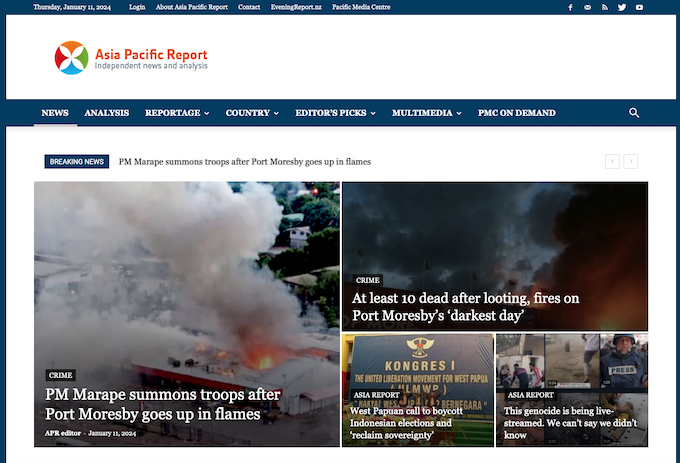
Fires from the 24-hour spate of looting, rioting and mayhem in Papua New Guinea’s Port Moresby — the worst ever social unrest in the city — have all but subsided into skeletal remains of ash and buildings in National Capital District (NCD).
The smoke has cleared with six members of Parliament resigning from the Pangu Pati-led government, 10 people are dead in in Lae and NCD, 46 are wounded and hospitalised, and multiple people are suffering non-threatening injuries.
The government responded by declaring a State of Emergency in NCD and suspending Police Commissioner David Manning and secretaries of the Department of Finance Sam Penias, Treasury Andrew Oeka, Personnel Management Taies Sansan for 14 days.
Under fire Prime Minister James Marape . . . 14-day suspension of police chief and other top civil servants. Image: PNGPC
The Post-Courier understands there was disagreement on the suspension and that the SOE was not the way forward. However, National Executive Council decided on going ahead with the SOE and suspension.
According to details released by Prime Minister James Marape, cabinet deliberated yesterdy afternoon and in a decision invoking Section 226 of the Constitution a a 14-day SOE was declared in Port Moresby only.
“14 days is the limit of the SOE, any longer period would require Parliament approval,” Marape said.
Meanwhile, according to the details released by Marape, Deputy Commissioner of Police-Special Operations Donald Yamasombi is now acting Police Commissioner and Controller of the country.
“Secretaries for Treasury, Finance and Personnel Management who are suspended for 14 days, their respective deputies are now acting.”
Headlines from yesterday’s Asia Pacific Media Network coverage of the Port Moresby rioting. Image: Asia Pacific Report
Prime Minister Marape reiterated his claim that riots in Port Moresby had been organised, but declined to say they were political, instead saying his government would only be removed on floor of Parliament.
He said that Chief Secretary and others would undertake an investigation of what happened in Port Moresby.
After the rioting . . . confusion as Port Moresby waits to be back in business. Image: PNGPC
Few shops open Port Moresby was in confusion yesterday following the aftermath of the worst ever civil disorder as reality sets in leaving people with no shops open to buy food and essentials from.
While the PNG Defence Force and members of the police patrolled the city’s streets in an attempt to restore normalcy many genuine city residents were queued at the only three service stations open to refuel their vehicles in anticipation of the weekend.
A-Mart supermarket at Manu Auto Port was the only shop open within the vicinity of Taurama and Boroko suburbs where angry shoppers crowded around the shop begging for entry which was heavily guarded by PNG Defence Force soldiers.
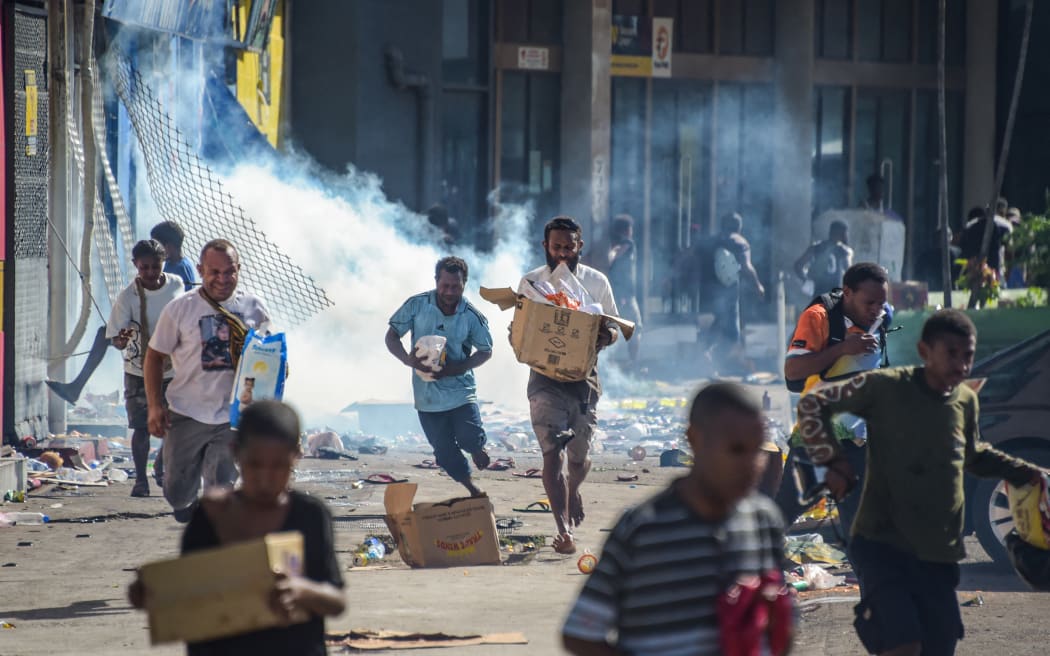
On Wednesday, more than 20 shops were looted and 8 others burnt leaving the streets of Port Moresby covered in papers and plastics from the items that were looted by hundreds of people who took advantage of the city polices strike over their salaries.
A mother of four who wished to be anonymous was worried where she would buy food for her children over the next couple of weeks as all the shops, she knows have been either looted, burnt or are closed for security reasons.
“I went to a shop at Hanuabada and waited for three hours for it to open to buy my children’s food but unfortunately, it was not open so I came back,” she said.
The Post-Courier’s cover stories today after Wedesday’s rampage in Port Moresby. Image: PNGPC
‘How are we going to survive’ “If these issues are not resolved, how are we going to survive.
“These shops are our gardens. They are where we get our food from.”
Meanwhile, many tucker boxes and canteens in the city were open today and their prices have sky rocketed only hours after Wednesday’s wild rampage.
For example, at Konedobu a 1kg packet of rice now costs K10 (NZ $4.50) — double the price prior to the looting.
Following the disorder, many clinics were also closed to the public over safety concerns.
Miriam Zarriga, Gorethy Kenneth and Claudia Tally are PNG Post-Courier reporters. Republished with permission.
A political crisis is starting to brew in Papua New Guinea as calls are made for Prime Minster James Marape to step down in the wake of deadly riots in parts of the country.
Violence broke out with shops and businesses being set alight late yesterday, after public servants, including police and army personnel, went on strike over a pay roll issue.
At least 10 people have been confirmed dead — eight in Port Moresby and two others in the northern city of Lae. [Al Jazeera reports 15 dead while ABC Pacific says 16 have been killed].
PNG Prime Minster James Marape . . . under fire over the rioting. Image: RNZ Pacific/Kelvin Anthony/File
On Thursday morning, Marape appealed to citizens not to take to the streets and “do anything and everything they feel”.
“Ill-discipline in the police force will not be tolerated, ill-discipline in the defence will not be tolerated, you can have one moment in the sunlight but this moment won’t last forever,” he said at a news conference on Thursday.
There has been widespread anger over Marape’s handling of the dispute as the violence and looting continues.
Police and defence personnel are trying to restore order, with 180 additional police flying into Port Moresby today.
‘Complete breakdown’ Six MPs have resigned from Papua New Guinea’s government. They are Sir Puka Temu, David Arore, James Donald, Maso Hewabi, Keith Iduhu and James Nomane.
Chauve MP James Nomane and Hiri-Koiari MP Kieth Iduhu made their resignations public via social media.
Both blamed Marape for the riots in Port Moresby, and which are now spreading to other parts of the country.
Nomane and Iduhu are members of Marape’s ruling Pangu Pati, and have called on him to resign.
“Today, I have tendered my resignation from the Marape-Rosso government due to my lack in confidence in the Prime Minister’s leadership,” said Iduhu in a Facebook post.
“I join the call of my colleague MPs in asking for the Prime Minister’s resignation based on the complete breakdown of our societal values and welfare,” he added.
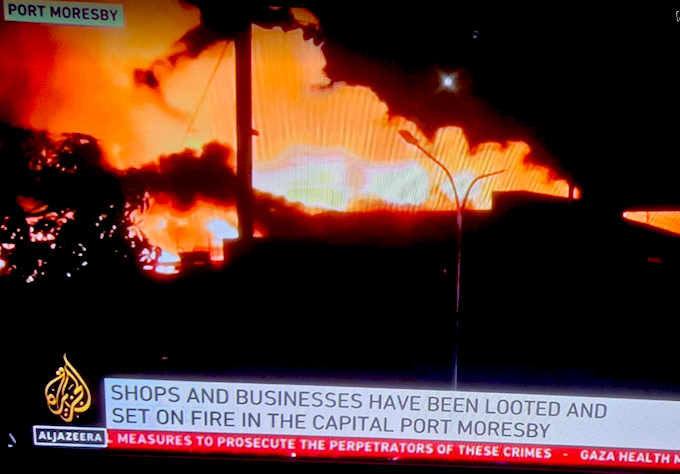
The Port Moresby rioting was featured on Al Jazeera world news tonight with the network reporting 15 dead. Image: AJ screenshot APR
Iduhu went on to accuse Marape of failing to address the grievances raised by Papua New Guinea’s police and military.
Core issue “The core issue surrounding the grievances raised by the disciplinary forces was completely avoidable had it not been for bureaucratic negligence, and ensuing events even after the government was made aware of the situation displayed a lack of care for the potential for the situation to spiral of control,” he said.
Nomane’s statement of resignation was much harsher. He steps down from a senior role as PNG’s Vice Minister of National Planning.
He accused Marape of failing to run the country.
Violent riots in PNG leave 16 people dead, as PM declares state of emergency for 14 days https://t.co/AzxcX2MUXP
“I, now on this 11th day of January 2024, resign from the Marape-led government. I have no confidence in the prime minister,” Nomane said.
Chauve MP James Nomane . . . “I have no confidence in the prime minister”. Image: RNZ Pacific
James Nomane, MP for Chuave District.Photo: Papua New Guinea Parliament
“Do the honourable thing and resign as the Prime Minister of Papua New Guinea. Resign for being indecisive and weak … resign for the country slipping into a Banana Republic, and for this crisis happening under your watch.
“What happened in Port Moresby yesterday was absolutely unacceptable . . . and warrants the immediate resignation of James Marape as the prime minister.
“The time has come for James Marape to stop pretending and step aside as the prime minister to put the nation’s interest ahead of his own . . . This facade must stop.”
RNZ has approached the prime minister for comment.
This article is republished under a community partnership agreement with RNZ.
Head hair comes in many colours, shapes and sizes, and hairstyles are often an expression of personal style or cultural identity.
Many different genes determine our hair texture, thickness and colour. But some people’s hair changes around the time of puberty, pregnancy or after chemotherapy.
So, what can cause hair to become curlier, thicker, thinner or grey?
Follicles that produce curly hair are asymmetrical and curved and lie at an angle to the surface of the skin. This kinks the hair as it first grows.
The asymmetry of the hair follicle also causes the keratin to bunch up on one side of the hair strand. This pulls parts of the hair strand closer together into a curl, which maintains the curl as the hair continues to grow.
Follicles that are symmetrical, round and perpendicular to the skin surface produce straight hair.
Head hairs spend most of their time in the growth phase, which can last for several years. This is why head hair can grow so long.
Let’s look at the life of a single hair strand. After the growth phase is a transitional phase of about two weeks, where the hair strand stops growing. This is followed by a resting phase where the hair remains in the follicle for a few months before it naturally falls out.
The hair follicle remains in the skin and the stems cells grow a new hair to repeat the cycle.
A drop in hormones a few months after delivery causes increased hair loss. This is due to all the hairs that remained in the resting phase during pregnancy falling out in a fairly synchronised way.
Hair can change around puberty, pregnancy or after chemotherapy
This is related to the genetics of hair shape, which is an example of incomplete dominance.
Incomplete dominance is when there is a middle version of a trait. For hair, we have curly hair and straight hair genes. But when someone has one curly hair gene and one straight hair gene, they can have wavy hair.
Hormonal changes that occur around puberty and pregnancy can affect the function of genes. This can cause the curly hair gene of someone with wavy hair to become more active. This can change their hair from wavy to curly.
Researchers have identified that activating specific genes can change hair in pigs from straight to curly.
Balding in males is due to higher levels of androgens. In particular, high dihydrotestosterone (sometimes shortened to DHT), which is produced in the body from testosterone, has a role in male pattern baldness.
Some women experience female pattern hair loss. This is caused by a combination of genetic factors plus lower levels of oestrogen and higher androgens after menopause. The hair follicles become smaller and smaller until they no longer produce hairs.
Reduced function of the cells that produce melanin (the pigment that gives our hair colour) is what causes greying.
Theresa Larkin does not work for, consult, own shares in or receive funding from any company or organisation that would benefit from this article, and has disclosed no relevant affiliations beyond their academic appointment.
Scorpions are among the most ancient of land animals. Fossils indicate they were roaming the Earth more than 400 million years ago. For perspective, the non-bird dinosaurs became extinct about 65 million years ago.
Scorpions trivialise the 100-million-year reign of the dinosaurs — they saw them come and go and are still here today. In fact, the external anatomy of scorpions has changed little, based on what we’ve seen from 400 million-year-old fossils.
While formally describing a new scorpion species from the Pilbara region of Western Australia, we discovered another species with identical external morphology (shape and structure). The only way to tell the two species apart was by looking at the morphology of the male reproductive organs.
You’d think that is a very small difference, but it’s not uncommon for telling apart species in other groups, like spiders and millipedes. But these are the first scorpion species distinguished solely by male reproductive anatomy.
Most Australians think of scorpions as exotic desert animals. But they are fairly widespread, ranging from salt lakes in central Australia to ancient rain forests in Tasmania.
Surprisingly, our estimates (based largely on unpublished DNA sequence data we have access to), indicate that less than 10% of Australia’s scorpion species have been scientifically described or named. Describing them means scientifically documenting and applying a unique scientific name to a new species while following the International Code of Zoological Nomenclature.
The scorpion genus Urodacus is endemic to mainland Australia and represents one of the largest radiations (increases in diversity) of scorpion species on the continent. Most Urodacus species live in deep spiralling burrows, enabling them to survive in arid ecosystems. In some habitats, these scorpions are a significant part of the ecosystem and comprise much of its biomass.
Despite their reclusive habits, Urodacus are popular exotic “pets” and are among the most popular invertebrates offered by online stores in Australia. There’s also a large community of scorpion enthusiasts.
Trading of scorpions is dependent on an unknown level of harvesting from natural populations. Some Urodacus species are known to live for 15–20 years, but in captivity, their longevity is usually less than a year.
With minimal knowledge about the diversity and distributions of Australian scorpions, the potential for serious impacts to their conservation is high. Traded scorpion species are often unnamed, and some may also live in very small areas.
For example, the two new species we described, Urodacus uncinus and Urodacus lunatus, are restricted to creeks and drainage lines, with a known area of as little as 50 square kilometres. Such small distributions make species particularly vulnerable to habitat loss, which is a growing threat in Australia.
Surprisingly, there is no regulation for scorpion ownership in most Australian states, although you need a permit to keep them as pets in the Northern Territory and Queensland. Collecting them from the wild is only regulated in conservation areas.
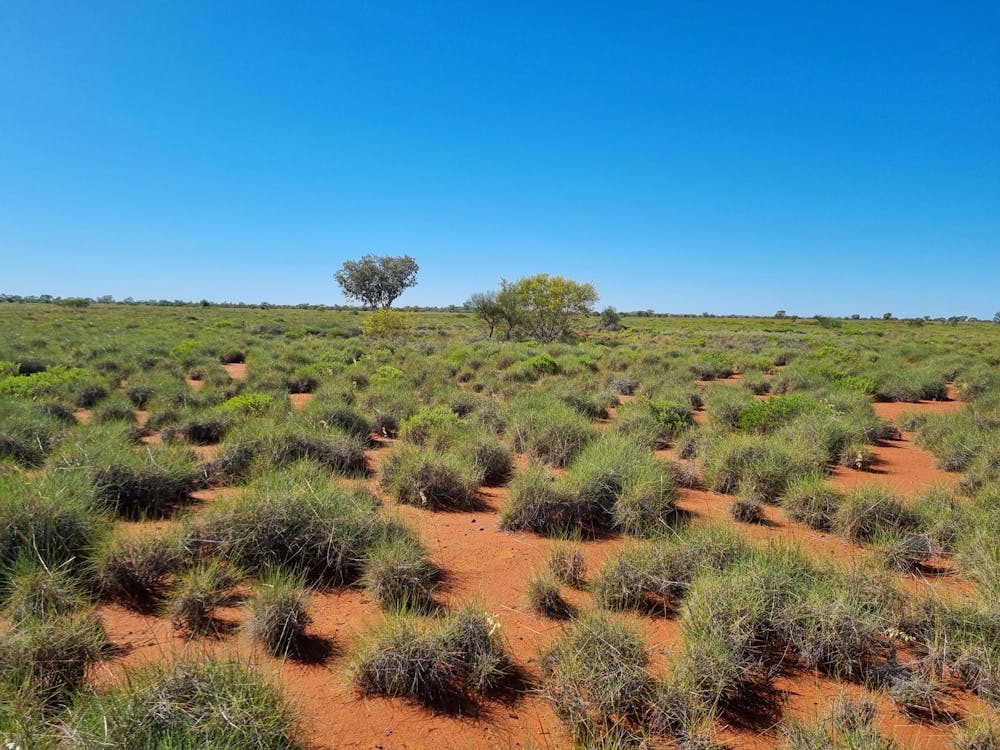
An example of the type of habitat where the newly described species were collected. Huon L Clark
The two new species we just described are large (more than 7cm long) yellow scorpions. Males of both species have a striking enlargement in the tip of their “tails”, with a swollen venom gland and a sting that is more strongly curved than in any other known species of the genus.
The task to fully document and understand the diversity of Australian scorpions is colossal. Approximately 3,000 scorpion species are known worldwide, but in Australia only 47 species are currently described and named. Based on our estimates, we think there could be at least 500 scorpion species here.
Only 13 new Australian scorpion species have been described in the last 45 years. At this rate, many are likely to become extinct before they are even named.
Further research on Australian scorpions will also reveal more of these animals’ incredible biology. One example is their curious reproduction. Scorpion mating rituals include a dance during which males of some species even sting the females as part of the courtship.
Sperm transfer occurs via what could be described as a “detachable penis”, placed on the ground by the male. During mating, part of this organ breaks off in the female reproductive tract and functions as a “mating plug” that prevents the female from remating until the babies from the last mating are born.
Burrowing scorpions give birth to live young that are gestated for up to 18 months within an organ somewhat like a uterus. After birth, mother scorpions carry their babies on their back until they disperse to live a largely solitary life.
Undiscovered secrets
These fascinating behaviours are only a small portion of scorpion natural history discovered to date and they are likely to harbour many more as yet undiscovered secrets.
Next to nothing is known about Australian scorpions, which is surprising given their diversity and ecological importance. More research on Australia’s scorpions is urgently needed to help recognise and protect threatened species and their habitats.
Expanding our knowledge about native scorpions would also help with the regulation of wild collections and allow captive breeding to further develop more responsible pet ownership as a force for conservation, rather than a risk.
Bruno Alves Buzatto currently works for Flinders University. He has previously been funded by the University of Western Australia, Macquarie University, the Australian Research Council, Australian Geographic and National Geographic. Bruno has also previously worked as a principal biologist for Bennelongia Environmental Consultants in Western Australia.
Erich S. Volschenk owns Alacran Environmental Science, an environmental consultancy business specialising in the diagnoses of terrestrial invertebrates. He has previously received funding from Australian Biological Resources Study.
From relatively humble beginnings, the Australian Open has emerged as a centrepiece in both the global tennis and Australian sporting calendar. With the 2024 tournament approaching, the event is now a centurion – it’s been 101 years since it became a designated grand slam, and 119 years since the very first edition.
While the Australian Open is now firmly known as a Melbourne event, the tournament used to rotate across Australasia until 1972. Between 1905 and 1971, it was most often hosted in Sydney (17 times), Melbourne (16), Adelaide (15), Brisbane (seven), Perth (three), and across the ditch in New Zealand (once in Christchurch, once in Hastings).
These early tournaments were a far cry from the economic enterprise of the modern grand slam; the 1909 edition, for instance, was held in the Perth Zoo.
And even after the International Lawn Tennis Federation designated the Australian Open as one of the four grand slam tournaments in 1923, it lagged behind the others for quite some time. This was mainly due to Australia’s remoteness, the inconvenient timing of the tournament in December or January, the comparatively poor facilities and the low prize money.
In fact, the tournament did not really flourish until the 1980s – well into the “open era” of professional tennis.
The growth of the Australian Open since the 1980s has occurred in parallel to the development of Melbourne as a cosmopolitan city. Australia’s deindustrialisation and financial deregulation in the early 1970s saw Sydney rise as the commercial capital of the country, while Melbourne languished.
In response, Melbourne turned to sport and culture as a form of economic salvation, moving away from manufacturing and towards tourism, leisure and spectacle.
This resulted in significant infrastructure investment, including new grandstand capacity at Flemington racecourse and the installation of lights at the Melbourne Cricket Ground. Perhaps most significant was the building of Melbourne Park as a permanent facility for the Australian Open in 1988.
Despite controversy around the necessary rezoning of public lands to create Melbourne Park, the relocation from the grass courts of Kooyong tennis club was an immediate success. Total attendance increased from 140,000 to 266,436 in the first year.
The tournament has progressed by leaps and bounds since then. The 2023 tournament broke attendance records, with 839,192 people coming through the gates.
The modern Australian Open is a major contributor to the Australian economy, as well as a mammoth operational undertaking.
The 2023 tournament featured a total of 817 players from 68 nations and was reported on by more than 800 journalists and photographers from 52 nations. Incredibly, more than 12,000 staff from Tennis Australia, Melbourne & Olympic Parks and other related agencies helped stage the tournament.
Economically, over six million people have attended the Australian Open in the past decade, contributing an estimated A$2.71 billion (US$1.76 billion) to the Victorian state economy. In 2020, the last tournament before COVID, visitors booked 574,970 hotel night stays and spent on average A$209 per day.
The inherent cultural value of the Australian Open is apparent in annual surveying of local sentiment, with 99% of Victorians agreeing in 2022 “it is important for Victoria to host the Australian Open each year”.
Strong local support is important given the Victorian government invested A$972 million (US$629 million) of taxpayer funds to redevelop Melbourne Park between 2010 and 2019 to secure the Australian Open hosting rights through 2046.
Future challenges
The length of this deal is significant, given Saudi Arabia and other nations have become increasingly aggressive in attempting to rebrand themselves as global sporting powers by making bids to host prestigious events.
Notably, it has emerged in recent weeks that Saudi Arabia is exploring an investment in professional tennis that could, at minimum, jeopardise Australian Open lead–up events that are held across the country in early January.
The tennis tour has also entered a period of talent renewal following the retirements of generational players Roger Federer, Serena Williams and soon Rafael Nadal. As a result, the tournament is having to market new, less familiar faces to an Australian public. Hence, the focus on rising stars Coco Gauff, Carlos Alcaraz and Jannik Sinner on this year’s tournament website.
Perhaps the tournament’s biggest challenge, however, will be its longer-term adaption to climate change. Players have frequently cited the Australian Open as particularly taxing due to the heat, which can at times be extreme. The first heat policy was only introduced in 1998.
In response to this growing challenge, a more extensive, research-based extreme heat policy was introduced in 2019. The new heat stress measure, which can result in the suspension of play, considers four climate factors: air temperature, radiant heat, humidity and wind speed. It also takes into account the physiological differences between the adult players, wheelchair participants and junior athletes.
Severe heat is not just a risk for athletes, but attendees. During the 2014 tournament for instance, 970 attendees were treated for heat exhaustion on a single day when the temperatures hit 42 degrees. A ball kid also fainted.
Climate change poses challenges beyond heat. The Black Summer bushfires of 2019, for instance, brought several days of smoke that caused breathing problems among some players. In 2023, the tournament was suspended twice on a single day, first due to heat and then torrential rain.
Tournament organisers have added an extra day to this year’s tournament to become a 15-day event. This will not only help mitigate any weather-induced scheduling congestion, but will also reduce the number of late-night finishes, which have drawn the ire from players and fans.
This will no doubt help the tournament deal with short-term challenges, but further adaptation may be necessary to ensure its long-term success. If history is any indication, the Australian Open has proven itself open to change.
Hunter Fujak does not work for, consult, own shares in or receive funding from any company or organisation that would benefit from this article, and has disclosed no relevant affiliations beyond their academic appointment.
Problems with focus and impulse control can be common developmental stages through which children and adolescents naturally progress. But they can also be symptoms of attention-deficit hyperactivity disorder (ADHD), a chronic condition.
ADHD is a pattern of inattention or hyperactivity and impulsivity (or both) that interferes with functioning or development, and persists into adulthood. ADHD affects around 7.6% of children aged three to 12 years and 5.6% of teens.
ADHD can significantly influence family dynamics and can affect a child’s ability to learn and interact socially. Raising children with behavioural, developmental or learning difficulties can also make parenting more challenging, with parents navigating feelings of frustration, grief and guilt.
While medication is most effective at minimising core ADHD symptoms, non-drug interventions can also reduce the daily impacts of ADHD symptoms. Parenting/family training is one such intervention. So what does it involve and is it effective?
Parenting training is widely used and can take different forms. Sometimes a psychologist works with one or both parents to give them skills specific to their family and situation. It’s sometimes a structured in-person program for groups of parents. It can also be delivered online, at parents’ own pace or in virtual classrooms.
Most parent/family training will teach parents forms of:
positive praise. Notice when your child is behaving in a desirable way and give them positive feedback. For example,“Wow, you’re playing so nicely. I really like the way you’re keeping all the blocks on the table.” Praise nurtures self esteem and their sense of self. Praise teens for starting homework without being reminded or coming home at the agreed time
effective limit-setting. Establish ground rules in a quiet moment of family time, where everyone has a say and understands the boundaries, consequences, and expectations
natural consequences, such as missing out on watching a TV show because packing up took too long. This allows the child to experience failure or loss, but empowers them with what they can focus on or improve the next time round
planned ignoring of annoying but not serious behaviours such as making faces or messy rooms. Make a decision to ignore it and breathe. Model desirable behaviours, such as looking after your possessions and fitting in with family life
positive parent-child interactions. “Connection before correction” helps a parent shape their child’s behaviour and can reduce disruptions.
Emotionally connect by, for example, establishing eye contact, using a gentle tone and getting down on their level. This attunement allows the child to be able to regulate their behaviour and better manage their emotions.
Parents aren’t to blame for their child’s symptoms; the aim of training is to teach parents skills to meet the above-average parenting needs of children with ADHD.
Take inattention, for example. If a task is boring to a child with ADHD, their brain will struggle to pay attention – even if they want to. ADHD clinical neuropsychologist Russell Barkley explains ADHD like this: the back part of the brain is where you learn, the front part is what you do, and ADHD splits them apart. You can know things but you won’t do them – it’s a performance disorder.
Having a few household rules, schedules, opportunities to problem-solve, effectively using instructions and, most importantly, expressions of love can give children positive environments that will help their mental health over time.
How effective is parent training?
The Australian evidence-based ADHD treatment guidelines reviewed the evidence and found medication treatment was more effective than non-pharmacological treatment in reducing core ADHD symptoms. But combined therapies were better than either treatment alone.
The United Kingdom’s National Institute of Clinical Excellence recommends ADHD management plans include treatments to address the child’s psychological, behavioural and educational or occupational needs.
There is evidence to support parenting training for children aged five to 17, and greater evidence for its use in children under five and families of children who also have oppositional defiant disorder or conduct disorder, who require more intensive support.
But more research is needed about the duration and form of the parent training.
The World Health Organization also recommends parenting interventions because they strengthen the parent-child relationship, assist with alternatives to violent discipline and reduce emotional problem behaviours in children.
Bond University researchers are also conducting a free, online group parenting program, which includes positive parenting skills. This will be part of a randomised control trial to develop an evidenced-based parenting intervention.
The aim with all of these programs is to better understand the child’s life and have compassionate responses to their ADHD and behavioural symptoms. So rather than just focusing on their behaviour – which is an outward expression of an inward emotion – it encourages parents to embrace their uniqueness and help them in their struggles.
How else can you support your child with ADHD?
Set boundaries and be clear about your expectations, but also be compassionate to your child and pick your battles.
Break instructions into simple tasks and allow them to choose and focus on one thing they’re struggling with at a time. Brainstorm what they need to improve, or an area that frustrates them. This will often be organisation, time management and planning. Ask how you can help and stay calm. Celebrate the small wins along the way.
Be curious and seek to understand and connect with your child. Even though your relationship may feel strained or disconnected at times, remember disagreement need not destabilise the relationship. Children express their full emotions, without restraint, among people they feel most safe with.
Finally, ensure you look after yourself, connect with other parents who can support you. Try not to place your anxiety, stress and fears onto your child. Talk to a friend or psychologist so your child feels safe and able to share anything with you and knows you will cope.
Cher McGillivray does not work for, consult, own shares in or receive funding from any company or organisation that would benefit from this article, and has disclosed no relevant affiliations beyond their academic appointment.
The world faces an increasing shortage of housing and an escalating climate emergency. These urgent global issues call for quick action and innovative solutions.
The numbers show us how stark things are. Construction activities and building operations produce more than 40% of the carbon emissions driving global warming.
At the same time, 1.6 billion people live in subpar housing. An alarming 100 million have no house at all. In both Australia and globally, the housing crisis is a pressing and unresolved issue.
Prefabricated building technology offers promising alternative solutions to this dual crisis. Prefab housing modules are made offsite in a factory. The finished components/modules can then be transported and assembled swiftly at the site of the building.
This approach could transform the housing scene. Affordable dwellings could be produced on a massive scale, while greatly reducing the environmental impacts.
This is not merely about building homes. A shift to prefab construction would be a strategic move in line with the Paris Agreement to mitigate climate change.
Prefab modular construction could be considered a greener alternative in the construction sector. By greatly reducing construction waste (which accounts for 40% of landfill) and carbon emissions, it tackles these major environmental concerns head-on. A 2022 study showed modular construction can slash carbon emissions by up to 45% compared to conventional techniques.
The controlled factory-based environment of prefab construction makes it more efficient. This includes integrated reclamation and recycling of construction waste.
This approach is highly cost-effective. It’s about being resource-savvy and reducing waste to the bare minimum.
Using standardised designs and components on a large scale also cuts the cost of incorporating energy-efficient elements such as better insulation and renewable energy. Building in this way creates structures that are effective, efficient, resilient and help us combat climate change.
Among many possible construction materials, wood or timber is among the most preferred for prefab modular buildings. Timber is renewable and an efficient carbon sink. The timber in buildings locks away the CO₂ the trees absorbed from the atmosphere when they were growing.
One creative and sustainable solution to housing shortages is to build modular, adjustable prefab dwelling units. These units are robust and can be adapted to various climates and housing needs with ease.
In a world where cities are growing fast and housing needs are pressing, prefab construction can deliver quality, affordable homes at an impressive pace. It’s an efficient solution for a budget-conscious, carbon-constrained world.
The beauty of prefab construction lies in its adaptability, making it the building industry’s chameleon.
It can look good almost anywhere, from bustling cityscapes to serene countryside. Imagine a building technique that can seamlessly transition from a cozy mountain cabin to a stylish metropolitan apartment building.
Modular homes can be enlarged, modified or even disassembled and moved as communities grow and needs change.
This approach promotes long-term resilience by being adaptable to changes in the climate and housing needs. These buildings are constructed not only for the present, but also for the high-performance requirements of the future.
A building module is lifted into position in a Berlin office block built using a modular timber construction process. Jarama/Shutterstock
A community-focused project in England: the prefab modular homes in Cambridge are more than just buildings; they are community cornerstones. As well as providing roofs over heads, the project is about creating a sense of belonging. These units, meticulously designed and sustainably built, are shaping the narrative of affordable housing.
Scandinavian eco-friendly living: Scandinavians have taken modular construction to heart. In this region, known for its design prowess and environmental stewardship, many modular homes are architectural marvels that embody sustainability. Cozy, energy-efficient homes with sleek designs prove that eco-friendly living can be both stylish and functional.
Versatile modular solutions in the Netherlands: Finch Buildings offers a kaleidoscope of sustainable housing. Here, modular construction is about flexibility and diversity, catering to a range of needs and styles. These timber modular solutions can adapt to different lifestyles and preferences. Housing can be as diverse as the people it shelters.
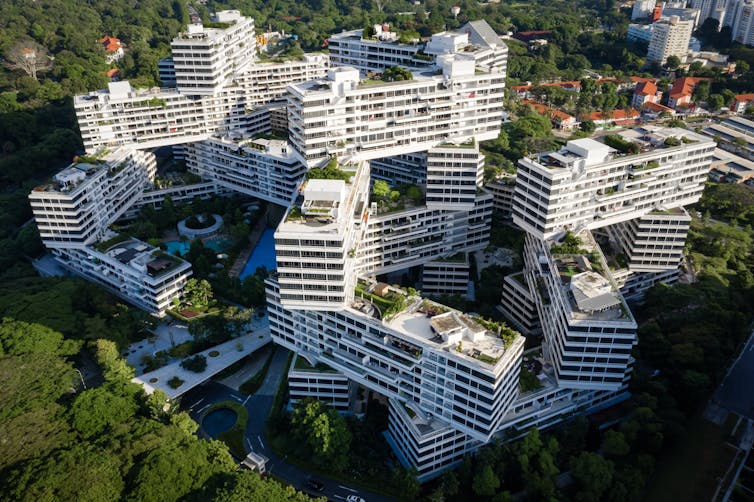
Singapore’s urban blueprint: the city-state is a showcase for the incredible possibilities of prefab modular construction. It’s seamlessly woven into urban planning. Imagine a city where buildings are not just structures, but pieces of a larger, sustainable puzzle. It is a model of how urban development can co-exist with environmental consciousness.
The Interlace is a 1,040-unit apartment complex in Singapore. huntergol hp/Shutterstock
So what’s stopping Australia?
Australia has been slower than many countries to adopt prefab modular construction. The challenges include:
limited government support and incentives compared to other countries
a need for more training and expertise in designing and implementing prefab modular construction
the traditional procurement process in construction is not well suited for prefab methods, so a shift in thinking and approach from construction managers and suppliers is required
the Australian regulatory environment needs to evolve to promote productivity and support modern construction methods like prefabrication
a cultural shift within the industry is also needed, so owners and developers demand more sustainable and efficient construction methods.
The situation is changing in Australia as the housing crisis has intensified. Recognition of the need for more sustainable, efficient construction methods is growing, leading to a gradual shift in government support and industry adoption.
The potential role of prefab modular construction in tackling the challenges of climate change and housing shortages cannot be overstated.
Prefab building is charming not just because it is flexible but also because the architectural features have been thoughtfully considered. Every module can be carefully crafted to complement its surroundings.
Adopting this strategy demonstrates a dedication to development that is ecologically conscious, promotes resilience and sustainability and, by meeting house needs, improves community wellbeing.
The authors do not work for, consult, own shares in or receive funding from any company or organisation that would benefit from this article, and have disclosed no relevant affiliations beyond their academic appointment.
Do you have family members or friends sick with a respiratory infection? If so, there’s a good chance it’s COVID, caused by the JN.1 variant currently circulating in Australia.
In particular, New South Wales is reportedly experiencing its highest levels of COVID infections in a year, while Victoria is said to be facing a “double wave” after a surge late last year.
But nearly four years into the pandemic, data collection is less comprehensive than it was, and of course, fewer people are testing. So what do we know about the extent of this wave? And importantly, are we adequately protected?
Tracking COVID numbers was easier in the first half of last year, when each state and territory provided a weekly update, giving us data on case notifications, hospitalisations, ICU numbers and deaths.
In the second half of the year some states and territories switched to less frequent reporting while others stopped their regular updates. As a result, different jurisdictions now report at different intervals and provide varying statistics.
While each offer different metrics, we can gather – particularly from data on hospitalisations – that both states are experiencing a wave. We’re also seeing high levels of COVID in wastewater.
Meanwhile, Northern Territory Health simply tell you to go to the Australian government’s Department of Health website for COVID data. This houses the only national COVID data collection. Unfortunately, it’s not up to date, difficult to use, and, depending on the statistic, often provides no state and territory breakdowns.
Actual case notifications are provided on a separate website, although given the lack of testing, these are likely to be highly inaccurate.
The Department of Health website does provide some other data that gives us clues as to what’s happening. For example, as of one month ago, there were 317 active outbreaks of COVID in aged care homes. This figure has been generally rising since September.
Monthly prescriptions for antivirals on the Pharmaceutical Benefits Scheme were increasing rapidly in November, but we are not given more recent data on this.
It’s also difficult to obtain information about currently circulating strains. Data expert Mike Honey provides a regularly updated snapshot for Australia based on data from GISAID (the Global Initiative on Sharing All Influenza Data) that shows JN.1 rising in prevalence and accounting for about 40% of samples two weeks ago. The proportion is presumably higher now.
What’s happening elsewhere?
Many other countries are currently going through a COVID wave, probably driven to a large extent by JN.1. These include New Zealand, Spain, Greece and the United States.
According to cardiologist and scientist Eric Topol, the US is currently experiencing its second biggest wave since the start of the pandemic, linked to JN.1.
Are vaccines still effective?
It’s expected the current COVID vaccines, which target the omicron variant XBB.1.5, are still effective at reducing hospitalisations and deaths from JN.1 (also an omicron offshoot).
The Australian Technical Advisory Group on Immunisation (ATAGI) updated their advice on booster shots in September last year. They recommended adults aged over 75 should receive an additional COVID vaccine dose in 2023 if six months had passed since their last dose.
They also suggest all adults aged 65 to 74 (plus adults of any age who are severely immunocompromised) should consider getting an updated booster. They say younger people or older adults who are not severely immunocompromised and have already had a dose in 2023 don’t need further doses.
This advice is very confusing. For example, although ATAGI does not recommend additional booster shots for younger age groups, does this mean they’re not allowed to have one?
In any case, as of December 6, only 19% of people aged 65 and over had received a booster shot in the last six months. For those aged 75 and over, this figure is 23%. Where is the messaging to these at-risk groups explaining why updating their boosters is so important?
Should we be concerned by this wave?
That depends on who we mean by “we”. For those who are vulnerable, absolutely. Mainly because so few have received an updated booster shot and very few people, including the elderly, are wearing masks.
For the majority of people, a COVID infection is unlikely to be serious. The biggest concern for younger people is the risk of long COVID, which research suggests increases with each reinfection.
It’s highly likely we will see repeated waves of infections over the next 12 months and beyond, mainly caused by waning immunity from previous infection, vaccination or both, and new subvariants.
Unless a new subvariant causes more severe disease (and at this stage, there’s no evidence JN.1 does), we should be able to manage quite well, without our hospitals becoming overwhelmed. However, we should be doing more to protect our vulnerable population. Having only one in five older people up to date with a booster and more than 300 outbreaks in aged care homes is not acceptable.
For those who are vulnerable, the usual advice applies. Make sure you’re up to date with your booster shots, wear a P2/N95 mask when out and about, and if you do get infected, take antivirals as soon as possible.
Adrian Esterman does not work for, consult, own shares in or receive funding from any company or organisation that would benefit from this article, and has disclosed no relevant affiliations beyond their academic appointment.
At least 10 people are dead and dozens injured after 24 hours of looting in Papua New Guinea, during which several buildings were torched.
Chaos broke out in Port Moresby as looters and opportunists took advantage of a protest by the country’s police and military.
People have been ordered to leave the streets of the capital after Wednesday’s violent riots, and have been warned authorities will use “live rounds”.
Looting has spread to at least four other towns, including Kavieng, reports the PNG Post-Courier.
Footage and images circulating on social media show crowds of people leaving shops with looted goods — everything from merchandise to soft drinks to freezers — as the National Capital District (NCD) descended into chaos overnight.
How the PNG Post-Courier reported today on the capital of Port Moresby’s “darkest day”. Image: PNG Post-Courier
The national daily newspaper PNG Post-Courier labelled the events the “Darkest day in our city” and NCD Governor Powes Parkop appealed to the looters to stop.
Port Moresby General Hospital say eight people have been killed, and another two have been confirmed dead by police central command in Lae, the country’s second biggest city.
‘My heart goes out’ “The cost of the ensuing looting and destruction is substantial, and my heart goes out to all the businesses in the city that have been affected,” Parkop said according reports.
People flee with merchandise as crowds leave shops with looted goods in Port Moresby. Image: Andrew Kutan/RNZ
Unverified videos have also emerged of bodies of several men allegedly shot dead who were involved in the unrest on Wednesday and children and women wailing around them in Port Moresby.
RNZ Pacific is trying to verify the footage.
Police and the PNG Defence Force reinforcements have been called from outside the capital to restore order.
Emergency service providers have been working overnight attending to high numbers of people injured in the violence at various locations.
“The ambulance service has received a large number of emergencies calls in the National Capital District relating to shooting incidents and persons injured in an explosion,” St. John Ambulance Service said on their Facebook page.
“The ambulance operations centre are prioritising high-priority emergencies only at this point.”
Stretched to limit The Papua New Guinea Fire Service has had its resources stretched to its limits as it struggled to contain fires in multiple locations.
The Port Moresby General Hospital had to close overnight while a smaller hospital at the Gerehu suburb, evacuated its patients as a nearby shop was set on fire.
Large businesses suffered big losses in just a few hours.
The City Pharmacy Limited (CPL) group, which owns one of the biggest supermarket and pharmacy chains in Port Moresby, had most its shops raided and burned overnight.
Looters also stole electronic appliances from warehouses and shops owned by the Brian Bell group of companies.
Mobile squad called in Last night, additional police from the Highlands Mobile Group (HMG) were flown in from from Lae to help restore order.
The government also issued a call out for the military to assist police.
A protest over unexplained pay deductions to salaries of police, military and correctional services staff has triggered looting in Port Moresby. Image: RNZ
The events began on Wednesday morning local time, after about 200 police and the military personnel gathered at the Ungai Oval to protest over pay deductions from their wages.
They wanted answers from authorities about the “tax” in their most recent pay period, but a government minister who addressed them could not convince them why the deductions had been made.
The tax office said the issue caused by a “glitch” in the accounting system.
What triggered the chaos In the last fortnight pay cycle, several service members saw a reduction in their pay, ranging from $100 PNG kina to $350 PNG kina (US$26-US$80).
It was not clear whether it was due to a tax, or a glitch in the system.
Many of them were told later, through a statement from the Internal Revenue Commission (IRC), and the prime minister’s office that there was a glitch in the payrolls system.
That triggered a gathering of about 200 policemen and women, military personnel and correctional services personnel in Port Moresby. They demanded an answer from the government, saying a “glitch” wasn’t a satisfactory answer.
They then moved from Unagi Oval to Parliament house, opened the gates of Parliament, and the Police Minister Peter Siamali Jr tried to address them. The security personnel then withdrew their services, and the city descended into chaos overnight.
Initially it was sporadic looting in various suburbs of Port Moresby. In the Gerehu suburb one shop was burned, and a few kilometres down to Waigani there was a shop that was burnt, and over the next three to four hours it became worse and several more shops were looted because there was no police presence there.
Policemen were there, but nothing could be done to the looters, so it has degenerated to a point where there is widespread looting.
The Finance Department and prime minister have tried to explain the so-called “glitch”, saying it was being fixed, but that has not gone down well with the service members.
The Northern Mobile Group, a mobile squad unit from out of Port Moresby which looks after one part of the region, has been flown into Port Moresby, and is expected to restore order.
The military has been called out to assist police.
This article is republished under a community partnership agreement with RNZ.
Despite so many people having air conditioning at home now, many are still unsure how to use it efficiently. And air conditioning uses a lot of energy. For example, running all the lights in an average home all day and night consumes about the same energy as one hour of air conditioning of the same space.
Many people think they can save money and energy by just blasting the air conditioning at a very low temperature, such as 17°C, for a short period of time to chill the room – before switching it off and enjoying the chilled air until another blast is needed later on. But it requires a lot of energy to get a room to a very chilly temperature.
While running it briefly and intermittently at a very cool temperature may feel thrifty, it won’t be the most energy efficient choice. Here’s what to do instead.
First, try to minimise the need for air conditioning. Look for ways to stop your house getting hot in the first place.
Heat can come in from outside through surfaces such as walls, windows, and ceilings. Hot air can creep in under doors or through open windows and vents. Appliances and people inside can also generate heat (although the heat impact of people is generally relatively small, unless there’s a large group).
To reduce some of this heat, you can:
close blinds and windows before it starts getting hot
use draft stoppers around external doors to stop hot air wafting inside
plant trees (deciduous trees will let sunlight through in winter)
install external shading, particularly on north and western aspects of your house
improving ceiling and wall insulation, window glazing and sealing (if time and budget allow)
reduce use of the oven and cooktop on very hot days (more efficient appliances, however, reduce this heating effect and save energy).
Rooftop solar systems provide a dual benefit of adding shade on the roof to stop heat coming in that way, as well as offsetting power usage.
If you’re in a double storey house, the lower level can be a few degrees cooler; it can help just to hang out downstairs on a very hot day.
Set your air conditioning to the highest level that’s comfortable
Turning our attention to the air conditioning unit itself, the most energy efficient action is to set the temperature to the highest value that’s still comfortable (26°C during the day and 22°C when sleeping is often recommended). Then, just let it run.
Modern units (that feature technology known as an “inverter”) will adjust their output efficiently to maintain the indoor temperature at the setting you’ve chosen.
Be careful, however; setting the temperature too low can result in the unit using more power than you think it’s using (based on star rating label).
Older non-inverter units will cycle on and off to maintain the temperature, and you will generally be able to hear and feel it going on and off. (The newer inverter units, by contrast, don’t tend to cycle on and off as much; they usually just stay on and continuously modulate their output).
For non-inverter units, in general, remaining on for much longer than it is off indicates the air conditioning is working very hard. This may suggest the unit is too small for the space you’re trying to cool, or that you just have a lot of heat in the house (are you cooking a roast?). It could also suggest a fault.
It’d be better to close the blinds before you start thinking about using the air conditioner. Studio Romantic/Shutterstock
Ceiling fans and servicing can help
Regardless of the type of air conditioning you have, for each 1°C the temperature is lowered, energy use increases by 5 to 10%. So it’s important not to over-cool. That’s why repeatedly blasting the air conditioning at a very low temperature over the course of the day isn’t wise.
Using ceiling fans along with air conditioning can make things feel cooler by 2-3°C due to the air movement, meaning you can set your air conditioning at a higher temperature. Fans use minimal power compared to air conditioning.
Clean the air filters regularly (your manual will explain how) and make sure air grills and vents are not blocked by furniture or, for outdoor units, by vegetation.
If parts of your outdoor units are heavily corroded or badly bent, the unit likely won’t work as well. Animals can cause damage to outdoor units but parts can often be easily replaced.
If your air conditioning doesn’t seem to work well, makes unusual sounds, or if fault codes show up on the display unit, get it serviced.
And if a cool change comes through, switch off the air conditioning and open as many windows and doors as possible to allow the breeze to flow through the house.
If you have a time-of-use electricity tariff (it’ll say on your electricity bill if you do), reducing use in the afternoon and early evening can save a lot. Energy prices can be double or more at these times.
The more stars the better; even a half star higher could more than pay for itself over the life of the unit (especially if you also use it in winter for heating).
Several state governments also have incentive schemes that can help cover the cost of upgrades or replacements.
Mark Goldsworthy works for CSIRO, which researches air conditioning as well as performing Minimum Energy Performance Standards testing of air conditioning systems for the Department of Climate Change, Energy, the Environment and Water, and providing the energy rating method used in the NatHERS residential building energy rating software. However, CSIRO is unlikely to receive any direct benefit from this article.
The pro-independence United Liberation Movement for West Papua (ULMWP) has declared a boycott of the Indonesian elections next month and has called on Papuans to “not bow down to the system or constitution of your Indonesian occupier”.
The movement’s president Benny Wenda and prime minister Edison Waromi have announced in a joint statement rejecting the republic’s national ballot scheduled for February 14 that: “West Papuans do not need Indonesia’s elections — [our] people have already voted.”
They were referring to the first ULMWP congress held within West Papua last November in which delegates directly elected their president and prime minister.
ULMWP’s president Benny Wenda (left) and prime minister Edison Waromi . . . “Do not bow down to the system or constitution” of the coloniser. Image: ULMWP
“You also have your own constitution, cabinet, Green State Vision, military wing, and government structure,” the statement said.
“We are reclaiming the sovereignty that was stolen from us in 1963.”
At the ULMWP congress, more than 5000 Papuans from the seven customary regions and representing all political formations gathered in the capital Jayapura to decide on their future.
“With this historic event we demonstrated to the world that we are ready for independence,” said the joint statement.
Necessary conditions met According to the 1933 Montevideo Convention, four necessary conditions are required for statehood — territory, government, a people, and international recognition.
“As a government-in-waiting, the ULMWP is fulfilling these requirements,” the statement said.
“Governor Lukas was killed by Indonesia because he was a firm defender of West Papuan culture and national identity.
“He rejected the colonial ‘Special Autonomy’ law, which was imposed in 2001 in a failed attempt to suppress our national ambitions.
“But the time for bowing to the will of the colonial master is over. Did West Papuan votes for Jokowi [current President Joko Widodo] stop Indonesia from stealing our resources and killing our people?
“Indonesia’s illegal rule over our mountains, forests, and sacred places must be rejected in the strongest possible terms.”
‘Respect mourning’ call The statement urged all people living in West Papua, including Indonesian transmigrants, to respect the mourning of the former governor and his legacy.
“West Papuans are a peaceful people – we have welcomed Indonesian migrants with open arms, and one day you will live among your Melanesian cousins in a free West Papua.
“But there must be no provocations of the West Papuan landowners while we are grieving [for] the governor.”
The statement also appealed to the Indonesian government seeking “your support for Palestinian sovereignty to be honoured within your own borders”.
“The preamble to the Indonesian constitution calls for colonialism to be ‘erased from the earth’. But in West Papua, as in East Timor, you are a coloniser and a génocidaire [genocidal].
“The only way to be truthful to your constitution is to allow West Papua to finally exercise its right to self-determination. A free West Papua will be a good and peaceful neighbour, and Indonesia will no longer be a human rights pariah.
Issue no longer isolated Wenda and Waromi said West Papua was no longer an isolated issue.
“We sit alongside our occupier as a member of the MSG [Melanesian Spearhead Group], and nearly half the world has now demanded that Indonesia allow a visit by the UN High Commissioner for Human Rights.
“Now is the time to consolidate our progress: support the congress resolutions and the clear threefold agenda of the ULMWP, and refuse Indonesian rule by boycotting the upcoming elections.”
The ULMWP congress in Jayapura . . . attended by 5000 delegates and supporters. Image: ULMWP
At 10am (local time) yesterday, police and military personnel gathered at Port Moresby’s Unagi Oval in protest over what they say are hefty “tax” deductions in the most recent pay period.
According to service members, the deductions over the last fortnight range between US$26 and US$80 (K100 and K300).
The police union demanded answers from the government at the gathering and by 11am, a large group proceeded to Parliament where they demanded answers from the Prime minister and members of the cabinet.
The deductions come as Papua New Guineans experienced a noticeable rise in the cost of goods and services in the last three months.
Working to resolve issue The Internal Revenue Commissioner released a statement saying that the government was working as quickly as possible to resolve the issue.
Prime Minister James Marape released a statement calling for calm while stating that the deductions were caused by a glitch in the government payroll system.
An earlier RNZ Pacific report said that Assistant Police Commissioner Anthony Wagambie addressed the protesters at Unagi Oval.
“Frustrations boiled over so they got into their vehicles and stormed Parliament . . . they opened the gates and went into Parliament,” reported Scott Waide.
“There was no real resistance to stop them . . . it was a rowdy crowd, the defence minister had attempted to speak to them outside of Parliament before they walked in.”
Police Association president Lowa Tambua demanded an answer about why there had been deductions.
‘Immediate answer’ demand “We want an immediate answer from the Minister of Police and the Prime Minister,” Tambua said.
“We we’re all caught by surprise . . . come and address my members as to why this has happened.
“Don’t hide between the Parliament House . . . come over here and address our police men and women.”
IRC commissioner-general Sam Koim said “there has been no tax increase” to their salaries.
In a short statement, Koim said: “There was a technical glitch on the Alesco payroll configurations and hence the deductions.”
This article is republished under a community partnership agreement with RNZ.
PNG police and military protesters later “stormed” the Parliament complex in Port Moresby. Image: Ale Myawii/FB/RNZ
The usually festive Christmas season in West Papua was marred by the death of beloved Papua Governor and Chief Lukas Enembe in an Indonesian military hospital on Boxing Day. The author personally witnessed the emotional village scenes of his burial and accuses the Indonesian authorities of driving him to his death through draconian treatment. Today is one year on from when Enembe was “kidnapped” by authorities from his home and most Papuans believe the former governor never received justice.
SPECIAL REPORT:By Yamin Kogoya in Jayapura
Papuans regard December as both the most sacred and toughest month of the year.
December holds great significance in West Papua for two distinct reasons. First, the date December 1 signifies a pivotal national moment for Papuans, symbolising the birth of their nationhood.
Second, on December 25, the majority of Christian Papuans celebrate the birth of Christ.
This date embodies the spirit of Christmas every year, characterised by warmth, family gatherings, and the commemoration of Jesus’ birth, which is profoundly revered among Papuans.
The festive ambiance is heightened by the overlap with the celebration of Papuan independence on December 1, creating a doubly important month for the people.
Papuans raise the Morning Star flag on December 1 every year to commemorate the birth of a new nation statehood, marked originally in 1961. The month of December is a time of celebration and hope — but it is also tragedy and betrayal, making it psychologically and emotionally the most sensitive month for Papuans.
If there were an evil force aiming to target and disrupt the heart of Papuan collective identity, December would be the ideal time for such intentions.
Papua Governor Lukas Enembe speaks to journalists after his inauguration at the State Palace in Jakarta in 2018. Image: HSanuddin/Kompas/JP
Jakarta accomplished this on 26 December 2023 — Boxing Day as it is known in the West.
Instead of offering a Christmas gift of redemption and healing to the long-suffering Papuans, who have endured torment from the Indonesian elites for more than 60 years, Jakarta tragically presented them with yet another loss — the death of their beloved leader, former Papua Governor and Chief Lukas Enembe.
Enembe died at the Indonesian military hospital in Jakarta at 10 am local time.
Chief Lukas Enembe died standing In the early hours of Tuesday, December 26, Enembe asked visiting family members to help him stand up from his hospital bed. The next thing he asked was for someone close to him to hug and embrace him.
Before taking his last breath, Enembe looked around and kissed a family member on the cheek. He died while standing and being embraced by his family.
A doctor was immediately summoned to attend Chief Enembe. Tragically, it was too late to save him. He was pronounced dead shortly after.
Since October, he had been receiving treatment at the Indonesian military hospital. He fought courageously both legally and clinically for his life after he was “kidnapped” from his home by the Indonesian Corruption Commission (KPK) and Indonesian security forces on 10 January 2023.
During his prolonged trial, he was severely ill and in and out of courtrooms and military hospitals. Some weeks after falling in KPK’s prison bathroom, he was rushed to hospital but brought straight back to his prison cell.
Court hearings were sometimes cancelled due to his severe illness, while at other times, he briefly appeared online. At times, hearings took hours due to insufficient or lack of evidence, or the complexity of the case against him.
Eventually, Chief Judge Rianto Adam Pontoh and other judges read out the verdict on 19 October 2023, in which he was sentenced to eight years in prison and fined Rp500 million (NZ$51,000) for bribery and gratification related to infrastructure projects in Papua.
One month after the ruling became legally binding, the judge also enforced an extra fine of Rp19.69 billion (NZ$2 million).
He continued to maintain his innocence until the day he died.
A floral tribute and condolences to the Enembe family from Indonesian President Joko Widodo. Image: Yamin Kogoya
Throughout the proceedings, Enembe asserted that he had never received any form of illicit payment or favour from either businessman cited in the allegations.
Enembe and his legal team emphasised that none of the testimony of the 17 witnesses called during the trial could provide evidence of their involvement in bribery or gratuities in connection with Lukas Enembe.
“During the trial, it was proven very clearly that no witness could explain that I received bribes or gratuities from Rijatono Lakka and Piton Enumbi,” Enembe said through his lawyer Pattyona during the hearing.
In addition to asking for his release, Enembe also asked the judge to unfreeze the accounts of his wife and son which had been frozen when the legal saga began. He said his wife (Yulce Wenda) and son (Astract Bona Timoramo Enembe) needed access to their funds to cover their daily expenses.
This request remains answered until today.
Enembe asked that no party criminalise him anymore. He insisted that he had never laundered money or owned a private jet, as KPK had claimed. Enembe’s lawyer also requested that his client’s honour be restored to prevent further false accusations from emerging.
As Enembe appealed the verdict for justice, he became seriously ill and was admitted to military hospital on October 23. He could nit secure the justice he sought, nor did he receive the medical care he persistently pleaded for.
Singaporean medical specialist tried to save him Within a week of being admitted to the military hospital, his health rapidly deteriorated.
Upon an emergency family request, Dr Francisco (a senior consultant nephrologist) and Dr Ang (a senior consultant cardiologist from Singapore Royalcare, heart, stroke and cancer) visited Chief Lukas on October 28.
Under his Singaporean doctors’ supervision, Enembe underwent successful dialysis the next day.
Enembe’s family requested a second visit on November 15 in carry out treatment for further dialysis and other complications..
A third visit was scheduled for next week after the doctors were due to return from their holidays. Doctors were in the process of requesting that the chief be transported to Singapore for a kidney transplant.
The doctors were shocked when they learned of the death of their patient — a unique and strong human being they had come to know over the years — when they returned from holiday.
In her tribute to the former governor, Levinia Michael, centre manager of the Singapore medical team, said:
“Mr Governor left us with a broken heart, but he is at eternal peace now. I think he was totally exhausted fighting this year battle with men on earth.”
Requests for immediate medical treatment rejected There have been numerous letters of appeal sent from the chief himself, the chief’s family, lawyers, and his medical team in Singapore to the KPK’s office, the Indonesian president, and the Indonesian human rights commission, all requesting that Enembe be treated before going on trial. They were simply ignored.
Before his criminalisation in 2022 and subsequent kidnapping in 2023, the torment of this esteemed Papuan leader had already begun, akin to a slow torture like that of a boiling frog.
He confided to those near him that Jakarta’s treatment was a consequence of his opposition to numerous West Papua policies. His staunch pro-Papuan stance, similar to other leaders before him, ultimately sealed his fate.
The real cause of the death of this Papuan leader and many others who died mysteriously in Jakarta will never be known, as Indonesian authorities are unlikely to allow an independent autopsy or investigative analysis to determine the real cause of death.
This lack of accountability and lack of justice only fuels Papuan grievances and strengthens their unwavering commitment to fight for their rights.
Emotional Papuan responses On the morning of December 28, the governor’s body arrived in Port Numbay, the capital of West Papua, or Hollandia during the Dutch era. (Indonesia later renamed the city Jayapura, meaning “city of victory”.)
As the coffin of the beloved Papuan leader and governor began to exit the airport corridor, chaos erupted. Mourning and upset Papuans attacked the Papua police chief, and the acting governor of Papua, Ridwan Rumasukun’s face was smashed with rocks.
Burning Indonesian flags during a protest at Chief Lukas Enembe’s home village of Mamit. Image: APR
Papuan tribes of the highland village of Mamit, from where Chief Eneme originates, have asked all Indonesian settlers to pack their belongings and return home. His village’s airstrip was closed and there was a threat to burn an aircraft.
Thousands marched while burning Indonesian flags and rejecting Indonesian occupation.
Jayapura and its surroundings completely changed upon his arrival. All shops, supermarkets, malls, and offices were closed. The red-and-white Indonesian flag was flown half-mast.
Condolence posters, messages, and flowers for the funerals of Lukas Enembe. Image: Yamin Kogoya
The streets, usually heavily congested with traffic emptied. There were almost no Indonesian settlers visible on the streets. Armed soldiers and policemen were visible everywhere, anticipating any possible uprising, creating an eerie atmosphere of dread and uncertainty.
Despite this, thousands of Papuans commenced their solemn journey, carrying the coffin on foot from Sentani to Koya while flying high West Papua’s Morning Star flag.
Papuan mourners said goodbye to their governor with a mixture of sorrow and pride — a deep sense of sorrow for his tragic death, but also a sense of pride for what he stood for.
Papuan mothers, fathers, and youth stood along roadsides waving, holding posters, and bidding farewell. They addressed him as “goodbye son”, “goodbye father”, “good rest chief of Papuan people”, “father of development”, “father of education”, and “most honest and loved leader of Papuan people”.
The setting mirrored Jesus’ entry into Jerusalem, greeted with palm leaves and resounding hosannas, only to face an unjust trial and execution on a Roman cross.
Tens of thousands of Papuans carry the coffin of Chief Lukas Enembe from Sentani to Koya on December 28. Image: Screenshot APR
At midnight, thousands of Papuans carried the coffin by foot to the chief’s home, and the funeral continued until the next day. About 20,000 people gathered, and not a single Indonesian settler or high Indonesian or security forces official was visible.
Hundreds of flowers, posters with condolence messages from Indonesian’s highest offices, government departments, NGOs, individual leaders, governors, regencies, ministers, and even President Joko “Jokowi” Widodo himself flooded the chief’s home — which was displayed everywhere from the streets to the walls and fences.
Finally, on the December 29, Governor and Chief Lukas Enembe was buried next to the massive museum he had built dedicated to West Papua and Russia in honour of his favourite 19th century Russian scientist, anthropologist and humanist, Nicholas Miklouho-Maclay, who sought to save Papuans from European racism and savagery in the Papua New Guinea north-eastern city of Madang in the 1870s.
Governor Chief Lukas Enembe built a museum to honour Russian scientist, anthropologist and humanist Nicholas Miklouho-Maclay. Image: Yamin Kogoya
Thousands of TikTok videos, YouTube videos, Facebook posts, and other social media outlets have been flooded with many of his courageous speeches, remarks, and other observations made during his leadership.
Papuans carry leaders’ coffins as sign of respect West Papua has had only four other Papuan leaders besides Chief Enembe who have been carried on foot by thousands of Papuans as a sign of honour and respect since Indonesian occupation began in 1963.
Governor Chief Lukas Enembe was greeted by Papuan mothers and youth with flowers as thousands carried his coffin from Sentani to Koya on December 28. The moment invoked the welcome of Jesus to Jerusalem with hosannas. Image: Screenshot APR
They were Thomas Wainggai in 1996, a prominent West Papua independence advocate; Theys Eluay (2001), killed by Indonesian special forces; Neles Tebay, a Papuan leader who actively sought a peaceful resolution of conflict in West Papua through his Catholic faith and network; and Filep Karma, a prominent West Papuan independence leader and governor.
When Papuans carry their dead leader by foot chanting, singing, dancing with a Morning Star flag, it means these leaders understood the deepest desire and prayers for Papuans people and that desire and prayer is freedom and independence to West Papua.
Chief Lukas Enembe’s uniqueness lies in the fact that he was the only Indonesian colonial governor to receive such honour and respect from Papuans. While the other four honoured were not governors, they were active participants in the independence movement in West Papua.
‘Act of revenge’ by Jakarta against a courageous Papuan leader Jakarta finally accomplished what it had set out to accomplish for decades when Enembe became a threat to Jakarta’s grip on West Papua — to engineer his death.
A direct assault on Lukas Enembe posed too much risk for Jakarta. Instead, Jakarta systematically criminalised, abducted, subjected him to legal processes, and clinically tortured him until his death on December 26.
Regardless of how vile and malicious a criminal is in Western nations, if they are injured during their illegal acts, are captured alive or half alive, police, paramedics, and ambulances immediately transport them to a hospital to be treated until they are physically and mentally capable of standing a fair trial.
This is protected under the western central legal doctrine — a person must be fit for trial.
Governor and Chief Lukas Enembe was evidently unfit for trial or imprisonment. However, the Indonesian government, using its corruption-fighting institution (KPK), detained an ailing man in prison until he died.
While Indonesians may see his death as a consequence of kidney failure, to Papuans he was tortured to death like a “boiling frog” much as Jakarta is doing to Papuans in West Papua as a whole.
In less than 20-50 years from now, indigenous Papuans will be reduced to a point where they will be unable to reclaim their land. The Papuans themselves must unite and fight for their land.
If the outside world fails to intervene, the fate of the Papuans will be like that of the original indigenous First Nation peoples of Australia, Canada, New Zealand and the United States.
A door of hope for reclaiming their land is becoming narrower and narrower as Jakarta employs every trick to divide them, control them and eliminate them.
The Indonesian government is using highly sophisticated means to exterminate Papuans without the Papuans even being aware of it. Those who are aware are being eliminated.
Chief Lukas Enembe was one of the few leaders who realised Papuans may face this bleak fate.
Yamin Kogoya is a West Papuan academic who has a Master of Applied Anthropology and Participatory Development from the Australian National University and who contributes to Asia Pacific Report. From the Lani tribe in the Papuan Highlands, he is currently living in Brisbane, Queensland, Australia.
How is anyone still talking about October 7? What Israel has done since October 7 is many times worse than what happened on that day by any conceivable metric; the only way to feel otherwise is to believe Israeli lives are worth many times more than Palestinian lives.
How is Israeli suffering still being centered over vastly less significant acts of violence three months ago while exponentially worse violence and suffering is being inflicted by Israelis right this very moment?
If your nation is attacked, and you respond to that attack by immediately murdering thousands of children with incredible savagery, then you forfeit any right to expect anyone to give a shit that your nation was attacked.
Israel responded to the Hamas attack by doing something much, much worse than anything Hamas has ever done, and in so doing completely delegitimizing itself as a state and completely validating everything the Palestinian resistance has been saying about the state of Israel since day one.
Video: Visualising Palestine.
❖
This genocide is being live-streamed. We can’t say we didn’t know. For as long as we live we’ll never be able to say we didn’t know.
Biden is everything people feared Trump would be. A genocidal monster facilitating racially motivated murder and ethnic cleansing while rapidly accelerating toward a nuclear-age world war. Nothing Trump did was as evil as what Biden has been doing. Biden is the real Trump.
❖
Israel is in a nonstop state of conflict largely because it is such an artificial creation. Most states emerge in a more organic way out of the geographical, political and cultural circumstances of the land and the people in their unique slice of spacetime. Israel emerged because some people who didn’t live anywhere near the land of Palestine got some narratives in their heads involving an ancient religion and its adherents, and dropped a newly created country on top of a civilization that already existed there which had emerged organically out of the circumstances of the region.
People came in from other nations all over the world, resurrected a dead language which had until then only remained used in religious rituals and called it their native tongue, and slapped together a 20th century nation and started LARPing that it was their native land. This caused massive shockwaves throughout the region because it didn’t happen in accordance with the organic geopolitical and cultural circumstances of the land and its people. It was an alien artificial construct from top to bottom, thrust upon a region for which it had no natural context or receptivity.
Because it was such an unnatural foreign imposition, the political circumstances of the middle east have ever since been rejecting it like a body rejecting an ill-matched organ transplant. This natural response is treated as unnatural unprovoked hostility from the people of the invading artificial construct, which invents more narratives to justify its violent actions against the inhabitants of the region.
❖
The West’s cultural obsession with World War II has made everyone dumber, because now everyone we want to fight is always Hitler and we’re always the Brave Good Guys who are fighting Hitler.
Nothing about Israel’s US-backed assault on Gaza is comparable to the Allied offensive against Nazi Germany. They’re raining military explosives onto a trapped and besieged population in a giant concentration camp with the stated goal of eliminating a small militant group who poses exactly zero existential threat to the state of Israel, in response to an attack which was 100 percent provoked by the abuses of the apartheid Israeli regime.
Comparing the Gaza assault to the war against Hitler is like comparing a mass shooting to the war against Hitler, and saying the shooter is the Allied forces. It’s a completely foam-brained talking point that’s espoused solely by idiots and warmongers.
❖
It’s not too late to get involved in opposing Israel’s assault on Gaza.
It doesn’t matter if you haven’t been talking about it until now. It doesn’t matter if you haven’t understood or paid attention to the Israel-Palestine issue before. It doesn’t matter if you’ve been supportive of Israel in the past, or if you’ve expressed opinions on this subject that you now know were misguided, or if you’ve never engaged in any kind of activism before.
If that’s the case for you, you need to understand that millions of people are on the exact same boat as you right now. Millions. The actions of the state of Israel over the last three months have caused huge numbers of people not previously aware of its depravity to open their eyes to what’s going on, do some research, and change their position.
There is absolutely nothing wrong with joining in with the opposition now. You can safely dismiss anything in you that feels self-conscious about not getting this until now, or feels like it would be inauthentic to join an activist cause after it has gained popularity. Changing your position and taking a stand now makes you more authentic, because it shows you are living a life guided by truth and compassion rather than sleepwalking through life guided by blind habit and partisan tribalism.
I guarantee you the people in Gaza would much rather have you than not have you, and losing your support over self-consciousness about joining in later than others did would be a very silly and unfortunate thing to happen.
Moreover, you would definitely not be the last to join in this cause; millions more will be joining in after you as the Israeli regime loses support around the world and everyone starts waking up to what’s happening in Gaza.
Please disregard anything in you that has been holding back from helping to facilitate that awakening in whatever small way you can, whether that might be due to shame for not getting involved sooner or due to any kind of cringe around activism and political engagement you may have had before.
This thing is so much more important than any of us, and it’s so much more important than any little feelings of self-consciousness we’d have about getting involved in ways we never would have imagined before. This matter is much too urgent for you to pay any attention to those misguided forces within you that are resistant to taking a stand here.
Take your stand. It will be welcomed, and you will be glad that you did for the rest of your life.
“The actions of the state of Israel over the last three months have caused huge numbers of people not previously aware of its depravity to open their eyes to what’s going on, do some research, and change their position.” Image: Caitlin’s Newsletter
Artist’s impression of a group of Gigantopithecus blacki in a forest in southern China.Garcia/Joannes-Boyau (Southern Cross University)
Giant creatures are usually associated with dinosaurs, woolly mammoths or mystical beasts. But if you go back though the human lineage you’ll find a very distant relative that stood three metres tall and weighed around 250 kilograms. This was Gigantopithecus blacki, the mightiest of all the primates and one of the biggest unresolved mysteries in palaeontology.
Despite surviving for nearly two million years in what is now the Guangxi Zhuang Autonomous Region of southern China, the entire species is represented in the fossil record only by a few thousand teeth and four jawbones. Nothing from the neck down.
Added to that is its mysterious disappearance from the fossil record at a time when other primates were flourishing. Where did the giants go and what brought them down?
A karst landscape panorama in southern China. Renaud Joannes-Boyau
Finding the window of extinction
Extensive exploration and excavations in hundreds of caves over a five-year period has been narrowed down into evidence from 22 caves in two regions of Guangxi: Chongzuo, near the Vietnamese border, and Bubing Basin, close to Nanning. Eleven of these caves contain evidence of G. blacki and the other eleven – of a similar age range – do not.
Our team applied several dating techniques to sediments from the caves: luminescence dating of feldspars (a common rock-forming mineral), electron spin resonance dating of quartz, and uranium series dating of stalagmites and similar deposits, as well as fossils. Altogether we ended up with a staggering 157 radiometric ages.
Excavations in Ma Feng Cave in Guangxi Zhuang Autonomous Region of southern China. Kira Westaway
We used these data sets to establish exactly when G. blacki dropped out of the fossil record, to define a “window of extinction”. This window allowed us to target a period of time to look closely at the environmental changes.
Next, we looked at eight sources of environmental and behavioural evidence, including ancient pollen grains, other animal bones and micro details in the sediments.
The closest primate relative of G. blacki is the critically endangered orangutan. Bob Brewer/Unsplash
Furthermore, we gained a wealth of information from G. blacki teeth themselves – from isotopic signatures, trace elements and the wear patterns on the surface of the teeth. This evidence can indicate diet, migration patterns, habitat preferences, diversity of food sources and stress.
This data represents the largest collection of well-dated evidence for the giant ape and for the first time is supported by well-documented environmental and behavioural changes. It reveals the rise and fall of G. blacki in comparison to its closest primate relative – the orangutans.
Stronger seasons
Surprisingly, G. blacki went extinct between 295,000 and 215,000 years ago, much more recently than previously assumed. Before this time, G. blacki flourished in a rich and diverse forest.
But between 600,000 and 300,000 years ago the environment became more variable. An increase in the strength of the seasons caused a change in the structure of the forest plant communities. By 200,000 years ago, the forests started to deteriorate.
Differences in trace elements such as barium, strontium and calcium mapped across the inside of G. blacki and orangutan teeth. At earlier sites, clear banding in both species’ teeth suggests diverse food sources and a flourishing population. Diffuse or no banding in later G. blacki suggests less diverse food sources and chronic stress. The orangutan tooth suggests a less stressed population than G. blacki at this time. Nature
Despite being a close relative of G. blacki, orangutans were able to adapt their size, behaviour and habitat preferences to accommodate to these forest changes. Their fossils display a flexible and balanced diet with very little stress during this period.
But G. blacki made the fatal mistake of relying on a less nutritious back-up food like twigs and bark when their favourite food sources such as fruit-bearing plants were unavailable. This meant the diversity of the giant apes’ food decreased and their less mobile body size compared to the more agile orangutans restricted their geographic range for foraging.
Surprisingly, G. blacki also increased in body size over this period, which further contributed to food source problems and caused immense chronic stress to the species. This stress can be seen in the trace element mapping of their teeth, providing an insight into a species on the brink of extinction.
Pollen records from caves in the region showing the change in plant communities over time. Nature
Failure to adapt
As a direct consequence, G. blacki numbers dwindled as the species was placed under increasing environmental stress.
It would seem that by having such specific food and habitat preferences, G. blacki was vulnerable to environmental and habitat changes. Its size and choice of food hampered its adaptation compared to more agile and mobile species like orangutans.
The story of G. blacki is a lesson in extinction – how some species are more equipped to survive change and others are more vulnerable. This is a lesson we must take on board with the looming threat of a sixth mass extinction event.
Trying to understand past extinctions is a good starting point to understand primate resilience. It may offer clues to the fate of other large animals, both in the past and in the future.
Attention deficit hyperactivity disorder (ADHD) is a condition that can affect all stages of life. Medication is not the only treatment, but it is often the treatment that can make the most obvious difference to a person who has difficulties focusing attention, sitting still or not acting on impulse.
But what happens once you’ve found the medication that works for you or your child? Do you just keep taking it forever? Here’s what to consider.
What are ADHD medications?
The mainstay of medication for ADHD is stimulants. These include methylphenidate (with brand names Ritalin, Concerta) and dexamfetamine. There is also lisdexamfetamine (branded Vyvanse), a “prodrug” of dexamfetamine (it has a protein molecule attached, which is removed in the body to release dexamfetamine).
There are also non-stimulants, in particular atomoxetine and guanfacine, which are used less often but can also be highly effective. Non-stimulants can be prescribed by GPs but this may not always be covered by the Pharmaceutical Benefits Scheme and could cost more.
Some stimulants prescribed for ADHD are “short acting”. This means the effect comes on after around 20 minutes and lasts around four hours.
Longer-acting stimulants give a longer-lasting effect, usually by releasing medication more slowly. The choice between the two will be guided by whether the person wants to take medication once a day or prefers to target the medication effect to specific times or tasks.
For the stimulants (with the possible exception of lisdexamfetamine) there is very little carry-over effect to the next day. This means the symptoms of ADHD may be very obvious until the first dose of the morning takes effect.
One of the main aims of treatment is the person with ADHD should live their best life and achieve their goals. In young children it is the parents who have to consider the risks and benefits on behalf of the child. As children mature, their role in decision making increases.
The most consistent side effects of the stimulants are they suppress appetite, resulting in weight loss. In children this is associated with temporary slowing of the growth rate and perhaps a slight delay in pubertal development. They can also increase the heart rate and may cause a rise in blood pressure. Stimulants often cause insomnia.
These changes are largely reversible on stopping medication. However, there is concern the small rises in blood pressure could accelerate the rate of heart disease, so people who take medication over a number of years might have heart attacks or strokes slightly sooner than would have happened otherwise.
This does not mean older adults should not have their ADHD treated. Rather, they should be aware of the potential risks so they can make an informed decision. They should also make sure high blood pressure and attacks of chest pain are taken seriously.
Stimulants can be associated with stomach ache or headache. These effects may lessen over time or with a reduction in dose. While there have been reports about stimulants being misused by students, research on the risks of long-term prescription stimulant dependence is lacking.
Although ADHD can affect a person’s functioning at all stages of their life, most people stop medication within the first two years.
People may stop taking it because they don’t like the way it makes them feel, or don’t like taking medication at all. Their short period on medication may have helped them develop a better understanding of themselves and how best to manage their ADHD.
In teenagers the medication may lose its effectiveness as they outgrow their dose and so they stop taking it. But this should be differentiated from tolerance, when the dose becomes less effective and there are only temporary improvements with dose increases.
Tolerance may be managed by taking short breaks from medication, switching from one stimulant to another or using a non-stimulant.
Medication is usually prescribed by a specialist but rules differ around Australia. Ground Picture/Shutterstock
ADHD is becoming increasingly recognised, with more people – 2–5% of adults and 5–10% of children – being diagnosed. In Australia stimulants are highly regulated and mainly prescribed by specialists (paediatricians or psychiatrists), though this differs from state to state. As case loads grow for this lifelong diagnosis, there just aren’t enough specialists to fit everyone in.
In November, a Senate inquiry report into ADHD assessment and support services highlighted the desperation experienced by people seeking treatment.
Alison Poulton is a director of the Australasian ADHD Professionals Association. She has previously taken part in an advisory panel and received personal fees and non-financial support from Takeda Pharmaceuticals, which manufactures ADHD medications including some mentioned in this article. She has received book royalties from Disruptive Publishing (ADHD Made Simple).
Source: The Conversation (Au and NZ) – By Albert Van Dijk, Professor, Water and Landscape Dynamics, Fenner School of Environment & Society, Australian National University
2023 was a year of record-breaking heat, devastating storms and floods, deepening droughts and raging wildfires. These events showed how climate change is affecting the global water cycle and our livelihoods.
Our international team of researchers today released a report, the Global Water Monitor, documenting the impact of the record heat in 2023 on the water cycle. We used data from thousands of ground stations and satellites to provide real-time information on various environmental parameters.
The report summarises conditions and events in 2023 and long-term trends. We found global warming is profoundly changing the water cycle. As a result, we are seeing more rapid and severe droughts as well as more severe storms and flood events.
Scores of countries had record average annual temperatures in 2023. Severe droughts hit three continents. The world’s largest forests suffered, with Canada battling huge fires and the Amazon hit hard by drought.
The most obvious sign of the climate crisis is the unprecedented heat waves that swept the globe in 2023. Earth’s hottest year on record gave us a glimpse of what a typical year with 1.5°C of warming may look like. Global warming consistently more than 1.5°C above pre-industrial levels is expected to have extreme and irreversible impacts on the Earth system.
Some 77 countries experienced their highest average annual temperature in at least 45 years. Temperature records were shattered from Canada to Brazil, Spain to Thailand.
The high temperatures were often accompanied by very low air humidity. The relative air humidity of the global land surface was the second-driest on record in 2023.
Rapid drying of farms and forests caused crops to fail and forests to burn. Lack of rain and soaring temperatures intensified multi-year droughts in vulnerable regions such as South America, the Horn of Africa and the Mediterranean.
The past two decades have significantly increased air temperatures and reduced air humidity. This continuing trend toward drier conditions is threatening agriculture, biodiversity and overall water security.
These conditions heighten heat stress and increase the water needs of people, crops and ecosystems.
Scorching conditions inflicted extensive damage on the world’s largest forests. Massive wildfires ravaged Canada during the northern summer. Later in the year the Amazon rainforest and rivers descended into severe drought.
The world’s forests have been soaking up a lot of our fossil fuel emissions. That’s because plant photosynthesis absorbs carbon dioxide from the atmosphere. Large disturbances like fire and drought reduce or even reverse that function.
A change in circulation and sea temperatures in the Pacific Ocean to El Niño conditions influenced the global water cycle in 2023. But this happened against a backdrop of increasing sea surface temperatures due to global warming.
Rising sea surface and air temperatures have been intensifying the strength and rainfall intensity of monsoons, cyclones and other storm systems.
We saw this happen close to home. Cyclone Jasper battered northern Queensland and severe storms formed in south-east Queensland, leaving a trail of destruction. The cyclone moved much slower than expected, causing torrential rains and widespread flooding.
At the start of 2024, the greatest risk of developing or intensifying drought appears in Central and South America (except southern Brazil and Uruguay), southern Africa and western Australia.
Regions that received much rainfall towards the end of 2023 are unlikely to develop drought for at least several months. These include the Sahel region and the Horn of Africa, northern Europe, India, China and South-East Asia.
The events of 2023 show how the threat of ongoing climate change to our planet and lives is growing by the year. There were many such events in 2023, and the human and economic toll was large. These events should not be viewed as isolated incidents but as part of a broader emerging pattern.
Globally, the frequency and intensity of rainfall events and flooding are increasing. At the same time, there are also more and faster developing droughts, or flash droughts, that can cause crop failure and destructive wildfires within weeks or months. With the global food challenge, biodiversity crisis and an extremely urgent need to reduce carbon emissions, these droughts and fires are among our greatest global threats.
Overall, 2023 provided a stark reminder of the consequences of our continued reliance on fossil fuels and the urgent need but apparent inability of humanity to act decisively to cut greenhouse gas emissions.
Albert Van Dijk receives or has previously received funding from several government-funded agencies, grant schemes and programmes.
Have you ever found yourself thinking about loved ones during a boring meeting? Or going over the plot of a movie you recently watched during a drive to the supermarket?
So what can help make this time productive and beneficial?
Mind wandering is not daydreaming
Mind wandering is often used interchangeably with daydreaming. They are both considered types of inattention but are not the same thing.
Mind wandering is related to a primary task, such as reading a book, listening to a lecture, or attending a meeting. The mind withdraws from that task and focuses on internally generated, unrelated thoughts.
On the other hand, daydreaming does not involve a primary, active task. For example, daydreaming would be thinking about an ex-partner while travelling on a bus and gazing out the window. Or lying in bed and thinking about what it might be like to go on a holiday overseas.
If you were driving the bus or making the bed and your thoughts diverted from the primary task, this would be classed as mind wandering.
Mind wandering is believed to play an important role in generating new ideas, conclusions or insights (also known as “aha! moments”). This is because it can give your mind a break and free it up to think more creatively.
This type of creativity does not always have to be related to creative pursuits (such as writing a song or making an artwork). It could include a new way to approach a university or school assignment or a project at work.
Another benefit of mind wandering is relief from boredom, providing the opportunity to mentally retreat from a monotonous task.
For example, someone who does not enjoy washing dishes could think about their upcoming weekend plans while doing the chore. In this instance, mind wandering assists in “passing the time” during an uninteresting task.
Mind wandering also tends to be future-oriented. This can provide an opportunity to reflect upon and plan future goals, big or small. For example, what steps do I need to take to get a job after graduation? Or, what am I going to make for dinner tomorrow?
Mind wandering is not always beneficial, however. It can mean you miss out on crucial information. For example, there could be disruptions in learning if a student engages in mind wandering during a lesson that covers exam details. Or an important building block for learning.
Some tasks also require a lot of concentration in order to be safe. If you’re thinking about a recent argument with a partner while driving, you run the risk of having an accident.
That being said, it can be more difficult for some people to control their mind wandering. For example, mind wandering is more prevalent in people with ADHD.
There are several things you can do to maximise the benefits of mind wandering.
be aware: awareness of mind wandering allows you to take note of and make use of any productive thoughts. Alternatively, if it is not a good time to mind wander it can help bring your attention back to the task at hand
context matters: try to keep mind wandering to non-demanding tasks rather than demanding tasks. Otherwise, mind wandering could be unproductive or unsafe. For example, try think about that big presentation during a car wash rather than when driving to and from the car wash
content matters: if possible, try to keep the content positive. Research has found, keeping your thoughts more positive, specific and concrete (and less about “you”), is associated with better wellbeing. For example, thinking about tasks to meet upcoming work deadlines could be more productive than ruminating about how you felt stressed or failed to meet past deadlines.
The authors do not work for, consult, own shares in or receive funding from any company or organisation that would benefit from this article, and have disclosed no relevant affiliations beyond their academic appointment.
Queen Margrethe II of Denmark’s announcement of her abdication in her New Year’s Eve address, citing her age and health, was a significant shock to the Danes.
Margrethe became Queen of Denmark following the death of her father, King Frederik IX, in 1972. When Queen Elizabeth II died in 2022, Margrethe became Europe’s longest-reigning monarch and is the world’s longest-serving current female head of state. She is also the world’s sole queen regnant – that is, a queen who reigns in her own right independent of her spouse’s rank and titles.
Her decision to abdicate marks a significant departure from what she had repeatedly said before: her intention was to remain on the throne for life, as did her predecessors. Queen Margrethe II will break the nearly 900-year-old tradition of lifelong reign in Denmark.
The abdication ceremony is scheduled for Sunday January 14, coinciding with the 52nd anniversary of Margrethe’s accession to the throne. This historic moment will also see Crown Princess Mary becoming the first Australian-born queen consort as wife of the new king, Frederik X.
But while this announcement may have come as a shock, royal abdications – once rare and often scandalous events – have become more frequent over the past century.
When it isn’t ‘duty first’
Abdications, whether influenced by personal, political or health-related factors, significantly impact royal families, state institutions and national identities. Each instance of abdication holds the potential to shift public perceptions regarding the monarchy’s value as an institution and ignite debates about the monarchy’s relevance.
In 2014, Juan Carlos I of Spain – once praised as a restorer of democracy – abdicated amid scandal and self-exiled to Saudi Arabia. After his abdication, thousands of people across Spain marched calling for a referendum into the future of the monarchy and Spain’s return to a republican system.
The most notable abdication of the 20th century was of King Edward VIII of Britain in 1936. King for less than a year, Edward’s intention to marry Wallis Simpson – an American socialite in the process of her second divorce – created a constitutional crisis because the democratically elected government of the United Kingdom did not support his decision to both marry and remain king.
Edward VIII was further constrained by his role as the head of the Church of England, which then prohibited remarriage if a former spouse was still alive. He was the first British head of state to abdicate since James II/VII in 1688 was declared to have abandoned the throne, and Edward’s abdication in pursuit of personal happiness was a watershed moment in royal British history.
This event’s lasting impact was epitomised by his niece, Queen Elizabeth II, who throughout her reign embodied the ethos of placing “duty first, self second”.
Across the Channel, in Europe’s constitutional monarchies, the position of a monarch is not seen as sanctioned by divine command but as established by secular law and abdications are not seen as a dereliction of duty.
In the last 25 years, monarchs of Belgium (King Albert II), Luxembourg (Grand Duke Jean) and the Netherlands (Queen Beatrix) voluntarily handed down the office to their successors.
Their renunciation of the office was a novelty after most of their predecessors stayed in the role for life, but was seen as functional and symptomatic of the constitutional nature of their office.
Global abdications
The 2013 abdication of Pope Benedict XVI, the leader of the Roman Catholic Church and the head of state of the Vatican City, was as unexpected as it was unprecedented. Benedict XVI was the first pope to step down since Gregory XII, who was forced to resign in 1415, and the first pope to do so voluntarily since Celestine V in 1294.
The pontiff offered a frank justification for his decision: someone of his age was no longer suited to the papacy in the modern world. His abdication paved the way for election of his successor and established a precedent for the retirement of popes with the retiring pontiff to be called “pope emeritus”.
Outside Europe, Emperor Akihito of Japan abdicated in 2019, the first emperor to abdicate in 200 years. He explained his actions in similar terms to Benedict XVI and Margarethe II, citing his health and that it was time for a younger monarch to exercise a complex constitutional role.
Queen Margrethe II’s abdication is a sign of times. Monarchs, after years of service, can exercise the right to retire, paralleling the rights of the citizens of their realms.
This shift, while upending centuries-old traditions, suggests a more relatable and empathetic view of monarchy, aligning it closer with contemporary values of personal agency.
Darius von Guttner Sporzynski does not work for, consult, own shares in or receive funding from any company or organisation that would benefit from this article, and has disclosed no relevant affiliations beyond their academic appointment.
In the absence of more detailed recent data on deaths in New Zealand, the Smithometer acts as a good proxy for older New Zealanders’ mortality. The Smithometer includes all New Zealand deaths where the persons’ surnames are Smith, including women with birth surnames of Smith. So, the Smithometer most reflects the mortality of older women. The historical data-source only gives access today to the deaths of people born on or before 10 January 1944.
Chart by Keith Rankin.
In the above chart, the seven-week moving total is the most informative, as it better smooths out random variations.
The chart clearly shows the three Covid19 peaks of 2022: February/March, June/July, and December.
2023 is different. The usual seasonal peaks are missing. Deaths for this demographic have been consistently high from April to November, with recent peaks in early September and late October.
The new pattern is partly because Covid19 is a ‘seasonal’ illness that’s proving to be far less seasonal than we originally expected. The second reason is likely to be related to a more general deficit in immunity to a whole range of conditions, but especially conditions like Covid19 for which immunity tapers off relatively quickly. Put another way, there are likely to be more problems of tissue ‘inflammation’ in the community in our populations, and that is almost certainly partly due to decreased exposures to the regular minor bugs which used to keep topping up our general immunity.
Prolonged facemask mandates have almost certainly been part of the problem. Facemask mandates should only apply to exponential growth phases of a new respiratory virus. We need to discard the facemasks as soon as possible to bring ourselves back to a normal environmental interaction between humans and microbes.
An important point to note about 2022 is the death peak in June/July of that year was almost certainly due to many older vulnerable people being refused second booster vaccinations, on account of there having been ‘only’ five months between the well-predicted June wave of Covid19 and their first boosters in January and February. This finding is reinforced by the relatively small mortality peak for this demographic in March 2022, the month of peak infections in New Zealand. In March 2022, the vulnerable population had been recently vaccinated.
Younger New Zealanders
My suspicion is that younger demographics – for which good data is harder to find – will be showing greater increases (compared to the over-80s) in mortality relative to their 2010s’ norms. While younger people are more ‘vigorous’, their immune systems are generally less-well trained. Indeed, that’s probably why younger people are more likely than older people to get ‘long-coronavirus’ symptoms. In saying this, I am putting out the hypothesis that many pre-Covid19 cases of chronic fatigue syndrome may have been lagging symptoms of the other four circulating human ‘common cold’ coronaviruses.
*******
Keith Rankin (keith at rankin dot nz), trained as an economic historian, is a retired lecturer in Economics and Statistics. He lives in Auckland, New Zealand.
French supermarket Carrefour has fired a warning shot in a price war with global food brands, dropping PepsiCo products last week because of “unacceptably high” increases.
This has seen Pepsi soft drinks removed from stores across Europe, as have Doritos, Quaker breakfast cereals and other food produced by the multinational.
It is usually the job of shoppers and consumer advocates to call out corporations for overstepping the mark on pricing, often targeting retailers. But this time, in a pre-emptive strike against the source of the increases, Carrefour pushed back, showing they were not the problem.
This is a radical departure from the usual policy of retailers passing on costs directly to consumers.
Refusing to carry producers’ brands – known as delisting products – can be risky for retailers, prompting customers to move to competitors who stock their favourite goods.
In Australia, 65% of the grocery retail sector is controlled by Woolworths (37%) and Coles (28%), raising concerns about market dominance and a lack of real competition.
In 2015 biscuit and snack food producer Arnott’s raised prices on 54 products by 10% and Coles refused to carry them.
This decision to stand up to the multinational (contradicting the stereotype it took advantage of its market dominance) was welcomed by many consumers.
However, some were not willing to go without their Tim Tams and Coles ultimately agreed to let Arnott’s raise the prices of 44 products.
Woolworths had a similar issue with Arnott’s in 2019 over prices and promotions, refusing to pass through an increase due to drought and currency fluctuations.
The opposite, however, happened earlier in the same year, when Uncle Toby’s withheld inventory from Woolworths because they did not agree to pass on price hikes.
Runaway prices
Carrefour’s dispute with PepsiCo should be viewed in the context of the cost of food in Europe blowing out over the past two years, with average prices up 30% since 2021.
These increases have prompted retailers to be more transparent with consumers about how their profits compare to those of producers.
Revealing the cause of the price increases, and refusing to pass them on, distances the retailers’ business model from the producers’ opportunistic attempts to increase profits.
Price gouging or legitimate cost increases?
This week, Treasurer Jim Chalmers echoed calls from the Coalition to investigate supermarket pricing and review the ACCC’s grocery code to ensure savings are passed on as costs abate.
Data from the ABS shows wholesale food costs only rose 0.7% in the most recent quarter, while the price for a typical basket of consumer food items rose 3.2%.
This gap also appears in Europe, where the percentage of “unexplained” rises in food prices increased from 3% to 10% from 2022 to 2023.
Bigger production costs did not account for all of the increases, leading to the conclusion producers were taking advantage of consumers, blaming the war in Ukraine, increased transport costs and global supply chain disruption to rationalise higher prices on the shelf.
In a 2023 report into European food inflation, Allianz said this was “catch-up profit-taking” to recover losses from previous years.
The rise of shrinkflation
So-called “shrinkflation” – where the price of goods doesn’t change but they are sold in smaller quantities for the same price – has also made consumers groups sceptical.
In Australia, it is factored into the calculation of inflation for household goods and services as measured by the Consumer Price Index. The ABS characterises shrinkflation as a “quality decrease”.
Consumer advocacy group CHOICE has noted shrinkflation in Australia since 2016 in its Community Forum, citing size reductions in products ranging from chocolate bars to breakfast cereals.
In Europe, Carrefour instituted a bold in-store campaign last year of naming and shaming brands that downsized products using signage that highlights the shrinkage.
This allows consumers to make informed decisions without limiting their buying options. But it also risks backlash from producers over how their goods are displayed on the shelf.
Without regulation, or a similar campaign from retailers, Australian consumers must check unit prices to ensure they are not paying more for less.
A chance to generate goodwill
Carrefour’s stand against a global brand and decision to delist their products recognises consumers everywhere are feeling the impact of higher prices.
At a time when the Senate is investigating claims of price gouging by Australia’s largest supermarket chains, more transparency would be a welcome change.
From negotiations at the farm gate to the multinational boardroom, there is an opportunity for the big grocery retailers to pass on savings where possible, and increase brand loyalty.
Garritt C Van Dyk does not work for, consult, own shares in or receive funding from any company or organization that would benefit from this article, and has disclosed no relevant affiliations beyond their academic appointment.
South Africa has taken Israel to the International Court of Justice (ICJ, also known as the World Court) in The Hague claiming genocide has been committed against Palestinians during the Gaza conflict.
A charge of genocide before the court in the midst of a heated armed conflict is exceptional.
Likewise, the significance of South Africa’s claim against Israel has immense cultural, diplomatic, historical, and political significance. Israel has rejected South Africa’s claim and vowed to contest the case against it.
International court cases such as these typically run for many years before a final judgement is reached, however South Africa has also requested provisional measures – a form of international injunction – and preliminary hearings will take place in The Hague on January 11 and 12.
A decision on South Africa’s provisional measures request will most likely be made by the end of January with the potential to have a profound impact on Israel’s military campaign in Gaza.
The 1948 Convention on the Prevention and Punishment of the Crime of Genocide (Genocide Convention) was adopted following the 1940s holocaust by the Nazi regime, which resulted in the deaths of six million Jewish people.
The Genocide Convention was one of the most significant responses by the then fledgling United Nations to the holocaust. It was intended to clearly define genocide, prevent future genocides, and make nation states accountable for genocide.
There are a total of 153 parties to the Genocide Convention, including Israel and South Africa, and it is widely seen as one of the pillars of the United Nations human rights system.
States are accountable for genocide before the International Court of Justice, while individuals can be charged with the crime of genocide and placed on trial at the International Criminal Court.
Genocide is defined in the Convention as “acts committed with intent to destroy, in whole or in part, a national, ethnical, racial or religious group” and extends to:
killing members of the group, or causing serious bodily harm to members of the group
deliberately inflicting on the group conditions of life calculated to bring about its physical destruction
imposing measures to prevent births.
What is South Africa’s case about?
South Africa’s case against Israel under the Genocide Convention was commenced on December 29 2023 following lodgement of an 84 page application instituting the proceedings.
South Africa has brought the case by relying on the principle that as a party to the Genocide Convention, it has an obligation to enforce legal rights owed to all people that genocide not be allowed. The claim could have been commenced by any other party to the convention, however, South Africa has been raising concerns about genocide in Gaza since October 30.
The claim gives an historical context to Israel’s conduct in Palestine, recounts the Hamas terrorist attacks on October 7, and details Israel’s subsequent Gaza military operations.
Particular attention is given to the actions and conduct of Israeli political and military leaders, especially their statements as to how Israel intended to respond to the Hamas attacks, and the extent and scale of Israel’s military operations and military objectives in Gaza.
South Africa then details Israel’s actual military conduct during the Gaza campaign and the consequences for Palestinian civilians. This conduct is linked directly back to acts of genocide as defined in the Genocide Convention.
South Africa’s court case takes two forms: a claim that Israel has committed genocide against Palestinians in Gaza, and the urgent request for provisional measures (international legal speak for expediting the process).
South Africa has requested that the court order that Israel’s political and military leaders, and Israel’s military, immediately cease any activities that amount to an ongoing campaign of genocide against the Palestinian people.
South Africa will need to prove, both in law and in facts, that the case is admissible, that the World Court has jurisdiction to hear this claim, and that the application is urgent, requiring orders to prevent irreparable harm.
Importantly at this stage, South Africa does not need to conclusively prove genocide has taken place. That comes at the later phase, called the Merits phase. South Africa does, however, need to demonstrate that Palestinians face irreparable harm and that, on the facts, Israel’s conduct could be considered to be acts of genocide.
Israel will no doubt robustly resist any assertion genocide is occurring and argue its political and military leaders are acting consistently with international law in response to the threat posed by Hamas. Particular attention will probably be given to Israel’s right of self-defence following the October 7 attacks.
The International Court of Justice has been thrust into the middle of the Israel-Hamas conflict.
However, it is not being asked to play the role of the United Nations Security Council and settle that dispute. The court’s role, as a United Nations organ is purely to apply the Genocide Convention and international law.
It will, nevertheless, be acutely aware of the significance of its role, especially in the face of claims of an ongoing genocide. This has been reflected in how it has moved quickly to hear South Africa’s case.
There are two potential outcomes from South Africa’s provisional measures request.
The court may decline to order provisional measures. It may, for example, find it lacks jurisdiction and that South Africa’s case is inadmissible on technical legal grounds, or the facts do not support the claims made.
Or the court may uphold South Africa’s request and order provisional measures. Any provisional measures ruling against Israel would require a radical modification of Israel’s military operations in Gaza.
The court cannot, however, enforce its decisions. In 2022, for example, Russia ignored an International Court of Justice provisional measures order following its invasion of Ukraine.
No matter what the court orders, Israel will retain its right of self-defence against Hamas.
Donald Rothwell receives funding from the Australian Research Council.
French supermarket Carrefour has fired a warning shot in a price war with global food brands, dropping PepsiCo products last week because of “unacceptably high” increases.
This has seen Pepsi soft drinks removed from stores across Europe, as have Doritos, Quaker breakfast cereals and other food produced by the multinational.
It is usually the job of shoppers and consumer advocates to call out corporations for overstepping the mark on pricing, often targeting retailers. But this time, in a pre-emptive strike against the source of the increases, Carrefour pushed back, showing they were not the problem.
This is a radical departure from the usual policy of retailers passing on costs directly to consumers.
Refusing to carry producers’ brands – known as delisting products – can be risky for retailers, prompting customers to move to competitors who stock their favourite goods.
In Australia, 65% of the grocery retail sector is controlled by Woolworths (37%) and Coles (28%), raising concerns about market dominance and a lack of real competition.
In 2015 biscuit and snack food producer Arnott’s raised prices on 54 products by 10% and Coles refused to carry them.
This decision to stand up to the multinational (contradicting the stereotype it took advantage of its market dominance) was welcomed by many consumers.
However, some were not willing to go without their Tim Tams and Coles ultimately agreed to let Arnott’s raise the prices of 44 products.
Woolworths had a similar issue with Arnott’s in 2019 over prices and promotions, refusing to pass through an increase due to drought and currency fluctuations.
The opposite, however, happened earlier in the same year, when Uncle Toby’s withheld inventory from Woolworths because they did not agree to pass on price hikes.
Runaway prices
Carrefour’s dispute with PepsiCo should be viewed in the context of the cost of food in Europe blowing out over the past two years, with average prices up 30% since 2021.
These increases have prompted retailers to be more transparent with consumers about how their profits compare to those of producers.
Revealing the cause of the price increases, and refusing to pass them on, distances the retailers’ business model from the producers’ opportunistic attempts to increase profits.
Price gouging or legitimate cost increases?
This week, Treasurer Jim Chalmers echoed calls from the Coalition to investigate supermarket pricing and review the ACCC’s grocery code to ensure savings are passed on as costs abate.
Data from the ABS shows wholesale food costs only rose 0.7% in the most recent quarter, while the price for a typical basket of consumer food items rose 3.2%.
This gap also appears in Europe, where the percentage of “unexplained” rises in food prices increased from 3% to 10% from 2022 to 2023.
Bigger production costs did not account for all of the increases, leading to the conclusion producers were taking advantage of consumers, blaming the war in Ukraine, increased transport costs and global supply chain disruption to rationalise higher prices on the shelf.
In a 2023 report into European food inflation, Allianz said this was “catch-up profit-taking” to recover losses from previous years.
The rise of shrinkflation
So-called “shrinkflation” – where the price of goods doesn’t change but they are sold in smaller quantities for the same price – has also made consumers groups sceptical.
In Australia, it is factored into the calculation of inflation for household goods and services as measured by the Consumer Price Index. The ABS characterises shrinkflation as a “quality decrease”.
Consumer advocacy group CHOICE has noted shrinkflation in Australia since 2016 in its Community Forum, citing size reductions in products ranging from chocolate bars to breakfast cereals.
In Europe, Carrefour instituted a bold in-store campaign last year of naming and shaming brands that downsized products using signage that highlights the shrinkage.
This allows consumers to make a informed decisions without limiting their buying options. But it also risks backlash from producers over how their goods are displayed on the shelf.
Without regulation, or a similar campaign from retailers, Australian consumers must check unit prices to ensure they are not paying more for less.
A chance to generate goodwill
Carrefour’s stand against a global brand and decision to delist their products recognises consumers everywhere are feeling the impact of higher prices.
At a time when the Senate is investigating claims of price gouging by Australia’s largest supermarket chains, more transparency would be a welcome change.
From negotiations at the farm gate to the multinational boardroom, there is an opportunity for the big grocery retailers to pass on savings where possible, and increase brand loyalty.
Garritt C Van Dyk does not work for, consult, own shares in or receive funding from any company or organisation that would benefit from this article, and has disclosed no relevant affiliations beyond their academic appointment.
The Howard government (1996-2007) shifted migration policy away from family migration and towards skilled migrants. Our recently published research analysed changes in migrant clusters at the level of local neighbourhoods. We also looked at where these clusters are located.
Understanding where cultural diversity occurs and how quickly people are being assimilated can help policymakers to ensure resources are fairly distributed and communities’ resilience enhanced. These issues affect place-based health, urban planning and disaster risk management policies. Better targeting of services is also vital for fostering a sense of belonging, social cohesion and inclusion across Australian society.
In particular, evaluating whether the skilled migration policy has been a success involves understanding whether or not highly educated immigrants are finding jobs that match their qualifications. Our research suggests this hasn’t been the case.
How migrants get a foothold in society
Different theories of settlement and integration make different assumptions about how migrants will settle in society. In our research we found segmented assimilation best characterises migrant experiences from 2001 to 2021. This means there are different “segments”, such as occupations and locations, available to migrants to get a foothold before assimilating.
Using language spoken at home as an indicator, we show diversity is higher in urban areas than in rural areas in all states and territories except the Northern Territory. Diversity is also spread more evenly throughout urban areas. Rural areas have pockets of diversity.
Using language spoken at home, we can see the cultural diversity of protected regions in Northern Territory and Western Australia because of the high populations of Indigenous peoples. A different picture emerges in the cities.
For example, comparing the picture in Sydney in 2001 to 2021, diversity has grown to encompass most of the inner suburbs. It has fallen away in the outer suburbs or peri-urban areas.
Over the same time in Melbourne, diversity has gone from being evenly spread to becoming patchy in the inner areas. (Our research paper maps the diversity changes in the other capital cities.)
While the overall trend of migrant movement is towards the suburbs, we found this trend isn’t statistically significant compared to other trends. For example, other patterns of movement, such as people moving from suburbs towards the city centre, might also be significant.
The graphs below show the clustering of diversity in different cities. Zero in the Moran’s index indicates diversity is randomly spread. The index increases as diversity becomes more clustered. For example, there might be schools or other facilities that encourage clustering.
For most of the larger cities clustering is relatively fixed over time. Levels of clustering in Adelaide and Melbourne have stayed higher than in other cities.
What features allow clusters of diversity to persist?
We then examined the features of these clusters across Australia. In other words, what are the physical features of these places? And what are the characteristics of their residents?
Overwhelmingly, people born in Asia and especially China now dominate clusters of diversity. They have replaced European-dominated migration, which was still apparent in 2001.
Another major shift occurred early in the 2000s and came to dominate during the “skilled migrant” era. This has been the ability of migrants to speak good English. The data show migrants tended to be increasingly tertiary-educated and employed in managerial professions.
Surprisingly, despite these skills, these workers tend to have lower incomes than non-migrants. New immigrants with good education and language skills may have difficulties finding jobs that match their education levels. They earn less than their non-migrant counterparts, which suggests they are overqualified for the jobs they do find.
The data also reveal how much physical features may be associated with diversity. Using an AI technique known as SHAP (Shapley Additive exPlanations) on the five census years (2001 to 2021), we showed travel to work by public transport is most strongly associated with diversity. However, the strength of this falls away over time.
Crowded houses are at first linked with diversity, but this trend is reversed in later years. Rented houses also decrease in association, possibly in line with more migrants owning homes in the suburbs.
Continually diverse, upwardly and outwardly mobile
During the “Hanson years” of immigration policy in Australia, the country moved away from family-based migration towards a policy that made sense economically, but in its extreme form was anti-humanitarian.
Beneath the signature changes in policy on refugees and asylum seekers, our research papers show a longer-term and arguably more significant groundswell of change in our cities. This was assimilation based on migrant desires that all Australians share: good English, home ownership, suburbanisation and good public transport.
Marco Amati receives funding from the Australian Research Council and Australian Urban Research Infrastructure Network (AURIN). This work was funded by High Impact Project 2022 “Nationwide Longitudinal Database for Emerging CALD Communities and Social-Environmental Inequities”.
Joe Hurley receives funding from the Australian Research Council and Australian Urban Research Infrastructure Network (AURIN). This work was funded by the AURIN High Impact Project 2022 “Nationwide Longitudinal Database for Emerging CALD Communities and Social-Environmental Inequities”. Joe is on the technical advisory committee for the Council Alliance for Sustainable Built Environment.
Dr. Qian (Chayn) Sun receives funding from NCRIS-enabled Australian Urban Research Infrastructure Network (AURIN). She researches and teaches fundamental and applied Geospatial Technology and Science at RMIT University. She is the founder of GISail (Geospatial Informatics and Intelligence) research group. This work was funded by High Impact Project 2022 “Nationwide Longitudinal Database for Emerging CALD Communities and Social-Environmental Inequities”.
Siqin (Sisi) Wang is affiliated with Spatial Sciences Institute, University of Southern California, US as an Associate Professor and double affiliated to RMIT, Australia as a Senior Lecturer and University of Queensland, Australia as a Honorary Research Fellow.
TikTok is full of videos that demonstrate DIY hacks, from up-cycling tricks to cooking tips. Meanwhile, a growing number of TikTok videos offer tips to help you save money and time at the dentist. But do they deliver?
Here are five popular dental TikTok trends and why you might treat them with caution.
1. Home-made whitening solutions
Many TikTok videos provide tips to whiten teeth. These include tutorials on making your own whitening toothpaste using ingredients such as hydrogen peroxide, a common household bleaching agent, and baking soda (sodium bicarbonate).
And then you’re going to pour in your hydrogen peroxide. There’s really no measurement to this.
But hydrogen peroxide in high doses is poisonous if swallowed, and can burn your gums, mouth and throat, and corrode your teeth.
High doses of hydrogen peroxide may infiltrate holes or microscopic cracks in your teeth to inflame or damage the nerves and blood vessels in the teeth, which can cause pain and even nerve death. This is why dental practitioners are bound by rules when we offer whitening treatments.
Sodium bicarbonate and hydrogen peroxide are among the components in commercially available whitening toothpastes. While these commercial products may be effective at removing surface stains, their compositions are carefully curated to keep your smile safe.
Oil pulling involves swishing one tablespoon of sesame or coconut oil in your mouth for up to 20 minutes at a time. It has roots in Ayurvedic medicine, a traditional medicine practice that originates from the Indian subcontinent.
While oil pulling should be followed by brushing and flossing, I’ve had patients who believe oil pulling is a replacement for these practices.
There has been some research on the potential of oil pulling to treat gum disease or other diseases in the mouth. But overall, evidence that supports the effectiveness of oil pulling is of low certainty.
For example, studies that test the effectiveness of oil pulling have been conducted on school-aged children and people with no dental problems, and often measure dental plaque growth over a few days to a couple of weeks.
Chlorhexidine is an ingredient found in some commercially available mouthwashes.
In one study, people who rinsed with chlorhexidine mouthwash (30 seconds twice daily) developed less plaque on their teeth compared to those who undertook oil pulling for eight to 10 minutes.
Ultimately, it’s unlikely you will experience measurable gain to your oral health by adding oil pulling to your daily routine. If you’re time-poor, you’re better off focusing on brushing your teeth and gums well alongside flossing.
3. Using rubber bands to fix gaps
This TikTok influencer shows his followers he closed the gaps between his front teeth in a week using cheap clear rubber bands.
But this person may be one of the lucky few to successfully use bands to close a gap in his teeth without any mishaps. Front teeth are slippery and taper near the gums into cone-shaped roots. This can cause bands to slide and disappear into the gums to surround the tooth roots, which can cause infections and pain.
If this happens, you may require surgery that involves cutting your gums to remove the bands. If the bands have caused an infection, you may lose the affected teeth. So it’s best to leave this sort of work to a dental professional trained in orthodontics.
Cutting or filing teeth unnecessarily can expose the second, more sensitive tooth layer, called dentine, or potentially, the nerve and blood vessels inside the tooth. People undergoing this sort of procedure could experience anything from sensitive teeth through to a severe toothache that requires root canal treatment or tooth removal.
You may notice dentist drills spray water when cutting to protect your teeth from extreme heat damage. The drill in this video is dry with no water used to cool the heat produced during cutting.
It may also not be sterile. We like to have everything clean and sterile to prevent contaminated instruments used on one patient from potentially spreading an infection to another person.
Importantly, once you cut or file your teeth away, it’s gone forever. Unlike bone, hair or nails, our teeth don’t have the capacity to regrow.
5. DIY fillings
Many people on TikTok demonstrate filling cavities (holes) or replacing gaps between teeth with a material made from heated moulded plastic beads. DIY fillings can cause a lot of issues – I’ve seen this in my clinic first hand.
Filling a cavity with the kind of material made from these beads will be as effective as using sticky tape on sand. Not to mention the cavity will continue to grow bigger underneath the untreated “filled” teeth.
I know it’s easy to say “see a dentist about that cavity” or “go to an orthodontist to fix that gap in your teeth you don’t like”, but it can be expensive to actually do these things. However if you end up requiring treatment to fix the issues caused at home, it may end up costing you much more.
So what’s the take-home message? Stick with the funny cat and dog videos on TikTok – they’re safer for your smile.
Arosha Weerakoon’s Ph.D. research on the effect of physiological ageing on tooth structure and the effect of dentine site on adhesive adaptation was funded by Colgate Palmolive Australia and the School of Dentistry Post-Graduate Research Fund. She is the principal dentist and owner of a general dental practice located in the Sunshine Coast.
French supermarket Carrefour has fired a warning shot in a price war with global food brands, dropping PepsiCo products last week because of “unacceptably high” increases.
This has seen Pepsi soft drinks removed from stores across Europe, as have Doritos, Quaker breakfast cereals and other food produced by the multinational.
It is usually the job of shoppers and consumer advocates to call out corporations for overstepping the mark on pricing, often targeting retailers. But this time, in a pre-emptive strike against the source of the increases, Carrefour pushed back, showing they were not the problem.
This is a radical departure from the usual policy of retailers passing on costs directly to consumers.
Refusing to carry producers’ brands – known as delisting products – can be risky for retailers, prompting customers to move to competitors who stock their favourite goods.
In Australia, 65% of the grocery retail sector is controlled by Woolworths (37%) and Coles (28%), raising concerns about market dominance and a lack of real competition.
In 2015 biscuit and snack food producer Arnott’s raised prices on 54 products by 10% and Coles refused to carry them.
This decision to stand up to the multinational (contradicting the stereotype it took advantage of its market dominance) was welcomed by many consumers.
However, some were not willing to go without their Tim Tams and Coles ultimately agreed to let Arnott’s raise the prices of 44 products.
Woolworths had a similar issue with Arnott’s in 2019 over prices and promotions, refusing to pass through an increase due to drought and currency fluctuations.
The opposite, however, happened earlier in the same year, when Uncle Toby’s withheld inventory from Woolworths because they did not agree to pass on price hikes.
Runaway prices
Carrefour’s dispute with PepsiCo should be viewed in the context of the cost of food in Europe blowing out over the past two years, with average prices up 30% since 2021.
These increases have prompted retailers to be more transparent with consumers about how their profits compare to those of producers.
Revealing the cause of the price increases, and refusing to pass them on, distances the retailers’ business model from the producers’ opportunistic attempts to increase profits.
Price gouging or legitimate cost increases?
This week, Treasurer Jim Chalmers echoed calls from the Coalition to investigate supermarket pricing and review the ACCC’s grocery code to ensure savings are passed on as costs abate.
Data from the ABS shows wholesale food costs only rose 0.7% in the most recent quarter, while the price for a typical basket of consumer food items rose 3.2%.
This gap also appears in Europe, where the percentage of “unexplained” rises in food prices increased from 3% to 10% from 2022 to 2023.
Bigger production costs did not account for all of the increases, leading to the conclusion producers were taking advantage of consumers, blaming the war in Ukraine, increased transport costs and global supply chain disruption to rationalise higher prices on the shelf.
In a 2023 report into European food inflation, Allianz said this was “catch-up profit-taking” to recover losses from previous years.
The rise of shrinkflation
So-called “shrinkflation” – where the price of goods doesn’t change but they are sold in smaller quantities for the same price – has also made consumers groups sceptical.
In Australia, it is factored into the calculation of inflation for household goods and services as measured by the Consumer Price Index. The ABS characterises shrinkflation as a “quality decrease”.
Consumer advocacy group CHOICE has noted shrinkflation in Australia since 2016 in its Community Forum, citing size reductions in products ranging from chocolate bars to breakfast cereals.
In Europe, Carrefour instituted a bold in-store campaign last year of naming and shaming brands that downsized products using signage that highlights the shrinkage.
This allows consumers to make a informed decisions without limiting their buying options. But it also risks backlash from producers over how their goods are displayed on the shelf.
Without regulation, or a similar campaign from retailers, Australian consumers must check unit prices to ensure they are not paying more for less.
A chance to generate goodwill
Carrefour’s stand against a global brand and decision to delist their products recognises consumers everywhere are feeling the impact of higher prices.
At a time when the Senate is investigating claims of price gouging by Australia’s largest supermarket chains, more transparency would be a welcome change.
From negotiations at the farm gate to the multinational boardroom, there is an opportunity for the big grocery retailers to pass on savings where possible, and increase brand loyalty.
Garritt C Van Dyk does not work for, consult, own shares in or receive funding from any company or organization that would benefit from this article, and has disclosed no relevant affiliations beyond their academic appointment.
Source: The Conversation (Au and NZ) – By Julian Novitz, Senior Lecturer, Writing, Department of Media and Communication, Swinburne University of Technology
In the classic comedy Ghostbusters (1984), newly hired secretary Janice raises the subject of reading, while idly flipping through the pages of a magazine. The scientist Egon Spengler responds with a brusque dismissal: “print is dead.”
Egon’s words now seem prescient. The prevailing assumption of the past couple of decades is that print media is being slowly throttled by the rise of digital. Print magazines, in particular, are often perceived as being under threat.
While not nearly as popular as they once were, magazines haven’t died. New ones have started since the dire predictions began, while others continue to attract loyal readerships.
So what’s the enduring appeal of the print magazine? Why didn’t it die, as so many predicted?
The word “magazine” derives from the term for a warehouse or storehouse. In its essence, it is any publication that collects different types of writing for readers. Each instalment includes a range of voices, subjects and perspectives.
Print magazine culture has certainly seen a decline since its heyday in the 20th century. Once-popular print magazines have moved entirely online or are largely sustained by growing digital subscriptions.
Elsewhere, internet media sites, of the type pioneered by Buzzfeed and its imitators, increasingly fulfil the need for diverse and distracting short-form writing.
The explosion of social media has also cut into the advertising market on which print magazines have traditionally depended.
Online audiences have come to expect new content daily or even hourly. Casual readers are less willing to wait for a weekly or monthly print magazine to arrive in the post or on a newsstand. The ready availability of free, or significantly cheaper, digital content may deter them from purchasing print subscriptions or individual issues.
Global fashion magazine Vogue has maintained a loyal readership, both in print and online. Grzegorz Czapski/Shutterstock
Turning from screens to the page
And yet print magazines refuse to die. Established periodicals, such as the New Yorker and Vogue, stubbornly cling to a global readership in both print and digital formats.
New titles are emerging as well – 2021 saw the launch of 122 new print magazines in the United States alone. The number is smaller than some previous years, and this perhaps reflects the generally shrinking market for print media.
But given the accepted wisdom, it is remarkable there are any new periodicals at all.
In Australia, print magazines sales have risen 4.1% in 2023 and previously axed publications – such as Girlfriend – are now receiving one-off, nostalgic returns to print.
The market for print magazines isn’t exactly thriving. But they haven’t vanished as quickly as anticipated.
Some commentators have attributed the enduring appeal of print magazines to the physical experience of reading. We absorb information differently from the page than from the screen, perhaps in a less frantic and distractable way.
“Digital fatigue” from the years of the pandemic has arguably resulted in a small pivot back to print media. The revived interest in print magazines has also been attributed to the “analog” preferences of Gen Z readers.
As the writer Hope Corrigan has noted, there is also something appealing about the aesthetics of print magazines. The care taken with layout, images and copy can’t always be replicated on as screen. Indeed, magazines with a significant focus on photography and visual design – such as fashion and travel magazines – are enduring in print.
Magazine expert Samir Husni has observed that emerging independent print magazines are more focused on targeting a niche readership. Advances in printing technology have made smaller print runs more cost-effective. This allows new magazines to focus on quality over quantity.
The new wave of print magazines tend to have a higher cover price and standard of production. They are also published less frequently, with quarterly or biannual schedules becoming more common.
This trend moves away from the idea of magazines as cheap and disposable. Rather, it reframes them as a luxury product.
Print magazines cannot compete with digital media in providing constantly up-to-date content to a mass audience. But they can potentially maintain a dedicated readership with a meaningful and aesthetically pleasing publication.
This means print magazines may be spared some of the turbulence suffered by media websites that are solely dependent on digital advertising revenue. The past few years have seen staffing upheavals, mass resignations and shutdowns at popular magazine-style websites such as Deadspin, the Onion AV Club, the Escapist and Jezebel (although the latter has since returned). The original vision and standards for these sites have arguably suffered from the constant drive to increase daily traffic and reduce costs.
Print magazines may also be seeing a revived interest from advertisers. Recent research indicates a strong preference for print advertising among consumers. Readers are far more likely to pay attention to a print advertisement and trust its content. By contrast, online advertising is more likely to be ignored or dismissed.
In a 2021 profile of magazine collector Steven Lomazow, Nathan Heller writes:
[…] what made magazines appealing in 1720 is the same thing that made them appealing in 1920 and in 2020: a blend of iconoclasm and authority, novelty and continuity, marketability and creativity, social engagement and personal voice.
While the circulation and influence of print magazines may have reduced, they are not necessarily dead or even dying. They can be seen as moving into a smaller, but sustainable, place in the media landscape.
Julian Novitz ne travaille pas, ne conseille pas, ne possède pas de parts, ne reçoit pas de fonds d’une organisation qui pourrait tirer profit de cet article, et n’a déclaré aucune autre affiliation que son organisme de recherche.
We tend to just think of viruses in terms of their damaging impacts on human health and lives. The 1918 flu pandemic killed around 50 million people. Smallpox claimed 30% of those who caught it, and survivors were often scarred and blinded. More recently, we’re all too familiar with the health and economic impacts of COVID.
But viruses can also be used to benefit human health, agriculture and the environment.
Viruses are comparatively simple in structure, consisting of a piece of genetic material (RNA or DNA) enclosed in a protein coat (the capsid). Some also have an outer envelope.
Viruses get into your cells and use your cell machinery to copy themselves.
Here are six ways we’ve harnessed this for health care and pest control.
Viruses are used in some gene therapies to correct malfunctioning genes. Genes are DNA sequences that code for a particular protein required for cell function.
If we remove viral genetic material from the capsid (protein coat) we can use the space to transport a “cargo” into cells. These modified viruses are called “viral vectors”.
Viruses consist of a piece of RNA or DNA enclosed in a protein coat called the capsid. DEXi
Viral vectors can deliver a functional gene into someone with a genetic disorder whose own gene is not working properly.
Some genetic diseases treated this way include haemophilia, sickle cell disease and beta thalassaemia.
2. Treat cancer
Viral vectors can be used to treat cancer.
Healthy people have p53, a tumour-suppressor gene. About half of cancers are associated with the loss of p53.
Replacing the damaged p53 gene using a viral vector stops the cancerous cell from replicating and tells it to suicide (apoptosis).
Viral vectors can also be used to deliver an inactive drug to a tumour, where it is then activated to kill the tumour cell.
This targeted therapy reduces the side effects otherwise seen with cytotoxic (cell-killing) drugs.
Here’s how treatment, called gene therapy, works.
We can also use oncolytic (cancer cell-destroying) viruses to treat some types of cancer.
Tumour cells have often lost their antiviral defences. In the case of melanoma, a modified herpes simplex virus can kill rapidly dividing melanoma cells while largely leaving non-tumour cells alone.
3. Create immune responses
Viral vectors can create a protective immune response to a particular viral antigen.
One COVID vaccine uses a modified chimp adenovirus (adenoviruses cause the common cold in humans) to transport RNA coding for the SARS-CoV-2 spike protein into human cells.
The RNA is then used to make spike protein copies, which stimulate our immune cells to replicate and “remember” the spike protein.
Then, when you are exposed to SARS-CoV-2 for real, your immune system can churn out lots of antibodies and virus-killing cells very quickly to prevent or reduce the severity of infection.
4. Act as vaccines
Viruses can be modified to act directly as vaccines themselves in several ways.
We can weaken a virus (for an attenuated virus vaccine) so it doesn’t cause infection in a healthy host but can still replicate to stimulate the immune response. The chickenpox vaccine works like this.
The Salk vaccine for polio uses a whole virus that has been inactivated (so it can’t cause disease).
Others use a small part of the virus such as a capsid protein to stimulate an immune response (subunit vaccines).
An mRNA vaccine packages up viral RNA for a specific protein that will stimulate an immune response.
5. Kill bacteria
Viruses can – in limited situations in Australia – be used to treat antibiotic-resistant bacterial infections.
Bacteriophages are viruses that kill bacteria. Each type of phage usually infects a particular species of bacteria.
Unlike antibiotics – which often kill “good” bacteria along with the disease-causing ones – phage therapy leaves your normal flora (useful microbes) intact.
Bacteriophages (red) are viruses that kill bacteria (green). Shutterstock
6. Target plant, fungal or animal pests
Viruses can be species-specific (infecting one species only) and even cell-specific (infecting one type of cell only).
This occurs because the proteins viruses use to attach to cells have a shape that binds to a specific type of cell receptor or molecule, like a specific key fits a lock.
The virus can enter the cells of all species with this receptor/molecule. For example, rabies virus can infect all mammals because we share the right receptor, and mammals have other characteristics that allow infection to occur whereas other non-mammal species don’t.
When the receptor is only found on one cell type, then the virus will infect that cell type, which may only be found in one or a limited number of species. Hepatitis B virus successfully infects liver cells primarily in humans and chimps.
We can use that property of specificity to target invasive plant species (reducing the need for chemical herbicides) and pest insects (reducing the need for chemical insecticides). Baculoviruses, for example, are used to control caterpillars.
Other viruses reduce plant damage from fungal pests.
Myxoma virus and calicivirus reduce rabbit populations and their environmental impacts and improve agricultural production.
Just like humans can be protected against by vaccination, plants can be “immunised” against a disease-causing virus by being exposed to a milder version.
Thea van de Mortel teaches into the Master of Infection Prevention and Control program at Griffith University.
The COVID-19 pandemic was – and continues to be – hugely disruptive and stressful for individuals, communities and countries. Yet many seem desperate to close the chapter entirely, almost as if it had never happened.
This desire to forget and move on – labelled “lockdown amnesia” by some – is understandable at one level. But it also risks missing the opportunity to learn from what happened.
And while various official enquiries and royal commissions have been established to examine the wider government responses (including in New Zealand), the experiences of ordinary people are equally important to understand.
As researchers interested in women and gender roles, we wanted to capture some of this. For the past three years, our research has focused on what happened to everyday women during this period of uncertainty and disruption – and what lessons might be learned.
Pandemic amnesia
Individual memory can become vague as time goes on. But this can also be affected by broader narratives (in the media or official responses) that overwrite our own recollections of the pandemic.
Political calls to “live with the virus”, and media hesitancy to publish COVID-related stories due to perceived audience fatigue, can create a collective sense of needing to “move on”. Looking back can be seen as questionable, or even attacked.
Indeed, misinformation and disinformation have been used, in the words of leading pandemic social scientist Deborah Lupton, to “challenge science and manufacture dissent against attempts to tackle [such] crises”.
But as the memory scholar Sydney Goggins has put it, such “public forgetting leads to a cascade of impacts on policy and social wellbeing”.
Responding to the rapidly changing social, cultural and economic impacts of the pandemic, feminist scholars have highlighted the particular physical and emotional toll on women worldwide.
The same trends have been observed in Aotearoa New Zealand. And whereas some countries embraced pandemic recovery strategies that recognised these gender differences, this hasn’t been the case in New Zealand.
The gendered abuse of women leaders – former prime minister Jacinda Ardern and scientist Siouxsie Wiles, for example – have been well documented. But the experiences of ordinary women, their struggles and strategies to look after themselves and others, have had much less attention.
Experiences of everyday women
Our study involved 110 women in Aotearoa New Zealand. We set out to understand how they adapted their everyday practices – work, leisure, exercise, sport – to maintain or regain wellbeing, social connections and a sense of community.
Despite many differences between the women in our sample, there were also shared experiences. We referred to the ruptures in the patterns, rhythms and routines of their lives as “gender arrhythmia”.
The women responded to the psycho-social and physical challenges, such as disrupted sleep or weight changes, by creating counter-rhythms – taking up hobbies, exercising, changing diet.
The pandemic also prompted many to reflect on how their pre-pandemic routines and rhythms had caused various forms of “alienation”: from their own health and wellbeing, meaningful social connections, ethical and sustainable work practices, and pleasure.
The disruption of the pandemic caused many to reevaluate the importance of work in their lives. As one reflected:
COVID-19 has made me reassess what is the most important thing. Is it making money? Actually, no, not at all.
Others were prompted to question and challenge the gendered demands on women to “do everything” and “be everywhere” for everyone:
I think as women, because we’re so good at multitasking, we just put so much on our plates. I think we need to learn just to say no, because we’re not superhuman. And ultimately, all of this responsibility is weighing us down.
Our research also highlighted how the pandemic affected women’s relationships with familiar spaces and places. Leaving home for a walk, run or bike ride became important everyday practices that proved highly beneficial for most women’s subjective wellbeing.
Some came to appreciate physical activity for the general joys of movement and connection with people and places, rather than simply to achieve particular goals like fitness or weight loss.
Special challenges for young women
As part of our overall project, we also focused on 45 young women (aged 16 to 25). This highlighted the importance of recognising how gender, ethnicity and socioeconomic circumstances intersect.
Listening to their pandemic stories, we found young women played important roles in supporting their families and communities.
In particular, Māori, Pacific and others from diverse ethnic or migrant backgrounds carried increased responsibilities in the home, including childcare, cleaning, cooking and shopping. While many did so willingly, these extra burdens took a toll on their schooling, mental health and wellbeing.
For many young women, the pandemic was a radical disruption to their everyday lives and routines during a critical stage of identity development. They missed key milestones and events, and crucial phases of education and social development.
Many still grieve for some of those losses. And some are struggling to rebuild social connections, motivation and aspirations.
For example, some described being passionate and aspiring athletes before the pandemic. But social anxieties and body-image issues left over from lockdowns have been hard to shake, and have seen them struggle to return to sport.
The invisible work of migrant women
We also looked deeply at the experiences of 12 middle-class migrant women, and how prolonged border closures created real anxiety about “not being there” for families overseas.
As one nurse working on the front line of COVID care in NZ explained:
About a year ago, the cases of COVID in my homeland were increasing so rapidly. My family were not very well and I was depending on social media […] trying to reach out to them. I was really scared at that time, not being able to see your family when they really need you, not being able to be with them.
Some of the women in our sample also experienced increased anti-immigrant sentiments which further affected their health and wellbeing – and their feelings of belonging. As one said:
I’ve become extremely sensitive. I cry about small things. My doctor said “go and get some fresh air, it’s good for you” […] I went outside for a walk, and someone shouted at me, screamed at me. I got terrified for my life. How do you expect me to have wellbeing when no one in the society accepts you?
This arm of the research suggests a real need for investment in policies and support strategies specifically for migrant women and their communities in any future global health emergency.
A key feature of our study was the highly creative ways women cultivated “communities of care” during the pandemic. Even when they were struggling themselves, they reached out to friends and family – and particularly other women.
The majority of our participants were prompted to think differently about their own health and wellbeing, and what is important in their lives (now and in the future).
Throughout the pandemic, women have worked quietly, behind the scenes, in their families, communities and workplaces, supporting their own and others’ health and wellbeing. This invisible labour is rarely acknowledged or celebrated.
Many still feel the toll of economic hardship, violence and exhaustion. And less tangible feelings of disillusionment remain in a society that has so quickly “moved on” from the pandemic.
Acknowledging and addressing pandemic amnesia – personal and collective – is an important first step in documenting, learning from, and using these experiences to better prepare for future events. Next time, we need to ensure the necessary support is available for those most in need.
The authors wish to acknowledge the other members of the research team: Dr Nikki Barrett, Dr Julie Brice, Dr Allison Jeffrey and Dr Anoosh Soltani.
Holly Thorpe receives funding from a Royal Society Te Apārangi James Cook Research Fellowship.
Grace O’Leary, Mihi Joy Nemani, and Nida Ahmad do not work for, consult, own shares in or receive funding from any company or organisation that would benefit from this article, and have disclosed no relevant affiliations beyond their academic appointment.
Climate scientists don’t like surprises. It means our deep understanding of how the climate works isn’t quite as complete as we need. But unfortunately, as climate change worsens, surprises and unprecedented events keep happening.
In March 2022, Antarctica experienced an extraordinary heatwave. Large swathes of East Antarctica experienced temperatures up to 40°C (104°F) above normal, shattering temperature records. It was the most intense heatwave ever recorded anywhere in the world.
So shocking and rare was the event, it blew the minds of the Antarctic climate science community. A major global research project was launched to unravel the reasons behind it and the damage it caused. A team of 54 researchers, including me, delved into the intricacies of the phenomenon. The team was led by Swiss climatologist Jonathan Wille, and involved experts from 14 countries. The collaboration resulted in two ground-breaking papers published today.
The results are alarming. But they provide scientists a deeper understanding of the links between the tropics and Antarctica – and give the global community a chance to prepare for what a warmer world may bring.
Head-hurting complexity
The papers tell a complex story that began half a world away from Antarctica. Under La Niña conditions, tropical heat near Indonesia poured into the skies above the Indian Ocean. At the same time, repeated weather troughs pulsing eastwards were generating from southern Africa. These factors combined into a late, Indian Ocean tropical cyclone season.
Between late February and late March 2022, 12 tropical storms had brewed. Five storms revved up to become tropical cyclones, and heat and moisture from some of these cyclones mashed together. A meandering jet stream picked up this air and swiftly transported it vast distances across the planet to Antarctica.
Below Australia, this jet stream also contributed to blocking the eastward passage of a high pressure system. When the tropical air collided with this so-called “blocking high”, it caused the most intense atmospheric river ever observed over East Antarctica. This propelled the tropical heat and moisture southward into the heart of the Antarctic continent.
The event caused the vulnerable Conger Ice Shelf to finally collapse. But the impacts were otherwise not as bad as they could have been. That’s because the heatwave struck in March, the month when Antarctica transitions to its dark, extremely cold winter. If a future heatwave arrives in summer – which is more likely under climate change – the results could be catastrophic.
Despite the heatwave, most inland temperatures stayed below zero. The spike included a new all-time temperature high of -9.4°C (15.1°F) on March 18 near Antarctica’s Concordia Research Station. To understand the immensity of this, consider that the previous March maximum temperature at this location was -27.6°C (-17.68°F). At the heatwave’s peak, 3.3 million square kilometres in East Antarctica – an area about the size of India – was affected by the heatwave.
The impacts included widespread rain and surface melt along coastal areas. But inland, the tropical moisture fell as snow – lots and lots of snow. Interestingly, the weight of the snow offset ice loss in Antarctica for the year. This delivered a temporary reprieve from Antarctica’s contribution to global sea-level rise.
These images, acquired by the Copernicus Sentinel-2 satellites on January 30 2022 (left) and March 21 2022 (right), show the Conger ice shelf before and after the collapse, which was triggered by a shocking heatwave. European Union, Copernicus Sentinel-2 satellite imagery, CC BY
Learning from the results
So what are the lessons here? Let’s begin with the nice bit. The study was made possible by international collaboration across Antarctica’s scientific community, including the open sharing of datasets. This collaboration is a touchstone of the Antarctic Treaty. It serves as a testament to the significance of peaceful international cooperation and should be celebrated.
Less heartwarmingly, the extraordinary heatwave shows how compounding weather events in the tropics can affect the vast Antarctic ice sheet. The heatwave further reduced the extent of sea ice, which was already at record lows. This loss of sea ice was exacerbated this year resulting in the lowest summer and winter sea ice ever recorded. It shows how disturbances in one year can compound in later years.
The event also demonstrated how tropical heat can trigger the collapse of unstable ice shelves. Floating ice shelves don’t contribute to global sea-level rise, but they acts as dams to the ice sheets behind them, which do contribute.
This research calculated that such temperature anomalies occur in Antarctica about once a century, but concluded that under climate change, they will occur more frequently.
The findings enable the global community to improve its planning for various scenarios. For example, if a heatwave of similar magnitude hit in summer, how much ice melt would there be? If an atmospheric river hit the Doomsday glacier in the West Antarctic, what rate of sea level rise would that trigger? And how can governments across the world prepare coastal communities for sea level rise greater than currently calculated?
This research contributes another piece to the complex jigsaw puzzle of climate change. And reminds us all, that delays to action on climate change will raise the price we pay.
Dana M Bergstrom past position was at the Australian Antarctic Division. She is affiliated with the Pure Antarctic Foundation, a groups of scientists and artists interesting in communication science and knowledge to the broader community.
Technology transitions are a lot like other transitions children experience throughout their day.
These include stopping play to get dressed, moving from having breakfast to getting in the car, or finishing time on the swing to leave the park. These can be tricky because they involve self-regulation skills that children learn and develop as they grow.
Transitioning from screen to non-screen activities is something many children would do more than once a day.
Often technology transitions can appear harder for children and their carers than other transitions because devices can be highly engaging, with developers and media designers actively working to keep children connected (think of how streaming services automatically start playing the next show and display all the similar options for viewing).
Children can be very upset when they have to stop watching TV or using a device. Caleb Woods/ Unsplash, CC BY
Our study
We are working on a larger project to develop an online tool with advice for parents about using digital technologies with their children.
In this part of the study, we have been exploring how to support children with technology transitions. Together with Playgroup WA, we worked with a group of 14 parents to explore different ways to move children off technology.
Over 12 weeks, we provided parents with ideas and advice to support transitions and then asked them what worked best. These resources included content from the federal government’s parenting website Raising Children Network and ABC Kids.
Families reported their top three strategies for supporting technology transitions.
We would be upset if we were watching a movie and someone suddenly stopped it midway through without warning.
Just like adults, children can feel very annoyed and frustrated when their device is suddenly taken away, especially when they are enjoying a game or watching content they like.
So you need to prepare children and let them know when their time with a screen will end.
Some successful strategies parents and carers in this research used were “you can watch two episodes of this show” or “when this game is finished we will stop”. These help children to know how much time they will have with a device and that they will be able to finish an activity they are enjoying.
Telling them what activity would follow was also helpful. For example “when you have finished that game it will be time to eat” or “after you have watched that show we will go to the park”. What they are moving to may not always be fun, helping children understand what to expect helps make for a smoother transition.
2. Do something ‘for real-life’ inspired by the screen
You can use children’s interests in what they are watching to help them move from technologies into non-digital activities.
For example if your child has been watching Bluey you could invite them to complete a Bluey puzzle, or role-play some Bluey games such as keepy uppy or obstacle course. Families in this study reported moving from watching Fireman Sam to visiting a fire station or building a fire station with their child using blocks and other play materials in the home.
Parents also successfully used music and songs children liked to help with technology transitions. This could be playing music from a show, or turning on music kids liked to act as a fun activity to engage them in something else.
Offering children choice in these situations can also be very powerful.
Many aspects of children’s lives are managed for them, when to go to school or pre-school, what they have to wear and using a seat belt in the car. Many of these things are not negotiable and often for good reasons.
This is why it is helpful to give children some choice in their lives when you can.
Parents reported success when providing kids with simple choices when preparing to move off technology. For example “would you like to watch two or four episodes of this show?” or “would you like to start the timer for your game or do you want me to let you know when your time is up?”
These strategies help children feel like they have some choice about how long they will use technologies.
As parents and carers navigate screens and technology with their kids, they should know they are not alone if they find transitions difficult. And there are strategies that can help.
Juliana Zabatiero receives funding from the Australian Research Council. This article was developed in collaboration with Australian Catholic University, University of Canberra, Curtin University, Playgroup WA, ABC Kids and the federal government’s Raising Children Network with funding from the Australian Research Council.
Kate Highfield consults for ABC Kids, with a focus on supporting healthy technology use in play and learning. With colleagues, she receives or has received funding from the Australian Research Council.
Leon Straker receives funding from the Australian Research Council.
Susan Edwards receives funding from the Australian Research Council.
Source: The Conversation (Au and NZ) – By Alistair Sisson, Macquarie University Research Fellow, School of Social Sciences, Macquarie University
Virtually every week brings news of rising rents or a story of still more renters forced out of their homes by unmanageable rent increases.
The Australian Bureau of Statistics says rents climbed 6.6% in the year to October.
If you’re signing a new rent agreement the situation is worse, with landlords charging on average 8.6% more than they did a year ago, and far more – about 15% more than a year ago – in the hotpots of Sydney and Melbourne.
Michele Bullock expects rents to climb a further 10%. Shutterstock
Reserve Bank Governor Michelle Bullock expects things to get worse before they get better. She says rents are likely to climb by a further 10% in the next six months or so before easing.
None of this need be inevitable. State and territory governments have the power to prevent outsized rent increases and de facto evictions by regulating rents, helping curb the overall rate of inflation in the process.
Research I helped conduct for Shelter NSW and the Tenants Union of NSW finds regulations to prevent excessive rent increases are increasingly common throughout advanced economies including the United States, Canada and much of Europe.
It is often said that rent controls would make things worse for both landlords and tenants by reducing investment in rental properties. But we found that, where designed well, they can help tenants by enhancing security of tenure and improving affordability.
How do rent regulations work?
There are a wide range of approaches, something that is often overlooked.
Some limit rent increases to a fixed percentage annually, ranging from 2% in Ireland to 10% in California. Some limit rent increases to the rate of inflation, although rising inflation has led many jurisdictions to place ceilings on such caps.
And most don’t regulate the initial rent for a tenancy but instead limit increases thereafter, allowing for “vacancy decontrol”.
So-called first-generation controls freeze rents, second-generation controls allow rents to increase gradually, and third-generation controls only limit rents within tenancies, allowing landlords unfettered increases when leasing to new tenants. This graph illustrates these differences.
As the graph shows, third-generation controls are less about suppressing growth over time than protecting incumbent tenants from exorbitant increases. This means they are less likely to inhibit supply.
Almost all regulations allow for exceptional rent increases when landlords significantly upgrade rental properties or face increased operating costs. This helps to ensure maintenance is not discouraged.
Some regimes even completely exempt newly-built rental properties, either permanently or for several years, which has the downside of leaving a large chunk of the market unregulated.
How could rent regulation help Australian renters?
We examined five cases of recently introduced rent regulations – in Australia’s ACT, in Ireland, Oregon, Scotland, and St Paul, Minnesota.
Like most of Australia, all had little recent history of rent regulation. Each introduced its controls in the past decade, and all but Ireland in the past five years.
We examined how helpful each of these regulations might have been by comparing each with rent increases in Sydney.
Ireland’s rent cap is the strictest. It limits annual increases to the lesser of 2% or the annual rate of overall inflation annually in a number of designated “rent pressure zones”.
If this cap was in place in Sydney over the past year, a median renter would have saved $1,976. Ireland’s is the only second-generation regime among the five, with the rent cap applying even where tenancies change.
The caps in Scotland and St Paul would have also held down increases in Sydney. Each limits annual increases to 3%, which would have saved the median Sydney renter $1,716 in the past twelve months.
However, Scotland allows exceptional increases to cover maintenance and increased costs of up to 6% and St Paul allows exceptional increases of up to 15% and exempts homes built in the past 20 years. Both “decontrol” between tenancies.
Oregon and the ACT are far more permissive. Oregon prevents rent increases greater than 10% or 7% plus inflation annually (whichever is lower) but excludes homes built in the last 15 years.
The ACT limits increases to 110% of the most recent annual increase in Canberra rents measured by the Australian Bureau of Statistics – a unique model internationally.
Neither would have constrained the median Sydney increase over the past 12 months, although each would have prevented the more excessive increases.
Australia’s recent rent increases have been exceptional.
For most of the past decade, each one of the models examined would have permitted increases in line with or a good deal more than those in Sydney.
While they would have prevented unusually large increases, they would have left most landlords unaffected.
One of the aims of Australia’s latest National Housing and Homelessness Agreement is to encourage “security of tenure in the private rental market”.
Unlimited rent increases undermine security of tenure, building a case for Australia’s states and territories to regulate rents.
The examples we have examined show such regulations needn’t be at odds with efforts to increase supply. They show that while rent regulation is no silver bullet, it can help make renting more affordable and secure.
Alistair Sisson has received funding from the Tenants Union of NSW, Australian Council of Social Service, Shelter NSW, QShelter, National Shelter, Mission Australia and Australian Housing and Urban Research Institute. He is a member of Shelter NSW.
Glynis Johns, most famous for her role as the suffragette mother Mrs Winifred Banks in Disney’s Mary Poppins (1964), passed away last week at the age of 100.
A fourth-generation performer who made her stage debut in London when she was only three weeks old, Johns inherited her Welsh father’s love of acting. She appeared with him in The Halfway House (1944) and The Sundowners (1960) and argued for the establishment of a Welsh National Theatre as early as 1971.
Johns’s career spanned eight decades in Hollywood, Broadway and the British stage and screen. As Palm Springs’s Desert Sun reported in 1962, her “husky voice and big blue eyes” were her hallmarks. But it was her portrayal of Mrs Banks in Mary Poppins which would make her a pop culture icon.
A childhood inspiration
Feminist activists and scholars often describe the Mrs Banks character as a childhood inspiration.
As feminist communications scholar Amanda Firestone reflects on the film:
I especially loved […] Mrs Banks (Glynis Johns), who marches around the family home, putting Votes for Women sashes onto the housekeeper, cook, and the (departing) nanny. Of course, as a kid, I had no idea that the people and events embedded in the song’s lyrics were actual parts of history, but I did find a kind of joy in a vague notion of women’s empowerment.
Set in 1910, the symbolism associated with Mrs Banks references the history of the British suffragettes. Johns’ musical showstopper, Sister Suffragette, directly refers to Emmeline Pankhurst, who founded the militant Women’s Social and Political Union in 1903. In 1906 British newspapers coined the moniker “suffragette” to mock the union.
This ambivalence continued into the 1960s. Historian Laura E. Nym Mayhall argues that American concern over the impact of women’s public roles on their domestic responsibilities influenced the film’s depiction of Mrs Banks, especially her movement from a public suffragette back into an involved mother at the film’s end.
For Mayhall, the figure of the suffragette emerges in popular culture as “a symbol of modernity”: a harbinger of democracy and political progress whose characterisation would elide ongoing struggles such as the civil rights movement.
While some see the character of the suffragette mother as supporting women’s votes during the 1910s and women’s liberation during the 1960s, other readings of the film suggest a more satirical representation of the suffrage movement. Some historians even find resonances of anti-suffrage propaganda in Mrs Banks, including in her usage of her Votes for Women sash as the tail of a kite in the film’s final scene.
Looking back at film reviews offers insight into how audiences received this character – and, by extension, Johns as an actor. American studies scholar Lori Kenschaft suggests that film critics who saw Mrs Banks as a “nutty suffragette mother” reiterated popular stereotypes about suffragettes and feminists being “mentally unbalanced”.
Such stereotypes may have been reinforced by the film’s depiction of motherhood and the nuclear family. Involved parenting emerged as the bedrock of the 1960s nuclear family, an idea both supported and actively promoted by Walt Disney in both his films and his theme parks, as argued by American musicologist William A. Everett.
As Mrs Banks, Johns embodied the transition from the distant, uninvolved parenting of the British middle-class in the earlier 20th century to the involved mother who facilitated the stable nuclear family. As women’s studies scholar Anne McLeer argues, Mary Poppins, through Johns’ portrayal of Mrs Banks, demonstrated the liberated woman of the 1960s could be contained within the nuclear family: the bedrock for a Western capitalist economy.
Beyond Mary Poppins, her most prominent role was in Stephen Sondheim’s Broadway musical A Little Night Music (1973).
Johns originated the character of ageing actress Desiree Armfeldt, becoming the first to sing Send in the Clowns. As she reflected of the classic in 1991:
It’s still part of me. And when you’ve got a song like Send in the Clowns, it’s timeless.
Sondheim composed this song with Johns’s famously husky voice in mind. Yet some were less enamoured with her performance. One 1973 theatre critic described Johns as “a now somewhat overage tomboy, kittenish and raspy-voiced, precise and amusing in her delivery of lines but utterly, utterly unseductive.”
A veteran of stage and screen, Johns appeared in more than 60 films and 30 plays. In 1998, she was honoured with a Disney Legends Award for her role as Mrs Banks. Johns also received critical acclaim throughout her career, including a Laurel Award for Mary Poppins and a Tony Award and Drama Desk Award for A Little Night Music.
Regardless of how incongruous her status as a “Disney feminist icon” may be, Johns’s extraordinary influence upon the 20th century’s cultural memory is a remarkable legacy.
Ana Stevenson receives funding from the Australian Research Council.
Lindsay Helwig does not work for, consult, own shares in or receive funding from any company or organisation that would benefit from this article, and has disclosed no relevant affiliations beyond their academic appointment.
Rock art is one of the most intriguing records of the human past – it directly represents how our ancestors viewed their world. This provides a fundamentally different perspective compared to other archaeological items, such as stone artefacts.
Despite this beguiling potential, rock art research can be highly challenging. Different researchers can have contrasting interpretations of what the same image means. Sometimes they can’t even agree on what the rock art represents.
Given these difficulties, how can rock art contribute to understanding the past?
Our work concerns the Red Lily Lagoon area. This part of western Arnhem Land contains an internationally significant record of humanity’s past, including Australia’s oldest archaeological site.
It has also been the subject of dramatic landscape change as a result of sea levels rising significantly over the last 14,000 years.
The coastline moved from hundreds of kilometres away to right up against the cliffs in the Red Lily region, before retreating northwards about 50km to its current position. These changes would have had profound implications for people living in the area.
The complex landscape of sandstone cliffs and flat floodplains would have dramatically changed: from open savanna, to mudflat, to mangrove swamp. Eventually it would become the seasonally inundated freshwater wetlands that exist in the region today.
Arnhem Land hosts a stunning rock art record which continues to be maintained today. Ian Moffat
An astonishing rock art record
Arnhem Land has an astonishing rock art record that continues to be maintained by Traditional Owners today.
The rock art in Arnhem Land can be categorised into a number of different styles, which change over millennia. These styles, including the well-known X-Ray style, are thought to align with landscape changes driven by sea level rise. For example, saltwater animals such as fish appear in the rock art record when the sea had risen enough to impact this area.
To overcome the subjective nature of interpreting the artwork, archaeologists often turn to the landscape – to understand the placements of different types of art.
This approach usually assumes that the landscape today looks similar to when the art was painted. In Arnhem Land, where rock art has been estimated to be over 15,000 years old and the landscape has changed dramatically over this time, this isn’t true.
Our research used high-resolution elevation data, created from plane and drone surveys, to understand the placement of rock art sites throughout the landscape. We also mapped buried landscapes using imaging techniques to understand how the landscape has changed over time.
We used this data to understand how much of the landscape could be seen from each rock art site during each period of landscape evolution. We also examined what type of landscape was visible from each location.
Drone used to survey rock art in the Red Lily Lagoon area. Ian Moffat
This is the first time this approach has been used in Arnhem Land. The results provide new insights into what inspired people to create rock art at different times in the past.
Valuable mangroves
Importantly, we found rock art production was most active, diverse in style, and covered the most area of the plateau during the period when mangroves completely covered the floodplains.
This may be because the mangroves provided abundant resources which sustained a large and stable human population. Or perhaps it was a response to the substantial contraction of available land caused by the sea level rise.
We also found that during the period when the sea level was rising, rock art was preferentially made in areas with long-distance views over areas of open woodland.
This may have been to facilitate hunting, or to allow careful management of landscapes during a period when many people would have been displaced from the north by sea level rise.
The complex mosaic of floodplain, plateau and escarpment country in the Red Lily Lagoon area. Ian Moffat
Detailed landscapes provide deep insights
Overall, our results show people in the past selected locations for rock art placement with intention. These rock art placements have the potential to tell us much more about the archaeology of Arnhem Land.
The locations where art is made have changed fundamentally over time. This reflects significant social and economic changes, which follow the landscape evolution over the long history of human occupation in western Arnhem Land.
Importantly, our results show that considering rock art through the lens of the modern landscape makes it impossible to make sense of the patterns of rock art placement and other archaeological records.
Our work shows more detailed models of the landscape directly surrounding archaeological sites can yield profound insights into past human activities, even those as difficult to interpret as the incredible artwork of Arnhem land.
Jarrad Daniel Kowlessar receives funding from Flinders University.
Daryl Wesley receives funding from the Australian Research Council, Flinders University, the Museum and Art Gallery of the Northern Territory and National Geographic.
Ian Moffat receives funding from the Australian Research Council, Flinders University, the Museum and Art Gallery of the Northern Territory and the Australian Nuclear Science and Technology Organisation.
Alfred Nayinggul does not work for, consult, own shares in or receive funding from any company or organization that would benefit from this article, and has disclosed no relevant affiliations beyond their academic appointment.
Everyone seems to have a different opinion when it comes to how often towels and bed sheets should be washed. While many people might wonder whether days or weeks is best, in one survey from the United Kingdom, almost half of single men reported not washing their sheets for up to four months at a time.
It’s fairly clear that four months is too long to leave it, but what is the ideal frequency?
Bed linen and towels are quite different and so should be washed at different intervals. While every week or two will generally suffice for sheets, towels are best washed every few days.
Anyway, who doesn’t love the feeling of a fresh set of sheets or the smell of a newly laundered towel?
Why you should wash towels more often
When you dry yourself, you deposit thousands of skin cells and millions of microbes onto the towel. And because you use your towel to dry yourself after a shower or bath, your towel is regularly damp.
You also deposit a hefty amount of dead skin, microbes, sweat and oils onto your sheets every night. But unless you’re a prolific night sweater, your bedding doesn’t get wet after a night’s sleep.
Towels are also made of a thicker material than sheets and therefore tend to stay damp for longer.
So what is it about the dampness that causes a problem? Wet towels are a breeding ground for bacteria and moulds. Moulds especially love damp environments. Although mould won’t necessarily be visible (you would need significant growth to be able to see it) this can lead to an unpleasant smell.
For bedding, it really depends on factors such as whether you have a bath or shower just before going to bed, or if you fall into bed after a long, sweaty day and have your shower in the morning. You will need to wash your sheets more regularly in the latter case. As a rule of thumb, once a week or every two weeks should be fine.
Towels should ideally be washed more regularly – perhaps every few days – while your facecloth should be cleaned after every use. Because it gets completely wet, it will be wet for a longer time, and retain more skin cells and microbes.
Wash your towels at a high temperature (for example, 65°C) as that will kill many microbes. If you are conscious of saving energy, you can use a lower temperature and add a cup of vinegar to the wash. The vinegar will kill microbes and prevent bad smells from developing.
Clean your washing machine regularly and dry the fold in the rubber after every wash, as this is another place microbes like to grow.
What if you regularly wash your towels, but they still smell bad? One of the reasons for this pong could be that you’ve left them in the washing machine too long after the wash. Especially if it was a warm wash cycle, the time they’re warm and damp will allow microbes to happily grow. Under lab conditions the number of these bacteria can double every 30 minutes.
It’s important to hang your towel out to dry after use and not to leave towels in the washing machine after the cycle has finished. If possible, hang your towels and bedding out in the sun. That will dry them quickly and thoroughly and will foster that lovely fresh, clean cotton smell. Using a dryer is a good alternative if the weather is bad, but outdoors in the sun is always better if possible.
Also, even if your towel is going to be washed, don’t throw a wet towel into the laundry basket, as the damp, dirty towel will be an ideal place for microbes to breed. By the time you get to doing your washing, the towel and the other laundry around it may have acquired a bad smell. And it can be difficult to get your towels smelling fresh again.
Some companies sell “quick-dry” towels or “self-cleaning” towels and bedding. Quick-dry towels are made from synthetic materials that are weaved in a way to allow them to dry quickly. This would help prevent the growth of microbes and the bad smells that develop when towels are damp for long periods of time.
But the notion of self-cleaning products is more complicated. Most of these products contain nanosilver or copper, antibacterial metals that kill micro-organisms. The antibacterial compounds will stop the growth of bacteria and can be useful to limit smells and reduce the frequency with which you need to clean your sheets and towels.
However, they’re not going to remove dirt like oils, skin flakes and sweat. So as much as I would love the idea of sheets and towels that clean themselves, that’s not exactly what happens.
Al Jazeera analyst Marwan Bishara . . . “The same journalists who see in plain sight what is happening in Gaza . . . must agree that the protection of journalists and their families is indispensable.” Image: AJ screenshot APR
By David Robie, editor of Asia Pacific Report
Reporting Israel’s war on Gaza has become the greatest credibility challenge for journalists and media of our times. The latest assassination of an Al Jazeera photojournalist yesterday while documenting atrocities has prompted a leading analyst to appeal to global journalists to “take a stand” to protect the profession.
The killing of Hamza Dahdoud, the 27-year-old eldest son of Al Jazeera Gaza bureau chief Wael Dahdouh, along with freelancer Mustafa Thuraya, has taken the death toll of Palestinian journalists to 109 (according to Al Jazeera sources while global media freedom watchdogs report slightly lower figures).
Emotional responses and a wave of condemnation has thrown the spotlight on the toll faced by reporters and their families.
Just under 20 months ago, Al Jazeera’s best known correspondent, Shireen Abu Akleh, was fatally shot by an Israeli sniper while reporting on the Occupied West Bank on 11 May 2022 in what Paris-based Reporters Without Borders (RSF) condemned by saying this “systematic Israeli impunity is outrageous.”
Al Jazeera reports 109 Palestinian journalists have been killed in Gaza . . . Israel is accused of “trying to kill messenger and silence the story”. Image: AJ screenshot APR
But few journalists would accept that this is anything other a targeted killing, as most of the deaths of Palestinian journalists in the latest Gaza war have been – a war on Palestinian journalism in an attempt to suppress the truth.
‘Nowhere safe in Gaza’
Certainly, Al Jazeera’s Palestinian-Israeli political affairs analyst and Marwan Bishara, who was born in Nazareth, has no doubts.
Speaking on the 24-hour Qatari world news channel, with at least 22,835 people killed in Gaza – 70 percent of them women and children — he said: “Nowhere is safe in Gaza and no journalists are safe . . . That tells us something.
“Killing the messenger”: Marwan Bishara’s interview with Al Jazeera — more tampering over the message? There is nothing “sensitive” in this clip.
“It is understood they are war journalists. But still the fact that more than 100 journalists were killed within three months is breaking yet another record in terms of killing children, and destruction of hospitals and schools, and the killing of United Nations staff.
“And now with 109 journalists killed this definitely requires a certain stand on the part of our colleagues around the world. Not just in a higher up institution.
“I am talking about journalists around the world – those who came to cover the World Cup in Doha for labour rights, or whatever. Those who are shedding tears in the Ukraine, those who are trying to cover Xinjiang in China [persecution of the Uyghur people], those who are claiming there are genocides happening right, left and centre – from China to Ukraine, to elsewhere.
“The same journalists who see in plain sight what is happening in Gaza should – regardless if we disagree on Israel’s motives, or Israel’s objectives in this war – must agree that the protection of journalists and their families is indispensable for our profession. And for their profession,” Bishara said.
“Journalists, and journalism associations and syndicates around the world – especially in those countries with influence on Israel, as in Europe, or the United States; journalists need to take a stand on what is going on in Gaza.
‘Cannot go unanswered’
“This cannot continue and go on unanswered. What about them?
“They’re going to be from various media outlets deploying journalists in war-stricken areas. They will have to call for the defence of journalists and their lives and their protection.
The South African genocide case filed against Israel in the International Court of Justice seeking an interim injunction for a ceasefire and due for a hearing later this week could pose the best chance for an end to the war.
Bishara has partially blamed Western news networks for failing to report the war on Gaza accurately and fairly, a criticism he has made in the past and his articles about Israel are insightful and damning.
Al Jazeera analyst Marwan Bishara . . . “The same journalists who see in plain sight what is happening in Gaza . . . must agree that the protection of journalists and their families is indispensable.” Image: AJ screenshot APR
His call for a stand by journalists has in fact been echoed in some quarters where “media bias” has been challenged, opening divisions among media groups about fairness and balance that have become the most bitter since the climate change and covid pandemic debates when media “deniers” and “bothsideism” threatened to undermine science.
In November, more than 1500 journalists from scores of US media organisations signed an open letter calling for integrity in Western media’s coverage of “Israeli atrocities against Palestinians”.
Israel has blocked foreign press entry, heavily restricted telecommunications and bombed press offices. Some 50 media headquarters in Gaza have been hit in the past month.
Israeli forces explicitly warned newsrooms they “cannot guarantee” the safety of their employees from airstrikes. Taken with a decades-long pattern of lethally targeting journalists, Israel’s actions show wide scale suppression of speech.
In the United Kingdom, eight BBC journalists wrote an open letter in late November to Al Jazeera accusing the British broadcaster of bias in its coverage of Gaza.
A 2300-word letter claimed that the BBC had a “double standard” and was failing to tell the Israel-Palestine conflict accurately, “investing greater effort in humanising Israeli victims compared with Palestinians, and omitting key historical context in coverage”.
In Australia, another open letter by scores of journalists and the national media union MEAA called for “integrity, transparency and rigour” in the coverage of the war and joined the International Federation of Journalists (IFJ), RSF and others condemning the Israeli attacks on journalists and journalism.
Leading Australian newspaper editors of The Sydney Morning Herald and The Age and the Nine network hit back by banning staff who had signed the letter. According to the independent Crikey, a senior Nine staff journalist resigned and readers were angrily cancelling their newspaper subscriptions over the ban.
Crikey later exposed many editors and journalists who had made junket trips to Israel and is currently keeping an inventory of these “influenced” media people — at least 77 have been named so far.
Crikey’s running checklist on Australian journalists who have been to Israel.
“If Israel has sunk that much time and resource charming Australian journalists and politicians, the question has to be asked, [has] the pro-Israel lobby sent NZ journalists and politicians on these junkets and if they have, who are they?”
He wrote to the NZ Press Gallery, the “journalist union” and media companies requesting a list of names.
Pacific journalists ought to be also added to the list.
I have just returned from a two-month trip in the Mediterranean, Red Sea and Australia. After a steady diet of comprehensive and well backgrounded reporting from global news channels such as TRT World News and Al Jazeera (which contrasted sharply in quality, depth and fairness with stereotypical Western coverage such as from BBC and CNN), I was stunned by the blatant bias of much of the Australian news media, particularly News Corp titles such as The Australian and The Advertiser in Adelaide.
Some examples of the bias and my commentaries can be seen here, here, here, here, here and here.
A pithy indictment of much of the Western reporting — including in New Zealand — can be read in the Middle East Eye and other publications.
“I am haunted by one other consideration. It is not just that Western commentators, columnists and chat show hosts often don’t know what they are talking about. It’s not even that they pretend they do.
“It’s the comfort of their lives. They sit in warm, pleasant studios where they earn six-figure sums for their opinions. They take no risks and convey no truths.”
A polar opposite from the Gaza carnage and the risks that courageous Palestinian journalists face daily to bear witness. They are an inspiration to the rest of us.
Dr David Robie is editor and publisher of Asia Pacific Report and Café Pacific.
The remains of a Type Ia supernova – a kind of exploding star used to measure distances in the universe.NASA / CXC / U.Texas, CC BY
What is the universe made of? This question has driven astronomers for hundreds of years.
For the past quarter of a century, scientists have believed “normal” stuff like atoms and molecules that make up you, me, Earth, and nearly everything we can see only accounts for 5% of the universe. Another 25% is “dark matter”, an unknown substance we can’t see but which we can detect through how it affects normal matter via gravity.
The remaining 70% of the cosmos is made of “dark energy”. Discovered in 1998, this is an unknown form of energy believed to be making the universe expand at an ever-increasing rate.
In a new study soon to be published in the Astronomical Journal, we have measured the properties of dark energy in more detail than ever before. Our results show it may be a hypothetical vacuum energy first proposed by Einstein – or it may be something stranger and more complicated that changes over time.
What is dark energy?
When Einstein developed the General Theory of Relativity over a century ago, he realised his equations showed the universe should either be expanding or shrinking. This seemed wrong to him, so he added a “cosmological constant” – a kind of energy inherent in empty space – to balance out the force of gravity and keep the universe static.
Later, when the work of Henrietta Swan Leavitt and Edwin Hubble showed the universe was indeed expanding, Einstein did away with the cosmological constant, calling it his “greatest mistake”.
However, in 1998, two teams of researchers found the expansion of the universe was actually accelerating. This implies that something quite similar to Einstein’s cosmological constant may exist after all – something we now call dark energy.
Since those initial measurements, we’ve been using supernovae and other probes to measure the nature of dark energy. Until now, these results have shown the density of dark energy in the universe appears to be constant.
This means the strength of dark energy remains the same, even as the universe grows – it doesn’t seem to be spread more thinly as the universe gets bigger. We measure this with a number called w. Einstein’s cosmological constant in effect set w to –1, and earlier observations have suggested this was about right.
Exploding stars as cosmic measuring sticks
How do we measure what is in the universe and how fast it is growing? We don’t have enormous tape measures or giant scales, so instead we use “standard candles”: objects in space whose brightness we know.
Imagine it is night and you are standing on a long road with a few light poles. These poles all have the same light bulb, but the poles further away are fainter than the nearby ones.
In a Type Ia supernova, a white dwarf slowly pulls mass from a neighboring star before exploding. NASA / JPL-Caltech, CC BY
This is because light fades proportionately to distance. If we know the power of the bulb, and can measure how bright the bulb appears to be, we can calculate the distance to the light pole.
For astronomers, a common cosmic light bulb is a kind of exploding star called a Type Ia supernova. These are white dwarf stars which often suck in matter from a neighbouring star and grow until they reach 1.44 times the mass of our Sun, at which point they explode. By measuring how quickly the explosion fades, we can determine how bright it was and hence how far away from us.
The Dark Energy Survey
The Dark Energy Survey is the largest effort yet to measure dark energy. More than 400 scientists across multiple continents work together for nearly a decade to repeatedly observe parts of the southern sky.
Repeated observations let us look for changes, like new exploding stars. The more often you observe, the better you can measure these changes, and the larger the area you search, the more supernovae you can find.
The Cerro Tololo Inter-American Observatory 4-metre telescope which was used by and the Dark Energy Survey. Reidar Hahn / Fermilab, CC BY
The first results indicating the existence of dark energy used only a couple of dozen supernovae. The latest results from the Dark Energy Survey use around 1,500 exploding stars, giving much greater precision.
Using a specially built camera installed on the 4-metre Blanco Telescope at the Cerro-Tololo Inter-American Observatory in Chile, the survey found thousands of supernovae of different types. To work out which ones were Type Ia (the kind we need for measuring distances), we used the 4-metre Anglo Australian Telescope at Siding Spring Observatory in New South Wales.
The Anglo Australian Telescope took measurements which broke up the colours of light from the supernovae. This lets us see a “fingerprint” of the individual elements in the explosion.
Type Ia supernovae have some unique features, like containing no hydrogen and silicon. And with enough supernovae, machine learning allowed us to classify thousands of supernovae efficiently.
More complicated than the cosmological constant
Finally, after more than a decade of work and studying around 1,500 Type Ia supernovae, the Dark Energy Survey has produced a new best measurement of w. We found w = –0.80 ± 0.18, so it’s somewhere between –0.62 and –0.98.
This is a very interesting result. It is close to –1, but not quite exactly there. To be the cosmological constant, or the energy of empty space, it would need to be exactly –1.
Where does this leave us? With the idea that a more complex model of dark energy may be needed, perhaps one in which this mysterious energy has changed over the life of the universe.
Two former coordinators of one of Indonesia’s most prominent human rights organisations have escaped conviction in a defamation case brought by a powerful government minister. While their astonishing acquittal is welcome, the case marked a bleak new low for freedom of expression in one of the world’s largest democracies.
Haris Azhar and Fatia Maulidiyanti, who had coordinated the Commission for the Disappeared and Victims of Violence (KontraS), were accused of defamation by Coordinating Minister for Maritime Affairs and Investment, Luhut Binsar Pandjaitan.
Luhut’s statements made it clear the case was expressly intended to create a chilling effect and smother civil society criticism of the government.
So what is the case about, and why is it so important?
The case related to a 2021 YouTube video in which Haris and Fatia discussed a report published jointly by a group of Indonesian civil society organisations. In the video, the pair mentioned that Luhut was “implicated” or “involved” (bermain) in mining in Wabu Block, in the Intan Jaya district of what is now Central Papua Province.
The details are a bit complicated, but a key part of the dispute centred on this point about mining.
In 2016, Australian mining firm West Wits Mining reported to the Australian Stock Exchange (ASX) that its Indonesian subsidiary Madinah Quarataa’in had entered into an agreement with another company, Tobacom Del Mandiri. They wanted to develop the Derewo River Gold Project in Intan Jaya.
Tobacom Del Mandiri is owned by another major Indonesian firm, Toba Sejahtra. Luhut has acknowledged he holds 99% of shares in Toba Sejahtra.
Representatives from both Indonesian companies have since said the partnership did not go ahead. But given his stock portfolio, the activists had a relatively firm basis for implying Luhut was “involved” in mining in Papua.
Luhut objected to this.
He also objected to Haris and Fatia referring to him as a “villain” (penjahat) and “Lord Luhut”, a favourite moniker of Indonesians online. He got the nickname because President Joko “Jokowi” Widodo has entrusted him to oversee a seemingly endless list of strategic projects.
Haris and Fatia were charged with defamation under the Law on Electronic Information and Transactions (commonly known as the ITE law). Unlike in Australia, defamation is a criminal offence in Indonesia. They also faced secondary fake news charges and defamation charges under the Criminal Code.
Under Jokowi, there has been a dramatic escalation in abuse of the Electronic Information and Transactions Law to target activists, human rights defenders, journalists, and ordinary citizens.
According to Indonesian digital rights organisation SAFEnet, 89 people were
reported under the law between January and October 2023.
Public anger over the arbitrary way the law has been applied led the government to publish guidelines for law enforcers on its implementation.
According to the guidelines, defamation charges should not be brought when assertions are based on analysis, opinion or facts.
Luhut reported Haris and Fatia to police just three months after these guidelines were published.
The trial ran from April 2023 through to January 8 2024. During the trial, Luhut complained that being called names was “deeply hurtful”.
Delivering the court’s decision, Judge Muhammad Djohan Arifin said the YouTube conversation between Haris and Fatia constituted opinion and analysis of a civil society study and their use of the word “lord” was not defamatory.
Luhut claimed he reported the activists to defend his reputation. Other statements he made during the trial left no doubt as to his real motivations.
Luhut said he wants the case to serve as a “lesson”.
The prosecution concluded its sentencing demand with a quote from a minor politician, Teddy Gusnaidi, stating:
If using the label ‘activist’ means you are immune from prosecution, criminals will form NGOs (non-government organisations) to avoid consequences for their crimes.
Luhut also claimed that he wanted to conduct an “audit” of all non-government organisations in Indonesia to determine where they get their funding.
This is disingenuous.
Indonesian civil society organisations already need government approval to
receive donor funds, and most openly publish their list of donors in their public annual reports.
The government also regularly subjects foreign donors to interrogation from everyone from police to intelligence agencies, about their planned activities.
Increasingly authoritarian tactics
Appealing to nationalistic sensibilities and raising questions about civil society organisations like this is a classic technique of authoritarian governments. It undermines organisations critical of government and redirects focus from the issues at hand.
Legal attacks like the one against Haris and Fatia are designed to wear civil society down. Fronting up in court every week is time consuming, emotionally draining, and takes activists away from their work.
Further, the use of judicial harassment to target activists, in contrast to cruder tactics such as cyberattacks or physical violence, is designed to lend an air of legitimacy to government repression.
Luhut has made it clear that the goal of the case against Haris and Fatia is to silence dissent. He appears to be succeeding.
There is already evidence that abuse of the Electronic Information and Transactions Law is having a chilling effect in Indonesian society, with a 2022 survey finding 62.9% of Indonesians were afraid of openly expressing their opinions.
Indonesian pro-democracy groups have long been willing to speak out against the state, even under the most challenging conditions. Yet repeated charges and arrests will eventually result in self-censorship and behavioural change.
In the face of mounting pressure, the government finally passed a revised version of the law on December 5 2023.
Activists have complained that, like other regressive laws enacted in Indonesia over recent years, deliberations on the revision were conducted largely behind closed doors.
The revised law does include some improvements, including that statements made in the public interest or to defend oneself cannot be prosecuted. The maximum sentence for defamation has also been decreased to two years, yet it remains longer than provisions on defamation in the new Criminal Code, which will come into force in 2026.
Activists have argued for a complete dropping of criminal charges for online defamation. Given they have proven such an effective tool for smothering dissent, there was never any chance legislators were going to simply give up this weapon.
Haris and Fatia may be the highest profile Indonesians charged under the Electronic Information and Transactions Law, but they will not be the last.
Tim Mann does not work for, consult, own shares in or receive funding from any company or organisation that would benefit from this article, and has disclosed no relevant affiliations beyond their academic appointment.