Page 500

‘It was bloody amazing’: how getting into social housing transforms people’s lives

Source: The Conversation (Au and NZ) – By Alan Morris, Professor, Institute for Public Policy and Governance, University of Technology Sydney

Shutterstock

For people on the long social housing waiting list, getting into secure, affordable housing is life-changing. Our study starkly illustrates what a difference it makes.

We interviewed people who were on the waiting list, and again about a year later. Some had moved into social housing and told us how it had transformed their lives.

The positive impacts included improved mental health, reintegration into society, reuniting with children, access to facilities the rest of us take for granted and greater job opportunities.

A sense of home and security

Julia*, who relies on a Disability Support Pension, had been struggling in the private rental market. When asked “What did it feel like to finally get a house?”, she said:

It was bloody amazing. I don’t have to worry about ever having to move again and I know I’ll always be able to afford the rent […] Inside my house, it just feels like peace […] It just feels so good. I mean, my mental health has improved a heap. I’ve got a bathtub for the pain […] This is my home […] I love it.

When first interviewed, Jade had been couch surfing. Her mental health also benefited from living in social housing.

It just gives you your own security, your own independence. […] It’s wonderful what having your own place can do to your self-esteem. It just really brings you out of that hole.

Moving into social housing was an enormous relief for Yvonne. She had felt intensely vulnerable in private rental housing.

It is just such a weight off my shoulders and knowing that I don’t have to be in a situation where I have had these horrible landlords that try and take advantage of you […] I have landlords now that don’t bother me […] they can’t hold anything over my head anymore: “You come and sleep with me or else I’ll put your rent up,” that sort of thing […] I don’t have to have that anxiety of looking for somewhere […] I can afford. And there’s not many places that you can afford on a disability pension […] I’m enjoying life again.

Jacqui, 65, had lived in her car for over three years.

[Getting into social housing] has impacted every aspect of my life really […] It means everything to be in a home and to have that privacy […] To have somewhere you can go and you know just to be out of sight […] It just makes such an impact on your life and your mental health.

Re-engaging with the world

Jack had been using most of his Disability Support Pension to pay rent.

I did not feel at all secure for another lease, so that was just ongoing stress […] There was a lot of things I couldn’t do or engage with, because there was no permanency […] I became increasingly more isolated, increasingly more disengaged with community activities […] It was just a horrid time.

Moving into social housing has allowed Jack to re-engage with the world.

Pretty much every aspect of your wellbeing is all connected to that simple basic thing, your accommodation […] I’ve got certainty for the future […] Now the goals have changed. It’s changed from just survival to trying to engage with the world, to engage with community, to be getting out of the house again. It feels possible to solve problems because I’ve got the foundation to build on.

Reuniting with children

When Fiona was homeless, her teenage son had to live with his grandmother. Fiona and her son were reunited in social housing.

[S]o you know now I’ve got a place for [him] […] Cos he was in care with his Nan, so they weren’t seeing eye to eye […] being able to […] give him […] a roof over his head as well like makes me feel not so useless […] I love having him here.

Access to facilities

Jacqui emphasised how having a home allowed her to do routine tasks that are extremely demanding when homeless.

Just to have a bathroom, to have a kitchen […] a laundry. All those things I had to drive away to a third-party place and pay for […] It’s such a saver to have all those things, because then you can get on with really living […] You can exist in a car and a tent, but you can’t live in a car and a tent.

Better employment possibilities

The circumstances of many of the people we interviewed had made it difficult to find jobs. Jessica had been in shelters for a long time. After moving into social housing, she started working two jobs.

Well, in a shelter there’s no way I’d be able to work the hours I’m working […] I could have gotten a job but the people that did have jobs at shelters, it was just hell for them because they’re trying to get back on time for curfew […] But having my space […] I know where I can and can’t work […] I can work those fucking late shifts and don’t have to worry.

Not all plain sailing

A few interviewees found the transition from homelessness challenging. Amy’s experience indicates some tenants need continued support.

I was feeling really uncomfortable anxiety and stuff about it, but I knew it [moving into social housing] was for the best […] I was so homeless and in need […] You get used to being in that discomfort zone and living tough.

Now, Amy says:

I love it, I really do […] This is definitely comfort zone for me and I really am very proud of this place and stuff.

In almost all cases, moving into social housing transformed our interviewees’ lives. They were able to lead a decent life.

It’s why governments in a country like Australia must strive to ensure everyone has decent, secure and affordable housing. Ultimately, the benefits for society far outweigh the costs.

* All names used in this article are pseudonyms.

The Conversation

Alan Morris receives funding from the Australian Research Council

ref. ‘It was bloody amazing’: how getting into social housing transforms people’s lives – https://theconversation.com/it-was-bloody-amazing-how-getting-into-social-housing-transforms-peoples-lives-221972


Do the principles of the Treaty of Waitangi really give Māori too much power – or not enough?

Source: The Conversation (Au and NZ) – By Dominic O’Sullivan, Adjunct Professor, Faculty of Health and Environmental Sciences, Auckland University of Technology, and Professor of Political Science, Charles Sturt University

This week parliament acted urgently to disestablish the Māori Health Authority. The hurry was to circumvent an urgent Waitangi Tribunal hearing on whether the proposal breached te Tiriti o Waitangi (Treaty of Waitangi) and its principles.

Te Pāti Maori’s co-leader, Debbie Ngarewa-Packer, said: “The government’s use and abuse of urgency has created a dictatorship in what should be a Tiriti-led democratic state.”

We have heard a lot about the Treaty “principles” since last year’s election.

But just what these principles are, and how they should be interpreted in law, remain open to contest – including by those who argue the principles actually limit some of the political rights that fairly belong to Māori people.

No rigid rule book

When parliament established the Waitangi Tribunal in 1975, one of its jobs was to “provide for the observance, and confirmation, of the principles of the Treaty of Waitangi”.

There isn’t a definitive and permanent list of principles. They have evolved as new problems and possibilities arise, and as different ideas develop about what governments should and shouldn’t do. Te Tiriti, in other words, can’t be a rigid rule book.

But the Treaty’s articles are clear:

  • governments should always be allowed to govern (article 1)
  • the powers of government are qualified by Māori political communities (iwi and hapu) exercising authority and responsibility over their own affairs (article 2)
  • and government is contextualised by Māori people being New Zealand citizens whose political rights and capacities may be expressed with equal tikanga (custom, values, protocol) (article 3).

Perhaps the real question, then, is how to bring these articles into effect. The Waitangi Tribunal, parliament and courts developed the principles over time as interpretative guides. They include partnership, participation, mutual benefit, good faith, reciprocity, rangatiratanga (independent authoity) and kāwanatanga (government).

In 1992 the Court of Appeal said:

It is the principles of the Treaty which are to be applied, not the literal words […] The differences between the [English and Māori] texts and shades of meaning are less important than the spirit.

But the “spirit” of te Tiriti, too, is vague and open to contest.

The Māori text prevails

The English text of te Tiriti says Māori gave away their sovereignty to the British Crown. The Māori text says they only gave away rights of government. But both texts were clear: Māori authority over their own affairs wasn’t surrendered, and government wasn’t an unconstrained power allowing other people to do harm to Māori.

It’s also significant that only 39 people signed the English-language agreement (they didn’t read English and had it explained to them in Māori). More than 500 signed the Māori text. The former chief justice Sian Elias said, “it can’t be disputed that the Treaty is actually the Māori text”.


Read more:
The idea of ‘sovereignty’ is central to the Treaty debate – why is it so hard to define?


The New Zealand First party argues the principles often appear in legislation without clear explanation of their relevance or what they’re intended to achieve. It says they should be clarified or removed.

The ACT party goes further and says the principles are often interpreted to give Māori greater political voice than other New Zealanders. It says the Treaty promised equality, and this should be enshrined in law – through rewritten principles that would limit Māori influence.

Equal political voice

There’s a counterargument, however, that says Māori influence is limited enough already. And it’s the principles that constrain Māori authority over their own affairs and give Māori citizens less than their fair influence over public decisions.

The idea that Māori are the Crown’s partners, rather than shareholders in its authority, seriously weakens Māori influence.

Participation, on the other hand, should strengthen it, and was one of the Treaty principles the Māori Health Authority was established to support. Abolishing the authority overrides that principle. But it also takes decision-making about Māori health away from Māori experts.

This may undermine effective health policy. But it also undermines te Tiriti’s articles themselves. These include the idea that government is for everybody and everybody should share decision-making authority; and the idea that Māori people use their own institutions to make decisions about their own wellbeing.

Ultimately, the question is: if some people can’t contribute to policy-making in ways that make sense for them, then do they really have equal opportunities for political voice?

The problem with ‘race’

The picture is further confused by reference to “race”. In 1987, the Court of Appeal said the “Treaty signified a partnership between races”. It said partnership – a significant Treaty principle – should help the parties find a “true path to progress for both races”.

But te Tiriti doesn’t use the word “race”, or anything similar. It recognised hapu as political communities, and established kawanatanga as a new political body.


Read more:
Why redefining the Treaty principles would undermine real political equality in NZ


So, whether we just focus on the Treaty articles, or find it useful to have principles to help with interpretation, we need to work out what hapu do and what government does, and how they relate to one another.

We don’t need to know what different “races” should do. Race is simply a “classification system” colonial powers use to place themselves above the colonised in a hierarchy of human worth.

Instead, people are born into cultures formed by place, family and language – what Māori call “whakapapa”. Te Tiriti gave settlers a place and a form of government to secure their belonging. It also said Māori continue to belong on their own terms.

There can’t be equality without acceptance of these ideas of who belongs, and how.

A simpler solution

Citizenship tells us who “owns” the state. If partnership implies the Crown represents only non-Māori, it puts Māori people on the outside. It says government really belongs to “us”, and “you” don’t participate in “our” affairs.

The liberal democratic argument, however, is that the state is “owned” equally by each and every citizen. Māori citizens are as much shareholders in the authority of the state as anybody else. They should be able to say the powers, authority and responsibilities of the state work equally well for them.


Read more:
Waitangi 2024: how the Treaty strengthens democracy and provides a check on unbridled power


People think and reason through culture. Colonial experiences influence what people expect politics to achieve. This is why it’s fair to insist that Māori citizenship is exercised with equal tikanga.

The Treaty principles can be critiqued from many perspectives. They change because they are only interpretive guides that can be accepted, rejected, challenged and developed.

So, rather than refer to these principles in legislation, and leave them for courts and the Waitangi Tribunal to define, maybe there’s a simpler solution.

Each act of parliament could simply state: “This Act will be interpreted and administered to maintain and develop rangatiratanga, and otherwise work equally well for Māori as for other citizens.”

The principle of equality would be established. And it would be for Māori citizens to determine what “equally well” means for them.

The Conversation

Dominic O’Sullivan does not work for, consult, own shares in or receive funding from any company or organisation that would benefit from this article, and has disclosed no relevant affiliations beyond their academic appointment.

ref. Do the principles of the Treaty of Waitangi really give Māori too much power – or not enough? – https://theconversation.com/do-the-principles-of-the-treaty-of-waitangi-really-give-maori-too-much-power-or-not-enough-224728

Not such a bright idea: cooling the Earth by reflecting sunlight back to space is a dangerous distraction

Source: The Conversation (Au and NZ) – By James Kerry, Adjunct Senior Research Fellow, James Cook University, Australia and Senior Marine and Climate Scientist, OceanCare, Switzerland, James Cook University

Shutterstock

The United Nations Environment Assembly this week considered a resolution on solar radiation modification, which refers to controversial technologies intended to mask the heating effect of greenhouse gases by reflecting some sunlight back to space.

Proponents argue the technologies will limit the effects of climate change. In reality, this type of “geoengineering” risks further destabilising an already deeply disturbed climate system. What’s more, its full impacts cannot be known until after deployment.

The draft resolution initially called for the convening of an expert group to examine the benefits and risks of solar radiation modification. The motion was withdrawn on Thursday after no consensus could be reached on the controversial topic.

A notable development was a call from some Global South countries for a “non-use agreement” on solar radiation modification. We strongly support this position. Human-caused climate change is already one planetary-scale experiment too many – we don’t need another.

A risky business

In some circles, solar geoengineering is gaining prominence as a response to the climate crisis. However, research has consistently identified potential risks posed by the technologies such as:

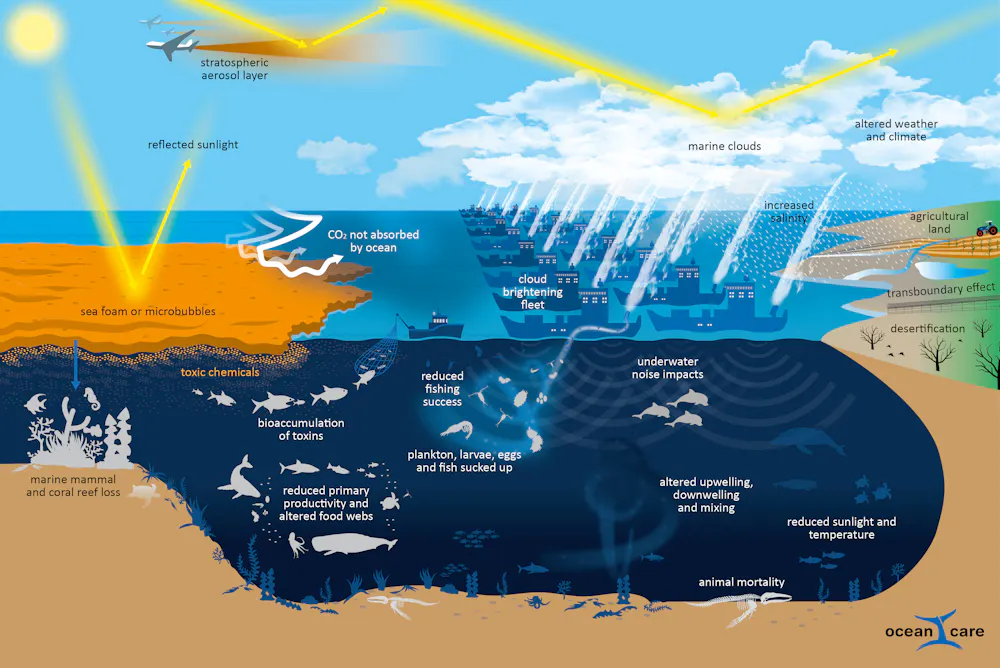
Here, we discuss several examples of solar radiation modification which exemplify the threats posed by these technologies. These are also depicted in the graphic below.

An infographic showing the potential unintended effects of various solar engineering methods.
An infographic showing the effects of solar engineering methods.
Authors provided

A load of hot air

In April 2022, an American startup company released two weather balloons into the air from Mexico. The experiment was conducted without approval from Mexican authorities.

The intent was to cool the atmosphere by deflecting sunlight. The resulting reduction in warming would be sold for profit as “cooling credits” to those wanting to offset greenhouse gas pollution.

Appreciably cooling the climate would, in reality, require injecting millions of metric tons of aerosols into the stratosphere, using a purpose-built fleet of high-altitude aircraft. Such an undertaking would alter global wind and rainfall patterns, leading to more drought and cyclones, exacerbating acid rainfall and slowing ozone recovery.

Once started, this stratospheric aerosol injection would need to be carried out continually for at least a century to achieve the desired cooling effect. Stopping prematurely would lead to an unprecedented rise in global temperatures far outpacing extreme climate change scenarios.


Read more:
Trying to cool the Earth by dimming sunlight could be worse than global warming


cracked, dry earth
Injecting aerosols into the atmosphere may lead to more droughts.
Shutterstock

Heads in the clouds

Another solar geoengineering technology, known as marine cloud brightening, seeks to make low-lying clouds more reflective by spraying microscopic seawater droplets into the air. Since 2017, trials have been underway on the Great Barrier Reef.

The project is tiny in scale, and involves pumping seawater onto a boat and spraying it from nozzles towards the sky. The project leader says the mist-generating machine would need to be scaled up by a factor of ten, to about 3,000 nozzles, to brighten nearby clouds by 30%.

After years of trials, the project has not yet produced peer-reviewed empirical evidence that cloud brightening could reduce sea surface temperatures or protect corals from bleaching.

The Great Barrier Reef is the size of Italy. Scaling up attempts at cloud brightening would require up to 1,000 machines on boats, all pumping and spraying vast amounts of seawater for months during summer. Even if it worked, the operation is hardly, as its proponents claim, “environmentally benign”.

The technology’s effects remain unclear. For the Great Barrier Reef, less sunlight and lower temperatures could alter water movement and mixing, harming marine life. Marine life may also be killed by pumps or negatively affected by the additional noise pollution. And on land, marine cloud brightening may lead to altered rainfall patterns and increased salinity, damaging agriculture.

More broadly, 101 governments last year agreed to a statement describing marine-based geoengineering, including cloud brightening, as having “the potential for deleterious effects that are widespread, long-lasting or severe”.


Read more:
What we know about last year’s top 10 wild Australian climatic events – from fire and flood combos to cyclone-driven extreme rain


A cloud brightening field trip in 2021 (Southern Cross University)

Balls, bubbles and foams

The Arctic Ice Project involves spreading a layer of tiny glass spheres over large regions of sea ice to brighten its surface and halt ice loss.

Trials have been conducted on frozen lakes in North America. Scientists recently showed the spheres actually absorb some sunlight, speeding up sea-ice loss in some conditions.

Another proposed intervention is spraying the ocean with microbubbles or sea foam to make the surface more reflective. This would introduce large concentrations of chemicals to stabilise bubbles or foam at the sea surface, posing significant risk to marine life, ecosystem function and fisheries.

No more distractions

Some scientists investigating solar geoengineering discuss the need for “exit ramps” – the termination of research once a proposed intervention is deemed to be technically infeasible, too risky or socially unacceptable. We believe this point has already been reached.

Since 2022, more than 500 scientists from 61 countries have signed an open letter calling for an international non-use agreement on solar geoengineering. Aside from the types of risks discussed above, the letter said the speculative technologies detract from the urgent need to cut global emissions, and that no global governance system exists to fairly and effectively regulate their deployment.

Calls for outdoor experimentation of the technologies are misguided and detract energy and resources from what we need to do today: phase out fossil fuels and accelerate a just transition worldwide.

Climate change is the greatest challenge facing humanity, and global responses have been woefully inadequate. Humanity must not pursue dangerous distractions that do nothing to tackle the root causes of climate change, come with incalculable risk, and will likely further delay climate action.

The Conversation

James Kerry is an Adjunct Senior Research Fellow at James Cook University, Australia, and Senior Marine and Climate Scientist for the non-governmental organisation, OceanCare, Switzerland.

Aarti Gupta is a professor of global environmental governance at Wageningen University in the Netherlands, and a signatory to the academic Open Letter calling for an ‘International Non-Use Agreement on Solar Geoengineering’.

Terry Hughes receives funding from the Australian Research Council.

ref. Not such a bright idea: cooling the Earth by reflecting sunlight back to space is a dangerous distraction – https://theconversation.com/not-such-a-bright-idea-cooling-the-earth-by-reflecting-sunlight-back-to-space-is-a-dangerous-distraction-223353

Pacific nations and civil society raise concerns at WTO conference

By Don Wiseman, RNZ Pacific senior journalist

The 13th Ministerial Conference (MC13) of members of the World Trade Organisation (WTO) is being held in Abu Dhabi in the United Arab Emirates.

Adam Wolfenden, who is there on behalf of Pacific Network on Globalisation (PANG), says the concerns of small Pacific nations centre on the subsidy provided by larger nations to fishing companies.

He said Fiji, in particular, was seeking a strong outcome on fisheries subsidies’ negotiations.

Wolfenden said the reason they were so concerned around fisheries subsidies was because of “the revenue and the importance of fisheries to the Pacific both at a governmental level, but also for the livelihoods of Pacific Islanders is enormous”.

He said this then raised concerns about how countries deal with overfishing and overcapacity, but did not prevent the small island nations from “developing their own domestic fleets to fish their resources and create a development pathway built on fisheries”.

Fiji’s Deputy Prime Minister and Trade Minister, Manoa Kamikamica, who is at the meeting, said: “Fiji will ask from its partners for stronger disciplines on subsidies contributing to overfishing and overcapacity in the negotiations that has caused the global depletion of fish stocks.”

“For us, this is more than a matter of national interest — it is a matter of national survival,” he said.

“Additionally, Fiji will highlight the importance of special and differential treatment for developing and least developed countries, including small island states, to ensure that trade policies take into account the specific challenges and vulnerabilities faced by these nations.”

Solomon Islands Foreign and Trade Minister, Jeremiah Manele, said the deliberations continued to undermine the responsible growth in his country’s fisheries sector “and further, the preservation of our fishing arrangements and differential licensing arrangements”.

“The current text maintains the status quo, leaning favourably towards the major subsidisers, with a mere focus on notifications and sustainability.”

MC13 is also focusing on reform of the WTO and Samoa’s Trade Negotiations Minister, Leota Laki Lamositele, said last year that “we reaffirmed that special and differential treatment for developing and Least Developed Country Members is an integral part of the WTO and its agreements”.

“As such, Samoa concurs with others in supporting the work of the WTO and that MC13 should ensure inclusive, transparent, and rules-based outcomes, to accommodate the diversity of WTO Membership in implementing current.”

‘A lot of uncertainty’
Civil society organisations have found themselves being shut out at this WTO meeting.

Wolfenden said there was a lot of concern about how non-government organisations were being treated in Abu Dhabi.

He said a lot of the activities that the groups would normally have been able to do — even just providing leaflets to journalists or directly engaging in advocacy — was being restricted.

“There’s a lot of uncertainty and a lack of clarity around what the security situation is with, you know, colleagues being detained for sending information to journalists for taking photos.

“We have sent a letter to the WTO director-general, I know this has been raised by a number of governments, including New Zealand, and the concerns around the way civil society is being treated.

“Yet there’s still no clarity and if anything, it feels like the way that we have been dealt with by local security is escalating.”

He added there was a lot of concern for participants and their safety within the conference venue.

This article is republished under a community partnership agreement with RNZ.

Print Friendly, PDF & Email

Article by AsiaPacificReport.nz

We discovered a ‘gentle touch’ molecule is essential for light tactile sensation in humans – and perhaps in individual cells

Source: The Conversation (Au and NZ) – By Kate Poole, Associate Professor in Physiology, UNSW Sydney

Shutterstock

You were probably taught that we have five senses: sight, sound, smell, taste and touch. This is not quite right: “touch” is not a single sense, but rather several working together.

Our bodies contain a network of sensory nerve cells with endings sitting in the skin that detect an array of different physical signals from our environment. The pleasant sensation of a gentle touch feels distinct from the light pressure of our clothes or the hardness of a pencil gripped between our fingers, and all of these are quite different from the pain of a stubbed toe.


Read more:
How do you feel? Your ‘sense of touch’ is several different senses rolled into one


How do these sensory neurons communicate such a wide range of different inputs?

In new research published in Science, the two co-authors of this article and our colleagues have found a force-sensing molecule in nerve cells called ELKIN1, which is specifically involved in detecting gentle touch. This molecule converts gentle touch into an electrical signal, the first step in the process of gentle touch perception.

How we sense gentle touch

Sensing gentle touch begins with tiny deformations of the skin due to a light brush. While they may not seem like much, these deformations generate enough force to activate sensory molecules that are found in specialised nerve endings in the skin.

These molecular force sensors form a pore in the surface of the cell that is closed until a force is applied. When the cell is indented, the pore opens and an electrical current flows.

This electrical current can generate a signal that moves along the sensory nerve to the spinal cord and up to the brain.

Our new research, led by Gary Lewin and Sampurna Chakrabarti from the Max Delbruck Center in Berlin, showed the force sensor ELKIN1 is necessary for us to detect very gentle touch.

They found mice lacking the ELKIN1 molecule did not appear to sense a cotton bud being gently drawn across their paw. The mice retained their ability to sense other environmental information, including other types of touch.

Different molecules for different kinds of touch

This new finding reveals one reason we can sense multiple types of “touch”: we have multiple, specialised force-sensing proteins that can help us distinguish different environmental signals.

ELKIN1 is the second touch-receptor molecule discovered in sensory neurons. The first (PIEZO2) was found in 2010 by Ardem Patapoutian, who was later awarded the Nobel Prize for the work. PIEZO2 is involved in sensing gentle touch, as well as a sense known as “proprioception”. Proprioception is the sense of where our limbs are in space that helps us regulate our movements.

A microscope image showing blobs of cyan, yellow and magenta.
Mouse neurons with the new ion channel ELKIN1 (cyan), which is responsible for touch sensation, nucleus (yellow) and the already known ion channel PIEZO2 (magenta).
Sampurna Chakrabarti / Max Delbrück Center

Identifying these force-sensing molecules is a challenge in itself. We need to be able to study nerve cells in isolation and measure electrical currents that flow into the cell while simultaneously applying controlled forces to the cells themselves.

Do cells feel?

While much of our research studied mouse neurons, not all scientific data obtained from mice can be directly translated to humans.

With team members at the University of Wollongong, one of us (Mirella Dottori) tried to determine whether ELKIN1 worked the same way in humans. They reprogrammed human stem cells to produce specialised nerve cells that respond to “touch” stimuli. In these human cells, ELKIN1 had similar functional properties of detecting touch.

A photo of a glass electrode prodding some cells in a Petri dish.
Experiments on sensory neurons confirmed the role of the ELKIN1 molecule.
Felix Petermann / Max Delbrück Center

While this research expands our understanding of how we make sense of the world around us, it also raises an additional, intriguing possibility.

ELKIN1 was first identified by one of us (Kate Poole) and her team at UNSW, with Gary Lewin and his team, while studying how melanoma cells break away from model tumours and “feel” their way through their surroundings. This could mean these tiny molecular force sensors give not only us, but our individual cells, a nuanced sense of touch.

Future research will continue to search for more molecular force sensors and endeavour to understand how they help our cells, and us, navigate our physical environment.

The Conversation

Kate Poole receives funding from the National Health and Medical Research Council, the Australian Research Council and the US Air Force Asian Office of Aerospace Research and Development

Mirella Dottori receives funding from the Australian Research Council, Medical Research Future Fund, Friedreich’s Ataxia Research Alliance and Friedreich Ataxia Research Association.

ref. We discovered a ‘gentle touch’ molecule is essential for light tactile sensation in humans – and perhaps in individual cells – https://theconversation.com/we-discovered-a-gentle-touch-molecule-is-essential-for-light-tactile-sensation-in-humans-and-perhaps-in-individual-cells-224494

Baiting foxes can make feral cats even more ‘brazen’, study of 1.5 million forest photos shows

Source: The Conversation (Au and NZ) – By Matthew Rees, Postdoctoral Research Fellow, CSIRO

Matthew Rees

Foxes and cats kill about 2.6 billion mammals, birds and reptiles across Australia, every year. To save native species from extinction, we need to protect them from these introduced predators. But land managers tend to focus on foxes, which are easier to control. Unfortunately this may have unintended consequences.

We wanted to find out how feral cats respond to fox control. In one of the biggest studies on this issue to date, we worked with land managers to set up 3,667 survey cameras in a series of controlled experiments. We studied the effects on cat behaviour and population density.

Our research shows feral cats are more abundant and more brazen after foxes are suppressed.

In some regions, cats need to be managed alongside foxes to protect native wildlife.

This camera trap captured a wide variety of animals, not just cats and foxes, in the Otway Ranges, 2019 (Matthew Rees)


Read more:
1.7 million foxes, 300 million native animals killed every year: now we know the damage foxes wreak


Could feral cats benefit from fox control?

Foxes and cats were brought to Australia by European colonisers more than 170 years ago. They now coexist across much of the mainland.

While foxes are bigger than cats, they compete for many of the same prey species.

But most wildlife conservation programs in southern Australia only control foxes. That’s largely because controlling foxes is relatively straightforward. Foxes are scavengers and readily take poison baits. Feral cats, on the other hand, prefer live prey. So they’re much more difficult to control using baits.

Consequently, foxes have become the most widely controlled invasive predator in Australia, while feral cat control has been relatively localised.

Some native species have thrived following fox control or eradication, but others have continued to decline. For example, one study found numbers of common brushtail possums, Western quolls and Tammar wallabies increased following fox control in southwest Western Australia. However, seven other species crashed: dunnarts, woylies, southern brown bandicoots, western ringtail possums, bush rats, brush-tailed phascogales and western brush wallabies.

People suspected controlling foxes could inadvertently free feral cats from competition and aggression, particularly if there were no dingoes around.

An image of a red fox from a camera trap in the study.
Foxes devastate native wildlife, but may also suppress feral cats.
Matthew Rees

Experimenting with fox control

To investigate how cats respond to fox control programs, we worked with land managers to run two large experiments in southwest Victoria. Foxes are the top predator in these forests and woodlands, because dingoes have already been removed.

We studied cat behaviour and population density before and after fox control in the Otway Ranges. In a separate study, we compared conservation reserves with and without fox control in the Glenelg region.

We put out 3,667 survey cameras over seven years. The cameras photograph animals as they walk by, allowing us to analyse where and when invasive predators and native mammals are active.

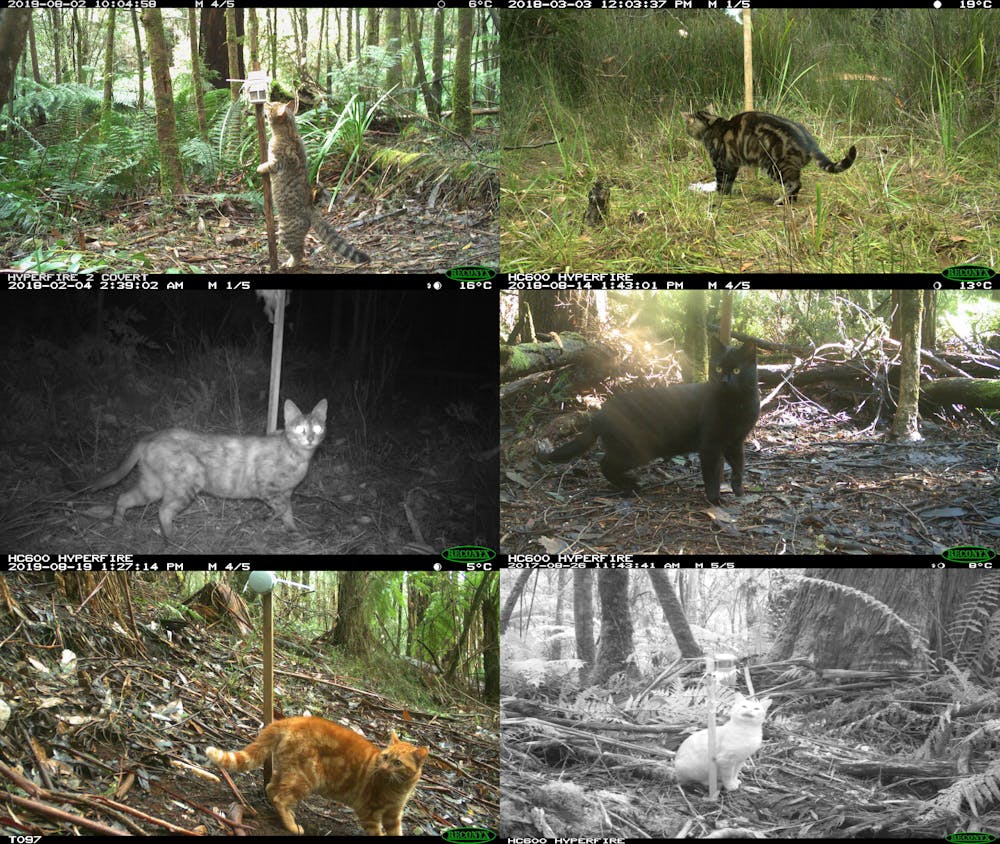
From these photographs, we were also able to identify individual feral cats based on their unique coat markings.

When multiple photographs of one cat were taken by several different cameras, we could track their movement. Combining information on the tracks of all the cats in an area allowed us to estimate cat population density.

It was a painstaking process. We went through almost 1.5 million images manually to check for animals, eliminate false triggers and identify individual cats.

Future research is exploring using artificial intelligence to streamline the process, but the computer still needs to be taught what to look for.

A grid of six different still images from camera traps showing a variety of different feral cats
We identified 160 different feral cats across two fox control programs in south-west Victoria.
Matthew Rees

What we found

We found sustained, intensive baiting for foxes worked. Areas with more poison baits had fewer foxes. Replacing baits regularly was also worthwhile.

Feral cat density was generally higher in areas with fox control. The strength of this effect varied with the extent and duration of fox management. We found up to 3.7 times as many cats in fox-baited landscapes.

Productive landscapes also supported more cats. There was about one feral cat per square kilometre in wet forests, compared with less than half as many in dry forests.

Feral cat behaviour also varied with fox control and forest type, including how visible cats were, how far they moved, and what times of day they were active.

Feral cats appeared more adventurous where fox populations were suppressed. In dry forests, for example, foxes were largely nocturnal, as were most native mammals. Feral cats became more active at night when there were fewer foxes, potentially giving them access to different prey species.

We found some threatened species, such as long-nosed potoroos, were doing much better in areas with long-term fox control, although others, such as southern brown bandicoots, showed no improvement.

We don’t know how fox control affected smaller native rodents and marsupials, which are likely to be most at risk from increased cat predation.

Camera trap image of one of the feral cats
Areas where foxes were controlled had more feral cats. They also tended to be behave differently.
Matthew Rees

A conservation balancing act

Broad-scale fox control is an important tool in the ongoing battle to protect Australia’s wildlife. Fox baiting is relatively simple and effective. But we have to balance the known benefits of fox control against potential unintended consequences.

Our study reinforces the need to carefully consider what could happen if you only control one pest animal, and to monitor carefully rather than assume that fox control will benefit all native species. We are not saying people should stop fox baiting, because there are clear benefits to species such as long-nosed potoroos. But we need to keep an eye on the cats and might need to also manage their impacts on native prey.

As feral cats are notoriously difficult to control lethally, indirect management may also be helpful. For example, promoting dense understorey vegetation for native prey to hide in or removing other sources of food that boost cat numbers such as pest rabbits.

Integrated pest management is challenging and expensive but likely needed, especially where feral cats or other pests are thriving alongside foxes.


Read more:
10-year feral cat plan brings us a step closer to properly protecting endangered wildlife


The Conversation

Matthew Rees receives funding from the Australian Government, Parks Victoria, Victorian Government Department of Energy, Environment and Climate Action, University of Melbourne, Holsworth Wildlife Research Endowment, Conservation Ecology Centre and the Grains Research and Development Corporation. He is affiliated with the Queensland Conservation Council.

Bronwyn Hradsky receives funding from the Australian Research Council, the Victorian Government Department of Energy, Enviroment and Climate Action, Parks Victoria and Zoos Victoria. She is a member of the Australian Wildlife Management Society and volunteers with Mange Management

ref. Baiting foxes can make feral cats even more ‘brazen’, study of 1.5 million forest photos shows – https://theconversation.com/baiting-foxes-can-make-feral-cats-even-more-brazen-study-of-1-5-million-forest-photos-shows-223352

On Sunday the National Rugby League goes to Vegas. It might just hit the jackpot

Source: The Conversation (Au and NZ) – By Jason Doyle, Senior Lecturer in Sport Management, Griffith University

Australia’s National Rugby League will launch its 2024 season in Las Vegas this weekend, in the boldest attempt yet to capture the hearts and wallets of Americans.

It’s been tried before.

In the 1930s, legendary League administrator Harry Sunderland took the game to France and offered to take it to the United States as manager of the 1929–30 Kangaroos.

He told the San Francisco Examiner the team was “willing to line up, with eleven men, against a regular American football team, and to see what would happen”.

Later, in 1954, Australia and New Zealand played exhibition matches in Long Beach and Los Angeles on the US west coast. Only 1,000 people turned up at Long Beach and 4,554 at Los Angeles.

Russell Crowe explains the rules and laws of rugby league, 2024.

Australia did better at Long Beach in 1987, putting on a State of Origin match between New South Wales and Queensland in front of 12,349 fans.

Film star Russell Crowe tried again in 2008, staging an exhibition match between the South Sydney Rabbitohs and UK Super League champions Leeds in Florida, attended by 12,500.

Will Rugby League Commissioner Peter V’landys be able to succeed this time, in a nation where his predecessors have failed to make much headway?

I think the odds are good. This is why.

No helmets, no pads, no timeouts

The potential reach of the NRL, promoted as football with “no helmets, no pads, no timeouts”, is vast, extending to the 309 million Americans who own a smartphone rather than the few thousand who might turn up.

And after the H-shaped posts leave Allegiant Stadium and the NRL’s branding is taken down from New York’s Times Square, the league’s presence will continue.

It has reportedly committed to five years of season openers in Las Vegas.

During those five years the NRL will attempt to build and sustain familiarity with the US public, as well as scout out US athletes about making the switch to rugby league.

There are 520,000 student-athletes in the US, many of whom are trying to get into the US National Football League. But the NFL can only accommodate 1,696 active players.

V’landys has turned the game around

During COVID lockdowns three years ago, the NRL was “three to four months” from being insolvent, according to V’landys.

He and chief executive Andrew Abdo say the league is now in the best financial position it has ever been in.

Its 2023 annual report outlines key reasons why:

  • 9% growth in grassroots participation in schools and clubs

  • 40% growth in video views on YouTube

  • ten clubs vying for the women’s championship in a final watched by more than a million viewers

  • expanding representation in the men’s game with the admission of the Dolphins

Clearly, the NRL do not think their work is done.

This time it might work

Sports research has mapped the processes that create fans for a sport.

The first pivotal step is awareness. Potential fans need to know about the sport in order to sign up. That’s the objective of the Las Vegas round and the advertising in Times Square.

The second is something that allows them to like and then identify with it. The advertisements point out rugby league’s similarities to the NFL, saying it’s “football, but not as you know it”, while at the same time emphasising the crucial and hopefully enticing differences.

My own work has pointed to the role key individuals play in developing sport fans. And this could be the ace in the hand of the NRL.

The Beckham Effect” is a term coined to explain the uplift in support when David Beckham joined Major League Soccer in the US in 2007.

Argentinian footballer Lionel Messi achieved a similar feat when he joined MLS club Inter Miami in 2023.

Closer to home, the Gold Coast Suns cemented their legitimacy when they signed football legend Gary Ablett Jnr (and rugby league player Karmichael Hunt) to their inaugural AFL squad in 2011.

Big names build recognition

It’s not a strategy that can easily be applied to the US, but a raft of Australians familiar to US audiences including actors, fashion designers, media moguls, businesspeople and musicians are doing what they can.

Currently independent from the NRL, plans are also underway to establish a ten-team American league with proposed ownership stakes being offered to figures such as wrestling and global movie star Dwayne “The Rock” Johnson.

If Las Vegas is a success, other US stars might just grab a franchise of their own.

Las Vegas is certainly a roll of the dice, but if the NRL succeeds in grabbing even a small slice of America’s vast sports market, it will have hit the jackpot.

The Conversation

Jason Doyle is a co-founder of SPRTER.

ref. On Sunday the National Rugby League goes to Vegas. It might just hit the jackpot – https://theconversation.com/on-sunday-the-national-rugby-league-goes-to-vegas-it-might-just-hit-the-jackpot-224735

Chemical attraction, a whodunit murder mystery and tensions at the mosque: what we’re streaming this March

Source: The Conversation (Au and NZ) – By Cherine Fahd, Associate Professor Visual Communication, University of Technology Sydney

It’s hard to believe March is here. Where did the time go?

By now many of us will be well into our regular routine at work or school. Perhaps life’s demands are starting to catch up and you’re already dreaming of your next break.

Fret not. Our experts have a range of new streaming suggestions. From the heartfelt romance One Day, which has already been in Netflix’s top ten list for three weeks – to a captivating Aussie drama centred on a local mosque community – there’s plenty to let off some steam.

House of Gods

iView

House of Gods is a gripping new Australian TV drama. It reveals the inner workings of an imam’s family and community, and the corrupting effects of power, ambition and secrets on family and faith.

Set in Western Sydney, the saga commences on election day at The Messenger mosque. Sheikh Mohammad (Kamel El Basha) is a progressive, charismatic contender for the esteemed position of head cleric. But he is embroiled in controversy when a young woman unexpectedly plants a kiss on his cheek while posing with him for a selfie.

The seemingly harmless gesture swiftly snowballs into a scandal that sparks a clash of ideologies within the mosque’s tight-knit community.

Fadia Abboud’s direction is enriched by her deep understanding of the Arabic community, lending genuine realism to every scene. The inclusion of Arab, Middle Eastern and Muslim actors adds an authentic touch to the drama. Their performances capture the cultural and social subtleties reminiscent of my own Arabic family and community.

Integrity shines through the costume and set design and in the meticulous portrayal of Muslim dress and architecture. These elements reflect a profound understanding of how faith influences the transition between private and public life, adding credibility to the storytelling.

For many in the Australian Arabic community, including Abboud, seeing a project created and written by Arabs, and featuring Arabs as lead characters, is an exciting and welcome development.

Cherine Fahd


Read more:
ABC’s House of Gods: a bold and compelling exploration of contemporary life in an Australian imam’s family


Five Blind Dates

Prime

If the balance of Five Blind Dates is occasionally a little off, it is nonetheless a lovely film, one I could see becoming a comfort watch for a lot of people – it’s as warm and familiar as the cups of tea purveyed by its heroine.

Lia (Shuang Hu, also the cowriter) runs a traditional Chinese tea shop in Sydney, but is in Townsville for the wedding of her sister (Tiffany Wong).

The film’s premise is established very quickly when, at one of the pre-wedding events, Lia is told by a fortune teller she will meet her soulmate on one of the next five dates she goes on. And then, when she re-encounters her ex-boyfriend Richard (Yoson An) at Alice’s engagement party, Lia ends up on a mission to go on these five dates as fast as possible so she can bring her soulmate to the wedding – and thus show up Richard, who is the best man.

While there is nothing particularly surprising in Five Blind Dates, it is nevertheless a really refreshing film. We don’t have a lot of rom-coms set in Australia, much less ones that centre on Chinese Australian characters. It’s a playful, joyful film with a likeable and layered heroine which doesn’t outstay its welcome (it clocks in at under 90 minutes).

– Jodi McAlister


Read more:
New Aussie rom-com Five Blind Dates could become your next comfort watch


Lessons in Chemistry

Apple TV

Fashion, cars and 1960s politics provide an engaging context for Lessons in Chemistry, a miniseries based on Bonnie Garmus’ best-selling novel. Those who loved the book might see shortcomings in the series, such as the dog’s role being downgraded. Yet it is entertaining and succeeds on its own terms.

Elizabeth Zott (Brie Larson) and Calvin Evans (Lewis Pullman) are totally engrossed by science; their every waking moment involves contemplating it. This makes them social outsiders who aren’t especially interested in others – something used productively to motivate story arcs. A meeting of minds and shared passion for the field quickly becomes love and mutual respect. Calvin supports Elizabeth to work as a chemist – no small feat for a woman in the era. Together, they outshine everyone around them.

The story stands out due to its ardent portrayal of a woman who is so passionately absorbed in her work.

Eventually, unfair circumstances lead to Elizabeth – who also loves to cook and applies science to achieve the perfect recipe – becoming a hugely popular cooking show host. From this platform she motivates her female fans to step into their aspirations, whatever they may be.

– Lisa French

Feud: Capote vs The Swans

Apple TV

Just in time for Mardi Gras, Feud: Capote versus The Swans is a delightfully bitchy yet subtly nuanced portrait of friendship between gay men and straight women, a topic I tackled in a documentary I recently produced.

When famed writer and high-society insider Truman Capote publicly airs the dirty laundry of his ultra-rich gal pals, the knives come out in an oh-so-fabulous way.

Based mostly on facts, the FX television series is set against a historically accurate 1960s and ‘70s North American milieu, but takes a few liberties. In my favourite episode so far, pioneering documentarians Albert and David Maysles capture Capote’s 1966 Black and White Ball at the Plaza Hotel – the ball happened but the Maysles Brothers never recorded the glamorous event in actuality.

Sumptuous production design, a dazzling cast (most notably Naomi Watts as New York socialite Barbara “Babe” Paley and Tom Hollander as Capote), and deft directing from queer provocateur Gus Van Sant all add up to a quality television viewing experience that prises open privilege in all its beautiful ugliness.

– Phoebe Hart

One Day

Netflix

At first glance, Netflix’s decision to adapt David Nicholls’s beloved novel One Day may seem strange after the 2011 film bombed so cataclysmically.

However, the book’s episodic structure lends itself beautifully to television resulting in a highly bingeable romance. Like its source material, the series depicts 20 years of friendship and a “will they, won’t they” angst between working-class Northerner Emma (Ambika Mod) and wealthy golden boy Dexter (Leo Woodall).

Each episode takes place on July 15, beginning with the unlikely duo’s booze-fuelled graduation night in 1988. This central conceit provides the narrative structure for the 14-part series, an unusually long runtime in today’s streaming market.

Arguably overly leisurely at times, One Day’s slower pacing ultimately creates space for old hurts and yearnings to wane, fester and reignite. It is ably helped along by compelling performances from Mod and Woodall. Mod brings warmth to Em’s prickly sarcasm, while Woodall infuses Dex’s privileged arrogance with enough genuine charm to make both Emma – and by proxy, us – forgive him.

One Day isn’t perfect, particularly regarding its superficial treatment of race and class. But its combination of 1990s nostalgia (hamburger phones! Eagle Eye Cherry! Portishead!) and swoony romance makes it a tissue-sodden winner.

– Rachel Williamson

True Detective, season four

Binge

The fourth season of True Detective, titled Night Country, has been created by showrunner Issa López, who notably directed the incredible film Tigers Are Not Afraid (2017).

This season is a terrifying exploration of ecological and First Nations justice. The lead detectives are Jodie Foster playing the gruff Police Chief Liz Danvers, and relative newcomer Kali Reis as the more junior trooper Evangeline Navarro. Also starring is the incredible Fiona Shaw as a spiritual woman living on the edge of town.

In the opening episode, several members of the nearby research station go missing, presumed dead. Navarro believes the disappearances are connected to the death of a First Nations woman several years ago, and the powerful Silver Sky mining company.

The series is notably different to previous seasons of True Detective in that López employs both magical realism (also used in Tigers Are Not Afraid) and folk horror to push this whodunit into horror territory. The shift has angered some fans, but I think it would do the show a disservice simply to repeat what came before.

In an interview with Vanity Fair, López shared that she sees this as an inverse of the first season:

Where True Detective is male and it’s sweaty, Night Country is cold and it’s dark and it’s female.

– Stuart Richards


Read more:
Black comedy, political drama and a documentary about a cult: what we’re streaming this February


The Conversation

The authors do not work for, consult, own shares in or receive funding from any company or organisation that would benefit from this article, and have disclosed no relevant affiliations beyond their academic appointment.

ref. Chemical attraction, a whodunit murder mystery and tensions at the mosque: what we’re streaming this March – https://theconversation.com/chemical-attraction-a-whodunit-murder-mystery-and-tensions-at-the-mosque-what-were-streaming-this-march-224267

Care and protection, or containment and punishment? How state care fails NZ’s most vulnerable young people

Source: The Conversation (Au and NZ) – By Jennifer Montgomery, Faculty of Health Research Associate, Te Herenga Waka — Victoria University of Wellington

Recent reports by the Chief Ombudsman, the Independent Children’s Monitor and the Auditor General have detailed the grim state of affairs for children and whānau in Oranga Tamariki (Ministry for Children) care.

The ombudsman called for “change on a scale rarely required of a government agency”, and said Oranga Tamariki has lost the public’s trust.

He highlighted the story of a young person who spent years in a secure “care and protection” residence. He also acknowledged the harmful effects of residential care on young people.

Care and protection residences provide a secure living environment for children aged 12-16, when it’s considered unsafe for them to live at home or in their community. The ombudsman said these sorts of facilities should only be used as a last resort for the shortest time possible.

But care and protection residences are increasingly being used as a default solution for young people with the most complex needs. What needs to change to ensure they become a therapeutic safe space for children in need, rather than a dumping ground for “bad kids”?

Secure, locked environments

Care and protection residences are at the most intensive, institutional end of the state care continuum. They bear a striking similarity to prisons.

Young people are placed in these residences when they are considered to be at serious risk of physical or mental harm from others, or towards themselves, and cannot be placed in the community.

The length of time a young person spends in residence is largely unregulated and is often related more to a lack of community placement options than need.

Oranga Tamariki currently operates two care and protection residences, Epuni in Wellington and Puketai in Dunedin, as well as a care and protection “hub” in Auckland, Kahui Whetū. A third Oranga Tamariki residence, Te Oranga in Christchurch, remains “non-operational”, following serious concerns about staff conduct. Barnardos operates Te Poutama, a specialised, contracted residence in Christchurch.


Read more:
Racism alleged as Indigenous children taken from families – even though state care often fails them


For almost four decades, the state-run residences have been subject to extensive media coverage and institutional examination. This includes the Puao-te-Ata-tu report in 1988, and more recent reports from the Office of the Children’s Commissioner, the Independent Children’s Monitor, the Whānau Ora Commissioning Agency and the advisory board of the Minister for Children.

The Oranga Tamariki Rapid Review was released in September 2023 and highlighted significant, systemic and longstanding issues with the residences and the need for urgent change.

In 2021, Oranga Tamariki announced plans to close these residences by 2022 and “replace them with smaller purpose-built homes”. But residences continue to operate and are chronically under-resourced.

Traumatising effects of residential care

Youth in care and protection residences make up 2% of all children in state care.

While Māori, Pasifika and rainbow youth are generally over-represented in care, rangatahi (young) Māori represent 57% of youth in residences.

The consistent over-representation in rangatahi Māori in state care connects with deep historical and intergenerational trauma for Māori.

Residential care claims to provide intensive and specialist support. But in reality, it has significant negative impacts for young people.

The number of children in residential care experiencing serious physical, sexual or emotional harm by staff or other young people in residence is increasing dramatically.


Read more:
Why NZ law should require everyone to report known or suspected child sexual abuse


Part of the problem is the lack of specialist staff. Residences are predominantly staffed by support workers who have no minimum level of professional qualifications, skills or regulation. They have minimal support or supervision to address the complex needs of young people in residences.

The role of meeting the mental health needs of those in residences tends to be outsourced to already oversubscribed public mental health services.

Young people who enter care and protection residences have experienced disproportionately high rates of trauma and mental health challenges compared to the overall population.

This may be due to a range of complex and challenging life experiences in childhood. The experience of being uplifted and placed in a residential care environment can also be traumatic for youth and whānau.

Children in care and protection residences are often negatively labelled and subjected to misdiagnoses and inappropriate or inadequate interventions.

They are also more likely to experience extremely poor life outcomes and follow a pipeline into Youth Justice and the prison system.

No clear model of care

Despite Oranga Tamariki’s intentions to develop a trauma-informed, system-wide framework, there is no clear or consistent model of care to guide practice, policies or service delivery in care and protection residences.

Trauma-informed models of care recognise how trauma affects the neurodevelopment, health, behaviour and functioning of young people and whānau. These models also create safe environments and emphasise stable, predictable relationships.

But care and protection residences utilise an outdated and detrimental behavioural reward-and-punishment model. Contrary to international human rights law, seclusion and restraint continues to be used in residences, with rangatahi Māori experiencing higher rates of seclusion.


Read more:
10 is too young to be in court – NZ should raise the minimum age of criminal responsibility


With the report from the Royal Commission of Inquiry into Abuse in Care due this year, we must listen to the experiences young people, whānau and youth advocacy groups like Voyce Whakarongo Mai, to avoid the mistakes of the past and prevent future traumatisation in care.

Key recommendations to transform Oranga Tamariki include increasing leadership and staffing expertise, service improvement investment, and collaborative inter-agency approaches. It is also recommended Oranga Tamariki devolve care to community partners and develop a therapeutic, trauma-informed model of care.

Healing from trauma is possible when a young person belongs to a strong network of people who enable them to feel loved, cared for and part of a community. Every young person deserves this.

The Conversation

Jennifer Montgomery received a Career Development Award with associated funding from the Health Research Council to complete this research.

ref. Care and protection, or containment and punishment? How state care fails NZ’s most vulnerable young people – https://theconversation.com/care-and-protection-or-containment-and-punishment-how-state-care-fails-nzs-most-vulnerable-young-people-224629

Grattan on Friday: The voters of Dunkley have government and opposition in a guessing game

Source: The Conversation (Au and NZ) – By Michelle Grattan, Professorial Fellow, University of Canberra

Next week, Prime Minister Anthony Albanese will be back on the international stage – while standing firmly on home ground. The foreign stage is coming to him, with a three-day special summit in Melbourne celebrating 50 years of dialogue partnership between Australia and the Association of Southeast Asian Nations (ASEAN).

The Monday-to-Wednesday gathering will have a leaders’ plenary session and retreat, and activities focusing on trade and investment, climate and clean energy, maritime cooperation, and long-term challenges.

Albanese relishes opportunities to rub shoulders with other leaders, and it’s a big deal for Australia to host this meeting, which affords an opportunity to spruik our middle-power credentials.

But the prime minister’s private mood as he greets leaders on Monday will be influenced by the outcome of a strictly domestic weekend event in Melbourne: the byelection in the bayside Labor seat of Dunkley.

On one level, nothing earth-shattering hangs on the Dunkley outcome. Labor could lose the seat and still have a narrow parliamentary majority. Albanese’s leadership would remain rock solid.

But on another level, the byelection result could affect the political dynamic for months.

The government has become more jittery about Dunkley in the past couple of weeks.

A Labor loss would be dramatic, sending the government into a spin and the media into a feeding frenzy. With an election a little over a year away, the normally quiescent caucus would be agitated. Extra pressure would be put on the framing of the May budget, with calls amplified for the government to do more to address the cost of living, the major issue in the Dunkley campaign.

If Labor holds the seat but only just, the angst will be immediate but limited. A win is a win. Nevertheless, that result would be seen in classic terms, as a “wake-up call”. The Liberals have been urging voters to send a protest message.

A big swing against Labor would call into question whether Albanese had really got away with compromising his integrity by breaking his word over the Stage 3 tax cuts. National polling suggests he has, even though the new tax regime has not given Labor a positive bounce. But a bad Dunkley result could raise longer-term worries for Albanese on the trust issue.

The announcement of the reworked tax package was timed for Dunkley, despite Albanese’s denials. The government has relentlessly pushed the tax cuts in parliament’s question time, slicing and dicing their rewards for teachers, nurses, police, women and every other conceivable cohort (even plumbers in Antarctica). Most voters in Dunkley will benefit, compared with where they’d have been under the old Stage 3 plan. But it’s unclear how much they will reward the government.

A Labor setback would probably bring a sharper focus on Albanese’s style. Already some in Labor believe he should cut back on the high-profile fun events he’s seen at. Eyebrows went up last weekend when, after attending a Friday night Taylor Swift concert, he went on Saturday to a celebrity bash at packaging magnate Anthony Pratt’s Raheen mansion in the Melbourne suburb of Kew.

Albanese could say he gave a speech to food-and-beverage industry people there, but with US pop star Katy Perry brought in at large expense to perform, this was undeniably a party.

Incidentally, this is the second time the billionaire has managed to lure a prime minister into a situation that didn’t play entirely well for him. When Scott Morrison was in the US in 2019, Pratt invited him and the then President Donald Trump to the opening of his $500 million paper mill in Ohio. But the event took on the hue of a Trump rally, which was awkward for Morrison.

A Liberal flop in Dunkley – a failure to get a substantial swing – wouldn’t be the end of Peter Dutton’s leadership. Last year’s loss of the Liberal seat of Aston seemed devastating at the time, yet a few months later Dutton had revived, with the defeat of the referendum and Labor in a slump. The suggestion that if Dutton can’t win Dunkley he should be replaced is overblown, not least because there is no viable alternative anyway.

Nevertheless, a bad Liberal result would be a notable knock for the opposition leader, because Dunkley is the prototype of the seats he’s targeting for the 2025 election.

In the final week, both sides have tried to manage expectations ahead of a result they’ve found hard to predict. They’ve set their own benchmarks for what “swing” figure is relevant.

Dunkley sits on a margin of 6.3%. Albanese has painted this as a flimsy buffer, by pointing to a 7.1% average byelection swing against governments in government-held seats since 1984. By contrast, the opposition casts 6.3% as a mountain to climb, saying since the second world war, the average swing against a government in a federal byelection has been only 3.6%, and even less against a first-term government. Dutton says a 3% swing would be “bad for the government”.

ABC election analyst Antony Green says there have been 52 byelections since the election of the Hawke government in 1983, 28 of them traditional two-party contests like Dunkley. Across these, the average anti-government two-party preferred swing was 3.5%.

One uncertainty is what the “Peta Murphy” effect will be. Murphy, the popular local member whose death prompted the byelection, won the seat from the Liberals in 2019. She increased her margin in 2022, picking up some who deserted the Liberals for various reasons. Will they now return to the Liberals? Labor has been trying to hang onto the “Murphy vote” by saying that backing its candidate, Jodie Belyea, a Murphy protege, would be a way of carrying on Murphy’s legacy.

Another unknown is what effect the extensive anti-Labor campaign by the advocacy group Advance will have. Advance, which styles itself as committed to the “fight for mainstream Australian values”, had a big presence in the Voice referendum. It is for the political right what GetUp! has in the past been for the left. With a big war chest, it has been very active on social media. If the Dunkley outcome and the post mortems were to attribute significant influence to the Advance campaign, the group would be emboldened for the 2025 election.

Labor will have spent about $1 million on its Dunkley campaign. The Liberals declined to say what they’ve spent. Labor national secretary Paul Erickson says:“We estimate the Liberals have easily matched this, and then Advance have (according to Advance) spent a further $300,000 on top of that. So, the combined efforts of the Liberal Party and Advance put the Liberals at a distinct advantage. The campaign to defeat Labor has been 30% larger than Labor’s campaign to retain the seat.”

After the tension of the Dunkley battle, there’s relief on both sides that Labor has flagged it is unlikely to fight the byelection that follows Scott Morrison vacating Cook.

The Conversation

Michelle Grattan does not work for, consult, own shares in or receive funding from any company or organisation that would benefit from this article, and has disclosed no relevant affiliations beyond their academic appointment.

ref. Grattan on Friday: The voters of Dunkley have government and opposition in a guessing game – https://theconversation.com/grattan-on-friday-the-voters-of-dunkley-have-government-and-opposition-in-a-guessing-game-224732

Fa’anānā Efeso Collins – an ‘extraordinary man’, says widow

RNZ News

The late Green Party MP Fa’anānā Efeso Collins has been remembered by his widow as an “extraordinary man” at a service in South Auckland.

The 49-year-old husband and father-of-two died on February 21 after collapsing during a charity event in Auckland’s central city.

Fa’anānā’s unexpected death came as a shock to many, with his aiga — including wife Fia and daughters Kaperiela and Asalemo — saying he was “the anchor of our tight-knit family”.

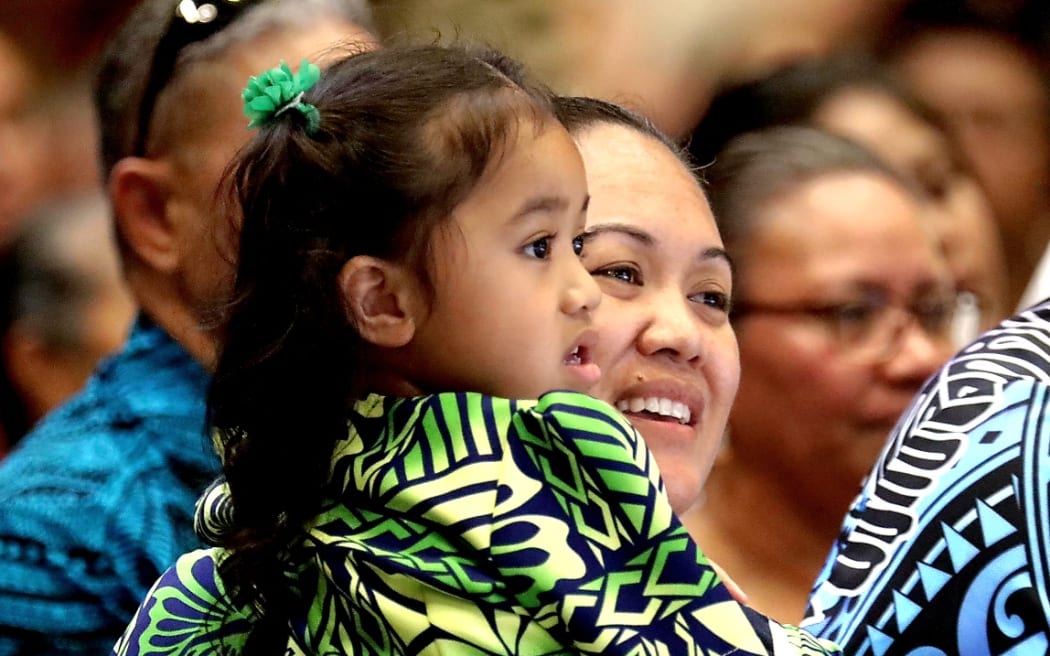
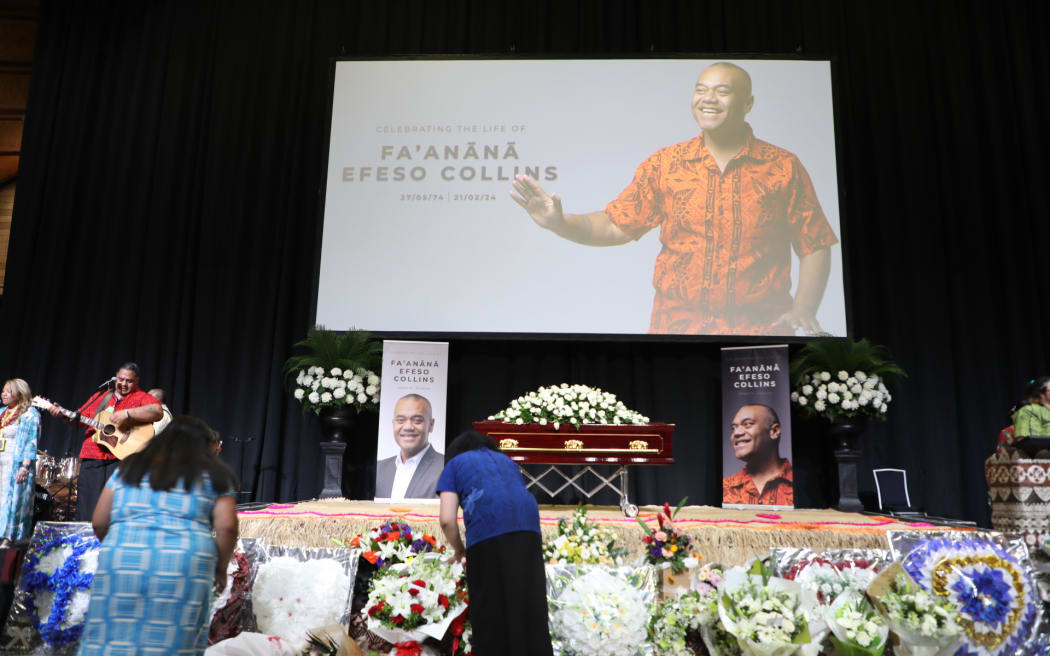
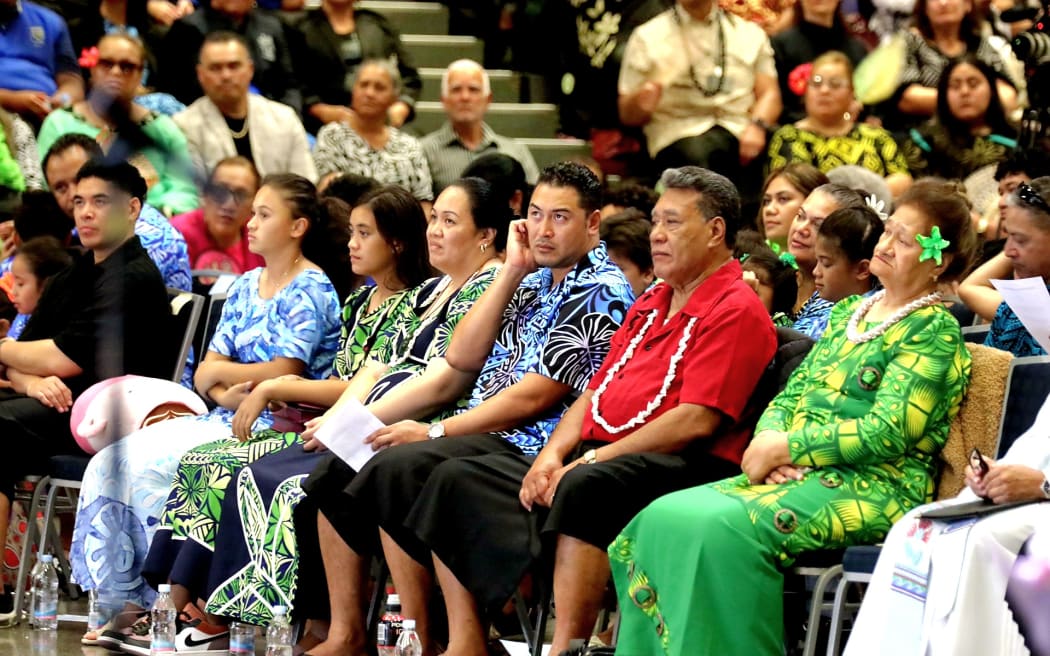
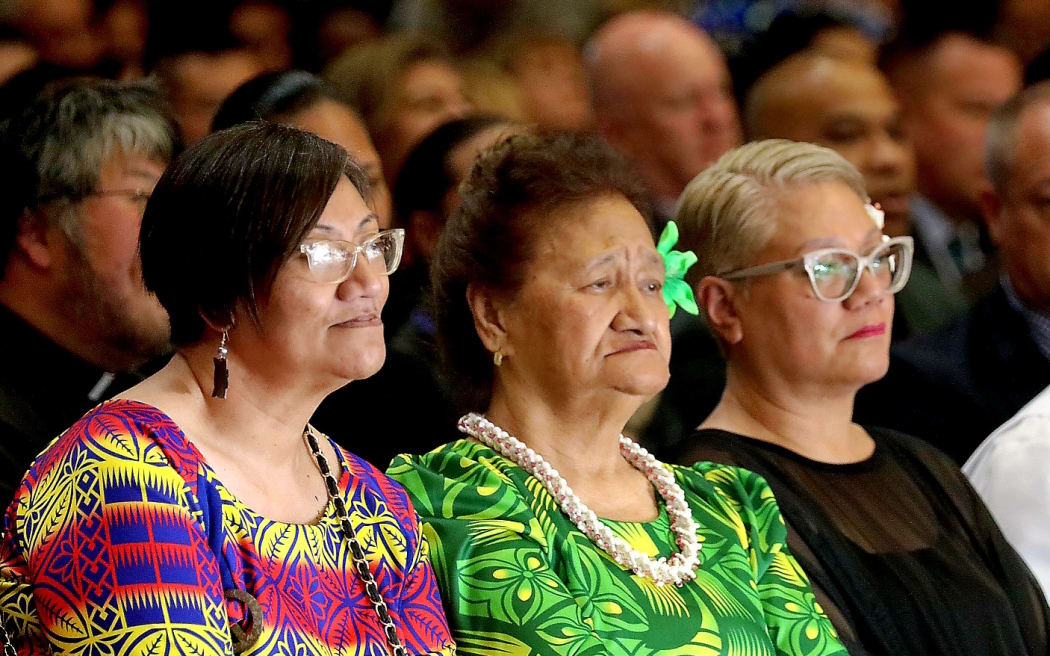
Politicians and members of the public, including school students, were among those attending Fa’anānā’s funeral at Due Drop Event Centre in Manukau on Thursday afternoon.

Many of the guests were dressed in traditional Pacific clothing, and a gospel choir sang as the crowd filled the room.

Fa’anānā’s wife and daughters were described as his “constant bullseye”. Image: RNZ/Nick Monro

To start the service, poet Karlo Mila read a poem that finished: “You become the ancestor we always knew you were.”

Family spokesman Taito Eddie Tuiavii then gave a formal greeting in Samoan, paying tribute to Fa’anānā and his villages.

‘Larger than life’
He described Fa’anānā as “larger than life”.

It was an “indescribable feeling” to mourn the loss of “our champion”, Tuiavii said.

Fa’anānā’s sisters took the stage to share stories from his life.

His sister Jemima . . . “We didn’t have much growing up in Ōtara, but we were raised with an abundance of love, and that made us pretty rich.” Image: RNZ/Nick Monro

As a child, Fa’anānā was known as ‘Boppa’, his sister Jemima said. He loved playing and watching cricket.

“We didn’t have much growing up in Ōtara, but we were raised with an abundance of love, and that made us pretty rich.”

Fa’anānā preferred watching the TV news to children’s programmes and loved trivia.

He attended Auckland Grammar School for just two weeks, before deciding to leave due to “racist comments”, his sister said. He then transferred to “the mighty” Tangaroa College before going on to Auckland University.

Mourners embrace at the Due Drop Events Centre. Image: RNZ/Nick Monro

‘Deep friendship with Jesus’
Fa’anānā always had “a deep friendship with Jesus”, the crowd heard.

“Efeso was able to reach so many people because of his relationship with Jesus.”

Jemima signed off by saying: “Manuia lau malaga (rest in peace), Boppa. Until we meet in the clouds.”

Another of Fa’anānā’s sisters, Millie Collins, described her brother as “our family’s golden boy”.

“He was my mum and dad’s sunshine, and to his brothers and sisters, his cousins and friends, he was our superstar.”

Prime Minister Christopher Luxon. Photo: RNZ/Nick Monro

He was always helping out his extended family, Millie Collins said.

“[He was] born to impact the world, born to lead through service. A visionary, a loving, honourable son, husband, father, brother, cousin, nephew and friend.”

Heartbroken at parting
Dickie Humphries, who has known Fa’anānā since they attended Auckland University, addressed his friend’s widow directly, saying he was heartbroken that they had been parted.

“This is not what our friend wanted for you. He wanted to love you through a long life,” he told Fia.

However, he was also happy Fa’anānā had found “his best friend, his greatest champion”, he said.

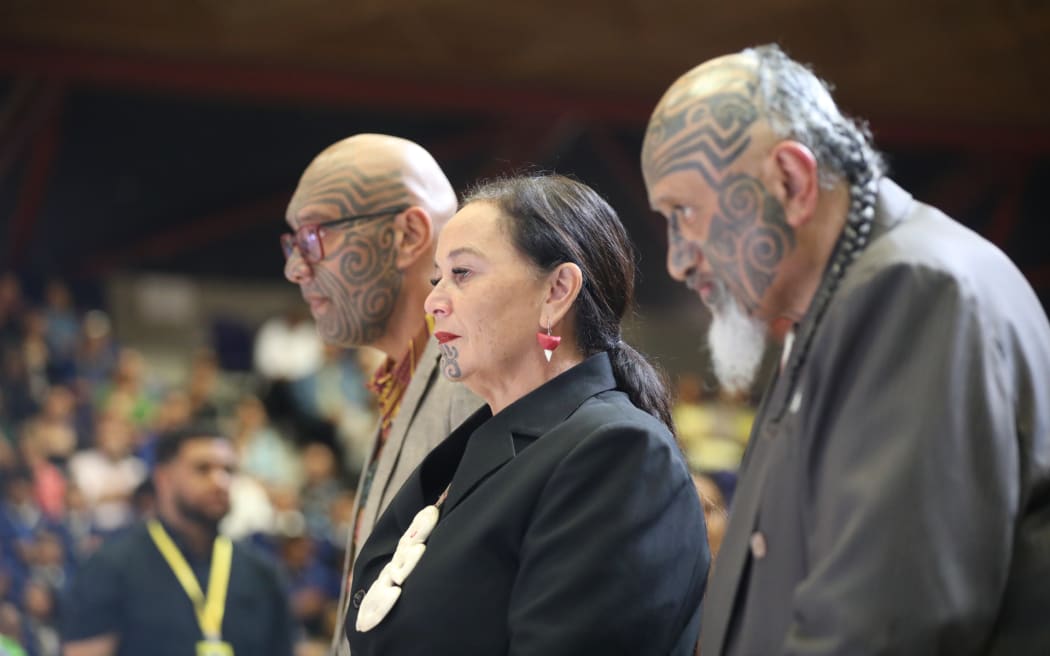
Te Pāti Māori co-leaders Debbie Ngarewa-Packer and Rawiri Waititi. Image: RNZ/Nick Monro

Fa’anānā’s legacy had showed him “we must live big lives”, Humphries said.

“Lives of service, lives that leave this world better for having been in it. Lives that make right on the legacy of Efeso.”

He said all gathered there must keep working towards a better Aotearoa — one where Pasifika people did not die young, or face racist abuse while in Parliament.

Humphries remembered his friend as someone with “an inquiring mind and a curious heart”.

‘Unwavering belief in people’s brilliance’
“He had an unwavering belief in the brilliance of our people.”

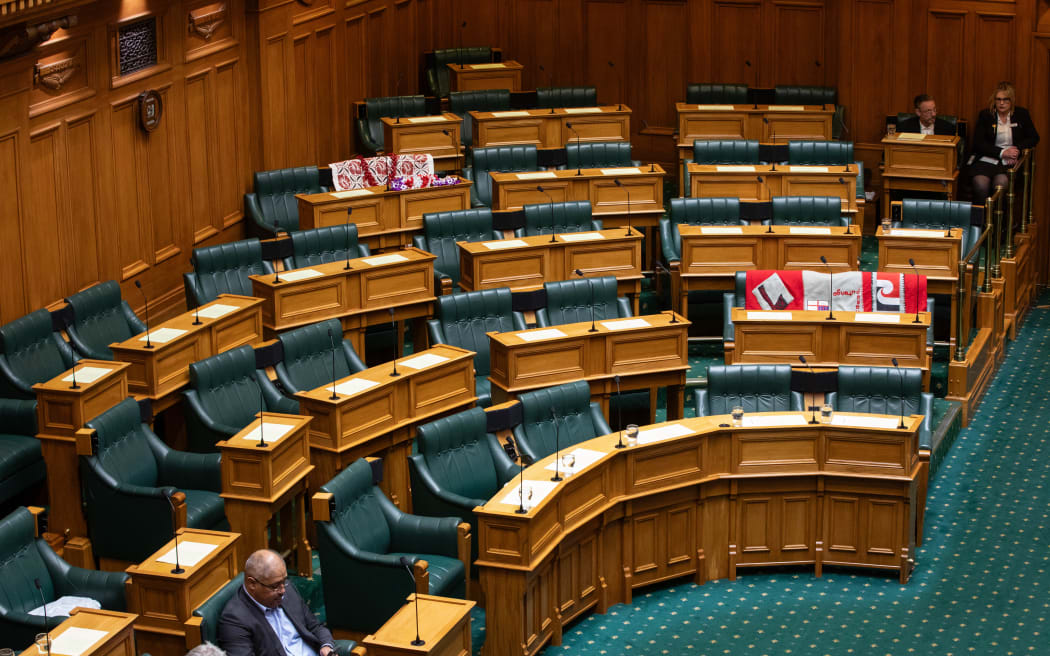
The Green Party’s seats in Parliament were empty today as all 15 MPs attended their colleague’s funeral. Image: RNZ/Angus Dreaver

Among the people at the funeral were Green Party co-leaders Marama Davidson and James Shaw, Prime Minister Christopher Luxon, Labour leader Chris Hipkins, and National’s Gerry Brownlee, Auckland Mayor Wayne Brown, Te Pāti Māori co-leaders Debbie Ngarewa-Packer and Rawiri Waititi.

Fa’anānā’s wife and daughters were wearing the dresses they wore at Parliament earlier this month, when Fa’anānā gave his maiden speech as an MP.

Like Humphries, Davidson addressed Fia directly in her speech, saying Fa’anānā valued her opinion above all else.

“He lived for the power of Pacific women.”

Family was his “constant bullseye”, Davidson said.

Green Party co-leaders Marama Davidson and James Shaw with Labour leader Chris Hipkins in the crowd at Fa’anānā Efeso Collins’ funeral. Image: RNZ/Nick Monro

She promised the Green Party would wrap their arms around their colleague’s family for their whole lives. All 15 Green MPs were at the funeral.

Legacy of self-determination
The party would also continue his legacy of fighting for the self-determination and wellbeing of Pasifika people, Davidson said.

“My friend, my brother Fes. What I wouldn’t give to hug you close and long right now, even just one more time. You beautiful man. I love you always.”

In his speech, Fa’anānā’s friend Te’o Harry Fatu Toleafoa said the MP was kind to everyone, “whether you’re Christopher Luxon in the Koru Lounge or the cleaner”.

“He treated absolutely everybody with value, dignity, respect and he made them feel special.” Image: RNZ/Nick Monro

“He treated absolutely everybody with value, dignity, respect and he made them feel special.”

Te’o also paid tribute to the next generation of leaders following in Fa’anānā’s footsteps.

“He was the best of us … but if you think Fes is the best, wait ’til the next generation comes up.”

Te’o mentioned the death threats Fa’anānā received in his role as a public servant, before addressing his daughters directly: “Thank you for giving us your dad, even though we didn’t deserve him.”

Racist hate mail
Pasifika journalist Indira Stewart also talked about the difficulties Fa’anānā faced while running for and serving in office.

Fa’anānā . . . “one of the finest leaders of our generation” Image: RNZ/Nick Monro

He received racist hate mail and a bomb threat was made to the home he shared with his wife and daughters.

Fa’anānā was “one of the finest leaders of our generation”, she said.

“We are so proud of the legacy you leave behind for the next generation of Pasifika.”

Samoan singer-songwriter Annie Grace and South Auckland duo Adeaze also performed hymns during the service.

Fa’anānā’s widow Vasa Fia Collins was the last speaker and took the stage with her daughters beside her.

She introduced herself by saying: “I am an ordinary woman who married an extraordinary man.”

The funeral of Fa’anānā Efeso Collins.       Video: RNZ

Fa’anānā was “born to lead”, she said.

“If you knew him, you’d know that he always tried to discreetly enter spaces and sit at the back. But how can you miss a man who’s 6’4 with a booming voice and a beautiful big smile?”

A doting father
He was also a doting father, taking their daughters to school, teaching them how to pray and “feeding them ice cream when I wasn’t looking”, she said.

“He treated me like a queen, every single moment we were together . . . a true gentleman, always serving our needs before his own.”

Fa’anānā had a great capacity for the “square pegs” in society — those who did not fit in, she said.

He valued the knowledge of his Pasifika ancestors and always mentored and love young people, she said.

“Fes died serving others. He has finished his leg of the race and the baton is now firmly in our hands.

“Please don’t let all that he did, all his hard work — blood, sweat and tears — be for nothing.”

Fa’anānā’s sisters in the crowd. Image: RNZ/Nick Monro

Fa’anānā was charismatic, humble and wise, she said. He saw the potential in others and made them better people.

Be ‘the very best of us’
“[He] never stopped encouraging people to rise, to aim high, to be the best version of themselves . . . he was the very best of us.”

Vasa told her daughters she was proud of them: “Daddy would be, too.”

Fa’anānā was the family’s “warrior” and protector, she said, and now he was their “eternal Valentine”.

“I’m so grateful for the life that we built together. But I trust and know that Fes is in the presence of God.”

Vasa finished her speech by singing a Samoan hymn.

Fa’anānā would be laid to rest privately after his casket was driven through Ōtara and Ōtāhuhu one last time.

This article is republished under a community partnership agreement with RNZ.

Print Friendly, PDF & Email

Article by AsiaPacificReport.nz

NZ govt designates political wing of Hamas a ‘terrorist’ entity

RNZ News

Prime Minister Christopher Luxon has designated the political wing of Hamas as a “terrorist” entity.

New Zealand designated the military wing of Hamas as a terrorist entity in 2010.

Foreign Minister Winston Peters said the government unequivocally condemned the “brutal” terrorist attacks by Hamas in October, and the move had been taken after he received official advice.

“What happened on 7 October reinforces we can no longer distinguish between the military and political wings of Hamas,” Peters said.

“The organisation as a whole bears responsibility for these horrific terrorist attacks.”

The designation means any assets of the terrorist entity in New Zealand are frozen. It also makes participation in or supporting Hamas’ activities, or recruiting for it a criminal offence.

However, Peters made clear the designation would not affect the provision of humanitarian support to Palestinians, and would not stop New Zealand providing aid to benefit civilians in Gaza.

‘Gravely concerned’
“Nor does it stop us providing consular support to New Zealand citizens or permanent residents in the conflict zone,” he said.

“We remain gravely concerned about the impact of this conflict on civilians and will continue to call for an end to the violence and an urgent resumption of the Middle East Peace Process.

“A lasting solution to the conflict will only be achieved by peaceful means.”

The coalition government has also banned several extremist Israeli settlers from travelling to New Zealand.

Peters said those banned had committed violent attacks against Palestinians in the West Bank.

It was not clear how many settlers have been banned and who exactly they are.

There has been a significant increase in extremist violence perpetrated by Israeli settlers against Palestinian populations in recent months, Peters said.

He acknowledged the official advice provided to him had been commissioned by then Prime Minister Chris Hipkins in October.

Just over a fortnight earlier, Peters had specifically urged Israel not to begin a ground offensive in Rafah, a city in southern Gaza.

A day later, Prime Minister Christopher Luxon issued a joint statement with his Australian and Canadian counterparts calling for the same thing.

It included a call for an immediate humanitarian ceasefire, the release of hostages, condemned Hamas for its terror attacks on Israel, and said Israel must protect Palestinian civilians.

This article is republished under a community partnership agreement with RNZ.

Print Friendly, PDF & Email

Article by AsiaPacificReport.nz

Explainer: what is sabotage and why is the ASIO chief worried about it?

Source: The Conversation (Au and NZ) – By Brendan Walker-Munro, Senior Lecturer (Law), Southern Cross University

Last night, ASIO boss Mike Burgess made another powerful public statement in delivering the Annual Threat Assessment for 2024. Burgess stated that ASIO has seen “terrorists and spies […] talking about sabotage, researching sabotage, sometimes conducting reconnaissance for sabotage”.

He also highlighted the increasing focus on cyber (online methods) as a way that sabotage might be conducted. He said:

ASIO is aware of one nation state conducting multiple attempts to scan critical infrastructure in Australia and other countries, targeting water, transport and energy networks.

This would seem to align with recent reports of Chinese hackers spending up to five years in US computer networks before being detected.

But what exactly is sabotage, and should we be worried?

The legal definition

“Sabotage” is a French term originally used to refer to deliberate acts by workmen to destroy machinery during the Industrial Revolution. Since then, “sabotage” has been used to describe acts that undermine military power without a battle – such as destroying train lines, cutting telephone wires, or setting fuel dumps on fire.

However, the legal definition is a bit bigger than that.

In Australia, sabotage is both a federal crime under the Criminal Code and also a crime under state and territory laws. At the federal level, sabotage has three key elements:

  1. engaging in conduct that results in “damage to public infrastructure”
  2. intending to or risking the act will “prejudice Australia’s national security” or “advantage the national security of a foreign country”
  3. an act on behalf of, in collaboration with, or with funding from a “foreign principal” (that is, a foreign government or one of its authorities, such as their intelligence service).

“Public infrastructure” is a broad concept, and includes anything belonging to the Commonwealth, defence and military bases and equipment, and telecommunications.


Read more:
Research espionage is a real threat – but a drastic crackdown could stifle vital international collaboration


In some circumstances, it could also include banks, supermarkets, food, farms and other services provided to the public. Essentially, pretty much anything needed to run the country could be “public infrastructure”.

These are already considered “critical infrastructure”, and must meet strict physical security and cybersecurity guidelines.

New South Wales, Victoria, Queensland, the ACT and the Northern Territory also have specific sabotage offences. Those offences capture deliberate acts to damage or destroy public facilities, where the person intends to cause major disruption to “government functions”, major disruption to the “use of services by the public” or major “economic loss”.

So what is ASIO doing?

ASIO’s annual threat assessment mentioned that sabotage has increasingly been discussed between agents of foreign countries, spies and would-be terrorists. While Burgess did not name which countries have been involved, ASIO has been watching China, perhaps because a hacking group called “Volt Typhoon” has been named as allegedly working on behalf of the Chinese government.

It also appears ASIO is watching “nationalist and racist violent extremists advocating sabotage”. This would also fit with recent increases in counter-extremist investigations by the AFP and changes to Defence vetting procedures.

Yet, there have been very few cases of sabotage pursued in the courts.

Unfortunately, there can be several barriers to prosecuting foreign agents who engage in espionage, foreign interference and/or sabotage. These include gathering the necessary evidence that might reveal how the spies were detected, in turn potentially compromising ASIO’s ability to operate in the future.

However, foreign agents can still be deterred from engaging in this kind of activity. Just last year, Burgess detailed how a Russian spy ring was expelled rather than prosecuted. In this year’s threat assessment, Burgess also said ASIO often puts foreign agents on notice – that ASIO knows what they’re up to – or it shines a “disinfecting light” on Australia’s adversaries so the public is aware of what they’re up to.

However, one of the cases mentioned by Burgess in the assessment – a politician alleged to have “sold out Australia” for a foreign nation – probably won’t be identified. That’s strange on its own, as Burgess’ usual approach in these cases seems to be to “name names” – in going public, ASIO removes the one thing foreign agents need to operate: anonymity.

What more is needed?

ASIO will need to continue (and possibly even ramp up) its surveillance operations in Australia. That in turn will require the attorney-general to step up the review of Australia’s surveillance laws, which is yet to get started.

That said, the Albanese government has started consultation on its 2023-2030 Australian Cyber Security Strategy, which will make sure our cybersecurity laws are up to scratch. The Australian Securities and Investments Commission (ASIC) has also already put boards and chief executives on notice that they will prosecute companies for cybersecurity failures.

There are some niche areas in the law that might need some tweaking. Last year, we published research that demonstrated Australia’s laws might not protect an act of sabotage that was aimed at our natural environmental assets such as the Great Barrier Reef.

However, we may not need more laws – we just need to better use the ones we have. As Keiran Hardy argues in the context of counter-terrorism laws:

Australia’s counter-terrorism laws are already extensive […] If a criminal offence or power is needed to combat terrorism, Australia already has it and more.


Read more:
Does Australia need new laws to combat right-wing extremism?


More broadly, Australia needs to confront its “this won’t happen to us” attitude to national security. Chris Taylor, head of the Australian Strategic Policy Institute’s Statecraft and Intelligence Program, recently revived the words of Harvey Barnett (a former boss of ASIO) when he said:

With the simple self-confidence which living in an island state breeds, Australians are sometimes doubtful that their country might be of interest to foreign intelligence services. “It can’t really happen here” is a stock attitude. It has, it does, it will.

Those words should resonate with us all.

The Conversation

The views contained in this article are those of the individual author, and it does not necessarily reflect the views of any organisation, department or agency with which the author may be affiliated.

This article was written in Sarah Kendall’s personal capacity as a PhD candidate at the University of Queensland School of Law. It does not reflect the views of any organisation with which the author is affiliated.

ref. Explainer: what is sabotage and why is the ASIO chief worried about it? – https://theconversation.com/explainer-what-is-sabotage-and-why-is-the-asio-chief-worried-about-it-224731

Meth use is declining in Australia – but the public still sees it as the most worrying drug

Source: The Conversation (Au and NZ) – By Steph Kershaw, Research Fellow, Matilda Centre for Research in Mental Health and Substance Use, University of Sydney

Max kegfire/Shutterstock

Methamphetamine, also known as ice or meth, is the drug Australians most associate with a drug problem and the drug they’re most concerned about, according to the latest National Drug Strategy Household Survey.

Yet the survey, released today, shows recent use of methamphetamine has been declining. It’s at its lowest in more than a decade, with 1% of Australians using methamphetamine in the past 12 months.

So why are Australians still worried about this drug, and why does it matter?

There’s a global trend in viewing drug use as a health rather than criminal justice issue. The Australian Capital Territory recently decriminalised methamphetamine and a range of other illicit drugs for personal use. Other states are considering whether to take this step, which means the public’s opinion is increasingly important.

Let’s take a look at the reasons why some drugs are viewed more negatively than others (such as alcohol and cannabis). We know it’s not always to do with the level of harm they cause.


Read more:
History, not harm, dictates why some drugs are legal and others aren’t


How do we develop attitudes about drugs?

Messages conveyed by news media and government advertising affect public beliefs and attitudes about many important social and health issues including alcohol and other drugs.

Media reports about drug use tend to focus on the negative aspects of illicit drugs rather than presenting it as a health or social issue. People who use methamphetamine are framed as criminal, deviant or dangerous. A review of articles in print media found stories about methamphetamine were disproportionately focused on crime or justice-related topics.

Methamphetamine use, especially the use of the crystal form (ice), has been called a “crisis” and an “epidemic”.

A person reading a newspaper on a bench.
Media coverage affects public attitudes to drugs.
Roman Kraft/Unsplash

Interaction with people who have experience of drug use has been shown to decrease stigmatising attitudes, but with such a low rate of use, most Australians wouldn’t know anyone who uses methamphetamine.

As a result, many Australians hold misconceptions about methamphetamine and its effects. A survey of 2,108 Australians found more than half (57.4%) thought methamphetamine was the most popular illicit drug in Australia and one-quarter (25.5%) believed most teenagers had used methamphetamine.

But methamphetamine use is low compared with other drugs such as cannabis (11.5%), cocaine (4.5%) and ecstasy (2.1%). The most commonly used drugs among young people are alcohol, cannabis and cocaine.

Methampehtamine use has short-term effects including increasing heart rate and body temperature, disrupting sleep, and making you feel alert or agitated. Long-term use of methamphetamine can lead to heart or lung problems, exhaustion and dependence. But most people who try methamphetamine don’t go on to use it regularly.

The National Drug Strategy Household Survey also found Australians in poorer areas were more likely to have used crystal methamphetamine, while those in wealthier areas were more likely to use its powdered form, or speed.


Read more:
How does ice use affect families and what can they do?


Why do attitudes to illicit drugs need to change?

Negative attitudes lead to stigma, isolation and unfair treatment of people who use drugs, and their friends and family.

Stigma toward people who use crystal methamphetamine is common in Australia, with one in three people who use crystal methamphetamine reporting they have felt discriminated against by other people (for example, community members or health workers) because of their drug use.

Stigma leads to psychological distress for people who use drugs and has been linked with low self-worth and shame. We know stigma is a barrier to help-seeking and treatment. This can make the problem worse because people who need help aren’t able to get it, and continue to use drugs. According to one participant in a study by Cracks in the Ice:

There’s this big stigma around drug use, especially with crystal methamphetamine. Because of that, you tend to hide a lot of what you’re going through.

Reducing stigma is important as often the sooner someone gets help, the better the outcome is and the better for the community (for example, less absences from work, less crime, and fewer visits to health care). The harms and costs of drug use are higher for people dependent on drugs.

One person holds another person's hand across a table.
Stigma affects the degree to which people will seek support.
Priscilla Du Preez/Unsplash

So, what can we do to change people’s attitudes?

We know accurate information improves knowledge and understanding, and can lead to more empathetic attitudes.

A number of free evidence-based resources are available for all Australians, such as the Cracks in the Ice toolkit. When it was evaluated, people who visited the website knew more about crystal methamphetamine and held less negative or stigmatising attitudes towards people who use it.

The media also have an important role to play by not sensationalising drug use. Guidelines such as those from Mindframe set out advice for accurate and non-stigmatising reporting on suicide, mental health and alcohol and other drugs.

These include Mindframe guidelines specifically developed for methamphetamine reporting. Using Mindframe guidelines has been shown to be effective in improving media reporting.

Similarly, AOD Media Watch highlights examples of good and stigmatising reporting in the media.

Language is really important in reducing stigma. If we talk about drugs openly, focusing on health and wellbeing rather than crime, it provides better support for people to make informed decisions and improves access to help when people need it. This in turn helps reduce the problems associated with methamphetamine and other drugs.


For free and confidential advice about alcohol and other drugs, call the National Alcohol and Other Drug Hotline on 1800 250 015.

The Conversation

Steph Kershaw receives funding from The Australian Government Department of Health and Aged Care and is affiliated with the Cracks in the Ice online toolkit.

Cath Chapman is Director of Research Development and Strategy at The Matilda Centre, The Universoty of Sydney. She receives funding from the National Health and Medical Research Council, the Australian Government, Paul Ramsay Foundation and other research organisations. She is affiliated with Cracks in the Ice, Positive Choices and OurFutures and is Chair, The Mental Health Services Learning Network (TheMHS).

Maree Teesson is Chair of Australia’s Mental Health Think Tank which is funded by the BHP Foundation. She is Director of The Matilda Centre, The University of Sydney. She receives funding from the National Health and Medical Research Council, Medical Research Future Fund, the Australian Government, BHP Foundation, Paul Ramsay Foundation and other research organisations. She is co-director and co-founder of OurFutures Institute a not-for-profit company established to distribute evidence resources to education organisations.

Nicole Lee works as a paid consultant in the alcohol and other drug sector. She has previously been awarded grants by state and federal governments, National Health and Medical Research Council and other public funding bodies for alcohol and other drug research. She is a Board member of drug checking organisation The Loop Australia. She is CEO at Hello Sunday Morning, which receives funding from the Australian Government.

ref. Meth use is declining in Australia – but the public still sees it as the most worrying drug – https://theconversation.com/meth-use-is-declining-in-australia-but-the-public-still-sees-it-as-the-most-worrying-drug-224620

Algorithms are pushing AI-generated falsehoods at an alarming rate. How do we stop this?

Source: The Conversation (Au and NZ) – By Stan Karanasios, Associate Professor, The University of Queensland

Tero Vesalainen/Shutterstock

Generative artificial intelligence (AI) tools are supercharging the problem of misinformation, disinformation and fake news. OpenAI’s ChatGPT, Google’s Gemini, and various image, voice and video generators have made it easier than ever to produce content, while making it harder to tell what is factual or real.

Malicious actors looking to spread disinformation can use AI tools to largely automate the generation of convincing and misleading text.

This raises pressing questions: how much of the content we consume online is true and how can we determine its authenticity? And can anyone stop this?

It’s not an idle concern. Organisations seeking to covertly influence public opinion or sway elections can now scale their operations with AI to unprecedented levels. And their content is being widely disseminated by search engines and social media.


Read more:
What is Sora? A new generative AI tool could transform video production and amplify disinformation risks


Fakes everywhere

Earlier this year, a German study on search engine content quality noted “a trend toward simplified, repetitive and potentially AI-generated content” on Google, Bing and DuckDuckGo.

Traditionally, readers of news media could rely on editorial control to uphold journalistic standards and verify facts. But AI is rapidly changing this space.

In a report published this week, the internet trust organisation NewsGuard identified 725 unreliable websites that publish AI-generated news and information “with little to no human oversight”.

Last month, Google released an experimental AI tool for a select group of independent publishers in the United States. Using generative AI, the publisher can summarise articles pulled from a list of external websites that produce news and content relevant to their audience. As a condition of the trial, the users have to publish three such articles per day.

Platforms hosting content and developing generative AI blur the traditional lines that enable trust in online content.

Can the government step in?

Australia has already seen tussles between government and online platforms over the display and moderation of news and content.

In 2019, the Australian government amended the criminal code to mandate the swift removal of “abhorrent violent material” by social media platforms.

The Australian Competition and Consumer Commission’s (ACCC) inquiry into power imbalances between Australian news media and digital platforms led to the 2021 implementation of a bargaining code that forced platforms to pay media for their news content.

While these might be considered partial successes, they also demonstrate the scale of the problem and the difficulty of taking action.

Our research indicates these conflicts saw online platforms initially open to changes and later resisting them, while the Australian government oscillated from enforcing mandatory measures to preferring voluntary actions.

Ultimately, the government realised that relying on platforms’ “trust us” promises wouldn’t lead to the desired outcomes.


Read more:
Why Google and Meta owe news publishers much more than you think – and billions more than they’d like to admit


The takeaway from our study is that once digital products become integral to millions of businesses and everyday lives, they serve as a tool for platforms, AI companies and big tech to anticipate and push back against government.

With this in mind, it is right to be sceptical of early calls for regulation of generative AI by tech leaders like Elon Musk and Sam Altman. Such calls have faded as AI takes a hold on our lives and online content.

A challenge lies in the sheer speed of change, which is so swift that safeguards to mitigate the potential risks to society are not yet established. Accordingly, the World Economic Forum’s 2024 Global Risk Report has predicted mis- and disinformation as the greatest threats in the next two years.

The problem gets worse through generative AI’s ability to create multimedia content. Based on current trends, we can expect an increase in deepfake incidents, although social media platforms like Facebook are responding to these issues. They aim to automatically identify and tag AI-generated photos, video and audio.


Read more:
The OpenAI saga demonstrates how big corporations dominate the shaping of our technological future


What can we do?

Australia’s eSafety commissioner is working on ways to regulate and mitigate the potential harm caused by generative AI while balancing its potential opportunities.

A key idea is “safety by design”, which requires tech firms to place these safety considerations at the core of their products.

Other countries like the US are further ahead with the regulation of AI. For example, US President Joe Biden’s recent executive order on the safe deployment of AI requires companies to share safety test results with the government, regulates red-team testing (simulated hacking attacks), and guides watermarking on content.

We call for three steps to help protect against the risks of generative AI in combination with disinformation.

1. Regulation needs to pose clear rules without allowing for nebulous “best effort” aims or “trust us” approaches.

2. To protect against large-scale disinformation operations, we need to teach media literacy in the same way we teach maths.

3. Safety tech or “safety by design” needs to become a non-negotiable part of every product development strategy.

People are aware AI-generated content is on the rise. In theory, they should adjust their information habits accordingly. However, research shows users generally tend to underestimate their own risk of believing fake news compared to the perceived risk for others.

Finding trustworthy content shouldn’t involve sifting through AI-generated content to make sense of what is factual.

The Conversation

Stan Karanasios receives funding from Emergency Management Victoria, Asia-Pacific Telecommunity, and the International Telecommunications Union.
Stan is a Distinguished Member of the Association for Information Systems.

Marten Risius is the recipient of an Australian Research Council Australian Discovery Early Career Award (project number DE220101597) funded by the Australian Government.

ref. Algorithms are pushing AI-generated falsehoods at an alarming rate. How do we stop this? – https://theconversation.com/algorithms-are-pushing-ai-generated-falsehoods-at-an-alarming-rate-how-do-we-stop-this-224626

Queensland ruling doesn’t mean all COVID vaccine mandates were flawed. Here’s why

Source: The Conversation (Au and NZ) – By Amy Thomasson, Associate Lecturer of Law, The University of Western Australia

Andriy B/Shutterstock

This week, Queensland Supreme Court Justice Glenn Martin declared the state’s COVID vaccine mandate for police officers was unlawful. Martin also found the director-general of Queensland health did not have the power to make vaccine mandates for ambulance service workers.

Those who are critical of vaccine mandates have been pleased by the decision. Clive Palmer, who funded the case, touted it as a “great victory” and One Nation leader Pauline Hanson said it was vindication for those who opposed vaccine mandates introduced around Australia during the pandemic.

But the ruling doesn’t mean vaccine mandates are inherently flawed. Here’s what the ruling actually found – and what this means for future legal challenges to vaccine mandates across Australia.

What was the case about?

A group of Queensland police employees, ambulance officers and a nurse initiated Supreme Court proceedings against, among others, the Queensland police commissioner Katarina Carroll and the then Queensland health director-general John Wakefield. The applicants sought a declaration that the vaccine mandates to which they were subjected were unlawful.

The mandates the police commissioner and director-general imposed were very similar. Each required employees of the police and ambulance services to receive doses of an approved COVID vaccine by a specified deadline.

The mandates rendered vaccination against COVID a condition of employment. Anyone who refused to be vaccinated could therefore be subject to disciplinary proceedings, including dismissal.


Read more:
Unfair dismissal rulings show personal circumstances matter in vaccine refusals


By the time the case went to trial, the mandates had already been revoked. This meant there were limited practical remedies available to the applicants. They had already held onto their jobs, at least temporarily – Martin made orders in the early stage of proceedings restraining the commissioner and director-general from dismissing any of the applicants from their jobs.

What did the court find?

When it comes to the broader impacts on policy, the main takeaways from the 115-page judgement are:

1) the police mandates were unlawful

The police commissioner failed to give proper consideration to relevant human rights that would be affected by the mandates. Martin found it was “more likely than not that the commissioner did not consider the human rights ramifications” of the mandates.

This does not mean there was anything wrong with the mandates themselves – the problems lay in the process.

2) the mandates affecting ambulance service workers were unlawful for a different reason

The director-general did not have the power to make the health mandates under employment and contract law.

The director-general claimed the employment contracts covering those who brought the case against the mandates contained an implied term that the director-general may give lawful and reasonable directions to employees.

However, the director-general did not provide sufficient evidence about the terms of the applicants’ employment contracts and therefore could not show the mandate was a reasonable direction.


Read more:
Tomorrow’s COVID safety guidelines will be different from today’s – but that doesn’t mean yesterday’s were wrong


3) only one human right was limited by the mandates

Queensland has human rights legislation recognising, among other rights, a person’s right not to be subjected to medical treatment without full, free and informed consent (section 17(c) of the Human Rights Act 2019 (Qld)).

Martin concluded the vaccine mandate limited this right, in the sense that the consent was not “free”. However, that limitation was “reasonable and demonstrably justified” (or proportionate), as required by the act, in the context of the pandemic.

We can read this as a conclusion that it was acceptable for policymakers to place limits on consent to vaccination in the face of other pressing considerations created by the pandemic. Policymakers had to weigh up the risk of infection for their populations, including the risk of being infected by those providing essential services, and how best to keep their health and governance systems functioning, against the requirement that consent be full, free and informed.

In summary, the police commissioner failed to turn her mind to the human rights affected by her decision. The director-general made an oversight in failing to submit sufficient evidence to the court. But the requirement to consider human rights did not mean the mandates were unjustified.

What does this mean for policymakers?

There are lessons for policymakers in future pandemics: attention to detail is important when making and defending vaccine mandate policies. It is important to consider the people a vaccine mandate is going to affect directly.

The legal necessity to consider human rights in Queensland is only one example. Deep in the pandemic, the Fair Work Commission overturned a private-sector vaccine mandate imposed at a BHP site. The basis for this decision was that the mandate was not reasonable: BHP had not sufficiently consulted with affected workers as required under the Commonwealth Work Health and Safety Act 2011.

Considering and involving affected populations in the process is the right thing to do. It is also prudent for protecting vaccine mandates from legal challenges.


Read more:
If you’re going to mandate COVID vaccination at your workplace, here’s how to do it ethically


Will we see more legal challenges to mandates?

In future, a vaccine mandate may be challenged on a range of technical or legal bases, unrelated to the mandate’s substance or legitimacy.

Previous legal challenges to Australian state and territory vaccine mandates have largely been unsuccessful, particularly in the discrimination and industrial relations contexts.

Two similar cases brought by police officers in Western Australia were unsuccessful (although both applicants have appealed). There is considerable breadth of powers and discretion afforded to the police commissioner by the Police Act 1892 (WA). This includes making directions to employees.

Only Victoria, the Australian Capital Territory and Queensland have human rights legislation, so similar challenges may only be possible in those jurisdictions.

Previous plaintiffs tried to challenge New South Wales’ vaccine mandates on the basis that they infringed the common law right to bodily integrity. They failed.

This week’s decision in Queensland is a landmark case, but probably not for the reasons vaccine mandate opponents hope.

It will be instructive for policymakers seeking to protect vaccine mandates from legal challenge in the future. The public will benefit when this prompts more careful consideration of affected populations when imposing vaccine mandates.

But the decision is unlikely to be be the death knell of workplace vaccine mandates.

The Conversation

Amy Thomasson is part of the Mandate Evaluation (MandEval) project, which is partially funded by the Medical Research Future Fund.

Katie Attwell receives institutional research funding from the Medical Research Future Fund (MRFF) for the Mandate Evaluation (MandEval) project which she leads. She has previously received research funds paid to her institution from Australian Research Council and the Government of Western Australia. She is a special advisor to the Australian Technical Advisory Group on Immunisation.

ref. Queensland ruling doesn’t mean all COVID vaccine mandates were flawed. Here’s why – https://theconversation.com/queensland-ruling-doesnt-mean-all-covid-vaccine-mandates-were-flawed-heres-why-224646

Why Barnaby Joyce’s TV diagnosis of insomnia plus sleep apnoea is such a big deal

Source: The Conversation (Au and NZ) – By Alexander Sweetman, Research Fellow, College of Medicine and Public Health, Flinders University

The health of Nationals MP Barnaby Joyce is in the news again, this time with a diagnosis of a sleep disorder made while filming a TV documentary.

Joyce’s diagnosis of insomnia plus sleep apnoea arose while filming Australia’s Sleep Revolution with Dr Michael Mosley in 2023. SBS has confirmed episode three, in which my Flinders University colleagues reveal his sleep disorder, is set to air on March 20.

I was not involved in the program and have no knowledge of Joyce’s ongoing health care. But I was part of the research team that in 2017 coined the term COMISA (co-morbid insomnia and sleep apnoea), the official name of Joyce’s on-screen diagnosis. Since then, I’ve led research into this common sleep disorder.

Here’s why it’s so important to diagnose and treat it.


Read more:
View from The Hill: How does David Littleproud handle the latest Barnaby Joyce embarrassment?


What was Joyce’s diagnosis?

People can be diagnosed separately with insomnia or sleep apnoea.

Insomnia includes frequent difficulties falling asleep at the start of the night or difficulties staying asleep during the night. These can result in daytime fatigue, reduced energy, concentration difficulties and poor mood. Over time, insomnia can start to impact your mental health and quality of life.

Sleep apnoea (specifically, obstructive sleep apnoea) is when people experience repeated interruptions or pauses in breathing while they sleep. This reduces oxygen levels during sleep, and you can wake up multiple times at night. People with sleep apnoea may be aware of loud snoring, gasping for air when they wake up, or feeling exhausted the next morning. However, not all people have these symptoms, and sleep apnoea can go undiagnosed for years.

But in Joyce’s case, both insomnia and sleep apnoea occur at the same time.

We’ve known this could happen since the 1970s, with evidence growing over subsequent decades. Since then, sleep researchers and clinicians around the world have learned more about how common this is, its consequences and how best to treat it.


Read more:
A short history of insomnia and how we became obsessed with sleep


How do you know if you have it?

Many people seek help for their sleep problems because of fatigue, exhaustion, physical symptoms, or poor mood during the day.

If you think you have insomnia, a GP or sleep specialist can talk to you about your sleep pattern, and might ask you to complete brief questionnaires about your sleep and daytime symptoms. You might also be asked to fill in a “sleep diary” for one to two weeks. These will allow a trained clinician to see if you have insomnia.

If you or your GP think you may have (or are at risk of having) sleep apnoea, you may be referred for a sleep study. This normally involves sleeping overnight in a sleep clinic where your sleep patterns and breathing are monitored. Alternatively, you might be set up with a recording device to monitor your sleep at home. A trained medical professional, such as a sleep and respiratory physician, will often make the diagnosis.

Up to 50% of people with sleep apnoea report symptoms of insomnia. About 30–40% of people with insomnia also have sleep apnoea.


Read more:
Health Check: here’s what you need to know about sleep apnoea


What are the consequences?

Insomnia and sleep apnoea (individually) are associated with reduced sleep quality, mental health and physical health.

Importantly, people with both at the same also tend to experience worse sleep, daytime function, mental health, physical health and quality of life, compared with people with no sleep disorder.

For instance, we know having both conditions comes with an increased risk of diseases of the heart.

In three studies, we found people with both insomnia and sleep apnoea have about a 50–70% higher risk of dying early from any cause, compared with people with neither sleep condition. People with insomnia alone and sleep apnoea alone did not have an increased risk of dying early.

However, there are effective treatments to reduce these health consequences.


Read more:
Sleep apnoea can be scary. But here’s what happened when First Nations people had a say in their own care


How is it treated?

In general, it is best for people to access evidence-based treatments for both disorders. These treatments vary according to the patient and the severity of their condition.

For instance, wearing a CPAP mask while sleeping improves breathing during sleep and reduces many of the daytime consequences of obstructive sleep apnoea. However, other effective treatments may be recommended based on each person’s symptoms, such as weight management, avoiding sleeping on your back, oral devices (which look a bit like a mouthguard), or surgery.

The most effective treatment for insomnia is cognitive behavioural therapy for insomnia, also known as CBTi. About four to eight sessions often lead to improvements in sleep, daytime function and mental health that are maintained for many years. This can be delivered by trained therapists such as psychologists, nurses or GPs, as well as via online programs.

Last year, we drew together evidence from more than 1,000 people with both conditions. We found CBTi is an effective treatment for insomnia in people with treated and untreated sleep apnoea.


Read more:
My snoring is waking up my partner. Apart from a CPAP machine, what are the options?


New treatments and approaches

We and other teams internationally are developing and testing new ways of delivering CBTi.

Several groups are testing devices, which stimulate the tongue muscles during sleep, to treat sleep apnoea in people with both disorders.

And we’re still working out the best order for patients to access treatments, and the best combination of treatments.


Read more:
How can I get some sleep? Which treatments actually work?


The power of TV

Joyce’s public diagnosis of both insomnia and sleep apnoea will no doubt raise awareness of what we suspect is an underdiagnosed condition.

Based on how common insomnia and sleep apnoea are in Australia, we estimate Joyce is one of about 5–10% of Australian adults to have both at the same time.

The Conversation contacted Joyce’s spokesperson for comment but did not hear back before deadline.

The Conversation

Alexander Sweetman is a Senior Program Manager at the Australasian Sleep Association, the peak sleep health scientific and advocacy body in Australia and New Zealand, and has academic status at Flinders University. Alexander Sweetman reports previous research funding and/or consultancy work for; the National Health and Medical Research Council, The Hospital Research Foundation, Flinders University, Flinders Foundation, ResMed, Phillips, Cerebra, Re-Time, Sleep Review Mag, and Australian Doctor.

ref. Why Barnaby Joyce’s TV diagnosis of insomnia plus sleep apnoea is such a big deal – https://theconversation.com/why-barnaby-joyces-tv-diagnosis-of-insomnia-plus-sleep-apnoea-is-such-a-big-deal-224616

Cambodia’s new leader may sound like a reformer in Australia next week, but little has changed back home

Source: The Conversation (Au and NZ) – By Gareth Evans, Distinguished Honorary Professor, Australian National University

When Cambodia’s new prime minister, Hun Manet, visits Melbourne next week for the ASEAN Australia Summit, he may seem a welcome change from his long-serving authoritarian father Hun Sen. But hopes for a democratic and human rights renaissance in this genocide-ravaged and long-misgoverned country remain sadly misplaced.

Hun Sen, who had ruled Cambodia for 38 years, transferred power to his son, the 45-year-old Hun Manet, last August.

In Australia next week, the soft-spoken, Western-educated and technocratically savvy Hun Manet will likely present himself as the face of a modern, developing Cambodia, talking the talk of economic reform and more effective governance. However, his father’s talk back home is jail for his critics. And his father continues to call the shots that matter.

Hun Sen, still only 71, remains president of the Cambodian People’s Party (CPP) and is in practical control of what effectively remains a one-party state. And he is, for good measure, the de facto constitutional head of state, as well.

As the expected new president of the Senate, he will act for King Norodom Sihamoni when he is out of the country – as the king often has been, not least when controversial legislation has been signed into force.

The governing CPP has successfully used broad defamation laws to prosecute government critics in the courts. Last year, an opposition leader, Son Chhay, a dual Cambodian-Australian citizen, was ordered to pay $US1 million (A$1.5 million) in damages for saying the CPP bought and stole votes. Jail awaits if he cannot pay.

Commenting on this case, the deputy head of one of the country’s leading NGOs, Soeng Sengkaruna, said the CPP should stop using the courts to silence the opposition. This led the party to sue him this month, too, seeking US$500,000 (A$770,000) in damages. Knowing the prospect of the courts defying the CCP’s wishes, he and his family have now fled the country.

Power concentrated in one family

With Hun Sen doing the heavy lifting in controlling the political environment, Hun Manet has been able to concentrate on managing government departments and delivering public services, keeping one step away from allegations of human rights abuses. This has encouraged some media and diplomats to dream he will grant liberal freedoms when given the opportunity.

But there is no reason to believe a few years studying in America and Britain will lead Hun Manet to discard the authoritarian and paternalistic culture in which he has been immersed for most of his life.

This is a political culture, much influenced by Lee Kuan Yew’s Singapore, where family trumps the individual, economic rights trump political rights, liberal freedoms need to be constrained lest they brew discord and disorder, and wise rulers should not be held back by the separation of powers.


Read more:
Cambodian strongman Hun Sen wins another ‘landslide’ election. Will succession to his son be just as smooth?


However, a great many Cambodians, including reportedly some in the CPP itself, have not been persuaded that family values justify so many powerful roles being occupied by Hun Sen and his progeny. In addition to Hun Manet now serving as prime minister:

Cambodia is growing economically and the cityscape is now gleaming with skyscrapers. But it ranks 158th out of 180 countries for corruption. And a country where one family dominates government and commerce, and leaders are appointed because of their family connections, is at profound risk of kleptocracy.

Cambodia’s democratic and human rights deficit remains profound, with:

The government’s obsession with control extends to the diaspora: Cambodian-Australians joining protests in Melbourne may put their families back home at risk of visits by the authorities.

Australia should use its leverage

Australia should continue to support the economic and social development of Cambodia, but also those Cambodians who are striving for democracy and freedom of expression. Targeted sanctions against those accused of human rights violations can and should be applied.

Australia recently consulted with 14 Cambodian ministries on its new Development Partnership Plan for Cambodia – but no alternative civil society voices. We have leverage, and should use it – not just to promote economic development, but the decent governance so many Cambodians want and deserve.


Read more:
Does Australia have the political will – or leverage – to support change in Cambodia?


The CPP has called liberal democracy unattainably “pure and perfect”. However, Cambodia’s own constitution – accepted as part of the peace process following the civil war, in which Australia played a prominent part – says this is exactly what the country should be.

The millions of Cambodians who vote when they can, rally for human rights and risk jail to protest abuses show that belief in true democracy is not a minority aberration. Australia should be standing with them.

The Conversation

Gareth Evans was Australia’s foreign minister (1988–1996) and played a leading role in initiating the Paris Peace Agreements that ended Cambodia’s civil war.

I am an acquaintance of Soeng Senkaruna, mentioned in the article, and am currently in contact with him. He features frequently in my book A Tiger Rules the Mountain – Cambodia’s Pursuit of Democracy

ref. Cambodia’s new leader may sound like a reformer in Australia next week, but little has changed back home – https://theconversation.com/cambodias-new-leader-may-sound-like-a-reformer-in-australia-next-week-but-little-has-changed-back-home-224726

From crickets in Melbourne to grasshoppers in Cairns, here’s what triggers an insect outbreak

Source: The Conversation (Au and NZ) – By David Rentz, Adjunct Professorial Research Fellow, School of Marine and Tropical Biology, James Cook University

David Rentz

In recent weeks, Melburnians have reported thousands of crickets showing up in large numbers after dark, flying into homes and shops and taking up residence.

The insect in question is the widespread, native black field cricket (Teleogryllus commodus).

Some media reports have described the swarms as a “plague”. This is not quite accurate, because scientists in Australia reserve that term for serious pests such as mice and some locusts. It’s best to call the present phenomenon an “outbreak”.

So what triggers these outbreaks, and how can we best live alongside insects as they go through these cycles of boom and bust?

Why the crickets moved to Melbourne

Black field crickets are not usually pests – the insects belong here and their song is that of the Australian bush. Crickets are a valuable food source for birds, reptiles and mammals.

Males sing every night by rubbing their wings together. They can easily be distinguished from females by the absence of the needle-like organ called an ovipositor that the females use for laying eggs.

Black field crickets are notorious for breeding in large numbers then flying to new sites at night.

Recent unseasonal and persistent rain fostered the growth of plants and insects, supplying ample food for the crickets. This is the most likely trigger for the extraordinarily large numbers we’re seeing.

The crickets may have flown in on persistent winds, or maybe the city lights attracted them. Nocturnal insects use light to work out which way is up, so they find artificial light confusing.

Cooler weather will help keep crickets in their natural habitat, where they belong. The hot weather would have stimulated their movement and spurred them on, because crickets are more active when it’s warm.

Tips for dealing with the crickets

Crickets are naturally attracted to light sources during the night. This can lead them to enter indoor spaces – often through small openings such as cracks around doors, or through windows or vents.

Keeping crickets out of your home can be challenging. Start by turning off outdoor lights and closing curtains and blinds. Seal entry points and install insect screens.

Changing outdoor lights from bright white to yellow will also help to deter insects.

If crickets do enter your home, they can easily be caught in a jar and taken outside.

A lack of humidity means crickets don’t survive indoors for more than a few days. Females require soil to lay their eggs, which means they won’t breed inside the home.

As an aside, if you fancy a cricket as a pet, they can be kept alive for a few weeks in a takeaway plastic container with some air holes. Captive crickets should be provided with a source of water such as a wet cotton ball in a jar lid. They can be fed muesli and a bit of apple, which provides another source of moisture. The water and the moist food raises the humidity to a suitable level.


Read more:
Australian endangered species: Schayer’s Grasshopper


Other insects swarm, too

Rain often triggers insect outbreaks.

In Far North Queensland, where I live, we had almost 2 metres of rain in less than a week during Cyclone Jasper. And the rain persists. This has caused some insects that normally occur in small numbers to reproduce abnormally.

Cairns is a favoured destination for multiple grasshopper species that thrive in warm, wet conditions. They have been known to trouble Cairns Airport, but authorities there now have a good Wildlife Hazard Management Plan in place.

In Canberra, huge numbers of bogong moths have been known to infiltrate Parliament House for few weeks en route to the Australian Alps, where they spend the summer. The moths reproduce during wet years and the following season, they migrate in great numbers.

The widespread little Upolu meadow katydid (Conocephalus upoluensis) also breeds in large numbers after good rain. Adults fly to lights, often in their hundreds, and can be seen at outback petrol stations and cafes. As with most of these outbreaks, their presence is shortlived.

A male Upolu meadow katydid (_Conocephalus upoluensis_) sitting on a blade of gtass
Katydids or bush crickets also breed up in response to rainy weather.
David Rentz


Read more:
Australian endangered species: Katydids


Looking ahead

Under climate change, plagues of some insects such as locusts are expected to worsen as a result of increased heat and extreme rains.

However, climate change is also expected to lead to declines in some insect species. This compounds other harms caused by humans such as habitat loss and pollution.

Those pressures mean insect populations may be moving into new, populated areas in search of more favourable conditions.

All that said, we can expect insect outbreaks to happen again. My advice for those in Melbourne is just to wait until the crickets move on – and in the meantime, enjoy the spectacle of nature.


Read more:
A great year to be a cabbage white butterfly: why are there so many and how can you protect your crops?


The Conversation

David Rentz does not work for, consult, own shares in or receive funding from any company or organisation that would benefit from this article, and has disclosed no relevant affiliations beyond their academic appointment.

ref. From crickets in Melbourne to grasshoppers in Cairns, here’s what triggers an insect outbreak – https://theconversation.com/from-crickets-in-melbourne-to-grasshoppers-in-cairns-heres-what-triggers-an-insect-outbreak-224338

Pope Gregory XIII gave us the leap year – but his legacy goes so much further

Source: The Conversation (Au and NZ) – By Darius von Guttner Sporzynski, Historian, Australian Catholic University

Shutterstock

On this day, February 29, conversations the world over may conjure the name of Pope Gregory XIII – widely known for his reform of the calendar that bears his name.

The need for calendar reform was driven by the inaccuracy of the Julian calendar. Introduced in 46 BC, the Julian calendar fell short of the solar year – the time it takes Earth to orbit the Sun – by about 12 minutes each year.

To correct this, Gregory convened a commission of experts who fine-tuned the leap-year system, giving us the one we have today.

But the Gregorian calendar isn’t the only legacy Pope Gregory left. His papacy encompassed a broad spectrum of achievements that have left a lasting mark on the world.

Rise to papacy

Born in 1502 as Ugo Boncompagni, Gregory made many contributions to the life of the Catholic Church, the city of Rome, education, arts and diplomacy.

Before ascending to the papacy, Boncompagni had a distinguished career in law in Bologna where he received his doctorate in both civil and canon law. He also taught jurisprudence, which is the theory and philosophy of law.

A painting of Pope Gregory XIII by Lavinia Fontana
An oil portrait of Pope Gregory XIII painted by Lavinia Fontana (1552-1614).
Wikimedia

His intellectual influence positioned him as a trusted figure in legal and diplomatic circles even before his election as pope in the 1572 conclave. Upon being elected he adopted the name Gregory, in honour of Pope Gregory the Great who lived in the sixth century.

Movement in the Church

One of Gregory’s major undertakings was reforming the Catholic Church in response to the Reformation, a movement which established a distinct new branch of Christianity, Protestantism, separated separate from the Catholic Church.


Read more:
Revisiting the Reformation: how passions sparked a religious revolution 500 years ago


Gregory aimed to implement the decisions of the Council of Trent, which met between 1545 and 1563, and defined key Christian doctrines and practices, including scripture, original sin, justification, the sacraments and saint veneration. Its outcomes directed the church’s future for centuries.

Gregory’s administrative reforms were aimed at centralising church governance and its operations. As pope, he relished the practice of law, personally engaging in judicial deliberations and surprising his contemporaries with his legal acumen.

His papacy also marked a revision of Gratian’s Decretals, a collection of 12th-century church laws that served as a textbook for lawyers. Gregory aimed to correct numerous errors and unify the various versions of this foundational text of canon law. This culminated in the publication of an amended edition in 1582.

Gregory’s dragon

Pope Gregory lived at a time when emblematic and symbolic interpretations were central to the political and cultural discourse. In particular, monsters were interpreted as omens or divine signs and played a significant role in religious and political debate.

Gregory’s coat of arms, the heraldic emblem of the Boncompagni family, featured a dragon. As such, it drew criticism from Protestant propaganda.

The coat of arms of Pope Gregory XIII has a dragon.
Wikimedia

Anti-Catholic publications featured the Boncompagni dragon as an emblem of the Antichrist, drawing on the seven-headed monster in the Book of Revelation.

Rooted in biblical and mythological references, the negative imagery of Gregory’s dragon became a focal point for debates over the nature of papal authority, the legitimacy of Protestant criticisms, and the broader struggle to define truth and meaning in a rapidly changing world.

A legacy enshrined in art

Gregory’s legal legacy is celebrated in art, particularly in the Sala Bologna of the Vatican Palace, which commemorates his and other popes’ contributions to the study and codification of law.

Gregory XIII’s pontificate (term of office) was marked by a comprehensive effort to renew and beautify Rome, improving both the city’s functionality and aesthetics. He had a particular focus on the Capitoline Hill, the political and religious heart of Rome since the Antiquity.

Gregory’s initiatives – which included restoring essential infrastructure such as gates, bridges and fountains – were part of a broader vision to emphasise the centrality of law in Rome’s history and culture.

This is demonstrated by him being honoured by a statue in the Aula Consiliare of the Senator’s Palace. This hall was designed to showcase the importance of judicial proceedings.

Alongside his urban planning initiatives, Gregory’s commissioning of artworks and architectural projects showcased his commitment to fostering a city that was not only the spiritual centre of Catholicism, but also a beacon of Renaissance culture.

In the Sala Regia hall in Vatican City, he commissioned a series of mural frescoes showcasing the triumph of Christianity over its enemies. He also commissioned an entire map gallery for the Apostolic Palace, to demonstrate the extent of Christianity’s spread over the world.

Reforming the calendar

Because the Julian calendar fell short by about 12 minutes each year, it was increasingly out-of-sync with the solar year. By the time Gregory’s reign began, this discrepancy had accumulated to more than 10 days.

To correct this, Gregory convened a commission of experts. Their work led to the publication of a formal papal decree in the form of the bull Inter Gravissimas on February 24 1582.

This decree not only fine-tuned the leap-year system, but also mandated the elimination of ten days to realign the calendar with the solar year.

The first page of the bull Inter Gravissimas.
Wikimeia

The Gregorian calendar reform signified a monumental shift in timekeeping. In 1582, October 4 was followed directly by October 15, correcting the calendar’s alignment with astronomical reality.

This adjustment, slowly adopted by Protestant nations, has had a lasting impact on how the world measures time.

Faith, intellect and reform

In St Peter’s Basilica, Vatican City, you will find a remarkable funerary monument to Pope Gregory XIII. Completed in 1723 by Milanese sculptor Camillo Rusconi, it incorporates representations of both Religion and Wisdom, personified by two statues flanking the pope.

Wisdom is shown drawing attention to a relief beneath the enthroned pope which illustrates the promulgation of the new calendar – the pope’s most significant achievement. At the base of the monument, a dragon crouches unapologetically.

It’s a fitting tribute to a pope whose tenure was characterised by the interaction of faith, intellect and reform – and which can now be marked as a cornerstone in European history.

A dragon, the heraldic emblem of the Boncompagni family, is carved into the base of the monument.
Shutterstock/The Conversation

The Conversation

Darius von Guttner Sporzynski does not work for, consult, own shares in or receive funding from any company or organisation that would benefit from this article, and has disclosed no relevant affiliations beyond their academic appointment.

ref. Pope Gregory XIII gave us the leap year – but his legacy goes so much further – https://theconversation.com/pope-gregory-xiii-gave-us-the-leap-year-but-his-legacy-goes-so-much-further-223093

What ended the ‘dark ages’ in the early universe? New Webb data just brought us closer to solving the mystery

Source: The Conversation (Au and NZ) – By Themiya Nanayakkara, Senior Scientist at the James Webb Australian Data Centre, Swinburne University of Technology

NASA / ESA / CSA / Ivo Labbe (Swinburne) / Rachel Bezanson (University of Pittsburgh) / Alyssa Pagan (STScI)

About 400,000 years after the Big Bang, the cosmos was a very dark place. The glow of the universe’s explosive birth had cooled, and space was filled with dense gas – mostly hydrogen – with no sources of light.

Slowly, over hundreds of millions of years, the gas was drawn into clumps by gravity, and eventually the clumps grew big enough to ignite. These were the first stars.

At first their light didn’t travel far, as much of it was absorbed by a fog of hydrogen gas. However, as more and more stars formed, they produced enough light to burn away the fog by “reionising” the gas – creating the transparent universe dotted with brilliant points of light we see today.

But exactly which stars produced the light that ended the dark ages and triggered this so-called “epoch of reionisation”? In research published in Nature, we used a gigantic cluster of galaxies as a magnifying glass to gaze at faint relics of this time – and discovered that stars in small, faint dwarf galaxies were likely responsible for this cosmic-scale transformation.

What ended the dark ages?

Most astronomers already agreed that galaxies were the main force in reionising the universe, but it wasn’t clear how they did it. We know that stars in galaxies should make a lot of ionising photons, but these photons need to escape the dust and gas inside their own galaxy to ionise hydrogen out in the space between galaxies.

It hasn’t been clear what kind of galaxies would be able to produce and emit enough photons to get the job done. (And indeed, there are those who think more exotic objects like big black holes may have been responsible.)


Read more:
Looking back toward cosmic dawn − astronomers confirm the faintest galaxy ever seen


There are two camps among adherents of the galaxy theory.

The first thinks huge, massive galaxies produced the ionising photons. There were not many of these galaxies in the early universe, but each one produced a lot of light. So if a certain fraction of that light managed to escape, it might have been enough to reionise the universe.

The second camp thinks we are better off ignoring the giant galaxies and focussing on the huge number of much smaller galaxies in the early universe. Each one of these would have produced far less ionising light, but with the weight of their numbers they could have driven the epoch of reionisation.

A magnifying glass 4 million lightyears wide

Trying to look at anything in the early universe is very hard. The massive galaxies are rare, so they are hard to find. Smaller galaxies are more common but they are very faint, which makes it difficult (and expensive) to get high-quality data.

We wanted a look at some of the faintest galaxies around, so we used a huge group of galaxies called Pandora’s Cluster as a magnifying glass. The enormous mass of the cluster distorts space and time, amplifying the light from objects behind it.

A photo showing magnified galaxies.
Two of the most distant galaxies ever seen, as magnified by Pandora’s Cluster.
NASA / ESA/ CSA / T. Treu (UCLA), CC BY

As part of the UNCOVER program, we used the James Webb Space Telescope to look at magnified infrared images of faint galaxies behind Pandora’s Cluster.

We first looked at many different galaxies, then chose a few particularly distant (and therefore ancient) ones to examine more closely. (This kind of close examination is expensive, so we could only look at eight galaxies in greater detail.)

The bright glow of hydrogen

We selected some sources which were around 0.5% of the brightness of our Milky Way galaxy at that time, and checked them for the telltale glow of ionised hydrogen. These galaxies are so faint they were only visible at all thanks to the magnifying effect of Pandora’s Cluster.

Our observations confirmed that these small galaxies did exist in the very early universe. What’s more, we confirmed they produced around four times as much ionising light as we would consider “normal”. This is at the highest end of what we had predicted, based on our understanding of how early stars formed.

Because these galaxies produced so much ionising light, only a small fraction of it would have needed to escape to reionise the universe.


Read more:
Unlocking the mystery of the first billion years of the universe


Previously, we had thought that around 20% of all ionising photons would need to escape from these smaller galaxies if they are to be the dominant contributor to reionisation. Our new data suggests even 5% would be sufficient – which is about the fraction of ionising photons we see escaping from modern galaxies.

So now we can confidently say these smaller galaxies could have played a very large role in the epoch of reionisation. However, our study was only based on eight galaxies, all close to a single line of sight. To confirm our results we will need to look at different parts of the sky.

We have new observations planned which will target other large galaxy clusters elsewhere in the universe, to find yet more magnified, faint galaxies to test. If all goes well, we will have some answers in a few years.

The Conversation

Themiya Nanayakkara receives funding from Australian Research Council Laureate Fellowship FL180100060.

ref. What ended the ‘dark ages’ in the early universe? New Webb data just brought us closer to solving the mystery – https://theconversation.com/what-ended-the-dark-ages-in-the-early-universe-new-webb-data-just-brought-us-closer-to-solving-the-mystery-224525

‘Naked carbs’ and ‘net carbs’ – what are they and should you count them?

Source: The Conversation (Au and NZ) – By Saman Khalesi, Senior Lecturer and Discipline Lead in Nutrition, School of Health, Medical and Applied Sciences, CQUniversity Australia

Pexels/Karolina Grabowska

According to social media, carbs come in various guises: naked carbs, net carbs, complex carbs and more.

You might be wondering what these terms mean or if all carbs are really the same. If you are into “carb counting” or “cutting carbs”, it’s important to make informed decisions about what you eat.


Read more:
Stop hating on pasta – it actually has a healthy ratio of carbs, protein and fat


What are carbs?

Carbohydrates, or “carbs” for short, are one of the main sources of energy we need for brain function, muscle movement, digestion and pretty much everything our bodies do.

There are two classifications of carbs, simple and complex. Simple carbs have one or two sugar molecules, while complex carbs are three or more sugar molecules joined together. For example, table sugar is a simple carb, but starch in potatoes is a complex carb.

All carbs need to be broken down into individual molecules by our digestive enzymes to be absorbed. Digestion of complex carbs is a much slower process than simple carbs, leading to a more gradual blood sugar increase.

Fibre is also considered a complex carb, but it has a structure our body is not capable of digesting. This means we don’t absorb it, but it helps with the movement of our stool and prevents constipation. Our good gut bacteria also love fibre as they can digest it and use it for energy – important for a healthy gut.

What about ‘naked carbs’?

“Naked carbs” is a popular term usually used to refer to foods that are mostly simple carbs, without fibre or accompanying protein or fat. White bread, sugary drinks, jams, sweets, white rice, white flour, crackers and fruit juice are examples of these foods. Ultra-processed foods, where the grains are stripped of their outer layers (including fibre and most nutrients) leaving “refined carbs”, also fall into this category.

One of the problems with naked carbs or refined carbs is they digest and absorb quickly, causing an immediate rise in blood sugar. This is followed by a rapid spike in insulin (a hormone that signals cells to remove sugar from blood) and then a drop in blood sugar. This can lead to hunger and cravings – a vicious cycle that only gets worse with eating more of the same foods.


Read more:
I want to eat healthily. So why do I crave sugar, salt and carbs?


donut with sprinkles in close up
Naked carbs can make blood sugars spike then crash.
Pexels/Alexander Grey

What about ‘net carbs’?

This is another popular term tossed around in dieting discussions. Net carbs refer to the part of the carb food that we actually absorb.

Again, fibre is not easily digestible. And some carb-rich foods contain sugar alcohols, such as sweeteners (like xylitol and sorbitol) that have limited absorption and little to no effect on blood sugar. Deducting the value of fibre and sugar alcohols from the total carbohydrate content of a food gives what’s considered its net carb value.

For example, canned pear in juice has around 12.3g of “total carbohydrates” per 100g, including 1.7g carb + 1.7g fibre + 1.9g sugar alcohol. So its net carb is 12.3g – 1.7g – 1.9g = 8.7g. This means 8.7g of the 12.3g total carbs impacts blood sugar.

Does it matter though?

Whether or not you should care about net or naked carbs depends on your dietary preferences, health goals, food accessibility and overall nutritional needs. Generally speaking, we should try to limit our consumption of simple and refined carbs.

The latest World Health Organization guidelines recommend our carbohydrate intake should ideally come primarily from whole grains, vegetables, fruits and pulses, which are rich in complex carbs and fibre. This can have significant health benefits (to regulate hunger, improve cholesterol or help with weight management) and reduce the risk of conditions such as heart disease, obesity and colon cancer.

In moderation, naked carbs aren’t necessarily bad. But pairing them with fats, protein or fibre can slow down the digestion and absorption of sugar. This can help to stabilise blood sugar levels, prevent spikes and crashes and support personal weight management goals. If you’re managing diabetes or insulin resistance, paying attention to the composition of your meals, and the quality of your carbohydrate sources is essential.

A ketogenic (high fat, low carb) diet typically restricts carb intake to between 20 and 50g each day. But this carb amount refers to net carbs – so it is possible to eat more carbs from high-fibre sources.

salad with quinoa and vegetables
Choose complex carbohydrates with lots of fibre.
Shutterstock


Read more:
How much protein do I need as I get older? And do I need supplements to get enough?


Some tips to try

Some simple strategies can help you get the most out of your carb intake:

  • reduce your intake of naked carbs and foods high in sugar and white flour, such as white bread, table sugar, honey, lollies, maple syrup, jam, and fruit juice

  • opt for protein- and fibre-rich carbs. These include oats, sweet potatoes, nuts, avocados, beans, whole grains and broccoli

  • if you are eating naked carbs, dress them up with some protein, fat and fibre. For example, top white bread with a nut butter rather than jam

  • if you are trying to reduce the carb content in your diet, be wary of any symptoms of low blood glucose, including headaches, nausea, and dizziness

  • working with a health-care professional such as an accredited practising dietitian or your GP can help develop an individualised diet plan that meets your specific needs and goals.

The Conversation

The authors do not work for, consult, own shares in or receive funding from any company or organisation that would benefit from this article, and have disclosed no relevant affiliations beyond their academic appointment.

ref. ‘Naked carbs’ and ‘net carbs’ – what are they and should you count them? – https://theconversation.com/naked-carbs-and-net-carbs-what-are-they-and-should-you-count-them-223731

There is a knowledge gap around menstruation in NZ – and this puts people at risk

Source: The Conversation (Au and NZ) – By Claire Badenhorst, Senior Lecturer, Massey University

New Zealand girls and young women, as well as nonbinary persons who bleed every month, have a limited understanding of menstruation. This lack of knowledge about their own bodies is affecting their overall health and wellbeing.

Our ongoing research, currently under peer review, looks at the menstrual health literacy of premenopausal females between 20 and 34 years old (in this article the term “female” is used to refer to individuals with the reproductive organs and hormones that enable menstruation. However, the authors do acknowledge that sex is not binary). We examined how people understood the purpose of hormonal changes and health outcomes (acute and long-term) associated with the menstrual cycle.

The results are concerning in a country where more than half the population is female, and where health education starts in the first year of school.

But this lack of knowledge is not just a health issue. Anxiety over menstruation, what is normal and what isn’t, spills over to every element of a person’s life, affecting participation in activities such as sport, work, and school.

If New Zealand wants to encourage equal participation in life, then we need to start by properly educating females about how their bodies work.

A lack of general understanding

We used a 25-question survey to test menstrual cycle literacy. The questions were divided into four categories: the menstrual cycle, menstruation, symptoms and health outcomes. The final online survey was shared online and completed by 203 females aged 16-40 years.

We found the overall knowledge score for functional menstrual health literacy was low (less than 50%). This means more than half of menstruating individuals may not have an understanding of how hormones within their body can affect them and what symptoms are associated with menstrual cycle changes or disruption.

In particular, we have found a gap in knowledge around the second key hormone governing a person’s menstrual health. While respondents were familiar with estrogen and its effects on the body, few were aware of how the second key reproductive hormone progesterone affects their bodies.


Read more:
From rags and pads to the sanitary apron: a brief history of period products


Progesterone is a key hormone for fertility and has roles in maintaining bone health, body fluid regulation and body temperature. It is also the first hormone to change when there is a subtle menstrual cycle disruption.

Failing to understand the importance of this hormone means most females are unaware of how to identify these subtle disruptions. They would most likely miss a lot of the initial warning signals from their body.

Approximately 38% of survey respondents were not aware of what is considered a normal length of the menstrual cycle. This may be associated with increased stress and anxiety commonly experienced with the “unexpected” arrival of their period.

Interestingly, we noted that females tended to score higher on questions where they could use or refer to personal experience (for example, menstrual cycle symptoms and menstruation).

But even here only 50% of females could correctly quantify normal or heavy menstrual blood loss values. Only 10% knew of the changes to cervical mucous that occur with ovulation and are recommended for fertility tracking.

Missing the danger signs

The lowest health literacy was reported for the awareness of adverse health outcomes associated with menstrual cycle disruption.

The majority (65%) were unable to correctly identify adverse health and wellbeing outcomes.

High stress, dieting, substantial weight loss and over-training are factors that independently and cumulatively have been found to increase the risk of menstrual cycle disruptions.

These changes in the menstrual cycle will often result in increased gastrointestinal upset, decreased immune response – and in severe cases increase the risk of bone stress injuries.

But the majority (95%) of survey participants only selected “increased risk of bone stress injuries”, the most severe outcome. They were unable to identify any of the other common negative health outcomes that may present first.

It is not uncommon for females to see multiple health or medical professionals when they are concerned with their reproductive health.

The lack of knowledge about what is happening in their body means there can be diagnostic delays or lack of diagnosis. In New Zealand, the average time for a endometriosis and polycystic ovary syndrome (PCOS) diagnosis is between two and eight years.


Read more:
Lydia Ko’s ‘time of the month’ comment showed how far sportswomen have come – and how much still has to change


Similarly, the majority of females were unable to identify all the factors that could affect the menstrual cycle. Most selected exercise as a key factor responsible for any menstrual cycle disruption.

As a result, most females reported that stopping exercise was what was needed to help menstrual cycle health.

This perception may be a contributing factor to the participation in sports gap between young females and males – rising from a 17% gap in sport activity per week at age 16 to a 28% gap at 17.

Talking about what is (and isn’t) normal

Our survey results show a pervasive knowledge gap in menstrual cycle health. Most females we surveyed were not aware of what is “normal” for their menstrual cycle, nor did they have a good understanding of the health outcomes associated with menstrual cycle disruptions.

There is a high risk that many females may have a poor quality of life, health and wellbeing due to not being able to access, understand or communicate menstrual health information when it is needed.

This ongoing research is the first step to understanding this pervasive knowledge gap in menstrual cycle health within New Zealand. More research is required to quantify menstrual health literacy in adolescent girls and peri- and post-menopausal women.

Understanding the gaps will give researchers, advocates and educators insight into where we can help improve this basic knowledge – and achieve better outcomes for all those who bleed.

The Conversation

Claire Badenhorst has received funding from the Health Research Council.

Stacy T. Sims does not work for, consult, own shares in or receive funding from any company or organisation that would benefit from this article, and has disclosed no relevant affiliations beyond their academic appointment.

ref. There is a knowledge gap around menstruation in NZ – and this puts people at risk – https://theconversation.com/there-is-a-knowledge-gap-around-menstruation-in-nz-and-this-puts-people-at-risk-224257

What we know about last year’s top 10 wild Australian climatic events – from fire and flood combos to cyclone-driven extreme rain

Source: The Conversation (Au and NZ) – By Laure Poncet, Research officer, UNSW Sydney

Japan Meteorological Agency, Himawari-8, Author provided

Fire. Flood. Fire and flood together. Double-whammy storms. Unprecedented rainfall. Heatwaves. Climate change is making some of Australia’s weather more extreme. In 2023, the country was hit by a broad range of particularly intense events, with economy-wide impacts. Winter was the warmest in a record going back to 1910, while we had the driest September since at least 1900.

We often see extreme weather as distinct events in the news. But it can be useful to look at what’s happening over the year.

Today, more than 30 of Australia’s leading climate scientists released a report analysing ten major weather events in 2023, from early fires to low snowpack to compound events.

Can we say how much climate change contributed to these events? Not yet. It normally takes several years of research before we can clearly say what role climate change played. But the longer term trends are well established – more frequent, more intense heatwaves over most of Australia, marine heatwave days more than doubling over the last century, and short, intense rainfall events intensifying in some areas.

What happened in 2023?

January. Event #1: Record-breaking rain in the north (NT, WA, QLD)

The year began with above-average rainfall in northern Australia influenced by the “triple-dip” La Niña phase.

Some parts of the country were already experiencing heavy rainfall even before Cyclone Ellie arrived. From late December 2022 to early January 2023, Ellie brought heavy rainfall to Western Australia, the Northern Territory and Queensland, resulting in a one-in-100-year flooding of the Fitzroy River. Interestingly, Cyclone Ellie was only a “weak” Category 1 tropical cyclone. So why did it cause so much damage? In their analysis, climate scientists suggest it was actually low wind speeds in the mid-troposphere which allowed the system to stall and keep raining.

February–March. Event 2: Extreme rain and food shortages (NT, QLD)

Climate scientists observed the same behaviour from late February to early March 2023, when a persistent slow-moving low-pressure system known as a monsoonal low dumped heavy, widespread rain over the Northern Territory and north-west Queensland. The resulting floods cut transport routes in the NT, and led to food shortages.

June–August. Event 3 and 4: Warmest winter, little snow (NSW)

After a wet start to the year, conditions became drier and warmer in southern and eastern Australia. New South Wales experienced its warmest winter on record, with daily maximums more than 2°C above the long-term average.

The unusual heat and lack of precipitation translated into the second-worst snow season on record (the worst was 2006).

September. Event 5: Record heatwave (SA)

In September, South Australia faced a record-breaking heatwave. Temperatures reached as high as 38°C in Ceduna. As warming continues, scientists suggest unusual heat and heatwaves during the cool season will become more frequent and intense.

September also saw El Niño and a positive Indian Ocean Dipole declared by the Bureau of Meteorology. When these two climate drivers combine, we have a higher chance of a warm and dry Australia, particularly during late winter and spring.


Read more:
2023’s extreme storms, heat and wildfires broke records – a scientist explains how global warming fuels climate disasters


October. Event 6, 7 and 8: Fire-and-flood compound event (VIC), compound wind and rain storms (TAS), unusually early fires (QLD)

Dry conditions gave rise to an unseasonably early fire season in Victoria and Queensland. In October, Queensland’s Western Downs region was hit hard. Dozens of houses and two lives were lost in the town of Tara.

The same month, Victoria’s Gippsland region was hit by back-to-back fires and floods, a phenomenon known as a compound event.

While it’s difficult to attribute these events to climate change, scientists say hot and dry winters make Australia more prone to early season fires.

Also in October, a different compound event struck Tasmania in the form of successive low-pressure systems. The first dumped a month’s worth of rain in a few days over much of the state, while the second brought strong winds. The rain from the first storm loosened the soil, making it easier for trees to be blown down.

Scientists say the combined effects were more severe than if just one of these events occurred without the other. Such extreme wind-and-rain compound events are expected to occur more frequently in regions such as the tropics as the climate continues to change.

November. Event 9: Supercell thunderstorm trashed crops (QLD)

In November, a supercell thunderstorm hit Queensland’s south-east, destroying A$50 million worth of crops and farming equipment. Initial research suggests extreme winds and thunderstorms may become more likely under climate change, but more work is needed.

crops hailstorm
The hailstorm ripped through crops in Queensland’s Lockyer Valley, a big agricultural area.
Shutterstock

December. Event 10: Unprecedented flooding from Cyclone Jasper (QLD)

In mid-December, Tropical Cyclone Jasper made landfall as a Category 2 tropical cyclone in north Queensland. The system weakened into a tropical low and then stalled over Cape York. The weather system’s northerly winds drew in moist air from the Coral Sea, which collided with drier winds from the south-east. This caused persistent heavy rainfall over the region – up to 2 metres in places. Catchments flooded across the region, causing widespread damage to roads, buildings and crops. Similar to ex-Tropical Cyclone Ellie, most damage occurred after landfall as the system stalled and dumped rain.

Climate change can make extreme weather even more extreme

It’s generally easier to identify and understand the role of human-caused climate change in large-scale extreme events, particularly temperature extremes. So we can say 2023’s exceptional winter heat was probably intensified by what we have done to the climate system.

For smaller-scale extremes, it is often harder to determine the role of climate change, but there’s some evidence short, intense rainfall events are getting even more intense as the world warms. Early-season bushfires and low snow cover are consistent with what we expect under global warming.

There’s also an increasing threat from the risk of compound events where concurrent or consecutive extreme events can amplify damage.

Australia’s intense weather events during 2023 are broadly what we can expect to see as the world keeps getting hotter and hotter due to the heat-trapping greenhouse gases humanity continues to emit.


Read more:
Global heating may breach 1.5°C in 2024 – here’s what that could look like


The Conversation

Laure Poncet receives funding from the Australian Research Council.

Andrew King receives funding from the Australian Research Council and the National Environmental Science Program.

ref. What we know about last year’s top 10 wild Australian climatic events – from fire and flood combos to cyclone-driven extreme rain – https://theconversation.com/what-we-know-about-last-years-top-10-wild-australian-climatic-events-from-fire-and-flood-combos-to-cyclone-driven-extreme-rain-224614

With the end of Newshub, the slippery slope just got steeper for NZ journalism and democracy

Source: The Conversation (Au and NZ) – By Greg Treadwell, Senior Lecturer in Journalism, Auckland University of Technology

If journalism in Western democracies has been on a roller coaster in recent decades, in Aotearoa New Zealand this week it threatened to come right off the rails.

Today’s shocking announcement by owners Warner Bros Discovery of the closure of Newshub by the end of June will leave only state-funded TVNZ and Whakaata Māori providing public-interest, free-to-air broadcast news.

The impact on the country’s already shrinking and fragile public sphere will be considerable, as yet another tranche of sacked New Zealand journalists goes looking for work.

Up to 350 jobs will go, about 200 of which are from the news operation.

The brutal nature of the decision, and the apparent disregard for affected staff, echoes the closure last year of Mediaworks’ Today FM radio station. It should be yet another wake-up call about the vulnerability of the country’s precious and struggling news media to global investment priorities.

Diversity and competition

The news media is core infrastructure for a democracy. Any attempt at a self-governing society requires a well-informed and, to some degree, unified public.

Today, we understand this to mean media that act as the conduit for a significant plurality of voices, ideas and political arguments. And a healthy and diverse media ecosystem is required to enable this.


Read more:
Closures, cuts, revival and rebirth: how COVID-19 reshaped the NZ media landscape in 2020


Yes, television is now less central to our wider, mobile-based news consumption. But to have just one prime-time mainstream television news service for the entire country is a disaster.

TVNZ on its own will not be able to reflect the complex, multicultural and socially diverse country New Zealand is. Neither will it have the competition essential to doing its best work on behalf of the public.

And yet, despite warnings sounded since the internet began to erode news media income, the public sphere has been left to the vagaries of global markets – even more than other socially critical sectors such as education and health.

Loss of trust

Discovery New Zealand made after-tax losses in 2022 of more than NZ$34 million, up $800,000 on the previous year. Hence the decision of its owner, global media behemoth Warner Bros Discovery, to take out another foundation of the already teetering local news industry.

Politicians murmur about how terrible it is, but argue they can do nothing to save Newshub. The impacts of that impotence are as significant as any other challenge the local media face.

Broadcasting minister Melissa Lee today said there would be no loss of plurality in the national conversation because of the closure. She said most New Zealanders now get their news on mobile phones.


Read more:
Is Winston Peters right to call state-funded journalism ‘bribery’ – or is there a bigger threat to democracy?


But television news also relies on social media, not just the airwaves, for its dissemination. If people are looking on their phones for news, the stories from one of the country’s most impactful newsrooms will no longer be there.

Emergency funding through the government’s $55 million public-interest journalism fund helped during the pandemic lockdowns. But it also triggered allegations from right-wing pundits and politicians that the media had been bought.

Research conducted at the Centre for Media, Journalism and Democracy (JMAD) shows public trust in news is falling dramatically in Aotearoa New Zealand. Early results from this work in 2024 show that decline is accelerating.

The reasons for this loss of trust are complex and are under further study at JMAD. Indeed, the news media itself must look long in the mirror as it works through its trust issues. How did it lose the audience so badly?

But any attempts at rebuilding that trust and its role in a functioning democracy will be futile if the public perceives the production of news to be now largely controlled by self-interested global corporates.


Read more:
‘Let them watch Netflix’ – what can be salvaged from the wreckage of the failed TVNZ-RNZ merger?


Journalism as a public good

Poor media literacy, active conspiracy theorists, and decades of underfunding of journalism have likely all contributed to the increasing rejection of mainstream news media.

However, it would be foolish to think trust in democratic media can be rebuilt when the industrial forces behind it have only a financialised interest. If news is the daily record of human life, how can it be left to something as remote and disinterested as a global corporation?

None of this is to say the mainstream media should be viewed as entirely trustworthy. Some scepticism of everything, including news, is healthy in a democracy. We need critically thinking and politically active citizens challenging many things, including mainstream media news agendas.

But those serious about democracy understand the mainstream is where society is anchored, stable and productive.

The dangers of an increasingly fragmented and reduced mainstream media are real. It includes leaving open ground for radicalised actors to occupy and facilitate further social disharmony. If things fall apart and the centre cannot hold, as the poet Yeats put it, “mere anarchy is loosed upon the world”.

The time to restore journalism as a public good and not simply a plaything for shareholders and other investors is overdue. The news in Aotearoa New Zealand today simply confirms that.

The Conversation

Dr Greg Treadwell is a former journalist who works at Auckland University of Technology and is a researcher in its Centre for Journalism, Media and Democracy. He is currently vice-president of the Journalism Education Association of New Zealand.

ref. With the end of Newshub, the slippery slope just got steeper for NZ journalism and democracy – https://theconversation.com/with-the-end-of-newshub-the-slippery-slope-just-got-steeper-for-nz-journalism-and-democracy-224625

Victoria’s fire alert has knocked Australians out of complacency. Under climate change, catastrophic bushfires can strike any time

Source: The Conversation (Au and NZ) – By David Bowman, Professor of Pyrogeography and Fire Science, University of Tasmania

Victorians were braced for the worst on Wednesday amid soaring temperatures and gusty winds, creating the state’s worst fire conditions in years. Authorities have declared a “catastrophic” fire risk in some parts of the state.

At the time of writing, the Bayindeen bushfire near Ballarat was still burning out of control, almost a week after it began. It had razed 21,300 hectares, destroyed six homes and killed livestock. And more than 30,000 people in high-risk areas between Ballarat and Ararat had reportedly been told to leave their homes.

This statewide emergency is noteworthy for several reasons. First, it represent a big test of Australia’s updated fire danger rating system. The new version adopted in 2022 dictates that if a fire takes hold under catastrophic conditions, people should leave an area rather than shelter in place or stay defend their homes.

The second point to note is the timing: late February, when many Australians probably thought the worst of the bushfire season was over. Climate change is bringing not just more frequent and severe fires, but longer fire seasons. That means we must stay on heightened alert for much longer than in the past.

Under catastrophic conditions, leave

The current Australian Fire Danger Rating System was implemented in September 2022. It’s a nationally consistent system based on the latest scientific research.

Authorities hope the system will more accurately predict fire danger. It was also designed to more clearly communicate the danger rating to the public. For example, it involves just four danger ratings, compared to the previous six under the old Victorian regime.

“Catastrophic” fire danger – previously “code red” in Victoria – represents the worst conditions. The main message for the public under these conditions is:

If a fire starts and takes hold, lives are likely to be lost. For your survival leave bushfire risk areas.

Under catastrophic conditions, people are advised to move to a safer location early in the morning or even the day before. Authorities warn “homes cannot withstand fires in these conditions. You may not be able to leave, and help may not be available”.

two fire danger rating systems
The old fire rating system in Victoria, versus the new national system.
AFDRS

Lessons from Black Saturday

Australia’s previous fire danger rating system was developed in the 1960s and was formally known as the McArthur Forest Fire Danger Index. It initially comprised five risk levels ranging from low-moderate to extreme. However, states were free to adapt the system to their needs, including adding extra categories.

The devastating 2009 Black Saturday bushfires in Victoria killed 173 people. Many people died after staying to defend their properties.

The tragedy prompted scrutiny of the fire danger ratings system in Victoria and the “code red” category was added. The message under those conditions was that those living in a bushfire-prone area should leave. The first code red was declared in 2010, then another in 2019.

That system was replaced by the national system in 2022.


Read more:
Our planet is burning in unexpected ways – here’s how we can protect people and nature


Don’t stay and defend

Under the current fire danger rating system, catastrophic conditions mean everyone should leave an area. The leave orders currently issued in Victoria cover many thousands of people, and represent a big test of this advice.

We don’t yet know how many people will heed the advice of authorities. However, at least some people have reportedly decided to stay and defend their properties.

If thousands of others do flee, what will result? Will rural roads be blocked? Do we have the infrastructure to temporarily house all those evacuees? Whether or not the fire situation escalates on Wednesday, there will be much to learn about how we deal with such threats.

Certainly, it’s prudent for people in high-risk areas to leave. In hot, windy conditions, a fire could erupt and take hold in minutes. The collapse of electricity transmission towers in Victoria last week showed the vulnerability of such infrastructure in high winds. It doesn’t take long for downed power lines to ignite the surrounding bush.

Is there an potential alternative to the mass relocation of people in response to a major fire risk? Yes: building communities that are sufficiently fire-proofed to withstand catastrophic fire weather.

This could be achieved through adaptation measures such as building fire bunkers and specially-designed houses. It would also involve carefully managed bushland and creating fire breaks by planting non-flammable plants. It may also include targeted cultural burning by Traditional Owners. These options require further discussion and research.


Read more:
‘Australia is sleepwalking’: a bushfire scientist explains what the Hawaii tragedy means for our flammable continent


Our fire seasons are getting longer

The current emergency in Victoria shows how Australia’s fire seasons are changing.

It’s late February and summer is almost over. The kids are back at school and the adults are back at work. It seemed southeast Australia had escaped the bad fire summer that many had feared. Few people expected this late-season emergency.

But as climate change escalates, we must expect the unexpected. In a fire-prone continent such as Australia, we can never relax in a warming world. We must be in a constant, heightened state of preparedness.

That means know your risk and prepare your home. Draw up a bushfire survival plan – think about details such as what to do with pets and who will check on vulnerable neighbours. And please, heed the advice of authorities.

The Conversation

David Bowman receives funding from the Australian Research Council, New South Wales Bushfire and Natural Hazards Research Centre and Natural Hazards Research Australia.

ref. Victoria’s fire alert has knocked Australians out of complacency. Under climate change, catastrophic bushfires can strike any time – https://theconversation.com/victorias-fire-alert-has-knocked-australians-out-of-complacency-under-climate-change-catastrophic-bushfires-can-strike-any-time-224636

Dutton wants a ‘mature debate’ about nuclear power. By the time we’ve had one, new plants will be too late to replace coal

Source: The Conversation (Au and NZ) – By John Quiggin, Professor, School of Economics, The University of Queensland

If you believe Newspoll and the Australian Financial Review, Australia wants to go nuclear – as long it’s small.

Newspoll this week suggests a majority of us are in favour of building small modular nuclear reactors. A poll of Australian Financial Review readers last year told a similar story.

These polls (and a more general question about nuclear power in a Resolve poll for Nine newspapers this week) come after a concerted effort by the Coalition to normalise talking about nuclear power – specifically, the small, modular kind that’s meant to be cheaper and safer. Unfortunately, while small reactors have been around for decades, they are generally costlier than larger reactors with a similar design. This reflects the economies of size associated with larger boilers.

The hope (and it’s still only a hope) is “modular” design will permit reactors to be built in factories in large numbers (and therefore at low cost), then shipped to the sites where they are installed.

Coalition enthusiasm for talking about small modular reactors has not been dented by the failure of the only serious proposal to build them: that of NuScale, a company that designs and markets these reactors in the United States. Faced with long delays and increases in the projected costs of the Voygr reactor, the intended buyers, a group of municipal power utilities, pulled the plug. The project had a decade of development behind it but had not even reached prototype stage.

Other proposals to build small modular reactors abound but none are likely to be constructed anywhere before the mid-2030s, if at all. Even if they work as planned (a big if), they will arrive too late to replace coal power in Australia. So Opposition Leader Peter Dutton needs to put up a detailed plan for how he would deliver nuclear power in time.


Read more:
Is nuclear the answer to Australia’s climate crisis?


So why would Australians support nuclear?

It is worth looking at the claim that Australians support nuclear power. This was the question the Newspoll asked:

There is a proposal to build several small modular nuclear reactors around Australia to produce zero-emissions energy on the sites of existing coal-fired power stations once they are retired. Do you approve or disapprove of this proposal?

This question assumes two things. First, that small modular reactors exist. Second, that someone is proposing to build and operate them, presumably expecting they can do so at a cost low enough to compete with alternative energy sources.

Unfortunately, neither is true. Nuclear-generated power costs up to ten times as much as solar and wind energy. A more accurate phrasing of the question would be:

There is a proposal to keep coal-fired power stations operating until the development of small modular reactors which might, in the future, supply zero-emissions energy. Do you approve or disapprove of this proposal?

It seems unlikely such a proposal would gain majority support.


Read more:
Military interests are pushing new nuclear power – and the UK government has finally admitted it


Building nuclear takes a long time

When we consider the timeline for existing reactor projects, the difficulties with nuclear power come into sharp focus.

As National Party Senate Leader Bridget McKenzie has pointed out, the most successful recent implementation of nuclear power has been in the United Arab Emirates. In 2008, the UAE president (and emir of Abi Dhabi), Mohamed bin Zayed Al Nahyan, announced a plan to build four nuclear reactors. Construction started in 2012. The last reactor is about to be connected to the grid, 16 years after the project was announced.

The UAE’s performance is better than that achieved recently in Western countries including the US, UK, France and Finland.

In 16 years’ time, by 2040, most of Australia’s remaining coal-fired power stations will have shut down. Suppose the Coalition gained office in 2025 on a program of advocating nuclear power and managed to pass the necessary legislation in 2026. If we could match the pace of the UAE, nuclear power stations would start coming online just in time to replace them.

If we spent three to five years discussing the issue, then matched the UAE schedule, the plants would arrive too late.


Read more:
Dutton wants Australia to join the “nuclear renaissance” – but this dream has failed before


It would take longer in Australia

Would it be possible to match the UAE schedule? The UAE had no need to pass legislation: it doesn’t have a parliament like ours, let alone a Senate that can obstruct government legislation. The necessary institutions, including a regulatory commission and a publicly owned nuclear power firm, were established by decree.

There were no problems with site selection, not to mention environmental impact statements and court actions. The site at Barakah was conveniently located on an almost uninhabited stretch of desert coastline, but still close enough to the main population centres to permit a connection to transmission lines, access for workers, and so on. There’s nowhere in Australia’s eastern states (where the power is needed) that matches that description.

Finally, there are no problems with strikes or union demands: both are illegal in the UAE. Foreign workers with even less rights than Emirati citizens did almost all the construction work.

Despite all these advantages, the UAE has not gone any further with nuclear power. Instead of building more reactors after the first four, it’s investing massively in solar power and battery storage.


Read more:
Climate minister Chris Bowen says replacing coal-fired power stations with nuclear would cost $387 billion


Time to start work is running out

The Coalition began calling for a “mature debate” on nuclear immediately after losing office.

But it’s now too late for discussion. If Australia is to replace any of our retiring coal-fired power stations with nuclear reactors, Dutton must commit to this goal before the 2025 election.

Talk about hypothetical future technologies is, at this point, nothing more than a distraction. If Dutton is serious about nuclear power in Australia, he needs to put forward a plan now. It must spell out a realistic timeline that includes the establishment of necessary regulation, the required funding model and the sites to be considered.

In summary, it’s time to put up or shut up.

The Conversation

John Quiggin does not work for, consult, own shares in or receive funding from any company or organisation that would benefit from this article, and has disclosed no relevant affiliations beyond their academic appointment.

ref. Dutton wants a ‘mature debate’ about nuclear power. By the time we’ve had one, new plants will be too late to replace coal – https://theconversation.com/dutton-wants-a-mature-debate-about-nuclear-power-by-the-time-weve-had-one-new-plants-will-be-too-late-to-replace-coal-224513

What is the role of the mother? At the heart of Anatomy of a Fall is a critique of anti-feminist backlash

Source: The Conversation (Au and NZ) – By Blythe Worthy, PhD Candidate, The University of Sydney, University of Sydney

Madman Entertainment

In Justine Triet’s French legal drama Anatomy of a Fall, novelist Sandra Voyter (Sandra Hüller) is on trial for murdering her husband, Samuel (Samuel Theis), after he falls to his death from the attic of their Grenoble home.

During an early interview with her lawyer Vincent (Swann Arlaud), Sandra holds up her hand abruptly and utters “stop”. She’s a successful writer, used to being in control of the story – and she’s stopping this one before it goes any further.

Sandra’s hand hovers in front of Vincent, and it shakes with emotion. “I did not kill him,” she asserts. “That’s not the point,” her lawyer replies.

Vincent’s suggestion that the truth of Samuel’s death is unimportant is a tragic forecast. As Anatomy of a Fall unfolds and Sandra is scrutinised in court, Triet channels a forensic evisceration of the patriarchy against the backdrop of the French legal system to explore anti-feminist backlash and the rising tensions around gender parity in the modern family.

Finding the story underneath

Sandra is a strikingly unique character. As her trial progresses, Sandra’s grief is overlooked as Vincent and the court probe her personal life. Often, when she is pressed on her relationship, Sandra loudly clears the phlegm from her throat to mask rising emotion.

Rushed into her defence and not able to grieve, Sandra struggles with her emotions, concealing them whenever possible. When comforting her bedridden son Daniel (Milo Machado-Graner), she appeals to his sense of reason instead of emotion – despite speaking with a wavering voice. When nothing elicits a reaction, she shrugs and allows his godmother Monica (Sophie Fillières) to take her place.

Sandra is unabashed about prioritising her ambition alongside domestic labour and family responsibilities. She also places her own emotional wellbeing first. During the year her son is recovering from an accident which leaves him partially blind, she is revealed to have had several affairs with women in order to stay afloat emotionally. Speaking about these infidelities in court, Sandra is matter-of-fact, unremorseful about hurting her husband to protect herself.

Hüller plays Sandra with a naturalism aided by minimal makeup and simple costuming. Triet developed the script for the actress, and calls Hüller “honest” and her portrayal of Sandra “ungraspable”. This slipperiness – in portrayal and characterisation – shows Sandra as a dynamic, flawed creature. Triet showcases this nuanced portrayal via strategically shallow lensing and the occasional close up when framing Hüller, foregrounding the drama of her micro-expressions.

In one scene, blood rushes up Sandra’s neck and face during an argument with Samuel. He insists he performs the majority of their domestic labour and can’t focus on his writing. Her expression ripples, muscles in her neck contorting. She labels him a victim of his own making, before striking him on the face.


Read more:
What do women want? Freud’s infamous question invites voyeurism – but examining what they do is far more revealing


A woman’s place

Anatomy of a Fall begins with Samuel being found dead by Daniel. Police retrieve damning audio of an argument between the couple from Samuel’s computer, and Sandra is arrested for murder.

Placed on trial opposite a formidable state prosecutor, played by Antoine Reinartz, Sandra’s initial suggestion that Samuel died by suicide is dismissed. The prosecutor attempts to discredit Sandra as a selfish and unfeeling partner who cuckolded her husband and stole his ideas for her novel.

Film still: a courtroom
The trial begins with a thorough probing of Sandra’s sexual orientation and maternal instinct in order to isolate her.
Madman Entertainment

The trial begins with a thorough examination of Sandra’s sexual orientation and maternal instinct in order to isolate her. The prosecutor signals doubt over Daniel’s testimony, attempting to separate Sandra from her only ally.

Despite its firm feminist history, sexism is on the rise in France. Triet explores this issue through the sustained attacks male characters direct at Sandra’s nontraditional lifestyle choices. The state prosecutor, defending his right to speak for Samuel’s absent voice, reiterates Samuel’s accusations surrounding Sandra’s success that verge into gaslighting.

The case reaches its crescendo via the audio recording of the fight, in which a tearful Samuel demands Sandra take more domestic responsibility to give him time to write. Stoic, she refuses.

The prosecutor frames Sandra as a time-greedy novelist with disdain for her family obligations. But Triet suggests another perspective: Sandra is a woman who has been dragged from her beloved London by the man she loves and stuck in an isolated house in a country where she doesn’t speak the language. She helps to take care of her son, and enjoys her work because she’s good at it and it makes her happy. Why should she give it up?

The gendered lens of domestic labour

Triet flips the traditional roles in Anatomy of a Fall. Samuel is the homemaker while Sandra performs traditionally masculine roles as the more confident, career-focused family member.

Through the inversion of these roles, Triet explores the persistence of patriarchal attitudes to women in the labour market. The director critiques the traditional notion of a woman’s place as being in the home via Sandra’s disinterest in playing the self-sacrificial role of homemaker Samuel seems desperate for her to take.

Film still: a woman lies on a bed with a dog.
Hüller plays Sandra with naturalism.
Madman Entertainment

While one might initially see Sandra as an overworked mother in a co-parenting relationship with the usual financial and time management problems, she is slowly revealed as the less skillful parent: Samuel is more suited to homeschooling, comforting and supporting their son, no matter the extenuating circumstances. His distaste at this role reveals the incongruity of insisting Sandra take his place.

Especially in the post-COVID era, where so many now work from home, Triet’s reversal of the familiarly gendered lens of domestic labour forms a timely critique. When viewed from this perspective Sandra’s earlier “stop” hand signal feels less like a threat than a plea for clemency.


Read more:
How Anatomy of a Fall reversed French art cinema’s box office decline


The Conversation

Blythe Worthy does not work for, consult, own shares in or receive funding from any company or organisation that would benefit from this article, and has disclosed no relevant affiliations beyond their academic appointment.

ref. What is the role of the mother? At the heart of Anatomy of a Fall is a critique of anti-feminist backlash – https://theconversation.com/what-is-the-role-of-the-mother-at-the-heart-of-anatomy-of-a-fall-is-a-critique-of-anti-feminist-backlash-224139

The Lewis Trilogy is ultimately about a love for theatre: the sharing of stories in a strange little room

Source: The Conversation (Au and NZ) – By Ian Maxwell, Associate Professor in Performance Studies, University of Sydney

Brett Boardman/Griffin Theatre Company

Over five engaging and enjoyable hours, the Lewis Trilogy, three works by Lewis Nowra, works insistently to convince its audience it is about love. Love that overcomes, that transcends, that is everything. And there certainly is a lot of love in the room.

Love for outsiders: battered and ruined families scraping sullen lives in the post-war badlands of a northern Melbourne housing commission estate; the dislocated, disjointed patients of a psychiatric institution muddling their way through rehearsals for Mozart’s Cosi fan tutti; flotsam and jetsam misfits carving out a place to belong in the front bar of a harbourside hotel.

Love for theatre: the sharing of stories in a strange little room, an irregular rhomboid set between the steep rakes of benched seating: 120 souls packed in tight, thankful for the companionship (and air conditioning), celebrating the work.

The love of a playwright for his characters. And the love of a man for a woman. Or for many women: “I was”, the narrator reflects at one point, “between divorces”.


Read more:
A theatre production … in the pool? This new play in Perth leaves the audience buoyed


A dream to do something

Louis Nowra is one of the most significant Australian playwrights of the past 40 years. His work stretches form and convention beyond realism towards a heightened theatrical lyricism, never losing sight of the textures and cadences of the world.

Under the direction of Declan Greene, each play in the trilogy has been trimmed to around 90 minutes. Summer of the Aliens (1992) is first: a coming-of-age drama, a guileless theatre à clef narrated by William Zappa’s warmly-rendered old Lewis, unfolding on the appropriately arid, unadorned boards of the stage, over which looms a flickering cinema hoarding touting a Cold War sci-fi alien invasion film.

Production image, a young couple sit on stage.
Lewis and Dulcie dream of something more: to sprout angel wings, to be kidnapped by aliens, to get away.
Brett Boardman/Griffin Theatre Company

The action centres on the friendship of the young Lewis (Philip Lynch) with the precociously worldly — and, as we discover, sexually-abused – Dulcie (Masego Pitso), starting with play wrestling and culminating in a booze-fuelled break-in at the local RSL club. Both dream of something more: to sprout angel wings, to be kidnapped by aliens, to get away.

To do something, to be somewhere other than there.

The second play, Cosi (1992), is the most conventionally accomplished of the three. Young Lewis is now an arts graduate and sometime political activist, taking on his first job: directing an opera in an asylum.

Nowra’s writing here is at its most assured. Even in the relatively shortened form, the dramaturgy is assured, the dramatic arc solid. The chaotic menagerie of recovering junkies, pyromaniacs, narcissists and all but catatonics resolves into a sublime, show-stopping set-piece performance of operatic highlights.

The cast dressed for Cosi fan tutti take a bow.
Cosi is Nowra’s writing at its most assured.
Brett Boardman/Griffin Theatre Company

Finally, the most explicitly reflexive and formally adventurous of the plays, 2017’s This Much is True.

A more-than-affectionate love letter, a late-in-life coming of age story, as the old Lewis (Zappa again) finds his people: a picaresque assemblage of character sketches (the pub itself one of them) and story shards woven into a narrative of loss, yearning, betrayal and redemption.

Old Lewis, now a full-blown character in the world he narrates, explains: when people know that you are a writer, they bring their stories to you. It’s almost an apology for the frenetic, episodic magic realism that has unfolded. This perhaps unreliable narrator assures us, though, that the stories were the ones he had heard about and experienced:

Some of you may think they’re exaggerated, but we locals think otherwise.

A older man stands on stage.
This Much is True is a late-in-life coming of age story.
Brett Boardman/Griffin Theatre Company

A span of life

As relentless as the insistence on love is the insistence of time. The five hours are bracketed by repeated tones, a metabolic rhythm as implacable as a metronome, the tympanic beating of an angiogram. A coiling: love and time; time and love. Themes of death, loss and regret press and surge, pushing back, hard, against the simplicity of the promise of love.

The plays chart a span of life; spending a day in the theatre with the plays redoubles the palpability of time itself. We – the audience – dwell in the power of theatre to immerse us in place and time. Between plays we sit on the kerb outside, have a coffee at a local café, a bowl of pasta or salad, return and smile at our fellow audience members. We move around the theatre, choosing different seats for each play.

We follow the actors as they move through different roles, catching echoes and tensions across the casting: Paul Capsis tears it up as a series of wild-eyed clowns; Thomas Campbell finds pathos and subtle variations through a motley collection of blokes (and others).

Ursula Yovich is utterly compelling, first as young Lewis’ grandmother, then as an adoring psychiatric patient, and finally as a standover man. Her presence on stage gently but unmistakably alerts us to the absence of First Nations people in a play cycle so concerned with place, community and belonging.

Lynch is extraordinary as the young Lewis in the first two plays: a glorious portrait of a young man finding his feet.

Production image: the actor on a ladder.
Pitso has the toughest gig. The burden of Lewis’ yearning, regret, and, yes, love, falls on her characters’ shoulders.
Brett Boardman/Griffin Theatre Company

Pitso, though, has the toughest gig: first as young Dulcie, then as a recovering junkie, and finally as a philosophy student working as a barmaid in the Rising Sun Hotel. The burden of Lewis’ yearning, regret and, yes, love, falls on these characters’ shoulders.

In a rewriting of the final scene, Nowra has crafted a more emphatic narrative arc, binding the trilogy all the more tightly together: Dulcie, old Lewis explains, was something like the one true love. It was always Dulcie for whom he was looking, who he needed to save.

A neat piece of dramaturgy, but, for me, something of a deflation after an otherwise deeply, resonatingly rich immersion.

The Lewis Trilogy is a Griffin Theatre Company until 21 April.


Read more:
A Fool in Love is delightfully ridiculous and sharp-witted: social satire at its finest


The Conversation

Ian Maxwell does not work for, consult, own shares in or receive funding from any company or organisation that would benefit from this article, and has disclosed no relevant affiliations beyond their academic appointment.

ref. The Lewis Trilogy is ultimately about a love for theatre: the sharing of stories in a strange little room – https://theconversation.com/the-lewis-trilogy-is-ultimately-about-a-love-for-theatre-the-sharing-of-stories-in-a-strange-little-room-222153

Leap of imagination: how February 29 reminds us of our mysterious relationship with time and space

Source: The Conversation (Au and NZ) – By Emily O’Hara, Senior Lecturer, Spatial Design + Temporary Practices, Auckland University of Technology

If you find it intriguing that February 28 will be followed this week by February 29, rather than March 1 as it usually is, spare a thought for those alive in 1582. Back then, Thursday October 4 was followed by Friday October 15.

Ten whole days were snatched from the present when Pope Gregory XIII issued a papal bull to “restore” the calendar from discrepancies that had crept into the Julian calendar, introduced by Julius Caesar in 45 BCE.

The new Gregorian calendar returned the northern hemisphere’s vernal equinox to its “proper” place, around March 21. (The equinox is when the Earth’s axis is tilted neither toward nor away from the sun, and is used to determine the date of Easter.)

The Julian calendar had observed a leap year every four years, but this meant time had drifted out of alignment with the dates of celestial events and astronomical seasons.

In the Gregorian calendar, leap days were added only to years that were a multiple of four – like 2024 – with an exception for years that were evenly divisible by 100, but not 400 – like 1700.

Simply put, leap days exist because it doesn’t take a neat 365 days for Earth to orbit the Sun. It takes 365.2422 days. Tracking the movement of celestial objects through space in an orderly pattern doesn’t quite work, which is why we have February – time’s great mop.

Time and space

This is just part of the history of how February – the shortest month, and originally the last month in the Roman calendar – came to have the job of absorbing those inconsistencies in the temporal calculations of the world’s most commonly used calendar.

There is plenty of science, maths and astrophysics explaining the relationship between time and the planet we live on. But I like to think leap years and days offer something even more interesting to consider: why do we have calendars anyway?

And what have they got to do with how we understand the wonder and strangeness of our existence in the universe? Because calendars tell a story, not just about time, but also about space.

Our reckoning of time on Earth is through our spatial relationship to the Sun, Moon and stars. Time, and its place in our lives, sits somewhere between the scientific, the celestial and the spiritual.


Read more:
Why does a leap year have 366 days?


It is notoriously slippery, subjective and experiential. It is also marked, tracked and determined in myriad ways across different cultures, from tropical to solar to lunar calendars.

It is the Sun that measures a day and gives us our first reference point for understanding time. But it is the Moon, as a major celestial body, that extends our perception of time. By stretching a span of one day into something longer, it offers us a chance for philosophical reflection.

The Sun (or its effect at least) is either present or not present. The Moon, however, goes through phases of transformation. It appears and disappears, changing shape and hinting that one night is not exactly like the one before or after.

The Moon also has a distinct rhythm that can be tracked and understood as a pattern, giving us another sense of duration. Time is just that – overlapping durations: instants, seconds, minutes, hours, days, weeks, months, years, decades, lifetimes, centuries, ages.

The elusive Moon

It is almost impossible to imagine how time might feel in the absence of all the tools and gadgets we use to track, control and corral it. But it’s also hard to know what we might do in the absence of time as a unit of productivity – a measurable, dispensable resource.

The closest we might come is simply to imagine what life might feel like in the absence of the Moon. Each day would rise and fall, in a rhythm of its own, but without visible reference to anything else. Just endless shifts from light to dark.

Nights would be almost completely dark without the light of the Moon. Only stars at a much further distance would puncture the inky sky. The world around us would change – trees would grow, mammals would age and die, land masses would shift and change – but all would happen in an endless cycle of sunrise to sunset.


Read more:
Scientists are hoping to redefine the second – here’s why


The light from the Sun takes eight minutes to reach Earth, so the sunlight we see is always eight minutes in the past.

I remember sitting outside when I first learned this, and wondering what the temporal delay might be between me and other objects: a plum tree, trees at the end of the street, hills in the distance, light on the horizon when looking out over the ocean, stars in the night sky.

Moonlight, for reference, takes about 1.3 seconds to get to Earth. Light always travels at the same speed, it is entirely constant. The differing duration between how long it takes for sunlight or moonlight to reach the Earth is determined by the space in between.

Time on the other hand, is anything but constant. There are countless ways we characterise it. The mere fact we have so many calendars and ways of describing perceptual time hints at our inability to pin it down.

Calendars give us the impression we can, and have, made time predictable and understandable. Leap years, days and seconds serve as a periodic reminder that we haven’t.

The Conversation

Emily O’Hara does not work for, consult, own shares in or receive funding from any company or organisation that would benefit from this article, and has disclosed no relevant affiliations beyond their academic appointment.

ref. Leap of imagination: how February 29 reminds us of our mysterious relationship with time and space – https://theconversation.com/leap-of-imagination-how-february-29-reminds-us-of-our-mysterious-relationship-with-time-and-space-224503

Should you be checking your kid’s phone? How to know when your child is ready for ‘phone privacy’

Source: The Conversation (Au and NZ) – By Joanne Orlando, Researcher: Digital Literacy and Digital Wellbeing, Western Sydney University

Aleksandra Suzi/Shutterstock

Smartphone ownership among younger children is increasing rapidly. Many primary school children now own smartphones and they have become the norm in high school.

Parents of younger children may occasionally (or routinely) look at their child’s phone to check it’s being used responsibly and safely.

But as children mature into teens, parental inspections will likely feel like an invasion of privacy. Many would not ask for a high schooler’s diary, yet phones hold even more personal information.

So, what do parents need to consider when making the “phone rules” for their children as they get older?

A girl looks surprised while her dad talks to her about phone use.
Is it OK for a parent to ask a teen to show them their phone?
CGN089/Shutterstock


Read more:
School phone bans seem obvious but could make it harder for kids to use tech in healthy ways


Early smartphone ownership

Parents get their younger children phones for many reasons. Some feel it will help keep kids safe when, for example, travelling on their own to and from school. Others have bought one after intense pressure from their child or worry their child will be left out socially if all their friends have a phone.

In my own research with parents, some also tell me they are reluctant to let their child use the parents’ phone for fear of risking important work files or information stored on the phone.

But many parents also worry getting a phone early might encourage phone addiction, or that a child might be accessing adult content.

Parental guidance for this age group tends to focus on safety, which usually includes checking the child’s phone activity (with or without the child’s knowledge), restricting access through passwords or time limits.

Parents understandably want their children to be safe. Monitoring may be part of this, but it’s not the whole story. Most important is our role in equipping children to make good, independent and responsible decisions with their phone.

This means teaching children a broader set of skills about how to use phones safely and in a way that maximises potential for learning, connection and self-expression.

Education and open dialogue about phone safety should begin the day your child gets their phone and continue as they grow.

The focus should be on problem-solving together and respectfully. This is what will empower them to self-regulate appropriately as they grow.

A young boy looks at his phone while sitting at home.
In the first year of a younger child owning a phone, the focus should be on safety.
Ground Picture/Shutterstock

A phased approach: laying the groundwork early

In the first year of a younger child owning a phone, the focus should be on safety.

This may include controls, restrictions and monitoring, but does not necessarily need to include phone checking. Establishing the rules on safety and wellbeing for using the phone is key.

This means talking to your children about how and when they use their phone, why they shouldn’t answer unknown texts and calls, beware of giving out personal information online, and about being kind online. Let your children know they can always talk to you if they have a weird or bad experience online.

Parents should also focus on bigger picture safety and digital habits education. This can include, for example:

  • reviewing privacy and app settings together

  • understanding screen time features and how to use them

  • learning how routines such as reaching for the phone when you wake can have a negative impact.

Look for quality apps together that your child may enjoy or benefit from, such as productivity apps, creative or problem solving games, music or science-based games or other apps that will help develop their interests and life skills.

Trial and test apps or games together with your child to see how they work.

A young teen looks at her mobile phone while sitting on the couch.
Smartphone ownership among younger children is increasing rapidly.
Iren_Geo/Shutterstock

Adapting the approach as children mature

As children mature, parental guidance also needs to change alongside it.

After about 12 months of the child’s phone ownership (give or take), checking phones needs to fade, and ongoing open communication needs to become the mainstay.

At this older stage, parents should have frequent, open discussions with their children about online safety, respect and responsibility. Ask your child questions about their phone experiences and always encourage them to ask for help in difficult situations.

Parents may also trial new ways of using the phone or certain apps together with their child. For example, the child and parent can use the screentime feature to discuss, and be aware of, their developing phone habits. It may also include learning to use the camera and its features well or trying new apps (such as a creative drawing app) that allow them to explore a new interest.

Help your child work out which habits work for them and which ones seem to cause stress. For example, if your child is on a WhatsApp group with friends and classmates, is that causing stress or worry? Talk to them about how they can handle it if they or a classmate are being talked about in the group chat.

The risk of routinely checking a teen’s phone is that it may end up fostering mistrust between parent and child. Regular conversations about phone and online safety, and discussing news articles on the topic are two ways of keeping safety front and centre. This helps promote good communication and trust.

Alleviating fear and worry

Taking a phased approach helps your child develop the skills and values they need to be able to make good, independent decisions.

Some children may need more or less than 12 months in the stricter hands-on initial phase. Much depends on their maturity, the home environment and their social world.

But taking a broader and adaptable approach will also help a parent better understand their child as a phone user.

This can help alleviate the fear and worry many parents have about phones and kids.


Read more:
Kids’ screen time rose by 50% during the pandemic. 3 tips for the whole family to bring it back down


The Conversation

Joanne Orlando receives funding from Office of eSafety Commissioner for funded research on online safety for 10–13 year olds.

ref. Should you be checking your kid’s phone? How to know when your child is ready for ‘phone privacy’ – https://theconversation.com/should-you-be-checking-your-kids-phone-how-to-know-when-your-child-is-ready-for-phone-privacy-223190

NZ media people react with ‘shock’ over plan to close Newshub in June

Pacific Media Watch

Newshub, one of the key media companies in Aotearoa New Zealand, is to close its newsroom on June 30, reports RNZ News.

Staff were told of the closure at an emergency meeting today.

Newshub is owned by US-based global entertainment giant Warner Bros Discovery which also owns Eden, Rush, HGTV and Bravo.

In 2020, it took over the New Zealand channel’s assets which had been then part of Mediaworks.

Staff were called to a meeting at Newshub at 11am, RNZ News reported on its live news feed.

They were told that the US conglomerate Warner Brothers Discovery, owners of Newshub, was commencing consultation on a restructuring of its free-to-air business

This included the closure of all news operations by its Newshub operation

All local programming would be made only through local funding bodies and partners.

James Gibbons, president of Asia Pacific for Warner Bros Discovery, said it was a combination of negative events in NZ and around the world. The economic downturn had been severe and there was no long hope for a bounce back

Staff leave the Newshub office in Auckland today
Staff leave the Newshub office in Auckland today after the meeting about the company’s future. Image: RNZ/Rayssa Almeida

Revenue has ‘disappeared quickly’
“Advertising revenue in New Zealand has disappeared far more quickly than our ability to manage this reduction, and to drive the business to profitability,” he said.

He said the restructuring would focus on it being a digital business

ThreeNow, its digital platform, would be the focus and could run local shows

All news production would stop on June 30.

The consultation process runs until mid-March. A final decision is expected early April.

“Deeply shocked’
Interviewed on RNZ’s Nine to Noon programme, a former head of Newshub, Mark Jennings, said he was deeply shocked by the move.

Other media personalities also reacted with stunned disbelief. Rival TVNZ’s Pacific correspondent Barbara Dreaver said: “Thinking of my friends and colleagues from Newshub.

“So many super talented wonderful people. Its a terrible day for our industry that Newshub [will] close by June, we will be all the much poorer for it. Much aroha to you all.”

TVNZ Pacific correspondent Barbara Dreaver reacts
TVNZ Pacific correspondent Barbara Dreaver reacts to news about the plan to close Newshub’s newsroom. Image: Barbara Dreaver/FB

Newshub has broken some important Pacific stories over the years.

Jennings told RNZ a cut back and trimming of shows would have been expected — but not on this scale.

“I’m really deeply frankly shocked by it,” said Jennings, now co-founder and editor of Newsroom independent digital media group.

He said he expected all shows to go, including AM Show and investigative journalist Patrick Gower’s show.

Company ‘had no strategy’
“I think governments will be pretty upset and annoyed about this, to be honest.”

“Unless they have been kept in the loop because we’re going to see a major drop in diversity.

“Newshub’s newsroom has been, maybe not so much in recent times, but certainly in the past, a very strong and vibrant player in the market and very important one for this country and again as [RNZ Mediawatch presenter] Colin [Peacock] points out, who is going to keep TVNZ’s news honest now?

“I think this is a major blow to media diversity in this country.”

“First of all, Discovery and then Warner Bros Discovery, this has been an absolute shocker of entry to this market by them. They came in with what I could was . . . no, I couldn’t see a strategy in it and in the time they owned this company, there has been no strategy and that’s really disappointing.

“If this had gone to a better owner, they would have taken steps way sooner and maybe we wouldn’t be losing one of the country’s most valued news services.”

Loss of $100m over three years
Jennings said his understanding was the company had lost $100 million in the past three years, which was “really significant”.

“I wonder if it had been a New Zealand owner, whether the government might have taken a different view around this, but I guess because it’s owned by a huge American, multi-national conglomerate, they would’ve been reluctant to intervene in any way.”

He said Broadcasting Minister Melissa Lee, a former journalist who ran the Asia Down Under programme for many years, faced serious questions now.

“It’ll be her first big test really, I guess, in that portfolio.”

This article is republished under a community partnership agreement with RNZ.

Print Friendly, PDF & Email

Article by AsiaPacificReport.nz

Independent MP Helen Haines has a plan to stamp out pork-barrelling. Would it work?

Source: The Conversation (Au and NZ) – By Yee-Fui Ng, Associate Professor, Faculty of Law, Monash University

Independent MP for Indi Helen Haines has introduced a private member’s bill to crack down on pork-barrelling.

Haines has argued pork-barrelling is happening right now ahead of the Dunkley byelection on March 2, where Labor is splashing out money hoping to retain the seat.

Without government or opposition support, the bill is unlikely to pass. But it puts the issue of pork-barrelling in the public eye. So would the proposed measures work?

How common is pork-barrelling in Australia?

Pork-barrelling involves governments channelling public funds to seats they hold and wish to retain, or seats they would like to win from an opponent, as a way of winning voters’ favour. This means the money is used for political purposes, rather than proper allocation according to merit.

We have been inundated with pork-barrelling scandals in recent years. This includes the car park rorts scandal, where 77% of the commuter car park sites selected were in electorates held by the then Coalition government, rather than in areas of real need with congestion issues.

This followed close on the heels of the “sports rorts” scandal. Bridget McKenzie resigned from cabinet following allegations she had intervened in the sport grants program to benefit the Coalition government while in a position of conflict of interest.


Read more:
The ‘car park rorts’ story is scandalous. But it will keep happening unless we close grant loopholes


My journal article shows pork-barrelling is an intractable problem across multiple governments over many decades and takes different forms based on electoral systems.

Australia has a single-member electorate parliamentary system, which makes it more susceptible to pork-barrelling than multi-member electorates such as Norway or Spain.

The belief is that politicians who “bring home the bacon” for their constituents are electorally rewarded for doing so.

This means a government has an incentive to strategically apportion benefits to marginal electorates to increase prospects of electoral success. There is also an incentive to bias the apportionment of funds towards electorates held by the party in power.

In short, rorts scandals keep happening because governments believe channelling money to marginal and government electorates will win them elections.


Read more:
Pork-barrelling is unfair and wasteful. Here’s a plan to end it


What does the Haines bill do?

The Haines bill requires all grant programs to have clear and publicly available, merit-based selection criteria and guidelines.

Second, the bill ensures robust reporting to the parliament about what grants are awarded, to whom and why. This includes requirements for ministers to report to parliament in a timely manner when they’ve gone against official advice from government departments about who should receive grants.

Third, the bill creates a new Joint Parliamentary Committee on Grants Administration and Investment Mandates. This committee would oversee grants administration, including compliance with guidelines.

Will this bill fix our broken system?

My article has argued that stronger legal accountability is needed to hold ministers responsible for the biased allocation of grants.

The bill seeks to enhance transparency by requiring stronger parliamentary disclosure of the allocation of grants.

A joint parliamentary committee would also increase scrutiny and accountability over grants administration.

But the bill does not go far enough in terms of enforcement. There should be penalties for breaches of grant rules. And these should be enforceable by an external scrutineer, such as an independent commissioner.

Without strong enforcement, existing laws will be deficient in preventing, deterring and punishing governments that allocate grant funding in a partisan fashion, rather than on merit.

Ensuring proper use of public money is crucial to preserving public trust in Australian democratic institutions. To improve accountability for the use of public funding, we need stronger and legally enforceable rules and regulations.

The Conversation

Yee-Fui Ng does not work for, consult, own shares in or receive funding from any company or organisation that would benefit from this article, and has disclosed no relevant affiliations beyond their academic appointment.

ref. Independent MP Helen Haines has a plan to stamp out pork-barrelling. Would it work? – https://theconversation.com/independent-mp-helen-haines-has-a-plan-to-stamp-out-pork-barrelling-would-it-work-224514

We talked to dozens of people about their experience of grief. Here’s what we learned (and how it’s different from what you might think)

Source: The Conversation (Au and NZ) – By Michelle Peterie, Research Fellow, Sydney Centre for Healthy Societies, University of Sydney

Shutterstock

Have you ever felt a sudden pang of sadness? A bird seems to stop and look you in the eye. A photo drops out of a messy drawer from long ago, in the mundanity of a weekend spring clean.

Your day is immediately derailed, unsettled. You are pulled into something you thought was past. And yet, in being pulled back, you are grateful, reconnected, and grief-stricken all over again.

“You’ll get over it”. “Give it time”. “You need time to move on”. These are common cultural refrains in the face of loss. But what if grief doesn’t play by the rules? What if grief is a different thing altogether?

We talked to 95 people about their experiences of grief surrounding the loss of a loved one, and their stories provided a fundamentally different account of grief to the one often presented to us culturally.


Read more:
Not all mourning happens after bereavement – for some, grief can start years before the death of a loved one


Disordered grief?

Grief is often imagined as a time-bound period in which one processes the pain of loss – that is, adjusts to absence and works toward “moving on”. The bereaved are expected to process their pain within the confines of what society deems “normal”.

The DSM-5 psychiatric manual says if grief drags on too long, in fact, it becomes a pathology (a condition with a medical diagnosis). “Prolonged grief disorder” is the name given to “persistent difficulties associated with bereavement that exceeded expected social, cultural, or religious expectations”.

Two people hold the hands of a third person to comfort them
Prolonged grief disorder is a useful diagnosis for some, but for others, it’s putting arbitrary timeframes on grieving.
Shutterstock

While there can be value in clinical diagnostic categories such as this, the danger is they put artificial boundaries around emotions. The pathologisation of grief can be deeply alienating to those experiencing it, for whom the pressure to “move on” can be hurtful and counterproductive.

The stories we gathered in our research were raw, complex and often fraught. They did not sit comfortably with commonsense understandings of how grief “should” progress. As bereaved daughter Barbara told us:

Grief is not in the little box, it doesn’t even come close to a little box.

Grief starts early

The tendency is to think of grief as something that happens post death. The person we love dies, we have a funeral, and the grief sets in. Then it slowly subsides with the steady march of time.

In fact, grief often begins earlier, often in a clinical consultation where the words “terminal” or “nothing more we can do” are used. Or when a loved one is told “go home and get your life in order”. Grief can begin months or even years before bereavement.


Read more:
Friday essay: homesick for ourselves – the hidden grief of ageing


As the people we interviewed experienced it, loss was also cumulative. The gradual deterioration of a loved one’s health in the years or months before their death imposed other painful losses: the loss of chosen lifestyles, the loss of longstanding relational rhythms, the loss of shared hopes and anticipated futures.

Many participants felt their loved ones – and, indeed, the lives they shared with them – slipping away long before their physical deaths.

Living with the dead

Yet the dead do not simply leave us. They remain with us, in memories, rituals and cultural events. From Mexico’s Dia de los Muertos to Japan’s Opon, festivals of the dead play a key role in cultures around the world. In that way, remembering the dead remains a critical aspect of living. So too does the ongoing experience of grief.

Events of this kind are not merely celebratory. They are critical forms through which life and death, joy and grief, are brought together and integrated. The absence of remembering can hold its own trouble, as our participants’ accounts revealed. As bereaved wife Anna explained:

I just find it really frustrating and I do get quite angry and upset sometimes. I know that life goes on. I’d be talking to girlfriends and stuff like that and it’s like they’ve forgotten that I’ve lost my husband. They haven’t, but nothing really changed in their life. But for me, and my family, it has.

Part of the problem, here, is the ambivalent role grief plays in advanced industrialised societies like ours. Many of our participants felt pressure to perform resilience or (in clinical terms) to “recover” quickly after loss.

But whose interests does a swift recovery serve? An employer’s? Friends who just want to get on with a death-free life? And, even more importantly, mightn’t ongoing connections with the dead enable better living? Might bringing the dead along with us actually make for better deaths and better lives?

Many of our participants felt their loved ones remained with them, and experienced their “absent presence” as a source of comfort. Grieving, in this context, involved spending time “with” the dead. Anna described her practice as follows:

I had a diary, so I just write stuff in it about how I’m feeling or something happened and I’ll say to [my deceased husband], it’s all to [my deceased husband], “Do you remember, blah, blah, blah.” I’ll just talk about that memory that I have of that particular time and I find that that helps.


Read more:
‘Why did he Leve Me?’ 5 things grieving children want to know about the death of a loved one


Caring for those who grieve

Grief does not begin at death, but neither do relationships end there.

To rush the bereaved through grief – to usher them towards “recovery” and the more comfortable territories of happiness and productivity – is to do them a disservice.

And, perhaps more critically, ridding our lives of the dead and grief may, in the end, make for more limited and muted emotional lives.

The Conversation

Michelle Peterie receives funding from the Australian Research Council.

Alex Broom receives funding from the Australian Research Council

ref. We talked to dozens of people about their experience of grief. Here’s what we learned (and how it’s different from what you might think) – https://theconversation.com/we-talked-to-dozens-of-people-about-their-experience-of-grief-heres-what-we-learned-and-how-its-different-from-what-you-might-think-223848

War in Ukraine affected wellbeing worldwide, but people’s speed of recovery depended on their personality

Source: The Conversation (Au and NZ) – By Luke Smillie, Professor in Personality Psychology, The University of Melbourne

Nicklas Hammann/Unsplash

The war in Ukraine has had impacts around the world. Supply chains have been disrupted, the cost of living has soared and we’ve seen the fastest-growing refugee crisis since World War II. All of these are in addition to the devastating humanitarian and economic impacts within Ukraine.

Our international team was conducting a global study on wellbeing in the lead up to and after the Russian invasion. This provided a unique opportunity to examine the psychological impact of the outbreak of war.

As we explain in a new study published in Nature Communications, we learned the toll on people’s wellbeing was evident across nations, not just in Ukraine. These effects appear to have been temporary – at least for the average person.

But people with certain psychological vulnerabilities struggled to recover from the shock of the war.


Read more:
Food shortages, millions of refugees, and global price spikes: the knock-on effects of Russia’s Ukraine invasion


Tracking wellbeing during the outbreak of war

People who took part in our study completed a rigorous “experience-sampling” protocol. Specifically, we asked them to report their momentary wellbeing four times per day for a whole month.

Data collection began in October 2021 and continued throughout 2022. So we had been tracking wellbeing around the world during the weeks surrounding the outbreak of war in February 2022.

We also collected measures of personality, along with various sociodemographic variables (including age, gender, political views). This enabled us to assess whether different people responded differently to the crisis. We could also compare these effects across countries.

Our analyses focused primarily on 1,341 participants living in 17 European countries, excluding Ukraine itself (44,894 experience-sampling reports in total). We also expanded these analyses to capture the experiences of 1,735 people living in 43 countries around the world (54,851 experience-sampling reports) – including in Australia.

A global dip in wellbeing

On February 24 2022, the day Russia invaded Ukraine, there was a sharp decline in wellbeing around the world. There was no decline in the month leading up to the outbreak of war, suggesting the change in wellbeing was not already occurring for some other reason.

However, there was a gradual increase in wellbeing during the month after the Russian invasion, suggestive of a “return to baseline” effect. Such effects are commonly reported in psychological research: situations and events that impact our wellbeing often (though not always) do so temporarily.

Unsurprisingly, people in Europe experienced a sharper dip in wellbeing compared to people living elsewhere around the world. Presumably the war was much more salient for those closest to the conflict, compared to those living on an entirely different continent.

Interestingly, day-to-day fluctuations in wellbeing mirrored the salience of the war on social media as events unfolded. Specifically, wellbeing was lower on days when there were more tweets mentioning Ukraine on Twitter/X.

Our results indicate that, on average, it took around two months for people to return to their baseline levels of wellbeing after the invasion.

Different people, different recoveries

There are strong links between our wellbeing and our individual personalities.

However, the dip in wellbeing following the Russian invasion was fairly uniform across individuals. None of the individual factors assessed in our study, including personality and sociodemographic factors, predicted people’s response to the outbreak of war.

On the other hand, personality did play a role in how quickly people recovered. Individual differences in people’s recovery were linked to a personality trait called “stability”. Stability is a broad dimension of personality that combines low neuroticism with high agreeableness and conscientiousness (three traits from the Big Five personality framework).


Read more:
Ukraine war: conflict-related PTSD is putting strain on an already underfunded mental health system


Stability is so named because it reflects the stability of one’s overall psychological functioning. This can be illustrated by breaking stability down into its three components:

  1. low neuroticism describes emotional stability. People low in this trait experience less intense negative emotions such as anxiety, fear or anger, in response to negative events

  2. high agreeableness describes social stability. People high in this trait are generally more cooperative, kind, and motivated to maintain social harmony

  3. high conscientiousness describes motivational stability. People high in this trait show more effective patterns of goal-directed self-regulation.

So, our data show that people with less stable personalities fared worse in terms of recovering from the impact the war in Ukraine had on wellbeing.

In a supplementary analysis, we found the effect of stability was driven specifically by neuroticism and agreeableness. The fact that people higher in neuroticism recovered more slowly accords with a wealth of research linking this trait with coping difficulties and poor mental health.

These effects of personality on recovery were stronger than those of sociodemographic factors, such as age, gender or political views, which were not statistically significant.

Overall, our findings suggest that people with certain psychological vulnerabilities will often struggle to recover from the shock of global events such as the outbreak of war in Ukraine.

The Conversation

Luke Smillie does not work for, consult, own shares in or receive funding from any company or organisation that would benefit from this article, and has disclosed no relevant affiliations beyond their academic appointment.

ref. War in Ukraine affected wellbeing worldwide, but people’s speed of recovery depended on their personality – https://theconversation.com/war-in-ukraine-affected-wellbeing-worldwide-but-peoples-speed-of-recovery-depended-on-their-personality-224147

Other nations are applying sanctions and going to court over Gaza – should NZ join them?

Israel continues its annihilation of Gaza despite ICJ finding a prima facie case of genocide exists.

Source: The Conversation (Au and NZ) – By Alexander Gillespie, Professor of Law, University of Waikato

Despite the carnage, United Nations resolutions and international court rulings, the war in Gaza has the potential to get much worse. Unless Hamas frees all Israeli hostages by March 10, Israel may launch an all-out offensive in Rafah, a city of 1.5 million people, cornered against the border with Egypt.

The US has continued to block UN Security Council resolutions calling for an immediate ceasefire. But President Joe Biden has cautioned Israel against a Rafah ground assault without a credible plan to protect civilians.

More direct calls for restraint have come from the UN secretary-general and the prosecutor of the International Criminal Court. To its credit, New Zealand, along with Australia and Canada, added its voice in a joint statement on February 15:

A military operation into Rafah would be catastrophic […] We urge the Israeli government not to go down this path […] Palestinian civilians cannot be made to pay the price of defeating Hamas.

New Zealand also reiterated its commitment to a political settlement and a two-state solution. Given how hard some other countries are pushing for a ceasefire and peace, however, it is fair to ask whether the National-led coalition government could be doing more.

NZ absent from a crucial case

So far, New Zealand’s most obvious contribution has been to deploy a six-member defence force team to the region to deter Houthi rebel attacks on commercial and naval shipping in the Red Sea.

This collaboration with 13 other countries is on the right side of international law. But the timing suggests it is more about preventing the Israel-Gaza situation from spreading and destabilising the region than about protecting international waterways per se.

Furthermore, there is a risk of New Zealand’s response appearing one-sided, considering its relative silence on other fronts.


Read more:
The UN’s top court didn’t call for a ceasefire in Gaza – how does NZ respond now?


For example, following the interim ruling by the International Court of Justice (ICJ) on the application of the Genocide Convention to Israel’s devastation of Gaza, a second opinion is being sought from the court over the legality of Israel’s occupation of Palestinian territory.

Palestinian Foreign Minister Riyad Al-Malki told the court his people were suffering “colonialism and apartheid” under Israeli occupation. It is the latest round in a monumental debate central to any lasting peace process.

More than 50 countries are presenting arguments at the ICJ, the most to engage with any single case since the court was established in 1945. But New Zealand is not present in the oral proceedings.

This absence matches New Zealand’s abstention at the United Nations General Assembly vote that referred the case to the ICJ. A country that prides itself on an independent foreign policy seems to have lost its voice.


Read more:
Why Egypt refuses to open its border to Palestinians forcibly displaced from Gaza


An even-handed foreign policy

New Zealand does call for the observance of international humanitarian law in Gaza. It has been less vocal, though, about calling for accountability for war crimes, no matter which side commits them.

The International Criminal Court, New Zealand’s permanent representative to the UN has said, is “a central pillar in the international rules-based order and the international criminal justice system”.

Directly supporting that sentiment would mean calling for independent investigations of all alleged crimes in the current Israel-Gaza conflict.


Read more:
Israeli siege has placed Gazans at risk of starvation − prewar policies made them vulnerable in the first place


Given countries it considers friends and allies do more to register their disapproval of the situation, New Zealand needs to consider whether its own current sanctions system is adequate.

The White House has begun to sanction individual Israeli settlers in the occupied Palestinian territories, accusing them of undermining peace, security and stability. Britain has also placed sanctions on a small number of “extremist” settlers. France has recently identified and sanctioned 28 such individuals.

So far, however, New Zealand has remained silent. This prompts an obvious question: if sanctions can be applied to both Russia and Iran for their actions, should New Zealand now follow the lead of its allies and take active measures to express its disapproval of what is happening in Gaza and the occupied territories?

The Conversation

Alexander Gillespie does not work for, consult, own shares in or receive funding from any company or organisation that would benefit from this article, and has disclosed no relevant affiliations beyond their academic appointment.

ref. Other nations are applying sanctions and going to court over Gaza – should NZ join them? – https://theconversation.com/other-nations-are-applying-sanctions-and-going-to-court-over-gaza-should-nz-join-them-224132

We can’t say yet if grid-breaking thunderstorms are getting worse – but we shouldn’t wait to find out

Source: The Conversation (Au and NZ) – By Andrew Dowdy, Principal Research Scientist, The University of Melbourne

Janelle Lugge/Shutterstock

On February 13, six transmission line towers in Victoria were destroyed by extreme wind gusts from thunderstorms, leading to forced electricity outages affecting tens of thousands of people. The intense winds knocked trees onto local power lines or toppled the poles, which caused about 500,000 people to lose power. Some people went without electricity for more than a week. A month earlier, severe thunderstorms and wind took out five transmission towers in Western Australia and caused widespread outages.

Intense thunderstorm events have made news in recent years, including the January 2020 storms that caused the collapse of six transmission towers in Victoria. Perhaps the most far-reaching storms were those in 2016, when all of South Australia lost power for several hours after extreme winds damaged many transmission towers.

So are these thunderstorms with extreme winds getting worse as the climate changes? It’s possible, but we can’t yet say for sure. That’s partly because thunderstorms involve small-scale processes harder to study than bigger weather systems.


Read more:
A major blackout left 500,000 Victorian homes without power – but it shows our energy system is resilient


How can wind topple a giant transmission tower?

Many people saw the photos of transmission towers bent like thin wire and wondered how it was possible.

The reason is physics. When wind hits a structure, the force it applies is roughly proportional to the wind speed squared. When wind gusts are stronger than about 100 kilometres per hour, even just for a few seconds, there can be a risk of damage to infrastructure.

Direction matters too. Wind has greater force when it blows more directly towards a surface. If strong winds blow from an unusual direction, risk of damage can also increase. Old trees, for instance, may be more firmly braced against prevailing winds – but if storm winds blow from another direction, they might topple onto power lines.

On February 13, a strong cold front was approaching Victoria from the southeast, bringing thunderstorms with extreme wind gusts over 120 km/h after a period of extreme heat. Thunderstorms can create extremely strong and localised gusty winds, sometimes called “microbursts” due to cold heavy air falling rapidly out of the clouds. These winds were enough to bend towers and topple trees and poles.

Are these thunderstorm winds getting worse?

Scientific evidence clearly shows climate change is steadily worsening hazards such as extreme heatwaves and bushfires, which can damage our grid and energy systems.

On balance, evidence suggests tropical cyclones may become less frequent but more severe on average. All but one of Australia’s tropical cyclones this summer have been severe (Category 3 or higher).

But we aren’t yet certain what climate change does to extreme winds from thunderstorms.

This is because high-quality observations of past thunderstorms are relatively rare, with large variability in how often storms occur and their severity, and because climate models have difficulties simulating the small-scale processes which give rise to thunderstorms.

The evidence we do have suggests continued climate change may potentially increase the risk of extreme winds from thunderstorms. This is partly due to more moist and unstable air, which are essential for thunderstorms to form. We think these conditions could occur more often with climate change, in part because warmer air can hold more moisture.

We also know the severity of thunderstorms can be affected by vertical wind shear, which is the way the wind changes with height. To date, we’re less certain about how wind shear will change in the future.

Recent research by coauthor Andrew Brown and the lead author suggests climate change is likely causing more favourable conditions for thunderstorms with damaging winds, particularly in inland regions of Australia. But the methods used for these predictions are new, meaning more research needs to be done for further insight on what climate change will do to extreme winds.

We shouldn’t wait to find out

Modelling extreme wind gusts is still in its infancy. But given so much of our electricity grid is exposed to extreme winds, it’s important we try to address this gap in our knowledge.

It’s safe to say we should treat these storms as a warning. We should factor the risks from extreme winds into how we design our energy systems. It’s especially important as we build a grid able to handle clean energy that we anticipate these kinds of risks from extreme weather.

Hardening the grid by burying powerlines and removing vegetation isn’t the only option. We could build a smarter grid, with distributed renewables and energy storage including large as well as relatively smaller (e.g., community-level or household-level) batteries, giving the grid greater resilience including against extreme weather events.

In the wake of South Australia’s devastating 2016 grid outage, authorities moved to boost grid resilience in this way, building big batteries, more renewables and new interconnectors, while Australia’s energy market operator AEMO changed how it dealt with windfarms if grid issues occur.


Read more:
What caused South Australia’s state-wide blackout?


Power grids are the largest machines in the world. As we move to a clean energy grid, we face complex challenges – not just in building it, but in protecting it against extreme weather.

We would be well served if we work to better understand the risks of compound events, such as combinations of extreme winds, fires or floods hitting a region around the same time.

We also need accurate predictions of risks shortly before extreme winds or other disasters strike, as well as effective long-term planning for the risks likely to increase due to climate change or during different climate cycles such as El Niño and La Niña.

If we get this response wrong, our energy bills will rise too much and, worse, we still might not have a more resilient system. Since our energy networks are regulated by a complex set of government rules, reform is not just something for industry to address. It must ultimately be led by government – and guided by evidence.


Read more:
Victoria’s power outage could have been far worse. Can we harden the grid against extreme weather?


The Conversation

Andrew Dowdy receives funding from the University of Melbourne’s Melbourne Energy Institute and the Australian Research Council Centre of Excellence for Climate Extremes.

Andrew Brown receives funding from Australian Research Council Centre of Excellence for Climate Extremes.

Andrew King receives funding from the Australian Research Council and the National Environmental Science Program.

Claire Vincent receives funding from the Australian Research Council.

Michael Brear receives funding from several government organisations as well as several Australian and international companies. These companies include those that are responsible for energy networks, energy generation, energy retail and energy use.

Pierluigi Mancarella receives funding from several government organisations as well as several Australian and international companies, include those that are responsible for energy networks, generation, retail and use.

Todd Lane receives funding from the Australian Research Council

ref. We can’t say yet if grid-breaking thunderstorms are getting worse – but we shouldn’t wait to find out – https://theconversation.com/we-cant-say-yet-if-grid-breaking-thunderstorms-are-getting-worse-but-we-shouldnt-wait-to-find-out-224148

Philippines arrests Chinese fugitive who became Vanuatu citizen

By Evelyn Macairan in Manila

Despite changing his citizenship to the Pacific state of Vanuatu, a Chinese man wanted for various economic crimes was arrested at Ninoy Aquino International Airport last week as he was about to board a flight for Singapore.

In a statement yesterday, the Philippine Bureau of Immigration Commissioner Norman Tansingco said Liu Jiangtao, 42, had presented himself for departure clearance at the immigration counter when the officer processing him saw that his name was on the bureau’s list of aliens with outstanding watchlist orders.

Records showed that Liu is one of 11 Chinese fugitives wanted for fraud, infringement of credit card management, capital embezzlement, money laundering and counterfeiting a registered trademark.

Bureau of Immigration prosecutors have filed deportation cases against the 11 fugitives.

Evelyn Macairan is a reporter of The Philippine Star.

Print Friendly, PDF & Email

Article by AsiaPacificReport.nz

Researchers found 37 mine sites in Australia that could be converted into renewable energy storage. So what are we waiting for?

Source: The Conversation (Au and NZ) – By Timothy Weber, Research Officer for School of Engineering, Australian National University

Shutterstock

The world is rapidly moving towards a renewable energy future. To support the transition, we must prepare back-up energy supplies for times when solar panels and wind turbines are not producing enough electricity.

One solution is to build more pumped hydro energy storage. But where should this expansion happen?

Our new research identified more than 900 suitable locations around the world: at former and existing mining sites. Some 37 sites are in Australia.

Huge open-cut mining pits would be turned into reservoirs to hold water for renewable energy storage. It would give the sites a new lease on life and help shore up the world’s low-emissions future.

The benefits of pumped hydro storage

Pumped hydro energy storage has been demonstrated at scale for more than a century. Over the past few years, we have been identifying the best sites for “closed-loop” pumped hydro systems around the world.

Unlike conventional hydropower systems operating on rivers, closed-loop systems are located away from rivers. They require only two reservoirs, one higher than the other, between which water flows down a tunnel and through a turbine, producing electricity.

The water can be released – and power produced – to cover gaps in electricity supply when output from solar and wind is low (for example on cloudy or windless days). And when wind and solar are producing more electricity than is needed – such as on sunny or windy days – this cheap surplus power is used to pump the water back up the hill to the top reservoir, ready to be released again.

Off-river sites have very small environmental footprints and require very little water to operate. Pumped hydro energy storage is also generally cheaper than battery storage at large scales.

Batteries are the preferred method for energy storage over seconds to hours, while pumped hydro is preferred for overnight and longer storage.


Read more:
Batteries of gravity and water: we found 1,500 new pumped hydro sites next to existing reservoirs


large pipes on grass
Pumped-hydro storage technology has been demonstrated at scale for over a century.
Shutterstock

Why mining sites?

There are big benefits to converting mining areas into pumped hydro plants.

For a start, the hole has already been dug, reducing construction costs. What’s more, mining sites are typically already serviced by roads and transmission infrastructure. The site usually has access to a water source for which the mine operators may have pumping rights. And the development takes place on land that is already cleared of vegetation, avoiding the need to disturb new areas.

Finally, community support may have already been obtained for the mining operations, which could easily be rolled over into a pumped hydro site.

In Australia, one pumped hydro energy storage project is already being built at a former gold mine site at Kidston in Far North Queensland.

The feasibility of two others is being assessed at Mount Rawdon near Bundaberg in Queensland, and at Muswellbrook in New South Wales. Both would repurpose old mining pits.


Read more:
Farmers are famously self-reliant. Why not use farm dams as mini-hydro plants?


What we found

Our previous research identified suitable locations in undeveloped areas (excluding protected land) and using existing reservoirs. Now, we have turned our attention to mine sites.

Our study used a computer algorithm to search the Earth’s surface for suitable sites. It looked for mining pits, pit lakes and tailings ponds in mining sites which were located near suitable land for a new upper reservoir. The idea is that the reservoir and mining site are “paired” and water pumped between them.

Globally, we identified 904 suitable mining sites across 77 countries.

Some 37 suitable sites are located in Australia. They include the Mount Rawdon and Muswellbrook mining pits already under investigation.

There are a number of potential options in Western Australia: in the iron-ore region of the Pilbara, south of Perth and around Kalgoorlie.

Options in Queensland and New South Wales are mostly located down the east coast, including the Coppabella Mine and the coal mining pits near the old Liddell Power Station. Possible sites also exist inland at Mount Isa in Queensland and at the Cadia Hill gold mine near Orange in NSW.

Potential sites in South Australia include the old Leigh Creek coal mine in the Flinders Ranges and the operating Prominent Hill mine northwest of Adelaide. Tasmania and Victoria also offer possible locations, although many other non-mining options exist in these states for pumped hydro storage.

We are not suggesting that operating mines be closed – rather, that pumped hydro storage be considered as part of site rehabilitation at the end of the mine’s life.

If old mining sites are to be converted into pumped hydro, several challenges must be addressed. For example, mine pits may contain contaminants that, if filled with water, could seep into groundwater. However, this could be overcome by lining reservoirs.

Looking ahead

Australia has set a readily achievable goal of reaching 82% renewable electricity by 2030.

The Australian Energy Market Operator suggests by 2050, this nation needs about 640 gigawatt-hours of dispatchable or “on demand” storage to support solar and wind capacity. We currently have about 17 gigawatt-hours of electricity storage, with more committed by Snowy 2.0 and other projects.

The 37 possible pumped hydro sites we’ve identified could deliver 540 gigawatt-hours of storage potential. Combined with other non-mining sites we’ve identified previously, the options are far more numerous than our needs.

This means we can afford to be picky, and develop only the very best sites. So what are we waiting for?

The Conversation

Andrew Blakers receives funding from ARENA and DFAT.

Timothy Weber does not work for, consult, own shares in or receive funding from any company or organisation that would benefit from this article, and has disclosed no relevant affiliations beyond their academic appointment.

ref. Researchers found 37 mine sites in Australia that could be converted into renewable energy storage. So what are we waiting for? – https://theconversation.com/researchers-found-37-mine-sites-in-australia-that-could-be-converted-into-renewable-energy-storage-so-what-are-we-waiting-for-223978

Universities Accord: there’s a push for a Higher Education Future Fund, but some unis ‘hate’ it

Source: The Conversation (Au and NZ) – By Gavin Moodie, Adjunct Professor, Department of Leadership, Higher and Adult Education, OISE, University of Toronto

Engin Akyurt/ Pexels , CC BY

The federal government has released the final report on a Universities Accord. Taking more than a year to prepare, it is billed as a “blueprint” for reform for the next decade and beyond. It contains 47 recommendations across student fees, wellbeing, funding, teaching, research and university governance. You can find the rest of our accord coverage here.


One of the most contentious recommendations so far from the Universities Accord final report is for a “Higher Education Future Fund”.

The fund would be established with money from both the federal government and universities, ultimately reaching A$10 billion in assets. The idea is the government would match funding from universities, which would provide money from their own “untied” revenue.

This means universities could not use any of the non-government funding they have gained that they currently spend on research, buildings and other institutional priorities.

So would a fund work and is it a good idea?

Why have a future fund?

The report says the federal government should set a target to more than double the number of government-supported university students in Australia by 2050. The future fund would help support this growth, by providing “built and digital infrastructure, including student housing”. It could also include spaces such as libraries and things like cyber-security.

The fund would be managed by the Board of Guardians of Australia’s Future Fund, Australia’s sovereign wealth fund. This board also manages the Medical Research Future Fund, the Future Drought Fund and four other funds.

Any grants paid by the higher education fund would be approved by an independent board.

A woman with a backpack walks outside a building.
The Higher Education Future Fund could potentially be used to fund student housing.
Lisa McIntyre/Unsplash, CC BY

How would it work?

The accord final report suggests wealthier universities would pay more as the fund would “recognise universities’ capacity to pay”. The report contains little detail on how this would be achieved, but it seems likely the fund would redistribute resources from universities with more “untied non-government revenue” (from sources such as international student fees and business ventures) to those with less.

This appears to be a development of the proposed levy on international student fee income floated in the accord interim report last year.

This was criticised by higher education experts as being “unhelpful and unworkable”. Wealthier universities also opposed the idea.

So the review panel may not be surprised to see the future fund is being similarly criticised.

As the Group of Eight chair Mark Scott (who is also chair of The Conversation’s board) noted in a statement:

This is extremely poor public policy, and taxing the very system the report identified as underfunded is not a solution.

Scott added it could also undermine Australia’s “successes in international education and damage our global reputation”.

But not all universities think alike. According to The Australian, Western Sydney University Vice-Chancellor Barney Glover (who was also a member of the accord review panel) thinks the fund is “important future proofing” for the sector, but there is work to do on the details.


Read more:
What would a levy on international student fees mean for Australian universities?


What about the impact on research funding?

Asking universities to surrender some of their own funds for a communal fund seems to be inconsistent with other areas of the report.

The report calls for increased targets for how much Australia spends on research and development as a proportion of GDP and for a “pathway” to fund the “full economic cost of research”. At the moment, Australia’s university research is significantly subsidised by international student fees.

If funds were taken away from individual universities for a future fund, this would likely take funds away from research. Universities would gain more direct funding for research, but would loose some of their international student fee income which they currently reallocate to research.

Monash University (which is also a member of the Group of Eight) said the fund would “blunt” the impact of its research. As Vice-Chancellor Sharon Pickering said:

[It will] diminish Monash’s ability to deliver on the Accord’s objectives and aspirations.

The fund’s proposed model stands in contrast to that of the Australian Government Future Fund, which was set up in 2006 to soak up big federal government surpluses generated from the mining boom. In other words, it was funded fully by the government.


Read more:
Nobel laureate Brian Schmidt’s big ideas for how Australia funds and uses research


But a fund has some merit

Yet there are reasons to support a future fund for higher education. It would be prudent to use some of the revenue from the current boom in international students to generate revenue long into the future.

Collective action from the sector to set itself up for the future could also be more powerful and better coordinated than separate actions of individual institutions. And it is progressive to redistribute resources from those with more to those with less.

We also know affordable housing is a crucial issue for many Australians, and students are among those with the fewest resources. The huge numbers of international students has also increased pressure on student housing.

While Australian universities have not been expected to provide student housing, we already have some structures set up via university colleges and student residences as well as housing services that seek to match good landlords with responsible students.

So it is not unreasonable to expect universities to be part of the solution of student accommodation pressures.

However, history suggests it will be politically difficult. In 1988, the federal government levied universities (or “clawed back” funds) to establish the Australian Research Council.

This was the subject of fraught and prolonged negotiations between universities and the then education minister John Dawkins. In the end, the clawback was largely implemented as planned. But the spread of research funding across universities remains highly disputed.

An empty lecture theatre.
A proposed international student levy was opposed by Australia’s wealthier universities.
Pixabay/Pexels, CC BY


Read more:
Universities Accord: ‘Gonski-style’ funding is on the table for higher education. This will see some unis gain more than others


What now?

A future fund is not going to be set up anytime soon. The review panel advises it should not be established until after the full implementation of a recommended new needs-based funding model for universities.

This itself has many moving parts and is likely to involve extensive and intensive discussions and negotiations.

So there is plenty of scope for universities to offset what they consider to be disadvantages with other parts of the proposed accord.

In the meantime, the government is considering the report. When asked about the future fund by The Conversation’s Michelle Grattan, Education Minister Jason noted some universities “hate” the idea and others “like it”, before adding, “I’ve got an open mind”.

The Conversation

Gavin Moodie has received funding from the Australian Research Council and the National Centre for Vocational Education Research, and has worked at 6 Australian universities.

ref. Universities Accord: there’s a push for a Higher Education Future Fund, but some unis ‘hate’ it – https://theconversation.com/universities-accord-theres-a-push-for-a-higher-education-future-fund-but-some-unis-hate-it-224395