Page 494

8 ways Woolworths and Coles squeeze their suppliers and their customers

Source: The Conversation (Au and NZ) – By Sanjoy Paul, Associate Professor, UTS Business School, University of Technology Sydney

To hear the Woolworths and Coles chief executives speak on Four Corners this week, you’d think their industry was highly competitive.

For instance, Woolies’ chief Brad Banducci said:

this community over here, there will be three Coles stores within two kilometres of it, at least one ALDI store, a series of independents, ability to within 24 hours have a quarter of our store delivered by Amazon – it’s an incredibly competitive market

Meanwhile, Coles’ chief Leah Weckert said:

there are quite often comparisons that are made between the UK and Australia, but Australia has about a third of the population, and we operate stores on a geographic footprint 30 times the size, those considerations need to be taken into account

Between them, Coles and Woolworths control 65% of Australia’s grocery market. Aldi has just 10%, and independents such as IGA have the rest.

Four Corners reported that meant that, on average, for every $10 Australians pay for groceries, $6.50 is spent at Coles and Woolworths, and just $1 at Aldi. In the United Kingdom, there are five major chains vying for a cut of that $10.

But having a large market share isn’t the same as unreasonably using it.

This week’s Four Corners set out eight ways in which Coles and Woolworths are said to use their market power, each of which will be examined by the Australian Competition and Consumer Commission’s inquiry into supermarkets.

Many hurt their suppliers more than their customers.

1. Squeezing farmers

Hundreds of farmers have little choice but to sell their crops to the big two, and little choice but to accept whatever is offered.

One cherry farmer sent 15 tonnes of cherries to Coles – an entire semi-trailer load. He hoped to receive A$90,000.

Instead, he was told the fruit was not up to standard and was only able to get $5,800 on the seconds market.

He said when Coles is dealing with thousands and thousands of pieces of fruit, it can pick out ten pieces and say the consignment is no good.

so that is power, that’s market power when you can simply reject something for no great reason

The behaviour described might amount to “misuse of market power” under the Competition and Consumer Act 2010.

2. Demanding money to accept price increases

Four Corners told the story of a supplier who asked to be paid 5% more and was told the request would be approved only if he paid Coles A$25,000.

The lump sum was for promotions.

It said the Coles buyer’s initial desire to keep prices low for the consumer had been “quickly forgotten”.

The supplier said if he wasn’t prepared to do what the supermarket wanted, there was “a lot of intimidation”.

The tools used included deleting suppliers’ products from sale, forcing customers to buy their competitors’ products.

While this behaviour appears not to be illegal, it might worry the Australian Competition and Consumer Commission.

3. Charging for Coles Radio

Four Corners said suppliers wanting to do business with the big two were asked to pay for in-house advertising.

It quoted the cost of a full-page ad in Woolworths’ Fresh Magazine at $30,000, and the cost of a four-week spot on Coles radio at $28,000.

Suppliers were also expected to meet the cost of special discounts rather than the supermarket. That means suppliers need to set their recommended retail price at a higher level than was needed in order to offer periodic discounts.

While quite legal, this behaviour has the effect of forcing up general prices. It would be illegal if it misrepresented ordinary prices.

4. Matching prices

Photo of prices being changed

Shutterstock

The supermarket giants monitor each other’s pricing very closely. If one changes its prices, the other follows.

A former category manager for Coles and Woolworths said if one put up a price, the other would quickly follow.

He said if you did five shops in Woolworths and five in Coles and spent around a hundred dollars, there would only be a few cents difference.

The behaviour might be the result of intense price competition of the kind the Commission wants to encourage, or it might be the result of an implicit understanding between the big two not to compete on price, something the Commission will be keen to determine.

5. Blaming inflation

Woolworths’ latest annual report shows its cost of doing business was flat, but its profit margin from selling groceries climbed from 5.3% to 6%, which meant an extra $318 million in profits.

An industry insider told Four Corners that the big two used “the cover of inflation” to raise prices, something each denied.

Woolworths said its price increases were legitimate, pointing to increases in the price of fertiliser, international freight, wages, and the cost of disruptions in obtaining goods.

Even if unjustified, there is nothing illegal about raising prices, unless false representations are made about the reasons, which is something the Commission will want to examine.

6. Banking land

An industry insider told Four Corners the big two buy up “spoiler sites” years before they even get approvals to build.

If they get the green light, it’s a new supermarket. If not, they’ve kept their rivals out.

In one growing community west of Brisbane, Woolworths bought more than 6 hectares of land over 11 years. But a supermarket is still years away.

German supermarket giant Kaufland abandoned plans to enter the Australian market in 2020. Media reports said a lack of suitable sites was one factor.

The Commission would be hard-pressed to find such behaviour was illegal unless it was able to make a case that it significantly lessened competition.

7. Dark stores

Photo of worker in hi-vis jacket picking stock

Shutterstock

Delivery and click-and-collect orders sometimes come from “dark stores” without customers in which stock pickers work at speed in what can be stifling heat.

“There is an industry standard of a pick rate of about 180 items per hour,” one stock picker said. “Our warehouse, particularly during busy periods, will push you to go above and beyond that, which might be 210, 220.”

In the past, the names of pickers who fell behind were displayed in red.

Every summer there’s people who feel dizzy, every summer there’s people whose sweat’s just dripping off them and they want to sit down, but you get a 15-minute break in a five-hour shift

While not infringing on competition law, such behaviour might breach industrial laws. The Commission is likely to find it beyond the scope of its inquiry.

8. A conduct code with no penalty

Former Australian Competition and Consumer Commission Chairman Rod Sims, described the Food and Grocery Code of Conduct as a “joke” because it had no penalties.

He said it was like having a speed limit of 60 kilometres an hour with no penalty for driving at 80.

Woolworths conceded it hadn’t received a single complaint under the grocery code of conduct in the past year. Asked why, chief executive Brad Banducci said Four Corners should ask suppliers.

Only one continuing supplier agreed to appear in the program on the condition that the appearance was anonymous.

The Commission is certain to recommend that the code be given teeth.

Over to the Commission

The Competition and Consumer Commission’s investigation is likely to confirm that Australian supermarkets have some of the highest profit margins in the world, deriving in large part from their high market share.

At issue will be what this enables them to do to their suppliers and customers.

The Commission will publish an issues paper this month and report to the government in August.


Read more:
Why prices are so high – 8 ways retail pricing algorithms gouge consumers


The Conversation

Sanjoy Paul does not work for, consult, own shares in or receive funding from any company or organisation that would benefit from this article, and has disclosed no relevant affiliations beyond their academic appointment.

ref. 8 ways Woolworths and Coles squeeze their suppliers and their customers – https://theconversation.com/8-ways-woolworths-and-coles-squeeze-their-suppliers-and-their-customers-223857

Fiji human rights group condemns ‘troubling’ support for Israel at ICJ

Asia Pacific Report

A Fiji human rights advocacy coalition has condemned Fiji’s “profoundly troubling” stance as being one of only two countries supporting continued illegal occupation by Israel of the Palestinian territories.

The Fiji NGO Coalition on Human Rights (NGOCHR) said the occupation had been widely recognised by the international community — including the United Nations — as a “violation of international law” and an impediment to peace and self-determination of the Palestinian people”.

It called on Prime Minister Sitiveni Rabuka’s coalition government to withdraw support for Israel and back a “just and lasting peace in Palestine” in its oral submissions before the International Court of Justice hearings in The Hague next Monday.

Fiji is the only country apart, from the United States, backing Israel after its genocidal war against the Palestinians over the past four months. Fifty countries and three international organisations are supporting Palestine.

“By supporting the Israeli occupation, the Fijian government not only isolates itself from the international community but also from the very principles of justice and human dignity it purports to uphold,” said NGOCHR chair Shamima Ali.

“Such a position undermines Fiji’s reputation and casts a shadow over its commitment to the values enshrined in international law.

“The decision to support the genocidal, violent occupation raises serious questions about the processes and considerations behind Fiji’s foreign policy choices. It is imperative that the Fijian government demonstrates accountability and transparency in its decision-making.”

Transparency demanded
The coalition demanded that Prime Minister Rabuka, a former military officer who led Fiji’s first two military coups in 1987 and who is also Foreign Minister, publicly reveals who had drafted the submissions on Fiji and why the country was taking such a position.

In a statement, the coalition said that NGOCHR “and our allies, as staunch advocates for human rights and justice, expresses its profound dismay and unequivocal condemnation of the Fijian government’s decision to submit a written statement in support of the Israeli genocidal occupation of Palestine, including East Jerusalem.”

The International Court of Justice (ICJ) hearings this week on Israel's continued occupation of the Palestinian Territories
The International Court of Justice (ICJ) hearings this week on Israel’s continued occupation of the Palestinian Territories. This case is separate from the South African case before the ICJ accusing Israel of committing genocide in Gaza. Image: Al Jazeera/Creative Commons

“This submission, made to the International Court of Justice (ICJ) in the context of hearings on the legal consequences arising from the policies and practices of Israel in the Occupied Palestinian Territor[ies], places Fiji alongside the United States as one of the only two countries endorsing such a stance.”

In September 2023, said the statement, the Israeli occupation, which had been enduring and marked by efforts to annex Palestinian land both legally and in practice, had been unequivocally deemed unlawful by the United Nations Independent International Commission of Inquiry on the Occupied Palestinian Territory, including East Jerusalem and Israel.

In October 2023, the commission concluded that the permanence of the occupation and Israel’s annexation measures rendered it unlawful — a stance echoed by leading human rights organisations worldwide, including Amnesty International and Human Rights Watch.

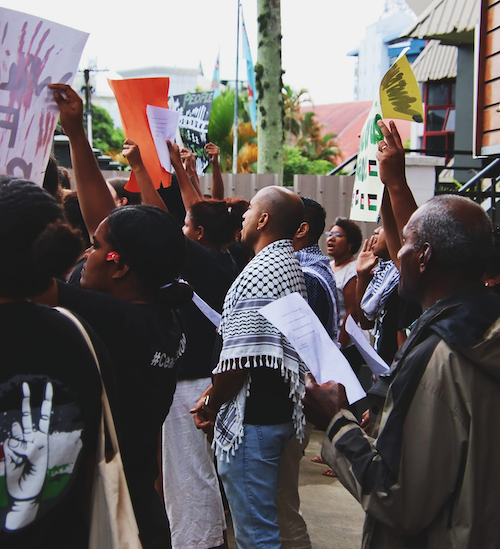
Fiji supporters protesting in solidarity with Palestine
Fiji supporters protesting in solidarity with Palestine. Image: NGOCHR

“The global consensus on this matter, formed by UN Special Rapporteur on the situation of human rights in the Palestinian territories occupied since 1967 and the UN Special Rapporteur on the right to adequate housing and a host of international human rights NGOs, underscores the severity of the occupation’s impact on the Palestinian people,” Ali’s statement said.

“These reports detail egregious violations of human rights and international law, painting a stark picture of the suffering endured by countless individuals under the occupation.

Serious questions raised
“The decision to support the genocidal, violent occupation raises serious questions about the processes and considerations behind Fiji’s foreign policy choices.

“It is imperative that the Fijian government demonstrates accountability and transparency in its decision-making.

“The public has a right to understand how such positions, which significantly impact [on] Fiji’s standing on the global stage and its moral compass, are determined. We call upon the government to disclose the rationale and any consultations or analyses that led to this stance.

“This call for clarity is not just about ensuring governmental transparency; it’s about reaffirming Fiji’s dedication to principles that respect human dignity and international law.

“Without this openness, the trust between the Fijian people and their government risks being eroded, especially on matters of international significance that reflect on the entire nation.”

The coalition called on the Fiji government to reconsider its position and to align its international engagements with the “principles of human dignity, justice, and respect for international law”.

‘Advocate for justice, rights’
“We urge the Fijian government to demonstrate its commitment to human rights and justice by advocating for the rights of all people, including the Palestinian people, to live in peace, security, and dignity.

“We stand in solidarity with those advocating for peaceful resolution of conflicts and upholding human rights worldwide. The NGOCHR will continue to monitor this situation closely and support Fiji in adopting a foreign policy that reflects the values of its people and the principles of international law.”

The Fiji NGO Coalition on Human Rights represents the Fiji Women’s Crisis Centre (FWCC), Fiji Women’s Rights Movement (FWRM), Citizens Constitutional Forum (CCF), femLINKPacific, Social Empowerment and Education Programme (SEEP) and DIVA for Equality Fiji (DIVA).

The Pacific Network on Globalisation (PANG) is also an observer (PANG).

Print Friendly, PDF & Email

Article by AsiaPacificReport.nz

‘Free birthing’ and planned home births might sound similar but the risks are very different

Source: The Conversation (Au and NZ) – By Hannah Dahlen, Professor of Midwifery, Associate Dean Research and HDR, Midwifery Discipline Leader, Western Sydney University

In The Light Photography/Shutterstock

The death of premature twins in Byron Bay in an apparent “wild birth”, or free birth, last week has prompted fresh concerns about giving birth without a midwife or medical assistance.

This follows another case from Victoria this year, where a baby was born in a critical condition following a reported free birth.

It’s unclear how common free birthing is, as data is not collected, but there is some evidence free births increased during the COVID pandemic.

Planned home births also became more popular during the pandemic, as women preferred to stay away from hospitals and wanted their support people with them.

But while free births and home births might sound similar, they are a very different practice, with free births much riskier. So what’s the difference, and why might people opt for a free birth?

What are home births?

Planned home births involve care from midwives, who are registered experts in childbirth, in a woman’s home.

These registered midwives work privately, or are part of around 20 publicly funded home birth programs nationally that are attached to hospitals.

They provide care during the pregnancy, labour and birth, and in the first six weeks following the birth.


Read more:
Explainer: what are women’s options for giving birth?


The research shows that for women with low risk pregnancies, planned home births attended by competent midwives (with links to a responsive mainstream maternity system) are safe.

Home births result in less intervention than hospital births and women perceive their experience more positively.

What are free births?

A free birth is when a woman chooses to have a baby, usually at home, without a registered health professional such as a midwife or doctor in attendance.

Different terms such as unassisted birth or wild pregnancy or birth are also used to refer to free birth.

The parents may hire a unregulated birth worker or doula to be a support at the birth but they do not have the training or medical equipment needed to manage emergencies.

Women may have limited or no health care antenatally, meaning risk factors such as twins and breech presentations (the baby coming bottom first) are not detected beforehand and given the right kind of specialist care.

Why do some people choose to free birth?

We have been studying the reasons women and their partners choose to free birth for more than a decade. We found a previous traumatic birth and/or feeling coerced into choices that are not what the woman wants were the main drivers for avoiding mainstream maternity care.

Australia’s childbirth intervention rates – for induction or augmentation of labour, episiotomy (cutting the tissue between the vaginal opening and the anus) and caesarean section – are comparatively high.

One in ten women report disrespectful or abusive care in childbirth and some decide to make different choices for future births.


Read more:
More than 6,000 women told us what they wanted for their next pregnancy and birth. Here’s what they said


Lack of options for a natural birth and birth choices such as home birth or birth centre birth also played a major role in women’s decision to free birth.

Publicly funded home birth programs have very strict criteria around who can be accepted into the program, excluding many women.

In other countries such as the United Kingdom, Netherlands and New Zealand, publicly funded home births are easier to access.

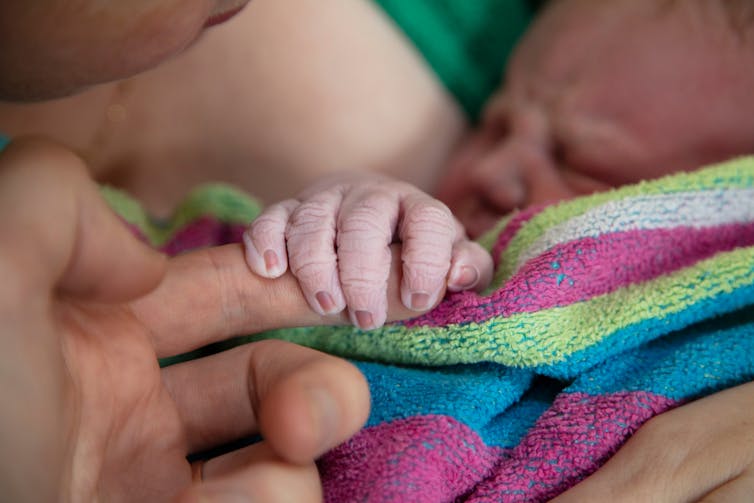
Newborn baby holds their parent's finger
It can be difficult to access home birth services in Australia.
Ink Drop/Shutterstock

Only around 200 midwives provide private midwifery services nationally. Private midwives are yet to obtain insurance for home births, which means they are risking their livelihoods if something goes wrong and they are sued.

The cost of a home birth with a private midwife is not covered by Medicare and only some health funds rebate some of the cost. This means women can be out of pocket A$6-8,000.

Access to home birth is an even greater issue in rural and remote Australia.

How to make mainstream care more inclusive

Many women feel constrained by their birth choices in Australia. After years of research and listening to thousands of women, it’s clear more can be done to reduce the desire to free birth.

As my co-authors and I outline in our book, Birthing Outside the System: The Canary in the Coal Mine, this can be achieved by:

  • making respectful care a reality so women aren’t traumatised and alienated by maternity care and want to engage with it

  • supporting midwifery care. Women are seeking more physiological and social ways of birthing, minimising birth interventions, and midwives are the experts in this space

  • supporting women’s access to their chosen place of birth and model of care and not limiting choice with high out-of-pocket expenses

  • providing more flexible, acceptable options for women experiencing risk factors during pregnancy and/or birth, such as having a previous caesarean birth, having twins or having a baby in breech position. Women experiencing these complications experience pressure to have a caesarean section

  • getting the framework right with policies, guidelines, education, research, regulation and professional leadership.

Ensuring women’s rights and choices are informed and respected means they’re less likely to feel they’re left with no other option.

The Conversation

Hannah Dahlen receives funding from NHMRC, ARC and MRFF

ref. ‘Free birthing’ and planned home births might sound similar but the risks are very different – https://theconversation.com/free-birthing-and-planned-home-births-might-sound-similar-but-the-risks-are-very-different-223852

Did your dog dig in asbestos-laden mulch? Here are the risks – and what to do next

Source: The Conversation (Au and NZ) – By Chiara Palmieri, Professor, The University of Queensland

This week, disturbing news emerged about mulch containing asbestos in parks, schools and homes across New South Wales (and possibly Canberra). So far, the discussion has focused on the risks to human health.

But the incidents have prompted me to worry about the effects on dogs. Dogs love to sniff, dig, lick and roll on the ground. That means dogs in the vicinity of the mulch may have been exposed to asbestos.

I research the environmental causes of cancer in animals. Animal exposure to asbestos is deeply worrying. Long-term exposure, even to low doses, can cause a type of cancer called mesothelioma. The disease also affects humans.

Here, I outline the risks of asbestos exposure in dogs, and what to do if you’re concerned.

The experts trained to identify asbestos in mulch | 7.30, ABC, 19 February 2024.


Read more:
Asbestos in mulch? Here’s the risk if you’ve been exposed


What do we know about mesothelioma in dogs?

Mesothelioma is an aggressive cancer that affects both animals and humans. It’s typically concentrated in the respiratory tract, but can affect all cells lining body cavities.

The illness is rare in dogs, causing less than 1% of all canine tumours. But it takes years to develop, by which time successful treatment is difficult.

Symptoms in dogs include difficulty breathing, enlarged abdomen and muffled heartbeat. A dog may cough, become lethargic, lose its appetite and become depressed.

In dogs, the incubation time – the period when the cancer is developing, is less than eight years, compared with more than 20 years in humans. So studying cancer in pet dogs can provide important information about similar cancers that might also affect humans.

Dogs can be exposed to asbestos in the same way as humans – for example, during home renovation projects. People can wear protective gear, but animals cannot. Dogs also tend to lick things, which means they may ingest asbestos fibres as well as breathe them in.

Asbestos is more dangerous when it is “friable” or easily crumbled and broken up into smaller pieces, releasing fibres into the air.

One study from the 1980s showed dogs could be exposed to asbestos, through “secondary contact” or the actions of someone else. This may occur, for example, if a dog inhaled asbestos fibres from the clothes of its owner.

So during house renovations, pets may need to stay mostly outside, or at someone else’s house or a boarding kennel.

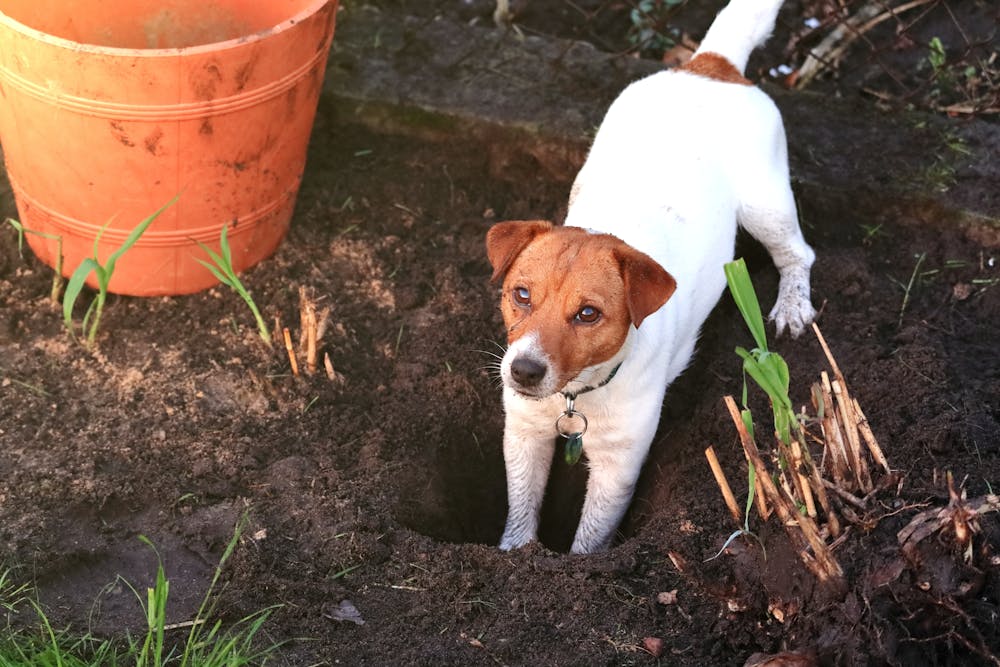
A small dog looking up from digging a hole in the garden
Dogs love to dig but this may can expose them to contaminants.
jarizPJ, Shutterstock

What about the mulch issue?

At latest count, 47 sites in NSW have tested positive for asbestos in mulch. In the Australian Capital Territory, environment officials are investigating potentially contaminated “cottage mulch” sold to 24 companies and 27 addresses in and around Canberra.

In all but one Sydney case, the asbestos was considered lower-risk as it was mixed with cement or other hard bonding materials. However, “non-friable” or “bonded” asbestos can become friable if damaged or old. Then, asbestos can be released into the air.

The more dangerous friable asbestos was found at a popular public park in Glebe. This is concerning.

The risk of an animal developing cancer is influenced by duration of exposure and the extent of contamination. We don’t know what level of exposure is required to develop mesothelioma in dogs. But in humans, there is no known safe asbestos exposure level.

What to do if you’re concerned

Mesothelioma can progress rapidly in both dogs and humans. Early diagnosis increases the chance of survival.

If you think your dog has been exposed to asbestos, take it to see a vet. The vet may perform an x-ray to check the dog’s lungs and/or abdomen and windpipe. If damage is present, a vet would take samples of tissue and fluids from the thorax or abdomen, for further examination.

So what happens if a dog is diagnosed with mesothelioma?

In some cases, the cancer will be so far progressed that treatment is not an option. In that case, all effort should be made to ensure the dog is as comfortable as possible.

If it’s not too late to start treatment, dogs can undergo chemotherapy, usually in the form of injections. One study suggests chemotherapy increases a dog’s chance of survival.

The duration of treatment and side effects of chemotherapy vary depending on the severity of the dog’s case. Deciding whether or not to proceed with chemotherapy can be difficult and requires weighing up the costs and likely benefits. It is expensive, but many dogs cope remarkably well and rarely lose their hair.

A wake-up call

Cancer in pets doesn’t always develop by chance. It can be caused by the air they breathe, the soil they dig in and the water they drink.

The case of asbestos-contaminated mulch should be a wake-up call for regulators and industry. But it should also remind pet owners to carefully consider the substances their animals might be exposed to, both inside and outside the home.

Gathering data on canine exposure to environmental hazards is crucial to understanding the origin of spontaneous cancers. We’re about to launch a national survey on the topic. If you are interested in participating, please get in touch with me and I will share the survey link as soon as it becomes available.


Read more:
Why does my dog eat grass? And when is it not safe for them?


The Conversation

Chiara Palmieri receives funding from philanthropic donations, ARDC, Perpetual trust, canine research foundation, UQ internal grant schemes, MLA, Agrifutures.

ref. Did your dog dig in asbestos-laden mulch? Here are the risks – and what to do next – https://theconversation.com/did-your-dog-dig-in-asbestos-laden-mulch-here-are-the-risks-and-what-to-do-next-223862

The government has unveiled its Navy of the future. Will it solve our current problems – or just create new ones?

Source: The Conversation (Au and NZ) – By Peter Layton, Visiting Fellow, Griffith Asia Institute, Griffith University

Australia’s naval surface combatant fleet is in trouble. The eight Anzac frigates are worn out after three decades of Middle Eastern adventures and hard to crew. The Anzac’s replacements, the much-criticised Hunter Class frigates, are late – the first will not enter service until 2032 or so.

The project’s cost has also stunningly risen from A$35 billion in 2018 to $45 billion a couple of years ago to now $65 billion, even before actual ship construction starts.

Adding to the problems, the Navy now dislikes its 12 new offshore patrol vessels (OPVs) currently being built; this seemingly simple project is also late, costly ($3.7 billion overall) and a “project of concern”.

Meanwhile, the Navy’s three brand new Hobart Class destroyers surprisingly need major, costly upgrades that will take two to three years each. With luck, all three will be back in service by 2032.

These numbers are important as the Navy needs three ships in service to reliably maintain one ship deployed on distant operations for an extended period. Across most of the next decade, our current naval surface warship fleet will be able to dependably deploy only two, maybe three, warships simultaneously for extended periods. This is high-input cost for low-output usage.

A consultant-driven solution

That’s the problem. A review undertaken by highly paid, external consultants, led by a retired US Navy admiral, has now provided the solution.

The review released today recommends keeping the three Hobart Class destroyers and six of the aged ANZAC frigates, building only six Hunter Class frigates and stopping the OPV program immediately at six ships.

The big surprise was the recommendation the Navy acquire at least seven – and “optimally” 11 – new general purpose frigates and six large optionally crewed surface vessels (LOSVs). The government agreed with both recommendations.

The new frigates will be a similar size to the Anzacs and effectively a half-size Hunter. Called “Tier 2” ships, they will be designed for anti-submarine warfare and used to secure seaborne trade routes, Australia’s northern maritime approaches and to escort the Navy’s amphibious ships.

They will have an air and missile defence capability and carry several anti-ship and land-attack missiles. Notably, the first three frigates will be built overseas – this will likely draw criticism.

The LOSVs will increase the Navy’s long-range strike capacity and appear to be similar to the US Navy’s planned large uncrewed surface vessels, which will enter service late this decade.

These vessels will mostly operate without a crew, though they may have a small crew embarked for short periods, such as when entering and leaving port or refuelling at sea. The LOSVs are expected to be lower-cost, long-endurance vessels able to carry anti-ship and land-attack missiles.

The review glosses over the serious inability of crewing the current 11-ship surface warship Navy, let alone a 26-vessel one. The Navy is already about 900 people short, equivalent to more than three Anzac ship crews, as it struggles to meet its recruitment goals.

The Department of Defence, however, considers the problem more one of retention than recruitment and is taking steps to slow the personnel loss rate, but it has much ground to make up before it can grow into a much larger force.

The review merely recognised the challenge and simply hoped for the best.


Read more:
The much-anticipated defence review is here. So what does it say, and what does it mean for Australia?


Implications of the review

First, the good news. Much of the money for the new ships will be spent in Australia – not just on sheet metal hull construction, but also on electronics.

For example, the future of the world-leading radar technology company recently purchased by the federal government, appears secure.

There are definite benefits in both creating a more skilled Australian workforce and sustaining a sovereign, Australian naval shipbuilding industry. Critics will correctly argue it’s more expensive than buying from overseas, but given tax claw-backs, maybe not that much.

Even so, the cost-benefit analysis will be hard to calculate – the decision over whether it’s good value for money needs to be a judgement call, not an analysis based on mathematics.

Second, the Albanese government came to office calling for much better “impactful projection” – that is, the ability to apply strategically meaningful military power at great distance from Australia’s shores using missiles.

The new frigates, however, will only carry some additional missiles – not many. As such, the government seems to have changed its earlier intentions and will instead focus more on the submarine threat to Australia’s trade routes.

The only nod to “impactful projection” in the review today is the building of six new LOSVs, each of which will be able to carry 32 missiles to sea. (One LOSV working with a Hobart Class frigate, however, will have around 88 missiles.)

Critics will point to the fact this is fewer than a single US Navy Arleigh Burke destroyer, which carries 96 missiles, and its larger Chinese counterpart, which carries 128.


Read more:
Australia can no longer afford to ignore Russia’s expanding naval power in the Pacific


Third, the review does not call for renewing the Navy’s ageing Anzac flotilla quickly enough. Warship shortages will persist well into the next decade. This is bad news for the short term.

And lastly, the Navy will now have three major ship and submarine projects underway. The new plan to acquire an additional flotilla of frigates will take considerable time, soak up the country’s scarce ship-building workforce and be remarkably costly.

This will adversely impact the Navy operationally and the rest of the Department of Defence, Army and Air Force. As a result, we can likely expect cuts to the Army in the forthcoming budget.

Overall, the review is good for jobs in Adelaide and Perth and will make the Navy significantly larger over the long term. It will also partly placate some government critics who want to buy ships overseas, arguing this will mean faster delivery, and those who believe the government needs “new money” added to currently planned defence budgets.

But the true cost impacts of the reform plan must await the budget. The plan will also take a long time to implement and has ignored the Navy’s chronic shortage of skilled personnel, which is surely most unwise.

The Conversation

Peter Layton does not work for, consult, own shares in or receive funding from any company or organisation that would benefit from this article, and has disclosed no relevant affiliations beyond their academic appointment.

ref. The government has unveiled its Navy of the future. Will it solve our current problems – or just create new ones? – https://theconversation.com/the-government-has-unveiled-its-navy-of-the-future-will-it-solve-our-current-problems-or-just-create-new-ones-223846

The art of ‘getting lost’: how re-discovering your city can be an antidote to capitalism

Source: The Conversation (Au and NZ) – By Stephen Dobson, Professor and Dean of Education and the Arts, CQUniversity Australia

Shutterstock

Do you remember what it was like to discover the magic of a city for the first time? Do you remember the noises, smells, flashing lights and pulsating crowds? Or do you mostly remember cities through the screen of your phone?

In 1967, French philosopher and filmmaker Guy Debord publicised the need to move away from living our lives as bystanders continually tempted by the power of images. Today, we might see this in a young person flicking from one TikTok to the next – echoing the hold images have on us. But adults aren’t adverse to this window-shopping experience, either.

Debord notes we have a tendency to observe rather than engage. And this is to our detriment. Continually topping-up our image consumption leaves no space for the unplanned – the reveries to break the pattern of an ordered life.

Debord was a member of a group called the Situationist International, dedicated to new ways we could reflect upon and experience our cities. Active for about 15 years, they believed we should experience our cities as an act of resistance, in direct opposition to the (profit-motivated) capitalistic structures that demand our attention and productivity every waking hour.

More than 50 years since the group dissolved, the Situationists’ philosophy points us to a continued need to attune ourselves – through our thoughts and senses – to the world we live in. We might consider them as early eco-warriors. And through better understanding their philosophy, we can develop a new relationship with our cities today.

Understanding the ‘situation’

The Situationist International movement was formed in 1957 in Cosio di Arroscia, Italy, and became active in several European countries. It brought together radical artists inspired by spontaneity, experimentalism, intellectualism, protest and hedonism. Central figures included Danish artist Asger Jorn, French novelist Michèle Bernstein and Italian musician and composer Walter Olmo.

The Situationists were driven by a libertarian form of Marxism that resisted mass consumerism. One of the group’s early terms was “unitary urbanism”, which sought to join avant-garde art with the critique of mass production and technology. They rejected “urbanism’s” conventional emphasis on function, and instead thought about art and the environment as inexorably interrelated.

Times Square in the modern day. The Situationists viewed consumerism as oppressive forces that should be rebelled against.
Shutterstock

By rebelling against the invasiveness of consumption, the Situationists proposed a turn towards artistically-inspired individuality and creativity.

Think on your own two feet

According to the 1960 Situationist Manifesto we are all to be artists of our own “situations”, crafting independent identities as we stand on our own two feet. They believed this could be achieved, in part, through “psychogeography”: the idea that geographical locations exert a unique psychological effect on us.

For instance, when you walk down a street, the architecture around you may be deliberately designed to encourage a certain kind of experience. Crossing a vibrant city square on a sunny morning evokes joy and a feeling of connection with others. There’s also usually a public event taking place.

The Situationists valued drift, or dérive in French. This alludes to unplanned movement through a landscape during journeys on foot. By drifting aimlessly, we unintentionally redefine the traditional rules imposed by private or public land owners and property developers. We make ourselves open to the new unexpected and, in doing so, are liberated from the shackles of everyday routine.

In our research, my colleagues and I consider cities as places in which “getting lost” means exposing yourself to discovering the new and taken-for-granted.

Forge your own path

By understanding the Situationists – by looking away from our phones and allowing ourselves to get lost – we can rediscover our cities. We can see them for what they are beneath the blankets of posters, billboards and advertisements. How might we take back the image and make it work for us?

The practise of geo-tagging images on social media, and sharing our location with others, could be considered close to the spirit of the Situationists. Although it’s often met with claims of over-fuelling tourism (especially regarding idyllic or otherwise protected sites), geo-tagging could inspire us to actively seek out new places through visiting the source of an image.

This could lead to culturally respectful engagement, and new-found respect for the rights of traditional custodians as we experience their lands in real life, rather than just through images on our phones.

Online, there’s a strong temptation to fall into the spectator role by merely consuming other people’s content. Geo-tagging offers a way to share experiences.
Shutterstock

Then there are uniquely personal and anarchistic forms of resistance, wherein we can learn about the world around us by interweaving ourselves with our histories. In doing so we offer a new meaning to a historical message, and a new purpose. The Situationists called this process détournement, or hijacking.

For instance, from my grandfather I inherited a biscuit tin of black and white photographs I believe were taken in the 1960s. They showed images of parks and wildlife, perhaps even of the same park, and cityscapes of London with people, streets and buildings.

I have spent many hours wandering the London streets tracking down the exact places these images were snapped. I was juxtaposing past with present, and experiencing both continuity and change in the dialogues I had with my grandfather. In this way, I used images to augment (rather than replace) my lived experience of the material world.

Urban art installations can also be examples of detournment as they make us re-think everyday conceptions. Forgotten Songs by Michael Hill is one such example. A canopy of empty birdcages commemorates the songs of 50 different birds once heard in central Sydney, but which are now lost due to habitat removal as a result of urban development.

There are also a number of groups, often with a strong environmental or civic rights focus, that partake in detournment. Reclaim the Streets is a movement with a long history in Australia. The group advocates for communities having ownership of and agency within public spaces. They may, for instance, “invade” a highway to throw a “road rave” as an act of reclamation.

As French avant-garde philosopher Gaston Bachelard might have put it, when we’re bombarded by images there is no space left to daydream. We lose the opportunity to explore and question the world capitalism serves us through images.

Perhaps now is a good time to set down the phone and follow in the Situationists’ footsteps.


Read more:
Do you want size with that? The McMansion malaise


The Conversation

Stephen Dobson does not work for, consult, own shares in or receive funding from any company or organisation that would benefit from this article, and has disclosed no relevant affiliations beyond their academic appointment.

ref. The art of ‘getting lost’: how re-discovering your city can be an antidote to capitalism – https://theconversation.com/the-art-of-getting-lost-how-re-discovering-your-city-can-be-an-antidote-to-capitalism-221606

Wapenamanda massacre: ‘Pregnant mothers fled for their lives’

By Lydia Lewis, RNZ Pacific journalist

A man housing people who fled a massacre in Papua New Guinea’s Enga province yesterday says pregnant mothers and children are displaced.

More than 50 bodies have been retrieved, with police still searching as intertribal tension continues.

Prime Minister James Marape said he was “deeply moved” and “very, very angry” and will give arrest powers to the military to contain the violence.

Aquila Kunza, who lives in Wapenamanda, told RNZ Pacific the situation was “disheartening.

“They are below 10-years-old [the people staying with him],” Kunza said.

“Some of them are pregnant mothers, they fled for their lives. [Those who are] 10-years above, they fight.”

Kunza said boys as young as 10 have been left traumatised from fighting on the battlefield.

Veteran PNG journalist and RNZ Pacific correspondent, Scott Waide, said it “is one of the worst instances of killings” that he has seen in the past decade.

In 2022, there was a massacre on Kiriwina Island, northeast of capital Port Moresby with a death toll of more than 20 — violence that was triggered by a feud after a death at a football match a few weeks earlier.

The incident in Enga province highlands this week has been fuelled by a long standing feud between different clans — Sikin and Kaikin tribes and the Ambulin tribe, according to national public broadcaster NBC.

The clans were aided by guns from the black market, Waide explained.

According to his sources on the ground, the weapons used were not homemade, but rather military grade, including “Israeli-made Galil, US-made M16s”.

“There’s a huge black market attached to this tribal fighting that’s happening,” he said.

“One assault rifle costs upwards of K30,000 [about NZ$13,000]. So it’s a very complex web of people who benefit from this tribal fighting as well.”

‘Businessmen and educated elites supplying guns’
Acting Enga provincial police commander Inspector Patrick Peka has condemned the actions of leaders and “educated elites” from both warring factions for supplying guns and ammunition, and hiring “tribal warlords” and “gunmen” from other districts to come and fight as their incentives are lucrative.

An MP in an electoral district within Enga province, Wapenamanda Open, has called for a state of emergency (in Enga) in an effort to curb lawlessness.

In a statement, Miki Kaeok, who is a Pangu Pati member of Marape’s government, appealed to Enga governor Sir Peter Ipatas and all MPs from the province to rally behind his call.

Kaeok said the tribal fighting had turned into a “guerilla type of warfare” with parties from all parts of the province directly involved.

“Businessmen leaders and educated elites are supplying guns, bullets and financing the engagement of gunmen,” he said.

“They must be identified and their business accounts thoroughly checked to substantiate their direct involvement.”

‘People have given up’
There are 18 or so tribes scattered around mountains and rivers fighting in the highlands.

In a nearby town, Wapenamanda it is almost business as usual, Kunza said.

He said elders had stopped at nothing to try and ease tensions.

“We have tried every means [to stop this]. Churches have taken a collective stand to try stop them. Elders sat the men with guns down and told them to stop and listen. They were told they will be supported and relocated,” he said.

However, their attempts to convince the men did not work, who defied all advice “to our surprise and disappointment”, Kunza said, before violence escalated again.

“People have given up, people are exhausted” from the ongoing tribal fighting.

“Please all men and put down your guns” for the sake of the women and children, he is pleading with the fighters.

Tribal politics
Peka said a lot of the people killed in this violent incident were hired from other parts of the province to kill.

“Most dead bodies identified are men believed to be from Laiagam, Kandep and Wabag plus other parts of the province,” Peka said.

Waide said it was not a secret that people have offered their services as “mercenaries” in tribal fighting.

“It’s a sad situation and unfortunate turn of events and it’s escalating by the year,” Waide said.

He said it was always difficult to understand the reasons behind the ongoing violence without understanding the cultural context and tribal politics.

Meanwhile, the Pacific Islands Forum said it stood ready to support PNG after some of the worst tribal fighting the country has ever seen.

In a statement, Forum Secretary-General Henry Puna expressed his sincerest sympathies to the government and people of the country.

Puna urged all parties involved to seek peaceful resolutions to this conflict.

This article is republished under a community partnership agreement with RNZ.

Print Friendly, PDF & Email

Article by AsiaPacificReport.nz

What is Sora? A new generative AI tool could transform video production and amplify disinformation risks

Source: The Conversation (Au and NZ) – By Vahid Pooryousef, PhD candidate in Human Computer Interaction, Monash University

OpenAI

Late last week, OpenAI announced a new generative AI system named Sora, which produces short videos from text prompts. While Sora is not yet available to the public, the high quality of the sample outputs published so far has provoked both excited and concerned reactions.

The sample videos published by OpenAI, which the company says were created directly by Sora without modification, show outputs from prompts like “photorealistic closeup video of two pirate ships battling each other as they sail inside a cup of coffee” and “historical footage of California during the gold rush”.

At first glance, it is often hard to tell they are generated by AI, due to the high quality of the videos, textures, dynamics of scenes, camera movements, and a good level of consistency.

OpenAI chief executive Sam Altman also posted some videos to X (formerly Twitter) generated in response to user-suggested prompts, to demonstrate Sora’s capabilities.

How does Sora work?

Sora combines features of text and image generating tools in what is called a “diffusion transformer model”.

Transformers are a type of neural network first introduced by Google in 2017. They are best known for their use in large language models such as ChatGPT and Google Gemini.

Diffusion models, on the other hand, are the foundation of many AI image generators. They work by starting with random noise and iterating towards a “clean” image that fits an input prompt.

A series of images showing a picture of a castle emerging from static.
Diffusion models (in this case Stable Diffusion) generate images from noise over many iterations.
Stable Diffusion / Benlisquare / Wikimedia, CC BY-SA

A video can be made from a sequence of such images. However, in a video, coherence and consistency between frames are essential.

Sora uses the transformer architecture to handle how frames relate to one another. While transformers were initially designed to find patterns in tokens representing text, Sora instead uses tokens representing small patches of space and time.

Leading the pack

Sora is not the first text-to-video model. Earlier models include Emu by Meta, Gen-2 by Runway, Stable Video Diffusion by Stability AI, and recently Lumiere by Google.

Lumiere, released just a few weeks ago, claimed to produce better video than its predecessors. But Sora appears to be more powerful than Lumiere in at least some respects.

Sora can generate videos with a resolution of up to 1920 × 1080 pixels, and in a variety of aspect ratios, while Lumiere is limited to 512 × 512 pixels. Lumiere’s videos are around 5 seconds long, while Sora makes videos up to 60 seconds.

Lumiere cannot make videos composed of multiple shots, while Sora can. Sora, like other models, is also reportedly capable of video-editing tasks such as creating videos from images or other videos, combining elements from different videos, and extending videos in time.

Both models generate broadly realistic videos, but may suffer from hallucinations. Lumiere’s videos may be more easily recognised as AI-generated. Sora’s videos look more dynamic, having more interactions between elements.

However, in many of the example videos inconsistencies become apparent on close inspection.

Promising applications

Video content is currently produced either by filming the real world or by using special effects, both of which can be costly and time consuming. If Sora becomes available at a reasonable price, people may start using it as a prototyping software to visualise ideas at a much lower cost.

Based on what we know of Sora’s capabilities it could even be used to create short videos for some applications in entertainment, advertising and education.

OpenAI’s technical paper about Sora is titled “Video generation models as world simulators”. The paper argues that bigger versions of video generators like Sora may be “capable simulators of the physical and digital world, and the objects, animals and people that live within them”.

If this is correct, future versions may have scientific applications for physical, chemical, and even societal experiments. For example, one might be able to test the impact of tsunamis of different sizes on different kinds of infrastructure – and on the physical and mental health of the people nearby.

Achieving this level of simulation is highly challenging, and some experts say a system like Sora is fundamentally incapable of doing it.

A complete simulator would need to calculate physical and chemical reactions at the most detailed levels of the universe. However, simulating a rough approximation of the world and making realistic videos to human eyes might be within reach in the coming years.

Risks and ethical concerns

The main concerns around tools like Sora revolve around their societal and ethical impact. In a world already plagued by disinformation, tools like Sora may make things worse.

It’s easy to see how the ability to generate realistic video of any scene you can describe could be used to spread convincing fake news or throw doubt on real footage. It may endanger public health measures, be used to influence elections, or even burden the justice system with potential fake evidence.


Read more:
Whether of politicians, pop stars or teenage girls, sexualised deepfakes are on the rise. They hold a mirror to our sexist world


Video generators may also enable direct threats to targeted individuals, via deepfakes – particularly pornographic ones. These may have terrible repercussions on the lives of the affected individuals and their families.

Beyond these concerns, there are also questions of copyright and intellectual property. Generative AI tools require vast amounts of data for training, and OpenAI has not revealed where Sora’s training data came from.

Large language models and image generators have also been criticised for this reason. In the United States, a group of famous authors have sued OpenAI over a potential misuse of their materials. The case argues that large language models and the companies who use them are stealing the authors’ work to create new content.


Read more:
Two authors are suing OpenAI for training ChatGPT with their books. Could they win?


It is not the first time in recent memory that technology has run ahead of the law. For instance, the question of the obligations of social media platforms in moderating content has created heated debate in the past couple of years – much of it revolving around Section 230 of the US Code.

While these concerns are real, based on past experience we would not expect them to stop the development of video-generating technology. OpenAI says it is “taking several important safety steps” before making Sora available to the public, including working with experts in “misinformation, hateful content, and bias” and “building tools to help detect misleading content”.

The Conversation

The authors do not work for, consult, own shares in or receive funding from any company or organisation that would benefit from this article, and have disclosed no relevant affiliations beyond their academic appointment.

ref. What is Sora? A new generative AI tool could transform video production and amplify disinformation risks – https://theconversation.com/what-is-sora-a-new-generative-ai-tool-could-transform-video-production-and-amplify-disinformation-risks-223850

Wapenamanda massacre – 64 killed in PNG’s worst tribal fighting

By Miriam Zarriga

Under the banana leaves on a roadside in Papua New Guinea’s Highlands lies the dismembered and bullet-riddled bodies of eight men.

All have been pulled out from the hillside along the highway from Wapenamanda to Wabag in Enga province.

They were among at least 64 people killed in the worst outbreak of tribal fighting in the country’s recent history.

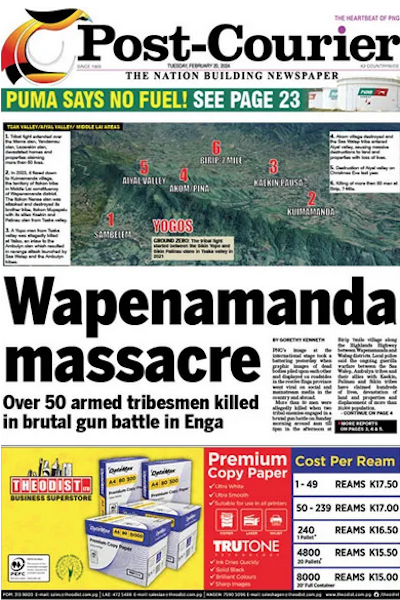
Today's PNG Post-Courier front page 20Feb24
Today’s PNG Post-Courier front page – armed tribesmen have been killed in a brutal gun battle in Enga. Image: PNG Post-Courier

These were not locals but hired guns from neighbouring districts and provinces who had been brought in to fight in a tribal fight.

Assistant Commissioner of Police-Western End Samson Kua has condemned the killings.

The call from security personnel is now for all leaders of Enga to put aside political differences and assist security personnel to promptly address the tribal fighting.

Information received is that security personnel were nearly shot as well as they tried to stop the fight.

The recovery of bodies continues.

A ghastly sight
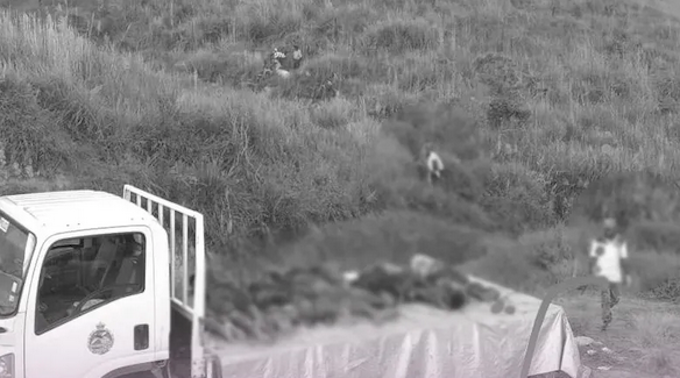
In another report, the Post-Courier described it as a ghastly sight as a picture of bodies piled high on top each other on a police vehicle was shared on online platforms.

The bodies belonged to men who fought in a fight between two tribes in Wapenamanda.

The grassland of Wapenamanda was their battlefield as they fought with guns, knives, and other homemade weapons.

Police called for more support.

Police recovering bodies at the site of the Wapenamanda massacre
Police recovering bodies at the site of the Wapenamanda massacre in Enga province. Image: PNG Post-Courier

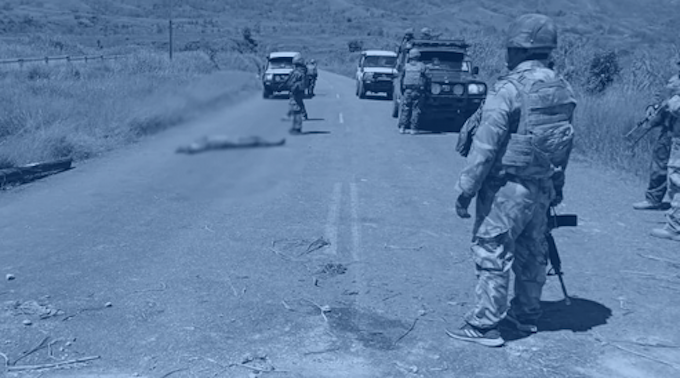
The dead bodies were of the Sikin and Kaekin tribesmen and were retrieved by policemen supported by the PNG Defence Force.

The men were killed yesterday at Akom/7 mile during heavy gun fire.

The situation is said to be still tense, but the highway was clear for the travelling public.

Police told the Post-Courier they had retrieved some 64 bodies from the roadside, grasslands and hills of Wapenamanda by Monday morning.

Rival factions used “high-powered guns”, such as AK47 and M4 rifles in the battles, the newspaper reported.

The death toll was expected to rise.

Republished with permission from the PNG Post-Courier.

A grisly scene as PNG police recover bodies
A grisly scene as PNG police recover bodies at the site of the brutal gun battle. Image: PNG Post-Courier
Print Friendly, PDF & Email

Article by AsiaPacificReport.nz

New ecosystems, unprecedented climates: more Australian species than ever are struggling to survive

Source: The Conversation (Au and NZ) – By Frédérik Saltré, Research Fellow in Ecology for the ARC Centre of Excellence for Australian Biodiversity and Heritage, Flinders University

Australia is home to about one in 12 of the world’s species of animals, birds, plants and insects – between 600,000 and 700,000 species. More than 80% of Australian plants and mammals and just under 50% of our birds are found nowhere else.

But habitat destruction, climate change, and invasive species are wreaking havoc on Earth’s rich biodiversity, and Australia is no exception.

In 2023, the federal government added another 144 plants, animals and ecological communities to the threatened species list – including iconic species such as the pink cockatoo, spiny crayfish and earless dragons.

More and more species stand on the edge of oblivion. That’s just the ones we know enough about to list formally as threatened. Many more are in trouble, especially in the oceans. Change is the new constant. As the world heats up and ecosystems warp, new combinations of species can emerge without an evolutionary connection, creating novel communities.

It is still possible to stop species from dying out. But it will take an unprecedented effort.


Read more:
Explainer: what is biodiversity and why does it matter?


How species end

The modern extinction crisis is quite recent. Between 1970 and 2018, wildlife populations around the world fell by almost 70%. But the collapse of these populations isn’t equal – Latin America and the Caribbean have lost around 94% of the individuals in wild populations. Africa has lost 65%, Asia-Pacific about 45%, while North America and Europe have lost 45% and Central Asia 33%.

In the 250 years since Europeans arrived, at least 100 unique Australian species have gone extinct. That’s about 6% to 10% of all recorded extinctions worldwide since the year 1500. If we look at mammals alone, we have the worst track record of any country.

Extinction doesn’t happen overnight. An abundant species might be exposed to a new predator such as feral cats. Its population could fall to the point where it is listed as threatened, meaning it has a high chance of becoming extinct in the near future.

If the species can’t adapt and if we do nothing, the species can become critically endangered and decline to a few hundred individuals. If pressure continues, it can go extinct in the wild. And if zoos can’t establish breeding populations or we simply don’t know about it, the entire species can wink out of existence.

Tip of the iceberg

Australia’s threatened species list is useful, because it helps us prioritise which species to help. But it does not show the true number of species in danger. There are well known gaps, such as many invertebrates that have gone extinct unnoticed because of their secretive nature and small size.

The list likely misses other lesser-known or hard to research groups such as microorganisms, hard to find marine species, snakes and lizards, and rare plants.

Neither does the list take into account species that depend on each other, such as wasps relying on one species to parasitise and pollinators specialising on a few types of flowers. Yet these complex interactions are essential to healthy functioning of ecosystems.

To list a species as threatened takes work. By the time we have catalogued all species on Earth – estimated to take 100–200 years at current discovery rates – experts estimate most species will have already gone extinct.


Read more:
Worried about Earth’s future? Well, the outlook is worse than even scientists can grasp


Can species come back?

For decades, conservationists have used species recovery programs to try and bring threatened species back from the brink. You need a combination of approaches – there’s no point breeding thousands of endangered woylies if their habitat has been replaced with farmland or plantation.

One measure with good results is to use policy measures to cut forest loss and other habitat destruction. Lost habitat is the main reason more than 85% of our threatened species are on the list in the first place. Invasive species and diseases can worsen damage from habitat loss – or act alone.

Extinction is not inevitable. Between 2000 to 2022, we saw 29 species recover to the point they could be taken off the threatened list.

But the road to recovery is long, complicated, and far from assured for most of our worst-affected species.

Novel ecosystems and climate change

Each species has a climate it prefers and can survive in. But the magnitude of expected future climate change is likely to produce climates without precedent in many regions. We could see the creation of entirely new biological communities and environments, as has happened before.


Read more:
What is a ‘mass extinction’ and are we in one now?


The best-known novel communities emerged at high latitudes mostly between 17,000 and 12,000 years ago. Here, for instance, spruce and ash trees in North America grew side by side – even though they now live far apart – and pines were less common than today.

Unfortunately, the emergence of novel communities often led to an increase in species extinctions.

But the emergence of new types of ecosystems doesn’t mean all species will suffer. For instance, novel habitats in Melbourne’s suburbs have led to a surge in southern brown bandicoots, who find strips of native and introduced plants along roads, canals and railways to their liking.

New ecosystems can sometimes harbour more species and actually be more resilient due to the variety of species traits, behaviours, and genetic diversity. But this is not guaranteed.

Managing these new ecosystems will be challenging. We will have to come up with creative ways to handle these changes by adopting Indigenous practices or applying novel solutions such as genetic rescue, mass reforestation and assisted migration to reduce extinction rates.

With unprecedented climates, novel ecosystems, invasive species, and disruptions to the food chain, we can expect more and more species to be added to the threatened list.


Read more:
Climate-driven species on the move are changing (almost) everything


The Conversation

Frédérik Saltré receives funding from the Australian Research Council.

Corey J. A. Bradshaw receives funding from the Australian Research Council.

ref. New ecosystems, unprecedented climates: more Australian species than ever are struggling to survive – https://theconversation.com/new-ecosystems-unprecedented-climates-more-australian-species-than-ever-are-struggling-to-survive-222375

The brightest object in the universe is a black hole that eats a star a day

Source: The Conversation (Au and NZ) – By Christian Wolf, Associate Professor, Astronomy & Astrophysics, Australian National University

Cristy Roberts/ANU, CC BY-NC

Scientists have no reported evidence of the true conditions in Hell, perhaps because no one has ever returned to tell the tale. Hell has been imagined as a supremely uncomfortable place, hot and hostile to bodily forms of human life.

Thanks to a huge astronomical survey of the entire sky, we have now found what may be the most hellish place in the universe.

In a new paper in Nature Astronomy, we describe a black hole surrounded by the largest and brightest disc of captive matter ever discovered. The object, called J0529-4351, is therefore also the brightest object found so far in the universe.

Supermassive black holes

Astronomers have already found around one million fast-growing supermassive black holes across the universe, the kind that sit at the centres of galaxies and are as massive as millions or billions of Suns.

To grow rapidly, they pull stars and gas clouds out of stable orbits and drag them into a ring of orbiting material called an accretion disc. Once there, very little material escapes; the disc is a mere holding pattern for material that will soon be devoured by the black hole.

The disc is heated by friction as the material in it rubs together. Pack in enough material and the glow of the heat gets so bright that it outshines thousands of galaxies and makes the black hole’s feeding frenzy visible to us on Earth, more than 12 billion light years away.

The fastest-growing black hole in the universe

A somewhat noisy photo of a bright white disk and small reddish dot against a dark background.
The brightest thing in the universe: J0529-4351 is a glowing disc of matter around a supermassive black hole, and it is 500 trillion times brighter than the Sun. (The red dot is a neighbouring star.)
Dark Energy Camera Legacy Survey DR10 / Nature Astronomy, CC BY-SA

The accretion disc of J0529-4351 emits light that is 500 trillion times more intense than that of our Sun. Such a staggering amount of energy can only be released if the black hole eats about a Sun worth of material every day.

It must also have a large mass already. Our data indicate J0529-4351 is 15 to 20 billion times the mass of our Sun.

There is no need to be afraid of such black holes. The light from this monster has taken more than 12 billion years to reach us, which means it would have stopped growing long ago.

In the nearby universe, we see that supermassive black holes these days are mostly sleeping giants.

Black holes losing their grip

The age of the black hole feeding frenzy is over because the gas floating around in galaxies has mostly been turned into stars. And after billions of years the stars have sorted themselves into orderly patterns: they are mostly on long, neat orbits around the black holes that sleep in the cores of their galaxies.

Even if a star dove suddenly down towards the black hole, it would most likely carry out a slingshot manoeuvre and escape again in a different direction.


Read more:
Why do black holes twinkle? We studied 5,000 star-eating behemoths to find out


Space probes use slingshot manoeuvres like this to get a boost from Jupiter to access hard-to-reach parts of the Solar System. But imagine if space were more crowded, and our probe ran into one coming the other way: the two would crash together and explode into a cloud of debris that would rapidly fall into Jupiter’s atmosphere.

Such collisions between stars were commonplace in the disorder of the young universe, and black holes were the early beneficiaries of the chaos.

Accretion discs – a no-go zone for space travellers

Accretion discs are gateways to a place whence nothing returns, but they are also profoundly unfriendly to life in themselves. They are like giant storm cells, whose clouds glow at temperatures reaching several tens of thousands of degrees Celsius.

The clouds are moving faster and faster as we get closer to the hole, and speeds can reach 100,000 kilometres per second. They move as far in a second as the Earth moves in an hour.

The disc around J0529-4351 is seven light years across. That is one and a half times the distance from the Sun to its nearest neighbour, Alpha Centauri.

Why only now?

If this is the brightest thing in the universe, why has it only been spotted now? In short, it’s because the universe is full of glowing black holes.

The world’s telescopes produce so much data that astronomers use sophisticated machine learning tools to sift through it all. Machine learning, by its nature, tends to find things that are similar to what has been found before.

This makes machine learning excellent at finding run-of-the-mill accretion discs around black holes – roughly a million have been detected so far – but not so good at spotting rare outliers like J0529-4351. In 2015, a Chinese team almost missed a remarkably fast-growing black hole picked out by an algorithm because it seemed too extreme to be real.


Read more:
Astronomers see ancient galaxies flickering in slow motion due to expanding space


In our recent work, we were aiming to find all the most extreme objects, the most luminous and most rapidly growing black holes, so we avoided using machine learning tools that were guided by too much prior knowledge. Instead we used more old-fashioned methods to search through new data covering the entire sky, with excellent results.

Our work also depended on Australia’s current 10-year partnership with the European Southern Observatory, an organisation funded by several European countries with a huge array of astronomical facilities.

The Conversation

Christian Wolf has received funding from the Australian Research Council.

ref. The brightest object in the universe is a black hole that eats a star a day – https://theconversation.com/the-brightest-object-in-the-universe-is-a-black-hole-that-eats-a-star-a-day-222612

After years of avoiding extradition, Julian Assange’s appeal is likely his last chance. Here’s how it might unfold (and how we got here)

Source: The Conversation (Au and NZ) – By Holly Cullen, Adjunct professor, The University of Western Australia

On February 20 and 21, Julian Assange will ask the High Court of England and Wales to reverse a decision from June last year allowing the United Kingdom to extradite him to the United States.

There he faces multiple counts of computer misuse and espionage stemming from his work with WikiLeaks, publishing sensitive US government documents provided by Chelsea Manning. The US government has repeatedly claimed that Assange’s actions risked its national security.

This is the final avenue of appeal in the UK, although Stella Assange, Julian’s wife, has indicated he would seek an order from the European Court of Human Rights if he loses the application for appeal. The European Court, an international court that hears cases under the European Convention on Human Rights, can issue orders that are binding on convention member states. In 2022, an order from the court stopped the UK sending asylum seekers to Rwanda pending a full review of the relevant legislation.

The extradition process has been running for nearly five years. Over such a long time, it’s easy to lose track of the sequence of events that led to this. Here’s how we got here, and what might happen next.


Read more:
View from The Hill: Australia’s bid for Julian Assange’s freedom presents formidable problems for Joe Biden


Years-long extradition attempt

From 2012 until May 2019, Assange resided in the Ecuadorian embassy in London after breaching bail on unrelated charges. While he remained in the embassy, the police could not arrest him without the permission of the Ecuadorian government.

In 2019, Ecuador allowed Assange’s arrest. He was then convicted of breaching bail conditions, and imprisoned in Belmarsh Prison, where he’s remained during the extradition proceedings. Shortly after his arrest, the United States laid charges against Assange and requested his extradition from the United Kingdom.

Assange immediately challenged the extradition request. After delays due to COVID, in January 2021, the District Court decided the extradition could not proceed because it would be “oppressive” to Assange.

The ruling was based on the likely conditions that Assange would face in an American prison and the high risk that he would attempt suicide. The court rejected all other arguments against extradition.

The American government appealed the District Court decision. It provided assurances on prison conditions for Assange to overcome the finding that the extradition would be oppressive. Those assurances led to the High Court overturning the order stopping extradition. Then the Supreme Court (the UK’s top court) refused Assange’s request to appeal that ruling.


Read more:
A rocky diplomatic road: Julian Assange’s hopes of avoiding extradition take a blow as US pushes back


The extradition request then passed to the home secretary, who approved it. Assange appealed the home secretary’s decision, which a single judge of the High Court rejected in June 2023.

This appeal is against that most recent ruling and will be heard by a two-judge bench. These judges will only decide whether Assange has grounds for appeal. If they decide in his favour, the court will schedule a full hearing of the merits of the appeal. That hearing would come at the cost of further delay in the resolution of his case.

Growing political support

Parallel to the legal challenges, Assange’s supporters have led a political campaign to stop the prosecution and the extradition. One goal of the campaign has been to persuade the Australian government to argue Assange’s case with the American government.

Cross-party support from individual parliamentarians has steadily grown, led by independent MP Andrew Wilkie. Over the past two years, the government, including the foreign minister and the prime minister, have made stronger and clearer statements that the prosecution should end.

On February 14, Wilkie proposed a motion in support of Assange, seconded by Labor MP Josh Wilson. The house was asked to “underline the importance of the UK and USA bringing the matter to a close so that Mr Assange can return home to his family in Australia.” It was passed.

In addition, Attorney-General Mark Dreyfus confirmed he had recently raised the Assange prosecution with his American counterpart, who has the authority to end it.

What will Assange’s team argue?

For the High Court appeal, it is expected Assange’s legal team will once again argue the extradition would be oppressive and that the American assurances are inadequate. A recent statement by Alice Edwards, the United Nations Special Rapporteur on Torture, supports their argument that extradition could lead to treatment “amounting to torture or other forms of ill-treatment or punishment”. She rejected the adequacy of American assurances, saying:

They are not legally binding, are limited in their scope, and the person the assurances aim to protect may have no recourse if they are violated.

The argument that extradition would be oppressive remains the strongest ground for appeal. However, it is likely Assange’s lawyers will also repeat some of the arguments which were unsuccessful in the District Court proceedings.

One argument is that the charges against Assange, particularly the espionage charges, are political offences. The United States–United Kingdom extradition treaty does not allow either state to extradite for political offences.


Read more:
Explainer: what charges does Julian Assange face, and what’s likely to happen next?


Assange is also likely to re-run the argument that his leaks of classified documents were exercises of his right to freedom of expression under the European Convention on Human Rights. To date, the European Court of Human Rights has never found that an extradition request violates freedom of expression. For the High Court to do so would be an innovative ruling.

The High Court will hear two days of legal argument and might not give its judgement immediately, but it will probably be delivered soon after the hearing. Whatever the decision, Assange’s supporters will continue their political campaign, supported by the Australian government, to stop the prosecution.

The Conversation

Holly Cullen has been a volunteer for the Australian Labor Party, including for Josh Wilson, MP.

ref. After years of avoiding extradition, Julian Assange’s appeal is likely his last chance. Here’s how it might unfold (and how we got here) – https://theconversation.com/after-years-of-avoiding-extradition-julian-assanges-appeal-is-likely-his-last-chance-heres-how-it-might-unfold-and-how-we-got-here-221217

Moving closer to Australia is in New Zealand’s strategic interest – joining AUKUS is not

Source: The Conversation (Au and NZ) – By Robert G. Patman, Professor of International Relations, University of Otago

Despite inheriting positive bilateral ties with Australia and the US, New Zealand’s coalition government has indicated it wants an even closer alignment with traditional allies.

In what has been described as “the most challenging strategic environment for decades”, Foreign Minister Winston Peters and Defence Minister Judith Collins held discussions with their Australian counterparts in Melbourne this month.

This was the first time in trans-Tasman relations that ministers in these portfolios have met in such a “two-on-two” format.

A statement issued after the talks said “the two countries share close bonds of history and geography, liberal democratic values, regional and global interests and strategic outlook”.

The statement also agreed the AUKUS security partnership “made a positive contribution toward maintaining peace, security and prosperity in the Indo-Pacific”.

These words may have signalled a potentially momentous break with New Zealand’s previous foreign policy.

A distinctive worldview

There has long been bipartisan acknowledgement that Australia is New Zealand’s closest and most important ally. But there appeared to be little recognition at the meeting that New Zealand’s evolving sense of national identity – anchored in the Pacific – has generated a distinctive worldview.

For much of the post-war era, the New Zealand-Australian alliance has been one of unity rather than uniformity. It has accommodated relatively independent New Zealand stances on non-nuclear security, opposition to the illegal US invasion of Iraq in 2003, and relations with China.

It may be a stretch to say the alliance promoted a principled, independent New Zealand foreign policy, but it has certainly not proved to be an impediment.

However, those days may now be coming to an end. A tighter alignment with Australia – given Canberra’s own very close relationship with Washington – could make New Zealand itself more reliant on US strategic input.


Read more:
The defence dilemma facing NZ’s next government: stay independent or join ‘pillar 2’ of AUKUS?


China not the only threat

Close ties with Australia do not mean it is necessarily in New Zealand’s strategic interests to join AUKUS.

Established in 2021, the trilateral security pact between Australia, the US and UK purports to defend “a shared commitment to the international rules-based order” in the Indo-Pacific region.

But it is clearly intended to counter the challenge of China’s assertiveness, and consists of two “pillars”.


Read more:
NZ’s first national security strategy signals a ‘turning point’ and the end of old certainties


Pillar one involves Australia receiving eight to ten nuclear-powered submarines from the US and UK over the next three decades. New Zealand is now actively exploring whether to join pillar two, envisaging the sharing of cutting-edge defence technologies.

According to Collins, New Zealand’s “defence has been absolutely gutted in the last three years and we’ve got to build that back”.

While last year’s national security strategy acknowledged New Zealand’s “stability, security and prosperity” depends critically on an international rules-based order, it is also evident China is not the sole threat to this order.

Gaza and Ukraine

Firstly, there is the unconditional support of the US and UK for the Israeli government’s disproportionate and relentless military response in Gaza to the October 7 terrorist attacks.

An estimated 28,000 Palestinians have been killed, prompting the International Court of Justice to order Israel to prevent acts of genocide there.

New Zealand has voted twice in the UN General Assembly for an immediate humanitarian truce or ceasefire. It also recently joined Australia and Canada in calling for a ceasefire before any ground assault on Rafah.


Read more:
From the Middle East to the South China Sea: NZ’s new government inherits a defence dilemma


But the government has nevertheless overlooked US complicity (through military aid and use of its Security Council veto) in the Gaza catastrophe. That complicity has allowed Iran and China to strategically capitalise on global anger over the plight of the Palestinians.

As well, Wellington has accepted a US request to send a Defence Force team to the Red Sea to help repel Houthi attacks on civilian shipping.

New Zealand and Australia have a huge stake in reversing the illegal and brutal Russian attempt to annex parts of Ukraine. The Biden administration, however, has struggled since late 2023 to sustain vital military aid to Kyiv.

Serious opposition within the US Congress from some members of the Republican party raises questions for its allies – including its AUKUS partners – about US commitment to the international rules order.


Read more:
The ‘number 8 wire’ days for NZ’s defence force are over – new priorities will demand bigger budgets


Would AUKUS help or hinder NZ interests?

There is also a concern among Pacific Island and ASEAN states that New Zealand’s possible participation in AUKUS pillar two could heighten great power rivalry.

Elevating a view that only the US and its Anglosphere partners can counter Chinese influence in the vast region carries several risks.

It may undercut regional leadership, and de-emphasise local national security concerns such as climate change. It might also hurt New Zealand’s diplomatic standing as a Pacific nation projecting an independent, rules-based, non-nuclear foreign policy that is distinguishable from its traditional allies.


Read more:
Ukraine war: what the US public thinks about giving military and other aid


The current security situation faces multiple challenges – including US exceptionalism, China’s assertiveness, Russian expansionism and UN Security Council dysfunction.

The key question is whether access to the start-of-the-art defence technologies of AUKUS pillar two will help address or aggravate these challenges for a relatively small actor like New Zealand.

On balance, and mindful that AUKUS does not have a monopoly over new defence technologies, there is little evidence that participation in pillar two will significantly advance New Zealand’s distinctive interests and values in the Indo-Pacific region or elsewhere.

And it should certainly not be regarded as a quick fix for under-investment in the country’s defence sector by governments over many years.

The Conversation

Robert G. Patman does not work for, consult, own shares in or receive funding from any company or organisation that would benefit from this article, and has disclosed no relevant affiliations beyond their academic appointment.

ref. Moving closer to Australia is in New Zealand’s strategic interest – joining AUKUS is not – https://theconversation.com/moving-closer-to-australia-is-in-new-zealands-strategic-interest-joining-aukus-is-not-223843

How long does back pain last? And how can learning about pain increase the chance of recovery?

Source: The Conversation (Au and NZ) – By Sarah Wallwork, Post-doctoral Researcher, University of South Australia

Keenan Constance/Unsplash

Back pain is common. One in thirteen people have it right now and worldwide a staggering 619 million people will have it this year.

Chronic pain, of which back pain is the most common, is the world’s most disabling health problem. Its economic impact dwarfs other health conditions.

If you get back pain, how long will it take to go away? We scoured the scientific literature to find out. We found data on almost 20,000 people, from 95 different studies and split them into three groups:

  • acute – those with back pain that started less than six weeks ago
  • subacute – where it started between six and 12 weeks ago
  • chronic – where it started between three months and one year ago.

We found 70%–95% of people with acute back pain were likely to recover within six months. This dropped to 40%–70% for subacute back pain and to 12%–16% for chronic back pain.

Clinical guidelines point to graded return to activity and pain education under the guidance of a health professional as the best ways to promote recovery. Yet these effective interventions are underfunded and hard to access.


Read more:
What is cognitive functional therapy? How can it reduce low back pain and get you moving?


More pain doesn’t mean a more serious injury

Most acute back pain episodes are not caused by serious injury or disease.

There are rare exceptions, which is why it’s wise to see your doctor or physio, who can check for signs and symptoms that warrant further investigation. But unless you have been in a significant accident or sustained a large blow, you are unlikely to have caused much damage to your spine.

Factory worker deep-breathes with a sore back
Your doctor or physio can rule out serious damage.
DG fotostock/Shutterstock

Even very minor back injuries can be brutally painful. This is, in part, because of how we are made. If you think of your spinal cord as a very precious asset (which it is), worthy of great protection (which it is), a bit like the crown jewels, then what would be the best way to keep it safe? Lots of protection and a highly sensitive alarm system.

The spinal cord is protected by strong bones, thick ligaments, powerful muscles and a highly effective alarm system (your nervous system). This alarm system can trigger pain that is so unpleasant that you cannot possibly think of, let alone do, anything other than seek care or avoid movement.

The messy truth is that when pain persists, the pain system becomes more sensitive, so a widening array of things contribute to pain. This pain system hypersensitivity is a result of neuroplasticity – your nervous system is becoming better at making pain.


Read more:
Explainer: what is pain and what is happening when we feel it?


Reduce your chance of lasting pain

Whether or not your pain resolves is not determined by the extent of injury to your back. We don’t know all the factors involved, but we do know there are things that you can do to reduce chronic back pain:

  • understand how pain really works. This will involve intentionally learning about modern pain science and care. It will be difficult but rewarding. It will help you work out what you can do to change your pain

  • reduce your pain system sensitivity. With guidance, patience and persistence, you can learn how to gradually retrain your pain system back towards normal.

How to reduce your pain sensitivity and learn about pain

Learning about “how pain works” provides the most sustainable improvements in chronic back pain. Programs that combine pain education with graded brain and body exercises (gradual increases in movement) can reduce pain system sensitivity and help you return to the life you want.

Physio helps patient use an exercise strap
Some programs combine education with gradual increases in movement.
Halfpoint/Shutterstock

These programs have been in development for years, but high-quality clinical trials are now emerging and it’s good news: they show most people with chronic back pain improve and many completely recover.

But most clinicians aren’t equipped to deliver these effective programs – good pain education is not taught in most medical and health training degrees. Many patients still receive ineffective and often risky and expensive treatments, or keep seeking temporary pain relief, hoping for a cure.

When health professionals don’t have adequate pain education training, they can deliver bad pain education, which leaves patients feeling like they’ve just been told it’s all in their head.


Read more:
Opioids don’t relieve acute low back or neck pain – and can result in worse pain, new study finds


Community-driven not-for-profit organisations such as Pain Revolution are training health professionals to be good pain educators and raising awareness among the general public about the modern science of pain and the best treatments. Pain Revolution has partnered with dozens of health services and community agencies to train more than 80 local pain educators and supported them to bring greater understanding and improved care to their colleagues and community.

But a broader system-wide approach, with government, industry and philanthropic support, is needed to expand these programs and fund good pain education. To solve the massive problem of chronic back pain, effective interventions need to be part of standard care, not as a last resort after years of increasing pain, suffering and disability.

The Conversation

Sarah Wallwork receives payments for lectures on pain and rehabilitation. Sarah was funded by an NHMRC Investigator Grant awarded to GL Moseley (ID 1178444).

Lorimer Moseley has received support from: Reality Health, ConnectHealth UK, Institutes of Health California, AIA Australia, Workers’ Compensation Boards and professional sporting organisations in Australia, Europe, South and North America. Professional and scientific bodies have reimbursed him for travel costs related to presentation of research on pain and pain education at scientific conferences/symposia. He has received speaker fees for lectures on pain, pain education and rehabilitation. He receives royalties for books on pain and pain education. He is non-paid CEO of the non-profit Pain Revolution, an unpaid Director of Painaustralia and an unpaid Director of Australian Pain Solutions Research Alliance.

ref. How long does back pain last? And how can learning about pain increase the chance of recovery? – https://theconversation.com/how-long-does-back-pain-last-and-how-can-learning-about-pain-increase-the-chance-of-recovery-222513

‘It’s about making our children feel proud’: how schools can learn about local Indigenous language and culture

Source: The Conversation (Au and NZ) – By Marnee Shay, Associate Professor, Principal Research Fellow, The University of Queensland

One of the priorities of the Closing the Gap reporting is that Indigenous cultures and languages are “strong, supported and flourishing”. It also calls for Indigenous students to “achieve their full learning potential”.

These two priorities are listed in totally different sections of the report but they are very much connected.

Schools can play a big role in Indigenous language revitalisation and creating a strong sense of identity and belonging for students, supporting their wellbeing and learning.

Our new research shows how this can be done through co-designing curriculum resources with local communities that privilege local knowledge, strengths, stories and languages.

A repository of language and culture

In 2020 we began to work with the Elders advisory group connected to a local high school on Wakka Wakka Country, which covers a vast area in Queensland’s Burnett region in Queensland. But the communities involved in this project were Cherbourg and Murgon.

This was a co-designed process from the very beginning. This meant we spoke to Elders and the community to identify what they wanted and then worked with them throughout the process.

Talking to Elders, community and school staff, we learned there was a strong desire to have tangible resources about local history and culture that elevated their voices. These could be used by local childcare services and schools, as well as the broader community.

Indigenous authors Anita Heiss and Uncle Boori Monty Pryor delivered a series of workshops with school students and local community members to share their experiences and inspire people to share their stories. We also had local Indigenous researchers working closely with community to support anyone who wanted to contribute a story.

The project culminated in a series of strengths-based stories (emphasising strengths and aspirations) being hosted on the Cherbourg Shire Council website to give the community control of the Binung Ma Na Du (ear, eye, hand and heart) project.

The series includes video stories, written stories, podcasts and bilingual books. For example, the 13 video stories include diverse stories of community members memories of growing up in Cherbourg, overcoming adversity and staying strong in culture. The podcasts continue the theme of storytelling through yarning and understanding the lived experiences of mob from these communities.

All storytellers own the intellectual property of their stories.


Read more:
‘Co-design’ is the latest buzzword in Indigenous education policy. Does it live up to the hype?


All students benefit

We also asked 28 local people (six non-Indigenous school staff and 22 Indigenous school staff and/ or community members) about what they see as the benefits for students when Indigenous knowledges and languages and embedded in school learning.

All participants were clear there are benefits for all students, whether they are Indigenous or non-Indigenous.

For Indigenous students, strengthening identity and building confidence clearly emerged as key strengths.

As Uncle Edward, a Wakka Wakka Elder, said:

[…] it’s about making our children feel proud – not just of themselves, but of their people, of their ancestors. And that language that they take is part of those
old people. And […] and I always say to them, ‘You take that language of the old people, you’re gonna start acting like them old people’. And I think our young people start to do that.

Our respondents noted how non-indigenous students gained greater understanding about cultural differences. Learning language and locally produced stories also helped build relationships between Indigenous and non-indigenous people.

As Lavell, a community member and father, shared:

[…] when I was growing up in high school I did German and it was no use to me as an adult. If they learn Wakka Wakka they learn the language of this place first and they need to learn the language of this place and we need to learn they’re language to come together and live in harmony. We all call Australia home and we need to all respect that.

Lessons from our research

We also asked the group of community members and school practitioners what good co-design looks like in developing local curriculum resources.

They emphasised how collaboration with community needs to be there right at the start and right through to the end of a project. They also stressed that local knowledge and leadership must be incorporated into the final project (so it can’t just be researchers or policymakers making their own findings).

Sarah, a community member and parent shared that:

communities and schools work better together when we acknowledge and value the knowledge holders such as Elders, parents and community.


Read more:
‘Once students knew their identity, they excelled’: how to talk about excellence in Indigenous education


How can other schools develop similar resources?

For schools who want to work with their local communities to enhance local knowledge and language in their curriculum, here are some key tips, based on our research:

  • work with Indigenous staff in your school first and foremost to learn about local cultural protocols. If you don’t have any Indigenous staff, your local Elders are the first place to go

  • ensure this will be reciprocal. Be clear about what and how you are giving back to the community. For example, you might offering a space for
    regular communication between the school and community (not just a one-off interaction)

  • work collaboratively with Elders and community to have visual representations of the traditional owners, local language (for example, signage and greetings) and cultures around the school. This is so these become common knowledge among all students and staff and part of the school’s culture

  • when working with Indigenous people in remote Indigenous communities, ensure you have met with the local council in the community. These local councils are elected by community and it is respectful and expected that you engage with local councils

  • use strengths-based approaches that privilege Indigenous voices in decision-making processes. This means you start by looking at what is already working well and build from that strength, rather than coming in with a deficit mindset (or looking to “fix” something)

  • don’t have fixed deadlines: collaborative work in communities take time. You need to build relationships with people first and then be prepared to work flexibly with them. The funding body gave us 12 months initially to complete the project, but it ended up taking about three and a half years from project planning with community to final completion.

The Conversation

Marnee Shay receives funding from the Australian Research Council, the Australian Government and AIATSIS.
Marnee Shay is a member of QATSIETAC with the Department of Education Queensland.

Fred Cobbo receives funding from AIATSIS. Fred Cobbo is an elected Council Member on the Cherbourg Aboriginal Shire Council..

Grace Sarra receives funding from The Australian Research Council and AIATSIS.

Margaret Kettle receives funding from the Queensland Department of Education, AIATSIS, and the Scanlon Foundation.

ref. ‘It’s about making our children feel proud’: how schools can learn about local Indigenous language and culture – https://theconversation.com/its-about-making-our-children-feel-proud-how-schools-can-learn-about-local-indigenous-language-and-culture-223463

Shame, intimacy, and community: fangirls are mocked, but it is more complex than you might think

Source: The Conversation (Au and NZ) – By Sascha Samlal, PhD Candidate, The University of Melbourne

With Taylor Swift pulling in over half-a-million audience members on her Australian tour, we’ve been thinking a lot about fans. In this series, our academics dive into fan cultures: how they developed, how they operate, and how they shape the world today.


With Taylor Swift’s highly anticipated The Eras Tour now playing Australia, the behaviours and practices of pop music fangirls are again the spotlight.

From the devastation of missing out on tickets to live performances, the dedicated effort of camping at arenas to see their stars up close, to the ways these fans interact online, fangirls are often shamed within the cultural zeitgeist.

However, this shame is an integral aspect of fandom spaces. Shame can be used in creating shared intimacy between fans and fostering a sense of community, as evidenced in interviews conducted as part of my research.

Drawing on ten interviews with “Directioners” (fans of One Direction) who participated in online fandom communities during their adolescence, the way shame is experienced, perpetuated and internalised by fangirls became clear.

Yet what also emerged in these interviews is how shame simultaneously provides the foundation for these close-knit communities and long-lasting connections.

Pop music, girls and shame

Pop music is often characterised by its popularity with young women, and is perceived to in opposition to rock music and other, more “serious” genres. Rock music represents the authentic, political, intelligent and masculine; pop music therefore is inauthentic, vacuous and feminine.

Fans of more “serious” genres of music might be referred to as “aficionados”, “tastemakers” or “connoisseurs”, permitted to spend thousands of dollars on their rare vinyl collections or engage in online debate about their favourite albums.

One person I spoke to highlighted her otherwise “good” taste by positioning acclaimed musicians – Queen and Elton John – in opposition to One Direction, and to pop music. “I wasn’t necessarily listening to pop music,” she said.

Yet fangirls of pop music are not allowed this same status. It is expected they only like the object of their devotion because they are immature, apolitical, or they desire the (male) pop star.

The condemnation of fangirls is a historically recurring and widespread phenomenon, from Beatlemania to Bieber Fever.

One participant recalled her time at school hiding her status as a One Direction fangirl:

all the boys would make fun of those girls, and I’d join in […] Me and my friends used to [say] ‘One Infection’!

The interests of girls are often demeaned as unserious or tasteless, pervasively understood as mass consumer products that hordes of crazy girls consume mindlessly.

The trope of the “hysterical fangirl” conjures up the image of a hormonally out of control teenage girl consistently duped by the mainstream music industry.

The good vs the hysterical

This cultural framing of fangirls seeps into fandom spaces.

Fangirls are extremely protective of how they are perceived by wider society, creating unspoken codes of conduct within these spaces. Practices that threaten the facade – such as “slash” shipping, the imagined romantic and sexual pairing of two same sex characters or celebrities – are further marginalised within communities as a means to regulate and maintain the limits of “good” fangirl behaviour.

As one participant condemned when asked about slash fan fiction:

It’s about real people […] I just think that’s so weird. I think shame is needed there.

Fangirls strive to distance themselves from the hysterical fangirl trope. “Larries” – fans who support the imagined relationship between One Direction bandmates Harry Styles and Louis Tomlinson – are depicted as an obsessive and perverse faction within the fandom who are unable to distinguish their own fantasies from reality.

As one participant told me:

I would try and distance myself from that hyper-feminised sort of fangirl representation […] I didn’t want to be perceived as crazy and weird, even though I was!

Bonding through shame

Although shame is a regulatory tool fangirls deploy onto each other to maintain this good/bad fangirl binary, shame is also utilised in productive ways to foster relationships.

Shame is often thought of as a negative, isolating feeling. However, it is a dynamic emotion important in thinking about how these fandom spaces are formed in the first place, and how kinship is created among fans.

While it is common to think fandoms are simply organised around a shared object of devotion, it is the relationships between fans that generate and sustain these communities.

Many fangirls I interviewed praised the creativity of fan practices and the sense of belonging garnered through fandom as a point of pride of their fangirlishness.

One fangirl described sharing fan fiction within her online community felt like “having those giggly conversations with your sisters”.

Through creative practices and continuous online discourse, fans construct their spaces in perceived privacy for an audience of their peers. Shame becomes a fangirl criterion for realising reciprocal, empathetic and fulfilling relationships between fans.

As one participant recalled discovering a new friend also read One Direction fan fiction, she mused:

it was a moment there, where we connected. I understand you; you understand me.

Ultimately, shame is a dynamic and important function within online fandom communities. The cultural condemnation of pop music fangirls speaks to the wider societal devaluation of femininity as infantile, weak or anti-intellectual. The pervasiveness of this systemic devaluation of femininity is evident as shame is also used within fandoms to maintain a good/bad fangirl binary.

Conversely, shame fosters shared intimacy and creates kinship between fangirls, nurturing a sense of community and belonging. These fandoms are ultimately networks of little families, who happen to all love the same catchy tunes.

The Conversation

Sascha Samlal does not work for, consult, own shares in or receive funding from any company or organisation that would benefit from this article, and has disclosed no relevant affiliations beyond their academic appointment.

ref. Shame, intimacy, and community: fangirls are mocked, but it is more complex than you might think – https://theconversation.com/shame-intimacy-and-community-fangirls-are-mocked-but-it-is-more-complex-than-you-might-think-213750

What’s behind the collapse in the price of nickel and how can the industry survive?

Source: The Conversation (Au and NZ) – By Mohan Yellishetty, Co-Founder, Critical Minerals Consortium, and Associate Professor, Department of Civil Engineering, Monash University

Australia’s nickel industry has been granted access to billions of dollars in federal funding as well as relief from royalty payments after a collapse in the global price of nickel that threatens thousands of jobs.

On Thursday BHP wrote down the value of its West Australian nickel division Nickel West to zero and said it was considering placing the entire division into a “period of care and maintenance”.

Nickel is a metal crucial for the production of stainless steel, alloys, electroplating and the batteries used in electric vehicles.

The global price has dived from a high of US$50,000 in 2022 to just US$16,400 per tonne on Monday in response to a huge increase in supply from Indonesia, much of it from Chinese-owned and operated mines.

On Monday ahead of this week’s Cabinet meeting in Perth, Prime Minister Anthony Albanese said Indonesia had increased its share of the global nickel market by more than ten times.

Last Friday his government added nickel to the official Critical Minerals List, giving it access to grants under the A$4 billion Critical Minerals Facility.

And then on Saturday the West Australian premier granted miners a temporary 50% rebate on royalties for the next 18 months whenever prices are below $US20,000 per tonne.

China is the largest processor

Lithium, cobalt, nickel and graphite are needed for batteries and were touted by Treasurer Jim Chalmers as essential for powering the clean-energy technologies of the future.

Australia and Indonesia hold the world’s largest reserves of Nickel, each with about 21 million tonnes.

But China is by far the largest customer, accounting for 35% of the nickel processed worldwide plus about another 15% it processes in Indonesia.

China also accounts for about 80% of the rare earths processed worldwide, 90% of the Lithium, 70% of the Gallium, and the 70% of Germanium.

Its incredibly low cost of processing and competitive labor market gives it an almost unassailable advantage, turning suppliers into price takers rather than price makers.

China helped fund the oversupply

So, what went wrong for Australia? To help keep prices low China invested in mines in Indonesia, hugely increasing their output.

Australia is attempting to establish alternative processing chains, entering into critical minerals partnerships with India, Japan, Korea, the United States and the United Kingdom.

But such attempts run the risk of strategic responses in the form of export bans on processed commodities (China has previously imposed bans on the export of Gallium, Germanium and rare earths) and moves to create oversupplies.

Australia is a leading producer of critical minerals, supplying all ten of the elements needed for lithium-ion batteries, and has the advantage of better environmental, social, and governance (ESG) standards that make it an attractive destination for investment.

But it lacks the capacity to refine all of its own production, meaning it has to dispose of many of the critical minerals it extracts as byproducts.


Read more:
Australia has rich deposits of critical minerals for green technology. But we are not making the most of them … yet


China’s stranglehold will be hard to escape

Until Australia can find a way to break free of the market stranglehold of our biggest customer, those investments will remain at risk.

On Monday Albanese said he was working on a larger response that would ensure Australia had an “ongoing industry in nickel”, which would be one of the resources of the 21st century.

One such effective response would be the creation of a large processing facility to service multiple mines, selling Australian-sourced and processed critical minerals that adhere to higher ESG standards compared to those sourced and processed elsewhere.

The prime minister said the decision wouldn’t be quick. He didn’t want a response that lasted “a day or two”.

The Conversation

Mohan receives funding from Australian Research Council, Geoscience Australia, Defense Science Institute, Boral Limites, AGL Loy Yang, CSIRO; Co-Convener, National Industry Working Group (Critical Minerals), Australia-India Chamber of Commerce, Fellow AusIMM

ref. What’s behind the collapse in the price of nickel and how can the industry survive? – https://theconversation.com/whats-behind-the-collapse-in-the-price-of-nickel-and-how-can-the-industry-survive-223814

Asbestos in mulch? Here’s the risk if you’ve been exposed

Source: The Conversation (Au and NZ) – By Peter Franklin, Associate Professor and Director, Occupational Respiratory Epidemiology, The University of Western Australia

Mulch containing asbestos has now been found at 41 locations in New South Wales, including Sydney parks, schools, hospitals, a supermarket and at least one regional site. Tests are under way at other sites.

As a precautionary measure, some parks have been cordoned off and some schools have closed temporarily. Fair Day – a large public event that traditionally marks the start of Mardi Gras – was cancelled after contaminated mulch was found at the site.

The New South Wales government has announced a new taskforce to help investigate how the asbestos ended up in the mulch.

Here’s what we know about the risk to public health of mulch contaminated with asbestos, including “friable” asbestos, which has been found in one site (Harmony Park in Surrey Hills).

What are the health risks of asbestos?

Asbestos is a naturally occurring, heat-resistant fibre that was widely used in building materials from the 1940s to the 1980s. It can be found in either a bonded or friable form.

Bonded asbestos means the fibres are bound in a cement matrix. Asbestos sheeting that was used for walls, fences, roofs and eaves are examples of bonded asbestos. The fibres don’t escape this matrix unless the product is severely damaged or worn.

A lot of asbestos fragments from broken asbestos products are still considered bonded as the fibres are not released as they lay on the ground.

Bonded asbestos
Asbestos sheeting was used for walls and roofs.
Tomas Regina/Shutterstock

Friable asbestos, in contrast, can be easily crumbled by touch. It will include raw asbestos fibres and previously bonded products that have worn to the point that they crumble easily.

The risk of disease from asbestos exposure is due to the inhalation of fibres. It doesn’t matter if those fibres are from friable or bonded sources.

However, fibres can more easily become airborne, and therefore inhalable, if the asbestos is friable. This means there is more of a risk of exposure if you are disturbing friable asbestos than if you disturb fragments of bonded asbestos.

Who is most at risk from asbestos exposure?

The most important factor for disease risk is exposure – you actually have to inhale fibres to be at risk of disease.

Just being in the vicinity of asbestos, or material containing asbestos, does not put you at risk of asbestos-related disease.

For those who accessed the contaminated areas, the level of exposure will depend on disturbing the asbestos and how many fibres become airborne due to that disturbance.

However, if you have been exposed to, and inhaled, asbestos fibres it does not mean you will get an asbestos-related disease. Exposure levels from the sites across Sydney will be low and the chance of disease is highly unlikely.

The evidence for disease risk from ingestion remains highly uncertain, although you are not likely to ingest sufficient fibres from the air, or even the hand to mouth activities that may occur with playing in contaminated mulch, for this to be a concern.

The risk of disease from exposure depends on the intensity, frequency and duration of that exposure. That is, the more you are exposed to asbestos, the greater the risk of disease.

Most asbestos-related disease has occurred in people who work with raw asbestos (for example, asbestos miners) or asbestos-containing products (such as building tradespeople). This has been a tragedy and fortunately asbestos is now banned.

There have been cases of asbestos-related disease, most notably mesothelioma – a cancer of the lining of the lung (mostly) or peritoneum – from non-occupational exposures. This has included people who have undertaken DIY home renovations and may have only had short-term exposures. The level of exposure in these cases is not known and it is also impossible to determine if those activities have been the only exposure.


Read more:
DIY renovators now most at risk of asbestos cancers


There is no known safe level of exposure – but this does not mean that one fibre will kill. Asbestos needs to be treated with caution.

As far as we are aware, there have been no cases of mesothelioma, or other asbestos-related disease, that have been caused by exposure from contaminated soils or mulch.

Has asbestos been found in mulch before?

Asbestos contamination of mulch is, unfortunately, not new. Environmental and health agencies have dealt with these situations in the past. All jurisdictions have strict regulations about removing asbestos products from the green waste stream but, as is happening in Sydney now, this does not always happen.

Mulch
Mulch contamination is not new.
gibleho/Shutterstock

What if I’ve been near contaminated mulch?

Exposure from mulch contamination is generally much lower than from current renovation or construction activities and will be many orders of magnitude lower than past occupational exposures.

Unlike activities such as demolition, construction and mining, the generation of airborne fibres from asbestos fragments in mulch will be very low. The asbestos contamination will be sparsely spread throughout the mulch and it is unlikely there will be sufficient disturbance to generate large quantities of airborne fibres.

Despite the low chance of exposure, if you’re near contaminated mulch, do not disturb it.

If, by chance, you have had an exposure, or think you have had an exposure, it’s highly unlikely you will develop an asbestos-related disease in the future. If you’re worried, the Asbestos Safety and Eradication Agency is a good source of information.


Read more:
Asbestos still haunts those exposed as kids in mining towns


The Conversation

Peter Franklin is on the board of Reflections, a not-for-profit organisation for the asbestos awareness and support of people with asbestos-related disease.

ref. Asbestos in mulch? Here’s the risk if you’ve been exposed – https://theconversation.com/asbestos-in-mulch-heres-the-risk-if-youve-been-exposed-223729

Scientists shocked to discover new species of green anaconda, the world’s biggest snake

Source: The Conversation (Au and NZ) – By Bryan G. Fry, Professor of Toxicology, School of the Environment, The University of Queensland

Shutterstock

The green anaconda has long been considered one of the Amazon’s most formidable and mysterious animals. Our new research upends scientific understanding of this magnificent creature, revealing it is actually two genetically different species. The surprising finding opens a new chapter in conservation of this top jungle predator.

Green anacondas are the world’s heaviest snakes, and among the longest. Predominantly found in rivers and wetlands in South America, they are renowned for their lightning speed and ability to asphyxiate huge prey then swallow them whole.

My colleagues and I were shocked to discover significant genetic differences between the two anaconda species. Given the reptile is such a large vertebrate, it’s remarkable this difference has slipped under the radar until now.

Conservation strategies for green anacondas must now be reassessed, to help each unique species cope with threats such as climate change, habitat degradation and pollution. The findings also show the urgent need to better understand the diversity of Earth’s animal and plant species before it’s too late.

snake on branches above water
Scientists discovered a new snake species known as the southern green anaconda.
Bryan Fry

An impressive apex predator

Historically, four anaconda species have been recognised, including green anacondas (also known as giant anacondas).

Green anacondas are true behemoths of the reptile world. The largest females can grow to more than seven metres long and weigh more than 250 kilograms

The snakes are well-adapted to a life lived mostly in water. Their nostrils and eyes are on top of their head, so they can see and breathe while the rest of their body is submerged. Anacondas are olive coloured with large black spots, enabling them to blend in with their surroundings.

The snakes inhabit the lush, intricate waterways of South America’s Amazon and Orinoco basins. They are known for their stealth, patience and surprising agility. The buoyancy of the water supports the animal’s substantial bulk and enables it to move easily and leap out to ambush prey as large as capybaras (giant rodents), caimans (reptiles from the alligator family) and deer.

Green anacondas are not venomous. Instead they take down prey using their large, flexible jaws then crush it with their strong bodies, before swallowing it.

As apex predators, green anacondas are vital to maintaining balance in their ecosystems. This role extends beyond their hunting. Their very presence alters the behaviour of a wide range of other species, influencing where and how they forage, breed and migrate.

Anacondas are highly sensitive to environmental change. Healthy anaconda populations indicate healthy, vibrant ecosystems, with ample food resources and clean water. Declining anaconda numbers may be harbingers of environmental distress. So knowing which anaconda species exist, and monitoring their numbers, is crucial.

To date, there has been little research into genetic differences between anaconda species. Our research aimed to close that knowledge gap.


Read more:
Stop killing brown snakes – they could be a farmer’s best friend


snake wrapped around a large reptile
Green anacondas can kill large animals such as caiman, reptiles from the alligator family.
Shutterstock

Untangling anaconda genes

We studied representative samples from all anaconda species throughout their distribution, across nine countries.

Our project spanned almost 20 years. Crucial pieces of the puzzle came from samples we collected on a 2022 expedition to the Bameno region of Baihuaeri Waorani Territory in the Ecuadorian Amazon. We took this trip at the invitation of, and in collaboration with, Waorani leader Penti Baihua. Actor Will Smith also joined the expedition, as part of a series he is filming for National Geographic.

We surveyed anacondas from various locations throughout their ranges in South America. Conditions were difficult. We paddled up muddy rivers and slogged through swamps. The heat was relentless and swarms of insects were omnipresent.

We collected data such as habitat type and location, and rainfall patterns. We also collected tissue and/or blood from each specimen and analysed them back in the lab. This revealed the green anaconda, formerly believed to be a single species, is actually two genetically distinct species.

The first is the known species, Eunectes murinus, which lives in Perú, Bolivia, French Guiana and Brazil. We have given it the common name “southern green anaconda”. The second, newly identified species is Eunectes akayima or “northern green anaconda”, which is found in Ecuador, Colombia, Venezuela, Trinidad, Guyana, Suriname and French Guiana.

We also identified the period in time where the green anaconda diverged into two species: almost 10 million years ago.

The two species of green anaconda look almost identical, and no obvious geographical barrier exists to separate them. But their level of genetic divergence – 5.5% – is staggering. By comparison, the genetic difference between humans and apes is about 2%.


Read more:
The forgotten Amazon: as a critical summit nears, politicians must get serious about deforestation in Bolivia


green anaconda underwater
The two green anaconda species live much of their lives in water.
Shutterstock

Preserving the web of life

Our research has peeled back a layer of the mystery surrounding green anacondas. This discovery has significant implications for the conservation of these species – particularly for the newly identified northern green anaconda.

Until now, the two species have been managed as a single entity. But each may have different ecological niches and ranges, and face different threats.

Tailored conservation strategies must be devised to safeguard the future of both species. This may include new legal protections and initiatives to protect habitat. It may also involve measures to mitigate the harm caused by climate change, deforestation and pollution — such as devastating effects of oil spills on aquatic habitats.

Our research is also a reminder of the complexities involved in biodiversity conservation. When species go unrecognised, they can slip through the cracks of conservation programs. By incorporating genetic taxonomy into conservation planning, we can better preserve Earth’s intricate web of life – both the species we know today, and those yet to be discovered.

The Conversation

Professor Bryan G. Fry is a National Geographic Explorer and has previously received funding as part of this role.

ref. Scientists shocked to discover new species of green anaconda, the world’s biggest snake – https://theconversation.com/scientists-shocked-to-discover-new-species-of-green-anaconda-the-worlds-biggest-snake-223549

Run out of butter or eggs? Here’s the science behind substitute ingredients

Source: The Conversation (Au and NZ) – By Paulomi (Polly) Burey, Associate Professor (Food Science), University of Southern Queensland

Joanna Lopez/Unsplash

It’s an all too common situation – you’re busy cooking or baking to a recipe when you open the cupboard and suddenly realise you are missing an ingredient.

Unless you can immediately run to the shops, this can leave you scrambling for a substitute that can perform a similar function. Thankfully, such substitutes can be more successful than you’d expect.

There are a few reasons why certain ingredient substitutions work so well. This is usually to do with the chemistry and the physical features having enough similarity to the original ingredient to still do the job appropriately.

Let’s delve into some common ingredient substitutions and why they work – or need to be tweaked.

Oils versus butter

Both butter and oils belong to a chemical class called lipids. It encompasses solid, semi-solid and liquid fats.

In a baked product the “job” of these ingredients is to provide flavour and influence the structure and texture of the finished item. In cake batters, lipids contribute to creating an emulsion structure – this means combining two liquids that wouldn’t usually mix. In the baking process, this helps to create a light, fluffy crumb.

One of the primary differences between butter and oil is that butter is only about 80% lipid (the rest being water), while oil is almost 100% lipid. Oil creates a softer crumb but is still a great fat to bake with.

You can use a wide range of oils from different sources, such as olive oil, rice bran, avocado, peanut, coconut, macadamia and many more. Each of these may impart different flavours.

Other “butters”, such as peanut and cashew butter, aren’t strictly butters but pastes. They impart different characteristics and can’t easily replace dairy butter, unless you also add extra oil.

A block of yellow butter in an open silver foil wrapper
Nut ‘butters’ can’t replace dairy butter because their composition is too different.
congerdesign/Pixabay

Aquafaba or flaxseed versus eggs

Aquafaba is the liquid you drain from a can of legumes – such as chickpeas or lentils. It contains proteins, kind of how egg white also contains proteins.

The proteins in egg white include albumins, and aquafaba also contains albumins. This is why it is possible to make meringue from egg whites, or from aquafaba if you’re after a vegan version.


Read more:
How to make the perfect pavlova, according to chemistry experts


The proteins act as a foam stabiliser – they hold the light, airy texture in the product. The concentration of protein in egg white is a bit higher, so it doesn’t take long to create a stable foam. Aquafaba requires more whipping to create a meringue-like foam, but it will bake in a similar way.

Another albumin-containing alternative for eggs is flaxseed. These seeds form a thick gel texture when mixed with a little water. The texture is similar to raw egg and can provide structure and emulsification in baked recipes that call for a small amount of egg white.


Read more:
Eggs are so expensive right now. What else can I use?


Lemon plus dairy versus buttermilk

Buttermilk is the liquid left over after churning butter – it can be made from sweet cream, cultured/sour cream or whey-based cream. Buttermilk mostly contains proteins and fats.

Cultured buttermilk has a somewhat tangy flavour. Slightly soured milk can be a good substitute as it contains similar components and isn’t too different from “real” buttermilk, chemically speaking.

One way to achieve slightly soured milk is by adding some lemon juice or cream of tartar to milk. Buttermilk is used in pancakes and baked goods to give extra height or volume. This is because the acidic (sour) components of buttermilk interact with baking soda, producing a light and airy texture.

Buttermilk can also influence flavour, imparting a slightly tangy taste to pancakes and baked goods. It can also be used in sauces and dressings if you’re looking for a lightly acidic touch.

A stack of fluffy pancakes dusted with sugar with a strawberry on top
Buttermilk is a common ingredient for making fluffy pancakes.
Matthias_Groeneveld/Pixabay

Honey versus sugar

Honey is a complex sugar-based syrup that includes floral or botanical flavours and aromas. Honey can be used in cooking and baking, adding both flavour and texture (viscosity, softness) to a wide range of products.

If you add honey instead of regular sugar in baked goods, keep in mind that honey imparts a softer, moister texture. This is because it contains more moisture and is a humectant (that is, it likes to hold on to water). It is also less crystalline than sugar, unless you leave it to crystallise.

The intensity of sweetness can also be different – some people find honey is sweeter than its granular counterpart, so you will want to adjust your recipes accordingly.

Close-up of a slice of bread with golden honey pooling on top
Honey has a complex flavour and can taste sweeter than regular sugar.
estelheitz/Pixabay

Gluten-free versus regular flour

Sometimes you need to make substitutions to avoid allergens, such as gluten – the protein found in cereal grains such as wheat, rye, barley and others.

Unfortunately, gluten is also the component that gives a nice, stretchy, squishy quality to bread.

To build this characteristic in a gluten-free product, it’s necessary to have a mixture of ingredients that work together to mimic this texture. Common ingredients used are corn or rice flour, xanthan gum, which acts as a binder and moisture holder, and tapioca starch, which is a good water absorbent and can aid with binding the dough.


Read more:
Thank gluten’s complex chemistry for your light, fluffy baked goods


The Conversation

Paulomi (Polly) Burey does not work for, consult, own shares in or receive funding from any company or organisation that would benefit from this article, and has disclosed no relevant affiliations beyond their academic appointment.

ref. Run out of butter or eggs? Here’s the science behind substitute ingredients – https://theconversation.com/run-out-of-butter-or-eggs-heres-the-science-behind-substitute-ingredients-202036

The video art of Arthur Jafa: a counterpunch to anyone who wants to put people of colour in their place

Source: The Conversation (Au and NZ) – By Wes Hill, Associate Professor, art history and visual culture, Southern Cross University

Arthur Jafa, Love is the Message, The Message is Death (video still), 2016, single-channel digital video, colour, sound, 7min 25sec. Courtesy the artist and Gladstone Gallery, New York.

Arthur Jafa’s Love Is the Message, the Message Is Death (2016) is, essentially, a music video. Currently on show at the Institute of Modern Art (IMA), Brisbane, it is also one of only a handful of video works in the world that could be called a masterpiece with a straight face.

Set to the booming rhythms of Kanye West’s Ultralight Beam (2016), Jafa’s work is seven-and-a-half-minutes of impeccably edited montages, most appropriated from the internet.

Black bodies in the turmoils and exultations of American life are shown striving, shuddering, dancing, fleeing, falling and in moments of reclaimed grace. Subtle repetitions – such as alien movie excerpts, police officers abusing their authority, the blistering surface of the sun – function as through-lines, grounding it in unconventional thematic registers.

Jafa elevates the music video while emulating the tenor of sports brand advertising. Sequences alternate between the prosaic and the universal; political reality and spirituality.

The majority of Jafa’s scenes are taken from amateur posts on YouTube, but others bear the watermarks of their IP owners (such as Getty Images, Amazing Space and Movieclips.com), as if in homage to the videos of Elaine Sturtevant, a pioneer of appropriation art.

The depths and virtuosity of Black identity

Love Is the Message begins with footage of a Black man, Charles Ramsey, who gained prominence for helping a white woman escape her kidnapper after being held captive for over a decade. He tells a reporter:

I knew something was wrong when a little pretty white girl runs into a Black man’s arms.

Scenes like this are imbued with racial division, which Jafa compiles like notes in a gospel score. They run adjacent to footage of some unequivocal geniuses of American culture: Nina Simone, Jimi Hendrix, Michael Jordan, Aretha Franklin, Serena Williams, Martin Luther King, Miles Davis and more.

Arthur Jafa, Love is the Message, The Message is Death (video still), 2016, single-channel digital video, colour, sound, 7min 25sec. Courtesy the artist and Gladstone Gallery, New York.

These Black stars are shown in all their glory, but their presences are also tinged with melancholy; the shadow of great achievements born from social hardships, or of arrested potentiality.

Days after the presidential victory of Donald Trump, Jafa, at the ripe age of 56, first exhibited Love Is the Message in his New York solo debut. There it embodied public outrage over the 2014 deaths of Michael Brown, Tamir Rice and Eric Garner at the hands of white police officers, anticipating the then incoming government’s indifference to matters of racial injustice.

Described by critic Roberta Smith as “unbearably pertinent to our times”, Love Is the Message effectively relaunched Jafa’s artistic career.

Before then, he had spent years working as a cinematographer for Spike Lee, Julie Dash and John Akomfrah, amongst others (including second-unit work with Stanley Kubrick).

Arthur Jafa, Love is the Message, The Message is Death (video still), 2016, single-channel digital video, colour, sound, 7min 25sec. Courtesy the artist and Gladstone Gallery, New York.

In recent years Jafa has expanded his practice beyond the realms of live-shot film and appropriated video. He now pursues his unique visual language through a variety of media, including oversized tyre sculptures and CGI projections, looking increasingly like a cultural archivist-turned-artist.

In all of this, Jafa examines the depths and virtuosity of Black identity, which, he asserts, is “an open ending”.


Read more:
50 years of hip-hop: Its social and political power resonates far beyond its New York birthplace


A time capsule

Eight years after its premiere, in the exhibition signage IMA director Robert Leonard situates Love Is the Message as a “time capsule”.

In 2024, we engage with the work very differently now that Kanye West, whose music is integral to its emotional core, is a controversial antisemitic symbol. Few saw this turn coming in 2016.

That said, even before the Kanye controversies, Jafa’s work was, in part, already dealing with the theme of greatness marred. Its closing scene is James Brown in concert – the soul singer who was arrested in 2004 on charges of domestic violence. In addition to this, Picasso, an artist central to debates about how we should discuss great art made by bad people, is specifically referenced by the album, The Life of Pablo, that Kanye’s song was taken from.

In this sense, Love Is the Message asks us to think about how we might separate our love for the art (the message) from any misgivings we may have about the artist (the messenger).

Arthur Jafa, Love is the Message, The Message is Death (video still), 2016, single-channel digital video, colour, sound, 7min 25sec. Courtesy the artist and Gladstone Gallery, New York.

As time marches on and the work’s meanings shift, to my mind what resonates most today is its craft and conviction. There is its peculiar imagery and abstruse juxtapositions, the deathly gloom that hangs over its comical and ecstatic sequences, the surprising inferences of alien ontology.

Jafa has long been fascinated with the links between Black identity and alien symbolism. “Have you noticed that 2001’s monolith, Darth Vader’s uniform/flesh, and H. R. Giger’s alien are all composed of the same black substance?” he asks rhetorically in a 2015 essay.

Arthur Jafa, Love is the Message, The Message is Death (video still), 2016, single-channel digital video, colour, sound, 7min 25sec. Courtesy the artist and Gladstone Gallery, New York.

Regardless of where we draw our moral lines, Love Is the Message is undeniably rousing; a love song to identity as an unrestricted thing, capable of being motivated by awe and rebellion.

While not particularly religious himself, Jafa “believes in Black people believing”.

His work presents spirituality as a counterpunch to anyone who wants to put people of colour in their place.

Love Is the Message, the Message Is Death is at the Institute of Modern Art, Brisbane, until 7 April.


Read more:
Kanye West and Wyndham Lewis: how ‘cancellation’ affected two artists, a century apart


The Conversation

Wes Hill does not work for, consult, own shares in or receive funding from any company or organisation that would benefit from this article, and has disclosed no relevant affiliations beyond their academic appointment.

ref. The video art of Arthur Jafa: a counterpunch to anyone who wants to put people of colour in their place – https://theconversation.com/the-video-art-of-arthur-jafa-a-counterpunch-to-anyone-who-wants-to-put-people-of-colour-in-their-place-222510

NZ is bound by international mental health agreements – statistics for Māori show we’re failing to uphold them

Source: The Conversation (Au and NZ) – By Claire Breen, Professor of Law, University of Waikato

Aotearoa New Zealand ranks among the highest in youth suicide rates among OECD countries – and it is Māori youth at the forefront of this national crisis.

Recent statistics show the number of suspected self-inflicted deaths for Māori males is nearly double the rate for non-Māori males. The rate for Māori females is around 1.8 times higher than the rate for non-Māori females.

The alarming discrepancy is most notable in the 15-24 age group, where the rate for Māori is about 2.6 times higher than for non-Māori.

Despite these concerning figures, there is no express right to health in New Zealand law, creating a gap in accountability. And by failing to ensure the health and wellbeing of young Māori, Aotearoa New Zealand is falling short of its international obligations.

Progress and retreat

Over the past five years, the government has taken some steps to tackle the country’s mental health crisis. But the priorities of the new government could threaten this already limited progress.

In 2019, NZ$2 billion was injected into the mental health system by the then Labour government. And the Mental Health Commission was established in 2021 with the aim of contributing to better and equitable mental health and wellbeing outcomes for all people.

Te Aka Whai Ora, the Māori Health Authority, was established under the Pae Ora (Healthy Futures) Act 2022. But while the new coalition government has announced the country’s first ever minister for mental health, it has also announced plans to scrap the authority.


Read more:
‘Have you been feeling your spirit was sad?’ Culture is key when assessing Indigenous Australians’ mental health


Te Aka Whai Ora’s 2023 report, Under One Umbrella, presents a comprehensive, integrated approach to mental health, alcohol and addiction for young people. Significantly, it advocates for a holistic “all-of-government” approach.

Submissions from a recent review of the Mental Health Act show strong support for the new legislation to uphold rights in alignment with international conventions, with more focus on tangata whaiora (someone seeking health) and whānau (extended family).

Although these initiatives and pending legislative reform represent a step in the right direction, the statistics related to youth mental health are still cause for concern.

International responsibilities to ensure health

One strategy to address the national mental health crisis for Māori youth would be to embed the human right to health in local policy and law. This would also bring Aotearoa New Zealand’s legislation into line with its international obligations.

In 1946, the World Health Organization adopted a broad definition of health:

Health is a state of complete physical, mental, cultural and social wellbeing and not merely the absence of disease or infirmity.

Over the course of the next two decades, health was conceived as a human right (in the Universal Deceleration of Human Rights and later in the International Covenant on Economic Social and Cultural Rights).

The International Convention on the Elimination of Racial Discrimination also obliged countries to eliminate race discrimination in public health and medical care.

For children, the right to health is further recognised in the Convention on the Rights of the Child 1989. And, specifically for Indigenous communities, in the United Nations Declaration on the Rights of Indigenous Peoples 2007.


Read more:
Equity in health care improves people’s health


It is well established within international law that the right to health for Indigenous children and youth is linked to their distinct cultural, social and customary practices.

And various UN groups have repeatedly emphasised that Indigenous people have the right to receive culturally appropriate healthcare services that respect their traditional practices and medicines.

These groups have also urged countries to provide Indigenous communities with the necessary resources to design, deliver and control their own healthcare services.

The need for a legal framework

Aotearoa New Zealand is bound by these international agreements, and the rights and obligations that flow from them. Yet the right to health does not appear in our laws, which leaves a void in accountability and enforcement.

This hinders the implementation of effective health policies for tamariki and rangatahi Māori (children and young people), particularly as it limits the legal avenues available for recourse when the system fails.


Read more:
It’s despair, not depression, that’s responsible for Indigenous suicide


The disparities in mental health outcomes point to an immediate national challenge facing Aotearoa New Zealand, which is to formulate an effective mental healthcare framework.

The most appropriate starting point is to include the right to health in national policy and legislation. This would align New Zealand’s national policies and laws with international norms.

It would also mandate the government to take active steps to ensure that the highest attainable standards of mental health and wellbeing for tamariki and rangtahi Māori are met.

The Conversation

The authors do not work for, consult, own shares in or receive funding from any company or organisation that would benefit from this article, and have disclosed no relevant affiliations beyond their academic appointment.

ref. NZ is bound by international mental health agreements – statistics for Māori show we’re failing to uphold them – https://theconversation.com/nz-is-bound-by-international-mental-health-agreements-statistics-for-maori-show-were-failing-to-uphold-them-219613

PNG’s opposition bloc confident of ousting Marape leadership

By Gorethy Kenneth in Port Moresby

Papua New Guinea’s opposition has vowed to remove Prime Minister James Marape and his government from power.

During a media conference held last Friday, alternative prime minister Allan Bird shed light on the multitude of unresolved issues accumulated over the past four years under Marape’s leadership, assuring the public that they would address these concerns once elected.

Bird expressed optimism, saying: “Definitely, we are obviously in discussions, we have friends.”

This remark implied the formation of a substantial coalition aimed at challenging the current government’s authority.

Former Prime Minister Peter O’Neill further fuelled the opposition’s determination, proclaiming: “If we were not confident, we would not be handing in the motion.”

This sentiment was echoed by Sinasina-Yongomugl MP Kerenga Kua, who offered an unprecedented wave of positivity.

“I have never felt this optimistic in a situation like this. We are very confident,” Kua said.

Bird highlights challenges
Bird highlighted the pressing economic challenges faced by the country, drawing
attention to the recent rioting and looting on “Black Wednesday”, an expression symbolising a profound financial crisis.

He emphasised the immense pressure on the government to find solutions due to their governance and control over the nation’s finances.

“The current state of our economy, particularly as demonstrated on Black Wednesday, is unprecedented,” Bird said.

“This alone exerts immense pressure on the government,” Bird said.

“They must propose solutions because they hold the reins of power and are responsible for managing the country’s financial resources, among other obligations.”

Bird concluded his remarks by urging the Marape administration to relinquish power and allow another party to navigate the existing challenges.

‘Time to hand over control’
“It’s time to hand over control and let someone else guide us out of the quagmire we find ourselves in,” he said.

The opposition’s unwavering confidence and determination signify a significant shift in the political landscape.

“With numerous outstanding issues at the forefront and an expanding support base within Parliament, the battle for leadership in the country is poised to intensify in the weeks ahead,” he said.

Gorethy Kenneth is a senior PNG Post-Courier journalist. Republished with permission.

Print Friendly, PDF & Email

Article by AsiaPacificReport.nz

PM Luxon leaves Big Gay Out abruptly after heated Gaza war protest

RNZ News

New Zealand Prime Minister Christopher Luxon abruptly left the Big Gay Out festival in Auckland’s Point Chevalier today after being confronted by Gaza protesters.

The annual Pride event is being held today in Coyle Park as a celebration for Rainbow communities and their allies.

At a media standup this morning, Luxon said he was looking forward to going to the Big Gay Out and felt comfortable there.

“I went there last year. I loved it. Talk to the Rainbow community and what are they fixated on at the moment? Rebuilding the economy, restoring law and order, and delivering better health and education.”

Prime Minister Luxon leaves the Big Gay Out.  Video RNZ News

On his arrival, however, Luxon was mobbed by attendees protesting trans rights and the war on Gaza.

He began his visit by speaking to supporters, but attendees quickly gathered and followed him around the festival for at least five minutes.

RNZ political reporter Katie Scotcher said the exchanges became quite heated, with at least one attendee shouting directly in Luxon’s face.

Protesters were chanting “free Palestine” and “blood on your hands”. Placards said “No Pride in genocide” and “Israel can’t pinkwash out the lies anymore”.

Protesters gather around Christopher Luxon and Nicola Willis at the Big Gay Out.
Protesters gather around Prime Minister Christopher Luxon at the Big Gay Out today. Image: Katie Scotcher/RNZ

Defended coalition plans
After this morning’s State of the Nation speech, Luxon had defended the coalition government’s planned changes to sexuality and relationship education guidelines.

New Zealand First — one of the three coalition parties — had campaigned on removing “gender ideology” from the curriculum. The guidelines were first introduced in 2020 by then-NZ First MP and associate education minister Tracey Martin.

Article by AsiaPacificReport.nz

Out of the rabbit hole: new research shows people can change their minds about conspiracy theories

Source: The Conversation (Au and NZ) – By Matt Williams, Senior Lecturer in Psychology, Massey University

Many people believe at least one conspiracy theory. And that isn’t necessarily a bad thing – conspiracies do happen.

To take just one example, the CIA really did engage in illegal experiments in the 1950s to identify drugs and procedures that might produce confessions from captured spies.

However, many conspiracy theories are not supported by evidence, yet still attract believers.

For example, in a previous study, we found about 7% of New Zealanders and Australians agreed with the theory that visible trails behind aircraft are “chemtrails” of chemical agents sprayed as part of a secret government program. That’s despite the theory being roundly rejected by the scientific community.

The fact that conspiracy theories attract believers despite a lack of credible evidence remains a puzzle for researchers in psychology and other academic disciplines.

Indeed, there has been a great deal of research on conspiracy theories published in the past few years. We now know more about how many people believe them, as well as the psychological and political factors that correlate with that belief.

But we know much less about how often people change their minds. Do they do so frequently, or do they to stick tenaciously to their beliefs, regardless of what evidence they come across?

From 9/11 to COVID

We set out to answer this question using a longitudinal survey. We recruited 498 Australians and New Zealanders (using the Prolific website, which recruits people to take part in paid research).

Each month from March to September 2021, we presented our sample group with a survey, including ten conspiracy theories, and asked them how much they agreed with each one.


Read more:
Taylor Swift-NFL conspiracy theories are the result of two sets of hardcore fans colliding


All of these theories related to claims about events that are either ongoing, or occurred this millennium: the September 11 attacks, the rollout of 5G telecommunications technology, and COVID-19, among others.

While there were definitely some believers in our sample, most participants disagreed with each of the theories.

The most popular theory was that “pharmaceutical companies (‘Big Pharma’) have suppressed a cure for cancer to protect their profits”. Some 18% of the sample group agreed when first asked.

The least popular was the theory that “COVID-19 ‘vaccines’ contain microchips to monitor and control people”. Only 2% agreed.


Read more:
Intelligence doesn’t make you immune to conspiracy theories – it’s more about thinking style


Conspiracy beliefs probably aren’t increasing

Despite contemporary concerns about a “pandemic of misinformation” or “infodemic”, we found no evidence that individual beliefs in conspiracy theories increased on average over time.

This was despite our data collection happening during the tumultuous second year of the COVID-19 pandemic. Lockdowns were still happening occasionally in both Australia and New Zealand, and anti-government sentiment was building.

While we only tracked participants for six months, other studies over much longer time frames have also found little evidence that beliefs in conspiracy theories are increasing over time.


Made with Flourish

Finally, we found that beliefs (or non-beliefs) in conspiracy theories were stable – but not completely fixed. For any given theory, the vast majority of participants were “consistent sceptics” – not agreeing with the theory at any point.

There were also some “consistent believers” who agreed at every point in the survey they responded to. For most theories, this was the second-largest group.

Yet for every conspiracy theory, there was also a small proportion of converts. They disagreed with the theory at the start of the study, but agreed with it by the end. There was also a small proportion of “apostates” who agreed with the theory at the start, but disagreed by the end.

Nevertheless, the percentages of converts and apostates tended to balance each other pretty closely, leaving the percentage of believers fairly stable over time.


Read more:
Conspiracy theories aren’t on the rise – we need to stop panicking


Inside the ‘rabbit hole’

This relative stability is interesting, because one criticism of conspiracy theories is that they may not be “falsifiable”: what seems like evidence against a conspiracy theory can just be written off by believers as part of the cover up.

Yet people clearly do sometimes decide to reject conspiracy theories they previously believed.

Our findings bring into question the popular notion of the “rabbit hole” – that people rapidly develop beliefs in a succession of conspiracy theories, much as Alice tumbles down into Wonderland in Lewis Carroll’s famous story.

While it’s possible this does happen for a small number of people, our results suggest it isn’t a typical experience.

For most, the journey into conspiracy theory belief might involve a more gradual slope – a bit like a real rabbit burrow, from which one can also emerge.


Mathew Ling (Neami National), Stephen Hill (Massey University) and Edward Clarke (Philipps-Universität Marburg) contributed to the research referred to in this article.


The Conversation

Data collection for this study was supported by the Massey University Strategic Research Excellence Fund. Matt Williams also receives funding from the Marsden Fund Council, managed by the Royal Society Te Apārangi.

John Kerr works for the Public Health Communication Centre, which is funded by a philanthropic endowment from the Gama Foundation.

Mathew Marques does not work for, consult, own shares in or receive funding from any company or organisation that would benefit from this article, and has disclosed no relevant affiliations beyond their academic appointment.

ref. Out of the rabbit hole: new research shows people can change their minds about conspiracy theories – https://theconversation.com/out-of-the-rabbit-hole-new-research-shows-people-can-change-their-minds-about-conspiracy-theories-222507

Taking expensive medicines or ones unavailable in Australia? Importing may be the answer

Source: The Conversation (Au and NZ) – By Jacinta L. Johnson, Senior Lecturer in Pharmacy Practice, University of South Australia

shurkin_son/Shutterstock

The cost-of-living crisis may be driving some Australians to look for cheaper medicines, especially if those medicines are not subsidised or people don’t have a Medicare card. Options can include buying their medicines from overseas, in a process called
personal importation”.

Others also use this option to import medicine that is not available in Australia.

Here’s what’s involved and what you need to know about the health and legal risks.


Read more:
Medicare turns 40: since 1984 our health needs have changed but the system hasn’t. 3 reforms to update it


Cost-of-living crisis bites

Many Australians, particularly those with long-term illnesses, are finding it increasingly hard to afford health care.

The Australian Bureau of Statistics reports the proportion of people who delayed or did not see a GP due to cost doubled in 2022-23 (7%) compared with 2021-22 (3.5%).

A survey published in 2022 of over 11,000 people found more than one in five went without a prescription medicine due to the cost.

For those with a Medicare card it’s usually best (and cheapest) to get medicines locally, especially if you also have a concession card. However, for some high-cost medicines, personal importation may be cheaper. That’s when an individual arranges for medicine to be sent to them directly from an overseas supplier.

A 2023 study found 1.8% of Australians aged 45 or older had imported prescription medicines in the past 12 months. That indicates potentially hundreds of thousands of Australians are importing prescription medicines each year.

Almost half of the survey respondents indicated they would consider importing medicines to save money.


Read more:
Last year, half a million Australians couldn’t afford to fill a script. Here’s how to rein in rising health costs


What’s involved?

Australia’s drug regulator, the Therapeutic Goods Administration (TGA), allows individuals to import up to three months’ supply of medicines for their own personal use (or use by a close family member) under the personal importation scheme.

This often involves ordering a medicine through an overseas website.

If the medicine would require a prescription in Australia, you must also have a legally valid prescription to import it.

Selling or supplying these medicines to others outside your immediate family is strictly prohibited.

Female doctor looking at computer screen, female patient looking on
If the medicine would require a prescription in Australia, you must also have a legally valid prescription to import it.
Monkey Business Images/Shutterstock


Read more:
Here’s what new 60-day prescriptions mean for you and your hip pocket


How could this help?

For some high-cost medicines, personal importation may be cheaper than having the medicine dispensed in Australia. This is most likely for medicines not subsidised by the Pharmaceutical Benefits Scheme (the PBS). People who do not hold a Medicare card may also find it cheaper to import certain medicines as they do not have access to PBS-subsidised medicines.

For example, for people with a specific type of leukaemia, treatment with sorafenib is not covered by the PBS. For these patients it could be up to about ten times more expensive to have their treatment dispensed in Australia as it is to import. That’s because there is a cheaper generic version available overseas.

Personal importation may also allow you to access medicines that are available overseas but are not marketed in Australia.


Read more:
How we can overcome the lack of treatment options for rare cancers


What are the risks?

All medicines carry risks, and medicine sold online can pose additional dangers. The TGA does not regulate medicines sold overseas, so the safety and quality of such medicines can be uncertain; they may not be produced to Australian standards.

While similar regulatory agencies exist in other countries, when ordering medicines from overseas websites it can be difficult to determine if the product you are buying has been assessed to ensure it is safe and will do what it says it will do.

The medicines purchased could be counterfeit or “fake”. Products bought through unverified or overseas websites may have undisclosed ingredients, contain a dose that differs from that on the label, or lack the active ingredient entirely.

Not all medicines can be legally imported through the personal importation scheme. Certain medicines are never allowed to be imported into Australia, and others can only be imported by a medical professional on behalf of a patient.

So if you attempt to import a restricted medicine, the Australian Border Force may seize it. Not only would you lose your medicine, but you could also receive a fine or face jail time.

As with any purchase from an overseas business, there is also a risk you may lose your money and you might not be protected by Australian consumer laws.

If you do choose to import medicines by buying them from an overseas website, you should also consider what could happen if delivery is delayed and you don’t get your medicine in time.


Read more:
How fake drugs end up in our public health system (and how to spot them)


Where can I get more advice?

If you are thinking about importing medicines you should first discuss this with a health professional, such as your GP or pharmacist.

They can help you determine if personal importation is permitted for the medicine you need. You can also discuss if this is the best option for you.

If you are having difficulty covering the cost of your medicines your doctor or pharmacist can also explore other potential alternatives to ensure you are receiving the most cost-effective treatment available in Australia.

Where do I go online?

If you then decide to import, here are some reputable sites to help navigate the global online medicines market:

  • everyone.org helps people everywhere in the world access the latest medicines not available in their own countries

  • Alliance for Safe Online Pharmacies is a not-for-profit organisation that collates information on how to find safe online pharmacies based in different regions of the world

  • PharmacyChecker has also collated a list of trusted online pharmacies that ship medicines internationally.

Australian government websites about importing medicines include those from the TGA and on what to consider when buying medicines online from overseas.

The Conversation

Jacinta Lee Johnson is employed as the Senior Pharmacist for Research within SA Pharmacy and is a Board Director for the Society of Hospital Pharmacists of Australia. In the last five years, she has received research funding or consultancy funds (for development and delivery of educational materials) from SA Health, the Medical Research Future Fund, the Hospital Research Foundation – Parkinson’s, the Pharmaceutical Society of Australia, the Pharmacy Guild of Australia, the Society of Hospital Pharmacists of Australia, the Australian College of Pharmacy, Mundipharma Pty Ltd, Aspen Pharmacare Australia Pty Ltd, Reckitt Benckiser (Australia) Pty Ltd and Viatris Pty Ltd.

Kirsten Staff does not work for, consult, own shares in or receive funding from any company or organisation that would benefit from this article, and has disclosed no relevant affiliations beyond their academic appointment.

ref. Taking expensive medicines or ones unavailable in Australia? Importing may be the answer – https://theconversation.com/taking-expensive-medicines-or-ones-unavailable-in-australia-importing-may-be-the-answer-219394

Labor’s Stage 3 changes aren’t genuine tax reform – here’s what would be

Source: The Conversation (Au and NZ) – By Brendan Coates, Program Director, Economic Policy, Grattan Institute

Another year, another round of tax cuts. Australian governments have made an art of announcing new income tax cuts as elections draw near. But while such cuts are always popular with the public, they should not be confused with tax reform.

Labor’s redesign of the Coalition’s Stage 3 offers larger tax cuts for low and middle earners, and smaller (but still substantial) cuts for higher earners.

The real loser will be the budget. Both the original Stage 3 and the redesign will return more than A$20 billion a year in accumulated bracket creep to taxpayers without doing anything much to boost economic growth.

The cost to the budget means these tax cuts will make it harder for this government – and for future governments – to raise the money they will need to meet demands for more spending in areas such as healthcare, aged care, disability care and defence.

While high commodity prices are boosting the budget at the moment, the deficit we would have if it weren’t for that good fortune (the so-called structural deficit) is close to 2% of GDP, which is about $50 billion a year in today’s dollars.

We can try to close that deficit by making budget cuts, but spending cuts alone are unlikely to be enough.

Economic growth would help, but it’s been sluggish for more than a decade.

So what would genuine reform look like?

Genuine tax reform requires a “tax mix switch” – moving from taxes that do a lot of economic damage to taxes that are more efficient.

Such a switch would allow the government to raise as much or more money, while delivering an economic dividend at the same time.

Part of the switch would be a move away from income taxes towards taxes that would encourage us to use resources more efficiently, including taxes on wealth, land and the exploitation of natural resources.

And income taxes should be broadened by abolishing the labyrinth of concessions, deductions and deferral options available to the well-advised.

Super tax breaks cost $45 billion

Superannuation tax breaks are the biggest hole in the income tax base.

They cost the budget $45 billion a year – about 2% of GDP – and will soon cost more than the age pension.

They are also poorly targeted: half the super tax benefits flow to the wealthiest one-fifth of households – the ones who already have enough to fund their retirement.

Tighter limits on annual pre-tax contributions and lifetime post-tax contributions, and raising the tax rate on some pre-tax contributions, would reduce the use of super as a tax-minimisation tool.

And taxing super earnings in retirement (they are currently untaxed for people with superannuation balances below $1.9 million) would get comfortably off older Australians to make the same sort of contribution to the cost of government services as the rest of us.

Those changes could save the budget more than $10 billion a year.

Capital gains tax breaks encourage speculation

Similarly, the 50% capital gains tax discount means income from capital gains is taxed at a much lower rate than income from working.

When paired with negative gearing, the 50% discount encourages speculation on property in place of other more useful uses of funds.

Halving the capital gains tax discount – as Labor promised to do in 2016 and again in 2019 – would save the federal budget about $5 billion a year.

If combined with curbs to negative gearing, it’d save a further $2 billion a year at least.

Some of these savings could be used to reduce overall income tax rates. The rest could be used to repair the budget’s structural deficit.

Other ways of funding lower income tax rates and boosting government revenue include winding back fuel tax credits ($4 billion per year), boosting the taxes paid by companies that make their profits from exploiting Australia’s natural resources (at least $4 billion per year), and setting a minimum tax on trust distributions ($2.3 billion per year).


Read more:
Chalmers has a $70 billion a year budget hole: here are 13 ways to fill it


The goods and services tax is getting weaker

A bold government would revamp the goods and services tax (GST) too, either by increasing the rate or by reducing exemptions. As each year goes by we are spending more and more of our income on exempt services, including health and education.

A 15 per cent GST could raise about $12 billion a year after accounting for the cost of cushioning the impact on the poorest 40 per cent of households.

Federal and state governments would each be $6 billion a year better off if they shared that remaining revenue 50:50.

We would not expect any government to pursue all of these major changes at once. Tax reform is a marathon rather than a sprint.

But tax cuts without reform leave less money to buy genuine tax reform, reducing the government’s room to respond to future economic shocks, and pushing the cost of today’s spending onto future generations.

Real tax reform isn’t easy, but neither is good government.

The Conversation

The Grattan Institute began with contributions to its endowment of $15 million from each of the Federal and Victorian Governments, $4 million from BHP Billiton, and $1 million from NAB. In order to safeguard its independence, Grattan Institute’s board controls this endowment. The funds are invested and contribute to funding Grattan Institute’s activities. Grattan Institute also receives funding from corporates, foundations, and individuals to support its general activities as disclosed on its website.

Brendan Coates does not work for, consult, own shares in or receive funding from any company or organisation that would benefit from this article, and has disclosed no relevant affiliations beyond their academic appointment.

ref. Labor’s Stage 3 changes aren’t genuine tax reform – here’s what would be – https://theconversation.com/labors-stage-3-changes-arent-genuine-tax-reform-heres-what-would-be-223547

From Harry Potter to Taylor Swift: how millennial women grew up with fandoms, and became a force

Source: The Conversation (Au and NZ) – By Emily Baulch, PhD Candidate in Publishing Studies, The University of Queensland

With Taylor Swift pulling in over half-a-million audience members on her Australian tour, we’ve been thinking a lot about fans. In this series, our academics dive into fan cultures: how they developed, how they operate, and how they shape the world today.


With the record-breaking success of Barbie and Taylor Swift’s The Eras Tour, the economic power of women as fans is being stamped on the global entertainment industries.

Leading these events are millennial women. While women of all ages turned out to see Barbie, women aged 25 and older made up 38% of the audience by the second week of its release. Likewise, a significant chunk of Swifties belong to the millennial age group, much like 34-year-old Taylor Swift herself.

Female fans followed Swift to the 2024 Super Bowl, and many advertisers targeted this female Gen Z and millennial audience. The challenge to gender stereotypes around sport and fandom echoes the support for the Matildas during the 2023 FIFA Women’s World Cup in Australia, which opened up a new space of representation.

Women’s fandom is increasingly a visible and powerful force in many spaces of pop culture, media and entertainment.

Training fandoms

Millennials, those born between 1981 and 1996, were taught to buy into their passions thanks to growing up in the golden age of franchises, from Harry Potter to Twilight to the Hunger Games. As these fandoms grew, millennial women increasingly found themselves playing a major role as audiences and consumers.

The first Harry Potter book was released in 1997, and the first film in 2001.

Today, there is no shortage of ways to buy into the Harry Potter world. From mugs to broomsticks, from clothes to limited-edition books, there is a constant range of objects to buy. Potter merchandise has existed since the early 2000s, with early merchandise including items like “secret boxes” containing mystery trinkets. The Wizarding World brand launched in 2018. Encompassing things like bags, jewellery and cosmetics, the brand saw demand and merchandising formalised.

Specialised Harry Potter stores are still popping up around the globe, offering keen fans branded merchandise on just about every product imaginable.

Hannah Worthy is the business manager at Brisbane’s The Store of Requirement (a play on “The Room of Requirement” at Hogwarts, which provided anything a witch or wizard needed). The store opened in 2017 and is exclusively dedicated to stocking officially licensed Harry Potter merchandise.

Their biggest demographic, Worthy told me in an interview, is “women aged between 25 and 45”.

The first Twilight book was released in 2005, and the first film was released in 2008. Michael Inturrisi, the business development manager at Ikon Collectibles, tells me Twilight changed the landscape for Funko Pop! Vinyl figures, opening doors for selling collectables into major Australian bookstores.

These collectible plastic figurines partly found success because Twilight was popularised on both screen and film. The movies meant the franchise was a “big deal” with a large consumer base, Inturrisi says.

Ikon’s consumer base has since shifted over the years, moving away from its original male-dominated demographic. The company now caters more to women, with about 60% of its consumers being female.

The Hunger Games also contributed to franchise fever, teaching fans that they could buy into their passions. Where Harry Potter featured a male lead character, The Hunger Games was led by a strong female protagonist.

These franchises changed the fandom landscape by building fans’ voracious appetites for all things franchised, leading to the fandom we see today.

Online communities

Female fans have built complex communities in digital places, empowered by social media to connect and to share their fandom. The power of these communities is becoming increasingly visible.

BookTok” is a growing TikTok community where book lovers discuss and share their opinions on their reads. The platform has the power to make and break books and helps to catapult niche genres or self-published releases to the forefront of popular culture. It has driven the growth behind emerging genres, like “cosy fantasy” and “romantasy” – niche genres that focus on characters and their relationships, and romance in fantasy worlds respectively.


Read more:
What is BookTok, and how is it influencing what Australian teenagers read?


BookTok fans aren’t just market followers; they are also market-makers. Romantasy (a portmanteau of “romance” and “fantasy”) authors like Sarah J. Maas and Rebecca Yarros have outsourced their merchandising to fans, taking a cut of the royalties. In my research I’ve found these authors have leveraged the popularity of unofficial merchandise on social media platforms to increase their official merchandise catalogues and revenue.

Fan cultures have a range of influences on everyday life, from swapping friendship bracelets at Taylor Swift concerts to attending romantasy-inspired balls.

Fandom might be shared online, but its effects are felt in person.

The influence of millennial women in fandom

Fans who were girls in the era of Harry Potter, The Hunger Games and Twilight are now the women who have powered the success of Barbie and the Eras Tour. The shift in fandom has been led by adult women who have been honing their fan skills since girlhood.

They, in turn, stand on the shoulders of the early female fans who read romance fiction back when it was even more stigmatised and wrote the earliest fan-fiction. Now they buy their daughters tickets to Taylor Swift and cheer them on as their own girls take on new fan roles.


Read more:
From Deadheads on bulletin boards to Taylor Swift ‘stans’: a short history of how fandoms shaped the internet


The Conversation

Emily Baulch is an Assistant Producer – Publishing at Ludo Studio.

ref. From Harry Potter to Taylor Swift: how millennial women grew up with fandoms, and became a force – https://theconversation.com/from-harry-potter-to-taylor-swift-how-millennial-women-grew-up-with-fandoms-and-became-a-force-211890

‘Green’ or ‘blue’ hydrogen – what difference does it make? Not much for most Australians

Source: The Conversation (Au and NZ) – By Mitchell Scovell, Research Scientist, CSIRO

Hydrogen can play a key role in Australia’s energy transition by giving us additional ways of storing and moving energy around. As the world shifts towards cleaner energy production, there’s a push to make hydrogen production cleaner as well. In Australia, low-emission hydrogen is produced in two main ways.

One method produces what is known as “green hydrogen”. It uses electricity produced from renewables – such as solar, wind or hydro – to “crack” water into separate streams of hydrogen and oxygen.

The other method produces “blue hydrogen”. This process separates the hydrogen from a gas mixture obtained from fossil fuels (coal or natural gas), using carbon-capture technologies to deal with the emissions.

While different colours are used to describe these methods, the resulting product is the same: colourless hydrogen. Both methods are technically viable options.

So, we wanted to know what the public thinks about these approaches. Understanding people’s attitudes in more detail will help scientists, industry and governments to develop hydrogen technologies in a way that aligns with community values and expectations.

Our survey found only a slight difference in public attitudes to the two methods when they were described without the colour “labels”. The method of production had little impact on people’s willingness to accept different uses of hydrogen.


Read more:
Hyped and expensive, hydrogen has a place in Australia’s energy transition, but only with urgent government support


Why do we need to know what people think about hydrogen?

There is a focus on scaling up the hydrogen industry for many purposes, including transport, heating and industrial uses, in Australia and overseas.

Although there are plans for many new uses, such as powering vehicles, hydrogen has had industrial uses for a long time. At present, it’s mainly used to make other chemicals, such as ammonia for nitrogen fertiliser. However, most of this hydrogen is produced globally using fossil fuels, which emits carbon.

Now attention has turned to producing low-emission hydrogen. Past research has shown Australians are “cautiously optimistic” about hydrogen’s potential as a future fuel. We wanted to explore attitudes to the two low-emission production methods more closely.

Understanding public attitudes is key to promoting responsible innovation for the benefit of all Australians.


Read more:
Why electric trucks are our best bet to cut road transport emissions


How was the survey done?

We asked a representative sample of 1,900 Australians to share their thoughts
about living near a hypothetical hydrogen hub – a site where hydrogen is stored, transported and used locally. Participants were told the hydrogen would be produced nearby (200 kilometres away).

We wanted to investigate the effect of the “green” and “blue” production methods on acceptance. To avoid introducing bias, we only explained the technical process of each production method. We did not describe them using colours. Half of the participants were told the hydrogen was produced using one method and half were told about the other method.

Because many Australians aren’t aware of hydrogen technologies, we consulted technical experts here at CSIRO so we could provide relevant information about the production methods and their potential impacts. Participants were also shown a short video introduction to hydrogen (shown below) at the start of the survey.

We then asked a serious of questions to assess beliefs, attitudes and levels of support for the production methods and various uses of hydrogen.

Survey participants were shown this animated video.


Read more:
Green hydrogen could be a game changer by displacing fossil fuels – we just need the price to come down


A slight preference for ‘green’

Participants who were told the hydrogen was produced using renewable energy – “green” hydrogen – had, on average, a more positive attitude to it than those presented with hydrogen made from fossil fuels with carbon-capture technology – “blue” hydrogen. However, the difference between the two groups’ overall appraisal of the production methods was quite small.

We also explored the beliefs that underpin these attitudes. Despite some differences in beliefs between the two groups, many of these differences were again quite small. And there were no differences in the perceived influence on cost of living and wealth creation.

The largest difference between the groups was the perceived replaceability of the technology. Blue hydrogen was seen as the more replaceable approach. People also reported blue hydrogen as having a worse impact on climate change and competing more with renewable electricity production.

What is the impact on acceptance of hydrogen?

The small differences of opinion about production methods had little influence on people’s willingness to accept different uses of hydrogen. For example, knowing a bus was fuelled by blue hydrogen had a relatively weak effect on how willing people said they’d be to use a hydrogen bus. For most hydrogen applications presented, support was quite neutral regardless of how it was made.

Further analysis showed that people with stronger pro-environmental attitudes were more supportive of green hydrogen. Those with weaker pro-environmental attitudes were more supportive of blue hydrogen.

These results suggest that, to some extent, people’s broader worldviews shape their evaluations of production methods. Although blue hydrogen aims to address carbon emissions, it seems those who strongly value environmental preservation see blue hydrogen as less likely than green hydrogen to achieve this goal.


Read more:
For Australia to lead the way on green hydrogen, first we must find enough water


Neither method is strongly opposed

Our research shows there is no strong opposition to either hydrogen production method at this stage.

Results suggest the hydrogen industry will need to address concerns that blue hydrogen technology might need to be replaced sooner rather than later. There is also a need to be clear about its impact on the environment and potential to compete with power from renewables.

Despite these concerns, it seems the production method is not holding back hydrogen acceptance at this stage. As the industry grows, current public beliefs suggest it will be increasingly important to demonstrate that using hydrogen is safe and effective, and won’t compete with other renewable energy technologies.

The Conversation

The authors do not work for, consult, own shares in or receive funding from any company or organisation that would benefit from this article, and have disclosed no relevant affiliations beyond their academic appointment.

ref. ‘Green’ or ‘blue’ hydrogen – what difference does it make? Not much for most Australians – https://theconversation.com/green-or-blue-hydrogen-what-difference-does-it-make-not-much-for-most-australians-223351

Now it’s Nationals deputy leader Perin Davey who’s had a glass too many

Source: The Conversation (Au and NZ) – By Michelle Grattan, Professorial Fellow, University of Canberra

The Nationals have been again embarrassed by an incident involving one of their parliamentarians drinking.

Their deputy leader, NSW senator Perin Davey, stumbled over words while at a Senate committee hearing last Tuesday, after attending the party’s regular staff drinks function.

Davey subsequently said she had had two glasses of red wine but “I don’t think I was drunk”.

“I wouldn’t say I was under the weather. I stumbled over my words. If you want to pick on people who stumble over their words, there are plenty of Labor MPs [who do so],” she said on Sky at the weekend.

She told The Conversation on Sunday, “The Senate estimates process is long and arduous. I don’t think anyone is saying I didn’t do my job.” At the time she was asking questions of the agency Create Australia, “because I am very interested in the arts in the regions”.

The previous week former Deputy Prime Minister Barnaby Joyce was videoed, after falling off a planter box in a Canberra street, lying on his back talking into his phone. He later said he had been drinking while on medication.

Last week independent Zali Steggall asked Prime Minister Anthony Albanese whether he would legislate for random drug and alcohol testing of parliamentarians and staff.

But Albanese indicated he was not in favour of that, saying members of parliament were “all responsible adults” and “should act appropriately”. They were accountable to the Australian people for what they said and did.

Perin is seen as a loyal deputy to leader David Littleproud, who had no comment to make on the matter on Sunday. She contacted Littleproud as soon as a post on X went out about the incident. She declined to comment on their conversation.

Perin is in a battle for her preselection and some Nationals sources believe the incident might be being used against her in that context. “I hope that’s not right,” Perin said.

The Conversation

Michelle Grattan does not work for, consult, own shares in or receive funding from any company or organisation that would benefit from this article, and has disclosed no relevant affiliations beyond their academic appointment.

ref. Now it’s Nationals deputy leader Perin Davey who’s had a glass too many – https://theconversation.com/now-its-nationals-deputy-leader-perin-davey-whos-had-a-glass-too-many-223825

Boat arrivals sent to Nauru, and Sovereign Borders commander warns against politicising the issue

Source: The Conversation (Au and NZ) – By Michelle Grattan, Professorial Fellow, University of Canberra

The 39 men who arrived illegally on the coast of north Western Australia last week were flown to Nauru on Sunday.

The men came in one boat, although they were found on Friday in two or three groups. There is no official information on where they are originally from, but reports have named Pakistan, Bangladesh and India. They travelled from Indonesia.

The boat’s arrival immediately reactivated the political debate over border security, with the opposition claiming the government has lost control of the border.

But Rear Admiral Brett Sonter, Commander of the Joint Agency Task Force Operation Sovereign Borders, had a thinly-veiled slap at the opposition, warning against statements that undermine the border policy and encourage people smugglers.

Rear Admiral Brett Sonter.
Australian Border Force

He said in a statement: “The mission of Operation Sovereign Borders remains the same today as it was when it was established in 2013: protect Australia’s borders, combat people smuggling in our region, and importantly, prevent people from risking their lives at sea.

“Any alternate narrative will be exploited by criminal people smugglers to deceive potential irregular immigrants and convince them to risk their lives and travel to Australia by boat.”

But opposition leader Peter Dutton insisted Anthony Albanese “can’t look the Australian people in the eye and honestly tell them that Operation Sovereign Borders is operating as it did under a Coalition government”.

Dutton said the Coalition would seek a briefing on the incident “in due course”.

The Prime Minister highlighted Sonter’s “very strong comments about the need for […] politicians to not politicise national security”.

Albanese accused Dutton of “showing, with his overblown rhetoric and with his overreach on this issue […] that he’s not interested in outcomes or in the Australian national interest. As usual, he’s just interested in politics.”

The Conversation

Michelle Grattan does not work for, consult, own shares in or receive funding from any company or organisation that would benefit from this article, and has disclosed no relevant affiliations beyond their academic appointment.

ref. Boat arrivals sent to Nauru, and Sovereign Borders commander warns against politicising the issue – https://theconversation.com/boat-arrivals-sent-to-nauru-and-sovereign-borders-commander-warns-against-politicising-the-issue-223822

Donald Trump faces half a billion dollars of debt and several court cases. But that may not stop him from becoming president again

Source: The Conversation (Au and NZ) – By Emma Shortis, Adjunct Senior Fellow, School of Global, Urban and Social Studies, RMIT University

The verdicts keep coming.

On Friday US time, the three-month hearing focused on Donald Trump’s business dealings in New York came to an end. Trump was ordered to pay back more than $US350 million (A$537 million), plus interest. He and two of his associates are banned from directing any business in New York for three years. His two sons, Donald Jr and Eric Trump, have also been handed two-year bans, and ordered to pay US$4 million (A$6.1 million) each.

In his judgement, New York Judge Arthur Engoron gave his own insight into the Trump phenomenon, describing what he saw as a “complete lack of contrition and remorse” that “borders on pathological”.

While Engoron was referring specifically to business fraud in New York, the judge’s observation might also apply to Trumpism writ large.

Coverage of the case and its stunning end has consistently focused on Trump’s celebrity – after all, he built his national profile on the back of his supposed business acumen, trading on his long stint as host of the popular television show The Apprentice.


Read more:
Should Donald Trump be disqualified from state ballots in presidential election? Here’s how the US Supreme Court might rule


The results of this civil case certainly seem to poke holes in the image of Trump as a consummate businessman. Combined with the money he owes as the result of his loss of a second civil defamation trial brought by E. Jean Carroll, Trump is now in upwards of half a billion dollars of debt. It’s not clear where this money will come from, or what will happen to Trump’s existing New York businesses.

This has led some commentators to argue this most recent case represents a “stunning”, “devastating” and “shocking blow” to the image of Trump as a successful real estate mogul better placed than anyone to run the world’s largest and most important economy.

The pathology of Trumpism

It is certainly possible to argue Trump’s reputation as the embodiment of rugged American entrepreneurship played an important role in his successful bid for the presidency in 2016. At least some of his support was drawn from the sense that a political outsider and ruthless businessman would shatter the stale consensus of establishment politics.

But if it were possible to make that argument eight years ago, it is less convincing now.


Read more:
Does Trump actually have to pay $83.3 million to E. Jean Carroll? Not immediately, at least


Trump’s celebrity profile was, of course, critical to his campaign. His rise to political prominence, though, came not so much as a result of his reputation as a successful businessman, but on the back of his unabashed peddling of racist conspiracy theories about the first Black president.

Trump’s ability to tap into a particularly American form of racial revanchism – his political acumen in marrying conspiracy, racism, and political grievance in an increasingly unequal society – is what brought him to power. It is what sustains him still.

The pathology of Trumpism revolves around his politics, not his personal economics. It at least partly explains why this latest case, plus the 91 separate felony charges in four criminal cases, are unlikely to affect Trump’s political support, particularly with his base in the Republican Party.

That base is too far down the road Trump began mapping out when he staked his political reputation on the argument that a Black man could not possibly be qualified for the presidency of the United States. Even a half a billion-dollar hole punched through his business reputation will not change that.

Nothing, or everything, might change

That does not mean, however, that continued support for Trump is inevitable.

In another New York courtroom this week, a judge ruled that Trump’s first criminal trial will begin in just over a month. On March 25, for the first time in American history, a former president will face criminal charges in court.

In what will likely become the first of four possibly consecutive criminal trials, Trump will face a potential six-week hearing on his efforts to cover up politically damaging information about his relationships with two women in advance of the 2016 presidential election. Dubbed the “hush money” case, this trial represents more than the sordid dealings of an alleged serial adulterer; it represents, arguably, the beginning of a pattern of deliberate election interference that began even before Trump took office.

If it goes ahead as planned, a late March trial date will likely mean these hearings will barely be over before the next set begins. The classified documents case, centering on Trump’s alleged illegal removal of highly classified documents from the White House, is scheduled to begin in Florida in late May. Scheduling for the other two cases, focused on on Trump’s role in the January 6 insurrection and election interference in the state of Georgia, remains unclear.


Read more:
Donald Trump’s stroll to victory in Iowa was a foregone conclusion. This doesn’t make it any less shocking


None of this has ever happened before. There is really no telling what it will mean for Trump, his campaign, or American democracy more broadly.

Polling suggests that a criminal conviction may dent Trump’s national support. It is certainly possible such a conviction (or convictions), combined with eye-watering levels of debt, and the sheer logistics of conducting a national campaign amid multiple criminal trials, will have an impact.

But the pathology of Trumpism has so far proven resistant to what should be crushing blows.

The verdicts will keep coming. Trump may well, too.

The Conversation

Emma Shortis is Senior Researcher in International and Security Affairs at independent think tank The Australia Institute.

ref. Donald Trump faces half a billion dollars of debt and several court cases. But that may not stop him from becoming president again – https://theconversation.com/donald-trump-faces-half-a-billion-dollars-of-debt-and-several-court-cases-but-that-may-not-stop-him-from-becoming-president-again-223813

Alexei Navalny had a vision of a democratic Russia. That terrified Vladimir Putin to the core

Source: The Conversation (Au and NZ) – By Robert Horvath, Senior lecturer, La Trobe University

Alexei Navalny was a giant figure in Russian politics. No other individual rivalled the threat he posed to the Putin regime. His death in an Arctic labour camp is a blow to all those who dreamed he might emerge as the leader of a future democratic Russia.

What made Navalny so important was his decision to become an anti-corruption crusader in 2008. Using shareholder activism and his popular blog, he shone a spotlight on the corruption schemes that enabled officials to steal billions from state-run corporations.

His breakthrough came in 2011, when he proposed the strategy of voting for any party but President Vladimir Putin’s “party of crooks and thieves” in the Duma (parliament) elections. Faced with a collapse of support, the regime resorted to widespread election fraud. The result was months of pro-democracy protests.

Putin regained control through a mix of concessions and repression, but the crisis signalled Navalny’s emergence as the dominant figure in Russia’s democratic movement.

Despite being convicted on trumped-up embezzlement charges, he was allowed to run in Moscow’s mayoral elections in 2013. In a clearly unfair contest, which included police harassment and hostile media coverage, he won 27% of the vote.

Perseverance in the face of worsening attacks

The authorities learned from this mistake. Never again would Navalny be allowed to compete in elections. What the Kremlin failed to stop was his creation of a national movement around the Foundation for the Struggle Against Corruption (FBK), which he had founded in 2011 with a team of brilliant young activists.

During the ensuing decade, FBK transformed our understanding of the nature of Putin’s kleptocracy. Its open-source investigations shattered the reputations of numerous regime officials, security functionaries and regime propagandists.

One of the most important was a 2017 exposé of the network of charities that funded the palaces and yachts of then-premier Dmitry Medvedev. Viewed 46 million times on YouTube, it triggered protests across Russia.

Exposé accusing Dmitry Medvedev of corruption.

No less significant was Navalny’s contribution to the methods of pro-democracy activism. To exploit the regime’s dependence on heavily manipulated elections, he developed a strategy called “intelligent voting”. The basic idea was to encourage people to vote for the candidates who had the best chance of defeating Putin’s United Russia party. The result was a series of setbacks for United Russia in 2019 regional elections.

One measure of Navalny’s impact was the intensifying repression directed against him. As prosecutors tried to paralyse him with a series of implausible criminal cases, they also pursued his family. His younger brother Oleg served three and a half years in a labour camp on bogus charges.

This judicial persecution was compounded by the violence of the regime’s proxies. Two months after exposing Medvedev’s corruption, Navalny was nearly blinded by a Kremlin-backed gang of vigilantes, who sprayed his face with a noxious blend of chemicals.

More serious was the deployment of a death squad from Russia’s Federal Security Service (FSB), which had kept Navalny under surveillance since 2017. The use of the nerve agent Novichok to poison Navalny during a trip to the Siberian city of Tomsk in August 2020 was clearly intended to end his challenge to Putin’s rule.

Instead it precipitated the “Navalny crisis”, a succession of events that shook the regime’s foundations. The story of Navalny’s survival – and confirmation that he had been poisoned with Novichok – focused international attention on the Putin regime’s criminality.


Read more:
Aleksei Navalny: new film about jailed dissident who dared to defy the power of Putin


Any lingering doubts about state involvement in his poisoning were dispelled by Navalny’s collaboration with Bellingcat, an investigative journalism organisation, to identify the suspects and deceive one of them into revealing how they poisoned him.

The damage was magnified by Navalny’s decision to confront Putin’s personal corruption. In a powerful two-hour documentary film, A Palace for Putin, Navalny chronicled the obsessive greed that had transformed an obscure KGB officer into one of the world’s most notorious kleptocrats.

With over 129 million views on YouTube alone, the film shattered the dictator’s carefully constructed image as the incarnation of traditional virtues.

A Palace for Putin.

‘We will fill up the jails and police vans’

It is difficult to exaggerate the impact of the “Navalny crisis” on Putin, a dictator terrified of the prospect of popular revolution. No longer was he courted by Western leaders. US President Joe Biden began his term in office in 2021 by endorsing an interviewer’s description of Putin as a “killer”.

To contain the domestic fallout, Putin unleashed a crackdown that began with Navalny’s 2021 arrest on his return to Moscow from Germany, where had been recovering from the Novichok poisoning. On the international stage, Putin secured a summit with Biden by staging a massive deployment of military force on the Ukrainian border, a rehearsal for the following year’s invasion.

The Kremlin’s trolling factories also tried to destroy Navalny’s reputation with a smear campaign. Within weeks of Navalny’s imprisonment, Amnesty International rescinded his status as a “prisoner of conscience” on the basis of allegations about hate speech. The evidence was some ugly statements made by Navalny as an inexperienced politician in the mid-2000s, when he was trying to build an anti-Putin alliance of democrats and nationalists.

What his detractors ignored was Navalny’s own evolution into a critic of ethnonationalist prejudices. In a speech to a nationalist rally in 2011, he had challenged his listeners to empathise with people in the Muslim-majority republics of Russia’s northern Caucasus region.

This divergence from the nationalist mainstream was accentuated by Putin’s conflict with Ukraine. After the invasion of Crimea in March 2014, Navalny denounced the “imperialist annexation” as a cynical effort to distract the masses from corruption.

Eight years later, while languishing in prison, he condemned Putin’s full-scale invasion of Ukraine, exhorting his compatriots to take to the streets, saying:

If, to prevent war, we need to fill up the jails and police vans, we will fill up the jails and police vans.

Later that year, he argued a post-Putin Russia needed an end to the concentration of power in the Kremlin and the creation of a parliamentary republic as “the only way to stop the endless cycle of imperial authoritarianism”.

Navalny’s tragedy is that he never had a chance to convert the moral authority he amassed during years as a dissident into political power. Like Charles de Gaulle in France and Nelson Mandela in South Africa, he might have become a redemptive leader, leading his people from war and tyranny to the promised land of a freer society.

Instead, he has left his compatriots the example of a brave, principled and thoughtful man, who sacrificed his life for the cause of democracy and peace. That is his enduring legacy.


Read more:
By jailing Alexei Navalny, the Kremlin may turn him into an even more potent opposition symbol


The Conversation

Robert Horvath received funding from the Australian Research Council.

ref. Alexei Navalny had a vision of a democratic Russia. That terrified Vladimir Putin to the core – https://theconversation.com/alexei-navalny-had-a-vision-of-a-democratic-russia-that-terrified-vladimir-putin-to-the-core-223812

JERAA urges US to drop spy charges – return Assange to Australia

Julian Assange, from Wikileaks, at the SKUP conference for investigative journalism, Norway, March 2010. Image; Wikimedia.org.

Pacific Media Watch

The Journalism Education and Research Association of Australia (JERAA) has joined media freedom groups supporting Julian Assange, an Australian citizen whose unjust prosecution continues to undermine press freedoms and human rights.

In light of recent developments and mounting concerns over Assange’s deteriorating health, JERAA said in a statement it had urged the United States to drop all charges against Assange and facilitate his immediate return to Australia.

Assange, the founder of WikiLeaks, has been the subject of relentless persecution by the US government for his efforts to expose war crimes and government misconduct.

Assange received a Walkley Award in 2011 for outstanding contribution to journalism through Wikileaks, which included the release of the 2010 “collateral murder” video and the publication of classified US diplomatic cables, shedding light on atrocities committed by the US in Iraq and Afghanistan.

“It is concerning that Assange faces up to 175 years in jail if found guilty of espionage charges — a sentence that would effectively silence whistle-blowers and journalists worldwide,” JERAA said.

The association said it believed that Assange’s indictment set a dangerous precedent and posed a grave threat to the fundamental principles of press freedom and freedom of expression.

‘Enough is enough’
JERAA commended Prime Minister Anthony Albanese for his support in calling for Assange’s release and said it echoed his sentiment that “enough is enough.”

PM Albanese’s recent vote in the federal Parliament for a motion demanding Assange’s return to Australia underscores the legitimacy of our demand. The motion, which received overwhelming support, leaves no room for ambiguity — it is time to bring Assange home.


The WikiLeaks 2010 “collateral damage” video.         Video: Al Jazeera

As the UK High Court prepares to rule on Assange’s appeal against extradition in a two-day hearing next week (February 20-21), and with Prime Minister Albanese’s continued efforts to advocate for Assange’s release, JERAA has urged the US to heed the calls for justice and drop all charges against Assange.

It is imperative that Assange’s rights as an Australian citizen be respected, and that he be afforded the opportunity to return home.

JERAA president Associate Professor Alexandra Wake said that while some members might not agree with all Assange has done in his life, it was clear that his work was central to our “understanding of press freedoms and human rights”.

“JERAA upholds the principles of a free and independent press. It is time to end the trial of global media freedom,” she said.

Print Friendly, PDF & Email

Article by AsiaPacificReport.nz

‘Psychological powerplay’ – vote of confidence in PNG PM Marape

The opposition group in Papua New Guinea’s Parliament staged a walkout yesterday after a fiery exchange, amid an ongoing political ruckus in the country.

The walkout happened after the Acting Speaker suspended standing orders and put forward a motion for a vote of confidence in Prime Minister James Marape.

The opposition, which is in the process of mounting a leadership challenge, objected and stormed out once it became clear that Acting Speaker Koni Iguan was going ahead with the vote.

The vote of confidence in the Prime Minister was passed 84-0 while opposition MPs were not in the House.

RNZ Pacific PNG correspondent Scott Waide called the move “simple psychological powerplay” as it haD no bearing on the vote of no confidence lodged earlier this week by the opposition.

He said the vote of confidence caused confusion for some people watching yesterday’s Parliament livestream.

Papua New Guinea parliament in session on 15 February 2024.
Papua New Guinea’s Parliament in session on 15 February 2024. Image: Loop PNG screencapture RNZ

Iguan said the private business committee that was looking over the motion of no confidence in the Prime Minister had found one defect in the submission.

Iguan said the committee asked the opposition to correct one point.

He said they had since submitted “a new notice” for deliberation.

The Acting Speaker said the committee would consider the updated motion in its next meeting.

Later, the opposition returned to the chamber and debate continued on a bill proposing to amend the Constitution to declare Papua New Guinea a Christian country.

PNG Prime Minister James Marape
PNG Prime Minister James Marape . . . won a surprise confidence vote while the opposition staged a walkout on Thursday. Image: Loop PNG screenscapture RNZ

Christian state bill
A bill proposing to make Papua New Guinea a Christian state passed its first reading during the same session with an overwhelming majority voting in favour of the constitutional change.

This is just the first step in the process with a second vote expected to take place in around two months time and a third and final vote after that.

RNZ correspondent Waide said there had already been a fierce pushback.

“The Catholic Bishops Conference has come out saying that this . . . the proposed changes to the Constitution are a bad idea,” he said.

“And it’s not wise to proceed not wise for public money to proceed with changes to the Constitution because it could create problems that we can’t foresee at the moment.”

Waide said this did not have anything to do with the upcoming visit by the Pope, rather it was something Marape had been pushing for.

This article is republished under a community partnership agreement with RNZ.

Article by AsiaPacificReport.nz

War on Gaza: Palestinian journalism has been decimated with impunity

Pacific Media Watch

The toll of four months of war in Gaza on journalism is “nothing short of horrifying” — Palestinian journalists killed, wounded, and prevented from working without any possibility of safe refuge, reports he Paris-based global media watchdog Reporters Without Borders (RSF).

RSF has strongly condemned the “eradication of journalism and the right to information” in Gaza by the Israeli army, and has called on states and international organisations to increase pressure on Israel to “immediately cease this carnage”.

In 124 days of conflict, at least 84 journalists have been killed in Gaza, including at least 20 in the course of their journalistic work or in connection with it, according to RSF statistics.

Journalists are being decimated as the days of this interminable war go by, through incessant Israeli strikes from the north to the south of the Gaza Strip, the watchdog said.

Journalists who had survived these four months were “living a daily hell” — in inhumane conditions, they suffered shortages of all kinds, particularly of equipment, as well as regular media blackouts, RSF said.

“In four months of conflict, Palestinian journalism has been decimated by Israeli armed forces with complete impunity, with a staggering death toll of more than 84 journalists killed — at least 20 in the line of duty,” said RSF’s Middle East desk in their statement.

“After filing two complaints with the International Criminal Court and making repeated appeals to States and international organisations, RSF is once again urging the UN Security Council to immediately enforce Resolution 2222 (2015) on the protection of journalists.

Journalists trapped in Rafah
Journalists in Gaza have no way out or any place of safe refuge. Forced to flee to the south of the enclave since October 7, the vast majority have taken refuge in Rafah, where the crossing point with Egypt is still closed and where an invasion of the city could lead to a new bloodbath.

Rafah was described by Israel as a “security zone” at the start of the conflict. Despite RSF’s calls for the Rafah gate to be opened, the Israeli authorities continue to prevent Gazan journalists from leaving and to block access to the enclave for foreign journalists.


As Gaza killings rise, so does the toll on Palestinian journalists.   Video: Al Jazeera

A chilling toll
According to the Palestinian Journalists’ Syndicate (PJS), about 50 local and international media outlets in Gaza have been totally or partially destroyed by the Israeli army since October 7, in addition to the appalling death toll.

RSF filed two complaints with the Office of the Prosecutor of the International Criminal Court (ICC) on 31 October and 22 December 2023 in connection with the killings of journalists and the destruction of media outlets.

In the aftermath of the killings of independent videographer Moustafa Thuraya and Al Jazeera journalist Hamza Dahdouh on January 7, RSF obtained a decision from the ICC prosecutor to include crimes against journalists in its investigation into the situation in Palestine.

Two days later, RSF called on the UN Security Council to urgently address Israel’s violations of Resolution 2222 on the protection of journalists.

The struggle of journalists in the field
Against this terrifying backdrop, Palestinian reporters in Gaza are showing untold courage in continuing to report on the war.

Most have lost loved ones. Forced to move, they live in tents, with no electricity and very little food or water.

Wounded journalists have very limited access to medical care. In partnership with Arab Reporters for Investigative Journalism (ARIJ), RSF has been providing grants to Gazan journalists since the start of the war to support their reporting work.

Pacific Media Watch collaborates with Reporters Without Borders.

A man visits the spot where Al Jazeera journalist Shireen Abu Akleh was killed
A man visits the spot where Al Jazeera journalist Shireen Abu Akleh was killed by Israeli snipers on 11 May 2022 while covering an Israeli raid in the Jenin refugee camp in the north of the occupied West Bank. Image: AJ/RSF

Al Jazeera rejects Israeli forces’ attempt to justify crimes against journalists

Al Jazeera Media Network has rejected the Israeli occupation forces’ attempt to justify the killing and targeting of journalists.

In a statement this week, the network has condemned the accusations against its journalists and recalled Israel’s “long record of lies and fabrication of evidence through which it seeks to hide its heinous crimes”.

The statement continued:

“At a time when its correspondents and field crews are making great sacrifices to cover what is happening in Gaza, Al Jazeera’s employment policies stipulate that employees are not to engage in any political affiliations that may affect their professionalism, and to adhere to the controls and directives contained in the Network’s code of ethics and code of conduct.

“Al Jazeera ensures that all its journalists and correspondents adhere to the editorial standards.

“The network recalls the systematic targeting of Al Jazeera by the Israeli authorities, which includes:

  • the bombing of its office in Gaza twice,
  • the assassination of its correspondent Shireen Abu Akleh,
  • the killing of colleagues Samer Abu Daqa and Hamza Al-Dahdouh,
  • the deliberate targeting of a number of Al Jazeera journalists and their family members, and
  • the arrest and intimidation of its correspondents in the field.

“Given Israel’s unprecedented campaign against journalists, Al Jazeera urges media outlets worldwide to exercise the utmost caution and responsibility when headlining Israel’s justifications for its crimes against journalists in Gaza.”

Print Friendly, PDF & Email

Article by AsiaPacificReport.nz

Wenda accuses Indonesia of more human rights atrocities in Papua

Asia Pacific Report

A West Papuan pro-independence leader has accused Indonesia of new human rights atrocities this week while the republic has apparently elected a new president with a past record of violations in Timor-Leste and West Papua.

Indonesian Defence Minister Prabowo Subianto has declared victory in the presidential election on Wednesday after unofficial vote counts showed him with a significant lead over his rivals, reports Al Jazeera.

The 72-year-old former Kopassus special forces commander, who had run unsuccessfully for president twice before, was given a dishonourable discharge in 1998 after claims that his force kidnapped and tortured political opponents of Soeharto as his regime crumbled.

Former Kopassus general Prabowo Subianto
Former Kopassus general Prabowo Subianto … declared victory in Indonesia’s presidential election this week after unofficial polls gave him at least 57 percent of the vote. Image: Politik

He has also been accused of human rights abuses in East Timor, which won independence from Indonesia amid the collapse of the Soeharto regime, and also in West West Papua.

On the day that Indonesia went to the polls — Valentine’s Day, February 14 — Benny Wenda, president of the United Liberation Movement for West Papua (ULMWP), accused Jakarta’s military of continuing its “reign of terror” in rural West Papua.

“The latest tragedy they have inflicted on my people occurred in the Puncak regency,” Wenda said in a statement.

Military raids on the February 3 and 4 devastated a number of highland villages.

‘Villagers tortured, houses burnt’
“Numerous houses were burnt to the ground, villagers were tortured, and at least one Papuan died from his wounds — though Indonesian control of information makes it difficult to know whether others were also killed.”

Wenda said that “as always”, the military had claimed the victims were TPNPB resistance fighters — “a grotesque lie, immediately denied by the villagers and their relatives”.

Wenda also accused Indonesia of “hypocrisy” over Israel’s war on Gaza.

“We have complete sympathy with [Palestinians over their suffering] in what is happening in Gaza,” he said.

“But Indonesian hypocrisy on Palestine cannot be ignored. They are bringing a legal case to the International Court of Justice (ICJ) about Israel’s occupation of Palestine while intensifying their own brutal and bloody military occupation of West Papua.

“They are supporting South Africa’s genocide case against Israel at the ICJ while conducting their own genocide in West Papua.

Denying West Papuan rights
“They are crying about Palestinians’ right to self-determination while continuing to deny West Papuans that same right.”

More than 500,000 West Papuans have been killed since the occupation began in 1963, says the ULMWP.

In the past six years, more than 100,000 Papuans were estimated to have been displaced, made refugees in their own land as a result of Indonesian military operations.

“Genocide, ecocide, and ethnic cleansing — West Papuans are victims of all three. The world must pay attention to our plight.”

There were no reports of reaction from the Jakarta authorities.

Print Friendly, PDF & Email

Article by AsiaPacificReport.nz

NZ’s weak criticism of Israel’s ethnic cleansing war crime too little too late

COMMENTARY: By Martyn Bradbury, editor of The Daily Blog

Winston Peters says Israel’s actions getting ‘out of hand’ ahead of planned Rafah offensive

Prime Minister Christopher Luxon has joined with the leaders of Australia and Canada to express grave concern about Israel’s planned ground offensive into the southern Gazan city of Rafah.  

It’s the strongest statement from New Zealand yet as the number of people killed in the conflict continues to climb. 

The 'myth of Western humanity and democracy'
The ‘myth of Western humanity and democracy’. Image: TDB

New Zealand, Canada and Australia’s weak tantrum against Israel’s ethnic cleansing war crime is simply too little too late.

Israel’s attacks on Gaza have killed at least 28,663 Palestinians and wounded 68,395 since October 7.

The death toll in Israel from the October 7 Hamas-led attacks stands at 1,139.

The disproportionate violence here is beyond appeals from “friends”.

Pictured is Winston gland handling the Israeli Ambassador earlier this week.

NZ Minister of Foreign Affairs Winston Peters (right)
NZ Minister of Foreign Affairs Winston Peters (right) meets with Israel’s Ambassador to New Zealand Ran Yaakoby on Monday . . . the war on Gaza conflict was among key subjects discussed. Image: MFAT via X(Twitter)

Petty protest belittles NZ mana
New Zealand’s petty attempts to protest Israel’s ethnic cleansing war crime has belittled our mana and our moral high ground.

We are refusing to do what is required to against this appalling level of violence, and because we are cowards, this coalition government shames us all.

According to Newshub: “Rafah, usually a city of 250,000, now has an estimated 1.5 million Palestinians sheltering there, but Israel is planning a ground offensive.

“So they must flee — back to bombed out buildings — with ruins now perhaps safer.”

The quoted joint statement by New Zealand, Canada and Australia said:

“A military operation into Rafah would be ‘catastrophic’ and ‘devastating’.

“We urge the Israeli government not to go down this path. There is simply nowhere else for civilians to go.

“There is growing international consensus. Israel must listen to its friends and it must listen to the international community.”

“Palestinian civilians cannot be made to pay the price of defeating Hamas.”

Republished from The Daily Blog with permission.

Article by AsiaPacificReport.nz

Boat arrivals land on remote Western Australian coast

Source: The Conversation (Au and NZ) – By Michelle Grattan, Professorial Fellow, University of Canberra

Australian Border Force officials are investigating the arrival of a group of more than 20 men by boat near the remote community of Beagle Bay in northern Western Australia.

The ABC reported that the men, believed to be from Pakistan, had said they had travelled from Indonesia.

The ABF said in a statement it was “undertaking an operation in the northwest of Western Australia.”

But it said as the operation was “ongoing, no further information will be provided”.

Beagle Bay is an Indigenous community about 100 kilometres north of Broome with a population of about 300 people.

The ABC, who had a reporter at Beagle Bay, said one of the man said the group had arrived after a five-day voyage. They had been picked up by locals after walking for some distance. They were pictured sitting in the shade.

One man told the ABC he had previously lived in Australia, from where he had been deported. He alleged he had been tortured when he returned to Pakistan.

The Australian government’s policy is to send people who arrive by boat to Nauru, where it has maintained a facility.

Prime Minister Anthony Albanese said he did not know of the incident, when he was asked at his news conference. “I’ve been travelling in the car, so I haven’t been advised about that.”

But he stresses that “our policies are clear, which is that boats that arrive in that fashion … we have policies in place that ensure they are dealt with.”

Opposition leader Peter Dutton jumped on the incident. “Clearly there’s been a catastrophic failure in the system here because this boat has arrived undetected,” he said. “If the Prime Minister doesn’t know anything about it and the minister doesn’t know anything about it, then it demonstrates that this government has lost control of our borders.”

“The government hasn’t taken border protection seriously. The Prime Minister never believed in border protection,” Dutton said.

Shadow defence minister Andrew Hastie said this was “second reported arrival on Australia’s coastline in less than four months”.

“The prime minister’s poor excuse for his inability to take a briefing on a serious breach of our borders, was being in a car. Did he, or his staff, not have a phone between them? He remained unaware of the illegal arrival until media reports made the news public,” Hastie said.

The Border Force statement reiterated: “Australia’s tough border protection policies means no one who travels unauthorised by boat will ever be allowed to settle permanently in Australia.

“Australia remains committed to protecting its borders, stamping out people smuggling and preventing vulnerable people from risking their lives on futile journeys.”

The boat arrival comes at the end of a difficult week for the government on the issue of illegal immigrants. Immigration Minister Andrew Giles has faced a barrage of questions in parliament over the government’s handling of the immigration detainees it released late last year after a High Court judgement that they couldn’t be held indefinitely.

The Conversation

Michelle Grattan does not work for, consult, own shares in or receive funding from any company or organisation that would benefit from this article, and has disclosed no relevant affiliations beyond their academic appointment.

ref. Boat arrivals land on remote Western Australian coast – https://theconversation.com/boat-arrivals-land-on-remote-western-australian-coast-223737

Australians are washing microplastics down the drain and it’s ending up on our farms

Source: The Conversation (Au and NZ) – By Shima Ziajahromi, Advance Queensland Research Fellow, Griffith University

Pixel-Shot, Shutterstock

Australian wastewater treatment plants produce thousands of tonnes of treated sewage sludge every year. This nutrient-rich material is then dried to make “biosolids”, which are used to fertilise agricultural soil.

Unfortunately every kilogram of biosolids also contains thousands of tiny pieces of plastic. These pieces are so small they can only be seen under a microscope, so they’re called microplastics.

In our new research, we sampled biosolids from three states and calculated the average contribution of microplastics per person: 3g in New South Wales and 4.5g in Queensland. But the average in South Australia was 11.5g – that’s about the same amount of plastic as a plastic bag.

Roughly 80% of this microplastic comes from washing clothes. We need to protect agricultural soil from contamination by making simple changes at home, mandating filters on washing machines and introducing more effective wastewater treatment.


Read more:
Microplastics are common in homes across 29 countries. New research shows who’s most at risk


Biosolids as fertiliser

Most domestic wastewater comes from household kitchens, bathrooms and laundries.

Wastewater treatment separates most of the water and leaves sewage sludge behind. This mixture of water and organic material can then be sent to landfill for disposal or dried to form a material called “biosolids”.

In Australia, two-thirds of the 340,000 tonnes produced annually are used on farms to improve soil quality and stimulate plant growth. This not only boosts agricultural productivity but also allows for more sustainable disposal of treated sewage sludge. The waste becomes a resource, a useful and economically viable fertiliser, rather than ending up in landfill.


Read more:
More than 1,200 tonnes of microplastics are dumped into Aussie farmland every year from wastewater sludge


Microplastics in Australian biosolids

Wastewater treatment plants can capture anywhere from 60% to more than 90% of the microplastics in sewage before the wastewater is discharged. But plastic is durable and does not degrade during treatment. So the microplastic particles removed from the wastewater are simply transferred to the sludge.

We assessed the abundance, characteristics and size ranges of microplastics in biosolids collected from 13 wastewater treatment plants across three states.

We found every kilogram of biosolid contains between 11,000 and 150,000 microplastic particles.

Most of the microplastics found were invisible to the naked eye, ranging from 20 to 200 micrometres in size.

Grid showing four separate microscopy images of microplastics in biosolid samples
Various microplastic particles from biosolid samples can be as seen under the microscope.
Shima Ziajahromi

The most common type of microplastic was microfibres from fabric. We found more microplastic fibres during cold seasons. We suspect this corresponds to people washing more synthetic fleece clothing and blankets.

Microbeads are tiny balls of microplastic sometimes added to personal care products and detergents. We did not find any microbeads in samples from South Australia and New South Wales. These states were among the first to support a voluntary industry phase-out of plastic microbeads.

In contrast, we found a small amount of microbeads in samples from Queensland, which only banned microbeads in September last year. That was more than a year after samples were collected for this study.

We estimate Australians release between 0.7g and 21g of microplastics per person into wastewater every year. This wide range is based on our results, which varied from state to state: 0.7g to 5.9g in NSW, 1g to 7.2g in Queensland and 1.9g to 21g in SA. We don’t know why it varies so much between states.

This contributes to the amount of microplastics in biosolids. Our biosolid samples contained anywhere from 1kg to 17kg of microplastics per tonne. Remember this is being transported into our farmlands.

What’s the problem?

Microplastics are steadily accumulating in agricultural soils, where they will remain for hundreds of years. While natural weathering processes such as sunshine and rain will slowly break down microplastics into smaller and smaller particles, that only makes matters worse. Smaller particles cause more harmful effects to soil organisms.

Eating small pieces of plastic can cause internal abrasions and blockages in the digestive tract. In very small aquatic animals such as zooplankton, microplastics can reduce absorption of nutrients from food, decrease reproduction rates, and cause death.

These tiny particles also contain a cocktail of toxic chemicals, either added during manufacturing to improve the product or soaked up from the environment. This makes them even more dangerous.

Smaller microplastics (less than 100 micrometres in size) are even more harmful for soil organisms.

Microplastics in soil can be ingested by soil organisms such as earthworms and cause harmful effects on these vital organisms. Microplastic exposure has also been shown to adversely affect soil health and plant growth.

Australian regulations govern the amounts of heavy metals, nutrients, pathogens and some emerging contaminants allowed in biosolids, but there is no guideline for microplastics concentrations. We think that has to change.

Stockpiles of biosolids from sludge lagoons with a tractor in the background
Biosolids from sludge lagoons in South Australia.
SA Water

Here’s what we can do

Our research shows biosolids are a significant source of microplastics in agricultural systems. More research is needed to better understand the risks.

We need to put effective control measures in place to minimise the accumulation of microplastic in productive agricultural soils.

The most effective way to do this is to reduce the level of microplastics in biosolids at the source.

We know most microplastics in biosolids come from washing clothes. While it may not be possible to eliminate the use of synthetic fabrics, there are some measures we can all take to reduce the amount of microplastic washing off our clothes into the wastewater stream. Properly installed filters in washing machines have been shown to significantly reduce microplastic levels in wastewater.

Australia’s National Plastics Plan recommends the Australian government work with industry to “phase-in” microfibre filters on all washing machines by 2030. But why wait until 2030?

Several jurisdictions, including France, Ontario and California, have already made microfibre filters on washing machines mandatory. It’s time Australia did the same.

In the meantime, there are simple things everyone can do at home. Wash clothes in cold water, avoid running the machine for light loads if you can wait to do a full load, and wash synthetic fabrics less frequently. These steps will also save energy and money.

It’s far better to stop microplastics entering the wastewater stream than trying to remove them at the wastewater treatment plant. Prevention is always better than a cure.


Read more:
‘Humanity’s signature’: study finds plastic pollution in the world’s lakes can be worse than in oceans


The Conversation

Shima Ziajahromi receives funding from the Queensland Government through Advance Queensland Industry Research Project. This project was co-sponsored by Urban Utilities, Sydney Water, SA Water, Water Corporation (WA) and Eurofins Environment Testing Australia.

Frederic Leusch receives funding related to this research topic from the Queensland Government through an Advance Queensland Industry Research Project, Water Research Australia, and various Australian water utilities. This project was co-sponsored by Urban Utilities, Sydney Water, SA Water, Water Corporation (WA) and Eurofins Environment Testing Australia.

ref. Australians are washing microplastics down the drain and it’s ending up on our farms – https://theconversation.com/australians-are-washing-microplastics-down-the-drain-and-its-ending-up-on-our-farms-223079