NEWSMAKERS:By Vijay Narayan, news director of FijiVillage
Blessed to be part of the University of Fiji (UniFiji) faculty to continue to teach and mentor those who want to join our noble profession, and to stand for truth and justice for the people of the country.
I was privileged to lecture a few units a week for some time and also wrote the Broadcast Journalism module for the Fiji National University when the Media and Journalism Programme started back in 2005.
Excited to do more to build our media industry for now and for many years to come. As I enter the 27th year with Communications Fiji Limited, I look forward to many great things happening in our business which is always evolving based on audience, content and technology.
It starts with the people and ends with the people.
Three weeks from now, some of us will be presented with a mountain of budget papers, and just about all of us will get to hear about them on radio, TV or news websites on budget night.
The quickest way to find out what the budget is really doing will be to listen to the treasurer’s speech, or to peruse online the aptly-named “glossy” – a document that last year was titled “Stronger foundations for a better future”.
But they will tell you exactly what the government wants you to hear, exactly as it wants you to hear it.
If you are looking instead for the truth – what the government is actually trying to achieve and what it is holding itself and its officials to, I would suggest something else, tucked away on about page 87 of the main budget document.
It is required by the Charter of Budget Honesty Act introduced in 1998 by Peter Costello, the treasurer under Prime Minister John Howard.
On taking office in 1996, Costello set up a National Commission of Audit to examine the finances he had inherited from the Hawke and Keating governments, presumably with an eye to discovering they had been mismanaged.
But the members of the commission weren’t much interested in that. Instead, they decided to deal with something more fundamental.
Budget as you wish, but explain your strategy
Governments were perfectly entitled to manage money in whatever way they wanted, and they were perfectly entitled to spend more money than they raised (which they usually do, it’s called a budget deficit).
What the commission wanted was for governments to make clear what they were doing, and to spell out the strategy behind it.
Only part of it was about being upfront with the public. The commission also wanted governments to be upfront with themselves – to actually develop frameworks for what they were doing, rather than doing whatever they felt like.
The commission recommended a Charter of Budget Honesty, which among other things requires officials to prepare independent assessments of the finances before each election, requires budget updates six months after each budget, and requires tax expenditures (tax breaks) to be accounted for like other expenditures.
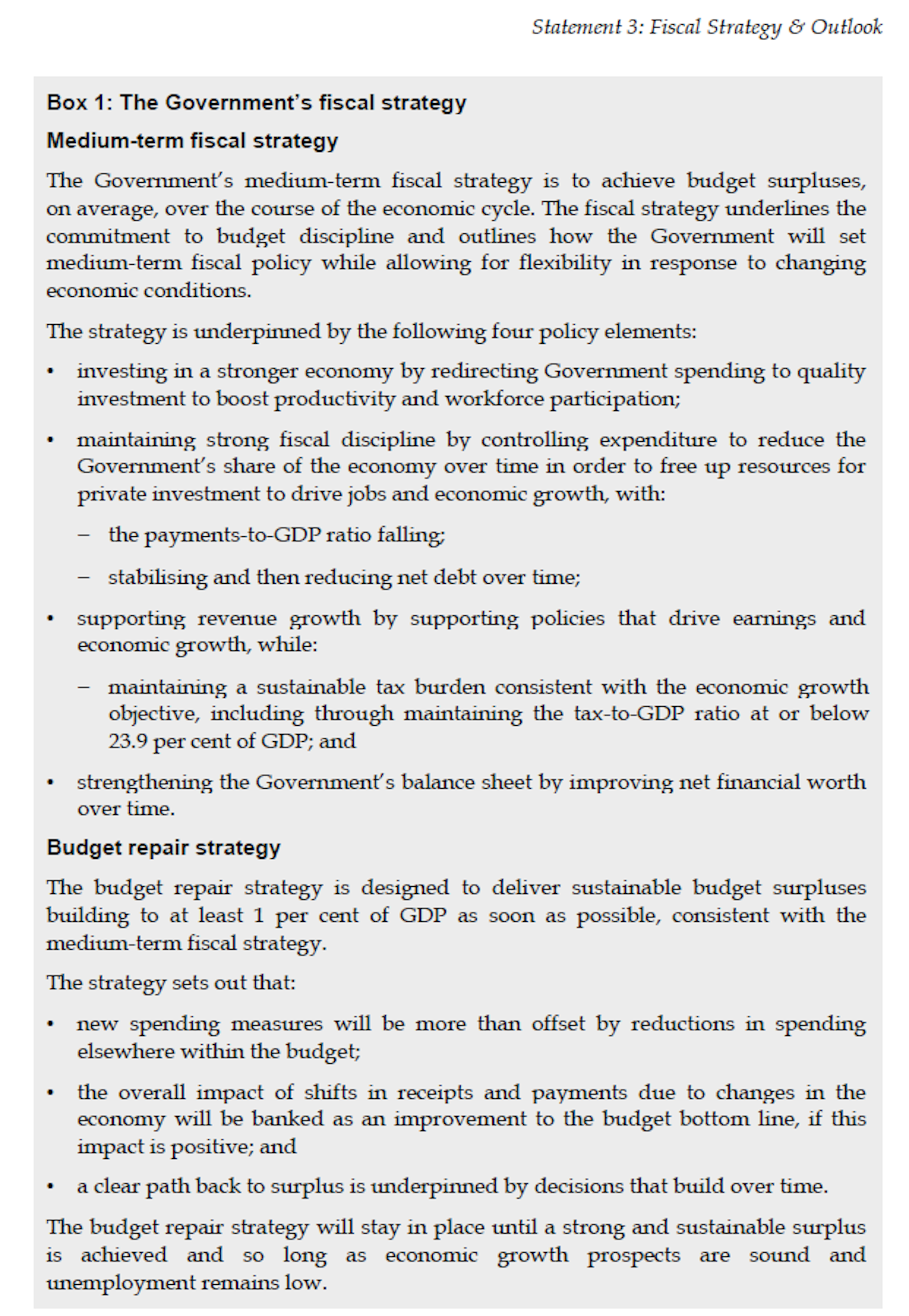
The fiscal strategy can be thought of as an exam question set by the student who is being examined – something along the lines of “this is what you say you want your budget to achieve, please set out the means by which you plan to achieve it”.
It turns out to have been exceptionally effective in getting governments to organise their thoughts, make budgets at least try to achieve something, and let the rest of us know what they are trying to achieve.
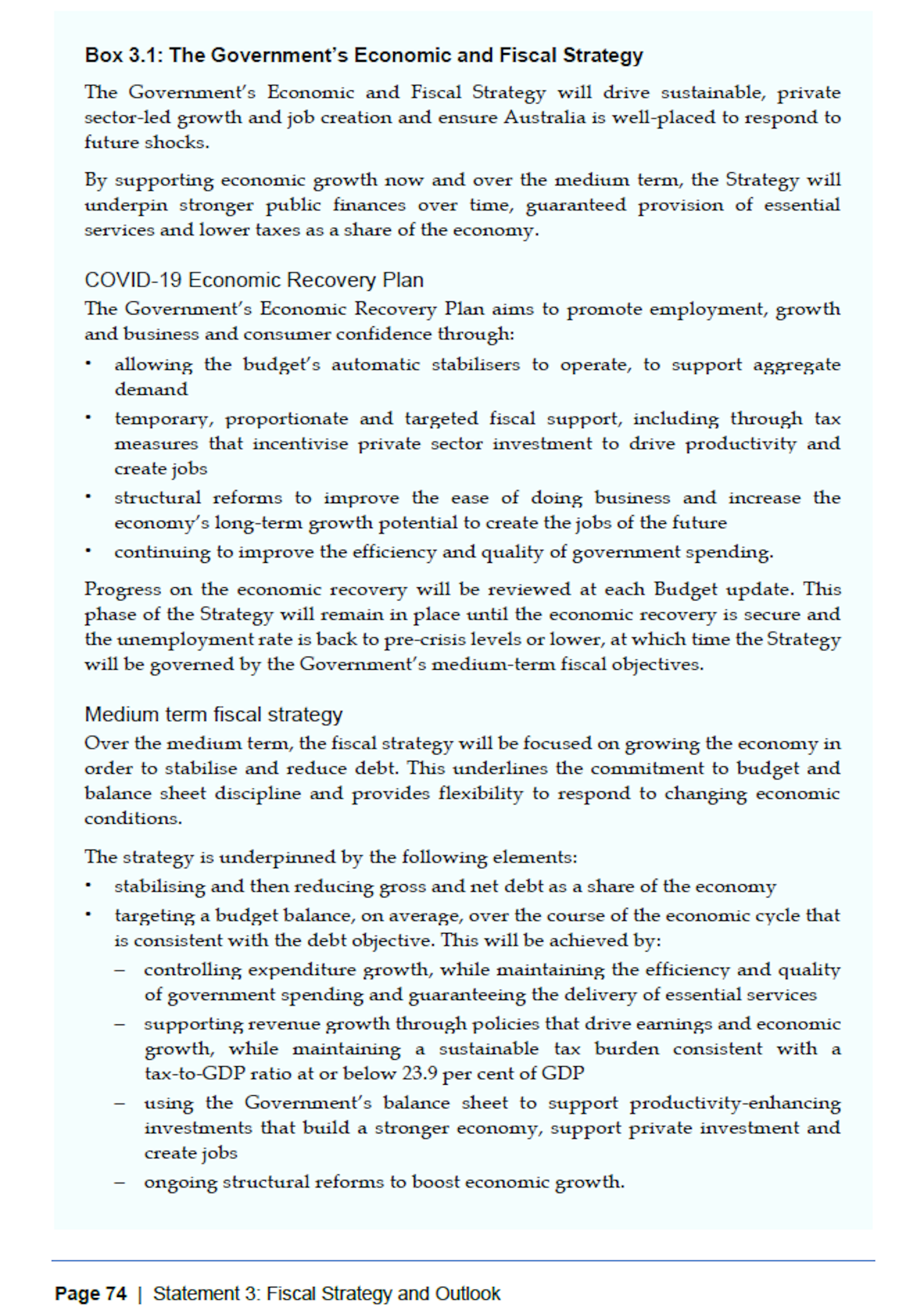
Every few years, treasurers change the strategy, as is their right. Treasurer Jim Chalmers says he’ll change it again this budget, to de-emphasise the fight against inflation and to more greatly emphasise the need to support economic growth.
His statement will tell us what’s behind his actions in a way the glossy words in his brochure and speech might not.
The strategy that has signposted 26 years
Previous statements have signposted all the important turns in what the budget is trying to do.
The first, in 1998, committed Costello and Howard to achieving a budget surplus on average over the economic cycle and whenever “growth prospects remain sound”.
Making that commitment more difficult was another “not to introduce new taxes or raise existing taxes over the term of this parliament”.
Two years later, after the government had won an election promising a new goods and services tax, that commitment was changed to “no increase in the overall tax burden from its 1996-97 level”, a condition met by calling the GST a state tax.
Hockey and Morrison wound back spending
The Labor budgets from 2008 loosened the tax target to the average share of GDP below the reference year, which they changed to the higher-tax year of 2007-08.
The first Coalition budget under Treasurer Joe Hockey in 2014 changed the target from tax to spending, pledging to bring down the ratio of payments to GDP, and pledging a surplus of 1% of GDP by 2023-24.
Any new spending would be more than offset by cuts elsewhere, and if the budget did receive a burst of unexpected revenue it would be “banked” rather than spent.
In 2018 Treasurer Scott Morrison reintroduced tax as a target, that he spelled out precisely. Tax was not to increase beyond 23.9% of GDP.
During COVID, Frydenberg spent big
In 2020, in the face of a COVID-induced recession and soaring unemployment, Finance Minister Mathias Cormann and Treasurer Josh Frydenberg pushed the old strategy to one side.
They would spend big now to keep the economy afloat so they wouldn’t have to spend more bailing it out later, and they wouldn’t return to their old concern about the deficit until the unemployment rate was “comfortably below 6%”.
So well did they succeed that in 2021 Frydenberg made the momentous decision to keep going, abandoning the promise to return to worrying about the deficit when unemployment fell below 6%.
Along with high iron ore prices, that one change of strategy has probably helped deliver Chalmers two consecutive budget surpluses – the one he announced last year for 2022-23, and the one he is set to announce this year for 2023-24. More of us have been in jobs paying tax, and fewer have been out of jobs on benefits.
It’s a powerful demonstration of the real-world difference budget decisions can make, and the way in which the fiscal strategy tells the story.
Peter Martin is Economics Editor of The Conversation.
As the climate warms and Antarctica’s glaciers and ice sheets melt, the resulting rise in sea level has the potential to displace hundreds of millions of people around the world by the end of this century.
A key uncertainty in how much and how fast the seas will rise lies in whether currently “stable” parts of the West Antarctic Ice Sheet can become “unstable”.
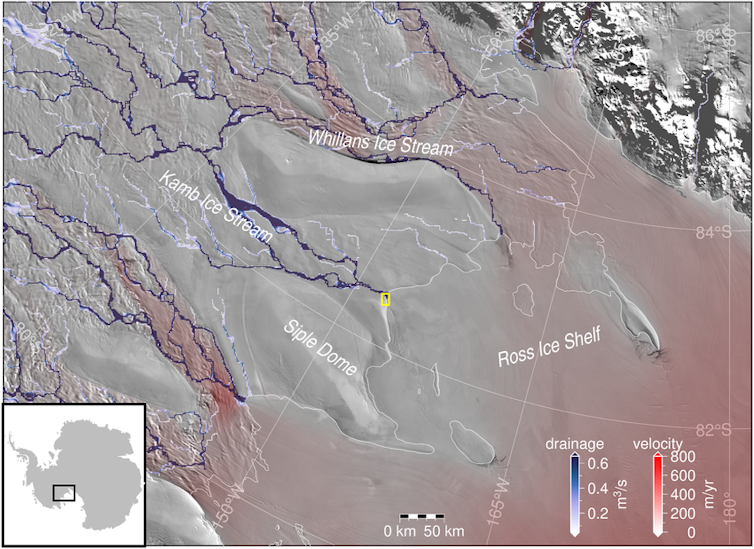
One such region is West Antarctica’s Siple Coast, where rivers of ice flow off the continent and drain into the ocean.
This ice flow is slowed down by the Ross Ice Shelf, a floating mass of ice nearly the size of Spain, which holds back the land-based ice. Compared to other ice shelves in West Antarctica, the Ross Ice Shelf has little melting at its base because the ocean below it is very cold.
Although this region has been stable during the past few decades, recent research suggest this was not always the case. Radiocarbon dating of sediments from beneath the ice sheet tells us that it retreated hundreds of kilometres some 7,000 years ago, and then advanced again to its present position within the last 2,000 years.
Figuring out why this happened can help us better predict how the ice sheet will change in the future. In our new research, we test two main hypotheses.
Scientists have considered two possible explanations for this past ice sheet retreat and advance. The first is related to Earth’s crust below the ice sheet.
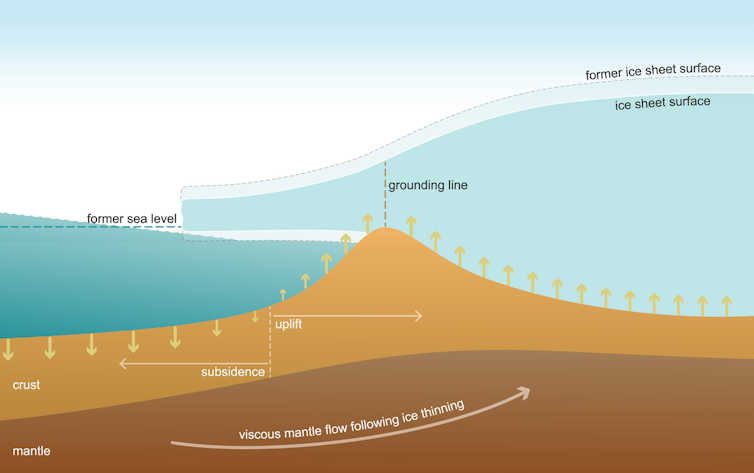
As an ice sheet shrinks, the change in ice mass causes the Earth’s crust to slowly uplift in response. At the same time, and counterintuitively, the sea level drops near the ice because of a weakening of the gravitational attraction between the ice sheet and the ocean water.
As the ice sheet thinned and retreated since the last ice age, crustal uplift and the fall in sea level in the region may have re-grounded floating ice, causing ice sheet advance.
Earth’s crust uplifts and sea level drops near the ice sheet as it loses mass. AGU, CC BY-SA
The other hypothesis is that the ice sheet behaviour may be due to changes in the ocean. When the surface of the ocean freezes, forming sea ice, it expels salt into the water layers below. This cold briny water is heavier and mixes deep into the ocean, including under the Ross Ice Shelf. This blocks warm ocean currents from melting the ice.
Top: Cold dense shelf water blocks warm circumpolar deep water from melting the ice. Bottom: Warm circumpolar deep water flows under the ice shelf, causing ice melting and retreat. AGU, CC BY-SA
Seafloor sediments and ice cores tell us that this deep mixing was weaker in the past when the ice sheet was retreating. This means that warm ocean currents may have flowed underneath the ice shelf and melted the ice. Mixing increased when the ice sheet was advancing.
We test these two ideas with computer model simulations of ice sheet flow and Earth’s crustal and sea surface responses to changes in the ice sheet with varying ocean temperature.
Because the rate of crustal uplift depends on the viscosity (stickiness) of the underlying mantle, we ran simulations within ranges estimated for West Antarctica. A stickier mantle means slower crustal uplift as the ice sheet thins.
The simulations that best matched geological records had a stickier mantle and a warmer ocean as the ice sheet retreated. In these simulations, the ice sheet retreats more quickly as the ocean warms.
When the ocean cools, the simulated ice sheet readvances to its present-day position. This means that changes in ocean temperature best explain the past ice sheet behaviour, but the rate of crustal uplift also affects how sensitive the ice sheet is to the ocean.
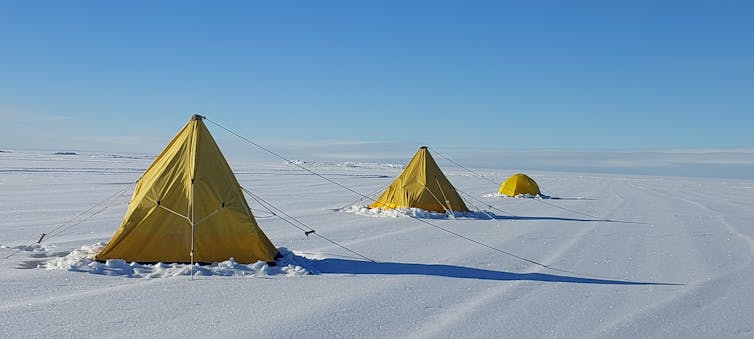
Changes in ocean temperature best explain the retreat of West Antarctica’s ice sheet in the past. Veronika Meduna, CC BY-SA
What this means for climate policy today
Much attention has been paid to recent studies that show glacial melting may be irreversible in some parts of West Antarctica, such as the Amundsen Sea embayment.
In the context of such studies, policy debates hinge on whether we should focus on adapting to rising seas rather than cutting greenhouse gas emissions. If the ice sheet is already melting, are we too late for mitigation?
Our study suggests it is premature to give up on mitigation.
Global climate models run under high-emissions scenarios show less sea ice formation and deep ocean mixing. This could lead to the same cold-to-warm ocean switch that caused extensive ice sheet retreat thousands of years ago.
For West Antarctica’s Siple Coast, it is better if we prevent this ocean warming from occurring in the first place, which is still possible if we choose a low-emissions future.
Dan Lowry receives funding from the Antarctic Science Platform supported by the New Zealand Ministry for Business Innovation and Employment.
Holly Kyeore Han receives funding from NASA Postdoc Program.
Do Australian courts have the right to decide what foreign citizens, located overseas, view online on a foreign-owned platform?
Anyone inclined to answer “yes” to this question should perhaps also ask themselves whether they are equally happy for courts in China, Russia and Iran to determine what Australians can see and post online in Australia.
This is the problem with global “take-down orders”, an issue we now must confront in light of the Australian eSafety commissioner demanding that social media platform X (formerly Twitter) remove videos of a violent stabbing at a church in Sydney.
X agreed to prevent access to the content in Australia. However, at an urgent federal court hearing late Monday, the commissioner demanded a full removal, with an interim measure of blocking the posts globally.
There can be no doubt that a global take-down order can be justified in some instances. For example, child abuse materials and so-called revenge porn are clear examples of content that should be removed with global effect.
But it is far too simplistic to seek to justify a global take-down order just by saying that any platform operating in Australia must comply with Australian law, as shadow Foreign Minister Simon Birmingham said in a Sky News interview this morning.
After all, international law imposes limitations on what demands Australian law can place on foreigners acting outside Australia.
It is also too simplistic to just focus on efficiency, as was done in the context of so-called geo-blocking – the use of geo-location technologies to block users from a specific location. Attempts to block online piracy sites, for example, have famously been ineffective.
Of course, a court order requiring X to take down certain content globally is more effective than a court order requiring X to geo-block such content so that users in Australia cannot access it.
Even if X removed the content on a global basis, those Australians who are hell-bent on viewing the footage in question would be able to find it somewhere else online. In other words, there is no realistic way to fully ensure the content cannot be accessed at all.
Ordering X to use geo-location technologies to block Australians from viewing the content would be sufficient to prevent the general Australian public from coming into contact with the video. Doing so would also show respect for the fact that different countries have different laws.
An unusually poor ‘test case’ for free speech
Elon Musk, the American billionaire owner of X, has chosen to approach the matter as a fight for free speech in the face of “censorship”. Such a move would no doubt gain support among the conspiracy theorists and online trolls in his audience. But for the broader Australian public, this must appear like an odd occasion to fight for free speech.
There can sometimes be real tension between free speech and the suppression of violent imagery. For example, some news reporting from military conflicts may be deemed too graphic by some, while others view it as a necessary tool to illustrate the level of violence being committed.
Here, there are no such complex considerations. There is simply no arguable value in keeping the videos online. Consequently, while removing the content can be described as censorship, it is hard to understand why anyone would object to this censorship.
After all, not even the staunchest free speech advocates would be able to credibly object to all censorship. (For example, consider the publication of child abuse materials or Musk’s credit card details.)
The path forward
In the end, we must recognise the internet is a shared resource. All countries, including Australia, should be very careful in how they apply their laws where it can have a “spill-over” effect impacting people in other countries.
Global take-down orders are justifiable in some situations, but cannot be the default position for all content that violates some law somewhere in the world. If we had to comply with all content laws worldwide, the internet would no longer be as valuable as it is today.
We must also start being more proactive in how we regulate the internet. Rushed reactive lawmaking rarely leads to good long-term outcomes. This is a field in which we need international cooperation – this will take time.
Finally, the platforms must act maturely. While other platforms responded to the eSafety commissioner by swiftly blocking the content, X decided to fight for the “right” to display violent extremism in action.
The fact Musk views this as a suitable battleground for free speech shows that we have a long way to go in finding solutions to the regulation of the internet.
Dan Jerker B. Svantesson does not work for, consult, own shares in or receive funding from any company or organisation that would benefit from this article, and has disclosed no relevant affiliations beyond their academic appointment.
Source: The Conversation (Au and NZ) – By Giovanni E Ferreira, NHMRC Emerging Leader Research Fellow, Institute of Musculoskeletal Health, University of Sydney
Last week in a post on X, owner of the platform Elon Musk recommended people look into disc replacement if they’re experiencing severe neck or back pain.
According to a biography of the billionaire, he’s had chronic back and neck pain since he tried to “judo throw” a 350-pound sumo wrestler in 2013 at a Japanese-themed party for his 42nd birthday, and blew out a disc at the base of his neck.
In comments following the post, Musk said the surgery was a “gamechanger” and reduced his pain significantly.
Musk’s original post has so far had more than 50 million views and generated controversy. So what is disc replacement surgery and what does the evidence tells us about its benefits and harms?
What’s involved in a disc replacement?
Disc replacement is a type of surgery in which one or more spinal discs (a cushion between the spine bones, also known as vertebrae) are removed and replaced with an artificial disc to retain movement between the vertebrae. Artificial discs are made of metal or a combination of metal and plastic.
Disc replacement may be performed for a number of reasons, including slipped discs in the neck, as appears to be the case for Musk.
Disc replacement is major surgery. It requires general anaesthesia and the operation usually takes 2–4 hours. Most people stay in hospital for 2–7 days. After surgery patients can walk but need to avoid things like strenuous exercise and driving for 3–6 weeks. People may be required to wear a neck collar (following neck surgery) or a back brace (following back surgery) for about 6 weeks.
Costs vary depending on whether you have surgery in the public or private health system, if you have private health insurance, and your level of coverage if you do. In Australia, even if you have health insurance, a disc replacement surgery may leave you more than A$12,000 out of pocket.
Disc replacement surgery is not performed as much as other spinal surgeries (for example, spinal fusion) but its use is increasing.
In New South Wales for example, rates of privately-funded disc replacement increased six-fold from 6.2 per million people in 2010–11 to 38.4 per million in 2019–20.
What are the benefits and harms?
People considering surgery will typically weigh that option against not having surgery. But there has been very little research comparing disc replacement surgery with non-surgical treatments.
Clinical trials are the best way to determine if a treatment is effective. You first want to show that a new treatment is better than doing nothing before you start comparisons with other treatments. For surgical procedures, the next step might be to compare the procedure to non-surgical alternatives.
Unfortunately, these crucial first research steps have largely been skipped for disc replacement surgery for both neck and back pain. As a result, there’s a great deal of uncertainty about the treatment.
There are no clinical trials we know of investigating whether disc replacement is effective for neck pain compared to nothing or compared to non-surgical treatments.
For low back pain, the only clinical trial that has been conducted to our knowledge comparing disc replacement to a non-surgical alternative found disc replacement surgery was slightly more effective than an intensive rehabilitation program after two years and eight years.
Complications are not uncommon, and can include disclocation of the artificial disc, fracture (break) of the artificial disc, and infection.
In the clinical trial mentioned above, 26 of the 77 surgical patients had a complication within two years of follow up, including one person who underwent revision surgery that damaged an artery leading to a leg needing to be amputated. Revision surgery means a re-do to the primary surgery if something needs fixing.
Are there effective alternatives?
The first thing to consider is whether you need surgery. Seeking a second opinion may help you feel more informed about your options.
Many surgeons see disc replacement as an alternative to spinal fusion, and this choice is often presented to patients. Indeed, the research evidence used to support disc replacement mainly comes from studies that compare disc replacement to spinal fusion. These studies show people with neck pain may recover and return to work faster after disc replacement compared to spinal fusion and that people with back pain may get slightly better pain relief with disc replacement than with spinal fusion.
However, spinal fusion is similarly not well supported by evidence comparing it to non-surgical alternatives and, like disc replacement, it’s also expensive and associated with considerable risks of harm.
Fortunately for patients, there are new, non-surgical treatments for neck and back pain that evidence is showing are effective – and are far cheaper than surgery. These include treatments that address both physical and psychological factors that contribute to a person’s pain, such as cognitive functional therapy.
While Musk reported a good immediate outcome with disc replacement surgery, given the evidence – or lack thereof – we advise caution when considering this surgery. And if you’re presented with the choice between disc replacement and spinal fusion, you might want to consider a third alternative: not having surgery at all.
Giovanni E Ferreira receives funding from the National Health and Medical Research Council (NHMRC) and Medical Research Future Fund (MRFF).
Christine Lin receives funding from the National Health and Medical Research Council (NHMRC), and Medical Research Future Fund.
Christopher Maher receives funding from the National Health and Medical Research Council (NHMRC), and Medical Research Future Fund.
Ian Harris has received grant funding from numerous research organisations.
Joshua Zadro receives funding from the National Health and Medical Research Council (NHMRC).
NSW Treasurer Daniel Mookhey caught the headlines yesterday, courtesy of a blistering speech condemning the latest GST carve-up. New South Wales, he claimed, would be A$11.9 billion worse off over the next four years, leaving both the state’s coveted AAA credit rating and budget surplus in tatters.
The lost dollars, Mookhey said, could have funded 19,000 healthcare workers, 19,000 teachers or 16,000 police officers.
This is certainly a lot of revenue to lose in one hit. But it is not immediately clear where the state treasurer got this number from.
The new GST carve-up will see NSW receive $310 million less next year compared to this year.
But since 2021-22, Australia’s GST has been allocated under a new equalisation arrangement. We’re currently in the transition period, meaning each year states are compensated with “no worse off” payments to ensure they don’t receive less cumulative GST than they would have under the old system.
If NSW’s “no worse off” top-up payments are taken into account, the difference is only $188 million.
Mookhey could argue that the annual movement in GST payments is not the point. The issue is how much GST was factored into his budget last May. That was $1.2 billion more than what will now be received in 2024-25 under the updated distribution.
Yes, that’s a lot of money to lose, but multiplied out over four years, it’s still well short of $11.9 billion.
Short-changed on population
So, where exactly did that bigger number come from?
NSW’s beef with the GST carve-up is most likely that it receives much less than it would get if those revenues were distributed according to population share, instead of according to service delivery needs between states and territories.
Next year, for example, with 31.2% of the population, NSW will only receive 27.1% of GST revenues. In dollar terms, the difference is equivalent to about $3.6 billion, which multiplied out over four years, would come to $14.4 billion.
This is the only figure that comes anywhere near the amount suggested by the treasurer. But it’s misleading. Distributing GST by population alone ignores different service delivery needs between states.
NSW certainly copped a big drop in its assessed need relative to the average of all other jurisdictions in the latest GST update. But if history is any guide, its relative position is likely to go in the opposite direction sometime over the next four years.
The point here is we are talking about a future situation that may never arise – hardly a solid basis for a political fight.
But what’s really fair?
The treasurer’s speech gives the impression the latest GST carve-up is the source of the problem. In reality, Mookhey has taken aim at the way we try to even up the financial capacity of the states and territories. The current system of distribution allows us to ensure each Australian citizen, no matter where they live, is able to receive similar levels of government services without paying more than the average person.
For the foreseeable future, there will always be a significant gap between an ideal equal per capita distribution and what a wealthy state like NSW actually gets from the GST. That’s not because of the latest carve-up, it’s just the way it is.
The $11.9 billion GST “budget bomb” is the kind of fiction our political system could well do without. Money has not been lost, nor have jobs. They have simply been redistributed from NSW to South Australia, Tasmania, the ACT and the Northern Territory. Because of service needs, these jurisdictions receive a bigger share of GST funds than their share of the national population.
What about the NSW budget’s bottom line? In the NSW Treasury’s December budget update, Mookhey estimated that next year he would deliver an operating surplus of $475 million, down from the $844 million estimated last May. Most of the slippage occurred in 2023 after the budget was brought down.
While GST revenues will be down compared to what was budgeted in 2024-25, revenues in total are well above budget, by $490 million. The problem is not revenues, but expenses, which have blown out by close to $1 billion, mainly due to the impact of rising interest rates on outstanding debt.
Any budget problems the state now faces are not only because of lower-than-expected GST revenue, but at least equally because of NSW Treasury’s failure to control expenses.
Is NSW’s credit rating on the line? Not really. One of the three big credit rating agencies has already downgraded it with little, if any, impact on the state’s borrowing costs.
Were the other two agencies to follow suit, it likely wouldn’t make a difference. As Mookhey himself recently pointed out, rating agency assessments are becoming less important than was once the case.
So why the uproar? It is all just part of an annual parade of treasurers – usually from NSW and Victoria – fronting the media and calling for a bigger slice of the national GST pie. It may also be an attempt by Mookhey to soften up the public for a credit rating downgrade, one that is ironically unlikely to matter.
David Hayward does not work for, consult, own shares in or receive funding from any company or organisation that would benefit from this article, and has disclosed no relevant affiliations beyond their academic appointment.
Australian Prime Minister Anthony Albanese has arrived at Kokoda Station, Northern province, at the start of his state visit to Papua New Guinea.
Both Albanese and Prime Minister James Marape will meet with the locals and the Northern Provincial government before they begin their walk along the historic 96km Kokoda Trail.
Both men were “excited” with Marape saying “he was there to lend a hand to his brother PM”.
Meanwhile, the heroism of Australian soldier Private Bruce Steel Kingsbury is being remembered in advance of ANZAC Day.
Knowing his platoon would not last long with the continuous attack by the Japanese and suffering severe losses during World War Two, Private Kingsbury made the heroic decision to move against the continuous firing and attacked the enemy which cost his life on 29 August 1942.
The battle took place at Isurava, Kokoda. Where Private Kingsbury fell is a memorial which is known as “Kingsbury Rock” beside the Isurava Memorial which Australian Prime Minister Anthony Albanese will visit for the ANZAC Dawn service.
Private Kingsbury’s sacrifice earned him a Victoria Cross. He is buried at the Bomana War Cemetery outside Port Moresby and is one of 625 Australians who were killed in action along the Kokoda track, another 1055 were wounded.
Battle for PNG The battle to protect Papua and New Guinea, as it was known back then, took about 9000 lives and the remnants of war still remain in the jungles of PNG with more men still missing in action.
Private Bruce Kingsbury . . . a memorial known as “Kingsbury Rock” stands where he fell in battle against the Japanese in 1942. Image: PNG Post-Courier
Prime ministers Marape and Albanese will walk a section of the Kokoda track to honour the shared history and enduring bond between the two nations.
“The visit of Prime Minister Albanese underscores the close relationships between our countries,” said Prime Minister Marape.
“I’ll be joining him for a walk along the Kokoda Trail.”
Albanese is set to be the first sitting prime minister to walk part of the famous 96km track.
Kevin Rudd walked the Kokoda Track in 2006 while he was opposition leader while former prime minister Scott Morrison also hiked the track in 2009 during his time as a backbench MP.
Miriam Zarrigais a PNG Post-Courier reporter. Republished with permission.
Source: The Conversation (Au and NZ) – By Chris Wallace, Professor, School of Politics Economics & Society, Faculty of Business Government & Law, University of Canberra
Shutterstock
An important principle was invoked by Prime Minister Anthony Albanese last week in defence of the government’s Future Made in Australia industry policy announcement.
“There is a role for government sometimes in just providing […] support to get over the hump”, Albanese said, for otherwise sustainable companies facing rough patches in the quest to diversify Australia’s manufacturing base.
If it’s a good idea for companies, why not for responsible and otherwise financially-viable Australians at risk of losing their homes in a cost-of-living crisis?
HomeKeeper is modelled on the pandemic-era JobKeeper program, but applies key lessons from flaws in JobKeeper’s design.
Crucially, it’s not a handout. Nor is it a contingent loan, the shortcomings of which Higher Education Contribution Scheme (HECS) debts have made painfully clear.
Rather, it’s government help through a small equity stake with positive returns for taxpayers when HomeKeeper help is no longer needed.
Mortgage-stressed owner-occupiers could get some breathing space to recapitalise, with government making their mortgage payments direct to the home-owner’s bank up to a modest (say $25,000 overall) ceiling.
In exchange, the government would own a small equity stake in the property, equal to the value of the mortgage aid as a proportion of the property’s market value at the time. Government would get its proportionate share back at market value later, when ownership of the property next turned over – or sooner if the homeowner chose.
Good for the homeowner. Good for taxpayers. Good in the way it stops already way-too-long rental queues and homelessness from worsening.
HomeKeeper would be of most help to lower income families who often don’t have a “Bank of Mum and Dad” to help them “over the hump”, as Albanese puts it, during temporary difficulties.
With a relatively low ceiling on the overall assistance, it would make a real difference to families of modest means but be of no real help, and therefore of little interest, to McMansion owners needing large scale assistance to avoid forced sales.
Crossbenchers see the benefits. Independent MP for Goldstein, Zoe Daniel, canvassed HomeKeeper in parliament in December noting, “the assistance would go straight from the government to the bank, ensuring it didn’t add to consumption and inflation”.
Given expectations that house prices will generally continue to rise for the foreseeable future, the taxpayer would typically benefit to that extent from the repayment; that is, reflecting the size of the government’s equity stake acquired via temporary mortgage payment support.
Pocock wants the government’s Help To Buy mechanism amended to enable low- and middle-income earners “facing mortgage repossession and possible homelessness to remain in home ownership” via a HomeKeeper-style program.
Establishing HomeKeeper is more important than ever because the monetary policy script isn’t following the arc politicians and policymakers planned.
Internationally and nationally, inflation is easing, but more slowly and fitfully than hoped.
Predictions that cuts would come sooner rather than later have been dashed more than once when reported United States economic data was stronger than expected, or when markets were affected by upticks in international conflict.
Throughout, Australia has been expected to begin cutting rates last among the world’s industrialised economies, since it was last to begin ramping rates up and the economy kept pumping along strongly.
Tightening the budget screws, the Albanese government is counting on multiple rate cuts in the run up to the next federal election, due to be called by next April, to put voters in a better mood.
At 31%, Labor’s support risks sliding into the 20s according to RedBridge Group pollster Kos Samaras.
Albanese’s net approval rating is barely ahead of Peter Dutton’s. Both are negative, suggesting a “pox on both your houses” sentiment among voters.
Relying on interest rate relief to arrive isn’t enough
Fiscal policy is doing its bit to help turn the tide on interest rates. Sustained effort by Treasurer Jim Chalmers and Finance Minister Senator Katy Gallagher has turned around the dire budget balance and debt mountain inherited from the Morrison government.
What’s more, even without further rate increases by the Reserve Bank of Australia (RBA) this year, the average mortgage rate is set to rise anyway according to research by the RBA’s Domestic Markets Department’s Benjamin Ung.
Little wonder then that mortgage stress is extensive and worsening. Nearly a third (31.4%) of mortgaged owner-occupiers are “at risk” of mortgage stress according to the latest Roy Morgan survey. Nearly one in five (19.7%) are “extremely at risk”.
Many mortgaged owner-occupiers are at and beyond the end of their tether as more and more of them face voluntary self-initiated house sales or, worse, forced sales by their banks.
Monetary policy pinch points don’t need to, and shouldn’t, throw financially responsible and otherwise viable mortgage-stressed owner-occupiers onto the rental queue or into homelessness.
Monetary policy in Australia should be reformed by supplementary humane, modest and economically effective policy to stave off collateral damage in the housing market during the worst part of the cycle.
Next month’s budget is an opportunity for the government to move beyond its “I feel your pain” rhetoric to a HomeKeeper-style policy for this particular group of temporarily squeezed Australians.
It will be too late for those who have already lost their homes.
But it could prove decisive at the margin to save a lot of others currently weighing up whether tents or cars are their best bet for shelter as the banks move in on their homes. These Australians don’t deserve to be incidental victims in government’s pursuit of the worthy goal of low inflation.
HomeKeeper isn’t meant to be a total solution to our hydra-headed housing woes. Rather, it’s a way to keep key elements of it from getting worse.
It can save real people whose foothold in society is temporarily, and often unexpectedly, precarious from tipping into a social security system that can’t cope with the challenges it already has.
Losing that foothold happens quickly. Regaining it takes a long time, if ever. The longer it takes, the more damaging to individuals and families, and the more costly it is to governments.
Albanese is right – sometimes there’s a role for government in providing help to get over that hump.
Chris Wallace is a professor in the University of Canberra’s School of Politics Economics & Society, Faculty of Business Government & Law. She has received funding from the Australian Research Council.
Security forces reinforcements were sent from France ahead of two rival marches in the capital Nouméa today, at the same time and only two streets away one from the other.
One march, called by Union Calédonienne party (a component of the pro-independence FLNKS umbrella) and its CCAT (field action group), was protesting against planned changes to the French Constitution to “unfreeze” New Caledonia’s electoral roll by allowing any citizen who has resided in New Caledonia for at least 10 years to cast their vote at local elections — for the three Provincial assemblies and the Congress.
The other march was called by pro-France parties Rassemblement and Les Loyalistes who support the change and intend to make their voices heard by French MPs.
The constitutional bill was endorsed by the French Senate on April 2.
However, as part of the required process before it is fully endorsed, the constitutional bill must follow the same process before France’s lower House, the National Assembly.
Debates are scheduled on May 13.
Then both the Senate and the National Assembly will be gathered sometime in June to give the final approval.
Making voices heard Today, both marches also want to make their voices heard in an attempt to impress MPs before the Constitutional Bill goes further.
The pro-France march is scheduled to end at Rue de la Moselle in downtown Nouméa, two streets away from the other pro-independence march, which is planned to stop on the Place des Cocotiers (“Coconut square”).
The pro-independence rally in the heart of Nouméa today. Image: @knky987
At least 20,000 participants were estimated to take part.
Security forces reinforcements have been sent from France, with two additional squads (140) of gendarmes, French High Commissioner Louis Le Franc said yesterday.
While acknowledging the “right to demonstrate as a fundamental right”, Le Franc said it a statement it could only be exercised with “respect for public order and freedom of movement”.
“No outbreak will be tolerated” and if this was not to be the case, then “the reaction will be steadfast and those responsible will be arrested,” he warned.
Le Franc also strongly condemned recent “blockades and violence” and called for everyone’s “calm and responsibility” for a “Pacific dialogue in New Caledonia”.
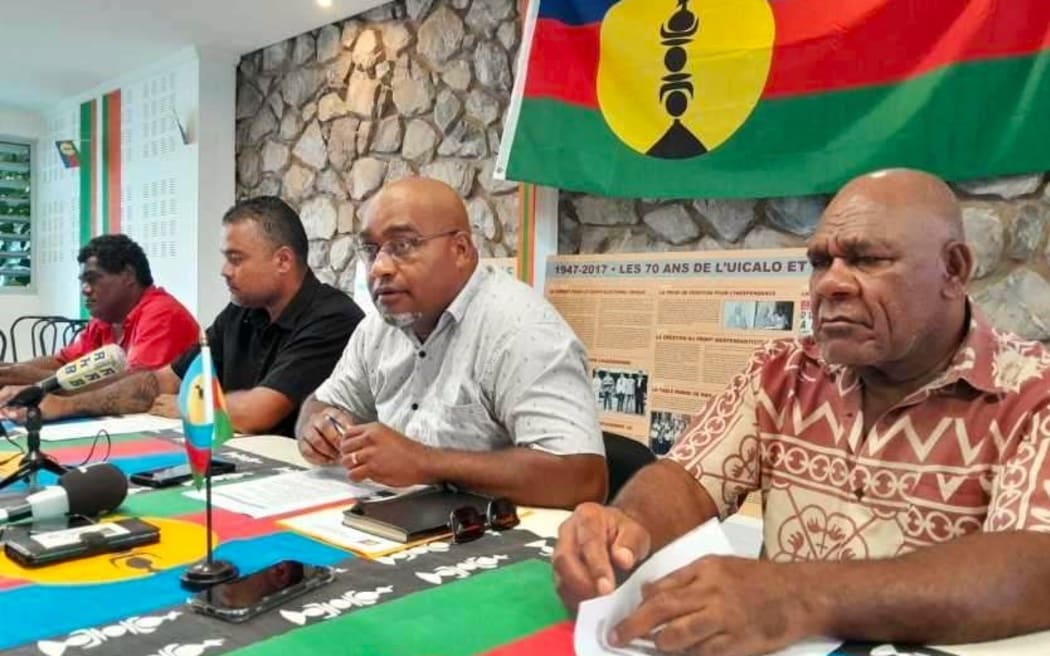
CCAT spokesman Christian Téin, Arnaud Chollet-Leakava (MOI), Dominique Fochi (UC) and Sylvain Boiguivie (Dus) during a press conference on Thursday at the Union Calédonienne headquarters. Image: LNC
Tight security to avoid a clash New Caledonia’s Southern Province vice-president and member of the pro-France party Les Loyalistes, Philippe Blaise, told Radio Rythme Bleu he had been working with security forces to ensure the two opposing marches would not come close at any stage.
“It will not be a long march, because we are aware that there will be families and old people,” he said.
“But we are not disclosing the itinerary because we don’t want to give bad ideas to people who would like to come close to our march with banners and whatnot.
“There won’t be any speech either. But there will be an important security setup,” he reassured.
Earlier this week, security forces intervened to lift roadblocks set up by pro-independence militants near Nouméa, in the village of Saint-Louis, a historical pro-independence stronghold.
The clash involved about 50 security forces against militants.
Tear gas, and stones Teargas and stones were exchanged and firearm shots were also heard.
On March 28, the two opposing sides also held two marches in downtown Nouméa, with tens of thousands of participants.
No incident was reported.
The UC-revived CCAT (Field Actions Coordination Cell, cellule de coordination des actions de terrain), which is again organising today’s pro-independence march to oppose the French Constitutional change, earlier this month threatened to boycott this year’s planned provincial elections.
CCAT head Christian Tein said they were demanding that the French Constitutional amendment be withdrawn altogether, and that a “dialogue mission” be sent from Paris.
“We want to remind (France) we will be there, we’ll bother them until the end, peacefully”, he said.
“Those MPs have decided to kill the Kanak (Indigenous) people . . . this is a programmed extermination so that Kanaks become like (Australia’s) Aborigines,” he told local media.
“Anyone can cause unrest, but to stop it is another story . . . now we are on a slippery slope,” he added.
War of words, images over MPs Pro-France leader Sonia Backès, during a the March 28 demonstration, had also alluded to “causing unrest” from their side and its ability to “make noise” to ensure their voices are heard back in the French Parliament.
“The unrest, it will come from us if someone tries to step on us,” she lashed out at that rally.
“We have to make noise, because unfortunately, the key is the image,” she said.
“But this little message with the ballot box and Eloi Machoro’s picture, this is provocation.
“I am receiving death threats every day; my children too,” she told Radio Rythme Bleu.
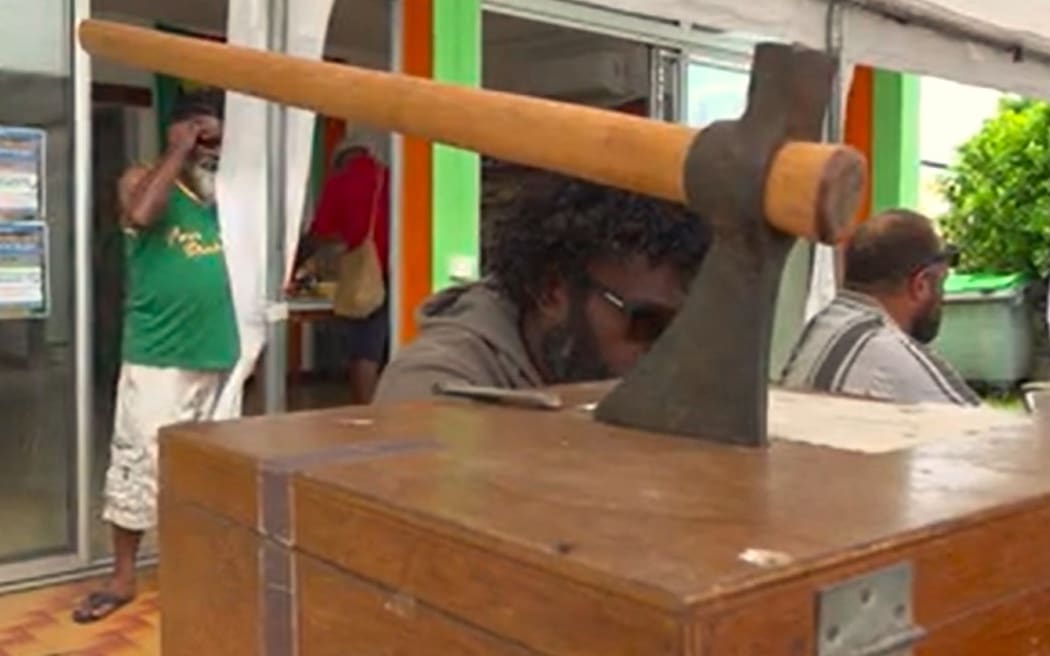
The CCAT movement is placing a hatchet on a ballot box, recalling the Eloi Machoro protest. Image: 1ère TV screenshot APR
Hatchet and ballot box – the ghosts of 1984 During the CCAT’s press conference earlier this month, a ballot box with a hatchet embedded was on show, recalling the famous protest by pro-independence leader Eloi Machoro, who smashed a ballot box with a hatchet to signify the Kanak boycott of the elections on 18 November 1984.
The iconic act was one of the sparks that later plunged New Caledonia in a quasi civil war until the Matignon Accords in 1988. Both pro-France leader Jacques Lafleur and Lanak leader Jean-Marie Tjibaou shook hands to put an end to a stormy period since described as “the events”.
On 12 January 1985, Machoro was shot by French special forces.
The territorial elections day in New Caledonia on 18 November 1984 when Eloi Machoro smashed a ballot box in the small township of Canala. Image: RNZ/File
This article is republished under a community partnership agreement with RNZ.
Who makes the words? Why are trees called trees and why are shoes called shoes and who makes the names? – Elliot, age 5, Eltham, Victoria
Good question Elliot!
Let’s start with the first part of the question: who makes words?
Well, there’s no official person or group that’s responsible for making words. New words are invented by all of us getting creative. Mostly, it’s a matter of reusing words, or parts of words, and transforming them into new products. Language is the ultimate recycler!
One is to add things called “suffixes”, which are letters we add to the ends of words to change their meaning slightly. By adding a “-y” to “tree” and “shoe”, we can make “treey” (to describe something with lots of trees) and “shoey” (to describe people drinking from a shoe, an odd but old tradition). There are also things called “prefixes”. These are letters that go at the front of a word. For example, the word “subtree” describes a kind of shrub, and “overshoes” are something worn over ordinary shoes.
It’s also possible to combine whole words to make new ones. We can even put “tree” and “shoe” together to create “shoe-tree”, which is a block of wood we put into shoes to keep their shape. These types of words are called “compound words” — they are often written as two words (“apple tree”), but sometimes one (“shoelace”). English has never sorted out the rules here.
A third process, and one that’s really popular these days, is “blending”. This is when we mix words together (sometimes they’re called “frankenwords”, itself a blend of “Frankenstein” and “word”). Here are two made-up blends based on “tree” and “shoe”. They don’t exist — yet (perhaps they’ll take off!).
Treerific (“tree” has been squished with “terrific” to convey something wonderful that is related to trees)
Shoenicorn (“shoe” has been squished with “unicorn” to mean an unicorn with magical shoes)
Words and parts of words can combine and recombine to create a never-ending number of new words. Out of blended “treerific”, I can build “treerifical”, “treerificalise”, “treerificalisation”, “treerificalisational” and so on. The number of words is endless. But of course we can’t invent too many of these because it’s difficult to keep track of all the “-als”, “-izes” and “-ations”!
English words are also flexible. For example, “trees” and “shoes” are objects (called “nouns”), but we can turn them into doing words (called “verbs”) too — “to tree” (plant with trees) and “to shoe” (put shoes on).
We can also build words from the first letters of other words. These are called “acronyms”. Each letter in the word “tree” could mean “tall rustling evergreen entity”. Of course, this isn’t true, it’s just an example. In fact, most acronyms are names (for example, your school might introduce something called “TREE”, short for Tactical Response Emergency Evacuation).
Finally, English is also a word pirate that steals words from other languages — more than 350 in fact. Words like “tree” and “shoe” weren’t stolen but thousands of others have been, like “forest” and “sandal” to give just two (about 700 years ago, we pinched “forest” from French and a little later “sandal” from Latin). This term for this is “borrowing” — curious, because English has no intention of ever giving these words back!
Okay, so what about the second part of the question: why are trees called trees and why are shoes called shoes? This is a trickier puzzle, because both are among the oldest words in the English language.
Here’s a very early example of “tree” from an ancient poem written more than a thousand years ago. In Modern English, the sentence is “I saw a wondrous tree” but as you can see, the English in this poem looks very different:
Iċ ġesāwe syllicre trēow
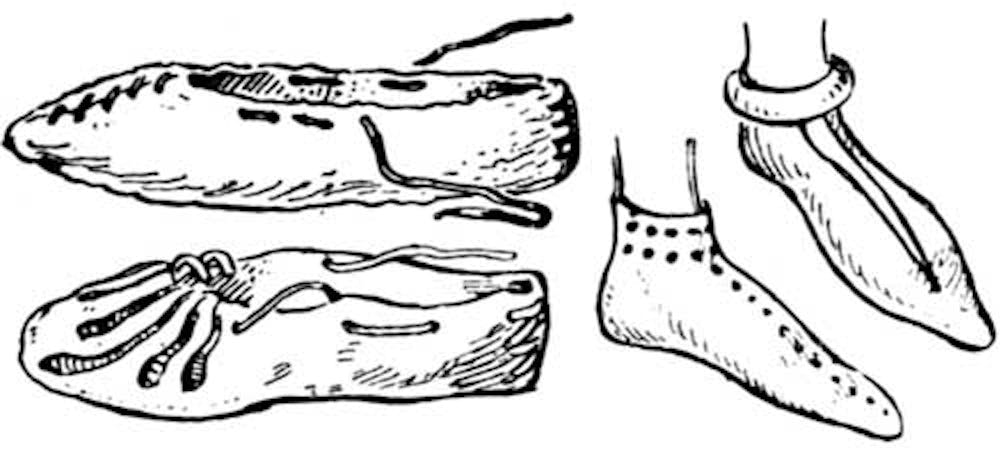
At this time, there were lots of words for trees and also for different types of shoes (including what we now know as “sock”, originally a kind of slipper). Many of these words didn’t survive, but “shoe” (originally “sco”) did, even though shoes look very different now than they did hundreds of years ago.
Both “tree” and “shoe” can be traced back to the parent language of English, called “Proto-Germanic”. This was spoken about 2,500 years ago, but unfortunately nothing survives of the language, or perhaps people weren’t into writing things down back then. Even so, we can do some detective work to recreate the ancient words they grew out of: “tree” comes from something like “trewo-” and “shoe” from “skōhw-”.
We can go even further back in time to the grandparent of English — a language called “Proto-Indo-European”. About 6,000 years ago, the word “tree” probably looked like “dōru-”.
For centuries, people have wondered how words like “tree” and “shoe” were invented. There are lots of ideas around, but we’ll never know for sure because people have been speaking for more than 30,000 years. That’s a very long time!
Only one thing is certain. Humans are the only animals that can create a never-ending number of new words. Remember what we could do earlier with just the two words “tree” and “shoe’!
Hello, Curious Kids! Do you have a question you’d like an expert to answer? Ask an adult to send your question to curiouskids@theconversation.edu.au
Kate Burridge does not work for, consult, own shares in or receive funding from any company or organisation that would benefit from this article, and has disclosed no relevant affiliations beyond their academic appointment.
Source: The Conversation (Au and NZ) – By Stephen Duckett, Honorary Enterprise Professor, School of Population and Global Health, and Department of General Practice and Primary Care, The University of Melbourne
Roles of health professionals are still unfortunately often stuck in the past. That is, before the shift of education of nurses and other health professionals into universities in the 1980s. So many are still not working to their full scope of practice.
There has been some expansion of roles in recent years – including pharmacists prescribing (under limited circumstances) and administering a wider range of vaccinations.
But the recently released paper from an independent Commonwealth review on health workers’ “scope of practice” identifies the myriad of barriers preventing Australians from fully benefiting from health professionals’ skills.
These include workforce design (who does what, where and how roles interact), legislation and regulation (which often differs according to jurisdiction), and how health workers are funded and paid.
There is no simple quick fix for this type of reform. But we now have a sensible pathway to improve access to care, using all health professionals appropriately.
I recently had a COVID booster. To do this, I logged onto my general practice’s website, answered the question about what I wanted, booked an appointment with the practice nurse that afternoon, got jabbed, was bulk-billed, sat down for a while, and then went home. Nothing remarkable at all about that.
But that interaction required a host of facilitating factors. The Victorian government regulates whether nurses can provide vaccinations, and what additional training the nurse requires. The Commonwealth government has allowed the practice to be paid by Medicare for the nurse’s work. The venture capitalist practice owner has done the sums and decided allocating a room to a practice nurse is economically rational.
The future of primary care is one involving more use of the range of health professionals, in addition to GPs.
It would be good if my general practice also had a physiotherapist, who I could see if I had back pain without seeing the GP, but there is no Medicare rebate for this. This arrangement would need both health professionals to have access to my health record. There also needs to be trust and good communication between the two when the physio might think the GP needs to be alerted to any issues.
This vision is one of integrated primary care, with health professionals working in a team. The nurse should be able to do more than vaccination and checking vital signs. Do I really need to see the GP every time I need a prescription renewed for my regular medication? This is the nub of the “scope of practice” issue.
How about pharmacists?
An integrated future is not the only future on the table. Pharmacy owners especially have argued that pharmacists should be able to practise independently of GPs, prescribing a limited range of medications and dispensing them.
This will inevitably reduce continuity of care and potentially create risks if the GP is not aware of what other medications a patient is using.
But a greater role for pharmacists has benefits for patients. It is often easier and cheaper for the patient to see a pharmacist, especially as bulk billing rates fall, and this is one of the reasons why independent pharmacist prescribing is gaining traction.
Every five years or so the government negotiates an agreement with the Pharmacy Guild, the organisation of pharmacy owners, about how much pharmacies will be paid for dispensing medications and other services. These agreements are called “Community Pharmacy Agreements”. Paying pharmacists independent prescribing may be part of the next agreement, the details of which are currently being negotiated.
GPs don’t like competition from this new source, even though there will be plenty of work around for GPs into the foreseeable future. So their organisations highlight the risks of these changes, reopening centuries old turf wars dressed up as concerns about safety and risk.
Funding is at the heart of disputes about scope of practice. As with many policy debates, there is merit on both sides.
Clearly the government must increase its support for comprehensive general practice. Existing funding of fee-for-service medical benefits payments must be redesigned and supplemented by payments that allow practices to engage a range of other health professionals to create health-care teams.
This should be the principal direction of primary care reform, and the final report of the scope of practice review should make that clear. It must focus on the overall goal of better primary care, rather than simply the aspirations of individual health professionals, and working to a professional’s full scope of practice in a tram, not a professional silo.
In parallel, governments – state and federal – must ensure all health professionals are used to their best of their abilities. It is a waste to have highly educated professionals not using their skills fully. New funding arrangements should facilitate better access to care from all appropriately qualified health professionals.
In the case of prescribing, it is possible to reconcile the aspirations of pharmacists and the concerns of GPs. New arrangements could be that pharmacists can only renew medications if they have agreements with the GP and there is good communication between them. This may be easier in rural and suburban areas, where the pharmacists are better known to the GPs.
The second issues paper points to the complexity of achieving scope of practice reforms. However, it also sets out a sensible path to improve access to care using all health professionals appropriately.
Stephen Duckett was a member of the Strengthening Medicare Taskforce and is a member of the Commonwealth Department of Health’s Expert Advisory Panel for the Review of General Practice Incentives
Last week’s leaked New York Times staff directive, as to what words can and cannot be used to describe the carnage Israel is raining on Palestinians, is proof positive, since those reports are published verbatim here in New Zealand, that our understanding of the conflict is carefully managed to always reflect a pro-Israel bias.
Forget the humanity of 120,000 dead and wounded Palestinians and countless others facing famine and disease sheltering in tents or what’s left of destroyed buildings, even internationally recognised terms and phrases such as “genocide,” “occupied territory,” “ethnic cleansing” and even “refugee camps” are discouraged, along with “slaughter”, “massacre” and “carnage”.
Though such language restrictions are claimed to be in the interests of “fairness”, an earlier investigation showed that between October 7 and November 14, The Times used the word “massacre” 53 times when it referred to Israelis being killed by Palestinians and only once in reference to Palestinians being killed by Israel.
By that date, thousands of Palestinians had perished, the vast majority of whom were women and children, and most of them were killed inside their own homes, in hospitals, schools or United Nations shelters.
This carefully managed use of words is deliberate and insidious and, as Jack Tame’s interview with Israel’s ambassador on last Sunday’s Q&A programme showed, even our most experienced media people are not immune to its effects.
From his introduction, “establishing” that the genocide taking place in Gaza had its genesis in the October 7 attack by Hamas, and not in the Nakba of 1948, Jack Tame and TVNZ facilitated an almost hour-long presentation of pro-Israel propaganda, justifying its atrocities.
For its appalling lack of balance, including Tame’s obsequious allowance and nodding agreement with the Israeli ambassador’s thoroughly discredited claims of Hamas atrocities; “beheadings” “necrophilia” and for describing Israelis’ as being “butchered” (five times he used the word) while Palestinians were merely “killed”, this was a new low in our media’s record of bias when it comes to the presentation of the facts about the Palestine/Israel conflict.
In the very week that we prepare to remember the horrific sacrifices made in previous wars and even as Israel‘s genocidal slaughter of Palestinians brings us closer to World War Three than at any time since the Cuban missile crisis, that TVNZ should have, pre-recorded and so had time to edit, such a disgraceful presentation is simply appalling — and heads should roll.
It may come as a surprise to hear 2023 was Australia’s biggest bushfire season in more than a decade. Fires burned across an area eight times as big as the 2019–20 Black Summer bushfires that tore through 10 million hectares in southeast Australia.
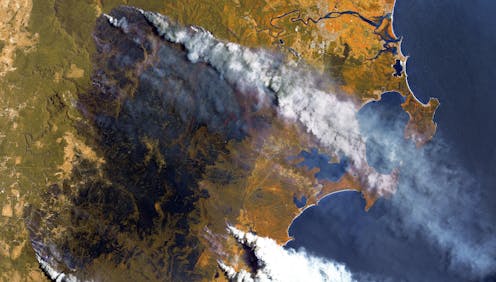
My research shows the 2023 fires burned more than 84 million hectares of desert and savannah in northern Australia. This is larger than the whole of New South Wales, or more than three times the size of the United Kingdom. The scale of these fires is hard to comprehend.
The speed at which these fires spread was also incredible. In just a few weeks of September and October, more than 18 million hectares burned across the Barkly, Tanami and Great Sandy Deserts of the Northern Territory and Western Australia.
I presented this research into the 2023 fires at the International Fire Behaviour and Fuels Conference this month in Canberra. I described the scale of these fires, why they occurred, and how fires could be better managed to help protect remote but ecologically and culturally important regions of Australia.
2023 fire spread in North Australia animation, drawing on North Australia Fire Information from firenorth.org.au (Rohan Fisher)
Why did this happen?
Fire and rain are closely connected. Rain triggers grass growth. When it dries out, grass becomes fuel for fires.
For example, you can see the pattern of more fire following wet years repeating at periodic intervals over the past 20 years of fire in the Northern Territory.
In this way, La Niña is the major driver of these massive fires in the desert.
Although 2023 was a massive fire year, 2011 was even bigger. In the NT alone, more than 55 million hectares burned in 2011, compared with 43 million in 2023.
When fuel is dry and weather conditions are extreme, lightning strikes tend to start more fires across savannah and desert rangelands.
Lightning across Australia in late 2023 using data from Andrew Miskelly at Weather Zone (Rohan Fisher)
It has been variously suggested in the media and on social media that these fires are part of a “normal” cycle, a consequence of climate change, or largely the result of arson. Such simplifications fail to grasp the complexity and history of fire management in desert Country.
The main driver of these fires was the very large fuel loads. These wet growing seasons are part of the natural cycle. While climate change can make fire conditions more extreme, in this case it’s not the main cause. However, the scale of these fires was not “normal”. can we briefly say more on this last point?
Traces of this long history of traditional fire practice can be seen in aerial photos of desert Country from the 1940s. Research analysing these photos has shown extensive and complex “fuel mosaics” spread like patchwork quilts over vast parts of the WA deserts.
The term mosaic refers to having many patches of vegetation of different ages, some recently burnt with sparse cover, some long unburnt with old, large and connected spinnifex clumps and small trees.
This provides habitat for a broad range of animals, because different species prefer different amounts of ground cover. It also hinders the spread of fire because areas subject to more recent fire have insufficient fuel to carry new fires for many years.
Aerial image from the 1940s showing a complex mix of burns through spinifex in the Great Sandy Desert. National Library Australia, CC BY
Efforts have only just begun to bring good fire management back into these landscapes in a coordinated and large-scale way.
In 2022–23 Indigenous ranger groups conducted extensive burning operations. They travelled more than 58,000km by air and road, burning from cars, on foot and dropping incendiaries.
These burns were astoundingly effective. Even though large fires still ripped through these deserts in 2023, by mapping the fuel reduction fires and overlaying the spread of subsequent wildfires, we can see the 2023 fires were limited by previous burns.
For example, the fire spread animation below shows fires moving through a complex mosaic comprising fuel of different ages. One fire can be seen moving more than 600km from near the NT border almost to the coast south of Broome. The fire weaves around previous burns and cheekily finds small gaps of older, continuous fuel.
Animation showing fire spreading through the Great Sandy Desert in 2023 (North Australia and Rangelar)
So without these earlier smaller controlled burns, the out-of-control fires would have been larger.
In the Great Sandy Desert of WA, the complex mosaic of spinifex of different ages persisted after these fires. The Indigenous Desert Alliance puts this down to more controlled burning in the past couple of years than in the ten years prior.
The fires of greatest concern to government agencies were the Barkly fires that threatened the town of Tennant Creek. These fires were large and fast-moving, feeding off fuel in a vast area of unmanaged country east of the town.
Here, a lack of land management increased disaster risk. The fire only stopped when it encountered four-year-old burned areas from lightning strikes.
The summer of 2023–24 was very wet across the Barkly and Tanami regions in the NT. Bushfires NT chief fire control officer Tony Fuller has warned of another big fire year to come as we head into the northern dry season of 2024.
Desert fire management is still under-resourced and poorly understood.
Ultimately the only effective way to prevent these massive fires in very remote parts of Australia is through a long-term, well-funded strategy of using fire over our vast desert landscapes to control fuel, as was done during previous millennia.
Rohan Fisher does not work for, consult, own shares in or receive funding from any company or organisation that would benefit from this article, and has disclosed no relevant affiliations beyond their academic appointment.
With only four more seats in the 50-member Parliament yet to be officially declared, there is no outright winner in the Solomon Islands elections.
As of Monday, the two largest blocs in the winner’s circle, independents and the incumbent Prime Minister Manasseh Sogavare’s Our Party, were tied with 12 MPs each.
It is a significant result, given at the last election in 2019 Our Party did not even exist going into the polls, but was created by Sogavare with the sole intention of pulling together the large number of independent MPs that emerged from the election that year.
RNZ Pacific investigations have identified the location of some of the lobbying camps in the capital.
The Honiara Hotel camp in Chinatown was set up by former prime minister Gordon Darcy Lilo’s Solomon Islands Party for Rural Advancement a week before polling even began.
Sogavare’s Our Party, the largest grouping in the last Parliament, has a well-documented affiliation to the Cowboy’s Grill in the eastern side of town.
Solomon Islanders queuing up to cast their ballots in Honiara last Wednesday. Image: RNZ Pacific/Koroi Hawkins
The former opposition leader Mathew Wale, who gambled in setting up the country’s first ever publicly announced pre-election coalition “CARE”, is understood to be holed up at the Heritage Park Hotel in the CBD.
Prediction impossible At this stage, it is next to impossible to predict the final form of the coalition government because MPs are not legally bound to political parties and can move freely between the different camps.
In Solomon Islands, there is a stark disparity in both pay and benefits between government, opposition and independent MPs, which ups the stakes significantly and has been fingered by political experts as one of the root causes of political instability in the country.
Meanwhile, losing candidates around the country are already preparing election petitions ahead of a 30-day window for submissions which opens once all the election results are in.
In 2019, more than half of the MPs had election petitions filed against them but the majority where dismissed due to a lack of sufficient evidence.
This article is republished under a community partnership agreement with RNZ.
Are all single people insecure? When we think about people who have been single for a long time, we may assume it’s because single people have insecurities that make it difficult for them to find a partner or maintain a relationship.
But is this true? Or can long-term single people also be secure and thriving?
Our latest research published in the Journal of Personality suggests they can. However, perhaps unsurprisingly, not everybody tends to thrive in singlehood. Our study shows a crucial factor may be a person’s attachment style.
Singlehood is on the rise
Singlehood is on the rise around the world. In Canada, single status among young adults aged 25 to 29 has increased from 32% in 1981 to 61% in 2021. The number of people living solo has increased from 1.7 million people in 1981 to 4.4 million in 2021.
People may also remain single due to their attachment style. Attachment theory is a popular and well-researched model of how we form relationships with other people. An Amazon search for attachment theory returns thousands of titles. The hashtag #attachmenttheory has been viewed over 140 million times on TikTok alone.
What does attachment theory say about relationships?
Attachment theory suggests our relationships with others are shaped by our degree of “anxiety” and “avoidance”.
Attachment anxiety is a type of insecurity that leads people to feel anxious about relationships and worry about abandonment. Attachment avoidance leads people to feel uncomfortable with intimacy and closeness.
People who are lower in attachment anxiety and avoidance are considered “securely attached”, and are comfortable depending on others, and giving and receiving intimacy.
At the same time, evidence suggests many single people are choosing to remain single and living happy lives.
Single people represent a diverse group of secure and insecure people
In our latest research, our team of social and clinical psychologists examined single people’s attachment styles and how they related to their happiness and wellbeing.
We carried out two studies, one of 482 younger single people and the other of 400 older long-term singles. We found overall 78% were categorised as insecure, with the other 22% being secure.
Looking at our results more closely, we found four distinct subgroups of singles:
secure singles are relatively comfortable with intimacy and closeness in relationships (22%)
anxious singles question whether they are loved by others and worry about being rejected (37%)
avoidant singles are uncomfortable getting close to others and prioritise their independence (23% of younger singles and 11% of older long-term singles)
fearful singles have heightened anxiety about abandonment, but are simultaneously uncomfortable with intimacy and closeness (16% of younger singles and 28% of older long-term singles).
Insecure singles find singlehood challenging, but secure singles are thriving
Our findings also revealed these distinct subgroups of singles have distinct experiences and outcomes.
Secure singles are happy being single, have a greater number of non-romantic relationships, and better relationships with family and friends. They meet their sexual needs outside romantic relationships and feel happier with their life overall. Interestingly, this group maintains moderate interest in being in a romantic relationship in the future.
Anxious singles tend to be the most worried about being single, have lower self-esteem, feel less supported by close others and have some of the lowest levels of life satisfaction across all sub-groups.
Avoidant singles show the least interest in being in a romantic relationship and in many ways appear satisfied with singlehood. However, they also have fewer friends and close relationships, and are generally less satisfied with these relationships than secure singles. Avoidant singles also report less meaning in life and tend to be less happy compared to secure singles.
Fearful singles reported more difficulties navigating close relationships than secure singles. For instance, they were less able to regulate their emotions, and were less satisfied with the quality of their close relationships relative to secure singles. They also reported some of the lowest levels of life satisfaction across all sub-groups.
It’s not all doom and gloom
These findings should be considered alongside several relevant points. First, although most singles in our samples were insecure (78%), a sizeable number were secure and thriving (22%).
Further, simply being in a romantic relationship is not a panacea. Being in an unhappy relationship is linked to poorer life outcomes than being single.
It is also important to remember that attachment orientations are not necessarily fixed. They are open to change in response to life events.
Our studies are some of the first to examine the diversity in attachment styles among single adults. Our findings highlight that many single people are secure and thriving, but also that more work can be done to help insecure single people feel more secure in order to foster happiness.
Christopher Pepping receives funding from the Royal Children’s Hospital Foundation, the Melbourne Primary Care Network, Beyond Blue, and the Sax Institute.
Geoff Macdonald receives funding from the Social Sciences and Humanities Research Council of Canada.
Tim Cronin receives funding from the Royal Children’s Hospital Foundation, the Victorian Medical Research Accelerator Fund, and the Medical Research Future Fund.
Yuthika Girme receives funding from the Social Sciences and Humanities Research Council of Canada.
Landscapes that have escaped fire for decades or centuries tend to harbour vital structures for wildlife, such as tree hollows and large logs. But these “long unburnt” habitats can be eliminated by a single blaze.
The pattern of fire most commonly experienced within an ecosystem is known as the fire regime. This includes aspects such as fire frequency, season, intensity, size and shape.
Fire regimes are changing across the globe, stoked by climate and land-use change. Recent megafires in Australia, Brazil, Canada and United States epitomise the dire consequences of shifting fire regimes for humanity and biodiversity alike.
We wanted to find out how Australian fire regimes are changing and what this means for biodiversity.
In our new research, we analysed the past four decades of fires across southern Australia. We found fires are becoming more frequent in many of the areas most crucial for protecting threatened wildlife. Long unburnt habitat is disappearing faster than ever.
However, evidence of how fire regimes are shifting within both threatened species’ ranges and protected areas is scarce, particularly at the national scale and over long periods.
To address this gap, we compiled maps of bushfires and prescribed burns in southern Australia from 1980 to 2021.
We studied how fire activity has changed across 415 Australian conservation reserves and state forests (‘reserves’ hereafter), a total of 21.5 million hectares. We also studied fire activity within the ranges of 129 fire-threatened species, spanning birds, mammals, reptiles, frogs and invertebrates.
We focused on New South Wales, the Australia Capital Territory, Victoria, South Australia and Western Australia because these states and territories have the most complete fire records.
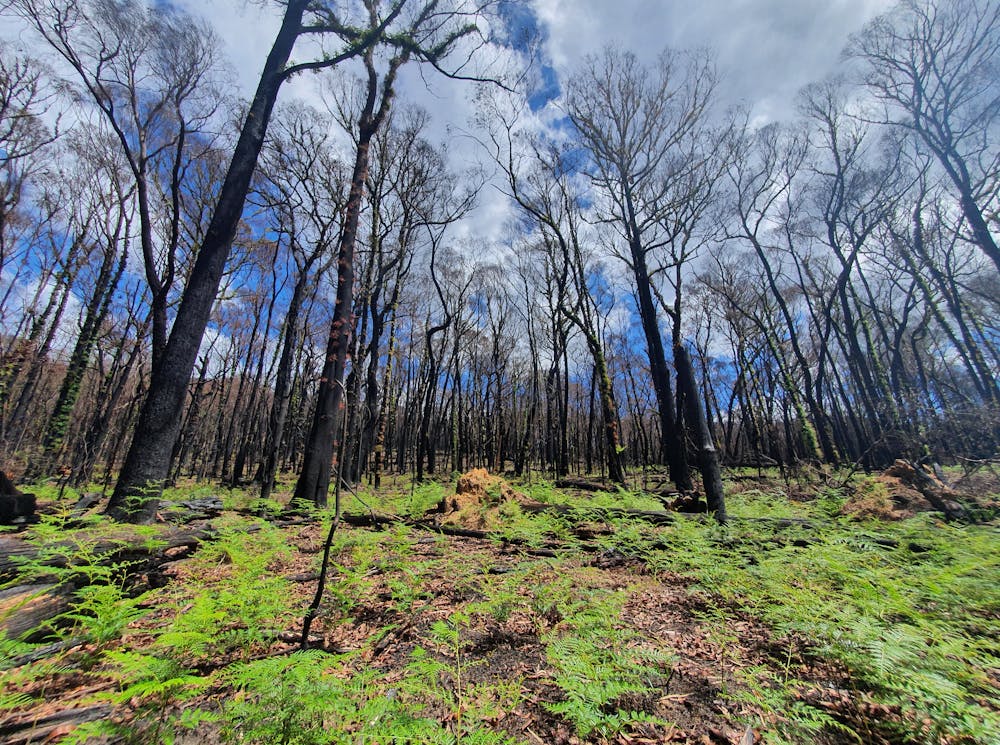
Large areas of long unburnt forest in New South Wales were burnt in the 2019-20 fire season. Tim Doherty
More fire putting wildlife at risk
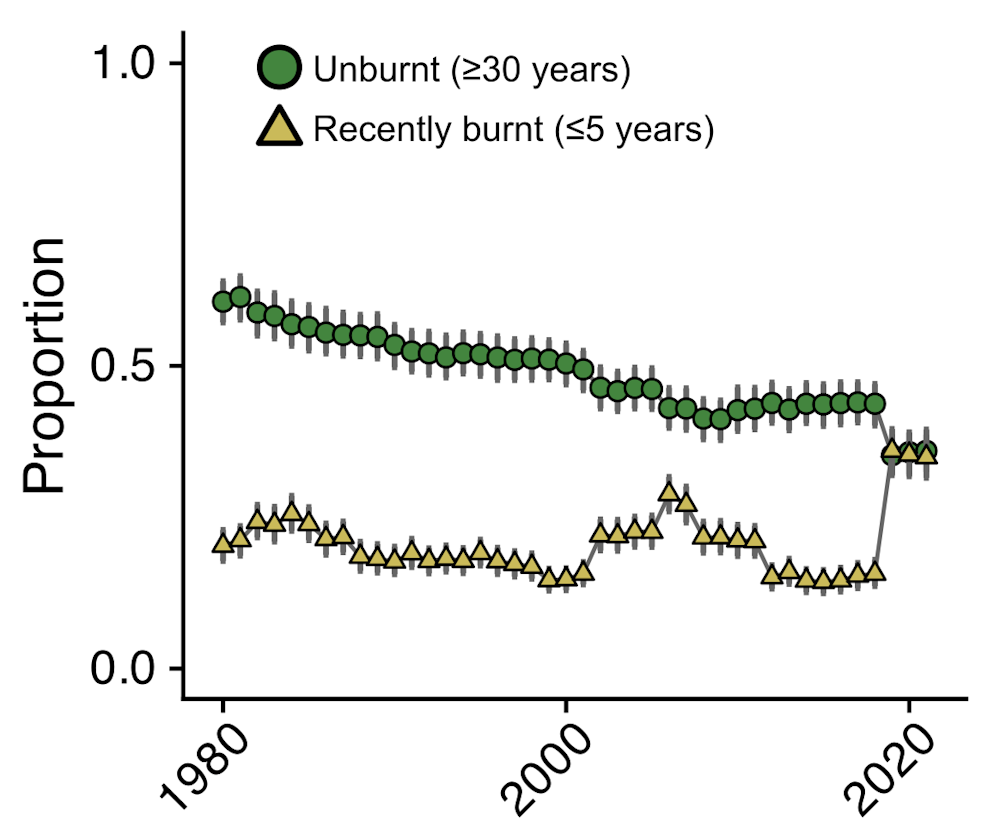
We found areas of long unburnt vegetation (30 years or more without fire) are shrinking. Meanwhile, areas of recently burnt vegetation (5 years or less since the most recent fire) are growing. And fires are burning more frequently.
On average, the percentage of long unburnt vegetation within reserves declined from 61% to 36% over the four decades we studied. We estimate the total area of long unburnt vegetation decreased by about 52,000 square kilometres, from about 132,000 sq km in 1980 to about 80,000 sq km in 2021. That’s an area almost as large as Tasmania.
At the same time, the mean amount of recently burnt vegetation increased from 20% to 35%. Going from about 42,000 sq km to about 64,000 sq km in total, which is an increase of 22,000 square kilometres.
And the average number of times a reserve burnt within 20 years increased by almost a third.
While the extent of unburnt vegetation has been declining since 1980, increases in fire frequency and the extent of recently burnt vegetation were mainly driven by the record-breaking 2019–20 fire season.
Changes in the proportions of unburnt and recently burnt vegetation across 415 conservation reserves and state forests in southern Australia. Tim Doherty
Which areas have seen the biggest changes?
The strongest increases in fire frequency and losses of long unburnt habitat occurred within reserves at high elevation with lots of dry vegetation. This pattern was most prominent in southeastern Australia, including the Kosciuszko and Alpine national parks.
In these locations, dry years with low rainfall can make abundant vegetation more flammable. These conditions contribute to high fire risk across very large areas, as observed in the 2019–20 fire season.
Threatened species living at high elevations, such as the spotted tree frog, the mountain skink and the mountain pygmy possum, have experienced some of the biggest losses of long unburnt habitat and largest increases in fire frequency.
Multiple fires in the same region can be particularly problematic for some fire-threatened animals as they prevent the recovery of important habitats like logs, hollows and deep leaf-litter beds. Frequent fire can even turn a tall forest into shrubland.
Fire-threatened species Australia include (clockwise from top-left) the kyloring (western ground parrot), mountain skink, stuttering frog and mountain pygmy possum. Clockwise from top-left: Jennene Riggs, Jules Farquhar, Jules Farquhar, Zoos Victoria.
What does this mean for Australia’s wildlife?
Fire management must adapt to stabilise fire regimes across southern Australia and alleviate pressure on Australia’s wildlife.
Indigenous land management, including cultural burning, is one approach that holds promise in reducing the incidence of large fires while providing fire for those species that need it.
Strategic fire management within and around the ranges of fire-threatened species may also help prevent large bushfires burning extensive portions of species’ ranges within a single fire season.
We can also help wildlife become more resilient to shifting fire regimes by reducing other pressures such as invasive predators.
However, our efforts will be continually undermined if we persist in modifying our atmosphere by burning fossil fuels. This means conservation managers must also prepare for a future in which these trends continue, or hasten.
Our findings underscore the increased need for management strategies that conserve threatened species in an increasingly fiery future.
William Geary is affiliated with the Victorian Department of Energy, Environment and Climate Action.
Dale Nimmo receives funding from the Australian Research Council, the Department of Biodiversity Conservation and Attractions, and the Department of Energy, Environment and Climate Action.
Julianna Santos and Kristina J Macdonald do not work for, consult, own shares in or receive funding from any company or organisation that would benefit from this article, and have disclosed no relevant affiliations beyond their academic appointment.
Why are we crossing ecological boundaries that affect Earth’s fundamental life-supporting capacity? Is it because we don’t have enough information about how ecosystems respond to change? Or are we unable, even unwilling, to use that information better?
We have a lot to learn still, but as we show in our research, using current ecological knowledge more effectively could deliver substantial environmental gains.
Our work focuses on improving links between research and ecosystem management to identify key trigger points for action in a framework that joins land, freshwater and sea ecosystems.
Specifically, we investigate solutions to environmental and societal problems that stem from the disparities between scientific research, policy and management responses to environmental issues.
We need managers and policy makers to consider ecological tipping points and how they can cascade though ecosystems from land into rivers and lakes and, ultimately, the ocean.
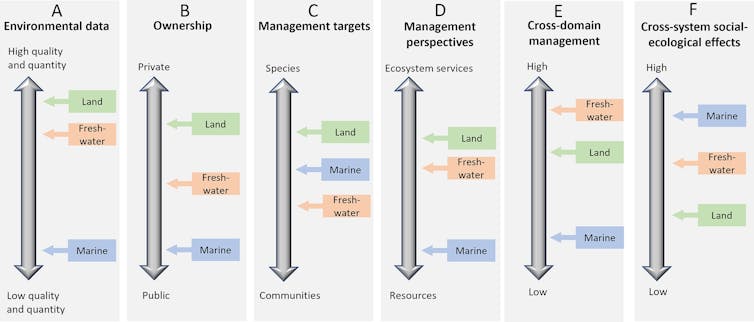
Gaps between social, political, ecological and management approaches between ecosystems contribute to difficulties in managing ecosystems. Author provided, CC BY-SA
This issue came into focus when New Zealand set up research collaborations known as national science challenges a decade ago to solve “wicked” social and ecological problems.
The challenges focused on environmental issues were deliberately created to concentrate on separate ecosystem and management domains (marine, freshwater and land). But all included research groups addressing ecological tipping points.
This was our inspirational spark. Our research highlights the consequences of managing land, freshwater and sea ecosystems in socially constructed bubbles. We focus on solutions where social and ecological connections are at the forefront of environmental management practices and decisions.
An example is the movement of pollutants such as microplastics from the land to the sea. Most of the microplastics found along coasts and in harbours are blown or washed off the land. While this pollution is a well recognised environmental threat to the marine environment, we have not yet focused on strategies to reduce the load.
Our work points to the ignored but critical issue that people’s impacts on land accumulate in the sea, but land management and consequent actions are not informed by these far-field effects.
This leads to lags in decision making which create undesirable environmental outcomes that are difficult to return from. But if we act on these connections, the environmental gains could be substantial.
Cyclones as a real-world example
As a result of massive soil erosion on the east coast of the North Island during Cyclone Bola in 1988, steep hillsides were retired from grazing and converted to pine plantations to help stabilise the land.
Fast forward three decades and a large proportion of the forest reached harvest at the same time. The exposed soil associated with clear felling was left draped in woody debris to protect it from rain.
However, Cyclone Gabrielle hit in February last year, with extreme rainfall washing both soil and woody debris into streams.
Cyclone Gabrielle washed tonnes of silt onto farms and orchards. Getty Images/STR/AFP
This destroyed habitats, transported vast amounts of silt and wrecked lowland farms, orchards and critical infrastructure. The debris also clogged harbours and coastal beaches, smothered seafloor habitats, destroyed fisheries and affected cultural and recreational values.
This real-world example demonstrates the severe consequences of lags in information flow and management responses. If land-use management decisions had considered the effects on other connected ecosystems and the potential for climate change to intensify those connections, the outcomes could have been different.
We could have implemented more diverse strategies in land use and put emphasis on restoring native forest and coastal wetlands.
Our vision is one where social and ecological connections across ecosystem domains are at the forefront of moving to a more sustainable future.
Living within planetary boundaries requires a paradigm shift in behaviours, including the way we link science and management to on-the-ground action. Crucially, we need to increase the speed at which new research is taken up and rapidly transition this into action that improves environmental outcomes at local scales.
This behavioural shift underpins the way to a more integrated, broad-scale ability to act and stay within planetary boundaries.
Our research shows we can, with trust and open minds, transcend the disciplinary silos to support new forms of research organisation. The challenge now is to extend holistic approaches into new practices.
This means identifying opportunities where connected research can alter behaviours across society, from individuals to global finance and governance. Central to this transition is recognising we are part of complex social and ecological systems and our actions have indirect effects and long-term consequences.
We need new research to provide this evidence. It will inevitably lead to new questions about fundamental ecological and integrated Earth processes.
We believe these holistic approaches will allow science to be more readily incorporated into decision making and ensure environmental perspectives are captured. This will lead to relevant, locally appropriate, integrated and robust environmental management actions.
Rebecca Gladstone-Gallagher receives funding from philanthropy, Ministry of Business Innovation and Employment (MBIE), including from the National Science Challenges, the Marsden Fund and the Rutherford Foundation Postdoctoral Fellowships.
Conrad Pilditch receives funding from Ministry of Business Innovation and Employment (MBIE), including the National Science Challenge Sustainable Seas, Marsden Fund and regional councils. He is a member of the Sustainable Seas Challenge Leadership Team.
Simon Francis Thrush receives funding from MBIE, government agencies, international organisations and philanthropy. He is a fellow of the Royal Society of New Zealand.
Here’s something for the board of the Reserve Bank of Australia to ponder as it meets next month to set interest rates.
It has pushed up rates on 13 occasions since it began its attempt to restrain inflation in May 2022.
On each occasion, its rationale was that by making borrowing more expensive, it would take money out of the economy. Yet, at the same time, it has also been pushing money into the economy and potentially feeding inflation.
It helps to know a bit about the relationship between the Reserve Bank and the private banks that bank with it.
Banker to the banks
Each of the private banks has an exchange settlement account at the Reserve Bank. The banks use these accounts to make payments to one another.
Here’s why. Every day some of the customers of each bank want to transfer to money to the customers of other banks, usually to pay for services or goods.
To a large extent, the transactions cancel each other out, because, say, Westpac needs to transfer about as much to the ANZ as the ANZ needs to transfer to Westpac. But they don’t cancel out completely, meaning that at the end of each day Westpac might need to make a net payment to the ANZ.
It does this by transferring funds from its exchange settlement account at the Reserve Bank to the ANZ’s settlement account at the Reserve Bank.
If Westpac doesn’t have enough cash in its account, it will borrow from another bank that does, at a rate known as the overnight cash rate.
The overnight cash rate is the rate the Reserve Bank tries to influence when it adjusts interest rates.
How it adjusts the overnight cash rate is slightly more complicated. It sets two other rates.
The Reserve Bank pays interest to banks that have excess cash in their settlement accounts and it charges interest to banks that need to borrow cash from it to settle their payments.
It is by setting these two rates – either side of the overnight cash rate – that the Reserve Bank nudges the cash rate up or down.
Historically, the Reserve Bank ensured there was just enough cash in the exchange settlement system to meet the banks’ needs, neither too much nor too little. It called it a “scarce reserves” system.
From just enough cash to an abundance of cash
If there was too much cash in the system, the Reserve Bank sold financial instruments such as bonds to banks, requiring them to pay from their exchange settlement account. If there was too little, it bought financial instruments from them, paying cash into their account.
That’s until COVID. In 2020 it stopped buying bonds from banks, leaving cash to accumulate in their accounts in what it called an “abundant reserves” system. This was done to ensure the banking system had more than enough cash to deal with whatever was in store.
And because the Reserve Bank was also lending billions to the banks through its Term Funding Facility an awful lot of cash accumulated in these accounts.
Beginning in 2020, the amount of surplus cash in the system exploded, from very little in the years leading up to COVID to A$450 billion.
To start with, the Reserve Bank wasn’t required to pay much interest on these extra hundreds of billions because its cash rate target was close to zero. But as it lifted rates to get on top of inflation, it began to pay serious sums.
My calculations suggest that since the Reserve Bank began lifting rates in May 2022 it has paid out more than $25 billion in interest, in some months paying more than $1.3 billion.
To put that $25 billion in perspective, it is more than the $20 billion the government plans to spend on modernising the electricity network. An important difference is that for the billions paid out by the Reserve Bank, there’s no direct benefit to the public.
Each time the Reserve Bank has pushed up rates, it has had to pay out more in interest, which means it has been been pumping money into the economy potentially feeding inflation at the same time as it announced measures to restrain it.
Against this, in recent months the COVID-era Term Funding Facility has been winding down, as the three-year loans issued to banks expire. The last will expire in the middle of this year, winding back the surplus cash in exchange settlement accounts.
But my calculations suggest when this happens there is still likely to be $200 billion of surplus cash in the accounts and about $700 million paid to the banks in interest each month this year.
Excess cash is set to stay
It’d be open to the Reserve Bank to soak up the excess cash by selling the banks enough financial instruments to return to the system of scarce reserves.
It said ensuring the banks had just enough cash to transfer funds to each other had required a lot of effort on its part, forcing it to buy and sell financial assets daily, and sometimes more than daily.
And it said the banks seem to have adapted to having more than enough reserves, and the extra reserves made the system resilient to shocks.
It will move instead to a new system it will call “ample reserves”, selling enough bonds to limit excess reserves, but not too harshly.
This new system will mean that when it next pushes up rates (most likely not for a long time) it will again be working against itself to some extent, putting more money into the hands of the banks.
How much has the interest paid out by the Reserve Bank contributed to Australia’s inflation problem? I don’t know. But I think it’s time we consider the whole picture.
Matthew Crocker is a PhD student exploring the history of Australia’s monetary system and is a recipient of a Commonwealth Research Training Program scholarship.
Many Australians with disability feel on the edge of a precipice right now. Recommendations from the disability royal commission and the NDIS review were released late last year. Now a draft NDIS reform bill has been tabled. In this series, experts examine what new proposals could mean for people with disability.
Recent media coverage about the National Disability Insurance Scheme (NDIS) frames the choices of people with disability as threatsto their safety or the safety of others. Such reports suggest participants who use unregistered providers could be putting themselves in harm’s way. Or that some participants – such as those with criminal backgrounds – pose unacceptable dangers to support providers.
But research shows choice and safety are not at odds when it comes to disability support. What does this mean for the recommendations from the review of the NDIS – especially given its push for evidence-based practice?
Part of the original thinking in developing an NDIS structured around principles of choice and control was recognising that not having those things puts people with disability in more vulnerable situations. Research indicates people with disability are more likely to be safe and free from abuse when they have choice over what services they receive and who provides them.
Previous research by oneof us (Sophie) also found some people feel safe as a result of having more choice.
When we interviewed people about why they use unregistered NDIS providers, most described feeling more secure when they were able to choose the right people for the job – those with the right attitudes and skills. One told us:
Safety for me means being able to work with people that I know have relevant qualifications and people that are embedded in my community.
This means being able to look beyond whichever providers happen to be NDIS registered and available in their area. Some people feel less safe with registered providers if they’ve had bad experiences with them before or they aren’t sure who the provider will send each week.
People we interviewed also talked about how they select their support worker team for themselves or their family members via interviews, trial shifts and reference checks. This builds a sense of whether the relationship will work or not.
Limited service options, particularly in regional, rural and remote areas, place people with disability in disempowering and risky positions. They may be dependent upon one provider for essential services.
Regulatory oversight is just one (albeit important) piece of the safeguarding puzzle. Choice – which promotes safety – is best supported when participants are informed, empowered, and have a range of people to go to for help, including when things go wrong.
Laura’s recent research found many in the disability sector, including people with disability, family members and advocates, view the NDIS commission’s complaints processes as inaccessible and difficult to navigate. One disability advocate pointed out:
You shouldn’t need an advocate to liaise with the body that has the responsibility of safeguarding your rights and protection.
Unfortunately, the NDIS review had relatively little to say about strengthening the complaints processes.
Since the introduction of the NDIS, there has been a rapid rise in gig economy-style employment. NDIS participants can use online platforms to employ sole-trader support workers rather than going through agencies. Some self-managing participants also choose to directly employ their support workers, effectively becoming small businesses in the process.
Gig economy work potentially involves risks for workers, as well as participants, because there isn’t any oversight or monitoring. That said, workers employed by disability service organisations also report low levels of confidence in organisational safety and reporting systems.
All of this points to the need for strategies to build and retain a high-quality, well-paid and safe workforce. This was noted in the NDIS review and the government’s draft National Strategy for the Care and Support Economy released last year.
Some NDIS participants employ and screen their own support workers, rather than using agencies. Shutterstock
What could support safety for everyone?
Rather than assuming choice and safety are in opposition to each other and further restricting choice, our researchsuggests the following priorities:
clear complaints pathways, with “no wrong door” referral models so people don’t miss the chance to lodge issues
accessible and responsive formats for submitting complaints
accessible and up-to-date information so people know their rights, can navigate the NDIS and choose providers
peer support with resources to promote these networks.
Both NDIS-specific and mainstream safeguarding institutions such as police, health authorities, consumer bodies and community services, need to build their capacity to listen and respond to people with disability.
Lastly, we need to foster “natural safeguards” – the relationships with family, friends and the community that keep everyone safe (not just people with disability).
Safety is about being connected and embedded within the community, where many people are looking out for you, checking in on you and noticing if you don’t show up to your usual activities. Supporting all people with disability to build and sustain these relationships should be a priority.
NDIS participants and workers face distinct challenges but the voices and concerns of both groups need to be heard and addressed by service providers and government. Ultimately, a scheme where people with disability are empowered to make meaningful decisions between quality services, and workers are valued and supported in their roles, will promote safety for everyone.
The authors do not work for, consult, own shares in or receive funding from any company or organisation that would benefit from this article, and have disclosed no relevant affiliations beyond their academic appointment.
New Zealand’s Foreign Minister Winston Peters is putting off recognition of Palestine as a state, despite opposition Labour’s formal request that he make the move.
Peters said diplomatic recognition of Palestine was a matter of “when not if”, but doing so now could impede progress towards a two-state solution — and the focus should be on aid for civilians.
Labour’s foreign affairs spokesperson David Parker had written to Peters, calling for New Zealand to take “meaningful action” by recognising Palestine as a state.
He noted this did not mean a recognition of Hamas, “which is one political party in the Palestinian territories”.
“There can be no lasting peace without Palestinian statehood,” Parker wrote, pointing to 139 of the 193 member states of the United Nations having already recognised it.
“Recognition signals this. It doesn’t matter that the state is yet to be fully established, with agreed borders. Many states and much of the Western world recognised Israel well before it was established as a state. Similarly with Kosovo.”
Parker said New Zealand should do this by inviting the Palestinian Authority to send an ambassador to present their credentials to New Zealand, a role which could be performed by the Head of the General Delegation of Palestine based in Canberra Izzat Abdulhadi.
‘Immediate ceasefire’ needed Peters, however, said the “immediate and urgent need is for an immediate ceasefire and the provision of aid to help alleviate the desperate plight of an innocent civilian population”.
“The government supports the establishment of a Palestinian state and has done so for decades. We must see momentum towards this goal and it’s a matter of ‘when not if’ we see Palestinian statehood,” he wrote.
However, he said they could not afford to take focus away from the current crisis.
“Bluntly asserting statehood unilaterally at this point, however well intentioned, would do nothing to alleviate the current plight of the Palestinian people. Indeed, it might impede progress.
“We would need to be sure that any change in our current settings would contribute credibly to a serious diplomatic push to achieve a two-state solution. We do not believe we are currently at that point.
“We are realistic that achieving this will require serious negotiations, including over the territory and political authority of a future Palestinian state. Statehood is neither a prerequisite for renewed negotiations, nor is it a guarantee they will progress faster.
“It is important for any Palestinian state that it does not contain elements that threaten Israel’s security, and that the Palestinian Authority can govern effectively. That is why we have said an organisation like Hamas — which commits terrorism — cannot be part of future governance in Palestine.”
Case for recognition Parker had laid out his case for recognition, saying Israel had ignored two resolutions of the UN General Assembly backed by an overwhelming majority of the world’s nations, including “its closest ally, the United States, which has repeatedly said the loss of civilian life in Gaza is an unacceptable price to pay for Israel’s pursuit of Hamas”.
“The international community, including New Zealand, should not stand by and watch Israel breach international law and ignore entreaties without taking meaningful action,” he wrote.
“The absence of progress for many years, and the current war, make the status quo ever more untenable.
“The occupying Israeli government forces cannot legitimately continue to deprive Palestinians of basic rights to govern themselves.
“We believe it is time now for New Zealand to reinforce our opposition to the war and our support for a lasting peace including Palestinian independence.”
Parker said Australian Foreign Minister Penny Wong’s recent statements also contemplating recognition was coincidental, and Labour had already decided to make the proposal to Peters.
He accepted it was unlikely Peters would be able to give an immediate response, other than to say no.
This article is republished under a community partnership agreement with RNZ.
Asia Pacific Report says that in the UN Security Council vote last week, only the US voted against Palestine becoming a full member of the United Nations by using its veto. But an overwhelming majority of 12 nations out of the 15 voted in favour of admission, including three of the permanent members (China, France and Russia). Only the fifth permanent member, UK, and Switzerland abstained.
Australia’s eSafety Commissioner has ordered social media platform “X” (formerly known as Twitter) to remove graphic videos of the stabbing of Bishop Mar Mari Emmanuel in Sydney last week from the site. The incident was captured on the church’s livestreamed mass service.
In response to this order, X’s owner, Elon Musk, has branded the commissioner the “Australian censorship commissar”.
X had agreed to part of the take-down. However, it did not agree with removing the material entirely, telling media publications “X believes that eSafety’s order was not within the scope of Australian law and we complied with the directive pending a legal challenge.”
So what are the laws around this, especially because the church incident was quickly labelled a terrorist act by authorities? What powers do governments have in this situation?
They absolutely should be able to quickly and effectively remove content that’s damaging and devastating to the social harmony and fabric of society, particularly images such as terrorist attacks.
Other Labor ministers described X as “a playground for criminals and cranks” or accused the company of thinking they’re above the law.
Of course such damning remarks directed towards a much-maligned website and its equally controversial owner are to be expected. What politicians can do about it is another matter.
What do federal laws say?
The eSafety Commissioner, Julie Inman-Grant, has the power to require the take-down of material under the Online Safety Act. The power she exercised under part nine of that act was to issue a “removal notice”. The removal notice requires a social media platform to take down material that would be refused classification under the Classification Act.
The video was circulating online as the New South Wales Commissioner of Police, Karen Webb announced the attack was a terrorist incident and the alleged perpetrator would be charged with a terrorist offence.
While it’s these laws being applied in the case against X, there are other laws that can come into play.
Australia also has a voluntary code of practice relating to disinformation and misinformation. This is administered by the industry group DiGi. The signatories to this code include Adobe, Apple, Facebook, Google, Microsoft, Redbubble, TikTok, and Twitch.
X had previously adopted the code. X’s failure to comply led to its signatory status being withdrawn by DiGi in November 2023.
The government released a draft of a proposed bill to combat misinformation and disinformation in June 2023. The Communications Legislation Amendment (Combatting Misinformation and Disinformation) Bill would give the Australian Communications and Media Authority power to enforce an industry code, or make one if the industry could not. It is a variation of this bill, reflecting the substantial range of views on the draft, that now has bipartisan support.
Would this new law make any difference in this case?
The immediate answer is no. The eSafety Commissioner already has extensive powers. She used only one of those powers in this case, but there are are alternative courses of action.
Perhaps the gruesome images in the Wakeley videos might remind some of the Christchurch massacre.
In that attack, Telstra, Optus, and Vodafone (now part of TPG), cut access to sites such as 4Chan, which were disseminating video of the attack. This was without any prompting from either the eSafety Commissioner or from law enforcement agencies.
Telcos blocked websites like 4Chan in the immediate aftermath of the Christchurch massacre. Shutterstock
The eSafety Commissioner has the power to require telcos to block access. She would need to be satisfied the material depicts abhorrent violent conduct and be satisfied the availability of the material online is likely to cause significant harm to the Australian community.
This means the commissioner could give a blocking notice to telcos which would have to block X for as long as the abhorrent material is available on the X platform.
Separately, the telcos have an obligation to do their best “to prevent telecommunications networks and facilities from being used in, or in relation to, the commission of offences against the laws of the Commonwealth or of the States and Territories” under the Telecommunications Act. This requires there to be an offence.
There is a potential that sharing the video material could be seen as an act done in preparation for, or planning, terrorist acts, if the video was depicting an incident police had decided was an act of terror. This would be a breach of the terrorism prohibitions under the federal Criminal Code.
All this is to say while Musk may be unhappy with the eSafety Commissioner’s actions, it’s just the tip of the iceberg of the laws that could force his site to remove terrorist content.
Rob Nicholls receives funding from the Australian Research Council for the International Digital Policy Observatory.
In past bleaching events on the Great Barrier Reef, the southern region has sometimes been spared worst of the bleaching. Not this time. This year’s intense underwater heat has triggered the most severe heat stress ever seen on record. Only 3% of surveyed southern reefs have not bleached at all. It’s shaping up to be the most severe and widespread bleaching of the southern reef, while mass bleaching has hit other areas of the reef in the fifth mass bleaching event in eight years.
We’re shocked and saddened by images of stark white coral skeletons. But the damage done by heat underwater goes much further. A living coral reef is a complex ecosystem teeming with vastly more species than the corals. Not only that, but 95% of the habitat on the reef is not coral, but sediment and sand, hotspots of hidden biodiversity. So, what happens to this cornucopia of life when subjected to extreme temperature stress?
We are currently on One Tree Island on the southern reef. It’s home to a research station and has one of the highest levels of protection within the whole reef.
What have we found? So far, the signs are not good. When we dive underwater, we can taste the change as stressed and dying corals release chemicals into water. When we bring back samples, the smell is distinctly sulphurous and sour. We see not just bleached hard corals, but also bleached anemones and soft corals. There are few starfish or sea urchins, yet algae growing on dead coral is attracting more herbivorous fish.
Coral reefs are complex, interlocking systems built on relationships. Living organisms need other living organisms to survive, whether as food, homes, symbiotic partners, or as substrate to grow on.
Think of the famous relationship between anemonefish and their anemones. These fish chase away predators of their anemone hosts, and their poo gives the anemone nutrients. In turn, the anemone’s stinging cells keep the fish safe from predators.
We are working to uncover relationships between different parts of a reef ecosystem, such as corals, fishes, sea stars, worms and microbes. We want to know the effect of higher water temperatures on these relationships.
To unpick this complexity, we need a lot of data. We do real-time underwater surveys, photogrammetry to turn photos into 3D models of reefs and sediment collection and sorting. We also record temperatures, deploy underwater coral incubation chambers to study respiration, and analyse the environmental DNA and nutrients held in sediments.
We need many sources of data to gauge the health of reef ecosystems on One Tree Island. John Turnbull, CC BY-NC-ND
The taste of a sick reef
From our first day at One Tree, we could see what the heat had done. Bleached, fluorescing and dead corals were on every reef we surveyed in the lagoon. Newly dead corals were beginning to be colonised by wavy, dense algae, known as filamentous turfing algae.
Near each reef, we could see more biofilm than usual on top of the sediment sections, which appear like white sand seen from above. Touching the sediments gave a sticky feeling, indicating mucus sloughing off bleaching corals settles here.
So far, the fish communities seem relatively unaffected. The flow-on effects are likely to be delayed, however, with changes expected in coming months and years.
All the large anemones we saw had expelled their own symbiotic algae and bleached, which suggests some anemonefish may soon be losing their homes.
Damselfish and gobies, which usually hide in live coral heads, were now having to hide in dead, algae encrusted coral. Common parrotfish species were there in substantial numbers, suggesting they are benefiting from eating algae on the dead coral.
Sea stars, shell animals and sea urchins were scarce. This was as we feared, as these mobile macroinvertebrates are in widespread decline. If they go, the reef will lose the ecological services which these animals provide, as these organisms recycle nutrients and eat detritus, while some also hunt prey.
From the sky, the Barrier Reef presents as patches and lines of reef, interspersed with a great deal of sand. These sediment and sand communities are not barren. They’re hotspots for crustaceans and worms, feeding grounds for many fish, and the sites where a great deal of nutrient cycling takes place. They are very likely to be hit hard by the heat.
What future can the reef have?
When coral bleaches, it’s easy to tell. It looks very different. But when broader reef ecosystems dwindle, it’s harder. Much of the damage done this summer will take months or even years to manifest.
What will it look like? Research on other reefs is a guide. First, we would expect to see falling numbers of coral-eaters such as butterflyfish. We would then expect to see a drop in coral-dwellers such as the damselfish and gobies living in coral heads.
In 2023, these acropora corals were alive. This year, they’ve died, and algae has covered them. John Turnbull, CC BY-NC-ND
For herbivores, such as algae-eating fish, we would expect to see first a rise in numbers, as their populations expand to eat algae, and then the potential for a substantial fall as the overall health, diversity and structure of the reef declines.
The rippling damage done by bleaching isn’t always one-way. Some immediate damage can be reversed and even lead to recovery, but we won’t know this for some time.
Extreme underwater heatwaves are predicted to increase in frequency and intensity as we continue heating the planet. We are entering unknown territory for these incredibly diverse and highly valued ecosystems, with flow-on effects we are only starting to understand.
Acknowledgement: We could not have done this work without the support of One Tree Island Research Station managers Ruby Holmes and Heinrich Breuer
John Turnbull receives funding from the Australian Research Council and the University of Sydney. He is also a volunteer on the Reef Life Survey program.
Emma Johnston receives funding from the Australian Research Council.
Graeme Clark and Steph Gardner do not work for, consult, own shares in or receive funding from any company or organisation that would benefit from this article, and have disclosed no relevant affiliations beyond their academic appointment.
The relationship between witchcraft and teenage girls has been the subject of many books, films and television shows.
Over time, the traditional image of witch as crone has been replaced and reclaimed by a glamourous symbol of rebellion and feminine empowerment, notions that are deeply appealing to teenagers.
During the grunge era of the 1990s, these ideas reached their peak with Buffy (a film in 1992, and on television from 1997–2001) and Charmed (1998–2006). In 1998, Australian musician and television personality Fiona Horne wrote her infamous book situating witchcraft as an alternative form of spirituality and knowledge.
Director Alice Darling and playwright Bridget Mackey situate The Exact Dimensions of Hell in this 1990s suburban Australia. It is a theatrical exploration that unflinchingly examines themes of teenage girls, desire and power.
The story revolves around 14-year-old The Girl (Matilda Gibbs), who begins seeking information in online chat groups about witchcraft and magic(k) rituals. We understand this girl is isolated, struggling to belong and perceives herself as hideous.
Conversely, she believes she is special and worthy, claiming she has always been able to perceive “the unseen”. She wants to learn witchcraft to destroy her enemies and obtain her desires – which largely include being able to dance front row in the Rock Eisteddfod and make boys notice her.
Through these chat groups, she encounters The Witch (Daniel Schlusser), a lonely, ageing and terminally ill occultist who has already written one book, and desperately wants to make his mark writing another before cancer prematurely ends his life.
The Witch convinces The Girl he can teach her how to practise witchcraft and bend the universe to her will.
Through online chat groups, The Girl encounters The Witch. Darren Gill/Mackey, Darling & Collaborators
Traditional ideas of witches suggest that a witch is usually a woman who makes a pact with the devil in exchange for powers to undertake evil acts. In this way, Schlusser’s The Witch is situated as wholly unreliable and deeply problematic, a corrupt and evil force.
What unfolds in this relationship between The Girl and The Witch is a predictable, uncomfortable and disturbing manipulation. The Girl’s desire to encounter and submit to the possibilities of the forbidden become entangled in The Witch’s capacity to propel and groom The Girl into being part of his own fantasies of infamy and control.
Taking place on a stripped back set with minimal props (visual design by Meg Wilson), the performance oscillates between realistic dialogue and sequences of abstracted and stylised choreography.
The performance makes great use of projected text. Darren Gill/Mackey, Darling & Collaborators
Rituals and invisible forces are represented through movement sequences and hanging fabric demarcating the space. The performance makes great use of projected text which visually depict the occult practice of sigils and uses the symbol of a triangle, understood in some witchcraft practices as representative of the feminine.
The projected text also reflects the exact dimensions of power playing out throughout the story.
Witchcraft and ‘hysteria’
Throughout, the intentions of The Girl are placed at the forefront of the story, and the audience are given a clear depiction of the chaos and contradiction of this character.
There are moments in the play when the force of The Girl’s desire for power over her own life are physically inhabited and realised, and she shakes palpably with the intensity of her beliefs and her desire. Unfortunately, this theatrical attempt to centre her perspective and empower The Girl does little to provide her with narrative agency.
The Girl is both wild and trapped, playful and serious, certain and unsure. Darren Gill/Mackey, Darling & Collaborators
As we watch the horror of an abusive situation unfold on stage between The Witch and The Girl, her vulnerability is emphasised – despite her gaining confidence in her own power.
The Exact Dimensions of Hell does not focus on the complexities of occult practices, but rather works to depict the fearlessness and vulnerability of adolescence. The Girl is a romanticised embodiment of the multiple realities and truths of this particular age; she is both wild and trapped, playful and serious, certain and unsure.
Historically, the depictions of witches in popular culture have intersected with social anxieties over young girls as they enter into womanhood. These young women have often been positioned as dangerous and “hysterical”.
The Exact Dimensions of Hell works to reinforce this idea of the dangerous and hysterical teenage girl, and so misses an opportunity to critique how this notion has been constructed in social discourse. The choice to theatrically fragment the depictions of the catalogue of abuse The Girl has suffered at the hands of men make her an unreliable narrator for the audience.
We have often seen how women have been depicted as unreliable with the truth in arenas of public judgement or the halls of justice. Attributing these ideas of the dangerous, unreliable and hysterical to young women can define how they are seen, and how they are believed in these and other contexts.
It is not too big a jump to imagine the persistent interest young women show in witchcraft practices is related to a desire to control what is around them – and in so doing protect themselves from the very real danger they face as teenage girls in a patriarchal society.
The Exact Dimensions of Hell is at fortyfivedownstairs, Melbourne, until April 28.
Sarah Austin does not work for, consult, own shares in or receive funding from any company or organisation that would benefit from this article, and has disclosed no relevant affiliations beyond their academic appointment.
Analysis by Dr Bryce Edwards, Democracy Project (https://democracyproject.nz)
Political scientist, Dr Bryce Edwards.
Calling all journalists, academics, planners, lawyers, political activists, environmentalists, and other members of the public who believe that the relationships between vested interests and politicians need to be scrutinised. We need to work together to make sure that the new Fast-Track Approvals Bill – currently being pushed through by the government – works in the public interest, and doesn’t encourage corruption and lobbying that produces poor decisions.
A bright light needs to be shone on the whole process, in which three ministers will be able to greenlight projects such as mining or housing development without the usual resort to the Resource Management Act processes. As I wrote about in early March, the whole new Fast-Track process will inevitably encourage closer linkages between vested interests and politicians, risking cronyism in decision-making – see: The Government’s new fast-track invitation to corruption
Because the normal democratic processes will be bypassed for projects chosen by the three ministers, what will be sorely needed is scrutiny from outside. I’m therefore proposing to run a campaign of analysis and awareness about everything to do with the new Fast-Track process, but especially of the projects that are being lined up for inclusion in the Schedules being inserted into the Bill. So far there has been a dangerous lack of transparency about this process – especially about which businesses and organisations are being invited to submit projects. Overall, the ethos of this reform programme seems alarmingly secretive and anti-democratic.
The name that I’m proposing for this campaign is “Fast-Track Watch” (Hashtag: #FastTrackWatch), to be hosted by the Democracy Project, which I run at Victoria University of Wellington. The main vehicle and output for this investigation and scrutiny will be a series of columns I’ll send out on the Substack platform, which I will make available to all media for free publication. Together, I hope that this campaign will be something of a watchdog on the Fast-Track activities.
In order to analyse the various organisations and businesses involved, and particularly their linkages with each other and politicians, I’ll be using the research databases I am developing as part of my broader programme of work on vested interests at the University. I will try to identify potential conflicts of interest and dubious relationships involved.
But I will also need the help of others: I’m hoping to crowdsource information about the potential Fast-Track projects and processes. Therefore, hopefully whistleblowers and well-informed citizens will provide additional information. Please send me your tips, ideas, feedback, or offers of assistance.
Likewise, if you’re a journalist or involved in media, please contact me if you want to collaborate in any way to help get material out to the public that helps keep scrutiny on the Fast-Track processes.
There will, of course, be many bona fide projects and proposals that deserve to be given resource consents or even fast-tracked by the government. This campaign isn’t against development per se, but merely being done to provide additional scrutiny and transparency, so that there is less chance of unscrupulous and damaging projects getting through the Fast-Track process simply because they’ve employed smart lobbyists, or have good connections with politicians and officials.
If you’re interested, please get in touch, in confidence. Contact me: bryce.edwards@vuw.ac.nz or just reply directly to this email. And please forward this “call” to other interested people, to grow #FastTrackWatch
Dr Bryce Edwards
Political Analyst in Residence, Director of the Democracy Project, School of Government, Victoria University of Wellington.
There are no silver bullets, magic tricks or secret hacks to solving complex public health problems. Taking on the global tobacco industry and reducing the devastating consequences of smoking has taken decades of incremental reforms.
Most of these reforms have focused on making smoking less attractive, to reduce the appeal of and demand for tobacco products. Countries that are serious about reducing tobacco use have all increased the price through high taxes, placed graphic health warnings on packs, adopted bans on all forms of tobacco advertising, and generally made smoking socially unacceptable through indoor smoking bans and emotive campaigns about the dangers of smoking.
Last week, the United Kingdom took an important step in shifting the dial on tobacco control, to not only focus on reducing the appeal and demand for products, but to totally rethink how tobacco products are supplied.
Under the new law, the legal age for cigarette sales (currently 18) will increase by a year each year from 2027. This means people born from 2009 will never be able to legally buy cigarettes in the UK. But what does this mean for Australia and the rest of the world?
A smoke-free generation
While some jurisdictions require tobacco retailers to have a license to sell cigarettes, and most countries put a minimum age on legal sales of all tobacco products, the UK looks set to be the first country in the world to phase out who can legally be sold tobacco products.
The focus of the UK law is not to criminalise smoking, but to end the sale of a highly addictive and uniquely dangerous product to future generations. Penalties for defying the law will include on-the-spot fines for retailers.
Aotearoa New Zealand was poised to be the first country to implement this same type of law in July 2024. However, when a change of government occurred in the 2023 election, the legislation was repealed as part of a coalition negotiation. The law was dropped alongside other public health measures that were set to reduce the number of tobacco retail outlets and a plan to reduce nicotine in cigarettes.
Undue tobacco industry interference and influence is viewed by public health experts as the primary factor in overturning these laws. Just as when Australia became the first country to implement tobacco plain packaging laws in 2012, the UK will need to be vigilant in pushing back against these same powerful commercial interests.
At the end of last year, a much-needed package of tobacco control reforms was passed in Australia. These include refreshing the now dated graphic health warnings on tobacco packages, requiring the tobacco industry to report its sales data and marketing activities, and revamping the tobacco advertising laws to capture new forms of digital marketing and vaping products.
These measures are all wholly welcome by the health sector and will be rolled out over the coming months.
While this suite of new reforms does not address the supply of tobacco products, the National Tobacco Strategy 2023–2030 has a goal to reduce daily smoking prevalence to 5% or less by 2030. Current daily smoking in Australia is at 10.6%, and provided we continue to innovate and adopt progressive policies we can reach this target. Of course, we should not be content to stop at 5%, but must embrace a goal of being a smoke-free country.
One of the key priority areas to reach this goal is to “strengthen regulation to reduce the supply, availability and accessibility of tobacco products”. Specifically, the National Tobacco Strategy will “consider the feasibility of raising the minimum age of purchase of tobacco products and monitor international developments on this matter”.
We’ve seen incremental reforms to tobacco control policies over several years. Milles Studio/Shutterstock
There is a clear government mandate to keep in step with international best-practice in tobacco control. This is the key reason the tobacco industry opposes innovative law reforms so strongly, even in relatively small countries like New Zealand.
When a public health measure is successfully adopted and proven effective in one nation, it has a habit of spreading quite quickly to others. As an example, plain packaging laws are now commonplace after surviving multiple tobacco industry legal challenges in Australia. So we may soon see similar age-restrictive laws introduced in Australia and other countries.
Australia is currently debating legislation that will place further restrictions on how vaping products are sold. In these proposed laws, we have an opportunity to protect young people from lifelong addiction.
If passed, these laws will also set a powerful precedent that harmful and addictive products should not be sold as consumer goods in the same shops that sell everyday household groceries like bread, fruit and milk.
When it comes to smoking, future generations will look back and shake their heads that we ever allowed a product that kills 20,500 Australians a year to be so casually available, anywhere and any time.
Becky Freeman is an Expert Advisor to the Cancer Council Tobacco Issues Committee and a member of the Cancer Institute Vaping Communications Advisory Panel. These are unpaid roles. She has received relevant competitive grants that include a focus on e-cigarettes/vaping from the NHMRC, MRFF, NSW Health, the Ian Potter Foundation, VicHealth, and Healthway WA; relevant research contracts from the Cancer Institute NSW and the Cancer Council NSW; relevant personal/consulting fees from the World Health Organization, the Hong Kong Special Administrative Region Department of Health, BMJ Tobacco Control, the Heart Foundation NSW, the US FDA, the NHMRC e-cigarette working committee, NSW Health, and Cancer Council NSW; and relevant travel expenses from the Oceania Tobacco Control Conference and the Australia Public Health Association preventive health conference.
We breathe oxygen and nitrogen gas in our atmosphere every day, but did you know that these gases also float through space, around and between galaxies?
Gas outflows from galaxies happen when supernovae – the explosive deaths of stars – eject a mixture of gas and heavy elements such as oxygen, sulphur and even nickel. In addition to “polluting” space with heavy elements, these outflows also play a key role in star formation within galaxies as a whole.
Observing outflows from galaxies is hard, because the gas is many times fainter than the light from the galaxy itself. As a result, we have observed outflows in only a handful of galaxies in the nearby universe.
This lack of data has significantly limited our understanding of their physical nature. It means that every time we do find a new outflow, we gain a wealth of new information.
Telescope image shows the galaxy NGC 4383 with gas flowing from its core at a staggering rate due to star formation. ESO/A. Watts et al., CC BY
Gas outflows regulate how stars form
Galaxies grow through star formation, a process regulated by the gas supply: the raw fuel for new stars. While new stars are constantly forming, the most massive stars are also ending their lives as supernovae: chemically enriched explosions that sweep up the surrounding gas and carry it out of the galaxy.
This forms an outflow, one of the main methods for removing gas from galaxies. This makes them a key regulator of star formation, and thus the growth of galaxies.
They’re also an effective method for distributing the elements necessary for forming planets like Earth.
The focus of our research was the spiral galaxy NGC 4383, a peculiar object forming many stars in its centre. We had an inkling that something more was going on, perhaps even the presence of an outflow.
Still, we needed more information to pinpoint how this galaxy was evolving. To this end, we observed NGC 4383 with one of the most sensitive ground-based instruments in the world: the Multi Unit Spectroscopic Explorer (MUSE) mounted on the European Southern Observatory’s VLT (Very Large Telescope) on Cerro Paranal, a mountain in northern Chile.
A spectacular image
The data we got were more spectacular than we ever could have imagined.
We see clearly the presence of a massive outflow of gas extending 20,000 light-years from the galaxy’s centre. The total mass of gas contained in the outflow is equivalent to 50 million times the mass of our own Sun. That is a significant number of stars this galaxy won’t form any time soon.
MUSE takes more than just a picture of a galaxy. Each pixel in the image contains a spectrum of light, similar to how a rainbow shows us the spectrum of sunlight.
Each element in the universe has a unique spectral signature, and the locations of these signatures are shifted by how fast gas in a galaxy moves. As a result, we could also map the movement of gas and chemical elements in NGC 4383 in great detail.
The galaxy NGC 4383 in myriad colours or wavelengths of light. Different elements like hydrogen, oxygen, sulphur or nitrogen emit light at very specific wavelengths, highlighted here as the animation scans through different colours.
We found that there is no smooth escape for this gas, and the outflow contains turbulent shells and chimney-like structures resulting from the violent nature of the supernova explosions that are expelling it.
Our ability to trace the gas motions lets us clock the gas as escaping at the mind-blowing rate of over 200 kilometres per second.
We observed the chemical signatures of several heavy elements – among them, oxygen, sulphur and nitrogen – being carried by the outflowing gas to pollute the space around the galaxy. Now, if I’ve made you worried about space pollution, don’t fret. This is the good kind of pollution, as these heavy elements are the same ones that make up the world around us and are essential for life as we know it.
Our results are the first from a new project, called MAUVE, aimed at building a detailed understanding of star formation and the chemical evolution of galaxies. If these data are anything to go by, I’d say the biggest surprises are still to come.
A new group of drugs called nitazenes has been detected in Australia. They have been sold as heroin as well as other drugs like ketamine.
Concerns about the potential harms associated with these drugs, and users not knowing what they’re taking, have led to government health alerts and coroners recommendations for drug-checking.
Nitazenes are similar to the drug fentanyl, which has led to unprecedented deaths in North America. Fentanyl is the prescription opioid that caused Prince’s death in 2016. Some are similar to fentanyl in strength, while others can be up to 50 times stronger than fentanyl.
Australia has an opportunity to learn from the North American experience of severe harms related to a highly contaminated drug supply, prior to these drugs becoming common here.
What’s the difference between heroin, fentanyl and nitazenes?
Fentanyl and nitazenes are highly-potent “synthetic” opioids, meaning they’re made in a laboratory. This differs from morphine or heroin which come from the opium poppy.
Although fentanyl is a prescription opioid, most fentanyl in the US drug market is made illegally in labs. Illegally manufactured fentanyl has had catastrophic impacts in North America, accounting for most drug deaths in the US and Canada.
Fentanyl is estimated to be up to 50 times more potent than heroin with a fast onset of action, reducing the time available to respond to an overdose.
Illegally manufactured fentanyl has had catastrophic impacts in the US and Canada. Gorodenkoff/Shutterstock
However, there are concerns this new class of drugs, the nitazenes, may be different. Nitazenes were developed and tested in the 1950s by pharmaceutical companies, but unlike fentanyl, did not proceed to therapeutic use due to their poor safety profile.
Nitazenes have caused increasing deaths in the United Kingdom and the US. Some of the first nitazenes identified included isotonitazene (2019) and metonitazene (2020). Several compounds have now been brought under international drug control.
Nitazenes vary in strength, with some being lower in potency than fentanyl, while most are similar to or stronger than fentanyl.
In contrast to fentanyl, where medical use has led to a good understanding of its effects, there is comparatively limited research on nitazenes. Limited ability to detect nitazenes has also hampered our knowledge and understanding of the extent of harms related to their use.
Globally, and in Australia, nitazenes have appeared in falsified pharmaceutical products (packaged to look like pharmaceutical pain medicines) and as contaminants in drugs such as heroin, methamphetamine, MDMA and ketamine.
A broad range of people could be affected by accidentally or intentionally taking nitazenes. This ranges from people who use drugs occasionally at music festivals, to people who regularly inject drugs.
This means a wide range of strategies will be needed to meet the needs of these different populations.
What can we do about them?
A range of proposed public health responses to the threat of fentanyl could be applied to nitazenes. Australia is yet to implement or fully upscale most of these harm reduction responses, but they would work for nitazenes. These include:
Other options include instant drug checking strips that can be used at home. An instant test strip for nitazenes has recently been made available overseas, but it may not identify all drugs of concern. Instant testing strips can be inaccurate, with false positives results related to the presence of other commonly used substances like MDMA, and they can be hard to read correctly. For these reasons, we don’t know how helpful they will be in Australia yet.
Supervised injecting rooms
Increasing access to supervised injecting facilities means that if someone injecting drugs inadvertently ingests a nitazene, medical care is immediately on hand. Antidotes such as naloxone can be quickly administered alongside other life-saving care.
Two such facilities operate in Melbourne and Sydney, so we would need many more locations to be established in different geographic areas to be effective if nitazenes become an issue in Australia.
Access to naloxone
Naloxone is a medicine that reverses the effects of opioids, and has been used in hospitals and by paramedics for decades to treat overdose. We have good evidence that trained laypeople can also administer naloxone to treat overdose successfully.
Increasing access to take-home naloxone, alongside opioid overdose education is critical.
People may inadvertently consume nitazenes contained in drugs sold as stimulants. This means having naloxone in a wide range of settings, including night clubs, festivals and music events, will be vital to respond quickly to unexpected overdoses.
As many drug-related deaths occur in people’s homes, education about the signs and symptoms of opioid overdose, and providing naloxone to people who use stimulants or other drugs is essential.
For people who regularly use or inject drugs, existing harm-reduction services are ideally placed to deliver messaging around nitazenes, including the heightened severity of overdose risk and current public health alerts about these substances.
Nitazenes present a unique threat in Australia. But drug checking, increasing supervised drug consumption facilities and expanding take-home naloxone with overdose education can help to reduce harm from these and other drugs in Australia.
Can the job of being a federal member of parliament be shared by two or more persons? Two prospective candidates for the inner-Melbourne federal seat of Higgins, Lucy Bradlow and Bronwen Bock, have announced that they will run as job-sharing independent candidates. They say they will “work week-on, week off, with a handover at the end of each week”. Is this legally and constitutionally valid?
Bradlow and Bock claim “there are no legal barriers to the inclusion of two candidates in either the Commonwealth of Australia Constitution Act or the Commonwealth Electoral Act 1918”. They argue the Constitution permits parliament to change the number of members of parliament, and does not specify a particular number of members per seat.
They conclude that “the only possible barrier to two people running to represent the same electorate is that previous candidate nomination forms for the House of Representatives […] only allowed space for the entry of the name of one candidate” and the form should be “updated” to allow two or more names to be entered as “the candidate”.
What are the legal barriers?
It will take a lot more than “updating” an old form for Bradlow and Bock to be able to nominate validly as job-sharing candidates for Higgins.
Section 57 of the Commonwealth Electoral Act says:
One member of the House of Representatives shall be chosen for each Electoral Division.
Section 163 provides that “a person” is qualified to be elected as “a member” of the House of Representatives if certain criteria, such as age, citizenship and qualification as an elector, are met. There is no provision for more than one person to be elected as the “one member” for an electorate in the House of Representatives.
Nominations are required, by section 166, to be in the form set out in the schedule. This only provides for individual candidates to nominate for election as a member (not job-sharing candidates to be elected as a single member). A political party cannot nominate more than one candidate for an electoral division. Section 172 provides for the Electoral Commissioner to reject nominations that do not comply with section 166.
Section 284 deals with the outcome of elections. It says that once it has been ascertained that “a candidate” has been elected to a seat, the divisional returning officer shall publicly declare “the name of the candidate”. The electoral commissioner then certifies that name on the election writ, which is returned to the governor-general.
There would have to be major reforms to the Commonwealth Electoral Act (including to the form of the ballot paper) if it were proposed either that two candidates could run together to be “one member” for an electorate, or if two members could represent it on a job-sharing basis.
What are the constitutional barriers?
The Constitution does not determine whether electorates are single-member or multi-member. It left that up to parliament to decide under its electoral legislation. But there are restrictions on the number of members of parliament.
Section 24 of the Constitution ties the number of members of the House of Representatives to twice the size of the Senate. It also allocates the number of members in each state according to that state’s population as a proportion of the national population.
So if you had a system where you could have two job-sharing members in Higgins, that would mean you’d have to get rid of another member elsewhere in Victoria to stay within Victoria’s allocated number.
If every electorate could have two or more job-sharing members, it would be absolutely chaotic, as one wouldn’t know until each election how many members were elected and whether the number breached the Constitution.
For this reason, the only way to make it work would be to say there was only one “office” of member of parliament for an electorate, but that its duties could be shared by two or more people.
But that wouldn’t work either. This is because the Constitution treats members as persons, not offices. Before a person can sit or vote in the House of Representatives, section 42 of the Constitution requires the “member” to be sworn in. It doesn’t permit two people to be sworn in as a single member.
Section 37 of the Constitution refers to the resignation of “a member” (not one or more job-sharers) and section 33 refers to the election of “a new member” to fill a vacancy in the House of Representatives.
The provisions in the Constitution concerning the qualification and disqualification of members of parliament are also directed at individuals. The Constitution simply does not contemplate a “member” being comprised of two or more people who are subject to different qualifying or disqualifying circumstances.
While Bradlow and Bock have stated that if one of them resigns or becomes disqualified, that would mean that both of them would be – that’s just their view of what should happen. There is nothing in the Constitution or the legislation that addresses the issue, because both are predicated on there being a single member who is an individual person.
If each of the job-sharers, having been sworn in as members, turned up to vote in the house at the same time, each would be fully entitled to vote, giving their electorate double representation. It is not enough to say they have an arrangement between themselves to attend on separate weeks. This would not remove their legal entitlement as a member to attend or vote. Further, any contract that constrained a member from exercising his or her right to vote would be invalid, because it would be treated, under the law, as a contract for an “improper purpose”.
In 2015 in the United Kingdom, two Green party candidates sought to job-share. They took legal proceedings against the electoral officer who rejected their nomination. They argued references in statutes to a “candidate” and “member” in the singular should be interpreted as including the plural, and the law had to be interpreted in a manner consistent with the European Convention of Human Rights.
The High Court of England and Wales rejected their argument. Justice Wilkie pointed out that job-sharing by members of parliament would give rise to many difficult practical and conceptual problems, and these were not something a court was equipped to deal with or should determine through statutory interpretation. It was a matter for parliament to resolve, not the courts.
The same point should be made here in Australia. If job-sharing for members of parliament is desired, then at the very least this should be the subject of proper consideration and legislation by parliament to make the system workable.
But even then, it would be very difficult to make it consistent with the current constitutional provisions, so a referendum would be needed. This would also be the most democratic course, as the people could have their say about how they wanted to be represented.
Anne Twomey has received funding from the Australian Research Council and occasionally does consultancy work for governments, parliaments and inter-governmental bodies.
In October 2023, the federal parliament passed major changes to how children’s cases are decided under the Family Law Act, which kick in next month.
Among other things, they repeal a controversial legal presumption introduced in 2006. It was presumed that “equal shared parental responsibility” is in the best interests of children.
In many cases, this is true. But in cases of family violence, assuming both parents should have equal responsibility for a child can be dangerous.
The journey to having this presumption removed has been long and littered with countless reviews, inquiries and evaluations. How did it come to be in the first place, and what effect will these legal changes have on children?
The 2006 reforms originated in a parliamentary inquiry established by the Howard government in 2003. Fathers’ rights groups led the charge for the inquiry and for equal time custody laws.
Equal shared parental responsibility is about the decion-making duties of parents regarding the big decisions in a child’s life such as education, religion and health. This is different to equal time, which is about where children actually live. It often involves the child swapping homes every week. Some children enjoy it, others feel like they are navigating two very different emotional spaces.
Because of the origins of the inquiry with fathers’ rights groups, the focus was on equal time as a starting point. It was not on finding out what actually works best for children after family breakdown.
The 2006 reforms did not contain a presumption of equal time, but they did include a presumption that equal shared parental responsibility is best for children.
A presumption is intended as strong message to judges and the legal system. It tells a judge the law says shared parenting is generally a good thing.
While that is true in some families, that can be a dangerous message to a decision-maker for families where there is violence or abuse. Although there were exceptions for family violence or child abuse, research showed orders for equal shared parental responsibility were made in many cases where there were serious allegations of family violence.
An order for equal shared parental responsibility meant parents had to consult each other about important decisions regarding their children. In some families this works well and ensures both parents have ongoing roles in their children’s lives after separation. Where there has been domestic violence, including coercive control, such an order provides the perpetrator of abuse with a legal channel to continue it.
Orders for shared parental responsibility also affected the daily lives of children and their parents. Once a judge made that order, they had to “consider” making an order for equal time, or what was called “substantial and significant” time order. This meant where orders for equal shared responsibility were made, orders for equal time or substantial and significant time were often made as well.
There was also a new list of factors a court had to take into account when deciding what was in a child’s best interests. It included the “benefit” of “meaningful” post-separation relationships with parents and the need for protection from harm. These two things could be difficult to reconcile.
Problems with the presumption and the dominance of the ideal of ongoing “meaningful” relationships are consistently reported, including by a 2017 parliamentary inquiry on family law. That report found the existing laws were “leading to unjust outcomes and compromising the safety of children”.
Much of the research has shown victims of family violence are told not to raise it – or feel unable to do so. Wanting to restrict or limit the perpetrators contact with the children, may be seen as being obstructive, rather than protective.
While the government baulked at touching the presumption in 2011 when it introduced changes to the act to improve its response to family violence, it’s now gone.
Needs of the child at the centre
The 2023 changes have also repealed the section about equal and substantial and significant time and simplified list of the best interests’ factors. The new factors include:
the safety of the child and others who have their care
the views of the child
their developmental, psychological, emotional and cultural needs
the capacity of each of the parents to provide these needs
the benefit to the child having a relationship each of their parents.
In terms of safety, the court must consider any history of family violence, abuse or neglect and any family violence order.
Implementation of the amended legislation will have its challenges.
Despite their flaws, the old laws did have useful guidance about what a court should think about if considering making order for equal (or lots of) time. And a judge can still make those orders despite the repeal of the presumption.
The old guidance included considering the parents’ capacity to implement a shared care arrangement and communicate with each other, and the impact of that kind of arrangement on the child. These considerations, which also influenced out-of-court negotiations, have been removed.
It will interesting to see whether this will provide an opportunity for judges to develop thoughtful and creative orders tailored for the families they see, or whether it will just lead to uncertainty and inconsistency in outcomes.
Future reform processes (because there will be more) should consider restoring a list of factors relevant to shared parenting orders or arrangements.
Alternatively, or additionally, there could be a list of factors that prevent or caution against such arrangements – such as a history of family violence or abuse or an inability of the parents to communicate effectively.
Late last year, Shadow Attorney-General Michaelia Cash said the changes “send a message to the courts that parliament no longer considers it beneficial for both parents to be involved in decisions about their children’s lives” and would be repealed under a Coalition government.
Her concerns aren’t borne out in the legislation. Nothing in these new laws takes away from the importance of both parents.
The government has listened to and acted on concerns about safety which have been expressed over many years. Now we should wait to see how they actually operate.
Zoe Rathus does not work for, consult, own shares in or receive funding from any company or organisation that would benefit from this article, and has disclosed no relevant affiliations beyond their academic appointment.
This article mentions ongoing colonial violence towards Aboriginal and Torres Strait Islander people.
The names of the dead resound in Archie Moore’s sublime, Golden Lion winning installation at this year’s Venice Biennale. Moore is the first Australian to win the prestigious award, given to the best national pavilion at the world’s oldest and most renowned art biennale, which began in 1895.
Singled out from 85 other national presentations, Moore’s kith and kin is exceptional in many ways. Intelligently supported by curator Ellie Buttrose, Moore has given the black cubical modernist Australian pavilion an internal form that perfectly complements its outer appearance.
Having long been attracted to the gothic, an enormous, hand-drawn family tree by Moore greets viewers with its powerful, eulogistic presence.
Rendered with white chalk on black chalkboard-painted walls, Moore’s ancestral connections – real and imagined – branch out onto the ceiling. The dimly lit gallery becomes a church, a cave and a classroom. When entering on a spring Venetian day, the walls shimmer. At a distance, they evoke the late great Nyapanyapa Yunupingu, an Australian Yolngu painter renowned for her ghostly white paintings.
On a large plinth in the centre of the space, a memorial-like display of precisely amassed papers of varying heights is enclosed by a shallow pool of water.
Rows of redacted material from coronial inquests into the 557 Aboriginal people who have died in police and prison custody since 1991 provide a solemn, micropolitical base to Moore’s work.
It conjures all the bureaucratic processes dealing with Aboriginal injustice that have been announced, shelved or failed, and the chains of lives affected. It’s a centrepiece that wouldn’t be amiss in the oeuvre of Hans Haacke. From the late 1960s, the work of the German-American conceptualist has prefigured much of today’s issue-driven art.
Given the soberness of its central object, it is all the more remarkable that kith and kin manages to still be triumphant and, in its atmospheric slowing down of time, vaguely cinematic. The work is essentially a hybrid of two series Moore has shown before – Family Tree (2018) and Inert State (2023) – dramatically upping their scale.
Together, both pieces transmute macro and micro histories into a stirring, labour-of-love installation. In following his parental lineages, two ways of representing ancestry – Aboriginal and European – converge, just as the two series of works – one based in drawing, the other in sculpture – are made to share the space with one another.
Like all family trees, kith and kin begins with the self-consciousness of the person doing all the research. Moore is a descendant of Bigambul and Kamilaroi people on his mother’s side and Scottish and British people on his father’s. “Me” appears in the middle of the back wall. It connects to the names “Stanley Moore” and “Jennifer Cleven”: the artist’s parents.
Moore racked up hundreds of hours (and identified more than 3,000 relatives) on the popular website Ancestry.com. In his archival research, he also discovered a genealogical chart made by anthropologist Norman Tindale, who interviewed Moore’s maternal great-grandmother in 1938.
Moore extrapolates the genealogical underpinnings of identity-based art literally, into a chart that, as he says, spans 2,400 generations and 65,000 years. Arriving in Venice early, he spent over two months drawing this inventory of thousands of names on the wall, in what must have been a melancholic yet spiritual endeavour.
Each name is surrounded by an imperfectly drawn box interconnected with lines to other boxes. Some boxes are left empty, signifying, in a reversal of logic, relatives who are still alive.
Higher up on the wall, the dead on his mother’s side are overwhelmingly represented by singular and diminutive names such as “Tommy”, “half-caste”, “old gin” and “abo”. Moore does not discount their presence due to their neglect by history’s gatekeepers. Instead, he gives them the dignity of at least occupying a space in his part-arboreal, part-rhizomatic system.
Generations marked by anonymous and racist epithets are turned by Moore into beatific survivalist motifs. Sensitive to the ghosts of the past, the work addresses the failures of colonialist and continuing regimes in Australia, the racist appellations and redacted names reminders of a desire to have some people lost to history.
Presenting for, not representing, Australia
In following an archival impulse, Moore often undertakes extensive historical research only to concentrate on the absences and inconsistencies he finds there. It’s an approach that corresponds with Hal Foster’s observation of a tendency amongst cognisant artists in the digital age who “make historical information, often lost or displaced, physically present”.
This dichotomous treatment of archives – turning their specificity into speculative projections – may be what sets Moore, who has long been regarded as an “artist’s artist”, apart from many of his Indigenous peers. He is a particularly brilliant but often underappreciated interpreter of historical material.
Conscious of how forms are engaged with and read in specific contexts, he always seems to make more of his messaging than what is actually there.
Capturing the zeitgeist of the Venice Biennale’s pronounced First Nations-led approach this year, kith and kin mixes politics and history with the poetry of internalised anxieties around belonging. Adamant that he was “presenting for” rather than “representing” Australia, Moore’s paean to a “larger network of relatedness” has nonetheless done us all proud.
Wes Hill does not work for, consult, own shares in or receive funding from any company or organisation that would benefit from this article, and has disclosed no relevant affiliations beyond their academic appointment.
Palestine solidarity activists are preparing a flotilla to deliver urgently needed humanitarian aid to Gaza, vowing to break Israel’s blockade of the Palestinian territory on board the Akdeniz, a seven-deck passenger ship.
Currently docked in Istanbul, the ship will carry 800 people from more than 30 nations, from Indonesia to the US state of Hawai’i, and is expected to transport 5500 tonnes of aid to Gaza once it sets sail from Turkey in the coming days.
On Friday, reports in Israel media suggested the Israeli authorities are preparing to intercept it. The activists joining the Akdeniz will be mindful of a previous fatal attempt by a vessel of comparable size to set sail from Turkey to Gaza.
The Mavi Marmara was a Turkish aid ship, part of a flotilla attempting to break the Israeli blockade of the Gaza Strip in May 2010. Israeli commandos intercepted the flotilla in international waters, boarded the Mavi Marmara and killed nine Turkish activists, injuring several others.
The incident sparked international condemnation and strained relations between Turkey and Israel.
The acquisition of the Akdeniz was made possible through the support of four million donors worldwide.
Organised by the Freedom Flotilla Coalition (FFC), a coalition of 12 countries including Turkey — and New Zealand through Kia Ora Gaza — in partnership with İnsani Yardım Vakfı (IHH), the mission aims to break the deadly siege that has severely impacted the lives of the people of Gaza for years amid Israel’s genocidal war that has killed more than 34,000 Palestinians since October 7.
Pro-Palestinian activist and human rights lawyer Huwaida Arraf, who was on the Mavi Marmara in 2010, announced she would also join the flotilla.
“While we recognise Israel’s potential for intercepting the mission, we hope for a peaceful outcome. If they choose to attack, those on board are prepared to engage in nonviolent resistance,” she told reporters.
Redemption and hope Former US diplomat and retired US Army Colonel Ann Wright is one of the primary organisers of the FFC. In 2003, she resigned from the US government in protest against the Iraq War.
Speaking to The New Arab, Wright said the mission of the flotilla was to bring humanitarian aid to Gaza’s starved population.
“When you witness genocide, you can’t stand back. I’m 77, but even if I were 100, I’d still be on this ship,” said Wright.
Wright and her fellow activists are also determined to shine a spotlight on the dire humanitarian crisis unfolding in Gaza, bringing international human rights observers to the territory to witness the unfolding genocide.
“Our message to the people of Gaza is that we love you and are trying desperately to stop this genocide . . . To the Israeli people, I say you have a responsibility to stop your government’s genocide of Palestinians,” she said.
“I know the propaganda that comes from governments at war, having been a former US diplomat. But what’s happening in Gaza is genocide, and when you see what your government has done, you’ll be horrified.
“But now, I am older, and as I watch what is happening to the people of Gaza, I am appalled. It is not only the children, although that is what hits me the most.
‘Object to the US’ “But now, it is the time to object to what my country, the US is doing. This is what conscientious objection is about. I am putting my body, my money, my time, my everything on the line to say, ‘I object to what my country is doing, we should not be doing this’.
An activist called Michael said: “I want to stand up for those people in the US who agree with what I am doing and represent my country on this journey.”
Michael said he drew courage from the people of Gaza.
“The people of Palestine have lived under occupation for so long that it impresses me how a people like that can still have that courage and continue to stand for what they believe is right. I am guided by the bravery and courage of the people of Gaza in particular but all of Palestinians.”
On board the Akdenix . . . preparing for the humanitarian aid voyage to Gaza. Image: Salwa Amor/The New Arab
Solidarity without borders Argentinian surgeon Dr Carlos Tortta, a member of Doctors Without Borders, will also be on the ship.
“In all those places I saw a lot of pain but in no place I found such an amount of people killed and wounded and suffering like in Gaza when I worked in Al Shifa hospital in 2009,” he told The New Arab.
“When people ask me why I am going, the answer is why not? We are health workers, so it is natural to want to be with those injured,” he added.
Lee Patten, a 63-year-old former merchant navy officer from Liverpool, told The New Arab he felt compelled to join the voyage.
“When I see those poor children, I cannot simply turn away and leave them with no one to care for them,” he said.
The harrowing images emanating from Gaza have left an indelible mark on Lee.
“The sight of defenceless, innocent children is deeply distressing. It’s unfathomable to comprehend that such suffering is deliberate,” Lee explained.
Gaza ‘a stark warning’ “There seems to be a prevailing notion that what is happening in Gaza is confined to Palestinians and could never happen to Europeans. It’s astounding. Gaza serves as a stark warning to us all.”
As the onslaught continues with Israeli strikes devastating Gaza’s infrastructure, some participants on the boat say they are not going solely to help people but are determined to initiate the rebuilding process after the war.
Among them are several architects who have joined the mission to help in rebuilding Gaza.
Dilara Karasakiz, a 28-year-old Turkish architect among the almost 300 Turkish citizens participating, said she was taking this perilous journey for this very reason.
“I am going on this journey to help rebuild Gaza. We will rebuild everything Israel has destroyed.
“Gazans deserve a good standard of life, and we’re asking for their suffering to end and for them to be free. I’m not afraid because this ship is just a symbol of humanity.
“Why would I be afraid? I hope we’ll arrive in Gaza and bring some hope.”
Salwa Amor is an independent documentary maker. Most recently she was one of the producers of the award-winning BBC Panorama Children of Syria two-part series. This article was first published by The New Arab.
When Foodstuffs North Island announced its intention to trial this technology in February, as part of a strategy to combat retail crime, technology and privacy experts immediately raised concerns.
In particular, the risk of Māori women and women of colour being discriminated against was raised, and has now been borne out by what happened in early April to Te Ani Solomon.
Speaking to media this week, Solomon said she thought ethnicity was a “huge factor” in her wrongful identification. “Unfortunately, it will be the experience of many Kiwis if we don’t have some rules and regulations around this.”
The supermarket company’s response that this was a “genuine case of human error” fails to address the deeper questions about such use of AI and automated systems.
Automated decisions and human actions
Automated facial recognition is often discussed in the abstract – as pure algorithmic pattern matching, with emphasis on assessing correctness and accuracy.
These are rightfully important priorities for systems that deal with biometric data and security. But with such crucial focus on the results of automated decisions, it’s easy to overlook concerns about how these decisions are applied.
Designers use the term “context of use” to describe the everyday working conditions, tasks and goals of a product. With facial recognition technology in supermarkets, the context of use goes far beyond traditional design concerns such as ergonomics or usability.
It requires consideration of how automated trespass notifications trigger in-store responses, protocols for managing those responses, and what happens when things go wrong. These are more than just pure technology or data problems.
This perspective helps us understand and balance the impact of engineering and design interventions at different levels of a system.
Investing in improving prediction accuracy seems an obvious priority for facial recognition systems. But this has to be seen in a broader context of use where the harm done by a small number of wrong predictions outweighs marginal performance improvements elsewhere.
Responding to retail crime
New Zealand is not alone in reported increases in shoplifting and violent behaviour in stores. In the UK, it has been described as a “crisis”, with assaulting a retail worker now a standalone criminal offence.
While these problems have been linked to the rising cost of living, industry group Retail NZ has pointed to profit-seeking organised crime as the major factor.
Sensationalised coverage using security footage of brazen thefts and assaults in stores is undoubtedly influencing public perception. But a trend is difficult to measure due to a lack of consistent, impartial data on shoplifting and offenders.
It is estimated that 15-20% of people in New Zealand are affected by food insecurity, a problem found to be strongly associated with ethnicity and socioeconomic position. The links between cost of living, food insecurity and black market distribution of stolen groceries are likely to be complex and nuanced.
Caution is therefore needed when assessing cause and effect, given the risks of harm and implications for civil society of a shift towards constant surveillance in retail spaces.
AI technologies need ‘humans in the loop’ to avoid bias and error. Getty Images
AI and human bias
Commendably, Foodstuffs has engaged with the Privacy Commissioner, and has been transparent about safeguards in biometric data collection and deletion protocols. What’s missing is more clarity around protocols for the security response in stores.
This is more than about customers consenting to facial recognition cameras. Customers also need to know what happens when a trespass notification is issued, and the dispute resolution process should a misidentification occur.
Research suggests human decision makers can inherit biases from AI decisions. In situations of heightened stress and risk of violence, combining automated facial recognition with ad-hoc human judgement is potentially dangerous.
Rather than isolating and blaming individual workers or technology components as single points of failure, there needs to be more emphasis on resilience and tolerance for error across the whole system.
AI errors and human errors cannot be avoided entirely. AI security protocols with “humans in the loop” need more careful safeguards that respect customer rights and protect against stereotyping.
Australian supermarkets have responded to retail crime with overt technological surveillance: body cameras issued to staff (also now adopted by Woolworths in New Zealand), digitally tracking customer movement through stores, automated trolley locks and exit gates to prevent people leaving without paying.
Excerpt from a 1979 IBM training manual. MIT-CSAIL
Supermarkets may now be at the forefront of a technological shift in the shopping experience. Moving towards a surveillance culture where every customer is monitored as a potential thief is reminiscent of the ways global airport security changed after 9/11.
New Zealand product designers, software engineers and data scientists will be paying close attention to the outcome of the Privacy Commissioner’s review of the Foodstuffs facial recognition trial.
Theft and violence is an urgent problem for supermarkets to address. But they now need to show that digital surveillance systems are a more responsible, ethical and effective solution than possible alternative approaches.
This means acknowledging technology requires human-centered design to avoid misuse, bias and harm. In turn, this can help guide regulatory frameworks and standards, inform public debate on the acceptable use of AI, and support development of safer automated systems.
Mark Rickerby does not work for, consult, own shares in or receive funding from any company or organisation that would benefit from this article, and has disclosed no relevant affiliations beyond their academic appointment.
Source: The Conversation (Au and NZ) – By Adrian Beaumont, Election Analyst (Psephologist) at The Conversation; and Honorary Associate, School of Mathematics and Statistics, The University of Melbourne
A national Newspoll, conducted April 15–18 from a sample of 1,236, gave Labor a 51–49 lead, unchanged from the previous Newspoll in late March. Primary votes were 38% Coalition (up one), 33% Labor (up one), 12% Greens (down one), 7% One Nation (steady) and 10% for all Others (down one).
Anthony Albanese’s net approval was up one point to -6, while Peter Dutton’s net approval was steady at -15. Albanese led Dutton as better PM by 48–35 (48–34 in March).
The graph below of Albanese’s net approval in Newspoll suggests his ratings are slowly improving. His low was -13 in late November, and he’s now at -6. In this graph, the Newspoll data are marked with plus signs, and a smoothed line has been fitted.
Other recent polls from Resolve, Freshwater and Morgan have Labor deteriorating, and it’s now close to even on two-party votes. Furthermore, respondent allocated preferences from Resolve and Morgan are poor for Labor compared with using the 2022 election preference flows that Newspoll uses.
The implication of a weaker respondent preference flow to Labor than at the 2022 election is that Labor’s position in Newspoll may be overstated.
Labor is probably struggling owing to inflation and the cost of living. While Morgan’s measure of consumer confidence increased last week to 83.5, it has been below 85 for a record 63 straight weeks.
Resolve poll tied at 50–50
A national Resolve poll for Nine newspapers, conducted April 17–21 from a sample of 1,610, had Labor and the Coalition tied at 50–50 by respondent preferences. This is the first time since the 2022 election that Resolve has given a two party estimate.
Primary votes were 36% Coalition (up one since March), 30% Labor (down two), 13% Greens (steady), 5% One Nation (steady), 2% UAP (steady), 11% independents (steady) and 3% others (up one). An estimate based on 2022 election preference flows would give Labor about a 52–48 lead, a 1.5-point gain for the Coalition.
Despite the poor voting intention numbers, Albanese’s net approval jumped nine points to -2, with 45% giving him a poor rating and 43% a good rating. Dutton’s net approval also jumped seven points to -2. Albanese led Dutton by 41–32 as preferred PM (40–30 in March).
The Liberals maintained a large lead over Labor on economic management (38–27, from 37–25 in March). On keeping the cost of living low, the Liberals led by 33–27 (28–22 in March).
By 55–34, voters agreed they would struggle to afford a major expense of a few thousand dollars (49–37 in December). This is the highest agree margin in this question since it was first asked in February 2023. By 48–26, voters thought interest rate decisions were mainly about domestic factors, not global factors beyond the government’s control.
Freshwater poll: Coalition gains for a 50–50 tie
A national Freshwater poll for The Financial Review, conducted April 12–14 from a sample of 1,053, had a 50–50 tie, a one-point gain for the Coalition since the March Freshwater poll. Primary votes were 40% Coalition (up one), 31% Labor (steady), 13% Greens (down one) and 16% for all Others (steady).
Albanese’s net approval was steady at -7, with 45% unfavourable and 38% favourable. Dutton’s net approval was up four points to -9. Albanese led Dutton by 45–39 as preferred PM (47–38 in March).
The top five issues were cost of living (74% rated it a top issue), housing (41%), health (27%), managing the economy (26%) and crime (24%). The Coalition had a six-point lead over Labor on cost of living, a three-point gain for the Coalition since March. Labor’s standing on most issues dropped since March.
By 44–38, voters were opposed to extending the term of the federal House of Representatives from three years to four years.
Essential poll: Labor regains lead after Coalition blowout
In last fortnight’s national Essential poll, conducted April 3–7, Labor led by 48–46 including undecided, a reversal of a 50–44 Coalition lead in late March that was the worst for Labor of any poll this term.
Primary votes were 34% Coalition (down two), 29% Labor (steady), 14% Greens (up three), 6% One Nation (down one), 2% UAP (down one), 8% for all Others (up one) and 6% undecided (steady).
On housing, 73% said it should be a basic human right that everyone has access to, but only 45% said it was currently fulfilling this role. On house prices, 40% said they wanted them to reduce, 45% stabilise and 15% continue to rise.
On economic conditions in the next 12 months, 48% thought they would get worse (down eight since February), 27% stay the same (up eight) and 21% get better (up two). On current financial circumstances, 53% said they were struggling and 47% comfortable. Struggling has been ahead on this question since October 2023.
By 51–17, voters supported non-citizens who refuse to cooperate with deportation being punished with a minimum of one year in prison. By 50–14, they supported countries that refuse to accept deportees being blacklisted from further visa applications.
However, a national YouGov poll, conducted March 29 to April 6 from a sample of 1,517, had only 31% who thought the government should have the power to ban all visa applications from a particular country, while 60% thought visa applications should be treated on an individual merit basis regardless of country of origin.
Morgan poll: Coalition takes lead
A national Morgan poll, conducted April 1–7 from a sample of 1,731, gave the Coalition a 50.5–49.5 lead, a 1.5-point gain for the Coalition since late March.
In the Morgan poll conducted April 8–14 from a sample of 1,706, the Coalition’s lead increased to 51–49. Primary votes were 38.5% Coalition (up 0.5 since April 1–7), 30% Labor (up 0.5), 13.5% Greens (steady), 5.5% One Nation (down 0.5), 7.5% independents (down 1.5) and 5% others (up one). By 2022 election preferences, this poll would have Labor ahead by about 50.5–49.5.
Liberals easily retain Cook at byelection
The federal byelection in Cook to replace former Liberal PM Scott Morrison was held on April 13. Labor did not contest. The Liberals won by 71.3–28.7 against the Greens (62.4–37.6 against Labor in 2022).
Primary votes were 62.7% Liberals (up 7.1% since 2022), 16.4% Greens (up 6.5%), 6.8% Animal Justice (new), 6.0% Libertarian (new) and 5.7% for an independent (new). Labor had won 25.0% in 2022.
A uComms poll for The Australia Institute that was conducted March 28 had given the Liberals a 65–35 lead over the Greens.
UK local elections on May 2
I covered the May 2 United Kingdom local government elections for The Poll Bludger on April 10. The Conservatives are set to suffer large losses. I also covered upcoming elections in the United States, India and for the European parliament, and recent elections in Portugal, Indonesia and Ireland.
Adrian Beaumont does not work for, consult, own shares in or receive funding from any company or organisation that would benefit from this article, and has disclosed no relevant affiliations beyond their academic appointment.
More than 60 percent of the national results of the Solomon Islands election are now in.
So far, two female MPs have been elected and three former prime ministers may be in the running for the top job.
Counting is still progressing at a snail’s pace — partly because it took so long to transport ballot boxes from remote communities to counting centres, but also because the country is conducting its first joint election of provincial and national candidates.
As of Monday morning, Our Party, the largest single grouping in the last coalition government, was in the lead having won 32 percent of counted votes, followed closely by independent MPs on 31 percent.
Then came the Development Party on just under 17 percent, with the United Party rounding out the top four on 6.1 percent.
Chief Electoral Officer Jasper Anisi said that more than half of all national ballots had been counted.
“For parliamentary elections 68 percent — that is what they have already declared. Provincial assembly 86 and HCC [Honiara City Council] 82 percent.”
Seeking ‘good government’ RNZ Pacific spoke with some voters who asked to remain anonymous about their expectations.
“I want a good government, a good leader for us so that we can see some good,” one said.
“Like when there is a good government, our kids will have jobs. I won’t have to come to market all the time until I grow old.”
Another said: “I want a new prime minister for our economy so that it is good. Because the last prime minister or government, our economy is not good.”
Joint Elections . . . voters in Solomon Islands are voting for both their national and provincial representatives. Image: RNZ Pacific/Koroi Hawkins
But it is still early days as far as coalition negotiations.
In terms of potential leaders, there are several former prime ministers already among those returning to the house, including incumbent Manasseh Sogavare, Rick Hou and potentially Gordon Darcy Lilo, who is leading the count by a large margin in his electorate.
Meanwhile, incumbent MP Freda Soria Comua and independent candidate Choylin Douglas are the first two women candidates to officially make it through in this election, while another independent candidate, Cathy Nori, has been mentioned in provisional results.
This article is republished under a community partnership agreement with RNZ.
When big questions about American foreign policy collide with an election, it’s rarely good news for a sitting president.
Like many leaders before him, US President Joe Biden has had some of these questions thrust on him, such as Russia’s invasion of Ukraine. Some have their origins in past administrations, such as the withdrawal from Afghanistan. Most are a mixture of both, such as Israel’s retaliation against Gaza and the role of Iran.
Given the magnitude of these intersecting crises and the fact they are happening during a fraught election campaign, it’s not surprising Biden’s foreign policy is subject to intense scrutiny.
So how might this administration’s foreign policy influence voters’ decision-making in November?
Back to Afghanistan
Many analysts trace the start of Biden’s foreign policy troubles to what is often described as the “botched” American withdrawal from Afghanistan. In isolation, and despite the entirely avoidable tragedy that has unfolded there, Afghanistan alone is unlikely to have made an electoral impact beyond the hand-wringing of some political pundits.
That is not necessarily the case with the other global crises that now grip the Biden administration – especially its response to Gaza.
It is notoriously difficult to predict voter intention, especially this far out from election day. But a look at the history of the impact of international problems on voter intention in elections can help us understand how Americans think about their role in the world, and the influence that might have on their choice of leader this time around.
This year, the Democratic National Convention returns to Chicago, Illinois. Given the startling parallels between this year and 1968 – when the convention was also held in Chicago – the decision to return to the Windy City seems ominous.
In 1968, foreign policy was at the forefront of several serious and intersecting crises in American democracy.
Reeling from the assassinations of Martin Luther King junior and the leading candidate for the nomination, Robert F. Kennedy, the violent backlash to the civil rights movement, and an escalating war in Vietnam, the Democratic Party went to Chicago in crisis.
Anti-war protesters, horrified by American involvement in Vietnam, convened in Chicago hoping to influence the outcome of the nomination process. The convention descended into chaos and violence, much of it committed by police, who arrested 650 protesters.
The Democratic nominee, incumbent Vice President Hubert Humphrey, went on to lose the election to Richard Nixon.
Though the history and context of the United States’ role in the Middle East is vastly different from that of Vietnam, there are important domestic parallels.
As with Vietnam, today’s Democratic Party is riven by division over the Biden administration’s response to Gaza. In the Michigan state primary in February, more than 100,000 Democrats voted “uncommitted” as part of a co-ordinated campaign to send a message to Biden, demanding he do more to stop the slaughter of Palestinians in Gaza. In the 2020 election, Biden won Michigan by just over 150,000 votes.
The ongoing, peaceful disruption of Democratic campaign events by protesters is likely to continue and extend to the convention in August. Dissent is critical to the health of democracies, but media coverage will surely not frame protests in that way. Intra-party division is likely to be presented negatively. That coverage will continue to shape broader perceptions of the strength and endurance of Biden’s leadership.
Iran
Iran, too, has played an outsized role in past American elections. Given the events of the past week, it may well do so again.
Conventional wisdom suggests the 1979 Iranian Revolution and the botched handling of the subsequent Iranian hostage crisis inflicted one of the most humiliating defeats of modern American history on incumbent Democratic President Jimmy Carter.
A year before the 1980 election and in the midst of the Iranian Revolution, militant students seized the American embassy in Tehran and held more than 50 Americans hostage. The crisis dragged on for over a year, watched on by seemingly helpless American officials. An abortive military rescue operation was a disaster.
Combined with the revolution itself and the Soviet invasion of Afghanistan in December 1979, Carter’s authority was weakened beyond repair.
His Republican challenger, Ronald Reagan, successfully exploited Carter’s weaknesses, promising to “make America great again”.
Like Humphrey in 1968, Carter lost in a landslide. The hostages were released on the day of Reagan’s inauguration.
That timing was not a coincidence. Conventional commentary about Carter’s apparent weakness often fails to note that, after the failed rescue attempt, the Carter administration engaged in protracted, contentious negotiations with Iran right up to the dying day of his presidency. It was those negotiations that ultimately resulted in a deal to release the hostages. Significant questions remain about the Reagan campaign’s role in the resolution of the crisis.
Perceptions matter
The historical details of these foreign policy crises are important. But in terms of election outcomes, how they are perceived and mythologised matters more.
Carter’s legacy, and particularly perceptions of his weakness, are now being significantly revised. But as events were playing out, perceptions of Carter’s ineptitude, his central role in a developing sense of American “malaise” and Reagan’s ability to cultivate a contrasting image of strength and vitality lost Carter the election. Just as in 1968, that loss dramatically reshaped the United States’ role in the world and the course of global history.
Like Reagan after Carter, Biden promised to restore America’s role as a force for good in the world after four chaotic years under Donald Trump. He reassured Americans the “beacon” of American global leadership could be relit.
The risk for Biden is that he has not anticipated just how much his own foreign policy might undermine that message and the strength of his personal appeal.
Polling suggests around two-thirds of Americans support an immediate ceasefire in Gaza. Biden’s political inability and personal unwillingness to distance the United States from Israel, and his administration’s ongoing refusal to put conditions on military aid, is breaking apart the loose voting coalition that brought him to power. He will need this coalition to hold, and to turn out to vote, if he is to win re-election.
More broadly, perceptions of Biden’s lack of empathy for the suffering of the Palestinian people, particularly children, risks catastrophically undermining the deeply personal image of a compassionate, generous man that he has so carefully cultivated. That image was central to his appeal to voters in 2020.
Taken together, this means the incumbent president faces a kind of pincer movement.
On the one side, Biden appears to be presiding over a crisis in American moral leadership. The “international rules-based order” he promised to uphold is, in the eyes of many Americans, being unevenly applied to America’s allies.
On the other, Trump, Biden’s opponent again, seeks to exploit perceptions of his weakness and vulnerability to project a contrasting image of uncompromising strength. It is an image that appeals to a Reagan-like framing of an America that must be restored to its rightful position of unrivalled global dominance.
The sense that the Biden administration has lurched from one foreign policy crisis to another only reinforces this narrative. There are also concerns its foreign policy team appears to be focused on “wins” and “losses” rather than understanding and addressing the underlying, structural factors that caused those crises in the first place.
Fairly or not, the cumulative result, combined with other issues such as shifting perceptions of the domestic economy, is a very low personal approval rating for the president.
Bad perceptions are mutually reinforcing. And when current polling – inadequate as it may be – suggests a gap between candidates that is within the margin of error, perceptions matter a great deal.
Emma Shortis is Senior Researcher in International and Security Affairs at The Australia Institute, an independent think tank.
As they kick off their careers, young people often have to navigate a maze of short-term and casual jobs.
In Australia, many of them also wish to work more hours than their current jobs allow, leading to a situation called “underemployment”.
Casual employment and underemployment often go hand in hand. But just how common are these experiences during Australians’ early careers, and what effect do they have on their future wage prospects?
Early underemployment, casual employment and joblessness can greatly impact an individual’s career prospects later in life. Our 2023 study, assessing data from the Household Income and Labour Dynamics in Australia (HILDA) Survey, explored this issue in depth.
A large number of young men (22.5%) and women (19.4%) were found to have experienced underemployment when they first started their careers.
But Australian women, more so than men, endured extended and repeated periods of underemployment.
This year, we explored these trends in a further study, analysing 20 years of data from the HILDA Survey to find out the common career paths young Australians take as they start working.
We started by looking into how often young people encounter a combination of casual work, underemployment, periods of not working and unemployment in the early stages of their careers.
Only 44% of young workers in our study had secured permanent jobs matching their working hours preferences within five years of graduating. The more than half that remained were dealing with employment situations that fell short of their ideal.
Of this underemployed group – the majority of whom were women or had lower levels of education – 21% were stuck in a cycle of short-term and casual jobs, and 18% experienced careers marked by periods out of work and unemployment.
Finding a stable and satisfying job early on is a steep challenge for young Australians.
Underemployment creates a pay gap
Is moving between jobs while young good or bad for future earnings?
One argument is that switching between different short-term jobs during early careers can actually help young people gain work experience in different roles, give them time to explore their preferences and skills, and learn about better job opportunities. Ultimately, this can improve job matching and lead to higher wages later in life.
However, another argument is that when young people move randomly between jobs, companies or industries, it can slow down the rate at which they learn and grow. This is because they might not stick around at any one place long enough to really build up their experience.
There are arguments both for and against changing jobs regularly while young. Varavin88/Shutterstock
We explored this issue in Australia and made three central findings.
Young Australians facing underemployment and casual employment at the start of their careers earn lower hourly wages on average. Even those who end up in permanent positions but are underemployed earn about 85 cents for every dollar earned by their peers in full-time permanent jobs.
This wage gap – between those with stable jobs early on and those who face early career challenges – does diminish over a 10-year period.
For young people who are primarily unemployed or inactive at the very start of their careers, wage penalties not only continue, but get worse over time. Importantly, among this group, men experienced the most significant wage penalties.
These findings tell us that jobless, underemployed youth face the heaviest career and wage penalties in later life.
What’s next?
A positive sign is the fact that the wage gap between young people in stable jobs and those facing instability closes over a 10-year period. However, this result does not fully address concerns about the uncertain career paths young people face.
Underemployment in youth can have a negative impact on lifetime earnings potential. Koshiro K/Shutterstock
Our study ultimately revealed that young people who cycle through short-term jobs and underemployment suffer wage penalties for a significant portion of their careers. These penalties have implications for their lifetime earnings and cumulative wages.
Addressing such lifelong setbacks requires us to create a more inclusive labour market that accommodates underemployed workers and those with non-standard employment experiences. This could mean introducing policies that promote job security, fair wages and benefits for workers in non-traditional jobs.
So how do we help underemployed and jobless people find better jobs?
In many ways, underemployed jobless youth face the biggest career and wage penalties later in life. They often fall into precarious employment situations because their skills do not match what employers need, or because they don’t have the contacts, networks and connections to find appropriate job opportunities.
To deal with youth unemployment, we need better tools that enable us to show young people where the best jobs are, and also guide them on the best pathways to stable and secure jobs.
Many advanced tools that match skills to jobs are either not currently accessible without a paid subscription, or not effective enough at matching young people with the right job. Governments, industries and employment services should prioritise building new free tools that can facilitate better job searches and transitions between occupations to enhance workforce readiness for all Australians.
Irma Mooi-Reci does not work for, consult, own shares in or receive funding from any company or organisation that would benefit from this article, and has disclosed no relevant affiliations beyond their academic appointment.
The New Zealand government claims its recently announced changes to visa rules will address exploitation and unsustainable migration. In reality, the new rules are likely to have the opposite effect.
The exploitation of migrant workers has become a growing problem in New Zealand. Reports of fraud, wage theft, job and visa premiums (where people are charged money for a job or visa) and other forms of workplace exploitation have become common.
These accounts suggest exploitation has become a systemic feature of some parts of the New Zealand labour market – including agriculture and hospitality.
But rather than addressing exploitation, the key effect of the proposed changes is to disempower people on work visas who are assessed as “low skilled”.
Additional burdens on low-skilled visa holders
Under the new rules, visa holders classified as level 4 or 5 by the Australian and New Zealand Standard Classification of Occupations (ANZSCO) – such as building labourers, retail supervisors and dairy farm workers – have to meet a new set of standards.
These workers will need to prove a minimum standard of English and demonstrate relevant work experience or qualifications. They will also have shorter time limits on their visas and be subject to a stand-down period of 12 months outside New Zealand once their visa has expired.
Under the new rules, low-skilled work visas will be for two years, with the possibility of extending the visa for a third year.
These additional burdens on low-skilled work visa holders increase the prospect of workplace exploitation by adding extra hurdles to the application and renewal of visas, and by reducing the ability work visa holders have to negotiate with employers.
While English language standards seem like a sensible option – it allows migrants to access information about their rights and understand an employment contract – access to information alone does not address the circumstances leading to exploitation.
This new requirement will create financial burdens likely to encourage profit-making by migration intermediaries and English language testing agencies. Shorter work visas and stand-down periods directly reduce the rights of migrants in the workplace, and offer fewer opportunities for skill development.
Because they need work to repay the costs of migration faster, migrants who have debt related to their jobs have even fewer reasons to question exploitative employment practices.
Prior to the introduction of the accredited employer work visa by Labour in 2021, the ANZSCO skills assessment was a key tool for classifying work visa types and differentiating migrant rights. The accredited employer visa scheme was meant to streamline the visa process and was based on the wages migrants earn.
It was the previous National immigration minister, Michael Woodhouse, who in 2017 introduced the three-year limits on the time low-skilled work visa holders could stay in New Zealand. The impact of COVID border closures meant these limits never came into effect.
The cumulative effect of these approaches, along with the long-standing practice of tying work visas to employers, means it’s difficult for low-skilled migrant workers to change employers even when they are faced with exploitation.
Even if they can change jobs, they only have limited time to earn income to recoup the cost of migration to New Zealand.
Some employers hire people on work visas because they know they are unable to negotiate conditions or challenge instances of workplace exploitation.
Restrictive rules and regulations on work visas thus support migrant exploitation because they take away freedom and choice. Work visa holders have less freedom than other workers in terms of which jobs they can take, their ability to change jobs, and the time limits on working in New Zealand.
Recent reports have also shown the accredited employer work visa scheme has created something of a marketplace for exploitation. With demand for migrant workers growing, some recruiters have accumulated hundreds of job “tokens”, which represent each position the employer can fill with a suitable migrant worker. These tokens are being sold to workers at a premium.
A better approach is possible
But it is possible to develop migration policies that encourage reduced exploitation. Other labour migrants in New Zealand enjoy rights broadly in line with those experienced by citizens and permanent residents.
This includes people in high-skilled occupations, who either are eligible for direct-to-residence pathways, or visas of up to five years. Australian citizens and permanent residents have virtually no restrictions on their migration and work.
We should ask why it is considered acceptable that people in jobs deemed low-skilled, and disproportionately from Asia, the Pacific and South America, are given fewer rights and made vulnerable to exploitation and abuse.
To reduce exploitation, visa rules need to empower migrants in the workplace and in their lives. This means:
visas should not be tied to employers
work visa time limits should exceed employment contracts to allow labour market mobility
all migrants should be able to live with their families
there should be viable pathways to settlement and adequate support for social inclusion.
Such approaches have the added benefit of reducing the high turnover of people on work visas, presenting a more viable pathway to sustainable and just migration settings.
Francis L Collins currently receives funding from the Ministry of Business, Innovation and Employment (MBIE) and the Canadian Social Sciences and Humanities Research Council. He has previously received other funding from Te Apārangi Royal Society of New Zealand. In 2019, he was also commissioned by MBIE to research the causes of migrant exploitation in New Zealand.
Anthony Albanese will trek the Kokoda track on Tuesday and Wednesday before attending the Anzac Day dawn service at the Isurava Memorial site that commemorates one of the toughest battles the Australians fought in the second world war.
The trek is a favourite with politicians, more often made as they scramble up the political ladder. Kevin Rudd, then-opposition foreign affairs spokesman, and Human Services Minister Joe Hockey famously walked together in 2006, with Hockey ever after boasting of how he fished the future PM out when he’d slipped crossing a stream.
Apart from the deep historic symbolism, Albanese’s trek involves some jungle diplomacy, part of the prime minister’s continuing efforts to reinforce Australia’s ties with its close northern neighbour.
PNG Prime Minister James Marape plans to join Albanese on the trek, and will be at Thursday’s dawn service. The two leaders will already have had a meeting before the gruelling walk starts.
Apart from the long historical, geographic and political ties between the two countries, PNG, a nation beset with economic, tribal and social problems, has become increasingly important in the battle between China and Australia for influence in the Pacific. Australia signed a security and policing agreement with PNG last year.
Chinese Foreign Minister Wang Yi was in PNG at the weekend. In a remark seen as a crack at Australia, he told the media that Pacific Island countries “are not the backyard of any major country”.
Wang also took a swipe at AUKUS, saying that the partnership threatened regional peace and security. “Instigating division is not in line with the urgent needs of Pacific Island countries,” he said.
Albanese has met Marape frequently and the two leaders have addressed each other’s parliament. In his address in February, Marape said the bilateral security agreement reflected the focus on PNG becoming a strong, economically resilient nation.
“A strong, economically empowered Papua New Guinea means a stronger and more secure Australia and Pacific,” he said.
Ian Kemish, high commissioner in PNG from 2010-13, who is distinguished adviser at the Australian National University’s National Security College, says “it’s significant Albanese is visiting for several days and is spending so much time with Marape”.
Kemish says Australia is in a stronger position in PNG than in some other parts of the Pacific, because of the very broadly-based bilateral relationship.
“It’s not all government-to-government,” he says. There are extensive economic and trading links, links through development aid, and cultural links. (On the sports front, the federal government strongly backs PNG’s bid become a National Rugby League team 2027, on which talks continue.)
Kemish says China has had “a few runs at Papua New Guinea”, but these have amounted to very little at the political or strategic level.
But China has moved in significantly at the commercial level, including building roads and bridges.
“While there is not a lot of vulnerability [to China] at the national political level, there are opportunities for China at the provincial level, where it can do economic and resource deals and convert them into strategic opportunity over time – for example if China engaged with a frustrated Bougainville. The regions are frustrated with the centre,” Kemish says.
The Kokoda campaign ran from July to November 1942. It involved some 56,000 Australians, of whom about 625 were killed and more than 1,600 wounded along the track.
Albanese said at the weekend: “The Kokoda campaign and the Kokoda track form part of our national identity, a defining chapter in the story of those who risked and lost their lives in defence of Australia and in our shared history with Papua New Guinea.
“Kokoda is a name that lives in Australian legend. It captures the spirit of courage, endurance, mateship and sacrifice forged between Australia and Papua New Guinea during World War Two.
“Participating in this walk is a solemn way to honour, to reflect on the sacrifices made by those who walked this same ground, people from Papua New Guinea and Australia, serving and sacrificing together in defence of their home.”
The trip will yield plenty of pictures but probably none so striking as when in 1992, PM Paul Keating fell to his knees and kissed the ground at the Kokoda Monument. As Don Watson, historian and Keating’s speechwriter, later wrote, “Even by Keating’s standards it was a remarkable act”.
Michelle Grattan does not work for, consult, own shares in or receive funding from any company or organisation that would benefit from this article, and has disclosed no relevant affiliations beyond their academic appointment.
An Australian author and advocate, Jim Aubrey, today led a national symbolic one minute’s silence to mark the “blood debt” owed to Papuan allies during the Second World War indigenous resistance against the invading Japanese forces.
“A promise to most people is a promise,” Aubrey said in his open letter marking the debt protest — “unless that promise is made by the Australian government.”
After the successes of Australian and US troops against the Japanese in New Guinea, the Allies continued the advance through what was then Dutch New Guinea then on to the Philippines.
The first landing was at Hollandia (now Jayapura) in April 1944, which involved the Australian navy and air force.
Aubrey said in his letter:
“The Australian government’s WWII remembrance oath to Papuan and Timorese allies by the RAAF in flyers dropped over East Timor and the island of New Guinea — ‘FRIENDS, WE WILL NEVER FORGET YOU!’ — is in reality one of history’s most heinous bastard acts in war and diplomacy.
“Betrayal is the reality of this blood debt and includes consecutive Australian governments’ treachery and culpability as a criminal accomplice and accessory to six decades of the Indonesian government’s crimes against humanity.
“Barbarity that shames us! Genocide, ethnocide, infanticide, and relentless ethnic cleansing.
Aubrey, spokesperson for Genocide Rebellion and the Free West Papua International Coalition, said that he and supporters were commemorating the Second World War “Papuan sacrifice for us” — Australian and American servicemen and women — four days before ANZAC Day without inviting Prime Minister Anthony Albanese or any government minister [and] without inviting US President Biden.
“To have them with us on this special solemn occasion, while honouring the fact that many of us — children and grandchildren – would not be here if it were not for Papuan courage, loyalty, and sacrifice so steadfastly given to our forebears, would be dishonourable.
‘Heartless complicity’ “We condemn outright their heartless complicity and premeditated exploitation of Papuans in their time of peril. A blood debt not honoured by a single Australian government or US administration!
Author Jim Aubrey salutes the Morning Star flag of West Papuan independence earlier today . . . “A blood debt not honoured by a single Australian government or US administration.” Image: Genocide Rebellion
“Lest We Forget . . . six decades of providing the Republic of Indonesia with an environment of impunity for crimes against humanity — 500,000 victims in Western New Guinea, 250,000 in East Timor [now Timor-Leste after the 1999 liberation].
“Future historians will teach their undergraduates that Australian governments did forget! That Australian governments also contravened Commonwealth and State criminal codes by helping the Indonesian government prevent the legal decolonisation of Western New Guinea and achieve their subsequent unlawful annexation; and by concealing and destroying evidence of the 1998 Biak Island Massacre.
“It is not only a matter of honour and truth, it’s personal. I have only just discovered that my father and my uncle were Australian servicemen in the Pacific Theatre campaigns across New Guinea.
“Honourable Australians and Americans, however, only need to know our duty of care and our international obligations cannot be compromised for political and economic plunder. The victims of crimes against humanity deserve the support and the protection they are by law, by right, and decency entitled to.
“Pacific Island nations look to the East for a relationship of integrity in their international affairs. Who can blame them with Australian governments track record of treachery, dishonour, and their demeaning elitism and history in the genocide of indigenous peoples.”
Australians are being urged to stay united following the horrific events in Sydney last week, reports the ABC’s Saturday Extra programme.
Five women and one man were killed in a mass stabbing at Bondi Junction last Saturday by a man with a history of mental illness, and a nine-month-old baby baby was among the eight people wounded.
The attacker was shot by a police officer and died at the scene.
Three other unrelated knife attacks took place in Sydney this week. Only the Wakely church attack was officially described as a “terror” attack although there had been widespread media speculation.
Those attacks coupled with anger and division caused by the war on Gaza as well as the polarising impact of the Voice referendum last year and Australians are seeing their sense of community and social cohesion challenged.
The ABC has spoken to a panel of analysts about the solutions to staying united and their comments were broadcast yesterday.
The panel included Khairiah A Rahman, an intercultural communications commentator from Auckland University of Technology who is also secretary of the Asia Pacific Media Network (APMN) and a member of Muslim Media Watch.
The programme highlighted New Zealand’s experience in March 2019 when an Australian gunman entered two mosques in Christchurch and killed 51 people while they were praying.
Asked what her message had been to the New Zealand government through the Royal Commission established to look into the mass killing, Rahman replied:
“Overall, social cohesion when we think about it has got to do with the responsibility of all people and groups at all levels of society. So we can’t actually leave it to the government or the leaders, the Muslim leaders.
“At the end of the day, the media also had a hand in all of this and my research had to do with media representation of Islam and Muslims prior to the attack. One of the things I found was unfair reporting, so pretty much what you have experienced in your media reporting of Bondi.
“The route that extremists take from hate to mass murder is a proven one, and you need to report fairly and stay calm in a society.”
Interviewees:
Dr Jamal Rifi, Lebanese Muslim Community leader, Sydney
Tim Southphommasane, Australia’s former race discrimination officer
Khairiah A Rahman, intercultural communications researcher, Auckland University of Technology