Page 471

Do we really need to burp babies? Here’s what the research says

Source: The Conversation (Au and NZ) – By Karleen Gribble, Adjunct Associate Professor, School of Nursing and Midwifery, Western Sydney University

richardernestyap/Shutterstock

Parents are often advised to burp their babies after feeding them. Some people think burping after feeding is important to reduce or prevent discomfort crying, or to reduce how much a baby regurgitates milk after a feed.

It is true babies, like adults, swallow air when they eat. Burping releases this air from the top part of our digestive tracts. So when a baby cries after a feed, many assume it’s because the child needs to “be burped”. However, this is not necessarily true.


Read more:
5 expert tips on how to look after your baby in a heatwave


Why do babies cry or ‘spit up’ after a feed?

Babies cry for a whole host of reasons that have nothing to do with “trapped air”.

They cry when they are hungry, cold, hot, scared, tired, lonely, overwhelmed, needing adult help to calm, in discomfort or pain, or for no identifiable reason. In fact, we have a name for crying with no known cause; it’s called “colic”.

“Spitting up” – where a baby gently regurgitates a bit of milk after a feed – is common because the muscle at the top of a newborn baby’s stomach is not fully mature. This means what goes down can all too easily go back up.

Spitting up frequently happens when a baby’s stomach is very full, there is pressure on their tummy or they are picked up after lying down.

Spitting up after feeding decreases as babies get older. Three-quarters of babies one month old spit up after feeding at least once a day. Only half of babies still spit up at five months and almost all (96%) stop by their first birthdays.

A woman pats her baby while she or she rests on on her shoulder
There’s not much research out there on ‘burping’ babies.
antoniodiaz/Shutterstock

Does burping help reduce crying or spitting up?

Despite parents being advised to burp their babies, there’s not much research evidence on the topic.

One study conducted in India encouraged caregivers of 35 newborns to burp their babies, while caregivers of 36 newborns were not given any information about burping.

For the next three months, mothers and caregivers recorded whether their baby would spit up after feeding and whether they showed signs of intense crying.

This study found burping did not reduce crying and actually increased spitting up.

When should I be concerned about spitting up or crying?

Most crying and spitting up is normal. However, these behaviours are not:

  • refusing to feed

  • vomiting so much milk weight gain is slow

  • coughing or wheezing distress while feeding

  • bloody vomit.

If your baby has any of these symptoms, see a doctor or child health nurse.

If your baby seems unbothered by vomiting and does not have any other symptoms it is a laundry problem rather than something that needs medical attention.

It is also normal for babies to cry and fuss quite a lot; two hours a day, for about the first six weeks is the average.

This has usually reduced to about one hour a day by the time they are three months of age.

Crying more than this doesn’t necessarily mean there is something wrong. The intense, inconsolable crying of colic is experienced by up to one-quarter of young babies but goes away with time on its own .

If your baby is crying more than average or if you are worried there might be something wrong, you should see your doctor or child health nurse.

A man gently pats his newborn baby on the back.
If your baby likes being ‘burped’, then it’s OK to do it. But don’t stress if you skip it.
Miljan Zivkovic/Shutterstock

Not everyone burps their baby

Burping babies seems to be traditional practice in some parts of the world and not in others.

For example, research in Indonesia found most breastfeeding mothers rarely or never burped their babies after feeding.

One factor that may influence whether a culture encourages burping babies may be related to another aspect of infant care: how much babies are carried.

Carrying a baby in a sling or baby carrier can reduce the amount of time babies cry.

Babies who are carried upright on their mother or another caregiver’s front undoubtedly find comfort in that closeness and movement.

Babies in slings are also being held firmly and upright, which would help any swallowed air to rise up and escape via a burp if needed.

Using slings can make caring for a baby easier. Studies (including randomised controlled trials) have also shown women have lower rates of post-natal depression and breastfeed for longer when they use a baby sling.

It is important baby carriers and slings are used safely, so make sure you’re up to date on the latest advice on how to do it.

So, should I burp my baby?

The bottom line is: it’s up to you.

Gently burping a baby is not harmful. If you feel burping is helpful to your baby, then keep doing what you’re doing.

If trying to burp your baby after every feed is stressing you or your baby out, then you don’t have to keep doing it.


Read more:
No, stress won’t dry up your milk. How to keep breastfeeding your baby in an emergency


The Conversation

Karleen Gribble is a volunteer breastfeeding educator and counsellor with the Australian Breastfeeding Association, a member of the Public Health Association of Australia and the World Public Health Nutrition Association.

Nina Chad has been the Infant and Young Child Feeding Consultant for the World Health Organization since 2021. She is a member of the Public Health Association of Australia, the World Public Health Nutrition Association and the Australian Breastfeeding Association.

ref. Do we really need to burp babies? Here’s what the research says – https://theconversation.com/do-we-really-need-to-burp-babies-heres-what-the-research-says-223306


Zero tolerance – Solomon Islands police on high alert ahead of PM election

By Koroi Hawkins, RNZ Pacific editor

Police in Solomon Islands are on high alert ahead of the election of the prime minister today.

The two candidates for the top job are former foreign affairs minister Jeremiah Manele at the head of the Coalition for National Unity and Transformation, which is technically the incumbent government wrapped in new packaging, and the former opposition leader Mathew Wale who fronts a four party coalition preaching change.

At last count Manele’s camp claimed to have the support of 28 of the 50 elected MPs and Wale’s side said they had 20.

However, the numbers could shift significantly either way overnight as intense lobbying is expected from both camps to try and draw MPs across to their side.

There were also a handful of MPs yet to arrive in the capital Honiara from their electorates who could become tiebreakers given the close margins involved.

Honiara city has a well documented history of public unrest around political events, the most recent being the 2021 riots which spilled over from a seemingly small protest against the last government.

But the largest and most politically significant was the 2006 riots which forced the resignation of the newly elected prime minister Snyder Rini who was in office for only 14 days.

Parliament closed
The Royal Solomon Islands Police Force have issued a statement saying Parliament would be closed to the public for the election of the prime minister.

The process is a private members meeting not a sitting of Parliament and so will not be broadcast.

Deputy Police Commissioner Ian Vaevaso, who is in charge of security operations at Parliament, is calling on the public to respect the democratic process and accept its outcome.

“Officers are already doing high visibility foot beat along the street of Honiara and vehicle patrols as we prepare for the election of the Prime Minister.

“Police will not tolerate anyone who intends to disturb the process of the election of the Prime Minister.”

Weak political party laws ‘destabilising factor’ – Liloqula
The head of Transparency International Solomon Islands said the country’s weak political party legislation was skewing voters’ choices.

Almost half of the incumbent MPs who contested last month’s national election lost their seats and Our Party — the dominant party in the last government — only managed to return 15 of the more than 30 candidates it fielded.

Many of the newly elected MPs, particularly the independents, campaigned on platforms to either change the government or be an alternative voice in the house.

But Transparency Solomon Islands chief executive Ruth Liloqula said these same politicians, some of whom unseated incumbent government MPs, went on to align themselves with the Manele-led Coalition for National Unity and Transformation, which if successful in the prime minister’s election today would effectively return the former government to power.

“That kind of movement is what I refer to as a destabilising factor in our political stability, freedom for anyone to stand as an independent candidate that still stays.

“But for them to then, after winning as an independent candidate, then they come together and form a group that needs to be got rid of,” Liloqula said.

Manele’s sole competitor for the prime minister’s post, former opposition leader Wale in announcing his candidacy, appealed to newly elected MPs and independents who had campaigned on a platform for change to stay the course and join their ranks.

‘Voted . . . for change’
“The people of Solomon Islands have voted overwhelmingly for change from DCGA & Our Party. I therefore urge all newly elected independents, who were voted in on a mandate for change, to join us.

“This is the peoples clear wish,” he said.

Liloqula said the unfortunate thing about this game of numbers was that most of the MPs were not moving around on the basis of principles or national policies but for their own personal and political gain.

“What is the numbers game dependent on? Is it to serve the interests of this country or is it to serve the personal gain of the people who are playing this game?

“This is not the time to be doing this . . . they should all work together to bring up this country’s economy so that we can be going somewhere,” she said.

This article is republished under a community partnership agreement with RNZ.

Print Friendly, PDF & Email

Article by AsiaPacificReport.nz

What junior doctors’ unpaid overtime tells us about the toxic side of medicine

Source: The Conversation (Au and NZ) – By Claire Hooker, Senior Lecturer and Coordinator, Health and Medical Humanities, University of Sydney

PeopleImages.com – Yuri A/Shutterstock

What’s been described as the largest underpayment class action in Australian legal history has just been settled. Who was allegedly underpaid? Thousands of junior doctors who, subject to court approval, are set to share back-pay of more than a quarter of a million dollars.

Amireh Fakhouri, who brought the claim on behalf of junior doctors in New South Wales, alleged that when they worked in the state’s public health system from December 2014 to December 2020, NSW Health had failed to pay the overtime and weekend meal break entitlements she and her colleagues were owed.

More than 20,000 claimants are now set to be eligible for a share in the nearly A$230 million settlement.

But repayment was never the main goal of the class action. Fakhouri, who is now training as a GP in Victoria, said she hoped instead it would change the work culture in medicine.

A rite of passage?

Our health-care system has routinely relied on the labour of junior doctors. These include interns (those who have completed their university medical training and are in their first year of being practising doctors), residents (who have completed their internship and hold a general registration) and registrars (specialists in training).

Junior doctors often provide much of the staffing for night and weekend shifts and complete burdensome administrative tasks for consultants (senior doctors).

Overworking junior doctors has been normalised for decades. We see this depicted in books (such as The House of God and This is Going to Hurt: Secret Diaries of a Junior Doctor) and TV shows (such as House and Scrubs).

The TV series This is Going to Hurt is based on the book by former UK junior doctor Adam Kay.

This is a safety issue. Doctor fatigue has considerable effects on patient safety through potential medical errors, poor quality patient care, longer patient recovery, reduced physician empathy and impacts on the doctor-patient relationship.

A 2020 study found that when doctors reported even moderate tiredness their chance of making a medical error rose by 53%.

Put simply, stretched, demoralised and tired doctors will do harm. Eventually, that will affect you.

It’s not just long hours

The expectation of working long hours is only part of the culture of medicine.

Our research and global evidence shows “teaching by humiliation” and other forms of verbal mistreatment have also been normalised.

A 2018 study of NSW interns and residents found more than 50% experienced bullying. Some 16-19% (mostly female) experienced sexual harassment.

Some of the junior doctors who are victims of mistreatment later become the perpetrators, perpetuating this harmful culture.

Junior doctors are suffering

The impact of long hours on junior doctors and of the abuse they are subjected to is vividly evident through research, including ours. Junior doctors have significantly high levels of depression, anxiety and thoughts of suicide.

As we’ve been saying for almost a decade, there is a desperate need for better work-life balance for junior doctors and deep culture change in our health-care system.

But there is often little sympathy for junior doctors. In 2022, one hospital threatened to remove comfortable lounges to prevent juniors napping on quiet night shifts. Just last week, we heard of a similar case involving junior doctors at another hospital, who were told “sleeping is not part of your job description”.

A culture of silence

This class action was needed because on a day-to-day basis, junior doctors mostly do not complain.

They internalise distress as failure (not being tough enough) and fear that a diagnosis of depression or anxiety will result in patients and colleagues avoiding them.

They don’t report mistreatment or reject overwork as, often, their
senior doctors control their career progression.

This is important, because contrary to perceptions of doctors as wealthy elites, our research shows junior doctors often find it hard to progress, get a job in their city of choice, or find full-time roles. The pressure on junior doctors to “make it” in an increasingly competitive environment grows stronger. Such professional problems reinforce the culture of not complaining for fear of blow-back.

Most of those who do take action, report ineffective or personally harmful outcomes when reporting to senior colleagues. This fulfils a vicious cycle of silence as junior doctors become ill but do not seek help.

We wanted to lift the silence

We used theatre to lift the culture of silence about health-care worker distress due to workplace pressure.

We conducted interviews with junior and senior doctors about their experiences and used their verbatim stories to craft the script of the play Grace Under Pressure.

The aim is for this “verbatim theatre” to facilitate conversations and actions that promote positive culture change.

What needs to be done?

It often takes brave public legal action such as this lawsuit to catalyse culture change – to nudge hospitals to prevent junior doctors from working back-to-back shifts, to protect time off for a personal life, ensure meal breaks, and provide means to hold powerful senior doctors to account.

Culture change is hard, slow and requires multi-pronged strategies. We need a safe way for junior doctors to report their concerns, and training so they know their options for responding to mistreatment. We need senior doctors and hospital managers to be trained in how to encourage and respond constructively to complaints.

Our research shows that when this happens, culture change is possible.

The Conversation

Claire Hooker receives funding from the ARC and NHMRC. In 2024 she is President of the Arts Health Network NSW/ACT.

Alex Broom receives funding from the Australian Research Council

Karen Scott receives funding from the Australian Research Council.

Louise Nash has previously received funding from AVANT Foundation, NSW Institute of Psychiatry Fellowship, NSW Health HETI grants.

ref. What junior doctors’ unpaid overtime tells us about the toxic side of medicine – https://theconversation.com/what-junior-doctors-unpaid-overtime-tells-us-about-the-toxic-side-of-medicine-228608

We think we control our health – but corporations selling forever chemicals, fossil fuels and ultra-processed foods have a much greater role

Source: The Conversation (Au and NZ) – By Nick Chartres, Senior Research Fellow, Faculty of Medicine & Health, University of Sydney

shutterstock Ahmet Misirligul/Shutterstock

You go to the gym, eat healthy and walk as much as possible. You wash your hands and get vaccinated. You control your health. This is a common story we tell ourselves. Unfortunately, it’s not quite true.

Factors outside our control have huge influence – especially products which can sicken or kill us, made by companies and sold routinely.

For instance, you and your family have been exposed for decades to dangerous forever chemicals, some of which are linked to kidney and testicular cancers. You’re almost certainly carrying these chemicals, known as PFAS or forever chemicals, in your body right now.

And that’s just the start. We now know exposure to just four classes of product – tobacco, alcohol, ultra-processed foods and fossil fuels – are linked to one out of every three deaths worldwide. That is, they’re implicated in 19 of the world’s 56 million deaths each year (as of 2019). Pollution – largely from fossil fuels – is now the single largest environmental cause of premature death. Communities of colour and low-income communities experience disproportionate impacts; For example, over 90% of pollution related deaths occur in low middle income countries.

This means the leading risk factor for disease and death worldwide is corporations who make, market and sell these unhealthy products. Worse, even when these corporations become aware of the harms their products cause, they have often systematically hidden these harms to boost profits at the expense of our health. Major tobacco, oil, food, pharmaceutical and chemical corporations have all applied similar techniques, privatising the profits and spreading the harms.

man smoking
Tobacco companies long questioned the link between smoking and cancer.
Nopphon_1987/Shutterstock

Profit and loss statements

When companies act to conceal the harm their products do, they prevent us from protecting ourselves and our children. We now have many well-documented cases of corporate wrongdoing, such as asbestos, fossil fuels, pesticides, herbicides) sugar, silica, and of course tobacco. In these instances, corporations intentionally manufactured doubt or hid the harms of their products to delay or prevent regulation and maintain profits.

Decades of empirical evidence shows these effective tactics have actually been shared and strategically passed from one industry or company to the next.

For instance, when large tobacco companies Philip Morris and R.J. Reynolds bought food companies Kraft, General Foods and Nabisco in the 1980s, tobacco executives brought across marketing strategies, flavouring and colourings to expand product lines and engineered fatty, sweet and salty hyperpalatable foods such as cookies, cereals and frozen foods linked to obesity and diet-related diseases. These foods activate our reward circuits and encourage us to consume more.

Or consider how ‘forever chemicals’ became so widespread. A team of scientists (including this article’s co-author) investigated previously secret internal industry documents from 3M and DuPont, the largest makers of forever chemicals PFOA and PFOS.

The documents showed both 3M and DuPont used tactics from the tobacco industry’s playbook, such as suppressing unfavourable research and distorting public debate. Like Big Tobacco, 3M and DuPont had a financial interest in suppressing scientific evidence of the harms of their products, while publicly declaring in-demand products such as Teflon were safe.

For decades, forever chemicals PFOA and PFOS have been used to make Teflon pans, Scotchgard, firefighting foam and other non-stick materials. By the early 2000s, one of these, PFOS, ended up in our blood at 20 times the level its manufacturer, 3M, considered safe.

As early as 1961, the chief toxicologist at DuPont’s Teflon subsidiary reported the company’s wonder-material had “the ability to increase the size of the liver of rats at low doses”, and recommended the chemicals be handled “with extreme care”. According to a 1970 internal memo, the DuPont-funded Haskell Laboratory found the chemical class C8 (now known as PFOA/PFOS) was “highly toxic when inhaled and moderately toxic when ingested”.

teflon pan water drops
Teflon was hailed as a wonder material, making non-stick pans possible. But the original chemicals used to make Teflon were dangerous.
Minko Dima/Shutterstock

Both 3M and DuPont did extensive internal research on the risks their products posed to humans, but they shared little of it. The risks of PFOA including pregnancy-induced hypertension, kidney and testicular cancers, and ulcerative colitis was not publicly established until 2011.

Now, 60 years after DuPont first learned of the harms these products could cause, many countries are facing the human and environmental consequences and a very expensive cleanup.

Even though the production of PFOA and PFOS is being phased out, forever chemicals are easily stored in the body and take decades to break down. Worse, PFOA and PFOS are just two of over 15,000 different PFAS chemicals, most of which are still in use.

How can we prevent corporate injury to our health?

My co-author and I work in the field known as commercial determinants of health, which is to say, the damage corporations can do to us.

Corporate wrongdoing can directly injure or even kill us.

One of the key ways companies have been able to avoid regulation and lawsuits is by hiding the evidence. Internal studies showing harm can be easily hidden. External studies can be influenced, either by corporate funding, business-friendly scientists, legal action or lobbying policymakers to avoid regulation.

Here are three ways to prevent this happening again:

1) Require corporations to adhere to the same standards of data sharing and open science as independent scientists do.

If a corporation wants to bring a new product to market, they should have to register and publicly release every study they plan to conduct on its harms so the public can see the results of the study.

2) Sever the financial links between industry and researchers or policymakers.

Many large corporations will spend money on public studies to try to get favourable outcomes for their own interests. To cut these financial ties means boosting public health research, either through government funding or alternatives such as a tax on corporate marketing. It would also mean capping corporate political donations and bringing lobbying under control by restricting corporate access and spending to policymakers and increasing transparency. And it would mean stopping the revolving door where government employees or policymakers work for the industry they used to regulate once they leave office.

3) Mandate public transparency of corporate funding to researchers and policymakers.

In 2010, the United States introduced laws to enforce transparency on how much medical and pharmaceutical companies were spending to influence the products doctors chose to use. Research using the data unearthed by these laws has shown the problem is pervasive. We need this model for other industries so we can clearly see where corporate money is going. Registries should be detailed, permanent and easy to search.

These steps would not be easy. But the status quo means corporations can keep selling dangerous or lethal products for much longer than they should.

In doing so, they have become one of the largest influences on our health and will continue to harm generations to come – in ways hard to counter with yoga and willpower. And your health is more important than corporate profits.


Read more:
Chemicals, forever: how do you fix a problem like PFAS?


The Conversation

Nicholas Chartres receives funding from The JPB Foundation, The World Health Organization and Health Canada

Lisa Bero received or receives funding from Cochrane, NHMRC, Health Canada, the State of Colorado.

ref. We think we control our health – but corporations selling forever chemicals, fossil fuels and ultra-processed foods have a much greater role – https://theconversation.com/we-think-we-control-our-health-but-corporations-selling-forever-chemicals-fossil-fuels-and-ultra-processed-foods-have-a-much-greater-role-227776

Here’s how you can talk to your kids about gendered violence, and 7 ways to model good behaviour

Source: The Conversation (Au and NZ) – By Jacqueline Hendriks, Research Fellow and Lecturer, Curtin University

Children and young people may be seeing news headlines about men murdering women or footage of people rallying to call for action. Perhaps they or their friends have even gone to the protests.

As Australia confronts the shocking numbers of men murdering women, children and young people may have questions or want to talk about violence against women and children.

If you are a parent you may also be wondering how you can help your child develop the attitudes and skills they need to have healthy and respectful relationships throughout their lives.

While there has been consistent messaging that “we all have a role to play” when it comes to stopping violence against women, actual guidance on what parents should do can be difficult to find.

Talking to your kids about recent events

If current headlines are leading your child to ask questions, it is certainly OK to answer them. In fact, this is an excellent opportunity to talk about these issues.

Be guided by the questions your child asks and keep your response simple. Young people will typically ignore anything that exceeds their current needs. But don’t be afraid to ask your child about their thoughts first. It can be a useful way to know what they understand.

If your child is showing distress, reassure them the media attention is a positive thing. As a nation we are much more aware these issues are occurring, we are talking about it more openly, and we want to keep an eye on our friends and family.

Governments are funding various programs and Australians are holding them accountable. These issues will not be resolved quickly, but we are moving in the right direction.

Ask your child if they have any followup questions and remind them they can check back with you at any stage.

If you feel they are overly anxious about these events, it could be a good idea to seek professional advice from someone like a school counsellor or GP.

How to approach gender and relationships

There are many things parents and carers can do to help the children and young people in their lives develop healthy ideas about gender and relationships. Here are seven ideas:

1. Model respect

One of the most important things adults can do is to model respect for others, both offline and online.

This includes respecting other people’s boundaries. For example, you might seek permission before hugging someone, or ask people if it’s OK to share a picture of them on social media.

Showing respect means genuinely and politely communicating with others. This should include how you speak about people, or a group of people, when they are not present.

This is particularly important as research shows young people want less fear-based messaging from adults and more practical guidance on how to have good partnerships.

2. Point out and talk about stereotypes

Television shows, movies, popular music and online influencers can provide young people with unrealistic or harmful messages about gender roles, relationships, dating, sexual activity and our bodies.

Take advantage of these opportunities to instil more accurate messages. You can tell your child most relationships don’t play out like a romantic comedy film or “reality” dating show. Falling in love might be easy, but staying in love often takes work and communication.

The bodies and sexual acts we might see on screens have also been heavily curated and most people don’t look or act like that. Sexual activity shouldn’t be violent or aggressive and both partners should enjoy the process equally.

Discuss how gender norms and stereotypes are problematic for everyone, no matter our gender. They create unhelpful expectations about how we are supposed to look, feel and act and can pressure us to conform to certain ideals. For example, boys can and should express their emotions. They don’t have to love football or want a six pack.

Encourage your child to dress, play, study and engage in activities that bring them joy with less concern for what society might “expect” them to do.

A teenager with long hair carries a skateboard.
Encourage children and young people to dress and play the way that feels right for them.
Cottonbro/Pexels, CC BY

3. Teach your child to stick up for themselves and others

Talk to your children about how to respond to sexist or inappropriate behaviour that might happen to them or to others.

There are various ways to approach this. You might encourage them to speak up and challenge the behaviour, to use their body language to show they don’t approve of what is happening, or at least redirect everyone’s focus onto something else.

They might also be able to ask a third party to get involved and help intervene.

Sometimes, there isn’t much you can do in the moment, or it might not be safe to directly involve yourself. The best thing to do in these moments is to at least check in afterwards with the person who has been harassed to make sure they’re OK.

4. Don’t have different messages for boys and girls

Try not to have different messages for boys or girls. Partly, this is because many young people today see themselves as something other than male or female, but more importantly we want everyone to receive the same key information and to develop the same skills.

5. Avoid lectures and look for everyday opportunities to chat

Your conversations don’t need to be lengthy sermons. Drip feed your thoughts and little bits of information throughout your everyday activities.

For example, you could share your thoughts about a news report, a movie scene you’re watching together, or a song on the radio.

6. Provide other information

Not all young people are big talkers, so it can be helpful to provide your child with other materials from books and websites.

If, for whatever reason, a child won’t listen to their parents, ensure they have a support network of other trusted adults they can rely on. This could be people like another family member, a close family friend, a school teacher or a sports coach.

7. Think about your own upbringing

Parents may need to reflect upon their own backgrounds before having some of these conversations. Perhaps there was a lack of correct information, positive attitudes, or modelling of appropriate behaviours when you were growing up.

Attitudes and understanding about gender-based violence and gender relations have changed a lot in recent years.

So it can be a good idea to challenge or discount anything that is unhelpful, or impacts our ability to model or speak openly about respectful relationships.

A mother and daughter lie on a bed talking to each other.
Look for everyday moments to talk to your child about gender, rather than planning a lecture.
Ketut Subiyanto/ Pexels, CC BY

More resources

Here are some websites and podcasts with information and advice for parents on how to talk to their children about gender, sexuality, violence against women and respect.

  • Talk Soon. Talk Often is a free West Australian government resource to help parents talk to children (from infancy to 18) about sex.

  • Yarning Quiet Ways is a free WA government resource for Aboriginal parents and carers to talk about safe and healthy relationships with their kids.

  • The Conversation Guide is a free federal government resource for parents to talk to their children about respect for women and gender inequality.

  • Project Ari is a free podcast by the federal government’s Stop it at the Start Campaign and NOVA Entertainment. It follows the story of 10-year-old Ari, “the world’s first artificial intelligence prototype, as he tries to wrap his ‘data brain’ around the human experience”. It is designed to be a funny series to teach kids about respectful behaviour.

  • Sex Ed Rescue has free and paid resources for parents about sex education and pornogrpahy, split into topics and ages. The site is run by sex educator Cath Hakanson.

  • Talking the Talk is the website of sexual health educator Vanessa Hamilton, with free tips, scripts for talking to your children and book recommendations.

  • Doing “IT” is a free podcast by Sexual Health Victoria. Every episode contains different relationships and sexuality advice for parents and carers. Topics vary from gender pronouns, to pornography and taking care of your body.

The Conversation

Jacqueline Hendriks (she/her) is Project Lead of the Curtin University Relationships and Sexuality Education Project and is part of the Management Team for SiREN. She receives funding from the WA Department of Health (Sexual Health and Blood-borne Virus Program) and various other Australian government and non-government organisations. They are a founding member of Bloom-ED, a collective action group to promote improved relationships and sexuality education throughout Australia, and is current Vice President of the Australian Association for Adolescent Health. Jacqui was engaged as a subject matter expert in the most recent revision of the Talk Soon. Talk Often resource and interviewed for the Doing “IT” podcast both mentioned in this article.

ref. Here’s how you can talk to your kids about gendered violence, and 7 ways to model good behaviour – https://theconversation.com/heres-how-you-can-talk-to-your-kids-about-gendered-violence-and-7-ways-to-model-good-behaviour-228898

Why are adults without kids hooked on Bluey? And should we still be calling it a ‘kids’ show’?

Source: The Conversation (Au and NZ) – By Jessica Balanzategui, Senior Lecturer in Media, RMIT University

ABC

“Bluey mania” shows no sign of abating. Bluey’s season finale, The Sign, was the most viewed ABC program of all time on iView.

A “hidden” follow-up episode, aptly named The Surprise, created a storm of headlines around the world, many of which have a decidedly adult tone.

As highlighted in social media fan communities and articles, the show has struck a chord with adults, many of whom aren’t parents. What do they get from a show that is ostensibly “for kids”?

Parents love Bluey (sometimes more than kids)

Our research with children aged 7-9 and their parents provides evidence of how enraptured adults are by Bluey. Our findings also suggest it’s the parents who often drive household Bluey obsessions.

As one mum told us:

If we could tell the Australian TV gods something that we’d like to have on Australian TV, it would be more Bluey, don’t get rid of Bluey. […] Bluey is loved by mums a lot.

Another explained how the show provided learning for parents:

It’s the gentle parenting, kindness, empathy for the children, the humour […] And helping kids [and] families work through real life situations with kindness and compassion.

When one eight-year-old and his mum told us about their favourite shows, the following exchange took place:

Mum:: What about Bluey?
Son: I sometimes [watch it]…
Mum: You don’t want to say. He doesn’t want to say he watches Bluey. Bluey’s fantastic.
Son: I sometimes-
Mum: He wants to be a big boy. […] Everyone in this room probably loves Bluey. It’s not just for kids.
Son: Enough about that.

Beyond families, Bluey has also attracted teen and adult fans without kids – in part thanks to a vibrant TikTok community (aka #blueytok). While some commentary suggests this adult fandom is “weird”, Bluey is only the latest in a long line of “children’s” shows with a passionate adult fanbase.

Shifting barriers in television

The distinction between “children’s” and “adult” television has long been crucial to our cultural understandings of what separates a child from an adult.

In the 1950s, academics were concerned children were watching TV content that was too mature for them, turning them into “adultised children”, and that adults watching kids’ shows were becoming “infantile adults”.

The industry took note. In 1957, a reduction in children’s TV production in the United States made space for so-called “kidult” shows designed for both age groups.

Since then, the boundaries between children’s and adult television have continually shifted. In television’s early days, science fiction was associated with child audiences (which is why many initially assumed Star Trek was a kids’ show).

These boundaries were also influenced by television scheduling. Warner Bros’ early animation shorts were initially all-ages theatrical releases, but in 1960 were packaged into the Bugs Bunny Show – pitched for kids and aired on Saturday mornings. As a result, by 1967 animation was considered kids’ fare.

The boundaries shifted again in the 1980s as adult Japanese anime such as Akira (1988) became popular in the West.

In 1989, The Simpsons debuted on TV. Our research reveals even today there is confusion regarding the show’s suitability for young children. Some of our seven-to-nine-year-old participants described secretly watching it without their parents’ knowledge.

Childhood healing

Bluey’s adult appeal is credited to the show’s playful yet emotionally complex content. One reason adults tune into today’s kids’ TV is because it’s far more diverse than the shows they could access growing up.

For many adults Bluey is a better experience of kids’ TV than what they grew up with.
ABC

Take 19-year-old Bluey fan Darby Rose, who points to an episode in which a Jack Russell terrier has ADHD. “As a neurodivergent person myself, this representation makes me ecstatic,” Rose says. This is also true of many teen programs, with the queer-friendly high-school romance Heartstopper attracting a large adult following.

It’s not just childhood nostalgia that drives adults to kids’ shows (although this is one aspect). Watching kids’ shows can be self-affirming for adults who missed out on seeing their identity onscreen growing up. Some adult fans even say Bluey has helped them heal childhood wounds.

Children’s television meets adult fan cultures

Watching “adult” television enables kids to feel more grown-up. Conversely, adults can watch children’s television to embrace aspects of their personality they feel social pressure to repress.

The latter is often the case for “Bronies” (a portmanteau for “bro” and “pony”): adult male fans of the animated kids’ show My Little Pony: Friendship is Magic (2010-20). The community has attracted much controversy. But research has found the reasons behind being a Brony aren’t suspicious or bizarre, but are empowering in unexpected ways.

As Bronies themselves have explained, the fandom allows them to rethink what masculinity means to them, with the support of other fans online and at events such as BronyCon.

Why can’t “manliness” include watching a cute show about ponies with friendship at its heart?

The changing nature of children’s television

The rise of streaming has led to yet another shift. On-demand viewing means freedom from the constraints of TV scheduling, which historically set the terms for “child” and “adult” viewing.

As our book details, Netflix has invested in the expansion of cultural expectations around what makes “child-appropriate” television.

Netflix’s mega hit Stranger Things deliberately pushes at these boundaries to attract a wide audience, from children and teens, to families, to adults without kids. As co-creator Matt Duffer explains, the aim was to get children hooked on the show, and then later in the season “scare the shit out of them. Then the parents can get mad.”

Parents certainly aren’t mad about their children getting hooked on Bluey. They may even be the secret to its global success: to keep the children watching, get the adults hooked.

The Conversation

Jessica Balanzategui receives funding from the Australian Children’s Television Foundation. The child audience study outlined in this article is part of the project Australian Children’s Television Cultures in partnership with the Australian Children’s Television Foundation, a project based at Swinburne University of Technology in collaboration with RMIT University.

Djoymi Baker receives funding from The Australian Children’s Television Foundation.

The child audience study outlined in this article is part of the project Australian Children’s Television Cultures in partnership with the Australian Children’s Television Foundation, a project based at Swinburne University of Technology in collaboration with RMIT University.

ref. Why are adults without kids hooked on Bluey? And should we still be calling it a ‘kids’ show’? – https://theconversation.com/why-are-adults-without-kids-hooked-on-bluey-and-should-we-still-be-calling-it-a-kids-show-228610

Luxon’s leadership test: what would it take to win back unimpressed NZ voters?

Source: The Conversation (Au and NZ) – By Suze Wilson, Senior Lecturer, School of Management, Massey University

Christopher Luxon’s sacking of two struggling cabinet ministers last week was praised by pundits as a sign of decisive – even “brutal” and “ruthless” – leadership. But this week’s 1News-Verian poll suggests the public is far less convinced of his leadership performance.

Based on those poll numbers, the National-led coalition would be out of office if an election were held now. And Luxon’s “preferred prime minister” rating fell further to 23%.

Politics is often a brutalising business. Machiavelli famously argued it is safer for leaders wanting to keep their job to be feared rather than loved. Countering perceptions of weak leadership may have been the motivation for Luxon’s decision to demote two ministers this early in his government’s term.

But those perceptions have been fuelled by the manner in which the prime minister’s coalition partners have tested, if not undermined, his authority and credibility.

We can trace this back to November last year, with the press conference announcing the coalition agreement, the ministerial swearing-in ceremony and the first cabinet meeting. NZ First leader and deputy prime minister Winston Peters repeatedly stole the limelight with a series of provocative, headline-grabbing statements.

Peters is a highly experienced politician, so would have known he was taking centre stage from the prime minister. But the mere fact he could do this was an early indicator of Luxon’s tenuous grip on power.

Coalition collisions

ACT Party leader David Seymour has also more than once undermined Luxon’s authority and credibility.

When the prime minister finally confirmed National would not support ACT’s contentious Treaty Principles Bill beyond its first reading, Seymour’s response was to openly state he didn’t believe Luxon’s commitment to that position.

Luxon brushed off the incident. But more recently he sought to publicly reprimand both Seymour and NZ First minister Shane Jones for critical comments each had made about the Waitangi Tribunal, which could have breached the cabinet manual.

Seymour’s response this time was to say it was Luxon who had erred by publicly stating those concerns.

Some of this can be put down to the policy tensions and competing political ambitions inherent in a three-party coalition. It’s the first such arrangement since New Zealand adopted the MMP proportional system.

But does Luxon’s leadership style make him unusually vulnerable to these kinds of tactics from his putative parliamentary allies?

Leadership and power

Power is a fundamental aspect of both politics and leadership. Complex, dynamic and multifaceted, it is neither a zero-sum game nor solely rooted in laws or formal authority.

Leaders can enhance their power, in the sense of securing more respect and influence, through personal characteristics that garner admiration and support. They can demonstrate expert knowledge and skills, and use reason, logic and evidence to persuade others.

They can gain power through rewarding supporters. But least effective in most circumstances is the power to punish others, which risks turning erstwhile supporters into enemies.

In theory, Luxon has access to all these bases of power. But so far he has struggled to mobilise them in ways that command the respect of his coalition partners.

According to this week’s 1News-Verian poll, this is also increasingly evident to the public: only 51% said Luxon is the decision-maker in the coalition government.

Luxon’s relative lack of political experience (compared to Peters, in particular) may be a contributing factor. But his continued low poll rating as preferred prime minister also likely weakens his sway over cabinet – possibly even his own caucus.

Live by the sword …

Should that lack of popularity continue, it imperils National’s chances of success at the next election. Regardless of the formal reality that he has the lawful mandate to be prime minister, Luxon needs to convince the public he deserves their support.

The signs so far aren’t promising. His party did not see a post-election bump in the polls and hasn’t enjoyed a traditional honeymoon effect.

Lack of judgment over his “entitlement” to an accommodation allowance preceded Luxon’s drop in “net favourability” (favourable minus unfavourable results) in the March Taxpayers Union-Curia poll – to below Labour leader Chis Hipkins, who recently led his party to a historic defeat in the election.

In a subsequent poll from Talbot Mills (one of whose clients is the Labour Party), Luxon’s net favourability was –7%. By contrast, former National prime minister John Key scored around +58% at a similar time in his tenure.

In that same survey, the words people associated with Luxon’s character are indicative of the problem. While “business” and “leader” likely hold reasonably positive connotations, “greedy”, “unsure” and “arrogant” clearly do not.

Luxon claimed his sacking of the cabinet ministers demonstrated an ability to “adapt very quickly and dynamically to changing circumstances and situations”. He will need those qualities if he is to turn around public opinion about his character and his government’s performance.

Unless his personal standing with the voting public becomes a key source of his political power, such that his colleagues feel he can carry them to re-election, Luxon may learn the hard way what “live by the sword, die by the sword” means in politics.

The Conversation

Suze Wilson does not work for, consult, own shares in or receive funding from any company or organisation that would benefit from this article, and has disclosed no relevant affiliations beyond their academic appointment.

ref. Luxon’s leadership test: what would it take to win back unimpressed NZ voters? – https://theconversation.com/luxons-leadership-test-what-would-it-take-to-win-back-unimpressed-nz-voters-229103

Politics with Michelle Grattan: Anne Summers says we need much more information on male perpetrators of violence against women

Source: The Conversation (Au and NZ) – By Michelle Grattan, Professorial Fellow, University of Canberra

The Prime Minister and state and territory leaders met on Wednesday as the national cabinet to discuss a crisis gripping Australia – the horrific number of women murdered this year.

The killings have shocked the nation and led to mass demonstrations across the country last weekend.

In this podcast, we’re joined by Dr Anne Summers, a longtime writer and advocate on women’s issues.

Half a century ago, Summers helped start Elsie, Australia’s first women’s refuge. She’s currently a professor at the University of Technology Sydney’s business school, where she specialises in domestic and family violence issues.

On what came out of the national cabinet meeting, Summers says:

I found it was quite reassuring that the meeting had addressed a lot more than just some of the sort of, if you like, sexy items to do with deepfakes and regulating the age at which children can watch porn.

The First Ministers recommitted their, to my view, somewhat controversial pledge that they made two years ago that they would end violence against women in a generation. Now they have recommitted to that today and having done so in this context suggests they better get busy with how they’re going to make that happen.

The explosion of technology has brought some extremely harmful effects for women, with the spread of cyberstalking:

It’s the fastest growing form of abuse. What is very disturbing about this is that the kind of equipment that guys are using against, women is very sophisticated. It’s the kind of stuff that, you know, ASIO would only […] have had access to 10 years ago.

A predator […] can install spyware on the telephone of his former partner, remotely, without her knowledge. That enables him to listen in to all her calls, read her texts, read her photographs, and generally keep tabs on her.

Summers says it’s vital we find out more about the perpetrators of the crimes against women, instead of only focusing on the victims:

We have to learn more about the perpetrators – who they are, what they do, how many there are, what their patterns of behaviour are, where they come from. You know, what the issues are in their lives. And we know so much about the women. I mean, the women are researched to death. Every four years the federal government does a personal safety survey which documents in immense detail what women suffer. And that’s great. We know a huge amount about that. But we need to have the same level and depth of information about the men.

The Conversation

Michelle Grattan does not work for, consult, own shares in or receive funding from any company or organisation that would benefit from this article, and has disclosed no relevant affiliations beyond their academic appointment.

ref. Politics with Michelle Grattan: Anne Summers says we need much more information on male perpetrators of violence against women – https://theconversation.com/politics-with-michelle-grattan-anne-summers-says-we-need-much-more-information-on-male-perpetrators-of-violence-against-women-229123

Who were the real courtesans at the heart of Netflix’s Heeramandi?

Source: The Conversation (Au and NZ) – By Radhika Raghav, Teaching Fellow, School of Humanities and Social Sciences, University of Otago

Netflix

Indian director Sanjay Leela Bhansali is known for his big-budget Bollywood production, featuring grand sets, star casts, meticulously choreographed dance sequences and lavish costumes, jewellery and furnishings. His new series for Netflix, Heeramandi: The Diamond Bazaar, lives up to these expectations.

Against this visually rich backdrop emerge the scheming, menacing and murderous courtesans of Heeramandi.

The series is set in Heeramandi, a historical red-light district of Lahore in present-day Pakistan. It unfolds against the backdrop of the Indian freedom struggle against British rule.

The show is an entanglement of plot lines – a murder investigation, a war of succession, a budding love story and a courtesan’s secret involvement in a rebellion against British rule.

Eventually, all characters and storylines converge around the central theme of anti-colonial nationalism. Driven by nationalist fervour, the courtesans call themselves “patriots” and willingly sacrifice their careers and lives for the country.

But who were the real courtesans?

Role models for female independence

The show takes creative liberties by distorting the lives and timelines of the historical courtesans.

The North Indian tawa’ifs (courtesans), or nautch-girls (dancing girls, as the British called them), were cultural idols, female intellectuals and entrepreneurs.

Dating back to ancient India, these women were trained in music, dance, fashion, poetry, repartee, etiquette, languages and literature from a young age. Typically following a system of matrilineal inheritance, courtesans passed down their professional knowledge and skills to talented daughters of the household.

Old painting, a man watches girls dance.
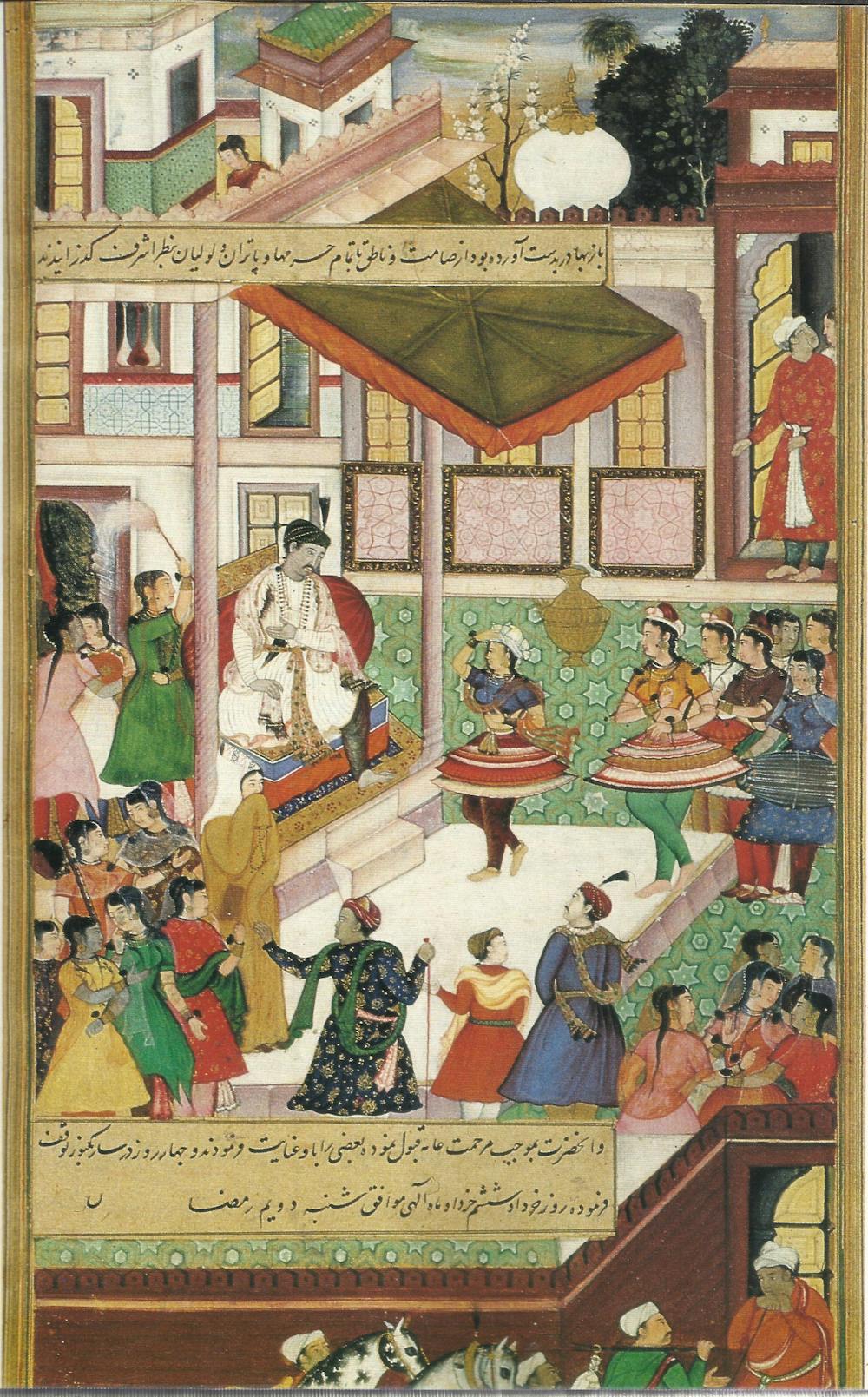
Dancing girls from Malwa entertain Akbar, 1561.
Wikimedia Commons

Once trained, courtesans attracted patronage from royal courts, feudal aristocrats and colonial officers.

This unique class enjoyed privileges not afforded to most women in Indian society, such as education and personal income. They led glamorous lifestyles, wielded power and wealth, and paid taxes.

As independent professionals, they contributed to Indian arts and culture, travelled extensively, made connections with chosen kin and often embraced gender fluidity.

Their financial, political and sexual independence challenged patriarchal gender norms and restrictive Hindu moral laws that dictated the lives of women from upper-middle-class families.

Complicated relationships

In Heeramandi, the courtesans turn patriotic to avenge the British police officers for raping and killing the natives. While these actions are dramatic, the historical relationship between courtesans, the British empire and Indian nationalism was more complex.

The politically engaged Bibbojaan (Aditi Rao Hydari) mirrors Azizan Bai, a courtesan from Kanpur who is said to have financially supported the 1857 mutiny against the British East India Company.

While the mutiny was one of the most widespread anti-colonial revolts of the 19th century, Indian nationalism was not its primary aim, but a consequence. Azizan’s interest was in maintaining her patronage from the native rulers for her social and economic wellbeing.

After 1857, India’s governance shifted from the East India Company to the Crown, leading to the spread of British rule across India alongside Western education and Victorian morality. Meanwhile, nationalist leaders envisioned a nation as a pure land of sacred Hindu ancestors and valued chastity in women.

Both the imperial and nationalist ideals clashed with the courtesans’ sexual freedom.

Two women lounging.
Nautch girls in Hyderabad, in a photo from the 1860s.
British Library/Wikimedia Commons

In the 1890s, Hindu reformers and bourgeois nationalists joined Christian missionaries in organising anti-nautch campaigns that advocated boycotting them to “rescue” art and culture from perceived immorality. This led to the downfall of the courtesan class.

In Heeramandi, patronage diminishes and the women’s dreams of marriage fade. The courtesans shut down their salons, give up their careers and sacrifice their lives for the nation.

But historical courtesans were quick to reinvent themselves in the face of declining patronage and social stigma.

They turned to the power of modern technology. Gauhar Jaan, a famous courtesan, became a celebrated concert singer and gramophone artist, earning the title of “India’s Melba” in the international press.

In 1921, Gandhi asked Gauhar Jaan to perform for the Swaraj Fund. Aware of the ambiguous position courtesans held in nationalist discourse, she agreed on the condition that Gandhi attend her performance. When Gandhi failed to show up, she contributed only half of the raised amount to the cause.

Courtesans contributed significantly to the founding of the Indian film industry through their artistry, star power and capital investment. The first generation of female film stars came from courtesan backgrounds: Jaddan Bai, Kajjan Bai, Akhtaribai Faizabadi and Naseem Banu entered the industry as actors, singers, composers, directors and studio owners.

Later, some acted as managers and costume designers for their daughters, the emerging actors of the next generation.

By becoming modern-day artists, the courtesans preserved their art. They remained visible and relevant in a society that was increasingly obliterating women’s cultural contributions and diminishing their role as citizens in an emerging nation.

Patriarchal nationalism

In the show, a woman’s value is judged by her respectability, marital status and the presence of a male guardian controlling her sexuality. Courtesans refer to themselves as “birds in gilded cages” and dream of freedom from their courtesan lifestyle.

Production image. Two women talking.
Heeramandi oversimplifies the multilayered persona of tawa’ifs.
Netflix

Here, the courtesans’ nationalism resonates with present-day far-right Hindu nationalists, seemingly promising women empowerment in nationalism but, in reality, reserving only regressive roles for women.

Heeramandi oversimplifies the multilayered persona of tawa’ifs. The series portrays them as melancholic victims yearning for patriarchal married bliss, while remaining marginalised in respectable society. But these women should be remembered as celebrated figures filled with joie-de-vivre, gusto and spiritedness.

They should be honoured for their strategies of self-representation and processes of self-determination, as they turned resilience into a way of life.

The Conversation

Radhika Raghav does not work for, consult, own shares in or receive funding from any company or organisation that would benefit from this article, and has disclosed no relevant affiliations beyond their academic appointment.

ref. Who were the real courtesans at the heart of Netflix’s Heeramandi? – https://theconversation.com/who-were-the-real-courtesans-at-the-heart-of-netflixs-heeramandi-228600

National Cabinet has committed to a range of strategies to stop violence against women, but has it done enough?

Source: The Conversation (Au and NZ) – By Anastasia Powell, Professor, Family and Sexual Violence, RMIT University

Violence against women is not a women’s problem to solve, it is a whole of society problem to solve; and men in particular have to take responsibility.

Those were the words of Prime Minister Anthony Albanese as he reported on the outcomes of today’s National Cabinet meeting on gender-based violence.

This is a crucial moment.

It’s not the first time Australian government leaders and senior officials have met to discuss strategies to address violence against women. But it’s the first time the National Cabinet has met specifically to commit to greater action. Seen in recent protest marches across the country, there’s a lot of public demand for rapid change.

Out of today’s meeting there is a renewed commitment for “national unity”, across all governments, towards the shared mission to end gender-based violence.

We know why this mission continues to be urgent.

At least 28 women have died, allegedly at the hands of men’s violence, so far this year. And many more women are living with the harms of men’s violence all across the country.

One in four women have experienced violence by an intimate partner or family member since the age of 15. One in five women have experienced sexual violence and one in five women have experienced stalking. While we seem to be making progress in reducing 12 month prevalence rates of intimate partner violence, our Personal Safety Survey also indicates the rates of sexual violence and stalking have not been changing. It’s clear we need more action.

What came out of National Cabinet?

The biggest announcement from today’s meeting is a new federal government investment of A$925 million over five years to permanently establish the Leaving Violence Program. This is to be included in the upcoming budget and builds on the existing pilot scheme. The scheme delivers up to $5,000 in crisis support for women leaving violent relationships, as well as risk assessments and access to support services.

There was also a big focus on online measures to combat online harms and to reduce the exposure of children and young people to violent and misogynistic content. This included commitments to new laws banning sexualised “deepfake” images, as well as a review of classifications to reduce exposure to violent sexualised content. And $6.5 million will be committed to pilot age assurance technologies to restrict children’s exposure to inappropriate content, including violent pornographic material.


Read more:
Whether of politicians, pop stars or teenage girls, sexualised deepfakes are on the rise. They hold a mirror to our sexist world


The government will also bring forward a review of the Online Safety Act and fast-track already proposed anti-doxing laws. The aim of these steps is to protect victims from online harms, including the non-consensual disclosure of their personal information.

The prime minister also highlighted several existing federal government commitments. These included the funding commitments to women’s homelessness and housing services and funding increases for the eSafety Commissioner. Also mentioned was the next phase of the national Stop It At the Start campaign, which is due to be released mid-year and will focus on how to have preventative conversations with young people around their attitudes and behaviours.

Importantly, there is an agreement for National Cabinet to meet again on violence against women next quarter and to report back on progress made and crucial next steps. The states and territories also agreed to collaborate and share their own best-practice evidence and initiatives.

What further changes might be on the horizon?

To end gender-based violence we need to do everything we can. We need a range of short, medium and long-term actions. The outcomes of the National Cabinet meeting today indicated some further areas earmarked for ongoing discussion.

There were suggestions of the need for greater harmonisation of laws between states and territories. This is vital if we are to ensure women have equal protections and justice mechanisms in place no matter where in Australia they live. What was not mentioned, however, was the need for adequate resourcing of specialist police, legal and court services to support access to justice for victims of family and sexual violence.

There was also mention of improved information sharing between states and territories to promote greater accountability for repeat violent perpetrators. This is not a straight-forward area, but there are good examples of coordinated system responses that show when and how the sharing of information might be vital for women’s safety.

Workforce issues were also referred to, with an urging for a more rapid rollout of the federal government’s existing commitment of 500 extra domestic and family violence support workers. If you speak with these support services, it is clear they are under high demand from victim-survivors. There are often unacceptable wait lists. The extra workers are much needed, but it will also take accessible and affordable training to extend this specialist workforce.

Albanese also highlighted both the effectiveness of respectful relationships education in schools and the need for a national approach to respectful relationships education across the country. To date, both Victoria and Queensland have led the way in this work but certainly we need to scale-up our prevention efforts with young people if we want to end gender-based violence for the next generation.

Delivering on the National Plan

The National Plan to End Violence Against Women and Children (2022 to 2032) and its first action plans already identify a shared roadmap across prevention, early intervention, response, and recovery. Each of these four priority areas are crucial to a holistic strategy to end gender-based violence.

And for the first time, we have a stand-alone Aboriginal and Torres Strait Islander action plan with an already-announced federal government commitment for a National Plan for First Nations women. This is especially vital in light of the over-representation of First Nations women experiencing violence.

Delivering on these strategies must continue to be a priority. The National Plan has been developed over many years of research evidence, consultation, as well as both sector and lived-experience expertise. And it is arguably world-leading in its comprehensive approach.

But as Micaela Cronin, Australia’s first Domestic, Family and Sexual Violence Commissioner, remarked today:

No plan in such a complex area can be a “set and forget plan”.

It’s vital we draw on evidence-based approaches and best practice as we continue to refine our actions to address and prevent gender-based violence. This includes addressing the gender inequality and intersecting inequalities that drive violence against women. And also directly addressing the reinforcing factors that can contribute to violence and its escalation, such as prior experiences of violence, drug and alcohol misuse, problem gambling and poverty.

There is also a pressing need for governments to continue to work collaboratively to coordinate action and adequate investment across all levels of government. This is not the time to play politics between parties.

No Australian government has yet solved this problem. Every Australian government can and should do more to advance women’s safety.

Perhaps the most important outcome from today’s National Cabinet meeting is not just a renewed national commitment on action to end gender-based violence, but an Australia that will hold all governments to account on delivering their promises.

The National Sexual Assault, Family and Domestic Violence Counselling Line – 1800 RESPECT (1800 737 732) – is available 24 hours a day, seven days a week for any Australian who has experienced, or is at risk of, family and domestic violence and/or sexual assault.

The Conversation

Anastasia Powell receives funding from the Australian Research Council and Australia’s National Research Organisation for Women’s Safety (ANROWS). Anastasia is also a director of Our Watch (Australia’s national organisation for the prevention of violence against women), and a member of the National Women’s Safety Alliance (NWSA).

ref. National Cabinet has committed to a range of strategies to stop violence against women, but has it done enough? – https://theconversation.com/national-cabinet-has-committed-to-a-range-of-strategies-to-stop-violence-against-women-but-has-it-done-enough-229106

Is bioenergy ever truly green? It depends on 5 key questions

Source: The Conversation (Au and NZ) – By Jessica Allen, Senior Lecturer in Chemical and Renewable Energy Engineering, University of Newcastle

Snapshot freddy/Shutterstock

Plans to revive an old coal-fired power station using bioenergy are being considered in the Hunter region of New South Wales. Similar plans for the station have previously not gone ahead. As we grapple with decarbonisation, bioenergy (energy derived from harvested trees and other plants) is often put on the table as an environmentally friendly alternative to fossil fuels.

But is it environmentally sound? The annoying answer is: it depends.

Trees and other plants soak up carbon from the atmosphere and store it as biomass. When they are burnt for electricity production the same carbon is released. This would suggest bioenergy is “carbon-neutral”.

But it’s not that simple. Many things can change the environmental credentials of a bioenergy project. Every project is unique and must be considered independently.

So let’s break down the five key questions we should ask about every bioenergy project.

Schematic of bioenergy project considerations including carbon emission sources and sinks
There are 5 key questions to ask about every bioenergy project.
Jessica Allen/Adobe Stock/Flaticon

1. What is the source of the biomass?

The bewildering array of plants on our planet means a huge amount of biomass “feedstock” is available. So what should we use?

First, we do not want to be cutting down native forests. Even using native forestry “residues” (by-products like bark and ends of trees that can’t be directly used) is problematic. The residues are made regardless of the bioenergy project, but tethering a power station to the native forestry industry, and creating a reliance on it continuing, is contentious. Some states have already flagged the end of native logging.

Fast-growing biomass species such as mallee could instead be harvested as purpose-grown energy “crops”. This can seem like an attractive option, but the sheer amount of land needed for energy crops on any reasonable scale can be prohibitive.

Agricultural residues and “waste” biomass, such as organic material sent to landfill (from household bins, for example), are also readily available. The Australian Bioenergy Roadmap shows large amounts of potentially usable waste biomass nationally.

In most cases waste biomass would otherwise go into landfill, be burnt in an open field or be left to decompose without emission controls. The most pressing issues for using waste biomass then come from our next question.

A semi-trailer truck carries newly felled logs along a country road
Bioenergy that depends on logging native forests is problematic.
max blain/Shutterstock

2. How much energy is needed to collect the biomass?

Biomass energy literally grows on trees. But it’s spread out over a large area and requires a central processing facility.

Collecting biomass, processing it and getting it where it needs to go takes energy. At present, that’s mostly fossil-fuelled energy, including diesel trucks and chippers.

The more spread out the biomass is, the more energy is used for harvest and collection. Transport and processing usually accounts for most bioenergy-related emissions.

And the need for biomass is continuous. It must be collected and delivered to the central facility every day without fail.

The electrification of transport, including electric or hydrogen-fuelled trucks, might help offset this energy use. However, this is still a costly option and not often considered in bioenergy projects.

3. What would happen without the bioenergy project?

What would happen to the biomass if it wasn’t being used for bioenergy? If it is expected to remain in a stable carbon form (such as a tree), burning it would be a comparative net-positive carbon release.

If, however, the biomass is contributing to emissions or causing local environmental problems, such as invasive weeds, using it for bioenergy might be a better environmental outcome. The Hunter Valley project proposes to use woody weeds cleared from rural properties for part of its inputs.

What about the land used? Should we use land to harvest energy (bioenergy or otherwise)? Or can it be used to restore habitat?

We need to minimise land use for energy and be as efficient as possible. We need to be thinking regeneratively and taking back wild places for vulnerable fauna and flora.

4. What are the (real) alternatives?

If we compare a bioenergy plant with a coal-fired power station, biomass is usually greener. But new coal-fired electricity is not on the table in Australia.

Solar and wind are the true competitors for future electricity generation. These energy sources are readily available and have very low associated costs and emissions.

Solar and wind are inherently variable. Biomass electricity generation is more like traditional coal-fired power, operating continuously. That might sound like a good way to produce an energy “baseload”. However, it might not be particularly useful in a future grid where variation is a design feature, not a flaw.

We can make things other than electricity with biomass. Sustainable aviation fuels, methanol, or gases like hydrogen and biomethane are some examples. These products can replace fossil fuels in hard-to-abate sectors.

Biochar, a charcoal-like product made by heating biomass without air, could also be produced. It has several environmental advantages when used to improve soil, including increasing the carbon content. Even so, suggestions to use biochar as a strategy to reduce emissions must be approached with great caution.

Since biomass is made of carbon, hydrogen and oxygen, the same starting elements as fossil fuels, more advanced bio-derived products can also be made as substitutes for petrochemical products.

A truck with the word Bio on its side drives past storage tanks
Biomass can be used to produce biofuel substitutes for fossil fuels.
Scharfsinn/Shutterstock

5. What other impacts would the project have?

Irrigating bioenergy crops can create water stress. Soil quality and land degradation must also be considered.

And transporting and processing biomass might create other emissions such as particulates that would affect project neighbours.

The reality is that modern-day humans and our technologies are bad for the environment, full stop. Every technology will have an impact. So the question is: which option has the least impact?

Getting bioenergy right is a challenge

The best bioenergy projects should make useful products or offer a substitute to fossil fuels. They should complement renewable energy generation.

They should use readily available waste or sources of biomass that would otherwise cause environmental problems. They should also minimise (or electrify) energy use for collecting and processing biomass.

Yes, bioenergy can be environmentally sound. It’s not impossible. But it’s not always easy to get it right.

The Conversation

Jessica Allen does not work for, consult, own shares in or receive funding from any company or organisation that would benefit from this article, and has disclosed no relevant affiliations beyond their academic appointment.

ref. Is bioenergy ever truly green? It depends on 5 key questions – https://theconversation.com/is-bioenergy-ever-truly-green-it-depends-on-5-key-questions-228202

Why did the Voice referendum fail? We crunched the data and found 6 reasons

Source: The Conversation (Au and NZ) – By Andrea Carson, Professor of Political Communication, Department of Politics, Media and Philosophy, La Trobe University

Since Australia’s First Nations Voice to Parliament referendum in October 2023, diverse commentaries have sought to explain why it failed. But what does an analysis of media and polling data tell us about the outcome six months on?

Our expert team analysed over 3 million social and mainstream media posts and stories, thousands of online political ads, and scores of public opinion polls to address common misconceptions about the outcome. We identified key factors that contributed to the defeat. They are:

1. Lack of bipartisan support. As history has shown, bipartisan support is critical for success in Australia referendums. The Voice was no different.

Public support nose-dived after Peter Dutton’s announcement of opposition to the Voice in April 2023, following the Nationals’ decision to reject the “yes” case in November 2022.

As indicated by opinion polls, support for “Yes” dropped 25 percentage points in the year leading up to the vote. The decline accelerated after Dutton’s announcement.

Averaging public opinion polls over 2022-23, support peaked around 65% in October 2022. This is a long way from the final result of 39.94% of voters nationally supporting a change to the Constitution, compared to 60.06% rejecting it.

But this initial majority backing for the Voice was likely due to early surveys overstating support. This was a function of the issue’s low salience, the superficially positive character of the “Voice” label, and biases in survey responses attributable to social desirability and acquiescence.

Even by historical standards, this was a significant shift in public opinion over a short time and shows the influence political elites have on public opinion. It also underscores the structural difficulty of constitutional change without bipartisan consensus.

2. Labor voters divided. Labor voters were equivocal about the Voice, affecting the outcome. We find wide variation in support for the Voice across Labor-held seats, which was a principal contributor to the referendum’s failure.

Only 21 of Labor’s 78 seats in the House of Representatives returned “yes” majorities. Most of these most were inner-city electorates. Three Labor-held seats – Spence (outer Adelaide), Hunter (regional NSW) and Blair (Qld) – had “no” votes exceeding 70%.

In contrast to Labor, Greens and Teal voters overall supported the Voice. If the 2022 federal election results were to be transposed directly onto the Voice referendum, the Voice would have prevailed.

3. Demographic fault lines. Generally speaking, voters in inner metropolitan electorates in capital cities were more likely to back the Voice proposal. Rural and regional seats recorded the largest “no” votes.

Support for the Voice also cleaved along lines marked by age, educational attainment and wealth. In the small number of locations where it is clear Indigenous people comprised the bulk of voters, we see Indigenous Australians overwhelmingly supported the Voice.

4. The “no” campaign was simple, repetitive and targeted. While it is impossible to draw direct lines between campaign messaging and electoral outcomes, we see patterns in paid online advertising and free mainstream and social media data that offer insights into the success of the “no” campaign. It was highly targeted.

While its message was channelled through a range of entities such as “Referendum News”, “Not Enough”, “Not My Voice” and “Fair Australia”, these were all overseen by conservative lobby group, Advance Australia. Their focus-group-tested messages were simple – “the voice will divide us” and “if you don’t know, vote no” – and repeated frequently across Australia’s diverse media ecosystem.

When it comes to media coverage, content volume mattered less than strategy. While “no” attracted less overall mainstream media coverage, according to our analysis of Meltwater data, it honed its key messages much earlier and embraced social media, particularly TikTok.

Spearheading these narratives were Indigenous campaigners Jacinta Nampijinpa Price and Nyunggai Warren Mundine. Both were household names by polling day. They were a potent team and bolstered the credibility of arguments against the referendum for non-Indigenous Australians.

Refining the “no” narrative early on enabled proponents to amass more followers across social media platforms than “yes” – with the exception of the Uluru Statement’s Instagram presence.

Media coverage by Sky News Australia amplified the “no” case. Sky had a vast reach through its YouTube channel (over 9 million views from 500 Voice clips), subscription TV and free regional TV programs. Its commentators and conservative politicians also used story snippets to spread the “no” message on social media.

In contrast, the “yes” campaigns were disparate. These consisted of at least three major groups – “Yes23”, “Uluru Statement from the Heart” and “Liberals for Yes” – offering a range of messages and messengers. This diversity of actors and narratives, including business, unions and civil society groups, may have generated voter confusion, message overload and, in some instances, backlash.

5. Mis- and disinformation and targeted attacks. This was prevalent during the referendum across both mainstream and social media spheres. It coincided with unprecedented attacks on third-party fact-checkers, notably RMIT FactLab. Our post-referendum survey showed subsequent falls in trust for RMIT FactLab among right-leaning voters.

The referendum also prompted unsubstantiated American-styled attacks on the Australian Electoral Commission, with accusations of “vote rigging” including from the opposition leader. But unlike the US, these claims were by the victors, not the vanquished.

Some reporting – including by the BBC – also linked this “disinformation ecosystem” to the amplification of racist memes and commentary during the campaign.

6. Crowding-out by other issues. As the Voice campaign unfolded, other concerns, notably the cost-of-living crisis, dominated the policy agenda and polls. The “no” campaign strategically utilised voter concerns about personal finances and the economy in its paid advertisements, highlighting the referendum’s cost and future implementation expenses.

Critics leveraged the economic downturn to downplay the Voice as a secondary issue.

Together, we argue these six factors contributed to the Voice to Parliament defeat. You can read the full report here.

The Conversation

Andrea Carson receives funding from Meta and a La Trobe University Synergy grant to undertake this project.

Rebecca Strating receives funding from a La Trobe University Synergy grant to undertake this project.

Simon Jackman was a paid consultant on this project.

ref. Why did the Voice referendum fail? We crunched the data and found 6 reasons – https://theconversation.com/why-did-the-voice-referendum-fail-we-crunched-the-data-and-found-6-reasons-228383

Albanese government flags measures to tackle online misogyny in the battle against violence towards women

Source: The Conversation (Au and NZ) – By Michelle Grattan, Professorial Fellow, University of Canberra

The Albanese government will introduce legislation to ban deepfake pornography and provide more funding for the eSafety Commission to pilot age-assurance technologies.

The contribution of internet sites to gender-based violence was one major issue at Wednesday’s special national cabinet meeting on the issue of violence against women.

After the meeting Prime Minister Anthony Albanese announced the federal government would devote $925.2 million over five years to establish permanently the Leaving Violence Program. Those eligible will be able to receive up to $5000, as well as help with referral services, risk assessment and safety planning.

A $5000 “escaping violence” payment was introduced under the Morrison government. The Albanese government stresses that was a “trial” program.

The role of the access to pornography and other misogynistic material has become an increasing matter of concern in gendered violence.

Deepfake pornography is visual content created using AI technology.

“I understand parents want to protect their kids from harmful material online,” Albanese said. “Social platforms have important social responsibilities and we need them to step up. Taken together, these reforms will give Australian families some of the tools they need to navigate the complexity of the digital world.”

He said the legislation would carry “serious criminal penalties”.

The prime minister admitted it was hard to police the internet. “We don’t under-estimate how difficult this is,” he said. But “online players need to understand exactly what the consequences are of a free-for-all online”.

The age-assurance pilot was recommended by the eSafety Commissioner and has also been supported by the federal opposition.

Communication Minister Michelle Rowland said the pilot would address access to age-inappropriate material including pornography.

“Taking steps to prevent access for minors to age-inappropriate content like pornography is one tool that can help protect young minds from damaging and misogynistic behaviours,” Rowland said.

The leaders at national cabinet agreed there needed to be more focus across jurisdictions on “high-risk perpetrators and serial offenders to prevent homicides”.

Police ministers and attorneys-general will develop “options for improving police responses to high risk and serial perpetrators, including considering use of focused deterrence and fixated threat strategies”.

There will be reports back to a later national cabinet meeting.

Bail has become a hot-button issue after New South Wales woman Molly Ticehurst was allegedly murdered by her former partner who was on bail.

The Conversation

Michelle Grattan does not work for, consult, own shares in or receive funding from any company or organisation that would benefit from this article, and has disclosed no relevant affiliations beyond their academic appointment.

ref. Albanese government flags measures to tackle online misogyny in the battle against violence towards women – https://theconversation.com/albanese-government-flags-measures-to-tackle-online-misogyny-in-the-battle-against-violence-towards-women-229109

Job scams are on the rise. What are they, and how can you protect yourself?

Source: The Conversation (Au and NZ) – By Dimitrios Salampasis, FinTech Capability Lead | Senior Lecturer, Emerging Technologies and FinTech, Swinburne University of Technology

Clem Onojeghuo/Unsplash

In the digital era, the job market is increasingly becoming a minefield – demanding and difficult to navigate. According to the Australian Bureau of Statistics, the number of job vacancies fell by 6.1% between November 2023 and February 2024. Every click on a job ad can either open doors to amazing opportunities, or plunge job seekers into perfectly set up cyber traps.

The latest annual Targeting Scams report shows a seemingly encouraging 13.1% decline in scam losses reported by Australians – down to A$2.74 billion in 2023. But it doesn’t mean we should get complacent. Scammers are continuously refining their techniques and expanding their reach.

Particularly alarming is the volume of job scams (also known as employment or recruitment scams). These scams were among the top ten scam categories in 2023, with a dramatic 150% increase in financial losses compared to the year before.

How exactly do job scams work? And how can job seekers distinguish between legitimate job offers and deceptive schemes?

What is a job scam?

Job scammers attract people by promising fake jobs that require little effort but promise a substantial financial reward or “guaranteed” income, or perhaps even a “dream job” at a real company they’re impersonating. The end goal in all cases is to extract money and/or personal details from the victim.

Employment scams may take many forms, but there are several tell-tale signs.

Scammers use social media, unsolicited emails, encrypted chat applications (such as WhatsApp or Telegram), phone calls or even legitimate employment websites to advertise non-existent jobs.

Screenshot of a text message offering easy work testing apps with an hourly salary up to $200.
An example of a job scam sent through a text message.
The Conversation

Job scammers may also impersonate recruiters from genuine organisations, including high-level executives or even hiring managers conducting interviews for jobs that do not exist.

A text saying a company has flexible job openings and asking if they can share more information.
An example of a job scam impersonating a recruiter from a legitimate company.
The Conversation

For some of these jobs, the scammer will ask for some type of upfront fee to secure the employment, pay for onboarding, or to purchase (non-existent) products the job seeker is supposed to sell. The moment the fee is paid, the scammer will instantly disappear.

Sometimes, job scammers promise a high commission if the person uses their own bank account to transfer existing funds into an offshore account, cryptocurrency exchange or gift cards. This is likely money laundering.

Depending on the type of job scam, cyber criminals conducting a fake application and onboarding process may even gain access to sensitive information such as your passport number, driver’s licence and other credentials. This puts you at high risk of identity theft.

Who is vulnerable to job scams and why?

Scammers target their victims based on their online behaviour, financial situation, needs and even vulnerability to certain types of persuasion.

The increasing cost of living in Australia is creating a fertile ground for job scams. People in desperate need of employment, those who have been unemployed for a very long time and those seeking additional income via part-time (usually remote) jobs are all at high risk of becoming victims to these job scams.

These individuals are driven by economic need and will easily overlook or not recognise red flags. University students and recent graduates looking for valuable work experience in tough job markets are increasingly becoming targets of job scams, too.

Immigrants can be particularly susceptible to job scams, mainly because they may not be familiar with legitimate employment processes, standard recruitment practices and Australian employment rights.

In extreme cases, employment scams can even result in international human trafficking, as shown by an incident in Cambodia last year, with victims being locked into compounds, having their passports confiscated and being trained to scam others. Captors would release them only upon receiving a ransom fee payment.

How can I avoid a job scam?

Apart from using a “stop, think and protect” approach, here are more tips on how to protect yourself from job scams:

  • Use only legitimate job boards and networking sites. For example, LinkedIn verifies recruiters with a visible badge on their profiles.

  • Critically evaluate and check job listings by looking for comprehensive information and list of qualifications. Seek advice from trusted professionals to validate the legitimacy of the job offer.

  • Don’t respond to non-corporate emails, texts or other messages offering “too good to be true” unsolicited employment opportunities with high returns.

  • Conduct thorough research by always verifying the legitimacy of the offer. Check the company’s official website, read trusted reviews, call or even visit.

  • Avoid providing credentials including passport details, a driver’s licence, Medicare number, or financial information (a bank account number or PayID) during the application or onboarding process.

  • Don’t provide an upfront payment and don’t pay fees for training, equipment or software as a condition of being hired.

  • Never agree to receive or transfer funds through your own bank account on behalf of someone else for a commission.

Overall, stay vigilant. If you do come across any job scams, make sure to report them to the Scamwatch website.

The Conversation

Dimitrios Salampasis is a Fellow of the Financial Services Institute of Australasia and member of the Australian Institute of Company Directors.

ref. Job scams are on the rise. What are they, and how can you protect yourself? – https://theconversation.com/job-scams-are-on-the-rise-what-are-they-and-how-can-you-protect-yourself-228996

Curious Kids: how do sugar rushes work?

Source: The Conversation (Au and NZ) – By Talitha Best, Professor of Psychology, CQUniversity Australia

Victoria Rodriguez/Unsplash

How do sugar rushes work? – W.H, age nine, from Canberra

What a terrific question W.H! Let’s explore this, starting with some of the basics.

What is sugar?

Sugar is an important substance for our body and brain to make energy.

Sugar comes from foods called carbohydrates.

Carbohydrates help our bodies to keep strong muscles. They help our brains to think and learn. They support our organs like the heart and liver to work well, and help our intestines to digest our food and remove waste.

When we eat fruits, vegetables, cereals and grains, we get helpful sugar that the cells in our body and brain need to make energy.

When we eat processed foods like lollies, ice creams and soft drinks, we get extra or added sugars that can be unhelpful in large amounts.

Lollies in a jar
How do you feel after eating lollies?
Joanna Kosinska/Unsplash

These added sugars were thought to provide extra energy – a “sugar rush” that makes us feel good, happy and energetic.

When we eat sugary treats, it was thought that they make us do more jumping, playing, thinking and learning.

But this is where it gets interesting. A sugar rush is a myth because the body and brain work hard to keep sugar steady. This means you probably feel good from having a treat, not the sugar!

If a ‘sugar rush’ is a myth, what happens?

It can be hard to stay away from sugary treats and lollies when they are right in front of us.

When we eat lollies, we get an extra amount of sugar in our bodies. Our bodies, taste buds and brain like it because we can use the sugar to do things.

Sugar is taken up into your bloodstream quickly. Cleverly, our body then moves the sugar around in the bloodstream to your cells, muscles and organs, like your heart and brain.

The sugar in your bloodstream is very carefully handled.

Your body will make sure all the muscles and organs have just the right amount of sugar that they need to make energy and do their job.

This means that the flow of sugar in the body is kept steady and there is no “sugar rush”.

Boy climbs a tree
Our muscles need the right amount of sugar to make energy.
Jeremiah Lawrence/Unsplash

The body and brain have lots of support systems in place to make sure there isn’t too much or too little sugar.

Sometimes, if there is too much sugar in the bloodstream and the body doesn’t use all the sugar at once, the sugar will be stored. There are lots of storage places in the body. In fact the body is very good at storing the sugar for use later so that your muscles and organs have just the right amount of sugar when they need it.

Because the body and brain are very busy making sure there is just the right amount of sugar, it can get tired. When this happens, this is called a “sugar crash”.

Huh?! We get a sugar crash instead?

Many experiments with lots of people show us that when we eat lots of sugar, we can get a “sugar crash”.

Scientists have shown that even just 30 minutes after eating lots of sugar, you can end up feeling not quite as good as you did before. A sugar crash is why, after eating sugary treats, you may find yourself feeling sad and tired – even a little bit grumpy.

Boy snuggles into his mum
Have you felt a bit grumpy after eating lots of sugar?
Bruno Nascimento/Unsplash

So this means that if you’ve had a sugary treat and you’re feeling good, you’re probably feeling good because you’re having fun with family and friends, rather than from the sugar.

Doing fun things, playing and trying new games and activities will help your body and brain to feel good, with or without sugar!


Hello, Curious Kids! Do you have a question you’d like an expert to answer? Ask an adult to send your question to curiouskids@theconversation.edu.au

The Conversation

Talitha Best does not work for, consult, own shares in or receive funding from any company or organisation that would benefit from this article, and has disclosed no relevant affiliations beyond their academic appointment.

ref. Curious Kids: how do sugar rushes work? – https://theconversation.com/curious-kids-how-do-sugar-rushes-work-224512

Our research shows a strong link between unemployment and domestic violence: what does this mean for income support?

Source: The Conversation (Au and NZ) – By Karinna Saxby, Research Fellow, Melbourne Institute of Applied Economic and Social Research, The University of Melbourne

MART PRODUCTION/Pexels

Increasing income support could help keep women and children safe according to new work demonstrating strong links between financial insecurity and domestic violence.

Our mapping of local government areas in Melbourne and Sydney reinforces the relationship between unemployment and the greater risk of violence.

At a time when the nation is speaking out against the killing of women by men – with at least 27 deaths recorded since the start of this year – the federal government is under increasing pressure to help those at greatest risk.

How money might help

Financial dependence can trap people in abusive relationships. The dependency creates barriers to leaving, as victim-survivors may not have the money necessary for alternative housing, legal help and basic living expenses.

Higher income support for women can change the dynamics within relationships by enhancing their financial decision-making and bargaining power within the household.

However, the relationship between economic factors and domestic violence is complex.

While higher income generally corresponds with lower domestic violence, overseas evidence suggests higher unemployment benefits may lengthen unemployment spells. In such situations, joblessness could lead to violence
due to increased exposure between perpetrators and victim-survivors at home.

Economic downturns and personal financial crises can also cause uncertainty and household stress, which may escalate into abuse.

These economic patterns are clear in Australia. Areas with low-income and high-unemployment tend to have the highest levels of domestic violence.

Problem areas

The graphics below illustrate this by mapping unemployment and violence rates across local government areas in greater Sydney and greater Melbourne. The patterns are striking. High rates, marked in darker red, often occur in similar locations.

In Melbourne, the areas with the highest levels of both unemployment and domestic violence are greater Dandenong, Frankston, Casey, Cardinia, Maribyrnong, Brimbank, Melton and Hume. They are marked in red.


In Sydney, the highest rates are in Campbelltown, Liverpool, Canterbury-Bankstown, Fairfield, Penrith, Cumberland, Blacktown and Hawkesbury.


The economic disparities in domestic violence have also increased in recent years. In 2001, rates of violence in the most disadvantaged parts of New South Wales were about 5.6 times higher in the most advantaged suburbs. In 2023, these differences were almost 6.5 times higher.

Long lasting impact

Domestic violence disproportionately impacts women and children and can create significant long lasting social, health, psychological and financial damage.

Estimates suggest the lifetime cost of domestic violence for every victim-survivor is in the tens of thousands of dollars. Healthcare costs alone are close to A$50,000 for every person directly affected.

And the broader costs are staggering.

National data from 2016 which looked at costs including medical care, lost productivity, legal fees, and extended social services, puts the total annual costs at about $22 billion.

This shows the problem is not just a critical social and health issue, but a major economic challenge for victim-survivors and the nation.

Helping to solve the problem

Providing adequate financial support to vulnerable people during times of economic uncertainty is critical to reduce domestic violence and its harmful effects.

But unemployment benefits in Australia are much lower than in other OECD countries. JobSeeker is only $386 per week – 43% of the full-time minimum wage. Australia is ranked among the lowest of all OECD countries when it comes to unemployment benefits, second only to Greece.

International evidence, based on more generous support schemes, suggests raising benefits may lead to extended periods out of work and therefore greater exposure to violence at home.

But this is unlikely to occur in Australia if JobSeeker payments are raised. Given the current low rate, there will still be a considerable financial incentive for JobSeeker recipients to get paid work if the rate is increased.

Analysis of the almost doubling of payments during 2020 supports this conclusion.

Improving economic safety nets could help prevent environments that breed violence. Investing in safety is an essential step towards combating Australia’s domestic violence crisis.

The Conversation

David Johnston receives funding from the Australian Research Council.

Karinna Saxby and Rachel Knott do not work for, consult, own shares in or receive funding from any company or organisation that would benefit from this article, and have disclosed no relevant affiliations beyond their academic appointment.

ref. Our research shows a strong link between unemployment and domestic violence: what does this mean for income support? – https://theconversation.com/our-research-shows-a-strong-link-between-unemployment-and-domestic-violence-what-does-this-mean-for-income-support-228409

‘A major shakeup’: the Optus outage has been investigated. What’s going to change now?

Source: The Conversation (Au and NZ) – By Mark A Gregory, Associate Professor, School of Engineering, RMIT University

The telecommunications industry faces a major shakeup following the release of the post-incident report on last November’s 12-hour Optus outage. Telecommunications companies will have to share more information with customers during future outages, and set up a body to manage the Triple Zero emergency service.

The Optus outage affected more than 10 million mobile and broadband services. Thousands of people who tried to call Triple Zero were unable to get through.

Hospitals, schools, and businesses could not connect to mobile and fixed networks. Commuters were delayed on their way to work, and thousands of small businesses were unable to use EFTPOS.

The post-incident review, led by former deputy chair of the Australian Communications and Media Authority Richard Bean, has made 18 recommendations. They aim to make the industry more accountable and improve oversight of the Triple Zero service.

Government response

The government has agreed to all 18 of the review’s recommendations.

Communications minister Michelle Rowland said:

Australians need to have confidence in our telecommunications services, particularly when it comes to Triple Zero.

This review is the most comprehensive examination of the Triple Zero ecosystem in over a decade. It means we have a workable blueprint to implement changes that will help improve the resilience of telecommunications in this country.

The review involved a range of stakeholders. They included communications providers as well as federal, state and territory government entities, regulators, and industry and consumer representative bodies.

Major recommendations

Some of the report’s recommendations are about structural issues in the telecommunications ecosystem. Others address the role of government in managing and responding to national service outages. A third group tackle how carriers communicate with customers and deal with post-incident complaints and compensation.

Key recommendations include:

  • new rules mandating how, what and when telecommunications carriers communicate with their customers during and after an outage

  • a comprehensive testing regime across telecommunications networks and devices to ensure callers can reach Triple Zero

  • a Triple Zero custodian which will provide end-to-end oversight of the Triple Zero service and ensure the service is working

  • a review of all legislation and regulation relating to the delivery of Triple Zero

  • a review of the government’s contract with Telstra to operate the Triple Zero emergency service system

  • an industry agreement on working together to manage and resolve outages.

What will change

The government has set a timeframe of 12–18 months to implement the report’s recommendations.

The 18 recommendations will be implemented by the government and various agencies, as well as the telecommunications industry. They will need to act quickly.

The establishment of the Triple Zero custodian framework will initially be led by the Telecommunications Industry Ombudsman.

The carriers will implement the systems and practices necessary for carriers to share real-time information about outages with emergency services and authorities.

Carriers will collectively be required to make an agreement to work together to manage and resolve outages.

Government will need to develop new guidelines for communication and collaboration. These will ensure ministers, state and territory authorities and government agencies can work together during telecommunications outages.

The government will review the legislation and regulations relating to the Triple Zero emergency service and, if necessary, introduce new legislation.

What does this mean for customers?

The Bean review and the government’s acceptance of its 18 recommendations should make our telecommunications system more robust. Telecommunications companies will work together to minimise the effect of future outages, particularly if they impact Triple Zero.

One key improvement will be how telecommunications companies respond to customer concerns about outages. There will also be changes to how customers can make complaints and seek compensation. Small business will be looking for a compensation process that is less onerous than the current one.

A small step

The Optus outage and the Bean review show up weaknesses in our telecommunications system. The industry still has some way to go before Australians can be confident in using telecommunications safely, securely and reliably.

The industry has largely been left to its own stewardship since it was deregulated in the late 1990s. Some of the review’s recommendations are small steps towards minimum performance standards.

The next step should be a broader review to look at how minimum performance standards can be developed and implemented.

The Conversation

Mark A Gregory does not work for, consult, own shares in or receive funding from any company or organisation that would benefit from this article, and has disclosed no relevant affiliations beyond their academic appointment.

ref. ‘A major shakeup’: the Optus outage has been investigated. What’s going to change now? – https://theconversation.com/a-major-shakeup-the-optus-outage-has-been-investigated-whats-going-to-change-now-229000

Ngāti Kahungunu becomes NZ’s first iwi to call for a Gaza ceasefire

Asia Pacific Report

Ngāti Kahungunu in Aotearoa New Zealand’s Hawkes Bay region has become the first indigenous Māori iwi (tribe) to sign a resolution calling for a “ceasefire in Palestine”, reports Te Ao Māori News.

Reporter Te Aniwaniwa Paterson talked to Te Otāne Huata, who has been organising peace rallies each Sunday at the Hastings Clock Tower.

“I have taken every opportunity at the iwi level to present the case that we should be standing in solidarity with the Palestinians,” Huata (Ngāti Kahungunu, Ngāti Porou, Te Arawa) said.

“This means we don’t support the ongoing bombing and slaughter of Palestinians in Gaza and also the brutal apartheid and occupation that’s happening in the occupied West Bank.”

This initiative started among Huata’s whānau who presented the case to their hapū Ngāti Rāhunga-i-te-Rangi, wider marae and eventually the iwi of Ngāti Kahungunu.

Huata has brought Palestinians into the conversation at iwi events, at hui-ā-motu with Te Kiingitanga and Rātana Pā, and subsequently on the Treaty Grounds.

“Then came to the hui-ā-iwi, last Friday, really with the intention of asking ‘what does kotahitanga look like?’ And what what can we present to the hui-ā-motu because Kahungunu will be hosting Hui Taumata on May 31 at Omahu marae.”

Māori iwi leadership in solidarity
Huata believes Māori cultural and iwi leadership can be used in solidarity with other minority groups and said it was important because all injustices were interconnected.

As part of the kaupapa, Huata choreographed a haka, written by his cousin Māhinarangi Huata-Harawira, “with the intention to not be flashy, or that you had to be the best performer”.

Gaza rallies organiser Te Ōtane Huata
Gaza rallies organiser Te Ōtane Huata . . . “Tino rangatiratanga to me isn’t only self determination of our people, it is also collective liberation.” Image: Te Ao Māori News screenshot APR/Māori Television

“Really the haka was about how we can all throughout the world stand in solidarity through this vessel of haka.”

Haka mō Paratinia is used at rallies and protests around Aotearoa.

The kaupapa was also brought to the stage this year in kapa haka regionals where Ngāti Kahungunu ki Heretaunga Pakeke carried Palestinian flags and messages of in support of a ceasefire.

“Tino rangatiratanga to me is not only self determination of our people, it is also collective liberation, so the oppressions of other marginalised Indigenous groups, are an oppression on everyone else,“ Huata said.

Republished from Te Ao Māori News/Māori Television.

Print Friendly, PDF & Email

Article by AsiaPacificReport.nz

PNG businesses want grants, not loans over Black Wednesday riots

By Dale Luma in Port Moresby

“We want grants and not concessional loans,” is the crisp message from Papua New Guinea businesses directly affected by the Black Wednesday looting four months ago.

The businesses, which lost millions after the January 10 rioting and looting, say they need grants as part of the government’s Restock and Rebuild assistance — and not more loans.

This is the message delivered by the PNG Chamber of Commerce and Industry on Monday after news that the national government has so far given K7 million (NZ$3.2 million) in funding to several affected companies to pay staff salaries.

President Ian Tarutia said the business coalition representing impacted businesses would be meeting with the Chief Secretary and his inter-agency team this week to find out when the assistance will be given.

Their message at this crucial meeting will be the same — no loans!

“The real impact assistance that is truly beneficial is rebuilding and restocking,” Tarutia said.

“We will meet with the chief secretary hopefully this week to get an update on this component of the government’s relief assistance to affected businesses.

Concessional rate loans
Tarutia explained that an initial National Executive Council decision was to provide loans at concessional rates and managed through the National Development Bank.

“Business Coalition’s response was grants and not loans are the preferred assistance. Meeting with the Chief Secretary this week hopefully can resolve this.”

He also indicated that in the initial impact by businesses compiled in late January, the estimated cost for rebuild and restock covering loss of property, cost of clean up, loss of goods was K774 million.

“This was for 64 businesses mainly in Port Moresby but a few in Goroka, Rabaul, Kundiawa and Kavieng,” he said.

“Out of this K774 million, an amount of K273 million was submitted as needed immediately.

“Business Coalition met last Saturday morning. Business houses are looking forward to meeting Chief Secretary Pomaleu and his inter-agency team this week to find out when the assistance for rebuilding destroyed properties and restocking looted inventory will be given.”

Tarutia acknowledged that so far, the government had paid out approximately K7 million in wage support for businesses which includes eight businesses including CPL.

Businesses acknowledge the wage support to date and are appreciative on behalf of their affected staff.

Dale Luma is a PNG Post-Courier reporter. Republished with permission.

Print Friendly, PDF & Email

Article by AsiaPacificReport.nz

Ready, set, go in Solomons PM race – Jeremiah Manele vs Matthew Wale

By Koroi Hawkins, RNZ Pacific editor

Former opposition leader Matthew Wale has been announced as the second prime ministerial candidate ahead of the election in Solomon Islands tomorrow.

He will face off against former foreign affairs minister Jeremiah Manele, who was announced by the Coalition for National Unity and Transformation on Monday.

As far as RNZ Pacific was aware, Manele and Wale were the only two prime ministerial candidates that have been publicly announced.

However, candidate nominations could also be submitted quietly, so until the Governor-General announced the total number of candidates, RNZ Pacific could not rule out the possibility that there could be at least one more horse in the race.

Wale’s coalition, which had yet to be named, resembled the opposition group in the last Parliament, and was made up of his own Democratic Party, the United Party, the Party for Rural Advancement, the Umi for Change Party and the Democratic Alliance Party.

A head count of a group photo provided by the coalition showed they had 20 MPs.

On the other hand, Manele’s coalition, which was effectively the incumbent government, was made up of MPs from Our Party, People’s First Party and the Kadere Party.

Enough to form government
Their group photo showed 28 MPs which was more than enough to form government if they could hold onto them through the intense lobbying anticipated over the next 48 hours.

Included in Manele’s camp were a host of newly elected independent MPs, many of whom campaigned on a platform for change, unseating half of the incumbent Our Party MPs only to replenish their ranks.

In a statement marking his nomination, Wale appealed to these independents.

“The people of Solomon Islands have voted overwhelmingly for change from DCGA & Our Party. I therefore urge all newly elected independents, who were voted in on a mandate for change, to join us,” Wale said.

“This is the people’s clear wish.”

Nominations for prime ministerial candidates closed at 4pm yesterday, and the election of the prime minister will be held at 9.30am local time tomorrow.

It will be presided over by the Governor-General, Sir David Vunagi, and conducted by secret ballot.

This article is republished under a community partnership agreement with RNZ.

Print Friendly, PDF & Email

Article by AsiaPacificReport.nz

What just happened to Bonza? Why new budget airlines always struggle in Australia

Source: The Conversation (Au and NZ) – By Ian Douglas, Honorary Senior Lecturer, UNSW Aviation., UNSW Sydney

The history of budget jet airlines in Australia is a long road littered with broken dreams. New entrants have consistently struggled to get a foothold.

Low-cost carrier Bonza has just become the industry’s latest casualty, entering voluntary administration on Tuesday after abruptly cancelling all flights.

Losing the airline would be heartbreaking for the 24 regional Australian locations that were not connected directly by any other airline. It would also mean even less competition in a heavily concentrated domestic air travel market. Over 85% of routes are operated by just three airline groups.

But Bonza hasn’t just fallen into this situation by chance. Strategic missteps likely played a key role from the very beginning.

What went wrong

First, running an airline is an expensive business – any cost savings airlines can find are extremely valuable.

Bonza chose to enter the Australian market with a very small fleet of Boeing B737 jet aircraft. But these had no operating cost advantage over the B737s already flown by Qantas, Virgin and Rex. Bonza’s small fleet also lacked any scale advantage in scheduling aircraft or crew.

Second, to sell tickets, Bonza adopted a radically different “app first” approach. The only place customers could search for and book tickets directly was the official Bonza app. But this meant potential customers using conventional search tools – such as search engines or booking websites – often couldn’t find Bonza flights.

The fact Bonza struggled to gain traction on its routes to Gold Coast airport, which handles a sizeable 250,000 domestic passengers each month, underscores this issue with the company’s approach.

Jetstar plane lands at Gold Coast airport, city seen in background
Bonza struggled to gain traction on flights to and from the Gold Coast, a major gateway.
John Mackintosh/Shutterstock

And third, although it served a unique range of locations, Bonza’s flight schedule across its network was far from optimal. In some cases, routes were flown only once weekly, compared to much more frequent gateway city services on Rex and QantasLink.

For European airlines like easyJet or Ryanair, less-than-daily flights to smaller tourist destinations might be viable. But these airlines have the scale and connectivity to offer customers alternative pathways across their networks. Unlike Bonza, small regional routes are not at the core of their business model.

Making an airline succeed

Bonza isn’t the first Australian budget carrier to fail, and likely won’t be the last. Why are so many new entrants doomed to fail?

Making a jet airline succeed hinges on optimising three key factors – market scale, airport access, and geography. For would-be budget airlines, Australia offers a brutal starting ground on all three.

Market scale

Low-cost carrier and ultra low-cost carrier airlines have successfully gained strong footholds in Europe, the US, and Southeast Asia. But these markets are orders of magnitude larger than Australia.

The US, for example, offers airlines a market of large cities across a large area. New York’s population is approaching 20 million, Chicago 9.6 million, Houston 7.1 million, and Miami 6.1 million.

The population of the European Union is close to 450 million. And if you include the UK, there are over 30 cities in Europe with populations over 1 million. Australian carriers have only a handful of cities on that scale.

Australia lacks both the population density of Europe, and the range of secondary airports that European low-cost carriers have leveraged to access nearby markets and to drive down operating costs.

After more than a year of operation, Bonza had only achieved an overall market share of about 2%.

Airport access

Airport access is the next key barrier facing low-cost and ultra low-cost market entrants. The main routes between large Australian cities are all in a corridor along the east coast, and the largest flow into Sydney.

Use of Sydney airport is heavily constrained, both by the incumbent operators who hold most of the slots, and by regulations that artificially limit the flow of aircraft at peak times to just 80 movements (take-offs or landings) per hour.

Sydney airport's air traffic control tower
The number of flights in and out of Sydney is tightly controlled.
billlin914/Shutterstock

In contrast, London Heathrow, another constrained two-runway airport, delivers a capacity of 88 movements per hour.

Completion of the new Western Sydney Airport will provide some relief from this capacity constraint. But it will not alter the fact Sydney Airport operates under an imposed constraint on operations.

Geography

Geography is the third constraint in Australia. Unlike Europe, the US, or Southeast Asia, most of our major cities are in a line on the east coast. There is no hub to connect our major cities with smaller regional points.

A turboprop plane parked in Queensland
Smaller turboprop planes have a higher operating cost per passenger.
boregos/Shutterstock

Towns that are too distant for convenient rail or road links often have populations that are too small to support viable – let alone frequent – flights to the larger centres.

Some regional routes are successfully serviced by small “turboprop” aircraft. Operating these incurs a higher cost per passenger than the passenger jets connecting the major cities. But it makes no sense to fly larger aircraft on these routes if the planes are half empty.

A big loss for regional Australia

The combination of Australia’s small population, the capacity constraints imposed on Sydney Airport, the presence of strong incumbent airlines, and our linear east coast market make new entry difficult.

Virgin Blue occupied the space created by the collapse of Ansett. But Impulse, Tiger, Air Australia, Ozjet, and two versions of Compass were unsuccessful market entrants. Even Air New Zealand – which has the fleet, brand strength, and market access to support entering the market – chooses not to operate domestically in Australia.

Understanding why new entrants fail offers little consolation to underserved regional towns in Australia. But given Bonza’s small footprint, capital city travellers looking for more competition on the major east coast routes will hardly notice a change.


Read more:
Under ‘open skies’, the market, not the minister, would decide how often airlines could fly into Australia


The Conversation

Ian Douglas is affiliated with the Air Transport Research Society, the German Aviation Research Society, the School of Aviation at the University of New South Wales, and the Singapore Aviation Academy.

Seena Sarram is affiliated with UNSW’s School of Aviation as a casual academic. He previously worked for Qantas from 2018 to 2021 and Qatar Airways from 2013 to 2018.

ref. What just happened to Bonza? Why new budget airlines always struggle in Australia – https://theconversation.com/what-just-happened-to-bonza-why-new-budget-airlines-always-struggle-in-australia-228995

Violence against women is both a legal and cultural problem. What can we do to address it?

Source: The Conversation (Au and NZ) – By Rosalind Dixon, Director, Gilbert + Tobin Centre of Public Law, UNSW Sydney

Australia is finally having a sustained conversation about violence against women
and what we can do about it.

It is more than time. Australian women and girls continue to experience
unacceptably high rates of domestic, family and sexual violence. An Australian
woman dies every 15 days at the hands of a current or former partner, and most
partner homicides follow a history of male-perpetrated violence.

As part of this conversation, many Australians are asking how we can do better at addressing such a complicated issue. Some suggested solutions are institutional and legal, but others point to the need for cultural change. While everyone can agree on the need for action, what’s the best way forward?


Read more:
‘Stop talking and start doing.’ Rosie Batty on trolls, accidental advocacy and treating domestic violence for what it is: terrorism


Legal options

Institutional reform to address gendered violence could operate across four broad
levels.

First could be criminal justice reforms such as improving risk assessment in bail decisions and appropriately restricting bail. Police-monitored GPS tracking of those subject to an apprehended violence order (AVO) who are identified as posing an especially high risk could also be implemented. Some forms of tracking of high-risk domestic and family violence offenders have been shown to deter violence in the US and Spain.

These reforms would aim to improve the enforcement of apprehended violence orders and the visibility of people who use serious violence. It is clear such orders can work, but they don’t work well enough to protect victims.

Any such reforms would also need to be accompanied by training and support for
police responders and judicial decision-makers in the fair but robust use of these
powers, as well as a moratorium on police mixing responses to family violence with other forms of enforcement action. In other words, police should not show up with other warrants when they come to protect victims.

Secondly, institutional reforms could include changes to family, property and tenancy laws to give victims greater short and long-term protection.

For instance, the Commonwealth currently gives only limited funding in family law matters, based on
strict means and merits testing. Increasing funding could give women greater support if they decide to leave an abusive relationship.

So too could state property and tenancy laws be improved to allow women to exclude an abusive partner from joint property, even without an apprehended violence order in place.

Thirdly, institutional reforms could extend to issues adjacent to domestic and family violence. This includes mental health support, drug and alcohol regulation and improved service provision, aiming to reduce the role these factors play in gendered violence. More funding for social workers, psychiatrists and acute crisis teams, for example, would be a good start. So would more state-funded drug and alcohol rehabilitation programs.


Read more:
New homicide statistics show surge in intimate partner killings – and huge disparity in First Nations victims


Fourthly, institutional reforms should surely include increased funding for support
services, including psychological, financial, housing and specialist service support. These services, often referred to as “crisis services” can support victims in the immediate aftermath of violence or in their recovery.

And longer-term options, like social housing, provide a path from leaving an abusive relationship to building a new life. Yet there are clear shortages and delays in accessing such housing in many states. This obviously needs to be fixed.

There is evidence from Australia and overseas that reforms of this kind can make a
difference.

For criminal justice reforms in particular, legitimate concerns can be raised about their impact on civil liberties and their negative impact on marginalised
or over-criminalised groups such as First Nations people. Any such reforms must
therefore be considered extremely carefully, with these concerns in mind, and we
need to carefully scrutinise how they can be justified.

A culturally entrenched problem

That still begs the question, however, of how much institutional reforms can achieve in the absence of deeper cultural change.

Our society needs to better understand gendered violence is a form of violence. For kids and young people, violence may be normalised in computer games and
online, but we need to do a lot more to educate them about the harms of violence
offline.

This includes ensuring young people understand the dangers of material like violent pornography, but also that online behaviours such as stalking and harassment can themselves amount to violence.

We also need to better recognise gendered violence is a problem of gender norms
and attitudes.

We have made huge strides compared to prior decades in how we think and talk
about gender inequality. Over the past decade our knowledge of gender violence has
also improved. Many men are doing much better than their fathers to set the right example for their sons, friends and co-workers in this context.

But men and boys are still often raised to expect women will meet their needs,
when asked, whether it be at work, in the home or sexually. And they are
conditioned to think it is okay to be angry with women who say no to these
expectations. We still have a deep-seated problem of both “mantitlement” and misogyny.


Read more:
We’re all feeling the collective grief and trauma of violence against women – but this is the progress we have made so far


Without addressing these twin problems and changing how we view and what we
expect of women, we are also very unlikely to see any fundamental change in
patterns of sexual and family violence.

Any response to the current gender-based violence crisis, therefore, must include a focus on cultural and educational change, alongside appropriate and considered
institutional reform. It must include a focus on, and government investment in,
meaningful prevention including prevention targeted towards those who need it the
most: men and boys.

Act immediately and continuously

At the same time, we must be careful to ensure that we don’t use the importance of cultural change as yet another reason to stall or avoid hard decisions about institutional reform. The two must go together.

Institutional change is something governments often have a lot more control over
than culture. There is more evidence in this sphere about what works, compared to
in the context of educational and cultural change. And it is something that can
deliver real gains this month or this year.

Cultural change, in contrast, is likely to take longer. It requires resetting how
we talk to young people about violence and gender, including at home and in
schools, and then waiting the one to two decades it’s likely to take for this to filter through into their intimate relationships.

Of course, we can also educate adults about respectful relationships. And we can
educate women about their options, and police about their powers and responsibilities. This is part and parcel of good institutional reform.

But true cultural change is likely to be a longer game, and hence one we need to
pursue along with more short and medium-term measures.

Institutional change may be the only hope for our sisters and mothers and it will be cultural change that benefits our daughters.

The Conversation

Rosalind Dixon receives funding from the Australian Research Council and Manos Foundation. She is also Director of the Pathways to Politics Program for Women funded by the Trawalla Foundation.

Emma Buxton-Namisnyk receives funding from the Australian Institute of Criminology and the Department of Communities and Justice. She previously held the role of Research Analyst on the NSW Domestic Violence Death Review Team.

ref. Violence against women is both a legal and cultural problem. What can we do to address it? – https://theconversation.com/violence-against-women-is-both-a-legal-and-cultural-problem-what-can-we-do-to-address-it-228889

GP clinics are going to pay more payroll tax, which could reduce bulk billing

Source: The Conversation (Au and NZ) – By Stephen Duckett, Honorary Enterprise Professor, School of Population and Global Health, and Department of General Practice and Primary Care, The University of Melbourne

stockfour/Shutterstock

Preliminary bulk billing data released this week shows a 2.1% rise in bulk billing up to March. This comes after the government tripled the incentive payment for GPs to bulk bill concession-card holders and children under 16 for most consultations.

The new data confirms the December-quarter data, which shows the increased bulk billing incentive, announced in the 2023 budget, arrested the decline in bulk billing caused by the almost decade-long freeze in rebates under the previous government.

The decline in bulk billing rates was affecting access to care. About 1.2 million people missed out on or delayed seeing a GP in 2022–23, about double the rate in 2021–22. This negates the promise of Medicare: that Australians should not face financial barriers to accessing care.

But progress on bulk billing rates is being undermined by changes to state government tax rules.

About one-quarter of state government tax revenue comes from payroll tax. States have been looking around to increase tax revenue from any source and have tightened their payroll tax rules.

An increase in a practice’s payroll tax reduces its profits. Clinics will seek to make up the shortfall in revenue by other means – and this could include reducing the number of patients they bulk bill.


Read more:
Medicare turns 40: since 1984 our health needs have changed but the system hasn’t. 3 reforms to update it


What’s the change to state payroll taxes?

Payroll tax law is complex but essentially it says anything that looks or smells like an employee payment is subject to payroll tax.

But what if the relationship between the practice and the GP is a contractual one? What if the GP is a “contractor” and pays the clinic a share of fees but is not really an employee? It was thought such cases were exempt from payroll tax.

But in March 2023, this perception was shown to be a misunderstanding of the law. The New South Wales Court of Appeal ruled that where a practice has a “fee-sharing arrangement”, payments to those GPs are liable for payroll tax.

In the NSW case, this meant the practice billed the patient on a GP’s behalf. The practice paid 70% of the fee to the GP and retained 30%. Tax was payable on the 70%. GPs in the same practice who billed patients directly and paid 30% to the practice were not within the scope of the case.

To date, general practices had assumed contractual payments were not liable to payroll tax and so are now facing new ongoing costs and, in many cases, large back payments as well.

GP writes script
Bulk billing rates have been declining until recently.
Stephen Barnes/Shutterstock

Some states have indicated they will clarify the law in the general practices’ favour, specifying what contractual arrangements may escape any payroll tax obligation. Some state revenue offices, such as Queensland, have issued public rulings to clarify obligations. However, this is not happening in every state, leaving practices uncertain about their obligations.

Even in the case of the Queensland ruling, practices may begin to disintegrate. They may stop sharing common services and quality-improvement activities (such as working together to improve monitoring of diabetes in the practice) to make it clearer that GPs are more like tenants and less like employees, to avoid being captured by the payroll tax obligation.

What’s this got to do with bulk billing?

General practice owners, who are increasingly big companies and private equity investors, argue that if they have to pay payroll tax, they will need to increase patient out-of-pocket fees to cover the cost.

This runs up against recent Commonwealth health policy and budget initiatives to encourage an increase in bulk billing.

So the benefits of the Commonwealth investment in bulk billing might be wiped out by state action, as bulk-billing rates start to fall again.


Read more:
If you live in a bulk-billing ‘desert’ it’s hard to see a doctor for free. Here’s how to fix this


States vs the Commonwealth

The Commonwealth government recently announced a significant injection of funds into state public hospital systems, as part of a new five-year National Health Reform Agreement.

However states are reportedly not willing to recognise this as a trade-off against pursuing payroll tax on GPs’ contractual relationships.

The change in tax administration – of starting to chase payroll tax obligations of general practices – is a recent one with relatively small amounts of tax being raised at present.

So, the standoff is that a relatively new and expensive Commonwealth policy to boost bulk billing is being undermined by a relatively recent change in payroll tax policy by states.

Medicare card and $50 note
The government wants bulk billing rates to improve, not decline.
Robyn Mackenzie/Shutterstock

What could the Commonwealth do?

The Commonwealth could be tougher on the states. The Constitution gives the Commonwealth power to make laws about “medical benefits”. Those laws would override state laws because of section 109 of the Constitution.

Of course, state governments might argue this is a law about taxation rather than about medical benefits, and so it is not a valid exercise of the Commonwealth’s power. However, past experiences show that carefully crafted Commonwealth tax legislation which effectively overrides state tax powers can survive a Constitutional challenge.

The Commonwealth’s position might be further strengthened if the law is specifically about bulk-billing payments, which are entirely Commonwealth payments and have no patient contribution.

The Commonwealth should use its constitutional powers to insist that, where a percentage of a bulk-billing payment passes through a general practice to a GP, that transaction is not subject to state payroll tax. This would reduce the amount of payroll tax a practice pays, so long as it bulk bills.

Such a law would not cost state governments much, because the payroll tax administration changes are only recent. But it would protect the Commonwealth policy of encouraging an increase in bulk-billing to support access to primary health care.


Read more:
Why the pathology bulk-billing campaign is more about driving industry profits than saving you money


The Conversation

Fiona McDonald receives funding from the Medical Research Council (UK).

Stephen Duckett does not work for, consult, own shares in or receive funding from any company or organisation that would benefit from this article, and has disclosed no relevant affiliations beyond their academic appointment.

ref. GP clinics are going to pay more payroll tax, which could reduce bulk billing – https://theconversation.com/gp-clinics-are-going-to-pay-more-payroll-tax-which-could-reduce-bulk-billing-228882

‘Make me a sandwich’: our survey’s disturbing picture of how some boys treat their teachers

Source: The Conversation (Au and NZ) – By Samantha Schulz, Senior Lecturer, University of Adelaide

Australia is once again grappling with how we can stop gendered violence in our country. Protests over the weekend show there is enormous community anger over the number of women who are dying and National Cabinet meets on Wednesday to specifically discuss the issue.

There is no single solution here. We need to look at the whole of our society when we consider how to make it safer for women.

One huge part of our society is schools, where Australians spend about 13 years of their lives.

As part of an ongoing, broader study into how online worlds are shaping students and teaching, colleagues* and I are surveying South Australian teachers about sexist and other anti-social views among the students.

The survey is ongoing, but our results so far paint a disturbing picture where female teachers are subjected to sexist and abusive language and behaviour by male students.

Our research

Since February, we have advertised an anonymous survey on the Teachers of Adelaide Facebook group, which involves teachers from across public and private school sectors and in co-ed and single sex environments.

The survey calls for short answer responses to questions about sexism, racism or homophobia by students at their schools.

The survey is still open, to date we have 132 responses. Almost 80% of the responses are from female teachers, who come from both primary and high schools.

‘Make me a sandwich’

One theme to emerge so far is a heightened use of misogynistic language and behaviours by male students, some as young as five.

A high school teacher reported how when she talks about gender in her classes, some boys got defensive about what female students were saying. The boys call the girls liars and repeat untrue statements they have seen online:

For example, the pay gap doesn’t exist, women lie about rape, men are superior.

Teachers are also reporting a heightened use of vulgar, sexualised and aggressive language being used primarily by boys/young men during their interactions with women and girls.

Another teacher told us:

Boys are increasingly using misogynistic language towards female students and teachers, telling them to ‘make me a sandwich’ [a well-known misogynist meme].

Other respondents noted the use of terms such as “slut” and describing women as “rapeable”. They also reported male students making animal noises (“meowing or barking”) or making offensive gestures (“grabbing their genitals and making other rude gestures”) at girls and women in the school.

One primary school teacher described how several students in her Year 1 class have been making “sex sounds” to herself a co-teacher and other students.

It turned out that one student had been watching his brother’s YouTube/Tik Tok channels […] We have met with the boys’ parents at least half a dozen times this year and we are slowly seeing it replaced with more prosocial behaviours but honestly, [the students] do it so often that they do it without intention or thought now.


Read more:
There are reports some students are making sexual moaning noises at school. Here’s how parents and teachers can respond


The behaviour can be physical

A second theme from the survey is how male students are working in groups to physically intimidate their female teachers and peers. This includes corralling girls/women into corners, out of sight of male staff.

As one high school teacher told us, male students will walk “quickly behind female teachers to rush them down stairs”. Another high school teacher said she had noticed a trend of male students invading her personal space.

[this includes] entering my classroom at break time/ coming up to my car window and pointing for me to wind it down to just stand there or getting their friends to call out my name when I walk past. They do this when I am alone and there are no witnesses.

The teacher noted how at face value, they are all “innocuous behaviours” and if challenged, the students would just say they were being friendly.

But I know these behaviours are intended to be intimidating and to make me uneasy. I find it disconcerting that by the age of 14 or 15 they know how to use their presence to menace […] if they are behaving like this with me, what are they like with young women their own age or the women in their families?

Most respondents described insufficient or zero school support. Some female teachers in our survey said they plan to leave the profession because they do not feel safe. As one teacher told us:

I know I shouldn’t let it affect me but it is draining and I have anxiety and dread going to class.

Why is this happening?

Our broader research has been prompted by conversations with teachers who note the growing influence of people like online “manfluencer” Andrew Tate (currently facing human trafficking charges in Romania) in their schools.

Such influencers champion a style of populism entangled with racism, xenophobia, trans and homophobia, which believes boys and men are victims of feminist gains. Acts of “male supremacy” are therefore needed to restore a supposedly natural gender order.

The findings of our survey so far echo other recent studies in Victoria as well as in the United Kingdom and Canada, which have found a link between Tate’s views and the behaviour and attitudes of male students.


Read more:
The draw of the ‘manosphere’: understanding Andrew Tate’s appeal to lost men


What now?

This growing body of research strongly suggests we need a national response to anti-social language and behaviours in schools.

All schools now have consent and respectful relationships education. This is welcome, but we need more.

We could start by identifying, reporting and responding to gendered or other forms of anti-social violence, abuse and harassment via a nationwide code of conduct and reporting guide.

This would be just one part of the solution. But if we have an understanding of the scope of the problem and clear guidelines to address it, these would be crucial steps towards making our schools and our society safer for everyone.


*The research this article is based on is also being done by Daniel Lee, Edward Palmer and Eszter Szenes and the University of Adelaide and Sarah McDonald at the University of South Austalia.

The Conversation

Samantha Schulz does not work for, consult, own shares in or receive funding from any company or organisation that would benefit from this article, and has disclosed no relevant affiliations beyond their academic appointment.

ref. ‘Make me a sandwich’: our survey’s disturbing picture of how some boys treat their teachers – https://theconversation.com/make-me-a-sandwich-our-surveys-disturbing-picture-of-how-some-boys-treat-their-teachers-228891

Australians lose $5,200 a minute to scammers. There’s a simple thing the government could do to reduce this. Why won’t they?

Source: The Conversation (Au and NZ) – By Peter Martin, Visiting Fellow, Crawford School of Public Policy, Australian National University

AnastasiaDudka/Shutterstock

What if the government was doing everything it could to stop thieves making off with our money, except the one thing that could really work?

That’s how it looks when it comes to scams, which are attempts to trick us out of our funds, usually by getting us to hand over our identities or bank details or transfer funds.

Last year we lost an astonishing A$2.74 billion to scammers. That’s more than $5,200 per minute – and that’s only the scams we know about from the 601,000 Australians who made reports. Many more would have kept quiet.

If the theft of $5,200 per minute seems over the odds for a country Australia’s size, a comparison with the United Kingdom suggests you are right. In 2022, people in the UK lost £2,300 per minute, which is about A$4,400. The UK has two and a half times Australia’s population.

It’s as if international scammers, using SMS, phone calls, fake invoices and fake web addresses are targeting Australia, because in other places it’s harder.

If we want to cut Australians’ losses, it’s time to look at rules about to come into force in the UK.

Scams up 320% since 2020

The current federal government is doing a lot – almost everything it could. Within a year of taking office, it set up the National Anti-Scam Centre, which coordinates intelligence. Just this week, the centre reported that figure of $2.74 billion, which is down 13% on 2022, but up 50% on 2021 and 320% on 2020.

It’s planning “mandatory industry codes” for banks, telecommunication providers and digital platforms.

But the code it is proposing for banks, set out in a consultation paper late last year, is weak when compared to overseas.

Banks are the gatekeepers

Banks matter, because they are nearly always the means by which the money is transferred. Cryptocurrency is now much less used after the banks agreed to limit payments to high risk exchanges.

Here’s an example of the role played by banks. A woman the Consumer Action Law Centre is calling Amelia tried to sell a breast pump on Gumtree.

The buyer asked for her bank card number and a one-time PIN and used the code to whisk out $9,100, which was sent overseas. The bank wouldn’t help because she had provided the one-time PIN.

Here’s another. A woman the Competition and Consumer Commission is calling Niamh was contacted by someone using the National Australia Bank’s SMS ID. Niamh was told her account was compromised and talked through how to transfer $300,000 to a “secure” account.

After she had done it, the scammer told her it was a scam, laughed and said “we are in Brisbane, come find me”.

How bank rules protect scammers

And one more example. Former University of Melbourne academic Kim Sawyer (that’s his real name, he is prepared to go public) clicked on an ad for “St George Capital” displaying the dragon logo of St. George Bank.

He was called back by a man using the name of a real St. George employee, who persuaded him to transfer funds from accounts at the AMP, Citibank and Macquarie to accounts he was told would be in his and his wife’s name at Westpac, ANZ, the Commonwealth and Bendigo Banks.

They lost $2.5 million. Sawyer says none of the banks – those that sent the funds or those that received them – would help him. Some cited “privacy” reasons.

The Consumer Action Law Centre says the banks that transfer the scammed funds routinely tell their customers “it’s nothing to do with us, you transferred the money, we can’t help you”. The banks receiving the funds routinely say “you’re not our customer, we can’t help you”.

That’s here. Not in the UK.

UK bank customers get a better deal

In Australia in 2022, only 13% of attempted scam payments were stopped by banks before they took place. Once scammed, only 2% to 5% of losses (depending on the bank) were reimbursed or compensated.

In the UK, the top four banks pay out 49% to 73%.

And they are about to pay out much more. From October 2024, reimbursement will be compulsory. Where authorised fast payments are made “because of deception by fraudsters”, the banks will have to reimburse the lot.

Normally the bills will be split 50:50 between the bank transferring the funds and the bank receiving them. Unless there’s a need for further investigations, the payments must be made within five days.

The only exceptions are where the consumer seeking reimbursement has acted fraudulently or with gross negligence.


Read more:
5 big trends in Australians getting scammed


The idea behind the change – pushed through by the Conservative government now led by UK Prime Minister Rishi Sunak – is that if scams are the banks’ problem, if they are costing them millions at a time, they’ll stop them.

New Zealand is looking at doing the same thing, as is Singapore.

But here, the treasury’s discussion paper on its mandatory codes mentions reimbursement only once. That’s when it talks about what’s happening in the UK. Neither treasury nor the relevant federal minister is proposing it here.

Australia’s approach is softer

Assistant Treasurer Stephen Jones is in charge of Australia’s rules.

Asked why he wasn’t pushing for compulsory reimbursement here, Jones said on Monday prevention was better.

I think a simplistic approach of just saying, ‘Oh, well, if any loss, if anyone incurs a loss, then the bank always pay’, won’t work. It’ll just make Australia a honeypot for these international crime gangs, because they’ll say, well, ‘Let’s, you know, focus all of our activity on Australia because it’s a victimless crime if banks always pay’.

Telling banks to pay would certainly focus the minds of the banks, in the way they are about to be focused in the UK.

The Australian Banking Association hasn’t published its submission to the treasury review, but the Consumer Action Law Centre has.

It says if banks had to reimburse money lost, they’d have more of a reason to keep it safe.

In the UK, they are about to find out. If Jones is right, it might be about to become a honeypot for scammers. If he is wrong, his government will leave Australia even further behind when it comes to scams – leaving us thousands more dollars behind per day.

The Conversation

Peter Martin is Economics Editor of The Conversation.

ref. Australians lose $5,200 a minute to scammers. There’s a simple thing the government could do to reduce this. Why won’t they? – https://theconversation.com/australians-lose-5-200-a-minute-to-scammers-theres-a-simple-thing-the-government-could-do-to-reduce-this-why-wont-they-228867

Psychological drama, wilderness reality and everyone’s favourite dog: the best of streaming this May

Source: The Conversation (Au and NZ) – By Erin Harrington, Senior Lecturer in English and Cultural Studies, University of Canterbury

The Conversation

It seems to be a time of old favourites.

This month our experts have recommended two new seasons – the second season of Alone Australia (although oddly enough with that name, it takes place in Aotearoa New Zealand) and the third season of Bluey – a Patricia Highsmith adaptation, and, following the hot new trend, an adaptation of a video game. For a sadder hit of nostalgia, Edith Jennifer Hill has watched Quiet on Set, which casts a new light on old Nickelodeon favourites.

Rounding out the bunch is a new drama After the Party. Erin Harrington recommended it back in December, but only our New Zealand readers could watch it then. It’s finally made its way across to Australia, and Erin still wholeheartedly recommends it.

As the weather drops, grab a blanket and sit down with one of these shows.

After the Party

iView and TVNZ+

After the Party is a morally complex psychological drama about accusations, abuse and accountability that’s quickly become appointment viewing.

Robyn Malcolm is incendiary as Penny, a prickly high school biology teacher who opens the series by giving the boys in her class a frank lecture about the porn she’s finding on their phones. Shots fired.

Five years ago, at a boozy party, she publicly accused her husband Phil (Peter Mullan) – rightly? wrongly? – of a sex crime against a friend of their teenage daughter. This torpedoed their lives and lost Phil his teaching job, but also exposed the extent to which charismatic men will be given the benefit of the doubt, while women who persistently transgress behavioural norms will instead be punished.

Now Phil is back in town, as charming as ever, sliding back into his roles as teacher and father. Penny’s not letting it go as she pedals furiously around windy, moody Wellington, trying to get anyone to listen to her, no matter the cost. Tense flashbacks and unsettling shifting perspectives slowly flesh out the show’s queasy core, offering a nuanced account of trauma, denial and memory.

This exceptional show, now streaming in Australia, has been developed in conjunction with the NZ Film Commission with a strong local voice but international distribution in mind. Global viewers with a love of difficult women have something to seriously look forward to.

– Erin Harrington

Alone Australia season two

SBS On Demand and TVNZ+

The hit series Alone captivated the world a few years ago, showcasing survival experts venturing into the wilderness to find food and shelter with limited tools and cameras to self-document. The last person standing wins a significant cash prize after enduring challenging conditions and typically losing around a third of their body weight.

When SBS introduced Alone Australia last year, I was sceptical. How would it compare to international versions? However, season one surpassed my expectations. Set in the temperate rainforests of Tasmania (lutruwita), bushcraft educator Gina Chick emerged as the winner, making history as one of the few women to succeed (Woniya Thibeault won Alone: Frozen in the Arctic in 2022).

Season two of Alone Australia is streaming and has started strong in the challenging climate of Te Waipounamu, South Island of Aotearoa/New Zealand. Contestants now battle the abundance of sandflies and hunt feral red deer with bows and arrows.

Although I consider myself an outdoorsy person, I don’t think I could handle the torment required by this show for more than a few days. I will continue to wish the survivalists best of luck as I watch from the comfort of my couch.

– Phoebe Hart


Read more:
What Alone Australia tells us about fear, and why we need it


Ripley

Netflix

When we meet Tom Ripley (Andrew Scott), he is a luckless grifter living off low level cons. He has a stroke of luck when wealthy shipbuilder Herbert Greenleaf (Kenneth Lonergan) sends him to Italy to bring his son Dickie (Johnny Flynn) home to America. However, once Tom arrives, he becomes obsessed with Dickie and his lifestyle. Tom kills Dickie and steals his identity.

And this is only the first of Tom’s many crimes.

As an adaptation of Patricia Highsmith’s 1955 crime novel The Talented Mr Ripley and coming after two previous cinematic adaptations – René Clément’s Plein Soleil (1960) and Anthony Minghella’s The Talented Mr Ripley (1999) – Ripley stands on the shoulders of giants, but also has big shoes to fill.

Some fans want it to be more like Minghella’s sumptuously sexy film: they must sit patiently through the first two episodes. Ripley is less interested in homoerotic desire than it is in crime (although there is plenty of queerness). However, once episode three starts, the series’ momentum really gets underway. Reasons to watch include wonderful twists and turns, gorgeous black and white cinematography, ascetic sound design, darkly comic corpse play, and Scott’s reptilian performance in the title role.

– Joy McEntee


Read more:
Critics can’t decide if Andrew Scott’s Ripley is mesmerising or charmless – just as Patricia Highsmith wrote him


Bluey season three

iView and TVNZ+

New and existing fans have lots to love with the three recent Bluey episodes. A collection of little specials/mini stories, Ghostbasket, The Sign and Surprise! are a delight.

A mini-mystery flows through episodes: will Bluey and her family sell up and move away from their lovely Queenslander home (and lovely Queensland generally)? Along the way there is a wedding, a ghost(ish) presence and the return of lots of favourite characters including The Grannies (think Kath and Kim if they were in their 80s and played by animated puppies).

It’s also fun to play “whose voice is that?” with a huge cast of guests, including Claudia O’Doherty, Patrick Brammall, Myf Warhurst, Sam Simmons, Rose Byrne, Joel Edgerton, Deborah Mailman, Brendan Williams and Rove McManus.

As well as lovely stories, the soundtrack again doesn’t disappoint, with special mention to Megan Washington, a voice actor and writer/performer of Lazarus Drug, a song re-recorded and repurposed in The Sign. The song plays almost in full, bringing the story to a climax and tugging hard on heartstrings.

You don’t have to be a kid, or have one close, to love Bluey. It’s nuanced storytelling that is fun, funny and relatable – well worth the repeat viewings it inevitably receives.

– Liz Giuffre


Read more:
Something borrowed, something Bluey: why we love a TV wedding


Fallout

Prime

Adapted from the wildly popular post-apocalypse game franchise, Fallout is a wild ride. Rather than adapting the storyline from one of the games, the series creates new characters within the existing story world.

Following the nuclear holocaust, many wealthy Americans have sought refuge in self-sustaining vaults, hiding themselves away from the wasteland above; 200 years later, and Lucy (Ella Purnell) from Vault 33, is forced to venture to the wasteland to track down her kidnapped father, Hank (Kyle Mclachlan). The backstory to the Fallout world and truth to the vaults is also explored through characters The Ghoul (Walton Goggins) and Lucy’s brother, Norm (Moisés Arias).

The series captures the mix of gore and humour fans would be expecting. The Cold War lives of the vault-dwellers are presented with a satirical humour. Above ground, the inhabitants of the hostile world cope with their lot through humour that is sometimes surreal and other times dry wit.

Dale Dickey is a particular standout as a cranky shopkeeper in the wasteland, Ma June. “I thought all you dipshits were dead!” she laughs at Lucy upon hearing she is from the vaults.

The show’s violence is also visceral. Horrifying creatures, mutated as a result of the world’s radiation are the stuff of nightmares. Matt Berry voices an organ-harvesting robot that somehow exudes pathos, a tribute to how the show manages to balance gore and humour.

Adaptations of video games haven’t always been successful. Shows, such as Fallout and Last of Us, prove they can be sources for fantastic television.

Stuart Richards


Read more:
Fallout: an expertly crafted TV adaptation that manages to incorporate some of the best elements of gameplay


Quiet on Set

Binge (Australia) and ThreeNow (New Zealand)

The compelling docu-series Quiet on Set highlights the disturbing world of the child-entertainment industry, focusing on children’s television channel Nickelodeon.

The five-part series highlights the abuse many child actors faced while working for the network. The child stars on these shows – now adults in their 30s – share their experiences working on the Nickelodeon sets.

The series spotlights three convicted child-predators who worked for the network: Brian Peck, Jason Handy and Ezel Channel. Peck, convicted of sexually abusing Drake Bell, is at the centre of much of the series. The series explores how men like Peck are put in positions of power over children in the industry who were in their care, or under their supervision.

The docu-series comes at an opportune time when many child stars from the 2000s and 2010s have shared their stories of abuse. Famously, Jennette McCurdy (also a Nickelodeon star) recently released her memoir, I’m Glad My Mum Died, where she shares the details of her exploitation as a child-star. Others like Alyson Stoner from the Disney Channel, and Mara Wilson (famous for her role as Matilda) have spoken out about harsh working conditions, and the sexualisation and exploitation they experienced as young actors.

Quiet On Set’s combination of former child-star interviews, parent interviews and reflections from show writers creates a rounded series that exposes those who exploited children, and makes us seriously consider how we should be protecting working children.

Edith Jennifer Hill


Read more:
Quiet on Set highlights how we don’t keep child stars safe – in Hollywood or online


The Conversation

The authors do not work for, consult, own shares in or receive funding from any company or organisation that would benefit from this article, and have disclosed no relevant affiliations beyond their academic appointment.

ref. Psychological drama, wilderness reality and everyone’s favourite dog: the best of streaming this May – https://theconversation.com/psychological-drama-wilderness-reality-and-everyones-favourite-dog-the-best-of-streaming-this-may-228612

The Eta Aquariid meteor shower is about to peak and could be the best this century – here’s how to catch it

Source: The Conversation (Au and NZ) – By Jonti Horner, Professor (Astrophysics), University of Southern Queensland

A bright Eta Aquariid meteor photobombed this photo of comet C/2020 F8 (SWAN) in May 2020. Jonti Horner

Meteors – commonly known as shooting stars – can be seen on any night of the year. But some nights are better than others.

As Earth moves around the Sun, we encounter streams of dust and debris from comets and asteroids. That debris gives birth to “meteor showers” – times when the number of shooting stars you are likely to see increases dramatically.

Currently, we are passing through the outskirts of one such debris stream, left behind by Halley’s comet. It creates the Eta Aquariid meteor shower, one of the best visible from the southern hemisphere. Every year, when Earth reaches this point in its orbit, you can see the Eta Aquariids in the morning sky.

This year’s display promises to be extra special. The peak coincides with a new Moon, meaning skies will be extra dark in the hours before dawn – perfect conditions to watch fragments of a famous comet rain down. There are even hints the shower might be more “active” than usual.

Fragments of the most famous comet

Halley’s comet (1P/Halley by its official name) orbits the Sun every 76 years or so, and has spent thousands of years on its current path.

Every time it swings through the inner Solar System, the comet sheds dust and gas. This dust has slowly spread through space, shrouding the comet’s orbit in a broad swathe of debris.

Earth runs through that debris twice per year, giving birth to two famous meteor showers. In October, we get the Orionid meteor shower, visible from both hemispheres and relatively well known.

But the better of the two showers from Halley’s debris peaks in early May – the Eta Aquariid meteor shower. Earth begins encountering that debris in mid-April, and then spends approximately six weeks traversing the broad debris stream left behind by the mighty comet.

For much of that time, Earth passes through the outskirts of the stream, and the number of meteors produced remains low. But for around a week centred on May 6, Earth moves through the densest part of the stream, and the Eta Aquariids reach their peak.

How can I watch the meteor shower?

The Eta Aquariids are actually one of the best meteor showers of the year, but are relatively poorly known for a simple reason – they are best seen from the southern hemisphere, and are very hard to observe from locations north of the equator.

The reason is that in northern locations, the Eta Aquariid radiant (the point in the sky from which the meteors appear to radiate) does not rise until it is already morning twilight. As a result, all but the brightest meteors get lost in the rising daylight.

Southern observers are more fortunate. For most Australian locations, the radiant – located in the constellation Aquarius – rises at around 1:30am to 2am local time. This gives us several hours before dawn to observe the spectacle.

A general rule of thumb when observing meteor showers is the higher in the sky the radiant rises, the better the display will be as your location on Earth is turned into facing the oncoming shower of cometary dust.

The first hour after radiant rise will likely not produce many meteors. It is still worth staring skyward though, as the few meteors you do see will be crashing into the atmosphere at a very shallow angle, allowing them to streak from horizon to horizon. These are known as “earthgrazing” meteors.

A long exposure night sky with milky way, red sunset and a bright streak clearly visible.
An Eta Aquariid meteor captured in Wyoming in 2013.
David Kingham/Flickr, CC BY-NC-ND

As the radiant climbs higher, so, too, will the number of meteors you observe. At their peak (on the morning of May 6th), in the hour or two before dawn, the Eta Aquariids could easily produce 20 to 30 meteors per hour. Similar rates should be visible for a couple of mornings either side of the maximum, making the weekend of May 4 and 5 a perfect time to do some morning meteor spotting.

However, meteors don’t come at an even rate. You can wait 15 minutes and see none, then four may come along at once. So remember to wrap up warm, get comfortable and gaze towards the eastern sky as you relax to enjoy the show.

An extra special year?

The Eta Aquariids are always a fabulous autumn treat for observers in Australia, but this year promises to be extra special. First, the skies will be dark thanks to a new Moon, making meteors easier to spot.

But there’s more. Scientists modelling the behaviour of the Eta Aquariids over the past few decades have found tantalising hints that this year could see significantly enhanced rates. In fact, they suggest the 2024 Eta Aquariid meteor shower could prove to be the strongest of the entire 21st century.

Predicting the activity of meteor showers is really hard, however. Other researchers have argued this year might just be “business as usual”.

Even if the latter is true, this is still an excellent meteor shower to try to catch. With perfect conditions, and the peak falling on the morning of May 6 (a public holiday in Queensland and the Northern Territory), it’s the ideal time to plan a weekend trip to the country – to settle down somewhere dark, and wake up to spend a few hours enjoying a display of natural fireworks before watching a beautiful autumn sunrise. What’s not to love?

The Conversation

The authors do not work for, consult, own shares in or receive funding from any company or organisation that would benefit from this article, and have disclosed no relevant affiliations beyond their academic appointment.

ref. The Eta Aquariid meteor shower is about to peak and could be the best this century – here’s how to catch it – https://theconversation.com/the-eta-aquariid-meteor-shower-is-about-to-peak-and-could-be-the-best-this-century-heres-how-to-catch-it-226628

Wondering what Australia might look like in a hotter world? Take a glimpse into the distant past

Source: The Conversation (Au and NZ) – By Tim Flannery, Honorary fellow, The University of Melbourne

Shutterstock

Current concentrations of carbon dioxide (CO₂) in Earth’s atmosphere are unprecedented in human history. But CO₂ levels today, and those that might occur in coming decades, did occur millions of years ago.

Wouldn’t it be useful to go back in time and see what Australia looked like during those periods in the distant past? Well, scientists – including us – have done just that.

These studies, which largely involve examining sediments and fossils, reveal a radically different Australia to the one we inhabit.

The continent was warmer and wetter, and filled with unfamiliar plant and animal species. It suggests Australia may be much wetter, and look very different, in centuries and millennia to come.

ferns imprinted in rock
Studying fossils helps us understand past climates.
Shutterstock

Then and now: measuring CO₂

Atmospheric CO₂ is measured in “parts per million” – in other words, how many CO₂ molecules are present in each million molecules of dry air.

The concentration of CO₂ influences Earth’s climate. The more CO₂ present, the warmer it gets.

Right now, atmospheric CO₂ is about 420 parts per million. This concentration last occurred on Earth between 3 million and 5 million years ago – a period known as the Pliocene.

If humanity keeps burning fossil fuels at the current rate, by mid-century CO₂ concentrations will be around 550 parts per million. This level was last approached 14 million to 17 million years ago, in the mid-Miocene period.

In both these periods, Earth was warmer than it is today, and sea levels were far higher.

In the Pliocene, research shows CO₂ was the cause of about half the elevated temperatures. Much of the rest was due to changes in ice sheets and vegetation, for which CO₂ was indirectly responsible.

In the mid-Miocene, the link between CO₂ and warmer temperatures is less certain. But climate modelling does suggest CO₂ was the primary driver of temperature increases in this period.

By examining the plants and animals that lived in Australia during these epochs, we can gain insight into what a warmer Australia might look like.

Obviously, the Pliocene and mid-Miocene far predate humans, and CO₂ concentrations in the atmosphere in those periods increased for natural reasons, such as volcanic eruptions. Today, humans are causing the CO₂ increases, and it’s happening at a much faster rate than in the past.


Read more:
Humanity is compressing millions of years of natural change into just a few centuries


steam billows from chimneys
Today, humans are the cause of high CO2 levels in the atmosphere.
Shutterstock

Australia in the Pliocene

The fossil and sediment record from the Pliocene period in Australia is limited. But the available data suggest much of the continent – and Earth generally – was more humid and warm than today. This helped determine the species that existed in Australia.

For example, the Nullarbor Plain, which stretches from South Australia to Western Australia, is today extremely dry. But studies of fossilised pollen show during the Pliocene it was home to Gymea lilies, banksias and angophoras – plants found around Sydney today.

Similarly, the western Murray-Darling Basin is today largely saltbush and grassland. But fossil pollen records show in the Pliocene, it was home to araucaria and the southern beech – rainforest trees found in high-rainfall climates.

And preserved remains of marsupials dating back to the Pliocene have been found near Hamilton in western Victoria. They include a dorcopsis wallaby – the nearest living relative of which lives in New Guinea’s ever-wet mountains.

small grey wallaby
The nearest relative of the dorcopsis lives in New Guinea.
Shutterstock

Hot and moist in the mid-Miocene

A rich fossil and sediment record exists from the mid-Miocene. Marine sediments off WA suggest the west and southwest part of Australia was arid. In contrast, the continent’s east was very wet.

For example, the Riversleigh World Heritage area in Queensland is today a semi-arid limestone plateau. But research has found in the mid-Miocene, seven species of folivorous ringtail possums lived there at the same time. The only place more than two ringtail possum species coexist today is in rainforests. This suggests the Riversleigh plateau once supported a diverse rainforest ecosystem.

Similarly, McGraths Flat, near Gulgong in New South Wales, is today an open woodland. But mid-Miocene fossils from the site include rainforest trees with pointed leaves that help shed water.

And mid-Miocene fossils from the Yallourn Formation, in Victoria’s Latrobe Valley, also include the remains of rainforest plants. Before colonisation it supported eucalypt forests and grasslands.

This evidence of rainforest suggests far wetter conditions in the mid-Miocene than exist today.


Read more:
If warming exceeds 2°C, Antarctica’s melting ice sheets could raise seas 20 metres in coming centuries


leaf in rainforest during downpour
Dry parts of Australia were once rainforest.
Shutterstock

An uncertain future

You may be wondering, when climate change projections tell us Australia will be drier in future, why we are suggesting the continent will be wetter. We concede there is a real contradiction here, and it requires further research to unravel.

There’s another important point to note. While conditions in the Pliocene or Miocene can help us understand how Earth’s systems respond to elevated CO₂ levels, we can’t say Australia’s future climate will exactly replicate those conditions. And there are lags in the climate system, so while CO₂ concentrations in the Pliocene are similar to today’s levels, Earth hasn’t yet experienced the same extent of warming and rainfall.

The uncertainty comes down to the complexities of the climate system. Some components, such as air temperature, respond to increased CO₂ levels relatively quickly. But other components will require centuries or millennia to fully respond. For example, ice sheets over Greenland and Antarctica are kilometres thick and as big as continents, which means they take a long time to melt.

So, even if CO₂ levels remain high, we shouldn’t expect a Pliocene-like climate to develop for centuries or millennia yet. However, every day we add CO₂ to Earth’s atmosphere, the climate system moves closer to a Pliocene-like state – and it cannot be easily turned around.

The Conversation

Tim Flannery is affiliated with the Australian Museum Research Institute and Ambassador to Regen Aqua, water treatment company, and Odonata, biodiversity restoration on private lands

Josephine Brown receives funding from the National Environmental Science Program and the Australian Research Council.

Kale Sniderman receives funding from the Australian Research Council

ref. Wondering what Australia might look like in a hotter world? Take a glimpse into the distant past – https://theconversation.com/wondering-what-australia-might-look-like-in-a-hotter-world-take-a-glimpse-into-the-distant-past-227058

Will New Zealand’s school phone ban work? Let’s see what it does for students’ curiosity

Source: The Conversation (Au and NZ) – By Patrick Usmar, Lecturer in Critical Media Literacies, Auckland University of Technology

Getty Images

With the coalition government’s ban of student mobile phones in New Zealand schools coming into effect this week, reaction has ranged from the sceptical (kids will just get sneakier) to the optimistic (most kids seem okay with it).

In a world where nearly everyone has a smartphone, it’s to be expected nearly everyone will have an opinion. The trick is to sort the valid from the kneejerk, and not rush to judgement.

Anecdotally, schools that implemented the ban ahead of the deadline have reported positive changes in attention and learning. The head girl of Hornby High School in Christchurch said the grounds are now “almost louder during intervals and lunches”. Her principal said, “I wish we had done the phone ban five years ago.”

On the other hand, hard evidence in favour of banning phones in schools has been found to be “weak and inconclusive”. But the policy’s aim to create a “positive environment where young New Zealanders can focus on what matters most” is not without merit.

Above all, the policy raises a crucial question: is an outright ban the most effective approach to addressing the problem of digital distraction and its impact on education?

Connection and distraction

Since Monday, students have had to store their phones in bags or lockers during school hours. As in the pre-digital era, parents can now only contact their children through the school office.

The aim, according to the National Party’s original election promise, is to “eliminate unnecessary disturbances or distractions” and improve student achievement, which by various measures has declined over the past three decades.

While avoiding generalised assumptions, we know many young people can’t put their devices down, as both a recent Education Review Office report and a 2021 OECD survey concluded.


Read more:
We looked at all the recent evidence on mobile phone bans in schools – this is what we found


In one US survey in 2022, approximately one-third of teachers asked students to put away their phones five to ten times per class, while nearly 15% asked more than 20 times.

So, it’s hard to argue phones aren’t a distraction, or that social media-fuelled bullying and isolation don’t warrant critical examination of digital habits. At the same time, phones have their constructive uses, from organising schedules for the neurodivergent, to facilitating social interactions and learning.

No phone ban advocate is arguing that limiting phone use in schools is a silver bullet for related issues around cyberbullying, mental health and behavioural challenges. But the personal device’s capacity to distract remains a legitimate concern.

School pupils on laptops in classroom
The digital classroom presents challenges to developing critical thinking skills.
Getty Images

Meaningful digital engagement

The heart of the debate lies in education’s evolving landscape. The push to ban phones does not extend to digital devices in general, after all. Their utility in learning environments is well recognised.

But as we embrace artificial intelligence and other technological advances in education, we must also ask: at what point does reliance on these digital tools begin to erode critical thinking skills?

The future job market, filled with roles that do not yet exist, will undoubtedly require those skills. Therefore, distinguishing between meaningful digital engagement and detrimental distraction is crucial.

Perhaps the better question is: would fewer distractions create the opportunity for young people to be more curious about their learning?


Read more:
Do smartphones belong in classrooms? Four scholars weigh in


Curiosity: the engine of critical thinking

Curiosity is essential for educational success, citizenship and media literacy in the digital age. But curiosity is stifled by distractions.

Education research is heading towards treating curiosity as a “provocation” – meaning we should, in effect, “dare” young people to be more curious. This involves encouraging mistakes, exploration – even daydreaming or being creatively bored.

All of this is challenging with the current level of distractions in the classroom. On top of that, many young people struggle to cultivate curiosity when digital media can provide instant answers.


Read more:
How smartphones weaken attention spans in children and adults


Consider the distinction between two types of curiosity: “interest curiosity” and what has been termed “deprivation curiosity”.

Interest curiosity is a mindful process that tolerates ambiguity and takes the learner on their own journey. It’s a major characteristic of critical thinking, particularly vital in a world where AI systems are competing for jobs.

Deprivation curiosity, by contrast, is characterised by impulsivity and seeking immediate answers. Misinformation and confusion fuelled by AI and digital media only exacerbate the problem.

Making room for real life

Where does this leave the phone ban in New Zealand schools? There are some promising signs from students themselves, including in the OECD’s 2022 report on global educational performance:

On average across OECD countries, students were less likely to report getting distracted using digital devices when the use of cell phones on school premises is banned.

These early indications suggest phone bans boost the less quantifiable “soft” skills and vital developmental habits of young people — social interactions, experimentation, making mistakes and laughing. These all enhance the learning environment.


Read more:
Banning cellphones in classrooms is not a quick fix for student well-being


Real life experiences, with their inherent trials and errors, are irreplaceable avenues for applying critical thinking. Digital experiences, while valuable, cannot fully replicate the depth of human interaction and learning.

Finding the balance is the current challenge. As a 2023 UNESCO report advised, “some technology can support some learning in some contexts, but not when it is over-used”.

In the meantime, we should all remain curious about the potential positive impacts of the phone ban policy, and allow time for educators and students to respond properly. The real tragedy would be to miss the learning opportunities afforded by a less distracted student population.

The Conversation

Patrick Usmar does not work for, consult, own shares in or receive funding from any company or organisation that would benefit from this article, and has disclosed no relevant affiliations beyond their academic appointment.

ref. Will New Zealand’s school phone ban work? Let’s see what it does for students’ curiosity – https://theconversation.com/will-new-zealands-school-phone-ban-work-lets-see-what-it-does-for-students-curiosity-228893

Pacific alliance condemns France over bid to ‘derail’ Kanaky decolonisation

Asia Pacific Report

A Pacific civil society alliance has condemned French neocolonial policies in Kanaky New Caledonia, saying Paris is set on “maintaining the status quo” and denying the indigenous Kanak people their inalienable right to self-determination.

The Pacific Regional Non-Governmental Organisations (PRNGOs) Alliance, representing some 15 groups, said in a statement that it reaffirmed its solidarity with the Kanaks in a bid to to expose ongoing efforts by the French government to “derail a decolonisation process painstakingly pursued in this Pacific Island territory for the last 30 years”.

It said that France — especially under the Macron government — as the colonial power administering this UN-sanctioned process of decolonisation had repeatedly shown that it
could not remain a “neutral party” to the Noumea Accords.

The 1998 pact was designed specifically to hand sovereignty back to the people of Kanaky New Caledonia and end French colonial rule, said PRNGOs.

“In recent months, the Macron government [has] forced through proposed constitutional
amendments aimed at changing voting eligibility rules for local elections in the French
territory,” said the statement.

“These eligibility provisions have been preserved and protected under the [Noumea] Accords as a safeguard for indigenous peoples against demographic changes that could make them a minority in their own land and block the path to freedom.”

The electoral amendments were passed by the French Senate in early April and
will be voted on in Parliament this month.

Elections deferred
“The Macron government has, in a parallel move, also managed to defer local elections,
initially scheduled for mid-May, to mid-December at the latest, to allow voting under new
provisions that would favour pro-French parties,” the statement said.

In 2021, President Macron unilaterally called for the third independence referendum to be
held in December that year amid the covid-19 pandemic that “heavily affected the
ability of indigenous communities to organise and participate”.

Although it was a “no” vote, only 43.87 percent of the 184,364 registered voters exercised their right to vote.

“Express reservations and requests by Kanak leaders and representatives for a later date were ignored, casting serious doubt on genuine representation and participation,” said PRNGOs.

A Pacific Islands Forum Mission sent to observe proceedings concluded in its report that “the self-determination referendum that took place 12 December 2021 did so with the non-participation of the overwhelming majority of the indigenous people of New Caledonia.

“The result of the referendum is an inaccurate representation of the will of registered voters . . . ”

The alliance said that in all of these actions, the French government had shown no interest at all in respecting the Noumea Accords or in granting the Kanak people their most fundamental rights — “particularly the right to be free”.

‘Democracy’ link claimed
Macron’s allies and pro-French advocates have claimed that these initiatives by the
French government are more consistent with democratic principles and the rule of law.

The aspirations of the Kanak people for self-determination had been
“mischaracterised as being ethno-nationalistic, akin to the ‘far-right’, and racist,” PRNGOs said.

The alliance said that if the vote on May 13 succeeded in removing the electoral roll restrictions succeed, it would be seen as a direct attack on the principle of the right to self-determination enshrined in the UN Charter and its Declaration on the Rights of Indigenous People.

“That the evil of colonialism can continue unchecked in this manner, and in this 21st century, is not only an insult to the Pacific region but to the international system,” the statement said.

“The Pacific is not distracted by French false narratives. The Kanak, as people, are the rightful inhabitants of what is present day New Caledonia still under enduring French colonial rule.”

The alliance called on President Macron to withdraw the constitutional changes on electoral roll provisions protecting the rights of the indigenous people of Kanaky, and it appealed to France to send a neutral high-level mission to resume dialogue between pro-independence parties and local anti-independence groups over a new political agreement.

It also called for another independence referendum that “genuinely reflects their will”.

Print Friendly, PDF & Email

Article by AsiaPacificReport.nz

New Koi Tū future report calls for overhaul of outdated NZ mediascape to restore trust

Koi Tū

New Zealand cannot sit back and see the collapse of its Fourth Estate, the director of Koi Tū: The Centre for Informed Futures, Sir Peter Gluckman, says in the foreword of a paper published today.

The paper, “If not journalists, then who?” paints a picture of an industry facing existential threats and held back by institutional underpinnings that are beyond the point where they are merely outdated.

It suggests sweeping changes to deal with the wide impacts of digital transformation and alarmingly low levels of trust in news.

The Koi Tū media report cover
The Koi Tū media report cover . . . sweeping changes urged. Image: Koi Tū

The paper’s principal author is Koi Tū honorary research fellow Dr Gavin Ellis, who has written two books on the state of journalism: Trust Ownership and the Future of News and Complacent Nation.

He is a former newspaper editor and media studies lecturer, and also a member of Asia Pacific Media Network. The paper was developed following consultation with media leaders.

“We hope this paper helps open and expand the conversation from a narrow focus on the viability of particular players,” Sir Peter said, “to the needs of a small liberal democracy which must face many challenges in which citizens must have access to trustworthy information so they can form views and contribute appropriately to societal decision making.

“Koi Tū’s core argument, along with that of many scholars of democracy, is that democracy relies on honest information being available to all citizens. It needs to be provided by trustworthy sources and any interests associated with it must be transparently declared.

Decline in trust
“The media itself has contributed much to the decline in trust. This does not mean that there is not a critical role for opinion and advocacy — indeed democracy needs that too. It is essential that ideas are debated.

“But when reliable information is conflated with entertainment and extreme opinion, then citizens suffer and manipulated polarised outcomes are more likely.”

Dr Ellis said both news media and government were held to account in the paper for the state in which journalism in New Zealand now found itself. The mixing of fact and opinion in news stories was identified as a cause of the public’s low level of trust, and online analytics were found to have aberrated news judgement previously driven by journalistic values.

For their part, successive governments have failed to keep pace with changing needs across a very broad spectrum that has been brought about by digital transformation.

Changes suggested in the paper include voluntary merger of the two news regulators (the statutory Broadcasting Standards Authority and the industry-supported Media Council) into an independent body along lines recommended a decade ago by the Law Commission.

The new body would sit within a completely reorganised — and renamed — Broadcasting Commission, which would also be responsible for the day-to-day administration of the Classifications Office, NZ On Air and Te Māngai Pāho.

An administrative umbrella
The reconstituted commission would become the administrative umbrella for the following autonomous units:

  • Media accountability (standards and complaints procedures)
  • Funding allocation (direct and contestable, including creative production)
  • Promotion and funding of Māori culture and language.
  • Content classification (ratings and classification of film, books, video gaming)
  • Review of media-related legislation and regulation, and monitoring of common law development, and
  • Research and advocacy (related civic, cultural, creative issues).

The paper also favours dropping the Digital News Fair Bargaining Bill (under which media organisations would negotiate with transnational platforms) and, instead, amending the Digital Services Tax Bill, now before the House, under which the proposed levy on digital platforms would be increased to provide a ring-fenced fund to compensate media for direct and indirect use of their content.

It also suggests changes to tax structures to help sustain marginally profitable and non-profit media outlets committed to public interest journalism.

Seventeen separate Acts of Parliament affecting media are identified in the paper as outdated — “and the list is nor exhaustive”. The paper recommends a comprehensive and closely coordinated review.

The Broadcasting Act is currently under review, but the paper suggests it should not be re-evaluated in isolation from other necessary legislative reforms.

The paper advises individual media organisations to review their editorial practices in light of current trust surveys and rising news avoidance. It says these reviews should include news values, story selection and presentation.

They should also improve their journalistic transparency and relevance to audiences.

Collectively, media should adopt a common code of ethics and practice and develop campaigns to explain the role and significance of democratic/social professional journalism to the public.

Statement of principles
A statement of journalistic principles is included in the paper:

“Support for democracy sits within the DNA of New Zealand media, which have shared goals of reporting news, current affairs, and information across the broad spectrum of interests in which the people of this country collectively have a stake.

“Trained news media professionals, working within recognised standards and ethics, are the only group capable of carrying out the functions and responsibilities that have been carved out for them by a heritage stretching back 300 years.

“They must be capable of holding the powerful to account, articulating many different voices in the community, providing meeting grounds for debate, and reflecting New Zealanders to themselves in ways that contribute to social cohesion.

“They have a duty to freedom of expression, independence from influence, fairness and balance, and the pursuit of truth.”

Republished from Koi Tū: The Centre for Informed Futures.

Print Friendly, PDF & Email

Article by AsiaPacificReport.nz

Chalmers outlines a more ‘risk-based’ foreign investment policy and guardrails around Future Made in Australia

Source: The Conversation (Au and NZ) – By Michelle Grattan, Professorial Fellow, University of Canberra

Foreign investment proposals with implications for Australia’s strategic or economic security will face tougher scrutiny, under a policy overhaul to be announced by Treasurer Jim Chalmers on Wednesday.

At the same time, the government will process faster proposals in non-sensitive areas from known investors with a good compliance record.

Among them will be foreign investors in build-to-rent properties.

Chalmers, outlining the new “risk-based” approach for foreign investment in a speech released ahead of delivery, says national security threats are increasing as geopolitical competition intensifies.

“Risks to Australia’s national interests from foreign investment have evolved at the same time as competition for global capital is becoming more intense,” he says.

Foreign investment is where “the stovepipes of economic and national security have often failed to meet in the past”.

The revamped policy is partly driven by a need to respond to a more threatening and expansive China, but also reflects a generally changing international environment with its intense competition for investment capital.

More monitoring of sensitive investments

The treasury will be given more resources to scrutinise investment proposals in critical infrastructure, critical minerals, critical technology, and those involving access to sensitive data, as well as those near defence sites.

Its investment compliance team will be bolstered to ensure better monitoring and enforcement of conditions placed on investments, including on-site visits.

Treasury will also be provided with additional resources to detect and call in investments that come to pose a concern to national security over time.

In an effort to ensure foreign investors pay their proper tax, there will be greater scrutiny of overly-complicated tax arrangements.

“We will update the framework on emerging risks,” the treasurer will say.

“This will improve the conditions we put on transactions, how we respond more quickly to behaviour designed to avoid scrutiny, and make sure that all this aligns with our other regulatory frameworks.”

There will be greater efforts across government to identify and deal with emerging risks.

For low-risk investors, approval times and compliance costs will shrink.

In assessing an application to be low risk, treasury will consider the investor, the target of the investment and the structure of the transaction.

Less paperwork will be required of repeat investors where the ownership information hasn’t changed.

Treasury will have a target of processing 50% of cases within the initial statutory timeframe of 30 days from January 1 2025.

The changes to the foreign investment rules will “strengthen where we need to and streamline where we can, to make it more robust, more efficient and more transparent,” Chalmers says.

Guardrails around Future Made in Australia

In his speech, to the Lowy Institute, Chalmers also outlines guardrails around the government’s new Future Made in Australia interventionist industry policy.

The latest initiative in this policy has been a $940 million joint Commonwealth-Queensland investment in a quantum computing venture, PsiQuantum, announced by Prime Minister Anthony Albanese on Tuesday.

“Where markets are nascent or don’t yet exist, there can be a case for targeted, temporary support to crowd in private investment – especially in industries that meet strict criteria,” Chalmers says.

“For us, this rigour will be imposed by the Future Made in Australia Act that the PM flagged last month.”

Five tests will be set for where and how the government acts, Chalmers says.

“First, is the industry one where we can be competitive, and more productive?

“Second, does it contribute to an orderly path to net zero?

“Third, can it build the capabilities of our people and especially our regions?

“Fourth, will it improve Australia’s national security and economic resilience?

“And fifth, does it recognise the key role of the private sector and deliver genuine value for money for government?”

The Future Made in Australia Act will also establish criteria for two streams of projects in line for government assistance.

  • A national interest stream, where domestic sovereign capability is needed to protect national security interests or ensure the economy is resilient enough to shocks. This would focus on only the most critical risks, not all risks.

  • A net zero transformation stream, where industries support decarbonisation, and there is a reasonable prospect of a comparative advantage.

“Our initial focus – on refining and processing critical minerals, producing renewable hydrogen, exploring production of green metals and low carbon liquid fuels, and supporting targeted manufacturing of clean energy technologies including value adding in the battery supply chain – reflects this rigour,” Chalmers says.

“Critical technologies like quantum computing are essential here.”

But, with considerable criticism coming of the government’s interventionist approach, Chalmers is anxious to spell out what he sees as the limits of the policy.

“Nobody is claiming we have the scale to compete in every industry.

“Nobody is saying that these interventions will be permanent, or that we should retreat from trade, or make every one of the goods that we need here.

“Nobody is saying we need to outspend or compete dollar for dollar with the scale or internal markets of bigger economies.

“And nobody is saying that this will involve solely public investment.

“Public investment, important and substantial, is a key – to help unlock the hundreds of billions of private capital we’ll need to deploy.”

The Conversation

Michelle Grattan does not work for, consult, own shares in or receive funding from any company or organisation that would benefit from this article, and has disclosed no relevant affiliations beyond their academic appointment.

ref. Chalmers outlines a more ‘risk-based’ foreign investment policy and guardrails around Future Made in Australia – https://theconversation.com/chalmers-outlines-a-more-risk-based-foreign-investment-policy-and-guardrails-around-future-made-in-australia-229001

Pacific state of Hawai’i first in US to pass dual Gaza ceasefire resolutions

Asia Pacific Report

The Pacific state of Hawai’i’s House of Representatives has joined the state’s Senate in calling for a ceasefire in Israel’s war on Gaza, becoming the first state to pass such a resolution, reports Hawaii News Now.

In March, the Senate passed a ceasefire resolution with a 24–1 vote, and now the House has passed it on a 48–3 vote last Friday.

However, although the lawmakers are the first to pass a ceasefire resolution, reports have quoted the state legislature’s Public Access Room as saying it “does not have the force and effect of law”.

Nor does it need a signature from the governor.

According to the resolution, the lawmakers are pushing for President Joe Biden’s administration to call for an immediate and permanent ceasefire.

The Hawai’i lawmakers are also demanding that the administration “facilitate the de-escalation of hostilities to end the current violence, promptly send and facilitate the entry of humanitarian assistance into Gaza, including fuel, food, water, and medical supplies, and begin negotiations for lasting peace.”

President Biden has previously called for a ceasefire in Gaza, but there did not appear to be a contingency plan should negotiations seeking a ceasefire fail, according to The Washington Post.

Since Israel’s war on Gaza began on October 7, more than 34,000 people have been killed in the Gaza Strip by strikes from Israel, and 77,143 have been wounded.

The Hawai'i vote for Gaza round two
The Hawai’i vote for Gaza round two . . . the House of Representatives voted for a ceasefire 48-3 last Friday. Hawaii News Now screenshot APR

US overthrew Hawai’ian kingdom
Tensions in the region go to at least the Nakba in 1948 when an estimated 750,000 Palestinians were expelled from their land and illegal Israeli settlements began.

Given Hawai’i’s history of American businessmen overthrowing the indigenous Hawai’ian kingdom with the support of US military forces in 1893, pro-Palestinian advocates have pointed out that Hawai’i has a key connection to the conflict in Gaza.

Fatima Abed, founder of Rise for Palestine, is both Palestinian and Puerto Rican, and has a family member who is based in Gaza.

She told The Huffington Post: “People in Hawai’i, especially Native Hawai’ians, are determined on this issue because it’s very jarring to know that our tax dollars are going to fund the genocide of another colonised people while, here at home, our government budgets aren’t covering the basic needs of the people.”

Abed said that the island of Lahaina and its people had not been sufficiently cared for after the wildfires last August.

“Native Hawai’ians across the state have been underserved for decades. The people of Hawai’i see that money being sent overseas to hurt people instead of helping here, and it makes no sense.

“From the river to the sea, all of our people will be free.”

Print Friendly, PDF & Email

Article by AsiaPacificReport.nz

Australia just made a billion-dollar bet on building the world’s first ‘useful’ quantum computer in Brisbane. Will it pay off?

Source: The Conversation (Au and NZ) – By Christopher Ferrie, A/Prof, UTS Chancellor’s Postdoctoral Research and ARC DECRA Fellow, University of Technology Sydney

PsiQuantum

The Australian government has announced a pledge of approximately A$940 million (US$617 million) to PsiQuantum, a quantum computing start-up company based in Silicon Valley.

Half of the funding will come from the Queensland government, and in exchange, PsiQuantum will locate its planned quantum computer in Brisbane, with a regional headquarters at Brisbane Airport.

PsiQuantum claims it will build the world’s first “useful” quantum computer. Such a device could be enormously helpful for applications like cracking codes, discovering new materials and drugs, modelling climate and weather, and solving other tough computational problems.

Companies around the world — and several national governments — are racing to be the first to solve the quantum computing puzzle. How likely is it Australia’s bet on PsiQuantum will pay off?

Quantum 101

Quantum computers are computers that run quantum algorithms. These are step-by-step sets of instructions that change data encoded with quantum information. (Ordinary computers run digital algorithms, step-by-step sets of instructions that change digital information.)

Digital computers represent information as long strings of 1s and 0s. Quantum computers represent information as long lists of numbers. Over the past century, scientists have discovered these numbers are naturally encoded in fine details of energy and matter.


Read more:
Hype and cash are muddying public understanding of quantum computing


Quantum computing operates fundamentally differently from traditional computing. It uses principles of quantum physics and may be able to perform calculations that are not feasible for digital computers.

We know that quantum algorithms can solve some problems with far fewer steps than digital algorithms. However, to date nobody has built a quantum computer that can run quantum algorithms in a reliable way.

A bet on light

Researchers around the world are trying to build quantum computers using different kinds of technology.

PsiQuantum’s approach uses individual particles of light called photons to process quantum data. Photon-based quantum computers are expected to be less prone to errors than other kinds.

The Australian government has also invested around A$40 million in Sydney-based Silicon Quantum Computing. This company aims to encode quantum data in tiny particles trapped in silicon and other familiar materials used in current electronics.

A third approach is “trapped ions” — individually captured electrically charged atomic particles, which have the advantage of being inherently stable and all identical. A company called IonQ is one taking this track.

However, many believe the current leading approach is artificial atoms based on superconducting circuits. These can be customised with different properties. This is the approach taken by Google, IBM, and Rigetti.

There is no clear winning technology. It’s likely that a hybrid approach will eventually prevail.

The timeline set by PsiQuantum and supported by federal endorsements aims for an operational quantum computer by 2029. Some see this projected timeline as overly optimistic, since three years ago PsiQuantum was planning to meet a deadline of 2025.

Progress in quantum technology has been steady since its inception nearly three decades ago. But there are many challenges yet to overcome in creating a device that is both large enough to be useful and not prone to errors.

Politics before progress?

The announcement represents a significant commitment to advancing quantum computing technology both within Australian borders and worldwide. It falls under the Albanese government’s “Future Made in Australia” policy.

However, the investment risks being overshadowed by a debate over transparency and the selection process.

Criticisms have pointed to a lack of detailed public disclosure about why PsiQuantum was chosen over local competitors.


Read more:
Australia may spend hundreds of millions of dollars on quantum computing research. Are we chasing a mirage?


These concerns underscore the need for a more open dialogue about government spending and partnership selections to maintain public trust in such large-scale technological investments.

Public trust is difficult to establish when little to no effort has been made to educate people in quantum technology. Some claim that “quantum literacy” will be a 21st-century skill on par with digital literacy.

An Australian quantum future

Australia has made its quantum hardware bet. But even if the hardware works as planned, it will only be useful if we have people who know how to use it — and that means training in quantum theory and software.

The Australian Quantum Software Network, a collaboration of more than 130 of the nation’s leading researchers in quantum algorithms, software, and theory — including myself — was launched in late 2022 to achieve this.

The government says the PsiQuantum project is expected to create up to 400 specialised jobs, retaining and attracting new highly skilled talent to both the state and country. The media release also contains the dramatic forecast that success could “lead to up to an additional $48 billion in GDP and 240,000 new jobs in Australia by 2040.”

Efforts like the Sydney Quantum Academy, the Australian Centre for Quantum Growth, and my own quantum education startup Eigensystems, which recently launched the Quokka personal quantum computing and quantum literacy platform, will help to meet this goal.

In the coming decade, education and training will be crucial, not only to support this investment but also to expand Australia’s expertise so that it may become a net exporter in the quantum industry and a substantial player in the global race for a quantum computer.

The Conversation

Christopher Ferrie is a co-founder of Eigensystems and a member of the Australian Quantum Software Network. He has received funding from the Australian Research Council and the Department of Business Strategy and Innovation.

ref. Australia just made a billion-dollar bet on building the world’s first ‘useful’ quantum computer in Brisbane. Will it pay off? – https://theconversation.com/australia-just-made-a-billion-dollar-bet-on-building-the-worlds-first-useful-quantum-computer-in-brisbane-will-it-pay-off-228992

What are heart rate zones, and how can you incorporate them into your exercise routine?

Source: The Conversation (Au and NZ) – By Hunter Bennett, Lecturer in Exercise Science, University of South Australia

Cameron Prins/Shutterstock

If you spend a lot of time exploring fitness content online, you might have come across the concept of heart rate zones. Heart rate zone training has become more popular in recent years partly because of the boom in wearable technology which, among other functions, allows people to easily track their heart rates.

Heart rate zones reflect different levels of intensity during aerobic exercise. They’re most often based on a percentage of your maximum heart rate, which is the highest number of beats your heart can achieve per minute.

But what are the different heart rate zones, and how can you use these zones to optimise your workout?


Read more:
Thinking of using an activity tracker to achieve your exercise goals? Here’s where it can help – and where it probably won’t


The three-zone model

While there are several models used to describe heart rate zones, the most common model in the scientific literature is the three-zone model, where the zones may be categorised as follows:

  • zone 1: 55%–82% of maximum heart rate

  • zone 2: 82%–87% of maximum heart rate

  • zone 3: 87%–97% of maximum heart rate.

If you’re not sure what your maximum heart rate is, it can be calculated using this equation: 208 – (0.7 × age in years). For example, I’m 32 years old. 208 – (0.7 x 32) = 185.6, so my predicted maximum heart rate is around 186 beats per minute.

There are also other models used to describe heart rate zones, such as the five-zone model (as its name implies, this one has five distinct zones). These models largely describe the same thing and can mostly be used interchangeably.

What do the different zones involve?

The three zones are based around a person’s lactate threshold, which describes the point at which exercise intensity moves from being predominantly aerobic, to predominantly anaerobic.

Aerobic exercise uses oxygen to help our muscles keep going, ensuring we can continue for a long time without fatiguing. Anaerobic exercise, however, uses stored energy to fuel exercise. Anaerobic exercise also accrues metabolic byproducts (such as lactate) that increase fatigue, meaning we can only produce energy anaerobically for a short time.

On average your lactate threshold tends to sit around 85% of your maximum heart rate, although this varies from person to person, and can be higher in athletes.

A woman with an activity tracker on her wrist looking at a smartphone.
Wearable technology has taken off in recent years.
Ketut Subiyanto/Pexels

In the three-zone model, each zone loosely describes one of three types of training.

Zone 1 represents high-volume, low-intensity exercise, usually performed for long periods and at an easy pace, well below lactate threshold. Examples include jogging or cycling at a gentle pace.

Zone 2 is threshold training, also known as tempo training, a moderate intensity training method performed for moderate durations, at (or around) lactate threshold. This could be running, rowing or cycling at a speed where it’s difficult to speak full sentences.

Zone 3 mostly describes methods of high-intensity interval training, which are performed for shorter durations and at intensities above lactate threshold. For example, any circuit style workout that has you exercising hard for 30 seconds then resting for 30 seconds would be zone 3.

Striking a balance

To maximise endurance performance, you need to strike a balance between doing enough training to elicit positive changes, while avoiding over-training, injury and burnout.

While zone 3 is thought to produce the largest improvements in maximal oxygen uptake – one of the best predictors of endurance performance and overall health – it’s also the most tiring. This means you can only perform so much of it before it becomes too much.

Training in different heart rate zones improves slightly different physiological qualities, and so by spending time in each zone, you ensure a variety of benefits for performance and health.


Read more:
Treadmill, exercise bike, rowing machine: what’s the best option for cardio at home?


So how much time should you spend in each zone?

Most elite endurance athletes, including runners, rowers, and even cross-country skiers, tend to spend most of their training (around 80%) in zone 1, with the rest split between zones 2 and 3.

Because elite endurance athletes train a lot, most of it needs to be in zone 1, otherwise they risk injury and burnout. For example, some runners accumulate more than 250 kilometres per week, which would be impossible to recover from if it was all performed in zone 2 or 3.

Of course, most people are not professional athletes. The World Health Organization recommends adults aim for 150–300 minutes of moderate intensity exercise per week, or 75–150 minutes of vigorous exercise per week.

If you look at this in the context of heart rate zones, you could consider zone 1 training as moderate intensity, and zones 2 and 3 as vigorous. Then, you can use heart rate zones to make sure you’re exercising to meet these guidelines.

What if I don’t have a heart rate monitor?

If you don’t have access to a heart rate tracker, that doesn’t mean you can’t use heart rate zones to guide your training.

The three heart rate zones discussed in this article can also be prescribed based on feel using a simple 10-point scale, where 0 indicates no effort, and 10 indicates the maximum amount of effort you can produce.

With this system, zone 1 aligns with a 4 or less out of 10, zone 2 with 4.5 to 6.5 out of 10, and zone 3 as a 7 or higher out of 10.

Heart rate zones are not a perfect measure of exercise intensity, but can be a useful tool. And if you don’t want to worry about heart rate zones at all, that’s also fine. The most important thing is to simply get moving.

The Conversation

Hunter Bennett does not work for, consult, own shares in or receive funding from any company or organisation that would benefit from this article, and has disclosed no relevant affiliations beyond their academic appointment.

ref. What are heart rate zones, and how can you incorporate them into your exercise routine? – https://theconversation.com/what-are-heart-rate-zones-and-how-can-you-incorporate-them-into-your-exercise-routine-228520

27 years in captivity – free Marwan Barghouti, ‘Palestine’s Mandela’

SPECIAL REPORT: By Eugene Doyle

He is the most popular Palestinian leader alive today — and yet few people in the West even know his name. Absolutely no one in Gaza or the West Bank does not know him.

That difference speaks volumes about who dominates the media narrative that we are spoon-fed every day.

Marwan Barghouti — known to many as “the Palestinian Mandela” — has spent more time in captivity than Nelson Mandela did.

Barghouti, the “terrorist”, rotting in jail. Barghouti, the indomitable leader who has not given up on peace. Barghouti, loved by ordinary people as “a man of the street”. Barghouti, supporter of the Oslo Accords.

Barghouti, the 15-year-old youth leader standing beside Yasser Arafat. Barghouti, once a member of Parliament and Fatah secretary-general. Barghouti, leader of Tanzim, a PLO military wing, choosing militancy after the betrayal of the Oslo promise by the Americans and Israelis became fully clear.

Barghouti, a leader of the intifada that restored hope to a broken people. Barghouti, the scholar and thinker. Barghouti, the political strategist and unifier.

Marwan Barghouti is also that most powerful thing: a living symbol of an oppressed people. Why do so few in the West even know his name? He declared:

“Resistance is a holy right for the Palestinian people to face the Israeli occupation.

“Nobody should forget that the Palestinian people negotiated for 10 years and accepted difficult and humiliating agreements, and in the end didn’t get anything except authority over the people, and no authority over land, or sovereignty.”

Prison a defining part of Palestinian national consciousness
Researcher-writer Emad Moussa says imprisonment has become a defining part of the Palestinian national consciousness. In a 2021 article for The New Arab, he says that Marwan Barghouti proves you can imprison the Palestinians but not their struggle.

It’s not hard to understand why imprisonment is a central part of Palestinian consciousness.

Norman Finkelstein describes October 7 as more like a slave revolt than a terrorist attack.

Fellow Jewish scholar Masha Gessen likens Gaza to a Nazi-era Jewish ghetto.

In fact, all 7.5 million Palestinians are prisoners of the Zionist state. They are all prisoners of the history imposed on them by the powerful white nations of the West. Between 1967 and 2015 over 850,000 Palestinians had been detained by the Israelis.

According to the Israeli human rights group B’tselem more than 8000 Palestinians are held by the Israelis. Many are held in secret Israeli Defence Force (IDF) facilities and there have been verified cases of torture, sexual abuse and limb amputations due to prolonged shackling.

Many children are also held in grim captivity.

Denies the charges
Barghouti, returned to jail in 2002, and was convicted by an Israeli court on five counts of murder in 2004. He denies the charges and does not recognise the court.

Like many who see all non-violent avenues to peace shut off, Barghouti watched the Israelis relentlessly steal more and more Palestinian land and Palestinian homes, build hundreds of illegal settlements in defiance of international law and strangle his people with draconian controls — all while America and the powerful Western countries turned a blind eye.

“How would you feel if on every hill in territory that belongs to you a new settlement would spring up? I reached a simple conclusion. You, Israel, don’t want to end the occupation and you don’t want to stop the settlements — so the only way to convince you is by force.”

Lawyer and activist Fadwa Barghouti, Marwan’s wife, says: “Marwan’s goal has always been ending the Israeli occupation of the Palestinian Territories.

“Marwan Barghouti believes in politics. He’s a political and national leader loved by his people.

“He fought for peace with bravery and spent time on the Palestinian street advocating for peace. But he also believes in international law, which gives the occupied people the right to fight for their independence and freedom.”

Israeli journalist Gideon Levy at Haaretz agrees: “Marwan was not born to kill . . .  because he is not a violent person, but Israel pushed him and the entire Palestinian people.”

‘The ultimate leader’
Alon Liel, formerly Israel’s most senior diplomat, proposed freeing Barghouti because he is “the ultimate leader of the Palestinian people,” and “he is the only one who can extricate us from the quagmire we are in.”

He is not alone in this view. Jerome Karabel, professor of sociology at the University of California, Berkeley, details Netanyahu’s support for Hamas (for example, facilitating money via Qatar to Hamas) as a way to neutralise the threat posed by pro-peace, pro-two-state figures like Barghouti to the Zionists’ own single Jewish supremacist state solution.

“In this context, the popular and charismatic Barghouti has posed a unique threat to Israel and its persistent claim that it had no plausible interlocutor with whom to negotiate,” Karabel says.

Was Barghouti involved in terror attacks? Quite possibly.

He rejects such a label: “My crime is not “terrorism” — a term apparently only used to describe the deaths of Israeli civilians but never the deaths of Palestinians. My crime is that I insist on my freedom, freedom for my children, freedom for the entire Palestinian people.

“And if indeed that is a crime, I proudly plead guilty.”

The standard he is held to — five life sentences — bears no comparison with the impunity that Israelis enjoy — settlers who kill Palestinians are often rewarded with stolen land, through to political leaders greenlighting mass killings, even genocide, with the support of the US and the white Western countries.

Abandon the myth
“Israelis must abandon the myth that it is possible to have peace and occupation at the same time; that peaceful coexistence is possible between slave and master.

“The lack of Israeli security is born of the lack of Palestinian freedom. Israel will have security only after the end of occupation, not before.”

Beaten and abused in captivity, now being shunted from prison to prison and held in solitary confinement, Barghouti’s name only grows in stature as the US-Israeli violence against his people becomes clearer and clearer to a hitherto uncaring world.

According to a March 2024 poll conducted by the Palestinian Centre for Policy and Survey Research, “In presidential elections against current president Mahmoud Abbas and Hamas’ leader Ismail Haniyeh, Barghouti wins the majority of those participating in the elections.”

It is the strange fate of the Palestinian people that most of their leaders — those that haven’t already been murdered — are either in Israeli jails, hiding from Israeli death squads or living in exile.

One of the most incredible — and for Westerners virtually unknown — political moments in the Israel-Palestinian conflict was the creation of The Prisoners’ Document in 2006 – a break-through in negotiations, led by Barghouti, between the fractious factions that divide the Palestinian polity.

In 18 points, the document calls for the unification of Palestinian factions and a revival of the PLO as the representative organisation of Palestine. It calls for the withdrawal of Israeli forces to the 1967 borders, the right of return, and the release of prisoners.

Freedom fighter and the options
“The Palestinian Mandela” is a useful shorthand and there is some merit to the comparison. Nelson Mandela visited Gaza in 1999 and raised his voice to condemn racist, apartheid Israel.

The freedom fighter who was jailed for terrorism in his own country made clear what options lay before the Palestinian people. He told his audience, which included Yasser Arafat:

“Choose peace rather than confrontation, except in cases where we cannot move forward. Then, if the only alternative is violence, we will use violence.”

“I was called a terrorist yesterday,” Mandela once said, “but when I came out of jail, many people embraced me, including my enemies, and that is what I normally tell other people who say those who are struggling for liberation in their country are terrorists.”

Barghouti said: “Once Israel and the rest of the world understand this fundamental truth, the way forward becomes clear: End the occupation, allow the Palestinians to live in freedom and let the independent and equal neighbours of Israel and Palestine negotiate a peaceful future with close economic and cultural ties.”

The Mandela comparison has its limits. Ahmed Abu Artema, one of the organisers of the Great Marches of Return in 2018 and 2019 in which thousands of peaceful Palestinian protesters were shot and hundreds killed by Israeli snipers, replied when asked, ‘Where is the Palestinian Mandela?’: “The simple answer to that is that the Israelis have killed many Mandelas.”

Marwa Fatafta, a policy director at Access Now also dismisses the need for a Palestinian Mandela: “I don’t subscribe to the mythology. I don’t think Palestinians need a ‘saviour’ or one man to run the show. This Mandela idea dismisses the fact that Israel has one goal and one goal only: to establish an ethno-nationalist Jewish state — and that stands in complete contradiction with the idea of co-existence, peace and justice.

Building from ground up
“What we need on the Palestinian side is to build a movement from the ground up,” Fatafta said in 2022.

That said, Barghouti has an immense standing in the Palestinian community and, in a slightly kinder, saner world, could play a significant role.

In the racist narrative of Israel and the West, the only hostages are those held by Hamas. It’s time to free the Palestinian hostages, starting with Marwan Barghouti — the longest-suffering of thousands of hostages. All of the hostages should be freed — including the remaining 100 held by Hamas.

To riff on The Specials 1984 song ‘Free Nelson Mandela’:

“27 years in captivity

“His body abused but his mind is still free

“Are you so blind that you cannot see?

“Free Marwan Barghouti, I’m begging you”

Republished from Eugene Doyle’s website Solidarity with permission.

Print Friendly, PDF & Email

Article by AsiaPacificReport.nz

Long before politicians called to ‘stop the boats’, First Nations people welcomed arrivals from Indonesia

Source: The Conversation (Au and NZ) – By Will McCallum, PhD Candidate – School of Communication and Creative Arts, Deakin University

Earlier this year, Opposition Leader Peter Dutton accused Prime Minister Anthony Albanese of not supporting Operation Sovereign Borders – the military-led border security operation that has “closed Australia’s borders to unauthorised maritime arrivals”.

It’s a proven line of attack from the Coalition, who claimed to have “stopped the boats” – almost all of which originate from Indonesia – during their tenure. The trope of a northern coastline in need of protection from a foreign “other” has resonated with many Australians for some time.

In the course of producing Waŋgany Mala (2024) – a documentary made in collaboration with Anindilyakwa and Gumatj people in northeast Arnhem Land – we learned that many First Nations peoples don’t typically subscribe to a land-sea distinction.

Instead, the land-seascape is crisscrossed with songlines that transcend this division. Margo Neale and Lynne Kelly, authors of the book Songlines: The Power and Promise, explain that songlines can act as navigational paths in the cartographic sense – but more fundamentally they encode knowledge of country, art and ceremony that is shared across generations.

Furthermore, the Knowledge Holders with whom we worked celebrated the time when boats from across the Indonesian archipelago weren’t intercepted.

The precolonial ‘Makassan’ tale

Just three weeks after ousting his predecessor Scott Morrison, Albanese became the first prime minister to visit Indonesia’s third-largest city, Makassar, in South Sulawesi.

Albanese made reference to the so-called Makassan seafarers who set off for Australia from Sulawesi, the Aru Islands, West Timor and Rote Island.

These seafarers would spend up to six months of the year harvesting trepang (sea cucumber) alongside people in northeast Arnhem Land (a land they called Marege’) and the Kimberly (Kai Jawa). Their highly valuable catch would eventually reach the dinner tables of China’s Qing dynasty.

More than 600 or so years before European colonies were established on the continent, the Makassans created a language with First Nations peoples, they traded tools and other goods, they intermarried, and as a recent ABC Compass episode showed, many Aboriginal people travelled across the Indonesian archipelago. Some stayed in Indonesia permanently.

A Malay Proa in the Gulf of Carpentaria (1886), wood engraving by Horace Baker.
Library & Archives NT

The Makassan fleets were eventually taxed by the Australian colonial authorities, and then banned in 1907.

Over the past 100 years, the Timor and Arafura seas have become a literal and figurative space to be defended against boats transporting asylum seekers or illegal foreign fishing vessels.

But while the boats may no longer be arriving in Australia’s “exclusive economic zone”, stories of past connection and agency hold enormous value for local Nations.


Read more:
The stories of Australia’s Muslim Anzacs have long been forgotten. It’s time we honour them


Pride and agency

“Makassans were good to us […] it was a good time because the Aboriginal people weren’t angry, and the Makassans were happy,” says Edith Mamarika, an Indigenous Knowledge Holder and Anindilyakwa elder.

Mamarika is one of the oldest people living on Groote Eylandt, the largest island in the Gulf of Carpentaria. She never met Makassans, but her relatives did, and she knows the fishers were only given permission to stay at the beach after exchange and agreement was secured.

She shared her stories with us as we documented the construction of a traditional Indonesian sailing vessel, or pinisi, filming in Tana Beru all the way from the early selection of hardwood, to its eventual maiden voyage to Makassar.

The documentation shows the resilience of these UNESCO-recognised boat-building techniques. As we filmed, however, a more important story emerged: the experience of one of the building crew, Nirmala Syarfuddin Baco.

Today’s Makassans

Nirmala was born in Ambon, Maluku, but was forced to flee as a child during religious violence in 1999.

Her family settled in Baubau, southeast Sulawesi, but she eventually landed in Makassar where she studied marine science, inspired by her father who had spent much of his life assisting the Indonesian navy in stopping people from fishing using explosives.

Twenty-nine years old, fervently religious and the only woman in the boat-building and sailing crew, Nirmala has a challenging experience.

Her role is to manage finances and equipment deliveries, but she is invariably tasked with jobs such as preparing coffee or lunch for the crew. She also endures regular “playful” suggestions about sleeping arrangements once the boat is on the water.

Mala is fascinated by the histories shared by Edith Mamarika and other Knowledge Holders, and has ambitions to sail the new pinisi into Australian waters.

Amplifying older stories

What makes the Makassan story so compelling for a filmmaker is how it collides and competes with Australia’s more popular origin story: one of British explorers on tall sailing ships making “first contact”.

That is just one part of Australia’s story, and there are many more that could be amplified. Across northeast Arnhem Land there are very old stories about Indonesian men and women who have left an indelible mark on Country.

As Gumatj leader and Bawaka homelands custodian Timmy Djawaburarrwanga says at the end of our film: “my feeling is that this land always will be for Indonesians”.


Waŋgany Mala will be screened in Australia and Europe later this year.

The Conversation

The authors do not work for, consult, own shares in or receive funding from any company or organisation that would benefit from this article, and have disclosed no relevant affiliations beyond their academic appointment.

ref. Long before politicians called to ‘stop the boats’, First Nations people welcomed arrivals from Indonesia – https://theconversation.com/long-before-politicians-called-to-stop-the-boats-first-nations-people-welcomed-arrivals-from-indonesia-228614

Does the AFL ban on skinfold testing avoid fat shaming – or has footy ‘gone soft’?

Source: The Conversation (Au and NZ) – By Dominique Condo, Senior Lecturer in Sports Nutrition, Deakin University

Microgen/Shutterstock

There was, perhaps unsurprising, outcry from some sections of the sports media when it was revealed the AFL was removing body composition testing (including skinfold testing) in its junior (under the age of 18) talent pathways system, coming soon after the league moved to stop publishing player weights.

“The world has gone mad,” said former Essendon champion Matthew Lloyd, while ex-playing and coaching great Paul Roos stated: “This is just farcical … they [skinfold tests] are such a minor thing, to take them away seems ludicrous.”

So is this a sign AFL players have “gone soft”, or is there good reason for it?

Player weights – public or private?

Athletes, like anyone else, have the right to privacy regarding personal information such as their weight. By no longer publishing player weights, the AFL may be aiming to respect players’ privacy and promote a more confidential approach to sensitive information.

Publishing player weights can also contribute to a culture that emphasises body image, potentially placing pressure on some athletes to maintain a certain physique and possibly impacting mental health and self-esteem.

It’s vital to understand the underlying philosophy of AFL body composition policies is to “first, do no harm” – aiming to promote positive outcomes for all individuals. So if keeping player weights private helps some athletes who may have body image concerns, even if they are the minority, it is worth the change.

Some critics have argued knowing a player’s weight can help from a performance perspective – coaches, commentators and even fans can compare player match-ups to estimate performance outcomes and capabilities. But the impact of weight on football performance is not clear.

Also, most AFL players will tell you their published weight hasn’t been updated since they were drafted, and therefore is unlikely to be valid.


Read more:
Spotting the signs of disordered eating in youth: Tips for parents and caregivers


What about skinfold testing?

The AFL’s decision to stop skinfold testing in junior talent pathways is for the same reasons – to prioritise the health and wellbeing of athletes.

Skinfold testing involves measuring the thickness of fat at various sites on the body with a caliper.

It has been a longheld part of football culture. Within an AFL club, these tests have historically been carried out semi-regularly by qualified staff to provide a quantitative measure of an athlete’s physical condition.

But while many athletes are unaffected by skinfold testing, there are some who can be significantly impacted, leading to a poor relationship with food and body image, and increasing the risk of eating disorders.

At the elite level, sports dietitians or qualified medical staff carry out the assessments and can recognise signs of disordered eating or body image issues in players and can therefore ensure appropriate support is put in place.

But at non-elite levels, this is more challenging as resources and expertise are often limited. As a result, there is likely a higher risk among these younger athletes, which is a big reason the AFL has changed its approach.

Is skinfold testing helpful when it comes to assessing fitness?

Body composition assessment, including skinfold testing, can be a helpful tool in fitness testing and optimising player performance, but it is important to recognise the limitations.

Although the evidence is clear that lean mass and body fat distribution can impact speed and endurance-based performance (which are important elements of team sports such as AFL), the correlation to overall performance on a football field – requiring high skill execution, strength and decision-making – is unknown and primarily based on anecdotal evidence.

Skinfold testing can be helpful in an elite sport environment to track changes over time and monitor the effectiveness of training programs and nutritional interventions. For example, if a recruit starts a strength program for the first time, monitoring skinfolds and weight can help track progress and provide insight into modifications.

Skinfold testing can also help identify athletes who may be at risk of undereating or those with an eating disorder.

Skinfold tests are performed by some sports and teams as part of their fitness testing regimes.

How widespread are body issues in sport?

Body image concerns and anxieties are prevalent in elite sport, although there is very limited published research with exact estimates, mainly due to the challenge in capturing this type of data (often due to athlete access and the sensitive nature of the topic).

However, we are starting to see more published research emerge and athletes talking openly about the topic.

There are several factors that can contribute to body image concerns in elite sport and at junior levels. These concerns often come from a pressure and desire to perform, which can lead to an unhealthy focus on an athlete’s physique to meet the demands of their sport and gain a competitive edge.

Media and public scrutiny can also contribute to these anxieties, in particular athletes who are in the spotlight or in high-profile sports and are compared to other athletes, and unrealistic standards of what an athlete “should look like”.

It is a common thought that athletes in weight-class or aesthetic sports, or endurance-based sports where there may be a power-to-weight ratio advantage, will be at higher risk of body image issues and eating disorders. However, a recent study reported athletes, regardless of sport or gender may be affected by eating disorders.

Other factors such as uniform expectations, injury and transition out of sport can also contribute to these concerns.

It is important to note body image issues and anxieties are not limited to a specific gender, age, background or athletic ability – athletes from the same sport can have different experiences for a variety of reasons that can impact their mental health, performance and overall wellbeing.


Read more:
NZ gymnasts can now wear shorts over their leotards – why is this a big deal for female athletes?


What are other sports doing?

Globally, there has been a broad shift in sports culture towards promoting positive body image, mental health, and holistic athlete development, which has led to changes in how body weight and body composition are assessed and discussed.

In recent years there has been an increased awareness of the potential negative impacts of emphasising body composition on athletes’ mental health and wellbeing. This was demonstrated in the independent panel reports on Swimming Australia and Gymnastics Australia that highlighted concerns regarding a potential over-emphasis of physique in sport environments.

In response, body positive campaigns, education and support programs have been a focus for many sports and organisations, such as the Australian Institute of Sport (AIS)‘s Eating Disorder and Body Composition Assessment considerations and Eating Disorder in Sport program.

It’s evident there has been a big shift in sporting culture and while body weight and skinfold testing may still be used as part of fitness assessments, there are efforts to minimise the emphasis on these measures and prioritise a more holistic approach to athlete assessment.

The Conversation

Dominique Condo works for Richmond Football Club and collaborates with the AFL on the Mental Health and Wellbeing Collaborate Group and Eating Disorder/Disordered Eating Working Party.

ref. Does the AFL ban on skinfold testing avoid fat shaming – or has footy ‘gone soft’? – https://theconversation.com/does-the-afl-ban-on-skinfold-testing-avoid-fat-shaming-or-has-footy-gone-soft-228515

Supreme Court reinstates PNG MP after bribery ruling overturned

By Melyne Baroi in Port Moresby

A Papua New Guinea MP, Peter Isoaimo, who had been ousted by the National Court in an alleged bribery case, has been reinstated by the Supreme Court on appeal.

A three-member Supreme Court bench found that the National Court had erred in finding that Kairuku MP Isoaimo had committed bribery and ousting him in a Court of Disputed Returns trial in June last year.

The National Court judge, Justice Teresa Berrigan, then ordered a byelection. However, this was overturned last Friday on appeal.

Outside court, Isoaimo’s lawyer George Kult confirmed that Isoaimo can now return to Parliament and continue serving the people of Kairuku district in Central province.

Justice Susan Purdon-Sully handed down the decision on behalf of the two other judges, Panuel Mogish and Jacinta Murray. She said the earlier decision by Justice Teresa Berrigan last year had been quashed.

The three-member bench found that the petition had a “pleading deficiency” in that the bribery was done with the knowledge and authority of Isoaimo and that he had aided his campaign coordinator Maso Makuri in committing the offence.

They found that the petitioner, Paru Aihi, had failed to notify Isoaimo of the facts of the allegation which he could have responded to. They upheld Isoaimo’s appeal in that Justice Berrigan erred on mixed law and fact.

‘Basic yet fundamental’
“Pleadings draw evidence which is the most basic yet fundamental feature of a petition,” Justice Sully read.

“Where an allegation is serious in nature the onus is on the petitioner to prove to the entire satisfaction of the court.”

The judges found that the failure to plead facts of the allegation contravened section 208 (a) of the Organic Law on National and Local Level Government Elections.

Outside court, a teary-eyed Isoaimo said it had been embarrassing to deal with the wrong National Court decision which had then “seemed like the truth”.

However, he said his two decades of reputation built through parliamentary leadership had gained him loyal supporters.

“I am thankful for my supporters, now it’s time to get back to work as we have a lot to do,” he said.

Isoaimo is a member of the National Alliance and will bolster the NA’s ranks in government.

Melyne Baroi is a PNG Post-Courier reporter. Republished with permission.

Print Friendly, PDF & Email

Article by AsiaPacificReport.nz

‘Abject failure’: why Australia’s scheme to curb foreign influence doesn’t work and can’t be fixed

Source: The Conversation (Au and NZ) – By Shireen Morris, Associate Professor and Director of the Radical Centre Reform Lab at Macquarie University Law School, Macquarie University

Leonid Andronov/Shutterstock

Foreign interference in Australian democracy poses a growing risk to our national sovereignty.

It refers to coercive, corrupt or deceptive activities by or on behalf of a foreign actor designed to undermine Australia’s democracy.

It can involve foreign actors secretly cultivating and manipulating Australians to influence their decision-making, or distorting our public discourse by spreading misinformation or disinformation on social media.

Australia’s Foreign Influence Transparency Scheme, implemented in 2018 by the Turnbull government, is supposed to prevent foreign interference through increased transparency. But it’s not working – and a recent review of this scheme is unlikely to fix the flaws.


Read more:
Turnbull government shrinks Foreign Influence Transparency Scheme register


How does the scheme currently work?

The legislation that created the scheme established a public online register of “foreign influence”.

Australians must register “communications activities”, and lobbying and disbursement activities, undertaken on behalf of a “foreign principal”. There are criminal penalties for non-compliance.

But the scheme is not working to increase transparency or prevent foreign interference. The registration site attracts little traffic, and most Australians probably don’t know it exists.

As we have argued before, the complex registration requirements could chill free speech.

It may discourage normal international engagement, creating onerous red tape for Australians who are not doing anything wrong.

People line up to vote
Foreign actors are trying to undermine Australia’s democracy.
Nils Versemann/Shutterstock

‘Abject failure’

Last month, a parliamentary review noted the scheme’s “significant flaws”.

It found the scheme had “failed to achieve its intended purpose” of increasing “visibility of the nature, level and extent of foreign influence on Australia’s government”. This is despite onerous compliance requirements.

The report noted more transparency in foreign influence has been achieved through ordinary investigative journalism and parliamentary inquiries. It conceded the “abject failure of enforcement” of the act.

Even the scheme’s creator, Malcolm Turnbull, last year admitted most information being reported is “benign” and “barely worth” registering. Yet he noted representatives of the Chinese Communist Party’s United Front Work Department (which experts say works to advance China’s influence and power internationally through overt and covert activities) are not registering, despite operating in Australia.

The registration scheme is ineffective in its design. Why would any foreign actor who is trying to secretly undermine Australian democracy voluntarily disclose their activities, in compliance with the legal system they seek to subvert?

The review admitted no criminal prosecutions have been undertaken for offences under the act, despite criminal penalties for failure to register.

Conversely, the scheme has forced former prime ministers Kevin Rudd and Tony Abbott to register their mostly already-public international activities.

Yet the registration requirements are so complex that former prime ministers, universities and other entities have needed legal advice and departmental assistance to understand their registration obligations. What hope do ordinary Australians have?

The confusing registration requirements risk chilling free speech and dampening productivity.

Citizens might be scared away from healthy international engagement, such as speaking at international conferences or collaborating with academics overseas. Or they might ignore the registration requirements altogether, making the laws meaningless.

A poorly designed scheme

Potential foreign influence in the Voice referendum was notably not captured by the scheme, with a 2023 Senate Committee warning the scheme was inadequate to combat the real risks of “malign foreign interference” in the referendum.

The Australian Strategic Policy Institute (ASPI) reportedly found accounts on X (formerly known as Twitter), which appeared to be connected to the Chinese Communist Party, sharing negative referendum content. An ASPI researcher said:

We assess this network is very likely linked to the Chinese government and is part of a broader covert campaign to undermine Australia’s social cohesion and trust in government through X.

The registration scheme is not tailored to expose such activity.

The “no” campaign group, Advance, also reportedly partnered with Texas-based marketing and fundraising company, RJ Dunham & Co. This is not registered either, though it’s not clear it should have been, due to the complexity of the registration requirements.

‘Mere tinkering’

The bipartisan review of the scheme called for “substantial reform”. “Mere tinkering” was not enough, it said.

Yet the complex recommendations the review produced seem like tinkering. They complicate, rather than simplify, the registration scheme.

There are no ideas on how to address foreign interference via social media, which is a key issue.

While some recommendations expand registration requirements, which may increase the administrative burden on Australians wanting to engage internationally, others clarify or widen exemptions. Some clarify key definitions and suggest further review of the scheme.

The suggestion the department should register those who have failed to register, or not complied with the act, exacerbates productivity concerns.

As Turnbull told the review committee:

every time parliament passes a law that imposes regulations and compliance on people, that’s a cost to business. It’s distracting business people and citizens from more useful applications of their time, and it does the same thing in the public service.

The review committee’s recommendations are unlikely to fix this, and may make it worse.

Let’s start again

Australia should abolish the Foreign Influence Transparency Scheme and start again.

It does little to combat foreign interference, which is partly (though currently ineffectively) addressed through complex foreign interference and espionage laws, and foreign donation laws.

Yet it potentially chills free speech, undermines productivity and discourages international engagement.


Read more:
Agents of foreign influence: with China it’s a blurry line between corporate and state interests


The Conversation

Shireen Morris is Director of the Radical Centre Reform Lab at Macquarie University Law School which has previously received philanthropic funding. She was an expert and advocate for a constitutional Voice. Shireen is a Committee Member at the John Curtin Research Centre and a Research Fellow at Per Capita Think Tank.

Sarah Sorial is a Professor of Law at Macquarie University and is a member of the Macquarie University Center for Ethics and Agency.

ref. ‘Abject failure’: why Australia’s scheme to curb foreign influence doesn’t work and can’t be fixed – https://theconversation.com/abject-failure-why-australias-scheme-to-curb-foreign-influence-doesnt-work-and-cant-be-fixed-228292