Page 450

Banning social media for under-16s won’t help – teaching digital media literacy will

Source: The Conversation (Au and NZ) – By Melissa L. Gould, Senior Lecturer in Critical Media Studies, Auckland University of Technology

Getty Images

The astounding rise in social media use in the past few years is seeing policy responses come to a head, both internationally and in Aotearoa New Zealand.

Some estimates put the number using social media globally above five billion, with an annualised growth rate of more than 5%.

Accelerated concerns about smartphone addiction, cyberbullying, misinformation and extremist content have often seen digital devices and social media blamed for declines in mental and social wellbeing, in young people in particular.

The American social psychologist Jonathan Haidt calls them “the anxious generation”, and politicians and policymakers are scrambling to respond.

This year, US Surgeon General Vivek Murthy asked Congress to put warning labels on social media, similar to health labels on cigarettes.

Along with New Zealand, governments in Australia, Canada, the United Kingdom, Italy, China and parts of the US have proposed or enforced restrictions on phone use in schools

Now, an Australian petition to increase the minimum age of social media account users from 13 to 16 is building traction, with more than 100,000 signatures. Such a move is backed by the Australian and UK prime ministers. And in New Zealand, Labour MP Priyanca Radhakrishnan and ACT Party leader David Seymour have supported exploring the option.

But the research into protecting young people by restricting social media use is largely inconclusive. What we do know, however, is that these measures don’t equip young people with the skills they already need to build healthy relationships with smartphones and social media.

Education as empowerment

In all the proposed official solutions, one has been seriously overlooked – teaching media literacy.

According to the US National Association for Media Literacy Education (NAMLE), this would provide the skills to “access, analyse, evaluate, create and act using all forms of communication”.

By making media literacy “highly valued and widely practised as an essential life skill”, it aims to enable young people to shift from being passive media consumers to critical media users. It also helps them understand how they use – and are used by – media platforms.

Essentially, teaching media literacy is about shifting power and agency back to media users by educating them about how the media works.

Unfortunately, media studies (along with other subjects) was dropped from New Zealand’s NCEA level one curriculum from 2023.

So far, it remains at levels two and three, but the move signalled a devaluing of what should be a core subject in the digital age. This is especially relevant, given how digital media technology is being incorporated within classes themselves.

The more pervasive devices are in our everyday lives, the more essential media studies education becomes.

Students using laptops in classroom
The classroom is already digital, why isn’t digital literacy a priority?
Getty Images

Accentuate the positive

Teaching social media literacy provides young people with the tools to engage with their smartphones and social media feeds in healthy, productive and meaningful ways. It also helps them navigate the darker, uglier sides of the online world.

By understanding the history, mechanics, ownership and funding models of social media, students can analyse its role and influence in their lives, and ask questions such as:

  • How does my behaviour on social media train the algorithms that dictate what content is in my feed, and what content I don’t see?

  • How does a social media app make money, and what does it need from its users to make that money?

  • What techniques do social media apps use to gain my attention and keep me on the app?

  • How can social media help me find and belong to a community?

  • What stories do the content I post online tell other people about who I am and what I value?

As media literacy advocate Renee Hobbs of the US Media Education Lab has said, “there is a reciprocal relationship between protection and empowerment”.

In other words, conversations about social media shouldn’t be restricted to potential risk and harm. Social media also provides opportunities for people to be creative, to find communities and a sense of belonging, and to engage in learning, discussion and debate.

Social media as ‘virtual playground’

British social psychologist Sonia Livingstone suggests debates about the limits on screen time should focus on quality rather than quantity: it matters how screens are being used more than for how long.

US scholar Ethan Bresnick has described the online world as a “virtual playground”. There are risks, you can get hurt, but there is also joy, connections, play, creativity and laughter.

As with any playground, there need to be health and safety measures. But we must also support young people to assess and handle risk so they can thrive and have fun.

Above all, it is important not to forget that young people are social media experts.

Parenting and educating children experiencing childhoods so different from
previous generations can be scary. Social media is complex and multifaceted – as should be our approach to learning how to navigate and understand it.

The Conversation

Melissa L. Gould is affiliated with the US National Association for Media Literacy Education.

ref. Banning social media for under-16s won’t help – teaching digital media literacy will – https://theconversation.com/banning-social-media-for-under-16s-wont-help-teaching-digital-media-literacy-will-233224


Coalition government would bring in divestiture power to deal with recalcitrant supermarkets

Source: The Conversation (Au and NZ) – By Michelle Grattan, Professorial Fellow, University of Canberra

The Nationals have had a major win in having the opposition commit to divestiture legislation as a weapon of last resort against supermarkets guilty of uncompetitive behaviour.

Opposition leader Peter Dutton announced the policy at a joint press conference with Nationals leader David Littleproud, who enthusiastically backs the policy, and shadow treasurer, Angus Taylor who was anxious to stress the checks that would apply to it.

Earlier, at the Coalition parties meeting, there was strong debate about the radical move, which some Liberals oppose on the grounds it would represent excessive government intervention.

In his recent report to the government on supermarket competition, former Labor minister Craig Emerson recommended against divestiture.

He said forced divestiture could have the perverse effect of leading to greater market concentration rather than reducing concentration. He quoted the National Farmers’ Federation which said forced divestiture was not its policy.

Littleproud said the opposition supported the government’s plan to make mandatory the current voluntary Food and Grocery Code of Conduct, which covers relations with suppliers, but wanted to see powers go further.

The Nationals leader pointed out the Chair of the Australian Competition and Consumer Commission, Gina Cass-Gottlieb, had said divestiture powers would be “a good tool to have in the toolbox”.

Former Commission chairman Allan Fels wrote in The Conversation last month that Labor was the only political party not to support a divestiture power and said that might be because of pressure from the Shop, Distributive and Allied Employees Association.

While forcing supermarket chains to divest individual stores might not be practical, forcing them to divest arms such as petrol or liquor would be a potent threat, he argued.

Littleproud told the news conference the Coalition wanted a “range of penalties, scaling penalties, to change the culture, to make sure there is fairness and transparency from the farm gate to your plate”.

Taylor said it was a matter of getting the “balance right”.

There were “some important safeguards we’re building into this initiative that are crucial to ensure that the balance is right, and distinguish this from other proposals that have been running around,” he said.

The plan was based on section 46 of the Competition and Consumer Act, relating to the misuse of market power.

The opposition plan was confined to supermarkets and hardware retailers (notably Bunnings) and would only be applied where divestiture could lead to substantial improvement to competition, Taylor said.

A very real benefit would have to be proved that would help consumers, small businesses and farmers who supplied to the retailers.

A proposed divestiture would be required to pass a public interest test, showing there would not be job losses outweighing any of the benefits to consumers, farmers and small businesses.

It would need to go through a court. “It won’t be for politicians or regulators […] it’ll be for the courts to make those decisions,” Taylor said.

Greens spokesman Nick McKim said Labor was “now isolated as the only party allowing the big supermarket corporations to continue to misuse their market power and price-gouge Australian shoppers”.

Future Made in Australia Bill introduced Wednesday

The government will introduce its Future Made in Australia legislation on Wednesday.

In a statement Prime Minister Anthony Albanese and Treasurer Jim Chalmers say the legislation is “all about unlocking private sector investment to build a stronger, more diversified and more resilient economy powered by renewable energy that creates secure, well-paid jobs around the country”.

They say the legislation will embed a disciplined approach for government investments under the scheme to ensure they made the most of Australia’s net zero potential.

“This package does three main things. It will legislate our new National Interest Framework, introduce a robust sector assessment process, and outline the Community Benefit Principles that will apply to investment decisions,”the statement says.

The national interest framework defines criteria for identifying where the government should invest.

They should be fields in which Australia could have a comparative advantage or where economic security or resilience make it imperative to invest in domestic capability.

Treasury will be able to undertake analysis of the extend to which areas of the economy align with the framework, barriers to private investment in these areas and opportunities to address them.

The legislation also sets out Community Benefit Principles to be applied. Decision makers must have regard to how potential investments

  • promote safe, secure and well paid jobs

  • develop more skilled and inclusive workforce’s

  • engage collaboratively with and achieve positive outcomes for local communities

  • strengthen domestic industrial capabilities

  • demonstrate transparency and compliance in relation to the management of tax affairs, including benefits received under the scheme.

There will be a Future Made in Australia Innovation Fund to support emerging technologies in industries like green metals, clean energy manufacturing and low carbon liquid fuels.

Michelle Grattan does not work for, consult, own shares in or receive funding from any company or organisation that would benefit from this article, and has disclosed no relevant affiliations beyond their academic appointment.

ref. Coalition government would bring in divestiture power to deal with recalcitrant supermarkets – https://theconversation.com/coalition-government-would-bring-in-divestiture-power-to-deal-with-recalcitrant-supermarkets-233788

When it comes to power, solar is about to leave nuclear and everything else in the shade

Source: The Conversation (Au and NZ) – By Peter Martin, Visiting Fellow, Crawford School of Public Policy, Australian National University

bombermoon/Shuttterstock

Opposition leader Peter Dutton might have been hoping for an endorsement from economists for his plan to take Australian nuclear.

He shouldn’t expect one from The Economist.

The Economist is a British weekly news magazine that has reported on economic thinking and served as a place for economists to exchange views since 1843.

By chance, just three days after Dutton announced plans for seven nuclear reactors he said would usher in a new era of economic prosperity for Australia, The Economist produced a special issue, titled Dawn of the Solar Age.


The June 22 2024 solar special issue.
Whereas nuclear power is barely growing, and is shrinking as a proportion of global power output, The Economist reported solar power is growing so quickly it is set to become the biggest source of electricity on the planet by the mid-2030s.

By the 2040s – within this next generation – it could be the world’s largest source of energy of any kind, overtaking fossil fuels like coal and oil.

Solar’s off-the-charts global growth

Installed solar capacity is doubling every three years, meaning it has grown tenfold in the past ten years. The Economist says the next tenfold increase will be the equivalent of multiplying the world’s entire fleet of nuclear reactors by eight, in less time than it usually takes to build one of them.

To give an idea of the standing start the industry has grown from, The Economist reports that in 2004 it took the world an entire year to install one gigawatt of solar capacity (about enough to power a small city). This year, that’s expected to happen every day.

Energy experts didn’t see it coming. The Economist includes a chart showing that every single forecast the International Energy Agency has made for the growth of the growth of solar since 2009 has been wrong. What the agency said would take 20 years happened in only six.

The forecasts closest to the mark were made by Greenpeace – “environmentalists poo-pooed for zealotry and economic illiteracy” – but even those forecasts turned out to be woefully short of what actually happened.


And the cost of solar cells has been plunging in the way that costs usually do when emerging technologies become mainstream.

The Economist describes the process this way:

As the cumulative production of a manufactured good increases, costs go down. As costs go down, demand goes up. As demand goes up, production increases – and costs go down further.

Normally, this can’t continue. In earlier energy transitions – from wood to coal, coal to oil, and oil to gas – it became increasingly expensive to find fuel.

But the main ingredient in solar cells (apart from energy) is sand, for the silicon and the glass. This is not only the case in China, which makes the bulk of the world’s solar cells, but also in India, which is short of power, blessed by sun and sand, and which is manufacturing and installing solar cells at a prodigious rate.

Solar easy, batteries more difficult

Batteries are more difficult. They are needed to make solar useful after dark and they require so-called critical minerals such as lithium, nickel and cobalt (which Australia has in abundance).

But the efficiency of batteries is soaring and the price is plummeting, meaning that on one estimate the cost of a kilowatt-hour of battery storage has fallen by 99% over the past 30 years.

In the United States, plans are being drawn up to use batteries to transport solar energy as well as store it. Why build high-voltage transmission cables when you can use train carriages full of batteries to move power from the remote sunny places that collect it to the cities that need it?

Solar’s step change

The International Energy Agency is suddenly optimistic. Its latest assessment released in January says last year saw a “step change” in renewable power, driven by China’s adoption of solar. In 2023, China installed as much solar capacity as the entire world did in 2022.

The world is on track to install more renewable capacity over the next five years than has ever been installed over the past 100 years, something the agency says still won’t be enough to get to net-zero emissions by 2050.

That would need renewables capacity to triple over the next five years, instead of more than doubling.

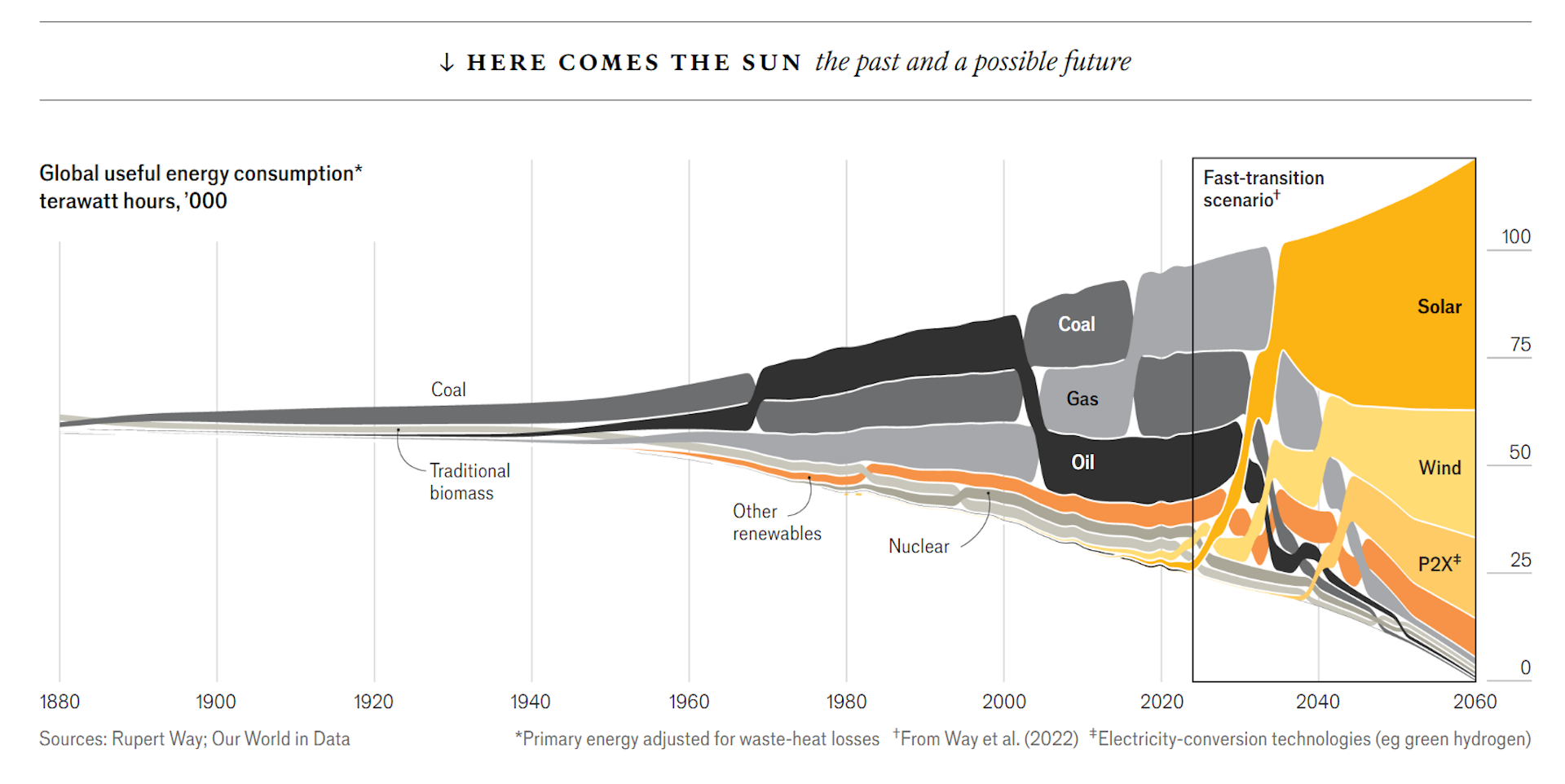
Oxford University energy specialist Rupert Way has modelled a “fast transition” scenario, in which the costs of solar and other new technologies keep falling as they have been rather than as the International Energy Agency expects.

He finds that by 2060, solar will be by far the world’s biggest source of energy, exceeding wind and green hydrogen and leaving nuclear with an infinitesimally tiny role.

In Australia, solar is pushing down prices

Australia’s energy market operator says record generation from grid-scale renewables and rooftop solar is pushing down wholesale electricity prices.

South Australia and Tasmania are the states that rely on renewables the most. They are the two states with the lowest wholesale electricity prices outside Victoria, whose prices are very low because of its reliance on brown coal.

It is price – rather than the environment – that most interests The Economist. It says when the price of something gets low people use much, much more of it.

As energy gets really copious and all but free, it will be used for things we can’t even imagine today. The Economist said to bet against that is to bet against capitalism.

The Conversation

Peter Martin is Economics Editor of The Conversation.

ref. When it comes to power, solar is about to leave nuclear and everything else in the shade – https://theconversation.com/when-it-comes-to-power-solar-is-about-to-leave-nuclear-and-everything-else-in-the-shade-233644

New study shows mysterious solar particle blasts can devastate the ozone layer, bathing Earth in radiation for years

Source: The Conversation (Au and NZ) – By Alan Cooper, Distinguished Professor, Charles Sturt University

Aurora over green hills near Thun, Switzerland. Julien Anet

The remarkable aurora in early May this year demonstrated the power that solar storms can emit as radiation, but occasionally the Sun does something far more destructive. Known as “solar particle events”, these blasts of protons directly from the surface of the Sun can shoot out like a searchlight into space.

Records show that around every thousand years Earth gets hit by an extreme solar particle event, which could cause severe damage to the ozone layer and increase levels of ultraviolet (UV) radiation at the surface.

We analysed what happens during such an extreme event in a paper published today. We also show that at times when Earth’s magnetic field is weak, these events could have a dramatic effect on life across the planet.

Earth’s critical magnetic shield

Earth’s magnetic field provides a crucial protective cocoon for life, deflecting electrically charged radiation from the Sun. In the normal state, it functions like a gigantic bar magnet with field lines rising from one pole, looping around, and plunging back down at the other pole, in a pattern sometimes described as an “inverted grapefruit”. The vertical orientation at the poles allows some ionising cosmic radiation to penetrate down as far as the upper atmosphere, where it interacts with gas molecules to create the glow we know as the aurora.

However, the field changes a great deal over time. In the past century, the north magnetic pole has wandered across northern Canada at a speed of around 40 kilometres per year, and the field has weakened by more than 6%. Geological records show there have been periods of centuries or millennia when the geomagnetic field has been very weak or even entirely absent.

We can see what would happen without Earth’s magnetic field by looking at Mars, which lost its global magnetic field in the ancient past, and most of its atmosphere as a result. In May, not long after the aurora, a strong solar particle event hit Mars. It disrupted the operation of the Mars Odyssey spacecraft, and caused radiation levels at the surface of Mars about 30 times higher than what you would receive during a chest X-ray.

The power of protons

The Sun’s outer atmosphere emits a constant fluctuating stream of electrons and protons known as the “solar wind”. However, the Sun’s surface also sporadically emits bursts of energy, mostly protons, in solar particle events – which are often associated with solar flares.

Protons are much heavier than electrons and carry more energy so they reach lower altitudes in Earth’s atmosphere, exciting gas molecules in the air. However, these excited molecules emit only X-rays, which are invisible to the naked eye.

Hundreds of weak solar particle events occur every solar cycle (roughly 11 years) but scientists have found traces of much stronger events throughout Earth’s history. Some of the most extreme were thousands of times stronger than anything recorded with modern instruments.

Extreme solar particle events

These extreme solar particle events occur roughly every few millennia. The most recent one happened around 993 AD, and was used to show that Viking buildings in Canada used timber cut in 1021 AD.

Less ozone, more radiation

Beyond their immediate effect, solar particle events can also kickstart a chain of chemical reactions in the upper atmosphere that can deplete ozone. Ozone absorbs harmful solar UV radiation, which can damage eyesight and also DNA (increasing the risk of skin cancer), as well as impacting the climate.

In our new study, we used large computer models of global atmospheric chemistry to examine the impacts of an extreme solar particle event.

We found such an event could deplete ozone levels for a year or so, raising UV levels at the surface and increasing DNA damage. But if a solar proton event arrived during a period when Earth’s magnetic field was very weak then ozone damage would last six years, increasing UV levels by 25% and boosting the rate of solar-induced DNA damage by up to 50%.

Particle blasts from the past

How likely is this deadly combination of weak magnetic field and extreme solar proton events? Given how often each of them occurs, it appears likely they happen together relatively often.

In fact, this combination of events may explain several mysterious occurrences in Earth’s past.

The most recent period of weak magnetic field – including a temporary switch in north and south poles – began 42,000 years ago and lasted about 1,000 years. Several major evolutionary events occurred around this time, such as the disappearance of the last Neanderthals in Europe and the extinctions of marsupial megafauna including giant wombats and kangaroos in Australia.

An even bigger evolutionary event has also been linked to Earth’s geomagnetic field. The origin of multicellular animals at the end of the Ediacaran period (from 565 million years ago), recorded in fossils in South Australia’s Flinders Ranges, occurred after a 26-million-year period of weak or absent magnetic field.

Similarly, the rapid evolution of diverse groups of animals in the Cambrian Explosion (around 539 million years ago) has also been related to geomagnetism and high UV levels. The simultaneous evolution of eyes and hard body shells in multiple unrelated groups has been described as the best means to both detect and avoid the harmful incoming UV rays, in a “flight from light”.

We are still only starting to explore the role of solar activity and Earth’s magnetic field in the history of life.

The Conversation

Alan Cooper features in the ABC Megafaunal Extinctions documentary mentioned in the article.

Pavle Arsenovic does not work for, consult, own shares in or receive funding from any company or organisation that would benefit from this article, and has disclosed no relevant affiliations beyond their academic appointment.

ref. New study shows mysterious solar particle blasts can devastate the ozone layer, bathing Earth in radiation for years – https://theconversation.com/new-study-shows-mysterious-solar-particle-blasts-can-devastate-the-ozone-layer-bathing-earth-in-radiation-for-years-233464

Will digital currencies become the norm as the world moves towards a cashless society?

Source: The Conversation (Au and NZ) – By John Hawkins, Senior Lecturer, Canberra School of Politics, Economics and Society, University of Canberra

TierneyMJ/Shutterstock

More than 90% of the world’s central banks are looking at introducing a
central bank digital currency (CBDC), to complement existing banknotes.

What is a central bank digital currency?

A CBDC is not a new currency. It is a digital representation of an existing national currency. So an Australian CBDC would have exactly the same value as an Australian dollar. It would be legal tender.

It could be available in both retail and wholesale formats but usage would be optional and it would not replace hard currency.

Retail CBDCs are likely to allow point-of-sale purchases, government payments and transfers between individuals. Central banks are still considering many design features but most think their retail CBDCs won’t pay interest.

Like the banknotes in our wallets, the CBDC we could spend using our phones would be issued by the Reserve Bank.

But it would enable more sophisticated and innovative types of financial transactions, such as “smart contracts”, than existing forms of electronic money such as credit cards.

The wholesale version, by contrast, would only be available to financial institutions. They would be comparable to the deposit (“exchange settlement”) accounts these institutions currently hold with the central bank.

Report shows a global trend

The strong interest in CBDCs has been revealed in a recent report by the Bank for International Settlements (BIS) which surveyed 86 central banks.

While the BIS report shows 94% of central banks are considering CBDCs, with about one third running pilot projects, most are being cautious and do not expect to issue their own digital currency in the next few years.


Some countries are already using them

Retail CBDCs are already being used in several countries.

The first was the so-called “sand dollar”, launched by the Central Bank of the Bahamas in 2020. The Eastern Caribbean Central Bank also launched a CBDC, called DCash, in 2021. Nigeria and Jamaica also have CBDCs.

The major economy most advanced in work on a retail CBDC is China. The digital yuan, or e-CNY, has been widely trialled.

A possible Bank of England CBDC, or digital pound, has been nicknamed a “Britcoin” but no decision has yet been taken about whether it will go ahead.

If it does, it will require a vote in parliament and would then take a few years to introduce.

What are their uses and risks?

Central banks might be motivated to adopt CBDCs to preserve the role of central bank money. This would help ensure monetary policy remains an effective tool for managing the economy.

CBDCs might also make cross-border payments faster and cheaper. This is especially helpful in countries where many families rely on remittances from members working overseas.

A digital yuan is already being widely trialled in China.
Koshiro K/Shutterstock

Countries where a large proportion of the population don’t have bank accounts may see scope for improving financial inclusion.

One concern is that a retail CBDC might replace commercial bank accounts. Bank customers might transfer funds from banks to the absolute safety of a CBDC.

This could facilitate illegal activity because, like banknotes, CBDCs may be fully anonymous. But there may be privacy concerns if, to avoid this, people have to register to use a CBDC.

Smart coin for smart contracts

A smart contract involves an instant payment made simultaneously with, and conditional on, the transfer of ownership of an asset.

Vending machines provide a good analogy. If you insert $2 and press B4, then the machine dispenses the cookies in the B4 slot. In other words, if (and only if) the vending machine receives the required item of value, then it instantly performs the requested action.

So far, smart contracts have mainly been used for purchases of digital assets such as NFTs. In principle they could be used for buying shares or houses to ensure that the transfer of ownership happens automatically and simultaneously with the payment being made.

If they are to be used for important transactions such as buying shares and homes the payment needs to made using something whose value will not fluctuate between the time a customer decides to buy and when the transaction takes place.

Most discussion of smart contracts has suggested they could be based on so-called stablecoins, such as Tether and USDC. This form of cryptocurrency purports to hold reserves in high quality assets and therefore can maintain parity with a national currency such as the US dollar.

In practice, stablecoins are rarely used for payments outside the crypto ecosystem, and one major Australian bank, the National Australia Bank, has just abandoned its stablecoin project.

Even Meta/Facebook, with its deep pockets and enormous customer base, gave up on its Libra/Diem stablecoin project.

But a CBDC could provide a trustworthy basis for smart contracts.

As the BIS’ chief economist Hyun Song Shin put it, “anything that crypto can do CBDCs can do better”.

The Reserve Bank’s attitude

Australia’s Reserve Bank has so far been cautious about issuing a CBDC.

Then governor Philip Lowe said in 2021 “we have not seen a strong public policy case to move in this direction, especially given Australia’s efficient, fast and convenient electronic payments system”.

As more than 99% of Australian adults have a bank account, the financial inclusion motive does not apply here. And few Australian families rely on international remittances.

Also, Australia’s payments system has been improved over recent years. There is no sign of stablecoins or other crypto making a meaningful challenge to the use of the Australian dollar for payments.

But the Reserve appears to have become more interested of late. An assistant governor said last year a CBDC could “spur innovation” and a study conducted jointly by the Reserve Bank and the Digital Finance Cooperative Research Centre has identified possible uses, including smart contracts, faster settlement of financial transactions and a back-up payments system.

The Bank will be releasing a paper soon setting out a “roadmap for future work”.

John Hawkins was formerly a senior economist at the Reserve Bank of Australia and the Bank for International Settlements

ref. Will digital currencies become the norm as the world moves towards a cashless society? – https://theconversation.com/will-digital-currencies-become-the-norm-as-the-world-moves-towards-a-cashless-society-233069

If Meta bans news in Australia, what will happen? Canada’s experience is telling

Source: The Conversation (Au and NZ) – By Axel Bruns, Professor, Digital Media Research Centre, Queensland University of Technology

Thx4Stock team/Shutterstock

At a parliamentary hearing late last week, Meta once again suggested it could ban links to news on Facebook and Instagram in Australia.

This would repeat the ban it enacted for more than a week in February 2021. That ban was in response to the introduction of the News Media Bargaining Code, an Australian law designed to force digital platforms to pass on some of their advertising earnings to news publishers.

A similar law – based on this code – was passed in Canada last year. As a result, in Canada news has been blocked from Meta platforms since August 2023.

This has produced strongly negative results for Canadian news outlets. Not only has the Canadian law failed to produce revenue flows from Meta to news producers, it severely reduced the incoming user traffic to their websites from Meta’s social media platforms.

What happened after the news ban in Canada?

The ongoing news ban in Canada has had several key effects. First, the removal of direct links to news articles meant a collapse in user visits to news sites. Those who once occasionally clicked on a news link in their feed can no longer do so.

This has especially affected regional and local news sites, for whom Facebook is often a key source of audience traffic. At a time when regional and rural areas of both Canada and Australia are already in danger of turning into “news deserts”, this is particularly concerning.

News outlets and audiences have worked around the bans to some extent. They’ve found circumvention techniques, such as posting article content without links, or article screenshots.

But such tricks can never fully replace the audience attention that has been lost. They also don’t help news outlets generate revenue for their content (as website traffic does through ads).

Instead, the main replacement for news coverage on Facebook has been political discussion that doesn’t directly reference or link to the news it draws on. This disconnection also opens the door for the circulation of well-meaning misinformation or deliberate disinformation.

Ultimately, the users of Meta’s platforms who suffer the most are those who are least interested in the news and who believe “news will find them”.

Highly invested news consumers will always find the news somewhere else. Those who see news only when people in their networks share articles will miss out, and may not even notice what they’re missing.

News is already hard to find on social media

Social media users are on these platforms for many other purposes than to follow the news. Most Australians don’t actually care much for news in the first place.

According to this year’s Digital News Report Australia, 68% of Australians actively avoid the news, and 41% suffer from news fatigue. After years of wall-to-wall reporting about pandemic, ecological, domestic violence, financial and military crises, this is hardly surprising.

Australia’s News Media Bargaining Code was conceived with a flawed assumption that social media play a central role as a conduit to news content, and that Facebook wouldn’t follow through on its threats to ban news.

But Facebook’s parent company Meta did exactly that, and shows no signs of changing that approach. Indeed, even where it doesn’t actively ban news content altogether, it is now substantially reducing news visibility in the feeds of its users.

This is because news has long tended to be more trouble for Meta than it’s worth. Not only is news a minute subset of all Facebook content, but it also generates an out-sized amount of unhappiness and controversy that requires costly moderation.

Meta also knows that reducing the visibility of news on its platforms doesn’t substantially impact on user experience. By its own calculations, only some 3% of the posts Facebook users see in their feeds contain links of any kind.

This can’t be independently verified without greater data access for independent researchers than the company currently provides, but certainly aligns with the everyday experience of ordinary Facebook users. Even of these 3% of posts, only a fraction link to news sources, let alone Australian news sources.

Our own analysis during the brief Australian news ban in February 2021 showed only a very minor impact on the posting and engagement patterns on Australian Facebook pages. Many users may not even have noticed news was suddenly missing from their feeds.

What can Australia do now?

In 2021, the news ban was temporarily resolved by Meta agreeing to voluntarily make some payments to a select few Australian news organisations.

In exchange, the then Morrison government elected to not “designate” Meta under the bargaining code, meaning the provisions didn’t apply to Meta’s platforms. These agreements are now coming to an end and Meta has already stated it has no interest in renewing them.

This gives the Albanese government the choice between applying the code to Meta after all, or allowing the agreements to expire without consequence. The latter would effectively kill off the News Media Bargaining Code as a meaningful piece of legislation.

Formally “designating” Meta to make it pay news publishers is likely to backfire. Meta is building an obvious argument here: if its platforms carry only a limited amount of Australian news content, why should it be forced to share revenue with Australian news publishers?

Both in the court of public opinion and in any legal proceedings it may pursue, such an argument is likely to prove highly persuasive.

A smarter solution to support local news

Australian news media need financial support, but the bargaining code was always severely flawed legislation. It should be abandoned at the earliest opportunity.

There is a better way for the Albanese government to tackle the real issue at stake: media revenue.

Right now, most Australian news media outlets are struggling to survive. Since news media moved online, audiences now expect news for free and most readers are not willing to pay. That leaves many publications without a sustainable business model and in need of public subsidy.

But we don’t usually provide subsidies by forcing profitable companies to negotiate directly with unprofitable ones, like the News Media Bargaining Code does. An alternative model is needed.

One option could be to use the corporate tax generated from digital platforms to support public-interest journalism by Australian media organisations. This would mean taxing the platforms’ revenues appropriately and fairly in the name of Australian citizens and in the national interest.

However, this would also require a stronger quality framework for what constitutes public-interest journalism. The latest round of journalism lay-offs in Australia shows we are rapidly running out of alternatives if we want to sustain quality, diverse Australian news content into the future.

The Conversation

Axel Bruns is an Australian Laureate Fellow and receives funding from the Australian Research Council through the Australian Laureate Fellowship project Determining the Dynamics of Partisanship and Polarisation in Online Public Debate, and the ARC Centre of Excellence for Automated Decision-Making and Innovation. He provides occasional expert feedback on Meta products as part of the company’s Instagram Working Group.

ref. If Meta bans news in Australia, what will happen? Canada’s experience is telling – https://theconversation.com/if-meta-bans-news-in-australia-what-will-happen-canadas-experience-is-telling-233662

Just 15 centimetres of water can float a car – but we are failing to educate drivers about the dangers of floodwaters

Source: The Conversation (Au and NZ) – By Amy Peden, NHMRC Research Fellow, School of Population Health & co-founder UNSW Beach Safety Research Group, UNSW Sydney

Scherbinator, Shutterstock

Every year in Australia, people driving into floodwaters drown and many more are rescued. Do you know what to do when there’s water on the road?

We searched all state and territory learner and driver handbooks for information about floodwaters, including signage. Our findings, published in the Journal of Safety Research, are disturbing.

Across half of Australia’s states and territories, the driver handbook ignores flooding. That’s a missed opportunity, considering the handbook contains road rules and provides advice on how to navigate safely. While some states fail to provide any flood-related information, others give detailed practical guidance. Only the New South Wales handbook includes explanation of the meaning and purpose of flood signage.

This is despite almost all states and territories experiencing vehicle-related flood deaths, including drowning, between 2001 and 2017. It’s a major problem that is only going to get worse as the climate changes. So our research shows driver education needs to come up to speed, fast.

Why do people drive into floodwaters?

Our previous research revealed motorists can feel compelled to drive into floodwaters for a range of reasons. These include time pressures such as being late for work or school, or needing to get home to family or pets. Sometimes they feel pressured by their passengers, or motorists behind them on the road, urging them to cross.

People also report having been encouraged or instructed as learners to drive into floodwaters. Past experience as a passenger also influences a learner driver’s future willingness to drive into floodwaters.

So the views of significant others, such as their supervising driver, strongly influence decisions around driving into floodwaters.

Avoid driving into floodwaters, for life’s sake.

What we did and what we found

We assessed all publicly available, government-issued learner and driver handbooks (12 documents) across all six Australian states and two territories. We also looked for flood-related signage. We used a method for reviewing online material through a systematic search including in-document key words and imagery.

Four jurisdictions provided no information on flooding in the handbook. In the ACT, South Australia, Tasmania and Victoria, drivers need to look elsewhere for information on floodwaters and driving safety.

Only one jurisdiction provided information on flood signage such as depth markers and “road subject to flooding”. Hats off to the NSW Road User Handbook, which warns:

Floodwater is extremely dangerous. Find another way or wait until the road is clear. It’s safer to turn around than to drive in floodwater.

For the states and territories that did provide information on floodwaters in the handbook, the content varied.

NSW, Queensland and the Northern Territory warned against entering floodwaters in a vehicle. They highlighted the dangers and financial penalties associated with driving on closed roads.

In the NT and Western Australia, handbooks provided practical information on when and how to cross floodwaters safely, such as how to gauge safe water depth based on vehicle size, and to avoid fast-flowing water.

Although well-intentioned, judgements around what constitutes fast-flowing water are subjective and hard for any driver to assess, let alone learner drivers. Even drivers of larger vehicles such as four-wheel drives are regularly involved in flood-related vehicle drowning fatalities.

Just 45cm of water can float a large 4WD, and considerably less for smaller vehicles.

A small car can float in just 15cm of water.

Handbooks represent valuable sources of safety information, particularly for new drivers who must learn important road rules to progress from one licence to another. Such graduated driver licensing schemes reduce road traffic injury, particularly among young people.

However, many of these handbooks fail to provide consistent, practical evidence-based information about flooding. There is an opportunity here to support safer driving behaviours.

Safety tips for all drivers

We encourage drivers to follow these safety tips:

  • avoid driving into floodwaters
  • identify alternative routes, so you have a plan B
  • familiarise yourself, and any learner drivers in the household or under your care, with the meaning and purpose of flood signage
  • understand the legal consequences of crossing a road closed sign
  • discuss the dangers of driving into floodwaters with learner drivers and help them formulate their own plan B
  • model safe driving for all passengers, including children.

Time to lift our game

Driving into floodwaters remains the main cause of flood-related drowning in Australia.

For our emergency service personnel, driver behaviour, including people ignoring road closed signs, significantly complicates the already dangerous act of performing a flood rescue.

Extreme weather and flooding are likely to become more frequent and intense in the future. That means the chance of being faced with a flooded road is growing. So information about driving during floods is vital for all, from the newly licensed to the experienced driver.

We hope our research will encourage all states and territories to include provide practical, evidence-based advice on floods in driver handbooks as soon as possible.

The Conversation

Amy Peden receives funding from the National Health and Medical Research Council. She is an honorary Senior Research Fellow with Royal Life Saving Society – Australia.

Kyra Hamilton has received funding from Royal Life Saving Society – Australia.

ref. Just 15 centimetres of water can float a car – but we are failing to educate drivers about the dangers of floodwaters – https://theconversation.com/just-15-centimetres-of-water-can-float-a-car-but-we-are-failing-to-educate-drivers-about-the-dangers-of-floodwaters-233116

First an autism diagnosis then a clinician’s office – how the evidence supports a different approach for families

Source: The Conversation (Au and NZ) – By Andrew Whitehouse, Bennett Chair of Autism, Telethon Kids Institute, The University of Western Australia

Orson Elitok/Shutterstock

Minister for the National Disability Insurance Scheme (NDIS), Bill Shorten, has proposed a number of policy changes to the scheme. It is hoped these will ensure its sustainability for future generations.

The proposals and legislative amendments follow a nationwide discussion on the need for reform so the NDIS can achieve its original aim to support and empower Australians with disability. Currently, one in ten children aged between five and seven years are participants of the NDIS.

Less discussion has focused on how the introduction and roll-out of the NDIS may have shaped community expectations around early support. For example, many families are now seeking supports that do not align with what experts know is best practice for children with developmental delays or who are autistic.

So what does the evidence say works best for young children diagnosed with autism? And how could reframing community expectations be critical to the success of any policy reform?

Support can come in different forms

Around 20% of children in Australia experience developmental delay, and around 3% of children are autistic. Many of these children will require additional support to meet their developmental needs at some time.

Depending on its aims, support can be delivered in many places, including within clinical settings, or in settings embedded within everyday life.

Within the NDIS there has been dramatic increases in the delivery of support in specialised clinical settings, such as the clinics of speech pathologists or occupational therapists. But best practice guidelines consistently call for community-embedded approaches.

Best practice guidelines – consensus statements within a specialist area that summarise evidence and describe what reflects the best approach – emphasise the importance of building capacity within the child’s everyday routines and environments.

This might be at home with parents, in childcare and early schooling with educators, or in their local community with playgroups, sport coaches and other important people in the child’s life.

Within the current NDIS funding model, these types of supports are either underfunded or unfunded, and therefore not prioritised.

The NDIS Review that completed its work last year highlighted a range of policies which incentivise the delivery of services within clinical settings. These include the dominance of individual support packages, an activity-based fee-for-service funding model and rigid funding categories – all of which preference clinic-based service delivery as a way of controlling costs.

Specialised services within clinical settings have an important role to play, particularly when children are presenting with developmental challenges that are having a substantial impact on their daily functioning.

However, this model of care is not what is best for the majority of children.

The three Rs

Three core tenets of best practice are the delivery of support at the right time, in the right amount and in the right context.

Right time

Development is a sequential process. Skills are built up over time, with later skills often relying on the firm foundation of earlier skills. Because of this, early delays can cascade into greater challenges over time. Effective support must move quickly to provide support early. This is also when support needs may be lower.

Right amount

Many people assume more intense support will result in better outcomes for children. But research does not bear this out. A recent meta-analysis – a type of study that uses statistics to compare different studies – found no evidence outcomes improve with increasing amounts of therapy.

Instead, the right amount should be individually determined and should vary across a child’s life as their needs and environment change over time.

Right context

One of the primary goals of childhood disability supports is to enable children to participate fully and meaningfully in family and community life. To achieve this goal, supports must be delivered in the right context.

Wherever possible, supports should be delivered in naturalistic settings (home, childcare, school) and focus on family and community capacity building.

Policy changes need community shifts

The NDIS reform bill currently before parliament makes provisions for more flexible use of personal funding. This may make it easier for clinicians and families to adapt the type of support to the changing needs of the child over time.

The other major proposed change is the development of a “foundational support” system. State and territory leaders, who will be responsible for delivering this support, have asked for more detail on the cost of this shift. But the government hopes such a system could support the “missing middle” between children receiving intensive therapies and no therapy at all.

But policy changes alone will not be enough to realign the system.

The NDIS was established in 2013, and many families’ and clinicians’ knowledge of what represents best practice supports for children is framed by the “specialist” model of care. The success of any policy change will also likely hinge on a community reappraisal of the importance of community-based supports.

girl in clinical setting turning away from therapist
Clinical settings play an important role when autism is having an impact on daily activities.
Studio Romantic/Shutterstock

Building capacity

Naturalistic supports decrease the distance between therapy and everyday life. This helps ensure supports are immediately translatable to the child’s daily life.

So prioritising supports that can be brought into community settings, like childcare, the community library or the local sports club is vital. This focus might be different to what families and those providing a diagnosis have become used to expecting.

Family and community capacity building is a powerful way to support children. Through identifying the key people in a child’s life and empowering them with knowledge and skills, children can receive high quality support from those who know them best. When non-specialists are equipped to deliver supports, children can be supported wherever they are by people who will have deep and lasting bonds in their lives.

The Conversation

Andrew Whitehouse works for the Telethon Kids Institute, which is the operator of a NDIS registered provider, CliniKids. Andrew Whitehouse receives research funding from the NHMRC, Angela Wright Bennett Foundation, and the Autism CRC.

David Trembath works for Griffith University. He receives funding support for his position from the Telethon Kids Institute where he holds an honorary title, as well as research project funding from Autism CRC, Playgroup NSW, the Australian Government Department of Health and Aged Care, and the Medical Research Future Fund.

Sarah Pillar works for the Telethon Kids Institute which is the operator of CliniKids.
Sarah Pillar has family members who have a diagnosis of autism and who access the NDIS.

ref. First an autism diagnosis then a clinician’s office – how the evidence supports a different approach for families – https://theconversation.com/first-an-autism-diagnosis-then-a-clinicians-office-how-the-evidence-supports-a-different-approach-for-families-233106

‘Not just as we are, but as we have been and as we will be’: the time-warping brilliance of Australian artist Julie Rrap

Source: The Conversation (Au and NZ) – By Cherine Fahd, Associate Professor Visual Communication, University of Technology Sydney

Julie Rrap, Disclosures: A Photographic Construct (detail), 1982, installation view. Julie Rrap: Past Continuous, Museum
of Contemporary Art Australia, 2024, black and white archival prints, colour cibachrome prints,
Museum of Contemporary Art,
purchased 1994. Image courtesy the artist and Museum of Contemporary Art Australia © the artist. Photograph: Zan Wimberley

The first time I saw Julie Rrap’s artwork was also the first time I saw Julie. It was 1993 and I was a 19-year-old painting student at the College of Fine Arts in Paddington. Her self-portrait, Persona and Shadow: Puberty (1984), hung at the end of the corridor where I took art history classes. I used to look at the woman in that photograph and think that, despite performing a pose of feminine reserve, she was all-knowing and mighty.

I met the real Julie Rrap in 2012. By then, I was a 38-year-old photo-media artist teaching at Sydney College of the Arts. I thought, “Here is the mythic artist whose work had been a cornerstone of my artistic education, now an everyday colleague.” I told her about my first encounter with her work. She graciously giggled, having been told similar stories by many who had studied her work.

Julie Rrap, Persona and Shadow: Puberty, 1984. Image courtesy the artist and Roslyn Oxley9 Gallery, Sydney © the artist.
x

In 2021, we travelled together to Canberra to see the nine images from Persona and Shadow on show at the National Gallery of Australia. On seeing the iconic photographs of Julie Rrap, by Julie Rrap, with Julie Rrap, I fully experienced the doubling and mirroring effects of her work.

This collision in time, with the artist and her body, is precisely what Rrap’s latest solo exhibition at the Museum of Contemporary Art, Past Continuous, contends with.
It features her landmark 1982 installation Disclosures: A Photographic Construct, alongside new works – encapsulating more than four decades of exploration of the female body as a subject and object of art.

The nude comes to life

Disclosures (1982) was a pivotal piece in Rrap’s career. Comprising more than 70 photographs and self-portraits, it undermines the traditional voyeuristic gaze associated with the nude female body. The nude has come to life wearing a camera around her neck, acting as both the photographer and muse in a studio of her own. Rrap points the camera not only at herself but also at us, the viewers.

Julie Rrap, Disclosures: A Photographic Construct (detail), 1982, Museum of Contemporary Art, image courtesy and © the artist.
Photograph by Cherine Fahd

This reversal creates a dialogue between the artist, the camera and the viewer, challenging the objectification of women in Western art. Rrap makes herself the nude, who is alive and writhing with her own creative agency.

The multichannel video work Drawn In (2024) is a companion piece to Disclosures created 42 years later. Rrap reinforces herself as a creator by energetically sketching around her nude body in charcoal – multiple GoPros replacing the older-style camera.

Julie Rrap, Drawn In, 2024, (detail), 3-channel digital video projection, 3-channel audio, phototex, image courtesy the artist, © the artist.

Seeing Disclosures in the context of this newer work highlights the consistency and depth of Rrap’s inquiry. It demonstrates all the ways we can never see ourselves from the perspective of others. No matter how many self-portraits we take, or how much we study our reflection, we get no closer to having an external objective view of ourselves. Rrap has always known how we appear is as changeable as the weather.

The artist and the artist in conversation

The new works in Past Continuous explore the transformation of the body through time. The video works Time Passing Through Me (2024) and Mirror Talk (2024) create a conversation between the artist’s younger and older selves.

In Mirror Talk, we see the faces of young Julie and older Julie glitching and morphing. We can hear a typewriter beat out the words from Sylvia Plath’s poem Mirror – becoming a language for young Julie, aged 31, to talk to her future self, aged 72. This poetic device issues an affecting tenderness from the present self to the past self and vice versa.

Julie Rrap, Mirror Talk (still, detail), 2024, 2-channel digital video animation, colour, sound, vinyl, image courtesy the artist; Roslyn Oxley9 Gallery, Sydney; and ARC ONE Gallery, Melbourne © the artist.

At the centre of the exhibition is SOMOS (Standing On My Own Shoulders) (2023), a life-sized bronze sculpture of Rrap standing on her own shoulders. To see the body of a woman in her seventies cast in bronze is gloriously defiant and daringly unconventional.

It not only challenges traditional depictions of the classical female nude in Western art as being young and helpless, but also counteracts the cultural hierarchies that privilege the bronzed bodies of naked men above the bodies of older women.

The body as a site of enquiry

In her 70s, Rrap’s decision to continue to bring her own body into view is deliberate and without vanity. There is no softening of the edges or raising of the flesh – and no attempt to erase the marks of time. She stands before us as she is, in her complexity. This is not a body that has been idealised or romanticised. It is real, lived-in, strong and vulnerable at the same time.

Julie Rrap, featuring: Disclosures: A Photographic Construct (detail), 1982, installation view, Julie Rrap: Past Continuous, Museum of Contemporary Art Australia, 2024, image courtesy the artist and Museum of Contemporary Art Australia © the artist, photograph: Zan Wimberley.

There is defiance in this – a refusal to hide or diminish the reality of a finite human existence. As a young female artist in the late 1990s and a middle-aged artist today, I find Rrap’s use of her own body in her work profoundly liberating. It is an invitation to see my own body not just as a failing object but as an ongoing, changeable medium of artistic and political expression.

Standing in front of SOMOS, I am reminded of the conversations we have with ourselves and the ways we shape and reshape our identities over time. Rrap’s work is a testament to this ongoing process of becoming. It is an invitation to see ourselves not just as we are, but as we have been and as we will be. It is a celebration of the process of self-transformation. And for that I am deeply grateful.

Julie Rrap: Past Continuous is at the Museum of Contemporary Art, Sydney, until February 16 2025.

Julie Rrap, foreground: SOMOS (Standing On My Own Shoulders), 2024, bronze, Art Gallery of Western Australia Collection, purchased 2024; background: Drawn In (detail). 2024, 3-channel digital video projection, 3-channel audio, phototex; installation view, Julie Rrap: Past Continuous, Museum of Contemporary Art Australia, 2024, image courtesy the artist and Museum of Contemporary Art Australia © the artist, photograph: Zan Wimberley.

Cherine Fahd does not work for, consult, own shares in or receive funding from any company or organisation that would benefit from this article, and has disclosed no relevant affiliations beyond their academic appointment.

ref. ‘Not just as we are, but as we have been and as we will be’: the time-warping brilliance of Australian artist Julie Rrap – https://theconversation.com/not-just-as-we-are-but-as-we-have-been-and-as-we-will-be-the-time-warping-brilliance-of-australian-artist-julie-rrap-233094

With its nuclear energy policy, Peter Dutton seems to have forgotten the Liberal Party’s core beliefs

Source: The Conversation (Au and NZ) – By Judith Brett, Emeritus Professor of Politics, La Trobe University

When Robert Menzies was out of office in 1943, in between prime ministerships, he was thinking about the future of non-Labor politics in wartime Australia. He read Edmund Burke’s book Thought on the Present Discontents. In it, Burke included the now-famous definition of a political party as:

a body of men united in promoting by their joint endeavour the national interest upon some particular principle on which they are all agreed.

For Burke, political parties were legitimate when they were based on shared principles and were committed neither to personal nor sectional interest, but to the interest of the nation as a whole.

Recently, Opposition Leader Peter Dutton announced the Coalition would not have an emissions reduction target for 2030. Instead, it would build seven nuclear power plants to reach zero emissions by 2050.

I have spent much of my research life thinking and writing about the Liberal Party and its predecessors, as well its three most successful leaders: Alfred Deakin, Robert Menzies and John Howard. So I have been running Dutton’s nuclear policies against my understanding of the Liberal party’s core principles.

It’s left me puzzled. Setting aside the many technical questions about the cost and feasibility of the plan, the proposal seems to breach some of those core principles.

Public ownership?

Political parties change and evolve over time, so it’s worth assessing the Liberal Party’s current web page for a contemporary statement of beliefs.

As expected, there are clear statements about the party’s commitment to maximising private sector initiatives. This includes statements like “government should only do those things the private sector cannot”, and “wherever possible government should not compete with an efficient private sector”.

So why is the Liberal Party proposing to build and own nuclear power plants on sites the government doesn’t even own, like Liddell in New South Wales? Or Loy Yang in Victoria where the owner, AGL, has plans already in train to develop low-emission industrial energy hubs?


How would a resort to compulsory acquisition of privately owned sites be justified by a party committed to private enterprise? And what would be the cost of these acquisitions?

Section 51 of the Constitution allows the Commonwealth to acquire property “on just terms from any State or person for any purpose in respect of which the Parliament has power to make laws.” Just terms – that means the property so acquired has to be paid for, by us, the tax payer, and this has to be added to the considerable cost of building the plants.

What about the states?

The state premiers of Queensland, NSW and Victoria oppose the plan, as do some Liberal opposition leaders such as Victoria’s John Pesutto.

Speaking to the Liberal Party Federal Council in June, Dutton said that the Commonwealth can override state laws, so the state premiers won’t be able to stop the plan.

Well it can, but it requires legislation that has to get through a Senate unlikely to be controlled by any future Coalition government. It would also cost a mountain of political capital.

But in terms of principles, how does this sit with the Liberal Party’s long-standing support for the rights of the states within the federation? One of the Liberal Party’s beliefs is that “responsibility should be divided according to federal principles, without the Commonwealth taking advantage of powers it has acquired other than by referendum.”

National interest or political interest?

It seems the policy as announced breaches two of the Liberal party’s core principles:

  1. government should not do what is better left to private enterprise

  2. the Commonwealth should respect state rights

But what of the national interest? The Liberal Party has always claimed it is not a sectional party and so is best able to represent the national interest. This, it says, is in contrast to Labor, with its ties to the unionised working class, and the Country Party turned Nationals which represents farmers, the regions, and increasingly, the miners.

What was most shocking about the Coalition’s plan is that it blithely flirts with sovereign risk and hence with Australia’s national interest. This is completely out of character for the Liberal Party.

Energy infrastructure is a long-term investment. Local and foreign investors are spooked by the collapse of bipartisan commitment to a clean energy transition and reconsidering their investment plans. And if the investment goes, so will the jobs it would have created. How is this in the national interest?

Shadow Minister for Energy Ted O’Brien tried to settle investors down by claiming the Coalition was still committed to renewables as well, but with little detail about the planned mix.

The only one of the Liberal Party’s traditional principles visible in this policy is the one that gives the leader, rather than the party, authority over policy.

But where does this leave the Liberals in federal parliament when their leader’s policy is so fundamentally at odds with their party’s core beliefs? Loyalty to the leader can only go so far. Perhaps Liberal MPs should consult their party’s website to remind themselves of the principles on which they stood for election. It seems in the pursuit of winning political points, political principles are all too easy to forget.

The Conversation

Judith Brett does not work for, consult, own shares in or receive funding from any company or organisation that would benefit from this article, and has disclosed no relevant affiliations beyond their academic appointment.

ref. With its nuclear energy policy, Peter Dutton seems to have forgotten the Liberal Party’s core beliefs – https://theconversation.com/with-its-nuclear-energy-policy-peter-dutton-seems-to-have-forgotten-the-liberal-partys-core-beliefs-233444

Give way: 5 reasons why the government should slow down on raising speed limits

Source: The Conversation (Au and NZ) – By Simon Kingham, Professor of Human Geography, University of Canterbury

georgeclerk/Getty Images

Only last year, all the talk was about lowering speed limits to save lives as part of the previous Labour government’s Road to Zero policy.

Even motoring advocacy group the Automobile Association was calling for continued reductions in speed limits.

But a year on, the coalition government has announced it will reverse the blanket speed limit reductions put in place after January 1, 2020. Submissions on this policy shift close on July 11.

It is worthwhile considering, then, why the government is increasing speed limits despite extensive research highlighting the benefits of slower speeds – including fuel savings, reduction in injuries and deaths, environmental benefits and community wellbeing.

1. Time savings and productivity

Supporters of higher speed limits argue slowing traffic costs time and money. But a 10% increase in speed limit doesn’t lead to a 10% increase in time savings. Much of a journey involves slowing in traffic and stopping at junctions and traffic lights.

The evidence suggests lower speeds usually result in very small increases in travel time, especially in urban areas. There are also questions about how travel time savings would be used.

Typically, time savings are multiplied by the number of vehicles on the road to produce the total time saved. For example, 5,000 vehicles on a stretch of road each day, saving an average of 30 seconds per vehicle, gives 2,500 minutes of time saved. At NZ$30 per hour, this would equal $75,000 of “saved time” each day.

That sounds like a significant number. But, of course, this is based on the assumption people use time savings to be more productive. Research suggests they often don’t.

In fact, making it easier to travel further and faster encourages people to travel longer distances. This is called induced demand and ultimately it adds to our traffic woes.

This is because, in the short term, people who had previously been discouraged from using congested roads start to use them. And in the longer term, people move further away from city centres to take advantage of new roads that allow them to travel further faster.

In addition, time savings associated with higher speed limits could be worth less than the fuel savings associated with lower speed limits. This is especially the case on state highways where more fuel is used at speeds above 80 kilometres per hour.

2. Crashes, deaths and injuries

Speed is a contributing factor in a third of fatal crashes on our roads and over 50% in crashes that kill 15-29 year olds. By comparison, potholes contribute to 1% of crashes leading to deaths or serious injuries.

The research clearly shows deaths and serious injuries are much higher at increased speeds, primarily as stopping distances become longer. The chances of a pedestrian surviving a crash are around 90% at 30km/h, compared to around 10% at 50km/h, for example.

Recent research in New Zealand has found notable reductions in these sorts of deaths and serious injuries on roads where speed limits have been reduced.

In countries such as the United Kingdom, where urban speed limits have been reduced, there have been significant reductions in road casualties. In Wales, reducing the speed limit on residential roads to 20 miles per hour (30km/h) has been estimated to save around $200 million annually.

3. Environmental pollution

Lower speed limits are also better for the environment. As well as producing greenhouse gas emissions, motor vehicles fuels emit air pollution – something that causes over 2,000 New Zealand deaths each year.

Research shows the speed at which vehicles travel affects the amount of pollutants released. Vehicles driven at very high or very low speeds emit more pollutants, with the lowest emissions from vehicles travelling at 60-80km/h.

Braking and accelerating increase emissions, so driving at a consistent speed is better. Research has shown the optimum speed limit to minimise emissions in urban areas is between 20 km/h and 30km/h.

Lower speeds also reduce noise, which has been identified as the second biggest environmental stressor on public health after air pollution. Even small decreases in speeds create significantly quieter roads.

4. Health, wellbeing, community and equity

Further research shows communities with slower traffic have better health and wellbeing.

Oxford University’s Danny Dorling has argued urban speed limits of 20 miles-per-hour (30km/h) are the “most effective thing a local authority can do to reduce health inequalities”.

This is particularly important in New Zealand. Rates of injury and death on the roads disproportionately affect Māori, younger people and those in low-income communities.

It has also been suggested there are multiple additional benefits from slower urban speed limits, including economic, health and social gains.

5. Global trends

Around the world, numerous cities are adopting lower urban speed limits, typically 30 km/h. For example, Wales has legislated a national speed limit of 20m/h (30km/h) on residential streets, and Scotland has committed to doing this by 2025.

Nearly 30 million people in the UK have speed limits of 20mph (30km/h) in the places where they live or work. There are similar examples across continental Europe.

In 2020, road safety experts and government ministers from 130 countries adopted the “Stockholm Declaration”. This advocates for 30km/h limits in urban areas where “vulnerable road users and vehicles mix in a frequent and planned manner”.

It’s not just Europe. Lower speed limits are being implemented across many other regions, including the United States and South America.

The case for lower speed limits is compelling. Lives are saved, pollution reduced, health improved and communities enhanced. The question is, why is New Zealand’s government seeking to buck the trend and go against what science shows is good policy, when the rest of the world accepts lower speed limits make sense.

The Conversation

Simon Kingham has previously worked as chief science advisor at the Ministry of Transport.

ref. Give way: 5 reasons why the government should slow down on raising speed limits – https://theconversation.com/give-way-5-reasons-why-the-government-should-slow-down-on-raising-speed-limits-233774

Can you drink your fruit and vegetables? How does juice compare to the whole food?

Source: The Conversation (Au and NZ) – By Emma Beckett, Adjunct Senior Lecturer, Nutrition, Dietetics & Food Innovation – School of Health Sciences, UNSW Sydney

Darina Belonogova/Pexels

Do you struggle to eat your fruits and vegetables? You are not alone. Less than 5% of Australians eat the recommended serves of fresh produce each day (with 44% eating enough fruit but only 6% eating the recommended vegetables).

Adults should aim to eat at least five serves of vegetables (or roughly 375 grams) and two serves of fruit (about 300 grams) each day. Fruits and vegetables help keep us healthy because they have lots of nutrients (vitamins, minerals and fibre) and health-promoting bioactive compounds (substances not technically essential but which have health benefits) without having many calories.

So, if you are having trouble eating the rainbow, you might be wondering – is it OK to drink your fruits and vegetables instead in a juice or smoothie? Like everything in nutrition, the answer is all about context.

It might help overcome barriers

Common reasons for not eating enough fruits and vegetables are preferences, habits, perishability, cost, availability, time and poor cooking skills. Drinking your fruits and vegetables in juices or smoothies can help overcome some of these barriers.

Juicing or blending can help disguise tastes you don’t like, like bitterness in vegetables. And it can blitz imperfections such as bruises or soft spots. Preparation doesn’t take much skill or time, particularly if you just have to pour store-bought juice from the bottle. Treating for food safety and shipping time does change the make up of juices slightly, but unsweetened juices still remain significant sources of nutrients and beneficial bioactives.

Juicing can extend shelf life and reduce the cost of nutrients. In fact, when researchers looked at the density of nutrients relative to the costs of common foods, fruit juice was the top performer.

So, drinking my fruits and veggies counts as a serve, right?

How juice is positioned in healthy eating recommendations is a bit confusing. The Australian Dietary Guidelines include 100% fruit juice with fruit but vegetable juice isn’t mentioned. This is likely because vegetable juices weren’t as common in 2013 when the guidelines were last revised.

The guidelines also warn against having juice too often or in too high amounts. This appears to be based on the logic that juice is similar, but not quite as good as, whole fruit. Juice has lower levels of fibre compared to fruits, with fibre important for gut health, heart health and promoting feelings of fullness. Juice and smoothies also release the sugar from the fruit’s other structures, making them “free”. The World Health Organization recommends we limit free sugars for good health.

But fruit and vegetables are more than just the sum of their parts. When we take a “reductionist” approach to nutrition, foods and drinks are judged based on assumptions made about limited features such as sugar content or specific vitamins.

But these features might not have the impact we logically assume because of the complexity of foods and people. When humans eat varied and complex diets, we don’t necessarily need to be concerned that some foods are lower in fibre than others. Juice can retain the nutrients and bioactive compounds of fruit and vegetables and even add more because parts of the fruit we don’t normally eat, like the skin, can be included.

blender and glass of orange juice
Juicing or blending might mean you eat different parts of the fruit or vegetable.
flyingv3/Shutterstock

So, it is healthy then?

A recent umbrella review of meta-analyses (a type of research that combines data from multiple studies of multiple outcomes into one paper looked at the relationship between 100% juice and a range of health outcomes.

Most of the evidence showed juice had a neutral impact on health (meaning no impact) or a positive one. Pure 100% juice was linked to improved heart health and inflammatory markers and wasn’t clearly linked to weight gain, multiple cancer types or metabolic markers (such as blood sugar levels).

Some health risks linked to drinking juice were reported: death from heart disease, prostate cancer and diabetes risk. But the risks were all reported in observational studies, where researchers look at data from groups of people collected over time. These are not controlled and do not record consumption in the moment. So other drinks people think of as 100% fruit juice (such as sugar-sweetened juices or cordials) might accidentally be counted as 100% fruit juice. These types of studies are not good at showing the direct causes of illness or death.

What about my teeth?

The common belief juice damages teeth might not stack up. Studies that show juice damages teeth often lump 100% juice in with sweetened drinks. Or they use model systems like fake mouths that don’t match how people drinks juice in real life. Some use extreme scenarios like sipping on large volumes of drink frequently over long periods of time.

Juice is acidic and does contain sugars, but it is possible proper oral hygiene, including rinsing, cleaning and using straws can mitigate these risks.

Again, reducing juice to its acid level misses the rest of the story, including the nutrients and bioactives contained in juice that are beneficial to oral health.

groups of women outside drinking orange juice in cups
Juice might be more convenient and could replace less healthy drinks.
PintoArt/Shutterstock

So, what should I do?

Comparing whole fruit (a food) to juice (a drink) can be problematic. They serve different culinary purposes, so aren’t really interchangeable.

The Australian Guide to Healthy Eating recommends water as the preferred beverage but this assumes you are getting all your essential nutrients from eating.

Where juice fits in your diet depends on what you are eating and what other drinks it is replacing. Juice might replace water in the context of a “perfect” diet. Or juice might replace alcohol or sugary soft drinks and make the relative benefits look very different.

On balance

Whether you want to eat your fruits and vegetables or drink them comes down to what works for you, how it fits into the context of your diet and your life.

Smoothies and juices aren’t a silver bullet, and there is no evidence they work as a “cleanse” or detox. But, with society’s low levels of fruit and vegetable eating, having the option to access nutrients and bioactives in a cheap, easy and tasty way shouldn’t be discouraged either.

The Conversation

Emma Beckett has received funding for research or consulting from Mars Foods, Nutrition Research Australia, NHMRC, ARC, AMP Foundation, Kellogg and the University of Newcastle. She works for FOODiQ Global including consulting for Citrus Australia, The Australian Beverages Council Ltd (ABCL), Hort Innovation and the Austrailan Food and Grocery Council. She is a member of committees/working groups related to nutrition and food, including the Australian Academy of Science, the National Health and Medical Research Council, the Nutrition Society of Australia and the Australian Institute of Food Science and Technology.

ref. Can you drink your fruit and vegetables? How does juice compare to the whole food? – https://theconversation.com/can-you-drink-your-fruit-and-vegetables-how-does-juice-compare-to-the-whole-food-205222

Record labels are suing tech companies for copying classic songs – and the results could shape the legal future of generative AI

Source: The Conversation (Au and NZ) – By Wellett Potter, Lecturer in Law, University of New England

Yurchanka Siarhei / Shutterstock

Last week, several major record labels filed copyright infringement lawsuits in US courts against the makers of two generative AI music apps, Suno and Udio. The labels allege the AI companies have engaged in copyright infringement by copying many sound recordings belonging to the record labels, and producing outputs very similar to those recordings.

The labels are seeking damages of US$150,000 (A$225,000) for each of the thousands of tracks of which copyright has allegedly been infringed.

The lawsuits allege Udio produced output with “striking resemblances” to songs including Dancing Queen by ABBA and All I Want For Christmas Is You by Mariah Carey, while Suno allegedly turned out songs similar to I Got You (I Feel Good) by James Brown and Johnny B. Goode by Chuck Berry, among others.

These lawsuits are not the first to trouble the booming generative AI industry. Visual artists have sued makers of image generating systems, while various newspapers are suing OpenAI, the owner of ChatGPT, for similar allegations. The result of the litigation may determine the future viability of such generative AI products.

How do music generators work?

For those who have not used these type of products, they work like this. You type in a text prompt, such as “compose a female jazz song about beating the Monday morning blues”. If you like, you can also provide your own lyrics.

The app then generates output in the form of an MP3 song, with a combination of vocals and instrumentation, which can be downloaded by the user.

To generate the song, the AI has been trained with a vast amount of data. The lawsuits allege this data comprises pre-existing sound recordings owned by various record labels and copied without permission. These sound recordings are at the heart of this issue.

Screenshot showing the input window of the Udio website.
Udio creates songs from a simple text prompt.
Udio

The litigation is likely to hinge on whether what Suno and Udio have done with any of these sound recordings is found to be “fair use”.

In the US, fair use is a defence to copyright infringement. In Australia, we have a narrower “fair dealing” copyright doctrine which pertains to particular uses such as research and study.

How will the court make its decision?

The court will examine four factors in relation to the use of the record labels’ songs by Suno and Udio. These are:

  1. the purpose and character of the use
  2. the nature of the original copyright work
  3. the amount and substantiality of the portion used, and
  4. the effect of the use on market value.

The most contentious factor is the purpose and character of the use. This involves examining whether the generative AI music is sufficiently “transformative”, which means it provides a new meaning, expression or value to the original work.

At the heart of Suno and Udio’s argument is that their technology is sufficently transformative in nature. They argue that this is because their AI synthesises new, original output, rather than copying and reproducing pre-existing songs.

Musical notation showing similarities between two snatches of music
The record labels’ lawsuit against Suno alleges similarities between an output called Deep down in Louisiana close to New Orle and Chuck Berry’s famous Johnny B. Goode.
RIAA

The court will examine the amount and substantiality of the portion of songs copied. It will examine how the allegedly copied songs are used in the AI training process and in generating output.

The element of substantiality may be qualitative, rather than quantitative. This means that in addition to the amount copied, the court can also consider whether a distinctive part of a song has been copied.

In addition, the effect of the generative AI use on the market value of the original sound recording will be considered. A use which substitutes for the original song in the market is more likely to be considered substantial. This point can be argued both ways.

What’s in a voice?

One major concern for the music industry is the cloning of voices. This is where other generative AI music apps (not Suno or Udio) can be used to clone a famous singer’s voice onto any song.

Suno released a statement on X, denying that voice cloning is possible using their app, because it does not allow users to reference particular singers. This issue will likely be contested in court.

What will happen next? It is difficult to predict.

Perhaps a settlement will be reached prior to the hearings. Perhaps new licensing arrangements between the parties will be developed, in a similar situation to OpenAI’s recent collaboration with News Corp.

What is certain is that there are other new AI voice cloning innovations being developed through start-up companies, to monetise and license voice cloning. One example is Hooky, a licensing platform for AI voice modelling, which provides artists with control over the use of their voice.

If the record labels’ litigation proceeds, it will give American courts the opportunity to clarify whether training activities and output from generative AI music apps are captured under fair use. This decision may also set a precedent for the activities conducted by other types of generative AI apps.

The Conversation

Wellett Potter does not work for, consult, own shares in or receive funding from any company or organisation that would benefit from this article, and has disclosed no relevant affiliations beyond their academic appointment.

ref. Record labels are suing tech companies for copying classic songs – and the results could shape the legal future of generative AI – https://theconversation.com/record-labels-are-suing-tech-companies-for-copying-classic-songs-and-the-results-could-shape-the-legal-future-of-generative-ai-233465

More than half of Australian young people are using strangulation during sex: new research

Source: The Conversation (Au and NZ) – By Heather Douglas, Professor of Law, The University of Melbourne

Shutterstock

We recently surveyed thousands of young Australians about their experiences of strangulation (or choking) during sex and found more than half (57%) reported being strangled by a partner during sex. About half (51%) said they had strangled their partner during sex.

For some people, strangulation is a high-risk but acceptable part of consensual sex, and it is important not to stigmatise people who use it.

But strangulation carries significant risks and harms to those who experience it, including the possibility of serious injury or even death, sometimes months after the event.

Participants most commonly reported first becoming aware of strangulation during sex when they were around 16–18 years old (29%), or during early adulthood, 19–21 years (24%).

People also reported they were exposed to information about or depictions of strangulation during sex through various sources, most commonly via pornography (61%), but also through movies (40%), friends (32%), social media (31%) and discussions with current or potential partners (29%).

Rates highest among gender-diverse people

We surveyed 4,702 Australians aged between 18 and 35 who had previously had a sexual experience. We defined strangulation or choking as when a person’s breathing is stopped or restricted by the use of hands, other body parts or ties (like ropes) around the neck. People sometimes refer to this behaviour as breath play or erotic asphyxiation.

More women (61%) than men (43%) reported ever having been strangled, with a high proportion of people who identified as trans or gender-diverse (78%) reporting being strangled.

More men (59%) than women (40%) responded they had strangled their partners, and nearly three-quarters (74%) of trans and gender-diverse participants reported that they had strangled their partners.

Two women, one with short hair and one with long hair, stand nose to nose against a door
People in lesbian relationships were more likely to have strangled their partner during sex than heterosexual women.
Shutterstock

While a high proportion of all genders reported being strangled or strangling partners during sex, women and trans and gender-diverse participants reported it happening more often compared to men.

Men, on the other hand, reported strangling partners during sex more often compared to women, with no difference compared to trans and gender diverse people.

Our data also showed gay and bisexual men were more likely to have been strangled than straight men, and that bisexual women were more likely than straight women to have ever been strangled or to have strangled a partner. Furthermore, lesbian women were more likely than straight women to have ever strangled a partner.

How old and how often?

For close to a third of participants, the first time they were strangled (30%) and/or strangled a partner (31%) occurred between the ages of 19 and 21.

On average, participants who reported being strangled during sex said they had been strangled around six times, by around three partners. Those who had strangled partners reported doing it around five times, with about three different partners.


Read more:
A new bill would bring Victoria’s strangulation laws in line with other states – but consent complicates matters


What did consent look like?

People generally responded they neither agreed nor disagreed to be strangled during sex. However, strangulation was generally perceived to be consensual, with consent understood in different ways.

Participants who had strangled partners reported more often that their partners played an active role in consent (79%) including asking to be strangled, agreeing to be strangled, or withdrawing previous consent, than those who were strangled (57%).

Consent was not always negotiated at the time. People who had been choked or choked a partner both responded that consent was negotiated during a previous sexual encounter where the person being choked gave their future consent.

A young couple lay on their stomachs on a bed and talk.
Consent for strangulation wasn’t always sought in the moment, but many respondents considered their experiences to be consensual.
Shutterstock

Among participants who were strangled, women (27%) were more likely than men (23%) to report that they asked to be strangled. Similarly, women (21%) were more likely than men (15%) to report that they had given consent during a previous sexual experience.

Among trans and gender-diverse participants, more than a quarter (29%) reported they had asked to be strangled and around one-fifth (20%) said they had given consent during a previous experience.

Nearly a third of men (32%) and a fifth of women (20%) reported they agreed to be strangled when they were asked by their partner. Around one-fifth (23%) of trans and gender-diverse participants reported that they agreed to be strangled when they were asked by their partner.

Trans and gender-diverse participants (12%) were more likely to report withdrawing consent compared to men (7%) and women (6%).

Lastly, women (10%) were more likely than men (8%) and trans and gender-diverse participants (4%), to report that they “did not consent, but did not ask or motion for them to stop”.

Why is this concerning?

Strangulation is linked to many different kinds of injuries regardless of whether there is consent. These can include bruising, sore throat, neck pain, a hoarse voice, a cough, difficulty swallowing, swollen lips, nausea and vomiting.

Other more serious impacts include pregnancy miscarriage, unconsciousness, brain injury and death. Miscarriage and death can occur weeks or months after the initial strangulation.

A woman tenderly touches her throat with both hands
Strangulation can a negative impact on someone’s health.
Shutterstock

Generally, there are no visible injuries associated with strangulation, but even when the person remains conscious, brain injury may occur. We know the more often people are strangled, the more likely they are to experience brain injury. This includes memory loss and difficulties problem-solving. Brain injury also accumulates so the more strangulations, the worse it becomes.

Strangulation has been criminalised across Australia because of the risk associated with it in the context of domestic violence and the harms linked with it more generally. But there are different rules across Australia about consent. And consent can be “blurry”.

In most states, strangulation is probably legal where there are no injuries reported and where there is consent. However, given how common strangulation during sex is, criminal law isn’t the best answer.

Instead, much better education is needed about the harms of this behaviour, and support is needed for those navigating this practice.

The Conversation

Heather Douglas receives funding from the Australian Research Council and the Australasian Institute of Judicial Administration.

Leah Sharman receives funding from the Australian Research Council.

Robin Fitzgerald receives funding from the Australian Research Council.

ref. More than half of Australian young people are using strangulation during sex: new research – https://theconversation.com/more-than-half-of-australian-young-people-are-using-strangulation-during-sex-new-research-231269

Fatima Payman breached ‘caucus solidarity’. What does this mean and why is it so significant?

Source: The Conversation (Au and NZ) – By Emily Foley, Associate Lecturer & PhD Candidate, La Trobe University, La Trobe University

The machinations of the Australian Labor Party machine are back in the spotlight this week, with Western Australian Senator Fatima Payman crossing the floor to support a Greens-backed motion calling for the Australian Senate to “recognise the State of Palestine”.

In crossing the floor, Payman breached the concept of caucus solidarity. She has been indefinitely suspended from the Labor Party caucus as a result.

So, what does this notion of caucus solidarity in the Labor Party really mean and how did it come about?


Read more:
View from The Hill: Fatima Payman alleges attempts to ‘intimidate’ her into quitting the Senate


What is caucus solidarity?

Simply put, caucus is the group of MPs that make up a political party. This includes cabinet ministers (or “frontbenchers”) and everyone else (“backbenchers”) across both the House of Representatives and the Senate.

Before the formation of the federation and the federal parliamentary Australian Labor Party, caucus solidarity had already taken root. In 1891, the first NSW Labor caucus meeting made a significant decision: MPs would pledge to abide by the majority decision and vote as a unified caucus.

The structure of the party’s organisation is formalised in the party’s constitution. In it, the federal parliamentary Labor Party has the authority in caucus meetings to make decisions on behalf of the parliamentary party, particularly on questions or matters that are not subject to national platform, conference, or executive decisions. In this specific case, the “majority decision of Caucus” must be “binding upon all members in the parliament.”

In addition, there is a formal pledge that binds all Labor MPs to support the caucus’s majority decision, even if they individually voted against the majority in a caucus meeting. This pledge has been adopted since the formation of state Labor parties before federation, but was formalised shortly within federal Labor in 1902.

This enduring notion of caucus solidarity originated from the party’s mass party trade union roots. There, the collective majority decision required solidarity to further the movement. It also explains why it is a more institutionalised element of the Labor Party compared with other parties.

It may be a feature of other parties in a less formalised way. For example, neither the Liberal Party nor the National Party has any formalised pledge that prohibits crossing the floor, though it’s generally politically frowned upon.

Theory vs practice

The same rules also say the caucus is bound to follow decisions made in the Labor Party’s National Platform. This is a compilation of theoretically binding policies the parliamentary wing of the party must follow. The National Platform is the outcome of Labor Party Conferences which take place every three years and consist of federal and state party leaders, elected state delegates and Young Labor delegates.

On the issue of Israel and Palestine, the most recent platform explicitly “calls on the Australian Government to recognise Palestine as a state and expected that this issue will be an important priority for the Australian government”.

However, the tension lies in the timing of these policies’ enactment, which is up to the discretion of the Labor parliamentary caucus and the party executive. Therefore, according to caucus conventions, Payman could not override the majority decision of the caucus, even if the caucus’ majority decision was in direct contradiction to party’s policy platform. Basically whatever caucus says, goes.

It is very rare for Labor MPs to break caucus solidarity and cross the floor (when someone votes in opposition to their own party on a particular issue by siding with an opposing motion). Research shows between February 1950 and April 2019, just 29 individual Labor members have ever crossed the floor. Comparatively, 185 Liberal politicians did so over the same period.

When it has been done by Labor MPs, it is more common for it to be done while Labor has been in opposition. It was also usually done with the full knowledge they may face expulsion from the party as a consequence.

All decisions must be debated in the caucus before a final decision is reached. After reaching a decision, all members are expected to vote for it in parliament, regardless of their own political position on the issue.

This isn’t always easy for MPs. In recent years, the example of same-sex marriage has been a particular sore point for certain MPs like current Foreign Minister Penny Wong. Back in 2004, Wong didn’t support the majority caucus opposition to the issue, but ultimately chose to follow the caucus rules.

The concept of caucus solidarity remains unchanged for more than a century, but Labor now faces greater cultural and political challenges and a more diverse electorate than in its early days.

Payman is pushing the pressure points of a mass party that, arguably, must evolve. But this notion of strict party discipline is intrinsic to the notion of a mass party like Labor. It raises questions about the future of a party with roots in the 19th century labour movement in determining crucial political and social issues in the 21st century.

The Conversation

Emily Foley is affiliated with the National Tertiary Education Union as an elected representative on the La Trobe NTEU branch.

ref. Fatima Payman breached ‘caucus solidarity’. What does this mean and why is it so significant? – https://theconversation.com/fatima-payman-breached-caucus-solidarity-what-does-this-mean-and-why-is-it-so-significant-233660

‘I don’t really wanna consume his content’: what do young Australian men think of Andrew Tate?

Source: The Conversation (Au and NZ) – By Amanda Keddie, Professor, Education, Deakin University

Eren Li/Pexels , CC BY

Public debates at the moment are awash with concerns about young men’s sexist and unsafe behaviour online. This includes reports of school students making AI deep fake pornography of their peers, ranking female classmates as well as anxieties about the “manosphere” radicalising young men into misogyny.

On top of this, there are moves to limit or even ban young people’s use of social media.

This is why understanding the online experiences of young men is increasingly important, especially given that their own views tend to be absent from these discussions.

Our research, based on interviews with young Australian men, shows there is a diverse range of views about controversial figures such as “manfluencer” Andrew Tate.

We found many young men are able to engage critically with this content. This is an encouraging finding.

Our research

Our study, funded by the eSafety Commissioner, aimed to understand what it is like to be a young man interacting with today’s online world.

We spoke to 117 young Australian men, aged 16 to 21. We did 25 online focus groups and 25 follow-up individual interviews during July and August last year. The group reflected diverse backgrounds and identities.

Part of our report included a case study on young men’s views of Tate.

Who is Andrew Tate?

Tate is a controversial British-American media influencer.
His online content ranges from “general motivational videos […] to more dangerous content that is explicitly misogynistic, homophobic, sexist and conspiratory”.

This includes saying women should not be allowed to drive and belong to men in a marriage. Tate is also facing trial in Romania on charges of human trafficking and rape (which he denies).

His influence on young boys’ views and behaviour, particularly towards their female teachers, has sparked deep concern among researchers in Australia.

What we found

Young men in our study expressed a diverse array of perspectives when it came to Tate and his “male empowerment” content. Some considered Tate an important source of inspiration for general self-improvement and manhood.

For example, Drew* who is 16 and straight and lives with disability said:

I haven’t watched every single video, but the occasional few [I’ve watched have] given me maybe a bit more confidence.

Warren (18, straight) similarly added he was quite supportive of “lots of things” Tate says:

Just being the best version of yourself is stuff that I’ve started to live by.

‘He’s the only one speaking out’

Some young men we interviewed also felt Tate expresses views about women and gender that are otherwise unsaid or silenced. Others viewed Tate as a good advocate for men. For example, Brenton (21, straight) told us he watched a lot of Tate content and agreed with “most of it”.

[Tate is] putting out so many opinions on things that haven’t been said in ages because of feminist movements and everything […] [H]e’s the only one speaking out about this sort of male stuff that’s not spoken about.

Jase (20, straight) also talked about how Tate was trying to instil “traditional human male masculinity into today’s generation of men”.

[In] terms of the whole equality thing, I think the whole social movement has gotten a little extreme and it’s essentially the women’s empowerment movement – they’re trying not exactly to replace us, but kinda.

Other young men were supportive of feminism but said young men also needed positive role models. As Nico, who is 18, straight and lives with disability, told us:

There aren’t many strong male role models for younger men growing up. Feminism is getting popular and stuff […] That’s very cool. I, you know, love to see that stuff. However, there’s been a large focus away from masculinity. And I think Andrew Tate [has] an important role in reminding us, you know, [about] what we should try [to strive] towards.

‘Painted a bad guy’

Other young men said controversy over Tate’s views was in part due to the way he was reported by mainstream media.

Theo, who is 18, Indigenous and straight, said “he’s been painted a bad guy in the media”. Manny (18, straight) told us:

[Tate’s] just completely different to the way they show him […] I think a lot of this stuff is taken out of context […] like some of the stuff [where] people say that he’s been misogynistic.

A teenage boy and girl sit side. by side on a couch. Both wear headphones. The boy types on a laptop, then girl looks at a phone.
Young Australian men expressed a range of views about Tate and his content. Not all were supportive.
Karolina Grabowska/Pexels, CC BY

‘He’s making money’

But there was also a high level of critical awareness among those we interviewed about Tate’s messaging and approach. Felix (20, bisexual) said male influencers said “outrageous things” to get attention.

People like Andrew Tate – perfect example […] The things he says make me so uncomfortable. It’s just gross, and it’s for attention and it gets the attention of the media.

Others noted being controversial was a way of attracting views and comments on his content. As Henry (16, straight) told us:

[H]e also knows that when people [are] getting mad and criticising him, he’s making money for that.

Young men also showed an understanding of how appealing and even manipulative some of Tate’s content can be to younger teenagers, who are figuring our their identities. As Vincent (21, straight) told us:

[H]e was taking advantage of all these impressionable young people who may [need] another male role model in their life […] I definitely get why people get sucked into it.

Rejecting Tate

Many of the young men we spoke to rejected Tate’s views – indeed, there was similar amount of support versus rejection.

This rejection ranged from disinterest to more specific criticism. As Jase (20, straight) told us:

Tate’s justifications for cheating on his partners as not ‘cheating’ but ‘exercise’, his focus on how much money he’s got and how many girls he’s been with, and his alleged trafficking. I don’t really wanna consume his content.

As Tristan (18, straight) added:

I think I remember seeing a clip of him saying, like, men are better than women […] I think it’s just a bit stupid.

Others explained they thought Tate was not consistent about his views. And could even be hypocritical.

What now?

There is cause for concern about the potential harms arising from influencers such as Tate and the wide availability of misogynistic content online. But there are also reasons to be optimistic given the variety of ways in which young men engage with this content.

Our research highlights the need for a nuanced discussion of the impacts of social media on adolescent boys. It is extremely important not to generalise or stigmatise all young men as “misogynistic” or wholly uncritical and uncaring in their engagement with online spaces.

*names have been changed.

The Conversation

Amanda Keddie receives funding from the eSafety Commission, the Australian Research Council and AMSANT.

This research was supported by the Australian government through the eSafety Commissioner. The views expressed herein are those of the authors and are not necessarily those of the Australian government.

Josh Roose receives funding from The Australian Research Council, eSafety Commission and Department of Home Affairs.

Michael Flood has received funding from the Australian Research Council, the Department of Justice and Community Safety in the Victorian Government, the Australian Primary Health Care Research Institute (APHCRI) Foundation and the eSafety Foundation.

ref. ‘I don’t really wanna consume his content’: what do young Australian men think of Andrew Tate? – https://theconversation.com/i-dont-really-wanna-consume-his-content-what-do-young-australian-men-think-of-andrew-tate-233654

Australia’s ‘carbon budget’ may blow out by 40% under the Coalition’s nuclear energy plan – and that’s the best-case scenario

Source: The Conversation (Au and NZ) – By Sven Teske, Research Director, Institute for Sustainable Futures, University of Technology Sydney

The Coalition’s pledge to build seven nuclear reactors, if elected, would represent a huge shift in energy policy for Australia. It also poses serious questions about whether this nation can meet its international climate obligations.

If Australia is to honour the Paris Agreement to limit global average temperature rise to 1.5˚C by mid-century, it can emit about 3 billion tonnes, or gigatonnes, of carbon dioxide (CO₂) over the next 25 years. This remaining allowance is what’s known as our “carbon budget”.

My colleagues and I recently outlined the technological options for Australia to remain within its carbon budget. We did this using a tool we developed over many years, the “One Earth Climate Model”. It’s a detailed study of pathways for various countries to meet the 1.5˚C goal.

So what happens if we feed the Coalition’s nuclear strategy into the model? As I outline below, even if the reactors are built, the negative impact on Australia’s carbon emissions would be huge. Over the next decade, the renewables transition would stall and coal and gas emissions would rise – possibly leading to a 40% blowout in Australia’s carbon budget.

Australia has a pathway to 1.5˚C

Earlier this year, my colleagues and I analysed the various ways Australia could reduce emissions in line with the 1.5˚ goal. The analysis, commissioned by the Climate Council, involved devising emissions-reduction targets for various sectors and industries. We also examined available technologies, the required investments, the potential of various technologies to reduce emissions, and timeframes.

The work produced five main findings:

  1. Australia can reduce its energy-related CO₂ emissions by 75%, relative to 2005 levels, by 2030. Under this scenario, the energy sector would be entirely decarbonised just before 2050

  2. Australia has enormous solar potential and significant wind energy potential. To supply Australia’s projected electricity demand in 2050, we need only tap into about 0.5% of this potential

  3. By 2030, solar power and wind energy (onshore and offshore) would generate about 80% of Australia’s projected electricity demand each year

  4. The electricity system can remain secure with higher levels of renewables, by deploying a mix of strategies, such as new storage capacity, managing consumer demand and improving transmission infrastructure to get the energy where it’s needed

  5. Australia can decarbonise its economy with existing technologies, but not with existing policies.

The Coalition’s nuclear energy plan, if enacted, involves replacing seven coal power plants with nuclear reactors, increasing gas-based power generation and slowing the installation of solar and wind generation.

This would put Australia on a totally different emissions path to the one outlined above. But how different?

Nuclear: a change of tack

Using the One Earth climate model, I calculated two scenarios of how the policy would affect Australia’s carbon emissions until 2050. These calculations have not yet been peer-reviewed, but are based on an established modelling tool and publicly available information.

Under the first scenario, the Coalition’s seven nuclear reactors are built and operating by 2040 (bearing in mind this timeframe is highly unlikely to be achieved). The reactors would have a total capacity of about 6.5 gigawatts and produce about 50 terrawatt hours of electricity.

Let’s say Australia wants to stay within its carbon budget of 3 billion tonnes of CO₂ emitted in the three decades to 2050. Would this be achieved under the nuclear plan? The results produced by our model suggest the clear answer is no.

It shows with nuclear in the mix, Australia’s total emissions would rise from 3 billion tonnes to 4.2 billion tonnes – blowing our 2050 carbon budget by 40%.

This assumes two 0.5 gigawatt gas power plants are built by 2030 and another two of the same capacity by 2040. It also assumes the capacity of existing coal-fired power of 16 gigawatts in 2030, 10 gigawatts in 2035 and 5 gigawatts in 2040. The Australian Energy Market Operator expects Australia’s entire coal fleet will be retired by 2038. So this scenario would require extending the life of coal plants.

Under the second scenario, Australia realises nuclear energy is totally unfeasible, and from 2035 reverts to Plan A: an economy powered mostly by renewable energy. But during that lost decade, Australia’s rate of renewable electricity generation stagnates.

In this case, according to the modelling, the delay would cause Australia to blow its carbon budget by more than 100% by 2050 – emitting a total of 6.7 billion tonnes of CO₂.


An economy-wide impact

Any delay to the renewables transition will have repercussions far beyond the energy sector.

The modelling shows Australia’s export industries sectors – especially steel, cement and aluminium – will be heavily affected if our energy sector is not quickly decarbonised, because many of them use substantial amounts of electricity. Click here to see the numbers in more detail.


Around the world, jurisdictions acting to decarbonise their economies are taking steps to ensure their own industries remain globally competitive. For example, the European Union plans to impose financial penalties, in the form of tariffs, on carbon-intensive imports such as steel and cement. The United States is implementing a similar mechanism.

The buildings sector also stands to lose from a delay to the energy transition. Buyers place a premium on low-emissions buildings. If the energy transition slows down, so too does the greening of our buildings sector.

As others have noted, there is no cost-case for nuclear energy in Australia. There is also no solution to the problem of nuclear waste, and the plan is likely to encounter stiff public opposition.

The above analysis shows the Coalition’s strategy will also jeopardise Australia’s emissions reduction efforts. At the end of the day, nuclear is a lose-lose situation for Australia, now and in future.

The Conversation

Sven Teske receives funding from Climate Council, project report has been published in March 2024; https://www.uts.edu.au/oecm/australia

ref. Australia’s ‘carbon budget’ may blow out by 40% under the Coalition’s nuclear energy plan – and that’s the best-case scenario – https://theconversation.com/australias-carbon-budget-may-blow-out-by-40-under-the-coalitions-nuclear-energy-plan-and-thats-the-best-case-scenario-233108

Increasing annual leave to five weeks would cost employers less than you might think

Source: The Conversation (Au and NZ) – By Jeff Borland, Professor of Economics, The University of Melbourne

Pro-stock Studio/Shutterstock

Five weeks annual leave is an idea whose time may have come.

A decade ago, a Productivity Commission inquiry into Australia’s industrial relations system, recommended governments periodically “examine whether there are any grounds for extending the existing 20 days of paid annual leave”.

Now, with the Shop Distributive and Allied Employees Association pushing for an extra week of annual leave for 1.3 million retail and fast food workers, the issue may be about to get a serious hearing.

Employees doing continuous shift work – including nurses and firefighters – are already able to take five weeks of annual leave.

Recent deals between Ikea, Apple, Bunnings and Big W and staff have added to the number of workers with another week of annual leave.

But for most of us in jobs with annual leave, four weeks is what we get.

Annual leave has remained unchanged since 1974

Historically, extra annual leave has been an important way for workers to secure their share of the gains from productivity growth – in addition to increases in wages and other benefits.

Most workers won the right to a week’s annual leave in 1941 following a case brought to the Commonwealth Arbitration Commission by the Amalgamated Engineers Union.

The entitlement was progressively increased, reaching four weeks in 1974.

Since then, however, annual leave has remained unchanged. Possible explanations include a decline in union power to campaign on behalf of workers, and slower productivity growth.

Although total leave time did grow with the granting of extra public holidays, 50 years on, it is timely to look at increasing annual leave.

How does Australia compare?

Australia is currently in the middle of the pack for annual leave, compared to other OECD countries. Having 20 days puts us in a group with a majority of the 35 countries, including the United Kingdom and New Zealand.

About a quarter of countries have fewer statutory days of annual leave, with the United States having the lowest number, zero. A quarter also have more days. Employees in several European countries, including Austria, get 25 days.

When it comes to total days of annual leave and state public holidays are included, Australia is also middle-ranked for its days of total annual and public holiday leave.


But won’t it increase labour costs?

Increasing annual leave to five weeks would cost employers less than you might expect.

Take the example of a worker employed on an annual salary.

At the moment, an employer pays for 52 weeks to get 48 weeks of work. Suppose annual leave increases to 5 weeks. The employer would then need to pay for 53 weeks to get the same 48 weeks of work. That extra week, from 52 to 53 weeks, is about a 2% increase in labour costs.

This might seem sizeable. But it’s less than the usual annual growth in average weekly ordinary time earnings for full-time employees, which is about 3% per year over the past decade is there a link for this 3%?.

Of course, other costs for employers might rise, such as from needing to spend extra time in arranging work schedules.

Offsetting that, however, workers may become more productive . Extra annual leave is also likely to some extent to be traded off for wage increases – as happened when the superannuation guarantee was introduced in 1992.

Another proposal is that increased annual leave could partly substitute for state-level public holidays, such as the AFL Grand Final holiday in Victoria.

Do employees want extra annual leave?

New deals by IKEA and other businesses suggest the answer is “yes” – and workers may be happy to trade off an extra week of annual leave for higher wages.

But the broader picture is likely to be mixed. A survey by the Australian Institute back in the early 2000s found respondents were evenly split between preferring a 4% pay rise or two extra weeks of annual leave.

Young girl and man making sandcastle on a beach
The number of leave days hasn’t officially increased since 1974 but extra public holidays have been added in most states.
Blue/Orange Studio/Shutterstock

Australia’s large numbers of workers with untaken annual leave is sometimes also suggested as a reason why extra annual leave is not needed.

A recent Roy Morgan survey found more than one in five workers had more than five weeks leave accrued. However, accumulated leave can be explained by workers saving for an extended vacation, or wanting to take leave but feeling under pressure not to take time off.

Don’t forget casual workers

In all this, it has to be remembered there’s a large group of employees for whom an increase in annual leave brings no direct benefit.

Casual workers, accounting for 22% of employees in 2023, are not entitled to annual leave.

To ensure these workers didn’t miss out, any increase in annual leave for permanent employees would need to be matched by a rise in the leave loading for casual employees.

Yet whether this would bring equity can be questioned, given research showing not all casual employees receive the loadings they should.

If it’s timely to consider an increase in annual leave, perhaps it’s also timely to think again about leave for casual employees.

The Conversation

Jeff Borland receives funding from the Australian Research Council. He was an expert witness to the Fair Work Commission for the Shop Distributive and Allied Employees Association in a case relating to penalty rates for casual employees in the retail sector in 2018.

ref. Increasing annual leave to five weeks would cost employers less than you might think – https://theconversation.com/increasing-annual-leave-to-five-weeks-would-cost-employers-less-than-you-might-think-233441

Oldest living culture: our new research shows an Indigenous ritual passed down for 500 generations

Source: The Conversation (Au and NZ) – By Russell Mullett, Traditional Custodian — Kurnai, Indigenous Knowledge

GunaiKurnai Elder Uncle Russell Mullett at entrance to Cloggs Cave, East Gippsland. Jess Shapiro, courtesy GunaiKurnai Land and Waters Aboriginal Corporation

We often hear that Aboriginal peoples have been in Australia for 65,000 years, “the oldest living cultures in the world”. But what does this mean, given all living peoples on Earth have an ancestry that goes back into the mists of time?

Our new discoveries, announced today in the scientific journal Nature Human Behaviour, shed new light on this question.

Under the guidance of GunaiKurnai Elders, archaeologists from the GunaiKurnai Land and Waters Aboriginal Corporation and Monash University excavated at Cloggs Cave near Buchan, in the foothills of the high country near the Snowy River in East Gippsland, Victoria.

What we found was extraordinary. Under the low, subdued light in the depth of the cave, buried under layers of ash and silt, two unusual fireplaces were revealed by the tip of the trowel. They each contained a single trimmed stick associated with a tiny patch of ash.

A sequence of 69 radiocarbon dates, including on wood filaments from the sticks, date one of the fireplaces to 11,000 years ago, and the deeper of the two to 12,000 years ago, at the very end of the last Ice Age.

Matching the observed physical characteristics of the fireplaces with GunaiKurnai ethnographic records from the 19th century shows this type of fireplace has been in continuous use for at least 12,000 years.

Enigmatic sticks smeared with fat

These were no ordinary fireplaces: the upper one was the size of the palm of a human hand.

Sticking out from the middle of it was a stick, one slightly burned end still stuck into the middle of the ashes of the fire. The fire had not burned for long, nor did it reach any significant heat. No food remains were associated with the fireplace.

A cave
The 11,000 year old ritual fire in Cloggs Cave, East Gippsland.
Photo by Bruno David, courtesy GunaiKurnai Land and Waters Aboriginal Corporation

Two small twigs that once grew from the stick had been trimmed off, so the stem was now straight and smooth.

We performed microscopic and biochemical analyses on the stick, showing it had come into contact with animal fat. Parts of the stick were covered with lipids – fatty acids that cannot dissolve in water and can therefore remain on objects for vast lengths of time.

The trimmings and layout of the stick, tiny size of the fire, absence of food remains, and presence of smeared fat on the stick suggest the fireplace was used for something other than cooking.

11,000-year-old lipid residues from fat covering parts of the Cloggs Cave ritual stick photographed at 400x magnification.
Photo by Birgitta Stephenson, courtesy GunaiKurnai Land and Waters Aboriginal Corporation

The stick had come from a Casuarina tree, a she-oak. The branch had been broken and cut when green. We know this because of the splayed fibres at the broken end. The stick was never removed from the fire during its use; we found it where it was placed.

A second miniature fireplace slightly deeper down in the excavation also had a single branch emanating from it, this one with an angled-back end like on a throwing stick, and with five small twigs trimmed flush with the stem. It had keratin-like faunal tissue fragments on its surface; it too had come into contact with fat.

A stick.
The 12,000 year old trimmed stick with hooked end that mimics a spear-thrower.
Photo by Steve Morton, Monash University, courtesy GunaiKurnai Land and Waters Aboriginal Corporation

The role of these fireplaces in ritual

Local 19th-century ethnography has good descriptions of such fireplaces, so we know they were made for ritual practices performed by mulla-mullung, powerful GunaiKurnai medicine men and women.

Alfred Howitt, government geologist and pioneer ethnographer, wrote in 1887:

The Kurnai practice is to fasten the article [something that belonged to the victim] to the end of a throwing stick, together with some eaglehawk feathers, and some human or kangaroo fat. The throwing stick is then stuck slanting in the ground before a fire, and it is of course placed in such a position that by-and-by it falls down. The wizard has during this time been singing his charm; as it is usually expressed, he ‘sings the man’s name,’ and when the stick falls the charm is complete. The practice still exists.

Howitt noted that such ritual sticks were made from Casuarina wood. Sometimes the stick mimicked a throwing stick, with a hooked end. No such miniature fireplace with a single trimmed Casuarina stem smeared with fat had ever been found archaeologically before.

500 generations

The miniature fireplaces are the remarkably preserved remains of two ritual events dating back 500 generations.

Nowhere else on Earth have archaeological expressions of a very specific cultural practice known from ethnography, yet traceable so far back, previously been found.

GunaiKurnai ancestors had transmitted on Country a very detailed, very particular cultural knowledge and practice for some 500 generations.

GunaiKurnai Elder Uncle Russell Mullett was on site when the fireplaces were excavated. As the first one was revealed, he was astounded:

For it to survive is just amazing. It’s telling us a story. It’s been waiting here all this time for us to learn from it. Reminding us that we are a living culture still connected to our ancient past. It’s a unique opportunity to be able to read the memoirs of our Ancestors and share that with our community.

What does it mean to be one of the oldest living cultures in the world? It means despite millennia of cultural innovations, the Old Ancestors also continued to pass down cultural knowledge and know-how, generation after generation, and have done so since the last Ice Age and beyond.


The authors are just six of the 17 authors of the journal article, including Birgitta Stephenson, who undertook the residue analyses.

The Conversation

Russell Mullett is affiliated with the GunaiKurnai Land & Waters Aboriginal Corporation, which receive grants from government. He is the chair of the Victorian Aboriginal Heritage Council.

Ashleigh Rogers has received funding from the Australian Institute of Nuclear Science and Engineering (AINSE). We thank the GunaiKurnai Land and Waters Aboriginal Corporation, the Australian Research Council, and the seven Australian and international universities who collaborated on this project.

Bruno David receives research funding from the Australian Research Council.

We thank the GunaiKurnai Land and Waters Aboriginal Corporation, the Australian Research Council, and the seven Australian and international universities who collaborated on this project.

Carney Matheson has received funding from EnviroGrant Queensland and Engaging Science Grant Queensland.

Fiona Petchey receives funding from the Royal Society Te Apārangi Marsden Fund.

Nathan Wright receives research funding from the Australian Research Council. Nathan Wright is affiliated with the Everick Foundation a Not-For-Profit that works directly with Australia’s First Nations Community. We thank the GunaiKurnai Land and Waters Aboriginal Corporation, the Australian Research Council, and the seven Australian and international universities who collaborated on this project.

ref. Oldest living culture: our new research shows an Indigenous ritual passed down for 500 generations – https://theconversation.com/oldest-living-culture-our-new-research-shows-an-indigenous-ritual-passed-down-for-500-generations-230782

If the NZ government wants to improve student outcomes, it needs to invest more in school-based healthcare

Source: The Conversation (Au and NZ) – By Sarah Williams, Senior Lecturer (Nursing), School of Clinical Sciences, Auckland University of Technology

New Zealand’s school achievement is currently front and centre with the government’s plans to invest NZ$67 million into structured literacy. But what has been largely missing from the discussion on education is the impact health can have on learning and academic achievement.

In New Zealand and elsewhere, increasing numbers of children are entering schools with specific health needs. And school staff, trained primarily in education, are frequently being tasked with meeting these needs alongside the demands of their daily teaching roles.

Teachers have reported student health and wellbeing is an ongoing concern.

But they also said they are under-resourced, under-trained and stretched by the wide array of demands on them. These range from managing challenging student behaviours, to identifying and supporting students with physical and mental health needs.

Increasingly, teachers are having to navigate the challenges of neurodiversity and educational disparities (which are, ironically, sometimes the result of unmet health needs).

Resolving the tension between teachers as pure educators and teachers who support the health and wellbeing of children is going to require investment well beyond literacy – particularly if the government is serious about improving overall educational outcomes.

New Zealand’s teachers are not alone in feeling overwhelmed.

A recent study from the United States, for example, noted increasing calls for improved mental health literacy among school staff. These teachers reported being challenged by time constraints, communication barriers and insufficient professional development. They also expressed their need to be better prepared to recognise mental health issues and provide classroom support.

Likewise, an Irish study found initiatives aimed at promoting student health and wellbeing were hampered by teachers’ lack of appropriate education and work-related time constraints.

Health and wellbeing as a subject

New Zealand’s initial teacher education programmes limit considerations of health and wellbeing to the health and physical education learning area, where there may be opportunities for communicating messages about healthy eating, drug awareness and aspects of physical hygiene, for example.

A recent report on the readiness of teachers limited its references on “health” to the health and physical education curriculum.

And the standards for the teaching profession fail to mention student health, although the code does state teachers are to “establish and maintain professional relationships and behaviours focused on the learning and wellbeing of each learner”.

Teachers feel conflicted

Despite limited training in the area, teachers face increasing demands to address and support the health needs of students. This is largely due to an increased understanding of the correlation between health and education. It is clear supporting students health and wellbeing helps them to meet their academic goals.

And yet, in a recent New Zealand study, not all teacher participants agreed that promoting and supporting student health and wellbeing was part of their role.

Some believed concerns with students’ health and wellbeing detracted from their key teaching focus. These findings align with an Australian study which asked whether teachers were health workers.

Providing teachers with skills to better support their students’ health needs can be an effective way to improve policy outcomes.

Schools have already been used by successive governments to implement and support health and wellbeing goals. Under Labour, the sale of “junk food” in school tuck shops and canteens was sharply curtailed with the aim of improving the health of students. And more recently, the government banned cell phone use in schools, in part to reduce online bullying and mental health issues.

Health and education working together

Much more can be done without solely relying on teachers.

Collaboration between the health and education sectors can enhance student learning and health outcomes.

Globally, nurses have a long history of delivering health services in schools and are considered a valuable resource for teachers, students and their families.

Currently New Zealand’s school based health services (SBHS) provide clinical healthcare services to around 115,000 students in 300 secondary schools. But this is often in a limited capacity and is targeted to vulnerable communities. It is also only aimed at older students.

While there are some nurses working in primary schools across the country, this service has diminished over time, is fragmented and lacks national leadership and direction.

A greater investment in school health services can address barriers to student learning and bring together otherwise separate sectors. It is also an opportunity to review the role health professionals can play in assisting teachers to identify, understand, and support the health needs of students.

While investing $67 million to improve literacy in schools is an important and significant policy step, so is investing in developing a national school health service that serves early childhood through to secondary school.

This service will support both teachers and students by helping to identify, manage and alleviate health-related barriers to learning. And in doing so, will have the double benefit of supporting education outcomes.

The Conversation

The authors do not work for, consult, own shares in or receive funding from any company or organisation that would benefit from this article, and have disclosed no relevant affiliations beyond their academic appointment.

ref. If the NZ government wants to improve student outcomes, it needs to invest more in school-based healthcare – https://theconversation.com/if-the-nz-government-wants-to-improve-student-outcomes-it-needs-to-invest-more-in-school-based-healthcare-232021

As student visa fees jump to $1,600, Australia is refusing more applications than ever

Source: The Conversation (Au and NZ) – By Sam Hoang, Research Officer, Centre for International Research on Education Systems, Victoria University

On Monday, the federal government more than doubled the application fee for international student visas. The move is effective immediately and sees the non-refundable fee jump from A$710 to $1,600.

The surprise news comes as part of a broader effort to rein in record-breaking migration levels, especially among international students.

As Home Affairs Minister Clare O’Neil said on Monday, the increased fee will make the migration system “fairer [and] smaller”. Education Minister Jason Clare added the fee increases would also fund “important reforms” such as payments for compulsory work experience and free preparation courses for university.

How do we compare to other countries?

The fee increase means Australia will have student visa application costs way above some of its competitor countries in the international education market.

For example, student visa fees are approximately US$185 (A$277) for the United States and about C$150 (A$164) for Canada. For the United Kingdom, it is £490 (A$932) and for New Zealand it is NZD$375 (A$343).

What do universities say?

The move has been met with dismay from the university sector.
The Group of Eight, representing Australia’s top research universities (including The University of Sydney and The University of Melbourne), described it as a “blatant revenue raising move” and a “massive hit” to the A$48 billion sector.

Given the A$1,600 fee is not refundable, it may lower the pool of genuine applicants to study in Australia. This could particularly mean less students from developing countries and less cultural diversity on campuses.

It builds on other recent policy changes, including increased English language and savings requirements to study in Australia. As well as plans to put a cap on the number of international students overall.

This has sparked concerns from groups such as Universities Australia that the sector is poised to suffer big financial losses, given the extent to which it relies on international student fees.

How did we get here?

The government has been clear it believes international students have returned much more quickly than anticipated after the reopening of borders.

After the pandemic, the former Morrison government implemented a series of measures to encourage the return of international students. These included longer visas and greater work rights.

But these policies have now been changed. As the chart below shows, visa grant rates are at record lows. This means the government is refusing more international student applications than ever before.

This is especially the case in the vocational education and training sector. According to a recent government review, this was identified as having the highest number “dodgy” providers. So-called “ghost colleges” enrol students who have no real intention of studying and come to Australia in order to work.

Is this a good idea?

The government’s aim to manage migration levels is to a certain extent understandable, particularly in the context of a tight housing market.

But given applications are being refused and there is an overall cap being planned, the fee increase feels like a blunt measure.

It also comes off the back of previous criticism about Albanese government changes to student visas, such as “risk ratings” for institutions. The argument is, migration integrity measures are being used to drive down overall student numbers, which is not what these systems were set up to do. This could undermine the original goal of attracting qualified international students.

It also adds to the significant, ongoing degree of uncertainty within universities.

Ultimately, the most important impact on international student numbers will be from the caps, which were announced just before the May budget. It is not yet clear what these will be or how they will be calculated. The legislation has been introduced to parliament and is now the subject of Senate inquiry.

There are alternatives

There are other possible measures the government could introduce to limit problems without hurting the overall sector.

For example, the government could consider measures such as limiting student visa extensions in specific locations facing housing shortages.

This will be important if Australia is to balance overall management of its migration program with the continued success of the significant economic benefits it reaps from international students.

The Conversation

The authors do not work for, consult, own shares in or receive funding from any company or organisation that would benefit from this article, and have disclosed no relevant affiliations beyond their academic appointment.

ref. As student visa fees jump to $1,600, Australia is refusing more applications than ever – https://theconversation.com/as-student-visa-fees-jump-to-1-600-australia-is-refusing-more-applications-than-ever-233667

View from The Hill: Fatima Payman alleges attempts to ‘intimidate’ her into quitting the Senate

Source: The Conversation (Au and NZ) – By Michelle Grattan, Professorial Fellow, University of Canberra

Rebel Senator Fatima Payman has escalated her confrontation with the Labor Party by claiming “some members” are trying to intimidate her into quitting the Senate.

The government is uncertain whether the Greens will exploit the situation with another pro-Palestinian motion to have Payman – suspended from caucus but not expelled from the party – voting against Labor a second time.

That would invite her expulsion. Meanwhile, the affair is distracting from the government’s promotion of its July 1 tax cuts and other cost-of-living relief.

After Prime Minister Anthony Albanese on Sunday suspended Payman from participation in caucus over her defiance of Labor’s solidarity rule, Payman said in an Instagram post late Monday that she’d been “exiled” and had “lost all contact with my caucus colleagues”.

She’d been removed from meetings, group chats and whips’ bulletins, she said.

“I have been told to avoid all chamber duties that require a vote, including divisions, motions and matters of public interest,” she said.

“These actions lead me to believe that some members are attempting to intimidate me into resigning from the Senate.”

The Sydney Morning Herald reported sources saying Albanese had told Payman she should think about whether it was appropriate to continue holding the seat if she was not representing Labor’s line. The Prime Minister’s Office said it did not comment on private conversations.

Payman said she would abstain from voting on matters in the Senate for the rest of the week – the last before the winter parliamentary recess – “unless a matter of conscience arises where I’ll uphold the true values and principles of the Labor Party”.

This was an obvious reference to any further motion on Palestine. Payman crossed the floor last week on a Greens motion. Albanese acted on Sunday after she said she would do the same again if the circumstances arose.

Payman said in her statement that she would use the time “to reflect on my future and the best way to represent the people of Western Australia”.

The battle between the WA senator and Labor is all about the “solidarity” rule requiring MPs to vote as a bloc. But the government is struggling to explain and justify how that rule is so important that a young Muslim woman is being disciplined for acting on what she casts as a point of principle.

Talking about how Payman should have behaved, Albanese on morning radio resorted to a football comparison.

“I watched the Hawks win their fifth game in a row yesterday,” he told the ABC. “The way that they won was that they’re not the best team on paper, but they act as a team.

“They pass the ball to each other. They don’t just kick at random. They don’t say, ‘We won’t worry about the rules, we’ll throw rather than handball’. They listen to the coach’s instructions.”

But his footie anecdote jarred. It sounded too simplistic for what is a more vexed and complex clash over a foundational Labor rule.

Payman’s position on the substance of the Middle East issue is broadly in line with the ALP platform.

That says the National Conference:

a. Supports the recognition and right of Israel and Palestine to exist as two states within secure and recognised borders;

b. Calls on the Australian government to recognise Palestine as a state.

Last week’s Greens motion declared “the need for the Senate to recognise the state of Palestine”. In her Sunday Insiders interview, Payman said she backed a two-state solution. (She abstained, however, on an amendment on the two-state position that Labor put last week).

Labor’s rule that MPs can’t cross the floor is sacrosanct. Even so, the degree of passion in the caucus over Payman’s breach is notable. The rule is deeply embedded in Labor’s history. Perhaps Labor MPs also feel potentially vulnerable, because this rule protects them from ever having to consider bucking the party line in a parliamentary vote (as Liberals sometimes do).

It’s hard to recall in recent times any substantive issue raising such internal anger as Payman’s flouting of the rules. There is a level of “how DARE she” fury.

Albanese’s anger came through clearly in his Monday interview, in which the PM wanted all attention on the cost-of-living relief coming into effect this week.

Asked why he’d suspended Payman, the PM said it wasn’t because of the policy she’d advocated.

“It’s because of the question that you have just asked me. [Today is] a day where we want to talk about tax cuts,” and cost of living relief. “Instead, you have seamlessly segued into the actions of an individual, which is designed to undermine what is the collective position that the Labor party has determined.”

Albanese acted on Payman’s Sunday threat – before she actually carried it through – to cauterise the problem she posed. But this proved impossible.

It’s hard to conclude anything other than Payman is on her way out of the Labor party, one way or the other, and that she ends up on the crossbench. (She is not up for election next time – she has another four years to go.) Whether she’s expelled or leaves herself, there would be much blowback for Labor.

Predictably, Payman is receiving support from the Muslim community, where the notion of caucus solidarity presumably doesn’t much resonate.

The Australia Palestine Advocacy Network (APAN) said in a statement it “stands firmly” with Payman. APAN said it was disturbed by the suggestion toeing the party’s line “is more important than standing up for the rights and lives of Palestinians”. It urged other MPs to follow her example.

Kos Samaras of the political research firm RedBridge (and a former Labor official) posted: “Over the past few months, we interviewed dozens of young Australian Muslim women, all born in Australia. Their main points were striking:

  • They have faced social abuse throughout their lives.
  • They are regularly reminded of their perceived inferiority.
  • They lack a political voice. When they attempt to speak up, alert, or draw attention to their disadvantages, the society they were born into, grew up in, and now raise their own children in demands their silence.”

It is easy to see how they would identify with Payman.

The Palestinian issue has been a huge problem for Labor from the start of the war. Payman has now taken the disruptive effect to a whole new level.

The Conversation

Michelle Grattan does not work for, consult, own shares in or receive funding from any company or organisation that would benefit from this article, and has disclosed no relevant affiliations beyond their academic appointment.

ref. View from The Hill: Fatima Payman alleges attempts to ‘intimidate’ her into quitting the Senate – https://theconversation.com/view-from-the-hill-fatima-payman-alleges-attempts-to-intimidate-her-into-quitting-the-senate-233673

The far-right has surged to the lead in France’s elections. But forming a government remains a tall order

Source: The Conversation (Au and NZ) – By Romain Fathi, Senior Lecturer, School of History, ANU / Chercheur Associé at the Centre d’Histoire de Sciences Po, Australian National University

Exit polls after the first round of the French legislative elections indicate the far-right National Rally party leading with about 34% of the vote. The New Popular Front (a coalition of parties from the far left to the moderate left) was in second with about 28% and President Emmanuel Macron’s centrist coalition was a distant third with about 20%.

This is by far the largest amount of votes the far right has received in legislative elections since the second world war.

Although the National Rally was ahead after the first round, however, alliances are likely to coalesce between the leftist, centrist and moderate right political parties this week to form a united front against far-right candidates in most electorates in the second round of voting.

This would likely make it very difficult for National Rally leader Marine Le Pen and president Jordan Bardella to secure enough seats in the National Assembly next Sunday to win an absolute majority.

This second – and most crucial – round of the snap elections will determine whether France has a far-right government, a hard-left government, or a government of moderates united against extreme factions at both ends of the political spectrum.

Although the third solution appears more plausible than the other two, it still may not guarantee political stability. Diverse coalitions don’t have a strong track record of stable government in France.

What happens now?

Although the National Rally was leading after the first round, it is unlikely to be able to form a government on its own. The reason: its capacity to attract more voters in the coming days is limited. This has been a recurrent issue for the far right at the second round in past elections.

Only 67% of French voters cast their ballot on June 30. Although this is high for turnout in the first round of a legislative election in the past two decades, it also means that millions of French people could yet tip the balance one way or another in their electorates next Sunday.

Given France’s traumatic experience of the second world war and the collaboration of its far-right Vichy government with the Nazis, some French people who did not vote in the first round may well head to polling booths next Sunday to prevent the far right from winning.

Hundreds of thousands of people turned out for demonstrations against the far right on Sunday, suggesting a highly mobilised electorate.

More importantly, leftist, centrist and moderate right political parties will likely attempt to forge alliances at the local level to prevent the election of far-right MPs.

This is how it would work. If no candidate receives an absolute majority in a race, the candidates with the two highest shares of the vote progress to the second round, along with anyone else who has received at least 12.5% of the vote.

So, the leaders of the New Popular Front alliance and Macron’s alliance will now urge their candidates to pull out of races where they placed third, so they can coalesce behind one candidate against the far right.

The leaders of these parties still have strong divisions, but as Raphaël Glucksmann, the head of the center-left socialists, said:

We must unite, we must vote for our democracy, we must prevent France from sinking.

Along with Gluncksmann, politicians as diverse as Marine Tondelier (the Greens), former PM Edouard Philippe (moderate right), François Bayrou (centre), current Prime Minister Gabriel Attal (from Macron’s own party) and many others called for the creation of a “Republican Front” to defeat the National Rally within a hour of the first-round exit polls being made public.

While this strategy was successful in previous elections against the far right – and may work once again – it does not necessarily mean France will end up with a strong and united government when it is all over.

Eurasia Group, a risk analysis firm, has said National Rally is unlikely to win an outright majority in the National Assembly. The group’s managing director, Mujtaba Rahman, said this means France is heading for:

deadlock and confusion with an irreconcilably blocked National Assembly.

The coming days are going to be extraordinary for French politics as alliances will be made (and perhaps some broken). The French people, meanwhile, will hold their breath and ponder what all of this means for the future of their country.

The Conversation

Romain Fathi does not work for, consult, own shares in or receive funding from any company or organisation that would benefit from this article, and has disclosed no relevant affiliations beyond their academic appointment.

ref. The far-right has surged to the lead in France’s elections. But forming a government remains a tall order – https://theconversation.com/the-far-right-has-surged-to-the-lead-in-frances-elections-but-forming-a-government-remains-a-tall-order-233659

Plastic Free July is a waste of time if the onus is only on consumers

Source: The Conversation (Au and NZ) – By Bhavna Middha, ARC DECRA and Senior Research Fellow, Centre for Urban Research, RMIT University

Arctic ice, Shutterstock

Every year, the Plastic Free July campaign asks us to refuse single-use plastic. The idea is that making a small change in our daily lives will collectively make a big difference. And hopefully, better behaviour will stick and become a habit.

The intent is good, but consumers shouldn’t have to bear full responsibility for plastic pollution. Individual sacrifices – particularly temporary ones – won’t make a significant difference.

Governments, manufacturers and retailers need to get serious about tackling this problem. If Plastic Free July put pressure on the supply side of the equation, rather than demand, it could be more successful.

Our research spans food packaging including plastics, waste, sustainable consumption and social practices. We know consumer demand is only one part of the picture. Eliminating plastic waste requires broader systemic changes.

The cabbage dilemma

Research shows consumers generally want to do the right thing by the environment but find it challenging.

Coming out of a supermarket with no packaging is difficult. There are few unpackaged food items and even when there is a choice, the unpackaged item may be more expensive.

Have you ever been stuck in the supermarket, choosing between the large head of cabbage you know you won’t finish before it goes bad, or the plastic-wrapped half-cabbage you really need?

Consumers should not be forced to choose between food waste (another huge problem) or plastic waste. Maybe there’s another way. For example, why not sell cabbages of different sizes? Why do we need to grow such large heads of cabbage anyway?

Both plastic consumption and food waste can be addressed by changing how we produce and distribute certain foods.

Governments, manufacturers and retailers must drive change

The onus for reducing plastic consumption and waste should be placed firmly on those who make plastic and profit from selling their products, as well as those who make and sell products wrapped in plastic packaging.

Research has shown just 56 companies globally are responsible for more than half of the branded plastic pollution that ends up in the environment.

Companies profit from using plastics because it is cheaper to use than changing to alternatives, such as cardboard or compostable materials, or using less packaging. This means companies choosing to avoid using plastics face unfair competition.

It’s a tough habit to kick. Industry-led voluntary schemes are limited in terms of both participation and outcomes. Many companies are failing to meet their own plastic reduction goals.

Governments need to step in and force companies to take responsibility for the plastic and packaging they manufacture. In practice, this could involve similar schemes to the container deposit scheme for beverage containers, or returning plastics to stores.

Replacing voluntary schemes with mandatory regulations and increased producer responsibility means companies will have to invest in long-term changes designed with care.

What’s Plastic Free July?

Cities are built around plastic

Our previous research has shown plastic performs an essential role in some, constrained circumstances. We found vulnerable householders often rely on plastic to make life manageable, such as using plastics to cover belongings on the balcony, or using plastic cutlery and plates in student apartments with minimal kitchen space. This includes people with accessibility needs, people relying on public transport to shop for groceries, or people who are financially constrained or living in small high-rise apartments.

Unsustainable lifestyles are not so much a choice as a product of poorly planned cities, housing and regulations. It is all very well if you are mobile and well-located, but if you live in a poorly serviced distant suburb and transport groceries or takeaway food or buy things on the go, then plastic is perhaps the only current affordable way to make it work.

So campaigns and solutions that do not consider how everyday lives and economy are intertwined with plastics can exclude people and spaces who can’t access the alternatives.

For example, there are ways to make convenience eating more sustainable in education settings. We have shown how canteens and microwaves in shared spaces can enable people to access affordable food with their friends, as in University Mensa in Germany.

Our new research will explore how single-use food-related plastics and packaging form an integral part of our daily lives, including shopping, work, cooking and storage.

Sometimes new policies inadvertently disadvantage certain groups and communities, such as the aged, less mobile, people living in apartments, or low socio-economic groups. Before we roll out new policies and regulations, we need to understand the roles these materials play and the kinds of services and value they provide.

We aim to develop a framework to inform policies and strategies that enable a just and inclusive transition to reduced plastic use.

What about after July?

Plastic Free July and similar campaigns are based on idea that making a temporary change will lead to more permanent lifestyle changes. But research shows temporary shifts are very different to structural, permanent shifts in practices.

Supermarkets will still wrap items in plastic and sell single-use plastic, even if we try to buy less during Plastic Free July.

Ultimately, the focus should be on designing effective infrastructure and policy solutions for lasting results, considering how demand for plastic is produced in the first place.

Some of these changes will require a shift in community expectations and food culture.

Rather than pointing the finger at consumers, let’s get to work on redesigning our cities. We need to rethink how everyday practices, manufacturing and distribution systems are structured to eliminate plastic waste.

The Conversation

Bhavna Middha receives funding from the Australian Research Council’s Discovery Early Career Research Award.

Ralph Horne has received funding from the Australian Research Council and the Victorian Government, and associated industry partners.

ref. Plastic Free July is a waste of time if the onus is only on consumers – https://theconversation.com/plastic-free-july-is-a-waste-of-time-if-the-onus-is-only-on-consumers-233436

Did people in Ancient Rome and Greece love the same way we do? Perhaps even more hopelessly

Source: The Conversation (Au and NZ) – By Konstantine Panegyres, McKenzie Postdoctoral Fellow, The University of Melbourne

Venus and Adonis depicted in a work by Simon Vouet. British Museum, CC BY-NC

Sometime around 100 AD, the Roman lawyer and aristocrat Pliny sent a letter to his third wife, Calpurnia – who was staying in a different part of Italy – to express how much he loved and missed her:

I love you so much, and we are not used to separations. So I stay awake most of the night thinking of you […] The only time I am free from this misery is when I am in court and wearing myself out with my friends’ lawsuits. You can judge then what a life I am leading, when I find my rest in work and distraction in troubles and anxiety.

Most people living today have felt some form of passionate romantic love, or will at some point in their lives – often with heartbreak in equal measure.

When we have problems with love, we like to console ourselves by thinking this happens to many other people. This is certainly true.

It has, of course, been happening for thousands of years.

Why do we fall in love?

One of the most famous ancient accounts of passionate love is found in the writings of the physician Galen (126–219 AD) who worked in Rome. In his book On Prognosis, Galen describes how he paid a call to the house of a man whose wife seemed unwell – suffering from insomnia, yet not with fever.

Galen questioned her, trying to find out why she couldn’t sleep, but she was unresponsive:

She replied hesitantly or not at all, as if to show the folly of such questions, and finally turned over, buried herself completely deep in the blankets, covered her head with a small wrap, and lay there as if wanting to sleep.

On subsequent visits, he discovered the woman was in love (and infatuated) with a dancer called Pylades, whom she had seen dancing at the theatre in the city. Her poor condition came from knowing her love could never be more than a secret desire.

Erastes (lover) and eromenos (beloved) kiss in a scene an Attic cup created circa 480 BC.
Wikimedia

Ancient people recognised how love could occur seemingly randomly, for reasons both simple and complicated.

In a play called The Man Who Loved Musical Pipes by Theophilus (4th century BC), one of the characters explains his basic reasons for having fallen in love with someone:

As for me personally, I’m in love with a young woman who plays the lyre […] she’s pretty, she’s tall, she’s good at her job.

Ancient lovers’ passionate embraces and affections have sometimes been recorded in intimate detail.

In one anonymous poem (of uncertain date), the author describes how, after his lover won a boxing contest, he went and kissed him on the lips even though his face was covered in blood:

When Menecharmus, Anticles’ son, won the boxing match, I crowned him with ten soft garlands, and thrice I kissed him all dabbled with blood as he was, but the blood was sweeter to me than myrrh.

The difficulties with love

There are many Greco-Roman stories about unrequited love and the miseries it can bring.

According to the philosopher Aristoxenus (4th century BC), one woman named Harpalyce died of grief after she fell in love with – and was rejected by – a man called Iphiclus.

A 1st century Roman mosaic depicting a love scene.
Wikimedia

There are also stories of people struggling to be with (and stay with) their lovers.

Galen explains how one of his patients, a slave, pretended to have a knee injury so he wouldn’t have to travel away from his lover for work.

Elsewhere, Galen writes about people engaging in secret love affairs:

They often have sex when they are drunk or have not digested their food, and they often engage in secret affairs so no one notices.

He says, with dry humour, these “secret affairs” are the reason “the similarity between children and parents in humans is less pronounced”.

A bronze Roman knife-handle decorated with lovers, circa 1st or 2nd century.
British Museum, CC BY-NC-SA

Spouses also bickered back then, much like today. In a letter from around 200 AD, a man travelling in Alexandria, Egypt, wrote home to his wife to complain how she didn’t seem to care much about him:

sleep does not come to me at night because of your inconsistency and your indifference concerning my affairs.

Is love a sickness?

Some ancient doctors thought love was a major factor in determining a person’s mental and physical health.

Galen, for instance, believed love could be blamed for some of his patients’ ailments.

I know men and women who have been struck by passionate love and become despondent and sleepless, then contracted an ephemeral fever because of something other than their love […] The disease of people who are constantly thinking about love is hard to cure.

Galen of Pergamum depicted in a 1906 work by Portuguese artist Veloso Salgado.
Wikimedia

Galen recommended people with lovesickness should change their lifestyles and engage in bathing, drinking, horse riding and travelling. He also advised them to invest their emotions into other matters such as gladiator fights or hunting with dogs.

Other doctors thought love was so powerful it could potentially cure people’s psychological problems. The 5th-century physician Caelius Aurelianus said love could be both the cure and the cause of insanity.

Either way, there’s no denying it

In one of his plays, the influential playwright Antiphanes (active in the early 4th century BC) wrote:

There are two things a man can’t conceal: that he’s drinking wine and that he’s fallen in love. Because both conditions betray themselves from the expression on his face and the words he speaks. In the end, those who deny it are the ones they most obviously convict.

So the next time love is on your mind, take comfort in knowing you’re not alone. For millennia, people have dealt with this difficult emotion – in all its glory and calamity – and come out the other side unharmed. Mostly, anyway.

The Conversation

Konstantine Panegyres does not work for, consult, own shares in or receive funding from any company or organisation that would benefit from this article, and has disclosed no relevant affiliations beyond their academic appointment.

ref. Did people in Ancient Rome and Greece love the same way we do? Perhaps even more hopelessly – https://theconversation.com/did-people-in-ancient-rome-and-greece-love-the-same-way-we-do-perhaps-even-more-hopelessly-233561

Gaps in reporting of nitrogen fertiliser use on farms leave an incomplete picture of impacts on water quality

Source: The Conversation (Au and NZ) – By Mike Joy, Morgan Foundation Senior Research Fellow in Freshwater Ecology and Environmental Science, Te Herenga Waka — Victoria University of Wellington

William West/AFP via Getty Images

New Zealand’s rivers, streams, lakes and groundwater reservoirs are under pressure.

Some lakes are regularly plagued by algal blooms because of high levels of nutrients, particularly nitrogen. A significant number of New Zealanders are exposed to high levels of nitrates in their drinking water.

New Zealand has rules intended to address this. The National Environmental Standards for Freshwater require farms to report their use of synthetic nitrogen and to cap application at a maximum of 190kg per hectare per year.

But an official information request reveals only 61% of dairy farm operators had reported their synthetic nitrogen use for the financial year ending in June 2023. For the year ending in June 2022, only around 45% had reported.

The state of New Zealand’s freshwater

About 85% of waterways in New Zealand’s farming catchments now exceed the Australasian nitrate guideline threshold. Most are getting worse.

Likewise, a recent study revealed around 800,000 New Zealanders have drinking water supplies with potentially hazardous nitrate levels. The data show the major cause of this is nutrient run-off and leaching, mainly from intensive farming relying on nitrogen from synthetic fertiliser.

To put this into perspective, nutrient loads in some of our farmed catchments now rival some of the world’s most intensively used areas such as the Mississippi River and Yellow River catchments.

Reporting of synthetic nitrogen fertiliser use is compulsory for operators of dairy farms with 20 hectares or more of grazed land.
William West/AFP via Getty Images

Synthetic nitrogen reporting rules

The National Environmental Standards for Freshwater cap synthetic nitrogen fertiliser application to land. Those who are unable to comply with the cap (190kg per hectare per year) need resource consent to exceed the limit.

The standards also require dairy farm operators, who may be contractors or owners, to report synthetic nitrogen fertiliser use to their regional councils, by the end of July each year. This reporting provides crucial information about the amount of nitrogen used across regions. It also shows where farms are exceeding the cap.

The government recently revealed initial plans to amend the Resource Management Act (RMA). Existing provisions require that resource consenting processes under the RMA prioritise the health of freshwater and human health needs (such as safe drinking water). The proposed changes would preclude this.

The removal of these requirements would allow decision makers to prioritise economic uses over the life-supporting capacity of water. The standards that are proposed to be repealed would have reduced the accumulation of nitrates in soil and freshwater.

The government has also signalled plans to remove Te Mana of Te Wai, a concept that refers to the fundamental importance of water which was first introduced in 2014 and strengthened in 2020.

If the proposed changes go ahead, the reporting rules on synthetic nitrogen use will be one of few remaining tools intended to address excessively high nitrogen losses caused by farm practices. This makes enforcement of the rules even more important.

Some dairy farm operators are not reporting

Reporting of synthetic nitrogen fertiliser use has been compulsory for operators of dairy farms with 20 hectares or more of grazed land since July 2022. Many operators have reported at least one year, if not two. Unfortunately, some have not reported at all.

This provides no surety that the cap is being complied with and an incomplete picture about how much nitrogen is being applied to land.

In response to an official information request, the Ministry for the Environment estimated that by 18 December 2023, around 61% of dairy farm operators had reported their synthetic nitrogen use, and only around 45% had reported during the previous year.

In regions with the largest growth in dairy farming and where nitrogen pollution is highest, compliance is far from complete.

By September 2023, Environment Canterbury advised they had received 808 reports from contiguous landholdings (parcels of land within a farm), across 771 farms. They were aware of 1,355 dairy effluent consents for farms in the region. This provides an indication of the scale of failure to report.

The Waikato Regional Council estimated about 37% of required farms had reported their synthetic nitrogen use. The Horizons Regional Council advised that, across the Manawatū-Whanganui region’s 761 dairy sheds, it had received 348 reports, indicating around 413 were outstanding. Reporting levels are higher in Southland where only 75 contiguous landholdings had failed to report.

Enforcement strategies are changing

Regional councils have so far taken an educational approach to enforcement. This makes sense to an extent, especially in areas where farmers are facing additional stress, such as those affected by Cyclone Gabrielle. In other areas, it is more worrying.

In the reporting year ending July 2022, Environment Canterbury was unable to identify farms that had not reported and could not follow up on these missing reports.

But regional councils may be moving towards providing direct individual support and considering formal enforcement strategies. Environment Canterbury is now able to identify those who have not reported and does follow up with them.

If councils and individuals both act during this current reporting round, we will be one step closer to improving waterways for future generations. For farm owners and operators, this will mean continuing to report their data or checking their contractors are doing so.

For councils, this will mean following up individually with those who do not report and considering enforcement action for the minority who haven’t reported after two years of support and education.

New Zealanders are worried about declining freshwater quality and health risks associated with nitrate levels. The response to these worries and the overwhelming evidence of increasing nitrate levels was to place a limit on the amount of synthetic nitrogen that could be applied. This won’t achieve anything if the reporting rules are not enforced.

Mike Joy receives funding from the Morgan Foundation and he is affiliated with The Environmental Law Initiative

Megan Cornforth-Camden is a senior legal advisor for the Environmental Law Initiative.

ref. Gaps in reporting of nitrogen fertiliser use on farms leave an incomplete picture of impacts on water quality – https://theconversation.com/gaps-in-reporting-of-nitrogen-fertiliser-use-on-farms-leave-an-incomplete-picture-of-impacts-on-water-quality-232709

French elections: First round of Pacific results show polarisation

By Patrick Decloitre, RNZ Pacific correspondent French Pacific desk

French Pacific results for the first round of French national snap elections yesterday showed a firm radicalisation, especially in the case of New Caledonia.

In both of New Caledonia’s constituencies, the second round will look like a showdown between pro-independence and pro-France contestants.

The French Pacific entity has been gripped by ongoing riots, arson and destruction since mid-May 2024.

Local outcomes of the national polls have confirmed a block-to-block, confrontational logic, between the most radical components of the opposing camps, the pro-independence and the pro-France (loyalists).

Pro-France leader Nicolas Metzdorf, who is a staunch advocate of the still-unimplemented controversial constitutional reform that is perceived to marginalise indigenous Kanaks’ vote and therefore sparked the current unrest in the French Pacific territory, obtained 39.81 percent of the votes in New Caledonia’s 1st constituency.

In the capital Nouméa, which has been suffering massive damage from the riots, he even received the support of 53.64 percent of the voters.

Also vying for the seat in the French National Assembly, the other candidate qualifying for the second round of vote (on Sunday 7 July) is pro-independence Omayra Naisseline, who belongs to Union Calédonienne, perceived as a hard-line component of the pro-independence platform FLNKS.

She obtained 36.34 percent of the votes.

Outgoing MP Philippe Dunoyer, a moderate pro-France politician, is now out of the race after collecting only 10.33 percent of the votes.

For New Caledonia’s second constituency, pro-independence Emmanuel Tjibaou topped the poll with an impressive 44.06 percent of the votes.

Île-des-Pins voting on pollng day yesterday in the first round of the French snap elections. Image: NC la 1ère TV screenshot/RNZ

Tjibaou is the son of emblematic Kanak pro-independence leader Jean-Marie Tjibaou, a dominant figure who signed the Matignon-Oudinot Accord in 1988 with pro-France leader Jacques Lafleur, ending half a decade of civil war over the Kanak pro-independence cause.

In 1989, Tjibaou was assassinated by a hard-line member of his own movement.

Second to Tjibaou is Alcide Ponga, also an indigenous Kanak who was recently elected president of the pro-France Rassemblement-Les républicains party (36.18 percent).

Another candidate from the Eveil Océanien (mostly supported by the Wallisian community in New Caledonia), Milakulo Tukumuli, came third with 11.92 percent but does not qualify to contest in the second round.

In New Caledonia, polling on Sunday took place under heavy security and at least one incident was reported in Houaïlou, where car wrecks were placed in front of the polling stations, barring access to voters.

However, participation was very high on Sunday: 60.02 percent of the registered voters turned out, which is almost twice as much as the recorded rate at the previous general elections in 2022 (32.51 percent).

New Caledonia’s four remaining contestants for the run-off round of French snap elections next Sunday, July 7 are Nicolas Metzdorf (clockwise from top left), Emmanuel Tjibaou, Omayra Naisseline and Alcide Ponga. Image: NC la 1ère TV

New Caledonia’s four remaining contestants for the run-off round of French snap elections next Sunday, July 7 are Nicolas Metzdorf (clockwise from top left), Emmanuel Tjibaou, Omayra Naisseline and Alcide Ponga. Image: NC la 1ère TV

French Polynesia
In French Polynesia (three constituencies), the stakes were quite different — all three sitting MPs were pro-independence after the previous French general elections in 2022.

Candidates for the ruling Tavini Huiraatira, for this first round of polls, managed to make it to the second round, like Steve Chailloux (second constituency, 41.61 percent) or Mereana Reid-Arbelot (third constituency, 42.71 percent) who will still have to fight in the second round to retain her seat in the French National Assembly against pro-autonomy Pascale Haiti (41.08 percent), who is the wife of long-time pro-France former president Gaston Flosse).

Chailloux, however, did not fare so well as his direct opponent, pro-autonomy platform and A Here ia Porinetia leader Nicole Sanquer, who collected 49.62 percent of the votes.

But those parties opposing independence, locally known as the “pro-autonomy”, had fielded their candidates under a common platform.

This is the case for Moerani Frébault, from the Marquesas Islands, who managed to secure 53.90 percent of the votes and is therefore declared winner without having to contest the second round.

His victory ejected the pro-independence outgoing MP Tematai Le Gayic (Tavini party, 1st constituency), even though he had collected 36.3 percent of the votes.

Wallis and Futuna
Incumbent MP Mikaele Seo (Renaissance, French President Macron’s party) breezes through against the other three contestants and obtained 61 percent of the votes and therefore is directly elected as a result of the first round for the seat at the Paris National Assembly.

This article is republished under a community partnership agreement with RNZ.

Article by AsiaPacificReport.nz

What are financial years – and why are they different from calendar years?

Source: The Conversation (Au and NZ) – By Michaela Rankin, Professor and Head, Department of Accounting, Monash University

Smart Calendar/Shutterstock

This article is part of The Conversation’s “Business Basics” series where we ask experts to discuss key concepts in business, economics and finance.


Today is July 1, the first day of the new financial year in Australia.

Also called fiscal years, financial years are often abbreviated in print. The one that’s just begun in Australia – July 1 2024 to June 30 2025 – will typically be denoted by FY24/25 or FY25.

As the name suggests, financial years are used for financial reporting, tax and budgeting purposes. Whether you are preparing an individual tax return or financial statements for a business, it is important to understand the difference between financial and calendar years.

Both have 365 days. But the calendar year, based on the Gregorian calendar, runs from New Years’ Day on January 1 through to December 31.

Australian financial years on the other hand run from July 1 of one year to June 30 the next.

But this July to June financial year does not apply in all countries. Many align their financial year with the calendar year, but others have further variations still.

So why are they different, and what does that mean for businesses operating across borders?

Different around the world

In contrast to our own, the United Kingdom’s financial year starts on April 6 each year and runs to April 5 the next.

The English and Irish New Year traditionally fell on March 25, when taxes and other accounts were due. But in the 18th century, the British empire switched from the Roman Julian calendar to the Gregorian calendar, and had to adjust the start date to avoid losing tax revenue.

An old sculpture of Pope Gregory XIII in Bologna Italy
Pope Gregory XIII proclaimed the Gregorian calendar in 1582, which the British Empire eventually adopted in 1752.
Kizel Cotiw-an/Shutterstock

India’s fiscal year runs from April 1 until March 31, for a number of reasons. Historically a country that was heavily focused on agriculture, this timeframe aligned with the crop cycle and allowed the government to develop financial plans for the sector.

The British empire also influenced the April reporting schedule in India, as prior to independence many financial policies were based on the British system.

Government budgets play a role

In the United States, fiscal years once ran from July 1 to June 30, like Australia’s do now. But in 1974 this was changed to instead span October 1 to September 30, giving Congress more time to agree on a budget each year.

In the US, however, companies can also choose their own fiscal years. Some choose a calendar year, but others elect dates that better align with their business cycle.

Walmart sign on storefront
Many businesses in the US elect their own fiscal year dates.
Jonathan Weiss/Shutterstock

Walmart’s, for example, ends on January 31 each year to reflect its typically strong financial performance over the holiday period at the end of the year.

In Australia, the financial year matches government reporting cycles.

Unlike the northern hemisphere, our parliamentarians typically take holidays over summer in December and January, which makes meeting over November and December to approve government budgets difficult.

The federal budget is issued in May for the following financial year, giving parliament time to consider it before the new fiscal year begins.

Comparing (and taxing) performance

Regardless of the time period over which a financial year operates, its primary purpose is to provide a standardised time frame for financial reporting.

Financial years allow income and expenses to be tracked and compared over the same timeframe each year. This allows investors to compare business performance across consistent periods. They are also used to determine the collection of personal income tax.

Our government uses this information to calculate the amount of tax it will collect through the Australian Taxation Office each year.

Blank tax return documents
Personal and business tax cycles align with financial years in Australia.
RomanR/Shutterstock

Businesses with operations spanning multiple countries may have to contend with fiscal years that do not align. Where this is the case, they may need to choose one financial year for the whole company, typically that used by the parent company.

Keeping track of the financial year is helpful for individuals, in knowing when tax returns need to be prepared (and when to expect end-of-financial-year sales).

It is also important for businesses to consider the financial year in making budgeting, business and tax planning decisions.


Read more:
How do companies pay tax?


The Conversation

Michaela Rankin does not work for, consult, own shares in or receive funding from any company or organisation that would benefit from this article, and has disclosed no relevant affiliations beyond their academic appointment.

ref. What are financial years – and why are they different from calendar years? – https://theconversation.com/what-are-financial-years-and-why-are-they-different-from-calendar-years-233655

We mapped the entire bilby genome – and now we can use poo to save Australia’s ‘Easter bunny’ from extinction

Source: The Conversation (Au and NZ) – By Carolyn Hogg, Deputy Director, Sydney Environment Institute; Co-Lead Australasian Wildlife Genomics Group, University of Sydney

Bradley Dennien/Shutterstock

Commonly known as Australia’s “Easter bunny” due to its large ears and hopping movement, the greater bilby (Macrotis lagotis) is the last of its kind. Today we published its reference genome – all 3.66 billion pieces of it.

Published in the journal Nature Ecology and Evolution, it is the largest marsupial genome to date. Not only is it bigger than the koala genome, it’s even bigger than that of humans.

A genome is the entire set of DNA – the building blocks of life – holding the genetic code for what makes a species what it is. So, what is a reference genome and why is it useful?

A reference genome is the reference point for investigating the biology of a species. It’s like the lid of a puzzle box: without it, you can figure out where the pieces go with time and patience. With it, the puzzle comes together quickly as you know what each piece is and where it goes.

The new reference genome can tell us more about bilby biology and evolution, like what genes are involved in their keen sense of smell, or how they have a slow metabolism to live in arid areas.

Importantly, the genome has allowed us to build new conservation tools to help managers and rangers save this unique Australian species.

A culturally important species

Bilbies are more than their unique biology. They are culturally important to Indigenous Australians, and have many Indigenous names across the country. We call the greater bilby Ninu – the name used by Western Australia’s Gibson Desert Kiwirrkurra Community we worked with. Sadly, Ninu only now exist in 20% of their former range.

Historically, Ninu occurred across temperate and arid regions, while the Yallara (lesser bilby, Macrotis leucura) were only found in the sandy deserts. Both species declined sharply when Europeans arrived. They were predated on by foxes and cats, had to compete with rabbits, and experienced changes in cultural fire regimes.

The Yallara were well known to the Indigenous peoples of the central deserts but went extinct in the 1960s. Critical as “ecosystem engineers” thanks to their digging nature, today Ninu persist in small, fragmented populations mostly in the central deserts of Western Australia and the Northern Territory.

Indigenous knowledge, bilby ceremonies, stories and songlines still exist across the country linking sites and people, even where the animals are locally extinct.

The importance of genes

The more genetic variation (variation across the genome) a species has, the greater its ability to adapt to a changing world. Due to the extinction of the Yallara, and rapid declines of Ninu, a Ninu captive breeding program was established in 1979.

Originally housed in zoos, in 1997 Ninu were released onto islands and into fenced sanctuaries, to establish what’s known as a “metapopulation”. To ensure their persistence, the National Bilby Recovery Team sought to increase the number of fenced sanctuaries between 2016 and 2021.

Using our reference genome in combination with 363 Ninu samples from different sites, we were able to determine the genetic diversity of each site, and how different these sites were from one another.

We used this genetic data to select individuals to release into sanctuaries. Through this approach, we produced genetically diverse offspring, supporting the long-term survival of the species.

We can learn a lot from poo

Even though there are around 6,000 Ninu in the metapopulation, very little is known about Ninu in the wild. The Kiwirrkurra Community Indigenous Rangers have been working with the WA Department of Conservation, Biodiversity and Attractions for several years.

Using our reference genome and working with our team, department scientists developed a new scat (animal droppings) analysis tool. Using their cultural knowledge, Indigenous Rangers already knew where Ninu lived, what they ate, and how to track them.

Now, by picking up their poo, they can tell them apart and know what sex they are, providing the Rangers with information to manage their Ninu populations.

Kiwirrkurra Indigenous Ranger Scott West notes:

Using old-ways and new-ways together helps us get good information about Ninu and how to look after them. This is what two-way science is.

Starting in 2024, with the support of the Save the Bilby Fund and Deadly Science, we are working with Indigenous communities across Australia to pick up poo so we can understand the genetic diversity of bilbies across their range and compare this to the metapopulation.

The Conversation

Carolyn Hogg receives funding from the Australian Government’s National Collaborative Research Strategy’s (NCRIS) Bioplatforms Australia Threatened Species Initiative and the Australian Research Council through a Discovery grant and the Centre for Excellence in Peptide and Protein Science.

Katherine Belov receives funding from the Australian Research Council, including through the ARC Centre for Excellence in Peptide and Protein Science.

ref. We mapped the entire bilby genome – and now we can use poo to save Australia’s ‘Easter bunny’ from extinction – https://theconversation.com/we-mapped-the-entire-bilby-genome-and-now-we-can-use-poo-to-save-australias-easter-bunny-from-extinction-233557

How often should you really weigh yourself?

Source: The Conversation (Au and NZ) – By Nick Fuller, Charles Perkins Centre Research Program Leader, University of Sydney

Diva Plavalaguna/Pexels

Few topics are more debated in health than the value of the humble bathroom scale. Some experts advocate daily self-weigh-ins to promote accountability for weight management, particularly when we’re following a diet and exercise program to lose weight.

Others suggest ditching self-weigh-ins altogether, arguing they can trigger negative psychological responses and unhealthy behaviours when we don’t like, or understand, the number we see on the scale.

Many, like me, recommend using scales to weigh yourself weekly, even when we’re not trying to lose weight. Here’s why.

1. Weighing weekly helps you manage your weight

Research confirms regular self-weighing is an effective weight loss and management strategy, primarily because it helps increase awareness of our current weight and any changes.

A systematic review of 12 studies found participants who weighed themselves weekly or daily over several months lost 1–3 BMI (body mass index) units more and regained less weight than participants who didn’t weight themselves frequently. The weight-loss benefit was evident with weekly weighing; there was no added benefit with daily weighing.

Two people cross the road
Weighing regularly means we know when our weight changes.
Andres Ayrton/Pexels

Self-weigh-ins are an essential tool for weight management as we age. Adults tend to gain weight progressively through middle age. While the average weight gain is typically between 0.5–1kg per year, this modest accumulation of weight can lead to obesity over time. Weekly weighing and keeping track of the results helps avoid unnecessary weight gain.

Tracking our weight can also help identify medical issues early. Dramatic changes in weight can be an early sign of some conditions, including problems with our thyroid, digestion and diabetes.

2. Weekly weighing accounts for normal fluctuations

Our body weight can fluctuate within a single day and across the days of the week. Studies show body weight fluctuates by 0.35% within the week and it’s typically higher after the weekend.

Daily and day-to-day body weight fluctuations have several causes, many linked to our body’s water content. The more common causes include:

The type of food we’ve consumed

When we’ve eaten a dinner higher in carbohydrates, we’ll weigh more the next day. This change is a result of our bodies temporarily carrying more water. We retain 3–4 grams of water per gram of carbohydrate consumed to store the energy we take from carbs.

Our water content also increases when we consume foods higher in salt. Our bodies try to maintain a balance of sodium and water. When the concentration of salt in our bloodstream increases, a mechanism is triggered to restore balance by retaining water to dilute the excess salt.

Bowl of pasta
The morning after a big pasta dinner, we’ll carry more water weight.
Dana Tentis/Pexels

Our food intake

Whether it’s 30 grams of nuts or 65 grams of lean meat, everything we eat and drink has weight, which increases our body weight temporarily while we digest and metabolise what we’ve consumed.

Our weight also tends to be lower first thing in the morning after our food intake has been restricted overnight and higher in the evening after our daily intake of food and drinks.

Exercise

If we weigh ourselves at the gym after a workout, there’s a good chance we’ll weigh less due to sweat-induced fluid loss. The amount of water lost varies depending on things like our workout intensity and duration, the temperature and humidity, along with our sweat rate and hydration level. On average, we lose 1 litre of sweat during an hour of moderate-intensity exercise.

Hormonal changes

Fluctuations in hormones within your menstrual cycle can also affect fluid balance. Women may experience fluid retention and temporarily gain 0.5–2kg of weight at this time. Specifically, the luteal phase, which represents the second half of a woman’s cycle, results in a shift of fluid from your blood plasma to your cells, and bloating.

Glass of water
Most of our weight fluctuations are water-related.
Engin Akyurt/Unsplash

Bowel movements

Going to the bathroom can lead to small but immediate weight loss as waste is eliminated from the body. While the amount lost will vary, we generally eliminate around 100 grams of weight through our daily bowel movements.

All of these fluctuations are normal, and they’re not indicative of significant changes in our body fat or muscle mass. However, seeing these fluctuations can lead to unnecessary stress and a fixation with our weight.

3. Weekly weighing avoids scale obsession and weight-loss sabotage

Weighing too frequently can create an obsession with the number on the scales and do more harm than good.

Often, our reaction when we see this number not moving in the direction we want or expect is to further restrict our food intake or embark on fad dieting. Along with not being enjoyable or sustainable, fad diets also ultimately increase our weight gain rather than reversing it.

This was confirmed in a long-term study comparing intentional weight loss among more than 4,000 twins. The researchers found the likelihood of becoming overweight by the age of 25 was significantly greater for a twin who dieted to lose 5kg or more. This suggests frequent dieting makes us more susceptible to weight gain and prone to future weight gain.

So what should you do?

Weighing ourselves weekly gives a more accurate measure of our weight trends over time.

Aim to weigh yourself on the same day, at the same time and in the same environment each week – for example, first thing every Friday morning when you’re getting ready to take a shower, after you’ve gone to the bathroom, but before you’ve drunk or eaten anything.

Man weighs himself
Weigh yourself at the same time on the same day of the week.
Alexanderstock23/Shutterstock

Use the best quality scales you can afford. Change the batteries regularly and check their accuracy by using a “known” weight – for example, a 10kg weight plate. Place the “known” weight on the scale and check the measurement aligns with the “known” weight.

Remember, the number on the scale is just one part of health and weight management. Focusing solely on it can overshadow other indicators, such as how your clothes fit. It’s also essential to pay equal attention to how we’re feeling, physically and emotionally.

Stop weighing yourself – at any time interval – if it’s triggering anxiety or stress, and get in touch with a health-care professional to discuss this.


At the Boden Group, Charles Perkins Centre, we are studying the science of obesity and running clinical trials for weight loss. You can register here to express your interest.

The Conversation

Dr Nick Fuller works for the University of Sydney and has received external funding for projects relating to the treatment of overweight and obesity. He is the author and founder of the Interval Weight Loss program.

ref. How often should you really weigh yourself? – https://theconversation.com/how-often-should-you-really-weigh-yourself-223864

Does sports participation boom during (or before, or after) the Olympics?

Source: The Conversation (Au and NZ) – By Vaughan Cruickshank, Senior Lecturer in Health and Physical Education, University of Tasmania

Hosting a major sporting event like the Olympic and Paralympic Games can deliver benefits to the host country, such as improved infrastructure (new sport facilities, better public transport, greater accessibility for people with disabilities), increased employment and tourism, environmental benefits and greater national pride.

Sydney 2000: 20 years of Olympic Legacy.

While many of these benefits are mainly seen close to the host city, increased participation in sports and physical activity has the potential to have a positive impact on people throughout the host country and indeed all around the world.

But do major sports events like the Olympics actually improve participation?

In short, the research is currently unclear. While some studies have found increases, many others have not.

Increases are often a short-term spike, particularly in sports the country has been successful in, but these gains decrease over time.

Inspiration versus participation

Australians have always had a strong interest in sports, with many of us believing sport contributes to our national identity.

This passion is particularly evident during major international events like the Olympics – Sport Australia estimates 82% of Australians watched at least some of the Tokyo Olympics.

Around one in five Australians who watched those Olympic and Paralympic Games said they saw something that would encourage them to be more physically active. Parents also said they were thinking of enrolling their children in a new sport.

However, engagement and inspiration do not always lead to participation.

Why is this?

Researchers have noted two different potential relationships between major sporting events and community sport participation.

Firstly, elite athletes become role models who inspire us to become more active, by participating more in our current sport or trying a new one.

In contrast, the second is some of us feel watching elite athletes discourages us because we recognise the massive differences in our fitness, abilities and skills.

It is also important to recognise many other factors can influence participation, including costs and the availability of coaches, equipment and facilities.

The COVID pandemic and cost-of-living crisis are other key influences in recent years.


Read more:
No cash, no play? Have cost-of-living pressures impacted sports participation in Australia?


Impacts of major Australian sporting events

While the Sydney Olympics did not significantly increase physical activity levels in Australia, other big events have been more successful.

The year after Australia hosted the 2003 Rugby World Cup, junior registrations increased by 20%.

More recently, female soccer registrations have significantly increased following the Matildas’ performance in the 2023 Women’s World Cup.

These successes demonstrate a more direct link between major sports events and increased participation in the specific sport involved.

The ‘Matildas effect’ from the Women’s World Cup is impacting grassroots soccer.

The pre-Olympics boost

Research has also noted sports participation can increase before an Olympics.

A decade-long survey in England revealed there were major sports participation spikes during the lead-up to the 2008, 2012 and 2016 Olympics, rather than afterwards.

This could be due to increased media coverage, school engagement and programs organised by national sporting bodies and clubs.

Strategies to capitalise on post-Olympics interest

So, as the Paris Olympics approach, how can we convert our sports watching into participation?

National sport organisations need to help clubs promote themselves in their local communities and make their sport accessible. An online portal or app to find nearby sports clubs could be helpful.

Free trial days provide a risk-free way to try new sports. Clubs could schedule these regularly after events like the Olympics.

Scheduling activities at various times to accommodate different schedules may help, as might equipment loan programs that can make starting new sports easier, especially for those needing a lot of expensive gear.

Group activities can enhance enjoyment and reduce intimidation, so offering special group rates or buddy programs, particularly for beginners, can encourage participation.

Non-competitive skill development programs can attract those interested in sports for leisure and emphasise that sport is for everyone.

Advice and endorsements from local Olympic athletes can also be highly motivational. Partnering with athletes to create motivational content and provide advice can inspire greater participation, particularly for children.

Looking ahead to the Brisbane Olympics

Increased sports participation and higher levels of physical activity are some of the 2032 Brisbane Olympics’ desired legacy outcomes.

For this to be achieved, governments and sporting organisations will have to work together to develop a strategic approach. Paris 2024 has already used this approach to successfully increase physical activity through school programs and redesigned public spaces.

The impact of new Olympic sports also needs to be considered.

Skateboarding experienced increased interest following its Olympic debut in Tokyo.

Paris 2024 will include breaking as a new sport, while Los Angeles 2028 is adding baseball, softball, lacrosse, Twenty20 cricket, flag football and squash.

What about Brisbane?

While the new sports for 2032 have not yet been announced, these new, potentially less well known sports could experience a similar increase in popularity leading up to the Brisbane games.

Some sports such as gymnastics and basketball are already struggling to deal with increased demand in Queensland.

Local sports clubs will need assistance from government and national sporting organisations to be ready to deal with any increase in interest and help the Brisbane Olympics meet their legacy goals.

The authors do not work for, consult, own shares in or receive funding from any company or organisation that would benefit from this article, and have disclosed no relevant affiliations beyond their academic appointment.

ref. Does sports participation boom during (or before, or after) the Olympics? – https://theconversation.com/does-sports-participation-boom-during-or-before-or-after-the-olympics-227773

Labor gains in Newspoll as Australians narrowly oppose the Coalition’s nuclear energy plan

Source: The Conversation (Au and NZ) – By Adrian Beaumont, Election Analyst (Psephologist) at The Conversation; and Honorary Associate, School of Mathematics and Statistics, The University of Melbourne

A national Newspoll, conducted June 24–28 from a sample of 1,260 people, gave Labor a 51–49% lead over the Coalition, a one-point gain for Labor since the previous Newspoll, three weeks ago. Primary votes were 36% Coalition (down three), 32% Labor (down one), 13% Greens (up two), 7% One Nation (steady) and 12% for all others (up two).

Newspoll uses 2022 preference flows to calculate its two-party estimate. Using the rounded primaries would normally give Labor a 52–48% lead, so rounding probably favoured the Coalition in this poll.

On Prime Minister Anthony Albanese, 53% were dissatisfied (up three) and 42% satisfied (down one), for a net approval of -11, down four points. This is Albanese’s lowest net approval since -13 in November 2023, after the Voice referendum. The graph below has Newspoll data on Albanese’s net approval (plus signs) for this term with a smoothed line fitted.

However, Opposition Leader Peter Dutton’s net approval slumped six points to -16, his lowest since October 2023. Albanese led Dutton by an unchanged 46–38% as better PM.

By 45–42%, voters disapproved of the Coalition’s “plans to build nuclear reactors in Australia on seven sites of current and former coal-fired power stations before 2050”.

Controversy over the nuclear plans has probably boosted Labor in two-party terms, despite the continued cost of living pressures hurting Albanese’s ratings.

Resolve poll on nuclear power

A national Resolve poll for Nine newspapers, conducted after Dutton’s nuclear plan announcement (June 20–23) from a sample of 1,003 people, had voters supporting nuclear power by 41–37%. In a more open question, 32% (down four since February) said they supported nuclear power, 28% were opposed (up five) and 30% (up three) did not have a strong view, but were open to investigating it.

Renewables, in general, had a net likeability of +66, nuclear-powered electricity +8 and coal-powered electricity +2.

Asked to choose between “Labor’s plan to use 100% renewables (supported by gas for the next decade or two)” and “the Coalition’s plan to use nuclear power and some gas to support the renewables”, voters backed Labor’s plan by 43–33%.

Essential poll: Labor’s first lead since April

A national Essential poll, conducted June 12–16 from a sample of 1,181 people, gave Labor a 48–46% lead including undecided after a 48–48% tie in early June.

This is Labor’s first lead in an Essential poll since April, with weak respondent-allocated preference flows for Labor partly responsible.

Primary votes in this poll were 32% Coalition (down four), 31% Labor (down one), 13% Greens (steady), 8% One Nation (up three), 1% UAP (down two), 9% for all others (up one) and 6% undecided (up two).

On Australia’s emissions targets, 52% thought we should stick to our 2030 target, while 48% thought it we should abandon it as it’s unachievable and hurting the economy. By 36–31%, voters opposed Dutton’s decision to oppose Australia’s 2030 target.

On Israel’s military action in Gaza, 38% (up six points since April) said Israel should permanently withdraw, 21% (up two) said they should agree to a temporary ceasefire and 15% (down four) said Israel’s military action is justified.

On the Australian government’s response to the Israel-Gaza war, 52% were satisfied, 32% said it was too supportive of Israel and 16% too harsh on Israel.

By 56–22%, voters supported regulation of vapes so they are only available at pharmacies with a prescription (compared to 58–20% in March). Negative attitudes to vapes have increased since March.

Morgan poll: 51–49% to Labor

A national Morgan poll, conducted June 10–16 from a sample of 1,724 people, had Labor and the Coalition tied at 50–50%, a 3.5-point gain for the Coalition since the June 2–9 poll that was a pro-Labor outlier.

In the Morgan poll conducted June 17–23 from a sample of 1,696, Labor took a 51–49% lead.

Primary votes were 37% Coalition (down one since June 10–16), 31.5% Labor (up two), 13% Greens (down 0.5), 6% One Nation (up one), 8.5% independents (steady) and 4% others (down 1.5).

Additional Resolve questions

I previously covered the national Resolve poll for Nine newspapers that gave Dutton his first preferred PM lead from any pollster.

In additional questions, 41% (down four since August 2023 and down ten since October 2021) said climate change is a serious problem and we should take action now even if that involves significant costs.

Climate change was thought to be gradual by 32% (up three points since August 2023 and five since October 2021), so we can deal with it by taking small steps over time, and 18% (up two and up six) said “until we are sure that climate change is a real problem, we should only consider action that has no significant costs”.

On the 43% emissions reduction by 2030 target, 52% either supported this or wanted a more ambitious target, while 30% wanted the target reduced or rejected outright.

Voters were asked what forms of protest they thought were legitimate. The forms of protest with the most support were holding a rally in a park or outside a parliament (53%) and marching on the streets (41%). Other forms of protest that involved disruption to the public or an MP had less than 15% support.


Read more:
Dutton snatches preferred PM lead in Resolve poll as draft redistributions finished


NSW Resolve poll: Labor remains ahead after preferences

A New South Wales state Resolve poll for The Sydney Morning Herald, conducted with the May and June federal Resolve polls from a sample of 1,000 people, gave the Coalition 35% of the primary vote (down one since April), Labor 32% (down one), the Greens 11% (down one), independents 15% (up one) and others 7% (up two).

No two-party estimate was given by Resolve, but The Poll Bludger estimated a Labor lead by 52–48% based on preference flows at the 2023 state election, a little better for Labor than a recent NSW Redbridge poll that gave them just a 50.5–49.5 lead.

Labor incumbent Chris Minns led the Liberals’ Mark Speakman by 38–13% as preferred premier (compared to 37–16% in April).

Voters were also told the Labor government had recently announced plans to encourage higher density housing, like apartment blocks, to be built near 37 train stations, and that the Liberals opposed this policy. By 50–31%, voters supported this policy.

A NSW byelection occurred on June 22 in Northern Tablelands, with Labor not contesting. The Nationals won 68.0% of the primary vote (down 4.2% since the 2023 state election), the Shooters 11.4% (up 7.9%), the Greens 9.1% (up 4.5%) and two independents a combined 11.6%; Labor had won 10.2% in 2023.

The electoral commission selected Nationals and Greens as the final two candidates, when it’s Nationals vs Shooters. The Nationals will win very easily.

Adrian Beaumont does not work for, consult, own shares in or receive funding from any company or organisation that would benefit from this article, and has disclosed no relevant affiliations beyond their academic appointment.

ref. Labor gains in Newspoll as Australians narrowly oppose the Coalition’s nuclear energy plan – https://theconversation.com/labor-gains-in-newspoll-as-australians-narrowly-oppose-the-coalitions-nuclear-energy-plan-232693

Labor gains in Newspoll as a majority of Australians oppose the Coalition’s nuclear energy plan

Source: The Conversation (Au and NZ) – By Adrian Beaumont, Election Analyst (Psephologist) at The Conversation; and Honorary Associate, School of Mathematics and Statistics, The University of Melbourne

A national Newspoll, conducted June 24–28 from a sample of 1,260 people, gave Labor a 51–49% lead over the Coalition, a one-point gain for Labor since the previous Newspoll, three weeks ago. Primary votes were 36% Coalition (down three), 32% Labor (down one), 13% Greens (up two), 7% One Nation (steady) and 12% for all others (up two).

Newspoll uses 2022 preference flows to calculate its two-party estimate. Using the rounded primaries would normally give Labor a 52–48% lead, so rounding probably favoured the Coalition in this poll.

On Prime Minister Anthony Albanese, 53% were dissatisfied (up three) and 42% satisfied (down one), for a net approval of -11, down four points. This is Albanese’s lowest net approval since -13 in November 2023, after the Voice referendum. The graph below has Newspoll data on Albanese’s net approval (plus signs) for this term with a smoothed line fitted.

However, Opposition Leader Peter Dutton’s net approval slumped six points to -16, his lowest since October 2023. Albanese led Dutton by an unchanged 46–38% as better PM.

By 45–42%, voters disapproved of the Coalition’s “plans to build nuclear reactors in Australia on seven sites of current and former coal-fired power stations before 2050”.

Controversy over the nuclear plans has probably boosted Labor in two-party terms, despite the continued cost of living pressures hurting Albanese’s ratings.

Resolve poll on nuclear power

A national Resolve poll for Nine newspapers, conducted after Dutton’s nuclear plan announcement (June 20–23) from a sample of 1,003 people, had voters supporting nuclear power by 41–37%. In a more open question, 32% (down four since February) said they supported nuclear power, 28% were opposed (up five) and 30% (up three) did not have a strong view, but were open to investigating it.

Renewables, in general, had a net likeability of +66, nuclear-powered electricity +8 and coal-powered electricity +2.

Asked to choose between “Labor’s plan to use 100% renewables (supported by gas for the next decade or two)” and “the Coalition’s plan to use nuclear power and some gas to support the renewables”, voters backed Labor’s plan by 43–33%.

Essential poll: Labor’s first lead since April

A national Essential poll, conducted June 12–16 from a sample of 1,181 people, gave Labor a 48–46% lead including undecided after a 48–48% tie in early June.

This is Labor’s first lead in an Essential poll since April, with weak respondent-allocated preference flows for Labor partly responsible.

Primary votes in this poll were 32% Coalition (down four), 31% Labor (down one), 13% Greens (steady), 8% One Nation (up three), 1% UAP (down two), 9% for all others (up one) and 6% undecided (up two).

On Australia’s emissions targets, 52% thought we should stick to our 2030 target, while 48% thought it we should abandon it as it’s unachievable and hurting the economy. By 36–31%, voters opposed Dutton’s decision to oppose Australia’s 2030 target.

On Israel’s military action in Gaza, 38% (up six points since April) said Israel should permanently withdraw, 21% (up two) said they should agree to a temporary ceasefire and 15% (down four) said Israel’s military action is justified.

On the Australian government’s response to the Israel-Gaza war, 52% were satisfied, 32% said it was too supportive of Israel and 16% too harsh on Israel.

By 56–22%, voters supported regulation of vapes so they are only available at pharmacies with a prescription (compared to 58–20% in March). Negative attitudes to vapes have increased since March.

Morgan poll: 51–49% to Labor

A national Morgan poll, conducted June 10–16 from a sample of 1,724 people, had Labor and the Coalition tied at 50–50%, a 3.5-point gain for the Coalition since the June 2–9 poll that was a pro-Labor outlier.

In the Morgan poll conducted June 17–23 from a sample of 1,696, Labor took a 51–49% lead.

Primary votes were 37% Coalition (down one since June 10–16), 31.5% Labor (up two), 13% Greens (down 0.5), 6% One Nation (up one), 8.5% independents (steady) and 4% others (down 1.5).

Additional Resolve questions

I previously covered the national Resolve poll for Nine newspapers that gave Dutton his first preferred PM lead from any pollster.

In additional questions, 41% (down four since August 2023 and down ten since October 2021) said climate change is a serious problem and we should take action now even if that involves significant costs.

Climate change was thought to be gradual by 32% (up three points since August 2023 and five since October 2021), so we can deal with it by taking small steps over time, and 18% (up two and up six) said “until we are sure that climate change is a real problem, we should only consider action that has no significant costs”.

On the 43% emissions reduction by 2030 target, 52% either supported this or wanted a more ambitious target, while 30% wanted the target reduced or rejected outright.

Voters were asked what forms of protest they thought were legitimate. The forms of protest with the most support were holding a rally in a park or outside a parliament (53%) and marching on the streets (41%). Other forms of protest that involved disruption to the public or an MP had less than 15% support.


Read more:
Dutton snatches preferred PM lead in Resolve poll as draft redistributions finished


NSW Resolve poll: Labor remains ahead after preferences

A New South Wales state Resolve poll for The Sydney Morning Herald, conducted with the May and June federal Resolve polls from a sample of 1,000 people, gave the Coalition 35% of the primary vote (down one since April), Labor 32% (down one), the Greens 11% (down one), independents 15% (up one) and others 7% (up two).

No two-party estimate was given by Resolve, but The Poll Bludger estimated a Labor lead by 52–48% based on preference flows at the 2023 state election, a little better for Labor than a recent NSW Redbridge poll that gave them just a 50.5–49.5 lead.

Labor incumbent Chris Minns led the Liberals’ Mark Speakman by 38–13% as preferred premier (compared to 37–16% in April).

Voters were also told the Labor government had recently announced plans to encourage higher density housing, like apartment blocks, to be built near 37 train stations, and that the Liberals opposed this policy. By 50–31%, voters supported this policy.

A NSW byelection occurred on June 22 in Northern Tablelands, with Labor not contesting. The Nationals won 68.0% of the primary vote (down 4.2% since the 2023 state election), the Shooters 11.4% (up 7.9%), the Greens 9.1% (up 4.5%) and two independents a combined 11.6%; Labor had won 10.2% in 2023.

The electoral commission selected Nationals and Greens as the final two candidates, when it’s Nationals vs Shooters. The Nationals will win very easily.

The Conversation

Adrian Beaumont does not work for, consult, own shares in or receive funding from any company or organisation that would benefit from this article, and has disclosed no relevant affiliations beyond their academic appointment.

ref. Labor gains in Newspoll as a majority of Australians oppose the Coalition’s nuclear energy plan – https://theconversation.com/labor-gains-in-newspoll-as-a-majority-of-australians-oppose-the-coalitions-nuclear-energy-plan-232693

What makes a good tree? We used AI to ask birds

Source: The Conversation (Au and NZ) – By Stanislav Roudavski, Founder of Deep Design Lab and Senior Lecturer in Digital Architectural Design, The University of Melbourne

A point cloud of a large old tree with green indicating branches preferred by birds. Stanislav Roudavski / Alex Holland, CC BY

Grassy box gum woodlands once covered millions of square kilometres in southeastern Australia, but today less than 5% remains. The loss of large old trees has been a crisis for the many species of birds and other animals that depend on them for habitat.

Replacing this habitat is not easy. There is no quick way to create a centuries-old tree.

One thing we can do is make artificial structures that mimic the features of large old trees in degraded environments where trees cannot live or are too young and small. We have been working with the Australian Capital Territory Parks and Conservation Service to do just this in the Molonglo region of Canberra.

To build these artificial structures, we need to know what makes good habitat from an animal’s point of view. And to find that out, we developed ways to use AI and machine learning to include non-human stakeholders – in this case birds and trees – in the design process. In effect, we enrolled large old trees as lead designers, and birds as discerning assessors of their work.

Photo of a tree with all its branches surrounded by neatly drawn boxes.
A large old tree with a complex canopy near Canberra. We used AI to extract and classify its 4,122 branches.
Stanislav Roudavski / Alex Holland

Trees, birds and power poles

Molonglo hosts a once-thriving ecosystem that is now fragmented and damaged. Large old trees are increasingly rare.

These trees, some more than 500 years old, provide complex canopy structures that are essential for bird nesting, foraging and roosting. As urban development expands and old trees die, the challenge is to fill the gap left by these giants.

Pictures showing a utility pole a dead tree.
Existing artificial habitat structures, including utility poles (left) and snags (right), cannot replicate canopy structures provided by a large old tree.
Stanislav Roudavski / Alex Holland

Modified utility poles and relocated dead trees (or snags) have previously been introduced into the region as substitute habitat. These structures can provide important habitat features such as elevated perches, nesting boxes and bark that do not occur in planted tree saplings. However, it is very difficult to understand exactly which features of a large old tree are important to birds – which limits the value of artificial structures.

Carefully analysing imagery and other data can help us discern these features. For example, we and our collaborators found that birds prefer small horizontal branches for perching and nesting.

From studying birds, we can learn their preferences for certain characteristics that have already been designed by trees. Our next challenge was to use this information to design better habitat structures.

Learning from trees

We used a process that involved data capture, predictive modelling and iterative design. AI and machine learning were indispensable in interpreting complex spatial data.

First, we mapped each tree by reflecting many millions of laser beams from each square centimetre of its surface to capture tree canopies as clouds of points. Then we used algorithms to identify and measure significant attributes such as orientation, size and linking of branches. A better understanding of bird preferences for these attributes can inform designs for artificial replacements.

Next, we developed statistical models to predict bird behaviour. These models were based on long-term observations of bird interactions led by Philip Gibbons at the Australian National University. By simulating how birds might use artificial branches, we could refine our designs to better meet their needs.

Reimagining artificial habitats

Photo showing different designs for additions to a power pole.
One version of an artificial tree that uses a lightweight structure of cables and rods to attach to an existing utility pole (right). The suitability visualisation shows inconveniently inclined branches as blue and near-horizontal ones in red. The thickness indicates exposure and therefore the ease of access. Brightness refers to the distance from the ground.
Stanislav Roudavski / Alex Holland

To generate a variety of artificial tree crowns we developed further algorithms. Instead of judging the resulting designs by how much they resembled a tree to human eyes, we used our bird behaviour model to figure out how these structures might serve avian inhabitants.

Our additional goal was to create lightweight structures that are easy to install, reconfigure and remove. Our simulations showed that, compared to utility poles and snags, these structures can provide a significant increase in habitat suitability.

Returning to the field

We are currently building prototypes based on our designs, but the final step in this process will be field testing to find out what the birds think. Birds can provide feedback on the characteristics of artificial structures through their interactions with them. This testing will help make the designs even better.

Design processes, even for non-human stakeholders like birds and trees, are currently dominated by human perspectives and expertise. Our findings show how broadening the scope of creative contributions and judgements can improve the design process. The outcomes of this design process can take the form of “continuous services”, sustainably providing shelter or other resources.

While we hope to build better artificial structures, it is important to remember that there is no true substitute for large old trees. We must also preserve the trees we have and plant more for the future.

Broader implications for design

The principles of more-than-human design we used in Canberra also have broader applications. Many environments around the world face similar challenges. By rethinking current approaches to design and planning, we can create more inclusive and resilient environments for many different lifeforms.

The essential change is to treat other species as innovators and expert participants in design. Extending existing efforts to communicate with whales, bats and honeybees, this approach uses AI to incorporate input from nonhuman lifeforms to produce new and better designs.

Our case study shows how participatory approaches that include nonhuman beings can work around human biases. As a result, we unlock a far greater range of possible designs.

Fair design

The world faces many urgent environmental crises. We need innovative, inclusive design approaches to meet this challenge. Trees are already excellent designers, just as birds are excellent judges of their work – and if we include their input we can create better “more-than-human” designs.

We believe that using AI to give a voice to non-human stakeholders can lead to better solutions in which many species can live together. Our work in Canberra is an example of how participatory design can create more equitable and sustainable futures for all beings.


We acknowledge the initiative of Darren Le Roux in researching and installing artificial habitat-structures to support biodiversity.

The Conversation

Stanislav Roudavski has received relevant funding from the Australian Research Council and the ACT Parks and Conservation.

Alex Holland receives funding from ACT Parks and Conservation Service.

Philip Gibbons receives funding from the Environment, Planning and Sustainable Development Directorate of the ACT Government, the Natural Resources Commission, NSW Government and Riverview Projects Pty Ltd.

ref. What makes a good tree? We used AI to ask birds – https://theconversation.com/what-makes-a-good-tree-we-used-ai-to-ask-birds-233281

In a year of global elections, how do we stop the spread of misinformation? ‘Prebunking’ is part of the solution

Source: The Conversation (Au and NZ) – By Christopher Arnott, PhD Candidate, Griffith University

Shutterstock

Half the global population are voting in elections in 2024. Many already have. This has prompted concerns about fairness and electoral integrity, particularly with the growth of generative AI. A global tracker has identified dozens of instances of AI-generated misinformation being used in elections so far this year.

One such example was in January, when residents of New Hampshire received a robocall impersonating US President Joe Biden. AI platforms such as Eleven Labs can produce convincing reproductions of anyone’s voice. In response, the US Federal Communications Commission effectively banned AI-generated robocalls.

However, banning AI-generated content is difficult, if not impossible. Speaking about his concerns about misinformation and generative AI in elections, Tom Rogers, Australia’s electoral commissioner, acknowledged the risks, but also emphasised the importance of “prebunking” as an essential ingredient to prevent misinformation.

So, what is prebunking and how will it help protect electoral integrity?

What is prebunking?

Prebunking is similar to debunking, but as the name suggests, occurs before misinformation is received.

Prebunking is based on the idea of psychological inoculation. If we anticipate misinformation, and the tactics used, we can be better at identifying it. Similar to how a vaccine works, prebunking gives your brain the ability to recognise misinformation tactics.

Professor of social psychology Sander Van der Linden and his colleagues have developed a game called Bad News to better identify these tactics. Players act as a fake news tycoon who has 15 minutes to gain followers without losing credibility.

Studies show 15 minutes of playing Bad News increases someone’s ability and confidence to detect misinformation.

The long-term efficacy remains to be seen. However, what these studies demonstrate is that knowledge of misinformation tactics makes them easier to spot. And unfortunately, they are all too common.

Tactics in plain sight

For example, in last year’s Voice to Parliament referendum, Liberal National Party Senator Jacinta Nampijinpa Price suggested the Australian Electoral Commission remote booths had rigged the results. Remote polling booths recorded a majority “yes” vote. This example demonstrates both attempts to create a conspiracy and discredit the electoral commission.

Earlier this year, the Tasmanian Liberal Party sought to impersonate Jacqui Lambie’s party. In 2019, the Liberal Party also admitted Chinese language signs were supposed to look like official electoral commission signs. Both are examples of impersonation.

Labor, too, has used these tactics in the past. In 2022, the party claimed the cashless debit card will be expanded to aged pensioners. And in 2016 and 2022, there was the infamous Mediscare campaign, which said there were secret plans to privatise Medicare. Both campaigns used conspiracy and appeals to emotion.

Prebunking ensures voters can be vigilant. Unlike debunking, prebunking gives voters the capacity to recognise potential deception and manipulation. In March 2022, the electoral commission launched a disinformation register to help combat political misinformation at the 2022 election. It’s focused on disinformation which undermines electoral integrity and confidence in Australia’s democracy. To help voters, the AEC also helped voters understand disinformation tactics.

The prebunking attempts by the electoral commission do not comment on misinformation which deceives voters about candidates and policies. Recent elections show that misinformation tactics at Australian elections are as common as a cane toad. And just as ugly.

But what about debunking?

Debunking can be effective in preventing people believing misinformation.

However, this is not effective when people have reasons to accept misinformation as true. Put more simply, preexisting attitudes will shape a person’s evaluation of new information in deciding whether the information is false or misleading. People believe what they want to believe.

Further, some people strongly distrust media, and this attitude increases hostility towards fact checkers, who they perceive as acting as propagandists.

Repeated exposure to false claims can lead to people believing them. After all, we only use 10% of our brains. Just kidding! This stat about brain use is a common example of false claims becoming accepted knowledge.

Studies have shown that repeated exposure to misinformation can increase false and inaccurate beliefs, even if the stories point out the falsity.

A bit of both

Unfortunately, prebunking, like debunking, is not a silver bullet. Both show some effectiveness.

Prebunking can help teach people to spot manipulation. Unlike debunking, prebunking provides a framework for the sceptical to remain vigilant without resorting to conspiracies. Prebunking allows people to examine the motivations of persuaders. In doing so, it builds cognitive skills.

However, the research to date indicates prebunking effects may be short-lived. A potential factor which explains this might be that participants have spent to spend sufficient time engaging with prebunking materials for it to become a habit.

In contrast, while debunking is helpful, the effects are more pronounced among those who already believe and trust that fact checkers are not part of a government conspiracy. Emerging evidence suggests repeated exposure to corrected information can produce changes in attitudes over time.


Read more:
Can we be inoculated against climate misinformation? Yes – if we prebunk rather than debunk


Cognitive psychology indicates “belief updating” occurs when beliefs and attitudes are weighed against new information. Known as Bayesian inference, this process takes new information and assesses how it reflects existing beliefs.

An example of this updating is climate change. In 2012, 64% of Australians surveyed accepted climate change as real. In 2021, that figure grew to 81%. Over time, the Australian population has updated its views on climate change. This is likely due, at least in part, to a mixture of both prebunking and debunking.

While the next federal election isn’t likely to be held until 2025, prebunking can build confidence in voters’ ability to identify misinformation. Luckily, these simple techniques are easily spotted. With ten months before the next election, there’s plenty of time to practice.

The Conversation

Christopher Arnott is a member of the Australian Labor Party.

ref. In a year of global elections, how do we stop the spread of misinformation? ‘Prebunking’ is part of the solution – https://theconversation.com/in-a-year-of-global-elections-how-do-we-stop-the-spread-of-misinformation-prebunking-is-part-of-the-solution-233115

Engineered stone is now banned. But how safe are the alternatives?

Source: The Conversation (Au and NZ) – By Renee Carey, Senior Research Fellow, School of Population Health, Curtin University

Tama2u/Shutterstock

From today, engineered stone is banned in Australia in a bid to protect workers from inhaling deadly silica dust, which has long been linked to diseases such as lung cancer and silicosis.

The ban on the manufacture, supply, processing and installation of engineered stone comes after years of campaigning by unions, public health professionals, and doctors to protect the health of workers who cut and install engineered stone, the type used for kitchen benchtops.

So, many homeowners will now be looking for alternatives when building and renovating their homes.

But how safe are these alternatives? Here are some options and what they mean for the health of tradespeople who cut and install these products.

Remind me, how did we end up with a ban?

Silicosis is not a new occupational lung disease. For instance, it’s been reported since ancient times in stonemasons and miners who breathed in silica dust. In Australia, we’ve seen it for decades in construction and demolition workers.

However, until the past ten years or so, case numbers were low, both in Australia and internationally. That was until the introduction of engineered stone, a particularly potent source of silica dust. Some engineered stone contains 90% or more silica.

This led to an unprecedented re-emergence of the disease. An estimated one in four engineered stone workers has already developed silicosis as a result of their exposure. Many more will continue to be affected in the future.

In 2019, the Australian government set up a taskforce to deal with the growing issue of silica dust exposure. This set into motion a chain of events that resulted in Safe Work Australia in October 2023 recommending a ban on engineered stone, which state and territory work health and safety ministers
adopted in December 2023.

The ban that starts today prohibits the manufacture, supply, processing, and installation of all engineered stone containing more than 1% silica.

There are some limited circumstances where work with engineered stone is still allowed (for instance, to repair or remove already installed engineered stone). However, this will be tightly controlled and regulated.

What are my options now?

There are many alternatives to engineered stone if you’re renovating your kitchen. While some also contain silica, the health risks for the tradespeople working with them are likely to be much lower than those we’ve seen with engineered stone.

Here are some alternatives:

  • timber is a classic benchtop option and comes in a wide variety of colours. Timber benchtops require some maintenance such as sanding and sealing. While timber does not contain silica, cutting timber produces wood dust. Overexposure to this dust causes cancer of the nasal cavity, lung diseases, as well as skin diseases, such as allergic dermatitis

  • stainless steel benchtops are also silica-free. They are highly durable and resistant to heat, stains and bacteria. There are some health hazards associated with stainless steel fabrication, mainly due to inhaling fumes from welding and airborne metals, such as chromium, nickel and manganese. However, there are many well-known control measures that can be used to reduce these risks

  • porcelain is a type of ceramic fired at very high temperatures and is a relative newcomer to the kitchen benchtop market. These benchtops are low maintenance and extremely durable. They are resistant to scratches, heat, stains and light. Some safety precautions are required as these benchtops still contain small amounts of silica (typically around 15%), but at levels much lower than in engineered stone

  • concrete benchtops can be customised to many different tastes and are heat resistant. Again, precautions are needed when working with concrete, as it contains around 30% silica. However, this is much lower than the 90% or more found in engineered stone

  • natural stone, such as marble or granite, is another classic benchtop option. Most are heat-resistant and durable. Marble contains a lower amount (under 5%) of silica than granite (25-60%). But both are safer options for workers than engineered stone

  • zero-silica engineered stone is a more recent introduction. These guarantee similar designs and durability as their (now-banned) predecessors. Instead of silica, these products often contain alternative raw materials such as recycled glass mixed with resins and pigments. We are yet to see how much safer these alternatives are than engineered stone.

There are clearly pros and cons to any benchtop choice. Each also comes with its own risks to the workers who manufacture and install them. However, the risks from these alternatives are potentially magnitudes lower than those we’ve seen with engineered stone. In most cases, these risks are also well-known, well-managed and well-controlled, unlike with engineered stone.

It’s also important to remember these products, including engineered stone, pose no risk to homeowners once they’re installed.

Rustic timber kitchen benchtop
Timber is a classic benchtop option and comes in a wide variety of colours.
Niki Nagi/Pexels

How about other exposures?

While this ban is an incredible step forward and a win for public health, engineered stone is only part of the problem. We still see significant silica exposure in other industries, including construction, mining and tunnelling.

Stronger regulation of all materials containing silica dust will come into place in September this year. These will include the requirement for all processing of silica-containing substances to be controlled using water, dust extraction or ventilation where practical. Everyone who works with silica-containing products in a way deemed to be high risk will also need to be trained and have regular health checks.

We hope the momentum seen today in banning this dangerous product continues, and the health and safety conditions for all workers exposed to this deadly dust are improved.

The Conversation

Renee Carey has previously received funding from the Australian Council of Trade Unions. She is a member of the Occupational Lung Disease Network Steering Committee formed by Lung Foundation Australia.

Chandnee Ramkissoon receives funding from iCare Dust Diseases Authority.

ref. Engineered stone is now banned. But how safe are the alternatives? – https://theconversation.com/engineered-stone-is-now-banned-but-how-safe-are-the-alternatives-232488

We research online ‘misogynist radicalisation’. Here’s what parents of boys should know

Source: The Conversation (Au and NZ) – By Steven Roberts, Professor of Education and Social Justice, Monash University

Komorebi Photo/Unsplash , CC BY

Many parents are worried about their children using social media. But these concerns tend to focus on privacy, exposure to explicit material or contact with strangers.

As researchers looking at sexism and misogyny in Australian schools and the influence of social media, we think it is also important for parents to understand how algorithms work.

These can drive misogynistic content towards boys and young men and make extreme views seem normal.

What does research say about social media?

Researchers are increasingly studying how social media can amplify social and political divisions. It is also showing how these platforms spread prejudice, hate speech and misinformation.

At the same time, researchers are identifying a growing divide between young men and women in their attitudes towards gender equality.

Our own research has found a disturbing increase in sexism, sexual harassment and misogyny in Australian schools. This includes examples of boys physically intimidating women teachers in schools, gaslighting them, saying they are “hysterical”, describing gender inequality issues as “myths”, and saying things like “Miss, your boobs look really big today”.

Similar examples emerged from other Australian research this year.

Our research, done via interviews with Australian teachers, suggests these views are influenced by the rise of figures from the “manosphere” (a collection of extreme men’s communities that are anti-women) on social media.

A smartphone screen with apps for Instagram, Facebook, Twitter and YouTube
Research shows social media can amplify and spread harmful views about women.
Pixabay/Pexels, CC BY

How do algorithms work?

How are boys and young men coming into contact with this content?
Algorithms play a huge role in what we all see online.

Algorithms are set up by human coders, but once operational they are automated pathways that direct content to social media users. They are optimised to get us to click, like, share and view content and keep coming back. This is the key commercial goal of the so-called “attention economy”. The longer algorithms hold our attention, the more profit they generate for social media companies like Meta.

So, as a social media user demonstrates increasing interest in specific content or activities, they receive more of it.

Boys are ‘fed’ misogyny online

Recent studies have shown us how boys and young men are being fed misogynistic content.

A 2022 Australian study set up ten experimental YouTube accounts. These included profiles of four boys under 18, four young men over 18 and two blank control accounts.

It showed boys and young men were lured to the manosphere through “recommended video” features that pop up. On YouTube shorts (which feature shorter videos) this phenomenon was worse. The study found the algorithm was seen to:

optimise more aggressively in response to user behaviour and show more extreme videos within a relatively brief time frame.

A 2024 Irish study made similar findings.

Researchers created ten fake profiles for TikTok and YouTube shorts on ten blank smartphones. On the two different platforms, the researchers created accounts for a 16- and 18-year-old boy who sought content typically associated with masculine gender norms for their age (such as the gym, sport and video games), a 16- and 18- year-old boy who sought manosphere content, and one blank control account.

Misogynist manosphere content was sent to users regardless of whether those accounts actively searched for it. This was especially the case for the profiles set up as teenage boys seeking out content typically associated with masculine gender norms. All accounts were presented with masculinist, extremist and anti-feminist content and the frequency increased once their account demonstrated interest or engagement.

A young man stands against a red timber wall. He wears a black hoodie jumper.
Research has shown how algorithms drive misogynistic content towards young men, whether they seek it or not.
Ben den Engelsen/Unsplash, CC BY

How does misogynist content radicalise boys?

We believe what is occurring is very serious. In our research we use the term “misogynist radicalisation” to describe what is happening to some boys and young men.

This phrase was selected to capture a stark and sudden shift in boys’ attitudes and behaviour towards women and girls in Australian schools, which teachers report occurred at the return from lockdown and remote schooling.

Although “radicalisation” is typically used to refer to the process of being recruited to religious or political terrorist ideology, research has identified misogyny as a feature of right-wing terrorism.

At the same time, the “incel” (or involuntary celibate) community is also being seen as a possible terrorist threat. Incels, who are mostly men and boys, blame and resent women for their own inability to find a sexual partner.

We also know misogyny perpetuates gender inequity and biases that underpin violence against women.

While we are not suggesting boys and young people who are influenced by extremist misogynist ideology will all become violent or recruited to other extremist groups, it is important to consider misogyny as both a form of extremism and as an ideology.

Research shows young people who view misogynist content are likely to harbour unhealthy views on relationships. A 2024 UK study on teenagers also found “manfluencer” Andrew Tate’s content is emotionally engaging for boys and young men. It encourages feelings of fear and anger as well as belief in myths about gender equity.

What can parents of boys do?

An outright ban for young people is not necessarily the right step to take (even if such a ban could work). Research tells us social media is an important space for young men to explore their identities, interests and establish connections with others.

So we need education both for parents and young people about how algorithms shape the feeds of young people’s social media accounts, and how this content can deliberately exploit their emotions and beliefs.


Read more:
We know social media bans are unlikely to work. So how can we keep young people safe online?


One key thing parents can do is initiate open, respectful conversations with their children about what they are viewing online.

These conversations should be free of judgement or reprimand and allow children to describe what they are seeing and why it might interest them. Open-ended questions that encourage your children to express their views are a good place to start. For example, “Can you tell me a little about about X? What’s interesting about their content?”

Judgement-free conversations are important so young people don’t fear bringing up difficult experiences. If you are going to be critical of something, try and do this together, with children contributing to explanations of whether specific content can be harmful and to whom.

You can also talk about the implications of “echo chambers” and how these are generated by algorithms. Some examples might include: “Do you notice you’re seeing a lot of content by one particular creator? Or on one particular topic?” or “How does the content you are seeing make you feel?”.

There are also lots of useful organisations providing specific advice for parents around algorithms and general safety online.

A close up of two people sharing a phone, with headphones.
Try and talk to your child about what they are viewing online.
Ron Lach/Pexels, CC BY

Watch and listen

Also, be on the look out for any changes in a child’s behaviour and attitudes towards women and girls.

Are there certain terms they are using that did not before? How do they react if certain figures in the news or popular culture come up in conversations? How are they relating to women and girls in their family and social circles? Do you find them expressing opinions that are not aligned with your family values?

If teachers approach you about problems with your child’s behaviour at school towards women and girls, try to be open to the conversation (rather than dismiss it as impossible). It is likely what parents see and hear is different to school and online contexts. Indeed, some teachers in our study reported boys expressed different versions of themselves and different views, depending on the audience.

If you do notice your child is expressing some concerning views, as well as initiating an open, calm discussion with them, we recommend contacting your child’s teachers or school wellbeing team. You can also seek support and advice from the eSafety Commissioner.

The Conversation

Steven Roberts receives funding from the Australian Research Council and the Australian Government. He is a Board Director at Respect Victoria, but this article is written wholly separate from and does not represent that role.

Stephanie Wescott does not work for, consult, own shares in or receive funding from any company or organisation that would benefit from this article, and has disclosed no relevant affiliations beyond their academic appointment.

ref. We research online ‘misogynist radicalisation’. Here’s what parents of boys should know – https://theconversation.com/we-research-online-misogynist-radicalisation-heres-what-parents-of-boys-should-know-232901

NZ’s productivity stagnation requires a long-term plan from politicians. Here’s how

Source: The Conversation (Au and NZ) – By Dennis Wesselbaum, Associate Professor, Department of Economics, University of Otago

In the ups and downs of the global economy over the last decade, New Zealand has had one relatively consistent challenge: persistent productivity stagnation.

Productivity compares the amount of goods and services produced (output) with the amount of inputs used to produce them.

Since the Productivity Commission was set up in 2011, annual productivity growth has averaged at just 0.2% – one of the worst in the OECD.

In 2023, New Zealand experienced declines across key metrics: labour productivity dropped by 0.9%, multifactor productivity (which includes labour, capital, energy, materials and purchased services) fell by 2.2% and capital productivity by 3.8%.

There has also been a sharp decline in small business productivity, with a 19% drop from its peak in November 2022.

Productivity is not only an abstract concern. It directly impacts income growth, exacerbates inequality and hampers overall welfare.

The productivity puzzle

But New Zealand’s stagnation doesn’t have to be inevitable. There are tangible approaches the government can take to boost the country’s productivity. Here’s how.

Human capital

There are at least two ways New Zealand can improve human capital – the sum total of the skills and education a worker has to do their job.

In the short-term, the government needs to allow more high-skilled migrants to enter the country. This type of migration can reduce skill mismatch and create knowledge spillovers. That is, migrants bring valuable knowledge, expertise and innovative ideas from their home countries, which can spread to local firms, industries, or individuals via collaboration and competition.

Over the long-term, investing in education and cultivating STEM and digital skills will be crucial for combating the country’s productivity stagnation and future-proofing the workforce.

Technology

Technological advancement is a key driver of progress, yet its integration requires careful planning.

Artificial intelligence (AI), in particular, holds immense potential to boost productivity. One study found generative AI, for example, could boost a worker’s performance by almost 40%.

But the widespread use of AI demands not only technological infrastructure but also a skilled workforce and the ability of organisations to adapt.

Regulation

Regulation, reducing adjustment costs and barriers, taxation, and industrial policy are interrelated elements of the productivity puzzle.

But regulation, in particular, must be balanced carefully. The government needs to ensure worker and environmental safety while also encouraging innovation.

The government also needs to encourage the development of new businesses – a key factor to boost productivity. To do this, policy makers need to reduce entry and exit costs of doing business.

Industrial policies

Industrial policies, such as subsidies or tax incentives, if appropriately targeted, can also increase productivity by supporting innovative firms rather than stifling competition. An example is to provide research and development tax credits to encourage innovation in high-tech industries.

Industrial policies can also reduce productivity growth, particularly when they slow down the shift of elements such as labour and capital from less productive or declining sectors to more productive or growing sectors.

To be effective in addressing productivity, industrial policies need to be targeted at the most competitive sectors. They also need to apply to a broad number of firms with the purpose of benefiting the most competitive in each sector.

Tax policy

Tax policy is another important driver which needs to be carefully designed.

For example, if the tax policy subsidises the use of equipment while taxing the employment of labour, policy makers will have increased the incentives for automation and reduced incentives to create new ideas.

This would put a damper on increasing productivity. Instead, policy makers could look at an automation tax, applicable to technologies which automate tasks above a certain level.

Research and development

Despite a 17% increase in spending on research and development (R&D) in New Zealand last year, one study found it is not that effective for increasing productivity. Rather than supporting widespread innovation, poorly targeted R&D funding can prop up otherwise unsustainable businesses.

Instead, the government needs to tax all firms uniformly, encouraging less innovative firms to exit. This would free up resources for more innovative firms to intensify their R&D efforts. Implementing targeted taxes could further support this selective process.

Creating clusters

Productivity growth is also influenced by where people work and the density of networks. Research has found tech clusters like Silicon Valley in the United States can play an important role in innovation, business competitiveness, and economic performance.

This is not a new idea. As far back as 1991, manufacturing clusters were touted as the key to improving New Zealand’s export competitiveness. But in 2018, a report found the cluster theory had failed to take hold – in large part due to infrastructure issues and the spread of businesses across the country.

Thinking long-term on productivity

Despite recognising the importance of these factors, New Zealand has faced persistent challenges in implementing comprehensive reforms.

In part, this is due to institutional inertia, lack of expertise among government officials in integrating research into policy formulation, fragmented policy approaches across different sectors, insufficient funding and a historical reliance on traditional industries.

If we really want to address our lagging productivity levels, an integrated approach is needed.

Improving labour market flexibility, infrastructure, and housing regulations enhances mobility and efficiency, unlocking potential across industries.

Furthermore, trade liberalisation policies aimed at increasing foreign direct investment and cross-border mergers and acquisitions can increase productivity.

By embracing innovation, up-skilling our workforce and implementing targeted policy interventions, New Zealand can chart a path towards a more productive and prosperous future for all.

The Conversation

Dennis Wesselbaum does not work for, consult, own shares in or receive funding from any company or organisation that would benefit from this article, and has disclosed no relevant affiliations beyond their academic appointment.

ref. NZ’s productivity stagnation requires a long-term plan from politicians. Here’s how – https://theconversation.com/nzs-productivity-stagnation-requires-a-long-term-plan-from-politicians-heres-how-232585

Swinging ‘60s, a grief-fulled murder mystery and Jessica Alba doing ‘spy shit’: what we’re streaming in July

Source: The Conversation (Au and NZ) – By Michelle Arrow, Professor of History, Macquarie University

The Conversation

Ready to dive into the latest buzz from the screens?

In this month’s streaming list you’ll find not one, not two, but three Australian productions, including one starring a lead you will definitely recognise if you’ve seen Love On The Spectrum. ABC’s quirky new comedy show, Austin, tells the story of a 28-year-old autistic man (played by autistic actor Michael Theo) as he connects with his dad for the first time.

Netflix film Trigger Warning and Stan’s new series Exposure both delve into investigations of suspicious deaths, delivering boatloads of suspense and, in the latter’s case, a clever exploration of grief and trauma.

And over on SBS, The Responder stars Martin Freeman (of The Office fame) in a gritty role as a Liverpool cop.

Whether you’re in the mood for comedy, action, drama or mystery, there’s something here to add to your watchlist. So grab your snacks and settle in!


Read more:
Carriage romps, good vibrations and a web of lies: what we’re streaming in June


Austin

ABC iView

ABC’s new comedy series follows Austin as he connects for the first time with his biological father, Julian (Ben Miller). Julian is married with a family in London, while Austin lives in Canberra. When they connect, Austin must navigate his complex role as an extramarital child, while Julian’s family must adapt to having a young autistic man in their lives.

Despite some drawbacks, the show offers a warm and unique depiction of autism and neurodiversity – one that challenges the audience to confront and reconsider their assumptions about autistic people.

Austin has several traits that will undoubtedly resonate for many autistic people (many of which are used for comedic effect). For example, he is extremely literal, often misses sarcasm and is direct to the point of being brutally honest. His engagement with cultural norms is also often mismatched with the context, such as when he wears a suit to dinner at home.

In some cases, however, these depictions miss the mark. As an autistic viewer, I sometimes felt included in the joke, but sometimes felt I was the joke.

But while there is room for progress, there are also many steps in the right direction – and a great foundation laid for season two.

– Beth Radulski


Read more:
ABC’s new comedy Austin grapples with autism stereotypes – with mixed success


Ladies in Black

ABC iView

ABC’s Ladies in Black follows a group of women working at Sydney’s Goodes luxury department store in 1961. It takes place shortly after the events in Madeleine St John’s original 1993 novel, The Woman In Black, and its various subsequent adaptations.

The series opens with lead character Magda (Debi Mazar) striding assuredly down the main street as we hear Peggy Lee’s famous 1962 feminist anthem I’m A Woman. It’s an apt opening: Ladies in Black is, in essence, a story about women striving to establish their place in the world.

Mazar is joined by Jessica De Gouw as Fay, Clare Hughes as Lisa and Azizi Donnelly as Angela. Miranda Otto plays the terrifying Mrs Ambrose – the foil against the other characters. She has been recruited from Harrods to be the head of the store’s “model gowns” and we quickly realise it’s either her way or the highway.

Over six parts, we witness the Goodes posse navigate the complexity of the swinging sixties through a frame of fashion, sex and friendship. All the while, the sexism, classism and racism of the era remain obvious.

If you enjoy womens’ stories played by women leads, shopping, or 1960s fashion, Ladies in Black is one to watch.

– Lisa French


Read more:
ABC’s new series Ladies in Black gives us vintage fashions and feminist anthems


The Responder

SBS On Demand (Australia) and TVNZ+ (New Zealand)

As the political tragics among us watch the UK election campaign with a mix of open-mouthed horror and astonishment, The Responder’s bleak depiction of post-austerity Britain is timely viewing.

Set in Liverpool, the series follows Chris, a police response officer (played by Martin Freeman) on night shifts. Chris is a former Inspector and it is clear this role is a demotion – and a punishment. He is partnered with probationary constable Rachel (Adelayo Adedayo), who is anxious to do things by the book. But The Responder suggests doing things by the book is impossible in a system that is falling apart.

The series is a powerful portrait of Britain as a failing state, where hollowed-out institutions create the conditions for corruption. Freeman brings warmth to the traumatised but resourceful Chris, and Adedayo is amazing as the inexperienced Rachel. Together they are joined by a strong supporting cast, especially Emily Fairn as the feckless drug user Casey.

The series’ depiction of coercive control is especially chilling. Just as gripping as the excellent British police series Blue Lights, but far bleaker, The Responder is an incredibly tense and propulsive drama.

– Michelle Arrow

Trigger Warning

Netflix

Trigger Warning sees Jessica Alba return to her Dark Angel action days after a hiatus from acting to focus on motherhood. Alba plays Mexican-American special forces operative Parker Calvo who returns home from “killing terrorists, doing spy shit” to investigate the suspicious death of her father, “Pops”.

Many of the expected genre beats of your bog-standard 1980s action film are on display here: Parker is a surly, whisky-drinking, cigarette smoking badass who is happiest while wielding a knife and smashing heads with bad guys. The film is also unabashedly pro-military. Pops fought in Vietnam, and sentimental father–daughter flashbacks reveal service is “part of our legacy”.

There are some novel aspects, however. While action films of the ‘80s tend to pit our reluctant all-American heroes against South American drug cartels, the threat in Trigger Warning comes from within. Not only is Parker a woman of colour, but she’s up against white male terrorists – rednecks who are illegally selling military weapons on a crusade to preserve “freedom, faith and family” at all costs.

Overall, Trigger Warning could be considered the ultimate Friday night viewing: it is both mindlessly enjoyable and also forgettable. Perhaps that’s why – despite making Netflix’s Top 10 films list – it got an appalling Rotten Tomatoes rating of just 23%.

– Rachel Williamson

Exposure

Stan

This review deals with themes of suicide.

Grief informs much of Exposure, a new art house thriller series set primarily in Port Kembla, Wollongong. The series is created by Lucy Coleman, directed by Bonnie Moir and features a strong lead performance from Alice Englert.

Episode one opens with the tragic death by suicide of Kel (Mia Artemis). Kel is discovered by her best friend Jacs (Englert), whose photograph of the discovery controversially wins her an art prize. Reeling from the loss, Jacs returns home to stay with her mother (Essie Davies). Looking through Kel’s phone, she discovers some concerning messages that set a broader investigation in motion.

Exposure cleverly uses a mystery framing to explore Jacs’ grief. She knows Kel was regularly visiting a man in Port Kembla so that’s where she might find some answers. Who is this man? Did he play a role in her death?

The investigation is interspersed with footage from a boozy Bali trip the two girls went on, where they drank, danced and met a party boy named Raffa (Sean Keenan). The raucous, sudden cuts to the past reminded me of Sharp Objects, another brilliant series about processing trauma.

Exposure is a heavy watch – with some scenes being particularly difficult to sit through. But it’s fantastic to see such well-crafted Australian storytelling onscreen.

– Stuart Richards

If this article has raised issues for you, or if you’re concerned about someone you know, call Lifeline on 13 11 14.

The Conversation

Michelle Arrow receives funding from the Australian Research Council.

Beth Radulski receives funding from La Trobe University.

Lisa French, Rachel Williamson, and Stuart Richards do not work for, consult, own shares in or receive funding from any company or organisation that would benefit from this article, and have disclosed no relevant affiliations beyond their academic appointment.

ref. Swinging ‘60s, a grief-fulled murder mystery and Jessica Alba doing ‘spy shit’: what we’re streaming in July – https://theconversation.com/swinging-60s-a-grief-fulled-murder-mystery-and-jessica-alba-doing-spy-shit-what-were-streaming-in-july-233434

View from The Hill: Albanese suspends rebel senator Payman from participating in caucus indefinitely after she says she’d cross the floor again

Source: The Conversation (Au and NZ) – By Michelle Grattan, Professorial Fellow, University of Canberra

Anthony Albanese sprang into action after his recalcitrant senator, young Muslim woman Fatima Payman, gave a defiant Sunday morning on the ABC Insiders program in which she vowed to cross the floor again if similar circumstances arose.

There was no slap with a feather this time, as happened last week after she broke party solidarity to vote for a Green’s pro-Palestinian motion.

Then, Albanese had what Payman described as a “stern but fair conversation” with her but only barred her from this week’s caucus meeting.

On Sunday, he summoned her to the Lodge and told her she was suspended from caucus – until she accepted caucus discipline. Moreover, this was a decision of the Labor leadership team.

Later a government spokesperson said: “By her actions and her statements, Senator Payman has placed herself outside the privilege that comes with participating in the federal parliamentary Labor Party caucus.

“If Senator Payman decides she will respect the caucus and her Labor colleagues she can return, but until then Senator Payman is suspended from the right to participate in federal parliamentary Labor party caucus meetings and processes.”

Payman remains a member of the broader Labor Party.

The Payman affair confronted Labor with an existential moment about one of its foundational principles – that caucus members are bound by solidarity to vote as a block in parliament.

In parliamentary votes, what caucus decides – or agrees to after cabinet or the leadership decree – backbenchers duly follow. Anyone who doesn’t can expect to face expulsion from the caucus, which is the arbiter of their fate.

That’s been the understanding since year dot.

Payman, 29, from Western Australia, was not just adamant about sticking to her position, saying without qualification she would cross the floor again on a similiar motion, which declared that “the need for the Senate to recognise the state of Palestine”.(The motion failed with government and Coalition both opposing.)

In her interview she cast her situation in the wider context of diversity politics. For for Labor, which has made much of advocating a more diverse parliament, this is an awkward point.

‘You can’t have that diversity in personalities and the representation but not have the diversity of views and opinions,“ she said.

“Look, we’ve had diverse views in the caucus from […] various people, various perspectives on the table,” Payman said. “But I think that we need to be able to embrace that diversity of views.”

When it comes to the crunch, almost all Labor MPs over the years are willing to put their commitment to solidarity in parliamentary votes before their commitment to other groups or causes. The example of now Senate leader Penny Wong and marriage equality is often cited.

But for Payman her commitment to the Palestinian cause and her Muslim community comes ahead of that.

As Australia becomes more diverse, and the parliament catches up with that, will the solidarity rule appear obsolete, or unenforceable?

There have already been those in the party, such as Chris Bowen a decade ago, who have said it is too restrictive generally, compared to for example what happens in Britain, where backbenchers have more freedom in their votes on some issues.

Last week Albanese got him iself into trouble with some in caucus in his unilateral handling of the Payman issue. The critics asserted that disciplinary matters were up to the caucus to handle, not the PM.

In his latest action he has the backing of the leadership team. The solidarity principle has been upheld, which should make some caucus members feel more comfortable next time they are challenged for not standing up for this or that in a parliamentary vote.

But there will be downsides from this indefinite suspension,.

It will give P political martyr status among her supporters in the wider Labor rank and file and among some of her union backers.

Worse, saying a young Muslim woman is no longer welcome in caucus because she is standing up publicly for Palestinians will be a bad look when Labor is already worried about the Muslim vote in areas such as Western Sydney.

It will put pressure on the two ministers who are Muslims, Ed Husic and Anne Aly to explain to the Muslim community why Labor’s solidarity rule trumps a backbencher saying what they think. 0

The Conversation

Michelle Grattan does not work for, consult, own shares in or receive funding from any company or organisation that would benefit from this article, and has disclosed no relevant affiliations beyond their academic appointment.

ref. View from The Hill: Albanese suspends rebel senator Payman from participating in caucus indefinitely after she says she’d cross the floor again – https://theconversation.com/view-from-the-hill-albanese-suspends-rebel-senator-payman-from-participating-in-caucus-indefinitely-after-she-says-shed-cross-the-floor-again-233645