In the wake of the assassination attempt on former US President Donald Trump, there were calls from bothsides of US politics, as well as internationally, to reduce the brutal, take-no-prisoners language that has become part of our ordinary political discourse.
But within days Trump returned to being, well, Trump. At a campaign rally on Saturday, he referred to former US House Speaker Nancy Pelosi as a “dog” and a “bed bug”.
And there has been no shortage of vicious invective targeting the Democrats’ new presumptive presidential nominee, Kamala Harris.
Why is savage rhetoric so harmful?
Incendiary language typically creates more heat than light on political issues, inflaming emotions but rarely illuminating nuanced arguments.
This increases general disillusionment with politics. When politicians behave like children, it’s not surprising overall trust in political institutions plummets.
For example, in the aftermath of the Trump assassination attempt, President Joe Biden apologised for his earlier comments about putting Trump in a “bullseye”, admitting it was a mistake.
The use of such language makes it harder to engage constructively with those who think differently, and to make the compromises required in democratic law-making.
Finally, brutal escalating rhetoric can lead to violence.
For example, Trump’s running mate, J.D. Vance, once called the former president “America’s Hitler”. If Trump really is like Hitler, then doesn’t it make sense — isn’t it morally right — to use violence to stop him?
All sides of politics can agree these are undesirable outcomes. Everyone benefits from civil, constructive political discourse.
That sounds great. So, why can’t we dial it down?
Being civil is hard. When someone argues with us on matters of values, it feels psychologically like we are under attack. Responding defensively with a verbal onslaught is a natural, salient response.
Attacking opponents also feels good in the moment. We can feel like we’re at least doing something to defend our values.
In addition, ideological vitriol works to cement and affirm our identity within our chosen political tribe. Many like-minded thinkers will applaud their allies for “owning” their opponents.
But perhaps the greatest reason that brutal, uncompromising attacks are so frequent is that they work.
In a plea this month against escalating political rhetoric in society, Australian Prime Minister Anthony Albanese asserted:
There’s a lot of shouting going on. A point is not made more significant by being done in capital letters.
As a result of this crowding out of moderate voices, it’s as if civil, nuanced and constructive contributions are being systematically shadow banned.
While abusive rhetoric has clear short-term gains, these benefits don’t necessarily translate into longer-term strategic achievements. Vulgar attacks often prove counter-productive as they fail to persuade, discourage understanding and alienate potential allies.
It’s hard to make clear rules for civil debate
Another problem with drawing the line at abusive political rhetoric is that hard and fast rules are difficult to apply.
Fascists, racists, conspiracies and attempts to undermine democracy are all genuine threats. People need to be able to publicly denounce such things,
even if they become heated or their language provokes outrage.
And even if we were able to develop some basic rules of civility, they could easily unravel. People would inevitably interpret their opponents as breaching those rules.
Consider the wildly different interpretations of Trump’s invocation of a “bloodbath” if he loses the 2024 presidential election.
People’s judgments of others’ wrongdoing can also drive them to reciprocate with their own actions or accusations, leading to tit-for-tat escalations. This is one reason the debate over the Gaza war has become so toxic – both sides see themselves as taking the higher moral ground.
So is there a way forward?
Perhaps all we can do is draw the line at physical violence.
In the US, this approach dates back to the 17th century, when the Puritan dissenter Roger Williams coined the phrase “mere civility”.
Desperate to preserve people’s political freedoms to argue forthrightly and their religious freedoms to aggressively proselytise, Williams argued people should be able to say what they want. But socially and legally, actual violence would be prohibited.
This would encourage people to argue ethically and disagree well. Just because social media is a quagmire doesn’t mean we can’t create alternative spaces that offer something better.
Ultimately, though, our interconnected, globalised world rewards rage and crushes empathy. No small words here, or fleeting pleas by our political leaders, will change that.
But we can still do our best to remember that hate, contempt and self-righteousness are rarely constructive for movements or individuals — even when attached to the noblest of causes.
Hugh Breakey does not work for, consult, own shares in or receive funding from any company or organisation that would benefit from this article, and has disclosed no relevant affiliations beyond their academic appointment.
In response, the Australian Olympic Committee has advised athletes not to travel solo or to wear their team uniform outside of the Olympic village.
The French government has prepared for a rise in crime during the games but security services have focused their energies on safeguarding events from possible terrorist attacks.
At the same time, while the International Olympic Committee (IOC) is especially mindful of the way sporting events raise the prospect of terrorism, they are also wary of how sport can provide avenues for international rivalry and individual political protest.
There have been several worrying incidents in the lead-up to the Paris Olympics.
So as the games prepare to officially launch, what’s happening in Paris?
Security
The Paris Olympics have already kicked off with rugby sevens and soccer but even that didn’t go smoothly, with a fan invasion marring the Argentina-Morocco soccer clash.
With the opening ceremony less than 24 hours away, the French capital is under its strongest-ever security regime.
Residents and workers have to get a Games Pass QR code or an Olympic accreditation to enter the area. Many residents and tourists have been locked out of the capital’s most well-heeled neighbourhoods.
The organisers’ caution might be well-founded. Israeli athletes have already received death threats on social media: “arrive in France, we’ll kill you.”
Despite the IOC’s best efforts, international conflict shapes who can compete in the games and who cannot.
The most notable absences will be Belarussian and Russian athletes, who are limited to competing as individual, independent athletes under a neutral flag. As many as 36 Russian and 28 Belarussian athletes have qualified under these rules.
Even so, many critics point out these athletes may be used as state agents.
Ukrainian government officials have long believed the IOC’s response to the Russian invasion encouraged war and they have rejected the current IOC position that permits limited Russian participation in the games as insufficient.
Russian politicians and that country’s Olympic committee have rejected the IOC ruling as “unacceptable” and wondered openly why they are being targeted but not Israel.
For the Palestinian Olympians in Paris, gold medals are not the primary goal – Palestinian Olympic Committee executive Nader Jayousi wants to make a claim for nationhood and to “show our Palestinianism”.
Sport frequently provides a space for countries to act out their international rivalries, and the Olympics are often drawn into those conflicts.
Australian and Chinese relations have been tense since COVID. Even as relations between the two countries have improved, Australian sporting officials, including Sports Integrity Australia chief executive David Sharpe, have all but accused China of running a state sponsored doping program.
The controversy reached a peak recently when it was revealed 23 Chinese swimmers tested positive to a banned drug in early 2021 and were allowed to compete at the Tokyo games six months later without sanction. Eleven of those 23 will compete in Paris.
Former Australian Olympian Grant Hackett has suggested Australian athletes might stage some visible protest in response.
Athlete politics
Athletes rarely protest during the games because the Olympics’ rules ban competitors from making statements that might be “political, religious or racial” in nature.
There have been some famous examples of athletes ignoring this mandate however, including Australian Peter Norman, who supported John Carlos and Tommie Smith’s “Black Power” protest in 1968.
Sometimes the IOC’s efforts to police athletes’ speech seem extreme: for example, Brazilian surfer Joao Chianca has been told by IOC officials he needs to remove a Christ the Redeemer motif from the bottom of his surfboard.
Religious gestures and symbols are common at the games, though – think of athletes pointing to the sky in response to a win – and different sporting organisations’ rules seem arbitrary.
Rights groups have called on the IOC to fight harder against local French Olympic Committee bans on its female athletes wearing hijab.
In reality, the unpredictable nature of athlete protest makes it impossible for the IOC to stop. Will American NBA players express opinions on the court about the US election? Will Palestinian athletes refuse to compete against Israelis? Will the French far-right use the games as an opportunity to agitate against the formation of a left-wing government?
In many ways, the IOC’s efforts are futile, because athlete speech can happen in so many places beyond the podium. Athletes with smart phones will be making statements that are visible to spectators around the world in real time.
Whatever decisions the IOC makes in Paris and in the future, the IOC’s push to make sports apolitical represents an impossible goal.
Keith Rathbone does not work for, consult, own shares in or receive funding from any company or organisation that would benefit from this article, and has disclosed no relevant affiliations beyond their academic appointment.
A former Papua New Guinea army leader, Major-General Jerry Singirok, is furious after being arrested and charged under the Capital Markets Act.
He was a trustee of Melanesian Trustee Services Ltd, part of a superannuation agency with 20,000 unit holders, but its trustee licence was revoked last year.
General Singirok said the agency was already embroiled in legal action over that revocation and he said his arrest on Wednesday was aimed at undermining that action.
He said Task Force Shield, which he said had been set up by Trades Minister Richard Maru, had made a series of allegations about the degree of oversight at Melanesian Trustee Services Ltd.
“They said that we did not audit, [but] we got audited, annual audits for the past 10 years,” he said.
“They said we didn’t do that. [They claimed] we continued to function without consulting our unit holders, which is wrong.
“There is a list of complaints, and as I said, it is now going to be subjected to a court. What’s important is that they are using the Capital Markets Act to charge us.”
General Singirok said in a Facebook post that he had spent his entire life fighting for the rights of the ordinary people and he would clear his name after what he is calling a “witchhunt”.
He said he had been a member of the superannuation operator since 1989.
In the past week, Earth’s record for the hottest day was broken twice. Sunday July 21 was declared Earth’s hottest day since records began, when average surface temperature reached 17.09°C. On Monday the record fell again, when average temperatures reached 17.16°C – and Tuesday was almost as hot.
The declarations were made by Copernicus, the European climate change service. They made international headlines – especially in the northern hemisphere, which has been experiencing extreme summer heat.
Determining the global average temperature on any given day is complex. It involves thousands of observations using high-tech equipment and in some cases, sophisticated computer models.
So let’s take at look at how scientists take the planet’s temperature, and what these broken records mean.
How we know it’s hot
The global average surface temperature is the main indicator used to track how the climate is changing, and the measure used under the Paris Agreement.
It is derived from a combination of both the average temperature of air just above the land surface and in the upper layer of the ocean.
Several organisations develop estimates of Earth’s average surface temperature using a variety of methods. Aside from Copernicus, they include national organisations in the United States, the United Kingdom and Japan.
All datasets produced by these agencies point to a very clear warming trend since 1900.
Most datasets are based on directly observed temperatures from weather stations on land and floats on the ocean, both of which contain thermometers. Satellites in space are also used to gather inferred estimates.
The advanced methods used today, and the many thousands of observations, mean daily temperature data is far more accurate than in years past. The further back in time we go, the more uncertain the estimates of global average surface temperatures.
The model simulates temperatures at two metres above the land surface everywhere across the globe. The results are combined with an estimate of oceans’ average surface temperature derived from direct observation and satellite information.
Copernicus’ use of information from a model simulation means its method differs slightly from other datasets. However, the method is well regarded and provides global estimates of average surface temperatures within a couple of days.
Unpicking the temperatures
We know the climate is changing at a rapid pace. But why is this record daily heat occurring now?
As the graph above shows, the global average surface temperature follows a distinct seasonal cycle. Temperatures in July are typically about 4°C higher than in January.
The difference comes down to the larger land masses of North America, Europe and Asia, as compared to those in the southern hemisphere.
Land warms up much more quickly than the ocean. By July each year, northern hemisphere land masses have usually heated substantially, while the southern hemisphere oceans are still slowly cooling. This means very high average global temperatures are only possible in northern summer and not the southern.
Still, the record high temperatures of this week are well beyond those seen before 2023. This is partly due to an El Niño – which typically brings hotter-than-average temperatures – and other factors such as high solar activity and reduced air pollution from falling shipping emissions.
Increased solar activity means the Earth receives more energy from the sun, while reduced air pollution can mean more energy from the sun reaches Earth’s surface.
Crucially, these record-high temperatures would be all but impossible without the planetary warming caused by human-caused greenhouse gas emissions.
Global carbon dioxide emissions hit record highs last year. This means we are likely to see more heat extremes and record high temperatures in coming decades.
In April this year, experts declared the 2023/24 El Niño had ended. This is likely to lead to a slight cooling in global average surface temperature anomalies in coming months – albeit to levels still well above pre-industrial conditions. This is on top of the cooling as we move past the July peak discussed above.
Global average surface temperature is not the only indicator of global warming. For example, scientists also use sea level rise and glacier retreat to track climate changes. Other less formal observations, such as cherry blossoms in Japan blooming earlier, are also useful.
But no matter which indicator we use, the evidence is clear: Earth is getting hotter, and human activity is to blame.
The year 2023 was the hottest in modern records. There is a decent chance 2024 will be hotter still. Only when humanity greatly reduces its greenhouse gas emissions will the pace of record-breaking temperatures slow.
Andrew King receives funding from the National Environmental Science Program and the ARC Centre of Excellence for 21st Century Weather.
New South Wales has just announced a curriculum “shake-up” for primary schools to start in 2027.
As well as new content about the human body, consent and screen time, there will be a change in the way students will be taught. This involves an emphasis on “explicit instruction” and a move away from student-led or “inquiry-based learning”.
This follows recent moves in Victoria and Queensland, to implement “explicit instruction” around reading.
What does this mean?
Explicit instruction
According to the NSW Education Department, explicit instruction or teaching involves teachers “clearly explaining, demonstrating and modelling to
students” why they are learning something, what they need to learn and how it connects to what they already know.
It does not involve “students engaging in independent learning activities and problem solving before teachers provide the necessary explanations, demonstration or modelling”. This latter approach describes “inquiry-based learning”.
This approach prioritises critical and creative thinking so students can develop their abilities to ask questions, interpret evidence, form explanations and arguments, and communicate findings.
Announcing the changes this week, NSW Education Minister Prue Car said:
For the first time, primary school teachers have a set of syllabuses that make sense together […] Teachers will have clarity on exactly what they need to teach, based on evidence.
But the way this evidence is presented is problematic.
Explicit instruction involves teachers explaining what students are learning, how to do it and why it is important. Dimitry Pistrov/ Shutterstock
Is it really one or the other?
These changes and the media coverage around them suggest there are binaries or “either/or” options when it comes to teaching methods.
For example, those in favour of explicit teaching claim they have found “what works best” in the classroom. As the Australian Education Research Organisation notes, it “allows students to process new information more effectively”.
Yet my research on successful approaches in Australian classrooms reveals teachers use a range of strategies to teach and engage students.
This is important because research shows exposing students to different kinds of learning experiences is important for their development. One teaching approach in one school for one student in one subject will differ for another in another content area. Context matters.
So teachers need to be able to use their professional judgement in the classroom. This is why some scholars argue we should see teaching as an art and not a precise science.
But politicians have a vested interest in the school system being (or appearing to be) “successful” for parents and voters. As my co-author Don Carter’s research shows, education minister’s offices often seek rapid answers to wickedly complex challenges in schools.
It is also important to note you can use “evidence” to justify multiple stances. For example, when it comes to the pros and cons of single sex versus co-ed schools, there is research to support both sides.
Meanwhile, some of the evidence used in these debates is from think tanks whose research is not awarded through competitive grants or peer-review by other academics.
Some of these policy changes will mean teachers are changing how they teach, but often will simply continue to do what they have always done.
But these debates can have a cost as they once more suggest teachers don’t know how to teach effectively or need more help to do so.
Current debates about teaching can also be confusing for parents who hear about falling standards and the need for new methods. It also presents schooling as a “cookie cutter” experience where a child is sent to learn and behave in certain ways.
For parents, it may help to remember the most important things have not changed: your child is progressing at school, they are engaged in what they are learning and they are happy to go.
Jane Louise Hunter has received funding from various public schools in NSW and independent schools in Victoria.
Don Carter receives funding from the Australian and Queensland governments.
Keith Rankin, trained as an economic historian, is a retired lecturer in Economics and Statistics. He lives in Auckland, New Zealand.
Analysis by Keith Rankin.
Keith Rankin, trained as an economic historian, is a retired lecturer in Economics and Statistics. He lives in Auckland, New Zealand.
An important (and widely commented on) book published last year is End Times: Elites, Counter-Elites, and the Path of Political Disintegration, by Perer Turchin. Before reading this book I read his 2007 book War and Peace and War (see my 30 Jan 2024 article Asabiyya), Ages of Discord (2016, an application of Turchin and colleagues’ cliodynamic model to the history of the United States), and the Kindle summary of Secular Cycles (2009).
Despite the millenarian undertones suggested by the book’s primary title, this is a product of the application of statistical analysis to macrohistory; the content is mainly about United States’ history, but the model may be applied to other nation states.
The model of sweeping history was originally developed to explain big change in ‘agrarian civilisations’ of the historical world; the ‘rise-and-fall of civilisation’ kind of history that was more in vogue in the nineteenth than in the twentieth century. It is an application of the deductive scientific method (think of Karl Popper’s Logic of Scientific Discovery; 1959 in English, 1934 in German), which uses a sparse theoretical ‘model’ and tests the predictions of that model using whatever relevant data his team are able to find. For historical work, Turchin has had to make substantial use of proxy data, because rarely is the required data for a historical period actually collected in that period. Turchin’s project is a heroic endeavour, but nevertheless very effective.
The essence of the structural-dynamic model is the alternation of integrative and disintegrative long-phases of nation’s histories. And, from his earlier work, there’s a strong sense that civilisations go through three of four of these alternations before civilisational collapse finally takes place.
If we apply the model to various liberal western countries, we see similar patterns, though the historical turning-points – the short-periods in which one long-phase gives way to another – are rarely identical. Nevertheless, we can apply the model to western civilisation in general, though with slightly different transitions from one phase to another.
The central drivers of the model are demographic and economic; changing levels of inequality, and a kind of Malthusian population struggle between elites, aspirant elites, and counter-elites. The central dynamic of his model is what he calls the ‘wealth pump’; though it’s a dynamic which uses ‘wealth’ in its financial sense rather than its economic sense. (Economists would call economic growth a ‘wealth pump’, and see growth as an equalising rather than an unequalising process; for Turchin, the wealth pump represents a transfer of financial wealth from the poor to the rich.)
Key phrases in Turchin’s model are ‘popular immiseration’, ‘elite overproduction’, ‘ruling class’, and ‘counter-elites’. It’s essentially a model of class war, but not a Marxist model.
225 years of United States’ structural-dynamics
We may start with the United States after its late-eighteenth-century revolution; this start should be familiar to everyone who attended and absorbed the story of Hamilton (the Musical), which had a successful theatrical season in New Zealand in 2023.
We may date the United States’s first integrative phase from the 1790s. The first part of the phase – from the 1790s to the 1820s was characterised by low levels of class inequality, and hence a period of political consensus in which elite incomes were not excessive relative to the incomes of free workers. (While Turchin doesn’t shy away from the issue of slavery, this is understood as a ‘given’ and hence not a source of division between the elites and the free populace of an America dominated by the South.)
Things change in the late 1820s, when class-based divisions start to appear, and new elites begin to assert themselves. This is the second part of the integrative phase, the formation of elites during a period nevertheless of general economic growth. The disintegrative phase begins with the Civil War in the early 1860s, and continues through the Gilded Age into the early 20th century.
Population growth is the principal driver of phase-change. The ‘Malthusian’ argument is that elite-opportunities grow arithmetically whereas elite-aspirants grow geometrically (a less emotive word than ‘exponentially’).
The disintegrative phase begins with ‘popular immiseration’ (essentially inequality arising from the spoils of economic growth being almost entirely captured by the elites rather than by the various working classes); and when frustrated elite-aspirants form counter-elites; the context being that almost all successful revolutions in history have been instigated by counter-elites rather than by an immiserated populace.
The shift to a new integrative phase may be very violent, or may take a more enlightened form. Turchin argues that the transition happened in the United States in the first three decades of the twentieth century; starting with the middle-class ‘progressive movement’ (which, incidentally, drew inspiration from changes happening in New Zealand in the 1890s and 1900s) which peaked under the first President Roosevelt, and ending with the Great Depression and the ‘New Deal’ instigated by a second President Roosevelt. While there was much political violence in those three decades, the revolution that took place was nevertheless as peaceful as a class revolution can be.
The first and most important (relatively egalitarian) stage of the next integrative phase can be summarised as 1930s’ New Deal to 1960s’ Great Society; with the rumblings of next phase change beginning in the late 1970s, and coming to fruition in the 1980s under the presidency of Ronald Reagan (ie Reaganomics).
The period from the 1980s to the 2000s are the period of growth characterised by elite-expansion and growing elite-rivalry. In that sense, the Global Financial Crisis comes at the same stage of the secular cycle as the 1860s’ Civil War. And the 2010s’ formed an increasingly tense period in which the new counter-elites emerged; in the United States these counter-elites may be regarded as the ‘intellectual-backers’ of ‘Trump’s mob’, of Donald Trump’s MAGA transition of the Republican Party into a nationalist party pitching to the populace. Here the populace are the precarious labour class, the precarious small business class, and – increasingly – the underclass which is overrepresented by the African-American descendants of the former slave population. So, Turchin’s model points to the United States at present as being at the cusp of a revolution that could turn violent.
While Turchin emphasises the particular control of the ‘ruling-class elite’, the ‘one-percenters’, he also notes the significance of the new elites, the ‘ten-percenters’. Indeed, we may see that the present politicisation in the west as the ‘liberal’ ten-percenters clashing against a coalition of the ‘very rich’ and the new immiserated poor.
In New Zealand, we can see clear parallels with these historical dynamics. We note that the last ten years in New Zealand saw a substantial expansion of elites, especially what might be called ‘progressive elites’. Since the 2023 election, however, there has been a precipitous decline in elite income-earning positions; the result is an increasing number of thwarted elites, noting that successful violent revolutions in history have been masterminded by counter-elites.
Some nuance
Peter Turchin’s structural model is powerful in its simplicity. Other factors, largely omitted from Turchin’s discussion, may actually strengthen his conclusion; a suggestion that the whole of western civilisation may be approaching an explicable, and likely violent, turning point.
The ‘wealth pump’ has created huge amounts of poverty amidst an unsustainable plenty. And that sheer unsustainability of the elite wealth machine has informed one component of the new and young counter-elite; the Green movement, which is forming youthful alliances around geopolitical human rights, as epitomised by the persecution of Palestine and a growing awareness of its history.
So, the first of the three extra points to emphasise is the clash of elites and new counter-elites as a generational conflict. This applies as a more general feature of youth-immiseration; most deeply felt by the frustrated adult children of the expanded elites of the 1990s, 2000s, and 2010s. Much of their frustration is not just Green idealism and international social justice; it’s about the practical realities of finding houses to live in, and, for at least the heterosexual young, to at least contemplate the possibility of family formation.
Turchin’s model is based on normal demographic growth. Today’s situation is supercharged by today’s exceptional demographics, which include very low first-world fertility, aging bulge generations; and economic pressures towards international economic migration, comparable with the pressures many of our ancestors faced in their homelands, but with the cruellest of nationalist barriers in place to suppress such migration and despite labour shortages in the recipient countries.
As part of his model which emphasises population growth and wages, Turchin notes immigration policy as a factor that reinforces the domestic wealth-pump. The elites favour immigration, he argues, to keep wages low.
My second extra point is to extend the definition of ‘elite’. Turchin uses an essentially financial definition; that being elite is a defined principally by income and wealth, noting that wealth gives a person or a clique power over others (as in the ruling one percenters) or at least (for the ten-percenters) enough power to resist having one’s life choices determined by others.
I would additionally define elites as subscribers to the dominant social narratives, and to a lesser extent subscription to prominent counter-narratives. Thus, to be an elite you have to conform to one or other social narrative; indeed, that’s how elite careers are structured. It means that to have a nice house and to have a family life with a sense of economic security, you may have to give up a degree of intellectual autonomy.
In Turchin’s model, the driving force is population growth, creating excess labour supply, meaning that real hourly wages set in competitive markets fall, or they don’t rise as the economy grows. While the same applies at the elite level, people who want to get ahead in this kind of labour market look to transition from the ranks to the elites. So long as this transitioning – ‘getting ahead’ – is the vital dynamic, then the nation remains in its integrative phase.
The wealth pump, at least in the recent phases of the cycle, has predicated on positive real interest rates. These are the above-inflation interest rates which enable compound interest to do its ‘magic’; a financial alchemy which is in reality a transfer from productive poor people (workers, small businesses) to rich people many of whom must be classed as unproductive by any sensible definition of that word. Thus, the wealth pump may be supercharged by high interest rate policies. (Balanced budget low tax fiscal policies serve a similar purpose, leaving the private elites with ever more surplus wealth.)
This chart (from the Evening Report article) shows this ‘wealth pump’ norm as it was in New Zealand during the years 2000 to 2008. We can understand recent high interest rates as an attempt by the financial elites to reestablish the interest rate boost to the wealth transfer mechanism identified by Turchin.
(We may note that, when the wealth pump is turbo-charged by high interest rates, the structural-cycles pass more quickly. Turchin cites another example of an accelerated cycle; polygamous ruling classes, such as in late-medieval Egypt, which bred elite-aspirants at a much too great a pace to find elite positions for them.)
The main impact of sustained positive real rates of interest is popular immiseration; keeping the poor poor, and expanding the ranks of the poor as increasing numbers of businesses fail.
Ukraine
Peter Turchin is an American of Russian heritage. Included in his argument is an evaluation of ‘plutocracies’ as a somewhat exceptional form of nation state. In this sense, he is acquiescing in the notion that the United States is an exceptional state; a plutocracy – ruled by the rich (especially the super-rich) for the rich – rather than an administrative or military bureaucracy.
Turchin identifies Russia in the 1990s as an unstable plutocracy, which reverted in the 2000s to a militarised bureaucracy. He shows that Belarus, Russia’s ally, was never a plutocracy. And he argues that Ukraine continued to be a Russian-style plutocracy, because it never had its Putin moment. (We in New Zealand may remember that Russia’s Putin-moment happened in 1999; indeed Vladimir Putin left the Auckland APEC convention early, as the Boris Yeltsin regime was falling as Yeltsin himself faced his own mortality.)
In an insightful few pages, Peter Turchin argues that Ukraine continues to be one of the few genuine plutocracies in the world, and that Ukrainian domestic history this century has essentially been one of clashing oligarchs, with a particular demarcation between that country’s eastern and western divisions. It is this plutocratic alliance that particularly attracts United States’ interest, he argues; and one could argue that the Biden family’s former involvements in Ukraine reflect that political love affair. (Hunter Biden does remind me of a character from HBO’s award-winning drama, Succession.)
Conclusion
The West may or may not be poised on the cusp of a violent revolution, driven by counter-elites; but I’m sure it’s on the cusp of some turning point. Too much that is happening in the United States is also happening in the other countries of the western ‘first-world’ alliance. Turchin expects that the world will pass through a revolutionary turning-point by 2040; either renewal or collapse.
*******
Keith Rankin (keith at rankin dot nz), trained as an economic historian, is a retired lecturer in Economics and Statistics. He lives in Auckland, New Zealand.
Every few weeks or months, the media reports on a new study that tantalisingly dangles the possibility of a new drug to give us longer, healthier lives.
The latest study centres around a drug involved in targeting interleukin-11, a protein involved in inflammation. Blocking this protein appeared to help mice stave off disease and extend their life by more than 20%.
If only defying the ravages of time could be achieved through such a simple and effort-free way – by taking a pill. But as is so often the case, the real-world significance of these findings falls a fair way short of the hype.
The role of inflammation in disease and ageing
Chronic inflammation in the body plays a role in causing disease and accelerating ageing. In fact, a relatively new label has been coined to represent this: “inflammaging”.
While acute inflammation is an important response to infection or injury, if inflammation persists in the body, it can be very damaging.
A number of lifestyle, environmental and societal drivers contribute to chronic inflammation in the modern world. These are largely the factors we already know are associated with disease and ageing, including poor diet, lack of exercise, obesity, stress, lack of sleep, lack of social connection and pollution.
While addressing these issues directly is one of the keys to addressing chronic inflammation, disease and ageing, there are a number of research groups also exploring how to treat chronic inflammation with pharmaceuticals. Their goal is to target and modify the molecular and chemical pathways involved in the inflammatory process itself.
In one component of this research, interleukin-11 was genetically knocked out in mice. This means the gene for this chemical mediator was removed from these mice, resulting in the mice no longer being able to produce this mediator at all.
In this part of the study, the mice’s lives were extended by over 20%, on average.
Another component of this research involved treating older mice with a drug that blocks interleukin-11.
Injecting this drug into 75-week old mice (equivalent to 55-year-old humans) was found to extend the life of mice by 22-25%.
These treated mice were less likely to get cancer and had lower cholesterol levels, lower body weight and improved muscle strength and metabolism.
From these combined results, the authors concluded, quite reasonably, that blocking interleukin-11 may potentially be a key to mitigating age-related health effects and improving lifespan in both mice and humans.
Why you shouldn’t be getting excited just yet
There are several reasons to be cautious of these findings.
First and most importantly, this was a study in mice. It may be stating the obvious, but mice are very different to humans. As such, this finding in a mouse model is a long way down the evidence hierarchy in terms of its weight.
Research shows only about 5% of promising findings in animals carry over to humans. Put another way, approximately 95% of promising findings in animals may not be translated to specific therapies for humans.
Second, this is only one study. Ideally, we would be looking to have these findings confirmed by other researchers before even considering moving on to the next stage in the knowledge discovery process and examining whether these findings may be true for humans.
We generally require a larger body of evidence before we get too excited about any new research findings and even consider the possibility of human trials.
Third, even if everything remains positive and follow-up studies support the findings of this current study, it can take decades for a new finding like this to be translated to successful therapies in humans.
Until then, we can focus on doing the things we already know make a huge difference to health and longevity: eating well, exercising, maintaining a healthy weight, reducing stress and nurturing social relationships.
Hassan Vally does not work for, consult, own shares in or receive funding from any company or organisation that would benefit from this article, and has disclosed no relevant affiliations beyond their academic appointment.
Banknotes and coins help shape our national identity. The images they display emphasise historical events, prominent personalities, or scientific, industrial and technological advances. Sometimes they highlight biodiversity, including distinctive plants and wildlife.
Our new research studied wildlife imagery on banknotes from across the globe. We wanted to find out how often native animals appeared, and which species were most commonly depicted.
Almost one in six of the 4,541 notes we analysed, from 207 countries, featured wildlife. We identified intriguing patterns of use in different countries, from mammals in Africa and birds in South America to marine life in island nations. Some countries readily embraced wildlife, while others neglected them altogether.
Our research highlights an opportunity to raise public awareness of wildlife more broadly. In particular, showcasing threatened species on banknotes may lift their profile. This should be part of a broader conversation effort that builds community support for protecting biodiversity.
What we found
We trawled through a book titled Standard Catalog of World Paper Money and recorded every image of native animals on banknotes between 1980 and 2017.
Our analysis showed a wide range of animals depicted on banknotes. In most cases we could identify the species.
Images of wildlife appeared on more than 15% of the 4,541 notes we reviewed, from 207 countries. We identified 352 individual species.
In total, we found 883 depictions of native wildlife on 689 banknotes from 92 countries. That leaves 115 countries with banknotes devoid of wildlife.
Most countries do not feature images of wildlife on banknotes. These maps show the global distribution of (A) total fauna depicted, (B) birds depicted, and (C) mammals depicted. Newbery et al., (2024)
Birds (195 species) and mammals (96 species) were the most widely used across all countries, followed by fish (25 species), reptiles (15 species) and invertebrates (15 species), then frogs or toads (6 species).
Significant differences existed among countries and regions. For example, currency from African nations frequently featured mammals.
In contrast, banknotes in South and Central American nations often featured birds. This reflects the higher diversity of birds in these tropical rainforest regions.
Island nations frequently depicted marine wildlife such as swordfish, whale sharks and green turtles. But they also included land-based species found only on these islands.
The results suggest that for many countries, native wildlife is valued and forms part of their national identity.
Some nations have started to make explicit links between animals depicted on their currency and their values and aspirations.
In South Africa, the Reserve Bank links the iconic “big five” native animals on their banknotes to its core values:
rhino: protecting a shared future and accountability
African buffalo: unity and cohesion through open communication
African savanna elephant: stability, confidence and the building of social bonds to preserve respect and trust
lion: leadership and guidance to achieve excellence
leopard: independence, integrity and honour.
The iconic ‘Big Five’ animals of sub-Saharan Africa often appear on banknotes in the region. These are the rhinoceros, African buffalo, the African elephant, lion and leopard. Guy Castley
What about Australian currency?
Just two of the Australian notes in the series we analysed depicted wildlife. The $5 note has an eastern spinebill, while the $10 note has a sulphur-crested cockatoo.
However, more banknotes have been issued since we conducted our analysis. In 2019 the Reserve Bank added a bird to each banknote denomination, as well as an accompanying plant (typically an Acacia species). These images are part of the latest banknote security features, as follows:
Almost a third (30%) of all wildlife depicted represented threatened species. For most groups of animals this is higher than the proportion of species currently listed as threatened with extinction. Species on banknotes include the critically endangered black rhinoceros, blue-throated macaw and hawksbill turtle.
In 2012, Fiji introduced a range of threatened species on their banknotes to raise awareness of their plight. So popular is their so-called “flora and fauna currency”, the community often refers to the notes by the species depicted on them, rather than the denomination. We have observed locals saying an item for sale costs a kulawai (red-throated lorikeet), rather than $5, or one nanai (Fijian cicada), instead of $100.
Australia could certainly do more to raise the prominence of our unique and threatened wildlife on its currency. Images currently used depict iconic and recognisable species – and not those most in need of conservation attention.
There is some evidence, albeit limited, to suggest featuring threatened species on banknotes may be used to aid their protection. For example, magazines published by conservation groups tend to use images of popular, attractive or well-known animals (“charismatic fauna”) that may or may not be threatened, to raise awareness and funds. Recent research analysing social media has also shown that sharing wildlife imagery led to direct conservation action.
And researchers have suggested advertisers using wildlife images should pay a fee, such as a royalty, which could then be spent on conservation efforts.
Looking beyond banknotes
Showcasing species on currency is an opportunity to foster national pride and raise awareness of each nation’s unique fauna. But for threatened species, there is no guarantee this will ultimately lead to their protection.
The depiction of animals on banknotes should be accompanied by other efforts to raise public awareness of their plight, such as education campaigns, public policy initiatives and fundraising drives.
More research is needed into the public impact of wildlife imagery on banknotes and how this might translate into conservation gains.
The authors wish to acknowledge the significant contribution made by Beaudee Newbery in collating and analysing the wildlife depictions on global banknotes as part of his research at Griffith University.
Guy Castley receives funding from the Australian Department of Climate Change, Energy, the Environment and Water, the Queensland Department of Environment, Science and Innovation, local councils and Griffith University. He is affiliated with the Glossy Black Conservancy and is a member of the Environment Institute of Australia and New Zealand, Society for Conservation Biology and BirdLife Australia.
Clare Morrison currently receives funding from the Queensland Department of Environment, Science and Innovation, local councils and Griffith University. She is a member of the Society of Conservation Biology, Australian Society of Herpetologists and advisor to the local conservation non-government organisation NatureFiji-MareqetiViti in Fiji.
In a democracy, citizens must critically evaluate issues based on facts. However in a very polarised society, people focus more on who is speaking than what is being said.
This was highlighted by journalism Professor Cherian George of the Hong Kong Baptist University as he delivered his keynote address during the recent 2024 Pacific International Media Conference at the Holiday Inn, Suva.
According to Professor George when a media outlet is perceived as representing the “other side”, its journalism is swiftly condemned — adding “it won’t be believed, regardless of its professionalism and quality.”
Professor George, an author and award-winning journalism academic was among many high-profile journalists and academics gathered at the three-day conference from July 4-6 — the first of its kind in the region in almost two decades.
The gathering of academics, media professionals, policymakers and civil society organisation representatives was organised by The University of the South Pacific in partnership with the Pacific Islands News Association (PINA) and the Asia-Pacific Media Network (APMN).
Addressing an audience of 12 countries from the Asia Pacific region, Professor George said polarisation was a threat to democracy and institutions such as the media and universities.
“While democracy requires faith in the process and a willingness to compromise, polarization is associated with an uncompromising attitude, treating opponents as the enemy and attacking the system, bringing it down if you do not get in your way,” he said.
Fiji coups context In the context of Fiji — which has experienced four coups, Professor George said the country had seen a steady decrease in political polarisation since 2000, according to data from the Varieties of Democracy Institute (VDI).
He said the decrease was due to government policies aimed at neutralising ethnic-based political organisations at the time. However, he warned against viewing Fiji’s experience as justification for autocratic approaches to social harmony.
“Some may look at this [VDI data] and argue that the Fiji case demonstrates that you sometimes need strongman rule and a temporary suspension of democracy to save it from itself, but the problem is that this is a highly risky formula,” he explained.
Professor George acknowledged that while the government had a role in countering polarisation through top-down attempts, there was also a need for a “bottom-up counter-polarising work done by media and civil society.”
Professor Cherian George delivers his keynote address at the 2024 Pacific International Media Conference at the Holiday Inn, Suva. Image: David Robie/Asia Pacific Media Network
Many professional journalists feel uncomfortable with the idea of intervening or taking a stand, Professor George said, labelling them as mirrors.
“However, if news outlets are really a mirror, it’s always a cracked mirror, pointing in a certain direction and not another,” he said.
“The media are always going to impact on reality, even as they report it objectively.
Trapped by conventions “It’s better to acknowledge this so that your impact isn’t making things worse than they need to be. There’s ample research showing how even when the media are free to do their own thing, they are trapped by conventions and routines that accentuate polarisation,” he explained.
Professor George highlighted three key issues that exacerbate polarisation in media:
Stereotypes — journalists often rely on stereotypes about different groups of people because it makes their storytelling easier and quicker;
Elite focus — journalists treat prominent leaders as more newsworthy than ordinary people the leaders represent; and
Media bias — journalists prefer to report on conflict or bad news as the public pay most attention to them.
As a result, this has created an imbalance in the media and influenced people how they perceive their social world, the professor said.
“They may come to believe that different communities in their society do not get along, since that’s what their media, all their media, regardless of political leaning, tell them every day,” Professor George explained, adding, “this perception can be self-fulfilling”.
To counter these tendencies, he pointed to reform movements such as peace and solutions journalism which aim to shift attention to grassroots priorities and possibilities for cooperation.
“We must at least agree on one thing,” he concluded. “We all possess a shared humanity and equal dignity, and this is something I hope all media and media educators in the Pacific region, around the world, regardless of political position, can work towards.”
Opening remarks The conference opening day featured remarks from Associate Professor Shailendra Singh, head of the USP Journalism Programme and conference chair, and Dr Matthew Hayward, acting head of the School of Pacific Arts, Communications, and Education (SPACE).
The Deputy Prime Minister and Minister for Trade, Co-operatives, Small and Medium Enterprises and Communications, Manoa Kamikamica was the chief guest. Professor Cherian George delivered the keynote address.
Professor George is currently a professor of Media Studies and has published several books focusing on media and politics in Singapore and Southeast Asia. He also serves as director of the Centre for Media and Communication Research at the Hong Kong Baptist University.
The conference was sponsored the United States Embassy in Fiji, Kiribati, Nauru, Tonga and Tuvalu, the International Fund for Public Interest Media, the Pacific Media Assistance Scheme, Fiji Women’s Rights Movement, New Zealand Science Media Centre and the Pacific Women Lead — Pacific Community.
The event had more than 100 attendees from 12 countries — Fiji, Papua New Guinea, Tonga, Cook Islands, Australia, New Zealand, Singapore, Indonesia, Philippines, Solomon Islands, the United States and Hong Kong.
It provided a platform for the 51 presenters to discuss the theme of the conference “Navigating Challenges and Shaping Futures in Pacific Media Research and Practice” and their ideas on the way forward.
A year ago, the government instigated an independent review of the national multicultural framework.
As more than half of Australia’s population is either born overseas or has one parent who was, this policy is important. It underpins how multiculturalism works in almost every part of life. It aims to ensure equity and inclusion for people from minority groups, and attempts to whittle away at structural racism.
Now the review report has been released. This comes against a backdrop of growing antisemitism and Islamophobia in Australia, as well as the fallout from the failed Voice to Parliament referendum and the vicious racism many communities experienced during the COVID crisis.
The report includes 29 recommendations for improving Australia’s multicultural society. The government has committed $100 million over the next four years to implement the recommendations, though it is still working through the details and timeline. Here’s what it found.
What did the panel find?
The panel received nearly 800 submissions – more than 120 of which were in languages other than English – and held 200 consultations.
The report points to dozens of examples where a multicultural perspective has produced better outcomes for those involved.
It also highlights too many cases where ignorance of cultural diversity has led to poor outcomes in health, disability and education services. For example, mental health services often fail to take into account the counselling support needs of people from different faith communities.
Some of the recommendations are symbolic and have appeared in every multicultural review over the past 50 years. But other recommendations are far more concrete.
Firstly, it suggests there be a federal Multicultural Commission (a proposal the Greens have had on the parliamentary agenda without Labor support for some years). This body would be empowered to provide leadership on multicultural issues, hold opponents of human rights to account, and promote close collaboration between stakeholders at all levels.
Secondly, the panel proposes breaking up the Department of Home Affairs. This would be an attempt to reverse the surveillance and punishment approach that many believe the department to have towards migrants, refugees and some ethnic groups.
Instead, it suggests a new-look, nation-building, Cabinet-level Department of Multicultural Affairs, Immigration and Citizenship.
And from a policy perspective, the report recommends:
better ways to protect people’s languages
a citizenship process that is less about learning cricket scores and more about appreciating diversity and the importance of mutual respect
diversifying our media sector so it more effectively reflects and involves our minority communities
and ensuring the arts and sports sectors are spaces for intercultural collaboration and cooperation.
Overall, the report shows how marginal multicultural affairs have become in government – these ideas would go a long way toward refocusing the government’s attention where it is needed.
Why was this review needed?
The review was tasked with assessing how effective Australia’s institutions, laws and policy settings are at supporting a multicultural nation, particularly one that’s changing rapidly. This included looking at the challenges of refugee and immigrant settlement and integration, as well as the impact of world events on Australia’s multicultural society.
There’s also an economic element. The review looked at how we can ensure the wide-ranging talents of Australia’s residents are fully harnessed for personal and broader societal benefit.
These questions point to the need to bring together political, economic, cultural and social priorities in our government programs and policies. They also recognise the deeper challenges of racism, social marginalisation and isolation, which are often compounded by other factors, such as age, gender, class, health and disability.
These are not new questions. What is new is the recommendation for a strategy to engage in a sustained and interconnected way with the causes and consequences of our current failures. It is very unusual for a government to ask a review to do this.
The findings also bring together the perspectives and insights that many advocates in this space have long championed, but which have been swept aside and neglected for over two decades.
Importantly, the report stresses that a national commitment to multiculturalism demands bipartisanship.
I made an argument for a research strategy element in the review in 2023, and was later commissioned to develop a paper on research and data for a multicultural Australia.
The panel has now recommended that a national multicultural research agenda be developed by the new Multicultural Commission, taking account of my recommendations.
What will the government do?
There is still a long row to hoe – none of the recommendations have been publicly accepted (nor dismissed) by the government, and as yet no specific resources have been committed (despite the $100 million commitment overall). Significant action, however, is likely over the coming months and in future budgets.
While it is unlikely Home Affairs will be broken up immediately, some major moves to upgrade the capacity of the public service to deliver on the government’s commitments are likely. The courage of the government to advance these priorities in the election will depend in part on public reactions to the report and its implementation, as well as the stance of the Opposition.
Will the panel’s extensive work improve cohesion, enable better community relations, and unleash the social and economic benefits of a more collaborative society? The first test will be in how a proposed Multicultural Commission would be structured, led and resourced. We may not have long to wait.
Andrew Jakubowicz was commissioned by a community agency to prepare its submission to the review. He was commissioned by the panel to prepare a paper on research strategy that was included in the review. He had no executive control over whether or how the work would be used.
Although the Olympics are an exciting time for sport enthusiasts worldwide, you may be faced with the gruelling test of lining up your viewing schedule with the Paris time zone.
Your sleep schedule might be challenged with late nights and early mornings to catch the live action.
Although thrilling at the time, you may have regrets when the alarm sounds the following day and sleep feels like a distant memory.
Such a scenario is a prime example of sleep deprivation.
What is sleep deprivation?
Sleep deprivation occurs when you do not get the amount and quality of sleep that you need.
But when experiencing sleep deprivation, the duration and quality of sleep is often reduced, which can reduce reaction time and decision-making abilities, disrupt mood and increase risk of accident and injury.
Essentially, you might feel less alert, less productive and a little bit flat after some late night viewing.
Importantly, the negative consequences of sleep deprivation can accumulate over time. You should consider this if you repeatedly cut sleep short when glued to the coverage across the Olympic period.
Sleep deprivation can have many negative impacts on your health.
But I have Olympic fever – how can I minimise sleep deprivation?
In similar ways to how athletes compete at night, those of us supporting from home might consider strategies to prepare for late nights and early mornings.
One approach is “banking sleep” which involves extending sleep in the week leading into the period of sleep deprivation. You can think of it as frontloading your sleep prior to the event.
Another thing to consider is evening light exposure. Your body’s natural rhythm for sleep and wake is affected by the amount and timing of light exposure. When viewing in the evening and night, consider turning off or dimming overhead lights and other sources of unnecessary light.
Finally, you should consider what you are going to eat and drink while viewing.
Also, when you are sleep deprived, your appetite can change and you may crave foods that are high in sugar. Preparing and having healthy food readily available might minimise the chances of you making poor diet decisions.
By considering the challenges of late nights and early mornings, you can aim to promote good sleep quality even if your duration is cut short.
What about napping … or coffee?
Napping can be a helpful tool if you are sleep deprived.
However, as sleepiness is driven by a brain chemical called adenosine, which increases while you are awake and reduces when you are asleep, it is important to be mindful of the timing and duration of your nap.
Similarly, if you nap for too long, it can also make it more challenging to sleep at night – the ideal nap duration is 20 to 90 minutes. Napping longer than this can be helpful if you are sleep deprived but it can increase the chance that you will experience sleep inertia (the groggy feeling upon waking).
If you are sleep deprived and can’t nap, caffeine may be a suitable alternative to reduce sleepiness.
It’s important to be aware that caffeine doesn’t reduce the amount of this chemical, so when it wears off, you can feel extra sleepy and may experience the dreaded caffeine crash.
Another important consideration is the timing and amount of caffeine you consume – caffeine can reduce the quantity and quality of your next sleep episode, so try to limit your intake to the morning if possible.
How long will it take to ‘get back to normal’?
Losing sleep to enjoy the Olympics may mean you will be dealing with added daytime fatigue, and it is important to understand it can increase your risk of having an accident or injury during this time.
So, if you’re going to sacrifice your sleep to catch the Olympic action, it might be useful to consider public transport options if available.
When the Olympics are finished, the time it will take to re-establish your normal sleep and wake schedule will depend on how different the timing of your interrupted sleep was – that is, if you usually fall sleep at 10pm but stayed up until 11pm, it will take less time to adapt than if you were awake until 1am.
A good idea is to focus on consistent sleep timing as soon as possible. A regular sleep and wake schedule will give you the best chance of getting good quality sleep.
In the meantime, just as the athletes are preparing to give their best performance, prepare your strategies to give yourself the best chance at minimising the effects of sleep deprivation.
The authors do not work for, consult, own shares in or receive funding from any company or organisation that would benefit from this article, and have disclosed no relevant affiliations beyond their academic appointment.
Source: The Conversation (Au and NZ) – By Fethi Mansouri, Deakin Distinguished Professor/UNESCO Chair-holder; Founding Director, Alfred Deakin Institute for Citizenship and Globalisation, Deakin University
President Joe Biden’s recent decision to step down from the 2024 presidential elections in the United States and support Vice President Kamala Harris as the Democratic nominee has led to a landslide of sexist and racist reactions.
As a woman of Indian and Jamaican heritage, Harris is facing a flood of disinformation, stereotypes and deeply offensive racist slurs against her. These include suggestions her political rise is due to the fact she is a “woman of colour” rather than because of her ability to govern.
Harris proudly refers to herself as a “woman of colour”, as do many feminist activists in the US and in Australia. So why the controversy around the use of this phrase?
To answer this, we need to take a quick look at the history of race relations in the US and put this phrase into context. The term “people of colour” can be traced back to the 16th century, when European explorers used it to describe native Americans in contrast to their own imagined “whiteness”. By the 18th century, the term “people of color” was not only used in the English-speaking world but was also a French term, gens de couleur and an Italian one, gente de color.
In this context, we can see why this phrase, and its focus on skin tone, perpetuates a racial hierarchy based in a history of oppression and discrimination. It reflects an idea of white people being at the top.
Even today, many people dislike the term because lumping everyone who is not considered white together in a category like “people of colour” can further reinforce “whiteness” as the norm. It therefore can erase the huge diversity that exists across this group.
However, with the start of the US civil right movements in the 1960s, which called for racial justice, gender equality and an end to all forms of discrimination and oppression, many historians note that Black feminists coined, or reclaimed, the term “women of colour”.
As Black women we see Black feminism as the logical political movement to combat the manifold and simultaneous oppressions that all women of color face.
We can see a similar example in Martin Luther King junior’s 1963 “I have a dream” speech. In this he coined the term “citizens of colour”. It projected a newfound sense of pride in being American citizens of African heritage.
Later generations of African American activists, including prominent athletes and artists and, in the case of Harris, politicians, have proudly embraced their “black”, Latina/Latino and other racial identities (and gender identities) as a form of liberation and empowerment.
In the decades that have followed, in response to calls for greater equality and diversity, some governments and organisations have introduced policies emphasising diversity, equity and inclusion (DEI) in workplaces and key institutions. These policies had the explicit aim of promoting the fair treatment and full participation of all people, particularly those who have historically been under-represented or discriminated against, including many people of colour.
Yet DEI policies have recently faced mounting criticism and resistance in many Western societies, especially the USA. There they have become synonymous with much more controversial affirmative action policies.
In such a racialised context, there is no doubt describing Harris as a “person or woman of colour” could be offensive, especially if it implies she is less qualified for the top job or is only in politics because of her race or gender, rather than her political ability.
Indeed, her political opponents branded her as “one hundred percent DEI hire […] her record is abysmal”.
As is the case with language more generally, how these phrases are understood can change over time in ways that perhaps make it more acceptable. Language has always been an essential part of intergroup dynamics and intercultural understanding. Ultimately, often the extent to which such phrases can be offensive, even racist, depends on who is saying it and in what context.
Perhaps in relation to the debate about Harris, the public commentary in mainstream media in particular should desist using such loaded terms and focus instead on her policies and credentials as a potential president. If there is a need to discuss her personal life and ethnic heritage, then referring to her mixed Indian-Jamaican background would be accurate and inoffensive. It is ironic that a phrase that evolved from a spirit of solidarity and respect has become a cover for avoiding the complexities of identities.
Fethi Mansouri receives funding from The Australian Research Council
Social media is full of claims that everyday habits can harm your skin. It’s also full of recommendations or advertisements for products that can protect you.
Now social media has blue light from our devices in its sights.
So can scrolling on our phones really damage your skin? And will applying creams or lotions help?
Here’s what the evidence says and what we should really be focusing on.
Remind me, what actually is blue light?
Blue light is part of the visible light spectrum. Sunlight is the strongest source. But our electronic devices – such as our phones, laptops and TVs – also emit it, albeit at levels 100-1,000 times lower.
Seeing as we spend so much time using these devices, there has been some concern about the impact of blue light on our health, including on our eyes and sleep.
Now, we’re learning more about the impact of blue light on our skin.
How does blue light affect the skin?
The evidence for blue light’s impact on skin is still emerging. But there are some interesting findings.
1. Blue light can increase pigmentation
Studiessuggest exposure to blue light can stimulate production of melanin, the natural skin pigment that gives skin its colour.
So too much blue light can potentially worsen hyperpigmentation – overproduction of melanin leading to dark spots on the skin – especially in people with darker skin.
Blue light can worsen dark spots on the skin caused by overproduction of melanin. DUANGJAN J/Shutterstock
2. Blue light can give you wrinkles
Some research suggests blue light might damage collagen, a protein essential for skin structure, potentially accelerating the formation of wrinkles.
A laboratory study suggests this can happen if you hold your device one centimetre from your skin for as little as an hour.
However, for most people, if you hold your device more than 10cm away from your skin, that would reduce your exposure 100-fold. So this is much less likely to be significant.
3. Blue light can disrupt your sleep, affecting your skin
If the skin around your eyes looks dull or puffy, it’s easy to blame this directly on blue light. But as we know blue light affects sleep, what you’re probably seeing are some of the visible signs of sleep deprivation.
We know blue light is particularly good at suppressing production of melatonin. This natural hormone normally signals to our bodies when it’s time for sleep and helps regulate our sleep-wake cycle.
By suppressing melatonin, blue light exposure before bed disrupts this natural process, making it harder to fall asleep and potentially reducing the quality of your sleep.
The stimulating nature of screen content further disrupts sleep. Social media feeds, news articles, video games, or even work emails can keep our brains active and alert, hindering the transition into a sleep state.
Long-term sleep problems can also worsen existing skin conditions, such as acne, eczema and rosacea.
Sleep deprivation can elevate cortisol levels, a stress hormone that breaks down collagen, the protein responsible for skin’s firmness. Lack of sleep can also weaken the skin’s natural barrier, making it more susceptible to environmental damage and dryness.
Can skincare protect me?
The beauty industry has capitalised on concerns about blue light and offers a range of protective products such as mists, serums and lip glosses.
From a practical perspective, probably only those with the more troublesome hyperpigmentation known as melasma need to be concerned about blue light from devices.
This condition requires the skin to be well protected from all visible light at all times. The only products that are totally effective are those that block all light, namely mineral-based suncreens or some cosmetics. If you can’t see the skin through them they are going to be effective.
But there is a lack of rigorous testing for non-opaque products outside laboratories. This makes it difficult to assess if they work and if it’s worth adding them to your skincare routine.
What can I do to minimise blue light then?
Here are some simple steps you can take to minimise your exposure to blue light, especially at night when it can disrupt your sleep:
use the “night mode” setting on your device or use a blue-light filter app to reduce your exposure to blue light in the evening
minimise screen time before bed and create a relaxing bedtime routine to avoid the types of sleep disturbances that can affect the health of your skin
hold your phone or device away from your skin to minimise exposure to blue light
use sunscreen. Mineral and physical sunscreens containing titanium dioxide and iron oxides offer broad protection, including from blue light.
In a nutshell
Blue light exposure has been linked with some skin concerns, particularly pigmentation for people with darker skin. However, research is ongoing.
While skincare to protect against blue light shows promise, more testing is needed to determine if it works.
For now, prioritise good sun protection with a broad-spectrum sunscreen, which not only protects against UV, but also light.
Michael Freeman is a founder of The Skin Centre, a private dermatology practice on the Gold Coast, Queensland. The centre has developed its own range of skincare products.
The French Ambassador to the Pacific says President Emmanuel Macron is yet to sign-off on a letter from the Pacific Islands Forum (PIF) requesting authorisation for a high-level Pacific mission to Kanaky New Caledonia.
Véronique Roger-Lacan told RNZ Pacific with the Paris Olympics kicking off this week, it could be tough propping up security in time.
Cook Islands Prime Minister and PIF chair Mark Brown said the Forum has a “responsibility to take care of our family in a time of need”.
He said PIF wants to support the de-escalation of the ongoing violence in New Caledonia through dialogue “to help all parties resolve this situation as peacefully and expeditiously as possible”.
In a statement, the Forum Secretariat said leaders recognise that any regional support to New Caledonia would require the agreement of the French government.
“The Pacific Islands Forum has requested the support of the French government and will work closely with officials to confirm the arrangements for the mission,” it said.
Leaders of Cook Islands, Fiji and Tonga The idea is to send a Forum Ministerial Committee made up of leaders from Cook Islands, Fiji and Tonga.
However, Roger-Lacan said it was a big ask security wise to host three Pacific leaders while New Caledonia was in crisis mode.
On Tuesday, Franceinfo reported that Kanak politicians in France, Senator Robert Xowie and his deputy Emmanuel Tjibaou, said New Caledonia could not emerge from civil unrest until discussions resumed between the state and political parties.
“We cannot rebuild the country until discussions are held,” Xowie was quoted saying.
Tjibaou added.: “If we do not respond to the problems of the economic crisis, we risk finding ourselves in a humanitarian crisis, where politics will no longer have a place.”
Tjibaou, the first pro-independence New Caledonian candidate to win a National Assembly seat since 1986, has also asked the state for a “clear position” on the proposed electoral law reform bill.
The bill was suspended last month by Macron in light of the French snap election.
This article is republished under a community partnership agreement with RNZ.
Source: The Conversation (Au and NZ) – By Toni Moate, Chair, National Marine Science Committee and Director, CSIRO National Collections and Marine Infrastructure, CSIRO
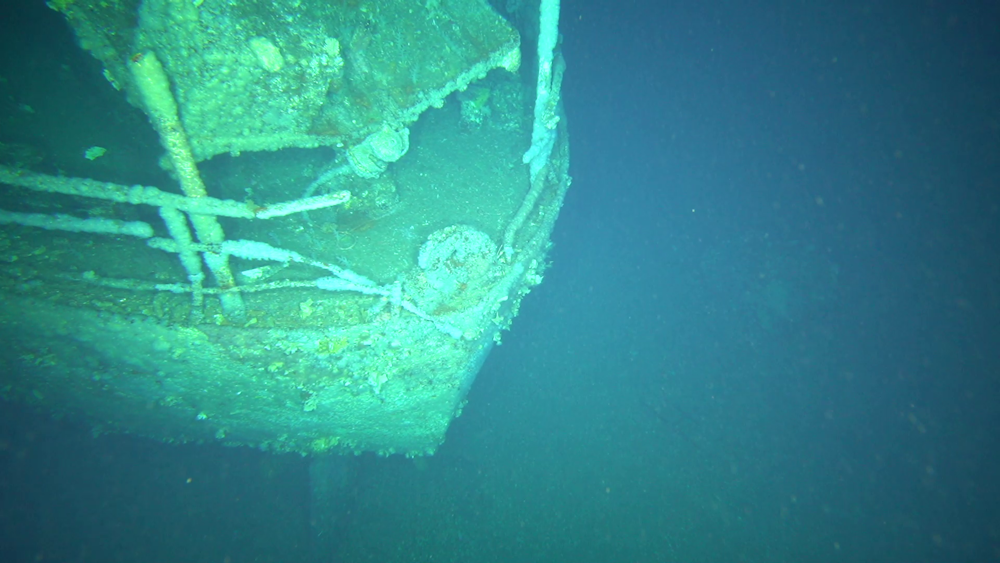
Bow and bent foremast of MV Noongah.CSIRO
On August 23 1969, the coastal freighter MV Noongah departed Newcastle bound for Townsville with a cargo of steel and 26 crew. The 71-metre ship had been a regular sight along the eastern seaboard for a decade as it hauled cargo between cities up and down the coast.
Two days later, the vessel disappeared in the night beneath ten-metre waves, lashed by a violent storm. Tragically, only five of the 26 crew would be rescued during one of the largest searches for survivors in post-war Australian maritime history. As for the MV Noongah, its resting place would remain a mystery.
Until now.
While on a research voyage to study submarine canyons off the New South Wales coast, a team aboard the CSIRO research vessel RV Investigator became the first to set eyes on MV Noongah in nearly 55 years. This discovery was no accident. It was part of a collaborative project and a targeted investigation to help identify a mysterious shipwreck.
It’s also no coincidence there have been several shipwreck discoveries in the news recently. Australia’s national science ship has developed an impressive record as a shipwreck sleuth.
Newly pinpointed general location of the MV Noongah shipwreck. CSIRO
What is RV Investigator?
RV Investigator is part of the Marine National Facility – a national research infrastructure operated by CSIRO, Australia’s national science agency.
All Australian researchers and their international collaborators can access the capabilities of RV Investigator. This makes it a collaboration hub for marine research. And it’s been an important factor in many of the recent shipwreck discoveries.
Over the past ten years of operation, more than 150 institutions have collaborated to deliver science on voyages. Usefully, RV Investigator can accommodate multiple projects on each voyage. The research has ranged from fisheries’ surveys and seafloor mapping to atmospheric studies and, of course, maritime heritage surveys.
RV Investigator has a range of tools that allow for successful seafloor discoveries. CSIRO/Owen Foley
RV Investigator is equipped with a suite of advanced acoustic systems. It also has three seafloor mapping systems, called multibeam echosounders. These allow for high-resolution measurements (bathymetry, literally meaning “deep measurement”) of the seafloor, from shallow coasts to full ocean depth.
These systems map the seafloor everywhere the vessel goes, both through data collection while underway, and through targeted surveys.
Both the distance RV Investigator travels during its annual research program and the volume of bathymetric data it collects are immense. This greatly increases the likelihood of making seafloor discoveries.
Over the past ten years, RV Investigator has travelled more than 500,000 kilometres and mapped more than 3 million square kilometres of Australia’s marine estate. It has circumnavigated the continent several times.
All this has provided an opportunity to investigate many suspected shipwreck sites. These are often “piggyback” projects – ones that are added to the voyage but use no additional resources.
The power of collaboration
Shipwreck discoveries are impossible without collaboration. The maritime community, heritage agencies, research agencies and members of the public have all contributed to the recent shipwreck finds.
It is not uncommon for searches to be targeted by local knowledge from fishing communities, volunteer shipwreck hunters and even historians who have pieced together clues on the potential location of shipwrecks.
Outreach to those affected by the findings is also invaluable. This includes the survivors of these tragedies and the families of those lost at sea, to keep them informed throughout the process.
Shipwreck discoveries can literally change lives – like the reunion of two siblings who spent their lives apart as orphans after their father died onboard SS Iron Crown in 1942.
‘Eyes’ in the depths
RV Investigator also has specialised drop cameras that can provide a view of the seafloor at depths up to 5,000 metres. The visuals provided by these have been essential for identifying shipwrecks once found.
In 2023, a CSIRO team used this camera system to help identify the wreck of SS Nemesis, a steamship that was lost in 1904 off the coast of New South Wales. Also in 2023, an unidentified wreck off the southwest coast of Tasmania gained a name – it was the coastal freighter MV Blythe Star which capsized and sank in 1973.
The large areas of seafloor mapped by RV Investigator have also led to unexpected discoveries. The wreck of the 1890s iron barque Carlisle in Bass Strait in 2017 was a “chance encounter” for the vessel.
A view of the stern of MV Blythe Star. CSIRO
Why hunt for shipwrecks?
These discoveries are important for several reasons. Finding and analysing a shipwreck can help us understand the circumstances that led to these tragedies. It can also help provide closure to affected communities whose loved ones were lost at sea.
Knowing the current state of the shipwreck is important for heritage professionals and agencies who manage and protect the sites. Some shipwrecks are at risk of creating environmental damage such as fuel or oil leaks, so having data on them is vital for managing those risks.
RV Investigator is currently scheduled for a series of scientific upgrades, including its acoustic systems. With 8,000 shipwrecks scattered around Australia’s coastline, and more than half of those undiscovered, there are many more maritime mysteries to solve.
Several of the shipwreck surveys mentioned in this article were conducted on behalf of state maritime heritage agencies and supported by grants of sea time on RV Investigator from the CSIRO Marine National Facility.
Emily Jateff is a Member of the CSIRO Marine National Facility National Benefit Advisory Committee.
In an age when connectivity is constant, many New Zealanders find it hard to unplug from the internet. Despite a desire to switch off, the reality of disconnecting is challenging. Soon it might even come at a cost.
Around the world, and in New Zealand, there is increasing interest in disconnecting. School phone bans, calls for a right to disconnect from work, and the proliferation of screen-time apps all speak to a collective concern about how constantly connected we are.
Spending time offline and using strategies to help manage screen time are being recognised as critical skills. Learning them may benefit wellbeing and productivity, and help to set boundaries around social media use.
We set out to find out whether New Zealanders do disconnect from the internet, and how. We surveyed over 1,000 people and asked them how often they intentionally disconnect, as well as their motivations and challenges in disconnecting.
Reducing distractions and social demands
We found most New Zealanders disconnect infrequently or not at all: 86% of participants reported they never (22%), rarely (32%) or sometimes (32%) disconnect.
We also found people are primarily motivated to disconnect in order to reduce online distractions. The most common reason to disconnect was to be more present with whānau and friends, or focus on an offline leisure activity, such as reading a book.
Another notable motivation was a desire to avoid the social demands associated with being online or on social media. We also found Māori are more likely to disconnect than Pākeha, due to not feeling safe online.
Notably, nearly a quarter of participants reported never intentionally disconnecting. This could either be a choice or because disconnecting can be challenging.
For example, we found there are several barriers to unplugging. The first is the now basic need to access services – banking, paying bills, transport, two-step login verification – that require an internet connection.
Many also use a smart device for leisure pursuits, including exercise and entertainment, that prevents them unplugging. With so many aspects of life intertwined with devices, leaving your phone at home is not a simple calculation these days.
All of this partly explains the rise of luxury “digital detox” retreats and bespoke offline experiences. With the default of everyday life being connected, unplugging is something we increasingly need to simulate – and even pay for.
We also found there are social costs associated with disconnecting. Participants not only reported FOMO (fear of missing out) as a reason why disconnecting is hard, but they acknowledged expectations about social availability have changed.
Nearly a third reported they do not disconnect because their family or friends expect them to be available. Women were more likely to say this, which may reflect lingering social norms about being available for others. This in turn suggests there may be a gendered privilege to switching off.
Perhaps unsurprisingly, we found younger people (18-24) struggle to disconnect more than older people (75+). Older participants described disconnecting with great ease, saying they would just “turn the Wi-Fi off” or “put my phone away”.
This type of disconnection would be quite extreme for young people. Having grown up with connectivity as the default, they prefer to use productivity or wellbeing apps to limit their screen time.
The connected country: getting away from it all no longer means getting away from the internet. Getty Images
Disconnection as a skill
It is unfair to label young people as merely addicted to their phones, however. Social media serve as a crucial platform for friendship, identity formation and self-expression in today’s digital age.
Additionally, we need to recognise the billions of dollars invested in making social media and other apps habit-forming.
Given this, the recent high school phone ban may be missing an opportunity to teach young people crucial skills for thriving in the digital age. Our research shows we should be focused on how to learn and live well with phones, rather than banning them outright.
Teaching young people how to disconnect, rather then doing it for them, will be crucial in an ever-more-connected future.
Local communications giant One NZ’s partnership with SpaceX promises to connect the country on an unprecedented scale. No longer will New Zealanders be able to disconnect by going bush or travelling to remote places.
Disconnecting will become a choice people have to make for themselves. Knowing how to do this, and why, will only become more important.
Alex Beattie receives funding from Internet NZ
John Kerr works for the Public Health Communication Centre, which is funded by a philanthropic endowment from the Gama Foundation.
Greater stick-nest rats (or “stickies” as they are affectionately named) are one of Australia’s most adorable small native mammals.
These guinea-pig sized rodents build large communal nests which can be a metre high and 1.5 metres wide, using their sticky urine to glue sticks and leaves together. Remnants of their nests from thousands of years ago have been found in caves, with plant fragments protected by the urine. They live in arid, almost waterless parts of Australia, and live on fruit and succulents.
The greater stick-nest rat once roamed across the Nullarbor, from northern Victoria through to Exmouth in Western Australia. But their nests weren’t enough to protect them from feral cats and foxes. By the 1930s, they had been driven to extinction on the Australian mainland. A tiny population of 1,000 survived only on the Franklin Islands, offshore from Ceduna in South Australia. A related species, the lesser stick-nest rat, has likely gone forever.
Our new research on surviving stick-nest rats has found something unusual – these rodents are chowing down on one of Australia’s worst invasive plants, African boxthorn.
For the stick-nest rats, though, this plant spells opportunity.
Of island refuges and thorny bushes
To look at, the Franklin Islands don’t seem like prime wildlife territory. But these low-lying, shrub covered islands in the Nuyts Archipelago suit the greater stick-nest rat just fine. Conservationists used these survivors to seed new populations on two other South Australian islands, Reevesby and Saint Peter Islands, as well as a feral-proof fenced reserve in Western Australia.
Their total numbers have now grown to about 3,000, enough for its status on the international Red List of threatened species to be moved from endangered to vulnerable.
But is this sustainable? Can offshore islands and onshore fenced reserves free of foxes and cats keep stick-nest rats safe indefinitely?
To find out, we investigated what food the animals prefer in one of their newer homes, Reevesby Island in South Australia’s Spencer Gulf.
To our surprise, we found these rats seemed most at home amongst African boxthorn, an invasive weed of national significance. Even more unexpectedly, they were turning up their noses at the native vegetation around them in favour of this noxious weed.
Why was this surprising? Of all the weeds in Australia, African boxthorn is one of the worst. Native to South Africa, this shrub defends itself against giraffes and other herbivores with spines up to 15 centimetres long.
In Australia, birds and small mammals feed on its berries and transport its seeds to new areas. Mature plants can grow up to 5 metres tall, forming impenetrable thickets armoured with large thorns. On farms, it disrupts livestock movements, blocks access to water sources and takes over land. In natural areas, it can offer a safe haven for rabbits.
But none of this fazes the greater stick-nest rat. On Reevesby, we found stick-nests deep inside the boxthorn, well-manicured entrances to other nests in thickets too dense to see into, and large amounts of poo pellets showing the native rodents were feeding in the area.
The boxthorn bed and breakfast?
So, were the animals just living in the boxthorn, or did they use it as a food source as well? To find out, Annie Grace Kraehe spent a week surveying vegetation and collecting poo samples from around their nests. She then spent months sifting through the samples and identifying plant fragments under a microscope.
The work was worth it because it gave us a clear answer: African boxthorn makes up just over half of the stick-nest rat’s diet on the island, despite making up only a tenth of the available vegetation. They were also using the thorny branches in their nests.
What does this mean for conservation?
The difference between hero and villain is often a matter of perspective. The same can be said for boxthorn.
Stick-nest rats appear to love boxthorn for the same reasons we hate it. Its famous thorns and dense growth offer excellent cover for a small furry mammal. Prey animals such as rodents don’t like to venture far for a meal if they can avoid it, so they make like Hansel and Gretel and eat the house.
It’s not unknown for invasive weeds to benefit some native species, especially when the ecosystem is already disturbed.
Research on little penguin colonies in Tasmania has found the birds seem to benefit from the dense growth and fearsome thorns of African boxthorn, which provides better protection against predators compared to native vegetation.
Similarly, invasive blackberry and lantana are often hated due to the way they form impenetrable thickets which push out native plants. But lantana and blackberry have been found to provide critical habitat and food sources for bandicoots, blue wrens, antechinuses and bush rats.
In fact, these food-providing protective thickets have made it possible for these species to thrive in severely disturbed ecosystems, such as the suburbs of Adelaide and Melbourne.
Costs and benefits
Does this mean we should avoid eradicating boxthorn if small endangered mammals survive nearby? We can’t say either way for now.
We need to do more research to see if the greater stick-nest rat truly benefits from African boxthorn, and weigh any benefit against the damage boxthorn does to ecosystems. If, for instance, the boxthorn keeps growing on Reevesby Island, it could push out native plants and trigger an ecosystem collapse. In that scenario, boxthorn might go from benefit to threat.
What our research does show is how adaptable these social rodents are. That gives us hope for their re-establishment elsewhere – as long as feral predators are controlled or absent.
Vera Weisbecker receives funding from the Australian Research Council. She is a member of The Australian Greens.
Annie Grace Kraehe, Kathryn Hill, and Robert S. Hill do not work for, consult, own shares in or receive funding from any company or organisation that would benefit from this article, and have disclosed no relevant affiliations beyond their academic appointment.
The human eye registers three colours of light: red, green and blue. But pigeons (and many other animal species) can also see a fourth colour, ultraviolet.
The “four-dimensional” colour space pigeons see may contain millions more colours than ours. To a pigeon, for example, many flowers show patterns that are invisible to us.
Despite the long history of close association between our species, we might say humans and pigeons live in quite different worlds. If different species effectively live in different worlds, does that mean our biology constructs reality?
The question of whether reality exists outside or inside our heads has troubled philosophers for millennia. In a recent paper, my colleague André Sant’Anna and I propose a pragmatic way to resolve this dilemma, based on inquiry and action.
How many worlds are there?
There is a long tradition in philosophy called “realism”. In the realist view, there is just one world with pre-given features that are independent of the mind observing them – and discovering these features is the job of science.
But if something is entirely independent of our minds, how can we know it with our minds? Isn’t this a contradiction in terms?
So there is an equally long history of philosophical argument that the features of reality somehow depend on experience. These thinkers claim that reality does not come pre-carved (at what Plato famously described as a natural set of “joints”). There are as many worlds as there are sets of experiences, and each set of experiences creates a unique perspective (or what Edmund Husserl called a “life-world”).
This deep dispute over the nature of reality and worlds has arisen in almost every generation of philosophers.
How do our bodies shape our experience of the world?
There is an increasingly popular alternative to traditional realism called “enactivism”, which draws inspiration from cognitive science.
Enactivism made its debut in 1990, in a book by Francisco J. Varela, Eleanor Rosch and Evan Thompson called The Embodied Mind. Bringing together scientific biology, Husserl’s life-worlds and Buddhist philosophy, the authors theorised that just as a living creature grows and repairs its own body, it “enacts” its own environment as having features of importance to itself, such as food or danger.
a cognitive being’s world – whatever that being is able to experience, know, and practically handle – is conditioned by that being’s form or structure.
The limits of the life-world
On the face of it, though, enactivism leaves certain important questions unanswered.
First, how do species successfully interact with each other when their perceptual capacities seem to put them in quite different life-worlds? For instance, during the first world war, a pigeon named Cher Ami heroically carried a message that saved the lives of 200 British soldiers despite being shot down by enemy fire, for which he was awarded a gold medal.
Second, it seems scientists should be able to investigate how different species’ different bodies create different perceptual experiences. But if all species – including ourselves – are “locked up” in their own life-worlds, such inquiry is impossible.
These two issues are what we set out to resolve in our recent paper.
Do shared experiences and actions create reality?
We propose a new alternative to the dilemma of understanding reality as either pre-given or located in subjective individual experiences, drawing on the ideas of pragmatist philosopher Charles Peirce. We argue for an inquiry-based realism, whereby reality depends on our minds but is still public and objective.
As we explain it, reality is grasped through pragmatic agreement. This means individuals align their expectations about what others will do in similar lived situations.
So, for instance, although a WWI soldier and a pigeon with their different eye structures perceive a shooting enemy quite differently, they pragmatically agree that he is dangerous when they both move away. As we saw with Cher Ami, humans and pigeons can also agree on the supreme importance of reaching “home base” with a delivery.
This highlights a key characteristic of pragmatist philosophy. It does not define cognition as a kind of consciousness, an idea that has led to apparently insoluble philosophical problems.
Rather, pragmatists view knowledge of reality as implicit in what we can do, most especially what we can do with others.
Pragmatic agreement with other species
Of course, there will be many matters on which different species do not currently have pragmatic agreement. For instance, while humans and pigeons both understand the danger of an enemy firing a gun, it would be lost on a dung beetle happily feeding in the same WWI trench.
But we should not hastily conclude from this that reality must always be plural. Peirce’s inquiry-based account of reality expresses an optimistic hope that over time we can find ways to bring species into ever greater pragmatic agreement.
Unlike a human or pigeon, a dung beetle would not perceive somebody firing a gun as a threat. Klimek Pavol/Shutterstock
What is required is that we put ourselves into the same environments, do similar things, and develop shared goals. Thus Peirce defined truth as “the opinion which is fated to be ultimately agreed to by all who investigate”.
We believe our account provides a nuanced and original vision of reality for enactivism. It allows creatures’ unique perceptual powers a role in shaping their own reality, but it also allows that reality is objective, in a different way than traditional realism.
We are arguably only beginning to understand how to understand the realities in which non-human animals live. Peirce’s philosophy shows us how such understanding can be achieved over time. And if we can manage to increase our pragmatic agreement with other species, we stand to receive many gifts in widening the reality in which we ourselves live.
Catherine Legg does not work for, consult, own shares in or receive funding from any company or organisation that would benefit from this article, and has disclosed no relevant affiliations beyond their academic appointment.
New Zealand was once home to giant flightless birds called moa. They had grown accustomed to life without predators. So the arrival of humans in the mid-13th century presented a massive – and ultimately insurmountable – challenge to their existence.
Moa were unable to cope with even low levels of hunting by people. All nine species of moa were driven to extinction soon after first contact with humans. These moa populations collapsed and disappeared so swiftly it seemed impossible to trace their declines, until now.
In our new research, we reconstructed patterns of population decline, range contraction and extinction for six moa species. We simulated interactions of moa with humans and their surroundings using hundreds of thousands of scenarios. Then we validated these simulations against information from fossils.
We found all six species collapsed and converged on the cold, isolated mountains of New Zealand’s North and South Islands. These happen to be the same sites where the last of New Zealand’s flightless birds can be found today.
New Zealand’s giant flightless birds, such as the crested moa (Pachyornis australis) shown here, retreated to cold, isolated mountaintops as they headed for extinction. Paul Martinson / Te Papa, CC BY-NC-ND
Unfortunately, islands are also hotspots of extinction. This is particularly true for oceanic islands in the Pacific, which were among the last areas on the planet to have been settled and transformed by humanity.
Human expansion across the Pacific began some 4,000 years ago, when people set out on extraordinary sea voyages from Taiwan. They first headed south into the Philippines, and then onto some of the most isolated islands on the planet.
Migration into central and east Polynesia was the final phase of these ancient voyages. It culminated in the colonisation of the New Zealand Archipelago in the mid-13th century by Polynesians, the ancestors of Māori.
People started fires, hunted animals and introduced invasive species – including Pacific rats. Accordingly, New Zealand’s unique biodiversity was decimated in one of the largest and most rapid collapses of native wildlife in the Pacific.
Moa ate fruit, seeds, leaves and grasses. The North Island giant moa Dinornis novaezealandiae lasted longer than other species. Paul Martinson / Te Papa, CC BY-NC-ND
Range collapses and extinctions of moa
Moa disappeared within three centuries of human arrival. But they didn’t all go at once.
Our research suggests Mantell’s moa went first, within just 100 years. Almost another 100 years would pass before the extinction of any other moa species.
Mantell’s moa was especially vulnerable to extinction because of its slow population growth rate. Unfortunately, even low but sustained harvesting well exceeded the bird’s capacity to reproduce and compensate for these losses.
Other species were slightly more resilient. They benefited from attributes such as higher growth rates, larger ranges, bigger populations or better abilities to live at higher altitudes (far from people).
The stout-legged moa lasted the longest. It finally disappeared some three centuries after human arrival.
Our research suggests all moa disappeared from high-quality lowland habitats first. These were places favoured by people.
The rate of population decline then decreased as you go higher into the mountains and further away from the coastline.
It was previously thought the ranges of species under pressure would contract to their optimal or preferred habitats, where they were most abundant, rather than as far away from people as they could get.
Our research suggests Mantell’s moa (Pachyornis geranoides) was the first moa species hunted to extinction. Paul Martinson / Te Papa, CC BY-NC-ND
Today’s flightless birds cling to moa refuges
Our research also took a closer look at the distribution of New Zealand’s living flightless birds.
It turns out ancient moa refuges now harbour populations of endangered native flightless birds including the takahē, weka and great spotted kiwi. Moa refuges were also the last mainland habitats for the critically endangered kākāpō.
These sites do not provide optimal habitat for living flightless birds either. Rather, they remain the most isolated and relatively untouched by humanity.
While New Zealand’s remaining flightless birds are no longer being hunted to extinction, threats to their survival still align with human activity.
Habitat loss and impacts of invasive species follows waves of European settlement across New Zealand, which gradually progressed from lowland sites to the less hospitable, cold and mountainous regions.
Efforts to conserve New Zealand’s remaining flightless birds can heed lessons from the ghosts of species past. The sad demise of the moa highlights the immense importance of isolated areas. If we are to prevent future extinctions, we need to protect and preserve these remote, wild places.
Our research also offers a new approach to understanding past extinctions, especially on islands where fossil and archaeological data are limited.
Damien Fordham receives funding from the Australian Research Council.
Jamie Wood, Mark V. Lomolino, and Sean Tomlinson do not work for, consult, own shares in or receive funding from any company or organisation that would benefit from this article, and have disclosed no relevant affiliations beyond their academic appointment.
Source: The Conversation (Au and NZ) – By Joseph Ibrahim, Professor, Aged Care Medical Research Australian Centre for Evidence Based Aged Care, La Trobe University
Elder abuse is an emerging public health and safety issue for communities of high-income countries.
The most recent data from Australia’s National Elder Abuse Prevalence Study, which surveyed 7,000 older people living in the community, found one in six self-reported being a victim of some form of abuse. But this did not include older people living in residential aged care or those with cognitive impairment, such as dementia – so is likely an underestimate.
This week the Australian government announced a multi-million dollar advertising campaign it hopes will address this serious and abhorrent abuse.
But is investing in community awareness of elder abuse the best use of scarce resources?
What is elder abuse?
The World Health Organization (WHO) defines elder abuse as
[…] a single, or repeated act, or lack of appropriate action, occurring within any relationship where there is an expectation of trust which causes harm or distress to an older person.
Australia usually defines older people as those over 65. The exact age varies between countries depending on the overall health status of a nation and its vulnerable population groups. The WHO definitions of an older adult for sub-Saharan Africa, for example, is over 50. And there are communities with poorer health status and shorter lifespans within country borders, including our First Nations people.
Elder abuse can take on many different forms including physical, sexual, psychological, emotional, or financial abuse and neglect.
Living longer and wealthier
The number of older people in our society is greater than it has ever been. Around 17% Australians are aged 65 and over. By 2071, older Australians will make up between 25% and 27% of the total population.
People are living longer, accumulating substantial wealth and are vulnerable to abuse due to cognitive, physical or functional limitations.
Longer lifespans increase the time of possible exposure to abuse. Australian men aged 65 can expect to live another 20.2 years, while women aged 65 are likely to live another 22.8 years. (Life expectancy for First Nations men and women remains significantly shorter.)
Australian men are now 143 times more likely to reach the age of 100 than they were in 1901. Women are 82 times more likely.
Older people hold a large proportion of our nation’s wealth, making them vulnerable to financial abuse. Recent research by the Australian Council of Social Service and UNSW Sydney reveals older households (with people over 65) are 25% wealthier than the average middle-aged household and almost four times as wealthy as the average under-35 household.
Finally, older people have higher levels of impairment in their thinking, reasoning and physical function. Cognitive impairment, especially dementia, increases from one in 67 Australians under 60 to almost one in two people aged over 90.
Over half of Australians aged 65 years and over have disability. A particularly vulnerable group are the 258,374 older Australians who receive government-funded home care.
Despite this, the level of awareness of elder abuse is likely to be much lower than for family violence or child abuse. This is partly due to the comparatively recent concept of elder abuse, with global awareness campaigns only developed over the past two decades.
Is an advertising campaign the answer?
The federal government has allocated A$4.8 million to an advertising campaign on television, online and in health-care clinics to reach the broader community. For context, last year the government spent $131.4 million on all media campaigns, including $32.6 million on the COVID vaccination program, $2 million on Japanese encephalitis and $3.2 million on hearing health awareness.
The campaign will likely benefit a small number of people who may be victims and have the capacity to report their perpetrators to authorities. It will generate some heartbreaking anecdotes. But it is unlikely to achieve broad community or systemic change.
There is little research evidence to show media campaigns alter the behaviour of perpetrators of elder abuse. And suggesting the campaign raises awareness of the issue for older people who are survivors of abuse sounds more like blaming victims than empowering them.
We don’t know how the government will judge the success of the campaign, so taxpayers won’t know whether a reasonable return on this investment was achieved. There may also be opportunity costs associated with the initiative – that is, lost opportunities for other actions and strategies. It could be more effective and efficient to target high-risk subgroups or to allocate funding to policy, practice reform or research that has direct tangible benefits for survivors.
The Australian Human Rights Commission’s campaign from last year.
But the campaign can’t hurt, right?
Actually, the dangers that could come with an advertising campaign are two-fold.
First it may well oversimplify a highly complex issue. Identifying and managing elder abuse requires an understanding of the person’s vulnerabilities, their decision-making capacity and ability to consent, the will and preferences of victim and the role of perpetrator in the older person’s life. Abuse happens in the context of family and social networks. And reporting abuse can have consequences for the victim’s quality of life and care.
Consider the complexities of a case where an older person declines to have her grandson reported to police for stealing her money and medication because of her fear of becoming socially isolated. She might even feel responsible for the behaviour having raised the grandson and not want him to have a criminal record.
Secondly, a public campaign can create the illusion government and our institutions have the matter “in hand”. This might slow the opportunity for real change.
Ideally, the campaign will strengthen the argument for better policies, reporting procedures, policing, prosecution and judgements that are aligned. But these ends will also need investment in more research to build better communities that take good care of older people.
Joseph Ibrahim previously received funding from state and federal governments.
The government recently announced ambitions to expand the use of artificial intelligence (AI) in New Zealand’s classrooms. But as the technology rapidly changes, it is not clear how this would work or what it will mean for teachers and learners.
Science Minister Judith Collins’ vision is for every student to have their own AI tutor. As Collins explained in a recent interview,
So instead of having to be wealthy enough to employ a tutor to help the children with the maths or science questions, or something else that the parent doesn’t know much about maybe, is to enable that child to have their own [AI] tutor.
But like AI itself, the concept of an AI tutor is still evolving. The idea of creating a “teaching machine” has been around for 100 years or so, and “intelligent tutoring systems” have been around since the 1980s with limited results.
The more recent advances of AI have rekindled the elusive promises of these systems. But while the technology has evolved, the basic concept of a machine taking over some of the responsibilities of the teacher has remained the same.
The risk of replacing human tutors
An AI tutor is a proxy for a human tutor — supporting and “scaffolding” a student’s learning. Scaffolding is the space between what a learner can do without assistance and what they can learn next with the support of someone who is more knowledgeable.
In theory, an AI Tutor can play this role. But there are inherent dangers. What if your more knowledgeable tutor is not, in fact, more knowledgeable, but just makes things up? Or shows bias? Or favours uncritical, shallow material over more reliable resources?
The features that give generative AI its capabilities to interact with users also create its flaws. AI relies on the data it is trained on. However, this data can be wrong, and AI neither validates what goes into it, nor what comes out.
This issue has raised concerns about fairness. As AI tools consume quantities of unfiltered data, the risk is they will reinforce existing biases in this data, perpetuating gender stereotypes and other negative outcomes.
For people from Indigenous cultures, including Māori and Pacific peoples, AI provides both opportunities and threats.
If AI systems are trained on biased data or without considering diverse perspectives, there is a high likelihood decisions being made based on these systems will favour one group over others, reinforce stereotypes, and ignore or undervalue different ways of living and thinking.
The concern isn’t just about the influence AI can have on us but also how AI consumes and processes data. AI systems are trained on vast amounts of data, often without properly acknowledging the sources or respecting creators’ copyrights.
For Indigenous peoples, this can infringe upon their data sovereignty rights and exploit their cultural and knowledge heritage. This exploitation can perpetuate inequality and undermine the rights and contributions of Indigenous communities.
A “walled garden” approach
A commonly proposed answer to this problem is to train AI systems on carefully curated data.
Book publisher Pearson, for example, has recently integrated AI in 50 of their textbooks. This allows students to use AI chatbots to engage with the texts.
According to Pearson, these tools are developed using a “walled garden” approach. The AI is trained only on the contents of these books. This, Pearson claims, reduces the risks of inaccuracies.
However, the walled garden approach also has major drawbacks, since it limits content to that selected and approved by the supplier. What does this mean for cultural knowledge and rights? Critical perspectives? Innovation in learning?
Pearson has, for example, been criticised for the content of some of its books. In 2017, the company apologised for a medical textbook considered “racist”.
If a New Zealand AI tutor were to be created from local data, how could we ensure tikanga Māori protocols are safeguarded? As highlighted by Māori scholar Te Hurinui Clarke, there are significant challenges around the respectful and ethical handling of Māori knowledge.
Protecting knowledge
When it comes to AI tutors, policy makers need to ask who would be the custodians of this data, whose knowledge would be used and who has the rights to access?
If done well, a walled garden approach might provide a comprehensive, inclusive, culturally sustaining pathway to better learning. However, given the challenges of such an undertaking (never mind the expense), the chances of success in practice are extremely small.
Meanwhile, we can’t just wait for AI tutors. AI is a reality in schools, and we need to prepare students for what they face now and in the future. Specific tools are important, but our focus should be on developing AI literacy across the educational sector.
This is why we are researching what it means to be AI literate and how this can empower critical evaluation and ethical use, ensuring AI complements rather than replaces human teaching.
We see the development of AI literacy, supported by suitable frameworks, as a priority, something all students, no matter their age, need to have. It is only through this that we can harness AI’s benefits while safeguarding the core values of education.
The authors do not work for, consult, own shares in or receive funding from any company or organisation that would benefit from this article, and have disclosed no relevant affiliations beyond their academic appointment.
Source: The Conversation (Au and NZ) – By Treena Clark, Chancellor’s Indigenous Research Fellow, Faculty of Design, Architecture and Building, University of Technology Sydney
Mongolia’s uniform from Michel&Amazonka.
Fashion is many things. It is practical, it is communicative, it is commercial, and it is competitive.
Looking towards the fashion of Paris 2024, some countries have multiple uniforms for the opening and closing ceremonies, podiums, media and sporting events. Some countries tell subtle or extravagant stories of their nations. The Parisian style of the host city inspires some.
Some countries want to use the latest technology to produce sustainable fabrics or recycled materials. Some countries have used designers and brands to fashion their formal uniforms.
Their commonality is they represent their country and communicate their national presence and essence.
My top five opening and closing ceremony uniforms have been considered. The countries with notable fashion brands are not favoured; my selections are based on the design’s story, meaning and overall aesthetic. These top five evoke a creative expression of national pride that resonates with my lens and preference of fashion and style.
Haiti
The Haitian opening ceremony uniform, fashioned by Haitian-Italian designer Stella Jean, represents and showcases Haiti’s beauty, strength and craft.
The Haitian Opening Ceremony uniform showcases Haiti’s beauty, strength and craft. Stella Jean
Included are the work of the Haitian painter Philippe Dodard in the women’s full-A-line skirt and the men’s pants and scarf. Pairing brilliantly with the art are the other layers of blue and white.
The women are styled in Haitian woven chambray shirts, representing the Haitian tradition of chambray production. Recycled fabric is the basis of the women’s short-sleeved white blazer, which features the Haitian Olympic emblem.
The men’s blue jacket is inspired by Haitian Guayabera shirts, both significant for the designer and a common Haitian garment. This jacket features the Haitian Olympic emblem and underneath a blue-striped shirt.
Mongolia
Mongolia’s opening and closing ceremony uniforms were crafted by the three-sister fashion label Michel&Amazonka. Each uniform, which averaged 20 hours to make, incorporates multiple cultural and Olympic-themed motifs.
Mongolia’s uniform, from Michel&Amazonka, features intricate stitched details. Michel&Amazonka
These intricate details include the emblem of Mongolia, the “Soyombo”; Parisian and Olympic motifs, such as the Olympic torch and rings; and mountain and cloud landscapes.
Four different opening and closing ceremony uniforms were designed for the male and female flag bearers and athletes. The flag bearers wear a traditional-inspired caftan and a belt; the athletes in pants and skirt.
All four looks showcase embroidered vests, with the men sporting blue and the women white. The vest, front and centre, announces “Go Mongolia Team”.
Canada
Canada’s lululemon-crafted uniforms were designed after consultation with 19 Olympic and Paralympic athletes across 14 diverse sports.
Canada’s closing ceremony uniform features Saddle Cree Nation artist Mason Mashon’s print inspired by the northern lights. Team Canada x lululemon
National pride was identified as a key priority and is significantly present in the uniforms. The other priorities were practicality, flexibility and comfort.
In the opening ceremony uniform, the brand custom-designed a print representing Canadian art, design and environment.
The exquisite closing ceremony uniform features First Nations (Saddle Cree Nation) artist Mason Mashon’s print inspired by the northern lights.
Each uniform has been crafted for comfort, including a packable rain poncho, a bomber jacket with interior straps to act as a makeshift backpack and water-resistant shirts.
Ireland
Designer Laura Weber’s creation of the Irish opening ceremony outfits and closing ceremony jackets is heavy with symbolism and sustainability.
Based in New York, the designer created the uniform for the athletes to feel their best, be comfortable in the fabrics, and celebrate their Irish culture.
The Irish opening and closing ceremony jacket is heavy with symbolism and sustainability. Laura Weber
The sustainable fabric, made from recycled t-shirts and PET bottles (ECO-Hybrid taffeta), pulls moisture from the skin.
Deciding against a prominent green, the aesthetic of the uniform is a crisp white with delicate embroidery featured throughout.
The embroidery includes the Irish flag in the pant piping, hand-made shamrock brooches on the jacket lapel, hand-tufted letters spelling Ireland, and custom, individual patches representing the county emblem of each athlete.
Chinese Taipei/Taiwan
The ceremonial uniform of Taiwan, referred to by the International Olympic Committee as Chinese Taipei, represents eco-friendly materials and cultural heritage. Designed by the founder of Just In XX, Justin Chou, the stretchy and textured material represents Taiwan’s oceans, cities and mountains.
The stretchy and textured material in these uniforms from Justin Chou represents Taiwan’s oceans, cities and mountains. Just In XX
The outfits are made from materials that cool down the body when in contact with water or sweat.
Collaborations with artisan Yen Yu-Ying produced shoe tops made from banana silk woven leather. Lin Pei-ying crafted handmade plum blossom, Taiwan’s national flower, and rapeseed flowers to adorn the coat.
Abstract artist Lin Guo-Qing created the shirt and scarf print. Designed in red, white and blue team colours, the repeated text in a crosshatch pattern reads Chinese Taipei and, when reversed, Jiayou, an expression of encouragement.
Looking forward to the ceremonies
These uniforms are for the athletes to perform their best, be proud of their national outfits and feel they genuinely represent them.
All the uniforms are captivating, whether simple, elegant, innovative, practical, unique or futuristic.
I am drawn to the design processes and stories of these five countries’ uniforms. Translating a country’s design through sporting fashions is a considerable challenge – and one these countries have risen to.
Treena Clark has received funding through the University of Technology Sydney Chancellor’s Indigenous Research Fellowship scheme.
By Brooke Tindall, Queensland University of Technology
With more than 50 Fijian villages earmarked for potential relocation in the next five to 10 years due to the climate crisis, Fijian journalists are committing themselves to amplifying the voices of those who face the challenges of climate change in their everyday lives.
Vunidogoloa village on the island of Vanua Levu was home to 32 families who lived in 26 homes. As early as 2006, floods and erosion caused by both sea-level rise and increased rains started to reach homes and destroy crops that fed the community.
The situation worsened in the following years, with water progressively taking over the village. The mangroves that used to cover the coast where they lived were absorbed by the sea completely.
The Fijian government began the mission to relocate Vunidogoloa in 2014. Not only did people in the community walk away from their homes, they left the place where their traditions and stories were passed down. Since Vunidogoloa was relocated, five other Fijian villages have faced the same fate.
Several projects have been established in response to such pressing threats, with an aim to increase the amount of climate journalism in Fijian media.
University of the South Pacific journalism coordinator Associate Professor Shailendra Singh has previously expressed concern about the lack of specialisation in climate reporting in the Pacific and says the articles produced can often come from “privileged elite viewpoints”.
Dr Singh continues to harbour such concerns in 2024. He notes that Pacific news media organisations have small profit margins, so rather than face the expense of sending out teams to talk to everyday people, their stories tend to focus on presentations and speeches that are cheaper to cover.
“This refers to the plethora of meetings, conferences, and workshops where the experts do all the talking and presenting,” he says.
“Ordinary people in the face of climate change are suffering impacts and do not get as much coverage.”
Training journalists to specialise in climate reporting will give them an in-depth understanding of both talking to experts and ordinary people experiencing the effects of climate change, Dr Singh says.
Blessen Tom’s climate change ‘ghost’ village report on Vunidogoloa for Bearing Witness in 2016. Video: Pacific Media Centre
“It brings focus, consistency and knowledge if done on a regular basis. Science has its place, but let’s not forget that people dealing and living with the effects of climate change are experts in their own right.”
Up-and-coming journalists, USP students Brittany Nawaqatabu and Viliame Tawanakoro say they see it as a good journalists’ responsibility to prioritise climate stories.
“Journalism provides people with the opportunity to be the vessel of message to the world. We are the captain of the ship that delivers the message,” Viliame says.
Brittany criticises Western media that considers climate change as a “debatable” topic.
“You have to put yourself in the shoes of a Pacific Islander to know what it’s really like. You can’t be debating it because you’re not the one going through it,” she says.
It’s important for Fijian media to continue to put the climate crisis on the front page and not let the stories become lost in other news, she says.
“If we are not going to become strong advocates as Pacific islanders for climate change and what our island homes are going through, then it’s only going to go downhill.”
Brooke Tindall is a student journalist from the Queensland University of Technology who travelled to Fiji with the support of the Australian Government’s New Colombo Plan Mobility Programme. This is published as the first of a series under our Asia Pacific Journalism partnership with QUT Journalism.
ANZ is being investigated by the Australian Securities and Investments Commission (ASIC) amid serious allegations the bank manipulated markets when it facilitated a A$14 billion sale of government bonds in April last year.
ASIC has now publicly stated it suspects ANZ broke the law. Speaking to the Australian Financial Review on Tuesday, ASIC Chairman Joe Longo said:
It’s a matter for the CEO of ANZ how he wants to characterise it, but it’s on the public record that it is an investigation, which means by definition we suspect a contravention of the law.
Earlier this month, ANZ launched its own internal probe into alleged misconduct within its markets division. ANZ says it is treating the allegations “with the utmost seriousness” and has engaged external legal counsel to assist with its investigations.
ANZ has also been accused of inflating the value of its bond trading by billions of dollars to win “lucrative” government mandates that accrue to firms trading big quantities.
Bond markets? Government mandates? You’d be forgiven for feeling a bit lost.
On its face, the alleged wrongdoing might seem quite esoteric and technical. But the Australian Financial Review has suggested the matter could end up becoming “the biggest scandal” in ANZ’s 182-year history.
To be clear, these are allegations amid an ongoing investigation by Australia’s corporate regulator. But it’s important to understand exactly what the bank has been accused of here, and how what happens in the bond market has the potential to affect us all.
It’s all about government borrowing
To understand the allegations against ANZ, you need a good grasp of a slightly dry-sounding and fairly routine transaction.
The Australian government often borrows money. It does this by selling so-called “bonds” to investors.
Bond sales allow the government to borrow money. Shutterstock
An investor buys a bond – which used to be a piece of paper but is now electronic – and in return receives (usually fixed) interest payments called “coupons”, one each month or year.
At the expiry of the bond, be it after three years, ten years, 20 years or more, the investor gets her or his money back.
You don’t need to understand everything about the way bonds work. You just need to know that bonds are traded in an open market – investors can sell them to other investors, and their price can fluctuate.
The investors’ returns come from a combination of both (a) receiving those coupons, and (b) the difference between what they pay for the bond and the final principal amount they receive at maturity.
If general interest rates climb above the coupon rate on the bond, the price of the bond will fall. This is because the bond simply would not pay enough relative to what they demand for an investment with that level of risk.
Conversely, if general interest rates fall, the bond price is likely to climb.
Banks are appointed to manage bond issues
New government bonds are issued by an arm of the Commonwealth Treasury, known as the Australian Office of Financial Management (AOFM). For big bond sales, AOFM typically appoints a bank – or banks – to manage the process and engage with investors.
In April 2023, the government contracted ANZ to help manage a large A$14 billion bond sale. This gave ANZ access to confidential information, including details about when the offering would occur.
As part of the role, ANZ was to buy bonds from investors who wished to exchange them for the new bonds. The price of those bonds would depend on the return investors require on government bonds. Recall that if a bond is paying a return that is too low relative to what is required, its price falls. Thus, if the required return increases, the price ANZ has to pay decreases.
You might have heard the adage: buy low and sell high. Well, ANZ allegedly sought to do just that.
It’s alleged ANZ sought to raise bond yields by trading in what is called the “futures market”, which is essentially a market that allows traders to bet on future interest rate moves.
Those bets also influence the reference rate that is used to set the price of new bonds. This is because the government looks to the futures rate to assess what return the market requires on its debt and to set the coupon rate on the bonds it issues.
If that futures rate climbs, then so too does the coupon rate on the government’s new bond issues. This increases the government’s total interest bill.
ANZ is alleged to have manipulated futures yields higher, enabling it to buy bonds from investors at a low price.
ANZ allegedly then reversed its futures trades, letting general interest rates fall and the price of the bonds it held climb, giving it a profit.
If the allegations are true, then ANZ would have engaged in both market manipulation and insider trading. This would be illegal.
The Australian Financial Review says trading data points to unusual price movements on and around April 19 last year.
Market ten-year bond yields either side of April 19 issue being priced
The data appears to show bond prices falling (yields rising) up until the bond was issued on April 19, then climbing as yields fell.
But it’s important to note this graph says nothing about causation. Prices might have fallen for reasons completely unrelated to ANZ.
Overstated success
ANZ has also been accused of overstating its trading success to the government, to secure lucrative bond management opportunities.
The government selects managers based on their experience and activity in trading government bonds. It is alleged ANZ misrepresented how much trading it did.
According to the Australian Financial Review, ANZ told the government it had “facilitated” $137.6 billion in bond trades to the year ended June 2023, when it had really only facilitated $83.2 billion – a discrepancy of $54.4 billion.
It might feel far removed from everyday life, but what happens in the bond market has the potential to affect us all.
If found to be true, ANZ’s alleged manipulation could reportedly have cost taxpayers as much as A$80 million.
That figure reflects how much extra interest the government might be having to pay if it issued bonds with a higher interest rate than it needed to.
Mark Humphery-Jenner does not work for, consult, own shares in or receive funding from any company or organisation that would benefit from this article, and has disclosed no relevant affiliations beyond their academic appointment.
Source: The Conversation (Au and NZ) – By Simon Troon, Research Assistant and Sessional Teaching Associate, School of Media, Film and Journalism, Monash University
For decades, the “disaster” film genre has been critically overlooked yet perennially popular.
These movies, which usually depict some kind of global catastrophe, deal with a number of social and ecological issues. But they’ve historically done so in socially conservative ways, veering away from politics.
The latest disaster blockbuster, Twisters, has also omitted any explicit mention of climate change. Some outlets have called this a missed opportunity.
But I’d argue the movie still gets the climate message across in other ways. Director Lee Isaac Chung’s take on the genre updates the old formulaic approach, adapting it – with notable nuance – to suit the current climate crisis.
Disaster movies and the environment
Quite often, disaster movies will feature catastrophic scenarios with tenuous scientific plausibility. Nonetheless, these rich melodramas tap into complex social tensions relating to gender, race, class and environmental and climate issues.
The environment has been a core theme of disaster movies since the 1970s. Films such as The Poseidon Adventure (1972), Towering Inferno (1974) and Earthquake (1974) showed the forces of nature as out-of-control, threatening the advancement of human society.
During the 1990s, natural disaster movies such as Volcano (1997) and the original Twister (1996) came alongside apocalyptic sci-fi spectacles including Independence Day (1996) and Armageddon (1998).
Blockbusters in the 2010s upped the ante yet again with the likes of San Andreas (2015) and Independence Day: Resurgence (2016), in which parts of Earth are literally turned upside down.
The disasters in these films set the stage for contests of human bravery and ingenuity. Macho heroes played by men such as Charlton Heston, Bruce Willis, Will Smith and Dwayne “The Rock” Johnson (with his equally earth-shattering muscles) emerge to save the citizens from doom and display their mastery of the natural environment.
The less worthy candidates perish spectacularly, like the cowardly property developer in San Andreas who is crushed by a shipping container on the collapsing Golden Gate Bridge.
Since disaster movies are incredibly formulaic, their heroes conform to particular archetypes: they are men, usually white, who are frequently either ex-military or scientists. In this way, disaster movies consolidate the idea that major ecological threats can be overcome with a gung-ho attitude, brute strength and military and scientific power.
How Twisters is different
Twisters joins the disaster movie canon by partly conforming to these norms, but also departs from them in key ways.
The film’s male leads, Tyler (played by Glenn Powell) and Javi (Anthony Ramos), reflect the masculine heroes of previous disaster movies. Tyler is a maverick, tornado-wranglin’ YouTuber and former cowboy. Javi is an ex-military tech entrepreneur backed by a disaster capitalist.
The hero, however, is a young woman marked by traumatic loss. Kate (Daisy Edgar-Jones) retired from storm chasing after her hubristic early scientific ambition led to the deaths of her friends. But her desire to save the people of Oklahoma (her home state) from increasingly devastating tornadoes pulls her back into the fold with Tyler and Javi.
While Tyler and Javi use scientific equipment, drones and data to predict the appearance of tornadoes, Kate relies on intuitive genius – the film repeatedly shows her gazing perceptively at imposing clouds.
As a character, Kate reflects certain stereotypes about women and the environment, including the notion that women are caregivers. That said, in a genre that is so patently chauvinistic, her inclusion at the heart of Twisters is significant.
She is motivated not by vainglorious self-promotion like Tyler, or monetary gain like Javi’s financier, but by a sincere care for the people and communities she grew up with. The film seems to suggest scientific and technological solutions to environmental problems are futile if they don’t come with genuine human empathy.
Focusing on maternal care also leads the film to point towards climate change, albeit not by name, but still rather overtly. Later in the plot Kate retreats to her mother’s house, where her mother (Maura Tierney), a farmer, attests very clearly to a recent increase in the frequency and severity of extreme weather events.
Hollywood and climate change: a way forward?
Since the 2000s, disaster movies have been linked in various ways to climate action efforts and awareness campaigns.
Don’t Look Up (2021) – a film about an approaching comet – is widely understood as allegorical of the climate crisis. And the film’s star, Leonardo DiCaprio, is a notable climate campaigner.
Behind the scenes, various international initiatives are addressing how the theme of climate change can be incorporated into filmmaking. Locally, for instance, Sustainable Screens Australia encourages Australian filmmakers to embed sustainable practices and storytelling.
There’s no shortage of ways through which cinematic storytelling might deal with the climate crisis and related issues.
Twisters director Lee Isaac Chung has spoken about not wanting to make the film “message-oriented”. Instead, he posits that films “should be a reflection of the world”. While criticism of various approaches is valid, reckoning with an issue as significant and severe as climate change will require the full array of approaches.
Simon Troon has received funding from Australian Research Council Discovery Projects funding schemes (project DP190101178 and DP200103360).
Cranberry juice has been used medicinally for centuries. Our new research indicates it should be a normal aspect of urinary tract infection (UTI) management today.
While some benefits of cranberry compounds for the prevention of UTIs have been suspected for some time, it hasn’t been clear whether the benefits from cranberry juice were simply from drinking more fluid, or something in the fruit itself.
For our study, published this week, we combined and collectively assessed 3,091 participants across more than 20 clinical trials.
Our analysis indicates that increasing liquids reduces the rate of UTIs compared with no treatment, but cranberry in liquid form is even better at reducing UTIs and antibiotic use.
Are UTIs really that bad?
Urinary tract infections affect more than 50% of women and 20% of men in their lifetime.
Most commonly, UTIs are caused from the bug called Escherichia coli (E.coli). This bug lives harmlessly in our intestines, but can cause infection in the urinary tract. This is why, particularly for women, it is recommended people wipe from front to back after using the toilet.
An untreated UTI can move up to the kidneys and cause even more serious illness.
Even when not managing infection, many people are anxious about contracting a UTI. Sexually active women, pregnant women and older women may all be at increased risk.
Why cranberries?
To cause a UTI, the bacteria need to attach to the wall of the urinary bladder. Increasing fluids helps to flush out bacteria before it attaches (or makes its way up into the bladder).
Some beneficial compounds in cranberry, such as proanthocyanidins (also called condensed tannins), prevent the bacteria from attaching to the wall itself.
While there are treatments, over 90% of the bugs that cause UTIs exhibit some form of microbial resistance. This suggests that they are rapidly changing and some cases of UTI might be left untreatable.
The juice of cranberries has long been thought to have infection-fighting properties. duckeesue/Shutterstock
What we found
Our analysis showed a 54% lower rate of UTIs from cranberry juice consumption compared to no treatment. This means that significantly fewer participants who regularly consumed cranberry juice (most commonly around 200 millilitres each day) reported having a UTI during the periods assessed in the studies we analysed.
Cranberry juice was also linked to a 49% lower rate of antibiotic use than placebo liquid and a 59% lower rate than no treatment, based on analysis of indirect and direct effects across six studies. The use of cranberry compounds, whether in drinks or tablet form, also reduced the prevalence of symptoms associated with UTIs.
While some studies we included presented conflicts of interest (such as receiving funding from cranberry companies), we took this “high risk of bias” into account when analysing the data.
The study found extra hydration helped but not to the same extent as cranberry juice. Pixelshot/Shutterstock
So, when can cranberry juice help?
We found three main benefits of cranberry juice for UTIs.
1. Reduced rates of infections
Increasing fluids (for example, drinking more water) reduced the prevalence of UTIs, and taking cranberry compounds (such as tablets) was also beneficial. But the most benefits were identified from increasing fluids and taking cranberry compounds at the same time, such as with cranberry juice.
2. Reduced use of antibiotics
The data shows cranberry juice lowers the need to use antibiotics by 59%. This was identified as fewer participants in randomised cranberry juice groups required antibiotics.
Increasing fluid intake also helped reduce antibiotic use (by 25%). But this was not as useful as increasing fluids at the same time as using cranberry compounds.
Cranberry compounds alone (such as tablets without associated increases in fluid intake) did not affect antibiotic use.
3. Reducing symptoms
Taking cranberry compounds (in any form, liquid or tablet) reduced the symptoms of UTIs, as measured in the overall data, by more than five times.
Take home advice
While cranberry juice cannot treat a UTI, it can certainly be part of UTI management.
If you suspect that you have a UTI, see your GP as soon as possible.
The authors do not work for, consult, own shares in or receive funding from any company or organisation that would benefit from this article, and have disclosed no relevant affiliations beyond their academic appointment.
The Liberal National Party Queensland (LNP) has recently taken a bold step in its political strategy by employing artificial intelligence (AI) to shape public perception of the current premier, Steven Miles. This move has not only highlighted the innovative potential of AI in political campaigning but also sparked significant debate about its ethical implications.
Globally, the use of AI in political campaigns is on the rise. In recent elections worldwide, AI has been harnessed to analyse voter behaviour, craft targeted messages, and even generate persuasive content.
We saw the use of AI in the UK general elections through the development of an AI-generated politician. In February 2024, there was another powerful use of AI in Pakistan when Imran Khan and his Pakistan Tehreek-e-Insaf party generated an AI video of Khan to deliver a victory speech written while in prison.
However, the LNP’s approach in Queensland marks a notable escalation in the Australian context, albeit with a much more light-hearted approach. This video depicts Miles in a realistic portrayal of dancing to a popular early 2000s song with the caption:
POV: my rent is up $60 a week, my power bill is up 20%, but the premier made a sandwich on TikTok.
It aims to sway voter opinion by casting doubt on Miles’ leadership.
It’s clever, but is it ethical?
While technologically impressive, the role of AI in political campaigning is in question. Negative campaigning is a common strategy used worldwide. Society has come to expect negative posts or commentary from opposing parties. For instance, during the 2022 Australian federal election, the Labor Party used technology and video editing tools to manipulate images of then prime minister Scott Morrison.
What makes the Queensland LNP example unique is the use of AI to manipulate the individual’s actual form.
The Labor Party also came under scrutiny recently for an AI-generated TikTok video featuring opposition leader Peter Dutton.
This video leverages AI to manipulate Dutton’s appearance and behaviour. It also exemplifies how AI technology can be used to create realistic and persuasive content.
AI’s ability to be convincing yet misleading at the same time challenges the boundaries of acceptable political debate. It also underscores the need for robust regulatory frameworks.
The Electoral Commission of Queensland has said that while the state’s electoral act does not explicitly mention AI, it does cover the publication of false statements about a candidate’s character or conduct. However, political freedom of expression does allow for negative campaigning.
When politics and pop culture collide
From an election campaigning perspective, there has been a significant shift towards a more lighthearted and culturally relevant approach. Short-form video platforms serve as an excellent method to engage a generation of people who may not yet be politically aligned.
These platforms are exceedingly powerful tools. But platforms like TikTok are driven by algorithms, requiring content to be crafted to capture the algorithm’s interest. One effective strategy to achieve this is incorporating elements of popular culture and current trends. This can transform a serious topic into more entertainment-driven content.
Consequently, for politicians, governments, and large organisations to use these platforms effectively, they must adopt these popular culture methods, regardless of the seriousness of the topics being addressed. This has resulted in a rising trend of “politainment” by political figures.
However, politicians are also increasingly engaging with these platforms to develop a sense of authenticity. In Queensland, the two party leaders are using personal accounts to portray themselves as an “ordinary” Australian. The techniques they use to do this centre around domestic tasks such as cooking. A connection to food has been seen internationally, particularly in Italy, but is a relatively new approach in Australia.
Ultimately, political parties are not new to using digital manipulation for strategic purposes. However, the question remains whether there should be rules governing the use of AI in election campaigns.
AI is mostly fine – but it should be clearly labelled as such
While freedom of speech in political campaigning is crucial, clear identification of AI use is essential to maintain transparency and trust. Restricting official accounts might push AI-generated content to more unofficial, harder-to-regulate sources, complicating the issue further.
The case in Queensland highlights the opportunities and challenges of integrating advanced technologies into political campaigns. As AI continues to evolve, its role in shaping political landscapes will grow.
Political parties, regulators, and the public must navigate this terrain carefully, ensuring that the integrity of democratic processes is upheld while embracing the innovative potential of AI.
Susan Grantham does not work for, consult, own shares in or receive funding from any company or organisation that would benefit from this article, and has disclosed no relevant affiliations beyond their academic appointment.
Source: The Conversation (Au and NZ) – By Iryna Skubii, Mykola Zerov Fellow in Ukrainian Studies, School of Historical and Philosophical Studies, The University of Melbourne
Russia’s war in Ukraine has caused immense suffering to the civilian population. Tens of thousands are believed to have been killed, though an exact figure is impossible to know. Russia’s aggression has also sparked the biggest refugee crisis in Europe since the second world war, with 6.5 million people fleeing Ukraine since February 2022.
What has received far less attention has been the impact of the war on the country’s animal population.
Given the destruction to natural landscapes and wildlife, Ukrainian authorities have discussed ways to pursue a war crimes case against Russia based on “ecocide” – unlawful attacks on the environment that can lead to long-term impact on ecosystems and wildlife.
As for domestic animals, there were approximately 5.5 million cats and 750,000 dogs in Ukraine before the war. Many have been killed or abandoned by their owners, causing the stray population to explode.
When Russia launched a new offensive in the Kharkiv region in May, for instance, local authorities and volunteers leapt into action to try to evacuate pets left behind, some locked in cages or chained in yards, others roaming free.
Within days of Russia’s invasion in February 2022, instructions were being circulated to residents on how to prepare to evacuate with their pets in tow.
Although it is hard to provide an exact number of refugee animals, in 2022 alone, more than 10,000 animals are believed to have crossed the Ukrainian-Polish border. Some pets later came back to Ukraine with their owners, while others stayed in Europe or were moved further around the globe.
Among them was my cat Tyhra, a female cat named after her tiger-coloured fur (tyhr means tiger in Ukrainian), who was evacuated in September 2022 from the Kharkiv region. Her story is unique, as she was initially taken to Canada, and recently relocated with me to Australia.
A few of the more fortunate animals have even become social media celebrities. A cat named Stepan, whose fame on Instagram (with 1.5 million followers), for example, helped its owners to escape from Kharkiv to Monaco when it was intensively shelled in early 2022.
And in June 2023, when Russia’s army destroyed the Kakhovka Dam on the Dnipro River, an image of a rescued dog hugging the leg of a man went viral, becoming a vivid illustration of how the war has affected Ukraine’s animals.
After the dam was blown up, animals rights activists asked people to take their pets with them if possible, and if not, to “untie them and let them go. Give them a chance to save themselves.”
Evacuating animals from the frontline is not enough. It is becoming even more important to provide those who have been abandoned with accommodation and food.
Some of the cats and dogs that have been left in the combat zone have even become “active members” of the Ukrainian army. Many were rescued by soldiers from abandoned houses or after their owners had been killed in the fighting.
Cats are particularly valued for their skills in preventing the spread of mice in trenches. Cats are also excellent for fundraising – so much so, they’ve been called “Ukraine’s secret weapon”.
Trained dogs, meanwhile, are adept in demining. One of the most widely known examples is the terrier dog Patron (which means bullet or cartridge in Ukrainian). After the Chernihiv region was liberated in 2022, Patron became a celebrity for his skills in sniffing out landmines.
Patron, the most famous bomb-sniffing dog in Ukraine.
Livestock become targets
The fate of livestock is much grimmer. Many barns, for example, have become direct targets of Russian army shelling and missiles.
In March 2022, for example, the Russian army killed 100 cows and calves on a farm as they advanced in the Chernihiv region. Later that year, a missile strike killed 45 cows and injured a dozen and a half in another village in the region.
Earlier this year, a dairy industry figure estimated that some 200,000 cows in total had been killed.
And at a chicken factory in the Kherson region – then the biggest in Europe – four million chickens died when the feeding system was disabled due to the destruction of a nearby power station.
There are many more tragic stories like these about the ecological toll of the war across the entire frontline area of Ukraine.
And despite the efforts being made in Ukraine and on the international level to help these animals, they still remain in dire need of care and protection.
Iryna Skubii does not work for, consult, own shares in or receive funding from any company or organisation that would benefit from this article, and has disclosed no relevant affiliations beyond their academic appointment.
About 4500 Bougainvillean residents now back a lawsuit against mining giant Rio Tinto.
This is an additional 1500 people from the autonomous Papua New Guinea region joining the action since it was filed in May this year.
Bougainville President Ishmael Toroama said the lawsuit was disappointing and was pursued by those people acting against Bougainville’s interests.
The government was not backing it in any way, shape or form, he said.
The claimants are seeking billions of dollars in compensation from Rio Tinto which operated the Panguna copper and gold mine in the 1970s and 1980s before it was forced to shut by civil war.
The mine was at the heart of that war which brought death and devastation to Bougainville over a 10-year period until 1997.
They say Rio Tinto, which was the majority shareholder in Bougainville Copper Ltd (BCL) at the time, is responsible for the large scale environmental and social harm that resulted from what was one of the biggest mines in the world.
A former senior Bougainville political leader, Martin Miriori, who is the lead claimant of the class action, said the “large increase in claimants demonstrates the strength of feeling among local people that Rio Tinto and BCL must make amends for decades of environmental devastation”.
He said “this issue will not go away, as the legal action has attracted strong support, and reminded the world of the destruction caused by the mine operator’s reckless actions.”
A first court hearing is set for Port Moresby on 10 October 2024.
Panguna open pit copper mine in Bougainville. Image: 123rf/RNZ
This article is republished under a community partnership agreement with RNZ.
The condition of Australia’s environment continues to decline. Many Australians wonder if it’s possible to reverse this depressing trajectory – and our landmark assessment released today shows the answer is yes.
Our report, launched today by the Wentworth Group of Concerned Scientists, demonstrates how repairing Australia’s landscapes is not only achievable and affordable, it’s in the national interest.
Using the best available science and expert advice, we identified 24 actions worth
A$7.3 billion each year over 30 years, which could repair much of the past two centuries of degradation.
For context, the investment amounts to about 0.3% of Australia’s gross domestic product. It’s also far less than the estimated $33 billion a year Australians spend on their pets.
This report is the most comprehensive of its kind undertaken in this country. It is a tangible, practical pathway which challenges the notion that repairing our continent is a task too big and expensive to tackle.
The strong case for repair
Australia’s population is projected to grow to 37 million by 2052.
Earth’s population will reach ten billion in the same period. Global food demand will increase and competition for land will intensify.
Climate change makes the environmental repair task more pressing. The Australian continent has already warmed almost 1.5°C since records began. We have experienced shifts in rainfall patterns, droughts, bushfires, flooding and more. Extreme weather is predicted to become even more frequent and severe.
About half Australia’s land surface has been significantly modified
since European settlement, and at least 19 ecosystems are collapsing due to climate change and other pressures.
And the capacity of agricultural landscapes to maintain productivity has significantly declined, and they are becoming less able to support native species and ecosystems.
Our key findings
Our assessment focuses on five key landscape components identified as
degraded in successive State of the Environment reports: soils, inland
water, native vegetation, threatened species and coastal environments.
We defined objectives for each component, and actions to meet them, based on public policy ambitions and expert advice. We then sourced data to identify where in the landscape each action is required, and the spending it would entail. Independent experts reviewed our findings.
Our blueprint identifies 24 practical actions needed now to repair Australia’s degraded landscapes. See the below infographic for full details.
The list includes:
applying lime and gypsum to agricultural soils to improve productivity
remediating high-risk gullies
encouraging landholders to restore vegetation along the banks of rivers, streams,
lakes and wetlands
restoring 13 million hectares of degraded native vegetation
addressing key threats and restoring habitat for threatened species
maintaining or improving the condition of degraded salt marsh ecosystems.
We estimate investment of $7.3 billion each year (in 2022 dollars) is needed from 2025 to 2054 to deliver these all actions. That includes:
• $580 million to repair the productive base of agricultural soils
• $2.9 billion to fix fragmented, degraded river systems
• $1.7 billion to restore ecosystems to at least 30% of their pre-1750 extent
• $1.2 billion to mitigate imminent extinction risk and ensure medium-term survival of Commonwealth-listed threatened species
• $35 million to maintain and improve estuary health
• $640 million in transaction costs (such as legal fees, data and compliance)
• $250 million a year to maintain the improvements (such as monitoring, and management of pests, weeds and fire).
How will Australia pay for this?
We cannot accurately measure the true cost of environmental degradation to the environment, people and the economy. But evidence suggests these costs far outweigh the cost of nature repair.
Our report proposes measures for Australia that are feasible and fiscally responsible.
And they also address multiple objectives. For example, restoring native vegetation across 13 million hectares would also abate almost one billion tonnes of carbon dioxide-equivalent – equal to 18% of Australia’s net emissions over the next 30 years.
Through carbon markets, private landholders could be paid to regenerate native vegetation. Our analysis shows this could generate 7% to 15% of the investment needed.
The investment we propose would also support employment and jobs in the short- and
long-term. This would promote a strong circular flow of income, generating government revenue in the form of income tax, GST and associated revenues.
A broad range of financing mechanisms is needed to enact this plan. As a starting point, we suggest:
significantly increased public investment for stewardship programs, Indigenous land managers and threatened species recovery
public investment in the federal government’s green bond program, which will enable investors to back public projects that contribute to environmental repair
using markets and other emerging private sector solutions to encourage conservation on private land
fundraising via philanthropy.
Indigenous Australians are key
Aboriginal and Torres Strait Islander peoples have been stewards of Country for more than 60,000 years and have continuing cultural connections to land and waters.
We propose four key measures to give Aboriginal and Torres Strait Islander peoples leading roles in managing and repairing landscapes:
increase Indigenous ownership and management of land and water
recognise the value of traditional knowledge in areas such as managing species and using fire to maintain the health of Country
establish and improve programs to employ Aboriginal and Torres Strait Islander peoples to repair and manage Country, such as expanding Indigenous ranger programs and providing resources and long-term funding
ensure Aboriginal and Torres Strait Islander peoples are supported to generate meaningful, commercially sustainable employment and businesses on Country through land and water ownership.
A healthier, more resilient Australia
All Australians are stewards of this unique land and seascape. It is our responsibility to ensure nature is preserved for its own sake, and for current and future generations.
Our plan expands on successful efforts to conserve the environment. It won’t fix everything – for instance, it did not address air quality, urban settlements or marine environments.
But the actions we propose – if done together, at scale, and built into broader public policy reforms – will leave our landscapes healthier and more resilient.
Australians don’t have to choose between a healthy environment and a productive economy – we can have both.
The report underpinning this article was prepared by the Wentworth Group of Concerned Scientists with input from more than 60 experts. See the report for the full list of contributors.
Jamie Pittock is a member of the Wentworth Group of Concerned Scientists. He also chairs the ACT Natural Resources Management Advisory Committee, is on the board of NRM Regions Australia, and is a member of the Biodiversity Assessment Expert Reference Group advising the federal government. He holds other roles with environmental non-government organisations. The report underpinning this article was funded with support from the Ian Potter Foundation, the Purves Environmental Fund, the Lord Mayor’s Charitable Foundation through the Eldon & Anne Foote Trust, and the John T. Reid Charitable Trust.
Bradley J. Moggridge is affiliated with the Wentworth Group of Concerned Scientists, WWF Australia and the Biodiversity Council. The report underpinning this article was funded with support from the Ian Potter Foundation, the Purves Environmental Fund, the Lord Mayor’s Charitable Foundation through the Eldon & Anne Foote Trust, and the John T. Reid Charitable Trust.
Martine Maron is a member of the Wentworth Group of Concerned Scientists and co-authored the report mentioned in this article. She has received funding from various sources including the Australian Research Council, the Queensland Department of Environment and Science, and the federal government’s National Environmental Science Program, and has advised both state and federal government on conservation policy. She is a director of the Australian Wildlife Conservancy, a councillor with the Biodiversity Council, a governor of WWF-Australia, and leads the IUCN’s thematic group on Impact Mitigation and Ecological Compensation under the Commission on Ecosystem Management. The report underpinning this article was funded with support from the Ian Potter Foundation, the Purves Environmental Fund, the Lord Mayor’s Charitable Foundation through the Eldon & Anne Foote Trust, and the John T. Reid Charitable Trust.
Source: The Conversation (Au and NZ) – By Kelly Lewis, Research Fellow in the Australian Research Council Centre of Excellence for Automated Decision-Making and Society (ADM+S), and the Emerging Technologies Lab, Monash University
As Israel’s military assault and siege of Gaza continues, Palestinians face increasingly hostile and inhumane conditions. Israel continues to obstruct humanitarian response operations.
While the international humanitarian system in Gaza remains on the “verge of collapse”, mutual aid and crowdsourced fundraising networks are providing alternative means of direct relief to Palestinians.
One such grassroots collective is Operation Olive Branch. The initiative has generated just over 50,000 videos on TikTok, many posted by creators with millions of followers.
So what is Operation Olive Branch, and is it effective for helping people in Palestine?
What is Operation Olive Branch?
Launched in February 2024, Operation Olive Branch describes itself as a volunteer-led, global solidarity initiative. Its key campaigns are focused on Gaza, Congo and Sudan.
The initiative’s mandate is not to start fundraising campaigns. Rather, it verifies information about mutual aid initiatives and family fundraisers, then compiles those details into a public spreadsheet. Donors can then choose a family or aid project to support.
Mutual aid is a form of collective political participation that helps people in times of crisis. People, usually unpaid, collaborate to try to address systemic failings and inequalities.
Targeted engagement operations via social media underpin Operation Olive Branch’s advocacy. Campaigns such as #operationfloodgates seek to amplify awareness and drive funding relief. This is bolstered by a global network of volunteers who create content and host livestream fundraisers on behalf of people in need.
Initiatives like this provide a crucial lifeline by enabling people and organisations on the ground to request the support they need. This can range from emergency evacuation fees and medical aid, to food and financial support to afford the escalating cost of buying essential goods or shelter.
Donation appeals are generated through verified fundraising platforms such as GoFundMe with donor protection guarantees. While this type of funding pipeline is not without issue, it does provide pathways for relief and evacuation.
How can Palestinians escape Gaza?
Israel has long blockaded the movement of people and goods in and out of Gaza. Since the onset of the war, these restrictions have only been made more crippling by an obscure system of permits, checkpoints and sporadic border closures.
The Rafah crossing had provided a sole evacuation point for people into Egypt until it was seized by Israel on May 7.
Previously, limited numbers of Palestinians were approved for evacuation on medical grounds or if they held foreign or dual citizenship. Some managed to pay travel agents and fixers exorbitant fees for passage to Egypt.
Beit Hanoun (also known as Erez) operates as the sole crossing point into Israel, but only Palestinians holding Israeli-issued permits can enter and exit. Yet many Palestinians who have Israeli residency or citizenship remain trapped in Gaza because Israeli officials have refused to allow direct passage to Israel or authorise evacuation.
Limited medical evacuations resumed on June 26 via the Karem Abu Salem crossing (also known as Kerem Shalom), which is usually reserved for goods. Some Palestinians travelled onto Egypt and abroad for urgent treatment.
Evacuating doesn’t fix everything
But even for Palestinians who have managed to evacuate to Egypt, their suffering continues.
Palestinians face barriers in accessing economic relief and basic social services because they do not hold the required legal documentation or temporary residency rights. This means they are unable to work, enrol children in school, access financial and banking services or obtain health insurance.
Evacuated Palestinians in Egypt also cannot access official aid mechanisms. This is because the Egyptian government does not recognise the mandate of the United Nations refugee agency (UNHCR) to help recently arrived Palestinian evacuees. Egypt also hasn’t allowed the UN’s agency for Palestinian refugees (UNRWA) an operational presence in the country. This highlights the limits of official aid mandates and how they can be politicised.
With no official UN agency coordinating and facilitating aid relief efforts for Palestinians in Egypt, people are relying on grassroots volunteers and mutual aid collectives.
Harsh realities
While crowdsourced fundraising platforms offer the promise of support, it’s not that simple in practice.
Palestinians whose campaign has achieved its goal still face the hurdle of accessing the funds. For example, GoFundMe does not enable direct fund distribution into Palestinian bank accounts. This forces Gazans to rely on beneficiaries abroad to receive and send funds via money transfer systems such as Western Union or PayPal.
Additionally, GoFundMe has come under scrutiny for delaying the release of funds from campaigns that have been placed under review for compliance.
Complaints have also been levelled against PayPal for freezing accounts deemed “high risk”. Reports of pro-Israeli saboteurs trying to thwart Palestinian fundraisers by reporting campaigns for suspicious activities have also emerged.
PayPal has long been accused of discriminating against Palestinians. Operation Olive Branch has also had to impose additional verification measures to counter scammers who appropriate Palestinians’ images and videos to steal donations.
Sanctions imposed against Hamas by Israel and Western governments require international financial institutions to comply with heightened anti-money laundering and counterterror financing regulations.
Since October 7, companies have required people to provide additional information as part of the measures. GoFundMe requires documentation verifying the identity of both the account holder and the recipient. This is in addition to detailed information of where the funds will be distributed and how they will be used. It also requires a declaration of intent if transferring funds to an organisation.
This can include collection of sensitive personal and biometric data. This in turn poses significant privacy concerns, especially because the data could be shared with other parties, including US and Israeli law and intelligence agencies.
Power to the people
The popularity of mutual aid as a form of activism is nothing new. But, in these times of multiple crises, it has gained renewed focus.
Mutual aid functions as a way for everyday people to do social justice and solidarity work. The philosophy underpinning mutual aid shifts the focus away from “top-down” structures of traditional humanitarian organisations. Instead, it builds “bottom-up” cooperation for collective benefit.
In Palestine, international aid efforts have historically failed to foster Palestinian economic self-determination. They haven’t built stable institutions or provided long-lasting relief from violence and deprivation. Today, humanitarian efforts are being used as strategic instruments of foreign policy and diplomatic competition in Gaza.
Kelly Lewis does not work for, consult, own shares in or receive funding from any company or organisation that would benefit from this article, and has disclosed no relevant affiliations beyond their academic appointment.
Source: The Conversation (Au and NZ) – By Kim Davis, General paediatrician and paediatric infectious diseases specialist, Murdoch Children’s Research Institute
What’s the difference? is a new editorial product that explains the similarities and differences between commonly confused health and medical terms, and why they matter.
It’s the time of the year for coughs, colds and sore throats. So you might have heard people talk about having a “strep throat”.
But what is that? Is it just a bad sore throat that goes away by itself in a day or two? Should you be worried?
Here’s what we know about the similarities and differences between strep throat and a sore throat, and why they matter.
How are they similar?
It’s difficult to tell the difference between a sore throat and strep throat as they look and feel similar.
People usually have a fever, a bright red throat and sometimes painful lumps in the neck (swollen lymph nodes). A throat swab can help diagnose strep throat, but the results can take a few days.
Thankfully, both types of sore throat usually get better by themselves.
How are they different?
Most sore throats are caused by viruses such as common cold viruses, the flu (influenza virus), or the virus that causes glandular fever (Epstein-Barr virus).
These viral sore throats can occur at any age. Antibiotics don’t work against viruses so if you have a viral sore throat, you won’t get better faster if you take antibiotics. You might even have some unwanted antibiotic side-effects.
But strep throat is caused by Streptococcus pyogenes bacteria, also known as strep A. Strep throat is most common in school-aged children, but can affect other age groups. In some cases, you may need antibiotics to avoid some rare but serious complications.
In fact, the potential for complications is one key difference between a viral sore throat and strep throat.
But strep A can cause invasive disease, a rare but serious complication. This is when bacteria living somewhere on the body (usually the skin or throat) get into another part of the body where there shouldn’t be bacteria, such as the bloodstream. This can make people extremely sick.
Invasive strep A infections and deaths have been rising in recent yearsaround the world, especially in young children and older adults. This may be due to a number of factors such as increased social mixing at this stage of the COVID pandemic and an increase in circulating common cold viruses. But overall the reasons behind the increase in invasive strep A infections are not clear.
Another rare but serious side effect of strep A is autoimmune disease. This is when the body’s immune system makes antibodies that react against its own cells.
The most common example is rheumatic heart disease. This is when the body’s immune system damages the heart valves a few weeks or months after a strep throat or skin infection.
Around the world more than 40 million people live with rheumatic heart disease and more than 300,000 die from its complications every year, mostly in developing countries.
However, parts of Australia have some of the highest rates of rheumatic heart disease in the world. More than 5,300 Indigenous Australians live with it.
Strep throat is caused by Streptococcus bacteria and can be treated with antibiotics if needed. Kateryna Kon/Shutterstock
Why do some people get sicker than others?
We know strep A infections and rheumatic heart disease are more common in low socioeconomic communities where poverty and overcrowding lead to increased strep A transmission and disease.
However, we don’t fully understand why some people only get a mild infection with strep throat while others get very sick with invasive disease.
We also don’t understand why some people get rheumatic heart disease after strep A infections when most others don’t. Our research team is trying to find out.
For instance, Murdoch Children’s Research Institute and Telethon Kids Institute have formed the Australian Strep A Vaccine Initiative to develop strep A vaccines. There’s also a global consortium working towards the same goal.
Companies such as Vaxcyte and GlaxoSmithKline have also been developing strep A vaccines.
What if I have a sore throat?
Most sore throats will get better by themselves. But if yours doesn’t get better in a few days or you have ongoing fever, see your GP.
Your GP can examine you, consider running some tests and help you decide if you need antibiotics.
The authors do not work for, consult, own shares in or receive funding from any company or organisation that would benefit from this article, and have disclosed no relevant affiliations beyond their academic appointment.
Source: The Conversation (Au and NZ) – By Prudence Flowers, Senior Lecturer in US History, College of Humanities, Arts, and Social Sciences, Flinders University
Hours after United States President Joe Biden announced he was dropping out as the 2024 Democratic presidential nominee, British musician Charli XCX endorsed Vice President Kamala Harris, tweeting “kamala IS brat.”
The tweet immediately went viral, bemusing media commentators yet electrifying certain segments of the electorate.
Charli XCX’s chart-topping album Brat is a brash mix of dance and electronic club hits that celebrates drugs, cigarettes, messiness and vulnerability. To be “brat”, then, is to embrace your messiness and vulnerability – being your own authentic self.
It is dominating chunks of Gen Z and queer culture, for whom it is now “brat summer” (or for her Australian fans, “brat winter”).
The link between Harris and Brat has been building for weeks, driven by online fan communities and linking seamlessly into pre-existing Harris memes.
To the delight of many, on the day Biden stepped down a group of gay men were spotted in unofficial Brat/Harris crop tops.
Harris’ campaign has embraced the pop culture moment, sensing its potential to excite young voters. Her account immediately followed Charli XCX on X, and the background on Harris’ official account briefly changed to Brat’s distinctive “slime green” colour.
Music and presidential elections
While the “brat vote” is unlikely to decide the election, the role of music and popular culture in a political contest is one of the few historical continuities in a campaign that has been unprecedented on multiple fronts.
For decades, presidents and presidential aspirants have tried (with varying degrees of success) to use music and musicians to connect with voters.
In the 20th century, this was primarily through the campaign song.
In 1960, John F. Kennedy used a modified version of High Hopes, performed by the celebrated crooner and his personal friend Frank Sinatra.
In 1992, Bill Clinton ran a Baby Boomer campaign, using Fleetwood Mac’s Don’t Stop as his song. The band reunited to headline Clinton’s 1993 inauguration ball.
Republicans tended to rely on more personalised songs rather than popular hits, with titles such as Go with Goldwater in 1964 and Nixon’s the One in 1968.
When Republicans did try and engage with contemporary artists, they tended to fare poorly.
In 1984, Ronald Reagan referenced Bruce Springsteen’s hit Born in the USA, claiming they had a shared vision of the American Dream. Springsteen – who had already refused to allow the campaign to use his song – quickly expressed his profound disagreement
Yet subsequent Republican presidential aspirants, including Pat Buchanan and Bob Dole, also used the song until Springsteen objected.
The politics of contemporary music
In the 21st century, the politics of popular culture and the music industry are front and centre. Presidential contenders choose songs by artists who are in broad ideological agreement with their core themes. They aim for songs that will be a sonic shorthand for their base.
Thus Republicans tend to rely on country music and patriotic rock songs by artists such as Billie Ray Cyrus, Lee Greenwood, Billie Dean and Van Halen. Kid Rock, a conservative country rock/rap rock artist, has been both a song choice and a performer at the Republican National Convention.
Democrats have emphasised civil rights and feminist icons such as Curtis Mayfield, Dolly Parton and Aretha Franklin, politically conscious rock stars such as Bruce Springsteen and John Mellencamp, and pop artists such as Katy Perry.
Sometimes, musical choices offer instructive insights into how politicians see themselves.
In 2020, Donald Trump liked to dance at campaign events to the Village People’s camp classics YMCA and Macho Man. The group sent him a cease and desist letter.
Republican Nikki Haley, a 2024 presidential challenger, waxes lyrical about the inspiration she draws from Joan Jett and liked to walk out on stage to I Love Rock’N’Roll and Bad Reputation.
Obama, music super fan
No discussion of music and the presidency would be complete without reference to Barack Obama.
Where once rap and hip hop groups like 2-Live Crew and NWA were arrested on obscenity charges, Obama enthusiastically enjoyed these genres and defended them as both forms of artistic expression and sources of social commentary.
Obama’s association with popular culture has continued unabated since he left the White House. Twice a year, he releases playlists of his “favourite songs” and has defended himself from charges that youthful interns are curating the eclectic choices.
On social media, artists often share when they have been added to Obama’s “liked songs” on Spotify. Recently, there was the hilarious claim by The Dare that Obama had favourited Girls, a two minute “indie sleaze” ode to horniness.
The power of music
Harris talks frequently about her love of R&B. On election eve in 2020, she chose to walk out on stage to Mary J Blige’s Work That, a song celebrating female empowerment and self love.
Given the many firsts Harris represented, it was a fitting song in a moment of profound symbolism.
And on the day that Harris became the presumptive Democratic presidential nominee, Beyoncé, who is extraordinarily strict about approving song use, gave permission for Harris to use Freedom as an official campaign song. Freedom honours the historic power and resilience of Black women and is a rallying cry for the future.
While Harris likely won’t be filmed doing the viral Tik Tok dance to Charli XCX’s track Apple anytime soon, “kamala IS brat” is just another, perhaps more memetastic moment, where music functions as a means of political connection and community for Americans.
Prudence Flowers has received funding from the South Australian Department of Human Services. She is a member of the South Australian Abortion Action Coalition.
Widely available generative artificial intelligence (AI) tools have now added a new layer of complexity to the cyber security landscape. Staying on top of your online security is more important than ever.
The rise of dark LLMs
One of the most sinister adaptations of current AI is the creation of “dark LLMs” (large language models).
These uncensored versions of everyday AI systems like ChatGPT are re-engineered for criminal activities. They operate without ethical constraints and with alarming precision and speed.
Cyber criminals deploy dark LLMs to automate and enhance phishing campaigns, create sophisticated malware and generate scam content.
To achieve this, they engage in LLM “jailbreaking” – using prompts to get the model to bypass its built-in safeguards and filters.
For instance, FraudGPT writes malicious code, creates phishing pages and generates undetectable malware. It offers tools for orchestrating diverse cybercrimes, from credit card fraud to digital impersonation.
FraudGPT is advertised on the dark web and the encrypted messaging app Telegram. Its creator openly markets its capabilities, emphasising the model’s criminal focus.
Another version, WormGPT, produces persuasive phishing emails that can trick even vigilant users. Based on the GPT-J model, WormGPT is also used for creating malware and launching “business email compromise” attacks – targeted phishing of specific organisations.
What can we do to protect ourselves?
Despite the looming threats, there is a silver lining. As the challenges have advanced, so have the ways we can defend against them.
AI-based threat detection tools can monitor malware and respond to cyber attacks more effectively. However, humans need to stay in the mix to keep an eye on how these tools respond, what actions they take, and whether there are vulnerabilities to fix.
You may have heard keeping your software up to date is crucial for security. It might feel like a chore, but it really is a critical defence strategy. Updates patch up the vulnerabilities that cyber criminals try to exploit.
Are your files and data regularly backed up? It’s not just about preserving files in case of a system failure. Regular backups are a fundamental protection strategy. You can reclaim your digital life without caving to extortion if you are targeted by a ransomware attack – when criminals lock up your data and demand a ransom payment before they release it.
Cyber criminals who send phishing messages can leave clues like poor grammar, generic greetings, suspicious email addresses, overly urgent requests or suspicious links. Developing an eye for these signs is as essential as locking your door at night.
If you don’t already use strong, unique passwords and multi-factor authentication, it’s time to do so. This combination multiplies your security, making it dramatically more difficult for criminals to access your accounts.
Our online existence will continue to intertwine with emerging technologies like AI. We can expect more sophisticated cyber crime tools to emerge, too.
By requiring companies to promptly report cyber incidents, authorities can act swiftly. They can mobilise resources to address breaches before they escalate into major crises.
This proactive approach can significantly mitigate the impact of cyber attacks, preserving both public trust and corporate integrity.
Furthermore, cyber crime knows no borders. In the era of AI-powered cyber crime, international collaboration is essential. Effective global cooperation can streamline how authorities track and prosecute cyber criminals, creating a unified front against cyber threats.
As AI-powered malware proliferates, we’re at a critical junction in the global tech journey: we need to balance innovation (new AI tools, new features, more data) with security and privacy.
Overall, it’s best to be proactive about your own online security. That way you can stay one step ahead in the ever-evolving cyber battleground.
The authors do not work for, consult, own shares in or receive funding from any company or organisation that would benefit from this article, and have disclosed no relevant affiliations beyond their academic appointment.
By Stefan Armbruster, Harlyne Joku and Tria Dianti
No progress has been made in sending a UN human rights mission to Indonesia’s Papuan provinces despite the appointment of Fiji and Papua New Guinea’s prime ministers to negotiate the visit.
Pacific Island leaders have for more than a decade requested the UN’s involvement over reported abuses as the Indonesian military battles with the West Papua independence movement.
Fiji’s Sitiveni Rabuka and Papua New Guinea’s James Marape were appointed by the Melanesian Spearhead Group last year as special envoys to push for the UN High Commissioner for Human Rights’ visit directly with Indonesia’s president but so far to no avail.
Indonesian president-elect Prabowo Subianto (left) and Papua New Guinea’s Prime Minister James Marape chat during their meeting in Bogor, West Java, earlier this month. Image: Muchlis Jr/Biro Pers Sekertariat Presiden/BenarNews
“We have not been able to negotiate terms for an OHCHR visit to Papua,” Commissioner Volker Türk’s office in Geneva said in a statement to BenarNews.
“We remain very concerned about the situation in the region, with some reports indicating a significant increase in violent incidents and civilian casualties in 2023.
“We stress the importance of accountability for security forces and armed groups operating in Papua and the importance of addressing the underlying grievances and root causes of these conflicts.”
Formal invitation Indonesia issued a formal invitation to the OHCHR in 2018 after Pacific leaders from Vanuatu, Solomon Islands, Tuvalu, Tonga and Marshall Islands for years repeatedly called out the human rights abuses at the UN General Assembly and other international fora.
The Pacific Islands Forum — the regional intergovernmental organisation of 18 nations — has called on Indonesia since 2019 to allow the mission to go ahead.
West Papuan leader Benny Wenda (left) and Fiji Prime Minister Sitiveni Rabuka in Suva in February 2023 . . . “We will support them [ULMWP] because they are Melanesians,” Rabuka said at the time. Image: Fiji govt/RNZ Pacific
“We continue establishing a constructive engagement with the UN on the progress of human rights improvement in Indonesia,” Siti Ruhaini, senior advisor to the Indonesian Office of the President told BenarNews, including in “cases of the gross violation of human rights in the past that earned the appreciation from UN Human Rights Council”.
Indonesia’s military offered a rare apology in March after video emerged of soldiers repeatedly slashing a Papuan man with a bayonet while he was forced to stand in a water-filled drum.
The latest UN report highlights “systematic reports about the use of torture and other forms of cruel, inhuman or degrading treatment or ill-treatment in places of detention, in particular on Indigenous Papuans” and limited access to information about investigations conducted, individuals prosecuted and sentences.
In recent months there have been several deadly clashes in the region with many thousands reportedly left displaced after fleeing the fighting.
In June Indonesia was accused of exploiting a visit to Papua by the MSG director general to portray the region as “stable and conducive”, undermining efforts to secure Türk’s visit.
Invitation ‘still standing’ Siti told BenarNews the invitation to the UN “is still standing” while attempts are made to find the “best time (to) suit both sides.”
After years of delays the Melanesian Spearhead Group (MSG) — whose members are Fiji, Vanuatu, Papua New Guinea, Solomon Islands and New Caledonia’s Kanak independence movement — appointed the two prime ministers last November to negotiate directly.
A state visit by Marape to Indonesia last week left confusion over what discussions there were over human rights in the Papuan provinces or if the UN visit was raised.
PNG’s prime minister said last Friday that, on behalf of the MSG and his Fijian counterpart, he spoke with incumbent Indonesian President Joko Widodo and president-elect Parbowo Subianto and they were “very much sensitive to the issues of West Papua”.
“Basically we told him we’re concerned on human rights issues and (to) respect their culture, respect the people, respect their land rights,” Marape told a press conference on his return to Port Moresby in response to questions from BenarNews.
He said Prabowo indicated he would continue Jokowi’s policies towards the Papuan provinces and had hinted at “a moratorium or there will be an amnesty call out to those who still carry guns in West Papua”.
During Marape’s Indonesian visit, the neighbours acknowledged their respective sovereignty, celebrated the signing of several cross-border agreements and that the “relationship is standing in the right space”.
Human rights ‘not on agenda’ Siti from the Office of the President afterwards told BenarNews there were no discussions regarding the UN visit during the meeting between Marape and Jokowi and “human rights issues in Papua were not on the agenda.”
Further BenarNews enquiries with the President’s office about the conflicting accounts went unanswered.
Indonesia is an associate member of the MSG and the ULMWP has observer status. Neither have voting rights.
“That is part of the mandate from the leaders, that is the moral obligation to raise whether it is publicly or face-to-face because there are Papuans dying under the eyes of the Pacific leaders over the past 60 years,” president of the pro-independence United Liberation Movement of West Papua (ULMWP), Benny Wenda, told BenarNews.
“We are demanding full membership of the MSG so we can engage with Indonesia as equals and find solutions for peace.”
Decolonisation in the Pacific has been placed very firmly back on the international agenda after protests in the French territory of Kanaky New Caledonia in May turned violent leaving 10 people dead.
Kanaky New Caledonia riots Riots erupted after indigenous Kanaks accused France of trying to dilute their voting bloc in New Caledonia after a disputed independence referendum process ended in 2021 leaving them in French hands.
Meeting in Japan late last week, MSG leaders called for a new referendum and the PIF secured agreement from France for a fact-finding mission to New Caledonia.
While in Tokyo for the meeting, Rabuka was reported by Islands Business as saying he would also visit Indonesia’s president with Marape “to discuss further actions regarding the people of West Papua”.
An independence struggle has simmered in Papua since the early 1960s when Indonesian forces invaded the region, which had remained under separate Dutch administration after Indonesia’s 1945 declaration of independence.
Indonesia argues it incorporated the comparatively sparsely populated and mineral rich territory under international law, as it was part of the Dutch East Indies empire that forms the basis for its modern borders.
Indonesian control was formalised in 1969 with a UN-supervised referendum in which little more than 1,000 Papuans were allowed to vote. Papuans say they were denied the right to decide their own future and are now marginalised in their own land.
Indonesia steps up ‘neutralising’ efforts Indonesia in recent years has stepped up its efforts to neutralise Pacific support for the West Papuan independence movement, particularly among Melanesian nations that have ethnic and cultural links.
“Indonesia is increasingly engaging with the Pacific neighboring countries in a constructive way while respecting the sovereignty of each member,” Theofransus Litaay, senior advisor of the Executive Office of the President told BenarNews.
“Papua is always the priority and programme for Indonesia in the attempt to strengthen its position as the Pacific ‘veranda’ of Indonesia.”
The Fiji and PNG leaders previously met Jokowi, whose second five-year term finishes in October, on the sidelines of a global summit in San Francisco in November.
President Jokoki Widodo (center) in a trilateral meeting with Prime Minister of Papua New Guinea James Marape (left) and Prime Minister of Fiji Sitiveni Rabuka in San Francisco in November 2023. Image: Biro Pers Sekertariat Presiden/BenarNews
The two are due to report back on their progress at the annual MSG meeting scheduled for next month.
“If time permits, where we both can go back and see him on these issues, then we will go but I have many issues to attend to here,” Marape said in Port Moresby on Friday.
The speed, skill and flair on display in rugby sevens makes it an ideal Olympic sport. The Paris games should be no exception, especially given France’s own great rugby tradition.
While the conventional 15-a-side game has only ever featured at four Olympics (1900, 1908, 1920 and 1924), sevens debuted at the Rio de Janeiro games in 2016, capturing fans with its festive atmosphere and fast-running athleticism.
And although the traditionally strong rugby-playing nations tend to dominate the sevens version, it also allows the “minnows” to compete and sometimes surprise the heavyweights.
So, which teams are favourites to win medals in Paris? To answer this we’ve used a suite of statistical models known as Rugby Vision. This modelling system has outperformed bookmakers when forecasting outcomes for Rugby World Cup games.
How the prediction model works
Rugby Vision has three components:
an algorithm uses past game statistics to rate the strength of each sevens team, based on results from the 2023–24 SVNS international tournaments and other Olympic qualification rounds
the ratings (and home advantage for France) are then used to simulate the expected outcome of each game
the tournament is simulated 10,000 times to account for uncertainty around expected outcomes.
By examining the number of times in the 10,000 simulations that each team “wins” the tournament, we can calculate the probability of each team winning the gold medal. Both the men’s and women’s tournaments have been analysed this way.
Argentina lead the men’s pack
Medal probabilities for each of the 12 qualified teams in the men’s tournament, which begins on July 24, are displayed below.
Argentina, which dominated the 2023-24 SVNS, is favourite to win (28.1%) and has a 60.4% chance of earning any medal. France, which has home advantage and won the 2023-24 SVNS grand final, is second favourite (22.3%), followed by Ireland (12.5.%), which was a consistent performer in the 2023–24 SVNS.
Traditional sevens powerhouses Fiji (which won gold at the two previous Olympics) and New Zealand are fourth and fifth favourites respectively. This reflects mixed performances by both teams at the 2023–24 SVNS.
NZ versus Australia for the women’s gold
The women’s tournament kicks off on July 28, with New Zealand (34.8%) and Australia (31.1%) most likely to win gold. Between them, these two teams won seven of the eight 2023–24 SVNS tournaments.
France is third favourite (25.9%), with the USA (4.0%) and Canada (2.2%) rounding out the five most likely winners.
Although New Zealand has a higher chance than Australia of winning gold, Australia has a higher chance of winning any medal. This is because the algorithm rates Australia a (slightly) stronger team than New Zealand – but New Zealand is expected to have an easier semi-final opponent.
Of course, the algorithm’s favourite does not always win. At the 2023 Rugby World Cup, for example, Rugby Vision ranked New Zealand likeliest to win, with South Africa second. South Africa beat New Zealand in the final.
The same uncertainty applies at the Olympic sevens. While Argentina is favourite to win the men’s tournament, there is still a 72% chance another team will take home the gold. Upsets should be expected – that is why watching sport is so enthralling.
The author acknowledges the assistance of Jensen Fiskin, whose data collection contributed to the forecasts included in this article.
Niven Winchester does not work for, consult, own shares in or receive funding from any company or organisation that would benefit from this article, and has disclosed no relevant affiliations beyond their academic appointment.
If you search most primary or high school websites, you will likely find a images of happy, smiling children.
Students images are also used publicly for school newsletters, social media accounts and other school publications like annual reports.
Parents could reasonably expect schools and educations departments have conducted thorough checks and evaluations to do this. To some degree this is true, but a recent AI scare where children’s images were used in a massive training data set included some photos from school websites.
Research also shows schools can do more to promote children’s rights to privacy.
Parents and governments are already concerned about children’s safety online. As part of this, we need to look more closely at how students’ information and images are being used by their schools.
Why is online information an issue?
Publication of children’s images and personal information on social media platforms generates a trail of information or profile of that child. This information is permanent and may have implications for children now and in the future, including on their self-esteem.
This data also contributes to a “digital shadow”. This is the digital data associated with individuals we cannot see. It can can be sold and used to profile and target individuals for advertising or dictate what information and content we see online through recommender systems.
This means all schools need to have the consent of the child and/or their parent/caregiver to publish images, videos and personal information on learning platforms, school websites, advertising and social media accounts and in school newsletters and news media.
This is why parents are asked to sign a “consent to publish” form, usually at the start of each school year.
Privacy laws outline how consent needs to be voluntary, current and provide sufficient and specific information about the different uses of personal data.
But publicly available policies show schools differ in the way they inform parents about the uses of children’s data. This is because Australia has a state-based education system with a variety of school types that are all governed differently.
While current policies may align with federal and state laws, they do not necessarily promote children’s right to privacy or consider their best interests considered. There are three issues that need more attention.
For example, publishing a photo of a child will have different privacy risks, if it’s published on a school’s Facebook page, on a class learning platform or in a hard-copy school newsletter.
Parents should be able to refuse consent in one context but provide it for another.
2. What happens if you say no?
We also don’t have a clear understanding about how schools deal with children of families who do not consent
We know there is some increased work for teachers to identify children who do not consent and without clearly communicated procedures there is uncertainty about how to engage with and manage online publication processes. For example, how does a teacher treat a non-consenting child when taking a whole class photo?
There are also reports children can be excluded from some school experiences, such as large music and dance performances.
3. Do students have a say?
The eSafety Commissioner says adults should seek consent from children of all ages when taking their photo or video and explain the purpose.
This is something we also teach children as part of consent education as they get older.
But many current policies do not require children to give their consent. Nor do they require schools to talk to students about what consent means if an image is used online. This is because it is assumed many students are too young to understand.
This suggests current approaches around gaining consent are more about legal compliance, rather than truly promoting children’s rights to privacy.
What should schools do differently?
This is not a question for individual schools to solve on their own. This issue needs to be tackled by governments, education departments and independent school associations (who represent private schools). Education departments and associations can review existing policies to:
improve schools’ understanding of the way images/videos are used by platforms
improve communication with families about this information
provide clearer procedures for non-consenting children, developed in partnership with families
improve children’s capacity to understand consent around the way their image is used as a part of digital literacy education.
What can parents do?
Parents and teachers can model safe and healthy digital habits. If you are taking an image of a child, ask for verbal consent and explain your purpose. For example, “is it OK if I talk this photo of you, I want to show Grandma how you look in your soccer uniform.”
For parents and caregivers who sign consent to publish forms, it is perfectly reasonable to have questions or concerns. If you have any doubts about how your child’s images or data will be used, talk to your school.
Karley Beckman is an Associate Investigator with the Australian Research Council Centre of Excellence for the Digital Child.
Tiffani Apps is an Associate Investigator with the Australian Research Council Centre of Excellence for the Digital Child.
Source: The Conversation (Au and NZ) – By Shane Clifton, Associate Professor of Practice, School of Health Sciences and the Centre for Disability Research and Policy, University of Sydney
Our bodies are delightfully ridiculous.
When God created humanity, they knew our short lives would be full of pain, hardship and horror. So they created our bodies absurdly – clumsy, squidgy and bouncy, messy and noisy, with weird dangling protuberances – so we could laugh our way through challenges and crises and find the moments of joy and beauty that make it all worthwhile.
Rowan Atkinson’s face is their comedic masterpiece, but we all have bodies designed for comedy.
This is especially true for those of us with disability.
I have quadriplegia, and my body – which has a life of its own – is a jester. It makes fart noises during serious meetings; it spasms and kicks at unwary helpers; it leaks so disturbingly you can but laugh; its capacity to fall asleep in strange places provides my family with a stream of photos they share with glee.
The genius TikTok account for the Paralympics melds memes and trending audio to draw on the comedic beauty of physically disabled bodies.
The comedic genius of @Paralympics
My descriptions can’t do it justice, but by way of example, in a reel of comedic gold, blind American triathlete Brad Snyder waves his hands in the air like a pianist, fruitlessly “looking” for his helmet while Beethoven plays in the background.
In another, we have a clip of German wheelchair basketball Mareike Miller shooting a three-point hoop, followed by a clip of her clumsily rolling over the basketball and falling on her arse.
In one clip, one-legged Australian cyclist Darren Hicks races to the finish line, while a voiceover sensually repeats the phrase, “excuse me, I’m going to make a left, left, left”.
It’s hilarious.
But you can’t laugh at disability, can you?
Who tells the joke makes a difference
In a previous article for The Conversation, Jemma Clifton and I took Dave Chappelle to task for that very thing.
In his latest Netflix special, Chappelle told jokes about disabled people’s walking and sexual function.
You might ask: what’s the difference between Chappelle’s jokes and those of the Paralympics TikTok account? Both draw comedy from disabled bodies.
Indeed, the line between appropriate and inappropriate comedy is subtle. But while the difference may be subtle, it is not unimportant.
Chappelle mocks and demeans disabled people, “punching down”, while the Paralympics TikTok account humanises them.
Who it is who tells the joke makes a difference. Disabled people lead the Paralympics movement, and a former Paralympian is in charge of the TikTok account.
The mantra of the disability rights movement is “nothing about us without us”. This recognises it is not well-meaning charities, professionals and politicians who know best, but people with disability know best what services and support they need.
This applies to comedy, too.
People with disability know disability can be funny and are the first to laugh at the weirdness of their daily lives. They use laughter to cope with difficulty, pain, lack of privacy, ableism and social exclusion.
They also know best which jokes are dehumanising, which mock and belittle them, and which reflect ableist stereotypes and assumptions.
Not a hint of inspiration from pity
While well-informed non-disabled people can distinguish dehumanising from life-promoting jokes about disability, it also makes a difference when people joke about themselves.
It’s appropriate for me to yarn about my disability and the strangeness of my body. When I do so, I give permission for outsiders to laugh.
I hope the Paralympics TikTok account has sought consent from the athletes they use in their promotions. Several featured athletes have confirmed their support, saying they don’t feel mocked and believe humour can help normalise the disabled difference.
It is a relief to see a promotion of the Paralympics that avoids the usual stereotypes.
Inspiration porn is a too-common disability trope, and it inevitably shapes mainstream media coverage of the Paralympic games.
Australian comedian and journalist Stella Young spoke of inspiration porn as objectifying people with disability for the benefit of non-disabled people.
Inspiration porn relies on pity and assumptions about the horror and impossibility of disabled life to motivate non-disabled people. It uses images of disabled athletes for inspirational quotes, such as “the only disability in life is a bad attitude”, or “your excuse is invalid”.
Mainstream media too often falls into this trap, not realising labelling disabled athletes as inspiring “because they run with disability” is a backhanded declaration of the disabled difference.
When the Paralympics account shows Tunisian athlete Reja Jebali slapping her face and screaming to motivate herself before throwing the shot put (with an overlaid soundtrack: “Now somebody, anybody, everybody scream … there’s squirrels in my pants!”), there is not a hint of inspiration from pity.
Instead, we laugh with joy as we admire the determination and strength of an athlete who just happens to be disabled.
Shane Clifton does not work for, consult, own shares in or receive funding from any company or organisation that would benefit from this article, and has disclosed no relevant affiliations beyond their academic appointment.
The first recorded victor at the Olympics was Coroebus of Elis. A cook by profession, Coroebus won the event called the “stadion” – a footrace of just under 200 metres, run in a straight line.
Coroebus was victorious in the year 776 BC, but this was probably not the year of the first Olympic games.
A few ancient writers, such as the historian Aristodemus of Elis (who lived in the 2nd century AD or earlier), believed there had been as many as 27 Olympic contests prior to 776 BC, but the results had never been recorded because people before that time did not care about recording the names of the winners.
The games were held every four years at Olympia, a site in Western Greece that had a famous temple to the god Zeus.
The games started in mid-August and were part of a religious festival dedicated to Zeus.
The Olympics began as part of a religious festival honouring the Greek god Zeus.
Competing for glory
In the early days of the Olympics, there was only one event (the “stadion”) and one victor.
Over the centuries, other events were added, like chariot races, wrestling, long-distance running and boxing. The Roman emperor Nero (37-68 AD) even “introduced a musical competition at Olympia”, as the biographer Suetonius (1st/2nd century AD) informs us.
Victors at Olympia won a wreath of wild olive. Unlike today, there were no prizes for second or third.
The athlete Iccus of Tarentum, who lived in the 5th century BC and won victory in the pentathlon at the Olympics of 476 BC, apparently said that for him “the prizes meant glory, admiration in his lifetime, and after death an honoured name”.
Mostly men competed for the prizes but some women took part.
Cynisca, daughter of King Archidamus II of Sparta, was the first woman to achieve an Olympic victory. She got the prize because the horses she trained won the chariot racing event in the year 396 BC, as the traveller Pausanias (2nd century AD) writes:
Cynisca was exceedingly ambitious to succeed at the Olympic games and was the first woman to breed horses and the first to win an Olympic victory. After Cynisca, other women have won Olympic victories but none of them was more distinguished for their victories than her.
But competing in the games could be dangerous.
Lucius Annaeus Seneca (c. 50 BC-c. 40 AD) describes how a father lost both sons in the “pancration”, a type of combat sport that was a violent mixture of boxing and wrestling:
A man trained his two sons as pancratists, and presented them to compete at the Olympic games. They were paired off to fight each other. The youths were both killed together and had divine honours decreed to them.
Going to the games
People travelled far to see the athletes competing in the famous games.
The rhetorician Menander (3rd/4th century AD) said of the Olympic games: “the journey there is very difficult but nevertheless people take the risk”.
In 44 BC, the Roman statesman Cicero (106-43 BC) wrote a letter to his friend Atticus about planning a trip to Greece to see the games:
I should like to know the date of the Olympic games […] of course, as you say, the plan of my trip will depend on chance.
Cicero never made it to the Olympics – he was interrupted by other business. If he had gone, the trip would have involved a voyage by sea from Italy to Greece, then a carriage ride to Olympia.
Once at Olympia, travellers stayed at lodging houses with other travellers. There they mixed with strangers and made new friends.
There is a famous story about what happened when the philosopher Plato (428/427-348/347 BC) stayed at Olympia for the games.
Plato lived there with others who did not realise he was the celebrated philosopher and he made a good impression on them, as the Roman writer Claudius Aelian (2nd/3rd century AD) recalled:
The strangers were delighted by their chance encounter […] he had behaved towards them with modesty and simplicity and had proved himself able to win the confidence of anyone in his company.
Later on, Plato invited his new friends to Athens and they were amazed to find out he was in fact the famous philosopher who was the student of Socrates.
It’s unclear how many people actually visited the ancient games each time they were held, although some modern scholars think the number could have been as high as 50,000 in some years.
Watching the games
The Greek writer Chariton (1st century AD) in his novel Callirhoe wrote how athletes – who had often also made a long journey to get to the games – arrived at Olympia “with an escort of their supporters”.
Athletes competed naked, and women were usually not permitted to watch.
But there were some exceptions. For example a woman called Pherenice, who lived in the 4th century BC, was permitted to attend the Olympics as a spectator. As Claudius Aelian explains:
Pherenice brought her son to the Olympic festival to compete. The presiding officials refused to admit her as a spectator but she spoke in public and justified her request by pointing out that her father and three brothers were Olympic victors, and she was bringing a son who was a competitor. She won over the assembly and she attended the Olympic festival.
As the contest was held in the middle of summer, it was usually extremely hot. According to Claudius Aelian, some people thought watching the Olympics under “the baking heat of the sun” was a “much more severe penalty” than having to do manual labour such as grinding grain.
The site at Olympia also had problems with freshwater supply. According to the writer Lucian of Samosata (2nd century AD), visitors to the games sometimes died of thirst. This problem was fixed when Herodes Atticus built an aqueduct to the site in the middle of the 2nd century AD.
The Athenian general and politician Themistocles (6th/5th century BC) apparently said the most enjoyable moment of his life was “to see the public at Olympia turning to look at me as I entered the stadium”.
They praised him when he visited the games at Olympia because of his recent victory against the Persians at the battle of Salamis (480 BC).
When the games were over, winning athletes returned home to a hero’s welcome.
According to Claudius Aelian, when the athlete Dioxippus (4th century BC) returned to Athens after being victorious in the pancration at Olympia, “a crowd collected from all directions” in the city to celebrate him.
The end of the ancient games
The Roman historian Velleius Paterculus (born 20/19 BC) called the Olympic games “the most celebrated of all contests in sports”.
Current research suggests the ancient games probably ended in the reign of the Roman emperor Theodosius II (reigned 408-450 AD).
There may have been a number of reasons for the demise but some ancient sources specifically say it was caused by a fire that destroyed the temple of Zeus at Olympia during Theodosius II’s reign:
After the temple of Olympian Zeus had been burnt down, the festival of the Eleans and the Olympic contest were abandoned.
The Olympics were not revived again until 1896, the year of the first modern Olympics.
Konstantine Panegyres does not work for, consult, own shares in or receive funding from any company or organisation that would benefit from this article, and has disclosed no relevant affiliations beyond their academic appointment.
Australia’s clean energy transition is already underway, driven by solar, wind, batteries and new transmission lines.
But what about nuclear? Opposition leader Peter Dutton last month committed to building nuclear reactors on the site of retired coal plants – triggering intense debate over whether this older low-carbon power source is viable in Australia due to cost and long timeframes. Dutton proposed building a mix of traditional large nuclear plants alongside small modular reactors (SMRs).
Over the last decade, there’s been growing interest in SMRs. These reactor designs are meant to tackle known problems with traditional large reactor designs, namely cost, perceived safety and lengthy build times.
Are SMRs ready? Experts from the the Australian Academy of Technological Sciences and Engineering have done a deep dive on the state of the technology and market considerations in a new report, summing up the state of the technology.
What’s the answer? SMRs are not ready for deployment yet. The earliest they could be built in Australia would be in the 2040s. That’s too late to help with the push to net zero by 2050.
As our report notes, the “least risky option” would be to buy them after the technology has been commercialised and successfully operated overseas. But once the technology is proven, they could be used for specific circumstances, such as powering energy-intensive manufacturing and refining.
Small modular reactors are a range of new nuclear reactors currently being designed.
SMRs involve standardised components produced in factories and assembled on-site. As the name suggests, they are smaller than traditional large nuclear reactors, which have to be custom built. They are also, in theory, cheaper and safer.
Traditional nuclear plants can generate between 1 and 8 gigawatts of power. By contrast, each SMR would generate 50-300 megawatts.
Between three to 20 SMRs would be needed to provide the amount of power produced by a traditional nuclear power station. Many designs incorporate in-built passive cooling in case of power failure to avoid the risk of meltdown. They could be daisy-chained – or connected up – with multiple reactors cores inside a single power plant.
They are currently at the design stage in the United States, the United Kingdom, Canada and South Korea, with no models yet operating in OECD countries. Publicly available information about SMRs being developed elsewhere is limited.
What’s behind this interest? Key factors include:
very low carbon emissions
ability to support intermittent power sources such as renewables
potential for easier and faster construction than conventional nuclear
ability to provide heat as a key input to industrial processes.
At present, we know of 14 different designs at a comparatively advanced stage of development globally. That means the designs are undergoing detailed simulations, evaluation of components and creation of small-scale replicas for testing and evaluation. None have yet been licensed for construction in any OECD countries.
How would SMRs stack up against other power sources?
Given the fact SMRs are still a while away from prime time, we estimate the earliest Australia could have one built would be during the 2040s.
At this time, Australia’s grid is projected to have 6 gigawatts of renewables added every year, along with a large amount of dispatchable energy in the form of battery storage, and a small amount of new gas generation.
Given renewables and battery technologies get cheaper every year, expensive new sources of power may well struggle to break in.
Because SMRs are still at the design stage, we have no operating data to assess the cost of their electricity.
Even so, CSIRO’s latest GenCost study illustrates the scale of the challenge. In 2030, the agency forecasts the cost of power from solar and wind, firmed by storage to firm capacity, to be A$89-125 per megawatt hour. By contrast, GenCost estimates large-scale nuclear would cost $141-233 a megawatt hour – and $230-382 for SMRs.
SMRs could conceivably contribute to the energy grid in the future, providing some steady power to energy-intensive industries. As the technology matures and proves itself in testing, these reactors may represent a lower-cost, shorter build-time,
smaller terrestrial footprint alternative to traditional, large-scale nuclear power plants.
But they won’t replace our need for a major expansion of renewable energy, and not in the next 20 years.
A market for SMRs?
This new report on SMRs in Australia makes clear that a mature SMR market will not emerge in time for Australia to meet its international commitment of reaching net zero emissions by 2050.
The barriers to adoption in Australia are substantial. Significantly, there are bans on nuclear power federally and in many states. These would need to be overturned before any work could commence.
A regulator would need to be created to oversee all aspects of the delivery, safety, workforce needs and environmental impact of any SMR installation. We’d need to train an appropriately skilled workforce.
Most importantly, nuclear energy (large or small) is a divisive issue. Australia would need to secure the social licence to operate nuclear.
It would also be financially and technically risky for Australia to pursue SMRs before a mature global market for the technology emerges.
Proponents expect SMRs will gradually drop in price as the technology matures, expertise develops and economies of scale take root.
This will take time – there’s no shortcut.
First, developers would have to progress designs and acquire licenses, funding and sites for construction. In Australia, this would require building a nuclear energy regulator and selecting locations with community support.
Second, developers would build a full-scale working prototype. SMR developers worldwide have indicated this is around ten years away.
Third, developers would have to convert the knowledge gained from full-scale prototypes into an accepted commercial package. This could take three to five years after prototyping.
Finally, developers would become vendors and compete for contracts to build SMRs, creating a global market. We expect the first commercial releases of SMRs between the late 2030s and mid 2040s.
There are many questions still to be answered for SMRs to be seriously considered as part of the power mix of the future: cost, construction time, waste disposal, water use, integration with the grid, First Nations sovereignty, skills and workforce and more. But companies around the world are making progress.
The next ten years will bring a much stronger evidence base on whether SMRs could be useful in powering Australia in the future.
Ian Lowe received funding from the National Energy Research, Development and Demonstration Council in 1983 for a project on Australia’s energy needs to 2030. He was president of the Australian Conservation Foundation from 2004 to 2014.
As CEO of the Australian Academy of Technological Sciences and Engineering, Kylie Walker receives funding from the federal Department of Industry, Science and Resources, and the Department of Education.