Source: The Conversation (Au and NZ) – By Kate Anderson, Associate Professor, National Centre for Aboriginal and Torres Strait Islander Wellbeing Research, Australian National University
Australian children are among the healthiest in the world. However, First Nations children continue to be left behind. To break the cycle of disadvantage, we need to foster First Nations children’s wellbeing so they can enjoy strong, happy childhoods.
Research can help us achieve this, but there’s a critical challenge – how do we include the voices of First Nations children in the research that aims to support them? We must do this safely and effectively.
One of the biggest hurdles is that participating in research can be boring, if not downright scary, for many children.
We’ve come up with a unique approach to overcome this challenge – a culturally informed app that makes research for First Nations children fun and familiar.
Culturally relevant wellbeing measures are essential
Assessing and supporting the wellbeing of anybody must be done in a culturally relevant way. But when it comes to First Nations children, there has historically been a lack of wellbeing measures which take into account their unique cultural, spiritual, family and community needs. This has been a major barrier to achieving real change in advancing the wellbeing of First Nations children.
Our national project, What Matters 2 Kids, is filling this gap. It combines art, storytelling and technology to develop a nationally relevant, strengths-based wellbeing measure for First Nations children aged five to 11 years. This measure can then inform clinical and policy decision-making.
Indigenous children participating in a What Matters 2 Kids workshop. Supplied
The project’s First Nations facilitators are engaging children around the country in art and yarning workshops to understand what is important for their wellbeing.
While these workshops use plenty of pencils, crayons, paint and paper, our project team saw the need to give children other options in how they engage with the study and share their views.
A drawing from a What Matters 2 Kids workshop. Supplied
A new app
To achieve this, the project team turned to technology first developed by David Ireland from the Commonwealth Scientific and Industrial Research Organisation (CSIRO) to help children living with chronic pain communicate their pain to their therapists and how it affects their daily life.
In collaboration, we developed a culturally grounded app that engages First Nations children in research about their own health and wellbeing in a fun and familiar way.
This app was designed to follow the format of the face-to-face art and yarning workshops. It invites the child to draw on a tablet and prompts them to describe what they have drawn and why it’s important to them.
Screenshot of the What Matters 2 Kids project app. Supplied
To make the app more welcoming, the research team used a real human voice instead of an artificially generated one. A talented young First Nations girl, Stevie Fagan, recorded the voiceover to make sure that the voice sounded friendly for the children using the app.
The icons in the app are designed with culturally grounded imagery created by Craig Carson, a proud Wakka Wakka man, artist and Senior Community Engagement Officer at the University of Queensland.
Combined, these features ensure the app is as inclusive and culturally respectful as possible. It gives children who might feel shy or uncomfortable sharing their stories face-to-face an opportunity to open up about what is important to their wellbeing on their own terms, and with space and privacy.
In short, it gives children control over the research we are doing.
The project team are now using the app at a variety of sites around Australia to collect data with children. The team is aiming to have a draft wellbeing measure ready for testing by the end of next year, and the project will run until December 2027.
Project officers Tasha Cole and Taleah Carson. Supplied
Lessons for other researchers
By weaving together First Nations culture with new technologies, the What Matters 2 Kids project is leading the way in developing and testing new ways of including the voices of First Nations people in research.
The new app has broad implications for research, policy and program development, as it demonstrates that the inclusion of First Nations children’s voices in projects about them is not “too hard”.
Instead, it can engage and empower the next generation of First Nations leaders.
The authors do not work for, consult, own shares in or receive funding from any company or organisation that would benefit from this article, and have disclosed no relevant affiliations beyond their academic appointment.
Now that US Vice President Kamala Harris has sewn up the Democratic presidential nomination, she has a busy few weeks ahead of her. After she announces her vice-presidential running mate, the pair will campaign in seven swing states in four days. Then comes the Democratic National Convention in Chicago, starting on August 19.
With her campaign revving up, many are starting to wonder what a possible Harris presidency could mean for the world if she beats Republican Donald Trump in November. And how might it differ from President Joe Biden’s time in office?
Rejecting isolationism
Biden is one of the most experienced foreign policy hands to have served as president. He spent 36 years in the Senate, including 30 years on the influential Senate Foreign Relations Committee. He then had two terms leading critical foreign policy initiatives as Barack Obama’s vice president.
As president, Biden has deepened and broadened America’s engagement with its allies and partners around the world. This has included reaffirming US support for NATO and Ukraine, forging the AUKUS pact with the United Kingdom and Australia, and elevating the Quad diplomatic grouping between the US, Australia, India and Japan to counter China’s growing influence in the Indo-Pacific region.
The Biden administration also launched the Indo-Pacific Economic Framework, an economic partnership involving the US and 13 countries in Asia and the Pacific. It seeks to re-engage the US economically in the region following Trump’s 2017 withdrawal from the Trans-Pacific Partnership.
Harris, on the other hand, entered the White House with little foreign policy experience of her own. As vice president, she has learned on the job, particularly through her travels to more than 20 countries and meetings with over 150 world leaders.
Harris’ foreign policy outlook appears to align with Biden’s internationalist approach, albeit with a more progressive inclination in some areas.
She views US-led post-war global institutions and norms as the country’s greatest foreign policy achievement, and has cautioned against calls for the US to pull back from its commitments on the global stage.
For example, in her time as vice president, Harris has met with Ukrainian President Volodymyr Zelensky half-a-dozen times. She has stepped in for Biden at three annual Munich Security Conferences — one of the most important international security summits.
At this year’s conference, she pledged the US would support Ukraine for “as long as it takes”.
According to reports, Harris also helped negotiate the landmark US-Russia prisoner-swap deal during a closed-door meeting with German Chancellor Olaf Scholz at this year’s Munich Security Conference.
And more recently, Harris pushed back on Trump’s claim that he would pull the US out of NATO, describing it as “the greatest military alliance the world has ever known”.
A firm commitment to US allies in Asia
Not surprisingly, Harris shares many of the same priorities as Biden, including his strong commitment to US allies in Asia.
As Biden’s second-in-command, however, Harris has carved out her own niche in foreign affairs. For instance, she has devoted time to America’s oft-neglected relationships in South-East Asia. She has stepped in for Biden at many regional summits including the East Asia and US-ASEAN summits in 2023.
Harris also stepped in for Biden at the 2022 Asia-Pacific Economic Cooperation (APEC) summit, meeting briefly with Chinese President Xi Jinping.
Perhaps more importantly, on that same trip, she made a very visible show of the United States’ commitment to the Philippines amid its heightened tensions with China.
Stopping on the island of Palawan, Harris said the US would stand by its ally to uphold “the rules-based international maritime order in the South China Sea”. It was a critical declaration given the two countries have a pact to come to each other’s defence if they are attacked.
On Taiwan, Biden has been explicit multiple times in his presidency about the US coming to the island’s defence if it was invaded by China. He has taken a much stronger stance than previous presidents, though his aides have repeatedly tried to walk back his comments.
Harris has stuck more to the script. She has, for instance, stressed the US “will continue to support Taiwan’s self-defence, consistent with our long-standing policy”. She is unlikely to be prone to Biden’s gaffes on Taiwan as president.
Differences with Biden
Harris would likely differ from Biden in other ways, too.
For example, Harris has been described as having a more “empathetic” approach to Israel’s war in Gaza.
Harris was one of the administration’s first high-profile voices to call for an immediate temporary ceasefire in March. She has described the civilian death toll in Gaza as a “humanitarian catastrophe”.
She has also reportedly privately urged Biden to take a stronger stance against Israeli Prime Minister Benjamin Netanyahu and address the humanitarian crisis in Gaza.
As president, Harris may demonstrate a greater willingness than her predecssor to publicly criticise Netanyahu. Biden has described himself as a Zionist and defended Israel more stridently than progressive Democrats would have liked.
After meeting Netanyahu in Washington in late July, for instance, Harris said:
We cannot allow ourselves to be numb to the suffering and I will not be silent.
Trade remains another area where Harris may differ from Biden. She has expressed scepticism about free trade dating back to her Senate run in 2016. During that race, she opposed the Trans-Pacific Partnership — then a landmark accomplishment of the Obama-Biden administration.
Harris denied she was a “protectionist Democrat” during her 2020 presidential campaign. However, she said she would not have voted for NAFTA and felt the TPP failed to adequately protect American workers or environmental standards.
A Harris administration may not be as divided on trade issues as the Biden administration has been. The future of the Indo-Pacific Economic Framework has been in doubt, for instance, due to Democratic concerns it would hurt American workers — echoing Harris’ criticisms of other trade agreements.
Though Harris started with a thin foreign policy CV, in her three years as Biden’s loyal deputy she has quickly gained on-the-ground experience. But stepping into the role of US chief executive would be an opportunity for her to stamp her own mark on foreign policy and America’s standing on the global stage.
Nevertheless, if Harris wins in November, the world can expect to see more continuity than change.
The authors do not work for, consult, own shares in or receive funding from any company or organisation that would benefit from this article, and have disclosed no relevant affiliations beyond their academic appointment.
Source: The Conversation (Au and NZ) – By Phoebe Williams, Paediatrician & Infectious Diseases Physician; Senior Lecturer & NHMRC Fellow, Faculty of Medicine, University of Sydney
So far in 2024 there have been more than 17,000 cases of whooping cough (pertussis) across Australia. This is well above our usual national average. It’s already six times more cases than we saw in all of 2023.
News headlines in multiple states have warned of whooping cough outbreaks over recent weeks and months. Most recently, Western Australia has reported a surge, highest in the state’s south-west.
Young infants are at the greatest risk of severe disease and death as whooping cough numbers continue to climb.
So why has it been such a big year for whooping cough? And how can we prevent this dangerous disease spreading further?
First, what is whooping cough?
Whooping cough is an infection that affects the lungs and airways. It’s caused by the bacterium Bordetella pertussis. Like other respiratory infections, it passes easily from person to person via coughing, sneezing or talking.
Adults and children can get sick with whooping cough and suffer prolonged periods of coughing that may last weeks or months. In infants, the cough is characterised by a “whoop” sound when they breathe in, and they may vomit after coughing. In some cases, there may be no cough at all, and babies under one year can experience pauses in their breathing or turn blue.
Babies younger than six months are particularly vulnerable to whooping cough as they’re not yet fully immunised. Infants under four months have the highest rate of hospitalisation. Around one in 100 hospitalised children under one may die from the infection.
After social distancing measures were eased, we’ve seen a higher-than-usual burden of circulating respiratory infections. This is particularly true for children, who had less exposure to common bugs during the lockdown period than they would normally have.
Whooping cough usually surges every three to four years, but social distancing, border controls, lockdowns and mask wearing during the pandemic meant our last peak occurred in 2016. Therefore many people now have less immunity to whooping cough than normal.
Further, whooping cough is highly infectious and immunity – from either immunisation or natural infection – wanes over time. This leaves people vulnerable to repeat infections.
Immunisation is the best way to protect both yourself and vulnerable babies from whooping cough infections.
In Australia, children receive six pertussis vaccinations at the ages of six weeks, four months and six months (the primary course). “Booster” doses are given at 18 months, age four and year 7.
Maternal vaccination is the best way to protect very young infants. Whooping cough booster doses are recommended for pregnant women, from 20 weeks of pregnancy, in every pregnancy.
This allows the transfer of protective antibodies to the baby, reducing the chances of catching whooping cough during their first few months of life – particularly before receiving their first vaccination at six weeks.
Booster doses are also recommended for health-care workers and adults who come into close contact with infants, or care for young babies.
How effective is the vaccine?
The vaccines recommended currently are good at providing protection against severe whooping cough (around 85% efficacy). They are less able to protect against milder infections in children. This means they don’t have much impact on reducing the transmission of whooping cough, which tends to occur when people with milder infections are well enough to be out and about in the community.
Whooping cough vaccines available in Australia are “acellular” vaccines. These are made using purified proteins, rather than “whole cell” inactivated vaccines (based on a whole inactivated version of Bordetella pertussis).
Whole cell vaccines were used previously and provoked a better immune response, but were also associated with more side effects, such as fever or reactions at the injection site. The acellular vaccines cause fewer side effects and are very safe, but may result in a slightly lower immune response, which also wanes over time.
To address this, research is under way to reconsider the role of the whole cell vaccine. Other research is testing novel vaccine delivery methods, such as a nasal spray, which may be able to better reduce community transmission of whooping cough.
A child will receive the primary course of pertussis vaccines as a baby, then booster doses later. Prostock-studio/Shutterstock
How can we stop the surge?
The COVID pandemic resulted in drops in routine vaccination coverage. This was due to a combination of practical access issues – for example, people were concerned about catching COVID when visiting their GP – and lower vaccine acceptance. The latter resulted from a rise in vaccine misinformation on social media, mistrust in government, and increased scrutiny of vaccine safety, among other factors.
Across Australia, up-to-date pertussis vaccination coverage in young children declined from 94.2% in 2021 to 93.6% in 2022. This drop represents thousands of children and sends us further below our 95% coverage target.
Coverage was even lower in adolescents in 2022 (86.9%), with many children missing their year 7 booster doses.
We haven’t previously had good national data on maternal vaccination, because historically the Australian Immunisation Register didn’t record pregnancy status. But research has shown coverage is variable in expectant mothers (between 49% and 89%). Rates are particularly low among Indigenous women, culturally and linguistically diverse women and those of lower socioeconomic status.
Recent updates to the Australian Immunisation Register, allowing documentation of pregnancy, will improve our understanding of vaccine coverage in this group.
It’s essential pregnant women and parents ensure they and their children are up to date with routine vaccinations. This will help protect everyone against vaccine-preventable illnesses, including young infants who are most vulnerable to getting very sick from whooping cough and other infections.
Candice Holland from Queensland Health contributed to this article.
Phoebe Williams receives funding from the National Health and Medical Research Council. She is affiliated with the Australian Society for Infectious Diseases Advocacy and Policy Committee and the Sydney Institute for Infectious Diseases.
Archana Koirala has been involved in research activities which receive funding from the Australian Government Department of Health and Aged Care, NSW Ministry of Health and the Snow Foundation. She is affiliated with the Australian Society for Infectious Diseases: chair of the Vaccination Special Interest Group and a member of the Australian and New Zealand Paediatric Infectious Diseases Group.
Katie Flanagan has received funding from NHMRC, Clifford Craig Foundation and the Medical Research Council (UK) for studies of pertussis vaccination. She is immediate Past-President of the Australasian Society for Infectious Diseases (ASID), Co-Chair of the ASID Advocacy and Policy Committee, and a member of the Australian Technical Advisory Group on Immunisation (ATAGI). These are her personal views.
Prof Margie Danchin receives funding from the Victorian and Commonwealth governments, MRFF, NHMRC and DFAT. She is a member of the Australasian Society for Infectious Diseases (ASID) Advocacy and Policy Committee and Vaccination Special Interest Group (VACSIG) the Australian Technical Advisory Group on Immunisation (ATAGI). These are her personal views.
Since European colonisation, 29 million hectares (54%) of the forests and woodlands that once existed in New South Wales have been destroyed. A further 9 million ha have been degraded in the past two centuries. This amounts to more than 60% of the state’s forest estate.
We will never know the full impacts this rampant clearing and degradation have had on the state’s wildlife and plants. But it is now possible to put into perspective the impacts of logging practices in the past two decades on species that have already suffered enormous loss.
Cutting down native vegetation for timber destroys habitat for forest-dependent species. Our research, published today, has found ongoing logging in NSW affects the habitat of at least 150 species considered at risk of extinction, due mostly to historical deforestation and degradation.
Thirteen of these species are listed as critically endangered. This means there is a 20% probability of extinction in ten years (or five generations, whichever is longer) without urgent conservation action.
The bare and highly disturbed areas created by logging also increase risks of erosion, fire and invasion by non-native species.
Other states and countries ban native forest logging
Despite these impacts, Australia still logs native forests.
Many countries have now banned native forest logging. They have recognised the enormous impact of intact forests on biodiversity and climate change, and rely entirely on plantations for wood production. New Zealand, for example, banned native forest logging two decades ago, in 2002.
In Australia, South Australia has protected native forests since the 1870s. The ACT banned logging in the 1980s. As of 2024, Western Australia and Victoria have ended their native forest logging operations (except logging for fire breaks, salvage logging after windstorms, and logging on private land).
Yet government-owned logging operations in NSW, Tasmania and Queensland continue to erode their remaining forest estates.
Logging impacts on habitats and species add up
The current practice of impact assessment means logging activities are evaluated individually, without looking at the broader history of land management. On their own, small areas of logging might seem insignificant. However, logging these small areas can add up to a much larger long-term habitat loss.
To assess what logging today means in terms of impacts on species, we need to assess how much habitat has been lost or degraded over long time periods.
We used historical loss and degradation as a baseline to evaluate recent logging events (from 2000 to 2022) across NSW. We found continued logging is having impacts on 150 threatened species.
Our research shows the importance of a historical perspective. Almost all the forest-dependent species we assessed have suffered terribly from land clearing and fires over the past two centuries. They now survive in small parts of their natural range.
Logging this remaining habitat is forcing many of these species into an extinction vortex. Environmental impact assessments and decisions about land use (such as converting land into conservation zones, solar farms or logging areas) must consider the historical legacies of logging for these species.
Sloane’s froglet has been hit hard by logging and less than 10% of its habitat remains intact.
How can we retain our remaining forest estate?
Australia is a signatory to many international conservation goals. For instance, the Global Biodiversity Framework aims to “ensure urgent management actions to halt human-induced extinction of known threatened species and for the recovery and conservation of species”. The Glasgow Leaders’ Declaration committed us to halt and reverse deforestation by 2030.
Logging native forests stands in stark contrast to these undertakings.
In Australia, the states regulate forestry and, strangely, own the forestry business themselves. However, the Commonwealth has the power to intervene and halt native forest logging. With the federal government in the throes of reforming nature laws and an election coming up, the choice is simple: lock in extinction by continuing rampant logging, or lock in species recovery by working with land managers to secure the future of these species.
Australia has a chequered recent history when it comes to protecting its environment. We have one of the highest mammal extinction rates in the world and the highest per capita greenhouse gas emissions of all OECD member countries. We are also the only developed nation identified as a deforestation hotspot.
Native forests are essential for carbon sequestration, biodiversity and the cultural wellbeing of First Nations and local communities. An easy win for all these interests is within our reach. Shifting from native forest logging to sustainable plantations will help protect these essential forests while still meeting wood demands.
Michelle Ward has received funding from The Australian Research Council and the Commonwealth National Environmental Science Program. She was Science and Research Lead at WWF-Australia and is currently on a Technical Advisory Panel for a project run by the Wentworth Group of Concerned Scientists.
David Lindenmayer receives funding from the Australian Research Council, the Victorian Government, the Australian Government and the Ian Potter Foundation. He is a member of the Biodiversity Council and Birds Australia.
James Watson has received funding from the Australian Research Council, National Environmental Science Program, South Australia’s Department of Environment and Water, Queensland’s Depart of Environment, Science and Innovation as well as from Bush Heritage Australia, Queensland Conservation Council, Australian Conservation Foundation, The Wilderness Society and Birdlife Australia. He serves on scientific committees for Subak Australia and BirdLife Australia and has a long-term scientific relationship with Bush Heritage Australia and Wildlife Conservation Society. He serves on the Queensland Government’s Land Restoration Fund’s Investment Panel as the Deputy Chair.
This week a Senate inquiry will look at the federal government’s controversial legislation to cap international student numbers in Australia from next year.
But my new report for the ANU’s Migration Hub, argues there are yet more reasons why the government’s international student cap is a bad idea.
The caps would add to many recent migration policy changes already reducing international student arrivals. Instead, we should wait to see whether these changes have done enough to bring numbers back to target levels.
What happened with international students?
Until late 2023, the Albanese government supported the return of international student numbers.
During 2022 and 2023 it cleared a backlog of student visa applications. It gave international students an additional two years in Australia after they graduated, provided they had one of a long list of qualifications.
These policies successfully rebuilt international education after the pandemic downturn. By May 2024 the resident student visa holder population, including partners and children of students, was 674,000. This was 58,000 more than the pre-COVID peak level. The combined total of students and temporary graduate visa holders was 887,000.
But by late 2023, the recovery of international education collided with rising rents and shrinking accommodation availability. The government hit the brakes on international education, and implemented multiple migration policy changes. Then, just before the May budget, it announced the caps, which it hopes will send student numbers into reverse.
The move to cap international students
If the legislation passes, the education minister will be able to cap international students by education provider, campus location and course. From January 1 2025, caps would apply to new international students, with ongoing students included in later years.
The legislation covers 1,500 education providers that deliver more than 25,000 courses in 3,900 locations. This includes schools, English language colleges, vocational education providers, universities, and non-university higher education providers such as the pathway colleges that many international students attend before moving on to a university.
At this point, there is no plan to cap school or research degree students. The focus of the 2025 caps will be non-school education providers in Sydney, Melbourne and Brisbane as these are the most popular cities for international students.
The case against caps
With course caps, the government hopes to steer international students away from current popular choices such as business degrees, and towards courses that meet Australia’s skills needs, such as in health and education.
The in-principle case against caps is that students should be free to choose their own courses and education providers.
But the policy rationale of meeting Australi’s skills needs is also flawed, as fewer than 20% of international students end up as permanent residents in Australia.
Principles aside, the education and migration systems are not ready to implement a capping regime in less than six months.
Several government agencies – the vocational education regulator, higher education regulator and Department of Home affairs (which manages student visas) – are so concerned they have gone public in Senate inquiry submissions. They say they cannot implement the caps with their existing setups.
9 changes already
To make matters more complex, Australia student migration system has already undergone significant changes in the past year.
Since 2023 the government has introduced nine major migration policy changes affecting future and former international students, with a tenth foreshadowed for later in 2024. Many of them have sensible goals.
Other changes mean former students can spend less time in Australia. The government has also stopped temporary graduate visas to international graduates aged over 35, and reversed its earlier two-year extension of this visa.
Have we already done enough?
Several migration changes, including the higher visa application fee, are too recent to show in visa data.
But my report, using month-to-month data, shows the government’s policies have already had significant effects on vocational education, which includes students studying at TAFEs and their private-sector equivalents. In early 2024, monthly visa grants fell to the lowest level since 2005 apart from the two years of COVID border closure.
Higher education has been more resilient, but visa grants in early 2024 were running below their pre-COVID levels.
Policy changes aside, 2025 will be a more “normal” year in international education. The past few years have seen pent-up demand from 2020 and 2021, when students could not come to Australia, together with the students who would have arrived between 2022 and 2024 anyway.
As these students complete their courses and leave Australia, we will return to the usual pattern of departures significantly offsetting arrivals.
The government should wait and see
Amid all these changes and possible further disruption from caps, we are missing a key part of the puzzle.
The government should announce the target student visa levels underlying its capping policy.
It should then wait to see whether student visa application and grants for the remainder of 2024 and first semester 2025 put us on track to achieve them.
If not, then perhaps education provider caps should go back onto the policy agenda. Going ahead now risks far more harm to education providers, and the students who want to enrol with them, than is necessary to reduce Australia’s population.
Andrew Norton works for the Australian National University, which like all higher education institutions offering courses to international students is likely to incur significant revenue losses due to the policies described in the article.
The financial difficulties of Rex Airlines, coming so soon after the bankruptcy of Bonza, have brought into sharp focus one of the federal government’s key priorities for aviation: enhancing passenger rights.
In each case, passengers were left with tickets for flights that did not fly. In the case of Rex, tickets were honoured by rivals Virgin Australia and Qantas, possibly trying to recapture the small toehold Rex had established in the Brisbane-Sydney-Melbourne golden triangle.
The Bonza story was more complex as the fledgling airline, which collapsed in May, had sought to exploit under-serviced routes to smaller leisure-based cities including Maroochydore and Port Macquarie.
In many cases, passengers were left out-of-pocket and stranded.
Support for an ombudsman
These failures will have emboldened the federal government’s plans to introduce stronger passenger protections and an airline ombudsman.
The release of its policy white paper is imminent. The paper covers aviation issues including competition between airports and airlines, the sector’s environmental impact and better mechanisms for consultation.
The ombudsman is designed to protect consumer rights in what is often monopolistic or quasi-monopolistic operating environments. With the exception of residents of southeast Queensland and the western suburbs of Melbourne, most Australians only have one airport from which to fly.
Passengers did receive refunds, but the process was not easy compared to many overseas jurisdictions where compensation is automatic and based on distance travelled.
Australia is rare among developed countries for not having automatic compensation if a flight is cancelled or delayed.
The EU model
The leader in air passenger rights, as in many areas of consumer protection, is the European Union. The EU Passenger Rights regulation is 20 years old and now also applies to rail and bus passengers.
The regulation favours the passenger and awards compensation of up to €600 (almost A$1,000) for delays or cancellations. There are clauses for when a delay is unavoidable, but generally airlines have now built the scheme into their costs of doing business.
Air passenger rights in the UK continued in the EU mould after Brexit and were even strengthened.
But in a 2023 review into the UK scheme, some airlines argued “private insurance was a better option for some passengers”, particularly those with disabilities.
The same reasoning led to the removal of Australia’s previous consumer protection scheme for airline passengers, the Travel Compensation Fund, which refunded customers when airlines or travel agencies went bankrupt.
The scheme was ended under the Abbott government in June 2014, with travellers told instead to take out their own travel insurance.
Labor is expected to reintroduce an element of corporate responsibility for airline delays, not least since Brazil, Canada and Türkiye have also followed the EU’s lead.
Brazil’s scheme is particularly generous, with up to R7,500 (A$1,950) available to passengers who have to pay for last minute accommodation if their flight is cancelled.
Lawmakers there countered claims by airlines that low cost airline passengers could stay in cheaper hotels, by applying the compensation uniformly, regardless of travel class.
Popular with voters
Air passenger rights can be a vote winner, too. Before he withdrew his bid for reelection, US President Joe Biden trumpeted the automatic airline compensation scheme the US Department for Transportation will bring in this year.
Until now, airline compensation was mandated by the states without coordinated processes meaning some airlines used vouchers, some credits and a few cash to compensate customers.
Despite this, about US$3 billion (A$4.6 billion) in refunds have been issued to US passengers since 2020, including more than US$600 million to Southwest Airlines passengers alone.
This was due to a serious scheduling crisis which forced the low-cost carrier to cancel almost 60% of its flights in the 2022 summer.
By contrast, in Australia, air passengers have only had basic protections under consumer rights law since deregulation in 2002.
There is no guarantee of a seat or even flight the consumer purchased. This has led consumer advocates including Choice to support calls for an airline ombudsman and automatic delay and cancellation compensation.
The author previously worked as the director of aviation policy at the Tourism & Transport Forum that received funding from major airlines and airports.
The coalition government is telling New Zealanders in Iran and Lebanon to leave immediately as tensions rise in the Middle East.
“The New Zealand government urges New Zealanders in Lebanon and Iran to leave now while options remain available,” Foreign Affairs Minister Winston Peters said in a social media post today.
“We also recommend New Zealanders in Israel consider whether they need to remain in the country.”
The New Zealand Government urges New Zealanders in Lebanon and Iran to leave now while options remain available.
We also recommend New Zealanders in Israel consider whether they need to remain in the country.
It comes after the government updated its Safetravel advisory, warning people not to travel to Lebanon due to what it called the volatile security situation.
The advisory elevated Lebanon to the highest level, meaning “extreme risk”.
Iran vowed retaliation Iran has vowed to retaliate against Israel, which it blames for the killing of Ismail Haniyeh, the head of the Hamas political bureau, earlier this week.
Anthony Albanese’s pivot to Indigenous economic empowerment in his weekend Garma speech was welcome and overdue – but now he’s bogged in a contradiction over his commitment to Makarrata.
On any ordinary interpretation of what he’s saying, the Prime Minister wants to reshape the government’s commitment as being to a process, rather than a new body.
He told a Sunday news conference: “We’ve said Makarrata is a process where we’re talking through what the nature of that process is.
“Makarrata is a Yolngu word that means coming together after struggle. It is important that we come together.”
Asked whether he was redefining his commitment to Makarrata, Albanese had a one-word answer, “No”.
Yet not only has the government talked about a tangible body, a Makarrata commission, in the past – it backed that with hard money.
The October 2022-23 budget said:“The Government will provide $5.8 million over 3 years from 2022–23 to commence work on establishing an independent Makarrata Commission to oversee processes for agreement making and truth telling.
“This is part of the Government’s $27.7 million election commitment to establish a Makarrata Commission.”
Government sources on Sunday said the money remained – although it is hard to find exactly where it is. There was no new money in the May budget.
it’s clear from Albanese’s Garma speech the government is leaving the issues of treaty and truth telling – key elements of the Uluru Statement from the heart – to the states and territories.
He said: “We welcome the work state and territory governments are doing to advance treaties, agreement-making and truth-telling processes.
“Every approach is different, that is a good thing.
“It reflects the fact that the process is being shaped by First Nations people in each jurisdiction.
“Our government supports these efforts, we want to see them succeed – and we will give them the time and space to do so.
“We remain committed to Makarrata, that powerful Yolngu word gifted to the nation, for a coming together after a struggle.
“And we will continue to engage in good faith with leaders and communities to decide what the next steps should be at a national level.”
The PM appears to be walking away from the commission – for now, or forever – while not being willing to say he’s doing so. But given the budget commitment (whether it still exists or not) he needs to explain, including by saying what is being done with that money.
Apart from the shapeshifting on Makarrata, Albanese’s speech gives to the government’s Indigenous policy approach much-needed attention on economic development, including its importance in closing the gap and ways of pursuing it.
As he says, the energy transformation does open opportunities for Indigenous involvement. Also his stress on working with the Coalition of Peaks, which represents a wide range of Indigenous organisations, is a positive step.
What is needed, as the Productivity Commission has pointed out more than once, is a changed bureaucratic culture that is much more willing to hand over decision-making to Indigenous groups, or in some cases to share the power.
There is another sort of sharing needed in Aboriginal affairs – more bipartisanship. New Minister for Indigenous Australians Malarndirri McCarthy says she wants to reach across the political aisle.
But the opposition is unwilling. Neither Peter Dutton nor his spokeswoman Senator Jacinta Nampijinpa Price are likely to see much advantage in co-operating, although post referendum, the government’s emphasis on economic development should make some bipartisanship easier.
Unfortunately, the referendum defeat has encouraged the opposition to savour the fruits of negativity. Whatever political advantages negativity might bring, it won’t help Indigenous people.
Meanwhile Albanese will have two major challenges with his economic empowerment policy.
He has to sell it to Indigenous constituencies, some of whom have become so heavily focused on issues of Makarrata, truth telling and treaty that they may be slow to embrace the switch to economic development.
Secondly, the government has to effectively help Indigenenous communities and leaders, and companies and investors, make the plan work.
Michelle Grattan does not work for, consult, own shares in or receive funding from any company or organisation that would benefit from this article, and has disclosed no relevant affiliations beyond their academic appointment.
The story, published in Tuesday, was referring to the fallout in 1974 from one of the French nuclear tests — 193 were carried out between 1966 and 1996 on the atolls of Moruroa and Fangataufa — that would have contaminated the main island of Tahiti where the surfing events of the Olympics are currently being held in Teahupo’o.
Reacting to the article, Tony Géros, President of Polynesia’s Territorial Assembly, told public broadcaster Polynésie La Première TV that “just because TheNew York Times brings up age-old subjects doesn’t mean that today we’re going to question the entire future of the country regarding this matter.
Several sites in the Marshall Islands and a few other sites in the Pacific Ocean were where the US conducted 105 atmospheric and underwater — not underground — nuclear tests between 1946 and 1962.
The US tested a nuclear weapon codenamed Able on Bikini Atoll on 1 July 1946. It was followed by Baker three weeks later on July 25.
This article is republished under a community partnership agreement with RNZ with additional reporting by Asia Pacific Report.
French Polynesia President Moetai Brotherson . . . “What would bother me was if this story became a big deal.” Image: Polynésie la 1ère TV screenshot
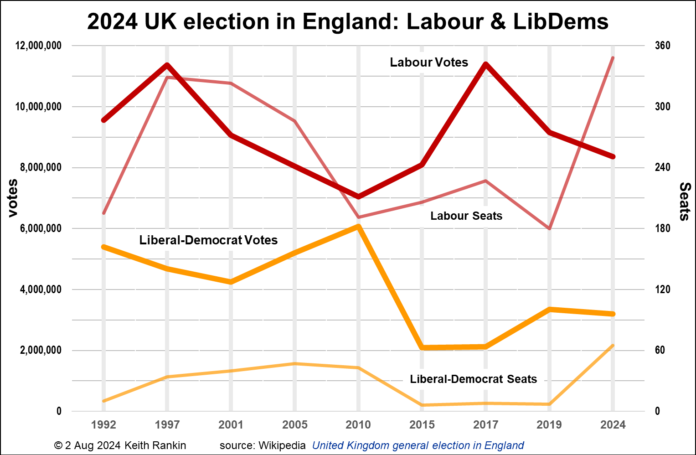
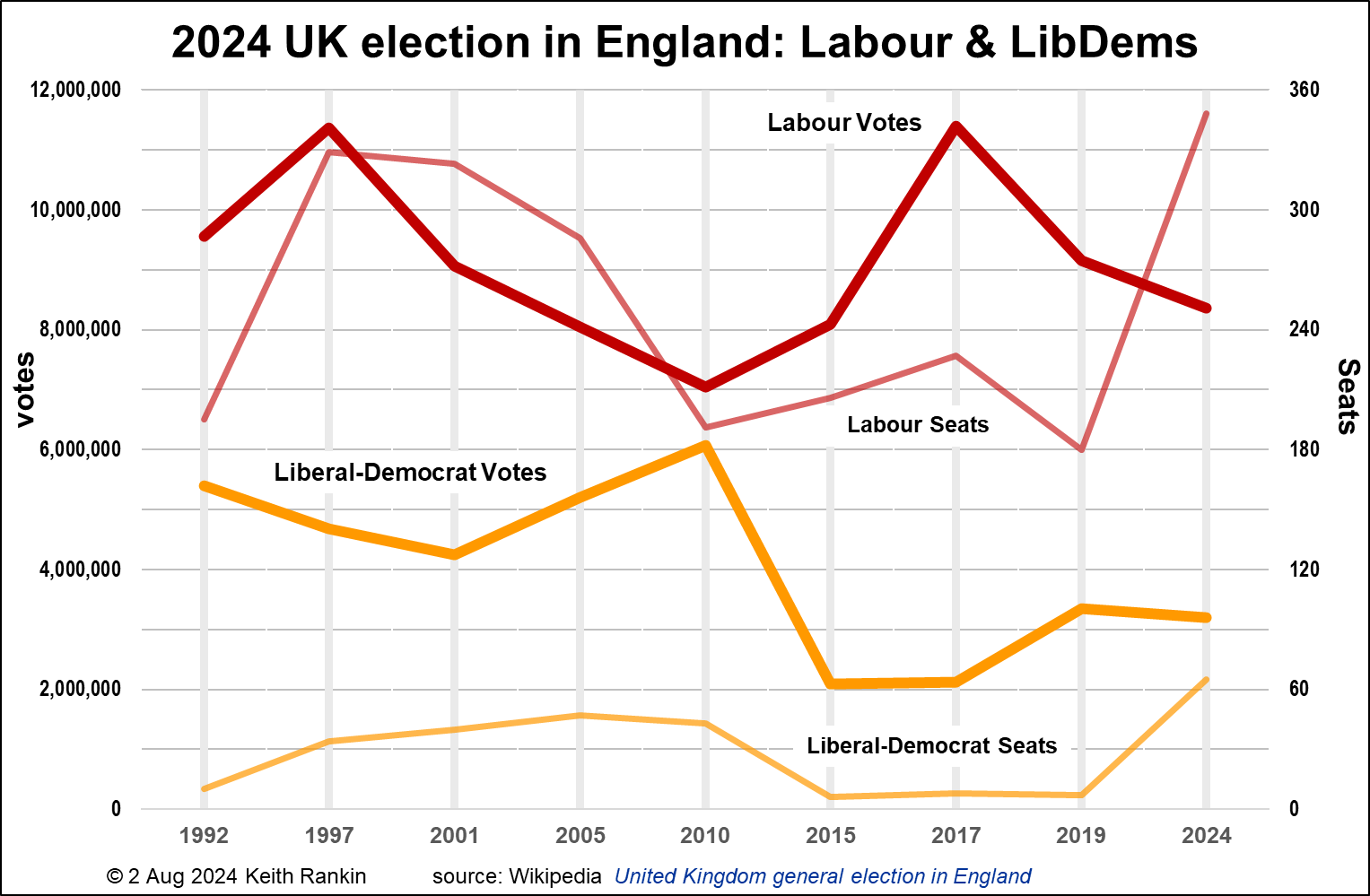
The above chart shows the votes for the principal ‘leftish’ political parties in England from 1992 to 2024. The important thing to note is that vote tallies should be rising over time in any country which has a rising population. England had had a rising population trend, yet the numbers of votes cast for the established centre-left parties have been on a falling trend.
For Labour the situation is worse than it looks. In 1992 Labour was comfortably defeated by Conservative. Yet Labour got a million more votes in 1992 than it did in 2024.
We may blame ‘apathy’ for this situation. Many more people are not voting at all. But apparent apathy is usually a symptom of something else. Ideally, when we vote we are voting for some ideal or somebody. More people vote when they perceive at least one of the options in a positive light. There is another situation which can lead to a high propensity to vote; namely if the existing government is perceived as being so bad that people will vote for whoever they must vote for in order to dismiss the government. This was the situation in England in 2024; yet even that urgency failed to galvanise voters. The total number of votes cast in England was the lowest since 2005, when Labour ‘won’ with 35% of the vote. (In 2024 Labour got 34% of the vote.)
In 2024, the total votes cast for Labour in England fell by nearly a million, after the 2019 election which was disastrous for Labour. Yet the number of seats Labour gained nearly doubled. Clearly this last distortion is a result of the ‘plurality’ voting system used in elections to the Westminster Parliament. But there’s something more important going on. The centre-left is losing favour.
The vote for the Liberal Democrats also fell in 2024, despite that party gaining a huge increase in the number of seats won. Their decline in votes is the result of what is commonly known as tactical voting; in this case it appears that about a million people who would have voted LibDem in an MMP election chose to lend their votes to Labour. (Probably more LibDem supporters than this lent their votes to Labour, because it is also clear that, where the LibDem candidate was better placed to beat the Conservative candidate, many otherwise Labour voters lent their votes to LibDem candidates.
It was this ‘efficient’ and rational vote-lending behaviour that enabled the centre-left to win so many seats. So, while, for once, ‘progressive’ voters were clever this time, the bigger story is the decline of popular support for the centre-left political agenda.
Another feature of the 2024 election is the Palestine-Gaza factor. In many traditionally Labour seats, there were ‘independent’ pro-Palestine candidates who cannibalised the Labour vote; indeed a few of these candidates won their seats.
The other important feature is the rise of the Green Party as a left-wing party winning pro-Palestine votes; especially votes of non-Muslims who are disturbed by what is currently happening in the Levant. For this see the two tables below. The Green Party may have gained ‘critical mass’, being poised to be the new left presence in British politics.
England General Election Results
Votes
Total
Labour
Conservative
LibDem
Green
other
1992
28,148,506
9,551,910
12,796,772
5,398,293
401,531
1997
26,058,712
11,372,329
8,780,881
4,677,565
60,013
1,167,924
2001
21,870,762
9,056,824
7,705,870
4,246,853
158,173
703,042
2005
22,713,855
8,043,461
8,116,005
5,201,286
251,051
1,102,052
2010
25,085,097
7,042,398
9,931,029
6,076,189
258,954
1,776,527
2015
25,571,204
8,087,684
10,517,878
2,098,404
1,073,242
3,793,996
2017
27,165,789
11,390,099
12,379,200
2,121,810
506,969
767,711
2019
26,909,668
9,152,034
12,710,845
3,340,835
819,751
886,203
2024
24,288,122
8,365,122
6,279,411
3,199,060
1,780,226
4,664,303
England General Election Results
Seats
Total
Labour
Conservative
LibDem
Green
other
1992
524
195
319
10
1997
529
329
165
34
1
2001
529
323
165
40
1
2005
529
286
194
47
2
2010
533
191
298
43
1
2015
533
206
319
6
1
1
2017
533
227
297
8
1
2019
533
180
345
7
1
2024
543
348
116
65
4
10
Watching that election on UK Sky TV (live on You Tube), one commentator repeatedly mentioned the “efficiency” of Labour, meaning that Labour won many seats on small margins. This so-called efficiency will make Labour very vulnerable in the next election, which, luckily for them, may not be until 2029.
Unless Labour performs exceptionally well, the votes lent to Labour will return to their LibDem homes.
What about the votes Labour lost to Independents and Greens in safe Labour seats? And the votes, Labour lent to winning (and near-winning) LibDem candidates. They are most likely to stay with the Liberal Democrats who will need these votes to fend off Conservative candidates.
The Tories
What of the ‘Tory’ Conservatives? They clearly got trounced; their vote count fell by more than 50% in the 2024 election. They may or may not get votes from people who voted Reform, the biggest of the ‘other’ parties in 2024. A useful strategy for them could be to cultivate the large conservative Muslim vote. A significantly higher proportion of voters in England are now Muslims; that proportion will only grow as Muslim households continue to have more children than the national average. And, Islam is a very conservative religion.
There is a natural fit here, going forward. Former Chancellor of the Exchequer Nadhim Zahawi was born in Iraq and is “thought to be a Muslim”. Likewise, another former Conservative Chancellor, Sajid Javid – born to Pakistani parents – “still identifies as being a Muslim”. If the Tories wish to be relevant in England’s future, they will need to adopt a wider political vision that is attractive to non-radical Muslims as well as to conservative people of other faiths. Otherwise, the future of the Right in England may fall to the new Reform Party; such a change has already happened in France.
So, I am predicting that – in 2029, or before – the LibDems may come through the middle, just as Emmanuel Macron’s party did in France in 2017, leaving both Labour and Conservative to play the role of small ‘legacy parties’. Labour’s ‘landslide’ is likely to accelerate, but in the wrong way; indeed, a landslide is actually a disaster.
Note
In this chart and text, I have looked at England only, which is the core of the United Kingdom, but not its entirety. This is because, especially in Scotland and Northern Ireland, other parties play significant roles. In Scotland in 2024, the big story was the crash of the Scottish National Party (SNP). Labour was a beneficiary of that crash. But it is likely that votes lent to Labour by regular SNP voters will not stay with Labour.
______________
Keith Rankin (keith at rankin dot nz), trained as an economic historian, is a retired lecturer in Economics and Statistics. He lives in Auckland, New Zealand.
The Freedom Flotilla Coalition has told supporters that the “Break the Siege” aid project for besieged Gaza from Turkey has been put on hold — indefinitely — due to rising tensions in the wake of the assassinations of key resistance leaders in the capitals of Lebanon and Iran.
“We will continue to work tirelessly to attempt to sail but, in the meantime, we need to let everyone know that for the moment, the sailing of Break the Siege must be put on hold, indefinitely,” said flotilla reporter Tan Safi in a video to supporters.
“Our other campaign vessel, Handala, will continue its journey towards Gaza.
An update from the Freedom Flotilla. Video: Gaza Freedom Flotilla
“Our respective national campaigns remain active and engaged: please watch for updates about our actions and other Palestine solidarity actions near you.
“Keep an eye on the crew and participants of Handala and continue demanding their safe passage according to international law.
“Together we must and will continue to demand sanctions, an end to the genocide, apartheid and illegal occupation, and justice for all the babies, children, mothers, fathers, and grandparents — human beings who have been murdered by the genocidal machine that is Israel.
Two New Zealand volunteers, Youssef Sammour and Rana Hamida, are crew on the Handala and feature in the the video.
Hamas political chief Ismail Haniyeh and his bodyguard were killed in the early hours of Wednesday at his war veterans’ guest house in Tehran in an assassination blamed on Israel by Iran.
His assassination came hours after top Hezbollah commander Fuad Shukr was killed in an Israeli air attack on the southern suburbs of Lebanon’s capital, Beirut. According to Lebanon’s health ministry, five civilians – three women and two children – also died in the attack.
Promises of “accountability and transparency” in deep-sea mining has seen a tsunami-size vote by nations on Friday for a Brazilian scientist to replace the incumbent British lawyer as head of an obscure UN organisation that regulates the world’s seabed.
Mounting international opposition to prospects of the International Seabed Authority (ISA) approving exploitation of the deep ocean’s vast mineral bounty by corporations before its environmental regulations were finalised fuelled the mood for change.
A rare vote by member nations saw Brazil’s candidate, former oceanographer Leticia Carvalho, defeat two-term head Michael Lodge, who has been criticised for being aligned to seabed mining companies.
Lodge was not present when the result was announced.
“The winning margin reflects the appetite for change,” Carvalho told BenarNews. “I see that transparency and accountability, broader participation, more focus on additional science, bridging knowledge gaps are the priority areas.”
Lodge had support from only 34 nations compared with 79 for Carvahlo, who also campaigned on restoring neutrality to the secretary-general position. She is currently a senior official at the UN Environment Programme and a former oil industry regulator in Brazil.
The change of leadership at the Kingston-based ISA is a possible setback to efforts to quickly finalise regulations for seabed mining, which would pave the way for exploitation to begin in the areas under its jurisdiction.
Some countries, meanwhile, are exploring the possibility of nodule mining in their territorial waters, which are outside of ISA oversight.
The new head of the UN deep-sea mining regulator vows to restore neutrality . . . International Seabed Authority secretary-general elect Leticia Carvalho (centre) of Brazil is congratulated by an ISA delegate following her election this week. Image: Stephen Wright/BenarNews
Mining of the golf ball-sized metallic nodules that litter swathes of the sea bed is touted as a source of rare earths and minerals needed for green technologies, such as electric vehicles, as the world reduces reliance on fossil fuels.
Sceptics say such minerals are already abundant on land and warn that mining the sea bed could cause irreparable damage to an environment that is still poorly understood by science.
Lodge was nominated for a third term by Kiribati, which is one of three Pacific island nations working with Nasdaq-listed The Metals Company on plans to exploit seabed minerals. More than 30 nations were disqualified from voting in the secret ballot as their financial contributions to the ISA are in arrears.
The hundreds of delegates and other attendees at the ISA assembly lined up to hug Carvalho following her election, including Gerard Barron, chief executive of The Metals Company.
International Seabed Authority secretary-general elect Leticia Carvalho of Brazil pictured with The Metals Company CEO Gerard Barron following her election this week. Image: Stephen Wright/BenarNews
After the vote the company tweeted, “we appreciate her proactive engagement with us and share her belief that adopting regulations, not a moratorium, is the best way to fulfil the ISA’s mandate,” adding they still hope to become “the first commercial operator in this promising industry.”
Greenpeace International campaigner Louisa Casson said she hoped Carvalho would work with governments “to change the ISA’s course to serve the public interest, as it has been driven by the narrow corporate interests of the deep sea mining industry for far too long.”
This week’s annual assembly of the ISA also witnessed more nations joining a call for a moratorium on mining until there was greater scientific and environmental understanding of its likely consequences.
Vanuatu’s Minister of Climate Change Ralph Regenvanu speaking at the annual meeting of the International Seabed Authority assembly in Kingston, Jamaica, this week. Image: IISD-ENB
Tuvalu is one of the latest to join those calling for a moratorium, taking to 10 the members of the 18-nation Pacific Islands Forum, now opposed to any imminent start to deep-sea mining.
Nations such as Vanuatu and Chile also succeeded in forcing a general debate on establishing an environmental policy at the ISA.
Pelenatita Petelo Kara, a Tongan activist who campaigns against deep-sea mining, said she was hopeful new leadership would mean “more time for science to confirm new developments” such as alternative minerals for green technologies as well as a more thorough dialogue on the proposed mining rules.
Deep-sea mineral extraction has been particularly contentious in the Pacific, where some economically lagging island nations see it as a possible financial windfall, but many other island states are strongly opposed.
Members of the International Seabed Authority assembly at their week-long annual meeting at the headquarters in Kingston, Jamaica, this week. Image: IISD-ENB
The island nation of Nauru in June 2021 notified the seabed authority of its intention to begin mining, which triggered the clock for the first time on a two-year period for the authority’s member nations to finalise regulations.
Its president David Adeang told the assembly earlier this week that its mining application currently being prepared in conjunction with The Metals Company would allow the ISA to make “an informed decision based on real scientific data and not emotion and conjecture.”
No other world conflict has killed as many journalists in recent memory.
Israel has a long history of violently targeting journalists, so their Gaza kill total is not necessarily surprising.
In fact, a 2023 Committee to Protect Journalists (CPJ) report documented a “decades-long pattern” of Israel targeting and killing Palestinian journalists.
Targeted attacks For example, a Human Rights Watch investigation found that Israel targeted “journalists and media facilities” on four separate occasions in 2012. During the attacks, two journalists were killed, and many others were injured.
In 2019, a United Nations commission found that Israel “intentionally shot” a pair of Palestinian journalists in 2018, killing both.
More recently, in 2022, Israel shot and killed Palestinian-American journalist Shireen Abu Akleh in the West Bank.
Al Jazeera journalist Shireen Abu Akleh . . . killed by an Israeli sniper in 2022 with impunity. Image: AJ screenshot APR
Israel attempted to deny responsibility, as it almost always does after it carries out an atrocity, but video evidence was overwhelming, and Israel was forced to admit guilt.
There have been no consequences for the soldier who fired at Abu Akleh, who had been wearing a press vest and a press helmet, or for the Israelis involved in the other incidents targeting journalists.
CPJ has suggested that Israeli security forces enjoy “almost blanket immunity” in incidents of attacks on journalists.
Given this broader context, Israel’s targeting of journalists during the current genocide is genuinely not surprising, or out of the ordinary.
Relative silence However, what is truly surprising, and even shocking, is the relative silence of Western journalists.
While there has certainly been some reportage and sympathy in North America and Europe, particularly from watchdog organisations like the CPJ and Reporters Without Borders (RSF), there is little sense of journalistic solidarity, and certainly nothing approaching widespread outrage and uproar about the threat Israel’s actions pose to press freedoms.
Can we imagine for a moment what the Western journalistic reaction might be if Russian forces killed more than 100 journalists in Ukraine in under a year?
Even when Western news outlets have reported on Palestinian journalists killed since the start of the current war, coverage has tended to give Israel the benefit of the doubt, often framing the killings as “unintentional casualties” of modern warfare.
Also, Western journalism’s overwhelming reliance on pro-Israel sources has ensured the avoidance of colourful adjectives and condemnations.
Moreover, overreliance on pro-Israel sources has sometimes made it difficult to determine which party to the conflict was responsible for specific killings.
BREAKING: Al Jazeera “journalist” Ismail al-Ghoul has reportedly been killed in Gaza.
A unique case? One might assume here that Western news outlets have simply been maintaining their devotion to stated Western reporting principles of detachment and neutrality.
But, in other situations, Western journalists have shown that they are indeed capable of making quite a fuss, and also of demonstrating solidarity.
The 2015 killing of 12 Charlie Hebdo journalists and cartoonists provides a useful case in point.
Following that attack, a genuine media spectacle ensued, with seemingly the entire institution of Western journalism united to focus on the event.
Thousands of reports were generated within weeks, a solidarity hashtag (“Je suis Charlie,” or “I am Charlie”) went viral, and statements and sentiments of solidarity poured in from Western journalists, news outlets and organisations dedicated to principles of free speech.
Freedom House issued a similarly harsh commendation, calling the attack “horrific,” and noting that it constituted a “direct threat to the right of freedom of expression”.
PEN America and the British National Secular Society presented awards to Charlie Hebdo and the Guardian Media Group donated a massive sum to the publication.
All journalists threatened The relative silence and calm of Western journalists over the killing of at least 100 Palestinian journalists in Gaza is especially shocking when one considers the larger context of Israel’s war on journalism, which threatens all journalists.
In October, around the time the current war began, Israel told Western news agencies that it would not guarantee the safety of journalists entering Gaza.
Ever since, Israel has maintained a ban on international journalists, even working to prevent them from entering Gaza during a brief November 2023 pause in fighting.
More importantly, perhaps, Israel has used its sway in the West to direct and control Western news narratives about the war.
Western news outlets have often obediently complied with Israeli manipulation tactics.
For example, as global outrage was mounting against Israel in December 2023, Israel put out false reports of mass, systematic rape against Israeli women by Palestinian fighters on October 7.
Western news outlets, including The New York Times, were suckered in. They downplayed the growing outrage against Israel and began prominently highlighting the “systematic rape” story.
ICJ provisional measures Later, in January 2024, the International Court of Justice (ICJ) issued provisional measures against Israel.
Israel responded almost immediately by issuing absurd terrorism accusations against the United Nations Relief and Works Agency for Palestinian Refugees (UNRWA).
Western news outlets downplayed the provisional measures story, which was highly critical of Israel, and spotlighted the allegations against UNRWA, which painted Palestinians in a negative light.
These and other examples of Israeli manipulation of Western news narratives are part of a broader pattern of influence that predates the current war.
One empirical study found that Israel routinely times attacks, especially those likely to kill Palestinian civilians, in ways that ensure they will be ignored or downplayed by US news media.
During the current genocide, Western news organisations have also tended to ignore the broad pattern of censorship of pro-Palestine content on social media, a fact which should concern anyone interested in freedom of expression.
It’s easy to point to a handful of Western news reports and investigations which have been critical of some Israeli actions during the current genocide.
But these reports have been lost in a sea of acquiescence to Israeli narratives and overall pro-Israel, anti-Palestinian framing.
Several studies, including analyses by the Centre for Media Monitoring and the Intercept, demonstrated overwhelming evidence of pro-Israel, anti-Palestinian framing in Western news reportage of the current war.
Is Western journalism dead? Many journalists in the United States and Europe position themselves as truth-tellers, critical of power, and watchdogs.
While they acknowledge mistakes in reporting, journalists often see themselves and their news organisations as appropriately striving for fairness, accuracy, comprehensiveness, balance, neutrality and detachment.
But this is the great myth of Western journalism.
A large body of scholarly literature suggests that Western news outlets do not come close to living up to their stated principles.
Israel’s war on Gaza has further exposed news outlets as fraudulent.
With few exceptions, news outlets in North America and Europe have abandoned their stated principles and failed to support Palestinian colleagues being targeted and killed en masse.
Amid such spectacular failure and the extensive research indicating that Western news outlets fall well short of their ideals, we must ask whether it is useful to continue to maintain the myth of the Western journalistic ideal.
Is Western journalism, as envisioned, dead?
Mohamad Elmasryis professor in the Media Studies programme at the Doha Institute for Graduate Studies, Qatar. Republished from Al Jazeera.
Hanan Ashrawi, a Palestinian political leader and a former member of the Palestine Liberation Organisation (PLO) Executive Committee, says Israel’s “gangster style assassination and extrajudicial executions” are designed to “inflame the whole region”, reports Al Jazeera.
The killings of the Hamas political chief Ismail Haniyeh in Tehran and Hezbollah military commander Fuad Shukr in Beirut, Lebanon, were carried out to “sabotage any chances” of a ceasefire deal in Gaza and regional de-escalation, Ashrawi said.
Haniyeh was a chief Hamas negotiator for a ceasefire in Israel’s genocidal war and had built up formidable diplomatic credentials across the region.
“These are attacks not just on the capitals of sovereign states but also on significant leaders to ensure total provocation [and] destabilisation,” Ashrawi wrote on social media.
“Israel is a rogue state that represents a real [and] present danger globally,” she said.
‘Maddening and shameful’ Marking the 300th day of Israel’s war on Gaza yesterday, Palestinian-American scholar Noura Erakat said it was “maddening and shameful” that the world had not been able to stop one of the “grossest, most blatant colonial genocides”.
In a post on social media, Erakat said Israel’s genocide in Gaza had featured the use of advanced weapons as well as the spread of disease, “poisoning of the earth” as well as sexual assault and torture, reports Al Jazeera.
Israel’s genocide must be remembered for what it is, Erakat said, adding “we cannot afford to lose the next battle over narrative”.
“A blight on all humanity, to ascribe shame to all who let it happen [and] glory to those who fought so that the future indeed ensures: never again,” she said.
Day 300. Its maddening and shameful we have not been able to end one of the grossest, most blatant colonial #genocides feat disease, poisoning of the earth, sexual assualt, torture, & advanced weapons. This will end & we cannot afford to lose the next battle over narrative (1/2)
According to an analysis of data from the Armed Conflict Location and Event Data Project (ACLED), Israel is responsible for 17,081 incidents of air/drone raids, shelling/missile attacks, remote explosives and property destruction in eight countries since October 7, including the occupied Palestinian territory, Lebanon, Syria, Egypt, Yemen, Jordan, Iran and Iraq.
A majority of these attacks were on the Palestinian territory, specifically the Gaza Strip, with 10,389 incidents accounting for more than 60 percent of the total offensives.
There were at least 6,544 incidents of Israeli attacks on Lebanon (38 percent), followed by Syria with 144 such incidents recorded.
Haniyeh funeral final ceremonies in Qatar. Video: Al Jazeera
Released 15 Palestinian prisoners tortured Israeli forces have released 15 Palestinian prisoners into Gaza. They were dropped off at a military checkpoint near Deir el-Balah in central Gaza. Many spoke of abuse and torture while detained.
Israel has detained thousands of Palestinians during the war in Gaza and stands accused of numerous cases of torture, the Office of the United Nations High Commissioner for Human Rights says in a new report.
The 23-page report, released on Wednesday, noted allegations of widespread abuse of prisoners being held incommunicado in arbitrary, prolonged detention.
It was published during a tense standoff in Israel as far-right politicians and demonstrators opposed an investigation into alleged sexual abuse of Palestinian detainees by Israeli soldiers.
The death toll in the genocidal war at the 300 day mark has topped 40,000 Palestinians, including more than 16,000 children.
Day 300 . . . and the death toll in Israel’s genocidal war on Gaza has topped 40,000, including more than 16,000 children. Graphic: Al Jazeera/Creative Coommons
Prime Minister Anthony Albanese will switch the government’s focus in Indigenous affairs policy towards the economic empowerment of First Nations communities, in a speech at the Garma Festival in Arnhem Land on Saturday.
Addressing the festival nearly a year after the Voice referendum crashed, Albanese will say: “I have not returned to Garma today to talk about what might have been. I have not come back to this place of fire, to rake through the ashes. I am here because my optimism for a better future still burns.”
“We can be a country where Aboriginal and Torres Strait islander people have power over their destiny.”
The government’s new economic emphasis comes as many Indigenous people remain upset over the referendum’s failure. This weekend’s festival coincides with the appointment of Malarndirri McCarthy as the new Minister for Indigenous Australians, and the release this week of the latest Closing the Gap report, that showed several areas, including indigenous incarceration, going backwards. .
In his speech, released ahead of delivery, Albanese looks to global changes, specifically the energy revolution, as providing the opportunities for Australia’s First Nations people to prosper.
He says building “true and lasting self-determination requires economic security” for Indigenous people – security that exists “outside of government decisions, and endures beyond them”.
The changes in the global economy are making this possible, he says..
“Growing global demand for renewable energy, critical minerals and rare earths represents an unprecedented opportunity for our nation and for Northern Australia.”
The north has so many of the resources the world needs to transform to clean energy, Albanese says, and so much of the space and sunlight for Australia to be a renewable energy superpower.
The global economy is undergoing the biggest change since the industrial revolution, he says.
“And it also represents the best chance Australia has ever had to bring genuine self-determination and lasting economic empowerment to remote communities.
“New clean energy projects, new defence and security projects, new processing and refining facilities can all unlock new jobs and prosperity for Indigenous communities.”
Partnering from the start with locals means “we can avoid the exploitation and injustices of the past,” the Prime Minister says.
“And we can tackle the poverty and lack of opportunity that has seen disadvantage entrenched in these parts of our country over generations.
“Together, we can seize this moment to build a better future on a simple principle. The principle that Aboriginal and Torres Strait Islander people deserve a real say in the economic development of the land you call home. And you deserve your fair share of the benefits that flow from it.
“This is about so much more than consulting communities in the service of cultural or heritage considerations, as important as that remains.”
Indigenous people “are more than curators or custodians, you are the traditional owners, who have cared for land and waters for 60,000 years and more.
“And we want you to have ownership of your future – built on a foundation of economic empowerment.
“This is about good jobs that change lives and strengthen communities – that provide a sense of pride and purpose, hope and aspiration. New careers in clean energy, construction, the care economy, technology, infrastructure and resources.
“These are creators of intergenerational opportunity.”
To promote delivery and accountabilty the goverbment is forming a First Nations Economic Partnership with the Coalition of Peaks, which represents a wide range of Indigenous organisations.
Tying the approach into the same principles as in the government’s Future Made in Australia policy, Albanese says: “We want government investment to drive engagement between businesses and communities, maximising local jobs and long-term benefit.
“And we want to see the same commitment in the First Nations Clean Energy Strategy we are developing with the states and territories.
“We want projects generating renewable energy on country, to bring new economic power to communities.”
Some needed changes were practical rather than political, such as helping Indigenous bodies and investors to connect.
“That’s why we are partnering with the First Nations Heritage Protection Alliance to create a central point of contact in communities to connect traditional owners and investors.”
Albanese was vague on the remaining issues of the Uluru Statement from the Heart.
He said the government remained committed to Makarrata which means “a coming together after a struggle.”
“And we will continue to engage in good faith with leaders and communities to decide what the next steps should be at a national level.”
Work on treaty and truth telling is being left to the states and territories at present.
Michelle Grattan does not work for, consult, own shares in or receive funding from any company or organisation that would benefit from this article, and has disclosed no relevant affiliations beyond their academic appointment.
Pacific Journalism Review (PJR) began life three decades ago in Papua New Guinea and recently celebrated a remarkable milestone in Fiji with its 30th anniversary edition and its 47th issue.
Remarkable because it is the longest surviving Antipodean media, journalism and development journal published in the Global South. It is also remarkable because at its birthday event held in early July at the Pacific International Media Conference, no fewer than two cabinet ministers were present — from Fiji and Papua New Guinea — in spite of the journal’s long track record of truth-to-power criticism.
Fiji’s Deputy Prime Minister Biman Prasad, a former economics professor at The University of the South Pacific (USP) and a champion of free media, singled out the journal for praise at the event, which was also the occasion of the launch of a landmark new book. As co-editor of Waves of Change: Media, Peace, and Development in the Pacific with Shailendra Singh and Amit Sarwal, Prasad says the book aimed to analyse recent developments in the Pacific because if sustainable peace and stability remain elusive in the region then long-term development is impeded.
Papua New Guinea’s Information and Communication Technologies Minister Timothy Masiu, who has faced criticism over a controversial draft media policy (now in its fifth version), joined the discussion, expressing concerns about geopolitical agendas impacting on the media and arguing in favour of “a way forward for a truly independent and authentic Pacific media”.
Since its establishment in 1994, the PJR has been far more than a research journal. As an independent publication, it has given strong support to Asia-Pacific investigative journalism, socio-political journalism, political-economy perspectives on the media, photojournalism and political cartooning in its three decades of publication. Its ethos declared:
While one objective of Pacific Journalism Review is research into Pacific journalism theory and practice, the journal has also expanding its interest into new areas of research and inquiry that reflect the broader impact of contemporary media practice and education.
A particular focus is on the cultural politics of the media, including the following issues: new media and social movements, indigenous cultures in the age of globalisation, the politics of tourism and development, the role of the media and the formation of national identity and the cultural influence of Aotearoa New Zealand as a branch of the global economy within the Pacific region.
It also has a special interest in climate change, environmental and development studies in the media and communication and vernacular media in the region.
PJR has also been an advocate of journalism practice-as-research methodologies and strategies, as demonstrated especially in its Frontline section, initiated by one of the mentoring co-editors, former University of Technology Sydney professor and investigative journalist Wendy Bacon, and also developed by retired Monash University Professor Chris Nash. Five of the current editorial board members were at the 30th birthday event: Griffith University’s Professor Mark Pearson; USP’s Associate Professor Shailendra Singh, the conference convenor; Auckland University of Technology’s Khairiah Abdul Rahman; designer Del Abcede; and current editor Dr Philip Cass.
The cover of the 30th anniversary edition of Pacific Journalism Review. Image: PJR
As the founding editor of PJR, I must acknowledge the Australian Journalism Review which is almost double the age of PJR, because this is where I first got the inspiration for establishing the journal. While I was head of journalism at the University of Papua New Guinea in 1993, I was really frustrated at the lack of quality Pacific-specific media and journalism literature and research to draw on as resources for both critical studies and practice-led education.
So I looked longingly at AJR, and also contributed to it. I turned to the London-based Index on Censorship as another publication to emulate. And I thought, why not? We can do that in the Pacific and so I persuaded the University of Papua New Guinea Press to come on board and published the first edition at the derelict campus printer in Waigani in 1994.
We published there until 1998 when PJR moved to USP for five years. Then it was published for 18 years at Auckland University of Technology (AUT), mostly through the Pacific Media Centre, which closed in 2020. Since then it has been published by the nonprofit NGO Asia Pacific Media Network.
When celebrating the 20th anniversary of the journal at AUT in 2014, then AJR editor professor Ian Richards noted the journal’s “dogged perseverance” and contribution to Oceania research declaring:
Today, PJR plays a vital role publishing research from and about this part of the world. This is important for a number of reasons, not least because most academics ground their work in situations with which they are most familiar, and this frequently produces articles which are extremely local. If “local” means London or Paris or New York, then it’s much easier to present your work as “international” than if you live in Port Vila of Pago Pago, Auckland or Adelaide.
Also in 2014, analyst Dr Lee Duffield highlighted the critical role of PJR during the years of military rule and “blatant military censorship” in Fiji, which has eased since the repeal of its draconian Media Industry Development Act in 2023. He remarked:
The same is true of PJR’s agenda-setting in regard to crises elsewhere: jailing of journalists in Tonga, threatened or actual media controls in Tahiti or PNG, bashing of an editor in Vanuatu by a senior government politician, threats also against the media in Solomon Islands, and reporting restrictions in Samoa.
Fiji’s Deputy PM Professor Biman Prasad (sixth from left) and PNG’s Communications Minister Timothy Masiu (third from right) at the launch of the 30th anniversary edition of PJR in Suva, Fiji. Image: Khairiah Rahman/APMN
At the 30th anniversary launch, USP’s Adjunct Professor in development studies and governance Dr Vijay Naidu complimented the journal on the wide range of topics covered by its more than 1,100 research articles. He said the journal had established itself as a critical conscience with respect to Asia-Pacific socio-political and development dilemmas, and looked forward to the journal meeting future challenges.
I outlined many of those future challenges in a recent interview with Global Voices correspondent Mong Palatino. Issues that have become more pressing for the journal include responding to the changing geopolitical realities in the Pacific and collaborating even more creatively and closely on development, the climate crisis, and unresolved decolonisation issues with the region’s journalists, educators and advocates. To address these challenges, the PJR team have been working on an innovative new publishing strategy over the past few months.
View the latest Pacific Journalism Review:Gaza, genocide and media – PJR 30 years on, special double edition.The journal is indexed by global research databases such as Informit and Ebsco, but it is also available via open access for a Pacific audience here.
President Biden — if you feel like pretending Biden is still serving as President and still making the decisions in the White House — has pledged to support Israel against any retaliations for its recent assassination spree in Iran and Lebanon which killed high-profile officials from Hamas and Hezbollah.
A White House statement asserts that Biden spoke with Benjamin Netanyahu yesterday and “reaffirmed his commitment to Israel’s security against all threats from Iran, including its proxy terrorist groups Hamas, Hezbollah, and the Houthis,” and “discussed efforts to support Israel’s defence against threats, including against ballistic missiles and drones, to include new defensive US military deployments.”
Hilariously, the statement also claims that “the President stressed the importance of ongoing efforts to de-escalate broader tensions in the region.”
Sea Shepherd founder and anti-whaling activist Paul Watson has been arrested in Greenland and awaits potential extradition to Japan.
The arrest relates to incidents in the Southern Ocean in February 2010. The charges against Watson include “accomplice to an assault” and “ship trespass”. Both relate to the boarding of the Japanese vessel Shonan Maru No 2 by Pete Bethune, who was captain of the Sea Shepherd vessel Ady Gil. Bethune was detained on the Shonan Maru No 2 and returned to Japan for trial, where he received a suspended sentence. An international arrest warrant was issued for Watson in 2012.
At the time of the recent arrest on July 21, Watson’s ship had stopped for refuelling while en route to intercept a Japanese whaling vessel, the Kangei Maru. He was on board the John Paul DeJoria, owned by the Captain Paul Watson Foundation he founded two years ago.
Watson left Sea Shepherd in 2022, following disputes with directors over the value of direct action and confrontation. He originally founded Sea Shepherd after falling out with Greenpeace for similar reasons.
His arrest brings the issue of whaling back to the fore. Despite a flurry of activity in the courts a decade ago, the issue hasn’t gone away. That’s because Japan withdrew from the International Convention for the Regulation of Whaling and its decision-making body in 2019 and resumed commercial whaling.
What is an international arrest warrant?
An international arrest warrant, also referred to as a “Red Notice”, is a request to law enforcement all over the world to locate and provisionally arrest a person.
The Red Notice for Watson is based on an arrest warrant or court order issued by Japan. Importantly, a Red Notice is not a finding of guilt and the presumption of innocence still applies.
Now the arrest has been made, Japan is seeking extradition. The request went to Denmark because Greenland is an autonomous Danish territory.
What is the basis for the charges?
Two international treaties provide Japan with a legal basis for the charges laid against Watson.
Under the United Nations Convention on the Law of Sea, Japan can grant its nationality to ships, as it did with the Shonan Maru No 2. Nations have exclusive jurisdiction over ships flying their flag when that ship is on the high seas (international waters). This means Japan can treat the boarding of the Shonan Maru No 2 as if it happened on Japanese territory.
Japan may also argue the boarding of the Shonan Maru No 2 was an act of piracy. Under the convention, Japan would need to show the boarding was a case of:
illegal acts of violence or detention, or any act of depredation, committed for private ends by the crew or the passengers of a private ship or a private aircraft, and directed […] on the high seas, against another ship or aircraft, or against persons or property on board such ship.
The sticking point for Japan may be whether or not the boarding can be considered to be for “private ends”.
The convention for the suppression of unlawful acts against the safety of maritime navigation may also apply. In short, this grants jurisdiction over certain types of offences when they occur on board a ship flying the nation’s flag. For example, Japan may argue the alleged conduct of Watson and/or his colleagues was “an act of violence against a person on board a ship if that act is likely to endanger the safe navigation of that ship”.
Will Denmark extradite?
Extradition is often governed by a specific extradition agreement between two nations, as well as by a nation’s own domestic law. For example, the Extradition Act in Denmark permits extradition in certain circumstances. However, it also has limitations on that power, including to prevent double prosecutions, where a person faces trial more than once for the same conduct.
Extradition will not apply to prosecutions of crimes that are not also an offence in Denmark, abandoned prosecutions, or where a court accepts there is a risk that the person concerned:
will be subjected to persecution affecting his life or freedom or otherwise of a serious nature because of his or her origin, membership of a particular ethnic group, religious or political beliefs or otherwise because of political circumstance.
The relevant court in Denmark can also decide that extradition is temporarily suspended on serious humanitarian grounds.
Extradition is as much political as legal
In many ways, extradition is a fusion between “executive power” and the powers of the courts and the prosecutors, as well as involving foreign policy considerations. For this reason, it can be as much political as legal. This is why we have seen calls from other countries, such as France, for Denmark to abandon the arrest and not agree to extradition.
Political pressure can sometimes be effective in such cases, particularly in countries where there is ministerial discretion around whether to extradite.
What next?
Ultimately, Japan may choose to abandon its interest in prosecuting a warrant that is more than ten years old.
Or it may choose to exercise its full legal power in pursuing Watson, with the goal of deterring anti-whaling advocacy. However, this would likely attract criticism from other nations, given very few support whaling activity, and reduce willingness to cooperate with Japan on other extradition matters.
Either way, the tension between environmental advocacy and other commercial and legal interests is obvious. The law can – and should – find better ways to balance these interests, especially in the midst of an environmental crisis.
Tamsin Phillipa Paige has previously received funding from the Australian Government.
Danielle Ireland-Piper does not work for, consult, own shares in or receive funding from any company or organisation that would benefit from this article, and has disclosed no relevant affiliations beyond their academic appointment.
Source: The Conversation (Au and NZ) – By Cassandra Cross, Associate Dean (Learning & Teaching) Faculty of Creative Industries, Education and Social Justice, Queensland University of Technology
For many, tax time is an exciting part of the year – there’s the potential for a refund. However, it’s also an attractive time for fraudsters looking for ways to get money and deceive unsuspecting victims.
Each year Australians lose large amounts of money to scams. In 2023, Australians reported losses of more than A$2.7 billion. While this is a slight reduction from the $3.1 billion in 2022, there are still millions of victims who’ve suffered at the hands of scammers.
Impersonation scams are one common approach. Scamwatch reports that in 2023, 70% of reports to them involved impersonation.
A large number of these were linked to the Australian Taxation Office (ATO) and myGov.
What is an impersonation scam?
Impersonation scams are what they sound like: when an offender pretends to be someone or something they are not. Offenders may pretend to be family members or friends in our contact lists.
In many cases, they will say they’re from an organisation such as a bank or a well-known retailer, or a government department – like the ATO.
Offenders take on the identity of a known and trusted organisation to increase the chances of success. While we may ignore communications from unknown entities and strangers, we’re more likely to engage with what’s familiar.
Additionally, the ATO has a powerful status as a government agency, and we are unlikely to ignore its messages – especially at tax time.
What are they trying to get out of my myGov account?
myGov is the gateway to a range of government services, including Medicare, Centrelink, My Health Record, the National Disability Insurance Scheme, and of course, the ATO.
Being able to log in to myGov gives offenders access to a wide range of your personal details. This can help them build a fuller profile of you to potentially commit identity theft (such as opening new accounts in your name).
There’s also the potential for direct fraud. With access to myGov, offenders can change your bank account details and redirect any refunds into their accounts, whether from the ATO or other linked services.
They can even submit false tax returns, medical claims or other forms to obtain fraudulent funds. As the legitimate owner of the account, you may not immediately notice this.
There have been recent reports of people’s myGov accounts receiving repeated login attempts. The Conversation
What does a myGov scam look like?
In most instances, a myGov scam will look like one of the many phishing attempts we all receive on a daily basis. While each approach can be worded differently, their desired outcome is the same: to acquire your personal information.
Fraudsters are sending text messages and emails pretending to be from the ATO, advising you there’s a refund available if you click the provided link.
Another approach is to flag a “problem” with your tax return or bank account, and direct you to take immediate action via a link. Creating a sense of urgency can trick users into acting in the moment, without thinking through the request.
The text or email may also be very neutral, simply stating there’s a new message waiting – with a link to where you can read it.
Regardless of what the message says, the goal is to direct you to a website that looks genuine, but is fake. If you enter your myGov details into such a fake site, the offender can capture your login details and use them to log into your actual myGov account.
What to do if you’ve been a victim?
If you have clicked on a scam link and provided your personal details, there are steps you can take.
Change your password and review your account settings if you still have access to your myGov account.
Check your bank accounts, to see what, if anything, has been lost. Contact your bank or financial institution immediately if you notice any withdrawals or suspicious transactions.
Contact any other organisation linked to your myGov account to see if any unauthorised actions have been taken.
For anyone who has lost personal information and experienced identity crime, IDCARE is the national support centre for identity crime victims. They will be able to assist with a personalised response plan to your specific situation.
How do I keep my account safe?
Never click on links in text messages or emails that direct you to log in to your accounts. Always access your accounts independently, through details you have found independently of any text or email.
Review your security settings. There have been recent reports of people’s myGov accounts being targeted with repeated login attempts. Using your unique eight-digit myGov username for logging in can be safer than using your email address.
Enable multi-factor authentication where possible. myGov uses two-factor authentication in the form of a text message in addition to an online login. While this is not foolproof, it offers an additional layer of protection and can stop offenders accessing your account with only partial pieces of your information.
Be vigilant on all communications. Always keep in mind that all may not be what it seems and the person you are communicating with may not be who they say they are. It is okay to be sceptical and do your own checks to verify details of what is presented to you.
Remember, fraudsters thrive on the silence and shame of those who respond or fall victim to their scams. We need to communicate openly about these schemes and talk to family and friends, to increase everyone’s knowledge and awareness.
Cassandra Cross has previously received funding from the Australian Institute of Criminology and the Cybersecurity Cooperative Research Centre.
Claude Raschella/State Theatre Company South Australia
A blind dinner date in a small high-rise apartment between a blandly dressed neat-freak with a professed admiration for alt-right male online celebs, and a colourful gender studies grad with a strong sense of social justice is falling apart.
It is about to be over – when an unnamed emergency causes the building and city to go into lockdown.
We follow the hilarious consequences of these two political polar-opposites being thrust together, with surprising outcomes.
The Questions is a gorgeous and joyful piece of new Australian musical theatre. Van Badham (book and lyrics) and long-term collaborator Richard Wise (music and lyrics) have created a stunning two-hander about an ultimate first-date disaster and finding connection despite differences.
Nestled amid the many hilarious moments in the rom-com musical are profound questions about what is really needed for two seemingly opposite people to really connect.
A beautiful construction
As “Visitor” and “Resident”, Chaya Ocampo and Charles Wu are a delight. They are adorable and mesmerising as the ill-met-by-lockdown odd couple. Their voices are stunning, and their playful and feisty engagement is electric.
They build the relationship between the two mismatched Gen Xers with an unwavering sense of playful connection: their development of the gradual intimacy and resulting fights and flare-ups is wonderful to observe.
Chaya Ocampo and Charles Wu are adorable and mesmerising as the ill-met-by-lockdown odd couple. Claude Raschella/State Theatre Company South Australia
The band is located onstage in an adjoining apartment. As the neighbours/house-and-band-mates, musicians Sam Lau (keys, guitar), James Bannah junior (keys) and Jackson Mack (drums) are just fabulous. Their playing and backing vocals are sharp, lively and well woven through the play.
Badham and Wise’s lyrics are delicious and devilishly clever with clever rhymes and quirky metaphors. They have a razor-sharp sense of the pulse of pop culture, and the songs and dialogue revel in those moments. The sudden moments of intimacy and of conflict are a joy.
Badham’s book is beautifully constructed with hilarious twists and starkly honest observations about the reality of dating when someone else is doing the matching – whether friend, app or random noodle server.
There are moments of recognition of the world of dating in an online world; sparks and sparring; the awkward and euphoric.
Navigated with energy and ease
The musical takes its title from the “36 questions to fall in love” developed by psychologist Arthur Aron in 1997. The device of the questions is used sparingly, the spotlight given to examining the developing relationship between the Resident and the Visitor.
Wise’s music effortlessly conveys the exciting-but-nervous first-date energy, pressure-cooker arguments and vulnerable, deep truth moments of love.
Wu’s solos have moments of breath-taking lyricism. His excellent voice and phrasing give nuance and depth to each moment.
Wu’s excellent voice and phrasing give nuance and depth to the moment. Claude Raschella/State Theatre Company South Australia
Ocampo’s voice changes effortlessly from overexcited patter to reflective to no-holds-barred excitement or anger. Everything she sings is right in the middle of the note and sparkles with clarity and intention. They both navigate the often complex vocal lines with ease.
Mitchell Butel directs with wit and verve. His sense of the joy and fun of this piece is evident. His skill at conveying the sense of energies exploding in the contained space, while also giving the characters room to expand and steer their storytelling, is masterful.
The set by Jeremy Allen is a wonderful realisation of the world of Nordic-inspired neutrals, the interior of tiny, densely packed modern apartments repeated ad-infinitum. The slightly cartoonish style of the high-rises in the background (complete with lighted windows) evokes manga and keeps us located in the world of musical comedy.
The band’s room is a tiny glass box encroaching on the living room space of the Resident’s apartment. Claude Raschella/State Theatre Company South Australia
The band’s room is a tiny glass box encroaching on the living room space of the Resident’s apartment. Clever use of micro venetians as actual room blinds screens the band from the action. The proximity of the neighbours and their observation of everything that happens in the fishbowl apartment next door is used to wonderful comic effect by the actors.
Gavin Norris’ lighting creates beautiful moments, isolating the actors during a solo, or abruptly changing the mood during a tense moment. The lighting gives the neutral tones of the set depth and colour, reflecting the changing moods of the characters and their inner emotions.
State Theatre Company South Australia has nurtured and developed this premiere piece with such care and joy. I left the theatre completely elated and my heart was full of beautifully made music and lyrics. I wanted to go back in and see it all again.
The Questions is at the State Theatre Company of South Australia until August 17.
Catherine Campbell does not work for, consult, own shares in or receive funding from any company or organisation that would benefit from this article, and has disclosed no relevant affiliations beyond their academic appointment.
Around 3.2 million Australians live with depression.
At the same time, few Australians meet recommended dietary or physical activity guidelines. What has one got to do with the other?
Our world-first trial, published this week, shows improving diet and doing more physical activity can be as effective as therapy with a psychologist for treating low-grade depression.
Previous studies (including our own) have found “lifestyle” therapies are effective for depression. But they have never been directly compared with psychological therapies – until now.
Amid a nation-wide shortage of mental health professionals, our research points to a potential solution. As we found lifestyle counselling was as effective as psychological therapy, our findings suggest dietitians and exercise physiologists may one day play a role in managing depression.
What did our study measure?
During the prolonged COVID lockdowns, Victorians’ distress levels were high and widespread. Face-to-face mental health services were limited.
Our trial targeted people living in Victoria with elevated distress, meaning at least mild depression but not necessarily a diagnosed mental disorder. Typical symptoms included feeling down, hopeless, irritable or tearful.
We partnered with our local mental health service to recruit 182 adults and provided group-based sessions on Zoom. All participants took part in up to six sessions over eight weeks, facilitated by health professionals.
Half were randomly assigned to participate in a program co-facilitated by an accredited practising dietitian and an exercise physiologist. That group – called the lifestyle program – developed nutrition and movement goals:
limiting discretionary foods, such as those high in saturated fats and added sugars
doing enjoyable physical activity.
The second group took part in psychotherapy sessions convened by two psychologists. The psychotherapy program used cognitive behavioural therapy (CBT), the gold standard for treating depression in groups and when delivered remotely.
In both groups, participants could continue existing treatments (such as taking antidepressant medication). We gave both groups workbooks and hampers. The lifestyle group received a food hamper, while the psychotherapy group received items such as a colouring book, stress ball and head massager.
Lifestyle therapies just as effective
We found similar results in each program.
At the trial’s beginning we gave each participant a score based on their self-reported mental health. We measured them again at the end of the program.
Over eight weeks, those scores showed symptoms of depression reduced for participants in the lifestyle program (42%) and the psychotherapy program (37%). That difference was not statistically or clinically meaningful so we could conclude both treatments were as good as each other.
There were some differences between groups. People in the lifestyle program improved their diet, while those in the psychotherapy program felt they had increased their social support – meaning how connected they felt to other people – compared to at the start of the treatment.
Participants in both programs increased their physical activity. While this was expected for those in the lifestyle program, it was less expected for those in the psychotherapy program. It may be because they knew they were enrolled in a research study about lifestyle and subconsciously changed their activity patterns, or it could be a positive by-product of doing psychotherapy.
There was also not much difference in cost. The lifestyle program was slightly cheaper to deliver: A$482 per participant, versus $503 for psychotherapy. That’s because hourly rates differ between dietitians and exercise physiologists, and psychologists.
What does this mean for mental health workforce shortages?
Psychologists, who provide about half of all mental health services, can have long wait times. Our results suggest that, with the appropriate training and guidelines, allied health professionals who specialise in diet and exercise could help address this gap.
Lifestyle therapies can be combined with psychology sessions for multi-disciplinary care. But diet and exercise therapies could prove particularly effective for those on waitlists to see a psychologists, who may be receiving no other professional support while they wait.
Many dietitians and exercise physiologists already have advanced skills and expertise in motivating behaviour change. Most accredited practising dietitians are trained in managing eating disorders or gastrointestinal conditions, which commonly overlap with depression.
There is also a cost argument. It is overall cheaper to train a dietitian ($153,039) than a psychologist ($189,063) – and it takes less time.
Potential barriers
Australians with chronic conditions (such as diabetes) can access subsidised dietitian and exercise physiologist appointments under various Medicare treatment plans. Those with eating disorders can also access subsidised dietitian appointments. But mental health care plans for people with depression do not support subsidised sessions with dietitians or exercise physiologists, despite peak bodies urging them to do so.
Increased training, upskilling and Medicare subsidies would be needed to support dietitians and exercise physiologists to be involved in treating mental health issues.
Our training and clinical guidelines are intended to help clinicians practising lifestyle-based mental health care within their scope of practice (activities a health care provider can undertake).
Future directions
Our trial took place during COVID lockdowns and examined people with at least mild symptoms of depression who did not necessarily have a mental disorder. We are seeking to replicate these findings and are now running a study open to Australians with mental health conditions such as major depression or bipolar disorder.
If this article has raised issues for you, or if you’re concerned about someone you know, call Lifeline on 13 11 14.
Adrienne O’Neil receives funding support from the National Health and Medical Research Council (#2009295). The CALM Trial was funded by the National Health and Medical Research Council’s Medical Research Future Fund – COVID-19 Mental Health Research Australian Government Department of Health (GA133346).
Sophie Mahoney’s position is funded by a Medical Research Future Fund grant (2006296). The CALM Trial was funded by the National Health and Medical Research Council’s Medical Research Future Fund – COVID-19 Mental Health Research Australian Government Department of Health (GA133346). Sophie has previously received payment from Red Island.
The Australian National Health and Medical Research Council (NHMRC) has just released its much-anticipated landmark statement advocating for sex, gender, variations of sex characteristics and sexual orientation to be routinely considered in health and medical research.
This means the NHMRC is asking funding applicants to think about questions such as whether their research will include data from both males and females, whether the outcome measures are appropriate for different sex and gender groups, and how potential differences in these groups will be measured and reported.
Setting the standard this way has the potential to overhaul sex-and-gender-based biases and health disparities in medicine. But only if the next steps are implemented effectively.
Why sex, gender and sexual orientation matter
Although related, these terms have different meanings:
sex means one’s biological characteristics and is also a legal status
gender means one’s identity, expression, experiences and behaviours, and is a social construct, meaning it’s an idea created and shaped by people and their interactions
sexual orientation refers to a person’s sexual identity and attraction, such as gay, bisexual, heterosexual or asexual.
These aspects of a person fundamentally influence their health. Differences related to sex, gender and sexual orientation have impacts on disease susceptibility, diagnosis, severity, prognosis and management. These impacts apply to a wide range of acute and chronic conditions.
For centuries, health and medical researchers have not routinely considered sex, gender or sexual orientation in the design, analysis or interpretation of their research.
Most medical research in non-human animals (also called “pre-clinical research”, where drug treatments are developed and tested for safety and effectiveness) is conducted only in males. In human clinical trials, participation rates are often higher among males than females.
The outcomes of research are rarely reported or analysed separately according to specific sex and gender groups. This prevents detection of potential sex and gender differences in treatment safety and effectiveness.
This affects everyone, particularly marginalised groups including women and girls, people born with variations of sex characteristics (intersex), trans and non-binary people, and people with diverse sexual orientations.
But not considering sex, gender and sexual orientation also affects the health of cisgender men and boys. Traditional masculine gender norms can dissuade help-seeking and access to clinical care for conditions including cancer and mental illness.
Why does Australia need an NHMRC statement?
Over the past two decades, the main health and medical research funding bodies in Europe and North America have introduced policies and mandates with the aim of correcting sex-and-gender-based bias in research practices.
These policies typically require applicants for research funding to demonstrate how they have adequately considered sex and gender (where relevant) in their study design and analysis.
Australia has lagged in establishing sex and gender policy – until now. The NHMRC statement is an important first step in bringing Australia into line with leading international research standards.
As the NHMRC is one of the major funders of Australian health and medical research, this signals Australia is at last wanting to overturn decades of entrenched sex and gender disparities in taxpayer-funded research.
The statement is a commitment to encourage publicly funded health and medical research to consider sex, gender, variations of sex characteristics and sexual orientation at all stages of research. This stretches from design through to implementation.
So Australian researchers now have a strong foundation for more inclusive and equitable research practices. But there is not yet a mechanism in the funding review process to evaluate how well researchers have considered these variables.
Without enforcing its policy and evaluating its application, the NHMRC has no means to keep track of improvements, or lack thereof, in sex and gender equity in health and medicine.
Universities, medical research institutes, ethics approval boards, Australian medical journals and health services all have a role to play by aligning their practices with the NHMRC statement and auditing their implementation. Incentives such as sex-and-gender-relevant training and priority funding might help.
The NHMRC’s gender equity strategy, which seeks to improve gender diversity among researchers who are awarded funding, may also help.
There is no silver bullet to end all sex-and-gender-related equities in health. But the statement could provide the foundation for cascading changes across different sectors to address gaps in our knowledge about the health of underserved sex and gender groups.
Bronwyn Graham receives funding from the NHMRC and ARC. She is the Director of the Centre for Sex and Gender Equity in Health and Medicine, a partnership between the George Institute for Global Health, Deakin University, The Australian Institute for Human Rights, and UNSW. She participated in a workshop to inform the drafting of the NHMRC statement as the first step of a broader community consultation process.
Rachel Huxley receives funding from the National Health and Medical Research Council. She is an Honorary Professorial Fellow, The George Institute, UNSW.
Severine Lamon receives funding from the ARC. She is the Co-Director of the Centre for Sex and Gender Equity in Health and Medicine (Victoria). She participated in a workshop to inform the drafting of the NHMRC statement as the first step of a broader community consultation process.
SPECIAL REPORT:By Stephen Wright in Kingston, Jamaica
The obscure UN organisation attempting to set rules for the exploitation of deep-sea metals is facing a potential shake-up as more nations call for a mining moratorium and a new candidate for its leadership vows to address perceptions of corporate bias.
The number of countries against the imminent start of mining for metallic nodules on the seafloor has jumped to 32 during the International Seabed Authority’s annual assembly this week in Kingston, Jamaica after Austria, Guatemala, Honduras, Malta and Tuvalu joined their ranks.
“We are running ahead of ourselves trying to go and extract minerals when we don’t know what’s down there, what impact it is going to have,” said Surangel Whipps, president of the Pacific island nation of Palau.
As governments become more aware of the risks, “hopefully we get them motivated to say let’s have a pause, let’s have a moratorium until we understand what we are doing,” he told BenarNews.
Tuvalu delegates Monise Laafai and Demi Afasene declared their country’s support for a precautionary pause on deep-sea mining, pictured on July 30, 2024. [IISD-ENB]
Ten members of the 18-nation Pacific Islands Forum (PIF), including the territories of New Caledonia and French Polynesia whose foreign policies are set by France, are now opposed to any imminent start to deep-sea mining.
Mining of the golf ball-sized nodules that litter swathes of the sea bed is touted as a source of metals and rare earths needed for green technologies, such as electric vehicles, as the world reduces reliance on fossil fuels.
Irreparable damage Sceptics say such minerals are already abundant on land and warn that mining the sea bed could cause irreparable damage to an environment that is still poorly understood by science.
Palau President Surangel Whipps . . . making a point during an interview with BenarNews in Kingston, Jamaica. Image: Stephen Wright/BenarNews
Brazil has nominated its former oil and gas regulator Leticia Carvalho, as its candidate for ISA secretary-general, challenging the two-term incumbent Michael Lodge. He has been criticized for his closeness to The Metals Company, which is leading the charge to hoover up the metallic nodules from the seabed.
Carvalho, a former oceanographer and currently a senior official at the UN Environment Program, said a third consecutive term for Lodge would be inconsistent with “best practices” at the UN
Leticia Carvalho, Brazil’s candidate for secretary-general of the International Seabed Authority. . . pictured at the 14th Ramsar Convention on Wetlands agreement. Image: IISD-ENB/BenarNews
“I would be guided by integrity as a value,” she told BenarNews. “Secondly the secretary-general function, it’s a neutral function. You are a civil servant, you are there to set the table for the decision makers, which are the state parties.”
“I have learned in my life as a regulator that you try to find by consensus, balances – what you agree collectively to protect and what you agree to sacrifice,” Carvalho said.
Lodge has been nominated by Kiribati, one of three Pacific Island nations that The Metals Company is working with to harvest vast quantities of nodules from their areas in the Clarion-Clipperton Zone.
The 4.5 million square kilometer [1.7 square million mile] area in the central Pacific is regulated by the ISA and contains trillions of polymetallic nodules at depths of up to 5.5 kilometers. All up, the ISA regulates more than half of the world’s seafloor.
Dropped out Carvalho said she was present at a meeting at the UN in New York last month, first reported by The New York Times, when Kiribati’s ambassador to the UN. Teburoro Tito, proposed to Brazil’s ambassador that Carvalho drop out of contention for secretary-general in exchange for another senior role at the ISA.
Lodge has said he was not involved in that proposal and also denied the concerns of some ISA delegates that his travel this year to nations including China, Cameroon, Japan, Egypt, Italy and Antigua and Barbuda was a re-election campaign using ISA resources.
A campaign pamphlet of incumbent ISA secretary-general Michael Lodge who is standing for a third term with the support of Kiribati. Image: IISD-ENB/BenarNews
“Mr Lodge has no comment on any questions concerning hearsay,” the ISA said in a statement. “Mr Lodge was not privy to the discussions referenced and is not party to the alleged [Kiribati] proposal.”
Deep-sea mineral extraction has been particularly contentious in the Pacific, where some economically lagging island nations see it as a possible financial windfall, but many other island states are strongly opposed.
Nauru President David Adeang told the assembly that its mining application currently being prepared in conjunction with The Metals Company would allow the ISA to make “an informed decision based on real scientific data and not emotion and conjecture”.
Nauru in June 2021 notified the seabed authority of its intention to begin mining, which triggered the clock for the first time on a two-year period for the authority’s member nations to finalise regulations.
Through deep-sea mining, Nauru, home to some 10,000 people and just 21 square kilometers in area, would contribute critical metals and help combat global warming, Adeang said.
The International Seabed Authority assembly . . . pictured in session last month in Kingston, Jamaica. Image: Diego Noguera/IISD-ENB/BenarNews
‘Necessity’ for our survival “The responsible development of deep sea minerals is not just an opportunity for Nauru and other small island developing states,” he said. “It is a necessity for our survival in a rapidly changing world.”
Still, a sign of how little is understood about deep sea environments came earlier this month when scientists published research that showed the metallic nodules generate oxygen, likely through electrolysis.
It was an own-goal for The Metals Company, which partly funded the research in Nauru’s area of the Clarion-Clipperton Zone. It quickly attacked the results as based on flawed methodology.
“Firstly it’s great that through our funding this research was possible. However we do see some concerns with the early conclusion and will be preparing a rebuttal that will be out soon,” chief executive Gerard Barron told BenarNews.
Among the other 32 nations at the 169-member ISA supporting a stay on deep-sea mining are Brazil, Canada, Chile, Federated States of Micronesia, Fiji, France, Germany, Mexico, New Zealand, Palau, Samoa, United Kingdom, and Vanuatu.
It’s been a depressing year for regional aviation. Rex airlines has just become the second Australian airline to go into voluntary administration this year, after Bonza’s collapse in April.
Is Qantas’ Chief Executive Vanessa Hudson right – that there simply aren’t enough passengers in Australia to support more than three airlines?
That’s certainly a convenient narrative for the members of our domestic airline duopoly, Qantas and Virgin Australia, who now face even less competition.
Or did Rex fall victim to other airlines’ strategic management to limit the number of airport slots available to them to successfully fly between the capital cities? This practice is known as “slot hoarding”.
On Thursday, the former chair of the the Australian Competition and Consumer Commission (ACCC), Rod Sims, seemed to think so, telling ABC radio:
The government outsources the management of the slots at Sydney airport to a company that’s majority-owned by Qantas and Virgin, it is just unbelievable.
It’s certainly not a new allegation. Rex, Bonza, and the ACCC have all previously raised concerns.
So how exactly do airline slots work, and does the system need reform?
Back in the 1970s, the International Air Transport Association (IATA) developed the airline slot system to reduce airport congestion. The aim was to improve the traffic flow during peak travel times at “level 3” high traffic density airports – a category that includes Sydney and Melbourne.
Under the system, airlines are allocated a daily number of slots they can use. Importantly, there is a set amount of slots available, as they represent specific time windows for aircraft to take off or land.
Airlines schedule their slots ahead of time as part of a yield management program. This plan looks across the whole calendar year, taking into account projected peak and off-peak travel times for business and leisure travellers.
An airline owns the time slot it is designated by the airport infrastructure capacity, whether it gets used or not.
The IATA system relies on what’s called the “80/20 rule”, which states an airline must use 80% of its allocated slots or it will loose its unused slots. The 20% is a buffer. But it has been criticised as overly generous.
Airlines can also buy sell or lease, slots they are not using due to slow demand or the need for financial gain. These can sell for huge sums.
Can slots be hoarded?
Broadly speaking, slot hoarding is the practice of booking slots for use only to cancel them in bad faith, preventing other airlines from getting access to premium travel times.
In June last year, Rex’s then-deputy-chairman John Sharp accused Qantas of engaging in the practice:
It’s as plain as the nose on your face that Qantas is hoarding slots by cancelling sufficient flights to remain within the 80/20 rule.
Slot availability is a particular issue for Sydney Airport, because takeoffs and landings are capped at 80 per hour.
Sydney Airport Corporation’s executive general manager of aviation, Robert Wood, as well as the airport’s then-chief-executive Geoff Culbert also both expressed serious concerns about slot use last year.
In February this year, the federal government unveiled a range of reforms for Sydney airport’s slot system. These included requirements for increased transparency on how slots are used, and new independent audits.
Notably though, the government made no change to the 80/20 rule.
What needs to change?
A number of further reforms could help make the airport system friendlier to new entrants and more equitable.
One possibility is to sell a predefined number of slots to the major participating airlines. Airlines would have to make a business case outlining their proposed needs over the next calendar year.
Currently, airlines request slots from the airport slot management team at no cost to the airline, a system which favours established airlines that have met the 80/20 rule.
But a key criticism of this proposal is that the cost of purchasing slots would be passed down to the flying public, likely resulting in higher airfares. Bidding for slots would also add new cost barriers to entry for would-be startup challengers.
Airlines that had historically used 80% of their allocated slots would be given priority bidding on up to 50% of the following year’s total airport slot allocation.
The remaining 50% of slots could be prioritised for new airlines without an established history, with the goal of awarding them take off and landing times that aren’t necessarily premium, but close enough.
Airlines that didn’t achieve this 80% target or were found to be abusing the slot hoarding rules would be removed from the top-tier fairness status and placed in a slot allocation “sin bin” until their performance measures were brought up to standards.
Australia has challenges ahead for domestic flights that are already at capacity. Government reforms that provide better oversight of airport usage of the 80/20 rule could help mitigate the risk of anti-competitive behaviour.
Australian airlines have the right to compete without feeling unfairly held back, and we as consumers have the right to reasonable airfares.
Doug Drury does not work for, consult, own shares in or receive funding from any company or organisation that would benefit from this article, and has disclosed no relevant affiliations beyond their academic appointment.
Ever since Polynesian pioneers took to the ocean on wooden rafts, people have been hooked on riding waves. Today, surfing is one of the world’s fastest-growing sports and one of the latest additions to the Olympic games.
Surfing is especially valuable to Australia. My new research shows surf-related expenditure contributes nearly A$3 billion to the Australian economy every year. And the mental health benefits to Australian surfers are in the order of $6 billion a year.
Yet many surf breaks are subject to coastal erosion, water pollution and other threats. The surfing event in Tahiti for this year’s Olympics is a case in point: it involved drilling into delicate coral reef to build a new judging tower.
It’s vital to recognise and measure the true benefits of surfing in dollar terms, so decision-makers realise it makes sense to invest in protecting Australia’s surf breaks.
Both surfer and scientist, author Ana Manero volunteers for Surfing Mums. Ana Manero
The economics of surfing
Waves are essentially free. All you need is a surfboard and you’re set. Well, you might want to grab yourself a leg rope and a wetsuit too.
If you have a wave virtually at your doorstep, it’s likely you’re paying a real estate premium. Otherwise, you’re probably spending your weekends chasing waves up and down the coast. You may even have your family in tow. The costs soon add up.
Using an online survey of 569 Australian surfers, my team and I explored the influence of recreational surfing on the economy and people’s wellbeing. We found the average Australian surfer spends more than $3,700 a year, within Australia, on surfing-related purchases. Half goes on equipment, while the rest is spent on domestic travel. A further $1,975 is spent on international travel.
There are an estimated 727,000 Australian adult surfers, which brings the total spend to $2.71 billion every year being pumped into the domestic economy. If we factor in flow-on effects, such as business-to-business spending, the overall contribution of recreational surfing comes to $4.88 billion.
Economic impacts can inform government priorities and public decisions affecting coastal management. For example, the 2023 Margaret River Pro drew $8 million and 3,500 visitors to the region. These figures, as well as local and international support, encouraged the organisers to renew the contest until 2028.
Mental health and wellbeing
Besides direct economic impacts, surfing contributes to participants’ wellbeing in multiple ways.
In our survey, more than 94% of respondents reported improvements in their physical and mental health, as well as their ability to deal with stress and difficulty in their lives.
More than 75% of surfers reported an improvement in their sense of belonging to a community and ability to foster positive relationships.
One way to measure wellbeing in economic terms is by comparing workplace productivity and healthcare costs between groups. Previous research has quantified the benefits of being in nature to mental health, using data from national parks visits. When applying this approach to surfing, the researchers found gains in surfers’ mental health worth $7,650 per person per year – or $5.6 billion across Australia’s surfers.
Deadly but delicate
The first-time inclusion of surfing in the 2020–21 Tokyo Olympics was hailed as a landmark recognition of the sport’s cultural significance. A year later, surfing was admitted as a permanent Olympic sport.
But built infrastructure, such as ports and sea walls, human-induced climate change, coastal erosion and water pollution are endangering waves around the world.
The tiny village of Teahupo’o, in Tahiti, is home to one of the world’s “heaviest” waves. But some residents feared the Olympics would irreversibly damage their pristine environment. In response, visitor numbers were capped and construction minimised.
The world-renowned wave of Mundaka, in Spain’s Basque Country, disappeared in 2005 as a result of dredging activity in the nearby rivermouth. The wave eventually came back, but the area had already suffered a slowdown in economic growth, including the cancellation of a professional contest.
In Australia, three surf breaks were lost to construction of Perth’s Ocean Reef marina in 2022. Local residents’ calls for an artificial reef are now being considered.
Highlights from the Men’s Surfing at the 2024 Olympics.
Protection for a precious resource
Australia is blessed with more than 1,440 surf breaks and a surf-loving culture.
But if we want those waves to exist for future generations, we must look after them now.
A good starting point could be to include surf breaks in the Australia State of the Environment Report. The review already evaluates pressures on recreational fishing, snorkelling and scuba diving – but not surfing, despite it attracting more participants than the other three sports combined.
Form a legal standpoint, only a few of our waves are protected: the iconic Bells Beach in Victoria comes under the Heritage Act 2027. A dozen of “surfing reserves” in New South Wales are safeguarded by the Crown Lands Act 1989. In Queensland, coastal protection policies are being developed for the Noosa and Gold Coast World Surfing Reserves.
Across the world, more countries are adopting protections for surfing’s recreational and environmental values. In Brazil, the waves at Doce River Mouth were recently granted special protection, as a new bill acknowledged the ocean as a living being with intrinsic rights.
The goal to better understand and protect the value of surf breaks is in line with the 2021–30 Oceans Decade, a United Nations initiative to leverage scientific knowledge for ocean sustainability.
It’s often said “only a surfer knows the feeling” of riding a wave, but research quantifying the benefits of surfing can help decision-makers appreciate the need to preserve a truly irreplaceable resource.
Ana Manero is a volunteer with not-for-profit Surfing Mums.
The photo of returning prisoners in an American plane, all grinning from ear to ear, says it all: the joy, the relief and the success of an incredibly complicated mission.
The freeing of Wall Street Journal reporter Evan Gershkovich, Radio Free Europe journalist Alsu Kurmasheva, former US Marine Paul Whelan and a host of others is the biggest prisoner exchange since the end of the Cold War.
In all, 26 people from seven different countries were freed in a mindbogglingly complex agreement that took years to negotiate. They included 16 imprisoned in Russia: the three Americans, a host of Russian political prisoners, and a 19-year-old Russian-German national jailed for taking photographs of a Russian military base.
In return, eight Russians were also released – the most notorious among them, Vadim Krasikov, a colonel in the Federal Security Service jailed in Germany for murdering a former Chechen rebel in Berlin in 2019.
Freedom for those unjustly imprisoned is indisputably wonderful news, even if it is way overdue, and the Biden administration deserves credit for its work in negotiating the deal. But this case could also set up an international precedent: journalists can be used as geopolitical bargaining chips.
Journalists as leverage
Gershkovich had the highest profile of those detained by Russia. From the day the journalist was arrested in March 2023 on espionage charges, it was clear the only way out would be through some kind of negotiation.
From the outset, Russia failed to produce any evidence to validate their claims that he was a spy and not a highly competent journalist simply doing his job. And in February, Russian President Vladimir Putin told Fox News’s Tucker Carlson:
the special services are in contact with one another. They are talking […] I believe an agreement can be reached.
Because of their role, foreign correspondents are tempting fodder for governments looking for easy victims to use as leverage. Reporters carry cameras and notebooks, talk to political opponents and gather information in ways that are easily presented as espionage.
They are generally high-profile, working for companies with the ability to pressure their own governments to make deals. And their arrest sends a chilling message to other journalists, both local and foreign: challenge the official narrative at your peril.
This was the case with The Washington Post’s Tehran Bureau Chief Jason Rezaian, who was imprisoned in Iran, and the Al Jazeera Three (including myself), detained in Egypt on terrorism charges.
But this deal also makes it more likely that in future, journalists and other civilians will be caught and traded between governments as bargaining chips.
Russia has got what it wanted: the return of what The Economist colourfully described as, “assassins, smugglers, hackers and the deep-cover agents known as ‘illegals’.”
The United States, then, has to live with the fact it helped free people serving time for crimes as severe as murder.
How do governments navigate this?
It is an almost impossible dilemma for governments trying to free innocent detainees. Do they stand firm and refuse to negotiate, risking anger at home for abandoning their own nationals? Or do they do a deal as the US did, and risk more detentions and more negotiations in future?
While the deals are impossibly complex, the long-term solution lies in a straightforward calculus: the price of detaining foreign hostages must ultimately be made higher than the value those hostages represent as prisoners.
In simple terms, the declaration is creating a coalition of states committed to stopping the practice. Currently, it is a rather bland set of bullet points expressing “grave concern about the use of arbitrary arrest or detention by States to exercise leverage over foreign governments, contrary to international law”. It also reaffirms “the fundamental importance of the rule of law, independence of the judiciary, (and) respect for human rights […]”
But behind it lies the seed of a potentially powerful strategy. If enough governments agree to collectively act against any state that grabs a foreign hostage, it raises the price of keeping them while avoiding the need to start one-on-one negotiations.
Those actions don’t need to be dramatic. Placing the status of a hostage at the top of the agenda of every diplomatic meeting is a good start. Making the issue a point of friction in trade deals is another. So too is making visas difficult for official visits.
No single action needs to be expensive for those countries that are part of the coalition, but for a rogue state holding hostages, all those points of pressure add up to make the practice more trouble than it is worth.
The idea can’t guarantee there will never be another innocent like Gershkovich or Whelan unjustly imprisoned for political leverage, but it might reverse an awful trend. As Canadian Foreign Minister Mélanie Joly declared:
Hostage diplomacy is an unacceptable and abhorrent practice. It threatens international peace and security and contravenes international law. It inflicts immeasurable harm on victims and their friends and families. It must stop.
Peter Greste is Professor of Journalism at Macquarie University, and the Executive Director for the advocacy group, the Alliance for Journalists’ Freedom.
Virginia Woolf always maintained that, of all of the great writers, the British novelist Jane Austen “is the most difficult to catch in the act of greatness”.
To my mind, the groundbreaking Russian playwright Anton Chekhov gives Austen a close run for her money. He is also, as one tends to find when seeing his work performed live, very hard to get right.
This difficulty stems from the subtlety and nuance of Chekhov’s writing, which, on the surface, appears to trade exclusively in the trivialities and minutiae of everyday existence.
Nothing, however, could be further from the truth.
Chekhov’s genius lies precisely in his ability to achieve a great deal with seemingly very little. He conveys emotional depth and intellectual profundity through subtle, almost imperceptible, shifts in tone and characterisation, all while eschewing conventional dramatic action.
With that in mind, it is heartening to be able to report the Ensemble Theatre’s exceptional and engaging production of Uncle Vanya successfully captures the essence of Chekhov’s work.
A storied history
The history of Uncle Vanya, which was written in 1897 and first staged in 1899, is complex. Born on January 29 1860, Chekhov grew up in Taganrog, a port city in Southern Russia. He started writing in school and finished a full-length play by the age of 17.
Anton Chekhov, left, with his brother Nikolay in 1882. Wikimedia Commons
In 1879, after moving to Moscow to study medicine, Chekhov supported his family by writing humorous sketches and stories for various journals. This work provided him with a crucial source of income.
At the same time, he continued to hone his skills as a dramatist. In 1888, he began work on what would become his third play, The Wood Demon.
Written in collaboration with his friend and publisher, Alexi Survorin, Chekhov finished the script in October 1889. The play premiered at the Abramov Theatre in Moscow on December 27 1889. It was a resounding flop. The reviews were overwhelmingly negative and the production ground to a halt after only three performances.
Bruised but undeterred, Chekhov kept chiselling away at the play. Nearly a decade in the making, the eventual result was Uncle Vanya, which differs drastically from The Wood Demon in terms of running time, formal structure and tonal affect. While The Wood Demon unfolds across multiple venues, Uncle Vanya, a work about unrequited love and thwarted ambition, is set in a single location.
This change in setting afforded Chekhov the opportunity to intensify his focus on the internal conflicts and interpersonal dynamics of his cast of characters. They represent, as the cultural theorist Raymond Williams says, “a generation whose whole energy is consumed in the very process of becoming conscious of their own inadequacy and impotence”.
Conflicts and comedy
The plot of the tragicomic play centres on a dilapidated rural estate, where the eponymous Vanya and his niece Sonya toil to maintain the property for the benefit of Vanya’s brother-in-law, Professor Serebryakov, whose unexpected visit with his young wife, Yelena, disrupts the daily routine of the disgruntled household.
Tensions mount, passions flare and tempers threaten to boil over.
The plot of the tragicomic play centres on a dilapidated rural estate. Prudence Upton/Ensemble Theatre
Adapted by the award-winning Australian playwright Joanna Murray-Smith and directed by Mark Kilmurry, the Ensemble Theatre’s production excels in rendering these escalating conflicts, leavened by moments of genuine comedy.
This is no mean feat. In many interpretations of Chekhov, as Murray-Smith has acknowledged, “the comedy is missing because it just doesn’t translate to now”.
By the same token, Murray-Smith expresses doubts about pandering to contemporary tastes when it comes to theatrical adaptation:
In a good production of a Chekhov, you really don’t need to make any changes if you don’t want to: you can present it in the world at the end of the 19th century […] I’m not doing very well at selling my own job here, but a lot of the time I think the modernising is completely unnecessary.
Happily, this production – which also makes excellent use of the Ensemble Theatre’s intimate theatrical setting – proves Murray-Smith correct.
The performances are all outstanding. Abbey Morgan gives us a preternaturally stoical Sonya. Chantelle Jamieson’s portrayal of Yelena blends passion and irony. Deftly shifting between satire and sincerity, the cast evokes both laughter and real sympathy from the audience.
Abbey Morgan gives us a preternaturally stoical Sonya. Prudence Upton/Ensemble Theatre
When handled with due care and proper attention, as it is here, Chekhov’s play is simultaneously timeless and timely.
It addresses themes of ecological degradation, intergenerational strife and societal upheaval – just as relevant today as it was in 1899.
Uncle Vanya is at Ensemble Theatre, Sydney, until August 31.
Alexander Howard does not work for, consult, own shares in or receive funding from any company or organisation that would benefit from this article, and has disclosed no relevant affiliations beyond their academic appointment.
Mass protests have rocked Bangladesh over the past few weeks. The military was deployed to the streets with shoot-on-sight orders. News agencies have reported some 266 deaths, with 7,000 people injured and more than 10,000 arrested.
In addition, a near-total communications blackout cut all internet and mobile phone services for more than a week. A nationwide curfew locked down 170 million people, at first for up to 22 hours a day.
These restrictions have eased somewhat, but troops still patrol urban areas and the curfew remains in force for half the day.
For the Rohingya refugees in the country, the security measures and curfew have made their plight even more desperate.
Despite the initial hospitality of the Bangladeshis, the influx of refugees has put an enormous strain on the country’s social and political systems.
The Bangladesh government has become increasingly impatient with the situation, while locals have become more vocal in expressing their frustration and resentment.
With no international resolution to the refugee crisis in sight, Bangladeshi authorities have progressively increased restrictions on the Rohingya to curtail their movement and prevent them from trying to earn a living in Bangladesh.
With no legal options for paid employment or running a business, World Food Programme vouchers are essential. Yet international aid for the Rohingya refugees has declined sharply, resulting in a US$125 million (A$190 million) shortfall last year. This cut the value of food vouchers to just US$0.27 (A$0.41) per person per day, despite record-high food prices.
People are hungry and desperate, and the shortfall looks worse this year.
Spiralling crime and violence
At the same time, violence has spiralled in the refugee camps. Even before the latest unrest in Bangladesh, armed criminal gangs and insurgent groups had proliferated both inside and surrounding the camps, comprised of both Rohingya and Bengali members.
Drug trafficking, kidnappings for ransom, extortion and murder have been rife. When aid workers and local authorities go home for the evening, the armed gangs inside the camps effectively take control after dark. They are known as the “night government” in the camps.
Repatriation to Myanmar is all but impossible for the Rohingya trapped in Bangladesh. A civil war is raging across the border. The UN said in May that Rohingya had been targeted in reported shootings, beheadings and the torching of villages.
Meanwhile, third countries like Australia, the UK and US have accepted very few Rohingya refugees from the Bangladesh camps. There are currently no pathways for refugees to apply for asylum in another country. It is thus hardly surprising that thousands are turning to people smugglers to try to escape on boats.
The UN High Commissioner for Refugees has recorded more than 7,700 people boarding 77 boats in the past two years to try to escape to elsewhere in South-East Asia and beyond. Over 800 have been reported dead or missing.
Concerted action by the Bangladeshi authorities and international aid agencies has reduced the number of people trying to flee on boats to just 700 so far this year (with 104 missing or dead). However, the recent unrest in Bangladesh makes the situation in the camps increasingly precarious.
Curfews have trapped the Rohingya
The curfews have not only confined the Rohingya to their tiny huts for up to 22 hours a day, but have also prevented aid workers from entering.
Some crisis support has been provided in the camps, such as emergency health services and food distribution. But otherwise there were almost no aid workers or Bangladeshi authorities present, other than extra security forces.
Some programs are resuming as curfews ease, but the absence of aid workers has made the refugees more vulnerable. Without a doubt, the armed criminal gangs have only strengthened their “night government” power during this period.
Many refugees will likely either turn to people smugglers for a way out or join the armed groups as a way to guarantee security for their families.
Either outcome is dire for the Rohingya, Bangladesh and the region.
What can Australia and other donor countries do?
Australia has been a major donor to the Rohingya, via the Australian Humanitarian Partnership (AHP)—Bangladesh. The government also recently reversed last year’s cuts to aid for the camps.
But Australia and other donor countries can do more. They can:
1) Urgently increase aid in real terms. The recent reversal of cuts is welcome, but significant new funding is urgently needed not only for food and basic services, but also to address crime, people smuggling and security more broadly.
2) Work with Bangladesh to stop people smuggling. It is in Australia’s national interest to stop people smuggling, not just turn back the boats. This will require additional funding to meet the needs of the Rohingya in the camps, guarantee their security and create pathways that provide hope for the future. It is cheaper than keeping asylum seekers in detention once they arrive in Australian waters.
3) Help Bangladesh target crime. Australia can provide more support and co-operation with the Bangladeshi government to target the gangs and crime in and around the camps. Again, this is a significant challenge, but Australia could offer technical and financial support, officer training and expertise, and additional personnel and funding.
4) Guarantee multi-year funding to aid and security programs. Funding to the camps has been disjointed. There have been long gaps between “phases” of aid. This has led to programs ceasing, aid workers finding new jobs and leaving, and discontinuity of support and programs for vulnerable refugees.
Anthony Ware receives funding from the Australian Department of Foreign Affairs and Trade’s Australian Humanitarian Program-Bangladesh, via Alinea International and Plan International Australia, for work on strengthening everyday peace between the Rohingya refugees and their host community.
In fact, four of the five United States athletes who took team gold in Paris were women in their 20s attending their second Olympics.
And after picking up the all-around gold, 27-year-old Simone Biles is the oldest winner in 72 years.
The last time a non-teenager took that title was in 1972. And even then, 20-year-old Soviet Ludmila Turischeva’s win was upstaged by the electric performances of her younger teammate Olga Korbut, aged 17.
Korbut would be the first in a line of “teenage pixies” who emerged after the women’s discipline took an acrobatic turn in the 1970s, favouring a smaller physiology and younger athletes.
The media, ever enamoured with prodigious children, fuelled an enduring cultural fascination with these gymnast wunderkinds.
Young athletes, big pressure
Girls’ acrobatic feats were often seen as charming play or superhuman acts, instead of the product of intense labour undertaken by children.
By the late 1990s, however, journalist Joan Ryan’s book, Little Girls in Pretty Boxes, raised significant questions about the treatment and disposable careers of girls in gymnastics and figure skating.
In 1997, the International Gymnastics Federation (FIG) raised the minimum competitive age from 15 to 16 to protect girls’ health.
Since then, developments in competition formats and training approaches resulted in longer careers.
Despite the gradual rise in the ages of gymnasts since the turn of the century, paternalist attitudes lingered both within and outside of the sport.
One study found coaches and officials were slow to stop viewing gymnasts as children. My own study observed how broadcasters often clung to the cute, disciplined girl-child as a gymnastics behavioural ideal well into the 2000s.
Contrary to this was a “diva” stereotype, used by reporters and commentators to describe athletes who defied the ideal.
Svetlana Khorkina, a hugely successful Russian gymnast who competed into her 20s, was labelled as such for her mercurial, outspoken personality.
In the 2024 Athens games, the 25-year-old was pitted against ponytailed teen Carly Patterson for Olympic gold. Some portrayed it as a battle between youthful zest and aged arrogance.
Later, world champion Aliya Mustafina and her teammates were similarly labelled for their self-assured and headstrong attitudes. These attributes were often treated as factors in losses or mistakes.
At the 2011 American Cup, when Mustafina made a competitive decision against her coach’s advice that didn’t work out, commentators treated it like a cautionary tale.
It was as if autonomy and self-possession were out of place in a sport for little girls.
Then, in 2016, came the sport’s greatest reckoning.
A torrid history of abuse
The Larry Nassar sexual abuse case ignited waves of present and former gymnasts worldwide to speak out about the silencing, abuse and toxic training environments they’d endured.
Over the next few years, athletes recounted the cost of childhood sporting careers.
Australia, too, confronted its past. A former national coach was sanctioned.
An Australian Human Rights Commission review concluded a “win at all costs” culture created “unacceptable risks” to young athletes.
The national governing body, Gymnastics Australia, apologised to survivors of abuse.
Gymnastics Australia apologised to athletes who suffered abuse.
Age is by no means the only factor in vulnerability to abuse, but research shows that age and international-level training are significant risk factors in forms of interpersonal violence.
There are also child labor concerns, as well as health and wellbeing risks — something figure skating has been forced to grapple with following a doping case involving a 15-year-old at the Beijing Winter Olympics.
In this context, the newfound emergence of older gymnasts is reassuring. But what is more reassuring is that athletes are now being treated as adults.
A change in attitude
Before the Paris games began, USA Gymnastics technical lead Chellsie Memmel told reporters Biles would have the option to not compete on every apparatus during the team competition.
“If that’s what she needs to continue to be at her best for her team and for herself, then that’s what we’re going to do,” Memmel said of their highest scorer.
In 2021, Biles also chose to withdraw mid-competition during the Tokyo games for mental health and safety reasons.
For longtime gymnastics followers, the notion of gymnasts being able to decide how and when they compete is still alien and refreshing.
So too is gymnasts eating pizza (an act former US Olympian Aly Raisman once feared might cost her career) and making sideline TikToks in Paris.
It’s a world removed from gymnastics’ recent, oppressive past.
A seismic outcome of gymnastics’ reckoning has been a culture change that appears to finally privilege autonomy. Choice may be becoming these athletes’ new normal.
Brigid McCarthy does not work for, consult, own shares in or receive funding from any company or organisation that would benefit from this article, and has disclosed no relevant affiliations beyond their academic appointment.
Source: The Conversation (Au and NZ) – By Karinna Saxby, Research Fellow, Melbourne Institute of Applied Economic and Social Research, The University of Melbourne
A majority of Australians voted “no” to an Indigenous Voice to Parliament. But if we dig deeper into the data from the 2023 referendum, there is more to learn, especially about the health of Indigenous Australians living in communities with strong opposition to the Voice.
It is a picture both striking and urgent.
In research published today we show for the first time that Indigenous Australians living in regions more strongly opposed to the Voice had poorer health.
When we mapped community-level opposition to the Voice to Australians’ health, we found Indigenous Australians were more likely than non-Indigenous Australians to report poorer general and mental health. But Indigenous Australians were less likely to access health care. These inequalities were larger in areas with higher opposition to the Voice.
Our results likely reflect underlying negative attitudes towards Indigenous Australians and fewer culturally sensitive options for accessing health care in some regions. Both impact Indigenous Australians’ health in numerous ways.
What we did and what we found
We started with the national map of voting patterns to identify
regions with the highest level of opposition to the Voice (defined in this study as regions of Australia where more than 72% of community members voted “no”).
Next, we compared regions with high versus lower levels of opposition to the Voice with Australians’ health. We did this using a 2021 national survey, which included information on self-reported general health, mental health, and use of health care in the past year.
Our study showed that compared to Indigenous Australians living in areas with low opposition to the Voice, Indigenous Australians living in communities with the highest opposition to the Voice were more likely to report poor general and mental health, and were less likely to have visited any health care provider in the past year.
We did not see the same disparities for non-Indigenous Australians.
For example, in areas with the greatest support for the Voice, Indigenous and non-Indigenous Australians reported similar levels of poor mental health (16% for both Indigenous and non-Indigenous). Whereas in areas with the strongest opposition to the Voice, 27% of Indigenous Australians reported poor mental health compared with 15% of non-Indigenous Australians.
In areas with the greatest support for the Voice, the proportion of Indigenous Australians who had seen any health care provider was 78%, which was higher than the proportion for non-Indigenous Australians, at 71%. But in areas with strongest opposition to the Voice, the proportion visiting any provider was markedly lower for Indigenous Australians (54%) but not for non-Indigenous Australians (68%).
Altogether, this suggests that despite being in poorer health, Indigenous Australians living in areas with stronger opposition to the Voice are less likely to access health care.
Why is this happening?
There are several possible explanations for these results.
A strong possibility, which aligns with recent research, is community-level opposition to the Voice could capture underlying negative attitudes towards Indigenous Australians. So what we’re seeing may reflect the impact of such negative attitudes over time on people’s health.
This aligns with much international research showing how community-wide stigma and discriminatory environments lead to poorer health among minority and historically marginalised groups. Generally, we see this play out in higher rates of smoking and drinking, and reduced access to health care.
These attitudes could impact Indigenous Australians’ experiences of health care. For example, we know previous experiences of racism while accessing health care deters Indigenous people from engaging with mainstream health care. Alternatively, there may not be enough culturally safe health care options in regions with the highest opposition to the Voice.
Indigenous leaders in Australia have continued to share their experiences of racismbefore, during and after the Voice referendum. While the direct impact of racism is evident in the testimony of these individuals, relatively little attention has been paid to the impact of structural racism at the community level.
But we cannot say from our research what motivated people to vote “no” and a “no” vote cannot be taken as evidence of racism. But whatever the motivation for voting “no”, it is Indigenous Australians’ health that is uniquely impacted in these high-opposition regions.
Where from here?
Our results suggest that when it comes to future health policy and programs, we need to consider multiple, community-level solutions. In particular, we should pay particular attention to areas where there was greater opposition to the Voice, as these are the areas associated with the worse health and less use of health care.
In these areas, in particular, we need more culturally safe health care, tailored care that is inclusive and free of racism. This is so patients can access relevant and appropriate health services to improve their health.
We also need to look more broadly to change community attitudes about Indigenous Australians if we are to reduce systemic racism, stigma and its impacts on health.
Our results are just a snapshot
The Voice referendum opened our eyes to the fundamental struggle Indigenous Australians face in advancing Indigenous self-determination as the ultimate way to improve life opportunities and health.
But our findings reflect just one moment in time. So we need more research to better understand the systemic nature of the observed health disparities.
Health and social policy needs to account for these systemic issues and ultimately place greater attention on how community-level attitudes can shape the health of Indigenous Australians.
Karinna Saxby has previously received funding from the Department of Health and Aged Care.
Luke Burchill draws strength and pride from his Yorta Yorta, Dja Dja Wurrung, and English Australian heritage. He co-leads Darak for the Australian Stroke Alliance, which embeds Indigenous governance in Indigenous health research. In 2021, he played a leading role in Australian physicians voting in favour of Aboriginal, Torres Strait Islander, and Māori people, receiving constitutional recognition within the Royal Australasian College of Physicians. He receives funding from National Health & Medical Research Council of Australia and currently works as an adult congenital heart disease specialist at Mayo Clinic.
Yuting Zhang receives funding from the Australian Research Council (future fellowship project ID FT200100630), Department of Veterans’ Affairs, the Victorian Department of Health, and National Health and Medical Research Council. In the past, Professor Zhang has received funding from several US institutes including the US National Institutes of Health, Commonwealth fund, Agency for Healthcare Research and Quality, and Robert Wood Johnson Foundation.
Zoe Aitken receives funding from the Australian Research Council (Early Career Industry Fellowship IE230100561), the National Health and Medical Research Council (2010290), the Medical Research Future Fund (2024940 and 2022600), and Suicide Prevention Australia. She has previously received funding from the Department of Social Services and the Department of Health and Aged Care.
INVESTIGATIVE REPORT:By Aubrey Belford of the OCCRP
High in the forested mountains of Papua New Guinea’s Bougainville Island lies an abandoned, kilometer-wide crater cut deep into the earth.
Formerly one of the world’s largest gold and copper mines, the open pit now serves as an unsightly monument to the environmental and social chaos that underground riches can create.
Run for years by a subsidiary of Anglo-Australian giant Rio Tinto, the Panguna mine earned millions for Papua New Guinea (PNG) and helped bankroll its newfound independence. But it also poured waste into local waterways and fuelled anger among locals who felt robbed of the profits.
When an armed uprising ultimately shuttered the mine in 1989, the impoverished island was left reeling.
Nearly three decades later, in late 2022, human rights activists, the local government, and the mine’s former operators joined forces to produce a definitive assessment of the mine’s toxic legacy.
Their report, due to be released later this month, will become the basis for negotiations aimed at getting the mining companies to finally clean up the mess and compensate affected communities.
But its supporters now worry their efforts will be undermined by a class-action lawsuit launched in May against the mine’s erstwhile operators. The legal effort is being championed by former rebel leaders — and backed by anonymous offshore investors who stand to make hundreds of millions of dollars if it succeeds.
Worldwide litigation boom The lawsuit is part of a worldwide boom in litigation financing that seeks to take multinational companies to task for ecological or social damage while potentially reaping a fortune for lawyers and funders.
Critics in Bougainville worry the lawsuit will reopen old wounds at a time when the island is making a push to break free of Papua New Guinea and become the world’s newest sovereign nation. Many Bougainvilleans are hoping to reopen the mine, using its wealth to fund their own independence this time around.
The region’s government and many local leaders believe the class action could put the mine’s revival at risk. There are also concerns the lawsuit would leave many Bougainvilleans empty handed, while the anonymous foreign investors would walk away with a significant share of the payout.
Unlike the official assessment, which seeks to identify everyone who needs to be compensated, the class action will only share its winnings — which could potentially be in the billions of dollars — with the locals who have signed on. Others will get nothing.
“There’s already fragmentation in the community and families are already divided,” said Theonila Roka Matbob, who represents the area around Panguna in the local Parliament and has helped lead the government-backed assessment process as a minister in the Autonomous Bougainville government.
She speaks from personal experience. The chief litigant in the class-action lawsuit, Martin Miriori, is her uncle. The two are no longer on speaking terms.
A losing deal Gouged from Bougainville’s lush volcanic heart, the Panguna mine in its heyday supplied as much as 45 percent of PNG’s export revenue, providing it with the financial means to achieve independence from Australia in 1975.
The windfall, however, did not extend to Bougainvilleans themselves. Ethnically and culturally distinct from the rest of PNG’s population, they saw Panguna as a symbol of external domination.
The mine delivered only a miserly 2-percent share of its profits to their island — along with years of environmental havoc.
Locals walk by buildings left abandoned by a subsidiary of Rio Tinto at the Panguna mine site. Image: OCCRP/Aubrey Belford
During the 17 years of Panguna’s operation — from 1972 to 1989 — over a billion metric tons of toxic mine waste and electric blue copper runoff flooded rivers that flowed downstream towards communities of subsistence farmers. The result was poisoned drinking water, infertile land, and children who were drowned or injured trying to cross engorged waterways.
In 1989, enraged Bougainville locals launched an armed rebellion against the PNG government. The mine was shut down, closing off a vital source of revenue for the national government in Port Moresby.
A brutal civil war raged on for nearly a decade, leaving more than 15,000 people dead, while a naval blockade by PNG’s military obliterated the island’s economy.
A peace deal in 2000 granted Bougainville substantial autonomy. But nearly a quarter-century later, the legacy of Panguna and the war it provoked is still deeply felt.
Few paved roads, bridges There are few paved roads and bridges in the island’s interior. Residents earn a modest living through cocoa and coconut farming, or by unregulated artisanal mining in and around the abandoned Panguna crater.
Rivers polluted by years of runoff are still an otherworldly shade of milky blue.
At least 300,000 people are estimated to live on Bougainville, including as many as 15,000 who live downstream of the mine. Of those, some 4500 have joined Miriori — Roka’s estranged uncle and a tribal leader whose brother, Joseph Kabui, served as the first president of autonomous Bougainville — in seeking restitution through the class-action suit.
“We’ve got to make people happy,” Miriori said. “They’ve lost their land forever, environment forever. Their hunting grounds. Their spiritual, sacred grounds.”
Martin Miriori, the primary litigant in the class action lawsuit. Image: OCCRP/Aubrey Belford
‘Alert to opportunities’ Miriori took many by surprise when he became the public face of the suit filed in PNG’s National Court in May against Rio Tinto and its former local subsidiary, Bougainville Copper Limited.
While the tribal leader and former rebel is a well-known figure in Bougainville, the funders of the lawsuit are not. They have managed to keep their identities secret in part because the company behind the suit, Panguna Mine Action LLC, is registered on Nevis, a small Caribbean island that does not require companies to publicly disclose their shareholders and directors.
Miriori declined to comment on who was behind the company, saying, “I will not tell you where the funding is based … you can source that from our people down there [in Australia].”
James Sing, an Australian based in New York, is Panguna Mine Action’s chief public representative. He initially agreed to an interview, but later referred reporters back to a London-based public relations agency, Sans Frontières Associates.
The agency declined to reveal Panguna Mine Action’s investors.
Litigation funding documents obtained by OCCRP, however, shed some light on the history of the case. The documents show that Panguna Mine Action began to investigate the possibility of a class-action suit as early as July 2021.
The Bougainvillean claimants, led by Miriori, were formally brought into an agreement with the company and its Australian and PNG lawyers in November 2022. The suit was publicly announced this May.
Handsome profit The lawsuit’s investors stand to profit handsomely from any eventual settlement: Panguna Mine Action is poised to receive a cut of 20 to 40 percent of any payout resulting from the suit, with the percentage increasing the longer the process takes, the funding documents show.
In interviews and statements, both Miriori and Panguna Mine Action have put the potential value of any award in the billions of dollars.
The lawsuit’s financiers defend their substantial share of the potential benefits as standard practice.
“The costs of launching and running the class action against a global miner are significant, and almost certainly could not be met from within Bougainville without funding from an external party,” the company said in its statement.
Panguna Mine Action added it would bear sole responsibility for costs if the lawsuit is unsuccessful.
According to Michael Russell, a Sydney-based class action defence lawyer, such funding arrangements are typical in the burgeoning world of litigation finance, where investors seek out cases that promote virtuous social causes while offering huge potential payoffs.
A similar case is unfolding in Latin America, where more than 720,000 Brazilians are seeking $46.5 billion as part of a gargantuan class action against mining giant BHP and its local subsidiary for their role in a 2015 dam collapse.
In such cases, funders can justify walking away with significant cuts of any winnings because of the substantial risk they face of losing their investment if a case fails, Russell said.
Such cases were rarely initiated at the grassroots level by the victims themselves, he added.
“Most of the time, either the plaintiff firms or the funders will be the catalyst for a claim,” he said. “They are very alert to opportunities.”
Rival restitution plans Government officials including Miriori’s niece, Roka, say the class-action case, which is due to hold opening arguments in October, threatens to derail the ongoing impact assessment aimed at calculating the full cost of the mine’s environmental impact and developing recommendations for addressing the damage.
The assessment, which counts community members among its stakeholders and bills itself as an independent review, is supported by Australia’s Human Rights Law Centre, which has hailed the project as “an important step” towards rectifying the mine’s devastating impact on thousands of Bougainvilleans.
However, while Rio Tinto and Bougainville Copper are both funding the project, they have not yet committed to paying for any compensation or cleanup. Roka said she was concerned the lawsuit could reduce the company’s willingness to engage with the process, since it could view the assessment as a tool that could be used against them in the courtroom.
Bougainville President Ishmael Toroama backs the impact assessment and has lambasted the class action suit as the work of “faceless investors . . . taking advantage of vulnerable groups.” (His office did not respond to an interview request.)
He also expressed concern that the court proceedings threaten to “disrupt” his government’s efforts to reopen the mine, which still holds an estimated $60 billion in untapped deposits.
Bougainville’s leaders see the mine as key to securing the island’s economic future as it sets out to form an independent state — a dream that drew overwhelming public support in a 2019 referendum.
Exploration licence Earlier this year Toroama’s government granted Bougainville Copper a five-year exploration licence for the Panguna site.
The lack of media and polling in Bougainville make it hard to measure public opinion on plans to reactivate the mine, but many locals appear to support reopening it under local control as an essential tool for achieving independence.
Bougainville Copper’s brand is still toxically associated with Rio Tinto and its past abuses, despite the fact that the international mining giant gave away its majority stake for no money in 2016.
The publicly traded company is now majority co-owned by the governments of PNG and Bougainville, and Port Moresby has pledged to hand over all its shares to the autonomous region in the near future.
Panguna Mine Action acknowledges that its effort could stand in the way of the mine’s reopening — but the company says that is a good thing.
“It is our understanding that the people of Bougainville do not wish mining to be recommenced under any circumstances or, alternatively, unless Rio Tinto and Bougainville Copper acknowledge the past, pay compensation and remediate the rivers and surrounding valley,” the company said in a statement.
Rio Tinto declined to comment. Mel Togolo, the chairman of Bougainville Copper, told OCCRP that the lawsuit was the work of “a foreign funder who no doubt is seeking a return on an investment.”
View of the tailings located downstream of the Panguna mine. Image: OCCRP/Aubrey Belford
View of the tailings located downstream of the Panguna mine.Photo: OCCRP / Aubrey Belford
‘Only those who have signed will benefit’ The fight over Panguna adds even more uncertainty to long-running anxiety over Bougainville’s future.
With global copper prices soaring on high demand for renewable energy and electric vehicles, the Panguna mine would be an attractive prize for both Western mining companies and firms from China, which is dramatically expanding its influence in the South Pacific.
Since a future Bougainvillean state would be economically dependent on the mine’s revenue, some have raised concerns that control of the mine could become a proxy battle for geopolitical influence in the broader region.
For his part, Miriori expressed little concern that a multibillion-dollar payout might stir resentment by reaching only a fraction of the people affected by the mine’s environmental destruction.
“Only those who signed will benefit,” he said, adding that the opportunity was made “very clear to people” through awareness campaigns.
“Those who have not signed, it’s their freedom of choice.”
An aerial view of the abandoned Panguna mine pit. Image: OCCRP/Aubrey Belford
Among those who did not sign is Wendy Bowara, 48, who lives in Dapera, a bleak settlement built on a hill of mine waste. Bowara said she is looking to the government-backed assessment, not the lawsuit, to deliver compensation and clean up Panguna’s toxic legacy.
“We are living on top of chemicals,” she said. “Copper concentration is high. I don’t know if the food is good to eat or if it’s healthy to drink the water.”
But while it may seem odd given her grim surroundings, Borawa says she strongly supports reopening the mine.
“It funded the independence of Papua New Guinea,” Bowara said. “Why can’t we use it to fund our own independence?”
Allan Gioni contributed reporting.
Aubrey Belford is the Pacific editor for the Organised Crime and Corruption Reporting project (OCCRP). Republished with permission.
The recent failure of a deal to deliver hydrogen-powered trucks to New Zealand, and the removal of a NZ$100 million government rebate scheme for green hydrogen users in the 2024 budget, make a transition to the much-lauded energy technology increasingly less certain.
The government had invested $6.5 million for the purchase of up to 25 heavy freight hydrogen trucks as part of a wider energy strategy due by the end of the year. But the US company Hyzon, which makes hydrogen fuel-cell trucks and had been modifying diesel trucks to use hydrogen, pulled out at short notice.
Nonetheless, interest in hydrogen for future transport and energy systems has soared globally, and New Zealand is no exception. But we argue that critical voices have been largely missing from the debate here.
In New Zealand, green hydrogen (which is produced with electricity from renewable sources) has attracted government support of $186.3 million from 2017 to 2023. This provided funding for a hydrogen refuelling network, vehicle conversions and purchases, research, and the establishment of the New Zealand Hydrogen Council (now Hydrogen New Zealand).
Proponents of green hydrogen argue it is essential for fuelling economic sectors they believe will be hard to decarbonise by direct electrification. As well as heavy road transport, this includes shipping and fertiliser production.
But opinions differ considerably on which sectors to focus on, and whether hydrogen is the best choice.
Government funding supported the development of a hydrogen refuelling network such as Hiringa Energy’s $7 million station in Palmerston North. Robert McLachlan, CC BY-SA
Evolution of the narrative
In the wake of the previous government’s ban on new offshore oil and gas exploration, the 2019 H2 Taranaki roadmap outlined a vision for the region as a leader in hydrogen production.
Former energy minister Megan Woods reinforced this, indicating her government would be interested in any associated economic opportunities. This largely positive narrative continued in two further government reports.
Hydrogen is poised to fulfil its potential as a clean alternative to hydrocarbons in the global pursuit of decarbonisation to address climate change.
Development of green hydrogen was largely implicit in the second report, the Interim Hydrogen Roadmap, which aimed to:
optimise the potential for green hydrogen to contribute to New Zealand’s emissions reductions, economic development, and energy sector to the extent compatible with our broader electrification goals.
We analysed these reports using a content analysis approach focused on identifying how often strengths, weaknesses, opportunities or threats are mentioned. This revealed the words “opportunities” and “challenges” were used frequently, while “weaknesses” and “threats” were absent.
The use of “strengths” was confined to perceived advantages of New Zealand as a location for hydrogen production. Where difficulties were identified, they were framed as challenges rather than weaknesses.
This optimistic tone is generally reflected in descriptions of several government-funded projects, including green hydrogen research at GNS Science, and international collaborations such as the German-NZ Green Hydrogen alliance.
Media reports have typically reflected the enthusiastic narrative. Of 83 articles on green hydrogen published in New Zealand between 2019 and 2023, only 15 (18%) contained any critical analysis.
Critical voices need to be heard
While some experts have voiced serious concerns about green hydrogen, this has not featured prominently in the debate in New Zealand.
For example, research by University of Cambridge engineering expert David Cebon shows battery electric vehicles are superior to hydrogen vehicles for heavy transport.
The emergence of fast (five minutes or less) automated and manual battery-swap systems, which provide an alternative to high-powered fast-charging systems, supports this point.
Since 2000, application after application of hydrogen has found it to be inefficient, ineffective and expensive compared to obvious alternatives.
A German rail company which launched the world’s first hydrogen line last year has since opted for cheaper all-electric trains. Rising costs have also forced one Austrian state to abandon plans to introduce hydrogen buses.
Recent research suggests developments in battery-run and fast-charging electric trucks could soon make hydrogen fuel cells superfluous in road transport in most cases.
UK energy analyst Michael Liebreich has quantified the immense scale, significant impracticalities, enormous subsidies and costs associated with green hydrogen.
Liebreich’s “hydrogen ladder” ranks both actual and potential uses. It provides an evidence-informed guide on where to best focus attention and resources. Based on this, the previous government’s funding for the manufacture of green fertiliser (for which hydrogen is an input) was a sensible allocation.
The hydrogen ladder provides a guide on where to focus attention for the use of hydrogen. Michael Liebreich, CC BY-SA
The previous government’s commitment to finalise New Zealand’s hydrogen strategy, and to deliver an overall energy strategy, remains in place. But we need a more nuanced perspective.
This must start with an acknowledgement that hydrogen is an energy carrier (which has to be produced from other sources of energy), and not an energy resource like solar radiation, wind or hydro.
We need an approach that can continue to adapt to changes in “hard to abate” sectors of the energy system. Critiques of green hydrogen need to enter the discussion if we are to make informed choices.
Government policy on this topic must be informed by independent advice free from commercial interests. A new green hydrogen narrative will enable us to focus our limited resources on applications with the best chance of delivering on New Zealand’s decarbonisation and sustainability aspirations.
The authors are grateful to Paul Callister for his helpful comments and suggestions.
Ian Mason is affiliated with the NZ Offshore Wind Working Group.
Robert McLachlan does not work for, consult, own shares in or receive funding from any company or organisation that would benefit from this article, and has disclosed no relevant affiliations beyond their academic appointment.
Globally, many Indigenous people want to help protect their traditional lands and waters, drawing on knowledge stretching back millenia. Indigenous people have an obligation to look after species and habitat which are culturally important to them.
But how can Indigenous voices be supported to make land management decisions? And how do we ensure the process is Indigenous-led and culturally safe? New research by myself and colleagues can help.
We engaged Indigenous people from Bundjalung Country on Australia’s east coast. In a process they led, the Bundjalung people identified which culturally significant species they considered priorities for “collaborative management” – that is, management built on mutual respect for both Western science and Indigenous knowledge systems.
We hope this process might be used elsewhere, to give Indigenous people a genuine say in decisions about managing Country.
‘They hold the stories’
Bundjalung Country stretches from Grafton in northern New South Wales to the Logan River in Queensland and inland to Warwick.
The term Country describes the lands, water and seas to which Indigenous people are connected. Country contains complex ideas about lore, custom, language, spiritual belief, culture, material sustenance, family and identity.
For Indigenous Australians, some plants, animals and habitats hold special cultural significance. This may be, for example, because they are used in ceremonies, they feature in Creation stories or are used as a traditional food source.
The importance of this concept was was summed up during our project by Bundjalung man Oliver Costello, who said:
[Culturally significant entities] are the teachers of Country, they hold the stories and are the indicators for the health of Country. If you look after Country, it will look after you.
Our study set out to establish a process by which Indigenous people can come together to identify culturally significant species. The list of priority species would then be used to inform collaborative land and sea management with governments, conservation groups and others.
The process should be led by Indigenous people themselves, and aligned with their obligations and values.
We partnered with the Bundjalung-owned Jagun Alliance. This was crucial to ensuring the project was conducted in a culturally safe manner and developed with an Indigenous lens.
Our project adhered to cultural protocols and protected Indigenous cultural and intellectual property at all times.
What we did
First, we convened a meeting of five non-Bundjalung Indigenous experts with extensive experience in Indigenous-led work biodiversity work.
They identified six objectives for decision-making around culturally significant species. The objectives involved not just environmental values, but also social, spiritual, economic and cultural values.
We hosted several on-Country workshops with Bundjalung people and distributed an online survey, to determine which species might be prioritised for collaborative management. Of the responses we received, 32 yielded usable data.
The culturally significant plant and animal species identified as the top priority by Bundjalung respondents were:
koalas
goannas
platypuses
echidnas
wedge-tailed eagles
coastal emus
pipis
long-necked turtles.
Participants were also asked which habitats were most important for collaborative management. Some 70% identified wetlands, followed by grasslands and big scrub (a mosaic of lowland rainforest, swamp forest and wet eucalypt forest extensively cleared by colonists).
Once the results were in, Bundjalung knowledge-holders identified threats to these species, as follows:
the lack of Bundjalung decision-making in land management actions
lack of cultural burns
impacts on Country such as dams, roads, housing and farming
invasive species
climate change.
The Bundjalung also identified management actions which should be integrated into Western management under a collaborative approach:
community gathering on Country, such as holding ceremonies and harvesting traditional resources
regular cultural burns
releasing water into catchments to support cultural objectives
active management of cultural sites and pathways.
Unlike the current threatened species approach, which largely manages only parts of the problem, the actions identified by Bundjalung people were holistic and landscape-wide. This means these actions can benefit many species and habitats.
Bundjalung people were then invited to a meeting to share findings from the work. This provided an opportunity to heal from past trauma over a shared vision for Country.
Community gatherings were a key management action identified in the study. Pictured: Bundjalung people on Country. Teagan Goolmeer
Spotlight on the koala
In Bundjalung language, the koala is known as the boorabee.
The boorabee is the only culturally significant species identified by Bundjalung people with an active “national recovery plan”. This plan guides and coordinates conservation efforts by governments and others.
The koala recovery plan calls for Indigenous-led action, which offers Bundjalung people an avenue for collaborative management. Likewise, many management actions proposed by the Bundjalung are clearly aligned with the plan.
The koala and coastal emu are listed as threatened species under various pieces of state and federal legislation. However, a species need not be imperilled to be central to Indigenous-led management.
Where to now?
Our process helped a group of Bundjalung people agree on their conservation priorities, and how to act on them.
It’s important to note, however, that the Bundjalung community consists of ten clans – it is not a homogeneous group. As such, our findings may not be supported by all Bundjalung people.
We hope our findings help policymakers understand what Indigenous-led action could look like, if integrated into biodiversity management. The structured process we undertook may benefit other groups – although applied elsewhere, it may involve different objectives, modes of engagement and results.
Indigenous Australians are ready to sit at decision-making tables to improve the management of Country. They intimately understand our precious environment – and their contribution could be transformative.
Teagan Goolmeer receives funding from the Resilient Landscapes Hub of NESP. She is affiliated with Biodiversity Council and the Wentworth Group of Concerned Scientists.
Source: The Conversation (Au and NZ) – By Karinna Saxby, Research Fellow, Melbourne Institute of Applied Economic and Social Research, The University of Melbourne
Community-level opposition to marriage equality and the stress that came with it is still making some Australians in same-sex relationships sick years after the vote, our study suggests.
In research published today in the American Journal of Public Health, we show people in same-sex relationships living in areas more strongly opposed to marriage equality had higher rates of chronic health problems after the vote compared to those living in areas with less opposition.
There were, for example, more long-term heart, respiratory and mental health conditions in people in same-sex relationships in areas with the most opposition to marriage equality.
Our study is the first to show the link between opposition to marriage equality and health in this way.
It’s also a reminder of how underlying community attitudes can magnify stigma, which can have long-term consequences for people’s health.
What we did
We used two main sets of data in our study. One was from the 2017 marriage equality postal vote, which gave us a measure of the opposition to same-sex marriage in each electorate. Although we couldn’t see how individuals voted, the data gave us a percentage “no” vote per electorate.
The other data came from the 2021 census, the first year Australians were asked about their long-term health conditions, such as asthma, heart disease, and mental health conditions, such as depression and anxiety. The census data covered the health of Australians in same-sex and different-sex relationships.
We then mapped the two to show the link between opposition to marriage equality and people’s health four years after the vote.
We looked at the health of Australians in same-sex relationships four years after the marriage equality debate. JLco Julia Amaral/Shutterstock
What we found
As community-level opposition to marriage equality increased, long-term health conditions were more common among Australians in same-sex relationships compared with those in different-sex relationships.
In areas with the lowest opposition to marriage equality (about a 13-26% “no” vote), individuals in same-sex relationships had a 56% higher odds of reporting any long-term health condition compared to individuals in different-sex relationships.
But in the areas with highest opposition (about a 34-56% “no” vote), this increased to 63%.
The health of young people, men, and people living in areas with more socioeconomic disadvantage was particularly affected. These same-sex couples were among those with higher rates of mental health, respiratory and heart-related conditions. All of these have been stronglylinked to stress.
These effects remained even after controlling for other factors that could impact health, such as age, income and education.
This suggests community-level attitudes – in this case votes against marriage equality – are likely to represent stigma towards sexual minorities.
How does stigma affect health?
International studies show sexual minorities living in more stigmatising environments are more likely to experience stressors due to their sexual orientation. This includes harassment or bullying.
In more stigmatising environments, sexual minorities are also more likely to turn to risky behaviour, such as smoking and drinking to help “cope” with these stressors. The larger effects we see for lung, mental health and other stress-related conditions supports this theory.
Previous research has shown lesbian, gay and bisexual Australians living in areas with higher opposition to marriage equality use less preventive and primary health care (such as seeing a GP) than their counterparts living in areas with less opposition.
So overall, we can say delayed access to preventative health care and heightened social stressors could lead to deterioration of health and eventually the development of long-term conditions.
Such chronic conditions can be costly for the health system. This means the health disparities we’ve highlighted are not only a human rights issue, but also an economic one.
What can we do?
Unfortunately, discrimination against sexual minorities remains widespread in Australia.
For instance, religious organisations can still discriminate against LGBTQ+ students and staff. Conversion practices, which try to change or suppress someone’s sexuality or gender identity are still legal in some states and territories.
Structural discrimination could also impact access to health care for sexual minorities. For example, in more stigmatising regions, sexual minorities may be less willing to disclose their sexual orientation to health care providers due to fear of discrimination.
Finding inclusive health care might also be more difficult in regions with higher stigma, and harder still in areas with few health care options.
So we need to urgently invest in inclusive and responsive health care. The federal government has committed to a ten-year action plan for LGBTQ+ health and wellbeing. But we also need funding for LGBTQ+ community-controlled health organisations. These could help support sexual minorities to access necessary and valuable culturally appropriate health care.
In particular, our research suggest resources should be targeted to areas with higher opposition to marriage equality and young people living in more socioeconomically disadvantaged regions.
We need more data
Our research only explores health inequities for Australians in same-sex relationships. We cannot draw any conclusions about the health of non-partnered sexual minorities nor any effects among the broader LGBTQ+ community. We just don’t have reliable, comprehensive data.
Better data would allow us to pinpoint which policies and interventions can reduce stigma and, in turn, reduce the health inequalities sexual minorities in Australia face.
We would like to thank Ian Down from LGBTIQ+ Health Australia for his feedback on this article.
If this article has raised issues for you, or if you’re concerned about someone you know, anonymous and free peer support is available through QLife (ph: 1800 184 527). A list of services and supports is also available via LGBTIQ+ Health Australia.
Karinna Saxby has previously received funding from the Department of Health and Aged Care.
Yuting Zhang has received funding from the Australian Research Council (future fellowship project ID FT200100630), Department of Veterans’ Affairs, the Victorian Department of Health, and National Health and Medical Research Council. In the past, Professor Zhang has received funding from several US institutes including the US National Institutes of Health, Commonwealth fund, Agency for Healthcare Research and Quality, and Robert Wood Johnson Foundation.
Zoe Aitken receives funding from the Australian Research Council (Early Career Industry Fellowship IE230100561), the National Health and Medical Research Council (2010290), the Medical Research Future Fund (2024940 and 2022600), and Suicide Prevention Australia. She has previously received funding from the Department of Social Services and the Department of Health and Aged Care.
New Zealand Post and Kiwibank shop at The Palms shopping centre in Shirley, Christchurch. Image: https://commons.wikimedia.org/
Source: The Conversation (Au and NZ) – By Martien Lubberink, Associate Professor of Accounting and Capital, Te Herenga Waka — Victoria University of Wellington.
To sell, or not to sell – that is the question various governments have asked since Kiwibank was established in 2002. Now it’s the turn of the current National-led coalition to examine the bank’s state ownership.
Ministers have asked Kiwibank’s board to explore avenues for the bank’s expansion, potentially including private sector or Crown entity investment.
This comes just two years after the previous Labour government spent NZ$2.1 billion to secure complete ownership of Kiwibank, and is part of the coalition’s drive for productivity, growth and public sector efficiency.
The latest attempt to help the bank prosper while staying fully New Zealand-owned should also be seen in the context of the recent Commerce Commission draft report on banking services, which identifies Kiwibank as a market disruptor.
If properly capitalised, the report says, Kiwibank should make New Zealand banking more competitive. Supporters of partial privatisation or publicly listing a proportion of Kiwibank shares agree. They also argue it would boost the stock market and funnel profits back to New Zealanders.
The government has not proposed anything specific yet. But any plans to part-privatise Kiwibank so soon after the state effectively bailed it out deserve close scrutiny. Such a move could well do more harm than good, for four main reasons.
1. Banking concentration is normal
New Zealand’s historical banking concentration and the market domination of four large Australian-owned banks is not going to change any time soon.
But a concentrated banking sector is not at all bad, or even abnormal, and occurs in many countries. Three banks in the Netherlands, for example, currently own 84% of total banking assets. The smallest, ABN AMRO, is larger than all of New Zealand’s banks combined.
Despite this, the Dutch are less vocal about lack of competition and associated high profit margins. There is an acceptance, especially among European Union bank regulators, that the alternative of more small banks is not a panacea.
Small banks in EU countries such as Spain and the Netherlands have failed more often than large ones. Moreover, innovation in banking and finance comes mainly from large banks.
Relative scale: the smallest of the Netherlands’ three big banks, ABN AMRO, is larger than all NZ banks combined. Getty Images
2. Capital investment and growth
The notion that more capital will foster growth puts the cart before the horse. As fans of TV investment shows Shark Tank or Dragons’ Den will know, only firms with a compelling value proposition attract funding.
Kiwibank’s track record leaves something to be desired. For example, the press release accompanying its 2023 results listed the introduction of Apple Pay as an important highlight. Other banks began offering this service in 2016.
Furthermore, at 7.5%, the bank’s return on equity is the lowest of the largest six banks. And its core capital ratio has not increased since 2018, making it harder to meet increasing Reserve Bank capital requirements.
After a minor capital injection of $225 million last year, Kiwibank chief executive Steve Jurkovich said the bank’s loan book could significantly increase. According to the Reserve Bank’s financial strength dashboard, however, the value of Kiwibank’s net loans and advances grew by 2.7% and 1.8% respectively in the quarters ending December 2023 and March 2024.
That was not significantly different from growth in previous quarters going back to 2018, which averaged 2.3%. In other words, Kiwibank’s own experience shows flaws in the capital-before-growth narrative.
3. Foreign ownership by stealth
In an ideal world – with deep and liquid capital markets, and a large, growing and productive economy – having a 100% Kiwi-owned contender bank would work.
In reality, New Zealand lacks these features. In fact, Kiwibank’s ownership restrictions – which preclude floating or selling shares directly – have seen previous owners surrender their holdings to the government.
Part-privatisation would therefore require shares to be sold at a deep discount. And, as the sale of Kiwi Wealth to Fisher Funds in 2022 suggests, this may ultimately be financed by foreign private equity.
This could be achieved by way of a leveraged buyout, where a foreign private equity firm lends large sums of money to, say, a KiwiSaver fund to buy shares. Technically, the KiwiSaver fund would be the 100% New Zealand-owned firm holding the Kiwibank shares. But that ownership would be largely in name only.
The New Zealand owner would pay hefty interest expenses to the private equity firm. And it’s likely the private equity firm would want to tear Kiwibank apart to cut costs and improve efficiency.
By comparison, perhaps the current arrangement – four dominant banks owned by parent banks in a geographically and culturally close country – is not that bad.
4. Unintended consequences
Finally, there is the problem of reputation and moral hazard. Investors would be sceptical if Kiwibank were to be partly privatised, as history shows its ownership seems to depend on the government of the day.
Given that uncertainty, investors might only buy shares sold at a deep discount, or if the shares offered a high return – the kind private equity firms require.
In turn, this could prompt the bank to engage in excessive risk taking, which creates the kind of disruption no one wants. Buyers may also want a guarantee they can put the shares back to the government if the bank fails to perform well.
Rather than rush to part-privatise, Kiwibank should focus on strengthening its capital base, improving performance, and establishing a clear track record of growth and innovation.
Only then should any change in ownership be considered. The path to a more competitive banking sector in New Zealand requires patience, strategic planning and a realistic assessment of market conditions, not hasty structural changes.
Martien Lubberink does not work for, consult, own shares in or receive funding from any company or organisation that would benefit from this article, and has disclosed no relevant affiliations beyond their academic appointment.
Source: The Conversation (Au and NZ) – By Ben Phillips, Associate Professor, POLIS@ANU Centre for Social Policy Research, Australian National University
Pormezz/Shutterstock
Australia’s top marginal tax rate is 47% (45% plus Medicare levy), but some of us face a so-called effective marginal tax rate that’s much higher.
Effective rates include everything that is lost as a result of earning more, including personal income tax, government benefits and sometimes childcare costs and student loan repayments.
These rates can be high, resulting in so-called poverty traps in which people are reluctant to earn more because they will lose most of it.
The government’s Women’s Economic Equality Taskforce reported last year that for second earners in a two-child couple moving from three days’ employment per week to four or five, the rates were as high as 65% and 110% of the extra dollars they earned.
But it’s important to know how common these situations are.
I set out to find out. I used the Australian National University’s microsimulation model of taxes and welfare payments, PolicyMod and data about earnings, benefits and work arrangements as at December 2023.
Poverty traps are rare
The findings, just published in the Australian Journal of Social Issues, suggest very few of us face high effective marginal rates. Only 9% of Australians of traditional working age face rates exceeding 60%. Less than 1% face rates exceeding 80%.
The question I set out to answer was how much of an extra day’s pay would be kept (and how much would be lost) from an extra day’s work, taking into account tax, lost benefits, extra childcare costs and higher education contribution repayments.
In certain situations, the effective marginal tax rates can be high. For a privately renting single parent with one child in long day care, they approach 60%.
But these situations aren’t common.
The bulk of working-age Australians (more than half) face effective marginal tax rates of 20% to 40%. This means they keep 60% to 80% of what they earn from an extra day’s work.
About 15% of working-age Australians face effective marginal tax rates of less than 80%, meaning they would keep at least 80% of everything extra they earned from an extra day’s work. Many of them face an effective rate of zero.
Only 0.9% of the working-age population faces effective marginal rates of 80% or more. These people are more likely to be women than men facing the loss of various welfare payments and potentially child care costs as they increase their working hours.
I also calculated effective marginal tax rates using a different definition: the loss from earning one extra dollar rather than working one extra day. Even fewer working-age Australians turned out to face high effective marginal rates.
What matters most for most people (those in all but the lowest-earning 20% of households) is their income tax rate.
For those in the lowest-earning 20% of households what matters most is lost government allowances such as JobSeeker.
Lost family payments and pensions, childcare costs and student loan payments turn out to matter little for most households.
Even for families with children who are considering an extra day for paid employment, lost family payments and childcare costs turn out to be dwarfed by tax.
Across all Australians of working age, the average effective marginal rate comes in at 36%. This means the average working-age Australian keeps 64% of his or her earnings from an extra day’s work.
About 29% of the 36% comes from personal income tax. The rest comes from lost JobSeeker and other allowances (2.5%), family payments (1.9%), higher education repayments (1.2%), childcare 0.9% and pensions (0.7%).
Total effective rates low
Why are effective marginal tax rates so low? And why do things other than tax turn out to be of only minor importance?
Partly it is because of Australia’s tightly targeted welfare system. While it is true that targeting adds to the marginal tax rate for people facing the withdrawal of payments, withdrawals generally operate across a small income range, meaning not many people are affected at any one time.
The childcare result might seem surprising (and is at odds with the report of the Women’s Economic Equality Taskforce) but the July 2023 increase in the childcare subsidy cut the contribution of childcare to the effective marginal rate quite a bit.
While it might also seem surprising that men and women face similar average effective marginal rates, the result for men is driven by them typically earning more than women and facing higher tax rates. The result for women is driven by them being more likely to be a second earner returning to work.
Women with children in formal childcare who increase their working days tend to face moderately high effective marginal tax rates but these are typically below 60% and more likely to be 40% to 60%.
Another reason the modelling finds poverty traps are rare is that relatively few working-age Australians are on welfare payments. (Age pensioners get the pension but they are not of working age.) Even fewer Australians of working age are in the income range in which payments are withdrawn.
These findings don’t mean everything is rosy with Australia’s tax and welfare system. Parts of it are overly complex and some people miss out on payments who should not. And some of the payments – particularly JobSeeker and Youth Allowance – are too low and the loss of some payments is arguably too steep as private earnings increase.
But the good news is worth noting. Most of us keep most of the extra money we earn.
Ben Phillips does not work for, consult, own shares in or receive funding from any company or organisation that would benefit from this article, and has disclosed no relevant affiliations beyond their academic appointment.
Source: The Conversation (Au and NZ) – By Seyedali Mirjalili, Professor, Director of Centre for Artificial Intelligence Research and Optimisation, Torrens University Australia
In the world of artificial intelligence (AI), a battle is underway. On one side are companies that believe in keeping the datasets and algorithms behind their advanced software private and confidential. On the other are companies that believe in allowing the public to see what’s under the hood of their sophisticated AI models.
Think of this as the battle between open- and closed-source AI.
In recent weeks, Meta, the parent company of Facebook, took up the fight for open-source AI in a big way by releasing a new collection of large AI models. These include a model named Llama 3.1 405B, which Meta’s founder and chief executive, Mark Zuckerberg, says is “the first frontier-level open source AI model”.
For anyone who cares about a future in which everybody can access the benefits of AI, this is good news.
The danger of closed-source AI – and the promise of open-source AI
Closed-source AI refers to models, datasets and algorithms that are proprietary and kept confidential. Examples include ChatGPT, Google’s Gemini and Anthropic’s Claude.
Though anyone can use these products, there is no way to find out what dataset and source codes have been used to build the AI model or tool.
While this is a great way for companies to protect their intellectual property and their profits, it risks undermining public trust and accountability. Making AI technology closed-source also slows down innovation and makes a company or other users dependent on a single platform for their AI needs. This is because the platform that owns the model controls changes, licensing and updates.
There are a range of ethical frameworks that seek to improve the fairness, accountability, transparency, privacy and human oversight of AI. However, these principles are often not fully achieved with closed-source AI due to the inherent lack of transparency and external accountability associated with proprietary systems.
In the case of ChatGPT, its parent company, OpenAI, releases neither the dataset nor code of its latest AI tools to the public. This makes it impossible for regulators to audit it. And while access to the service is free, concerns remain about how users’ data are stored and used for retraining models.
By contrast, the code and dataset behind open-source AI models is available for everyone to see.
This fosters rapid development through community collaboration and enables the involvement of smaller organisations and even individuals in AI development. It also makes a huge difference for small and medium size enterprises as the cost of training large AI models is colossal.
Perhaps most importantly, open source AI allows for scrutiny and identification of potential biases and vulnerability.
However, open-source AI does create new risks and ethical concerns.
For example, quality control in open source products is usually low. As hackers can also access the code and data, the models are also more prone to cyberattacks and can be tailored and customised for malicious purposes, such as retraining the model with data from the dark web.
An open-source AI pioneer
Among all leading AI companies, Meta has emerged as a pioneer of open-source AI. With its new suite of AI models, it is doing what OpenAI promised to do when it launched in December 2015 – namely, advancing digital intelligence “in the way that is most likely to benefit humanity as a whole”, as OpenAI said back then.
Llama 3.1 405B is the largest open-source AI model in history. It is what’s known as a large language model, capable of generating human language text in multiple languages. It can be downloaded online but because of its huge size, users will need powerful hardware to run it.
While it does not outperform other models across all metrics, Llama 3.1 405B is considered highly competitive and does perform better than existing closed-source and commercial large language models in certain tasks, such as reasoning and coding tasks.
But the new model is not fully open, because Meta hasn’t released the huge data set used to train it. This is a significant “open” element that is currently missing.
Nonetheless, Meta’s Llama levels the playing field for researchers, small organisations and startups because it can be leveraged without the immense resources required to train large language models from scratch.
governance: regulatory and ethical frameworks to ensure AI technology is being developed and used responsibly and ethically
accessibility: affordable computing resources and user-friendly tools to ensure a fair landscape for developers and users
openness: datasets and algorithms to train and build AI tools should be open source to ensure transparency.
Achieving these three pillars is a shared responsibility for government, industry, academia and the public. The public can play a vital role by advocating for ethical policies in AI, staying informed about AI developments, using AI responsibly and supporting open-source AI initiatives.
But several questions remain about open-source AI. How can we balance protecting intellectual property and fostering innovation through open-source AI? How can we minimise ethical concerns around open-source AI? How can we safeguard open-source AI against potential misuse?
Properly addressing these questions will help us create a future where AI is an inclusive tool for all. Will we rise to the challenge and ensure AI serves the greater good? Or will we let it become another nasty tool for exclusion and control? The future is in our hands.
Seyedali Mirjalili does not work for, consult, own shares in or receive funding from any company or organisation that would benefit from this article, and has disclosed no relevant affiliations beyond their academic appointment.
With the rise in e-commerce, 161 billion parcels were delivered worldwide in 2022, doubling in just four years. In Australia, more households are shopping online than ever before. In 2023, 5.6 million households made a monthly online purchase. This implies millions of parcels are being shipped each month.
High-emitting diesel vans or trucks undertake almost all last-mile or doorstop parcel deliveries. In cities, these vehicles add to traffic congestion, parking pressures, carbon emissions and air pollution. So how can we reduce the environmental impact of all these deliveries?
Using low-emission vehicles, such as electric delivery vans powered by renewable energy sources, can certainly help. However, electric delivery vans and trucks are still uncommon. Their global sales share in 2023 was just under 5%. Increasing the numbers of vehicle chargers powered by renewable energy will also take time.
To complement the transition to cleaner vehicles, shorter-term solutions can include optimising the organisation of deliveries, as well as more novel ideas. One of these ideas is crowdshipping.
The concept applies crowdsourcing to delivery services. Members of the public elect to deliver parcels in the course of their journeys. In this way, crowdshipping integrates passenger and freight transport to streamline movement in cities.
Crowdshipping is a form of crowdsourcing applied to delivery services.
How does crowdshipping work?
Crowdshipping taps into “the crowd” to fulfil parcel deliveries. Instead of having dedicated couriers, we can match people with parcels bound for destinations close to where they are already headed, with minimal detours.
The concept leverages existing transport capacity. “Crowdshippers” are already travelling privately in their own vehicles or by public transport, or even cycling or walking. Through a service-matching platform, such as Roadie or DoorDash, crowdshippers can be paid for taking a parcel along their way.
In cities with good public transport and high levels of use, passengers can hand-carry small parcels across the network. Automated parcel lockers installed at stations can serve as mini distribution centres, where passengers pick up and drop off parcels.
Automated lockers at stations could serve as mini distribution centres for parcels carried by passengers. Kecko/Flickr, CC BY
Algorithms were developed to match a selection of parcels to available passengers, considering their origins and destinations. The simulation used real-world datasets on daily parcel deliveries from the Singapore road network and public transport journeys.
The simulation showed crowdshipping can have multiple benefits. By outsourcing only 11% of parcel deliveries to crowdshippers riding public buses, an e-commerce carrier will require fewer delivery vehicles. Delivery vehicle distances fall by 20%, with matching cuts in emissions.
And even after paying crowdshippers, the carrier will enjoy cost savings.
Most passengers polled said they were willing to serve as crowdshippers for a fee. RossHelen/Shutterstock
What practical obstacles must be overcome?
There are several practical considerations.
For a start, would passengers be willing to deliver parcels? A survey of potential crowdshippers had a positive response.
Motivated by being able to earn some income while travelling, most passengers polled said they were willing to serve as crowdshippers. They were especially keen if paid one to two times their transport fare.
Next, might transporting parcels on public transport cause extra congestion or delay during peak-hour commutes? We should avoid adding more loads on crowded buses or trains.
We explored limiting crowdshipping to off-peak hours and found good availability of potential crowdshippers to deliver parcels. Many public transport systems tend to have excess capacity at these times, so making use of this to move parcels is feasible.
Finally, there’s a need to assure parcel shippers, carriers and receivers that the service is reliable. The service platform should be designed to develop and maintain accountability and trust among users. The system would have to be able to verify identity and track parcel status.
Crowdshipping using public transport would be ideal for cities with good public transport networks and high passenger numbers. Similar to outsourcing to a logistics provider, carriers can explore using people movements to complement their regular deliveries.
Cities need new solutions to make urban mobility sustainable. Integrating passenger and freight transport could make city logistics operations more efficient. By carrying out data-driven transport modelling and simulation, we can explore ideas such as crowdshipping, develop trials to test them and bring them closer to realisation.
This article draws on research conducted with Dr Meijing Zhang from Singapore University of Technology and Design.
Lynette Cheah receives funding from the Queensland Department of Transport and Main Roads. She previously received funding from the Singapore National Research Foundation, Ministry of National Development, Land Transport Authority, Public Transport Council, Singapore-MIT Alliance for Research and Technology (SMART), and Daimler Mobility.
Source: The Conversation (Au and NZ) – By Jua Cilliers, Head of School of Built Environment, Professor of Urban Planning, University of Technology Sydney
It’s been a rainy winter in many parts of Australia, wreaking havoc on kids’ sporting competitions. As mums, it has been frustrating to see so many of our kids’ sport matches (and training sessions) cancelled because of waterlogged grounds.
When footy, rugby, league tag, soccer or netball get cancelled because of ground closures, our kids miss out on valuable exercise and growth opportunities. It means less time to develop sport skills, practise teamwork, boost resilience and mental health, engage with positive role models and play with friends. It often means more time on the couch, and parents lamenting the money they spent on registration fees and sports uniforms.
With climate change predicted to bring more intense rainfall events, this situation isn’t going away. The good news is a growing body of research offers insights into how we can address this problem through smarter urban design and green infrastructure.
The term “green infrastructure” can mean many things but in this context it refers to nature-based infrastructure we can build to better filter and absorb rainwater.
The fundamental principle is that concrete doesn’t absorb water. Rain that falls on it just gets channelled to stormwater drains (which can quickly overflow), or to the nearest bit of green space. Often, that’s the local sporting field.
The solution? Create more soil-based or nature-based spaces that allow for rainwater to be absorbed into the earth well before it gets to the local sports grounds.
planting and preserving more street trees, which help absorb rainwater through their roots
using less concrete in our urban spaces
rain gardens, which are specially designed gardens that can rapidly absorb rainfall during wet weather
special vegetated channels called swales, which absorb rainwater.
Green infrastructure doesn’t just reduce flooding. It can also make our urban spaces more sustainable, cut urban heat, lower noise pollution and even reduce people’s stress.
Some cities and suburbs have made great strides in installing and tending to green infrastructure.
But why aren’t these principles of urban design more widely implemented?
Too often, governments do not advocate for investment in green infrastructure. According to the World Economic Forum, less than 0.3% of current urban infrastructure spending goes to nature-based solutions.
Yes, green infrastructure requires investment but our current concrete-based approach to cities is also enormously expensive. One study found:
Nature-based infrastructure costs around 50% less than equivalent built infrastructure while delivering the same — or better — outcomes. As well as the lower initial costs, nature-based infrastructure tends to be cheaper to maintain and more resilient to climate change.
Research has also found green infrastructure can deliver broader health benefits to the community that may represent savings to the public health bill.
New South Wales already has a planning framework, released last year, that aims to:
provide a standardised, robust and comprehensive approach to identify, quantify and monetise common costs and benefits associated with green infrastructure and public spaces.
That’s a strong start. But more could be done to embed green infrastructure principles into development application processes. This could encourage the development of green infrastructure that can absorb rain. That, in turn, could mean fewer closures of waterlogged sports grounds.
It is also possible to improve drainage on existing sports grounds. Managers of the Maryland SoccerPlex in the United States, for example, used a green infrastructure technique known as “sand slit drainage” – which involves installing special pipes and adding sand to the field – to vastly upgrade drainage. This allows people to play sports throughout the rain season.
Can’t we just make sports grounds out of artificial grass?
Sure, fake grass sports grounds would allow fields to accommodate some games when real grass fields wash out – but it would be a huge loss for biodiversity, quality of life, our health and the broader sustainability of our neighbourhoods.
Residents in some parts of NSW have already voiced concerns artificial grass can radiate heat on very warm days. It also produces plastic pollution.
Instead, we need to rethink the design of sport fields. We should view them as valuable green spaces. They are part of the green infrastructure network and help regulate urban temperatures and enhance ecological systems in and around our cities.
They should be seen as sponges to absorb rainwater – but they cannot be the only ones. Without more green infrastructure in our cities, our sports ground sponges will quickly become overloaded and waterlogged.
Jua Cilliers is the president of the Commonwealth Association of Planners. She is the Director of the UTS Green Infrastructure Lab.
Mehrafarin Takin is currently a PhD candidate at University of Technology Sydney. She has a research scholarship from Australian government.
Last week, presumptive US Democratic nominee Kamala Harris delivered one of the most important messages of her presidential campaign so far:
I’ve heard that recently I’ve been on the ‘For You’ page, so I thought I would get on here myself.
She wasn’t speaking to a typical crowd of supporters at a campaign rally, or to journalists at a White House press conference – but to an audience of 20 million TikTok users.
Following President Joe Biden’s dismal debate performance in early June, Harris has ignited an explosion of memes and viral content online.
And with fewer than 100 days until Americans cast their vote, it’s clear her campaign is trying to speak the digital language of Gen Z and harness youth-dominated social media platforms to gain traction with young voters.
Coconut trees and a ‘brat summer’
Harris is no stranger to viral moments. In her past three years as Biden’s vice president, she has been relentlessly mocked and meme-fied online for her so-called “word salads” and overuse of trademark phrases.
In recent weeks, however, her digital footprint has taken on a life of its own. Harris’s passionate online fandom is dubbed the “K-Hive” in a nod to the name of Beyoncé’s dedicated fanbase, the “BeyHive”.
The K-Hive is embracing Harris’s personality and political style in a wave of viral videos inspired by Gen Z trends and cultural touch points.
Let’s take Harris’s coconut tree comment as an example. Last year at a White House event in May, the vice president jokinglysaid, quoting her mother, “you think you just fell out of a coconut tree?”
“You exist in the context of all in which you live and what came before you.”
This now-viral quote has resurfaced and spawned endless online content. Many online users (and particularly young people) are referencing the quote in their posts, describing themselves as “coconut pilled” and lining their social media bios with coconut emojis.
The clip of Harris speaking has been stitched and reposted thousands of times by TikTok users, remixed to the music of iconic Gen Z artists such as Chappell Roan and even used as a soundtrack to a viral dance associated with Charli XCX’s song, Apple.
Harris’ campaign appears to be leaning into the joke, with the bio of the official Kamala HQ TikTok and X accounts now being just two words: “Providing context.”
Even the header image of Kamala’s X account (pictured at the top of this article) is a reference to British pop singer Charli XCX’s recently released album Brat. According to the singer – who sent the internet into a frenzy when she tweeted “kamala IS brat” last week — the archetypal brat is
just like that girl who is a little messy and likes to party and maybe says some dumb things sometimes, who feels herself, but then also maybe has a breakdown, but kind of parties through it, is very honest, very blunt. A little bit volatile.
You’d be forgiven for thinking these might be undesirable traits for a presidential candidate. But by leaning into the “brat summer” brand and tapping into trending audios, Harris’s campaign is leveraging youth culture to position herself as a relevant and contemporary candidate for Gen Z.
Young social media users have largely embraced Harris’s chaotic and excitable energy. In a way, the very personality quirks that Republicans have tried to construe as baggage to take Harris down have emerged as one her greatest assets in connecting with younger voters.
Injecting new life into the Democrats’ campaign
In recent months, poll after poll found young Americans were switching off from a redux of the Trump–Biden matchup.
While Biden was still in the race, polling showed an overwhelming 82% of voters below age 30 thought he was too old to be an effective president – more than any other age group.
Harris could not strike a stronger contrast with Biden in her public persona. With her relative youth and engagement with meme culture, she has injected fresh life into the presidential race and the Democrats’ campaign platform.
Since entering the race, Harris has reinvigorated young Americans – a key Democratic voter base Biden was struggling to hold onto.
In the 48 hours after Biden stepped aside and formally endorsed Harris, almost 40,000 people registered to vote. This is the largest spike reported this election cycle. Most of these newly registered voters (83%) were aged 18–34.
Harris has also raked in celebrity endorsements from massive pop culture names, including rapper Megan Thee Stallion, who performed at her first presidential campaign rally in Atlanta – coining the slogan “Hotties for Harris”. Other star endorsements have come from rapper Quavo, pop singer Olivia Rodrigo and actor Kerry Washington, to name a few.
From online popularity to the polls
Harris’ campaign is harnessing social media to drill down on campaign messages in a way that might appeal to young audiences online.
In tweets and interviews, Democrats are branding Donald Trump and his running mate JD Vance as “weird” for their views on issues such as abortion access and women’s rights. They are adopting the bite-sized, quick-witted humour that defines Gen Z to mount policy attacks.
Beyond making the case against Trump, Harris is also positioning herself as a younger candidate with a vision for the future. For instance, her first presidential campaign ad strikes an optimistic tone set to the soundtrack of Beyoncé’s song Freedom, as Harris embraces the rallying cry of “we choose freedom”.
It’s this future-focused messaging that Harris’s camp hopes will appeal to younger voters — and an angle Biden struggled to articulate, given his age and deteriorating public speaking skills.
That said, the real test for Harris will be whether she can convert this groundswell of momentum into votes come election day in November.
Ava Kalinauskas does not work for, consult, own shares in or receive funding from any company or organisation that would benefit from this article, and has disclosed no relevant affiliations beyond their academic appointment.