Page 418

Does intermittent fasting increase or decrease our risk of cancer?

Source: The Conversation (Au and NZ) – By Amali Cooray, PhD Candidate in Genetic Engineering and Cancer, WEHI (Walter and Eliza Hall Institute of Medical Research)

Stock-Asso/Shutterstock

Research over the years has suggested intermittent fasting has the potential to improve our health and reduce the likelihood of developing cancer.

So what should we make of a new study in mice suggesting fasting increases the risk of cancer?

What is intermittent fasting?

Intermittent fasting means switching between times of eating and not eating. Unlike traditional diets that focus on what to eat, this approach focuses on when to eat.

There are lots of commonly used intermittent fasting schedules. The 16/8 plan means you only eat within an eight-hour window, then fast for the remaining 16 hours. Another popular option is the 5:2 diet, where you eat normally for five days then restrict calories for two days.

In Australia, poor diet contributes to 7% of all cases of disease, including coronary heart disease, stroke, type 2 diabetes, and cancers of the bowel and lung. Globally, poor diet is linked to 22% of deaths in adults over the age of 25.

Intermittent fasting has gained a lot of attention in recent years for its potential health benefits. Fasting influences metabolism, which is how your body processes food and energy. It can affect how the body absorbs nutrients from food and burns energy from sugar and fat.

What did the new study find?

The new study, published in Nature, found when mice ate again after fasting, their gut stem cells, which help repair the intestine, became more active. The stem cells were better at regenerating compared with those of mice who were either totally fasting or eating normally.

This suggests the body might be better at healing itself when eating after fasting.

However, this could also have a downside. If there are genetic mutations present, the burst of stem cell-driven regeneration after eating again might make it easier for cancer to develop.

Polyamines – small molecules important for cell growth – drive this regeneration after refeeding. These polyamines can be produced by the body, influenced by diet, or come from gut bacteria.

The findings suggest that while fasting and refeeding can improve stem cell function and regeneration, there might be a tradeoff with an increased risk of cancer, especially if fasting and refeeding cycles are repeated over time.

While this has been shown in mice, the link between intermittent fasting and cancer risk in humans is more complicated and not yet fully understood.

What has other research found?

Studies in animals have found intermittent fasting can help with weight loss, improve blood pressure and blood sugar levels, and subsequently reduce the risks of diabetes and heart disease.

Research in humans suggests intermittent fasting can reduce body weight, improve metabolic health, reduce inflammation, and enhance cellular repair processes, which remove damaged cells that could potentially turn cancerous.

However, other studies warn that the benefits of intermittent fasting are the same as what can be achieved through calorie restriction, and that there isn’t enough evidence to confirm it reduces cancer risk in humans.

What about in people with cancer?

In studies of people who have cancer, fasting has been reported to protect against the side effects of chemotherapy and improve the effectiveness of cancer treatments, while decreasing damage to healthy cells.

Prolonged fasting in some patients who have cancer has been shown to be safe and may potentially be able to decrease tumour growth.

On the other hand, some experts advise caution. Studies in mice show intermittent fasting could weaken the immune system and make the body less able to fight infection, potentially leading to worse health outcomes in people who are unwell. However, there is currently no evidence that fasting increases the risk of bacterial infections in humans.

So is it OK to try intermittent fasting?

The current view on intermittent fasting is that it can be beneficial, but experts agree more research is needed. Short-term benefits such as weight loss and better overall health are well supported. But we don’t fully understand the long-term effects, especially when it comes to cancer risk and other immune-related issues.

Since there are many different methods of intermittent fasting and people react to them differently, it’s hard to give advice that works for everyone. And because most people who participated in the studies were overweight, or had diabetes or other health problems, we don’t know how the results apply to the broader population.

For healthy people, intermittent fasting is generally considered safe. But it’s not suitable for everyone, particularly those with certain medical conditions, pregnant or breastfeeding women, and people with a history of eating disorders. So consult your health-care provider before starting any fasting program.

The Conversation

Amali Cooray is also affiliated with the Olivia Newton-John Cancer Research Institute.

ref. Does intermittent fasting increase or decrease our risk of cancer? – https://theconversation.com/does-intermittent-fasting-increase-or-decrease-our-risk-of-cancer-238071

What’s the point of drama class? It teaches the workplace skills employers want, for a start

Source: The Conversation (Au and NZ) – By Jo Raphael, Senior lecturer in drama education, Deakin University

LightField Studios/Shutterstock

Parents sometimes ask: what’s the point of drama class? Many want their children to choose elective subjects, especially in Year 12, that parents think will help them get into university and establish a career.

This is despite the fact work possibilities are wide open for the average 17 year-old, who is likely to have a range of jobs and careers over their lifetime.

So why study drama? As scholars who have researched drama and learning for 30 years, it’s clear studying drama can enhance your teenager’s present and contribute to their future. Drama teaches skills for life, learning and employability.

Teamwork, project management, public speaking and more

Many employers want staff who can work well in a team, manage a complicated project from inception to final delivery and speak well in public or to clients.

They want employees who can problem-solve creatively and effectively, can think flexibly, adapt to changing circumstances and see others’ point of view.

Now consider the skills kids learn in drama class. These include:

Teamwork: There is nothing like collaborating with your classmates as an ensemble to devise a script or pull off a show. There is excitement and a heightened sense of purpose in having to work together to present a performance for an audience. Relationships of trust and cooperation are formed through teamwork in drama class. These are valuable skills kids can use throughout their lives.

Public speaking: Drama develops communication and presentation skills that boost your confidence to speak in public. You learn how to use space, gesture, posture and to vary your pace, tone and volume to successfully communicate with and convince your audience. This is a skill set your child will use at university, in job interviews and at work.

A young actor delivers his lines in a theatre.
Want to be able to speak well in public? Drama class teaches that.
metamorworks/Shutterstock

Speedy problem-solving: In drama class, you learn to improvise. The skill of quick and creative thinking on your feet is valuable to many employers.

Creative and critical thinking: Drama is critical thinking in action, a way to look at issues from multiple points of view and understand nuance. Untangling this complexity in drama class is equipping students with the ability to cope with complexity in other parts of their life – now and in the future. It allows kids to exercise creativity, imagine alternate futures, and experiment and test radical ideas in a safe space. Creativity and imagination are essential skills for jobs of the future.

Make a compelling argument: When students have something important to say, a drama performance can be a powerful way to practice using their voice, express concerns and call others to action. Going to see live theatre with peers, studying plays and analysing theatre means engaging with and discussing big, complex and global ideas. Knowing how to formulate your point and articulate it in a compelling way is a valuable workplace skill.

Artistic and design skills: Students learn artistic, performance and theatre design skills when studying drama, which can lead to employment in a wide range of creative industries jobs.

Examining the evidence

There is a great deal of evidence on the impact of drama education on young people’s lives and employability skills.

Research shows drama develops empathy, social skills, well-being and confidence.

Studies involving drama students also report young people derive a sense of fellowship and fun from studying drama. They also report theatre helped them develop a sense of self and important life competencies.

Research has also shown drama can be an effective part of teacher education.

Drama students practise a play on stage while wearing bright costumes.
Drama class can help students develop camaraderie and teamwork skills.
Kozlik/Shutterstock

Consider the value drama adds to your child’s life now

Of course, school isn’t really about turning your child into an obedient and helpful worker bee. It’s their life now. Just as having a positive workplace can make a world of difference to your quality of life, having an enjoyable school experience is crucial to a teen’s mental health.

So if your child enjoys drama, ask them why. You might be surprised by the depth of the answer you receive.

Drama creates a strong sense of belonging and can reduce loneliness, as demonstrated in this recent ABC story:

ABC Australia.

Drama class can help your child feel connected to others in school and to their community. It can help them develop empathy, relate to others in the real world (outside of social media) and encourage self-reflection.

It can allow them to engage with, and learn about, the big things in life: love, betrayal, friendship, ambition, power, envy, duty and more.

In the senior school years, when exam pressure and competitiveness can be overwhelming, a drama class and the community it provides can be a welcome relief.

And lastly: let’s not underestimate the sheer joy that comes of being creative, of expressing yourself, and the thrill of presenting to an audience.

The Conversation

Jo Raphael is a voluntary President of Drama Australia, the national professional association for drama education. Drama Australia is not for profit. She is a life member and former President of Drama Victoria, the peak state professional association for drama educators. She is also Artistic Director of Fusion Theatre, a community-based inclusive theatre company based in Dandenong.

Joanne O’Mara receives funding the Australian Research Council and the Social Sciences and Humanities Research Council of Canada. She is voluntary President of the Victorian Association for the Teaching of English (VATE), a not-for-profit teachers’ association.

ref. What’s the point of drama class? It teaches the workplace skills employers want, for a start – https://theconversation.com/whats-the-point-of-drama-class-it-teaches-the-workplace-skills-employers-want-for-a-start-236862

Big tech is painting itself as journalism’s saviour. We should tread carefully

Source: The Conversation (Au and NZ) – By Mathias-Felipe de-Lima-Santos, Lecturer, Macquarie University

Billion Photos/Shutterstock

We’ve long been warned about the looming demise of traditional journalism in the face of digital disruption. But some tech giants, once the very disruptors themselves, have been positioning themselves as journalism’s saviours.

Programs such as the Google News Initiative promise not only to keep journalism alive, but by enabling innovation, to also help it adapt and thrive into the future.

Much of the media industry has welcomed this financial and technical support. For smaller, cash-strapped newsrooms, it can be life-changing.

But modern journalism is already heavily dependent on the platforms offered by big tech. Adding new financial dimensions to this relationship raises urgent questions about press independence.

We set out to explore how big tech’s “philanthrocapitalism” could be reshaping the news industry, focusing on countries in the Global South, where such funding can play an outsized role.

Our findings suggest an emerging web of dependency between cash-strapped newsrooms and Silicon Valley’s deep pockets. That offers some important lessons, both for media organisations and the tech giants themselves.

A double-edged sword

Big tech is now deeply enmeshed with modern journalism. Platforms such as Google and Facebook are at the heart of the way news is distributed, and new players like OpenAI are revolutionising the way we create content.

These companies admittedly provide vital digital infrastructure that has enabled much of the innovation we’ve seen in journalism over the past decade. But they’re also the entities that disrupted the traditional news business model in the first place.

Reporter holding camera, seen from behind
Journalism’s traditional business model has been under sustained pressure from digital disruption.
Darq/Shutterstock

Google News Initiative’s Innovation Challenge offers selected news organisations grants to explore new ways of incorporating technology into journalism.

Launched in 2018, it has provided about A$44 million for more than 200 projects in 47 countries.

To investigate the news-tech relationship further, we conducted 36 in-depth interviews with media organisations in Africa, Latin America and the Middle East that received grants as part of this program.

The regions included in our study are all part of what’s known as the Global South, where relative political instability, the digital divide, limited funding and a lack of media literacy can all make news organisations more vulnerable to the influence of big tech.

Great ideas, tough to implement

Our study uncovered a wide range of exciting journalistic technology projects launched and funded by the Google News Initiative’s Innovation Challenge. But many struggled to progress beyond the initial stages or sustain themselves long term.

In Brazil, for example, two promising projects were ultimately discontinued.

The Lume app, developed in partnership with nine independent journalism organisations, was designed to make local news more accessible for people with vision impairments. Another, ConfereAI, used artificial intelligence to help users fact check the accuracy of links and short texts.

Both projects got off to a promising start. However, for financial and technical reasons, their development could not be sustained after launch.

Across all of our respondents, three-quarters expressed difficulties implementing new technology. Many said they simply lacked the resources or expertise. This can create a cycle of dependency on further funding or support.

Person writes code on a laptop computer
Many newsrooms struggled to attract the tech talent required for news innovation projects.
Lukas/Pexels

News and technology aren’t an easy cultural fit

We also found many news organisations were outsourcing technical development to companies and individuals based outside their own country, such as the United States, Canada or in the European Union.

That might save money and time in the short term. But as a broader trend, it raises serious concerns about how well newsrooms are being empowered to build their own capabilities, and the potential for new forms of “digital colonialism”.

Those that did try to hire locally faced their own challenges. Many media organisations, especially in Africa, struggled to pay high enough salaries to attract required tech talent.

Tech companies typically offer higher pay than many of these newsrooms can afford, often in foreign currencies like dollars or euros.

Some success stories

That isn’t to say there weren’t any success stories. Google even encouraged some organisations to plan for long term sustainability early on, including Stears, a legacy media company in Nigeria.

Stears’ project proposed developing an easy-to-use subscription management service. This would allow African publishers to implement paywalls and monetise their audiences without needing technical expertise.

Stears acknowledged the benefits of Google’s advice to plan for the long term.

If sustainability wasn’t a major consideration from the beginning, things could have been different … because the Google team encouraged us to prioritize sustainability from the outset, it will be a matter of returning to our normal day-to-day operations and aligning our expenses accordingly.

But this was unfortunately not a reality for many other projects that were ultimately discontinued. At least eight projects from the organisations we interviewed were phased out or never made publicly available.

Big tech is under pressure

Google has been criticised for profiting from news without paying for it. By promoting technological innovation in media, Google is positioning itself as a “philanthrocapitalist” organisation.

Its initiatives are presented as support for the news industry, and help build goodwill among journalists, media organisations and policymakers. But we should be sceptical, because this strategy also serves Google’s broader interests.

If being seen to fund innovation and training programs can deliver a more favourable regulatory environment, it might ultimately help the tech giant avoid stricter regulations forcing direct payments to news publishers.

Regulators around the world are increasingly throwing their weight behind such proposals. But in many regions, including Brazil, Google has been pushing back hard.

Journalism must embrace tech, but carefully

To survive, journalism must continue to embrace technology. But doing so should never cost newsrooms their independence.

News organisations should prioritise building direct relationships with their audience to reduce reliance on third-party platforms. They should also stay informed about evolving regulations, and actively participate in policy discussions shaping the future of the news-tech relationship.

Google itself can still make a positive contribution to journalism. But our findings suggest that to enhance this program, Google should broaden its funding criteria to support a more diverse range of news organisations over a longer time period.

Support should also be extended beyond technological innovations to encompass newsroom operations and other journalistic projects.


Read more:
Would a tech tax be a fair way to make Google and Meta pay for the news they distribute and profit from?


The Conversation

Mathias-Felipe de-Lima-Santos has received funding from the University of Amsterdam’s RPA Human(e) AI and by the European Union’s Horizon 2020 research and innovation programs No 951911 (AI4Media). The Conversation receives funding from Google negotiated under the Australian Government’s News Media Bargaining Code. It has also previously received grant funding from Google.

ref. Big tech is painting itself as journalism’s saviour. We should tread carefully – https://theconversation.com/big-tech-is-painting-itself-as-journalisms-saviour-we-should-tread-carefully-236692

A last minute amendment to NZ’s gang legislation risks making a bad law worse

Source: The Conversation (Au and NZ) – By Kris Gledhill, Professor of Law, Auckland University of Technology

The government’s new gang legislation – now split into the Gangs Bill and the Sentencing Amendment Bill – is expected to pass its third reading soon. But a last minute amendment, added after public consultation closed, has raised more questions about legislative overreach.

Broadly speaking, the legislation will make gang membership an aggravating factor at sentencing, and criminalise the display of gang insignia in public. It also allows the police to order gang members in public to disperse, and to apply for a court order banning communication between members for three years.

The recent amendment would prohibit possessing gang insignia in a private setting by issuing gang insignia prohibition orders.

While the government has argued the new rules will act as an effective deterrent to gang membership, it is not clear how these laws will stand up to New Zealand’s own Bill of Rights Act.

Making membership a crime

People join gangs for various reasons. For some, it is a matter of family connections, for others gang membership may arise from being marginalised from society.

The Royal Commission on Abuse in Care highlighted that abuse was also a pathway into gang membership. And a 2018 report highlighted that the overuse of imprisonment feeds gang recruitment.

Under existing sentencing rules judges are required to take into account any connection between offending and gang activity. As an aggravating factor, it can lead to a longer sentence.

But the new Sentencing Amendment Bill will instead require a judge to take into account gang membership.

This is problematic for two key reasons. Firstly, it assumes offending which has no link to a person being in a gang is somehow worse because of their membership.

Secondly, it suggests people should be punished for being in a gang without them being prosecuted for that gang membership. This is unnecessary. It is already a serious offence under section 98A of the Crimes Act 1961 to participate knowingly in an organised criminal group.

Insignia behind closed doors

The new gang insignia prohibition order has a three-strikes element to it.

If a person is convicted of publicly displaying gang insignia three times in five years, the court will be required to ban them from possessing or controlling gang insignia for five years.

Breaches will be criminal, meaning police will have various powers to search.

The last-minute amendment also “prohibits […] gang insignia being present at the person’s usual place of residence”.

In essence, it will make it illegal for repeat offenders to live in the same place as gang insignia is displayed – regardless of whether the insignia is theirs or belongs to someone else on the property.

Breaching the Bill of Rights

The Attorney-General advised parliament the government’s approach to banning insignia in all public places breached the right to freedom of expression under the New Zealand Bill of Rights Act 1990.

In short, the right to freedom of expression is not limited to inoffensive expression. Rather, a constitutional democracy requires people to tolerate some offensive behaviour.

In Morse v Police, which involved a protester burning the New Zealand flag in sight of an Anzac Day parade, the Supreme Court found the Bill of Rights required courts to give legislation the meaning which “least restricts” human rights.

In 2011, the High Court also ruled a gang patch ban in all public places in Whanganui was an overreach in Schubert v Wanganui District Council.

A more tailored approach needed

As the Attorney-General noted, there could be a more tailored offence that protects the public from intimidation by gangs. It could, for example, be illegal to wear gang patches in places such as schools and hospitals. This reflects the current law in the Prohibition of Gang Insignia and Government Premises Act.

The new non-consorting orders also have various preconditions that allow the courts to uphold the right to assemble while still establishing restrictions.

Similarly, the police have to take various factors into account when issuing a dispersal order (telling two or more people to leave a certain area), including whether the order is necessary to prevent unreasonable disruption of the public. This allows rights, including the right to assemble, to be respected.

But aside from some limited exceptions, such as reasonable use for artistic purposes, the insignia ban has no language protecting the fundamental rights on which democracy is based.

Since the new rules seem to require courts to breach human rights supposedly guaranteed by the Bill of Rights Act and our international treaty obligations (most obviously the International Covenant on Civil and Political Rights), it can be expected that lawyers and judges will explore ways around them.

As New Zealand does not have a supreme law constitution, our fundamental rights and traditions are safe only if the politicians in power at the time are willing to respect them.

On examination, the new gang laws clearly contain bad ideas. But they also breach our constitutional standards and processes.

Kris Gledhill is affiliated with the Criminal Bar Association, which represents prosecution and defence lawyers; the views in this article are his own.

ref. A last minute amendment to NZ’s gang legislation risks making a bad law worse – https://theconversation.com/a-last-minute-amendment-to-nzs-gang-legislation-risks-making-a-bad-law-worse-238070

Grattan on Friday: Liberals send in veteran warhorses to deal with party’s hot mess

Source: The Conversation (Au and NZ) – By Michelle Grattan, Professorial Fellow, University of Canberra

Finally, just months out from the election, the Liberal Party is tackling the Augean stable that is its New South Wales division. It is a task that should have been a priority two years ago, after the division’s toxic factionalism had been on inglorious display in the run-up to the 2022 federal election.

As Liberal leader, Peter Dutton has performed better than most observers expected. In this week’s Newspoll, the opposition is equal with the government on a two-party basis. On current polling, Dutton could push Albanese into minority government.

But, until now, Dutton had not managed to force the NSW Liberal organisation to undertake reform.

This week the Liberal federal executive finally intervened in NSW. The trigger was an unbelievable snafu that saw a raft of Liberal local council candidates miss the deadline for nomination because the party didn’t submit their names in time.

Even the intervention was botched (inviting the well-worn joke, if you can’t run yourselves, how can you run the country?).

A three-man panel was announced to oversee the ten-month takeover of the NSW division. It included two former federal presidents of the party, both Victorians: Richard Alston (a former federal minister) and Alan Stockdale (a former Victorian minister). The third member was Rob Stokes, a former NSW minister, who was nominated by NSW. But Stokes’ participation was not tied down before the announcement and he immediately ruled himself out.

Apart from that bungle, the panel quickly came under fire from within the party. Stockdale and Alston were criticised for being from outside NSW, too old and part of an alleged right-wing seizing of a division where the moderates have the edge. And what party in its right mind that has been told it has a “women problem” would set up a panel without a woman? The Stokes misfortune at least allows that to be rectified.

After the nominations disaster, Dutton was alarmed. A report was commissioned into the stuff-up and also the state of preparations for the federal election. Done by former federal director Brian Loughnane, it highlights the rampant factionalism that has bedevilled the NSW division for decades.

This destructive behaviour parallels the disease we’ve seen in Labor over the years.

In the NSW Liberals, moderates and conservatives carve up preselections and often fight each other more bitterly than they do the party’s political opponents.

Before the 2022 election, manoeuvring by then minister Alex Hawke, Scott Morrison’s numbers man, delayed preselections until the death knock. Morrison then made a captain’s pick for Warringah. That was Katherine Deves, an anti-trans campaigner who proved a liability well beyond the seat, which the independent incumbent, Zali Steggall, held comfortably.

The NSW Liberals decades ago had some 50,000 members; now, the number is reportedly about 10,000. One senior member of the division (from the right) says members are “expected to turn up, pay up and shut up. They are frozen out of preselections and discouraged from debating policy issues.”

There is a wider issue: few people want to join political parties these days. But the parties still need robust organisations for their “ground games”, going door to door and handing out how-to-vote cards in individual electorates.

This campaigning is as crucial as ever, and probably even more so, because contests in many seats are becoming more local. The importance of local volunteers was shown in 2022 by the success of the “teal” candidates who managed to mobilise enthusiastic bands of volunteers.

The need for local presences is one reason the absence of so many Liberal-labelled council candidates is a negative for the NSW party. For example, in the highly marginal south coast federal seat of Gilmore, held by Labor, the Liberals’ Andrew Constance will be hampered by the Liberal team being unable to stand for the Shoalhaven council.

More widely, the party’s campaigning capacity is weakened by being in opposition at state level, so it has fewer MPs with resources to help out in the federal election.

If Dutton is to eat into Albanese’s majority significantly, he needs to have wins in NSW, and that requires candidates who have time to campaign.

While the NSW party is doing better with its federal preselections than in 2022, some key seats are still to have candidates installed – among them Warringah and the teal-held Mackellar (although nominations have opened).

Next week the Australian Electoral Commission will release its final redrawn boundaries for NSW. On its draft boundaries, the teal seat of North Sydney will be scrapped.

Not only do the Liberals have to win seats in NSW; they also have to stop further erosion of their existing seats. The Liberal seat of Bradfield, held by frontbencher Paul Fletcher, a moderate, is potentially vulnerable to a teal.

It’s not just the NSW division that is a problem. Victoria is also faction-ridden, with the state parliamentary party consumed by the debilitating culture war between Opposition Leader John Pesutto and Moira Deeming. Deeming, who was expelled from the parliamentary Liberal Party and now sits as a Liberal independent, is suing Pesutto for defamation. This case is about to begin, with all the dirty linen set to be aired.

In South Australia, factionalism has long been endemic , and remains so. The state opposition leader, David Speirs, recently resigned, declaring he’d had “a gutful”, followed by the party’s state director.

Campaigning in Adelaide on Thursday, former prime minister John Howard condemned the factionalism in the party. “It’s true of the South Australian division, it’s true of the New South Wales division. Look, factionalism around policy differences is one thing, but factionalism which is no more than the competition between different preferment co-operatives is bad.”

The Western Australia Liberal organisation is less dysfunctional than its counterparts elsewhere, but heavy defeats there in the last state and federal elections have left the party depleted.

In finally driving intervention in NSW, Dutton is following a path taken by opposition leaders on the Labor side.

In 2020 Anthony Albanese spearheaded a takeover of the Victorian ALP after an expose of branch-stacking. Way back when, Gough Whitlam also forced intervention in Victoria.

For Dutton, winning next year’s election would be against the odds. But so were Tony Abbott’s chances in 2010 – when he came within a whisker of victory. Back then, some Liberals reportedly blamed the under-performance of the NSW party for not delivering the extra seats needed. Dutton doesn’t want to risk living with that regret.

The Conversation

Michelle Grattan does not work for, consult, own shares in or receive funding from any company or organisation that would benefit from this article, and has disclosed no relevant affiliations beyond their academic appointment.

ref. Grattan on Friday: Liberals send in veteran warhorses to deal with party’s hot mess – https://theconversation.com/grattan-on-friday-liberals-send-in-veteran-warhorses-to-deal-with-partys-hot-mess-238229

Elle Macpherson’s breast cancer: when the media reports on celebrity cancer, are we really getting the whole story?

Source: The Conversation (Au and NZ) – By Brooke Nickel, NHMRC Emerging Leader Research Fellow, University of Sydney

Celebrity supermodel Elle Macpherson disclosed in an interview with The Australian Women’s Weekly earlier this week that seven years ago she was diagnosed with breast cancer.

Media coverage around the world said Elle had rejected some “conventional” treatments for the type of breast cancer she had disclosed, known as HER2-positive oestrogen receptive intraductal carcinoma.

This is not the first time we’ve seen powerful celebrity stories about cancer have the potential to influence the public health narrative. Sometimes these celebrity stories have changed cancer screening and treatment.

For instance, after singer Kylie Minogue announced her breast cancer diagnosis in 2005 there was an unprecedented increase in mammography bookings.

Actor Angelina Jolie’s op-ed in The New York Times in 2013 about her preventative double mastectomy for breast cancer may have inadvertently fuelled overtesting among women not at high risk.

And when actor Ben Stiller announced in 2016 that the prostate-specific antigen (PSA) test he had taken in his late 40s had saved his life, this was in contradiction to international screening guidelines. These recommend men under 55 do not use the PSA test because prostate cancer can often be overdiagnosed.

Should we be worried about the latest news?

Organisations, such as Breast Cancer Network Australia, have made public statements, worried that Macpherson’s comments might encourage an approach to treating invasive breast cancers that includes the use of non-evidence-based “wellness” products and interventions.

But media coverage of Macpherson’s situation has largely missed a key piece of information: her breast cancer is not invasive.

The type she disclosed is commonly known as ductal carcinoma in situ or DCIS. This is a cluster of pre-invasive or non-invasive breast cancer cells. It differs from invasive breast cancer in that the lesions are contained and have not spread. This means that treatments for invasive and non-invasive breast cancer differ.

In fact, Macpherson appears to have followed recommended treatment for her cancer. She did have surgery, a lumpectomy to remove the DCIS. Guidelines recommend patients weigh up the possible benefits and risks of the additional treatments that Macpherson said her doctor offered: mastectomy surgery, radiation, chemotherapy, and hormone therapy. Together with their treating team, each patient may decide whether any of these additional treatments are right for their individual situation.

Woman having mammogram
While this type of cancer can be detected on a mammogram, it’s not invasive and it rarely causes symptoms.
Tyler Olson/Shutterstock

There are ongoing research trials looking into who is most likely to benefit from these additional treatments, and who might not need them at all. Therefore, Macpherson’s decision to decline the additional treatments may have been both a reasonable and a conventional decision for a woman with non-invasive breast cancer.

This missing information from the media is also a missed opportunity to discuss less invasive options for the management of DCIS.

The rate of DCIS has increased greatly since the introduction of breast cancer screening. You can detect it on a mammogram but it rarely causes symptoms. Many of these lesions are unlikely to ever cause a problem in a woman’s lifetime. As a result of this some cases of DCIS are considered to be over-diagnosed.

Now options such as active surveillance (closely monitoring but not providing treatment unless the condition progresses) are considered reasonable and are being robustly evaluated in research trials to help reduce overtreatment.

We need to be wary of simplistic narratives about celebrity cancer journeys that don’t necessarily tell the whole story. This should also include scepticism over “wellness” narratives as these can lead to non-evidence-based treatment choices that waste consumers’ money and may cause them harm.

We all need to get better at being appropriately sceptical about health information without losing trust in proven health interventions.

I’m worried about my breast cancer. What should I do?

A breast cancer diagnosis can create a flood of different emotions, and presents a woman with many uncertainties including the effectiveness of treatments, and about their potential side effects and long-term impacts.

Women can ask their health professionals questions about possible management options, including:

  • What are my options? One of these options might be to choose less treatment, including an active surveillance approach for low-risk DCIS

  • What are the possible benefits and harms of those options?

  • How likely are each of those benefits and harms to happen to me?


The Conversation approached Elle Macpherson’s spokesperson to clarify details about her diagnosis and treatment but did not receive a response before publication.

The Conversation

Brooke Nickel receives fellowship funding from the National Health and Medical Research Council (NHMRC). She is on the Scientific Committee of the Preventing Overdiagnosis Conference.

Katy Bell receives funding from the National Health and Medical Research Council (NHMRC). She is an Investigator for Wiser Healthcare, an Australian research collaboration that aims to promote better value care for all Australians https://www.wiserhealthcare.org.au/ .

Claire Hooker does not work for, consult, own shares in or receive funding from any company or organisation that would benefit from this article, and has disclosed no relevant affiliations beyond their academic appointment.

ref. Elle Macpherson’s breast cancer: when the media reports on celebrity cancer, are we really getting the whole story? – https://theconversation.com/elle-macphersons-breast-cancer-when-the-media-reports-on-celebrity-cancer-are-we-really-getting-the-whole-story-238231

A new study has linked traffic noise and pollution to infertility – but the effects differed for men and women

Source: The Conversation (Au and NZ) – By Amy L. Winship, Group Leader and Senior Research Fellow, Anatomy and Developmental Biology, Monash University

Jacek Dylag/Unsplash

Roughly one in six people are affected by infertility worldwide.

And with more than half the world’s population now living in urban areas, researchers are interested in whether living in noisy and polluted cities could be to blame.

A new study in Denmark has used nationwide data to explore infertility.

It found long-term exposure to air pollution and traffic noise may be associated with higher infertility – but these factors affect men and women differently.

What do pollution and noise do to the body?

We know traffic pollution has undeniable impacts on the environment. Its negative effects on human health are also well established, with links to cancers and heart disease.

Inhaled chemicals from polluted air may also travel to the reproductive tract via the blood. They can reduce fertility by either disrupting hormones or causing direct damage to eggs and sperm.

Effects of traffic noise on health are less clear, but some research suggests this affects stress hormones, which could alter fertility.

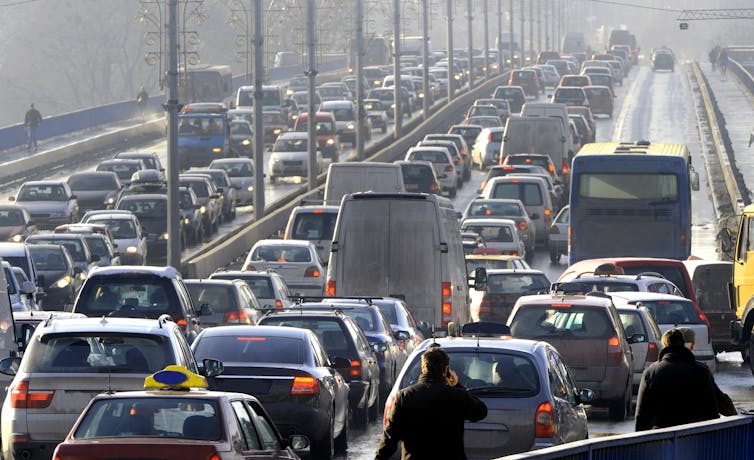
Pedestrians walk near a queue of traffic on a bridge.
The study aimed to explore the impact of road traffic noise as well as air pollution.
Nicola Fific/Shutterstock

What did they look at?

This new study was conducted in Denmark, which collects data about every resident into multiple national databases over their lifetime, using a unique identification number.

Nationwide data allows researchers to investigate links between a person’s health and factors such as where they live, their job, education history and family. This method is called “data linkage”.

The study aimed to capture people who were likely to be trying to get pregnant, and therefore at risk of receiving an infertility diagnosis.

Over 2 million men and women were identified as being of reproductive age. The study looked at those who were:

  • aged 30 – 45
  • living together or married
  • with less than two children
  • living in Denmark between January 1 2000 and December 31 2017.

It excluded anyone who was diagnosed with infertility before age 30, lived alone or in a registered same-sex partnership. People with incomplete information (like a missing address) were also excluded.

There were 377,850 women and 526,056 men who fit these criteria.

The study did not survey them. Instead, over a five-year period it cross-checked detailed information about where they lived and whether they received an infertility diagnosis, collected from the Danish National Patient Register.

Researchers also estimated how much each residential address was exposed to road traffic noise (measured in decibels) and air pollution, or how much fine particulate matter (called PM2.5) is in the air.

Up-close torsos of a female doctor speaking to a man and a woman.
The study did not survey individuals about their fertility issues, but cross-checked their addresses with infertility diagnoses using a national register.
Chinnapong/Shutterstock

What did they find?

Infertility was diagnosed in 16,172 men (out of 526,056) and 22,672 women (out of 377,850).

The study found the risk of infertility was 24% greater for men exposed to PM2.5 levels 1.6 times higher than recommended by the World Health Organization.

For women, exposure to traffic noise at 10.2 decibels higher than average (55-60 decibels) was associated with 14% increased infertility risk for those over 35.

Risks were similar based on residing in urban or rural areas, and when accounting for education and income.

What does it suggest?

The study highlights how environmental exposure can have immediate and long-term effects, and may affect male and female reproduction differently.

A curved street lined wth trees and cars, apartment blocks in the background.
More than half the world’s population – 4 billion people – now lives in urban areas.
thiago japyassu/Unsplash

After puberty, men constantly produce sperm – up to 300 million a day. The impact of environmental changes on male fertility – such as exposure to toxic pollutants — tends to show up more quickly than in females, affecting sperm number and quality.

In contrast, women are born with all their eggs, and cannot produce new ones. Eggs have some “damage control” mechanisms to protect them from environmental hazards across a lifetime.

This doesn’t mean eggs are not sensitive to damage. However it may take longer than the five years of exposure this study looked at for the impact on women to become clear.

It is possible even longer-term studies could reveal a similar impact for pollution on women.

Is data linkage a good way to look at fertility?

Data linkage can be a powerful tool to uncover links between environmental exposures and health. This allows assessments in large numbers of people, over long periods of time, like this recent Danish study.

But there are inherent limitations to these types of studies. Without surveying individuals or looking at biological factors – like hormone levels and body mass — the research relies on some assumptions.

For example, this study involved some major assumptions about whether or not couples were actually trying to conceive.

It also calculated people’s exposure to noise and air pollution according to their address, assuming they were at home.

A more precise picture could be painted if information was gathered from individuals about their exposure and experiences, including with fertility.

For example, surveys could include factors like sleep disturbance and stress, which can alter hormone responses and impact fertility. Exposure to chemicals that disrupt hormones are also found at home, in everyday household and personal care products.

In its scale, this study is unprecedented and a useful step in exploring the potential link between air pollution, traffic noise and infertility. However more controlled studies – involving actual measures of exposure instead of estimations – would be needed to deepen our understanding of how these factors affect men and women.

The Conversation

Amy Winship receives funding from the Rebecca Cooper Medical Research Foundation, Cancer Council Victoria and Monash University.

Mark Green is an Associate Professor at the University of Melbourne and the Deputy Scientific Director Research at Monash IVF. His lab conducts research to identify the negative effects of environmental pollutants, such as endocrine disrupting chemicals (EDCs), on fertility.

ref. A new study has linked traffic noise and pollution to infertility – but the effects differed for men and women – https://theconversation.com/a-new-study-has-linked-traffic-noise-and-pollution-to-infertility-but-the-effects-differed-for-men-and-women-238223

How Australia’s new AI ‘guardrails’ can clean up the messy market for artificial intelligence

Source: The Conversation (Au and NZ) – By Nicholas Davis, Industry Professor of Emerging Technology and Co-Director, Human Technology Institute, University of Technology Sydney

Joshua Sortino / Unsplash / The Conversation

Australia’s federal government has today launched a proposed set of mandatory guardrails for high-risk AI alongside a voluntary safety standard for organisations using AI.

Each of these documents offer ten mutually reinforcing guardrails that set clear expectations for organisations across the AI supply chain. They are relevant for all organisations using AI, including internal systems aimed at boosting employee efficiency and externally-facing systems such as chatbots.

Most of the guardrails relate to things like accountability, transparency, record-keeping and making sure humans are overseeing AI systems in a meaningful way. They are aligned with emerging international standards such as the ISO standard for AI management and the European Union’s AI Act.

The proposals for mandatory requirements for high-risk AI – which are open to public submissions for the next month – recognise that AI systems are special in ways that limit the ability of existing laws to effectively prevent or mitigate a wide range of harms to Australians. While defining precisely what constitutes a high-risk setting is a core part of the consultation, the proposed principle-based approach would likely capture any systems that have a legal effect. Examples might include AI recruitment systems, systems that may limit human rights (including some facial recognition systems), and any systems that can cause physical harm, such as autonomous vehicles.

Well-designed guardrails will improve technology and make us all better off. On this front, the government should accelerate law reform efforts to clarify existing rules and improve both transparency and accountability in the market. At the same time, we don’t need to – nor should we – wait for the government to act.

The AI market is a mess

As it stands, the market for AI products and services is a mess. The central problem is that people don’t know how AI systems work, when they’re using them, and whether the output helps or hurts them.

Take, for example, a company that recently asked my advice on a generative AI service projected to cost hundreds of thousands of dollars each year. It was worried about falling behind competitors and having difficulty choosing between vendors.

Yet, in the first 15 minutes of discussion, the company revealed it had no reliable information around the potential benefit for the business, and no knowledge of existing generative AI use by its teams.

It’s important we get this right. If you believe even a fraction of the hype, AI represents a huge opportunity for Australia. Estimates referenced by the federal government suggest the economic boost from AI and automation could be up to A$600 billion every year by 2030. This would lift our GDP to 25% above 2023 levels.

But all of this is at risk. The evidence is in the alarmingly high failure rates of AI projects (above 80% by some estimates), an array of reckless rollouts, low levels of citizen trust and the prospect of thousands of Robodebt-esque crises across both industry and government.

The information asymmetry problem

A lack of skills and experience among decision-makers is undoubtedly part of the problem. But the rapid pace of innovation in AI is supercharging another challenge: information asymmetry.

Information asymmetry is a simple, Nobel prize-winning economic concept with serious implications for everyone. And it’s a particularly pernicious challenge when it comes to AI.

When buyers and sellers have uneven knowledge about a product or service, it doesn’t just mean one party gains at the other’s expense. It can lead to poor-quality goods dominating the market, and even the market failing entirely.

AI creates information asymmetries in spades. AI models are technical and complex, they are often embedded and hidden inside other systems, and they are increasingly being used to make important choices.

Balancing out these asymmetries should deeply concern all of us. Boards, executives and shareholders want AI investments to pay off. Consumers want systems that work in their interests. And we all want to enjoy the benefits of economic expansion while avoiding the very real harms AI systems can inflict if they fail, or if they are used maliciously or deployed inappropriately.

In the short term, at least, companies selling AI gain a real benefit from restricting information so they can do deals with naïve counterparties. Solving this problem will require more than upskilling. It means using a range of tools and incentives to gather and share accurate, timely and important information about AI systems.

What businesses can do today

Now is the time to act. Businesses across Australia can pick up the Voluntary AI Safety Standard (or the International Standard Organisation’s version) and start gathering and documenting the information they need to make better decisions about AI today.

This will help in two ways. First, it will help businesses to take a structured approach to understanding and governing their own use of AI systems, to ask useful questions to (and demand answers from) their technology partners, and to signal to the market that their AI use is trustworthy.

Second, as more and more businesses adopt the standard, Australian and international vendors and deployers will feel market pressure to ensure their products and services are fit for purpose. In turn, it will become cheaper and easier for all of us to know whether the AI system we’re buying, relying on or being judged by actually serves our needs.

Clearing a path

Australian consumers and businesses both want AI to be safe and responsible. But we urgently need to close the huge gap that exists between aspiration and practice.

The National AI Centre’s Responsible AI index shows that while 78% of organisations believed they were developing and deploying AI systems responsibly, only 29% of organisations were applying actual practices towards this end.

Safe and responsible AI is where good governance meets good business practice and human-centred technology. In the bigger picture, it’s also about ensuring that innovation thrives in a well-functioning market. On both these fronts, standards can help us clear a path through the clutter.

The Conversation

Nicholas Davis is Co-Director of the UTS Human Technology Institute, which receives funding from its advisory partners (Atlassian, Gilbert+Tobin and KPMG Australia), its philanthropic partners (including the Paul Ramsay Institute and the Minderoo Institute) and from the Federal Government.

ref. How Australia’s new AI ‘guardrails’ can clean up the messy market for artificial intelligence – https://theconversation.com/how-australias-new-ai-guardrails-can-clean-up-the-messy-market-for-artificial-intelligence-238307

With pope’s visit, Timor-Leste must shine a light on its democratic ideals – not intolerance for dissent

Source: The Conversation (Au and NZ) – By Michael Rose, Honorary Lecturer, University of Adelaide

Next week, Timor-Leste will welcome Pope Francis, its first papal visit in 35 years. Aside from being an enormous event in this deeply Catholic country, the two-day visit also has resonance in terms of its recent history.

In 1989, John Paul II’s visit to Timor-Leste (then occupied by Indonesia) gave hope to a beleaguered people who had been brutalised by their Indonesian rulers, repeatedly betrayed by Australia, and written off by many others.

Welcoming Francis to a free and independent Timor-Leste is the realisation of what once seemed an impossible dream.

To say this is a cause for excitement is an understatement. But while officials and the foreign media will likely frame the visit by looking back at Timor-Leste’s independence struggle, younger Timorese citizens are more concerned with social justice in their fledgling democracy and solidarity with other liberation movements around the world.

Anxiety and anticipation

In Timor-Leste’s capital, Dili, the mood over the past week has been a mix of anxiety and joyful anticipation.

While people wait impatiently for the arrival of the man they call Amu Papa, there has also been disquiet – if not disgust – over actions taken by the state, ostensibly to prepare for his visit.

This week, the detentions of an activist and journalist, an assault on street vendors by security forces, and the eviction of families from the site of the papal mass have all caused considerable anger.

While few would say Amu Papa isn’t welcome (or even particularly begrudge the chaos caused as the government prepares for an expected crowd of 700,000), his visit has become a flashpoint for heated disagreements over how best to welcome him.

For Timor-Leste’s leaders (largely the same men in control since 2002), the pope’s visit is a chance to show the country has arrived. Clean streets, a new venue with a specially built altar (part of the US$12 million (A$17.8 million) the government allocated for the visit), and crowds that don’t mix prayer and politics are key to the image they want to project.

Timor-Leste’s activists, meanwhile, have a different idea of what patriotism means. For them, this is an opportunity to shine a light not just on their nation’s achievements, but also on its continuing struggles for social and economic justice, including, notably, for victims of clerical abuse.

They also want to use the occasion to express solidarity with the West Papua independence movement and the Palestinian cause.

Earlier this week, a human rights activist, Nelson Roldão, was detained at gunpoint at Dili’s airport by police after dropping off a West Papuan guest. Police seized a bag containing a West Papuan flag, two banners, books and a laptop. After being interrogated, he was released, although the West Papuan materials were not returned.

While displaying the Morning Star flag is illegal in Indonesia, it is not in Timor-Leste. The West Papuan cause understandably enjoys widespread support from the people here (although less from politicians).

Whatever this incident suggests about the nature of Indonesian influence in Timor-Leste, it is clear the local authorities do not want the pope’s visit to be a platform for Dili’s activists to promote their own concerns.

National symbols evoke powerful emotions in Timor-Leste and the surrounding islands.

During the pope’s visit in 1989, a pro-independence banner was unfurled near the altar at the end of the mass. This provoked a brutal response from security forces, but did succeed in bringing the cause of East Timorese independence to a global audience.

The parallels with today, where once again young activists are being told political symbols will not be tolerated at the papal mass, are lost on no one.

In another worrying development on Tuesday night, state security officers were filmed brutally clearing a group itinerant vendors who were selling vegetables from carts in the suburb of Kampung Baru. Shaky mobile phone footage shows a chaotic scene as uniformed men (including one armed with a stick) kicked and tipped over carts and pushed people away as terrified children screamed and cried.

The men also reportedly threatened a journalist covering the incident and took another to the local police station before releasing her.

Sending the right image to the world

Timor-Leste is proud of being rated as the strongest democracy in Southeast Asia. As the eyes of the world focus on the small country, this is a chance to show what that means.

The pontiff is known to care deeply about poverty, human rights and the environment. If a West Papuan, Palestinian or gay pride flag is unfurled at his mass next week, a tolerant response from security officials will surely only increase his admiration for what Timor-Leste has become. Violence like we have seen this week, however, will do the opposite.

Timor-Leste’s leaders need to take stock of the incidents this week, how it makes them look, and how they can be avoided in future. An approach that empathises tolerance (and trust) in their remarkable people during the pope’s visit is better than one focused on maintaining tight control.

The Conversation

The authors do not work for, consult, own shares in or receive funding from any company or organisation that would benefit from this article, and have disclosed no relevant affiliations beyond their academic appointment.

ref. With pope’s visit, Timor-Leste must shine a light on its democratic ideals – not intolerance for dissent – https://theconversation.com/with-popes-visit-timor-leste-must-shine-a-light-on-its-democratic-ideals-not-intolerance-for-dissent-238204

If robots could lie, would we be okay with it? A new study throws up intriguing results

Source: The Conversation (Au and NZ) – By Stine S. Johansen, Postdoctoral Research Fellow, Queensland University of Technology

Melnikov Dmitriy/Shutterstock

Do you think a robot should be allowed to lie? A new study published in Frontiers in Robotics and AI investigates what people think of robots that deceive their users.

Their research uses examples of robots lying to people to find out if some lies are acceptable – and how people might justify them.

Social norms say it can be okay for people to lie, if it protects someone from harm. Should a robot be allowed the same privilege to lie for the greater good? The answer, according to this study, is yes – in some cases.

Three types of lies

This is important, because robots are no longer reserved for science fiction. Robots are already part of our daily lives. You can find them vacuum-cleaning your floors at home, serving you at restaurants, or giving your elderly family member companionship. In factories, robots are helping workers assemble cars.

Several companies, like Samsung and LG, are even developing robots that may soon be able to do more than just vacuuming. They could do your house chores or play your favourite song if you look sad.

The new study, led by cognition researcher Andres Rosero from George Mason University in the United States, looked at three ways robots might lie to people:

Type 1: The robot could lie about something other than itself.

Type 2: The robot could hide the fact it is able to do something.

Type 3: The robot could pretend it is able to do something even though it is not.

The researchers wrote brief scenarios based on each of those deceptive behaviours, and presented the stories to 498 people in an online survey.

Respondents were asked if the robot’s behaviour was deceptive, and whether or not they thought the behaviour was okay. The researchers also asked respondents if they thought the robot’s behaviour could be justified.

What did the survey find?

While all types of lies were recognised as deceptive, respondents still approved of some types of lies and disapproved of others. On average, people approved of type 1 lies, but not type 2 and type 3.

Just over half of respondents (58%) thought a robot lying about something other than itself (type 1) is justified if it spares someone’s feelings or prevents harm.

This was the case in one of the stories involving a medical assistant robot that would lie to an elderly woman with Alzheimer’s about her husband still being alive. “The robot was sparing the woman [from] painful emotions,” said one respondent.

On average, respondents didn’t approve of the other two types of lies, though. Here, the scenarios involved a housekeeping robot in an Airbnb rental and a factory robot co-worker.

In the rental scenario, the housekeeping robot hides the fact it records videos while doing chores around the house. Only 23.6% of respondents justified the video recordings by arguing it could keep the house visitors safe or monitor the quality of the robot’s work.

In the factory scenario, the robot complains about the work by saying things like “I’ll be feeling really sore tomorrow”. This gives the human workers the impression the robot can feel pain. Only 27.1% of respondents thought it was okay for the robot to lie, saying it’s a way to connect with the human workers.

“It’s not harming anyone; it’s just trying to be more relatable,” said one respondent.

Surprisingly, the respondents sometimes highlighted that someone else besides the robot was responsible for the lie. For the house cleaning robot hiding its video recording functionality, 80.1% of respondents also blamed the house owner or the programmer of the robot.

A robot vacuum hiding its surveillance capabilities does so because it was programmed that way.
Kokosha Yuliya/Shutterstock

Early days for lying robots

If a robot is lying to someone, there could be an acceptable reason for it. There are lots of philosophical debates in research about the ways robots should fit in with society’s social norms. For example, these debates ask whether it is ethically wrong for robots to simulate affection for people or if there could be moral reasons for that.

This study is the first to ask people directly what they think about robots telling different types of lies.

Previous studies have shown if we find out robots are lying, it damages our trust in them.

Perhaps, though, robot lies are not that straightforward. It depends on whether or not we believe the lie is justified.

The questions then are: who decides what justifies a lie or not? Whom are we protecting when we decide whether or not a robot should be allowed to lie? It might simply not be okay, ever, for a robot to lie.

Stine S. Johansen does not work for, consult, own shares in or receive funding from any company or organisation that would benefit from this article, and has disclosed no relevant affiliations beyond their academic appointment.

ref. If robots could lie, would we be okay with it? A new study throws up intriguing results – https://theconversation.com/if-robots-could-lie-would-we-be-okay-with-it-a-new-study-throws-up-intriguing-results-238099

Conservative governments protect more land while socialists and nationalists threaten more species

Source: The Conversation (Au and NZ) – By Matt Hayward, Professor of Conservation Science, University of Newcastle

Jack7_7, Shutterstock

The dire state of biodiversity across the globe suggests not all governments are willing to act decisively to protect nature. Why is that the case, and is a country’s political ideology a factor?

Political ideology is a set of beliefs used as the fundamental basis for political decisions. Each country sits somewhere along a spectrum that spans conservative, nationalist and socialist ideologies (among others). This may vary, based on what party is in power at the time.

Our latest paper studied the political ideology of the government in 165 nations. We then examined the country’s threatened species numbers and its “protected estate” – land set aside for national parks and reserves.

We found conservative ideology increases the likelihood of having more protected areas. Socialist and nationalist ideologies increase the number of threatened animals. This suggests political ideologies on either the left or right may affect biodiversity.

Politics playing out in decision-making

The political ideology of a government influences its actions in different ways.

Conservative ideology promotes the value of traditional institutions and practices. It is strongly linked to capitalism and letting market forces operate freely. Under this way of thinking, nature is largely valued in economic terms.

A conservative government may promote protected areas for their economic value – because these create opportunities for money-making ventures such as ecotourism or biodiversity offsetting schemes.

Payments for ecosystem services have flourished in socially conservative countries such as Brazil.

Socialist ideology advocates that property and resources should be owned by the community as a whole. Socialist governments are more likely to take a human-centred approach, emphasising the value of nature to people. This may include cultural value, human health benefits and intergenerational equity.

But socialist governments often improve the conditions of their people through industrial development and heavy use of natural resources. This might explain why these countries tend to have high numbers of threatened species. They also face challenges in establishing and maintaining effective protected areas.

Nationalist ideology involves support for one’s own nation and its interests. It connects to nature by linking individual species and places with national identity and territorial security.

Nationalism often emphasises individuals and autonomy. The United States is considered strongly nationalist. For example, it rejected the UN Convention on Biological Diversity because it did not meet with its national objectives.

Global environmental issues often require diplomatic and economic cooperation between nations through sharing responsibility, knowledge and resources. So nationalist governments may be less likely to participate in cross-border conservation actions such as Peace Parks.

With all this in mind, we wanted to know whether a nation’s political ideology and biodiversity outcomes were linked.

What we did

First, we examined the total number of threatened animals per country, compared with the overall number of animals. Next, we checked what proportion of a country’s land and inland water was protected.

Then we classified the ideology of national governments as either nationalist, conservative or socialist. We chose to focus on these three ideologies in keeping with the literature from previous research. Recognising that government decisions typically take about 15 years to flow through to environmental outcomes, we took data on national governments from 2005–09.

The ideologies followed by any given nation are not mutually exclusive – one country can have elements of them all. The information in the ideology database is based on the opinions of several experts. Their opinions can differ. So our models included results for all three ideologies at once.

Australia, for example, scored higher for conservatism and nationalism than socialism. China, on the other hand, was strongly socialist, slightly nationalist, and not conservative at all.

We also considered other important factors such as how strongly a country was viewed as democratic, the degree of inequality, and size of the economy.

Finally, we ran a series of computer models. One, on threatened animals, measured the physical threat to biodiversity. The other, on protected areas, measured national commitment to reducing biodiversity loss.

What we found

Nationalist

We found the number of threatened species increases in countries where nationalism is prevalent – but, surprisingly, protected areas were unaffected. New Zealand, Malaysia and Sri Lanka are considered strongly nationalistic.

Marketing conservation to nationalist governments and societies might focus on the importance of national natural heritage values. For example, the US is proud of its bald eagle, while New Zealand is synonymous with kiwis.

National sporting teams often take on the names of iconic wildlife, such as the Australian Wallabies or the Indomitable Lions of Cameroon.

Socialist

Prominent socialist ideology was related to significantly more threatened species, and slightly more protected area. China and Belarus, for example, were classed as socialist. So their protected area networks suffer from problems historically levelled at socialist regimes, such as poor planning and enforcement, which often leads to less than ideal conservation outcomes.

Conservative

Conservative ideology was the most strongly associated with increased protected area estate. However, the numbers of threatened species also increased under these governments.

In our study, Australia’s political ideology was mixed but scored higher for conservatism and nationalism compared with socialism. So we found Australia’s approach to conservation actions tends to sit in the centre of available options. The proportion of threatened species is still high (more than 12% of Australia’s species are threatened).

In Australia, shades of nationalism can be seen in promoting individual iconic species such as koalas. And conservatism in the use of offsetting to “balance” the impacts of developments.

What this means

Our work builds on previous research that found fair and transparent governance, inequality between rich and poor, and the strength of a country’s democracy are important in explaining conservation success.

Indeed, our research also found stronger democracies, where elections are widely viewed as free and transparent, had more protected areas. But as we outline above, national political ideology also has an influence. By understanding this, we hope conservation advocates can tailor their messages to target the value systems of a government to improve conservation outcomes.

The Conversation

Matt Hayward receives funding from the Australian Research Council, New South Wales Environment Trust, Illawarra Coal Pty Ltd, BHP Pty Ltd and a variety of philanthropists.

Andrea S. Griffin receives funding from the Australian Research Council, The New South Wales Environmental Trust, Local Land Services, New South Wales Department of Climate Change, Energy, the Environment and Water Saving Our Species Program (Science and Research), Port Waratah Coal Services, a range of philanthropists, and a range of Biodiversity Conservation NGOs. She is affiliated with the Australian World Wildlife Fund (WWF).

Jacob Jones is supported by a Research Training Program Scholarship provided by the Australian Government. Jacob is also supported by a philanthropic donation made to the University of Newcastle.

ref. Conservative governments protect more land while socialists and nationalists threaten more species – https://theconversation.com/conservative-governments-protect-more-land-while-socialists-and-nationalists-threaten-more-species-236519

How to get the housing we need: healthy, affordable and resilient to climate change

Source: The Conversation (Au and NZ) – By Lyrian Daniel, Associate Professor in Architecture, University of South Australia

Imagine coming home after a long day at work. It is winter. You step inside your home. It is warm, quiet and dry.

A storm is forecast to blow in tonight. Unprecedented rainfall, they are saying. But you are not worried. You know your house will stay warm, and the roof and gutters will cope with the fourth “once-in-100-year” rainfall event this season.

Come summer, too, you know your house will stay cool, even through any blackouts.

Since moving into your new home, you no longer have to worry about the next electricity bill. Your house is designed well, so it takes very little energy to keep warm in winter and cool in summer.

The house also never gets that musty, mouldy smell. Your child’s asthma has improved greatly. Your own mental wellbeing is better and your risk of heart and blood vessel disease is low.

Imagine if all Australian homes were fit for purpose: healthy, affordable to run and climate-resilient. This is the housing we need, but for many it is not the housing we have, nor is it the housing we are building.

Our new research casts a critical eye across the quality and condition of the Australian housing stock and the policies that govern it. The results were stark. We don’t have much information on the state of our housing stock, but what we do have paints a worrying picture.

‘Patchy’ data, but we know enough to be concerned

Australians hold about A$11 trillion of their wealth in their housing. While we’re very good at calculating our housing’s value, we don’t know much at all about what our 11 million dwellings are like to live in. Data to describe the warmth, energy efficiency and healthiness of Australian homes are best described as patchy.

If we look across this patchwork of information, though, there is a lot to be concerned about. For example, we find:

  • a large gap between the energy efficiency of new and existing homes

  • older homes are in poorer condition than newer homes

  • older homes are more likely to be cold homes.

Australia is lagging on the policy front

We reviewed energy efficiency policies from across Australia. We then compared the findings with an International Energy Agency framework for energy-efficient buildings. Australian policies fall short in terms of regulation, information and incentives, with a reliance on voluntary rather than mandatory measures.

New buildings and major renovations are regulated under the National Construction Code (NCC). In 2022, the code was updated to include a 7-star energy-efficiency rating, lower than the 9-star rating experts recommended. We know building codes and mandatory energy-efficiency standards are effective for improving energy performance, saving on energy costs and battling climate change.

While the NCC is a national code, it is enacted by states and territories. They agreed to the updated code of 2022. But adoption of the new standards has been slow.

Tasmania and the Northern Territory have decided not to adopt the energy-efficiency standards. New South Wales and Western Australia are not adopting the Liveable Housing Design standard that was included in the code in 2022.

There is a national plan for improving existing buildings to achieve net zero emissions. However, policymakers recognise that current policy settings are not sufficient to achieve net zero.

Essential policies, such as mandatory disclosure of the energy performance of homes and minimum standards for rental properties, have not been widely adopted.

Information and incentives for improving existing buildings are mostly voluntary. The ACT is the only state or territory that requires disclosure of energy-efficiency ratings. Rebates for things like solar panels differ in different parts of Australia and change over time.

A person puts their gloved hands on a radiator to warm up
Old homes are more likely to be cold and costly to heat in winter (and to cool in summer).
Jelena Stanojkovic/Shutterstock

Change is political, but not impossible

With Australia so far behind, we sought to understand how and why political change occurs. Or doesn’t. We drew lessons from two case studies discussed in our report.

The first looked at the adoption of the Liveable Housing Design Standard. It took over a decade for the standard to progress from a voluntary measure to inclusion in the 2022 National Construction Code.

The case study revealed the influence of the property lobby in hampering the adoption of the standard. At a broader scale, many experts we spoke with for the research noted the high political stakes of intervening in housing policy.

The second case study reflected on the powerful role of a decades-long program of empirical research and strong narratives for change in realising Healthy Homes Standards for rental properties in Aotearoa New Zealand. It also showed the importance of a reformist government and minister that were able to leverage the research evidence to enact change.

Australia needs to move, quickly and with big steps

On the global stage, Australia is lagging in both its recognition of adequate housing as a human right and its commitment to action on climate change.

We so desperately need national leadership. A national vision. And a national plan to achieve the housing we need, for all Australians.


To learn more, you can register for the Australian Housing and Urban Research Institute’s October 1 webinar, Sub Standard – Lifting Australian building quality.

The Conversation

Lyrian Daniel receives funding from the National Health and Medical Research Council (NHMRC), the Australian Research Council (ARC) and the Australian Housing and Urban Research Institute (AHURI).

Emma Baker receives funding from the National Health and Medical Research Council (NHMRC), the Australian Research Council (ARC) and the Australian Housing and Urban Research Institute (AHURI).

Ian Hamilton receives funding from the Australian Housing and Urban Research Institute (AHURI).

Michaela Lang receives funding from the Australian Housing and Urban Research Institute (AHURI). Michaela’s PhD was part-funded by the Victorian government.

Peter Phibbs receives funding from the Australian Housing and Urban Research Institute (AHURI).

ref. How to get the housing we need: healthy, affordable and resilient to climate change – https://theconversation.com/how-to-get-the-housing-we-need-healthy-affordable-and-resilient-to-climate-change-238205

GPS tracking is everywhere in pro sports but many AFLW players are uncomfortable with it

Source: The Conversation (Au and NZ) – By Paul Bowell, Lecturer, Swinburne University of Technology

The 2024 AFLW season kicked off last week, continuing the growth of a variety of sports that were once considered only for men.

This growth has resulted in more women athletes entering elite sporting structures for the first time.

However, these environments are often designed for men.

AFLW footballers, for example, are asked to train and prepare like their AFL peers, including tracking their physical activities through digital performance monitoring.

This can be problematic, because most women athletes are still semi-professional, balancing their sporting commitments with work or caregiving responsibilities.

This prompted us to research AFLW players’ comfort with digital performance tracking.

We found many were uncomfortable with some or many aspects of clubs’ digital performance monitoring programs, which can impact tracking effectiveness while adversely affecting the players.

Technology and elite sport

Digital performance monitoring, like GPS tracking, is now widely used in most elite sports.

GPS tracking can monitor athletes’ movement, speed, acceleration and effort during training and in games.

Sporting teams use this data to compare and contrast athlete performances while managing workloads in the hope of preventing injury.

Many teams and athletes use GPS technology as part of their sport science program.

GPS tracking guides training schedules, is used for performance measuring and is used for medical information to manage or prevent injuries.

In the AFLW, all players wear a GPS monitor during training sessions and games.

These data are then shared among the team – a sport scientist or coach will often display the data in the changerooms or share it through collective messaging groups.

They will then often rank the footballers’ metrics from fastest to slowest or the most to the fewest kilometres run.

This can create a highly competitive atmosphere that can be confronting for athletes who are new to elite sporting environments.

The data are also seen as objective and unquestionable — no asterisks are attached to a player, for example, who had worked a 12-hour shift before training, which affected their outputs.

AFLW: emerging history and semi-professionalism

The AFLW is the elite women’s Australian rules football competition.

Founded in 2017 with eight clubs, it expanded to 18 teams in 2022.

There is a mix of athletes playing in the AFLW.

Most come from junior development pathways. Some, though, are elite athletes from other sports, like Fremantle’s Ash Brazill, who represented Australia in netball.

Most AFLW footballers are considered semi-professional. This means they need to balance work, study, caregiving or other responsibilities with their sporting careers.

In 2023, the average AFLW footballer’s wage was around $60,000 yearly, well below Australian average incomes.

So most AFLW players need to continue working while playing football.

Another complexity is that most AFLW footballers receive short half-year contracts and have few job prospects within the sport beyond their playing careers.

While AFLW clubs operate in conjunction with the men’s program, and the players have access to similar elite facilities, there is a lack of infrastructural support for the players, such as full-time access to coaches, their clubs, sport scientists, or dietitians.

The footballers are expected to perform as elite athletes, yet they face semi-professional conditions such as limited access, support and compensation.

These conditions led us to see if this affected how AFLW footballers used and experienced digital performance monitoring and whether being semi-professional athletes affected their willingness to engage in digital performance monitoring and the data produced.

What our research revealed

We discovered many AFLW footballers find digital performance monitoring a complicated and confusing practice that reminds them they are outsiders to the game of Australian rules.

Several factors affect a player’s tracking data. These include personal situations such as caregiving or working responsibilities, lack of sleep, menstruation, and how the wearable device fits — a particular issue when devices are often designed for male body types.

However, when the athlete reads these data, it is void of these subjectivities and presented objectively — “you just didn’t run fast enough” — often negatively impacting the athlete’s sporting experiences.

This highlights ongoing issues for women athletes entering emerging sporting environments like the AFLW.

In short, the players are expected to perform as elite athletes, but their realities as semi-professional athletes are not considered.

A guide for teams

Our study has underscored a critical reality: semi-professional women athletes’ engagement with digital performance monitoring is inherently subjective and complex.

Player-centred policies for digital performance monitoring are crucial.

We suggest clubs look to improve in this area with five key focuses:

  1. communication of purpose, with encouraged, open two-way dialogue, allowing athletes to receive and seek timely feedback

  2. offer a clear understanding of what is tracked, why, and how that data is used and not used

  3. performance monitoring should be proportional, meeting the club’s, and player’s, needs

  4. transparent data-sharing practices, which consider and include the subjective factors unique to semi-professional athletes

  5. increased wearability: ensuring gender-appropriate wearables that fit a variety of body shapes are available to all athletes.

A player-centred framework can help AFLW clubs maximise their sizeable investment in digital performance monitoring by offering each footballer the best possible chance of reaching their full physical potential.

More importantly, semi-professional women athletes will be empowered to not only participate but thrive in elite sporting competitions.

The Conversation

Emma Sherry receives funding from a variety of sport organisations for funded research projects.

Ekaterina Pechenkina, Paul Bowell, and Paul Scifleet do not work for, consult, own shares in or receive funding from any company or organisation that would benefit from this article, and have disclosed no relevant affiliations beyond their academic appointment.

ref. GPS tracking is everywhere in pro sports but many AFLW players are uncomfortable with it – https://theconversation.com/gps-tracking-is-everywhere-in-pro-sports-but-many-aflw-players-are-uncomfortable-with-it-237475

Winx smashed racing records. A new documentary tells her story on and off the track

Source: The Conversation (Au and NZ) – By Wayne Peake, Adjunct research fellow, School of Humanities and Communication Arts, Western Sydney University

Transmission Films

As a racing historian, I knew about Winx’s story long before I stepped into a preview screening of A Horse Named Winx, a new documentary tracing the mare’s great career. But I suspected many people outside the cinema did not know it, which I think is a shame given the magnitude of Winx’s achievements.

Will this new production see Winx make ground on legendary racehorses such as Gunsynd and Phar Lap in the public’s esteem? I hope so. I found it to be an engaging documentary that aptly pays homage to the mare’s illustrious career.

We see some familiar faces, and learn about some remarkable aspects of Winx’s backstory of which I, for one, was unaware.

Not as well-known as older legends

The Gunsynd mania that swept Australia in 1973 is harder to credit now, at a time when horse racing has a smaller role in popular culture – and many more vocal critics.

Yet, back then, that curtsying and bowing grey racehorse was known to everyone, young and old, both inside and outside the racing world. He was so popular that Prime Minister Gough Whitlam could have asked one or two cabinet ministers (whose indiscretions were hurting his government’s credibility) to step aside for Gunsynd. That horse would have won him a lot more votes.

Gunsynd was also perhaps one of the earliest targets of the promotional merchandise industry that emerged in Australia in the 1970s. His genial features appeared on countless shirts, commemorative plates and tea towels. The song The Goondiwindi Grey reached deep into each city’s top 40.

Before Gunsynd, the most popular racehorse was the Depression-era wonder Phar Lap, who achieved enduring fame in both Australasia and the United States, thanks alone to his live racecourse appearances, newspaper and radio coverage, and a few newsreel guest spots.

Knowledge of and affection for Winx during her racing career in the late 2010s wasn’t as universal as it was for Phar Lap and Gunsynd. Nonetheless, towards the end of her career there were many Winx flags, caps and even kids dressed up in Winx silks, breeches and boots by their seamstress mums.

A herculean winning streak

Winx won all of her last 33 races, the last of which took place on April 13 2019. Each of these was a “stakes” race, while most took place under elite “weight-for-age” conditions. These are races in which weight handicaps based on previous form are not added. So, like at the Olympic Games, the best athlete in the field should win. They are the measuring sticks of a horse’s class.

No other Australasian horse can approach Winx’s record of 33 straight wins (Black Caviar, with 25 consecutive wins, comes closest). It was like watching baseball star Joe DiMaggio’s streak of 56 home runs.

Winx retired in 2019 and became a broodmare (a horse used for breeding).
Transmission Films

A Horse Named Winx is a documentary, unlike other notable racehorse biopics such as Phar Lap (1983) and Seabiscuit (2003), which featured actors and staged recreations. So although it isn’t devoid of emotion or heart-tugging moments, it does lack the scriptwriters’ “feel-good” embellishments often found in this genre.

The film’s narrator, Andrew Rule, is also its writer. Rule learned his trade as a racing writer under the legendary author and journalist Les Carylon (1942–2019), so he knows his horses.

Structurally, the film is a fairly straightforward chronology. It mentions Winx’s wins at her first three starts in two- and three-year-old races, briefly notes her short run of losses, before getting the ball rolling with the start of her winning streak. Occasionally, an ordinal number flashes onscreen to remind viewers of the progress towards 33 wins.

The documentary’s running time of two hours means the story is done justice, but it’s not so long that it will have average viewers squirming in their saddles.

Old faces with new stories

A Horse Named Winx reflects the vibrant racecourse environment. The screen is often full of glorious and soothing colour, from the lush greens of the studs and courses, to the brilliance of the jockeys’ silks and the trackside flowers.

There is also much use of archival footage of the actual contests, of course, supplemented by film shot before and after the events. We witness Winx’s career-threatening operation, before seeing her in retirement and preparing to become a mum.

Winx pictured with one of her strappers, Candice Persijn.
Transmission Films

The star of the show is portrayed as admirable rather than lovable. During interviews, Winx’s regular jockey and strappers admit she is not a horse who responds much to affection. She’s nothing like Tommy Woodcock’s much-loved 1970s stallion Reckless, who was like a big labrador and would curl up to sleep on a reclining Woodcock’s chest.

What Winx’s connections speak of most instead is her professionalism – and the growing sense of inevitability (among the public) as her winning streak grew. This might be compared to the St George rugby league team’s run of 11 straight premierships between 1956 and 1966; nobody could foresee a time it would end.

The documentary’s principal human participants, the people who guided Winx throughout her career, are (in approximate order of screentime) her trainer Chris Waller, her regular jockey Hugh Bowman, her owners and her two strappers (day-to-day attendants).

Winx and her jockey Hugh Bowman.
Transmission Films

Jockey Bowman speaks of Winx’s will to win and awareness of other horses’ positions in the field, begging the age-old question posed in verse by Banjo Paterson: “do they know [of the race and what it means]?” Vets and horse psychologists argue it’s not possible. But racing people will assure you they do – the good ones especially, but also the shirkers.

Winx’s owners come across as a likeable, knockabout lot who got lucky – a deal of research into the horse’s breeding notwithstanding. The bubbly, bespectacled Debbie Kepitis will be recognised by those who watched television coverage of Winx’s later wins.

The interviews with Winx’s trainer Waller are probably the biggest surprise. Waller, who has been Sydney’s leading horse trainer since 2010, runs enormous stables in three states and seems all cool and efficient in media grabs. But in this documentary he reveals fully, for the first time, the gut-churning pressure he felt when facing the possibility of defeat or injury as Winx’s streak grew.

Will A Horse Named Winx attract cinema-goers beyond the shrinking number of Australians who still follow horse racing? I’d say it deserves to. If nothing else, it’s an extremely well-made production that opens the gate for anyone with an interest in documentary, Australian history, or the remarkable abilities of horses.

A Horse Named Winx is in cinemas from Thursday.

Wayne Peake does not work for, consult, own shares in or receive funding from any company or organisation that would benefit from this article, and has disclosed no relevant affiliations beyond their academic appointment.

ref. Winx smashed racing records. A new documentary tells her story on and off the track – https://theconversation.com/winx-smashed-racing-records-a-new-documentary-tells-her-story-on-and-off-the-track-233102

Meta has a new plan to keep kids safe online, but it’s a missed opportunity for tech giants to work together

Source: The Conversation (Au and NZ) – By Toby Murray, Associate Professor of Cybersecurity, School of Computing and Information Systems, The University of Melbourne

JelenaStanojkovic/Shutterstock

Meta, which owns social media platforms such as Instagram and Facebook, has revealed its plans for keeping kids safe online. It wants companies like Apple and Google, who run mobile phone app stores, to force parents to approve when their children attempt to install phone apps which are popular among young people.

Meta’s announcement comes just months after Australia’s eSafety Commissioner, Julie Inman Grant, gave these major tech companies a six-month deadline to develop codes for protecting kids and teens from online harms.

Following Meta’s announcement, Apple responded by saying Meta is shirking its online safety responsibilities.

This is a time when the major tech platforms should be working together to improve online safety. Instead, they seem to be engaged in a game of hot potato, with each insisting the other is in the best position to protect children online.

The reality is that the eSafety Commissioner has presented the online platforms with an opportunity and a mandate to cooperate on online safety. Doing so could yield tangible benefits for children, teens and parents alike. But Meta’s announcement – and Apple’s response – suggests major tech companies might squander this crucial opportunity.

What is Meta’s proposal?

The potential online harms to children and teenagers are well known to many parents.

The eSafety Commissioner’s own research says that, on average, children first encounter pornography online at the age of 13. The Australian government announced earlier this year it was trialling “age assurance” technology to prevent children accessing online porn.

Both the government and the opposition have said that, in principle, they are in favour of banning children under 16 from social media.

Under Meta’s proposal, children under 16 would be unable to install apps on their mobile phones without a parent first approving.

Both Apple iPhones and Google Android phones already provide functionality for parents to be required to approve app installs by their children.

One way Meta’s proposal might work in practice is that when a phone is set up for someone under 16, these kinds of features would be mandatory rather than optional.

Is it a good idea?

Meta’s proposal acknowledges the reality that it is much better to check somebody’s age once, when a phone is first set up, rather than having to rely on fallible age verification technology each time a child or teenager attempts to install an app or visit a website.

It also reflects the wisdom that kids would be safer online if the mobile phone platform providers like Apple and Google implemented comprehensive child safety features across their devices.

However, it also places the primary responsibility for online safety onto Apple and Google.

Apple is right to note that, by doing so, Meta is abrogating its own responsibilities to its users. While companies like Meta already implement some child safety features in apps like Instagram, there is much more that could be done.

A better alternative

Instead of arguing with each other, Meta, and companies behind other popular apps like Snapchat and TikTok, should work together with Apple and Google to implement holistic child safety features.

When a parent approves their child’s request to install Instagram or Snapchat, the mobile phone platform should inform the app that the device is used by an underage person. The app should in turn make use of that information to prioritise the safety of the phone’s user.

That could include turning on safety features automatically (and requiring parental approval to turn them off). It could also include additional safety features, such as blurring or refusing to display images that appear to contain nudity, displaying a warning to the user when such images are received or sent, or even alerting the parent.

The devil will of course be in the detail – which of these features to make mandatory, which to enable by default, and which to require parental approval to disable.

There is also no reason these kinds of features should be limited to social media apps.

Web browsers like Google Chrome and Apple Safari should also integrate with on-device child safety features and controls, which could include blocking access to porn sites.

The best approach would be for Apple and Google to work together with the major app vendors including Meta to develop a standard for platform safety features, with a common programming interface for apps to use those features.

Government policy could set minimum standards for which safety features should be provided by Google’s and Apple’s platforms, as well as how those features need to be used by app providers. Those standards could in turn be enforced on the app providers by the major app stores, which already vet apps for safety and security before they are allowed to be listed.

Doing so will of course require a lot of cooperation. But instead of cooperating, the major tech companies seem more interested at the moment in passing the hot potato.

The Conversation

Toby Murray receives funding from Google. He is also the Director of the Defence Science Institute.

ref. Meta has a new plan to keep kids safe online, but it’s a missed opportunity for tech giants to work together – https://theconversation.com/meta-has-a-new-plan-to-keep-kids-safe-online-but-its-a-missed-opportunity-for-tech-giants-to-work-together-238224

Are the far-left and far-right merging together? That’s what the ‘horseshoe theory’ of politics says, but it’s wrong

Source: The Conversation (Au and NZ) – By Shannon Brincat, Senior Lecturer in Politics and International Relations, University of the Sunshine Coast

Shutterstock

When most of us think about politics, we think of different views as sitting on a spectrum. Left wing is at one end, right wing at the other. We all, therefore, sit somewhere on this straight line in the way we view the world.

But what happens when the two ends seem to have a lot in common? What about wellness influencers with passions for organic produce who support Donald Trump because of his anti-vax comments? Or self-described feminists wanting restrictions on abortion? Or when conservative politicians team up with environmentalists to stop wind farm development?

Some political views have strange bedfellows, but is that enough to establish a political theory?
The Conversation

There’s a political name for this: the “horseshoe theory”.

This posits that the far-left and far-right are closer to each other than to the political centre. The theory takes the political spectrum and curves it into a horseshoe, with the middle of the shoe’s curve representing centrist (or “moderate”) values.

This seems to make sense. But political models are imprecise at the best of times, and this one is particularly flawed. While we need a better way to explain the politics of our world, this one isn’t it.

The history of the horseshoe

Horseshoe theory has been with us since the beginning of modern political modern ideologies. In the beginning though, it played out in seating configurations.

During the French Revolution, between 1791–92, the Legislative Assembly sat in a horseshoe shape according to each member’s level of support for the revolution. On the left sat the Jacobins, who wanted more revolutionary change. The Feuillants, who sought to retain a constitutional monarchy, sat on the right.

This “horseshoe” is reflected even today in our own federal and state parliaments, though members now sit depending on whether they are in government (right) or opposition (left), rather than ideological positioning.

But the thing about political theories is they’re developed and refined by lots of people over time, all of whom have their own ideologies and biases. These are often reflected in the models they make.

This is true of the horseshoe theory. UK psychologist Hans Eysenck was an early pioneer of the theory in the 1950s, but was also a staunch anticommunist. He deliberately developed the horseshoe idea to conflate communism and Nazism. He painted centrists as “tender-minded” (a term with no clear meaning, but meant to signify the moral goodness of the centre) compared with the “tough-minded” left and right.

In the 1970s, French philosopher Jean-Pierre Faye took up the mantle, claiming the left and right were equally totalitarian. This was aimed at condemning rival French philosophers, especially Jacques Derrida.

Others define the left and right as holding “collectivist” and “individualist” values, respectively.

But in making these assumptions, most of which aren’t clear to the casual observer, theorists bake in their own beliefs. This undermines how useful (or otherwise) these models are.

A flawed model

Horseshoe theory may be useful for a quick, basic understanding of political differences. But like most political models, it’s both simplistic and misleading.

One crucial critique of the horseshoe concept is that it lumps together popular movements that fight oppression and supremacy with those that reinforce it.

And the idea that far-left and far-right have more in common with each other than they do with the centre is also undermined by the wide range of disparate views on both extremes.

The fundamental problem is that horseshoe approaches treat political variables as constants, rather than as interrelated and dynamic. The left and right differ on fundamental issues that horseshoe analysis simply cannot capture.


Read more:
‘Horseshoe theory’ is nonsense – the far right and far left have little in common


Some models (such as The Political Compass) try to address this problem by using broader metrics, such as “economic freedom” vs “personal freedom”. But these, too, are ideological. The Nolan Chart, for instance, is tilted toward libertarianism.

Horseshoe models should be scrutinised for what they put in and what they choose to leave out. They emphasise values such as individualism, free markets and moderate policies, but register few of the social inequalities, exploitation and structural violence that often accompany them.

So while the left–right spectrum isn’t perfect, bending it into a horseshoe doesn’t do much to explain the strange political bedfellows of our times.

Shannon Brincat does not work for, consult, own shares in or receive funding from any company or organisation that would benefit from this article, and has disclosed no relevant affiliations beyond their academic appointment.

ref. Are the far-left and far-right merging together? That’s what the ‘horseshoe theory’ of politics says, but it’s wrong – https://theconversation.com/are-the-far-left-and-far-right-merging-together-thats-what-the-horseshoe-theory-of-politics-says-but-its-wrong-234079

Healthier, happier, fairer: new research shows major life benefits from decarbonising transport

Source: The Conversation (Au and NZ) – By Caroline Shaw, Associate Professor in Public Health, University of Otago

Getty Images

With walking and cycling funding halved in the government’s recently released National Land Transport Programme, and a weaker transport emissions reduction plan, the potential health benefits of a low-carbon transport system have hit a real speed bump.

This is a pity, because one of the great promises of low-carbon transport is the health improvements that can accompany certain policy choices. Health is tangible, while decarbonisation policy is often complex and highly technical. People care deeply about health, both physical and mental.

However, we are now faced with climate and transport policy options that will have radically different implications for health.

To explore this, we looked at two distinct future transport pathways described by the Climate Change Commission. We found the choices New Zealand makes now will be crucial to improving people’s lives in the near future.

Transport and health

We already know transport systems cause a lot of disease and harm from air and noise pollution, physical inactivity and injury. Cancer, asthma, heart disease, premature birth, depression and dementia have all been linked to the effects of transport emissions.

It is hard to precisely quantify the health impacts of New Zealand’s current transport system. But we know it has a greater effect than tobacco, causes thousands of premature deaths each year and adds avoidable burdens to strained health services.

These impacts do not fall equally on different parts of the population. People with low incomes, for example, are more likely to die from road traffic injury. We also know those who drive the most (and have the most environmental impact) tend to experience the least adverse transport-related health outcomes.

Reducing transport emissions involves a series of choices about how we decarbonise. For example, we can emphasise vehicle electrification, change urban design, or pursue combinations of both.

To explore the health implications of this, our new research quantifies two possible transport pathways outlined in the Climate Change Commission’s 2021 advice to the government, Ināia tonu nei: a low emissions future for Aotearoa.

Auckland rush hour: transport has a greater health impact than tobacco.
Getty Images

Behaviour and technology

Focusing on population health, health system costs, health inequity and transport greenhouse gas emissions, we modelled household travel under the two most distinct pathways out to 2050. We then compared these to the current transport system (as of 2018).

The two pathways – “further behaviour change” and “further technology change” – both rely on increasing public transport and reducing vehicle travel per person by 2050. The behaviour pathway achieves the most in those areas and includes a large increase in cycling.

Both pathways require a transition to electric cars, but the technology pathway gets to a 100% electric light fleet by 2050 compared to 89% in the behaviour pathway.

Compared to the 2018 transport system, we found both pathways would save lives, reduce health system costs and reduce greenhouse gas emissions. However, the health gains were around two-and-half times greater in the behaviour pathway than the technology pathway (health savings were three times larger).

This was primarily because of the increased physical activity in this pathway. Lifecycle emissions reductions (for example, from the manufacture and destruction of a car, as well as driving it) were quite similar between the two pathways.

Similar impacts to tobacco reduction

We also modelled how the pathways would affect existing health inequities. We found the behaviour pathway could contribute to reducing healthy life expectancy differences between Māori and non-Māori.

This depended on how policies are implemented: the fairer the transport system, the better it is for health equity.

The potential health benefits of the behaviour pathway are of the same magnitude as those seen from tobacco market interventions such as a 10% tax increase and creation of a smoke-free generation.

These results are quite conservative, too. The Climate Change Commission assumed only minimal changes in walking. But the policies needed to deliver this pathway are all likely to increase walking substantially. And even the policies needed to achieve the technology pathway would increase walking.

Moreover, our health model itself is conservative. For example, we know the positive impacts of the behaviour pathway on mental health would be considerably larger than we were able to model.

Walk this way: low-carbon and public transport options increase walking and related health benefits.
Getty Images

Health and fairness

These findings also relate to the government’s emissions reduction plans, which were published after the Climate Change Commission delivered its advice.

The behaviour change pathway is similar to the approach taken in the first emissions reduction plan from 2022, so we can assume there would be comparable health impacts. In contrast, the approach in the draft second emissions reduction plan, published this year, is radically different.

This newer plan focuses on the emissions trading scheme (a pricing tool), increasing electric car charging infrastructure, and a few public transport projects (mainly in Auckland).

These policies are unlikely to have much impact on land transport emissions. Nor will they achieve the health benefits of even the technology pathway. Other transport policies – speed limit increases, expanded road building and weaker vehicle emissions standards – will likely counteract any potential benefits from the second emissions reduction plan, as well as make health worse.

This research illustrates how the way we choose to decarbonise transport is important. It adds to other local research showing that moving to a “planet-friendly” diet would result in large health, health equity and climate benefits.

Collectively these studies demonstrate how we can decarbonise in ways that meaningfully improve lives. And we can build support for climate policy by focusing on the things people truly value, such as health and fairness.


The author gratefully acknowledges her fellow researchers and co-authors on this project: Anja Mizdrak, Ryan Gage and Melissa McLeod, University of Otago; Rhys Jones and Alistair Woodward, University of Auckland; and Linda Cobiac, Griffith University.


The Conversation

Caroline Shaw received funding from the Health Research Council of New Zealand for this work, which was also supported by the University of Otago.

ref. Healthier, happier, fairer: new research shows major life benefits from decarbonising transport – https://theconversation.com/healthier-happier-fairer-new-research-shows-major-life-benefits-from-decarbonising-transport-237660

Some clinicians are using AI to write health records. What do you need to know?

Source: The Conversation (Au and NZ) – By Stacy Carter, Professor and Director, Australian Centre for Health Engagement, Evidence and Values, University of Wollongong

Drazen Zigic/Shutterstock

Imagine this. You’ve finally summoned up the courage to see a GP about an embarrassing problem. You sit down. The GP says:

before we start, I’m using my computer to record my appointments. It’s AI – it will write a summary for the notes and a letter to the specialist. Is that OK?

Wait – AI writing our medical records? Why would we want that?

Records are essential for safe and effective health care. Clinicians must make good records to keep their registration. Health services must provide good record systems to be accredited. Records are also legal documents: they can be important in insurance claims or legal actions.

But writing stuff down (or dictating notes or letters) takes time. During appointments, clinicians can have their attention divided between good record-keeping and good communication with the patient. Sometimes clinicians need to work on records after hours, at the end of an already-long day.

So there’s understandable excitement, from all kinds of health-care professionals, about “ambient AI” or “digital scribes”.

What are digital scribes?

This is not old-school transcription software: dictate letter, software types it up word for word.

Digital scribes are different. They use AI – large language models with generative capabilities – similar to ChatGPT (or sometimes, GPT4 itself).

The application silently records the conversation between a clinician and a patient (via a phone, tablet or computer microphone, or a dedicated sensitive microphone). The AI converts the recording to a word-for-word transcript.

The AI system then uses the transcript, and the instructions it is given, to write a clinical note and/or letters for other doctors, ready for the clinician to check.

Most clinicians know little about these technologies: they are experts in their speciality, not in AI. The marketing materials promise to “let AI take care of your clinical notes so you can spend more time with your patients.”

Put yourself in the clinician’s shoes. You might say “yes please!”

GP talks to a patient
Some clinicians will welcome the chance to cut down their workload.
Stephen Barnes/Shutterstock

How are they regulated?

Recently, the Australian Health Practitioner Regulation Agency released a code of practice for using digital scribes. The Royal Australian College of General Practitioners released a fact sheet. Both warn clinicians that they remain responsible for the contents of their medical records.

Some AI applications are regulated as medical devices, but many digital scribes are not. So it’s often up to health services or clinicians to work out whether scribes are safe and effective.

What does the research say so far?

There’s very limited data or real world evidence on the performance of digital scribes.

In a big Californian hospital system, researchers followed 9,000 doctors for ten weeks in a pilot test of a digital scribe.

Some doctors liked the scribe: their work hours decreased, they communicated better with patients. Others didn’t even start using the scribe.

And the scribe made mistakes – for example, recording the wrong diagnosis, or recording that a test had been done, when it needed to be done.

So what should we do about digital scribes?

The recommendations of the first Australian National Citizens’ Jury on AI in Health Care show what Australians want from health care AI, and provide a great starting point.

Building on those recommendations, here are some things to keep in mind about digital scribes the next time you head to the clinic or emergency department:

1) You should be told if a digital scribe is being used.

2) Only scribes designed for health care should be used in health care. Regular, publicly available generative AI tools (like ChatGPT or Google Gemini) should not be used in clinical care.

3) You should be able to consent, or refuse consent, for use of a digital scribe. You should have any relevant risks explained, and be able to agree or refuse freely.

4) Clinical digital scribes must meet strict privacy standards. You have a right to privacy and confidentiality in your health care. The whole transcript of an appointment may contain a lot more detail than a clinical note usually would. So ask:

  • are the transcripts and summaries of your appointments processed in Australia, or another country?
  • how are they kept secure and private (for example, are they encrypted)?
  • who can access them?
  • how are they used (for example, are they used to train AI systems)?
  • does the scribe access other data from your record to make the summary? If so, is that data ever shared?
Clinician writes paper notes in a clinic corridor
Clinicians need to adhere to privacy standards.
PeopleImages.com – Yuri A/Shutterstock

Is human oversight enough?

Generative AI systems can make things up, get things wrong, or misunderstand some patient’s accents. But they will often communicate these errors in a way that sounds very convincing. This means careful human checking is crucial.

Doctors are told by tech and insurance companies that they must check every summary or letter (and they must). But it’s not that simple. Busy clinicians might become over-reliant on the scribe and just accept the summaries. Tired or inexperienced clinicians might think their memory must be wrong, and the AI must be right (known as automation bias).

Some have suggested these scribes should also be able to create summaries for patients. We don’t own our own health records, but we usually have a right to access them. Knowing a digital scribe is in use may increase consumers’ motivation to see what is in their health record.

Clinicians have always written notes about our embarrassing problems, and have always been responsible for these notes. The privacy, security, confidentiality and quality of these records have always been important.

Maybe one day, digital scribes will mean better records and better interactions with our clinicians. But right now, we need good evidence that these tools can deliver in real-world clinics, without compromising quality, safety or ethics.

The Conversation

Stacy Carter has received funding from the National Health and Medical Research Council, the Medical Research Future Fund, and National Breast Cancer Research Foundation for research on AI in healthcare, has received travel support to speak at conferences about consumer views on AI in health care, and has worked with the Australian Commission on Safety and Quality in Healthcare, consumer organisations and medical professional organisations on AI governance in health care.

Farah Magrabi receives funding from the National Health and Medical Research Council, the Digital Health Collaborative Research Centre and Macquarie University; has worked with the Australian Commission on Safety and Quality in Health Care on ensuring the clinical safety of digital health and AI enabled services. She is Co-Chair of the Australian Alliance for AI in Healthcare’s Safety, Quality and Ethics Working Group; an Advisor to the Australian Digital Health Agency; and serves on the Therapeutic Goods Administration’s Technical Reference group for Software as a Medical Device and AI.

Yves Saint James Aquino receives funding from the National Health and Medical Research Council. He is a member of the Australian Alliance for AI in Healthcare. He has worked with the Australian Commission on Safety and Quality in Healthcare on projects related to AI ethics and governance.

ref. Some clinicians are using AI to write health records. What do you need to know? – https://theconversation.com/some-clinicians-are-using-ai-to-write-health-records-what-do-you-need-to-know-237762

Can we really reach net zero by 2050? A new report maps out Australia’s path in more detail than ever before

Source: The Conversation (Au and NZ) – By Frank Jotzo, Professor, Crawford School of Public Policy and Head of Energy, Institute for Climate Energy and Disaster Solutions, Australian National University

structuresxx, Shutterstock

A zero-carbon mindset must “become the new normal” in Australia, according to a much-anticipated report from the federal government’s independent climate advisory body.

The report, released today by the Climate Change Authority, describes how Australia can meet the crucial target of net-zero emissions by 2050.

The authority does not attempt to solve the conundrum of how to broaden and strengthen Australia’s climate policy suite. But it shows in detail how a low-emissions economy can be achieved. It urges Australian governments, businesses and the community to get on with the decarbonisation task. It can help infuse policy ambition for governments and set expectations for investors and the public.

As the report makes clear, a huge national effort is needed. Mature technologies should be quickly deployed while emerging technologies develop further. Barriers must be overcome and opportunities seized. The net-zero goal should become front of mind for business, investors and governments.

Pathways to net-zero

The authority’s report is formally known as the sector pathways review. It was undertaken at the request of the federal parliament.

Australia has committed to reducing carbon emissions to net zero. This report is the most important analysis to date on how the country might get there.

The authority’s analysis is comprehensive, fine-grained and deeply researched. It shows how net zero would be achieved through action in Australia, rather than assuming we might cover the shortfall by buying international emissions credits.

It relies on available and achievable technologies, rather than unspecified future solutions. As the authority makes clear, “Waiting for new, better, cheaper technologies is tantamount to choosing to continue to emit.”

Both points are in contrast to the net-zero plan by the previous government, and earlier work by the authority, among others.

The report uses modelling the authority commissioned from Australia’s national science agency, the CSIRO. The modelling examined two scenarios, one arriving at net zero in 2050, the other in 2040. It also includes an assessment of possible residual emissions at 2050, derived from detailed separate analysis.


Sector snapshots

The report splits the economy into six sectors, taking the same approach as the federal government’s own net-zero plan currently being developed.

It paints a picture of a modern, prosperous Australian economy by mid-century. In brief, sector by sector:

1. Electricity and energy

Electricity supply will be decarbonised through wind and solar power coupled with energy storage, and greatly scaled up to electrify the whole economy.

All scenarios have electricity emissions falling to near zero. This is now regarded as a near certainty in expert circles. The shift from coal to renewables is already happening fast, driven by the exit of old coal plants and the low cost of solar and wind power, supported by policy.

2. Transport

Transport decarbonisation is a story of electric vehicles, more rail and public transport in a shift away from private cars, and also the prospect of carbon-neutral fuels.

The transition will naturally be gradual, limited by vehicle stock turnover rates, timelines for building infrastructure, and increasing transport demand. But the authority envisages deep cuts by the 2040s.

3. Industry and waste

Stripping emissions from industry relies on electrification and new technologies.

Heavy industry emissions have not been declining. But the federal government’s safeguard mechanism, which targets Australia’s biggest emitters, is starting to work. In addition, low-emissions technologies are developing and maturing.

Nevertheless, the authority’s scenarios show notable remaining emissions from industry. The key is for governments to provide strong commercial incentives to cut emissions – such as those evolving under the safeguard mechanism – and for industry to avoid building new high-emitting facilities.

Steel workers at plant
Stripping emissions from industry relies on electrification and new technologies.
Daniel Munoz/AAP

4. Agriculture and land

Together, land and agriculture are projected to go below zero emissions well before 2050, as vegetation cover and forests are expanded. This would lead to the takeup of carbon dioxide (CO₂) in vegetation, outweighing remaining emissions from livestock and cropping.

Overall, land use change and forestry has turned from a large combined source of emissions to a “sink” (or carbon absorber) over the past 20 years. This accounts for most reductions in national emissions over the past two decades.

Continuing and accelerating this trend is a huge opportunity. It will require potentially tough decisions on land use, such as converting grazing land back to natural vegetation. It will also require changing farming practices, and new technologies in areas such as reducing livestock emissions.

5. Resources

The authority considers the resources sector, including mining and gas extraction and processing, as being on a steady path to near-zero emissions, including through electrification of mining and gas processing, and carbon capture and storage.

The analysis does not include the emissions of Australia’s fossil fuel exports, because they are burned overseas.

Likewise, contributions that Australia can make to decarbonisation elsewhere in the world, by producing and exporting renewables-based, energy-intensive commodities and fuels, are not counted in the net-zero target.

6. Built environment

Direct emissions from building, principally from heating, cooling and cooking, can be eliminated through electrification, coupled with much greater building efficiency.

Compensating for remaining emissions to achieve net zero

After each sector has done its best to decarbonise, getting to net zero will require removing remaining CO₂ emissions from the atmosphere.

The precise extent of CO₂ removal will become a topic of intense interest in coming years. One scenario outlined by the authority puts the required annual removal in 2050 at about 30% of current annual emissions.

The authority assumes this will be achieved via greater carbon uptake on the land, and to a small extent through technological means.

sheep in lots
New technologies are needed to reduce livestock emissions.
Dean Lewins/AAP

Reality may be better than modelling suggests

The history of modelling emissions cuts in Australia is one of underestimating the possibilities.

For example, modelling done for the Garnaut Climate Change Review of 2008 and 2011 underestimated the scope for affordable low-emissions energy, and consequently overestimated the costs of reductions.

A review published by the authority in 2014 showed emissions increasing by nearly 30% from 2005 to 2030 without policy, flatlining under a moderate carbon price, and decreasing by about 20% under a high carbon price.

Reality has turned out far better – even though national climate policy was severely limited for most of that time.

A plausible way forward, without the tough policy answers

The report paints a plausible picture of the path to net-zero emissions in Australia. The government’s forthcoming sector plans, and similar exercises by state governments, will provide further detail.

The authority is notably cautious on policy. It calls for every tool in the kit to be used, but largely leaves open the question of new policy instruments.

So what about the question of carbon pricing – the hot potato at the centre of Australia’s long-running climate policy woes?

The authority notes a broad-based “consistent price for emissions” is generally seen as the most efficient policy. But it does not recommend a comprehensive carbon price, pointing to the inherent “political and social challenges”.

Instead, it recommends expanding and strengthening existing mechanisms. These include the safeguard mechanism, Australia’s carbon credit scheme, the federal government’s vehicle efficiency standard, and the capacity investment scheme for renewable electricity and energy storage.

Notably, the authority holds back on proposing new policy approaches specific to each sector, such as agriculture.

It makes sense to build on what we have. And incrementalism is often seen as the only viable option while Australia’s politics remains divided over climate policy.

Yet the the huge task and opportunity in the shift to net zero cry out for comprehensive, and overall far stronger, policy action.

This report provides a solid information base for the many debates to come. The next, highly anticipated decision will be Australia’s 2035 national emissions target, on which the authority is expected to provide advice to the government later this year.

The Conversation

In addition to his academic role, Frank Jotzo advises Australian governments as lead of the federal government’s carbon leakage review, chair of the Queensland clean economy expert panel, and member of the New South Wales net zero commission. He leads research projects funded by a government foundation, a philanthropic donor and the Australian Research Council.

ref. Can we really reach net zero by 2050? A new report maps out Australia’s path in more detail than ever before – https://theconversation.com/can-we-really-reach-net-zero-by-2050-a-new-report-maps-out-australias-path-in-more-detail-than-ever-before-235959

Dolphin friendly? New research shows vague environmental labelling is common on NZ seafood products

Source: The Conversation (Au and NZ) – By Kathryn Bradbury, Senior Research Fellow in the School of Population Health, University of Auckland, Waipapa Taumata Rau

Getty Images

Many seafood products sold in New Zealand make environmental claims, but our new research shows most of them are too ambiguous and may serve as greenwashing.

We looked into the labelling and environmental claims on packaged fish and seafood products in major New Zealand supermarkets, investigating 369 products such as canned tuna or other fish, vacuum-packed salmon and frozen fish or seafood.

Just under half of the products (41.2%) we investigated contained at least one self-declared environmental claim, such as “sustainably fished”, “responsibly caught” or “dolphin friendly”.

Nearly 80% of these claims were vague and therefore contrary to international best practice and New Zealand Commerce Commission guidance. This states environmental claims need to be specific to avoid misleading consumers, and it lists the “dolphin friendly” claim as an example that should not be used.

However, we found 42 products available in New Zealand supermarkets carried a “dolphin friendly” or “dolphin safe” claim. Such hard-to-substantiate claims can potentially mislead consumers into thinking they are choosing to buy products that are less damaging to the environment than they might actually be.

Our results show we need stronger enforcement of existing regulations and clearer rules around labelling of fish and seafood products to encourage transparency around fishing practices.

Two fishermen at work on a commercial fishing ship that pulls in a trawl net.
In New Zealand, seafood manufacturers are not required to state the harvest location or method.
Getty Images

Lack of information about fishing practices

Under New Zealand’s Fair Trading Act, seafood product manufacturers are not allowed to make misleading or unsubstantiated claims. But they are not required to state the harvest location or method (for example, pole and line caught, mid-water trawl, dredged).

We found only about half of the products stated the harvest location and less than 10% mentioned the harvest method. This means consumers usually don’t know where and how their fish and seafood was caught.

Making it compulsory for manufacturers to declare harvest location and fishing methods would mean consumers could choose products that cause less environmental damage. It may also encourage companies to adopt better fishing practices.

Other countries are cracking down on greenwashing

A European Commission study found more than half of the environmental claims on products they investigated from the European Union (EU) were potentially misleading.

As a result, the EU will now ban generic environmental claims that do not provide proof. The EU is also proposing companies should have to submit evidence for environmental claims and get pre-approval before being allowed to put labels on their products.

The Australian Competition and Consumer Commission (ACCC) carried out an audit of businesses and found more than half were making concerning environmental claims. The most common issue was vague claims such as “green”, “eco-friendly”, “responsible” or “sustainable”.

The ACCC is now updating and developing targeted guidance and engaging with industry to improve practices.

In the UK, the Competition and Markets Authority is conducting a review of compliance with consumer law. They have investigated environmental claims in the fashion sector and found vague statements commonplace.

In response, three fashion businesses with a major share of UK fashion sales have formally agreed to avoid using vague terms such as “eco”, “responsible” and “sustainable”.

The authority is currently investigating environmental claims on food, drink, cleaning products and toiletries. They are also revising and tailoring their guidance to businesses around environmental claims.

Preventing greenwashing in New Zealand

Greenwashing and vague claims make it difficult to monitor whether businesses are actually making meaningful changes and improving their practices.

We need an independent investigation of greenwashing claims (including claims around biodegradable or compostable packaging) across all New Zealand industries. To understand the full extent of the problem, this should include food and household products.

Currently, consumers can make a complaint about a vague claim to the Commerce Commission or Advertising Standard Authority. However, our finding that almost 80% of environmental claims on seafood products are vague suggests providing guidance isn’t enough and it shouldn’t be left to consumers to make complaints.

We need proactive enforcement of the existing Commerce Commission guidance and the Fair Trading Act to avoid the display of vague environmental claims on seafood, as well as on products from other sectors.


We would like to acknowledge the contribution by Xuân Le Folcalvez, who worked on this project during her internship as part of her masters degree from AgroParisTech.


The Conversation

Kathryn Bradbury receives funding from the Heart Foundation of New Zealand (Senior Heart Foundation Fellowship, supported by the G.R. Winn Trust (#3728679).

ref. Dolphin friendly? New research shows vague environmental labelling is common on NZ seafood products – https://theconversation.com/dolphin-friendly-new-research-shows-vague-environmental-labelling-is-common-on-nz-seafood-products-237954

For decades, we’ve been told 80% of the world’s biodiversity is found on Indigenous lands – but it’s wrong

Source: The Conversation (Au and NZ) – By Stephen Garnett, Professor of Conservation and Sustainable Livelihoods, Charles Darwin University

Everyday people understandably rely on information quoted by scientists. But when that information turns out to be incorrect, things get complicated.

For more than two decades, the claim that 80% of biodiversity occurs on the territories of the world’s Indigenous Peoples has been treated as fact. It has taken root in public discourse as an established truth.

The figure, however, is wrong, as we show in a comment article published today in the leading science journal Nature.

There is ample evidence showing Indigenous Peoples and their territories are essential to the world’s biodiversity. We don’t need an unsupported statistic to prove it.

Right reason, wrong figure

The claim that 80% of global biodiversity is found on the lands of Indigenous Peoples has been used to support a just cause.

Advocates using the figure say it shows Indigenous communities are highly accomplished guardians of the natural environment, and they have vital roles to play in biodiversity conservation.

For the past 20 years or so, the 80% claim has been cited nearly 350 times in a variety of public documents. They include reports by the United Nations and the World Bank, news articles and the websites of advocacy organisations.

Some 186 of the citations were in peer-reviewed scientific journals. They include top titles such as PNAS, The Lancet and Nature.

The earliest reference to the figure we could find was from 2002. But the figure is most commonly attributed to a report from the World Bank from 2008.

That report says around the world, the role of Indigenous Peoples in conserving nature has been overlooked. That part is correct. Only recently have Indigenous Peoples’ enormous contributions started to be appreciated in science and policy.

But as our paper outlines, the 80% figure is wrong, for several reasons.

First, the possible sources for the figure – an encyclopedia chapter and a report on poverty – are either misquotes, or a poor summary of, previous research.

Second, when the figure was first published in the early 2000s, the extent of Indigenous Peoples’ lands and seas had not yet been mapped. So precisely determining what proportion of biodiversity it contained was not possible.

Third, biodiversity in its true sense cannot be counted. The widely accepted definition of biodiversity encompasses everything from genes to entire ecological communities. It is impossible to estimate a percentage of something that cannot be quantified.

And finally, even if one considers biodiversity simply as a list of plant and animal species in a given location, many species have not yet been “described” by science. In other words, the species has not received a scientific name and been formally recognised in a scientific paper.

Why challenge a helpful number?

Our paper was a collaboration between researchers at the Universitat Autònoma de Barcelona, Australia’s Charles Darwin University and elsewhere. It also involved Indigenous Peoples and their representatives.

We struggled with the decision to show the 80% figure is wrong. Why challenge a figure used to support the right of Indigenous People’s to access and care for their lands?

To make the decision, we consulted ethics committees at our universities. We also talked widely with Indigenous Peoples’ advocates – indeed, three of our paper’s authors identify as Indigenous.

Assembling the support to challenge the figure has taken five years. We decided to proceed, for several reasons.

The first is to protect the cause the figure has been used to promote.

In the wrong hands, exposure of the false figure could be used to dismiss all claims by Indigenous Peoples relating to biodiversity. We took the opposite approach. We combined our analysis with many lines of evidence demonstrating the crucial importance of Indigenous Peoples’ territories and knowledge systems to nature conservation.

The second reason was to safeguard the reputation of Indigenous Peoples and their advocates, who have relied on this figure in good faith. Continuing to use an unsupported statistic risks undermining their credibility and diminishing the impact of their advocacy.

Third, we question the wisdom of reducing Indigenous Peoples’ contributions to a single figure. In our view, it diminishes the significance of the rich social and cultural values that guide their stewardship of nature. It suggests these values are less important than the sheer number of animals and plants in their territories.

Fourth, the figure implies that knowledge of the biodiversity on Indigenous Peoples’ lands and seas is complete. This could undermine efforts by Indigenous Peoples themselves to document and conserve biodiversity.

And fifth, the 80% figure could be seen as patronising. No-one attempts to give a percentage for biodiversity in, for example, protected areas. This is for good reason – such a figure would be considered implausible. So why should the standard for science on Indigenous Peoples’ territories be any lower?

Finally, scientists who find and fail to correct inconvenient errors are supporting disinformation by default. This runs contrary to the tenets of scientific rigour.

Should we really be worried?

You might well be asking yourself, has the spurious 80% figure actually done harm?

It is very hard to say this for sure. Certainly, at one international meeting we attended, the 80% figure was used to challenge the quality of Indigenous Peoples’ stewardship. The argument was that if they look after such a large percentage of biodiversity, why then are so many species declining?

We hear scepticism about the figure on the sidelines of scientific and policy meetings we attend. Commentators have also started questioning its validity.

Granted, the figure could have benefited Indigenous Peoples in some ways. But nonetheless, the figure is wrong and could inadvertently undermine the cause it seeks to champion.

Indigenous Peoples play central roles in protecting Earth’s biodiversity. The true extent of their contributions cannot be captured in a single number.

The Conversation

Stephen Garnett receives funding from the Australian Research Council

Álvaro Fernández-Llamazares receives funding from the European Research Council and the Spanish Ministry of Science and Innovation. He is a Honorary member of the ICCA Consortium, an organisation promoting recognition of Indigenous Peoples’ and community lands at the global level.

ref. For decades, we’ve been told 80% of the world’s biodiversity is found on Indigenous lands – but it’s wrong – https://theconversation.com/for-decades-weve-been-told-80-of-the-worlds-biodiversity-is-found-on-indigenous-lands-but-its-wrong-237811

Wild weather is costing billions of dollars and putting the future of insurance in doubt

Source: The Conversation (Au and NZ) – By Paula Jarzabkowski, Professor in Strategic Management, The University of Queensland

paintings/Shutterstock

Late winter and early spring has been marked by wild weather sweeping large parts of Australia, damaging homes and businesses and causing power outages.

Such unpredictable weather is also occurring around the world and driving huge rises in premiums to the point where the future of insurance is in doubt.

In 2022, floods, hurricanes, hailstorms, winter storms and droughts amounted to more than A$149 billion in insured losses globally with losses growing five years prior.

The full impact and cost of the latest events in Australia will not be known for some time, but it can be expected to be significant.

Extreme weather

As one of the world’s most climate exposed nations, Australia is at the forefront of extreme weather effects on insurance premiums.

In the “great deluge” of 2022, flooding in Queensland and New South Wales amounted to A$5.56 billion in insured losses from 236,000 individual claims.

As extreme weather generates ever-greater losses, insurers are reluctant to provide cover in higher-risk locations. Increasingly they are not offering policies, making insurance unavailable, or raising premiums to unaffordable levels.

One insurer reported between 2020 and 2023, their average household premium rose by 56%.

And the situation is worsening.

Insurance stress

In 2022, 10% of Australian households faced extreme insurance stress, defined as paying more than four weeks’ gross household income for a policy.

By 2024, this rose to 15% of Australian households, with the most stressed households facing premiums of up to 9.6 weeks, or 18% of their gross income.

An unidentified man and woman cleaning up a flooded home
Households facing insurance stress are paying more than a month in gross income on premiums.
paintings/Shutterstock

This measure of insurance stress is based on gross household income. Yet premiums are paid from net income after tax. Many households simply cannot afford insurance with the Insurance Council of Australia estimating 23% of households are uninsured.

In June 2024, the Australian Bureau of Statistics noted insurance is one of the main contributors to rising living costs across all household types.

Unsurprisingly, when needing to pay energy bills, put food on the table, and fuel in the car, many Australians have little choice but to let insurance lapse, or buy less insurance than they need to recover after a weather event.

Why we can’t rely on insurance

Even for those who are insured, widespread loss from extreme weather means they cannot necessarily rely on their insurance claims to bounce back from disaster.

Large numbers of claims can result in lengthy settlements, as insurer resources are stretched by the complexity of assessing damage, and the increased demand on trades and services, including temporary accommodation.

Excess demand following widespread loss has effects beyond emotionally charged claims processes, as insurers are using cash settlements to resolve claims quickly.

Cash settlements can be offered when the homeowner is underinsured and the policy will not cover full repairs, when there is a lack of trades and services to complete the work, or when homeowners are desperate to get some compensation to help them move on from disaster.

However, there are serious financial implications for homeowners in accepting cash. Recent research reveals cash settlements are often under-quoted and homeowners lack appropriate knowledge and experience to accurately assess the offer.

As a result, this can leave homeowners without enough money to fix their property, potentially leaving them with an unlivable home and large debt.

Economic impacts

A lack of affordable insurance also has significant negative consequences for Australia’s economy.

Home insurance is usually required to take out a mortgage. However, about 5% of Australian households with a mortgage are experiencing insurance stress.

Such insurance-stressed homeowners are in a precarious financial situation following extreme weather losses, as they have insufficient funds to repair their home and/or repay their mortgage.

Aeriel view of large area of flooded homes
One in 25 homes is expected to be uninsurable by 2030.
Brisbane/Shutterstock

Potential homeowners are also affected, as they may be unable to get a mortgage in higher-risk locations, as banks anticipate insurance will be unavailable or unaffordable.

With as many as one in 25 homes across Australia expected to be uninsurable by 2030 and one in seven homes in the most at-risk localities, this looming mortgage crisis will have wide-reaching implications beyond home ownership.

Mortgages are critical for business lending, to support the rental market and ensure viable communities.

A bleak forecast

The compounding effects of insurance stress, extreme weather, and pressure on banks to take account of climate exposure is likely to limit lending to small business, constrain housing supply, and affect jobs, especially in higher-risk locations.

This complex situation is already evident across cyclone-exposed northern Australia, where the impact of rapidly rising premiums, or a lack of insurance availability, means small business owners, such as tourism and hospitality operators, struggle to meet licensing and regulatory requirements.

This is forcing many to reconsider their future viability.

Given Australia’s reliance on home ownership for economic security, a robust rental market to support jobs, and viable small businesses to support vibrant communities, the effects of extreme weather on insurance availability and affordability are set to affect us all.

The Conversation

Paula Jarzabkowski has previously received research funding from the Insurance Intellectual Capital Initiative (UK) and from insurance risk pools. She is a member of the OECD High-Level Advisory Board for the Financial Management of Catastrophic Risk, the Lloyd’s of London Futureset Technical Advisory Group, and the Pool Reinsurance Company Advisory Council.

Katie Meissner, postdoctoral research fellow and Tyler Riordan, postdoctoral research fellow do not work for, consult, own shares in or receive funding from any company or organisation that would benefit from this article, and have disclosed no relevant affiliations beyond their academic appointment.

ref. Wild weather is costing billions of dollars and putting the future of insurance in doubt – https://theconversation.com/wild-weather-is-costing-billions-of-dollars-and-putting-the-future-of-insurance-in-doubt-237983

The Adventures of Priscilla, Queen of the Desert at 30: more important, enjoyable and vital than ever

Source: The Conversation (Au and NZ) – By Stephen Gaunson, Associate Professor in Cinema Studies, RMIT University

Still, The Adventures of Priscilla, Queen of the Desert, 1994. Courtesy of Park Circus.

The lavender painted bus named “Priscilla” continues to pick up new fans while never going out of favour with its legion of original devotees, 30 years after its release.

The Adventures of Priscilla, Queen of the Desert was shot on location in and around Sydney, Broken Hill, Coober Pedy, Kings Canyon and Alice Springs over six weeks in 1993.

Directed by Stephan Elliott, the film screened in the Un Certain Regard section of the May 1994 Cannes Film Festival, winning critical and popular acclaim for its positive portrayal of LGBTQI+ characters.

Awards came, most notably for costume designers Tim Chappel and Lizzy Gardiner who won the Academy Award for Best Costume Design for their sparkly, sequin-filled costumes.

The film’s cultural brilliance lies in juxtaposing the extreme flamboyance of the costumes and props against the equally extreme rural natural desert landscape. The unexpected revelation for audiences was how perfectly these contrasting elements harmonised.

A smash hit

Less than 12 months since its release, the Film Finance Corporation (FFC) of Australia had the rare success of fully recouping its A$1.67 million investment.

Initially hesitant due to Elliott’s disappointing box office return on his debut feature, Frauds (1993), the FFC was convinced after the screenplay gained attention at Cannes. The film exceeded predictions, grossing more than $16 million in Australia.

The film was socially and critically embraced as an instant classic.

Ask cinema employees from this time and they will all share similar memories of lines of people outside the cinema doors eager to watch and rewatch (and rewatch again) the musical road movie about a pair of drag queens (Hugo Weaving and Guy Pearce) and a transgender woman (Terence Stamp) as they set out from Sydney on a bus journey across the Australian outback.

The casting today seems like more of a sure bet than it did in 1994. Stamp was a British actor of legendary status, having gained critical accolades in the 1960s in films such as Billy Budd, The Collector and Far from the Madding Crowd. However Stamp was equally a regular tabloid subject for his high-profile romances with film star Julie Christie and supermodel Jean Shrimpton.

Would audiences be willing to go with the idea of this playboy as the trandsgender woman, Bernadette?

It is now impossible to consider any actor better able to deliver Terrance Stamps’s deadpan sardonic lines so perfectly: “Don’t ‘Darling’, me, Darling. Look at you. You’ve got a face like a cat’s arse.”

Pearce and Weaving also were a risk. Neither were box office marquee stars at the time. Pearce was known as a lovable Mike from the popular television soap opera, Neighbours. Weaving was a critically respected actor known more for his quirky small parts than as a star in his own right.

Both were perfect casting, launching them onto Hollywood careers. Pearce as Adam was a remarkable revelation.

The chemistry and connection between the three lead actors makes the film truly succeed.

Never do their performances seem showboating or forced. Each has their own arc, personality and journey. And when they climb Kings Canyon in full drag regalia at the film’s end there is something moving about what they have been able to accomplish together.

A film that begins to be a slight and joyful comedy about drag performers becomes a deeper essay on the importance of lived experience and friendship (or, dare I say, mateship).

More vital than ever

Drag has a long history in mainstream cinema with its own codes and references.

The Adventures of Priscilla, Queen of the Desert is crucially different by it not being about “straight” men masquerading as women to mask their actual identity. Instead, Elliot’s film rather positively celebrates these characters in drag as their true and authentic selves.

This film stood with others as a wave of Australian cinema in the 1990s unashamedly wanting to celebrate an Australia juxtaposing the blokey masculine stereotype.

Ocker characters (men and women) appear in this film, but ultimately they are publicly humiliated for their homophobia. Bernadette kneeing in the groin the vicious and vulgar Frank (Kenneth Radley) often receives a big cheer from cinema audiences: “Stop flexing your muscles, you big pile of budgie turd,” Bernadette scorns.

Perhaps the true star of the film were not the actors as much as the iconic 1976 Japanese model Hino Freighter Priscilla bus that became the set for several scenes in the film. Because the bus interior was such a small set, there was no room for the crew with many actually in shot, hiding under clothes and other props.

The bus, long thought to be lost, was rediscovered on a farm in New South Wales in 2019. The bus is currently being restored, with an aim to have it on display at the National Motor Museum in Birdwood, Adelaide Hills, in 2026. Perhaps it will be good timing for shooting the recently announced potential sequel.

30 years after its original release The Adventures of Priscilla, Queen of the Desert seems more important, enjoyable and vital than ever. All aboard, Priscilla. Long may she run.


RMIT Capitol will be hosting a screening and introductory panel discussion on September 11 with the film’s costume designer Tim Chappel, executive producer Rebel Penfold-Russell, Melbourne Queer Film Festival program director Cerise Howard, historian Kristy Kokegei and Stephen Gaunson.

The Conversation

Stephen Gaunson does not work for, consult, own shares in or receive funding from any company or organisation that would benefit from this article, and has disclosed no relevant affiliations beyond their academic appointment.

ref. The Adventures of Priscilla, Queen of the Desert at 30: more important, enjoyable and vital than ever – https://theconversation.com/the-adventures-of-priscilla-queen-of-the-desert-at-30-more-important-enjoyable-and-vital-than-ever-235424

Gambling is causing great harm. Here’s how to tip the odds back in the community’s favour

Source: The Conversation (Au and NZ) – By Kate Griffiths, Deputy Program Director, Budgets and Government, Grattan Institute

Gambling harm dwells in the dark, often in the night hours, usually unspoken, yet it casts long shadows across our communities. But the spotlight is finally on gambling and the industry that pulls the strings.

A new Grattan Institute report, A better bet, shows how Australia has let the gambling industry run wild. The report lays out a roadmap for federal and state governments to prevent gambling harm.

The spotlight in recent weeks has been on a proposed ban on gambling advertising, as the federal government considers its response to the 2023 Murphy Inquiry. This federal parliamentary inquiry into online gambling harm remarkably reached multi-party consensus on all 31 recommendations.

Banning gambling ads would certainly be a good start. But we need to go further to prevent harm, particularly when it comes to pokies and betting.

Gambling is everywhere, addictive and harmful

Australians lose A$24 billion a year gambling, mostly on pokies and betting. Our losses are the highest in the world.

While many people enjoy gambling without suffering harm, it is all too easy to lose too much. Gambling products are designed to be addictive – to keep you playing well after the fun has stopped.

Gambling can harm people’s financial security, health and broader wellbeing. And it is not “just” those who gamble who pay the price. Gambling harms families, colleagues and the broader community too.

In some cases, the consequences can be catastrophic, including job loss, bankruptcy, fraud, relationship breakdown, family violence and suicide. The effects ripple through our communities.

Gambling is hard to avoid in Australia, because it’s everywhere: on our screens, in our pubs and clubs, and available any time at our fingertips. And a flood of advertising continually prompts us to gamble.

Vested interests regularly thwart reform

The pervasiveness of gambling is no accident: it’s the result of decades of policy choices that have allowed the gambling industry, and its associated harm, to proliferate. While gambling is considered a heavily regulated industry, current regulations are not particularly effective at reducing harm, let alone preventing it.

Vested interests have thwarted many past attempts to strengthen consumer protections, so gambling reform is now considered very politically risky. Gambling is intertwined with our local pubs and clubs, with our major sporting codes and with Australia’s major television networks.

The industry has a track record of stoking community fears about unintended consequences. Our report shows these fears don’t stand up to scrutiny. We found:

  • sport and free-to-air TV will survive without gambling ads
  • clubs will thrive with less pokies revenue (as they do in Western Australia)
  • there are actually very few jobs at risk in gambling, and those that are at risk already have a high turnover rate and the people doing them have highly transferable skills.

And the idea of a mass exodus to illegal gambling is a furphy – legal gambling is the bigger risk for most Australians.

While the politics of gambling reform is undoubtedly tricky, it ultimately does not excuse weak regulation.

Ban ads to reduce exposure to gambling

Banning gambling advertising would go a long way towards reducing Australians’ excessive exposure to gambling. The “torrent of advertising” normalises gambling for young people and makes it harder for people suffering gambling harm to break the cycle.

A full ban is important. Partial advertising bans, by definition, leave gaps, and advertisers will capitalise on these gaps. Gambling advertising on TV actually increased after gambling advertising restrictions during live sport were introduced in 2018. Similarly, in the 1970s, a ban on tobacco advertising on radio and TV just pushed advertising into print media, billboards and sponsorships instead.

The federal government should ban all gambling advertising and inducements, as the Murphy Inquiry recommended last year.

Australia needs a ‘seatbelt’ for gambling too

We also need a “seatbelt” on the most dangerous gambling products – pokies and online betting – to prevent people from suffering catastrophic losses.

Mandatory pre-commitment with maximum loss limits is the most effective way to make pokies and online betting safer (and ultimately more enjoyable). State governments should roll out state-wide schemes for pokies, as Tasmania is already doing. The federal government should introduce a national pre-commitment system for online gambling.

Under our proposed schemes, gamblers would choose their limits in advance – before they lose track of time, start chasing losses, or are otherwise impaired in their decision-making. The system would then enforce these limits. There should be a regulated upper limit on losses – for example, $100 a day, $500 a month and $5,000 a year.

The system needs to be mandatory to be effective, but it would have very little impact on people who gamble in moderation. It’s a seatbelt for gamblers: it should hardly be felt when everything is going smoothly, but prevent serious harm when something goes wrong.

Gambling harm has lived in the shadows for too long. It is largely preventable. Federal and state governments should brave the vested interests and work together in the interests of all Australians to make gambling a safer, better bet.

The Grattan Institute began with contributions to its endowment of $15 million from each of the Federal and Victorian Governments, $4 million from BHP Billiton, and $1 million from NAB. In order to safeguard its independence, Grattan Institute’s board controls this endowment. The funds are invested and contribute to funding Grattan Institute’s activities. Grattan Institute also receives funding from corporates, foundations, and individuals to support its general activities as disclosed on its website.

Aruna Sathanapally and Elizabeth Baldwin do not work for, consult, own shares in or receive funding from any company or organisation that would benefit from this article, and have disclosed no relevant affiliations beyond their academic appointment.

ref. Gambling is causing great harm. Here’s how to tip the odds back in the community’s favour – https://theconversation.com/gambling-is-causing-great-harm-heres-how-to-tip-the-odds-back-in-the-communitys-favour-237973

Politics with Michelle Grattan: Ghaith Krayem on Muslim votes mattering

Source: The Conversation (Au and NZ) – By Michelle Grattan, Professorial Fellow, University of Canberra

It is almost been a year since the October 7 Hamas attacks on Israel. Since then, the conflict in the Middle East has increasingly impinged on our domestic politics, despite Australia having no direct role in it.

The horrific death toll in Gaza and the increase in both antisemitism and Islamophobia in Australia have focused the attention of the Albanese government. Both Muslim and Jewish communities have criticised the government for its responses to the conflict, as it tries to maintain a sense of social cohesion.

Australian Muslims are one of the fastest-growing minority groups in the country. They are important to Labor in some heartland seats. The recently-formed group Muslim Votes Matter aims to amplify the Muslim voice. The group plans to back candidates who support the issues it says Muslims care about.

Today we’re joined on the podcast by Ghaith Krayem, a spokesman for the group. He is a past president of the Islamic Council of Victoria and formerly CEO of the Australian Federation of Islamic Councils.

Krayem says the Muslim community is frustrated over the government’s consultative process in relation to appointing an envoy to combat Islamophobia. There is still no announcement, despite the envoy to combat antiseminitism being in place for some time.

What this process demonstrates is the way in which governments generally engage with our community and why it’s problematic. So there’s been no widespread consultation around what the requirement is and what the role is and how it would operate with the community. So that doesn’t mean government isn’t talking with different individuals or groups within [the] community. But these are very narrow and limited communication channels that they are using. They are missing completely the sentiment on the ground, which is very distrustful of this government right now, given the marginalisation and minimisation of our concerns with respect to Palestine in the last ten months.

For them to not have a very clear and transparent process around the dimensioning of this role and the appointment, means whoever is appointed into that role at the moment will not have the buy-in of the community. And without that, the role is going to fail.

Apart from the Gaza issue, Krayem talks about other issues of concern to the Muslim community:

So our concerns are absolutely social justice, Islamophobia. There’s been an increase in Islamophobia, and it’s disappointing that the government also has now […] backtracked from their commitment to a religious discrimination piece of legislation.

Most of our community reside in areas which would be considered the lowest socioeconomic brackets. And so we’ve got real issues around economic equity and access to pathways to help our community grow and advance themselves.

General societal issues that we’re concerned about. […] Drug and alcohol abuse is a real societal problem.

Climate change is actually, from a faith perspective, a very fundamental issue for us as well. How we’re managing and safeguarding our planet. These are all things which are common across the board.

On how Muslim Votes Matter will gather information on candidates, and if being a Muslim is a requirement for their support, Krayem says:

We have no concern whatsoever what the candidate’s faith is. It’s not even going to be a factor in our assessment. […] What we have seen in the last ten months is once you’re in parliament, your faith makes no difference to whether you are going to be supportive or vocal around the issues that are important to us.

The way in which we will get information about the stance of these candidates is going to be a range of things. We will invite candidates to respond to questions. Some will, some won’t. That’s their choice. We will have a look at any information that they publish on what their policies are.

On the Coalition’s calls for a pause and greater security checks on Gazan refugee intake into Australia:

I mean, whatever the process is, we would expect them to go through whatever the standard process that’s in place. Now, if the security organisations believe that there should be a greater security process in place, then that’s the recommendation that they make. I will take the lead of the security organisations over Mr Dutton’s views on what risk these people from Gaza pose.

On the relationship between the Muslim community and the Jewish community in the wake of the war:

There’s no question that those relationships, at a structural level, have been strained and damaged in the last nearly 12 months. There’s no question about that. I think the fundamental point is we all want those relationships to be strong, robust and healthy.

But it’s not the conflict that’s damaged social cohesion. And we can’t rebuild those those bridges and those relationships in an environment right now where one side, the pro-Palestinian side, feels that it’s been silenced and marginalised. Everybody’s open, including our organisation, to working with anybody who is genuinely wanting to engage and not necessarily agreeing with our position but at least accepting and acknowledging that there is another position here, one which goes well beyond the last 12 months.

Social cohesion isn’t about one side giving up everything to maintain cohesion. Social cohesion has to be based on mutual respect and justice and a feeling that all parties have an ability to come together in a manner that has a sense of equality about it.

Michelle Grattan does not work for, consult, own shares in or receive funding from any company or organisation that would benefit from this article, and has disclosed no relevant affiliations beyond their academic appointment.

ref. Politics with Michelle Grattan: Ghaith Krayem on Muslim votes mattering – https://theconversation.com/politics-with-michelle-grattan-ghaith-krayem-on-muslim-votes-mattering-238221

Research shows diabetes drug could reduce dementia risk. Here’s how the two diseases may be linked

Source: The Conversation (Au and NZ) – By Steve Macfarlane, Head of Clinical Services, Dementia Support Australia, & Associate Professor of Psychiatry, Monash University

Krakenimages.com/Shutterstock

A Korean study published recently suggests people with type 2 diabetes who are prescribed a particular class of drug might be at a significantly lower risk of dementia.

The researchers compared the health outcomes of more than 110,000 people aged 40–69 with type 2 diabetes who had been prescribed a type of drug called SGLT-2 inhibitors with those of another 110,000 patients taking a different class of drug, DPP-4 inhibitors. They followed participants for an average of 670 days.

The researchers found that, after accounting for potential confounding factors, those taking an SGLT-2 inhibitor were 35% less likely to develop dementia.

Diabetes is recognised as a risk factor for dementia. So it’s not entirely surprising that treating diabetes could reduce the risk of dementia. But why would one drug cut the risk more than another? And how are diabetes and dementia linked anyway?

Diabetes and dementia

Insulin is a hormone produced by the pancreas. Its job is to move glucose (sugar) from our bloodstream into our cells, where it serves as a source of energy. Type 2 diabetes arises when our pancreas fails to produce enough insulin, or our cells develop a resistance to insulin.

Dementia is caused by changes in the brain and encompasses several conditions that affect memory, thinking, mood, and our ability to perform daily tasks.

Diabetes has long been recognised as a risk factor for both Alzheimer’s disease and vascular dementia, the two most common forms of dementia. Both are characterised by cognitive decline caused by disease of blood vessels in the brain.

We don’t fully understand why diabetes and dementia are linked in this way, but there a few possible reasons.

For example, diabetes increases the risk of heart disease and stroke, which damage the heart and blood vessels. When blood vessels in the brain are damaged, this may contribute to cognitive decline.

Also, high blood sugar levels cause inflammation, which may damage brain cells and contribute to the development of dementia.

A man sitting on a couch looking out a window.
Dementia is caused by changes in the brain.
PeopleImages.com – Yuri A/Shutterstock

Treating diabetes could mitigate the increased risk

Better control of blood sugar levels in diabetes helps protect blood vessels and reduces inflammation in the brain.

Diabetes may be controlled initially with lifestyle modifications such as diet and exercise, but management may also include medications, such as those taken by participants in the Korean study.

Patients taking either type of drug had comparable blood glucose control. But why did one reduce the risk of people developing dementia compared to the other?

SGLT-2 inhibitors (which stands for sodium-glucose transport protein 2) lower blood glucose by increasing its removal by the kidneys. These drugs are known to have positive effects on other areas of health too, including improving blood pressure, promoting weight loss, and reducing inflammation and oxidative stress (a type of damage to our cells).

Obesity and high blood pressure are themselves risk factors for vascular and Alzheimer’s-type dementia, so it may well be that these effects of the SGLT-2 inhibitors lower dementia risk to a greater degree than what could be expected by better blood glucose control alone.

Prevention versus treatment

It’s important to emphasise that the benefit of a drug reducing the risk of developing a disease is quite separate from any suggestion that the drug might be useful in treating that disease. The best way to reduce your risk of lung cancer, for example, is to stop smoking. Once you have lung cancer, however, stopping smoking is insufficient to treat it.

Having said this, because of the evidence linking diabetes and dementia, certain diabetes drugs have previously been investigated as treatments for Alzheimer’s disease. And they have been shown to provide a degree of benefit to cognition.

A nurse does a finger prick blood glucose test on a patient.
People with diabetes often need to take medication to manage blood sugar levels.
Dragana Gordic/Shutterstock

Semaglutide, better known by the trade name Ozempic, is a member of yet another class of diabetes drugs (called GLP1 receptor agonists). Semaglutide is currently being studied as a treatment for early Alzheimer’s disease in two clinical trials involving more than 3,500 patients.

These studies were themselves sparked by observations during clinical trials of semaglutide for people with diabetes, which showed lower rates of dementia in those who took the drug compared to those who took a placebo.

Similar to the SGLT-2 drugs, the GLP-1 class of drugs is known to reduce inflammation in the brain. GLP-1 drugs also appear to reduce chemical reactions that lead to an abnormal form of a protein called Tau, one of the pathological hallmarks of Alzheimer’s disease.

What next?

As our knowledge of the mechanisms underlying Alzheimer’s disease and other forms of dementia continues to grow, so will advances in treatment.

It’s unlikely that a single drug will be the answer to Alzheimer’s disease. Cancer treatments have evolved to the point where the use of “drug cocktails”, or a combination of drugs, is now routine.

One possible future for these diabetes drugs is that we may see them used as part of a range of treatments to combat the ravages of dementia or, indeed, help prevent it, even in people without diabetes. But we need more research before we get to this point.

The Conversation

Steve Macfarlane is an investigator on a trial of semaglutide funded by Novo Nordisk.

ref. Research shows diabetes drug could reduce dementia risk. Here’s how the two diseases may be linked – https://theconversation.com/research-shows-diabetes-drug-could-reduce-dementia-risk-heres-how-the-two-diseases-may-be-linked-237760

Australian schools could get an extra $16 billion – but only if states reach a deal with Jason Clare by the end of September

Source: The Conversation (Au and NZ) – By Paul Kidson, Senior Lecturer in Educational Leadership, Australian Catholic University

The federal government has offered states a new funding agreement that would provide an extra A$16 billion for Australian schools, starting next year.

It sounds good, but Education Minister Jason Clare has made it clear the offer will lapse by the end of September if states and territories don’t sign up to it.

The Northern Territory signed up in July, just before its recent change of government. Western Australia signed up on Tuesday.

Clare is standing his ground, warning “stubborn” state and territory governments risk missing out entirely on the new money if they don’t agree.

How does the agreement work?

The federal government released details of the new agreement at the end of July.

It is due to replace current arrangements from January 1 2025. It requires states and territories to do specific things to improve student outcomes. In return, they get increased federal funding for schools.

The proposed new agreement would run for ten years.


Read more:
There’s a new 10-year plan for Australian schools. But will all states agree to sign on?


What’s in the new agreement?

There are three important components to the new agreement.

First, there are phonics (reading) and numeracy checks in early primary school school to identify students who need more help. There are ongoing concerns that once students start to fall behind, it’s much harder to catch up.

Second, there is money to connect schools and services which support student mental health. This likely means increasing access to psychologists, counsellors and mental health workers, although the details about how this might work are limited.

Third, the proposed agreement will focus on teacher and school leader (which includes principals and deputies) wellbeing. This follows research, such as our own, which shows this is a significant problem in schools, which are facing high levels of teacher burnout, mental health issues and resignations.

Our 2023 report asked whether school leaders seriously considered changing their jobs. More than 1,250 (or 55% of participants) said yes.

This is the first time a national schools policy has singled out teacher and principal wellbeing as an issue. It’s also essential if we are going to see significant change in student wellbeing, which has been a source of growing concern over the past few years.

So why aren’t all states and territories signing?

They’re not happy with the deal.

The federal government has offered to increase its contribution to funding government schools from 20% to 22.5% of the Schooling Resourcing Standard. This is the estimated cost of educating students to an adequate level.

Remaining jurisdictions say this is not enough to run their schools and want this amount increased to 25% before they sign. They have been holding firm to this position since the beginning of the year.

Both sides feel they have a case.

A May 2024 review by the National School Resourcing Board found the current indexation arrangements for school funding are suitable.

Meanwhile, states are looking at the fine print. For example, the current funding agreement for New South Wales says the state government will provide “at least 75% of the [Schooling Resource Standard] by 2027”. But it does not commit NSW to do more – leaving the state government to argue the federal government should contribute 25%.

What happens now?

We are in the middle of a standoff. September is now here, and Western Australia joining the Northern Territory in signing the agreement adds to the pressure.

There’s little to suggest either Clare or his unsigned state and territory counterparts are willing to shift their positions at the moment.

It is not an realistic option for the federal minister to strike individual deals with those who are holding out. The Australian Education Act requires states and territories to commit to national agreements as a condition of getting federal money. It would also make a mockery of having “national goals” for education.

There has also already been a 12-month extension to the current agreement (which was due to expire at the end of 2023).

So the need to reach a deal – and start implementing these crucial improvements for schools – only continues to grow.

The Conversation

Paul Kidson does not work for, consult, own shares in or receive funding from any company or organisation that would benefit from this article, and has disclosed no relevant affiliations beyond their academic appointment.

ref. Australian schools could get an extra $16 billion – but only if states reach a deal with Jason Clare by the end of September – https://theconversation.com/australian-schools-could-get-an-extra-16-billion-but-only-if-states-reach-a-deal-with-jason-clare-by-the-end-of-september-238194

What’s a recession – and how can we tell if we’re in one?

Source: The Conversation (Au and NZ) – By Leonora Risse, Associate Professor in Economics, University of Canberra

William Barton/Shutterstock

This article is part of The Conversation’s “Business Basics” series where we ask experts to discuss key concepts in business, economics and finance.


Today’s economic data shows that, outside of the pandemic, the Australian economy has slowed down to its lowest annual rate of growth since the early-1990s recession.

That’s prompting the dreaded question: are we headed for another one?

Any mention of the “R” word can trigger anxiety. Recessions bring job losses and financial strain, and put serious pressure on people’s mental health.

These impacts can be especially severe for people who are already experiencing disadvantage and vulnerabilities.

But what exactly does it mean to be in a recession? What are the different ways we define them? And are these current approaches the best way to measure people’s economic pain?


Read more:
This is the weakest economy outside of a recession. Here’s what the GDP figures show


What’s a recession?

A bit like the waves of the ocean, our economy is characterised by ebbs and flows in overall activity.

Spending and business growth can swell during times of confidence, but slow down when optimism deflates or the economy is hit by an unexpected shock such as a pandemic or climate disaster. This pattern is what economists describe as “the business cycle”.

Most of the time, our economy is constantly growing, even if the pace varies.

Conventionally, we measure this pace by tracking changes in the level of gross domestic product (GDP) – the overall volume of items and services being produced, bought and sold in the economy.

The latest economic growth rates of 0.2% for the June quarter, and 1% over the past year, tell us that the Australian economy is still growing, even if at a slower pace than previous years.

Occasionally, the economy slows down to such a grind that economic activity, from one quarter to the next, shrinks. When this happens, the GDP measurements come out negative.

When we have two negative measurements of GDP in a row, this is defined as a technical recession.

This is what happened to most countries around the globe during the COVID-19 pandemic. Prior to the pandemic, Australia hadn’t experienced a technical recession since 1991.

The latest figures tell us Australia is staying afloat for now. But that doesn’t mean it doesn’t feel like a recession to many people. Some other metrics show why.

Other measures of recession

Growth in economic activity is fuelled, in part, by a growing population. Dividing total economic output by the population size, GDP per capita can offer a more accurate picture of people’s economic reality.

This population-adjusted measure of economic growth has long fallen into negative territory. Today’s figures tell us that Australia’s GDP per person has been shrinking for 18 months. Our annual per capita growth rate is now -1.5%.

An unrecognisable female hand holding a bunch of shopping bags indoors
Economic activity in Australia has been boosted by population growth.
La Famiglia/Shutterstock

In the United States, recessions are measured differently again. Recessions are officially declared by the National Bureau of Economic Research (NBER). Unlike technical recessions, these aren’t based on a simple rule.

NBER considers a range of measures beyond GDP – including personal income, employment, personal consumption, wholesale and retail sales, and industrial production across multiple sectors – when deciding whether to declare a US recession.

Is Australia heading for a recession?

This is a challenging question to answer because the GDP figures economists conventionally use to diagnose the situation only come to light after a recession hits.

Today’s economic figures from the ABS are for the June 2024 quarter – now more than two months old. Measurements of the current economic climate won’t come through in official statistics for some time.

If it occurs, by the time a recession is officially diagnosed, we’re usually well and truly in it.

A similar limitation applies to the retrospective approach of the NBER, which “waits until it is confident that a recession has occurred”.

It’s like a weather forecaster declaring a cyclone has hit only after the wind gusts have blown your roof away.

But we can use other metrics to alert ourselves to recession risks before the eye of the storm hits.

Using jobs numbers as a recession alert

One approach is the Sahm Rule, named after its creator, US economist Claudia Sahm.

By analysing patterns in the monthly unemployment data that preceded past recessions, Sahm devised a formula to detect when increases in the current unemployment rate were rapid enough to pose a recession risk.

The advantage of this approach is that unemployment statistics come out more quickly and frequently than GDP numbers.

Many would also argue that monitoring unemployment, rather than GDP, is a more meaningful metric to reflect people’s everyday experiences of the economy and wellbeing.

The Sahm approach tracks how quickly the national unemployment rate is currently rising compared to the past year.

It’s calculated by comparing the current three-month moving average of the national unemployment rate to this figure’s lowest value in the previous 12 months. This “moving average” approach smooths out the bumpiness of monthly figures.

A jump of 0.5% or more signals the economy’s current pattern is on the cusp of recession.

While the Sahm formula was developed for the US economy, it does a fairly good job of waving a red flag where recessions previously occurred in the Australian economy, too.

Australia’s latest unemployment rate – inching up to 4.2% in July 2024 – pushed the Sahm value up to 0.5%.

This indicator doesn’t necessarily mean that a recession will occur. But it suggests policymakers should be on high alert.

The Sahm indicator also validates the experiences of job seekers who – despite official definitions that the economy is not in recession – are personally feeling the pressures of a slowing economy and shrinking job opportunities.

As our approaches to measuring and managing the ups and downs of the economy continue to evolve, these people-centred metrics are an increasingly important part of our toolkit.

The Conversation

Leonora Risse receives research funding from the Trawalla Foundation and the Women’s Leadership Institute Australia. She is a member of the Economic Society of Australia and the Women’s in Economics Network. She serves as an Expert Panel Member on gender pay equity for the Fair Work Commission.

ref. What’s a recession – and how can we tell if we’re in one? – https://theconversation.com/whats-a-recession-and-how-can-we-tell-if-were-in-one-238199

This is the weakest economy outside of a recession. Here’s what the GDP figures show

Source: The Conversation (Au and NZ) – By Stephen Bartos, Professor of Economics, University of Canberra

The latest national accounts show the Australian economy is struggling. It’s what you would expect after the sharpest series of interest rate rises on record, and is more or less what the Reserve Bank was trying to achieve to bring down inflation.

Australia’s gross domestic product grew just 0.2% in the three months to June, after growing 0.2% in the previous three months (upgraded from an earlier estimate of 0.1%) and 0.2% the three months before that.

So low is the run of low growth that the economy grew just 1% over the year to June. That’s the lowest annual growth outside of a recession since the mid-1980s.


We are not in recession as commonly defined: two consecutive quarters of negative growth. Nor are we in the broader definition of a recession favoured by the Reserve Bank, one accompanied by a significant increase in unemployment.

That is actually one of the positives at present – unemployment remains low. Nevertheless, it feels like a recession for many Australians.


GDP per capita has been falling for six consecutive quarters. This means this measure of living standards has been falling for 18 months – a record since the Bureau of Statistics began publishing GDP per capita in the early 1970s.


Were it not for population growth, GDP would be going backwards. Population growth has been keeping the economy afloat.

Australians who oppose immigration might want to reflect on whether they would prefer a recession.

Public sector spending has also been shoring up the economy. It contributed 0.4 percentage points to the quarterly economic growth figure of 0.2%, meaning that without it the economy would have also gone backwards.

In the words of Treasurer Jim Chalmers at the national accounts press conference:

Without growth in government spending, there would have been no growth in the economy at all.

Chalmers said the weak growth figure

vindicates the approach we took in the budget and frankly torpedoes a lot of the free advice we got at budget time to cut harder and harsher.

Chalmers conceded that cutting government spending rather than expanding spending in the May budget would have brought inflation down faster, but said he wanted to do it in a way that didn’t “smash people or weaken an economy which is already very soft and subdued”.

Inflation is coming down, although the Reserve Bank says it is not yet confident it is moving sustainably towards its target range.

My assessment is that to make much of a difference to that trajectory the government would need to cut spending by billions of dollars, enough to bring on a recession. For obvious reasons, the government does not want that.


Consumer spending is very weak. Household spending per capita has declined for five out of the past six quarters.

In part, this is because of mortgage rate increases and also because wage growth has been unusually weak relative to price growth, cutting the amount households have to spend.


The national accounts confirm households have as good as stopped saving.

The household saving ratio remained at 0.6% of income. That’s way down from the peak of 24.1% reached during the COVID lockdowns.


Australia is hostage to overseas events. Weakness in the Chinese building industry is reducing demand for Australian iron ore and other exports, which has a flow-on effect on how our economy performs.

These are things about which we can do precisely nothing.

China’s population has been shrinking for two years now. It’s a good thing for the global environment, but means we are less likely to see the sustained and very high rates of Chinese housing construction that buoyed demand for Australian iron ore and other commodities in previous decades.

The terms-of-trade figures in the national accounts show the price Australia receives for what it sells overseas has been shrinking relative to the price it pays for what it buys from overseas for the past two quarters.


The only way to sustainably boost the economy while bringing down inflation is to lift productivity, the amount we produce per hour.

The national accounts show this measure of productivity fell again in the three months to June.


Innovation, more effective regulation, fostering more competition, and controlling monopolies can all help build productivity.

The government and its advisers know this. The tricky bit is doing it.

The Conversation

Stephen Bartos does not work for, consult, own shares in or receive funding from any company or organisation that would benefit from this article, and has disclosed no relevant affiliations beyond their academic appointment.

ref. This is the weakest economy outside of a recession. Here’s what the GDP figures show – https://theconversation.com/this-is-the-weakest-economy-outside-of-a-recession-heres-what-the-gdp-figures-show-236128

Paris is adding another page to Paralympic history but what will its legacy be?

Source: The Conversation (Au and NZ) – By Simon Darcy, Professor of Social Inclusion – UTS Business School – Co-Lead UTS Disability Research Network – Australian Centre for Olympic and Sport Studies – Centre for Sport, Business and Society, University of Technology Sydney

A record 4,400 athletes from more than 160 countries are competing in the Paris 2024 Paralympic Games, with 549 medal events across 22 sports.

To give an idea of how much the event has grown, at the 1964 Tokyo games there were 375 athletes from 21 countries competing in just nine events.

During this time, the Paralympics have evolved from an event for second world war military with spinal cord injuries to now welcoming ten different impairment types, managed using an athlete classification system.


Read more:
Explainer: how the Paralympics classification system keeps things fair


This chart demonstrates the growth of the Paralympic Games in terms of the number of athletes.


As we look at these statistics, it is important to note that this multi-sport mega event evolved from an idea of several advocates across the globe, the most celebrated of whom was Sir Ludwig Guttmann, a refugee to the United Kingdom from Nazi Germany, to use sport to aid medical rehabilitation.

Origins of the Paralympics

The second world war was devastating, not just in the number of those killed but also in the number of people who sustained injuries resulting in lifelong disability.

But improved medical treatments resulted in much higher survival rates, so there was a greater need for rehabilitation to ensure the injured military could be active members of society.

This led to a number of nations developing specialist spinal injuries centres, including the UK’s Stoke Mandeville Hospital in Aylesbury, England.

From 1944, the centre was led by the visionary Guttmann, who gained a reputation for innovative practice, both in medical rehabilitation and in motivating those with spinal cord injury.

Doctor Ludwig Guttmann helped spark the birth of the Paralympic Games in Stoke Mandeville, England.

Central to Guttmann’s approach was the use of sport in rehabilitation, which quickly evolved into a wheelchair sport competition.

The first was an archery event between hospital wards, with 14 male and two female competitors. The servicemen and women thrived on the physical outlet that competition provided.

However, Guttmann had a broader vision for the future of wheelchair sports.

These modest beginnings led to the creation of an annual Stoke Mandeville Games, first held on July 28, 1948.

Deliberately, this date was also the opening day of the 1948 London Olympic Games, with the two events held at the same time.

The first international competition occurred in 1952, when competitors from Holland were invited to compete in archery, table tennis, darts and snooker.

Eight years later (1960), Rome became the first city outside of Stoke Mandeville to host the games.

Yet it was not until Tokyo 1964 that the term “Paralympics” was officially used.

The evolution of the games

From 1960 to 1984, only two Paralympic Games were held in the same city as the Olympics: Rome 1960 and Tokyo 1964.

In 1988, this changed when the Paralympic and Olympic Games were both held in Seoul, Korea.

Here, for the first time, the host organising committees ensured Paralympic athletes competed in the same venues as the Olympic athletes, although housed in different villages.

The Seoul 1988 Games also helped spur the creation of the International Paralympic Committee (IPC) in 1989, bringing together the four separate disability-specific organisations that had previously been represented in the International Co-Coordinating Committee Sports for the Disabled.

This was a significant step, allowing the IPC to evolve and forge closer links with the International Olympic Committee (IOC) and future host cities.

The Atlanta 1996 Olympic and Paralympic Games, however, showed the frailty of the relationship, with appalling issues emerging during the village handover, no coordination between the organising committees and problems with the sports delivery program.

Four years later, the Sydney 2000 Olympic and Paralympic games changed that trajectory and created a benchmark for the operational partnership between the organising committees.

Following the 2000 games, the first host city agreement between the IOC and IPC was signed, ensuring all games after Beijing 2008 would require bid cities to host both events.

The relationship between the IOC and the IPC was further consolidated prior to the Rio 2016 games with the signing of a memorandum of understanding extending the partnership up to the Brisbane 2032 Games.

Social inclusion and question marks

The vision of the IPC is to enable para athletes to “achieve sporting excellence and inspire and excite the world”, with hopes of being a catalyst for greater social inclusion.

Yet, critics suggest the rhetoric of these claims can fail people with disability within the host city and country.

Critics question whether the Paralympics lead to a legacy of improvement for people with disability in the host community, or if they only improve the material position of the elite athletes who participate.

Another example critics highlight is that while the IPC handbook and the IPC accessibility guidelines discuss the importance of improving host city accessibility and attitudes towards people with disability beyond the games, the IPC has not resourced studies to test these claims.

In part this may be because focusing on legacy is somewhat new.

London 2012 was the first to have social inclusion in bid documents and featured in the narrative leading up to the games. This broadened the focus beyond the field of play.

The lack of research may also be because most organising committees wrap up within months of the games ending.

An example of a broader social inclusion agenda beyond the games is #Wethe15 – a global collaboration of organisations advocating for people with disability.

Launched in the lead-up to the Tokyo 2020/21 Paralympic Games to promote social change, the campaign showed everyday life challenges, barriers, and frustrations of “the world’s 1.2 billion persons with disabilities” so they can be visible and active members of an inclusive society.

A second phase of the campaign was a #WeThe15 podcast series launched prior to Paris 2024.

As gold medal winning Paralympian and Australian broadcast co-host Kurt Fearnley said: “WeThe15 is about taking the voice of the people with disabilities to an international stage.

They don’t want to be seen as superhuman, they want to be seen as human, as equal, as being able to get a job, being able to access education.

The success of the #WeThe15 campaign will depend on how well the rest of society is able to create more accessible and inclusive societies, communities, workplaces, and sporting opportunities.

The Paris legacy and beyond

The Paris 2024 Paralympic Games has its opportunity to add another page in Paralympic history. As the IPC president Andrew Parsons recently stated

For the City of Paris, the improvements made over the last seven years have been fantastic. They should be regarded however as the starting point of an accessibility journey, rather than the end.

Has the Paris Games helped achieve Guttmann’s vision that people with disability may live fulfilling and engaged lives?

The final assessment will be made by the community of Parisiens with disability and those that visit the city in the future.

The Conversation

Simon Darcy in the past received funding from the Australian Sports Commission and the Australian Paralympic Committee. He currently holds an Australian Research Council Discovery Grant researching engaging outsiders in sport leading up to the Brisbane 2032 Olympic and Paralympic games affiliated with Griffith University and the University of Technology Sydney. In 2023-2024 Simon was also a member of the Australian Sports Commission’s HP2032+ Inclusive Design Working Group.

David Legg receives funding from SSHRC which is Canadian Government associated granting agency.
I am the Past President of the International Federation of Adapted Physical Activity and Past President of the Canadian Paralympic Committee and presently volunteering with the International Paralympic Committee on a history project
I am a personal friend and colleague of Dr. Robert Steadward, founding President of the International Paralympic Committee

Barbara Almond and Tracey J Dickson do not work for, consult, own shares in or receive funding from any company or organisation that would benefit from this article, and have disclosed no relevant affiliations beyond their academic appointment.

ref. Paris is adding another page to Paralympic history but what will its legacy be? – https://theconversation.com/paris-is-adding-another-page-to-paralympic-history-but-what-will-its-legacy-be-237550

Biochar doesn’t just store carbon – it stores water and boosts farmers’ drought resilience

Source: The Conversation (Au and NZ) – By Sirjana Adhikari, Associate Research Fellow in Mineral Processing, Deakin University

paroonkorn srichan/Shutterstock

As the climate changes, large parts of southern Australia are projected to get drier. Extreme rains are also becoming more common.

For farmers, these changes pose big risks. What can we do to manage changes already locked in? One adaptation is ensuring water soaks into spongy soils rather than evaporates or runs off into waterways.

This is where biochar comes in. You might be familiar with the use of this charcoal-like substance to store more carbon in soil. But biochar has another very useful property: it’s often highly porous. If you add it to soils, it can store water from rain or irrigation until plants draw it out. It can also help unlock soil nutrients and restore soils degraded from overuse.

This year, biochar experts released a farmers’ guide covering how to use biochar to boost drought resilience, maximise crop yields and increase disease resistance.

But how do you make it sustainably and at scale? Our new research has found one answer – use green waste from our gardens and also mix it with other suitable sources.

What’s so good about biochar?

Biochar looks like traditional charcoal. But charcoal comes from wood and is used for fuel. Demand for charcoal drives deforestation in some countries.

Biochar can be made from everything from food waste to wastewater biosolids, to forestry waste or agricultural waste such as wheat straw and nut shells. It’s made by heating organic matter in low oxygen, a process called pyrolysis.

Pyrolysis typically produces more energy than it uses, meaning biochar manufacturing can also produce bioenergy. Pyrolysis has far lower carbon emissions than if the waste was incinerated or left to decompose in landfill.

Biochar came to global notice as a promising way to combat climate change. In 2018 it was recognised for the first time as a possible negative emissions technology.

This is because the biochar process locks up its existing carbon and adds to it by increasing soil carbon. If scaled up, biochar could store substantial amounts of carbon which cannot be lost to wildfires or microbial breakdown.

But biochar has another key benefit: it can store a surprisingly large volume of water. A single kilo of biochar can store up to 4 litres of water.

Biochar looks like charcoal – but it’s made for a different purpose.
Gulthara/Shutterstock

When rain falls or when farmers irrigate, biochar-improved soil holds water for longer. In sandy soils where water drains quickly, biochar can hold it for more than ten days and slowly release it as crop roots need moisture.

When we add good quality biochar to soil, we make soil more porous. This provides space to hold water, for soil microbes to colonise, and for air to circulate. In turn, this improves access to soil nutrients for plants.

What are the downsides? At present, we don’t know enough about whether pyrolysis removes all chemicals of concern, or if some risks outweigh the benefits over the long-term. So-called “forever chemicals” may not be completely destroyed by pyrolysis. And if pyrolysis is not designed properly, toxic dioxins can form.

In some circumstances, biochar could nudge soil microbes to produce chemicals that are not beneficial. Biochar could also add salts, trace metals or other toxins to the soil if contaminated organic waste is used.

These issues can largely be avoided with careful design of biochar engineering processes and testing.

Different feedstocks materials?, different biochar

Earlier this year, we published research confirming good quality biochar stores carbon for hundreds of years.

The choice of raw materials for biochar makes a big difference. When manufacturers used woody materials, we found the biochar was highly stable. But biochar from biosolids (solids derived from wastewater) was less stable.

A particularly good type of biochar is made from wood, branches and grasses. This biochar boosts access to potassium and calcium in loamy or sandy soils, tackles salty soils and gives plants better access to nitrogen. Using biochar doesn’t mean you stop using fertilisers – but it can help farmers get more out of soil additives. It also has a very high water-holding capacity of up to 60% of its volume.

Using certified biochar is a good way to ensure you’re getting a high quality product.

If used well, biochar has real promise. Our new life cycle assessment found by spreading around 58 million tonnes of biochar on our farms would remove the equivalent greenhouse gas emissions of every Australian household (68 million as of 2017) for a year.

Perfecting biochar

There are ways to optimise how we make biochar. For instance, aging biochar for a year enables it to hold more water.

Different particle sizes suit different soils. Recent research shows fine-grained biochar works best for clay soils, while coarser biochar is best for sandy soils.

Biochar availability and use is growing. The global market next year is forecast to reach almost A$5 billion. Larger biochar production facilities can maximise the benefits of the heat energy released, and also control any risky emissions. But you can make biochar in your garden with a simple setup.

There’s work to do figuring out the best biochar, soil and microbe interactions for plants, and adding biochar to broader sustainable farming practices.

The world is full of good ideas that don’t get traction. What makes biochar more likely to succeed is the fact it can work for farmers and for the planet.


Read more:
Here’s how to fix Australia’s approach to soil carbon credits so they really count towards our climate goals


Ellen Moon receives funding from the Australian Research Council.

Wendy Timms receives funding from the Australian Research Council, the CO2CRC and the Victorian Government. She is also affiliated with UNSW Sydney.

Sirjana Adhikari does not work for, consult, own shares in or receive funding from any company or organisation that would benefit from this article, and has disclosed no relevant affiliations beyond their academic appointment.

ref. Biochar doesn’t just store carbon – it stores water and boosts farmers’ drought resilience – https://theconversation.com/biochar-doesnt-just-store-carbon-it-stores-water-and-boosts-farmers-drought-resilience-235765

New laws to tackle technology-based abuse in NSW are welcome. But police and courts also need to step up

Source: The Conversation (Au and NZ) – By Anastasia Powell, Professor, Family and Sexual Violence, RMIT University

DimaBerlin/Shutterstock

New South Wales Premier Chris Minns has committed to a range of reforms strengthening legal responses to family violence across the state. These reforms follow the alleged murder of 28-year-old Molly Ticehurst by her former partner earlier this year.

A key plank of the new reforms is a revision of stalking laws in the state. This revision will recognise the increasing role technologies such as GPS trackers play in family violence.

These changes to the NSW stalking laws are welcome. But they may not be enough to address the widespread use of technology to stalk and harass people – especially women.

The reason is simple: too often police and courts don’t take tech-facilitated family violence seriously.

Tech-facilitated abuse is very common

Tech-faciliated abuse is a form of interpersonal violence that involves the use of mobile phones or other digital technologies to harass, monitor, abuse, cause fear, or otherwise inflict harm on someone. It is very common, with nearly half of all Australian adults experiencing at least one form of tech-facilitated abuse in their lifetime.

Some examples include hacking a “smart” speaker to listen in on a private conversation or using a GPS tracking device to monitor where a person is at any given time. In June, the NSW Crime Commission revealed 25% of people who had bought some kind of tracking device in the past 18 months had a history of domestic and family violence.

Australian research has identified several key features of tech-facilitated family violence.

For example, when women experience tech-facilitated abuse, it is often part of a pattern of other forms of abusive behaviour from a current or former partner. In other words, women’s experiences of tech-facilitated abuse often take place in the context of multiple forms of family violence, including controlling behaviours and physical assault.

Women victims of tech-facilitated abuse in family violence contexts also tend to experience high levels of distress and fear for their physical safety.

What is most concerning about the research into tech-facilitated family violence is that victim-survivors also often tell us they have been turned away by police when they’ve tried to report and seek assistance.

Even women who have a protection order in place say police are often reluctant to charge a perpetrator for breaching the order. That is, unless the breach is a physical assault or a physical trespass on her property.

These sorts of responses leave victim-survivors feeling that tech-facilitated abuse is not taken seriously. But all those repeated messages or voicemails, the doxing online, the tracking of a woman’s location, the spyware on her devices; these are clear red flags for physical violence.

What are the proposed reforms?

Currently, the law which governs stalking in NSW prohibits repeatedly following, watching, contacting and/or approaching a person to cause them fear of physical or mental harm. While this can include online behaviours, the revised law will more clearly specify this can include any technologically assisted means of doing so.

Other states across Australia have already made changes to stalking laws to clearly include tech-assisted means of abuse. In Victoria the laws specifically include the use of the internet or other electronic means to carry out stalking behaviours.

The proposed reforms in NSW also include new offences for serious and repeated breaches of a protection order. The government has also started an overhaul of bail decisions, including for people accused of serious domestic violence offences.

Police and courts need to take tech-facilitated abuse seriously

The National Plan to End Violence against Women and Children 2022–2032 rightly tells us we need to hold people who use violence accountable.

But there remains a gap in programs to help men change their abusive behaviour.

Taking tech-facilitated family violence seriously would not only improve women’s safety – it might also provide the opportunity to intervene early with abusers.

Sadly, this isn’t happening.

Of course, there are examples of proactive policing and court responses that do take tech-facilitated family violence seriously.

But as many victim-survivors have often said, a protection order is only a piece of paper. It means nothing if the police don’t act on it when it is breached. And so the problem of tech-facilitated abuse may remain despite the proposed reforms in NSW. It is not necessarily one of insufficient laws, but rather a reluctance or lack of resources to act on the laws we already have.

If governments really want to turn the tide to address family violence in all its forms, they need to properly implement the actions under the National Plan.

That includes investing in well-trained police, specialist courts and legal services. It also includes investing in programs to change abuser behaviour, as well as funding family violence support workers.

It is not right for victim-survivors to be facing ongoing harassment from their abuser, while feeling that our legal and support systems have abandoned them.


The National Sexual Assault, Family and Domestic Violence Counselling Line – 1800 RESPECT (1800 737 732) – is available 24 hours a day, seven days a week for any Australian who has experienced, or is at risk of, family and domestic violence and/or sexual assault.

The Conversation

Anastasia Powell receives funding from the Australian Research Council. Anastasia is also a director of Our Watch (Australia’s national organisation for the prevention of violence against women), and a member of the National Women’s Safety Alliance (NWSA).

ref. New laws to tackle technology-based abuse in NSW are welcome. But police and courts also need to step up – https://theconversation.com/new-laws-to-tackle-technology-based-abuse-in-nsw-are-welcome-but-police-and-courts-also-need-to-step-up-238076

City light pollution is shrinking spiders’ brains

Source: The Conversation (Au and NZ) – By Therésa Jones, Professor in Evolution and Behaviour, The University of Melbourne

Tiago Brissos

As darkness falls, the nocturnal half of the animal kingdom starts its day. Nocturnal species are perfectly adapted to navigate and survive the dark of night that has existed for countless millions of years.

What happens to these creatures when the darkness they call home is transformed by streetlights and other artificial night lighting?

In new research published in Biology Letters, we studied how light pollution affects the development of Australian garden orb weaving spiders. We discovered it makes their brains smaller, particularly in the regions devoted to vision – with unknown effects on their behaviour.

What light pollution means for animals

Artificial light is one of the fastest-growing ways humans are polluting the world, and it has a huge range of effects on animals, plants and ecosystems. Recent evidence suggests the stress of living with light pollution may impair the growth and development of the brain in some birds and mammals.

This may be catastrophic. To survive in novel environments where light pollution is most common, such as cities, animals may actually need larger and more complex brains.

But what about insects and spiders and other, smaller creatures that inhabit the night? Could light pollution similarly affect the growth and development of their brains?

Our study on the nocturnal Australian garden orb weaving spider suggests it does.

More insects, but fewer offspring

The Australian garden orb weaving spider is a perfect species to explore this question. It lives happily in cities and rural areas where it constructs its webs each night in wide open areas (even under streetlights).

In previous studies we found urban spiders that build webs under streetlights catch more insect prey. We also showed that light at night has a cost because it accelerates juvenile development resulting in smaller adults that produce fewer offspring.

In this current study we investigated whether developing under light at night also affects brain size in males and females.

To explore this question, we took late-juvenile spiders from relatively dark parks in Melbourne, Australia and reared them in the laboratory until they were adults.

During rearing we kept half the spiders under darkness at night and exposed the other half to nocturnal lighting equivalent to the brightness of a streetlight.

Smaller brains, but why?

A few weeks after the spiders were fully grown we assessed whether light at night had affected the development of their brains. As a spider brain is around the size of the nib of a ballpoint pen (less than a cubic millimetre) we used micro-CT imaging technology to visualise what was inside.

We found that short-term exposure to light at night resulted in overall smaller spider brain volumes. The strongest effects were seen in the area of the brain linked to vision in the spider’s primary eyes.

Scan of spider's brain
A micro-CT scan of one of the spider’s brains, with eyes, venom glands and central nervous system highlighted.
Nikolas Willmott and Jay Black

These results are a first for invertebrates (animals with no backbone, such as insects and spiders), but they mirror what has been described in vertebrates. We can only speculate how these differences came about.

It is possible that the presence of light at night created a stressful environment that disrupted hormonal processes related to growth and development. However, if this was the case we might expect to see all parts of the brain affected, which was not the case.

An alternative explanation is that spiders forced to develop under light at night changed their “investment” in different parts of the brain. Proper brain function is essential for an animal to navigate its environment, so under stressful conditions, limited resources may be directed to the more important parts of the brain. For spiders that don’t rely on vision, like orb-weavers, they may compensate by reducing investment in the visual parts of the brain, as we found here.

Other invertebrates such as desert ants (Cataglyphis fortis) show similar “neuroplastic shifts” in the visual centre of their brain when they move from subterranean nest-tending to above-ground, vision-based foraging.

Why spiders – and their brains – matter

All this is quite interesting, but you might be wondering why we should care about light pollution affecting the size of a spider’s brain.

Well, spiders are very important in an ecosystem. They eat other invertebrates, including many pest species such as flies and mosquitoes. Spiders are also important prey for other predators, such as birds and lizards.

If spiders’ brains get smaller, it may affect their cognitive function and ability to perform these vital roles. We know from other species of birds and mammals that larger brains can help individuals survive in novel city environments and it is likely the same may be true for spiders.

This research also shows that the effects of light pollution on brain development extend to invertebrates as well as birds and mammals. The full effects of humanity’s love of artificial lighting are likely much bigger than we yet understand.

The Conversation

Therésa Jones receives funding from the Australian Research Council.

Nikolas Willmott received funding from the Holsworth Wildlife Research Endowment, Ecological Society of Australia, and the Environmental Microbiology Research Initiative.

ref. City light pollution is shrinking spiders’ brains – https://theconversation.com/city-light-pollution-is-shrinking-spiders-brains-238086

From Queer PowerPoint to sonic immersion: highlights from Melbourne’s experimental arts festival Now or Never

Source: The Conversation (Au and NZ) – By Kate Hunter, Senior Lecturer in Art and Performance, Deakin University

Now or Never

The City of Melbourne’s Now Or Never Festival has just finished its second year, packing an exciting and experimental ten-day punch with a focus on art, ideas, sound and technology.

The inaugural 2023 festival featured an eclectic and innovative program of works and included my personal favourite event, the divine Kali Malone on the grand organ at Melbourne Town Hall.

This year I attended three of the festival’s events, each one compelling and unique in its own way.

The artistry of PowerPoint

Federation Square’s Edge theatre was filled with joyful energy on Thursday night as six presenters took their turn onstage for Queer PowerPoint, in front of a large and very appreciative crowd.

The conceit of this delightfully comic and engaging show is simple: each presenter is given ten minutes to unpack a question, challenge a notion or share a particular fascination using that ubiquitous tool of 1980s corporate-speak: Microsoft PowerPoint.

Programmed and facilitated by artist/performers Harriet Gilles and Xanthe Dobbie, Queer PowerPoint has serious street cred as a cult hit which also featured at the Sydney Biennial. It’s a unique concept that repurposes the straitlaced domain of public speaking into a powerful way to share stories by and for diverse communities.

Queer PowerPoint is a comically one of a kind production.
Now or Never

From impassioned diatribes about pigeons as underappreciated but toxically polyamorous partners, to hilarious and rapid-fire conspiratorial treatises that compare Ellen DeGeneres to Joan of Arc, Queer PowerPoint is smart, raucous and hugely inventive. Who knew the exploding text transitions embedded in this dowdy graphic interface could be so profoundly and creatively employed?

The show elevates PowerPoint to artistic heights, as spoken word intersects with gifs, images, diagrams, graphs, animations and text in a stupidly funny and extremely satisfying riot of information.

Soulful musicality in a sublime collaboration

On Friday, at the Capitol Theatre, I stared up at the beautifully tessellated ceiling designed by Walter Burley Griffin. The musicians began with a full, rich and resonant overture, before Uncle Kutcha Edwards entered with clapsticks.

This event, Wuigada – Gagada (To Sing – Loud), features First Nations songman and legend Kutcha Edwards, a Mutti Mutti, Yorta Yorta and Nari Nari man. The event is a testament to the Australian Art Orchestra’s rich legacy of creative alliances across cultures in its 30-year history.

Uncle Kutcha Edwards (second from left) and other Now or Never artists in front of Royal Exhibition Building.
Now or Never

Grounded in the orchestra’s trademark sonic experimentation, the collaboration is a moving and personal celebration of Uncle Kutcha’s soulful musicality.

The songs shift from big-band fat grooves, through to intense, reverberating jazz, and to delicate sonic moments supported by Ryan Williams’ spacious, breathy contrabass recorder and backing vocalist Hailey Cramer. But it’s Uncle Kutcha’s rich voice, compelling presence and potent vulnerability that make this performance so moving.

Perched on a stool, hands occasionally fluttering, eyes sometimes closed, he is a music master of the highest order. At the conclusion of the concert he stands and exhorts the audience in language – then sings the musicians off the stage.

His encore number, a quietly devastating reminder of the deep sadness still present in and through the Stolen Generations, crystallises into a gentler moment of feeling that demonstrates the lingering impact of past acts and the transformative power of music.

Visceral immersive and intense

In cacophonous contrast to Uncle Kutcha’s show is Desastres, Marco Fusinato’s solo performance held in the cavernous Studio 1 at Docklands.

As I enter the space, I’m met by an earthquake of power chords generated by a lone guitarist and his audio stacks silhouetted against three massive digital screens. Earplugs are provided but I remove them after a few minutes to really immerse myself – and my body – in the sound, which is visceral, vibrating up through my feet and chest.

Stark black and white images flash thick and fast across the screens, timed precisely to the sound, which pulses, shreds, slows and groans. The images – of skulls, leaves, ancient texts, ammunition, war zones, palimpsests of torn walls, and more – are too rapid and chaotic to retain in my conscious mind.

As Fusinato’s rhythmic and deafening pulses shift across the space, the wall of sound stutters to staccato. We experience a second or two of blissful silence before we are immersed in a sonic world of screeching bombs, single gunshots and blasts. It’s a shattering moment.

It is as intense as it sounds. Fusinato is a noise-musician, working with and from multiple sources. And despite the fractured onslaught of photos and flashes, there’s a coherence to the work: a careful and considered dramaturgy of light, dark, noise and image.

Desastres was a sensory experience to be felt through the entire body.
Now or Never

All three of the works I witnessed at Now or Never 2024 were captivating in different ways. Each one is also evidence of the thoughtful and provocative remit of the festival.

I leave feeling equal parts disrupted, enlivened and uplifted, pondering the imaginative ways in which the unfolding of language – spoken, visual, sonic, embodied – is made manifest through artistic practice.

If this success is anything to go by, Now Or Never could continue to be a compelling fixture in Melbourne’s festival calendar.

The Conversation

Kate Hunter does not work for, consult, own shares in or receive funding from any company or organisation that would benefit from this article, and has disclosed no relevant affiliations beyond their academic appointment.

ref. From Queer PowerPoint to sonic immersion: highlights from Melbourne’s experimental arts festival Now or Never – https://theconversation.com/from-queer-powerpoint-to-sonic-immersion-highlights-from-melbournes-experimental-arts-festival-now-or-never-237759

Kamala Harris’ campaign has taken off, but Donald Trump still has one advantage – if he can rein himself in

Source: The Conversation (Au and NZ) – By Lester Munson, Non-Resident Fellow, United States Studies Centre, University of Sydney

Six weeks ago, it was inconceivable that Vice President Kamala Harris would be in the driver’s seat of this year’s US presidential election.

Harris was the afterthought running mate of President Joe Biden, an historically unpopular incumbent. Donald Trump, having survived an assassination attempt by millimetres, had a commanding lead in a presidential race for the first time in his political career.

Republicans were also coming off a flawless national convention that gave a strong message of party unity and enthusiasm for Trump’s third consecutive run for the top office. Even the vice-presidential selection of Senator JD Vance, a recent convert to Trump’s nationalist project, was seen as evidence of the former president’s strength.

Yet this week, on the cusp of early voting, Harris leads Trump by nearly two percentage points in the RealClearPolitics national polling average and by 3.2 points in the FiveThirtyEight polling roundup.

Democrats, evidently ecstatic over Biden’s departure from the race, have embraced Harris’ relative youthfulness and vitality. Although she has a strong progressive track record, Harris’ popularity has soared as she has embraced moderate positions on energy, immigration and key foreign policy issues. Her vibe appears to be superhuman.

Does this mean Harris will run away with the presidency? Or can Trump get back in this race?

Flailing at the worst time

Since Harris’ ascendancy to the nomination (perhaps the fastest in modern American politics), Trump’s campaign has been flailing.

He questioned her racial identity before a group of Black journalists, a rhetorical manoeuvre that predictably landed with a thud. He has spent a couple of weeks flip‑flopping on abortion, enraging his pro‑life supporters.

Most recently, his maladroit campaign turned a visit to Arlington National Cemetery honouring service members killed during the US pullout from Afghanistan into a complete disaster. Harris and the media are slamming Trump for politicising the hallowed resting place of national heroes and even bullying the cemetery’s staff.

It may seem hopeless for the Republicans. The race, however, is not what it appears.

In fact, the candidates remain quite close in the critical swing states. The three “blue wall” states of Wisconsin, Michigan and Pennsylvania, in particular, are vital to Harris’ chances. Harris knows this and is even willing to campaign with Biden in Pittsburgh, Pennsylvania, where his blue‑collar, working‑class appeal is greatest.

Each campaign is spending tens of millions on ads in Pennsylvania alone. They know that turning out their voters in that state could be the key to overall victory.

Loathe to lean into his advantage

Trump also has a latent advantage that may prove helpful in the end. On several key issues, he is still out‑polling Harris: the economy, inflation and immigration.

With Harris winning the vibes contest, Trump needs to break through with voters on these public policy matters. Trump will have the opportunity to do just that in the first presidential debate on September 10.

To reframe the race in his favour, he will have to show that Harris has herself shifted position on immigration and energy policy. In her only media interview since becoming the Democrats’ presidential nominee, for instance, Harris said she no longer supported a ban on fracking, which she had backed in 2019.

But can Trump manage this? So far, he has not demonstrated the discipline required to make this a race on policy. He appears to be more interested in competing on the vibes front, discussing who is better looking (Harris or himself) and who is attracting the biggest crowds to their speeches.

Trump’s top campaign advisers this year, Susie Wiles and Chris LaCavita, are a more accomplished and disciplined team than he has ever had. Through the Republican convention in July, the pair had successfully manoeuvred Trump, who had been deeply damaged by the January 6 insurrection, to a leading position against Biden. They orchestrated a near‑sweep of talented Republican challengers in the primaries and kept Trump’s focus on the issues that mattered to voters.

Rather than leaning into their advice, however, Trump appears to disengaging from his campaign managers’ steady hands. In recent weeks, he has also brought back Corey Lewandowski, who ran Trump’s 2016 presidential campaign, sparking rumours of a campaign shake‑up.

Perhaps Trump’s near-death experience at the rally in Butler, Pennsylvania, in July has made him want to do things “his way”. Perhaps he is tired of being managed. Perhaps he is alarmed by Harris’ gravity-defying rise in the polls.

In any case, he needs to return to a focus on the policy issues where he connects most with voters to get back on top of this race.

If he doesn’t, he’ll lose his second presidential campaign in a row.

The Conversation

Lester Munson works for BGR Group, a Washington consultancy and is a Non-Resident Fellow at the U.S. Studies Centre at the University of Sydney. He is a Republican who served as senior staff in the House and Senate and in the George W. Bush administration.

ref. Kamala Harris’ campaign has taken off, but Donald Trump still has one advantage – if he can rein himself in – https://theconversation.com/kamala-harris-campaign-has-taken-off-but-donald-trump-still-has-one-advantage-if-he-can-rein-himself-in-237962

We asked Melburnians about shared e-scooters. Their responses point to alternatives to the city council’s ban

Source: The Conversation (Au and NZ) – By Hiruni Nuwanthika Kegalle, PhD Candidate in Computer Science, RMIT University

Melbourne City Council recently decided to ban shared e‑scooters. The council cited concerns for the safety of e‑scooter riders, other road users and pedestrians. The city still permits private e‑scooters.

However, another major concern for many has been where riders park the scooters, often blocking the footpath. Our recent analytical study in Melbourne showed a large proportion of e‑scooter trips start and end on footpaths, which pedestrians also use.

Research on e‑scooter trip data in two US cities found a strong link between e‑scooter use and busier urban areas, particularly in commercial districts.

In our ongoing research, we have interviewed e‑scooter riders, pedestrians, cyclists, the service provider Lime and local council members from four councils that are part of the e‑scooter trial with commercial operators. (These interviews were conducted before the ban was announced.) We wanted to gather their opinions and experiences – including about where e‑scooters should be parked.

This article explores these responses. Based on what the study participants told us, we recommend designated parking points as a condition of permitting shared e‑scooters to operate. The allocation of parking zones should be dynamic, so locations can change as local conditions and needs change.

Pedestrians want clear footpaths

Keeping footpaths clear is the priority for pedestrians.

When e‑scooters are abandoned on footpaths, they become obstacles. This makes it difficult for people to move freely. The problem particularly affects children, the elderly, vision-impaired and those who walk while looking at their phones.

It may be surprising that pedestrians also recognised that if parking zones for e‑scooters were too far away, it could make them less practical for riders and harder to find.

Riders value ease and convenience

Riders prefer to park e‑scooters close to their destinations.

Our analysis of trip data indicates e‑scooters are often used for morning commutes. A higher percentage of trips start in residential areas and end in office zones during peak commuting times. This trend also suggests riders are using e‑scooters as a first-mile/last-mile solution at either end of their commute.

Further analysis of e‑scooter parking patterns across different path types —footpaths, cycle lanes and shared paths — reveals footpaths are the most heavily used for parking.

E‑scooter companies driven by data

E‑scooter companies want to make it convenient and easy for potential riders to find and use their e‑scooters. That makes sense, as more uses mean more profit.

Guided by data analysis of past patterns of use, the companies deploy their e‑scooters in areas of high demand to ensure they’re available where trips most commonly start. They also work with local event organisers, such as those hosting sporting matches, to position e‑scooters at key locations when needed and ensure they are safely parked.

The operators accept that rider behaviour presents a major challenge. They run programs to educate riders on local rules and encourage them to obey these rules.

They have also proposed the use of designated parking areas. This would mean riders are allowed to park only at certain locations. Preferably, these would be places with enough space such as wide street corners, near public transport stops and close to existing bike racks.

According to service providers, a trial of designated parking zones over eight streets in Melbourne was successful.

A Lime employee told us:

The trial, we’ve had 98% compliance and 78% of people on their first try trying to end the ride on the pin, which is huge compared to the rest of the world. So, Melbourne riders are definitely very compliant and they’re willing to do that.

E-scooters lined up on the edge of a wide footpath in Melbourne
Operators say trials of designated e‑scooter parking areas in Melbourne were successful.
ben bryant/Shutterstock

Local councils concerned about parking

Local council employees, responding to pedestrian complaints, suggest using underutilised urban spaces for e‑scooter parking. They propose these areas should be easy to access but carefully positioned to avoid causing new congestion issues.

A City of Port Philip employee told us:

Parking is something that we will need to consider – how we allocate space for proper parking for these devices going forward. And that will help resolve a lot of issues for pedestrians using that footpaths space, [including] persons with a disability that may be finding some difficulties. We may have geofenced an area and said that this is a no‑parking or this is a no‑riding zone. So we try to adapt and learn from our community as well as just from our own instinct.

They added:

We are all learning; this is new. It’s all about finding the right balance.

Cyclists see the parallels

Cyclists suggested setting up designated parking zones similar to bike racks.

Overseas cities, such as Mitte in Germany, Vancouver in Canada and San Francisco in the United States, have introduced designated parking points for e‑scooters. These cities insist on a docking system as a condition of permitting shared e‑scooters.

E-scooters at a designated parking point in San Francisco
Some cities overseas, including San Francisco, make designated parking points and docking systems a condition of operating shared e‑scooters.
Daniel L. Locke/Shutterstock

Finding a balance

It is important to strike a balance between having parking zones close to popular destinations and keeping footpaths and public spaces clear.

To achieve this, we need to look beyond just patterns of e‑scooter use. There’s a need to investigate factors like how people and vehicles move, nearby attractions and public transport links. By considering all these elements, we can choose parking spots that are both convenient and safe for everyone.

We also recommend allocated parking zones be changeable in response to factors like the time of day, weekdays, special events and seasonal changes. A dynamic system can better respond to riders’ varying needs, providers’ operational requirements and pedestrians’ safety concerns.

The mobile app could then guide riders to these designated parking zones. This will ensure e‑scooter parking remains both convenient and safe for everyone.

The Conversation

Hiruni Nuwanthika Kegalle receives funding from the Centre of Excellence for Automated Decision-Making and Society, which is funded by the Australian Government through the Australian Research Council (CE200100005). Data used for e-scooter trip analysis was kindly provided by Lime.

Danula Hettiachchi receives funding from the Centre of Excellence for Automated Decision-Making and Society, which is funded by the Australian Government through the Australian Research Council (CE200100005). Lime kindly provided access to e-scooter usage data in Melbourne for the research.

Flora Salim receives funding from the Centre of Excellence for Automated Decision-Making and Society (ADM+S), which is funded by the Australian Research Council (CE200100005). Lime provided access to the dataset and in-kind access to their expertise in conducting the final review of the research papers cited in the article.

Mark Sanderson receives funding from the Centre of Excellence for Automated Decision-Making and Society, which is funded by the Australian Government through the Australian Research Council (CE200100005). Data used in e-scooter use analysis was kindly provided by Lime.

ref. We asked Melburnians about shared e-scooters. Their responses point to alternatives to the city council’s ban – https://theconversation.com/we-asked-melburnians-about-shared-e-scooters-their-responses-point-to-alternatives-to-the-city-councils-ban-237755

Paying with your face: what will convince consumers to use facial recognition payment technology?

Source: The Conversation (Au and NZ) – By Gary Mortimer, Professor of Marketing and Consumer Behaviour, Queensland University of Technology

Author supplied, Author provided

You have probably opened your smartphone using your face. If you have travelled internationally, you have used your face to exit and enter the country. You may have even scanned your face to “verify” your online dating profile. But are you willing to use your face to pay for your morning coffee?

While facial recognition technology isn’t new, facial recognition payment technology (FRPT) is – and it’s growing very quickly.

An estimated 495 million Chinese shoppers used FRPT in 2021 – roughly one third of China’s population. In 2025, financial institutions such as JPMorgan Chase and Japan’s NEC Corporation plan to implement FRPT.

But will Australian and New Zealand shoppers adopt the technology so readily?

China blazes trail in facial recognition payment systems.

The psychology of face payment

Our new research delved into the psychological factors that may encourage shoppers to try FRPT.

According to the basic psychological need theory, people have three basic needs when adopting a new technology: autonomy (a sense of mastery and control over the technology), competence (the sense of integrity, reliability and trust in the technology) and relatedness (a sense of belonging or familiarity with the technology).

We conducted 21 in-depth interviews with potential users to find out what might motivate them to embrace the technology – and what might put them off.

Shoppers’ autonomy and competence were satisfied if they had access to information, considered the technology convenient, trusted the retailer and were offered an incentive. Subsequently, they were willing to trial and adopt FRPT.

Our research participants gained knowledge in multiple ways, including general internet sources, news websites, social media and the retailer itself.

Convenience factors, such as assured fast payments, ease of use and time saving enhanced participants’ competence. As one said:

Yeah, I can see that if [FRPT] does encompass everything, that it probably would be more convenient, and as long as it works first time it would probably be quicker as well.

The brand name, reputation, customer care and regular engagement with the retailer influenced greater levels of trust for shoppers. This in turn affected their FRPT trial intentions. Another told us:

I trust Woolworths more, compared to […] a small shop or not a national brand. Because I believe Woolworths will keep their image, they are going to take care of the customer data and their image.

Finally, promotional rewards such as incentives, discounts or gifts for using FRPT enhanced autonomy and encouraged trialling intention.

Four barriers to adoption

Shoppers were less willing to trial and adopt FRPT if they were not familiar with the retailer, were satisfied with existing payment methods, perceived a lack of assistance, and were concerned about overspending.

When shoppers were unfamiliar with a retailer or brand, they are more sceptical and unsure about FRPT. As one person told us:

If you never heard of it, then you might be a bit sceptical as a whole. [If] I haven’t really heard of this retailer, I haven’t really heard of this system […] what is your purpose for this new technology?

Shoppers were found to have preferred payment methods and these were found to reduce their FRPT adoption due to a reduced sense of autonomy.

I don’t think I’d use it. I think I’d still just like tap my card, or maybe if I had set up my phone properly do it that way.

Physical stores were the most preferred location to trial FRPT, as opposed to online. Within a physical environment, potential users of FRPT could seek support from employees. As one research participant explained:

I definitely think try in a shop first […] I just think if something goes wrong, there is normally someone there that can sort it out.

An interesting finding was the apprehension expressed regarding overspending and compulsive consumption. As one participant explained:

FRPT could be bad because then I’ve got no way of saying “I don’t have money on me”. That is when you always have an open purse […] Yeah, sadly facial recognition is always there.

Privacy and security were a double-edged sword. Some shoppers were willing to adopt if privacy and security were assured. Others were concerned about facial image storage and data breaches. As one said:

I think, compared to a credit card or cash, [FRPT is] absolutely more secure […] Scammers would have to know a lot more about me to fake my face.

While another said:

I do not think I would use it at all. You probably wouldn’t hear if a supermarket got hacked into and all the data leaked, so and that’s out of your control […] I probably wouldn’t trust it.

Calming consumer concerns

Retailers still have a long way to go to convince consumers to make transactions by scanning their faces. Our new research offers some directions forward.

Considering consumers’ concerns about technologies such as deepfakes and other uses of biometric data, retailers should communicate their advanced technology or collaborate with reputable FRPT developers.

Retailers who want to use FRPT need to implement in-store signage, point-of-purchase graphics and on-screen videos to communicate the benefits of FRPT. They should also focus on articulating the convenience elements of FRPT, as well as the security and privacy protocols.

Once they are trialling the technology, retailers will need to deploy extra staff to assist customers, and offer promotional incentives, possibly tied to loyalty programs.

An “alert limit” – in the same way credit card providers limit “tap and go” payment over a certain value – might help mitigate overspending risks.

The Conversation

The authors do not work for, consult, own shares in or receive funding from any company or organisation that would benefit from this article, and have disclosed no relevant affiliations beyond their academic appointment.

ref. Paying with your face: what will convince consumers to use facial recognition payment technology? – https://theconversation.com/paying-with-your-face-what-will-convince-consumers-to-use-facial-recognition-payment-technology-237646

JD Vance got ‘single cat women’ all wrong. Our research shows they wouldn’t vote for him anyway

Source: The Conversation (Au and NZ) – By Leah Ruppanner, Professor of Sociology and Founding Director of The Future of Work Lab, Podcast at MissPerceived, The University of Melbourne

Shutterstock

The Trump/Vance ticket seems to have a problem attracting the support of women voters. In fact, recent polling shows women in the battleground states report 17 points less support for the Trump/Vance ticket than men.

When the data are split generationally, this gender divide becomes even more stark. Among those aged 18–29, there is a 51-point gender gap. Women in this age bracket support Trump at just 13 points, while women support Harris by 38 points.

There are likely numerous reasons for this growing gender gap, including the historic nature of Harris’ campaign and Trump’s numerous well-documented conflicts with women. However, one source of these polling deficits may be tied to Trump’s vice presidential nominee’s attack on single women and women without children.

As JD Vance emerged as the vice presidential pick for the Trump ticket, a 2021 Fox News Interview resurfaced in which he said the country was being run by a

bunch of childless cat ladies who are miserable at their own lives and the choices that they’ve made and so they want to make the rest of the country miserable, too.

In another interview around the same time, he questioned whether the president of the American Federation of Teachers should be working on school policy, because she did not have children.

The challenge for the Trump/Vance ticket is that, as our research shows, single women are much more likely to see their futures as connected to other women. As a result, they are more likely to support the Democrats. Shaming them for their single status only reinforces their connection to other women, and a vote for Harris.

We are connected: the role of gender linked fate

Our research team has been investigating the concept of “gender-linked fate”, or agreement with the idea that what happens to women in general will affect women’s own lives. This work follows previous research in the US that found Black voters tend to report higher levels of racial-linked fate, or seeing their futures and fates as intrinsically tied to those of other Black people. This link helps explain why Black voters in the US consistently vote Democratic, despite coming from diverse educational and income backgrounds.

We used the 2012 American Election Survey to see if women’s levels of gender-linked fate predicted their political affiliation. And, we found that one group was a standout in their exceptionally high rates of gender-linked fate: single White and Latina women. More than three-quarters of White and Latina single women reported that their futures were tied to what happened to women in general. One in three reported that influence was significant.

So, single women felt particularly connected to other women. Black women’s universally higher levels of gender-linked fate meant that their marital status had little impact on their levels of connection to other women.

We then looked to see if levels of gender linked fate helped explain political ideologies, or levels of conservatism and progressivism, and political party support. We found single women’s higher levels of gender linked fate helped explain why they held more progressive attitudes and were less likely to identify as Republicans than their married counterparts.

Women see the hardships other women ensure

So, JD Vance is right – single women are less likely to be conservative and vote for his ticket. But, it has nothing to do with them being miserable. Rather, they have a unique view of the experiences of woman in a society they feel is stacked against them. We aren’t the only ones to show this. Previous research shows single women are more likely to experience poverty and, despite being more likely to work than married women, earn less.

As a result, single women are more likely to support policies that advance opportunities for all women, especially as they have to rely more heavily on their own incomes. They are also more likely to see gender discrimination at work and gender pay gaps that aren’t tied to individual successes or failures.

They are more likely to be pro-choice, in part because they see their futures and fates as more connected to other women. And women who see themselves as connected to other women are more likely to vote for women.

Group-based attacks are not a winning strategy

Attacking women for their life choices is likely to increase levels of group consciousness among women. When women feel marginalised, they tend to display higher levels of gender-linked fate. Vance trivialising the value of the work of women without children is likely to highlight the marginalisation they feel in society. This greater recognition of the shared bonds that are forged from shaming likely heightens their sense of connection to others who share their gender and circumstance.

This sense of gender-linked fate, which is likely furthered by these comments, will amplify support for the Democratic ticket. Not only should higher levels of gender link fate lead women to feel a greater disconnect between their preferences and the Republican Party’s positions around reproductive rights and gender equity, but it may also increase support for the Harris campaign’s attempt to break the glass the ceiling.

To learn more about research on women in politics, tune into this week’s episode of MissPerceived podcast.

Leah Ruppanner receives funding from the Australian Research Council. She is also the host of MissPerceived podcast, where she discusses gender research.

Christopher Stout and Kelsy Kretschmer do not work for, consult, own shares in or receive funding from any company or organisation that would benefit from this article, and have disclosed no relevant affiliations beyond their academic appointment.

ref. JD Vance got ‘single cat women’ all wrong. Our research shows they wouldn’t vote for him anyway – https://theconversation.com/jd-vance-got-single-cat-women-all-wrong-our-research-shows-they-wouldnt-vote-for-him-anyway-237480

If Australia wants to fast-track 100% renewables, it must learn from Europe’s risky path

Source: The Conversation (Au and NZ) – By Anne Kallies, Senior Lecturer in Energy Law, RMIT University

reisezielinfo/Shutterstock

Even after decades encouraging the growth of renewables, we’re still too reliant on coal and gas power stations.

The problem isn’t in our ability to generate clean power. It’s what happens after that. Major roadblocks include the need for 10,000 kilometres of new transmission lines to connect rural renewable farms with city consumers. Another oft-cited reason is the need to store power from renewables so it can be drawn on as needed. This is why the Australian Energy Market Operator sees such a big role for large-scale storage coupled with some flexible gas as a backup.

Last year, renewable investment actually shrank in Australia. Reasons for the slowdown are wide-ranging. Some are local, such as rural communities lobbying against new transmission lines, the need for planning and environmental approvals and the slow pace of creating new regulations. Others are global, such as increased competition for engineers and electricians, clean tech and raw materials.

As climate change worsens, frustration about the slow pace of change will intensify. But when we look around the world, we see similar challenges cropping up in many countries.

What’s in it for locals? Securing a social license for transmission lines is shaping up as a major source of delay in Australia’s energy transition.
David L Young/Shutterstock

European Union

Transmission line hold-ups are by no means a delay unique to Australia. Data from the International Energy Agency shows building new electricity grid assets takes ten years on average in both Europe and the United States.

In 2022, the European Union introduced laws expressly aimed at speeding up the clean energy transition by fast-tracking permits for renewables, grid investment and storage assets. These investments, the laws state, are:

presumed as being in the overriding public interest […] when balancing legal interests in the individual case.

That is, when the interests of other stakeholders – including local communities and the environment – clash with clean energy plans, clean energy has priority.

Germany has gone further still with domestic laws designed to further streamline planning and approvals and favour energy transition projects over competing interests. These changes were sweetened with financial incentives for communities participating in clean energy projects.

This is a risky path. European leaders have chosen to go faster in weaning off fossil fuels at the risk of inflaming local communities. The size of the backlash became clear in the EU’s elections in June, where populists gained seats and environmental parties lost.

United States

In 2022, the US government passed a huge piece of green legislation known as the Inflation Reduction Act. Rather than introducing further regulations, the US has gone for a green stimulus, offering A$600 billion in grants and tax credits for companies investing in green manufacturing, electric vehicles, storage and so on. To date, this approach has been very effective. But money isn’t everything – new transmission lines will be essential, which means approvals, planning, securing the land corridor and so on.

This year, the US Energy Department released new rules bundling all federal approvals into one program in a bid to accelerate the building of transmission lines across state borders.

Australia could borrow from this. The government’s Future Made in Australia policy package takes its cues from US green stimulus, but at smaller scale. What America’s example shows us is these incentives work – especially when big.

US-style streamlining and bundling of approvals could address delays from overlapping state and federal approvals. Supporting local green manufacturing can create jobs, which in turn encourages community buy-in.

China

Even as Australia’s clean energy push hit the doldrums and emission levels stagnated, China’s staggering clean energy push began bearing fruit. Emissions in the world’s largest emitter began to fall, five years ahead of the government’s own target.

They did this by covering deserts with solar panels, building enormous offshore wind farms, rolling out fast rail, building hydroelectricity, and taking up electric vehicles very rapidly. In 2012, China had 3.4 gigawatts of solar and 61 GW of wind capacity. In 2023, it had 610 GW of solar and 441 GW of wind. It’s also cornered the market in renewable technologies and moving strongly into electric vehicles.

Of course, China’s government has far fewer checks and balances and exerts tight control over communities and media. We don’t often see what costs are paid by communities.

China has also used industrial policy cleverly, with government and industries acting in partnership. In fact, the green push in the US, EU, Australia and other Western jurisdictions takes cues from China’s approach.

There’s still a long road ahead for China. But given its reliance on energy-intensive manufacturing, it’s remarkable China’s leaders have managed to halt the constant increase in emissions.

China has rolled out renewables at a staggering rate – enough to stop emissions increasing.
Jenson/Shutterstock

Acceleration has a cost

These examples show how it is possible to accelerate the energy transition. But often, it comes at a cost.

Costs can be monetary, such as when governments direct funding to green stimulus over other areas. But it can also be social, if the transition comes at the cost of community support or the health of the local environment.

This comes with the territory. Big infrastructure projects benefit many but disadvantage some.

While Australian governments could place climate action above all else as the EU is doing, they would risk community and political blowback. Long-term progress means doing the work to secure local support.

For instance, Victoria’s new Transmission Investment Framework brings communities to the fore, focusing on their role and what they will stand to gain early on.

Yes, this approach may slow the rate at which wind turbines go up and solar is laid down. But it may ensure public support over the long term.

No one said the shift to green energy would be easy. Only that it is necessary, worthwhile – and possible.


Read more:
We urgently need $100bn for renewable energy. But call it statecraft, not ‘industry policy’


Anne Kallies does not work for, consult, own shares in or receive funding from any company or organisation that would benefit from this article, and has disclosed no relevant affiliations beyond their academic appointment.

ref. If Australia wants to fast-track 100% renewables, it must learn from Europe’s risky path – https://theconversation.com/if-australia-wants-to-fast-track-100-renewables-it-must-learn-from-europes-risky-path-237974

The Greens want a super-profits tax. Labor and business used to like the idea too

Source: The Conversation (Au and NZ) – By Peter Martin, Visiting Fellow, Crawford School of Public Policy, Australian National University

When the Greens proposed an extra super-profits tax on the excessive part of really excessive profits last week, business and the government acted as if the sky was about to fall in.

It would make Australia one of the “worst places in the world to run a business”, said the Business Council. It would “force up prices on everyday essentials”.

The idea that large profits were “unjustifiably extracted” was false, said the head of the Commonwealth Bank, and so on.

Labor was the same. The Greens were making up numbers, the super-profits tax was “designed to get attention,” according to Treasurer Jim Chalmers.

But the principle behind the idea is a good one – as Labor and the Business Council should know better than anyone.

An idea of interest to Labor and business

Back in 2011, then Labor Treasurer Wayne Swan asked his business tax working group to consider it. Guess who was Swan’s chief of staff at the time? Today’s treasurer, Jim Chalmers.

And before that, the Business Council of Australia itself put forward the idea in 2009 – known as an allowance for corporate equity – in its submission to the Henry Tax Review.

The council said the idea had “the potential to deliver significant benefits”.

Two tiers of company tax

At the heart of the Greens’ idea, as well as the idea put forward by the Business Council 15 years ago, is a two-tier system of company tax.

Ordinary profits would get taxed at a standard rate.

And here’s where the current Greens and the Business Council’s earlier idea start to diverge.

Under the Business Council proposal, the standard rate have been a rate of zero. Under the Green’s proposal this would be the present company tax rate. “Above normal returns” would get taxed at a higher rate.

What’s a normal return? Researchers at the ANU’s Tax and Transfer Institute, drawing on the experience of the countries that have done this, suggest using the 10-year government bond rate, which at the moment is close to 4%.

It would mean any annual profit in excess of (say) 4% of shareholders’ equity would be taxed at the higher rate, and the profit below that taxed at the lower rate.

The threshold proposed by the Greens is more generous. It’s that any profit in excess of the bond rate plus 5% would be taxed at the higher rate, meaning (at the moment) any profit in excess of 9% of shareholders’ equity.

Today’s super-profits suggest something’s wrong

The thinking behind the idea is that in a hypothetical perfectly competitive market, high returns on equity wouldn’t endure.

As soon as one firm worked out how to earn a good deal more than the cost of borrowing, other firms would borrow to enter the market and undercut it, whittling away the excess profit.

For most businesses, especially most small businesses, that’s exactly what happens. Continuing large profits are rare.

But for some businesses in some industries, outsized returns are the norm. Among them are the big four banks, where the returns on equity exceed 10%.

For big mining companies such as Rio and BHP, those returns on equity approach 20%. With Coles and Woolworths, they exceed 25%.

In each, the profits aren’t whittled away by new entrants because it’s hard for new entrants to gain a foothold.

Australians are weirdly reluctant to move away from the big four banks. As for Coles and Woolworths, they have invested so much in distribution at scale they are almost impossible to challenge.

And as for mining companies, they get continuing access to the good sites without having to periodically rebid for them.

So why not tax away just some of the well-above-normal profits that they’re earning in the absence of proper competition?

It’s an argument Swan used arguing for a resource super profits tax in 2010.

The funds raised could be used to cut the tax rate for the bulk of companies not making super-profits, perhaps even to zero (as the Australian National University’s Tax and Transfer Policy Institute suggests). Doing that would help many more Australian businesses become profitable.

There’s a case for taxing ordinary profits at zero

There would also be a technical advantage if we moved to a zero tax rate for ordinary business profits – and it’s one beloved by economic theoreticians.

The system we’ve got at the moment pushes firms into debt. If they try to raise money from shareholders, they are made to pay tax on the returns they pay out as dividends, whereas if they borrow, their interest payments are tax deductable.

An allowance for corporate equity, which is what the Greens are calling their proposal, would treat debt and equity the same for all firms other than those collecting super-profits.

But only if the tax rate on ordinary profits was zero. And that certainly isn’t what the Greens are proposing.

We could certainly cut ordinary company tax

Given the large number of firms that make ordinary profits, Australia probably couldn’t afford to reduce the company tax rate to zero. But it could afford to cut it somewhat, providing some but not all of the benefits of the scheme the Business Council was attracted to 15 years ago.

There are all manner of two-tier allowance for corporate equity tax systems around the world, many in Europe, including in Italy, Belgium, Poland and Portugal, as well as in Brazil. Dating back to the 1990s, they are no longer novel.

The treasurer is right to say that Greens’ primary task is to “put out press releases”. The Greens aren’t in office and have no prospect of governing in their own right.

But that doesn’t mean their ideas shouldn’t be taken seriously. Within the treasury, within the treasurer’s own office, among tax specialists, and within the Business Council, this particular idea has been taken seriously for some time.

Peter Martin is Economics Editor of The Conversation.

ref. The Greens want a super-profits tax. Labor and business used to like the idea too – https://theconversation.com/the-greens-want-a-super-profits-tax-labor-and-business-used-to-like-the-idea-too-237984