The furore over Australia’s ambassador to Washington, Kevin Rudd, is a “self-licking icecream” created by some at Sky News, former defence chief and former ambassador to the United States, Dennis Richardson says.
Richardson told The Conversation on Wednesday that the whipping up of the issue was driven by a combination of personal and political motives: to have Rudd removed from his post and to get at the Albanese government.
He said the Australian government should do “precisely nothing”
in response, except to express its confidence in the ambassador, who had been doing “an outstanding job”, working across the aisle in Washington.
Richardson, highly respected on both sides of politics, previously headed ASIO (1996-2005), the foreign affairs department (2010-12) and the defence department (2012-17).
He was ambassador to Washington in 2005-10.
Rudd has come under fire over his previous social media posts denigrating Trump, which last week he deleted. Sky has recently played footage of him describing Trump as a “village idiot”.
Richardson said the present controversy around Rudd “is not an issue that arose out of any normal process. This is an issue that’s been pursued by one news outlet.”
He said the origin went back to an interview British political figure Nigel Farage did with Trump earlier this year. Farage, resurrected what he described as some “most horrible things” Rudd had said about Trump. He said “our friends at Sky News Australia” had requested he ask the question.
Richardson said Trump’s response suggested he didn’t know who Rudd was, and his answer that “if he’s at all hostile, he will not be there long” was qualified.
Some presenters and other commentators on Sky had created a “self-licking ice cream” in relation to Rudd, Richardson said.
In political jargon a self-licking ice cream is described as “a self-perpetuating system that has no purpose other than to sustain itself”.
Richardson said Rudd had in the past said “some pretty strong stuff” about Trump – but so had people around the now president-elect, including the vice president-elect, JD Vance.
He pointed to a number of Liberals, including former ambassador to the US Joe Hockey and former prime minister Scott Morrison, who had said Rudd was doing a good job.
He said the campaign on Sky might well create a difficult situation. Some at Sky “may feed stuff to people around Trump or put questions [about Rudd] to people around Trump.”
A senior Trump aide, Dan Scavino, has posted on social media, replying to Rudd’s message congratulating Trump on his victory, an hourglass with the sand running.
On Sky this week, a former Trump White House press secretary Sean Spicer said “Mr Rudd is going to have some problems, Donald Trump doesn’t forget these kind of comments”.
Richardson said it would be “extraordinary” for a government to withdraw an ambassador because it thought he might not be acceptable to an incoming administration.
Who Australia’s ambassador was wouldn’t be in the top 200-300 issues in the minds of the Trump administration, Richardson said.
“Left to itself this wouldn’t be an issue.”
Former prime minister Tony Abbott has said on his podcast Australia’s Future with Tony Abbott, “I am confident that Kevin has been hyper active on our behalf as he sees it in Washington. So I would be surprised if there is any pressure from the Americans to change our ambassador.
“I have no reason to think that Kevin is not doing a good job at present. He will do whatever he humanly can to win over senior people in the incoming administration. And he’s already done everything he humanly can to row back his previous ill-advised remarks about the incoming president.”
Opposition leader Peter Dutton told the ABC on Wednesday: “We’ve supported Kevin Rudd and we’ve made public commentary before about our support of the ambassador.
“It’s important that he does work in our country’s name. He’s been a very effective contributor to public debate, particularly as a former prime minister, he’s well respected. I hope that he’s able to form a relationship with the new administration as he’s done with the current one.”
Michelle Grattan does not work for, consult, own shares in or receive funding from any company or organisation that would benefit from this article, and has disclosed no relevant affiliations beyond their academic appointment.
There are 184,100 people on social housing waiting lists around the country, reflecting the impact of declining homeownership and escalating private rents.
However, building new social housing takes a lot of time and money. The Australian government’s $2 billion social housing plan, for example, will deliver only around 4,000 new homes.
But even for people with roofs over their heads, it doesn’t necessarily mean they live in the best house for their circumstances. Their homes could be too big, too small, or have yard space they struggle to maintain.
In some countries, social housing residents can simply exchange homes with one another. It’s called a “mutual exchange”. It could be highly effective in Australia for getting more people into homes without having to build any.
A tenant interested in moving to a different social home lists their property on a public exchange (similar to holiday services such as HomeExchange). The tenant tells the platform what type of new home they are looking for and where it should ideally be located.
An algorithm then goes to work to identify:
any direct (bilateral) matches in which two households could swap
any closed-loop or multi-swap possibilities, known as “chains”.
This determines where household A could move into B’s home, while B could move into C’s home, and C could then move into A’s home.
Social landlords can also list vacant properties to spark a string of swaps, with the last property in the chain then becoming vacant. In theory, chains and strings can be very long.
Having a flow-on effect like this is great, as people obtain housing they prefer to the one they currently live in.
The matching can also accommodate the social landlords’ needs such as allocation policies, occupancy requirements and rental arrears. These are rules the algorithm handles easily.
There is, nevertheless, work the social landlord must do to facilitate moves. Internal processes and protocols must change to support mobility. After 20 years of operation in the United Kingdom, landlords have this down pat.
Why could it help?
Lack of tenant mobility has a big price tag. In 2010, a report found the annual cost of poor tenant mobility in the UK to be £542 million (just over A$1 billion).
Poor mobility reduces access to jobs and education, as well as to social supports and caregiving. Happier tenants look after their properties, pay their rent and are good neighbours.
When every dollar matters in putting roofs over heads, we should be looking to avoid such waste.
Allowing tenants to swap properties frees up stock and is a significant unrealised opportunity.
Mutual exchanges help 14,000 tenants in the UK move each year. Of these, 18% reside in under-occupied homes, and their willingness to move frees up more than 2,000 larger properties for families, getting more people off the waiting list.
That’s the equivalent of A$800 million in avoided costs (at a conservative build cost of $400,000 per house).
In other cases, it means hard-to-let properties are not left empty.
What’s the picture like in Australia?
In 2023, there were 60,730 underutilised public housing units in Australia. At the same time, there were 20,979 overcrowded households.
After getting these overcrowded households into these larger properties, another 80,000 people could be housed if the occupancy of the remaining roughly 40,000 larger homes was increased from one person to three.
Social housing building programs need to encourage lone-person households to transfer into smaller homes to maximise the overall number of people who can be housed. But this requires genuine choice.
Tenants currently have little opportunity to transfer or swap properties. In Australia, the individual choice and control principles that underpin the NDIS and aged-care provision are noticeably absent in social housing. A central plank of both is that the participant should have power over where and how they live.
Social apartments might work well for some tenants, but not for others. Shutterstock
As any tenant will tell you, turning down an offer entails the risk the next offer may be even less attractive, and offers soon run out.
As a result, many public tenants have set up Facebook swap groups. Such sites are not an efficient way to find a swap, but they attest to the considerable unmet demand for mobility.
This situation is very different from the UK, where right-to-move legislation guaranteed tenant mobility 20 years ago. Mutual exchanges were born out of this right.
Not only can tenants move, but they can also move between landlords. And it turns out encouraging tenants to exercise choice and “rightsize” involves little investment and delivers huge returns.
Many public housing estates are currently being demolished and rebuilt. Such renewal means there is an historically high need for relocations. Relocation opportunities are restricted as they depend on natural attrition and new builds, both of which are limited.
Mutual exchanges, however, create new opportunities for relocation and offer greater choice to tenants. And it is not only the initial choice. The right to mobility means the tenant can move again if they do not like where they relocate to.
Over time, some of the friendship and support circles broken up by renewal projects could be brought back together.
Estate renewal is often controversial. Tenants are often deeply anxious as they lose their community and connection to place, and get little choice over their future home. Offering greater choice is an inexpensive strategy that builds trust.
The author would like to acknowledge the work of University of South Australia Research Assistant, Joanne Wilson, in helping to write this article.
Andrea Sharam receives funding from the Australian Housing and Urban Research Institute.
Debbie Faulkner receives funding from the Australian Housing and Urban Research Institute
With the protest hikoi from the far north moving through Auckland on its way to Wellington, it might be said ACT leader David Seymour has been granted his wish of generating an “important national conversation about the place of the Treaty in our constitutional arrangements”.
Timed to coincide with the first reading of the contentious Principles of the Treaty of Waitangi Bill on Thursday, the hikoi and other similar protests are a response to what many perceive as a fundamental threat to New Zealand’s fragile constitutional framework.
With no upper house, nor a written constitution, important laws can be fast-tracked or repealed by a simple majority of parliament. As constitutional lawyer and former prime minister Geoffrey Palmer has argued about the current government’s legislative style and speed, the country “is in danger of lurching towards constitutional impropriety”.
Central to this ever-shifting and contested political ground is te Tiriti o Waitangi/Treaty of Waitangi. For decades it has been woven into the laws of the land in an effort to redress colonial wrongs and guarantee a degree of fairness and equity for Māori.
There is a significant risk the Principles of the Treaty of Waitangi Bill would undermine these achievements, as it attempts to negate recognised rights within the original document and curtail its application in a modern setting.
But while the bill is almost guaranteed to fail because of the other coalition parties’ refusal to support it beyond the select committee, there is another danger. Contained in an explanatory note within the bill is the following clause:
The Bill will come into force if a majority of electors voting in a referendum support it. The Bill will come into force 6 months after the date on which the official result of that referendum is declared.
Were David Seymour to argue his bill has been thwarted by the standard legislative process and must be advanced by a referendum, the consequences for social cohesion could be significant.
The referendum option
While the bill would still need to become law for the referendum to take place, the option of putting it to the wider population – either as a condition of a future coalition agreement or orchestrated via a citizens-initiated referendum – should not be discounted.
One recent poll showed roughly equal support for and against a referendum on the subject, with around 30% undecided. And Seymour has had success in the past with his End of Life Choice Act referendum in 2020.
He will also have watched the recent example of Australia’s Voice referendum, which aimed to give a non-binding parliamentary voice to Indigenous communities but failed after a heated and divisive public debate.
The lobby group Hobson’s Pledge, which opposes affirmative action for Māori and is led by former ACT politician Don Brash, has already signalled its intention to push for a citizens-initiated referendum, arguing: “We need to deliver the kind of message that the Voice referendum in Australia delivered.”
That bill failed, but the essential argument behind it was that entrenching Treaty principles in law was “undermining race relations in New Zealand”. However, ACT’s current bill does not seek to delete those principles, but rather to define and restrain them in law.
This would effectively begin to unpick decades of careful legislative work, threaded together from the deliberations of the Waitangi Tribunal, the Treaty settlements process, the courts and parliament.
would reduce the constitutional status of the Treaty/te Tiriti, remove its effect in law as currently recognised in Treaty clauses, limit Māori rights and Crown obligations, hinder Māori access to justice, impact Treaty settlements, and undermine social cohesion.
If this Bill were to be enacted, it would be the worst, most comprehensive breach of the Treaty/te Tiriti in modern times. If the Bill remained on the statute book for a considerable time or was never repealed, it could mean the end of the Treaty/te Tiriti.
Social cohesion at risk
Similar concerns have been raised by the Ministry of Justice in its advice to the government. In particular, the ministry noted the proposal in the bill may negate the rights articulated in Article II of the Treaty, which affirms the continuing exercise of tino rangatiratanga (self-determination):
Any law which fails to recognise the collective rights given by Article II calls into question the very purpose of the Treaty and its status in our constitutional arrangements.
The government has also been advised by the Ministry of Justice that the bill may lead to discriminatory outcomes inconsistent with New Zealand’s international legal obligations to eliminate discrimination and implement the rights of Indigenous peoples.
All of these issues will become heightened if a referendum, essentially about the the removal of rights guaranteed to Māori in 1840, is put to the vote.
Of course, citizens-initiated referendums are not binding on a government, but they carry much politically persuasive power nonetheless. And this is not to argue against their usefulness, even on difficult issues.
But the profound constitutional and wider democratic implications of the Principles of the Treaty of Waitangi Bill, and any potential referendum on it, should give everyone pause for thought at this pivotal moment.
The authors do not work for, consult, own shares in or receive funding from any company or organisation that would benefit from this article, and have disclosed no relevant affiliations beyond their academic appointment.
The Australian government has announced a plan to ban children under the age of 16 from social media. With bipartisan support, it’s likely to be passed by the end of the year.
In a press conference on Friday, Communications Minister Michelle Rowland suggested the ban would include platforms such as TikTok, X (formerly Twitter), Instagram, Facebook and YouTube. An exemption would be considered for some services, such as YouTube Kids.
Some media reports raised concerns about online games like Minecraft, Fortnite and Roblox falling under the ban, because people can communicate with others on these platforms. Platforms like Xbox Live or the PlayStation Network would potentially be in scope, too.
A government spokesperson told Australian Community Media that a new, robust definition of “social media” would be forthcoming in the legislation. Games and messaging platforms are likely to be exempt, but we don’t know for sure at this stage.
As experts in children’s online play, we argue it would be a mistake to ban children from social games. Games are crucial to children’s social lives and learning, and for their personal growth and identity development.
In a recent study by the eSafety Commissioner, over three-quarters of young gamers indicated that “gaming had helped them with skill development, such as learning something new, using digital technologies, solving problems and thinking faster”.
Minecraft has received particular attention for fostering creativity, collaboration and socially connecting young people.
In 2021, the Minecraft: Education Edition was being used in schools in 115 countries, including Australia. This version of the game contains free lessons on various subjects. In a study across six schools in Queensland, researchers found children who learned with Minecraft: Education Edition “overwhelmingly identified themselves as better mathematics students”.
Two decades of research have also shown us that children derive enormous social benefits from playing digital games with other people. In a 2015 report by the Pew Research Center, 78% of teenagers said online games help them feel more connected to their friends.
This is particularly important for vulnerable children. For instance, Autcraft, a parent-created Minecraft server for neurodivergent children, has been enormously successful in providing children with a comfortable and safe digital space to socially connect with their peers.
What about the risks?
However, games are not always safe spaces for young people.
Gaming platforms like Roblox – where over half of players are under the age of 13 – have also come under fire for not doing enough to protect their users from online grooming and child abuse material.
In Australia, the Classification Board recently banned “in-game purchases with an element of chance” for children under 15. According to the definition, these are “mystery items players can use real money to buy, without knowing what item they will get”.
Incidentally, this decision demonstrates the ineffectiveness of blanket ban approaches. According to our yet-to-be-published research, numerous games with paid chance-based features such as lootboxes remain available on storefronts like Apple’s App Store, despite not complying with the new regulations.
A ban can’t make children’s online lives better
Just as all internet use isn’t bad, all games aren’t bad either. Parents may feel overwhelmed and under-informed about the videogames their children play, but bans can be easily circumvented. Australia’s eSafety Commissioner has expressed concerns that “some young people will access social media in secrecy”.
The risk is that a ban will take away the onus on these platforms to make them safer for children. Why design for users who aren’t legally allowed to be on the platform?
The government should be working in partnership with social media and online gaming platforms to ensure they are designed in children’s best interests, while allowing children the freedom to play and to access safer and richer digital lives.
Marcus Carter is a recipient of an Australian Research Council Future Fellowship (#220100076) on ‘The Monetisation of Children in the Digital Games Industry’. He has previously received funding from Meta, TikTok and Snapchat, and has consulted for Telstra. He is a current board member, and former president, of the Digital Games Research Association of Australia.
Taylor Hardwick is employed under funding by the Australian Research Council (Future Fellowship #220100076; DECRA #240101275). She is a board member of Freeplay, a Melbourne-based independent games festival.
The Australian government has announced a plan to ban children under the age of 16 from social media. With bipartisan support, it’s likely to be passed by the end of the year.
In a press conference on Friday, Communications Minister Michelle Rowland suggested the ban would include platforms such as TikTok, X (formerly Twitter), Instagram, Facebook and YouTube. An exemption would be considered for some services, such as YouTube Kids.
Some media reports raised concerns about online games like Minecraft, Fortnite and Roblox falling under the ban, because people can communicate with others on these platforms. Platforms like Xbox Live or the PlayStation Network would potentially be in scope, too.
A government spokesperson told Australian Community Media that a new, robust definition of “social media” would be forthcoming in the legislation. Games and messaging platforms are likely to be exempt, but we don’t know for sure at this stage.
As experts in children’s online play, we argue it would be a mistake to ban children from social games. Games are critical for children’s social lives and learning. They are also crucial sites for personal growth and identity development.
In a recent study by the eSafety Commissioner, over three-quarters of young gamers indicated that “gaming had helped them with skill development, such as learning something new, using digital technologies, solving problems and thinking faster”.
Minecraft has received particular attention for fostering creativity, collaboration and socially connecting young people.
In 2021, the Minecraft: Education Edition was being used in schools in 115 countries, including Australia. This version of the game contains free lessons on various subjects. In a study across six schools in Queensland, researchers found children who learned with Minecraft: Education Edition “overwhelmingly identified themselves as better mathematics students”.
Two decades of research have also shown us that children derive enormous social benefits from playing digital games with other people. In a 2015 report by the Pew Research Center, 78% of teenagers said online games help them feel more connected to their friends.
This is particularly important for vulnerable children. For instance, Autcraft, a parent-created Minecraft server for neurodivergent children, has been enormously successful in providing children with a comfortable and safe digital space to socially connect with their peers.
What about the risks?
However, games are not always safe spaces for young people.
Gaming platforms like Roblox – where over half of players are under the age of 13 – have also come under fire for not doing enough to protect their users from online grooming and child abuse material.
In Australia, the Classification Board recently banned “in-game purchases with an element of chance” for children under 15. According to the definition, these are “mystery items players can use real money to buy, without knowing what item they will get”.
Incidentally, this decision demonstrates the ineffectiveness of blanket ban approaches. According to our yet-to-be-published research, numerous games with paid chance-based features such as lootboxes remain available on storefronts like Apple’s App Store, despite not complying with the new regulations.
A ban can’t make children’s online lives better
Just as all internet use isn’t bad, all games aren’t bad either. Parents may feel overwhelmed and under-informed about the videogames their children play, but bans can be easily circumvented. Australia’s eSafety Commissioner has expressed concerns that “some young people will access social media in secrecy”.
The risk is that a ban will take away the onus on these platforms to make them safer for children. Why design for users who aren’t legally allowed to be on the platform?
The government should be working in partnership with social media and online gaming platforms to ensure they are designed in children’s best interests, while allowing children the freedom to play and to access safer and richer digital lives.
Marcus Carter is a recipient of an Australian Research Council Future Fellowship (#220100076) on ‘The Monetisation of Children in the Digital Games Industry’. He has previously received funding from Meta, TikTok and Snapchat, and has consulted for Telstra. He is a current board member, and former president, of the Digital Games Research Association of Australia.
Taylor Hardwick is employed under funding by the Australian Research Council (Future Fellowship #220100076; DECRA #240101275). She is a board member of Freeplay, a Melbourne-based independent games festival.
Source: The Conversation (Au and NZ) – By Gregory Moore, Senior Research Associate, School of Agriculture, Food and Ecosystem Sciences, The University of Melbourne
Right now, people are lining up at the Geelong Botanic Gardens to see and smell the giant corpse flower, a rare plant that stinks like a dead body.
This is the titan arum. It’s a plant that makes news whenever it flowers in a botanic garden around the world. It’s sometimes called a lily, but it’s an arum, a genus not closely related to true lilies.
Why do people travel to see it? The huge arum might only bloom once a decade. It spends huge amounts of energy preparing to flower. And when it does, it’s spectacular. Its huge flowering structure (the spadix) can be up to three metres in height and one to two metres across, which is why it has the wonderfully apt Latin name of Amorphophallus titanium, which translates as “giant misshapen phallic-like”. But the spadix is actually not a flower – it’s an inflorescence. Its true flowers are small and hidden from view at the base.
The main reason people seek it out is because of its stench. The spadix stinks like a rotting animal carcass – and the strong smell spreads far and wide. The spadix lasts only one or two days.
But why would a plant spend so much time and energy doing this? The answer is reproduction – the titan arum needs pollinators such as flies, and flies like dead things. Many other plants use the same tactic to get insects to pay attention.
The Geelong Botanic Gardens is livestreaming the corpse flower’s appearance.
The stench of death
The corpse flower is native to the dense rainforests of Sumatra in Indonesia.
Many plants make their flowers attractive to bees, which like sweeter smells. But a large variety of insects can pollinate flowers. This arum has opted instead to attract flesh flies and carrion beetles, which polish off dead animals.
The corpse flower’s reddish-purple structure and stench of death attract these insects to what appears to be a rotting corpse. Even better, the plant heats up its flowering structure to about 32°C as it develops, to make it seem even more like a dead animal in a tropical rainforest. It’s a trick, and it’s a good one.
It can take decades for this plant to produce its first inflorescence and it takes a lot of the plant’s energy and reserves to produce such a huge warm structure. Mature specimens have a corm, a swollen stem base a bit like a bulb which can weigh over 100 kilograms. This is where the plant stores the energy it will need to make its giant stinky spadix.
Not surprisingly, it does not have the energy to flower every year. It might be five to ten years between flowering. But in ideal growing conditions, it can be as short as two to three years.
All of this effort goes towards making a structure at its best for about 24 hours before beginning to collapse. The titan arum’s female flowers are receptive for a very short time, meaning the window of opportunity for successful reproduction is brief.
Sometimes it’s good to be stinky
Other plants have evolved similar strategies to woo pollinators. They often earn similar monikers, such as carrion plants, corpse flowers or stinking plants.
Sumatran rainforests have produced another plant known as the corpse flower, the giant padma, Rafflesia arnoldii. This parasitic plant has no leaves or stems. It spends most of its life as long strands of fibre inside its host, a vine. But every now and again, it produces a giant flower, a metre across, and stinking of death.
In Australia, our most well known carrion species is an introduced succulent, the weedy carrion flower, Orbea variegata, which originates from southern Africa.
Worldwide, there are many other plants known for their rotten smell. The North American pawpaw, Asimina triloba and species from the African succulent genusStapelia are carrion flowers.
Some orchids from the genius Bulbophyllum also pack an olfactory punch, though they can smell more like urine or animal dung. The goal is the same: attracting scavenging flies and beetles.
Carrion beetles normally eat dead animals – but they can be lured to become pollinators. olko1975/Shutterstock
Our noses are collateral damage
While beauty may be in the eye of the beholder, scent depends on the nose of the sniffer. Smells humans find repulsive are very attractive if you’re a flesh fly.
Not all smells vile to humans are of corpses and carcasses.
The ginkgo tree, Ginkgo biloba, is famous for its golden foliage – and for its remarkable longevity as a living fossil. It’s also hugely resilient – six gingko trees survived the bombing of Hiroshima. But people tend to only plant male trees, as the female trees produce a fruit that smells like vomit for many people.
We don’t really know why it has this smell. But given it has been around 200 million years, the smell might have attracted a long extinct species to eat and spread the seeds.
Some of us are more susceptible than others. Many people complain when privets (Ligustrum spp.) are in flower, while others find some wattles (Acacia) nauseating. Even the popular hedge plant, red-tipped photinia (Photinia × fraseri) cops the occasional disparaging remark. Then there’s the ornamental pear, Pyrus calleryana, planted widely as a street tree in Australia’s southeast. Unfortunately, it smells like human semen to many people.
It’s not only plants which have learned how to make pungent smells. The wonderfully named stinkhorn fungi genus uses the same tactic as the titan arum to attract the insects and beetles it needs to spread its spores.
Stinkhorn fungi species use stench to attract pollinators. Pictured: anemone stinkhorn and a stinkbug in the centre of the fungus. Nareles Style/Shutterstock
The anemone stinkhorn, Aseroe rubra, is found in many parts of Australia, often close to the coast. Another species, Phallus rubicundus, is found across the tropics, including northern parts of Australia. Like many stinkhorns it is slimy, smelly and reddish.
They are not generally considered toxic and people ask if they are edible. I don’t know because my response is, “Why would anyone even think of eating something that smells like that?”
It never ceases to amaze me that faking the appearance and stench of death has been so widely adopted by plants and fungi as a means of creating new life.
Gregory Moore does not work for, consult, own shares in or receive funding from any company or organisation that would benefit from this article, and has disclosed no relevant affiliations beyond their academic appointment.
As another Australian summer approaches, many people are planning their holidays, looking forward to the joy travel brings. Yet for Australia’s 5.5 million people with a disability, what should be an exciting journey often becomes a significant challenge.
While the aviation industry is making some progress in accessibility, many barriers remain for disabled travellers. This is true for people with hidden disabilities like autism, whose needs have historically received less attention in transport.
For Autistic travellers, airports can be challenging environments, combining sensory experiences with social and procedural demands. And while some airports are developing accessible tourism initiatives, there’s still considerable work needed to achieve truly inclusive travel.
What makes airports overwhelming for Autistic travellers?
For many Autistic people, stepping into an airport feels like entering a perfect storm of sensory and social challenges.
Fluorescent lighting creates glare as it reflects off polished floors. Unpredictable announcements compete with the constant sound of crowds and rolling luggage. People are moving quickly in all directions. It creates an intensity that can rapidly become overwhelming.
Navigation presents another layer of difficulty, with unclear signage and procedures (such as getting through security) that often vary between airports. This unpredictability can amplify anxiety, especially when interacting with staff who may not understand hidden disabilities.
The result? Many Autistic people either struggle through the challenges or avoid air travel altogether, missing out on experiences others take for granted.
What do Autistic travellers say about Australian airports?
Our recently published research examined the experiences of Autistic adults and families who travelled through two Australian airports. These locations – Gold Coast and Sydney airports – have been implementing autism-friendly initiatives for more than five years. Both airports conduct staff training on hidden disabilities, participate in the Sunflower program (where people wear a sunflower symbol to voluntarily signal a hidden disability) and provide accessibility resources (such as sensory maps and visual stories).
Through our interviews with 13 Autistic travellers and family members we heard accounts of both positive experiences and ongoing challenges.
Rachel (names changed), a parent of someone with hidden disability told us it
[…] makes the trip so much harder when there are so many people, so loud, so close.
A key finding was the need for better control over sensory environments. While airports can’t eliminate all sensory stimuli, participants emphasised the importance of accessible, clearly marked quiet rooms. Autistic adult Aaron told us he felt subjected to a sensory assault almost
[…] as soon as you walk into the airport […] it’s so busy, and the lights are like that white light, and just that enough, is to be like, oh my god, what’s happening?
Both airports provide sensory maps. These highlight high- and low-sensory areas within the airport. They also offer step-by-step visual guides showing what to expect at each stage of the airport journey. These resources and others help reduce anxiety by setting clear expectations.
However, many participants didn’t know these resources existed until prompted to look at them as part of the study.
The Hidden Disability Sunflower lanyard was praised by those we spoke to. When recognised, it led to more patient, supportive interactions with staff and helped ease travel anxiety. Aaron recalled an experience with an airport staff member.
She actually said to me, ‘oh, I can see you got the lanyard. Do you need any help?’ And I was like, ‘oh, thank you, but no, I’m okay.’ But that’s the first time that someone’s ever actually acknowledged it and asked me, so that was really good.
However, inconsistent awareness among staff and varying implementation across airports and airlines resulted in mixed experiences.
What could be better?
Autistic participants and family members strongly advocated for more visible signage about supports, ongoing hidden disability training for staff and proactive assistance – rather than waiting for travellers to request help.
Quiet rooms, with signs or maps to find them, could help Autistic adults and families who are currently paying for airport lounge membership to help manage travel overwhelm. Parent Rachel explained
We purposely purchase Qantas Club Lounge, which obviously costs us a fair bit of money each year, but we do that to try to get the children out of the high sensory environments [… it provides] an environment that’s a lot quieter and a space where my kids can just sit down and breathe.
Our findings suggest relatively simple changes can improve the travel experience for Autistic people. The challenge now lies in implementing these initiatives across Australia.
Some travellers have had positive experiences when they signal hidden disability by wearing a lanyard. vetre/Shutterstock
5 tips for your next trip
A bit of planning can make the airport experience much smoother for Autistic travellers or others with hidden disabilities.
1. Plan ahead
Look up each airport’s website for resources under “hidden disability”, “Sunflower” or accessibility sections. Sensory maps, visual guides, or quiet room locations can make a big difference.
2. Signal you might need support
Self-identification, like the Sunflower lanyards, provide a way to discreetly signal to staff you may need support. If staff don’t offer help, don’t hesitate to ask for assistance if and when you need it.
3. Manage sensory input
Items like noise-cancelling headphones or sunglasses can help manage loud noises or bright lights. Packing a small “sensory toolkit” can help minimise discomfort in crowded spaces.
4. Access special services
Many airports and airlines offer special assistance services, including priority boarding and navigation help. Contact them in advance to arrange this support.
5. Allow extra time
Giving yourself extra time reduces the pressure of rushing and allows you to use any available resources at a comfortable pace.
Everyone has a right to enjoy travel and all that the world has to offer. With a bit of preparation, your airport journey can be far less overwhelming.
Chris Edwards works for Autism Spectrum Australia (Aspect), the organisation that received funding to support the implementation of autism-friendly initiatives at Gold Coast and Sydney airports. However, he was part of a separate team that conducted the research described in this article.
Ru Ying Cai works for Autism Spectrum Australia (Aspect), the organisation that received funding to support the implementation of autism-friendly initiatives at Gold Coast and Sydney airports. However, she was part of a separate team that conducted the research described in this article.
Vicki Gibbs works for Autism Spectrum Australia (Aspect), the organisation that received funding to support the implementation of autism-friendly initiatives at Gold Coast and Sydney airports. However, she was part of a separate team that conducted the research described in this article.
But while would-be holiday makers are naturally upset at having their plans disrupted, it’s worth remembering it’s not safe to fly planes through volcanic ash.
So, how do airlines decide it’s not safe to fly when a volcano erupts? And why is volcanic ash so dangerous for aircraft, anyway?
What does volcanic ash do to a plane?
Volcanic ash particles are very, very abrasive. They can cause permanent damage to windscreens in the aircraft and can even make windscreens look opaque – like someone has gone over them with sandpaper.
Imagine getting spectacles and scraping them over and over with sandpaper – that’s what you’d see if you were sitting in the cockpit.
Volcanic ash can also clog or damage external sensors, leading to erroneous readings, and can infiltrate an aircraft’s ventilation system. This can affect cabin air quality and lead to potential respiratory issues.
But the main issue, in fact, is the impact volcanic ash has on engines.
A jet engine works by drawing in air, compressing it, mixing it with fuel and igniting it. This creates high-pressure exhaust gases that are expelled backward, which pushes the engine (and the aircraft) forward.
The correct balance of fuel and airflow is crucial. When you disrupt airflow, it can cause the engine to stall.
Ash particles that get inside the engines will melt and build up, causing disruption of the airflow. This could cause the engine to “flame out” or stall.
Volcanic ash has a lot of silica in it, so when it melts it turns into something similar to glass. It won’t melt unless exposed to very high temperatures – but inside a jet engine, you do get very high temperatures.
There was a famous incident in 1982 where a British Airways Boeing 747 plane was flying in the vicinity of Indonesia and lost all four engines after it encountered volcanic ash spewing from Java’s Mount Galunggung.
Fortunately, the pilot was able to restart the engines and land safely, although the pilots were unable to see through the front windscreens.
How do airlines decide it’s not safe to fly when a volcano erupts?
The decision is made by each airline’s operational staff. Each airline’s operational team would be looking at the situation in real time today and making the decision based on their risk assessment.
Every airline has a process of risk management, which is required by Australia’s Civil Aviation Safety Authority.
Different airlines may tackle risk management in slightly different ways; you might have some cancelling flights earlier than others. But, in broad terms, the more sophisticated airlines would come to similar conclusions and they are likely all communicating with each other.
Mostly, they make the call based on the extent of the plume – how big the cloud of ash is and where it’s going, bearing in mind that winds vary with altitude. As you get stronger winds with altitude, the ash can drift quite far from the source.
There is also a United Nations agency called the International Civil Aviation Organization, which issues guidance on volcanic ash hazards. Various meteorological agencies around the world work together and liaise with aviation authorities to spread the word quickly if there is an eruption.
For airlines to resume flights, the ash needs to clear and there needs to be a low probability of further eruptions.
Passenger safety is the priority
The underpinning reason behind these flight cancellations is safety. If you lose engines and you can’t see out the window, the risk to passenger safety is obvious.
Naturally, people are upset about their holiday plans being held up. But it’s actually in passengers’ best interests to not fly through volcanic ash.
Patrick Murray has received funding in the past from the ARC. He was an airline pilot for 20 years and military pilot before that.
The Australian Greens have long argued tertiary students shouldn’t pay tuition charges. This means they want to see HECS – now called HELP – abolished.
Mehreen Faruqi, the Greens’ higher education spokesperson, argued, “student debt can’t be fixed because student debt shouldn’t exist”.
Are these reforms sensible and equitable, and is this a proper budgetary reform? The answer to all questions is a resounding “no”. It also most disadvantages relatively poor taxpayers.
Why is this a bad idea?
Let’s start by asking, what is “free” higher education?
For economists like myself, this is a distracting question. There is no such thing as “free” higher education or, indeed, free anything. This is because someone, somewhere has to pay for it. Higher education services – like healthcare, food and roads – do not magically drop out of the sky. It costs money to run university campuses and infrastructure and to pay for teaching and research.
What “free” really means is a zero charge for students and graduates. And since our universities are public sector institutions, if students don’t pay fees, they need to be financed entirely by taxpayers.
A better question would be, is it equitable to have universities financed entirely by all taxpayers? To answer this, we also need to ask, who benefits from university education?
Here, there are two possibilities: society generally and individual graduates. We all agree there are social benefits in having people trained and educated at universities – this includes health professionals, teachers, engineers and lawyers.
This justifies the government subsidy, which has always been part of the HECS/HELP system. This means students cover part of the costs of their university education (once they are earning a certain amount) and the taxpayer covers the rest.
But if 100% of the costs are covered by taxpayers, it begs the question: do graduates also get private benefits from their education – such as higher salaries – which justifies them paying extra?
This is obvious when we think about many professional incomes – such as, for example, those of lawyers, accountants and dentists, and compare these with non-graduate incomes – such as, for example, those of retail workers, factory workers, unskilled labourers and most hospitality workers.
Who is picking up the bill?
If there is no charge for a university degree, this means all taxpayers (including those without a university education) are fully subsidising graduates, who get lifetime advantages from their education.
In other words, calling for “free” universities is equivalent to supporting financial assistance going from the poor to the privileged.
By the same token, if we cancel all current HECS debt, we are asking all taxpayers to pick up the bill on behalf of uni graduates. According to the government, the average debt is $27,600.
This is also inequitable because it is equivalent to giving $27,600 to those with a HELP debt. The vast majority of these people will experience relatively high lifetime incomes, certainly far in excess of the incomes of the average taxpayer.
Bruce Chapman helped create the Higher Education Contribution Scheme (HECS) in 1989 and has been the advisor to the governments of many countries on student loan reform since.
Much loved and respected Adelaide-based dancer, choreographer, director and producer Roz Hervey passed away last week. Her passing followed the diagnosis of motor neurone disease (MND) in 2022.
In her gracious manner, Hervey wrote a farewell letter stating:
In the next month or so I would have become totally dependent. I was always very clear that I do not want this. I wanted to leave the party while it’s still going, that time is now.
Hervey was able to access South Australia’s voluntary assisted dying scheme which, in her own words:
has made me so happy … to choose when I wanted to die, with dignity, surrounded by my beautiful family in my hometown.
I only met Hervey once at the performing arts market this year in Adelaide. I spoke to her having seen a video where she commented:
I could sit and cry in a corner – or live the best life possible.
I commended her for the grace and courage she had brought to her condition. Her modest reply was “what would you do?”. She was keen to come and see my production in the Fringe and was indeed renowned for seeing everything, such was her supportive nature.
Perhaps the most salient feature of her farewell letter is her comment she drew from Dr Seuss:
Don’t cry because it’s over, smile because it happened.
And indeed it did happen in Hervey’s outstanding career. She left a stellar mark on the state, national and international arts community.
Roz Hervey working with Theatre Republic on LINES by Pamela Carter in 2018. Theatre Republic
A long, varied career
In a career that extended over 30 years, Hervey performed for companies such as Meryl Tankard Company, DV8, Sydney Front, Dance North, Theatre of Image, One Extra Company and Sue Healey.
She toured widely throughout Europe, South East Asia and Australia.
She worked closely with Force Majeure for over 10 years and her performance in Kate Champion’s Same, Same But Different (2002) won her the Ausdance award for outstanding performance by a female dancer.
Hervey choreographed for South Australian companies including Brink Productions, Slingsby, Patch Theatre Company and Theatre Republic. She also worked for major events such as the Adelaide Festival, DreamBig Festival and directed the Adelaide Fringe parade over a number of years.
For the past nine years she devised and produced work as the creative producer for Restless Dance Theatre, one of Australia’s preeminent dance companies working with artists with and without disability.
Staff of Restless Dance Theatre: Julie Moralee, Michelle Ryan and Roz Hervey. Matt Byrne/Restless Dance Theatre
A belief in the arts
One might describe her energy as restless, but generous might be a more apt description. For her, a supportive community fostered such a diverse career:
As an artist I’ve been able to swap between roles; dancer, producer, director, dramaturg, teacher… That doesn’t necessarily happen in other cities, but because we’re such a small, tight-knit community in Adelaide, it enables artists to transition through career pathways and be supported in doing so.
Her passion and drive for her work came from a profound belief of the transformative capacity of the arts:
I’m a huge believer in the power of the arts to change perspectives. I have always used my art to challenge, and ignite audience discussion. I have seen how the arts has changed people.
Stepping into the love
Restless Dance said they are “heartbroken” but “will step into the love Roz shined on us”.
Head of dance at Creative Australia, Sarah Greentree, called Hervey “a powerhouse of Australian dance”.
State Theatre Company of South Australia artistic director Mitchell Butel described Hervey’s work as the concept creator and dramaturg on Restless’ Private View for the Adelaide Festival “helped make it one of my favourite festival shows ever”.
Theatre Republic, where Hervey served as a board member, said Hervey “was the embodiment of everything good about us humans”.
The most of every moment
Hervey created work that was able to have a profound impact on audiences. Those present at her work were witness to an authenticity that emanated from the performers she worked with.
I am drawn to artists exploring the human condition who are not afraid of honesty. Authenticity is really important to me. On a daily basis it’s the Restless dancers, their honesty, authenticity and humour always make my day.
The authentic, warm hearted ways that Hervey lived her art and her life in making the most out of every moment until the end, shines a light for all artists seeking to balance the responsibilities of family and a life in art.
Russell Fewster does not work for, consult, own shares in or receive funding from any company or organisation that would benefit from this article, and has disclosed no relevant affiliations beyond their academic appointment.
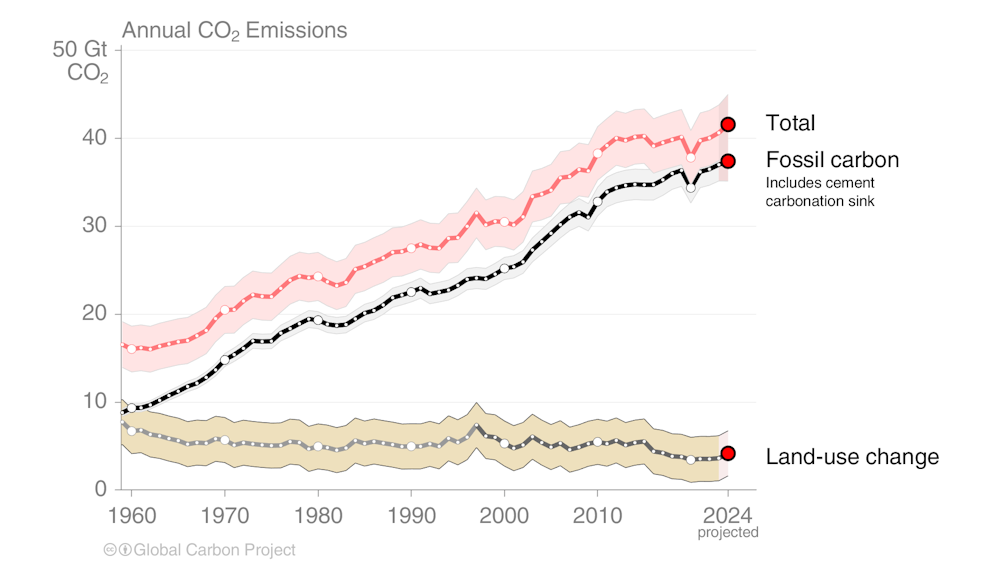
Carbon dioxide (CO₂) emissions from fossil fuels continue to increase, year on year. This sobering reality will be presented to world leaders today at the international climate conference COP29 in Baku, Azerbaijan.
Our latest annual stocktake shows the world is on track to reach a new record: 37.4 billion tonnes of CO₂ emitted from fossil fuels in 2024. This is an increase of 0.8% from the previous year.
Adopting renewable energy and electric vehicles is helping reduce emissions in 22 countries. But it’s not enough to compensate for ongoing global growth in fossil fuels.
There were also signs in 2023 suggesting natural systems may struggle to capture and store as much CO₂ in the future as they have in the past. While humanity is tackling deforestation and the growth in fossil CO₂ emissions is slowing, the need to reach an immediate peak and decline in global emissions has never been so acute.
The Global Carbon Project
The Global Carbon Budget is an annual planetary account of carbon sources and sinks, which soak up carbon dioxide and remove it from the atmosphere.
We include anthropogenic sources from human activities such as burning fossil fuels or making cement as well as natural sources such as bushfires.
When it comes to CO₂ sinks, we consider all the ways carbon may be taken out of the atmosphere. This includes plants using CO₂ to grow and CO₂ being absorbed by the ocean. Some of this happens naturally and some is being actively encouraged by human activity.
Putting all the available data on sources and sinks together each year is a huge international effort involving 86 research organisations, including Australia’s CSIRO. We also use computer models and statistical approaches to fill out the remaining months to the end of the year.
Fossil fuel emissions up
This year’s growth in carbon emissions from fossil fuels is mainly from fossil gas and oil, rather than coal.
Fossil gas carbon emissions grew by 2.4%, signalling a return to the strong long-term growth rates observed before the COVID pandemic. Gas emissions grew in most large countries, but declined across the European Union.
Oil carbon emissions grew by 0.9% overall, pushed up by a rise in emissions from international aviation and from India.
The rebound in international air travel pushed aviation carbon emissions up 13.5% in 2024, although it’s still 3.5% below the pre-COVID 2019 level.
Meanwhile, oil emissions from the United States and China are declining. It’s possible oil emissions have peaked in China, driven by growth in electric vehicles.
Coal carbon emissions went up by 0.2%, with strong growth in India, small growth in China, a moderate decline in the US, and a large decline in the European Union. Coal use in the US is now at its lowest level in 120 years.
The United Kingdom closed its last coal power plant in 2024, 142 years after the first one was opened. With strong growth in wind energy replacing coal, the UK CO₂ emissions have almost been cut in half since 1990.
Changing land use
Carbon emissions also come from land clearing and degradation. But some of that CO₂ can be taken up again by planting trees. So we need to examine both sources and sinks on land.
Global net CO₂ emissions from land use change averaged 4.1 billion tonnes a year over the past decade (2014–23). This year is likely to be slightly higher than average with 4.2 billion tonnes, due to drought and fires in the Amazon. That amount represents about 10% of all emissions from human activities, the rest owing to fossil fuels.
Importantly, total carbon emissions – the sum of fossil fuel emissions and land-use change emissions – have largely plateaued over the past decade, but are still projected to reach a record of just over 41 billion tonnes in 2024.
The plateau in 2014–23 follows a decade of significant growth in total emissions of 2% per year on average between 2004 and 2013. This shows humanity is tackling deforestation and the growth of fossil CO₂ emissions is slowing. However, this is not enough to put global emissions on a downward trajectory.
Annual CO₂ emissions continue to increase, reaching a record high in 2024. The shaded area around each line shows the uncertainty in the estimates. Global Carbon Project, CC BY
More countries are cutting emissions – but many more to go
Fossil CO₂ emissions decreased in 22 countries as their economies grew. These countries are mainly from the European Union, along with the United States. Together they represent 23% of global fossil CO₂ emissions over the past decade (2014–23).
This number is up from 18 countries during the previous decade (2004–13). New countries in this list include Norway, New Zealand and South Korea.
In Norway, emissions from road transport declined as the share of electric vehicles in the passenger car fleet grew – the highest in the world at over 25% – and biofuels replaced fossil petrol and diesel. Even greater reductions in emissions have come from Norway’s oil and gas sector, where gas turbines on offshore platforms are being upgraded to electric.
In New Zealand, emissions from the power sector are declining. Traditionally the country has had a high share of hydropower, supplemented with coal and natural gas. But now wind and particularly geothermal energy is driving fossil generation down.
We are projecting further emissions growth of 0.2% in China, albeit small and with some uncertainty (including the possibility of no growth or even slight decline). China added more solar panels in 2023 than the US did in its entire history.
In the 1960s, our activities emitted an average of 16 billion tonnes of CO₂ per year globally. About half of these emissions (8 billion tonnes) were naturally removed from the atmosphere by forests and oceans.
Over the past decade, emissions from human activities reached about 40 billion tonnes of CO₂ per year. Again, about half of these emissions (20 billion tonnes) were removed.
In the absence of these natural sinks, current warming would already be well above 2°C. But there’s a limit to how much nature can help.
In 2023, the carbon uptake on land dropped 28% from the decadal average. Global record temperatures, drought in the Amazon and unprecedented wildfires in the forests of Canada were to blame, along with an El Niño event.
As climate change continues, with rising ocean temperatures and more climate extremes on land, we expect the CO₂ sinks to become less efficient. But for now, we expect last year’s land sink decline will recover to a large degree as the El Niño event has subsided.
About half of the CO₂ emissions were removed from the atmosphere by forests and oceans. When we tally up all of the sources compared to the sinks, the budget should balance. We find a slight imbalance of 1.6Gt/year due to limitations of the data. Global Carbon Budget 2024/Global Carbon Project, CC BY
Looking ahead
Our latest carbon budget shows global fossil fuel emissions continue to increase, further delaying the peak in emissions. Global CO₂ emissions continue to track in the middle of the range of scenarios developed by the Intergovenmental Panel on Climate Change (IPCC). We have yet to bend the emissions curve into the 1.5–2°C warming territory of the Paris Agreement.
This comes at a time when it’s clear we need to be reducing emissions, to avoid worsening climate change.
We also identified some positive signs, such as the rapid adoption of renewable energy and electric cars as they become cheaper and more accessible, supporting the march toward a net-zero emissions pathway. But turning these trends into global decarbonisation requires a far greater level of ambition and action.
Pep Canadell receives funding from the National Environmental Science Program – Climate Systems Hub.
Corinne Le Quéré receives funding from the UK Natural Environment Research Council and the UK Royal Society. She was granted a research donation by Schmidt Futures (project CALIPSO – Carbon Loss In Plants, Soils and Oceans). Corinne Le Quéré is a member of the UK Climate Change Committee. Her position here is her own and does not necessarily reflect that of the Committee.
Glen Peters receives funding from the European Union’s Horizon Europe research and innovation programme.
Judith Hauck receives funding from the European Research Council (OceanPeak) and the European Union’s Horizon Europe research and innovation program (OceanICU – Improving Carbon Understanding). The work reflects only the authors’ view; the European Commission and their executive agency are not responsible for any use that may be made.
Julia Pongratz receives funding from German Federal Ministry of Education and Research.
Pierre Friedlingstein receives funding from the European Union’s Horizon 2020 research and innovation programme
Robbie Andrew receives funding from the Norwegian Environment Agency and the European Union’s Horizon Europe.
Thousands of supporters of Aotearoa New Zealand’s hīkoi mō te Tiriti — a march traversing the length of Aotearoa in protest against the Treaty Principles Bill and government policies impacting on Māori — have crossed the Auckland Harbour Bridge.
RNZ reporters with the march said it was swaying and rocking as the protesters descended on the Westhaven side of the bridge.
Earlier, Auckland commuters were advised to plan ahead as the hīkoi makes its way over the Harbour Bridge.
Waka Kotahi and police say the two outer northbound lanes closed from 8.30am on Wednesday and would not re-open until around 11am. Some other on- and off-ramps will also be closed until further notice.
The hīkoi begins the Harbour Bridge crossing. Video: RNZ News
This article is republished under a community partnership agreement with RNZ.
It’s a big year in America – for wildlife as well as for politics. I’m talking about periodical cicadas.
These curious creatures spend most of their lives in the ground, emerging after 13 or 17 years to eat, breed, die and repeat the cycle. For the first time in more than 200 years, two specific broods of the 13- and 17-year cicadas have emerged together: Brood XIX, in the southeastern United States, and Brood XIII, found in the country’s Midwest.
What’s more, this time the emergence of these broods also happens to coincide with an unrelated event on the other side of the world: the emergence of a big batch of Australian greengrocer cicadas, which have a seven-year life cycle.
This remarkable event has been 1,547 years in the making. Thinking about it sheds light on some of the deepest questions about mathematics.
Did we invent mathematics, or was it there all along?
Are mathematical facts created or discovered? Ask a mathematician, and they are likely to tell you that mathematical facts are discovered.
But this is perplexing: if such facts are discovered, what are we discovering? Are mathematical facts somehow “out there” before we discover them? Does that mean there’s some realm of pure mathematics that we uncover with our minds?
These sorts of questions quickly begin to feel pretty uncomfortable. We find ourselves in deep metaphysical territory, beset by questions about the nature of reality.
For it seems that in addition to the physical components of the world, there must also exist things like numbers, and even more exotic mathematical entities such as sets and functions. These seem to be real objects, that we gradually uncover through the activity of mathematics.
On the other hand, if we think of mathematics as an act of creation, these metaphysical questions disappear. Mathematics can be like a language we’ve invented to describe the world.
In this picture, mathematics is just a very precise way of speaking that happens to be useful.
Which brings us back to the cicadas: these little critters put pressure on the idea that mathematics is something we created ourselves.
Cicada life cycles
North American cicadas have life cycles that last for prime numbers of years. Why 13 or 17 years? Why not 12, 14, 15 or 16?
One explanation asks us to imagine the cicadas are hunted by periodical predators that spend most of their lives in the ground and then, after a period of time, emerge to hunt. In particular, suppose there are five species of predator, with life cycles of two, three, four, five, six and seven years.
A cicada will have the best chance of survival if it can emerge from the ground when its predators are lying dormant. The cicadas with the best chance of survival will therefore be those that manage to avoid emerging at the same time as their predators.
It turns out the best way to avoid periodical predators is to move to a life cycle that lasts a prime number of years.
To see this, suppose a cicada has 12-year life cycle. Whenever it comes out of the ground, there will be predators with two-, three-, four- and six-year life cycles on the hunt.
A cicada with a 14-year life cycle will overlap with predators possessing two- and seven-year life cycles, and a cicada with a 15-year life cycle will overlap with predators on three- and five-year cycles. Cicadas with 13- or 17-year life cycles, by contrast, will generally avoid all of these predators.
Each P is a predator life-cycle. Having a prime-numbered life-cycle is a handy way to avoid every nearby predator. Sam Baron, CC BY-SA
There is a general mathematical result that explains all of this, involving the lowest common multiple of two numbers: the smallest number that both can divide into evenly.
How often a cicada overlaps with a predator turns out to depend on the lowest common multiple of the cicada and predator life-cycles. For instance, a cicada with a 12-year life cycle and a predator with a two-year life cycle will overlap every 12 years, which is the lowest common multiple of two and 12. By contrast, a cicada with a 13-year life cycle and a predator with a 2-year life cycle will only overlap every 26 years.
As a general rule, having a prime-numbered life cycle is a very good way for a cicada to ensure it overlaps as little as possible with its predator.
Another theory suggests the prime-numbered life cycles actually help cicadas avoid interbreeding with other broods. Either way, similar mathematical logic applies.
This is also why Australian cicadas (with their seven-year cycle) overlap so infrequently with their US cousins (with 13- and 17-year cycles). The lowest common multiple of seven, 13 and 17 is 1,547!
What happens when mathematics explains biology?
As the US philosopher Alan Baker has argued, this biological explanation for why cicadas have prime-numbered life cycles relies heavily on mathematics. In this case, it seems like facts about mathematics explain facts about biology and evolution.
This is very hard to understand if mathematics is something we have simply created. If mathematics is a language we invented, why should it apparently guide the evolutionary history of cicadas? This would be a bit like saying the planets move the way they do because of how we talk about them in English.
Once we start looking for these explanations involving mathematics, they seem to be everywhere. To take an example from my own research: why do gears in machinery generally have prime numbers of teeth?
The answer is very similar to the cicada story. If gears have a prime-numbered amount of teeth, then the same two teeth will contact each other much less frequently than if the gear-teeth are not prime-numbered.
This ensures that if there is an imperfection on a specific pair of teeth, one from each gear, then the imperfections won’t keep striking each other. This way, the chance of the gear failing is minimised.
The end of an empire
One thousand, five hundred and forty-seven years is a long time – long enough to see empires rise and fall.
Indeed, the last time American and Australian cicadas emerged together, in the year 477, the Western Roman Empire was in the throes of collapse.
It is, of course, a coincidence that they have emerged again at what may be another turning point in Western civilisation. One can’t help but wonder, though: are the bugs to blame?
Sam Baron receives funding from the Australian Research Council.
Source: The Conversation (Au and NZ) – By Libby (Elizabeth) Sander, MBA Director & Assistant Professor of Organisational Behaviour, Bond Business School, Bond University
With the end of year holidays looming, it’s easy to imagine Australians are getting ready to check out of the workplace and head for the beach. But a recent survey shows Australians are not taking holidays nearly as often as they are entitled to.
The survey of more than 1,000 Australian workers, taken from July to September 2024, has found that employees have 160 million days of annual leave banked. More than one in five employees (22%) had accrued more than four weeks, with older workers having higher averages than their younger colleagues.
The findings coincide with another study showing nearly half of Australian workers report feeling burned out.
So how do Australians’ leave habits compare with workers in other countries, such as the United States and Japan? And can companies here force – or just encourage – workers to take a break?
It’s important to take leave
Not taking annual leave has negative effects on both mental and physical health for workers. But it can also impact a company’s bottom line.
Research has shown that not taking leave reduces employee’s motivation and increases the risk of burnout, leading to reductions in job satisfaction, absenteeism and lower productivity.
The University of Pittsburgh’s Mind-Body Centre found taking holidays increases positive emotions and reduces depression.
Why workers aren’t taking leave
The reasons for employees not taking leave are multifaceted and complex.
In uncertain economic times, employees may try to accrue annual leave as a financial buffer should it be required. With rising costs of living, employees who can’t afford to travel may also be reluctant to take leave and stay at home.
In some cases, organisations may have cultures where working long hours and not taking leave is viewed positively.
Research has shown that in some organisations, taking leave may be viewed as a lack of commitment, resulting in employees being concerned about job security and career progression.
Some companies view working long hours and not taking leave as a sign of commitment. G-Stock Studio/Shutterstock
Since the pandemic, employees continue to report staff shortages in many roles and increased workloads. Employees are less likely to take time off if they feel they may be burdening others if there is no one to take on their work.
Returning to work to an overflowing inbox and a mile high list of tasks mean employees are likely to take shorter holidays, not giving them sufficient time to take a meaningful break.
And while flexible work arrangements have been welcomed by workers, research shows the inability to switch off at the end of the day can spill over into annual leave.
Is leave hoarding worse in Australia?
Annual leave entitlements differ between countries. The standard entitlement for full-time workers in Australia is 20 days per year.
In the United States, the average worker is entitled to between 10 and 14 days of leave a year. But this does not carry over if unused. Despite this, American workers leave up to 55% of leave days unused.
German employees are entitled to 30 days of leave a year. Only 12% of employees accrue excess leave, in a country where taking regular holidays is a cultural norm.
In the United Kingdom, 65% of employees don’t take the full 28 days of leave available to them. And in Japan, a country renowned for long working hours, 20% of leave days are not taken, even though many Japanese workers only get 10 days leave a year.
Can companies force workers to take leave?
Employers can direct employees to take leave, but only where there is a holiday shutdown period or where an employee has accrued excessive leave.
The amount of notice employers are required to give staff to take leave is not generally specified, however it may be prescribed in relevant awards, enterprise agreements or the employer’s own policy.
The direction to take leave must also be reasonable, taking into consideration factors including the amount of notice given, usual practices in the organisation, timing, and the needs of the employee and the employer.
Employers don’t like holding large leave balances, as accrued annual leave is recorded as a liability on balance sheets. Further, the annual leave entitlement is paid at the rate the employee is on at the time of the leave, not their rate at the time of accrual.
How companies can get staff to take leave
Taking leave matters. One study shows year-end performance rose by 8% for every extra 10 hours of annual leave an employee took.
And there are added benefits for employees too. Using your holiday leave can help you get a promotion or pay rise.
There are a number of ways employers can encourage staff to take their annual leave entitlement. Promoting a culture of switching off after work and on vacation is one. It’s difficult for an employee to have a relaxing holiday while their phone is pinging across multiple different platforms.
Managers need to ensure adequate resources are provided and workloads are managed effectively.
Google has utilised AI tools to support employees in monitoring workloads and reallocating work across teams. Managers need to work closely with their teams to ensure they understand workload pressures and provide support.
Encouraging employees not to check in on leave is also essential.
Lead by example
Organisations should take steps to foster a supportive work culture, where wellbeing and taking regular breaks are prioritised. Senior managers need to model this behaviour in their own actions and their communications with their staff.
Sending an email telling staff to take leave and focus on well-being is likely to fall flat if managers are spending 60-plus hour weeks in the office, with little to no time away on leave.
Organisations can also provide incentives such as offering bonuses or other arrangements to encourage employees to take breaks.
And finally, education plays a key part in driving change. Employees may not be aware of the negative effects of not switching off from work and or taking regular holidays, leading to increased risk of disengagement and burnout.
Libby (Elizabeth) Sander does not work for, consult, own shares in or receive funding from any company or organisation that would benefit from this article, and has disclosed no relevant affiliations beyond their academic appointment.
For more than a millennium, many Andean peoples used an object called a “khipu” (also spelled “quipu” and pronounced “key-poo”) to record and communicate information.
Khipus were made with cords or strings with knots tied into them. And experts understand that many, but not all, of these knots were used to represent numbers.
In a new study published today, I make a numeric connection between two important khipus from history – the first being being the largest khipu ever known and the other one of the most complex.
What were khipus used for?
While khipus were used in earlier times, they were especially important to the Inca Empire, which lasted from around 1438 CE to 1532 CE (when the empire was conquered by the Spanish). Since the Inca did not leave any written records, khipus are understood to have been their main system of communication and record-keeping.
Khipus were commonly made from either cotton or fibres sourced from camelids (the group of animals that includes camels, llamas and alpacas). These materials could be dyed or left naturally coloured. Some khipus even include plant fibres, while several incorporate human hair.
It seems specially-trained khipu makers (“khipukamayuqs”) made very deliberate decisions when constructing these record-keeping tools. These decisions related to the colours used, the direction of spin and ply of the cord fibres, the spacing and type of the cord attachments, and the structure and position of the knots.
Early Spanish chroniclers wrote about the khipu’s various numeric applications, which included recording storehouse inventories, population censuses and tax and tribute obligations.
A new numeric connection
For more than a century, researchers have been studying khipu features in hopes that patterns may emerge from a collective view. In recent decades their data have been digitised, which is now freely available via the Open Khipu Repository and the Khipu Field Guide.
For my research, I analysed the data from two khipus found in northern Chile and first recorded by ethno-mathematician Marcia Ascher and anthropologist Robert Ascher in the 1970s. One of these is the largest khipu ever found – spanning more than five metres in length and comprising more than 1800 cords (see the picture below). The otherkhipu (pictured in the header image) has almost 600 cords in complicated arrangements.
I noticed both khipus used red/white “divider” cords to separate groups of either tens or sevens. The larger khipu was divided into ten groups, with each group having seven cords. The smaller khipu was divided into seven groups, with each group having ten cords (and many subsidiary cords).
After examining and manipulating the data, I realised the smaller and more complex khipu is a summary and reallocation of the information in the larger khipu. In other words, the two khipus record the same data, but represent it differently.
This is the most complicated numeric connection between khipus made to date. It was only possible because of the availability of data and digital tools that make searching for patterns easier – and which wouldn’t have been available to Marcia Ascher back in the 1970s.
New khipu clues
While the numbers in these two khipus are counting and allocating something, we don’t yet know what that was. Why would it be necessary to have two khipus recording the same information in two different ways? We can only speculate.
Perhaps the larger khipu recorded the collection of different amounts of food crops from the community, while the other recorded how these foods were distributed between those in need, or between storehouses. Both ways of looking at the numbers would have been important to the people who used these khipus.
Khipus used coloured cords adorned with knots at specific points. Jack Zalium/flickr, CC BY-SA
Experts believe only a tiny fraction of the khipus made throughout history have survived. This is partly because the institutions that used them eventually either became obsolete or used other means of recording after the conquest, combined with a climate that was less than ideal for textile preservation.
Today, about 1,600 khipus remain, residing mainly in collections in the Americas and Europe. Fewer than half of these have had their features digitally saved in research databases.
Through continued digitisation efforts, we hope to discover more khipu clues – and make new numeric connections that add to our understanding of ancient Andean peoples.
Karen Thompson is a Khipu Field Guide (KFG) Affiliate. This entails providing data to, and correcting the data in, KFG. No funds are received under this informal arrangement.
Source: The Conversation (Au and NZ) – By Giovanni E. Ferreira, NHMRC Emerging Leader Research Fellow, Institute of Musculoskeletal Health, University of Sydney
The drug semaglutide, commonly known by the brand names Ozempic or Wegovy, was originally developed to help people with type 2 diabetes manage their blood sugar levels.
However, researchers have discovered it may help with other health issues, too. Clinical trials show semaglutide can be effective for weight loss, and hundreds of thousands of people around the world are using it for this purpose.
Now, a study published in the New England Journal of Medicine has suggested semaglutide can improve knee pain in people with obesity and osteoarthritis. So what did this study find, and how could semaglutide and osteoarthritis pain be linked?
Osteoarthritis and obesity
Osteoarthritis is a common joint disease, affecting 2.1 million Australians. Most people with osteoarthritis have pain and find it difficult to perform common daily activities such as walking. The knee is the joint most commonly affected by osteoarthritis.
Being overweight or obese is a major risk factor for osteoarthritis in the knee. The link between the two conditions is complex. It involves a combination of increased load on the knee, metabolic factors such as high cholesterol and high blood sugar, and inflammation.
For example, elevated blood sugar levels increase the production of inflammatory molecules in the body, which can damage the cartilage in the knee, and lead to the development of osteoarthritis.
Weight loss is strongly recommended to reduce the pain of knee osteoarthritis in people who are overweight or obese. International and Australian guidelines suggest losing as little as 5% of body weight can help.
But losing weight with just diet and exercise can be difficult for many people. One study from the United Kingdom found the annual probability of people with obesity losing 5% or more of their body weight was less than one in ten.
Semaglutide has recently entered the market as a potential alternative route to weight loss. It comes from a class of drugs known as GLP-1 receptor agonists and works by increasing a person’s sense of fullness.
Semaglutide for osteoarthritis?
The rationale for the recent study was that while we know weight loss alleviates symptoms of knee osteoarthritis, the effect of GLP-1 receptor agonists was yet to be explored. So the researchers set out to understand what effect semaglutide might have on knee osteoarthritis pain, alongside body weight.
They randomly allocated 407 people with obesity and moderate osteoarthritis into one of two groups. One group received semaglutide once a week, while the other group received a placebo. Both groups were treated for 68 weeks and received counselling on diet and physical activity. At the end of the treatment phase, researchers measured changes in knee pain, function, and body weight.
As expected, those taking semaglutide lost more weight than those in the placebo group. People on semaglutide lost around 13% of their body weight on average, while those taking the placebo lost around 3% on average. More than 70% of people in the semaglutide group lost at least 10% of their body weight compared to just over 9% of people in the placebo group.
Osteoarthritis of the knee is the most common type of osteoarthritis. SKT Studio/Shutterstock
The study found semaglutide reduced knee pain significantly more than the placebo. Participants who took semaglutide reported an additional 14-point reduction in pain on a 0–100 scale compared to the placebo group.
This is much greater than the pain reduction in another recent study among people with obesity and knee osteoarthritis. This study investigated the effects of a diet and exercise program compared to an attention control (where participants are provided with information about nutrition and physical activity). The results here saw only a 3-point difference between the intervention group and the control group on the same scale.
The amount of pain relief reported in the semaglutide trial is also larger than that reported with commonly used pain medicines such as anti-inflammatories, opioids and antidepressants.
Semaglutide also improved knee function compared to the placebo. For example, people who took semaglutide could walk about 42 meters further than those on the placebo in a six-minute walking test.
How could semaglutide reduce knee pain?
It’s not fully clear how semaglutide helps with knee pain from osteoarthritis. One explanation may be that when a person loses weight, there’s less stress on the joints, which reduces pain.
But recent studies have also suggested semaglutide and other GLP-1 receptor agonists might have anti-inflammatory properties, and could even protect against cartilage wear and tear.
While the results of this new study are promising, it’s too soon to regard semaglutide as a “miracle drug” for knee osteoarthritis. And as this study was funded by the drug company that makes semaglutide, it will be important to have independent studies in the future, to confirm the findings, or not.
The study also had strict criteria, excluding some groups, such as those taking opioids for knee pain. One in seven Australians seeing a GP for their knee osteoarthritis are prescribed opioids. Most participants in the trial were white (61%) and women (82%). This means the study may not fully represent the average person with knee osteoarthritis and obesity.
It’s also important to consider semaglutide can have a range of side effects, including gastrointestinal symptoms and fatigue.
There are some concerns that semaglutide could reduce muscle mass and bone density, though we’re still learning more about this.
Further, it can be difficult to access.
I have knee osteoarthritis, what should I do?
Osteoarthritis is a disease caused by multiple factors, and it’s important to take a multifaceted approach to managing it. Weight loss is an important component for those who are overweight or obese, but so are other aspects of self-management. This might include physical activity, pacing strategies, and other positive lifestyle changes such as improving sleep, healthy eating, and so on.
Giovanni E. Ferreira receives funding from the National Health and Medical Research Council (NHMRC).
Christina Abdel Shaheed holds grants from the National Health and Medical Research Council (NHMRC) and the Medical Research Future Fund (MRFF).
This year, dozens of new models of electric vehicles have hit the Australian market – and more are coming. New models of battery electric and plug-in hybrids come with bigger batteries. The average battery electric now has a range of over 400 kilometres.
But until now, there’s been a missing piece of the puzzle. The batteries in most new electric cars are huge – much larger than a typical home battery. A BYD Seal might have a battery capacity of 60 to 80 kilowatt hours (kWh), while the average home battery installed in Australia is 11 to 12 kWh.
So why can’t you plug your car in and power your house?
Soon, you will be able to. The suite of technologies already exists. They’re known as vehicle to grid (V2G, where you export power to the grid), vehicle to house (V2H, where you run your house off your car) and vehicle to load (V2L, where you run electric devices off your car).
There’s a cost – you need a bidirectional charger able to send power both to and from the car. But experts expect substantial benefits.
With V2G, you can sell power back to the grid at peak times, helping the grid stay stable. With V2H, you can weather power outages or even go off grid. V2L would be useful for campers and tradies.
One reason it’s not here already is that regulations and processes haven’t been in place. On Saturday, climate change minister Chris Bowen announced progress on this front. Vehicle to grid would be up and running by Christmas. That’s a very ambitious timeline, as there’s more to it than just regulations. But it is a jump forward.
“When you pick your next EV you won’t be buying just a car, you’ll be buying a household battery on wheels,” Bowen has said.
Electric car batteries have much larger capacities than home batteries, and could power household appliances for longer. Maxx-Studio/Shutterstock
What changed?
Vehicle to grid isn’t totally new in Australia.
In late 2022, South Australia became the first state to greenlight bidirectional chargers in homes. But these chargers only work with two EV models, the electric Nissan Leaf and the plug-in hybrid Mitsubishi Outlander.
So what just changed? Crucial underpinning – the boring but important scaffolding which makes new technology robust and reliable. Specifically, Standards Australia has approved a new standard for bidirectional chargers.
Australian standards are technical standards outlining specifications and guidelines for new technologies. While voluntary, products are expected to meet the relevant standards. A V2G standard will level the playing field and give clarity for owners, grid operators and electric charger manufacturers.
A new standard is a leap forward. But to make V2G a reality will take more action. Car owners have to install bidirectional fast chargers, able to send power both ways. These aren’t cheap, at around A$3,500 a pop. Car companies have to ensure their chargers meet the new standard. And distribution networks have to approve charger models for use on the grid.
For vehicle to grid technology to become common, the grid has to be able to handle it. yelantsevv/Shutterstock
Why should we be excited about this?
As more car owners go electric, the size of the battery fleet on Australian roads and driveways is growing fast.
Without V2G, these batteries are just used for one thing – to make a car, truck or bus operate. But these batteries could do much more. Australia’s electric fleet is now over 180,000. If the average battery pack size was 50 kWh, that would represent a giant distributed battery of 9 gigawatt hours. The largest grid-scale battery under construction in Australia will have 2.4 gigawatt hours.
For energy authorities, this fleet of batteries presents a huge opportunity. At times of peak demand, they could offer financial incentives for EV owners to discharge to the grid. Used carefully, EV batteries could avert blackouts. A decentralised power source is more resilient to shocks. It could mean avoiding the need to fire up expensive gas plants at times of peak demand.
For EV owners, the financial incentives could be enough to let their cars be used to keep the grid stable. In testing, early V2G users have been able to turn large power bills into power payments. Annual earnings could be as high as $9-$12,000 per vehicle in New South Wales, according to one report.
Overseas, vehicle to grid technology is gaining traction. California has mandated V2G capabilities in all light EVs sold from 2027 onward.
In Australia, regulatory change and incentives will be needed to encourage broader adoption.
It’s encouraging to see Australian standards for V2G arrive. But while Bowen is pitching V2G as about to happen, there is still some spadework left to do before it’s really here.
Syed Ali receives funding from the Department of Climate Change, Energy, the Environment and Water.
Source: The Conversation (Au and NZ) – By Sitong Michelle (Michelle) Chen, Senior Lecturer in International Business, Auckland University of Technology
Around the world, the growth of industry and consumption has escalated environmental damage through increased emissions, waste and pollution from landfills.
The current linear economic model, characterised by a “take-make-dispose” approach to limited resources, is increasingly shown to be unsustainable.
We have explored six large food manufacturing companies in Aotearoa New Zealand committed to circular-economy practices. We wanted to understand if and how they prioritise the four circular elements of reducing, reusing, recycling and recovering.
We identified a variety of drivers and barriers to implementing circularity. This includes consumer knowledge, government regulation, supply-chain issues and financial commitment.
Overall, we found New Zealand food manufacturers are slow to take positive steps in all areas. They lack a working knowledge of circular processes and the old linear model still holds sway.
New Zealand context
We found New Zealand food manufacturers are beginning to embrace the circular economy but there is still a long way to go for them to close the loop. The current focus is mainly on three elements (reducing, reusing and recycling), but they pay less attention to recovering materials.
Food manufacturers are moving towards a more circular model of resource use but face barriers and lack of awareness among customers. CC BY-SA
In practice, reduction involves minimising the use of resources and avoiding unnecessary waste. Here the focus is on reducing the quantity of raw materials without compromising on quality.
Reusing extends the life of products and materials by finding new purposes such as refurbishing or repairing items to prevent them from becoming waste. This is especially the case with packaging materials which can be reused, recycled or composted.
Recycling refers to the process of collecting, sorting and processing materials to manufacture new products. This reduces the demand for new raw materials. For example, fruits past their use-by dates can be turned into pickles and perfumes.
Recovery extracts energy or other useful resources from waste materials that cannot be recycled. For example, withered flowers and spoiled fruits are turned into biomethane for energy production. This is New Zealand’s weakest link in the adoption of the circular economy.
Thousands of single-use cups are still used and thrown out. Getty Images
Barriers to circularity
Food manufacturers told us they face multiple barriers imposed by local and offshore factors, including a lack of awareness of circular-economy principles among consumers and industry.
Research participants noted that local consumers are concerned more with price than circularity. People prefer cheaper products despite their negative environmental impact.
All companies we studied expressed this perspective. One participant said:
A major and continuing challenge for us, and our industry, is that of the single-use takeaway cup. Despite our best efforts to encourage and support our customers to sit in and enjoy their coffee, or bring their cups, we still distribute thousands of cups every year. Changing their mindset around it is still difficult.
Offshore, major trading partners in China and Japan prefer plastic packaging for their products. The food manufacturers we studied found these trading partners valued appearance and presentation first, before environmental impacts.
All companies reported being confronted with regulatory barriers. This includes lack of government support such as rebates and subsidies or robust circular-economy policies. There is no comprehensive framework on how businesses make decisions and investments.
This calls for policy revisions to help companies implement robust circular-economy practices.
Drivers for change
The COVID pandemic had a significant economic impact in slowing down the implementation of circular practices due to supply-chain disruptions. This comes on the back of transportation challenges, a lack of low-emission freight options and increases in living costs.
Based on our findings, we offer suggestions to support managers and policymakers to achieve sustainability in the food manufacturing sector.
First, policymakers can play an important role through laws, regulations, fiscal incentives, public funding and a flexible legislative framework that supports circular-economy strategies. Such measures are crucial for reducing uncertainty and encouraging investment in circular practices.
Second, we advise companies to concentrate on education and raising awareness among consumers about the long-term benefits of the circular economy. This is a much more urgent agenda than focusing on regulatory, technological or supply-chain issues. Policy and regulation change will happen in response to changing consumer preferences and patterns.
Third, because educating the public at home and abroad is not an easy fix, companies need to collaborate with each other across all parts of the food manufacturing industry, including retailers and manufacturers.
Mindsets and practices among New Zealand businesses need to shift from a linear model towards receiving training in circular-economy practices and education in sustainability and to be able to make changes for future generations.
Sitong Michelle Chen works for AUT Business School, Department of Marketing and International Business. She receives funding from North Asia CAPE.
The series was assisted by Pacific journalist David Robie, author of Eyes of Fire: The Last Voyage of the Rainbow Warrior; and editor Giff Johnson, Eve Burns and Hilary Hosia of the Marshall Islands Journal; along with many Marshall Islanders who spoke to the podcast crew or helped with this project.
This article is republished under a community partnership agreement with RNZ.
Treasurer Jim Chalmers will announce a fund of up to $900 million for states and territories to improve productivity and competition, in a Wednesday speech urging an all-out effort to tackle one of Australia’s biggest structural economic issues.
States will be able to choose from a “menu of options”, with Chalmers pointing to streamlining commercial planning and zoning, and removing barriers that inhibit the take-up of modern construction methods.
Speaking to business economists, Chalmers will also outline findings from the Productivity Commission’s modelling, which he commissioned, on the impacts of revitalising national competition policy.
“The benefits on offer are substantial, if not staggering,” he says in his speech released in part ahead of delivery.
The commission’s modelling indicated a reinvigorated national competition policy could increase Australia’s GDP by up to $45 billion annually and cut prices by 1.45 percentage points.
“That GDP boost represents about $5,000 per household, per year,” Chalmers says.
He says “there is no more important structural problem in our economy than productivity – no higher priority for reform”.
In 2022 treasury downgraded its assumption for long-run annual productivity growth from 1.5% to 1.2%.
Chalmers says new treasury analysis attributes half of this downgrade to Australia’s changing mix of industries. These days more people are working in services, where productivity grows more slowly.
Flat labour productivity in 2023-24 “partly reflects the enormous gains we’ve made and preserved in the jobs market”.
Progress on improving productivity will need commitment from federal and state and territory governments, Chalmers says.
He will meet state and territory counterparts on November 29.
While not all the Productivity Commission’s reforms will be adopted “we want to make meaningful progress where we can”.
“I expect we’ll start by fast-tracking the adoption of trusted international product safety standards and developing a general right to repair – both Commonwealth-led reforms.” The “right to repair” involves access for households and businesses to repairs at competitive prices and repair information.
“Both involve small implementation costs but provide significant benefits in the order of $5 billion over the next ten years for product safety, and over $400 million per annum for right to repair.”
The head of the Productivity Commission, Danielle Wood, interviewed on The Conversation’s politics podcast recently, said if the government could revitalise national competition policy effectively, “if they can actually get the states to come to the table and agree on areas where we can reduce regulatory and other barriers to competition across the country, that’s a really important lever for getting economic dynamism moving again”.
Michelle Grattan does not work for, consult, own shares in or receive funding from any company or organisation that would benefit from this article, and has disclosed no relevant affiliations beyond their academic appointment.
Anthony Albanese prides himself on his eye for a good candidate.
In 2020, when he was opposition leader, he drafted Kristy McBain to run for a byelection in the marginal NSW seat of Eden-Monaro. If Labor had lost the seat, Albanese’s leadership could have been in trouble. McBain, now a junior minister in his government, won narrowly.
In the 2022 election, he made a captain’s pick in the Western Australian seat of Pearce with candidate Tracey Roberts, who wrested the seat from the Liberals.
Now Albanese is playing godfather again, hoping that in Tasmania a clever choice of candidate might snatch a Liberal seat where the opposition has had a lot of trouble, and that another well-known face could shore up a marginal Labor seat where the ALP member is retiring.
Anne Urquhart, 67, is currently chief government whip in the Senate; she has been in parliament since 2010. Albanese prevailed on her to run, despite her tilt at the seat of Braddon being a long shot. The Liberals hold it by an 8% margin.
Despite the margin, Labor reckons in reality Braddon, while tough, is more winnable than it appears.
Last election, Labor’s candidate had all sorts of problems; as well, Jacqui Lambie had a runner in the field (which she is not expected to have at next year’s election). There was an anti-Labor swing on primary votes in Braddon of nearly 10%.
Since the election, the Liberals have had their own pain. The present Liberal member, Gavin Pearce, who has held the seat since 2019, is retiring at the election. Some time ago he reportedly said he would not run again if the Liberals re-selected Bridget Archer.
Archer, in the neighboring seat of Bass, is an outspoken moderate. Pearce is on the conservative end of the Liberals’ broad but not always harmonious church.
Archer was re-selected and Pearce did indeed decide against another run, citing the toll of the job and family reasons. The Liberals’ problems weren’t over, with a messy preselection following.
The other Labor candidate announced on Tuesday is Rebecca White, 41, who will run in Lyons. She is a former state leader of the party and her state seat is also Lyons. She says she will stay in the state parliament until the election is called.
The current federal member for Lyons, Brian Mitchell, is retiring and, on a margin of under 1%, Lyons would be vulnerable if there was a swing against Albanese. Labor reckons the White name is the best insurance it can take out.
Albanese on Tuesday appeared at two news conferences, one in each electorate, to unveil his candidates. “I don’t mind saying I’ve encouraged both of them to run,” he said.
Michelle Grattan does not work for, consult, own shares in or receive funding from any company or organisation that would benefit from this article, and has disclosed no relevant affiliations beyond their academic appointment.
Australia’s airline industry is famously duopolistic. Just two companies – Qantas and Virgin Australia – service 98% of the domestic passenger market. That’s not for a lack of other companies having tried to secure a foothold, over many decades.
In 2024 alone, we’ve seen the high-profile collapse of both Bonza and Rex, airlines that once ignited hopes for much greater competition in the sector. Now, we’re beginning to see the predictable effects of their exit.
According to a quarterly report released on Tuesday by the Australian Competition and Consumer Commission (ACCC), domestic airfares on major city routes increased by 13.3% to September after Rex Airlines halted its capital city services at the end of July.
There’s little reason to be optimistic about things changing anytime soon. Australia’s lack of competition means airfares are only likely to remain inflated due to higher demand and lower supply.
To predict what the market will bear in a given year, airlines use a process called revenue management.
This involves sophisticated mathematical modelling, incorporating a range of factors – seasonal variations for school breaks, holidays, and major sporting events – to determine both what the airlines can charge per passenger and what the likely impact will be on their bottom line.
There are three main expenses that airlines expect every year which fluctuate regularly:
fuel prices
aircraft maintenance
salaries.
But the Australian market has some unique characteristics. Our options for travelling the vast distances between major cities are very limited – and, if we’re not flying, very time-consuming too.
Many of us choose to fly as it provides us more time at our destination for leisure or work, without a massive road trip or train ride. Our airline duopoly is very aware of this, and know we’re willing to pay a premium for convenience.
The ACCC found that the price of “best discount economy” tickets on routes Rex had recently departed had increased significantly – up 95% between Adelaide and Melbourne, and 54% between Canberra and Melbourne.
The report also noted that fuel prices declined by more than 40% in the 12 months to September, which the airlines have not adjusted for in their pricing model.
The best solution’s a long shot
For Australian passengers to pay lower domestic airfares, competition from another airline is the only viable solution. That might seem like a far-fetched proposition for the foreseeable future.
Any airline attempting to start up in Australia would need significant financial backing to weather market fluctuations, and a singular focus on flying the airline.
There might be some hope on the horizon with a possible new entrant, Koala Airlines, in the press recently, stating its intentions to enter this market and be successful.
Many customers may be hoping Koala can excel where Bonza and Rex were unable to. However, their entry remains quite some way off. Koala is still working on attaining their air operators certificate (AOC) from CASA and a fleet of new aircraft.
They’ve given few details about their business strategy except for a promised cash refund guarantee for passengers, and plans to implement artificial intelligence to remain viable in the market.
What else can be done?
Can the government do anything to protect new entrants, to support them through the initial startup phase? Part-ownership of any new airline by the government is probably off the cards.
Salvaging the competition we have left may be a better strategy. Also on Tuesday, the government announced an $80 million support package to keep Rex’s regional services operational.
Much of Rex’s fleet of SAAB 340 aircraft is in need of repair, so this will help somewhat.
But such a big spending package is reminiscent of the pandemic-era strategies the government will not want to revisit on a grand scale.
Better compliance
Other strategies could focus on ensuring that everyone plays fairly and doesn’t abuse the system to keep market share. The ACCC’s latest report is part of ongoing quarterly reporting, after the Treasurer redirected the ACCC to monitor domestic airfares for another three years in November last year.
But other regulatory oversight may have been lacking. Speaking before a senate inquiry on Tuesday, Sydney Airport’s Scott Charlton said that until recently, a compliance committee set up to monitor Sydney Airport’s slot system hadn’t met for five years.
The government will need to tread carefully. If it wants to provide incentives for new entrants, it will need to do so in a manner that does not appear to be a re-regulation strategy, creating hardships for Qantas and Virgin Australia.
Ultimately, appearing to re-regulate the Australian aviation sector is not in line with the government’s long term strategy of keeping the airline market stable through less intervention.
Doug Drury does not work for, consult, own shares in or receive funding from any company or organisation that would benefit from this article, and has disclosed no relevant affiliations beyond their academic appointment.
Survivors of abuse in care arrived at Parliament today to hear the formal apology from the state which oversaw and inflicted harm on children.
Public sector leaders from Oranga Tamariki, the Ministry of Health, New Zealand Police, and Ministry of Education also apologised, as did the public service commissioner and the solicitor-general, at an event preceding Prime Minister Christopher Luxon’s national apology in the House.
By the afternoon, many survivors were still trying to absorb what had been said and what it meant, with some saying it was a “PR stunt,” some calling the speeches “hollow” and others not willing to believe the words until they saw action.
Abuse in state care — survivor reactions. Video: RNZ
During his apology, Prime Minister Christopher Luxon said many survivors did not want to engage with the current compensation process — but more than 3500 were — and he signalled there would be an extra $32 million funnelled into that system “while we work on the new redress system”.
Opposition leader Chris Hipkins said he formally joined with the government in its apology, saying the day was a significant step forward.
“Today is a hugely important day for all of you, to finally hear what the Crown has failed to give you for all of these years, an apology.”
Ken Clearwater, a long-time advocate for survivors, was at the event, saying he heard some great words but it was about “what action needs to go with it”.
“Everyone’s saying the right things, but if you look at the policies and stuff we have at the moment, that’s not helping our children.”
He believed National, leader of the coalition government, was going to have to change a lot of their policies.
“So we’re apologising for what happened in the past, but the policies are still in place that are making it no different than when we were in the past.
‘Hollow words .. . dangerous’ “To have hollow words at this stage would be, would be pretty dangerous.”
Signs from protesters sit outside Parliament during the apology for abuse in state care today. Image: VNP/ Louis Collins/RNZ
He said there had to be a belief the government would look into things, “but there’s got to be a survivor voice”.
He mentioned Tu Chapman, a survivor who spoke at the event, who pointed out only having five minutes to speak as a survivor at an apology for survivors.
“So once again, the survivor voice is not forefront, and I think that that’s what they’re going to have to look at, is how they get more more of the survivor voice in whatever policies they look at.”
Another survivor, Reihana Tahau, who had been in state care in the 1980s, agreed, saying he found it ironic there was an apology on one hand while the government goes through the process of appealing Section 7AA of the Oranga Tamariki Act.
For him, he said, “that’s the opposite, that’s counterintuitive” because 7AA was helping to stop bringing children into care.
“I can’t understand why they would appeal something that is actually working.
‘Mistrust, systematic trauma’ “And for me, my mistrust and systematic trauma, I can’t help but feeling that they’re not genuine in that, because if they were genuine, they wouldn’t be taking a thing which would potentially set up another generation for trauma.”
He acknowledged the apology was a step in the right direction, but “it still feels like a PR thing”.
“I do find it hard to trust people that read off a paper, because I talk from my heart.”
He said the speech from the prime minister was “part of his job” and he did not know how “authentic that is”.
Reihana Tahau questioned how genuine Prime Minister Christopher Luxon’s apology was. Image: RNZ
Another survivor, Nicky, also said it was a “PR stunt”, and would not provide closure.
“This is a PR stunt for the prime minister to look good.”
Ardern thanked She acknowledged Dame Jacinda Ardern for initiating the apology.
“We’d like to thank her for starting it, but they’ve sat on things, you know, for a quarter of a century we’ve been battling.
“We’re old, we’re broken but we’re still fighting.”
She called specifically for Salvation Army orphanages to be investigated and for their charitable status to be investigated.
“The government paid them to abuse me. We want that money.
“Where did that money go? It didn’t go in our care, it didn’t go in our food, and they worked us like child labour, just like Gloriavale [a small and isolated Christian community located on the West Coast of the South Island].”
Survivors in the room muttered or called out during the speeches, reacting — but saved their strongest reaction for Solicitor-General Una Jagose.
Boos, cries of ‘shame’ As she rose to speak, she was met with boos, and cries of “shame” and “disgrace”. One woman stood and turned her back. Another shouted: “You wanted us dead.”
Another survivor, who listened quietly and intently throughout the proceedings with tears streaming at times, said he wanted to hear what the public sector leaders had to say.
He said what Jagose said needed to be said.
“I’m disappointed, because I’m a lawyer, I’m disappointed that she was howled down and I couldn’t hear all that she said.”
He said he thought Jagose would be used by the government as a scapegoat.
“Us lawyers have to speak for the people we represent, whether they’re good or bad.
“And we shouldn’t be hung drawn and quartered because we’ve been instructed to say something or do something or fight something.”
Clearwater said he could not believe she was there.
‘Nobody wanted her there’ “By the noise there, nobody wanted her there, and so that was a bad choice on the government’s part.”
Tu Chapman spoke on behalf of survivors at the event, and did not think the chief executives should have been at the event apologising.
“It’s like putting the cart before the horse so to speak.”
Chapman was angry the prime minister left before hearing some speeches, saying it was “tokenistic”.
“I think he should have been there to listen to us, so that he could actually, authentically and genuinely apologise to us in the House this afternoon or early this morning.
“And it might have been a little bit more meaningful, because quite right now, it just feels tokenistic.”
Another survivor said the speeches today were “very empty, hollow”.
‘Carbon copy’ speech He said the prime minister’s speech seemed to be a “carbon copy” of when he had been there for the tabling of the report.
In regards to the solicitor-general, he acknowledged “she was able to take what was getting handed to her and listen to it”.
“She actually took it on and then spoke when she could.”
He said the others seemed to want to get over with the speech fast, “that’s not how you do apologies”.
“You take what’s coming, surely they knew there was going to be some heckling going on.”
His message to the prime minister was not to wait, “take action now”.
Survivors representing mothers and adopted children said they felt they had been missed out of the equation.
More about abuse victims One acknowledged today was more about abuse victims, but there could be a separate apology for mothers and their children that were “taken from them unlawfully and unwilling”.
“We would like the history of losing our children told in this country.
“I’ve flown from Australia for this and for the few words that were said, I really thought it was pretty poor.”
They want a full inquiry into what happened and an apology.
Another said in regards to the apologies, there were “some people who probably needed a brandy after getting up and speaking and apologising for the departments they worked for”.
“There was one in particular who shouldn’t have been there at all, who shouldn’t represent anybody, let alone the Crown.”
Healing process Piiata Tiakitai Turi-Heenan said today was needed as part of the healing process for survivors, “this is a start”.
She also did not think the speeches were authentic.
“The words that were authentic came from the survivors themselves.”
She said if the government was looking for answers, they will come from “sitting down with the survivors and sorting everything out with them, rather than around a table with people who have had no experience of surviving”.
On the disruption of the speeches, she said “those were emotions”.
“The focus was on silencing those emotions, but that’s exactly why we are where we are today, because they were silenced in the first place.
“You have permission to not be silent anymore.”
Heart ‘on sleeve’ Another survivor said his heart was “on his sleeve at the moment”.
He had been speaking to various MPs after the event who assured him there was support across the House to make changes.
“I believe they’re sincere, but I’m still, I’m still thinking that I might get let down, but I’m hoping I’m wrong. I’m hoping that it does go ahead.
“Where to for me from here is that I’m gonna keep on doing what I do, until further notice, until I know for a fact, well, this is real.”
Chapman added the journey was only just beginning again for the survivor community.
“Another mechanism for us now is to actually encourage our survivor community to be more intentional about their engagement with the Crown, with ministers, and hold them to account.”
The new redress scheme The minister in charge of the government response, Erica Stanford, told RNZ Checkpoint the current redress system was not perfect but the announced $32 million of funding to increase capacity and get through claims faster would help.
While some survivors queried why redress could not be addressed sooner, Stanford said nobody expected the government would be able to “turn on a dime” and deliver something straight away.
“We will have something up and running next year,” Stanford said, but she could not commit to an exact date.
Outbursts from survivors during the apology had been expected, Stanford said, due to the amount of “raw emotion” in the room.
This article is republished under a community partnership agreement with RNZ.
If you experience trauma during childhood, there’s a greater chance you’ll use substances such as alcohol, tobacco and other drugs later. But what does the evidence say about vapes?
Our new study is the first to investigate the links between childhood trauma and vaping habits in Australian teens. Those who’d had traumatic experiences before the age of 12 were more likely to have tried vaping, vape regularly or intend to in the future.
Despite bans on importing and selling vapes containing nicotine, labelling loopholes have meant they’ve continued to be readily available. A study of 423 vapes confiscated from New South Wales retailers in 2022 found 98.8% contained nicotine.
While quitting nicotine is challenging for most people, our research suggests young people with histories of trauma may face extra challenges – and require tailored support.
Trauma and substance use
For people who experience trauma in early life, the consequences can extend far beyond the event itself. Trauma is a form of psychological harm caused by experiences that pose a significant threat to your life or to others’ lives. These may include emotional, physical and sexual abuse, or exposure to natural disasters and serious accidents.
The reasons for this are complex and may involve a range of factors, including social and environmental influences. For example, young people who have experienced trauma are more likely to have been exposed to substance use by people around them.
But trauma also affects the brain’s development and this may influence whether we are more likely to use substances.
Traumatic experiences can lead to greater impulsivity and risk-taking behaviour. Trauma can also disrupt how we deal with stress, heightening our response to future stressors.
Vapes containing nicotine have continued to be readily available despite restrictions. Sophon Nawit/Shutterstock
Self-medication is risky for a developing brain
People who have experienced childhood trauma are more likely to have difficulty identifying, understanding and expressing emotions (known as alexithymia). This is why we often talk about substance use as self-medication – a way to cope with emotional pain and stress.
But self-medicating is particularly problematic for young people. The adolescent brain is still developing, so it is more susceptible to the harmful effects of nicotine, alcoholand other drugs.
Young people become addicted to nicotine faster than adults – and stronger cravings may make it harder for them to quit.
We found a link between early trauma and teen vaping
A handful of studies have found consistent links between childhood trauma and vaping. But research has focused mostly on adults, rather than asking teenagers about vape use. There was only one study about trauma and vaping in Australia and it looked at adult women.
But we know young people in Australia are being exposed to vapes early – and that the number of teens who vape is rising.
Our new study examined self-report surveys from 2,234 Year 7 and 8 students from 33 schools across New South Wales, Queensland and Western Australia, collected as part of the Health4Life study. The surveys assessed trauma history at age 12 and vape use three years later.
We found those who’ve had a traumatic experience by age 12 are more likely, at age 15, to say they’ve tried vaping (64%), vape regularly (63%) or intend to vape in the future (44%).
Challenges for quitting
Our new findings highlight an even younger group of Australians at-risk for vaping and becoming addicted to nicotine. Many may already be addicted.
Nicotine is highly addictive and quitting can often take multiple attempts due to difficult withdrawal symptoms. People often require a combination of behavioural support – such as counselling – and pharmacological supports, which might include nicotine replacement therapy or therapeutic vapes.
Current guidelines for GPs highlight a lack of research about how to support adolescents to quit. Available evidence is based on research with adults or is focused on tobacco smoking.
New federal laws have made therapeutic vapes – those used to manage nicotine dependence – available with a prescription to those under 18. However, this is subject to state and territory laws.
Other challenges
Having a history of trauma can also compound the challenges of quitting.
But this support is less likely to be available to children who’ve experienced violence and abuse, given the most likely perpetrators are their own family.
Beyond GPs and counsellors, young people exposed to early trauma will likely need specialised psychological support to develop healthier coping strategies.
Trauma can change how our brain develops and how we deal with stress and emotional pain. fizkes/Shutterstock
What young people need
We need a mix of universal and targeted prevention strategies.
In 2022-23 we developed a universal, school-based prevention program, known as the OurFutures Vaping Program. It is currently being evaluated among more than 5,000 students in New South Wales, Western Australia and Queensland, and refined in response to student and teacher feedback.
We also need strategies that recognise childhood trauma as a risk factor for vaping, and focus on harm reduction. We need to do more to reduce rates of childhood trauma too, using evidence-based methods to disrupt cycles of abuse.
Not all young people who are exposed to trauma will experience negative outcomes, but many will – and Australia needs to be better equipped to respond.
Amy-Leigh Rowe is one of the developers of the OurFutures Vaping program, which has been commercialised by the University of Sydney and is being distributed through the not-for-profit organisation, Our Futures Institute.
The Health4Life Study was funded by the Paul Ramsay Foundation.
Lauren Gardner is one of the developers of the OurFutures Vaping program, which has been commercialised by the University of Sydney and is being distributed through the not-for-profit organisation, Our Futures Institute.
Siobhan O’Dean does not work for, consult, own shares in or receive funding from any company or organisation that would benefit from this article, and has disclosed no relevant affiliations beyond their academic appointment.
The federal government’s proposed legislation on misinformation and disinformation has passed the House of Representatives, but faces a rocky time in the Senate.
Opponents have dubbed it the MAD Bill, and it has certainly made some of them mad. Ironically, there is a great deal of misinformation circulating about the bill itself.
Some believe it gives the Commonwealth government power to censor them and prosecute them for what they say – but it does not.
What does the bill do?
The bill is directed at digital platforms such as Google, Facebook, Instagram, X and TikTok. It requires them to be transparent, by publishing their policies, risk assessments and complaints mechanisms for dealing with “misinformation” (which is false, misleading or deceptive content) and “disinformation” (which is misinformation that is intended to deceive or involves “inauthentic behaviour” by bots).
It also requires the platforms to keep records and provide information to the Australian Communications and Media Authority (ACMA) about how they deal with misinformation.
The digital platforms already take action to remove content, demote its accessibility, and place warning labels on content that is disputed. But exactly how they do this, and whether their actions are sufficient, remain contentious.
Outsourcing responsibility to digital platforms
The controversial aspect of the government’s bill concerns its outsourcing to the digital platforms of the primary responsibility of dealing with misinformation. It requires them to enter into industry codes to address the spread of misinformation and disinformation. Once ACMA has approved the code, it becomes binding on the industry and is backed by hefty fines for any failure to comply.
If there is a failure to develop a code, or ACMA decides the code is deficient, or if there are “exceptional and urgent circumstances”, ACMA can impose its own “standards” on the digital platforms. These are also backed by hefty fines for failure to comply.
It is unclear what these standards can address. The bill says they can deal with “matters relating to the operation of digital communications platforms”, which could mean anything.
But the bill also says ACMA can only apply a standard if it considers it is necessary to provide adequate protection for the Australian community from serious harm caused or contributed to by misinformation or disinformation on the platforms.
ACMA cannot use its standards to order the platforms to remove content or boot off end-users, unless it involves inauthentic behaviour by bots.
What is ‘misinformation’?
It is when we get to the definition of “misinformation” that things get sticky.
Misinformation is defined as content that contains information that is reasonably verifiable as false, misleading or deceptive. It is only misinformation if the content is provided on a digital service to end-users in Australia, and is reasonably likely to cause or contribute to serious harm.
The types of serious harm are set out in the bill. These include harm to electoral and referendum processes, harm to public health, the vilification of particular groups, and imminent harm to the economy or critical infrastructure.
If it was just confined to matters of fact that could be verified as false – for example, scam financial advertisements showing false celebrity endorsements, or manipulated photos – there would be less concern. But the explanatory memorandum to the bill says it also covers opinions, claims, commentary and invective.
How do you determine that opinions are false? What happens to claims that are contestable? How does a digital platform, based in the United States, make assessments about whether a claim relating to a referendum in Australia is false or misleading and is reasonably likely to cause serious harm to the referendum process in Australia?
Fact-checking
The explanatory memorandum says information can be verified as false by a third-party fact-checker. Digital platforms already use Australian fact-checking services for this purpose. Fact-checkers rely on experts to help them make their assessments. But they are only as good as the experts who happen to respond to their requests.
When dealing with contestable matters, it is often the case that there are experts with different views. Who is chosen can make a big difference to the outcome of the fact-checking report. Even where there is a consensus of experts that something is wrong, that does not always turn out to be the case.
If the result of fact-checking is that a note is added to a post stating it is contested, and giving readers other information or references to more authoritative sources, that is fine. It ensures readers are aware the post may not be accurate, and empowers them to become better informed and make their own assessment.
But if fact-checking leads to a contestable claim being declared “misinformation”, and posts containing that claim are then removed from digital platforms, that is far more concerning.
While the “serious harm” qualification should mean most contestable claims are not treated as misinformation, that will not always be so. The explanatory memorandum regards swaying voter behaviour during an election so that “the outcome of an electoral process can no longer be said to represent the free will of the electorate” as falling within serious harm. So contestable claims about political policies could end up being classified as misinformation, if fact-checked as false and if they were likely to influence voters.
There are exclusions from the scope of “misinformation” for professional news content, parody and satire, and the “reasonable dissemination of content for any academic, artistic, scientific or religious purpose”. But the chances of a digital platform’s algorithm being able to apply such fine distinctions seem pretty low. The more likely outcome would be over-censorship by platforms, dumping anything on a controversial subject in the “misinformation” basket to avoid trouble.
The Trump wild card
But the last word on this may come from Donald Trump. He has announced that once inaugurated he would ask Congress to enact legislation that curtailed the powers of the digital platforms to restrict lawful speech. They would be prohibited from taking down content, other than unlawful content such as child exploitation or the promotion of terrorism.
How effective the Australian bill, if passed, would be in the face of such US legislation, takes this issue to a new dimension of difficulty.
Anne Twomey has previously received grants from the ARC and sometimes does consultancy work for governments, Parliaments and inter-governmental bodies. She also has a YouTube channel, the Constitutional Clarion, on a digital platform, which could be affected.
Last week, three tiny Australian satellites from Curtin University’s Binar Space Program burned up in Earth’s atmosphere. That was always going to happen. In fact, Binar means “fireball” in the Noongar language of the First Nations people of Perth.
When a satellite is in low Earth orbit (2,000km or less), it experiences orbital decay as it drags closer and closer to the surface, eventually burning up.
But these cube satellites (CubeSats), known as Binar-2, 3 and 4, entered the atmosphere much sooner than originally planned. They only lasted for two months – a third of what was expected. This significantly reduced valuable time for science and testing new systems.
The reason for their untimely demise? Our Sun has kicked into high gear, and the Binar satellites are far from the only casualty. Recent high solar activity has been causing an unexpected headache for satellite operators in the last few years, and it’s only increasing.
Why is the Sun so active?
Solar activity includes phenomena such as sunspots, solar flares and solar wind – the stream of charged particles that flows toward Earth.
This activity is a product of the Sun’s ever-changing magnetic field, and approximately every 11 years, it completely flips. At the midpoint of this cycle, solar activity is at its highest.
While this cycle is known, specific solar activity is challenging to predict – the dynamics are complex and solar forecasting is in its infancy.
Space weather refers to the environmental effects that originate from outside our atmosphere (mostly the Sun). It affects us on Earth in a variety of noticeable and unnoticeable ways.
The most obvious is the presence of auroras. In the past few months, auroras have been visible far more intensely and closer to the equator than in the last two decades. This is a direct result of the increased solar activity.
Space weather, and solar activity in particular, also creates additional challenges for satellites and satellite operators.
But for satellites in low Earth orbit, the most consistent effect of solar activity is that the extra energy gets absorbed into the outer atmosphere, causing it to balloon outward.
Notable satellites in this region include the International Space Station and the Starlink constellation. These satellites have thrusters to counteract this effect, but these corrections can be expensive.
Low Earth orbit also contains many university satellites, such as the Binar CubeSats. Cube satellites are rarely equipped with tools that can adjust their altitude, so they’re entirely at the mercy of space weather.
What happened to Binar?
The Binar Space Program is a satellite research program operating out of Curtin University. It aims to advance our understanding of the Solar System and lower the barrier for operating in space.
The program began operations with its first satellite, Binar-1, in September 2021. This was less than a year into solar cycle 25 when solar activity was relatively low.
In these conditions, the ten-centimetre cube satellite started at an altitude of 420km and survived a full 364 days in orbit.
The program’s follow-up mission – Binar-2, 3, and 4 – were three equally sized CubeSats. However, they were expected to last approximately six months owing to the extra surface area from new deployable solar arrays and a forecast increase in solar activity.
Instead, they only made it to two months before burning up. While cube satellite missions are relatively cheap, the premature ending of a mission will always be costly. This is even more true for commercial satellites, highlighting the need for more accurate space weather forecasting.
The good news is the Sun will calm down again. Despite the current unexpectedly high solar activity, it will likely slow down by 2026, and is expected to return to a solar minimum in 2030.
While this was not an explicit goal of the mission, the Binar Space Program has now poignantly demonstrated the dramatic effects of solar activity on space operations.
While the untimely loss of Binar-2, 3 and 4 was unfortunate, work has already begun on future missions. They are expected to launch into far more forgiving space weather.
Kyle McMullan receives funding from the Australian government’s Research Training Program.
Source: The Conversation (Au and NZ) – By Jennifer Montgomery, Faculty of Health Research Associate, Te Herenga Waka — Victoria University of Wellington
Getty Images
Today marks a long-awaited milestone for survivors of the state care system, with the formal apology by Prime Minister Christopher Luxon acknowledging the catastrophic abuse endured by at least 250,000 people at the hands of state and faith-based institutions between 1950 and 1999.
Luxon acknowledged the “horrific” and “heartbreaking” abuse experienced by survivors and their whānau, and emphasised their stories have been heard and believed.
The culmination of a six-year process, the report revealed the staggering individual and social toll of abuse in care, with the average lifetime cost for an individual estimated at NZ$857,000, accounting for health care, homelessness, loss of income and education.
The report also highlighted longstanding systemic racism, with Māori and Pasifika children more likely to be removed from their families and abused in care.
Many survivors continue to live with the intergenerational impacts of institutional trauma, some ending up in the prison system, homeless, or with chronic illnesses or addiction problems. Others have died by suicide without receiving justice.
The report received international attention, with the Royal Commission describing its findings as a “national disgrace” and a “stain on our national character”. But, importantly, it also emphasised that most of the factors which led to abuse in state care persist to this day.
Not just historical
Research has identified a long-standing societal indifference to and tolerance of the abuse of children in state care in New Zealand. Acknowledging widespread institutional violence perhaps sits uncomfortably with the national self-image of a safe, fair and progressive country that upholds human rights.
Studies have also shown how state agencies have become adept at avoiding taking responsibility for their failure to protect children, and framing state abuse as a shameful chapter rooted firmly in the past.
However, new research demonstrates the state care system continues to traumatise young people. This is especially true for young Māori, who continue to be removed from whānau at a higher rate than non-Māori, and are consistently overrepresented in state care.
This research (partnered with independent youth advocacy service Voyce Whakarongo Mai) centres the underrepresented voices of rangatahi Māori who have recently left state care, and the voices of staff who support them.
Key findings include that child welfare agency Oranga Tamariki does not consistently implement a culturally safe, trauma-informed model of care, and there is a serious mismatch between the skills of the care workforce and the needs of young people.
Young people interviewed for this research described being contained in locked residences and isolated from their whānau and community, rather than receiving love, care and a safe place to heal.
They described experiencing a profound disconnection from their cultural identity, whānau/family and whakapapa/genealogy. The care system, they said, did not actively address this cultural disconnection.
Participants reported being treated like prisoners, labelled “monsters”, “bad” and “horrible”, and being exposed to further trauma through punitive seclusion and restraint practices.
Crucially, the research also identifies how young people can heal and grow if and when they are supported to feel safe, loved and heard. But as reports from the Independent Children’s Monitor, Mana Mokopuna and the Ombudsman, have shown, young people are still leaving care worse off than when they entered.
People brought ribbons bearing relatives’ names to the release of The Royal Commission of Inquiry into Abuse in Care report at Parliament in July. Getty Images
Regressive and punitive
Aotearoa New Zealand is not unique in its struggle to fix a failing colonial child welfare system that has disproportionately targeted Indigenous children.
However, it has fallen behind other countries – including Australia, Canada, Ireland and Scotland – that established earlier national inquiries and commissions to investigate abuse of young people in state institutions.
Success in implementing recommendations for systemic change in those countries has been varied. But New Zealand has a rare opportunity to learn from these examples as it grapples with righting past wrongs.
However, as part of its “tough on youth crime” agenda, the coalition government has begun introducing policies that risk maintaining a regressive and punitive approach to young people and families in state care. These include repealing section 7AA of the Oranga Tamariki Act, which places obligations on the agency to uphold Te Tiriti o Waitangi.
The Royal Commission’s report makes 138 recommendations about addressing historical injustices and guiding systemic reform. It has also advised that the government should complete an independent review of progress by 2033.
While the government’s formal apology is a crucial step, survivors have emphasised that without full accountability and meaningful change, these words are hollow.
Significant disruption and transformation within existing structures and systems will be required, with greater investment in supporting whānau and family in the community, and devolving power and resources to iwi organisations.
More investment will also be needed to develop therapeutic, culturally safe and trauma-informed models for out-of-home care settings. These environments will need to be staffed by a professional workforce that is qualified, trained and supported to provide safe care for all young people.
Notably absent from the prime minister’s apology was an acknowledgement of the ongoing abuse and trauma experienced by children in state care.
He did, however, promise several tangible next steps, including new legislation aimed at preventing future abuses. There will also be a NZ$32 million fund established to create capacity for financial redress until a new single redress system is set up next year.
But meaningful change will require government agencies to work collaboratively to ensure the safety and wellbeing of children. There is a need for cross-party agreement on the depoliticisation of children in care, and a shared goal to design a system that will outlive political terms and different governments’ agendas.
Only then can we forge a new path toward a future where every child in New Zealand feels loved, safe and cared for.
Jennifer Montgomery received Career Development Award funding through the Health Research Council of New Zealand to complete this research.
Donald Trump’s victory in last week’s US election has sent shockwaves through the LGBTQ+ community, given the president-elect’s divisive rhetoric and demonisation of the trans community in particular.
There are fears a second Trump administration will have devastating effects for millions of LGBTQ+ people in the United States and beyond.
Written by the Heritage Foundation, a conservative think tank, Project 2025 is a playbook for the next conservative president.
It contains input from more than 110 groups on key policy and personnel recommendations. The intention is to act quickly. It features a 180-day action plan that “includes a comprehensive, concrete transition plan for each federal agency”.
Trump sought to distance himself from the manifesto during the campaign. However, many of the contributors played roles in Trump’s first term in office. This includes Stephen Miller, who is expected to be named deputy chief of staff for policy in his second term. Miller’s group, America First Legal, has backed Project 2025.
In 2022, Trump also said of the Heritage Foundation plans:
This is a great group, and they’re going to lay the groundwork and detail plans for exactly what our movement will do and what your movement will do when the American people give us a colossal mandate to save America.
The Project 2025 manifesto advocates the removal of anti-discrimination policies that protect the LGBTQ+ community. According to the American Civil Liberties Union (ACLU), this means removing all federal regulations and rules prohibiting discrimination on the basis of sexual orientation and gender identity.
Specifically, Project 2025 aims to limit the application of a Supreme Court ruling protecting people from workplace discrimination on the basis of sexual orientation and transgender status.
The plan also calls for the reversal of policies allowing transgender people to serve in the military. And it advocates blocking gender-affirming medical care for transgender people in federal health care programs, such as Medicare.
Its authors also aim to wind back the Biden administration’s executive order promoting gender equity and sexual and reproductive health and rights.
The manifesto’s foreword says that in America today,
children suffer the toxic normalisation of transgenderism with drag queens and pornography invading their school libraries.
Particularly troubling is the suggestion transgender identity and drag queens are synonymous with an unclear definition of “pornography”. The document further recommends educators and public librarians who “purvey pornography” be classed as registered sex offenders.
The plan does not specifically target marriage equality. However, there are mentions of the “biblically based” definition of marriage and family. Some believe this treats same-sex unions as “second-class marriages”.
Trump’s record on LGBTQ+ issues
Looking beyond Project 2025, there are other worrying signs Trump will not be a president acting in the best interests of LGBTQ+ Americans.
His appointment of anti-LGBTQ+ judges during his first presidency has already created a judicial climate hostile to LGBTQ+ people and people living with HIV.
While president, Trump also opposed a proposed Equality Act. It would have provided consistent and explicit anti-discrimination protections for LGBTQ+ people across key areas of life, including employment, housing and education. The act was reintroduced by Democrats last year and has failed to pass the Senate.
In 2017, for instance, Trump reportedly joked his vice president, Mike Pence, wanted to “hang” gay people. (The White House denied the remark.)
Attack on LGBTQ+ rights at state level
The ideology driving some of the anti-LGBTQ+ proposals in Project 2025 is already highly visible at the state level in the US.
In 2024 alone, the ACLU has tracked 532 anti-LGBTQ+ bills across the US. These include:
208 bills restricting student and educator rights
70 bills on religious exemptions
112 on healthcare restrictions, and
34 free speech and expression bans (including 27 drag bans).
Protests against drag queen story-time childhood literacy events have led to increased scrutiny of public libraries, as well as false claims such events are being funded by taxpayers.
In addition, the ACLU warns the Trump administration could weaponise federal law against transgender people. For instance, the group says, it could override critical state-level protections, arguing state laws that protect transgender students violate the federal statutory rights of non-transgender students.
The ACLU has also voiced concerns the Trump administration could take the “extreme position” the US Constitution entitles employers to discriminate against LGBTQ+ people based on employer religious beliefs, notwithstanding state nondiscrimination laws.
Many of the anti-LGBTQ+ polices outlined in Project 2025 would likely violate the Constitution and federal law. Organisations like the ACLU could then use the courts to challenge any Trump executive orders or other policy changes.
And Congress can still use its oversight and investigatory roles to constrain the Trump administration’s agenda. However, Republicans now hold a majority in the Senate and may have a majority in the House of Representatives.
This means activists hoping to challenge anti-LGBTQ+ policies will need a well-coordinated pro-equality action coalition at the federal, state and local levels in order to drive change and block any discriminatory policies that may arise during Trump’s second term.
Justin Ellis does not work for, consult, own shares in or receive funding from any company or organisation that would benefit from this article, and has disclosed no relevant affiliations beyond their academic appointment.
Source: The Conversation (Au and NZ) – By Joanna Mendelssohn, Honorary Senior Fellow, School of Culture and Communication. Editor in chief, Design and Art of Australia Online, The University of Melbourne
In 1975 when Gough Whitlam opened the Manet to Matisse exhibition at the Art Gallery of New South Wales, which had come to Australia from the United States, he proudly proclaimed it was only possible as the Australian government had
indemnified the owners of the works comprising the exhibition against loss or damage to a total amount of US$70 million. Without this support the exhibition would very likely have not been possible because of the prohibitive cost of normal insurance cover.
In 1975, US$70 million was the equivalent of A$100 million. A Sydney tabloid newspaper ran a double page spread showing some of the great art to show their readers “What $100 million looks like”.
European art of this quality had never previously been seen in Australia. The queue to see the exhibition stretched all the way down Art Gallery Road to St Mary’s Cathedral.
Leon Francis Parossien, who negotiated with Whitlam, Lionel Murphy and the American lenders to the exhibition to create a new way of protecting art in transit, died on November 5 after a long illness.
Parossien was one of the great enablers of our creative landscape. He imagined a better future, then made it happen.
A vision, and a plan
As with many of his generation, Parossien’s pathway to education was through a teaching scholarship. After initial studies at RMIT, he taught in Victorian secondary schools before completing a bachelor of arts at the University of Melbourne.
He was subsequently appointed to teach art history at the Melbourne Teachers College, followed by an appointment as a senior lecturer at the Tasmanian School of Art.
The breadth of his understanding of what art could be, combined with his administrative abilities, made him a logical choice to be the first director of the Visual Arts Board of the fledgling Australia Council.
Parossien’s great talent was that he was able to both have a vision for the Big Picture – the way he wanted the world to be – and to understand the ways and means to get there. He knew supporting the arts was more complex than giving grants to individual artists.
At the Australia Council he was responsible for advocating funding for exhibitions, and organisations that could administer them. He negotiated seed funding to establish a professional association of art historians. The Art Association of Australia and New Zealand celebrates its 50th anniversary next month.
When the Sydney Opera House opened in 1973 with a very small international exhibition, ambitiously named “The Biennale of Sydney”, Leon thought of the exciting exhibition of sculpture held at Mildura earlier that year. He ensured that Mildura’s director, Tom McCullough, was fully supported in creating the memorable 1976 Biennale.
Some years after he left the Australia Council, Parossien directed the 1984 Biennale of Sydney. Josef Beuys’ installation, 7000 oaks (7000 iechen), is still growing today, between the two Art Gallery of NSW buildings.
A contemporary collection
In 1984, Paroissien and his partner Bernice Murphy were appointed to share the single position of curator of the Power Collection at the University of Sydney.
Murphy had previously been the curator of contemporary art at the Art Gallery of NSW. Both the collection and the department of fine arts had been funded by the bequest of John Wardell Power “to make available to the people of Australia the latest ideas and theories in the plastic arts”.
A distinguished collection had been assembled, but as the Power funds had been depleted, most of the collection remained in storage. Negotiations with the then premier, Neville Wran, led to the university being offered use of the old Maritime Services Building at Circular Quay.
In 1989, it was announced that, while it would continue its links with the Power Bequest, the new building would be called the Museum of Contemporary Art. Paroissien was named its first director, while Murphy was chief curator.
When the Power collection was first established there was an assumption that “contemporary art” could not include work from “provincial” Australia. The previous curator, Elwyn Lynn (who had accepted gifts of works from Arthur Boyd and Sidney Nolan), believed it was against the terms of the bequest to spend money on Australian art.
Paroissien and Murphy saw Australian art, and indeed art from all countries, as being a part of a neverending visual conversation. Shortly after their appointment they held an exhibition of Aboriginal art from Ramingining in the Northern Territory, which was later bought in its entirety.
By purchasing the Ramingining Collection they indicated both that art sees no boundaries, and that Australia should celebrate its own culture.
As well as full time positions, Parossien was active in many advisory positions, including chairing the public art committee of the Sydney Olympic Advisory Committee. He was also an editor, of Art and Australia and many other publications. He will be fondly remembered as a mentor to later generations of curators and arts administrators.
In a statement describing the impact of Parossien’s life, Susan Templeman, the Australian government’s Special Envoy for the Arts said, “Leon planted seeds from which towering trees have grown”.
It is an appropriate metaphor.
Joanna Mendelssohn has in the past received funding from the ARC
Pacific delegates fear the implications of a Trump presidency and breach of the 1.5 degree Celsius warming target will overshadow negotiations on climate finance at the UN’s annual COP talks that have started in Azerbaijan this week.
At the COP29 summit — dubbed the “finance COP” — Pacific nations will seek not just more monetary commitment from high-emitting nations but also for the funds to be paid and distributed to those countries facing the worst climate impacts.
With the US as one of the world’s largest emitters, it is feared Trump’s past withdrawal from the Paris Agreement could foreshadow diminished American involvement in climate commitments.
“We have our work cut-out for us. We are wary that we have the Trump administration coming through and may not be favourable to some of the climate funding that America has proposed,” Samoan academic and COP veteran Salā George Carter told BenarNews.
“We will continue to look for other ways to work with the US, if not with the government then maybe with businesses.”
President’s Scientific Council member Salā Dr George Carter (right) at the Alliance of Small Island States (AOSIS) preliminary meeting in Baku, Azerbaijan. Image: Dylan Kava/PICAN
This year, for the first time, a COP President’s Scientific Council has been formed to be actively involved in the negotiations. Carter is the sole Pacific representative.
Past COP funding promises of US$100 billion annually from developed countries to support vulnerable nations “has never been achieved in any of the years,” he said.
Disproportionate Pacific burden Pacific nations contribute minimally to global emissions but often bear a disproportionate burden of climate change impacts.
Pacific Island Climate Action Network regional director Rufino Varea argues wealthier nations have a responsibility to support adaptation efforts in these vulnerable regions.
“The Pacific advocates for increased climate finance from wealthier nations, utilizing innovative mechanisms like fossil fuel levies to support adaptation, loss and damage, and a just transition for vulnerable communities,” Varea told BenarNews.
COP29 is being held in the capital of Azerbaijan, the port city of Baku on the oil and gas rich Caspian Sea, once an important waypoint on the ancient Silk Road connecting China to Europe.
The country bordering Russia, Iran, Georgia and Armenia is now one of the world’s most fossil fuel export dependent economies.
About 40,000 delegates will attend COP29 from all the U.N. member states including political leaders, diplomats, scientists, officials, civil society organizations, journalists, activists, Indigenous groups and many more.
All nations are party to the 1992 United Nations Framework Convention on Climate Change (UNFCCC) and most signed up to the 2015 Paris Climate Agreement and the 1.5 degree target.
Priorities for Pacific Pacific Islands Forum Secretary General Baron Waqa in a statement yesterday said “the priorities of the Pacific Islands countries, include keeping the 1.5 degree goal alive.”
“The outcomes of COP 29 must deliver on what is non-negotiable – our survival,” he said.
Delegates of Alliance of Small Island States (AOSIS) formulated their negotiating strategies at preliminary meetings in Baku, the capital of Azerbaijan, in preparation for COP29 talks. Image: Dylan Kava/PICAN
Ahead of COP29, the 39 members of the Alliance of Small Island States (AOSIS) — representing the Pacific, Caribbean, African, Indian, and South China Sea — met in Baku to discuss negotiation priorities to achieve the 1.5 degree target and make meaningful progress on climate finance.
Pacific negotiators have historically found COP outcomes disappointing, yet they continue to advocate for greater accountability from major polluters.
“There have been people who have come to COP and refuse to attend anymore,” Carter said. “They believe it is a waste of time coming here because of very little delivery at the end of each COP.”
Papua New Guinea is not attending in Baku in an official capacity this year, citing lack of progress, but some key PNG diplomats are present to support the Pacific’s goals.
Climate data last week from the Europe Union’s Copernicus Climate Change Service predicted 2024 will be the hottest year on record, and likely the first year to exceed the 1.5 degree threshold set in Paris.
Science becoming marginalised Delegates worry science is becoming marginalised in climate negotiations, with some “arguing that we have reached 1.5, why do we continue to push for 1.5?,” Carter said.
“Although we have reached 1.5 degrees, we should not remove it. In fact, we should keep it as a long-time goal,” he said.
Carter argues for the importance of incorporating both scientific evidence and “our lived experience of climate change” in policy discussions.
The fight for the Paris target and loss and damage funding has been central to Pacific advocacy at previous COPs, despite persistent resistance from some countries.
The 1.5-degree target is “a lifeline of survival for communities and people in our region and in most island nations,” Varea said.
He stressed the need for “a progressive climate finance goal based on the needs and priorities of developing countries, small island developing states (SIDS), and least developed countries (LDC) to enable all countries to retain the 1.5 ambition and implement measures for resilience and loss and damage (finance).”
“As Pacific civil society, we obviously want the most ambitious outcomes to protect people and the planet.”
Pacific negotiators include prominent leaders, such as President Hilde Heine of the Marshall Islands, Vanuatu’s Special Envoy Ralph Regenvanu, Tuvalu’s Climate Change Minister Maina Talia and negotiators Anne Rasmussen from Samoa and Fiji’s Ambassador Amena Yauvoli.
Source: The Conversation (Au and NZ) – By Andrew Kennedy, Casual Academic Performance Psychology and Sports Coaching, The University of Queensland
With less than 30 seconds remaining in the Australia-Belgium women’s basketball bronze medal game at the Paris Olympics, Belgium was trailing by three points
and on the attack, advancing the ball to a player for what seemed an uncontested three-point shot to tie the game.
Then the Opals’ Steph Talbot made a spectacular individual play to block the shot and disrupt Belgium’s late surge for the bronze medal.
From the moment the ball was passed, in my mind, I knew I could get to her. And I knew I could block the shot. It was just something in my mind, I knew I could get it […] and I did.
Given this first-hand account, one might ask: how does the brain operate to enable athletes like Talbot to anticipate plays?
Anticipation in sports
In sports, anticipation is commonly viewed as an important but somewhat elusive skill.
Some believe you either have it or you don’t – and all the great athletes have it.
Consequently, the athletes who do have it are often revered as “having great instincts,” “a knack for being in the right place at the right time,” and “an ability to read the game”.
In support of this perspective, research has revealed skilled athletes typically pay attention to contextual cues, recognise patterns, distinguish between important and unimportant sensory information, and forecast future outcomes quicker and more accurately than less skilled athletes.
However, these factors only tell part of the anticipation story.
New evidence increasingly reveals the important role of the brain’s predictive processes in anticipating outcomes in sports.
In fact, as prominent neuroscientist and psychologist Lisa Feldman Barrett points out in the clip below, in dynamic and fast-paced sporting contexts, the action happens so quickly that if athletes did not predict, they would not be able to hit a fastball in baseball, or return a booming first-serve in tennis, or save a goal in a soccer penalty shootout.
Some believe that if athletes could not predict, or anticipate, they would not be able to perform their required tasks.
Recent evidence suggests anticipation in sports does not happen in an infrequent or ad-hoc manner.
Instead, athletes continuously make and refine predictions about what is likely to occur. They do this by integrating what they see, hear, and feel with their knowledge about the sporting environment and how they operate within it.
In situations where the prediction aligns with what is actually happening, athletes can confidently continue their anticipated course of action with minimal extra effort required.
If, however, a mismatch between the prediction and actual events is detected, athletes are forced to update their prediction and change their course of action, which can feel like it takes more effort.
Looking at Talbot’s block shot through this predictive lens, it’s likely, given the context of the game (Belgium being three points down) and the positioning of the players on the court (a Belgian player unguarded at the three-point line), that Talbot predicted the pass would go to the unguarded player.
Given her past experiences, it is likely Talbot also predicted she would be able to get to the player and contest the shot.
In each subsequent moment of play, the incoming sensory information (such as the speed and direction of the pass and the opponent preparing to shoot) aligned with Talbot’s predictions.
This made the process of anticipating and executing the play feel comparatively easy – like it was something she knew she could do.
Developing anticipation skills
For those who wish to help develop athletic anticipation skills, a few aspects of the brain’s predictive processes are particularly important to know.
First, the brain has the capacity to dial-in or tune-out specific sensory information. For example, how to pay attention to the ball while blocking out possible distractors (such as an opponent’s actions or comments).
Therefore, it is beneficial for athletes to learn (through practice, direct instruction, or questioning) what is important and unimportant information to pay attention to in different situations.
Doing so allows athletes to quickly dial into important contextual cues in the environment when they occur.
Second, the brain has the ability to recognise and understand the possible cause-and-effect relationships that exist in sporting environments. An example might be the direction an opponent moves when they press their foot into the ground in a certain way.
Accordingly, it is advantageous for athletes to develop an understanding (via practice and reflecting on performance) of what is likely to happen when specific events occur.
Doing so helps them better recognise the patterns of play that commonly happen in their sports.
Third, the brain uses prediction errors to learn how the sporting environment operates. An example of this is acquiring a better understanding of how the wind affects performance based on prior misjudgements.
So experiencing mismatches between predictions and actual events should not be viewed negatively, as a problem to be punished. Rather, it is an opportunity to refine one’s understanding.
By encouraging athletes to try (and sometimes fail) to predict performance outcomes, they become better positioned to make quicker and more accurate anticipatory judgements in the future.
A skill that can be improved
While anticipation in sports is often seen as an attribute only some athletes possess, research suggests almost all athletes have the skill and use it every day.
So attaining a greater grasp of the predictive processes of the brain provides unique opportunities to support athletes in becoming skilled anticipators.
In particular, to help athletes stay one step ahead of their opponent, it is beneficial to allow athletes to learn what is likely to occur through trial-and-error play, supported by conversations about what they notice and what that information means in the context of their sport.
The authors do not work for, consult, own shares in or receive funding from any company or organisation that would benefit from this article, and have disclosed no relevant affiliations beyond their academic appointment.
Source: The Conversation (Au and NZ) – By Kate Levett, Research Fellow University of Notre Dame Australia; Adjunct Fellow (National Institute of Complementary Medicine), Western Sydney University, University of Notre Dame Australia
So, you’re about to have a baby. You’ve been to the birth classes – you learned how being upright and moving around can help you be as comfortable as possible. Perhaps you’ve even learned some acupressure or hypnotherapy to help with pain management.
You’re feeling ready for birth – but then things start to get real. The hospital is discussing induction of labour, or maybe you went into spontaneous labour – but they tell you they need to monitor the baby. Health workers attach electrodes, straps and wires. “It’s for the wellbeing of the baby” they say – but nobody has talked about monitoring in any of the classes or visits.
Does everybody have monitoring, you wonder? Are there different ways to check the baby’s heart rate? And do you have a choice?
The answer is yes. Women do have choices about fetal monitoring during childbirth, but few realise it.
What is fetal monitoring?
Fetal monitoring is used during labour to listen to the baby’s heart sounds and measure the contractions of the uterus.
Despite debates and major concerns about the proven ability for fetal monitoring to detect issues, most women will be monitored in some way during labour as part of routine care.
But, different types of fetal monitoring, can impact comfort and pain management, and can drive medical interventions. These can include increased use of pharmacological pain management due to restricted movement. A series of interventions can affect labour progress and increase the likelihood of caesarean section. So, understanding your options is important.
For women considered at low risk of complications and where labour is progressing normally, monitoring is recommended on an intermittent basis. This is usually via a handheld device every 15–30 minutes throughout labour.
However, if there are complexities or greater risks, or labour has been artificially induced, continuous monitoring is recommended.
When labour is induced, contractions are brought about by a synthetic form of the hormone Oxytocin. This can accelerate the labour and produce contractions that increase in intensity more quickly. Close monitoring of fetal wellbeing in relation to the contractions is recommended – usually via electronic fetal cardiotocography, where devices have transducers attached to the woman’s abdomen.
Transducers are attached in a variety of ways – and the different methods impact the birth experience.
Wired or wireless
Wired monitoring is where the transducers are strapped to the women’s abdomen, attached with elastic belts and 1.5-metre-long wires to a machine. These effectively tether women to a monitor, restricting their ability to move.
There are also wireless transducers (telemetry), with straps around the woman’s abdomen, but no wires, giving more freedom of movement. These can often be used in the shower and bath too. Despite being available for about 20 years in Australia, uptake is still limited, despite the comparable accuracy and reliability.
Then there are the relatively new stick-on monitors, which use non-invasive fetal electrocardiograph technology. These monitor the mother’s and baby’s heart rates, and uterine muscle contractions through the mother’s skin.
Sometimes, if there is difficulty getting an external trace, a fetal scalp electrode can be used. This means a wire is inserted into the baby’s scalp (using a wire and electrode inserted via the vagina and through the cervix) using ECG technology to monitor the fetal heart rate.
People with experiences of wired fetal monitoring say it can restrict movement during labour. Nemer-T/Shutterstock
What we studied
We don’t know much about how women experience these different monitoring types – the information they receive, or choices they have. An Australia-wide survey – the Women’s experiences Of Monitoring Baby (WOMB) study set out to answer these questions.
Our 2023 survey of more than 800 women, found despite less invasive wireless telemetry being available, women mostly received wired monitoring. This was particularly true for first-time mothers, and those giving birth in private metropolitan or public regional hospitals.
Women reported receiving inadequate information, from childbirth education or routine antenatal visits, to make an informed decision. For example, many were not informed that if they had a medical induction of labour, continuous monitoring would be recommended, even if they were considered to have a low-risk pregnancy.
Importantly, women who had an induced labour were also more likely to receive continuous wired monitoring. These women were also more likely to have an epidural, and a caesarean section. With induction of labour becoming more routine, the likelihood of further intervention increases. This is called the “cascade of interventions”, where one intervention trips the wire for each subsequent intervention. We know from our previous research women do not feel adequately prepared for the realities of an induced labour.
What the survey found
Women who experience handheld or wireless devices report greater comfort, ability to move around and use of non-pharmacological strategies.
Freedom of movement is a key strategy for managing pain in labour, and reducing medical interventions. Women report feeling restricted with wired monitoring, saying it was uncomfortable and impacted their labour negatively. In our study over 70% said they wouldn’t choose it again.
Qualitative analysis highlights women’s feelings clinicians were “tending to the machine”. This sense that staff were often preoccupied with the monitoring technology, suggested they were giving less attention to the personalised care and support women needed during labour.
Women expressed a strong preference for handheld and intermittent monitoring. Where continuous monitoring was recommended, telemetry monitoring was reported to be far more comfortable. It allowed greater mobility, access to water and non-pharmacological pain-relief methods. However, in some hospitals many women are not offered telemetry.
Monitoring is important, and women’s experiences vary significantly depending on the type of monitoring they receive. However, few women receive sufficient information about the choices available to them.
Health professionals have a responsibility to provide personalised information around fetal monitoring. That way every woman can make an informed choice and experience person-centred care.
Deborah Fox has received consultancy fees from Philips Healthcare for presentations to clinicians on mobility in labour, and research funding for two unrelated projects evaluating the Philips Avalon Beltless Solution (non-invasive fetal ECG).
Vanessa Scarf is member of the Australian College of Midwives.
Kate Levett does not work for, consult, own shares in or receive funding from any company or organisation that would benefit from this article, and has disclosed no relevant affiliations beyond their academic appointment.
Source: The Conversation (Au and NZ) – By Siobhan McHugh, Honorary Associate Professor, Journalism, Consulting Producer, The Greatest Menace, Walkley-winning podcast, University of Wollongong
So-called “comedy” podcasts have huge followings, but who gets to say they’re actually funny? Stellar “comedy” hosts such as Joe Rogan have never made me laugh, while other prominent comedians package abrasive political commentary rather than rib-tickling humour.
The Ambies, a glitzy event that aspires to be the “Oscars of podcasting”, describes the comedy category as “a podcast that is intentionally humorous”.
But hey, results can fall far short of intentions.
Yes, humour is subjective and often cultural. With those caveats, here’s a selection of podcasts old and new that made this female, Irish-born boomer laugh and/or lean in.
1. Diversity Work
This squirmingly listenable Diversity Work “invites you into a television writers’ room embroiled in a social media storm”, making you a fly on the wall at the most mordant workshop ever.
Turns out these writers have been hired by a TV executive, the “accurately named Steve White”, who impulsively “rebutted any accusations of -isms” by inventing a coming show that “ticked all the diversity boxes”.
A clutch of creatives are hastily conscripted to cover a range of minorities, from First Nations to disability to queer to people of colour.
The podcast charts their efforts to devise a pitch that will both advance diversity and get funding from the entitled straight white folk upstairs.
Diversity Work co-creators, top left to bottom right: Pearl Tan, Ana Maria Belo, Priya Roy, Moreblessing Maturure, George Coles, Maddison Coles, Jane Park, Amy Stewart, Suzy Wrong and Emily Dash. Supplied.
This somewhat earnest premise yields the most delicious skewering of tokenistic attempts by mainstream media to be more inclusive.
Management posts a pic of their prized cohort – but a filter darkens the skin tones of light-skinned Indigenous participants.
On it goes, lurching from cringe-inducing to savage satire, the startlingly real-sounding discussions overlaid with a reflective narrator:
It’s not often we get to speak at this level of nuance and complexity, as we’re often having to censor ourselves to be diplomatic, or spend our time educating others in the room.
It’s a tribute to all that I could not tell for several episodes if I was listening to fact or fiction.
Turns out it’s a hybrid, created, directed and edited by Asian Australian artist Pearl Tan, and co-created using long-form improvisation with nine screen practitioners “with lived experience of the challenges of being from a diverse background in the screen industry”.
Awkwardly hilarious.
2. Normal Gossip
Normal Gossip shares “juicy, utterly banal gossip about people you’ll never know”, sent in by listeners.
Take this episode, in which host Kelsey McKinney and comedian Josh Gondelman (a perfect foil) discuss the unfolding relationship of a young couple, complicated by the boyfriend’s bro flatmate.
They unpick the reality behind a padlocked fridge and zip-tied cupboards, delving into real time text messages as a party reaches crisis point.
Playing down her smarts (she’s written for Vogue, Vanity Fair and more), McKinney goes for an enthusiastic/empathetic tone that allows us to vicariously enjoy the show’s vast array of predicaments, from the vagaries of upscale dog grooming to a girls’ trip gone horribly wrong.
3. Heavyweight
Heavyweight is also preoccupied with the foibles of life, but via a very different format.
Host Jonathan Goldstein is a superb audio storyteller, whose deceptively simple premise is to dig into the life-changing moments that have preoccupied listeners.
It could be an artist obsessed with painting his ex-wife, a jury member haunted by sentencing a man to death, a man meeting the driver who ran him over to thank him.
Always avoiding cheesiness (being Canadian helps), Goldstein teases out the story till it reveals some bigger truth or catharsis, making you laugh or cry along the way – sometimes both.
Every episode is a masterclass in writing and editing for audio, done so well it feels effortless.
4. The Blindboy Podcast
“Blindboy”, the host of The Blindboy Podcast, is a polymath Irishman with a degree in activist art who wears a plastic bag over his head to avoid being identified at his increasingly popular public performances.
His almost 400 episodes to date ramble across a category-defying range, from a rumination on a wasp buzzing round a plane to the origins of offices to a philosophical discourse on the history of pigeons, or the unsuspected nexus between food poisoning and anti-Irish discrimination.
The show includes interviews, readings of his short stories and open discussion of his own anxiety and mental health issues (he was recently diagnosed with autism).
But it’s Blindboy’s brilliant capacity to extemporise on a bewildering range of topics in a classic Irish nonlinear storytelling mode, lavishly garlanded with expletives that sound as natural as poetry, that captivates.
5. Tim Key and Gogol’s Overcoat
Whimsical and delightful, the short Tim Key and Gogol’s Overcoat from the BBC is a beautifully wrought mash-up of fiction and documentary.
Host Key, a real life comedian and scholar of Russian literature, sets out to understand the mysteries of the 19th-century writer’s anarchic short story, The Overcoat. The narrator’s deadpan humour mimics the absurdist author’s takedown of the Tsarist bureaucracy he detested.
A gem that shows how innovative audio can be, outside the ubiquitous podcast chat format. For other one-off podcasts, try the three-minute storytelling from Audio Flux, a creative mini-fest of quirky personal moments.
Siobhan McHugh does not work for, consult, own shares in or receive funding from any company or organisation that would benefit from this article, and has disclosed no relevant affiliations beyond their academic appointment.
Meta will make its generative artificial intelligence (AI) models available to the United States’ government, the tech giant has announced, in a controversial move that raises a moral dilemma for everyone who uses the software.
Meta last week revealed it would make the models, known as Llama, available to government agencies, “including those that are working on defence and national security applications, and private sector partners supporting their work”.
The decision appears to contravene Meta’s own policy which lists a range of prohibited uses for Llama, including “[m]ilitary, warfare, nuclear industries or applications” as well as espionage, terrorism, human trafficking and exploitation or harm to children.
Meta’s exception also reportedly applies to similar national security agencies in the United Kingdom, Canada, Australia and New Zealand. It came just three days after Reuters revealed China has reworked Llama for its own military purposes.
The situation highlights the increasing fragility of open source AI software. It also means users of Facebook, Instagram, WhatsApp and Messenger – some versions of which use Llama – may inadvertently be contributing to military programs around the world.
What is Llama?
Llama is a collation of large language models – similar to ChatGPT – and large multimodal models that deal with data other than text, such as audio and images.
Meta, the parent company of Facebook, released Llama in response to OpenAI’s ChatGPT. The key difference between the two is that all Llama models are marketed as open source and free to use. This means anyone can download the source code of a Llama model, and run and modify it themselves (if they have the right hardware). On the other hand, ChatGPT can only be accessed via OpenAI.
The Open Source Initiative, an authority that defines open source software, recently released a standard setting out what open source AI should entail. The standard outlines “four freedoms” an AI model must grant in order to be classified as open source:
use the system for any purpose and without having to ask for permission
study how the system works and inspect its components
modify the system for any purpose, including to change its output
share the system for others to use with or without modifications, for any purpose.
Meta’s Llama fails to meet these requirements. This is because of limitations on commercial use, the prohibited activities that may be deemed harmful or illegal and a lack of transparency about Llama’s training data.
Despite this, Meta still describes Llama as open source.
The intersection of the tech industry and the military
Meta is not the only commercial technology company branching out to military applications of AI. In the past week, Anthropic also announced it is teaming up with Palantir – a data analytics firm – and Amazon Web Services to provide US intelligence and defence agencies access to its AI models.
Meta has defended its decision to allow US national security agencies and defence contractors to use Llama. The company claims these uses are “responsible and ethical” and “support the prosperity and security of the United States”.
Meta has not been transparent about the data it uses to train Llama. But companies that develop generative AI models often utilise user input data to further train their models, and people share plenty of personal information when using these tools.
The option to opt out is not made explicitly clear when signing up to use these services. This places the onus on users to inform themselves – and most users may not be aware of where or how Llama is being used.
The benefits of open source include open participation and collaboration on software. However, this can also lead to fragile systems that are easily manipulated. For example, following Russia’s invasion of Ukraine in 2022, members of the public made changes to open source software to express their support for Ukraine.
The intersection of open source AI and military applications will likely exacerbate this fragility because the robustness of open source software is dependent on the public community. In the case of large language models such as Llama, they require public use and engagement because the models are designed to improve over time through a feedback loop between users and the AI system.
The mutual use of open source AI tools marries two parties – the public and the military – who have historically held separate needs and goals. This shift will expose unique challenges for both parties.
For the military, open access means the finer details of how an AI tool operates can easily be sourced, potentially leading to security and vulnerability issues. For the general public, the lack of transparency in how user data is being utilised by the military can lead to a serious moral and ethical dilemma.
Zena Assaad does not work for, consult, own shares in or receive funding from any company or organisation that would benefit from this article, and has disclosed no relevant affiliations beyond their academic appointment.
Source: The Conversation (Au and NZ) – By Larissa Christensen, Senior Lecturer in Criminology & Justice, Co-leader of the Sexual Violence Research and Prevention Unit (SVRPU), University of the Sunshine Coast
Sexual offending perpetrated by females is probably much more common than people think.
In Australia, we have seen an almost 208% increase in the number of women in the criminal justice system for sexual offences from 2008 to 2023.
Research in the United States has found that on average, almost 8% of verified cases of sexual abuse across the nation had a female perpetrator. This figure ranges from 1% to more than 36% across the different states.
While women make up a small minority of people who sexually offend, there are minimal offence-specific rehabilitative programs for these women in Australia. To prevent harm to children, this needs to change.
Rather, this population is varied in their backgrounds and motivations, though they tend to have psychological problems and have experienced trauma in the past.
Co-offending with a male partner – such as a boyfriend or spouse – is also quite common (almost 33% of female-perpetrated sexual offence cases).
When we hear about female-perpetrated sexual offending in the media, it typically involves young teachers offending against their students.
For example, a recent Australian case involved a 28-year-old former student teacher found guilty of sexual offences against a 15-year-old boy she met while on a teaching placement.
We also heard about the 28-year-old female teacher in the United Kingdom who was jailed after she was convicted of sexual activity with two schoolboys.
It may therefore come as a surprise that more often than not, most cases involve a mother offending against her own child.
For example, earlier this year a Queensland woman was sentenced for sexually abusing her child and transmitting child sexual abuse material.
The woman was charged with 21 child abuse-related offences, including rape.
Authorities found the abuse was planned with a man in the United States who was also convicted for child sexual abuse material offences.
Rehabilitation lacking
While punishment is important to discourage offending, therapeutic strategies can help to prevent re-offending.
Unfortunately, though, rehabilitation opportunities for women convicted of sexual offences are lacking.
We recently interviewed women sentenced for child sexual abuse in Australia. Our study found women have reportedly “begged for help” in prison, yet their requests for more support have largely gone unanswered.
Others said they were turned away from treatment in the community because they were women and not men.
Sexual offending treatment programs are available to men in Australia and other western countries. Many studies, including our own research, have found this helps reduce re-offending.
Women expressed fear of re-offending if they didn’t get the appropriate support. Shutterstock
It seems reasonable, then, that such programs would be available to women who commit these offences. Some women in our interviews even expressed fear that without a rehabilitation program, they might re-offend.
But it is not just the women sentenced for sexual offences who believed rehabilitation programs would help to reduce their reoffending. The professionals we interviewed also expressed great support for such programs.
So, can’t we just use the same programs that are currently offered to men? The short answer is no.
Our research has found these programs must be tailored to women. This is because their motivations, offending pathways and offence characteristics are different.
With sexual offending rehabilitation programs now available for women in some other countries, hopefully we can see progress in this area in Australia soon. This is important for the protection of our most vulnerable community members: children.
Preventing abuse
In the meantime though, we need to focus on stopping this crime before it happens and being thorough in our approach to prevention.
This includes considering the range of contexts in which adult women come in contact with children, such as childcare, schools, sporting clubs, and in the home.
Organisations should ensure their environments are safe for children. Shutterstock
Organisations should also consider the physical design of settings to improve supervision and surveillance, as well as education for staff as onlookers to identify, intervene, and/or report their concerns.
But this isn’t enough. We also need to think about how to minimise risks within family homes.
Educating parents, open communication, and family rules have all been suggested to improve safety for children in the family home.
While these strategies are important to use, they often rely on women as mothers and protectors of their children. This makes prevention of female-perpetrated sexual abuse particularly difficult within the family home.
This means responsibility for detecting this type of offending seems to fall to those outside the home (like schools or doctors) to identify and respond to early warning signs. Prevention could also involve women reaching out for anonymous support if they are concerned about their own thoughts or behaviour.
To assist prevention efforts, we need to continue to debunk misconceptions about female sexual offending. We also need to challenge those who minimise the abuse of female perpetrators.
These misconceptions and the minimisation of abuse creates barriers to victims accessing help, but also to the women themselves.
Larissa Christensen has previously received funding from Queensland Corrective Services (unrelated to the current topic on females). She is affiliated with the Daniel Morcombe Foundation.
Nadine McKillop has previously received funding from Queensland Corrective Services (unrelated to the current topic on females).
Susan Rayment-McHugh has previously received funding from Queensland Corrective Services (unrelated to the current topic on females). She is affiliated with Laurel Place Inc.
Bricklyn Priebe does not work for, consult, own shares in or receive funding from any company or organisation that would benefit from this article, and has disclosed no relevant affiliations beyond their academic appointment.
Source: The Conversation (Au and NZ) – By Philippa Specker, Postdoctoral Research Fellow at the Refugee Trauma and Recovery Program, School of Psychology, UNSW Sydney
For more than a decade, mandatory offshore detention has been a cornerstone of Australia’s strategy to deter people who arrive by boat to seek asylum. Then there’s onshore detention where people without a valid visa are held in centres and transit accommodation on mainland Australia.
Today, we show the human cost of these policies on the mental health of people seeking asylum who were once detained.
Our new study, the largest of its kind, shows high rates of post-traumatic stress disorder (PTSD), depression and suicidal thoughts among people who previously experienced detention – particularly offshore detention.
Our findings come as several other countries are exploring their own versions of offshore detention.
What we did
We surveyed 990 adult refugees and people seeking asylum living in the Australian community between 2011 and 2018. This included 775 people who had never been held in a detention facility and 215 who had been detained then released.
This is the largest known dataset available globally that measures the mental health of previously detained people seeking asylum.
Of those who had been in detention, some had only been detained onshore and some had been detained offshore before being relocated to onshore detention.
Using participants’ responses to questionnaires, we determined the likely presence of psychological disorders, including PTSD, depression or suicidal ideation (intense and frequent thoughts about ending one’s life).
What we found
We found detention greatly increased someone’s risk of serious mental illness. People who had been held in detention were more likely to subsequently report symptoms of PTSD, depression and suicidal ideation compared to those who had not.
But not all detention experiences carried the same degree of mental health risk.
People who had been detained offshore were 16.5-20.2 times more likely to report PTSD, five times more likely to report depression, and 4.6-5.2 times more likely to report suicidal ideation, compared to people who had been detained onshore for less than six months.
A link between offshore detention and mental illness is not surprising. However, we were surprised by the magnitude of this effect.
Prolonged onshore detention also carried serious mental health consequences. People who had been detained onshore for six months or longer were 16.9 times more likely to report PTSD and 5.5 times more likely to report suicidal ideation compared to people who had been detained onshore for less than six months.
Our findings align with a large body of research documenting the detrimental psychological effects of onshore detention (particularly for prolonged periods). However, this is the first time we have had the empirical data to demonstrate the even-greater detrimental effect of offshore detention.
Despite this, offshore detention has persisted. Although all people who remained in Nauru in June 2023 were transferred to the Australian mainland, more people have arrived since. In September 2023, the Australian government recommenced transferring people who had arrived by boat to Nauru. Recent estimates suggest about 100 people have been transferred there.
But research over the past decade has found offshore detention to be both costly and ineffective. Analysis of migration patterns to Australia and elsewhere has revealed such policies have not worked in deterring people from seeking asylum.
Offshore detention is also expensive. It costs almost A$22 million a year for Australia to detain and process a single person offshore; the yearly cost of managing that same person in the community would be $3,962.
Other countries need to take note
Our findings have implications for other nations currently pursuing similar offshore detention models – often called “third country processing”.
In February 2024, an offshore processing deal between Italy and Albania was ratified and in October 2024 these detention centres opened.
Denmark has also revived talks with Rwanda to outsource the processing of people who come to Denmark to seek asylum. The Danish immigration minister also recently visited Nauru.
The actions of governments seeking to maintain or establish policies of offshore detention and processing are notably at odds with unequivocal evidence on the humanitarian and economic costs, and now clear evidence of the psychological burden of such practices.
There are evidence-based alternatives to offshore detention. These include timely and humane onshore processing and supporting regional neighbours to provide welcoming resettlement environments for people seeking a safe haven from war and persecution.
Our findings strongly caution against the continuation, or establishment, of immigration detention policies that result in people being detained, particularly being detained offshore or for prolonged periods.
If this article has raised issues for you, or if you’re concerned about someone you know, call Lifeline on 13 11 14.
Philippa Specker receives funding from an MQ: Transforming Mental Health Postdoctoral Scholarship (MPSIP15).
Angela Nickerson receives funding from the Australian Research Council and the National Health and Medical Research Council.
Belinda Liddell receives funding from the Australian Research Council and National Health and Medical Research Council.
Generation Z was supposed to be a vanguard of progressive politics – more queer, ethnically diverse and environmentally conscious than previous generations. Spurred on by climate protests, racial equality campaigns and feminist movements, we were sold the vision that Gen Z could usher in a more progressive and equitable future.
So, how is it that Donald Trump was elected to a second term despite this cohort now having reached voting age? And how did he secure a larger share of voters under 30 than any Republican presidential candidate since 2008?
The answer may lie in Gen Z’s “Lost Boys”, as they’ve been dubbed by some in the media. Not unlike Peter Pan’s disciples, these young men are failing to mature and find purpose in today’s rapidly changing social and economic landscape. They feel overlooked and shortchanged by left-wing politics and current economic outcomes.
In Trump, they see an outlet for their grievances – a figure who promises to restore the old order and give them the recognition they believe they deserve.
Many young people see no future
Despite the narrative that Gen Z is more progressive than previous cohorts, recent voting data tell a different story when it comes to young men. While the political leanings of Gen Z women have stayed steadily left of centre, Trump’s popularity among young men surged by 15 percentage points from 2020.
To understand why so many young men are drawn to Trump’s brand of populism, it’s crucial to look at the broader social context in which they are coming of age. The “Lost Boys” in the United States are disproportionately working-class and struggling with unemployment, underemployment, addiction and mental health crises.
The statistics are alarming. With one in five men under 25 unemployed (and many not actively seeking work), they seem hesitant to adapt to a new economy that no longer offers them the opportunities it once did.
Against this backdrop, young men seek out explanations for their struggles in ways that affirm their sense of injustice. These explanations are often found in the “manosphere” – a loose confederacy of social media platforms and influencers flooded with discussions about how “woke” politics, feminism and the rise of progressive values are undermining traditional masculinity.
In these corners of the internet, young men are told their personal setbacks are not the result of a weakening worldwide economy or personal failings, but rather the consequence of a society that has become too “soft”. They hear that the push for gender equality has made traditional masculinity a thing of the past – that men are being ignored, emasculated and left behind.
The “manosphere” is a space where their grievances are validated and where they are encouraged to embrace hypermasculine ideals as a way to regain control.
Searching for validation
Enter Trump.
Flitting between manosphere influencers such as Joe Rogan and Adin Ross, Trump spent hours on podcasts and streams in the lead-up to November 5. The result was so effective that podcasters were specifically shouted out in the victory declaration speech following the election. Since Trump entered politics, he has 107 podcast credits to his name, compared with Kamala Harris’ 76.
Notably, Harris’ own interview with Rogan fell through after the podcaster refused to accept her conditions, which included travelling to meet her.
In these online spaces, Trump was humorous and humanised. And for Gen Z men who consume more news through social media than traditional outlets, he was highly accessible. Suddenly, he wasn’t just a presidential candidate, but a certified “bro” willing to openly discuss cocaine on a podcast.
Trump successfully tapped into the frustrations of these “Lost Boys”. His policies – from mass deportations to curbing diversity initiatives – are framed as solutions to the challenges these men believe they face: competition for jobs and opportunities, the erosion of masculine ideals, and the loss of a once-dominant social order.
Yet as Trump waltzes to the Republican National Convention stage with James Brown’s It’s a Man’s Man’s Man’s World playing in the background, it becomes apparent his appeal was never just about policies; it’s about validation. His slogan of “Make America Great Again” resonates with young men who long for an idealised past in which men’s roles were more clearly defined and opportunities more plentiful.
Trump tells these men their frustrations are valid – and they deserve to take back what they believe has been unfairly taken from them.
Where to from here?
If the future belongs to Gen Z, it’s clear this particular subset of young men is not ready to follow the same path as their progressive peers. For many “Lost Boys”, Trump is more than just a political figure – he is a symbol of empowerment in a world that increasingly leaves them behind.
As the political and cultural landscape continues to evolve, understanding this phenomenon isn’t just a matter of curiosity, but a key to addressing the needs of a generation still trying to find its place in a confusing world.
Until figures on the political left learn to be present in these spaces and address the grievances of “Lost Boys”, we may continue to see them rallying around figures like Trump in their search for meaning.
Kate Scott does not work for, consult, own shares in or receive funding from any company or organisation that would benefit from this article, and has disclosed no relevant affiliations beyond their academic appointment.
Source: The Conversation (Au and NZ) – By Ellie Martus, Senior Lecturer in Public Policy, School of Government and International Relations, Griffith University
For the third year in a row, the United Nations Climate Change Conference will be hosted by an authoritarian state that sells fossil fuels. This week the 29th “conference of the parties”, COP29, is being held in Baku, Azerbaijan. It follows COP28 in Dubai, the United Arab Emirates last year and COP27 in Sharm El-Sheikh, Egypt the year before that.
It’s concerning that a succession of authoritarian and fossil fuel-rich states have been selected to host international climate negotiations. It means we must pay extra attention to political influences on the talks and beware of greenwashing by the hosts.
The domestic politics of these states also shapes global supply chains of fossil fuels and critical minerals. This in turn directly affects Australia’s trade, economy and foreign policies.
There are now more authoritarian and hybrid regimes globally than there are democracies. So some basic understanding of how authoritarian states respond to climate change matters, for Australia and the rest of the world.
What is an authoritarian state and why should we care?
Power in authoritarian states is concentrated in the hands of a single ruler or group of elites. People under authoritarian rule lack many basic human rights, and risk punishment for speaking out against the political regime. Rule of law and political institutions are weak, so abuse of power can go unchecked.
Not all authoritarian states are fossil fuel producers, although many are. Some also supply critical minerals for electric vehicles and renewable energy.
China dominates global critical minerals supply chains and electric vehicle manufacturing.
Russia remains one of the largest fossil fuels producers and exporters, despite sanctions since 2022. It is also using revenues from these exports to continue its war in Ukraine.
Most of the major oil, coal and gas producers in the Middle East and Central and Southeast Asia are non-democracies or hybrid autocracies. UAE lifted oil production after hosting COP28.
Indonesia, considered “partly free”, is the world’s largest coal exporter. Despite having signed the Paris Agreement, the Indonesian government recently approved close to one billion tonnes of coal mining. Domestic coal consumption and export is expected to rise.
What is at stake at COP29?
At COP29, countries are expected to announce stronger national climate commitments. This is essential for limiting global temperature rise to 1.5°C and achieving net-zero emissions by mid-century.
It is hoped more concrete steps will also be taken towards providing financial support to developing countries struggling with the energy transition.
In previous years, authoritarian states have been able to block or undermine progress at international climate negotiations. Expect to see more of this at COP29.
China’s cautious approach to phasing out coal has affected COP negotiations in the past. Even after COP28, where a roadmap to transition away from fossil fuel was agreed, coal remains crucial to China’s economy.
At COP27 in Egypt, Russian energy lobbyists were permitted to attend even after the invasion of Ukraine. They met with heads of states and energy ministers from Africa, Asia and the rest of the world.
Russia will likely use COP29 to promote its own agenda, including its nuclear export industry. Since the war began, Russia has sought to frame Western-led cooperation on climate as a form of neo-colonialism designed to undermine its economy and others like it.
The mere fact COP29 is being held in Azerbaijan may be a consequence of Russian intervention. Russia reportedly opposed COP29 being held in Bulgaria after the European Union condemned the invasion of Ukraine and imposed sanctions.
Climate politics in autocracies
Finally, evidence suggests as climate change intensifies, authoritarianism could gain legitimacy over liberal democratic norms, for several reasons.
First, authoritarian states can provide effective short-term disaster response and relief. The central authorities in these states can mobilise considerable human and material resources without many institutional checks and balances.
Second, authoritarian states can introduce large-scale green energy technologies, such as solar, wind, hydro and nuclear, using substantial government funding. This has happened in China and many other states, including Laos, Vietnam, and Morocco. In doing so, authoritarian states can portray themselves as more capable than democracies.
Finally, following the demise of fossil fuel-related industries, functioning authoritarian states can manage massive job losses and suppress social resentment in ways democratic governments do not.
Challenges lie ahead
Long-standing democracies such as the United States and Australia have been bogged down in the complex politics around climate and energy transition. This has led to scientific evidence being questioned, crackdowns on environmental activism, and restrictions on media freedom. We need to make sure addressing climate change doesn’t undermine democratic principles.
What’s more, authoritarian and fossil fuel rich states have actively funded climate denial in democratic societies. For example, Russia was found to be promoting anti-climate misinformation on social media.
As far as China goes, the global superpower is extending its geopolitical influence by helping developing countries access cheap renewable energy technologies from non-Western sources. This challenges the leading role of the US and the West in the field of international cooperation on climate change.
As COP29 gets underway, the potential for authoritarian states to shape the outcomes remains strong. Understanding how these regimes work, and what they want, is vital as they affect global cooperation on climate change.
The authors do not work for, consult, own shares in or receive funding from any company or organisation that would benefit from this article, and have disclosed no relevant affiliations beyond their academic appointment.
This year’s United Nations climate summit, the Conference of the Parties (COP29) which starts in Azerbaijan this week, has been dubbed the “finance COP”.
Its key focus is on establishing a new collective goal for climate finance to help developing countries to reduce emissions and adapt to climate impacts.
Within the 2009 Copenhagen Accord, 43 developed countries, including the United States, pledged to jointly mobilise US$100 billion a year by 2020 to “address the needs of developing countries”. But this didn’t specify how much money each country should contribute, nor which proportion should be used to cut emissions or adapt to impacts.
Most European countries have contributed significantly, but the US, Canada and Australia have been criticised for not paying enough, given their large economies. The reelection of President Donald Trump now makes future contributions from the US uncertain.
Recent research shows extreme weather is already costing vulnerable island nations US$141 billion each year. Estimates suggest this will rise to $1 trillion annually by 2030.
Sharing the burden of climate action
Channelling money towards climate actions is one way countries can contribute to tackling climate change in two broad categories:
Mitigation (preventing future greenhouse gas emissions to reduce further climate change)
Adaption (adjusting and preparing for the impacts of climate change).
But what might a fair distribution of climate finance between countries look like today? How much climate finance could countries be expected to contribute towards a shared goal? And do we have adequate means and information for answering such questions?
There are three burden-sharing principles commonly drawn on to answer these questions:
polluter pays means those who have caused the problem ought to clean it up
beneficiary pays means those who have benefited from actions which caused the problem ought to address it
ability to pay means those with the greatest financial means ought to contribute a bigger share.
Each principle reflects a different understanding of fairness.
All three of the above principles are linked to another principle which describes how countries bear different levels of responsibility for climate change in the past, and have variable capabilities for dealing with it in the present.
To apply these principles, information about countries’ circumstances is used to calculate fair climate finance distributions.
For instance, the ability-to-pay principle is often applied using metrics such as gross domestic product per capita and gross national income per capita, as well as the Human Development Index. All of these metrics provide indications of a country’s financial capacity for addressing climate change.
The polluter-pays principle is commonly applied using information about countries’ historical greenhouse gas emissions and land-use practices.
The results of applying these principles can vary significantly. A polluter-pays principle would place substantial financial burdens on large historical emitters, such as the US and China.
Conversely, wealthy countries with low populations and high gross national income per capita (such as Liechtenstein, Singapore or Qatar) could be expected to bear the highest climate finance burdens under an ability-to-pay principle.
For Australia, climate finance burdens would not vary substantially across different principles. But for Aotearoa, these would be significantly higher under the ability-to-pay than the polluter-pays approach.
These different distributions reflect perspectives on what constitutes a country’s fair climate finance burden.
Interpretations of fairness and how much wealthy countries should contribute to climate finance differ. Cesar Manso/AFP via Getty Images
Moral adequacy of countries’ pledges
Results of applying these principles cannot be expected to provide “right” answers to the questions stated above. They offer a means for better informing debate in the international community about possible fair distributions of climate finance.
This is helpful within the Paris Agreement, which requires each country to put forward a self-defined contribution to the global effort. But the agreement has no way of assessing these contributions from an ethical standpoint, despite considerations of fairness lying at the heart of burden-sharing conversations about climate finance.
It is worth reiterating this approach of applying ethical principles cannot deliver a single, determinate answer because climate finance distributions depend on different interpretations of fairness.
Nor should it be considered a way of settling debates about countries’ finance burdens, since fair climate finance distributions will continue shifting with time as countries’ circumstances change.
Ahead of discussions at COP29, exploring possible fair distributions of international climate finance could be helpful for scrutinising the moral adequacy of countries’ future pledges and their actual mobilising of efforts.
This, in turn, could support more nuanced and informed debate in the international community as nations grapple with ways to fairly address an increasingly urgent, ever-evolving global issue.
The authors do not work for, consult, own shares in or receive funding from any company or organisation that would benefit from this article, and have disclosed no relevant affiliations beyond their academic appointment.