Page 373

What is hyaluronic acid – and is it OK for kids and teens to use this common skincare ingredient?

Source: The Conversation (Au and NZ) – By Zoe Porter, Lecturer, Pharmacy and Pharmaceutical Science, Monash University

Sabinayro/Shutterstock

Earlier this month, Kmart pulled a “hyaluronic acid cleansing balm” from its shelves, after a teen who used the skincare product was hospitalised, reporting eye pain and blurred vision. It’s unclear what ingredient caused this reaction.

In a statement, Kmart said it was removing the product while conducting an investigation. The retailer also said:

We want to assure our customers that our cosmetics are designed to ensure that they comply with both Australian and European requirements on ingredients.

Hyaluronic acid – despite the name – is a gentle ingredient commonly used in skincare products.

But what does hyaluronic acid do to your skin as a skincare ingredient? And is it safe for tweens and teens?

What is hyaluronic acid?

Hyaluronic acid is a glycosaminoglycan – a sugar-based molecule found naturally in the skin, eyes, joint fluid and connective tissue.

It plays a key role in hydrating the skin and tissues, lubricating our joints and supporting tissue repair.

Beyond cosmetics, hyaluronic acid is used in drug delivery, regenerative medicine, wound repair, and to treat conditions such as atherosclerosis (where the arterial walls harden and narrow) and osteoarthritis (a degenerative joint disease).

It is also a key ingredient in many eye drops and contact lens care solutions.

How is it used in skincare?

While the word “acid” might suggest it is harsh and potentially damaging to the skin, hyaluronic acid is not used in its acidic form in skincare products. It is usually used in its salt form, sodium hyaluronate.

In skincare, active acids such as salicylic acid usually lower the skin’s pH and exfoliate it by breaking the bonds between dead skin cells.

Hyaluronic acid, in contrast, is used to hydrate the skin. It is a humectant, an ingredient that attracts and retains water molecules.

Hyaluronic acid has three qualities that make it suitable for skincare: it’s soluble (can be dissolved in water), biocompatible (meaning it’s not harmful to the body), and biodegradable (naturally breaks down into non-toxic, simpler substances).

It is usually safe and well-tolerated, meaning it has very few side effects.

In skincare products, hyaluronic is used in different forms. Smaller hyaluronic molecules can penetrate deeper into the skin and hydrate the lower levels. In products this is often advertised as “anti-ageing”, because it stimulates the production of collagen (a structural protein in the skin), and helps to improve elasticity and reduce the appearance of fine lines.

Larger hyaluronic acid molecules remain on the skin’s surface and have an immediate hydrating effect, preventing water evaporation from the skin.

Teen girl washes her face at the bathroom sink.
Hyaluronic acid helps the skin attract and retain water molecules for hydration.
Art_Photo/Shutterstock

Any risks?

Hyaluronic acid is generally a safe ingredient, even for sensitive skin. But products advertised as “hyaluronic acid skincare” may contain other ingredients which can cause irritation.

In particular, fragrances, preservatives and surfactants (ingredients that produce foam and help wash away oil and dirt) may be safe for skin but burn or otherwise irritate the eyes.

This is because the cornea and conjuctiva (the thin membrane covering the eye) are much more sensitive than the skin.

How are skincare ingredients regulated?

Unlike medicines and products used for therapeutic reasons, which are regulated by the Therapeutic Goods Administration (TGA), general cosmetic products do not require pre-market safety testing or approval.

Instead, companies need to register their business with the Australian Industrial Chemicals Introduction Scheme and verify that their ingredients are not banned or restricted in Australia.

This creates a potential gap where defective products remain on the market, only to be recalled after adverse reactions occur.

Are these products appropriate for children?

Most scientific research on active ingredients – including hyaluronic acid – has been evaluated in older populations. This leaves a gap in understanding how they affect teen and preteen skin.

Many products are designed for ageing and/or specific skin types, and are largely unnecessary for children and younger people.

In some cases, they can potentially be harmful to their skin. For example, unless prescribed by a dermatologist, it’s advisable for young people to avoid retinoid products (containing retinol or retinal) as they can cause redness, peeling and drying.

Similarly, products with alpha hydroxy acids can cause irritation, itching, redness and may worsen acne in young skin.

So, what should younger people look for?

Preteens and teens should avoid products containing active ingredients such as retinol, vitamin C, alpha- and beta- hydroxy acids, and peptides, as well as those labelled with terms such as anti-ageing, wrinkle-reducing, brightening, or firming.

To keep skin clean and protected, teenagers can use a good cleanser, a simple moisturiser and a broad spectrum SPF 30 or 50 sunscreen.

It’s best to opt for gentle, fragrance-free cleansers and moisturisers suitable for all skin types. Consulting with a pharmacist can provide personalised recommendations based on individual skin needs.

The Conversation

Laurence Orlando is a council member with the Australian Society of Cosmetic Chemists.

Zoe Porter does not work for, consult, own shares in or receive funding from any company or organisation that would benefit from this article, and has disclosed no relevant affiliations beyond their academic appointment.

ref. What is hyaluronic acid – and is it OK for kids and teens to use this common skincare ingredient? – https://theconversation.com/what-is-hyaluronic-acid-and-is-it-ok-for-kids-and-teens-to-use-this-common-skincare-ingredient-252296

Giving rivers room to move: how rethinking flood management can benefit people and nature

Source: The Conversation (Au and NZ) – By Christina McCabe, PhD Candidate in Interdisciplinary Ecology, University of Canterbury

Shutterstock/S Watson

When we think about flood management, higher stop banks, stronger levees and concrete barriers usually come to mind. But what if the best solution – for people and nature – isn’t to confine rivers, but to give them more space?

This alternative is increasingly being considered as an approach to mitigating flood risk. But allowing rivers room to move also delivers ecological benefits far beyond flood risk reduction. It supports biodiversity, improves water quality and stores carbon.

As climate change increases the frequency and intensity of extreme floods, rethinking our approach to managing floodplain rivers has never been more urgent.

Climate change, floods and river confinement

Climate change is amplifying flood risks worldwide, and Aotearoa New Zealand is no exception. Large floods are expected to become much more frequent and severe, threatening communities, infrastructure and ecosystems.

Many of these risks are made worse by past management decisions that have artificially confined rivers within narrow channels, cutting them off from their natural floodplains.

Floodplain river systems have historically been dynamic, shifting across landscapes over time. But extensive stop banks, modification of river channels and land development have restricted this natural variability.

Strangling rivers in this way transfers and heightens flood risks downstream by forcing water through confined channels at greater speeds. It also degrades ecosystems that rely on the natural ebb and flow of river processes.

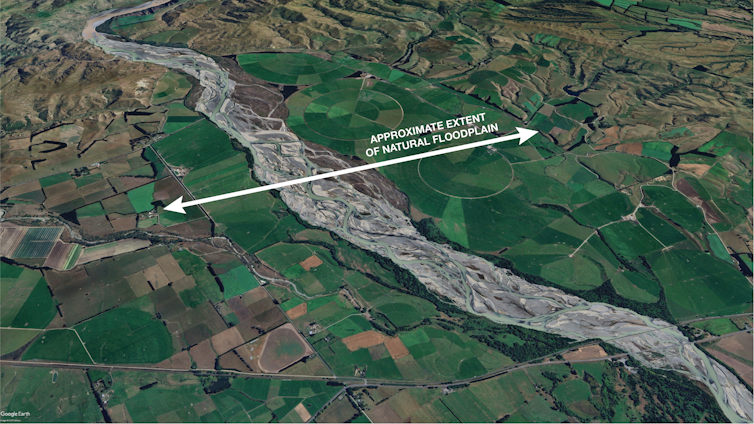
An aerial view of a braided river with a narrower floodplain constrained by agricultural land use.
The Waiau River, a gravel-bed braided river in the South Island, has been constrained by land development, primarily for agriculture.
Background satellite image: Google (c) 2025 Airbus, CC BY-SA

Giving rivers space to roam

The idea of allowing rivers to reclaim space on their floodplains is not new.

In the Netherlands, the Room for the River programme was a response to flooding in 1995 that led to large-scale evacuations of people and cattle. In England, predictions that economic risks associated with flooding will increase 20-fold within this century ignited the Making Space for Water strategy.

However, these initiatives typically remain focused on flood protection, overlooking opportunities to maximise ecological benefits. Our new research shows that well-designed approaches can deliver ecological gains alongside flood protection.

This is crucial because floodplain river systems are among the most valuable ecosystems. They provide about a quarter of all land-based ecosystem services such as water retention and pollutant filtration, as well as educational, recreational and cultural benefits.

Managing rivers for variability

A fundamental shift in river management involves acknowledging and accommodating natural variability. Floodplain rivers are not static: they change across landscapes and through time, responding to seasonal flows, sediment movement and ecological processes.

A braided river with snow capped mountains in the background.
Braided rivers are an example of floodplain rivers that have natural variability and diverse habitat types.
Angus McIntosh, CC BY-SA

Our research synthesises the ecological processes that are enabled when floodplain rivers have room to move.

Rivers that are not unnaturally confined are typically more physically complex. For instance, along with the main river channel, they might have smaller side channels, or areas where the water pools and slows, springs popping up from below ground to re-join the surface waters, or ponds on the floodplain.

A diverse range of habitats supports a rich variety of plant and animal life. Even exposed gravel, made available in rivers that flow freely, provides critical nesting sites for endangered birds.

Biodiversity is not one-dimensional. Instead, it exists and operates at multiple scales, from a small floodplain pond to a whole river catchment or wider. In a dynamic, ever-changing riverscape, we might find the genetic composition of a species varying in different parts of the river, or the same species of fish varying in their body size, depending on the habitat conditions.

These examples of natural biological variability enable species and ecosystems to be resilient in the face of uncertain future conditions.

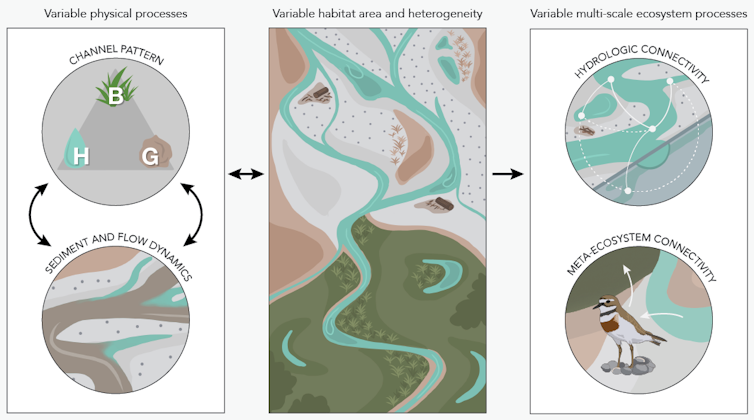
A diagram showing the main types of ecological variability occurring in a free-flowing river: physical variability, habitat heterogeneity and variable ecosystem processes.
Rivers that have room to move on their floodplains are highly dynamic. This diagram shows the main types of ecological variability in a free-flowing river: physical variability, habitat heterogeneity and variable ecosystem processes.
Adapted from McCabe et al. 2025 Nature Water, CC BY-SA

At a larger scale, the type and number of species that live in different floodplain river habitats also varies. This diversity of biological communities produces variation in the functions ecosystems perform across the river, such as the uptake of nutrients or processing of organic matter. This can even help to diversify food webs.

These variations mean not all species or groups of species in the river will be vulnerable to the same disturbances – such as droughts or floods – at the same time. This is because plants and animals in rivers have evolved to take advantage of long-term rhythms of floods and droughts in different ways.

For instance, the cottonwood poplars of the southwest United States time their seed release with the highly predictable rhythms of snowmelt-driven spring floods in that part of the world. In Aotearoa New Zealand, whitebait fish species typically deposit their eggs during high autumn flows, which then get transported to sea as larvae during high winter flows.

Some animals need multiple habitats within the river for different stages of life. Other creatures travel from afar to use river floodplains for only a short time. The latter includes the banded dotterel (Charadrius bicinctus), endemic to Aotearoa New Zealand. This bird travels as far as 1,700km to nest on braided-river gravels each spring. Banded dotterels are in decline, and they rely on habitats provided by rivers that have space to roam.

A black-fronted tern (bird) spreads its wings on a gravel habitat, with other terns in the background.
The endangered black-fronted tern (Chlidonias albostriatus) uses gravel bar habitats on river floodplains for nesting.
Angus McIntosh, CC BY-SA

A call for more sustainable river management

As climate change accelerates, we must rethink how we manage our waterways. Reinforcing levees and deepening channels may seem like logical responses to increased flood risk, but these approaches often exacerbate long-term vulnerabilities and transfer risk elsewhere.

We call for practitioners to broaden the scope of values included in river management policy and programmes to include ecological variability.

Nature-based solutions are approaches that seek to benefit both people and nature. By working with nature rather than against it, we can create landscapes that are more resilient, adaptive, and supportive of both people and biodiversity.

It’s time to embrace a new paradigm for river management – one that sees rivers not as threats to be controlled, but as lifelines to be protected and restored.

The Conversation

Christina McCabe receives funding through an Aho Hīnātore doctoral research scholarship at the University of Canterbury.

Jonathan Tonkin receives funding from a Rutherford Discovery Fellowship and the Centre of Research Excellence Te Pūnaha Matatini. He also receives funding from the Antarctic Science Platform and the Ministry of Business, Innovation and Employment.

ref. Giving rivers room to move: how rethinking flood management can benefit people and nature – https://theconversation.com/giving-rivers-room-to-move-how-rethinking-flood-management-can-benefit-people-and-nature-251225

Pro-Palestinian protesters challenge NZ’s Winston Peters at state of the nation speech

Report by Dr David Robie – Café Pacific.

Like a relentless ocean, wave after wave of pro-Palestinian pro-human rights protesters disrupted New Zealand deputy Prime Minister Winston Peters’ state of the nation speech at the Christchurch Town Hall yesterday.

A clarion call to Trumpism and Australia’s One Nation Party, the speech was accompanied by the background music of about 250 protesters outside the Town Hall, chanting: “Complicity in genocide is a crime.”

Palestine Solidarity Network Aotearoa (PSNA) co-chair John Minto described Peters’ attitude to Palestinians as “sickening”.

Inside the James Hay Theatre, protester after protester stood and spoke loudly and clearly against the deputy Prime Minister’s failure to support those still dying in Gaza, and his failure to denounce the ongoing genocide.

Ben Vorderegger was the first of nine protesters who appealed on behalf of people who have lost their voices in the dust of blood and bones, bombs and sniper guns.

Before he and others were hauled out, they spoke for the tens of thousands of Palestinians who have been killed by Israeli forces in Gaza — women, men, doctors, aid workers, journalists, and children.

Gazan health authorities have reported that the official death toll is now more than 50,000 — but that is the confirmed deaths with thousands more buried under the rubble.


The Christchurch Town Hall protest.            Video:PSNA

Real death toll
The real death toll from the genocide in Gaza has been estimated by a reputed medical journal, The Lancet, at more than 63,000. A third of those are children. Each day more children are killed.

One by one the protesters who challenged Peters were manhandled by security guards to a frenzied crowd screaming “out, out”.

The deputy Prime Minister’s response was to deride and mock the conscientious objectors. He did not stop there. He lambasted the media.

At this point, several members of his audience turned on me as a journalist and demanded my removal.

Pro=Palestine protesters at the Christchurch Town Hall yesterday to picket Foreign Minister Winston Peters at his state of the nation speech.Image: Saige England/APR

This means that not only is the right to free speech at stake, the right or freedom to report is also being eroded. (I was later trespassed by security guards and police from the Town Hall although no reason was supplied for the ban).

Inside the Christchurch Town Hall the call by Peters, who is also Foreign Minister, to “Make New Zealand Great Again” continued in the vein of a speech written by a MAGA leader.

He whitewashed human rights, failed to address climate change, and demonstrated loathing for a media that has rarely challenged him.

Ben Vorderegger in keffiyeh was the first of nine protesters who appealed on behalf of Palestinans before
being thrown out of the Christchurch Town Hall meeting. Image: Saige England/APR

Condemned movement
Slamming the PSNA as “Marxist fascists” for calling out genocide, he condemned the movement for failing to talk with those who have a record of kowtowing to violent colonisation.

This tactic is Colonial Invasion 101. It sees the invader rewarding and only dealing with those who sell out. This strategy demands that the colonised people should bow to the oppressor — an oppressor who threatens them with losing everything if they do not accept the scraps.

Peters showed no support for the Treaty of Waitangi but rather, endorsed the government’s challenge to the founding document of the nation – Te Tiriti o Waitangi. In his dismissal of the founding and legally binding partnership, he repeated the “One Nation” catch-cry. Ad nauseum.

Besides slamming Palestinians, the Scots (he managed to squeeze in a racist joke against Scottish people), and the woke, Peters’ speech promoted continued mining, showing some amnesia over the Pike River disaster. He did not reference the environment or climate change.

After the speech, outside the Town Hall police donned black gloves — a sign they were prepared to use pepper-spray.

PSNA co-chair John Minto described Peters’ failure to stand against the ongoing genocide of Palestinians as “bloody disgraceful”.

The police arrested one protester, claiming he put his hand on a car transporting NZ First officials. A witness said this was not the case.

PSNA co-chair John Minto (in hat behind fellow protester) . . . the failure of Foreign Minister Winston Peters to stand against the ongoing genocide of Palestinians is “bloody disgraceful”. Image; Saige England/APR

Protester released
The protester was later released without any charges being laid.

A defiant New Zealand First MP Shane Jones marched out of the Town Hall after the event. He raised his arms defensively at protesters crying, “what if it was your grandchildren being slaughtered?”

I was trespassed from the Christchurch Town Hall for re-entering the Town Hall for Winston Peters’ media conference. No reason was supplied by police or the Town Hall security personnel for that trespass order..

“The words Winston is terrified to say . . . ” poster at the Christchurch pro-Palestinian protest. Image: Saige England/APR

It is well known that Peters loathes the media — he said so enough times during his state of the nation speech.

He referenced former US President Bill Clinton during his speech, an interesting reference given that Clinton did not receive the protection from the media that Peters has received.

From the over zealous security personnel who manhandled and dragged out hecklers, to the banning of a journalist, to the arrest of someone for “touching a car” when witnesses report otherwise, the state of the nation speech held some uncomfortable echoes — the actions of a fascist dictatorship.

Populist threats
The atmosphere was reminiscent of a Jorg Haider press conference I attended many years ago in Vienna. That “rechtspopulist” Austrian politician had threatened journalists with defamation suits if they called him out on his support for Nazis.

Yet he was on record for doing so.

I was reminded of this yesterday when the audience called ‘out out’ at hecklers, and demanded the removal of this journalist. These New Zealand First supporters demand adoration for their leader or a media black-out.

Perhaps they cannot be blamed given that the state of the nation speech could well have been written by US President Donald Trump or one of his minions.

The protesters were courageous and conscientious in contrast to Peters, said PSNA’s John Minto.

He likened Peters to Neville Chamberlain — Britain’s Prime Minister from 1937 to 1940. His name is synonymous with the policy of “appeasement” because he conceded territorial concessions to Nazi Germany in the late 1930s, fruitlessly hoping to avoid war.

“He has refused to condemn any of Israel’s war crimes against Palestinians, including the total humanitarian aid blockade of Gaza.”

Refusal ‘unprecedented’
“It’s unprecedented in New Zealand history that a government would refuse to condemn Israel breaking its ceasefire agreement and resuming industrial-scale slaughter of civilians,” Minto said.

“That is what Israel is doing today in Gaza, with full backing from the White House.

“Chamberlain went to meet Hitler in Munich in 1938 to whitewash Nazi Germany’s takeovers of its neighbours’ lands.

“Peters has been in Washington to agree to US approval of the occupation of southern Syria, more attacks on Lebanon, resumption of the land grab genocide in Gaza and get a heads-up on US plans to ‘give’ the Occupied West Bank to Israel later this year.

“If Peters disagrees with any of this, he’s had plenty of chances to say so.

“New Zealanders are calling for sanctions on Israel but Mr Peters and the National-led government are looking the other way.”

New Zealand First MP Shane Jones marched out of the Town Hall after the event, dismissing protesters crying, “what if it was your grandchildren being slaughtered?” Image: Saige England/APR

Only staged questions
The conscientious objectors who rise against the oppression of human rights are people Winston Peters regards as his enemies. He will only answer questions in a press conference staged for him.

He warms to journalists who warm to him.

The state of the nation speech in the Town Hall was familiar.

Seeking to erase conscientiousness will not make New Zealand great, it will render this country very small, almost miniscule, like the people who are being destroyed for daring to demand their right to their own land.

Saige England is a journalist and author, and a member of the Palestine Solidarity Network Aotearoa (PSNA). She is a frequent contributor to Asia Pacific Report and Café Pacific.

Part of the crowd at the state of the nation speech by Deputy Prime Minister Winston Peters at the Christchurch Town Hall yesterday. Image: Saige England/APR

This article was first published on Café Pacific.

Former Filipino president Duterte’s arrest by the ICC – 20 journalists killed during his presidency

Pacific Media Watch

Paris-based global media freedom watchdog Reporters Without Borders (RSF) has recalled that 20 journalists were killed during the six-year Philippines presidency of Rodrigo Duterte, a regime marked by fierce repression of the press.

Former president Duterte was arrested earlier this week as part of an International Criminal Court investigation into crimes against humanity linked to his merciless war on drugs. He is now in The Hague awaiting trial.

The watchdog has called on the administration of current President Ferdinand Marcos Jr to take strong measures to fully restore the country’s press freedom and combat impunity for the crimes against media committed by Duterte’s regime.

“Just because you’re a journalist you are not exempted from assassination, if you’re a son of a bitch,” Rodrigo Duterte said in his inauguration speech on 30 June 2016, which set the tone for the rest of his mandate — unrestrained violence against journalists and total disregard for press freedom, said RSF in a statement.

During the Duterte regime’s rule, RSF recorded 20 cases of journalists killed while working.

Among them was Jesus Yutrago Malabanan, shot dead after covering Rodrigo Duterte’s drug war for Reuters.

Online harassment surged, particularly targeting women journalists.

Maria Ressa troll target
The most prominent victim was Maria Ressa, Nobel Peace Prize laureate and founder of the news site Rappler, who faced an orchestrated hate campaign led by troll armies allied with the government in response to her commitment to exposing the then-president’s bloody war.

Media outlets critical of President Duterte’s authoritarian excesses were systematically muzzled: the country’s leading television network, ABS-CBN, was forced to shut down; Rappler and Maria Ressa faced repeated lawsuits; and a businessman close to the president took over the country’s leading newspaper, the Philippine Daily Inquirer, raising concerns over its editorial independence.

“The arrest of Rodrigo Duterte is good news for the Filipino journalism community, who were the direct targets of his campaign of terror,” said RSF’s Asia-Pacific bureau director Cédric Alviani.

RSF’s Asia-Pacific bureau director Cédric Alviani . . . “the Filipino journalism community were the direct targets of [former president Rodrigo Duterte]’s campaign of terror.” Image: RSF

“President Marcos and his administration must immediately investigate Duterte’s past crimes and take strong measures to fully restore the country’s press freedom.”

The repression carried out during Duterte’s tenure continues to impact on Filipino journalism: investigative journalist Frenchie Mae Cumpio has been languishing in prison since her arrest in 2020, still awaiting a verdict in her trial for “financing terrorism” and “illegal possession of firearms” — trumped-up charges that could see her sentenced to 40 years in prison.

With 147 journalists murdered since the restoration of democracy in 1986, the Philippines remains one of the deadliest countries for media workers.

The republic ranked 134th out of 180 in the 2024 RSF World Press Freedom Index.

Source report from Reporters Without Borders. Pacific Media Watch collaborates with RSF.

Article by AsiaPacificReport.nz

Pro-Palestinian protesters challenge Peters at state of the nation speech

SPECIAL REPORT: By Saige England in Christchurch

Like a relentless ocean, wave after wave of pro-Palestinian pro-human rights protesters disrupted New Zealand deputy Prime Minister Winston Peters’ state of the nation speech at the Christchurch Town Hall yesterday.

A clarion call to Trumpism and Australia’s One Nation Party, the speech was accompanied by the background music of about 250 protesters outside the Town Hall, chanting: “Complicity in genocide is a crime.”

Palestine Solidarity Network Aotearoa (PSNA) co-chair John Minto described Peters’ attitude to Palestinians as “sickening”.

Inside the James Hay Theatre, protester after protester stood and spoke loudly and clearly against the deputy Prime Minister’s failure to support those still dying in Gaza, and his failure to denounce the ongoing genocide.

Ben Vorderegger was the first of nine protesters who appealed on behalf of people who have lost their voices in the dust of blood and bones, bombs and sniper guns.

Before he and others were hauled out, they spoke for the tens of thousands of Palestinians who have been killed by Israeli forces in Gaza — women, men, doctors, aid workers, journalists, and children.

Gazan health authorities have reported that the official death toll is now more than 50,000 — but that is the confirmed deaths with thousands more buried under the rubble.

Real death toll
The real death toll from the genocide in Gaza has been estimated by a reputed medical journal, The Lancet, at more than 63,000. A third of those are children. Each day more children are killed.

One by one the protesters who challenged Peters were manhandled by security guards to a frenzied crowd screaming “out, out”.

The deputy Prime Minister’s response was to deride and mock the conscientious objectors. He did not stop there. He lambasted the media.

At this point, several members of his audience turned on me as a journalist and demanded my removal.

Pro-Palestine protesters at the Christchurch Town Hall yesterday to picket Foreign Minister Winston Peters at his state of the nation speech. Image: Saige England/APR

This means that not only is the right to free speech at stake, the right or freedom to report is also being eroded. (I was later trespassed by security guards and police from the Town Hall although no reason was supplied for the ban).

Inside the Christchurch Town Hall the call by Peters, who is also Foreign Minister, to “Make New Zealand Great Again” continued in the vein of a speech written by a MAGA leader.

He whitewashed human rights, failed to address climate change, and demonstrated loathing for a media that has rarely challenged him.

Ben Vorderegger in keffiyeh was the first of nine protesters who appealed on behalf of Palestinans before
being thrown out of the Christchurch Town Hall meeting. Image: Saige England/APR

Condemned movement
Slamming the PSNA as “Marxist fascists” for calling out genocide, he condemned the movement for failing to talk with those who have a record of kowtowing to violent colonisation.

This tactic is Colonial Invasion 101. It sees the invader rewarding and only dealing with those who sell out. This strategy demands that the colonised people should bow to the oppressor — an oppressor who threatens them with losing everything if they do not accept the scraps.

Peters showed no support for the Treaty of Waitangi but rather, endorsed the government’s challenge to the founding document of the nation – Te Tiriti o Waitangi. In his dismissal of the founding and legally binding partnership, he repeated the “One Nation” catch-cry. Ad nauseum.

Besides slamming Palestinians, the Scots (he managed to squeeze in a racist joke against Scottish people), and the woke, Peters’ speech promoted continued mining, showing some amnesia over the Pike River disaster. He did not reference the environment or climate change.

After the speech, outside the Town Hall police donned black gloves — a sign they were prepared to use pepper-spray.

PSNA co-chair John Minto described Peters’ failure to stand against the ongoing genocide of Palestinians as “bloody disgraceful”.

The police arrested one protester, claiming he put his hand on a car transporting NZ First officials. A witness said this was not the case.

PSNA co-chair John Minto (in hat behind fellow protester) . . . the failure of Foreign Minister Winston Peters to stand against the ongoing genocide of Palestinians is “bloody disgraceful”. Image; Saige England/APR

Protester released
The protester was later released without any charges being laid.

A defiant New Zealand First MP Shane Jones marched out of the Town Hall after the event. He raised his arms defensively at protesters crying, “what if it was your grandchildren being slaughtered?”

I was trespassed from the Christchurch Town Hall for re-entering the Town Hall for Winston Peters’ media conference. No reason was supplied by police or the Town Hall security personnel for that trespass order..

“The words Winston is terrified to say . . . ” poster at the Christchurch pro-Palestinian protest. Image: Saige England/APR

It is well known that Peters loathes the media — he said so enough times during his state of the nation speech.

He referenced former US President Bill Clinton during his speech, an interesting reference given that Clinton did not receive the protection from the media that Peters has received.

From the over zealous security personnel who manhandled and dragged out hecklers, to the banning of a journalist, to the arrest of someone for “touching a car” when witnesses report otherwise, the state of the nation speech held some uncomfortable echoes — the actions of a fascist dictatorship.

Populist threats
The atmosphere was reminiscent of a Jorg Haider press conference I attended many years ago in Vienna. That “rechtspopulist” Austrian politician had threatened journalists with defamation suits if they called him out on his support for Nazis.

Yet he was on record for doing so.

I was reminded of this yesterday when the audience called ‘out out’ at hecklers, and demanded the removal of this journalist. These New Zealand First supporters demand adoration for their leader or a media black-out.

Perhaps they cannot be blamed given that the state of the nation speech could well have been written by US President Donald Trump or one of his minions.

The protesters were courageous and conscientious in contrast to Peters, said PSNA’s John Minto.

He likened Peters to Neville Chamberlain — Britain’s Prime Minister from 1937 to 1940. His name is synonymous with the policy of “appeasement” because he conceded territorial concessions to Nazi Germany in the late 1930s, fruitlessly hoping to avoid war.

“He has refused to condemn any of Israel’s war crimes against Palestinians, including the total humanitarian aid blockade of Gaza.”

Refusal ‘unprecedented’
“It’s unprecedented in New Zealand history that a government would refuse to condemn Israel breaking its ceasefire agreement and resuming industrial-scale slaughter of civilians,” Minto said.

“That is what Israel is doing today in Gaza, with full backing from the White House.

“Chamberlain went to meet Hitler in Munich in 1938 to whitewash Nazi Germany’s takeovers of its neighbours’ lands.

“Peters has been in Washington to agree to US approval of the occupation of southern Syria, more attacks on Lebanon, resumption of the land grab genocide in Gaza and get a heads-up on US plans to ‘give’ the Occupied West Bank to Israel later this year.

“If Peters disagrees with any of this, he’s had plenty of chances to say so.

“New Zealanders are calling for sanctions on Israel but Mr Peters and the National-led government are looking the other way.”

New Zealand First MP Shane Jones marched out of the Town Hall after the event, dismissing protesters crying, “what if it was your grandchildren being slaughtered?” Image: Saige England/APR

Only staged questions
The conscientious objectors who rise against the oppression of human rights are people Winston Peters regards as his enemies. He will only answer questions in a press conference staged for him.

He warms to journalists who warm to him.

The state of the nation speech in the Town Hall was familiar.

Seeking to erase conscientiousness will not make New Zealand great, it will render this country very small, almost miniscule, like the people who are being destroyed for daring to demand their right to their own land.

Saige England is a journalist and author, and a member of the Palestine Solidarity Network Aotearoa (PSNA). She is a frequent contributor to Asia Pacific Report.

Part of the crowd at the state of the nation speech by Deputy Prime Minister Winston Peters at the Christchurch Town Hall yesterday. Image: Saige England/APR

Article by AsiaPacificReport.nz

Labor gains big lead in a Morgan poll, but drops back in YouGov

Source: The Conversation (Au and NZ) – By Adrian Beaumont, Election Analyst (Psephologist) at The Conversation; and Honorary Associate, School of Mathematics and Statistics, The University of Melbourne

A national Morgan poll, conducted March 10–16 from a sample of 2,097, gave Labor a 54.5–45.5 lead by headline respondent preferences, a three-point gain for Labor since the March 3–9 Morgan poll. This is Labor’s largest lead in a Morgan poll since August 2023.

Primary votes were 34% Coalition (down three), 32.5% Labor (up 2.5), 13.5% Greens (steady), 5% One Nation (steady), 10.5% independents (steady) and 4.5% others (up 0.5). By 2022 election flows, Labor led by 54.5–45.5, a 2.5-point gain for Labor.

By 50.5–35, respondents thought the country was going in the wrong direction (51.5–33 previously). However, Morgan’s consumer confidence index slid 3.1 points to 83.8, its lowest this year.

Voters were blaming Donald Trump for the stock market falls, and this was hurting the Coalition. The stock market had a better week last week, but Trump is likely to impose more tariffs on April 2.

Morgan is a volatile poll that reacts more to news events than other polls. This poll was taken in the week Trump imposed his steel and aluminium tariffs on Australia. It’s likely that this poll is a pro-Labor outlier, with other polls not giving Labor big leads. Here is the poll graph.

The ABC’s Patricia Karvelas wrote on March 17 that a Talbot Mills poll, conducted March 6–12 from a sample of 1,051, asked about Trump’s ratings with Australians for his performance as US president.

Trump was down six points since February to net -14 approval (51% disapprove, 37% approve). There was a six-point increase in strongly disapprove to 40%, with strongly approve down one to 15%. By 65–22, respondents disapproved of the US imposing tariffs on Australia.

Coalition gains in YouGov poll for a 50–50 tie

A national YouGov poll, conducted March 14–19 from a sample of 1,500, had a 50–50 tie, a one-point gain for the Coalition since the March 7–13 YouGov poll.

Primary votes were 37% Coalition (up one), 31% Labor (steady), 13% Greens (down 0.5), 7% One Nation (down 0.5), 1% Trumpet of Patriots (steady), 8% independents (down one) and 3% others (up one). YouGov is using weaker preference flows for Labor than occurred in 2022, and this poll would give Labor about a 51.5–48.5 lead by 2022 flows.

Albanese’s net approval was down three points to -9, with 50% dissatisfied and 41% satisfied. Dutton’s net approval was up one point to -5. Albanese led Dutton as better PM by 45–40 (45–39 previously).

Essential poll tied at 47–47 but Albanese’s ratings jump

A national Essential poll, conducted March 12–16 from a larger than normal sample of 2,256, had a 47–47 tie including undecided by respondent preferences (48–47 to the Coalition in early March).

Primary votes were 35% Coalition (steady), 29% Labor (steady), 12% Greens (down one), 8% One Nation (steady), 1% Trumpet of Patriots (steady compared with UAP), 9% for all Others (down one) and 6% undecided (up one). By 2022 preference flows, this poll would give Labor about a 50.5–49.5 lead, a 0.5-point gain for the Coalition.

Albanese’s net approval jumped nine points to +1, with 46% approving and 45% disapproving. This is Albanese’s first positive net approval in Essential since October 2023. Dutton’s net approval dropped two points to -5, his worst since January 2024.

By 48–35, respondents thought Australia was on the wrong track (49–34 previously).

On climate change, 54% (down five since October 2021) said “climate change is happening and is caused by human activity”, while 35% (up five) thought “we are just witnessing a normal fluctuation in the earth’s climate”. This is the lowest lead for human activity in Essential’s graph which goes back to 2016.

On addressing climate change, 35% (up two since November) thought Australia is not doing enough, 34% (down three) doing enough and 19% (steady) doing too much.

By 39–30, voters opposed the Coalition’s policy of removing working from home provisions for public service workers. By 39–33, voters opposed Australia sending troops to Ukraine.

By 53–33, voters thought Trump’s presidency would have a negative impact on the US economy, by 62–24 negative for the global economy and by 61–20 negative for the Australian economy.

Labor gains lead in a Redbridge poll

A national Redbridge poll, conducted March 3–11 from a sample of 2,007, gave Labor a 51–49 lead, a 2.5-point gain for Labor since the previous Redbridge poll in early February. Primary votes were 37% Coalition (down three), 32% Labor (up one), 12% Greens (up one) and 19% for all Others (up one).

By 51–29, respondents thought things were headed in the wrong direction (49–32 in November 2024).

There has been more criticism of AUKUS from the left since Trump’s election, but by 51–19 respondents said AUKUS makes Australia safer (49–19 in July 2024). There was pro-AUKUS movement on other questions.

Polls in Greens target seats

The Poll Bludger reported last Tuesday on polls of seats either held by the Greens or plausible targets for them. These polls were taken by Insightfully for the right-wing Advance, and first reported by the News Corp tabloids. Sample sizes were 600 per seat with no fieldwork dates provided. Seat polls are unreliable.

The Greens hold three Queensland federal seats (Griffith, Ryan and Brisbane), and one Victorian seat (Melbourne). On the primary votes provided, the Greens would retain Griffith, Ryan would be line-ball between the Greens and Liberal National Party. Brisbane would be gained by Labor.

In Victoria, the Greens would hold Melbourne and gain Macnamara from Labor, while Labor would retain Wills against a Greens challenge.

Unemployment steady despite jobs fall

The Australian Bureau of Statistics reported last Thursday that the unemployment rate was 4.1% in February, unchanged from January. This was despite a 52,800 decrease in jobs that didn’t affect unemployment owing to a lower participation rate.

The employment population ratio (the percentage of eligible Australians that are employed) was down 0.3% since a record high in January to 64.1%.

WA election final lower house seats

At the March 8 Western Australian election, Labor won 46 of the 59 lower house seats (down seven from the record landslide in 2021), the Liberals seven (up five) and the Nationals six (up two). Comparing this election with 2017, which was a big win for Labor, Labor is up five seats, the Liberals down six and the Nationals up one.

In 2017, Labor won 69.5% of lower house seats, in 2021 90% and in 2025 78%. If the WA lower house had as many seats as the federal House of Representatives (150), Labor would have won over 100 seats in all three elections.

In the upper house, 75.7% of enrolled voters has been counted, compared with 82.7% in the lower house. On current figures, Labor is likely to win 16 of the 37 seats, the Liberals ten, the Greens four, the Nationals two, and One Nation, Legalise Cannabis and Australian Christians one each.

Two seats are unclear, with an independent group (0.47 quotas) and Animal Justice (0.45) just ahead of One Nation’s second candidate (0.40). As the count has progressed, the Liberals have dropped and the Greens have risen. ABC election analyst Antony Green said the inclusion of below the line votes could put Labor’s 16th seat in doubt, with the Greens possibly winning five seats.

Adrian Beaumont does not work for, consult, own shares in or receive funding from any company or organisation that would benefit from this article, and has disclosed no relevant affiliations beyond their academic appointment.

ref. Labor gains big lead in a Morgan poll, but drops back in YouGov – https://theconversation.com/labor-gains-big-lead-in-a-morgan-poll-but-drops-back-in-yougov-252380

‘Better than nothing’: clinicians and hospital heads accept lower standards of care outside metro hospitals

Source: The Conversation (Au and NZ) – By Olivia Fisher, Senior Research Fellow, Applied Implementation Science, Charles Darwin University

Seven million Australians live in rural and remote areas and many struggle to access the same quality of health care as those in metropolitan areas.
More than 18,000 Australians have no access to primary health care services within an hour’s drive time from their home, and many are hours or even multiple days’ drive from their closest major hospital. Travel to a major city to access health care is costly and time-consuming.

Rural Australians have almost A$850 less spent on their health per year than those in major cities.

People living in rural and remote Australia have substantially higher levels of preventable hospitalisations, burden of disease, and avoidable deaths. This leaves a gap in median life expectancy between people in very remote areas and major cities of 13 years for men and 16 years for women.

Our new research shows clinicians and health care decision-makers are willing to accept a lower standard of care for people outside of major cities because they consider it better than nothing.

Relying on what they have

Our research investigated Queensland clinicians’ and health care decision-makers’ perspectives on virtual health care as a means to improve access to care.

We also asked about what constitutes acceptable quality and standards for rural patients.

Although we used virtual health care as an example, the results are indicative of a broader issue.

What is virtual health care? What are its pros and cons?

“Virtual health care” is more than just telehealth. It includes:

  • hospital in the home. A nurse will visit a patient in their home to provide treatments such as intravenous antibiotics, coupled with telehealth consultations with a doctor. This model of care can achieve similar outcomes to those at traditional hospitals

  • virtual wards, such as influenza or COVID wards. These wards involve a patient in their home, and combination of telehealth, remote monitoring devices such as pulse oximeters, and face-to-face care from visiting clinicians if required.

  • virtual emergency departments. These support patients who can be safely and effectively managed at home. Emergency doctors and nurses provide guidance and identify which patients need to present to a traditional emergency department.

Virtual health care can minimise travel time to major cities, keeping patients better connected with their family and community while undergoing treatment.

Doctor motions to throat during videocall
Virtual health care often involves nurse care and doctor telehealth.
PeopleImages.com – Yuri A/Shutterstock

However, virtual health care is not currently suitable for patients who require intensive care, some types of physical procedures, or for patients at high risk of complications.

Virtual services need to be well-designed, with appropriately trained clinicians, and consider what can and cannot be accomplished remotely.

When virtual health care isn’t well designed, and clinicians aren’t adequately trained, it can result in poor patient outcomes. As one doctor explained:

I can catalogue just over the last month, I’ve seen errors in telehealth […] They’ve missed pneumonia, they’ve missed kidney stones, they’ve missed a bowel obstruction, they’ve missed an ischaemic valve, they’ve missed an MI [myocardial infarction]. You know, all because they think they can do all these things on telehealth […].

Our research

We interviewed 26 clinicians (such as doctors and nurses) and executive leaders from private, not-for-profit hospitals and aged care services in metropolitan, regional, rural and remote Queensland in 2023.

Most participants expressed reticence towards using telehealth and other forms of virtual health care for people in major cities who can readily access traditional hospitals and providers face-to-face.

They felt safety and care standards would be inferior to traditional inpatient care.

However, they said virtual health care – even if it was a lower standard to traditional hospitals – was better than nothing. As one doctor and health service leader said:

there’s no other choice is there, so you just do it that way.

Another doctor and health service leader explained:

But we would use it for sure. I mean especially those days when we get, you know, which is becoming more and more common where the hospital rings down there’s no beds. There’s no beds and you’re like, well, what do I do now I’ve got ten people here and nowhere to send them.

Clinician talks to patient at bedside
Sometimes patients can’t be cared for in other settings and need to go to hospital.
Gorodenkoff/Shutterstock

Towards more equitable care for rural patients

Sub-standard health care will not bring health outcomes and life-expectancy of people in rural and remote areas up to parity – it will merely reinforce current inequities.

We need to design health services that improve both quality and access. Taking health-care models that work in our major cities and rolling them out in rural areas doesn’t work. We need tailored, creative solutions that meet the same standards we would expect in a city.

In addition to increasing and improving access to virtual health care, we also need to:

  • attract and retain a rural health workforce of experienced practitioners to provide face-to-face services

  • design health services in conjunction with the community to ensure they suit local needs and conditions

  • address state and federal government funding issues that impact the sustainability and capacity for innovation of rural health services.

An unconscious willingness to accept better than nothing is simply not good enough for the millions of Australians who live outside of major cities.

The Conversation

Olivia Fisher receives funding from UnitingCare Queensland.

Caroline Grogan receives funding from UnitingCare Queensland and the Irene Patricia Hunt Memorial Trust.

Kelly McGrath receives funding from the Australian Government Department of Industry, Science and Resources via an Elevate Scholarship, Wesley Research Institute, UnitingCare Queensland, Mitsubishi Development, and the Catalano Family Foundation.

ref. ‘Better than nothing’: clinicians and hospital heads accept lower standards of care outside metro hospitals – https://theconversation.com/better-than-nothing-clinicians-and-hospital-heads-accept-lower-standards-of-care-outside-metro-hospitals-251063

Adelaide Hills water crisis: a local problem is a global wake-up call

Source: The Conversation (Au and NZ) – By Kate Holland, Principal Research Scientist, Water Security, CSIRO

A dry farm dam in Montacute, Adelaide Hills, March 2025. Ilan Sagi.

The Adelaide Hills are experiencing severe water shortages. The root cause? A prolonged dry period and not enough water tankers to meet unprecedented demand from people not connected to the mains water supply.

Thousands of residents and farmers are hurting as dams, tanks and streams dry up. Water tankers are becoming a common sight, carting in desperately needed water. People are waiting weeks for expensive water deliveries.

The South Australian government has set up emergency water collection points to cope with the demand from off-grid families. More water tankers have been secured. But despite recent rain, the situation is far from over.

We found rainfall and flows into Adelaide’s reservoirs are at their lowest levels in 40 years. Reservoir levels have dropped to 44% – the lowest for more than 20 years.

Adelaide is not currently at risk of running out of water; the state government built a desalination plant after the Millennium Drought. Production at the desal plant is four to six times higher than usual to meet demand. Without the desal plant and water from the River Murray, the city would be under severe water restrictions.

But the crisis shows many off-grid families, farms and businesses need new options to plan for the future.

Map of South Australia showing rainfall deficiency, with rainfall lowest on record in large parts of the state closest to the coast.
Over the past 12 months, rainfall in parts of South Australia has been the lowest on record.
Commonwealth of Australia 2025, Bureau of Meteorology

Global water stress

This is not the first time entire communities have run out of water.

Cape Town in South Africa nearly ran out of water in 2018. The city of nearly 4 million people was weeks away from “Day Zero”.

In Australia, several regional and rural country towns have hit their own Day Zero. Stanthorpe in Queensland officially ran out of water in January 2020. Truckloads of water were carted into town every day to meet residential demand.

Scientists have coined a new term, “hydroclimate whiplash”, to describe the rapid swings between intensely wet and dangerously dry weather currently occurring across the globe. This climate volatility amplifies natural hazards such as flash floods, wildfires, landslides and disease.

The January wildfires in Los Angeles happened when two wet winters were followed by an extremely dry autumn and winter, providing plenty of dry fuel for fire.

These aren’t isolated events. The global water crisis didn’t go away.

The bigger picture

What’s happening in the Adelaide Hills – and in other very dry places worldwide – demonstrates the need for careful, long-term water security planning.

The United Nations Sustainable Development Goal 6 is to “ensure availability and sustainable management of water and sanitation for all”. Water stress already affects more than 2 billion people – more than a quarter of the world’s population.

By 2030, the UN predicts 2 billion people will still be living without safely managed drinking water, 3 billion without safely managed sanitation, and 1.4 billion without basic hygiene services.

For many, this is literally a life-or-death matter.

Investing in water security

CSIRO is collaborating with industry, government and research organisations on research to overcome drought and build resilience for regional Australia. Our researchers are testing how well each of these strategies might work in different regions during extended dry periods. We calculate how much water can be collected and stored during the driest periods on record.

Rainfall over Norfolk Island, a subtropical island in the Pacific Ocean roughly 1,500km southeast of Brisbane, has declined by 11% since 1970, with long runs of dry years in recent decades. The future is likely to be drier still.

Our Norfolk Island Water Resource Assessment explored ways to help the community determine how to adapt and build resilience to drought.

Since this project finished in 2020, residential and commercial rainwater tanks have been upgraded and a new seawater desalination plant installed. Other options to diversify water supplies included sharing groundwater bores, capturing runoff in gully dams, managing vegetation water use, and storing water underground.

Excess water from rainwater or recycled wastewater can sometimes be stored underground in natural reservoirs called aquifers for use during drought. This is called “water banking” or “managed aquifer recharge”. The technique has been developed over the past 20 years and used to safely store water underground across Australia and overseas.

Brackish (salty) groundwater is a potential water source that could be unlocked during drought. A National Water Grid funded project is investigating ways to use groundwater that would normally be too salty, along with renewable energy to power inland desalination plants. The project is investigating the prospect of using brackish groundwater across Western Australia for the first time.

Two young children and a man inspect a dry waterhole on private property in the AdelaideHills, March 2025.
Future generations are likely to face more severe water shortages.
Rosie Sheba

A call to action

The Adelaide Hills water crisis is a microcosm of a global issue. It’s a reminder action is needed now to secure our water future. Not when the water runs out.

Deeper groundwater bores, water tankers on standby and bigger water storages are all potentially part of the portfolio of emergency plans. And due to climate change, the Adelaide Hills water crisis will happen again if we are unprepared. It is a question of when, not if.

We have also seen the catastrophic effects of drought in Los Angeles – a tinderbox waiting to burn, and insufficient water on hand to fight the fires. We can and must prepare for natural disasters today. These are not unforeseen consequences. They are not “unknown unknowns”. We know them today. We will have no excuse when this happens.

By adopting more sustainable water management policies and practices in the longer term, we can make sure the spectre of Day Zero does not become real for more communities around the world.

With thanks to CSIRO Senior Research Scientist and Hydrologist Matt Gibbs and Principal Experimental Scientist in Hydrogeology Andrew Taylor.

The Conversation

Kate Holland receives funding from the Australian Government Department of Climate Change, Energy, the Environment and Water, and Department of Industry, Science and Resources.

Craig T. Simmons has received funding for water research from various government and non-government organisations in the past. He is currently serving as Chief Scientist for South Australia.

ref. Adelaide Hills water crisis: a local problem is a global wake-up call – https://theconversation.com/adelaide-hills-water-crisis-a-local-problem-is-a-global-wake-up-call-251265

Trouble at Tesla and protests against Trump’s tariffs suggest consumer boycotts are starting to bite

Source: The Conversation (Au and NZ) – By Erin O’Brien, Associate Professor, School of Government and International Relations, Griffith University

Getty Images

When the United States starts a trade war with your country, how do you fight back? For individuals, one option is to wage a personal trade war and boycott products from the US.

President Donald Trump has said no nation will be exempt from his tariffs, and this includes both Australia and New Zealand. His tariffs on all steel and aluminium imports, in particular, could hurt the sector in Australia, while New Zealand’s meat and wine exports to the US could also feel the effect.

So far, political leaders have responded differently. Canada, Mexico and the European Union have imposed reciprocal tariffs on the US, while Australia has indicated it will not retaliate.

But whether governments choose to push back or not, citizens in those and other countries are making their own stands. This includes artists such as renowned pianist András Schiff, who has cancelled his upcoming US tour.

Most notably, collective outrage at the US president has led to a growing global boycott of Elon Musk’s Tesla due to his role in the Trump administration. Sales of new Tesla vehicles are down 72% in Australia and 76% in Germany. The share price has dropped by more than 50% since December 2024, with calls for Musk to step down as chief executive.

Some governments are even encouraging consumer boycotts. The Canadian government, for example, has urged citizens to “fight back against the unjustified US tariffs” by purchasing Canadian products and holidaying in Canada.

Canadians are clearly embracing this advice. Road trips to the US have dropped by more than 20% in the past month and US liquor brands have been removed from some Canadian stores altogether.

This rise in calls for boycotts of American brands and companies is unsurprising in the Trump 2.0 era, where the lines between government and corporate America have become increasingly blurred.

Political change by proxy

When people want to protest a government policy, but have no political leverage because they’re not citizens of that country, boycotting corporations or brands gives them a voice. These actions are sometimes called “surrogate” or “proxy” boycotts.

This form of “political consumerism”, where individuals align their consumption choices with their values, is now one of the most common forms of political participation in western liberal democracies.

When France opposed the war in Iraq in 2003, US supporters of the war aimed boycotts at French imports. Consumers in the US, United Kingdom and elsewhere have boycotted Russian goods over the invasion of Ukraine, and targeted Israel over its military action and policies in Gaza and the West Bank.

Most famously, protests against the apartheid regime in South Africa from the 1950s through to the 1990s helped isolate and eventually change its government.

The current boycotts are not just protesting Trump’s trade war, of course. They are also about the role of unelected leaders from the corporate world, such as Musk and the heads of the Big Tech and social media companies, and their perceived self-interest and influence.

Trump has responded angrily to consumer boycotts, calling the actions against Tesla “illegal”, which they are not. Indeed, political leaders like Trump often argue that consumer action, rather than government regulation, should be relied on to ensure corporations conform to social expectations.

Ukrainians demonstrate in front of the Lukoil headquarters in Belgium over European imports of Russian fossil fuels, 2022.
Getty Images

How to wage a personal trade war

Consumer boycotts do create change under certain conditions – typically when there is a contained problem that the targeted corporation has the power to solve.

For example, consumer boycotts against Nestlé in the 1970s over false and dangerous marketing of powdered milk for infants led to changes in the firm’s marketing approaches. Boycotts of Nike products over sweatshop conditions for workers had a direct impact on the company’s bottom line and led to improvements.

Things may still need to improve at Nestlé and Nike, but these boycotts show consumer pressure can catalyse corporate action. However, it is much harder – though not impossible – for boycott campaigns to succeed when the target is a government.

Consumers boycotting American products can amplify the impact of their protest by also lobbying retailers. For example, if enough consumers stop buying a bottle of soft drink from the US, major supermarkets like Woolworths and Foodstuffs will stop buying thousands of bottles.

There are also other ways to “vote with your wallet”. People can engage in “political investorism” by using their power as a shareholder, bank customer or pension-fund member to express their political views.

After Russia’s invasion of Ukraine, for example, investors sought to divest from Russian companies, and superannuation funds were pressured by their members to do the same.

As consumers and investors, individuals can wage a personal trade war, sending a clear message. Trump may not be willing to listen to the leaders of allied nations, but if consumer and investor pressure is sustained and spreads globally, he may yet hear the voice of corporate America.

The Conversation

Erin O’Brien receives funding from the Australian Research Council to examine consumer and investor activism for social change. She is affiliated with the Australian Political Studies Association.

Justine Coneybeer receives funding from the Australian Research Council to investigate ethical investment.

ref. Trouble at Tesla and protests against Trump’s tariffs suggest consumer boycotts are starting to bite – https://theconversation.com/trouble-at-tesla-and-protests-against-trumps-tariffs-suggest-consumer-boycotts-are-starting-to-bite-252489

This week’s federal budget will focus on cost-of-living measures – and a more uncertain global economy

Source: The Conversation (Au and NZ) – By John Hawkins, Senior Lecturer, Canberra School of Politics, Economics and Society, University of Canberra

Treasurer Jim Chalmers will bring down the federal budget on Tuesday.

It’s likely most of the major spending initiatives have already been announced. An extra A$8.5 billion in spending on Medicare will aim to ensure nine out of ten GP visits will be bulk billed by 2030. Queensland’s Bruce Highway is to be upgraded with the Albanese Government providing $7.2 billion of the $9 billion cost.

In a speech last week, Chalmers promised “meaningful and substantial” cost-of-living relief.

He also stressed the global economy is more volatile and unpredictable. He said the budget bottom line would be little changed from the mid-year update released in December, when the deficit was forecast to be $26.9 billion this financial year.

It was a comprehensive dress rehearsal for tomorrow evening’s budget speech.

No rabbits out of the hat

Australian budgets today are well signposted in advance in speeches such as this. That is deliberate. It is seen as a mark of responsible fiscal management to have few surprises, either positive or negative.

In past decades, treasurers were prone to announcing surprise spending measures. No longer. The rationale for rejecting the “rabbit out of a hat” approach was spelled out by former treasurer Wayne Swan in his 2008 budget lockup press conference: he said the budget had to be “responsible”. Chalmers was Swan’s deputy chief of staff at the time.

This means calls by economists such as Chris Richardson and Ken Henry for major tax reform are unlikely to be heeded.

Bracket creep (increases in tax revenues as taxpayers move into higher tax brackets) will do most of the work in the very gradual windback of the budget deficit. In the mid-year budget update, it was projected to take a decade to return the budget to balance.


Read more:
If Treasury forecasts are right, it could be a decade before Australia is ‘back in black’


Good luck rather than good management

Not that a balanced or surplus budget is a sign of good budgeting. The driver of recent budget surpluses under both Labor and Coalition governments has not been government policy but stronger than expected commodity prices and exports. They have been accidental, not deliberate.

While deficits add to debt, imposing costs on future generations, what matters is whether the debts can be paid. If the economy grows faster than the rate of debt, the situation is manageable. So we are likely to see a chart in Tuesday’s budget papers showing this, with debt gradually declining as a share of Gross Domestic Product over time.

However, these forecasts for the bottom line do not include off-budget items such as special green energy funds or student debt write-offs that total close to $100 billion, according to Deloitte Access Economics.

This is because the budget covers only the “general government sector” – public service departments and agencies and the defence force. It is not the whole of the public sector, which includes commercial or financial entities like government business enterprises, the Reserve Bank of Australia, and various funds.

On Sunday, the government announced further cost-of-living relief with an extension of electricity rebates, giving households another $150 this year. This will avoid headline inflation rebounding above 3%, as the Reserve Bank is currently forecasting.

The energy rebate last year cost the budget an estimated $3.5 billion in 2024-25. Extending it for six months will cost $1.8 billion. Chalmers has also promised another reduction in the maximum cost of prescription medicines to $25.

In December’s budget update, the unemployment rate was forecast to be around 4½% in mid-2025 and stay around that level for the next couple of years. Given the unemployment rate was steady at 4.1% in February, that forecast may be lowered.

Inflation was forecast to stay below 3%.

The increasing risk of a global trade war will see some reduction in forecasts for global and Australian economic growth. The OECD has lowered its forecasts for global growth and emphasised the international outlook is highly uncertain.

This means the Australian budget forecasts are more likely than usual to be wrong. We just don’t know in which direction they will be wrong – will they be too optimistic or pessimistic?

What will it mean for interest rates?

The Reserve Bank board is unlikely to feel it has enough additional information to cut interest rates again at the April 1 meeting.

Nonetheless, the government will be constrained in how much support it can provide households. It does not want undermine its narrative of future interest rate cuts by stimulating household spending too much.

Something to watch for will be “decisions taken but not yet announced”. These are additional initiatives the government will announce during the election campaign. They will be able to answer the “where’s the money coming from?” question by saying they are already included in the budget.

Finally, will there be increases in defence spending? US President Donald Trump is pressing US allies to do this. Trouble is, defence spending does not address the political problem of cost-of-living pressures – if anything it adds to them.

A potential way out is for government to support more defence spending, but only “in principle”, leaving the details for future budgets. That would help manage both domestic and international pressures.

The Conversation

John Hawkins was a formerly a senior economist at the Treasury and Reserve Bank.

Stephen Bartos does not work for, consult, own shares in or receive funding from any company or organisation that would benefit from this article, and has disclosed no relevant affiliations beyond their academic appointment.

ref. This week’s federal budget will focus on cost-of-living measures – and a more uncertain global economy – https://theconversation.com/this-weeks-federal-budget-will-focus-on-cost-of-living-measures-and-a-more-uncertain-global-economy-252515

I was a music AI sceptic – until I actually used it

Source: The Conversation (Au and NZ) – By Alexis Weaver, Associate Lecturer in Music Technology, University of Sydney

Shutterstock

With artificial intelligence programs that can now generate entire songs on demand, you’d be forgiven for thinking AI might eventually lead to the decline of human-made music.

But AI can still be used ethically to help human musicians challenge themselves and grow their music-making abilities. I should know. As a composer and music educator, I was an AI sceptic until I started working with the technology.

Two sides of the argument

If you can write a text prompt, you can use AI to create a track in any genre, for almost any musical application.

Besides generating full tracks, music AI can be used in sound analysis, noise removal, mixing and mastering, and to create entire sound palettes (such as for use in video games and podcasts). Suno, Beatoven, AIVA, Soundraw and Udio are some of the companies currently leading in the AI music space.

In many cases, the outputs don’t have to be excellent, they just have to be good enough, and they can undercut the services of real musicians and sound designers.

The music industry is understandably concerned. In April 2024, the US-based Artist Rights Alliance published an open letter, signed by more than 200 artists, calling for developers to stop training their AIs with copyrighted work (as this would allow companies to emulate artists’ music and image, and therefore deplete the royalties paid to artists).

At the same time, music AI companies claim to lower the barrier to making music, such as by removing the need for physical equipment and traditional music education.

In an interview from January, Suno’s chief executive Mikey Shulman said:

it’s not really enjoyable to make music now. It takes a lot of time. It takes a lot of practice […] the majority of people don’t enjoy the majority of the time they spend making music.

This is far from the message I want to send my students. However, it does unfortunately reflect the increasing pressure musicians feel to master their craft as soon as possible, in an increasingly fast-paced world that’s geared towards an intangible end goal, rather than enjoying the process of making mistakes and learning.

From a sceptic to a reluctant advocate

In 2023, I was commissioned by the Sydney Opera House create a new work with Sydney-based design company Kopi Su, and to develop a new generative music AI tool in the process. This tool, called Koup Music, is now in beta testing.

I accepted the opportunity – but with quite a few hesitations, as I wasn’t really interested in working with AI. Would this be a huge waste of time, or end with my data added to some mysterious AI data pool? Or would it open up new creative directions for me?

The tool was based on a text-to-image diffusion model called Riffusion. It takes a text prompt and generates a spectrogram, which is a visual representation of the various frequencies in an audio signal as they change through time. This is then converted to audio.

First, I would upload my own recorded sample to the AI, and then choose a text prompt to transform it into a new five-second sample.

For example, I could upload a short vocal melody and ask the AI to turn it into an insect, or re-contextualise it for a “hip hop” style. Sometimes the generated samples sounded very similar to my own voice (due to the vocals I uploaded).

The following insect voice output became the subject of the musical piece below it.

Somewhere between a voice and an insect.

·

At the time of the project, the outputs could only be 5 or 10 seconds long – not long enough to make a full track. I considered this a positive, as it meant I had to incorporate the samples into my own larger work.

Some samples were catchy. Some were funny. Others were boring. Some came out with scratchy, harsh timbres. The imperfection of it all gave me permission to have fun.

I focused on generating separate musical elements with my text prompts, rather than fully arranged samples. A generated drum beat or melody line could be enough to inspire a completely new musical track in a style I would never have attempted otherwise.

This output was used in the track How Things Grow.

·

Sometimes, one generated sample was enough. Other times, I challenged myself to use only AI-generated sounds to create a full track. In these cases, I used techniques such as filtering and looping small snippets to tease out the sounds I wanted.

For instance, I used the following audio samples to create the track below:

These snippets were used in the track Boom Boom Boom.

·

The process felt like a collaboration – like I was making music with a kooky colleague. This took away the pressure to make “perfect” music, and instead allowed me to focus on new creative possibilities.

My takeaways

I’ve concluded it’s not a bad idea to know what large music AIs are capable of. We can use them to further our own musical understanding, such as by studying how they use stylistic trends and mixing techniques, or how they translate musical ideas to suggest different genres.

For me, the key to quashing my AI scepticism was using an AI that didn’t take over the entire working process. I remained flexible to its suggestions, while using my own knowledge to retain creative control.

My experience isn’t isolated. Multiple studies have found that users of music AIs reported feeling satisfied with programs that allowed them to retain a sense of ownership over the composing process.

The connecting factor across these projects was that the AI did not generate entire musical works in one go. Instead, a limited amount of musical information was generated (such as rhythms, melodies or chords), allowing the user to dictate the final result.

The beauty in human imperfection

Despite Shulman’s claims, the key to a meaningful relationship with music AI is to work alongside it – not to let it do all the work.

Do I think every music student should start incorporating AI into their daily practice? No. But under the right circumstances, it can provide the tools to produce something truly creative.

Making “imperfect” art that takes time – and hard work – is the price of being human. And I’m grateful for that.

·

The Conversation

The author received a once-off financial commission from the Sydney Opera House to develop musical work made using the Koup Music AI, which premiered at the Sydney Opera House through a livestream broadcast on July 15th, 2023. After this initial performance the author continued to test the AI model for artistic research purposes. No funding was received to help prepare the manuscripts or research associated with this article. The author will not benefit financially from any promotion of the Koup Music tool, and has never received payment from Kopi Su.

ref. I was a music AI sceptic – until I actually used it – https://theconversation.com/i-was-a-music-ai-sceptic-until-i-actually-used-it-252499

Should Australia increase its defence spending? We asked 5 experts

Source: The Conversation (Au and NZ) – By Justin Bergman, International Affairs Editor

Both Labor and the Coalition are considering an increase to defence spending ahead of the federal election.

Defence spending is currently at about 2% of gross domestic product (GDP), or around A$56 billion per year. The Coalition is reportedly eyeing an increase to 2.5% of GDP by 2029.

The Albanese government’s current spending plan is expected to reach 2.33% of GDP by 2034. And in this week’s budget, it is expected to bring forward some of its already announced $50 billion increase in defence spending.

Why do these percentages matter? US President Donald Trump has made it very clear he expects America’s allies to pay more on defence, at least 3% of GDP.

We asked five experts if defence spending should be increased, and if so, by how much. They agreed more money is needed, albeit with caveats.

The Conversation

ref. Should Australia increase its defence spending? We asked 5 experts – https://theconversation.com/should-australia-increase-its-defence-spending-we-asked-5-experts-252374

Despite some key milestones since 2000, Australia still has a long way to go on gender equality

Source: The Conversation (Au and NZ) – By Janeen Baxter, Director, ARC Life Course Centre and ARC Kathleen Fitzpatrick Laureate Fellow, The University of Queensland

Australia has a gender problem. Despite social, economic and political reform aimed at improving opportunities for women, gender gaps are increasing and Australia is falling behind other countries.

The World Economic Forum currently places Australia 24th among 146 countries, down from 15th in 2006. At the current rate of change, the forum suggests it will take more than 130 years to achieve gender equality globally.

Australia has taken important steps forward in some areas, while progress in other areas remains painfully slow. So how far have we come since 2000, and how much further do we have to go?

The good stuff

There are now more women in the labour market, in parliament, and leading large companies than at any other time.

Over the past 25 years, there have been major social and political milestones that indicate progress.

These include the appointment of Australia’s first female governor-general in 2008 and prime minister in 2010, the introduction of universal paid parental leave in 2011, a high-profile inquiry into workplace sexual harassment in 2020, and new legislation requiring the public reporting of gender pay gaps in 2023.

Timeline of equality milestones

  • 2000

    Child Care Benefit introduced, subsidising cost of children for eligible families

  • 2008

    First female Governor-General (Dame Quentin Bryce)

  • 2010

    First female Prime Minister elected (Julia Gillard)

    First Aboriginal woman from Australia elected to UN Permanent Forum on Indigenous Issues (Megan Davis)

    Australia’s first national paid parental leave scheme

  • 2012

    Julia Gillard misogyny speech

    Workplace Gender Equality Act becomes law, Workplace Gender Equality Agency established

  • 2013

    Dad or Partner Pay Leave commenced

  • 2016

    First Indigenous woman elected to House of Representatives (Linda Burney)

  • 2017

    Launch of Women’s Australian Football League

    #metoo movement spreads globally to draw attention to sexual harassment and assault

  • 2020

    Respect@Work National Inquiry into sexual harassment in the Australian workplace chaired by Kate Jenkins released.

  • 2021

    Grace Tame named Australian of the Year for her advocacy in sexual violence/harassment campaigns

    Independent review into Commonwealth parliamentary workplaces launched

  • 2022

    National plan to end violence against women is finalised

  • 2023

    Closing the Gender Pay Gap Bill passes parliament

  • 2024

    Superannuation on government-funded paid parental leave from July 1, 2025

    Parental leave to be increased to 26 weeks from July 2026.

There are, however, other areas where progress is agonisingly slow.

Violence and financial insecurity

Women are more likely to be in casual and part-time employment than men. This is part of the reason women retire with about half the superannuation savings of men.

This is also linked to financial insecurity later in life. Older women are among the fastest-growing groups of people experiencing homelessness.

The situation for First Nations women is even more severe. The most recent Closing the Gap report indicates First Nations women and children are 33 times more likely to be hospitalised due to violence compared with non-Indigenous women.

They are also seven times more likely to die from family violence.

Improving outcomes for Indigenous women and children requires tackling the long-term effects of colonisation, removal from Country, the Stolen Generations, incarceration and intergenerational trauma. This means challenging not only gender inequality but also racism, discrimination and violence.

At work, the latest data from the Workplace Gender Equality Agency suggests the gender pay gap is narrowing, with 56% of organisations reporting improvements.

On average, though, the pay gap is still substantial at 21.8% with women earning only 78 cents for every $1 earned by men. This totals an average yearly shortfall of $28,425.

There are also some notable organisations where the gender pay gap has widened.

The burden of unpaid work

Another measure of inequality that has proved stubbornly slow to change is women’s unequal responsibilities for unpaid domestic and care work.

Without real change in gender divisions of time spent on unpaid housework and care, our capacity to move towards equality in pay gaps and employment is very limited.

A woman with a baby in a carrier on her front folds washing
Australian women do more unpaid and domestic work after having children.
Shutterstock

Australian women undertake almost 70% of unpaid household labour. The latest Australian Bureau of Statistics time use data show that of those who participate in domestic labour, women spend an average of 4.13 hours per day on unpaid domestic and care work, compared with men’s 2.14 hours.

This gap equates to more than a third of a full-time job. If we add up all work (domestic, care and paid), mothers have the longest working week by about 10 hours. This has changed very little over time.

These charts, based on analyses of data from the Households, Income and Labour Dynamics in Australia (HILDA) study, show what drives this gap.

Women respond to increased demand for care and domestic work by doing more, while men do not. Parenthood significantly increases the time women spend on unpaid care and housework, while also reducing their time in employment.


Men increase their time in unpaid care after a birth, but the jump is minor compared with women, and there is no change to men’s employment hours.

Not surprisingly given these patterns, parenthood is associated with substantial declines in women’s employment hours, earnings, career progression, and mental health and wellbeing.

The way forward

Current policy priorities primarily incentivise women to remain in employment, while continuing to undertake a disproportionate share of unpaid family work, through moving to part-time employment or making use of other forms of workplace flexibility. This approach focuses on “fixing” women rather than on the structural roots of the problem.

There is limited financial or cultural encouragement for men to step out of employment for care work, or reduce their hours, despite the introduction of a two-week Dad and Partner Pay scheme in 2013 and more recent changes to expand support and access.

Fathers who wish to be more actively involved in care and family life face significant financial barriers, with current schemes only covering a basic wage. If one member of the family has to take time out or reduce their hours, it usually makes financial sense for this to be a woman, given the gender earning gap.

The benefits of enabling men to share care work will not only be improvements for women, but will also improve family relationships and outcomes for children.

Research shows relationship conflict declines when men do more at home. Time spent with fathers has been found to be especially beneficial for children’s cognitive development.

Fixing the gender problem is not just about helping women. It’s good for everyone.

Gender inequality costs the Australian economy $225 billion annually, or 12% of gross domestic product.

Globally, the World Bank estimates gender inequality costs US$160.2 trillion. We can’t afford to slip further behind or to take more than a century to fix the problem.


This piece is part of a series on how Australia has changed since the year 2000. You can read other pieces in the series here.

The Conversation

Janeen Baxter receives funding from the Australian Research Council Centre of Excellence for Children and Families over the Life Course (CE200100025) and an Australian Research Council Kathleen Fitzpatrick Laureate Fellowship (FL230100104).

ref. Despite some key milestones since 2000, Australia still has a long way to go on gender equality – https://theconversation.com/despite-some-key-milestones-since-2000-australia-still-has-a-long-way-to-go-on-gender-equality-250250

View from The Hill: 5 things to look for in the budget – and why we really need another budget soon

Source: The Conversation (Au and NZ) – By Michelle Grattan, Professorial Fellow, University of Canberra

Jim Chalmers likes to boast, or marvel, that he is the first treasurer since Ben Chifley to deliver four budgets in a term.

If Labor wins the May election, the treasurer will reckon the budget will be done and dusted for this year. But actually, we really need another budget post election.

That’s for two reasons. First, because this one will be short on any hard reforms or big savings, because it is all about chasing votes.

From roads to health, this year has been give, give, give from the government. Much of the spending has been matched by the opposition. Just in recent days, the Coalition has said yes to the government’s initiatives to boost bulk billing and to reduce the price of pharmaceutical scripts. At the weekend, it instantly embraced the announcement to extend energy bill relief (A$150 dollars off bills in the second half of 2025).

Secondly, the budget could, to an extent, be quickly overtaken because it is being delivered days before the Trump administration’s April 2 tariff announcement. That announcement could have big implications for the world economy, which would flow through to the outlook for Australia.

The international fallout would be more serious for Australia than any direct hits we might take – there are worries around beef exports and pharmaceuticals – although the politics would centre on what happened to our industries.

Given the election context, you will have to look hard for specific “nasties” in this budget. The main negative is likely to be the overall uncertainty about the future.

So specifically, what should we look for on Tuesday? Independent economist Chris Richardson suggests, in an interview with The Conversation, five things to track.

1. The big ‘off-budget’ number

This is where the cost of initiatives does not directly show up in the underlying bottom line (which will be deficits through the forward estimates).

Putting large commitments off budget has increased over the years. Richardson says the Albanese government inherited about $33 billion off-budget spending (over the forward estimates), and in this budget it could be more than $100 billion. This includes spending on student debt relief, the NBN, some housing areas, and infrastructure programs.

Putting lots of items off budget “means less scrutiny and accountability,” Richardson says.

2. Tax reform (or lack thereof)

Richardson’s second item won’t involve much of a search. He asks rhetorically, “Will there be any hint the government is trying to do anything about the narrowing base of the tax take?” That is, anything to lighten the very heavy weight we place on personal and company taxes to raise revenue. As an advocate for tax reform, Richarson expects the budget will contain zero in this area.

3. NDIS spending

What is really happening with reining in spending on the National Disability Insurance Scheme? The government has made much of its progress towards bringing the growth in its share of spending on the scheme down to a projected 8% annually.

But Richardson says this is looking at only part of the story. Considerable responsibility is being pushed back onto the states; the federal government agreed to finance half the cost of new services to be delivered through state education and health systems for children with developmental disabilities to curb the burden on the NDIS. “To focus only on the federal spend on the NDIS is to miss the wider cost picture,” he says.

4. The mid-year mystery

How will the budget deal with the “mystery” that existed in its December mid-year update? That update did not seem to account for a rise in wages for public servants, even this was clearly in the pipeline.

5. The Trump factor

The budget will discuss the risks on the downside for the economy, but how will it deal with what is to come from Donald Trump? What assumptions will it contain on the likely actions of an unpredictable president?

With the election so close, there will be almost as much interest in Peter Dutton’s Thursday budget reply as in the budget itself.

The understanding is it will contain some new policy. It could hardly do otherwise. But will whatever Dutton announces stand up to scrutiny? If it is too thin, it will reinforce an impression the opposition is not presenting a credible alternative. In last year’s budget reply Dutton announced his proposed migration cuts and that quickly became mired in an argument about whether his numbers fitted together.

Under the spotlight in budget week, the opposition also has to be careful with precisely what is being said and committed to. We’ve seen the confusion over its divestiture policy and about a possible referendum to facilitate the removal of dual citizens.

On Sunday finance spokeswoman Jane Hume gave Labor some material for a scare campaign on the NDIS.

She told Sky, “The NDIS, for instance, is one of those areas in the budget that has run out of control; it was growing at 14% per annum.

“It’s been brought under control somewhat. We think that there’s more that can be done.”

Chalmers immediately jumped on her comments, demanding detail. Labor’s spinners and ad team would have been rubbing their hands.

Michelle Grattan does not work for, consult, own shares in or receive funding from any company or organisation that would benefit from this article, and has disclosed no relevant affiliations beyond their academic appointment.

ref. View from The Hill: 5 things to look for in the budget – and why we really need another budget soon – https://theconversation.com/view-from-the-hill-5-things-to-look-for-in-the-budget-and-why-we-really-need-another-budget-soon-252513

Green Party’s Swarbrick calls for urgent NZ action over Israel’s ‘crazy’ Gaza slaughter

Asia Pacific Report

Green Party co-leader Chlöe Swarbrick called on New Zealand government MPs today to support her Member’s Bill to sanction Israel over its “crazy slaughter” of Palestinians in Gaza.

Speaking at a large pro-Palestinian solidarity rally in the heart of New Zealand’s largest city Auckland, she said Aotearoa New Zealand could no longer “remain a bystander to the slaughter of innocent people in Gaza”.

In the fifth day since Israel broke the two-month-old ceasefire and refused to begin negotiations on phase two of the truce — which was supposed to lead to a complete withdrawal of Israeli troops from the besieged enclave and an exchange of hostages — health officials reported that the death toll had risen above 630, mostly children and women.

Five children were killed in a major overnight air attack on Gaza City and at least eight members of the family remained trapped under the rubble as Israeli attacks continued in the holy fasting month of Ramadan.

Confirmed casualty figures in Gaza since October 7, 2023, now stand at 49,747 with 113,213 wounded, the Gaza Health Ministry said.

For more than two weeks, Israel has sealed off border crossings and barred food, water and electricity and today it blew up the Turkish-Palestinian Friendship Hospital, the only medical institution in Gaza able to provide cancer treatment.

“The research has said it from libraries, libraries and libraries. And what is it doing in Gaza?” said Swarbrick.

‘Ethnic cleansing . . . on livestream’
“It is ethnic cleansing. It is apartheid. It is genocide. And we have that delivered to us by  livestream to each one of us every single day on our cellphones,” she said.

“That is crazy. It is crazy to wake up every single day to that.”

Swarbrick said Aotearoa New Zealand must act now to sanction Israel for its crimes — “just like we did with Russia for its illegal action in Ukraine.”

She said that with the Green Party, Te Pāti Māori and Labour’s committed support, they now needed just six of the 68 government MPs to “pass my Unlawful Occupation of Palestine Sanctions Bill into law”.

“There’s no more time for talk. If we stand for human rights and peace and justice, our Parliament must act,” she said.

“Action for Gaza Now” banner heads a march protesting against Israel’s resumed attacks on the besieged Strip in Auckland today. Image: APR

In September, Aotearoa had joined 123 UN member states to support a resolution calling for sanctions against those responsible for Israel’s “unlawful presence in the Occupied Palestinian Territory, including in relation to settler violence”.

“Our government has since done nothing to fulfil that commitment. Our Unlawful Occupation of Palestine Sanctions Bill starts that very basic process.

“No party leader or whip can stop a Member of Parliament exercising their democratic right to vote how they know they need to on this Bill,” she said to resounding cheers.

‘No hiding behind party lines’
“There is no more hiding behind party lines. All 123 Members of Parliament are each individually, personally responsible.”

Several Palestinian women spoke of the terror with the new wave of Israeli bombings and of their families’ personal connections with the suffering in Gaza, saying it was vitally important to “hear our stories”. Some spoke of the New Zealand government’s “cowardice” for not speaking out in opposition like many other countries.

About 1000 people took part in the protest in a part of Britomart’s Te Komititanga Square in a section now popularly known as “Palestine Corner”.

Amid a sea of banners and Palestinian flags there were placards declaring “Stop the genocide”, “Jews for tangata whenua from Aotearoa to Palestine”, “Hands off West Bank End the occupation” , “The people united will never be defeated”, “Decolonise your mind, stand with Palestine,” “Genocide — made in USA”, and “Toitū Te Tiriti Free Palestine”.

“Genocide – Made in USA” poster at today’s Palestinian solidarity rally. Image: APR

The ceasefire-breaking Israeli attacks on Gaza have shocked the world and led to three UN General Assembly debates this week on the Middle East.

France, Germany and Britain are among the latest countries to condemn Israel for breaching the ceasefire — describing it as a “dramatic step backwards”, and France has told the UN that it is opposed to any form of annexation by Israel of any Palestinian territory.

Meanwhile, Sultan Barakat, a professor at Hamad Bin Khalifa University in Qatar, told Al Jazeera in an interview that the more atrocities Israel committed in Gaza, the more young Palestinian men and women would join Hamas.

“So it’s not going to disappear any time soon,” he said.

With Israel killing more than 630 people in five days and cutting off all aid to the Strip for weeks, there was no trust on the part of Hamas to restart the ceasefire, Professor Barakat said.

“Jews for tangata whenua from Aotearoa to Palestine” . . . a decolonisation placard at today’s Palestine solidarity rally in Auckland. Image: APR

Article by AsiaPacificReport.nz

Top Pacific diplomats ready for direct talks on Bougainville independence

By Leah Lowonbu, Stefan Armbruster and Harlyne Joku of BenarNews

The Pacific’s peak diplomatic bodies have signalled they are ready to engage with Papua New Guinea’s Autonomous Government of Bougainville as mediation begins on the delayed ratification of its successful 2019 independence referendum.

PNG and Bougainville’s leaders met in the capital Port Moresby this week with a moderator to start negotiations on the implementation of the UN-supervised Bougainville Peace Agreement and referendum.

Ahead of the talks, ABG’s President Ishmael Toroama moved to sideline a key sticking point over PNG parliamentary ratification of the vote, with the announcement last week that Bougainville would unilaterally declare independence on September 1, 2027.

The region’s two leading intergovernmental organisations — Pacific Islands Forum (PIF) and Melanesian Spearhead Group (MSG) — have traditionally deferred to member state PNG on discussion of Bougainville independence as an internal matter.

But as a declaration of nationhood becomes increasingly likely and near, there has been a subtle shift.

“It’s their [PNG’s] prerogative but if this matter were raised formally, even by Bougainville themselves, we can start discussion on that,” PIF Secretary-General Baron Waqa told a press briefing at its headquarters in Fiji on Monday.

“Whatever happens, I think the issue would have to be decided by our leaders later this year,” he said of the annual PIF meeting to be held in Solomon Islands in September.

Marked peace deal
The last time the Pacific’s leaders included discussion of Bougainville in their official communique was in 2004 to mark the disarmament of the island under the peace deal.

Waqa said Bougainville had made no formal approach to PIF — a grouping of 18 Pacific states and territories — but it was closely monitoring developments on what could eventually lead to the creation of a new member state.

PNG Prime Minister James Marape (second from left) and Bougainville President Ishmael Toroama (right) during mediation in the capital Port Moresby this week. Image: Autonomous Government of Bougainville/BenarNews

In 2024, Toroama told BenarNews he would be seeking observer status at the subregional MSG — grouping PNG, Fiji, Solomon Islands, Vanuatu and New Caledonia’s FLNKS — as Bougainville’s first diplomatic foray.

No application has been made yet but MSG acting Director-General Ilan Kiloe told BenarNews they were also keeping a close watch.

“Our rules and regulations require that we engage through PNG and we will take our cue from them,” Kiloe said, adding while the MSG respects the sovereignty of its members, “if requested, we will provide assistance” to Bougainville.

“The purpose and reason the MSG was established initially was to advance the collective interests of the Melanesian countries, in particular, to assist those yet to attain independence,” he said. “And to provide support towards their aim of becoming independent countries.”

Map showing Papua New Guinea, its neighboring countries and the Autonomous Region of Bougainville. Map: BenarNews

The 2001 peace agreement ended more than a decade of bloody conflict  known as the Bougainville crisis, that resulted in the deaths of up to 15,000 people, and laid out a roadmap for disarmament and the referendum in 2019.

‘We need support’
Under the agreement, PNG retains responsibility for foreign affairs but allows for the ABG to engage externally for trade and with “regional organisations.”

“We need countries to support us, we need to talk to those countries [ahead of independence],” Toroama told BenarNews last September.

The referendum on independence was supported by 97.7 percent of Bougainvillians and the outcome was due to be ratified by PNG’s Parliament in 2020, but was deferred because of the covid-19 pandemic.

Discussions by the two parties since on whether a simple or two-thirds majority vote by parliamentarians was required has further delayed the process.

Toroama stood firm on the issue of ratification on the first day of discussions moderated by New Zealand’s Sir Jerry Mataparae, saying his people voted for independence and the talks were to define the “new relationship” between two independent states.

Last week, the 15 members of the Bougainville Leaders Independence Consultation Forum issued a statement declaring PNG had no authority to veto the referendum result and recommended September 1, 2027 as the declaration date.

Bougainville Leaders Consultation Forum declaration setting September 1, 2027, as the date for their independence declaration. Image: AGB/BenarNews

“As far as I am concerned, the process of negotiating independence was concluded with the referendum,” Toroama said.

Implementation moderation
“My understanding is that this moderation is about reaching agreement on implementing the referendum result of independence.”

He told Marape “to take ownership and endorse independence in this 11th Parliament.”

PNG’s prime minister responded by praising the 25 years of peace “without a single bullet fired” but warned Bougainville was not ready for independence.

“Economic independence must precede political independence,” Marape said. “The long-term sustainability of Bougainville must be factored into these discussions.”

“About 95 percent of Bougainville’s budget is currently reliant on external support, including funding from the PNG government and international donors.”

Proposals to reopen Rio Tinto’s former Panguna gold and copper mine in Bougainville, that sparked its civil conflict, is a regular feature of debate about its economic future.

Front page of the Post-Courier newspaper after the first day of mediation on Bougainville’s independence this week. Image: Post-Courier/BenarNews

Marape also suggested people may be secretly harbouring weapons in breach of the peace agreement and called on the UN to clarify the outcome of the disarmament process it supervised.

“Headlines have come out that guns remain in Bougainville. United Nations, how come guns remain in Bougainville?” Marape asked on Monday.

“You need to tell me. This is something you know. I thought all guns were removed from Bougainville.”

PNG relies on aid
By comparison, PNG has heavily relied on foreign financial assistance since independence, currently receiving at about US$320 million (1.3 billion kina) a year in budgetary support from Australia, and suffers regular tribal violence and massacres involving firearms including assault rifles.

Bougainville Vice-President Patrick Nisira rejected Marape’s concerns about weapons, the Post-Courier newspaper reported.

“The usage of those guns, there is no evidence of that and if you look at the data on Bougainville where [there are] incidents of guns, it is actually very low,” he said.

Further talks are planned and are due to produce a report for the national Parliament by mid-2025, ahead of elections in Bougainville and PNG’s 50th anniversary celebrations in September.

Republished from BenarNews with permission.

Article by AsiaPacificReport.nz

Joint Fiji forces tackle civil strife, flash flood crisis and rebels in exercise

Asia Pacific Report

A joint operation between the Fiji Police Force, Republic of Fiji Military Force (RFMF), Territorial Force Brigade, Fiji Navy and National Fire Authority was staged this week to “modernise” responses to emergencies.

Called “Exercise Genesis”, the joint operation is believed to be the first of its kind in Fiji to “test combat readiness” and preparedness for facing civil unrest, counterinsurgency and humanitarian assistance scenarios.

It took place over three days and was modelled on challenges faced by a “fictitious island grappling with rising unemployment, poverty and crime”.

The exercise was described as based on three models, operated on successive days.

The block 1 scenario tackled internal security, addressing civil unrest, law enforcement challenges and crowd control operations.

Block 2 involved humanitarian assistance and disaster relief, and coordinating emergency response efforts with government agencies.

Block 3 on the last day dealt with a “mid-level counterinsurgency”, engaging in stabilising the crisis, and “neutralising” a threat.

Flash flood scenario
On the second day, a “composite” company with the assistance of the Fiji Navy successfully evacuated victims from a scenario-based flash flood at Doroko village (Waila) to Nausori Town.

“The flood victims were given first aid at the village before being evacuated to an evacuation centre in Syria Park,” said the Territorial Brigade’s Facebook page.

“The flood victims were further examined by the medical team at Syria Park.”

Fiji police confront protesters during the Operation Genesis exercise in Fiji this week. Image: RFMF screenshot APR

On the final day, Thursday, Exercise Genesis culminated in a pre-dawn attack by the troops on a “rebel hideout”.

According to the Facebook page, the “hideout” had been discovered following the deployment of a joint tracker team and the K9 unit from the Fiji Corrections Service.

“Through rigorous training and realistic scenarios, the [RFMF Territorial Brigade] continues to refine its combat proficiency, adaptability, and mission effectiveness,” said a brigade statement.

Mock protesters in the Operation Genesis security services exercise in Fiji this week. Image: RFMF screenshot APR

It said that the exercise was “ensuring that [the brigade] remains a versatile and responsive force, capable of safeguarding national security and contributing to regional stability.”

However, a critic said: “Anyone who is serious about reducing crime would offer a real alternative to austerity, poverty and alienation. Invest in young people and communities.”

Article by AsiaPacificReport.nz

Australia’s ‘coercive’ news media rules are the latest targets of US trade ire

Source: The Conversation (Au and NZ) – By Rob Nicholls, Senior Research Associate in Media and Communications, University of Sydney

As the United States recalibrates its trade policies to combat what the Trump administration sees as “unfair” treatment by other countries, two significant industries have complained to US regulators about their treatment in Australia.

The tech industry – particularly Big Tech platforms such as Google and Meta – says it is being “coerced” into handing cash to Australian media companies. And the pharmaceutical industry is upset about low prices and delays in getting new treatments into the Australian market.

Why are we hearing about these complaints now? And what will they mean for Australia?

The US Trade Representative requests a pile-on

In February, the Office of the United States Trade Representative (USTR) invited comments from the public to help it review and identify any unfair trade practices by other countries. The call was made “pursuant to the America First Trade Policy Presidential Memorandum and the Presidential Memorandum on Reciprocal Trade and Tariffs”.

The aim was to use this consultation to investigate potential harm to the US from any non-reciprocal trade arrangements. The consultation was designed to help the USTR recommend appropriate actions to remedy any such practices.

Essentially, it was an invitation to complain about any and all countries, including Australia. All the relevant industry associations have taken up this opportunity with a high degree of enthusiasm.

There have been 766 submissions.

Big Tech has complaints

A tech industry group called the Computer and Communications Industry Association (CCIA) made a submission raising concerns about the digital policies of several countries, including Australia.

The submission emphasised policies with what it calls “extractionary and redistributive characteristics” that force one set of market participants to subsidise the economic activities of another.

The association’s Australian concern focuses on the News Media Bargaining Code. This requires tech companies to pay for news that appears on their platforms.

The CCIA characterises the News Bargaining Code as:

a coercive and discriminatory tax that requires US technology companies to subsidise Australian media companies.

The CCIA argued that the financial burden imposed by the code is substantial. It said that two companies (Google and Meta, although the CCIA does not name them) pay A$250 million annually in deals “coerced through the threat of this law”. It also mentioned the planned “news bargaining incentive”, which aims to encourage platforms to do deals with media companies.

Regulation by default

The CCIA is also concerned about changes in competition law that will lead to platforms being regulated by default. That is, like telecommunications and electricity companies, designated platforms will be assumed to have a substantial degree of market power. (This was a finding made by the Australian Competition and Consumer Commission in 2019.)

The industry group argued that Australia’s regulatory regime is modelled on the European Union’s Digital Markets Act (DMA). In fact, Australia is likely to look closely at both the EU and UK regimes.

The CCIA says this default regulation would target specified US companies with discriminatory obligations.

However, any business that is “designated” – regardless of its host country – would have these obligations. The proposed approach does not target or discriminate against US businesses.

It is true the proposed approach will have heavy penalties for breach, and the CCIA complains about these “significant fines”. The CCIA correctly identifies that the regulations would empower the government to impose restrictions on how platforms use customers’ data, and whether they can preference their own products.

The CCIA says it is concerned that these measures, like similar ones in other jurisdictions, disproportionately target US companies. It says they would also impose significant compliance costs, and may serve as a backdoor for industrial policy designed to advantage local competitors. They argue that such rules can require changes to operating procedures and services, and that non-compliance can result in hefty fines.

The submission also addresses Australia’s proposed requirements for US online video providers, such as Netflix, to fund the development and production of Australian content, which could require these providers to allocate 10–20% of their local expenditure to Australian content. It does not note that the same is true for Australian streaming platforms.

Big Pharma also has complaints – and a local ally

Big Pharma, via the Pharmaceutical Research and Manufacturers of America (PhRMA) industry association, has also complained about various countries. Gripes about Australia include low prices under the Pharmaceutical Benefits Scheme (PBS) and delays to approval of new treatments.

Medicines Australia – a local organisation that represents pharmaceutical companies – agrees about the delays, citing a PBS review published last year.

Barriers to trade

The critical submissions should come as no surprise. Any industry group that passes up such a golden opportunity to complain on behalf of its members is arguably not doing its job.

In the case of both Big Tech and Big Pharma, Australia was only one of the targets. Yet the potential impacts are high.

The USTR is looking at treating any regulatory barriers faced by US companies as if they were tariffs. At least one Australian industry association is joining the pile-on.

How will the USTR respond? Given the White House’s current approach to trade, there is a significant risk it will recommend retaliatory tariffs on yet more Australian products.

The Conversation

Rob Nicholls receives funding from the Australian Research Council.

ref. Australia’s ‘coercive’ news media rules are the latest targets of US trade ire – https://theconversation.com/australias-coercive-news-media-rules-are-the-latest-targets-of-us-trade-ire-252806

What are non-tariff barriers – and why is agriculture so exposed?

Source: The Conversation (Au and NZ) – By Alan Renwick, Professor of Agricultural Economics, Lincoln University, New Zealand

Since the return to power of US President Donald Trump, tariffs have barely left the front pages.

While the on-off-on tariff sagas have dominated the headlines, a paper released this week by the government’s Australian Bureau of Agricultural and Resource Economics and Sciences (ABARES) has highlighted other barriers. These non-tariff measures could actually be having a greater impact in terms of preventing trade.

The report says these non-tariff measures are equivalent to Australian agricultural exporters facing a tariff of 19%.

What are non-tariff measures?

The Department of Foreign Affairs and Trade (DFAT) defines a non-tariff barrier as

any kind of “red tape” or policy measure, other than tariffs or tariff-rate quotas, that unjustifiably restricts trade.

ABARES use a broader definition of “non-tariff measures”. This circumvents the tricky problem of trying to ascertain whether a non-tariff measure is justified or unjustified.

Non-tariff measures can be separated into categories, such as sanitary and phytosanitary (food safety and plant/animal health-related), technical barriers to trade (food standards, labelling, and so on) and quantitative restrictions (such as quotas).

It should be emphasised that these measures have a legitimate role to play in our trading systems.

As noted by DFAT, enshrined in the rules of the World Trade Organization is the fact that all nations have the right to set trade rules to ensure the health, safety and wellbeing of their citizens and to protect animal and plant health. Australia makes full use of these measures.

How do they become a barrier to trade?

So when does a measure become a barrier? According to DFAT, this is when they are:

  • unclear or unevenly applied
  • more trade-restrictive than necessary to meet their stated objective, or
  • introduced to provide an unfair advantage to domestic industries.

Both justified and unjustified measures can work to prevent free trade. But the report also shows how non-trade measures can facilitate trade – for example, by providing assurances to customers in one country about the quality and safety of products from another country.

Why agriculture is so exposed

Non-tariff measures are particularly prevalent in agriculture because of the biological nature of food production and the potential risks to human, animal and plant health.

Importing a faulty phone may lead to some losses to consumers. But infected agricultural products could severely disrupt a whole sector or even destroy ecosystems. For example, a large foot-and-mouth disease outbreak in Australia could cost the Australian economy more than A$26 billion over ten years.

However, the existence of so many of these measures in the agricultural and food sectors may also be a political issue. Agricultural lobby groups are powerful in many countries and continually push for protection from imports. In this case, the measures can be viewed as barriers.

Containers on board a ship
The next wave of tariff announcements is coming on April 2.
Bienvenido Velasco/Shutterstock

What did the research say?

The ABARES research highlights that non-tariff measures have proliferated in recent years as overall tariff rates have been declining. It also estimates that these measures have an increasingly negative impact on Australia’s agricultural export volumes.

However, we do have to be careful in interpreting these results.

An increase in justified measures is very different from an increase in unjustified measures.

The ABARES report is not able to distinguish between the two. It may be questioned whether it is fair to include justified measures in a calculation of the headline tariff-equivalent measure.

The report also highlights the costs of the measures, but does not consider the benefits. The example of foot and mouth shows that the benefits of non-tariff measures can be very large.

It cuts both ways

The ABARES report focuses on the impact of these measures on Australian export trade – but questions can also be raised about the use of them by Australia itself.

Australia is in the crosshairs of Trump’s trade war. On April 2 the United States is set to implement a new wave of tariffs under its Fair and Reciprocal Trade Plan. These will target both tariffs and non-tariff measures.


Read more:
The next round in the US trade war has the potential to be more damaging for Australia


Australia’s food security measures relating to beef are being explicitly called out by the US farm lobby. A US beef trade organisation called the Australia-US free trade agreement “by far the most lopsided and unfair trading deal” for its farmers.

According to a press report on Friday, California winemakers have also complained to Trump about an Australian tax on wine sales, calling it “unfair”.

There is no doubt there are significant gains to be had from disentangling genuine measures that protect human, plant and animal health from those that hinder trade purely to protect inefficient domestic producers or favour certain countries over others. Once this is done, work can be undertaken to reduce the unjustified barriers.

However, the difficulty is how to achieve this – especially as what is often seen as justified by an importer may be the seen as the opposite or unjustified by an exporter.

The Conversation

Alan Renwick does not work for, consult, own shares in or receive funding from any company or organisation that would benefit from this article, and has disclosed no relevant affiliations beyond their academic appointment.

ref. What are non-tariff barriers – and why is agriculture so exposed? – https://theconversation.com/what-are-non-tariff-barriers-and-why-is-agriculture-so-exposed-252739

How will the history-making new Olympics boss shape sports worldwide, and in Australia?

Source: The Conversation (Au and NZ) – By Richard Baka, Honorary Professor, School of Kinesiology, Western University, London, Canada; Adjunct Fellow, Olympic Scholar and Co-Director of the Olympic and Paralympic Research Centre, Institute for Health and Sport, Victoria University

In a surprisingly emphatic result, 41-year-old Kirsty Coventry, Zimbabwe’s Sport Minister, was selected as the new president of the International Olympic Committee (IOC) at its 144th session in Greece.

Coventry is the first woman, the first African, and the youngest person ever to take on the role.

So how did she rise to this position, and what should sports in Australia and globally expect?

Unpacking the votes

Coventry comes well-credentialed as a five-time Olympic swimmer, representing Zimbabwe from 2000 to 2016 and winning seven medals, two of them gold.

An IOC member since 2013, Coventry was initially an athlete-elected member.

She has taken on various IOC roles, including most recently on the Coordination Committee for the Brisbane 2032 Olympic and Paralympic Games.

Although Coventry was one of the three favourites, along with Sebastian Coe from the United Kingdom and Juan Antonio Samaranch Jr from Spain (son of the previous IOC President Juan Antonio Samaranch), she won the vote in a landslide on the first ballot, securing 49 votes of the 97.

Having obtained the required 50% majority, no further rounds were held.

So begins a new dawn for the IOC’s now extremely powerful inaugural woman leader, who will face several challenges.

How did she win?

Foremost, Coventry had longstanding president Thomas Bach’s informal endorsement and support.

Bach no doubt had a huge sway over the voting members, many of whom were elected to the IOC during his 12-year reign.

Bach’s appointment as Honorary President for Life from June this year means he will still have a powerful role and be able to mentor and influence Coventry.

A lack of transparent voting for the position means we cannot know who voted for whom. Some will presume the new president garnered the majority of votes from women and African delegates, but such an observation can only be speculative.

With women comprising 43% of IOC members, it is a reasonable assumption this cohort provided a strong support base.

Several candidates proposed quite significant (and in some cases radical) changes, suggesting a vote for Coventry was a nod to keeping the status quo.

Or was it just time to break the hold of male presidents?

The 2024 Paris Olympics were the first games with equal 50-50 men-women participation. The IOC membership has also changed over the past few decades, with growing representation of women. As a result, its long-held reputation as an “old boys’ club” is slowly shifting.

Coventry triumphed despite previous doubts about her domestic political ties, and a limited change agenda that seemed to be mainly a legacy choice for Bach.

In this context, Bach might continue to exert his influence.

Global challenges for the new president

As Olympic Agenda 2020+5 draws to its end, the new president will have the opportunity to set a future-focused strategy.

There are plenty of areas she will need to consider in taking the reins. Here are our top ten:

1. Safeguarding athletes. The provision of safe spaces for sport is an area of global concern as the incidents of athlete harm are brought to light.

2. Environmental, sustainability and global warming issues, such as lack of snow for the winter games, venue rationale, spending on mega events, and lack of bidders for future games.

3. The impact of AI and digital transformation on all aspects of sport, from athlete performance and officiating to governance and management.

4. Bidding processes for future host cities.

5. Transgender athletes and diversity, equity and inclusion considerations.

6. The (Australian-initiated) proposal for the pharmaceutical free-for-all Enhanced Games.

7. Sponsorship changes – longtime sponsors Toyota and Panasonic have dropped out but others have come in, with some from China.

8. Relations with Russia and the United States

9. Athlete advocacy – perhaps giving the athletes more of the financial windfall the Olympics generate.

10. Addition of new sports and culling or dropping existing less popular ones.


Read more:
Cricket? Lacrosse? Netball? The new sports that might make it to the 2032 Brisbane Olympic Games


What about Australia?

Coventry comes from an impressive swimming background, and this could work to Australia’s advantage.

Although she will step down from her role on the Coordination Committee for the Brisbane Olympics and Paralympics to handle other pressing presidential duties, she will no doubt retain a close link to the third Australian Olympic host city.

The Australian Olympic Commission was quick to congratulate her on her ascension to the IOC presidency.

Coventry knows AOC President Ian Chesterman, a fellow IOC member, so we can expect a close, friendly working relationship between them.

With the Brisbane games only seven years away, the new IOC president will certainly have a strong vested interest in Australia and aspects of the Olympic and Paralympic movement in this part of the world.

The Conversation

Tracy Taylor is on the Olympic Studies Centre Grant Award committee.

Richard Baka and Rob Hess do not work for, consult, own shares in or receive funding from any company or organisation that would benefit from this article, and have disclosed no relevant affiliations beyond their academic appointment.

ref. How will the history-making new Olympics boss shape sports worldwide, and in Australia? – https://theconversation.com/how-will-the-history-making-new-olympics-boss-shape-sports-worldwide-and-in-australia-252623

ACCC finds Australia’s supermarkets are among the world’s most profitable – but doesn’t accuse them of price gouging

Source: The Conversation (Au and NZ) – By Gary Mortimer, Professor of Marketing and Consumer Behaviour, Queensland University of Technology

Daria Nipot/Shutterstock

Australia’s supermarket sector has endured a long, uncomfortable moment in the spotlight. There have been six comprehensive inquiries into its conduct, pricing practices, and specifically claims of “price gouging”, over the past 18 months.

Today, the long-awaited final report from the Australian Competition and Consumer Commission (ACCC) Supermarkets Inquiry has been released, more than 400 pages long.

It finds Australia’s supermarkets are highly profitable by international standards, ranking among the highest in their peer group. But it did not find the supermarkets were price gouging. In fact, it didn’t even mention the phrase.

How we got here

In February 2024, the federal government formally directed the ACCC to investigate the competitiveness of retail prices in Australia’s supermarket sector. It was the first inquiry of its kind since 2008.

The move followed widespread allegations the supermarkets had been price gouging – using the cover of high inflation to jack up prices even higher.

The interim report from the ACCC’s inquiry, released in September, found the supermarket industry was highly concentrated, and reported many suppliers had raised concerns about “being exploited”.


Read more:
‘Concerning’: ACCC interim report on supermarket inquiry tells of supplier woes and ‘oligopolistic’ market


Highly profitable supermarkets

The ACCC’s final report found Australian supermarkets appear highly profitable when compared with their international peers.

ALDI’s, Coles’ and Woolworths’ average earnings before interest and tax margins were noted to be “among the highest of supermarket businesses in relevant comparator countries”.

Average net profit after tax margins were similar to Walmart in the United States, Dutch-Belgian Ahold Delhaise, and Tesco in the United Kingdom, but below Canada’s Loblaw supermarkets.

The inquiry found ALDI acted as a “price constraint” on Coles and Woolworths. But as a low-cost operator, ALDI does not compete with them “head-to-head” on all product offerings.

It found while independent grocers provided a “valuable alternative”, consumers in regional areas were disadvantaged by higher freight costs and higher prices.

ALDI’s, Coles’ and Woolworths’ store networks have expanded since the last inquiry in 2008, leading to greater “geographic overlap” and increased competition between their stores.

Rising grocery prices

The report notes that between late 2022 and early 2023, grocery prices were rising at more than twice the rate of wages. Supply chains took a big hit in the pandemic and its wake.

Since March 2019, food and grocery prices have increased by about 24%, but this is still less than in many other OECD countries.

The report notes input costs for supermarkets have increased dramatically since the pandemic. However, it says the fact supermarkets have also increased certain margins during this time means:

at least some of the grocery price increases have resulted in additional profits for ALDI, Coles and Woolworths.

Supermarkets often did not engage with suppliers “meaningfully” in relation to trading terms. Rebates paid by suppliers were opaque, complex and not well understood.

The report found ALDI had been increasing its prices at a faster annual rate than Coles or Woolworths, particularly between 2022 and 2024.

The ACCC investigated concerns suppliers lacked bargaining power when negotiating with the big supermarkets.
Hypervision Creative/Shutterstock

Was there any evidence of price gouging?

Quite simply, no. And there appears to be no hard evidence of the practice from other inquiries either.

A range of other inquiries into supermarket pricing and conduct at state and federal level have published findings in the past year, many centring on this very question:

The ACTU report refers to price gouging 43 times, but no evidence is offered. Theories and possible economic impacts of price gouging and anti-competitive behaviour are presented.

The Senate Select Committee report mentions “price gouging” at least 50 times, saying on whether price gouging exists in the supermarket sector – “the answer seems to be resounding yes”.

However, a closer analysis again finds no actual evidence. Instead, the committee highlights that Australia’s “concentrated” supermarket sector, “potentially [creates] an environment for anti-competitive practices and price gouging”.

The interim and final reports from the independent review into the Food and Grocery Code of Conduct mention “price gouging” multiple times. However, they don’t offer any evidence, instead referring to claims in the ACTU Report.

Neither the ACCC inquiry’s interim report nor its final report mention “price gouging”.

ACCC recommendations

While the ACCC acknowledges there is no “silver bullet” to address competition issues in the supermarket sector, it offers 20 recommendations.

Making it easier for smaller supermarket competitors to enter and expand in the market was one area of focus. Recommendations include simplifying planning and zoning rules, and encouraging governments of all levels to support community-owned supermarkets in remote areas.

The ACCC also recommends supermarkets be required to publish notifications when “adverse” package size changes occur. This is commonly referred to as “shrinkflation”.

Other notable recommendations include:

  • a requirement to provide an “independent” body weekly data about prices paid to fresh produce suppliers
  • a review of loyalty program practices in three years’ time
  • minimum information requirements for discount price promotions.

The report did not recommend divestiture or breaking up the big supermarkets.

Will Australians see lower grocery prices?

The widely popular narrative of “stamping out price gouging” by dragging supermarket chief executives into public hearings and threatening them with jail time might have inferred such inquiries would lead to lower food prices. In isolation, they have not.

The federal government says it agrees in principle with the recommendations. In its initial response, it has announced $2.9 million will be provided over three years for “targeted education programs” to help suppliers understand their rights.

Gary Mortimer receives funding from the Building Employer Confidence and Inclusion in Disability Grant, AusIndustry Entrepreneurs’ Program, National Clothing Textiles Stewardship Scheme, National Retail Association, Australian Retailers Association.

ref. ACCC finds Australia’s supermarkets are among the world’s most profitable – but doesn’t accuse them of price gouging – https://theconversation.com/accc-finds-australias-supermarkets-are-among-the-worlds-most-profitable-but-doesnt-accuse-them-of-price-gouging-250503

Peer review is meant to prevent scientific misconduct. But it has its own problems

Source: The Conversation (Au and NZ) – By Gail Wilson, Adjunct Associate Professor, Office of the PVC (Academic Innovation), Southern Cross University

Roman Samborskyi/Shutterstock

In 2023, an academic journal, the Annals of Operations Research, retracted an entire special isssue because the peer review process for it was compromised.

The case brought into sharp focus broader concerns about the peer review process in contemporary science. It showed that a process intended to catch problems with research before publication can itself go wrong.

And when it does, it creates large ripple effects that undermine the integrity of scientific research.

So how is the peer review meant to work? Why does it sometimes fail? And what can be done to improve it?

An evolving process

Peer review as we know it arose in the mid 20th century as the demand for specialised research grew following the end of the second world war. Contrast this with the 18th and 19th centuries, when peer review was undertaken mainly by editors of learned societies and university publishing presses.

Today, peer review is done largely by external peer reviewers who have been asked by a journal’s editor to conduct a review of a manuscript focusing on the quality and value of the research.

They are selected from a pool of reviewers according to their discipline and their areas of expertise. Their task involves ensuring the paper is relevant to the aim and scope of the journal receiving the paper, reviewing the relevant literature, checking methodology, determining the importance of findings, highlighting areas that have been omitted in the paper, and suggesting changes to improve the paper overall.

Traditional forms of peer review occur before a paper is published. Both reviewers and authors remain anonymous.

Different disciplines take a slightly different approach to the review process. In the humanities, for example, double-blind peer review is favoured. This is where two external peer reviewers review the paper and send their reviews to the editor handling that paper. The author then responds to the editor’s and reviewers’ recommendations.

Based on editorial approval, the paper goes forward to publication.

Contrast this approach with open peer review which can occur both before and after the publication of an article. Supporters of this approach state that it promotes transparency and accountability.

Challenges with the current system

The example of the Annals of Operations Research retracting an entire special issue because of problems with the peer review process isn’t isolated. Springer Nature retracted a total of 2,923 papers from their large journal portfolio in 2024, citing research and academic integrity issues.

A year earlier, the Journal of Electronic Imaging also retracted nearly 80 papers following an investigation into peer review fraud.

Actions like this highlight the many challenges to the current peer review system.

For example, heavy academic workloads and institutional pressures on academics to produce more and more publications reduces the time they can spend as external peer reviewers. It also prevents them from agreeing to be a peer reviewer in the first place.

This leads to what is called peer reviewer fatigue, meaning the reviewer simply doesn’t have the capacity to do any more reviews at this time. Any journal editor can attest to this reason being given. Reviewers who produce quality manuscript reviews often also get more requests from journal editors than they are able to respond to, because of the time factor and their workload and institutional commitments mentioned above.

There’s also the potential for manipulation of the peer review process. This can include the issue of a fake peer review – a process by which authors are asked to suggest reviewers and where fake email addresses and fake peer reviews are submitted. There are signs artificial intelligence is exacerbating this problem.

Predatory journals with dubious publishing practices such as charging authors a fee for publishing an article also publish low-quality articles that have not gone through a rigorous peer review process.

In a guest post for the academic integrity website Retraction Watch, educational researcher Richard Phelps blamed journal editors for not reviewing an article’s literature review for accuracy. The post criticised dismissive claims from researchers about the absence of previous research on the topic, and low-quality literature reviews more broadly.

Strengthening the process

There are ways for journal editors to strengthen their journal’s peer review process in relation to the quality of the reviewer pool and the quality of reviews received.

Journals can regularly review their current reviewer pool and broaden that pool by writing directly to authors of recently published papers. They can also make personal approaches to researchers in the field to undertake a review or be added to the reviewer pool list.

Journals can also review their current guidelines for reviewers to ensure there is a consistent set of criteria reviewers can use to rate the paper and explain the reasons for their ratings across key elements of the manuscript.

A “strength-based approach” to review can be encouraged. This is where feedback about the paper’s strengths as well as the gaps in the paper makes the feedback more “developmental” and less focused on what’s wrong with the paper.

From my experience as a journal editor, authors also find it helpful to receive the reviewers’ comments together with an overall summary from the editor highlighting the key issues raised by the reviewers.

The Conversation

Gail Wilson does not work for, consult, own shares in or receive funding from any company or organisation that would benefit from this article, and has disclosed no relevant affiliations beyond their academic appointment.

ref. Peer review is meant to prevent scientific misconduct. But it has its own problems – https://theconversation.com/peer-review-is-meant-to-prevent-scientific-misconduct-but-it-has-its-own-problems-248015

Why do I grieve my childhood home so much now we’ve sold it? And what can I do about it?

Source: The Conversation (Au and NZ) – By Lauren Breen, Professor of Psychology, Curtin University

Photo by Daria Kruchkova/Pexels

Grief can hit us in powerful and unanticipated ways. You might expect to grieve a person, a pet or even a former version of yourself – but many people are surprised by the depth of sad yearning they can feel after selling the childhood home.

In fact, it is normal to grieve a place. And this grief can be especially profound if it coincides with a parent dying or moving into residential aged care, leading to the sale of their house.

Grief is the response to the loss of anything to which we have an emotional connection. A growing body of research is looking at how grief can extend to “non-person” losses such as infertility, loss of religion and, yes, the loss of a former home.

It’s normal to grieve a place you can no longer visit.
Photo by Kelly/Pexels

Why would someone grieve a house?

The childhood home can be an important place for many of us. It literally housed our formative development, family bonds, and core memories. Hopefully, the childhood home is where we learned about safety, security and love.

It was likely surrounded by our neighbourhood, and close to important places such as school, playgrounds and friends’ houses. It is no wonder we grieve it when it’s gone.

It’s normal to grieve things we can’t see and touch but are real and valued. Just as a serious diagnosis might trigger grief for an imagined future for yourself, or an identity you once cherished, loss of a childhood home can hit us harder than we think.

When you sell a once-beloved home, you don’t just lose the physical space. You also lose all of what that space might represent, such as birthday celebrations, Christmas lunches, sleepovers with friends or many happy hours playing in the garden.

The childhood home often is a symbol of family connection and an anchor in the storm of life. Thinking of the home and all it represents can elicit nostalgia. In fact, the word “nostalgia” derives from the Greek words nostos (return) and algos (pain). The word is rooted in the pain we often feel being away from home.

And just as siblings are unique – each with different memories of and connections to their childhood home – their responses to its sale can differ markedly. It is normal if your sister or brother grieves the home in a different way to you – or maybe doesn’t even seem to grieve its loss at all.

Some people share memories and old photos of the home with their siblings.
Photo by Yaroslav Shuraev/Pexels.

A complicated grief

When a childhood home is sold because of the death of parents, the feelings of loss about the home are closely linked. The home being sold can be a type of secondary loss that sits in the periphery to the primary loss of parents.

Grieving the deaths might, at first, take precedence over the loss of the home.

It might only be later that the loss of the home and all it represents becomes apparent. Because the home provides a connection to the deceased person, the loss of the home might add another layer of grief about your parents. Perhaps you find that whenever you recall memories of mum or dad, they seem always to be at the house.

It’s also normal if you feel immense guilt about grieving the home. People might chastise themselves for worrying about “silly things” and not grieving “enough” about the person who died. Guilt about selling the home can also be common.

Not everyone has positive memories of their childhood home. Difficult family dynamics, maltreatment and abuse can complicate the emotional connection to childhood spaces and the grief response to their loss.

In such cases, the loss of the childhood home can elicit grief about the loss of the childhood that could have – and should have – been. The loss of a home that was the site of discord can be even more challenging than for people with more idyllic childhood experiences.

Maybe when you recall memories of a now-deceased parent, they seem always to be at the house.
Photo by RDNE Stock project/Pexels

How can I cope with this loss?

Grief from the loss of a childhood home is real and valid. We should recognise this and be kind to ourselves and others experiencing it. We shouldn’t minimise the loss or make fun of it.

Usually, the loss is anticipated, and this allows you to take photos, furniture or mementos from the home or garden before you leave or sell.

Grief researchers call these “transitional objects”. They may help you maintain a connection to what is lost, while still grieving the place.

Social support while grieving is important. Some people share memories and photos of the home with their siblings, or derive comfort from driving by the home.

Just be prepared for the possibility it will likely change as the new owners adapt it to their needs. You might feel affronted, but hopefully can eventually accept the property now belongs to someone else.

Chat to your doctor if the loss is particularly difficult, and your grief doesn’t change and subside over time. They might be able to recommend a psychologist who specialises in grief.

If this article has raised issues for you, or if you’re concerned about someone you know, call Lifeline on 13 11 14.

Lauren Breen receives funding from Healthway and has previously received funding from Wellcome Trust, Australian Research Council, Department of Health (Western Australia), Silver Chain, iCare Dust Diseases Board (New South Wales), and Cancer Council (Western Australia). She is on the board of Lionheart Camp for Kids and is a member of Grief Australia and the Australian Psychological Society.

ref. Why do I grieve my childhood home so much now we’ve sold it? And what can I do about it? – https://theconversation.com/why-do-i-grieve-my-childhood-home-so-much-now-weve-sold-it-and-what-can-i-do-about-it-251058

The search for missing plane MH370 is back on. An underwater robotics expert explains what’s involved

Source: The Conversation (Au and NZ) – By Stefan B. Williams, Professor of Marine Robotics, Australian Centre for Robotics, University of Sydney

Armada 7805, similar to the 7806 vessel that will support the new MH370 search. Ocean Infinity

More than 11 years after the disappearance of Malaysia Airlines flight MH370, the Malaysian government has approved a new search for the missing debris of the aircraft.

Malaysia announced the push for a renewed search last year, ten years after the tragedy that claimed the lives of 239 people.

Seabed exploration firm Ocean Infinity, which conducted an unsuccessful search in 2018, prepared a new proposal to which Malaysia’s government agreed in principle in December last year.

Now, the company has returned to the southern Indian Ocean 1,500 kilometres west of Perth – with a suite of new high-tech tools.

A search area the size of Sydney

Ocean Infinity is involved in projects surveying for offshore oil and gas reserves, and for suitable locations for offshore renewable energy projects.

But it has also proved it is capable of locating underwater wreckage in the past. For example, in 2018, the company found a missing Argentinian navy submarine nearly 1,000 metres underwater in the Atlantic Ocean. And last October, it found the wreck of a US Navy ship that had been underwater for 78 years.

The new search area for MH370 is roughly the size of metropolitan Sydney. It was identified in collaboration with experts based on refined analysis of information received after the aircraft disappeared. This information included weather, satellite data and the location of debris attributed to the aircraft which washed up along the coast of Africa and islands in the Indian Ocean.

For this search, Ocean Infinity will be using a new 78 metre offshore support vessel, the Armada 7806. It was built by Norwegian shipbuilder Vard in 2023.

Advanced sonar technology

The Armada 7806 is equipped with a fleet of autonomous underwater vehicles manufactured by the Norwegian firm Kongsberg.

These 6.2m long vehicles are capable of operating independently of the support vessel at depths of up to 6,000m for up to 100 hours at a time. They are equipped with advanced sonar technology, including sidescan, synthetic aperture, multibeam and sub-bottom profiling sonar.

Sonar systems are essential for underwater mapping and object detection surveys. They use acoustic pulses to look for echoes from the seafloor.

Sidescan sonar captures high-resolution images of the seafloor by sending out pulses of sound and detecting objects that reflect the sound pulses back.

Synthetic aperture sonar is a technique for combining the results from multiple “pings” to effectively make the scanner bigger and more powerful, seeing further, and producing more detailed images.

Multibeam sonar, in contrast, maps the seafloor topography by emitting multiple sonar beams in a fan-shaped pattern below the platform.

Finally, sub-bottom profiling sonar operates at lower frequencies and penetrates the seabed to reveal underlying geological structures. This is useful for archaeological studies, sediment analysis and identifying buried objects.

Together, these sonar technologies provide complementary data for underwater exploration, search and recovery, and geological assessments.

Camera systems and lights on the vehicles may be used to confirm potential targets. Once a target of interest is detected using sonar, the vehicles would be programmed with missions designed to operate significantly closer to the seafloor. This would allow them to capture imagery of the search area with which to identify the targets.

Such a search would only be conducted once a target of interest is identified, as the area covered by each image is significantly smaller than that covered by sonar, therefore requiring much denser survey tracks.

Significant advancements in robotics

Since its previous search in 2018, Ocean Infinity has made significant advancements in its marine robotics and data analytics capabilities. It has demonstrated its capacity to simultaneously deploy multiple vehicles at depths of up to 6,000m.

This significantly increases the coverage area, as each vehicle covers its own patch of seafloor. This will allow for a more efficient and comprehensive survey of the designated search zone.

The data being collected by the vehicles will be downloaded once the vehicles are brought back onboard, and stitched together to provide detailed maps of the search areas.

Difficult conditions, above and below the surface

Conditions in the search region are expected to be difficult. Weather on the surface will likely provide challenges for the support vessel and the crew. Underwater vehicles will have to contend with complex conditions on the seafloor, including steep slopes and rough terrain.

The operation is expected to take up to 18 months. Weather conditions are most likely to be favourable between January and April.

If Ocean Infinity succeeds in finding the wreckage of MH370, the Malaysian government will pay it US$70 million.

The next steps would be trying to retrieve the plane’s black boxes, which would enable investigators to piece together what happened in the final moments before the plane plunged into the ocean. The Armada 7806 is likely to have remotely operated vehicles onboard equipped with cameras and manipulator systems, which may be used to verify the wreck site and in any future salvage operations.

If Ocean Infinity fails, it will receive no payment. And the investigation into the location of the plane will essentially be back to square one.

The Conversation

Stefan B. Williams receives funding from the Australian Research Council (ARC), Australian Economic Accelerator (AEA) program and the Inkfish Foundation.

ref. The search for missing plane MH370 is back on. An underwater robotics expert explains what’s involved – https://theconversation.com/the-search-for-missing-plane-mh370-is-back-on-an-underwater-robotics-expert-explains-whats-involved-252732

The tobacco lobby claims vaping is displacing youth smoking – a close look at the evidence tells another story

Source: The Conversation (Au and NZ) – By Sam Egger, Senior Biostatistician at the Daffodil Centre, Cancer Council NSW, University of Sydney

Getty Images

E-cigarette companies, including giants such as British American Tobacco, have actively lobbied governments in New Zealand and Australia to weaken existing vape regulations while preventing the introduction of stricter ones.

As part of their argument, they claim that for adolescents in New Zealand, the use of e-cigarettes (vaping) might be “displacing” cigarette smoking. They argue young people are opting for vapes over traditional cigarettes.

Their key piece of evidence for this claim is an influential study published in Lancet Public Health in 2020. It concluded:

The overall decline in smoking over the past 6 years in New Zealand youth suggests that e-cigarettes might be displacing smoking.

However, in our new study published today in Lancet Regional Health-Western Pacific, we used the same data source as the 2020 study and found it does not support that conclusion.

Examining the evidence

We used a statistical approach known as logistic regression to analyse data spanning a 25-year period from 1999 to 2023, including nearly 700,000 high school students aged 14 to 15.

Before analysing the data, we knew New Zealand had made remarkable progress in reducing adolescent smoking rates in recent decades. What we wanted to know, however, is whether this progress had been affected by the emergence and rapid rise of vaping among New Zealand adolescents, beginning in about 2010.

This could potentially include vaping displacing smoking, as argued by e-cigarette companies. If this were the case, we might expect to see adolescent smoking rates decline at an even faster rate after the emergence and subsequent rise of vaping.

Alternatively, impacts might happen through a “gateway effect” where vaping increases the risks of adolescents starting to smoke. This is a theory consistently supported by findings from cohort studies, which follow individuals over time to examine how certain factors affect their health or behavioural outcomes.

Under this scenario, we might still expect to see adolescent smoking rates continuing to decline after the emergence and rise of vaping, but to decline at a slower pace than before the introduction of vapes.

From 1999 to 2023, we saw a large decline in the rates of students aged 14 or 15 “ever smoking”, “smoking regularly” (daily, weekly or monthly) or smoking daily.

However, the rates of decline in “ever smoking” and “smoking regularly” slowed significantly from 2010 onwards, coinciding with the emergence of vaping in New Zealand (see figures below). The rate of decline in daily smoking did not change significantly from 2010 onwards.

In 2023, about 12.6% of 14 and 15-year-olds in New Zealand had “ever smoked” (ranging from just a few puffs to smoking daily). However, if the “ever smoking” rate had continued along its pre-2010 trajectory (before vaping emerged) this figure would have been 6.6%.

Similarly, in 2023, around 3.0% of students were “smoking regularly”, but this rate would have been just 1.8% had it followed its pre-vaping trend.

A graph showing that the rates of decline in ever smoking and smoking regularly slowed significantly from 2010 onwards, coinciding with the emergence of vaping in New Zealand.
The rates of decline in ever smoking and smoking regularly slowed significantly from 2010 onwards, coinciding with the emergence of vaping in New Zealand.
Author provided, CC BY-SA

Some might argue that 2010 is not the optimal year for observing changes in smoking rates related to vaping because vaping was at low levels then. However, we addressed these concerns by testing alternative “change years” from 2008 to 2018. Our findings were consistent across all years.

Others might suggest that changes in cigarette prices between 1999 and 2023 might be driving the observed slowing in the decline of smoking trends. However, even after statistically accounting for price changes, our findings remained the same.

Where the 2020 study falls short

The conclusion of the 2020 study was based solely on the observation of declining smoking rates from 2014 to 2019, a period when vaping had already become notably present among New Zealand youth.

By not assessing whether smoking trends actually changed, rather than simply declined, the study incorrectly attributed the declines between 2014 and 2019 to vaping. It did not consider whether the declines reflected a continuation, a slowing or an acceleration of pre-existing trends.

In contrast, our analysis over an extended time frame (including before the introduction of vaping in New Zealand) shows the rates of decline for both “ever smoking” and “smoking regularly” slowed significantly from 2010 onwards.

Why does the 2020 study matter?

Correcting the record of the 2020 study is important because it has been used repeatedly to lobby government committees and influence policy decisions.

It was one of the most frequently cited pieces of evidence in submissions to the New Zealand parliament’s health select committee, including by British American Tobacco, regarding a 2020 bill which aimed to regulate the sale and marketing of e-cigarettes.

In its submission to the Australian Parliament’s select committee on tobacco harm reduction, British American Tobacco again referenced the 2020 study as important evidence to argue against the tightening of e-cigarette regulations. In its submissions to both committees, British American Tobacco quoted verbatim the flawed conclusion from the 2020 study.

Our research challenges claims that vaping might be displacing smoking among New Zealand adolescents.

Instead, our findings suggest vaping may be contributing to adolescents taking up smoking. This underlines the need for effective policies that address both vaping and smoking in New Zealand.

Other jurisdictions contemplating laws that allow easy access to vaping products for adults should carefully consider the potential for unintended consequences on young people.

The Conversation

Sam Egger is supported by an Australian government scholarship.

Becky Freeman is an expert advisor to the Cancer Council tobacco issues committee and a member of the Cancer Institute vaping communications advisory panel. She has received relevant competitive grants from the NHMRC, MRFF, NSW Health, the Ian Potter Foundation, VicHealth, and Healthway WA.

Judith McCool receives funding from The University of Auckland.

Lucy Hardie has received funding for e-cigarette-related research from the University of Auckland, Maurice & Phyllis Paykel Trust and the Auckland Medical Research Foundation. She is an advisor for the Health Coalition Aotearoa.

ref. The tobacco lobby claims vaping is displacing youth smoking – a close look at the evidence tells another story – https://theconversation.com/the-tobacco-lobby-claims-vaping-is-displacing-youth-smoking-a-close-look-at-the-evidence-tells-another-story-252283

We combed through old botanical surveys to track how plants on Australia’s islands are changing

Source: The Conversation (Au and NZ) – By David Coleman, Post-doctoral Researcher in Plant Ecology, Macquarie University

Jakub Maculewicz/Shutterstock

More than 8,000 continental islands sit just off the coast of Australia, many of them uninhabited and unspoiled. For thousands of species, these patches of habitat offer refuge from the threats they face on the mainland.

Coastal islands are also a valuable resource for ecologists studying how communities of plants colonise new habitats and change over time.

Now, we have created a new publicly available database known as A-Islands, which draws on decades of plant surveys (where botanists visit a particular location and record the plants found there).

This unique collection of surveys draws on data about more than 6,500 plant species from over 850 islands. Some vast islands stretched for kilometres, while others were as small as a tiny apartment.

Our new research, published in the Journal of Vegetation Science, provides new insights into how Australia’s coastal islands have changed over time, and can help with plant monitoring and conservation efforts as the climate warms.

Bowen Island sits off the coast of Australia.
Coastal islands are a valuable resource for ecologists.
Julian Schrader

Scaling steep cliffs, jumping from helicopters

We built A-Islands by painstakingly digitising plant surveys from old books and records, and speaking with botanists and organisations all over Australia.

A-Islands is made up of 1,350 island botanical surveys dating back to the 1940s, from over 135 different sources. We are still adding more.

The stories of how the data was collected were fascinating. In some cases, people camped on islands for weeks, making sure they’d recorded every living organism they could.

Some scaled steep cliffs from small boats or even jumped from helicopters to access remote islands, and record the plants they found there.

Australia’s islands punch above their weight

As we collated the surveys, we realised Australia’s coastal islands were punching above their weight for species diversity.

Despite making up less than 1% of Australia’s land area, at least 25% of Australia’s plant species inhabit these coastal islands.

These islands’ climates are almost as diverse, spanning coral atolls in tropical north Queensland to the cold and windswept rocky isles off the southern tip of Tasmania.

While some species of plants have colonised hundreds of Australian islands, most inhabit just a few isles.

These plant communities are the backbone of island ecosystems and provide havens for many endangered animals.

Langford Island near Hayman Island sits off the coast of Australia.
Australia’s coastal islands punch above their weight for species diversity.
Juergen_Wallstabe/Shutterstock

A rare resource for scientists

Many of the islands featured in A-Islands have been surveyed more than once over the last 100 years.

Most data in the ecological sciences tends to provide a snapshot in time of the species that might be at a location.

In contrast, A-Islands can tell us how the plant communities have changed over decades.

This is surprisingly rare in ecological studies but essential if scientists are to predict vegetation changes in the future as the climate changes.

A new idea

Many people think of plant communities as static and unchanging.

However, A-Islands shows that on these small coastal islands, mainland species are migrating to the island, persisting for a time, and then going extinct and being replaced by other species.

This concept of species constantly changing at a particular location is called species turnover. In theory, the types of species in an island community will change over time but the number of species remains, on average, the same over the long term.

The data in A-Islands not only confirms this has happened at an unprecedented number of archipelagos, but also suggests a new idea: some types of species “turnover” faster than others.

Species like grasses and small herbs tend to come and go from islands more frequently than longer lived taller species.

Islands can be climate refuges

Data sets such as A-Islands will become even more essential as the climate changes. Islands are at the forefront of biodiversity loss, and over half of the known global plant extinctions have occurred on islands.

Uncovering these underlying trends in species community change will be crucial for predicting how plant communities everywhere respond to climate change over the coming centuries.

The Future of Ecological Research – Interview with Prof Dr Mark Westoby from Macquarie University.

These islands will be important climate refuges, buffered from the hottest temperatures by the surrounding ocean and protected from mainland pressures. They will be vital plant habitats in the future.

The A-Islands dataset forms a crucial baseline for defining what species have inhabited our pristine island environments over time.

It can also help scientists work out where to prioritise surveys they’ll need to do as the climate changes.

The Conversation

The authors do not work for, consult, own shares in or receive funding from any company or organisation that would benefit from this article, and have disclosed no relevant affiliations beyond their academic appointment.

ref. We combed through old botanical surveys to track how plants on Australia’s islands are changing – https://theconversation.com/we-combed-through-old-botanical-surveys-to-track-how-plants-on-australias-islands-are-changing-243934

US might not cut pledged Pacific aid, says NZ foreign minister

By Alex Willemyns for Radio Free Asia

The Trump administration might let hundreds of millions of dollars in aid pledged to Pacific island nations during former President Joe Biden’s time in office stand, says New Zealand Foreign Minister Winston Peters.

The Biden administration pledged about $1 billion in aid to the Pacific to help counter China’s influence in the strategic region.

However, Trump last month froze all disbursements of aid by the US Agency for International Development (USAID), for 90 days pending a “review” of all aid spending under his “America First” policy.

Peters told reporters on Monday after meetings with Trump’s USAID acting head, Peter Marocco, and his national security adviser, Mike Waltz, “more confident” about the prospects of the aid being left alone than he was before.

Peters said he had a “very frank and open discussion” with American officials about how important the aid was for the Pacific, and insisted that they “get our point of view in terms of how essential it is”.

NZ Foreign Minister Winson Peters . . . . “We are looking ahead with more confidence than when we arrived.” Image: TVNZ 1News screenshot RNZ

“In our business, it’s wise to find out the results before you open your mouth, but we are looking ahead with more confidence than when we arrived,” Peters said, pushing back against claims that the Trump administration would be “pulling back” from the Pacific region.

“We don’t know that yet. Let’s find out in April, when that full review is done on USAID,” he said. “But we came away more confident than some of the alarmists might have been before we arrived.”

Frenzied diplomatic battle
The Biden administration sought to rapidly expand US engagement with the small island nations of the Pacific after the Solomon Islands signed a controversial security pact with China three years ago.

The deal by the Solomon Islands sparked a frenzied diplomatic battle between Washington and Beijing for influence in the strategic region.

Biden subsequently hosted Pacific island leaders at back-to-back summits in Washington in September 2022 and 2023, the first two of their kind. He pledged hundreds of millions of dollars at both meets, appearing to tilt the region back toward Washington.

The first summit included announcements of some $800 billion in aid for the Pacific, while the second added about $200 billion.

But the region has since been rocked by the Trump administration’s decision to freeze all aid pending its ongoing review. The concerns have not been helped by a claim from Elon Musk, who Trump tasked with cutting government waste, that USAID would be shut down.

“You’ve got to basically get rid of the whole thing. It’s beyond repair. We’re shutting it down,” Musk said in a February 3 livestreamed video.

However, the New Zealand foreign minister, who also met with Secretary of State Marco Rubio on Tuesday, said he held out hope that Washington would not turn back on its fight for influence in the Pacific.

“The first Trump administration turned more powerfully towards the Pacific . . .  than any previous administration,” he said, “and now they’ve got Trump back again, and we hope for the same into the future.”

Radio Free Asia is an online news service affiliated with BenarNews. Republished from BenarNews with permission.

Article by AsiaPacificReport.nz

Peter Dutton wants American anti-mafia laws to take on the CFMEU. Could they work in Australia?

Source: The Conversation (Au and NZ) – By Anna Sergi, Professor in Criminology, University of Essex

In June 1988, the Reagan administration launched the most important United States labour case of the past half century.

The government alleged the Italian-American mafia – La Cosa Nostra – had effectively taken over the nation’s largest and most influential private sector union, the International Brotherhood of Teamsters (IBT).

A civil suit began under the Racketeer Influenced and Corrupt Organizations Act (RICO) in a bid to prosecute officials and wrest control of the union from the country’s most powerful criminal syndicate.

Fast forward to Australia in March 2025. Opposition Leader Peter Dutton is floating RICO-style organised crime powers against the militant construction union, the CFMEU.

‘Modern day mafia’

The proposal follows new allegations of corruption and misconduct, including violence against women, and union-linked crime infiltration of Victorian government projects. The revelations suggest previous political and police efforts to clean up the CFMEU have failed.

Dutton is drawing a direct parallel between the modern-day CFMEU and the mafia- dominated Teamsters of the 1980s.

This is the biggest corruption scandal in Australian history. The CFMEU is a modern-day mafia operation. The culture of criminality and corruption is so entrenched, and it will never change, especially under the weak and incompetent Albanese Labor government.

Dutton says if he is elected prime minister at the coming election, he will introduce national racketeering laws to tackle the alleged union corruption. Notably, he makes specific reference to the US “anti-mafia laws”.

US ‘takedown’ laws

Is Dutton on the right track? Could anti-racketeering laws work in Australia?

They might, but it is critical we clarify some of the confusion around them, starting with the “mafia” reference.

Although it is correct to say the RICO Act was passed in 1970 with a specific target in mind, the families of the Italian-American La Cosa Nostra, the act itself does not mention the mafia.

The Coalition is drawing inspiration from the US racketeering laws which were introduced to tackle the mafia infiltration of the Teamsters union.
Mark Van Scyoc/Shutterstock

In practice, RICO adds the concept of “criminal enterprise” to a prosecution. It requires proof of a “pattern” of racketeering activity and its relationship to an enterprise, in addition to proving the individual crimes alleged. This made RICO particularly apt to tackle the involvement of mafia-type organised crime in labour racketeering.

Crucially, RICO can be applied both to organised crime groups (associations-in-fact) and other organisations, including lawful ones (associations-by-law). This made it possible to stretch the applicability of RICO well beyond its intended use, with mixed results.

Italy passed similar anti-mafia laws in 1982. The Italian legislation is specific about the behaviours of mafia-type associations including intimidation and corruption.

CFMEU in the dock

Anti-mafia legislation could work in Australia, but not if it’s just a direct transfer of the US RICO laws. Dutton needs to shift his focus and define similar, but Australia-specific, laws.

Again, Italian and American legislation focus on criminal behaviour by enterprise.

By contrast, the existing proscribed association laws in Australia focus on identity of organised criminals, including “bikie” gangs, or on individual participation in organised crime activities, such as drug trafficking.

The different focus takes us back to the CFMEU. Here, the problem is not just the union. All the alleged racketeering in recent years also involved certain building companies, as well as various gangsters and bikies. Union bosses seemed to act like gangsters and the actual gangsters morphed into industrial relations “consultants” employed by major companies.

When well-known gangland figures, like Mick Gatto provide mediation and protection services to an industry through intimidation, and the industry normalises kickbacks, then we are in a racketeering and mafia scenario.

Australian racketeering laws

As has already been noted, there are practical problems passing a new racketeering law.

Both the Italian and US regimes required a complete overhaul of criminal procedures and allocation of resources.

The Australian legal landscape for combating organised crime is complicated by its federal structure. This means there are nine jurisdictions with significant diversity in criminal laws.

However, a new federal offence could be imagined within the legislative powers of the Commonwealth’s section 51. It would aim at protecting trade, commerce, and even external affairs. It could strengthen the capability of federal agencies to investigate corruption and organised crime.

But any new federal offence must define the concept of criminal enterprise. This would be an association that engages in a pattern of behaviours, such as drug trafficking, extortion, money laundering, and corruption.

Beyond the union case, the new offence would also apply to the Australian ‘ndrangheta, the mafia organisation that operates transnationally across Europe, North America and in this country.

A federal offence targeting the behaviours of criminal enterprises goes beyond the actions of individuals. But such a response to both organised crime and corruption in Australia should be in line with existing Commonwealth frameworks.

Directly importing American laws is not an option for Dutton. However, there are ways to draft RICO-styled laws that could still work in Australia and clean up the CFMEU, once and for all.

Anna Sergi receives funding from the British Academy and the Leverhulme Trust

ref. Peter Dutton wants American anti-mafia laws to take on the CFMEU. Could they work in Australia? – https://theconversation.com/peter-dutton-wants-american-anti-mafia-laws-to-take-on-the-cfmeu-could-they-work-in-australia-252643

What’s the difference between baking powder and baking soda? It’s subtle, but significant

Source: The Conversation (Au and NZ) – By Nathan Kilah, Senior Lecturer in Chemistry, University of Tasmania

Karynf/Shutterstock

There is something special about sharing baked goods with family, friends and colleagues. But I’ll never forget the disappointment of serving my colleagues rhubarb muffins that had failed to rise. They were dense, rubbery and an embarrassment to the reputation of chemists as good cooks (#ChemistsWhoCook feeds on social media are full of delicious food).

The cause of my failure was an imbalance between the acidity of rhubarb and the chemical raising agents I used in baking.

Both baking powder and baking soda can play a role in giving baked goods their bubble-filled texture and taste. They are sold side-by-side in the supermarket, and have similar uses. But what’s the difference between them and how can we use those differences to our advantage?

What’s in the box?

A quick look at the packaging shows the difference between the two products.

Baking soda contains one ingredient: sodium hydrogen carbonate, also known as sodium bicarbonate or simply bicarb. Baking soda is well known for its uses in cleaning, cooking and deodorising.

Baking powder is typically a mixture of three ingredients: baking soda, an acid, and a starch derived from corn, rice or wheat. The starch makes it easier to measure the powder and also prevents the acid and base from reacting prematurely in the pantry. Baking powder is used exclusively for cooking.

The common ingredient in both products is the baking soda. This salt can be purified from natural sources, or can be prepared synthetically.

The acid is the key

Baking soda is a base, which means it can chemically react with acids. This fizzy reaction produces bubbles of carbon dioxide, water and a mix of new salts. Baking soda can also release carbon dioxide gas when it is heated at temperatures above 80°C.

When you mix baking soda into a cake batter, you will see some initial chemical activation by food acids. This causes bubbles to form and the mixture to rise.

The acids come from other ingredients in the mix, such as yogurt, buttermilk, or the rhubarb in my failed muffins. Too much acid, and the majority of the carbon dioxide will be released at this batter stage.

Once you place the mixture in the hot oven, the high temperature will form further carbon dioxide bubbles. This thermal activation forms a new salt, sodium carbonate, which can give a residual taste and “soapy” mouthfeel if there’s too much of it left in the final product.

A person in a kitchen mixing ingredients for a batter.
Baking soda produces bubbles when mixed with acid, and when exposed to a high temperature in the oven.
SergeyKlopotov/Shutterstock

Mixing baking powder into a cake batter will also result in chemical activation to form bubbles. The baking soda in the mixture will react with the acid included in the baking powder mix, as well as any acidic ingredients in the batter.

The type of acid included in the baking powder can subtly change the way the baking powder behaves. The more soluble the acid in the batter, the faster the carbon dioxide will form bubbles.

Recipes that ask for both baking powder and baking soda are likely looking to do two things: neutralise an abundance of food acid from another ingredient, and provide time-delayed, temperature-activated rising.

Baking soda can also increase the surface browning of food by enhancing the Maillard reaction. This class of reactions results in delicious chemical transformations in roasted coffee, seared steaks, baked bread and more.

Meanwhile an excess of baking soda can change the appearance of foods, for example turning blueberry anthocyanins green in muffins or pancakes.

A tray of scones rising in a hot oven.
Too much sodium carbonate left over during baking can contribute to a ‘soapy’ mouthfeel – a real risk for scones, for example.
Zain Abba/Pexels

Can I substitute baking powder and baking soda?

Baking (like chemistry) is a precise science. It’s best not to substitute baking soda for baking powder or vice-versa: they have subtly different chemical effects.

If you really need a substitution, the general rule is that you need three times the baking powder for the equivalent quantity of baking soda (so, if the recipe asks for a teaspoon of baking soda, you’d add three teaspoons of baking powder).

But it’s not a precise conversion: it doesn’t take into account the key role of acid that’s already in the baking powder. This could affect the final acid-base balance in your recipe.

You can compensate by adding an acid such as cream of tartar or citric acid. But it can be difficult to get the relative quantities of acid and base correct. These acids are also likely to promote immediate release of carbon dioxide, with less left to activate in the oven – potentially leading to a dense bake.

You definitely shouldn’t substitute baking powder for baking soda when cleaning. The acid in the baking powder will neutralise any cleaning activity of the sodium bicarbonate, while the starch may leave a sticky, streaky mess.

It’s best to keep both baking powder and baking soda in your pantry for their distinct uses. Be sure to share whatever delicious treats you bake with others, as well as sharing your new knowledge of the bubbly chemistry contained within.

The Conversation

Nathan Kilah does not work for, consult, own shares in or receive funding from any company or organisation that would benefit from this article, and has disclosed no relevant affiliations beyond their academic appointment.

ref. What’s the difference between baking powder and baking soda? It’s subtle, but significant – https://theconversation.com/whats-the-difference-between-baking-powder-and-baking-soda-its-subtle-but-significant-251050

Antarctic bases are hotbeds of stress and violence. Space stations could face the same challenges

Source: The Conversation (Au and NZ) – By Rebecca Kaiser, PhD Candidate, School of Social Sciences, University of Tasmania

The South African National Antarctic Expedition research base, SANAE IV, at Vesleskarvet, Queen Maud Land, Antarctica.
Dr Ross Hofmeyr/Wikimedia, CC BY-SA

Earlier this week, reports emerged that a scientist at South Africa’s SANAE IV Antarctic research base had accused a colleague of physical assault.

We research Antarctic governance and crime in isolated, confined and extreme environments such as Antarctic and space stations. Rebecca specifically investigates how station cultures evolve in isolation and what factors significantly influence conflict – and what can be done to improve safety in these environments.

What happened on SANAE IV?

SANAE IV is located on the edge of a steep cliff in Vesleskarvet in east Antarctica. The alleged assault stemmed from a dispute over a task the team leader wanted the team to do. In an email published by the South African Sunday Times, the alleged victim said the alleged attacker had also:

threatened to kill [name withheld], creating an environment of fear and intimidation. I remain deeply concerned about my own safety, constantly wondering if I might become the next victim.

Psychologists are now in touch with the research team. They aren’t due to leave the extremely isolated and remote base until December.

This latest incident fits within a broader pattern of crime and misconduct in Antarctica. Research stations on the icy continent are often portrayed as hubs of scientific cooperation. But history has shown they can also become pressure cookers of psychological strain and violence.

Multiple cases of misconduct

There have been multiple cases of misconduct in Antarctica over the years.

In 1959, a scientist at Russia’s Vostok Station allegedly attacked his colleague with an ice axe after losing a game of chess. In 2018, another Russian research station became the site of a stabbing. The alleged cause? Spoiled book endings.

In 1984, the leader of Argentina’s Almirante Brown Station set fire to the facility after being ordered to stay through the winter. This resulted in the station’s evacuation.

The 2000 death of an astrophysicist at the Amundsen-Scott South Pole Station was a suspected murder.

And recent investigations into sexual harassment at multiple Antarctic stations highlight ongoing safety concerns.

Drivers of conflict

Research suggests several psychological and social factors contribute to conflict in remote locations such as Antarctica. These include prolonged isolation, extreme environmental conditions, and the necessity of constant close contact.

In combination, these factors can amplify even minor frustrations. And over time, the lack of external social support, the monotony of daily routines, and the psychological weight of confinement can lead to heightened emotional responses and conflict.

Without structured outlets for stress relief and effective de-escalation mechanisms (such as gyms, libraries, or quiet spaces where mediation between people can happen), tensions can reach breaking points.

Power dynamics also play a crucial role. With limited external oversight, leadership structures and informal hierarchies take on an outsized influence. Those in positions of authority have significant control over how disputes are resolved. This has the potential to exacerbate tensions rather than reducing them.

The process for reporting and responding to incidents in these kinds of environments also remains inconsistent. There’s a lack of policing, and traditional justice systems are also largely absent. Many stations rely on administrative action and internal conflict resolution mechanisms, rather than legal enforcement.

But these mechanisms can be biased or inadequate. In turn, this can leave victims of harassment or violence with few options. It can also lead to more conflict.


Read more:
Antarctic stations are plagued by sexual harassment – it’s time for things to change


From Antarctica to space

As Antarctica and space become more accessible for research and commercial ventures, proactive approaches to crime and conflict prevention in these remote and extreme environments is vital.

The psychological and social challenges observed in Antarctic stations provide a valuable model for understanding potential conflicts in long-duration space missions. Lessons learned from incidents in Antarctica can inform astronaut selection, training, and onboard conflict resolution strategies.

A key area requiring refinement is psychological screening for personnel.

Current screening methods may not fully account for how individuals will react to the social shift that takes place in a remote environment. This includes the altering of attitudes, personal priorities and tolerances.

More advanced stress tolerance assessments and social adaptability training could improve candidate selection. It could also reduce the likelihood of conflicts escalating to violence.

It’s also vital that we gain a better understanding of the unique conflict dynamics that evolve in these equally unique environments.

Research can help. So too can thorough investigations of incidents, such as the one that allegedly occurred at SANAE IV.

This knowledge can be used to recognise early signs of potential conflicts. It can also be integrated into case study-based training modules for expeditioners prior to their deployment. These training modules should include role-playing scenarios, crisis intervention techniques, and integrating the lived experiences of past expeditioners.

This would better equip personnel to navigate interpersonal challenges.

Going to extremes

The recent alleged events at SANAE IV are indicative of a broader pattern of human behaviour in extreme environments.

If we are to successfully expand scientific exploration and habitation in these settings, we must acknowledge the realities of human conflict and develop strategies to ensure the safety and wellbeing of those who live and work in these challenging conditions.

Studying crime and conflict in environments such as Antarctica is not just about understanding the past. It’s about safeguarding the future of exploration – whether on Earth’s harshest frontier or in the depths of space.

The Conversation

Hanne E F Nielsen receives funding from the Australian Research Council and the Dutch Research Council.

Rebecca Kaiser does not work for, consult, own shares in or receive funding from any company or organisation that would benefit from this article, and has disclosed no relevant affiliations beyond their academic appointment.

ref. Antarctic bases are hotbeds of stress and violence. Space stations could face the same challenges – https://theconversation.com/antarctic-bases-are-hotbeds-of-stress-and-violence-space-stations-could-face-the-same-challenges-252720

Every generation thinks they had it the toughest, but for Gen Z, they’re probably right

Source: The Conversation (Au and NZ) – By Intifar Chowdhury, Lecturer in Government, Flinders University

Every generation thinks they had it tough, but evidence suggests young Australians today might have a case for saying they’ve drawn the short straw.

Compared with young adults two or three decades ago, today’s 18–35-year-olds may earn more, but they also grapple with soaring living costs, rising education expenses, precarious employment and mounting debt.

Shifts in the economy and labour market have restructured young adulthood, creating new barriers to financial security and delaying milestones such as home ownership, partnership and parenthood.

How does this compare to what life was like for young Australians at the turn of the century?

Increasing education, decreasing payoffs

University participation has risen, but so has student debt. It’s now far beyond what was intended when HECS was introduced as a supposedly fair, income-contingent loan system.

Indexation has outpaced wages, so much so that today’s 20-somethings carry debts that are more than $10,000 higher in real terms than their counterparts two decades ago.

The Morrison government’s 2021 fee hikes only exacerbated the crisis, with some degrees nearly doubling in cost, leaving students with an even greater debt burden.

A wide shot of a university courtyard with students sitting.
University fees have increased over the past 25 years.
Shutterstock

Yet the financial return on education is increasingly uncertain.

Credential inflation has reshaped the job market, with even low-wage positions now expecting a university degree.

The widespread belief that a degree guarantees better pay is driving more students into higher education, yet there are many graduates saddled with debt and working in roles unrelated to their qualifications.

In 1996, 28.5% of 21–25-year-olds found themselves in mismatched jobs.

By 2019, that figure had climbed to 33% just among 25-year-olds.

Salaries aren’t keeping up. Since 1996, graduate wages have risen by a factor of just 2.5, while student contributions have jumped between 1.7- and 6.2-fold. This leaves today’s graduates with debt that consumes a larger share of their income than ever before.

The dwindling dream of home ownership

Housing affordability has collapsed over the years.

Twenty-five years ago, the average house cost nine years’ worth of the average household income.

Now, it’s about 16.5 years.

In 2001, property prices rose 1.3 times faster than incomes. Since then, they’ve surged at 2.3 times the rate.

This is fuelled partly by tax incentive policies – for example, the Howard government’s 1999 capital gains tax changes – and, more recently, the COVID pandemic.

Soaring prices have deepened the intergenerational housing wealth gap, reducing the home purchase opportunity for young people. While the First Home Owner Grant, introduced in 2000, provides some support, saving for a deposit remains a years-long struggle.

That is, unless parents can help.

For many young Australians, intergenerational wealth is now the key to home ownership. Inheritance is becoming nearly as important as employment.

Since 2002, the total value of wealth transfers has more than doubled in real terms, with larger inheritances expected for younger generations due to rising parental wealth and fewer siblings.

But parental wealth is far more unequally distributed than income – shaped by education and region.

Therefore, inheritocracy is set to deepen economic inequality within today’s youth cohort.

But this isn’t just about the ultra-wealthy passing down mansions. Most inheritances involve an ordinary home or proceeds from its sale.

Housing, once central to middle-class stability, now determines who can build wealth and who will struggle financially for life.

Mounting mental health pressures

Meanwhile, Australians today are borrowing more than ever. Default risk is rising fastest among under-30s as soaring interest rates, rent hikes, and cost-of-living pressures squeeze finances.

It’s then no surprise Gen Z is more concerned about finances than any other generation.

Financial stress is taking a heavy toll on young people’s mental health. Between 2007 and 2022, the prevalence of mental health disorders among young Australians surged by nearly 50%.

The burden of disease from non-fatal conditions – measured in years of healthy life lost – has risen 7% since 2003. This is largely due to mental health disorders and substance abuse, which disproportionately affect young people.

Growing up Indigenous

At the deepest end of these struggles are Indigenous youth, who face far greater challenges than their non-Indigenous peers.

Across nearly every measure – education, employment, health and incarceration – outcomes for Aboriginal and Torres Strait Islander young people remain significantly worse.

While today’s Indigenous youth have achieved better outcomes compared to previous generations – 39% of Indigenous Australians aged 20+ had completed Year 12 in 2021, up from 19.4% in 2001 – these gains still lag behind non-Indigenous youth.

Systemic barriers, institutional racism and intergenerational trauma continue to limit fair access to opportunities. This compounds inequalities and contributes to higher rates of mental ill-health, stress and suicide among Indigenous youth.

The changing politics of being young

Undoubtedly, a continued period of instability and psychological distress in formative years is also shaping the youngest generation’s political attitudes and behaviours.

With fewer assets to conserve compared to their parents or grandparents, they are more likely to lean more to the left politically, and this won’t change with age.

Yet, they remain engaged, thanks in part to compulsory voting, but are also abandoning party loyalties.


Read more:
I looked at 35 years of data to see how Australians vote. Here’s what it tells us about the next election


Australian Election Study data shows 18–30-year-olds were more interested in politics in 2022 than in 1998 (67% vs 63%). At the same time, they were more likely to change votes during campaigns (43% vs 30%) and less likely to consistently vote for the same party (28% vs 40%).

Their right-wing identification has nearly halved since 1998, with the youth vote increasingly favouring left-wing parties (75% vs 61%).

However, younger Australians’ diverse digital news habits add to their political unpredictability. With 60% of Gen Z relying short-form videos, podcasts, and social media platforms for news in 2024, they are increasingly exposed to fragmented, algorithm-driven content.

This shift, coupled with rising concerns about misinformation, contributes to their volatility as voters.

Overall, young Australians are coming of age in an era where hard work no longer guarantees security. How Australia adapts to this shifting economic and political reality will shape the country’s future for decades to come.


This piece is part of a series on how Australia has changed since the year 2000. You can read other pieces in the series here.

The Conversation

Intifar Chowdhury does not work for, consult, own shares in or receive funding from any company or organisation that would benefit from this article, and has disclosed no relevant affiliations beyond their academic appointment.

ref. Every generation thinks they had it the toughest, but for Gen Z, they’re probably right – https://theconversation.com/every-generation-thinks-they-had-it-the-toughest-but-for-gen-z-theyre-probably-right-249604

This anniversary wasn’t meant to be easy: Malcolm Fraser and the modern Liberal Party

Source: The Conversation (Au and NZ) – By Joshua Black, Visitor, School of History, Australian National University

Fifty years ago, Liberal MPs chose Malcolm Fraser as their leader. Eight months later, he led them into power in extraordinary – some might say reprehensible – circumstances. He governed for seven and a half years, and remains our fourth-longest serving prime minister.

This year marks some awkward anniversaries for the Liberal Party. But this particular one is awkward for multiple reasons. There is the ruthlessness of Fraser’s quest for power, within and beyond the party itself. There is also the ambivalence of the current Liberal generation towards the memory of one of the party’s more electorally successful leaders.

After Fraser’s time in power, he and his party embarked on very different journeys that still shape our politics today.

How Fraser became leader

Australian politics was pretty febrile in March 1975. The Whitlam government, narrowly re-elected in 1974, was increasingly unpopular. Inflation ran at 17.7% in the 12 months to March, and unemployment was at a post-war high of nearly 5%.

Billy Snedden, Liberal leader from December 1972, was poorly placed to capitalise on these conditions. He had surprised many in 1974 with his strategy to block the government’s budget in the Senate and force an early election.

But having run a tight race, Snedden lost credibility with his post-election claim that he was “not defeated” but merely “did not win enough seats to form a government”. He won a leadership spill in November 1974 but not convincingly enough to prevent another one later on.

Billy Snedden (left), pictured here with Andrew Peacock, was unable to capitalise on the weaknesses of the Whitlam Labor government.
Wikicommons

A series of “unfortunate public gaffes” and unclear policy statements (on public health insurance among other things) left him vulnerable.

Fraser, who in 1971 sternly (and famously) warned that “life wasn’t meant to be easy”, was the obvious alternative. He was a well-known frontbencher and a former senior minister. His role in the downfall of Liberal prime minister John Gorton meant he had many enemies. But as the Governor-General explained to Queen Elizabeth II in one of his confidential letters, Fraser had “a reputation of being strong, intelligent, aggressive and tough-minded”.

Fraser studiously befriended new MPs whose loyalties were malleable, and used his portfolio (after the 1974 election, this was industrial relations) to win friends among his other colleagues.

According to one profile, he hired a public relations firm to help him solve his “image problems” and to counteract personal criticisms from his internal rival and fellow Victorian, Andrew Peacock.

Fraser sought to keep a clean image while his supporters, armed with the latest opinion polls, ran a backgrounding campaign described by Liberal MP Jim Forbes as “devious, unscrupulous and utterly contemptible”.

The crunch came in March. On March 14, Peacock, who hoped to flush Fraser out, dramatically called for a special party meeting to vote on the leadership question. At a Victorian Liberal state council meeting in Bendigo that weekend, Fraser and Peacock canvassed their supporters, while Snedden gave a speech blaming his woes on the media and the Labor Party. According to The Age, a group of MPs met in Toorak that night to shore up their own positions for the week ahead.

Under pressure on Monday morning, Snedden announced a party room meeting for Friday to settle the issue. Fraser confirmed his candidacy the next day. During four days of campaigning in which MPs pressured each other and party operatives worried openly about fundraising capacity, Snedden’s chances seemed to improve. Fraser’s supporters grew increasingly nervous and Peacock prepared to stand if Snedden lost the spill motion. The latter need not have bothered. In the end, it was Snedden who stood against Fraser and lost by a margin of ten votes.

In search of strong leaders

The Liberal Party has a special need for strong leaders. Gerard Henderson once diagnosed the party with a “Messiah complex”, while the political psychologist Graham Little argued that strong leaders gave parties a veneer of philosophy that could “whet the edge of political combat”. As Frank Bongiorno has more recently put it, strong leaders are those who provide their followers “structure, order and discipline” as well as “stark moral alternatives”.

The collective psychology of the Liberal Party worked in Fraser’s favour in March 1975. There were philosophical differences between the two candidates – Snedden later told his biographer that these contests were always driven by the “difference between conservatives and liberals” – but the vote really was about the styles of leadership they offered. As first-time MP John Howard recalled in his memoir, Fraser “sounded strong and looked like a winner”.

Fraser played the role forcefully for eight years, easily seeing off a challenge from Peacock in the final year of his government. Howard certainly fit the bill for much of his second stint as leader, and especially from 2001 onward. These men offered their followers a combination of ideological doctrine and hard-edged political pragmatism.

In the 1980s and post-2007, the party amassed an impressive history of leadership spills in their search for a strong leader. The current leader, Peter Dutton, made a spectacular contribution with his first leadership bid in August 2018. He eventually won the prize in 2022, not necessarily because he had the strongest claim to be a strong leader, but largely due to the lack of “viable alternatives”. That has made his position awkward at times, not least following the historic Aston by-election defeat in 2023.

Worlds Apart

Over time, Fraser became a trenchant critic of his former party, which hardly knew what to do with him. He failed in a bid for the party’s federal presidency in the 1990s, and was openly critical of its approach to race, asylum seekers and climate policy under Howard. He resigned his life membership shortly after Tony Abbott was elected leader in December 2009.

When Fraser died in March 2015, Abbott and his treasurer Joe Hockey led the awkward parliamentary tributes celebrating the life of a “genuine liberal”, while immigration minister Peter Dutton sat silently.

Dutton has played a key role in distancing the party from aspects of the Fraser legacy. Fraser abhorred racism, and his embrace of multiculturalism marks him out as different from several of his successors.

In 2016, Dutton controversially said that Fraser’s decision to resettle migrants fleeing civil war in Lebanon had been “a mistake”. He claims to have since apologised, but only to one senior member of the Lebanese community.

Fraser’s approach to Indigenous policy was also streets apart from that of Dutton. In the early 1980s Fraser’s government, on the advice of the National Aboriginal Council, considered a Makarrata commission to begin acknowledging the history of “Aboriginal occupation” and identifying areas for “increased Aboriginal involvement” in decision-making.

In 2024, Dutton ruled out a Makarrata commission, promising instead a more paternalistic approach to Indigenous affairs.

In 2008, Fraser attended the Apology to the Stolen Generations while Dutton, a senior Liberal MP at the time, boycotted it. (He has since apologised for this.) During the 2023 referendum on an Indigenous Voice to Parliament, Fraser’s former ministers for Aboriginal affairs supported the “yes” campaign. Dutton was its chief opponent.

When he died, Fraser was reported to be working on a platform for a new political party that would advocate for a Republic, a treaty with First Nations people, “a more independent foreign policy and a post-carbon economy”. In his book Independents’ Day, journalist Brook Turner suggests that some of the individuals who spoke with Fraser then are now at the forefront of the campaigns supporting community independent candidates.

This year, Dutton hopes to win back some of those seats from these independent MPs. The coming contest may indicate that the memory of Fraser’s version of liberalism still has a place in Australia’s politics.

The Conversation

Dr Joshua Black is a former Palace Letters Fellow at the Whitlam Institute within Western Sydney University, and a member of the University of Melbourne’s Malcolm Fraser Reference Group.

ref. This anniversary wasn’t meant to be easy: Malcolm Fraser and the modern Liberal Party – https://theconversation.com/this-anniversary-wasnt-meant-to-be-easy-malcolm-fraser-and-the-modern-liberal-party-250752

We found a new wasp! Students are discovering insect species through citizen science

Source: The Conversation (Au and NZ) – By Andy G Howe, Research Fellow (Entomology), University of the Sunshine Coast

Andy Howe, CC BY

Playgrounds can host a variety of natural wonders – and, of course, kids! Now some students are not just learning about insects and spiders at school — they are putting them on the map and even discovering and naming new species.

Studies indicate insect populations are declining, and species are going extinct every week in Australia. But scientists have only described about a third of Australia’s estimated total of insect species.

This means around 150,000 of our insect species do not have formal scientific names. We know little about where they are and what they do in ecosystems — vital information for stopping biodiversity loss.

So, our team developed the citizen science project Insect Investigators.

We took scientists to 50 regional schools across three states to learn about insects and other arthropods such as spiders. Students of all ages got to survey insect diversity, search for new species, and engage with entomologists and taxonomists throughout the school year.

Students helped name new species, including several species of parasitoid wasp.

Some of the scientific names include Apanteles darthvaderi (Back Plains State School students thought the wasp had gone to the “dark side” because of the way the wasp “sucks the life out of caterpillars”), Mirax supremus (named after the pinnacle science class at Beerwah State High School), and Coccygidium mellosiheroine, which means “honey-coloured hero” (named by students collaborating from several Queensland schools, who considered the wasp a hero as it attacks a crop pest).

Our latest paper on the project is now published. We learned hands-on citizen science increased students’ interests in insects, nature and science.

Close-up photograph of new species of wasp
Apanteles darthvaderi – the wasp that’s gone to the dark side.
Katherine Oestmann & Olivia Portmann, CC BY

How many insects?

Around 1,800 students and more than 70 teachers collected insects in or near their schools.

Teachers sent samples to the project team, which sorted and sent a selection of specimens to be DNA barcoded. This method involves sequencing a small section of the genome to tell different species apart.

The specimens were then sent to experts around Australia, who are working to describe any new species collected.

The students collected more than 12,000 insect specimens, including 5,465 different species – many of which are probably not described.

It will take years to identify all the species and work out how many are new to science, but we already know 3,000 had not been recorded in the Barcode of Life DNA database (BOLD).

Seven children in green and yellow school uniforms stand outside in front of an insect trap.
Queensland Mount Molloy students and their Malaise trap.
Andy Howe, CC BY

Good for insects, good for learning

Getting to know insects as part of this citizen science project was great for kids’ active learning and developing an appreciation of the natural world.

Students said they felt more interested in insects, nature and science, and it inspired them to spend more time outdoors.

“I learnt there are many insect and plant species… that I haven’t seen before and how in different ecosystems you can find different insects,” said a student from South Australia.

When students are engaged, it’s no surprise teachers enjoy their jobs more too — and this is exactly what we found. The more enthusiastic the students were about nature and science experiences through the project, the more interested the teachers were in teaching these topics.

One teacher reported “students gained an understanding of the work of scientists, how to participate in research, protocols to follow, and gained a huge interest in insects!”

Insect Investigators won the 2024 Eureka Prize for Innovation in Citizen Science (Australian Museum)

What did students get out of it?

After the insect survey was completed, we asked 118 students and 22 teachers in nine of the schools about what they experienced, and how they see insects and nature now.

Students said the chance to find a new species, as well as discovering and catching insects they had not seen before, were highlights of Insect Investigators.

Experiencing a hands-on learning style, outside in nature, was also mentioned as a benefit of the program.

Many students said they now wanted to spend more time outdoors, act and encourage others to protect nature, and pay more attention to insect conservation and science classes. This implies the experience and discovery associated with hands-on citizen science has motivated greater engagement with nature and science.

Two children in school uniforms hold up a specimen jar with an insect inside.
Queensland Cameron Downs kids show off an insect they found.
Andy Howe, CC BY

The potential of school-based citizen science

Insect surveys offer an accessible way for students to actively learn about science and nature. Insects are virtually everywhere and by photographing them, students can observe natural insect behaviour – without the need to collect them.

The iNaturalist App and Atlas of Living Australia facilitate citizen scientists to explore nature around them. We’ve also created resources for teachers who want to introduce lessons on insects into their school homepage.

It’s never too early to develop science literacy skills and give children the chance to develop their curiosity, critical thinking and problem solving.

Connecting schools and scientists is a great way to engage young learners and foster connections to nature. It has the added bonus of inventorying our natural world which is vital to conserving Australia’s biodiversity.

The Conversation

Andy G Howe receives funding from the Australian Government, Queensland Government and Forest & Wood Products Australia. Since 2019, he is active with CSIRO Stem Professionals in Schools.

Erinn Fagan-Jeffries receives funding from the Australian Government and Queensland Government. She sits on scientific advisory committees for Invertebrates Australia and Earthwatch.

Patrick O’Connor receives funding from the Australian Research Council, State and Commonwealth Government Agencies and he is a board director of the Nature Conservation Society of SA, a committee member of the Restoration Decade Alliance and a councilor of the Biodiversity Council.

Trang Nguyen receives funding from the End Food Waste Cooperative Research Centre and the Australian Government.

ref. We found a new wasp! Students are discovering insect species through citizen science – https://theconversation.com/we-found-a-new-wasp-students-are-discovering-insect-species-through-citizen-science-244960

The viability of some charities could rest on how they’re taxed – we should be cautious about changing the rules

Source: The Conversation (Au and NZ) – By Juliet Chevalier-Watts, Associate Professor, Law School, University of Waikato

Ground Picture/Shutterstock

There have long been calls for New Zealand’s charity-linked businesses to lose their tax exemption status. Under the current rules, companies such as Sanitarium, which is wholly owned by the Seventh-day Adventist church pay no income tax.

This could all change very soon.

Inland Revenue recently opened consultation on rule changes that would include taxing business income unrelated to a charity’s charitable purpose. The consultation period runs until the end of this month.

But overhauling the tax rules could undermine the sustainability of some charities, making it harder for them to continue their work.

Our ongoing research looks into the economic contribution of the sector and, in particular, focuses on religious charities. The total value of the services provided by these charities in 2018 alone was NZ$6.1 billion – the equivalent of around 3% of annual government expenditure.

Other studies have shown the substantial contributions charities make to education, sports, the arts, the environment and other activities that don’t get enough support from the government.

Making a profit

There are more than 29,000 registered charities in New Zealand. To register as one, an entity must meet strict legal criteria entrenched in the Charities Act 2005.

Charities have to fall within one of four legally-recognised charitable purposes: relief of poverty, advancement of education, advancement of religion, and any other purposes beneficial to the community.

The government recognises the high bar charities have to meet by giving some tax exemptions. This allows the charities to focus on providing benefits to communities rather than having to divert funds to the government. The exemptions are on both passive income (stocks, for example) as well as business income.

But the issue is not as simple as certain criticisms might imply.

Charities need to sustain themselves over time – particularly as donations fluctuate. Untaxed profits from charity-linked businesses allow them to do this, and changing the rules could undermine future cash flow for these groups.

This argument should not be overstated. Removing the exemption won’t completely wipe out a charity’s profits. But it takes a portion of income that would then need to be covered by an increase in donations.

The Inland Revenue discussion paper also only offers examples of businesses in the primary industry (farming, for example) and manufacturing sectors. But it is silent about the financial and services sectors. It appears charities’ income from interest or financial assets will still be exempt.

This is not necessarily a bad thing.

Holding assets such as a portfolio of stocks or bonds can improve charities’ ability to plan for the long term. But the tax rules should remain consistent between financial assets and non-financial assets, such as a farm or business.

Weet-Bix boxes on a supermarket shelf
The Sanitarium Health and Wellbeing Company, the manufacturer of Weet-Bix, Marmite and other well known grocery items, is wholly owned by the Seventh-Day Adventist Church and doesn’t pay income tax.
Adam Constanza/Shutterstock

Will the gains be worth the cost?

To better balance the contribution of charities to wider society with efforts to mak tax rules fair, there are a few points the government needs to consider.

  • Firstly, society benefits from having a wide variety of charities. Allowing them to build a stable financial base allows them to grow and continue to do their work.

  • There will always be gaps in what the government is able to provide. It’s arguably more efficient to address unmet need with charities than by leaving it to individuals to find donations themselves.

  • Charities should be able to structure themselves in ways that make them less dependent on donations.

  • The government needs to also consider what it would cost to overhaul the current tax rules when it comes to charities. Administrative costs for everyone could end up being greater than the revenue gained.

  • Finally, the impact of the proposed changes would extend beyond religious organisations to include gaming trusts, universities and asset-holding charities that provide significant funding for sports, arts, cultural and welfare organisations.

Having public consultation on Inland Revenue’s proposed changes is a good start, but it is just that.

More needs to be done to understand the implications for communities should tax changes occur – and what could be lost if charities are substantially less sustainable. So, if the government delivers a plan, let’s read and evaluate the small print.


The authors thank Steven Moe, Partner at Parryfield Lawyers, for his significant help and mahi in contributing to this article.


The Conversation

Juliet Chevalier-Watts receives funding from The Wilberforce Foundation and the InterChurch Bureau.

Over four decades I have served as a volunteer and trustee for a range of development, educational, health and religious charities.

ref. The viability of some charities could rest on how they’re taxed – we should be cautious about changing the rules – https://theconversation.com/the-viability-of-some-charities-could-rest-on-how-theyre-taxed-we-should-be-cautious-about-changing-the-rules-251137

Vengeful ghost cat, divorce lizard, phantom horse: the animals that haunted Ancient Rome and Greece

Source: The Conversation (Au and NZ) – By Rebecca Willis, PhD Candidate, Classics and Ancient History, University of Newcastle

djkett/Shutterstock

You wake up at night sensing a weight on your legs that you thought was your pet dog – only to remember they died years ago. Or perhaps you know someone who swears they can still hear their childhood cat moving around the house, scratching at the door at night.

Tales of ghost animals in our modern world are often framed as a comfort; the beloved pet returning to visit. But this has not always been the case.

In ancient Greece and Rome, you might assume that the close relations between humans and animals would result in many tales of animal ghosts, but this is not the case. In fact, such stories are actually incredibly rare.

And the handful of examples that do exist depict the ghostly animals not as friendly visitors but as mere tools for humans – often to do evil.

1. Revenge of the ghost cat

One such example comes from the Greek Magical Papyri, a document from Graeco-Roman Egypt that’s written mostly in ancient Greek.

This handbook of spells and magic rituals was used by professional magicians dating from the second century BCE to the fifth century CE.

It includes a spell that allows a practitioner of magic to use a ghost cat to get revenge on their enemy.

This spell, listed in the document as “PGM III 1-164” does not have a specific goal but is described as suitable for:

every ritual purpose: a charm to restrain charioteers in a race, a charm for sending dreams, a binding love charm, and a charm to cause separation and enmity.

A translation note observes that all of these are forms of malicious magic.

A spooky cat shaded in red looks down the camera at the viewer.
In this spell, the ghost cat is a mere tool of a nefarious human.
Evgrafova Svetlana/Shutterstock

The focus of this spell is the ritual drowning of a cat. While holding the cat’s body underwater, the magician recites an incantation and calls to the “cat-faced god[ess]” to inform them of the mistreatment that their sacred animal is suffering.

However, the magician boldly lies to the god, claiming that it is their chosen human target who is responsible for the killing.

The enterprising magician then offers a solution to this affront, asking the god to allow the cat to return as a ghost to serve them as a daimon (a supernatural being with mystical powers).

With the god’s support the magician was then free to curse or bind their chosen victim, suitably reframing the action as the cat’s own revenge against its presumed murderer.

2. The divorce lizard

Our second example also comes from the Greek Magical Papyri (listed as “PGM LXI. 39-71”).

Like many erotic spells of antiquity, this spell was designed to attract a chosen target to the magician.

However, some targets were easier to attract than others.

This text offers a ritual solution to would-be magicians whose chosen victim was already married. By harnessing the power of another ghostly animal daimon, this ritual aims to destroy the marriage.

The text begins by instructing the magician to find a spotted lizard “from the place where bodies are mummified”, kill it with hot coals and make it into a ghostly daimon.

A lizard is displayed in silhouette against a mottled green-grey background
Take one lizard ‘from the place where bodies are mummified’…
Cheshir.002/Shutterstock

While the lizard is dying, the magician recites an incantation. This spell aims to destroy the couple’s relationship by making them hate each other.

Later, hiding outside the couple’s home with the lizard’s ashes, the magician calls upon the newly dead lizard to return as a ghost daimon and force the target to abandon her marital home using its supernatural powers.

Once complete, the target would become especially vulnerable to an attraction spell.

3. The ghostly cavalry

The final example comes from a document known as Descriptions of Greece, written by Greek traveller and geographer Pausanias in the second century CE.

The author recounts a local tale about a haunted field where the Battle of Marathon took place in 490 BCE.

Here, Pausanias claims, the sounds of “horses neighing and men fighting” can be heard every night as the ghosts of fallen Greek and Persian soldiers continue to do battle.

Interestingly, Pausanias is careful to warn his readers that those who deliberately seek out these ghosts will suffer their wrath. Thankfully, though, anyone that stumbles upon them by accident will remain safe.

Unlike the first two examples, these ghost horses are not facilitated by magic or divine power. So, why were they believed to return as ghosts when other horses did not? Just as the ghosts of infantry men retained their swords and shields so they could continue to battle each night, the horses remained an essential tool for the ghosts of the cavalrymen.

A ghostly horse and its ancient rider are displayed white against a black background.
The sound of ‘horses neighing and men fighting’ can be heard at one battlefield, Greek traveller Pausanias reports.
knight of silence/Shutterstock

Animals with a ghostly purpose

These examples provide a fascinating window into the perception of animals in antiquity.

It is well evidenced that the Greeks and Romans adored their pets, and in everyday life animals were given many different roles in society.

However, after death these roles are drastically narrowed. In ancient times, animals seem only to return as ghosts in situations where they exist as tools for human use.

It remains to be seen what afterlife the ancients believed would be experienced by animals without a ghostly purpose.

The Conversation

Rebecca Willis does not work for, consult, own shares in or receive funding from any company or organisation that would benefit from this article, and has disclosed no relevant affiliations beyond their academic appointment.

ref. Vengeful ghost cat, divorce lizard, phantom horse: the animals that haunted Ancient Rome and Greece – https://theconversation.com/vengeful-ghost-cat-divorce-lizard-phantom-horse-the-animals-that-haunted-ancient-rome-and-greece-249482

Australia’s PBS means consumers pay less for expensive medicines. Here’s how this system works

Source: The Conversation (Au and NZ) – By Bonny Parkinson, Associate Professor, Macquarie University Centre for the Health Economy, Macquarie University

The United States pharmaceutical lobby has complained to US President Donald Trump that Australia’s Pharmaceutical Benefits Scheme (PBS) is damaging their profits and has urged Trump to put tariffs on pharmaceutical imports from Australia.

Prime Minister Anthony Albanese defended the scheme, saying Australia’s pharmaceutical subsidy scheme was “not up for negotiation”. Opposition Leader Peter Dutton said he would also protect the PBS, which was the “envy of the world”.

But what exactly is the PBS, and why does it matter?

How did the PBS start?

In the early 1900s, Australians had to pay for medicines out-of-pocket. Some could get free or cheap medicines at public hospitals or through Friendly Society Dispensaries, but otherwise access was restricted to those who could afford to pay.

At the time, few effective medicines were available. But the development of insulin and penicillin in the 1920s made access to medicines much more important.

The Constitution gave the federal government limited powers in the provision of health and welfare, which were largely the responsibility of the states. After World War II, the federal government wanted to expand these powers but it encountered several constitutional roadblocks.

A rare successful referendum in 1946 changed that, enabling the National Health Act 1953 to pass. This established the PBS as we know it today.

How does the PBS work in practice?

The PBS covers the cost of medicines prescribed by doctors. Most are dispensed at community pharmacies (such as treatments for heart disease, the pill and antibiotics), but some more expensive ones are available at public hospitals or specialist treatment centres (such as chemotherapies and IVF medicines).

In 2023–24 there were 930 different medicines and 5,164 brands listed on the PBS, costing the government $17.7 billion.

The government negotiates the price of each medicine with the pharmaceutical company. Pharmacies then buy these medicines from wholesalers or companies.

When a patient fills a prescription at a pharmacy, they pay a co-payment. The government pays the difference between the agreed price and the co-payment to the pharmacy – costs that may amount to hundreds of thousands of dollars.

There are two co-payments: one for concession card holders ($7.70) and one for the general consumer ($31.60). When a patient hits the annual spending limit (safety net threshold), the co-payment falls to $0 for concession patients and $7.70 for the general consumer.

Overall, patients contribute 8.4% to the total cost of the PBS, while the government pays the rest.

How are medicine prices set?

The PBS is split into two categories:

– F1: new, patent-protected medicines with no competition

– F2: medicines with multiple brands, including generics.

F1 medicines

To be listed on the PBS, a new medicine goes through the following process:

  1. It’s evaluated for safety, efficacy and quality.

  2. A panel of experts (including doctors, pharmacists, epidemiologists, health economists, health consumer advocates and a pharmaceutical industry representative) recommends which medicines should be listed on the PBS, based on effectiveness, safety, cost-effectiveness and the total cost on the budget of the medicine versus alternative treatments.

  3. If the panel recommends a medicine, the price and details of the listing may be further negotiated with the government. (If the panel rejects a medicine, companies may revise their application and re-submit.)

  4. Finally, the health minister, and subsequently the Cabinet, formally approves or rejects the panel’s recommendation. If approved, the medicine is listed on the PBS.

F2 medicines

Generic medicine companies may apply to list another brand on the PBS after a medicine loses patent protection. When this happens, the medicine moves from F1 to F2. Immediately, it incurs a mandatory price discount.

Generic medicine companies may offer pharmacists discounts on the PBS list price (for example, ten for the price of nine). Pharmacists then encourage patients to switch to the cheaper medicine.

Companies must disclose these discounts to the government, resulting in further price reductions.

Is the PBS system unique?

Australia is not special. Many countries use similar assessments to determine whether governments should subsidise new medicines, including the National Institute for Health and Care Excellence (NICE) in the United Kingdom, Canada’s Drug Agency, and Pharmac in New Zealand.

Small differences exist, including whether the list of medicines is a positive (and they’re subsidised) or negative (meaning they’re not subsidised), whether the lists are established at the central level (such as the PBS in Australia) or local level (such as by province in Canada) or a mixture, and how co-payments are set.

Pharmacists takes box of shelf
Generic medicine companies in Australia may offer pharmacists discounts on their products.
National Cancer Institute/Unsplash

The biggest outlier is the US. Similar to its health system, the medicines system is a complex and decentralised mix of public and private organisations, including government agencies, independent organisations, health-care providers and payers such as health insurers.

What are the benefits of the PBS?

The PBS ensures all Australian patients have access to highly effective medicines. This contributes to a high life expectancy, while keeping health-care costs low relative to other developed countries.

This has been achieved by keeping prices down for both F1 and F2 medicines. By doing so, it creates room in the government budget to fund other new medicines.

Without the PBS, either taxes or co-payments would have to increase, or fewer medicines funded.

Other benefits include having a level playing field for all medicines, while maintaining flexibility to fund highly effective medicines for patients with unmet needs.

What are the drawbacks of the PBS system?

No system is without its drawbacks and risks. The PBS’s drawbacks include:

  • limited patient involvement in the process
  • the high frequency of re-submissions and delays to PBS listing
  • companies being unwilling to submit off-patent medicines for PBS listing due to high costs and low rewards
  • the ongoing lack of high-quality clinical evidence about medicines to treat rare diseases and certain patient populations, such as children.

Another issue is medicine shortages. When PBS-listed brands aren’t available due to supply chain issues, other non-PBS listed brands may be available at full cost to the patient. Increased medicine costs can discourage patients from filling necessary prescriptions, which can have longer-term impacts on health and health expenditure.

Finally, companies have argued Australia’s small market size plus low PBS prices can make it financially unviable to bring new medicines to Australia.

The PBS is a crucial part of Australia’s health system, making essential medicines affordable, while keeping costs down. Like any system, it has its challenges and there is ongoing debate about whether and how the system should change.


Read more:
Will the US trade war push up the price of medicines in Australia? Will there be drug shortages?


The Conversation

Bonny Parkinson receives funding from the Australian government to conduct evaluations of medicines to be listed on the Pharmaceutical Benefits Scheme. She also supervises students funded by PhD scholarships (received by the student, not Bonny Parkinson), including the Macquarie University Research Excellence Scholarship and Macquarie University Australian Pharmaceutical Scholarship, with support from six pharmaceutical companies: Amgen Australia, Janssen Australia, MSD Australia, Pfizer Australia, Roche Australia, and Abbvie Australia.

ref. Australia’s PBS means consumers pay less for expensive medicines. Here’s how this system works – https://theconversation.com/australias-pbs-means-consumers-pay-less-for-expensive-medicines-heres-how-this-system-works-252736

PNG and Bougainville to hold more talks on independence issue

By Don Wiseman, RNZ Pacific senior journalist

The parties involved in talks aimed at resolving an impasse over Bougainville’s push for independence are planning to meet several more times before a deadline in June.

The leaders of Papua New Guinea and Bougainville have been meeting all week in Port Moresby, with former New Zealand Governor-General Sir Jerry Mateparae serving as moderator.

The question before them hinges on the conditions for tabling the results of the 2019 Bougainville referendum in the PNG Parliament, in which there was overwhelming support for independence.

PNG wants an absolute majority of MPs to agree to the tabling, while Bougainville says it should be a simple majority.

Bougainville says changes to the PNG Constitution would come later, and that is when an absolute majority is appropriate.

Bougainville’s President Ishmael Toroama has suggested a solution could be reached outside of Parliament, but PNG Prime Minister James Marape has questioned the readiness of Bougainville to run itself, given there are still guns in the community and the local economy is miniscule.

Sources at the talks say that, with the parties having now stated their positions, several more meetings are planned where decisions will be reached on the way forward.

Burnham key to civil war end
One of those meetings is expected to take place at Burnham, New Zealand.

It was preliminary talks at Burnham in 1997 that led to the end of the bloody 10-year-long civil war in Bougainville.

Sir Jerry Mataparae . . . serving as moderator in the Bougainville future talks. Image: RNZ Pacific

Bougainville is holding elections in September, and the writs are being issued in June, hence the desire that the process to determine its political future is in place by then.

Last week, Bougainville leaders declared they wanted independence in place by 1 September 2027.

This article is republished under a community partnership agreement with RNZ.

Article by AsiaPacificReport.nz

Will the US trade war push up the price of medicines in Australia? Will there be drug shortages?

Source: The Conversation (Au and NZ) – By Anthony Scott, Professor of Health Economics and Director, Centre for Health Economics, Monash Business School, Monash University

Gorodenkoff/Shutterstock

Talks of a trade dispute between the United States and Australia over the cost of medicines have no doubt left many Australians scratching their heads.

With all this talk of attacks on the Pharmaceutical Benefits Scheme (PBS), and the prospect of a tariff on Australian drugs entering the US, many will be wondering about two key issues.

Does this mean the price of medicines will rise? And could any fall-out from the trade dispute lead to drug shortages?

Let’s see how this could play out domestically.

What is the Pharmaceutical Benefits Scheme?

The PBS provides Australians with subsidised medicines, keeping out-of-pocket costs low for consumers.

To receive the subsidy from Australian taxpayers all drug companies (not just US ones) must submit evidence to the Pharmaceutical Benefits Advisory Committee (PBAC) which assesses if the drug is cost-effective compared to existing alternatives.

This process ensures Australian taxpayers get value for money for drugs and that the government is not wasting money on drugs that are too costly for the benefits they provide.

With limited resources, the federal government needs to decide which drugs to subsidise.

Our centre has a contract with the federal government to review submissions to the PBAC. Once the PBAC makes its recommendations to list a drug onto the PBS, the federal government then enters into bilateral (one on one) negotiations with each drug company over the price they will charge in Australia.

These price negotiations often involve confidential discounts and rebates, which can also cause delays in listing on the PBS and to people accessing them at the subsidised rate.

Patients pay a fixed co-payment under the PBS regardless of the negotiated price. That’s currently A$31.60 for most PBS medicines, or $7.70 with a concession card. The Australian government picks up the rest of the cost.

Can the US influence the price for consumers?

The US has long argued the PBS does not adequately recognise the value of developing innovative pharmaceutical products, as it focuses on demonstrating drugs provide value for money.

US drug companies have recently labelled the PBS “egregious and discriminatory”. When they negotiate with the Australian government, they want to achieve higher prices they say reflects the cost of developing these drugs in the first place. They know that higher prices increases their profits.

The PBS acts to keep prices low and so benefits consumers. Price negotiations are conducted between the federal government and each drug company separately for each drug. So it is difficult to see how the US government could influence these specific negotiations between a private and often global pharmaceutical company and a sovereign government.

In any case, the price consumers pay is determined by the amount of subsidy from the federal government. Whether the cost of a drug to the Australian government is $50 or $5,000, consumers still play A$31.60 (or $7.70 with a concession card).

It’s also difficult to see how the imposition of tariffs on Australian exports of pharmaceuticals to the US, as has been flagged, could influence the process. That’s unless these issues are caught up in some larger trade or political deal.

Both Labor and the Coalition have come out defending the PBS, saying it would not be a bargaining chip in any trade war.

How about drug tariffs?

Then there’s the potential for tariffs on Australian pharmaceuticals exported to the US. In 2023, Australia exported US$1.06 billion worth to the US, representing 40% of its total pharmaceutical exports of about US$2.6 billion.

If Trump imposes tariffs, this will increase the prices of Australian drugs sold in the US relative to US manufactured drugs. For Australian patented drugs where there are no alternatives, this would hurt US consumers whose only option would be to pay higher prices and consume less. For other drugs, demand for drugs manufactured in the US would increase, supporting its local manufacturing.

The demand for drugs manufactured in Australia would fall (by how much is uncertain), creating incentives for Australian manufacturers to become more efficient. This may mean moving manufacturing overseas in the long term to countries with lower tariffs or to increase marketing efforts in other countries.

But this would not necessarily create new shortages of medicines in Australia. This is because about 90% of the pharmaceuticals we use in Australia are manufactured overseas rather than being manufactured domestically.

What if Australia retaliated with its own tariffs on US imported pharmaceuticals? Some 21% of our imported pharmaceuticals come from the US. Only then might tariffs influence price negotiations for listing on the PBS. This would be a bad idea for Australians’ access to innovative patented drugs. This is because there would be no other alternatives and prices would rise in negotiations, so restrictions would need to be placed on use and access.

Where to now?

It’s difficult to know how these trade negotiations will play out and we’ll likely be hearing more about them in coming weeks.

Overall, though, it is difficult to see how the US can influence the prices that Australians pay for pharmaceuticals, especially with the recent pre-election announcement of further reductions in drug costs for patients to $25.

The Conversation

Anthony Scott is the Director of the Centre for Health Economics, which has a contract with the Department of Health and Aged Care to review evidence submitted by pharmaceutical companies for listing of their products on the Pharmaceutical Benefits Scheme (PBS).

Jing Jing Li receives funding from the Australian Government Department of Health and Aged Care, providing independent evaluations of company submissions to the Pharmaceutical Benefits Advisory Committee (PBAC) for listing on the Pharmaceutical Benefits Scheme (PBS).

Peter Ghijben receives funding from the Department of Health and Aged Care to review evidence submitted by pharmaceutical companies for listing of their products on the Pharmaceutical Benefits Scheme (PBS).

ref. Will the US trade war push up the price of medicines in Australia? Will there be drug shortages? – https://theconversation.com/will-the-us-trade-war-push-up-the-price-of-medicines-in-australia-will-there-be-drug-shortages-252728

Grattan on Friday: Dutton says he could handle Donald Trump, but can any Australian PM?

Source: The Conversation (Au and NZ) – By Michelle Grattan, Professorial Fellow, University of Canberra

In the Trump age, how the next government, whether Labor or Coalition, will handle foreign affairs, defence and trade is shaping as crucially important.

It’s a weird time when your friends become almost as problematic as your potential enemies, but that’s the situation we face.

As many have observed, Donald Trump’s long shadow hangs over our election, at a time of multiple other uncertainties. Australia, like other countries, has already felt the brunt of the president’s tariffs policy, and the government is bracing for what may be worse to come with the next round of Trump announcements in early April.

So what face would a Peter Dutton government present to the world? And how would he handle Trump?

On Thursday at the Lowy Institute, the opposition leader brought his international policies together. He presented a mix of bipartisanship and differences with the government. Some of the latter weren’t so much fundamental disagreements as claims Labor had failed and the Coalition would be more competent or effective.

The most frustrating part of Dutton’s speech and answers to questions was the same old problem. For crucial details, particularly on defence spending but also on the future of foreign aid under the Coalition, we were told we’d have to wait for announcements that always seem over the horizon.

Dutton says as prime minister he wouldn’t resile from taking on the United States when necessary. With fears about US drug companies spearheading a war on Australia’s Pharmaceutical Benefits Scheme, he declared, “I will stand up and defend the PBS […] against any attempt to undermine its integrity, including by major pharmaceutical companies”.

In arguing that, in general, he’d be able to deal with Trump, Dutton invoked the previous Coalition government’s success with Trump Mark 1 (though Mark 2 is very different), and the power of AUKUS to anchor relations. His early priority would be to visit Washington.

The question Australians should ask themselves is this: “Who is better placed to manage the US relationship and engage with President Trump?” I believe that […] I will be able to work with the Trump administration Mark 2 to get better outcomes for Australia. I will talk to [Trump] about how our national interests are mutual interests.

But, as he acknowledged, “Australia’s national interests do not always align perfectly with the interests of partners – even of our closest allies”. The way Trump is operating at the moment, it may be that a PM of either stripe will find him impossible on certain issues.

Dutton was once an uncomplicated hawk on China. Now, he is a mix of hawkish and dovish. It’s true things have changed greatly in Australia-China relations in recent times, but another reason for Dutton’s more nuanced position is highlighted by the line in his speech that “Australia has a remarkable Chinese diaspora”. The opposition leader has an eye to the vote of Chinese-Australians.

Dutton now walks a line that is critical of China militarily, but anxious to promote and expand the now-restored trading relationship.

Currently, there are two major, hot conflicts in the world: the Ukraine war and the violence in the Middle East.

On Ukraine, the Coalition and Labor are at one in their backing for President Volodymyr Zelensky, although Dutton criticises aspects of the government’s delivery of support. But they are at odds over Prime Minister Anthony Albanese’s willingness to contribute to a peacekeeping force.

“Australia can’t afford the multibillion-dollar sustainment price tag for having troops based in an ill-defined and endless European presence,” Dutton said.

The “multibillion-dollar” price tag was overegged, but many would agree there are sound arguments for not deploying Australian forces on such a venture. On the other hand, if an Albanese government did so, you can bet the commitment would be relatively token.

The big gulf between Labor and Coalition is over the Middle East. This has grown from a marginally different reaction after the October 2023 Hamas attack on Israelis to a major disagreement now.

Dutton claims Labor “has viewed our relationship with Israel through a domestic policy lens and with a view to its political imperatives” – that is, the Muslim vote.

Based on what Dutton says, a change of government would bring a substantial recalibration of Australia’s Middle East policy. One of Dutton’s “first orders of business” would be to call Israeli Prime Minister Benjamin Netanyahu to “help rebuild the relationship Labor has trashed”. He added:

Israel will be able to count on our support again in the United Nations. And given UNRWA [the Palestinian relief agency] has employed terrorists from Hamas who participated in the 7 October attacks, the organisation will no longer receive funding from a government I lead.

The Coalition repeatedly says Australia needs to spend more on defence. It has announced $3 billion to reinstate the fourth squadron of F-35 joint strike fighters, but not said the size of the defence envelope it believes is required. Dutton said:

We need to do nothing short of re-thinking defence, re-tooling the ADF, and re-energising our domestic defence industry, and that’s exactly what our government will do.

That sounds like a massive task, and so it’s more than time we saw the plan and cost of it. Would the Coalition be willing to go to around 3% of gross domestic product (GDP) on defence spending, as the Trump administration wants? That would require a lot of sacrifice in other policy areas.

The Australian Financial Review this week reported Coalition sources saying it is weighing up boosting defence spending to at least 2.5% by 2029.

When the Coalition talks up its record in defence, one should also remember the failures, chief among them the delays and chopping and changing in its submarine program. A sub-optimal performance has been bipartisan.

Dutton was questioned on his position on aid to Pacific countries. Should Australia step up given the void left by the US shutting down aid? If a Dutton government did that, would it mean an overall aid increase, or cuts in the aid budget elsewhere?

This was left as another black hole, although he did say the Australian government should make representations to the US for the reinstatement of particular aid programs the US had cut.

I don’t agree with some of the funding that they’ve withdrawn, and I think it is detrimental to the collective interests in the region, and I hope that there can be a discussion between our governments about a sensible pathway forward in that regard.

Good luck with that.

It is hard to avoid the conclusion the overall aid program would be an easy target for the Coalition in the search for savings.

When leaders talk, what they don’t say can be as important as what they do.

The Conversation

Michelle Grattan does not work for, consult, own shares in or receive funding from any company or organisation that would benefit from this article, and has disclosed no relevant affiliations beyond their academic appointment.

ref. Grattan on Friday: Dutton says he could handle Donald Trump, but can any Australian PM? – https://theconversation.com/grattan-on-friday-dutton-says-he-could-handle-donald-trump-but-can-any-australian-pm-252511

‘Declare your city genocide free’ – lessons from NZ’s nuclear-free movement

COMMENTARY: By Eugene Doyle

Today I attended a demonstration outside both Aotearoa New Zealand’s Ministry of Foreign Affairs and Trade and the Israeli Embassy in Wellington.

The day before, the Israelis had blown apart 174 children in Gaza in a surprise attack that announced the next phase of the genocide.

About 174 Wellingtonians turned up to a quickly-called protest: they are the best of us — the best of Wellington.

In 2023, the City made me an Absolutely Positively Wellingtonian for service across a number of fronts (water infrastructure, conservation, coastal resilience, community organising) but nothing I have done compares with the importance of standing up for the victims of US-Israeli violence.

What more can we do?  And then it crossed my mind: “Declare Wellington Genocide Free”.  And if Wellington could, why not other cities?

Wellington started nuclear-free drive
The nuclear-free campaign, led by Wellington back in the 1980s, is a template worth reviving.

Wellington became the first city in New Zealand — and the first capital in the world — to declare itself nuclear free in 1982.  It followed the excellent example of Missoula, Montana, USA, the first city in the world to do so, in 1978.

These were tumultuous times. I vividly remember heading into Wellington harbour on a small yacht, part of a peace flotilla made up of kayakers, yachties and wind surfers that tried to stop the USS Texas from berthing. It won that battle that day but we won the war.

This was the decade which saw the French government’s terrorist bomb attack on a Greenpeace ship in Auckland harbour to intimidate the anti-nuclear movement.

Also, 2025 is the 40th anniversary of the sinking of the Rainbow Warrior and the death of Fernando Pereira. Little Island Press will be reissuing a new edition of my friend David Robie’s book Eyes of Fire later this year. It tells the incredible story of the final voyage of the Rainbow Warrior.

Eyes of Fire: the Last Voyage of the Rainbow Warrior” . . . a new book on nuclear-free activism on its way. Image: Little Island Press

Standing up to bullies
Labour under David Lange successfully campaigned and won the 1984 elections on a nuclear-free platform which promised to ban nuclear ships from our waters.

This was a time when we had a government that had the backbone to act independently of the US. Yes, we had a grumpy relationship with the Yanks for a while and we were booted out of ANZUS — surely a cause for celebration in contrast to today when our government is little more than a finger puppet for Team Genocide.

In response to bullying from Australia and the US, David Lange said at the time:  “It is the price we are prepared to pay.”

With Wellington in the lead, nuclear-free had moved over the course of a decade from a fringe peace movement to the mainstream and eventually to become government policy.

The New Zealand Nuclear Free Zone, Disarmament, and Arms Control Act 1987 was passed and remains a cornerstone of our foreign policy.

New Zealand took a stand that showed strong opposition to out-of-control militarism, the risks of nuclear war, and strong support for the international movement to step back from nuclear weapons.

It was a powerful statement of our independence as a nation and a rejection of foreign dominance. It also reduced the risk of contamination in case of a nuclear accident aboard a vessel (remember this was the same decade as the Chernobyl nuclear disaster in Ukraine).

The nuclear-free campaign and Palestine
Each of those points have similarities with the Palestinian cause today and should act as inspiration for cities to mobilise and build national solidarity with the Palestinians.

To my knowledge, no city has ever successfully expelled an Israeli Embassy but Wellington could take a powerful first step by doing this, and declare the capital genocide-free.  We need to wake our country — and the Western world — out of the moral torpor it finds itself in; yawning its way through the monstrous crimes being perpetrated by our “friends and allies”.

Shun Israel until it stops genocide
No city should suffer the moral stain of hosting an embassy representing the racist, genocidal state of Israel.

Wellington should lead the country to support South Africa’s case against Israel at the International Court of Justice (ICJ), end all trade with Israel, and end all intelligence and military cooperation with Israel for the duration of its genocidal onslaught.  Other cities should follow suit.

Declare your city Nuclear and Genocide Free.

Eugene Doyle is a writer based in Wellington. He has written extensively on the Middle East, as well as peace and security issues in the Asia Pacific region. He hosts the public policy platform solidarity.co.nz and is a frequent contributor to Asia Pacific Report.

Article by AsiaPacificReport.nz