With the temporary ceasefire agreement, we should take our hats off to the Palestinian people of Gaza who have withstood a total military onslaught from Israel but without surrendering or shifting from their land.
Over 15 months Israel has dropped well over 70,000 tonnes of bombs on this tiny 360 sq km strip of land, home to 2.3 million people.
This is more than the combined total of bombs dropped on London, Hamburg and Dresden during the six years of the Second World War.
PSNA national chair John Minto’s “human spirit” letter in solidarity with Palestinians. Image: The Press
Just as we saw in Vietnam and Afghanistan the determination to resist has proven itself more decisive than the overwhelming military firepower of Israel and the US.
Palestinian courage, tenacity and sumud (steadfastness) represent a triumph of the human spirit against overwhelming odds.
For New Zealand, the great tragedy has been our government [Prime Minister Christopher Luxon’s National-led three-party coalition] response which has been to condemn every act of Palestinian resistance but refuse to condemn even the most blatant of Israeli war crimes.
Mr Luxon has put us on the wrong side of yet another human struggle for justice.
John Minto National Chair Palestine Solidarity Network Aotearoa (PSNA)
Letter published in the The Press, Christchurch, on 18 January 2025.
There should be only one reason why people enter politics. It is for the good of the nation and the people who voted them in. It is to be their voice at the national level where the country’s future is decided.
The recent developments within the Samoan government are a stark reminder that people have chosen politics for reasons other than that. We are at a point where people are guessing what is next.
Will the faction backing Laauli Leuatea Schmidt continue on their path to remove Prime Minister Fiame Naomi Mata’afa or will they bite the bullet and work together for the better of the nation?
The removal of the prime minister and the nation heading to snap elections has far-ranging implications. While the politicians plot and play a game of chess with the nation and its people, at the end of the day it will be people who will feel the adverse effects.
After the 2021 Constitutional Crisis and then the economic downturn from the effects of the measles lockdown and the covid-19 pandemic, the nation had just started recovering. A snap election would impact this recovery and the opportunity cost would be far greater than people have thought.
According to political scientist Dr Christina La’ala’i Tauasa, should the ruling party proceed with a vote of no confidence against the PM. In terms of party unity, a no-confidence vote could deepen internal divisions within the FAST party, potentially leading to a leadership crisis and a weakened government.
“Overall, there is Samoa’s political stability to carefully take into consideration as a successful vote of no confidence will no doubt destabilise the country’s political landscape, prompting more questions about the state of the party’s cohesion, particularly their ability and capacity to effectively govern and lead Samoa given their first term in government. The country and the FAST party cannot afford to go into a snap election, it would be a loss for all except the Opposition party,” she said.
The nation needs leadership that will drive economic growth, the development of infrastructure and basic services.
There is a hospital that is slowly falling apart, there are not enough doctors and nurses, teachers are needed in hundreds, people are unable to send children to school because of high education costs and the disabled population does not have access to equal opportunities in education and employment, better roads are needed, towns are getting flooded whenever it rains, there is a meth scourge which indicates the need for better control at the border, agriculture and fisheries are in dire need of fuel injection, many families are living in poverty, there is a need for an overhaul of the electricity infrastructure and not every household in the country can access clean water.
The list goes on. This should be the focus of the government and if the government is split then this cannot take place. It seems like there is a race to grab power at the expense of the people.
If politicians are concerned about the good of the nation and its people, all efforts should be made to have a government in place that would focus on these issues.
The days leading up to the first parliamentary session and thereafter will bring to light the true colours of the people we have elected. There will be two kinds, one who chose the path to genuinely help improve the lives of the people and prosper the nation and the second who only wants to prosper their needs.
Time will tell.
This Samoa Observer editorial was first published on 16 January 2025. Republished with permission.
The United Nations tasked with providing humanitarian aid to the besieged people of Gaza — and the only one that can do it on a large scale — says it is ready to provide assistance in the wake of the ceasefire tomorrow but is worried about the impact of being “outlawed” by Israel.
A spokesperson, Tamara Alrifai, for the UN Agency for Palestinian Refugees (UNRWA) said: “We’re extremely eager to see the humanitarian part of the ceasefire, actioned as of tomorrow morning.”
However, Alrifai also told Al Jazeera that UNRWA was “extremely worried” that if UNRWA was prevented from being able to work “then the glue that brings together the entire complex humanitarian operation might not be able to function”.
In October, Israel passed a law banning UNRWA from operating on Israeli territory and areas under Israel’s control. The ban is set to take effect next month.
Alrifai said UNRWA was continuing to work in Gaza, with UNRWA staff managing shelters and distributing food.
“Not only is UNRWA the backbone of the humanitarian response with our shelters, our people, our personnel, our trucks and our warehouses . . . but the minute the ceasefire kicks in, it is of utmost priority to bring over 600,000 children back to some form of learning,” she added.
Another aid agency, Doctors Without Borders (MSF), said that while the ceasefire deal was a “relief”, it was coming too late and political leaders had “failed” the people of Gaza.
“Searching for bodies’ “For more than 15 months, hospital rooms have been filled with patients with severed limbs and other life-altering trauma, caused by strikes, and distressed people searching for the bodies of their family members,” MSF said in a statement.
The agency, which said eight of its workers had been killed since the start of the war, described humanitarian needs in the besieged and bombarded territory as having reached “catastrophic levels”.
“The Israeli government, Hamas, and world leaders have tragically failed the people of Gaza, by not agreeing and imposing a sustained ceasefire sooner,” it said.
“The relief that this ceasefire brings is far from enough for people to rebuild their lives, reclaim their dignity and to mourn for those killed and all that’s been lost.”
Meanwhile, the Health Ministry in Gaza has released its latest daily casualties update from Israeli attacks, indicating that the number of people killed since the start of the war had risen by 23 to 46,899 in the latest 24-hour reporting period.
Another 83 people were wounded over the same period, bringing the total to 110,725.
About 200 demonstrators gathered in the heart of New Zealand’s biggest city Auckland today to welcome the Gaza ceasefire due to come into force tomorrow, but warned they would continue to protest until justice is served with an independent and free Palestinan state.
Jubilant scenes of dancing and Palestinian folk music rang out across Te Komititanga square amid calls for the Israeli ambassador to be expelled from New Zealand and for the government to halt holiday worker visas for “Zionist terrorist” soldiers or reservists.
While optimistic that the temporary truce in the three-phase agreement agreed to between the Hamas resistance fighter force and Israel in Doha, Qatar, on Wednesday would be turned into a permanent ceasefire, many speakers acknowledged the fragility of the peace with at least 116 Palestinians killed since the deal — mostly women and children.
New Zealand Palestinian Dr Abdallah Gouda speaking at today’s Gaza ceasefire rally . . . “We want to rebuild Gaza, we will rebuild hospitals . . . we will mend Gaza.” Image: David Robie/APR
“We have won . . . won. We are there, we are here. We are everywhere,” declared defiant Gaza survivor Dr Abdallah Gouda, whose family and other Palestinian community members in Aotearoa have played a strong solidarity role alongside activist groups during the 15-month genocidal war waged on the besieged 365 sq km enclave.
He said the struggle would go on until Palestine was finally free and independent; Palestinians would not leave their land.
“They’re [Israelis] killing us. But Palestinians decided to fight [back] . . . No Palestinians want to leave Gaza. They want to stay . . .”
‘We want to rebuild Gaza’ Dr Gouda said in both Arabic and English to loud cheers, “We promise God, we promise the people that we will never leave.
“We can be starved, we can be killed , but we will never leave.
Dr Abdallah Gouda speaking at today’s rally. Video: APR
“We want to rebuild Gaza, we will rebuild hospitals, we will rebuild schools, we will rebuild churches . . .
“We will mend Gaza. It’s not too difficult because Gaza was beautiful, we will rebuild Gaza as the best!”
His son Ali, who has been the most popular cheerleader during the weekly protests, treated the crowd to resounding chants including “Free, free Palestine” and “Netanyahu, you can’t hide”.
PSNA’s Neil Scott speaking. Video: APR
Commenting on the ceasefire due to start tomorrow, Palestine Solidarity Network Aotearoa (PSNA) national secretary Neil Scott said: “This is just the end of the beginning — and now we will fight for justice.”
Scott said the continued struggle included the BDS — boycott, divest, sanctions — campaign. He appealed to the crowd to check their BDS apps and then monitor their “cupboards at home” to remove and boycott Israeli-sourced products.
He also said the PSNA would continue to keep pressing the NZ government to ban Israelis with military service visiting New Zealand on working holiday visas.
“Even now, stop allowing young Zionist terrorists — because that’s what they are — to come to Aotearoa to live among the decent people of New Zealand and wash the blood off their hands and feel innocent again,” Scott said.
“Not a chance, we are pushing this government to end that working holiday visa.”
Speakers also called for the expulsion of the Israeli ambassador from New Zealand.
Ali Gouda’s flagwaving challenge to the crowd. Video: APR
New Palestine documentary In his final chant, Ali appealed to the crowd: “Raise and wave your Palestinian flags and keffiyeh.”
Future rallies will include protest marches in solidarity with Palestine.
RNZ reports that New Zealand’s Justice for Palestine co-convenor Samira Zaiton said she would only begin to breathe easy when the ceasefire began on Sunday.
“It feels as though I’m holding my breath and there’s a sigh of relief that’s stuck in my throat that I can’t quite let out until we see it play out.”
In Sydney, Australian Jewish author Antony Loewenstein, who visited New Zealand in 2023 to speak about his award-winning book, The Palestine Laboratory, has been a consistent and strong critic of Israel throughout the war.
“I often think about what Israel has unleashed in Gaza — the aim is complete devastation, and Palestinians there have a long history of suffering under this arrogant and criminal war-making,” he said today in a post on X.
“My first visit to Gaza was in July 2009, six months after Israel’s Operation Cast Lead war, and I made a short film about what I saw and heard:”
Gaza Reflections. Video: Antony Loewenstein
His new documentary based on his book, The Palestine Laboratory, will be broadcast by Al Jazeera later this month.
Protesters at today’s Gaza ceasefire rally in Auckland today. Image: David Robie/APR
Source: The Conversation (Au and NZ) – By Liam Byrne, Honorary Fellow, School of Historical and Philosophical Studies, The University of Melbourne
Should a US president by judged by what they achieved, or by what they failed to do?
Joe Biden’s administration is over. Though we have an extensive record, it is difficult to assess his presidency. At its outset, Biden promised hope, a return to normalcy, to be a bridge between generations, to restore democracy.
Four years on, what remains?
The Democratic Party is in disarray, its next generation of leaders unclear. Donald Trump is returning to the White House, his myrmidons clutching an extensive plan for radically recasting the United States in their image. A staunchly conservative Supreme Court has reinterpreted the powers of the presidency to expand their scope. Plutocrats are lining up to pay obeisance to the new administration, some openly speculating how to best slash the regulatory regime in their favour.
Already, Biden’s legacy seems tenuous, under threat.
Biden has been a president conscious of US presidential history, almost to the point of obsession. He did not just honour that history, but sought to stake a claim to his own place within it.
But now all that is at risk of being lost. Biden’s threatens to be a disappearing presidency, reduced to an ellipsis between the two Trump administrations, judged solely by its tragic end.
Biden himself has been reduced to an isolated and embittered old man, desperate still to serve even though the times have passed him by. His vision of America is one that no longer exists, if it ever did.
Biden’s contribution – early successes
The popular consensus is that Biden’s presidency is one of two halves.
From the period of his inauguration to the 2022 midterms, Biden accrued a substantial governing record. If his domestic accomplishments fell short of proclaimed ambitions, there was still significant progress.
Even where Biden was stymied, he could point to the normal resumption of the legislative process, the negotiation between the separate arms of government – a return to business as usual. But such confidence in the state of American democracy proved misplaced, and Biden’s reluctance to use the full power of the presidency to sway members of his own party attracted derision.
In its first half, the Biden administration successfully navigated an effective response to the COVID pandemic. It oversaw the passing of the most significant climate legislation in US history. The US$1.2 trillion (A$1.94 trillion) Infrastructure, Investment and Jobs Act delivered, and continues to deliver, significant material improvements to Americans’ lives.
It was not all plain sailing, of course. The chaos and confusion of the withdrawal from Afghanistan rightly drew criticism – especially the deaths of 13 US service members. While the withdrawal itself was the right decision, Biden is linked to the end of a war that dragged on for two decades, costing hundreds of thousands of lives and more than $2 trillion. It was a war that resulted, in the end, with the Taliban replacing the Taliban.
As the mid-terms approached in 2022, Biden’s presidency already seemed tenuous. Russia had invaded Ukraine in February of that year. The administration’s support for Ukraine was denied bipartisanship by MAGA radicals in Congress. The economic reverberations were significant, boosting the inflationary pressures that had already built up in the global financial system.
Predictions of a Republican “red wave” at the mid-terms were widespread. Many within the president’s party urged him to shift the messaging to core issues of inflation and economic management, in place of the less tangible emphasis on protecting democracy that Biden insisted on.
Then, in June of that year, the conservative Supreme Court overturned Roe v. Wade. This was a national repudiation of established abortion rights, necessitating a national response. Democrats sought to place abortion on the ballot, and though Biden was an awkward proponent of the pro-choice cause (at best), his emphasis on not repudiating established norms allowed him to present his administration as a protector of the Roe v. Wade consensus.
Once mid-term voting was complete, despite Republican gains, it was clear the anticipated red wave had not eventuated. This was read as a political victory for Biden, not just against the Republicans, but also against detractors in his own party. The President’s confidence grew, as did his own conviction in his insoluble bond with the American people.
It was the pride before the fall.
Overwhelmed by circumstance
The period from 2022–24 has proved to be one of the most difficult in history for incumbent governments across the world. The reasons for this global turmoil are not hard to identify.
The cost-of-living crisis of the past two years has stripped governments of support and authority. Economic analyses of the scale and scope of this experience have often neglected to note that the inflationary surge and rising prices have bitten so deep because they come on top of established economic hardship for wide swathes of the population.
To give him credit, Biden had long identified this trend. He was deeply concerned with the erosion of the middle class, and the need to rebuild economic security for this social layer was long at the core of his economic plans. Biden conceived this as a moral imperative for his presidency.
There is debate over whether Biden’s economic program, awkwardly dubbed “Bidenomics”, was ever suited to this task.
Despite the administration’s attempts to point out that economic figures were improving, large swathes of Americans repeatedly reported to pollsters that their lives were not better than they were when Biden took office. Considering that the US, like the rest of the world, was then gripped by a pandemic, this was a remarkable statement.
Large increases in migration numbers created an opening for the MAGA right to blame economic woes on those seeking a better life in the US. Biden and the Democrats sought to show toughness with legal restraint, alienating both left-wing supporters and right-wing detractors for whom no effort by a Democratic administration would ever be enough.
The same dynamics played out in Biden’s foreign policy. His administration provided just enough support to Ukraine to resist the Russian invasion, but with constant concern about “escalation”, criticism came that it was not enough to seriously dent Russia’s military capability. Over time aid increased, but the lingering sense remained that the administration’s response was too little, too late. Biden was accused from different quarters of doing both too little and too much to aid Ukraine’s defence.
In the Middle East, after Hamas’s attack on Israel on October 7 2023, the administration declared full support for Israel, its historic ally. In this, Biden articulated the long-held position of the US foreign policy establishment.
As time progressed, accusations that the Netanyahu government was inflicting collective punishment on Gaza and its civilian population intensified. Biden sought to restrain Netanyahu’s actions, but within the bounds of ongoing and longstanding US support for Israel (including military support). On the Republican right, Biden was accused of failing to provide the support Israel required. On swathes of the left, Biden was accused of abetting Netanyahu’s administration in perpetuating war crimes.
Biden’s foreign policy increasingly looked out of step with the times, and dramatically alienated some of the core base of the Democratic Party. The world was growing more polarised; the liberal international order was fraying, if not snapped entirely. Biden’s pleas for others to respect the US’s moral leadership and to return to historic ties of fraternity did not match new and more aggressive geopolitical realities, nor the changed character of the US’s role in the world.
Trump has been quick to claim credit for the tenuous ceasefire agreement thrashed out in the final days of the Biden administration. It remains to be seen whether it will hold. And like much of Biden’s presidency, it is already being cast as too little, too late.
The state of the leaving
Biden’s decision to debate Trump early in 2024 to cement his position as the Democratic nominee for that year’s election will be derided for decades to come as one of the worst campaign decisions in US presidential history.
Biden’s languid showing spooked supporters and emboldened those who already believed the president was simply too old to defeat Trump at the polls and serve a further four years.
The president, though, sought to defy time and age, further entrenching the notion he was disconnected from reality. His 2020 promise to be a “bridge” between generations was hazy at best, but has rightly come back to be used against him.
Did his refusal to earlier confirm that his presidency would be one term affect the 2024 election result? It is impossible to tell. But Biden’s intransigence and refusal to confront the realities of time and age will be cast deep into his legacy.
Depending on how the next few years pan out, it may well be seen as his most significant contribution to US history.
What’s left behind?
Biden’s greatest ambition was to return to a state of “normalcy” that no longer existed – if it ever did.
His ambition was, in many respects, admirable – a desire to rebuild the economic base of the previous democratic order. A time when the US economy led the world (not just its tech sector) and the country built things that could be used. When secure and long-term jobs were easy to find and paid enough for people to live on in some comfort and security.
While this misty nostalgia often obscured the complicated realities of the past (and its exclusions), it was a clear and progressive aim to provide economic security to rebuild US social and democratic life.
The simple fact is that achieving this goal would require overturning long-held orthodoxies on the relative role of the market and the state in US economic and political life. In a time of economic and geopolitical stability, this would be an historic and difficult task. In our current moment, perhaps impossible.
It is easy to personalise the failings of the past four years in the person of the president. For many Americans, that is what the presidency is for. And Biden’s legacy will always be inflected with these failings.
But the state of the union is not due to the president alone.
It is the result of the cynical cultivation of racist and reactionary mobilisation by the Republican party, a process that has culminated in the person of Trump but that had proceeded for many decades prior.
It is the result of the Democratic Party’s allegiance to the established order and its processes, even when it was no longer delivering for those who most need its protection.
And it is also the failings of a president of great ambition, determined to mark his own place in history, who was too late to realise his own time had passed.
Emma Shortis is Director of International and Security Affairs at The Australia Institute, an independent think tank.
Liam Byrne does not work for, consult, own shares in or receive funding from any company or organisation that would benefit from this article, and has disclosed no relevant affiliations beyond their academic appointment.
COMMENTARY:By Lagipoiva Cherelle Jackson and Junior S. Ami
With just over a year left in her tenure as Prime Minister of Samoa, Fiame Naomi Mata’afa faces a political upheaval threatening a peaceful end to her term.
Ironically, the rule of law — the very principle that elevated her to power — has now become the source of significant challenges within her party.
Fiame left the Human Rights Protection Party (HRPP) in 2020, opposing constitutional amendments she believed undermined judicial independence. Her decision reflected a commitment to democratic principles and a rejection of increasing authoritarianism within the HRPP.
She joined the newly formed Fa’atuatua i le Atua Samoa ua Tasi (FAST) party, created by former HRPP members seeking an alternative to decades of one-party dominance.
As FAST’s leader, Fiame led the party to a historic victory in the 2021 election, becoming Samoa’s first female Prime Minister and ending the HRPP’s nearly 40-year rule.
Her leadership is now under threat from within her own party.
FAST Founder, chairman and former Minister of Agriculture and Fisheries La’auli Leuatea Polataivao Schmidt, faces criminal charges, including conspiracy and harassment. These developments have escalated into calls for Fiame’s removal from her party.
Deputy charged with offences On 3 January 2025, La’auli publicly revealed he had been charged with offences including conspiracy to obstruct justice, fabricating evidence, and harassment. These charges prompted widespread speculation, fueled by misinformation spread primarily via Facebook, that the charges were related to allegations of his involvement in an ongoing investigation into the death of a 19-year-old victim of a hit-and-run.
Following La’auli’s refusal to resign from his role as Minister of Agriculture and Fisheries, Fiame removed his portfolio on January 10, citing the need to uphold the integrity of her Cabinet.
“As Prime Minister, I had hoped that the former minister would choose to resign. This is a common stance often considered by esteemed public office custodians if allegations or charges are laid against them,” she explained.
In response to his dismissal, La’auli stated publicly: “I accept the decision with a humble heart.” He maintained his innocence, saying, “I am clean from all of this,” and expressed confidence that the truth will prevail.
La’auli urged his supporters to remain calm and emphasised his commitment to clearing his name while continuing to serve as a Member of Parliament for Gagaifomauga 3.
Following his removal, the Samoan media reported that members of the FAST party wrote a letter to Fiame requesting her removal as Prime Minister.
Three ministers dismissed In response, Fiame dismissed three Cabinet Ministers, Mulipola Anarosa Ale-Molio’o (Women, Community, and Social Development), Toelupe Poumulinuku Onesemo (Communication and Information Technology), and Leota Laki Sio (Commerce, Industry, and Labor) — allegedly involved in the effort to unseat her.
Fiame emphasised the need for a cohesive and trustworthy Cabinet, stating the importance of maintaining confidence in her leadership.
Amid rumors of calls for her removal within the FAST party, Fiame acknowledged the party’s authority to replace her as its leader but clarified that only Parliament could determine her status as Prime Minister.
She expressed her determination to fulfill her duties despite internal challenges, though she did not specify the level of support she retains within the party.
Samoa’s Parliament is set to convene next Tuesday, where these tensions may reach a critical point. La’auli, facing multiple criminal charges, remains a focal point of the ongoing political turmoil.
A day after the announcement, on January 15, four new Ministers were sworn into office by Head of State Tuimaleali’ifano Va’aleto’a Sualauvi II at a ceremony attended by family, friends, and some FAST members.
The new Ministers are Faleomavaega Titimaea Tafua (Commerce, Industry, and Labour), Laga’aia Ti’aitu’au Tufuga (Women, Community, and Social Development), Mau’u Siaosi Pu’epu’emai (Communications and Information Technology), and Niu’ava Eti Malolo (Agriculture and Fisheries).
FAST caucus voted against Fiame Later that evening, FAST chairman La’auli announced that 20 members of the FAST caucus had decided to remove Fiame from the leadership of FAST and expel her from the party along with five other Cabinet Ministers — Tuala Tevaga Ponifasio (Deputy Prime Minister), Leatinuu Wayne Fong, Olo Fiti Vaai, Faualo Harry Schuster, and Toesulusulu Cedric Schuster.
In Samoa, if an MP ceases to maintain affiliation with the political party under which they were elected — whether through resignation or expulsion, their seat is declared vacant if they choose to move to another party or form a new party.
These provisions aim to preserve political stability, prevent party-hopping, and maintain the integrity of parliamentary representation, with byelections held as needed to fill vacancies.
Under Section 142 of Samoa’s Electoral Act 2019, if the Speaker believes an MP’s seat has become vacant as per Section 141, they are required to formally charge the MP with that vacation.
If the Legislative Assembly is in session, this charge must be made orally during the Assembly. Fiame and the four FAST members can choose to maintain their seats in Parliament as Independents.
Former Prime Minister and now opposition leader Tuilaepa Sa’ilele Malielegaoi remarked that what should have been internal FAST issues had spilled into the public sphere.
“We have been watching and we continue to watch what they do and how they deal with their problems,” he stated.
Freedom of expression When asked whether he would consider a coalition or support one side of FAST, Tuilaepa declined to reveal the opposition’s strategy, citing potential reactions from the other side. He emphasised the importance of adhering to democratic processes and protecting constitutional rights, including freedom of expression.
As Parliament prepares to reconvene on January 21, Facebook has become a battlefield for misinformation and defamatory discourse, particularly among FAST supporters in diaspora communities in the US, Australia, and New Zealand.
Divisions have emerged between supporters of Fiame and La’auli, leading to vitriol directed at politicians and journalists covering the crisis. La’auli, leveraging his social media following, has conducted Facebook Live sessions to assert his innocence and rally support.
Currently, FAST holds 35 seats in Parliament, while the opposition HRPP controls 18. If the removal of five MPs is factored in, FAST would retain 30 MPs, though La’auli claims that 20 members support Fiame’s removal. This leaves 10 MPs who may either support Fiame or remain neutral.
If FAST fails to expel Fiame, La’auli’s faction may push for a motion of no confidence against her.
Such a motion requires 27 votes to pass, potentially making the opposition pivotal in determining the outcome. This could lead to either Fiame’s removal or the dissolution of Parliament for a snap election.
As Samoa faces this political crisis, its democratic institutions undergo a significant test.
Fiame remains committed to the rule of law, while La’auli advocates for her removal.
Reflecting on the stakes, Fiame warned: “Disregarding the rule of law will undoubtedly have far-reaching negative impacts, including undermining our judiciary system and the abilities of our law enforcement agencies to fulfill their duties.”
For now, Samoa watches and waits as its political future hangs in the balance.
Lagipoiva Cherelle Jackson is a Samoan journalist with over 20 years of experience reporting on the Pacific Islands. She is founding editor-in-chief of The New Atoll, a digital commentary magazine focusing on Pacific island geopolitics. Junior S. Ami is a photojournalist based in Samoa. He has covered national events for the Samoa Observer newspaper and runs a private photography business. Republished from the Devpolicy Blog with permission.
Star Wharf, the international port, is still out of action and parts of the city and some of the villages surrounding it still have not had their water supply reconnected.
The Recovery Operations Centre estimates around 6000 workers from 200 businesses that operate in the CBD have been impacted.
All the while, loud rumbling tremors continue to rock the city; a recent one measuring above magnitude 5 on the Richter scale.
“They are still afraid. Even last night when we had that one that happened, we all ran outside,” she said.
“It’s hard for us to remain in the house.”
Ongoing trauma The only mental health specialist at Vila Central Hospital, Dr Jimmy Obed, said the ongoing seismic activity is re-traumatising many.
Obed said as things slowly returned to something resembling normalcy, more people were reaching out for mental health support.
“What we try and tell them is that it’s a normal thing for you to be having this anxiety,” he said.
“And then we give them some skills. How to calm themselves down . . . when they are panicking, or are under stress, or have difficulty sleeping.
“Simple skills that they can use — even how children can calm and regulate their emotions.”
Post-earthquake scenes from Port Vila in Vanuatu. Image: Michael Thompson/FB/RNZ Pacific
Trenold Tari, an aviation worker who spoke to RNZ Pacific after he had cast his vote, said he hopes they are able to elect leaders with good ideas for Vanuatu’s future.
“And not just the vision to run the government and the nation but also who has leadership qualities and is transparent. People who can work with communities and who don’t just think about themselves,” he said.
Wanting quick rebuild Many voters in the capital said they wanted leaders who would act quickly to rebuild the quake-stricken city.
Others said they were sick of political instability.
This week’s snap election was triggered by a premature dissolution of parliament last year; the second consecutive time President Nike Vurobaravu has acted on a council of ministers’ request to dissolve the house in the face of a leadership challenge.
Counting this week’s election, Vanuatu will have had five prime ministers in the last four years.
The chairperson of the Seaside Tongoa community, Paul Fred Tariliu, said they have discussed this as a group and made their feelings clear to their election candidate.
“We told our candidate to tell the presidents of all the political parties they are affiliated with — that if they end up in government and they find at some point they don’t have the number and a motion is brought against you, please be honest and set a good example — tell one group to step down and let another government come in,” Tariliu said.
The head of the Vanuatu Red Cross Society is looking to start distributing financial relief assistance to families affected by last month’s earthquake.
The embassy building for NZ, the US, the UK and France in Vanuatu was severely damaged in the earthquake. Image: Dan McGarry
The society’s secretary-general, Dickinson Tevi, said some villages were still without water and a lot of people were out of work.
“We have realised that there are still a few requests coming from the communities. People who haven’t been assessed during the emergency,” Tevi said.
“So, we have made plans to do a more detailed assessment after this to make sure we don’t leave anyone out.”
Tevi said with schools due to restart soon, parents and families who had lost their main source of income were under a lot of stress.
In a release, Save the Children Vanuatu country director Polly Bank, said disasters often had the power to suddenly turn children’s lives upside down, especially if they had lost loved ones, had their education interrupted, or had been forced to flee their homes.
Critical for children’s recovery “In the aftermath of any disaster, it is critical for children recovering that they are able to return to their normal routines as soon as possible,” she said.
“And for most kids, this would include returning to school, where they can reconnect with friends and share their experiences.”
She said at least 12,500 children in the country may be forced to start the new school year in temporary learning centres with at least 100 classrooms across the country damaged or destroyed.
It is back to business for Vanuatu today after the public holiday that was declared yesterday to allow people to go and vote.
Unofficial election results continue to trickle in with local media reporting an even distribution of seats across the country for the Leaders Party, Vanua’aku Party, Reunification Movement for Change and the Iauko Group.
But it is still early days, with official results a while away.
This article is republished under a community partnership agreement with RNZ.
The acclaimed American filmmaker David Lynch has died at the age of 78. While a cause of death has yet to be publicly announced, Lynch, a lifelong tobacco enthusiast, revealed in 2024 he was suffering from emphysema.
Best known for films such as Eraserhead (1977), Blue Velvet (1986) and Mulholland Drive (2001), as well as the hugely influential television series Twin Peaks (1990–91), Lynch – a committed transcendental meditator who worked across multiple mediums including painting, photography and music – was a true creative visionary.
Achieving mainstream commercial success while continually pushing artistic boundaries, Lynch’s impact on popular culture has been profound. The fact that the term “Lynchian”, shorthand for a dreamlike quality of mystery or menace, has passed into our shared cultural lexicon attests to this.
‘The beautiful and the damned’
In the introduction to Lynch’s memoir Room to Dream: A Life (2018), his coauthor Kristine McKenna writes:
We live in a realm of opposites, a place where good and evil, spirit and matter, faith and reason, and carnal lust, exist side by side in an uneasy truce; Lynch’s work resides in the complicated zone where the beautiful and the damned collide.
Drawing on the energies of surrealism, Lynch’s work delves into the darkest recesses of human behaviour while celebrating the haunting beauty and strangeness associated with everyday existence.
We see this in Blue Velvet. Now regarded as a true cinematic classic, Lynch’s violent and sexually explicit film caused widespread shock and consternation on initial release. It is an unflinching exploration of the darkness and depravity that lurks beneath the polished facade of suburbia.
The film’s iconic opening sequence sets the scene. A cloudless blue sky, red roses and a dazzlingly bright, white picket fence. A fire truck is moving at a glacial pace, a man hanging off the side, smiling and waving. Schoolchildren are ushered across the road, while a middle-aged white man tends to his lawn. Suddenly, he collapses, clutching his neck and writhing in agony.
Lynch’s camera zooms in on the grass until we are confronted with a writhing mass of insects hiding beneath the surface. The serene soundtrack has been replaced with an ominous, throbbing bass track.
Lynch signals the film’s descent into the realms of the unsettling and the grotesque. By the end, the shell-shocked viewer is left wondering: “Why is there so much trouble in this world?”
Lynch, whose body of work eschews easy and conformable answers, leaves it up to us to decide.
Becoming an artist
Lynch was born in Missoula, Montana on January 20 1946, spending his childhood moving between various states. For college, he set his sights on becoming a painter, and again moved around various art schools in different states – including a trip to Europe.
It was at the Pennsylvania Academy of the Fine Arts in Philadelphia when Lynch started to experiment with film as a medium. Despite dropping out two years later, he stayed in Philadelphia and continued to paint. He also made his first short film, the self-explanatory Six Men Getting Sick (1967).
In 1970, having been awarded a grant by the American Film Institute, Lynch moved to Los Angeles, where he studied filmmaking at the AFI Conservatory and commenced work on the film that eventually turned into Eraserhead.
Eraserhead, Lynch’s debut feature-length film, is a hallucinatory, nightmarish treatment of domestic life set in an industrial wasteland: a bizarre world where a cooked chicken squirms on a plate, a hideous mutant baby torments its despairing parents and a lady who lives inside a radiator sings mournful songs.
A celebrated career
Eraserhead was a hit with art house audiences and brought Lynch to the attention of Hollywood.
His first major commission was a film based on the life of Joseph Merrick, a severely disfigured Englishmen who became a celebrity in 19th century London. Featuring a memorable leading turn from John Hurt, The Elephant Man (1980) was a major critical and commercial success. It received eight Oscar nominations, including for Lynch as best director.
Having turned down the opportunity to direct Return of the Jedi (1983), Lynch signed up to make Dune (1984), an ambitious adaptation of Frank Herbert’s epic science fiction novel of the same name. The film was savaged by critics and did not play well with audiences.
Blue Velvet came next, along with Lynch’s second best director Oscar nomination.
The equally provocative Wild at Heart (1990), Lynch’s hyperviolent black comedy which doffs its cap in the direction of The Wizard of Oz, won the Palme d’Or at the 1990 Cannes Film Festival.
Twin Peaks was again interested in the more sinister side of small-town American life. Revolving around the murder of teenager Laura Palmer, the series combines elements of mystery, soap opera and absurdism. It was a worldwide phenomenon.
His other projects included the aggressively avant-gardist Lost Highway (1997), the unabashedly sentimental and idiosyncratic The Straight Story (1999), and the surrealist noir Mulholland Drive (2001).
Widely regarded as Lynch’s masterpiece, this elliptical fever-dream of a movie landed Lynch the best director award at Cannes in 2001. In 2022, it ranked eighth in Sight & Sound’s critics’ poll of the best films of all time.
A fitting end
Lynch continued to experiment with narrative and the possibilities of cinematic form. In what turned out to be his last feature film, the long and challenging Inland Empire (2006), Lynch embraced low-resoluton digital video and pretty much dispensed with conventional narrative storytelling.
The sprawling complexity of Inland Empire paved the way for Lynch’s triumphant return to television. Lynch’s final substantive work, Twin Peaks: The Return (2017) picks up 25 years after the original series left off.
This 18-episode series, which I believe stands as the equal – if not the superior of – of Mulholland Drive, serves as a fitting culmination of Lynch’s career.
In classic Lynchian fashion, it concludes on a genuinely shocking, hair-raising and ambiguous note, one that lingers with you long after the screen fades to black.
Alexander Howard does not work for, consult, own shares in or receive funding from any company or organisation that would benefit from this article, and has disclosed no relevant affiliations beyond their academic appointment.
People presenting at emergency with mental health concerns are experiencing the longest wait times in Australia for admission to a ward, according to a new report from the Australasian College of Emergency Medicine.
But with half of New South Wales’ public psychiatrists set to resign next week after ongoing pay disputes – and amid national shortages in the mental health workforce – Australians who rely on psychiatry support may be wondering where else to go.
If you can’t get in to see a psychiatrist and you need help, there are some other options. However in an emergency, you should call 000.
Why do people see a psychiatrist?
Psychiatrists are doctors who specialise in mental health and can prescribe medication.
People seek or require psychiatry support for many reasons. These may include:
severe depression, including suicidal thoughts or behaviours
severe anxiety, panic attacks or phobias
post-traumatic stress disorder (PTSD)
eating disorders, such as anorexia or bulimia
attention deficit hyperactivity disorder (ADHD).
Psychiatrists complement other mental health clinicians by prescribing certain medications and making decisions about hospital admission. But when psychiatry support is not available a range of team members can contribute to a person’s mental health care.
Can my GP help?
Depending on your mental health concerns, your GP may be able to offer alternatives while you await formal psychiatry care.
GPs provide support for a range of mental health concerns, regardless of formal diagnosis. They can help address the causes and impact of issues including mental distress, changes in sleep, thinking, mood or behaviour.
The GP Psychiatry Support Line also provides doctors advice on care, prescription medication and how support can work.
It’s a good idea to book a long consult and consider taking a trusted person. Be explicit about how you’ve been feeling and what previous supports or medication you’ve accessed.
What about psychologists, counsellors or community services?
Your GP should also be aware of supports available locally and online.
For example, Head to Health is a government initiative, including information, a nationwide phone line, and in-person clinics in Victoria. It aims to improve mental health advice, assessment and access to treatment.
As the new report shows, people who present at hospital emergency departments for mental health should expect long wait times before being admitted to a ward.
But going to a hospital emergency department will be essential for some who are experiencing a physical or mental heath crisis.
Managing suicide-related distress
With the mass resignation of NSW psychiatrists looming, and amid shortages and blown-out emergency waiting times, people in suicide-related distress must receive the best available care and support.
Roughly nine Australians die by suicide each day. One in six have had thoughts of suicide at some point in their lives.
Suicidal thoughts can pass. There are evidence-based strategies people can immediately turn to when distressed and in need of ongoing care.
This is a personalised, step-by-step plan to remain safe during the onset or worsening of suicidal urges.
You can develop a safety plan collaboratively with a clinician and/or peer worker, or with loved ones. You can also make one on your own – many people like to use the Beyond Now app.
Safety plans usually include:
recognising personal warning signs of a crisis (for example, feeling like a burden)
identifying and using internal coping strategies (such as distracting yourself by listening to favourite music)
seeking social supports for distraction (for example, visiting your local library)
letting trusted family or friends know how you’re feeling – ideally, they should know they’re in your safety plan
knowing contact details of specific mental health services (your GP, mental health supports, local hospital)
making the environment safer by removing or limiting access to lethal means
identifying specific and personalised reasons for living.
Our research shows safety planning is linked to reduced suicidal thoughts and behaviour, as well as feelings of depression and hopelessness, among adults.
Sharing your safety plan with loved ones may help understand warning signs of a crisis. Dragana Gordic/Shutterstock
Are there helplines I can call?
There are people ready to listen, by phone or online chat, Australia-wide. You can try any of the following (most are available 24 hours a day, seven days a week):
With uncertain access to services, it’s helpful to remember that there are people who care. You don’t have to go it alone.
Monika Ferguson currently receives funding from Suicide Prevention Australia.
Nicholas Procter currently receives funding from SA Health, Victorian Foundation for Survivors of Torture Inc., Neami National, Sonder, Mates in Construction, and Overseas Services to Survivors of Torture and Trauma.
We’re nearing the halfway point of this year’s Australian Open and players like the United States’ Reilly Opelka (ranked 170th in the world ) and France’s Giovanni Mpetshi Perricard (ranked 30th) captured plenty of attention despite early-round exits.
These two players caught the eye of the tennis world for not only their towering height (standing 2.11 metres and 2m respectively) but their thunderous serves.
Players of this height don’t just stand out in the players’ lounge – they enjoy a significant advantage on court.
But why exactly does being tall help create those blistering serves? The answer lies in some fascinating physics and biomechanics.
The numbers don’t lie
The connection between height and serving power isn’t just something we imagine – analyses of Grand Slam tennis players show our eyes aren’t deceiving us.
The fastest server of all time might be considered relatively short – Australia’s Sam Groth stands “only” 1.93m – but served an ace at a blazing 263.4 kilometres per hour during an ATP Challenger event in Busan in 2012.
The rest of the top five fastest servers in men’s tennis history, and eight of the top ten, all stood at more than 2m tall.
In women’s tennis, the findings also hold true, with Spain’s Georgina Garcia Perez (1.88m) holding the record at 220km/h. And four of the top five fastest were at least 1.82cm – Sabine Lisicki (Germany) is the shortest at a still above average height of 1.78cm.
The physics behind the power
So what makes height such an advantage for serving?
Among many factors, three are critical.
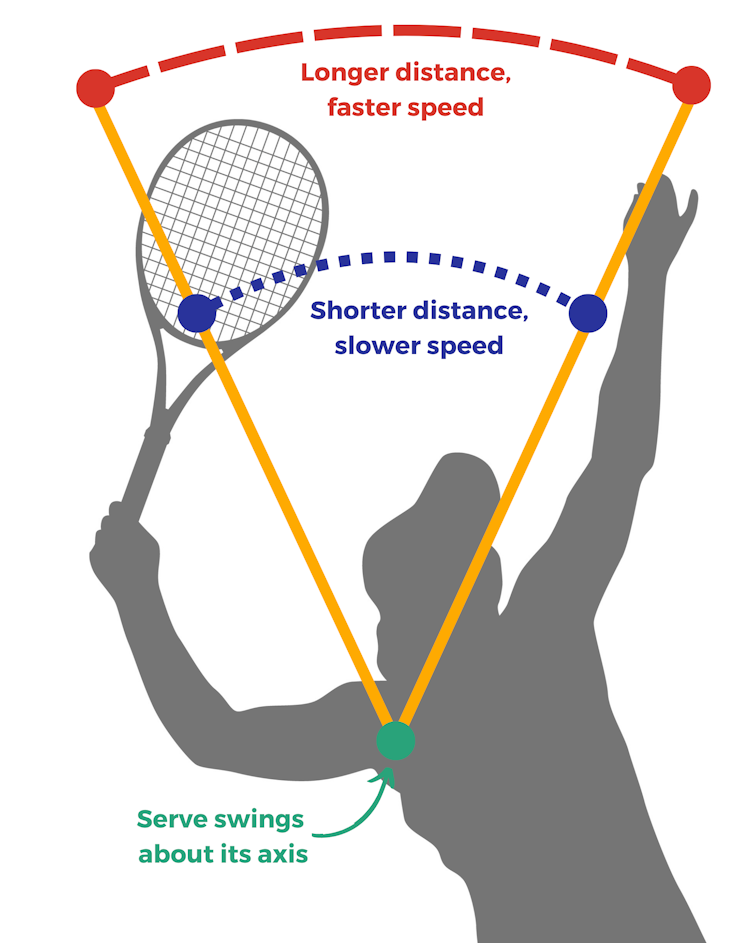
First, taller players generally have longer arms, which act like speed amplifiers.
In physics terms, the speed of your hand (and therefore the racquet) is approximately equal to the length of your arm multiplied by how fast you rotate it, as shown in the figure below. Longer arms equal faster racquet speeds.
Of course, you might imagine that longer arms would be heavier and therefore harder to move quickly. While that’s true for legs (which is why most of the world’s fastest sprinters aren’t super tall), arms are relatively light.
The speed advantage of length wins out over any minor weight penalty.
Athletes come in all shapes and sizes, but do taller tennis players get an advantage?
A better angle of attack
The second advantage is all about geometry.
Taller players can hit the ball at point higher off the ground, so it’s easier to clear the net and yet still get the ball to land in the service square on the opposite side of the court.
Picture trying to throw a scrunched-up piece of paper into a bin from above it versus from the side.
When you’re above the basket, you can throw it down at a steeper angle and still hit your target, but from the side, the paper is as likely to hit the front of the bin or sail over it.
The same principle applies in tennis – taller players can hit powerful serves on a downward angle that clears the net but still lands inside the opponent’s service line.
This height advantage also means a taller athlete can serve powerfully to any part of the service box, not just over the lowest part of the net down the centre of the court. A shorter player has to be much more precise with their angle to achieve the same effect and usually has to hit their fastest serves down the court’s centre.
In tennis serving, angles matter.
Technique: the freedom to swing free
The third advantage might be the most interesting: taller players can actually use more aggressive serving techniques because they have more room for error.
Tennis serves use what’s called a “throw-like pattern”. This is a complex sequence starting from the legs, rotating through the body, and ending with a whip-like motion of the arm and racquet.
As an example, we use this throw-like pattern to throw a ball as far or fast as we possibly can, but we use a different pattern when we’re trying to hit a bullseye on a darts board.
That is, the technique we use for speed is different from the technique for accuracy.
Taller players, with their better angles and higher contact point, can afford to use more of the explosive, throw-like technique and still land the ball within the service square of their opponent.
Shorter players often need to use a more controlled motion to ensure their serves stay in play – they have less room for error so they need to use a more conservative, but accurate, serving technique.
Hope for the not-so-tall
But before shorter players despair, we should remember that some of tennis’s greatest players have dominated without towering height.
Modern legends Serena Williams (1.78m), Roger Federer and Rafael Nadal (both 1.85m) are hardly giants, yet they’ve got impressive serving records and even more legendary win-loss records.
These players demonstrate that serving isn’t just about raw power: balance, accuracy, ball spin, serve placement and the ability to disguise your serve direction are crucial skills that take thousands of hours to perfect.
A well-placed serve at 180km/h can be more effective than a 220km/h bullet that your opponent knows is coming.
So, while height definitely provides some natural advantages for serving, it’s just one piece of the puzzle.
Tennis remains a sport where technique, strategy and dedication to practice can help players of any size rise to the top.
Anthony Blazevich does not work for, consult, own shares in or receive funding from any company or organisation that would benefit from this article, and has disclosed no relevant affiliations beyond their academic appointment.
Four researchers and authors from the Asia-Pacific region have provided diverse perspectives on the media in a new global book on intercultural communication.
The Sage Handbook of Intercultural Communication published this week offers a global, interdisciplinary, and contextual approach to understanding the complexities of intercultural communication in our diverse and interconnected world.
It features University of Queensland academic Dr Mairead MacKinnon; founding director of the Pacific Media Centre professor David Robie; University of Ottawa’s Dr Marie M’Balla-Ndi Oelgemoeller; and University of the South Pacific journalism coordinator associate professor Shailendra Singh.
Featuring contributions from 56 leading and emerging scholars across multiple disciplines, including communication studies, psychology, applied linguistics, sociology, education, and business, the handbook covers research spanning geographical locations across Europe, Africa, Oceania, North America, South America, and the Asia Pacific.
It focuses on specific contexts such as the workplace, education, family, media, crisis, and intergroup interactions. Each chapter takes a contextual approach to examine theories and applications, providing insights into the dynamic interplay between culture, communication, and society.
One of the co-editors, University of Queensland’s associate professor Levi Obijiofor, says the book provides an overview of scholarship, outlining significant theories and research paradigms, and highlighting major debates and areas for further research in intercultural communication.
“Each chapter stands on its own and could be used as a teaching or research resource. Overall, the book fills a gap in the field by exploring new ideas, critical perspectives, and innovative methods,” he says.
Refugees to sustaining journalism Dr MacKinnon writes about media’s impact on refugee perspectives of belonging in Australia; Dr Robie on how intercultural communication influences Pacific media models; Dr M’Balla-Ndi Oelgemoeller examines accounting for race in journalism education; and Dr Singh unpacks sustaining journalism in “uncertain times” in Pacific island states.
Dr Singh says that in research terms the book is important for contributing to global understandings about the nature of Pacific media.
The Sage Handbook of Intercultural Communication cover. Image: Sage Books
“The Pacific papers address a major gap in international scholarship on Pacific media. In terms of professional practice, the papers address structural problems in the regional media sector, thereby providing a clearer idea of long term solutions, as opposed to big measures and knee-jerk reactions, such as harsher legislation.”
Dr Robie, who is also editor of Asia Pacific Report and pioneered some new ways of examining Pacific media and intercultural inclusiveness in the Asia-Pacific region, says it is an important and comprehensive collection of essays and ought to be in every communication school library.
He refers to his “talanoa journalism” model, saying it “outlines a more culturally appropriate benchmark than monocultural media templates.
“Hopefully, this cross-cultural model would encourage more Pacific-based approaches in revisiting the role of the media to fit local contexts.”
Comprehensive exploration The handbook brings together established theories, methodologies, and practices and provides a comprehensive exploration of intercultural communication in response to the challenges and opportunities presented by the global society.
From managing cultural diversity in the workplace to creating culturally inclusive learning environments in educational settings, from navigating intercultural relationships within families to understanding the role of media in shaping cultural perceptions, this handbook delves into diverse topics with depth and breadth.
It addresses contemporary issues such as hate speech, environmental communication, and communication strategies in times of crisis.
It also offers theoretical insights and practical recommendations for researchers, practitioners, policymakers, educators, and students.
The handbook is structured into seven parts, beginning with the theoretical and methodological development of the field before delving into specific contexts of intercultural communication.
Each part provides a rich exploration of key themes, supported by cutting-edge research and innovative approaches.
With its state-of-the-art content and forward-looking perspectives, this Sage Handbook of Intercultural Communication serves as an indispensable resource for understanding and navigating the complexities of intercultural communication in our increasingly interconnected world.
In his farewell address, outgoing US President Joe Biden warned “an oligarchy is taking shape in America of extreme wealth, power and influence that literally threatens our entire democracy”.
The comment suggests that, under Donald Trump’s second term as president, it will be billionaires rather than the people who shape public policy.
There is certainly some evidence Biden’s ominous caution should be taken seriously. The world’s richest man and the owner of X, Elon Musk, has been a vocal supporter of the Republican candidate. Other billionaire tech moguls to visit Trump at his Mar-a-Lago mansion after his 2024 election victory include Meta’s Mark Zuckerberg, Amazon’s Jeff Bezos, Apple’s Tim Cook and Google chief executive Sundar Pichai.
There is nothing unusual about business leaders wanting the ear of an incoming president. What has concerned Biden and others is that so many of Trump’s influential backers also own media platforms and have the ability to sway public opinion.
Should these new tech titans be thought of as oligarchs?
What is an oligarchy?
Like many of the academic and scientific categories we still use today, oligarchy was originally defined by the Greek philosopher Aristotle.
In The Politics, he argued people are “political animals”, social by nature, and instinctively want to live in a community. He studied different governments of the ancient world and concluded there were six essential types.
A state could be ruled by a single leader, a small group of elites, or through mass participation of the people. If the leadership acted in the common advantage (koinê sumpheron), he termed these constitutions to be monarchy, aristocracy or polity, respectively.
If the constitutions became corrupt and the leadership acted only to advance their own self-interest, he labelled them tyranny, oligarchy and democracy.
The School of Athens painted by Raffaello Sanzio da Urbino, 1511. Aristotle is depicted centre right. Wikimedia Commons
So for Aristotle, an oligarchy is a corrupt form of government. It is when power is in the hands of a small group of elites who advance their own interests rather than the common good.
In Aristotelian terms, democracy is also a corrupt form of government in which the majority uses its power to abuse minorities. While the term democracy has been rehabilitated and is usually seen as a positive, the word oligarchy has retained its negative connotations.
When the United States was created, the founding fathers looked back to Aristotle, Polybius, Cicero and other ancient thinkers to try and create the best kind of constitution.
Following the Aristotelian tradition, they tried to design a mixed constitution where neither the one, the few nor the many could dominate the others. The president has great power. But their power is kept in check by Congress and the judiciary, which is in turn kept in check by the media and, ultimately, the people through regular elections.
Modern oligarchies
In modern politics, the term oligarch is most often used in a Russian context. After the collapse of the Soviet Union in 1991, opportunistic tycoons made enormous fortunes from buying up state assets such as energy companies and financial institutions, which also brought them significant political influence as a result.
Since Vladimir Putin became president in 2000, however, Russia has become increasingly authoritarian. While there is still an oligarchic class, their power has been reined in. They must not challenge Putin’s power or vision for the state.
Although China is ostensibly a communist state, the Gini index (the measure of social inequality) has blown out in recent years as a small group of elites become increasingly wealthy.
Despite the state’s official commitment to socialist principles, political scientist Ming Xia has argued China is now transitioning into a modern oligarchy.
What about the United States and Australia?
Despite Biden’s warning of a potential oligarchy, political scientists Martin Gilens and Benjamin Page argued back in 2014 the US already was one.
The US has the essential features of a liberal democracy (fair and regular elections, freedom of speech, and an independent press). But Gilens and Page worried large businesses and a small group of affluent citizens had a disproportionate influence on policy.
In Australia also, it could be argued an oligarchy is either emerging or has already taken hold.
Australia has a similar-sized economy to Russia and a growing list of billionaires who appear to have significant influence over government policy.
The power of the Murdoch family and their media empire is well-documented. We have also seen increased political activity from other billionaires including Gina Rinehart, Andrew Forrest and Clive Palmer – who went as far as to start his own political party.
There is no question billionaires in the US and Australia have enormous power and influence. But that in itself does not make an oligarchy.
In Aristotelian terms, the defining feature of an oligarchy is the ruling elite blatantly use their status for their own personal gain rather than the public good.
This is a moral judgement, and one that is increasingly hard to make when so many of the ultra-wealthy own traditional news media and social media platforms that can shape public opinion.
Nevertheless, any shift towards oligarchy should be a cause of alarm to all who value the long democratic tradition in both the US and Australia.
Whether it is a symptom of Trumpism, as Biden suggests, or part of a longer trend, strengthening our democratic institutions and curtailing the disinformation and misinformation that are all too prevalent on social media, is part of the solution.
Benjamin T. Jones does not work for, consult, own shares in or receive funding from any company or organisation that would benefit from this article, and has disclosed no relevant affiliations beyond their academic appointment.
Source: The Conversation (Au and NZ) – By Hrvoje Tkalčić, Professor, Head of Geophysics, Director of Warramunga Array, Australian National University
A map showing the ‘Martian dichotomy’: the southern highlands are in yellows and oranges, the northern lowlands in blues and greens.NASA / JPL / USGS
Mars is home to perhaps the greatest mystery of the Solar System: the so-called Martian dichotomy, which has baffled scientists since it was discovered in the 1970s.
The southern highlands of Mars (which cover about two-thirds of the planet’s surface) rise as much as five or six kilometres higher than the northern lowlands. Nowhere else in the Solar System do we see such a large, sharp contrast at this scale.
What caused this dramatic difference? Scientists have been split on whether it resulted from external factors – such as a collision with a huge, moon-sized asteroid – or internal ones, such as the flow of heat through the planet’s molten interior.
In new research published in Geophysical Research Letters, we analysed marsquakes detected by NASA’s Insight lander, located near the border separating the two sides of the dichotomy. Studying how the marsquake vibrations travel revealed evidence that the origin of the Martian dichotomy lies deep inside the red planet.
The Martian dichotomy
Altitude isn’t the only difference between the two sides of the Martian dichotomy.
The southern highlands are pocked with craters and streaked with frozen flows of volcanic lava. In contrast, the surface of the northern lowlands is smooth and flat, almost free of visible scars and other significant features.
From geophysical and astronomical measurements, we also know the crust of Mars is significantly thicker beneath the southern highlands. What’s more, the southern rocks are magnetised (suggesting they date to an ancient era when Mars had a global magnetic field), while those of the northern lowlands are not.
The Martian dichotomy was discovered in the 1970s, when images from the Viking probes showed a difference in height and in density of impact craters.
The Viking missions of the 1970s revealed a more detailed view of the Martian surface. NASA / USGS
The surface density of craters (the number of craters per unit area) can be used to calculate the age of surface rocks – the older the surface, the more craters. So the southern highlands appear to be older than the northern lowlands.
There is a lot of debate about this because the existence or absence of sediments, landforms, and certain minerals that form when the land is covered by an ocean are used as the primary evidence for and against. The existence of liquid water is a prerequisite for life, so it is not difficult to understand the interest of the scientific community and space agencies in this problem.
Outer space or inner forces?
The origin of the Martian dichotomy has been a long-standing puzzle in planetary science. What kind of gradual or violent natural process, phenomenon, cosmic force, or catastrophe in the early phase of Mars (given the age of the rocks on the surface) could offer an answer to this question?
Two main hypotheses have emerged.
First is the so-called endogenic hypothesis. This argues that the difference in heat transfer through the rising of warmer and sinking of cooler material inside the Martian mantle led to a visible dichotomy on its surface.
Second is the exogenic hypothesis, according to which the cause of the dichotomy comes from space. This would mean the catastrophic impact of either a single moon-sized body or several smaller bodies, reshaping the planet’s surface.
Marsquakes
On Earth, we can use data from hundreds and even thousands of seismometers to triangulate the location of an earthquake.
On Mars, we only have data from a single instrument on the Insight lander. To find the location of a marsquake, we have to rely on measuring the difference in arrival time between different kinds of vibrations (called P and S waves).
This lets us calculate the distance to the marsquake. We can also determine the direction to the quake by looking at the movement of particles on the ground.
The Insight lander carried a seismograph to measure marsquakes and other vibrations. NASA / JPL-Caltech
Once we had made a system for pinpointing marsquakes from Insight data, we checked it against known events such as meteoroid impacts spotted by satellite cameras. We found our methods reliably pointed to a cluster of marsquakes in the Terra Cimmeria region in the southern highlands.
Next we studied how S waves lost energy as they travelled through the rock of the southern highlands. We also made similar calculations for earlier observed quakes in the Cerberus Fossae region of the northern lowlands.
Comparing these two showed that the waves lost energy more quickly in the southern highlands. The most likely explanation is that the rock beneath the southern highlands is hotter than in the north.
What quakes tell us about the dichotomy
This temperature difference between the two halves of the dichotomy supports the idea that the split was caused by internal forces on Mars, not some external impact.
The full explanation of why is quite complex. To simplify, scientists have made models of how the dichotomy could have formed based on an initial unevenness in the crust of Mars way back in time.
At one point, Mars had moving tectonic plates like Earth does. The movement of these plates and the molten rock beneath them could have created something like the dichotomy – which was then frozen in place when the tectonic plates stopped moving to form what scientists call a “stagnant lid” on the planet’s molten interior.
These events may have then enabled patterns of convection in the molten rock that can explain the dichotomy we see today, with upwelling benath the southern highlands and downwelling beneath the northern lowlands.
Our marsquake evidence for a temperature difference across the dichotomy is consistent with these models.
To conclusively answer the question of what caused the Martian dichotomy, we will need more marsquake data, as well as detailed models of how Mars formed and comparisons with Earth and other planets. However, our study reveals an important new piece of the puzzle.
Hrvoje Tkalčić receives funding from the Australian Research Council.
Weijia Sun does not work for, consult, own shares in or receive funding from any company or organisation that would benefit from this article, and has disclosed no relevant affiliations beyond their academic appointment.
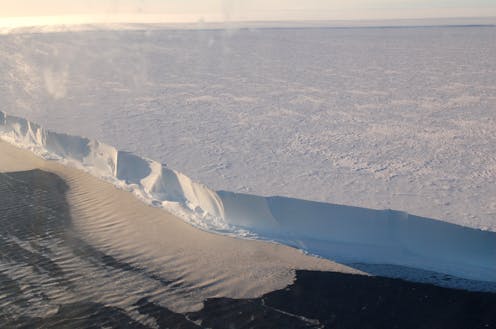
The size of the Antarctic ice sheet can be hard to comprehend. Two kilometres thick on average and covering nearly twice the area of Australia, the ice sheet holds enough freshwater to raise global sea levels by 58 metres.
Ice loss from this sheet is projected to be the leading driver of sea level rise by 2100, yet its contribution remains highly uncertain. While sea levels are certain to rise this century, projections of the contribution from Antarctic ice vary from a 44 cm rise to a 22 cm fall.
Much of this uncertainty is because the ocean processes that control the fate of the sheet occur on an incredibly small scale and are very difficult to measure and model.
But recently scientists have made significant progress in understanding this “ice-ocean boundary layer”. This progress is the subject of our new review paper, published today in Annual Reviews.
Shrinking, thinning and retreating
At the margins of the Antarctic ice sheet, glaciers flow into the Southern Ocean, forming floating ice shelves. These ice shelves act as keystones, stabilising the ice sheet. They’re also shrinking.
The ocean melts ice shelves from below – a process known as “basal melting”. Increased basal melting has led to the thinning and retreat of the ice sheet in some regions, raising global sea levels.
Ice shelves in Antarctica ice shelves act as keystones, stabilising the ice sheet, but they’re shrinking due to climate change. Goldilock Project/Shutterstock
Like the glaciers that feed them, ice shelves are immense. Yet the ocean processes that control basal melting, and the fate of the entire Antarctic ice sheet, occur on the scale of millimetres. They happen in a thin layer of ocean, just beneath the ice.
The boundary layer between the ice shelf and the ocean is cold, miles from anywhere, and beneath very thick ice, so it’s no wonder it has hardly been measured at all.
Studying this layer with other techniques such as computer simulations is also a huge challenge. Until recently, the tiny motions within the ice-ocean boundary layer put accurate modelling of ice melt out of reach.
These twin challenges have long stymied efforts to answer the deceptively simple question: “How does the ocean melt Antarctic ice shelves?”
The underside of ice shelves feature a weird and wonderful icescape. Filip Stedt
Modelling the micro-scale
Computer simulations of ocean processes aren’t new.
But only recently have simulations of the ice-ocean boundary layer become feasible, as computing resources grow and the cost of using them shrinks.
Researchers are looking for a relationship between what the ocean is doing, and how quickly the ice melts. So far, they’ve uncovered not just one relationship but several, each indicating a different melt “regime”. Ocean conditions (temperature, salt content and the speed of ocean currents) and the shape of the ice determine which melting regime applies.
Ice sheet shape is key because meltwater is fresh and lighter than the surrounding ocean. Like hot air collecting at the top of a room, fresh, cold meltwater collects in hollows in the lower surface of the ice sheet, insulating the ice from the ocean water below and slowing melting.
For steeply sloping ice, the insulating effect is much less. The energetic flow of meltwater as it rises under steep ice leads to mixing with the warmer ocean waters. This increases melting.
Fast ocean currents have a similar effect, as they transfer heat to the ice.
Underwater robots have allowed scientists to get an unprecedented look at the underside of the ice in Antarctica. Filip Stedt/University of Gothenburg
Using sonar and cameras, these robots have revealed a weird and wonderful “icescape” on the underside of ice shelves.
This icescape is made of many different ice features, ranging from centimetres to kilometres in size. Some, like steep-sided crevasses, are formed by ice fracturing. Others, like dimpled depressions in the ice (often called “scallops”), stair-like “terraces”, mussel-shaped “scoops”, and larger basal channels, are thought to be formed by melt processes.
The strange shapes on the underside of ice shelves are thought to be formed by melt processes. Filip Stedt
Our new knowledge of melting from computer simulations and robots sheds light on these features and how they form. The existence of melt regimes helps explain the evolution of steep-sided terraces, or why different features appear in distinct parts of an ice shelf.
For instance, in the warm, calm eastern part of the Dotson ice shelf in west Antarctica, an autonomous robot observed basal terraces. In the west of Dotson – which experiences cold, fast currents – large mussel-shaped scoops were discovered.
Uncertainties remain
Exactly how some of these features form is still unknown.
New simulations that allow the ice-water boundary to move in time show the “self-sculpting” behaviour of ice melt. This is similar to how dunes form and move in a desert.
However, new computer models are needed to simulate the formation and evolution of the whole icescape.
Some of the recent advances highlighted here are helping to reduce the uncertainty in our understanding of the contribution of the Antarctic ice sheet to global sea level rise.
However, incorporating our new understanding of basal melt, and the dynamic icescape it forms, into climate and ice sheet models still presents a huge challenge.
Overcoming this challenge is urgent. Accurate representation of melt in climate and ice sheet models will reduce the deep uncertainty in sea level rise projections, especially as ocean conditions – and ice shelf melt regimes – shift into the future.
Madelaine Gamble Rosevear receives funding from the Australian Research Council.
Ben Galton-Fenzi is employed by the Australian Antarctic DIvision.
Bishakhdatta Gayen is employed by the University of Melbourne. He receives funding from the Australian Research Council. He is affiliated with Indian Institute of Sciences.
Catherine Vreugdenhil receives funding from the Australian Research Council.
Source: The Conversation (Au and NZ) – By Marc C-Scott, Associate Professor of Screen Media | Deputy Associate Dean of Learning & Teaching, Victoria University
The 2025 Australian Open (AO) broadcast may seem similar to previous years if you’re watching on the television. However, if you’re watching online via the official Australian Open TV YouTube channel you’ll encounter a distinctly different kind of coverage.
The channel’s “AO Animated” coverage looks more like a Wii Sports tennis match than a real one, with players’ physical forms replaced with virtual avatars.
Fans that have viewed the live streams are divided, with comments ranging from “This is the best kinda live” to “What the hell is this? Why can’t we watch normal? This is utterly ridiculous”.
So what’s the answer? Why can’t we watch normal?
How does it work?
The system that creates the AO Animated streams uses 12 cameras that track the silhouette of the players. This data is then fed into a system and stitched to 29 points on an animated character – the player’s graphical reproduction. The result is a live stream with a two-minute delay that includes commentary and sound from the court.
For those who have seen it, you’ll notice the system is far from perfect. There are glitches with the ball, racquets vanishing and reappearing, clothes changing or appearing to have holes, and fingers remaining straight when they should be gripping the racquet. As Tennis Australia’s director of innovation, Machar Reid, notes, “It’s not as seamless as it could be.”
Although AO Animated was introduced last year, it has only recently become a major talking point among tennis fans. Many learned about the animated live streams through an X post by tennis reporter Bastien Fachan, who points them out as a way for the Australian Open to sidestep limits placed by current media rights agreements.
Nine has paid A$425 million for a five year deal (until 2029) that allows the network the domestic linear and digital rights to the Australian Open and lead-in events, including the United Cup.
Internationally, the BeIN media group has the broadcast rights for 24 countries across the Middle East and North Africa, while ESPN has held the broadcast rights for the United States and Canada since 1984 (and will remain these rights until at least 2031).
Yet the AO has found a way to sidestep these exclusive media rights deals by using animated avatars on YouTube – a decision that raises several questions about the future of sports broadcasting and media rights deals.
Future media rights
As of when this article was published, the AO Animated video of Botic van de Zandschulp playing Alex de Minaur had more than 35,000 views. The most viewed match, with more than 160,000 views, was between Andrey Rublev and Joao Fonseca.
But these are paltry numbers compared to the 1.9 million Australians who tuned into Nine’s TV broadcast of the night session on day three (in which Botic van de Zandschulp played Alex de Minaur).
A closer look at the ratings also reveals it is overwhelmingly older Australians who are tuning in, with 838,000 viewers aged 25–54, compared to 414,000 aged 16–39. You might suspect younger Australian are streaming the tennis via Nine’s video-on-demand platform, but even here an older viewership dominates.
It’s possible many young people are turning to other platforms such as YouTube, which reportedly had almost 21 million active users in Australia in 2024 (almost 80% of the population). In this light, what looks like an effort by Tennis Australia to dodge media rights deals could also be viewed as an effort to reach new, younger audiences.
It seems Tennis Australia’s Machar Reid had this in mind. He told The Guardian the AO Animated videos were targeting the “community that engages with animated or virtual or gaming products”.
This strategy makes sense. Millions of young people are already hooked on YouTube’s huge selection of gaming content. For instance, last year videos related to the viral Roblox game Dress to Impress were viewed more than 4 billion times in the US alone, according to YouTube’s data.
Similarly, more than 645 million people in the United Kingdom watched videos related to the video game franchise EA Sports FC in 2024. This number was even greater in the Middle East and North Africa, at 950 million.
AO is not the first
The AO is not the first to live-stream sports matches in which players are animated. Last year, North America’s National Hockey League used player tracking technology to stream a “MultiVersus NHL Face-Off” game. The players of Colorado Avalanche and the Vegas Golden Knights were replaced with Warner Brothers characters including Batman, Bugs Bunny and the Scooby Doo gang.
The National Football League also recreated a simulation of a live game in which players from the Cincinnati Bengals and Dallas Cowboys were replaced by Simpson’s characters. The entire look and feel of the broadcast reflected The Simpsons.
These US-based examples, together with the recent AO Animated coverage, suggest animated simulations could play a larger role in future media rights deals – and could provide media rights holders unique marketing and collaboration opportunities.
In the future we may see an expansion of the AO Animated live streams. It’s possible the Mii-style characters could even be replaced with popular characters, similar to the examples above. Such a change would further enhance Tennis Australia’s ability to collaborate with its media rights holders, both domestically and internationally.
Marc C-Scott does not work for, consult, own shares in or receive funding from any company or organisation that would benefit from this article, and has disclosed no relevant affiliations beyond their academic appointment.
A Fiji community human rights coalition has called on Prime Minister Sitiveni Rabuka to halt his “reckless expansion” of government and refocus on addressing Fiji’s pressing challenges.
The NGO Coalition on Human Rights (NGOCHR) said it was outraged by the abrupt and arbitrary reshuffling of government ministerial portfolios and the appointment of ministers and assistant ministers.
“This move raises serious questions about transparency, accountability, and the stability of governance in Fiji,” the NGOCHR said in a statement.
The NGOCHR believes that the creation of new ministerial and assistant ministerial roles potentially imposes a heavy financial burden on an already strained public purse.
The coalition said it was also concerned with the fact that the Prime Minister had not been transparent with the public to clarify where the funding for these additional posts was being sourced.
“With the country’s national debt already exceeding $10 billion, this reshuffle is not just ill timed — it is financially irresponsible,” the statement said.
“Increasing operational costs in the face of economic fragility is a slap in the face to the hardworking people of Fiji and as such, a betrayal of public trust, with potential long-term consequences for our nation’s future.
“We demand accountability to the Fijian people and transparency.
“Is this a desperate attempt to consolidate power in preparation for the 2026 elections?
“This government cannot continue to use public resources to fund unnecessary political manoeuvres disguised as governance, while critical sectors and Fijians are left struggling.”
The NGOCHR called on Prime Minister Rabuka to halt “this reckless expansion of government and refocus on addressing Fiji’s pressing challenges.”
“Enough is enough! The Fijian people deserve leadership that serves their interests — not one that prioritises self-interest and political survival.
RNZ Pacific reports that Rabuka has lured six out of nine opposition members — who form the Group of 9 or G9 — to join his People’s Association (PA) ranks, a “rebranding” alliance that could potentially make his two coalition partners dispensable SODELPA and the National Federation Party (NFP).
But does this really mean no Tasmanians are being bulk-billed at the GP?
No – as federal health minister Mark Butler was quick to point out after the report’s release, the company asked 6,925 GP clinics only whether they had standard, weekday consultations available to be bulk-billed for adults with no concessions.
A range of people do have concessions – children under 16, pensioners and people with a health care card – meaning the actual bulk-billing rate is much higher, although Butler said he’d like it to be higher still.
How high should we be aiming? Many Australians may assume universal health care means it should be free to see a GP, regardless of your age, income or postcode.
So we asked five experts: should we be aiming to bulk-bill everyone?
Conservation managers recognise the need for new ways to help species and ecosystems adapt to climate change. But dreaming up new tactics and testing them out requires lots of time, effort and – often – money.
So we decided to gather examples of new tactics from Australia and around the world and offer them up in one place. Our free new online tool is full of fresh ideas to help Australian conservation groups find out about what might be worth trying on their patch.
The catalogue contains more than 400 interventions such as purpose-built shelters and cooling systems, or relocation programs moving species to areas where the future climate may be more suitable. Having a ready-made toolkit means we can respond more rapidly and effectively to the changing environment, helping preserve Australia’s unique biodiversity.
Replacing lost habitat: from cod logs to frog bogs
Our project team searched through academic papers, reports and plans, and connected with dozens of different organisations undertaking climate change adaptation in Australia.
We found many new tactics are being tested to help wildlife adapt to climate change. We fed this information into the new Adaptation Catalogue for Conservation we call “AdaptLog” – a searchable public repository of conservation interventions for climate adaptation. We also invited conservation groups to add to the database.
Here are just a few of the inspiring success stories.
These logs are made from local, hollowed-out timber. They are then placed in the river to provide shelter and nesting habitat for the endangered Mary River cod.
Early results have been encouraging, with researchers monitoring large male cod using the logs as nesting sites, protecting their brood of eggs.
Tailor-made frog habitat is being recreated after fires, or during dry times.
More than half of East Gippsland in Victoria burned during the 2019–20 Black Summer Bushfires, forcing many frogs into urban areas. In response, the East Gippsland Catchment Management Authority urged people to build temporary habitats for frogs in their backyards.
A “frog hotel” can be built using a large container or pot, soil, native plants and PVC pipes. They allow frogs to take refuge during the heat of the day. They also provide protection from predators such as kookaburras, dogs and cats.
Frog hotels come in many shapes and sizes. East Gippsland Catchment Management Authority
The West Gippsland Catchment Management Authority worked with the conservation group Greening Australia to create another type of tailor-made frog habitat they call “frog bogs”. Frog bogs look deceptively simple, just like ordinary farm dams, but they contain multiple chambers at various depths, allowing tadpoles to grow, shelter and safely feed. Native vegetation is planted around the edges, water plants are added and rocks allows frogs to bask.
Martin Potts from Greening Australia has been busy creating frog bogs like the one shown here, providing refuge for the green and golden bell frog and growling grass frog as conditions change. Martin Potts
Many groups around Australia are testing atmospheric cooling systems for keeping heat-sensitive flying foxes cool after mass deaths during heatwaves. One of these trials, jointly funded by WWF-Australia, the City of Greater Bendigo and the Department of Environment, Land, Water and Planning, was a success in Bendigo’s Rosalind Park. Hundreds of flying foxes had died in a record-breaking heatwave in the previous year, but despite temperatures climbing above 40°C during the trial, no deaths were recorded.
These systems need more testing and are a far cry from the scale needed to support functioning ecosystems and populations. But it is heartening to see lots of passionate people working so hard to support nature in these challenging times.
The Turtle Cooling Project – a partnership between WWF-Australia, The University of Queensland and the Conflict Islands Conservation Initiative, with funding support from furniture company Koala – tested ways to cool turtle nests on the beach, so more males would hatch. Further testing promises to identify which beaches need these interventions most, and how communities can get involved around Australia and the world.
Sharing is caring
By sharing these strategies, we can help conservation managers act quickly and decisively, drawing on evidence of what has worked elsewhere. We can also provide more opportunities for communities to get involved as volunteers helping out with different kinds of adaptation actions.
Conservation managers in Australia and globally can now use this tool to share and find new ideas. They can also add more examples and tactics to the tool, to help with testing and learning what works in different settings.
It is very early days for this field of climate adaptation research and practice, so there is still a long way to go to build an evidence base. But by collating what is happening already, we hope to encourage the development and dissemination of more innovative approaches to give wildlife a fighting chance.
We would like to acknowledge the following people for their contributions to the development of AdaptLog: Jason Hartog, Alistair Hobday, Sarah Boulter, Ingrid van Putten, Jenny Styger, the Project 2.7 Steering Committee, AdaptLog beta testers and CS2.7 case study participants. This work was funded through the National Environmental Science Program (NESP) Climate Systems Hub.
Jess Melbourne-Thomas receives funding for this work from the Australian Commonwealth Department of Climate Change, Energy, the Environment and Water via the National Environmental Science Program (NESP).
Claire Mason receives funding for this work from the Australian Commonwealth Department of Climate Change, Energy, the Environment and Water via the National Environmental Science Program (NESP).
Source: The Conversation (Au and NZ) – By Talia Fell, PhD Candidate, School of Historical and Philosophical Inquiry, The University of Queensland
The Los Angeles wildfires are causing the devastating loss of people’s homes.
From A-list celebrities such as Paris Hilton to an Australian family living in LA, thousands of houses have been destroyed, leaving their owners shocked and grieving. And climate science points towards figures that suggest more such events are waiting.
These events strip away precious memories created over many years, and sometimes over lifetimes. They prompt us to ask: what does it mean to lose the place I care most deeply about?
Philosophy explains how our personal losses connect to a broader, more profound loss of home rooted in our dependence on the ecosystems we live in.
The concept of ‘home’
In her 1949 text The Second Sex, philosopher Simone de Beauvoir writes that, for many cultures, the home has represented values of tradition, safety and family. Inside its walls we preserve the past in furniture, knick knacks and photographs, and we associate these objects with memories created with loved ones.
The home also represents separation from the people and events of the outside. It is “refuge, retreat, grotto, womb, it protects against outside dangers”, Beauvoir writes.
But she explains how this understanding of home is culturally specific to civilisations founded on landed property, which contain intersecting structures of patriarchy and capitalism.
After all, patriarchy sees women as the caretakers of the home, providing for the physical and emotional needs of its inhabitants. Meanwhile, the functioning of the home also relies on the income of those who work outside it.
At the same time, many of us, Beauvoir writes, have a more instrumental understanding of home. It is where we rest, sleep, eat and store the objects we own and use.
Barriers to having a sense of ‘home’
The traditional understanding of home as a protective structure is complicated when you realise certain people do not have the privilege of calling one particular place “home”.
For many, the home exists as a point of inequality, instability and unsafety.
Australian philosopher Val Plumwood puts these issues into perspective when she argues the expression of “one’s place” or “homeplace” often represents a privileged and exclusionary sense of place. She writes:
Those who are most vulnerable and powerless are at most risk of losing control over their ability to remain in a home place or place of attachment.
She further argues that, under capitalism, the idea of personal belonging to a particular place or dwelling is often framed as being more important than many other vital attachments to place, such as connection to land.
She uses the term “shadow places” to describe the ecosystems we exclude and exploit – including our forests and waterways – even though they are fundamental to our existence. These places provide essential labour, nourishment and the conditions we need to survive and flourish.
Ironically, our detachment from these places is what props up our limited understanding of the “home” as a fixed, four-walled dwelling.
For Plumwood, an expanded sense of “home” would encompass the broader ecological context we exist within.
Our sense of ‘home’ in the climate crisis
In her 1998 article, Indigenous Australian law scholar Irene Watson emphasises the issue of colonialism in detachment from the land.
Watson explains colonisers were already alienated from a sense of connection to land when they came to “Australia”. This disconnection led them to plunder the land, treating it as a commodity rather than a living, complex ecosystem that nurtures and is nurtured by First Nations peoples.
As philosopher Teresa Brennan puts it, to commodify a living thing is to turn it into something that can be bought and owned. Once commodified, nature can no longer reproduce itself, nor decompose to nourish other life forms.
Brennan explains how the tendency to commodify (and therefore exploit) nature represents a denial of nature’s reproductive capacity.
And this denial is not sustainable, as it drives the exploitation of every available natural resource. Under capitalism, a stop to exploitation means a stop to profits.
Turning to philosophy to rethink our values
Many people fail to see the rich complexity of nature: its unique intelligence and age-old memories that extend beyond our personal lifetimes.
Brennan argues nature is valuable beyond its profitability for the most powerful individuals. Perhaps, then, our sense of “home” should extend beyond the bounds of a dwelling filled with sentimental objects to include the wider lands and ecosystems we are part of.
In doing so, we can accelerate the shift towards social, political and economic systems that acknowledge that what is good for our planet is good for each of us, too.
The authors do not work for, consult, own shares in or receive funding from any company or organisation that would benefit from this article, and have disclosed no relevant affiliations beyond their academic appointment.
The voter turnout at the last election was less than 50 percent but Malessas is optimistic participation today will be high.
He urged voters to go and exercise their democratic right.
“This country — we own it, it’s ours. If we just sit and complain that, this, that and the other thing aren’t good but then don’t contribute to making decisions then we will never change,” Malessas said.
Not everybody convinced But not everybody is convinced that proceeding with the election was the right decision.
The president of the Port Vila Council of Women, Jane Iatika, said many families were still grieving, traumatised and struggling to put food on the table.
“If they were thinking about the people they would have [postponed] the election and dealt with the disaster first,” she said.
“Like right now if a mother goes and lines up to vote in the election — when they come back home what are they going to eat?”
This is the second consecutive time Vanuatu’s Parliament has been dissolved in the face of political instability.
And the country has had four prime ministerial changes in as many years.
The chairman of the Seaside Tongoa community, Paul Fred Tariliu,. said people were starting to lose faith in leadership, not just in Parliament but at the community level as well.
Urging candidates to ‘be humble’ He said they had been urging their candidates to be humble and concede defeat if they found themselves short of the numbers needed to rule.
“Instead of just going [into Parliament] for a short time [then] finding out they don’t have the numbers and dissolving Parliament,” Tariliu said.
“We are wasting money.
“When we continue with this kind of attitude people lose their trust in us [community] leaders and our national leaders.”
The official results of the last election in 2022 show a low voter turnout of just over 44 percent with the lowest participation in the country, just 34 percent, registered here in the capital Port Vila.
The Owen Hall polling station in Port Vila, Vanuatu. Image: Koroi Hawkins/RNZ Pacific
Conducting the election itself is a complicated logistical exercise with 352 polling stations spread out over the 12,000-sq km archipelago manned by 1700 polling officials and an additional one in Nouméa for citizens residing in New Caledonia.
Proxy voting is also being facilitated for workers overseas.
360 police for security Deputy Police Commissioner Operations Kalo Willie Ben said more than 360 police officers had been deployed to provide security for the election process.
He said there were no active security threats for the election, but he said they were prepared to deploy more resources to any part of the country should the need arise.
“My advice [to the public] is that we conduct ourselves peacefully and raise any issues through the election dispute process,” Kalo Willie Ben said.
The head of the government Recovery Unit, Peter Korisa, said according to their initial estimates it would cost just over US$230 million to fully rebuild the capital after the earthquake.
Korisa said they were getting backlash for the indefinite closure of the CBD but continued to work diligently to ensure that, whatever government comes to power this month, it would be presented with a clear recovery plan.
“We still have a bit of funding but there is a greater challenge because we need to have a government in place so that we can trigger the bigger funding,” Korisa said.
Polling stations close at 4:30pm local time.
Unofficial check count Principal electoral officer Malessas said an unofficial count would be conducted at all polling station venues before ballot boxes were transported back to the capital Port Vila for the official tally.
According to parliamentary standing orders, the first sitting of the new Parliament must be called within 21 days of the official election results being declared.
A spokesperson for the caretaker government has confirmed to RNZ Pacific that constitutional amendments aimed at curbing political instability would apply after the snap election.
The most immediate impact of these amendments will be that all independent MPs, and MPs who are the only member of their party or custom movement, must affiliate themselves with a larger political party for the full term of Parliament.
They also lock MPs into political parties with any defection or removal from a party resulting in the MP concerned losing their seat in Parliament.
However, the amendments do not prohibit entire parties from crossing the floor to either side so long as they do it as a united group.
It remains to be seen how effective the amendments will be in curbing instability.
The only real certainty provided by the constitution after this snap election is that the option to dissolve Parliament will not be available for the next 12 months.
This article is republished under a community partnership agreement with RNZ.
Māori politicians across the political spectrum in Aotearoa New Zealand have called for immediate aid to enter Gaza following a temporary ceasefire agreement between Hamas and Israel.
The ceasefire, agreed yesterday, comes into effect on Sunday, January 19.
Foreign Minister Winston Peters said New Zealand welcomed the deal and called for humanitarian aid for the strip.
Te Pāti Māori co-leader Debbie Ngarewa-Packer … “This ceasefire must be accompanied by a global effort to rebuild Gaza.” Image: Te Pāti Māori
“There now needs to be a massive, rapid, unimpeded flow of humanitarian aid into Gaza.“
Te Pāti Māori co-leader Debbie Ngarewa-Packer echoed similar sentiments on behalf of her party, saying, “the destruction of vital infrastructure — homes, schools, hospitals — has decimated communities”.
“This ceasefire must be accompanied by a global effort to rebuild Gaza,” she said.
Teanau Tuiono, Green Party spokesperson for Foreign Affairs, specifically called on Aotearoa to increase its aid to Palestine.
‘Brutal, illegal Israeli occupation’ “[We must] support the reconstruction of Gaza as determined by Palestinians. We owe it to Palestinians who for many years have lived under brutal and illegal occupation by Israeli forces, and are now entrenched in a humanitarian crisis of horrific proportions,” he said.
“The genocide in Gaza, and the complicity of many governments in Israel’s campaign of merciless violence against the Palestinian people on their own land, has exposed serious flaws in the international community’s ability to uphold international law.
“This means our country and others have work to do to rebuild trust in the international system that is meant to uphold human rights and prioritise peace,” said the Green MP.
With tens of thousands of Palestinians killed in the 15 month war, negotiators reached a ceasefire deal yesterday in Gaza for six-weeks, after Hamas agreed to release hostages from the 7 October 2023 attacks in exchange for Palestinian prisoners — many held without charge — held in Israel.
“The terms of the deal must now be implemented fully. Protection of civilians and the release of hostages must be at the forefront of effort.
“To achieve a durable and lasting peace, we call on the parties to take meaningful steps towards a two-state solution. Political will is the key to ensuring history does not repeat itself,” Peters said in a statement.
Tuiono called it a victory for Palestinians and those within the solidarity movement.
“However, it must be followed by efforts to establish justice and self-determination for Palestinians, and bring an end to Israeli apartheid and the illegal occupation of Palestine.
“We must divest public funds from illegal settlements, recognise the State of Palestine, and join South Africa’s genocide case against Israel at the International Court of Justice, just as we joined Ukraine’s case against Russia.”
Ngawera-Packer added that the ceasefire deal did not equal a free Palestine anytime soon.
“We must not forget the larger reality of the ongoing conflict, which is rooted in decades of displacement, violence, and oppression.
“Although the annihilation may be over for now, the apartheid continues. We will continue to call out our government who have done nothing to end the violence, and to end the apartheid.
“We must also be vigilant over these next three days to ensure that Israel will not exploit this window to create more carnage,” Ngarewa-Packer said.
Australian-owned brand UGG Since 1974 has announced it will change its name to “Since 74” for sales outside Australia and New Zealand.
There has been a long-running battle over the rights to use the name “ugg” to sell the iconic sheepskin boots worldwide.
This latest development follows years of legal challenges between small Australian manufacturers and American footwear giant Deckers Brands.
While courts in the United States have ruled “ugg” can be used by brands in Australia and New Zealand, where it has become a generic name for sheepskin boots, Deckers own the rights to use ugg internationally. They are now pursuing UGG Since 1974 for using the name.
UGG Since 1974 is an established maker of the boots, predating establishment of the Deckers brand. But locally, uggs are made – and advertised as uggs – by many small Australian manufacturers.
They made their first documented appearances on surfers’ feet in the 1950s.
By the 1970s, they were commonplace across Australia. In 1981, ug (with one “g”) made its way into the Macquarie Dictionary as a generic term for sheepskin boots.
Over the years, they have become an internationally recognised Australian icon.
In late 1970s, Australian entrepreneur Brian Smith took the style to California before registering the name as a brand in the United States.
Deckers later bought the rights from Smith and trademarked it as “UGG Australia” in 1995. The company has since dropped the “Australia”, and has aggressively pursued Australian makers who attempt to use the term “ugg” when selling overseas.
What’s in a (brand) name?
In a successful 2019 infringement case against Australian manufacturer Eddie Oygur, Deckers argued Americans did not recognise “ugg” as a descriptive term but only as a brand name.
When a brand name enters everyday language as a generic term, companies often fight hard to protect their trademark rights. A trademark can lose its protection when the name becomes generic. Examples include thermos, aspirin and sellotape, which were once protected brand names but became general terms.
The lengths brands will go to prevent their trademarks becoming generic can be quite extreme. A notable example is French fashion house Chanel, which took out a full-page advertisement in Women’s Wear Daily in 2010 that threatened legal action against journalists who used terms like “Chanel-issime, Chanel-ed, Chanels, and Chanel-ized” to describe other designers’ work.
The image of a brand
What makes Deckers’ aggressive trademark defence particularly interesting is that they are claiming global trademark rights over a term that was already generic in its country of origin. This has caused some to question whether the rights should have been granted in the first place.
Their actions against smaller Australian brands also appear to contradict their carefully cultivated brand image.
The company’s website and code of ethics promote values like authenticity and cultural engagement, stating they exist to “positively impact the world by uniting purposeful brands with diverse people”.
In many senses Deckers do maintain impressive standards of corporate social responsibility and hold themselves to high standards. Yet here they are attempting to monopolise a term that has become deeply embedded in Australian culture.
The company’s actions have sparked significant backlash, with the UGG Since 1974’s TikTok announcement receiving 1.1 million likes and 79,000 shares in only two days. Social media users have said they will now be boycotting Deckers Brands in favour of Australian makers.
The controversy highlights a growing tension between intellectual property rights and cultural sustainability. While environmental sustainability is becoming a priority for brands and the media, cultural sustainability – which includes preserving heritage, cultural diversity and local practices – often takes a back seat.
Cultural legacy
For Todd Watts, grandson of UGG Since 1974’s founders, the decision to rebrand as “Since 74” outside Australia represents both a legal necessity and a statement of authenticity.
His company continues to handcraft boots in Australia using local materials and labour, maintaining a tradition that predates Deckers’ involvement with the product by decades.
And even if they will no longer be called “UGG Since 74”, it is likely the use of ugg as a generic name will stick.
While Deckers won the legal right to the ugg name, Australian manufacturers like Watts continue to defend their cultural legitimacy through local production and connection to the product’s heritage.
Alexandra Sherlock does not work for, consult, own shares in or receive funding from any company or organisation that would benefit from this article, and has disclosed no relevant affiliations beyond their academic appointment.
The ceasefire agreement between Israel and Hamas, to come into effect on Sunday, has understandably been welcomed by the overwhelming majority of Israelis and Palestinians.
Israelis are relieved that a process for freeing 33 more hostages in Hamas custody is to begin, with more to come in future phases.
Palestinians can now hope the daily bombing that has killed nearly 50,000 Gazans over the past 15 months will finally end, and that desperately needed humanitarian assistance will start to flow into the strip.
But once the euphoria subsides, hard issues will emerge. Here are six key questions arising from this new agreement. The answers, as yet unclear, will shape the region and the lives of those who live in it.
As US President Joe Biden said in announcing the agreement, the deal now reached was initially proposed by him in May last year.
Why, then, has it taken nearly eight months to be accepted by both sides?
Palestinian civilians in Gaza, who have borne the pain and suffering of the Israeli onslaught, can rightly ask whether Hamas could have made concessions to enable a ceasefire earlier.
Israelis are already asking if Prime Minister Benjamin Netanyahu deliberately held back his government’s agreement to a ceasefire to safeguard his political position and keep his government in office.
Even more darkly, did Netanyahu choose to prolong the war until President-elect Donald Trump could be in a position to claim credit for achieving the release of the remaining hostages? Trump’s Middle East envoy Steve Witkoff was reportedly involved in discussions with Netanyahu in the final phase of the negotiations in Qatar.
2. How will aid get into Gaza?
An important part of the ceasefire is the urgent provision of humanitarian aid. Some 600 trucks of provisions are reportedly ready to begin entering Gaza on a daily basis.
But how will the aid be distributed?
In November last year, the Israeli Knesset passed a law banning official Israeli dealings with the United Nations Relief and Works Agency (UNRWA), the UN body responsible for helping Palestinian refugees.
That means Israeli visas cannot be issued to UNRWA foreign staff, so they cannot operate within Israel or Israeli-controlled territory.
The ban was imposed because Israel believes some 13 UNRWA staff were involved in the October 7 2023 attack that ignited the war.
However, the UN says no other body is currently equipped to administer aid distribution inside the strip.
3. What will happen in the next phases?
The second and third phases of the Biden plan still have to be negotiated. That involves a long-term end to the conflict, the release of remaining hostages – those still alive and the remains of those who have died – and the start of the reconstruction of Gaza.
Those two phases will be much harder to finalise than the initial ceasefire.
Israel-Hamas ceasefire plan, partly based on the May 27 2024 agreement. The Conversation, CC BY-SA
Hamas is demanding all Israeli forces leave Gaza. Israel is refusing.
Israel is also demanding Hamas have no part in governance of Gaza. But if that point is conceded, it raises the question of who or what will take over Hamas’s governing role.
The Palestinian Authority, which oversees Palestinian affairs in the West Bank, is unpopular in Gaza.
Without a viable alternative, what are the chances of Gaza descending into administrative lawlessness, with the strip divided into rule by rival gangs? Unfortunately, quite high.
4. How is Israeli domestic politics affected?
Netanyahu has spent the conflict trying to appease right-wing elements of his party, particularly National Security Minister Itamar Ben-Gvir and Finance Minister Bezalel Smotrich.
Both strongly oppose the ceasefire agreement and have threatened to quit the government.
The deal is reported to have enough support to pass. But whether and how they might have been placated in the final internal negotiations remains to be seen.
Have they been offered broader scope on settlements, or even annexation of the West Bank, to ensure they don’t scuttle the ceasefire by withdrawing from the government and forcing new elections?
5. Will Hamas survive?
Hamas is degraded, but not destroyed. It is now more like a guerilla band than an organised military force.
But despite the fact that total elimination of Hamas was one of Netanyahu’s war aims, it’s still standing.
Netanyahu can point to his other successes in the war, such as the killing of Hamas’s top leadership structure.
Israel also neutralised Hamas’s ally, Lebanese Hizballah (also spelt Hezbollah), through the extraordinary exploding pagers and walkie-talkies and killing of Hizballah leader Hassan Nasrallah.
But critics will claim Netanyahu has fallen short of his war aims. As long as Hamas is still active, many Israelis will fear it will have the capacity to rebuild and threaten Israel again.
6. What does the future hold for Netanyahu?
Netanyahu is one of Israel’s great political survivors. But he has been badly damaged by the war.
The Hamas attack of October 7 2023 happened on his watch. It traumatised Israelis deeply and they won’t easily forgive or forget.
Moreover, he is now subject to an International Criminal Court arrest warrant on charges that he breached international humanitarian law in his conduct of the war.
And the International Court of Justice has said there is a “plausible” case that Israel’s retaliation for the Hamas attacks has been genocidal. This is not good for Israel’s international image.
On top of all that, his trial over three corruption charges is proceeding. There are now serious doubts his government would survive if it were forced to elections before the end of next year, when they are formally due.
The next six weeks, as the first phase of the ceasefire takes effect, will provide answers to some of these questions – but probably not all.
Ian Parmeter does not work for, consult, own shares in or receive funding from any company or organisation that would benefit from this article, and has disclosed no relevant affiliations beyond their academic appointment.
Over the past several days, the world has watched on in shock as wildfires have devastated large parts of Los Angeles.
Beyond the obvious destruction – to landscapes, homes, businesses and more – fires at this scale have far-reaching effects on communities. A number of these concern human health.
We know fire can harm directly, causing injuries and death. Tragically, the death toll in LA is now at least 24.
But wildfires, or bushfires, can also have indirect consequences for human health. In particular, they can promote the incidence and spread of a range of infections.
Effects on the immune system
Most people appreciate that fires can cause burns and smoke inhalation, both of which can be life-threatening in their own right.
What’s perhaps less well known is that both burns and smoke inhalation can cause acute and chronic changes in the immune system. This can leave those affected vulnerable to infections at the time of the injury, and for years to come.
Burns induce profound changes in the immune system. Some parts go into overdrive, becoming too reactive and leading to hyper-inflammation. In the immediate aftermath of serious burns, this can contribute to sepsis and organ failure.
Other parts of the immune system appear to be suppressed. Our ability to recognise and fight off bugs can be compromised after sustaining burns. Research shows people who have experienced serious burns have an increased risk of influenza, pneumonia and other types of respiratory infections for at least the first five years after injury compared to people who haven’t experienced burns.
Wildfire smoke is a complex mixture containing particulate matter, volatile organic compounds, ozone, toxic gases, and microbes. When people inhale smoke during wildfires, each of these elements can play a role in increasing inflammation in the airways, which can lead to increased susceptibility to respiratory infections and asthma.
Research published after Australia’s Black Summer of 2019–20 found a higher risk of COVID infections in areas of New South Wales where bushfires had occurred weeks earlier.
We need more research to understand the magnitude of these increased risks, how long they persist after exposure, and the mechanisms. But these effects are thought to be due to sustained changes to the immune response.
Microbes travel in smoky air
Another opportunity for infection arises from the fire-induced movement of microbes from niches they usually occupy in soils and plants in natural areas, into densely populated urban areas.
Recent evidence from forest fires in Utah shows microbes, such as bacteria and fungal spores, can be transported in smoke. These microbes are associated with particles from the source, such as burned vegetation and soil.
There are thousands of different species of microbes in smoke, many of which are not common in background, non-smoky air.
Only a small number of studies on this have been published so far, but researchers have shown the majority of microbes in smoke are still alive and remain alive in smoke long enough to colonise the places where they eventually land.
How far specific microbes can be transported remains an open question, but fungi associated with smoke particles have been detected hundreds of miles downwind from wildfires, even weeks after the fire.
Scientists are probing records of human fungal infections in relation to wildfire smoke exposure. In particular, they’re looking at soil-borne infectious agents such as the fungi Coccidioides immitis and Coccidioides posadasii which thrive in dry soils that can be picked up in dust and smoke plumes.
A study of wildland firefighters in California showed high rates of valley fever infections, which spurred occupational health warnings including recommended use of respirators when in endemic regions.
A California-based study of the wider population showed a 20% increase in hospital admissions for valley fever following any amount of exposure to wildfire smoke.
However, another found only limited evidence of excess cases after smoke exposure in wildfire-adjacent populations in California’s San Joaquin Valley.
These contrasting results show more research is needed to evaluate the infectious potential of wildfire smoke from this and other fungal and bacterial causes.
Staying safe
Much remains to be learned about the links between wildfires and infections, and the multiple pathways by which wildfires can increase the risk of certain infections.
There’s also a risk people gathering together after a disaster like this, such as in potentially overcrowded shelters, can increase the transmission of infections. We’ve seen this happen after previous natural disasters.
Despite the gaps in our knowledge, public health responses to wildfires should encompass infection prevention (such as through the provision of effective masks) and surveillance to enable early detection and effective management of any outbreaks.
Leda Kobziar receives funding from the US National Science Foundation, the United States Department of Agriculture, the W. M. Keck Foundation, the Murdock Charitable Trust, the US Joint Fire Science Program, and she is affiliated with the Association for Fire Ecology and The Stewardship Project.
Christine Carson does not work for, consult, own shares in or receive funding from any company or organisation that would benefit from this article, and has disclosed no relevant affiliations beyond their academic appointment.
TikTok and Instagram influencers have been peddling the “Barbie drug” to help you tan.
But melanotan-II, as it’s called officially, is a solution that’s too good to be true. Just like tanning, this unapproved drug has a dark side.
Doctors, researchers and Australia’s drug regulator have been warning about its side effects – from nausea and vomiting to brain swelling and erection problems.
There are also safer ways of getting the tanned look, if that’s what you’re after.
What is melanotan-II?
No, it’s not a typo. Melanotan-II is very different from melatonin, which is a hormonal supplement used for insomnia and jet lag.
Melanotan-II is a synthetic version of the naturally ocurring hormone α-melanocyte stimulating hormone. This means the drug mimics the body’s hormone that stimulates production of the pigment melanin. This is what promotes skin darkening or tanning, even in people with little melanin.
Although the drug is promoted as a way of getting a “sunless tan”, it is usually promoted for use with UV exposure, to enhance the effect of UV and kickstart the tanning process.
Melanotan-II is not registered for use with Australia’s Therapeutic Goods Administration (TGA). It is illegal to advertise it to the public or to provide it without a prescription.
There are many black market suppliers of melanotan-II injections, tablets and creams. More recently, nasal sprays have become more popular.
What are the risks?
Just like any drug, melanotan-II comes with the risk of side effects, many of which we’ve known about for more than a decade. These include changes in the size and pigmentation of moles, rapid appearance of new moles, flushing to the face, abdominal cramps, nausea, vomiting, chest pain and brain swelling.
It can also cause rhabdomyolysis, a dangerous syndrome where muscle breaks down and releases proteins into the bloodstream that damage the kidneys.
For men, the drug can cause priapism – a painful erection that does not go away and can damage the penis, requiring emergency treatment.
Its use has been linked with melanoma developing from existing moles either during or shortly after using the drug. This is thought to be due to stimulating pigment cells and causing the proliferation of abnormal cells.
Despite reports of melanoma, according to a study of social media posts the drug is often marketed as protecting against skin cancer. In fact, there’s no evidence to show it does this.
There are no studies on long-term safety of melanotan-II use.
Then there’s the issue of the drug not held to the high safety standards as TGA-approved products. This could result in variability in dose, undeclared ingredients and potential microbial contamination.
Thinking about melanotan-II? The drug can cause a long-lasting painful erection needing urgent medical care. Eugenio Marongiu/Shutterstock
The TGA has previously warned consumers to steer clear of the drug due to its “serious side effects that can be very damaging to your health”.
According to an ABC article published earlier this week, the TGA is cracking down on the illegal promotion of the drug on various websites. However, we know banned sellers can pop back up under a different name.
TikTok has banned the hashtags #tanningnasalspray, #melanotan and #melanotan2, but these products continue to be promoted with more generic hashtags, such as #tanning.
However, the image of a bronzed beach body remains a beauty standard, especially among some young people.
Disturbingly, tan lines are trending on TikTok as a sought after summer accessory and the hashtag #sunburnttanlines has millions of views. We’ve also seen a backlash against sunscreen among some young people, again promoted on TikTok.
The Cancer Council is so concerned about the trend towards normalising tanning it has launched the campaign End the Trend.
You have other options
There are options beyond spraying an illegal, unregulated product up your nose, or risking unprotected sun exposure: fake tan.
Fake tan tends to be much safer than melanotan-II and there’s more long-term safety data. It also comes with potential side effects, albeit rare ones, including breathing issues (with spray products) and skin inflammation in some people.
Better still, you can embrace your natural skin tone.
Rose Cairns does not work for, consult, own shares in or receive funding from any company or organisation that would benefit from this article, and has disclosed no relevant affiliations beyond their academic appointment.
A series of wildfires in Los Angeles County have caused widespread devastation in California, including at least 24 deaths and the destruction of more than 12,000 homes and structures. Thousands of residents have been evacuated, and the danger isn’t over yet.
Some estimates have put the cost of the damage and economic loss at between A$400 billion and A$450 billion, of which only A$32 billion is insured.
This is a stark illustration of the insurance protection gap – the difference between insured and uninsured losses. As California rebuilds, it means the bill for uninsured losses will fall on the property owners themselves and public funds.
These catastrophic fires should ring alarm bells in Australia, where global ripple effects are likely to force up our own insurance premiums. Most importantly, we must grapple with and prepare for the grim prospect of our own similar disaster.
In response to growing risk, escalating insurance claims, and rising reinsurance and construction costs, at least a dozen of the largest property insurers, making up 80% of the Californian market, have withdrawn from offering wildfire coverage or have restricted new policies.
In March 2024, State Farm, the United States’ largest property insurer, announced it would not be renewing about 72,000 policies in selected California postcodes deemed too risky to insure for wildfire.
For insurers, it’s simply becoming too expensive to do business in California.
What are the other options?
This has led to surging demand for alternative protection options. One, the California FAIR Plan, is a state-legislated collaboration between insurers.
The FAIR plan exists to provide a wildfire policy for those who have had policies refused by other insurance companies. But it’s a deliberately “bare-bones” policy.
Homeowners who want cover for additional structures, for theft and liability, or for other perils need to buy an additional top-up.
Residential payouts are capped at US$3 million (A$4.8 million), leaving many people underinsured.
Demand for the California FAIR Plan has skyrocketed since 2019, up 164%.
This increased demand for protection and the billions of dollars in loss we’ve just seen have raised concerns these wildfires may bankrupt California’s insurer of last resort.
The insurance protection gap is not unique to California. Some 15% of Australian households already face extreme insurance stress – a situation in which it costs four weeks or more of pretax income to buy an insurance policy.
Insurance for insurers
Premiums in Australia may soar even higher after the LA wildfires. Here’s why.
To cover large-scale losses like the 2022 floods in Australia, insurance companies buy a reinsurance policy in the global market. Essentially, they take out their own large insurance policies to help pay out the mass claims after a disaster.
The cost of global reinsurance capital goes up around the world as risk rises, losses increase, and the costs of reconstruction rise. Reinsurance payments for wildfire in California will therefore create a ripple effect in all insurance markets.
The global reinsurance market isn’t the only thing likely to push premiums higher in Australia. There’s also our own climate uncertainty and increasing risk of disaster.
Future extreme weather and the losses it may cause are becoming harder to predict. Where uncertainty rises, so do premiums, as insurers and reinsurers increase their capital reserving for potential losses.
Alarmingly, California’s crisis is a reminder that wildfires are not just a problem in rural areas or on the fringes of cities. Furthermore, these losses can even occur in winter, not just during the “wildfire season”.
A timely warning
Australia may have been fortunate enough to avoid a catastrophic citywide fire so far. But the intensification of bushfire seasons could ultimately create a similar insurance crisis here.
In 2019, the Gospers Mountain mega-blaze came dangerously close to advancing on Sydney’s urban heart. A timely southerly wind change held it back.
It pays to check your coverage
What are the implications of this disaster for Australian insurance policyholders? Are there any meaningful actions we can take?
First, insured Australians should check what their policy covers and what is excluded. Greater clarification over exclusions was recommended in a recent parliamentary inquiry into the 2022 floods.
Meanwhile, policyholders should review the terms and conditions in their product disclosure statement (PDS). If you’re unsure about what a particular policy covers, contact your insurer prior to renewal.
Beyond checking or upgrading coverage, Australians can take steps to make their homes more bushfire resilient.
Last year, the Resilient Building Council partnered with the federal government to launch a free app homeowners can use to assess their fire resilience and earn premium reductions from participating insurers by making improvements.
Paula Jarzabkowski receives research funding from Natural Hazards Research Australia and from Australian Reinsurance Pool Corporation. She is a member of: the OECD High-Level Advisory Board for the Financial Management of Catastrophic Risk, Lloyd’s of London Futureset Technical Advisory Group; and the Pool Reinsurance Company Advisory Council
Katie Meissner receives funding from Natural Hazards Research Australia and from Australian Reinsurance Pool Corporation.
Tyler Riordan receives funding from Natural Hazards Research Australia.
Rosie Gallagher does not work for, consult, own shares in or receive funding from any company or organisation that would benefit from this article, and has disclosed no relevant affiliations beyond their academic appointment.
Source: The Conversation (Au and NZ) – By Chelsea Watego, Professor of Indigenous Health, Executive Director, Carumba Institute, Queensland University of Technology
The timing of the report’s release resulted in little news coverage.
That’s in contrast to the release of other racism investigations in recent years from the ABC and the AFL and its clubs Hawthorn and Collingwood. These all received considerable and sustained media attention.
Questions were raised around her worth as a scholar and recipient of a prestigious research fellowship. Her research was represented through racist stereotypes as a threat to the safety of students at her university.
A structural understanding of racism demands an analysis of power and a willingness to stand up to it. It’s here that the commission’s report falls short and ends up reinforcing the problem it’s trying to solve.
Dangerous conflations
In May, the government tasked the Human Rights Commission with investigating antisemitism, Islamophobia, racism and the experiences of First Nations people at Australian universities.
It came as the Liberal–National Coalition (which is not usually at the forefront of anti-racist activism) expressed outrage about antisemitism on campus.
Antisemitism is real, yet initiatives such as the Coalition’s Private Members Bill seeking to establish a Commission of Inquiry into antisemitism in universities, conflate antisemitism with political criticism of Israel.
As a result, the language of anti-racism is being used to shut down those opposing the most horrific expression of racism that exists – genocide.
The Australian Human Rights Commission report could have explored these contradictions. However, they refused to name genocide, instead referring to “world events” since October 7 2023 involving Israel and Hamas.
This is despite a United Nations Special Committee finding last year that Israel’s warfare methods in Gaza were “consistent with genocide”.
The 132-page report from the Australian Human Rights Commission expresses vague concerns for “Muslim, Arab and Palestinian staff and students”. But it too fails to distinguish anti-Zionism from antisemitism.
The commission cannot have it both ways. It cannot express concern for Palestinian safety while glossing over a crucial factor that makes Palestinians unsafe.
Racism is structural
The commission acknowledges feedback from academics who are negatively affected by racism. These academics say “conversations about racism are shut down” and that there’s “reluctance to discuss institutional and structural racism”.
Unfortunately, the study reproduces the problem that it briefly recognises.
For instance, a survey quantifying experiences of racism does not explain the role structures play.
As we have noted elsewhere, this type of research is designed to document what First Nations, Black and Brown people already know: they experience racism.
Studies like these do not explore how and why universities and other institutions generate these racist hierarchies.
A structural understanding of racism moves beyond racism as isolated incidents located within an organisation. It connects them to the deeper systems of racial dominance embedded in social, legal and political systems of society.
Understanding racism as a collection of quantifiable experiences rather than a deeply embedded set of practices, values and knowledge reduces racism to an isolated behaviour.
It’s then seen as an anomaly to be treated on the individual level through education or awareness-raising.
This approach makes racism a problem of those negatively affected by it, rather than those perpetrating it. The proposed solutions tend to involve tinkering with complaints processes, promoting counselling services and installing diversity targets.
This approach treats the symptoms, rather than tackle the root cause of the problem.
The dilemma of diversity and “racial literacy”
The commission uses the language of “diversity” of lived experience to avoid both naming racial violence and providing conceptual clarity for its study. The commission says it is “not rushing to settle on definitions” of racism.
Yet they did invent their own racial categories to organise experiences of racism into one of five groups. The diverse Australian population is defined as “First Nations”, “Jewish”, “Muslim, Arab and Palestinian”, “African” and “International”. Significantly, these categories are allocated very different word counts.
What results is a collapsing of the diverse experiences of racism into crude race categories that exclude and erase any number of negatively racialised staff and students in Australian universities.
For instance, it excludes the racism experienced by anti-Zionist Jewish scholars and students.
There is no category for the racism experienced by staff and students of south Asian descent or even our Polynesian, Melanesian and Māori neighbours.
The catch-all category of “international” refers only to the international students.
In its “initial insights”, the commission draws on the supposed problem of “racial literacy”. It defines this as the “ability to name, understand and confront racism”. It also suggests that those experiencing racism might not recognise it as such.
This is odd. Typically, people who experience racism have an clear understanding of it. What prevents effective anti-racist action is a society that denies the reality of racism.
The idea of racial literacy can frame racialised people as incapable of understanding their experience without expert assistance. It also affords an innocence to those who benefit from racism.
A flawed attempt
The Racism at Universities study should have been based on a robust structural understanding of race and racism. This would have been possible had it drawn on, rather than ignored, the intellectual work of scholars at the forefront of anti-racist research and practice.
It is ironic that a study of racism in Australian universities is not informed by the scholarship produced within them.
But this reveals the clear political position of this research. The performance of neutrality is a political position – one for which the Australian Human Rights Commission has been criticised in relation to Palestine.
In trying to appear objective, the commission is unable or unwilling to address the racism experienced by racialised scholars undertaking anti-racist research, such as Abdel-Fattah.
An analysis of racism divorced from the socio-political environment entrenches rather than eliminates racism. All claims to racial harm might appear equal until power is examined.
To properly understand how racism is working, reports like this must go beyond collating individual feelings and experiences as though all perspectives are equal, and examine the institutions and political systems that distribute racial violence and racist harm.
We must ask who is being displaced and structurally excluded? Who’s being incarcerated, dehumanised and overpoliced? Who commands sympathies, whilst others do not? Who’s being pushed out of employment, framed as violent and denied sovereignty? Who’s being killed?
Who has access to state militaries, land, weapons, media, political influence, government support, international recognition and money?
In avoiding an understanding of racism in a structural sense, anti-racism efforts wherever they are situated become useless, or worse – violent.
Queensland University of Technology’s Carumba Institute is convening The Greatest Race Debate on Wednesday 22 January 2025 at Garden’s Point Theatre in Brisbane.
Chelsea Watego receives funding from the Australian Research Council and National Health and Medical Research Council and is a Director of the Institute for Collaborative Race Research and Inala Wangarra.
Alissa Macoun is a Director of the Institute for Collaborative Race Research
David Singh receives funding from the National Health and Medical Research Council and is a Director of the Institute for Collaborative Race Research.
Elizabeth Strakosch is affiliated with the Institute for Collaborative Race Research, the Institute for Postcolonial Studies and the Jewish Council of Australia.
Kevin Yow Yeh receives funding from the National Health and Medical Research Council and is a Director of the Institute for Collaborative Race Research.
The lack of women representation in parliaments across the world remains a vexed and contentious issue.
In Fiji, this problem has again surfaced for debate in response to Deputy Prime Minister Manoa Kamikamica’s call for a quota system to increase women’s representation in Parliament.
USP postgraduate student in sociology, Lovelyn Laurelle Giva-Tuke . . . she advocates a holistic approach encompassing financial assistance and specific legislation to address violence against women in politics. Image: Wansolwara
The workshop was organised by Suva-based civil society organisation, Dialogue Fiji, in collaboration with Emily’s List Australia and funded by Misereor.
Kamikamica noted that women’s representation in Fiji’s Parliament peaked at 20 percent in 2018, only to drop to 14 percent after the 2022 elections.
He highlighted what he saw as an anomaly — 238,389 women voted in the 2022 election, surpassing men’s turnout.
However, women candidates garnered only 37,252 votes, accounting for just 8 percent of the total votes cast. This saw only six out of 54 female candidates elected to Parliament.
Reducing financial barriers He said implementing supportive policies and initiatives, such as reducing financial barriers to running for office and providing childcare support could address some of the structural challenges faced by aspiring female leaders.
While agreeing with Kamikamica’s supportive remarks, Suva-based lawyer and former journalist Sainiana Radrodro called for urgent and concrete actions to empower aspiring women candidates besides just discussions.
She identified finance, societal norms and more recently, bullying on social media, as major obstacles for women aspiring for political careers. She said measures to address these problems were either insufficient, or non-existent.
Radrodro, who participated in the 2024 Women’s “Mock Parliament”, supports a quota system, but only as a temporary special measure (TSM). TSM is designed to advance gender equality by addressing structural, social, and cultural barriers, correcting past and present discrimination, and compensating for harm and inequalities.
The lawyer said that TSM could be a useful tool if applied in a measured way, noting that countries that rushed into implementing it faced a backlash due to poor advocacy and public understanding.
She recommends TSM based on prior and proper dialogue and awareness to ensure that women elected through such measures are not marginalised or stereotyped as having “ridden on the back of government policies”.
She said with women comprising half of the national population, it was sensible to have proportional representation in Parliament.
Social media attacks While she agreed with Kamikamica that finance remained a significant obstacle for Fijian women seeking public office, she stated that non-financial barriers, such as attacks on social media, should not be overlooked.
To level the playing field, Radrodro’s suggestions include government subsidies for women candidates, similar to the support provided to farmers and small businesses.
“This would signal a genuine commitment by the government to foster women’s participation in the legislature,” she said.
Radrodro’s views were echoed by the University of the South Pacific postgraduate student in sociology, Lovelyn Laurelle Giva-Tuke.
She advocates a holistic approach encompassing financial assistance, specific legislation to address violence against women in political contexts; capacity-building programs to equip women with leadership, campaigning, and public speaking skills; and measures to ensure fair and equitable media coverage, rather than stereotyped and discriminatory coverage.
Giva-Tuke emphasised that society as a whole stand to benefit from a gender balanced political establishment. This was also highlighted by Kamikamica in his address. He cited research showing that women leaders tended to prioritise healthcare, education, and social welfare.
While there is no disagreement about the problem, and the needs to address it, Giva-Tuke, like Radrodro, believes that discussions and ideas must translate into action.
“As a nation, we can and must do more to create an inclusive political landscape that values women’s contributions at every level,” she said.
Protection another hurdle For Radrodro, one of the most urgent and unaddressed problems is the targeting of women with harmful social media content, which is rampant and unchecked in Fiji.
“There is a very high level of attacks against women on social media even from women against other women. These raises reservations in potential women candidates who now have another hurdle to cross.”
Radrodro said a lot of women were simply terrified of being abused online and having their lives splashed across social media, which was also harmful for their children and families.
She said it was disheartening to see the lack of consistent support from leaders when women politicians faced personal attacks.
She called for stronger policies and enforcement to curb online harassment, urging national leaders to take a stand against such behavior.
Another female rights campaigner, the Fiji Women’s Rights Movement executive director Nalini Singh, called for stronger and more effective collaboration between stakeholders — communal groups, women’s groups, local government departments, political parties and the Fijian Elections Office.
Singh highlighted the need for a major educational campaign to change the mindsets with gender sensitisation programs targeting communities. She also recommended increased civic education and awareness of government structures and electoral systems.
Temporary law changes While she supported reserved parliamentary seats for women, Singh said temporary changes in laws or regulations to eliminate systemic barriers and promote gender equality were also needed.
Singh also highlighted the importance of bridging the generational gaps between older women who have worked in local government, and young women with an interest in joining the political space by establishment of mentoring programmes.
She said mandating specific changes or participation levels within a defined timeframe and advocacy and awareness campaigns targeted at changing societal attitudes and promoting the inclusion of underrepresented groups were other options.
“These are just some ways or strategies to help increase representation of women in leadership spaces, especially their participation in politics,” said Singh.
The views of women such as Sainiana Radrodro, Lovelyn Laurelle Giva-Tuke and Nalini Singh indicate not just what needs to be done to address this problem, but also how little has actually been done.
On his part, Kamikamica has said all the right things, demonstrating a good understanding of the weaknesses in the system. What is lacking is the application of these ideas and sentiments in a real and practical sense.
Unless this is done, the ideas will remain just that — ideas.
Monika Singh is a teaching assistant with The University of the South Pacific’s Journalism Programme and the supervising editor of the student newspaper Wansolwara. This article is first published by The Fiji Times and is republished here as part of a collaboration between USP Journalism and Asia Pacific Report.
Social media giant TikTok is preparing to shut down its app in the United States this Sunday – the day that legislation signed by President Joe Biden last year banning the app takes effect.
There is a slim chance this dramatic development might not happen if the US Supreme Court accepts a last minute legal argument from TikTok’s Chinese owner, ByteDance, that the ban is unconstitutional – or if ByteDance divests its US operations.
But the 170 million users of TikTok in the US aren’t taking any chances. Many self-described “TikTok refugees” have begun to flee to alternative social media sites, mocking the alleged security concerns on TikTok in the process. “Goodbye to my Chinese spy” has become a new TikTok trend.
The most popular alternative that has emerged is the Chinese social media app Xiaohongshu (known as RedNote in English). On January 13, the app surged to number one in the US Apple App Store, attracting more than 700,000 new users.
This mass digital migration of social media users marks a new phase in the ongoing digital cold war between the US and China. But there are many questions about whether RedNote – or any other alternative platform – will be a viable, long-term refuge for US TikTok users if the ban goes ahead.
What is RedNote?
Owned by Shanghai-based Xingyin Information Technology and established in 2013, RedNote is a Chinese-language lifestyle, social networking and e-commerce platform. It has a hybrid style of Instagram-meets-Pinterest and approximately 300 million monthly active users – the majority of whom are in China.
RedNote stores its users’ personal data in China, in compliance with China’s data protection and cybersecurity laws and other regulatory policies.
But RedNote isn’t the only alternative platform users are migrating to. Another is Lemon8, also owned by ByteDance, which bills itself as a “lifestyle community”. First launched in Japan in 2020, it had the second top spot in the Apple App Store – after RedNote – earlier this week. The app allows existing TikTok users to migrate their account handles and data.
Like TikTok, Lemon8 stores data of users outside China, including in the US and Singapore. However, if the US government does ban TikTok it could easily use the same rationale to ban Lemon8.
Many see RedNote as the best alternative given its similar content style and algorithms to TikTok and community-driven appeal. More importantly, the platform is beyond the control of the US government and cannot be directly banned.
since the US government is worried about our personal data being taken by China, let’s just hand it directly over to the Chinese government. Are you going to take away my mobile?
A ‘Western awakening movement’
Chinese users of RedNote are enthusiastically embracing TikTok refugees from the US.
For example, they are producing tutorial videos to teach new users how to navigate the app. This hospitality is summed up by one popular comment from a Chinese user on the platform who said: “friends who come over from TikTok, I want to say, you are not refugees, you are brave explorers.”
The new migration to RedNote has also intensified national pride of Chinese internet users.
They vividly refer to the migration as a “Western awakening movement”, which allows US citizens to open their eyes to see the world outside the centre of the west.
This phrase was coined in reference to the “self-strengthening movement” in China in the late 19th century – a reform effort aimed at modernising China by adopting Western technologies, knowledge and values.
The unexpected migration has seen some RedNote-related stocks surge by as much as 20% earlier this week.
People-to-people diplomacy
The positive interactions between American and Chinese internet users help promote the Communist Party of China’s idea of “people-to-people diplomacy”. This idea is best summed up by Chinese President Xi Jinping, who in July 2024 said
the hope of the China-US relationship lies in the people, its foundation is in the two societies, its future depends on the youth, and its vitality comes from exchanges at subnational levels.
However, RedNote might not be a viable, long-term refuge for US TikTok users.
Their sudden migration to RedNote could be more like a flash mob protest against the TikTok ban. It may not be easy for them to get used to a very different digital ecosystem – and make a decision to permanently reside on the Chinese app.
RedNote has already posted a job ad to urgently recruit content moderators who understand English to cope with the dramatic growth of English-speaking users.
It’s also worth nothing that the migration to RedNote is still very small, and only a fraction of the 170 million people in the US who use TikTok.
The US government also has the authority to pressure Apple to remove RedNote from the US App Store if it thinks the migration poses a national security threat.
Regardless of whether this happens, the mass migration of TikTok refugees to RedNote – even if it is temporary – shows the US’s regulation of digital technologies, driven by geopolitical competition, has significantly fractured the global internet. Fortunately, we have witnessed the spirit of optimism and humanitarianism among US and Chinese internet users amid the tension of the digital cold war.
Jian Xu does not work for, consult, own shares in or receive funding from any company or organisation that would benefit from this article, and has disclosed no relevant affiliations beyond their academic appointment.
Source: The Conversation (Au and NZ) – By Kath Albury, Professor of Media and Communication and Associate Investigator, ARC Centre of Excellence for Automated Decision-Making + Society, Swinburne University of Technology
Last week, social media giant Meta announced major changes to its content moderation practices. This includes an end to its fact-checking program, starting with the United States.
Meta’s platforms – which include Facebook, Instagram and Threads – will no longer employ human fact-checkers and moderation teams, relying instead on a user-sourced “community notes” model. This is a similar method to current content moderation on X (formerly Twitter).
Meta’s hateful conduct policy also changed last week to allow more “free speech”. Advocate groups and experts warn this could lead to an increase in abusive and demeaning statements about Indigenous people, migrants and refugees, women and LGBTQIA+ people.
Health content has been a focus of concern about online misinformation, particularly in relation to COVID. There has been less discussion of the potential impact of Meta’s new policies on sexual and reproductive health info online – but the impacts could be profound.
For good or ill, Meta’s platforms are spaces where public health information can reach diverse audiences. This can be especially helpful for people in rural and regional areas, young people, and anyone not already connected with reliable health services.
Facebook and Instagram serve as “town squares” for many health service providers. But what happens when the community members most in need of contraception or sexual health information and services no longer feel safe in this town square?
Meta has claimed community notes will be compiled from multiple sources to avoid bias. Some online sex educators were initially optimistic that the policy changes might make it easier to share sexual and reproductive health content.
Internal training materials leaked from Meta reportedly show that comments like “gays are freaks” or “transgender people are mentally ill” are now permissible. This would create significant risks for users and for the healthcare services sharing info online.
From too much censorship to targeted attacks
Meta’s own Oversight Board has acknowledged that the platform has over-censored content related to nudity, sexuality and gender in the past. This has resulted in sexual and reproductive health content being blocked or “shadow-banned” (when the content is hidden from other users without the poster’s knowledge).
The community notes process replaces human moderators with crowd-sourcing. Information is gathered from multiple users with a diverse range of political views. A note is then added to flag misinformation. Meta is currently recruiting users on Threads, Facebook and Instagram for the US community notes rollout.
What’s more, the process itself can be weaponised. Research into what has been termed “user-generated warfare” has found that politically motivated users are already manipulating community guidelines to attack content creators on Instagram and TikTok.
This includes targeted attacks on women’s health organisations and LGBTQIA+ organisations as part of an “anti-rights pushback”. Globally, government and non-government groups have led organised campaigns opposing both reproductive freedom and trans rights.
Malicious tactics include false reporting of images for violating community guidelines. They can also involve coordinated pile-ons of hate speech in the comments under a social media post.
Women, trans people and other LGBTQIA+ people are disproportionately affected by these forms of social media manipulation. Sexual and reproductive health content creators have responded by self-censoring health information or removing themselves from social platforms.
Where to from here?
Evidence suggests the move to community notes has already led many LGBTQIA+ and women’s health organisations to close their X accounts.
Health service users are leaving Meta platforms, too. Some health outreach organisations are encouraging community members to stay connected through private newsletters and mailing lists.
But not everyone is comfortable sharing their email address. Social media platforms offer privacy and anonymity for vulnerable people who may not have access to other sources of reliable sexual and reproductive information.
There is no perfect solution. Social media users are exploring new platforms, such as Bluesky. This means sexual and reproductive health service providers will need to be open to experimenting with untested platforms, too.
This may be hard for organisations that have already invested time and money in health promotion on Meta platforms. But in a rapidly evolving global political environment, business as usual is not an option.
Kath Albury receives funding from the Australian Research Council and FORTE: the Swedish Research Council for Health, Working Life and Welfare. She has previously received funding from the Office of the eSafety Commissioner.
Joanna Williams received funding from Australian Government Research Training Program (RTP) scholarship.
Journalist Simon Townsend has died aged 79 only a few months after being diagnosed with an aggressive form of cancer. A statement released by his family reported “In his final days, Simon was surrounded by his family and a mix of journalists, writers, actors, political activists and Italians”.
Townsend is best remembered for hosting the Logie-winning children’s show Wonder World from 1979 until 1987.
But it is equally important to focus on his time as a political activist and conscientious objector during the Vietnam War. When Townsend was a fledgling journalist in his early 20s, he fought fearlessly against the draft and was imprisoned twice for his pacifist beliefs.
Conscientious objection
On November 24 1964, Liberal prime minister Robert Menzies re-introduced conscription through the National Service Act. It became mandatory for men turning 20 to register for national service.
Of the more than 800,000 who registered, 64,000 eventually served.
Approximately 14,000 refused to register for a variety of reasons. Refusal was a crime punishable by up to two years in prison, unless an exemption was granted on the grounds of conscientious objection, generally connected to religious belief.
Others registered, but claimed conscientious objection before they attended their standard military medical examination. Townsend registered as required by law in 1965 and immediately attempted to claim conscientious objector status on the grounds of pacifism.
This was refused by a judge in 1966 who said he was “not sincere”. The judge ordered Townsend to attend his medical examination. Townsend refused. He was sent to serve a one month prison sentence at Sydney’s Long Bay Gaol in early 1967.
On his release, Townsend again applied for an exemption. Again, he was unsuccessful. In February 1968, he refused to attend his next medical. In March, Townsend disobeyed an order to report for military duty. He was charged in the Special Federal Court in Sydney on May 15 and imprisoned again.
The Abolish Conscription Campaign
Four days later, Townsend wrote a letter to the Sydney protest group Abolish Conscription Campaign, reporting eight prison guards constantly watched over him and woke him up every two hours for his “wellbeing”.
He said he was “pretty miserable”, but his brother had sought help from Labor politicians Gough Whitlam and Len Devine, who paid Townsend a visit in support.
On June 10 1968 the Abolish Conscription Campaign organised a “major protest” to “demonstrate for the release of all conscientious objectors and the abolition of conscription”. Activists marched from Liverpool Station to Ingleburn Military Camp, where Townsend was being held ahead of his June 14 court date.
On this date, Townsend’s application for conscientious objector status was accepted – the court no doubt influenced by the increasing public attention his case had attracted.
Townsend approached his legal difficulties with courage and generosity. Between his two stints in prison, he formed Sydney’s Conscientious Objectors’ Group. Townsend, along with fellow activists including Quakers, feminists and pacifists, used their time and energy providing information to conscientious objectors facing court.
‘The Unconscriptables’
After Townsend’s release, he continued to fight against the National Service Act.
In August 1968 he joined the Caravan Against Conscription, which saw Sydney activists travel through rural New South Wales to spread the anti-war message.
In the next month Townsend helped to form a group called The Unconscriptables, “open to all those young men who face civil gaol because of a responsible and conscientious decision not to comply with the National Service Act”.
Townsend later supported Unconscriptable Geoff Mullen when he unsuccessfully stood for the federal seat of Wentworth in the October 1969 election. In an act of resistance, Mullen was running against Liberal minister for labour and national service, Leslie Bury.
Selfless action
During my State Library of New South Wales Fellowship research into quiet protest during the Vietnam War, I came across a court summons addressed to teacher, activist and former NSW Teachers Federation President Samuel Phineas Lewis, signed by Simon Townsend.
I became fascinated not only by Townsend’s personal story, but also his willingness to selflessly act on behalf of other young men impelled to fight in a war they did not believe in.
This court summons represents one of many protest actions performed by Townsend as Secretary of the Committee in Defiance of the National Service Act, formed in July 1969.
At their first meeting in Sydney Town Hall, Townsend, along with Committee leader Ken Thomas (an activist and businessman who, in 1946, established KW Thomas Transport, later known as Thomas Nationwide Transport or TNT), and 70 others including barristers, academics, unionists, housewives and clergymen, publicly signed a Statement of Defiance proclaiming their ongoing support for men who evaded conscription.
In encouraging others to break the law, they intentionally contravened the Crimes Act in the hope the time taken to prosecute them in court would delay any legal action towards young conscientious objectors.
Eventually 8,000 Australians made Statements of Defiance, were reported by Committee members to authorities and were fined or summonsed to appear in court. The Liberal Government soon became wise to the Committee’s scheme and ceased reacting.
These relatively quiet protest acts were hugely impactful and incredibly brave.
Townsend continued to fight against the National Service Act until Prime Minister Gough Whitlam abolished conscription as his first order of business following his December 2 1972 election win. This was while working as a reporter for This Day Tonight, a position he held from 1970 until the launch of Wonder World.
The loss of Simon Townsend is deeply felt in this country, not only for his journalism but also for his fearless activism. Vale.
Effie Karageorgos received funding from the State Library of New South Wales for this research.
They say a picture is worth a thousand words. But in the world of legal contracts, pictures can be worth even more by making complicated concepts more accessible to people without expertise.
Traditional contracts are often dense and filled with complex legal language, known as “legalese”. This can be difficult for individuals without legal training to understand.
Visual contracts break away from this norm by integrating diagrams, illustrations, symbols and even comic strips to convey essential information.
In public procurement — the purchase of goods, services and works by public authorities using public funds — this approach could be transformative, especially for small and medium-sized enterprises.
By simplifying intricate legal documents, visual contracts can encourage greater participation and enhance competition. Using images can ultimately improve the quality of public services for taxpayers.
In our new research, we looked at the benefits and potential difficulties of visual contracts. We also examined how they have been used overseas and develop a road map to simplify procurement law.
Visual contracts in public procurement
Public procurement is notoriously complex. The process is governed by strict legal frameworks to ensure transparency, competition, integrity and fairness.
While these rules are essential, their complexity often discourages small and medium-sized businesses and community organisations from participating. These groups may lack the resources to navigate the intricate legal systems.
Visual contracts offer a fresh perspective. By simplifying procurement documents, visual formats could make public procurement more accessible, transparent and inclusive.
For example, using visuals to explain timelines, roles and expectations can demystify the process for those who have never participated in public procurement before.
This means visual contracting could level the playing field and create opportunities for a broader range of participants.
Accessible contracts also benefit everyone involved, including contract managers and suppliers. Clear contracts reduce misunderstandings, improve compliance and foster trust.
This is particularly crucial in public procurement, where effective collaboration between public authorities and suppliers ensures better outcomes for taxpayers and communities.
Learning from Denmark and Australia
Various groups in Denmark and Australia have been exploring the use of visual contracting, providing valuable insights into its potential.
In Denmark, visual contracts have been used in the construction industry to clarify obligations and dispute resolution processes.
The Danish Construction Association, for example, developed visual tools to outline key milestones and responsibilities. These tools not only improved understanding but also reduced conflicts and delays.
In Australia, the University of Western Australia’s Comic Book Contracts project has demonstrated the practical benefits of visual contracting.
One example is a non-disclosure agreement (NDA) designed for engineering students participating in the UWA Makers Lab. Presented in comic strip format, this visual NDA clearly outlines confidentiality obligations. This makes it easier for students to understand and comply with the terms.
Users said these agreements were much easier to understand compared to traditional contracts.
While these examples showcase the versatility of visual contracting across sectors, applying it to public procurement represents a new and untested frontier.
The potential to simplify procurement documents and contracts through visualisation could transform how governments and suppliers engage with one another.
Bumps in the road ahead
Despite its potential, visual contracting faces challenges that could potentially slow widespread adoption.
Ensuring legal enforceability is one concern. While visual contracts are recognised in many jurisdictions, uncertainties persist regarding court interpretations of images and symbols.
In disputes, it’s crucial that all parties consistently understand the visuals to uphold the contract’s validity.
Additionally, the cost of designing effective visual contracts can pose a barrier. Developing these agreements demands collaboration among lawyers, designers and sometimes psychologists to ensure clarity and accuracy.
Although initial expenses might be offset by long-term savings from reduced disputes and improved compliance, they remain a hurdle to widespread implementation.
Gaining broad acceptance is also essential. Introducing visual contracts into procurement processes requires buy-in from policymakers, procurement officers and legal experts.
Comprehensive training and education are necessary to help everyone involved understand and embrace this innovative approach.
Addressing these challenges is vital for the successful integration of visual contracting into mainstream legal and procurement practices.
Refining the use of visual contracts
Visual contracting has the potential to improve public procurement by making it more transparent, inclusive and efficient.
By simplifying procurement documents and contracts through visual formats, governments could attract more diverse suppliers, foster innovation, and improve outcomes for taxpayers.
Although visual contracting has been successfully applied in sectors such as construction and service agreements, its use in public procurement remains largely unexplored.
As visual contracts become a reality in public procurement, it’s important to address concerns such as legal enforceability, cost and stakeholder adoption. But as examples from Denmark and Australia show, visual contracts can make a real difference for everyone involved.
Marta Andhov received funding from the Carlsberg Foundation for the research project Purchase Power—Sustainable Public Procurement Through Private Law Enforcement (PurpLE). This article was developed as part of the PurpLE project.
The Committee to Protect Journalists (CPJ) has called on Egyptian, Palestinian and Israeli authorities to allow foreign journalists into Gaza in the wake of the three-phase ceasefire agreement set to to begin on Sunday.
The New York-based global media watchdog urged the international community “to independently investigate the deliberate targeting of journalists that has been widely documented” since the 15-month genocidal war began in October 2023.
“Journalists have been paying the highest price — with their lives — to provide the world some insight into the horrors that have been taking place in Gaza during this prolonged war, which has decimated a generation of Palestinian reporters and newsrooms,” the group’s CEO Jodie Ginsberg said in a statement.
According to a CPJ tally, at least 165 journalists and media workers have been killed in Gaza since the conflict began. However, according to the Gaza Media Office, the death toll is much higher — 210.
CPJ welcomes the ceasefire deal between Israel and Hamas in #Gaza and calls on authorities to grant unconditional access to journalists and independent human rights experts to investigate crimes committed against the media during the 15-month long war.https://t.co/9zloRVYhSf
Israel and the Palestinian resistance group Hamas have agreed to a ceasefire deal with Israel after more than 460 days of a war that has devastated Gaza, Qatar and the United States announced.
After the ceasefire comes into effect on Sunday, Palestinians in Gaza will be left with tens of thousands of people dead and missing and many more with no homes to return to.
The war has killed at least 46,707 Palestinians, according to the Health Ministry in Gaza. Among the “horrifying numbers” released by the Gaza Government Media Office last week:
1600 families wiped off of the civil registry
17,841 children killed
44 people killed by malnutrition
Qatar’s Prime Minister Sheikh Mohammed bin Abdulrahman bin Jassim Al Thani said that the ceasefire deal would come into effect on Sunday, but added that work on implementation steps with Israel and Hamas was continuing.
How the Gaza ceasefire deal was reported by the Middle East-based Al Jazeera news channel on its website. Image: AJ screenshot APR
Israel said that some final details remained, and an Israeli government vote is expected today.
Gazans celebrate but braced for attacks However, Al Jazeera’s Hani Mahmoud reported from al-Aqsa Martyrs Hospital in Gaza that while Gazans celebrated the ceasefire news, they were braced for more Israeli attacks until the Sunday deadline.
“This courtyard of the Al-Aqsa Martyrs Hospital, which has seen many funerals and bodies laid on the ground, turned into a stage of celebration and happiness and excitement,” he said.
“But it’s relatively quiet in the courtyard of the hospital now.
“At this time, people are back to their tents, where they are sheltering because the ceasefire agreement does not take effect until Sunday.”
That left time for the Israeli military to continue with the attacks, Mahmoud said.
“As people were celebrating here from Al-Aqsa Martyrs Hospital, we could clearly hear the sound of heavy artillery and bombardment on the Bureij refugee camp and Nuseirat.
“So these coming days until Sunday are very critical times, and people here expect a surge in Israeli attacks.”
Gaza ceasefire a ‘start’ Sheikh Mohammed said the Gaza deal came after extensive diplomatic efforts, but the ceasefire was a “start”, and now mediators and the international community should work to achieve lasting peace.
“I want to tell our brothers in the Gaza Strip that the State of Qatar will always continue to support our Palestinian brothers,” the Qatari prime minister said.
Welcoming the ceasefire deal, a Hamas official said Palestinians would not forget the Israeli atrocities.
The resistance movement’s Gaza chief Khalil al-Hayya said Palestinians would remember who carried out mass killings against them, who justified the atrocities in the media and who provided the bombs that were dropped on their homes.
“The barbaric war of extermination . . . that the Israeli occupation and its backers have carried out over 467 days will forever be engraved in the memory of our people and the world as the worst genocide in modern history,” al-Hayya said.
United Nations Secretary-General Antonio Guterres said it was “imperative” that the ceasefire removed obstacles to aid deliveries as he welcomed the deal that includes a prisoner and captive exchange.
“It is imperative that this ceasefire removes the significant security and political obstacles to delivering aid across Gaza so that we can support a major increase in urgent life-saving humanitarian support,” Guterres said.
After 467 days of violence, a ceasefire agreement between Hamas and Israel has been reached and will come into effect on Sunday, pending Israeli government approval.
This agreement will not end the war or bring about peace. Ceasefires are not a panacea for the war, trauma, displacement, hunger and death Israelis and Palestinians have borne before and since October 7, and will no doubt continue to bear, long after.
While this is not the end of the story, this ceasefire does mark the start of a new chapter for Palestinians, particularly those in Gaza, and Israelis.
What do we know about the deal?
The terms of this ceasefire, at least for the first phase, are detailed, setting the stage for its effective implementation.
In structure and content, this ceasefire closely resembles numerous others that have been proposed over the past year, including the 7+2 day truce agreed in November 2023.
Unlike that truce, however, this agreement is envisaged to last longer, having three distinct phases, each lasting 42 days (6 weeks).
As US President Joe Biden said, this agreement “is the exact framework of the deal I proposed in May”.
During the first phase, there will be a temporary suspension of military operations by Israel and Hamas, as well as the withdrawal of Israeli forces east towards the border between Israel and Gaza and away from densely populated areas.
There will also be a temporary suspension of air activity (for military and reconnaissance purposes) in the Gaza Strip, particularly when hostages are released.
This happened during the November 2023 truce too, offering Palestinians much-needed respite from bombardment as well as assurances to Hamas that Israel is not using drones to surveil and intuit how many hostages it might still hold, where it is keeping hostages, and how and where it is moving them to.
Also, from the first day the agreement comes into effect, large quantities of humanitarian aid, relief materials and fuel will be allowed to enter Gaza.
The fuel is necessary for the operation of Gaza’s power plant and sanitation systems, and for heavy machinery to clear and remove rubble.
This will begin the long task of rebuilding the strip’s decimated infrastructure, including hospitals, clinics and bakeries (the main food source for Gazans).
A type of ‘strangle contract’
Arguably, the power dynamics between Israel and Hamas when this agreement was negotiated were highly asymmetrical. Over the past 15 months, Israel has shown it has far superior military strength to Hamas.
Also, until now, Israel was arguably largely prepared to ignore the one political card Hamas held: the release of the hostages the group took on October 7.
As such, the terms of the agreement can potentially be seen as a type of strangle contract that one party, (in this case Israel) has forced on the other because of the immense power imbalance.
Over the past 12 months, Hamas has agreed to the text of a ceasefire a numberoftimes only to have the terms altered by Israel and no agreement reached.
Hamas has tried to alter the ceasefire’s terms too.
But because of the power differential, it has been relatively unsuccessful in pressuring Israel to agree to its demands.
To reach a deal, Hamas has forsaken its two main demands: full withdrawal of Israeli troops from the Gaza Strip and a permanent ceasefire.
This agreement has three phases. In the first phase, Israel will potentially release thousands of Palestinian prisoners in exchange for 33 hostages. Fewer than 60 hostages are thought to be left alive.
But it is telling that in the past, Israel has simply arrested other Palestinians or re-arrested many of those released under similar deals.
These type of strangle contracts happened during the Syrian civil war too. There, they were branded as reconciliation agreements.
These were effectively ceasefire agreements forced on rebel-held communities by the Assad regime and Russia after they had besieged, bombarded and starved them, sometimes for many years. The asymmetrical power relations of the parties to these agreements left communities with little to no bargaining power regarding their terms and implementation.
What we don’t know
On the 16th day after the agreement comes into force, indirect negotiations between the two sides will begin regarding the next phase of the agreement. This new phase is envisaged to include the release of more hostages and prisoners and the continuation of the ceasefire.
However, there are currently no written assurances the ceasefire will continue beyond the first phase if there is no agreement reached for the second phase.
For similar deals that were previously on the table, Israeli Prime Minister Benjamin Netanyahu made clear he would continue the war to destroy Hamas after the initial phase.
Further, the ceasefire agreement specifies that Israeli troops will withdraw east towards the border between Gaza and Israel. One of Hamas’s original demands for a ceasefire with Israel was that Israeli troops withdraw from Gaza completely.
While it has since jettisoned that requirement, the ceasefire terms suggest that Israeli forces will remain in a buffer zone along the border more permanently. They may potentially also stay longer in the Philadelphi Corridor and along the Netzarim Axis.
In a territory only 40 kilometres long and between five and 13 kilometres wide, any continuing Israeli military presence on this Palestinian land means it cannot be used for civilian life, including for homes or farmland. This makes an already densely populated Gaza Strip even more so, as well as negating the rights of Palestinian land holders in these areas.
We also do not know how this ceasefire will affect Israel’s calculus in the West Bank, or in Lebanon and its fragile ceasefire with Hezbollah. In Lebanon, attacks continue to happen daily with both sides accusing each other of violating the agreement. The first phase of that ceasefire agreement, lasting 60 days, is scheduled to end on 26 January 2025.
What comes next?
While ceasefires are not technically legally binding, they can perhaps best be thought of as a type of contract between warring parties.
This ceasefire, at least for the first phase, has detailed terms, including maps, that the parties have taken time (some would say too much time) to agree on.
This makes the agreement more likely to be implemented as both sides can more easily be held to what they have agreed by external parties, including the ceasefire’s guarantors, Qatar, Egypt and the US.
Vaguer terms, like those we have seen in the ceasefire between Israel and Hezbollah in Lebanon, the 2016 Cessation of Hostilities in Syria or with the Taliban in Pakistan give the parties more room to manoeuvre and potentially the ability to blame the other side for violating the agreement.
The war between Hamas and Israel is of course not over. This ceasefire simply marks the start of a new phase.
It’s a welcome relief and the least-worst option humans have so far devised to stop the violence of war for a period of time.
But with more than 1,000 Israelis and 46,000 Palestinians dead, many more homeless, the Gaza Strip decimated and potentially millions with some sort of trauma, even if there is a halt in the violence, this is certainly not peace.
Palestinians and Israelis, if not the world, will be living with the implications of the past 467 days for many years to come.
Marika Sosnowski does not work for, consult, own shares in or receive funding from any company or organisation that would benefit from this article, and has disclosed no relevant affiliations beyond their academic appointment.
Australia is considered a nation of beach lovers. But with all this water surrounding us, drownings remain tragically common. At least 55 people have drowned in waterways in Australia so far this summer, most of whom drowned at the beach. And the season’s not over.
Every drowning is a tragedy, and Australia is nowhere near the federal-government supported goal of zero drownings.
Public health agencies are concerned about the drowning numbers. So how do we fix it? An important factor to consider is how beach safety messages are communicated.
Their public safety campaigns aim to raise awareness of drowning and risks around the water. Australians are undoubtedly safer because of the work and advocacy of these organisations – but drowning numbers remain stubbornly high.
Surf Life Saving Australia is running a new campaign this summer – Stop, Look, Stay Alive – featuring Australian-born actor and filmmaker Angus Sampson.
This campaign is one of many in recent years urging Australians to stay safe near the water. Others include:
But the tragic number of drownings, particularly during summer, suggests not everyone is heeding the message. In fact, Australian researchers in 2022 found no evidence to suggest beach drowning deaths in Australia have reduced over the long term. This, the researchers said:
rais[es] questions regarding the effectiveness of existing strategies designed to communicate messages and information about beach safety and hazards to the public.
appealing to more Aussies, in particular men who continue to swim at unpatrolled locations and take unnecessary risks.
As the organisation notes, 86% of all drowning deaths on Australia’s coast last year were men.
The campaign involves ads on television and online, as well as outdoor advertising. The decision to use a mix of platforms is wise.
But the use of a TV and movie celebrity may not be effective. A review looking at road safety campaigns, for example, found limited evidence of celebrity effectiveness in improving safety outcomes.
Could it be more effective to, for example, use a TikTok star who is hugely popular among young males?
Research suggests using the right platform and “voices that matter” offer benefits when delivering safety messages. This is in part due to the emotional connection people form with these social media stars, which can result in behaviour change.
When asked for evidence to show the current public messaging campaigns are working, Surf Life Saving Australia (SLSA) told The Conversation:
SLSA is committed to preventing drowning through holistic, evidence-based approaches, combining awareness programs like Stop Look Stay Alive with lifesaving services, in-person programs, and education. This summer alone, lifesavers have performed over 2,500 rescues and 700,000 preventative actions.
Despite population growth, coastal drowning has remained stable. This summer, 32 coastal drownings have been reported, fewer than the same period last year. SLSA focuses on behaviour change through initiatives like beachpassport.org.au (with 21,000+ “passports” issued already!), and on-beach programs that have provided active community learning opportunities.
It’s too early to comment on the broader effectiveness of Stop Look Stay Alive, however preliminary campaign results show positive impact and an evaluation will be conducted by UNSW Beach Safety Research Group later this year.
But many beaches don’t have flags. And not everyone stops or looks for flags, signs, or even the conditions before they go into the water.
And studies show while most domestic beachgoers know to swim between the flags, many choose not to because, for example, people are located closer to beaches without flags or lifeguard patrols.
What’s more, research suggests overseas visitors to Australia do not always understand what “swim between the flags” means or terms often used on common beach safety signage such as “shore dump” and “shore break”. One 2021 study found 21% of international students perceived “always swim between the flags” to mean that beachgoers who don’t or can’t swim need to stay outside the flags.
This shows that current strategies aren’t resonating with all beach users, and there’s a need to reassess beach safety messaging.
Overseas visitors to Australia do not always understand what ‘swim between the flags’ means. sljones/Shutterstock
Research also suggests teaching beachgoers about coastal science can improve beach safety behaviour. For example, people can be taught about how rip currents work, using images of dye released into the water.
Messaging on beach safety to date has surely prevented drowning. But the stubborn drowning toll highlights the need to evaluate what is not working. Clear and consistent messaging, using modern platforms and engaging influencers may help us to get to zero drownings sooner.
Samuel Cornell receives funding from Meta Platforms, Inc. His research is supported by a University of New South Wales Sydney, University Postgraduate Award. His research is supported by Royal Life Saving Society – Australia to aid in the
prevention of drowning. Research at Royal Life Saving Society – Australia is supported by the Australian government. He has been affiliated with Surf Life Saving Australia and Surf Life Saving NSW in a paid and voluntary capacity.
Over the past two years, generative artificial intelligence (AI) has captivated public attention. This year signals the beginning of a new phase: the rise of AI agents.
AI agents are autonomous systems that can make decisions and take actions on our behalf without direct human input. The vision is that these agents will redefine work and daily life by handling complex tasks for us. They could negotiate contracts, manage our finances, or book our travel.
Salesforce chief executive Marc Benioff has said he aims to deploy a billion AI agents within a year. Meanwhile Meta chief Mark Zuckerberg predicts AI agents will soon outnumber the global human population.
As companies race to deploy AI agents, questions about their societal impact, ethical boundaries and long-term consequences grow more urgent. We stand on the edge of a technological frontier with the power to redefine the fabric of our lives.
How will these systems transform our work and our decision-making? And what safeguards do we need to ensure they serve humanity’s best interests?
AI agents take the control away
Current generative AI systems react to user input, such as prompts. By contrast, AI agents act autonomously within broad parameters. They operate with unprecedented levels of freedom – they can negotiate, make judgement calls, and orchestrate complex interactions with other systems. This goes far beyond simple command–response exchanges like those you might have with ChatGPT.
For instance, imagine using a personal “AI financial advisor” agent to buy life insurance. The agent would analyse your financial situation, health data and family needs while simultaneously negotiating with multiple insurance companies’ AI agents.
It would also need to coordinate with several other AI systems: your medical records’ AI for health information, and your bank’s AI systems for making payments.
The use of such an agent promises to reduce manual effort for you, but it also introduces significant risks.
The AI might be outmanoeuvred by more advanced insurance company AI agents during negotiations, leading to higher premiums. Privacy concerns arise as your sensitive medical and financial information flows between multiple systems.
The complexity of these interactions can also result in opaque decisions. It might be difficult to trace how various AI agents influence the final insurance policy recommendation. And if errors occur, it could be hard to know which part of the system to hold accountable.
Perhaps most crucially, this system risks diminishing human agency. When AI interactions grow too complex to comprehend or control, individuals may struggle to intervene in or even fully understand their insurance arrangements.
A tangle of ethical and practical challenges
The insurance agent scenario above is not yet fully realised. But sophisticated AI agents are rapidly coming onto the market.
Salesforce and Microsoft have already incorporated AI agents into some of their corporate products, such as Copilot Actions. Google has been gearing up for the release of personal AI agents since announcing its latest AI model, Gemini 2.0. OpenAI is also expected to release a personal AI agent in 2025.
The prospect of billions of AI agents operating simultaneously raises profound ethical and practical challenges.
These agents will be created by competing companies with different technical architectures, ethical frameworks and business incentives. Some will prioritise user privacy, others speed and efficiency.
They will interact across national borders where regulations governing AI autonomy, data privacy and consumer protection vary dramatically.
This could create a fragmented landscape where AI agents operate under conflicting rules and standards, potentially leading to systemic risks.
What happens when AI agents optimised for different objectives – say, profit maximisation versus environmental sustainability – clash in automated negotiations? Or when agents trained on Western ethical frameworks make decisions that affect users in cultural contexts for which they were not designed?
The emergence of this complex, interconnected ecosystem of AI agents demands new approaches to governance, accountability, and the preservation of human agency in an increasingly automated world.
How do we shape a future with AI agents in it?
AI agents promise to be helpful, to save us time. To navigate the challenges outlined above, we will need to coordinate action across multiple fronts.
International bodies and national governments must develop harmonised regulatory frameworks that address the cross-border nature of AI agent interactions.
These frameworks should establish clear standards for transparency and accountability, particularly in scenarios where multiple agents interact in ways that affect human interests.
Technology companies developing AI agents need to prioritise safety and ethical considerations from the earliest stages of development. This means building in robust safeguards that prevent abuse – such as manipulating users or making discriminatory decisions.
They must ensure agents remain aligned with human values. All decisions and actions made by an AI agent should be logged in an “audit trail” that’s easy to access and follow.
Importantly, companies must develop standardised protocols for agent-to-agent communication. Conflict resolution between AI agents should happen in a way that protects the interests of users.
Any organisation that deploys AI agents should also have comprehensive oversight of them. Humans should still be involved in any crucial decisions, with a clear process in place to do so. The organisation should also systematically assess the outcomes to ensure agents truly serve their intended purpose.
As consumers, we all have a crucial role to play, too. Before entrusting tasks to AI agents, you should demand clear explanations of how these systems operate, what data they share, and how decisions are made.
This includes understanding the limits of agent autonomy. You should have the ability to override agents’ decisions when necessary.
We shouldn’t surrender human agency as we transition to a world of AI agents. But it’s a powerful technology, and now is the time to actively shape what that world will look like.
Uri Gal does not work for, consult, own shares in or receive funding from any company or organisation that would benefit from this article, and has disclosed no relevant affiliations beyond their academic appointment.
Source: The Conversation (Au and NZ) – By Sarah Norris, Associate Professor of Practice Health Technology Assessment, Leeder Centre for Health Policy, Economics and Data, School of Public Health, University of Sydney
The aim of this newborn bloodspot screening is to detect babies at risk of health conditions and to intervene early. These are conditions that could cause the baby serious harm if not treated in the first days or weeks of life.
About one in 1,000 babies (or about 300 a year) are found to have one of these conditions that would otherwise go undetected.
Australia’s screening program – which reaches about 99% of newborn babies – mainly uses tests that measure the levels of specific biochemicals in a baby’s blood. There is limited use of genetic testing (sequencing a small amount of DNA) as part of the program.
But as genetic technologies improve, researchers are discussing options for updating the screening program. This might include sequencing the DNA of every baby born.
It’s early days and we don’t yet know what an updated screening program might look like. But in a few months, we’ll ask Australians for their say.
The recommendations from this research project will be presented to all health ministers, and will be used to directly inform how we might use genomics in newborn screening in Australia.
Why are we talking about this?
Advances in genomics (the methods we use to sequence some or all of our DNA) and reductions in the time and cost of sequencing mean it may now be possible to use genomics in newborn bloodspot screening.
We don’t know exactly how this might happen. But one approach is to use genomics as well as existing biochemical testing.
Using genomics to detect additional conditions could mean earlier diagnosis and treatment for more babies and their families. It could also prompt relatives to be tested to see if they too are at risk or whether they might pass the condition on to future children.
While genomics in newborns has not yet been implemented in any country, many research projects around the world and in Australia are exploring different approaches to using it.
There are challenges ahead. We need to balance the potential benefits for the less than 1% of Australian babies who receive an early diagnosis from newborn screening, and their families, with potential risks for all screened newborns and their families.
Using genomics in newborns raises significant economic, ethical, legal and equity concerns.
Sequencing a baby’s DNA can reveal more about the newborn and their relatives than traditional biochemical screening.
For instance, genomics could reveal conditions for which there is no treatment, conditions the baby might develop as an adult, or conditions the baby won’t develop but could pass on to their children.
Genomics could detect less-serious conditions, and genetic changes where we can’t tell how serious the condition will be or how old the child will be when they show symptoms.
Genomics could detect genetic changes that do not end up causing disease, meaning a child would be treated or monitored unnecessarily.
Genomics also provides an enormous amount of information we don’t yet fully understand, so it cannot be used to help the baby.
Using genomics could lead to a lot more testing, genetic counselling and treatment. This would require significant additional health-care resources, perhaps more than the health system currently has available.
We will also need to make sure all the health professionals caring for newborns and their families understand the benefits and limitations of genomics and the information it generates.
Will all the extra information genomic testing generates help the baby? And will it lead to unnecessary tests and worry? Lolostock – Apex Studios/Shutterstock
Questions we need to answer
Genomics could change how newborn bloodspot screening works in Australia. But there are some big questions to answer first, including:
1. How much DNA should we sequence? All of the DNA (referred to as whole genome sequencing) or only part of the DNA (for example, specific genes)?
2. What results should we give parents? Should we report everything we find or only results that can help treat the baby?
3. Are the required health services available for all newborns? Conditions identified via newborn screening require specialised health care that may not be available everywhere. Some families may also have difficulty accessing care due to where they live, language barriers or socioeconomic factors.
4. What if there is no intervention for a specific health condition? Fewer than 10% of rare conditions currently have an effective treatment.
5. What data will be stored? How do we keep the genomic sequence data, or screening results, private and secure while allowing appropriate access to guide clinical care?
6. Will the information be used for other purposes? The information could be used for many other purposes, such as predicting the likelihood the child will develop specific health conditions as an adult, for medical research, or for legal investigations about blood relatives.
7. How should we engage with families to help them make the right decision for them? How should families be engaged about this screening? How can we balance the fact that newborn bloodspot screening is typically encouraged with the inherent uncertainty of many genomic results?
8. How much will it cost? Is the extra cost of using genomics in newborn bloodspot screening a good use of taxpayers’ money?
You could have your say
As well as asking “how do we use genomics in newborns?” we need to ask “should we use genomics in newborns?”
As part of an Australian research project, this year we will be running a national Australian citizens’ jury on genomics in newborn bloodspot screening.
Some 6,000 households across Australia will be chosen at random from the Australia Post database. They will be invited by mail in late January to participate in the jury. You could be invited, so watch your letterbox.
Of those who respond, 30 people will be chosen to represent the diversity of Australians in terms of gender, age, ancestry, education, place of residence and parenting status. In March 2025, via online sessions and a face-to-face meeting in Canberra, they will learn about the issues we’ve described and develop recommendations about what we should do.
Using genomics in newborn screening is relevant to everyone. Even if you don’t plan to have children, the Australian health system will have to cover any future health care costs of the screening program, its implementation and its outcomes.
This is why it’s important we understand the views of the general public as well as the views of scientists, health professionals and policy makers.
Sarah Norris has received funding from the Medical Research Future Fund to undertake research that may inform future assessments of conditions for newborn bloodspot screening. She also receives renumeration from the Commonwealth Department of Health and Aged Care for her role as Co-Deputy Chair of the Medical Services Advisory Committee.
Ainsley Newson has undertaken sub-contracted consultancy work regarding newborn screening for the Commonwealth Department of Health. She also declares research funding from the Medical Research Futures Fund and the Australian Research Council. Ainsley is a member of the NSW Newborn Screening Expert Advisory Group.
Stacy Carter has received funding from the Medical Research Future Fund to lead the National Australian Citizens’ Jury on Using Genomics in Newborn Bloodspot Screening in 2025.
Lisa Dive does not work for, consult, own shares in or receive funding from any company or organisation that would benefit from this article, and has disclosed no relevant affiliations beyond their academic appointment.
A wide range of voices in the Australian media have been sounding the alarm about the phenomenon of “forever-renting”.
This describes a situation in which individuals or families are unable to transition from renting to home ownership, due to rising property values and wages that can’t keep up.
Forever-renting is often framed as a terrible condition that should be avoided at all costs – that renting is only acceptable in the short term, as an individual or family saves for a down-payment.
The underlying implication is that the ultimate goal in life for just about every Australian should be to own a house – or at least a condominium unit.
This only serves to stigmatise renters, who currently make up nearly a third of Australian households. Demographic research indicates about 15% of Australia’s population changes address every year. Many of these moves require rental accommodation.
Clearly, we need to change our thinking around renting to bring it into step with reality. We must accept that the proportion of renters may never go down – or may even increase – and that that’s not necessarily a bad thing.
Where did this attitude come from?
The Australian tradition of home ownership was established in the early decades of European settlement. To make what we now call the “Australian dream” happen, the continent had to be treated as a tabula rasa, or blank slate. A mass of Indigenous people were dispossessed.
Migration to Australia offered impoverished Britons an opportunity to own a house and plenty of land. In the old country, in contrast, real estate ownership had been a privilege of the gentry. Postwar waves of immigrants from southern Europe and East Asia were also intent on home ownership.
In a low-density nation with smallish cities and cheap land, owning a home made sense. Now, urban land is no longer cheap and our cities have sprawled beyond what’s sustainable.
The first step towards rethinking renting as a norm is acknowledging it can have some significant and often overlooked advantages. For some, renting is a lifestyle preference.
Ownership comes with burdens such as house and garden maintenance. This makes renting much more convenient and carefree for some demographics, including young people and older adults.
Another key advantage of renting is the employment flexibility it can provide. Renters can look for work outside their commute range and are less tied to particular employers.
There’s some evidence that high levels of home ownership could even damage the overall labour market.
Being a renter can reduce the friction of changing jobs, making it easier to relocate for work. blvdone/Shutterstock
Previous research by the US National Bureau of Economic Research has shown that increasing home ownership leads to less labour mobility, longer commutes, and fewer new businesses because homeowners are less likely to move.
Safe as houses?
One common argument against renting is that investing in your own home is a “safe bet”. But we perhaps need to rethink this unquestioned reliance on housing as a store of wealth. Those who enter the housing market for investment purposes should be aware of several issues.
Over the long term, housing prices have historically shown a general upward trajectory, driven by population growth and limited land supply in desirable areas.
In the short term, however, housing prices can be quite volatile. They may move up, down, or stay the same. This depends on broader economic cycles, market conditions and interest rates.
Think of the housing bubble in the United States, which led to a global recession in 2008, or the current downturn in China.
The cycles in property prices are often worsened by psychological biases that can lead to overoptimism during booms or panic during busts. Investors may win or lose.
Compounded by climate change
In the contemporary era, we also need to factor in climate change. Areas that are currently desirable may become unappealing before too long – due to heatwaves, floods or fires.
Natural disasters, or even just growing disaster risks, can prompt large drops in property prices and massive population movements.
To illustrate: during the pandemic, South East Queensland began to draw many domestic migrants as other states struggled to contain the virus.
People from cooler southern states were also attracted by the region’s mild winter climate. In 2024, Brisbane became Australia’s second-most expensive city for property values.
That might appear to bode well for property buyers who’ve invested millions of dollars. But one 2019 study has predicted that temperature rises could make Brisbane “unbearably hot” by 2050.
In this context, renters may be more adaptable than owners.
A more renter-friendly Australia
None of this is to argue that everyone should be a renter, or that renters should be left to the whims of the market.
In Australia, current rent increases are outpacing both wage growth and inflation (CPI). The rental affordability crisis has driven a recent surge in homelessness.
More vulnerable renters, including people with disabilities, single parents, victims of domestic abuse, those on low incomes, and older retirees, need extra protections.
The supply of rental units should also be increased, through build-to-rent and granny flat construction, for example.
Landlords should not be vilified either. In an unregulated market, they are often cast as “robber barons” and “social parasites”.
If tenants were protected from excessive rent increases and evictions, landlordism could also be recast as an essential service that yields reasonable profits to providers.
Dorina Pojani has received funding from the Australian Research Council, the Australian Urban Research Infrastructure Network, and the Queensland Department of Transport and Main Roads.
Originally known as 2JJ, or Double Jay, when it launched in Sydney at 11am on January 19 1975, Triple J has since become the national youth network. The station now encompasses broadcast radio, live events, social media and a huge digital and cultural influence. It’s been the beating heart (or beating drum, as its logo depicts) of generations of young Australians.
With a target audience of 18–24-year-olds (ish), what does it mean when the national youth broadcaster hits middle age?
A station for young Australians
Triple J was born out of the Whitlam government’s commitment to young Australians. In addition to lowering the voting age from 21 to 18, the introduction of a dedicated space for young people provided by the national broadcaster allowed for greater cultural and civic participation.
The first song played on air was You Just Like Me ‘Cos I’m Good in Bed by Skyhooks. Banned by commercial networks for its explicit sex and drug themes, the ABC – not beholden to advertisers – pushed boundaries by starting with this song.
The station became known as Triple J in 1981 when it shifted to FM radio, and the move to become a national network started in 1990, rolling out across the decade.
A station for Australian talent
People like Mark Colvin, Wil Anderson, Zan Rowe, Myf Warhurst, Judith Lucy, Roy and HG and Dr Karl all got their start at Triple J, often moving beyond the right “look or sound” for the commercial networks.
Triple J’s influence on Australian musical culture is almost impossible to understate.
Playlists for Australian music have been consistently and significantly higher than commercial competition.
The station has long run programs designed to support local artists. Cooking with George, a new Australian music show in the early 1980s hosted by George Wayne, created a platform for new artists to connect with audiences.
The new talent competition Unearthed began in 1995 and now counts among its alumni Missy Higgins, Flume and Grinspoon.
One Night Stand is a semi-regular festival the station takes to different regional or rural Australian towns. The station’s coverage of festivals like Big Day Out and Splendour in the Grass provided a way for audiences who couldn’t afford to attend to still listen along.
A station for chaos, and youth politics
The appeal has always been the energy, if not occasional chaos, of having young people in charge and on air.
Clashes with ABC management have been inevitable. A memo distributed internally in 1976, and redistributed in 1979, gave “a very stroppy reminder to all staff of our self-imposed rule – NO DOPE IN THE OFFICE OR STUDIO!!”
In 1989, presenters protested the censorship of N.W.A.’s Fuck Tha Police. To show their objections, staff played N.W.A’s Express Yourself – a song rallying against censorship, and also the only song on the album without swear words – repeatedly for an entire day.
This again played out in the early 2000s when the presenters played The Herd’s 77% in full, complete with explicit lyrics which target the government and commercial broadcasters, saying “these cunts need a shake up”. ABC management argued that the language was unacceptable. But announcer Steve Cannane instead used the song to spark a 90 minute talkback special.
Overwhelmingly, Triple J presenters felt the strength of the language reflected the strength of the artists’ activist feelings.
Tracing the station’s approach to social issues is a way to trace the priorities of many young people in Australia. In 2017 the Hottest 100 countdown was moved away from January 26, following a listener petition and survey.
Over the years the station has promoted activists standing up against racism and homophobia. In 2023 after the Voice referendum, announcer Nooky gave an impassioned personal statement, followed by Yothu Yindi’s Treaty on repeat for the rest of the show.
A station for audiences
As I found studying Triple J’s impact during COVID, providing listeners with a range of listening options remains vital.
In May 2020 listeners across the country took over the program grid and requested songs – literally anything – as part of a week-long “Requestival”.
Hilariously the audience trolled the broadcaster, requesting everything from The Antiques Roadshow theme to Beethoven, as well as local artists and international pop.
There were rumours Triple J was on its last legs even before it completed its first year on air.
While general and music outlets seem to periodically publish “is Triple J still relevant?” opinion pieces, most often these pieces are written by people who have aged out of the station’s target.
But commentators past the target demographic, judging it from their nostalgic perspective, aren’t the right people to decide if Australians 18–25 are getting what they feel they need.
Generational battles over the role and importance of Triple J continue to rage.
This is not to say older audiences should stop caring about Triple J. Nostalgia is powerful and important, shown by audiences who attended the sold out 20 year anniversary show by former breakfast hosts Adam Spencer and Wil Anderson.
Since 2015, the digital station Double J has served the “former” Triple J audience, complete with former Triple J presenters, music specials and music aimed at an older demographic.
Triple J is etched in the memories and forms a legacy for older Australians. Those who remember that first broadcast in 1975 will even get to relive it this weekend on Digital Double J, but Triple J is still a vital resource for its target audience.
Liz Giuffre does not work for, consult, own shares in or receive funding from any company or organisation that would benefit from this article, and has disclosed no relevant affiliations beyond their academic appointment.
Artist’s impression of ASKAP J1839-0756.James Josephides
When some of the biggest stars reach the end of their lives, they explode in spectacular supernovas and leave behind incredibly dense cores called neutron stars. Some of these remnants emit powerful radio beams from their magnetic poles.
As the star spins, these beams sweep past Earth and produce periodic pulses of radio waves, much like a cosmic lighthouse. This behaviour has earned them the name “pulsars”.
Pulsars typically spin incredibly fast, often completing a full rotation in just seconds – or even less. Over the last three years, some mysterious objects have emerged that emit periodic radio pulses at much slower intervals, which is hard to explain with our current understanding of neutron stars.
In new research, we have found the slowest cosmic lighthouse yet – one that spins once every 6.5 hours. This discovery, published in Nature Astronomy, pushes the boundaries of what we thought possible.
Our slow lighthouse also happens to be aligned with Earth in a way that lets us see radio pulses from both its magnetic poles. This rare phenomenon is a first for objects spinning this slowly and offers a new window into how these stars work.
An object that shouldn’t exist?
We discovered the object, named ASKAP J1839-0756, using CSIRO’s ASKAP radio telescope, located in Wajarri Yamaji country in Western Australia.
During a routine observation, ASKAP J1839-0756 stood out because no previously known object had been identified at its position. Its radio emission appeared as a fading burst, with its brightness plummeting by 95% in just 15 minutes.
At first, we had no idea the source was emitting periodic radio pulses. Only a single burst had been detected during the initial observation.
To uncover more, we conducted more observations with ASKAP as well as CSIRO’s Australia Telescope Compact Array on Kamilaroi country in Narrabri, NSW, and the highly sensitive MeerKAT radio telescope in South Africa. A long ASKAP observation eventually revealed two pulses separated by 6.5 hours, confirming the periodic nature of the source.
But here is the real surprise: according to what we know about neutron stars, ASKAP J1839-0756 shouldn’t even exist.
Neutron stars emit radio pulses by converting their rotational energy into radiation. Over time, they lose energy and slow down.
Standard theory says that once a neutron star’s spin slows beyond a certain point (about one rotation per minute), it should stop emitting radio pulses altogether. Yet here is ASKAP J1839-0756, lighting up the cosmos at a leisurely pace of one rotation every 6.5 hours.
A tale of two poles
Most pulsars, the faster-spinning cousins of ASKAP J1839-0756, are like one-sided flashlights. The axis they spin around is closely aligned to the axis of their magnetic field, which means we only see flashes from one magnetic pole.
But in about 3% of pulsars, the rotational and magnetic axes are almost at right angles to one another, which lets us see pulses from both poles. These rare double flashes, called interpulses, provide a unique window into the star’s geometry and magnetic field.
Whether a pulsar’s magnetic and rotational axes become more aligned or less aligned as it slows down is still an open question.
The interpulse from ASKAP J1839-0756 could provide clues to this question. About 3.2 hours after its main pulse, it emits a weaker pulse with different properties, strongly suggesting we’re seeing radio light from the opposite magnetic pole.
This discovery makes ASKAP J1839-0756 the first slowpoke in its class to emit interpulses, and it raises big questions about how such objects work.
Magnetar or something new?
So, what is powering this cosmic anomaly? One possibility is that it is a magnetar — a neutron star with a powerful magnetic field that makes Earth’s most powerful magnets look like featherweights.
Magnetars generate radio pulses through a different mechanism, which might allow them to keep shining even at slower spin rates. But even magnetars have limits, and their periods are usually measured in seconds, not hours.
The only exception is a magnetar named 1E 161348-5055, which has a period of 6.67 hours. However, it only emits X-ray and no radio pulses.
Could ASKAP J1839-0756 be something else entirely? Some astronomers wonder if similar objects might be white dwarfs – the leftover cores of less massive stars.
White dwarfs spin much more slowly than neutron stars, but no individual isolated white dwarfs have been observed to emit radio pulses. And so far, no observations in other wavelengths have found evidence of a white dwarf at this location in the sky.
A cosmic puzzle
Whatever ASKAP J1839-0756 turns out to be, it is clear that this object is rewriting the rulebook. Its strange combination of slow rotation, radio pulses and interpulses is forcing astronomers to rethink the limits of neutron star behaviour and explore new possibilities for what lies at the heart of this enigma.
The discovery of ASKAP J1839-0756 is a reminder that the universe loves to surprise us, especially when we think we have got it all figured out. As we continue to monitor this mysterious object, we’re bound to uncover more secrets.
Manisha Caleb acknowledges support of an Australian Research Council Discovery Early Career Research Award (project number DE220100819) funded by the Australian Government. Parts of this research were conducted by the Australian Research Council Centre of Excellence for Gravitational Wave Discovery (OzGrav), project number CE170100004.
Yu Wing Joshua Lee acknowledges funding from the Australian Research Council Discovery Project (project number DP 220102305) and the Australian Research Council Centre of Excellence for Gravitational Wave Discovery (OzGrav) (project number CE230100016).