If you ever find yourself stuck in repeated cycles of negative emotion, you’re not alone.
More than 40% of Australians will experience a mental health issue in their lifetime. Many are linked to deep-rooted feelings that develop from childhood experiences.
Changing these lifelong patterns takes time, energy and support. For some people, schema therapy can help.
What is schema therapy?
Schema therapy was developed in the 1990s by psychologist Jeffrey Young as an extension of cognitive behaviour therapy.
Cognitive behaviour therapy is a popular psychotherapy that helps people change problematic patterns in their thoughts and behaviour, improving how they feel.
Among psychological interventions, cognitive behaviour therapy has the strongest evidence for successfully treating the majority of mental health problems.
However, not all conditions benefit from it.
Cognitive behaviour therapy is brief (usually delivered across 10–12 sessions) and focuses on changing the “here and now”. But more complex issues – or those tied strongly to past experiences, such as multiple traumas – may need longer-term therapy.
Like cognitive behaviour therapy, schema therapy aims to help reframe unhelpful ways of thinking through regular sessions with a psychotherapist.
But instead of prioritising everyday challenges, it uncovers deep-rooted beliefs, explores how and why they formed, and how they affect day-to-day life and people’s perceptions of themselves.
What are schemas?
“Schemas” are mental blueprints that filter how we see ourselves, others and the world. Most of us are not consciously aware of them.
Yet schemas run deep. Problematic ones – such as “I am a failure” or “others can’t be trusted” or “the world is scary and unsafe” – can affect our mental health and lead us to destructive patterns of thinking, feeling, and behaving.
For example, someone with a “failure” schema may be highly sensitive to criticism, experience crippling anxiety, and have low self-worth. Having a “mistrust” schema may cause issues with forming close relationships and lead to loneliness and depression.
Therapists may specialise in schema therapy through additional training and supervision, which can lead to accreditation with the International Society of Schema Therapy.
During schema therapy you and your therapist will discuss your current concerns and develop a safe and trusting relationship before exploring the problematic schemas that are affecting you today. Schema therapy may involve talking, completing a schema questionnaire, and engaging in therapeutic activities during and in between sessions.
These activities are tailored to your situation, once you’ve explored which schemas affect you and what negative emotions arise. They are designed to help you process and heal from negative feelings such as helplessness, anger and shame.
One such activity involves using mental imagery to revisit challenging experiences in your past and to reframe how you think about them.
Another is to use empty chairs in the therapy room to speak to the different parts of yourself that are connected to the negative emotions. For example, talking to your child self, or to the side of you that tries to hide your feelings from others.
After this you will work with your therapist to come up with positive behaviour change strategies and apply them in daily life. These could include things such as reducing procrastination and self-sacrificing behaviour (prioritising others’ needs over your own), regulating emotions, and setting healthy boundaries in relationships.
Who does it work for?
Schema therapy was specifically designed to help conditions that don’t respond to cognitive behaviour therapy. Since the early nineties, it has shown promise among people experiencing chronic depression and personality disorders, and people in prisons.
Schema therapy is increasingly being used with children and adolescents, as it can effectively be adapted to suit younger age groups and help them understand the complex psychological processes involved.
Schema therapy can take more time than some other approaches, including cognitive behaviour therapy. You may be working with your therapist for several months to a year before seeing real results.
It is likely to benefit people who can commit to the time needed and prioritise their therapy tasks over other things.
Like all therapies, schema therapy will take emotional energy. As you implement changes planned in therapy, enlisting the support of close friends or family may help you achieve long-lasting change.
Schema therapy can be effectively adapted for children and young people. SeventyFour/Shutterstock
I’m interested in schema therapy – what next?
Maybe you are experiencing a problem that short-term therapies don’t easily address.
Perhaps you have already tried cognitive behaviour therapy and have noticed some improvements in your mental health, but realise you still have some way to go. Or it’s possible you have exhausted self-help options and are looking for something that will change the deep-rooted feelings you think are connected to your past.
Learning about different therapy approaches is the first step in finding the right help for you.
The Schema Therapy Institute Australia has a list of schema therapists practising around the country.
You may see “schema therapy” listed as a therapy approach on your local psychology practices’ web pages. You can also ask your GP about referrals using Medicare options.
The authors do not work for, consult, own shares in or receive funding from any company or organisation that would benefit from this article, and have disclosed no relevant affiliations beyond their academic appointment.
If you have a child born at the start of the year, you may be faced with a tricky and stressful decision. Do you send them to school “early”, in the year they turn five? Or do you “hold them back” and send them in the year they turn six?
Our new study surveyed Australian parents to understand their reasons for sending children to school early or on time or holding them back.
School entry in Australia
State regulations for the age of starting school vary across Australia, and between public, Catholic and independent schools.
Typically, however, children born in the first part of the year can be sent to school in either the year they turn five or the year they turn six. This can lead to big age caps in a school year level.
A 2019 study of more than 160,000 NSW students showed overall, 26% of children were held back, although there was variation between different regions. This is much higher than in many other countries. For example, delayed entry is as low as 5.5% in the United States and 6% in Germany.
In our research published in Early Education and Development, we surveyed 226 Australian parents who had a choice about whether to send their child to school in the year they turned five or six. Parents were from a mix of states and recruited via social media and a variety of other media, including parenting magazines.
We found 29% of parents intended to send their child to school in the first year they were eligible and 66% planned to start later. About 5% were unsure. Consistent with trends in other countries, parents were almost four times as likely to report they intended to start boys later than girls.
There were five key factors guiding their decisions.
1. Money and work
One group of factors, which we labelled “practical realities”, meant parents were more likely to send a child on time or early.
This included high early childhood education costs (it is much cheaper to send a child to a government school than pay for daycare) and parents’ work demands (and the benefits of regular school hours). As one parent said:
School is a cheaper option for many parents and community preschool (which is cheaper, depending on the number of days) is not a practical option for many working families.
2. A child’s size
Parents also considered their child’s physical size relative to their peers. Other studies suggest parents worry smaller boys will be bullied and will struggle to demonstrate sporting prowess.
Reflecting on this trend, one parent said:
I would prefer that my child wasn’t starting school with children well over a year older just because other parents think boys need a bit more time to mature. They are then significantly older and bigger by then.
3. Social readiness
Another group of factors involved children’s social, emotional and behavioral readiness for school. This includes their ability to pay attention and sit still, follow instructions, regulate and manage emotions and show empathy and consideration for others.
One parent sending their child to school in the year they turn five said:
Our child will be fine […] He is able, social and confident and hopefully this will mean he will have a positive school experience irrespective of what year he starts.
Another who chose to hold their child back suggested:
I want my child to be introduced to formal schooling as late as possible to ensure his brain development and emotional regulation are mature enough to handle the transition.
4. Family time
Another set of reasons influencing parents’ decisions was a desire to spend time together with their child before formal schooling. As one parent said:
I always hear that no one ever regrets sending their child a bit later but they often regret sending early. I can afford for her to have an extra year of preschool and time at home and that is a luxury I acknowledge not everyone has.
5. Milestones
Parents also looked to the future and considered their child’s age relative to peers. This included when they would be starting high school or completing teenage milestones, such as driving, drinking, managing friendships and finishing school. This might explain why rates of holding children back vary by region. As one parent told us:
The people around me having a choice (and holding their children back) ended up influencing my choice. She [my daughter] could have started school but would have been in a peer group that had been held back.
What about academic concerns?
Interestingly, parents did not typically express academic concerns or motivations (such as a desire to see their child move ahead of others academically) as a factor in their decision. Indeed, as one parent said:
I have very strong beliefs about what school readiness means and for me it is much more than just being academically ready.
Although there is evidence older children have a developmental advantage over younger children when entering school, academic benefits dissipate over time. For example, older children do better on Year 3 and 5 NAPLAN numeracy and literacy tests, but benefits fade or disappear by Year 9.
What does this mean?
Our research suggests the reasons why parents start a child early or hold them back are complex – and very much based on the needs of individual families and children.
Taken together they suggest teachers not only need to accommodate a wide range of ages starting school but a sizeable portion of families who will have “delayed” school for a variety of personal reasons.
Penny Van Bergen receives funding from the ARC, Google and the Marsden Fund.
Naomi Sweller receives funding from the ARC.
Rebecca Andrews receives funding from NSW Department of Education and the Australian Children’s Early Childhood Quality Authority.
Anne McMaugh and Kay Bussey do not work for, consult, own shares in or receive funding from any company or organisation that would benefit from this article, and have disclosed no relevant affiliations beyond their academic appointment.
Source: The Conversation (Au and NZ) – By Dan Golding, Professor and Chair of the Department of Media and Communication, Swinburne University of Technology
Lucasfilm Ltd™
Premiering today, the second and final season of Star Wars streaming show Andor seems destined to be one of the pop culture defining moments of the second Trump presidency.
Andor, which began airing in 2022, tells the story of the early days of the Rebel Alliance before the adventures of Luke Skywalker and Princess Leia. The series is the most politically articulate of the Star Wars franchise.
Where older Star Wars entries focused on lightsaber battles and dogfights in space, Andor shows a world of political manifestos, fractious alliances between rebel groups, and surreptitious fundraising for revolution.
Season one of the show followed the political awakening of the titular Cassian Andor (Diego Luna), who progresses from troubled thief to total ideological commitment to fighting the Empire. The show also follows a covert revolutionary leader (Stellan Skarsgård), an ineffective politician who secretly finances the rebellion (Genevieve O’Reilly), and two Imperials manoeuvring for power (Denise Gough and Kyle Soller).
Aesthetically, Andor has more in common with the political filmmaking of the likes of The Battle of Algiers (1966), the films of Costa-Gavras, or early Paul Greengrass than the central Flash Gordon-inspired Star Wars saga.
As authoritarian governments and conflicts loom large globally, the final season of Andor in 2025 is perfectly timed to articulate anxieties much closer to home than the galaxy far, far away.
Star Wars has always been political
Andor is far from the first time that Star Wars has captured the political zeitgeist. In fact, much of the franchise’s success stems from the way it provides us with a pop culture language to talk about politics.
In 2016, Trump’s first election win coincided with the release of Rogue One, the Star Wars precursor to Andor.
Within days, two Star Wars creatives made public comparisons between Trump and Rogue One’s villains, with writer Chris Weitz posting on Twitter “the Empire is a white supremacist (human) organization”. Writer Gary Whitta replied: “Opposed by a multi-cultural group led by brave women”.
They were officially reprimanded by the studio. “This is a film that the world should enjoy,” said Disney CEO Bob Iger at the time. “It is not a film that is, in any way, a political film.”
Under the ownership of a risk averse corporation like Disney, Star Wars is supposed to be family friendly, apolitical entertainment.
However, since its very conception, Star Wars has been political.
Inspired by anti-Vietnam war protests, director George Lucas described Darth Vader and the Empire as “Nixonian gangsters” in early drafts of the original film’s script. Lucas, who had developed Apocalypse Now before Francis Ford Coppola ultimately directed the film, has consistently claimed to have thought of the Rebel Alliance as similar to North Vietnamese fighters resisting United States forces.
When it came time for the prequel trilogy in the 2000s, Lucas told a story of democracy willingly falling to dictatorship (beginning with a trade war, something not lost on contemporary observers). In 2005, Lucas even had Darth Vader paraphrase George W. Bush.
It has also shaped politics. Scholars and critics like Andrew Britton and Robin Wood argued Star Wars was so escapist and disconnected from politics here on earth that it set the scene for Ronald Reagan’s good-versus-evil rhetoric.
A galaxy not so far away
It is precisely Star Wars’ apolitical image that gives it so much political utility. A series with such strong heroes and villains inevitably invites comparison.
Almost immediately after its release in 1977, Star Wars became a pop culture language for understanding politics.
When Maggie Thatcher won government in the United Kingdom on May 4 1979, the Conservative Party took out an advertisement in the London Evening News congratulating her with the words “May the Fourth Be With You”.
When Ronald Reagan proposed a “Strategic Defense Initiative” missile system in 1983, critics immediately and famously labelled it “Star Wars” (something Lucas tried unsuccessfully to stop). Reagan himself eventually joined in, too, claiming in a speech in 1985 that “the Force is with us”.
It is easy to find examples of politicians of all stripes being likened to Star Wars villains like Darth Vader (most enduring was Dick Cheney who claimed to not mind the comparison).
Composer John Williams’ Imperial March has even been played at protests as a way to antagonise opponents.
The enduring currency of the political language of Star Wars is in part due to its generalities. In any political conflict it helps to have a way to describe an archetypal evil puppet master (the Emperor), his henchman (Darth Vader), and the soulful heroes putting their lives on the line (the Jedi).
The real trick to Star Wars’ ongoing relevance, however, lies in its very real inspirations. Whether it is George W. Bush, the Viet Cong, or the Bolsheviks, Star Wars has time and again turned the specifics of political history into mythology.
At a time where many see global politics as having set the stage for the Empire to Strike Back, the final season of Andor may give many a language to articulate A New Hope.
Dan Golding does not work for, consult, own shares in or receive funding from any company or organisation that would benefit from this article, and has disclosed no relevant affiliations beyond their academic appointment.
The imbroglio over the reported Russian request to Indonesia to base planes in Papua initially tripped Peter Dutton, and now is dogging Anthony Albanese.
After the respected military site Janes said a request had been made, the Australian government quickly obtained an assurance from the Indonesians there would be no Russian planes based there.
Moreover, the government was able to score a hit on Dutton, who had wrongly named Indonesian president Prabowo Subianto as having said there’d been a Russian approach. Later, Dutton admitted he’d stuffed up.
One might have thought the story would have died as the election caravan moved on. But it continued when it became obvious the government would not say, despite repeated questions, whether it knew a request had in fact been made to the Indonesians.
Then Russia’s ambassador to Indonesia, Sergei Tolchenov, leapt into the fray. Tolchenov wrote a letter to The Jakarta Post, responding to an article by Australian academic Matthew Sussex on The Conversation, which was republished in the Post.
It is hard to imagine that any ordinary Australians should be concerned about what is happening 1,300 kilometers from their territory, about matters that concern relations between other sovereign states and have nothing to do with Australia. Perhaps it would be better for them to pay attention to the United States’ Typhon medium-range missile system in the Philippines, which will definitely reach the territory of the continent?
It is clear that the leaders of the two main political parties, replacing each other in power and calling it democracy, are now trying to outdo each other, heating up the situation. They stop at nothing, and the time has come to play the so-called ‘Russian card’. This means to show to overseas mentors who is more anti-Russian and Russophobe. In this regard, I would like to remind them of the words of US President Donald Trump, which he pronounced in the White House on Feb. 28, 2025, to the Ukrainian citizen ‘Z’: ‘You have no cards’.“
Meanwhile, Employment Minister Murray Watt strayed off the government’s script of diplomatic silence when he told Sky on Sunday, “There is no proposal from Russia to have a base anywhere in Indonesia in the way that Peter Dutton and his colleagues have been claiming”.
The questioning intensified.
Late Monday, Deputy Prime Minister Richard Marles was back on Sky to impose the official blackout over what the government knew of the alleged discussions between Russia and Indonesia.
“What we know about that, and when we knew about it, is obviously not something I’m going to ventilate in the public domain.
“What matters here is that the Indonesians have made it completely clear to us that they have absolutely no intent of having Russian aircraft operating from their nation,” Marles said.
Another instalment of “What the Russians Asked” may come in Tuesday night’s third leaders debate on Nine.
A possible chance for real reform
We keep getting lectured in this campaign about various significant issues (such as tax reform) that are being pushed under the carpet. But there’s something else that’s being overlooked: whether our institutions are in need of a big overhaul.
With public trust low, accountability vital but often wanting, and our democracy sometimes resembling a car urgently needing a service, there are plenty of reforms that could be considered.
John Daley (formerly of the Grattan Institute and now an independent consultant) and Rachel Krust, in a report released Monday and titled Institutional reform stocktake, propose a rich agenda for change. The stocktake was sponsored by the Susan McKinnon Foundation, a non-partisan body committed to promoting all aspects of better government.
The report identifies short-term priority reforms as well as ones that would take longer to achieve.
Parliamentarians often claim we’d be better governed with four-year terms. But given that would require a referendum, it is effectively out of reach. So the stocktake advocates a next-best option: fixed three year terms, which could be legislated. Four year terms would be a more distant aim.
The advantage of fixed terms is they’d stop the disruption of months of speculation about the timing (that we saw before the current election). The disadvantage to the party in power is the prime minister can’t choose the day best suiting them.
The Albanese government recently brought in caps for political donations and spending, to take effect in the coming term. Daley and Krust advocate these be revisited. The donation and disclosure caps should be lowered, they argue, and an expert commission should consider the caps on spending (which were criticised by some as limiting small and new players).
Other priority recommendations are to beef up civics education, enhance parliamentary committees, put more structure around the appointment and termination of departmental secretaries, and better resource independent members of parliament, particularly if they hold the balance of power.
One reason institutional reform is important is to achieve better policy outcomes, the report says. “Australian governments are getting worse at delivering policy changes that make a big difference to long-term problems.”
While identifying a prospective advantage for policy, the report puts its finger on why such reform faces resistance.
Institutional reforms have often not progressed in Australia because they would not serve the interests of incumbent parties. Many of the suggested changes would leave members of the government more exposed to questioning, challenge or censure, reduce the advantages of established political parties relative to new entrants, reduce the power of party officials relative to rank-and-file members, or reduce employment opportunities after a political career.
The report says if the election produces a hung parliament this “may widen the window for reform”.
“Crossbenchers usually have strong electoral incentives to prosecute institutional reforms, because they are usually both popular and not supported by incumbent parties.”
But the crossbenchers need to be quick. “This window of opportunity may narrow again. The power of independents to push for institutional change is greatest during negotiations immediately following an election.”
Michelle Grattan does not work for, consult, own shares in or receive funding from any company or organisation that would benefit from this article, and has disclosed no relevant affiliations beyond their academic appointment.
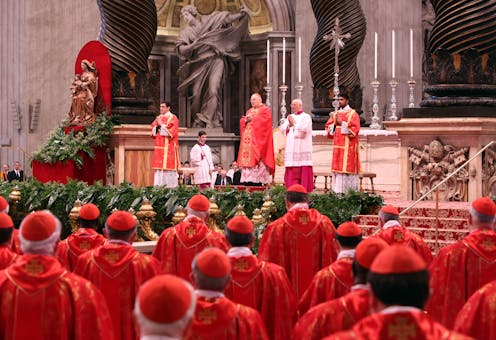
Cardinals attend Mass at St. Peter’s Basilica, before they enter the conclave to decide who the next pope will be, on March 12, 2013, in Vatican City.Photo by Franco Origlia/Getty Image
With the death of Pope Francis, attention now turns to the selection of his successor. The next pope will be chosen in what is called a “conclave,” a Latin word meaning “a room that can be locked up,” or, more simply, “a closed room.”
Members of the College of Cardinals will cast their votes behind the closed and locked doors of the Vatican’s Sistine Chapel, famous for its ceiling frescoes painted by Michelangelo. Distinguished by their scarlet robes, cardinals are chosen by each pope to elect future popes. A cardinal must be under the age of 80 to be eligible to vote in the conclave. Of the 252 members of the College of Cardinals, 138 are currently eligible to elect the new pope.
As a scholar of global Catholicism, I am especially interested in how this will be the most diverse conclave in the history of the Catholic Church.
For many centuries, the College of Cardinals was dominated by Europeans – Italians, in particular. In fact, the first time a non-European cardinal actually cast a ballot in a conclave was only in the 20th century, when Baltimore’s archbishop, James Gibbons, voted in the 1903 papal election. Now, the College of Cardinals has members from over 90 countries, with Francis having appointed nearly 80% of them.
Before the conclave, the College of Cardinals will meet in what are called “general congregations” to discuss issues facing the church. These general congregations will also be an opportunity for new cardinals and those from distant geographical locations to get to know their fellow cardinals.
This can be a time for politicking. In times past, the politicking was rumored to include bribes for votes, as was alleged in the election of Alexander VI, a Borgia pope, in 1492. Nowadays, it is considered to be bad form – and bad luck – for a cardinal to lobby for himself as a candidate. Buying votes by giving money or favors to cardinals is called “simony” and is against church law.
Two to three weeks after the papal funeral, the conclave will begin. The cardinals will first make a procession to the Sistine Chapel, where electronic jamming devices will have been set up to prevent eavesdropping and Wi-Fi and cellphone use. As they file into the chapel, the cardinals will sing, in Latin, the hymn “Come Holy Spirit.” They will then vow on a book of the Gospels to keep the conclave proceedings secret.
After these rituals, the Master of Papal Liturgical Celebrations will say out loud, in Latin, “Extra Omnes,” which means “Everyone Out.” The doors of the Sistine Chapter will then be locked, and the conclave will begin.
Francis pledging to uphold the vow of secrecy.
The voting process
The cardinals electing the pope will be seated in order of rank.
When the cardinals have assembled, nine will be chosen at random to run the election, with three of them being “scrutinizers” who will examine the ballots and read them aloud.
After writing down the name of their chosen candidate, the cardinals will bring their ballots to the front of the chapel and place them on a plate that is set on top of an urn in front of the scrutinizers. Using the plate to drop their ballot into the urn, they will say, “I call as my witness Christ the Lord who will be my judge, that my vote is given to the one who before God I think should be elected.”
A new pope is elected by a two-thirds majority. If this majority is not reached during the first ballot, the ballots will be burned in a stove. Black smoke rising through the Sistine Chapel’s chimney will signal to the outside world that the election is still ongoing, a tradition that began with the election of Benedict XV in 1914. Chemical additives are used to make sure the smoke is black because during the election of John Paul II, there was confusion over the smoke’s color.
Following the first day – and on the days thereafter – there will be up to four ballots a day if a two-thirds majority is not reached. Both Benedict XVI and Francis were elected after relatively few ballots: four in the case of Benedict; five with Francis. According to rules set by Benedict, if a new pope is not chosen after 13 days, there will be a day of prayer and reflection. Then the election will be between the top two candidates, one of whom must receive a two-thirds majority.
But regardless of the time frame, a new pope will be chosen. Once a candidate receives enough votes, he is asked, “Do you accept your canonical election as Supreme Pontiff?” By saying “Accepto,” or “I accept,” he becomes the new leader of the Catholic Church. This time, the ballots will be burned to create white smoke that will tell the world that the conclave has ended and that a new pope has been chosen.
Immediately after being elected, the new pope decides on his name, as Jorge Maria Bergoglio did when he was the first pope to choose the name Francis. The choice of a name – especially one of an immediate predecessor – often indicates the direction of the new pope’s pontificate. In Francis’ case, his name honored St. Francis of Assisi, a 13th century mystic known for his simplicity and love for nature.
The so-called Room of Tears.
The new pope is then led to the “Room of Tears.” In this chamber, off the Sistine Chapel, he will have moments to reflect on the burdens of his position, which have often brought new popes to tears. He will put on a white cassock and other signs of his office. His election will be announced from the balcony of St. Peter’s Basilica.
When Francis was announced as pope.
From the balcony, the new pope will greet the crowd below and deliver his first blessing to the world. A new pontificate will have begun.
Mathew Schmalz is Roman Catholic and a political independent.
Source: The Conversation (Au and NZ) – By Daniel Reardon, Postdoctoral Researcher, Pulsar Timing and Gravitational Waves, Swinburne University of Technology
Artist’s impression of a pulsar bow shock scattering a radio beam.Carl Knox/Swinburne/OzGrav
With the most powerful radio telescope in the southern hemisphere, we have observed a twinkling star and discovered an abundance of mysterious plasma structures in our cosmic neighbourhood.
The plasma structures we see are variations in density or turbulence, akin to interstellar cyclones stirred up by energetic events in the galaxy.
The study, published today in Nature Astronomy, also describes the first measurements of plasma layers within an interstellar shock wave that surrounds a pulsar.
We now realise our local interstellar medium is filled with these structures and our findings also include a rare phenomenon that will challenge theories of pulsar shock waves.
What’s a pulsar and why does it have a shock wave?
Our observations honed in on the nearby fast-spinning pulsar, J0437-4715, which is 512 light-years away from Earth. A pulsar is a neutron star, a super-dense stellar remnant that produces beams of radio waves and an energetic “wind” of particles.
The pulsar and its wind move with supersonic speed through the interstellar medium – the stuff (gas, dust and plasma) between the stars. This creates a bow shock: a shock wave of heated gas that glows red.
The interstellar plasma is turbulent and scatters pulsar radio waves slightly away from a direct, straight line path. The scattered waves create a pattern of bright and dim patches that drifts over our radio telescopes as Earth, the pulsar and plasma all move through space.
From our vantage point, this causes the pulsar to twinkle, or “scintillate”. The effect is similar to how turbulence in Earth’s atmosphere makes stars twinkle in the night sky.
Pulsar scintillation gives us unique information about plasma structures that are too small and faint to be detected in any other way.
Twinkling little radio star
To the naked eye, the twinkling of a star might appear random. But for pulsars at least, there are hidden patterns.
With the right techniques, we can uncover ordered shapes from the interference pattern, called scintillation arcs. They detail the locations and velocities of compact structures in the interstellar plasma. Studying scintillation arcs is like performing a CT scan of the interstellar medium – each arc reveals a thin layer of plasma.
Usually, scintillation arc studies uncover just one, or at most a handful of these arcs, giving a view of only the most extreme (densest or most turbulent) plasma structures in our galaxy.
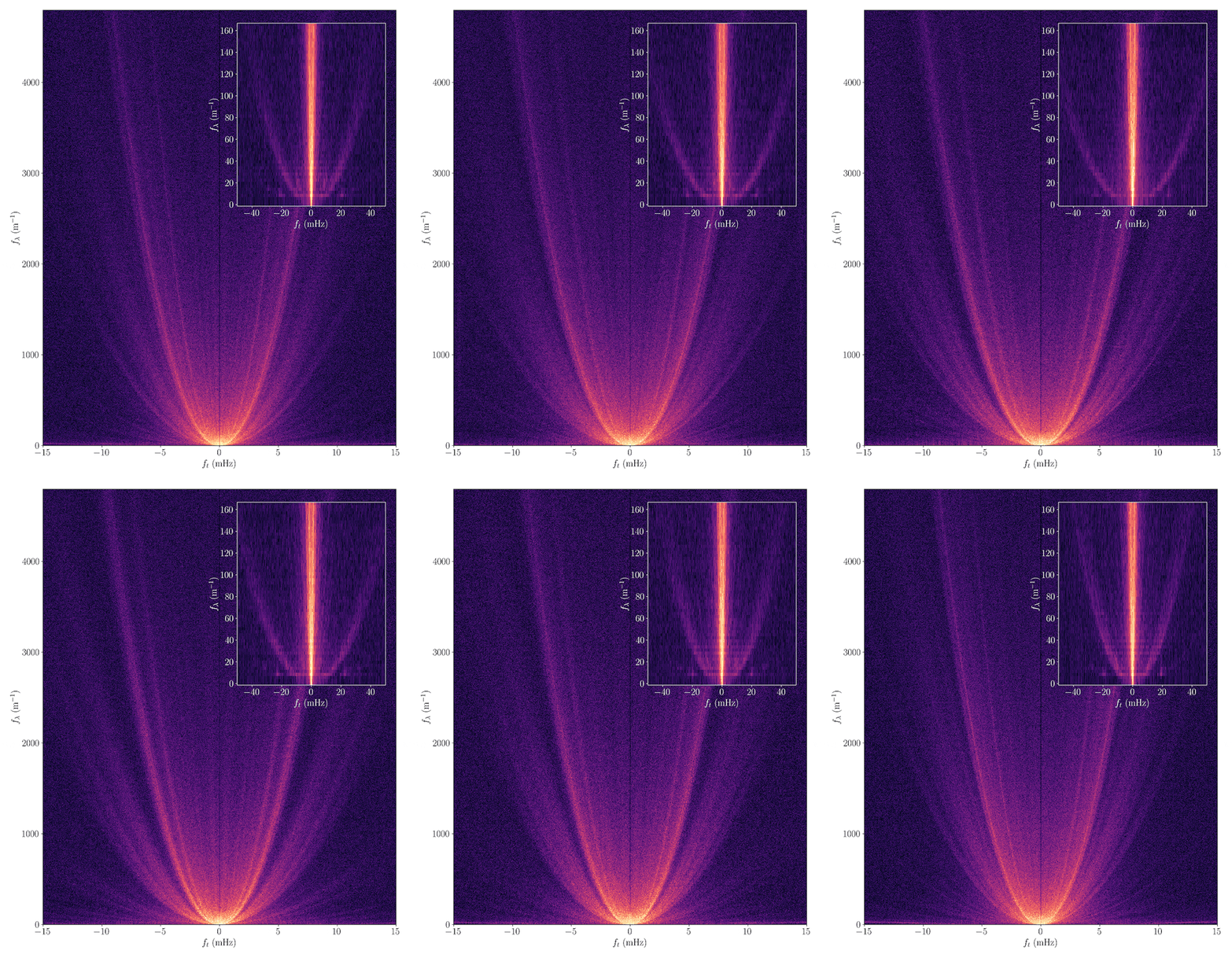
Our scintillation arc study broke new ground by unveiling an unprecedented 25 scintillation arcs, the most plasma structures observed for any pulsar to date.
Animation of 25 scintillation arcs changing in curvature with time according to the changing velocity of the pulsar. Each frame of the animation shows the scintillation arcs measured on one day, for six consecutive days. The inset scintillation arcs originate from the pulsar bow shock. Reardon et al., Nature Astronomy
A Local Bubble surprise
Of the 25 scintillation arcs we found, 21 revealed structures in the interstellar medium. This was surprising because the pulsar – like our own Solar System – is located in a relatively quiet region of our galaxy called the Local Bubble.
About 14 million years ago, this part of our galaxy was lit up by stellar explosions that swept up material in the interstellar medium and inflated a hot void. Today, this bubble is still expanding and now extends up to 1,000 light-years from us.
Our new scintillation arc discoveries reveal that the Local Bubble is not as empty as previously thought. It is filled with compact plasma structures that could only be sustained if the bubble has cooled, at least in some areas, from millions of degrees down to a mild 10,000 degrees Celsius.
Artist’s animation of the bow shock scattering the pulsar beam. Carl Knox/Swinburne/OzGrav.
While most pulsars are thought to produce bow shocks, only a handful have ever been observed because they are faint objects. Until now, none had been studied using scintillation.
We traced the remaining four scintillation arcs to plasma structures inside the pulsar bow shock, marking the first time astronomers have peered inside one of these shock waves.
This gave us a CT-like view of the different layers of plasma. Using these arcs together with an optical image we constructed a new three-dimensional model of the shock, which appears to be tilted slightly away from us because of the motion of the pulsar through space.
The scintillation arcs also gave us the velocities of the plasma layers. Far from being as expected, we discovered that one inner plasma structure is moving towards the shock front against the flow of the shocked material in the opposite direction.
While such back flows can appear in simulations, they are rare. This finding will drive new models for this bow shock.
Scintillating science
With new and more sensitive radio telescopes being built around the world, we can expect to see scintillation from more pulsar bow shocks and other events in the interstellar medium.
This will uncover more about the energetic processes in our galaxy that create these otherwise invisible plasma structures.
The scintillation of this pulsar neighbour revealed unexpected plasma structures inside our Local Bubble and allowed us to map and measure the speed of plasma within a bow shock. It’s amazing what a twinkling little star can do.
Daniel Reardon receives funding from the Australian Research Council Centre of Excellence for Gravitational Wave Discovery (OzGrav).
Pope Francis has died on Easter Monday, aged 88, the Vatican announced. The head of the Catholic Church had recently survived being hospitalised with a serious bout of double pneumonia.
Dearest brothers and sisters, with deep sorrow I must announce the death of our Holy Father Francis. At 7:35 this morning, the Bishop of Rome, Francis, returned to the house of the Father.
There were many unusual aspects of Pope Francis’ papacy. He was the first Jesuit pope, the first from the Americas (and the southern hemisphere), the first to choose the name “Francis” and the first to give a TED talk. He was also the first pope in more than 600 years to be elected following the resignation, rather than death, of his predecessor.
From the very start of his papacy, Francis seemed determined to do things differently and present the papacy in a new light. Even in thinking about his burial, he chose the unexpected: to be placed to rest not in the Vatican, but in the Basilica of St Mary Major in Rome – the first pope to be buried there in more than 300 years.
Vatican News reported the late Pope Francis had requested his funeral rites be simplified.
“The renewed rite,” said Archbishop Diego Ravelli, “seeks to emphasise even more that the funeral of the Roman Pontiff is that of a pastor and disciple of Christ and not of a powerful person of this world.”
Straddling a line between “progressive” and “conservative”, Francis experienced tension with both sides. In doing so, his papacy shone a spotlight on what it means to be Catholic today.
The day before his death, Pope Francis made a brief appearance on Easter Sunday to bless the crowds at St Peter’s Square.
Between a rock and a hard place
Francis was deemed not progressive enough by some, yet far too progressive by others.
His apostolic exhortation (an official papal teaching on a particular issue or action) Amoris Laetitia, ignited great controversy for seemingly being (more) open to the question of whether people who have divorced and remarried may receive Eucharist.
He also disappointed progressive Catholics, many of whom hoped he would make stronger changes on issues such as the roles of women, married clergy, and the broader inclusion of LGBTQIA+ Catholics.
The reception of his exhortation Querida Amazonia was one such example. In this document, Francis did not endorse marriage for priests, despite bishops’ requests for this. He also did not allow the possibility of women being ordained as deacons to address a shortage of ordained ministers. His discerning spirit saw there was too much division and no clear consensus for change.
Francis was also openly critical of Germany’s controversial “Synodal Way” – a series of conferences with bishops and lay people – that advocated for positions contrary to Church teachings. Francis expressed concern on multiple occasions that this project was a threat to the unity of the Church.
At the same time, Francis was no stranger to controversy from the conservative side of the Church, receiving “dubia” or “theological doubts” over his teaching from some of his Cardinals. In 2023, he took the unusual step of responding to some of these doubts.
Impact on the Catholic Church
In many ways, the most striking thing about Francis was not his words or theology, but his style. He was a modest man, even foregoing the Apostolic Palace’s grand papal apartments to live in the Vatican’s simpler guest house.
He may well be remembered most for his simplicity of dress and habits, his welcoming and pastoral style and his wise spirit of discernment.
He is recognised as giving a clear witness to the life, love and joy of Jesus in the spirit of the Second Vatican Council – a point of major reform in modern Church history. This witness has translated into two major developments in Church teachings and life.
Love for our common home
The first of these relates to environmental teachings. In 2015, Francis released his ground-breaking encyclical, Laudato si’: On Care for Our Common Home. It expanded Catholic social teaching by giving a comprehensive account of how the environment reflects our God-given “common home”.
Consistent with recent popes such as Benedict XVI and John Paul II, Francis acknowledged climate change and its destructive impacts and causes. He summarised key scientific research to forcefully argue for an evidence-based approach to addressing humans’ impact on the environment.
He also made a pivotal and innovative contribution to the climate change debate by identifying the ethical and spiritual causes of environmental destruction.
Francis argued combating climate change relied on the “ecological conversion” of the human heart, so that people may recognise the God-given nature of our planet and the fundamental call to care for it. Without this conversion, pragmatic and political measures wouldn’t be able to counter the forces of consumerism, exploitation and selfishness.
Francis argued a new ethic and spirituality was needed. Specifically, he said Jesus’ way of love – for other people and all creation – is the transformative force that could bring sustainable change for the environment and cultivate fraternity among people (and especially with the poor).
Synodality: moving towards a Church that listens
Francis’s second major contribution, and one of the most significant aspects of his papacy, was his commitment to “synodality”. While there’s still confusion over what synodality actually means, and its potential for political distortion, it is above all a way of listening and discerning through openness to the guidance of the Holy Spirit.
It involves hierarchy and lay people transparently and honestly discerning together, in service of the mission of the church. Synodality is as much about the process as the goal. This makes sense as Pope Francis was a Jesuit, an order focused on spreading Catholicism through spiritual formation and discernment.
Drawing on his rich Jesuit spirituality, Francis introduced a way of conversation centred on listening to the Holy Spirit and others, while seeking to cultivate friendship and wisdom.
With the conclusion of the second session of the Synod on Synodality in October 2024, it is too soon to assess its results. However, those who have been involved in synodal processes have reported back on their transformative potential.
Archbishop of Brisbane, Mark Coleridge, explained how participating in the 2015 Synod “was an extraordinary experience [and] in some ways an awakening”.
Catholicism in the modern age
Francis’ papacy inspired both great joy and aspirations, as well as boiling anger and rejection. He laid bare the agonising fault lines within the Catholic community and struck at key issues of Catholic identity, triggering debate over what it means to be Catholic in the world today.
He leaves behind a Church that seems more divided than ever, with arguments, uncertainty and many questions rolling in his wake. But he has also provided a way for the Church to become more converted to Jesus’ way of love, through synodality and dialogue.
Francis showed us that holding labels such as “progressive” or “conservative” won’t enable the Church to live out Jesus’ mission of love – a mission he emphasised from the very beginning of his papacy.
The authors do not work for, consult, own shares in or receive funding from any company or organisation that would benefit from this article, and have disclosed no relevant affiliations beyond their academic appointment.
Pope Francis, the head of the Catholic Church, died on Easter Monday at the age of 88.
On Easter Sunday, he used his message and blessing to appeal for peace in Middle East and Ukraine.
Pope Francis will be remembered as a pastoral leader who cared deeply about the environment and those impacted by migration, poverty and war.
During his Pontificate, he did make important changes to the patriarchal structure of the Catholic Church – but did he go far enough?
A pope for all?
Throughout his papacy, Pope Francis highlighted the struggles of women in society. He took important steps to expand opportunities for women in the church and address its patriarchal structure.
This was showcased by his inclusion of women in the 2024 synod (a global meeting of the whole church, represented by bishops) and his granting of voting rights for 57 women out of a total of 368 attendees.
This includes the recent 2025 appointment of an Italian religious sister, Simona Brambilla, to lead a Vatican department.
During his papacy, Pope Francis also strongly supported the ongoing involvement of women in positions of leadership in the Roman Curia (the governance body of the church).
At local levels, in parishes, he made it possible for women to be formally appointed to the positions of catechist and lector – roles previously reserved for men.
Pope Francis himself stated women still encountered obstacles, and opportunities for women to participate were under-utilised by local churches.
In his autobiography, published in January this year, he wrote of the “urgent challenge” to include women in central roles at every level of church life.
He viewed this move as essential to “de-masculinising” the church and removing the problem of clericalism.
Importantly, the reasoning that underpins women’s limited role in the life of the church remains unchanged.
In particular, Pope Francis referred to gender stereotypes and supported the theology of complementarianism (a view that women are different but equally valued, where their central contribution is to motherhood, femininity and pastoral care responsibilities).
Moreover, despite ongoing discussions, Pope Francis appeared to be unresponsive to calls for a greater role for women in ministry.
Women cannot preach during Mass or be ordained to the priesthood or deaconate, despite multiple attempts by Catholic reform groups to advocate for women’s inclusion.
The 2023 International Survey of Catholic Women, which surveyed more than 17,000 Catholic women from 104 countries and eight language groups, found women across the world were keen for church reform that recognises women’s leadership capacities and ongoing contribution to church communities.
More than eight in ten (84%) of the women surveyed supported reform in the church. Two-thirds (68%) agreed women should be ordained to the priesthood, and three-quarters (78%) were supportive of women preaching during Mass.
The survey reported on the deep frustration and despair women experienced for not having their gifts and talents recognised.
Women also stated they are dissatisfied with the burden of labour they carry in the church.
In this regard, Pope Francis did not address the financial burdens and exploitation of Catholic women who work for the church without adequate recognition or pay. This leaves women, particularly those working in parishes, open to exploitation.
While this recognition is important, church responses to abuse remain inadequate and more needs to be done to safeguard women in pastoral settings.
With regard to sexual and reproductive decision-making, the International Survey of Catholic Women found the majority of respondents wanted more freedom of conscience around such issues. This is because when they are denied by church law, women’s agency was diminished and their vulnerability to situations of gendered violence increased.
The papacy of Pope Francis has made no reforms in this area, leaving many Catholic women frustrated and disappointed.
Hope for the future?
More than 60 years ago, Vatican II generated hope for change among Catholic women.
Pope Francis reignited that hope, and listened. But responses have been too slow and Catholic women are still waiting for genuine reform.
Tracy McEwan receives funding from the Australia-Germany Joint Research Cooperation Scheme (DAAD) and Australian Research Theology Foundation Inc. (ARTFinc).
Kathleen McPhillips receives funding from the Australian Research Theology Foundation, the Australia-Germany Joint Research Cooperation Scheme (DAAD) and the Ian and Shirley Norman Foundation.
ER Report: Here is a summary of significant articles published on EveningReport.nz on April 21, 2025.
A secret mathematical rule has shaped the beaks of birds and other dinosaurs for 200 million years Source: The Conversation (Au and NZ) – By Kathleen Garland, PhD Candidate, School of Biological Sciences, Monash University The faces of living and extinct theropod dinosaurs. Left: Riya Bidaye; right: Indian Roller model (NHMUK S1987) from TEMPO bird project – MorphoSource. Bird beaks come in almost every shape and size – from the straw-like beak
Curious Kids: if heat rises, why does it get colder in the mountains? Source: The Conversation (Au and NZ) – By James Renwick, Professor, Physical Geography (Climate Science), Te Herenga Waka — Victoria University of Wellington Shutterstock/EvaL Miko If heat rises, why does it get colder as you climb up mountains? – Ollie, 8, Christchurch, New Zealand That is an excellent and thoughtful question Ollie – why indeed?
From the doable to the downright impossible: your guide to making sense of election promises Source: The Conversation (Au and NZ) – By Frank Rindert Algra-Maschio, PhD Candidate, Social and Political Sciences, Monash University Three weeks into the federal election campaign and both major parties have already pledged to spend billions in taxpayer dollars if elected on May 3. But with so many policies announced — and surely more to
Security without submarines: the military strategy Australia should pursue instead of AUKUS Source: The Conversation (Au and NZ) – By Albert Palazzo, Adjunct Professor in the School of Humanities and Social Sciences at UNSW Canberra, UNSW Sydney For more than a century, Australia has followed the same defence policy: dependence on a great power. This was first the United Kingdom and then the United States. Without properly
Prison needle programs could save double what they cost – our new modelling shows how Source: The Conversation (Au and NZ) – By Farah Houdroge, Mathematical Modeller, Burnet Institute ChameleonsEye/Shutterstock Needle and syringe programs are a proven public health intervention that provide free, sterile injecting equipment to people who use drugs. By reducing needle sharing, these programs help prevent the spread of blood-borne viruses such as hepatitis C and HIV
‘Puppy blues’: how to cope with the exhaustion and stress of raising a puppy Source: The Conversation (Au and NZ) – By Susan Hazel, Associate Professor, School of Animal and Veterinary Science, University of Adelaide Lucigerma/Shutterstock Caring for a new puppy can be wonderful, but it can also bring feelings of depression, extreme stress and exhaustion. This is sometimes referred to as “the puppy blues”, and can begin anytime
A survey of Australian uni students suggests more than half are worried about food or don’t have enough to eat Source: The Conversation (Au and NZ) – By Katherine Kent, Senior Lecturer in Nutrition and Dietetics, University of Wollongong StoryTime Studio/ Shutterstock Being a university student has long been associated with eating instant noodles, taking advantage of pub meal deals and generally living frugally. But for several years, researchers have been tracking how students are
Low effort, high visibility: what bumper stickers say about our values and identity Source: The Conversation (Au and NZ) – By Paul Harrison, Director, Master of Business Administration Program (MBA); Co-Director, Better Consumption Lab, Deakin University Justin Sullivan/Getty You may have seen them around town or in the news. Bumper stickers on Teslas broadcasting to anyone who looks: “I bought this before we knew Elon was crazy.” You
How a new ‘Fishheart’ project is combining science, community and Indigenous art to restore life in the Baaka-Darling River Source: The Conversation (Au and NZ) – By Claire Hooker, Senior Lecturer and Coordinator, Health and Medical Humanities, University of Sydney A new state-of-the-art tube fishway technology called the “Fishheart” has been launched at Menindee Lakes, located on the Baaka-Darling River, New South Wales. The technology – part of the NSW government’s Restoring the Darling-Baaka
Newspoll steady as both leaders’ ratings fall; Labor surging in poll of marginal seats Source: The Conversation (Au and NZ) – By Adrian Beaumont, Election Analyst (Psephologist) at The Conversation; and Honorary Associate, School of Mathematics and Statistics, The University of Melbourne With less than two weeks to go now until the federal election, the polls continue to favour the government being returned. Newspoll was steady at 52–48 to
Indicators of alien life may have been found – astrophysicist explains what the new research means Source: The Conversation (Au and NZ) – By Ian Whittaker, Senior Lecturer in Physics, Nottingham Trent University Darryl Fonseka/Shutterstocl What do you think of when it comes to extra terrestrial life? Most popular sci-fi books and TV shows suggest humanoid beings could live on other planets. But when astronomers are searching for extra-terrestrial life, it
The faces of living and extinct theropod dinosaurs.Left: Riya Bidaye; right: Indian Roller model (NHMUK S1987) from TEMPO bird project – MorphoSource.
Bird beaks come in almost every shape and size – from the straw-like beak of a hummingbird to the slicing, knife-like beak of an eagle.
We have found, however, that this incredible diversity is underpinned by a hidden mathematical rule that governs the growth and shape of beaks in nearly all living birds.
What’s more, this rule even describes beak shape in the long-gone ancestors of birds – the dinosaurs. We are excited to share our findings, now published in the journal iScience.
By studying beaks in light of this mathematical rule, we can understand how the faces of birds and other dinosaurs evolved over 200 million years. We can also find out why, in rare instances, these rules can be broken.
When nature follows the rules
Finding universal rules in biology is rare and difficult – there seem to be few instances where physical laws are so pervasive across all organisms.
But when we do find a rule, it’s a powerful way to explain the patterns we see in nature. Our team previously discovered a new rule of biology that explains the shape and growth of many pointed structures, including teeth, horns, hooves, shells and, of course, beaks.
This simple mathematical rule captures how the width of a pointed structure, like a beak, expands from the tip to the base. We call this rule the “power cascade”.
After this discovery, we were very interested in how the power cascade might explain the shape of bird and other dinosaur beaks.
Dinosaurs got their beaks more than once
Most dinosaurs, like Tyrannosaurus rex, have a robust snout with pointed teeth. But some dinosaurs (like the emu-like dinosaur Ornithomimus edmontonicus) did not have any teeth at all and instead had beaks.
In theropods, the group of dinosaurs that T. rex belonged to, beaks evolved at least six times. Each time, the teeth were lost and the snout stretched to a beak shape over millions of years.
But only one of these impeccable dinosaur groups survived the mass extinction event 66 million years ago. These survivors eventually became our modern-day birds.
The early bird catches the rule
To investigate the power cascade rule of growth, we researched 127 species of theropods. We found that 95% of theropod beaks and snouts follow this rule.
Using state-of-the-art evolutionary analyses through computer modelling, we demonstrated that the ancestral theropod most likely had a toothed snout that followed the power cascade rule.
Excitingly, this suggests that the power cascade describes the growth of not just theropod beaks and snouts, but perhaps the snouts of all vertebrates: mammals, reptiles and fish.
An evolutionary tree showing how theropod beaks and snouts follow the power cascade throughout their evolution. Garland et al., iScience 2025
The rule followers and breakers
After surviving the mass extinction, birds underwent a period of incredible change. Birds now live all over the world and their beaks are adapted to each place in very special ways.
We see beak shapes for eating fruit, netting insects, piercing and tearing meat, and even sipping nectar. The majority follow the power cascade growth rule.
All these bird beaks follow the power cascade rule of growth, despite being used for very different purposes. Eastern osprey by Phill Wall (modified, CC BY 2.0), Eurasian hoopoe by Giles Laurent (modified, CC BY-SA 4.0), common ostrich by Diego Delso (modified, CC BY-SA 4.0) and bar-tailed godwit by JJ Harrison (modified, CC BY-SA 4.0).
While rare, a few birds we studied were rule-breakers. One such rule-breaker is the Eurasian spoonbill, whose highly specialised beak shape helps it sift through the mud to capture aquatic life. Perhaps its unique feeding style led to it breaking this common rule.
The beak of a Eurasian spoonbill does not follow the power cascade rule of growth. Eurasian spoonbill by Swardeepak (modified,CC BY-SA 4.0)
We are not upset at all about rule-breakers like the spoonbill. On the contrary, this further highlights how informative the power cascade truly is. Most bird beaks grow according to our rule, and those beaks can cater to most feeding styles.
But occasionally, oddballs like the spoonbill break the power cascade growth rule to catch their special “worms”.
Now that we know that most bird and dinosaur beaks follow the power cascade, the next big step in our research is to study how bird beaks grow from chick to adult.
If the power cascade is truly a foundational growth rule in bird beaks, we may expect to find it hiding in many other forms across the tree of life.
Kathleen Garland receives funding from the Australian Government, Monash University and Museums Victoria.
Alistair Evans receives funding from the Australian Research Council and Monash University, and is an Honorary Research Affiliate with Museums Victoria.
Source: The Conversation (Au and NZ) – By James Renwick, Professor, Physical Geography (Climate Science), Te Herenga Waka — Victoria University of Wellington
If heat rises, why does it get colder as you climb up mountains?
– Ollie, 8, Christchurch, New Zealand
That is an excellent and thoughtful question Ollie – why indeed?
You’re right, when air is warmed, it rises. This is what gives us the “thermals” gliders can use to soar upwards and large birds of prey like the South American condors use to help them stay aloft for hours at a time.
But there are lots of other things influencing air temperature. When air rises, it expands because air pressure decreases with height. The energy in the air gets spread out over greater volumes and its temperature goes down.
This effect wins out over warm air rising. The warm air in a thermal will cool as it rises, until it reaches the temperature of the air around it and is no longer buoyant.
But why do we have rising air at all?
That’s because the air around us is heated from below, from Earth’s surface.
When the Sun is shining, it doesn’t heat the air in the lowest few kilometres of the atmosphere (the troposphere) as there are very few gases in that air to absorb sunlight.
The Sun’s rays heat Earth, not the air. The air is then warmed from below, from the ground, just as water in a pot on a stove is warmed from the bottom of the pot.
Earth’s greenhouse
Earth mostly sends energy back to space in the form of heat or infrared radiation (with wavelengths longer than visible light but shorter than microwaves), and there are plenty of gases in the air that are good at absorbing this kind of radiation, even if they don’t feel the sun’s energy.
These are what we call greenhouse gases – water vapour, carbon dioxide, methane and so on. Because we have these in the air, the absorption of infrared energy is the main way the air is warmed.
Again, air near the ground is warmed the most by this absorption of energy.
The warm air near Earth is buoyant so it often “bubbles up” into the atmosphere, just like the water in a pot on a stove.
But in the atmosphere, the decrease of pressure with height dictates that temperatures decrease as you go up. This is what’s known in weather jargon as the “lapse rate” – how fast temperatures decrease with height. In dry air (no water vapour), that rate is just under 10°C per kilometre, or a little under 1°C cooler per 100 metres upwards.
When we have water vapour in the air, it’s a different story. As the air rises and cools, it can’t hold so much water vapour, so some of the vapour has to condense back into liquid water. As it does that, it releases the energy it took to evaporate it in the first place.
That heat warms the air and reduces the “lapse rate”. How big this effect is depends on how much moisture was in the air to start with. On average, the temperature decrease of about 10°C per kilometre goes down to around 6.5°C per kilometre.
And what happens to that liquid water in the air? If forms tiny droplets that make clouds. If enough of those drops stick together and become heavy enough, they’ll fall back to Earth as rain.
Clouds, rain and lightning
We have clouds and rain because temperatures decrease with height. The clouds that form this way, through buoyant air rising in thermals, are known as cumulus clouds.
Cumulus always have lumpy tops, looking a bit like a cauliflower. That’s because different parts of the rising air have different amounts out water vapour in them. So different amounts of energy are released, giving the air different buoyancy in different places. The moistest, most buoyant air rises the highest, while drier less buoyant air doesn’t make it so far up.
If there is lots of moisture available, we can get a thunderstorm cloud, with thunder and lightning as well as plenty of rain. Not just rain either, but often hail (frozen rain).
That happens because the temperature in the upper parts of such deep clouds is well below freezing, so it is made up of ice crystals rather than water drops. Those ice crystals can stick together to form hail, or snow.
Lightning forms because of positive electrical charges at the top of clouds and negative charges at the bottom. Shutterstock/Athapet Piruksa
Curiously, it’s the collisions between ice crystals and water drops as they go up and down in a deep cumulus cloud that gives rise to lightning, with a build-up of positive electrical charges at the top of the cloud and negative charges at the bottom.
Getting back to your original question, why is it colder in the mountains? That’s because as we climb a mountain, we are moving into cooler layers of the atmosphere. We are getting above the surface layers of the atmosphere, going to lower pressures, and that causes the temperature to drop.
Warm air can still rise from a mountaintop, but it’ll be cooler to start with than air down at sea level, just because it’s at a lower pressure. Climbers who tackle really high mountains, like Mount Everest, usually take oxygen cylinders with them as the air is so thin near the top of such high peaks.
That’s also why snow and ice linger on mountain tops, as that’s where it is cold enough year-round to keep the ice frozen.
Hello curious kids! Do you have a question you’d like an expert to answer? Ask an adult to send your question to curiouskids@theconversation.edu.au. Please tell us your name, age and the city where you live.
James Renwick receives funding from the Ministry of Business, Innovation and Employment (MBIE). He is a member of the Green Party.
Three weeks into the federal election campaign and both major parties have already pledged to spend billions in taxpayer dollars if elected on May 3.
But with so many policies announced — and surely more to follow — sometimes it can be hard to make sense of exactly what is being promised.
That ambiguity can come back to bite voters, and the government, during the next term.
So, how do you sort the deliverable promises from the downright impossible?
It’s a question we reckoned with while tracking Labor’s 2022 campaign promises over the last term through our Election Promise Tracker.
Politicians can make it hard to hold them accountable for their commitments later, so it’s important to know when you’re being sold a pup. Here are our tips on what to look out for in the lead-up to polling day.
Distant horizons
Promise tracking relies on clearly defined actions that can be assessed against a specific timeline, and ideally by the end of a government’s term.
But politicians have a habit of announcing policies that extend over much longer horizons, with no guarantee their party will be in government to see them through.
This can happen with large infrastructure projects and other big spending announcements, such as Labor’s 2022 promise to bring investment in the Great Barrier Reef to $1.2 billion by 2030, or the Coalition’s 2025 plan to build its first nuclear reactors by the middle of next decade.
Certainly, governments should set long-term priorities. But if pledges won’t be completely fulfilled, voters should at least know what to expect during the coming term.
One way to gauge if parties are serious about promises is if they have outlined the shorter steps required to reach their longer-term goals.
Can it be measured?
The difference between concrete promises and mere rhetoric largely boils down to whether a pledge can be objectively measured.
Sometimes a promise can seem measurable but still lack a reliable or definitive measure to assess it when the time comes.
Jobs targets are a classic example of this, seen in the Coalition’s 2022 election pitch to create “1.3 million new jobs” and also Labor’s recent boast to have delivered “a million new jobs”.
As experts have persistentlypointed out, these numbers do not account for population growth or, importantly, the fact that governments cannot take credit for every new private sector job.
Another example is Labor’s infamous promise to shave $275 off the average annual household electricity bill by 2025. While there is good data to track electricity bills, we won’t have the numbers necessary to assess the most recent term until mid-2026.
When it comes to promises that depend on specific figures, voters should consider whether they will have reliable data to assess the final outcome.
Lacking the details
Parties regularly dole out promises at press conferences along the campaign trail, but these announcements can be vaguely worded, leaving voters to fill in the blanks.
For example, Labor’s 2022 pledge to “get real wages growing” could have been understood several different ways, including as a promise to increase wages during just one quarter. (Our promise tracker took it to mean wages would be higher at the end of the government’s term than at the start.)
In fairness, parties do often publish their policies online, but these documents can be light on specifics.
During the current campaign, for example, Labor has promised to spend $1 billion in mental health support. Its policy says the funding will build or upgrade more than 100 mental health centres — but has so far neglected to say when that will happen in their policy documents.
The finer details can sometimes be found in a party’s costing documents, which also show whether funding announcements are already budgeted or genuinely new, although the major parties often release these documents only days outfrom the election.
This can leave little time for serious public scrutiny or analysis, especially for early voters, who in this election could account for half the electorate.
So before you vote, it’s worth checking whether more details have been released about the promises that matter to you.
The importance of keeping track
Promise tracking helps voters hold their government to account by ensuring politicians don’t wriggle out of their commitments.
Many will recall, for example, Labor’s 2022 pledge to “establish a Makarrata Commission with responsibility for truth-telling and treaty” — and, following the Voice referendum, the prime minister’s attempt to recast it as a general commitment to the “process” of Indigenous reconciliation.
Equally, it’s important that governments aren’t held to promises they never made.
In the case of Labor’s energy bills pledge, the Coalition has begun to claim that voters were promised a $275 “per year” saving but that household bills had instead increased by $1,300. That total appears to represent a tally of unconfirmed cumulative increases over each of the government’s three years, whereas Labor promised to deliver its $275 reduction “by 2025”.
Despite popular opinion, governments in Australia and abroad typically deliver on the majority of their promises.
But convincing voters of that fact requires giving them enough details to know what they are voting for and, ultimately, to assess whether it has been achieved.
Lisa Waller receives funding from The Australian Research Council
David Campbell, Eiddwen Jeffery, and Frank Rindert Algra-Maschio do not work for, consult, own shares in or receive funding from any company or organisation that would benefit from this article, and have disclosed no relevant affiliations beyond their academic appointment.
Source: The Conversation (Au and NZ) – By Albert Palazzo, Adjunct Professor in the School of Humanities and Social Sciences at UNSW Canberra, UNSW Sydney
For more than a century, Australia has followed the same defence policy: dependence on a great power. This was first the United Kingdom and then the United States.
Without properly considering other options, successive federal governments have intensified this policy with the AUKUS agreement and locked Australia into dependency on the US for decades to come.
A more imaginative and innovative government would have investigated different ways to achieve a strong and independent national defence policy.
One that, for instance, didn’t require Australia to surrender its sovereignty to a foreign power. Nor require the acquisition of fabulously expensive nuclear-powered submarines and the building of overpriced, under-gunned surface warships, such as the Hunter frigates.
In fact, in an age of rapidly improving uncrewed systems, Australia does not need any crewed warships or submarines at all.
Instead, Australia should lean into a military philosophy that I describe in my upcoming book, The Big Fix: Rebuilding Australia’s National Security. This is known as the “strategic defensive”.
What is the strategic defensive?
The strategic defensive is a method of waging war employed throughout history, although the term’s use only dates to the early 19th century.
It doesn’t require a state to defeat its attacker. Rather, the state must deny the aggressor the ability to achieve their objectives.
The strategic defensive best suits “status quo states” like Australia. The people of status quo states are happy with what they have. Their needs can be met without recourse to intimidation or violence.
These states also tend to be militarily weak relative to potential aggressors, and aren’t aggressors themselves.
In short: if war eventuates, Australia’s only goal is to prevent a change to the status quo.
In this way, strategic defensive would suit very well as the intellectual foundation of Australia’s security policy.
Strong reasons for a strategic defensive approach
There are also sound military and technological reasons why Australia should frame its security around the strategic defensive.
It is harder to capture ground (including sea and airspace) than it is to hold it. All aggressors must attack into the unknown, bringing their support with them. Defenders, by contrast, can fall back onto a known space and the provisions it can supply.
Military thinkers generally agree that to succeed in war, an attacker needs a three-to-one strength advantage over the defender.
And the wide water moat surrounding the Australian continent greatly complicates and increases the cost of any aggressor’s effort to harm us.
Australia could also use weapons now available to enhance the inherent power of being the defending side. Its task need only be making any attack prohibitively expensive, in terms of equipment and human life.
Long-range strike missiles and drones, combined with sensors, provide the defending nation with the opportunity to create a lethal killing zone around it. This is what China has done in the East and South China Seas.
Australia can do the same by integrating missiles, drones and uncrewed maritime vessels with a sensor network linked to a command-control-targeting system.
Missiles and drones are a better buy when compared to the nuclear-powered submarines Australia hopes to acquire from the United States, as well as the warships – including more submarines – the government plans to build in the Osborn and Henderson shipyards.
And most importantly, they are available now.
A smarter strategy
A defensive network also makes strategic sense for Australia, unlike the planned AUKUS nuclear-powered submarines. Australia has no need to operate in distant waters, such as those off the coast of China.
In addition, Australia can afford so few vessels that their deterrence effect is not credible. Missiles and drones are vastly cheaper, meaning Australia can buy them in the thousands.
Australia is making the mistake of focusing on the platform – expensive ships and planes – rather than the effect needed: the destruction of a potential enemy with swarms of weapons.
In fact, the age of large crewed warships, both on and below the sea, is coming to an end. Long-range strike technology means the sea can now be controlled from the land. Rapidly improving sensors make it impossible for attackers to hide on, below or above the surface of the ocean.
A better bet would be for Australia to invest in uncrewed surface and sub-surface maritime vessels to patrol its approaches, as well as large numbers of land-based launchers and missiles.
For a small power such as Australia, investing in this makes more sense than a small, bespoke number of extremely expensive and vulnerable warships.
It’s not too late to rethink
It is clear Australian leaders have decided to intensify Australia’s dependence on the US rather than seeking to create a military capable of securing the nation on our own .
The cost is nigh-on ruinous in terms of not just money, but also the entanglement in foreign-led wars and potential reputational loss.
Perhaps worst of all, the nation is making itself into a target – possibly a nuclear target – if war between the US and China was to eventuate.
This need not have been the outcome of the government’s recent defence reviews. But it’s not too late to rethink.
By adopting a different military philosophy as the guide for its security decision-making, Australia could manage its security largely on its own.
This only requires leaders with a willingness to think differently.
This is the first piece in a series on the future of defence in Australia.
Albert Palazzo is not a member of a political party but does occasional volunteer work for The Greens. In 2019, he retired from the Department of Defence. He was the long-serving Director of War Studies for the Australian Army.
Needle and syringe programs are a proven public health intervention that provide free, sterile injecting equipment to people who use drugs. By reducing needle sharing, these programs help prevent the spread of blood-borne viruses such as hepatitis C and HIV and minimise life-threatening bacterial infections.
Australia leads the world in community-based needle and syringe programs. But they are not used in Australian prisons – which are hotspots for injection-related infections.
This is a breach of human rights and United Nations resolutions, which make clear health-care standards for people in prison must be equivalent to those in the community.
In addition to meeting human rights standards, our new modelling – the first of its kind in Australia – shows there would be significant economic benefits to implementing prison-based programs.
Needle and syringe programs in the community
Australia is a world leader in needle and syringe programs in the community. There are 4,218 sites across the country (as of 2021). Each year they distribute more than 50 million needles and syringes.
Among people who inject drugs, that’s about 508 needles and syringes per person each year — the highest rate globally, and more than double the World Health Organization’s benchmark for high needle and syringe program coverage (200 per person per year).
For reference, the country with the second-highest coverage was Finland (with 450 needles and syringes per person who injects drugs per year) followed by the Netherlands (367).
Prisons are infection hotspots
A law enforcement emphasis in responding to drug use – rather than public health focus – has resulted in grossly disproportionate rates of incarceration among people who use drugs.
In Australia, between 29% and 52% of people in prisons report injecting drugs at some point in their lives, and around 40% of people who were injecting drugs in the community before prison continue to inject inside.
Without access to sterile injecting equipment, needle sharing and unsafe injecting practices are common. As a result, people who inject drugs in prison are at higher risk of transmitting blood-borne viruses such as hepatitis C than those in the community.
But the prevention strategies used in the community – which stop infections happening again – are not used in prison. Re-infection in prisons occurs at more than twice the rate of initial infection.
However, legal and political opposition, concerns around safety and security, and funding constraints have all contributed to the lack of progress.
As of 2023, prison needle and syringe programs operated in eleven countries worldwide. The outcomes are positive for both health (reduction in needle sharing, drug use and hepatitis C and HIV transmission) and prison safety.
A 2024 study of Canada’s existing needle and syringe program, operating in nine prisons, found it will save the health-care system $C0.85 million in treatment costs between 2018 and 2030 by preventing hepatitis C and other injection-related infections. In contrast, the program cost just $C0.45 million to run. Canada has since expanded the program to eleven prisons nationwide.
Here’s what we found
To bring an economic perspective to this debate in Australia, our new study estimated the costs and benefits of introducing needle and syringe programs in all Australian prisons, aiming to reach 50% of people who inject drugs in prison between 2025 and 2030.
We drew on a similar program in Luxembourg which follows international best practice. This needle and syringe program is delivered through prison health services. Sterile injecting equipment is provided face-to-face by health staff. Used equipment is exchanged one-for-one (meaning a sterile needle-syringe can be exchanged for a used one), in a confidential and safe manner.
Then, we identified the specific components and resources needed to implement the program, such as sterile injecting equipment and annual training sessions for prison health staff. We researched their associated costs to calculate the total cost of scaling-up nationally.
Finally, we modelled the number of hepatitis C and other injection-related infections the program would prevent. These infections can have serious health consequences and are costly to treat. The money saved here helped us calculate the cost savings (that is, the benefits) of the program.
Implementing prison-based programs nationally would cost approximately $A12.2 million between 2025 and 2030. But this investment could prevent 894 hepatitis C infections and 522 injection-related bacterial and fungal infections.
We estimated these infections would cost the health-care system $31.7 million to treat – more than double the cost of preventing them with a prison needle and syringe program.
In other words: for every dollar invested in prison-based programs, more than two dollars would be saved in health-care costs.
Where to from here?
People have strong views about injecting drug use and prison-based needle and syringe programs. But countries where needle and syringe programs have been successfully implemented in prisons have several things in common.
First, there is widespread understanding among everyone involved in using, administrating or overseeing the program of its benefits. Eliminating blood-borne viruses can reduce health risks for people in prison and improve the safety of staff.
Second, successful implementation is inclusive. It ensures a range of people have meaningful input in how the program is designed and delivered, including incarcerated people, health-care professionals and policymakers, prison officers and government bodies.
Third, drug use in prison is treated as a public health issue, not a political football. The failed War on Drugs has only compounded the issue, leading to the over-incarceration of people who use drugs and the creation of lucrative prison drug markets.
If Australia is to eliminate hepatitis C by 2030 – as the national hepatitis C strategy outlines – it will be essential to combine prison-based treatment with prevention strategies, including needle and syringe programs.
We now know they are likely to save money too.
Mark Stoové has received funding from the National Health and Medical Research Council, the Victorian Department of Health, and the Commonwealth Department of Health and Aging. He has also received investigator-initiated research funding from Gilead Sciences and AbbVie and consultant fees from Gilead Sciences for activities unrelated to this work.
Nick Scott receives funding from the National Health and Medical Research Council of Australia, and has previously received funding from the Victorian Department of Health and the Commonwealth Department of Health and Aged Care.
Farah Houdroge does not work for, consult, own shares in or receive funding from any company or organisation that would benefit from this article, and has disclosed no relevant affiliations beyond their academic appointment.
Caring for a new puppy can be wonderful, but it can also bring feelings of depression, extreme stress and exhaustion. This is sometimes referred to as “the puppy blues”, and can begin anytime after the puppy arrives in the household.
physical exhaustion, due to all the feeding, training, cleaning, walks, management and sleep disruptions
emotional exhaustion
feeling depressed or guilty for not “doing enough” for the puppy
self-imposed perfectionist stress and feeling pressure to raise a puppy “the right way”
feelings of regret and doubt
constantly wondering if the puppy would be better off with someone else or being returned.
The good news is these feelings are generally temporary. Puppies have a number of difficult developmental states that need to be managed (each with their own unique challenges) – but these will pass as your puppy grows and settles in.
The bad news? It can be really tough, and can last weeks or months.
There is very little research into the puppy blues. But through interviews, surveys and longitudinal studies (where scholars track people’s experiences over time), researchers have begun piecing together what can help puppy owners survive these challenges.
Much like rearing children, puppy raising is hardest as a solo journey. Researchers highly recommend building a team around you and your puppy to help decrease the stress.
Seek help from parents, friends and family. Having people who you can call to puppysit and to lean on emotionally during tough times is a lifesaver for puppy owners.
Having a great local vet you trust is crucial (bonus points if you also get yourself a vet with further qualifications in animal behaviour). Chat to your vet if you are worried about your puppy’s behaviour or want to know more about force-free training.
Online communities have their place too. Seeing others go through (and survive!) similar challenges can be a great relief. These communities can also be a treasure trove of advice.
That said, remember there’s almost just as much bad advice as good online. Check with your vet if you’re unsure. The use of aversive training methods, such as smacking or yelling, is associated with more behavioural problems by the time your puppy is a year old.
And if you find yourself feeling really overwhelmed, don’t be afraid to chat to your GP about your mental health.
Make sure you have the right resources
Puppy care is full-time work. Working two full-time jobs leads to burnout. If possible, take time off work to help settle your new pet in. If your can’t, call on your village for help with puppysitting.
Consider how you can make use of long-lasting toys and safe spaces to keep your puppy entertained for a while without your input.
Long lasting chew toys, “snuffle mats” (which can be easily and cheaply made at home and can be used to hide food), and puzzle toys can also help your puppy learn to relax and settle on their own.
Play pens are also a godsend and allow you to step away or rest while they nap, eat or play.
Keep realistic expectations
There is no such thing as “perfect” when it comes to raising a puppy; chasing perfection will only lead to misery.
It can help to remember that puppies are babies. They are not supposed to know the cue to sit or stay yet, or to be able to focus on you for long during a training session.
When their teeth hurt, they’re going to grab the nearest item to chew on – which might be your hand, your shoe or your favourite sunglasses. Either way, babies are going to make mistakes, not because you’ve failed, but because their brains are too underdeveloped to do any better right now.
Training sometimes goes backwards – or out the window altogether. This is especially true when we hit new developmental periods. It’s normal and you’ve done nothing wrong (remember those underdeveloped brains!). If you’re concerned, seek professional advice from a vet.
Remember, none of the challenges will last forever. Try to enjoy the good moments, because they won’t last forever either.
Is kitten blues a thing?
While kitten blues has not been researched as much as puppy blues, many kitten owners in online forums anecdotally report similar feelings of overwhelm and exhaustion.
So it’s reasonable to assume this phenomenon exists and is likely very similar to its puppy counterpart. The advice in this article applies to both kittens and puppy owners.
Puppies and kittens are certainly not easy to raise.
But when you’re staring into those adorable eyes, wondering how this tiny creature who brings you so much love can also make you cry with exhaustion, remember: you’ve got this.
Susan Hazel has received funding from the Waltham Foundation. She is affiliated with the Dog and Cat Management Board of South Australia and the RSPCA South Australia.
Ana Goncalves Costa is affiliated with the Delta Institute and South Australian veterinary behaviour clinic Pawly Understood.
In new research, we look at how the problem is getting worse.
Our research
In March 2022 and March 2024, we surveyed University of Tasmania students about their access to food.
More than 1,200 students participated in the first survey and more than 1,600 participated in the second. Students were recruited through university-wide emails and social media and included both undergraduate and postgraduate students from a range of disciplines.
We used an internationally recognised survey to assess food insecurity. It can tell us whether students are struggling and to what extent.
It asked simple but revealing questions about financial barriers to food, such as “In the past 12 months, did you ever skip meals because there wasn’t enough money for food?” or “Did the food you bought just not last, and you didn’t have money to get more?”
Students were then classified as “food secure” or as one of three levels of food insecurity:
marginally food insecure: students were worried about running out of food
moderately food insecure: students were compromising on the quality and variety of food they ate
severely food insecure: students were often skipping meals or going without food altogether.
We asked students if they regularly skipped meals or if they didn’t have money for food. Cottonbro Studio/ Pexels, CC BY
Regularly going without food
We found overall, food insecurity among students increased from 42% in 2022 to 53% in 2024.
The proportions of those experiencing marginal or moderate levels of food insecurity was stable (at about 8% and 17–18% respectively). But the number of students experiencing severe food insecurity jumped from 17% to 27%.
While food insecurity increased among most groups, younger students, those studying on campus and international students were the most at risk.
Although our study focused on the University of Tasmania, similar rates of food insecurity have recently been reported at other regional and metropolitan universities across the country. This suggests it is a widespread issue.
National data on food insecurity in the general Australian population is limited, with no regular government monitoring. The 2024 Foodbank Hunger Report estimates 32% of Australian households experienced food insecurity, including 19% with severe food insecurity.
Why is this happening?
While our study didn’t directly explore the causes of student hunger, rising inflation, high rents and limited student incomes are likely factors.
The surveys happened during a time of sustained inflation and rising living costs. We know rents, groceries and other essentials have all gone up. But student support payments have not kept pace over the study period.
Estimates suggest about 32% of Australian households in general do not have enough to eat. Armin Rimoldi/Pexels, CC BY
What can we do?
To address food insecurity among students, coordinated action is needed across universities and state and territory governments.
Universities often run food pantries to provide students with basic supplies, but they also need more long-term supports for students.
State governments can reduce the financial stress that contributes to food insecurity by expanding stipends and support for students on unpaid clinical placements in the state system. They could also expand public transport concessions to all students, including international students.
The federal government can raise Youth Allowance and Austudy to reflect real living costs. The new Commonwealth Prac Payment could be expanded beyond teaching, nursing, midwifery and social work to cover all students undertaking mandatory unpaid placements. The government’s plan to raise HECS-HELP repayment thresholds could also ease the financial pressure on recent graduates.
Katherine Kent does not work for, consult, own shares in or receive funding from any company or organisation that would benefit from this article, and has disclosed no relevant affiliations beyond their academic appointment.
Source: The Conversation (Au and NZ) – By Paul Harrison, Director, Master of Business Administration Program (MBA); Co-Director, Better Consumption Lab, Deakin University
You may have seen them around town or in the news. Bumper stickers on Teslas broadcasting to anyone who looks: “I bought this before we knew Elon was crazy.”
You might assume it’s there to prevent someone from keying the car or as an attempt to defuse potential hostility in a hyper-politicised landscape. But while it may signal disapproval to like-minded passersby, a sticker is unlikely to dissuade someone already intent on committing a crime (which keying is).
What it does offer, though, is a form of symbolic insurance. You might call it a way to clarify identity in a hostile political environment.
Equal parts apology, protest and cultural timestamp, the message can say more in eight words than a full-blown op-ed. But it’s not just about a car. It’s also about values, identity management and the evolving politics of consumption.
A signal to others
At their core, car bumper stickers function as a vehicle (literally and metaphorically) for identity projection. They are symbols of what psychologists call “low-cost identity displays”, used to project who we are or perhaps more accurately, how we want to be seen.
Buying a Tesla may once have signalled innovation, environmental consciousness, or social progressivism. But Musk’s increasingly polarising public behaviour and political commentary have altered the cultural meaning of the brand.
This creates a sense of cognitive dissonance for those consumers whose values no longer align with what the brand’s owner now represents. Enter the bumper sticker.
Sales of Tesla have fallen sharply this year as Elon Musk has become more political. Shutterstock
In an increasingly fragmented society, where people are eager to differentiate themselves, even a sticker can be a subtle form of moral positioning. But more than anything, it’s often a way to signal to the groups that matter most to us, “please like me”.
Social identity theory suggests people derive part of their self-concept from their perceived membership in social groups. Bumper stickers make these group affiliations visible, projecting values, ideologies, affiliations, or even contrarian attitudes to the outside world.
My tiny fading Richmond Tigers sticker on my car may not be performative in the same way a bold political slogan might be. But it still signals a form of identity and belonging.
Bumper stickers can make affiliation with social groups visible. Shutterstock
The North Face jacket
Bumper stickers act as a form of “peacocking”. It’s similar to wearing branded clothing, like Dan Andrews’ The North Face jacket during COVID that made him appear more approachable than he would have in a formal suit. Or like even curating a bio on LinkedIn. This is a behavioural strategy where people communicate their traits to others without words.
In marketing, this links closely to the theory of conspicuous consumption, which can include symbolic consumption, where we buy and display products not just for utility, but for what they say about us.
Bumper stickers are a literal version of this. They are symbolic, declarative and public. They’re low-effort, high-visibility communicators of group affiliation, virtue, humour, rebellion or outrage.
The intention might be to inform or persuade, but their actual influence is more complicated.
Marketing class 101
In introductory marketing classes, taught at pretty much every university, awareness is often presented as the first stage of the hierarchy of effects model. The model suggests consumer action progresses from awareness to knowledge, liking, preference, conviction, and finally, purchase.
Stickers are unlikely to influence behaviour. Shutterstock
But in practice, this progression is significantly more complicated. Bumper stickers may generate awareness, but there’s little evidence they influence behaviour – especially when considered in isolation.
This is particularly relevant in areas such as tourism promotion. For example, an unofficial, but nevertheless provocative tourism slogan like the “CU in the NT” ad campaign might spark conversation and recognition, but recognition does not equate to conversion.
Despite the hope that underpins the millions of dollars spent on slogans and taglines, awareness is necessary but not sufficient for behavioural change.
Most marketing efforts fail not because people are unaware of the brand, but because they have no reason, opportunity, or inclination to act – that is, to buy the product or change behaviour.
Culture has fragmented
Contemporary consumer culture is increasingly tribal and fragmented. Social media algorithms reinforce echo chambers, while physical signals such as car stickers or even political corflute signs signal belonging and in-group and out-group boundaries.
As a result, bumper stickers probably reinforce identity for the already converted, but are unlikely to persuade those outside the tribe.
Visible preferences, however, can serve as a form of shorthand for identity, especially when they align with the symbols and language of the in-group. Although their direct influence on behaviour is limited, these signals, when repeated and reinforced within a receptive community, can shape and shift social norms over time.
In the end, bumper stickers rarely change behaviour. But they do something more subtle. They allow people to express, perform and affirm identity. They act as signals to others, markers of tribe, values, humour or defiance. They help us say this is who I am, or maybe, this is what I am not.
Paul Harrison has received research funding from Consumer Action Law Centre, Australian Securities and Investment Commission, the Australian Competition and Consumer Commission, and the Victorian Health Association.
A new state-of-the-art tube fishway technology called the “Fishheart” has been launched at Menindee Lakes, located on the Baaka-Darling River, New South Wales.
The technology – part of the NSW government’s Restoring the Darling-Baaka program – will allow native fish to move past large barriers, such as dams, weirs and regulators, when they need to. It’s hoped this will help the fish reproduce and survive, and reduce the risk of mass fish deaths in the Baaka.
At the same time, meaningful policy reform and implementation can’t be achieved without input from First Nations communities. So how do we do this? One creative collaboration on the Fishheart project suggests art may have a big role to play.
Distressing images
Several deeply distressing mass fish death events have occurred in the river since 2018, with millions of native fish, including golden perch, silver perch and Murray cod, dying due to insufficient oxygen in the water.
These events are the outcome of compounding challenges in managing the Murray-Darling Basin, Australia’s largest inland river system. The basin, which stretches from Southern Queensland to South Australia, is a water source for some three million people.
But the construction of infrastructure such as dams, weirs and regulators has profoundly disrupted the natural processes that once sustained healthy river systems. This disruption has been made worse by ineffective and conflict-ridden governance.
The Baaka is a source of life and wellbeing for numerous communities. It should be cared for with the same urgency and coordination as a critically ill patient. If too many doctors or nurses are involved without a clear shared treatment plan, the patient suffers. Likewise, when multiple agencies attempt to manage a sick river, the system can break down.
So how can better care be achieved? For Barkindji Elder David Doyle the answer lies in doing it together.
Seeking and listening to Aboriginal community
Aboriginal peoples have been explaining the importance of Australia’s inland rivers for generations. The Aboriginal community at Menindee held protests about the health of the Baaka two years before the first mass fish deaths. Yet their voices and cultural knowledges have not reconfigured river policy.
A report by the NSW Office of the Chief Scientist and Engineer into the March 2023 mass fish deaths on the Lower Baaka identified the importance of including Aboriginal cultural knowledges in strategies for fish species regeneration and management.
However, according to Barkindji Ngnukuu elder Barbara Quayle, the community’s experience of “consultation” has been a tick-box activity. She says there is no trust that cultural knowledges or community perspectives will actually be listened to.
The power of the arts
Traditional cultural knowledges are often held and expressed through various artforms, from story, to dance, to gallery arts. Within rural and remote communities, the arts and art-making create conditions that can help people work together to address complex issues. In fact, there’s a long history of the arts being used to address social conflict.
Can the Fishheart help prevent fish kills? We don’t know. But the Barkindji community’s artistic input in the project is enabling a more integrated approach to finding out.
Elders and community members have come together with regional arts organisation, The Cad Factory, and the NSW Department of Primary Industries and Regional Development’s Fisheries branch, to design traditional knowledge-inspired art for the Fishheart pipes.
This art was painted onto the pipes by members of Barkindji community over the past month. Other community art, including collaborations with the local school, was also placed around the site.
Making the art gave everyone involved the time, space and tools to consider and discuss the project. We learned how the Fishheart technology is inspired by the human heart, with tubes resembling “veins” and “arteries” that can take fish in and “pump” them over barriers through a siphon effect, letting them circulate throughout the river.
We discussed important details on how this technology works, which includes using artificial intelligence used to detect fish in the pipes and collect real-time data and photos of the migration. We also considered how we might further care for the river, by potentially allowing the removal of invasive species, or monitoring for diseases.
The project also provided fisheries managers with the opportunity to hear community concerns, such as whether the installation of fishways might be perceived in ways associated with colonisation, or eventually lead to fish removal from the waterways.
Most importantly, seeing the pipes visually transformed by Barkindji art connected the Fishheart to place and Country. The art provides a tangible expression of uninterrupted Barkindji custodianship for the river and the species that depend on it.
With art, there is hope for creating policy together – policy that might promote the health of the river as a whole, rather than treating the symptoms of the problem.
Claire Hooker receives funding from the NHMRC, MRFF, ARC, and University of Sydney. She is affiliated with Arts Health Network NSW/ACT.
Barbara Quayle is the Vice-president of the Menindee Aboriginal Elders Council, sits on the Barkindji Native Title Board and NSW Aboriginal Water Strategy Board and is a founding guide of Barkindji cultural immersion tour group, Wontanella Tours.
Dave Doyle is a member of the Menindee Aboriginal Elders Council, a previous member of the Barkindji Native Title Board, sits on the NSW Aboriginal Water Strategy Board and is a founding guide of Barkindji cultural immersion tour group, Wontanella Tours.
Reakeeta Smallwood has received funding from ARC and NHMRC, in partnership with University of Sydney, University of Newcastle and University of New England. These funding sources are not relevant to this article or project.
As it seeks to gain some momentum for its campaign, the Coalition on Monday will focus on law and order, announcing $355 million for a National Drug Enforcement and Organised Crime Strike Team to fight the illicit drug trade.
A Dutton government would put Australian Federal Police teams into the states and territories, which would be nationally led and supported by specialist financial investigative and prosecutorial teams.
This would bring an anticipated “significant increase in the seizure of criminal assets and proceeds of crime, which we will reinvest into communities,” Opposition Leader Peter Dutton and shadow ministers said in a statement.
“This means every dollar seized from drug dealers and criminal cartels will go towards helping the families and communities devastated by their crimes.”
In what it dubs a crackdown on crime from “the border to the backyard” the opposition has brought together its various initiatives in a $750 million “Operation Safer Communities” package. Apart from the taskforce, other measures have been previously announced.
The initiatives include:
new laws to disrupt organised criminal syndicates
upgrading border screening to intercept drugs and cracking down on the importation of date-rape drugs used in drink spiking
extra funding for Crime Stoppers
more money for the Australian Centre to Counter Child Exploitation, and piloting a national child sex offenders disclosure scheme that would provide more information to parents about the risks in their communities
investment in e-safety education through the Alannah and Madeline Foundation
introducing national “post and boast” laws making it illegal to post social media material glamorising involvement in crime
working with other jurisdictions to standardise knife crime laws, and funding a national rollout of detector wands
restoring the Safer Communities Fund to support local projects to improve social cohesion
reintroducing fast track processes for visa appeals to deal with bad actors overstaying.
The Coalition is also promising stronger action against antisemitism and against corruption and crime in the construction industry.
Dutton said the community felt less safe than three years ago.
“I have the experience and determination to stand up to the outlaw motor cycle gangs and organised crime syndicates which are wreaking havoc on our streets and in our communities.”
Opposition defence spending announcement this week
The Coalition this week will release its long-awaited defence policy.
The Australian Financial Review is reporting it will be based on two stages. The first would be a target above Labor’s proposed spending over the forward estimates. A second stage would be a target of spending at least 2.5% of gross domestic product annually in the early 2030s.
Greens say public service should prepare a brief on their policies too
The major parties are always saying they don’t want to get ahead of themselves – being seen to assume the outcome before the election is decided. The Greens have no such inhibition.
Greens leader Adam Bandt has written to the Secretary of the
Prime Minister’s Department, Glyn Davis, declaring minority government looks probable.
“It is increasingly clear that whoever forms government will likely rely on crossbench support, and in turn need to be in a position to discuss in detail the policy proposals put forward by members of the crossbench,” he said in his letter, sent on Thursday.
So Bandt wants the public service to prepare a brief on Greens’ policies, to assist any such negotiations.
The context is that the bureaucracy prepares so-called “red” (Labor) and “blue” (Coalition) books, which contain briefs on the policies of each side. The appropriate book is ready for whoever wins.
Bandt wants a “green book” prepared. “This will enable an incoming government to discuss and begin to implement key policy priorities of the Australian Greens, should they agree to them during negotiations in relation to the formation of government.”
Bandt said as a “top priority” in this exercise, the public service should prepare in-depth work on reforming negative gearing and the capital gains tax discount. This should cover reducing these concessions for investors owning more than one property, which the Greens support.
Bandt referred the bureaucracy to work done by the Australia Institute, a progressive think tank, and to the views of various economic commentators who have advocated reform.
He also pointed to Treasury advice on the subject, over which debate flared last week, when Anthony Albanese claimed the government had not asked for modelling. Treasurer Jim Chalmers said he had asked for a “view ” from Treasury. The government says it has no plans to change negative gearing arrangements.
Albanese has repeatedly ruled out negotiating with the Greens if he was forced into minority government. But he wouldn’t need to – the Greens have said they would not have a bar of giving support to a Dutton minority government.
How important the Greens were when it came to particular pieces of legislation in a hung parliament would depend on the actual numbers. including how many crossbenchers a minority government needed to pass bills and how big the crossbench was. The bigger the crossbench, potentially the more choice of dancing partners for the government.
The importance of the lower house Greens if there was a minority government would also depend on how many of them there were. Bandt is safe in his seat of Melbourne, but the other three Greens, all from Queensland, won their seats in 2022 and these electorates are being strongly targeted by the major parties.
Michelle Grattan does not work for, consult, own shares in or receive funding from any company or organisation that would benefit from this article, and has disclosed no relevant affiliations beyond their academic appointment.
Source: The Conversation (Au and NZ) – By Adrian Beaumont, Election Analyst (Psephologist) at The Conversation; and Honorary Associate, School of Mathematics and Statistics, The University of Melbourne
With less than two weeks to go now until the federal election, the polls continue to favour the government being returned.
Newspoll was steady at 52–48 to Labor, but primary vote changes indicated a gain for Labor as both leaders dropped on net approval. A Redbridge marginal seats poll had Labor gaining two points since the previous week for a 54.5–45.5 lead, a 3.5-point swing to Labor in those seats since the 2022 election.
A national Newspoll, conducted April 14–17 from a sample of 1,263, gave Labor a 52–48 lead, unchanged on the April 7–10 Newspoll. Primary votes were 35% Coalition (steady), 34% Labor (up one), 12% Greens (steady), 7% One Nation (down one) and 12% for all Others (steady).
In the last two Newspolls, Labor has been a little lucky to get a 52–48 lead as this would have been given by 2022 election preference flows, and Newspoll is making a pro-Coalition adjustment to One Nation preferences. This time the 2022 election flow method would give Labor about a 53–47 lead.
This Newspoll is the only new national poll since Friday’s update. The fieldwork dates were nearly the same as for the Freshwater poll that had Labor ahead by just 50.3–49.7 (April 14–16 for Freshwater). Other polls indicate that Freshwater is likely the outlier. Here’s the Labor two-party vote chart.
In-person early voting begins on Tuesday ahead of the May 3 election, so there isn’t much time for the Coalition to turn around their deficit, if the polls are accurate.
Anthony Albanese’s net approval in Newspoll was down five points to -9, with 52% dissatified and 43% satisfied. Peter Dutton’s net approval was down three points to -22, a record low for him. Albanese led Dutton as better PM by 52–36 (49–38 previously). This is Albanese’s biggest lead since May 2024.
Here’s the graph of Albanese’s net approval in Newspoll this term. The plus signs are data points and a smoothed line has been fitted.
Albanese and Labor were preferred to Dutton and the Coalition on helping with the cost of living by 31–28. Labor also led on dealing with uncertainty caused by Donald Trump (39–32), lowering taxes (33–26) and helping Australians buy their first home (29–24). The Coalition led on growing our economy by 34–29.
For so long, it had appeared that the cost of living issue would sink Labor at this election, so this result will please Labor.
Labor surges further ahead in Redbridge marginal seats poll
A poll of 20 marginal seats by Redbridge and Accent Research for the News Corp tabloids was conducted April 9–15 from a sample of 1,000. It gave Labor a 54.5–45.5 lead, a two-point gain for Labor since the April 4–9 marginal seats poll. Primary votes were 35% Labor (steady), 34% Coalition (down two), 14% Greens (up two) and 17% for all Others (steady).
The overall 2022 vote in these 20 seats was 51–49 to Labor, so this poll implies a 3.5-point swing to Labor from the 2022 election. If applied to the national 2022 result of 52.1–47.9 to Labor, Labor would lead by about 55.5–44.5. Since the first wave of this marginal seats tracker in early February, Labor has gained 6.5 points.
Albanese’s net favourability improved three points since last week to -5, while Dutton’s slumped six points to -22. By 36–26, voters thought Albanese and Labor had better election promises for them than Dutton and the Coalition.
By 56–13, voters agreed with Labor’s attack line that Dutton’s nuclear plan will cost $600 billion, and he will need to make cuts to pay for it. By 42–16, voters agreed with the Coalition’s attack line that this is the highest spending government in the past 40 years.
Additional Resolve questions and a right-wing poll of Wentworth
I previously covered the April 9–13 Resolve poll for Nine newspapers that gave Labor a 53.5–46.5 lead. Asked their biggest concerns about voting Labor, 47% said cost of living (down five since February), 36% economic management (down nine), 31% lack of progress in their first term (steady), 27% union ties (up two) and 24% Albanese’s personality (down six).
Asked their biggest concerns about voting for the Coalition, 45% said Dutton’s personality (up ten), 36% lack of policy detail (up eight), 34% that the Coalition would follow Donald Trump’s example (up six), 32% the performance of the Scott Morrison government (up four) and 31% their nuclear power plan (up five).
The February Resolve poll was the 55–45 to Coalition outlier, so responses in the prior survey were probably too Coalition-friendly.
The Poll Bludger reported Saturday that a seat poll of Wentworth, which teal Allegra Spender holds by a 55.9–44.1 margin over the Liberals after a redistribution, gave the Liberals a 47–28 primary vote lead over Spender with 15% for Labor and 10% for the Greens. This poll was taken by the right-wing pollster Compass.
Canadian election and UK local elections
I covered the April 28 Canadian election for The Poll Bludger on Saturday. The centre-left governing Liberals are down slightly since my previous Poll Bludger Canadian article on April 10, but are still likely to win a parliamentary majority. Debates between four party leaders occurred Wednesday (in French) and Thursday (in English), and we’re still waiting for post-debate polls.
United Kingdom local elections and a parliamentary byelection will occur on May 1. Current national polls imply that the far-right Reform will gain massively, with the Conservatives and Labour both slumping. Two seat polls give Reform a narrow lead over Labour for the parliamentary byelection in a safe Labour seat.
Adrian Beaumont does not work for, consult, own shares in or receive funding from any company or organisation that would benefit from this article, and has disclosed no relevant affiliations beyond their academic appointment.
Israel assassinated a photojournalist in Gaza in an airstrike targeting her family’s home on Wednesday, the day after it was announced that a documentary she appears in would premier in Cannes next month.
Her name was Fatima Hassouna. Nine members of her family were also reportedly killed in the bombing. She was going to get married in a few days.
‘If I die, I want a loud death. I don’t want to be just breaking news, or a number in a group; I want a death that the world will hear, an impact that will remain through time, and a timeless image that cannot be buried by time or place.’
Palestinian photographer Fatima Hassouna was killed, along with nine members of her family, in an Israeli airstrike that targeted their home in Gaza on Wednesday.
Hassouna, who had gained international recognition for her photojournalism documenting the impact of Israel’s… pic.twitter.com/y0FEJ60emH
Hassouna said she viewed her camera as a weapon to change the world and defend her family, making the following statements in a video shared by Middle East Eye:
‘As Fatima, I believe that the image and the camera are weapons. So I consider my camera to be my rifle. So many times, in so many situations, I tell my friends, Come and see, it’s not bullets that we load into a rifle.
‘Okay, I’m going to put a memory card into the camera. This is the camera’s bullet, the memory card. It changes the world and defends me. It shows the world what is happening to me and what’s happening to others.
‘So I used to consider this my weapon, that I defend myself with it. And so that my family won’t be forgotten. And so I can document people’s stories, so that my family’s stories too don’t just vanish into thin air.”
‘I want a death that the world will hear’ Video/Audio: Caitlin Johnstone
Israel saw Hassouna’s camera as a weapon too, apparently.
As Ryan Grim observed on Twitter:
‘For this to have been a deliberate act — which it plainly was — consider what that means. A person within the IDF saw the news that Fatma’s film was accepted into Cannes. He/she/they then proposed assassinating her. Other people reviewed the suggestion and approved it. Then other people carried it out.’
And Israel views journalists as its enemy because Israel is the enemy of truth.
Israel and its Western backers understand that truth and support for Israel are mutually exclusive. Those who support Israel are not interested in the truth, and those who are interested in the truth don’t support Israel.
That’s why the light of journalism is being aggressively snuffed out in Gaza while Israel massively increases its propaganda budget to sway public opinion.
It’s why journalists like Fatima Hassouna are being assassinated while the Western propaganda services known as the mainstream press commit journalistic malpractice to hide the truth of Israel’s crimes.
It’s why Western journalists are banned from Gaza while Western institutions are silencing, deporting, firing and marginalising those who speak out about Israel’s criminality.
Israel and truth cannot coexist. Israel’s enemies know this, and Israel knows this. That’s why Israel’s primary weapons are bombs, bullets, propaganda, censorship, and obstruction, while the main weapon of Israel’s enemies is the camera.
Fatima Hassouna’s death has indeed been heard. All these loud noises are snapping more and more eyes open from their slumber.
What do you think of when it comes to extra terrestrial life? Most popular sci-fi books and TV shows suggest humanoid beings could live on other planets. But when astronomers are searching for extra-terrestrial life, it is usually in the form of emissions from bacteria or other tiny organisms.
A new research paper in the Astrophysical Journal suggests that Cambridge scientists have managed to find this type of emission with a certainty of 99.7% from a planet called K2-18b, 124 light years away. They used Nasa’s James Webb Space Telescope to analyse the chemical composition of the planet’s atmosphere and say they found promising evidence K2-18b could host life.
It’s an exciting breakthrough but it doesn’t confirm alien life.
Let’s look at why scientists largely do not accept the paper as proof of alien life.
Why it’s so hard to detect to alien life
Exoplanet hunting fell out of public interest quickly due to the staggering number of planets scientists are discovering. The first convincing exoplanet around a sun-like star was discovered in 1995 via radial velocity, where you don’t look at the planet but instead observe its effect on its nearest star. As the star wobbles back and forth it causes a tiny shift in the wavelength of the light it emits, which we can measure. We already know of roughly 7,500 planets.
Only 43 (to date) have been observed directly (about 0.5% of them). Most are discovered through indirect means, such as radial velocity or the transit method. The transit method is where you look at how the brightness of the star decreases as the planet passes in front of it. It will block a tiny amount of the light.
An exoplanet atmosphere
Looking at the atmosphere of an exoplanet is even more difficult. Scientists use spectroscopy to do this. The light coming out of the star can be observed directly and a small amount of it will also pass through the atmosphere of the planet. Researchers can estimate what an exoplanet’s atmosphere is made of by studying which light from the star is emitted or absorbed in the atmosphere.
Let’s try an analogy. You have a desk lamp at one end of a long table and you are standing at the other end, looking at the lamp. There is a glass of liquid in between you and the lamp. In very simple terms, the glass of liquid acting as the exoplanet and atmosphere, looks slightly blue, which allows you to identify it as water. In reality for scientists though, it’s more like the glass of water is a tiny glass bead which is rolling around while someone is messing around with a dimmer switch on the lamp. Then, freak weather results in a gentle mist forming on the table. The liquid is 99% pure water and 1% mineral water and the scientist is trying to see what minerals are in the water.
You can see that the expertise required to be perform this work is incredible. They observed molecules with a 99.7% confidence rate, which is a remarkable achievement.
The data from JWST and K2-18b
The key data in this study is in a graph fitting light absorption rates to which kind of molecules could be there and working out how abundant they are. It features in this short film about the discovery.
Some scientists think of DMS as a biomarker – a molecular indicator of life on Earth. However DMS is not only produced by bacteria, but has also been found on comet 67P and in the gas and dust of the interstellar medium, the space between stars. It can even be generated by shining UV light onto a simulated atmosphere. The authors acknowledge this and claim the amount they determined was present cannot be produced by any of these conditions.
Similar to other claims of life?
Multiple studies have shown indicators for DMS and life in general on K2-18b and there are many other claims for other exoplanets.
The most recent is the idea that phosphine (another biomarker) was discovered in the Venusian atmosphere, so there must be bacteria in the clouds. This claim was quickly refuted by other researchers. Scientists pointed that a tiny error in the matching of data created results that showed a larger abundance of phosphine than was accurate. The Cambridge study is more rigorous and has more certainty in the result. But it is still not strong enough to convince the academic community, which needs 99.999% certainty.
The study authors suggest their findings indicate liquid oceans and a hydrogen atmosphere but others have countered it could be a gas giant, or a volcanic planet full of magma.
The Cambridge study is not proof of life, but it is an important step forward to characterising what other planets might be like and determining if we are alone or not. The study presented the best result yet and should inspire other scientists to take up the challenge.
Ian Whittaker does not work for, consult, own shares in or receive funding from any company or organisation that would benefit from this article, and has disclosed no relevant affiliations beyond their academic appointment.
ER Report: Here is a summary of significant articles published on EveningReport.nz on April 20, 2025.
Mediawatch: Jailed Australian foreign correspondent’s life spread across the big screen By Colin Peacock, RNZ Mediawatch presenter In 1979, Sam Neill appeared in an Australian comedy movie about hacks on a Sydney newspaper. The Journalist was billed as “a saucy, sexy, funny look at a man with a nose for scandal and a weakness for women”. That would probably not fly these days — but as
Palestinian solidarity vigil at Easter in NZ as Israeli bombing rages in Gaza Asia Pacific Report Peaceful protesters in Aotearoa New Zealand’s largest city Auckland held an Easter prayer vigil honouring Palestinian political prisoners and the sacrifice of thousands of innocent lives as relentless Israeli bombing of displaced Gazans in tents killed at least 92 people in two days. Organisers of the rally for the 80th week since
Did Australia back the wrong war in the 1960s? Now Putin’s Russia is knocking on the door ANALYSIS: By Ben Bohane This week Cambodia marks the 50th anniversary of the fall of Phnom Penh to the murderous Khmer Rouge, and Vietnam celebrates the fall of Saigon to North Vietnamese forces in April 1975. They are being commemorated very differently; after all, there’s nothing to celebrate in Cambodia. Its capital Phnom Penh was
Trump executive orders roll back ocean fisheries protections in Pacific By Gujari Singh in Washington The Trump administration has issued a new executive order opening up vast swathes of protected ocean to commercial exploitation, including areas within the Pacific Islands Heritage Marine National Monument. It allows commercial fishing in areas long considered off-limits due to their ecological significance — despite overwhelming scientific consensus that marine
In 1979, Sam Neill appeared in an Australian comedy movie about hacks on a Sydney newspaper.
The Journalist was billed as “a saucy, sexy, funny look at a man with a nose for scandal and a weakness for women”.
That would probably not fly these days — but as a rule, movies about Australian journalists are no laughing matter.
Back in 1982, a young Mel Gibson starred as a foreign correspondent who was dropped into Jakarta during revolutionary chaos in The Year of Living Dangerously. The 1967 events the movie depicted were real enough, but Mel Gibson’s correspondent Guy Hamilton was made up for what was essentially a romantic drama.
There was no romance and a lot more real life 25 years later in Balibo, another movie with Australian journalists in harm’s way during Indonesian upheaval.
Anthony La Paglia had won awards for his performance as Roger East, a journalist killed in what was then East Timor — now Timor-Leste — in December 1975. East was killed while investigating the fate of five other journalists — including New Zealander Guy Cunningham — who was killed during the Indonesian invasion two months earlier.
The Correspondent has a happier ending but is still a tough watch — especially for its subject.
Met in London newsrooms I first met Peter Greste in newsrooms in London about 30 years ago. He had worked for Reuters, CNN, and the BBC — going on to become a BBC correspondent in Afghanistan.
He later reported from Belgrade, Santiago, and then Nairobi, from where he appeared regularly on RNZ’s Nine to Noon as an African news correspondent. Greste later joined the English-language network of the Doha-based Al Jazeera and became a worldwide story himself while filling in as the correspondent in Cairo.
Actor Richard Roxburgh as jailed journalist Peter Greste in The Correspondent alongside Al Jazeera colleagues Mohammed Fahmy and Baher Mohammed. Image: The Correspondent/RNZ
Greste and two Egyptian colleagues, Baher Mohamed and Mohamed Fahmy, were arrested in late 2013 on trumped-up charges of aiding and abetting the Muslim Brotherhood, an organisation labeled “terrorist” by the new Egyptian regime of the time.
Six months later he was sentenced to seven years in jail for “falsifying news” and smearing the reputation of Egypt itself. Mohamed was sentenced to 10 years.
Media organisations launched an international campaign for their freedom with the slogan “Journalism is not a crime”. Peter’s own family became familiar faces in the media while working hard for his release too.
Peter Greste was deported to Australia in February 2015. The deal stated he would serve the rest of his sentence there, but the Australian government did not enforce that. Instead, Greste became a professor of media and journalism, currently at Macquarie University in Sydney.
Movie consultant Among other things, he has also been a consultant on The Correspondent — now in cinemas around New Zealand — with Richard Roxborough cast as Greste himself.
Australian professor of journalism Peter Greste …. posing for a photograph when he was an Al Jazeera journalist in Kibati village, near Goma, in the eastern Democratic Republic of Congo on 7 August 2013. Image: IFEX media freedom/APR
“I eventually came to realise it’s not me that’s up there on the screen. It’s the product of a whole bunch of creatives. And the result is … more like a painting rather than a photograph,” Greste told Mediawatch.
“Over the years I’ve written about it, I’ve spoken about it countless times. I’ve built a career on it. But I wasn’t really anticipating the emotional impact of seeing the craziness of my arrest, the confusion of that period, the claustrophobia of the cell, the sheer frustration of the crazy trial and the really discombobulating moment of my release.
“But there is another very difficult story about what happened to a colleague of mine in Somalia, which I haven’t spoken about publicly. Seeing that on screen was actually pretty gut-wrenching.”
In 2005, his BBC colleague Kate Peyton was shot alongside him on their first day in on assignment in Somalia. She died soon after.
“That was probably the toughest day of my entire life far over and above anything I went through in Egypt. But I am glad that they put it in [The Correspondent]. It underlines … the way in which journalism is under attack. What happened to us in Egypt wasn’t a random, isolated incident — but part of a much longer pattern we’re seeing continue to this day.”
Supporters of the jailed British-Egyptian human rights activist Alaa Abd el-Fattah take part in a candlelight vigil outside Downing Street in London, United Kingdom, as he begins a complete hunger strike while world leaders arrive for COP27 climate summit in Sharm el-Sheikh, Egypt, in 2022. Image: RNZ Mediawatch/AFP
‘Owed his life’ Greste says he “owes his life” to fellow prisoner Alaa Abd El-Fattah — an Egyptian activist who is also in the film.
“There’s a bit of artistic licence in the way it was portrayed but . . . he is easily one of the most intelligent, astute and charismatic humanitarians I’ve ever come across. He was one of the main pro-democracy activists who was behind the Arab Spring revolution in 2011 — a true democrat.
“He also inspired me to write the letters that we smuggled out of prison that described our arrest not as an attack on … what we’d actually come to represent. And that was press freedom.
“That helped frame the campaign that ultimately got me out. So, for both psychological and political reasons, I feel like I owe him my life.
“There was nothing in our reporting that confirmed the allegations against us. So I started to drag up all sorts of demons from the past. I started thinking maybe this is the universe punishing me for sins of the past. I was obviously digging up that particular moment as one of the most extreme and tragic moments. It took a long time for me to get past it.
“He’d been in prison a lot because of his activism, so he understood the psychology of it. He also understood the politics of it in ways that I could never do as a newcomer.”
“Unfortunately, he is still there. He should have been released on September 29th last year. His mother launched a hunger strike in London . . . so I actually joined her on hunger strike earlier this year to try and add pressure.
“If this movie also draws a bit of attention to his case, then I think that’s an important element.”
Another wrinkle Another wrinkle in the story was the situation of his two Egyptian Al Jazeera colleagues.
Greste was essentially a stranger to them, having only arrived in Egypt shortly before their arrest.
The film shows Greste clashing with Fahmy, who later sued Al Jazeera. Fahmy felt the international pressure to free Greste was making their situation worse by pushing the Egyptian regime into a corner.
“To call it a confrontation is probably a bit of an understatement. We had some really serious arguments and sometimes they got very, very heated. But I want audiences to really understand Fahmy’s worldview in this film.
“He and I had very different understandings of what was going … and how those differences played out.
“I’ve got a hell of a lot of respect for him. He is like a brother to me. That doesn’t mean we always agreed with each other and doesn’t mean we always got on with each other like any siblings, I suppose.”
His colleagues were eventually released on bail shortly after Greste’s deportation in 2015.
Fahmy renounced his Egyptian citizenship and was later deported to Canada, while Mohamed was released on bail and eventually pardoned.
Retrial — all ‘reconvicted’ “After I was released there was a retrial … and we were all reconvicted. They were finally released and pardoned, but the pardon didn’t extend to me.
“I can’t go back because I’m still a convicted ‘terrorist’ and I still have an outstanding prison sentence to serve, which is a little bit weird. Any country that has an extradition treaty with Egypt is a problem. There are a fairly significant number of those across the Middle East and Africa.”
Greste told Mediawatch his conviction was even flagged in transit in Auckland en route from New York to Sydney. He was told he failed a character test.
“I was able to resolve it. I had some friends in Canberra and were able to sort it out, but I was told in no uncertain terms I’m not allowed into New Zealand without getting a visa because of that criminal record.
“If I’m traveling to any country I have to say … I was convicted on terrorism offences. Generally speaking, I can explain it, but it often takes a lot of bureaucratic process to do that.”
Greste’s first account of his time in jail — The First Casualty — was published in 2017. Most of the book was about media freedom around the world, lamenting that the numbers of journalists jailed and killed increased after his release.
Something that Greste also now ponders a lot in his current job as a professor of media and journalism.
Ten years on from that, it is worse again. The Committee to Protect Journalists (CPJ) says at least 124 journalists and media workers were killed last year, nearly two-thirds of them Palestinians killed by Israel in its war in Gaza.
The book has now been updated and republished as The Correspondent.
This article is republished under a community partnership agreement with RNZ.
Peaceful protesters in Aotearoa New Zealand’s largest city Auckland held an Easter prayer vigil honouring Palestinian political prisoners and the sacrifice of thousands of innocent lives as relentless Israeli bombing of displaced Gazans in tents killed at least 92 people in two days.
Organisers of the rally for the 80th week since the war began in October 2023 said they aimed for a shift in emphasis for quietness and meditation this spiritual weekend.
“This is dedicated to the Palestine Prisoners’ Day and those who have died, innocent of any crime — women, children, journalists, patients, friends, healthcare workers, those buried under rubble, non-military civilians,” said Kathy Ross of Palestinian Solidarity Network Aotearoa (PSNA).
“All those starving and needing our help,” she added.
The organisers created a flowers and candles circle of peace with hibiscus blossoms in an area of Britomart that has become dubbed “Palestinian Corner”.
Placards declared “Free all Palestinian prisoners — all 10,000 people” and “Release the Palestinian prisoners.”
Palestinian fusion dancer and singer Rana Hamida, who last year sailed on the Freedom Flotilla boat Handala in an attempt to break the Israel siege of Gaza, spoke about how people could keep their spirits up in the face of such terrible atrocities, and sang a haunting hymn.
Calmness and strength She also described how the air and wind could help protesters seek calmness and strength in spite of storms like Cyclone Tam that gusted across much of New Zealand yesterday on Good Friday causing havoc.
She spread her arms like wings as Palestinian flags fluttered strongly, saying: “The wind is now blowing in exactly the right direction.”
The Palestinian “circle of peace” at today’s spiritual vigil on Easter Saturday in Tāmaki Makaurau Auckland. Image: Asia Pacific Report
Another PSNA organiser, Del Abcede, spoke about the incarceration of Palestinian paediatrician Dr Hussam Abu Safiya, the director of Kamal Adwan Hospital in northern Gaza, who was kidnapped by the Israeli military last December 27 — two days after Christmas – and has been held in detention without charge and under torture ever since.
“The reason why he was arrested is because he would not leave his hospital or his patients,” she said, adding that he had been held incommunicado for a long time.
“I want to dedicate a special honour and prayer for him and I hope that he will be released soon.”
Beaten in prison Dr Safiya is suffering from a serious eye injury as a result of being beaten in Israeli prison, his lawyer has revealed to media.
According to lawyer Ghaid Qassem, Dr Abu Safiya has been classified by Israeli authorities as an “unlawful combatant” but has not yet been charged or received any court trials.
Despite a global campaign calling for him to be released from prison, Israeli authorities have continued to interrogate and torture Dr Abu Safiya.
Vigil organisers Kathy Ross (left) and Del Abcede speaking at the prayer vigil for Palestine today . . . courageous Dr Hussam Abu Safiya is pictured on the placard. Image: Asia Pacific Report
Another speaker at the vigil, Dr David Robie, said he had been a journalist for 50 years and he found it “shameful” that the Western media — including Aotearoa New Zealand — failed to report the genocide and ethnic cleansing truthfully, and in fact was normalising the “horrendous crimes”.
He called for silent prayer for the at least 232 Gazan journalists killed — many along with their entire families — who had been courageously reporting the truth to the rest of the world.
Banners at the vigil referred to “Jesus [was] Palestinian – born in Bethlehem” and “Let Gaza live”. One placard declared “Jesus was an anti-imperialist Palestinian Jew who preached (and practised) radical love for all – not a violent bully bigot”.
Other vigils and protests took place across New Zealand at Easter weekend, especially in Ōtautahi Christchurch.
Journalist Dr David Robie speaking about how Western media has been “normalising” genocide and calling for prayer for the killed Gazan journalists. Image: Bruce King
‘Violating’ religious status quo Meanwhile, in Jerusalem reports were emerging that Israelis were “taking pride in violating the status quo” with religious traditions at Easter.
A protester carrying her placard proclaiming Jesus as an “anti-imperialist Palestinian Jew” who preached love for all. Image: Asia Pacific Report
Xavier Abu Eid, a political scientist and former adviser to the Palestine Liberation Organisation (PLO) from occupied East Jerusalem, explained on Al Jazeera that Jerusalem, “has a very central place” in the history of Palestinian Christians.
“We have to … understand what the Israeli occupation is doing to all Palestinians, because there is a concept. … It’s called the status quo. It’s understood and it’s under a very old agreement, centuries or older than the state of Israel,” he said.
Under the status quo, “the status of Christian and Muslim holy sites, including Al-Aqsa Mosque, for example, and the Holy Sepulchre, would be respected,” Dr Eid explained.
Despite this, he said, “Israeli government officials are taking pride in violating the status quo of Al-Aqsa Mosque compound by allowing Israeli settlers to pray in Al-Aqsa Mosque”.
He said the Israeli authorities are also trying to “turn the Mount of Olives, a very important place for this [Easter] celebration, into an Israeli national park”.
“So you’re talking about a community that feels under threat, not just from a national point of view with the Israeli government, pushing for ethnic cleansing and annexation, but also from the traditions that religiously we have kept here for generations,” he noted.
The UN Palestine relief agency UNRWA reports that after 1.5 years of war in Gaza, at least 51,000 Palestinians have been killed, 1.9 million people have been forcibly displaced multiple times, and the Israel military has blocked humanitarian aid from entering the besieged enclave for seven weeks.
A “Jesus was born in Bethlehem” banner at today’s Britomart vigil for Palestine. Image: Asia Pacific Report
This week Cambodia marks the 50th anniversary of the fall of Phnom Penh to the murderous Khmer Rouge, and Vietnam celebrates the fall of Saigon to North Vietnamese forces in April 1975.
They are being commemorated very differently; after all, there’s nothing to celebrate in Cambodia. Its capital Phnom Penh was emptied, and its people had to then endure the “killing fields” and the darkest years of its modern existence under Khmer Rouge rule.
Over the border in Vietnam, however, there will be modest celebrations for their victory against US (and Australian) forces at the end of this month.
Yet, this week’s news of Indonesia considering a Russian request to base aircraft at the Biak airbase in West Papua throws in stark relief a troubling question I have long asked — did Australia back the wrong war 63 years ago? These different areas — and histories — of Southeast Asia may seem disconnected, but allow me to draw some links.
Through the 1950s until the early 1960s, it was official Australian policy under the Menzies government to support The Netherlands as it prepared West Papua for independence, knowing its people were ethnically and religiously different from the rest of Indonesia.
They are a Christian Melanesian people who look east to Papua New Guinea (PNG) and the Pacific, not west to Muslim Asia. Australia at the time was administering and beginning to prepare PNG for self-rule.
The Second World War had shown the importance of West Papua (then part of Dutch New Guinea) to Australian security, as it had been a base for Japanese air raids over northern Australia.
Japanese beeline to Sorong Early in the war, Japanese forces made a beeline to Sorong on the Bird’s Head Peninsula of West Papua for its abundance of high-quality oil. Former Australian prime minister Gough Whitlam served in a RAAF unit briefly stationed in Merauke in West Papua.
By 1962, the US wanted Indonesia to annex West Papua as a way of splitting Chinese and Russian influence in the region, as well as getting at the biggest gold deposit on earth at the Grasberg mine, something which US company Freeport continues to mine, controversially, today.
Following the so-called Bunker Agreement signed in New York in 1962, The Netherlands reluctantly agreed to relinquish West Papua to Indonesia under US pressure. Australia, too, folded in line with US interests.
That would also be the year when Australia sent its first group of 30 military advisers to Vietnam. Instead of backing West Papuan nationhood, Australia joined the US in suppressing Vietnam’s.
As a result of US arm-twisting, Australia ceded its own strategic interests in allowing Indonesia to expand eastwards into Pacific territories by swallowing West Papua. Instead, Australians trooped off to fight the unwinnable wars of Indochina.
To me, it remains one of the great what-ifs of Australian strategic history — if Australia had held the line with the Dutch against US moves, then West Papua today would be free, the East Timor invasion of 1975 was unlikely to have ever happened and Australia might not have been dragged into the Vietnam War.
Instead, as Cambodia and Vietnam mark their anniversaries this month, Australia continues to be reminded of the potential threat Indonesian-controlled West Papua has posed to Australia and the Pacific since it gave way to US interests in 1962.
Russian space agency plans Nor is this the first time Russia has deployed assets to West Papua. Last year, Russian media reported plans under way for the Russian space agency Roscosmos to help Indonesia build a space base on Biak island.
In 2017, RAAF Tindal was scrambled just before Christmas to monitor Russian Tu95 nuclear “Bear” bombers doing their first-ever sorties in the South Pacific, flying between Australia and Papua New Guinea. I wrote not long afterwards how Australia was becoming “caught in a pincer” between Indonesian and Russian interests on Indonesia’s side and Chinese moves coming through the Pacific on the other.
All because we have abandoned the West Papuans to endure their own “slow-motion genocide” under Indonesian rule. Church groups and NGOs estimate up to 500,000 Papuans have perished under 60 years of Indonesian military rule, while Jakarta refuses to allow international media and the UN High Commissioner for Human Rights to visit.
Alex Sobel, an MP in the UK Parliament, last week called on Indonesia to allow the UN High Commissioner to visit but it is exceedingly rare to hear any Australian MPs ask questions about our neighbour West Papua in the Australian Parliament.
Canberra continues to enhance security relations with Indonesia in a naive belief that the nation is our ally against an assertive China. This ignores Jakarta’s deepening relations with both Russia and China, and avoids any mention of ongoing atrocities in West Papua or the fact that jihadi groups are operating close to Australia’s border.
Indonesia’s militarisation of West Papua, jihadi infiltration and now the potential for Russia to use airbases or space bases on Biak should all be “red lines” for Australia, yet successive governments remain desperate not to criticise Indonesia.
Ignoring actual ‘hot war’ Australia’s national security establishment remains focused on grand global strategy and acquiring over-priced gear, while ignoring the only actual “hot war” in our region.
Our geography has not changed; the most important line of defence for Australia remains the islands of Melanesia to our north and the co-operation and friendship of its peoples.
Strong independence movements in West Papua, Bougainville and New Caledonia all materially affect Australian security but Canberra can always be relied on to defer to Indonesian, American and French interests in these places, rather than what is ultimately in Australian — and Pacific Islander — interests.
Australia needs to develop a defence policy centred on a “Melanesia First” strategy from Timor to Fiji, radiating outwards. Yet Australia keeps deferring to external interests, to our cost, as history continues to remind us.
Ben Bohane is a Vanuatu-based photojournalist and policy analyst who has reported across Asia and the Pacific for the past 36 years. His website is benbohane.comThis article was first published byThe Sydney Morning Heraldand is republished with the author’s permission.
The Trump administration has issued a new executive order opening up vast swathes of protected ocean to commercial exploitation, including areas within the Pacific Islands Heritage Marine National Monument.
It allows commercial fishing in areas long considered off-limits due to their ecological significance — despite overwhelming scientific consensus that marine sanctuaries are essential for rebuilding fish stocks and maintaining ocean health.
These actions threaten some of the most sensitive and pristine marine ecosystems in the world.
Condeming the announcement, Greenpeace USA project lead on ocean sanctuaries Arlo Hemphill said: “Opening the Pacific Islands Heritage Marine National Monument to commercial fishing puts one of the most pristine ocean ecosystems on the planet at risk.
“Almost 90 percent of global marine fish stocks are fully exploited or overfished. The few places in the world ocean set aside as large, fully protected ocean sanctuaries serve as ‘fish banks’, allowing fish populations to recover, while protecting the habitats in which they thrive.
“President Bush and President Obama had the foresight to protect the natural resources of the Pacific for future generations, and Greenpeace USA condemns the actions of President Trump today to reverse that progress.”
President Trump signs executive order on Pacific fisheries Video: Hawai’i News Now
Slashed jobs at NOAA A second executive order calls for deregulation of America’s fisheries under the guise of boosting seafood production.
Greenpeace USA oceans campaign director John Hocevar said: “If President Trump wants to increase US fisheries production and stabilise seafood markets, deregulation will have the opposite effect.
The Pacific Islands Heritage Marine National Monument . . . “Trump’s executive order could set back protection by decades.” Image: Wikipedia
“Meanwhile, the Trump administration has already slashed jobs at NOAA [National Oceanic and Atmospheric Administration] and is threatening to dismantle the agency responsible for providing the science that makes management of US fisheries possible.”
“Trump’s executive order on fishing could set the world back by decades, undoing all the progress that has been made to end overfishing and rebuild fish stocks and America’s fisheries.
“While there is far too little attention to bycatch and habitat destruction, NOAA’s record of fisheries management has made the US a world leader.
“Trump seems ready to throw that out the window with all the care of a toddler tossing his toys out of the crib.”
‘Slap in face to science’ Hawai’i News Now reports that a delegation from American Samoa, where the economy is dependent on fishing, had been lobbying the president for the change and joined him in the Oval Office for the signing.
Environmental groups are alarmed.
“Trump right here is giving a gift to the industrial fishing fleets. It’s a slap in the face to science,” said Maxx Phillips, an attorney for the Centre for Biological Diversity.
“To the ocean, to the generations of Pacific Islanders who fought long and hard to protect these sacred waters.”
Republished from Greenpeace USA with additional reporting by Hawai’i News Now.
The executive orders, announced on April 17, 2025, are detailed here:
ER Report: Here is a summary of significant articles published on EveningReport.nz on April 19, 2025.
Google loses online ad monopoly case. But it’s just one of many antitrust battles against big tech Source: The Conversation (Au and NZ) – By Rob Nicholls, Senior Research Associate in Media and Communications, University of Sydney Tech giant Google has just suffered another legal blow in the United States, losing a landmark antitrust case. This follows on from the company’s loss in a similar case last year. Social media giant Meta
What was HMNZS Manawanui doing before it sank? Calls for greater transparency By Susana Leiataua, RNZ National presenter There are calls for greater transparency about what the HMNZS Manawanui was doing before it sank in Samoa last October — including whether the New Zealand warship was performing specific security for King Charles and Queen Camilla. The Manawanui grounded on the reef off the south coast of Upolu
Labor’s poll surge continues in YouGov, but it’s barely ahead in Freshwater Source: The Conversation (Au and NZ) – By Adrian Beaumont, Election Analyst (Psephologist) at The Conversation; and Honorary Associate, School of Mathematics and Statistics, The University of Melbourne Labor increased its lead again in a YouGov poll, but Freshwater put the party ahead by just 50.3–49.7. This article also covers the final WA upper house
Tech giant Google has just suffered another legal blow in the United States, losing a landmark antitrust case. This follows on from the company’s loss in a similar case last year.
Social media giant Meta is also currently embroiled in a landmark legal battle in the US that could change not only how it operates, but how millions of people around the world communicate.
Hearings in the Meta case commenced earlier this week in a court in Washington DC, after Meta CEO Mark Zuckerberg failed to settle the case for US$450 million. Brought by the US Federal Trade Commission (FTC), the suit alleges Meta broke antitrust laws and illegally secured a monopoly over social media platforms.
Along with Google and Meta, Amazon and Apple are also currently facing significant antitrust challenges in the US.
All of these actions are continuing despite major changes in both the FTC and the US Department of Justice as a result of the election of Donald Trump.
Collectively, these cases represent a substantial regulatory push to examine and potentially curb the market power of big tech. So what are all of these cases about exactly? What are the next steps in each of them? And what might they mean for consumers?
The cases against Google
The case Google just lost was related to online advertising.
The US Department of Justice alleged Google had behaved anticompetitively to monopolise the complex digital advertising technology market. This market facilitates the buying and selling of online ads.
The US district judge, Leonie Brinkema, agreed Google has a monopoly over the tools used by online publishers to host ad space, and the software that facilitates transactions between online publishers and advertisers.
In her ruling, Judge Brinkema said Google had “wilfully engaged in a series of anticompetitive acts” which ultimately resulted in it obtaining “monopoly power in the open-web display publisher ad server market”.
Google has said it will appeal the decision. The Department of Justice will ask the court to require Google to divest parts of its ad tech business when the remedies phase of this trial starts later this month.
The second case involving Google is related to internet search.
The Department of Justice argued Google used exclusionary agreements, such as paying Apple billions annually to be the default search engine on iPhones, to lock out competitors.
The case has now moved to the remedies phase. A crucial remedies trial is scheduled to begin next week. During this, the court will hear arguments on what actions should be taken against Google. Potential remedies could be significant, with regulators previously suggesting measures such as restrictions on Google’s Android operating system or even forcing the sale of its Chrome browser.
Google has stated its intention to appeal this ruling as well.
The core of the FTC’s argument is that Meta employed a “buy-or-bury” strategy to eliminate competitive threats.
This allegedly involved acquiring nascent rivals, most notably Instagram in 2012 and WhatsApp in 2014, specifically to neutralise them before they could challenge Facebook’s dominance.
The FTC points to internal communications as evidence of anticompetitive intent. These include Mark Zuckerberg’s statement, “It is better to buy than compete”. They also include an internal memo which showed Zuckerberg considered spinning off Instagram in 2018 over concerns about antitrust scrutiny.
The commission argues Meta’s actions stifled innovation and harmed consumers by limiting choices. It’s seeking to force Meta to divest, or sell off, both Instagram and WhatsApp.
Meta vigorously defends its actions. It argues it does not hold a monopoly, facing fierce competition from platforms such as TikTok, YouTube and X (formerly Twitter).
The company contends the acquisitions of Instagram and WhatsApp were pro-competitive, allowing Meta to invest billions to improve and scale the apps, ultimately benefiting users. A key defence point is that the FTC itself reviewed and approved both deals over a decade ago.
The trial is expected to last eight weeks.
The cases against Apple and Amazon
In March 2024, the Department of Justice, along with several states, sued Apple, alleging it illegally maintains a monopoly in the smartphone market.
The lawsuit claims Apple uses its control over the iPhone ecosystem to stifle competition and innovation by, for example, degrading messaging quality between iPhones and Android devices and limiting the functionality of third-party digital wallets and smartwatches.
Apple filed a motion to dismiss the case in August 2024. The litigation is in its early stages and is expected to continue for several years.
In September 2023, the FTC, joined by numerous states, also sued Amazon.
The lawsuit alleges the tech giant unlawfully maintains monopoly power in both the market for “online superstores” (where consumers shop) and “online marketplace services” (for third-party sellers).
The FTC claims Amazon uses interlocking anticompetitive tactics. These include punishing sellers for offering lower prices elsewhere, coercing sellers into using its services, degrading search results with excessive ads, and charging exorbitant seller fees.
In late 2024, the presiding judge largely denied Amazon’s attempt to dismiss the core federal claims, allowing the case to proceed.
Taken together, these lawsuits represent the most significant antitrust enforcement push against major technology firms in the US in decades. They signal a fundamental re-examination of how competition laws apply to fast-evolving digital platforms and ecosystems.
The outcomes could potentially lead to major structural changes. These changes could include the forced breakup of companies such as Meta, or significant behavioural remedies restricting how these firms operate.
Regardless of the specific results, the decisions in these cases will likely set crucial legal precedents. In turn, these will profoundly shape the future competitive landscape for technology. They will also likely influence regulation globally, and impact innovation and investment across the digital economy.
What the cases do not reflect is the change in independence of regulatory bodies in the US, where consistency with White House policy is now paramount. The outcomes will surely test the relationship between Trump and the “tech bros” who’ve, quite literally, been at his side recently.
Rob Nicholls is a member of the Sydney University Centre for AI, Trust, and Governance and also receives funding from the Australian Research Council.
There are calls for greater transparency about what the HMNZS Manawanui was doing before it sank in Samoa last October — including whether the New Zealand warship was performing specific security for King Charles and Queen Camilla.
The Manawanui grounded on the reef off the south coast of Upolu in bad weather on 5 October 2024 before catching fire and sinking. Its 75 crew and passengers were safely rescued.
The Court of Inquiry’s final report released on 4 April 2025 found human error and a long list of “deficiencies” grounded the $100 million vessel on the Tafitoala Reef, south of Upolu, where it caught fire and sank.
Equipment including weapons and ammunition continue to be removed from the vessel as its future hangs in the balance.
The Court of Inquiry’s report explains the Royal New Zealand Navy was asked by “CHOGM Command” to conduct “a hydrographic survey of the area in the vicinity of Sinalei whilst en route to Samoa”.
When it grounded on the Tafitoala Reef, the ship was following orders received from Headquarters Joint Forces New Zealand. The report incorrectly calls it the “Sinalei Reef”.
Sinalei is the name of the resort which hosted King Charles and Queen Camilla for CHOGM — the Commonwealth Heads of Government Meeting — which began in Samoa 19 days after the Manawanui sank from 25-26 October 2024. The Royals arrived two days before CHOGM began.
Support of CHOGM Speaking at the release of the court’s final report, Chief of Navy Rear Admiral Garin Golding described the Manawanui’s activity on the south coast of Upolu.
“So the operation was done in support of CHOGM — a very high-profile security activity on behalf of a nation, so it wasn’t just a peacetime operation,” he said.
“It was done in what we call rapid environmental assessment so we were going in and undertaking something that we had to do a quick turnaround of that information so it wasn’t a deliberate high grade survey. It was a rapid environmental assessment so it does come with additional complexity and it did have an operational outcome. It’s just, um you know, we we are operating in complex environments.
“It doesn’t say that we did everything right and that’s what the report indicates and we just need to get after fixing those mistakes and improving.”
Sinalei Resort . . . where the royal couple were hosted. Image: Dominic Godfrey/RNZ Pacific
The report explained the Manawanui was tasked with “conducting the Sinalei survey task” “to survey a defined area of uncharted waters.” But Pacific security fellow at Victoria University’s Centre for Strategic Studies at Victoria University Iati Iati questions what is meant by “in support of the upcoming CHOGM”.
“All we’ve been told in the report is that it was to support CHOGM. What that means is unclear. I think that needs to be explained. I think it also needs to be explained to the Samoan people, who initiated this.
“Whether it was just a New Zealand initiative. Whether it was done for CHOGM by the CHOGM committee or whether it was something that involved the Samoa government,” Iati said.
What-for questions “So a lot of the, you know, who was behind this and the what-for questions haven’t been answered.”
Iati said CHOGM’s organising committee included representatives from Samoa as well as New Zealand.
“But who exactly initiated that additional task which I think is on paragraph 37 of the report after the ship had sailed, the extra task was then confirmed. Who initiated that I’m not sure and I think that needs to be explained. Why it was confirmed after the sailing that also needs to be explained.
“In terms of security, I guess the closest we can come to is the fact that you know King Charles was staying on that side and Sinalei Reef. It may have something to do with that but this is just really unclear at the moment and I think all those questions need to be addressed.”
The wreck of the Manawanui lies 2.1 nautical miles — 3.89km — from the white sandy beach of the presidential suite at Sinalei Resort where King Charles and Queen Camilla stayed during CHOGM.
Just over the fence from the Royals’ island residence, Royal New Zealand Navy divers were coming and going from the sunken vessel in the early days of their recovery operation, and now salvors and the navy continue to work from there.
AUT Law School professor Paul Myburgh said the nature of the work the Manawanui was carrying out when it ran aground on the reef has implications for determining compensation for people impacted by its sinking.
Sovereign immunity “Historically, if it was a naval vessel that was the end of the story. You could never be sued in normal courts about anything that happened on board a naval vessel. But nowadays, of course, governmental vessels are often involved in commercial activity as well,” he said.
“So we now have what we call the restrictive theory of sovereign immunity which states that if you are involved in commercial or ordinary activity that is non-governmental you are subject to the jurisdiction of the courts, so this is why I’ve been wanting to get to the bottom of exactly what they were doing.
“Who instructed whom and that sort of thing. And it seems to me that in line with the findings of the report all of this seems to have been done on a very adhoc basis.”
RNZ first asked the New Zealand Defence Force detailed questions on Friday, April 11, but it declined to respond.
This article is republished under a community partnership agreement with RNZ.
Source: The Conversation (Au and NZ) – By Adrian Beaumont, Election Analyst (Psephologist) at The Conversation; and Honorary Associate, School of Mathematics and Statistics, The University of Melbourne
Labor increased its lead again in a YouGov poll, but Freshwater put the party ahead by just 50.3–49.7. This article also covers the final WA upper house results for the March 8 election.
A national YouGov poll, conducted April 11–15 from a sample of 1,506, gave Labor a 53–47 lead, a 0.5-point gain for Labor since the April 4–10 YouGov poll. It’s Labor’s biggest lead in YouGov for 18 months. Primary votes were 33% Labor (up one), 33% Coalition (down 0.5), 7% One Nation (down 1.5), 2% Trumpet of Patriots (up one), 9% independents (steady) and 3% others (steady).
Using 2022 election preference flows would give Labor about a 54.5–45.5 lead from these primary votes. YouGov is applying preference flows from its previous poll that was conducted from late February to late March.
However, recent polls that use respondent preferences suggest the gap in the Coalition’s favour between respondent and 2022 preference flows has dropped to nearly zero. This means YouGov’s current preference assumptions may be too pro-Coalition. Analyst Kevin Bonham has more on this.
In contrast to voting intentions, leaders’ ratings moved to Peter Dutton and against Anthony Albanese. Albanese’s net approval was down four points to -6, with 49% dissatisfied and 43% satisfied. Dutton’s net approval was up five points to -10. Albanese had a 48–38 better PM lead over Dutton (48–37 previously).
I’ve said before that changes in leaders’ ratings may indicate the next change in voting intentions in a poll, though this doesn’t always follow.
While YouGov shows Labor’s surge continuing, the Freshwater poll below only gave Labor a 50.3–49.7 lead. However, this was still a gain for Labor from the post-budget Freshwater poll. Freshwater has the Coalition primary vote at 39%, four points higher than in any other poll in the past week.
Here is the poll graph. I’m using the unrounded two-party numbers for Freshwater’s last two polls, improving Labor from a 51–49 deficit in the post-budget poll to a 50.6–49.4 deficit. There’s a big difference between this week’s Freshwater and all other national polls taken in the past week.
Freshwater poll has very narrow Labor lead
A national Freshwater poll for The Financial Review, conducted April 14–16 from a sample of 1,062, had a 50–50 tie by respondent preferences, a one-point gain for Labor since the Freshwater poll conducted after the March 25 budget. Before rounding, Labor led by 50.3–49.7.
Primary votes were unchanged at 39% Coalition, 32% Labor, 12% Greens and 17% for all Others. By 2022 election flows, this poll would give about a 50–50 tie.
Albanese’s net approval was up one point to -10, while Dutton’s was steady at -11. Albanese led as preferred PM by 46–41 (46–45 previously).
The Coalition’s lead over Labor on cost of living has been cut from a high of 14 points last October to two points in this poll. The Coalition held a 17-point lead on economic management last November, which has been reduced to six points. Cost of living remained the most important issue, with 73% citing it as a top issue.
Resolve poll on tax and housing policies
To gauge the popularity of Labor and the Coalition’s housing policy announcements at their April 13 campaign launches, a Resolve poll for Nine newspapers was conducted April 14–15 from a sample of 801. This poll didn’t report voting intentions, which were assessed in the April 9–13 Resolve poll.
By 40–34, voters preferred Labor’s tax policy to the Coalition’s, which were both announced the week of the March 25 budget. By 40–27, they preferred Labor’s housing policy.
JWS polls of Greens-held Brisbane seats
The Greens hold three seats in Brisbane: Ryan (by 52.6–47.4 vs the Liberal National Party), Brisbane (by 53.7–46.3) and Griffith (by 60.5–39.5). The Poll Bludger reported Thursday that JWS polls for Australian Energy Producers gave the LNP a 57–43 lead over Labor in Ryan with the Greens a distant third on primary votes.
In Brisbane, Labor led the LNP by 51–49 with the Greens once again a distant third. In Griffith, Labor led the LNP by 51–49, but the LNP led the Greens by 53–47.
Seat polls conducted by JWS Research have had very strong results for the Coalition. While the Greens could lose these seats to Labor, I believe the massive swings to the LNP shown here are unrealistic. I expect inner city seats to be good for left-wing parties relative to the national swing.
Redbridge poll: Labor close to majority
A national poll by Redbridge and Accent Research, using MRP methodology and reported by the News Corp tabloids, was conducted from February 3 to April 1 from a sample of 9,953. Labor was still polling poorly in February before they started to lift from early March.
The most likely outcome was 72 of the 150 House of Representatives seats for Labor, four short of a majority, 63 for the Coalition and 15 for all Others. The previous MRP poll by Redbridge and Accent Research in December had the most likely outcome as 71 Coalition seats to 65 for Labor.
Unemployment rate steady at 4.1%
The Australian Bureau of Statistics reported Thursday that the unemployment rate was 4.1% in March, unchanged from February, with over 32,000 jobs added. The employment population ratio (the percentage of eligible Australians that are employed) was steady at 64.1% after dropping from a near-record high of 64.4% in January.
WA upper house final result
The button was finally pressed on Wednesday to electronically distribute preferences for the upper house for the March 8 Western Australian state election. The upper house used a reformed system with 37 members elected statewide by proportional representation with preferences. A quota was just 1/38 or 2.63%.
Labor won 16 of the 37 seats (down six on 2021 when they won their first WA upper house majority on a massive landslide), the Liberals won ten seats (up three), the Nationals two (down one), the Greens four (up three), One Nation two (up two), Legalise Cannabis one (down one), Australian Christians one (up one) and Animal Justice one (up one). Overall, left-wing parties won the upper house by 22–15 over right-wing parties.
Final primary votes gave Labor 15.54 quotas, the Liberals 10.3, the Nationals 2.1, the Greens 4.2, One Nation 1.45, Legalise Cannabis 1.1, Australian Christians 1.0, an independent group 0.51 and Animal Justice 0.46.
After distribution of preferences, One Nation’s second candidate had 0.83 quotas Labor’s 16th candidate 0.70 quotas, Animal Justice’s top candidate 0.66 quotas and Sophia Moermond, the independent group’s top candidate, 0.63 quotas. Owing to exhaustion, the top three were elected to the last three seats short of a quota.
Adrian Beaumont does not work for, consult, own shares in or receive funding from any company or organisation that would benefit from this article, and has disclosed no relevant affiliations beyond their academic appointment.
ER Report: Here is a summary of significant articles published on EveningReport.nz on April 18, 2025.
Labor’s poll surge continues in YouGov, but they’re barely ahead in Freshwater Source: The Conversation (Au and NZ) – By Adrian Beaumont, Election Analyst (Psephologist) at The Conversation; and Honorary Associate, School of Mathematics and Statistics, The University of Melbourne Labor increased their lead again in a YouGov poll, but Freshwater put them ahead by just 50.3–49.7. This article also covers the final WA upper house results
Why Kinshasa keeps flooding – and why it’s not just about the rain Source: The Conversation (Au and NZ) – By Gode Bola, Lecturer in Hydrology, University of Kinshasa The April 2025 flooding disaster in Kinshasa, the capital of the Democratic Republic of Congo, wasn’t just about intense rainfall. It was a symptom of recent land use change which has occurred rapidly in the city, turning it into
Keith Rankin Essay – Barbecued Hamburgers and Churchill’s Bestie Essay by Keith Rankin. Operation Gomorrah may have been the most cynical event of World War Two (WW2). Not only did the name fully convey the intent of the war crimes about to be committed, it, also represented the single biggest 24-hour murder toll for the European war that I have come across. On the
Public toilets could be the jewels in our cities’ crowns – if only governments would listen Source: The Conversation (Au and NZ) – By Christian Tietz, Senior Lecturer in Industrial Design, UNSW Sydney A New South Wales Senate inquiry into public toilets is underway, looking into the provision, design and maintenance of public toilets across the state. Whenever I mention this inquiry, however, everyone nervously laughs and the conversation moves on.
Bad news – why Australia is losing a generation of journalists Shrinking budgets and job insecurity means there are fewer opportunities for young journalists, and that’s bad news, especially in regional Australia, reports 360info ANALYSIS: By Jee Young Lee of the University of Canberra Australia risks losing a generation of young journalists, particularly in the regions where they face the closure of news outlets, job insecurity,
Why do scientists want to spend billions on a 70-year project in an enormous tunnel under the Swiss Alps? Source: The Conversation (Au and NZ) – By Tessa Charles, Accelerator Physicist, Monash University An artist’s impression of the tunnel of the proposed Future Circular Collider. CERN The Large Hadron Collider has been responsible for astounding advances in physics: the discovery of the elusive, long-sought Higgs boson as well as other new exotic particles, possible
Could you accidentally sign a contract by texting an emoji? Here’s what the law says Source: The Conversation (Au and NZ) – By Jennifer McKay, Professor in Business Law, University of South Australia Parkova/Shutterstock Could someone take you to court over an agreement you made – or at least appeared to make – by sending a “👍”? Emojis can have more legal weight than many people realise. A search of
Why healthy eating may be the best way to reduce food waste Source: The Conversation (Au and NZ) – By Trang Nguyen, Postdoctoral Research Fellow, Centre for Global Food and Resources, University of Adelaide Stokkete, Shutterstock Australians waste around 7.68 million tonnes of food a year. This costs the economy an estimated A$36.6 billion and households up to $2,500 annually. Much of this food is wasted at
Why can’t I keep still after intense exercise? Source: The Conversation (Au and NZ) – By Ken Nosaka, Professor of Exercise and Sports Science, Edith Cowan University Drazen Zigic/Shutterstock Do you ever feel like you can’t stop moving after you’ve pushed yourself exercising? Maybe you find yourself walking around in circles when you come off the pitch, or squatting and standing and squatting
‘We get bucketloads of homework’: young people speak about what it’s like to start high school Source: The Conversation (Au and NZ) – By Katherine Stevens, PhD Candidate, Education, Murdoch University Rawpixel.com Starting high school is one of the most significant transitions young people make in their education. Many different changes happen at once – from making new friends to getting used to a new school environment and different behaviour and
How to tackle the ‘gender play gap’: 4 ways to encourage young women back into sport Source: The Conversation (Au and NZ) – By James Kay, PhD Candidate at the College of Education, Psychology and Social Work, Flinders University matimix/Shutterstock Women’s sport has recently enjoyed unprecedented success in Australia. We have seen the Matildas sell out 16 successive home games, a world-record attendance for a women’s Test cricket match at the
Want straighter teeth or a gap between? Don’t believe TikTok – filing them isn’t the answer Source: The Conversation (Au and NZ) – By Arosha Weerakoon, Senior Lecturer and General Dentist, School of Dentistry, The University of Queensland After decades of Hollywood showcasing white-picket-fence celebrity smiles, the world has fallen for White Lotus actor Aimee Lou Wood’s teeth. Wood was bullied for her looks in her youth and expressed gratitude for
1 in 6 New Zealanders is disabled. Why does so much health research still exclude them? Source: The Conversation (Au and NZ) – By Rachelle Martin, Senior Lecturer in Rehabilitation & Disability, University of Otago Getty Images Disabled people encounter all kinds of barriers to accessing healthcare – and not simply because some face significant mobility challenges. Others will see their symptoms not investigated properly because it’s assumed a problem is
Source: The Conversation (Au and NZ) – By Adrian Beaumont, Election Analyst (Psephologist) at The Conversation; and Honorary Associate, School of Mathematics and Statistics, The University of Melbourne
Labor increased their lead again in a YouGov poll, but Freshwater put them ahead by just 50.3–49.7. This article also covers the final WA upper house results for the March 8 election.
A national YouGov poll, conducted April 11–15 from a sample of 1,506, gave Labor a 53–47 lead, a 0.5-point gain for Labor since the April 4–10 YouGov poll. It’s Labor’s biggest lead in YouGov for 18 months. Primary votes were 33% Labor (up one), 33% Coalition (down 0.5), 7% One Nation (down 1.5), 2% Trumpet of Patriots (up one), 9% independents (steady) and 3% others (steady).
Using 2022 election preference flows would give Labor about a 54.5–45.5 lead from these primary votes. YouGov is applying preference flows from its previous poll that was conducted from late February to late March.
However, recent polls that use respondent preferences suggest the gap in the Coalition’s favour between respondent and 2022 preference flows has dropped to nearly zero. This means YouGov’s current preference assumptions may be too pro-Coalition. Analyst Kevin Bonham has more on this.
In contrast to voting intentions, leaders’ ratings moved to Peter Dutton and against Anthony Albanese. Albanese’s net approval was down four points to -6, with 49% dissatisfied and 43% satisfied. Dutton’s net approval was up five points to -10. Albanese had a 48–38 better PM lead over Dutton (48–37 previously).
I’ve said before that changes in leaders’ ratings may indicate the next change in voting intentions in a poll, though this doesn’t always follow.
While YouGov shows Labor’s surge continuing, the Freshwater poll below only gave Labor a 50.3–49.7 lead. However, this was still a gain for Labor from the post-budget Freshwater poll. Freshwater has the Coalition primary vote at 39%, four points higher than in any other poll in the past week.
Here is the poll graph. I’m using the unrounded two-party numbers for Freshwater’s last two polls, improving Labor from a 51–49 deficit in the post-budget poll to a 50.6–49.4 deficit. There’s a big difference between this week’s Freshwater and all other national polls taken in the past week.
Freshwater poll has very narrow Labor lead
A national Freshwater poll for The Financial Review, conducted April 14–16 from a sample of 1,062, had a 50–50 tie by respondent preferences, a one-point gain for Labor since the Freshwater poll conducted after the March 25 budget. Before rounding, Labor led by 50.3–49.7.
Primary votes were unchanged at 39% Coalition, 32% Labor, 12% Greens and 17% for all Others. By 2022 election flows, this poll would give about a 50–50 tie.
Albanese’s net approval was up one point to -10, while Dutton’s was steady at -11. Albanese led as preferred PM by 46–41 (46–45 previously).
The Coalition’s lead over Labor on cost of living has been cut from a high of 14 points last October to two points in this poll. The Coalition held a 17-point lead on economic management last November, which has been reduced to six points. Cost of living remained the most important issue, with 73% citing it as a top issue.
Resolve poll on tax and housing policies
To gauge the popularity of Labor and the Coalition’s housing policy announcements at their April 13 campaign launches, a Resolve poll for Nine newspapers was conducted April 14–15 from a sample of 801. This poll didn’t report voting intentions, which were assessed in the April 9–13 Resolve poll.
By 40–34, voters preferred Labor’s tax policy to the Coalition’s, which were both announced the week of the March 25 budget. By 40–27, they preferred Labor’s housing policy.
JWS polls of Greens-held Brisbane seats
The Greens hold three seats in Brisbane: Ryan (by 52.6–47.4 vs the Liberal National Party), Brisbane (by 53.7–46.3) and Griffith (by 60.5–39.5). The Poll Bludger reported Thursday that JWS polls for Australian Energy Producers gave the LNP a 57–43 lead over Labor in Ryan with the Greens a distant third on primary votes.
In Brisbane, Labor led the LNP by 51–49 with the Greens once again a distant third. In Griffith, Labor led the LNP by 51–49, but the LNP led the Greens by 53–47.
Seat polls conducted by JWS Research have had very strong results for the Coalition. While the Greens could lose these seats to Labor, I believe the massive swings to the LNP shown here are unrealistic. I expect inner city seats to be good for left-wing parties relative to the national swing.
Redbridge poll: Labor close to majority
A national poll by Redbridge and Accent Research, using MRP methodology and reported by the News Corp tabloids, was conducted from February 3 to April 1 from a sample of 9,953. Labor was still polling poorly in February before they started to lift from early March.
The most likely outcome was 72 of the 150 House of Representatives seats for Labor, four short of a majority, 63 for the Coalition and 15 for all Others. The previous MRP poll by Redbridge and Accent Research in December had the most likely outcome as 71 Coalition seats to 65 for Labor.
Unemployment rate steady at 4.1%
The Australian Bureau of Statistics reported Thursday that the unemployment rate was 4.1% in March, unchanged from February, with over 32,000 jobs added. The employment population ratio (the percentage of eligible Australians that are employed) was steady at 64.1% after dropping from a near-record high of 64.4% in January.
WA upper house final result
The button was finally pressed on Wednesday to electronically distribute preferences for the upper house for the March 8 Western Australian state election. The upper house used a reformed system with 37 members elected statewide by proportional representation with preferences. A quota was just 1/38 or 2.63%.
Labor won 16 of the 37 seats (down six on 2021 when they won their first WA upper house majority on a massive landslide), the Liberals won ten seats (up three), the Nationals two (down one), the Greens four (up three), One Nation two (up two), Legalise Cannabis one (down one), Australian Christians one (up one) and Animal Justice one (up one). Overall, left-wing parties won the upper house by 22–15 over right-wing parties.
Final primary votes gave Labor 15.54 quotas, the Liberals 10.3, the Nationals 2.1, the Greens 4.2, One Nation 1.45, Legalise Cannabis 1.1, Australian Christians 1.0, an independent group 0.51 and Animal Justice 0.46.
After distribution of preferences, One Nation’s second candidate had 0.83 quotas Labor’s 16th candidate 0.70 quotas, Animal Justice’s top candidate 0.66 quotas and Sophia Moermond, the independent group’s top candidate, 0.63 quotas. Owing to exhaustion, the top three were elected to the last three seats short of a quota.
Adrian Beaumont does not work for, consult, own shares in or receive funding from any company or organisation that would benefit from this article, and has disclosed no relevant affiliations beyond their academic appointment.
The April 2025 flooding disaster in Kinshasa, the capital of the Democratic Republic of Congo, wasn’t just about intense rainfall. It was a symptom of recent land use change which has occurred rapidly in the city, turning it into a sprawling urban settlement without the necessary drainage infrastructure.
Local rains combined with runoff from torrential rains coming from neighbouring Congo Central Province quickly overwhelmed the city’s small urban tributaries. The Ndjili River and its tributary (Lukaya), which run through the city, overflowed and flooded homes on either side.
This led to the deaths of at least 70 people, 150 injured and the temporary displacement of more than 21,000 people. Floods affected the running of 73 healthcare facilities. Access to water and transport services were disrupted in large parts of the city. People could only move around by dugout canoe or by swimming in flooded avenues.
Floods have become recurrent in the DRC. The last quarter of 2023 and the beginning of 2024 saw the most devastating floods there and in neighbouring countries since the 1960s.
According to UN World Urbanisation Prospects (2025), the reason the floods have become this devastating is the growth of Kinshasa. The city is the most densely populated city in the DRC, the most populous city and third-largest metropolitan area in Africa.
Kinshasa’s 2025 population is estimated at 17,778,500. Back in 1950, it was 201,905. In the past year alone, the city’s population has grown by 746,200, a 4.38% annual change. At least 2% of the population live in areas prone to flooding. Urban infrastructure, especially flood-related, is non-existent or inadequate. Where it exists, drainage systems are blocked by solid waste, itself another sign of the city whose public services such as waste collection have become dysfunctional.
We have been studying the characteristics of flooding and the prediction of risk linked to it in the Congo Basin for five years as part of our work at the Congo Basin Water Resources Research Center in Kinshasa. We study the movement of water in natural and modified environments and its interactions with infrastructure over a range of geographical scales. We argue in this article that understanding why Kinshasa floods means recognising two very different water systems at play – and how urban growth has made the city more vulnerable to both.
Kinshasa faces two distinct flood hazards: first, flooding from the Congo River, which typically peaks around December and January; and, second, urban flood events driven by local rainfall and runoff from the hills south of the city around April and December.
Most of Kinshasa’s flood disasters have come from the second type. And as Kinshasa has urbanised, expanding into the floodplains, but without the necessary urban infrastructure, the impact of urban flood events has become worse.
With more sealed surfaces – because of more urban settlements – and less natural water absorption, more rainwater runs off, and faster. This overwhelms the city’s small urban tributaries and the Ndjili river.
Growth of Kinshasa and flood
As the city has expanded, so has its flood exposure. The city’s tributaries drain steep, densely populated urban slopes and are highly responsive to rainfall.
Of Kinshasa’s two flood risks, the impact of Congo River flooding can be observed in large cities located along major rivers, and typically peaks around January. These are seasonal floods driven by rainfall across the whole Congo Basin.
Research at Congo Basin Water Resources Research Center shows that while Congo River high water levels can cause “backwater effects” – the upstream rise in water level caused by reduced flow downstream – most damaging floods result from intense local rainfall overwhelming the city’s small river catchments. The flood risk analysis indicates that 38 territories are the hotspot of flooding in the Congo basin. Kinshasa is a hotspot due to its double risk sources and extensive urbanisation.
The urban flood events are more challenging. They can happen with less rainfall and cause major destruction. They are driven by local rainfall and rapid growth of informal settlements.
Other cities face similar risks. In 2024, Nairobi suffered deadly floods after prolonged rain overwhelmed informal neighbourhoods and infrastructure.
Across Africa, cities are growing faster than their infrastructure can keep up with. Kinshasa has unique exposure, but also strong local research capacity.
The Congo River’s seasonal peaks are relatively well understood and monitored. But urban tributaries are harder to predict.
DRC’s meteorological agency Mettelsat and its partners are building capacity for real-time monitoring. But the April 2025 floods showed that community-level warning systems did not work.
Climate change is expected to intensify extreme rainfall in central Africa. While annual totals may not increase, short, intense storms could become more frequent.
This increases pressure on cities already struggling with today’s rains. In Kinshasa, the case for climate-resilient planning and infrastructure is urgent.
Forecasting rainfall is not enough. Government agencies in collaboration with universities must also forecast flood impact – and ensure people can act on the warnings. There is a need to put in place systems to achieve this under a catchment integrated flood management plan.
The main elements of such a plan include:
Improved early warning systems: Use advanced technologies (such as satellites) to gather real-time data on environmental conditions.
Upgraded drainage infrastructure: Identify weaknesses and areas prone to flooding, to manage storm water better.
Enforcement of land use planning: Establish clear regulations that define flood-prone areas; outline permissible land uses.
Define safety perimeters around areas at risk of flooding: Use historical data, flood maps, and hydrological studies to pinpoint areas that are at risk. Regulate development and activities there.
Local engagement in flood preparedness: Educate residents about flood risks, preparedness measures, and emergency response.
Institutions such as the Congo Basin Water Resources Research Center play a critical role, not just in research but in turning knowledge into action. Rainfall may trigger the flood, but urban systems decide whether it becomes a disaster. And those systems can change.
Gode Bola receives funding support from the Congo River User Hydraulics and Morphology (CRuHM) project (2016-2021), which was entirely funded by The Royal Society-DFID Africa Capacity Building (RS-DFID) under grant number “AQ150005.” He is affiliated with the Regional School of Water (ERE) and the Congo Basin Water Research Center (CRREBaC) of the University of Kinshasa, as well as the Regional Center for Nuclear Studies of Kinshasa.
Mark Trigg received funding support from the Congo River user Hydraulics and Morphology (CRuHM) project (2016-2021), which was wholly funded by The Royal Society-DFID Africa Capacity Building (RS-DFID) under the grant number “AQ150005”. Mark Trigg is affiliated with water@leeds at the University of Leeds and the Global Flood Partnership.
Raphaël Tshimanga receives funding from he Congo River user Hydraulics and Morphology (CRuHM) project (2016-2021), which was wholly funded by The Royal Society-DFID Africa Capacity Building (RS-DFID) under the grant number “AQ150005”. He is affiliated with the Congo Basin Water Resources Research Center and the Regional School of Water of the University of Kinshasa.
Peter Dutton, now seriously on the back foot, has made an extraordinarily big “aspirational” commitment at the back end of this campaign.
He says he wants to see a move to indexing personal income tax – an assault on the “bracket creep” that sees people pushed into higher tax brackets when their income rises due to inflation.
He suggests this would be a task for after a Coalition government had the budget back in shape, so he puts no timing on it.
If Dutton is serious, this is the most radical proposal we’ve heard for the election, apart from the nuclear policy.
The opposition leader produced the indexation idea, out of the blue, in an interview with The Australian, saying, “I want to see us move as quickly as we can as a country to changes around personal income tax, including indexation, because bracket creep, as we know, is a killer in the economy”.
When there are widespread calls from business and experts for an overhaul of the taxation system, but apparent deafness from most politicians, dealing with bracket creep would be one major step forward.
Economist Richard Holden from the University of New South Wales, is a strong advocate. “The current system has been built on tax increases on every working Australian all the time,” he says. An indexed system would be “more honest”, as well as forcing fiscal discipline on governments.
The latter constraint is one big reason governments shy away from it. Bracket creep provides a huge amount of revenue automatically, and indexing tax brackets would be very costly. The spending discipline the system would then require is probably beyond any modern government, given the enormous demands from voters.
There’s another point. Governments like to make good fellows of themselves by handing back some of this bracket creep in tax cuts at times of their choosing, particularly at elections – as we’ve seen this time.
Ken Henry, former treasury secretary and lead author of the major taxation review commissioned by the Rudd government, urged indexation in a February speech outlining a blueprint for tax change.
Henry is particularly concerned with intergenerational equity. “Young workers are being robbed by a tax system that relies increasingly upon fiscal drag,” he said. “Fiscal drag forces them to pay higher and higher average tax rates, even if their real incomes are falling.”
A conservative government did index income tax, way back in Malcolm Fraser’s day, when the then-prime minister described it as a “great taxation reform”.
Fraser argued: “Perhaps the single most important feature of the reform, is that it is not a once-and-for-all measure. It will continue to have significant beneficial effects in personal income tax payments from year to year”.
The change, however, didn’t last long – after introducing it in 1976, Fraser cut it back in 1979 and then scrapped it in 1982.
But, accepting the potential upsides of the idea, the fact that Dutton has come out with this ambitious, “aspirational” policy in this way, at this time, raises questions about his campaign strategy.
If he means it, this should have been front and centre of his election pitch, advanced much earlier and cast as part of a reform agenda.
Instead, all we got from the Liberals on tax was the weekend commitment to a one-off income tax offset. And that followed the party earlier saying it would not be able, for financial reasons, to produce anything at all. Also, of course, they rejected the modest tax cuts in the budget.
Some Liberal sources say Dutton always intended to float the indexation idea. If so, he and those running the Liberals’ campaign missed a big opportunity.
The other view is to think Dutton could have been freelancing – talking up his commitment to economic reform, going for an easy headline, but knowing he would never have to deliver. Most likely, he would not reach office. If he did win government – well, this was an “aspiration”, whose time would never arrive.
Questioned on Thursday about his idea, Dutton argued the difficulty of writing tax policies from opposition.
He pointed to the example of the Howard government, which unveiled the GST after winning power in 1996, then took it to a subsequent election in 1998.
It is a risky precedent to highlight, however. John Howard promised in opposition he would “never, ever” bring in a GST. Dutton can’t afford to fan any suggestion that we don’t really know his full tax agenda – that he might surprise if he won.
For its part, Labor this week found itself again caught in the weeds of a perennial tax debate – over whether, despite its denials, it might abolish the negative gearing tax break for property investors.
Anthony Albanese kicked an own goal in Wednesday’s debate when he insisted the government hadn’t commissioned Treasury modelling on the impact of negative gearing for the housing market. There was much to-ing and fro-ing last year about this, but it finally became clear Treasurer Jim Chalmers had requested advice.
Chalmers on Thursday made a Jesuitical distinction between asking Treasury for “a view” and commissioning modelling.
“I said last year […] I sought a view. That’s different to commissioning modelling,” Chalmers told a news conference alongside Albanese. “The prime minister was asked about commissioning modelling. I sought a view.
“The view from the Treasury is that a change to negative gearing wouldn’t get the sort of improvement that we desperately need to see in our economy when it comes to supply and that’s why our focus is not on changing that.”
Pressed to “rule out” any changes to negative gearing, Chalmers said “we’re not proposing any changes in this area”.
Dutton claimed Chalmers was “an advocate for the abolition of negative gearing”, and was “at war” with Albanese.
Once again, the opposition is trying to sow doubt about what Labor might do, regardless of what it might say, on this thorny issue. Or, as the government claims, it is trying to distract from its own problems.
Michelle Grattan does not work for, consult, own shares in or receive funding from any company or organisation that would benefit from this article, and has disclosed no relevant affiliations beyond their academic appointment.
Keith Rankin, trained as an economic historian, is a retired lecturer in Economics and Statistics. He lives in Auckland, New Zealand.
Essay by Keith Rankin.
Operation Gomorrah may have been the most cynical event of World War Two (WW2). Not only did the name fully convey the intent of the war crimes about to be committed, it, also represented the single biggest 24-hour murder toll for the European war that I have come across.
Keith Rankin, trained as an economic historian, is a retired lecturer in Economics and Statistics. He lives in Auckland, New Zealand.
On the night of 27 July 1943, the RAF murdered 35,000, mostly working-class civilian residents living in the most densely populated part of Hamburg; a planned firebombing which started a sequence of events – a holocaust if not The Holocaust – that ended in Nagasaki on 9 August 1945. (Note The bombing of Hamburg foreshadowed the horrors of Hiroshima, National Geographic, 23 July 2021.) A holocaust is a “destruction or slaughter on a mass scale, especially caused by fire or nuclear war” (Oxford Dictionary). [In The Holocaust, 31,000 Jews were shot dead in Kyiv in a single day in 1941; the worst single day of The Holocaust, I understand.]
Hamburg was, literally, a dry run for what came later; the aim was to maximise the number of barbecued civilians by, among other things, choosing perfect weather conditions for an experiment in incendiary murder. (Yes, I am literally using inflammatory language.) While the total death toll of the week-long operation has been estimated to be over 40,000, the toll arising from the night of 27/28 July 1943 represents about 85% of the total.
The Gomorrah chapter of Peter Hitchens’ The Phoney Victory, 2018, gives a documented account of the moral duplicity surrounding Churchill’s bombing campaign. For a full story of the Allies’ firestorm holocaust, see Black Snow: Curtis LeMay, the Firebombing of Tokyo, and the Road to the Atomic Bomb, 2022, by James M Scott. (John Lennon’s widow, Yoko Ono, is a survivor of the Tokyo episode, the raid that killed more people – over 100,000 – than any other in a single arsonous assault.)
Sodom and Gomorrah
These twin ‘cities of the plain’, which, if they ever existed, are now either under the Dead Sea or east of there, in modern Jordan. The key chapter in the bible (Genesis, ch.19) mainly emphasises Sodom, though Gomorrah was reputedly as ‘sinful’. The biblical story is ghastly, in its misogyny as well as its extollation of extermination of ‘others’.
Genesis (ch.19) tells us, when Lot (Abraham’s nephew) found himself, in Sodom, hosting two Angels/men, ‘the men of the city, the men of Sodom, both young and old, all the people to the last man, surrounded the house; and they called to Lot, “Where are the men who came to you tonight? Bring them out to us, so that we may know them.”‘ The secret to understanding this is the biblical meaning of the word ‘know’; in this case the events took place in Sodom, and the guests had the appearance of ‘men’.
Lot replies: ‘”I beg you, my brothers, do not act so wickedly. Look, I have two daughters who have not known a man; let me bring them out to you, and do to them as you please; only do nothing to these men …”.’ While the men of Sodom did not take up the offer – they favoured Lot himself – the angel-men saved Lot and his family. Then ‘When morning dawned, the angels urged Lot, saying, “Get up, take your wife and your two daughters who are here, or else you will be consumed in the punishment of the city.”‘ …
‘When they had brought [the four of] them outside, [the angel-men] said, “Flee for your life; do not look back or stop anywhere in the Plain; flee to the hills, or else you will be consumed.” … Then the LORD rained on Sodom and Gomorrah sulfur and fire from the LORD out of heaven; and he overthrew those cities, and all the Plain, and all the inhabitants of the cities, and what grew on the ground. But Lot’s wife, behind him, looked back, and she became a pillar of salt.’ …
After the three survivors settled in a cave: ‘the firstborn [daughter] said to the younger, “Our father is old, and there is not a man on earth to come in to us after the manner of all the world. Come, let us make our father drink wine, and we will lie with him, so that we may preserve offspring through our father.” … ‘Thus both the daughters of Lot became pregnant by their father.’ (Thus, the East Bank [of the River Jordan] was repopulated!!)
Hamburg came to be equated with biblical Sodom, as deserving victims for a particularly barbaric form of mass murder. Neither Churchill, nor his bomber commander Arthur Harris, could know that only 35,000 Hamburgers would die as a result of that night’s operation. There is reason to believe that Churchill and his savants were looking for many more than hundreds of thousands of Germans to be ‘de-housed’ over the incendiary bombing campaign. (Dehousing was the euphemism used by Churchill’s men; compare with ‘resettlement’ for the trip that the residents of the Warsaw Ghetto made to Treblinka.)
Hamburg and the Gomorrah holocaust
Why Hamburg? Basically, because it was there. Though it was/is a large industrial and mercantile port city, the terror target was workers, not the works which employed them. The National Geographic article notes, with gallows-humour irony: “After noticing that Brits whose homes were struck by bombs were less likely to show up to work, analysts determined that destroying Germany’s largest cities and towns would likely cripple Germany’s war efforts.” Hamburg was close to England, and could be reached without flying over occupied land. And Hamburg was defended by a radar system of sorts, though not as sophisticated as British radar. The first British bombing raid on Hamburg was very much a technology test-run; refer The Woman Whose Invention Helped Win a War – and Still Baffles Weathermen, Irena Fischer-Hwang, 28 November 2018, Smithsonian Magazine. The second British raid on Hamburg was the real thing, a particularly dry run to really get the Gomorrah holocaust underway.
Hitchens (p.178) says: “Winston Churchill speculated in a letter of 8 July I940 to his friend and Minister of Aircraft Production, the press magnate Lord (Max) Beaverbrook, that an ‘absolutely devastating exterminating [my emphasis] attack by very heavy bombers from this country upon the Nazi homeland would help to bring Hitler down’. Arthur Harris, later the chief of RAF Bomber Command, realised the significance of these extraordinary words … he kept a copy of this letter.”
Hitchens (p.181) citing Bishop Bell speaking in February 1944 in the House of Lords: “Hamburg has a population of between one and two million people. It contains targets of immense military and industrial importance. It also happens to be the most democratic town in Germany where the Anti-Nazi opposition was strongest. … Practically all the buildings, cultural, military, residential, industrial, religious – including the famous University Library with its 800,000 volumes, of which three-quarters have perished – were razed to the ground.” While dead and dazed people may have low morale, and therefore have an arguable incentive to wage a civil war against their own government, they – especially the dead – are uniquely unable to overthrow a ruthlessly militarised government.
We might note Hamburg’s anthropological links to England. At a time of high racial – indeed racist – sensibilities, Anglo-Saxon supremacy was a very real thing. The area of Germany around Hamburg is the ‘Hawaiki’ of the Anglo-Saxon people; Lower Saxony is the ancestral motherland of the English. The class-consciousness and revengeful bloodlust of the English political class outweighed their ethnic consciousness. This was not true for the German Nazis, for whom the English were racial equals; Hitler and his crew really did not want to kill English people. Nazi Germany wanted the United Kingdom to become a neutral country, as Ireland was, and as the United States was before December 1941. Nazi Germany’s policy was to enslave, resettle, and murder Slavs and Jews and Gypsies; not to kill or dehouse Englishmen and their families.
The ‘elephant in the room’ was Josef Stalin.
Hitchens (p.191): “There is little doubt that much of the bombing of Germany was done to please and appease Josef Stalin. Stalin jeered at Churchill for his failure to open a Second Front and to fight Hitler’s armies in Europe, and ceaselessly pressed him to open such a front – something Churchill was politically and militarily reluctant to do. Bombing Germany, though it did not satisfy Stalin’s demands for an invasion, at least reassured him that we were doing something, and so lessened his pressure to open a second front.”
Hitchens (p.198): “Overy [in The Bombing War 2014] recounts how on 28 March 1945 Winston Churchill, clearly growing sick of the violence he had unleashed as victory approached and the excuses for it grew thinner, referred (in a memorandum) to Harris’s bombing tactics using these exact words. He urged, none too soon, that attacks turn instead to oil and transport. Harris paid no attention, and right up until 24th April 1945, his bombers continued to drop incendiaries and high explosives on German cities, turning many thousands of civilians into corpses.” [Hitler committed suicide on 30 April 1945, and VE Day was 8 May.]
Point of Interest: Churchill contested three elections, all after VE Day, all using Great Britain’s ‘first-past-the-post’ plurality system. He won just one of those three, though even then – in 1951 – his party got fewer votes than a Labour Party seeking re-election at a time of great difficulty for left-wing parties worldwide. Churchill’s Conservative Party got way-fewer votes than Labour in 1945 and 1950. The pressure on Prime Minister Clement Attlee to call the UK snap election of 1951 (one-third of the way through the term of his elected Labour government) can be understood as a successful example of political cunning on the part of the British establishment; literally a King’s coup.
A Scale of ‘Evil’?
While I generally hesitate to use the word ‘evil’, it may still be useful to grade very powerful people on a zero-to-ten scale of malevolence. On zero we might have the pacifist version of Jesus. On ten would be some very powerful person who actively sought nuclear ‘Armageddon’ (which would destroy life, not just humanity). After recently reading some quite difficult literature about World War Two, this is where I would place five powerful leaders:
9: Josef Stalin
8: Adolf Hitler
7: Benito Mussolini, Winston Churchill
6: Harry Truman
I need to read more about Truman; though, his legacy seems to have been airbrushed much as Churchill’s has been, and I might decide to upgrade him to a 7.
I would also note that these leaders had their close and powerful henchmen, whose ‘evilness’ can also be rated on such a scale, for example:
9.5: Lavrenty Beria
9: Josef Goebbels, Heinrich Himmler
Overall regimes can be better or worse than their leaders. I would rate both Stalin’s ‘Communists’ and Hitler’s ‘Nazis’ as both 8.5. Thus, Stalin’s regime was not quite as bad as its two most notorious figures. And Hitler’s regime was even worse than Hitler; that’s certainly not being kind to Hitler! (Stalin’s atrocities, the equal of Hitlers, were mostly committed in peacetime; the vast majority of Hitler’s were committed in wartime.)
‘Favourites’ as intimate (though not necessarily sexual) friends of powerful leaders
Churchill’s regime was not as bad as Churchill. Though Churchill had two favourites, both active members of his regime – especially his ‘Kitchen Cabinet’ – who were worse than him (possibly worse in one case, and definitely worse in the other). The ‘possibly worse’ one was Brendan Bracken, Minister for Information. Bracken, the prototype for ‘Big Brother’ in George Orwell’s book Nineteen Eighty-Four, was Churchill’s Goebbels. Orwell’s ‘Ministry of Truth’ was a conflation of the Ministry of Information and Orwell’s wartime employer, the BBC. (Born in Ireland, Bracken was sometimes rumoured to have been Churchill’s ‘love child’, though that supposition is most likely untrue.) Surprisingly little has been written about BB.
The ‘definitely worse’ favourite was German born (Baden Baden) and educated (Darmstadt and Berlin) scientist, Frederick A Lindemann; who was granted the title Lord Cherwell in 1941. He built his career in Britain at Oxford University, becoming Professor of Physics there in 1919. He also became a bit of a wartime ‘test pilot’, managing to establish his loyalty to the United Kingdom. His close friendship with Churchill lasted decades, beginning in 1921.
Frederick Lindemann, aka Lord Cherwell
In my assessment, Lindemann is the closest individual yet to a ten-out-of-ten on the above-suggested scale of malevolence. Let’s say that, if World War Three comes and someone like Lindemann has as much access to the levers of power as Lindemann actually had, then the world would be a goner. (In Lindemann’s defence, it has been noted that he was fond of children and animals. Likewise, another man; one with a famous moustache.)
Frederick Lindemann exerted a beguiling influence over Churchill. When Churchill was not in power, in the 1930s, Lindemann ran a private think-tank for Churchill. In the 1930s he allegedly undermined the scientific development of radar, which proved critical to the defence of Britain from Luftwaffe attacks; indeed, Lindemann seems to have shown a lack of interest in military defence; his thing was the elimination or dehumanisation of ‘others’. Lindemann “was one of the first to urge the importance of atom bomb research” (Where to Read about Professor Lindemann, The Churchill Project, 6 May 2015); indeed “Following his 1945 return to the Clarendon Laboratory, Lindemann created the [United Kingdom] Atomic Energy Authority”, Wikipedia.)
I will illustrate the Lindemann problem with quotes from these three sources; some may argue that I have made a biased selection, but so be it:
Mukerjee: “Known as the Prof to admirers (because of his academic credentials and his brilliance) and as Baron Berlin to detractors (thanks to his German accent and aristocratic tastes), Lindeman was responsible for the government’s scientific decisions.”
Mukerjee: “Lindemann attended meetings of the War Cabinet, accompanied the prime minister on conferences abroad, and sent him an average of one missive a day. He saw Churchill almost daily for the duration of the war and wielded more influence than any other civilian adviser.”
Gladwell: “I think that’s the crucial fact about Lindemann. One time he’s asked for his definition of morality and he answers, ‘I define a moral action as one that brings advantage to my friends.’ … The man who defined a moral action as ‘One that brings advantage to my friends,’ was best friends with Winston Churchill.”
Gladwell: “Lindemann becomes a kind of gatekeeper to Churchill’s mind.”
Mukerjee: “On most matters Lindemann’s and Churchill’s opinions converged; and when they did not, the scientist worked ceaselessly to change his friend’s mind.”
Mukerjee: “The mission of the S branch [Churchill’s nearest equivalent to DOGE] was to provide rationales for whichever course the prime minister, as interpreted by the Prof, wished to follow.”
Mukerjee: “Department heads ‘began to realize that, like it or not, the Prof was the man whom Churchill trusted most, and that all their refutations, aspersions, innuendos or attempts at exposure would not shift Churchill from his undeviating loyalty to the Prof by one hair’s breadth,’ wrote [economist] Harrod. So it was that the Prof would pronounce judgment on the best use of shipping space, the profligacy of the army, the inadequacy of British supplies, the optimal size of the mustard gas stockpile, the necessity of bombing German houses – and, when the time came, the pointlessness of sending famine relief to Bengal.”
Gladwell: “An argument took place at the highest reaches of British government. The question was what was the best use of the royal air force against the Germans? … One school of thought says, ‘Let’s use our bombers to support military activities, protecting ships against German U-boats, destroying German factories.’ The other school of thought argues that bombing ought to serve a bigger, strategic purpose. In other words, ‘Let’s use bombing to break the will of the German people, let’s make their lives so miserable that they give up.'”
Wikipedia: On dehousing, Lindemann says “bombing must be directed to working class houses. Middle class houses have too much space round them, so are bound to waste bombs”.
Gladwell on Lindemann’s dishonesty: “Lindemann’s memo to Churchill. It’s very matter of fact; it’s all about what the data says except for one thing. That’s not what the data says. The Birmingham-Hull study reached the exact opposite conclusion [about working-class morale] that Lindemann did.”
Gladwell: “Other experts [eg Henry Tizard] in the government, critics of strategic bombing, point out immediately that Lindemann’s numbers are ridiculous, five or six times too high, based on obvious errors.” [Hitchens (p.205) claims that the numbers of civilian casualties were only ten percent of what Lindemann had promised. If you multiply by ten the number of civilians – mostly workers, their families, slaves, and refugees – killed in the totality of the Gomorrah holocaust, you get a number bigger than deaths in The Holocaust; this would be a measure of Lindemann’s intent.]
Gladwell: “One of Lindemann’s friends said, ‘He would not shrink from using an argument which he knew to be wrong if, by so doing, he could tie up one of his professional opponents.’ Lindemann wanted strategic bombing, so Churchill went ahead and ordered the bombing of German cities.”
Gladwell: “Most historians agree that strategic bombing was a disaster. 160,000 US and English airmen and hundreds of thousands of German civilians were killed in those bombing campaigns. Many of Europe’s most beautiful cities were destroyed and German morale didn’t crack; the Germans fought to the bitter end. After the war, the Nobel Prize winning physicist Patrick Blackett wrote a devastating essay where he said that the war could have been won six months or even a year earlier, if only the British had used their bombers more intelligently.” [Note that the whole Gomorrah holocaust killed more Japanese civilians than German civilians; as noted in Black Snow: Curtis LeMay, the Firebombing of Tokyo, and the Road to the Atomic Bomb, the Hamburg dry run led more-or-less directly to the fire-bombings of almost every urban centre in Japan.]
Mukerjee: “‘Love me, love my dog, and if you don’t love my dog you damn well can’t love me,’ muttered a furious Churchill in 1941, after a member of the House of Commons had raised questions about the Prof’s influence.” [Gladwell: that “row occurred in 1942 and it occurred over strategic bombing”.]
Mukerjee: “Cherwell believed that a small circle of the intelligent and the aristocratic should run the world. ‘Those who succeed in getting what everyone wants must be the ablest,’ he asserted. The Prof regarded the masses as ‘very stupid,’ considered Australians to be inferior to Britons, advocated ‘harshness’ toward homosexuals, and thought criminals should be treated cruelly because ‘the amount of pleasure derived by other people from the knowledge that a malefactor is being punished far exceeds in sum total the amount of pain inflicted on a malefactor by his punishment.'” [Enjoyment arising from the punishment of the wretched outweighs the suffering of those wretched!]
Mukerjee: “Eugenic ideas also feature in a lecture that Lord Cherwell (then known as Professor Lindemann) had delivered more than once, probably in the early 1930s. He had detailed a science-based solution to a challenge that occupied many an intellect of the time: preserving for eternity the hegemony of the superior classes.”
Mukerjee: “New technologies such as surgery, mind control, and drug and hormone manipulations would one day allow humans to be fine-tuned for specific tasks. … ‘Somebody must perform dull, dreary tasks, tend machines, count units in repetition work; is it not incumbent on us, if we have the means, to produce individuals without a distaste for such work, types that are as happy in their monotonous occupation as a cow chewing the cud?’ Lindemann asked. Science could yield a race of humans blessed with ‘the mental make-up of the worker bee.’ This subclass would do all the unpleasant work and not once think of revolution or of voting rights: ‘Placid content rules in the bee-hive or ant-heap.’ The outcome would be a perfectly peaceable and stable society, ‘led by supermen and served by helots.'”
Mukerjee: “At least no one would demand votes on behalf of an ape. … To consolidate the rule of supermen – to perpetuate the British Empire – one need only remove the ability of slaves to see themselves as slaves.”
Gladwell: “How can you have a real debate against Churchill’s best friend? Friendship comes first.”
Gladwell: “The US starts sending over so many ships that, by late 1943 when the famine in Bengal is at its height, there’s actually a surplus of boats on the allied side. In fact, in 1943, the British actually start shipping wheat from Australia up through the Indian Ocean, just not to India. … British ships full of grain are sailing right past India on the way to the Middle East to be stored for some future, hypothetical need. They might even stop and refuel in Mumbai, but nothing leaves the ship. … Why is Lindemann [as Paymaster General] refusing to help? It doesn’t even make illogical sense. Indian soldiers, hundreds of thousands of them, are fighting the Germans in the Middle East and Africa. When other countries like Canada and the United States offered to send food to India, the British say, ‘We don’t want it.’ They turn down help. Lindemann seems completely unmoved by India’s plight.”
Gladwell: “Black people, according to a friend, filled him with a physical revulsion which he was unable to control. But I’m not sure that we’re seeing Lindemann here; I think we’re seeing Churchill. Churchill is the one with an issue about India. He’s obsessed with India. In the years leading up to the war, Gandhi is building his independence movement within India and Churchill hates Gandhi. Churchill is furious about the fact that Britain has to buy raw materials from India, meaning that the master is running up a debt with its supposed subject. … Why was Lindemann so adamant that England could not help India? Because Churchill was adamant that England could not help India and Lindemann was a loyal friend.”
CP Snow (1960), cited by Gladwell: “The Lindemann-Churchill relation is the most fascinating example of court politics that we’re likely to see.” [hmmm!]
Gladwell: “The best guess of how many died in the Bengal famine of 1943 is three million people. Three million. After the war, the British government held a formal inquiry into what happened, but the investigation was forbidden to consider, and I’m quoting, ‘Her Majesty’s government’s decision in regard to shipping of imports.’ In other words, they were asked to investigate the cause of the famine without investigating the cause of the famine.”
Hitchens (p.197): “Gas attacks were contemplated by Winston Churchill. … Overy writes ‘The RAF staff thought that incendiary and high-explosive raids were more strategically efficient [than gas or germ warfare], in that they destroyed property and equipment and not just people, but in any of these cases – blown apart, burnt alive or asphyxiated – deliberate damage to civilian populations was now taken for granted. This paved the way for the possibility of using atomic weapons on German targets in 1945’.”
It also paved the way for the potentially devastating anthrax attacks on Germany which would have taken place in 1944 had the American-led D-day offensive been unsuccessful; contamination from such attacks would have rendered parts of Germany uninhabitable for a human lifetime. (See my Invoking Munich, ‘Appeasement’, and the ‘Lessons of History’ 13 March 2025, which mentions both the Bengal famine and the anthrax program as well as the Hamburg holocaust.) The anthrax program bears the hallmark of Lindemann; the abandoned anthrax operation was dubbed Operation Vegetarian, in part a likely reference to Lindemann’s famed dietary obsessions.
Hitchens (pp.200-201): “It is surprising that Sir Max Hasting’s Bomber Command (first published in 1979) has not begun to change opinions. … Sir Max deserves much credit for the chapter in which he describes the indefensible destruction of the city of Darmstadt [south of Frankfurt] on 11 September 1944 (it was not, in any significant way, a military target). Hastings: ‘The first terrible discoveries were made: cellars crammed with suffocated bodies – worse still, with amorphous heaps of melted and charred humanity’.” (Lindemann went to school in Darmstadt. Victims most likely included his former classmates, teachers and their families.)
Hitchens (p.206), on the battle between Frederick Lindemann and Henry Tizard (the scientist who stood up to Lindeman, and paid a price): “Why is the only considerable account of this battle trapped inside [a] small, obscure volume that the reader must retrieve from deep in a few impenetrable scholarly libraries? Why is it not taught in schools? Why has nobody written a play about it? I suspect it is because this story, if well known, would undermine the shallow, nonsensical cult of Winston Churchill as the infallible Great Leader, a cult to which, surely, an adult country no longer needs to cling.”
Hitchens (p.205): “Tizard said that Lindemann’s estimate of the possible destruction was five times too high. He was supported by Patrick Blackett, a former naval officer who had become a noted physicist high in the scientific councils of the day. He would later win the Nobel Prize in Physics, and be ennobled as Lord Blackett. Blackett independently advised that Lindemann’s estimate was six times too high. ‘Both were slightly out. But they were nothing like as wrong as Lindemann was. Lindemann’s estimate of destruction was in fact ten times too high, as the postwar bombing survey revealed.” [The actual destruction of German cities was only one-tenth of what Lindemann had hoped and argued would be the case. Given the actual hundreds of thousands of barbecued German civilians, Lindemann had been arguing for millions.]
CP Snow (1960), cited by Hitchens (p.205): “It is possible, I suppose, that some time in the future people living in a more benevolent age than ours may turn over the official records and notice that men like us, well-educated by the standards of the day, men fairly kindly by the standards of the day, and often possessed of strong human feelings, made the kind of calculation I have just been describing. … Will they think that we resigned our humanity? They will have the right.” [Strikingly, although the post-war years have generally been regarded as ‘more benevolent’, the Gomorrah holocaust continues to ‘fly under the radar’. Indeed, so much so that Churchill’s speeches have been nominated as part of New Zealand’s schools’ draft English curriculum! (And that matter of Churchill was not raised by the New Zealand media; they were more interested in the ‘controversial’ possibility that Shakespeare might be compulsory.)]
Winston Churchill was not a nice man. His ‘favourite’ – Frederick Lindemann – was rather less nice.
Lessons
War itself is the problem, and the first casualty of war is truth. Drumbeating for war is cheap, and sabres are easily rattled. We stumble into wars without having any realistic idea how they might end; casual war becomes forever war. Wars involve multiple nasty people from the outset, and other similarly nasty people come to the fore during war, sometimes completely behind the scenes.
War changes much but solves little. World War Two was the first war in which civilians were targeted on an industrial scale. It ended, in Europe at least, in a Pyrrhic manner, with Josef Stalin’s USSR as the annihilist of Nazi Germany.
War in the modern age of globalisation means this and more. In a twenty-first century World War, while targeted civilians will be high on the murder list, the biggest death-counts are likely to be of untargeted civilians – residents of semi-belligerent and non-belligerent countries – and of completely guiltless non-human life forms.
If the Americans hadn’t successfully prosecuted D-Day (Operation Overlord) in 1944, I believe that Winston Churchill would have used the RAF to unleash his anthrax bombs. The Scottish island of Gruinard is only now becoming habitable, after eighty years of anthrax contamination. Imagine parts of Germany becoming uninhabitable – for nearly a century – had Operation Vegetarian been executed.
————-
Keith Rankin (keith at rankin dot nz), trained as an economic historian, is a retired lecturer in Economics and Statistics. He lives in Auckland, New Zealand.
A New South Wales Senate inquiry into public toilets is underway, looking into the provision, design and maintenance of public toilets across the state.
Whenever I mention this inquiry, however, everyone nervously laughs and the conversation moves on. It’s not something people feel comfortable talking about.
Yet, a public toilet goes to the heart of what a city provides for its inhabitants and visitors. It is a critically important piece of public infrastructure that sets the tone for public behaviour, expectations and conduct.
And we could be doing so much better with our public toilets.
An important first impression
Public toilets communicate social values. They show how we provide for our citizens and what we expect of them in return.
A public toilet is often the first thing someone new to a place sees and wants; it creates an important first impression.
As communication theorist Paul Watzlawick said, “One cannot not communicate.” Infrastructure is no exception.
So public toilets play an important social role and, through their design, help communicate and shape relationships between citizens.
As one person’s submission put it: ‘It’s important that public toilets don’t look like prisons’. ThatHolisticMom888/Shutterstock
They not only provide relief for our urgent bodily needs; in them, we are equal humans. External hierarchies are largely removed.
Their appearance and design influences whether we feel cared for, trusted and appreciated, seen and acknowledged.
This is reflected in what members of the public have said to the current NSW senate inquiry. One submission, for instance, noted:
It’s important that public toilets don’t look like prisons.
If they are perceived as such, then the message is we can’t be trusted. We are assumed to damage or destroy them and behave like criminals.
Access to adequate public toilets is a basic right. But they are also used to administer medication, breastfeed, care for children, access drinking water and find a quiet place to rest. Public toilets are often the only private space in public.
So, how can a communal space like the public bathroom evolve accordingly? One issue emerging in several inquiry submissions so far is the issue of public toilets being routinely locked at night.
We don’t have a curfew, we are aloud (sic) out at night. If you don’t want people pissing in the street, then leave them open.
Cost is the greatest concern. Councils know how much their toilet blocks cost, but not how many people use them.
A submission from Blacktown City Council states their 218 public toilets cost more than A$15 million annually, involving six staff and three vehicles to service these facilities.
This equals more than $68,800 per toilet per year.
On the other hand, good public toilets could help grow the economy. A submission by Guide Dogs Australia quotes Deloitte Access Economics estimates that inclusive public spaces could add $12.7 billion to Australia’s economy annually and boost GDP by about $1.2 billion through increased workforce participation.
And a submission by Bathurst Regional Access Committees notes:
The disability tourism trade is worth well over $8 billion dollars annually. Tourism is what keeps many regions alive.
Decent and accessible toilets may even help attract more people to a local area, activating public spaces and building community.
Flipping the toilet script
We need to flip the way we think about public toilets and those who clean them.
They must radiate thoughtful care, pride, civic engagement and delight.
Australian urban designer David Engwicht’s community consultation approach to public space provides a great blueprint. He advocates recognising that place making is similar to home making; it can create memorable and potentially transformative experiences. It can help bring us into the present, creating a feeling of rootedness and connection.
This stunning public toilet in Tokyo was designed by Japanese architect Sou Fujimoto. Tada Images/Shutterstock
The toilet can transcend its shameful, dirty, grimy image and last resort status. It can become a privilege to maintain, clean and keep in pristine condition for the public good.
The public toilet could become a valuable asset, an attraction, a sought after destination, a jewel in the crown of the government’s public offering.
They could be pieces of enchanting infrastructure sponsors line up to support.
In this project, 17 toilets were designed by world-leading Japanese architects and designers and their cleaners’ uniforms by a famous fashion designer.
The toilets were equipped with custom high quality toilet paper, cleaned three times a day, and given their own stunning interactive website.
German filmmaker Wim Wenders even made a feature film, Perfect Days, about a man who cleans these toilets.
Credit: The Match Factory/YouTube.
These toilets, sponsored by the non-profit Nippon Foundation in collaboration with Shibuya City government and Shibuya Tourism Association, represent a highly innovative approach.
Here, the public toilet is celebrated as an international attraction, while providing an excellent service to the public.
Christian Tietz does not work for, consult, own shares in or receive funding from any company or organisation that would benefit from this article, and has disclosed no relevant affiliations beyond their academic appointment.
Shrinking budgets and job insecurity means there are fewer opportunities for young journalists, and that’s bad news, especially in regional Australia, reports 360info
ANALYSIS:By Jee Young Lee of the University of Canberra
Australia risks losing a generation of young journalists, particularly in the regions where they face the closure of news outlets, job insecurity, lower pay and limited career progression.
Ironically, it is regional news providers’ audiences who remain among the most engaged and loyal, demanding reliable, trustworthy news.
Yet it’s exactly the area where those closures, shrinking newsroom budgets and a reliance on traditional print-centric workflows over digital-first strategies are hitting hardest, making it difficult to attract and retain emerging journalists.
And in an industry where women make up a substantial portion of the workforce and of those studying journalism, figures show the number of young females in regional news outlets declined by about a third over 15 years — a much greater decline than experienced by their male colleagues.
Without meaningful and collaborative efforts to invest in young professionals and sustain strong local newsrooms, the future of local journalism could be severely compromised.
Reversing the trend requires investing in new talent, which might be achieved through targeted funding initiatives, newsroom-university collaborations and regional innovation hubs that reduce costs while supporting emerging journalists. It also requires improved working conditions and fostering innovation.
Why it matters Local journalism is the backbone of Australian news media, playing a crucial role in keeping communities informed and connected.
The Australian News Index shows community and local news outlets made up 88 percent of the 1226 news organisations operating across print, digital, radio and television in 2024.
These community-driven publications and broadcasters play a critical role in covering stories that matter most to Australians, reporting on councils, regional issues and everyday stories that affect people.
Yet local newsrooms face growing challenges in sustaining their workforce and attracting new talent, raising concerns about the future of journalism beyond metropolitan centres.
Fewer opportunities Australian Bureau of Statistics data shows the proportion of journalists working full-time has steadily declined in both major cities and regional Australia.
In major cities, the proportion of journalists working full-time dropped from 74 percent in 2006 to 67 percent in 2021. In regional areas, the decline was even more pronounced — falling from 72 percent to 62 percent over the same period.
This widening gap suggests that regional journalists are increasingly shifting to part-time or freelance work, largely due to economic pressures on local news organisations.
Newspaper and periodical editors are more likely to work full-time in major cities (68 percent) compared with regional areas (59 percent). Similarly, a smaller proportion of print journalists are fulltime in regional areas.
In contrast, broadcast journalism maintains a more stable employment in regional areas.
Television and radio journalists in regional Australia are slightly more likely to work fulltime than their counterparts in major cities.
The pay gap Regional journalists earn less than their metropolitan counterparts. The Australian Bureau of Statistics shows median weekly pay for full-time journalists in major cities is $1737 compared to $1412 for their regional counterparts.
The disparity is slightly greater for parttime regional journalists.
Lower salaries, combined with fewer full-time opportunities, make it difficult for regional outlets to attract and retain talent.
Fewer young journalists Aspiring to become (and stay) a journalist is increasingly difficult, with many facing unstable job prospects, low pay and limited full-time opportunities.
This is particularly true for young journalists, who are forced to navigate freelance work, short-term contracts or leave the profession altogether.
The number of journalists aged 18 to 24 has steadily decreased, falling by almost a third from 1425 in 2006 to 990 in 2021. The decline is even steeper in regional areas, falling from 518 in 2006 to just 300 in 2021.
Young journalists are also less likely to have a fulltime job. In 2006, 92 percent of journalists aged 18 to 24 held a fulltime job but this had fallen to 85 percent in 2021, although they are significantly more likely to be employed fulltime compared to those in major cities.
This demonstrates that regional newsrooms can offer greater job security temporarily but the overall decline in young journalists entering the profession — particularly in regional areas — signals a need for targeted recruitment strategies, financial incentives and training programmes to sustain local journalism.
Data also reveals an overall decline in journalism graduates entering the news industry. The number of journalists aged 20 to 29 with journalism qualifications has dropped significantly, from 1618 in 2011 to 1255 in 2021.
This decline is marginally more pronounced in regional journalism, where the number of young, qualified journalists fell from 486 in 2006 to 367 in 2021.
Loss of opportunity for women In Australia, women make up a significant portion of the journalism workforce, likely reflecting the growth in young women studying journalism at universities.
Yet the decline in young female qualified journalists, particularly in regional areas, further highlights the challenges faced by the regional news industry.
The number of female journalists aged 20 to 29 with journalism qualifications fell by 29 percent to 803 between 2006 and 2021, while the number of male journalists in the same age group declined by just 8 percent.
The decline of young female journalists was an even more dramatic 33 percent in regional areas falling from 354 in 2006 to 236 in 2021, while the number of male journalists in regional areas increased slightly in the same period, from 132 in 2006 to 137 in 2021.
Time for a reset There is a need to rethink how journalism education prepares students for the workforce.
Some researchers argue that journalism students should be taught to better understand the evolving news landscape and its labour dynamics, ensuring they are prepared for the realities of the profession.
This practical approach, integrating training on labour rights and the economic realities of journalism into the curriculum, offers critical insights into the future of local journalism.
Pursuing a degree in arts, including journalism or media studies, is now among the most expensive in Australia. Many young and talented students still pursue journalism, even in the face of industry instability.
However, if the industry continues to signal to young talent that journalism offers little job security, low pay, and limited career progression — particularly in the regions — it risks losing a generation of passionate and skilled journalists.
Investing in new talent, improving working conditions and fostering innovation is critical for the industry to build resilience and strengthen community news coverage.
Dr Jee Young Lee is a senior lecturer in the Faculty of Arts and Design at the University of Canberra. Her research focuses on the social and cultural impacts of digital communication and technologies in the media and creative industries.Originally published underCreative Commonsby360info™.
Located at the European Organization for Nuclear Research (CERN) on the border of France and Switzerland, the LHC is expected to run for another 15 years. Nevertheless, physicists are already planning what will come after it.
One of the most favoured proposals for CERN’s next step is the 70-year Future Circular Collider (FCC) project. More than three times the size of the LHC, this enormous proposed machine promises to resolve some mysteries of the universe – and undoubtedly reveal some new ones.
What will the Future Circular Collider do?
The LHC, which occupies a circular tunnel 27 kilometres in circumference, is currently the largest machine in the world. The FCC would be housed in a much larger 91km tunnel in the Geneva basin between the Jura mountains and the Alps.
The first stage of the FCC would be the construction and operation of a collider for electrons (the lightweight particles that make up the outer shell of atoms) and positrons (the antimatter mirror images of electrons). This collider would allow more precise measurements of the Higgs boson.
The planned Future Circular Collider would occupy a tunnel 91 kilometres long, dwarfing the 27-kilometre Large Hadron Collider. CERN
The second stage would be a collider for protons (heavier particles found in the cores of atoms). The LHC already collides protons, but the new collider would accelerate the protons up to more than seven times as much energy.
This increase in collision energy allows for the discovery of particles never produced by humanity before. It also brings with it technical challenges, such as the development of high-powered superconducting magnets.
Known unknowns
The most high-profile result from the LHC has been the discovery of the Higgs boson, which lets us explain why particles in the universe have mass: they interact with the so-called Higgs field which permeates all of space.
This was a great victory for what we call the Standard Model. This is the theory that, to the best of our current knowledge, explains all the fundamental particles in the universe and their interactions.
However, the Standard Model has significant weaknesses, and leaves some crucial questions unanswered.
The FCC promises to answer some of these questions.
Collisions between high-energy particles may shed light on several unanswered questions of physics. CERN
For example, we know the Higgs field can explain the mass of heavy particles. However, it is possible that a completely different mechanism provides mass to lighter particles.
We also want to know whether the Higgs field gives mass to the Higgs boson itself. To answer these Higgs questions we will need the higher energies that the FCC will provide.
The FCC will also let us take a closer look at the interactions of very heavy quarks. (Quarks are the tiniest components of protons and some other particles.) We hope this may shed light on the question of why the universe contains so much more matter than antimatter.
And the FCC will help us look for new particles that might be dark matter, a mysterious substance that seems to pervade the universe.
Of course, there is no guarantee that the FCC will provide the answers to these questions. That is the nature of curiosity-driven research. You know the journey, but not the destination.
Competing colliders
The FCC is not the only major particle physics project under consideration.
Another is a proposed 20-kilometre machine called the International Linear Collider, which would likely be built in Japan.
The US has several projects on the go, mainly detectors of various kinds. It also supports an “offshore Higgs factory”, located in Europe or Japan.
One project that may concern the FCC’s backers is the planned 100 kilometre Chinese Electron Positron Collider (CEPC), which has significant similarities to the FCC.
This poses a dilemma for Europe: if China goes ahead with their project, is the FCC still worthwhile? On the other hand, CERN chief Fabiola Gianotti has argued that the FCC is necessary to keep up with China.
High costs
The decision on the FCC won’t be taken lightly, given the large cost associated with the project.
CERN estimates the first stage will cost 15 billion Swiss francs (around US$18 billion or A$28 billion at current exchange rates), spread out over 12 years. One third of this cost is the tunnel construction.
The size of the sum has attracted criticism. However, a CERN spokesperson told the Agence France-Press that up to 80% of the cost would be covered by the organisation’s current annual budget.
The second stage of FCC, which would reuse the 91km tunnel as well as some existing LHC infrastructure, is currently estimated to cost 19 billion Swiss francs. This costing carries a large uncertainty, as the second stage would not be commissioned until 2070 at the earliest.
Benefits beyond science
Pure science has not been the only benefit of the LHC. There have been plenty of practical technological spinoffs, from medical technology to open and free software.
One specific example is the Medipix chips developed for a detector at the LHC, which are now used across multiple areas in medical imaging and material science.
For the past 70 years, CERN has served as a fantastic model for peaceful and efficient international collaboration. Beyond its astonishing scientific output, it has also produced significant advances in engineering that have spread through society. Building the FCC will be an investment in both technology and curiosity.
Tessa Charles has previously received funding through an EU Horizon 2020 project, the FCC Innovation Study (FCCIS).
Ulrik Egede receives funding from the Australian Research Council to carry out research at the Large Hadron Collider. He is representing southeast Asia and Australia/NZ on the International Committee of Future Accelerators.
Could someone take you to court over an agreement you made – or at least appeared to make – by sending a “👍”?
Emojis can have more legal weight than many people realise. A search of the Australasian Legal Information Institute database reveals emojis have been part of evidence in at least 240 cases in the past few years.
Their use in texts and emails has been considered in unfair dismissals, wills, family law and criminal cases.
Australian law does not explicitly address the use of emojis in contracts. And although emojis have been accepted in evidence, the context in which they are used is always a crucial part of the picture.
Here’s what you need to know about what makes a contract under the law – and why you might want to be especially cautious with the “🤝” button.
Is it a casual agreement or a contract?
Contracts don’t have to be printed on paper and signed in a lawyer’s office.
In Australia, a contract is generally considered legally binding if it meets certain requirements. There has to be:
an intention to create legal relations
a clear unequivocal offer
certainty and completeness of terms
“consideration” – the price exchanged for the promise made
clearly communicated acceptance
no “vitiating factors” – things that could spoil the contract such as unconscionable conduct or duress.
Indeed, case law supports the notion that contracts can be partly oral and partly written. But the oral terms cannot contradict the terms of the written agreement.
Contracts can also incorporate graphics. The former chief justice of the High Court of Australia, Robert French AC, said in December 2017:
There is no reason in principle why pictorial contracts explained orally or supplemented textually or contextually could not be enforceable in the same way as any other contract.
In contract cases, courts often use what’s called an objective test to consider whether a reasonable person would conclude the parties intended to create a binding contract.
In Australian law, parties to a contract must clearly communicate that they accept its terms.
Social and domestic agreements are presumed not to create legal intent, unless proven otherwise. But with extensive use of texts and emails with emojis now, there is less clarity about what is a social and domestic agreement.
Commercial and business contracts are presumed to have contractual intent. However, even in business contracts, emojis may be deemed to amount to acceptance, depending on the past behaviour of the parties.
That’s because many emojis are ambiguous.
In one situation, a thumbs up (👍) might mean “I have something”, but in another it could mean “I agree to it”. A smiley face is the same so context is crucial. The least ambiguous is arguably the handshake emoji – 🤝.
Careful of the handshake emoji – it generally signals agreement. Yuri A/Shutterstock
The experience overseas
A number of cases from overseas show how emojis sent in response to an offer can lead to unintended contracting.
They can induce what the law calls “reasonable reliance” of one party on the other, more than “bare hope” an agreement can be relied upon. This can subject the sender to liability if that reliance is misplaced.
One 2023 case in Canada centred on a thumbs-up emoji sent in response to a proposal for the purchase of flax.
Here, the court ruled that the emoji did signify agreement to the terms, similar to a written signature. It had been habitually used between the buyer and seller in a longstanding business relationship.
Because of this repeated use, the court ruled, a reasonable bystander would conclude the emoji response created a binding agreement.
Borrowing a big boat
A subsequent case, in the United Kingdom, centred on an alleged four-year “charterparty” agreement to hire a large crude oil tanker called the “Aquafreedom” between Southeaster, its owners and the logistics company Trafigura.
Trafigura claimed a binding agreement to charter the ship had been reached, following a period of offers and counteroffers. But the vessel’s owner Southeaster disagreed. Trafigura claimed it had suffered about US$15 million in lost business as a result.
The evidence in this case was principally a bundle of written communications between the parties, including email, telephone and WhatsApp communications.
While the court ultimately ruled no contract had been entered into, it found that more informal communications used in evidence, including WhatsApp messages containing emojis, shouldn’t be given less weight than email communications.
The court found WhatsApp messages – including those with emojis – shouldn’t be disregarded. BigTunaOnline/Shutterstock
What can you do?
Here are some helpful hints for navigating the use of emojis, especially when buying or selling anything, running your own business or sending messages at work:
be careful when discussing services or purchase of goods over text
when acknowledging receipt of a contract, it’s safest to clearly state that you will review the terms and get back to the sender
do not use an emoji on its own
do not use the handshake emoji
keep business-like arrangements on a more formal footing.
Remember, context remains important and past behaviour is critical.
The author would like to acknowledge the contribution of Mark Giancaspro, senior lecturer in law at the University of Adelaide, for assistance in the preparation of this article.
Jennifer McKay receives research funding from CRC Race 2030.