Page 342

Just one man survived the Air India crash. What’s it like to survive a mass disaster?

Source: The Conversation (Au and NZ) – By Erin Smith, Associate Professor and Discipline Lead (Paramedicine), La Trobe University

Vishwashkumar Ramesh, a British citizen returning from a trip to India, has been confirmed as the only survivor of Thursday’s deadly Air India crash.

“I don’t know how I am alive,” Ramesh told family, according to his brother Nayan, in a video call moments after emerging from the wreckage. Another brother Ajay, seated elswhere on the plane, was killed.

The Boeing 787-7 Dreamliner crashed into a medical college less than a minute after taking off in the city of Ahmedabad, killing the other 229 passengers and 12 crew. At least five people were killed on the ground.

Surviving a mass disaster of this kind may be hailed as a kind of “miracle”. But what is it like to survive – especially as the only one?

Surviving a disaster

Past research has shown disaster survivors may experience an intense range of emotions, from grief and anxiety to feelings of loss and uncertainty.

These are common reactions to an extraordinary situation.

Some people may develop post-traumatic stress disorder (PTSD) and have difficulty adjusting to a new reality after bearing witness to immense loss. They may also be dealing with physical recovery from injuries sustained in the disaster.

Most people recover after disasters by drawing on their own strengths and the support of others. Recovery rates are high: generally less than one in ten of those affected by disasters develop chronic, long-term problems.

However, being a sole survivor of a mass casualty may have its own complex psychological challenges.

Survivor’s guilt

Survivors can experience guilt they lived when others died.

My friend, Gill Hicks, spoke to me for this article about the ongoing guilt she still feels, years after surviving the 2005 bombings of the London underground.

Lying trapped in a smoke-filled train carriage, she was the last living person to be rescued after the attack. Gill lost both her legs.

Yet she still wonders, “Why me? Why did I get to go home, when so many others didn’t?”

In the case of a sole survivor, this guilt may be particularly acute. However, research addressing the impact of sole survivorship is limited. Most research that looks at the psychological impact of disaster focuses on the impact of disasters more broadly.

Those interviewed for a 2013 documentary about surviving large plane crashes, Sole Survivor, express complex feelings – wanting to share their stories, but fearing being judged by others.

Being the lone survivor can be a heavy burden.

“I didn’t think I was worthy of the gift of being alive,” George Lamson Jr. told the documentary, after surviving a 1985 plane crash in Nevada that killed all others on board.

Looking for meaning

People who survive a disaster may also be under pressure to explain what happened and relive the trauma for the benefit of others.

Vishwashkumar Ramesh was filmed and interviewed by media in the minutes and hours following the Air India crash. But as he told his brother: “I have no idea how I exited the plane”.

It can be common for survivors themselves to be plagued by unanswerable questions. Did they live for a reason? Why did they live, when so many others died?

These kinds of unaswerable questions reflect our natural inclination to look for meaning in experiences, and to have our life stories make sense.

For some people, sharing a traumatic experience with others who’ve been through it or something similar can be a beneficial part of the recovery process, helping to process emotions and regain some agency and control.

However, this may not always be possible for sole survivors, potentially compounding feelings of guilt and isolation.

Coping with survivor guilt

Survivor guilt can be an expression of grief and loss.

Studies indicate guilt is notably widespread among individuals who have experienced traumatic events, and it is associated with heightened psychopathological symptoms (such as severe anxiety, insomnia or flashbacks) and thoughts of suicide.

Taking time to process the traumatic event can help survivors cope, and seeking support from friends, family and community or faith leaders can help an individual work through difficult feelings.

My friend Gill says the anxiety rises as the anniversary of the disaster approaches each year. Trauma reminders such as anniversaries are different to unexpected trauma triggers, but can still cause distress.

Media attention around collectively experienced dates can also amplify trauma-related distress, contributing to a cycle of media consumption and increased worry about future events.

On the 7th of July each year, Gill holds a private remembrance ritual. This allows her to express her grief and sense of loss, and to honour those who did not survive. These types of rituals can be a valuable tool in processing feelings of grief and guilt, offering a sense of control and meaning and facilitating the expression and acceptance of loss.

But lingering guilt and anxiety – especially when it interferes with day-to-day life – should not be ignored. Ongoing survivor guilt is associated with significantly higher levels of post-traumatic symptoms.

Survivors may need support from psychologists or mental health professionals in the short and long term.

The Conversation

Erin Smith does not work for, consult, own shares in or receive funding from any company or organisation that would benefit from this article, and has disclosed no relevant affiliations beyond their academic appointment.

ref. Just one man survived the Air India crash. What’s it like to survive a mass disaster? – https://theconversation.com/just-one-man-survived-the-air-india-crash-whats-it-like-to-survive-a-mass-disaster-258905

Speculation about the cause of Air India crash is rife. An aviation expert explains why it’s a problem

Source: The Conversation (Au and NZ) – By Natasha Heap, Program Director for the Bachelor of Aviation, University of Southern Queensland

It has only been a few hours since Air India flight AI171 crashed in Ahmedabad, killing more than 260 people, yet public speculation about the causes of the disaster is already rife.

Parts of the media seem to be encouraging this. For example, earlier today I was contacted by an international news organisation for an interview about the tragedy. While I agreed, I cautioned that I could only say “it is too early to speculate”. They decided not to proceed with the interview. No reason was given, but perhaps it was my aversion to speculation.

Of course, I want to know as much as anyone else what caused this disaster. But publicly speculating at such an early stage, when there is so little evidence available, is more than unhelpful. It is also harmful, as many examples throughout history have shown.

Like an archaeological excavation

Aviation accident investigations start as soon as first responders have extinguished the fires and completed the search for survivors – the first and foremost driver when responding to such a disaster – and have declared the site safe. The identification of the victims will then commence, completed by a different agency, parallel to the accident investigation.

State authorities aren’t the only people involved. The aircraft manufacturer (in this case Boeing) will usually send representatives to assist the investigation, as can the home countries of victims. Investigators in the country where the accident occurred may also request assistance from countries with more experience in aviation accident investigation.

An early step for investigators is finding the black boxes (flight data recorders and cockpit voice recorder) among the debris. These contain data about the flight itself, what the aircraft was doing, and what the pilots were saying.

But a plane crash investigation involves much more than just finding the black box.

An aviation accident investigation is akin to an archaeological excavation – methodical and painstaking. If the evidence is not collected and preserved for later analysis at the time, it will be irrevocably lost.

In the case of Air India Flight 171 the scene is further complicated by the crash location – a building. It will take time for the aeroplane wreckage, victims and personal belongings to be sorted from the building debris. This must occur before the search for answers can commence.

Investigators will also gather witness statements and any video of the event. Their analysis will be further informed by company documentation, training, and regulatory compliance information.

Around 80% of aviation accidents are due to “human factors”.

According to the International Civil Aviation Organisation human factors are:

what we know about human beings including their abilities, characteristics, and limitations, the design of procedures and equipment people use, and the environment in which they function and the tasks they perform.

It could take several years for the full forensic investigation into this disaster to run its full course. For example, the final report into the Sea World helicopter crash in Queensland, Australia, back in 2023, which claimed the lives of four people and injured nine others, was only released in April this year.

A history of speculation – and vilification

There is a long history of undue and harmful public speculation about the possible causes of a plane crash.

For example, since the disappearance of Malaysia Airlines flight MH370 on March 8, 2014, speculation has swirled about whether chief pilot Zaharie Ahmad Shah was responsible for the disaster and the deaths of the other 238 people on board. This has deeply upset his sister, Sakinab Shah. In 2016, she told CNN she feels her brother is a “scapegoat” she must defend.

Similarly, the pilots of the British Midlands accident near Kegworth in 1989, in which 47 people died, were also publicly vilified.

The pilots, who survived the crash, were experienced but misidentified which engine had failed, and shut down the wrong one. They were widely criticised in the press for the error, tarnishing their reputations, losing their jobs, and no doubt causing more stress to their families. The investigation later revealed the pilots themselves had not received any simulator training as they transitioned to a newer variant of the aircraft they were flying.

This shows how undue public speculation about an airline disaster can add to the distress of victims and their families.

Respect the process

No doubt pilots and aviation experts are speculating in private right now about the causes of this particular disaster. Cafes, pubs and crew rooms will be rife with discussions and opinions. It is human nature to want to know what happened.

But to speculate in public won’t assist the investigative process. Nor will it help the families of the victims, or the first responders and investigators themselves, get through this horrible time.

Investigators need to work without external pressures to ensure accurate findings. Respecting this process maintains integrity and supports the many people who are currently experiencing unimaginable grief.

Natasha Heap does not work for, consult, own shares in or receive funding from any company or organisation that would benefit from this article, and has disclosed no relevant affiliations beyond their academic appointment.

ref. Speculation about the cause of Air India crash is rife. An aviation expert explains why it’s a problem – https://theconversation.com/speculation-about-the-cause-of-air-india-crash-is-rife-an-aviation-expert-explains-why-its-a-problem-258911

What do we know about the Air India crash? How did one man survive? What now? An aviation safety expert explains

Source: The Conversation (Au and NZ) – By Guido Carim Junior, Senior Lecturer in Aviation, Griffith University

The back of Air India flight 171 after it crashed into a residential building in Ahmedabad. Sam Panthaky / AFP via Getty Images

An Air India flight crashed shortly after takeoff from Ahmedabad in northwest India on Thursday afternoon local time, killing more than 260 people.

The Boeing 787-8 Dreamliner, Flight AI171, was carrying 242 people bound for London. Only one passenger, a British man, survived.

The plane crashed less than a minute after takeoff, coming down on top of a college hostel around 1.5 kilometres from the runway. Little is known so far about the cause of the incident.

As an aviation safety expert, it is hard to avoid a sense of disbelief that an event such as this – involving one of the most advanced passenger jets in the world, built on the lessons of many earlier accidents – could happen in the 21st century.

Trouble after takeoff

Air crashes such as this one, in which a plane experiences trouble immediately after takeoff, are now extremely rare. They were more common in the past.

In one infamous 1999 incident, 32 people died when LAPA Flight 3142 crashed during takeoff from Buenos Aires. During the accident investigation, it emerged that the Boeing 737’s wing flaps had not been in the right position for takeoff and the crew had ignored alarms from the plane’s internal warning system.

The 2009 emergency landing of US Airways Flight 1549 on New York’s Hudson River also occurred shortly after takeoff. In that case, the problem was quite different: a collision with a flock of Canada geese shut down both engines, leading to a powerless aircraft.

However, the aviation industry puts a lot of resources into learning from accidents so they don’t happen again. LAPA Flight 3142 led to recommended improvements in pilot training and flight procedures. The rules for engine design were changed after the “miracle on the Hudson”.

So whatever caused the Air India crash, it may not be something we have seen before.

How did one passenger survive?

One passenger survived the crash. We don’t know exactly how.

He was sitting in seat 11A, next to an emergency exit. Reports say the plane “broke in half”, and the passenger found himself in the front half while the rear caught fire. He then walked from the wreckage and was found by rescuers.

Why did he survive when everybody else died? Research suggests that, in general, the seats at the back of the plane are the safest place to be in a crash – but this man was quite close to the front.

Based on what we know so far, my expert opinion is that we have no better explanation than to call it luck or a miracle.

Where to from here?

We won’t have a clear idea of what happened until a full investigation has been carried out. Air crash investigations follow a protocol laid out by an International Civil Aviation Organization document called Annex 14.

India’s Aircraft Accident Investigation Bureau will lead this investigation, putting together a team that will be assisted by representatives from the US National Transport Safety Bureau and the UK Air Accidents Investigation Branch, representing the countries of the plane’s manufacturer and passengers aboard.

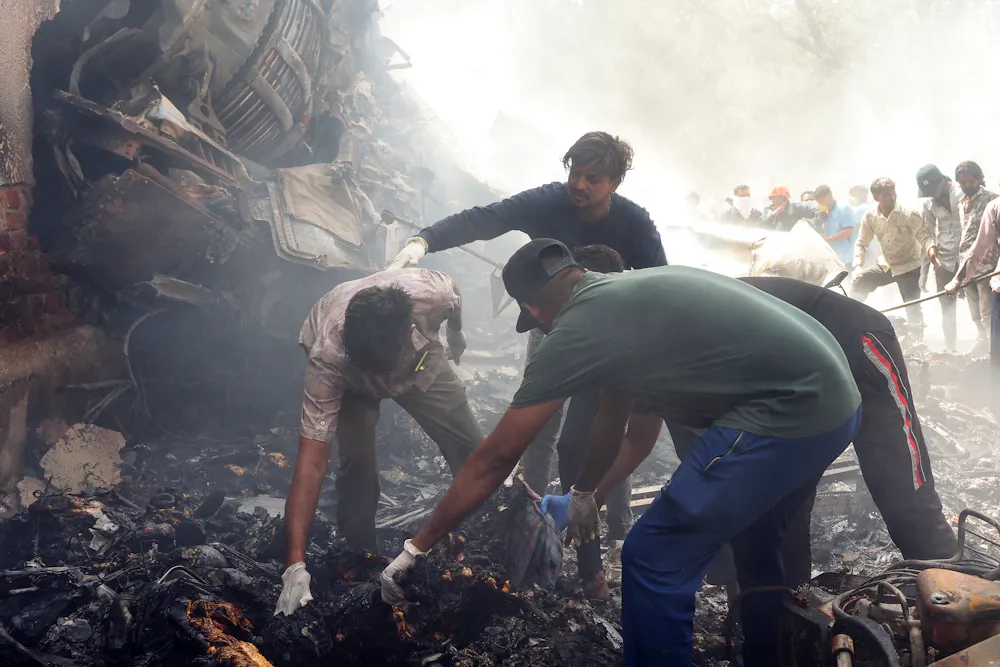
Rescuers sift through the wreckage of Flight AI171 in Ahmedabad.
Sam Panthaky / AFP via Getty Images

The team will conduct a forensic investigation of the crash site to make sense of what happened. Alongside material evidence found at the site, they will look at the data stored in the plane’s “black box”, which includes data from the flight recorder and cockpit voice recorder, to learn about what happened in the leadup to the crash.

A slow, steady process

Air crash investigations can take a long time. Typically a preliminary report will be published 3 to 6 months after the crash, followed by a final report a year or two later.

The report will provide factual information on the cause of the accident and make recommendations. Depending on the cause, these might be changes to maintenance procedures, pilot and crew procedures, or even the design of parts of the aircraft.

Indian authorities will then disseminate these recommendations to whoever needs them around the world. The process is slow, but it moves in the direction of safer air travel. Everyone will be waiting to find out and learn.

In the meantime, it’s best to remember that we still don’t know what happened or why. Everyone wants answers, but speculation can do more harm than good.

Guido Carim Junior does not work for, consult, own shares in or receive funding from any company or organisation that would benefit from this article, and has disclosed no relevant affiliations beyond their academic appointment.

ref. What do we know about the Air India crash? How did one man survive? What now? An aviation safety expert explains – https://theconversation.com/what-do-we-know-about-the-air-india-crash-how-did-one-man-survive-what-now-an-aviation-safety-expert-explains-258910

The Daily Blog calls for NZ to immediately expel Israeli envoy for unprovoked attack on Iran

OPINION: By Martyn Bradbury, editor of The Daily Blog

The madness has begun.

We should have suspected something when the cloud strike shut down occurred.

Israeli Prime Minister Benjamin Netanyahu needs to continue war so that he is never held to account.

This madness is the last straw.

NZ must immediately expel the Israeli Ambassador for this unprovoked attack on Iran.

As moral and ethical people, we must turn away from Israel’s new war crime, they have started a war, we must as righteous people condemn Israel and their enabler America.

This is the beginning of madness.

We cannot be party to it.

Al Jazeera’s Nour Odeh, reporting from Amman, Jordan, said the Israeli army radio was reporting that in addition to the air strikes, Israel’s external intelligence service Mossad had carried out some sabotage activities and attacks inside Iran.

“There are also several reports and leaks in the Israeli media talking not only about the assassination of the top chief of Iran’s Revolutionary Guard but rather a very large number of senior military commanders in addition to prominent academics and nuclear scientists,” she said.

“This is a very large-scale attack, not just on military installations, but also on the people who could potentially be making decisions about what Iran can do next, how Iran can respond to this attack that continues as we speak.”

Article by AsiaPacificReport.nz

Trump may push Albanese on defence spending, but Australia has leverage it can use, too

Source: The Conversation (Au and NZ) – By Thomas Corben, Research Fellow, Foreign Policy and Defence, University of Sydney

Ahead of a prospective meeting between Prime Minister Anthony Albanese and US President Donald Trump at the G7 Summit Canada, two key developments have bumped defence issues to the top of the alliance agenda.

First, in a meeting with Deputy Prime Minister Richard Marles late last month, US Secretary of Defence Pete Hegseth urged Australia to boost defence spending to 3.5% of gross domestic product (GDP).

This elicited a stern response from Albanese that “Australia should decide what we spend on Australia’s defence.”

Then, this week, news emerged the Pentagon is conducting a review of the AUKUS deal to ensure it aligns with Trump’s “America First” agenda.

Speculation is rife as to the reasons for the review. Some contend it’s a classic Trump “shakedown” to force Australia to pay more for its submarines, while others say it’s a normal move for any new US administration.


Read more:
Trump may try to strike a deal with AUKUS review, but here’s why he won’t sink it


The reality is somewhere in between. Trump may well see an opportunity to “own” the AUKUS deal negotiated by his predecessor, Joe Biden, by seeking to extract a “better deal” from Australia.

But while support for AUKUS across the US system is strong, the review also reflects long-standing and bipartisan concerns in the US over the deal. These include, among other things, Australia’s functional and fiscal capacity to take charge of its own nuclear-powered submarines once they are built.

So, why have these issues come up now, just before Albanese’s first face-to-face meeting with Trump?

To understand this, it’s important to place both issues in a wider context. We need to consider the Trump administration’s overall approach to alliances, as well as whether Australia’s defence budget matches our strategy.

Trump, alliances and burden-sharing

Senior Pentagon figures noted months ago that defence spending was their “main concern” with Australia in an otherwise “excellent” relationship.

But such concerns are not exclusive to Australia. Rather, they speak to Trump’s broader approach to alliances worldwide – he wants US allies in Europe and Asia to share more of the burden, as well.

Trump’s team sees defence spending (calculated as a percentage of GDP) as a basic indicator of an ally’s seriousness about both their own national defence and collective security with Washington.

As Hegseth noted in testimony before Congress this week, “we can’t want [our allies’] security more than they do.”

Initially, the Trump administration’s burden-sharing grievances with NATO received the most attention. The government demanded European allies boost spending to 5% of GDP in the interests of what prominent MAGA figures have called “burden-owning”.

Several analysts interpreted these demands as indicative of what will be asked of Asian partners, including Australia.

In reality, what Washington wants from European and Indo-Pacific allies differs in small but important ways.

In Europe, the Trump administration wants allies to assume near-total responsibility for their own defence to enable the US to focus on bigger strategic priorities. These include border security at home and, importantly, Chinese military power in the Indo-Pacific.

By contrast, Trump’s early moves on defence policy in Asia have emphasised a degree of cooperation and mutual benefit.

The administration has explicitly linked its burden-sharing demands with a willingness to work with its allies – Japan, South Korea, Australia and others – in pursuit of a strategy of collective defence to deter Chinese aggression.

This reflects a long-standing recognition in Washington that America needs its allies and partners in the Indo-Pacific perhaps more than anywhere else in the world. The reason: to support US forces across the vast Pacific and Indian oceans and to counter China’s growing ability to disrupt US military operations across the region.

In other words, the US must balance its demands of Indo-Pacific allies with the knowledge that it also needs their help to succeed in Asia.

This means the Albanese government can and should engage the Trump administration with confidence on defence matters – including AUKUS.

It has a lot to offer America, not just a lot to lose.

Australian defence spending

But a discussion over Australia’s defence spending is not simply a matter of alliance management. It also speaks to the genuine challenges Australia faces in matching its strategy with its resources.

Albanese is right to say Australia will set its own defence policy based on its needs rather than an arbitrary percentage of GDP determined by Washington.

But it’s also true Australia’s defence budget must match the aspirations and requirements set out in its 2024 National Defence Strategy. This is necessary for our defence posture to be credible.

This document paints a sobering picture of the increasingly fraught strategic environment Australia finds itself in. And it outlines an ambitious capability development agenda to allow Australia to do its part to maintain the balance of power in the region, alongside the United States and other partners.

But there is growing concern in the Australian policy community that our defence budget is insufficient to meet these goals.

For instance, one of the lead authors of Australia’s 2023 Defence Strategic Review, Sir Angus Houston, mused last year that in order for AUKUS submarines to be a “net addition” to the nation’s military capability, Australia would need to increase its defence spending to more than 3% of GDP through the 2030s.

Otherwise, he warned, AUKUS would “cannibalise” investments in Australia’s surface fleet, long-range strike capabilities, air and missile defence, and other capabilities.

There’s evidence the Australian government understands this, too. Marles and the minister for defence industry, Pat Conroy, have both said the government is willing to “have a conversation” about increasing spending, if required to meet Australia’s strategic needs.

This is all to say that an additional push from Trump on defence spending and burden-sharing – however unpleasantly delivered – would not be out of the ordinary. And it may, in fact, be beneficial for Australia’s own deliberations on its defence spending needs.

The Conversation

Thomas Corben receives funding from the Australian Department of Defence.

ref. Trump may push Albanese on defence spending, but Australia has leverage it can use, too – https://theconversation.com/trump-may-push-albanese-on-defence-spending-but-australia-has-leverage-it-can-use-too-258811

How long is a vagina? And how do I know if mine is ‘short’?

Source: The Conversation (Au and NZ) – By Keersten Fitzgerald, Lecturer in General Practice, University of Sydney

Jarrod Simpson/Getty

We often use the word vagina to describe everything “down there”, but that’s not actually anatomically correct.

The vagina is the stretchy, muscular tube that connects the external genitalia, or vulva, to the cervix, which is the entrance to the uterus (womb).

Because it’s barely visible from the outside, many vagina owners wonder how long theirs is, or should be.

Worried teenagers going through puberty regularly asked “Dolly Doctor” – the medical advice column Melissa wrote for over 20 years in Dolly magazine – whether their vaginas were too small or short.

Often they were asking because inserting a tampon was difficult or painful.

The vagina is an incredibly adaptable part of the body and its length can change – across your lifetime, within the month, and with hormonal changes and sexual arousal.

Length at different life stages

Before puberty, the vagina usually measures between 5.5 and 8cm in length.

During puberty (usually between 8–13 years old), not only does the length of the vagina increase, but hormones also change the vaginal lining.

In the time of life between puberty and menopause, oestrogen levels rise and cause the lining of the vagina to thicken and soften. This is what makes the vagina moist and responsive to stimuli, such as when aroused.

By adulthood, the vagina is typically between 6.5cm and 12.5cm. This varies greatly from person to person and continues to change at different times during our lives.

What else can change the vagina’s length?

When someone has their period, generally the cervix sits in a lower position, meaning the vaginal canal is shorter. Then, after menstruation, the cervix lifts upwards again and reaches its highest point during ovulation.

The length of the vagina also changes during different reproductive stages. For example, in pregnancy the cervix sits higher up, meaning the vagina is longer.

On the other hand, menopause, along with many other impacts such as vaginal dryness, can shorten the vaginal canal.

A pelvic organ prolapse can also make the vagina shorter. This is when the pelvic floor becomes weakened and organs such as the womb or bladder bulge into the vagina.


Read more:
What is pelvic organ prolapse and how is it treated?


There are also some very rare conditions that can affect the development of the vagina before birth, such as vaginal atresia, which can cause the vagina to not fully form.

What about sex?

Sex also has a large impact on vaginal length.

When someone with a vagina becomes aroused the vagina gets longer and moves the cervix further from the vaginal opening, which allows for sexual penetration.

Despite this lengthening of the vagina, contact with the cervix can still occur during sex, for example with a sex toy, finger or penis. Some people will find cervical stimulation painful or sensitive, while for others it may be pleasurable.

How sex feels can also change depending on your menstrual cycle.

Remember, when you have your period, the cervix is likely to be sitting lower, so this can increase the chance of contact with the cervix during sex, especially during certain sexual positions.

Touching the cervix during sex is very unlikely to cause any damage, although sometimes with vigorous sexual intercourse it can cause bruising. This is not usually dangerous and heals on its own.

Ongoing communication with your partner is crucial to check in and see what feels good for both of you.

So, how long is my vagina?

It can be useful to feel the length of your vagina and the position of your cervix.

For example, if you want to use a menstrual cup during your period, some brands will have different sizes. If you have a shorter vaginal canal, then a shorter or smaller cup may achieve a better fit.

However, other factors – such as your age and how heavy your periods are – can also impact what size is right for you.

To feel the position of your cervix, first wash your hands with soap and water. This is best done around the time of your period, when the vaginal canal will be shorter.

Find a comfortable position, such as sitting, squatting or having one leg bent up on a chair. Then insert your finger into the vagina aiming up and back.

The vagina feels soft and squishy, whereas the cervix is smooth and firm, with a tiny divot in the centre – imagine a mini doughnut.

If you have to really stretch to feel the cervix, you may opt for a longer cup, whereas if you don’t need to insert your whole finger, it is probably sitting a bit lower and you may be more comfortable with a smaller size.

Keep in mind, this will just give you a rough idea of your vagina’s length and where your cervix is sitting (although it may change tomorrow).


Read more:
Menstrual cups are safe and sustainable – but they can be tricky for first-time users, our new study shows


Does the length of your vagina matter?

All of our bodies are unique and there is a wide range of “normal”. Generally, having a “short” or “long” vagina doesn’t make any real difference.

For example, a 2009 study of women over the age of 40 found vaginal length doesn’t affect sexual activity or function.

The vagina is extremely elastic and can stretch and mould to accommodate a variety of needs, before returning back to its baseline.

There are some symptoms that would be worth discussing with your GP though, such as pain during sex, difficulty inserting tampons or menstrual cups, or if you are concerned about a prolapse.

The Conversation

Melissa Kang is affiliated in a volunteer capacity with the Australian Association for Adolescent Health and the International Association for Adolescent Health. She was the medical writer for the Dolly Doctor column in Dolly magazine between 1993 and 2016.

Keersten Fitzgerald does not work for, consult, own shares in or receive funding from any company or organisation that would benefit from this article, and has disclosed no relevant affiliations beyond their academic appointment.

ref. How long is a vagina? And how do I know if mine is ‘short’? – https://theconversation.com/how-long-is-a-vagina-and-how-do-i-know-if-mine-is-short-256206

ER Report: A Roundup of Significant Articles on EveningReport.nz for June 13, 2025

ER Report: Here is a summary of significant articles published on EveningReport.nz on June 13, 2025.

As Antarctic sea ice shrinks, iconic emperor penguins are in more peril than we thought
Source: The Conversation (Au and NZ) – By Dana M Bergstrom, Honorary Senior Fellow in Ecology, University of Wollongong When winter comes to Antarctica, seals and Adélie penguins leave the freezing shores and head for the edge of the forming sea ice. But emperor penguins stay put. The existence of emperor penguins seems all but

Bougainville legal dept looking towards sorcery violence policy
RNZ Pacific The Department of Justice and Legal Services in Bougainville is aiming to craft a government policy to deal with violence related to sorcery accusations. The Post-Courier reports that a forum, which wrapped up on Wednesday, aimed to dissect the roots of sorcery/witchcraft beliefs and the severe violence stemming from accusations. An initial forum

NZ has a vast sea territory but lags behind other nations in protecting the ocean
Source: The Conversation (Au and NZ) – By Conrad Pilditch, Professor of Marine Sciences, University of Auckland, Waipapa Taumata Rau Getty Images For the past fortnight, the city of Nice in France has been the global epicentre of ocean science and politics. Last week’s One Ocean Science Congress ended with a unanimous call for action

US Army’s image of power and flag-waving rings false to Gen Z weary of gun violence − and long-term recruitment numbers show it
Source: The Conversation (Au and NZ) – By Jacob Ware, Adjunct Professor of Domestic Terrorism, Georgetown University A recruit participates in the Army’s future soldier prep course at Fort Jackson in Columbia, S.C., on Sept. 25, 2024. AP Photo/Chris Carlson The U.S. Army will celebrate its 250th birthday on Saturday, June 14, 2025, with a

It took more than a century, but women are taking charge of Australia’s economy – here’s why it matters
Source: The Conversation (Au and NZ) – By Duygu Yengin, Associate Professor of Economics, University of Adelaide For the first time in its 124-year history, Treasury will be led by a woman. Jenny Wilkinson’s appointment is historic in its own right. Even more remarkable is the fact she joins Michele Bullock at the Reserve Bank

With Trump undoing years of progress, can the US salvage its Pacific Islands strategy?
Source: The Conversation (Au and NZ) – By Alan Tidwell, Director, Center for Australian, New Zealand and Pacific Studies, Georgetown University Donald Trump signs a proclamation expanding fishing rights in the Pacific Islands, April 17. Getty Images Since 2018, the United States has worked, albeit often haltingly, to regain its footing with Pacific Island countries.

Workers need better tools and tech to boost productivity. Why aren’t companies stepping up to invest?
Source: The Conversation (Au and NZ) – By John Hawkins, Head, Canberra School of Government, University of Canberra As Prime Minister Anthony Albanese and Treasurer Jim Chalmers turn their attention to improving productivity growth across the economy, it will be interesting to see what the business community brings to a planned summit in August. Labour

AI overviews have transformed Google search. Here’s how they work – and how to opt out
Source: The Conversation (Au and NZ) – By T.J. Thomson, Senior Lecturer in Visual Communication & Digital Media, RMIT University cosma/Shutterstock People turn to the internet to run billions of search queries each year. These range from keeping tabs on world events and celebrities to learning new words and getting DIY help. One of the

‘Like an underwater bushfire’: SA’s marine algal bloom is still killing almost everything in its path
Source: The Conversation (Au and NZ) – By Erin Barrera, PhD Candidate, School of Public Health, University of Adelaide Paul Macdonald of Edithburgh Diving South Australian beaches have been awash with foamy, discoloured water and dead marine life for months. The problem hasn’t gone away; it has spread. Devastating scenes of death and destruction mobilised

Sunday Too Far Away at 50: how a story about Aussie shearers launched a local film industry
Source: The Conversation (Au and NZ) – By Michael Walsh, Associate Professor, Screen and Media, Flinders University Released 50 years ago, Sunday Too Far Away deals episodically with a group of shearers led by Foley (Jack Thompson), and the events leading up to the national shearers’ strike of 1956. The shearers are a ragtag group

Khartoum before the war: the public spaces that held the city together
Source: The Conversation (Au and NZ) – By Ibrahim Z. Bahreldin, Associate Professor of Urban & Environmental Design, University of Khartoum What makes a public space truly public? In Khartoum, before the current conflict engulfed Sudan, the answer was not always a park, a plaza or a promenade. The city’s streets, tea stalls (sitat al-shai),

Politics with Michelle Grattan: Senator Tammy Tyrrell on wild days in Tasmania
Source: The Conversation (Au and NZ) – By Michelle Grattan, Professorial Fellow, University of Canberra Tasmanian politics has been thrown into chaos after a Labor motion of no confidence forced Premier Jeremy Rockliff to either resign or call for a new election. The premier opted for the latter, with Tasmanians to vote on July 19,

Chris Hedges: The last days of Gaza
Report by Dr David Robie – Café Pacific. – The genocide is almost complete. When it is concluded it will have exposed the moral bankruptcy of Western civilisation, writes Chris Hedges. ANALYSIS: By Chris Hedges This is the end. The final blood-soaked chapter of the genocide. It will be over soon. Weeks. At most. Two

Grattan on Friday: the galahs are chattering about ‘productivity’, but can Labor really get it moving?
Source: The Conversation (Au and NZ) – By Michelle Grattan, Professorial Fellow, University of Canberra Former prime minister Paul Keating famously used to say the resident galah in any pet shop was talking about micro-economic policy. These days, if you encounter a pet shop with a galah, she’ll be chattering about productivity. Productivity is currently

Greenpeace activists aboard Rainbow Warrior disrupt Pacific industrial fishing operation
By Emma Page Greenpeace activists on board the Greenpeace flagship Rainbow Warrior disrupted an industrial longlining fishing operation in the South Pacific, seizing almost 20 km of fishing gear and freeing nine sharks — including an endangered mako — near Australia and New Zealand. Crew retrieved the entire longline and more than 210 baited hooks

View from The Hill: Is the US playing cat and mouse ahead of expected Albanese-Trump talks?
Source: The Conversation (Au and NZ) – By Michelle Grattan, Professorial Fellow, University of Canberra For the first time in memory, an Australian prime minister is approaching a prospective meeting with a US president with a distinct feeling of wariness. Of course Anthony Albanese would deny it. But it’s undeniable the government is relieved that

Caitlin Johnstone: Staring down the barrel of war with Iran once again
Report by Dr David Robie – Café Pacific. – COMMENTARY: By Caitlin Johnstone Well it looks like the US is on the precipice of war with Iran again. US officials are telling the press that they anticipate a potential impending Israeli attack on Iran while the family members of US military personnel are being assisted

Global outrage over Gaza has reinforced a ‘siege mentality’ in Israel – what are the implications for peace?
Source: The Conversation (Au and NZ) – By Eyal Mayroz, Senior Lecturer in Peace and Conflict Studies, University of Sydney After more than 20 months of devastating violence in Gaza, the right-wing Israeli government’s pursuit of two irreconcilable objectives — “destroying” Hamas and releasing Israeli hostages — has left the coastal strip in ruins. At

The weight loss drug Mounjaro has been approved to treat sleep apnoea. How does it work?
Source: The Conversation (Au and NZ) – By Yaqoot Fatima, Professor of Sleep Health, University of the Sunshine Coast coldsnowstorm/Getty Images Last week, Australia’s Therapeutic Goods Administration (TGA) approved the weight-loss drug Mounjaro to treat sleep apnoea, a condition in which breathing stops and starts repeatedly during sleep. The TGA has indicated Mounjaro can be

Not all insecure work has to be a ‘bad job’: research shows job design can make a big difference
Source: The Conversation (Au and NZ) – By Rose-Marie Stambe, Adjunct Research Fellow, social and economic marginalisation, The University of Queensland Matej Kastelic/Shutterstock Inflation has steadied and interest rates are finally coming down. But for many Australians, especially those in low-paid, insecure or precarious work, the cost-of-living crisis feels far from over. The federal government

As Antarctic sea ice shrinks, iconic emperor penguins are in more peril than we thought

Source: The Conversation (Au and NZ) – By Dana M Bergstrom, Honorary Senior Fellow in Ecology, University of Wollongong

When winter comes to Antarctica, seals and Adélie penguins leave the freezing shores and head for the edge of the forming sea ice. But emperor penguins stay put.

The existence of emperor penguins seems all but impossible. Their lives revolve around seasons, timing and access to “fast ice” – sea ice connected to the Antarctic coast. Here, the sea ice persists long enough into summer for the penguins to rear their chicks successfully.

But climate change is upending the penguins’ carefully tuned biological cycles. The crucial sea ice they depend on is melting too early, plunging the chicks from some colonies into the sea before they are fully fledged.

In the latest bad news for these penguins, research by the British Antarctic Survey examined satellite images from 2009 to 2024 to assess fast-ice conditions at 16 emperor penguin colonies south of South America. They noted an average 22% fall in numbers across these colonies. That translates to a decrease of 1.6% every year.

This rate of loss is staggering. As the paper’s lead author Peter Fretwell told the ABC, the rate is about 50% worse than even the most pessimistic estimates.

emperor penguin colony chicks and adults.
Emperor penguin colonies can number in the tens of thousands. But these numbers obscure an alarming trend.
Robert Harding Video/Shutterstock

Breeding while it’s freezing

Just like polar bears in the Arctic, emperor penguins are the iconic species threatened by climate change in Antarctica.

Emperor penguins are a highly successful species. They’re the tallest and heaviest penguin alive today. They evolved about one million years ago, and are highly adapted to life in one of Earth’s harshest environments. As of 2009, the emperor penguin population was estimated at just shy of 600,000 birds.

Unfortunately, they are now in real trouble, because their breeding habitat appears to be reducing.

At the beginning of every Antarctic winter, the surface of the ocean begins to freeze and sea ice forms. Over March and April, emperor penguins aggregate into raucous breeding colonies along the coast of the ice continent. They need about nine months to care for their chicks, until the young penguins can go to sea and look after themselves.

The males frequently huddle to keep each other warm and their eggs safe. Meanwhile, the females spend months at sea catching krill, squid and fish, returning in July/August to feed their hungry chicks. When summer finally comes in December, the chicks start to shed their down and grow a dense, waterproof plumage – like a feathery armour against the intensely cold seas off the icy continent.

Breeding locations are a kind of “Goldilocks” zone. When choosing a home, the penguins have to find a place that is safe but not too far from the fast ice edge where they go to start hunting.

The greater the distance they have to travel, the longer it takes to return to their offspring, and the chicks may miss out on meals. But if a colony is too close to the edge of the fast ice, the risk increases that the ice breaks up before the chicks are ready to go to sea. Although fast ice can cover vast areas of the ocean surface, its edge is exposed to the swell of the Southern Ocean.

In recent years, the fast ice in different parts of Antarctica has been breaking up early, before the chicks have moulted into their adult plumage. Without waterproof plumage, chicks perish because the cold water kills quickly. As this happens more often, the size of a colony shrinks.

How bad is it?

We don’t yet know if this rate of loss is happening right across Antarctica. The study only covers a the part of the continent that includes the Antarctic Peninsula and the Weddell Sea.

What we do know is that Antarctica and its unique biodiversity are not immune to the consequences of still-rising global greenhouse gas emissions.

In 2021, emperor penguins were listed as endangered by the United States, because the risk of extinction by century’s end had increased. Australia has not yet listed the emperor penguin as a threatened species.

The new research suggests the future of these iconic birds is not looking good. Until the world gets serious about cutting greenhouse gas emissions, sea ice will retreat – and more chicks will fall into the icy water before they are ready to launch.


Seabird ecologist Dr Barbara Wienecke contributed to this article.


The Conversation

Dana M Bergstrom is affiliated with the Pure Antarctic Foundation, a group of scientists and artists interested in communicating science and knowledge to the broader community.

ref. As Antarctic sea ice shrinks, iconic emperor penguins are in more peril than we thought – https://theconversation.com/as-antarctic-sea-ice-shrinks-iconic-emperor-penguins-are-in-more-peril-than-we-thought-258807

Bougainville legal dept looking towards sorcery violence policy

RNZ Pacific

The Department of Justice and Legal Services in Bougainville is aiming to craft a government policy to deal with violence related to sorcery accusations.

The Post-Courier reports that a forum, which wrapped up on Wednesday, aimed to dissect the roots of sorcery/witchcraft beliefs and the severe violence stemming from accusations.

An initial forum was held in Arawa last month.

Central Bougainville’s Director of Justice and Legal Services, Dennis Kuiai, said the forums’ ultimate goal is crafting a government policy.

Further consultations are planned for South Bougainville next week and a regional forum in Arawa later this year.

“This policy will be deliberated and developed into law to address sorcery and [sorcery accusation-related violence] in Bougainville,” he said.

“We aim to provide an effective legal mechanism.”

Targeted 3 key areas
He said the future law’s structure was to target three key areas: the violence linked to accusations, sorcery practices themselves, and addressing the phenomenon of “glass man”.

A glassman or glassmeri has the power to accuse women and men of witchcraft and sorcery.

Papua New Guinea outlawed the practice in 2022.

The forum culminated in the compilation and signing of a resolution on its closing day, witnessed by officials.

Sorcery has long been an issue in PNG.

Those accused of sorcery are frequently beaten, tortured, and murdered, and anyone who manage to survive the attacks are banished from their communities.

Saved mother rejected
In April, a mother-of-four was was reportedly rejected by her own family after she was saved by a social justice advocacy group.

In August last year, an advocate told people in Aotearoa – where she was raising awareness – that Papua New Guinea desperately needed stronger laws to protect innocents and deliver justice for victims of sorcery related violence.

In October 2023, Papua New Guinea MPs were told that gender-based and sorcery violence was widespread and much higher than reported.

In November 2020, two men in the Bana district were hacked to death by members of a rival clan, who claimed the men used sorcery against them.

This article is republished under a community partnership agreement with RNZ.

Article by AsiaPacificReport.nz

NZ has a vast sea territory but lags behind other nations in protecting the ocean

Source: The Conversation (Au and NZ) – By Conrad Pilditch, Professor of Marine Sciences, University of Auckland, Waipapa Taumata Rau

Getty Images

For the past fortnight, the city of Nice in France has been the global epicentre of ocean science and politics.

Last week’s One Ocean Science Congress ended with a unanimous call for action to turn around the degradation of the ocean. And this week, the United Nation’s Ocean Conference agenda focused on better protection of marine biodiversity, sustainable fisheries and emissions cuts.

The message is clear. With only five years to the UN’s 2030 target for its sustainable development goal – to conserve the oceans, seas and marine resources – and the Global Biodiversity Framework requirement to protect 30% of the ocean, we need to make significant progress.

We all attended last week’s meeting, together with more than 2,000 marine scientists from 120 countries. Here, we reflect on New Zealand’s role and obligations to contribute to these global goals.

Legal imperatives

Globally, the ocean is warming and acidifying at accelerating rates. New Zealand’s waters are not immune to this, with more marine heatwaves which further stress our threatened marine biodiversity.

We depend directly on these ocean ecosystems to provide the air we breathe, moderate the impacts of climate change and feed millions of people.

New Zealand has significant influence on ocean policy – from Antarctica to the sub-tropical Pacific, and within its sea territory, which is 15 times the size of its landmass and spans 30 degrees of latitude.

The government is required by law to take action to secure a healthy ocean.

A recent advisory opinion from the International Tribunal on the Law of the Sea unanimously found that states, including New Zealand, have obligations under international law to reduce the impacts of climate change on marine areas, to apply an ecosystem approach to marine law and policy, reduce pollution and support the restoration of the ocean.

New Zealand courts have recognised the need to take a precautionary and ecosystem-based approach to marine management, based on science, tikanga and mātauranga Māori. These legal cases are part of a global upswell of strategic environmental and climate litigation.

If New Zealand does not comply with these marine legal obligations, it may well find itself before the courts, incurring significant legal and reputational costs.

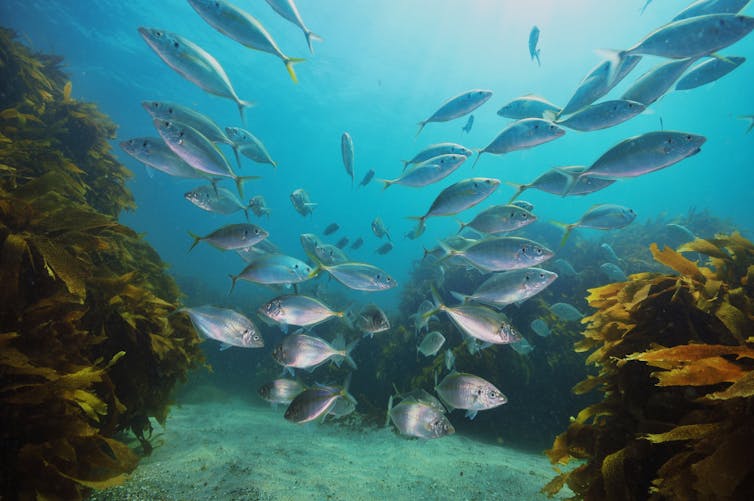
School of New Zealand trevally Pseudocaranx dentex above sandy bottom with kelp forest around and in background.
New Zealand committed to protecting at least 30% of the world’s coastal and marine areas by the end of this decade.
Getty Images

International agreements

In 2022, New Zealand was one of 196 countries that committed to protecting at least 30% of the world’s coastal and marine areas by 2030 under the Global Biodiversity Framework. New Zealand was an enthusiastic supporter, but only 0.4% of its marine territory is fully protected in no-take marine reserves.

Former prime minister Helen Clark has criticised the current government for lagging behind on marine protection, especially in failing to ban bottom trawling.

At this week’s UN ocean summit, a further 18 countries have ratified an agreement known as the High Seas Treaty, bringing the total to 50, still short of the 60 nations needed for it to enter into force.

New Zealand signed this treaty just before the last general election, but is yet to ratify it. Foreign Minister Winston Peters represented New Zealand at the UN ocean conference, but focused mainly on issues in the Pacific.

Meanwhile, the government announced sweeping changes to the national direction on environmental policy, including reworking the New Zealand Coastal Policy Statement to better enable the use and development of the coastal environment for “priority activities” such as aquaculture, resource extraction, infrastructure and energy.

Oceanic environmental change is real and accelerating

Some countries showed that effective leadership can help navigate to a safe future for the oceans. For example, China’s commitment to clean energy has seen carbon dioxide emissions begin to fall for the first time despite higher power consumption.

At the UN ocean summit, French Polynesia’s president announced his administration would establish one of the world’s largest networks of marine protected areas.

The cost of inaction far outweighs the economics of the status quo. Ongoing ocean warming is already affecting weather patterns, with more extreme storms.

It is possible for marine ecosystems to recover quite rapidly if they are protected, at least temporarily. Yet this year, New Zealand’s government found itself in hot water (once again) with both conservationists and Māori for its management of fisheries.

We argue New Zealand has an opportunity and responsibility to demonstrate it can shift the downward spiral of oceanic degradation.

The overwhelming message at the half-way point of the UN Ocean Decade is that for marine science to transform the state of our oceans it needs to include Indigenous peoples who have routinely been sidelined from ocean policy discussions despite their longstanding rights and relationships with the ocean.

New Zealand already has a foundation of transdisciplinary and Indigenous ocean research to develop ocean policies that are fit for local purposes and to answer global calls to action. We have a unique window of opportunity to lead the changes needed.

The Conversation

Conrad Pilditch currently receives funding from the Department of Conservation and the Ministry for Business, Innovation and Employment.

Elizabeth Macpherson receives funding from Te Apārangi The Royal Society.

Karin Bryan receives funding from the Marsden Fund, the Ministry for Business, Innovation and Employment, the George Mason Centre for the Natural Environment and Waikato Regional Council.

Simon Francis Thrush receives funding from ERC, Ministry for Business, Innovation and Employment and the Auckland Foundation

Joanne Ellis, Karen Fisher, and Rachael Mortiaux do not work for, consult, own shares in or receive funding from any company or organisation that would benefit from this article, and have disclosed no relevant affiliations beyond their academic appointment.

ref. NZ has a vast sea territory but lags behind other nations in protecting the ocean – https://theconversation.com/nz-has-a-vast-sea-territory-but-lags-behind-other-nations-in-protecting-the-ocean-258470

US Army’s image of power and flag-waving rings false to Gen Z weary of gun violence − and long-term recruitment numbers show it

Source: The Conversation (Au and NZ) – By Jacob Ware, Adjunct Professor of Domestic Terrorism, Georgetown University

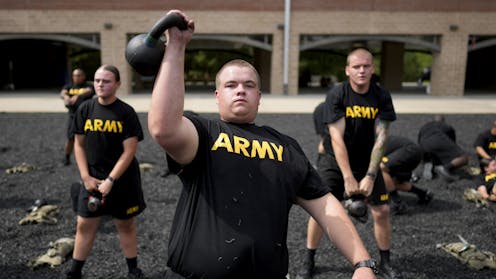
A recruit participates in the Army’s future soldier prep course at Fort Jackson in Columbia, S.C., on Sept. 25, 2024. AP Photo/Chris Carlson

The U.S. Army will celebrate its 250th birthday on Saturday, June 14, 2025, with a parade in Washington, D.C., in which about 6,600 soldiers and heavy pieces of military equipment will roll through the streets. The parade aims to display the Army’s history and power.

“It’s going to be incredible,” President Donald Trump recently said. Trump’s 79th birthday also occurs on June 14.

Despite the festivities, however, the parade will occur amid bleak times for the U.S. military, as it experiences a multiyear decline in recruitment numbers. In the face of a pandemic and a strong civilian job market, the Army, Air Force and Navy all missed their recruitment goals in 2022 and 2023. In 2022, the Army missed its quota by 25%.

In 2024, the U.S. military met its recruitment target, which supports the argument that the bump is not due to Trump, as recruitment levels began to rise again before his reelection. But in some cases, the U.S. military has met its recruitment goals by lowering target numbers.

And as a scholar of terrorism and targeted violence, I believe a close reading of available data on military recruitment suggests U.S. gun violence may be largely to blame for the lack of interest in joining the military.

Gun violence data

Regardless of one’s personal politics, the data on U.S. gun violence makes for painful reading.

Almost 47,000 Americans died from gun-related injuries in 2023. In 2022, there were 51 school shootings in which students were injured or killed by guns. And gun injuries are the leading cause of death for Americans between ages 1 and 19.

Data about the perceptions of gun violence is equally staggering, especially among American youth between ages 14 and 30.

Four out of five American youth believe gun violence to be a problem, and 25% have endured real active-shooter lockdowns, according to data compiled by Everytown for Gun Safety, where I serve as a survivor fellow, the Southern Poverty Law Center and American University’s Polarization and Extremism Research and Innovation Lab.

Moreover, these perceptions have considerable impacts on youth mental health and their sense of safety. Studies have linked concern over school shootings among adolescents with higher rates of anxiety and trauma-related disorders.

As Arne Duncan, who served as President Barack Obama’s secretary of education during the Sandy Hook tragedy, said in 2023: “Unfortunately, what’s now binding young people across the country together is not joy of music, or sports, or whatever, it’s really the shared pain of gun violence – and it cuts through race and class and geography and economics.”

National security threat

In the past couple of years, polls taken of Generation Z youth, born between 1997 and 2012, suggest mental health and mass shootings are among the most important political issues motivating this band of voters.

Gun violence, in other words, is a national security emergency, undermining the U.S. government’s ability to protect its citizens in their schools, places of worship and communities.

As former Marine Gen. John Allen wrote in 2019: “Americans today are more likely to experience gun violence at home than they might in many of the places to which I deployed in the name of defending our nation.”

Three women dressed in U.S. military gear stand outside a building.
U.S. Army National Guard members stand outside the Army National Guard office during training on April 21, 2022, in Washington.
AP Photo/Mariam Zuhaib, File

Rewriting American culture

Accordingly, gun violence has undercut American patriotism, corroding the U.S. government’s soft power within its own borders. Generation Z, termed by some as the “lockdown generation,” is often derided as less patriotic than its predecessors.

Surprising Gen Z Research.

Also, the belief in American exceptionalism is dropping among millennials, born between 1981 and 1996. That perception is combined with less confidence in U.S. global engagement and the efficacy of military solutions.

American culture has long inspired military service, with recruits seduced by action movies and promises of heroic returns to the U.S. But American culture today is being rewired into one of suffering, pain and victimhood.

A fear of violence

Gun violence destroys youth tolerance for the violence that defines a career in the U.S. military.

Internal U.S. military surveys of young Americans show that “the top three reasons young people cite for rejecting military enlistment are the same across all the services: fear of death, worries about post-traumatic stress disorder and leaving friends and family — in that order.”

Generations already suffering a shattered sense of safety and place do not see the military as a viable option.

The explanations the U.S. Defense Department gives for dismal recruitment levels focus on the younger generation’s supposed lack of backbone or hatred of America.

A black woman wearing a blue shirt and blue military cap signs a piece of paper on a lecturn.
D’elbrah Assamoi, from Cote d’Ivoire, signs her U.S. certificate of citizenship after a military training ceremony at Joint Base San Antonio-Lackland, in San Antonio, Texas, in April 2023.
Vanessa R. Adame/U.S. Air Force via AP

Republicans, including Secretary of Defense Pete Hegseth, have blamed alleged “wokeness” for low recruitment levels.

And the Trump administration’s statements about improving recruitment numbers over the past several months overlook both a late Biden-era surge after a pandemic slump as well as the reality that numbers remain depressed due to military services repeatedly lowering their recruitment goals.

Very rarely are introspective questions publicly debated today about the objective attractiveness of military service or the appetite for violence among young people. The problem, I believe, is not that young people are insufficiently patriotic – it’s that they have already been fighting a war, daily, for their entire lives.

In reversing the slide in recruitment, then, the military could improve its sensitivity to these important concerns.

Highlighting the range of careers within the services that do not involve front-line combat and physical danger could encourage more reluctant would-be recruits to volunteer.

Mental health support also could be made an essential element of military training and lifestyle − not a resource only for those bearing the hidden side-effects of life in the ranks. Encouraging those suffering from treatable mental health issues to seek meaning in service could also boost recruitment numbers.

The Conversation

Jacob Ware is a gun violence survivor and serves as a Survivor Fellow at Everytown for Gun Safety.

ref. US Army’s image of power and flag-waving rings false to Gen Z weary of gun violence − and long-term recruitment numbers show it – https://theconversation.com/us-armys-image-of-power-and-flag-waving-rings-false-to-gen-z-weary-of-gun-violence-and-long-term-recruitment-numbers-show-it-257090

It took more than a century, but women are taking charge of Australia’s economy – here’s why it matters

Source: The Conversation (Au and NZ) – By Duygu Yengin, Associate Professor of Economics, University of Adelaide

For the first time in its 124-year history, Treasury will be led by a woman.

Jenny Wilkinson’s appointment is historic in its own right. Even more remarkable is the fact she joins Michele Bullock at the Reserve Bank and Danielle Wood at the Productivity Commission.

Australia’s three most powerful economic institutions are now led by women economists. In economics, this is not normal. But it certainly does matter.

Stubbornly male

Imagine if only 17% of economics professors were men. It would feel unusual; people would ask why the field was so heavily skewed. But the reality is the opposite: 83% of economics professors in Australia are male.

And yet, this imbalance is almost invisible. Women make up just about one-third of secondary pupils studying economics and 40% of students enrolled in economics courses at university.

In the private sector, women economists are roughly one in three.

So while the appointments of Wilkinson, Bullock and Wood feels groundbreaking, the profession as a whole remains stubbornly male. Still, the leadership story is worth celebrating. When young women see leaders who look like them, they’re more likely to imagine themselves in those roles too.

As women increasingly take the helm, the old stereotype of a suit-clad man with a briefcase gives way to a broader, more inclusive image of what an economist can be.

The public service is leading the charge. As of 2023, women held 53% of senior executive service positions in the Australian Public Service, up from 46% in 2019.

Merit and diversity

Thankfully, unlike other parts of the world, we live in a country where these appointments haven’t triggered claims of so-called “diversity hires”. To be clear: these female pioneers weren’t appointed because they are women.

Each has decades of experience, technical firepower, and deep policy credentials. Wilkinson has led the Department of Finance and the Parliamentary Budget Office. Bullock has held almost every senior role at the Reserve Bank. Wood has shaped public debates on intergenerational equity and tax reform with clarity and rigour.

The idea that diversity is somehow in tension with merit is a false binary. Diverse groups make better decisions and are more creative, especially in high-stakes settings.

Decades of economics and business research has shown that incorporating diverse perspectives into decision-making only strengthens the outcomes. Decisions made and executed by diverse teams delivered 60% better results than those by non-diverse teams.

Merit isn’t just what’s on paper, it’s shaped by how we judge it.

When men and women perform equally well, success is more often credited to skill for men and to luck for women. Swap a male name for a female one on a CV, teaching evaluation or reference letter, and perceptions of competence, leadership and hireability start to shift.

These unconscious biases don’t just affect who gets ahead; they shape how we define merit in the first place.

Will it make a difference?

Economics often prides itself on being objective and neutral. While the economic models may be technically gender-blind, the questions we ask and investigate rarely are.

This is where gender diversity matters – not just in who holds the top jobs, but in what gets researched and how decisions are made. There’s growing evidence male and female economists don’t just ask different questions, they also approach problems differently.

One study found female central bankers tend to act with greater independence and deliver lower inflation. A United States study and another in Europe showed striking gender differences in how economists think about a range of areas, including labour markets, taxation, health and the environment, and more broadly on public spending – everything from welfare to the military.

Having more diverse perspectives doesn’t dilute economics – it deepens it. It makes the discipline more responsive to the diversity of the real-world challenges it’s meant to address.

Economic policies impact the whole society. So does the composition of economists.

So, what’s next?

Of course, three women in top economic roles won’t create miracles overnight – they all operate within existing systems and structures.

So, what can we expect from Wilkinson’s leadership? Her time at the Department of Finance suggests a steady, pragmatic hand: consultative, strategic and deeply experienced.

Wilkinson brings bipartisan credibility, a sharp grasp of fiscal discipline, and the capacity to act decisively in a crisis, as we saw during COVID. She won’t remake Treasury overnight, but she’s well placed to lead it with rigour, integrity and a long-term view.

This moment matters for women in economics. It shows change is possible in the profession, and it could mark the start of economic policy that truly reflects the diversity of the people it serves.

The Conversation

Duygu Yengin is affiliated with the University of Adelaide, Women in Economics Network, and the Economic Society of Australia.

ref. It took more than a century, but women are taking charge of Australia’s economy – here’s why it matters – https://theconversation.com/it-took-more-than-a-century-but-women-are-taking-charge-of-australias-economy-heres-why-it-matters-258680

With Trump undoing years of progress, can the US salvage its Pacific Islands strategy?

Source: The Conversation (Au and NZ) – By Alan Tidwell, Director, Center for Australian, New Zealand and Pacific Studies, Georgetown University

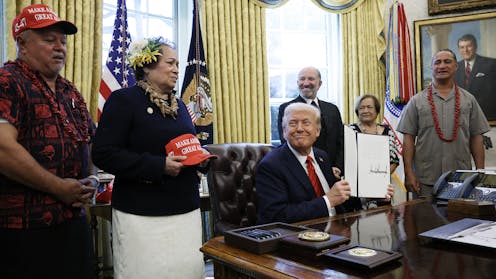
Donald Trump signs a proclamation expanding fishing rights in the Pacific Islands, April 17. Getty Images

Since 2018, the United States has worked, albeit often haltingly, to regain its footing with Pacific Island countries. It’s done this largely by reflecting a sentiment familiar in Pacific capitals: the region is not a geopolitical backwater, but a crucial strategic zone in the 21st century.

Spurred by China’s strategic expansion – security deals, port access, political influence – the first Trump presidency and then the Biden administration renewed the US focus on the Pacific.

Washington was also prodded by regional allies, including New Zealand. In 2018, Foreign Minister Winston Peters said: “We unashamedly ask for the United States to engage more and we think it is in your vital interests to do so. And time is of the essence.”

Building on the tentative steps of its predecessor, the Biden administration acted. It opened new embassies, invited Pacific leaders to the White House, unveiled a dedicated strategy for the Pacific Islands, and committed to recognising the Cook Islands and Niue.

It also negotiated more funding for the Compacts of Free Association with the Federated States of Micronesia, the Republic of the Marshall Islands and Palau. Along with the 2022 Pacific Islands Summit, it all signalled Washington’s desire to be a better partner.

Crucially, the Biden administration recognised climate change and the economy, not great-power rivalry, as the region’s defining security concerns. Now, much of that progress is being eroded.

The second Trump administration has gutted key international development agencies, with the US Agency for International Development (USAID) and the Millennium Challenge Corporation shuttered.

More than mere symbols, these agencies were tools of statecraft, facilitating Washington’s capacity to compete with China’s “no questions asked” development model. Their removal leaves a vacuum, which Beijing will happily fill.

China pressing the advantage

Other signs of retreat are equally troubling. Congressional funding for the South Pacific Tuna Treaty – which pays for access for US fishing fleets and is the primary multiparty agreement the US has with the Pacific Islands – was tripled by Biden, but remains incomplete.

Trump recently signed an executive order opening the Pacific Islands Heritage Marine National Monument, a 1,282,534 square kilometre protected marine zone, to commercial fishing. This might be welcomed by the US tuna fleet, but it raises questions about Washington’s commitment to the tuna treaty.

Hoped-for expansion of US consular access, especially vital for Pacific Islanders who must travel long distances for basic services such as visa applications, is in limbo. The US embassy in Vanuatu, damaged by the earthquake in 2024, remains closed, leaving diplomats to work out of their hotel rooms.

China, by contrast, has not slowed down. Its security pact with Solomon Islands, its police training efforts in Samoa and Kiribati, and its growing intelligence presence across the region show a clear pattern of assertiveness.

Beijing has proven adept at offering timely, visible assistance. Its diplomats show up. Its companies build. Its promises, however opaque, are matched with resources.

The result has not necessarily meant Pacific nations have “chosen” China. Rather, most revert to the longstanding posture of “friend to all, enemy to none”.

In a region where non-alignment is both a survival strategy and a principle of sovereignty, the perception of US unreliability makes China’s attentions all the more welcome, or at least tolerable.

Not a binary contest

The US now appears to be abandoning efforts to break this cycle, and the Trump administration risks a genuine strategic error rather than a mere diplomatic misstep.

More than distant dots on a map, the Pacific Islands control vast stretches of ocean, including key shipping lanes and undersea cables. Their diplomatic weight matters in the United Nations.

And the region matters to Taiwan, which is recognised by 12 countries globally, three of which are in the Pacific.

Some argue the US should press Pacific nations to “choose” between Washington and Beijing. But that approach is shortsighted and counterproductive.

Most have no interest in being drawn into a binary contest. They seek concrete benefits – resilience funding, fair trade, visa access – not ideological alignment. Framing relationships as zero-sum contests misunderstands the region’s diplomatic logic.

Listening to Pacific leaders

To revive the relationship, the US will need to show up, follow through and demonstrate its partnership offers more than rhetoric.

This would involve restoring some elements of foreign assistance, fully funding the South Pacific Tuna Treaty obligations, opening and staffing embassies, and supporting Pacific regional organisations such as the Pacific Islands Forum with meaningful recognition and resources.

But the US review of Pacific foreign assistance (a small portion of US development aid formerly administered by USAID) has been delayed once again, and likely won’t emerge until mid-July.

More importantly, the US will have to listen to Pacific leaders, who have articulated their priorities clearly. They do not want to be sites of contest; they want to be agents of their own futures.

In short, the US will have to treat the Pacific Islands as sovereign equals.
When Trump returned to the White House, he found a workable policy architecture for the Pacific. Its core elements could still be rescued.

But continued neglect, mixed signals and cost-cutting risk hastening the outcome China seeks – a region that finds Washington unreliable. Winston Peters, now foreign minister in a new government, might want to update his 2018 call for US engagement in the Pacific – with the emphasis on reliability.

The Conversation

Alan Tidwell does not work for, consult, own shares in or receive funding from any company or organisation that would benefit from this article, and has disclosed no relevant affiliations beyond their academic appointment.

ref. With Trump undoing years of progress, can the US salvage its Pacific Islands strategy? – https://theconversation.com/with-trump-undoing-years-of-progress-can-the-us-salvage-its-pacific-islands-strategy-258679

Workers need better tools and tech to boost productivity. Why aren’t companies stepping up to invest?

Source: The Conversation (Au and NZ) – By John Hawkins, Head, Canberra School of Government, University of Canberra

As Prime Minister Anthony Albanese and Treasurer Jim Chalmers turn their attention to improving productivity growth across the economy, it will be interesting to see what the business community brings to a planned summit in August.

Labour productivity (output per hour worked) has barely grown this decade.


Much of the focus in the current debate has been on the role of workers (labour) and industrial relations. Less discussed has been low business investment (capital).

Labour will be more productive if each worker can use more capital: machinery, equipment and technology. Over the medium term, providing workers with more capital – “capital deepening”, in the jargon – tends to be the main contributor to labour productivity growth.

But business investment as a share of gross domestic product (GDP) is currently at its lowest level since the mid-1990s.

Investment is low in both the mining and non-mining sectors. In the latest national accounts report for the March quarter, business investment in machinery and equipment fell 1.7%.


The average worker now uses less capital equipment – machines and computers – than a decade ago. Investment just hasn’t kept pace with growth in employment.


Read more:
‘Hard to measure and difficult to shift’: the government’s big productivity challenge


Why is investment so weak?

One possible reason was put forward by then Reserve Bank governor Philip Lowe in 2023. He suggested that, during the COVID pandemic, firms concentrated on surviving. Seeking out more efficient ways to produce was a lower priority. But post-pandemic, firms seem to have been slow to pivot back to an efficiency focus.

Another reason may be that, until recently, wage growth has been slower than the growth in prices of goods and services produced. This may have reduced the incentives for firms to invest in the equipment needed to boost labour productivity.

A key driver of investment is profitability. Firms are more likely to fund investment from retained earnings than by borrowing or raising capital. But the share of corporate profits in the economy has been quite high in recent years. So this does not explain low investment.


The ‘animal spirits’ are lacking

Business confidence – what economist John Maynard Keynes famously called “animal spirits” – is another important driver.

Share prices, both in Australia and the rest of the world, have grown strongly in recent years. The S&P/ASX 200 index of Australian share prices is close to its all-time high. This would suggest financial markets are very optimistic about the prospects of Australian companies.

Direct surveys of Australian businesses from National Australia Bank suggest conditions (the current situation) and confidence (about the future) are around their long-term average level. So this also does not explain the low investment.

One contributor to low investment may be that firms are applying inappropriately high “hurdle rates”. These refer to the minimum return firms expect from an investment before they will undertake it.

Hurdle rates tend to be “sticky” over time, meaning they do not move much. Many companies still apply hurdle rates of over 12%. These were appropriate back when interest rates and inflation were much higher, but seem too high now as borrowing costs have fallen with interest rate cuts.

The Productivity Commission has suggested one contributor to low investment could be a higher risk premium. Since the global financial crisis in 2007-08, companies and investors may have become more cautious about taking on risk.

Another factor could be growing market power of Australian companies that dominate a sector, making them complacent rather than striving to improve their performance.

The high degree of uncertainty

The Reserve Bank recently compiled two measures of uncertainty. One is derived from stock markets. The other is based on the number of news articles about policy uncertainty.

Both show the current environment is as uncertain now as it was during the early stages of the global financial crisis in 2007–08 and the COVID pandemic.

Closeup CNC milling machine during operation. Produced cutting metal parts
Investment in machineray and equipment went backwards in the March quarter.
Parilov/Shutterstock

A common response to uncertainty is to defer decisions on both investment and hiring new workers until the outlook is clearer. A study by the Reserve Bank found that greater uncertainty did indeed reduce investment. But the size of the impact was – you guessed it – uncertain.

What can be done?

Business lobbies often attribute low rates of investment (and anything else they think people may not like) to “excessively high” corporate tax rates. But at 30% for large companies and 25% for small, the company tax rate is low by historical standards.

Some multinational firms may be deterred from entering the Australian market as our company tax rate is above that in some other jurisdictions. It is hard to tell how important this effect is. Company tax is only one of many factors that affect the comparative risk and return of Australia as an investment destination.

The Productivity Commission is investigating whether the corporate taxation system could be made more efficient rather than just lowering rates.

In the meantime, however, firms may be encouraged to invest more by a more stable domestic economic outlook. Inflation is back within the central bank’s 2-3% target range. Employment is around an all-time high proportion of the working age population. The election has removed some political uncertainty with a government holding a clear majority.

Businesses should stop whingeing and start providing workers with the tools they need to become more productive.

This article is part of The Conversation’s series, The Productivity Puzzle. Read the previous article here.

The Conversation

John Hawkins was formerly a senior economist in the Reserve Bank and the Australian Treasury.

ref. Workers need better tools and tech to boost productivity. Why aren’t companies stepping up to invest? – https://theconversation.com/workers-need-better-tools-and-tech-to-boost-productivity-why-arent-companies-stepping-up-to-invest-257806

AI overviews have transformed Google search. Here’s how they work – and how to opt out

Source: The Conversation (Au and NZ) – By T.J. Thomson, Senior Lecturer in Visual Communication & Digital Media, RMIT University

cosma/Shutterstock

People turn to the internet to run billions of search queries each year. These range from keeping tabs on world events and celebrities to learning new words and getting DIY help.

One of the most popular questions Australians recently asked was: “How to inspect a used car?”.

If you asked Google this at the beginning of 2024, you would have been served a list of individual search results and the order would have depended on several factors. If you asked the same question at the end of the year, the experience would be completely different.

That’s because Google, which controls about 94% of the Australian search engine market, introduced “AI Overviews” to Australia in October 2024. These AI-generated search result summaries have revolutionised how people search for and find information. They also have significant impacts on the quality of the results.

How do these AI search summaries work, though? Are they reliable? And is there a way to opt out?

Synthesising the internet

Legacy search engines work by evaluating dozens of different criteria and trying to show you the results that they think best match your search terms.

They take into account the content itself, including how unique, current and comprehensive it is, as well as how it’s structured and organised.

They also consider relationships between the content and other parts of the web. If trusted sources link to content, that can positively affect its placement in search results.

They try to infer the searcher’s intent – whether they’re trying to buy something, learn something new, or solve a practical problem. They also consider technical aspects such as how fast the content loads and whether the page is secure.

All of this adds up to an invisible score each webpage gets that affects its visibility in search results. But AI is changing all this.

Google is the only search engine that prominently displays AI summaries on its main results page. Bing and DuckDuckGo still use traditional search result layouts, offering AI summaries only through companion apps such as Copilot and Duck.ai.

Instead of directing users to one specific webpage, generative AI-powered search looks across webpages and sources to try to synthesise what they say. It then tries to summarise the results in a short, conversational and easy-to-understand way.

In theory, this can result in richer, more comprehensive, and potentially more unique answers. But AI doesn’t always get it right.

Google is the only search engine that prominently displays AI summaries on its main results page.
DIA TV/Shutterstock

How reliable are AI searches?

Early examples of Google’s AI-powered search from 2024 suggested users eat “at least one small rock per day” – and that they could use non-toxic glue to help cheese stick to pizza.

One issue is that machines are poorly equipped to detect satire or parody and can use these materials to respond in place of fact-based evidence.

Research suggests the rate of so-called “hallucinations” – instances of machines making up answers – is getting worse even as the models driving them are getting more sophisticated.

Machines can’t actually determine what’s true and false. They cannot grasp the nuances of idioms and colloquial language and can only make predictions based on fancy maths. But these predictions don’t always end up being correct, which is an issue – especially for sensitive medical or health questions or when seeking financial advice.

Rather than just present a summary, Google’s more recent AI overviews have also started including links to sources for key aspects of the answer. This can help users gauge the quality of the overall answer and see where AI might be getting its information from. But evidence suggests sometimes AI search engines cite sources that don’t include the information they claim they do.

What are the other impacts of AI search?

AI search summaries are transforming the way information is produced and discovered, reshaping the search engine ecosystem we’ve grown accustomed to over two decades.

They are changing how information-seekers formulate search queries – moving from keywords or phrases to simple questions, such as those we use in everyday conversation.

For content providers, AI summaries introduce significant shifts – undermining traditional search engine optimisation techniques, reducing direct traffic to websites, and impacting brand visibility.

Notably, 43% of AI Overviews link back to Google itself. This reinforces Google’s dominance as a search engine and as a website.

The forthcoming integration of ads into AI summaries raises concerns about the trustworthiness and independence of the information presented.

Some internet users are switching search engines entirely and turning to providers that don’t provide AI summaries, such as Bing and DuckDuckGo.
Casimiro PT/Shutterstock

Where to from here?

People should always be mindful of the key limitations of AI summaries.

Asking for simple facts such as, “What is the height of Uluru?” may yield accurate answers.

But posing more complex or divisive questions, such as, “Will the 2032 Olympics bankrupt Queensland?”, may require users to open links and delve deeper for a more comprehensive understanding.

Google doesn’t offer a clear option to turn this feature off entirely. Perhaps the simplest way is to click on the “Web” tab under the search bar on the search results, or to add “-ai” to the search query. But this can get repetitive.

Some more technical solutions are manually creating a site search filter through Chrome settings. But these require an active act by the user.

As a result, some developers are offering browser extensions that claim to remove this aspect. Other users are switching search engines entirely and turning to providers that don’t provide AI summaries, such as Bing and DuckDuckGo.

T.J. Thomson receives funding from the Australian Research Council. He is an affiliate with the ARC Centre of Excellence for Automated Decision Making & Society.

Ashwin Nagappa receives funding fromthe Australian Research Council. He is a Postdoctoral Research Fellow in the QUT node of the ARC Centre of Excellence for Automated Decision Making & Society.

Shir Weinbrand receives funding from the Australian Research Council. She is a PhD candidate in the QUT node of the ARC Centre of Excellence for Automated Decision Making & Society.

ref. AI overviews have transformed Google search. Here’s how they work – and how to opt out – https://theconversation.com/ai-overviews-have-transformed-google-search-heres-how-they-work-and-how-to-opt-out-258282

‘Like an underwater bushfire’: SA’s marine algal bloom is still killing almost everything in its path

Source: The Conversation (Au and NZ) – By Erin Barrera, PhD Candidate, School of Public Health, University of Adelaide

Paul Macdonald of Edithburgh Diving

South Australian beaches have been awash with foamy, discoloured water and dead marine life for months. The problem hasn’t gone away; it has spread.

Devastating scenes of death and destruction mobilised locals along the Fleurieu Peninsula, Yorke Peninsula and Kangaroo Island. The state government has hosted emergency meetings, most recently with marine and environment experts from around Australia, and issued weekly updates.

Unfortunately, there are few ways to stop the bloom. Scientists had hoped strong westerly winds would break it up and push it out to sea. But so far, the wild weather has just pushed it through the Murray Mouth into the Coorong. And even if the bloom is washed away this winter, it could return in spring.

This bloom represents a stark warning to coastal communities, as well as tourism, seafood and aquaculture industries. It’s a sign of what’s to come, in Australia and around the world, as the oceans warm.

South Australia’s marine emblem, the leafy sea dragon, washed up on Stokes Bay in Kangaroo Island during the harmful algal bloom.
RAD KI

An unprecedented algal bloom

The first sign of trouble came in March this year, when dozens of surfers and beachgoers fell ill. Many reported sore eyes, coughing or trouble breathing.

Water testing soon revealed the cause: a harmful algal bloom of Karenia mikimotoi.

Most people felt better within hours or days of leaving the beach. But marine life of all kinds was washing up dead or dying.

Fish habitat charity OzFish set up a new citizen science project to capture the data, using iNaturalist.

OzFish SA project manager Brad Martin told a public forum the bloom was like an “underwater bushfire”, adding:

It’s suffocating fish, it’s taking the oxygen out of the water and it’s producing toxins.

Photos of dead fish, seahorses, octopuses and rays were already circulating on social media. So OzFish encouraged people to start using iNaturalist, to identify the species and capture the data.

The data shows more than 200 species of marine creatures died, including 100 types of fish and sharks. This includes popular recreational fishing species such as flathead, squid, crabs and rock lobsters.

Almost half the deaths were ray-finned fish species. A quarter were sharks and ray species. Then came soft-bodied “cephalopods” such as cuttlefish and octopus, and crustaceans such as crabs, lobsters and prawns.

Most of these species live on or near the sea floor with small home ranges. As in a bushfire, they have little chance of escape. Other fish that live in the open ocean, such as whiting, snapper and tuna, can swim away.

Ray-finned fish, sharks and rays dominate the death toll from the marine algal bloom, as recorded on iNaturalist.
Brad Martin, OzFish

The culprit

K. mikimotoi is a type of microalgae. It uses sunlight and carbon dioxide to grow and divide, releasing oxygen.

In calm conditions, with plenty of light and warmth, the algal cells divide rapidly. Ideal conditions for algal growth are becoming more common as the climate changes and seas warm.

Algal toxins are known to cause illness and sometimes death in humans, pets and livestock.

K. mikimotoi is lethal to marine life, not humans. But the toxic effects in marine life are complicated and poorly understood.

The algae irritates fish gills, causing cell death and bleeding. It also causes hypoxia, or lack of oxygen in the blood. And when the algae die off, decomposition consumes huge amounts of oxygen – leaving marine life to suffocate.

Scientists now suspect other Karenia species may be involved too, due to the detection of brevetoxins in shellfish. This is the first detection of brevetoxins in Australia.

Grim scenes greeted divers in murky water at Edithburgh on the Yorke Peninsula. (Paul Macdonald of Edithburgh Diving)

What can be done?

A marine heatwave is largely to blame. Sea surface temperatures have been 2.5°C warmer than usual since September. Relatively calm conditions, with little wind and small swells, also enabled the bloom to grow. Now it’s a matter of waiting for strong westerly winds to blow it all away.

The latest update shows sea surface temperatures have stabilised. But deeper gulf and shelf waters remain 1–2°C above average for this time of the year.

Climate change is making future blooms more likely. So tackling climate change is one way to help.

Another is minimising the runoff of nutrients into waterways. Microalgae can be found anywhere with enough water, light and nutrients. So reducing pollution can help reduce the risk of algal blooms.

This includes better management of fertiliser on farms and in home gardens. Lower levels of nutrients such as nitrogen and phosphorous will reduce the risk of future blooms in marine and inland waterways.

When it comes to blue-green algae, flushing with freshwater and stirring it up can disperse the colonies and prevent a bloom.

Monitoring is also important. OzFish encourages South Australians to continue providing photo reports via iNaturalist. Any new fish kills should also be reported to the state government.

The harmful algal bloom has transformed the reef at Edithburgh Jetty on the Yorke Peninsula. (Great Southern Reef)

Microalgae are not all bad

It’s worth remembering life on Earth wouldn’t exist without microalgae. These tiny organisms produced 60% of the oxygen in the atmosphere today, and play an important role in balanced ecosystems.

The algae spirulina is a common dietary supplement. Microalgae are also potentially useful for water recycling, as a renewable biofuel and for capturing and storing greenhouse gases.

Heeding the lessons

Once a harmful algal bloom begins, it will persist for as long as conditions remain suitable.

This bloom already has lasted three months, and there’s no guarantee the end is near.

Recovery will be slow, as shown in the historical record and other parts of the world. And the risk of a repeat event is high.

Further research is needed to keep these ancient organisms in check.

With thanks to OzFish SA project manager Brad Martin, who contributed to this article.

Erin Barrera receives funding from The Hospital Research Foundation, through SA Health.

ref. ‘Like an underwater bushfire’: SA’s marine algal bloom is still killing almost everything in its path – https://theconversation.com/like-an-underwater-bushfire-sas-marine-algal-bloom-is-still-killing-almost-everything-in-its-path-257885

Sunday Too Far Away at 50: how a story about Aussie shearers launched a local film industry

Source: The Conversation (Au and NZ) – By Michael Walsh, Associate Professor, Screen and Media, Flinders University

Released 50 years ago, Sunday Too Far Away deals episodically with a group of shearers led by Foley (Jack Thompson), and the events leading up to the national shearers’ strike of 1956.

The shearers are a ragtag group held together by rum, unionism and competitiveness – as Foley must deal with the camp cook from hell, as well as a threat to his “gun” status.

As we celebrate the anniversary, it is hard to overstate its importance for the Australian film industry and for its producer, the South Australian Film Corporation (SAFC).

The beginnings of a funding body

After the Liberal and Country League had held control over the state government for 32 years under a “Playmander”, named for premier Thomas Playford, the Labor party, lead by Don Dunstan, was elected in 1970 on a progressive platform.

As part of Dunstan’s project of moving the state’s economy away from its Playford-era reliance on manufacturing to more knowledge-based service industries, the SAFC was founded in 1972.

Central to Dunstan’s plan was the imperative that the SAFC should produce feature films – despite an initial consultant’s report that advised against this.

Dunstan’s plan was visionary, making South Australia the first state government to directly produce features. But it was also flawed.

The Dunstan government authorised the SAFC to borrow A$400,000 (approximately $5 million in 2025 money) for the production of up to five features per year, with the remainder of the budgets coming from Commonwealth funds and private investors.

Don Dunstan, then premier of South Australia, around 1972 when the South Australian Film Corporation was established.
State Library of South Australia B 64310/106

The plan was that the SAFC’s productions would be self-supporting within five years, with the initial pump-priming loans repaid.

By 1973 a slate of features was in the works, though none would reach production.

One of these was Gallipoli, to be made in conjunction with Melbourne-based Crawford Productions, with screenwriter John Dingwell attached.

The film was shelved, but Dingwell maintained his relationship with Matt Carroll, the SAFC’s head of feature production. They developed a script titled Shearers, based on anecdotes from one of Dingwell’s relatives.

Sunday Too Far Away (as the film was retitled) was budgeted at $231,000, with the Commonwealth Government’s Australian Film Development Corporation, established in 1970 to invest in local films, providing half this figure.

An ‘emotional experience’

Gil Brealey, the SAFC’s first CEO, was desperate to get a feature started and was prepared to find the whole of the budget if necessary. (The SAFC would put up an additional $14,000 in budget overruns caused by wet weather in the semi-arid locations around Port Augusta and Quorn.)

It was a remarkable demonstration of maximum involvement by a government body intent on intervening dramatically to generate a production industry in a state that would otherwise lose out to the larger states on the eastern seaboard.

At the recent 50th anniversary screening hosted by the SAFC, producer Matt Carroll referred to the film shoot as “an extraordinary emotional experience” for all involved, stressing the strong camaraderie among the actors, which mirrored that of the shearers in the film.

It is useful to compare Sunday to 1971’s Wake in Fright.

Both centre on rural male mateship, but while Wake in Fright is revolted by it, Sunday strives for an elegiac celebration that might have drawn from Henry Lawson, of union-based mateship as the only defence again the harshness of life.

Fraught politics

Brealey and the SAFC were functioning under enormous political pressure for this film to be not only a critical, but also a popular success.

From the outset, the SAFC had been identified with Dunstan, and it was under almost daily attack in Parliament, led by Liberal frontbencher Stan Evans.

Quoted in the Adelaide Advertiser in May 1975, Evans denounced the SAFC “for actively producing and manufacturing films when its role under the Act precluded it from this field”.

He was joined in these attacks by elements of the local press, as well as a handful of filmmakers who felt slighted by talent imported by Brealey.

The board was forced to issue a statement, complaining of

a very small vocal minority who, apparently, find the success of the corporation personally offensive and make every effort to ‘knock’ its work.

The acceptance of the film into the Directors’ Fortnight at Cannes, the first Australian film bestowed the honour, was a godsend. It went on to win eight of the 12 awards on offer at the Australian Film Institute Awards.

Brealey wryly told me that “we had this appalling reputation in Adelaide and everyone else thought we were marvellous”.

The film renaissance

In order to shore up its local standing, the SAFC ran a film day at the Adelaide Festival Centre, culminating in a “world premiere” of Sunday attended by Gough Whitlam.

The next day, the SAFC released the film itself in Adelaide, hiring the Warner cinema where it ran for 26 weeks under an arrangement that gave the producer the entire gross, less the exhibitor’s expenses.

Brealey was extremely suspicious of Australian distributors. Roadshow distributed the film throughout the rest of Australia. By October, they were reporting box office grosses of over $182,000 – though the SAFC had only received $11,000 in returns.

The bitter lesson was that SAFC had clearly been founded on overly optimistic expectations of returns to producers. Feature production in Australia would need on-going government support.

The success of Sunday Too Far Away, followed closely by Picnic at Hanging Rock (1975) and Storm Boy (1976) succeeded in establishing the SAFC as a prime mover in Australian film.

Locally, it won bipartisan local support for the SAFC and nationally it established a model for emulation by other states.

It demonstrated that Australian films could combine local and international appeal, and that government agencies had a vital role at the heart of the film renaissance.

Michael Walsh is a consultant for the SAFC on its digitisation project. He has previously written a commissioned history for the organisation.

ref. Sunday Too Far Away at 50: how a story about Aussie shearers launched a local film industry – https://theconversation.com/sunday-too-far-away-at-50-how-a-story-about-aussie-shearers-launched-a-local-film-industry-258576

Khartoum before the war: the public spaces that held the city together

Source: The Conversation (Au and NZ) – By Ibrahim Z. Bahreldin, Associate Professor of Urban & Environmental Design, University of Khartoum

What makes a public space truly public?

In Khartoum, before the current conflict engulfed Sudan, the answer was not always a park, a plaza or a promenade.

The city’s streets, tea stalls (sitat al-shai), protest sites and even burial spaces served as dynamic arenas of everyday life, political expression and informal resilience.

In a recently published article, I studied 64 public spaces across pre-war Greater Khartoum, revealing a landscape far richer – and more contested – than standard urban classifications suggest. Specifically, I uncovered four classifications: formal, informal, privately owned and hybrid spaces – each alive with negotiation and everyday use.

While some spaces were planned by colonial engineers or municipal authorities, many were carved out by communities: claimed, adapted and reimagined through use.

My research offers valuable insights into the design and planning of Africa’s cities. As they grow and face mounting political and environmental pressures, it’s time to rethink how public spaces are defined and designed – not through imported models, but by listening to the ways people already make cities public.


Read more:
Sudan needs to accept its cultural diversity: urban planning can help rebuild the country and prevent future conflict


Across the African continent, cities are growing fast – but not always fairly. Urban expansion often privileges gated developments, mega-projects and high-security zones while neglecting the everyday spaces where most people live, work and gather.

In Sudan, these dynamics have been further complicated by conflict, displacement and economic instability. The ongoing war has disrupted not only governance, but also the spatial fabric of urban life.

My paper aims to invite those involved in planning policies and post-conflict reconstruction to move beyond formal, western-centric models that often overlook how publicness actually unfolds in African cities: through informality, negotiation and social improvisation.

Khartoum’s public spaces, as documented in my study, serve as diagnostic tools for understanding how cities survive crises, express identity and contest inequality.

In the wake of war and displacement, these spaces will play a role in shaping how Sudan rebuilds not just infrastructure, but social cohesion.

Pre-war Khartoum

Khartoum’s public spaces cannot be understood through conventional categories – like formal squares and urban parks – alone. These formal squares represent only one layer of a much more plural and negotiated urban reality.

Drawing on fieldwork and the documentation of 64 public spaces across Greater Khartoum, I identify four overlapping types that reflect how space is produced, accessed and contested.

1. Formal public spaces: These include planned parks, ceremonial squares, civic plazas and administrative open spaces, often relics of colonial or postcolonial urban planning. They are defined by order, visibility and regulation. Mīdān Abbas, originally an active civic space in the centre of Khartoum, repeatedly reclaimed by informal traders and protesters, is one example, illustrating how even the most formal spaces can become contested. It was notably active during Sudan’s April 1985 uprising, serving as part of a wider network of civic spaces used for political mobilisation. Informal traders consistently transformed it into a bustling marketplace, embedding everyday commerce and social exchange into the formal urban fabric.

2. Informal and insurgent spaces: These emerge beyond or against official planning logics – riverbanks used for gatherings, neglected lots transformed into social nodes or bridges appropriated by traders. They include spiritual sites like Sufi tombs, and protest spaces such as the sit-in zone outside the city’s army headquarters. These spaces reveal the city’s capacity for bottom-up urbanism and collective adaptation.

3. Privately owned civic spaces: Shopping malls, privately managed parks and cultural cafés fall into this category. While they appear public, they are often classed, surveilled (monitored through cameras or security presence) or exclusionary. The rise of these spaces coincides with the decline of state-managed urban infrastructure, reflecting the turn in Sudanese urban governance.


Read more:
Sudan: the symbolic significance of the space protesters made their own


4. Public “private” spaces: These spaces blur lines between ownership and use. They include mosque courtyards, school grounds, building frontages or underutilised university lawns that serve as informal gathering points. Access here is governed less by law and more by social codes, trust or class.

Together, these typologies highlight that “publicness” in Khartoum is relational. It depends not only on who planned a space, but who uses it, how and under what conditions.

Planning in African cities must therefore move beyond fixed zoning maps to embrace the layered, fluid and lived nature of urban space.

Rebuilding, rethinking, resisting

Post-conflict reconstruction in Sudan – and elsewhere in Africa – must resist the allure of “blank slate” master plans. Those involve rebuilding cities from scratch with sweeping, top-down designs that ignore existing social and spatial dynamics.

Imported models, often guided by bureaucratic thinking or commercial incentives, risk erasing the very spaces where public life already thrives, albeit informally or invisibly.

Rather than imposing formality, planners should recognise and strengthen the informal and hybrid systems that sustain civic life, especially in times of instability.

Urban theorists working in and on the global south, such as AbdouMaliq Simone and the late Vanessa Watson, have long argued for planning frameworks that centre on everyday practices, adaptive use and spatial justice.

Khartoum offers a compelling case.

From the sit-ins of 2019 to tea stalls run by displaced women, public spaces in Sudan are not inert backdrops. They are active platforms of everyday life, resistance, care and community-making.

Reconstruction must begin by asking: what spaces mattered to people before the war? Which ones fostered inclusion, dignity and visibility? Only then can new urban futures emerge, ones that are rooted in the practices of those who have always made the city public, even when the state did not.

What makes spaces truly public?

The public realm in Sudan has always been shaped through negotiation, sometimes with the state, often despite it.

Rebuilding after war is not only about reconstructing buildings but also about reimagining the terms of belonging.

This requires a shift from viewing public space as a fixed asset to understanding it as a dynamic process. Who gets to gather, to speak, to rest, to protest – these are the true measures of publicness.

Understanding Khartoum’s pre-war public spaces isn’t a nostalgic exercise. It’s a necessary step towards building more inclusive, resilient and locally grounded cities in the wake of crisis.

Ibrahim Bahreldin is a member of the Sudanese Institute of Architects and the City Planning Institute of Japan, and is registered as a professional architect and urban planner with the Sudanese Engineering Council and the Saudi Council of Engineers. He is also affiliated with the King Abdulaziz University, Saudi Arabia.

The Author receives funding from KAU Endowment (WAQF) at King Abdulaziz University, Jeddah, Saudi Arabia.

ref. Khartoum before the war: the public spaces that held the city together – https://theconversation.com/khartoum-before-the-war-the-public-spaces-that-held-the-city-together-258632

Politics with Michelle Grattan: Senator Tammy Tyrrell on wild days in Tasmania

Source: The Conversation (Au and NZ) – By Michelle Grattan, Professorial Fellow, University of Canberra

Tasmanian politics has been thrown into chaos after a Labor motion of no confidence forced Premier Jeremy Rockliff to either resign or call for a new election. The premier opted for the latter, with Tasmanians to vote on July 19, only something over a year into the four-year term.

In Tasmania, Australia’s smallest state in terms of both size and population, local issues dominate. Labor homed in on economic mismanagement.

But there is controversy over the Macquarie Point Hobart AFL stadium (which the major parties support) as well as the state’s important salmon industry, which saw a lot of attention federally in the lead-up to the last election.

To talk all things Tasmanian, we’re joined by Independent Tasmanian Senator Tammy Tyrrell. She was elected in 2022 under the banner of the Jacqui Lambie Network a former member of the party but left last year. We talk about the state election, as well as federal issues and the new Senate.

Tyrrell laments Tasmanians’ being made to vote again so soon,

I was out and about on the northwest coast of Tasmania all day yesterday and everybody was like, what the heck is going on? They don’t want to go to an election, the people of Tasmania, they want the parliament to actually be grown ups and sort it out amongst themselves.

The budget in Tasmania is in a shambles and we’re so far in the red that we can’t see any way out of it. But really? There’s no way that the Labor [party] is going to form government unless they form a minority government and no Tasmanian will support a Labor-Greens government again in a hurry. But I really think that the Liberal government should have elevated somebody else from within to be the leader, to be the premier.

On her former boss Jacqui Lambie whose party has now collapsed, Tyrrell says it’s because of the kind of person she is,

[In] the federal election, Jacqui focused outside of Tasmania. She focused on expanding the network. And it didn’t work for her because she didn’t campaign enough here in Tasmania.

It’s a shame that she’s not supporting the candidate that is still sitting with her under the network. […] I think she should have stuck by Andrew Jenner and supported him through this [Tasmanian] election because he has shown loyalty to her and he has stuck it through thick and thin. So I believe he should be able to run back under the banner.

Jacqui is a strong person and the network had every chance to be a strong network, but Jacqui [is] not really a team player. She’s more of a single athlete because she’s so determined and strong of her opinion and it’s hard to take a group forward when you’ve got such a strong force that does not communicate sideways very well. She is a strong human being and I still believe in Jacqui but it makes it hard for her to have a team.

On the salmon farming industry, while Tyrrell voices her support, she agrees that environmental concerns do matter,

I support any industry that puts jobs and money into small rural and regional communities in Tasmania. I agree that they need to be as eco and as green friendly as possible and I know that the salmon industry is doing things to be clean and as green as possible. But I also believe that we need to look after the people who live and work in Tasmania.

We can’t sacrifice an industry completely just to satisfy the people that don’t like the salmon industry. I will always support the people of Tasmania and encourage industry and business to be as eco-friendly as possible, which is why we’re encouraging as many biofuels and eco-green fuel companies as possible to come to Tasmania, and thrive here.

On reports that the Nationals approached her to join their party. Tyrell says while she didn’t seriously consider it, she took it as a “compliment”,

It was a big compliment though. The Nats represent rural and regional Australia beautifully, by speaking their voice and for them to see that I am representing the people of Tasmania in a good light. It was a huge compliment to be approached to join them. But I’d already been in a relationship and I’m quite happy being a single divorcee.

It’s amazing being an independent, it means that I can say and do what my community wants me to in their voice without having to agree to broad-sweeping politics or legislative ideas that I don’t agree with fundamentally.

The Conversation

Michelle Grattan does not work for, consult, own shares in or receive funding from any company or organisation that would benefit from this article, and has disclosed no relevant affiliations beyond their academic appointment.

ref. Politics with Michelle Grattan: Senator Tammy Tyrrell on wild days in Tasmania – https://theconversation.com/politics-with-michelle-grattan-senator-tammy-tyrrell-on-wild-days-in-tasmania-258802

Chris Hedges: The last days of Gaza

Report by Dr David Robie – Café Pacific.

The genocide is almost complete. When it is concluded it will have exposed the moral bankruptcy of Western civilisation, writes Chris Hedges.

ANALYSIS: By Chris Hedges

This is the end. The final blood-soaked chapter of the genocide.

It will be over soon. Weeks. At most.

Two million people are camped out amongst the rubble or in the open air. Dozens are killed and wounded daily from Israeli shells, missiles, drones, bombs and bullets.

They lack clean water, medicine and food. They have reached a point of collapse. Sick. Injured. Terrified. Humiliated. Abandoned. Destitute. Starving. Hopeless.

In the last pages of this horror story, Israel is sadistically baiting starving Palestinians with promises of food, luring them to the narrow and congested nine-mile ribbon of land that borders Egypt. Israel and its cynically named Gaza Humanitarian Foundation (GHF), allegedly funded by Israel’s Ministry of Defense and the Mossad, is weaponising starvation.

It is enticing Palestinians to southern Gaza the way the Nazis enticed starving Jews in the Warsaw Ghetto to board trains to the death camps. The goal is not to feed the Palestinians. No one seriously argues there is enough food or aid hubs. The goal is to cram Palestinians into heavily guarded compounds and deport them.

What comes next? I long ago stopped trying to predict the future. Fate has a way of surprising us. But there will be a final humanitarian explosion in Gaza’s human slaughterhouse. We see it with the surging crowds of Palestinians fighting to get a food parcel, which has resulted in Israeli and US private contractors shooting dead at least 130 and wounding over seven hundred others in the first eight days of aid distribution.

We see it with Benjamin Netanyahu’s arming ISIS-linked gangs in Gaza that loot food supplies. Israel, which has eliminated hundreds of employees with the United Nations Relief and Works Agency for Palestine Refugees in the Near East (UNRWA), doctors, journalists, civil servants and police in targeted assassinations, has orchestrated the implosion of civil society.

I suspect Israel will facilitate a breach in the fence along the Egyptian border. Desperate Palestinians will stampede into the Egyptian Sinai. Maybe it will end some other way. But it will end soon. There is not much more Palestinians can take.

We — full participants in this genocide — will have achieved our demented goal of emptying Gaza and expanding Greater Israel. We will bring down the curtain on the live-streamed genocide. We will have mocked the ubiquitous university programmes of Holocaust studies, designed, it turns out, not to equip us to end genocides, but deify Israel as an eternal victim licensed to carry out mass slaughter.

The mantra of never again is a joke. The understanding that when we have the capacity to halt genocide and we do not, we are culpable, does not apply to us. Genocide is public policy. Endorsed and sustained by our two ruling parties.

There is nothing left to say. Maybe that is the point. To render us speechless. Who does not feel paralyzed? And maybe, that too, is the point. To paralyse us. Who is not traumatised? And maybe that too was planned. Nothing we do, it seems, can halt the killing. We feel defenceless. We feel helpless. Genocide as spectacle.

I have stopped looking at the images. The rows of little shrouded bodies. The decapitated men and women. Families burned alive in their tents. The children who have lost limbs or are paralyzed. The chalky death masks of those pulled from under the rubble. The wails of grief. The emaciated faces. I can’t.

This genocide will haunt us. It will echo down history with the force of a tsunami. It will divide us forever. There is no going back.

Palestinians under the rubble in 2023 after Israeli airstrike of homes in the Gaza Strip. Image: Ashraf Amra /United Nations Relief and Works Agency for Palestine Refugees in the Near East/ Wikimedia Commons /CC BY-SA 4.0

And how will we remember? By not remembering.

Once it is over, all those who supported it, all those who ignored it, all those who did nothing, will rewrite history, including their personal history. It was hard to find anyone who admitted to being a Nazi in post-war Germany, or a member of the Klu Klux Klan once segregation in the southern United States ended.

A nation of innocents. Victims even. It will be the same. We like to think we would have saved Anne Frank. The truth is different. The truth is, crippled by fear, nearly all of us will only save ourselves, even at the expense of others. But that is a truth that is hard to face. That is the real lesson of the Holocaust. Better it be erased.

In his book One Day, Everyone Will Have Always Been Against This, Omar El Akkad writes:

“Should a drone vaporize some nameless soul on the other side of the planet, who among us wants to make a fuss? What if it turns out they were a terrorist?

“What if the default accusation proves true, and we by implication be labeled terrorist sympathisers, ostracised, yelled at? It is generally the case that people are most zealously motivated by the worst plausible thing that could happen to them.

“For some, the worst plausible thing might be the ending of their bloodline in a missile strike. Their entire lives turned to rubble and all of it preemptively justified in the name of fighting terrorists who are terrorists by default on account of having been killed. For others, the worst plausible thing is being yelled at.”

You can see my interview with El Akkad here.

You cannot decimate a people, carry out saturation bombing over 20 months to obliterate their homes, villages and cities, massacre tens of thousands of innocent people, set up a siege to ensure mass starvation, drive them from land where they have lived for centuries and not expect blowback.

The genocide will end. The response to the reign of state terror will begin. If you think it won’t you know nothing about human nature or history. The killing of two Israeli diplomats in Washington and the attack against supporters of Israel at a protest in Boulder, Colorado, are only the start.

Chaim Engel, who took part in the uprising at the Nazis’ Sobibor death camp in Poland, described how, armed with a knife, he attacked a guard in the camp.

“It’s not a decision,” Engel explained years later. “You just react, instinctively you react to that, and I figured, ‘Let us to do, and go and do it.’ And I went.

“I went with the man in the office and we killed this German. With every jab, I said, ‘That is for my father, for my mother, for all these people, all the Jews you killed.’”

The Sobibor extermination camp gate in the spring of 1943. The pine branches, braided into the fence to make it difficult to see in from the outside. Image: Wikimedia Commons, Public Domain

Does anyone expect Palestinians to act differently? How are they to react when Europe and the United States, who hold themselves up as the vanguards of civilisation, backed a genocide that butchered their parents, their children, their communities, occupied their land and blasted their cities and homes into rubble? How can they not hate those who did this to them?

What message has this genocide imparted not only to Palestinians, but to all in the Global South?

It is unequivocal. You do not matter. Humanitarian law does not apply to you. We do not care about your suffering, the murder of your children. You are vermin. You are worthless. You deserve to be killed, starved and dispossessed. You should be erased from the face of the earth.

“To preserve the values of the civilised world, it is necessary to set fire to a library,” El Akkad writes:

“To blow up a mosque. To incinerate olive trees. To dress up in the lingerie of women who fled and then take pictures.

“To level universities. To loot jewelry, art, food. Banks. To arrest children for picking vegetables. To shoot children for throwing stones.

“To parade the captured in their underwear. To break a man’s teeth and shove a toilet brush in his mouth. To let combat dogs loose on a man with Down syndrome and then leave him to die.
“Otherwise, the uncivilised world might win.”

There are people I have known for years who I will never speak to again. They know what is happening. Who does not know? They will not risk alienating their colleagues, being smeared as an antisemite, jeopardising their status, being reprimanded or losing their jobs.

They do not risk death, the way Palestinians do. They risk tarnishing the pathetic monuments of status and wealth they spent their lives constructing. Idols.

They bow down before these idols. They worship these idols. They are enslaved by them.

At the feet of these idols lie tens of thousands of murdered Palestinians.

Chris Hedges is a Pulitzer Prize–winning journalist who was a foreign correspondent for 15 years for The New York Times, where he served as the Middle East bureau chief and Balkan bureau chief for the paper. He previously worked overseas for The Dallas Morning News, The Christian Science Monitor and NPR.  He is the host of show The Chris Hedges Report. This article was first published in Scheerpost.

This article was first published on Café Pacific.

Grattan on Friday: the galahs are chattering about ‘productivity’, but can Labor really get it moving?

Source: The Conversation (Au and NZ) – By Michelle Grattan, Professorial Fellow, University of Canberra

Former prime minister Paul Keating famously used to say the resident galah in any pet shop was talking about micro-economic policy. These days, if you encounter a pet shop with a galah, she’ll be chattering about productivity.

Productivity is currently the hot topic for a conversation on economic reform. Australia, like many other countries, has a serious problem with it. Our productivity hasn’t significantly increased for more than a decade (apart from a temporary spike during the pandemic).

Now Treasurer Jim Chalmers has named productivity as his priority for Labor’s second term; assistant minister Andrew Leigh, part of the government’s economic team, has had it inserted into his title; the Productivity Commission has put out 15 potential reform areas for discussion, and Prime Minister Anthony Albanese has announced a roundtable to canvass the way ahead.

The roundtable appears to be a prime ministerial initiative. Announcing it at the National Press Club on Tuesday, Albanese made a point of saying he had asked Chalmers to convene it. Perhaps it’s a case of the prime minister emulating his forerunner Bob Hawke, with his penchant for summits, while Chalmers seeks to be a contemporary Keating, as he searches for reforms to promote.

It would be a major achievement if people were able to remember the second-term Albanese government for paving the way for a significant lift in Australia’s productivity. It would probably also be an economic and political miracle.

Let’s never knock a summit, but let’s not be taken in by the suggestion that the planned August meeting, involving employers, unions and the government, will mark some breakthrough moment. Business representatives are approaching it with a degree of cynicism; they saw the 2022 jobs and skills summit as preparing the ground for the new government to meet union demands.

This summit is expected to have fewer participants than the 2022 meeting, and may be briefer. Albanese described it as “a more streamlined dialogue than the jobs and skills summit, dealing with a more targeted set of issues”. Chalmers will announce more details next week. We can expect the government will package a collection of initiatives at least for further work, and perhaps a few for early action.

While many stakeholders give lip service to improving productivity, there are huge obstacles to actually doing so.

There’s perennial talk about tax reform – from business and economists, rather than the government. But serious change produces winners and losers, and having “losers” has become a political no-no, especially when there is not enough money to compensate them.

The housing crisis could be eased, with more homes built faster, if there were less onerous regulations, notably at state and local level. Governments are working around the edges of this, but attempting to seriously slash regulation immediately runs into opposition from those who, variously, argue that will harm city-scapes, the environment, safety or the like.

Red tape hampers big projects, but interest groups concerned about fauna, flora or the climate defend extensive hurdles and appeals processes as important for other priorities.

We’d be more productive if people with skills (whether immigrants or those moving between states) faced fewer complexities in getting their credentials recognised. But critics would point to the risk of underqualified people getting through.

Regulations are both barriers and protections. Whether you see particular regulations as negative or positive will depend where you are coming from. Less regulation can enhance productivity – but in certain cases the trade-off can be less protection and/or more risk. We have, for good or ill, become a more risk-averse community.

Employers say various industrial relations laws and regulations restrict changes that could boost productivity. A Labor government interlocked with the union movement is going to listen to its industrial base on that one. Asked on Tuesday whether his message to business groups going to the summit was, “don’t waste your breath if you’re going to raise IR” Albanese said, “People are entitled to raise whatever they want to raise. But I’m a Labor prime minister.”

Artificial Intelligence presents great opportunities to advance productivity. But it will cost some jobs and produce dislocation. Industry Minister Tim Ayres said recently, “I will be looking in particular at how we can strengthen worker voice and agency as technology is diffused into every workplace in the Australian economy. I look forward to working with our trade union movement on all of this.” Employers’ ears pricked at the union reference.

While the government is signalling it wants to do something meaningful on productivity, the prime minister is also highly cautious when it comes to getting ahead of what he considers to be the government’s electoral mandate. Nor is he one to gamble political capital.

He is not like, for example, John Howard, who before the 1996 election said he would “never ever” have a GST, then brought forward an ambitious GST package that he took to the 1998 election. That package had plenty of compensation for losers but Howard, who had a big parliamentary majority, was nearly booted out of office.

Reform is more difficult than it was in the Hawke–Keating era – though it wasn’t as easy then as is often portrayed now. The voters are less trusting of government, and less willing to accept the downsides of change.

The voices of those wanting to say “no” to various proposed changes are greatly amplified, in a highly professionalised political milieu and ubiquitous media opportunities. In the era of the “permanent campaign”, opinion polling has become so constant that politicians are always measuring their support in the moment, making a government hyper-nervous.

Progress on productivity is also harder these days because the easier things have been done, and because changes in our economy – especially the growth of the care economy – mean in some sectors efficiencies are not so readily available, or measurable.

We don’t actually need more inquiries, or a roundtable, to come up with ideas for what could or should be done on productivity. There have been multiple reports and thousands of recommendations. What is required is for the government to devise a bold program, have the will and the skill to implement it, and the ability to sell it to the public. But that runs into the problem of not having sought permission from the voters – which forces the government back to incrementalism.

Whatever the problems, it is not too fanciful to see Chalmers hanging his hat on the productivity peg in his longer-term bid to be the next Labor prime minister. We’ll see how he goes.

The Conversation

Michelle Grattan does not work for, consult, own shares in or receive funding from any company or organisation that would benefit from this article, and has disclosed no relevant affiliations beyond their academic appointment.

ref. Grattan on Friday: the galahs are chattering about ‘productivity’, but can Labor really get it moving? – https://theconversation.com/grattan-on-friday-the-galahs-are-chattering-about-productivity-but-can-labor-really-get-it-moving-257337

Greenpeace activists aboard Rainbow Warrior disrupt Pacific industrial fishing operation

By Emma Page

Greenpeace activists on board the Greenpeace flagship Rainbow Warrior disrupted an industrial longlining fishing operation in the South Pacific, seizing almost 20 km of fishing gear and freeing nine sharks — including an endangered mako — near Australia and New Zealand.

Crew retrieved the entire longline and more than 210 baited hooks from a European Union-flagged industrial fishing vessel, including an endangered longfin mako shark, eight near-threatened blue sharks and four swordfish.

The crew also documented the vessel catching endangered sharks during its longlining operation.

The at-sea action followed new Greenpeace Australia Pacific analysis exposing the extent of shark catch from industrial longlining in parts of the Pacific Ocean.

Latest fisheries data showed that almost 70 percent of EU vessels’ catch was blue shark in 2023 alone.

The operation came ahead of this week’s UN Ocean Conference in Nice, France, where world leaders are discussing ocean protection and the Global Ocean Treaty.

On board the Rainbow Warrior, Greenpeace Australia Pacific campaigner Georgia Whitaker said: “These longliners are industrial killing machines. Greenpeace Australia Pacific took peaceful and direct action to disrupt this attack on marine life.

“We saved important species that would otherwise have been killed or left to die on hooks.

“The scale of industrial fishing — still legal on the high seas — is astronomical. These vessels claim to be targeting swordfish or tuna, but we witnessed shark after shark being hauled up by these industrial fleets, including three endangered sharks in just half an hour.


Rainbow Warrior crew disrupt longline fishing in the Pacific.  Video: Greenpeace

“Greenpeace is calling on world leaders at the UN Ocean Conference to protect 30 percent of the world’s oceans by 2030 from this wanton destruction.”

Stingray caught as bycatch is hauled onboard the Lu Rong Yuan Lu 212 longliner vessel in the Tasman Sea.

The Rainbow Warrior is in the South Pacific ocean to expose longline fishing and call on governments to ratify the Global Ocean Treaty and create a network of protected areas in the high seas.

A Greenpeace activist frees a blue shark caught on a longline in the Pacific . . . the blue shark is currently listed as “Near Threatened” globally by the IUCN (International Union for Conservation of Nature). Image: Greenpeace Pacific

Greenpeace Aotearoa is calling on the New Zealand government to ratify the Global Ocean Treaty and help create global ocean sanctuaries, including in the Tasman Sea between Australia and New Zealand.

New Zealand signed the agreement in 2023.

More than two-thirds of sharks worldwide are endangered, and a third of those are at risk of extinction from overfishing.

Over the last three weeks, the Rainbow Warrior has been documenting longlining vessels and practices off Australia’s east coast, including from Spain and China.

Emma Page is Greenpeace Aotearoa’s communications lead, oceans and fisheries. Republished with permission.

Article by AsiaPacificReport.nz

View from The Hill: Is the US playing cat and mouse ahead of expected Albanese-Trump talks?

Source: The Conversation (Au and NZ) – By Michelle Grattan, Professorial Fellow, University of Canberra

For the first time in memory, an Australian prime minister is approaching a prospective meeting with a US president with a distinct feeling of wariness.

Of course Anthony Albanese would deny it.

But it’s undeniable the government is relieved that Albanese’s coming trip (for which he leaves Friday) won’t feature a visit to Washington with a meeting in the Oval Office. Having seen what happened publicly to some other leaders in such encounters, Albanese has at least avoided any such risk. Instead, Albanese and President Donald Trump are expected to meet on the sidelines of the G7 in Canada.

Think about this. Normally, an Australian prime minister heading to North America would be deeply disappointed at not receiving an invitation to Washington, especially when he had not yet met the president face to face (although Albanese and Trump have had phone calls).

The non-Washington encounter, expected on the sidelines of the G7, is less hazardous but still highly unpredictable for Albanese.

It could go swimmingly. But that will depend on Trump’s mood on the day and what briefings he has had. And who can make sound predictions about any of that? Australian officials find the White House difficult to deal with or read.

Now, on the cusp of Albanese’s trip, a US review of AUKUS has become public.

The story appeared in the Financial Times, which quoted a Pentagon spokesperson saying the departmental review was to ensure “this initiative of the previous administration is aligned with the president’s ‘America First’ agenda”. The spokesperson noted US Defence Secretary Pete Hegseth had “made clear his intent to ensure the [defence] department is focused on the Indo-Pacific region first and foremost”.

The review is to be led by the undersecretary of defence for policy, Elbridge Colby, who months ago flagged the US wanted Australia to be spending some 3% of GDP on defence. This was upped to 3.5% in a recent meeting between Defence Minister Richard Marles and Hegseth.

The Australian government is playing down the AUKUS review as being more or less routine. Marles said he has known about it for some time. He told Sky, “I am comfortable about it and I think it’s a pretty natural step for an incoming government to take and we’ll have an opportunity to engage with it”.

Nevertheless, the fact of the review and the timing of the report about it will turn the screws on Albanese over defence spending.

The prime minister makes two points on this – that Australia takes its own decisions, and that defence spending should be set on the basis of the capability needed rather than determined by a set percentage.

But there is a general view among experts that Australia will need to boost substantially its spending. Albanese won’t want to capitulate on the issue, but he will need some diplomatic lines. He could point out Australia has its next Strategic Defence Review in 2026. This is more an update on delivery than a fundamental review but could give an opportunity for a rethink.

On AUKUS, Albanese will want to reinforce its mutual benefits and importance. He canvassed AUKUS in his first call with Trump, after the presidential election.

The president may or may not be briefed on the latest attacks on the pact by two former prime ministers, triggered by the review.

Paul Keating, an unrelenting critic of the agreement, said in a statement the AUKUS review “might very well be the moment Washington saves Australia from itself”.

Malcolm Turnbull said in a social media post that the United Kingdom and the United States are conducting reviews of AUKUS but “Australia, which has the most at stake, has no review”.

The Trump–Albanese conversation could be complicated by the Australian government’s imposition this week of sanctions on two hardline Israeli ministers for inciting violence against Palestinians in the West Bank.

This action, in concert with the United Kingdom, Canada, New Zealand, and Norway, was immediately condemned by US Secretary of State Marco Rubio, who called for the sanctions to be withdrawn.

All this before we even get to the issue of tariffs, and Australia offering a deal on critical minerals to try to get some concessions.

There is a lot of scripting prepared before such meetings. Albanese will have his talking points down pat. But with Trump being an “off-script” man, it is not an occasion for which the PM can be confident ahead of time that he is fully prepared.

But Albanese has one safeguard, in domestic political terms. If things went pear-shaped Australians – who have scant regard for Trump – could be expected to blame the president rather than the prime minister.

The Conversation

Michelle Grattan does not work for, consult, own shares in or receive funding from any company or organisation that would benefit from this article, and has disclosed no relevant affiliations beyond their academic appointment.

ref. View from The Hill: Is the US playing cat and mouse ahead of expected Albanese-Trump talks? – https://theconversation.com/view-from-the-hill-is-the-us-playing-cat-and-mouse-ahead-of-expected-albanese-trump-talks-257336

Caitlin Johnstone: Staring down the barrel of war with Iran once again

Report by Dr David Robie – Café Pacific.

COMMENTARY: By Caitlin Johnstone

Well it looks like the US is on the precipice of war with Iran again.

US officials are telling the press that they anticipate a potential impending Israeli attack on Iran while the family members of US military personnel are being assisted with evacuation from bases in the region.

This comes as Tehran issues a warning that it will strike all US military bases within range of its missiles if it comes under attack. There are reportedly some 50,000 US troops in 10 bases which could come under fire should this occur.

The US is also evacuating its embassy in Iraq, and has authorised the departure of non-essential personnel from its embassies in Kuwait and Bahrain.

Asked by the press about the evacuations, President Trump said, “They are being moved out because it could be a dangerous place, and we’ll see what happens. We’ve given notice to move out.”

Trump is openly declaring a willingness to strike Iran if nuclear negotiations fall through, while saying he is now “much less confident” that any deal will be made.


Staring down the barrel of war with Iran.    Video: Caitlin Johnstone

“If they don’t make a deal, they’re not gonna have a nuclear weapon; if they do make a deal they’re not gonna have a nuclear weapon too,” the president said in an interview published on Wednesday, adding that “it would be nicer to do it without warfare, without people dying.”

If the US backs an Israeli attack on Iran and then Iran retaliates by killing a bunch of US military personnel, we could be looking at a full-scale direct war between the US and Iran.

As I’ve said in this space many times before, this would be the absolute worst-case nightmare scenario for the Middle East, unleashing horrors that dwarf all the other terrible abuses currently happening in the region.

As Trump’s now-Director of National Intelligence Tulsi Gabbard said in 2019 (back when she publicly opposed Trump’s warmongering), “What is important that the American people know is a war with Iran would make the war in Iraq look like a cakewalk.”

It’s so stupid that this keeps happening. This could all be avoided by the US simply ceasing to support the genocidal apartheid state of Israel no matter what it does.

The fact that Washington has continued to pour weapons into Israel despite all its warmongering and genocide since 2023 means the US supports everything that Israel has been doing.

If a war with Iran does occur, you will doubtless hear Western pundits and politicians trying to spin this as America getting “drawn into” another war in the Middle East, or Trump being tricked or manipulated into war.

But make no mistake: the US could have turned away from this path at any time, and still can.

If this Pandora’s box is opened, it will be because the US empire knowingly chose to open it.

Caitlin Johnstone is an Australian independent journalist and poet. Her articles include The UN Torture Report On Assange Is An Indictment Of Our Entire Society. She publishes a website and Caitlin’s Newsletter. This article is republished with permission.

This article was first published on Café Pacific.

Global outrage over Gaza has reinforced a ‘siege mentality’ in Israel – what are the implications for peace?

Source: The Conversation (Au and NZ) – By Eyal Mayroz, Senior Lecturer in Peace and Conflict Studies, University of Sydney

After more than 20 months of devastating violence in Gaza, the right-wing Israeli government’s pursuit of two irreconcilable objectives — “destroying” Hamas and releasing Israeli hostages — has left the coastal strip in ruins.

At least 54,000 Palestinians have been killed by the Israeli military, close to two million have been forcibly displaced, and many are starving. These atrocities have provoked intense moral outrage around the world and turned Israel into a pariah state.

Meanwhile, Hamas is resolved to retain control over Gaza, even at the cost of sacrificing numerous innocent Palestinian lives for its own survival.

Both sides have been widely accused of war crimes, crimes against humanity, and mainly in Israel’s case, genocide.

While the obstacles to ending the fighting remain stubbornly difficult to overcome, a troubling pattern has become increasingly apparent.

The very outrage that succeeded in mobilising, sustaining and swelling international opinion against Israel’s actions — a natural psychological response to systematic injustice — has also reinforced a “siege mentality” already present among many in its Jewish population.

This siege mentality may have undermined more proactive Israeli Jewish public support for a ceasefire and “day-after” concessions.

A toxic cocktail of emotions

Several dominant groups have shaped the conflict’s dynamics, each driven by a distinct set of emotional responses.

For many Israeli Jews, the massacres of October 7 have aggravated longstanding feelings of victimhood and mistrust, fears of terrorist attacks, perceptions of existential threats, intergenerational traumas stemming from the Holocaust, and importantly, the strong sense of siege mentality.

Together, these emotions have produced a toxic blend of anger, hatred and intense desire for revenge.

For the Palestinians, Israel’s devastation of Gaza has followed decades of oppressive occupation, endless rights violations, humiliation and dispossession. This has exacerbated feelings of hopelessness, fear and abandonment by the world.

The wider, global pro-Palestinian camp has been driven by moral outrage over the atrocities being committed in Gaza, alongside empathy for the victims and a sense of guilt over Western governments’ complicity in the killings through the provision of arms to Israel.

Similarly, for Israel’s supporters around the world, anger and resentment have led to feelings of persecution, and in turn, victimisation and a sense of siege.

Many on both sides have become prisoners of this moral outrage. And this has suppressed compassion for the suffering of the “other” — those we perceive as perpetrators of injustice against the side we support.

Complaints of bias and content omissions

Choosing sides in a conflict translates almost inevitably into biases in how we select, process and assess new information.

We search for content that confirms what we already believe. And we discount information that would go against our pre-existing perceptions.

This tendency also increases our sensitivity to omissions of facts we deem important for our cause.

Since early in the crisis, voices in the two camps have accused the mainstream media in the West of biased coverage in favour of the “other”. These feelings have added fuel to the moral outrage and sense of injustice among both sides.

Outrage in the pro-Israel camp has focused mainly on a perceived global conspiracy to absolve Hamas of any responsibility.

In that view, Israel has been singled out as the only culpable party for the killings in Gaza. This is despite the fact Hamas unleashed the violence on October 7, used the Gazan population as human shields while hiding in tunnels, and refused to release all the Israeli hostages to end the fighting.

On the other side, pro-Palestinian outrage has focused on “blatant” omissions by the media and Western governments of important historical facts that could provide context for the October 7 attacks.

These included:

On both sides, then, significant focus has been placed on omissions of facts that could support one’s own narrative or cause.

A siege mentality in Israel

Many Israelis continue to relive October 7 while remaining decidedly blind to the daily horrors their military inflicts on Gaza in their name. For them, the global outrage has reinforced a long-existing and potent siege mentality.

This mindset has been fed by a reluctance to directly challenge Israeli soldiers risking their lives and other rally-around-the-flag effects. It’s also been bolstered by the desire for revenge and an intense campaign of dehumanising all Palestinians — Hamas or not.

The so-called “ring of fire” created around Israel by Iran and its proxies —Hezbollah, Hamas, Islamic Jihad and the Houthis — has further amplified this siege mentality. Their stated objective is the destruction of Israel.

I’ve conducted an exploratory study of Israeli media, government statements and English Jewish diaspora publications from October 2023 to May 2025, reviewing some 5,000 articles and video clips.

In this research, I’ve identified strong, consistent uses of siege mentality language, phrases such as:

In a detailed analysis of 65 English articles from major Israeli outlets, such as The Jerusalem Post and Times of Israel, and Jewish publications in the United States, United Kingdom and Australia, I found siege mentality language in nearly nine out of ten searches.

Importantly, nearly half of these occurrences were in response to pro-Palestinian rhetoric or advocacy: campus protests and actions targeting Israelis or Jews, university groups refusing to condemn October 7, or foreign governments’ recognition of Palestinian statehood.

The sharp increase in attacks on Jews and Jewish installations since October 7 has also sparked global debates over rising antisemitism. Distinguishing honest critiques of Israel’s actions in Gaza from antisemitic rhetoric has become contentious, as has the use of antisemitism claims by Israeli leaders to dismiss much of this criticism.

Moving forward

When viewed through the prism of injustice, the strong asymmetry between Israeli and Palestinian suffering has long been apparent. But it’s grown even wider following Israel’s brutal responses to October 7.

The culpability of Israel’s government and Hamas for the atrocities in Gaza is incontestable. However, many in the Israeli-Jewish public must also share some of the blame for refusing to stand up to – or by actively supporting – their extremist government’s policies.

The pro-Palestine movement’s justice-driven campaigns have done much to combat international bystanding and motivate governments to act. At the same time, the unwillingness to unite behind a clearer unequivocal condemnation of Hamas’ massacres may have been a strategic mistake.

By ignoring or minimising the targeting of civilians, the hostage-taking and the reports of sexual violence committed by Hamas, a vocal minority of advocates has weakened the movement’s otherwise strong moral authority with some of the audiences it needed to influence most. First and foremost, this is people in Israel itself.

My research suggests that while injustice-based outrage can be effective at generating attention and engagement, it can also produce negative side effects. One adverse impact has been the polarisation of the public debate over Gaza, which, in turn, has contributed to the intensification of Israelis’ siege mentality.

Noam Chomsky, a well-known Jewish academic and fierce critic of Israel’s treatment of Palestinians, once noted in relation to Palestinian advocacy:

You have to ask yourself, when you conduct some tactic, what the effect is going to be on the victims. You don’t pursue a tactic because it makes you feel good.

The question, then, is how to harness the strong mobilising power of moral outrage for positive ends – preventing bystander apathy to atrocities – without the potential negative consequences. These include polarisation, expanded violence, feeding a siege mentality (when applicable), and making peace negotiations more difficult.

The children in Gaza and elsewhere in the world deserve advocacy that will prioritise their welfare over the release of moral outrage — however justified.

So, what approaches would most effectively help end the suffering?

Most immediately, the solution rests primarily with Israel and, by extension, the Trump administration as the only international actor powerful enough to force Prime Minister Benjamin Netanyahu’s government to halt the killings.

Beyond that, and looking toward the future, justice-based activism should be grounded in universal moral principles, acknowledge all innocent victims, and work to create space for both societies to recognise each other’s humanity.

I served as a counterterrorism specialist with the Israeli Defence Forces in the 1980s.

ref. Global outrage over Gaza has reinforced a ‘siege mentality’ in Israel – what are the implications for peace? – https://theconversation.com/global-outrage-over-gaza-has-reinforced-a-siege-mentality-in-israel-what-are-the-implications-for-peace-258561

The weight loss drug Mounjaro has been approved to treat sleep apnoea. How does it work?

Source: The Conversation (Au and NZ) – By Yaqoot Fatima, Professor of Sleep Health, University of the Sunshine Coast

coldsnowstorm/Getty Images

Last week, Australia’s Therapeutic Goods Administration (TGA) approved the weight-loss drug Mounjaro to treat sleep apnoea, a condition in which breathing stops and starts repeatedly during sleep.

The TGA has indicated Mounjaro can be used to treat moderate to severe obstructive sleep apnoea in adults with obesity (a body-mass index of 30 or above).

The United States Food and Drug Administration approved the same drug for sleep apnoea last year.

So how could this drug, most commonly used for weight management and conditions such as type 2 diabetes, help people with sleep apnoea?

What is sleep apnoea?

Obstructive sleep apnoea is a common sleep disorder affecting almost 1 billion people worldwide. It’s characterised by repeated closures of the airway during sleep (called “apnoeas”). These can be partial or complete closures, meaning breathing can become shallow or stop completely.

As well as causing fragmented sleep, repeated collapse of the airway disrupts oxygen flow to the body. This strains the heart and contributes to an increased risk of cardiovascular and metabolic complications such as diabetes, high blood pressure and stroke.

One of the key risk factors for obstructive sleep apnoea is obesity. About 80% of people with the condition live with obesity. In fact, obesity and sleep apnoea share a bidirectional relationship, with obesity increasing the risk of developing sleep apnoea, and vice versa.

Obesity increases the risk of sleep apnoea by adding fat around the neck, which narrows the airway and impacts breathing during sleep.

In turn, sleep apnoea can contribute to weight gain by disrupting hormones that regulate hunger (ghrelin) and fullness signals (leptin). Fatigue also contributes, making it harder to maintain a healthy weight and easier to gain weight over time, creating a vicious cycle where each condition worsens the other.

Weight loss is a key part of treating sleep apnoea. It helps reduce the severity of symptoms and also lowers the risk of heart disease and other health problems which may arise as a result of sleep apnoea. However, achieving and sustaining weight loss through lifestyle changes is often challenging.

A continuous positive airway pressure (CPAP) machine is generally the first-line therapy for managing moderate to severe sleep apnoea. It delivers a steady stream of pressurised air through a mask to keep the airway open during sleep, which stabilises breathing and improves sleep quality.

Despite being an effective treatment, many people find the CPAP machine uncomfortable, unattractive or hard to use regularly. This can mean people don’t always stick to it.

Given the significant human and economic costs of sleep apnoea it’s pertinent to keep exploring new prevention and management strategies.

CPAP machines are currently the first line of treatment for moderate to severe sleep apnoea.
Anastasija Vujic/Shutterstock

What is Mounjaro, and how could it help people with sleep apnoea?

Mounjaro is the brand name of a drug called tirzepatide. Elsewhere, it goes by other brand names, such as Zepbound.

Tirzepatide works by mimicking two hormone receptors in the gut, glucagon-like peptide-1 (GLP-1) and glucose-dependent insulinotropic polypeptide (GIP).

These two hormones play a key role in regulating our appetite, food intake and blood sugar levels. GLP-1 and GIP are released naturally in the body when we eat, but by mimicking their effects, tirzepatide allows people to feel fuller with smaller meals.

If a person is eating less overall, this can lead to weight loss.

In a study of 469 people with obesity and moderate to severe obstructive sleep apnoea, one year of tirzepatide treatment was associated with up to a 60% reduction in sleep apnoea severity. This is compared to a 3% reduction in people receiving a placebo.

In addition, evidence shows tirzepatide is associated with improvements in several key health indicators, including reduced systemic inflammation, enhanced insulin sensitivity and lower blood pressure. Changes such as these may improve respiratory function and help protect against cardiovascular and metabolic complications, which are common outcomes of untreated sleep apnoea.

Are there any side effects?

While Mounjaro could be helpful for people with sleep apnoea, gastrointestinal side effects are relatively common with this medication. These can include nausea, vomiting, diarrhoea, constipation and loss of appetite. These side effects typically go away as the person gets used to the medication.

Some patients have also reported gallbladder problems.

Despite these concerns, there is an interest in Mounjaro as sleep apnoea treatment as it provides the first pharmaceutical option for a condition that has traditionally relied on mechanical treatments such as CPAP machines.

That said, it’s important to note Mounjaro is indicated for use in patients with obesity, and not all patients with sleep apnoea are overweight or obese.

In some people of a healthy weight, narrow skeletal structure or upper airway anatomy, such as larger soft palates (which can reduce airway space and make it more prone to collapse during sleep), could contribute to obstructive sleep apnoea.

For those patients, non-pharmacological treatment options such as mandibular advancement devices (oral appliances that move the lower jaw forward and keep the airway open) and upper airway surgery may be needed to effectively manage the condition.

Mounjaro is given as a weekly injection. In Australia, Mounjaro is not currently subsidised under the Pharmaceutical Benefits Scheme and is available only by private prescription, with prices beginning at around A$395 per month. The significant out-of-pocket cost will limit access to Mounjaro for many patients.

Mounjaro’s approval for the treatment of sleep apnoea may offer new hope for many people. But considering the diversity in patient presentations and limited data from large population studies, it’s too early to say whether this will transform sleep apnoea care in Australia.

Yaqoot Fatima receives funding from NHMRC, MRFF, Beyond Blue and in-kind support from ResMed.

Nisreen Aouira does not work for, consult, own shares in or receive funding from any company or organisation that would benefit from this article, and has disclosed no relevant affiliations beyond their academic appointment.

ref. The weight loss drug Mounjaro has been approved to treat sleep apnoea. How does it work? – https://theconversation.com/the-weight-loss-drug-mounjaro-has-been-approved-to-treat-sleep-apnoea-how-does-it-work-258195

Not all insecure work has to be a ‘bad job’: research shows job design can make a big difference

Source: The Conversation (Au and NZ) – By Rose-Marie Stambe, Adjunct Research Fellow, social and economic marginalisation, The University of Queensland

Matej Kastelic/Shutterstock

Inflation has steadied and interest rates are finally coming down. But for many Australians, especially those in low-paid, insecure or precarious work, the cost-of-living crisis feels far from over.

The federal government has recently focused on improving outcomes for this group in a number of ways. Labor has advocated strongly for real wage increases and taken measures to protect weekend penalty rates.

Such wage-based policies go some way towards addressing workers’ financial struggles. But they aren’t the only way to improve workers’ lives.

We know that in contemporary society, having a job is important for subjective wellbeing. We also know not all jobs are equal in terms of quality. Permanent, full-time employment is considered the gold standard, with insecure or precarious work the most detrimental.

Yet not all insecure work is the same. Our recent study provides additional evidence that how a job is designed may be just as important as what kind of job it is. It also hints at the ingredients for designing better jobs.

Good jobs, bad jobs

Many books – from Arne Kalleberg’s Good jobs, Bad jobs to Guy Standing’s The Precariat – have explored the negative impacts job insecurity can have on individuals, their families and communities.

Bad jobs” are more likely to affect waged workers with low levels of education or those with a history of unemployment.

But many different types of insecure work are bundled into what researchers call “contingent employment” – which can include labour hire, casual work and self-employment. And not all have to be “bad jobs”.

Labour hire is one common form of ‘contingent employment’ arrangements.
VisualArtStudio/Shutterstock

Our research

Using 16 years of nationally representative data from the Household, Income and Labour Dynamics in Australia (HILDA) Survey, we examined the relationship between different forms of contingent employment and job satisfaction.

We found the link between employment type and job satisfaction (our proxy for worker wellbeing) isn’t straightforward. Some forms of contingent work are clearly worse for workers. Others, under the right conditions, can support job satisfaction and wellbeing.

This is where it becomes important to understand the concept of “job resources” – such as high skill use, autonomy or job security – which help to reduce the cost of meeting job demands.

Without adequate resources to support job demands, workers’ wellbeing can suffer, including through increased risk of burnout.

It all depends on job design

We found that job satisfaction varies significantly across different kinds of contingent roles.

For example, self-employment is, on average, associated with higher job satisfaction. Our study suggests a number of reasons for this, including that this group enjoys greater autonomy, more flexibility and more opportunities to use a range of skills.

In our study, self-employment was associated with high job satisfaction.
Jacob Lund/Shutterstock

These “job resources” appear to compensate for the lack of traditional employment benefits, such as job security.

At the other end of the spectrum, labour hire workers (who are hired by a labour hire agency and then supplied to a host organisation to perform work under its direction), experience lower job satisfaction than permanent workers.

While these jobs tend to be less demanding in terms of workload, they offer very few job resources. Labour hire positions are often marked by low levels of autonomy, minimal skill use and little opportunity for development.

These conditions are closely linked with lower motivation, disengagement and long-term dissatisfaction.

Casual differences

Casual employment sits somewhere in the middle, and our findings reveal important gender differences.

For men, we found casual work is associated with lower job satisfaction. For women, however, the picture is more complicated.

Our analysis suggests women in casual jobs may experience certain unmeasured benefits, such as work-life balance, that offset some of the downsides.

We couldn’t directly measure these benefits in our dataset. But our results align with other studies, showing how the flexibility of casual work can be useful for some women with caregiving responsibilities.

There were gender differences in the satisfaction levels associated with casual work.
Vitalii Vodolazskyi/Shutterstock

Job design is the missing link

What connects these findings is the role of job characteristics. Across the board, we found that features like skill use, autonomy, task variety and flexibility play a major role in shaping workers’ satisfaction.

When insecure jobs include these positive characteristics, they can be satisfying. When they don’t, the downsides build on each other.

In an ideal world, there should be a perfect trade-off between positive and negative job characteristics. For example, jobs with undesirable characteristics, such as job insecurity, would offer higher wages to attract workers or other desirable characteristics.

In our study, that only held true for some groups, such as self-employed workers and women in casual roles. For many others, casual or labour hire jobs offer neither security nor satisfaction.

Designing better jobs

These findings have implications for how we think about work and wellbeing.

For employers and policy makers the message is clear: improving job quality isn’t just about offering permanent contracts. While security matters, it’s also about how the job itself is designed.

Even in non-permanent roles, providing workers with more autonomy, opportunities to use their skills, and flexible scheduling can significantly improve job satisfaction and retention. It’s also important for supporting gender equality in the workplace.

The authors do not work for, consult, own shares in or receive funding from any company or organisation that would benefit from this article, and have disclosed no relevant affiliations beyond their academic appointment.

ref. Not all insecure work has to be a ‘bad job’: research shows job design can make a big difference – https://theconversation.com/not-all-insecure-work-has-to-be-a-bad-job-research-shows-job-design-can-make-a-big-difference-257642

Progress reported out of Bougainville independence talks at Burnham

By Don Wiseman, RNZ Pacific senior journalist

Reports in Papua New Guinea say the governments of Bougainville and PNG have agreed to table the 2019 independence referendum results in Parliament.

While discussions are ongoing, some degree of consensus has been reached during the talks, being held at Burnham Military Camp, just outside of Christchurch in New Zealand’s South Island.

The talks are not open to the media.

The PNG government agreed to a Bougainville request for a moderator to be brought in to solve an impasse over the tabling of the region’s independence referendum. Image: 123rf/RNZ Pacific

A massive 97.7 percent of Bougainvillians voted for independence in 2019.

Former Bougainville president John Momis told delegates in Burnham to “take the bull by the horn” and confront the independence issue without further delay.

Both governments have agreed to present three highly pivotal documents to the PNG National Parliament.

The commitment was formally conveyed by PNG’s Minister of Bougainville Affairs, Manaseh Makiba.

Only sovereignty acceptable
Meanwhile, the ABG President, Ishmael Toroama, said Bougainville would not accept a governance model that did not grant sovereignty.

This comes amid talk of other options, such as self-government in free association.

To achieve membership of the United Nations sovereignty is needed.

Writing in the Post-Courier, journalist Gorethy Kenneth said the Bougainville national leaders, for the “first time have come out in aligning with the Bougainville team in New Zealand”.

She reported that Police Minister and Bougainville regional MP Peter Tsiamalili Jr said he was in a peculiar position but he represented the 97.7 percent who voted for independence and he would go with the wishes of his people.

The ICT Minister, and South Bougainville MP Timothy Masiu also said his one vote in Parliament would be for independence as far as his people were concerned.

The PNG government has spoken previously of fears that independence for Bougainville would encourage other provinces to seek autonomy.

Provinces, such as New Ireland, have made no secret of their dissatisfaction with Port Moresby and desire to control more of their own affairs.

But the Bougainville Minister of Independence Implementation, Ezekiel Massat, said Bougainville’s status was constitutionally “ring-fenced” and could not set a precedent for other provinces.

He said “under the Bougainville Peace Agreement, independence is a compulsory option”.

This article is republished under a community partnership agreement with RNZ.

Article by AsiaPacificReport.nz

In most mammals, one gene determines sex. But 100 million years ago, platypuses and echidnas went their own way

Source: The Conversation (Au and NZ) – By Linda Shearwin, Researcher, Comparative Genome Biology Laboratory, University of Adelaide

Rob D / Shutterstock

For decades, scientists have known that platypuses and echidnas – Australia’s unique egg-laying mammals – have another developmental quirk: they don’t use the same genetic toolkit as other mammals to develop male and female embryos.

What’s more, just how they do it has been a mystery. Until now.

In a recent study published in Genome Biology, our research team has found strong evidence that monotreme sex comes down to a single gene – one that’s much more like what we see in some fish and amphibians than other mammals.

The search for the secret of monotreme sex

The Australian platypus and echidna are monotremes, the most ancient living group of mammals. These unique creatures are famously the only mammals to lay eggs, and they also have other reptile-like features.

Humans and many other mammal species have two sex-determining chromosomes, X and Y. An embryo with an XX pair of chromosomes will develop as female, while an XY pair leads to a male embryo.

In many mammals, the process that makes an embryo develop as male is triggered by a gene called SRY on the male Y chromosome. However, the SRY gene in monotremes has never been found.

About 20 years ago, it was discovered that monotremes have an entirely different system that uses multiple X and Y chromosomes. Scientists assumed the Y chromosomes must still hold a gene that determined sex, but very little was known about what it might be.

In 2008 a full genome sequence of a platypus was published, which was a step in the right direction. However, the genome was from a female so it had no information about Y chromosomes.

By 2021, a new and improved platypus genome and a first echidna genome included sequences of multiple Y chromosomes. A gene emerged as the frontrunner for the role of sex determination in monotremes: the anti-Muellerian hormone (or AMH), which is involved in the sexual development in many animals.

A 100-million-year-old change

Our new research provides the first real evidence that an adapted version of AMH found on one of the monotreme Y chromosomes (dubbed AMHY) is the sex determination gene in monotremes.

We showed that changes in the AMH gene long ago, early in the evolution of monotremes, could explain how AMHY arose and took on a role in male sexual development.

This event would have set the stage for the evolution of the novel sex chromosome system in the ancestor of today’s platypus and echidna, about 100 million years ago when the AMH gene on the XY chromosomes embarked on separated paths.

We showed that although the AMHY gene has changed significantly from the original AMH gene (AMHX), it has retained its essential features. Importantly, we could show for the first time that AMHY is turned on in the right tissue and at the right time to direct development of the testes during male development, which was an important missing piece of the puzzle.

A first for mammals

Unlike the other mammal sex determination genes, which act directly on the DNA to switch on other genes that lead to male development, AMHY is a hormone. It does not interact with DNA, but instead acts at the surface of cells to turn genes on or off.

There is growing evidence that AMHY also plays a role in sex determination in a number of fish and amphibian species. However, AMHY in monotremes would be the first known example of a hormone playing a sex-determining role in mammals.

What’s next? Our ongoing research investigate in detail how AMHX and AMHY work differently in monotremes compared to other mammals.


The work discussed in this article was carried out by researchers from the University of Adelaide, the University of Melbourne, the University of Queensland, Monash University and Currumbin Wildlife Sanctuary.

The Conversation

Linda Shearwin receives funding from the Australian Research Council.

Frank Grützner does not work for, consult, own shares in or receive funding from any company or organisation that would benefit from this article, and has disclosed no relevant affiliations beyond their academic appointment.

ref. In most mammals, one gene determines sex. But 100 million years ago, platypuses and echidnas went their own way – https://theconversation.com/in-most-mammals-one-gene-determines-sex-but-100-million-years-ago-platypuses-and-echidnas-went-their-own-way-258801

IVF is big business. But when patients become customers, what does this mean for their care?

Source: The Conversation (Au and NZ) – By Hilary Bowman-Smart, Research Fellow, Australian Centre for Precision Health, University of South Australia

Monash IVF CEO Michael Knaap has resigned after one of the company’s Melbourne clinics mistakenly transferred the wrong embryo to a patient. The patient wanted her partner’s embryo, but instead her own embryo was transferred.

It is the second time this year Monash IVF has made such an announcement. In April, the company revealed a clinic in Brisbane had mixed up two different couples’ embryos.

IVF is big business in Australia. When Monash IVF was listed on the stock exchange in 2014, it raised more than A$300 million, with financial analysts noting the potential for massive profits, as “people will pay almost anything to have a baby”.

Total annual revenue in Australia from the IVF industry is more than $800 million. But what does the booming IVF industry mean for patients?

Strong regulation is crucial

In Australia, regulation of the IVF industry largely happens at the state and territory level. This leads to variation, such as restrictions on single women accessing IVF in Western Australia, which other states do not have.

Victoria passed legislation in 2008, with a guiding principle to safeguard children born through assisted reproduction. However, until recently, Queensland largely relied on industry self-regulation.

The Fertility Society of Australia and New Zealand, the peak body for reproductive medicine, has called for a national regulatory framework to address the current “patchwork” of legislation.

Commercialisation is not necessarily a bad thing for patients. It can lead to innovation that improves the chances of successfully having a baby.

However, clinicians, ethicists and patients have raised concerns about the effects of commercialisation on the quality and cost of service provision in IVF.

With the rapid growth of the sector and high-profile incidents such as those at Monash IVF, stronger and more comprehensive regulation at the national level can help ensure quality and safety for patients.

High costs can lead to inequities in access

Most IVF in Australia occurs in private practice, not the public system. While Medicare rebates are available, there is usually a significant out-of-pocket expense. This can range from a few hundred dollars to many thousands for each cycle. IVF can therefore be a big financial decision. Financial expense is one of the biggest barriers, which leads to inequities in access between those who can afford it and those who can’t.

The costs stack up even more if you want non-essential “add-ons”, such as pre-implantation genetic testing, acupuncture, or embryo time-lapse imaging. A study in 2021 found 82% of women using IVF in Australia had used an add-on during their IVF treatment.

Many IVF clinics offer these add-ons, which are promoted as improving patient experience, or the chance of a successful birth. Add-ons are offered as a point of difference on the market.

However, the evidence for these claims is often weak or non-existent. They also come with significant costs and can potentially take advantage of people’s hopes, if they are willing to pay “whatever it takes” to have a baby.


Read more:
IVF add-ons: why you should be cautious of these expensive procedures if you’re trying to conceive


Patients or customers?

Commercial providers in the IVF industry can help provide choice, particularly as it is difficult to get IVF in the public system.

However, when health care becomes a business, a risk is that the relationship between the patient and doctor can be affected: a patient seeking treatment becomes a “customer” buying a product.

The therapeutic relationship should be about enhancing patients’ health and wellbeing, relieving suffering, and promoting human flourishing.

When we talk about “choice” in medicine, we often think about ideas such as informed consent, autonomy and the best interests of the patient. However, if we think of patients as customers, “choice” may become more about being free to purchase what you want to.

The commercialisation of the sector can also increase the risk of over-servicing, where financial incentives may shape medical decision-making.

This doesn’t necessarily mean clinics are making deliberate decisions or misleading patients for financial benefit. However, it can mean doing more IVF cycles, even as success becomes increasingly unlikely.

We need to ensure doctors don’t feel pressure – directly or indirectly – to provide particular treatments just because a patient is willing to pay for it.

Medical professionals’ obligations

Doctors and other healthcare professionals have special responsibilities and moral obligations because of their role. They serve an essential human need in society because of their particular expertise in health and wellbeing. And they often have a monopoly on the essential services they offer.

Without patients’ trust that clinicians are being guided by medical reasons instead of financial ones, their special and privileged role to promote human flourishing can be undermined.

This special role is not necessarily incompatible with business. However, it is essential we allow doctors to maintain their focus on patient wellbeing. This is reflected in the doctors’ code of conduct, which notes their “duty to make the care of patients their first concern”.

What happens next?

Much public and media discourse has framed the embryo mix-up primarily as a reputational and financial risk to Monash IVF – but it is about patients. It’s not (just) an error of corporate governance, it’s about the special trust that we as a society place in medical practice.

IVF is expensive, and can be tough both emotionally and physically. One of the ways we can ensure trust in IVF services is by moving towards consistent and improved regulation at the national level. This might include more uniform standards and policies around who is eligible for IVF.

IVF industry regulation is on the agenda for the federal and state health ministers tomorrow. While there is still much to be done, a review of the regulation and processes in this sector could help prevent more embryo mix-ups from happening in the future.


Read more:
Why do women get ‘reassurance scans’ during pregnancy? And how can you spot a dodgy provider?


The Conversation

The authors do not work for, consult, own shares in or receive funding from any company or organisation that would benefit from this article, and have disclosed no relevant affiliations beyond their academic appointment.

ref. IVF is big business. But when patients become customers, what does this mean for their care? – https://theconversation.com/ivf-is-big-business-but-when-patients-become-customers-what-does-this-mean-for-their-care-258585

Cheating by car makers, tampering by owners: crucial car pollution control is being sabotaged

Source: The Conversation (Au and NZ) – By Robin Smit, Adjunct Professor of Transport, University of Technology Sydney

Peter Cade/Getty

Emission control systems in modern cars have slashed air pollutants such as particulate matter and nitrogen oxides.

But these systems face two major challenges: carmakers cheating on pollution tests and owner tampering. Cheating means high-polluting cars can be sold when they shouldn’t be, while tampering can increase some pollutants up to 100 times.

In our new research review, we found the impacts of cheating and tampering on emissions of pollutants are substantial across the globe. For instance, researchers in Spain found almost half the diesel trucks had been tampered with, while the Volkswagen Dieselgate cheating scandal uncovered in 2015 led to an estimated A$60 billion in health costs in the European Union. In California, researchers found one in 12 trucks had a damaged or malfunctioning diesel particulate filter – and these high-emitting trucks contributed 70% of the entire fleet’s emissions of tiny particulate matter.

The solutions? Better detection of tampering, cheating and malfunctioning emission systems – and vigilance to get high polluting cars off the road.

mechanic working on catalytic converter.
Catalytic converters and other emissions control systems have slashed air pollutant emissions from modern cars.
Virrage Images/Shutterstock

How did we get here?

From the 1950s onwards, smog, air pollution and health issues from car exhausts led many regulators to require carmakers to reduce dangerous air pollutants.

These days, modern combustion-engine cars are complex computer-controlled systems optimised to balance engine performance, durability and emission control. When working properly, new vehicles can reduce air pollutant emissions by 90% or more. However, they can increase carbon dioxide emissions by using slightly more fuel.

But these pollutants can soar if emissions control systems malfunction – or suffer from intentional cheating or tampering.

Cheating and tampering are not new. Cheating was first reported in the 1970s and it’s still happening. Tampering, too, dates back to the 1970s.

Both issues worsen air quality. These excess air pollutants have substantial costs to human health, as they can trigger respiratory conditions and can cause disability and premature death.

While the numbers of electric vehicles are rising, they’re only about 5% of the global fleet – about 60 million compared to about 1.5 billion cars powered by petrol, diesel and gas.

Because cars have relatively long lifespans, many fossil-fuel powered cars will still be in use in 2050, now just 25 years away. Many will be exported from rich countries to developing economies. That means effective pollutant control still matters.

Cheating by manufacturers

It’s well established combustion engine cars produce substantially more emissions and pollutants during real-world driving than they do in regulatory tests.

There are many reasons for this, including natural wear and tear. But one big reason may be cheating.

Authorities in many nations rely on testing to see if a new model is emitting at rates low enough to meet emission standards.

Manufacturers can take advantage of the known quirks of official tests and intentionally alter how their vehicles operate during testing. To do this, they may install a “defeat device”, usually deep in the car’s engine or its computer code.

These devices shift the car to a special low-emissions mode if testing is detected. They’re typically easy for the automaker to install and difficult to detect.

car with hose on exhaust, emissions test.
Car makers can cheat on emission tests by installing defeat devices or other countermeasures.
Belish/Shutterstock

Defeat devices are mainly found in diesel cars and trucks, since diesel emissions control systems are more complicated and expensive than petrol or LPG. Adding an emission control system to meet Euro 6 standards costs about $600 for a petrol car. For diesel, the cost can be three to five times higher.

In 2015, the United States Environmental Protection Agency and the state of California announced Volkswagen had been using a software-based defeat device to make its diesel cars appear substantially cleaner. The scandal drew worldwide attention and cost the company about $50 billion.

For those caught, large fines and mandatory recalls have followed. But this hasn’t been enough to stop the practice.

The way these tests are conducted usually has to be disclosed by law to ensure transparency and make results comparable and repeatable. Unfortunately, having detailed knowledge of the tests makes it easier to cheat.

Tampering by car owners

Tampering is largely done by owners of diesel cars and trucks. Owners can tamper with emission control systems to improve performance, rebel against laws they don’t agree with or avoid extra costs such as Adblue, a liquid needed to reduce nitrogen oxides emissions from diesel trucks.

Tampering is usually illegal. But that hasn’t stopped the production of aftermarket tampering devices, such as software which deactivates emission control systems. It’s not necessarily illegal to sell these devices, but it is illegal to install and use them.

In the road freight sector, the use of aftermarket tampering by vehicle owners also acts as an unfair economic advantage by undercutting responsible and law-abiding operators.

What should be done?

Combustion engine cars and trucks will be on the world’s roads for decades to come.

Ensuring they run as cleanly as possible over their lifetime will require independent and in-service emissions testing. Authorities will also need to focus on enforcement.

Creating an internationally agreed test protocol for the detection of defeat devices will also be necessary.

Combating tampering by owners as well as malfunctioning emissions systems will require better detection efforts, either through on-road emissions testing or during a car service.

One approach would be to add telemetry to the onboard diagnostics systems now common in modern cars. Telemetry radio transponders can report emissions problems to the owner and relevant authorities, who can then act.

Shifting to EVs offers the most robust and cost-effective way to combat fraud and cut exhaust pollutants and carbon emissions from road transport. But this will take decades. Authorities need to ensure diesel and petrol vehicles run as cleanly as possible until they can be retired.

The Conversation

Robin Smit is the founding Research Director at the Transport Energy/Emission Research (TER) consultancy.

Alberto Ayala does not work for, consult, own shares in or receive funding from any company or organisation that would benefit from this article, and has disclosed no relevant affiliations beyond their academic appointment.

ref. Cheating by car makers, tampering by owners: crucial car pollution control is being sabotaged – https://theconversation.com/cheating-by-car-makers-tampering-by-owners-crucial-car-pollution-control-is-being-sabotaged-255882

The Jack’s Law expansion is a symbolic step – it’s not a solution to knife crime

Source: The Conversation (Au and NZ) – By Janet Ransley, Professor, Griffith Criminology Institute, Griffith University

khak/Shutterstock

Laws just passed in Queensland give police unprecedented powers to scan people with a handheld wand and potentially search them in all public places, without needing a warrant or reasonable suspicion.

Earlier versions of “Jack’s Law” were copied in other jurisdictions, such as New South Wales, Tasmania, the Northern Territory and Western Australia. Queensland’s expanded laws may flow on to them now, too.

However, while the newly expanded Jack’s Law may detect more weapons, there’s no evidence it reduces violent crime. It may, in fact, do more harm than good, while putting human rights at risk.

What is Jack’s Law?

Jack’s Law is named after 17-year-old Jack Beasley who was stabbed to death outside a convenience store in Surfers Paradise in 2019.

Passed in 2021, the law resulted in a time-limited trial allowing officers to “wand” people with metal detectors in some entertainment precincts.

Since then, the trial was expanded twice to include public transport, stations, shopping centres and licensed entertainment venues.

In a little more than two years, Queensland police conducted 116,287 scans and removed 1,126 weapons – a detection rate of about 0.9%.

The majority of charges that followed were for minor drug offences, or breaches of knife-carrying bans.

The trial was set to expire on October 30, 2026 after another mandatory review.

Instead, the law has now been made permanent with the scope extended again to allow wanding in all public places.

The changes also remove safeguards, such as the need for senior officer oversight, reporting requirements and a further review of the impact of wands on crime and on civil liberties.

Our research into Jack’s Law

Our review of the 12-month trial of Jack’s Law on the Gold Coast in 2021–22 is the only publicly available evidence about the impact of metal detector wanding on knife violence in Queensland.

We found there was no reduction in violence as a result of the use of the hand-held scanners.

There’s also potential for bias when officers using the wands are influenced by factors that aren’t related to evidence. This includes the unfair targeting of minorities. More people could also be caught up in the justice system for minor, non-violent breaches.

What’s needed to reduce knife violence are evidence-based programs addressing underlying causes such as mental health, poverty, child maltreatment and domestic and family violence.

Wanding has no impact on these underlying causes and diverts resources and police attention from where they’re really needed.

Does the law reduce knife crime?

While the intention behind Jack’s Law is to enhance public safety by deterring knife-related crimes, the evidence suggests this is unlikely to happen.

Our study found that although the use of metal-detecting wands can lead to increased detection of weapons, there is no evidence this in turn reduces violent crimes involving knives.

Confiscated knives are easily replaced and we found no evidence that scanning deterred people from carrying weapons.

This is consistent with research from the UK showing “stop and search” laws had no effect on violent crime, and Victorian research showing no effect of similar stop and search laws on violent crimes.

Concern over human rights

The expansion of police powers under Jack’s Law raises human rights concerns.

The ability to stop and search people without reasonable suspicion may lead to racial profiling and erode public trust in law enforcement.

A 2022 independent inquiry into the Queensland Police Service highlighted issues of systemic racism and sexism within the force, underscoring the potential risks of granting broader discretionary powers without adequate oversight.

Our review also found evidence of police wanding decisions being based on discriminatory stereotypes. This makes the removal of oversight and review mechanisms of particular concern.

Additionally, searches for knives following wanding have led to a rise in minor drug charges. This funnels more young people into the criminal justice system, which increases their risk of re-offending and also places more pressure on an already overburdened criminal justice system.

While the expansion of Jack’s Law is a visible response to public concerns about knife crime, it is essential to recognise such measures are not a silver bullet.

Further erosion of the already tenuous trust in the police service among minority communities in Queensland, particularly Aboriginal and Torres Strait Islander communities, could lead to reduced public trust and have long-term negative impacts on public safety.

Why a holistic approach is needed

Addressing the root causes of knife violence requires a comprehensive approach that includes investment in support services and community programs.

We also need to recognise around 50% of serious violent crime occurs in the context of domestic and family violence, in private settings. Wanding does nothing to help those victims.

Understanding why people carry knives and implementing targeted prevention strategies are crucial steps toward creating a safer society.

While Jack’s Law serves as a symbolic gesture honouring the memory of Jack Beasley, its efficacy in reducing knife crime remains unlikely and will now not be reviewed.

Policymakers must balance the desire for immediate action with evidence-based strategies that address underlying factors contributing to violence.

Only through a holistic approach can we hope to achieve lasting change and truly honour the lives lost to such senseless acts.

The Conversation

Janet Ransley receives funding from the Australian Research Council and the Paul Ramsay Foundation. The Queensland Police Service funded the research referred to in this article.

ref. The Jack’s Law expansion is a symbolic step – it’s not a solution to knife crime – https://theconversation.com/the-jacks-law-expansion-is-a-symbolic-step-its-not-a-solution-to-knife-crime-258804

How visionary Beach Boys songwriter Brian Wilson changed music – and my life

Source: The Conversation (Au and NZ) – By Jadey O’Regan, Senior Lecturer in Contemporary Music, Sydney Conservatorium of Music, University of Sydney

The Beach Boys in 1962 in Los Angeles, California. Brian Wilson is on the left. Michael Ochs Archives/Getty Images

Brian Wilson, leader, songwriter and producer of the Beach Boys, has passed away at age 82.

He leaves behind a legacy of beautiful, joyous, bittersweet and enduring music, crafted over a career spanning six decades.

While this news isn’t unexpected – Wilson was diagnosed with dementia last year and entered a conservatorship after the loss of his wife, Melinda – his passing marks the end of a long and extraordinary chapter in musical history.

A life of music

Formed in the early 1960s in Hawthorne California, the Beach Boys were built on a foundation of family and community: brothers Brian, Dennis and Carl Wilson, their cousin Mike Love, and school friend Al Jardine.

Growing up, the Wilson household was a turbulent place; their father, Murry Wilson, was strict and at times violent. Music was the one way in which the family could connect.

During these early years Brian discovered the sounds that would shape his musical identity: Gershwin, doo wop groups, early rock and roll, and, a particular favourite, the vocal group the Four Freshmen, whose tight-harmony singing style Wilson studied meticulously.

Black and white photo
The Beach Boys in rehearsal in 1964; Brian Wilson sits at the piano .
Photo by Michael Ochs Archives/Getty Images

It was an unexpected combination of influences for a pop band. Even from the Beach Boys’ earliest recordings – the surf, the cars, the girls – the stirrings of the complexity and musical adventurousness Wilson is known for is audible. Listen to the unexpected structure of The Lonely Sea (1962), the complex chords of The Warmth of the Sun (1963), or the subtle modulation in Don’t Worry Baby (1964).

These early innovations hinted at a growing creativity that would continue to evolve over the rest of the 1960s, and beyond.

A story of resilience

In later years, Brian Wilson often appeared publicly as a fragile figure. But what stands out most in his story is resilience.

His ability to produce such an expansive and diverse catalogue of work while navigating difficult family relationships, intense record label pressures, misdiagnosed and mistreated mental health conditions, addiction and much more, is extraordinary. Wilson not only survived, but continued to create music.

Brian Wilson on the piano and Al Jardine on guitar perform in Los Angeles in 2019.
Scott Dudelson/Getty Images

He eventually did something few Beach Boys’ fans would have imagined – he returned to the stage.

Wilson’s unexpected return to public performance during the Pet Sounds and SMiLE tours in the early 2000s began a revival interest in the Beach Boys, and a critical reconsideration of their musical legacy. This continues with a consistent release of books, documentaries, movies and podcasts about Wilson and the legacy of the Beach Boys’ music.

The focus of a thesis

I grew up near Surfers Paradise on the Gold Coast in Queensland. Their early songs about an endless summer had a particular resonance to my hometown, even if, like Brian Wilson, I only admired the beach from afar.

I chose to study the Beach Boys’ music for my PhD thesis and spent the next few years charting the course of their musical development from their early days in the garage to creating Pet Sounds just five years later.

The boys on stage in front of a large crowd.
The Beach Boys perform onstage around 1963. Brian Wilson is on the left.
Michael Ochs Archives/Getty Images

I was fascinated by how a band could create such a groundbreaking volume of work and progress so quickly from the delightful, yet wobbly Surfin’ to the complex arrangements of God Only Knows.

To understand their music, I spent years listening to Beach Boys’ tracking sessions, take after take, to hear how their songs were so cleverly and delicately put together.

What struck me just as powerfully as the music itself was the sound of Brian Wilson’s voice in those recordings. Listening to Wilson leading hours of tracking sessions was to hear an artist at the top of their game – decisive, confident, funny, collaborative and deeply driven to make music that would express the magic he heard in his mind, and connect with an audience.

One of the more unexpected discoveries in my analysis of the Beach Boys’ music came from their lyrics. Using a word frequency tool to examine all 117 songs in my study, I found that the most common word was “now”.

The boys with a moped.
The Beach Boys pose for a portrait around1964. Brian Wilson stands at the back.
Michael Ochs Archives/Getty Images

In many cases, it appears in a conversational sense – “Well, she got her Daddy’s car, and she cruised through the hamburger stand now” – but on a broader level, it perfectly encapsulates what Brian Wilson’s music offered so many listeners.

He created an endless present: a world where the sun could always be shining, where you could feel young forever, and you could visit that world any time you needed to.

Jadey O’Regan with Brian Wilson, Enmore Theatre, Sydney 2010.
Jadey O’Regan

In 2010, I had the remarkable experience of meeting Brian Wilson in his dressing room before his performance at the Enmore Theatre in Sydney. He was funny and kind. He sat at a small keyboard, taught me a harmony and for a moment, we sang Love and Mercy together.

It was one of the most magical moments of my life. It is also one of Wilson’s most enduring sentiments: “love and mercy, that’s what we need tonight”.

Farewell and thank you, Brian. Surf’s up.

The Conversation

Jadey O’Regan does not work for, consult, own shares in or receive funding from any company or organisation that would benefit from this article, and has disclosed no relevant affiliations beyond their academic appointment.

ref. How visionary Beach Boys songwriter Brian Wilson changed music – and my life – https://theconversation.com/how-visionary-beach-boys-songwriter-brian-wilson-changed-music-and-my-life-258794

‘He stopped me from talking to male colleagues’: new research shows how domestic violence so often starts with isolation and control

Source: The Conversation (Au and NZ) – By Elizabeth McLindon, Research Fellow, The University of Melbourne

PeopleImages.com – Yuri A/Shutterstock

When it comes to domestic violence, cases involving catastrophic physical violence are the ones that most often make it into the media.

But our new research shows there are often signs of trouble long before such tragic outcomes – before couples move in together or get married.

We asked a large group of women about how domestic violence (also known as intimate partner violence) they’d experienced had started and escalated.

A general pattern emerged. First came psychological abuse, then physical abuse, then sexual abuse.

So if women, health workers and others can recognise the signs of psychological abuse early on, there’s a chance to intervene before abusive behaviour progresses.

How does this relate to coercive control?

The types of psychological abuse women told us about indicate they’d experienced coercive control.

Coercive control is defined as a pattern of restrictive, manipulative and dominating behaviours used to undermine a partner’s autonomy and freedom. While it can occur in any type of relationship, it is most commonly perpetrated by men against women partners and is underpinned by inequitable gender roles and misogynistic attitudes.

Another way of describing coercive control is a pattern of behaviours that aim to prevent a partner from being in charge of their life. For instance, this could mean controlling who a partner can see, what they can wear, or where they can go. Or it could mean questioning a partner’s sanity when they raise concerns about abusive behaviour.

There’s been growing awareness of the impact of coercive control and domestic violence more broadly on women’s health and wellbeing. There’s also growing awareness that coercive control can escalate to catastrophic abuse against women and children, including homicide.

So, Australian states and territories have scrambled to tackle the issue legally. Queensland recently joined New South Wales in making coercive control a standalone criminal offence.

What we did and what we found

We wanted to know more about the progression of domestic violence and if there were key stages to intervene to help prevent the worst harms.

So we surveyed a nationally representative sample of 815 Australian women who had experienced domestic violence in the past five years and asked them to create a timeline of their relationship.

Women started with the earliest warning signs that something was wrong and then added what happened around important life events, such as moving in together, having children, seeking help or leaving. Women could describe their experiences in their own words.

When we analysed all the timelines together, we created a summary of the general sequence of abuse over time.

First, there were attacks to a survivor’s mind, then her physical body, then her sexual self.

Timeline of how abuse escalated
How behaviours escalated, from the earliest sign something was wrong.
Author provided

Psychological abuse an early sign

Psychological abuse was present in almost all relationships early in the timeline. It usually emerged before moving in together or getting married.

The earliest indicator of abuse was being isolated from others, as one woman said:

He stopped me from talking to male colleagues.

Controlling a woman’s day-to-day activities happened next. One survivor told us how her money and car were used against her:

He kept my belongings from me […] to prevent me from leaving.

Then, as one woman said, there was other emotional abuse:

If I said anything he didn’t like, a brick wall would be erected […] I wouldn’t be spoken to for two to three days.

Another said:

He called me crazy when he had done something wrong.

On average, women told us physically abusive behaviours first appeared after a major life commitment, such as marriage or moving in together.

In general, sexual abuse by a partner first emerged after the psychological and physical abuse started.

For survivors who had a child during the relationship and whose partner was sexually abusive, the worst of that sexual violence generally came sometime after giving birth.

For many survivors, a growing concern about the impact of abuse on their children occurred around the same time as leaving their relationship and trying to get help.

What next?

This research sets out clear opportunities for prevention and early intervention.

We need to train health professionals to look for signs and ask about psychological abuse when their patients are contemplating life transitions. This includes raising awareness and targeted resources for staff working in pregnancy care.

Future research should see if these patterns of abuse apply in different diverse groups of survivors.

We also need better community education, particularly for young women, about the features of psychological abuse that occur early in relationships, before physical and sexual abuse.

As one participant told us:

More domestic violence campaigns should focus on emotional abuse. We focus so much on the physical, but I can feel immediately when I am hit. It takes longer to feel gaslighting, manipulation and other emotionally heavy abuse. It lingers with you. It alters the way you think and traps you far worse than the physical does.


The National Sexual Assault, Family and Domestic Violence Counselling Service – 1800 RESPECT (1800 737 732) – is available 24 hours a day, seven days a week for any Australian who has experienced, or is at risk of, family and domestic violence and/or sexual assault.

The Conversation

Elizabeth McLindon received funding from Oak Foundation for this research. She is affiliated with The Royal Women’s Hospital, Victoria, where she is the Deputy Director of the Centre for Family Violence Prevention.

Kelsey Hegarty receives funding from Oak Foundation, Medical Research Futures Fund, and National Health and Medical Research Council.

ref. ‘He stopped me from talking to male colleagues’: new research shows how domestic violence so often starts with isolation and control – https://theconversation.com/he-stopped-me-from-talking-to-male-colleagues-new-research-shows-how-domestic-violence-so-often-starts-with-isolation-and-control-257457

What’s the potential effect of sanctions on Israeli ministers? Here’s what my research shows

Source: The Conversation (Au and NZ) – By Anton Moiseienko, Senior Lecturer in Law, Australian National University

Australia, Canada, New Zealand, Norway and the UK this week announced sanctions against two members of the Israeli cabinet: National Security Minister Itamar Ben-Gvir and Finance Minister Bezalel Smotrich.

This is a momentous development. The governments concerned make it clear that they consider Ben-Gvir and Smotrich to be involved in “serious abuses of Palestinian human rights”, including “a serious abuse of the right of individuals not to be subjected to cruel, inhuman or degrading treatment or punishment”.

This is an allegation rarely levelled against sitting ministers of a democratic state, predictably causing the Israeli government to protest.

While diplomatic consequences play out, what are sanctions anyway, and what do they mean for Ben-Gvir and Smotrich?

3 direct consequences

“Sanctions” is a broad umbrella term. Whole countries can be sanctioned, but so can be individuals.

Sanctions on individuals are imposed by means of a government placing them on its national sanctions list, such as Australia’s Consolidated List (which now features both Ben-Gvir and Smotrich).

Three direct consequences flow from such a sanctions designation.

First, all of the sanctioned person’s assets in the relevant country are frozen. This means that, while in principle they remain the sanctioned person’s property, they cannot be used or sold. This places those assets in limbo, potentially for a very long time.

Second, no person within the sanctioning state’s jurisdiction – that is, no one in its territory, nor any of its citizens or residents – is allowed to make money or other resources available for the benefit of the sanctioned person.

So, it is an offence for anyone in Australia to send funds to anyone on the Consolidated List. Interestingly, there is no prohibition on receiving money from sanctioned persons.

Third, sanctioned persons are subject to an entry ban.

So, if a foreigner is sanctioned by the Australian government, their permission to enter Australia will be denied or revoked.

Legal challenges are possible. For example, in 2010, the daughter of a Burmese general studying at Western Sydney University unsuccessfully sued the foreign minister for sanctioning her and cancelling her visa based on her family ties.

The sanctions against Ben-Gvir and Smotrich are what’s known as “Magnitsky” sanctions.

This refers not to the substance of sanctions, but rather the reasons for their adoption, namely alleged corruption or human rights abuse, rather than other forms of wrongdoing. The imposition of sanctions on those grounds was pioneered by two US statutes named after Sergei Magnitsky, a Russian whistleblower killed in a Moscow prison.

In the case of the Israeli ministers, human rights abuses are alleged.

Sanctions can hurt in other ways, too

But what is the practical effect of these kinds of sanctions designations?

After all, many people sanctioned by Australia will not have any property in the country, will never receive any money from Australia, and may never contemplate visiting.

One might be tempted to conclude that, in those circumstances, sanctions are ineffectual. But the reality is more complicated.

In 2023, together with the London-based International Lawyers Project, I conducted the first study of the effect (or impact) of “Magnitsky” sanctions, focussing on the first 20 individuals sanctioned for alleged corruption under the US Global Magnitsky Act 2016.

We found there were no less than ten types of effects that sanctions might have.

And in at least two-thirds of the case studies we looked at, sanctions had an impact.

This may be skewed by the high-profile nature of those first 20 corruption-related designations under the 2016 act, which included former heads of states and major businesspeople. Still, sanctions can mean more than their direct impact.

Of these categories of effects, private sector action is especially important. This involves businesses globally dropping the targeted person as a customer even when not legally required to do so.

For example, non-Australian banks are not bound by Australian sanctions. But, once Australian sanctions are in place, they feed into major private-sector sanctions databases that are used by banks worldwide.

Global banks may well decide that – once someone is accused of human rights abuse, corruption or other misconduct by a credible government – keeping the targeted person on the books is no longer worthwhile, not least reputationally.

For US sanctions, this effect is turbocharged by the fact virtually all banks need to route US dollar transactions via the US financial system, and they cannot do so on behalf of a sanctioned person. Banks soon drop such customers.

In a famous example, Carrie Lam, the chief executive of Hong Kong, complained of having to keep piles of cash at home due to US sanctions precluding any Hong Kong bank from taking her on as a customer. (To be clear, the US has not imposed any sanctions on Ben-Gvir and Smotrich, and has opposed their designation by Australia and others.)

Could Ben-Gvir and Smotrich fight these sanctions?

Australian sanctions would not have such a profound impact, but they are a reputational irritant at the very least.

This may account for the (failed) judicial challenges brought against Australian sanctions by two Russian oligarchs, Alexander Abramov and Oleg Deripaska, as well as another billionaire’s more successful petitioning of Australia’s foreign minister to lift the sanctions against him.

In general, contesting sanctions in court is exceedingly difficult. Few claimants succeed, in Australia or elsewhere.

It is far more likely the sanctions against Ben-Gvir and Smotrich will result in diplomatic discussions and lobbying behind the scenes.

Anton Moiseienko has received funding from the Open Society Foundations in connection with the research cited in this article.

ref. What’s the potential effect of sanctions on Israeli ministers? Here’s what my research shows – https://theconversation.com/whats-the-potential-effect-of-sanctions-on-israeli-ministers-heres-what-my-research-shows-258692

What will be the effect of Australia’s sanctions on Israeli ministers? Here’s what my research shows

Source: The Conversation (Au and NZ) – By Anton Moiseienko, Senior Lecturer in Law, Australian National University

Australia, Canada, New Zealand, Norway and the UK this week announced sanctions against two members of the Israeli cabinet: National Security Minister Itamar Ben-Gvir and Finance Minister Bezalel Smotrich.

This is a momentous development. The governments concerned make it clear that they consider Ben-Gvir and Smotrich to be involved in “serious abuses of Palestinian human rights”, including “a serious abuse of the right of individuals not to be subjected to cruel, inhuman or degrading treatment or punishment”.

This is an allegation rarely levelled against sitting ministers of a democratic state, predictably causing the Israeli government to protest.

While diplomatic consequences play out, what are sanctions anyway, and what do they mean for Ben-Gvir and Smotrich?

3 direct consequences

“Sanctions” is a broad umbrella term. Whole countries can be sanctioned, but so can be individuals.

Sanctions on individuals are imposed by means of a government placing them on its national sanctions list, such as Australia’s Consolidated List (which now features both Ben-Gvir and Smotrich).

Three direct consequences flow from such a sanctions designation.

First, all of the sanctioned person’s assets in the relevant country are frozen. This means that, while in principle they remain the sanctioned person’s property, they cannot be used or sold. This places those assets in limbo, potentially for a very long time.

Second, no person within the sanctioning state’s jurisdiction – that is, no one in its territory, nor any of its citizens or residents – is allowed to make money or other resources available for the benefit of the sanctioned person.

So, it is an offence for anyone in Australia to send funds to anyone on the Consolidated List. Interestingly, there is no prohibition on receiving money from sanctioned persons.

Third, sanctioned persons are subject to an entry ban.

So, if a foreigner is sanctioned by the Australian government, their permission to enter Australia will be denied or revoked.

Legal challenges are possible. For example, in 2010, the daughter of a Burmese general studying at Western Sydney University unsuccessfully sued the foreign minister for sanctioning her and cancelling her visa based on her family ties.

The sanctions against Ben-Gvir and Smotrich are what’s known as “Magnitsky” sanctions.

This refers not to the substance of sanctions, but rather the reasons for their adoption, namely alleged corruption or human rights abuse, rather than other forms of wrongdoing. The imposition of sanctions on those grounds was pioneered by two US statutes named after Sergei Magnitsky, a Russian whistleblower killed in a Moscow prison.

In the case of the Israeli ministers, human rights abuses are alleged.

Sanctions can hurt in other ways, too

But what is the practical effect of these kinds of sanctions designations?

After all, many people sanctioned by Australia will not have any property in the country, will never receive any money from Australia, and may never contemplate visiting.

One might be tempted to conclude that, in those circumstances, sanctions are ineffectual. But the reality is more complicated.

In 2023, together with the London-based International Lawyers Project, I conducted the first study of the effect (or impact) of “Magnitsky” sanctions, focussing on the first 20 individuals sanctioned for alleged corruption under the US Global Magnitsky Act 2016.

We found there were no less than ten types of effects that sanctions might have.

And in at least two-thirds of the case studies we looked at, sanctions had an impact.

This may be skewed by the high-profile nature of those first 20 corruption-related designations under the 2016 act, which included former heads of states and major businesspeople. Still, sanctions can mean more than their direct impact.

Of these categories of effects, private sector action is especially important. This involves businesses globally dropping the targeted person as a customer even when not legally required to do so.

For example, non-Australian banks are not bound by Australian sanctions. But, once Australian sanctions are in place, they feed into major private-sector sanctions databases that are used by banks worldwide.

Global banks may well decide that – once someone is accused of human rights abuse, corruption or other misconduct by a credible government – keeping the targeted person on the books is no longer worthwhile, not least reputationally.

For US sanctions, this effect is turbocharged by the fact virtually all banks need to route US dollar transactions via the US financial system, and they cannot do so on behalf of a sanctioned person. Banks soon drop such customers.

In a famous example, Carrie Lam, the chief executive of Hong Kong, complained of having to keep piles of cash at home due to US sanctions precluding any Hong Kong bank from taking her on as a customer. (To be clear, the US has not imposed any sanctions on Ben-Gvir and Smotrich, and has opposed their designation by Australia and others.)

Could Ben-Gvir and Smotrich fight these sanctions?

Australian sanctions would not have such a profound impact, but they are a reputational irritant at the very least.

This may account for the (failed) judicial challenges brought against Australian sanctions by two Russian oligarchs, Alexander Abramov and Oleg Deripaska, as well as another billionaire’s more successful petitioning of Australia’s foreign minister to lift the sanctions against him.

In general, contesting sanctions in court is exceedingly difficult. Few claimants succeed, in Australia or elsewhere.

It is far more likely the sanctions against Ben-Gvir and Smotrich will result in diplomatic discussions and lobbying behind the scenes.

Anton Moiseienko has received funding from the Open Society Foundations in connection with the research cited in this article.

ref. What will be the effect of Australia’s sanctions on Israeli ministers? Here’s what my research shows – https://theconversation.com/what-will-be-the-effect-of-australias-sanctions-on-israeli-ministers-heres-what-my-research-shows-258692

ER Report: A Roundup of Significant Articles on EveningReport.nz for June 12, 2025

ER Report: Here is a summary of significant articles published on EveningReport.nz on June 12, 2025.

Trump may try to strike a deal with AUKUS review, but here’s why he won’t sink it
Source: The Conversation (Au and NZ) – By John Blaxland, Professor, Strategic and Defence Studies Centre, Australian National University The Pentagon has announced it will review the massive AUKUS agreement between the United States, United Kingdom and Australia to ensure it’s aligned with US President Donald Trump’s “America first” agenda. The US undersecretary of defence

Why are sunsets so pretty in winter? There’s a simple explanation
Source: The Conversation (Au and NZ) – By Chloe Wilkins, Associate Lecturer and PhD Candidate, Solar Physics, University of Newcastle nelo2309/Shutterstock If you live in the southern hemisphere and have been stopped in your tracks by a recent sunset, you may have noticed they seem more vibrant lately. The colours are brighter and bolder, and

After weeks of confusion and chaos, Tasmania heads back to the polls on July 19
Source: The Conversation (Au and NZ) – By Robert Hortle, Deputy Director, Tasmanian Policy Exchange, University of Tasmania The Tasmanian government has called a state election for July 19, the fourth in a little over seven years. Following days of high drama, Governor Barbara Baker finally granted Liberal Premier Jeremy Rockliff’s election request, saying there

Goodbye to all that? Rethinking Australia’s alliance with Trump’s America
Source: The Conversation (Au and NZ) – By Mark Beeson, Adjunct professor, Australia-China Relations Institute, University of Technology Sydney Even the most ardent supporters of the alliance with the United States – the notional foundation of Australian security for more than 70 years – must be having some misgivings about the second coming of Donald

A reversal in US climate policy will send renewables investors packing – and Australia can reap the benefits
Source: The Conversation (Au and NZ) – By Christian Downie, Professor, Australian National University President Donald Trump is trying to unravel the signature climate policy of his predecessor Joe Biden, the Inflation Reduction Act, as part of a sweeping bid to dismantle the United States’ climate ambition. The Inflation Reduction Act, or IRA, is a

‘Hard to measure and difficult to shift’: the government’s big productivity challenge
Source: The Conversation (Au and NZ) – By Stephen Bartos, Professor of Economics, University of Canberra Higher productivity has quickly emerged as an economic reform priority for Labor’s second term. Prime Minister Anthony Albanese has laid down some markers for a productivity round table in August, saying he wants it to build the “broadest possible

Extreme weather could send milk prices soaring, deepening challenges for the dairy industry
Source: The Conversation (Au and NZ) – By Milena Bojovic, Lecturer, Sustainability and Environment, University of Technology Sydney Australia’s dairy industry is in the middle of a crisis, fuelled by an almost perfect storm of challenges. Climate change and extreme weather have been battering farmlands and impacting animal productivity, creating mounting financial strains and mental

201 ways to say ‘fuck’: what 1.7 billion words of online text shows about how the world swears
Source: The Conversation (Au and NZ) – By Martin Schweinberger, Lecturer in Applied Linguistics, The University of Queensland Our brains swear for good reasons: to vent, cope, boost our grit and feel closer to those around us. Swear words can act as social glue and play meaningful roles in how people communicate, connect and express

Were the first kings of Poland actually from Scotland? New DNA evidence unsettles a nation’s founding myth
Source: The Conversation (Au and NZ) – By Darius von Guttner Sporzynski, Historian, Australian Catholic University An illustration from a 15th-century manuscript showing the coronation of the first king of Poland, Boleslaw I. Chronica Polonorum by Mathiae de Mechovia For two centuries, scholars have sparred over the roots of the Piasts, Poland’s first documented royal

Medical scans are big business and investors are circling. Here are 3 reasons to be concerned
Source: The Conversation (Au and NZ) – By Sean Docking, Research Fellow, School of Public Health and Preventive Medicine, Monash University wedmoments.stock/Shutterstock Timely access to high-quality medical imaging can be lifesaving and life-altering. Radiology can confirm a fractured bone, give us an early glimpse of our baby or detect cancer. But behind the x-ray, ultrasound,

‘Microaggressions’ can fly under the radar in schools. Here’s how to spot them and respond
Source: The Conversation (Au and NZ) – By Rachel Leslie, Lecturer in Curriculum and Pedagogy with a focus on Educational Psychology, University of Southern Queensland Klaus Vedfelt/ Getty Images Bullying is sadly a common experience for Australian children and teenagers. It is estimated at least 25% experience bullying at some point in their schooling. The

New Zealand’s ‘symbolic’ sanctions on Israel too little, too late, say opposition parties
By Russell Palmer, RNZ News political reporter Opposition parties say Aotearoa New Zealand’s government should be going much further, much faster in sanctioning Israel. Foreign Minister Winston Peters overnight revealed New Zealand had joined Australia, Canada, the UK and Norway in imposing travel bans on Israel’s Finance Minister Bezalel Smotrich and National Security Minister Itamar

More deaths reported out of Sugapa in West Papua clashes with military
By Caleb Fotheringham, RNZ Pacific journalist Further reports of civilian casualties are coming out of West Papua, while clashes between Indonesia’s military and the armed wing of the Free Papua Movement continue. One of the most recent military operations took place in the early morning of May 14 in Sugapa District, Intan Jaya in Central

Q+A follows The Project onto the scrap heap – so where to now for non-traditional current affairs?
Source: The Conversation (Au and NZ) – By Denis Muller, Senior Research Fellow, Centre for Advancing Journalism, The University of Melbourne Two long-running television current affairs programs are coming to an end at the same time, driving home the fact that no matter what the format, they have a shelf life. The Project on Channel

Sanctioning extremist Israeli ministers is a start, but Australia and its allies must do more
Source: The Conversation (Au and NZ) – By Jessica Whyte, Scientia Associate Professor of Philosophy and ARC Future Fellow, UNSW Sydney The Australian government is imposing financial and travel sanctions on two far-right Israeli ministers: Itamar Ben-Gvir (the national security minister) and Bezalel Smotrich (finance minister). This is a significant development. While Australia has previously

Malaria has returned to the Torres Strait. What does this mean for mainland Australia?
Source: The Conversation (Au and NZ) – By Cameron Webb, Clinical Associate Professor and Principal Hospital Scientist, University of Sydney Aspect Drones/Shutterstock Malaria is one of the deadliest diseases spread by mosquitoes. Each year, hundreds of millions of people worldwide are infected and half a million people die from the disease. While mainland Australia was

Is regulation really to blame for the housing affordability crisis?
Source: The Conversation (Au and NZ) – By Nicole Gurran, Professor of Urban and Regional Planning, University of Sydney ymgerman/Shutterstock The Albanese government has a new mantra to describe the housing crisis, which is showing no signs of abating: homes have simply become “too hard to build” in Australia. The prime minister and senior ministers

NZ’s goal is to get smoking rates under 5% for all population groups this year – here’s why that’s highly unlikely
Source: The Conversation (Au and NZ) – By Janet Hoek, Professor in Public Health, University of Otago Getty Images Next week is “scrutiny week” in parliament – one of two weeks each year when opposition MPs can hold ministers accountable for their actions, or lack thereof. For us, it’s a good time to take stock

Labor’s win at the 2025 federal election was the biggest since 1943, with its largest swings in the cities
Source: The Conversation (Au and NZ) – By Adrian Beaumont, Election Analyst (Psephologist) at The Conversation; and Honorary Associate, School of Mathematics and Statistics, The University of Melbourne We now have the (almost!) final results from the 2025 federal election – with only Bradfield still to be completely resolved. Labor won 94 of the 150

What are the ‘less lethal’ weapons being used in Los Angeles?
Source: The Conversation (Au and NZ) – By Samara McPhedran, Principal Research Fellow, Griffith University After United States Immigration and Customs Enforcement (ICE) agents arrested multiple people on alleged immigration violations, protests broke out in Los Angeles. In response, police and military personnel have been deployed around the greater LA area. Authorities have been using

Trump may try to strike a deal with AUKUS review, but here’s why he won’t sink it

Source: The Conversation (Au and NZ) – By John Blaxland, Professor, Strategic and Defence Studies Centre, Australian National University

The Pentagon has announced it will review the massive AUKUS agreement between the United States, United Kingdom and Australia to ensure it’s aligned with US President Donald Trump’s “America first” agenda.

The US undersecretary of defence for policy, Elbridge Colby, is reportedly going to oversee the review.

The announcement has raised concern in Australia, but every government is entitled to review policies that their predecessors have made to consider whether or not there’s a particular purpose.

The UK has launched a parliamentary inquiry into AUKUS too, so it’s not actually unreasonable for the US to do the same.

There’s a degree of nervousness in Australia as to what the implications are because Australia understandably has the biggest stake in this.

But we need to consider what Colby has articulated in the past. In his book, The Strategy of Denial: American Defence in the Nature of Great Power Conflict, he made the case the US could “prepare to win a war with China it cannot afford to lose – in order to deter it from happening”.

So, with a deterrent mindset, he sees the need for the US to muscle up militarily.

He’s spoken about the alliance with Australia in very positive terms on a couple of occasions. And he has called himself an “AUKUS agnostic”, though he has expressed deep concern about the ability of the submarine industrial base in the US to manufacture the ships quickly enough.

And that leads to the fear the US Navy would not have enough submarines for itself if Washington is also sending them to Australia.

As part of the deal, Australia would eventually be able to contribute to accelerating the production line. That involves Australian companies contributing to the manufacture of certain widgets and components that are needed to build the subs.

Australia has already made a nearly A$800 million (US$500 million) down payment on expanding the US industrial capacity as part of the deal to ensure we get some subs in a reasonable time frame.

There’s also been significant legislative and industrial reforms in the US, Australia and UK to help facilitate Australian defence-related industries unplug the bottleneck of submarine production.

There’s no question there’s a need to speed up production. But we are already seeing significant signs of an uptick in the production rate, thanks in part to the Australian down payment. And it’s anticipated the rate will significantly increase in the next 12–18 months.

Even still, projects like this often slide in terms of timelines.

Why the US won’t spike the deal

I’m reasonably optimistic that, on balance, the Trump administration will come down on the side of proceeding with the deal.

There are a few key reasons for this:

1) We’re several years down the track already.

2) We have more than 100 Australian sailors already operating in the US system.

3) Industrially, we’re on the cusp of making a significant additional contribution to the US submarine production line.

And finally, most people don’t fully appreciate that the submarine base just outside Perth is an incredibly consequential piece of real estate for US security calculations.

Colby has made very clear the US needs to muscle up to push back and deter China’s potential aggression in the region. In that equation, submarines are crucial, as is a substantial submarine base in the Indian Ocean.

China is acutely mindful of what we call the “Malacca dilemma”. Overwhelmingly, China’s trade of goods and fossil fuels comes through the Malacca Strait between Malaysia and Indonesia’s island of Sumatra. The Chinese know this supply line could be disrupted in a war. And the submarines operating out of Perth contribute to this fear.

This is a crucial deterrent effect the US and its allies have been seeking to maintain. And it has largely endured.

Given nobody can predict the future, we all want to prevent a war over Taiwan and we all want to maintain the status quo.

As such, the considered view has been that Australia will continue to support the US to bolster its deterrent effect to prevent such a scenario.

Could Trump be angling for a deal?

As part of the US review of the deal, we could see talk of a potential slowdown in the delivery rate of the submarines. The Trump administration could also put additional pressure on Australia to deliver more for the US.

This includes the amount Australia spends on defence, a subject of considerable debate in Canberra. Taking Australia’s overall interests into account, the Albanese government may well decide increasing defence spending is an appropriate thing to do.

There’s a delicate dance to be had here between the Trump administration, the Australian government, and in particular, their respective defence departments, about how to achieve the most effective outcome.

It’s highly likely whatever decision the US government makes will be portrayed as the Trump administration “doing a deal”. In the grand scheme of things, that’s not a bad thing. This is what countries do.

We talk a lot about the Trump administration’s transactional approach to international relations. But it’s actually not that different to previous US administrations with which Canberra has had to deal.

So I’m reasonably sanguine about the AUKUS review and any possible negotiations over it. I believe the Trump administration will come to the conclusion it does not want to spike the Australia relationship.

Australia has been on the US side since federation. Given this, the US government will likely make sure this deal goes ahead. The Trump administration may try to squeeze more concessions out of Australia as part of “the art of the deal”, but it won’t sink the pact.

However, many people will undoubtedly say this is the moment Australia should break with AUKUS. But then what? What would Australia do instead to ensure its security in this world of heightened great power competition in which Australia’s interests are increasingly challenged?

Walking away now would leave Australia more vulnerable than ever. I think that would be a great mistake.

The Conversation

From 2015 to 2017 John Blaxland received funding from the US Department of Defense Minerva Research Initiative (subsequently disbanded by the Trump administration). This was used to write a book (with Greg Raymond) entitled “The US Thai Alliance and Asian International Relations” (Routledge, 2021). John currently is a fulltime employee of the ANU.

ref. Trump may try to strike a deal with AUKUS review, but here’s why he won’t sink it – https://theconversation.com/trump-may-try-to-strike-a-deal-with-aukus-review-but-heres-why-he-wont-sink-it-258798

Why are sunsets so pretty in winter? There’s a simple explanation

Source: The Conversation (Au and NZ) – By Chloe Wilkins, Associate Lecturer and PhD Candidate, Solar Physics, University of Newcastle

nelo2309/Shutterstock

If you live in the southern hemisphere and have been stopped in your tracks by a recent sunset, you may have noticed they seem more vibrant lately. The colours are brighter and bolder, and they linger longer in the sky.

Why are sunsets “better” at some times of the year compared to others? We can use science to explain this.

There are many ingredients for a “good” sunset, but the main three are clear skies, low humidity, and the Sun sitting low in the sky.

Two people walking on a city street silhouetted against a red sky.
In winter, sunsets sometimes look much more vivid that in summer – and yes, temperature plays a role.
Jeremy Bishop/Unsplash

From light to colour

To understand why we get such vibrant sunsets in the colder months of the year, we first need to know how colours appear in the sky.

All visible light is actually energy that travels in waves; the length of those waves determines the colour that our eyes see.

Although sunlight might look white to us, it’s actually a mix of different wavelengths of light that make up all the visible colours – from fiery reds and oranges (longer wavelengths) to deep blues and purples (shorter wavelengths).

The wavelength of light determines the colour we see. At shorter wavelengths, the colours are purple and blue, while at longer wavelengths they are red and orange.
DrSciComm/Wikimedia Commons, CC BY-SA

These individual colours become visible when sunlight is “scattered”, which is precisely what happens when it passes through the invisible gas molecules in Earth’s atmosphere – mostly nitrogen and oxygen.

When sunlight hits these molecules, it’s absorbed and shot back out (scattered) in different directions. Blue and violet light is scattered more strongly than red and orange light – this is also why the sky looks blue during the day.

The path of the Sun

In the middle of the day when the Sun is high in the sky, sunlight travels a more direct path through the atmosphere.

The path of the Sun’s light through the atmosphere is longer at sunset than it is at noon.
The Conversation

But when the Sun is closer to the horizon, the path is less direct. This means that during sunrises and sunsets, sunlight travels through more of Earth’s atmosphere. And more atmosphere means more scattering.

In fact, during sunsets, the blue and violet light encounters so many oxygen and nitrogen molecules that it is completely scattered away. What we’re left with is the longer wavelengths of light – the reds and oranges. In other words, more atmosphere means more fiery sunsets.

But why are sunsets especially magnificent during winter? One reason is the Sun’s position in the sky during different times of the year.

Illustration of sun's path in the sky with a smaller peak in winter and a taller one in summer.
The Sun travels a longer and higher path in the sky in summer compared to winter. This affects the duration of sunsets.
The Conversation, Shutterstock

Earth rotates on its axis every 24 hours, giving us day and night. But this axis isn’t perfectly “upright” relative to the Sun – it’s tilted at an angle of about 23.5 degrees. This tilt is why we have seasons. The southern hemisphere is tilted towards the Sun around the start and end of the calendar year (southern summer), and away from the Sun around the middle of the year (southern winter).

Because of this tilt, the Sun sits lower in the sky during winter, which is why the days are shorter. And because the Sun sits lower, it spends more time near the horizon as it rises and sets. That’s why winter sunsets often seem to last longer.

A diagram showing a sun at the centre and four earths around it at different seasons, illustrating the axial tilt.
Earth has seasons because its axis is tilted. The axis always points in the same direction as our planet orbits the Sun.
Bureau of Meteorology

The quality of the air

Humidity and air quality also play a big role when it comes to vibrant winter sunsets.

In winter, humidity is typically much lower than in the warmer summer months, meaning there’s less moisture in the air. Humid air often contains tiny water droplets, which can scatter incoming sunlight. This scattering is slightly different to how the oxygen and nitrogen molecules scatter light – here, even red and orange light can be affected.

When humidity is high, the extra scattering by these small water droplets can cause sunsets to appear softer or more washed out.

A wistful landscape of a pastel sunset above a lake with hills and birds silhouetted against it.
Even on a clear summer’s night, the sunset will appear more muted if the air humidity is high.
Doug Bagg/Unsplash

In drier winter air, with fewer of these water droplets in the way, sunlight can travel through the atmosphere with less interference. This means the colours can shine through more vividly, making for crisper and more vibrant sunsets.

If you’re looking to a catch a spectacular sunset, you’ll want to wait for a nice, clear winter’s evening. Cloud cover and air pollution can block the sunlight and mute the colours we see.

So the next time you find yourself wrapped up in a warm jumper at dusk, be sure to look up – there could be a spectacular light show playing out just above you.

The Conversation

Chloe Wilkins does not work for, consult, own shares in or receive funding from any company or organisation that would benefit from this article, and has disclosed no relevant affiliations beyond their academic appointment.

ref. Why are sunsets so pretty in winter? There’s a simple explanation – https://theconversation.com/why-are-sunsets-so-pretty-in-winter-theres-a-simple-explanation-258192

After weeks of confusion and chaos, Tasmania heads back to the polls on July 19

Source: The Conversation (Au and NZ) – By Robert Hortle, Deputy Director, Tasmanian Policy Exchange, University of Tasmania

The Tasmanian government has called a state election for July 19, the fourth in a little over seven years.

Following days of high drama, Governor Barbara Baker finally granted Liberal Premier Jeremy Rockliff’s election request, saying there was no other course of action to break the deadlock gripping Tasmanian politics:

I make this grant because I am satisfied there is no real possibility that an alternative government can be formed.

The ballot will be the second state election in just 16 months.

So how did we get here? And what happens next?

Dark political mofo

The Dark Mofo festival kicked off last week, bringing to Hobart its usual mix of weird, dark, and violent modern art. But in the halls of Tasmanian parliament, a similarly macabre and vicious spectacle was playing out.

I have written a more detailed analysis of events previously, but here’s the quick version.

On June 3, the Labor opposition moved a motion of no confidence in Rockliff. After two days of acrimonious parliamentary debate, the motion passed on the casting vote of the speaker.

An election looked inevitable because Rockliff refused to step aside and Opposition Leader Dean Winter ruled out doing a deal with the Greens to govern in minority.

Parliament returned briefly to pass emergency supply bills, which were needed after the no confidence motion derailed the recent state budget.

Shortly afterwards, Rockliff asked the governor to dissolve parliament and call an election. This request has now been granted after a few days of deliberation.

How did it come to this?

It’s been a rocky road for the Liberal government since the
last state election in March 2024. Holding only 14 of the House of Assembly’s 35 seats, it has governed in minority thanks to confidence and supply deals with five crossbenchers.

This tenuous arrangement was under constant pressure. Labor and the crossbench installed Michelle O’Byrne as speaker, and in the second half of 2024 passed three pieces of legislation against the government’s will.

In August 2024, the implosion of the Jacqui Lambie Network and the forced resignation of Michael Ferguson as deputy premier and treasurer added further complications.

Against this backdrop, the government has faced a rapidly
deteriorating fiscal situation
. This is partly the legacy of the COVID pandemic, compounded by recent global uncertainty. However, as economist Saul Eslake notes, the roots of the problem can be found in the policy choices made by previous state Liberal governments.

Policy setbacks

Even considering the challenging context, the government has
done itself few favours. The ongoing project to replace the ageing Spirit of Tasmania ferries has been mired in cost blowouts and poor planning.

An abrupt about-face on nation-leading gambling reforms, tentative explorations of privatising state assets – since abandoned – and radical changes to the planning system also caused concern.

And of course, there is the saga over the highly contentious $945 million stadium to support a Tassie team in the AFL.

Most importantly, though, there has been little progress on the deep structural reforms needed to address the state’s poor health and education outcomes, housing crisis, cost-of-living challenges, and worsening budget situation.

On the positive side, the government points to achievements recruiting much-needed frontline healthcare workers, increasing the supply of social and affordable housing, and a historically low unemployment rate.

What happens now?

The campaign will be a political version of a classic children’s party game: pin the blame on the party.

Liberal and Labor will both claim the early election is the fault of the other, while the debate over the stadium will likely continue to distract from Tasmania’s other, far more important challenges.

The election result is hard to predict. In the past, Tasmanians
have punished minority governments at elections, and in the latest available polling, support for the Liberal Party was at a 16-year low of 29%.

But the circumstances of this election mean we can’t rely too much on previous trends. The drop in Liberal support is partly driven by northern Tasmanians’ dislike of the Hobart stadium. However, that won’t necessarily help Labor, because they also remain committed to the project.

Labor will be energised by the federal party’s recent victory. But the most recent polling shows the state branch is barely more popular than the Liberals. Winter lags Rockliff as preferred premier 44%-32%, with a high “never heard of” rating of 24%.

The Greens could benefit from being the only notable party opposed to the stadium, but will be fighting relentless Labor and Liberal warnings about the perils of forming another minority government.

None of this points to the July 19 election producing a stable majority government. In fact, there is a strong likelihood the Tasmanian electorate – grumpy about being forced to the polls in mid-winter – will punish both major parties.

This could result in an even larger and more diverse crossbench, requiring deft and collaborative negotiations to stitch together the numbers to form government.

While the theatre of the campaign plays out, the ambitious structural reforms that Tasmania desperately needs seem further away than ever.

The drama is worthy of Dark Mofo, but Tasmanians are already tired of the performance.

The Conversation

Robert Hortle does not work for, consult, own shares in or receive funding from any company or organisation that would benefit from this article, and has disclosed no relevant affiliations beyond their academic appointment.

ref. After weeks of confusion and chaos, Tasmania heads back to the polls on July 19 – https://theconversation.com/after-weeks-of-confusion-and-chaos-tasmania-heads-back-to-the-polls-on-july-19-258597